US7022708B2 - 4-piperazinyl benzenesulfonyl indoles and uses thereof - Google Patents
4-piperazinyl benzenesulfonyl indoles and uses thereof Download PDFInfo
- Publication number
- US7022708B2 US7022708B2 US10/687,091 US68709103A US7022708B2 US 7022708 B2 US7022708 B2 US 7022708B2 US 68709103 A US68709103 A US 68709103A US 7022708 B2 US7022708 B2 US 7022708B2
- Authority
- US
- United States
- Prior art keywords
- compound
- hydrogen
- indole
- benzenesulfonyl
- halo
- Prior art date
- Legal status (The legal status is an assumption and is not a legal conclusion. Google has not performed a legal analysis and makes no representation as to the accuracy of the status listed.)
- Expired - Fee Related, expires
Links
- 0 C1=CC=C2N/C=C\C2=C1.[1*]C.[2*]C.[3*]C.[4*]C.[5*]C Chemical compound C1=CC=C2N/C=C\C2=C1.[1*]C.[2*]C.[3*]C.[4*]C.[5*]C 0.000 description 36
- JLXBHKYSTCWZTK-UHFFFAOYSA-N Cl.O=S(=O)(C1=CC=C(N2CCNCC2)C=C1)C1=CNC2=CC=C(Br)C=C21 Chemical compound Cl.O=S(=O)(C1=CC=C(N2CCNCC2)C=C1)C1=CNC2=CC=C(Br)C=C21 JLXBHKYSTCWZTK-UHFFFAOYSA-N 0.000 description 3
- IJDFGMWOCZUGIA-UHFFFAOYSA-N O=S(=O)(C1=CC=C(N2CCNCC2)C=C1)N1C=CC2=C1C=CC(F)=C2 Chemical compound O=S(=O)(C1=CC=C(N2CCNCC2)C=C1)N1C=CC2=C1C=CC(F)=C2 IJDFGMWOCZUGIA-UHFFFAOYSA-N 0.000 description 3
- ISGSSIOGLLTWCV-UHFFFAOYSA-N CN1CCN(C2=CC=C(S(=O)(=O)/C3=C/NC4=CC=C(Br)C=C43)C(Cl)=C2)CC1.Cl Chemical compound CN1CCN(C2=CC=C(S(=O)(=O)/C3=C/NC4=CC=C(Br)C=C43)C(Cl)=C2)CC1.Cl ISGSSIOGLLTWCV-UHFFFAOYSA-N 0.000 description 2
- GNSVEUXJFZGGOY-UHFFFAOYSA-N CN1CCN(C2=CC=C(S(=O)(=O)N3C=CC4=C3C=CC(F)=C4)C=C2)CC1.Cl Chemical compound CN1CCN(C2=CC=C(S(=O)(=O)N3C=CC4=C3C=CC(F)=C4)C=C2)CC1.Cl GNSVEUXJFZGGOY-UHFFFAOYSA-N 0.000 description 2
- XLOAFEHWSDWHED-UHFFFAOYSA-N COC1=CC2=C(C=C1)N(S(=O)(=O)C1=CC=C(N3CCNCC3)C=C1)C=C2.Cl Chemical compound COC1=CC2=C(C=C1)N(S(=O)(=O)C1=CC=C(N3CCNCC3)C=C1)C=C2.Cl XLOAFEHWSDWHED-UHFFFAOYSA-N 0.000 description 2
- PXRHNGDHDXJYIZ-UHFFFAOYSA-N Cl.O=S(=O)(C1=CC=C(N2CCNCC2)C=C1)N1C=CC2=C(Br)C=CC=C21 Chemical compound Cl.O=S(=O)(C1=CC=C(N2CCNCC2)C=C1)N1C=CC2=C(Br)C=CC=C21 PXRHNGDHDXJYIZ-UHFFFAOYSA-N 0.000 description 2
- MFVUYKVLRRWVPR-UHFFFAOYSA-N Cl.O=S(=O)(C1=CC=C(N2CCNCC2)C=C1Cl)/C1=C/NC2=CC=C(Br)C=C21 Chemical compound Cl.O=S(=O)(C1=CC=C(N2CCNCC2)C=C1Cl)/C1=C/NC2=CC=C(Br)C=C21 MFVUYKVLRRWVPR-UHFFFAOYSA-N 0.000 description 2
- YYTPFJPXIXRCIO-UHFFFAOYSA-N O=S(=O)(C1=CC=C(N2CCNCC2)C=C1)C1=CC2=CC=CC=C2N1 Chemical compound O=S(=O)(C1=CC=C(N2CCNCC2)C=C1)C1=CC2=CC=CC=C2N1 YYTPFJPXIXRCIO-UHFFFAOYSA-N 0.000 description 2
- IBPNXJUYRBGKAW-UHFFFAOYSA-N BrC1=CC2=C(C=C1)NC=C2.FC1=CC=C(SC2=CNC3=C2C=C(Br)C=C3)C=C1 Chemical compound BrC1=CC2=C(C=C1)NC=C2.FC1=CC=C(SC2=CNC3=C2C=C(Br)C=C3)C=C1 IBPNXJUYRBGKAW-UHFFFAOYSA-N 0.000 description 1
- WMJLPVSFCSRGST-UHFFFAOYSA-N CC(C)(C)OC(=O)N1C2=CC=CC=C2C=C1S(=O)(=O)C1=CC=C(F)C=C1.CC(C)(C)OC(=O)N1C=CC2=CC=CC=C21 Chemical compound CC(C)(C)OC(=O)N1C2=CC=CC=C2C=C1S(=O)(=O)C1=CC=C(F)C=C1.CC(C)(C)OC(=O)N1C=CC2=CC=CC=C21 WMJLPVSFCSRGST-UHFFFAOYSA-N 0.000 description 1
- MNQRQVGWYQJXRZ-UHFFFAOYSA-N CC(C)(C)OC(=O)N1C2=CC=CC=C2C=C1S(=O)(=O)C1=CC=C(F)C=C1.O=S(=O)(C1=CC=C(N2CCNCC2)C=C1)C1=CC2=CC=CC=C2N1 Chemical compound CC(C)(C)OC(=O)N1C2=CC=CC=C2C=C1S(=O)(=O)C1=CC=C(F)C=C1.O=S(=O)(C1=CC=C(N2CCNCC2)C=C1)C1=CC2=CC=CC=C2N1 MNQRQVGWYQJXRZ-UHFFFAOYSA-N 0.000 description 1
- DKSYHWKIVGZOHE-UHFFFAOYSA-N CN1/C=C(/S(=O)(=O)C2=CC=C(N3CCNCC3)C=C2)C2=CC=C(Cl)C=C21.Cl Chemical compound CN1/C=C(/S(=O)(=O)C2=CC=C(N3CCNCC3)C=C2)C2=CC=C(Cl)C=C21.Cl DKSYHWKIVGZOHE-UHFFFAOYSA-N 0.000 description 1
- WLMHUVOJWSRCKQ-UHFFFAOYSA-N CN1/C=C(/S(=O)(=O)C2=CC=C(N3CCNCC3)C=C2)C2=CC=CC=C21.Cl Chemical compound CN1/C=C(/S(=O)(=O)C2=CC=C(N3CCNCC3)C=C2)C2=CC=CC=C21.Cl WLMHUVOJWSRCKQ-UHFFFAOYSA-N 0.000 description 1
- BXIIFCWIWBDXBN-UHFFFAOYSA-N CN1C=C(S(=O)(=O)C2=CC=C(F)C=C2)C2=C1C=CC(Br)=C2.CN1C=C(S(=O)(=O)C2=CC=C(N3CCNCC3)C=C2)C2=C1C=CC(Br)=C2 Chemical compound CN1C=C(S(=O)(=O)C2=CC=C(F)C=C2)C2=C1C=CC(Br)=C2.CN1C=C(S(=O)(=O)C2=CC=C(N3CCNCC3)C=C2)C2=C1C=CC(Br)=C2 BXIIFCWIWBDXBN-UHFFFAOYSA-N 0.000 description 1
- BHFKXNDXSFZUFD-UHFFFAOYSA-N CN1C=C(S(=O)(=O)C2=CC=C(F)C=C2)C2=C1C=CC(Br)=C2.O=S(=O)(C1=CC=C(F)C=C1)C1=CNC2=C1C=C(Br)C=C2 Chemical compound CN1C=C(S(=O)(=O)C2=CC=C(F)C=C2)C2=C1C=CC(Br)=C2.O=S(=O)(C1=CC=C(F)C=C1)C1=CNC2=C1C=C(Br)C=C2 BHFKXNDXSFZUFD-UHFFFAOYSA-N 0.000 description 1
- CTRHPFJATTYDGB-UHFFFAOYSA-N CN1C=C(S(=O)(=O)C2=CC=C(N3CCNCC3)C=C2)C2=CC(Br)=CC=C21 Chemical compound CN1C=C(S(=O)(=O)C2=CC=C(N3CCNCC3)C=C2)C2=CC(Br)=CC=C21 CTRHPFJATTYDGB-UHFFFAOYSA-N 0.000 description 1
- SPJHNOUCULEGKT-UHFFFAOYSA-N CN1CCN(C2=CC=C(S(=O)(=O)/C3=C/NC4=C(Br)C=CC=C43)C=C2)CC1.Cl Chemical compound CN1CCN(C2=CC=C(S(=O)(=O)/C3=C/NC4=C(Br)C=CC=C43)C=C2)CC1.Cl SPJHNOUCULEGKT-UHFFFAOYSA-N 0.000 description 1
- MYSXZZBJNMPUQB-UHFFFAOYSA-N CN1CCN(C2=CC=C(S(=O)(=O)/C3=C/NC4=CC(Br)=CC=C43)C=C2)CC1.Cl Chemical compound CN1CCN(C2=CC=C(S(=O)(=O)/C3=C/NC4=CC(Br)=CC=C43)C=C2)CC1.Cl MYSXZZBJNMPUQB-UHFFFAOYSA-N 0.000 description 1
- IWVDLGDVSVECHM-UHFFFAOYSA-N CN1CCN(C2=CC=C(S(=O)(=O)/C3=C/NC4=CC=C(Br)C=C43)C=C2Cl)CC1.Cl Chemical compound CN1CCN(C2=CC=C(S(=O)(=O)/C3=C/NC4=CC=C(Br)C=C43)C=C2Cl)CC1.Cl IWVDLGDVSVECHM-UHFFFAOYSA-N 0.000 description 1
- UKTJDUKCVYUJBO-UHFFFAOYSA-N CN1CCN(C2=CC=C(S(=O)(=O)/C3=C/NC4=CC=C(Cl)C=C43)C(Cl)=C2)CC1.Cl Chemical compound CN1CCN(C2=CC=C(S(=O)(=O)/C3=C/NC4=CC=C(Cl)C=C43)C(Cl)=C2)CC1.Cl UKTJDUKCVYUJBO-UHFFFAOYSA-N 0.000 description 1
- VPCXTEQXBRAHAT-UHFFFAOYSA-N CN1CCN(C2=CC=C(S(=O)(=O)/C3=C/NC4=CC=C(Cl)C=C43)C=C2Cl)CC1.Cl Chemical compound CN1CCN(C2=CC=C(S(=O)(=O)/C3=C/NC4=CC=C(Cl)C=C43)C=C2Cl)CC1.Cl VPCXTEQXBRAHAT-UHFFFAOYSA-N 0.000 description 1
- CHPMMVLTFIILRX-UHFFFAOYSA-N CN1CCN(C2=CC=C(S(=O)(=O)/C3=C/NC4=CC=C(I)C=C43)C=C2)CC1.Cl Chemical compound CN1CCN(C2=CC=C(S(=O)(=O)/C3=C/NC4=CC=C(I)C=C43)C=C2)CC1.Cl CHPMMVLTFIILRX-UHFFFAOYSA-N 0.000 description 1
- OTZYHGDDQOZUIU-UHFFFAOYSA-N CN1CCN(C2=CC=C(S(=O)(=O)/C3=C/NC4=CC=CC(Br)=C43)C=C2)CC1.Cl Chemical compound CN1CCN(C2=CC=C(S(=O)(=O)/C3=C/NC4=CC=CC(Br)=C43)C=C2)CC1.Cl OTZYHGDDQOZUIU-UHFFFAOYSA-N 0.000 description 1
- LGTAZVZDQDIXDZ-UHFFFAOYSA-N CN1CCN(C2=CC=C(S(=O)(=O)/C3=C/NC4=CC=CC=C43)C(Cl)=C2)CC1.Cl Chemical compound CN1CCN(C2=CC=C(S(=O)(=O)/C3=C/NC4=CC=CC=C43)C(Cl)=C2)CC1.Cl LGTAZVZDQDIXDZ-UHFFFAOYSA-N 0.000 description 1
- WSWQWXORZNKMSF-UHFFFAOYSA-N CN1CCN(C2=CC=C(S(=O)(=O)/C3=C/NC4=CC=CC=C43)C=C2)CC1.Cl Chemical compound CN1CCN(C2=CC=C(S(=O)(=O)/C3=C/NC4=CC=CC=C43)C=C2)CC1.Cl WSWQWXORZNKMSF-UHFFFAOYSA-N 0.000 description 1
- FEMFCXPLXZIQJH-UHFFFAOYSA-N CN1CCN(C2=CC=C(S(=O)(=O)/C3=C/NC4=CC=CC=C43)C=C2Cl)CC1.Cl Chemical compound CN1CCN(C2=CC=C(S(=O)(=O)/C3=C/NC4=CC=CC=C43)C=C2Cl)CC1.Cl FEMFCXPLXZIQJH-UHFFFAOYSA-N 0.000 description 1
- OCNNIVJEXVKQJN-UHFFFAOYSA-N COC1=CC2=C(C=C1)C(S(=O)(=O)C1=CC=C(N3CCNCC3)C=C1)C(C)=C2Cl.Cl Chemical compound COC1=CC2=C(C=C1)C(S(=O)(=O)C1=CC=C(N3CCNCC3)C=C1)C(C)=C2Cl.Cl OCNNIVJEXVKQJN-UHFFFAOYSA-N 0.000 description 1
- NAZZZXXATCFXTN-UHFFFAOYSA-N COC1=CC2=C(C=C1)N/C=C\2S(=O)(=O)C1=CC=C(N2CCNCC2)C=C1.Cl Chemical compound COC1=CC2=C(C=C1)N/C=C\2S(=O)(=O)C1=CC=C(N2CCNCC2)C=C1.Cl NAZZZXXATCFXTN-UHFFFAOYSA-N 0.000 description 1
- TYFIZEFFLOJFTP-UHFFFAOYSA-N Cl.O=S(=O)(C1=CC=C(N2CCNCC2)C(Cl)=C1)/C1=C/NC2=CC=C(Br)C=C21 Chemical compound Cl.O=S(=O)(C1=CC=C(N2CCNCC2)C(Cl)=C1)/C1=C/NC2=CC=C(Br)C=C21 TYFIZEFFLOJFTP-UHFFFAOYSA-N 0.000 description 1
- QNIAWKUXHBKLLH-UHFFFAOYSA-N Cl.O=S(=O)(C1=CC=C(N2CCNCC2)C(Cl)=C1)/C1=C/NC2=CC=C(Cl)C=C21 Chemical compound Cl.O=S(=O)(C1=CC=C(N2CCNCC2)C(Cl)=C1)/C1=C/NC2=CC=C(Cl)C=C21 QNIAWKUXHBKLLH-UHFFFAOYSA-N 0.000 description 1
- LKCVRAPSEZQHSZ-UHFFFAOYSA-N Cl.O=S(=O)(C1=CC=C(N2CCNCC2)C(Cl)=C1)/C1=C/NC2=CC=CC=C21 Chemical compound Cl.O=S(=O)(C1=CC=C(N2CCNCC2)C(Cl)=C1)/C1=C/NC2=CC=CC=C21 LKCVRAPSEZQHSZ-UHFFFAOYSA-N 0.000 description 1
- LTNVVSWBOXRSQN-UHFFFAOYSA-N Cl.O=S(=O)(C1=CC=C(N2CCNCC2)C=C1)/C1=C/NC2=C(Cl)C=CC=C21 Chemical compound Cl.O=S(=O)(C1=CC=C(N2CCNCC2)C=C1)/C1=C/NC2=C(Cl)C=CC=C21 LTNVVSWBOXRSQN-UHFFFAOYSA-N 0.000 description 1
- YRQISXJTIXMQQR-UHFFFAOYSA-N Cl.O=S(=O)(C1=CC=C(N2CCNCC2)C=C1)/C1=C/NC2=C1C(Cl)=CC=C2 Chemical compound Cl.O=S(=O)(C1=CC=C(N2CCNCC2)C=C1)/C1=C/NC2=C1C(Cl)=CC=C2 YRQISXJTIXMQQR-UHFFFAOYSA-N 0.000 description 1
- AFBFLUVKIUCKDX-UHFFFAOYSA-N Cl.O=S(=O)(C1=CC=C(N2CCNCC2)C=C1)/C1=C/NC2=C1C=CC=C2Br Chemical compound Cl.O=S(=O)(C1=CC=C(N2CCNCC2)C=C1)/C1=C/NC2=C1C=CC=C2Br AFBFLUVKIUCKDX-UHFFFAOYSA-N 0.000 description 1
- FVOUVWDFVUPNII-UHFFFAOYSA-N Cl.O=S(=O)(C1=CC=C(N2CCNCC2)C=C1)/C1=C/NC2=CC(Br)=CC=C21 Chemical compound Cl.O=S(=O)(C1=CC=C(N2CCNCC2)C=C1)/C1=C/NC2=CC(Br)=CC=C21 FVOUVWDFVUPNII-UHFFFAOYSA-N 0.000 description 1
- UCLAJUPNMNVACK-UHFFFAOYSA-N Cl.O=S(=O)(C1=CC=C(N2CCNCC2)C=C1)/C1=C/NC2=CC(Cl)=CC=C21 Chemical compound Cl.O=S(=O)(C1=CC=C(N2CCNCC2)C=C1)/C1=C/NC2=CC(Cl)=CC=C21 UCLAJUPNMNVACK-UHFFFAOYSA-N 0.000 description 1
- LNAQZIOZOUSWIY-UHFFFAOYSA-N Cl.O=S(=O)(C1=CC=C(N2CCNCC2)C=C1)/C1=C/NC2=CC=C(Cl)C=C21 Chemical compound Cl.O=S(=O)(C1=CC=C(N2CCNCC2)C=C1)/C1=C/NC2=CC=C(Cl)C=C21 LNAQZIOZOUSWIY-UHFFFAOYSA-N 0.000 description 1
- FTJHIQQEYSOQEA-UHFFFAOYSA-N Cl.O=S(=O)(C1=CC=C(N2CCNCC2)C=C1)/C1=C/NC2=CC=C(I)C=C21 Chemical compound Cl.O=S(=O)(C1=CC=C(N2CCNCC2)C=C1)/C1=C/NC2=CC=C(I)C=C21 FTJHIQQEYSOQEA-UHFFFAOYSA-N 0.000 description 1
- MAUAPTQUIAAEBA-UHFFFAOYSA-N Cl.O=S(=O)(C1=CC=C(N2CCNCC2)C=C1)/C1=C/NC2=CC=CC(Br)=C21 Chemical compound Cl.O=S(=O)(C1=CC=C(N2CCNCC2)C=C1)/C1=C/NC2=CC=CC(Br)=C21 MAUAPTQUIAAEBA-UHFFFAOYSA-N 0.000 description 1
- RYDIZDOFZGMJKT-UHFFFAOYSA-N Cl.O=S(=O)(C1=CC=C(N2CCNCC2)C=C1)C1=CNC2=C1C=CC=C2 Chemical compound Cl.O=S(=O)(C1=CC=C(N2CCNCC2)C=C1)C1=CNC2=C1C=CC=C2 RYDIZDOFZGMJKT-UHFFFAOYSA-N 0.000 description 1
- OOMFLFHKRGRSPZ-UHFFFAOYSA-N Cl.O=S(=O)(C1=CC=C(N2CCNCC2)C=C1)N1C=CC2=C1C=CC=C2 Chemical compound Cl.O=S(=O)(C1=CC=C(N2CCNCC2)C=C1)N1C=CC2=C1C=CC=C2 OOMFLFHKRGRSPZ-UHFFFAOYSA-N 0.000 description 1
- RMFJRKWIQAACGL-UHFFFAOYSA-N Cl.O=S(=O)(C1=CC=C(N2CCNCC2)C=C1Cl)/C1=C/NC2=CC=C(Cl)C=C21 Chemical compound Cl.O=S(=O)(C1=CC=C(N2CCNCC2)C=C1Cl)/C1=C/NC2=CC=C(Cl)C=C21 RMFJRKWIQAACGL-UHFFFAOYSA-N 0.000 description 1
- JACMPYPWLNSPQD-UHFFFAOYSA-N Cl.O=S(=O)(C1=CC=C(N2CCNCC2)C=C1Cl)/C1=C/NC2=CC=CC=C21 Chemical compound Cl.O=S(=O)(C1=CC=C(N2CCNCC2)C=C1Cl)/C1=C/NC2=CC=CC=C21 JACMPYPWLNSPQD-UHFFFAOYSA-N 0.000 description 1
- GQHKOTYTLKBNTP-UHFFFAOYSA-N FC1=CC=C(SC2=CNC3=C2C=C(Br)C=C3)C=C1.O=S(=O)(C1=CC=C(F)C=C1)C1=CNC2=C1C=C(Br)C=C2 Chemical compound FC1=CC=C(SC2=CNC3=C2C=C(Br)C=C3)C=C1.O=S(=O)(C1=CC=C(F)C=C1)C1=CNC2=C1C=C(Br)C=C2 GQHKOTYTLKBNTP-UHFFFAOYSA-N 0.000 description 1
- JSINLVKOWNZJOO-UHFFFAOYSA-N FC1=CC=C2NC=CC2=C1.O=S(=O)(C1=CC=C(Cl)C=C1)N1C=CC2=CC(F)=CC=C21 Chemical compound FC1=CC=C2NC=CC2=C1.O=S(=O)(C1=CC=C(Cl)C=C1)N1C=CC2=CC(F)=CC=C21 JSINLVKOWNZJOO-UHFFFAOYSA-N 0.000 description 1
- LHEPWTACPRIJNF-UHFFFAOYSA-N Fc(cc1)ccc1Sc(c1c2)c[nH]c1ccc2Br Chemical compound Fc(cc1)ccc1Sc(c1c2)c[nH]c1ccc2Br LHEPWTACPRIJNF-UHFFFAOYSA-N 0.000 description 1
- URWISJNSMVCWFI-UHFFFAOYSA-N O=S(=O)(C1=CC=C(Cl)C=C1)N1C=CC2=C1C=CC(F)=C2.O=S(=O)(C1=CC=C(N2CCNCC2)C=C1)N1C=CC2=C1C=CC(F)=C2 Chemical compound O=S(=O)(C1=CC=C(Cl)C=C1)N1C=CC2=C1C=CC(F)=C2.O=S(=O)(C1=CC=C(N2CCNCC2)C=C1)N1C=CC2=C1C=CC(F)=C2 URWISJNSMVCWFI-UHFFFAOYSA-N 0.000 description 1
- USSNJDQBUZSFKR-UHFFFAOYSA-N O=S(c(c1c2)c[nH]c1ccc2Br)(c(cc1)ccc1F)=O Chemical compound O=S(c(c1c2)c[nH]c1ccc2Br)(c(cc1)ccc1F)=O USSNJDQBUZSFKR-UHFFFAOYSA-N 0.000 description 1
Classifications
-
- C—CHEMISTRY; METALLURGY
- C07—ORGANIC CHEMISTRY
- C07D—HETEROCYCLIC COMPOUNDS
- C07D209/00—Heterocyclic compounds containing five-membered rings, condensed with other rings, with one nitrogen atom as the only ring hetero atom
- C07D209/02—Heterocyclic compounds containing five-membered rings, condensed with other rings, with one nitrogen atom as the only ring hetero atom condensed with one carbocyclic ring
- C07D209/04—Indoles; Hydrogenated indoles
- C07D209/08—Indoles; Hydrogenated indoles with only hydrogen atoms or radicals containing only hydrogen and carbon atoms, directly attached to carbon atoms of the hetero ring
-
- C—CHEMISTRY; METALLURGY
- C07—ORGANIC CHEMISTRY
- C07D—HETEROCYCLIC COMPOUNDS
- C07D401/00—Heterocyclic compounds containing two or more hetero rings, having nitrogen atoms as the only ring hetero atoms, at least one ring being a six-membered ring with only one nitrogen atom
- C07D401/02—Heterocyclic compounds containing two or more hetero rings, having nitrogen atoms as the only ring hetero atoms, at least one ring being a six-membered ring with only one nitrogen atom containing two hetero rings
- C07D401/12—Heterocyclic compounds containing two or more hetero rings, having nitrogen atoms as the only ring hetero atoms, at least one ring being a six-membered ring with only one nitrogen atom containing two hetero rings linked by a chain containing hetero atoms as chain links
-
- A—HUMAN NECESSITIES
- A61—MEDICAL OR VETERINARY SCIENCE; HYGIENE
- A61K—PREPARATIONS FOR MEDICAL, DENTAL OR TOILETRY PURPOSES
- A61K31/00—Medicinal preparations containing organic active ingredients
- A61K31/33—Heterocyclic compounds
- A61K31/395—Heterocyclic compounds having nitrogen as a ring hetero atom, e.g. guanethidine or rifamycins
- A61K31/40—Heterocyclic compounds having nitrogen as a ring hetero atom, e.g. guanethidine or rifamycins having five-membered rings with one nitrogen as the only ring hetero atom, e.g. sulpiride, succinimide, tolmetin, buflomedil
- A61K31/403—Heterocyclic compounds having nitrogen as a ring hetero atom, e.g. guanethidine or rifamycins having five-membered rings with one nitrogen as the only ring hetero atom, e.g. sulpiride, succinimide, tolmetin, buflomedil condensed with carbocyclic rings, e.g. carbazole
- A61K31/404—Indoles, e.g. pindolol
-
- A—HUMAN NECESSITIES
- A61—MEDICAL OR VETERINARY SCIENCE; HYGIENE
- A61P—SPECIFIC THERAPEUTIC ACTIVITY OF CHEMICAL COMPOUNDS OR MEDICINAL PREPARATIONS
- A61P1/00—Drugs for disorders of the alimentary tract or the digestive system
-
- A—HUMAN NECESSITIES
- A61—MEDICAL OR VETERINARY SCIENCE; HYGIENE
- A61P—SPECIFIC THERAPEUTIC ACTIVITY OF CHEMICAL COMPOUNDS OR MEDICINAL PREPARATIONS
- A61P1/00—Drugs for disorders of the alimentary tract or the digestive system
- A61P1/04—Drugs for disorders of the alimentary tract or the digestive system for ulcers, gastritis or reflux esophagitis, e.g. antacids, inhibitors of acid secretion, mucosal protectants
-
- A—HUMAN NECESSITIES
- A61—MEDICAL OR VETERINARY SCIENCE; HYGIENE
- A61P—SPECIFIC THERAPEUTIC ACTIVITY OF CHEMICAL COMPOUNDS OR MEDICINAL PREPARATIONS
- A61P25/00—Drugs for disorders of the nervous system
-
- A—HUMAN NECESSITIES
- A61—MEDICAL OR VETERINARY SCIENCE; HYGIENE
- A61P—SPECIFIC THERAPEUTIC ACTIVITY OF CHEMICAL COMPOUNDS OR MEDICINAL PREPARATIONS
- A61P25/00—Drugs for disorders of the nervous system
- A61P25/06—Antimigraine agents
-
- A—HUMAN NECESSITIES
- A61—MEDICAL OR VETERINARY SCIENCE; HYGIENE
- A61P—SPECIFIC THERAPEUTIC ACTIVITY OF CHEMICAL COMPOUNDS OR MEDICINAL PREPARATIONS
- A61P25/00—Drugs for disorders of the nervous system
- A61P25/14—Drugs for disorders of the nervous system for treating abnormal movements, e.g. chorea, dyskinesia
-
- A—HUMAN NECESSITIES
- A61—MEDICAL OR VETERINARY SCIENCE; HYGIENE
- A61P—SPECIFIC THERAPEUTIC ACTIVITY OF CHEMICAL COMPOUNDS OR MEDICINAL PREPARATIONS
- A61P25/00—Drugs for disorders of the nervous system
- A61P25/14—Drugs for disorders of the nervous system for treating abnormal movements, e.g. chorea, dyskinesia
- A61P25/16—Anti-Parkinson drugs
-
- A—HUMAN NECESSITIES
- A61—MEDICAL OR VETERINARY SCIENCE; HYGIENE
- A61P—SPECIFIC THERAPEUTIC ACTIVITY OF CHEMICAL COMPOUNDS OR MEDICINAL PREPARATIONS
- A61P25/00—Drugs for disorders of the nervous system
- A61P25/18—Antipsychotics, i.e. neuroleptics; Drugs for mania or schizophrenia
-
- A—HUMAN NECESSITIES
- A61—MEDICAL OR VETERINARY SCIENCE; HYGIENE
- A61P—SPECIFIC THERAPEUTIC ACTIVITY OF CHEMICAL COMPOUNDS OR MEDICINAL PREPARATIONS
- A61P25/00—Drugs for disorders of the nervous system
- A61P25/22—Anxiolytics
-
- A—HUMAN NECESSITIES
- A61—MEDICAL OR VETERINARY SCIENCE; HYGIENE
- A61P—SPECIFIC THERAPEUTIC ACTIVITY OF CHEMICAL COMPOUNDS OR MEDICINAL PREPARATIONS
- A61P25/00—Drugs for disorders of the nervous system
- A61P25/24—Antidepressants
-
- A—HUMAN NECESSITIES
- A61—MEDICAL OR VETERINARY SCIENCE; HYGIENE
- A61P—SPECIFIC THERAPEUTIC ACTIVITY OF CHEMICAL COMPOUNDS OR MEDICINAL PREPARATIONS
- A61P25/00—Drugs for disorders of the nervous system
- A61P25/28—Drugs for disorders of the nervous system for treating neurodegenerative disorders of the central nervous system, e.g. nootropic agents, cognition enhancers, drugs for treating Alzheimer's disease or other forms of dementia
-
- A—HUMAN NECESSITIES
- A61—MEDICAL OR VETERINARY SCIENCE; HYGIENE
- A61P—SPECIFIC THERAPEUTIC ACTIVITY OF CHEMICAL COMPOUNDS OR MEDICINAL PREPARATIONS
- A61P3/00—Drugs for disorders of the metabolism
- A61P3/04—Anorexiants; Antiobesity agents
-
- A—HUMAN NECESSITIES
- A61—MEDICAL OR VETERINARY SCIENCE; HYGIENE
- A61P—SPECIFIC THERAPEUTIC ACTIVITY OF CHEMICAL COMPOUNDS OR MEDICINAL PREPARATIONS
- A61P43/00—Drugs for specific purposes, not provided for in groups A61P1/00-A61P41/00
-
- C—CHEMISTRY; METALLURGY
- C07—ORGANIC CHEMISTRY
- C07D—HETEROCYCLIC COMPOUNDS
- C07D209/00—Heterocyclic compounds containing five-membered rings, condensed with other rings, with one nitrogen atom as the only ring hetero atom
- C07D209/02—Heterocyclic compounds containing five-membered rings, condensed with other rings, with one nitrogen atom as the only ring hetero atom condensed with one carbocyclic ring
- C07D209/04—Indoles; Hydrogenated indoles
- C07D209/30—Indoles; Hydrogenated indoles with hetero atoms or with carbon atoms having three bonds to hetero atoms with at the most one bond to halogen, directly attached to carbon atoms of the hetero ring
Definitions
- This invention relates to new 4-piperazinyl indole derivatives with 5-HT6 receptor affinity, and associated pharmaceutical compositions, methods for use as therapeutic agents, and methods of preparation thereof.
- 5-hydroxytryptamine 5-hydroxytryptamine
- 5-HT1 5-HT2, 5-HT3, 5-HT4, 5-HT5, 5-HT6, and 5-HT7.
- 5-HT6 receptor may play a role in the pathology and treatment of central nervous system disorders.
- 5-HT6 receptor selective ligands have been identified as potentially useful in the treatment of certain CNS disorders such as Parkinson's disease, Huntington's disease, anxiety, depression, manic depression, psychoses, epilepsy, obsessive compulsive disorders, migraine, Alzheimer's disease (enhancement of cognitive memory), sleep disorders, feeding disorders such as anorexia and bulimia, panic attacks, attention deficit hyperactivity disorder (ADHD), attention deficit disorder (ADD), withdrawal from drug abuse such as cocaine, ethanol, nicotine, and benzodiazepines, schizophrenia, and also disorders associated with spinal trauma and/or head injury such as hydrocephalus.
- GI gastrointestinal
- This invention relates to Compounds of the Formula I: wherein:
- R 1 and R 2 each independently is hydrogen, alkyl, aryl, acyl, halo, nitro, amino, cyano, alkoxy, hydroxy, aryloxy, alkylthio, arylthio, thiol, carbonylamino, aminocarbonyl, or haloalkyl;
- R 3 and R 4 each independently is hydrogen, halo, alkyl, acyl, aryl, or arylalkyl;
- R 5 is:
- n 0 to 4.
- R 6 in each independent occurrence is hydrogen, alkyl, alkoxy, or halo
- R 7 and R 8 each independently is hydrogen or alkyl
- R 9 is hydrogen, alkyl, or arylalkyl; or individual isomers, racemic or non racemic mixtures of isomers, prodrugs, or pharmaceutically acceptable salts or solvates thereof.
- the invention relates to pharmaceutical compositions containing a therapeutically effective amount of at least one compound of Formula I, or individual isomers, racemic or non-racemic mixtures of isomers, or pharmaceutically acceptable salts or solvates thereof, in admixture with at least one suitable carrier.
- this invention relates to a method of treatment of a disease in a mammal treatable by administration of a compound of Formula I having a selective affinity for the 5-HT6 receptor, in particular a method of treatment in a subject having a central nervous system (CNS) disease state, condition or disorder such as for example, Alzheimer's, psychoses, schizophrenia, manic depressions, neurological disorders, Parkinson's disease, amyotrophic lateral sclerosis, and Huntington's disease.
- CNS central nervous system
- this invention relates to a method of treatment in a subject having a gastrointestinal disease such as irritable bowel syndrome (IBS).
- IBS irritable bowel syndrome
- a method for producing a compound of the invention comprising contacting a 4-halobenzenesulfonyl-indole of the Formula a: wherein X is halo and n, R 1 , R 2 , R 3 , R 4 , and R 6 are as defined herein, with a piperazine of the Formula b: to produce a compound of the Formula II:
- the invention further relates to a process which comprises: reacting or contacting a compound having the Formula c wherein X is halo and n, R 1 , R 2 , R 3 , R 4 , and R 6 are as defined herein, with a compound of Formula b: wherein R 7 , R 8 , and R 9 are as defined herein, to provide a compound of general Formula III:
- the invention in another aspect, relates a process which comprises: reacting or contacting a compound having the Formula d: wherein X is halo and n, R 1 , R 2 , R 3 , R 4 , and R 6 are as defined herein, with a compound of Formula b: wherein R 7 , R 8 , and R 9 are as defined herein, to provide a compound of general Formula IV:
- the invention further provides a process which comprises: reacting or contacting a compound having a general Formula e: wherein X is halo and n, R 1 , R 2 , R 3 , R 4 , and R 6 are as defined herein, with a compound of Formula b: wherein R 7 , R 8 , and R 9 are as defined herein, to provide a compound of general Formula V:
- Alkyl means the monovalent linear, branched, cyclic, or a combination of linear, branched, or cyclic saturated hydrocarbon radical, consisting solely of carbon and hydrogen atoms, having from one to twelve carbon atoms inclusive, unless otherwise indicated.
- alkyl radicals include, but are not limited to, methyl, ethyl, propyl, isopropyl, isobutyl, sec-butyl, tert-butyl, pentyl, n-hexyl, octyl, dodecyl, and the like.
- Lower alkyl means the monovalent linear or branched saturated hydrocarbon radical, consisting solely of carbon and hydrogen atoms, having from one to six carbon atoms inclusive, unless otherwise indicated.
- Examples of lower alkyl radicals include, but are not limited to, methyl, ethyl, propyl, isopropyl, sec-butyl, tert-butyl, n-butyl, n-pentyl, n-hexyl, and the like.
- Alkylene means the divalent linear or branched saturated hydrocarbon radical, consisting solely of carbon and hydrogen atoms, having from one to six carbons inclusive, unless otherwise indicated.
- alkylene radicals include, but are not limited to, methylene, ethylene, propylene, 2-methyl-propylene, butylene, 2-ethylbutylene, and the like.
- Alkoxy means the radical —O—R, wherein R is a lower alkyl radical as defined herein.
- alkoxy radicals include, but are not limited to, methoxy, ethoxy, isopropoxy, and the like.
- Halo means fluoro, chloro, bromo, or iodo.
- Haloalkyl means alkyl substituted with one or more same or different halo atoms, e.g., —CH 2 Cl, —CF 3 , —CH 2 CF 3 , —CH 2 CCl 3 , and the like.
- Alkylthio or “alkylsulfanyl” means the radical —S—R, wherein R is a lower alkyl radical as defined herein.
- alkylthio radicals include, but are not limited to, methylthio, ethylthio, butylthio, and the like.
- Alkylsulfonyl means the radical —SO 2 R, wherein R is a lower alkyl radical as defined herein.
- alkylsulfonyl radicals include, but are not limited to, methylsulfonyl, ethylsulfonyl, and the like.
- arylsulfanyl means the radical —S—R, wherein R is an aryl radical as defined herein.
- Arylsulfonyl means the radical —SO 2 R, wherein R an aryl radical as defined herein.
- Aryl means the monovalent cyclic aromatic hydrocarbon radical consisting of one or more fused rings in which at least one ring is aromatic in nature, which can optionally be substituted with hydroxy, cyano, lower alkyl, lower alkoxy, thioalkyl, halo, haloalkyl, hydroxyalkyl, nitro, alkoxycarbonyl, amino, alkylamino, dialkylamino, aminocarbonyl, carbonylamino, aminosulfonyl, sulfonylamino, and/or trifluoromethyl, unless otherwise indicated.
- aryl radicals include, but are not limited to, phenyl, naphthyl, biphenyl, indanyl, anthraquinolyl, and the like.
- substituted aryl radicals include but are not limited to fluorophenyl, chlorophenyl, dichlorophenyl, trifluoromethylphenyl, tolyl, and the like.
- Heteroaryl means the monovalent aromatic carbocyclic radical having one or more rings incorporating one, two, or three heteroatoms within the ring (chosen from nitrogen, oxygen, or sulfur) which can optionally be substituted with hydroxy, cyano, lower alkyl, lower alkoxy, thioalkyl, halo, haloalkyl, hydroxyalkyl, nitro, alkoxycarbonyl, amino, alkylamino, dialkylamino, aminocarbonyl, carbonylamino, aminosulfonyl, sulfonylamino, and/or trifluoromethyl, unless otherwise indicated.
- heteroaryl radicals include, but are not limited to, imidazolyl, oxazolyl, thiazolyl, pyrazinyl, thiophenyl, furanyl, pyranyl, pyridinyl, quinolinyl, isoquinolinyl, benzofuryl, benzothiophenyl, benzothiopyranyl, benzimidazolyl, benzooxazolyl, benzothiazolyl, benzopyranyl, indazolyl, indolyl, isoindolyl, naphtyridinyl, and the like.
- leaving group means the group with the meaning conventionally associated with it in synthetic organic chemistry, i.e., an atom or group displaceable under alkylating conditions.
- Examples of leaving groups include, but are not limited to, halogen, alkyl, or arylsulfonyloxy, such as methanesulfonyloxy, ethanesulfonyloxy, thiomethyl, benzenesulfonyloxy, tosyloxy, and thienyloxy, dihalophosphinoyloxy, optionally substituted benzyloxy, isopropyloxy, acyloxy, and the like.
- “Amino-protecting group” means the protecting group that refers to those organic groups intended to protect the nitrogen atom against undesirable reactions during synthetic procedures and includes, but is not limited to, benzyl (Bnz), benzyloxycarbonyl (carbobenzyloxy, Cbz), p-methoxybenzyloxycarbonyl, p-nitrobenzyloxycarbonyl, tert-butoxycarbonyl (Boc), trifluoroacetyl, and the like.
- Boc or Cbz as the amino-protecting group because of the relative ease of removal, for example by mild acids in the case of Boc, e.g., trifluoroacetic acid or hydrochloric acid in ethyl acetate or ethanol; or by catalytic hydrogenation in the case of Cbz.
- Protective group means the group which selectively blocks one reactive site in a multifunctional compound such that a chemical reaction can be carried out selectively at another unprotected reactive site in the meaning conventionally associated with it in synthetic chemistry. Certain processes of this invention rely upon protective groups to block reactive oxygen atoms present in the reactants. Acceptable protective groups for alcoholic or phenolic hydroxyl groups, which may be removed successively and selectively includes groups protected as acetates, haloalkyl carbonates, benzyl ethers, alkylsilyl ethers, heterocyclyl ethers, methyl or alkyl ethers, and the like. Protective or blocking groups for carboxyl groups are similar to those described for hydroxyl groups, preferably tert-butyl, benzyl, or methyl esters.
- “Inert organic solvent” or “inert solvent” means the solvent is inert under the conditions of the reaction being described in conjunction therewith, including for example, benzene, toluene, acetonitrile (ACN), tetrahydrofuran (THF), N,N-dimethylformamide (DMF), chloroform, methylene chloride or dichloromethane (DCM), dichloroethane (DCE), diethyl ether, ethyl acetate, acetone, methyl ethyl ketone, methanol, ethanol, propanol, isopropanol, tert-butanol, dioxane, pyridine, and the like.
- the solvents used in the reactions of the present invention are inert solvents.
- “Pharmaceutically acceptable” means that which is useful in preparing a pharmaceutical composition that is generally safe, non-toxic, and neither biologically nor otherwise undesirable and includes that which is acceptable for veterinary as well as human pharmaceutical use.
- “Pharmaceutically acceptable salts” of a compound means salts that are pharmaceutically acceptable, as defined herein, and that possess the desired pharmacological activity of the parent compound. Such salts include:
- the preferred pharmaceutically acceptable salts are the salts formed from acetic acid, trifluoroacetic acid, hydrochloric acid, sulphuric acid, methanesulfonic acid, maleic acid, phosphoric acid, tartaric acid, citric acid, sodium, potassium, calcium, zinc, and magnesium.
- Solidvates means solvent addition forms that contain either stoichiometric or non stoichiometric amounts of solvent. Some compounds have a tendency to trap a fixed molar ratio of solvent molecules in the crystalline solid state, thus forming a solvate. If the solvent is water the solvate formed is a hydrate, when the solvent is alcohol, the solvate formed is an alcoholate. Hydrates are formed by the combination of one or more molecules of water with one of the substances in which the water retains its molecular state as H 2 O, such combination being able to form one or more hydrate.
- Prodrug or “pro-drug” means a pharmacologically inactive form of a compound which must be metabolized in vivo, e.g., by biological fluids or enzymes, by a subject after administration into a pharmacologically active form of the compound in order to produce the desired pharmacological effect.
- Prodrugs of a compound of Formula I are prepared by modifying one or more functional group(s) present in the compound of Formula I in such a way that the modification(s) may be cleaved in vivo to release the parent compound.
- Prodrugs include compounds of Formula I wherein a hydroxy, amino, sulfhydryl, carboxy, or carbonyl group in a compound of Formula I is bonded to any group that may be cleaved in vivo to regenerate the free hydroxyl, amino, sulfhydryl, carboxy, or carbonyl group respectively.
- Examples of prodrugs include, but are not limited to, esters (e.g. acetate, dialkylaminoacetates, formates, phosphates, sulfates, and benzoate derivatives), carbamates of hydroxy functional groups (e.g. N,N-dimethylcarbonyl), esters of carboxyl functional groups (e.g.
- N-acyl derivatives e.g. N-acetyl
- N-Mannich bases Schiff bases
- enaminones of amino functional groups oximes
- acetals acetals
- ketals enol esters of ketones
- aldehyde functional groups aldehyde functional groups in compounds of Formula I, and the like.
- the prodrug can be metabolized before absorption, during absorption, after absorption, or at a specific site. Although metabolism occurs for many compounds primarily in the liver, almost all other tissues and organs, especially the lung, are able to carry out varying degrees of metabolism. Prodrug forms of compounds may be utilized, for example, to improve bioavailability, improve subject acceptability such as by masking or reducing unpleasant characteristics such as bitter taste or gastrointestinal irritability, alter solubility such as for intravenous use, provide for prolonged or sustained release or delivery, improve ease of formulation, or provide site-specific delivery of the compound. Reference to a compound herein includes prodrug forms of a compound. Prodrugs are described in The Organic Chemistry of Drug Design and Drug Action , by Richard B.
- Subject means mammals and non-mammals. Mammals means any member of the Mammalia class including, but not limited to, humans; non-human primates such as chimpanzees and other apes and monkey species; farm animals such as cattle, horses, sheep, goats, and swine; domestic animals such as rabbits, dogs, and cats; laboratory animals including rodents, such as rats, mice, and guinea pigs; and the like. Examples of non-mammals include, but are not limited to, birds, and the like. The term “subject” does not denote a particular age or sex.
- “Therapeutically effective amount” means an amount of a compound that, when administered to a subject for treating a disease state, is sufficient to effect such treatment for the disease state.
- the “therapeutically effective amount” will vary depending on the compound, disease state being treated, the severity or the disease treated, the age and relative health of the subject, the route and form of administration, the judgement of the attending medical or veterinary practitioner, and other factors.
- Disease state means any disease, condition, symptom, or indication.
- a compound of Formula I wherein R 2 , R 3 and R 4 are hydrogen, R 1 is fluorine (attached through the fifth position on the indole ring), R 5 is attached at the first position on the indole ring, R 6 , R 7 and R 8 are hydrogen, and R 9 is methyl, is named 5-Fluoro-1-[4-(4-methyl-piperazin-1-yl)-benzenesulfonyl]-1H-indole.
- R 1 and R 2 each independently is hydrogen, alkyl, aryl, acyl, halo, nitro, amino, cyano, alkoxy, hydroxy, aryloxy, alkylthio, arylthio, thiol, carbonylamino, aminocarbonyl, or haloalkyl; preferably R 1 and R 2 each independently is hydrogen, halo or alkoxy; more preferably hydrogen or halo;
- R 3 and R 4 each independently is hydrogen, halo, alkyl, acyl, aryl, or arylalkyl; preferably R 3 and R 4 each independently is hydrogen or alkyl;
- R 5 is:
- n is from 0 to 3; preferably n is 0 or 1;
- R 6 in each occurrence independently is hydrogen, alkyl, alkoxy, or halo; preferably R 6 is hydrogen or halo;
- R 7 and R 8 each independently is hydrogen or alkyl
- R 9 is hydrogen, alkyl, or arylalkyl; preferably R 9 is hydrogen or alkyl; or individual isomers, racemic or non racemic mixtures of isomers, prodrugs, or pharmaceutically acceptable salts or solvates thereof.
- the Compounds of Formula I may be of Formula III: wherein n, R 1 , R 2 , R 3 , R 4 , R 6 , R 7 , R 8 and R 9 are as defined herein.
- Compounds of Formula I may be of Formula IV: wherein n, R 1 , R 2 , R 3 , R 4 , R 6 , R 7 , R 8 and R 9 are as defined herein.
- Compounds of Formula I are of the Formula V: wherein n, R 1 , R 2 , R 3 , R 4 , R 6 , R 7 , R 8 and R 9 are as defined herein.
- compositions comprising at least one Compound of Formula I together with one or more pharmaceutically acceptable carriers, diluents, adjuvants or excipients.
- Yet another aspect of the invention provides methods for treating a central nervous system (CNS) disease state or condition in a subject comprising administering to a subject in need thereof a therapeutically effective amount of at least one Compound of Formula I.
- the disease state may comprise psychoses, schizophrenia, manic depressions, neurological disorders, memory disorders, attention deficit disorder, Parkinson's disease, amyotrophic lateral sclerosis, Alzheimer's disease and/or Huntington's disease.
- Still another aspect of the present invention provides a method for treating a disorder of the gastrointestinal tract in a subject comprising administering to the subject a therapeutically effective amount of a Compound of Formula I.
- Another aspect of the present invention provides methods for producing Compounds of Formula I according to the synthetic procedures described below.
- the starting materials and reagents used in preparing these compounds generally are either available from commercial suppliers, such as Aldrich Chemical Co., or are prepared by methods known to those skilled in the art following procedures set forth in references such as Fieser and Fieser's Reagents for Organic Synthesis ; Wiley & Sons: New York, 1991, Volumes 1–15; Rodd's Chemistry of Carbon Compounds , Elsevier Science Publishers, 1989, Volumes 1–5 and Supplementals; and Organic Reactions , Wiley & Sons: New York, 1991, Volumes 1–40.
- the indole starting materials used herein are commercially available or may be prepared by conventional techniques such as those described by Sundberg, R. J.
- the starting materials and the intermediates of the synthetic reaction schemes may be isolated and purified if desired using conventional techniques, including but not limited to filtration, distillation, crystallization, chromatography, and the like. Such materials may be characterized using conventional means, including physical constants and spectral data.
- the reactions described herein preferably take place at atmospheric pressure over a temperature range from about ⁇ 78° C. to about 150° C., more preferably from about 0° C. to about 125° C., and most preferably and conveniently at about room (or ambient) temperature, e.g., about 20° C.
- the 1-(4-halobenzenesulfonyl)-1H-indole c is formed by reaction of the indole compound f under basic conditions with a 4-halophenylsulfonyl halide g having a desired R 6 substituent(s).
- the 1-(4-halobenzenesulfonyl)-1H-indole c may then be treated with excess piperazine b in polar aprotic solvent to afford the corresponding 1-(4-piperazin-1-yl-benzenesulfonyl)-1H-indole of Formula III.
- the indole compound h is treated with an alkyllithium reagent or other strong base under anhydrous polar aprotic conditions and dry ice/acetone temperature to generate the corresponding indole anion (not shown) by deprotonation at the 2-position.
- R 4 is hydrogen
- a suitable removable protecting group may be used to protect the indole nitrogen of compound h.
- a 4-halophenylsulfonyl fluoride g may then be added directly to the anion of indole compound h to provide the 2-(4-halobenzenesulfonyl)-1H-indole d.
- the indole compound i is reacted with a 4-halophenyl disulfide i in the presence of alkalai metal hydride or like strong base under dry polar aprotic conditions to yield the 3-(4-halosphenylsulfanyl)-1H-indole compound k.
- R 4 of compound i is preferably hydrogen.
- the compound k may then be treated with a peracid or like oxidizing agent to afford the 3-(4-halobenzenelsulfonyl)-1H-indole compound e.
- the present invention includes all possible stereoisomers and geometric isomers of Formula I, and includes not only racemic compounds but also the optically active isomers as well.
- a Compound of Formula I is desired as a single enantiomer, it may be obtained either by resolution of the final product or by stereospecific synthesis from either isomerically pure starting material or any convenient intermediate. Resolution of the final product, an intermediate or a starting material may be effected by any suitable method known in the art. See for example, Stereochemistry of Carbon Compounds by E. L. Eliel (McGraw Hill, 1962) and Tables of Resolving Agents by S. H. Wilen.
- the compounds of the invention have selective 5-HT6 receptor affinity and as such are expected to be useful in the treatment of certain CNS disorders such as Parkinson's disease, Huntington's disease, anxiety, depression, manic depression, psychosis, epilepsy, obsessive compulsive disorders, migraine, Alzheimer's disease (enhancement of cognitive memory), sleep disorders, feeding disorders such as anorexia and bulimia, panic attacks, attention deficit hyperactivity disorder (ADHD), attention deficit disorder (ADD), withdrawal from drug abuse such as cocaine, ethanol, nicotine, and benzodiazepines, schizophrenia, disorders associated with spinal trauma and/or head injury such as hydrocephalus, and other diseases, disorders or conditions mediated by or otherwise associated with the 5-HT6 receptor or other 5-HT receptors.
- CNS disorders such as Parkinson's disease, Huntington's disease, anxiety, depression, manic depression, psychosis, epilepsy, obsessive compulsive disorders, migraine, Alzheimer's disease (enhancement of cognitive memory), sleep disorders, feeding disorders such as anore
- the pharmacology of the compounds of this invention was determined by art recognized procedures.
- the in vitro techniques for determining the affinities of test compounds at the 5-HT6 receptor in radioligand binding and functional assays are described in Example 5.
- the present invention includes pharmaceutical compositions comprising at least one compound of the present invention, or an individual isomer, racemic or non-racemic mixture of isomers or a pharmaceutically acceptable salt or solvate thereof, together with at least one pharmaceutically acceptable carrier, and optionally other therapeutic and/or prophylactic ingredients.
- the compounds of the present invention will be administered in a therapeutically effective amount by any of the accepted modes of administration for agents that serve similar utilities. Suitable dosage ranges are typically 1–500 mg daily, preferably 1–100 mg daily, and most preferably 1–30 mg daily, depending upon numerous factors such as the severity of the disease to be treated, the age and relative health of the subject, the potency of the compound used, the route and form of administration, the indication towards which the administration is directed, and the preferences and experience of the medical practitioner involved.
- One of ordinary skill in the art of treating such diseases will be able, without undue experimentation and in reliance upon personal knowledge and the disclosure of this Application, to ascertain a therapeutically effective amount of the compounds of the present invention for a given disease.
- compounds of the present invention will be administered as pharmaceutical formulations including those suitable for oral (including buccal and sub-lingual), rectal, nasal, topical, pulmonary, vaginal, or parenteral (including intramuscular, intraarterial, intrathecal, subcutaneous, and intravenous) administration or in a form suitable for administration by inhalation or insufflation.
- oral including buccal and sub-lingual
- parenteral including intramuscular, intraarterial, intrathecal, subcutaneous, and intravenous
- administration is generally oral using a convenient daily dosage regimen which can be adjusted according to the degree of affliction.
- a compound or compounds of the present invention, together with one or more conventional adjuvants, carriers, or diluents, may be placed into the form of pharmaceutical compositions and unit dosages.
- the pharmaceutical compositions and unit dosage forms may be comprised of conventional ingredients in conventional proportions, with or without additional active compounds or principles, and the unit dosage forms may contain any suitable effective amount of the active ingredient commensurate with the intended daily dosage range to be employed.
- compositions may be employed as solids, such as tablets or filled capsules, semisolids, powders, sustained release formulations, or liquids such as solutions, suspensions, emulsions, elixirs, or filled capsules for oral use; or in the form of suppositories for rectal or vaginal administration; or in the form of sterile injectable solutions for parenteral use.
- Formulations containing about one (1) milligram of active ingredient or, more broadly, about 0.01 to about one hundred (100) milligrams, per tablet, are accordingly suitable representative unit dosage forms.
- the compounds of the present invention may be formulated in a wide variety of oral administration dosage forms.
- the pharmaceutical compositions and dosage forms may comprise a compound or compounds of the present invention or pharmaceutically acceptable salts thereof as the active component.
- the pharmaceutically acceptable carriers may be either solid or liquid. Solid form preparations include powders, tablets, pills, capsules, cachets, suppositories, and dispersible granules.
- a solid carrier may be one or more substances which may also act as diluents, flavouring agents, solubilizers, lubricants, suspending agents, binders, preservatives, tablet disintegrating agents, or an encapsulating material.
- the carrier In powders, the carrier generally is a finely divided solid which is a mixture with the finely divided active component.
- the active component In tablets, the active component generally is mixed with the carrier having the necessary binding capacity in suitable proportions and compacted in the shape and size desired.
- the powders and tablets preferably contain from about one (1) to about seventy (70) percent of the active compound.
- Suitable carriers include but are not limited to magnesium carbonate, magnesium stearate, talc, sugar, lactose, pectin, dextrin, starch, gelatine, tragacanth, methylcellulose, sodium carboxymethylcellulose, a low melting wax, cocoa butter, and the like.
- the term “preparation” is intended to include the formulation of the active compound with encapsulating material as carrier, providing a capsule in which the active component, with or without carriers, is surrounded by a carrier, which is in association with it.
- cachets and lozenges are included. Tablets, powders, capsules, pills, cachets, and lozenges may be as solid forms suitable for oral administration.
- liquid form preparations including emulsions, syrups, elixirs, aqueous solutions, aqueous suspensions, or solid form preparations which are intended to be converted shortly before use to liquid form preparations.
- Emulsions may be prepared in solutions, for example, in aqueous propylene glycol solutions or may contain emulsifying agents, for example, such as lecithin, sorbitan monooleate, or acacia.
- Aqueous solutions can be prepared by dissolving the active component in water and adding suitable colorants, flavors, stabilizing, and thickening agents.
- Aqueous suspensions can be prepared by dispersing the finely divided active component in water with viscous material, such as natural or synthetic gums, resins, methylcellulose, sodium carboxymethylcellulose, and other well known suspending agents.
- Solid form preparations include solutions, suspensions, and emulsions, and may contain, in addition to the active component, colorants, flavors, stabilizers, buffers, artificial and natural sweeteners, dispersants, thickeners, solubilizing agents, and the like.
- the compounds of the present invention may be formulated for parenteral administration (e.g., by injection, for example bolus injection or continuous infusion) and may be presented in unit dose form in ampoules, pre-filled syringes, small volume infusion or in multi-dose containers with an added preservative.
- the compositions may take such forms as suspensions, solutions, or emulsions in oily or aqueous vehicles, for example solutions in aqueous polyethylene glycol.
- oily or nonaqueous carriers, diluents, solvents or vehicles examples include propylene glycol, polyethylene glycol, vegetable oils (e.g., olive oil), and injectable organic esters (e.g., ethyl oleate), and may contain formulatory agents such as preserving, wetting, emulsifying or suspending, stabilising and/or dispersing agents.
- the active ingredient may be in powder form, obtained by aseptic isolation of sterile solid or by lyophilisation from solution for constitution before use with a suitable vehicle, e.g., sterile, pyrogen-free water.
- the compounds of the present invention may be formulated for topical administration to the epidermis as ointments, creams or lotions, or as a transdermal patch.
- Ointments and creams may, for example, be formulated with an aqueous or oily base with the addition of suitable thickening and/or gelling agents.
- Lotions may be formulated with an aqueous or oily base and will in general also containing one or more emulsifying agents, stabilising agents, dispersing agents, suspending agents, thickening agents, or colouring agents.
- Formulations suitable for topical administration in the mouth include lozenges comprising active agents in a flavoured base, usually sucrose and acacia or tragacanth; pastilles comprising the active ingredient in an inert base such as gelatine and glycerine or sucrose and acacia; and mouthwashes comprising the active ingredient in a suitable liquid carrier.
- the compounds of the present invention may be formulated for administration as suppositories.
- a low melting wax such as a mixture of fatty acid glycerides or cocoa butter is first melted and the active component is dispersed homogeneously, for example, by stirring. The molten homogeneous mixture is then poured into convenient sized molds, allowed to cool, and to solidify.
- the compounds of the present invention may be formulated for vaginal administration. Pessaries, tampons, creams, gels, pastes, foams or sprays containing in addition to the active ingredient such carriers as are known in the art to be appropriate.
- the compounds of the present invention may be formulated for nasal administration.
- the solutions or suspensions are applied directly to the nasal cavity by conventional means, for example, with a dropper, pipette or spray.
- the formulations may be provided in a single or multidose form. In the latter case of a dropper or pipette, this may be achieved by the patient administering an appropriate, predetermined volume of the solution or suspension. In the case of a spray, this may be achieved for example by means of a metering atomising spray pump.
- the compounds of the present invention may be formulated for aerosol administration, particularly to the respiratory tract and including intranasal administration.
- the compound will generally have a small particle size for example of the order of five (5) microns or less. Such a particle size may be obtained by means known in the art, for example by micronization.
- the active ingredient is provided in a pressurized pack with a suitable propellant such as a chlorofluorocarbon (CFC), for example, dichlorodifluoromethane, trichlorofluoromethane, or dichlorotetrafluoroethane, or carbon dioxide or other suitable gas.
- CFC chlorofluorocarbon
- the aerosol may conveniently also contain a surfactant such as lecithin.
- the dose of drug may be controlled by a metered valve.
- the active ingredients may be provided in a form of a dry powder, for example a powder mix of the compound in a suitable powder base such as lactose, starch, starch derivatives such as hydroxypropylmethyl cellulose and polyvinylpyrrolidine (PVP).
- a suitable powder base such as lactose, starch, starch derivatives such as hydroxypropylmethyl cellulose and polyvinylpyrrolidine (PVP).
- the powder carrier will form a gel in the nasal cavity.
- the powder composition may be presented in unit dose form for example in capsules or cartridges of e.g., gelatine or blister packs from which the powder may be administered by means of an inhaler.
- formulations can be prepared with enteric coatings adapted for sustained or controlled release administration of the active ingredient.
- the compounds of the present invention can be formulated in transdermal or subcutaneous drug delivery devices. These delivery systems are advantageous when sustained release of the compound is necessary and when patient compliance with a treatment regimen is crucial.
- Compounds in transdermal delivery systems are frequently attached to an skin-adhesive solid support.
- the compound of interest can also be combined with a penetration enhancer, e.g., Azone (1-dodecylazacycloheptan-2-one).
- Sustained release delivery systems are inserted subcutaneously into the subdermal layer by surgery or injection.
- the subdermal implants encapsulate the compound in a lipid soluble membrane, e.g., silicone rubber, or a biodegradable polymer, e.g., polylactic acid.
- the pharmaceutical preparations are preferably in unit dosage forms.
- the preparation is subdivided into unit doses containing appropriate quantities of the active component.
- the unit dosage form can be a packaged preparation, the package containing discrete quantities of preparation, such as packeted tablets, capsules, and powders in vials or ampoules.
- the unit dosage form can be a capsule, tablet, cachet, or lozenge itself, or it can be the appropriate number of any of these in packaged form.
- reaction mixture was kept at ⁇ 75 to ⁇ 78° C. for a period of 20 minutes after the addition was complete then was allowed to warm to room temperature, where it remained for 2 h.
- the reaction mixture was poured into 500 mL of saturated NH 4 Cl solution, diluted with 500 mL of EtOAc and mixed well. The pale, amber-orange organic layer was separated, washed with brine and dried over anhydrous magnesium sulfate.
- the Boc-protecting group on 0.530 g, 1.41 mmol of the 2-(4-Fluorobenzenesulfonyl)-indole-1-carboxylic acid tert-butyl ester from Step 1 was removed by stirring at room temperature in 3 mL of neat TFA.
- the reaction mixture turned a light burgundy color while stirring.
- the TFA was removed by adding 25 mL of toluene and removing the solvent/TFA as an azeotrope. This was repeated and the oily residue was then transferred to a sealed tube using 5 mL of DMSO.
- the 5-Bromo-3-(4-fluoro-phenylsulfanyl)-1H-indole (1.34 g, 4.16 mmol) from Step 1 was suspended in formic acid (20 mL). To this was added 30% hydrogen peroxide (0.94 g, 8.3 mmole). The reaction mixture was stirred at room temperature for 1 hour. The mixture was diluted with 80 mL water and extracted with 100 mL ethyl acetate. The organic phase was washed with 1.5M sodium carbonate (20 mL, 30 mmol), dried (magnesium sulfate), and concentrated under reduced pressure.
- the 5-Bromo-3-(4-fluoro-benzenesulfonyl)-1-methyl-1H-indole (0.30 g, 0.85 mmol) was mixed with piperazine (0.34 g, 4 mmole) and methyl sulfoxide (3 mL). The mixture was heated at 120° C. in a sealed tube for 3 hours.
- the ingredients are mixed and dispensed into capsules containing about 100 mg each; one capsule would approximate a total daily dosage.
- the ingredients are combined and granulated using a solvent such as methanol.
- the formulation is then dried and formed into tablets (containing about 20 mg of active compound) with an appropriate tablet machine.
- Active compound 1.0 g Fumaric acid 0.5 g Sodium chloride 2.0 g Methyl paraben 0.15 g Propyl paraben 0.05 g Granulated sugar 25.5 g Sorbitol (70% solution) 12.85 g Veegum K (Vanderbilt Co.) 1.0 g Flavoring 0.035 ml Colorings 0.5 mg Distilled water q.s. to 100 ml
- the ingredients are mixed to form a suspension for oral administration.
- the active ingredient is dissolved in a portion of the water for injection. A sufficient quantity of sodium chloride is then added with stirring to make the solution isotonic. The solution is made up to weight with the remainder of the water for injection, filtered through a 0.2 micron membrane filter and packaged under sterile conditions.
- the ingredients are melted together and mixed on a steam bath, and poured into molds containing 2.5 g total weight.
- nasal spray formulations Several aqueous suspensions containing from about 0.025–0.5 percent active compound are prepared as nasal spray formulations.
- the formulations optionally contain inactive ingredients such as, for example, microcrystalline cellulose, sodium carboxymethylcellulose, dextrose, and the like. Hydrochloric acid may be added to adjust pH.
- the nasal spray formulations may be delivered via a nasal spray metered pump typically delivering about 50–100 microliters of formulation per actuation. A typical dosing schedule is 2–4 sprays every 4–12 hours.
- Duplicate determinations of ligand affinity are made by competing for binding of [3H]LSD in cell membranes derived from HEK293 cells stably expressing recombinant human 5-HT6 receptor.
Landscapes
- Health & Medical Sciences (AREA)
- Chemical & Material Sciences (AREA)
- Organic Chemistry (AREA)
- Bioinformatics & Cheminformatics (AREA)
- Engineering & Computer Science (AREA)
- General Health & Medical Sciences (AREA)
- Veterinary Medicine (AREA)
- Public Health (AREA)
- Medicinal Chemistry (AREA)
- Pharmacology & Pharmacy (AREA)
- Life Sciences & Earth Sciences (AREA)
- Animal Behavior & Ethology (AREA)
- Nuclear Medicine, Radiotherapy & Molecular Imaging (AREA)
- Chemical Kinetics & Catalysis (AREA)
- General Chemical & Material Sciences (AREA)
- Biomedical Technology (AREA)
- Neurosurgery (AREA)
- Neurology (AREA)
- Psychiatry (AREA)
- Psychology (AREA)
- Pain & Pain Management (AREA)
- Obesity (AREA)
- Hematology (AREA)
- Hospice & Palliative Care (AREA)
- Diabetes (AREA)
- Child & Adolescent Psychology (AREA)
- Epidemiology (AREA)
- Pharmaceuticals Containing Other Organic And Inorganic Compounds (AREA)
- Indole Compounds (AREA)
Abstract
This invention relates to compounds which have generally 5-HT6 receptor affinity and which are represented by Formula I: 
wherein R1, R2, R3, R4, and R5 are as defined herein; or individual isomers, racemic or non-racemic mixtures of isomers, or pharmaceutically acceptable salts or solvates thereof. The invention further relates to pharmaceutical compositions containing such compounds, methods for their use as therapeutic agents, and methods of preparation thereof.
wherein R1, R2, R3, R4, and R5 are as defined herein; or individual isomers, racemic or non-racemic mixtures of isomers, or pharmaceutically acceptable salts or solvates thereof. The invention further relates to pharmaceutical compositions containing such compounds, methods for their use as therapeutic agents, and methods of preparation thereof.
Description
This application is entitled under 35 USC §119(e) to the benefit of U.S. provisional application Ser. No. 60/419,369, filed Oct. 18, 2002, the disclosure of which is incorporated herein by reference in its entirety.
This invention relates to new 4-piperazinyl indole derivatives with 5-HT6 receptor affinity, and associated pharmaceutical compositions, methods for use as therapeutic agents, and methods of preparation thereof.
The actions of the neurotransmitter 5-hydroxytryptamine (5-HT) as a major modulatory neurotransmitter in the brain, are mediated through a number of receptor families termed 5-HT1, 5-HT2, 5-HT3, 5-HT4, 5-HT5, 5-HT6, and 5-HT7. Based on a high level of 5-HT6 receptor mRNA in the brain, it has been stated that the 5-HT6 receptor may play a role in the pathology and treatment of central nervous system disorders. In particular, 5-HT6 receptor selective ligands have been identified as potentially useful in the treatment of certain CNS disorders such as Parkinson's disease, Huntington's disease, anxiety, depression, manic depression, psychoses, epilepsy, obsessive compulsive disorders, migraine, Alzheimer's disease (enhancement of cognitive memory), sleep disorders, feeding disorders such as anorexia and bulimia, panic attacks, attention deficit hyperactivity disorder (ADHD), attention deficit disorder (ADD), withdrawal from drug abuse such as cocaine, ethanol, nicotine, and benzodiazepines, schizophrenia, and also disorders associated with spinal trauma and/or head injury such as hydrocephalus. Such compounds are also expected to be of use in the treatment of certain gastrointestinal (GI) disorders such as functional bowel disorder. (See for ex. B. L. Roth et al., J. Pharmacol. Exp. Ther., 268, pages 1403–14120 (1994), D. R. Sibley et al., Mol. Pharmacol., 43, 320–327 (1993), A. J. Sleight et al, Neurotransmission, 11, 1–5 (1995), and A. J. Sleight et al. Serotonin ID Research Alert, 1997, 2 (3), 115–8). 5-HT6 antagonists have also been identified as potentially useful compounds for treatment of obesity. See for example, Bentley et al., Br. J. Pharmac. 1999, Suppl 126; Bently et al., J. Psychopharmacol. 1997, Suppl A64: 255; Wooley et al., Neuropharmacology 2001, 41: 210–129; and WO 02/098878.
This invention relates to Compounds of the Formula I: 
wherein:
wherein:
R1 and R2 each independently is hydrogen, alkyl, aryl, acyl, halo, nitro, amino, cyano, alkoxy, hydroxy, aryloxy, alkylthio, arylthio, thiol, carbonylamino, aminocarbonyl, or haloalkyl;
R3 and R4 each independently is hydrogen, halo, alkyl, acyl, aryl, or arylalkyl;
is R5 is: 
n is 0 to 4;
R6 in each independent occurrence is hydrogen, alkyl, alkoxy, or halo;
R7 and R8 each independently is hydrogen or alkyl; and
R9 is hydrogen, alkyl, or arylalkyl; or individual isomers, racemic or non racemic mixtures of isomers, prodrugs, or pharmaceutically acceptable salts or solvates thereof.
In another aspect, the invention relates to pharmaceutical compositions containing a therapeutically effective amount of at least one compound of Formula I, or individual isomers, racemic or non-racemic mixtures of isomers, or pharmaceutically acceptable salts or solvates thereof, in admixture with at least one suitable carrier.
In another aspect, this invention relates to a method of treatment of a disease in a mammal treatable by administration of a compound of Formula I having a selective affinity for the 5-HT6 receptor, in particular a method of treatment in a subject having a central nervous system (CNS) disease state, condition or disorder such as for example, Alzheimer's, psychoses, schizophrenia, manic depressions, neurological disorders, Parkinson's disease, amyotrophic lateral sclerosis, and Huntington's disease.
In another aspect, this invention relates to a method of treatment in a subject having a gastrointestinal disease such as irritable bowel syndrome (IBS).
In another aspect, there is provided a method for producing a compound of the invention comprising contacting a 4-halobenzenesulfonyl-indole of the Formula a: 
wherein X is halo and n, R1, R2, R3, R4, and R6 are as defined herein, with a piperazine of the Formula b: 
to produce a compound of the Formula II: 
wherein X is halo and n, R1, R2, R3, R4, and R6 are as defined herein, with a piperazine of the Formula b:
to produce a compound of the Formula II:
In another aspect, the invention further relates to a process which comprises: reacting or contacting a compound having the Formula c 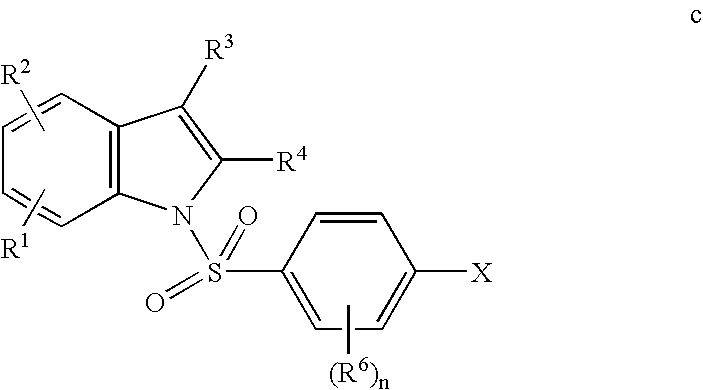
wherein X is halo and n, R1, R2, R3, R4, and R6 are as defined herein, with a compound of Formula b: 
wherein R7, R8, and R9 are as defined herein, to provide a compound of general Formula III: 
wherein X is halo and n, R1, R2, R3, R4, and R6 are as defined herein, with a compound of Formula b:
wherein R7, R8, and R9 are as defined herein, to provide a compound of general Formula III:
In another aspect, the invention relates a process which comprises: reacting or contacting a compound having the Formula d: 
wherein X is halo and n, R1, R2, R3, R4, and R6 are as defined herein, with a compound of Formula b: 
wherein R7, R8, and R9 are as defined herein, to provide a compound of general Formula IV: 
wherein X is halo and n, R1, R2, R3, R4, and R6 are as defined herein, with a compound of Formula b:
wherein R7, R8, and R9 are as defined herein, to provide a compound of general Formula IV:
In still another aspect, the invention further provides a process which comprises: reacting or contacting a compound having a general Formula e: 
wherein X is halo and n, R1, R2, R3, R4, and R6 are as defined herein, with a compound of Formula b: 
wherein R7, R8, and R9 are as defined herein, to provide a compound of general Formula V: 
wherein X is halo and n, R1, R2, R3, R4, and R6 are as defined herein, with a compound of Formula b:
wherein R7, R8, and R9 are as defined herein, to provide a compound of general Formula V:
Definitions
Unless otherwise stated, the following terms used in this Application, including the specification and claims, have the definitions given below. It must be noted that, as used in the specification and the appended claims, the singular forms “a”, “an,” and “the” include plural referents unless the context clearly dictates otherwise.
“Alkyl” means the monovalent linear, branched, cyclic, or a combination of linear, branched, or cyclic saturated hydrocarbon radical, consisting solely of carbon and hydrogen atoms, having from one to twelve carbon atoms inclusive, unless otherwise indicated. Examples of alkyl radicals include, but are not limited to, methyl, ethyl, propyl, isopropyl, isobutyl, sec-butyl, tert-butyl, pentyl, n-hexyl, octyl, dodecyl, and the like.
“Lower alkyl” means the monovalent linear or branched saturated hydrocarbon radical, consisting solely of carbon and hydrogen atoms, having from one to six carbon atoms inclusive, unless otherwise indicated. Examples of lower alkyl radicals include, but are not limited to, methyl, ethyl, propyl, isopropyl, sec-butyl, tert-butyl, n-butyl, n-pentyl, n-hexyl, and the like.
“Alkylene” means the divalent linear or branched saturated hydrocarbon radical, consisting solely of carbon and hydrogen atoms, having from one to six carbons inclusive, unless otherwise indicated. Examples of alkylene radicals include, but are not limited to, methylene, ethylene, propylene, 2-methyl-propylene, butylene, 2-ethylbutylene, and the like.
“Alkoxy” means the radical —O—R, wherein R is a lower alkyl radical as defined herein. Examples of alkoxy radicals include, but are not limited to, methoxy, ethoxy, isopropoxy, and the like.
“Halo”, “halide” and “halogen”, which may be used interchangeably, means fluoro, chloro, bromo, or iodo.
“Haloalkyl” means alkyl substituted with one or more same or different halo atoms, e.g., —CH2Cl, —CF3, —CH2CF3, —CH2CCl3, and the like.
“Alkylthio” or “alkylsulfanyl” means the radical —S—R, wherein R is a lower alkyl radical as defined herein. Examples of alkylthio radicals include, but are not limited to, methylthio, ethylthio, butylthio, and the like.
“Alkylsulfonyl” means the radical —SO2R, wherein R is a lower alkyl radical as defined herein. Examples of alkylsulfonyl radicals include, but are not limited to, methylsulfonyl, ethylsulfonyl, and the like.
“Aryllthio” or “arylsulfanyl” means the radical —S—R, wherein R is an aryl radical as defined herein.
“Arylsulfonyl” means the radical —SO2R, wherein R an aryl radical as defined herein.
“Aryl” means the monovalent cyclic aromatic hydrocarbon radical consisting of one or more fused rings in which at least one ring is aromatic in nature, which can optionally be substituted with hydroxy, cyano, lower alkyl, lower alkoxy, thioalkyl, halo, haloalkyl, hydroxyalkyl, nitro, alkoxycarbonyl, amino, alkylamino, dialkylamino, aminocarbonyl, carbonylamino, aminosulfonyl, sulfonylamino, and/or trifluoromethyl, unless otherwise indicated. Examples of aryl radicals include, but are not limited to, phenyl, naphthyl, biphenyl, indanyl, anthraquinolyl, and the like. Examples of substituted aryl radicals include but are not limited to fluorophenyl, chlorophenyl, dichlorophenyl, trifluoromethylphenyl, tolyl, and the like.
“Heteroaryl” means the monovalent aromatic carbocyclic radical having one or more rings incorporating one, two, or three heteroatoms within the ring (chosen from nitrogen, oxygen, or sulfur) which can optionally be substituted with hydroxy, cyano, lower alkyl, lower alkoxy, thioalkyl, halo, haloalkyl, hydroxyalkyl, nitro, alkoxycarbonyl, amino, alkylamino, dialkylamino, aminocarbonyl, carbonylamino, aminosulfonyl, sulfonylamino, and/or trifluoromethyl, unless otherwise indicated. Examples of heteroaryl radicals include, but are not limited to, imidazolyl, oxazolyl, thiazolyl, pyrazinyl, thiophenyl, furanyl, pyranyl, pyridinyl, quinolinyl, isoquinolinyl, benzofuryl, benzothiophenyl, benzothiopyranyl, benzimidazolyl, benzooxazolyl, benzothiazolyl, benzopyranyl, indazolyl, indolyl, isoindolyl, naphtyridinyl, and the like.
“Leaving group” means the group with the meaning conventionally associated with it in synthetic organic chemistry, i.e., an atom or group displaceable under alkylating conditions. Examples of leaving groups include, but are not limited to, halogen, alkyl, or arylsulfonyloxy, such as methanesulfonyloxy, ethanesulfonyloxy, thiomethyl, benzenesulfonyloxy, tosyloxy, and thienyloxy, dihalophosphinoyloxy, optionally substituted benzyloxy, isopropyloxy, acyloxy, and the like.
“Amino-protecting group” means the protecting group that refers to those organic groups intended to protect the nitrogen atom against undesirable reactions during synthetic procedures and includes, but is not limited to, benzyl (Bnz), benzyloxycarbonyl (carbobenzyloxy, Cbz), p-methoxybenzyloxycarbonyl, p-nitrobenzyloxycarbonyl, tert-butoxycarbonyl (Boc), trifluoroacetyl, and the like. It is preferred to use either Boc or Cbz as the amino-protecting group because of the relative ease of removal, for example by mild acids in the case of Boc, e.g., trifluoroacetic acid or hydrochloric acid in ethyl acetate or ethanol; or by catalytic hydrogenation in the case of Cbz.
“Optional” or “optionally” means that the subsequently described event or circumstance may but need not occur, and that the description includes instances where the event or circumstance occurs and instances in which it does not. For example, “optional bond” means that the bond may or may not be present, and that the description includes single, double, or triple bonds.
“Protective group” or “protecting group” means the group which selectively blocks one reactive site in a multifunctional compound such that a chemical reaction can be carried out selectively at another unprotected reactive site in the meaning conventionally associated with it in synthetic chemistry. Certain processes of this invention rely upon protective groups to block reactive oxygen atoms present in the reactants. Acceptable protective groups for alcoholic or phenolic hydroxyl groups, which may be removed successively and selectively includes groups protected as acetates, haloalkyl carbonates, benzyl ethers, alkylsilyl ethers, heterocyclyl ethers, methyl or alkyl ethers, and the like. Protective or blocking groups for carboxyl groups are similar to those described for hydroxyl groups, preferably tert-butyl, benzyl, or methyl esters.
“Inert organic solvent” or “inert solvent” means the solvent is inert under the conditions of the reaction being described in conjunction therewith, including for example, benzene, toluene, acetonitrile (ACN), tetrahydrofuran (THF), N,N-dimethylformamide (DMF), chloroform, methylene chloride or dichloromethane (DCM), dichloroethane (DCE), diethyl ether, ethyl acetate, acetone, methyl ethyl ketone, methanol, ethanol, propanol, isopropanol, tert-butanol, dioxane, pyridine, and the like. Unless specified to the contrary, the solvents used in the reactions of the present invention are inert solvents.
“Pharmaceutically acceptable” means that which is useful in preparing a pharmaceutical composition that is generally safe, non-toxic, and neither biologically nor otherwise undesirable and includes that which is acceptable for veterinary as well as human pharmaceutical use.
“Pharmaceutically acceptable salts” of a compound means salts that are pharmaceutically acceptable, as defined herein, and that possess the desired pharmacological activity of the parent compound. Such salts include:
- (1) acid addition salts formed with inorganic acids such as hydrochloric acid, hydrobromic acid, sulfuric acid, nitric acid, phosphoric acid, and the like; or formed with organic acids such as acetic acid, benzenesulfonic acid, benzoic acid, camphorsulfonic acid, citric acid, ethanesulfonic acid, fumaric acid, glucoheptonic acid, gluconic acid, glutamic acid, glycolic acid, hydroxynaphtoic acid, 2-hydroxyethanesulfonic acid, lactic acid, maleic acid, malic acid, malonic acid, mandelic acid, methanesulfonic acid, muconic acid, 2-naphthalenesulfonic acid, propionic acid, salicylic acid, succinic acid, tartaric acid, p-toluenesulfonic acid, trimethylacetic acid, trifluoroacetic acid, and the like; or
- (2) salts formed when an acidic proton present in the parent compound either is replaced by a metal ion, e.g., an alkali metal ion, an alkaline earth ion, or an aluminum ion; or coordinates with an organic or inorganic base. Acceptable organic bases include diethanolamine, ethanolamine, N-methylglucamine, triethanolamine, tromethamine, and the like. Acceptable inorganic bases include aluminum hydroxide, calcium hydroxide, potassium hydroxide, sodium carbonate, and sodium hydroxide.
The preferred pharmaceutically acceptable salts are the salts formed from acetic acid, trifluoroacetic acid, hydrochloric acid, sulphuric acid, methanesulfonic acid, maleic acid, phosphoric acid, tartaric acid, citric acid, sodium, potassium, calcium, zinc, and magnesium.
It should be understood that all references to pharmaceutically acceptable salts include solvent addition forms (solvates) or crystal forms (polymorphs) as defined herein, of the same acid addition salt.
“Solvates” means solvent addition forms that contain either stoichiometric or non stoichiometric amounts of solvent. Some compounds have a tendency to trap a fixed molar ratio of solvent molecules in the crystalline solid state, thus forming a solvate. If the solvent is water the solvate formed is a hydrate, when the solvent is alcohol, the solvate formed is an alcoholate. Hydrates are formed by the combination of one or more molecules of water with one of the substances in which the water retains its molecular state as H2O, such combination being able to form one or more hydrate.
“Prodrug” or “pro-drug” means a pharmacologically inactive form of a compound which must be metabolized in vivo, e.g., by biological fluids or enzymes, by a subject after administration into a pharmacologically active form of the compound in order to produce the desired pharmacological effect. Prodrugs of a compound of Formula I are prepared by modifying one or more functional group(s) present in the compound of Formula I in such a way that the modification(s) may be cleaved in vivo to release the parent compound. Prodrugs include compounds of Formula I wherein a hydroxy, amino, sulfhydryl, carboxy, or carbonyl group in a compound of Formula I is bonded to any group that may be cleaved in vivo to regenerate the free hydroxyl, amino, sulfhydryl, carboxy, or carbonyl group respectively. Examples of prodrugs include, but are not limited to, esters (e.g. acetate, dialkylaminoacetates, formates, phosphates, sulfates, and benzoate derivatives), carbamates of hydroxy functional groups (e.g. N,N-dimethylcarbonyl), esters of carboxyl functional groups (e.g. ethyl esters and morpholinoethanol esters), N-acyl derivatives (e.g. N-acetyl), N-Mannich bases, Schiff bases, enaminones of amino functional groups, oximes, acetals, ketals, enol esters of ketones, aldehyde functional groups in compounds of Formula I, and the like.
The prodrug can be metabolized before absorption, during absorption, after absorption, or at a specific site. Although metabolism occurs for many compounds primarily in the liver, almost all other tissues and organs, especially the lung, are able to carry out varying degrees of metabolism. Prodrug forms of compounds may be utilized, for example, to improve bioavailability, improve subject acceptability such as by masking or reducing unpleasant characteristics such as bitter taste or gastrointestinal irritability, alter solubility such as for intravenous use, provide for prolonged or sustained release or delivery, improve ease of formulation, or provide site-specific delivery of the compound. Reference to a compound herein includes prodrug forms of a compound. Prodrugs are described in The Organic Chemistry of Drug Design and Drug Action, by Richard B. Silverman, Academic Press, San Diego, 1992. Chapter 8: “Prodrugs and Drug delivery Systems” pp. 352–401; Design of Prodrugs, edited by H. Bundgaard, Elsevier Science, Amsterdam, 1985; Design of Biopharmaceutical Properties through Prodrugs and Analogs, Ed. by E. B. Roche, American Pharmaceutical Association, Washington, 1977; and Drug Delivery Systems, ed. by R. L. Juliano, Oxford Univ. Press, Oxford, 1980.
“Subject” means mammals and non-mammals. Mammals means any member of the Mammalia class including, but not limited to, humans; non-human primates such as chimpanzees and other apes and monkey species; farm animals such as cattle, horses, sheep, goats, and swine; domestic animals such as rabbits, dogs, and cats; laboratory animals including rodents, such as rats, mice, and guinea pigs; and the like. Examples of non-mammals include, but are not limited to, birds, and the like. The term “subject” does not denote a particular age or sex.
“Therapeutically effective amount” means an amount of a compound that, when administered to a subject for treating a disease state, is sufficient to effect such treatment for the disease state. The “therapeutically effective amount” will vary depending on the compound, disease state being treated, the severity or the disease treated, the age and relative health of the subject, the route and form of administration, the judgement of the attending medical or veterinary practitioner, and other factors.
“Disease state” means any disease, condition, symptom, or indication.
Throughout the application the following abbreviations may be used with the following meaning:
Alk Alkyl group
Boc N-tert-butoxycarbonyl
m-CPBA m-Chloroperbenzoic acid
DCM Dichloromethane
DTB Di-tert-butyldicarbonate
DMF N,N-Dimethylformamide
DMFDMA N,N-dimethylformamide dimethyl acetal
DMSO Dimethylsulfoxide
L Leaving group
Oxone™ Potassium peroxymonosulfate
P Protective group
TFA Trifluoroacetic acid
THF Tetrahydrofuran
Nomenclature
The naming and numbering of the compounds of this invention is illustrated below: 
In general, the nomenclature used herein is based on AUTONOM™ v.4.0, a Beilstein Institute computerized system for the generation of IUPAC systematic nomenclature. However, because a strict adherence to these recommendations would result in the names changing substantially when only a single substituent is changed, compounds have been named in a manner that maintains consistency of nomenclature for the basic structure of the molecule. Any open valency on a nitrogen or oxygen molecule should be understood as indicating the presence of a hydrogen atom.
For example, a compound of Formula I wherein R2, R3 and R4 are hydrogen, R1 is fluorine (attached through the fifth position on the indole ring), R5 is 
attached at the first position on the indole ring, R6, R7 and R8 are hydrogen, and R9 is methyl, is named 5-Fluoro-1-[4-(4-methyl-piperazin-1-yl)-benzenesulfonyl]-1H-indole.
Compounds and Compositions of the Invention
attached at the first position on the indole ring, R6, R7 and R8 are hydrogen, and R9 is methyl, is named 5-Fluoro-1-[4-(4-methyl-piperazin-1-yl)-benzenesulfonyl]-1H-indole.
Compounds and Compositions of the Invention
The invention provides Compounds of Formula I: 
wherein:
wherein:
R1 and R2 each independently is hydrogen, alkyl, aryl, acyl, halo, nitro, amino, cyano, alkoxy, hydroxy, aryloxy, alkylthio, arylthio, thiol, carbonylamino, aminocarbonyl, or haloalkyl; preferably R1 and R2 each independently is hydrogen, halo or alkoxy; more preferably hydrogen or halo;
R3 and R4 each independently is hydrogen, halo, alkyl, acyl, aryl, or arylalkyl; preferably R3 and R4 each independently is hydrogen or alkyl;
R5 is: 
n is from 0 to 3; preferably n is 0 or 1;
R6 in each occurrence independently is hydrogen, alkyl, alkoxy, or halo; preferably R6 is hydrogen or halo;
R7 and R8 each independently is hydrogen or alkyl; and
R9 is hydrogen, alkyl, or arylalkyl; preferably R9 is hydrogen or alkyl; or individual isomers, racemic or non racemic mixtures of isomers, prodrugs, or pharmaceutically acceptable salts or solvates thereof.
In certain embodiments of the invention, the Compounds of Formula I may be of Formula III: 
wherein n, R1, R2, R3, R4, R6, R7, R8 and R9 are as defined herein.
wherein n, R1, R2, R3, R4, R6, R7, R8 and R9 are as defined herein.
In other embodiments, Compounds of Formula I may be of Formula IV: 
wherein n, R1, R2, R3, R4, R6, R7, R8 and R9 are as defined herein.
wherein n, R1, R2, R3, R4, R6, R7, R8 and R9 are as defined herein.
In more preferred embodiments, Compounds of Formula I are of the Formula V: 
wherein n, R1, R2, R3, R4, R6, R7, R8 and R9 are as defined herein.
wherein n, R1, R2, R3, R4, R6, R7, R8 and R9 are as defined herein.
Representative compounds in accordance with the invention are shown in Table 1. In many instances the compounds in Table 1 are shown as hydrochloride salts.
| TABLE 1 | ||||
| M + H | ||||
| or | ||||
| # | STRUCTURE | MP ° C. | NAME | Example |
| 1 |
 |
M + H360 | 5-Fluoro-1-(4-piperazin-1-yl-benzenesulfonyl)-1H-indole | 1 |
| 2 |
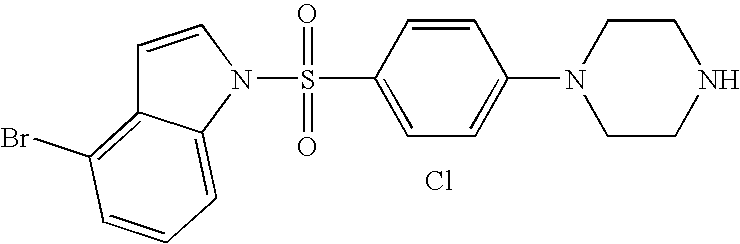 |
M + H421 | 4-Bromo-1-(4-piperazin-1-yl-benzenesulfonyl)-1H-indole | 1 |
| 3 |
 |
M + H372 | 5-Methoxy-1-(4-piperazin-1-yl-benzenesulfonyl)-1H-indole | 1 |
| 4 |
 |
M + H342 | 1-(4-Piperazin-1-yl-benzenesulfonyl)-1H-indole | 1 |
| 5 |
 |
M + H374 | 5-Fluoro-1-[4-(4-methyl-piperazin-1-yl)-benzenesulfonyl]-1H-indole | 1 |
| 6 |
 |
M + H435 | 5-Bromo-1-methyl-3-(4-piperazin-1-yl-benzenesulfonyl)-1H-indole | 3 |
| 7 |
 |
M + H421 | 5-Bromo-3-(4-piperazin-1-yl-benzenesulfonyl)-1H-indole | 3 |
| 8 |
 |
M + H342 | 3-(4-Piperazin-1-yl-benzenesulfonyl)-1H-indole | 3 |
| 9 |
 |
M + H420 | 3-Chloro-5-methoxy-2-methyl-1-(4-piperazin-1-yl-benzenesulfonyl)-1H-indole | 1 |
| 10 |
 |
M + H356 | 1-Methyl-3-(4-piperazin-1-yl-benzenesulfonyl)-1H-indole | 3 |
| 11 |
 |
M + H376 | 6-Chloro-3-(4-piperazin-1-yl-benzenesulfonyl)-1H-indole | 3 |
| 12 |
 |
M + H376 | 4-Chloro-3-(4-piperazin-1-yl-benzenesulfonyl)-1H-indole | 3 |
| 13 |
 |
M + H372 | 5-Methoxy-3-(4-piperazin-1-yl-benzenesulfonyl)-1H-indole | 3 |
| 14 |
 |
M + H376 | 5-Chloro-3-(4-piperazin-1-yl-benzenesulfonyl)-1H-indole | 3 |
| 15 |
 |
M + H376 | 7-Chloro-3-(4-piperazin-1-yl-benzenesulfonyl)-1H-indole | 3 |
| 16 |
 |
M + H422 | 6-Chloro-1-methyl-3-(4-piperazin-1-yl-benzenesulfonyl)-1H-indole | 3 |
| 17 |
 |
M + H356 | 3-[4-(4-Methyl-piperazin-1-yl)-benzenesulfonyl]-1H-indole | 3 |
| 18 |
 |
M + H435 | 7-Bromo-3-[4-(4-methyl-piperazin-1-yl)-benzenesulfonyl]-1H-indole | 3 |
| 19 |
 |
M + H421 | 7-Bromo-3-(4-piperazin-1-yl-benzenesulfonyl)-1H-indole | 3 |
| 20 |
 |
M + H435 | 6-Bromo-3-[4-(4-methyl-piperazin-1-yl)-benzenesulfonyl]-1H-indole | 3 |
| 21 |
 |
M + H482 | 5-Iodo-3-[4-(4-methyl-piperazin-1-yl)-benzenesulfonyl]-1H-indole | 3 |
| 22 |
 |
M + H435 | 4-Bromo-3-[4-(4-methyl-piperazin-1-yl)-benzenesulfonyl]-1H-indole | 3 |
| 23 |
 |
M + H421 | 4-Bromo-3-(4-piperazin-1-yl-benzenesulfonyl)-1H-indole | 3 |
| 24 |
 |
M + H468 | 5-Iodo-3-(4-piperazin-1-yl-benzenesulfonyl)-1H-indole | 3 |
| 25 |
 |
M + H421 | 6-Bromo-3-(4-piperazin-1-yl-benzenesulfonyl)-1H-indole | 3 |
| 26 |
 |
M + H376 | 3-(2-Chloro-4-piperazin-1-yl-benzenesulfonyl)-1H-indole | 3 |
| 27 |
 |
M + H376 | 3-(3-Chloro-4-piperazin-1-yl-benzenesulfonyl)-1H-indole | 3 |
| 28 |
 |
M + H468 | 5-Bromo-3-[2-chloro-4-(4-methyl-piperazin-1-yl)-benzenesulfonyl]-1H-indole | 3 |
| 29 |
 |
MP283–286° | 5-Bromo-3-(2-chloro-4-piperazin-1-yl-benzenesulfonyl)-1H-indole | 3 |
| 30 |
 |
MP252–258° | 5-Chloro-3-(3-chloro-4-piperazin-1-yl-benzenesulfonyl)-1H-indole | 3 |
| 31 |
 |
MP198–202° | 5-Chloro-3-(3-chloro-4-(4-methyl-piperazin-1-yl)-benzenesulfonyl)-1H-indole | 3 |
| 32 |
 |
M + H390 | 3-(3-chloro-4-(4-methyl-piperazin-1-yl)-benzenesulfonyl)-1H-indole | 3 |
| 33 |
 |
MP194–197° | 5-Bromo-3-(3-chloro-4-(4-methyl-piperazin-1-yl)-benzenesulfonyl)-1H-indole | 3 |
| 34 |
 |
MP210–218° | 5-Bromo-3-(3-chloro-4-piperazin-1-yl-benzenesulfonyl)-1H-indole | 3 |
| 35 |
 |
M + H410 | 5-Chloro-3-(2-chloro-4-piperazin-1-yl-benzenesulfonyl)-1H-indole | 3 |
| 36 |
 |
MP250° | 5-Chloro-3-(2-chloro-4-(4-methyl-piperazin-1-yl)-benzenesulfonyl)-1H-indole | 3 |
| 37 |
 |
M + H390 | 3-(2-chloro-4-(4-methyl-piperazin-1-yl)-benzenesulfonyl)-1H-indole | 3 |
| 38 |
 |
M + H468 | 5-Bromo-3-(2-chloro-4-(4-methyl-piperazin-1-yl)-benzenesulfonyl)-1H-indole | 3 |
| 39 |
 |
M + H342 | 2-(4-Piperazin-1-yl-benzenesulfonyl)-1H-indole | 2 |
The invention provides, in another aspect, pharmaceutical compositions comprising at least one Compound of Formula I together with one or more pharmaceutically acceptable carriers, diluents, adjuvants or excipients.
Methods
Yet another aspect of the invention provides methods for treating a central nervous system (CNS) disease state or condition in a subject comprising administering to a subject in need thereof a therapeutically effective amount of at least one Compound of Formula I. The disease state may comprise psychoses, schizophrenia, manic depressions, neurological disorders, memory disorders, attention deficit disorder, Parkinson's disease, amyotrophic lateral sclerosis, Alzheimer's disease and/or Huntington's disease.
Still another aspect of the present invention provides a method for treating a disorder of the gastrointestinal tract in a subject comprising administering to the subject a therapeutically effective amount of a Compound of Formula I.
Another aspect of the present invention provides methods for producing Compounds of Formula I according to the synthetic procedures described below.
Synthesis
Compounds of the present invention may be made by the methods depicted in the illustrative synthetic reaction schemes shown and described below.
The starting materials and reagents used in preparing these compounds generally are either available from commercial suppliers, such as Aldrich Chemical Co., or are prepared by methods known to those skilled in the art following procedures set forth in references such as Fieser and Fieser's Reagents for Organic Synthesis; Wiley & Sons: New York, 1991, Volumes 1–15; Rodd's Chemistry of Carbon Compounds, Elsevier Science Publishers, 1989, Volumes 1–5 and Supplementals; and Organic Reactions, Wiley & Sons: New York, 1991, Volumes 1–40. The indole starting materials used herein are commercially available or may be prepared by conventional techniques such as those described by Sundberg, R. J. in The Chemistry of Indoles, Academic Press, New York, 1970. The following synthetic reaction schemes are merely illustrative of some methods by which the compounds of the present invention may be synthesized, and various modifications to these synthetic reaction schemes may be made and will be suggested to one skilled in the art having referred to the disclosure contained in this Application.
The starting materials and the intermediates of the synthetic reaction schemes may be isolated and purified if desired using conventional techniques, including but not limited to filtration, distillation, crystallization, chromatography, and the like. Such materials may be characterized using conventional means, including physical constants and spectral data.
Unless specified to the contrary, the reactions described herein preferably take place at atmospheric pressure over a temperature range from about −78° C. to about 150° C., more preferably from about 0° C. to about 125° C., and most preferably and conveniently at about room (or ambient) temperature, e.g., about 20° C.
Compounds of Formula III may be prepared as shown in Scheme A wherein X, n, R1, R2, R3, R4, R6, R7, R8 and R9 are as defined herein. 
In Scheme A, the 1-(4-halobenzenesulfonyl)-1H-indole c is formed by reaction of the indole compound f under basic conditions with a 4-halophenylsulfonyl halide g having a desired R6 substituent(s). The 1-(4-halobenzenesulfonyl)-1H-indole c may then be treated with excess piperazine b in polar aprotic solvent to afford the corresponding 1-(4-piperazin-1-yl-benzenesulfonyl)-1H-indole of Formula III.
Compounds of Formula IV may be prepared according to the procedure shown in Scheme B, wherein X, n, R1, R2, R 3, R4, R6, R7, R8 and R9 are as defined herein. 
In Scheme B, the indole compound h is treated with an alkyllithium reagent or other strong base under anhydrous polar aprotic conditions and dry ice/acetone temperature to generate the corresponding indole anion (not shown) by deprotonation at the 2-position. Where R4 is hydrogen, a suitable removable protecting group may be used to protect the indole nitrogen of compound h. A 4-halophenylsulfonyl fluoride g may then be added directly to the anion of indole compound h to provide the 2-(4-halobenzenesulfonyl)-1H-indole d. Treatment of the 2-(4-halobenzenesulfonyl)-1H-indole d with excess piperazine b can then provide the corresponding 2-(4-piperazin-1-yl-benzenesulfonyl)-1H-indole of Formula IV.
Compounds of Formula V may be prepared according to the procedure shown in Scheme C, wherein X, n, R1, R2, R3, R4, R6, R7, R8 and R9 again are as defined herein. 
In Scheme C, the indole compound i is reacted with a 4-halophenyl disulfide i in the presence of alkalai metal hydride or like strong base under dry polar aprotic conditions to yield the 3-(4-halosphenylsulfanyl)-1H-indole compound k. In the procedure of Scheme C, R4 of compound i is preferably hydrogen. The compound k may then be treated with a peracid or like oxidizing agent to afford the 3-(4-halobenzenelsulfonyl)-1H-indole compound e. Treatment of the 3-(4-halobenzenesulfonyl)-1H-indole c with excess piperazine b furnishes the 3-(4-piperazin-1-yl-benzenesulfonyl)-1H-indole of Formula V. Where it is desired to have R4 as alkyl in compounds of Formula V, alkylation of the indole nitrogen at the 1-position of the indole ring may be carried out subsequent to formation of the sulfanyl compound k.
Many variations of the above synthetic schemes are possible and will suggest themselves to those skilled in the art. Those skilled in the art will also recognize that stereocenters exist in some compounds of Formula I. Accordingly, the present invention includes all possible stereoisomers and geometric isomers of Formula I, and includes not only racemic compounds but also the optically active isomers as well. When a Compound of Formula I, is desired as a single enantiomer, it may be obtained either by resolution of the final product or by stereospecific synthesis from either isomerically pure starting material or any convenient intermediate. Resolution of the final product, an intermediate or a starting material may be effected by any suitable method known in the art. See for example, Stereochemistry of Carbon Compounds by E. L. Eliel (McGraw Hill, 1962) and Tables of Resolving Agents by S. H. Wilen.
Utility
The compounds of the invention have selective 5-HT6 receptor affinity and as such are expected to be useful in the treatment of certain CNS disorders such as Parkinson's disease, Huntington's disease, anxiety, depression, manic depression, psychosis, epilepsy, obsessive compulsive disorders, migraine, Alzheimer's disease (enhancement of cognitive memory), sleep disorders, feeding disorders such as anorexia and bulimia, panic attacks, attention deficit hyperactivity disorder (ADHD), attention deficit disorder (ADD), withdrawal from drug abuse such as cocaine, ethanol, nicotine, and benzodiazepines, schizophrenia, disorders associated with spinal trauma and/or head injury such as hydrocephalus, and other diseases, disorders or conditions mediated by or otherwise associated with the 5-HT6 receptor or other 5-HT receptors. Such compounds are also expected to be of use in the treatment of certain GI (gastrointestinal) disorders such as functional bowel disorder or irritable bowel syndrome (IBS).
Testing
The pharmacology of the compounds of this invention was determined by art recognized procedures. The in vitro techniques for determining the affinities of test compounds at the 5-HT6 receptor in radioligand binding and functional assays are described in Example 5.
Administration and Pharmaceutical Composition
The present invention includes pharmaceutical compositions comprising at least one compound of the present invention, or an individual isomer, racemic or non-racemic mixture of isomers or a pharmaceutically acceptable salt or solvate thereof, together with at least one pharmaceutically acceptable carrier, and optionally other therapeutic and/or prophylactic ingredients.
In general, the compounds of the present invention will be administered in a therapeutically effective amount by any of the accepted modes of administration for agents that serve similar utilities. Suitable dosage ranges are typically 1–500 mg daily, preferably 1–100 mg daily, and most preferably 1–30 mg daily, depending upon numerous factors such as the severity of the disease to be treated, the age and relative health of the subject, the potency of the compound used, the route and form of administration, the indication towards which the administration is directed, and the preferences and experience of the medical practitioner involved. One of ordinary skill in the art of treating such diseases will be able, without undue experimentation and in reliance upon personal knowledge and the disclosure of this Application, to ascertain a therapeutically effective amount of the compounds of the present invention for a given disease.
In general, compounds of the present invention will be administered as pharmaceutical formulations including those suitable for oral (including buccal and sub-lingual), rectal, nasal, topical, pulmonary, vaginal, or parenteral (including intramuscular, intraarterial, intrathecal, subcutaneous, and intravenous) administration or in a form suitable for administration by inhalation or insufflation. The preferred manner of administration is generally oral using a convenient daily dosage regimen which can be adjusted according to the degree of affliction.
A compound or compounds of the present invention, together with one or more conventional adjuvants, carriers, or diluents, may be placed into the form of pharmaceutical compositions and unit dosages. The pharmaceutical compositions and unit dosage forms may be comprised of conventional ingredients in conventional proportions, with or without additional active compounds or principles, and the unit dosage forms may contain any suitable effective amount of the active ingredient commensurate with the intended daily dosage range to be employed. The pharmaceutical compositions may be employed as solids, such as tablets or filled capsules, semisolids, powders, sustained release formulations, or liquids such as solutions, suspensions, emulsions, elixirs, or filled capsules for oral use; or in the form of suppositories for rectal or vaginal administration; or in the form of sterile injectable solutions for parenteral use. Formulations containing about one (1) milligram of active ingredient or, more broadly, about 0.01 to about one hundred (100) milligrams, per tablet, are accordingly suitable representative unit dosage forms.
The compounds of the present invention may be formulated in a wide variety of oral administration dosage forms. The pharmaceutical compositions and dosage forms may comprise a compound or compounds of the present invention or pharmaceutically acceptable salts thereof as the active component. The pharmaceutically acceptable carriers may be either solid or liquid. Solid form preparations include powders, tablets, pills, capsules, cachets, suppositories, and dispersible granules. A solid carrier may be one or more substances which may also act as diluents, flavouring agents, solubilizers, lubricants, suspending agents, binders, preservatives, tablet disintegrating agents, or an encapsulating material. In powders, the carrier generally is a finely divided solid which is a mixture with the finely divided active component. In tablets, the active component generally is mixed with the carrier having the necessary binding capacity in suitable proportions and compacted in the shape and size desired. The powders and tablets preferably contain from about one (1) to about seventy (70) percent of the active compound. Suitable carriers include but are not limited to magnesium carbonate, magnesium stearate, talc, sugar, lactose, pectin, dextrin, starch, gelatine, tragacanth, methylcellulose, sodium carboxymethylcellulose, a low melting wax, cocoa butter, and the like. The term “preparation” is intended to include the formulation of the active compound with encapsulating material as carrier, providing a capsule in which the active component, with or without carriers, is surrounded by a carrier, which is in association with it. Similarly, cachets and lozenges are included. Tablets, powders, capsules, pills, cachets, and lozenges may be as solid forms suitable for oral administration.
Other forms suitable for oral administration include liquid form preparations including emulsions, syrups, elixirs, aqueous solutions, aqueous suspensions, or solid form preparations which are intended to be converted shortly before use to liquid form preparations. Emulsions may be prepared in solutions, for example, in aqueous propylene glycol solutions or may contain emulsifying agents, for example, such as lecithin, sorbitan monooleate, or acacia. Aqueous solutions can be prepared by dissolving the active component in water and adding suitable colorants, flavors, stabilizing, and thickening agents. Aqueous suspensions can be prepared by dispersing the finely divided active component in water with viscous material, such as natural or synthetic gums, resins, methylcellulose, sodium carboxymethylcellulose, and other well known suspending agents. Solid form preparations include solutions, suspensions, and emulsions, and may contain, in addition to the active component, colorants, flavors, stabilizers, buffers, artificial and natural sweeteners, dispersants, thickeners, solubilizing agents, and the like.
The compounds of the present invention may be formulated for parenteral administration (e.g., by injection, for example bolus injection or continuous infusion) and may be presented in unit dose form in ampoules, pre-filled syringes, small volume infusion or in multi-dose containers with an added preservative. The compositions may take such forms as suspensions, solutions, or emulsions in oily or aqueous vehicles, for example solutions in aqueous polyethylene glycol. Examples of oily or nonaqueous carriers, diluents, solvents or vehicles include propylene glycol, polyethylene glycol, vegetable oils (e.g., olive oil), and injectable organic esters (e.g., ethyl oleate), and may contain formulatory agents such as preserving, wetting, emulsifying or suspending, stabilising and/or dispersing agents. Alternatively, the active ingredient may be in powder form, obtained by aseptic isolation of sterile solid or by lyophilisation from solution for constitution before use with a suitable vehicle, e.g., sterile, pyrogen-free water.
The compounds of the present invention may be formulated for topical administration to the epidermis as ointments, creams or lotions, or as a transdermal patch. Ointments and creams may, for example, be formulated with an aqueous or oily base with the addition of suitable thickening and/or gelling agents. Lotions may be formulated with an aqueous or oily base and will in general also containing one or more emulsifying agents, stabilising agents, dispersing agents, suspending agents, thickening agents, or colouring agents. Formulations suitable for topical administration in the mouth include lozenges comprising active agents in a flavoured base, usually sucrose and acacia or tragacanth; pastilles comprising the active ingredient in an inert base such as gelatine and glycerine or sucrose and acacia; and mouthwashes comprising the active ingredient in a suitable liquid carrier.
The compounds of the present invention may be formulated for administration as suppositories. A low melting wax, such as a mixture of fatty acid glycerides or cocoa butter is first melted and the active component is dispersed homogeneously, for example, by stirring. The molten homogeneous mixture is then poured into convenient sized molds, allowed to cool, and to solidify.
The compounds of the present invention may be formulated for vaginal administration. Pessaries, tampons, creams, gels, pastes, foams or sprays containing in addition to the active ingredient such carriers as are known in the art to be appropriate.
The compounds of the present invention may be formulated for nasal administration. The solutions or suspensions are applied directly to the nasal cavity by conventional means, for example, with a dropper, pipette or spray. The formulations may be provided in a single or multidose form. In the latter case of a dropper or pipette, this may be achieved by the patient administering an appropriate, predetermined volume of the solution or suspension. In the case of a spray, this may be achieved for example by means of a metering atomising spray pump.
The compounds of the present invention may be formulated for aerosol administration, particularly to the respiratory tract and including intranasal administration. The compound will generally have a small particle size for example of the order of five (5) microns or less. Such a particle size may be obtained by means known in the art, for example by micronization. The active ingredient is provided in a pressurized pack with a suitable propellant such as a chlorofluorocarbon (CFC), for example, dichlorodifluoromethane, trichlorofluoromethane, or dichlorotetrafluoroethane, or carbon dioxide or other suitable gas. The aerosol may conveniently also contain a surfactant such as lecithin. The dose of drug may be controlled by a metered valve. Alternatively the active ingredients may be provided in a form of a dry powder, for example a powder mix of the compound in a suitable powder base such as lactose, starch, starch derivatives such as hydroxypropylmethyl cellulose and polyvinylpyrrolidine (PVP). The powder carrier will form a gel in the nasal cavity. The powder composition may be presented in unit dose form for example in capsules or cartridges of e.g., gelatine or blister packs from which the powder may be administered by means of an inhaler.
When desired, formulations can be prepared with enteric coatings adapted for sustained or controlled release administration of the active ingredient. For example, the compounds of the present invention can be formulated in transdermal or subcutaneous drug delivery devices. These delivery systems are advantageous when sustained release of the compound is necessary and when patient compliance with a treatment regimen is crucial. Compounds in transdermal delivery systems are frequently attached to an skin-adhesive solid support. The compound of interest can also be combined with a penetration enhancer, e.g., Azone (1-dodecylazacycloheptan-2-one). Sustained release delivery systems are inserted subcutaneously into the subdermal layer by surgery or injection. The subdermal implants encapsulate the compound in a lipid soluble membrane, e.g., silicone rubber, or a biodegradable polymer, e.g., polylactic acid.
The pharmaceutical preparations are preferably in unit dosage forms. In such form, the preparation is subdivided into unit doses containing appropriate quantities of the active component. The unit dosage form can be a packaged preparation, the package containing discrete quantities of preparation, such as packeted tablets, capsules, and powders in vials or ampoules. Also, the unit dosage form can be a capsule, tablet, cachet, or lozenge itself, or it can be the appropriate number of any of these in packaged form.
Other suitable pharmaceutical carriers and their formulations are described in Remington: The Science and Practice of Pharmacy 1995, edited by E. W. Martin, Mack Publishing Company, 19th edition, Easton, Pa. Representative pharmaceutical formulations containing a compound of the present invention are described in Example 4.
The following preparations and examples are given to enable those skilled in the art to more clearly understand and to practice the present invention. They should not be considered as limiting the scope of the invention, but merely as being illustrative and representative thereof.

Step 1

A mixture of 5-fluoroindole (1.0 g, 7.4 mmole), 4-chlorobenzenesulfonyl chloride (1.6 g, 7.6 mmole), tetra-n-butylammonium hydrogen sulfate (0.05 g), 4N sodium hydroxide (5 mL, 20 mmol), and toluene (6 mL) was stirred at room temperature for 15 h. The mixture was diluted with 10 mL water and extracted with 25 mL ethyl acetate. The organic phase was washed with 10 mL water, 10 mL saturated sodium chloride, and then dried (anhydrous magnesium sulfate). The solution was concentrated under reduced pressure. The residue was recrystallized from ethyl ether/hexane to provide 1-(4-Chlorobenzenesulfonyl)-5-fluoro-1H-indole (1.74 g) m.p. 108–109°.
Step 2

A solution of 1-(4-Chlorobenzenesulfonyl)-5-fluoro-1H-indole (0.210 g, 0.7 mmole) and anhydrous piperazine (0.3 g, 3.4 mmole) in dimethylsulfoxide (3.0 mL) was heated at 100° in a sealed tube for 16 h. The reaction mixture was diluted with 15 mL water and extracted with 20 mL ethyl acetate. The organic phase was washed with three 10 mL portions of water, 10 mL saturated sodium chloride, dried (magnesium sulfate), and concentrated under reduced pressure. The residue was recrystallized from ethyl acetate/hexane to provide the 5-Fluoro-1-(4-piperazin-1-yl-benzenesulfonyl)-1H-indole (0.123 g), m.p. 77–78°.
Similarly following the procedure described above in Example 1, but replacing 5-fluoroindole in Step 1 with other appropriate indoles, the following compounds were prepared:
4-Bromo-1-(4-piperazin-1-yl-benzenesulfonyl)-1H-indole;
5-Methoxy-1-(4-piperazin-1-yl-benzenesulfonyl)-1H-indole;
5-Fluoro-1-[4-(4-methyl-piperazin-1-yl)-benzenesulfonyl]-1H-indole;
3-Chloro-5-methoxy-2-methyl-1-(4-piperazin-1-yl-benzenesulfonyl)-1H-indole; and
1-(4-Piperazin-1-yl-benzenesulfonyl)-1H-indole;
Similarly following the procedure described above in Example 1, but replacing piperazine in Step 2 with N-methylpiperazine, the compound 5-Fluoro-1-[4-(4-methylpiperazin-1-yl)-benzenesulfonyl]-1H-indole was prepared.

Step 1

A solution of 1-indole carboxylic acid tert-butyl ester (1.88 g, 8.65 mmol) in 100 mL of anhydrous THF was cooled to −78° C. in a dry ice/acetone bath under an argon gas blanket. A fresh commercial (Aldrich) 1.7 M solution of t-BuLi in pentane (10.2 mL, 17.3 mmol, 2.0 eq) was slowly added to the stirring mixture via syringe. During the addition, the solution turned from a light amber-red color to a dark, orange-burgundy color. After the addition was complete, the reaction mixture was allowed to stir for 45 minutes at −78° C. and then 4-fluorobenzenesulfonyl fluoride was slowly added to the reaction mixture while carefully maintaining an internal temperature of <−65° C. The reaction mixture was kept at −75 to −78° C. for a period of 20 minutes after the addition was complete then was allowed to warm to room temperature, where it remained for 2 h. The reaction mixture was poured into 500 mL of saturated NH4Cl solution, diluted with 500 mL of EtOAc and mixed well. The pale, amber-orange organic layer was separated, washed with brine and dried over anhydrous magnesium sulfate. Evaporation of the solvent gave a dark amber oil which was silica-gel chromatographed, gradient eluting with 10% EtOAc/Hexane followed by CHCl3 to give 1.40 g, 3.73 mmol, 43.1% yield of the 2-(4-Fluoro-benzenesulfonyl)-indole-1-carboxylic acid tert-butyl ester as an amber oil which solidified on standing to a pale reddish-tan solid which had a melting point range of 88–93° C.
Step 2

The Boc-protecting group on 0.530 g, 1.41 mmol of the 2-(4-Fluorobenzenesulfonyl)-indole-1-carboxylic acid tert-butyl ester from Step 1 was removed by stirring at room temperature in 3 mL of neat TFA. The reaction mixture turned a light burgundy color while stirring. The TFA was removed by adding 25 mL of toluene and removing the solvent/TFA as an azeotrope. This was repeated and the oily residue was then transferred to a sealed tube using 5 mL of DMSO. Solid piperazine (0.61 g, 7.06 mmol, 5 eq.) was added, the tube was sealed, and the reaction mixture heated at 100° C. (bath temp.) for a period of 16 h. The reaction mixture was allowed to cool to room temperature, diluted with 400 mL of ethyl acetate, then washed sequentially with saturated NaHCO3 solution, water, brine, and dried over anhydrous magnesium sulfate. Evaporation of the solvent gave an amber glass which was treated with anhydrous diethyl ether. Hexane (25 mL) was added to the solution, causing a small amount of solid to precipitate out of solution. The mixture cooled was to 0° C. in an ice-water bath, followed by vacuum-filtration of the off-white solid. After drying, 0.150 g, 0.44 mmol, 31.1% yield of 2-(4-Piperazin-1-yl-benzenesulfonyl)-1H-indole was obtained, with a melting point range of 246–248.5° C. and M+H of 342.

Step 1

To a stirred mixture of sodium hydride (100%, 0.156 g, 6.5 mmole) in dry N,N-dimethylformamide (12 mL) was added 5-bromoindole (0.98 g, 5 mmole). After 5 minutes 4-fluorophenyl disulfide (1.4 g, 5.5 mmole) was added. The mixture was stirred at room temperature for 48 h. The mixture was diluted with 50 mL water and extracted with 25 mL ethyl ether. The organic phase was washed with 1.5M sodium carbonate (5 mL, 7.5 mmol), 5 mL water, dried (magnesium sulfate), and concentrated under reduced pressure to yield 5-Bromo-3-(4-fluoro-phenylsulfanyl)-1H-indole (1.34 g).
Step 2

The 5-Bromo-3-(4-fluoro-phenylsulfanyl)-1H-indole (1.34 g, 4.16 mmol) from Step 1 was suspended in formic acid (20 mL). To this was added 30% hydrogen peroxide (0.94 g, 8.3 mmole). The reaction mixture was stirred at room temperature for 1 hour. The mixture was diluted with 80 mL water and extracted with 100 mL ethyl acetate. The organic phase was washed with 1.5M sodium carbonate (20 mL, 30 mmol), dried (magnesium sulfate), and concentrated under reduced pressure. The residue was recrystallized from ether/hexane to provide 5-Bromo-3-(4-fluoro-benzenesulfonyl)-1H-indole (1.4 g, 4.0 mmol), m.p. 163–164°.
Step 3

To a stirred solution of 5-bromo-3-(4-fluoro-benzenesulfonyl)-1H-indole (0.315 g, 0.89 mmole) in tetrahydrofuran (4 mL) was added 1M potassium t-butoxide/THF (1.0 mL, 1.0 mmol). After 10 minutes iodomethane (0.16 g, 1.1 mmole) was added. The reaction mixture was stirred at room temperature overnight and then passed through a pad of silica gel (230–400 mesh) eluting with 50% ethyl acetate/hexane. The eluate was concentrated under reduced pressure to provide a residue that was crystallized from ethanol/hexanes to give 0.3 g of 5-Bromo-3-(4-fluoro-benzenesulfonyl)-1-methyl-1H-indole.
Step 4

The 5-Bromo-3-(4-fluoro-benzenesulfonyl)-1-methyl-1H-indole (0.30 g, 0.85 mmol) was mixed with piperazine (0.34 g, 4 mmole) and methyl sulfoxide (3 mL). The mixture was heated at 120° C. in a sealed tube for 3 hours. The mixture was diluted with 10 mL water and the resultant precipitate was collected by filtration, washed with water, and recrystallized from chloroform/benzene to provide 5-Bromo-1-methyl-3-(4-piperazin-1yl-benzenesulfonyl)-1H-indole (0.302 g, 0.695 mmol), M+H 436.
Similarly following the procedure described above in Example 3, but replacing 5-bromoindole in Step 1 with other appropriate indoles, the following compounds were prepared:
1-Methyl-3-(4-piperazin-1-yl-benzenesulfonyl)-1H-indole; and
6-Chloro-1-methyl-3-(4-piperazin-1-yl-benzenesulfonyl)-1H-indole.
Similarly following the procedure described above in Example 2, but skipping Step 3 and proceeding directly to Step 4 (and using various appropriate indoles in Step 1), the following compounds were prepared:
5-Bromo-3-(4-piperazin-1-yl-benzenesulfonyl)-1H-indole;
3-(4-Piperazin-1-yl-benzenesulfonyl)-1H-indole;
6-Chloro-3-(4-piperazin-1-yl-benzenesulfonyl)-1H-indole;
4-Chloro-3-(4-piperazin-1-yl-benzenesulfonyl)-1H-indole;
5-Methoxy-3-(4-piperazin-1-yl-benzenesulfonyl)-1H-indole;
5-Chloro-3-(4-piperazin-1-yl-benzenesulfonyl)-1H-indole;
7-Chloro-3-(4-piperazin-1-yl-benzenesulfonyl)-1H-indole;
7-Bromo-3-(4-piperazin-1-yl-benzenesulfonyl)-1H-indole;
4-Bromo-3-(4-piperazin-1-yl-benzenesulfonyl)-1H-indole;
5-Bromo-3-(3-chloro-4-piperazin-1-yl-benzenesulfonyl)-1H-indole;
5-Iodo-3-(4-piperazin-1-yl-benzenesulfonyl)-1H-indole; and
6-Bromo-3-(4-piperazin-1-yl-benzenesulfonyl)-1H-indole.
Similarly following the procedure described above in Example 3, but skipping Step 3 and proceeding directly to Step 4, and replacing piperazine with N-methylpiperazine (using various appropriate indoles in Step 1), the following compounds were prepared:
3-[4-(4-methyl-piperazin-1-yl)-benzenesulfonyl]-1H-indole;
7-Bromo-3-[4-(4-methyl-piperazin-1-yl)-benzenesulfonyl]-1H-indole;
6-Bromo-3-[4-(4-methyl-piperazin-1-yl)-benzenesulfonyl]-1H-indole;
5-Iodo-3-[4-(4-methyl-piperazin-1-yl)-benzenesulfonyl]-1H-indole; and
4-Bromo-3-[4-(4-methyl-piperazin-1-yl)-benzenesulfonyl]-1H-indole.
Similarly following the procedure described above in Example 3, skipping Step 3 and proceeding directly to Step 4, using various appropriate indoles in Step 1, and replacing 4-fluorophenyl disulfide in Step 1 with the appropriate disulfides, the following compounds were prepared:
5-Chloro-3-(3-chloro-4-piperazin-1-yl-benzenesulfonyl)-1H-indole;
5-Chloro-3-(2-chloro-4-piperazin-1-yl-benzenesulfonyl)-1H-indole;
3-(2-chloro-4-piperazin-1-yl-benzenesulfonyl)-1H-indole;
3-(3-chloro-4-piperazin-1-yl-benzenesulfonyl)-1H-indole; and
5-Bromo-3-(2-chloro-4-piperazin-1-yl-benzenesulfonyl)-1H-indole.
Similarly following the procedure described above in Example 3, skipping Step 3 and proceeding directly to Step 4 (and replacing piperazine with N-methylpiperazine), using various appropriate indoles in Step 1, and replacing 4-fluorophenyl disulfide in Step 1 with the appropriate phenyl disulfides, the following compounds were prepared:
5-Bromo-3-[2-chloro-4-(4-methyl-piperazin-1-yl)-benzenesulfonyl]-1H-indole;
5-Chloro-3-(3-chloro-4-(4-methyl-piperazin-1-yl)-benzenesulfonyl)-1H-indole;
5-Bromo-3-(3-chloro-4-(4-methyl-piperazin-1-yl)-benzenesulfonyl)-1H-indole;
3-(3-chloro-4-(4-methyl-piperazin-1-yl)-benzenesulfonyl)-1H-indole;
5-Chloro-3-(2-chloro-4-(4-methyl-piperazin-1-yl)-benzenesulfonyl)-1H-indole; and
3-(2-chloro-4-(4-methyl-piperazin-1-yl)-benzenesulfonyl)-1H-indole.
Formulations
Pharmaceutical preparations for delivery by various routes are formulated as shown in the following Tables. “Active ingredient” or “Active compound” as used in the Tables means one or more of the Compounds of Formula I.
| Ingredient | % wt./wt. | ||
| Active ingredient | 20.0% | ||
| Lactose | 79.5% | ||
| Magnesium stearate | 0.5% | ||
The ingredients are mixed and dispensed into capsules containing about 100 mg each; one capsule would approximate a total daily dosage.
| Ingredient | % wt./wt. | ||
| Active ingredient | 20.0% | ||
| Magnesium stearate | 0.5% | ||
| Crosscarmellose sodium | 2.0% | ||
| Lactose | 76.5% | ||
| PVP (polyvinylpyrrolidine) | 1.0% | ||
The ingredients are combined and granulated using a solvent such as methanol. The formulation is then dried and formed into tablets (containing about 20 mg of active compound) with an appropriate tablet machine.
| Ingredient | Amount | ||
| Active compound | 1.0 | g | ||
| Fumaric acid | 0.5 | g | ||
| Sodium chloride | 2.0 | g | ||
| Methyl paraben | 0.15 | g | ||
| Propyl paraben | 0.05 | g | ||
| Granulated sugar | 25.5 | g | ||
| Sorbitol (70% solution) | 12.85 | g | ||
| Veegum K (Vanderbilt Co.) | 1.0 | g | ||
| Flavoring | 0.035 | ml | ||
| Colorings | 0.5 | mg | ||
| Distilled water | q.s. to 100 | ml | ||
The ingredients are mixed to form a suspension for oral administration.
| Ingredient | % wt./wt. | ||
| Active ingredient | 0.25 g | ||
| Sodium Chloride | qs to make isotonic | ||
| Water for injection | 100 ml | ||
The active ingredient is dissolved in a portion of the water for injection. A sufficient quantity of sodium chloride is then added with stirring to make the solution isotonic. The solution is made up to weight with the remainder of the water for injection, filtered through a 0.2 micron membrane filter and packaged under sterile conditions.
| Ingredient | % wt./wt. | ||
| Active ingredient | 1.0% | ||
| Polyethylene glycol 1000 | 74.5% | ||
| Polyethylene glycol 4000 | 24.5% | ||
The ingredients are melted together and mixed on a steam bath, and poured into molds containing 2.5 g total weight.
| Ingredients | grams | ||
| Active compound | 0.2–2 | ||
| Span 60 | 2 | ||
| Tween 60 | 2 | ||
| Mineral oil | 5 | ||
| Petrolatum | 10 | ||
| Methyl paraben | 0.15 | ||
| Propyl paraben | 0.05 | ||
| BHA (butylated hydroxy anisole) | 0.01 | ||
| Water | q.s. 100 | ||
All of the ingredients, except water, are combined and heated to about 60° C. with stirring. A sufficient quantity of water at about 60° C. is then added with vigorous stirring to emulsify the ingredients, and water then added q.s. about 100 g.
Several aqueous suspensions containing from about 0.025–0.5 percent active compound are prepared as nasal spray formulations. The formulations optionally contain inactive ingredients such as, for example, microcrystalline cellulose, sodium carboxymethylcellulose, dextrose, and the like. Hydrochloric acid may be added to adjust pH. The nasal spray formulations may be delivered via a nasal spray metered pump typically delivering about 50–100 microliters of formulation per actuation. A typical dosing schedule is 2–4 sprays every 4–12 hours.
Radioligand Binding Studies
The binding activity of compounds of this invention in vitro was determined as follows.
Duplicate determinations of ligand affinity are made by competing for binding of [3H]LSD in cell membranes derived from HEK293 cells stably expressing recombinant human 5-HT6 receptor.
All determinations are made in assay buffer containing 50 mM Tris-HCl, 10 mM MgSO4, 0.5 mM EDTA, 1 mM ascorbic acid, pH 7.4 at 37° C., in a 250 microliter reaction volume. Assay tubes containing [3H] LSD (5 nM), competing ligand, and membrane are incubated in a shaking water bath for 60 min. at 37° C., filtered onto Packard GF-B plates (pre-soaked with 0.3% PEI) using a Packard 96 well cell harvester and washed 3 times in ice cold 50 mM Tris-HCl. Bound [3H] LSD is determined as radioactive counts per minute using Packard TopCount.
Displacement of [3H]LSD from the binding sites was quantified by fitting concentration-binding data to a 4-parameter logistic equation:
where Hill is the Hill slope, [ligand] is the concentration of competing radioligand and IC50 is the concentration of radioligand producing half-maximal specific binding of radioligand. The specific binding window is the difference between the Bmax and the basal parameters.
Using the procedure of this Example, Compounds of Formula I were tested and found to be selective 5-HT6 antagonists.
While the present invention has been described with reference to the specific embodiments thereof, it should be understood by those skilled in the art that various changes may be made and equivalents may be substituted without departing from the true spirit and scope of the invention. In addition, many modifications may be made to adapt a particular situation, material, composition of matter, process, process step or steps, to the objective spirit and scope of the present invention. All such modifications are intended to be within the scope of the claims appended hereto.
Claims (32)
1. A compound of the formula: 
wherein:
R1 and R2 each independently is hydrogen, alkyl, aryl, halo, nitro, amino, cyano, alkoxy, hydroxy, aryloxy, alkylthio, arylthio, thiol, carbonylamino, aminocarbonyl, or haloalkyl;
R3 and R4 each independently is hydrogen, halo, alkyl, aryl, or arylalkyl;
R5 is: 
n is 0 to 4;
R6 in each independent occurrence is hydrogen, alkyl, alkoxy, or halo;
R7 and R8 each independently is hydrogen or alkyl; and
R9 is hydrogen, alkyl, or arylalkyl;
or an individual isomer, a racemic or non racemic mixture of isomers, a prodrug, or a pharmaceutically acceptable salt or solvate thereof.
2. The compound of claim 1 , wherein R3 and R4 each independently is hydrogen, halo or alkyl.
3. The compound of claim 1 , wherein R1 and R2 each independently is hydrogen, halo, or alkoxy.
4. The compound of claim 1 , wherein n is 1 and wherein R6 is hydrogen or halo.
5. The compound of claim 1 , wherein R7 and R8 are hydrogen.
6. The compound of claim 1 , wherein R9 is hydrogen or alkyl.
7. The compound of claim 1 , wherein:
R1 and R2 each independently is hydrogen, halo, or alkoxy;
R3 and R4 each independently is hydrogen, halo or alkyl;
n is 1 and R6 is hydrogen or halo;
R7 and R8 are hydrogen; and
R9 is hydrogen or alkyl.
8. The compound of claim 7 , wherein said compound has the formula: 
9. The compound of claim 7 , wherein said compound has the formula: 
10. The compound of claim 7 , wherein said compound has the formula: 
11. The compound of claim 8 , wherein one of R1 and R2 is halo and the other is hydrogen.
12. The compound of claim 10 , wherein one of R1 and R2 is halo and the other is hydrogen.
13. The compound of claim 12 , wherein n is 1 and R6 is halo.
14. The compound of claim 12 , wherein n is 0.
15. The compound of claim 10 , wherein R1 and R2 are hydrogen.
16. The compound of claim 15 , wherein n is 1 and R6 is halo.
17. The compound of claim 15 , wherein n is 0.
18. The compound of claim 12 , wherein R9 is hydrogen.
19. The compound of claim 12 , wherein R9 is methyl.
20. The compound of claim 13 , wherein R9 is hydrogen.
21. The compound of claim 13 , wherein R9 is methyl.
22. The compound of claim 14 , wherein R9 is hydrogen.
23. The compound of claim 14 , wherein R9 is methyl.
24. The compound of claim 15 , wherein R9 is hydrogen.
25. The compound of claim 15 , wherein R9 is methyl.
26. The compound of claim 16 , wherein R9 is hydrogen.
27. The compound of claim 16 , wherein R9 is methyl.
28. The compound of claim 17 , wherein R9 is hydrogen.
29. The compound of claim 17 , wherein R9 is methyl.
30. A pharmaceutical composition comprising, comprising a compound of claim 1 together with a pharmaceutically acceptable carrier.
31. A method for treating a central nervous system disease state in a subject, said disease state selected from the group consisting of schizophrenia, depression and enhancement of cognitive memory said method comprising administering to said subject a therapeutically effective amount of a compound of claim 1 .
32. A method for producing a compound of claim 1 , comprising contacting a 4-halobenzenesulfonyl-indole of the formula: 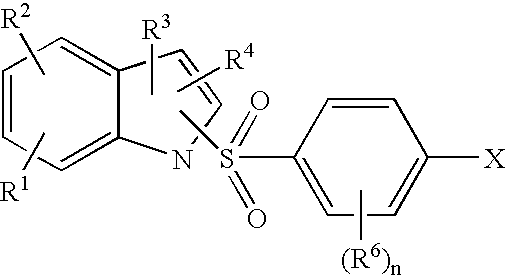
with a piperazine of the formula: 
to produce a compound of the formula: 
Priority Applications (1)
| Application Number | Priority Date | Filing Date | Title |
|---|---|---|---|
| US10/687,091 US7022708B2 (en) | 2002-10-18 | 2003-10-16 | 4-piperazinyl benzenesulfonyl indoles and uses thereof |
Applications Claiming Priority (2)
| Application Number | Priority Date | Filing Date | Title |
|---|---|---|---|
| US41936902P | 2002-10-18 | 2002-10-18 | |
| US10/687,091 US7022708B2 (en) | 2002-10-18 | 2003-10-16 | 4-piperazinyl benzenesulfonyl indoles and uses thereof |
Publications (2)
| Publication Number | Publication Date |
|---|---|
| US20040087593A1 US20040087593A1 (en) | 2004-05-06 |
| US7022708B2 true US7022708B2 (en) | 2006-04-04 |
Family
ID=32108067
Family Applications (1)
| Application Number | Title | Priority Date | Filing Date |
|---|---|---|---|
| US10/687,091 Expired - Fee Related US7022708B2 (en) | 2002-10-18 | 2003-10-16 | 4-piperazinyl benzenesulfonyl indoles and uses thereof |
Country Status (21)
| Country | Link |
|---|---|
| US (1) | US7022708B2 (en) |
| EP (1) | EP1556037B1 (en) |
| JP (1) | JP2006505559A (en) |
| KR (1) | KR20050073560A (en) |
| CN (1) | CN1309384C (en) |
| AR (1) | AR041635A1 (en) |
| AT (1) | ATE344030T1 (en) |
| AU (1) | AU2003283265B2 (en) |
| BR (1) | BR0315317A (en) |
| CA (1) | CA2501172A1 (en) |
| DE (1) | DE60309498T2 (en) |
| ES (1) | ES2274285T3 (en) |
| GT (1) | GT200300226A (en) |
| MX (1) | MXPA05004128A (en) |
| PA (1) | PA8586401A1 (en) |
| PE (1) | PE20040691A1 (en) |
| PL (1) | PL376479A1 (en) |
| RU (1) | RU2324693C2 (en) |
| TW (1) | TW200418456A (en) |
| UY (1) | UY28026A1 (en) |
| WO (1) | WO2004035047A1 (en) |
Cited By (2)
| Publication number | Priority date | Publication date | Assignee | Title |
|---|---|---|---|---|
| US9663498B2 (en) | 2013-12-20 | 2017-05-30 | Sunshine Lake Pharma Co., Ltd. | Aromatic heterocyclic compounds and their application in pharmaceuticals |
| US9974785B2 (en) | 2014-07-08 | 2018-05-22 | Sunshine Lake Pharma Co., Ltd. | Aromatic heterocyclic derivatives and pharmaceutical applications thereof |
Families Citing this family (40)
| Publication number | Priority date | Publication date | Assignee | Title |
|---|---|---|---|---|
| MXPA03011244A (en) * | 2001-06-07 | 2004-02-27 | Hoffmann La Roche | New indole derivatives with 5-ht6 receptor affinity. |
| NZ535239A (en) | 2002-03-27 | 2008-03-28 | Glaxo Group Ltd | Quinoline derivatives and their use as 5-HT6 ligands |
| PL1558582T3 (en) | 2003-07-22 | 2006-05-31 | Arena Pharm Inc | Diaryl and arylheteroaryl urea derivatives as modulators of the 5-ht2a serotonin receptor useful for the prophylaxis and treatment of disorders related thereto |
| US8076353B2 (en) | 2004-03-15 | 2011-12-13 | Ptc Therapeutics, Inc. | Inhibition of VEGF translation |
| US7767689B2 (en) | 2004-03-15 | 2010-08-03 | Ptc Therapeutics, Inc. | Carboline derivatives useful in the treatment of cancer |
| US8076352B2 (en) | 2004-03-15 | 2011-12-13 | Ptc Therapeutics, Inc. | Administration of carboline derivatives useful in the treatment of cancer and other diseases |
| BRPI0508814B8 (en) | 2004-03-15 | 2021-05-25 | Ptc Therapeutics Inc | carboline derivatives, as well as their use and pharmaceutical composition |
| AU2005275181A1 (en) | 2004-07-14 | 2006-02-23 | Ptc Therapeutics, Inc. | Methods for treating hepatitis C |
| US7868037B2 (en) | 2004-07-14 | 2011-01-11 | Ptc Therapeutics, Inc. | Methods for treating hepatitis C |
| US7772271B2 (en) | 2004-07-14 | 2010-08-10 | Ptc Therapeutics, Inc. | Methods for treating hepatitis C |
| US7781478B2 (en) | 2004-07-14 | 2010-08-24 | Ptc Therapeutics, Inc. | Methods for treating hepatitis C |
| AR052308A1 (en) * | 2004-07-16 | 2007-03-14 | Lundbeck & Co As H | DERIVATIVES OF 2- (1H-INDOLILSULFANIL) -ARILAMINE AND A PHARMACEUTICAL COMPOSITION CONTAINING THE COMPOUND |
| EP1781289A1 (en) | 2004-07-22 | 2007-05-09 | PTC Therapeutics, Inc. | Thienopyridines for treating hepatitis c |
| US7713954B2 (en) * | 2004-09-30 | 2010-05-11 | Roche Palo Alto Llc | Compositions and methods for treating cognitive disorders |
| CN101031338B (en) | 2004-09-30 | 2013-01-02 | 弗·哈夫曼-拉罗切有限公司 | Compositions and methods for treating cognitive disorders |
| KR101016972B1 (en) | 2005-08-12 | 2011-02-25 | 수벤 라이프 사이언시스 리미티드 | Aminoaryl Sulfonamide Derivatives as Functional 5-HTH6 Ligands |
| BRPI0614343A2 (en) * | 2005-08-15 | 2011-03-22 | Wyeth Corp | substituted 3-sulfonylindazole derivatives as 5-hydroxytryptamine-6 binders |
| WO2007020654A1 (en) | 2005-08-16 | 2007-02-22 | Suven Life Sciences | An improved process for the preparation of losartan |
| MX2008009022A (en) * | 2006-01-13 | 2008-09-24 | Wyeth Corp | Sulfonyl substituted 1h-indoles as ligands for the 5-hydroxytryptamine receptors. |
| DE602007011962D1 (en) * | 2006-11-09 | 2011-02-24 | Hoffmann La Roche | Arylsulfonylpyrrolidine als 5-ht6-inhibitoren |
| JP5208963B2 (en) | 2007-01-10 | 2013-06-12 | エフ.ホフマン−ラ ロシュ アーゲー | Sulfonamide derivatives as chymase inhibitors |
| CA2703157C (en) * | 2007-10-26 | 2013-02-05 | Suven Life Sciences Limited | Amino arylsulfonamide compounds and their use as 5-ht6 ligands |
| US9084742B2 (en) | 2007-12-12 | 2015-07-21 | Axovant Sciences Ltd. | Combinations comprising 3-phenylsulfonyl-8-piperazinyl-1yl-Quinoline |
| WO2009123714A2 (en) | 2008-04-02 | 2009-10-08 | Arena Pharmaceuticals, Inc. | Processes for the preparation of pyrazole derivatives useful as modulators of the 5-ht2a serotonin receptor |
| US8318725B2 (en) | 2008-09-17 | 2012-11-27 | Suven Life Sciences Limited | Aryl indolyl sulfonamide compounds and their use as 5-HT6 ligands |
| US9126946B2 (en) | 2008-10-28 | 2015-09-08 | Arena Pharmaceuticals, Inc. | Processes useful for the preparation of 1-[3-(4-bromo-2-methyl-2H-pyrazol-3-yl)-4-methoxy-phenyl]-3-(2,4-difluoro-phenyl)urea and crystalline forms related thereto |
| US8575186B2 (en) | 2009-10-05 | 2013-11-05 | Albany Molecular Research, Inc. | Epiminocycloalkyl[b] indole derivatives as serotonin sub-type 6 (5-HT6) modulators and uses thereof |
| CA2823955A1 (en) | 2011-01-19 | 2012-07-26 | Albany Molecular Research, Inc. | Benzofuro[3,2-c] pyridines and related analogs as serotonin sub-type 6 (5-ht6) modulators for the treatment of obesity, metabolic syndrome, cognition and schizophrenia |
| US9801863B2 (en) | 2012-04-16 | 2017-10-31 | Case Western Reserve University | Inhibitors of short-chain dehydrogenase activity for modulating hematopoietic stem cells and hematopoiesis |
| ES2647850T3 (en) | 2012-04-16 | 2017-12-26 | Board Of Regents Of The University Of Texas System | Compositions and methods of modulating the activity of 15-PGDH |
| CN104276993B (en) * | 2013-07-12 | 2019-03-15 | 广东东阳光药业有限公司 | Indole derivatives and their application in medicine |
| CA2927730A1 (en) | 2013-10-15 | 2015-05-07 | Case Western Reserve University | Compositions and methods of modulating short-chain dehydrogenase activity |
| CN104557726B (en) * | 2013-10-19 | 2019-05-24 | 广东东阳光药业有限公司 | Aromatic Heterocyclic Derivatives and Their Application in Medicine |
| HK1245660A1 (en) | 2015-06-12 | 2018-08-31 | Axovant Sciences Gmbh | Diaryl and arylheteroaryl urea derivatives useful for the prophylaxis and treatment of rem sleep behavior disorder |
| TW201720439A (en) | 2015-07-15 | 2017-06-16 | Axovant Sciences Gmbh | Diaryl and arylheteroaryl urea derivatives as 5-HT2A serotonin receptors for the prevention and treatment of hallucinations associated with neurodegenerative diseases |
| JP7595413B2 (en) | 2016-11-30 | 2024-12-06 | ケース ウエスタン リザーブ ユニバーシティ | Combination of 15-PGDH inhibitors with corticosteroids and/or TNF inhibitors and uses thereof - Patents.com |
| JP2020514323A (en) | 2017-02-06 | 2020-05-21 | ケース ウエスタン リザーブ ユニバーシティ | Compositions and methods for modulating short chain dehydrogenase activity |
| CN109232362B (en) * | 2017-07-10 | 2022-12-27 | 广东东阳光药业有限公司 | Aromatic heterocyclic derivative and application thereof in medicines |
| CN113507931B (en) | 2018-11-21 | 2025-05-27 | 卡斯西部储备大学 | Compositions and methods for modulating short-chain dehydrogenase activity |
| CA3237199A1 (en) | 2021-11-02 | 2023-05-11 | Flare Therapeutics Inc. | Pparg inverse agonists and uses thereof |
Citations (8)
| Publication number | Priority date | Publication date | Assignee | Title |
|---|---|---|---|---|
| WO1993003012A1 (en) | 1991-08-02 | 1993-02-18 | Fujisawa Pharmaceutical Co., Ltd. | Indole derivatives |
| FR2729144A1 (en) | 1995-01-06 | 1996-07-12 | Smithkline Beecham Lab | New heterocyclic di:amine derivs. |
| WO1998027081A1 (en) | 1996-12-19 | 1998-06-25 | Smithkline Beecham Plc | Sulphonamide derivatives, process for their preparation, and their use as medicaments |
| WO1999002502A2 (en) | 1997-07-11 | 1999-01-21 | Smithkline Beecham Plc | Sulphonamide derivatives being 5-ht6 receptor antagonists and process for their preparation |
| WO2000058304A1 (en) | 1999-03-26 | 2000-10-05 | Shionogi & Co., Ltd. | Heterocyclic sulfonamide derivatives |
| WO2001064642A2 (en) | 2000-02-29 | 2001-09-07 | Cor Therapeutics, Inc. | Benzamides and related inhibitors of factor xa |
| WO2003104193A1 (en) | 2002-06-05 | 2003-12-18 | F. Hoffmann-La Roche Ag | 1-sulfonyl-4-aminoalkoxy indole derivatives as 5-ht6-receptor modulators for the treatment of cns-disorders |
| US20040024210A1 (en) | 2002-06-20 | 2004-02-05 | Gary Johansson | New compounds |
Family Cites Families (5)
| Publication number | Priority date | Publication date | Assignee | Title |
|---|---|---|---|---|
| GB9801392D0 (en) * | 1998-01-22 | 1998-03-18 | Smithkline Beecham Plc | Novel compounds |
| MXPA03003397A (en) * | 2000-10-20 | 2004-06-30 | Biovitrum Ab | 2-, 3-, 4-, or 5-substituted-n1-(benzensulfonyl)indoles and their use in therapy. |
| ATE337780T1 (en) * | 2000-11-24 | 2006-09-15 | Smithkline Beecham Plc | INDOLY LSULPHONYL COMPOUNDS FOR THE TREATMENT OF CNS DISORDERS |
| CN1321110C (en) * | 2001-06-15 | 2007-06-13 | 弗·哈夫曼-拉罗切有限公司 | 4-Piperazinoindole Derivatives with 5-HT6 Receptor Affinity |
| BR0314363A (en) * | 2002-09-17 | 2005-07-19 | Hoffmann La Roche | 2,4-substituted indols and their use as 5-ht6 modulators |
-
2003
- 2003-10-13 KR KR1020057006683A patent/KR20050073560A/en not_active Ceased
- 2003-10-13 CA CA002501172A patent/CA2501172A1/en not_active Abandoned
- 2003-10-13 AU AU2003283265A patent/AU2003283265B2/en not_active Ceased
- 2003-10-13 BR BR0315317-7A patent/BR0315317A/en not_active IP Right Cessation
- 2003-10-13 CN CNB2003801014548A patent/CN1309384C/en not_active Expired - Fee Related
- 2003-10-13 ES ES03775181T patent/ES2274285T3/en not_active Expired - Lifetime
- 2003-10-13 WO PCT/EP2003/011323 patent/WO2004035047A1/en not_active Ceased
- 2003-10-13 RU RU2005115115/04A patent/RU2324693C2/en not_active IP Right Cessation
- 2003-10-13 PL PL03376479A patent/PL376479A1/en not_active Application Discontinuation
- 2003-10-13 DE DE60309498T patent/DE60309498T2/en not_active Expired - Lifetime
- 2003-10-13 EP EP03775181A patent/EP1556037B1/en not_active Expired - Lifetime
- 2003-10-13 JP JP2004544204A patent/JP2006505559A/en active Pending
- 2003-10-13 AT AT03775181T patent/ATE344030T1/en not_active IP Right Cessation
- 2003-10-13 MX MXPA05004128A patent/MXPA05004128A/en active IP Right Grant
- 2003-10-14 TW TW092128412A patent/TW200418456A/en unknown
- 2003-10-15 PE PE2003001052A patent/PE20040691A1/en not_active Application Discontinuation
- 2003-10-15 PA PA20038586401A patent/PA8586401A1/en unknown
- 2003-10-16 UY UY28026A patent/UY28026A1/en not_active Application Discontinuation
- 2003-10-16 US US10/687,091 patent/US7022708B2/en not_active Expired - Fee Related
- 2003-10-16 AR ARP030103764A patent/AR041635A1/en not_active Application Discontinuation
- 2003-10-17 GT GT200300226A patent/GT200300226A/en unknown
Patent Citations (8)
| Publication number | Priority date | Publication date | Assignee | Title |
|---|---|---|---|---|
| WO1993003012A1 (en) | 1991-08-02 | 1993-02-18 | Fujisawa Pharmaceutical Co., Ltd. | Indole derivatives |
| FR2729144A1 (en) | 1995-01-06 | 1996-07-12 | Smithkline Beecham Lab | New heterocyclic di:amine derivs. |
| WO1998027081A1 (en) | 1996-12-19 | 1998-06-25 | Smithkline Beecham Plc | Sulphonamide derivatives, process for their preparation, and their use as medicaments |
| WO1999002502A2 (en) | 1997-07-11 | 1999-01-21 | Smithkline Beecham Plc | Sulphonamide derivatives being 5-ht6 receptor antagonists and process for their preparation |
| WO2000058304A1 (en) | 1999-03-26 | 2000-10-05 | Shionogi & Co., Ltd. | Heterocyclic sulfonamide derivatives |
| WO2001064642A2 (en) | 2000-02-29 | 2001-09-07 | Cor Therapeutics, Inc. | Benzamides and related inhibitors of factor xa |
| WO2003104193A1 (en) | 2002-06-05 | 2003-12-18 | F. Hoffmann-La Roche Ag | 1-sulfonyl-4-aminoalkoxy indole derivatives as 5-ht6-receptor modulators for the treatment of cns-disorders |
| US20040024210A1 (en) | 2002-06-20 | 2004-02-05 | Gary Johansson | New compounds |
Non-Patent Citations (3)
| Title |
|---|
| Bromidge et al. Bioorganic & Medicinal Chemistry Letters, vol. 11, p. 55-58 (2001). * |
| Robichaud et al. in Annual Reports in Medicinal Chemistry, vol. 36, p. 11-20 (2000). * |
| Rogers et al. Psychopharmacology, vol. 158, p. 114-119 (2001). * |
Cited By (2)
| Publication number | Priority date | Publication date | Assignee | Title |
|---|---|---|---|---|
| US9663498B2 (en) | 2013-12-20 | 2017-05-30 | Sunshine Lake Pharma Co., Ltd. | Aromatic heterocyclic compounds and their application in pharmaceuticals |
| US9974785B2 (en) | 2014-07-08 | 2018-05-22 | Sunshine Lake Pharma Co., Ltd. | Aromatic heterocyclic derivatives and pharmaceutical applications thereof |
Also Published As
| Publication number | Publication date |
|---|---|
| EP1556037A1 (en) | 2005-07-27 |
| AU2003283265B2 (en) | 2009-03-05 |
| TW200418456A (en) | 2004-10-01 |
| ES2274285T3 (en) | 2007-05-16 |
| WO2004035047A1 (en) | 2004-04-29 |
| UY28026A1 (en) | 2004-04-30 |
| EP1556037B1 (en) | 2006-11-02 |
| PA8586401A1 (en) | 2005-08-04 |
| MXPA05004128A (en) | 2005-06-22 |
| ATE344030T1 (en) | 2006-11-15 |
| DE60309498T2 (en) | 2007-08-30 |
| PL376479A1 (en) | 2005-12-27 |
| US20040087593A1 (en) | 2004-05-06 |
| RU2324693C2 (en) | 2008-05-20 |
| AR041635A1 (en) | 2005-05-26 |
| DE60309498D1 (en) | 2006-12-14 |
| CN1309384C (en) | 2007-04-11 |
| BR0315317A (en) | 2005-09-06 |
| JP2006505559A (en) | 2006-02-16 |
| CA2501172A1 (en) | 2004-08-29 |
| GT200300226A (en) | 2004-10-18 |
| CN1705480A (en) | 2005-12-07 |
| KR20050073560A (en) | 2005-07-14 |
| RU2005115115A (en) | 2006-01-20 |
| PE20040691A1 (en) | 2004-10-16 |
| AU2003283265A1 (en) | 2004-05-04 |
Similar Documents
| Publication | Publication Date | Title |
|---|---|---|
| US7022708B2 (en) | 4-piperazinyl benzenesulfonyl indoles and uses thereof | |
| US6790848B2 (en) | 4-piperazinylindole derivatives with 5-HT6 receptor affinity | |
| US6787535B2 (en) | Indole derivatives with 5HT6 receptor affinity | |
| US6774241B2 (en) | 1-sulfonyl-4-aminoalkoxy indole derivatives and uses thereof | |
| AU2002310747A1 (en) | New indole derivatives with 5-HT6 receptor affinity | |
| US7381739B2 (en) | 2,4-substituted indoles and methods of use | |
| US7247651B2 (en) | 2,7-substituted indoles | |
| US7084169B2 (en) | Aminoalkoxyindoles and methods of use | |
| ZA200309258B (en) | 4-Piperazinylindole derivatives with 5-HT6 receptor affinity. | |
| AU2002345587A1 (en) | 4-Piperazinylindole derivatives with 5-HT6 receptor affinity |
Legal Events
| Date | Code | Title | Description |
|---|---|---|---|
| AS | Assignment |
Owner name: ROCHE PALO ALTO LLC, CALIFORNIA Free format text: ASSIGNMENT OF ASSIGNORS INTEREST;ASSIGNORS:CLARK, ROBIN DOUGLAS;HARRIS, RALPH NEW, III;REPKE, DAVID BRUCE;REEL/FRAME:014288/0051 Effective date: 20031015 |
|
| FPAY | Fee payment |
Year of fee payment: 4 |
|
| REMI | Maintenance fee reminder mailed | ||
| LAPS | Lapse for failure to pay maintenance fees | ||
| STCH | Information on status: patent discontinuation |
Free format text: PATENT EXPIRED DUE TO NONPAYMENT OF MAINTENANCE FEES UNDER 37 CFR 1.362 |
|
| STCH | Information on status: patent discontinuation |
Free format text: PATENT EXPIRED DUE TO NONPAYMENT OF MAINTENANCE FEES UNDER 37 CFR 1.362 |
|
| FP | Lapsed due to failure to pay maintenance fee |
Effective date: 20140404 |