US6989140B2 - Methods for cancer imaging - Google Patents
Methods for cancer imaging Download PDFInfo
- Publication number
- US6989140B2 US6989140B2 US10/327,226 US32722602A US6989140B2 US 6989140 B2 US6989140 B2 US 6989140B2 US 32722602 A US32722602 A US 32722602A US 6989140 B2 US6989140 B2 US 6989140B2
- Authority
- US
- United States
- Prior art keywords
- conjugate
- cancer
- deoxyglucose
- cells
- glucose
- Prior art date
- Legal status (The legal status is an assumption and is not a legal conclusion. Google has not performed a legal analysis and makes no representation as to the accuracy of the status listed.)
- Expired - Fee Related, expires
Links
- 0 C*C1C(C)OC(CO)[C@@H](O)[C@@H]1O.C*[C@@H]1C(O)C(O)OC(CO)[C@H]1O Chemical compound C*C1C(C)OC(CO)[C@@H](O)[C@@H]1O.C*[C@@H]1C(O)C(O)OC(CO)[C@H]1O 0.000 description 8
- FHIWOKWGOWWNGN-UHFFFAOYSA-N C.CC(C)(C)OC(=O)NCCOCC(=O)O.CC(C)(C)OC(=O)NCCOCCC(=O)O.CC(C)(C)OC(=O)NCCOCCOCC(=O)O.CC(C)(C)OC(=O)NCCOCCOCC(=O)O.CC(C)(C)OC(=O)NCCOCCOCCC(=O)O.CC(C)(C)OC(=O)NCCOCCOCCC(=O)O Chemical compound C.CC(C)(C)OC(=O)NCCOCC(=O)O.CC(C)(C)OC(=O)NCCOCCC(=O)O.CC(C)(C)OC(=O)NCCOCCOCC(=O)O.CC(C)(C)OC(=O)NCCOCCOCC(=O)O.CC(C)(C)OC(=O)NCCOCCOCCC(=O)O.CC(C)(C)OC(=O)NCCOCCOCCC(=O)O FHIWOKWGOWWNGN-UHFFFAOYSA-N 0.000 description 1
- RCSUAFUHTLHDJK-UHFFFAOYSA-N CC(C)(C)OC(=O)NCCC(=O)O.CC(C)(C)OC(=O)NCCCO Chemical compound CC(C)(C)OC(=O)NCCC(=O)O.CC(C)(C)OC(=O)NCCCO RCSUAFUHTLHDJK-UHFFFAOYSA-N 0.000 description 1
- QQPVCBDFCLSGTL-UHFFFAOYSA-N CC(C)(C)OC(=O)NCCOCCO.CC(C)(C)OC(=O)NCCOCCOCCO Chemical compound CC(C)(C)OC(=O)NCCOCCO.CC(C)(C)OC(=O)NCCOCCOCCO QQPVCBDFCLSGTL-UHFFFAOYSA-N 0.000 description 1
- RHFFFPWYAGFQBD-UNODLCSSSA-N CC(C)(C)OC(=O)NCCOCCOCCC(=O)N[C@H]1C(O)O[C@H](CO)[C@@H](O)[C@@H]1O.CC(C)(C)OC(=O)NCCOCCOCCC(=O)O.CC(C)(C)OC(=O)NCCOCCOCCC(=O)ON1C(=O)CCC1=O.Cl.N[C@H]1C(O)O[C@H](CO)[C@@H](O)[C@@H]1O.O=C1C=CC2=C3OC4=C5C=CC(O)=CC5=CC=C4C(C4=CC(C(=O)NCCOCCOCCC(=O)N[C@H]5C(O)O[C@H](CO)[C@@H](O)[C@@H]5O)=CC=C4C(=O)O)=C3C=CC2=C1.O=C1C=CC2=C3OC4=C5C=CC(O)=CC5=CC=C4C(C4=CC(C(=O)NS)=CC=C4C(=O)O)=C3C=CC2=C1 Chemical compound CC(C)(C)OC(=O)NCCOCCOCCC(=O)N[C@H]1C(O)O[C@H](CO)[C@@H](O)[C@@H]1O.CC(C)(C)OC(=O)NCCOCCOCCC(=O)O.CC(C)(C)OC(=O)NCCOCCOCCC(=O)ON1C(=O)CCC1=O.Cl.N[C@H]1C(O)O[C@H](CO)[C@@H](O)[C@@H]1O.O=C1C=CC2=C3OC4=C5C=CC(O)=CC5=CC=C4C(C4=CC(C(=O)NCCOCCOCCC(=O)N[C@H]5C(O)O[C@H](CO)[C@@H](O)[C@@H]5O)=CC=C4C(=O)O)=C3C=CC2=C1.O=C1C=CC2=C3OC4=C5C=CC(O)=CC5=CC=C4C(C4=CC(C(=O)NS)=CC=C4C(=O)O)=C3C=CC2=C1 RHFFFPWYAGFQBD-UNODLCSSSA-N 0.000 description 1
- UCBLKXILBRFEMH-XCLVTHCPSA-N CC(C)(C)OC(=O)NCCOCCOCCN[C@H]1C(O[Ac])O[C@H](CO[Ac])[C@@H](O[Ac])[C@@H]1O[Ac].CC(C)(C)OC(=O)NCCOCCOCCO.N[C@H]1C(O[Ac])O[C@H](CO[Ac])[C@@H](O[Ac])[C@@H]1O[Ac].O=C1C=CC2=C3OC4=C5C=CC(O)=CC5=CC=C4C(C4=CC(C(=O)NCCOCCOCCN[C@H]5C(O)O[C@H](CO)[C@@H](O)[C@@H]5O)=CC=C4C(=O)O)=C3C=CC2=C1.O=C1C=CC2=C3OC4=C5C=CC(O)=CC5=CC=C4C(C4=CC(C(=O)NS)=CC=C4C(=O)O)=C3C=CC2=C1.[H]C(=O)CCOCCOCCNC(=O)OC(C)(C)C Chemical compound CC(C)(C)OC(=O)NCCOCCOCCN[C@H]1C(O[Ac])O[C@H](CO[Ac])[C@@H](O[Ac])[C@@H]1O[Ac].CC(C)(C)OC(=O)NCCOCCOCCO.N[C@H]1C(O[Ac])O[C@H](CO[Ac])[C@@H](O[Ac])[C@@H]1O[Ac].O=C1C=CC2=C3OC4=C5C=CC(O)=CC5=CC=C4C(C4=CC(C(=O)NCCOCCOCCN[C@H]5C(O)O[C@H](CO)[C@@H](O)[C@@H]5O)=CC=C4C(=O)O)=C3C=CC2=C1.O=C1C=CC2=C3OC4=C5C=CC(O)=CC5=CC=C4C(C4=CC(C(=O)NS)=CC=C4C(=O)O)=C3C=CC2=C1.[H]C(=O)CCOCCOCCNC(=O)OC(C)(C)C UCBLKXILBRFEMH-XCLVTHCPSA-N 0.000 description 1
- TXPOJEYKBLQLTC-UHFFFAOYSA-N CC1=CC(C)=C2C=C3=CC=C(CCC(=O)NCCCCCC(=O)NC4C(O)OC(CO)C(O)C4O)N3B(F)(F)N12 Chemical compound CC1=CC(C)=C2C=C3=CC=C(CCC(=O)NCCCCCC(=O)NC4C(O)OC(CO)C(O)C4O)N3B(F)(F)N12 TXPOJEYKBLQLTC-UHFFFAOYSA-N 0.000 description 1
- KJMRWDHBVCNLTQ-UHFFFAOYSA-N CN(c(cccc1)c1C(O1)=O)C1=O Chemical compound CN(c(cccc1)c1C(O1)=O)C1=O KJMRWDHBVCNLTQ-UHFFFAOYSA-N 0.000 description 1
- YRHQIOSCUPXIMO-GAHSJCLHSA-N CN1C(=O)OC(=O)C2=C1C=CC=C2.CNC1=C(C(=O)N[C@H]2C(O)O[C@H](CO)[C@@H](O)[C@@H]2O)C=CC=C1.OC[C@H]1OC(O)[C@H](NCl)[C@@H](O)[C@@H]1O Chemical compound CN1C(=O)OC(=O)C2=C1C=CC=C2.CNC1=C(C(=O)N[C@H]2C(O)O[C@H](CO)[C@@H](O)[C@@H]2O)C=CC=C1.OC[C@H]1OC(O)[C@H](NCl)[C@@H](O)[C@@H]1O YRHQIOSCUPXIMO-GAHSJCLHSA-N 0.000 description 1
- BBUNCDXJCQCJKE-UHFFFAOYSA-N O=C(CCCCCNS(=O)(=O)C1=CC=C(C2=C3C=C4CCC[N+]5=C4C(=C3OC3=C4CCCN6CCCC(=C46)C=C32)CCC5)C(S(=O)(=O)[O-])=C1)NC1C(O)OC(CO)C(O)C1O Chemical compound O=C(CCCCCNS(=O)(=O)C1=CC=C(C2=C3C=C4CCC[N+]5=C4C(=C3OC3=C4CCCN6CCCC(=C46)C=C32)CCC5)C(S(=O)(=O)[O-])=C1)NC1C(O)OC(CO)C(O)C1O BBUNCDXJCQCJKE-UHFFFAOYSA-N 0.000 description 1
- DZLITIOWENBWRL-UHFFFAOYSA-N O=C1C=CC2=C3OC4=C5C=CC(O)=CC5=CC=C4C(C4=CC(C(=O)NC5C(O)OC(CO)C(O)C5O)=CC=C4C(=O)O)=C3C=CC2=C1 Chemical compound O=C1C=CC2=C3OC4=C5C=CC(O)=CC5=CC=C4C(C4=CC(C(=O)NC5C(O)OC(CO)C(O)C5O)=CC=C4C(=O)O)=C3C=CC2=C1 DZLITIOWENBWRL-UHFFFAOYSA-N 0.000 description 1
- RHERVUWPUKUOMV-SLPGGIOYSA-N OC[C@H]([C@H]([C@@H]1O)O)OC[C@@H]1NCl Chemical compound OC[C@H]([C@H]([C@@H]1O)O)OC[C@@H]1NCl RHERVUWPUKUOMV-SLPGGIOYSA-N 0.000 description 1
Images


Classifications
-
- A—HUMAN NECESSITIES
- A61—MEDICAL OR VETERINARY SCIENCE; HYGIENE
- A61K—PREPARATIONS FOR MEDICAL, DENTAL OR TOILETRY PURPOSES
- A61K49/00—Preparations for testing in vivo
- A61K49/001—Preparation for luminescence or biological staining
- A61K49/0013—Luminescence
- A61K49/0017—Fluorescence in vivo
- A61K49/005—Fluorescence in vivo characterised by the carrier molecule carrying the fluorescent agent
- A61K49/0052—Small organic molecules
-
- A—HUMAN NECESSITIES
- A61—MEDICAL OR VETERINARY SCIENCE; HYGIENE
- A61K—PREPARATIONS FOR MEDICAL, DENTAL OR TOILETRY PURPOSES
- A61K49/00—Preparations for testing in vivo
- A61K49/001—Preparation for luminescence or biological staining
- A61K49/0013—Luminescence
- A61K49/0017—Fluorescence in vivo
- A61K49/0019—Fluorescence in vivo characterised by the fluorescent group, e.g. oligomeric, polymeric or dendritic molecules
- A61K49/0021—Fluorescence in vivo characterised by the fluorescent group, e.g. oligomeric, polymeric or dendritic molecules the fluorescent group being a small organic molecule
-
- A—HUMAN NECESSITIES
- A61—MEDICAL OR VETERINARY SCIENCE; HYGIENE
- A61K—PREPARATIONS FOR MEDICAL, DENTAL OR TOILETRY PURPOSES
- A61K49/00—Preparations for testing in vivo
- A61K49/001—Preparation for luminescence or biological staining
- A61K49/0013—Luminescence
- A61K49/0017—Fluorescence in vivo
- A61K49/0019—Fluorescence in vivo characterised by the fluorescent group, e.g. oligomeric, polymeric or dendritic molecules
- A61K49/0021—Fluorescence in vivo characterised by the fluorescent group, e.g. oligomeric, polymeric or dendritic molecules the fluorescent group being a small organic molecule
- A61K49/0041—Xanthene dyes, used in vivo, e.g. administered to a mice, e.g. rhodamines, rose Bengal
Definitions
- cancer generally refers to one of a group of more than 100 diseases that are caused by the uncontrolled growth and spread of abnormal cells and can take the form of solid tumors, lymphomas and non-solid cancers such as leukemia. Unlike normal cells, which reproduce until maturation is attained and then only reproduce as necessary to replace wounded cells, cancer cells grow and divide endlessly without differentiating to mature, functional cells, crowding out nearby cells and eventually spreading to other parts of the body.
- the most common sites in which cancer develops include the skin, lungs, female breasts, prostate, colon, rectum, bladder, uterus, blood-forming tissues, and lymphatic system. Cancer cells that have developed at one of these sites will grow rapidly into a malignant tumor, invading and destroying nearby tissues. Malignant cancer tumors will eventually metastasize, or spread to other parts of the body, unless their progression is stopped.
- Cancers are easier to treat and cure if they are discovered and treated prior to metastasis.
- the survival of a patient with cancer is generally influenced by the stage at which the cancer is diagnosed.
- the stage generally categorized as 1–4, is determined by the extent of disease, with stage 1 cancers being those that are small and not invading the surrounding tissues, while stage 4 cancers have established tumors in tissues other than the organ in which the cancer arose.
- stage 1 cancers being those that are small and not invading the surrounding tissues
- stage 4 cancers have established tumors in tissues other than the organ in which the cancer arose.
- PET scan positron emission tomography
- FDG 18 F-labeled glucose derivative
- FDG 18 F-2-fluoro-2-deoxyglucose
- This glucose derivative lacking a hydroxy group at the 2-position, cannot be further metabolized by the cells and is simply accumulated in the cells.
- This method of detection reveals live, growing tumor cells and therefore has advantages over anatomic detection methods which show abnormal structures but are insensitive to the viability of these abnormal tissues.
- PET scanning is quite useful to image the entire patient for cancer, it requires expensive and cumbersome equipment for detection and construction of the positron used for the image. Accordingly, PET scanning cannot be used for the detection of cancer in many clinical settings, such as in the physician's office during the time of physical examination or in the operating room at the time of surgery.
- Detection of a skin cancer such as melanoma has typically been through physical examination of the skin followed by biopsy of selected lesions suspected to be cancerous.
- Drawbacks to this procedure reside in the experience of the examiner, and errors in diagnosis can be life threatening. In instances where cancers are missed and then spread beyond the original site of disease, mortality can increase. Conversely, some skin lesions are biopsied which are not cancerous, and the patients are thus subjected to unnecessary harm. In some cases, biopsy samples are taken from the face, leading to cosmetic debility.
- the physician generally determines if the cancer can be removed, or resected, by surgery. Patients who have cancer that has not spread beyond a local area, stage 1 or 2, frequently may be cured by completely resecting the tumor. Prior to the surgery, various images of the tumor are obtained such as X-rays, CT scans, MRI scans or PET images. These tests provide guidance for surgery, but at the time of surgery, these images cannot be generated in real time to guide the surgeon to the tumor. As a result, the surgeon must use the unaided senses of sight and feel to determine the location and extent of the tumor.
- the surgeon will obtain biopsy samples in the area of the resected tumor prior to completing the operation. These samples are examined under the microscope to determine if all of the cancer has been removed.
- this procedure is often not conducted, as it requires a highly trained pathologist to be present at the surgery and to rapidly analyze the tissue sample while the patient remains on the operating table. If this analysis is used and the cancer remains in the patient, the surgeon continues with unaided senses to try to resect any residual tumor.
- residual tumor will be left inside the patient about 15–25% of the time. Studies have shown that these patients are at greater risk of dying of the cancer than those that have the tumor completely resected. Because of this, these patients require further, often debilitating, costly therapy in an attempt to arrest and treat the cancer left in the patient at the time of surgery.
- the present invention provides compounds, compositions and methods for detecting and imaging cancerous and pre-cancerous cells and tissues.
- the present invention provides methods for detecting or imaging cancer in a subject, comprising:
- the fluorophore conjugate has the formula: Fl-L-Glc wherein Fl is a fluorophore; L is a bond or a linking group; and Glc is glucose, deoxyglucose, or a glucose or deoxyglucose derivative.
- Preferred glucose derivatives are D-(+)-deoxyglucose, D-(+)-glucosamine and N-acetyl D-glucosamine.
- this method finds broad applicability to the detection of a number of cancers, due in large part to its ability to detect and/or image cancer at the cellular level from such cancers as lung cancer, breast cancer, prostate cancer, colon cancer, cervical cancer, esophageal cancer, bladder cancer, head and neck cancer, and melanoma.
- additional steps can be employed, such as a preliminary step of reducing glucose ingestion in a subject prior to administering the fluorophore glucose or deoxyglucose conjugate. Typically, this can be accomplished by withholding carbohydrate consumption for a period of up to 18 hours prior to administration of the conjugate. In other embodiments, carbohydrate consumption is stopped for a period of 8 to 48 hours prior to administration of the conjugate.
- the present invention provides methods for detecting or imaging pre-cancerous cells in a subject, comprising:
- the present invention provides a method for cancer or pre-cancer detection during an operative or endoscopic procedure, the method comprising:
- the procedure is conducted within about 24 hours of administering the conjugate. More preferably, the method further comprises treating sites of conjugate accretion by external beam radiation, laser therapy or surgical removal.
- the present invention provides a fluorophore glucose or deoxyglucose conjugate having the formula: Fl-L-Glc wherein Fl is a fluorophore having an emission wavelength of from about 400 nm to about 1200 nm; L is a bond or a linking group; and Glc is glucose or deoxyglucose or a glucose or deoxyglucose derivative, with the proviso that the conjugate is other than 2-(N-(7-nitrobenz-2-oxa-1,3-diazol-4-yl)amino)-2-deoxyglucose (2-NBDG).
- Fl fluorophore glucose or deoxyglucose conjugate having the formula: Fl-L-Glc wherein Fl is a fluorophore having an emission wavelength of from about 400 nm to about 1200 nm; L is a bond or a linking group; and Glc is glucose or deoxyglucose or a glucose or deoxyglucose derivative, with the pro
- kits comprising a container with a sterile preparation for human use of a fluorophore glucose or deoxyglucose conjugate and a pharmaceutically acceptable carrier.
- FIG. 1 is a graph illustrating the results of a time-course uptake of 2-(N-(7-nitrobenz-2-oxa-1,3-diazol-4-yl)amino)-2-deoxyglucose in Raji lymphoma cells.
- FIG. 2 is a histogram providing a comparison of 2-(N-(7-nitrobenz-2-oxa-1,3-diazol-4-yl)amino)-2-deoxyglucose uptake in Raji lymphoma cells versus non-cancer PBMC cells ( FIG. 2A ) and where the signals are normalized for the presence of red blood cells in PBMC ( FIG. 2B ).
- FIG. 3 is a graph illustrating the results of a time-course uptake of FGC-002 relative to 2-(N-(7-nitrobenz-2-oxa-1,3-diazol-4-yl)amino)-2-deoxyglucose in Raji lymphoma cells.
- the present invention arises in part from the discovery that cancerous and pre-cancerous cells exhibit an enhanced rate of uptake of glucose fluorophore (fluorescent) conjugates.
- the present invention makes possible the imaging of tumor tissue during screening visits to a doctor and at the time of surgery by using fluorophore glucose or deoxyglucose conjugates.
- Some of these conjugates are derived by chemically modifying 2-deoxyglucose or an analog thereof, which is taken into and accumulated in cancerous cells and pre-cancerous cells (e.g., dysplastic cells) preferentially, compared to normal cells.
- pre-cancerous cells e.g., dysplastic cells
- an examination can be made of the cancer or of the patient with either a camera or other device to view or capture the fluorescence. This method allows cancerous tissue to be detected more specifically and with greater sensitivity than existing methods of detection.
- the method is used by a surgeon to visualize, in real time, tumor tissue during a surgical resection and to assess the margin of the tumor, allowing a more complete resection of the tumor tissue and a better outcome for the patient.
- administration of the fluorophore conjugate to a human prior to examination can be carried out to determine if the human subject has cancerous or pre-cancerous tissue in any observed organ.
- an individual who is at high risk for developing melanoma because of skin type and family history can be administered a fluorophore conjugate prior to examination.
- visualization of the tumor can be made with appropriate equipment.
- a diagnosis can be made by determining if any of the pigmented lesions on the skin are cancerous and must be removed. The present invention eliminates many errors of diagnosis that can lead to either the unneeded removal of benign tissue or the mistake of leaving a cancer on the skin, allowing it to spread throughout the body.
- the methods of the present invention are useful in the course of surgery, visual examinations, endoscopic examinations, and the like.
- the methods will involve contacting sites on a subject suspected of being cancerous sites with a suitable fluorophore conjugate, and visualizing the cells and tissues that have taken up the conjugate to determine in real time whether cancerous or pre-cancerous cells are present in the subject.
- the methods described herein do not require the processing of images but instead can be carried out by the clinician or surgeon with the use of, e.g., an intraoperative probe, an intravascular probe, or an endoscope to scan areas of suspected cancerous cells or tissue and to correlate the level of fluorescence observed with the presence or absence of cancerous cells and to discriminate cancerous cells and tissue from non-cancerous cells and tissue more precisely.
- an intraoperative probe e.g., an intraoperative probe, an intravascular probe, or an endoscope
- the surgeon or clinician can more precisely define tumor borders for surgical resection or diagnostic evaluation.
- drug delivery, laser therapy, radiation therapy, external beam therapy, and the like can be more specifically targeted to cancerous cells and tissues harboring them that have been identified by the methods described herein.
- the present invention provides, in one aspect, methods for detecting or imaging cancerous cells or tissue in a subject, comprising:
- the present methods find broad applicability in the detection of a number of cancers, due in large part to their utility in detecting cancer at the cellular level from all types of cancers, including but not limited to such cancers as lung cancer, breast cancer, prostate cancer, colon cancer, cervical cancer, esophageal cancer, bladder cancer, head and neck cancer, melanoma, low grade non-Hodgkin's Lymphoma, intermediate grade non-Hodgkin's Lymphoma, follicular lymphoma, large cell lymphoma, B-cell lymphoma, T-cell lymphoma, Mantle cell lymphoma, Burkitt's lymphoma, NK cell lymphoma, and acute lymphoblastic lymphoma.
- cancers as lung cancer, breast cancer, prostate cancer, colon cancer, cervical cancer, esophageal cancer, bladder cancer, head and neck cancer, melanoma, low grade non-Hodgkin's Lymphoma, intermediate grade non-Hodgkin'
- the fluorophore conjugate used in this aspect of the invention is preferably one having the formula: Fl-L-Glc (I) wherein Fl is a fluorophore; L is a bond or a linking group; and Glc is glucose or deoxyglucose or a glucose or deoxyglucose derivative.
- fluorophores are useful in this aspect of the invention, including certain commercially available fluorophores such as fluorescein derivatives (e.g., fluorescein isothiocyanate), rhodamine derivatives and derivatives of the chelates of rare earth metals such as europium.
- fluorescein derivatives e.g., fluorescein isothiocyanate
- rhodamine derivatives e.g., rhodamine derivatives
- derivatives of the chelates of rare earth metals such as europium.
- Selection of a suitable fluorophore generally involves consideration of certain physical and chemical properties such as fluorescence intensity, fluorescence lifetime, excitation and emission wavelength maxima, polarization, and non-specific binding behavior.
- Fluorescence intensity is the intensity of the fluorescence produced upon excitation of the fluorophore with light (such as from a laser source) and can be dependent on the nature of the solvent used for the fluorescence measurement.
- Use of an aqueous solvent system, such as a biological buffer, is convenient and preferred for certain applications, such as immunoassays.
- the excitation and emission wavelengths are, respectively, the wavelengths of light required to produce fluorescence and the wavelengths of light at which fluorescence emission occurs. Fluorescence emission occurs at a longer wavelength than the excitation wavelength.
- Ultraviolet, visible, and infrared light typically wavelengths in the range of about 200 nanometers to about 1000 nanometers are considered to be wavelengths that are potentially useful in exciting a fluorophore molecule and thereby producing detectable fluorescence.
- the patent reports that, when tissue is monochromatically excited at 300 nm, the resulting native fluorescence spectrum from 320 nm to 600 nm in cancerous tissue is substantially different from that of either benign or healthy tissue.
- the patent further disclosed that, by avoiding the use of fluorescent emissions between about 380 nm and 430 nm, the fluorescent effect from blood could be ignored.
- the patent reported that, at excitation wavelengths above 315 nm, the ratios of fluorescent-emission intensities are indistinguishable between cancerous and benign cells.
- the diverse fluorophore deoxyglucose conjugates of this invention allow the practitioner to select the conjugate best suited to detect cancer cells in the tissue or tissues of interest given such parameters.
- the lifetime of the fluorescence produced by the fluorophore may vary from less than one nanosecond to several milliseconds.
- Some organic dyes that exhibit fluorescence lifetimes in the range of 3 to 50 nanoseconds belong to the general class of aromatic compounds, exemplified by aromatic hydrocarbon derivatives such as perlene carboxylic acid and aromatic heterocyclic compounds such as phthalocyanines and naturally occurring porphyrins. These dyes have a characteristic fluorescence lifetime, that is, the time period following excitation during which they emit light and during which the fluorescence intensity decreases to about 37% (1/e) of its initial value in the absence of any deactivating factors.
- the measured fluorescence decay time is the time period during which the decrease to the 37% (1/e) level of fluorescence intensity is observed.
- the measured decay time of a particular compound may be solvent dependent. Under conditions which minimize deactivation, measured decay time may approach fluorescence lifetime.
- fluorophores When a fluorescent substance in solution is excited with polarized light, it emits partially polarized light as fluorescence.
- the degree of polarization of fluorescence can be measured and is related to the molecular volume of the fluorophore.
- generally preferred fluorophores are those which efficiently fluoresce upon excitation with light whose wavelength falls within the range of about 200 to about 1000 nanometers, preferably in the range of about 600 to 800 nanometers.
- Suitable fluorophores include those which absorb and/or emit at wavelengths which are distinguishable from the excitation and emission maxima of the other solution components (such as proteins present in a sample) to minimize background fluorescence.
- fluorophores having excitation and/or emission wavelengths of at least about 500 nanometers are preferred.
- the use of such fluorophores reduces interference from the ambient fluorescence of other biological components.
- Preferred fluorophores also exhibit a high degree of fluorescence polarization, preferably greater than about 10% of the theoretical maximum value for an observable polarization.
- Preferred fluorophore moieties include fluorescent dyes having (a) high fluorescence intensity; (b) sufficiently long excitation and emission wavelength maxima so that interference from natural fluorescence of either diseased or normal tissue is minimized; (c) sufficiently long measured fluorescence decay time to allow accurate measurement of emitted light over background fluorescence and scattering (at least about 2, preferably at least about 10 nanoseconds); and (d) high degree of fluorescence polarization.
- a fluorophore glucose, deoxyglucose or derivative conjugate that is transportable by the glucose transporter is provided and is preferred in some applications of the methods of the invention.
- the preferred fluorophore has the additional quality of small size.
- Preferred fluorophores include, for example, 5-(and 6) carboxynaphtofluorescein and Texas Red, as described in the examples below, especially for conjugation to the terminal primary amino group of a linker attached to glucosamine.
- other preferred fluorophores are: (i) BODIPY 630/650, which can be conveniently coupled to primary amines using an active ester derivative that is available commercially (Molecular Probes, Inc., Catalog number, B-10003); (ii) BODIPY 650/665, which can be conveniently coupled to primary amines using an active ester derivative that is available commercially (Molecular Probes, Inc., Catalog number, B-10005); (iii) Dansyl, which can be conveniently coupled to primary amines using dansyl chloride that is commercially available (Aldrich Chemical); (iv) Rhodamine, which can be conveniently coupled to primary amines using an active ester derivative that is available commercially (Molecular Probes, Inc., Catalog number, R-6107); (v
- preferred fluorophores include macrocyclic fluorescent dye compounds, especially compounds having aromatic ⁇ -electron systems. These dye compounds act as multidentate macrocyclic ligands to chelate a central complexing atom. Thus, these preferred fluorophore moieties may comprise a substantially planar multidentate macrocyclic ligand coordinated to a complexing central ion or atom.
- Preferred elements include aluminum, phosphorous, and the group IVB elements, e.g. silicon, germanium, and tin.
- fluorophores include coumarin dyes, nitrobenzoxazole dyes, cyanine dyes, dipyrrometheneboron dyes, xanthene dyes (including the benzo- and naphtho-xanthene dyes), phenoxazine dyes (as well as the benzo- and naphtho-phenoxazine dyes) and compounds from other classes of dyes well known to those of skill in the art.
- fluorophores include the fluorophores in the following non-exclusive list: 1,5 IAEDANS; 1,8-ANS; 4-Methylumbelliferone; 5-carboxy-2,7-dichlorofluorescein; 5-Carboxyfluorescein (5-FAM); 5-Carboxynapthofluorescein; 5-Carboxytetramethylrhodamine (5-TAMRA); 5-FAM (5-Carboxyfluorescein); 5-HAT (Hydroxy Tryptamine); 5-Hydroxy Tryptamine (HAT); 5-ROX (carboxy-X-rhodamine); 5-TAMRA (5-Carboxytetramethylrhodamine); 6-Carboxyrhodamine 6G; 6-CR 6G; 6-JOE; 7-Amino-4-methylcoumarin; 7-Aminoactinomycin D (7-AAD); 7-Hydroxy-4-methylcoumarin; 9-Amino-6-chloro-2-methoxya
- the fluorophores used herein can be attached to the glucose or deoxyglucose or glucose or deoxyglucose derivative using any linkage chemistry that is compatible with the fluorophore and the glucose or deoxyglucose or glucose or deoxyglucose derivative portions of the conjugate.
- the fluorophore can be attached directly to glucose or deoxyglucose or a glucose or deoxyglucose derivative using, for example, a fluorophore isothiocyanate (e.g., fluorescein isothiocyanate) and a suitably protected glucose or glucose derivative (e.g., tetra O-acetyl-2-deoxy-2-aminoglucose) to form a desired conjugate.
- a fluorophore isothiocyanate e.g., fluorescein isothiocyanate
- a suitably protected glucose or glucose derivative e.g., tetra O-acetyl-2-deoxy-2-aminoglucose
- the glucose or deoxyglucose moiety having “n” hydroxy or amino groups will have “n ⁇ 1” protecting groups, thereby leaving one available reactive functional group as an attachment site for either the fluorophore or a linking group. Additionally, the unprotected functional group will be at a known location on the glucose, deoxyglucose or derivative thereof to prepare conjugates of a desired structure.
- a linking group is used to attach the fluorophore to the glucose or deoxyglucose or glucose or deoxyglucose derivative covalently.
- any commercially available bifunctional linking groups preferably, heterobifunctional linking groups (see Pierce Catalog) can be used.
- one of skill in the art can construct a linking group having two or more reactive functional groups to attach the fluorophore and the glucose or deoxyglucose moiety (e.g., heterobifunctional or homobifunctional).
- either a plurality of glucose or deoxyglucose moieties or a plurality of fluorophores or both are attached to a multifunctional linking group to provide a conjugate of the invention.
- linker and “linking group” refer to a moiety that is used to connect various portions of the conjugate to one another.
- a linker or linking group has functional groups that are used to interact with and form covalent bonds with functional groups in the components (e.g., fluorophores and glucose or glucose derivatives) of the conjugates described and used herein.
- functional groups on the linking groups include —NH 2 , —NHNH 2 , —ONH 2 , —NHC ⁇ (O)NHNH 2 , —OH, —CO 2 H or —SH.
- each of these functional groups can form a covalent linkage to a suitable functional group on the glucose portion or the fluorophore portion of the conjugate during synthesis of the conjugate.
- amino, hydroxy and hydrazino groups can each form a covalent bond with a reactive carboxyl group (e.g., a carboxylic acid chloride or activated ester such as an N-hydroxysuccinimide ester (NHS)).
- a reactive carboxyl group e.g., a carboxylic acid chloride or activated ester such as an N-hydroxysuccinimide ester (NHS)
- Other suitable bond forming groups are well-known in the literature and can be used to prepare conjugates of the present invention.
- the linking group can include linear or acyclic portions, cyclic portions, aromatic rings or combinations thereof. More specifically, the linking group L will typically have from 3 to 100 main chain atoms other than hydrogen atoms, selected from C, N, O, S, P and Si, and will be cyclic, acyclic, aromatic or a combination thereof. Additionally, the linking groups will be sufficiently robust so that they are stable to reaction conditions used in conjugate assembly, e.g., the protection/deprotection chemistries used to prepare the conjugates of the invention. Illustrative linkers and synthetic chemistries are described in more detail below.
- U.S. Pat. Nos. 5,512,667; 5,451,463; and 5,141,813 describe other linking groups that can be used to prepare conjugates of the present invention.
- U.S. Pat. Nos. 5,696,251; 5,585,422; and 6,031,091 describe certain tetrafunctional linking groups that can be useful in preparing conjugates of the present invention, such as, for example, conjugates comprising two or more fluorophores.
- Functional groups or linkers useful in preparing conjugates of the present invention include primary and secondary nitrogen, primary and secondary OH, and —SH.
- a preferred deoxyglucose moiety for forming the conjugates of the present invention is D-glucosamine as the hydrochloride salt.
- This compound has an amino group that provides a chemical handle for conjugations. Fluorophores can be conjugated directly to this amino group via alkyl, amide, or sulfonamide linkages, for example. Alternatively, a linker or spacer can separate the fluorophore and the glucosamine. The glucosamine is then not sterically impacted by the fluorophore and is free to act like glucose in term of uptake via the glucose transport system and phosphorylation via the hexokinase enzymes.
- Optimal linkers are oligomers of ethylene glycol or straight alkyl chains. These linkers are attached to the glucosamine amine via either an alkyl or amide connection. The fluorophore is attached to the other end via an amide, sulfonamide, or ether connection. The optimum length of the linker is from 4 to 16 atoms. Illustrative synthetic schemes for forming such conjugates of the invention are shown below for several preferred linkers of the invention.
- the 5-(and 6) carboxynaphtofluorescein is shown as an example of a fluorophore (only one isomer shown in schemes), but any fluorophore as an N-hydroxysuccimide (NHS) ester can be used in these illustrative schemes to form a conjugate of the invention.
- the length of the linker arm can be varied.
- These t-boc protected amino acids can be derived from the corresponding amino acid and BOC-ON (19,337-2, Aldrich Chemical). The amino acids in turn can be obtained from published procedures in the chemical literature.
- the length of the linker arm can be varied.
- These t-boc protected amino alcohols can be derived, for example, from the corresponding amino alcohols and BOC-ON (19,337-2, Aldrich Chemical).
- the amino alcohols in turn can be obtained from published procedures in the chemical literature.
- the starting amino acids and alcohols for the conjugates can comprise all alkyl chains as shown below.
- the amino acids and alcohols are available commercially (Aldrich Chemical) and can be derivatized with BOC-ON (19,337-2, Aldrich Chemical) to produce the reagents shown below.
- Glucose and Deoxyglucose and their Derivatives are available commercially (Aldrich Chemical) and can be derivatized with BOC-ON (19,337-2, Aldrich Chemical) to produce the reagents shown below.
- the glucose, deoxyglucose or derivative components of the conjugates described herein are preferably D-(+)-deoxyglucose, D-(+)-glucosamine, and N-acetyl D-glucosamine.
- Other monosaccharides e.g., 5-thio-glucose, D-galactose and D-fructose
- any of the monosaccharides and their derivatives described in PCT patent publication WO 01/82926, incorporated herein by reference, can be used to prepare a conjugate of the invention.
- 6-[N-(7-nitrobenz-2-oxa-1,3-diazol-4-yl)amino]-6-deoxyglucose (6-NBDG) was used to study glucose uptake in certain cells. See, for example, Yoshioka et al., 1996 , Biochimica et Biophysica Acta 1289: 5–9; Yamada et al., 21 Jul. 2000 , J. Biol. Chem. 275(29): 22278–22283; Ball et al., 2002 , Can. J. Physiol. Pharmacol.
- conjugates that can be phosphorylated after uptake by a cell results in conjugates that can be phosphorylated after uptake by a cell, with the consequence that such conjugates are less likely to diffuse out of the cells.
- deoxyglucose derivatives are often preferred, as they are less likely to be hydrolyzed by esters and other enzymes in the cell.
- the fluorophore glucose, deoxyglucose or derivative conjugate of the present invention has a formula selected from: wherein Fl and L have the meanings provided above.
- fluorophore glucose, deoxyglucose or derivative conjugate of the invention has the formula: wherein Fl is a fluorophore; L is a linking group; each X is independently selected from the group consisting of O and NH; and R 1 , R 3 and R 4 are each members independently selected from the group consisting of H, (C 1 –C 12 )alkyl, (C 1 –C 12 )acyl and a solubility or partitioning effector component.
- the solubility or partitioning effector component is a component that increases the solubility of the resultant conjugate in aqueous solution relative to a conjugate having a hydrogen atom at the same position.
- Suitable solubility or partitioning effector components include oligoethylene glycol, oligopropylene glycol, polyhydroxylated carbon chains (typically two to thirty carbons in length) and the like.
- the fluorophore glucose, deoxyglucose or derivative conjugate has the formula Ic in which each X is O, and R 1 , R 3 and R 4 are each H.
- the fluorophore glucose, deoxyglucose or derivative conjugate has the formula Ic in which each X is O, and two of R 1 , R 3 and R 4 are H, with the remaining member of R 1 , R 3 and R 4 being a solubility or partitioning effector component.
- L is attached to a glucose or deoxyglucose derivative by means of an amino or amido linkage (e.g., the glucose derivative is a 2-amino-2-deoxyglucose derivative).
- Administration of a fluorophore glucose or deoxyglucose conjugate provided herein can be effected by any method that enables delivery of the conjugates to the site of the cancer or suspected cancer. In one embodiment, delivery is via circulation in the bloodstream.
- the methods of administration include oral, buccal intraduodenal, parenteral injection (including intravenous, subcutaneous, intramuscular, intravascular, or infusion), topical administration, and rectal.
- an effective dosage is typically in the range of about 0.001 to about 100 mg per kg body weight, preferably about 1 to about 35 mg/kg/day, in single or divided doses. For a 70 kg human, this dosage would amount to about 0.05 to about 7 g/day, preferably about 0.2 to about 2.5 g/day. In some instances, dosage levels below the lower limit of the aforesaid range may be more than adequate, while in other cases still larger doses may be employed without causing any harmful side effect, although such larger doses may be divided into several smaller doses for administration throughout the day.
- the imaging fluorophore conjugate composition may, for example, be in a form suitable for oral administration, such as a tablet, capsule, pill, powder, sustained release formulation, solution, or suspension; for parenteral injection, such as a sterile solution, suspension or emulsion; for topical administration, such as an ointment or cream; or for rectal administration, such as a suppository.
- the imaging fluorophore conjugate composition may be in unit dosage forms suitable for single administration of precise dosages and can include a conventional pharmaceutical carrier or excipient.
- Exemplary parenteral administration forms include solutions or suspensions of the imaging conjugate in sterile aqueous solutions, for example, aqueous propylene glycol or dextrose solutions. Such dosage forms can be suitably buffered, if desired.
- Suitable pharmaceutical carriers include inert diluents or fillers, water, and various organic solvents.
- the pharmaceutical compositions may, if desired, contain additional ingredients such as flavorings, binders, excipients, and the like.
- excipients such as citric acid
- various disintegrants such as starch, alginic acid, and certain complex silicates
- binding agents such as sucrose, gelatin, and acacia.
- lubricating agents such as magnesium stearate, sodium lauryl sulfate, and talc are often useful for tableting purposes.
- Solid compositions of a similar type may also be employed in soft and hard filled gelatin capsules.
- Preferred materials include lactose or milk sugar and high molecular weight polyethylene glycols.
- the imaging fluorophore conjugate therein may be combined with various sweetening or flavoring agents, coloring matters or dyes, and, if desired, emulsifying agents or suspending agents, together with diluents such as water, ethanol, propylene glycol, glycerin, or combinations thereof.
- the imaging fluorescent conjugates of the present invention are preferentially taken up by cancer cells, it is possible to obtain an image of or visually confirm the presence of cancer cells that have taken up the conjugate. Detection of the conjugates can be performed using essentially any fluorescence detection device to obtain an image of the cancerous tissues or cells.
- Detection and imaging of tissues or cells that take up the conjugates described herein can be accomplished using visual techniques or via two-dimensional image information processing by direct continuous observation with a fluorescence microscope. While spatial resolution can be difficult for certain visual methods (unaided by spectral enhancers or microscopes), a typical fluorescence microscope can provide sufficient resolution at a single cell level.
- 3-dimensional stereoscopic image information with a resolution of about 1 ⁇ m can be continuously obtained in real time from tissues in vivo.
- a variety of known methods can be adapted for use with the conjugates of the present invention.
- the conjugates of the invention can be used in the endoscopic technique described in U.S. Pat. No. 5,261,410, in which an infrared monochromatic light source is employed and the Raman shift in emission radiation is measured to assess the tissue.
- PCT patent publication No. WO 96/10363 discloses a method of normalization by dividing the intensity at each wavelength by the integrated area under the spectrum. Differences in the resulting curves are then used as the basis for diagnosis.
- fluorescence detection means either microscopic or macroscopic, can be employed that is capable of detecting the fluorophore glucose or deoxyglucose conjugate localized in a particular lesion, tissue, organ, or cell.
- the detection means can be in the form of an endoscope inserted into a body cavity through an orifice, such as the mouth, nose, ear, anus, urethra, vagina or an incision.
- endoscope is used here to refer to any scope introduced into a body cavity, e.g., an anally introduced endoscope, an orally introduced bronchoscope, a urethrally introduced cystoscope, an abdominally introduced laparoscope, and the like.
- the miniaturization of scope components has greatly enhanced the utility of an endoscope, making endoscopes particularly useful in the practice of the present invention.
- certain embodiments of the present invention relate to intraoperative, laparoscopic, intravascular, and endoscopic examination, biopsy and treatment of tissues and/or organs with a fluorophore conjugate detecting means capable of close approach to suspected sites of tumor recurrence, metastasis, or incomplete removal of cancer tissue.
- endoscopic procedures include laparoscopic procedures.
- Embodiments of the present invention also relate to the intravascular, intraoperative, laparoscopic, and endoscopic examination of lesions with a fluorophore conjugate detecting means capable of close approach to suspected sites of the lesions, especially non-malignant pathological lesions.
- Lesions include cancerous, hyperplasic, and pre-cancerous cells or tissues.
- a surgeon or clinician through the use of, e.g., an intraoperative, laparoscopic, intravascular probe or an endoscope, can quickly scan areas of suspected tumor growth and use the level of fluorescence to more precisely discriminate tumor tissue from non-tumor tissue and thereby more precisely define tumor borders for surgical resection or diagnostic evaluation, or for laser or radiation therapy, including brachytherapy and external beam therapy, or for improved biopsy procedures.
- the conjugate is useful for therapy of the detected tumor by emitting oxygen free radicals or other byproducts which damage the cells in which there has been accumulation of the conjugate.
- the emission of such damaging agents can be aided or induced by the energy which excites the fluorophore.
- the above detection methods can be carried out in combination with a surgical procedure, such as a cancer resection.
- the method of detecting can be carried out endoscopically, for example, or visually as part of a skin examination for melanoma screening.
- the present invention provides methods for detecting pre-cancerous cells in a subject, comprising:
- the fluorophore conjugate used in this aspect of the invention is preferably one having the formula provided above as (I); more preferably having the formula provided above as (Ia) or (Ib); and most preferably one having the formula (Ic).
- pre-cancerous cells e.g., dysplastic cells
- pre-cancerous cells e.g., dysplastic cells
- conjugates, methods of administration and detection are the same as have been described above with respect to the detection and imaging of cancer cells.
- the detection methods provided herein are broadly applicable and can be particularly effective when used in combination with surgical or endoscopic procedures.
- the present invention provides a method for cancer or pre-cancer detection during an operative or endoscopic procedure, the method comprising:
- a fluorescent conjugate is administered to a patient prior to or coincident with a surgical procedure for the removal of cancerous tissue.
- the conjugate can be administered by any method designed to bring the conjugate into close proximity with the cancerous tissue, tumor, or lesion to be removed. In this manner, uptake of the conjugate by cancer cells will provide a more accurate determination of the cancer margins.
- the conjugate will typically be one that exhibits a rate of uptake in cancerous or pre-cancerous cells that is at least two times greater than the rate of uptake in normal cells (e.g., PBMC cells). Evaluation of such uptake can be carried out as described in the Examples below.
- the rate of uptake in cancerous or pre-cancerous cells is at least 10 times the rate of uptake in normal cells, more preferably at least 20 times, and still more preferably at least 40 times.
- the fluorescent conjugate is administered prior to the operative or endoscopic procedure, it will preferably be administered from about 1 hour to about 48 hours prior to the procedure, more preferably from about 1 hour to about 16 hours prior to the procedure, and most preferably from about 1 hour to about 6 hours prior to the procedure.
- detection can be visual.
- the fluorescence of cells that have taken up the conjugate can be enhanced by excitation of the fluorophore with light of a suitable wavelength. Accordingly, once a portion of the tumor or lesion is removed, the remaining tissue can be subjected to a suitable light source to excite the fluorescent conjugates that remain and additional resection can be accomplished.
- detection can be accomplished using fluoroscopes and other detection devices known to those of skill in the art.
- the present invention provides fluorophore glucose, deoxyglucose and derivative conjugates having the formula: Fl-L-Glc wherein Fl is a fluorophore having an emission wavelength of from about 400 nm to about 1200 nm; L is a bond or a linking group; and Glc is glucose, deoxyglucose or derivative, including deoxyglucose and derivatives thereof, with the proviso that the conjugate is other than 2-(N-(7-nitrobenz-2-oxa-1,3-diazol-4-yl)amino)-2-deoxyglucose.
- this aspect of the invention is directed to a variety of glucose, deoxyglucose and derivative conjugates.
- the fluorophores used in this aspect of the invention will typically be selected from coumarin dyes, nitrobenzoxazole dyes, cyanine dyes, dipyrrometheneboron dyes, xanthene dyes (including the benzo- and naphtho-xanthene dyes), phenoxazine dyes (as well as the benzo- and naphtho-phenoxazine dyes) and other classes well known to those of skill in the art.
- Illustrative embodiments of the fluorophore glucose or deoxyglucose conjugates of the invention and methods for their preparation are provided in the Examples below.
- L is a bond such that the fluorophore Fl is directly attached to Glc. Typically, this attachment is accomplished via coupling of a functional group on Fl with a compatible (e.g., linkage-forming) functional group on Glc.
- Fl has an isocyanate, isothiocyanate or carboxylic acid functional group that is used to attach Fl to a hydroxy or amino group present on Glc to form a carbamate, thiocarbamate, urea or thiourea linkage between the components.
- L is a linking group which can be essentially any of the linking groups discussed above and generally known to those of skill in the art.
- the linking group in this aspect of the invention typically has from 3 to 100 main chain atoms other than hydrogen atoms, selected from C, N, O, S, P and Si, and can be cyclic, acyclic, aromatic or a combination thereof. Additionally, the linking groups are sufficiently robust so that they are stable not only to reaction conditions used in conjugate assembly, e.g., the protection/deprotection chemistries used to prepare the conjugates, but are also stable to conditions within a cancer cell.
- the linking group is one that is stable to hydrolytic and proteolytic conditions that are typically found in a cancer cell (e.g., exhibits a t 1/2 for hydrolysis or cleavage of the linkage of at least about 4 hours at ambient temperatures in a cancer cellular milieu).
- Preferred linking groups include both homo- and hetero-bifunctional linking groups, as are commercially available or readily prepared according to known methods.
- the glucose or glucose derivative components of the conjugates described herein are preferably D-(+)-deoxyglucose, D-(+)-glucosamine and N-acetyl D-glucosamine.
- Other monosaccharides e.g., D-galactose and D-fructose can also be used.
- the fluorophore glucose or deoxyglucose conjugate has a formula selected from: wherein Fl and L have the meanings provided above.
- Still other preferred embodiments are those fluorophore glucose, deoxyglucose or derivative conjugates wherein the glucose portion is a 2-deoxy glucose, the conjugate having the formula: wherein Fl is a fluorophore; L is a linking group; each X is independently selected from the group consisting of O and NH; R 1 , R 3 and R 4 are each members independently selected from the group consisting of H, (C 1 –C 12 )alkyl, (C 1 –C 12 )acyl and a solubility or partitioning effector component.
- the solubility or partitioning effector component can be essentially any component that increases the solubility of the resultant conjugate in aqueous solution relative to the conjugate having a hydrogen atom at the same position. Suitable solubility or partitioning effector components include oligoethylene glycol, oligopropylene glycol, polyhydroxylated carbon chains (typically two to thirty carbons in length) and the like.
- the fluorophore conjugate has the formula Ic in which each X is O, and R 1 , R 3 and R 4 are each H.
- the fluorophore conjugate has the formula Ic in which each X is O, and two of R 1 , R 3 and R 4 are H, with the remaining member of R 1 , R 3 and R 4 being a solubility or partitioning effector component.
- L is attached to the glucose framework by means of an amino or amido linkage (e.g., the deoxyglucose is a 2-amino-2-deoxyglucose).
- kits for use by a clinician having instructions for administration and cancer detection along with a sterile preparation of a fluorophore conjugate and a pharmaceutically acceptable carrier.
- the fluorophore conjugates of the invention while highly useful for the detection of cancer cells and tissues, can also be used in any application where a fluorescently labeled glucose, deoxyglucose or derivative molecule is useful.
- the compounds of the invention are used to measure glucose uptake.
- the compounds of the invention are used in an assay to determine whether a compound binds glucose or deoxyglucose.
- the methods and conjugates of the invention are especially valuable for the diagnosis and detection of cancer in humans, the methods and conjugates of the invention will also find application in the study and treatment of cancer in animals.
- This example illustrates the time course of uptake of 2-NBDG in Raji lymphoma cells.
- This example illustrates a comparison of 2-NBDG uptake in Raji lymphoma cells and peripheral blood white cells and illustrates the preferred uptake of a fluorophore deoxyglucose conjugate by a cancer cell as compared to a normal cell.
- PBMC peripheral blood mononuclear cells
- 2-NBDG 0.1 M in water.
- Culture medium with cells (either Raji or PBMC, 15 mL) were centrifuged for 10 min at 800 ⁇ g. The pellet of cells was resuspended in PBS and centrifuged for 10 min at 800 ⁇ g, and the resulting pellet was resuspended in 1.5 mL PBS. Cells were counted and adjusted to 1 ⁇ 10 6 per mL for both. Aliquots (100 uL) were placed into each of 2 tubes for each cell type, and the tubes were incubated at 37° C. for 15 min. The fluorescent deoxyglucose conjugate 2-NBDG was added to each tube to provide a concentration of 200 uM. At 40 min, the tubes were removed from the 37° C. bath and immediately placed on ice.
- FIG. 2 shows the results of the time course experiment.
- This example illustrates the preparation of the fluorophore deoxyglucose conjugate of the invention FGC-002.
- the fluorophore is BODIPY
- the glucose derivative is glucosamine.
- the FGC-002 conjugate is prepared by treating 6-((4,4-difluoro-5,7-dimethyl-4-bora-3a,4a-diaza-s-indacene-3-propionyl)amino)hexanoic acid, succinimidyl ester (BODIPY from Molecular Probes, D-2184, MW 502) with an excess of D-glucosamine (Sigma) in an aprotic solvent with gentle heating. Isolation of the product (FGC-002) can be accomplished via chromatography.
- FIG. 3 illustrates a time-course uptake of FGC-002 relative to 2-(N-(7-nitrobenz-2-oxa-1,3-diazol-4-yl)amino)-2-deoxyglucose in Raji lymphoma cells.
- the uptake study was conducted substantially in accordance with the protocol described in Example 1.
- This example illustrates the application of fluorophore conjugates of the present invention to procedures such as gastrointestinal colonoscopy.
- Endoscopic evaluation of the gastrointestinal tract is recommended for all individuals older than 50 years of age.
- This screening examination helps the physician identify polyps or other lesions which may be precancerous or cancerous but still localized in the intestine. Identification and removal of these lesions prevent spread of the disease and can cure most patients.
- This procedure suffers from some significant limitations, including difficulty in distinguishing between hyperplastic lesions and adenomatous lesions, the latter of which must be removed. With knowledge that a polyp is hyperplastic and not cancerous, the lesion can be ignored without removal and biopsy. In addition, some lesions are small and flat. These lesions are frequently overlooked and can be or become cancerous. Due to current limitations, some lesions are incompletely removed during the endoscopic procedure, which leads to an increased risk of recurrence.
- fluorophore conjugates are administered to the patient by intravenous injection from 1 to 48 hours, preferably 2 to 6 hours, prior to the endoscopic procedure.
- the conjugate can be administered as an oral solution or by pill or as a suppository.
- the fluorophore conjugate circulates in the blood and accumulates in cancerous or precancerous tissue relative to normal or hyperplastic tissue.
- the physician can view the colon under both white light and fluorescent capture. Specifically, while using white light, the physician sees a lesion that appears to be either hyperplastic or adenomatous. In particular, these lesions are viewed with fluorescent capture to determine if the lesion must be resected or can be ignored.
- the fluorophore conjugate can be used for patients who have conditions that put the patient at increased risk for the development of cancer. Patients who suffer this increased risk include patients with chronic inflammatory bowel disease and patients with Barrett's esophagus.
- This example illustrates the utility of fluorophore conjugates of the present invention to tumor resection procedures.
- fluorophore conjugates are administered to the patient by intravenous injection 1 to 48 hours, preferably 2 to 6 hours, prior to the tumor resection.
- the conjugate can alternatively be administered by oral solution or pill, circulates in the blood and accumulates in cancerous or precancerous tissue relative to normal tissue.
- the physician views the tissue under both white light and fluorescent capture. Specifically, the physician views an area that the physician has difficulty determining if it is normal or cancerous. In particular, the surgeon views the area of resected tissue prior to completing the operation to determine that all cancerous tissue has been removed. Areas remaining that emit fluorescence and therefore are clearly malignant or pre-malignant are removed.
- the fluorophore conjugate is used for patients who have cancers where such definitive removal is currently used. This includes removal of skin cancer by the Mohs' procedure that involves examination of successively collected sections of tissue to determine where the cancer remains and thus where to direct subsequent resection.
- the use of the fluorophore conjugate can improve the speed and ability of the surgeon to remove this type of cancer.
- This example illustrates the utility of fluorophore glucose or deoxyglucose conjugates of the present invention in upper gastrointestinal endoscopy.
- Endoscopic evaluation of the upper gastrointestinal tract is recommended for many patients who have chronic gastroesophageal reflux and all individuals diagnosed with Barrett's esophagus.
- This screening examination helps the physician identify lesions that may be dysplastic, precancerous, or cancerous but still localized in the intestine. Identification and removal of these lesions prevents spread of the disease and can cure most patients.
- This procedure suffers from some significant limitations including difficulty in distinguishing between normal mucosa and dysplastic or precancerous lesions that must be removed. If the physician knew that there were areas of precancerous tissue, the patient would undergo surgical removal of the same and the lethal development of a cancer would be avoided. Due to current limitations, areas of precancerous tissue are often overlooked during endoscopy. Because the physician has no aid to find the areas of precancerous tissue, the physician must obtain biopsies in a random fashion, hoping to discover by chance the offending tissue if it exists.
- a fluorescent conjugate of the invention is administered to the patient by intravenous injection 1 to 48 hours, preferably 2 to 6 hours, prior to the endoscopic procedure.
- This compound may alternatively be given by oral solution or pill.
- the conjugate circulates in the blood and accumulates in cancerous or precancerous tissue relative to normal tissue.
- the physician views the esophagus under both white light and fluorescent capture. Specifically, using fluorescent capture, the physician can identify areas of increased fluorescence, which are deemed to be precancerous and which can be biopsied or removed as the physician deems appropriate.
Landscapes
- Health & Medical Sciences (AREA)
- Engineering & Computer Science (AREA)
- Biomedical Technology (AREA)
- Epidemiology (AREA)
- Life Sciences & Earth Sciences (AREA)
- Animal Behavior & Ethology (AREA)
- General Health & Medical Sciences (AREA)
- Public Health (AREA)
- Veterinary Medicine (AREA)
- Medicines Containing Antibodies Or Antigens For Use As Internal Diagnostic Agents (AREA)
Abstract
Description
Fl-L-Glc
wherein Fl is a fluorophore; L is a bond or a linking group; and Glc is glucose, deoxyglucose, or a glucose or deoxyglucose derivative. Preferred glucose derivatives are D-(+)-deoxyglucose, D-(+)-glucosamine and N-acetyl D-glucosamine. The above method can be carried out in combination with a surgical procedure, such as a cancer resection. The method of detecting can be carried out endoscopically for example, or visually, for example as part of a skin examination for melanoma screening.
Fl-L-Glc
wherein Fl is a fluorophore having an emission wavelength of from about 400 nm to about 1200 nm; L is a bond or a linking group; and Glc is glucose or deoxyglucose or a glucose or deoxyglucose derivative, with the proviso that the conjugate is other than 2-(N-(7-nitrobenz-2-oxa-1,3-diazol-4-yl)amino)-2-deoxyglucose (2-NBDG).
Fl-L-Glc (I)
wherein Fl is a fluorophore; L is a bond or a linking group; and Glc is glucose or deoxyglucose or a glucose or deoxyglucose derivative.
Fluorophores
Synthesis of Carboxynaphtofluorescin-oligo-PEG Amido-glucosamine Conjugates


These t-boc protected amino acids can be derived from the corresponding amino acid and BOC-ON (19,337-2, Aldrich Chemical). The amino acids in turn can be obtained from published procedures in the chemical literature.

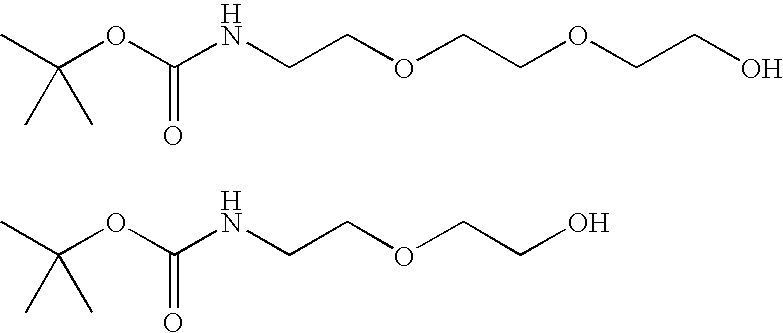
These t-boc protected amino alcohols can be derived, for example, from the corresponding amino alcohols and BOC-ON (19,337-2, Aldrich Chemical). The amino alcohols in turn can be obtained from published procedures in the chemical literature.

Glucose and Deoxyglucose and their Derivatives

wherein Fl and L have the meanings provided above.

wherein Fl is a fluorophore; L is a linking group; each X is independently selected from the group consisting of O and NH; and R1, R3 and R4 are each members independently selected from the group consisting of H, (C1–C12)alkyl, (C1–C12)acyl and a solubility or partitioning effector component. The solubility or partitioning effector component is a component that increases the solubility of the resultant conjugate in aqueous solution relative to a conjugate having a hydrogen atom at the same position. Suitable solubility or partitioning effector components include oligoethylene glycol, oligopropylene glycol, polyhydroxylated carbon chains (typically two to thirty carbons in length) and the like.
Fl-L-Glc
wherein Fl is a fluorophore having an emission wavelength of from about 400 nm to about 1200 nm; L is a bond or a linking group; and Glc is glucose, deoxyglucose or derivative, including deoxyglucose and derivatives thereof, with the proviso that the conjugate is other than 2-(N-(7-nitrobenz-2-oxa-1,3-diazol-4-yl)amino)-2-deoxyglucose.

wherein Fl and L have the meanings provided above.

wherein Fl is a fluorophore; L is a linking group; each X is independently selected from the group consisting of O and NH; R1, R3 and R4 are each members independently selected from the group consisting of H, (C1–C12)alkyl, (C1–C12)acyl and a solubility or partitioning effector component. The solubility or partitioning effector component can be essentially any component that increases the solubility of the resultant conjugate in aqueous solution relative to the conjugate having a hydrogen atom at the same position. Suitable solubility or partitioning effector components include oligoethylene glycol, oligopropylene glycol, polyhydroxylated carbon chains (typically two to thirty carbons in length) and the like.

A. Synthesis of Texas Red Glucosamine Conjugate

B. Synthesis of 5-(and 6) Carboxynaphtofluorescein Glucosamine Conjugate
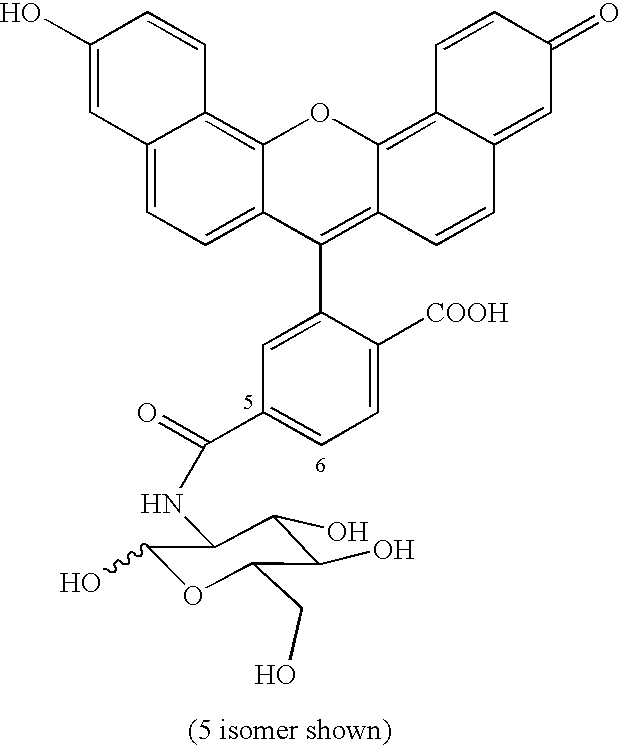
C. Synthesis of Glucosamine N-Methylanthranilamide Conjugate

Claims (17)
Fl-L-Glc

Fl-L-Glc
Fl-L-Glc

Priority Applications (2)
| Application Number | Priority Date | Filing Date | Title |
|---|---|---|---|
| US10/327,226 US6989140B2 (en) | 2001-12-21 | 2002-12-20 | Methods for cancer imaging |
| US11/291,531 US20060165597A1 (en) | 2001-12-21 | 2005-11-30 | Methods for cancer imaging |
Applications Claiming Priority (2)
| Application Number | Priority Date | Filing Date | Title |
|---|---|---|---|
| US34231301P | 2001-12-21 | 2001-12-21 | |
| US10/327,226 US6989140B2 (en) | 2001-12-21 | 2002-12-20 | Methods for cancer imaging |
Related Child Applications (1)
| Application Number | Title | Priority Date | Filing Date |
|---|---|---|---|
| US11/291,531 Continuation US20060165597A1 (en) | 2001-12-21 | 2005-11-30 | Methods for cancer imaging |
Publications (2)
| Publication Number | Publication Date |
|---|---|
| US20030152518A1 US20030152518A1 (en) | 2003-08-14 |
| US6989140B2 true US6989140B2 (en) | 2006-01-24 |
Family
ID=23341275
Family Applications (2)
| Application Number | Title | Priority Date | Filing Date |
|---|---|---|---|
| US10/327,226 Expired - Fee Related US6989140B2 (en) | 2001-12-21 | 2002-12-20 | Methods for cancer imaging |
| US11/291,531 Abandoned US20060165597A1 (en) | 2001-12-21 | 2005-11-30 | Methods for cancer imaging |
Family Applications After (1)
| Application Number | Title | Priority Date | Filing Date |
|---|---|---|---|
| US11/291,531 Abandoned US20060165597A1 (en) | 2001-12-21 | 2005-11-30 | Methods for cancer imaging |
Country Status (3)
| Country | Link |
|---|---|
| US (2) | US6989140B2 (en) |
| AU (1) | AU2002360766A1 (en) |
| WO (1) | WO2003059149A2 (en) |
Cited By (24)
| Publication number | Priority date | Publication date | Assignee | Title |
|---|---|---|---|---|
| US20050014207A1 (en) * | 2002-06-14 | 2005-01-20 | Immunomedics, Inc. | Monoclonal antibody hPAM4 |
| US20050214221A1 (en) * | 2002-03-11 | 2005-09-29 | Visen Medical, Inc. | Optical imaging probes |
| US20060171893A1 (en) * | 2003-06-09 | 2006-08-03 | The Trustees Of The University Of Pennsylvania | Antineoplastic agents targeted via glut transporters |
| US20060280688A1 (en) * | 2000-09-19 | 2006-12-14 | Li-Cor, Inc. | Optical fluorescent imaging |
| WO2008117918A1 (en) * | 2007-03-26 | 2008-10-02 | Snu R&Db Foundation | Fluorescent dye-labeled glucose bioprobe, synthesis method and usage thereof |
| US20090214439A1 (en) * | 2006-03-15 | 2009-08-27 | Trustees Of Tufts College | Fluorinated Carbohydrates and Their Use in Tumor Visualization, Tissue Engineering, and Cancer Chemotherapy |
| US20090304580A1 (en) * | 2002-06-14 | 2009-12-10 | Immunomedics, Inc. | Anti-Pancreatic Cancer Antibodies |
| WO2009012109A3 (en) * | 2007-07-13 | 2009-12-30 | Emory University | Cyanine-containing compounds for cancer imaging and treatment |
| US20100134605A1 (en) * | 2005-11-30 | 2010-06-03 | Demos Stavros G | In vivo spectral micro-imaging of tissue |
| US20100234762A1 (en) * | 2009-02-27 | 2010-09-16 | Gary Pond | Compositions and methods for detecting oral neoplasm |
| US20110070156A1 (en) * | 2002-06-14 | 2011-03-24 | Immunomedics, Inc. | Combining Radioimmunotherapy and Antibody-Drug Conjugates for Improved Cancer Therapy |
| US20110085974A1 (en) * | 2008-06-13 | 2011-04-14 | Cedars-Sinai Medical Center | Small molecule ligand-drug conjugates for targeted cancer therapy |
| US20110165072A1 (en) * | 2002-06-14 | 2011-07-07 | Immunomedics, Inc. | Detection of Early-Stage Pancreatic Adenocarcinoma |
| US20110189708A1 (en) * | 2008-08-08 | 2011-08-04 | Hirosaki University | Method for evaluating specific incorporation of d-glucose into cells |
| KR101150967B1 (en) | 2010-03-18 | 2012-07-11 | 서울대학교산학협력단 | Fluorescent glucose analogue and usage thereof |
| WO2012133688A1 (en) | 2011-03-31 | 2012-10-04 | 国立大学法人弘前大学 | Method for detecting cancer cell using fluorescently labeled l-glucose derivative, and cancer cell-imaging agent comprising fluorescently labeled l-glucose derivative |
| US8574854B2 (en) | 2002-06-14 | 2013-11-05 | Immunomedics, Inc. | Anti-mucin antibodies for early detection and treatment of pancreatic cancer |
| WO2014054601A1 (en) | 2012-10-03 | 2014-04-10 | 国立大学法人弘前大学 | Method for imaging cell using fluorescence-labeled sugar derivative having coumarin derivative bound thereto, and imaging agent |
| US8821868B2 (en) | 2002-06-14 | 2014-09-02 | Immunomedics, Inc. | Anti-pancreatic cancer antibodies |
| US9005613B2 (en) | 2003-06-16 | 2015-04-14 | Immunomedics, Inc. | Anti-mucin antibodies for early detection and treatment of pancreatic cancer |
| US9382329B2 (en) | 2012-08-14 | 2016-07-05 | Ibc Pharmaceuticals, Inc. | Disease therapy by inducing immune response to Trop-2 expressing cells |
| US9452228B2 (en) | 2013-04-01 | 2016-09-27 | Immunomedics, Inc. | Antibodies reactive with an epitope located in the N-terminal region of MUC5AC comprising cysteine-rich subdomain 2 (Cys2) |
| US9599619B2 (en) | 2002-06-14 | 2017-03-21 | Immunomedics, Inc. | Anti-pancreatic cancer antibodies |
| US10001487B2 (en) | 2014-04-08 | 2018-06-19 | Hirosaki University | Glucose derivative, and cell imaging method and imaging agent using said derivative |
Families Citing this family (17)
| Publication number | Priority date | Publication date | Assignee | Title |
|---|---|---|---|---|
| US8188116B2 (en) * | 2002-09-04 | 2012-05-29 | Vanderbilt University | Agents for therapy efficacy monitoring and deep tissue imaging |
| US7754884B2 (en) * | 2005-01-03 | 2010-07-13 | Vanderbilt University | Targeted, NIR imaging agents for therapy efficacy monitoring, deep tissue disease demarcation and deep tissue imaging |
| US20050148534A1 (en) * | 2003-09-22 | 2005-07-07 | Castellino Angelo J. | Small molecule compositions and methods for increasing drug efficiency using compositions thereof |
| US7408640B2 (en) * | 2003-11-05 | 2008-08-05 | The United States Of America As Represented By The Secretary Of The Navy | Fluorescence polarization instruments and methods for detection of exposure to biological materials by fluorescence polarization immunoassay of saliva, oral or bodily fluids |
| AU2003287153A1 (en) * | 2003-11-05 | 2005-06-24 | The United States Of America As Represented By The Secretary Of The Navy Naval Medical Research Center | Fluorescence polarization instruments and methods for detection of exposure to biological materials by fluorescence polarization immunoassay of saliva, oral or bodily fluids |
| WO2006017342A2 (en) * | 2004-07-13 | 2006-02-16 | Y's Therapeutics, Inc. | Assay methods for enzymes associated with sulfation |
| US20060067467A1 (en) * | 2004-09-28 | 2006-03-30 | Minnesota Medical Physics Llc | Apparatus and method for conformal radiation brachytherapy for breast and other tumors |
| WO2006091790A1 (en) | 2005-02-23 | 2006-08-31 | Xenoport, Inc. | Platinum-containing compounds exhibiting cytostatic activity, synthesis and methods of use |
| US20060280687A1 (en) * | 2005-03-18 | 2006-12-14 | Zhen Cheng | Compounds for tissue imaging and methods of use thereof |
| WO2009006591A1 (en) * | 2007-07-03 | 2009-01-08 | Children's Hospital & Research Center At Oakland | Inhibitors of polysialic acid de-n-acetylase and methods for using the same |
| US8236284B1 (en) * | 2008-04-02 | 2012-08-07 | University Of Central Florida Research Foundation, Inc. | Multimodal, multifunctional polymer coated nanoparticles |
| US20100240878A1 (en) * | 2009-03-20 | 2010-09-23 | Barbeau Donald L | Fluorescent saccharide conjugates |
| WO2011130645A1 (en) * | 2010-04-15 | 2011-10-20 | Cedars-Sinai Medical Center | Tumor margin detection method based on nuclear morphometry and tissue topology |
| US20140126787A1 (en) * | 2012-11-08 | 2014-05-08 | Lasarow Healthcare Technologies Limited | Device and method for generating melanoma risk assessments |
| WO2015188040A2 (en) * | 2014-06-05 | 2015-12-10 | The Trustees Of Columbia University In The City Of New York | Composition for use in imaging |
| IT201900025840A1 (en) * | 2019-12-31 | 2021-07-01 | Univ Bologna Alma Mater Studiorum | COMPOUNDS ISOTHIOCIANATES AND ISOSELENCIANATES |
| CN113687068A (en) * | 2021-08-24 | 2021-11-23 | 江苏耀研达科技发展有限公司 | Tumor single cell double-fluorescence labeling detection kit, preparation method and application thereof |
Citations (20)
| Publication number | Priority date | Publication date | Assignee | Title |
|---|---|---|---|---|
| US4716225A (en) | 1984-12-27 | 1987-12-29 | Georgetown University | Radioopaque sugar derivatives and a method of metabolic mapping using the same |
| EP0413145A1 (en) | 1989-07-13 | 1991-02-20 | Nihon Medi-Physics Co., Ltd. | Radioactive diagnostic agent |
| US5057301A (en) | 1988-04-06 | 1991-10-15 | Neorx Corporation | Modified cellular substrates used as linkers for increased cell retention of diagnostic and therapeutic agents |
| US5131398A (en) | 1990-01-22 | 1992-07-21 | Mediscience Technology Corp. | Method and apparatus for distinguishing cancerous tissue from benign tumor tissue, benign tissue or normal tissue using native fluorescence |
| WO1993013403A1 (en) | 1991-12-21 | 1993-07-08 | Sune Svanberg | FLUORESCENCE DIAGNOSTICS OF CANCER USING δ-AMINO LEVULINIC ACID |
| US5261410A (en) | 1991-02-07 | 1993-11-16 | Alfano Robert R | Method for determining if a tissue is a malignant tumor tissue, a benign tumor tissue, or a normal or benign tissue using Raman spectroscopy |
| US5451463A (en) | 1989-08-28 | 1995-09-19 | Clontech Laboratories, Inc. | Non-nucleoside 1,3-diol reagents for labeling synthetic oligonucleotides |
| WO1996010363A1 (en) | 1994-09-30 | 1996-04-11 | Lockheed Martin Energy Systems, Inc. | Laser-induced differential normalized fluorescence method for cancer diagnosis |
| US5512667A (en) | 1990-08-28 | 1996-04-30 | Reed; Michael W. | Trifunctional intermediates for preparing 3'-tailed oligonucleotides |
| US5585422A (en) | 1995-09-20 | 1996-12-17 | Ciba-Geigy Corporation | Hybrid s-triazine light stabilizers substituted by benzotriazole or benzophenone moieties and compositions stabilized therewith |
| WO1999020316A1 (en) | 1997-10-20 | 1999-04-29 | Board Of Regents, The University Of Texas System | Single photon-emitting radiotraces and methods for their use |
| US6031091A (en) | 1987-09-21 | 2000-02-29 | Gen-Probe Incorporated | Non-nucleotide linking reagents for nucleotide probes |
| US6083487A (en) | 1997-08-25 | 2000-07-04 | Advanced Photodynamic Technologies, Inc. | Methylene blue and toluidene blue mediated fluorescence diagnosis of cancer |
| US6091985A (en) | 1998-01-23 | 2000-07-18 | Research Foundation Of City College Of New York | Detection of cancer and precancerous conditions in tissues and/or cells using native fluorescence excitation spectroscopy |
| US6099822A (en) | 1997-09-05 | 2000-08-08 | Ozker; Suleyman Kutlan | Imaging methods and compositions |
| US6207136B1 (en) | 1997-03-11 | 2001-03-27 | Tokyo University Of Agriculture And Technology | Fluorescent imaging method of saccharide uptake activity of living tissue |
| US6226352B1 (en) | 1998-09-08 | 2001-05-01 | Veritas Pharmaceuticals, Inc. | System and method for radiographic imaging of tissue |
| US6256530B1 (en) | 1998-09-15 | 2001-07-03 | Denvu, L.L.C. | Optical instrument and technique for cancer diagnosis using in-vivo fluorescence emission of test tissue |
| US6284223B1 (en) | 1998-10-15 | 2001-09-04 | Fluoroprobe, Inc. | Method for viewing tumor tissue located within a body cavity |
| US6489302B1 (en) | 1995-07-05 | 2002-12-03 | Deutches Krebsforschungszentrum Stiftung Des Offentlichen Rechts | Saccharide conjugates |
Family Cites Families (3)
| Publication number | Priority date | Publication date | Assignee | Title |
|---|---|---|---|---|
| US5512567A (en) * | 1988-08-24 | 1996-04-30 | Sankyo Company, Limited | Analgesic compounds, their preparation, and pharmaceutical compositions containing them |
| DE4003799C1 (en) * | 1990-02-08 | 1991-04-18 | Cramer Gmbh & Co Kg, 5750 Menden, De | |
| US5672332A (en) * | 1996-05-13 | 1997-09-30 | Mallinckrodt Medical, Inc. | Delta 1,2 bicyclo 4,4,0! functional dyes for contrast enhancement in optical imaging |
-
2002
- 2002-12-20 AU AU2002360766A patent/AU2002360766A1/en not_active Abandoned
- 2002-12-20 WO PCT/US2002/041339 patent/WO2003059149A2/en not_active Ceased
- 2002-12-20 US US10/327,226 patent/US6989140B2/en not_active Expired - Fee Related
-
2005
- 2005-11-30 US US11/291,531 patent/US20060165597A1/en not_active Abandoned
Patent Citations (20)
| Publication number | Priority date | Publication date | Assignee | Title |
|---|---|---|---|---|
| US4716225A (en) | 1984-12-27 | 1987-12-29 | Georgetown University | Radioopaque sugar derivatives and a method of metabolic mapping using the same |
| US6031091A (en) | 1987-09-21 | 2000-02-29 | Gen-Probe Incorporated | Non-nucleotide linking reagents for nucleotide probes |
| US5057301A (en) | 1988-04-06 | 1991-10-15 | Neorx Corporation | Modified cellular substrates used as linkers for increased cell retention of diagnostic and therapeutic agents |
| EP0413145A1 (en) | 1989-07-13 | 1991-02-20 | Nihon Medi-Physics Co., Ltd. | Radioactive diagnostic agent |
| US5451463A (en) | 1989-08-28 | 1995-09-19 | Clontech Laboratories, Inc. | Non-nucleoside 1,3-diol reagents for labeling synthetic oligonucleotides |
| US5131398A (en) | 1990-01-22 | 1992-07-21 | Mediscience Technology Corp. | Method and apparatus for distinguishing cancerous tissue from benign tumor tissue, benign tissue or normal tissue using native fluorescence |
| US5512667A (en) | 1990-08-28 | 1996-04-30 | Reed; Michael W. | Trifunctional intermediates for preparing 3'-tailed oligonucleotides |
| US5261410A (en) | 1991-02-07 | 1993-11-16 | Alfano Robert R | Method for determining if a tissue is a malignant tumor tissue, a benign tumor tissue, or a normal or benign tissue using Raman spectroscopy |
| WO1993013403A1 (en) | 1991-12-21 | 1993-07-08 | Sune Svanberg | FLUORESCENCE DIAGNOSTICS OF CANCER USING δ-AMINO LEVULINIC ACID |
| WO1996010363A1 (en) | 1994-09-30 | 1996-04-11 | Lockheed Martin Energy Systems, Inc. | Laser-induced differential normalized fluorescence method for cancer diagnosis |
| US6489302B1 (en) | 1995-07-05 | 2002-12-03 | Deutches Krebsforschungszentrum Stiftung Des Offentlichen Rechts | Saccharide conjugates |
| US5585422A (en) | 1995-09-20 | 1996-12-17 | Ciba-Geigy Corporation | Hybrid s-triazine light stabilizers substituted by benzotriazole or benzophenone moieties and compositions stabilized therewith |
| US6207136B1 (en) | 1997-03-11 | 2001-03-27 | Tokyo University Of Agriculture And Technology | Fluorescent imaging method of saccharide uptake activity of living tissue |
| US6083487A (en) | 1997-08-25 | 2000-07-04 | Advanced Photodynamic Technologies, Inc. | Methylene blue and toluidene blue mediated fluorescence diagnosis of cancer |
| US6099822A (en) | 1997-09-05 | 2000-08-08 | Ozker; Suleyman Kutlan | Imaging methods and compositions |
| WO1999020316A1 (en) | 1997-10-20 | 1999-04-29 | Board Of Regents, The University Of Texas System | Single photon-emitting radiotraces and methods for their use |
| US6091985A (en) | 1998-01-23 | 2000-07-18 | Research Foundation Of City College Of New York | Detection of cancer and precancerous conditions in tissues and/or cells using native fluorescence excitation spectroscopy |
| US6226352B1 (en) | 1998-09-08 | 2001-05-01 | Veritas Pharmaceuticals, Inc. | System and method for radiographic imaging of tissue |
| US6256530B1 (en) | 1998-09-15 | 2001-07-03 | Denvu, L.L.C. | Optical instrument and technique for cancer diagnosis using in-vivo fluorescence emission of test tissue |
| US6284223B1 (en) | 1998-10-15 | 2001-09-04 | Fluoroprobe, Inc. | Method for viewing tumor tissue located within a body cavity |
Non-Patent Citations (5)
| Title |
|---|
| Ball, S.W. et al. (2002). "A fluorescent compound for glucose uptake measurements in isolated rat cardiomyocytes," Can. J. Physiol. Pharmacol 80:205-209. |
| Leira, F. et al. (2002). "Fluorescent microplate cell assay to measure uptake and metabolism of glucose in normal human lung fibroblasts," Toxicology in Vitro 16:267-273. |
| Som, P. et al. (1980). "A Fluorinated Glucose Analog, 2-fluoro-2-deoxy-D-glucose (F-18): Nontoxic Tracer for Rapid Tumor Detection," J. Nucl. Med 21:670-675. |
| Yamada, K. et al. (2000). "Measurement of Glucose Uptake and Intracellular Calcium Concentration in Single, Living Pancreatic beta-Cells," The Journal of Biological Chemistry 275:22278-22283. |
| Yoshioka, K. et al. (1996). "A Novel fluorescent derivative of glucose applicable to the assessment of glucose uptake activity of Escherichia coli," Biochemica et Biophysica Acta 1289:5-9. |
Cited By (55)
| Publication number | Priority date | Publication date | Assignee | Title |
|---|---|---|---|---|
| US20060280688A1 (en) * | 2000-09-19 | 2006-12-14 | Li-Cor, Inc. | Optical fluorescent imaging |
| US20100080758A1 (en) * | 2000-09-19 | 2010-04-01 | Li-Cor,Inc. | Optical fluorescent imaging |
| US8303936B2 (en) | 2000-09-19 | 2012-11-06 | Li-Cor, Inc. | Optical fluorescent imaging |
| US7597878B2 (en) | 2000-09-19 | 2009-10-06 | Li-Cor, Inc. | Optical fluorescent imaging |
| US9272057B2 (en) | 2002-02-26 | 2016-03-01 | Immunomedics, Inc. | Combining radioimmunotherapy and antibody-drug conjugates for improved cancer therapy |
| US8992931B2 (en) | 2002-03-01 | 2015-03-31 | Immunomedics, Inc. | Combining radioimmunotherapy and antibody-drug conjugates for improved cancer therapy |
| US20050214221A1 (en) * | 2002-03-11 | 2005-09-29 | Visen Medical, Inc. | Optical imaging probes |
| US20110171136A1 (en) * | 2002-03-11 | 2011-07-14 | Poss Kirtland G | Optical imaging probes |
| US8491896B2 (en) | 2002-06-14 | 2013-07-23 | Immunomedics, Inc. | Anti-pancreatic cancer antibodies |
| US7282567B2 (en) * | 2002-06-14 | 2007-10-16 | Immunomedics, Inc. | Monoclonal antibody hPAM4 |
| US20090304580A1 (en) * | 2002-06-14 | 2009-12-10 | Immunomedics, Inc. | Anti-Pancreatic Cancer Antibodies |
| US9238081B2 (en) | 2002-06-14 | 2016-01-19 | Immunomedics, Inc. | Detection of early-stage pancreatic adenocarcinoma |
| US9599619B2 (en) | 2002-06-14 | 2017-03-21 | Immunomedics, Inc. | Anti-pancreatic cancer antibodies |
| US20050014207A1 (en) * | 2002-06-14 | 2005-01-20 | Immunomedics, Inc. | Monoclonal antibody hPAM4 |
| US9089618B2 (en) | 2002-06-14 | 2015-07-28 | Immunomedics, Inc. | Anti-mucin antibodies for early detection and treatment of pancreatic cancer |
| US9513293B2 (en) | 2002-06-14 | 2016-12-06 | Immunomedics, Inc. | Detection of early-stage pancreatic adenocarcinoma |
| US20110070156A1 (en) * | 2002-06-14 | 2011-03-24 | Immunomedics, Inc. | Combining Radioimmunotherapy and Antibody-Drug Conjugates for Improved Cancer Therapy |
| US8974784B2 (en) | 2002-06-14 | 2015-03-10 | Immunomedics, Inc. | Anti-pancreatic cancer antibodies |
| US8574854B2 (en) | 2002-06-14 | 2013-11-05 | Immunomedics, Inc. | Anti-mucin antibodies for early detection and treatment of pancreatic cancer |
| US20110165072A1 (en) * | 2002-06-14 | 2011-07-07 | Immunomedics, Inc. | Detection of Early-Stage Pancreatic Adenocarcinoma |
| US8435529B2 (en) | 2002-06-14 | 2013-05-07 | Immunomedics, Inc. | Combining radioimmunotherapy and antibody-drug conjugates for improved cancer therapy |
| US8821868B2 (en) | 2002-06-14 | 2014-09-02 | Immunomedics, Inc. | Anti-pancreatic cancer antibodies |
| US8795662B2 (en) | 2002-06-14 | 2014-08-05 | Immunomedics, Inc. | Anti-mucin antibodies for early detection and treatment of pancreatic cancer |
| US8586050B2 (en) | 2002-06-14 | 2013-11-19 | Immunomedics, Inc. | Combining radioimmunotherapy and antibody-drug conjugates for improved cancer therapy |
| US20080269112A1 (en) * | 2003-06-09 | 2008-10-30 | The Trustees Of The University Of Pennsylvania | Antineoplastic Agents Targeted via Glut Transporters |
| US7943586B2 (en) * | 2003-06-09 | 2011-05-17 | The Trustees Of The University Of Pennsylvania | Antineoplastic agents targeted via glut transporters |
| US20060171893A1 (en) * | 2003-06-09 | 2006-08-03 | The Trustees Of The University Of Pennsylvania | Antineoplastic agents targeted via glut transporters |
| US9238084B2 (en) | 2003-06-16 | 2016-01-19 | Immunomedics, Inc. | Anti-mucin antibodies for early detection and treatment of pancreatic cancer |
| US9005613B2 (en) | 2003-06-16 | 2015-04-14 | Immunomedics, Inc. | Anti-mucin antibodies for early detection and treatment of pancreatic cancer |
| US8320650B2 (en) * | 2005-11-30 | 2012-11-27 | Lawrence Livermore National Security, Llc | In vivo spectral micro-imaging of tissue |
| US20100134605A1 (en) * | 2005-11-30 | 2010-06-03 | Demos Stavros G | In vivo spectral micro-imaging of tissue |
| US20090214439A1 (en) * | 2006-03-15 | 2009-08-27 | Trustees Of Tufts College | Fluorinated Carbohydrates and Their Use in Tumor Visualization, Tissue Engineering, and Cancer Chemotherapy |
| WO2008117918A1 (en) * | 2007-03-26 | 2008-10-02 | Snu R&Db Foundation | Fluorescent dye-labeled glucose bioprobe, synthesis method and usage thereof |
| US20100105149A1 (en) * | 2007-03-26 | 2010-04-29 | Snu R&Db Foundation | Fluorescent dye-labeled glucose bioprobe, synthesis method and usage thereof |
| KR100874761B1 (en) | 2007-03-26 | 2008-12-19 | 재단법인서울대학교산학협력재단 | Glucose analogs labeled with fluorescent dyes, synthetic methods thereof and uses thereof |
| US8679854B2 (en) | 2007-03-26 | 2014-03-25 | Snu & Db Foundation | Fluorescent dye-labeled glucose bioprobe, synthesis method and usage thereof |
| WO2009012109A3 (en) * | 2007-07-13 | 2009-12-30 | Emory University | Cyanine-containing compounds for cancer imaging and treatment |
| US11738095B2 (en) | 2007-07-13 | 2023-08-29 | Emory University | Cyanine-containing compounds for cancer imaging and treatment |
| US20110085974A1 (en) * | 2008-06-13 | 2011-04-14 | Cedars-Sinai Medical Center | Small molecule ligand-drug conjugates for targeted cancer therapy |
| US20150212094A1 (en) * | 2008-08-08 | 2015-07-30 | Hirosaki University | L-glucose derivatives having fluorescent chromophore |
| US9958450B2 (en) * | 2008-08-08 | 2018-05-01 | Hirosaki University | L-glucose derivatives having fluorescent chromophore |
| US20110189708A1 (en) * | 2008-08-08 | 2011-08-04 | Hirosaki University | Method for evaluating specific incorporation of d-glucose into cells |
| US8986656B2 (en) * | 2008-08-08 | 2015-03-24 | Hirosaki University | Method for evaluating specific incorporation of D-glucose into cells |
| US20100234762A1 (en) * | 2009-02-27 | 2010-09-16 | Gary Pond | Compositions and methods for detecting oral neoplasm |
| KR101150967B1 (en) | 2010-03-18 | 2012-07-11 | 서울대학교산학협력단 | Fluorescent glucose analogue and usage thereof |
| WO2012133688A1 (en) | 2011-03-31 | 2012-10-04 | 国立大学法人弘前大学 | Method for detecting cancer cell using fluorescently labeled l-glucose derivative, and cancer cell-imaging agent comprising fluorescently labeled l-glucose derivative |
| US9879088B2 (en) | 2012-08-14 | 2018-01-30 | Ibc Pharmaceuticals, Inc. | Disease therapy by inducing immune response to Trop-2 expressing cells |
| US9670286B2 (en) | 2012-08-14 | 2017-06-06 | Ibc Pharmaceuticals, Inc. | Disease therapy by inducing immune response to Trop-2 expressing cells |
| US9382329B2 (en) | 2012-08-14 | 2016-07-05 | Ibc Pharmaceuticals, Inc. | Disease therapy by inducing immune response to Trop-2 expressing cells |
| US10662252B2 (en) | 2012-08-14 | 2020-05-26 | Ibc Pharmaceuticals, Inc. | Disease therapy by inducing immune response to Trop-2 expressing cells |
| US10288604B2 (en) | 2012-10-03 | 2019-05-14 | Hirosaki University | Method for imaging cell using fluorescence-labeled sugar derivative having coumarin derivative bound thereto, and imaging agent |
| WO2014054601A1 (en) | 2012-10-03 | 2014-04-10 | 国立大学法人弘前大学 | Method for imaging cell using fluorescence-labeled sugar derivative having coumarin derivative bound thereto, and imaging agent |
| US9452228B2 (en) | 2013-04-01 | 2016-09-27 | Immunomedics, Inc. | Antibodies reactive with an epitope located in the N-terminal region of MUC5AC comprising cysteine-rich subdomain 2 (Cys2) |
| US10001487B2 (en) | 2014-04-08 | 2018-06-19 | Hirosaki University | Glucose derivative, and cell imaging method and imaging agent using said derivative |
| US10509041B2 (en) | 2014-04-08 | 2019-12-17 | Hirosaki University | Glucose derivative, and cell imaging method and imaging agent using said derivative |
Also Published As
| Publication number | Publication date |
|---|---|
| WO2003059149A2 (en) | 2003-07-24 |
| US20060165597A1 (en) | 2006-07-27 |
| WO2003059149A3 (en) | 2003-09-18 |
| AU2002360766A8 (en) | 2003-07-30 |
| AU2002360766A1 (en) | 2003-07-30 |
| US20030152518A1 (en) | 2003-08-14 |
Similar Documents
| Publication | Publication Date | Title |
|---|---|---|
| US20030152518A1 (en) | Methods for cancer imaging | |
| US10695445B2 (en) | Methods of using optical agents | |
| Weissleder et al. | In vivo imaging of tumors with protease-activated near-infrared fluorescent probes | |
| AU2010239272B2 (en) | Light-emitting dye for intraoperative imaging or sentinel lymph node biopsy | |
| US6846311B2 (en) | Method and apparatus for in VIVO treatment of mammary ducts by light induced fluorescence | |
| US20120114563A1 (en) | Optical imaging agents | |
| Shou et al. | Diketopyrrolopyrrole-based semiconducting polymer nanoparticles for in vivo second near-infrared window imaging and image-guided tumor surgery | |
| US20090280061A1 (en) | Esters of 5-aminolevulinic acid as photosensitizing agents in photochemotherapy | |
| CN101528267A (en) | Contrast agents for detecting prostate cancer | |
| US10918741B2 (en) | PSMA-targeting imaging agents | |
| AU2007249226A1 (en) | Imaging agents and methods | |
| CN111362971A (en) | PSMA-targeting bisbenzothiadiazole compounds, preparation method and application thereof | |
| Zhang et al. | NIR-II nano fluorescence image guided hepatic carcinoma resection on cirrhotic patient | |
| Ma et al. | High-precision detection and navigation surgery of colorectal cancer micrometastases | |
| Krupka et al. | The role of autofluorescence, photodynamic diagnosis and Photodynamic therapy in malignant tumors of the duodenum | |
| JP2025170333A (en) | pH-responsive compositions and methods of use thereof | |
| US20190076555A1 (en) | Tumor targeting nanoagent for imaging and fluorescent guided resection of tumors | |
| WO2010032248A2 (en) | Multifunctional albumin conjugates | |
| Smith | Fluorescence emission‐based detection and diagnosis of malignancy | |
| US20080167544A1 (en) | Compositions And Methods For Locating An Internal Bleeding Site | |
| van Keulen et al. | Intraoperative Molecular Imaging Agents | |
| GB2343186A (en) | Tetrasulphamoyl- phthalocyanine & naphthalocyanine dye derivatives for use in tissue demarcation, imaging, & diagnosis of tumour cells & diseased lymph nodes | |
| Berrens et al. | Renal clearance of fluorescent agents can compromise image‐guided surgery along the urinary tract | |
| US20070196278A1 (en) | Compositions and methods for locating an internal bleeding site | |
| US20230016265A1 (en) | Psma-targeting imaging agents |
Legal Events
| Date | Code | Title | Description |
|---|---|---|---|
| AS | Assignment |
Owner name: THRESHOLD PHARMACEUTICAL, INC., CALIFORNIA Free format text: ASSIGNMENT OF ASSIGNORS INTEREST;ASSIGNORS:TIDMARSH, GEORGE;MATTEUCCI, MARK;REEL/FRAME:013622/0624 Effective date: 20021217 |
|
| FPAY | Fee payment |
Year of fee payment: 4 |
|
| REMI | Maintenance fee reminder mailed | ||
| LAPS | Lapse for failure to pay maintenance fees | ||
| LAPS | Lapse for failure to pay maintenance fees |
Free format text: PATENT EXPIRED FOR FAILURE TO PAY MAINTENANCE FEES (ORIGINAL EVENT CODE: EXP.) |
|
| STCH | Information on status: patent discontinuation |
Free format text: PATENT EXPIRED DUE TO NONPAYMENT OF MAINTENANCE FEES UNDER 37 CFR 1.362 |
|
| FP | Lapsed due to failure to pay maintenance fee |
Effective date: 20140124 |
|
| STCH | Information on status: patent discontinuation |
Free format text: PATENT EXPIRED DUE TO NONPAYMENT OF MAINTENANCE FEES UNDER 37 CFR 1.362 |