US6984744B2 - Phosphine ligands - Google Patents
Phosphine ligands Download PDFInfo
- Publication number
- US6984744B2 US6984744B2 US10/721,038 US72103803A US6984744B2 US 6984744 B2 US6984744 B2 US 6984744B2 US 72103803 A US72103803 A US 72103803A US 6984744 B2 US6984744 B2 US 6984744B2
- Authority
- US
- United States
- Prior art keywords
- aryl
- alkyl
- independently
- formula
- hydrogen
- Prior art date
- Legal status (The legal status is an assumption and is not a legal conclusion. Google has not performed a legal analysis and makes no representation as to the accuracy of the status listed.)
- Expired - Fee Related, expires
Links
- 0 *C([4*])([C@@H]1c([5*])c([6*])C[P@]1[3*])P([1*])[2*] Chemical compound *C([4*])([C@@H]1c([5*])c([6*])C[P@]1[3*])P([1*])[2*] 0.000 description 30
- LVHBHZANLOWSRM-UHFFFAOYSA-N C=C(CC(=O)O)C(=O)O Chemical compound C=C(CC(=O)O)C(=O)O LVHBHZANLOWSRM-UHFFFAOYSA-N 0.000 description 2
- SMWNFFKPVLVOQQ-UHFFFAOYSA-N C=C(NC(C)=O)C(=O)OC Chemical compound C=C(NC(C)=O)C(=O)OC SMWNFFKPVLVOQQ-UHFFFAOYSA-N 0.000 description 2
- RMLKMBQCFJOSTI-QNHPMFFTSA-N BPCC1CCC[PH]1(B)C1=CC=CC=C1.C.C.O=PCC1CCC[P@]1(=O)C1=CC=CC=C1.[Ar].[Ar].[Ar].[Ar] Chemical compound BPCC1CCC[PH]1(B)C1=CC=CC=C1.C.C.O=PCC1CCC[P@]1(=O)C1=CC=CC=C1.[Ar].[Ar].[Ar].[Ar] RMLKMBQCFJOSTI-QNHPMFFTSA-N 0.000 description 1
- SRRKZFQKIFHQRC-MECQMGHRSA-N B[PH](C[C@@H]1CCC[PH]1(B)C1=CC=CC=C1)(C1=CC=CC=C1)C1=CC=CC=C1.C.C1=CC=C(P(C[C@@H]2CCCP2C2=CC=CC=C2)C2=CC=CC=C2)C=C1.Cl[SiH](Cl)Cl.O=P(C[C@@H]1CCC[P@@]1(=O)C1=CC=CC=C1)(C1=CC=CC=C1)C1=CC=CC=C1.S.S.S.S Chemical compound B[PH](C[C@@H]1CCC[PH]1(B)C1=CC=CC=C1)(C1=CC=CC=C1)C1=CC=CC=C1.C.C1=CC=C(P(C[C@@H]2CCCP2C2=CC=CC=C2)C2=CC=CC=C2)C=C1.Cl[SiH](Cl)Cl.O=P(C[C@@H]1CCC[P@@]1(=O)C1=CC=CC=C1)(C1=CC=CC=C1)C1=CC=CC=C1.S.S.S.S SRRKZFQKIFHQRC-MECQMGHRSA-N 0.000 description 1
- DXVGZZYGYXFILA-MEQZSJRDSA-N B[PH](C[C@@H]1CCC[PH]1(B)C1=CC=CC=C1)(C1=CC=CC=C1)C1=CC=CC=C1.C1=CC=C(P(C[C@@H]2CCC[P@]2C2=CC=CC=C2)C2=CC=CC=C2)C=C1.S.S.S.S Chemical compound B[PH](C[C@@H]1CCC[PH]1(B)C1=CC=CC=C1)(C1=CC=CC=C1)C1=CC=CC=C1.C1=CC=C(P(C[C@@H]2CCC[P@]2C2=CC=CC=C2)C2=CC=CC=C2)C=C1.S.S.S.S DXVGZZYGYXFILA-MEQZSJRDSA-N 0.000 description 1
- GVGSMEJMGWMMQY-BAJUSCLKSA-N B[PH]1(C2=CC=CC=C2)CCCC1C[PH](B)(C1CCCCC1)C1CCCCC1.C.C.O=P(CC1CCC[P@]1(=O)C1=CC=CC=C1)(C1CCCCC1)C1CCCCC1 Chemical compound B[PH]1(C2=CC=CC=C2)CCCC1C[PH](B)(C1CCCCC1)C1CCCCC1.C.C.O=P(CC1CCC[P@]1(=O)C1=CC=CC=C1)(C1CCCCC1)C1CCCCC1 GVGSMEJMGWMMQY-BAJUSCLKSA-N 0.000 description 1
- JZGAELXZBSCYJZ-ZCHQORRXSA-N C.C.C=C1CCCP1(=O)C1=CC=CC=C1.O=[P@@]1(C2=CC=CC=C2)CCC[C@@H]1CO.O=[P@@]1(C2=CC=CC=C2)CCC[C@H]1CO Chemical compound C.C.C=C1CCCP1(=O)C1=CC=CC=C1.O=[P@@]1(C2=CC=CC=C2)CCC[C@@H]1CO.O=[P@@]1(C2=CC=CC=C2)CCC[C@H]1CO JZGAELXZBSCYJZ-ZCHQORRXSA-N 0.000 description 1
- QSYQPVRGYMSMSB-FNQNJWPESA-N C.C.CC(C)([C@@H]1CCC[P@]1(=O)C1=CC=CC=C1)P(C1=CC=CC=C1)C1=CC=CC=C1.CC(C)([C@H]1CCC[P@]1(=O)C1=CC=CC=C1)P(=O)(C1=CC=CC=C1)C1=CC=CC=C1.CC(C)=C1CCC[P@]1(=O)C1=CC=CC=C1.OP(C1=CC=CC=C1)C1=CC=CC=C1 Chemical compound C.C.CC(C)([C@@H]1CCC[P@]1(=O)C1=CC=CC=C1)P(C1=CC=CC=C1)C1=CC=CC=C1.CC(C)([C@H]1CCC[P@]1(=O)C1=CC=CC=C1)P(=O)(C1=CC=CC=C1)C1=CC=CC=C1.CC(C)=C1CCC[P@]1(=O)C1=CC=CC=C1.OP(C1=CC=CC=C1)C1=CC=CC=C1 QSYQPVRGYMSMSB-FNQNJWPESA-N 0.000 description 1
- DCIAIPYMPXWEKC-DXFFYTETSA-N C.C=C1CCC[P@@]1(=O)C1=CC=CC=C1.O=P(C[C@@H]1CCC[P@@]1(=O)C1=CC=CC=C1)(C1=CC=CC=C1)C1=CC=CC=C1.O=P(C[C@H]1CCC[P@@]1(=O)C1=CC=CC=C1)(C1=CC=CC=C1)C1=CC=CC=C1.OP(C1=CC=CC=C1)C1=CC=CC=C1.S Chemical compound C.C=C1CCC[P@@]1(=O)C1=CC=CC=C1.O=P(C[C@@H]1CCC[P@@]1(=O)C1=CC=CC=C1)(C1=CC=CC=C1)C1=CC=CC=C1.O=P(C[C@H]1CCC[P@@]1(=O)C1=CC=CC=C1)(C1=CC=CC=C1)C1=CC=CC=C1.OP(C1=CC=CC=C1)C1=CC=CC=C1.S DCIAIPYMPXWEKC-DXFFYTETSA-N 0.000 description 1
- FYPCGADXEPAXGB-RFEYCSIYSA-N C.C=C1CCC[P@]1(=O)C1=CC=CC=C1.O=CC[C@@H]1CCC[P@]1(=O)C1=CC=CC=C1.O=PC[C@H]1CCC[P@]1(=O)C1=CC=CC=C1.[Ar].[Ar].[H]P(=O)(C1=CC(C(C)(C)C)=CC(C(C)(C)C)=C1)C1=CC(C(C)(C)C)=CC(C(C)(C)C)=C1 Chemical compound C.C=C1CCC[P@]1(=O)C1=CC=CC=C1.O=CC[C@@H]1CCC[P@]1(=O)C1=CC=CC=C1.O=PC[C@H]1CCC[P@]1(=O)C1=CC=CC=C1.[Ar].[Ar].[H]P(=O)(C1=CC(C(C)(C)C)=CC(C(C)(C)C)=C1)C1=CC(C(C)(C)C)=CC(C(C)(C)C)=C1 FYPCGADXEPAXGB-RFEYCSIYSA-N 0.000 description 1
- ROPYZYFFORBOIL-MOFDYMAQSA-N C.C=C1CCC[P@]1(=O)C1=CC=CC=C1.O=P(C[C@@H]1CCC[P@]1(=O)C1=CC=CC=C1)(C1CCCCC1)C1CCCCC1.O=P(C[C@H]1CCC[P@]1(=O)C1=CC=CC=C1)(C1CCCCC1)C1CCCCC1.OP(C1CCCCC1)C1CCCCC1 Chemical compound C.C=C1CCC[P@]1(=O)C1=CC=CC=C1.O=P(C[C@@H]1CCC[P@]1(=O)C1=CC=CC=C1)(C1CCCCC1)C1CCCCC1.O=P(C[C@H]1CCC[P@]1(=O)C1=CC=CC=C1)(C1CCCCC1)C1CCCCC1.OP(C1CCCCC1)C1CCCCC1 ROPYZYFFORBOIL-MOFDYMAQSA-N 0.000 description 1
- QUUNSXIIANTLCV-OZNSKLSPSA-N C.CC(C)(Cl)[C@@H]1CCC[P@]1(=O)C1=CC=CC=C1.CC(C)(O)[C@@H]1CCC[P@]1(=O)C1=CC=CC=C1.CC(C)=C1CCC[P@]1(=O)C1=CC=CC=C1.O=S(Cl)Cl Chemical compound C.CC(C)(Cl)[C@@H]1CCC[P@]1(=O)C1=CC=CC=C1.CC(C)(O)[C@@H]1CCC[P@]1(=O)C1=CC=CC=C1.CC(C)=C1CCC[P@]1(=O)C1=CC=CC=C1.O=S(Cl)Cl QUUNSXIIANTLCV-OZNSKLSPSA-N 0.000 description 1
- SCRKZCGYNVMPPH-VFVLQYTGSA-N C.O=P1(C2=CC=CC=C2)CCCC1.O=[P@@]1(C2=CC=CC=C2)CCC[C@@H]1CO.O=[P@@]1(C2=CC=CC=C2)CCC[C@H]1CO.[Li]C1=CC=CC=C1 Chemical compound C.O=P1(C2=CC=CC=C2)CCCC1.O=[P@@]1(C2=CC=CC=C2)CCC[C@@H]1CO.O=[P@@]1(C2=CC=CC=C2)CCC[C@H]1CO.[Li]C1=CC=CC=C1 SCRKZCGYNVMPPH-VFVLQYTGSA-N 0.000 description 1
- RWMWYNFBFLBKCV-MPNQRKKQSA-N C1=CC=C(P(C[C@H]2CCC[P@@]2C2=CC=CC=C2)C2=CC=CC=C2)C=C1.C1=CC=C([PH]2(C3=CC=CC=C3)C[C@H]3CCC[PH]3(C3=CC=CC=C3)C2)C=C1 Chemical compound C1=CC=C(P(C[C@H]2CCC[P@@]2C2=CC=CC=C2)C2=CC=CC=C2)C=C1.C1=CC=C([PH]2(C3=CC=CC=C3)C[C@H]3CCC[PH]3(C3=CC=CC=C3)C2)C=C1 RWMWYNFBFLBKCV-MPNQRKKQSA-N 0.000 description 1
- ZWWQRMFIZFPUAA-UHFFFAOYSA-N C=C(CC(=O)OC)C(=O)OC Chemical compound C=C(CC(=O)OC)C(=O)OC ZWWQRMFIZFPUAA-UHFFFAOYSA-N 0.000 description 1
- LVHBHZANLOWSRM-UHFFFAOYSA-L C=C(CC(=O)[O-])C(=O)[O-] Chemical compound C=C(CC(=O)[O-])C(=O)[O-] LVHBHZANLOWSRM-UHFFFAOYSA-L 0.000 description 1
- OXDMWMFLJQCQOA-UHFFFAOYSA-N C=C(CC(N)=N)C(O)=C Chemical compound C=C(CC(N)=N)C(O)=C OXDMWMFLJQCQOA-UHFFFAOYSA-N 0.000 description 1
- UFDFFEMHDKXMBG-UHFFFAOYSA-N C=C(NC(C)=O)C(=O)O Chemical compound C=C(NC(C)=O)C(=O)O UFDFFEMHDKXMBG-UHFFFAOYSA-N 0.000 description 1
- UFDFFEMHDKXMBG-UHFFFAOYSA-M C=C(NC(C)=O)C(=O)[O-] Chemical compound C=C(NC(C)=O)C(=O)[O-] UFDFFEMHDKXMBG-UHFFFAOYSA-M 0.000 description 1
- IXRNQIKIVWWFBH-UHFFFAOYSA-N C=C(NC(C)=O)C1=CC=CC=C1 Chemical compound C=C(NC(C)=O)C1=CC=CC=C1 IXRNQIKIVWWFBH-UHFFFAOYSA-N 0.000 description 1
- UMSUVRQADXVIDD-UHFFFAOYSA-N C=C(OC(C)=O)C(=O)OCC Chemical compound C=C(OC(C)=O)C(=O)OCC UMSUVRQADXVIDD-UHFFFAOYSA-N 0.000 description 1
- HWCUCNKPBMGSSC-UHFFFAOYSA-N C=C(OC(C)=O)C1=CC=CC=C1 Chemical compound C=C(OC(C)=O)C1=CC=CC=C1 HWCUCNKPBMGSSC-UHFFFAOYSA-N 0.000 description 1
- NBNRSUXNHHUMDZ-UHFFFAOYSA-N C=C1CCCP1(=O)C1=CC=CC=C1.C=C1CCCP1C1=CC=CC=C1.[SiH3]C1=CC=CC=C1 Chemical compound C=C1CCCP1(=O)C1=CC=CC=C1.C=C1CCCP1C1=CC=CC=C1.[SiH3]C1=CC=CC=C1 NBNRSUXNHHUMDZ-UHFFFAOYSA-N 0.000 description 1
- BFZYSPJRYKOVRY-LEFSJLFRSA-N C=C1CCCP1C1=CC=CC=C1.C=C1CCC[P@+]1(CC(=O)OC)C1=CC=CC=C1.C=C1CCC[P@@+]1(CC(=O)OC)C1=CC=CC=C1.F[P-](F)(F)(F)(F)F.F[P-](F)(F)(F)(F)F.S Chemical compound C=C1CCCP1C1=CC=CC=C1.C=C1CCC[P@+]1(CC(=O)OC)C1=CC=CC=C1.C=C1CCC[P@@+]1(CC(=O)OC)C1=CC=CC=C1.F[P-](F)(F)(F)(F)F.F[P-](F)(F)(F)(F)F.S BFZYSPJRYKOVRY-LEFSJLFRSA-N 0.000 description 1
- PTFKWWSVRDBIQD-UNTBIKODSA-N C=C1CCC[P@+]1(CC(=O)OC)C1=CC=CC=C1.C=C1CCC[PH+]1(=O)C1=CC=CC=C1.F[P-](F)(F)(F)(F)F Chemical compound C=C1CCC[P@+]1(CC(=O)OC)C1=CC=CC=C1.C=C1CCC[PH+]1(=O)C1=CC=CC=C1.F[P-](F)(F)(F)(F)F PTFKWWSVRDBIQD-UNTBIKODSA-N 0.000 description 1
- XODAOBAZOQSFDS-UHFFFAOYSA-N CC(=O)NC(=CC1=CC=CC=C1)C(=O)O Chemical compound CC(=O)NC(=CC1=CC=CC=C1)C(=O)O XODAOBAZOQSFDS-UHFFFAOYSA-N 0.000 description 1
- XODAOBAZOQSFDS-UHFFFAOYSA-M CC(=O)NC(=CC1=CC=CC=C1)C(=O)[O-] Chemical compound CC(=O)NC(=CC1=CC=CC=C1)C(=O)[O-] XODAOBAZOQSFDS-UHFFFAOYSA-M 0.000 description 1
- ATBASLTVRLZHGB-INSVYWFGSA-N CC(C)(C(CCC1)[P@]1(c1ccccc1)=O)Cl Chemical compound CC(C)(C(CCC1)[P@]1(c1ccccc1)=O)Cl ATBASLTVRLZHGB-INSVYWFGSA-N 0.000 description 1
- JXOQEZNENRZEAA-INSVYWFGSA-N CC(C)(C(CCC1)[P@]1(c1ccccc1)=O)O Chemical compound CC(C)(C(CCC1)[P@]1(c1ccccc1)=O)O JXOQEZNENRZEAA-INSVYWFGSA-N 0.000 description 1
- OMZATVNQBGULBG-MDBMQVRCSA-N CC(C)(O)[C@@H]1CCC[P@]1(=O)C1=CC=CC=C1.CC(C)=O.O=P1(C2=CC=CC=C2)CCCC1.[Li]C1=CC=CC=C1 Chemical compound CC(C)(O)[C@@H]1CCC[P@]1(=O)C1=CC=CC=C1.CC(C)=O.O=P1(C2=CC=CC=C2)CCCC1.[Li]C1=CC=CC=C1 OMZATVNQBGULBG-MDBMQVRCSA-N 0.000 description 1
- DRQGTFCSAOLKCJ-HNNXBMFYSA-N CC(C)=C(CCC1)[P@]1(c1ccccc1)=O Chemical compound CC(C)=C(CCC1)[P@]1(c1ccccc1)=O DRQGTFCSAOLKCJ-HNNXBMFYSA-N 0.000 description 1
- YLHXLHGIAMFFBU-UHFFFAOYSA-N COC(=O)C(=O)C1=CC=CC=C1 Chemical compound COC(=O)C(=O)C1=CC=CC=C1 YLHXLHGIAMFFBU-UHFFFAOYSA-N 0.000 description 1
- FAQJJMHZNSSFSM-UHFFFAOYSA-N O=C(O)C(=O)C1=CC=CC=C1 Chemical compound O=C(O)C(=O)C1=CC=CC=C1 FAQJJMHZNSSFSM-UHFFFAOYSA-N 0.000 description 1
- FAQJJMHZNSSFSM-UHFFFAOYSA-M O=C([O-])C(=O)C1=CC=CC=C1 Chemical compound O=C([O-])C(=O)C1=CC=CC=C1 FAQJJMHZNSSFSM-UHFFFAOYSA-M 0.000 description 1
Classifications
-
- C—CHEMISTRY; METALLURGY
- C07—ORGANIC CHEMISTRY
- C07B—GENERAL METHODS OF ORGANIC CHEMISTRY; APPARATUS THEREFOR
- C07B53/00—Asymmetric syntheses
-
- C—CHEMISTRY; METALLURGY
- C07—ORGANIC CHEMISTRY
- C07F—ACYCLIC, CARBOCYCLIC OR HETEROCYCLIC COMPOUNDS CONTAINING ELEMENTS OTHER THAN CARBON, HYDROGEN, HALOGEN, OXYGEN, NITROGEN, SULFUR, SELENIUM OR TELLURIUM
- C07F15/00—Compounds containing elements of Groups 8, 9, 10 or 18 of the Periodic Table
- C07F15/0006—Compounds containing elements of Groups 8, 9, 10 or 18 of the Periodic Table compounds of the platinum group
- C07F15/0073—Rhodium compounds
-
- C—CHEMISTRY; METALLURGY
- C07—ORGANIC CHEMISTRY
- C07F—ACYCLIC, CARBOCYCLIC OR HETEROCYCLIC COMPOUNDS CONTAINING ELEMENTS OTHER THAN CARBON, HYDROGEN, HALOGEN, OXYGEN, NITROGEN, SULFUR, SELENIUM OR TELLURIUM
- C07F9/00—Compounds containing elements of Groups 5 or 15 of the Periodic Table
- C07F9/02—Phosphorus compounds
- C07F9/547—Heterocyclic compounds, e.g. containing phosphorus as a ring hetero atom
- C07F9/6564—Heterocyclic compounds, e.g. containing phosphorus as a ring hetero atom having phosphorus atoms, with or without nitrogen, oxygen, sulfur, selenium or tellurium atoms, as ring hetero atoms
- C07F9/6568—Heterocyclic compounds, e.g. containing phosphorus as a ring hetero atom having phosphorus atoms, with or without nitrogen, oxygen, sulfur, selenium or tellurium atoms, as ring hetero atoms having phosphorus atoms as the only ring hetero atoms
- C07F9/65683—Heterocyclic compounds, e.g. containing phosphorus as a ring hetero atom having phosphorus atoms, with or without nitrogen, oxygen, sulfur, selenium or tellurium atoms, as ring hetero atoms having phosphorus atoms as the only ring hetero atoms the ring phosphorus atom being part of a phosphine
-
- C—CHEMISTRY; METALLURGY
- C07—ORGANIC CHEMISTRY
- C07F—ACYCLIC, CARBOCYCLIC OR HETEROCYCLIC COMPOUNDS CONTAINING ELEMENTS OTHER THAN CARBON, HYDROGEN, HALOGEN, OXYGEN, NITROGEN, SULFUR, SELENIUM OR TELLURIUM
- C07F9/00—Compounds containing elements of Groups 5 or 15 of the Periodic Table
- C07F9/02—Phosphorus compounds
- C07F9/547—Heterocyclic compounds, e.g. containing phosphorus as a ring hetero atom
- C07F9/6564—Heterocyclic compounds, e.g. containing phosphorus as a ring hetero atom having phosphorus atoms, with or without nitrogen, oxygen, sulfur, selenium or tellurium atoms, as ring hetero atoms
- C07F9/6568—Heterocyclic compounds, e.g. containing phosphorus as a ring hetero atom having phosphorus atoms, with or without nitrogen, oxygen, sulfur, selenium or tellurium atoms, as ring hetero atoms having phosphorus atoms as the only ring hetero atoms
- C07F9/65685—Heterocyclic compounds, e.g. containing phosphorus as a ring hetero atom having phosphorus atoms, with or without nitrogen, oxygen, sulfur, selenium or tellurium atoms, as ring hetero atoms having phosphorus atoms as the only ring hetero atoms the ring phosphorus atom being part of a phosphine oxide or thioxide
Definitions
- the present invention is related to new phosphine ligands, metal complexes of such ligands, as well as the use of such metal complexes as catalysts in asymmetric reactions.
- Phosphine ligands with chiral centers on carbon and phosphorous atoms are known in the art.
- a particular class of phosphine ligands are those linked by a bridge of two carbon atoms, i.e., 1,2-diphosphine ligands.
- 1,2-diphosphine ligands with one or two chiral centers on the carbon atoms of the bridge are PROPHOS (A) as described in J. Am. Chem. Soc. 1978, 100, 5491; and CHIRAPHOS (B) see J. Am. Chem. Soc. 1977, 99, 6262.
- 1,2-diphosphine ligands are those where the chiral center is on C atoms in a phospholane ring such as for example in the BPE ligand (C), described in Tetrahedron Asymmetry, 1991, 2,(7), 569.
- Still another type of 1,2-diphosphine ligands are those where the chiral centers are on the C and P atoms such as in compound D, described in Angew. Chem. Int. Ed. 2002, 41(9), 1612.
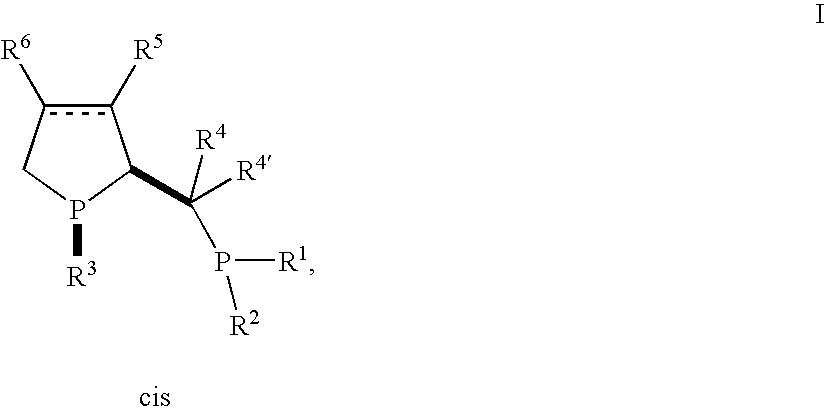
- the present invention provides a new phosphine ligands of the formula I wherein
- the residues R 4 , R 4′ , R 5 and R 6 may form additional chiral centers on the C atom they are attached to and the residues R 1 and R 2 may form an additional chiral center on the phosphorus atom they are attached to.
- the present invention is also directed to chiral 1,2-diphosphine ligands with one chiral center on a carbon atom of the bridge and one chiral center on the phosphorous atom, i.e., a new bidenate C,P-chiral 1,2-diphosphine ligand system which form fairly rigid bicycle[3.3.0]octane chelates with transition metals.
- alkyl signifies straight-chain or branched hydrocarbon groups with 1 to 8 carbon atoms, preferably 1 to 6 carbon atoms, such as methyl, ethyl, propyl, iso-propyl, butyl, iso-butyl and tert.-butyl.
- the alkyl groups for R 1 , R 2 and R 3 are branched alkyl groups such as iso-propyl, iso-butyl and tert.-butyl.
- alkoxy denotes a group wherein the alkyl residue is as defined above, and which is attached via an oxygen atom.
- cycloalkyl stands for 3- to 8-membered rings, such as cyclopropyl, cyclobutyl, cyclopentyl, cyclohexyl and cycloheptyl, especially for cyclopentyl or cyclohexyl.
- said “alkyl” and “cycloalkyl” groups may be substituted by alkyl (for cycloalkyl), alkoxy, halogen, hydroxy, amino, mono- or dialkylamino, or aryl.
- aryl signifies an aromatic hydrocarbon residue, especially the phenyl residue, which can be unsubstituted or substituted in the ortho-, meta- or para-position or multiply-substituted.
- Substituents which come into consideration are e.g. phenyl, alkyl or alkoxy groups, preferably methyl or methoxy groups, or amino, monoalkyl- or dialkylamino, preferably dimethylamino or diethylamino, or hydroxy, or halogen such as chlorine, or trialkylsilyl, such as trimethylsilyl.
- aryl can signify naphthyl.
- Preferred aryl residues are phenyl, tolyl, dimethylphenyl, di-tert.-butylphenyl or anisyl.
- heteroaryl signifies a 5- or 6-membered aromatic cycle containing one or more heteroatoms such as S, O and/or N.
- heteroaryl groups are furyl, thienyl, benzofuranyl or benzothienyl.
- the compounds of the invention have two chiral centers, one on the P atom in the phospholane ring and one on the C2 atom of the phospholane ring.
- the substituents at these chiral centers are always in cis relation to each other.
- Compound of formula Ia is an example of a compound of formula I, wherein R 5 and R 6 are independently of each other hydrogen, alkyl or aryl, and the dotted line is present and forms a double bond:
- Preferred compounds of formula I are those wherein
- Especially preferred ligands of formula I are those wherein R 1 and R 2 are the same and are phenyl, R 3 is phenyl and R 4 , R 4′ , R 5 and R 6 are hydrogen.
- the ligands of formula I are prepared according to the reaction scheme 1 to 3.
- the starting materials are known in the art and commercially available.
- the phospholane 1-oxide (1) is metallated with a metallation reagent, such as an aryl or alkyl lithium reagent or a lithium amide reagent and subsequently reacted with an aldehyde such as e.g., formaldehyde or a ketone such as e.g., acetone to yield mixtures of cis- and trans-2-phospholanemethanol 1-oxide (2a and 2b).
- Metallation reagents may be phenyl-, butyl-, sec- and tert.-butyllithium or the like, or lithium-di-iso-propylamide, lithium-2,2,6,6-tetramethylpiperidide or the like.
- an aryl or alkyl lithium reagent is used which contains the aryl or alkyl group R 3 .
- 2-Methylene-oxo-phospholane (3) is formed by dehydration of cis- or trans 2-phospholanemethanol 1-oxide (2a and b) or of mixtures thereof.
- dehydration can be performed by methods known to the person skilled in the art.
- the dehydration can be performed by reaction of the hydroxy group with an inorganic acid chloride such as thionylchloride or phosphoroxichloride and subsequent elimination of the formed chloride intermediate, for example, in presence of an organic base such as 1,8-diazabi-cyclo[5.4.0]undec-7-ene (DBU), 1,5-diazabicyclo[4.3.0]non-5-ene (DBN), 1,4-diazabicyclo[2.2.2]octane (DABCO), triethylamine or pyridine or the like.
- DBU 1,8-diazabi-cyclo[5.4.0]undec-7-ene
- DBN 1,5-diazabicyclo[4.3.0]
- the dehydration is performed by catalysis with a strong acid such as e.g., sulfuric acid, phosphoric acid, pyrophosphoric acid, potassium hydrogen sulfate, p-toluenesulfonic acid, etc.
- a strong acid such as e.g., sulfuric acid, phosphoric acid, pyrophosphoric acid, potassium hydrogen sulfate, p-toluenesulfonic acid, etc.
- an ester derived from an organic acid such as methanesulfonic acid or p-toluenesulfonic acid is formed and the subsequent elimination performed with an organic base such as 1,8-diazabicyclo[5.4.0]undec-7-ene, triethylamine or pyridine or the like.
- an ester derived from acetic acid is formed and subjected to pyrolytic elimination.
- 2-Methylenephospholane-1-oxide (3) is reduced to the corresponding phospholane (4) by methods known in the art.
- Such reduction can be achieved, for example, by treatment with silane reagents (e.g., trichlorosilane, hexachlorodisilane, phenylsilane, polymethylhydrosiloxane, etc.), aluminum reagents (e.g., lithium or natrium aluminum hydride, aluminum hydride), metals (aluminum, magnesium) or with hydrogen after activation with phosgene.
- silane reagents e.g., trichlorosilane, hexachlorodisilane, phenylsilane, polymethylhydrosiloxane, etc.
- aluminum reagents e.g., lithium or natrium aluminum hydride, aluminum hydride
- metals aluminum, magnesium
- optical resolution of 2-methylenephospholane (4) by quaternisation reaction with an optically active alkylating agent such as, for example, with (L)- or (D)-methyl-2-bromo-acetate and fractional crystallization of the salt yields the diastereomerically pure methyl acetate derivatives (5), which then are cleaved in the presence of a base such as sodium hydroxide to the enantiomerically pure 2-methylene-1-oxo-phospholanes (6).
- 2-methylene-1-oxo-phospholane (3) can be separated into the enantiomerically pure 2-methylene-1-oxo-phospholanes (6) by chromatography on a chiral support.
- the transformation is performed by adding a secondary phosphine oxide which can proceed under purely thermal conditions by heating or under base catalysis conditions, e.g., with amine bases such as 1,8-diazabicylclo[5.4.0]undec-7-ene (DBU), 1,5-diazabicyclo[4.3.0] non-5-ene (DBN), 1,4-diazabicyclo[2.2.2]octane (DABCO) or sodium hydride, sodium ethoxide or the like.
- DBU 1,8-diazabicylclo[5.4.0]undec-7-ene
- DBN 1,5-diazabicyclo[4.3.0] non-5-ene
- DABCO 1,4-diazabicyclo[2.2.2]octane
- sodium hydride sodium ethoxide or the like.
- the transformation can also be performed step-wise by addition of a secondary phosphine in the presence of a base such as e.g., potassium tert-butoxide or by addition of a preformed secondary lithium phosphide to yield the phosphine addition product and subsequent oxidation with hydrogen peroxide.
- a base such as e.g., potassium tert-butoxide
- a preformed secondary lithium phosphide to yield the phosphine addition product and subsequent oxidation with hydrogen peroxide.
- the bisoxides (7) are reduced to the diphosphines (8) which optionally can be purified and stored as bis(borane) adducts (9) and which from the diphosphines can be regenerated by deboronation as depicted in scheme 3: wherein the symbols are as defined above for formula I.
- the reduction (step 7) can be achieved, for example, by treatment with silane reagents (e.g., trichlorosilane, hexachlorodisilane, phenylsilane, and polymethylhydrosiloxane), or with aluminum reagents (e.g., lithium or natrium aluminum hydride, and aluminum hydride).
- silane reagents e.g., trichlorosilane, hexachlorodisilane, phenylsilane, and polymethylhydrosiloxane
- aluminum reagents e.g., lithium or natrium aluminum hydride, and aluminum hydride
- the boronation (step 7a) can be performed, for example, by treatment of the diphosphines with a borane-delivering agent such as e.g., the borane-tetrahydrofuran complex, the borane-N,N-diethylaniline complex, the borane-dimethylsulfide complex or the like.
- a borane-delivering agent such as e.g., the borane-tetrahydrofuran complex, the borane-N,N-diethylaniline complex, the borane-dimethylsulfide complex or the like.
- the reduction and boronation (steps 7 and 7a) can also be performed as a single protocol, e.g., by treatment of the bisoxides with lithium aluminum hydride in the presence of sodium borohydride and cerium trichloride, to provide directly the bis(borane) adducts.
- the bis(borane) adducts may be purified by chromatography or crystallization to achieve high chemical purity.
- the deboronation (step 7b) can be achieved by treatment of the bis(borane) adducts with an amine base such as e.g., 1,4-diazabicyclo[2.2.2]octane (DABCO), pyrrolidine, diethylamine or the like or by treatment with an acid such as HBF 4 or the like.
- an amine base such as e.g., 1,4-diazabicyclo[2.2.2]octane (DABCO), pyrrolidine, diethylamine or the like
- an acid such as HBF 4 or the like.
- optically active ligands of formula I form complexes with transition metals, especially with transition metals of Group VIII, such as ruthenium, rhodium, iridium, palladium and nickel.
- transition metals of Group VIII such as ruthenium, rhodium, iridium, palladium and nickel.
- These complexes can be used as catalysts in asymmetric reactions such as hydrogenations and enantioselective hydrogen displacements in prochiral allylic systems.
- the metal complexes are used in their isolated forms for the hydrogenations.
- the complexes may be prepared in situ.
- catalysts i.e., the complexes of a transition metal and the chiral diphosphine ligands of formula I, are novel and are likewise an aspect of the present invention.
- transition metal complexes especially the complexes with metals of group VIII can be represented by the following formula II and III indicated below: M m L n X p A q II wherein
- Ph is a phenyl group
- cod is (Z,Z)-1,5-cyclooctadiene
- nbd is norbornadiene
- BARF is tetrakis[3,5-bis(trifluoromethyl)phenyl]borate.
- ⁇ -Methallyl and ⁇ -allyl is anionic ligands of the structures H 2 C ⁇ C(Me)—CH 2 and H 2 C ⁇ CH—CH 2 .
- a ruthenium complex can be prepared, for example, by reaction of the Ru precursors [Ru(cod)(OCOCF 3 ) 2 ] 2 , [Ru(cod)(OCOCF 3 ) 2 ] 2 .H 2 O, [Ru(cod)(OCOCH 3 ) 2 ] or [Ru 2 (cod) 2 Cl 4 (CH 3 CN)] and the ligand of formula I in an inert solvent, for example, in ethers such as tetrahydrofuran or diethyl ether or mixtures thereof, or in dichloromethane as described in the literature (B. Heiser, E. A. Broger, Y. Crameri, Tetrahedron: Asymmetry 1991, 2, 51).
- Another method for preparing a ruthenium complex comprises, for example, the reaction of the ruthenium precursor [Ru(cod)(methallyl) 2 ] with a ligand of the formula I in a nonpolar solvent such as e.g., hexane or toluene or mixtures thereof as described in J. P. Genet, S. Mallart, C. Pinel, S. Juge, J. A. Laffitte, Tetrahedron: Asymmetry, 1991, 2, 43.
- a nonpolar solvent such as e.g., hexane or toluene or mixtures thereof as described in J. P. Genet, S. Mallart, C. Pinel, S. Juge, J. A. Laffitte, Tetrahedron: Asymmetry, 1991, 2, 43.
- In situ preparation of ruthenium complexes can be performed, for example, by reaction of the ruthenium precursor [Ru(cod)(methallyl) 2 ] with a ligand of the formula I in the presence of trifluoroacetic acid in methanol as described in the literature (B. Heiser, E. A. Broger, Y. Crameri, Tetrahedron: Asymmetry 1991, 2, 51).
- a ruthenium complex can also be prepared, for example, by heating [Ru(cod)Cl 2 ] n and the ligand of formula I at reflux by use of toluene as a solvent in the presence of triethylamine as described in the literature (T. Ikariya, Y. Ishii, H. Kawano, T. Arai, M. Saburi, and S. Akutagawa, J. Chem. Soc., Chem. Commun. 1985, 922). Further, a ruthenium complex can be prepared, for example, by heating [Ru(p-cymene)I 2 ] 2 and the ligand of formula I with stirring in a methylene chloride/ethanol mixture in accordance with the method described in the literature (K. Mashima, K. Kusano, T. Ohta, R. Noyori, H. Takaya, J. Chem. Soc., Chem. Commun. 1989, 1208).
- Preferred ruthenium complexes are
- a rhodium complex can be prepared, for example, by reaction of rhodium precursors such as [Rh(cod)Cl] 2 , [Rh(nbd)Cl] 2 , [Rh(cod) 2 ]SbF 6 , [Rh(cod) 2 ]BF 4 , [Rh(cod) 2 ]ClO 4 with the ligand of formula I in accordance with the method described in “Experimental Chemistry, 4th edition” Vol.18, Organometallic Complexes, pp. 339-344, Ed. Chemical Society of Japan, 1991, Maruzen.
- Preferred rhodium complexes are Rh(L)Cl, Ph(L)Br, Rh(L)I, [Rh(cod)(L)]SbP 6 , [Rh(cod)(L)]BF 4 , [Rh(cod)(L)]ClO 4 , [Rh(cod)(L)]PF 6 , [Rh(cod)(L)]BPh 4 , [Rh(cod)(L)]BARF, [Rh(nbd)(L)]SbF 6 , [Rh(nbd)(L)]BF 4 , [Rh(nbd)(L)]ClO 4 , and [Rh(nbd)(L)]PF 6 , [Rh(nbd)(L)]BPh 4 .
- An iridium complex can be prepared, for example, by reacting the ligand of formula I with [Ir(cod)(CH 3 CN) 2 ]BF 4 or with [Ir(cod)Cl] 2 in accordance with the method described in the literature (K. Mashima, T. Akutagawa, X. Zhang, H. Takaya, T. Taketomi, H. Kumobayashi, S. Akutagawa, J. Organomet., Chem. 1992, 428, 213).
- Preferred iridium complexes are Ir(L)Cl, Ir(L)Br, Ir(L)I, [Ir(cod)(L)]BF 4 , [Ir(cod)(L)]ClO 4 , [Ir(cod)(L)]PF 6 , [Ir(cod)(L)]BPh 4 , [Ir(nbd)(L)]BF 4 , [Ir(nbd)(L)]ClO 4 , [Ir(nbd)(L)]PF 6 , and [Ir(nbd)(L)]BPh 4
- a palladium complex can be prepared, for example, by reaction of the ligand of formula I with ⁇ -allylpalladium chloride in accordance with the method described in a literature (Y. Uozumi and T. Hayashi, J. Am., Chem. Soc. 1991, 113, 9887).
- Preferred palladium complexes are PdCl 2 (L), [Pd( ⁇ -allyl) (L)]BF 4 , [(Pd( ⁇ -allyl)(L)]ClO 4 , [(Pd( ⁇ -allyl)(L)]PF 6 , and [(Pd( ⁇ -ally)(L)]BPh 4
- a nickel complex can be prepared, for example, by dissolving the ligand of formula I and nickel chloride in an alcohol such as isopropanol or ethanol or mixtures thereof and heating the solution with stirring in accordance with the method described in “Experimental Chemistry, 4th edition” Vol.18, Organometallic Complexes, pp. 376, Ed. Chemical Society of Japan, 1991, Maruzen.
- transition metal complexes prepared as described above can be used as catalysts for asymmetric reactions, in particular for asymmetric hydrogenation reactions.
- the organic phase was separated and the water phase extracted twice with 80 ml toluene.
- the organic phases were collected, dried over Na 2 SO 4 , filtered and evaporated.
- the residue was purified by flash chromatography on Al 2 O 3 with hexane followed by hexane/EtOAc 20:1. To the collected fractions containing the diphosphine 15 ml of a solution of BH 3 in THF (1M) was added.
- This ligand was prepared from (S)-1-phenyl-2-methylenephospholane-1-oxide analogously as described for (S,S)-cis-PMP5 in Examples 6-8a.
- the 1-phenyl-2-methylenephospholane-1-oxide (from example 2) can be separated into the enantiomerically pure 1-phenyl-2-methylenephospholane-1-oxide by chromatography on a chiral support.
- Rh(cod) 2 SbF 6 was dissolved in 100 ml dry THF.
- the mixture was cooled to ⁇ 80° C. and a solution of 108.60 mg (1R,2R)-cis-1-phenyl-2-[(diphenylphosphino)methyl]phospholane ⁇ (R,R)-cis-PMP5 ⁇ in 50 ml THF was added dropwise.
- the mixture was allowed to warm to room temperature, the solvent was evaporated and the residue was dissolved in THF/CH 2 Cl 2 (1:1).
- the hydrogenation examples were carried out as follows: In a dry box, an autoclave with a 20 ml glass tube insert was charged with a magnetic stirring bar, the hydrogenation substrate (1 mmol), anhydrous degassed methanol (7 ml) and the metal complex pre-catalyst (0.81 mg, 0.001 mmol).
- the autoclave was pressurized to an initial pressure of 150 kPa.
- the reaction was stirred at room temperature for 2 h.
- the reaction mixture was concentrated and the residue was analyzed by GC.
- the metal complex pre-catalyst was prepared as described in Example 9 and used in its isolated form for the hydrogenation.
- the complex may be prepared in situ, as described in Example H.
- the metal complex was prepared in situ by dissolving of 0.010 mmol rhodium precursor (Rh(cod) 2 X) and 0.011 mmol ligand in 4 ml of methanol. The orange solution was stirred 45 minutes and then mixed with a solution of 1 mmol of substrate dissolved in 3 ml of methanol. Procedure of hydrogenation was carried out as described above catalytic hydrogenation of 2-acetylamino-acrylic acid methyl ester was carried out at room temperature with an initial H 2 pressure of 500 kPa, 3 h, S/C 100.
- the ligands X were
Landscapes
- Chemical & Material Sciences (AREA)
- Organic Chemistry (AREA)
- Health & Medical Sciences (AREA)
- Life Sciences & Earth Sciences (AREA)
- Biochemistry (AREA)
- General Health & Medical Sciences (AREA)
- Molecular Biology (AREA)
- Organic Low-Molecular-Weight Compounds And Preparation Thereof (AREA)
- Low-Molecular Organic Synthesis Reactions Using Catalysts (AREA)
Abstract

wherein
- R1 and R2 are independently of each other unsubstituted alkyl, aryl, cycloalkyl or heteroaryl, or alkyl, aryl, cycloalkyl or heteroaryl each of which independently is substituted by alkyl, alkoxy, halogen, hydroxy, amino, mono- or dialkylamino, aryl, —SO2—R7, —SO3 −, —CO—NR8R8′, carboxy, alkoxycarbonyl, trialkylsilyl, diarylalkylsilyl, dialkylarylsilyl or triarylsilyl; R3 is alkyl, cycloalkyl, aryl or heteroaryl; R4′ and R4 are independently of each other hydrogen, alkyl or optionally substituted aryl; or R4′ and R4 together with the C-atom they are attached, form a 3-8-membered carbocyclic ring; dotted line is optionally a double bond; R5 and R6 are independently of each other hydrogen, alkyl or aryl, R7 is alkyl or aryl; and R8 and R8′ are independently of each other hydrogen, alkyl or aryl; the substituents attached by the bold bonds are in cis relation to each other; metal complexes with such ligands in asymmetric reactions.
Description


wherein
- R1 and R2 are independently of each other unsubstituted alkyl, aryl, cycloalkyl or heteroaryl, or alkyl, aryl, cycloalkyl or heteroaryl each of which independently is substituted by alkyl, alkoxy, halogen, hydroxy, amino, mono- or dialkylamino, aryl, —SO2—R7, —SO3 −, —CO—NR8R8′, carboxy, alkoxycarbonyl, trialkylsilyl, diarylalkylsilyl, dialkylarylsilyl or triarylsilyl;
- R3 is alkyl, cycloalkyl, aryl or heteroaryl;
- R4′ and R4 are independently of each other hydrogen, alkyl, aryl or substituted aryl; or
- R4′ and R4 together, with the C-atom they are attached, form a 3-8-membered carbocyclic ring;
- dotted line is optionally a double bond;
- R5 and R6 are independently of each other hydrogen, alkyl or aryl;
- R7 is alkyl, aryl or NR8R8′; and
- R8 and R8′ are independently of each other hydrogen, alkyl or aryl;
the substituents R3 on the phospholane phophorus atom and the substituent on the C2 atom of the phospholane ring being in cis relation to each other as indicated by the bold bonds in formula I.


- R1 and R2 are the same and are unsubstituted alkyl, aryl, cycloalkyl or heteroaryl, or alkyl, aryl, cycloalkyl or heteroaryl each of which is independently substituted by alkyl, alkoxy, halogen, hydroxy, amino, mono- or dialkylamino, aryl, —SO2—R7, —SO3 −, —CO—NR8R8′, carboxy, alkoxycarbonyl, trialkylsilyl, diarylalkylsilyl, dialkylarylsilyl or triarylsilyl;
- R3 is alkyl or aryl;
- R4′ and R4 are hydrogen;
- R5 and R6 are independently of each other hydrogen, C1-C3-alkyl or phenyl;
the dotted line is absent; - R7 is alkyl, aryl or NR8R8′; and
- R8 and R8′ are independently of each other hydrogen, alkyl or aryl;
the substituents R3 on the phospholane phophorus atom and the substituent on the C2 atom of the phospholane ring being in cis relation to each other as indicated by the bold bonds in formula I.
- R1 and R2 are the same and are aryl;
- R3 is tert.-butyl or phenyl;
- R4′ and R4 are identical and signify hydrogen;
- R5 and R6 are hydrogen; and the dotted line is absent.
- R1 and R2 are the same and are alkyl;
- R3 is tert.-butyl or phenyl;
- R4′ and R4 are the same and are hydrogen;
- R5 and R6 are hydrogen; and the dotted line is absent.
- R1 and R2 are the same and are cycloalkyl;
- R3 is tert.-butyl or phenyl;
- R4′ and R4 are the same and are hydrogen;
- R5 and R6 are hydrogen; and the dotted line is absent.
- R1 and R2 are alike and signify heteroaryl;
- R3 is tert.-butyl or phenyl;
- R4′ and R4 are identical and signify hydrogen;
- R5 and R6 are hydrogen; and the dotted line is absent.

wherein the residues are as defined above for formula I.

wherein R3, R4, R4′, R5 and R6 are as defined for formula I above; are new and thus part of the present invention.
Step 1

wherein the residues are as defined above for formula I.

wherein the symbols are as defined above for formula I.
MmLnXpAq II
wherein
- M is a transition metal,
- L is the diphosphine compound of formula I;
- X is a coordinating anion, such as Cl, Br or I
- m, n and p are each 1, and
- q is 0, if M is Rh;
or - X is acyloxy, such as acetoxy, trifluoroacetoxy or pivaloyloxy,
- m and n are each 1,
- p is 2, and
- q is 0, if M is Ru;
or - X is Cl,
- m and n are each 2,
- p is 4,
- q is 1, and
- A is triethylamine, if M is Ru;
or - X is a π-methallyl group,
- m and n are each 1,
- p is 2, and
- q is 0, if M is Ru;
or - X is a coordinating anion, such as Cl, Br or I,
- m, n and p are each 1, and
- q is 0, if M is Ir;
or - X is Cl,
- m and n are each 1,
- p is 2, and
- q is 0, if M is Pd;
or - X is Cl, Br or I,
- m and n are each 1,
- p is 2, and
- q is 0, if M is Ni.
[MmLnXpAq]Dr III
wherein - M is a transition metal,
- L is the diphosphine compound of formula I,
- X is a diene ligand, such as cod or nbd (both as defined below),
- D is a non-coordinating anion, such as BF4, ClO4, PF6, SbF6, CF3SO3, BPh4, or BARF (as defined below),
- m, n, p and r are each 1, and
- q is 0, if M is Rh;
or - X is an olefinic ligand, such as cyclooctene or ethylene,
- D is a non-coordinating anion, such as BF4, ClO4, PF6, SbF6, CF3SO3, BPh4, or BARF,
- m, n and r are each 1,
- p is 2 and
- q is 0, if M is Rh;
or - X is Cl, Br or I,
- A is benzene or p-cymene,
- D is Cl, Br or I, and
- m, n, p, q and r are each 1, if M is Ru;
or - D is a non-coordinating anion, such as BF4, ClO4, PF6, SbF6, CF3SO3, BPh4, or BARF,
- m and n are each 1,
- p and q are each 0, and
- r is 2, if M is Ru;
or - X is a diene ligand, such as cod or nbd,
- D is a non-coordinating anion, such as e.g., BF4, ClO4, PF6, SbF6, CF3SO3, BPh4, or BARF,
- m, n, p and r are each 1, and
- q is 0, if M is Ir;
or - X is an olefinic ligand, such as e.g., cyclooctene or ethylene,
- D is a non-coordinating anion, such as e.g., BF4, ClO4, PF6, SbF6, CF3SO3, BPh4, or BARF,
- m, p and r are each 1,
- n is 2, and
- q is 0, if M is Ir;
or - X is a π-allyl group,
- D is a non-coordinating anion, such as e.g., BF4, ClO4, PF6, SbF6, CF3SO3, BPh4, or BARF,
- m, n, p and r are each 1, and
- q is 0, if M is Pd.
- h hour
- m.p. melting point
- THF tetrahydrofuran
- EtOAc ethyl acetate
- DBU 1,8-diazabicyclo(5,4,0)undec-7-ene
- DABCO 1,4-diazabicyclo[2.2.2]octane
- BARF tetrakis[3,5-bis(trifluoromethyl)phenyl]borate
- c concentration
- S/C molar substrate catalyst ratio
- conv. conversion
- ee enantiomeric excess
- GC gaschromatography
- PMP5 2-[(diphenylphosphino)methyl]-1-phenyl-phospholane
- cod (Z,Z)-1,5-cyclooctadiene


(1R,2S)-cis-bisoxide (R,R)-trans-bisoxide


Step 2


Step 2


Step 2

Step 3


| TABLE A | ||||||
| Initial H2 | ||||||
| Substrate | Ligand | pressure kPa | Time (h) | S/C | % conv.1) | % ee2) |
 |
(R,R)-cis-PMP5 (R,S)-trans-PMP5 (R,R)-cis-PMP5 (R,R)-cis-PMP5 | 150 150 500 500 | 2 2 16 3 | 1000 1000 1000 100 | 100 100 100 100 | 94 (S) 33 (S) 91 (S) 93 (S) |
 |
(R,R)-cis-PMP5 (R,S)-trans-PMP5 (R,R)-cis-PMP5 (R,R)-cis-PMP5 | 150 150 500 500 | 2 2 16 3 | 1000 1000 1000 100 | 100 100 100 100 | 85 (S) 16 (S) 82 (S) 84 (S) |
| 1)Determined by GC [area-%]. | ||||||
| 2)Determined by GC on a chiral column. | ||||||
| TABLE B | ||||||
| Initial H2 | ||||||
| Substrate | Ligand | pressure kPa | Time (h) | S/C | % conv.1) | % ee2) |
 |
(R,R)-cis-PMP5 (R,S)-trans-PMP5 (R,R)-cis-PMP5 (R,R)-cis-PMP5 | 150 150 500 500 | 2 2 16 3 | 1000 1000 1000 100 | 99.8 100 100 100 | 97 (R) 68 (R) 96 (R) 97 (R) |
 |
(R,R)-cis-PMP5 (R,S)-trans-PMP5 (R,R)-cis-PMP5 (R,R)-cis-PMP5 | 150 150 500 500 | 2 2 16 3 | 1000 1000 1000 100 | 77 100 100 100 | 91 (R) 62 (R) 89 (R) 90 (R) |
| 1)Determined by GC [area-%]. | ||||||
| 2)Determined by GC on a chiral column. | ||||||
| TABLE C | ||||||
| Initial H2 | ||||||
| Substrate | Ligand | pressure kPa | Time (h) | S/C | % conv.1) | % ee2) |
 |
(R,R)-cis-PMP5 (R,R)-cis-PMP5 (R,S)-trans-PMP5 (R,R)-cis-PMP5 (R,R)-cis-PMP5 | 150 150 150 500 500 | 2 16 2 16 3 | 1000 1000 1000 1000 100 | 75 100 100 100 100 | 98 (S) 98 (S) |
| #25 (R) 96 (S) 97 (S) | ||||||
 |
(R,R)-cis-PMP5 (R,S)-trans-PMP5 (R,R)-cis-PMP5 | 150 150 500 | 16 16 3 | 1000 1000 1000 | 78 100 57 | 98 (S) 48 (S) 98 (S) |
| 1)Determined by GC [area-%] | ||||||
| 2)Determined by GC on a chiral column. | ||||||
| TABLE D | ||||||
| Initial | % | |||||
| Substrate | Ligand | H2 pressure | Time (h) | S/C | conv.1) | % ee2) |
 |
(R,R)-cis-PMP5 (R,S)-trans-PMP5 (R,R)-cis-PMP5 | 1.5 1.5 5 | 2 2 3 | 1000 1000 1000 | 100 99 100 | 96 (S) 57 (S) 96 (R) |
 |
(R,R)-cis-PMP5 (R,S)-trans-PMP5 (R,R)-cis-PMP5 | 1.5 1.5 5 | 2 2 16 | 1000 1000 1000 | 99.9 100 100 | 98 (R) 77 (R) 96 (R) |
 |
(R,R)-cis-PMP5 (R,S)-trans-PMP5 | 1.5 1.5 | 2 2 | 1000 1000 | 90 100 | 96 (R) 85 (R) |
| 1)Determined by GC [area-%]. | ||||||
| 2)Determined by GC on a chiral column. | ||||||
| TABLE E | ||||||
| Initial H2 | Time | |||||
| Substrate | Ligand | kPa | (h) | S/C | % conv.1) | % ee2) |
 |
(R)-Prophos (R,R)-cis-PMP5 (R,S)-trans-PMP5 (R,R)-cis-PMP5 (R,R)-cis-PMP5 (R,R)-cis-PMP5 | 500 150 150 500 500 500 | 3 2 2 3 16 16 | 100 1000 1000 100 1000 10 000 | 100 33 35 | |
| #100 100 45 | 78 (S) 95 (S) 23 (S) 97 (S) 97 (S) 97 (S) | |||||
| 1)Determined by GC [area-%], | ||||||
| 2)Determined by GC on a chiral column. | ||||||
| TABLE F | |||
| Substrate | Ligand | % conversion1) | % ee2) |
 |
(R,R)-cis-PMP5 (R,S)-trans-PMP5 | 8 4 | 2 3 |
 |
(R,R)-cis-PMP5 (R,S)-trans-PMP5 | 80 3 | 3 5 |
 |
(R,R)-cis-PMP5 (R,S)-trans-PMP5 | 98 36 | 9 3 |
| 1)Determined by GC [area-%]. | |||
| 2)Determined by GC on a chiral column. | |||
| TABLE G | ||||||
| Time | ||||||
| Substrate | Ligand | Initial H2 kPa | (h) | S/C | % convers.1) | % ee2) |
 |
(R,R)-cis-PMP5 (R,S)-trans-PMP5 (R,R)-cis-PMP5 | 150 150 150 | 6 6 6 | 500 500 500 | 100 100 100 | 10 20 10 |
 |
(R,R)-cis-PMP5 (R,S)-trans-PMP5 (R,R)-cis-PMP5 | 150 150 1500 | 7 7 7 | 1000 1000 1000 | 21 13 78 | 22 22 18 |
| 1)Determined by GC [area-%]. | ||||||
| 2)Determined by GC on a chiral column. | ||||||
| Substrate | Ligand | X | Solvent | % conv.1) | % ee2) |
 |
(S,S)-cis-PMP5 (S,S)-cis-PMP5 (S,R)-trans-PMP5 | BARF PF6 PF6 | MeOH MeOH MeOH | 100 100 100 | 81 (R) 82 (R) 5 (R) |
| 1)Determined by GC [area-%]. | |||||
| 2)Determined by GC on a chiral column. | |||||
Claims (27)

MmLnXpAq II

MmLnXpAq II

MmLnXpAq II

MmLnXpAq II


MmLnXpAq II

MmLnXpAq II

MmLnXpAq II

[MmLnXpAq]Dr III

[MmLnXpAq]Dr III

[MmLnXpAq]Dr III

[MmLnXpAq]Dr III

[MmLnXpAq]Dr III

[MmLnXpAq]Dr III

[MmLnXpAq]Dr III

[MmLnXpAq]Dr III
[MmLnXpAq]Dr III


MmLnXpAq II

[MmLnXpAq]Dr III

Applications Claiming Priority (2)
| Application Number | Priority Date | Filing Date | Title |
|---|---|---|---|
| EP02026831.4 | 2002-11-29 | ||
| EP02026831 | 2002-11-29 |
Publications (2)
| Publication Number | Publication Date |
|---|---|
| US20040110975A1 US20040110975A1 (en) | 2004-06-10 |
| US6984744B2 true US6984744B2 (en) | 2006-01-10 |
Family
ID=32405686
Family Applications (1)
| Application Number | Title | Priority Date | Filing Date |
|---|---|---|---|
| US10/721,038 Expired - Fee Related US6984744B2 (en) | 2002-11-29 | 2003-11-21 | Phosphine ligands |
Country Status (9)
| Country | Link |
|---|---|
| US (1) | US6984744B2 (en) |
| EP (1) | EP1567535B1 (en) |
| JP (1) | JP4244212B2 (en) |
| CN (1) | CN100358909C (en) |
| AU (1) | AU2003288125A1 (en) |
| CA (1) | CA2505940A1 (en) |
| DE (1) | DE60311305T2 (en) |
| ES (1) | ES2279198T3 (en) |
| WO (1) | WO2004050669A1 (en) |
Families Citing this family (43)
| Publication number | Priority date | Publication date | Assignee | Title |
|---|---|---|---|---|
| JP4754182B2 (en) * | 2003-05-19 | 2011-08-24 | 武田薬品工業株式会社 | Method for producing phosphine-borane complex |
| US20050097046A1 (en) | 2003-10-30 | 2005-05-05 | Singfield Joy S. | Wireless electronic check deposit scanning and cashing machine with web-based online account cash management computer application system |
| CN101300262A (en) * | 2005-11-02 | 2008-11-05 | 弗·哈夫曼-拉罗切有限公司 | Bidentate C, P chiral phosphine ligand |
| JP2008110920A (en) * | 2006-10-27 | 2008-05-15 | Takasago Internatl Corp | Optically active phosphine compound and asymmetric reaction using the same |
| US8351677B1 (en) | 2006-10-31 | 2013-01-08 | United Services Automobile Association (Usaa) | Systems and methods for remote deposit of checks |
| US8708227B1 (en) | 2006-10-31 | 2014-04-29 | United Services Automobile Association (Usaa) | Systems and methods for remote deposit of checks |
| US7873200B1 (en) | 2006-10-31 | 2011-01-18 | United Services Automobile Association (Usaa) | Systems and methods for remote deposit of checks |
| US8799147B1 (en) | 2006-10-31 | 2014-08-05 | United Services Automobile Association (Usaa) | Systems and methods for remote deposit of negotiable instruments with non-payee institutions |
| US10380559B1 (en) | 2007-03-15 | 2019-08-13 | United Services Automobile Association (Usaa) | Systems and methods for check representment prevention |
| US8959033B1 (en) | 2007-03-15 | 2015-02-17 | United Services Automobile Association (Usaa) | Systems and methods for verification of remotely deposited checks |
| US8433127B1 (en) | 2007-05-10 | 2013-04-30 | United Services Automobile Association (Usaa) | Systems and methods for real-time validation of check image quality |
| US8538124B1 (en) | 2007-05-10 | 2013-09-17 | United Services Auto Association (USAA) | Systems and methods for real-time validation of check image quality |
| US9058512B1 (en) | 2007-09-28 | 2015-06-16 | United Services Automobile Association (Usaa) | Systems and methods for digital signature detection |
| US9892454B1 (en) | 2007-10-23 | 2018-02-13 | United Services Automobile Association (Usaa) | Systems and methods for obtaining an image of a check to be deposited |
| US9898778B1 (en) | 2007-10-23 | 2018-02-20 | United Services Automobile Association (Usaa) | Systems and methods for obtaining an image of a check to be deposited |
| US9159101B1 (en) | 2007-10-23 | 2015-10-13 | United Services Automobile Association (Usaa) | Image processing |
| US8358826B1 (en) | 2007-10-23 | 2013-01-22 | United Services Automobile Association (Usaa) | Systems and methods for receiving and orienting an image of one or more checks |
| US8320657B1 (en) | 2007-10-31 | 2012-11-27 | United Services Automobile Association (Usaa) | Systems and methods to use a digital camera to remotely deposit a negotiable instrument |
| US8290237B1 (en) | 2007-10-31 | 2012-10-16 | United Services Automobile Association (Usaa) | Systems and methods to use a digital camera to remotely deposit a negotiable instrument |
| US7900822B1 (en) | 2007-11-06 | 2011-03-08 | United Services Automobile Association (Usaa) | Systems, methods, and apparatus for receiving images of one or more checks |
| US10380562B1 (en) | 2008-02-07 | 2019-08-13 | United Services Automobile Association (Usaa) | Systems and methods for mobile deposit of negotiable instruments |
| US8351678B1 (en) | 2008-06-11 | 2013-01-08 | United Services Automobile Association (Usaa) | Duplicate check detection |
| CN101328190B (en) * | 2008-07-11 | 2011-08-17 | 浙江师范大学 | Chiral N, P ligand, preparation and application thereof |
| US8422758B1 (en) | 2008-09-02 | 2013-04-16 | United Services Automobile Association (Usaa) | Systems and methods of check re-presentment deterrent |
| US10504185B1 (en) | 2008-09-08 | 2019-12-10 | United Services Automobile Association (Usaa) | Systems and methods for live video financial deposit |
| US8391599B1 (en) | 2008-10-17 | 2013-03-05 | United Services Automobile Association (Usaa) | Systems and methods for adaptive binarization of an image |
| US8452689B1 (en) | 2009-02-18 | 2013-05-28 | United Services Automobile Association (Usaa) | Systems and methods of check detection |
| US10956728B1 (en) | 2009-03-04 | 2021-03-23 | United Services Automobile Association (Usaa) | Systems and methods of check processing with background removal |
| US8542921B1 (en) | 2009-07-27 | 2013-09-24 | United Services Automobile Association (Usaa) | Systems and methods for remote deposit of negotiable instrument using brightness correction |
| US9779392B1 (en) | 2009-08-19 | 2017-10-03 | United Services Automobile Association (Usaa) | Apparatuses, methods and systems for a publishing and subscribing platform of depositing negotiable instruments |
| US8977571B1 (en) | 2009-08-21 | 2015-03-10 | United Services Automobile Association (Usaa) | Systems and methods for image monitoring of check during mobile deposit |
| US8699779B1 (en) | 2009-08-28 | 2014-04-15 | United Services Automobile Association (Usaa) | Systems and methods for alignment of check during mobile deposit |
| US9129340B1 (en) | 2010-06-08 | 2015-09-08 | United Services Automobile Association (Usaa) | Apparatuses, methods and systems for remote deposit capture with enhanced image detection |
| US10380565B1 (en) | 2012-01-05 | 2019-08-13 | United Services Automobile Association (Usaa) | System and method for storefront bank deposits |
| US10552810B1 (en) | 2012-12-19 | 2020-02-04 | United Services Automobile Association (Usaa) | System and method for remote deposit of financial instruments |
| US11138578B1 (en) | 2013-09-09 | 2021-10-05 | United Services Automobile Association (Usaa) | Systems and methods for remote deposit of currency |
| US9286514B1 (en) | 2013-10-17 | 2016-03-15 | United Services Automobile Association (Usaa) | Character count determination for a digital image |
| US10402790B1 (en) | 2015-05-28 | 2019-09-03 | United Services Automobile Association (Usaa) | Composing a focused document image from multiple image captures or portions of multiple image captures |
| US11030752B1 (en) | 2018-04-27 | 2021-06-08 | United Services Automobile Association (Usaa) | System, computing device, and method for document detection |
| CN109678901B (en) * | 2019-01-31 | 2021-05-28 | 信阳师范学院 | A kind of synthetic method of trisubstituted phosphine oxide compound |
| US11900755B1 (en) | 2020-11-30 | 2024-02-13 | United Services Automobile Association (Usaa) | System, computing device, and method for document detection and deposit processing |
| CN114478632B (en) * | 2021-12-27 | 2023-10-27 | 中国科学院上海有机化学研究所 | Spirobisdihydrobenzothiolebisphosphine compounds, preparation methods and applications thereof |
| US12211095B1 (en) | 2024-03-01 | 2025-01-28 | United Services Automobile Association (Usaa) | System and method for mobile check deposit enabling auto-capture functionality via video frame processing |
Citations (2)
| Publication number | Priority date | Publication date | Assignee | Title |
|---|---|---|---|---|
| JP2002069086A (en) * | 2000-08-25 | 2002-03-08 | Japan Science & Technology Corp | Optically active phosphorus compounds |
| US20030144137A1 (en) * | 2001-11-09 | 2003-07-31 | The Penn State Research Foundation | P-chiral phospholanes and phosphocyclic compounds and their use in asymmetric catalytic reactions |
-
2003
- 2003-11-20 ES ES03780000T patent/ES2279198T3/en not_active Expired - Lifetime
- 2003-11-20 CA CA002505940A patent/CA2505940A1/en not_active Abandoned
- 2003-11-20 JP JP2004556160A patent/JP4244212B2/en not_active Expired - Fee Related
- 2003-11-20 CN CNB2003801043771A patent/CN100358909C/en not_active Expired - Fee Related
- 2003-11-20 WO PCT/EP2003/012980 patent/WO2004050669A1/en not_active Ceased
- 2003-11-20 EP EP03780000A patent/EP1567535B1/en not_active Expired - Lifetime
- 2003-11-20 AU AU2003288125A patent/AU2003288125A1/en not_active Abandoned
- 2003-11-20 DE DE60311305T patent/DE60311305T2/en not_active Expired - Lifetime
- 2003-11-21 US US10/721,038 patent/US6984744B2/en not_active Expired - Fee Related
Patent Citations (2)
| Publication number | Priority date | Publication date | Assignee | Title |
|---|---|---|---|---|
| JP2002069086A (en) * | 2000-08-25 | 2002-03-08 | Japan Science & Technology Corp | Optically active phosphorus compounds |
| US20030144137A1 (en) * | 2001-11-09 | 2003-07-31 | The Penn State Research Foundation | P-chiral phospholanes and phosphocyclic compounds and their use in asymmetric catalytic reactions |
Non-Patent Citations (6)
| Title |
|---|
| Burk et al., Tetrahedron Asymmetry, 2, pp. 569-592 (1991). |
| Cremer et al., J. Org. Chem., 36, pp. 3226-3231 (1971). |
| Fryzuk et al., J. Am. Chem. Soc., 100, pp. 5491-5494 (1978). |
| Fryzuk et al., J. Am. Chem. Soc., 99, pp. 6262-6267 (1977). |
| Mroz et al., Molecular Physics Reports, 29, pp. 205-209 (2000). |
| Tang et al., Angew. Int. Ed., 41, pp. 1612-1614 (2002). |
Also Published As
| Publication number | Publication date |
|---|---|
| US20040110975A1 (en) | 2004-06-10 |
| DE60311305T2 (en) | 2007-11-15 |
| JP4244212B2 (en) | 2009-03-25 |
| CN100358909C (en) | 2008-01-02 |
| DE60311305D1 (en) | 2007-03-08 |
| CA2505940A1 (en) | 2004-06-17 |
| ES2279198T3 (en) | 2007-08-16 |
| CN1717410A (en) | 2006-01-04 |
| EP1567535B1 (en) | 2007-01-17 |
| AU2003288125A1 (en) | 2004-06-23 |
| WO2004050669A1 (en) | 2004-06-17 |
| JP2006508155A (en) | 2006-03-09 |
| EP1567535A1 (en) | 2005-08-31 |
Similar Documents
| Publication | Publication Date | Title |
|---|---|---|
| US6984744B2 (en) | Phosphine ligands | |
| Burk et al. | New chiral phospholanes; synthesis, characterization, and use in asymmetric hydrogenation reactions | |
| Verdaguer et al. | Amine additives greatly expand the scope of asymmetric hydrosilylation of imines | |
| US6037500A (en) | Asymmetric synthesis catalyzed by transition metal complexes with cyclic chiral phosphine ligands | |
| US20090326253A1 (en) | Novel phosphine ligands | |
| WO1997047633A9 (en) | Asymmetric synthesis catalyzed by transition metal complexes with cyclic chiral phosphine ligands | |
| JP2011514887A (en) | Imidazole group-containing phosphorus compounds | |
| JP2022538350A (en) | Hydrogenation of Esters to Alcohols in the Presence of Ru-PNN Complexes | |
| US6337406B1 (en) | Asymmetric catalysis based on chiral phospholanes and hydroxyl phospholanes | |
| van Duren et al. | Chiral (diphosphonite) platinum complexes in asymmetric hydroformylation | |
| US7407910B2 (en) | Ligands for asymmetric reactions | |
| US6613922B2 (en) | Phosphorus p-cyclophane ligands and their use in transition metal catalyzed asymmetric reactions | |
| Minami et al. | Synthesis and resolution of a new type of chiral bisphosphine ligand, trans-bis-1, 2-(diphenylphosphino) cyclobutane, and asymmetric hydrogenation using its rhodium complex | |
| US20050288523A1 (en) | Chiral diphosphorus compounds and transition metal complexes thereof | |
| JP2009235067A (en) | Axially asymmetric phosphorus compound and method for producing the same | |
| US7411096B2 (en) | Process for producing optically active phosphorus heterocyclic dimer | |
| Lyubimov et al. | Asymmetric Pd-catalyzed allylic amination of 1, 3-diphenylallyl acetate with dipropylamine in ionic and molecular solvents |
Legal Events
| Date | Code | Title | Description |
|---|---|---|---|
| AS | Assignment |
Owner name: HOFFMANN-LA ROCHE INC., NEW JERSEY Free format text: ASSIGNMENT OF ASSIGNORS INTEREST;ASSIGNOR:F. HOFFMANN-LA ROCHE AG;REEL/FRAME:014888/0473 Effective date: 20031119 Owner name: F. HOFFMANN-LA ROCHE AG, SWITZERLAND Free format text: ASSIGNMENT OF ASSIGNORS INTEREST;ASSIGNORS:OSINSKI, PIOTR;PIETRUSIEWICZ, KAZIMIERZ MICHAL;SCHMID, RUDOLF;REEL/FRAME:014888/0511;SIGNING DATES FROM 20031113 TO 20031118 |
|
| FEPP | Fee payment procedure |
Free format text: PAYOR NUMBER ASSIGNED (ORIGINAL EVENT CODE: ASPN); ENTITY STATUS OF PATENT OWNER: LARGE ENTITY |
|
| CC | Certificate of correction | ||
| FPAY | Fee payment |
Year of fee payment: 4 |
|
| REMI | Maintenance fee reminder mailed | ||
| LAPS | Lapse for failure to pay maintenance fees | ||
| STCH | Information on status: patent discontinuation |
Free format text: PATENT EXPIRED DUE TO NONPAYMENT OF MAINTENANCE FEES UNDER 37 CFR 1.362 |
|
| STCH | Information on status: patent discontinuation |
Free format text: PATENT EXPIRED DUE TO NONPAYMENT OF MAINTENANCE FEES UNDER 37 CFR 1.362 |
|
| FP | Lapsed due to failure to pay maintenance fee |
Effective date: 20140110 |