US6949573B2 - Nicotinamide derivatives useful as PDE4 inhibitors - Google Patents
Nicotinamide derivatives useful as PDE4 inhibitors Download PDFInfo
- Publication number
- US6949573B2 US6949573B2 US10/361,062 US36106203A US6949573B2 US 6949573 B2 US6949573 B2 US 6949573B2 US 36106203 A US36106203 A US 36106203A US 6949573 B2 US6949573 B2 US 6949573B2
- Authority
- US
- United States
- Prior art keywords
- fluoro
- formula
- nmr
- mhz
- mmol
- Prior art date
- Legal status (The legal status is an assumption and is not a legal conclusion. Google has not performed a legal analysis and makes no representation as to the accuracy of the status listed.)
- Expired - Fee Related, expires
Links
- 0 [1*]C1=C([2*])N=C(C[3*])C(C(=O)N[Y]C[4*])=C1 Chemical compound [1*]C1=C([2*])N=C(C[3*])C(C(=O)N[Y]C[4*])=C1 0.000 description 44
- VRTUOORZVJTBKY-UHFFFAOYSA-N [CH2-][C+]1=C(O)C=C(C)C=C1 Chemical compound [CH2-][C+]1=C(O)C=C(C)C=C1 VRTUOORZVJTBKY-UHFFFAOYSA-N 0.000 description 9
- OSGINTUICOXWDV-UHFFFAOYSA-N [CH2-][C+]1=C(O)C=CC(C)=C1 Chemical compound [CH2-][C+]1=C(O)C=CC(C)=C1 OSGINTUICOXWDV-UHFFFAOYSA-N 0.000 description 9
- RMAINTGPKFNBDP-UHFFFAOYSA-N [CH2-][C+]1=C(O)C=CC=C1 Chemical compound [CH2-][C+]1=C(O)C=CC=C1 RMAINTGPKFNBDP-UHFFFAOYSA-N 0.000 description 7
- NKBAXJABCMVBIS-UHFFFAOYSA-N CNC(=O)C1CCC(C)CC1 Chemical compound CNC(=O)C1CCC(C)CC1 NKBAXJABCMVBIS-UHFFFAOYSA-N 0.000 description 6
- UJWIOSJBVCGWBA-UHFFFAOYSA-N [CH2-][C+]1=C(O)C(C)=CC=C1 Chemical compound [CH2-][C+]1=C(O)C(C)=CC=C1 UJWIOSJBVCGWBA-UHFFFAOYSA-N 0.000 description 6
- YMDWZFJDFJKPKX-UHFFFAOYSA-N [CH2-][C+]1=C(O)C=C(OC)C=C1 Chemical compound [CH2-][C+]1=C(O)C=C(OC)C=C1 YMDWZFJDFJKPKX-UHFFFAOYSA-N 0.000 description 5
- VLACOTMYHWZMAW-UHFFFAOYSA-N [CH2-][C+]1=C(O)C=CC=C1F Chemical compound [CH2-][C+]1=C(O)C=CC=C1F VLACOTMYHWZMAW-UHFFFAOYSA-N 0.000 description 5
- ZVEWFTICTSQBDM-UHFFFAOYSA-N [CH2-][C+]1=CC=C(O)C=C1 Chemical compound [CH2-][C+]1=CC=C(O)C=C1 ZVEWFTICTSQBDM-UHFFFAOYSA-N 0.000 description 5
- UVMADVFMEHUENW-UHFFFAOYSA-N [CH2-][C+]1=CC(Cl)=C(F)C=C1 Chemical compound [CH2-][C+]1=CC(Cl)=C(F)C=C1 UVMADVFMEHUENW-UHFFFAOYSA-N 0.000 description 4
- OKXJJSDTQZSGLY-UHFFFAOYSA-N [CH2-][C+]1=CC(O)=CC=C1 Chemical compound [CH2-][C+]1=CC(O)=CC=C1 OKXJJSDTQZSGLY-UHFFFAOYSA-N 0.000 description 4
- JESXATFQYMPTNL-UHFFFAOYSA-N [CH2-][CH+]C1=C(O)C=CC=C1 Chemical compound [CH2-][CH+]C1=C(O)C=CC=C1 JESXATFQYMPTNL-UHFFFAOYSA-N 0.000 description 4
- YNGIFMKMDRDNBQ-UHFFFAOYSA-N [CH2-][CH+]C1=CC(O)=CC=C1 Chemical compound [CH2-][CH+]C1=CC(O)=CC=C1 YNGIFMKMDRDNBQ-UHFFFAOYSA-N 0.000 description 4
- FUGYGGDSWSUORM-UHFFFAOYSA-N [CH2-][CH+]C1=CC=C(O)C=C1 Chemical compound [CH2-][CH+]C1=CC=C(O)C=C1 FUGYGGDSWSUORM-UHFFFAOYSA-N 0.000 description 4
- TVSMLBGFGKLKOO-UHFFFAOYSA-N CC1CCN(C)CC1 Chemical compound CC1CCN(C)CC1 TVSMLBGFGKLKOO-UHFFFAOYSA-N 0.000 description 3
- WFPUXFVBDJXKRP-UHFFFAOYSA-N [CH2-][C+](O)C1CCCCC1 Chemical compound [CH2-][C+](O)C1CCCCC1 WFPUXFVBDJXKRP-UHFFFAOYSA-N 0.000 description 3
- TYVUPKDLEQAYGI-UHFFFAOYSA-N [CH2-][CH+]NC(=O)CC1=CC=C(O)C=C1 Chemical compound [CH2-][CH+]NC(=O)CC1=CC=C(O)C=C1 TYVUPKDLEQAYGI-UHFFFAOYSA-N 0.000 description 3
- SEWANZYURYUFFX-UHFFFAOYSA-N [CH2-][CH+]NC(=O)CC1=CC=CC=C1O Chemical compound [CH2-][CH+]NC(=O)CC1=CC=CC=C1O SEWANZYURYUFFX-UHFFFAOYSA-N 0.000 description 3
- LMDXEXXZLHOUHS-UHFFFAOYSA-N CC(=O)CNC(C)=O.CC(C)=O.CNC(C)=O.CS(C)(=O)=O Chemical compound CC(=O)CNC(C)=O.CC(C)=O.CNC(C)=O.CS(C)(=O)=O LMDXEXXZLHOUHS-UHFFFAOYSA-N 0.000 description 2
- JMTXLHVZHKXBCP-UHFFFAOYSA-N CC(=O)N(CC1=CC=CC(O)=C1)C1CCC(NC(=O)C2=CC(F)=CN=C2OC2=CC=C(F)C=C2)CC1 Chemical compound CC(=O)N(CC1=CC=CC(O)=C1)C1CCC(NC(=O)C2=CC(F)=CN=C2OC2=CC=C(F)C=C2)CC1 JMTXLHVZHKXBCP-UHFFFAOYSA-N 0.000 description 2
- FEYLUKDSKVSMSZ-UHFFFAOYSA-N CC(C)(C)OC(=O)NC1CCC(N)CC1 Chemical compound CC(C)(C)OC(=O)NC1CCC(N)CC1 FEYLUKDSKVSMSZ-UHFFFAOYSA-N 0.000 description 2
- TVLSVTSCIHZHQO-UHFFFAOYSA-N CC(C)(C)OC(=O)NC1CCC(NC(=O)C2=CC(F)=CN=C2Cl)CC1 Chemical compound CC(C)(C)OC(=O)NC1CCC(NC(=O)C2=CC(F)=CN=C2Cl)CC1 TVLSVTSCIHZHQO-UHFFFAOYSA-N 0.000 description 2
- QTFCGWCPZFAZHV-UHFFFAOYSA-N CC(C)(C)OC(=O)NC1CCC(NC(=O)C2=CC(F)=CN=C2OC2=CC=C(F)C(Cl)=C2)CC1 Chemical compound CC(C)(C)OC(=O)NC1CCC(NC(=O)C2=CC(F)=CN=C2OC2=CC=C(F)C(Cl)=C2)CC1 QTFCGWCPZFAZHV-UHFFFAOYSA-N 0.000 description 2
- NZWIFFRXEOPFAZ-UHFFFAOYSA-N CC(C)(C)OC(=O)NC1CCC(NC(=O)C2=CC(F)=CN=C2OC2=CC=C(F)C(F)=C2)CC1 Chemical compound CC(C)(C)OC(=O)NC1CCC(NC(=O)C2=CC(F)=CN=C2OC2=CC=C(F)C(F)=C2)CC1 NZWIFFRXEOPFAZ-UHFFFAOYSA-N 0.000 description 2
- FGCCVPLFGZKJOW-UHFFFAOYSA-N CC(C)(C)OC(=O)NC1CCC(NC(=O)C2=CC(F)=CN=C2OC2=CC=C(F)C=C2)CC1 Chemical compound CC(C)(C)OC(=O)NC1CCC(NC(=O)C2=CC(F)=CN=C2OC2=CC=C(F)C=C2)CC1 FGCCVPLFGZKJOW-UHFFFAOYSA-N 0.000 description 2
- OHIUQAZROSYCMC-CALCHBBNSA-N CC1=CC(C(=O)N[C@H]2CC[C@@H](NC(=O)C3=CC(F)=CN=C3OC3=CC=C(F)C(F)=C3)CC2)=C(O)C=C1 Chemical compound CC1=CC(C(=O)N[C@H]2CC[C@@H](NC(=O)C3=CC(F)=CN=C3OC3=CC=C(F)C(F)=C3)CC2)=C(O)C=C1 OHIUQAZROSYCMC-CALCHBBNSA-N 0.000 description 2
- KSYBYQRHCUKDPU-OKILXGFUSA-N CC1=CC(C(=O)N[C@H]2CC[C@@H](NC(=O)OC(C)(C)C)CC2)=C(O)C=C1 Chemical compound CC1=CC(C(=O)N[C@H]2CC[C@@H](NC(=O)OC(C)(C)C)CC2)=C(O)C=C1 KSYBYQRHCUKDPU-OKILXGFUSA-N 0.000 description 2
- CNYKCBZGZHXFFB-UHFFFAOYSA-N CC1=CC2=C(C=C1)CCC2.CC1=CC2=C(C=C1)CCO2.CC1=CC2=C(C=C1)OCO2 Chemical compound CC1=CC2=C(C=C1)CCC2.CC1=CC2=C(C=C1)CCO2.CC1=CC2=C(C=C1)OCO2 CNYKCBZGZHXFFB-UHFFFAOYSA-N 0.000 description 2
- NZVRGZNBZHPRIR-OKILXGFUSA-N CC1=CC=CC(C(=O)N[C@H]2CC[C@@H](NC(=O)C3=CC(F)=CN=C3Cl)CC2)=C1O Chemical compound CC1=CC=CC(C(=O)N[C@H]2CC[C@@H](NC(=O)C3=CC(F)=CN=C3Cl)CC2)=C1O NZVRGZNBZHPRIR-OKILXGFUSA-N 0.000 description 2
- RZTQJLMMGVYSDE-CALCHBBNSA-N COC(=O)CCNC(=O)N[C@H]1CC[C@@H](NC(=O)C2=CC(F)=CN=C2OC2=CC=C(F)C=C2)CC1 Chemical compound COC(=O)CCNC(=O)N[C@H]1CC[C@@H](NC(=O)C2=CC(F)=CN=C2OC2=CC=C(F)C=C2)CC1 RZTQJLMMGVYSDE-CALCHBBNSA-N 0.000 description 2
- KUFFULVDNCHOFZ-UHFFFAOYSA-N Cc(cc1)cc(C)c1O Chemical compound Cc(cc1)cc(C)c1O KUFFULVDNCHOFZ-UHFFFAOYSA-N 0.000 description 2
- NKTOLZVEWDHZMU-UHFFFAOYSA-N Cc1cc(O)c(C)cc1 Chemical compound Cc1cc(O)c(C)cc1 NKTOLZVEWDHZMU-UHFFFAOYSA-N 0.000 description 2
- AIFRARZVKRXZLD-MSEWRSJXSA-N O=C(N[C@H]1CC[C@@H](C(=O)NCC2=CC=CC=C2O)CC1)C1=CC=CN=C1OC1=CC=C(F)C=C1 Chemical compound O=C(N[C@H]1CC[C@@H](C(=O)NCC2=CC=CC=C2O)CC1)C1=CC=CN=C1OC1=CC=C(F)C=C1 AIFRARZVKRXZLD-MSEWRSJXSA-N 0.000 description 2
- ZQJUIWCDSPEHBT-CALCHBBNSA-N O=C(N[C@H]1CC[C@@H](NC(=O)N2C=CN=C2)CC1)C1=CC(F)=CN=C1OC1=CC=C(F)C=C1 Chemical compound O=C(N[C@H]1CC[C@@H](NC(=O)N2C=CN=C2)CC1)C1=CC(F)=CN=C1OC1=CC=C(F)C=C1 ZQJUIWCDSPEHBT-CALCHBBNSA-N 0.000 description 2
- CIQRMNIIZAIRFA-MXVIHJGJSA-N O=C(N[C@H]1CC[C@H](NCC2=C(O)C=CC=C2)CC1)C1=CC(F)=CN=C1OC1=CC=C(F)C=C1 Chemical compound O=C(N[C@H]1CC[C@H](NCC2=C(O)C=CC=C2)CC1)C1=CC(F)=CN=C1OC1=CC=C(F)C=C1 CIQRMNIIZAIRFA-MXVIHJGJSA-N 0.000 description 2
- HSLHKWOXPAFXJK-UHFFFAOYSA-N [CH2-][C+]1=C(C)C(O)=CC=C1 Chemical compound [CH2-][C+]1=C(C)C(O)=CC=C1 HSLHKWOXPAFXJK-UHFFFAOYSA-N 0.000 description 2
- KEWRDGGDOIJPNJ-UHFFFAOYSA-N [CH2-][C+]1=C(O)C(OC)=CC=C1 Chemical compound [CH2-][C+]1=C(O)C(OC)=CC=C1 KEWRDGGDOIJPNJ-UHFFFAOYSA-N 0.000 description 2
- MFMGEHLWVUYFKN-UHFFFAOYSA-N [CH2-][C+]1=C(O)C2=CC=CC=C2C=C1 Chemical compound [CH2-][C+]1=C(O)C2=CC=CC=C2C=C1 MFMGEHLWVUYFKN-UHFFFAOYSA-N 0.000 description 2
- GGOGLQKQTLFJGJ-UHFFFAOYSA-N [CH2-][C+]1=C(O)C=C(O)C=C1 Chemical compound [CH2-][C+]1=C(O)C=C(O)C=C1 GGOGLQKQTLFJGJ-UHFFFAOYSA-N 0.000 description 2
- CHOJDEOSGYHLMO-UHFFFAOYSA-N [CH2-][C+]1=C(O)C=C2C=CC=CC2=C1 Chemical compound [CH2-][C+]1=C(O)C=C2C=CC=CC2=C1 CHOJDEOSGYHLMO-UHFFFAOYSA-N 0.000 description 2
- QVMRTWYVGNBEGQ-UHFFFAOYSA-N [CH2-][C+]1=C(O)C=CC(Cl)=C1 Chemical compound [CH2-][C+]1=C(O)C=CC(Cl)=C1 QVMRTWYVGNBEGQ-UHFFFAOYSA-N 0.000 description 2
- RASBFEUFDNJISB-UHFFFAOYSA-N [CH2-][C+]1=C(O)C=CC(F)=C1 Chemical compound [CH2-][C+]1=C(O)C=CC(F)=C1 RASBFEUFDNJISB-UHFFFAOYSA-N 0.000 description 2
- KCNRIHWJPXCDJU-UHFFFAOYSA-N [CH2-][C+]1=C(O)C=CC=C1OC Chemical compound [CH2-][C+]1=C(O)C=CC=C1OC KCNRIHWJPXCDJU-UHFFFAOYSA-N 0.000 description 2
- RBVCCZMTXQYJHP-UHFFFAOYSA-N [CH2-][C+]1=CC(Cl)=C(Cl)C=C1 Chemical compound [CH2-][C+]1=CC(Cl)=C(Cl)C=C1 RBVCCZMTXQYJHP-UHFFFAOYSA-N 0.000 description 2
- HZTVRZHVHDYCIX-UHFFFAOYSA-N [CH2-][C+]1=CC(F)=C(Cl)C=C1 Chemical compound [CH2-][C+]1=CC(F)=C(Cl)C=C1 HZTVRZHVHDYCIX-UHFFFAOYSA-N 0.000 description 2
- FWCHRVKGBYJNQA-UHFFFAOYSA-N [CH2-][C+]1=CC(F)=C(F)C=C1 Chemical compound [CH2-][C+]1=CC(F)=C(F)C=C1 FWCHRVKGBYJNQA-UHFFFAOYSA-N 0.000 description 2
- RWHGZUGONAFRMT-UHFFFAOYSA-N [CH2-][C+]1=CC(F)=CC=C1 Chemical compound [CH2-][C+]1=CC(F)=CC=C1 RWHGZUGONAFRMT-UHFFFAOYSA-N 0.000 description 2
- ZUBAVINMZAHXGB-UHFFFAOYSA-N [CH2-][C+]1=CC(O)=C(C)C=C1 Chemical compound [CH2-][C+]1=CC(O)=C(C)C=C1 ZUBAVINMZAHXGB-UHFFFAOYSA-N 0.000 description 2
- FDIMUVPYBCMLBQ-UHFFFAOYSA-N [CH2-][C+]1=CC(O)=C(OC)C=C1 Chemical compound [CH2-][C+]1=CC(O)=C(OC)C=C1 FDIMUVPYBCMLBQ-UHFFFAOYSA-N 0.000 description 2
- UOPDXMJDPRHRQR-UHFFFAOYSA-N [CH2-][C+]1=CC=CC(C2CC2)=C1 Chemical compound [CH2-][C+]1=CC=CC(C2CC2)=C1 UOPDXMJDPRHRQR-UHFFFAOYSA-N 0.000 description 2
- KWGXQDGPCHIJJA-UHFFFAOYSA-N [CH2-][C+]1=CC=CC(OC2CCC2)=C1 Chemical compound [CH2-][C+]1=CC=CC(OC2CCC2)=C1 KWGXQDGPCHIJJA-UHFFFAOYSA-N 0.000 description 2
- PGNMSSKSBXIJPT-UHFFFAOYSA-N [CH2-][CH+]NC(=O)C1=CC=C(O)C=C1 Chemical compound [CH2-][CH+]NC(=O)C1=CC=C(O)C=C1 PGNMSSKSBXIJPT-UHFFFAOYSA-N 0.000 description 2
- KSGWWADLHNFSLV-UHFFFAOYSA-N [CH2-][CH+]NC(=O)C1=CC=CC=C1O Chemical compound [CH2-][CH+]NC(=O)C1=CC=CC=C1O KSGWWADLHNFSLV-UHFFFAOYSA-N 0.000 description 2
- WRNFIJYWPGIIAC-UHFFFAOYSA-N C.CC(C)(C)OC(=O)N1CCC(NC(=O)C2=CC(F)=CN=C2OC2=CC=C(F)C=C2)CC1 Chemical compound C.CC(C)(C)OC(=O)N1CCC(NC(=O)C2=CC(F)=CN=C2OC2=CC=C(F)C=C2)CC1 WRNFIJYWPGIIAC-UHFFFAOYSA-N 0.000 description 1
- FFUAYBCIEFBWCZ-NOGCFKFUSA-N C.CC(C)(C)OC(=O)N1[C@H]2CC[C@@H]1C[C@H](NC(=O)C1=CC(F)=CN=C1Cl)C2 Chemical compound C.CC(C)(C)OC(=O)N1[C@H]2CC[C@@H]1C[C@H](NC(=O)C1=CC(F)=CN=C1Cl)C2 FFUAYBCIEFBWCZ-NOGCFKFUSA-N 0.000 description 1
- XNMWEPPMLCQRRU-WBKVAJJRSA-N C.CC(C)(C)OC(=O)N1[C@H]2CC[C@@H]1C[C@H](NC(=O)C1=CC(F)=CN=C1OC1=CC=C(F)C=C1)C2 Chemical compound C.CC(C)(C)OC(=O)N1[C@H]2CC[C@@H]1C[C@H](NC(=O)C1=CC(F)=CN=C1OC1=CC=C(F)C=C1)C2 XNMWEPPMLCQRRU-WBKVAJJRSA-N 0.000 description 1
- CZHXFCXQUMZYOL-DOSOXYTBSA-N C.CC(C)(C)OC(=O)NCC(=O)N1[C@H]2CC[C@@H]1C[C@@H](NC(=O)C1=CC(F)=CN=C1OC1=CC=C(F)C=C1)C2 Chemical compound C.CC(C)(C)OC(=O)NCC(=O)N1[C@H]2CC[C@@H]1C[C@@H](NC(=O)C1=CC(F)=CN=C1OC1=CC=C(F)C=C1)C2 CZHXFCXQUMZYOL-DOSOXYTBSA-N 0.000 description 1
- ZOQFOOYLYNYTTR-GNXQHMNLSA-N C.O=C(O)C1=C(Cl)C=C(C(=O)N[C@H]2CC[C@@H](NC(=O)C3=CC(F)=CN=C3OC3=CC=C(F)C=C3)CC2)C=C1 Chemical compound C.O=C(O)C1=C(Cl)C=C(C(=O)N[C@H]2CC[C@@H](NC(=O)C3=CC(F)=CN=C3OC3=CC=C(F)C=C3)CC2)C=C1 ZOQFOOYLYNYTTR-GNXQHMNLSA-N 0.000 description 1
- BIZPWPAPQLMZAU-FAESNJTISA-N C.O=C(O)CCC(=O)N[C@H]1CC[C@@H](NC(=O)C2=CC(F)=CN=C2OC2=CC=C(F)C=C2)CC1 Chemical compound C.O=C(O)CCC(=O)N[C@H]1CC[C@@H](NC(=O)C2=CC(F)=CN=C2OC2=CC=C(F)C=C2)CC1 BIZPWPAPQLMZAU-FAESNJTISA-N 0.000 description 1
- FYIPLCFMPBHKOY-AMDBCLDASA-N C.O=C(O)CCC1(C(=O)N[C@H]2CC[C@@H](NC(=O)C3=CC(F)=CN=C3OC3=CC=C(F)C=C3)CC2)CCCC1 Chemical compound C.O=C(O)CCC1(C(=O)N[C@H]2CC[C@@H](NC(=O)C3=CC(F)=CN=C3OC3=CC=C(F)C=C3)CC2)CCCC1 FYIPLCFMPBHKOY-AMDBCLDASA-N 0.000 description 1
- AWWNWXWBBFNZCQ-UHFFFAOYSA-N CC(=O)C1=C(C(=O)NC2CCC(NC(=O)C3=CC(F)=CN=C3OC3=CC=C(F)C=C3)CC2)C=CC=C1 Chemical compound CC(=O)C1=C(C(=O)NC2CCC(NC(=O)C3=CC(F)=CN=C3OC3=CC=C(F)C=C3)CC2)C=CC=C1 AWWNWXWBBFNZCQ-UHFFFAOYSA-N 0.000 description 1
- FECDECVWTNZSCS-UHFFFAOYSA-N CC(=O)C1=CC=C(C(=O)NC2CCC(NC(=O)C3=CC(F)=CN=C3OC3=CC=C(F)C=C3)CC2)C=C1 Chemical compound CC(=O)C1=CC=C(C(=O)NC2CCC(NC(=O)C3=CC(F)=CN=C3OC3=CC=C(F)C=C3)CC2)C=C1 FECDECVWTNZSCS-UHFFFAOYSA-N 0.000 description 1
- KENFARXXCXFWHC-UHFFFAOYSA-N CC(=O)C1=CC=CC(C(=O)NC2CCC(NC(=O)C3=CC(F)=CN=C3OC3=CC=C(F)C=C3)CC2)=C1 Chemical compound CC(=O)C1=CC=CC(C(=O)NC2CCC(NC(=O)C3=CC(F)=CN=C3OC3=CC=C(F)C=C3)CC2)=C1 KENFARXXCXFWHC-UHFFFAOYSA-N 0.000 description 1
- DGVZBMQYGNRNDG-UHFFFAOYSA-N CC(=O)N(CC1=C(O)C=CC=C1)C1CCC(NC(=O)C2=CC(F)=CN=C2OC2=CC=C(F)C=C2)CC1 Chemical compound CC(=O)N(CC1=C(O)C=CC=C1)C1CCC(NC(=O)C2=CC(F)=CN=C2OC2=CC=C(F)C=C2)CC1 DGVZBMQYGNRNDG-UHFFFAOYSA-N 0.000 description 1
- CKLJSSGZQAIQQR-UHFFFAOYSA-N CC(=O)N(CC1=CC=C(O)C=C1)C1CCC(NC(=O)C2=CC(F)=CN=C2OC2=CC=C(F)C=C2)CC1 Chemical compound CC(=O)N(CC1=CC=C(O)C=C1)C1CCC(NC(=O)C2=CC(F)=CN=C2OC2=CC=C(F)C=C2)CC1 CKLJSSGZQAIQQR-UHFFFAOYSA-N 0.000 description 1
- ONCVIPAOXUPFRO-UHFFFAOYSA-N CC(=O)OC1=C(CN(C(C)=O)C2CCC(NC(=O)C3=CC(F)=CN=C3OC3=CC=C(F)C=C3)CC2)C=CC=C1 Chemical compound CC(=O)OC1=C(CN(C(C)=O)C2CCC(NC(=O)C3=CC(F)=CN=C3OC3=CC=C(F)C=C3)CC2)C=CC=C1 ONCVIPAOXUPFRO-UHFFFAOYSA-N 0.000 description 1
- AISRCQAXOZBQOT-UHFFFAOYSA-N CC(=O)OC1=CC=CC(OC2CCC2)=C1 Chemical compound CC(=O)OC1=CC=CC(OC2CCC2)=C1 AISRCQAXOZBQOT-UHFFFAOYSA-N 0.000 description 1
- UGNROSZRTZUFKH-IYBDPMFKSA-N CC(C)(C(=O)O)C(=O)N[C@H]1CC[C@@H](NC(=O)C2=CC(F)=CN=C2OC2=CC=C(F)C=C2)CC1 Chemical compound CC(C)(C(=O)O)C(=O)N[C@H]1CC[C@@H](NC(=O)C2=CC(F)=CN=C2OC2=CC=C(F)C=C2)CC1 UGNROSZRTZUFKH-IYBDPMFKSA-N 0.000 description 1
- NUWMEBZUVMOSCE-UHFFFAOYSA-N CC(C)(C)OC(=O)N1CCC(NC(=O)C2=CC(F)=CN=C2Cl)CC1 Chemical compound CC(C)(C)OC(=O)N1CCC(NC(=O)C2=CC(F)=CN=C2Cl)CC1 NUWMEBZUVMOSCE-UHFFFAOYSA-N 0.000 description 1
- PLXMNTMOPHNYKJ-UHFFFAOYSA-N CC(C)(C)OC(=O)NC1CCC(NC(=O)C2=CC(F)=CN=C2OC2=CC=C3OCOC3=C2)CC1 Chemical compound CC(C)(C)OC(=O)NC1CCC(NC(=O)C2=CC(F)=CN=C2OC2=CC=C3OCOC3=C2)CC1 PLXMNTMOPHNYKJ-UHFFFAOYSA-N 0.000 description 1
- HXZIEEDECAYNKL-UHFFFAOYSA-N CC(C)(C)OC(=O)NC1CCC(NC(=O)C2=CC=CN=C2OC2=CC=C(F)C=C2)CC1 Chemical compound CC(C)(C)OC(=O)NC1CCC(NC(=O)C2=CC=CN=C2OC2=CC=C(F)C=C2)CC1 HXZIEEDECAYNKL-UHFFFAOYSA-N 0.000 description 1
- SNSXXPLZOOFKRS-UHFFFAOYSA-N CC(C)(C)OC(=O)NC1CCC(NC(=O)C2=CC=CN=C2OC2=CC=C3OCOC3=C2)CC1 Chemical compound CC(C)(C)OC(=O)NC1CCC(NC(=O)C2=CC=CN=C2OC2=CC=C3OCOC3=C2)CC1 SNSXXPLZOOFKRS-UHFFFAOYSA-N 0.000 description 1
- ISTFOLYPGAJFOL-UHFFFAOYSA-N CC(C)(C)OC(=O)NCC(=O)NC1CCC(NC(=O)C2=CC(F)=CN=C2OC2=CC=C(F)C=C2)CC1 Chemical compound CC(C)(C)OC(=O)NCC(=O)NC1CCC(NC(=O)C2=CC(F)=CN=C2OC2=CC=C(F)C=C2)CC1 ISTFOLYPGAJFOL-UHFFFAOYSA-N 0.000 description 1
- ISTFOLYPGAJFOL-IYARVYRRSA-N CC(C)(C)OC(=O)NCC(=O)N[C@H]1CC[C@H](NC(=O)C2=CC(F)=CN=C2OC2=CC=C(F)C=C2)CC1 Chemical compound CC(C)(C)OC(=O)NCC(=O)N[C@H]1CC[C@H](NC(=O)C2=CC(F)=CN=C2OC2=CC=C(F)C=C2)CC1 ISTFOLYPGAJFOL-IYARVYRRSA-N 0.000 description 1
- FEYLUKDSKVSMSZ-DTORHVGOSA-N CC(C)(C)OC(=O)N[C@H]1CC[C@@H](N)CC1 Chemical compound CC(C)(C)OC(=O)N[C@H]1CC[C@@H](N)CC1 FEYLUKDSKVSMSZ-DTORHVGOSA-N 0.000 description 1
- TVLSVTSCIHZHQO-TXEJJXNPSA-N CC(C)(C)OC(=O)N[C@H]1CC[C@@H](NC(=O)C2=CC(F)=CN=C2Cl)CC1 Chemical compound CC(C)(C)OC(=O)N[C@H]1CC[C@@H](NC(=O)C2=CC(F)=CN=C2Cl)CC1 TVLSVTSCIHZHQO-TXEJJXNPSA-N 0.000 description 1
- NZWIFFRXEOPFAZ-GASCZTMLSA-N CC(C)(C)OC(=O)N[C@H]1CC[C@@H](NC(=O)C2=CC(F)=CN=C2OC2=CC=C(F)C(F)=C2)CC1 Chemical compound CC(C)(C)OC(=O)N[C@H]1CC[C@@H](NC(=O)C2=CC(F)=CN=C2OC2=CC=C(F)C(F)=C2)CC1 NZWIFFRXEOPFAZ-GASCZTMLSA-N 0.000 description 1
- HXZIEEDECAYNKL-CALCHBBNSA-N CC(C)(C)OC(=O)N[C@H]1CC[C@@H](NC(=O)C2=CC=CN=C2OC2=CC=C(F)C=C2)CC1 Chemical compound CC(C)(C)OC(=O)N[C@H]1CC[C@@H](NC(=O)C2=CC=CN=C2OC2=CC=C(F)C=C2)CC1 HXZIEEDECAYNKL-CALCHBBNSA-N 0.000 description 1
- FEYLUKDSKVSMSZ-KYZUINATSA-N CC(C)(C)OC(N[C@H](CC1)CC[C@@H]1N)=O Chemical compound CC(C)(C)OC(N[C@H](CC1)CC[C@@H]1N)=O FEYLUKDSKVSMSZ-KYZUINATSA-N 0.000 description 1
- HMLCXBWKIFJBIT-GACURPPSSA-O CC(C)(C)[SH+](C)(C)Oc1ccc(CN[C@@H](CC2)CC/C2=N/C(c2cc(F)cnc2Oc(cc2)ccc2F)=O)cc1 Chemical compound CC(C)(C)[SH+](C)(C)Oc1ccc(CN[C@@H](CC2)CC/C2=N/C(c2cc(F)cnc2Oc(cc2)ccc2F)=O)cc1 HMLCXBWKIFJBIT-GACURPPSSA-O 0.000 description 1
- OKCOITXJOCTXEX-UHFFFAOYSA-N CC(C)(C)[Si](C)(C)OC1=CC(CNC2CCC(NC(=O)C3=CC(F)=CN=C3OC3=CC=C(F)C=C3)CC2)=CC=C1 Chemical compound CC(C)(C)[Si](C)(C)OC1=CC(CNC2CCC(NC(=O)C3=CC(F)=CN=C3OC3=CC=C(F)C=C3)CC2)=CC=C1 OKCOITXJOCTXEX-UHFFFAOYSA-N 0.000 description 1
- FNWYLJNGJYKGSD-UHFFFAOYSA-N CC(C)(C)[Si](C)(C)OC1=CC=C(CNC2CCC(NC(=O)C3=CC(F)=CN=C3OC3=CC=C(F)C=C3)CC2)C=C1 Chemical compound CC(C)(C)[Si](C)(C)OC1=CC=C(CNC2CCC(NC(=O)C3=CC(F)=CN=C3OC3=CC=C(F)C=C3)CC2)C=C1 FNWYLJNGJYKGSD-UHFFFAOYSA-N 0.000 description 1
- XPBLVIQRJRKMHV-KDURUIRLSA-N CC(C)C1=CC(O)=C(C(=O)N[C@H]2CC[C@@H](NC(=O)C3=CC(F)=CN=C3OC3=CC=C(F)C(F)=C3)CC2)C=C1 Chemical compound CC(C)C1=CC(O)=C(C(=O)N[C@H]2CC[C@@H](NC(=O)C3=CC(F)=CN=C3OC3=CC=C(F)C(F)=C3)CC2)C=C1 XPBLVIQRJRKMHV-KDURUIRLSA-N 0.000 description 1
- XUYJBUKERVNHRL-PHIMTYICSA-N CC1=CC(C(=O)N[C@H]2CC[C@@H](N)CC2)=C(O)C=C1.Cl Chemical compound CC1=CC(C(=O)N[C@H]2CC[C@@H](N)CC2)=C(O)C=C1.Cl XUYJBUKERVNHRL-PHIMTYICSA-N 0.000 description 1
- FODIZJBIOZKCJH-PHIMTYICSA-N CC1=CC(O)=C(C(=O)N[C@H]2CC[C@@H](N)CC2)C=C1.Cl Chemical compound CC1=CC(O)=C(C(=O)N[C@H]2CC[C@@H](N)CC2)C=C1.Cl FODIZJBIOZKCJH-PHIMTYICSA-N 0.000 description 1
- MJDMUYBOCLFJKH-OKILXGFUSA-N CC1=CC(O)=C(C(=O)N[C@H]2CC[C@@H](NC(=O)C3=CC(F)=CN=C3Cl)CC2)C=C1 Chemical compound CC1=CC(O)=C(C(=O)N[C@H]2CC[C@@H](NC(=O)C3=CC(F)=CN=C3Cl)CC2)C=C1 MJDMUYBOCLFJKH-OKILXGFUSA-N 0.000 description 1
- PAOBSPCTQPAFFH-CALCHBBNSA-N CC1=CC(O)=C(C(=O)N[C@H]2CC[C@@H](NC(=O)C3=CC(F)=CN=C3OC3=CC=C(F)C(F)=C3)CC2)C=C1 Chemical compound CC1=CC(O)=C(C(=O)N[C@H]2CC[C@@H](NC(=O)C3=CC(F)=CN=C3OC3=CC=C(F)C(F)=C3)CC2)C=C1 PAOBSPCTQPAFFH-CALCHBBNSA-N 0.000 description 1
- LDSXTSYAGGTDKB-HDICACEKSA-N CC1=CC(O)=C(C(=O)N[C@H]2CC[C@@H](NC(=O)C3=CC(F)=CN=C3OC3=CC=CC(OC(F)(F)F)=C3)CC2)C=C1 Chemical compound CC1=CC(O)=C(C(=O)N[C@H]2CC[C@@H](NC(=O)C3=CC(F)=CN=C3OC3=CC=CC(OC(F)(F)F)=C3)CC2)C=C1 LDSXTSYAGGTDKB-HDICACEKSA-N 0.000 description 1
- GCOXTDNXGQUBSI-KDURUIRLSA-N CC1=CC(O)=C(C(=O)N[C@H]2CC[C@@H](NC(=O)C3=CC=CN=C3OC3=CC=C(F)C=C3)CC2)C=C1 Chemical compound CC1=CC(O)=C(C(=O)N[C@H]2CC[C@@H](NC(=O)C3=CC=CN=C3OC3=CC=C(F)C=C3)CC2)C=C1 GCOXTDNXGQUBSI-KDURUIRLSA-N 0.000 description 1
- ONCWDROSUZMSIX-OKILXGFUSA-N CC1=CC(O)=C(C(=O)N[C@H]2CC[C@@H](NC(=O)OC(C)(C)C)CC2)C=C1 Chemical compound CC1=CC(O)=C(C(=O)N[C@H]2CC[C@@H](NC(=O)OC(C)(C)C)CC2)C=C1 ONCWDROSUZMSIX-OKILXGFUSA-N 0.000 description 1
- HOZLERBGBMJZKI-WGSAOQKQSA-N CC1=CC(O)=C(C(=O)N[C@H]2CC[C@H](NC(=O)C3=CC(F)=CN=C3OC3=CC=C(F)C=C3)CC2)C=C1 Chemical compound CC1=CC(O)=C(C(=O)N[C@H]2CC[C@H](NC(=O)C3=CC(F)=CN=C3OC3=CC=C(F)C=C3)CC2)C=C1 HOZLERBGBMJZKI-WGSAOQKQSA-N 0.000 description 1
- VZQXRPRKYURZOW-UHFFFAOYSA-N CC1=CC=C(C(=O)N2CCC(NC(=O)C3=CC(F)=CN=C3OC3=CC=C(F)C=C3)CC2)C(O)=C1 Chemical compound CC1=CC=C(C(=O)N2CCC(NC(=O)C3=CC(F)=CN=C3OC3=CC=C(F)C=C3)CC2)C(O)=C1 VZQXRPRKYURZOW-UHFFFAOYSA-N 0.000 description 1
- HOZLERBGBMJZKI-UHFFFAOYSA-N CC1=CC=C(C(=O)NC2CCC(NC(=O)C3=CC(F)=CN=C3OC3=CC=C(F)C=C3)CC2)C(O)=C1 Chemical compound CC1=CC=C(C(=O)NC2CCC(NC(=O)C3=CC(F)=CN=C3OC3=CC=C(F)C=C3)CC2)C(O)=C1 HOZLERBGBMJZKI-UHFFFAOYSA-N 0.000 description 1
- DZEISUDVPVVSCO-OKILXGFUSA-N CC1=CC=C(O)C(C(=O)N[C@H]2CC[C@@H](NC(=O)C3=CC(F)=CN=C3Cl)CC2)=C1 Chemical compound CC1=CC=C(O)C(C(=O)N[C@H]2CC[C@@H](NC(=O)C3=CC(F)=CN=C3Cl)CC2)=C1 DZEISUDVPVVSCO-OKILXGFUSA-N 0.000 description 1
- VUPFWCRTJAOTKD-BETUJISGSA-N CC1=CC=C(S(=O)(=O)O)C=C1.N[C@H]1CC[C@@H](C(=O)OCC2=CC=CC=C2)CC1 Chemical compound CC1=CC=C(S(=O)(=O)O)C=C1.N[C@H]1CC[C@@H](C(=O)OCC2=CC=CC=C2)CC1 VUPFWCRTJAOTKD-BETUJISGSA-N 0.000 description 1
- UUWGZSLYSIPHHJ-PHIMTYICSA-N CC1=CC=CC(C(=O)N[C@H]2CC[C@@H](N)CC2)=C1O.Cl Chemical compound CC1=CC=CC(C(=O)N[C@H]2CC[C@@H](N)CC2)=C1O.Cl UUWGZSLYSIPHHJ-PHIMTYICSA-N 0.000 description 1
- UQHAIZPVQBPDRI-OKILXGFUSA-N CC1=CC=CC(C(=O)N[C@H]2CC[C@@H](NC(=O)OC(C)(C)C)CC2)=C1O Chemical compound CC1=CC=CC(C(=O)N[C@H]2CC[C@@H](NC(=O)OC(C)(C)C)CC2)=C1O UQHAIZPVQBPDRI-OKILXGFUSA-N 0.000 description 1
- NKVCRLQJMRFFAF-WBDAEOGXSA-N CC1=CC=CC(CNC(=O)N2[C@H]3CC[C@@H]2C[C@@H](NC(=O)C2=CC(F)=CN=C2OC2=CC=C(F)C=C2)C3)=C1 Chemical compound CC1=CC=CC(CNC(=O)N2[C@H]3CC[C@@H]2C[C@@H](NC(=O)C2=CC(F)=CN=C2OC2=CC=C(F)C=C2)C3)=C1 NKVCRLQJMRFFAF-WBDAEOGXSA-N 0.000 description 1
- INMVAZOBLQZLLT-UHFFFAOYSA-N CCNC(Cc1ccccc1O)=O Chemical compound CCNC(Cc1ccccc1O)=O INMVAZOBLQZLLT-UHFFFAOYSA-N 0.000 description 1
- MQRXDPIAXUSRII-UHFFFAOYSA-N CCOC(=O)C1=CC(F)=CN=C1OC1=CC(F)=CC(F)=C1 Chemical compound CCOC(=O)C1=CC(F)=CN=C1OC1=CC(F)=CC(F)=C1 MQRXDPIAXUSRII-UHFFFAOYSA-N 0.000 description 1
- TZZGLFCRYZSYFU-UHFFFAOYSA-N CCOC(=O)C1=CC(F)=CN=C1OC1=CC=C(Cl)C(Cl)=C1 Chemical compound CCOC(=O)C1=CC(F)=CN=C1OC1=CC=C(Cl)C(Cl)=C1 TZZGLFCRYZSYFU-UHFFFAOYSA-N 0.000 description 1
- CAWZFQGJUGEKFU-UHFFFAOYSA-N CCc(cc1O)ccc1OC Chemical compound CCc(cc1O)ccc1OC CAWZFQGJUGEKFU-UHFFFAOYSA-N 0.000 description 1
- IJEYEFVZWNUHLV-OWZKRDHZSA-N COC(=O)C1=CC=CC=C1C(=O)N1[C@H]2CC[C@@H]1C[C@@H](NC(=O)C1=CC(F)=CN=C1OC1=CC=C(F)C=C1)C2 Chemical compound COC(=O)C1=CC=CC=C1C(=O)N1[C@H]2CC[C@@H]1C[C@@H](NC(=O)C1=CC(F)=CN=C1OC1=CC=C(F)C=C1)C2 IJEYEFVZWNUHLV-OWZKRDHZSA-N 0.000 description 1
- MQCCXYNWVNIAEV-OYRHEFFESA-N COC(=O)CCCCCCNC(=O)N[C@H]1CC[C@@H](NC(=O)C2=CC(F)=CN=C2OC2=CC=C(F)C=C2)CC1 Chemical compound COC(=O)CCCCCCNC(=O)N[C@H]1CC[C@@H](NC(=O)C2=CC(F)=CN=C2OC2=CC=C(F)C=C2)CC1 MQCCXYNWVNIAEV-OYRHEFFESA-N 0.000 description 1
- QIZNUUDKLPINCD-CZMCAQCFSA-N COC(=O)[C@H]1CC[C@H](NC(=O)C2=CC(F)=CN=C2Cl)CC1 Chemical compound COC(=O)[C@H]1CC[C@H](NC(=O)C2=CC(F)=CN=C2Cl)CC1 QIZNUUDKLPINCD-CZMCAQCFSA-N 0.000 description 1
- TZTFWXCSINODOR-NNUKFRKNSA-N COC(=O)[C@H]1CC[C@H](NC(=O)C2=CC(F)=CN=C2OC2=CC=C(F)C=C2)CC1 Chemical compound COC(=O)[C@H]1CC[C@H](NC(=O)C2=CC(F)=CN=C2OC2=CC=C(F)C=C2)CC1 TZTFWXCSINODOR-NNUKFRKNSA-N 0.000 description 1
- QFFPZKTWSFNXDA-UHFFFAOYSA-N COC(c1cc(C(NC(CC2)CCC2NC(c2cc(F)cnc2Oc(cc2)ccc2F)=O)=O)ccc1)=O Chemical compound COC(c1cc(C(NC(CC2)CCC2NC(c2cc(F)cnc2Oc(cc2)ccc2F)=O)=O)ccc1)=O QFFPZKTWSFNXDA-UHFFFAOYSA-N 0.000 description 1
- OTSXZDUKNOPLCS-BETUJISGSA-N COC1=CC(O)=C(C(=O)N[C@H]2CC[C@@H](NC(=O)C3=CC(F)=CN=C3Cl)CC2)C=C1 Chemical compound COC1=CC(O)=C(C(=O)N[C@H]2CC[C@@H](NC(=O)C3=CC(F)=CN=C3Cl)CC2)C=C1 OTSXZDUKNOPLCS-BETUJISGSA-N 0.000 description 1
- IIEZDGRLUWDQNJ-KDURUIRLSA-N COC1=CC(O)=C(C(=O)N[C@H]2CC[C@@H](NC(=O)C3=CC(F)=CN=C3OC3=CC=CC(C)=C3)CC2)C=C1 Chemical compound COC1=CC(O)=C(C(=O)N[C@H]2CC[C@@H](NC(=O)C3=CC(F)=CN=C3OC3=CC=CC(C)=C3)CC2)C=C1 IIEZDGRLUWDQNJ-KDURUIRLSA-N 0.000 description 1
- BIYADIURAIOUOC-HDICACEKSA-N COC1=CC(O)=C(C(=O)N[C@H]2CC[C@@H](NC(=O)C3=CC(F)=CN=C3OC3=CC=CC(F)=C3)CC2)C=C1 Chemical compound COC1=CC(O)=C(C(=O)N[C@H]2CC[C@@H](NC(=O)C3=CC(F)=CN=C3OC3=CC=CC(F)=C3)CC2)C=C1 BIYADIURAIOUOC-HDICACEKSA-N 0.000 description 1
- UVXXTHLMKUSKPM-LDLYASANSA-N COC1=CC=C(C(=O)N2[C@H]3CC[C@@H]2C[C@@H](NC(=O)C2=CC(F)=CN=C2OC2=CC=C(F)C=C2)C3)C(O)=C1 Chemical compound COC1=CC=C(C(=O)N2[C@H]3CC[C@@H]2C[C@@H](NC(=O)C2=CC(F)=CN=C2OC2=CC=C(F)C=C2)C3)C(O)=C1 UVXXTHLMKUSKPM-LDLYASANSA-N 0.000 description 1
- SIRZAUFJHUZRTI-UHFFFAOYSA-N Cc(c(O)ccc1)c1OC Chemical compound Cc(c(O)ccc1)c1OC SIRZAUFJHUZRTI-UHFFFAOYSA-N 0.000 description 1
- IKNQPNLSEBWZKX-UHFFFAOYSA-N Cc(cc1Cl)ccc1F Chemical compound Cc(cc1Cl)ccc1F IKNQPNLSEBWZKX-UHFFFAOYSA-N 0.000 description 1
- CEAVPXDEPGAVDA-UHFFFAOYSA-N Cc(ccc(C(O)=O)c1)c1OC Chemical compound Cc(ccc(C(O)=O)c1)c1OC CEAVPXDEPGAVDA-UHFFFAOYSA-N 0.000 description 1
- QXIOWYFFTWXSHE-UHFFFAOYSA-N Cc(ccc(OC)c1)c1O Chemical compound Cc(ccc(OC)c1)c1O QXIOWYFFTWXSHE-UHFFFAOYSA-N 0.000 description 1
- NXXYKOUNUYWIHA-UHFFFAOYSA-N Cc(cccc1C)c1O Chemical compound Cc(cccc1C)c1O NXXYKOUNUYWIHA-UHFFFAOYSA-N 0.000 description 1
- QWBBPBRQALCEIZ-UHFFFAOYSA-N Cc1c(C)c(O)ccc1 Chemical compound Cc1c(C)c(O)ccc1 QWBBPBRQALCEIZ-UHFFFAOYSA-N 0.000 description 1
- PJZFAIKANVMKKU-UHFFFAOYSA-N Cc1ccc(C(OC)=O)c(Cl)c1 Chemical compound Cc1ccc(C(OC)=O)c(Cl)c1 PJZFAIKANVMKKU-UHFFFAOYSA-N 0.000 description 1
- CYWIZMOZBTXFIL-UHFFFAOYSA-N Cc1cccc(C(OC)=O)n1 Chemical compound Cc1cccc(C(OC)=O)n1 CYWIZMOZBTXFIL-UHFFFAOYSA-N 0.000 description 1
- VPSAMJPQAGOBGM-UHFFFAOYSA-N Cl.NCC1=CC=C(O)C=C1F Chemical compound Cl.NCC1=CC=C(O)C=C1F VPSAMJPQAGOBGM-UHFFFAOYSA-N 0.000 description 1
- MIVKDXQZZVMSEU-DTORHVGOSA-N Cl.N[C@H]1CC[C@@H](NC(=O)C2=CC(F)=CN=C2Cl)CC1 Chemical compound Cl.N[C@H]1CC[C@@H](NC(=O)C2=CC(F)=CN=C2Cl)CC1 MIVKDXQZZVMSEU-DTORHVGOSA-N 0.000 description 1
- IOOZKKXOBSUYAK-OKILXGFUSA-N Cl.N[C@H]1CC[C@@H](NC(=O)C2=CC=CN=C2OC2=CC=C(F)C=C2)CC1 Chemical compound Cl.N[C@H]1CC[C@@H](NC(=O)C2=CC=CN=C2OC2=CC=C(F)C=C2)CC1 IOOZKKXOBSUYAK-OKILXGFUSA-N 0.000 description 1
- ZGLDKKWUCYSRDX-TXEJJXNPSA-N N[C@H]1CC[C@@H](NC(=O)C2=CC(F)=CN=C2OC2=CC=C(F)C(F)=C2)CC1 Chemical compound N[C@H]1CC[C@@H](NC(=O)C2=CC(F)=CN=C2OC2=CC=C(F)C(F)=C2)CC1 ZGLDKKWUCYSRDX-TXEJJXNPSA-N 0.000 description 1
- FAMWPKONJOAXID-UHFFFAOYSA-N O=C(C(CC1)CCC1I)NI Chemical compound O=C(C(CC1)CCC1I)NI FAMWPKONJOAXID-UHFFFAOYSA-N 0.000 description 1
- LKDMVDXGSAXHBI-BGYRXZFFSA-N O=C(CC1=CC=CC=C1O)N[C@H]1CC[C@@H](NC(=O)C2=CC=CN=C2OC2=CC=C(F)C=C2)CC1 Chemical compound O=C(CC1=CC=CC=C1O)N[C@H]1CC[C@@H](NC(=O)C2=CC=CN=C2OC2=CC=C(F)C=C2)CC1 LKDMVDXGSAXHBI-BGYRXZFFSA-N 0.000 description 1
- FPMQKPKVBQSZFI-GASCZTMLSA-N O=C(CO)N[C@H]1CC[C@@H](NC(=O)C2=CC(F)=CN=C2OC2=CC=C(F)C=C2)CC1 Chemical compound O=C(CO)N[C@H]1CC[C@@H](NC(=O)C2=CC(F)=CN=C2OC2=CC=C(F)C=C2)CC1 FPMQKPKVBQSZFI-GASCZTMLSA-N 0.000 description 1
- KBGGUIFCAGGGKG-UHFFFAOYSA-N O=C(NC1CCC(NC(=O)C2=C(F)C=CC=C2O)CC1)C1=CC(F)=CN=C1OC1=CC=C(F)C(Cl)=C1 Chemical compound O=C(NC1CCC(NC(=O)C2=C(F)C=CC=C2O)CC1)C1=CC(F)=CN=C1OC1=CC=C(F)C(Cl)=C1 KBGGUIFCAGGGKG-UHFFFAOYSA-N 0.000 description 1
- QTCHWHQIOZBMNU-UHFFFAOYSA-N O=C(NC1CCC(NC(=O)C2=C(F)C=CC=C2O)CC1)C1=CC(F)=CN=C1OC1=CC=C(F)C(F)=C1 Chemical compound O=C(NC1CCC(NC(=O)C2=C(F)C=CC=C2O)CC1)C1=CC(F)=CN=C1OC1=CC=C(F)C(F)=C1 QTCHWHQIOZBMNU-UHFFFAOYSA-N 0.000 description 1
- UNOCUXPJOVSSQN-UHFFFAOYSA-N O=C(NC1CCC(NC(=O)C2=C(F)C=CC=C2O)CC1)C1=CC=CN=C1OC1=CC=C(F)C=C1 Chemical compound O=C(NC1CCC(NC(=O)C2=C(F)C=CC=C2O)CC1)C1=CC=CN=C1OC1=CC=C(F)C=C1 UNOCUXPJOVSSQN-UHFFFAOYSA-N 0.000 description 1
- XGQAPZNZXIJGAH-UHFFFAOYSA-N O=C(NC1CCC(NC(=O)C2=C(O)C=CC=C2)CC1)C1=CC=CN=C1OC1=CC=C2OCOC2=C1 Chemical compound O=C(NC1CCC(NC(=O)C2=C(O)C=CC=C2)CC1)C1=CC=CN=C1OC1=CC=C2OCOC2=C1 XGQAPZNZXIJGAH-UHFFFAOYSA-N 0.000 description 1
- ALYMTTFUTSMNSB-UHFFFAOYSA-N O=C(NC1CCC(NCl)CC1)C1=CC(F)=CN=C1OC1=CC=C(F)C(Cl)=C1 Chemical compound O=C(NC1CCC(NCl)CC1)C1=CC(F)=CN=C1OC1=CC=C(F)C(Cl)=C1 ALYMTTFUTSMNSB-UHFFFAOYSA-N 0.000 description 1
- KFVSJAIGVGGRSU-UHFFFAOYSA-N O=C(NC1CCC(NCl)CC1)C1=CC(F)=CN=C1OC1=CC=C(F)C(F)=C1 Chemical compound O=C(NC1CCC(NCl)CC1)C1=CC(F)=CN=C1OC1=CC=C(F)C(F)=C1 KFVSJAIGVGGRSU-UHFFFAOYSA-N 0.000 description 1
- RMFBHQPDBYAVRW-UHFFFAOYSA-N O=C(NC1CCC(NCl)CC1)C1=CC(F)=CN=C1OC1=CC=C(F)C=C1 Chemical compound O=C(NC1CCC(NCl)CC1)C1=CC(F)=CN=C1OC1=CC=C(F)C=C1 RMFBHQPDBYAVRW-UHFFFAOYSA-N 0.000 description 1
- GMTHHPZXMLBVBL-UHFFFAOYSA-N O=C(NC1CCC(NCl)CC1)C1=CC=CN=C1OC1=CC=C(F)C=C1 Chemical compound O=C(NC1CCC(NCl)CC1)C1=CC=CN=C1OC1=CC=C(F)C=C1 GMTHHPZXMLBVBL-UHFFFAOYSA-N 0.000 description 1
- FTNLOQUYYAKDEN-UHFFFAOYSA-N O=C(NC1CCC(NCl)CC1)C1=CC=CN=C1OC1=CC=C2OCOC2=C1 Chemical compound O=C(NC1CCC(NCl)CC1)C1=CC=CN=C1OC1=CC=C2OCOC2=C1 FTNLOQUYYAKDEN-UHFFFAOYSA-N 0.000 description 1
- RMFBHQPDBYAVRW-UHFFFAOYSA-O O=C(NC1CCC([NH2+]Cl)CC1)C1=CC(F)=CN=C1OC1=CC=C(F)C=C1 Chemical compound O=C(NC1CCC([NH2+]Cl)CC1)C1=CC(F)=CN=C1OC1=CC=C(F)C=C1 RMFBHQPDBYAVRW-UHFFFAOYSA-O 0.000 description 1
- NVAHBLSBOGEIPX-UHFFFAOYSA-O O=C(NC1CCC([NH2+]Cl)CC1)C1=CC(F)=CN=C1OC1=CC=C2OCOC2=C1 Chemical compound O=C(NC1CCC([NH2+]Cl)CC1)C1=CC(F)=CN=C1OC1=CC=C2OCOC2=C1 NVAHBLSBOGEIPX-UHFFFAOYSA-O 0.000 description 1
- WRTNLEFUMDCXKJ-UHFFFAOYSA-N O=C(NC1CCN(Cl)CC1)C1=CC(F)=CN=C1OC1=CC=C(F)C=C1 Chemical compound O=C(NC1CCN(Cl)CC1)C1=CC(F)=CN=C1OC1=CC=C(F)C=C1 WRTNLEFUMDCXKJ-UHFFFAOYSA-N 0.000 description 1
- BTQHBOFXFQIHIH-UHFFFAOYSA-N O=C(NCC1=C(O)C=CC=C1)NC1CCC(NC(=O)C2=CC(F)=CN=C2OC2=CC=C(F)C=C2)CC1 Chemical compound O=C(NCC1=C(O)C=CC=C1)NC1CCC(NC(=O)C2=CC(F)=CN=C2OC2=CC=C(F)C=C2)CC1 BTQHBOFXFQIHIH-UHFFFAOYSA-N 0.000 description 1
- RDCFYMMTRBNIEM-BGYRXZFFSA-N O=C(NCC1=C(O)C=CC=C1)N[C@H]1CC[C@@H](NC(=O)C2=CC=CN=C2OC2=CC=C(F)C=C2)CC1 Chemical compound O=C(NCC1=C(O)C=CC=C1)N[C@H]1CC[C@@H](NC(=O)C2=CC=CN=C2OC2=CC=C(F)C=C2)CC1 RDCFYMMTRBNIEM-BGYRXZFFSA-N 0.000 description 1
- VSXIMLIDKGHHMQ-CALCHBBNSA-N O=C(NCCCO)N[C@H]1CC[C@@H](NC(=O)C2=CC(F)=CN=C2OC2=CC=C(F)C=C2)CC1 Chemical compound O=C(NCCCO)N[C@H]1CC[C@@H](NC(=O)C2=CC(F)=CN=C2OC2=CC=C(F)C=C2)CC1 VSXIMLIDKGHHMQ-CALCHBBNSA-N 0.000 description 1
- QSBQGDQOONQWGW-IYBDPMFKSA-N O=C(NCCO)N[C@H]1CC[C@@H](NC(=O)C2=CC(F)=CN=C2OC2=CC=C(F)C=C2)CC1 Chemical compound O=C(NCCO)N[C@H]1CC[C@@H](NC(=O)C2=CC(F)=CN=C2OC2=CC=C(F)C=C2)CC1 QSBQGDQOONQWGW-IYBDPMFKSA-N 0.000 description 1
- LAFROVVCCZEWOG-FICVDOATSA-N O=C(N[C@@H]1C[C@@H]2CC[C@H](C1)N2)C1=CC(F)=CN=C1OC1=CC=C(F)C=C1 Chemical compound O=C(N[C@@H]1C[C@@H]2CC[C@H](C1)N2)C1=CC(F)=CN=C1OC1=CC=C(F)C=C1 LAFROVVCCZEWOG-FICVDOATSA-N 0.000 description 1
- KEYVVSJLAYPWRZ-WKCHPHFGSA-N O=C(N[C@@H]1C[C@@H]2CC[C@H](C1)N2C(=O)CC1=CC=C(O)C=C1)C1=CC(F)=CN=C1OC1=CC=C(F)C=C1 Chemical compound O=C(N[C@@H]1C[C@@H]2CC[C@H](C1)N2C(=O)CC1=CC=C(O)C=C1)C1=CC(F)=CN=C1OC1=CC=C(F)C=C1 KEYVVSJLAYPWRZ-WKCHPHFGSA-N 0.000 description 1
- JTPSROSRUCTDIE-RHNCMZPLSA-N O=C(N[C@H]1CC[C@@H](C(=O)NCC2=CC=C(O)C=C2F)CC1)C1=CC(F)=CN=C1OC1=CC=C2OCOC2=C1 Chemical compound O=C(N[C@H]1CC[C@@H](C(=O)NCC2=CC=C(O)C=C2F)CC1)C1=CC(F)=CN=C1OC1=CC=C2OCOC2=C1 JTPSROSRUCTDIE-RHNCMZPLSA-N 0.000 description 1
- SFSANLLKWYQEEJ-UWUNEBHHSA-N O=C(N[C@H]1CC[C@@H](C(=O)NCC2=CC=C(O)C=C2F)CC1)C1=CC=CN=C1OC1=CC=C(F)C=C1 Chemical compound O=C(N[C@H]1CC[C@@H](C(=O)NCC2=CC=C(O)C=C2F)CC1)C1=CC=CN=C1OC1=CC=C(F)C=C1 SFSANLLKWYQEEJ-UWUNEBHHSA-N 0.000 description 1
- WFUZWHJJHINTQY-IZAXUBKRSA-N O=C(N[C@H]1CC[C@@H](C(=O)NCC2=CC=CC(O)=C2)CC1)C1=CC(F)=CN=C1OC1=CC=C2OCOC2=C1 Chemical compound O=C(N[C@H]1CC[C@@H](C(=O)NCC2=CC=CC(O)=C2)CC1)C1=CC(F)=CN=C1OC1=CC=C2OCOC2=C1 WFUZWHJJHINTQY-IZAXUBKRSA-N 0.000 description 1
- QPBMBYRSBGYYPC-BJHJDKERSA-N O=C(N[C@H]1CC[C@@H](C(=O)O)CC1)C1=CC(F)=CN=C1OC1=CC=C2OCOC2=C1 Chemical compound O=C(N[C@H]1CC[C@@H](C(=O)O)CC1)C1=CC(F)=CN=C1OC1=CC=C2OCOC2=C1 QPBMBYRSBGYYPC-BJHJDKERSA-N 0.000 description 1
- XYFANDFOGCFYGL-XBXGTLAGSA-N O=C(N[C@H]1CC[C@@H](C(=O)O)CC1)C1=CC=CN=C1OC1=CC=C(F)C=C1 Chemical compound O=C(N[C@H]1CC[C@@H](C(=O)O)CC1)C1=CC=CN=C1OC1=CC=C(F)C=C1 XYFANDFOGCFYGL-XBXGTLAGSA-N 0.000 description 1
- UZUCCSBALCUKMR-FZNQNYSPSA-N O=C(N[C@H]1CC[C@@H](C(=O)OCC2=CC=CC=C2)CC1)C1=CC(F)=CN=C1Cl Chemical compound O=C(N[C@H]1CC[C@@H](C(=O)OCC2=CC=CC=C2)CC1)C1=CC(F)=CN=C1Cl UZUCCSBALCUKMR-FZNQNYSPSA-N 0.000 description 1
- RJSCEBWMSBMIEX-PUZFROQSSA-N O=C(N[C@H]1CC[C@@H](C(=O)OCC2=CC=CC=C2)CC1)C1=CC(F)=CN=C1OC1=CC=C2OCOC2=C1 Chemical compound O=C(N[C@H]1CC[C@@H](C(=O)OCC2=CC=CC=C2)CC1)C1=CC(F)=CN=C1OC1=CC=C2OCOC2=C1 RJSCEBWMSBMIEX-PUZFROQSSA-N 0.000 description 1
- LHZIPKVNYGGLKN-IYBDPMFKSA-N O=C(N[C@H]1CC[C@@H](C(=O)OCC2=CC=CC=C2)CC1)C1=CC=CN=C1Cl Chemical compound O=C(N[C@H]1CC[C@@H](C(=O)OCC2=CC=CC=C2)CC1)C1=CC=CN=C1Cl LHZIPKVNYGGLKN-IYBDPMFKSA-N 0.000 description 1
- XSLMQPPAZKALGK-TYKWCNGQSA-N O=C(N[C@H]1CC[C@@H](C(=O)OCC2=CC=CC=C2)CC1)C1=CC=CN=C1OC1=CC=C(F)C=C1 Chemical compound O=C(N[C@H]1CC[C@@H](C(=O)OCC2=CC=CC=C2)CC1)C1=CC=CN=C1OC1=CC=C(F)C=C1 XSLMQPPAZKALGK-TYKWCNGQSA-N 0.000 description 1
- QHAAGLIVAPORGR-HDICACEKSA-N O=C(N[C@H]1CC[C@@H](NC(=O)C2=C(O)C=CC=C2)CC1)C1=CC=CN=C1OC1=CC=C(F)C=C1 Chemical compound O=C(N[C@H]1CC[C@@H](NC(=O)C2=C(O)C=CC=C2)CC1)C1=CC=CN=C1OC1=CC=C(F)C=C1 QHAAGLIVAPORGR-HDICACEKSA-N 0.000 description 1
- JNJADWWACQXNRK-CALCHBBNSA-N O=C(N[C@H]1CC[C@@H](NC(=O)N2C=CN=C2)CC1)C1=CC=CN=C1OC1=CC=C(F)C=C1 Chemical compound O=C(N[C@H]1CC[C@@H](NC(=O)N2C=CN=C2)CC1)C1=CC=CN=C1OC1=CC=C(F)C=C1 JNJADWWACQXNRK-CALCHBBNSA-N 0.000 description 1
- REZAKIQNJLFZTO-IRJFHVNHSA-N O=C(N[C@H]1CC[C@H](C(=O)NCC2=CC=CC(O)=C2)CC1)C1=CC(F)=CN=C1OC1=CC=C(F)C=C1 Chemical compound O=C(N[C@H]1CC[C@H](C(=O)NCC2=CC=CC(O)=C2)CC1)C1=CC(F)=CN=C1OC1=CC=C(F)C=C1 REZAKIQNJLFZTO-IRJFHVNHSA-N 0.000 description 1
- XXXNQDTZLSGHFN-YEORSEQZSA-N O=C(N[C@H]1CC[C@H](C(=O)O)CC1)C1=CC(F)=CN=C1OC1=CC=C(F)C=C1 Chemical compound O=C(N[C@H]1CC[C@H](C(=O)O)CC1)C1=CC(F)=CN=C1OC1=CC=C(F)C=C1 XXXNQDTZLSGHFN-YEORSEQZSA-N 0.000 description 1
- RSZNLXQEERPHED-WKILWMFISA-N O=C(N[C@H]1CC[C@H](NC(=O)C2=C(O)C=CC=C2F)CC1)C1=CC=CN=C1OC1=CC=C2OCOC2=C1 Chemical compound O=C(N[C@H]1CC[C@H](NC(=O)C2=C(O)C=CC=C2F)CC1)C1=CC=CN=C1OC1=CC=C2OCOC2=C1 RSZNLXQEERPHED-WKILWMFISA-N 0.000 description 1
- LAFROVVCCZEWOG-QDMKHBRRSA-N O=C(N[C@H]1C[C@@H]2CC[C@H](C1)N2)C1=CC(F)=CN=C1OC1=CC=C(F)C=C1 Chemical compound O=C(N[C@H]1C[C@@H]2CC[C@H](C1)N2)C1=CC(F)=CN=C1OC1=CC=C(F)C=C1 LAFROVVCCZEWOG-QDMKHBRRSA-N 0.000 description 1
- MTSSYUXAFNLZBS-NNZMDNLPSA-N O=C(N[C@H]1C[C@@H]2CC[C@H](C1)N2C(=O)C1=C(F)C=CC=C1O)C1=CC(F)=CN=C1OC1=CC=C(F)C=C1 Chemical compound O=C(N[C@H]1C[C@@H]2CC[C@H](C1)N2C(=O)C1=C(F)C=CC=C1O)C1=CC(F)=CN=C1OC1=CC=C(F)C=C1 MTSSYUXAFNLZBS-NNZMDNLPSA-N 0.000 description 1
- KEYVVSJLAYPWRZ-MZADTFQBSA-N O=C(N[C@H]1C[C@@H]2CC[C@H](C1)N2C(=O)CC1=CC=C(O)C=C1)C1=CC(F)=CN=C1OC1=CC=C(F)C=C1 Chemical compound O=C(N[C@H]1C[C@@H]2CC[C@H](C1)N2C(=O)CC1=CC=C(O)C=C1)C1=CC(F)=CN=C1OC1=CC=C(F)C=C1 KEYVVSJLAYPWRZ-MZADTFQBSA-N 0.000 description 1
- QFJXZUGFILOBHS-PHZGNYQRSA-N O=C(N[C@H]1C[C@@H]2CC[C@H](C1)N2C(=O)CNN[N-]Cl)C1=CC(F)=CN=C1OC1=CC=C(F)C=C1 Chemical compound O=C(N[C@H]1C[C@@H]2CC[C@H](C1)N2C(=O)CNN[N-]Cl)C1=CC(F)=CN=C1OC1=CC=C(F)C=C1 QFJXZUGFILOBHS-PHZGNYQRSA-N 0.000 description 1
- LDDYESQIQZUORL-MZADTFQBSA-N O=C(N[C@H]1C[C@@H]2CC[C@H](C1)N2C(=O)NCC1=CC=CC=C1O)C1=CC(F)=CN=C1OC1=CC=C(F)C=C1 Chemical compound O=C(N[C@H]1C[C@@H]2CC[C@H](C1)N2C(=O)NCC1=CC=CC=C1O)C1=CC(F)=CN=C1OC1=CC=C(F)C=C1 LDDYESQIQZUORL-MZADTFQBSA-N 0.000 description 1
- GJKDJLGOVOIBQW-OSYLJGHBSA-N O=C(N[C@H]1C[C@@H]2CC[C@H](C1)N2CC1=CC=CC=C1)C1=CC(F)=CN=C1Cl Chemical compound O=C(N[C@H]1C[C@@H]2CC[C@H](C1)N2CC1=CC=CC=C1)C1=CC(F)=CN=C1Cl GJKDJLGOVOIBQW-OSYLJGHBSA-N 0.000 description 1
- QIYXHOFPFZHIRD-DKUWSORSSA-N O=C(N[C@H]1C[C@@H]2CC[C@H](C1)N2CC1=CC=CC=C1)C1=CC(F)=CN=C1OC1=CC=C(F)C=C1 Chemical compound O=C(N[C@H]1C[C@@H]2CC[C@H](C1)N2CC1=CC=CC=C1)C1=CC(F)=CN=C1OC1=CC=C(F)C=C1 QIYXHOFPFZHIRD-DKUWSORSSA-N 0.000 description 1
- CZSYIZWKHKCTBR-UHFFFAOYSA-N O=C(O)C1=C(C(=O)NC2CCC(NC(=O)C3=CC(F)=CN=C3OC3=CC=C(F)C=C3)CC2)C=CC=C1 Chemical compound O=C(O)C1=C(C(=O)NC2CCC(NC(=O)C3=CC(F)=CN=C3OC3=CC=C(F)C=C3)CC2)C=CC=C1 CZSYIZWKHKCTBR-UHFFFAOYSA-N 0.000 description 1
- DQSQAALFHFMPIW-CALCHBBNSA-N O=C(O)C1=C(O)C=CC(S(=O)(=O)N[C@H]2CC[C@@H](NC(=O)C3=CC(F)=CN=C3OC3=CC=C(F)C=C3)CC2)=C1 Chemical compound O=C(O)C1=C(O)C=CC(S(=O)(=O)N[C@H]2CC[C@@H](NC(=O)C3=CC(F)=CN=C3OC3=CC=C(F)C=C3)CC2)=C1 DQSQAALFHFMPIW-CALCHBBNSA-N 0.000 description 1
- WMADTZFXZAITIR-UHFFFAOYSA-N O=C(O)C1=CC(F)=CN=C1Cl Chemical compound O=C(O)C1=CC(F)=CN=C1Cl WMADTZFXZAITIR-UHFFFAOYSA-N 0.000 description 1
- RBAFZOZRZQJJOY-UHFFFAOYSA-N O=C(O)C1=CC(F)=CN=C1OC1=CC(F)=CC(F)=C1 Chemical compound O=C(O)C1=CC(F)=CN=C1OC1=CC(F)=CC(F)=C1 RBAFZOZRZQJJOY-UHFFFAOYSA-N 0.000 description 1
- OQBKNMIIUHQNJE-UHFFFAOYSA-N O=C(O)C1=CC(F)=CN=C1OC1=CC=C(Cl)C(Cl)=C1 Chemical compound O=C(O)C1=CC(F)=CN=C1OC1=CC=C(Cl)C(Cl)=C1 OQBKNMIIUHQNJE-UHFFFAOYSA-N 0.000 description 1
- RGNGVIOCOJBTCR-UHFFFAOYSA-N O=C(O)C1=CC(F)=CN=C1OC1=CC=C(F)C(F)=C1 Chemical compound O=C(O)C1=CC(F)=CN=C1OC1=CC=C(F)C(F)=C1 RGNGVIOCOJBTCR-UHFFFAOYSA-N 0.000 description 1
- QYNICDSWNUBKTC-LDLYASANSA-N O=C(O)C1=CC=CC=C1C(=O)N1[C@H]2CC[C@@H]1C[C@@H](NC(=O)C1=CC(F)=CN=C1OC1=CC=C(F)C=C1)C2 Chemical compound O=C(O)C1=CC=CC=C1C(=O)N1[C@H]2CC[C@@H]1C[C@@H](NC(=O)C1=CC(F)=CN=C1OC1=CC=C(F)C=C1)C2 QYNICDSWNUBKTC-LDLYASANSA-N 0.000 description 1
- VRYZFRNPJOYOEJ-BGYRXZFFSA-N O=C(O)CCCCCCNC(=O)N[C@H]1CC[C@@H](NC(=O)C2=CC(F)=CN=C2OC2=CC=C(F)C=C2)CC1 Chemical compound O=C(O)CCCCCCNC(=O)N[C@H]1CC[C@@H](NC(=O)C2=CC(F)=CN=C2OC2=CC=C(F)C=C2)CC1 VRYZFRNPJOYOEJ-BGYRXZFFSA-N 0.000 description 1
- GJLSLIJRBUCRBM-IYBDPMFKSA-N O=C(O)CCNC(=O)N[C@H]1CC[C@@H](NC(=O)C2=CC(F)=CN=C2OC2=CC=C(F)C=C2)CC1 Chemical compound O=C(O)CCNC(=O)N[C@H]1CC[C@@H](NC(=O)C2=CC(F)=CN=C2OC2=CC=C(F)C=C2)CC1 GJLSLIJRBUCRBM-IYBDPMFKSA-N 0.000 description 1
- AYAZRVNYUVVQOR-IYBDPMFKSA-N OC(CCC(N[C@H](CC1)CC[C@H]1NC(c1cc(F)cnc1Oc(cc1)ccc1F)=O)=O)=O Chemical compound OC(CCC(N[C@H](CC1)CC[C@H]1NC(c1cc(F)cnc1Oc(cc1)ccc1F)=O)=O)=O AYAZRVNYUVVQOR-IYBDPMFKSA-N 0.000 description 1
- JBQACAIIZCJNSX-UHFFFAOYSA-N OC1=CC=CC(OC2CCC2)=C1 Chemical compound OC1=CC=CC(OC2CCC2)=C1 JBQACAIIZCJNSX-UHFFFAOYSA-N 0.000 description 1
- TXDPXHLNQGXWIQ-UHFFFAOYSA-N [CH2-][C+](C)(C)C(=O)OCC Chemical compound [CH2-][C+](C)(C)C(=O)OCC TXDPXHLNQGXWIQ-UHFFFAOYSA-N 0.000 description 1
- XDTSJMRNICAKQE-UHFFFAOYSA-N [CH2-][C+](C)(C)O Chemical compound [CH2-][C+](C)(C)O XDTSJMRNICAKQE-UHFFFAOYSA-N 0.000 description 1
- IGRURXZWJCSNKU-UHFFFAOYSA-N [CH2-][C+](C)CC(=O)O Chemical compound [CH2-][C+](C)CC(=O)O IGRURXZWJCSNKU-UHFFFAOYSA-N 0.000 description 1
- TVTLCZHNZKWYBL-UHFFFAOYSA-N [CH2-][C+](C)CC(=O)OC Chemical compound [CH2-][C+](C)CC(=O)OC TVTLCZHNZKWYBL-UHFFFAOYSA-N 0.000 description 1
- CDQAAEAZCQBEJQ-UHFFFAOYSA-N [CH2-][C+](O)CC(C)C Chemical compound [CH2-][C+](O)CC(C)C CDQAAEAZCQBEJQ-UHFFFAOYSA-N 0.000 description 1
- UWBBAKWAAWCHSZ-UHFFFAOYSA-N [CH2-][C+](O)CC1=CC=CC=C1 Chemical compound [CH2-][C+](O)CC1=CC=CC=C1 UWBBAKWAAWCHSZ-UHFFFAOYSA-N 0.000 description 1
- NLIRUPQGNRMQPO-UHFFFAOYSA-N [CH2-][C+]1(CCC(=O)OC(C)(C)C)CCCC1 Chemical compound [CH2-][C+]1(CCC(=O)OC(C)(C)C)CCCC1 NLIRUPQGNRMQPO-UHFFFAOYSA-N 0.000 description 1
- APRREJZBHOHWAV-UHFFFAOYSA-N [CH2-][C+]1(O)CC1 Chemical compound [CH2-][C+]1(O)CC1 APRREJZBHOHWAV-UHFFFAOYSA-N 0.000 description 1
- RHJAFFDWBVXEMS-UHFFFAOYSA-N [CH2-][C+]1=C(O)C(C)=CC=C1C(C)C Chemical compound [CH2-][C+]1=C(O)C(C)=CC=C1C(C)C RHJAFFDWBVXEMS-UHFFFAOYSA-N 0.000 description 1
- JMSRLZKJCWMOQT-UHFFFAOYSA-N [CH2-][C+]1=C(O)C=C(OC)C=C1OC Chemical compound [CH2-][C+]1=C(O)C=C(OC)C=C1OC JMSRLZKJCWMOQT-UHFFFAOYSA-N 0.000 description 1
- MNZQSIUIVHONSC-UHFFFAOYSA-N [CH2-][C+]1=C(O)C=CC(O)=C1 Chemical compound [CH2-][C+]1=C(O)C=CC(O)=C1 MNZQSIUIVHONSC-UHFFFAOYSA-N 0.000 description 1
- SHBRHZGFHNRSIA-UHFFFAOYSA-N [CH2-][C+]1=C(O)C=CC=C1O Chemical compound [CH2-][C+]1=C(O)C=CC=C1O SHBRHZGFHNRSIA-UHFFFAOYSA-N 0.000 description 1
- VERUVJMMGMXQIA-UHFFFAOYSA-N [CH2-][C+]1=C(O)C=CC=N1 Chemical compound [CH2-][C+]1=C(O)C=CC=N1 VERUVJMMGMXQIA-UHFFFAOYSA-N 0.000 description 1
- ZOXCBOZTXOVTHN-UHFFFAOYSA-N [CH2-][C+]1=C(OC)C=C(C(=O)O)C=C1 Chemical compound [CH2-][C+]1=C(OC)C=C(C(=O)O)C=C1 ZOXCBOZTXOVTHN-UHFFFAOYSA-N 0.000 description 1
- NTIFDIUELPWERX-UHFFFAOYSA-N [CH2-][C+]1=CC(C(=O)O)=CC=C1 Chemical compound [CH2-][C+]1=CC(C(=O)O)=CC=C1 NTIFDIUELPWERX-UHFFFAOYSA-N 0.000 description 1
- FOLAEELTOTWDRR-UHFFFAOYSA-N [CH2-][C+]1=CC(C(=O)O)=CC=N1 Chemical compound [CH2-][C+]1=CC(C(=O)O)=CC=N1 FOLAEELTOTWDRR-UHFFFAOYSA-N 0.000 description 1
- SRLJAGOSQKVPFA-UHFFFAOYSA-N [CH2-][C+]1=CC(C(=O)OC)=CC=N1 Chemical compound [CH2-][C+]1=CC(C(=O)OC)=CC=N1 SRLJAGOSQKVPFA-UHFFFAOYSA-N 0.000 description 1
- BWUBPHJMUNYGKK-UHFFFAOYSA-N [CH2-][C+]1=CC(C(C)C)=CC=C1O Chemical compound [CH2-][C+]1=CC(C(C)C)=CC=C1O BWUBPHJMUNYGKK-UHFFFAOYSA-N 0.000 description 1
- UROQZSORIBDYAY-UHFFFAOYSA-N [CH2-][C+]1=CC(C)=C(C)C=C1O Chemical compound [CH2-][C+]1=CC(C)=C(C)C=C1O UROQZSORIBDYAY-UHFFFAOYSA-N 0.000 description 1
- BVKPSPTYTIOYCU-UHFFFAOYSA-N [CH2-][C+]1=CC(C)=C(O)C=C1 Chemical compound [CH2-][C+]1=CC(C)=C(O)C=C1 BVKPSPTYTIOYCU-UHFFFAOYSA-N 0.000 description 1
- RYZQOBJSMLWUON-UHFFFAOYSA-N [CH2-][C+]1=CC(CC)=CC=C1 Chemical compound [CH2-][C+]1=CC(CC)=CC=C1 RYZQOBJSMLWUON-UHFFFAOYSA-N 0.000 description 1
- VSROCNGFQWXKPC-UHFFFAOYSA-N [CH2-][C+]1=CC(CC)=CC=C1O Chemical compound [CH2-][C+]1=CC(CC)=CC=C1O VSROCNGFQWXKPC-UHFFFAOYSA-N 0.000 description 1
- YBQHCDFWFJAVAE-UHFFFAOYSA-N [CH2-][C+]1=CC(CO)=CC=C1O Chemical compound [CH2-][C+]1=CC(CO)=CC=C1O YBQHCDFWFJAVAE-UHFFFAOYSA-N 0.000 description 1
- KBFXZDSWHODXIY-UHFFFAOYSA-N [CH2-][C+]1=CC(Cl)=C(Cl)C=C1O Chemical compound [CH2-][C+]1=CC(Cl)=C(Cl)C=C1O KBFXZDSWHODXIY-UHFFFAOYSA-N 0.000 description 1
- DWSIKWCPBICGHC-UHFFFAOYSA-N [CH2-][C+]1=CC(Cl)=C(O)C=C1 Chemical compound [CH2-][C+]1=CC(Cl)=C(O)C=C1 DWSIKWCPBICGHC-UHFFFAOYSA-N 0.000 description 1
- CMSMBENYDCRVCN-UHFFFAOYSA-N [CH2-][C+]1=CC(Cl)=CC(Cl)=C1O Chemical compound [CH2-][C+]1=CC(Cl)=CC(Cl)=C1O CMSMBENYDCRVCN-UHFFFAOYSA-N 0.000 description 1
- WTKBVUXKVBDCIR-UHFFFAOYSA-N [CH2-][C+]1=CC(Cl)=CC=C1 Chemical compound [CH2-][C+]1=CC(Cl)=CC=C1 WTKBVUXKVBDCIR-UHFFFAOYSA-N 0.000 description 1
- ANFFVMLGTUEBLS-UHFFFAOYSA-N [CH2-][C+]1=CC(F)=CC(F)=C1 Chemical compound [CH2-][C+]1=CC(F)=CC(F)=C1 ANFFVMLGTUEBLS-UHFFFAOYSA-N 0.000 description 1
- ASEXGAFRURLFCH-UHFFFAOYSA-N [CH2-][C+]1=CC(OC)=C(O)C=C1 Chemical compound [CH2-][C+]1=CC(OC)=C(O)C=C1 ASEXGAFRURLFCH-UHFFFAOYSA-N 0.000 description 1
- FJJKHKJHPOSVFQ-UHFFFAOYSA-N [CH2-][C+]1=CC(OC)=CC=C1O Chemical compound [CH2-][C+]1=CC(OC)=CC=C1O FJJKHKJHPOSVFQ-UHFFFAOYSA-N 0.000 description 1
- AYQWAXMJKJOFHM-UHFFFAOYSA-N [CH2-][C+]1=CC2=C(C=C1)CCC2 Chemical compound [CH2-][C+]1=CC2=C(C=C1)CCC2 AYQWAXMJKJOFHM-UHFFFAOYSA-N 0.000 description 1
- DUGROVOUJWLFOK-UHFFFAOYSA-N [CH2-][C+]1=CC2=C(C=C1)OCO2 Chemical compound [CH2-][C+]1=CC2=C(C=C1)OCO2 DUGROVOUJWLFOK-UHFFFAOYSA-N 0.000 description 1
- IBZBLRLLZYHHMD-UHFFFAOYSA-N [CH2-][C+]1=CC=C(C(=O)O)C=C1 Chemical compound [CH2-][C+]1=CC=C(C(=O)O)C=C1 IBZBLRLLZYHHMD-UHFFFAOYSA-N 0.000 description 1
- HWZARQHMCVRXHB-UHFFFAOYSA-N [CH2-][C+]1=CC=C(C(=O)O)C=N1 Chemical compound [CH2-][C+]1=CC=C(C(=O)O)C=N1 HWZARQHMCVRXHB-UHFFFAOYSA-N 0.000 description 1
- LGXOZMWOXUPRAN-UHFFFAOYSA-N [CH2-][C+]1=CC=C(C(=O)OC)C(Cl)=C1 Chemical compound [CH2-][C+]1=CC=C(C(=O)OC)C(Cl)=C1 LGXOZMWOXUPRAN-UHFFFAOYSA-N 0.000 description 1
- NDJVUFUEBPSFTC-UHFFFAOYSA-N [CH2-][C+]1=CC=C(C(=O)OC)C=C1OC Chemical compound [CH2-][C+]1=CC=C(C(=O)OC)C=C1OC NDJVUFUEBPSFTC-UHFFFAOYSA-N 0.000 description 1
- DOQDFQMSDAYBNM-UHFFFAOYSA-N [CH2-][C+]1=CC=C(C(=O)OC)C=N1 Chemical compound [CH2-][C+]1=CC=C(C(=O)OC)C=N1 DOQDFQMSDAYBNM-UHFFFAOYSA-N 0.000 description 1
- XNFHSGWLQRSNIC-UHFFFAOYSA-N [CH2-][C+]1=CC=C(CC)C=C1O Chemical compound [CH2-][C+]1=CC=C(CC)C=C1O XNFHSGWLQRSNIC-UHFFFAOYSA-N 0.000 description 1
- CIEWGZJDEDBECJ-UHFFFAOYSA-N [CH2-][C+]1=CC=C(Cl)C=C1 Chemical compound [CH2-][C+]1=CC=C(Cl)C=C1 CIEWGZJDEDBECJ-UHFFFAOYSA-N 0.000 description 1
- GWVPTHXBTLGHQY-UHFFFAOYSA-N [CH2-][C+]1=CC=C(Cl)C=C1O Chemical compound [CH2-][C+]1=CC=C(Cl)C=C1O GWVPTHXBTLGHQY-UHFFFAOYSA-N 0.000 description 1
- GVVVXNGTIKFYKV-UHFFFAOYSA-N [CH2-][C+]1=CC=C(F)C=C1 Chemical compound [CH2-][C+]1=CC=C(F)C=C1 GVVVXNGTIKFYKV-UHFFFAOYSA-N 0.000 description 1
- HYIRNOHGHNDOQI-UHFFFAOYSA-N [CH2-][C+]1=CC=C(F)C=C1C Chemical compound [CH2-][C+]1=CC=C(F)C=C1C HYIRNOHGHNDOQI-UHFFFAOYSA-N 0.000 description 1
- FNAGJMAXTHLCIJ-UHFFFAOYSA-N [CH2-][C+]1=CC=C(F)C=C1O Chemical compound [CH2-][C+]1=CC=C(F)C=C1O FNAGJMAXTHLCIJ-UHFFFAOYSA-N 0.000 description 1
- IYHXULGNMRRUMK-UHFFFAOYSA-N [CH2-][C+]1=CC=C(OC(F)(F)F)C=C1 Chemical compound [CH2-][C+]1=CC=C(OC(F)(F)F)C=C1 IYHXULGNMRRUMK-UHFFFAOYSA-N 0.000 description 1
- WADJDQQIPSKENN-UHFFFAOYSA-N [CH2-][C+]1=CC=C(OC)C=C1 Chemical compound [CH2-][C+]1=CC=C(OC)C=C1 WADJDQQIPSKENN-UHFFFAOYSA-N 0.000 description 1
- BIKXYFWDCYKCNP-UHFFFAOYSA-N [CH2-][C+]1=CC=C(OCC)C=C1O Chemical compound [CH2-][C+]1=CC=C(OCC)C=C1O BIKXYFWDCYKCNP-UHFFFAOYSA-N 0.000 description 1
- KGDZXCJDKRGUSJ-UHFFFAOYSA-N [CH2-][C+]1=CC=CC(Br)=C1 Chemical compound [CH2-][C+]1=CC=CC(Br)=C1 KGDZXCJDKRGUSJ-UHFFFAOYSA-N 0.000 description 1
- GMBTTXOQQGCVOP-UHFFFAOYSA-N [CH2-][C+]1=CC=CC(C(=O)O)=N1 Chemical compound [CH2-][C+]1=CC=CC(C(=O)O)=N1 GMBTTXOQQGCVOP-UHFFFAOYSA-N 0.000 description 1
- QEZWFIHPJLUMRU-UHFFFAOYSA-N [CH2-][C+]1=CC=CC(C(=O)OC)=N1 Chemical compound [CH2-][C+]1=CC=CC(C(=O)OC)=N1 QEZWFIHPJLUMRU-UHFFFAOYSA-N 0.000 description 1
- FDCHAOBNPDBTLJ-UHFFFAOYSA-N [CH2-][C+]1=CC=CC(C(C)C)=C1O Chemical compound [CH2-][C+]1=CC=CC(C(C)C)=C1O FDCHAOBNPDBTLJ-UHFFFAOYSA-N 0.000 description 1
- AIJKDFKWRDREBL-UHFFFAOYSA-N [CH2-][C+]1=CC=CC(C(F)(F)F)=C1 Chemical compound [CH2-][C+]1=CC=CC(C(F)(F)F)=C1 AIJKDFKWRDREBL-UHFFFAOYSA-N 0.000 description 1
- HNZWRFMYXZRMAE-UHFFFAOYSA-N [CH2-][C+]1=CC=CC(CC)=C1O Chemical compound [CH2-][C+]1=CC=CC(CC)=C1O HNZWRFMYXZRMAE-UHFFFAOYSA-N 0.000 description 1
- WGCYBLSKGASLPT-UHFFFAOYSA-N [CH2-][C+]1=CC=CC(Cl)=C1O Chemical compound [CH2-][C+]1=CC=CC(Cl)=C1O WGCYBLSKGASLPT-UHFFFAOYSA-N 0.000 description 1
- AKCCAWDRWBDHHM-UHFFFAOYSA-N [CH2-][C+]1=CC=CC(OC)=C1 Chemical compound [CH2-][C+]1=CC=CC(OC)=C1 AKCCAWDRWBDHHM-UHFFFAOYSA-N 0.000 description 1
- SCFWAOWWAANBPY-UHFFFAOYSA-N [CH2-][CH+]C(C)(C)C(=O)O Chemical compound [CH2-][CH+]C(C)(C)C(=O)O SCFWAOWWAANBPY-UHFFFAOYSA-N 0.000 description 1
- QXPBUEMBEQQXKU-UHFFFAOYSA-N [CH2-][CH+]C(C)(C)C(=O)OCC Chemical compound [CH2-][CH+]C(C)(C)C(=O)OCC QXPBUEMBEQQXKU-UHFFFAOYSA-N 0.000 description 1
- RYRGGXUPGWTAPZ-UHFFFAOYSA-N [CH2-][CH+]C1=C(C)C=C(O)C=C1 Chemical compound [CH2-][CH+]C1=C(C)C=C(O)C=C1 RYRGGXUPGWTAPZ-UHFFFAOYSA-N 0.000 description 1
- LFBOTPSZVHTHON-UHFFFAOYSA-N [CH2-][CH+]C1=C(F)C=C(O)C=C1 Chemical compound [CH2-][CH+]C1=C(F)C=C(O)C=C1 LFBOTPSZVHTHON-UHFFFAOYSA-N 0.000 description 1
- YRAPVNJUDMVTFR-UHFFFAOYSA-N [CH2-][CH+]C1=CC(Cl)=C(O)C=C1 Chemical compound [CH2-][CH+]C1=CC(Cl)=C(O)C=C1 YRAPVNJUDMVTFR-UHFFFAOYSA-N 0.000 description 1
- GDCJBJBZVRLINL-UHFFFAOYSA-N [CH2-][CH+]C1=CC(F)=C(O)C=C1 Chemical compound [CH2-][CH+]C1=CC(F)=C(O)C=C1 GDCJBJBZVRLINL-UHFFFAOYSA-N 0.000 description 1
- FXEIWOUGVRUQNK-UHFFFAOYSA-N [CH2-][CH+]C1=CC(O)=C(OC)C=C1 Chemical compound [CH2-][CH+]C1=CC(O)=C(OC)C=C1 FXEIWOUGVRUQNK-UHFFFAOYSA-N 0.000 description 1
- JYUMPCCBZLRYNV-UHFFFAOYSA-N [CH2-][CH+]C1=CC(O)=CC(OC)=C1 Chemical compound [CH2-][CH+]C1=CC(O)=CC(OC)=C1 JYUMPCCBZLRYNV-UHFFFAOYSA-N 0.000 description 1
- IRRGYSILRDZMQC-UHFFFAOYSA-N [CH2-][CH+]C1=CC=C(C)C=C1O Chemical compound [CH2-][CH+]C1=CC=C(C)C=C1O IRRGYSILRDZMQC-UHFFFAOYSA-N 0.000 description 1
- GITITJADGZYSRL-UHFFFAOYSA-N [CH2-][CH+]CC(=O)OC Chemical compound [CH2-][CH+]CC(=O)OC GITITJADGZYSRL-UHFFFAOYSA-N 0.000 description 1
- BGUAPYRHJPWVEM-UHFFFAOYSA-N [CH2-][CH+]CC(C)(C)C(=O)O Chemical compound [CH2-][CH+]CC(C)(C)C(=O)O BGUAPYRHJPWVEM-UHFFFAOYSA-N 0.000 description 1
- HNCKDIDOYWCKQW-UHFFFAOYSA-N [CH2-][CH+]CC(C)(C)C(=O)OC Chemical compound [CH2-][CH+]CC(C)(C)C(=O)OC HNCKDIDOYWCKQW-UHFFFAOYSA-N 0.000 description 1
- QIRNGVVZBINFMX-UHFFFAOYSA-N [CH2-][CH+]CC1=C(O)C=CC=C1 Chemical compound [CH2-][CH+]CC1=C(O)C=CC=C1 QIRNGVVZBINFMX-UHFFFAOYSA-N 0.000 description 1
- PSXBTXZCQRAZGM-UHFFFAOYSA-N [CH2-][CH+]CC1=CC(O)=CC=C1 Chemical compound [CH2-][CH+]CC1=CC(O)=CC=C1 PSXBTXZCQRAZGM-UHFFFAOYSA-N 0.000 description 1
- SHCSFZHSNSGTOP-UHFFFAOYSA-N [CH2-][CH+]CCC(=O)OC Chemical compound [CH2-][CH+]CCC(=O)OC SHCSFZHSNSGTOP-UHFFFAOYSA-N 0.000 description 1
- XUDOZULIAWNMIU-UHFFFAOYSA-N [CH2-][CH+]CCCC(=O)O Chemical compound [CH2-][CH+]CCCC(=O)O XUDOZULIAWNMIU-UHFFFAOYSA-N 0.000 description 1
- RJLJOXJZWMGEFD-UHFFFAOYSA-N [CH2-][CH+]CCCC(=O)OCC Chemical compound [CH2-][CH+]CCCC(=O)OCC RJLJOXJZWMGEFD-UHFFFAOYSA-N 0.000 description 1
- XXROGKLTLUQVRX-UHFFFAOYSA-N [CH2-][CH+]CO Chemical compound [CH2-][CH+]CO XXROGKLTLUQVRX-UHFFFAOYSA-N 0.000 description 1
- JYSXKUTYZIOSOF-UHFFFAOYSA-N [CH2-][CH+]NC(=O)C1=CC=CC(O)=C1 Chemical compound [CH2-][CH+]NC(=O)C1=CC=CC(O)=C1 JYSXKUTYZIOSOF-UHFFFAOYSA-N 0.000 description 1
- UGXCAJDEQGLUOU-UHFFFAOYSA-N [CH2-][CH+]NC(=O)CC1=CC=CC(O)=C1 Chemical compound [CH2-][CH+]NC(=O)CC1=CC=CC(O)=C1 UGXCAJDEQGLUOU-UHFFFAOYSA-N 0.000 description 1
- QNPZXLANENFTFK-RXMQYKEDSA-N [CH2-][CH+][C@@H](C)CC(=O)O Chemical compound [CH2-][CH+][C@@H](C)CC(=O)O QNPZXLANENFTFK-RXMQYKEDSA-N 0.000 description 1
- LPKNFPRCXZELLI-ZCFIWIBFSA-N [CH2-][CH+][C@@H](C)CC(=O)OC Chemical compound [CH2-][CH+][C@@H](C)CC(=O)OC LPKNFPRCXZELLI-ZCFIWIBFSA-N 0.000 description 1
- OFPSDWRVNORLIZ-BQBZGAKWSA-N [CH2-][CH+][C@H]1CCC[C@@H]1C(=O)O Chemical compound [CH2-][CH+][C@H]1CCC[C@@H]1C(=O)O OFPSDWRVNORLIZ-BQBZGAKWSA-N 0.000 description 1
- BYSVIQDYKYPNMU-YUMQZZPRSA-N [CH2-][CH+][C@H]1CCC[C@@H]1C(=O)OC Chemical compound [CH2-][CH+][C@H]1CCC[C@@H]1C(=O)OC BYSVIQDYKYPNMU-YUMQZZPRSA-N 0.000 description 1
- HCUVMADDIOKQBA-GASCZTMLSA-O [Cl-].[NH3+]CC(=O)N[C@H]1CC[C@@H](NC(=O)C2=CC(F)=CN=C2OC2=CC=C(F)C=C2)CC1 Chemical compound [Cl-].[NH3+]CC(=O)N[C@H]1CC[C@@H](NC(=O)C2=CC(F)=CN=C2OC2=CC=C(F)C=C2)CC1 HCUVMADDIOKQBA-GASCZTMLSA-O 0.000 description 1
- HCUVMADDIOKQBA-SHTZXODSSA-O [Cl-].[NH3+]CC(=O)N[C@H]1CC[C@H](NC(=O)C2=CC(F)=CN=C2OC2=CC=C(F)C=C2)CC1 Chemical compound [Cl-].[NH3+]CC(=O)N[C@H]1CC[C@H](NC(=O)C2=CC(F)=CN=C2OC2=CC=C(F)C=C2)CC1 HCUVMADDIOKQBA-SHTZXODSSA-O 0.000 description 1
- UCCLHEPNJOIMJP-UHFFFAOYSA-N [H]C(=O)C1=C(O[Si](C)(C)C(C)(C)C)C=CC=C1 Chemical compound [H]C(=O)C1=C(O[Si](C)(C)C(C)(C)C)C=CC=C1 UCCLHEPNJOIMJP-UHFFFAOYSA-N 0.000 description 1
- XACWSBWCLJXKGI-UHFFFAOYSA-N [H]C(=O)C1=CC=C(O[Si](C)(C)C(C)(C)C)C=C1 Chemical compound [H]C(=O)C1=CC=C(O[Si](C)(C)C(C)(C)C)C=C1 XACWSBWCLJXKGI-UHFFFAOYSA-N 0.000 description 1
- AAEJMRFPMLLTIX-UHFFFAOYSA-N [H]C(=O)C1=CC=CC(O[Si](C)(C)C(C)(C)C)=C1 Chemical compound [H]C(=O)C1=CC=CC(O[Si](C)(C)C(C)(C)C)=C1 AAEJMRFPMLLTIX-UHFFFAOYSA-N 0.000 description 1
Classifications
-
- C—CHEMISTRY; METALLURGY
- C07—ORGANIC CHEMISTRY
- C07D—HETEROCYCLIC COMPOUNDS
- C07D213/00—Heterocyclic compounds containing six-membered rings, not condensed with other rings, with one nitrogen atom as the only ring hetero atom and three or more double bonds between ring members or between ring members and non-ring members
- C07D213/02—Heterocyclic compounds containing six-membered rings, not condensed with other rings, with one nitrogen atom as the only ring hetero atom and three or more double bonds between ring members or between ring members and non-ring members having three double bonds between ring members or between ring members and non-ring members
- C07D213/04—Heterocyclic compounds containing six-membered rings, not condensed with other rings, with one nitrogen atom as the only ring hetero atom and three or more double bonds between ring members or between ring members and non-ring members having three double bonds between ring members or between ring members and non-ring members having no bond between the ring nitrogen atom and a non-ring member or having only hydrogen or carbon atoms directly attached to the ring nitrogen atom
- C07D213/60—Heterocyclic compounds containing six-membered rings, not condensed with other rings, with one nitrogen atom as the only ring hetero atom and three or more double bonds between ring members or between ring members and non-ring members having three double bonds between ring members or between ring members and non-ring members having no bond between the ring nitrogen atom and a non-ring member or having only hydrogen or carbon atoms directly attached to the ring nitrogen atom with hetero atoms or with carbon atoms having three bonds to hetero atoms with at the most one bond to halogen, e.g. ester or nitrile radicals, directly attached to ring carbon atoms
- C07D213/78—Carbon atoms having three bonds to hetero atoms, with at the most one bond to halogen, e.g. ester or nitrile radicals
- C07D213/81—Amides; Imides
- C07D213/82—Amides; Imides in position 3
-
- A—HUMAN NECESSITIES
- A61—MEDICAL OR VETERINARY SCIENCE; HYGIENE
- A61K—PREPARATIONS FOR MEDICAL, DENTAL OR TOILETRY PURPOSES
- A61K31/00—Medicinal preparations containing organic active ingredients
- A61K31/33—Heterocyclic compounds
- A61K31/395—Heterocyclic compounds having nitrogen as a ring hetero atom, e.g. guanethidine or rifamycins
- A61K31/435—Heterocyclic compounds having nitrogen as a ring hetero atom, e.g. guanethidine or rifamycins having six-membered rings with one nitrogen as the only ring hetero atom
- A61K31/44—Non condensed pyridines; Hydrogenated derivatives thereof
- A61K31/4427—Non condensed pyridines; Hydrogenated derivatives thereof containing further heterocyclic ring systems
- A61K31/4433—Non condensed pyridines; Hydrogenated derivatives thereof containing further heterocyclic ring systems containing a six-membered ring with oxygen as a ring hetero atom
-
- A—HUMAN NECESSITIES
- A61—MEDICAL OR VETERINARY SCIENCE; HYGIENE
- A61K—PREPARATIONS FOR MEDICAL, DENTAL OR TOILETRY PURPOSES
- A61K31/00—Medicinal preparations containing organic active ingredients
- A61K31/33—Heterocyclic compounds
- A61K31/395—Heterocyclic compounds having nitrogen as a ring hetero atom, e.g. guanethidine or rifamycins
- A61K31/435—Heterocyclic compounds having nitrogen as a ring hetero atom, e.g. guanethidine or rifamycins having six-membered rings with one nitrogen as the only ring hetero atom
- A61K31/44—Non condensed pyridines; Hydrogenated derivatives thereof
- A61K31/455—Nicotinic acids, e.g. niacin; Derivatives thereof, e.g. esters, amides
-
- A—HUMAN NECESSITIES
- A61—MEDICAL OR VETERINARY SCIENCE; HYGIENE
- A61K—PREPARATIONS FOR MEDICAL, DENTAL OR TOILETRY PURPOSES
- A61K31/00—Medicinal preparations containing organic active ingredients
- A61K31/33—Heterocyclic compounds
- A61K31/395—Heterocyclic compounds having nitrogen as a ring hetero atom, e.g. guanethidine or rifamycins
- A61K31/435—Heterocyclic compounds having nitrogen as a ring hetero atom, e.g. guanethidine or rifamycins having six-membered rings with one nitrogen as the only ring hetero atom
- A61K31/46—8-Azabicyclo [3.2.1] octane; Derivatives thereof, e.g. atropine, cocaine
-
- A—HUMAN NECESSITIES
- A61—MEDICAL OR VETERINARY SCIENCE; HYGIENE
- A61K—PREPARATIONS FOR MEDICAL, DENTAL OR TOILETRY PURPOSES
- A61K31/00—Medicinal preparations containing organic active ingredients
- A61K31/33—Heterocyclic compounds
- A61K31/395—Heterocyclic compounds having nitrogen as a ring hetero atom, e.g. guanethidine or rifamycins
- A61K31/535—Heterocyclic compounds having nitrogen as a ring hetero atom, e.g. guanethidine or rifamycins having six-membered rings with at least one nitrogen and one oxygen as the ring hetero atoms, e.g. 1,2-oxazines
- A61K31/537—Heterocyclic compounds having nitrogen as a ring hetero atom, e.g. guanethidine or rifamycins having six-membered rings with at least one nitrogen and one oxygen as the ring hetero atoms, e.g. 1,2-oxazines spiro-condensed or forming part of bridged ring systems
-
- A—HUMAN NECESSITIES
- A61—MEDICAL OR VETERINARY SCIENCE; HYGIENE
- A61K—PREPARATIONS FOR MEDICAL, DENTAL OR TOILETRY PURPOSES
- A61K45/00—Medicinal preparations containing active ingredients not provided for in groups A61K31/00 - A61K41/00
- A61K45/06—Mixtures of active ingredients without chemical characterisation, e.g. antiphlogistics and cardiaca
-
- A—HUMAN NECESSITIES
- A61—MEDICAL OR VETERINARY SCIENCE; HYGIENE
- A61P—SPECIFIC THERAPEUTIC ACTIVITY OF CHEMICAL COMPOUNDS OR MEDICINAL PREPARATIONS
- A61P1/00—Drugs for disorders of the alimentary tract or the digestive system
-
- A—HUMAN NECESSITIES
- A61—MEDICAL OR VETERINARY SCIENCE; HYGIENE
- A61P—SPECIFIC THERAPEUTIC ACTIVITY OF CHEMICAL COMPOUNDS OR MEDICINAL PREPARATIONS
- A61P1/00—Drugs for disorders of the alimentary tract or the digestive system
- A61P1/04—Drugs for disorders of the alimentary tract or the digestive system for ulcers, gastritis or reflux esophagitis, e.g. antacids, inhibitors of acid secretion, mucosal protectants
-
- A—HUMAN NECESSITIES
- A61—MEDICAL OR VETERINARY SCIENCE; HYGIENE
- A61P—SPECIFIC THERAPEUTIC ACTIVITY OF CHEMICAL COMPOUNDS OR MEDICINAL PREPARATIONS
- A61P1/00—Drugs for disorders of the alimentary tract or the digestive system
- A61P1/16—Drugs for disorders of the alimentary tract or the digestive system for liver or gallbladder disorders, e.g. hepatoprotective agents, cholagogues, litholytics
-
- A—HUMAN NECESSITIES
- A61—MEDICAL OR VETERINARY SCIENCE; HYGIENE
- A61P—SPECIFIC THERAPEUTIC ACTIVITY OF CHEMICAL COMPOUNDS OR MEDICINAL PREPARATIONS
- A61P1/00—Drugs for disorders of the alimentary tract or the digestive system
- A61P1/18—Drugs for disorders of the alimentary tract or the digestive system for pancreatic disorders, e.g. pancreatic enzymes
-
- A—HUMAN NECESSITIES
- A61—MEDICAL OR VETERINARY SCIENCE; HYGIENE
- A61P—SPECIFIC THERAPEUTIC ACTIVITY OF CHEMICAL COMPOUNDS OR MEDICINAL PREPARATIONS
- A61P11/00—Drugs for disorders of the respiratory system
-
- A—HUMAN NECESSITIES
- A61—MEDICAL OR VETERINARY SCIENCE; HYGIENE
- A61P—SPECIFIC THERAPEUTIC ACTIVITY OF CHEMICAL COMPOUNDS OR MEDICINAL PREPARATIONS
- A61P11/00—Drugs for disorders of the respiratory system
- A61P11/06—Antiasthmatics
-
- A—HUMAN NECESSITIES
- A61—MEDICAL OR VETERINARY SCIENCE; HYGIENE
- A61P—SPECIFIC THERAPEUTIC ACTIVITY OF CHEMICAL COMPOUNDS OR MEDICINAL PREPARATIONS
- A61P11/00—Drugs for disorders of the respiratory system
- A61P11/08—Bronchodilators
-
- A—HUMAN NECESSITIES
- A61—MEDICAL OR VETERINARY SCIENCE; HYGIENE
- A61P—SPECIFIC THERAPEUTIC ACTIVITY OF CHEMICAL COMPOUNDS OR MEDICINAL PREPARATIONS
- A61P13/00—Drugs for disorders of the urinary system
- A61P13/12—Drugs for disorders of the urinary system of the kidneys
-
- A—HUMAN NECESSITIES
- A61—MEDICAL OR VETERINARY SCIENCE; HYGIENE
- A61P—SPECIFIC THERAPEUTIC ACTIVITY OF CHEMICAL COMPOUNDS OR MEDICINAL PREPARATIONS
- A61P17/00—Drugs for dermatological disorders
- A61P17/02—Drugs for dermatological disorders for treating wounds, ulcers, burns, scars, keloids, or the like
-
- A—HUMAN NECESSITIES
- A61—MEDICAL OR VETERINARY SCIENCE; HYGIENE
- A61P—SPECIFIC THERAPEUTIC ACTIVITY OF CHEMICAL COMPOUNDS OR MEDICINAL PREPARATIONS
- A61P17/00—Drugs for dermatological disorders
- A61P17/04—Antipruritics
-
- A—HUMAN NECESSITIES
- A61—MEDICAL OR VETERINARY SCIENCE; HYGIENE
- A61P—SPECIFIC THERAPEUTIC ACTIVITY OF CHEMICAL COMPOUNDS OR MEDICINAL PREPARATIONS
- A61P17/00—Drugs for dermatological disorders
- A61P17/06—Antipsoriatics
-
- A—HUMAN NECESSITIES
- A61—MEDICAL OR VETERINARY SCIENCE; HYGIENE
- A61P—SPECIFIC THERAPEUTIC ACTIVITY OF CHEMICAL COMPOUNDS OR MEDICINAL PREPARATIONS
- A61P19/00—Drugs for skeletal disorders
-
- A—HUMAN NECESSITIES
- A61—MEDICAL OR VETERINARY SCIENCE; HYGIENE
- A61P—SPECIFIC THERAPEUTIC ACTIVITY OF CHEMICAL COMPOUNDS OR MEDICINAL PREPARATIONS
- A61P19/00—Drugs for skeletal disorders
- A61P19/02—Drugs for skeletal disorders for joint disorders, e.g. arthritis, arthrosis
-
- A—HUMAN NECESSITIES
- A61—MEDICAL OR VETERINARY SCIENCE; HYGIENE
- A61P—SPECIFIC THERAPEUTIC ACTIVITY OF CHEMICAL COMPOUNDS OR MEDICINAL PREPARATIONS
- A61P19/00—Drugs for skeletal disorders
- A61P19/08—Drugs for skeletal disorders for bone diseases, e.g. rachitism, Paget's disease
- A61P19/10—Drugs for skeletal disorders for bone diseases, e.g. rachitism, Paget's disease for osteoporosis
-
- A—HUMAN NECESSITIES
- A61—MEDICAL OR VETERINARY SCIENCE; HYGIENE
- A61P—SPECIFIC THERAPEUTIC ACTIVITY OF CHEMICAL COMPOUNDS OR MEDICINAL PREPARATIONS
- A61P25/00—Drugs for disorders of the nervous system
-
- A—HUMAN NECESSITIES
- A61—MEDICAL OR VETERINARY SCIENCE; HYGIENE
- A61P—SPECIFIC THERAPEUTIC ACTIVITY OF CHEMICAL COMPOUNDS OR MEDICINAL PREPARATIONS
- A61P25/00—Drugs for disorders of the nervous system
- A61P25/14—Drugs for disorders of the nervous system for treating abnormal movements, e.g. chorea, dyskinesia
-
- A—HUMAN NECESSITIES
- A61—MEDICAL OR VETERINARY SCIENCE; HYGIENE
- A61P—SPECIFIC THERAPEUTIC ACTIVITY OF CHEMICAL COMPOUNDS OR MEDICINAL PREPARATIONS
- A61P25/00—Drugs for disorders of the nervous system
- A61P25/14—Drugs for disorders of the nervous system for treating abnormal movements, e.g. chorea, dyskinesia
- A61P25/16—Anti-Parkinson drugs
-
- A—HUMAN NECESSITIES
- A61—MEDICAL OR VETERINARY SCIENCE; HYGIENE
- A61P—SPECIFIC THERAPEUTIC ACTIVITY OF CHEMICAL COMPOUNDS OR MEDICINAL PREPARATIONS
- A61P25/00—Drugs for disorders of the nervous system
- A61P25/24—Antidepressants
-
- A—HUMAN NECESSITIES
- A61—MEDICAL OR VETERINARY SCIENCE; HYGIENE
- A61P—SPECIFIC THERAPEUTIC ACTIVITY OF CHEMICAL COMPOUNDS OR MEDICINAL PREPARATIONS
- A61P25/00—Drugs for disorders of the nervous system
- A61P25/28—Drugs for disorders of the nervous system for treating neurodegenerative disorders of the central nervous system, e.g. nootropic agents, cognition enhancers, drugs for treating Alzheimer's disease or other forms of dementia
-
- A—HUMAN NECESSITIES
- A61—MEDICAL OR VETERINARY SCIENCE; HYGIENE
- A61P—SPECIFIC THERAPEUTIC ACTIVITY OF CHEMICAL COMPOUNDS OR MEDICINAL PREPARATIONS
- A61P25/00—Drugs for disorders of the nervous system
- A61P25/30—Drugs for disorders of the nervous system for treating abuse or dependence
-
- A—HUMAN NECESSITIES
- A61—MEDICAL OR VETERINARY SCIENCE; HYGIENE
- A61P—SPECIFIC THERAPEUTIC ACTIVITY OF CHEMICAL COMPOUNDS OR MEDICINAL PREPARATIONS
- A61P27/00—Drugs for disorders of the senses
- A61P27/02—Ophthalmic agents
-
- A—HUMAN NECESSITIES
- A61—MEDICAL OR VETERINARY SCIENCE; HYGIENE
- A61P—SPECIFIC THERAPEUTIC ACTIVITY OF CHEMICAL COMPOUNDS OR MEDICINAL PREPARATIONS
- A61P29/00—Non-central analgesic, antipyretic or antiinflammatory agents, e.g. antirheumatic agents; Non-steroidal antiinflammatory drugs [NSAID]
-
- A—HUMAN NECESSITIES
- A61—MEDICAL OR VETERINARY SCIENCE; HYGIENE
- A61P—SPECIFIC THERAPEUTIC ACTIVITY OF CHEMICAL COMPOUNDS OR MEDICINAL PREPARATIONS
- A61P3/00—Drugs for disorders of the metabolism
- A61P3/08—Drugs for disorders of the metabolism for glucose homeostasis
- A61P3/10—Drugs for disorders of the metabolism for glucose homeostasis for hyperglycaemia, e.g. antidiabetics
-
- A—HUMAN NECESSITIES
- A61—MEDICAL OR VETERINARY SCIENCE; HYGIENE
- A61P—SPECIFIC THERAPEUTIC ACTIVITY OF CHEMICAL COMPOUNDS OR MEDICINAL PREPARATIONS
- A61P31/00—Antiinfectives, i.e. antibiotics, antiseptics, chemotherapeutics
- A61P31/12—Antivirals
- A61P31/14—Antivirals for RNA viruses
- A61P31/16—Antivirals for RNA viruses for influenza or rhinoviruses
-
- A—HUMAN NECESSITIES
- A61—MEDICAL OR VETERINARY SCIENCE; HYGIENE
- A61P—SPECIFIC THERAPEUTIC ACTIVITY OF CHEMICAL COMPOUNDS OR MEDICINAL PREPARATIONS
- A61P31/00—Antiinfectives, i.e. antibiotics, antiseptics, chemotherapeutics
- A61P31/12—Antivirals
- A61P31/20—Antivirals for DNA viruses
- A61P31/22—Antivirals for DNA viruses for herpes viruses
-
- A—HUMAN NECESSITIES
- A61—MEDICAL OR VETERINARY SCIENCE; HYGIENE
- A61P—SPECIFIC THERAPEUTIC ACTIVITY OF CHEMICAL COMPOUNDS OR MEDICINAL PREPARATIONS
- A61P35/00—Antineoplastic agents
-
- A—HUMAN NECESSITIES
- A61—MEDICAL OR VETERINARY SCIENCE; HYGIENE
- A61P—SPECIFIC THERAPEUTIC ACTIVITY OF CHEMICAL COMPOUNDS OR MEDICINAL PREPARATIONS
- A61P37/00—Drugs for immunological or allergic disorders
-
- A—HUMAN NECESSITIES
- A61—MEDICAL OR VETERINARY SCIENCE; HYGIENE
- A61P—SPECIFIC THERAPEUTIC ACTIVITY OF CHEMICAL COMPOUNDS OR MEDICINAL PREPARATIONS
- A61P37/00—Drugs for immunological or allergic disorders
- A61P37/02—Immunomodulators
-
- A—HUMAN NECESSITIES
- A61—MEDICAL OR VETERINARY SCIENCE; HYGIENE
- A61P—SPECIFIC THERAPEUTIC ACTIVITY OF CHEMICAL COMPOUNDS OR MEDICINAL PREPARATIONS
- A61P43/00—Drugs for specific purposes, not provided for in groups A61P1/00-A61P41/00
-
- A—HUMAN NECESSITIES
- A61—MEDICAL OR VETERINARY SCIENCE; HYGIENE
- A61P—SPECIFIC THERAPEUTIC ACTIVITY OF CHEMICAL COMPOUNDS OR MEDICINAL PREPARATIONS
- A61P7/00—Drugs for disorders of the blood or the extracellular fluid
- A61P7/06—Antianaemics
-
- A—HUMAN NECESSITIES
- A61—MEDICAL OR VETERINARY SCIENCE; HYGIENE
- A61P—SPECIFIC THERAPEUTIC ACTIVITY OF CHEMICAL COMPOUNDS OR MEDICINAL PREPARATIONS
- A61P9/00—Drugs for disorders of the cardiovascular system
- A61P9/12—Antihypertensives
-
- C—CHEMISTRY; METALLURGY
- C07—ORGANIC CHEMISTRY
- C07D—HETEROCYCLIC COMPOUNDS
- C07D401/00—Heterocyclic compounds containing two or more hetero rings, having nitrogen atoms as the only ring hetero atoms, at least one ring being a six-membered ring with only one nitrogen atom
- C07D401/02—Heterocyclic compounds containing two or more hetero rings, having nitrogen atoms as the only ring hetero atoms, at least one ring being a six-membered ring with only one nitrogen atom containing two hetero rings
- C07D401/12—Heterocyclic compounds containing two or more hetero rings, having nitrogen atoms as the only ring hetero atoms, at least one ring being a six-membered ring with only one nitrogen atom containing two hetero rings linked by a chain containing hetero atoms as chain links
-
- C—CHEMISTRY; METALLURGY
- C07—ORGANIC CHEMISTRY
- C07D—HETEROCYCLIC COMPOUNDS
- C07D405/00—Heterocyclic compounds containing both one or more hetero rings having oxygen atoms as the only ring hetero atoms, and one or more rings having nitrogen as the only ring hetero atom
- C07D405/02—Heterocyclic compounds containing both one or more hetero rings having oxygen atoms as the only ring hetero atoms, and one or more rings having nitrogen as the only ring hetero atom containing two hetero rings
- C07D405/12—Heterocyclic compounds containing both one or more hetero rings having oxygen atoms as the only ring hetero atoms, and one or more rings having nitrogen as the only ring hetero atom containing two hetero rings linked by a chain containing hetero atoms as chain links
-
- C—CHEMISTRY; METALLURGY
- C07—ORGANIC CHEMISTRY
- C07D—HETEROCYCLIC COMPOUNDS
- C07D451/00—Heterocyclic compounds containing 8-azabicyclo [3.2.1] octane, 9-azabicyclo [3.3.1] nonane, or 3-oxa-9-azatricyclo [3.3.1.0<2,4>] nonane ring systems, e.g. tropane or granatane alkaloids, scopolamine; Cyclic acetals thereof
- C07D451/02—Heterocyclic compounds containing 8-azabicyclo [3.2.1] octane, 9-azabicyclo [3.3.1] nonane, or 3-oxa-9-azatricyclo [3.3.1.0<2,4>] nonane ring systems, e.g. tropane or granatane alkaloids, scopolamine; Cyclic acetals thereof containing not further condensed 8-azabicyclo [3.2.1] octane or 3-oxa-9-azatricyclo [3.3.1.0<2,4>] nonane ring systems, e.g. tropane; Cyclic acetals thereof
- C07D451/04—Heterocyclic compounds containing 8-azabicyclo [3.2.1] octane, 9-azabicyclo [3.3.1] nonane, or 3-oxa-9-azatricyclo [3.3.1.0<2,4>] nonane ring systems, e.g. tropane or granatane alkaloids, scopolamine; Cyclic acetals thereof containing not further condensed 8-azabicyclo [3.2.1] octane or 3-oxa-9-azatricyclo [3.3.1.0<2,4>] nonane ring systems, e.g. tropane; Cyclic acetals thereof with hetero atoms directly attached in position 3 of the 8-azabicyclo [3.2.1] octane or in position 7 of the 3-oxa-9-azatricyclo [3.3.1.0<2,4>] nonane ring system
-
- C—CHEMISTRY; METALLURGY
- C07—ORGANIC CHEMISTRY
- C07D—HETEROCYCLIC COMPOUNDS
- C07D451/00—Heterocyclic compounds containing 8-azabicyclo [3.2.1] octane, 9-azabicyclo [3.3.1] nonane, or 3-oxa-9-azatricyclo [3.3.1.0<2,4>] nonane ring systems, e.g. tropane or granatane alkaloids, scopolamine; Cyclic acetals thereof
- C07D451/02—Heterocyclic compounds containing 8-azabicyclo [3.2.1] octane, 9-azabicyclo [3.3.1] nonane, or 3-oxa-9-azatricyclo [3.3.1.0<2,4>] nonane ring systems, e.g. tropane or granatane alkaloids, scopolamine; Cyclic acetals thereof containing not further condensed 8-azabicyclo [3.2.1] octane or 3-oxa-9-azatricyclo [3.3.1.0<2,4>] nonane ring systems, e.g. tropane; Cyclic acetals thereof
- C07D451/04—Heterocyclic compounds containing 8-azabicyclo [3.2.1] octane, 9-azabicyclo [3.3.1] nonane, or 3-oxa-9-azatricyclo [3.3.1.0<2,4>] nonane ring systems, e.g. tropane or granatane alkaloids, scopolamine; Cyclic acetals thereof containing not further condensed 8-azabicyclo [3.2.1] octane or 3-oxa-9-azatricyclo [3.3.1.0<2,4>] nonane ring systems, e.g. tropane; Cyclic acetals thereof with hetero atoms directly attached in position 3 of the 8-azabicyclo [3.2.1] octane or in position 7 of the 3-oxa-9-azatricyclo [3.3.1.0<2,4>] nonane ring system
- C07D451/06—Oxygen atoms
- C07D451/10—Oxygen atoms acylated by aliphatic or araliphatic carboxylic acids, e.g. atropine, scopolamine
-
- Y—GENERAL TAGGING OF NEW TECHNOLOGICAL DEVELOPMENTS; GENERAL TAGGING OF CROSS-SECTIONAL TECHNOLOGIES SPANNING OVER SEVERAL SECTIONS OF THE IPC; TECHNICAL SUBJECTS COVERED BY FORMER USPC CROSS-REFERENCE ART COLLECTIONS [XRACs] AND DIGESTS
- Y02—TECHNOLOGIES OR APPLICATIONS FOR MITIGATION OR ADAPTATION AGAINST CLIMATE CHANGE
- Y02A—TECHNOLOGIES FOR ADAPTATION TO CLIMATE CHANGE
- Y02A50/00—TECHNOLOGIES FOR ADAPTATION TO CLIMATE CHANGE in human health protection, e.g. against extreme weather
- Y02A50/30—Against vector-borne diseases, e.g. mosquito-borne, fly-borne, tick-borne or waterborne diseases whose impact is exacerbated by climate change
Definitions
- This invention relates to nicotinamide derivatives of general formula: in which R 1 , R 2 , R 3 , R 4 , X, Y, and Z have the meanings indicated below, and to processes for the preparation of, intermediates used in the preparation of, compositions containing and the uses of, such derivatives.
- the 3′,5′-cyclic nucleotide phosphodiesterases comprise a large class of enzymes divided into at least eleven different families which are structurally, biochemically and pharmacologically distinct from one another.
- the enzymes within each family are commonly referred to as isoenzymes, or isozymes.
- a total of more than fifteen gene products is included within this class, and further diversity results from differential splicing and post-translational processing of those gene products.
- the present invention is primarily concerned with the four gene products of the fourth family of PDEs, i.e., PDE4A, PDE4B, PDE4C, and PDE4D. These enzymes are collectively referred to as being isoforms or subtypes of the PDE4 isozyme family.
- the PDE4s are characterized by selective, high affinity hydrolytic degradation of the second messenger cyclic nucleotide, adenosine 3′,5′-cyclic monophosphate (cAMP), and by sensitivity to inhibition by rolipram.
- cAMP adenosine 3′,5′-cyclic monophosphate
- a number of selective Inhibitors of the PDE4s have been discovered in recent years, and beneficial pharmacological effects resulting from that inhibition have been shown In a variety of disease models (see, e.g., Torphy et al., Environ. Health Perspect ., 1994, 102 Suppl. 10, p. 79-84; Duplantier et al., J. Med. Chem ., 1996, 39, p. 120-125 ; Schneider et al., Pharmacol. Biochem.
- PDE4 inhibitors reduce the influx of eosinophils to the lungs of allergen-challenged animals while also reducing the bronchoconstriction and elevated bronchial responsiveness occurring after allergen challenge.
- PDE4 Inhibitors also suppress the activity of immune cells (including CD4 + T-lymphocytes, monocytes, mast cells, and basophils), reduce pulmonary edema, inhibit excitatory nonadrenergic noncholinergic neurotransmission (eNANC), potentate inhibitory nonadrenergic noncholinergic neurotransmission (iNANC), reduce airway smooth muscle mitogenesis, and induce bronchodilation.
- immune cells including CD4 + T-lymphocytes, monocytes, mast cells, and basophils
- eNANC excitatory nonadrenergic noncholinergic neurotransmission
- iNANC potentate inhibitory nonadrenergic noncholinergic neurotransmission
- PDE4 inhibitors also suppress the activity of a number of inflammatory cells associated with the pathophysiology of COPD, including monocytes/macrophages, CD4 + T-lymphocytes, eosinophils and neutrophils. PDE4 inhibitors also reduce vascular smooth muscle mitogenesis and potentially interfere with the ability of airway epithelial cells to generate pro-inflammatory mediators. Through the release of neutral proteases and acid hydrolases from their granules, and the generation of reactive oxygen species, neutrophils contribute to the tissue destruction associated with chronic inflammation, and are further implicated in the pathology of conditions such as emphysema.
- PDE4 inhibitors are particularly useful for the treatment of a great number of inflammatory, respiratory and allergic diseases, disorders or conditions and for wounds and some of them are in clinical development mainly for tretament of asthma, COPD, bronchitis and emphysema.
- PDE4 inhibitors on various inflammatory cell responses can be used as a basis for profiling and selecting inhibitors for further study. These effects include elevation of CAMP and inhibition of superoxide production, degranulation, chemotaxis, and tumor necrosis factor alpha (TNF ⁇ ) release in eosinophils, neutrophils and monocytes.
- TNF ⁇ tumor necrosis factor alpha
- nicotinamide derivatives having a PDE4 inhibitory activity have already been synthetized.
- the patent application No. WO 98/45268 discloses nicotinamide derivatives having activity as selective inhibitors of PDE4D isozyme.
- WO 01/57036 also discloses nicotinamide derivatives which are PDE4 inhibitors useful in the treatment of various inflammatory allergic and respiratory diseases and conditions, of formula: wherein in particular: n is 1 or 2, m is 0 to 2, Y is ⁇ C(R E )— or —[N ⁇ (O)]—, W is —O—, —S( ⁇ O) t — or —N(R 3 )—, Q represents various rings among which the monocyclic (C 5 -C 7 )cycloalkyl moieties, Z is —OR 12 , —C( ⁇ O)R 12 or CN and R 12 is choosen from alkyl, alkenyl, cycloalkyl, phenyl, benzyl and monocyclic heterocyclic moieties.
- these nicotinamide derivatives are Inhibitors of PDE4 isoenzymes, particularly useful for the treatment of inflammatory, respiratory and allergic diseases and conditions or for wounds by showing excellent therapeutic utility and therapeutic index.
- halo denotes a halogen atom selected from the group consisting of fluoro, chloro, bromo and iodo in particular fluoro or chloro.
- (C 1 -C 4 )alkyl or (C 1 -C 6 )alkyl radicals denote a straight-chain or branched group containing respectively 1 to 4 and 1 to 6 carbon atoms. This also applies if they carry substituents or occur as substituents of other radicals, for example in (C 1 -C 4 )alkoxy radicals, (C 1 -C 4 )thioalkyl radicals, (C 1 -C 4 )haloalkyl radicals, hydroxy(C 1 -C 4 )alkyl radicals, C( ⁇ O)O(C 1 -C 4 )alkyl radicals etc . . .
- Examples of suitable (C 1 -C 4 )alkyl and (C 1 -C 6 )alkyl radicals are methyl, ethyl, n-propyl, iso-propyl, n-butyl, isobutyl, sec-butyl, tert-butyl, pentyl and hexyl.
- Examples of suitable (C 1 -C 4 )alkoxy radicals are methoxy, ethoxy, n-propyloxy, iso-propyloxy, n-butyloxy, iso-butyloxy, sec-butyloxy and tert-butyloxy.
- Examples of suitable (C 1 -C 4 )thioalkyl radicals are thiomethyl, thioethyl, thio-n-propyl, thio-isopropyl, thio-n-butyl, thio-iso-butyl, thio-sec-butyl and thio-tert-butyl.
- (C 1 -C 4 )haloalkyl radicals are alkyl radicals substituted by halo. They can contain 1, 2, 3, 4, 5, 6 or 7 halogen atoms, if not stated otherwise. Said halo is preferably a fluoro, a chloro, a bromo or a iodo, in particular fluoro or chloro.
- a methyl group can be present as a trifluoromethyl group.
- hydroxy(C1-C4)alkyl radicals except that they are alkyl radicals substituted by a hydroxy group (—OH). According to a preferred embodiment of said invention, such radicals contain one hydroxy substituent.
- suitable hydroxy(C 1 -C 4 )alkyl radicals are hydroxymethyl, 1-hydroxyethyl or 2-hydroxyethyl.
- (C 3 -C 8 )cycloalkyl radicals represent 3-membered to 8-membered saturated monocyclic rings.
- suitable (C 3 -C 8 )cycloalkyl radicals are In particular cyclopropyl, cyclobutyl, cyclopentyl, cyclohexyl, cycloheptyl and cyclooctyl. These radical can be optionally substituted as indicated in the definition of R 3 .
- substituted (C 3 -C 8 )cycloalkyl radicals are for example 2-methylcydohexyl, 3-methylcyclohexyl, 4-methylcyclohexyl, 5-methylcyclohexyl, 6-methylcyclohexyl, 2-hydroxycyclohexyl, 3-hydroxycyclohexyl, 4-hydroxycyclohexyl, 5-hydroxycyclohexyl, 6-hydroxycydohexyl, 2-fluorocyclohexyl, 3-fluorocyclohexyl, 4-fluorocyclohexyl, 5-fluorocyclohexyl, 6-fluorocyclohexyl 2-methyl-3-hydroxycyclohexyl, 2-methyl-4-hydroxycyclohexyl, 2-hydroxy-4-methylcydohexyl, etc . . .
- heteroaryl is a radical of a monocyclic or polycyclic aromatic system having 5 to 14 ring members, which contains 1, 2, 3, 4 or 5 heteroatom(s) depending in number and quality of the total number of ring members.
- heteroatoms are nitrogen (N), oxygen (O) and sulphur (S). If several heteroatoms are contained, these can be identical or different.
- Heteroaryl radicals can also be unsubstituted, monosubstituted or polysubstituted, as indicated in the definition of R 3 and R 4 hereabove for general formula (1) according to the present invention.
- heteroaryl is a monocyclic or bicyclic aromatic radical which contains 1, 2, 3 or 4, in particular 1, 2 or 3, identical or different heteroatoms selected from the group consisting of N, O and S.
- heteroaryl is a monocyclic or bicyclic aromatic radical having 5 to 10 ring members, in particular a 5-membered to 6-membered monocyclic aromatic radical which contains (i) from 1 to 4 nitrogen heteroatom(s) or (ii) 1 or 2 nitrogen heteroatom(s) and 1 oxygen heteroatom or 1 sulphur heteroatom or (iii) 1 or 2 oxygen or sulphur heteroatom(s).
- heteroaryl radicals are the radicals derivated from pyrrole, furan, furazan, thiophene, imidazole, pyrazole, oxazole, isoxazole, thiazole, isothiazole, tetrazole, triazine, pyridine, pyrazine, pyrimidine, pyridazine, indolizine, indole, isoindole, indazole, purine, naphthyridine, phthalazine, quinoline, isoquinoline, quinoxaline, quinazoline, cinnoline, and benzo-fused derivatives of these heteroaryls, such as for example benzofuran, benzothiophene, benzoxazole, and benzothiazole.
- heteroaryl radicals selected from pyrrolyl, pyrazolyl, 1,2,3-triazolyl, 1,2,4-triazolyl, tetrazolyl, oxazolyl, isoxazolyl, thiazolyl, isothiazolyl, 1,2,4-oxadiazolyl, 1,3,4-oxadiazolyl, furanyl, thienyl, pyridinyl, pyridazinyl, pyrimidinyl, and pyrazinyl.
- Nitrogen heteroaryl radicals can also be present as N-oxides or as quaternary salts.
- the nicotinamide derivatives of the formula (1) can be prepared using conventional procedures such as by the following illustrative methods in which R 1 , R 2 , R 3 , R 4 , X, Y, and Z are as previously defined for the nicotinamide derivatives of the formula (1) unless otherwise stated.
- the nicotinamide derivatives of the formula (1) may be prepared starting from a compound of formula (2.1): where R 1 , R 2 , X, R 3 and Y are as previously described for the nicotinamide derivatives of formula (1).
- the compounds of formula (2.1) may be reacted with the corresponding R 4 -sulfonyl chloride derivative (R 4 SO 2 Cl or R 4 NHSO 2 Cl or R 4 C( ⁇ O)NHSO 2 Cl) in a suitable solvent (e.g. dichloromethane) and in the presence of an organic base (e.g. triethylamine) at a temperature ranging from 0° C. to room temperature (about 20° C.).
- a suitable solvent e.g. dichloromethane
- an organic base e.g. triethylamine
- the compounds of formula (2.1) may be reacted with the corresponding R 4 -carboxylic acid derivative (R 4 COOH or R 4 SO 2 NH—CH 2 —COOH or R 4 C( ⁇ O)NH—CH 2 —COOH) using an activating agent in the presence of a suitable solvent (e.g. dimethylformamide) and organic base (e.g. N-methylmorpholine) at room temperature.
- a suitable solvent e.g. dimethylformamide
- organic base e.g. N-methylmorpholine
- the compounds of formula (2.1) may be reacted with carbonyldiimidazole in a suitable solvent (such as dichloromethane) or with a phosgene equivalent (such as triphosgene) and the obtained intermediate is reacted with, an amine bearing the substituent R 4 .
- a suitable solvent such as dichloromethane
- a phosgene equivalent such as triphosgene
- R 3 and R 4 in the nicotinamide derivatives of formula (1) represent alkoxy substituted phenyl rings
- these structures can be converted to the hydroxy analogue using certain deprotection conditions well-known by the one skilled in the art.
- R 4 contains an ester functionality
- these structures can be easily converted to the carboxylic acid by simple saponification using alkali metal hydroxides well-known by the one skilled in the art.
- the compounds of general formula (2.1) may be prepared by removal of the protecting group “Prot” from the compounds of general formula (3.1): wherein R 1 , R 2 , X, R 3 and Y are as previously described for the nicotinamide derivatives of formula (1) and Prot is a suitable protecting group, which includes but is not limited to benzyl or a carbamate (e.g. butoxycarbonyl), by methods well known to those skilled in the art.
- the compounds of formula (3.1) may be prepared according to two synthetic routes.
- the first synthetic route is shown in scheme 1: wherein R 1 , R 2 , X, R 3 , Y and Prot are as previously described and R′ represents a (C 1 -C 4 )alkyl radical.
- the nicotinate ester of the formula (6) may be reacted with the appropriate alcohol, thiol or amine of formula R 3 XH (7) in the appropriate solvent (for example dimethylformamide or dioxan) containing a base, such as cesium carbonate, at temperatures ranging from room temperature to 100° C. to give a compound of the formula (5.1).
- the appropriate solvent for example dimethylformamide or dioxan
- a base such as cesium carbonate
- the compounds of formula (3.1) may be prepared as shown in scheme 2: wherein R 1 , R 2 , X, R 3 , Y, R′ and Prot are as previously described.
- the nicotinate ester of the formula (6) may be hydrolysed using an alkaline metal hydroxide to a nicotinic acid of the formula (5.2), which Is reacted with a monoprotected diamine of the formula NH 2 —Y-Prot, using one of the activation methods outlined before.
- the chloropyridine of the formula (4.2) obtained at the preceding step may then be reacted with the appropriate alcohol, thiol or amine of formula R 3 XH (7) in the appropriate solvent (for example dimethylformamide or dioxan) containing a base, such as cesium: carbonate, at temperatures ranging from room temperature (about 20° C.) to 100° C.
- a base such as cesium: carbonate
- the nicotinamide derivatives of the formula (1) may be prepared starting from a compound of formula (2.2): where R 1 , R 2 , X, and R 3 are as previously described for the nicotinamide derivatives of formula (1), by reaction of an amine bearing a R 4 substituent and using one of the activation methods outlined before.
- the compounds of formula (2.2) may be prepared starting from the corresponding ester of formula (3.2): wherein R 1 , R 2 , X and R 3 are as previously described for the nicotinamide derivatives of formula (1) and R′′ represents a (C 1 -C 4 ) alkyl radical or a benzyl radical. If R′′ represents a (C 1 -C 4 ) alkyl radical, the compounds of formula (2.2) are obtained via saponification according to the standard procedures, else the compounds of formula (2.2) are obtained via hydrogenation according to the standard procedures well known by the one skilled in the art.
- the compounds of formula (3.2) may be prepared according to two synthetic routes.
- the first synthetic route is shown in scheme 3: where R 1 , R 2 , X, R 3 , R′ and R′′ are as previously described.
- the nicotinic acid of formula (5.2), which is obtained from a compound of formula (6) as previously described, may be reacted with an alkyl-4-aminocyclohexylcarboxylate using one of the activation method outlined before.
- the chloropyridine of formula (4.3) is then reacted with the appropriate alcohol, thiol or amine of formula R 3 XH (7) in the appropriate solvent (for example dimethylformamide or dioxan) containing a base, such as cesium carbonate, at temperatures ranging from room temperature (about 2° C.) to 100° C.
- a base such as cesium carbonate
- the compounds of formula (3.2) may also be prepared directly from compounds of formula (4.1) as previously described: by reaction with an alkyl-4-aminocyclohexylcarboxylate using one of the activation method outlined before.
- Said compound of formula (4.1) may be prepared as already described here above.
- the nicotinamide derivatives of formula (1) may also be prepared by reaction of the acid of formula (4.1) as previously described: with an amine derivative of formula (8): NH 2 —Y—Z—R 4 , using one one of the activation method outlined before.
- Said compound of formula (4.1) may be prepared as already described here above.
- the amine derivative of formula (8) may be prepared according to the following scheme 4: wherein R 4 , Z and Y are as previously described for the nicotinamide derivatives of formula (1) and Prot is a suitable protecting group, which includes but is not limited to benzyl or a carbamate (e.g. butoxycarbonyl).
- the protected amine Prot-NH-Y may be reacted with the acid of formula (10), using one of the activation methods outlined previously.
- any compatible protecting radical can be used.
- methods such as those described by T. W. GREENE ( Protective Groups in Organic Synthesis , A. Wiley-Interscience Publication, 1981) or by McOMIE ( Protective Groups in Organic Chemistry , Plenum Press, 1973), can be used.
- nicotinamide derivatives of formula (1) as well as intermediate for the preparation thereof can be purified according to various well-known methods, such as for example crystallization or chromatography.
- nicotinamide derivatives of the formula (1) in which:
- nicotinamide derivatives compounds of the formula (1) are as described in the Examples section hereafter.
- the nicotinamide derivatives of formula (1) may also be optionally transformed in pharmaceutically acceptable salts.
- these pharmaceutically acceptable salts of the nicotinamide derivatives of the formula (1) include the add addition and the base salts thereof.
- Suitable acid addition salts are formed from mineral or organic non-toxic acids which form non-toxic salts. Suitable examples of these acid addition salts are the hydrochloride, hydrobromide, hydroiodide, sulphate, bisulphate, nitrate, phosphate, hydrogen phosphate, acetate, maleate, fumarate, lactate, tartrate, citrate, gluconate, succinate, saccharate, benzoate, methanesulphonate, ethanesulphonate, benzenesulphonate, p-toluenesulphonate and pamoate salts.
- Suitable base salts are formed from bases, which form non-toxic salts, such as alkali metal salts, earth metal salts or addition salts with ammonia and physiologically tolerable organic amines.
- Suitable examples of these base salts are the sodium, potassium, aluminium, calcium, magnesium, zinc or ammonium salts as well as addition salts with triethylamine, ethanolamine, diethanolamine, trimethylamine, methylamine, propylamine, diisopropylamine, N,N-dimethylethanolamine, benzylamine, dicylohexylamine, N-benzyl- ⁇ -phenethylamine, N,N′-dibenzylethylenediamine, diphenylenediamine, quinine, choline, arginine, lysine, leucine, dibenzylamine, tris(2-hydroxyethyl)amine, or ⁇ , ⁇ , ⁇ -tris(hydroxymethyl)methylamine.
- Salts can generally be obtained from the nicotinamide derivatives of the formula (1) according to customary procedures known to the person skilled in the art, for example by combining with an organic or inorganic acid or base solvent or dispersant, or alternatively from other salts by anion exchange or cation exchange.
- the salt may precipitate from solution and be collected by filtration or may be recovered by evaporation of the solvent.
- the nicotinamide derivatives of the formula (1) can also be present in stereoisomeric forms. If the nicotinamide derivatives of the formula (1) contain one or more centers of asymmetry, these can independently of one another have the (S) configuration or the (R) configuration.
- the invention includes all possible stereoisomers of the nicotinamide derivatives of the formula (1), for example enantiomers and diastereomers, and mixtures of two or more stereoisomeric forms, for example mixtures of enantiomers and/or diastereomers, in all ratios.
- the invention thus relates to enantiomers in enantiomerically pure form, both as levorotatory and dextrorotatory antipodes, in the form of racemates and in the form of mixtures of the two enantiomers in all ratios.
- the invention likewise relates to diastereomers in diastereomerically pure form and in the form of mixtures in all ratios.
- the invention In the presence of cis/trans isomerism, the invention relates to both the cis form and the trans form and mixtures of these forms in all ratios.
- stereoisomers can be prepared, if desired, by use of stereochemically homogeneous starting substances in the synthesis, by stereoselective synthesis or by separation of a mixture according to customary methods, for example by chromatography, crystallization or by chromatography on chiral phases. If appropriate, derivatization can be carried out before separation of stereoisomers.
- a stereoisomers mixture can be separated at the stage of the nicotinamide derivatives of the formula (1) or at the stage of a starting substance or of an intermediate in the course of the synthesis.
- the compounds of the formula (1) according to the invention can moreover contain mobile hydrogen atoms, i.e. be present in various tautomeric forms.
- the present invention also relates to all tautomers of the compounds of the formula (1).
- the present invention furthermore includes other types of derivatives of nicotinamide derivatives of the formula (1), for example, solvates such as hydrates and polymorphs, i.e. the various different crystalline structures of the nicotinamide derivatives according to the present invention.
- the present invention also includes all suitable isotopic variations of the nicotinamide derivatives of the formula (1) or a pharmaceutically acceptable salt thereof.
- An isotopic variation of the nicotinamide derivatives of the formula (1) or a pharmaceutically acceptable salt thereof is defined as one in which at least one atom is replaced by an atom having the same atomic number but an atomic mass different from the atomic mass usually found in nature.
- isotopes that can be incorporated into the nicotinamide derivatives of the formula (1) and pharmaceutically acceptable salts thereof include isotopes of hydrogen, carbon, nitrogen, oxygen, sulphur, fluorine and chlorine such as 2 H, 3 H, 13 C, 14 C, 15 N, 17 O, 18 O, 35 S, 18 F and 36 Cl, respectively.
- isotopic variations of the nicotinamide derivatives of the formula (1) and pharmaceutically acceptable salts thereof, for example, those in which a radioactive isotope such as 3 H or 14 C is incorporated, are useful in drug and/or substrate tissue distribution studies. Tritiated, i.e., 3 H, and carbon-14, i.e., 14 C, isotopes are particularly preferred for their ease of preparation and detectability. Further, substitution with isotopes such as deuterium, i.e., 2 H, may afford certain therapeutic advantages resulting from greater metabolic stability, for example, increased in vivo half-life or reduced dosage requirements and hence may be preferred in some circumstances.
- Isotopic variations of the nicotinamide derivatives of the formula (1) and pharmaceutically acceptable salts thereof of this invention can generally be prepared by conventional procedures such as by the illustrative methods or by the preparations described in the Examples and Preparations sections hereafter using appropriate isotopic variations of suitable reagents.
- the present invention also concerns the active metabolites of the nicotinamide derivatives of the formula (1), i.e. the derivatives which are formed during the cellular metabolism and that are active on organism.
- active metabolites can be glucuronide derivatives, N-oxide derivatives or sulfonate derivatives of the compounds of the formula (1).
- the present invention concerns mixtures of nicotinamide derivatives of the formula (1), as well as mixtures with or of their pharmaceutically acceptable salts, solvates, polymorphs, isomeric forms, metabolites and/or isotope forms.
- the nicotinamide derivatives of formula (1), their pharmaceutically acceptable salts and/or derived forms, are valuable pharmaceutical active compounds, which are suitable for the therapy and prophylaxis of numerous disorders in which the PDE4 enzymes are involved, in particular the inflammatory disorders, allergic disorders, respiratory diseases and wounds.
- the nicotinamide derivatives of formula (1) and their pharmaceutically acceptable salts and derived forms as mentioned above can be administered according to the invention to animals, preferably to mammals, and in particular to humans, as pharmaceuticals for therapy or prophylaxis.
- nicotinamide derivatives of the formula (1) can be administered per se, in mixtures with one another or in the form of pharmaceutical preparations which permit enteral (gastric) or parenteral (non-gastric) administration and which as active constituent contain an efficacious dose of at least one nicotinamide derivative of the formula (1), its pharmaceutically acceptable salts and/or derived forms, in addition to customary pharmaceutically innocuous excipients and/or additives.
- the present invention also relates to pharmaceutical compositions containing an efficacious dose of at least one nicotinamide derivative of formula (1) and/or their pharmaceutically acceptable salts and/or derived forms, in addition to customary pharmaceutically innocuous excipients and/or additives.
- Such compositions are prepared according to well-known methods compatible with the standard pharmaceutical practice. Said composition generally contain from 0.5% to 60% in weight of the active compound and from 40% to 99.5% in weight of excipients and/or additives.
- said excipients and/or additives are agents well known to the artisan for providing favourable properties in the final pharmaceutical composition.
- Typical excipients and/or additives include, but are by no mean limited to, acidifying and alkalizing agents, aerosol propellants, anti-microbial agents (including anti-bacterial, anti-fungal and anti-protozoal agents), antioxidants, buffering agents, chelating agents, dermatologically active agents, dispersing agents, suspending agents, emollients, emulsifying agents, penetration enhancers, preservatives, sequestering agents, solvents, stabilizers, stiffening agents, sugars, surfactants and flavouring agents.
- said compositions are prepared in a form compatible for the Intended route of administration, which is used for any given patient, as well as appropriate to the disease, disorder or condition for which any given patient is being treated.
- Suitable routes of administration that can be envisaged are enteral and parenteral routes of adiministration, such as for example the topical, oral, intranasal, pulmonary, rectal, intra-veinous, intra-arterial, intra-peritoneal, intra-thecal, intra-ventricular, intra-urethral, intra-stemal, intra-cranial, intra-muscular, subcutaneous or ocular routes.
- the nicotinamide derivatives of formula (1), their pharmaceutically acceptable salts and/or their derived forms can be administered in the form of tablets, capsules, multi-particulates, gels, films, ovules, elixirs, solutions or suspensions, which may contain flavouring or colouring agents, for immediate-, delayed-, modified-, sustained-, pulsed- or controlled-release applications.
- the nicotinamide derivatives of formula (1), their pharmaceutically acceptable salts and/or their derived forms may also be administered as fast-dispersing or fast-dissolving dosage forms or in the form of a high energy dispersion or as coated particles.
- Suitable formulations of the nicotinamide derivatives of formula (1), their pharmaceutically acceptable salts and/or their derived forms may be in coated or uncoated form, as desired.
- Such solid pharmaceutical compositions may contain excipients such as microcrystalline cellulose, lactose, sodium citrate, calcium carbonate, dibasic calcium phosphate, glycine and starch (preferably corn, potato or tapioca starch), disintegrants such as sodium starch glycollate, croscarmellose sodium and certain complex silicates, and granulation binders such as polyvinylpyrrolidone, hydroxypropylmethylcellulose (HPMC), hydroxypropylcellulose (HPC), sucrose, gelatin and acacia. Additionally, lubricating agents such as magnesium stearate, stearic acid, glyceryl behenate and talc may be included.
- excipients such as microcrystalline cellulose, lactose, sodium citrate, calcium carbonate, dibasic calcium phosphate, glycine and starch (preferably corn, potato or tapioca starch), disintegrants such as sodium starch glycollate, croscarmellose sodium and certain complex silicates, and
- a formulation of the tablet could typically contain between about 0.01 mg and 500 mg of active compound whilst tablet fill weights may range from 50 mg to 1000 mg.
- the tablets may be manufactured by a standard process, for example direct compression or a wet or dry granulation process.
- the tablet cores may be coated with appropriate overcoats.
- Solid compositions of a similar type may also be employed as fillers in gelatin or HPMC capsules.
- Preferred excipients in this regard include lactose, starch, a cellulose, milk sugar or high molecular weight polyethylene glycols.
- the nicotinamide derivatives of the formula (1), their pharmaceutically acceptable salts and/or their derived forms may be combined with various sweetening or flavouring agents, colouring matter or dyes, with emulsifying and/or suspending agents and with diluents such as water, ethanol, propylene glycol and glycerin, and combinations thereof.
- the nicotinamide derivatives of the formula (1), their pharmaceutically acceptable salts and/or their derived forms, can also be administered by injection, for example, intravenously, intra-arterially, intraperitoneally, intrathecally, intraventricularly, intraurethrally, intrasternally, intracranially, intramuscularly or subcutaneously, or they may be administered by infusion or needleless injection techniques.
- injection for example, intravenously, intra-arterially, intraperitoneally, intrathecally, intraventricularly, intraurethrally, intrasternally, intracranially, intramuscularly or subcutaneously, or they may be administered by infusion or needleless injection techniques.
- injection for example, intravenously, intra-arterially, intraperitoneally, intrathecally, intraventricularly, intraurethrally, intrasternally, intracranially, intramuscularly or subcutaneously, or they may be administered by infusion or needleless injection techniques.
- a sterile aqueous solution which may contain
- the daily dosage level of the nicotinamide derivatives of the formula (1), their pharmaceutically acceptable salts and/or their derived forms will usually be from 0.001 mg/kg to 100 mg/kg (in single or divided doses).
- nicotinamide derivatives of the formula (1), their pharmaceutically acceptable salts and/or their derived, forms can also be administered intra-nasally or by inhalation and are conveniently delivered in the form of a dry powder inhaler or an aerosol spray presentation from a pressurised container, pump, spray, atomiser or nebuliser, with or without the use of a suitable propellant, e.g.
- the dosage unit may be determined by providing a valve to deliver a metered amount.
- the pressurised container, pump, spray, atomiser or nebuliser may contain a solution or suspension of the active compound, e.g.
- Capsules and cartridges (made, for example, from gelatin) for use in an inhaler or insufflator may be formulated to contain a powder mix of a nicotinamide derivative of the formula (1) and a suitable powder base such as lactose or starch.
- Aerosol or dry powder formulations are preferably arranged so that each metered dose or “puff” contains from 1 ⁇ g to 4000 ⁇ g of a nicotinamide derivative of the formula (1) for delivery to the patient.
- the overall daily dose with an aerosol will be in the range of from 1 ⁇ g to 20 mg, which may be administered in a single dose or, more usually, in divided doses throughout the day.
- the nicotinamide derivatives of the formula (1), their pharmaceutically acceptable salts and/or their derived forms, can also be administered topically, or transdermally, in the form of creams, gels, suspensions, lotions, ointments, dusting powders, sprays, foams, mousses, drug-incorporated dressings, solutions, sponges, fibres, microemulsions, films, skin patches, ointments such as petrolatum or white soft paraffin based ointments or via a skin patch or other device.
- Penetration enhancers may be used, and the compound may be used in combination with cyclodextrins.
- the compound may be delivered using iontophoresis, electropration, phonophoresis or sonophoresis.
- They could be administered directly onto a wound site. They could be incorporated into a coated suture.
- a lotion or cream consisting of an aqueous or oily emulsion of mineral oils, sorbitan monostearate, polysorbate 60, cetyl esters wax, cetearyl alcohol, 2-octyidodecanol, benzyl alcohol, water, polyethylene glycols and/or liquid paraffin, or they can be incorporated into a suitable ointment consisting of one or more of the following: mineral oil, liquid petrolatum, white petrolatum, propylene glycol, polyoxyethylene polyoxypropylene compound, emulsifying wax and water, or as hydrogel with cellulose or polyacrylate derivatives or other viscosity modifiers, or as a dry powder or liquid spray or aerosol with butane/propane, HFA, CFC, CO 2 or other suitable propellant, optionally also including a lubricant such as sorbitan trioleate,
- the daily dosage level of the compounds, In suspension or other formulation could be from 0.01 to 50 mg/ml, preferably from 0.3 to 30 mg/ml.
- the dosage will vary with the size of the wound, whether or not the wound is open or dosed or partially closed, and whether or not the skin is intact.
- the nicotinamide derivatives of the formula (1), their pharmaceutically acceptable salts and/or their derived forms can be rectally administered, for example in the form of a suppository of a gel, although other forms can be considered.
- the compounds may also be administered via the ocular route, in particular for ocular scarring.
- the compounds can be formulated as micronised suspensions in isotonic, pH adjusted, sterile saline, or, preferably, as solutions in isotonic, pH adjusted, sterile saline, optionally in combination with a preservative such as a benzylalkonium chloride.
- they may be formulated in an ointment such as petrolatum.
- the physician in any event will determine the actual dosage which will be most suitable for any individual patient and it will vary with the age, weight, health state and sex of the patient as well as the severity of the disease, disorder or condition to treat, the optional combination with other treatment(s), the response of the particular patient and in general any factor peculiar to the concerned disease, disorder or condition and to the patient.
- the daily dose among men may usually contain from 50 mg to 5 g of active compound for administration singly or two or more at a time, as appropriate. There can, of course, be individual instances where higher or lower dosage ranges are merited and such are within the scope of this invention.
- the nicotinamide derivatives of the formula (1), their pharmaceutically acceptable salts and/or their derived forms, may also be used in combination with a cyclodextrin.
- Cyclodextrins are known to form inclusion and non-inclusion complexes with drug molecules. Formation of a drug-cyclodextrin complex may modify the solubility, dissolution rate, bioavailability and/or stability property of a drug molecule. Drug-cyclodextrin complexes are generally useful for most dosage forms and administration routes.
- the cyclodextrin may be used as an auxiliary additive, e.g. as a carrier, diluent or solubiliser.
- ⁇ -, ⁇ - and ⁇ -cyclodextrins are most commonly used and suitable examples are described in WO-A-91/11172, WO-A-94/02518 and WO-A-98/55148.
- the nicotinamide derivatives of the formula (1), their pharmaceutically acceptable salts and/or their derived forms can also be used as a combination with one or more additional therapeutic agents to be co-administered to a patient to obtain some particularly desired therapeutic end result.
- the second and more additional therapeutic agents may also be a nicotinamide derivatives of the formula (1), their pharmaceutically acceptable salts and/or their derived forms, or one or more PDE4 inhibitors known in the art. More typically, the second and more therapeutic agents will be selected from a different class of therapeutic agents.
- co-administration As used herein, the terms “co-administration”, “co-administered” and “in combination with”, referring to the nicotinamide derivatives of formula (1) and one or more other therapeutic agents, is intended to mean, and does refer to and include the following:
- Suitable examples of other therapeutic agents which may be used in combination with the nicotinamide derivatives of the formula (1), their pharmaceutically acceptable salts and/or their derived forms include, but are by no mean limited to:
- the nicotinamide derivatives of formula (1) inhibit the PDE4 isozyme and thereby have a wide range of therapeutic applications, as described further below, because of the essential role, which the PDE4 family of isozymes plays in the physiology of all mammals.
- the enzymatic role performed by the PDE4 isozymes is the intracellular hydrolysis of adenosine 3′,5′-monophosphate (cAMP) within pro-inflammatory leukocytes.
- cAMP adenosine 3′,5′-monophosphate
- PDE4 inhibition plays a significant role in a variety of physiological processes.
- a further aspect of the present invention relates to the use of the nicotinamide derivatives of formula (1), their pharmaceutically acceptable salts and/or derived forms, in the treatment of diseases, disorders, and conditions in which the PDE4 isozymes are involved. More,specifically, the present invention also concerns the use of the nicotinamide derivatives of formula (1), their pharmaceutically acceptable salts and/or derived forms, in the treatment of diseases, disorders, and conditions selected from the group consisting of:
- a still further aspect of the present invention also relates to the use of the nicotinamide derivatives of formula (1), their pharmaceutically acceptable salts and/or derived forms, for the manufacture of a drug having a PDE4 inhibitory activity.
- the present inventions concerns the use of the nicotinamide derivatives of formula (1), their pharmaceutically acceptable salts and/or derived forms, for the manufacture of a drug for the treatment of inflammatory, respiratory, allergic and scar-forming diseases, disorders, and conditions, and more precisely for the treatment of diseases, disorders, and conditions that are listed above.
- the present invention provides a particularly interesting method of treatment of a mammal, including a human being, with a PDE4 inhibitor including treating said mammal with an effective amount of a nicotinamide derivative of formula (1), its pharmaceutically acceptable salts and/or derived forms. More precisely, the present invention provides a particularly interesting method of treatment of a mammal, including a human being, to treat an inflammatory, respiratory, allergic and scar-forming disease, disorder or condition, including treating said mammal with an effective amount of a nicotinamide derivative of formula (1), its pharmaceutically acceptable salts and/or derived forms.
- 2-Fluoro-6-hydroxylbenzoic acid (128 mg, 0.82 mmol), 1-hydroxybenzotriazole (166 mg, 1.23 mmol), 1-(3-dimethylaminopropyl)-3-ethylcarbodiimide hydrochloride (204 mg, 1.07 mmol), anti-N-(4-amino-cyclohexyl)-2-(4-fluoro-phenoxy)-nicotinamide hydrochloride (300 mg, 0.82 mmol) (see Preparation 4) and N-methyl morpholine (0.18 ml, 1.64 mmol) were stirred in N,N-dimethylformamide (5 ml) under at atmosphere of nitrogen at room temperature for 18 hours.
- 2-Fluoro-6-hydroxybenzoic acid 115 mg, 0.736 mmol
- 1-hydroxybenzotriazole hydrate 149 mg, 1.11 mmol
- 1-(3-dimethylaminopropyl)-3-ethylcarbodiimide hydrochloride 184 mg, 0.957 mmol
- anti-N-(4-amino-cyclohexyl)-5-fluoro-2-(3,4-difluoro-phenoxy)-nicotinamide hydrochloride (296 g, 0.736 mmol) (see Preparation 11) and N-methyl morpholine (0.16 ml, 1.46 mmol) were stirred in N,N-dimethylformamide (6 ml) under an atmosphere of nitrogen at room temperature for 18 hours.
- 2-Fluoro-6-hydroxybenzoic acid (117 mg, 0.753 mmol), 1-hydroxybenzotriazole hydrate (153 mg, 1.13 mmol), 1-(3-dimethylaminopropyl)-3-ethylcarbodiimide hydrochloride (188 mg, 0.979 mmol), anti-N-(4-amino-cyclohexyl)-5-fluoro-2-(3-chloro-4-fluoro-phenoxy)-nicotinamide hydrochloride (315 mg.
- Phthalic acid monomethyl ester (141 mg, 0.781 mmol), 1-hydroxybenzotriazole hydrate (158 mg, 1.17 mmol) and 1-(3-dimethylaminopropyl)-3-ethylcarbodiimide hydrochloride (195 mg, 1.02 mmol) were stirred in N,N-dimethylformamide (6 ml) at room temperature and syn-N-(4-amino-cyclohexyl)-5-fluoro-2-(4-fluoro-phenoxy)-nicotinamide hydrochloride (300 mg, 0.781 mmol) (see Preparation 22) added followed by addition of N-methyl morpholine (0.17 ml, 1.56 mmol).
- reaction mixture was stirred under an atmosphere of nitrogen at room temperature for 18 hours, the reaction mixture then partitioned between ethyl acetate (20 ml) and water (20 ml), and the organic layer separated. The organic layer was then washed with a saturated aqueous solution of sodium chloride (20 ml) dried over anhydrous magnesium sulphate and the solvent removed in vacuo. The residue was triturated with diethylether (5 ml) giving syn-N-(4- ⁇ [5-fluoro-2-(4-fluoro-phenoxy)-pyridine-3-carbonyl]-amino ⁇ -cyclohexyl)-phthalamic acid methyl ester (385 mg) as an off-white solid.
- the N,N-dimethylformamide was removed in vacuo, and the residue partitioned between dichloromethane (15 ml) and water (15 ml).
- the organic phase was separated and washed sequentially with a 10% solution of citric acid in water (15 ml) followed by a saturated aqueous solution of sodium hydrogen carbonate (15 ml).
- the organic phase was then dried over anhydrous magnesium sulphate and the solvent removed in vacuo.
- reaction mixture was stirred under an atmosphere of nitrogen at room temperature for 18 hours and then partitioned between ethyl acetate (20 ml) and water (20 ml) and the organic layer separated. The organic phase was then washed with a saturated aqueous solution of sodium chloride (20 ml), dried over, anhydrous magnesium sulphate and the solvent removed in vacuo. The residue was triturated with diethylether (5 ml) giving syn-N-(4- ⁇ [5-fluoro-2-(4-fluoro-phenoxy)-pyridine-3-carbonyl]-amino ⁇ -cyclohexyl)-isophthalamic acid methyl ester (398 mg) as an off-white solid.
- reaction mixture was stirred under an atmosphere of nitrogen at room temperature for 18 hours, and then partitioned between ethyl acetate (20 ml) and water (20 ml) and the organic layer separated. The organic layer was then washed with a saturated aqueous solution of sodium chloride (20 ml), dried over anhydrous magnesium sulphate and the solvent removed in vacuo. The residue was triturated with diethylether (5 ml) giving syn-N-(4- ⁇ [5-fluoro-2-(4-fluoro-phenoxy)-pyridine-3-carbonyl]-amino ⁇ -cyclohexyl)-terephthalamic acid methyl ester (395 mg) as an off-white solid.
- reaction mixture was then partitioned between ethyl acetate (10 ml) and water (10 ml), the organic layer separated, washed with a saturated aqueous solution of sodium chloride (10 ml) and dried over anhydrous magnesium sulphate.
- the solvent was then removed in vacuo and the residue purified via flash column chromatography on silica gel eluting with a solvent gradient of 100% dichloromethane changing to 99:1, by volume, dichloromethane:methanol.
- Phthalic acid monomethyl ester 155 mg, 0.83 mmol
- 1-hydroxybenzotriazole 135 mg, 1 mmol
- 1-(3-dimethylaminopropyl)-3-ethylcarbodiimide hydrochloride 196 mg, 1 mmol
- dichloromethane 5 ml
- exo-N-(8-aza-bicyclo[3.2.1]oct-3-yl)-5-fluoro-2-(4-fluoro-phenoxy)-nicotinamide 299 mg, 0.83 mmol
- N-methyl morpholine 0.11 ml, 1 mmol
- reaction mixture was stirred under an atmosphere of nitrogen at room temperature for 18 hours, then washed with a saturated aqueous solution of sodium chloride (5 ml and the organic phase separated.
- the organic phase was concentrated in vacuo and the residue purified by flash column chromatography on silica gel eluting with 100:0 changing to 97:3, by volume, dichloromethane:methanol giving exo-2-(3- ⁇ [5-fluoro-2-(4-fluoro-phenoxy)-pyridine-3-carbonyl]-amino ⁇ -8-azo-bicyclo[3.2.1]-octane-8-carbonyl)-benzoic acid methyl ester (298 mg) as a white foam.
- Exo-2-(3- ⁇ [5-Fluoro-2-(4-fluoro-phenoxy)-pyridine-3-carbonyl]-amino ⁇ 8-aza-bicyclo[3.2.1]octane-8-carbonyl ⁇ -benzoic acid methyl ester (see Example 99) (225 mg, 0.43 mmol) and 1N aqueous lithium hydroxide (0.5 ml, 0.5 mmol) were stirred in methanol (5 ml) at room temperature for 18 hours. Starting material remained, so the reaction was heated at reflux and stirred for a further 5 hours. The reaction mixture was then cooled and glacial acetic acid added until the pH reached 5.
- Glycolic acid 40 mg, 0.52 mmol
- 1-hydroxybenzotriazole hydrate 80 mg, 0.52 mmol
- 1-(3-dimethylaminopropyl)-3-ethylcarbodiimide hydrochloride 100 mg, 0.52 mmol
- triethylamine 181 ⁇ l, 1.3 mmol
- syn-N-(4-Amino-cyclohexyl)-5-fluoro-2-(4-fluoro-phenoxy)-nicotinamide hydrochloride 150 mg, 0.39 mmol
- Preparation 22 were dissolved in N,N-dimethylformamide and were stirred for 18 hours at room temperature.
- the dichloromethane layer was separated by pipette and the aqueous layer was partitioned between 1N hydrochloric acid and dichloromethane (5 ml). The aqueous phase was extracted with dichloromethane (5 ⁇ 5 ml) and the combined dichloromethane layers were evaporated in-vacuo.
- reaction mixture was diluted with 1M hydrochloric acid (20 ml) and was extracted with dichloromethane (4 ⁇ 200 ml) and the combined dichloromethane layers were dried over magnesium sulphate and evaporated in-vacuo to give syn-2-chloro-N-(4- ⁇ [5-fluoro-2-(4-fluoro-phenoxy)-pyridine-3-carbonyl]-amino ⁇ -cyclohexyl)-terephthalamic acid as a white solid (66 mg).
- the aqueous layer was diluted with 1 M hydrochloric acid (20 ml) and extracted with dichloromethane (4 ⁇ 150 ml). The combined dichloromethane layers were evaporated in-vacuo. The residue was re-dissolved in dichloromethane and was washed with 10% potassium carbonate solution (300 ml).
- the aqueous layer was acidified with 1M hydrochloric acid (50 ml) and extracted with dichloromethane (3 ⁇ 150 ml). The combined dichloromethane layers were evaporated in-vacuo, to give syn-7-[3-(4- ⁇ [5-fluoro-2-(4-fluoro-phenoxy)-pyridine-3-carbonyl]-amino ⁇ -cyclohexyl)-ureido]-heptanoic acid (60 mg).
- Anti-N-(4-amino-cyclohexyl)-5-fluoro-2-(4-fluoro-phenoxy)-nicotinamide hydrochloride (300 mg, 0.782 mmol, see Preparation 7) and 4-methyl morpholine (170 ⁇ l, 1.56 mmol) were added and the mixture was stirred for 18 hours at room temperature. The mixture was partitioned between ethyl acetate and water and the organic phase was washed with a saturated solution of sodium chloride, dried over magnesium sulphate and evaporated in-vacuo.
- O-(7-Azabenzotriazol-1-yl)-N,N,N′,N′,-tetramethyluronium hexafluorophosphate (234 mg, 0.49 mmol) was added to a suspension of (2-hydroxyphenyl)acetic acid (74.9 mg, 0.49 mmol) and syn-N- ⁇ 4-amino ⁇ -cyclohexyl)-2-(4-fluoro-phenoxy)-nicotinamide hydrochloride (150 mg, 0.41 mmol, see Preparation 47), in N,N-dimethylformamide (2.7 ml) containing Hünigs base (820 ⁇ l, 0.82 mmol) and the mixture was stirred for 18 hours.
- the reaction mixture was diluted with water (10 ml) and was extracted with diethylether (2 ⁇ 12.5 ml). The combined organic layers were washed with concentrated sodium chloride solution then dried over magnesium sulphate and the solvent was removed in-vacuo. The residue was purified by chromatography on silica gel using methanol and ammonium hydroxide solution in dichloromethane as eluant (5:0.5:95) followed by a further purification by chromatography on silica gel using cyclohexane in ethyl acetate (33:67) as eluant to give syn-2-(4-fluorophenoxy)-N- ⁇ 4-[2-(2-hydroxy-phenyl)-acetylamino]-cyclohexyl ⁇ -nicotinamide as an off white foam (25.1 mg).
- Caesium carbonate (116 mg, 0.36 mmol) was added to a solution of syn-2-chloro-5-fluoro-N-[4-(2-hydroxy-4-methoxy-benzoylamino)-cyclohexyl]-nicotin-amide (100 mg, 0.24 mmol, see Preparation 45) and 3-hydroxytoluene (28 mg, 0.26 mmol) in N,N-dimethylformamide (3 ml) and was stirred at 55° C. for 18 hours. A further portion of caesium carbonate (30 mg, 0.16 mmol) and 3-hydroxytoluene (10 mg, 0.9 mmol) were added and the mixture was heated to 65° C. for 3 hours.
- reaction mixture was cooled to room temperature and partitioned between ethyl acetate and water.
- the ethyl acetate layer was washed with water and then a saturated aqueous solution of sodium chloride, dried over anhydrous magnesium sulphate and evaporated in-vacuo.
- the residue was purified by chromatography on silica gel using ethyl acetate in pentane (50:50) as eluant to give syn-5-fluoro-N-[4-(2-hydroxy-4-methoxy-benzoylamino)-cyclohexyl]-2-m-tolyloxy-nicotinamide (36 mg).
- 2-Fluoro-6-hydroxybenzoic acid (119 mg, 0.77 mmol) was added to 1-hydroxybenzotriazole hydrate (155 mg 0.77 mmol) and 1-(3-dimethylaminopropyl-3-ethylcarbodiimide hydrochloride (220 mg, 0.77 mmol) in N,N-dimethylformamide (5 ml) and the mixture was stirred for 1.5 hours.
- Anti-N-(4-Amino-cyclohexyl)-2-(benzo[1,3]dioxol-5-yloxy)-nicotinamide hydrochloride 300 mg, 0.77 mmol, see Preparation 39
- 4-methylmorpholine 167 ⁇ l, 0.77 mmol
- the organic layer was separated, passed through a hydrophobic frit and evaporated in-vacuo.
- reaction mixture was diluted with water and the organic phase was concentrated in-vacuo and then purified by chromatography on silica gel using methanol in dichloromethane containing ammonium hydroxide solution as eluant (gradient from 1:99:0.1 to 5:95:0.5).
- the material obtained was triturated with methanol and isolated by filtration then dried in-vacuo to give exo-5-fluoro-2-(4-fluoro-phenoxy)-N-8-[2-(4-hydroxy-phenyl)-acetyl]-8-aza-bicyclo[3.2.1]oct-3-yl ⁇ -nicotinamide (270 mg).
- Triethylamine (218 ⁇ l, 1.5 mmol) and 2-aminomethylphenol hydrochloride (96 mg, 0.6 mmol, see Tet. Lett. 2001, 41(49), 8665) were added to the above solution (3 ml, 0.52 mmol) and the mixture was stirred at room temperature for 18 hours. The reaction mixture was washed with a saturated solution of sodium chloride and evaporated in-vacuo.
- the dichloromethane layer was dried over magnesium sulphate and evaporated in-vacuo and the residue was purified by chromatography on silica gel using methanol in dichloromethane as eluant (gradient from 0:100 to 2:98), The material isolated was triturated with ethyl acetate in pentane (10:90) to give syn-2-(benzo[1,3]dioxol-5-yloxy)-5-fluoro-N-[4-(2-hydroxy-benzylcarbamoyl)-cyclohexyl]-nicotinamide as a white powder (61 mg).
- the reaction mixture was partitioned between water (10 ml) and dichloromethane (10 ml).
- the dichloromethane layer was dried over magnesium sulphate and evaporated in-vacuo.
- the residue was purified by chromatography on silica gel using methanol in dichloromethane as eluant (gradient from 0:100 to 2:98),
- the material isolated was triturated with ethyl acetate in pentane (10:90) syn-2-(benzo[1,3]dioxol-5-yloxy)-5-fluoro-N-[4-(2-fluoro-4-hydroxy-benzylcarbamoyl)-cyclohexyl]-nicotinamide as a white solid (83 mg).
- the reaction mixture was partitioned between water (10 ml) and dichloromethane (10 ml).
- the dichloromethane layer was dried over magnesium sulphate and evaporated in-vacuo.
- the residue was purified by chromatography on silica gel using methanol in dichloromethane as eluant (gradient from 0:100 to 2:98),
- the material isolated was triturated with diethylether in pentane (20:80) to give syn-N-[4-(2-fluoro-4-hydroxy-benzylcarbamoyl)-cyclohexyl]-2-(4-fluoro-phenoxy)-nicotinamide as a white powder (83 mg).
- syn-N-(4-Amino-cyclohexyl)-2-(3,4-difluoro-phenoxy)-5-fluoro-nicotinamide 200 mg, 0.55 mmol, see preparation 64
- 1-(3-dimethylaminopropyl-3-ethylcarbodiimide hydrochloride 115 mg, 0.6 mmol
- 1-hydroxybenzotriazole hydrate 81 mg, 0.6 mmol
- 4-methylmorpholine 120 ⁇ l, 1.1 mmol
- 2-hydroxy-4-isopropyl-benzoic acid 109 mg, 0.6 mmol
- syn-2-Chloro-5-fluoro-N-[4-(2-hydroxy-4-methyl-benzoylamino)-cyclohexyl]-nicotinamide 150 mg, 0.37 mmol, see preparation 67
- caesium carbonate 602 mg, 1.85 mmol
- 3-trifluoromethoxyphenol 240 ⁇ l, 1.85 mmol
- N,N-dimethylformamide 5 ml
- the reaction mixture was cooled to room temperature and was partitioned between ethyl acetate and water.
- the aqueous layer was adjusted to pH 4 by addition of citric acid and the layers were separated.
- Example 216 syn-2-(3,4-Difluoro-phenoxy)-5-fluoro-N-[4-(2-hydroxy-4-methyl-benzoylamino)-cyclohexyl]-nicotinamide
Landscapes
- Health & Medical Sciences (AREA)
- Chemical & Material Sciences (AREA)
- Organic Chemistry (AREA)
- Life Sciences & Earth Sciences (AREA)
- Medicinal Chemistry (AREA)
- General Health & Medical Sciences (AREA)
- Veterinary Medicine (AREA)
- Public Health (AREA)
- Animal Behavior & Ethology (AREA)
- Pharmacology & Pharmacy (AREA)
- Nuclear Medicine, Radiotherapy & Molecular Imaging (AREA)
- General Chemical & Material Sciences (AREA)
- Chemical Kinetics & Catalysis (AREA)
- Engineering & Computer Science (AREA)
- Bioinformatics & Cheminformatics (AREA)
- Epidemiology (AREA)
- Neurosurgery (AREA)
- Neurology (AREA)
- Biomedical Technology (AREA)
- Virology (AREA)
- Physical Education & Sports Medicine (AREA)
- Pulmonology (AREA)
- Diabetes (AREA)
- Rheumatology (AREA)
- Immunology (AREA)
- Orthopedic Medicine & Surgery (AREA)
- Emergency Medicine (AREA)
- Dermatology (AREA)
- Psychiatry (AREA)
- Oncology (AREA)
- Communicable Diseases (AREA)
- Hematology (AREA)
- Molecular Biology (AREA)
- Pain & Pain Management (AREA)
- Psychology (AREA)
- Addiction (AREA)
- Obesity (AREA)
- Hospice & Palliative Care (AREA)
- Endocrinology (AREA)
- Urology & Nephrology (AREA)
Abstract
Description

in which R1, R2, R3, R4, X, Y, and Z have the meanings indicated below, and to processes for the preparation of, intermediates used in the preparation of, compositions containing and the uses of, such derivatives.

wherein r may be equal to 0, (A)m may be oxygen and (B)n may be NH, o may be equal to 0 or 1, R2 and R3 may be taken together with the carbon to which they are attached to form a (C3-C7)cycloalkyl ring, (D)p may be absent or may be —NH— or —N(C1-C8)alkyl-, q may be equal to 0 or 1, R4 may be absent or may represent a carboxy, R1 may be choosen from numerous substituents among which a (C1-C6)alkyl, a (C3-C7)cycloalkyl, a (C6-C10)aryl or an (un)saturated (C3-C7)heterocyclic group, wherein each of said cycloalkyl, aryl or heterocycle may be optionally substituted by one to three substitutents.

wherein in particular: n is 1 or 2, m is 0 to 2, Y is ═C(RE)— or —[N→(O)]—, W is —O—, —S(═O)t— or —N(R3)—, Q represents various rings among which the monocyclic (C5-C7)cycloalkyl moieties, Z is —OR12, —C(═O)R12 or CN and R12 is choosen from alkyl, alkenyl, cycloalkyl, phenyl, benzyl and monocyclic heterocyclic moieties.

in which:
-
- R1 and R2 are each a member independently selected from the group consisting of hydrogen atom, halo, cyano, (C1-C4)alkyl and (C1-C4)alkoxy,
- Z X is —O—, —S— or —NH—,
- R3 is a member selected from the groups consisting of:
- (a) phenyl, naphthyl, heteroaryl and,(C3-C8)cycloalkyl, each optionally substituted with 1 to 3 substituents each independently selected from the group consisting of halo, cyano, trifluoromethyl, trifluoroethyl, trifluoromethoxy, trifluoroethyloxy, (C1-C4)alkyl, (C1-C4)alkoxy, (C1-C4)thioalkyl, —C(═O)NH2, —C(═O)NH((C1-C4)alkyl), hydroxy, —O—C(═O)(C1-C4)alkyl, —C(═O)—O—(C1-C4)alkyl, hydroxy(C1-C4)alkyl, (C3-C8)cycloalkyl and (C3-C8)cycloalkyloxy, or
- (b) the bicyclic groups conforming to one of the following structures (1.1) to (1.4):

- where the symbol “*” indicates the point of attachment of each partial formula (1.1) through (1.4) to the remaining portion of formula (1),
- Y is a member selected from the group consisting of partial formulas (1.5) through (1.8):

- where the symbol “*” indicates the point of attachment of each partial formula (1.5) through (1.8) to the remaining portions —NH— of formula (1) and “**” indicates the point of attachment of each partial formula (1.5) through (1.8) to the remaining portions Z of formula (1),
- and wherein R5 is a member selected from the groups consisting of (C1-C4)alkyl and (C1-C4)alkyl-phenyl, where said phenyl group is optionally substituted with 1 to 3 substituents each independently selected from the group consisting of halo, cyano, (C1-C4)alkyl, (C1-C4)alkoxy, hydroxy, hydroxy(C1-C4)alkyl, carboxylic acid (—COOH), —C(═O)—O—(C1-C4)alkyl, (C1-C4)haloalkyl and C(═O)NH2,
- Z is a member selected from the-group consisting of partial formulas (1.9) through (1.15):

- where the symbol “*” indicates the point of attachment of each partial formula (1.9) through (1.15) to the remaining portions Y of formula (1) and “**” Indicates the point of attachment of each partial formula (1.9) through (1.15) to the remaining portions R4 of formula (1),
- or alternatively Y—Z together represents a group of formula (1.16):

- where the symbol “*” indicates the point of attachment of the partial formula (1.16) to the remaining portions —NH— of formula (1) and “**” indicates the point of attachment of the partial formula (1.16) to the remaining portions —R4 of formula (1),
- and R4 is a member selected from the groups consisting of:
- (a) phenyl, naphthyl heteroaryl and (C3-C8)cycloalkyl, each optionally substituted with 1 to 3 substituents each independently selected from the group consisting of carboxylic acid (—COOH), —C(═O)—O—(C1-C4)alkyl, —(C1-C4)alkyl-COOH, —(C1-C4)alkyl-C(═O)—O—(C1-C4)alkyl, halo, cyano, —C(═O)NH2, —(C1-C4)alkyl, —(C1-C4)alkoxy, —(C1-C4)haloalkyl, hydroxy and hydroxy(C1-C4)alkyl, or
- (b) (C1-C8)alkyl optionally substituted by 1 or 2 substituents independently selected from the group consisting of hydroxy, carboxylic acid, —C(═O)—O—(C1-C4)alkyl, phenyl, naphthyl, heteroaryl or (C3-C8)cycloalkyl group, where said phenyl, naphthyl, heteroaryl and (C3-C8)cycloalkyl groups are each optionally substituted with 1 to 3 substituents each independently selected from the group consisting of carboxylic add (—COOH), C(═O)O(C1-C4)alkyl, halo, cyano, —C(═O)NH2, (C1-C4)alkyl, (C1-C4)alkoxy, (C1-C4)haloalkyl, hydroxy and hydroxy(C1-C4)alkyl,
or, if appropriate, their pharmaceutically acceptable salts and/or isomers, tautomers, solvates, polymorphs, isotopic variations and metabolites thereof,
with the proviso that:
1) when:
- R1 is selected from the group consisting of hydrogen atom, halo and methyl,
- R2 is a hydrogen atom,
- X is —O—,
- R3 is a phenyl substituted by a (C1-C4)thioalkyl in the -3 or -4 position of said phenyl and is also optionally substituted by 1 substituent selected from the group consisting of halo, (C1-C3)alkyl and (C1-C3)alkoxy,
- Y is a partial formula (1.5) or (1.8):

- where the symbol “*” indicates the point of attachment of each partial formula to the remaining portions —NH— of formula (1) and “**” indicates the point of attachment of each partial formula to the remaining portions Z of formula (1),
- and wherein R5 is a member selected from the groups consisting of (C1-C4)alkyl and (C1-C4)alkyl-phenyl, where said phenyl group is optionally substituted by halo, (C1-C3)alkyl, (C1-C3)alkoxy or hydroxy, and
- Z is a radical —C(═O)—
- then R4 cannot be:
- a) a (C3-C8)cycloalkyl optionally substituted by (C1-C3)alkyl,
- b) a phenyl or a 5 or 6-membered heterocyclic ring incorporating 1 to 3 heteroatom(s) independently selected from N, O and S, which phenyl and heterocyclic ring are each optionally substituted by hydroxy, halo, (C1-C3)alkyl or (C1-C3)alkoxy, or
- c) a (C1-C6)alkyl optionally substituted with a hydroxy, or with a phenyl or a 5 or 6-membered heterocyclic ring incorporating 1 to 3 heteroatom(s) independently selected from N, O and S, which phenyl and heterocyclic ring are each optionally substituted by hydroxy, halo, (C1-C3)alkyl or (C1-C3)alkoxy,
2) and when:
- R1 is selected from the group consisting of hydrogen atom, halo and methyl,
- R2 is a hydrogen atom,
- X is —O—,
- R3 is a phenyl substituted by a (C1-C4)thioalkyl in the -3 or -4 position of said phenyl and is also optionally substituted by 1 substituent selected from the group consisting of halo, (C1-C3)alkyl and (C1-C3)alkoxy, and
- Y—Z represents a partial formula (1.16):

- where the symbol “*” indicates the point of attachment of the partial formula (1.16) to the remaining portions —NH— of formula (1) and “**” indicates the point of attachment of the partial formula (1.16) to the remaining portions —R4 of formula (1),
- then R4 cannot be:
- a) a (C3-C8)cycloalkyl or
- b) a (C1-C6)alkyl optionally substituted by a phenyl or a 5- or 6-membered heterocyclic ring incorporating 1 to 3 heteroatom(s) independently selected from N, O and S, which phenyl and heterocyclic ring are each optionally substituted by hydroxy, halo, (C1-C3)alkyl or (C1-C3)alkoxy,
- 3) and when:
- R1 is selected from the group consisting of hydrogen atom, halo and methyl,
- R2 is a hydrogen atom,
- X is —O—,
- R3 is a phenyl substituted by a (C1-C4)thioalkyl in the -3 or -4 position of said phenyl and is also optionally substituted by 1 or 2 substituent(s) each independently selected from the group consisting of halo, (C1-C3)alkyl and (C1-C3)alkoxy, and
- Y is a partial formula (1.6):

- where the symbol “*” indicates the point of attachment of each partial formula to the remaining portions —NH— of formula (1) and “**” indicates the point of attachment of each partial formula to the remaining portions Z of formula (1), and
- Z is a radical —C(═O)—,
- then R4 cannot be a (C1-C)alkyl optionally substituted by a hydroxy, or by a 5- or 6-membered heterocyclic ring incorporating 1 to 3 heteroatom(s) independently selected from N, O and S.

where R1, R2, X, R3 and Y are as previously described for the nicotinamide derivatives of formula (1).
- a) 1-hydroxybenzotriazole and 1-(3-dimethylaminopropyl)-3ethylcarbodiimide hydrochloride, or
- b) carbonyldiimidazole, or
- c) oxalyl chloride and dimethylformamide (with dichloromethane as the solvent), or
- d) o-(7-azabenzotriazol-1-yl)-N,N,N′,N′-tetramethyluronium hexafluorophos-phate (HATU reagent).

wherein R1, R2, X, R3 and Y are as previously described for the nicotinamide derivatives of formula (1) and Prot is a suitable protecting group, which includes but is not limited to benzyl or a carbamate (e.g. butoxycarbonyl), by methods well known to those skilled in the art.

wherein R1, R2, X, R3, Y and Prot are as previously described and R′ represents a (C1-C4)alkyl radical.

wherein R1, R2, X, R3, Y, R′ and Prot are as previously described.

where R1, R2, X, and R3 are as previously described for the nicotinamide derivatives of formula (1), by reaction of an amine bearing a R4 substituent and using one of the activation methods outlined before.

wherein R1, R2, X and R3 are as previously described for the nicotinamide derivatives of formula (1) and R″ represents a (C1-C4) alkyl radical or a benzyl radical. If R″ represents a (C1-C4) alkyl radical, the compounds of formula (2.2) are obtained via saponification according to the standard procedures, else the compounds of formula (2.2) are obtained via hydrogenation according to the standard procedures well known by the one skilled in the art.

where R1, R2, X, R3, R′ and R″ are as previously described.

by reaction with an alkyl-4-aminocyclohexylcarboxylate using one of the activation method outlined before. Said compound of formula (4.1) may be prepared as already described here above.

with an amine derivative of formula (8): NH2—Y—Z—R4, using one one of the activation method outlined before. Said compound of formula (4.1) may be prepared as already described here above.

wherein R4, Z and Y are as previously described for the nicotinamide derivatives of formula (1) and Prot is a suitable protecting group, which includes but is not limited to benzyl or a carbamate (e.g. butoxycarbonyl).
-
- R1 and R2 are each a member independently selected from the group consisting of hydrogen atom, halo, cyano, (C1-C4)alkyl and (C1-C4)alkoxy,
- X is —O—,
- R3 is a member selected from the groups consisting of:
- (a) phenyl optionally substituted with 1 to 3 substituents each independently selected from the group consisting of halo, cyano, trifluoromethyl, trifluoromethoxy, (C1-C4)alkyl or (C1-C4)alkoxy, (C1-C4)thioalkyl, —C(═O)NH2, —C(═O)NH ((C1-C4)alkyl), hydroxy, —O—C(═O)(C1-C4)alkyl, —C(═O)—O—(C1-C4)alkyl, hydroxy (C1-C4)alkyl, (C3—C8)cycloalkyl and (C3-C8)cycloalkyloxy, or
- (b) the bicyclic groups conforming to one of the following structures (1.1) to (1.4):

- where the symbol “*” indicates the point of attachment of each partial formula (1.1) through (1.4) to the remaining portion of formula (1),
- Y is a member selected from the group consisting of partial formulas (1.5) through (1.8):

- where the symbol “*” indicates the point of attachment of each partial formula (1.5) through (1.8) to the remaining portions —NH— of formula (1) and “**” indicates the point of attachment of each partial formula (1.5) through (1.8) to the remaining portions Z of formula (1),
- and wherein R5 is a member selected from the groups consisting of (C1-C4)alkyl and (C1-C4)alkyl-phenyl, where said phenyl group is optionally substituted with 1 to 3 substituents each independently selected from the group consisting of halo, cyano, (C1-C4)alkyl, (C1-C4)alkoxy, hydroxy, hydroxy(C1-C4)alkyl, carboxylic acid, —C(═O)—O—(C1-C4)alkyl, (C1-C4)haloalkyl and —C(═O)NH2,
- Z is a member selected from the group consisting of partial formulas (1.9) through (1.11) and (1.15):

- where the symbol “*” indicates the points of attachment of each partial formula (1.9) through (1.11) and (1.15) to the remaining portions Y of formula (1) and “*” indicates the point of attachment of each partial formula (1.9) through (1.11) and (1.15) to the remaining portions R4 of formula (1),
- or alternatively Y—Z together represents a group of formula (1.16):

- where the symbol “*” indicates the point of attachment of the partial formula (1.16) to the remaining portions —NH— of formula (1) and “**” indicates the point of attachment of the partial formula (1.16) to the remaining portions —R4 of formula (1),
- and R4 is a member selected from the groups consisting of:
- (a) phenyl, naphthyl, heteroaryl and (C3-C8)cycloalkyl, each optionally substituted with 1 to 3 substituents each independently selected from the group consisting of carboxylic add (—COOH), —C(═O)—O—(C1-C4)alkyl, (C1-C4)alkyl-COOH, (C1-C4)alkyl-C(═O)—O—(C1-C4)alkyl, halo, cyano, —C(═O)NH2, (C1-C4)alkyl, (C1-C4)alkoxy, (C1-C4)haloalkyl, hydroxy and hydroxy(C1-C4)alkyl, or
- (b) (C1-C6)alkyl optionally substituted by 1 or 2 substituents independently selected from the group consisting of hydroxy, carboxylic acid, —C(═O)—O—(C1-C4)alkyl, phenyl, naphthyl, heteroaryl or (C3-C8)cycloalkyl group, where said phenyl, naphthyl, heteroaryl and (C3-C8)cycloalkyl groups are each optionally substituted with 1 to 3 substituents each independently selected from the group consisting of carboxylic acid, C(═O)O(C1-C4)alkyl, halo, cyano, —C(═O)NH2, (C1-C4)alkyl or (C1-C4)alkoxy, (C1-C4)haloalkyl, hydroxy and hydroxy(C1-C4)alkyl,
or, if appropriate, their pharmaceutically acceptable salts and/or isomers, tautomers, solvates, polymorphs, isotopic variations and metabolites thereof,
with the proviso that:
1) when:
- R1 is selected from the group consisting of hydrogen atom, halo and methyl,
- R2 is a hydrogen atom,
- X is —O—,
- R3is a phenyl substituted by a (C1-C4)thioalkyl in the -3 or -4 position of said phenyl and is also optionally substituted by 1 substituent selected from the group consisting of halo, (C1-C3)alkyl and (C1-C3)alkoxy,
- Y is a partial formula (1.5) or (1.8):

- where the symbol “*” indicates the point of attachment of each partial formula to the remaining portions —NH— of formula (1) and “**” indicates the point of attachment of each partial formula to the remaining portions Z of formula (1),
- and wherein R5 is a member selected from the groups consisting of (C1-C4)alkyl and (C1-C4)alkyl-phenyl, where said phenyl group is optionally substituted by halo, (C1-C3)alkyl, (C1-C3)alkoxy or hydroxy, and
- Z is a radical —C(═O)—
- then R4 cannot be:
- a) a (C3-C8)cycloalkyl optionally substituted by (C1-C3)alkyl,
- b) a phenyl or a 5 or 6-membered heterocyclic ring incorporating 1 to 3 heteroatom(s) independently selected from N, O and S, which phenyl and heterocyclic ring are each optionally substituted by hydroxy, halo, (C1-C3)alkyl or (C1-C3)alkoxy, or
- c) a (C1-C6)alkyl optionally substituted with a hydroxy or with a phenyl or a 5- or 6-membered heterocyclic ring incorporating 1 to 3 heteroatom(s) independently selected from N, O and S, which phenyl and heterocyclic ring are each optionally substituted by hydroxy, halo, (C1-C3)alkyl or (C1-C3)alkoxy,
2) and when:
- R1 is selected from the group consisting of hydrogen atom, halo and methyl,
- R2 is a hydrogen atom,
- X is —O—,
- R3 is a phenyl substituted by a (C1-C4)thioalkyl in the -3 or -4 position of said phenyl and is also optionally substituted by 1 substituent selected from the group consisting of halo, (C1-C3)alkyl and (C1-C3)alkoxy, and
- Y—Z represents a partial formula (1.16):

- where the symbol “*” indicates the point of attachment of the partial formula (1.16) to the remaining portions —NH— of formula (1) and “**” indicates the point of attachment of the partial formula (1.16) to the remaining portions —R4 of formula (1),
- then R4 cannot be:
- a) a (C3-C8)cycloalkyl or
- b) a (C1-C6)alkyl optionally substituted by a phenyl or a 5- or 6-membered heterocydic ring incorporating 1 to 3 heteroatom(s) independently selected from N, O and S, which phenyl and heterocydic ring are each optionally substituted by hydroxy, halo, (C1-C3)alkyl or (C1-C3)alkoxy,
3) and when:
- R1 is selected from the group consisting of hydrogen atom, halo and methyl,
- R2 is a hydrogen atom,
- X is —O—,
- R3 is a phenyl substituted by a (C1-C4)thioalkyl in the -3 or -4 position of said phenyl and is also optionally substituted by 1 or 2 substituent(s) each independently selected from the group consisting of halo, (C1-C3)alkyl and (C1-C3)alkoxy, and
- Y is a partial formula (1.6):

- where the symbol “*” indicates the point of attachment of each partial formula to the remaining portions —NH— of formula (1) and “**” indicates the point of attachment of each partial formula to the remaining portions Z of formula (1), and
- Z is a radical —C(═O)—,
- then R4 cannot be a (C1-C6)alkyl optionally substituted by a hydroxy, or by a 5- or 6-membered heterocyclic ring incorporating 1 to 3 heteroatom(s) independently selected from N, O and S.
-
- R1 and R2 are each a member independently selected from the group consisting of hydrogen atom and halo,
- X is —O—,
- R3 is a member selected from the groups consisting of:
- (a) phenyl optionally substituted with 1 or 2 substituents each independently selected from the group consisting of halo, (C1-C4)alkyl, (C1-C4)alkoxy, trifluoromethyl, trifluoromethoxy, (C3-C8)cycloalkyl, (C3-C8)cycloalkyloxy and (C1-C4)thioalkyl, or
- (b) the bicyclic groups conforming to one of the following structures (1.1), (1.3) or (1.4):

- where the symbol “*” indicates the point of attachment of each partial formula (1.1), (1.3) or (1.4) to the remaining portion of formula (1),
- Y is a member selected from the group consisting of partial formulas (1.5) through (1.8):

- where the symbol “*” indicates the point of attachment of each partial formula (1.5) through (1.8) to the remaining portions —NH— of formula (1) and “**” indicates the point of attachment of each partial formulae (1.5) through (1.8) to the remaining portions Z of formula (1),
- and wherein R5 is a group (C1-C4)alkyl-phenyl where said phenyl is optionally substituted with 1 to 3 substituents each independently selected from the group consisting of hydroxy, carboxylic acid, C(═O)O(C1-C4)alkyl and hydroxy(C1-C4)alkyl,
- Z is a member selected from the group consisting of partial formulas (1.9) through (1.11)and(1.15):

- where the symbol “*” indicates the points of attachment of each partial formula (1.9) through (1.11) and (1.15) to the remaining portions Y of formula (1) and “**” indicates the point of attachment of each partial formula (1.9) through (1.11) and (1.15) to the remaining portions R4 of formula (1),
- or alternatively Y—Z together represents a group of formula (1.16):

- where the symbol “*” indicates the point of attachment of the partial formula (1.16) to the remaining portions —NH— of formula (1) and “*” indicates the point of attachment of the partial formula (1.16) to the remaining portions —R4 of formula (1),
- and R4 is a member selected from the groups consisting of:
- (a) phenyl, naphthyl, heteroaryl and (C3-C8)cycloalkyl, each optionally substituted with 1 to 3 substituents each independently selected from the group consisting of carboxylic acid (—COOH), —C(═O)—O—(C1-C4)alkyl, (C1-C4)alkyl-COOH, (C1-C4)alkyl-C(═O)—O—(C1-C4)alkyl, halo, (C1-C4)alkyl, (C1-C4)alkoxy, hydroxy(C1-C4)alkyl and hydroxy, or
- (b) (C1-C6)alkyl optionally substituted by 1 or 2 substituents independently selected from the group consisting of hydroxy, carboxylic acid, —C(═O)—O—(C1-C4)alkyl, phenyl, naphthyl, heteroaryl or (C3-C8)cycloalkyl group, where said phenyl, naphthyl, heteroaryl and (C3-C8)cycloalkyl groups are each optionally substituted with 1 to 3 substituents each independently selected from the group consisting of carboxylic acid (—COOH), C(═O)O(C1-C4)alkyl, halo, (C1-C4)alkyl, (C1-C4)alkoxy, hydroxy(C1-C4)alkyl and hydroxy,
or, if appropriate, their pharmaceutically acceptable salts and/or isomers, tautomers, solvates, polymorphs, isotopic variations and metabolites thereof,
with the proviso that:
1) when:
- R1 is selected from the group consisting of hydrogen atom and halo,
- R2 is a hydrogen atom,
- X is —O—,
- R3 is a phenyl substituted by a (C1-C4)thioalkyl in the -3 or -4 position of said phenyl and is also optionally substituted by 1 substituent selected from the group consisting of halo and (C1-C3)alkyl,
- Y is a partial formula (1.5) or (1.8):

- where the symbol “*” indicates the point of attachment of each partial formula to the remaining portions —NH— of formula (1) and “**” indicates the point of attachment of each partial formula to the remaining portions Z of formula (1),
- and wherein R5 is a (C1-C4)alkyl-phenyl, where said phenyl group is optionally substituted by hydroxy, and
- Z is a radical —C(═O)—
- then R4 cannot be:
- a) a (C3-C8)cycloalkyl optionally substituted by (C1-C3)alkyl,
- b) a phenyl or a 5- or 6-membered heterocyclic ring incorporating 1 to 3 heteroatom(s) independently selected from N, O and S, which phenyl and heterocyclic ring are each optionally substituted by hydroxy, halo, (C1-C3)alkyl or (C1-C3)alkoxy, or
- c) a (C1-C6)alkyl optionally substituted with a hydroxy, or with a phenyl or a 5- or 6-membered heterocyclic ring incorporating 1 to 3 heteroatom(s) independently selected from N, O and S, which phenyl and heterocyclic ring are each optionally substituted by hydroxy, halo, (C1-C3)alkyl or (C1-C3)alkoxy,
2) and when:
- R1 is selected from the group consisting of hydrogen atom and halo,
- R2 is a hydrogen atom,
- X is —O—,
- R3 is a phenyl substituted by a (C1-C4)thioalkyl in the or 4 position of said phenyl and is also optionally substituted by 1 substituent selected from the group consisting of halo and (C1-C3)alkyl, and
- Y—Z represents a partial formula (1.16):

- where the symbol “*” indicates the point of attachment of the partial formula (1.16) to the remaining portions —NH— of formula (1) and “**” indicates the point of attachment of the partial formula (1.16) to the remaining portions —R4 of formula (1),
- then R4 cannot be:
- a) a (C1-C8)cycloalkyl or
- b) a (C1-C6)alkyl optionally substituted by a phenyl or a 5- or 6-membered heterocyclic ring incorporating 1 to 3 heteroatom(s) independently selected from N, O and S, which phenyl and heterocydic ring are each optionally substituted by hydroxy, halo, (C1-C3)alkyl or (C1-C3)alkoxy,
- 3) and when:
- R1 is selected from the group consisting of hydrogen atom and halo,
- R2 is a hydrogen atom,
- X is —O—,
- R3 is a phenyl substituted by a (C1-C4)thioalkyl in the -3 or -4 position of said phenyl and is also optionally substituted by 1substituent(s) selected from the group consisting of halo and (C1-C3)alkyl,
- Y is a partial formula (1.6):

- where the symbol “*” indicates the point of attachment of each partial formula to the remaining portions —NH— of formula (1) and “**” indicates the point of attachment of each partial formula to the remaining portions Z of formula (1), and
- Z is a radical —C(═O)—,
- then R4 cannot be a (C1-C6)alkyl optionally substituted by a hydroxy, or by a 5 or 6-membered heterocyclic ring incorporating 1 to 3 heteroatom(s) independently selected from N, O and S.
-
- R1 is a hydrogen atom or fluoro and R2 is a hydrogen atom,
- X is —O—,
- R3 is a member selected from the groups consisting of:
- (a) phenyl optionally substituted with 1 or 2 substituents independently selected from the group consisting of fluoro, chloro, bromo, methyl, ethyl, methoxy, trifluoromethyl, trifluoromethoxy, cyclopropyl, cyclobutyloxy, and methylthio, or
- (b) the bicyclic groups conforming to:one of the following structures (1.1), (1.3) or (1.4):

- where the symbol “*” indicates the point of attachment of each partial formula (1.1), (1.3) or (1.4) to the remaining portion of formula (1),
- Y is a member selected from the group consisting of partial formulas (1.5) through (1.8):

- where the symbol “*” indicates the point of attachment of each partial formula (1.5) through (1.8) to the remaining portions —NH— of formula (1) and “**” indicates the point of attachment of each partial formula (1.5) through (1.8) to the remaining portions Z of formula (1),
- and wherein R5 is a group benzyl group substituted by a hydroxy substitutent on the ring,
- Z is a member selected from the group consisting of partial formulas (1.9) through (1.11) and (1.15):

- where the symbol “*” indicates the points of attachment of each partial formula (1.9) through (1.11) and (1.15) to the remaining portions Y of formula (1) and “**” indicates the point of attachment of each partial formula (1.9) through (1.11) and (1.15) to the remaining portions R4 of formula (1),
- or alternatively Y—Z together represents a group of formula (1.16):

- where the symbol “*” indicates the point of attachment of the partial formula (1.16) to the remaining portions —NH— of formula (1) and “**” indicates the point of attachment of the partial formula (1.16) to the remaining portions —R4 of formula (1),
- and R4 is a member selected from, the groups consisting of:
- (a) phenyl optionally substituted with 1 to 3 substituents each independently selected from the group consisting of carboxylic acid, —C(═O)—O-methyl, fluoro, chloro, methyl, isopropyl, methoxy and hydroxy, or
- (b) naphthyl optionally substituted by a hydroxy,
- (c) pyridyl optionally substituted by a hydroxy or a —C(═O)Omethyl group,
- (d) a (C3-C8)cycloalkyl optionally substituted with a substituent selected from the group consisting of hydroxy, —C(═O)—O—(C1-C4)alkyl and (C1-C4)alkyl-C(═O)—O—(C1-C4)alkyl,
- (e) (C1-C6)alkyl optionally substituted by 1 or 2 substituents independently selected from the group consisting of hydroxy, carboxylic acid, —C(═O)Omethyl, —C(═O)Oethyl, (C3-C8)cycloalkyl and phenyl, where said phenyl is optionally substituted with 1 or 2 substituents each independently selected from the group consisting of fluoro, chloro methyl, methoxy and hydroxy,
or, if appropriate, their pharmaceutically acceptable salts and/or isomers, tautomers, solvates, polymorphs, isotopic variations and metabolites thereof,
with the proviso that:
1) when:
- R1 is selected from the group consisting of hydrogen atom and fluoro,
- R2 is a hydrogen atom,
- X is —O—,
- R3 is a phenyl substituted by a —S-methyl in the -3 or -4 position of said phenyl and is also optionally substituted by 1 substituent selected from the group consisting of fluoro, chloro, methyl and ethyl,
- Y is a partial formula (1.5) or (1.8):

- where the symbol “*” indicates the point of attachment of each partial formula to the remaining portions —NH— of formula (1) and “**” indicates the point of attachment of each partial formula to the remaining portions Z of formula (1), and wherein R5 is a benzyl optionally substituted by hydroxy, and
- Z is a radical —C(═O)—
- then R4 cannot be:
- a) an unsubstituted (C3-C8)cycloalkyl,
- b) a phenyl optionally substituted by hydroxy, fluoro, chloro, methyl, isopropyl or methoxy or (C1-C3)alkoxy,
- c) a pyridyl optionally substituted by a hydroxy, or
- d) a (C1-C6)alkyl optionally substituted with a hydroxy, or with a phenyl optionally substituted by hydroxy, fluoro, chloro, methyl or methoxy,
2) and when:
- R1 is selected from the group consisting of hydrogen atom and fluoro,
- R2 is a hydrogen atom,
- X is —O—,
- R3 is a phenyl substituted by —S-methyl in the -3 or -4 position of said phenyl and is also optionally substituted by 1 substituent selected from the group consisting of fluoro, chloro, methyl and ethyl, and
- Y—Z represents a partial formula (1.16):

- where the symbol “*” indicates the point of attachment of the partial formula (1.16) to the remaining portions —NH— of formula (1) and “**” indicates the point of attachment of the partial formula (1.16) to the remaining portions —R4 of formula (1), then R4 cannot be:
- a) a (C3-C8)cycloalkyl or
- b) a (C1-C6)alkyl optionally substituted by a phenyl optionally substituted by hydroxy, fluoro, chloro, methyl and methoxy,
3) and when:
- R1 is selected from the group consisting of hydrogen atom and fluoro,
- R2 is a hydrogen atom,
- X is —O—,
- R3 is a phenyl substituted by —S-methyl in the -3 or -4 position of said phenyl and is also optionally substituted by 1 substituent(s) selected from the group consisting of fluoro, chloro, methyl and ethyl,
- Y is a partial formula (1.6):

- where the symbol “*” indicates the point of attachment of each partial formula to the remaining portions —NH— of formula (1) and “**” indicates the point of attachment of each partial formula to the remaining portions Z of formula (1), and
- Z is a radical —C(═O)—,
- then R4 cannot be a (C1-C6)alkyl optionally substituted by a hydroxy.
-
- simultaneous administration of such combination of nicotinamide derivative(s) and therapeutic agent(s) to a patient in need of treatment, when such components are formulated together into a single dosage form which releases said components at substantially the same time to said patient,
- substantially simultaneous administration of such combination of nicotinamide derivative(s) and therapeutic agent(s) to a patient in need of treatment, when such components are formulated apart from each other into separate dosage forms which are taken at substantially the same time by said patient, whereupon said components are released at substantially the same time to said patient,
- sequential administration of such combination of nicotinamide derivative(s) and therapeutic agent(s) to a patient in need of treatment, when such components are formulated apart from each other into separate dosage forms which are taken at consecutive times by said patient with a significant time interval between each administrations, whereupon said components are released at substantially different times to said patient; and
- sequential administration of such combination of nicotinamide derivative(s) and therapeutic agent(s) to a patient in need of treatment, when such components are formulated together into a single dosage form which releases said components in a controlled manner whereupon they are concurrently, consecutively, and/or overlappingly administered at the same and/or different times by said patient.
- (a) 5-Lipoxygenase (5-LO) Inhibitors or 5-lipoxygenase activating protein (FLAP) antagonists,
- (b) Leukotriene antagonists (LTRAS) including antagonists of LTB4, LTC4, LTD4, and LTE4,
- (c) Histaminic receptor antagonists including H1 and H3 antagonists,
- (d) α1- and α2-adrenoceptor agonist vasoconstrictor sympathomimetic agents for decongestant use,
- (e) Muscarinic M3 receptor antagonists or anticholinergic agents,
- (f) β2-adrenoceptor agonists,
- (g) Theophylline,
- (h) Sodium cromoglycate,
- (i) COX-1 inhibitors (NSAIDs) and COX-2 selective inhibitors,
- (j) Oral or Inhaled Glucocorticosteroids,
- (k) Monoclonal antibodies active against endogenous inflammatory entities,
- (l) Anti-tumor necrosis factor (anti-TNF-α) agents,
- (m) Adhesion molecule inhibitors including VLA-4 antagonists,
- (n) Kinin-B1- and B2-receptor antagonists,
- (o) Immunosuppressive agents,
- (p) Inhibitors of matrix metalloproteases (MMPs),
- (q) Tachykinin NK1, NK2 and NK3 receptor antagonists,
- (r) Elastase inhibitors,
- (s) Adenosine A2a receptor agonists,
- (t) Inhibitors of urokinase,
- (u) Compounds that act on dopamine receptors, e.g. D2 agonists and
- (v) Modulators of the NFκ□ pathway, e.g. IKK inhibitors.
-
- muscarinic M3 receptor. agonists or anticholinergic agents including in particular ipratropium salts, namely bromide, tiotropium salts, namely bromide, oxitropium salts, namely bromide, perenzepine, and telenzepine,
- β2-adrenoceptor agonists including albutarol, salbutamol, formoterol and salmeterol,
- glucocorticosteroids, in particular inhaled glucocorticosteroids with reduced systemic side effects, including prednisone, prednisolone, flunisolide, triamcinolone acetonide, beclomethasone dipropionate, budesonide, fluticasone propionate, and mometasone furoate,
- or adenosine A2a receptor agonists, are preferred.
-
- asthma of whatever type, etiology, or pathogenesis, in particular asthma that is a member selected from the group consisting of atopic asthma, non-atopic asthma, allergic asthma, atopic bronchial IgE-mediated asthma, bronchial asthma, essential asthma, true asthma, intrinsic asthma caused by pathophysiologic disturbances, extrinsic asthma caused by environmental factors, essential asthma of unknown or inapparent cause, non-atopic asthma, bronchitic asthma, emphysematous asthma, exercise-induced asthma, allergen induced asthma, cold air induced asthma, occupational asthma, infective asthma caused by bacterial, fungal, protozoal, or viral infection, non-allergic asthma, incipient asthma and wheezy infant syndrome,
- chronic or acute bronchoconstriction, chronic bronchitis, small airways obstruction, and emphysema,
- obstructive or inflammatory airways diseases of whatever type, etiology, or pathogenesis, in particular an, obstructive or inflammatory airways disease that is a member selected from the group consisting of chronic eosinophilic pneumonia, chronic obstructive pulmonary disease (COPD), COPD that includes chronic bronchitis, pulmonary emphysema or dyspnea associated therewith, COPD that is characterized by irreversible, progressive airways obstruction, adult respiratory distress syndrome (ARDS) and exacerbation of airways hyper-reactivity consequent to other drug therapy,
- pneumoconiosis of whatever type, etiology, or pathogenesis, in particular pneumoconiosis that is a member selected from the group consisting of aluminosis or bauxite workers' disease, anthracosis or miners' asthma, asbestosis or steam-fitters' asthma, chalicosis or flint disease, ptilosis caused by inhaling the dust from ostrich feathers, siderosis caused by the inhalation of iron particles, silicosis or grinders' disease, byssinosis or cotton-dust asthma and talc pneumoconiosis;
- bronchitis of whatever type, etiology, or pathogenesis, in particular bronchitis that is a member selected from the group consisting of acute bronchitis, acute laryngotracheal bronchitis, arachidic bronchitis, catarrhal bronchitis, croupus bronchitis, dry bronchitis, infectious asthmatic bronchitis, productive bronchitis, staphylococcus or streptococcal bronchitis and vesicular bronchitis,
- bronchiectasis of whatever type, etiology, or pathogenesis, in particular bronchiectasis that is a member selected from the group consisting of cylindric bronchiectasis, sacculated bronchiectasis, fusiform bronchiectasis, capillary bronchiectasis, cystic bronchiectasis, dry bronchiectasis and follicular bronchiectasis,
- seasonal allergic rhinitis or perennial allergic rhinitis or sinusitis of whatever type, etiology, or pathogenesis, in particular sinusitis that is a member selected from the group consisting of purulent or nonpurulent sinusitis, acute or chronic sinusitis and ethmoid, frontal, maxillary, or sphenoid sinusitis,
- rheumatoid arthritis of whatever type, etiology, or pathogenesis, in particular rheumatoid arthritis that is a member selected from the group consisting of acute arthritis, acute gouty arthritis, chronic inflammatory arthritis, degenerative arthritis, infectious arthritis, Lyme arthritis, proliferative arthritis, psoriatic arthritis and vertebral arthritis,
- gout, and fever and pain associated with inflammation,
- an eosinophil-related disorder of whatever type, etiology, or pathogenesis, in particular an eosinophilrelated disorder that is a member selected from the group consisting of eosinophilia, pulmonary infiltration eosinophilia, Loffler's syndrome, chronic eosinophilic pneumonia, tropical pulmonary eosinophilia, bronchopneumonic aspergillosis, aspergilloma, granulomas containing eosinophils, allergic granulomatous angiitis or Churg-Strauss syndrome, polyarteritis nodosa (PAN) and systemic necrotizing vasculitis,
- atopic dermatitis, allergic dermatitis, contact dermatitis, or allergic or atopic eczema,
- urticaria of whatever type, etiology or pathogenesis, in particular urticaria that is a member selected from the group consisting of immune-mediated urticaria, complement-mediated urticaria, urticariogenic material-induced urticaria, physical agent-induced urticaria, stress-induced urticaria, idiopathic urticaria, acute urticaria, chronic urticaria, angioedema, cholinergic urticaria, cold urticaria in the autosomal dominant form or in the acquired form, contact urticaria, giant urticarla and papular urticaria,
- conjunctivitis of whatever type, etiology, or pathogenesis, in particular conjunctivitis that is a member selected from the group consisting of actinic conjunctivitis, acute catarrhal conjunctivitis, acute contagious conjunctivitis, allergic conjunctivitis, atopic conjunctivitis, chronic catarrhal conjunctivitis, purulent conjunctivitis and vernal conjunctivitis,
- uveitis of whatever type, etiology, or pathogenesis, in particular uveitis that is a member selected from the group consisting of inflammation of all or part of the uvea, anterior uveitis, iritis, cyclitis, iridocyclitis, granulomatous uveitis, nongranulomatous uveltis, phacoantigenic uveitis, posterior uveitis, choroiditis; and chorioretnitis,
- psoriasis;
- multiple sclerosis of whatever type, etiology, or pathogenesis, in particular multiple sclerosis that is a member selected from the group consisting of primary progressive multiple sclerosis and relapsing remitting multiple sclerosis,
- autoimmune/inflammatory diseases of whatever type, etiology, or pathogenesis, in particular an autolmmunefinflammatory disease that is a member selected from the group consisting of autoimmune hematological disorders, hemolytic anemia, aplastic anemia, pure red cell anemia, idiopathic thrombocytopenic purpura, systemic lupus erythematosus, polychondritis, scleroderma, Wegner's granulomatosis, denmatomyositis, chronic active hepatitis, myasthenia gravis, Stevens-Johnson syndrome, idiopathic sprue, autoimmune inflammatory bowel diseases, ulcerative colitis, endocrin opthamopathy, Grave's disease, sarcoidosis, alveolitis, chronic hypersensitivity pneumonitis, primary biliary cirrhosis, juvenile diabetes or diabetes mellitus type I, keratoconjunctivitis sicca, epidemic keratoconjunctivitis, diffuse interstitial pulmonary fibrosis or interstitial lung fibrosis, idiopathic pulmonary fibrosis, cystic fibrosis, glomerulonephribs with and without nephrotic syndrome, acute glomerulonephritis, idiopathic nephrotic syndrome, minimal change nephropathy, inflammatory/hyperproliferafive skin diseases, benign familial pemphigus, pemphigus erythematosus, pemphigus foliaceus, and pemphigus vulgaris,
- prevention of allogeneic graft rejection following organ transplantation,
- inflammatory bowel disease (IBD) of whatever type, etiology, or pathogenesis, in particular inflammatory bowel disease that is a member selected from the group consisting of collagenous colitis, colitis polyposa, transmural colitis, ulcerative colitis and Crohn's disease (CD),
- septic shock of whatever type, etiology, or pathogenesis, in particular septic shock that is a member selected from the group consisting of renal failure, acute renal failure, cachexia, malarial cachexia, hypophysial cachexia, uremic cachexia, cardiac cachexia, cachexia suprarenalis or Addison's disease, cancerous cachexia and cachexia as a consequence of Infection by the human immunodeficiency virus (HIV),
- liver injury,
- pulmonary hypertension of whatever type, etiology or pathogenesis including primary pulmonary hypertension/essential hypertension, pulmonary hypertension secondary to congestive heart failure, pulmonary hypertension secondary to chronic obstructive pulmonary disease, pulmonary venous hypertension, pulmonary arterial hypertension and hypoxia-induced pulmonary hypertension,
- bone loss diseases, primary osteoporosis and secondary osteoporosis,
- central nervous system disorders of whatever type, etiology, or pathogenesis, in particular a central nervous system disorder that is a member selected from the group consisting of depression, Alzheimers disease, Parkinson's disease, learning and memory impairment, tardive dyskinesia, drug dependence, arteriosclerotic dementia and: dementias that accompany Huntington's chorea, Wilson's disease, paralysis agitans, and thalamic atrophies,
- infection, especially infection by viruses wherein such viruses increase the production of TNF-α in their host, or wherein such viruses are sensitive to upregulation of TNF-α in their host so that their replication or other vital activities are adversely impacted, including a virus which is a member selected from the group consisting of HIV-1, HIV-2, and HIV-3, cytomegalovirus (CMV), influenza, adenoviruses and Herpes viruses including Herpes zoster and Herpes simplex,
- yeast and fungus infections wherein said yeast and fungi are sensitive to upregulation by TNF-α or elicit TNF-α production in their host, e.g., fungal meningitis, particularly when administered in conjunction with other drugs of choice for the treatment of systemic yeast and fungus infections, including but are not limited to, polymixins, e.g. Polymycin B, imidazoles, e.g. clotrimazole, econazole, miconazole, and ketoconazole, triazoles, e.g. fluconazole and itranazole as well as amphotericins, e.g. Amphotericin B and liposomal Amphotericin B,
- ischemia-reperfusion injury, ischemic heart disease, autoimmune diabetes, retinal autoimmunity, chronic lymphocytic leukemia, HIV infections, lupus erythematosus, kidney and ureter disease, urogenital and gastrointestinal disorders and prostate diseases,
- reduction of scar formation in the human or animal body, such as scar formation in the healing of acute wounds, and
- psoriasis, other dermatological and cosmetic uses, including antiphlogistic, skin-softening, skin elasticity and moisture-increasing activities.


were prepared by a similar method to that of Example 1 using the appropriate carboxylic acid and amine as the starting materials.
| TABLE 1 | |||||
| Starting | |||||
| Amine | |||||
| Example No. | Prep No. | R′ | R | ||
| 2 | 2 | H |
 |
||
| 3 | 2 | H |
 |
||
| 4 | 2 | H |
 |
||
| 51 | 39 | F |
 |
||
| 61 | 39 | F |
 |
||
| 71 | 39 | F |
 |
||
| 81 | 39 | F |
 |
||
| 91 | 39 | F |
 |
||
| 101 | 39 | F |
 |
||
| 1These examples were purified by flash column chromatography on silica gel eluting with a solvent mixture of dichloromethane:pentane (1:1, by volume) changing to dichioromethane:methanol (50:1, by volume) prior to trituration with diethylether. | |||||


were prepared by a similar method to that of Example 11 using the appropriate carboxylic acid and amine as the starting materials.
| TABLE 2 | |||
| Starting Amine | |||
| Example No. | Prep No. | R′ | R |
| 1112 | 4 | H |
 |
| 1113 | 4 | H |
 |
| 1114 | 4 | H |
 |
| 151 | 7 | F |
 |
| 161 | 7 | F |
 |
| 171 | 7 | F |
 |
| 181 | 7 | F |
 |
| 191,2 | 7 | F |
 |
| 201 | 7 | F |
 |
| 211 | 7 | F |
 |
| 221 | 7 | F |
 |
| 231 | 7 | F |
 |
| 241 | 7 | F |
 |
| 251 | 7 | F |
 |
| 261 | 7 | F |
 |
| 271 | 7 | F |
 |
| 281 | 7 | F |
 |
| 291 | 7 | F |
 |
| 301 | 7 | F |
 |
| 311 | 7 | F |
 |
| 321 | 7 | F |
 |
| 331 | 7 | F |
 |
| 341 | 7 | F |
 |
| 351 | 7 | F |
 |
| 361 | 7 | F |
 |
| 371 | 7 | F |
 |
| 381 | 7 | F |
 |
| 391 | 9 | F |
 |
| 401 | 9 | F |
 |
| 1These examples were partitioned between ethyl acetate and water, and the organic phase was washed with a saturated aqueous solution of sodium chloride. | |||
| 2These examples were purified by flash column chromatography on silica gel eluting with a solvent gradient of dichloromethane:methanol (100:0 changing to 95:5, by volume) to give the final compound. | |||


2-Fluoro-6-hydroxybenzoic acid (117 mg, 0.753 mmol), 1-hydroxybenzotriazole hydrate (153 mg, 1.13 mmol), 1-(3-dimethylaminopropyl)-3-ethylcarbodiimide hydrochloride (188 mg, 0.979 mmol), anti-N-(4-amino-cyclohexyl)-5-fluoro-2-(3-chloro-4-fluoro-phenoxy)-nicotinamide hydrochloride (315 mg. 0.736 mmol) (see Preparation 13) and N-methyl morpholine (0.17 ml, 1.51 mmol) were stirred in N,N-dimethylformamide (6 ml) under an atmosphere of nitrogen at room temperature for 18 hours. The mixture was then partitioned between ethyl acetate (6 ml) and water (6 ml). The organic layer was separated, washed with a saturated aqueous solution of sodium chloride (6 ml) and dried over anhydrous magnesium sulphate. It was then concentrated in vacuo, and the residue was triturated with diethylether (3-fold 5 ml) to give anti-5-fluoro-2-(3-chloro-4-fluoro-phenoxy)-N-[4-(2-fluoro-6-hydroxy-benzoylamino)-cyclohexyl]-nicotinamide (250 mg) as an off- white solid.


were prepared by a similar method to that of Example 47 using the appropriate carboxylic acid and amine as the starting materials.
| TABLE 3 | |||
| Starting Amine | |||
| Example No. | Prep No. | R′ | R |
| 48 | 22 | F |
 |
| 49 | 22 | F |
 |
| 50 | 22 | F |
 |
| 51 | 22 | F |
 |
| 52 | 22 | F |
 |
| 53 | 22 | F |
 |
| 541 | 22 | F |
 |
| 551 | 22 | F |
 |
| 561 | 22 | F |
 |
| 571 | 22 | F |
 |
| 581 | 22 | F |
 |
| 591 | 22 | F |
 |
| 601 | 22 | F |
 |
| 612 | 22 | H |
 |
| 621 | 22 | F |
 |
| 631 | 22 | F |
 |
| 641 | 22 | F |
 |
| 651 | 22 | F |
 |
| 661,3 | 24 | F |
 |
| 671,3 | 24 | F |
 |
| 681,3 | 24 | F |
 |
| 691,3 | 24 | F |
 |
| 701,3 | 24 | F |
 |
| 711,3 | 24 | F |
 |
| 1These examples were worked up by partitioning the reaction mixture between ethyl acetate and water, and the organic phase was washed with a saturated aqeous solution of sodium chloride. | |||
| 2These examples were purified by flash column chromatography on silica gel eluting with a solvent gradient of dichloromethane:methanol (100:0 changing to 95 5 then 70:30, by volume). The product was then dissolved in ethyl acetate, washed sequentially with water and a saturated aqeous solution of sodium chloride, dried over anhydrous magnesium sulphate and concentrated under reduced pressure to give the desired compound. | |||
| 3These compounds were diluted with methanol and ethyl acetate until completely soluble before drying over anhydrous magnesium sulphate. | |||


were prepared by a similar method to that of Example 72 using the appropriate amine starting material.
| TABLE 4 | ||
| Starting Intermediate | ||
| Example No. | Prep No. | R |
| 73 | 25 |
 |
| 741 | 25 |
 |
| 75 | 25 |
 |
| 1This compound was isolated by filtering the aqueous phase after work-up. The solid was dissolved in methanol, dried over anhydrous magnesium sulphate and concentrated under reduced pressure. The residue was triturated with diethylether to give the desired compound. | ||


were prepared by a similar method to that of Example 76 using the appropriate ester as the starting materials.
| TABLE 5 | |||
| Starting Material | |||
| Example No. | Prep No. | R′ | R |
| 77 | Example 76a | F |
 |
| 78 | Example 76b | F |
 |
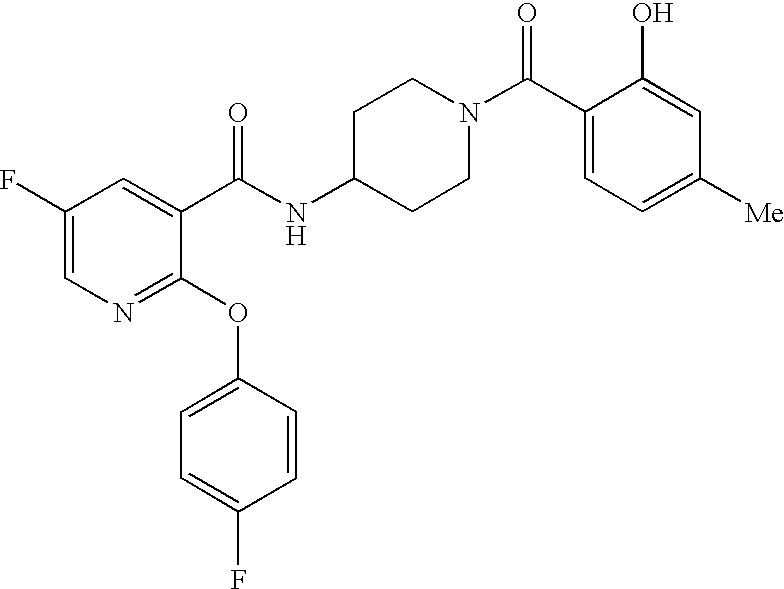

were prepared by a similar method to that of Example 79 using the appropriate carboxylic acid as the starting material.
| TABLE 6 | ||
| Starting Material | ||
| Example No. | Prep No. | R |
| 80 | 29 |
 |
| 81 | 29 |
 |
| 82 | 29 |
 |
| 83 | 29 |
 |
| 84 | 29 |
 |
| 85 | 29 |
 |
| 86 | 29 |
 |
| 87 | 29 |
 |
| 88 | 29 |
 |
| 89 | 29 |
 |
| 90 | 29 |
 |
| 91 | 29 |
 |


were prepared by a similar method to that of Example 92 using the appropriate amine and carboxylic acid as the starting material.
| TABLE 7 | |||
| Starting Amine | Stereochem. | ||
| Example No. | Prep No. | of Ring | R |
| 931,2 | 35 | exo |
 |
| 941,3 | 35 | exo |
 |
| 951 | 37 | exo |
 |
| 961 | 37 | exo |
 |
| 97 | 37 | exo |
 |
| 98 | 37 | exo |
 |
| 1The eluent for flash column chromatography was dichloromethane:methanol (100:0 changing to 98:2, by volume). | |||
| 2The compound was slurried in 20% ethyl acetate in pentane after chromatography, and was filterd, washed with pentane and dried in vacuo to give the desired product. | |||
| 3The compound was triturated with diethylether after chromatography to give the desired product. | |||


were prepared by a similar method to that of example 101 using the amine of Preparation 22 and the appropriate carboxylic acid.
| TABLE 8 | |||
| Example N° | R group | ||
| 1021 |
 |
||
| 1032 |
 |
||
| 1042 |
 |
||
| 1052 |
 |
||
| 1062 |
 |
||
| 1072 |
 |
||
| 1082,4 |
 |
||
| 1092 |
 |
||
| 110 |
 |
||
| 111 |
 |
||
| 112 |
 |
||
| 113 |
 |
||
| 114 |
 |
||
| 115 |
 |
||
| 116 |
 |
||
| 117 |
 |
||
| 118 |
 |
||
| 119 |
 |
||
| 120 |
 |
||
| 1213 |
 |
||
| 122 |
 |
||
| 123 |
 |
||
| 124 |
 |
||
| 125 |
 |
||
| 1Purification by chromatography using a gradient from 95:5:0.5 to 90:10:0.5 ethyl acetate: methanol: ammonium hydroxide solution, then 95:5:0.5 dichloromethane: methanol: ammonium hydroxide solution. | |||
| 2Triethylamine was replaced with N-methylmorpholine. | |||
| Aqueous solutions were further extracted four times with dichloromethane (5 ml) | |||
| Purification by chromatography on silica gel used 99:1:01 dichloromethane: methanol: ammonium hydroxide solution, then 97:3:0.1 dichloromethane: methanol: ammonium hydroxide solution | |||
| 3The compound was pre-adsorbed onto silica gel prior to purification by chromatography on silica gel using 1% methanol in dichloromethane. | |||
| 4After stirring 18 hours L-mandelic acid (10 mg, 0.065 mmol) was added and the mixture left to stir 24 hours | |||


were prepared by a similar method to that of example 127 using the appropriate ester from the compounds of table 8.
| TABLE 9 | |||
| Example N° | R group | ||
| 128 |
 |
||
| 129 |
 |
||
| 130 |
 |
||
| 131 |
 |
||
| 132 |
 |
||
| 133 |
 |
||
| 134 |
 |
||
| 135 |
 |
||
| 136 |
 |
||
| 137 |
 |
||


were prepared by a similar method to that of example 152 using 2-chloro-N-[4-(2-hydroxy-4-methoxy-benzoylamino)-cyclohexyl]-nicotinamide (see Preparation 45) and the appropriate phenol.
| TABLE 10 | |||
| Example N° | R group | ||
| 153 |
 |
||
| 154 |
 |
||
| 155 |
 |
||
| 156 |
 |
||
| 157 |
 |
||
| 158 |
 |
||
| 159 |
 |
||


were prepared by a similar method to that of example 165 using the same carbamoyl chloride and the appropriate amine.
| TABLE 12 | |||
| Example N+ | R group | ||
| 1661 |
 |
||
| 1672 |
 |
||
| 1For the amine, see reference Tet. Lett. 1995, 36(8), 1279 | |||
| 2For the amine, see reference DE 2552423 | |||


were prepared by a similar method to that of example 175 using the amine of preparation 64 and the appropriate carboxylic acid.
| TABLE 13 | |||
| Example N° | R | ||
| 176 |
 |
||
| 177 |
 |
||
| 178 |
 |
||
| 179 |
 |
||
| 180 |
 |
||
| 181 |
 |
||
| 182 |
 |
||
| 183 |
 |
||
| 184 |
 |
||
| 185 |
 |
||
| 186A |
 |
||
| 187A |
 |
||
| 188A |
 |
||
| 189A |
 |
||
| 190A |
 |
||
| 191A |
 |
||
| 192A |
 |
||
| 193AB |
 |
||
| 194AC |
 |
||
| ADiisopropylethylamine was used as the base | |||
| BSee reference Chem. And Pharm. Bull, 1996, 44(4), 734 for the starting carboxylic acid. | |||
| CSee reference Synthesis 1984, (9), 758 for the starting carboxylic acid. | |||


were prepared by a similar method to that of example 195 using the appropriate aryl chloride and phenol.
| TABLE 14 | ||
| Example N° | R | R′ |
| 196 |
 |
 |
| 197 |
 |
 |
| 198 |
 |
 |
| 199 |
 |
 |
| 200 |
 |
 |
| 201 |
 |
 |
| 202 |
 |
 |
| 203 |
 |
 |
| 204A |
 |
 |
| 205A |
 |
 |
| 206A |
 |
 |
| 207A |
 |
 |
| 208A |
 |
 |
| 209AB |
 |
 |
| 210AB |
 |
 |
| 211AB |
 |
 |
| 212AB |
 |
 |
| 213AB |
 |
 |
| 214AB |
 |
 |
| 215AB |
 |
 |
| AAcetonitrile was used as solvent | ||
| BPurified by chromatography on silica gel using ethyl acetate in cyclohexane as eluant | ||


were prepared by a similar method to that of example 216 using syn-N-(4-Amino-cyclohexyl)-2-hydroxy-4-methyl-benzamide hydrochloride (see preparation 66) and the appropriate carboxylic acid.
| TABLE 15 | |||
| Example N° | R Group | ||
| 217 |
 |
||
| 218 |
 |
||


| Example N° | IC50 (nM) | Example N° | IC50 (nM) | ||
| 6 | 23.5 | 8 | 22 | ||
| 14 | 13 | 16 | 0.28 | ||
| 17 | 8.5 | 20 | 113 | ||
| 22 | 156 | 23 | 7.8 | ||
| 25 | 8.5 | 26 | 5.4 | ||
| 27 | 39.5 | 28 | 217 | ||
| 30 | 2.6 | 41 | 4.9 | ||
| 44 | 91 | 47 | 0.28 | ||
| 48 | 1.66 | 51 | 2.09 | ||
| 54 | 2.8 | 56 | 1.9 | ||
| 57 | 13 | 58 | 3.5 | ||
| 66 | 18.3 | 69 | 49 | ||
| 72 | 1.1 | 76 | 49 | ||
| 79 | 25.5 | 80 | 7.4 | ||
| 81 | 30 | 85 | 28 | ||
| 88 | 114 | 91 | 37 | ||
| 92 | 185 | 93 | 5 | ||
| 95 | 3.2 | 97 | 30 | ||
| 100 | 56 | 106 | 3.6 | ||
| 110 | 14 | 116 | 25 | ||
| 123 | 21 | 129 | 30 | ||
| 135 | 74 | 137 | 16 | ||
| 152 | 0.2 | 12 | 1 | ||
| 155 | 0.09 | 156 | 0.14 | ||
| 157 | 2 | 159 | 4.6 | ||
| 172 | 4.3 | 173 | 2.1 | ||
| 174 | 0.014 | 178 | 0.15 | ||
| 183 | 0.07 | 186 | 0.2 | ||
| 187 | 0.006 | 190 | 0.06 | ||
| 193 | 9 | 194 | 0.07 | ||
| 195 | 0.4 | 197 | 1.8 | ||
| 199 | 0.7 | 200 | 0.05 | ||
| 201 | 0.3 | 203 | 7 | ||
| 204 | 0.3 | 205 | 0.55 | ||
| 208 | 0.09 | 210 | 13 | ||
| 213 | 0.2 | 217 | 0.3 | ||
- 1. Thompson J W, Teraski W L, Epstein P M, Strada S J., “Assay of nucleotidephosphodiesterase and resolution of multiple molecular forms of the isoenzyme”, Advances in cyclic nucleotides research, edited by Brooker G, Greengard P, Robinson G A. Raven Press, New York 1979, 10, p. 69-92.
- 2. T, Kurita C, Nagao T, Usami E, Nakao T, Watanabe S, Kobayashi J, Yamazaki F, Tanaka H, Nagai H., “Effects of cAMP-phosphodiesterase isozyme inhibitor on cytokine production by lipopolysaccharide-stimulated human peripheral blood mononuclear cells”, Gen. Pharmacol., 1997, 29(4), p. 63.
Claims (12)

Priority Applications (2)
| Application Number | Priority Date | Filing Date | Title |
|---|---|---|---|
| US10/361,062 US6949573B2 (en) | 2002-02-11 | 2003-02-06 | Nicotinamide derivatives useful as PDE4 inhibitors |
| US10/865,263 US7060717B2 (en) | 2002-02-11 | 2004-06-09 | Nicotinamide derivatives useful as PDE4 inhibitors |
Applications Claiming Priority (13)
| Application Number | Priority Date | Filing Date | Title |
|---|---|---|---|
| GB0203196A GB0203196D0 (en) | 2002-02-11 | 2002-02-11 | Nicotinamide derivatives useful as pde4 inhibitors |
| GB0203196.1 | 2002-02-11 | ||
| US36199102P | 2002-03-05 | 2002-03-05 | |
| GB0220999A GB0220999D0 (en) | 2002-09-10 | 2002-09-10 | Nicotinamide derivatives useful as pde4 inhibitors |
| GB0220999.7 | 2002-09-10 | ||
| US41430402P | 2002-09-26 | 2002-09-26 | |
| GB0224453.1 | 2002-10-21 | ||
| GB0224453A GB0224453D0 (en) | 2002-10-21 | 2002-10-21 | Nicotinamide derivatives useful as PDE4 inhibitors |
| US42547402P | 2002-11-12 | 2002-11-12 | |
| GB0227139.3 | 2002-11-20 | ||
| GB0227139A GB0227139D0 (en) | 2002-11-20 | 2002-11-20 | Nicotinamide derivatives useful as pde4 inhibitors |
| US43333002P | 2002-12-13 | 2002-12-13 | |
| US10/361,062 US6949573B2 (en) | 2002-02-11 | 2003-02-06 | Nicotinamide derivatives useful as PDE4 inhibitors |
Related Child Applications (1)
| Application Number | Title | Priority Date | Filing Date |
|---|---|---|---|
| US10/865,263 Division US7060717B2 (en) | 2002-02-11 | 2004-06-09 | Nicotinamide derivatives useful as PDE4 inhibitors |
Publications (2)
| Publication Number | Publication Date |
|---|---|
| US20030220366A1 US20030220366A1 (en) | 2003-11-27 |
| US6949573B2 true US6949573B2 (en) | 2005-09-27 |
Family
ID=27739229
Family Applications (3)
| Application Number | Title | Priority Date | Filing Date |
|---|---|---|---|
| US10/361,062 Expired - Fee Related US6949573B2 (en) | 2002-02-11 | 2003-02-06 | Nicotinamide derivatives useful as PDE4 inhibitors |
| US10/865,263 Expired - Fee Related US7060717B2 (en) | 2002-02-11 | 2004-06-09 | Nicotinamide derivatives useful as PDE4 inhibitors |
| US11/229,395 Abandoned US20060014780A1 (en) | 2002-02-11 | 2005-09-16 | Nicotinamide derivatives useful as PDE4 inhibitors |
Family Applications After (2)
| Application Number | Title | Priority Date | Filing Date |
|---|---|---|---|
| US10/865,263 Expired - Fee Related US7060717B2 (en) | 2002-02-11 | 2004-06-09 | Nicotinamide derivatives useful as PDE4 inhibitors |
| US11/229,395 Abandoned US20060014780A1 (en) | 2002-02-11 | 2005-09-16 | Nicotinamide derivatives useful as PDE4 inhibitors |
Country Status (33)
| Country | Link |
|---|---|
| US (3) | US6949573B2 (en) |
| EP (1) | EP1476158B1 (en) |
| JP (1) | JP4583761B2 (en) |
| KR (1) | KR100698982B1 (en) |
| CN (1) | CN1652782A (en) |
| AP (1) | AP2004003100A0 (en) |
| AR (1) | AR038834A1 (en) |
| AT (1) | ATE378049T1 (en) |
| AU (1) | AU2003245711A1 (en) |
| BR (1) | BR0307564A (en) |
| CA (1) | CA2475712C (en) |
| DE (1) | DE60317466T2 (en) |
| EA (1) | EA008939B1 (en) |
| EC (1) | ECSP045228A (en) |
| ES (1) | ES2292988T3 (en) |
| GE (1) | GEP20074055B (en) |
| HN (1) | HN2003000064A (en) |
| HR (1) | HRP20040708A2 (en) |
| MA (1) | MA27174A1 (en) |
| MX (1) | MXPA04007737A (en) |
| MY (1) | MY135856A (en) |
| NI (1) | NI200300025A (en) |
| NO (1) | NO20043793L (en) |
| NZ (1) | NZ534197A (en) |
| OA (1) | OA12768A (en) |
| PA (1) | PA8566401A1 (en) |
| PE (1) | PE20030868A1 (en) |
| PL (1) | PL372756A1 (en) |
| RS (1) | RS70104A (en) |
| TN (1) | TNSN04151A1 (en) |
| TW (1) | TW200305419A (en) |
| UY (1) | UY27659A1 (en) |
| WO (1) | WO2003068235A1 (en) |
Cited By (14)
| Publication number | Priority date | Publication date | Assignee | Title |
|---|---|---|---|---|
| US20050186276A1 (en) * | 2003-07-17 | 2005-08-25 | Pfizer Inc | Pharmaceutical formulations |
| US20060014780A1 (en) * | 2002-02-11 | 2006-01-19 | Pfizer Inc | Nicotinamide derivatives useful as PDE4 inhibitors |
| US7678808B2 (en) | 2006-05-09 | 2010-03-16 | Braincells, Inc. | 5 HT receptor mediated neurogenesis |
| EP2218442A1 (en) | 2005-11-09 | 2010-08-18 | CombinatoRx, Inc. | Methods, compositions, and kits for the treatment of ophthalmic disorders |
| WO2010099217A1 (en) | 2009-02-25 | 2010-09-02 | Braincells, Inc. | Modulation of neurogenesis using d-cycloserine combinations |
| EP2258357A2 (en) | 2005-08-26 | 2010-12-08 | Braincells, Inc. | Neurogenesis with acetylcholinesterase inhibitor |
| EP2275095A2 (en) | 2005-08-26 | 2011-01-19 | Braincells, Inc. | Neurogenesis by muscarinic receptor modulation |
| EP2314289A1 (en) | 2005-10-31 | 2011-04-27 | Braincells, Inc. | Gaba receptor mediated modulation of neurogenesis |
| WO2011063115A1 (en) | 2009-11-19 | 2011-05-26 | Braincells Inc. | Combination of nootropic agent with one or more neurogenic or neurogenic sensitizing agents for stimulating or increasing neurogenesis |
| US7985756B2 (en) | 2005-10-21 | 2011-07-26 | Braincells Inc. | Modulation of neurogenesis by PDE inhibition |
| WO2011091033A1 (en) | 2010-01-20 | 2011-07-28 | Braincells, Inc. | Modulation of neurogenesis by ppar agents |
| US7998971B2 (en) | 2006-09-08 | 2011-08-16 | Braincells Inc. | Combinations containing a 4-acylaminopyridine derivative |
| EP2377531A2 (en) | 2006-05-09 | 2011-10-19 | Braincells, Inc. | Neurogenesis by modulating angiotensin |
| WO2013106547A1 (en) | 2012-01-10 | 2013-07-18 | President And Fellows Of Harvard College | Beta-cell replication promoting compounds and methods of their use |
Families Citing this family (29)
| Publication number | Priority date | Publication date | Assignee | Title |
|---|---|---|---|---|
| US7105682B2 (en) | 2001-01-12 | 2006-09-12 | Amgen Inc. | Substituted amine derivatives and methods of use |
| US6878714B2 (en) | 2001-01-12 | 2005-04-12 | Amgen Inc. | Substituted alkylamine derivatives and methods of use |
| US6995162B2 (en) | 2001-01-12 | 2006-02-07 | Amgen Inc. | Substituted alkylamine derivatives and methods of use |
| US7102009B2 (en) | 2001-01-12 | 2006-09-05 | Amgen Inc. | Substituted amine derivatives and methods of use |
| US7307088B2 (en) | 2002-07-09 | 2007-12-11 | Amgen Inc. | Substituted anthranilic amide derivatives and methods of use |
| GB0317472D0 (en) * | 2003-07-25 | 2003-08-27 | Pfizer Ltd | Nicotinamide derivatives useful as PDE4 inhibitors |
| GB0317516D0 (en) | 2003-07-25 | 2003-08-27 | Pfizer Ltd | Nicotinamide derivatives useful as PDE4 inhibitors |
| GB0317471D0 (en) * | 2003-07-25 | 2003-08-27 | Pfizer Ltd | Novel compounds |
| GB0317482D0 (en) * | 2003-07-25 | 2003-08-27 | Pfizer Ltd | Nicotinamide derivatives useful as pde4 inhibitors |
| US7132435B2 (en) | 2003-07-25 | 2006-11-07 | Pfizer Inc. | Compounds |
| GB0317509D0 (en) * | 2003-07-25 | 2003-08-27 | Pfizer Ltd | Nicotinamide derivatives useful as PDE4 inhibitors |
| US7153870B2 (en) | 2003-07-25 | 2006-12-26 | Pfizer Inc. | Nicotinamide derivatives useful as PDE4 inhibitors |
| GB0317484D0 (en) * | 2003-07-25 | 2003-08-27 | Pfizer Ltd | Nicotinamide derivatives useful as pde4 inhibitors |
| US7378409B2 (en) | 2003-08-21 | 2008-05-27 | Bristol-Myers Squibb Company | Substituted cycloalkylamine derivatives as modulators of chemokine receptor activity |
| US20050142104A1 (en) * | 2003-11-06 | 2005-06-30 | Zeldis Jerome B. | Methods of using and compositions comprising PDE4 modulators for the treatment and management of asbestos-related diseases and disorders |
| PE20060272A1 (en) * | 2004-05-24 | 2006-05-22 | Glaxo Group Ltd | (2R, 3R, 4S, 5R, 2'R, 3'R, 4'S, 5'S) -2.2 '- {TRANS-1,4-CYCLOHEXANODIYLBIS- [IMINO (2 - {[2- (1-METHYL- 1H-IMIDAZOL-4-IL) ETHYL] AMINO} -9H-PURIN-6,9-DIYL)]} BIS [5- (2-ETHYL-2H-TETRAZOLE-5-IL) TETRAHYDRO-3,4-FURANODIOL] AS AN A2A AGONIST |
| TWI339578B (en) | 2004-10-29 | 2011-04-01 | Mitsubishi Tanabe Pharma Corp | Use of a pyridine compound for the preparation of a medicament for the treatment of skin lesions |
| WO2006106711A1 (en) * | 2005-03-30 | 2006-10-12 | Eisai R & D Management Co., Ltd. | Antifungal agent containing pyridine derivative |
| GB0514809D0 (en) | 2005-07-19 | 2005-08-24 | Glaxo Group Ltd | Compounds |
| ES2393117T3 (en) | 2005-09-12 | 2012-12-18 | Actelion Pharmaceuticals Ltd. | Stable pharmaceutical composition comprising a pyrimidine sulfamide |
| US8247556B2 (en) | 2005-10-21 | 2012-08-21 | Amgen Inc. | Method for preparing 6-substituted-7-aza-indoles |
| TWI385169B (en) | 2005-10-31 | 2013-02-11 | Eisai R&D Man Co Ltd | Heterocyclic substituted pyridine derivatives and antifungal agent containing same |
| US8513287B2 (en) | 2007-12-27 | 2013-08-20 | Eisai R&D Management Co., Ltd. | Heterocyclic ring and phosphonoxymethyl group substituted pyridine derivatives and antifungal agent containing same |
| PT2297106E (en) * | 2008-05-27 | 2014-09-29 | Astrazeneca Ab | Phenoxypyridinylamide derivatives and their use in the treatment of pde4 mediated disease states |
| US8697691B2 (en) * | 2009-12-21 | 2014-04-15 | Vanderbilt University | Alkyl 3-((2-amidoethyl)amino)-8-azabicyclo[3.2.1]octane-8-carboxylate analogs as selective M1 agonists and methods of making and using same |
| WO2015020013A1 (en) * | 2013-08-08 | 2015-02-12 | 日本電気株式会社 | Negative electrode for secondary cell, method for manufacturing same, and secondary cell using same |
| SG11202100130QA (en) | 2018-07-09 | 2021-02-25 | Lieber Institute Inc | Pyridine carboxamide compounds for inhibiting nav1.8 |
| CN109674808A (en) * | 2019-01-30 | 2019-04-26 | 四川大学 | β-nicotinamide mononucleotide or its precursor are preparing the purposes delayed in lung senescence drug |
| CN114656372B (en) * | 2020-09-14 | 2024-06-18 | 广州药本君安医药科技股份有限公司 | P-phenylenediamine bridging compound and application thereof in preparation of medicines for treating sugar metabolism disorder diseases |
Citations (5)
| Publication number | Priority date | Publication date | Assignee | Title |
|---|---|---|---|---|
| WO1991011172A1 (en) | 1990-01-23 | 1991-08-08 | The University Of Kansas | Derivatives of cyclodextrins exhibiting enhanced aqueous solubility and the use thereof |
| WO1994002518A1 (en) | 1992-07-27 | 1994-02-03 | The University Of Kansas | Derivatives of cyclodextrins exhibiting enhanced aqueous solubility and the use thereof |
| WO1998045268A1 (en) | 1997-04-04 | 1998-10-15 | Pfizer Products Inc. | Nicotinamide derivatives |
| WO1998055148A1 (en) | 1997-06-05 | 1998-12-10 | Janssen Pharmaceutica N.V. | Pharmaceutical compositions comprising cyclodextrins |
| WO2001057036A1 (en) | 2000-01-31 | 2001-08-09 | Pfizer Products Inc. | Nicotinamide benzofused-heterocyclyl derivatives useful as selective inhibitors of pde4 isozymes |
Family Cites Families (5)
| Publication number | Priority date | Publication date | Assignee | Title |
|---|---|---|---|---|
| GB9924092D0 (en) * | 1999-10-13 | 1999-12-15 | Zeneca Ltd | Pyrimidine derivatives |
| MXPA04007737A (en) * | 2002-02-11 | 2004-10-15 | Pfizer | Nicotinamide derivatives useful as pde4 inhibitors. |
| AU2003201745A1 (en) | 2002-02-11 | 2003-09-04 | Pfizer Limited | Nicotinamide derivatives and a tiotropium salt in combination for the treatment of e.g. inflammatory, allergic and respiratory diseases |
| GB0203193D0 (en) | 2002-02-11 | 2002-03-27 | Pfizer Ltd | Nicotinamide derivatives useful as pde4 inhibitors |
| GB0317516D0 (en) * | 2003-07-25 | 2003-08-27 | Pfizer Ltd | Nicotinamide derivatives useful as PDE4 inhibitors |
-
2003
- 2003-02-03 MX MXPA04007737A patent/MXPA04007737A/en unknown
- 2003-02-03 RS YUP70104 patent/RS70104A/en unknown
- 2003-02-03 EA EA200400892A patent/EA008939B1/en unknown
- 2003-02-03 KR KR20047012338A patent/KR100698982B1/en not_active Expired - Fee Related
- 2003-02-03 WO PCT/IB2003/000439 patent/WO2003068235A1/en not_active Ceased
- 2003-02-03 EP EP20030739392 patent/EP1476158B1/en not_active Expired - Lifetime
- 2003-02-03 NZ NZ534197A patent/NZ534197A/en unknown
- 2003-02-03 OA OA1200400207A patent/OA12768A/en unknown
- 2003-02-03 JP JP2003567417A patent/JP4583761B2/en not_active Expired - Fee Related
- 2003-02-03 HR HR20040708A patent/HRP20040708A2/en not_active Application Discontinuation
- 2003-02-03 PL PL37275603A patent/PL372756A1/en not_active Application Discontinuation
- 2003-02-03 ES ES03739392T patent/ES2292988T3/en not_active Expired - Lifetime
- 2003-02-03 AT AT03739392T patent/ATE378049T1/en not_active IP Right Cessation
- 2003-02-03 DE DE2003617466 patent/DE60317466T2/en not_active Expired - Lifetime
- 2003-02-03 AP APAP/P/2004/003100A patent/AP2004003100A0/en unknown
- 2003-02-03 GE GEAU2003008356 patent/GEP20074055B/en unknown
- 2003-02-03 CA CA 2475712 patent/CA2475712C/en not_active Expired - Fee Related
- 2003-02-03 AU AU2003245711A patent/AU2003245711A1/en not_active Abandoned
- 2003-02-03 BR BR0307564A patent/BR0307564A/en not_active IP Right Cessation
- 2003-02-03 CN CNA038081865A patent/CN1652782A/en active Pending
- 2003-02-06 TW TW92102408A patent/TW200305419A/en unknown
- 2003-02-06 US US10/361,062 patent/US6949573B2/en not_active Expired - Fee Related
- 2003-02-10 NI NI200300025A patent/NI200300025A/en unknown
- 2003-02-10 MY MYPI20030450 patent/MY135856A/en unknown
- 2003-02-10 HN HN2003000064A patent/HN2003000064A/en unknown
- 2003-02-10 AR ARP030100404 patent/AR038834A1/en unknown
- 2003-02-11 PA PA8566401A patent/PA8566401A1/en unknown
- 2003-02-11 PE PE2003000151A patent/PE20030868A1/en not_active Application Discontinuation
- 2003-02-11 UY UY27659A patent/UY27659A1/en not_active Application Discontinuation
-
2004
- 2004-06-09 US US10/865,263 patent/US7060717B2/en not_active Expired - Fee Related
- 2004-08-03 MA MA27808A patent/MA27174A1/en unknown
- 2004-08-10 TN TNP2004000151A patent/TNSN04151A1/en unknown
- 2004-08-11 EC ECSP045228 patent/ECSP045228A/en unknown
- 2004-09-10 NO NO20043793A patent/NO20043793L/en not_active Application Discontinuation
-
2005
- 2005-09-16 US US11/229,395 patent/US20060014780A1/en not_active Abandoned
Patent Citations (5)
| Publication number | Priority date | Publication date | Assignee | Title |
|---|---|---|---|---|
| WO1991011172A1 (en) | 1990-01-23 | 1991-08-08 | The University Of Kansas | Derivatives of cyclodextrins exhibiting enhanced aqueous solubility and the use thereof |
| WO1994002518A1 (en) | 1992-07-27 | 1994-02-03 | The University Of Kansas | Derivatives of cyclodextrins exhibiting enhanced aqueous solubility and the use thereof |
| WO1998045268A1 (en) | 1997-04-04 | 1998-10-15 | Pfizer Products Inc. | Nicotinamide derivatives |
| WO1998055148A1 (en) | 1997-06-05 | 1998-12-10 | Janssen Pharmaceutica N.V. | Pharmaceutical compositions comprising cyclodextrins |
| WO2001057036A1 (en) | 2000-01-31 | 2001-08-09 | Pfizer Products Inc. | Nicotinamide benzofused-heterocyclyl derivatives useful as selective inhibitors of pde4 isozymes |
Non-Patent Citations (9)
| Title |
|---|
| Banner and Page, Br. J. Pharmacol., 1995, 114, p. 93-98. |
| Barnette et al., J. Pharmacol. Exp. Ther., 1995, 273, p. 674-679. |
| Berge et al., J. Pharm. Sci, 66, 1-19, 1997. |
| Duplantier et al., J. Med. Chem., 1996, 39, p. 120-125. |
| Manabe et al., Eur. J. Pharmacol., 1997, 332, p. 97-107. |
| Schneider et al., Pharmacol. Biochem. Behav., 1995, 50, p. 211-217. |
| Torphy et al., Environ. Health Eprspect., 1994, 102, Suppl. 10, p. 79-84. |
| Ukita et al.., J. Med. Chem., 1999, 42, p. 1088-1099. |
| Wright et al., Can. J. Physiol. Pharmacol., 1997, 75, p. 1001-1008. |
Cited By (19)
| Publication number | Priority date | Publication date | Assignee | Title |
|---|---|---|---|---|
| US20060014780A1 (en) * | 2002-02-11 | 2006-01-19 | Pfizer Inc | Nicotinamide derivatives useful as PDE4 inhibitors |
| US20050186276A1 (en) * | 2003-07-17 | 2005-08-25 | Pfizer Inc | Pharmaceutical formulations |
| EP2258359A2 (en) | 2005-08-26 | 2010-12-08 | Braincells, Inc. | Neurogenesis by muscarinic receptor modulation with sabcomelin |
| EP2275096A2 (en) | 2005-08-26 | 2011-01-19 | Braincells, Inc. | Neurogenesis via modulation of the muscarinic receptors |
| EP2275095A2 (en) | 2005-08-26 | 2011-01-19 | Braincells, Inc. | Neurogenesis by muscarinic receptor modulation |
| EP2258357A2 (en) | 2005-08-26 | 2010-12-08 | Braincells, Inc. | Neurogenesis with acetylcholinesterase inhibitor |
| EP2258358A2 (en) | 2005-08-26 | 2010-12-08 | Braincells, Inc. | Neurogenesis with acetylcholinesterase inhibitor |
| US7985756B2 (en) | 2005-10-21 | 2011-07-26 | Braincells Inc. | Modulation of neurogenesis by PDE inhibition |
| EP2377530A2 (en) | 2005-10-21 | 2011-10-19 | Braincells, Inc. | Modulation of neurogenesis by PDE inhibition |
| EP2314289A1 (en) | 2005-10-31 | 2011-04-27 | Braincells, Inc. | Gaba receptor mediated modulation of neurogenesis |
| EP2218442A1 (en) | 2005-11-09 | 2010-08-18 | CombinatoRx, Inc. | Methods, compositions, and kits for the treatment of ophthalmic disorders |
| US7678808B2 (en) | 2006-05-09 | 2010-03-16 | Braincells, Inc. | 5 HT receptor mediated neurogenesis |
| EP2377531A2 (en) | 2006-05-09 | 2011-10-19 | Braincells, Inc. | Neurogenesis by modulating angiotensin |
| EP2382975A2 (en) | 2006-05-09 | 2011-11-02 | Braincells, Inc. | Neurogenesis by modulating angiotensin |
| US7998971B2 (en) | 2006-09-08 | 2011-08-16 | Braincells Inc. | Combinations containing a 4-acylaminopyridine derivative |
| WO2010099217A1 (en) | 2009-02-25 | 2010-09-02 | Braincells, Inc. | Modulation of neurogenesis using d-cycloserine combinations |
| WO2011063115A1 (en) | 2009-11-19 | 2011-05-26 | Braincells Inc. | Combination of nootropic agent with one or more neurogenic or neurogenic sensitizing agents for stimulating or increasing neurogenesis |
| WO2011091033A1 (en) | 2010-01-20 | 2011-07-28 | Braincells, Inc. | Modulation of neurogenesis by ppar agents |
| WO2013106547A1 (en) | 2012-01-10 | 2013-07-18 | President And Fellows Of Harvard College | Beta-cell replication promoting compounds and methods of their use |
Also Published As
Similar Documents
| Publication | Publication Date | Title |
|---|---|---|
| CA2475712C (en) | Nicotinamide derivatives useful as pde4 inhibitors | |
| US20030220361A1 (en) | Nicotinamide derivatives and a tiotropium salt in combination for the treatment of diseases | |
| WO2003068232A1 (en) | Nicotinamide derivatives useful as pde4 inhibitors | |
| US6756392B2 (en) | Nicotinamide derivatives useful as PDE4 inhibitors | |
| US7056934B2 (en) | Nicotinamide derivatives useful as PDE4 inhibitors | |
| US20060178408A1 (en) | Nicotinamide derivatives useful as pde4 inhibitors | |
| US20030191158A1 (en) | Nicotinamide derivatives and a tiotropium salt in combination for the treatment of diseases | |
| US20050032838A1 (en) | Nicotinamide derivatives useful as PDE4 inhibitors | |
| US20050020587A1 (en) | Nicotinamide derivatives useful as PDE4 inhibitors | |
| US20070066645A1 (en) | Novel compounds | |
| US20050026952A1 (en) | Nicotinamide derivatives useful as PDE4 inhibitors | |
| WO2005009438A1 (en) | Nicotinamide compounds useful as pde4 inhibitors | |
| JP2006528659A (en) | Nicotinamide derivatives useful as PDE4 inhibitors |
Legal Events
| Date | Code | Title | Description |
|---|---|---|---|
| AS | Assignment |
Owner name: PFIZER INC., NEW YORK Free format text: ASSIGNMENT OF ASSIGNORS INTEREST;ASSIGNORS:BAILEY, SIMON;GAUTIER, ELISABETH COLETTE LOUISE;HENDERSON, ALAN JOHN;AND OTHERS;REEL/FRAME:014057/0330;SIGNING DATES FROM 20030310 TO 20030417 Owner name: PFIZER INC., NEW YORK Free format text: CONSENT;ASSIGNOR:PFIZER LIMITED;REEL/FRAME:014047/0484 Effective date: 20030430 |
|
| FEPP | Fee payment procedure |
Free format text: PAYOR NUMBER ASSIGNED (ORIGINAL EVENT CODE: ASPN); ENTITY STATUS OF PATENT OWNER: LARGE ENTITY |
|
| FPAY | Fee payment |
Year of fee payment: 4 |
|
| REMI | Maintenance fee reminder mailed | ||
| FPAY | Fee payment |
Year of fee payment: 8 |
|
| SULP | Surcharge for late payment |
Year of fee payment: 7 |
|
| REMI | Maintenance fee reminder mailed | ||
| LAPS | Lapse for failure to pay maintenance fees |
Free format text: PATENT EXPIRED FOR FAILURE TO PAY MAINTENANCE FEES (ORIGINAL EVENT CODE: EXP.) |
|
| STCH | Information on status: patent discontinuation |
Free format text: PATENT EXPIRED DUE TO NONPAYMENT OF MAINTENANCE FEES UNDER 37 CFR 1.362 |
|
| FP | Lapsed due to failure to pay maintenance fee |
Effective date: 20170927 |