US6936463B1 - Method and device for making different thickness of biofilms - Google Patents
Method and device for making different thickness of biofilms Download PDFInfo
- Publication number
- US6936463B1 US6936463B1 US10/820,802 US82080204A US6936463B1 US 6936463 B1 US6936463 B1 US 6936463B1 US 82080204 A US82080204 A US 82080204A US 6936463 B1 US6936463 B1 US 6936463B1
- Authority
- US
- United States
- Prior art keywords
- biofilms
- thickness
- biofilm
- different
- dish
- Prior art date
- Legal status (The legal status is an assumption and is not a legal conclusion. Google has not performed a legal analysis and makes no representation as to the accuracy of the status listed.)
- Expired - Lifetime
Links
- 238000000034 method Methods 0.000 title abstract description 12
- 241000894006 Bacteria Species 0.000 claims description 2
- 239000011521 glass Substances 0.000 claims description 2
- 239000002184 metal Substances 0.000 claims description 2
- 239000004033 plastic Substances 0.000 claims description 2
- 241000186046 Actinomyces Species 0.000 claims 1
- 241000233866 Fungi Species 0.000 claims 1
- 239000000203 mixture Substances 0.000 claims 1
- 239000000463 material Substances 0.000 abstract description 9
- 230000000694 effects Effects 0.000 abstract description 8
- 238000005260 corrosion Methods 0.000 abstract description 7
- 230000007797 corrosion Effects 0.000 abstract description 7
- 238000012360 testing method Methods 0.000 abstract description 5
- 239000003139 biocide Substances 0.000 description 16
- 230000003115 biocidal effect Effects 0.000 description 9
- 229920001817 Agar Polymers 0.000 description 7
- 239000008272 agar Substances 0.000 description 7
- 230000002906 microbiologic effect Effects 0.000 description 5
- 239000000446 fuel Substances 0.000 description 4
- 239000003242 anti bacterial agent Substances 0.000 description 3
- 229940088710 antibiotic agent Drugs 0.000 description 3
- 238000011156 evaluation Methods 0.000 description 3
- 238000004458 analytical method Methods 0.000 description 2
- 239000012620 biological material Substances 0.000 description 2
- 239000007788 liquid Substances 0.000 description 2
- 238000004519 manufacturing process Methods 0.000 description 2
- 238000011169 microbiological contamination Methods 0.000 description 2
- 230000000149 penetrating effect Effects 0.000 description 2
- 238000012545 processing Methods 0.000 description 2
- 239000000956 alloy Substances 0.000 description 1
- 229910045601 alloy Inorganic materials 0.000 description 1
- 238000003556 assay Methods 0.000 description 1
- 230000004888 barrier function Effects 0.000 description 1
- 239000003795 chemical substances by application Substances 0.000 description 1
- 239000000356 contaminant Substances 0.000 description 1
- 230000008021 deposition Effects 0.000 description 1
- 230000006866 deterioration Effects 0.000 description 1
- 238000002474 experimental method Methods 0.000 description 1
- 239000002828 fuel tank Substances 0.000 description 1
- 239000001963 growth medium Substances 0.000 description 1
- 230000006872 improvement Effects 0.000 description 1
- 230000002401 inhibitory effect Effects 0.000 description 1
- 230000003993 interaction Effects 0.000 description 1
- 230000001788 irregular Effects 0.000 description 1
- 239000012567 medical material Substances 0.000 description 1
- 230000004060 metabolic process Effects 0.000 description 1
- 244000005700 microbiome Species 0.000 description 1
- 238000003825 pressing Methods 0.000 description 1
- 238000003908 quality control method Methods 0.000 description 1
- 238000011160 research Methods 0.000 description 1
- 238000012552 review Methods 0.000 description 1
- 239000005060 rubber Substances 0.000 description 1
- 239000007787 solid Substances 0.000 description 1
- 230000003068 static effect Effects 0.000 description 1
- 239000008223 sterile water Substances 0.000 description 1
- 239000000725 suspension Substances 0.000 description 1
- 239000002351 wastewater Substances 0.000 description 1
- XLYOFNOQVPJJNP-UHFFFAOYSA-N water Chemical compound O XLYOFNOQVPJJNP-UHFFFAOYSA-N 0.000 description 1
Images



Classifications
-
- C—CHEMISTRY; METALLURGY
- C12—BIOCHEMISTRY; BEER; SPIRITS; WINE; VINEGAR; MICROBIOLOGY; ENZYMOLOGY; MUTATION OR GENETIC ENGINEERING
- C12M—APPARATUS FOR ENZYMOLOGY OR MICROBIOLOGY; APPARATUS FOR CULTURING MICROORGANISMS FOR PRODUCING BIOMASS, FOR GROWING CELLS OR FOR OBTAINING FERMENTATION OR METABOLIC PRODUCTS, i.e. BIOREACTORS OR FERMENTERS
- C12M23/00—Constructional details, e.g. recesses, hinges
- C12M23/02—Form or structure of the vessel
- C12M23/04—Flat or tray type, drawers
-
- C—CHEMISTRY; METALLURGY
- C12—BIOCHEMISTRY; BEER; SPIRITS; WINE; VINEGAR; MICROBIOLOGY; ENZYMOLOGY; MUTATION OR GENETIC ENGINEERING
- C12M—APPARATUS FOR ENZYMOLOGY OR MICROBIOLOGY; APPARATUS FOR CULTURING MICROORGANISMS FOR PRODUCING BIOMASS, FOR GROWING CELLS OR FOR OBTAINING FERMENTATION OR METABOLIC PRODUCTS, i.e. BIOREACTORS OR FERMENTERS
- C12M23/00—Constructional details, e.g. recesses, hinges
- C12M23/02—Form or structure of the vessel
- C12M23/10—Petri dish
-
- C—CHEMISTRY; METALLURGY
- C12—BIOCHEMISTRY; BEER; SPIRITS; WINE; VINEGAR; MICROBIOLOGY; ENZYMOLOGY; MUTATION OR GENETIC ENGINEERING
- C12M—APPARATUS FOR ENZYMOLOGY OR MICROBIOLOGY; APPARATUS FOR CULTURING MICROORGANISMS FOR PRODUCING BIOMASS, FOR GROWING CELLS OR FOR OBTAINING FERMENTATION OR METABOLIC PRODUCTS, i.e. BIOREACTORS OR FERMENTERS
- C12M23/00—Constructional details, e.g. recesses, hinges
- C12M23/20—Material Coatings
-
- C—CHEMISTRY; METALLURGY
- C12—BIOCHEMISTRY; BEER; SPIRITS; WINE; VINEGAR; MICROBIOLOGY; ENZYMOLOGY; MUTATION OR GENETIC ENGINEERING
- C12M—APPARATUS FOR ENZYMOLOGY OR MICROBIOLOGY; APPARATUS FOR CULTURING MICROORGANISMS FOR PRODUCING BIOMASS, FOR GROWING CELLS OR FOR OBTAINING FERMENTATION OR METABOLIC PRODUCTS, i.e. BIOREACTORS OR FERMENTERS
- C12M23/00—Constructional details, e.g. recesses, hinges
- C12M23/44—Multiple separable units; Modules
-
- C—CHEMISTRY; METALLURGY
- C12—BIOCHEMISTRY; BEER; SPIRITS; WINE; VINEGAR; MICROBIOLOGY; ENZYMOLOGY; MUTATION OR GENETIC ENGINEERING
- C12M—APPARATUS FOR ENZYMOLOGY OR MICROBIOLOGY; APPARATUS FOR CULTURING MICROORGANISMS FOR PRODUCING BIOMASS, FOR GROWING CELLS OR FOR OBTAINING FERMENTATION OR METABOLIC PRODUCTS, i.e. BIOREACTORS OR FERMENTERS
- C12M25/00—Means for supporting, enclosing or fixing the microorganisms, e.g. immunocoatings
- C12M25/06—Plates; Walls; Drawers; Multilayer plates
-
- C—CHEMISTRY; METALLURGY
- C12—BIOCHEMISTRY; BEER; SPIRITS; WINE; VINEGAR; MICROBIOLOGY; ENZYMOLOGY; MUTATION OR GENETIC ENGINEERING
- C12M—APPARATUS FOR ENZYMOLOGY OR MICROBIOLOGY; APPARATUS FOR CULTURING MICROORGANISMS FOR PRODUCING BIOMASS, FOR GROWING CELLS OR FOR OBTAINING FERMENTATION OR METABOLIC PRODUCTS, i.e. BIOREACTORS OR FERMENTERS
- C12M23/00—Constructional details, e.g. recesses, hinges
- C12M23/38—Caps; Covers; Plugs; Pouring means
Definitions
- This invention relates to method and device for making different thickness of biofilms and for determining the effect of various biofilms on the adhesion and corrosion of different materials.
- the present invention is an improvement on the making biofilms systems disclosed in our patent U.S. Pat. No. 5,605,836 for MODULAR METHOD AND DEVICE FOR THE EVALUATION OF THE BIOCIDE TO PENETRATE BIOFILM incorporated herein by reference.
- Biofilms caused by various kinds microbiological contamination occur frequently in the conveying system of food processing plants, implantable and insertable medical devices, airplane fuel tanks and pipeline filters, waste water discharge lines of nuclear power plant heat exchangers, pulp and paper industrial processes and so on. Such biofilms not only cause the affected pipelines to narrow, reducing their capacity and wasting energy but also could contribute to corrosion of the pipelines and endanger the entire system.
- biofilms in conveying systems could additionally cause serious quality control problems.
- contaminated equipments and devices could infect patients.
- biofilms In aviation, once biofilms are developed in fuel lines, they could cause deterioration in the quality of the fuel and/or seriously affect air safety by damaging the integrity of the fuel lines by pitting the wall surface of the fuel lines so covered. Needless to say, how to overcome the problems caused by biofilns is a very important and pressing problem.
- This invention relates to a method and device for making different thickness of biofilms and for determining the effect of various biofilms on the adhesion and corrosion of different materials.
- the present invention also provides a means to set up an efficient and effective method to evaluate biocide effectiveness against biofilms based on our device.
- FIG. 1 is an internal view of the biofilm thickness modular device of the present invention.
- FIG. 2 is a side view of the different heights of biofilm thickness module.
- FIG. 3 is a side view of the same height of biofilm thickness module.
- FIG. 4 is a side view of a thickness module for making different thickness of biofilm.
- FIG. 5 is a side view of a clamp for pulling up the thickness module.
- FIG. 6 is a side view of different thickness of biofilm
- FIG. 7 is a side view of the back of thickness module as a cover.
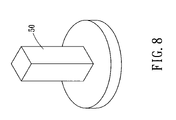
- FIG. 8 is an external view of the small cover.
- FIG. 9 is a side view of the small cover for covering the biofilm.
- FIG. 1 It consists of an interior perspective view of our device.
- the present invention consists of a pentagonal dish cover ( 10 ), a thickness module ( 20 ) and a pentagonal dish bottom ( 30 ).
- On the underside of the thickness module ( 20 ) are a number of protrusions of different heights ( 206 ), ( 207 ), ( 208 ) (see FIG. 2 ) or of the same height ( 209 ) (see FIG. 3 ).
- the heights of these protrusions correspond to the thickness of the biofilm that we wish to create. The best practical cross-section of these protrusions is round.
- the thickness module After one pours agar ( 40 ) into the dish bottom ( 30 ), puts the thickness module ( 20 ) onto the surface of the agar, the thickness module will buoy on the agar and waits for it to set (see FIG. 4 ), then one can pull up the thickness module by a clamp (see FIG. 5 ) and get some different depth of wells that have been cast onto the smooth surface of the agar (see FIG. 6 ). After then, one puts the back of the thickness module as a cover ( 205 ) to cover onto the wells that contains the tested microbes ( 70 ), and places the dish cover ( 10 ) onto the dish bottom ( 30 ) which now contains agar with a smooth surface and a number of desired biofilm depths (see FIG. 7 ).
- the cover can keep the thickness of biofilm is constant. Due to the growth rate of microbes is different, and the surface of biofilm is also different (smooth or irregular surface). It is necessary to use a cover to cover the surface of the biofilm to avoid the interaction as above described.
- FIG. 8 a small cover that is made of different materials, such as plastic, rubber, glass, metal, alloy or implantable medical materials and so on, to test the effect of biofilms on the adhesion and corrosion of these materials base on our device (see FIG. 9 ).
- the present invention also offers a simple way for testing the effect of various biofilms on the adhesion and corrosion of different materials. To prepare the different microbiological entities of the same biofilm thickness, and then puts the small cover which is made of different materials that you want to test onto the surface of biofilm.
Landscapes
- Health & Medical Sciences (AREA)
- Organic Chemistry (AREA)
- Life Sciences & Earth Sciences (AREA)
- Engineering & Computer Science (AREA)
- Bioinformatics & Cheminformatics (AREA)
- Chemical & Material Sciences (AREA)
- Zoology (AREA)
- Wood Science & Technology (AREA)
- Sustainable Development (AREA)
- Microbiology (AREA)
- Biotechnology (AREA)
- Biomedical Technology (AREA)
- Biochemistry (AREA)
- General Engineering & Computer Science (AREA)
- General Health & Medical Sciences (AREA)
- Genetics & Genomics (AREA)
- Clinical Laboratory Science (AREA)
- Immunology (AREA)
- Measuring Or Testing Involving Enzymes Or Micro-Organisms (AREA)
Abstract
A method and device for making different thickness of biofilms is disclosed. It comprises: (a) a pair of pentagonal dish including a dish bottom and a dish cover; (b) an internal thickness module having a number of protrusions of different heights or of the same height The method and device also offers a simple way for testing the effect of various biofilms on the adhesion and corrosion of different materials.
Description
This invention relates to method and device for making different thickness of biofilms and for determining the effect of various biofilms on the adhesion and corrosion of different materials.
The present invention is an improvement on the making biofilms systems disclosed in our patent U.S. Pat. No. 5,605,836 for MODULAR METHOD AND DEVICE FOR THE EVALUATION OF THE BIOCIDE TO PENETRATE BIOFILM incorporated herein by reference.
Biofilms caused by various kinds microbiological contamination occur frequently in the conveying system of food processing plants, implantable and insertable medical devices, airplane fuel tanks and pipeline filters, waste water discharge lines of nuclear power plant heat exchangers, pulp and paper industrial processes and so on. Such biofilms not only cause the affected pipelines to narrow, reducing their capacity and wasting energy but also could contribute to corrosion of the pipelines and endanger the entire system. In food and pulp processing plants, biofilms in conveying systems could additionally cause serious quality control problems. In hospitals, contaminated equipments and devices could infect patients. In aviation, once biofilms are developed in fuel lines, they could cause deterioration in the quality of the fuel and/or seriously affect air safety by damaging the integrity of the fuel lines by pitting the wall surface of the fuel lines so covered. Needless to say, how to overcome the problems caused by biofilns is a very important and pressing problem.
The effectiveness of these various biocides is expressed in terms of MIC—minimal inhibitory concentration. However, MIC is measured against microbiological concentrations in planktonic state only, and is quite irrelevant against microbes that have become sessile. It is not unusual to use biocides in concentrations of several hundred times, even thousand times the MIC to deal with sessile microbiological contamination. The main reason for this is that once biofilms are developed, they tend to act as barriers against the biocide. Indeed, many research results have already indicated that the use of MIC values to indicate biocide effectiveness is misleading, because the MIC values can't represent the actual effect of biocides on microorganisms that have developed biofilm.
In order to truly evaluate the effectiveness of a biocide against both planktonic and sessile microbes, a way must be developed to create biofilms of different thickness in the laboratory. At the present time, many different systems of biofilm reactors are being tested. For example, U.S. Pat. No. 6,361,963 to Smith et al. discloses a method and apparatus for determining the effect of various agents on the growth of biological material, microbially-influenced corrosion and the deposition of organic and inorganic contaminants. U.S. Pat. No. 6,410,256 to Ceri et al. discloses a method of making biofilms. U.S. Pat. No. 6,051,423 to Ceri et al. discloses bacteria are incubated to form a biofilm on projections by providing a flow of liquid growth medium across projections and an assay made of the resulting biofilm. U.S. Pat. No. 5,624,815 to Grant et al., U.S. Pat. No. 5,792,430 to Hamper and U.S. Pat. No. 4,753,775 to Ebersole et al. disclose the biological material in which the liquid sample is drawn over a solid support. McCoy et al. described the Robbins device in the Canadian Journal of Microbiology (1981), volume 27, p. 910 to 917. Ceri et al. described the Calgary biofilm device in the Journal of Clinical Microbiology (1999), volume 37, p. 1771 to 1776.
However, these systems are complicated, costly and time consuming to operate. More particularly, these devices and methods can't to make different thickness of biofilm rapidly.
This invention relates to a method and device for making different thickness of biofilms and for determining the effect of various biofilms on the adhesion and corrosion of different materials.
Its purpose is to provide a quick and easy way to create different thickness of biofilms and to evaluate the ability of various biocides of different concentrations to penetrate biofilm. This method is economical as well as occupies minimum amount of space.
Concurrently, the present invention also provides a means to set up an efficient and effective method to evaluate biocide effectiveness against biofilms based on our device.
Please review FIG. 1 . It consists of an interior perspective view of our device. The present invention consists of a pentagonal dish cover (10), a thickness module (20) and a pentagonal dish bottom (30). On the underside of the thickness module (20) are a number of protrusions of different heights (206), (207), (208) (see FIG. 2 ) or of the same height (209) (see FIG. 3 ). The heights of these protrusions correspond to the thickness of the biofilm that we wish to create. The best practical cross-section of these protrusions is round. After one pours agar (40) into the dish bottom (30), puts the thickness module (20) onto the surface of the agar, the thickness module will buoy on the agar and waits for it to set (see FIG. 4 ), then one can pull up the thickness module by a clamp (see FIG. 5 ) and get some different depth of wells that have been cast onto the smooth surface of the agar (see FIG. 6 ). After then, one puts the back of the thickness module as a cover (205) to cover onto the wells that contains the tested microbes (70), and places the dish cover (10) onto the dish bottom (30) which now contains agar with a smooth surface and a number of desired biofilm depths (see FIG. 7 ). The cover can keep the thickness of biofilm is constant. Due to the growth rate of microbes is different, and the surface of biofilm is also different (smooth or irregular surface). It is necessary to use a cover to cover the surface of the biofilm to avoid the interaction as above described.
Besides, one can make a small cover (see FIG. 8 ) that is made of different materials, such as plastic, rubber, glass, metal, alloy or implantable medical materials and so on, to test the effect of biofilms on the adhesion and corrosion of these materials base on our device (see FIG. 9 ).
The evaluation procedure for the effectiveness of biocides or antibiotics against biofilm consists of the following steps:
(a) First, one takes a solution of cultured germ and runs it through a centrifuge, then pours out the suspension to obtain the slime below, which should be of a density of 10.sup.8 to one milliliter above. Take appropriate amount of the slime and fill in the modular holes that we have created in the agar surface mentioned above. Agar will allow germ to carry on its metabolic processes and develop biofilm of different thickness after some time.
(b) Prepare biocides or antibiotics of a given concentration. Pour a fixed amount of it in the dish containing the biofilm of different thicknesses as prepared according to (a) above. Allow it to act on the biofilm for a fixed amount of time under constant temperature in a static state.
(c) Pour out the biocide in the dish and perform an analysis of remaining activity with it. Compare the result with unused portion of the same biocides or antibiotics solution.
(d) Use sterile water to gently rinse the inside of the dish before testing the different thickness biofilms for microbiological activity. This way we can ascertain the effectiveness of a given concentration of biocide in penetrating different thickness of biofilm of a given microbiological entity.
Another experiment could be conducted in which different microbiological entities of the same biofilm thickness have been prepared in the same dish. With a similar procedure as described in (a), (b), (c) and (d) above, we can very quickly evaluate the effectiveness of a given concentration of biocide on penetrating different kinds of microbes.
The present invention also offers a simple way for testing the effect of various biofilms on the adhesion and corrosion of different materials. To prepare the different microbiological entities of the same biofilm thickness, and then puts the small cover which is made of different materials that you want to test onto the surface of biofilm.
Allow the biofilm to act on the touched surface of materials under tested conditions, and then analysis the surface of materials after some time.
One can understand from above that our invention has the advantages of being easy and fast to operate, simple to set up in terms of equipment, making it a practice solution to make different thickness of biofilm and the biocide evaluation problem and a valuable invention for commercial use.
Claims (4)
1. A thickness module device used in making different thickness of biofilms comprising:
dish including a dish bottom and a dish cover;
an internal thickness module having a number of protrusions of different heights or of the same height on its underside for producing the thickness of biofilms and having a number of protrusions of the same height on it's top surface.
2. A thickness module device as defined in claim 1 wherein the thickness module device is made of plastic, glass or metal.
3. A thickness module device as defined in claim 1 wherein the different thickness of biofilms is between 0.05 mm to 20 mm.
4. A thickness module device as defined in claim 3 wherein the biofilms are selected from at least on of bacteria, actinomyces, fungi or mixture of microbes.
Priority Applications (1)
| Application Number | Priority Date | Filing Date | Title |
|---|---|---|---|
| US10/820,802 US6936463B1 (en) | 2004-04-09 | 2004-04-09 | Method and device for making different thickness of biofilms |
Applications Claiming Priority (1)
| Application Number | Priority Date | Filing Date | Title |
|---|---|---|---|
| US10/820,802 US6936463B1 (en) | 2004-04-09 | 2004-04-09 | Method and device for making different thickness of biofilms |
Publications (1)
| Publication Number | Publication Date |
|---|---|
| US6936463B1 true US6936463B1 (en) | 2005-08-30 |
Family
ID=34862140
Family Applications (1)
| Application Number | Title | Priority Date | Filing Date |
|---|---|---|---|
| US10/820,802 Expired - Lifetime US6936463B1 (en) | 2004-04-09 | 2004-04-09 | Method and device for making different thickness of biofilms |
Country Status (1)
| Country | Link |
|---|---|
| US (1) | US6936463B1 (en) |
Cited By (5)
| Publication number | Priority date | Publication date | Assignee | Title |
|---|---|---|---|---|
| US20080286839A1 (en) * | 2007-05-11 | 2008-11-20 | Connie Hui-Ju Hsu | Container and method for production of biomembrane |
| US20120124831A1 (en) * | 2007-01-18 | 2012-05-24 | Medtronic, Inc. | Methods of manufacturing a hermetic lead connector |
| TWI414596B (en) * | 2007-05-11 | 2013-11-11 | Hui-Ju Connie Hsu | Method for production of biomembrane |
| TWI417062B (en) * | 2006-09-20 | 2013-12-01 | ||
| US11918020B2 (en) | 2021-05-17 | 2024-03-05 | Aquacultured Foods, Inc. | Food product comprising a co-culture of bacteria and fungi |
Citations (2)
| Publication number | Priority date | Publication date | Assignee | Title |
|---|---|---|---|---|
| US5605836A (en) * | 1995-06-13 | 1997-02-25 | Chen; Chin-Yu | Modular method and device for the evaluation of the ability of biocide to penetrate biofilm |
| US6767734B2 (en) * | 2000-06-28 | 2004-07-27 | Shi Liu | Method and apparatus for producing age-synchronized cells |
-
2004
- 2004-04-09 US US10/820,802 patent/US6936463B1/en not_active Expired - Lifetime
Patent Citations (2)
| Publication number | Priority date | Publication date | Assignee | Title |
|---|---|---|---|---|
| US5605836A (en) * | 1995-06-13 | 1997-02-25 | Chen; Chin-Yu | Modular method and device for the evaluation of the ability of biocide to penetrate biofilm |
| US6767734B2 (en) * | 2000-06-28 | 2004-07-27 | Shi Liu | Method and apparatus for producing age-synchronized cells |
Cited By (10)
| Publication number | Priority date | Publication date | Assignee | Title |
|---|---|---|---|---|
| TWI417062B (en) * | 2006-09-20 | 2013-12-01 | ||
| US20120124831A1 (en) * | 2007-01-18 | 2012-05-24 | Medtronic, Inc. | Methods of manufacturing a hermetic lead connector |
| US10363424B2 (en) * | 2007-01-18 | 2019-07-30 | Medtronic, Inc. | Methods of manufacturing a hermetic lead connector |
| US20190329048A1 (en) * | 2007-01-18 | 2019-10-31 | Medtronic, Inc. | Methods of manufacturing a hermetic lead connector |
| US11559694B2 (en) * | 2007-01-18 | 2023-01-24 | Medtronic, Inc. | Methods of manufacturing a hermetic lead connector |
| US20080286839A1 (en) * | 2007-05-11 | 2008-11-20 | Connie Hui-Ju Hsu | Container and method for production of biomembrane |
| TWI414596B (en) * | 2007-05-11 | 2013-11-11 | Hui-Ju Connie Hsu | Method for production of biomembrane |
| US8647846B2 (en) | 2007-05-11 | 2014-02-11 | Connie Hui-Ju Hsu | Container and method for production of biomembrane |
| US11918020B2 (en) | 2021-05-17 | 2024-03-05 | Aquacultured Foods, Inc. | Food product comprising a co-culture of bacteria and fungi |
| US11986001B2 (en) | 2021-05-17 | 2024-05-21 | Aquacultured Foods, Inc. | Food product comprising a co-culture of bacteria and fungi |
Similar Documents
| Publication | Publication Date | Title |
|---|---|---|
| US5605836A (en) | Modular method and device for the evaluation of the ability of biocide to penetrate biofilm | |
| Nelson et al. | Sludge accumulation, characteristics, and pathogen inactivation in four primary waste stabilization ponds in central Mexico | |
| McBain | In vitro biofilm models: an overview | |
| US6509168B2 (en) | Method for quantification of biological material in a sample | |
| US5349874A (en) | Method for microbiological monitoring | |
| US12104128B2 (en) | Apparatus to simulate biocide performance in crude pipeline conditions | |
| US4530907A (en) | Perfusion-cultivation of animal cells and equipment therefor | |
| RU2275616C2 (en) | Mode of measuring sediments of polluting substances on an analyzed sample and an arrangement for its execution | |
| Ince et al. | Effect of a chemical synthesis‐based pharmaceutical wastewater on performance, acetoclastic methanogenic activity and microbial population in an upflow anaerobic filter | |
| US6936463B1 (en) | Method and device for making different thickness of biofilms | |
| CN204817326U (en) | Sea water aquaculture water quality monitoring protection device that pops one's head in | |
| CA2113339A1 (en) | Monitor for growth and deposit | |
| CN204803068U (en) | CDC biofilm reactor | |
| GB2413562A (en) | Method and device for making different thicknesses of biofilms | |
| EP2883842B1 (en) | Methods and systems for monitoring biofilm growth | |
| CA2464242A1 (en) | Method and device for making different thickness of biofilms | |
| Gomes et al. | Operation of biofilm reactors for the food industry using CFD | |
| Sheryazov et al. | The effluent disinfection based on the cavitation effect in a venturi | |
| Stoianov et al. | Chlorine decay under steady and unsteady-state hydraulic conditions | |
| CN108344849B (en) | Long-distance water intaking dynamic test system | |
| CN114397419A (en) | Monitor for monitoring biological adhesion | |
| Philippe | Soil “biofilms”:“Bioclusters” would be a much better descriptor | |
| GB2517441A (en) | Novel Biofilm reactor, and novel methods for assessing biofilms | |
| Masaphy | Development of media for growth and enumeration of fungi from water | |
| Bott et al. | [7] Biofilms in flowing systems |
Legal Events
| Date | Code | Title | Description |
|---|---|---|---|
| STCF | Information on status: patent grant |
Free format text: PATENTED CASE |
|
| FPAY | Fee payment |
Year of fee payment: 4 |
|
| FPAY | Fee payment |
Year of fee payment: 8 |
|
| FPAY | Fee payment |
Year of fee payment: 12 |