US6919845B2 - Apparatus for measuring specific absorption rate based on near magnetic field for use in radio apparatus - Google Patents
Apparatus for measuring specific absorption rate based on near magnetic field for use in radio apparatus Download PDFInfo
- Publication number
- US6919845B2 US6919845B2 US10/419,813 US41981303A US6919845B2 US 6919845 B2 US6919845 B2 US 6919845B2 US 41981303 A US41981303 A US 41981303A US 6919845 B2 US6919845 B2 US 6919845B2
- Authority
- US
- United States
- Prior art keywords
- sar
- magnetic field
- radio apparatus
- distribution
- measured
- Prior art date
- Legal status (The legal status is an assumption and is not a legal conclusion. Google has not performed a legal analysis and makes no representation as to the accuracy of the status listed.)
- Expired - Fee Related, expires
Links
Images




Classifications
-
- G—PHYSICS
- G01—MEASURING; TESTING
- G01R—MEASURING ELECTRIC VARIABLES; MEASURING MAGNETIC VARIABLES
- G01R29/00—Arrangements for measuring or indicating electric quantities not covered by groups G01R19/00 - G01R27/00
- G01R29/08—Measuring electromagnetic field characteristics
- G01R29/0807—Measuring electromagnetic field characteristics characterised by the application
- G01R29/0814—Field measurements related to measuring influence on or from apparatus, components or humans, e.g. in ESD, EMI, EMC, EMP testing, measuring radiation leakage; detecting presence of micro- or radiowave emitters; dosimetry; testing shielding; measurements related to lightning
- G01R29/0857—Dosimetry, i.e. measuring the time integral of radiation intensity; Level warning devices for personal safety use
-
- G—PHYSICS
- G01—MEASURING; TESTING
- G01R—MEASURING ELECTRIC VARIABLES; MEASURING MAGNETIC VARIABLES
- G01R29/00—Arrangements for measuring or indicating electric quantities not covered by groups G01R19/00 - G01R27/00
- G01R29/08—Measuring electromagnetic field characteristics
- G01R29/0807—Measuring electromagnetic field characteristics characterised by the application
- G01R29/0814—Field measurements related to measuring influence on or from apparatus, components or humans, e.g. in ESD, EMI, EMC, EMP testing, measuring radiation leakage; detecting presence of micro- or radiowave emitters; dosimetry; testing shielding; measurements related to lightning
-
- H—ELECTRICITY
- H04—ELECTRIC COMMUNICATION TECHNIQUE
- H04B—TRANSMISSION
- H04B1/00—Details of transmission systems, not covered by a single one of groups H04B3/00 - H04B13/00; Details of transmission systems not characterised by the medium used for transmission
- H04B1/38—Transceivers, i.e. devices in which transmitter and receiver form a structural unit and in which at least one part is used for functions of transmitting and receiving
- H04B1/3827—Portable transceivers
- H04B1/3833—Hand-held transceivers
- H04B1/3838—Arrangements for reducing RF exposure to the user, e.g. by changing the shape of the transceiver while in use
Definitions
- the present invention relates to an SAR measuring apparatus for measuring a specific absorption rate (hereinafter referred to as an SAR) based on a near magnetic field, for use in a radio apparatus such as a portable telephone, a portable radio apparatus, or the like.
- a radio apparatus such as a portable telephone, a portable radio apparatus, or the like.
- E [V/m] is an electric field intensity
- a [S/m] is an electric conductivity of a biomedical tissue
- p [kg/m 3 ] is a density of the biomedical tissue.
- a so-called human body phantom which is a human body model of which the shape, the dimensions and the electrical characteristics of the head tissue are simulated for the human body.
- a method for obtaining an SAR distribution by calculating a current distribution from an incident magnetic field on the surface of the human body phantom when an electromagnetic wave is radiated from an antenna is disclosed in, for example, the Japanese Patent No. 2790103.
- a magnetic field is detected by a magnetic field probe provided with a movement and rotation mechanism, then the current distribution of the antenna is estimated, and the SAR is estimated based on this current distribution.
- the measurement is required to be carried out on various kinds of conditions of the arrangement of a portable telephone with respect to the head portion of a human body phantom, the type and the state of arrangement of the antenna and so on, and the maximum value of the SARs of the measurement results under various kinds of conditions is estimated to be the SAR value of the portable telephone. Therefore, much time is required for the measurement of SAR. Even by the above-mentioned simple SAR measurement method, it is necessary to change the method of arranging the portable radio apparatus with respect to the human body phantom. Moreover, during the actual SAR measurement, the portable telephone is measured in such a state in which it is closely fit to the human body phantom.
- the incident magnetic field is measured on the surface of the human body phantom, and therefore, magnetic field measurement with the portable telephone arranged in conformity to the actual SAR measurement cannot be performed. Therefore, it is impossible to perform the inspection of SAR of the portable telephone on a production line by using the prior art SAR measurement method and apparatus.
- judgment of the SAR quality of the manufactured portable telephone is made not by the peak value of the SAR distribution but by an average value in a cube centered about the peak value (hereinafter referred to as an average SAR).
- the object to be judged is this average SAR, and there has been such a problem that the average SAR has been required to be calculated by some means. It is to be noted that the average SAR is also called a “local SAR”.
- An essential object of the present invention is therefore to solve the above-mentioned problems and to provide an SAR measuring apparatus capable of measuring an SAR value such as an average SAR at a higher speed with higher accuracy by a simpler method and a simpler apparatus structure than those of the prior art.
- Another object of the present invention is to solve the above-mentioned problems and to provide an SAR measuring apparatus capable of measuring an SAR value in an arrangement of a portable telephone conforming to the actual SAR measurement.
- a further object of the present invention is to solve the above-mentioned problems and provide an SAR measuring apparatus capable of measuring the SAR of a portable telephone on a production line more easily than by the prior art.
- an SAR measuring apparatus for use in a radio apparatus.
- a first measurement device measures in free space a first near magnetic field of a radio wave radiated from either a reference radio apparatus or a reference antenna
- a second measurement device measures a specific absorption rate (SAR) of the radio wave radiated from either the reference radio apparatus or the reference antenna by using a predetermined phantom according to a predetermined measurement method.
- SAR specific absorption rate
- a first calculation device calculates a transformation factor ⁇ by dividing the measured specific absorption rate (SAR) by a square value of the measured first near magnetic field, and a third measurement device measures in free space a second near magnetic field of a radio wave radiated from a radio apparatus to be measured.
- a second calculation device estimates and calculates a specific absorption rate (SAR) of the radio wave radiated from SAR radio apparatus to be measured by multiplying a square value of the measured second near magnetic field by the calculated transformation factor ⁇ .
- a first movement device moves either the reference radio apparatus or the reference antenna in one, two or three dimension relatively to the first measurement device and the second measurement device, and a second movement device moves the second measurement device in one, two or three dimension relatively to the radio apparatus to be measured and the phantom.
- the first measurement device measures in free space a distribution of the first near magnetic field of the radio wave radiated from either the reference radio apparatus or the reference antenna, while moving either the reference radio apparatus or the reference antenna by the first movement device
- the second measurement device measures a distribution of the specific absorption rate (SAR) of the radio wave radiated from either the reference radio apparatus or the reference antenna, while moving either the reference radio apparatus or the reference antenna by the first movement device, according to the measurement method.
- SAR specific absorption rate
- the first calculation device calculates a distribution of the transformation factor ⁇ by dividing the distribution of the measured specific absorption rate (SAR) by a distribution of the square value of the measured first near magnetic field
- third measurement device measures in free space a distribution of the second near magnetic field of the radio wave radiated from the radio apparatus to be measured, while moving the radio apparatus to be measured by the second movement device.
- the second calculation device estimates and calculates a distribution of the specific absorption rate (SAR) of the radio wave radiated from the radio apparatus to be measured by multiplying a distribution of the square value of the measured second near magnetic field by the distribution of the calculated transformation factor ⁇ .
- the first measurement device measures in free space the distribution of the first near magnetic field of the radio wave radiated from either the reference radio apparatus or the reference antenna, while moving either the reference radio apparatus or the reference antenna in one, two or three dimension except for a direction substantially perpendicular to a surface of either the reference radio apparatus or the reference antenna by the first movement device.
- the third measurement device measures in free space the distribution of the second near magnetic field of the radio wave radiated from the radio apparatus to be measured, while moving the radio apparatus to be measured in one or two dimension except for a direction substantially perpendicular to a surface of the radio apparatus to be measured by the second movement device.
- the second calculation device estimates and calculates either a specific absorption rate (SAR) or its distribution, in the direction substantially perpendicular to the surface of the radio apparatus to be measured, by using a relational equation including a skin depth of the phantom used for measuring the specific absorption rate (SAR), based on either the specific absorption rate (SAR) or its distribution, which is estimated and calculated on a measurement plane including a measurement limit line used for measuring the specific absorption rate (SAR) by the third measurement device, and based on a distance from the radio apparatus to be measured.
- SAR specific absorption rate
- the second measurement device measures the specific absorption rates (SARs) or their distributions for a plurality of predetermined mutually different holding postures for holding the reference radio apparatus, and the first calculation device calculates the transformation factors or their distributions for the plurality of holding postures. Then the second calculation device calculates the specific absorption rates (SARs) or their distributions for the plurality of holding postures.
- the second calculation device calculates an average value of the plurality of specific absorption rates (SARs) as an average SAR, based on a plurality of specific absorption rates (SARs) at a plurality of measurement points within a predetermined volume isolated from the radio apparatus to be measured.
- the second calculation device retrieves a maximum value of the average SARs calculated for the plurality of holding postures, determines whether or not the maximum value of the retrieved average SARs is equal to or smaller than a predetermined threshold value, outputs such information that the radio apparatus is non-defective when the maximum value of the retrieved average SARs is equal to or smaller than the predetermined threshold value, and outputs such information that the radio apparatus is defective when the maximum value of the retrieved average SARs is larger than the predetermined threshold value.
- each of the first measurement device and the third measurement device includes at least one magnetic field probe.
- each of the first measurement device and the third measurement device includes a plurality of magnetic field probes aligned apart from one another at predetermined intervals.
- the magnetic field probes are aligned so that their magnetic field detection planes intersect at an angle of 45 degrees and an angle between mutually adjacent one pair of magnetic field probes is 90 degrees.
- each of the first measurement device and the third measurement device calculates a near magnetic field in an intermediate position of the one pair of magnetic field probes by calculating a square root of a sum of squares of two near magnetic fields measured by one pair of mutually adjacent magnetic field probes.
- magnetic field probes each terminated with a terminating resistor are arranged respectively on the outside of the magnetic field probes located at both ends of the plurality of magnetic field probes.
- each of the first measurement device and the third measurement device further includes at least one of a variable amplifier and a variable phase shifter provided at a stage subsequent to the magnetic field probes.
- a control device controls an amplification of the variable amplifier and a quantity of phase shift of the variable phase shifter so that a predetermined SAR distribution can be obtained by the second measurement device.
- each of the magnetic field probes includes three magnetic field probe portions, the three magnetic field probe portions are arranged so that centers of the detection surfaces thereof are passed through by mutually orthogonal three axes.
- each of the first measurement device and the third measurement device calculates a near magnetic field measured by a magnetic field probe comprised of the three magnetic field probe portions by calculating a square root of a sum of squares of three magnetic fields detected by the three magnetic field probe portions.
- FIG. 1 is a perspective view and a block diagram showing a structure of an SAR measuring apparatus for measuring an SAR of a portable radio apparatus 10 according to a first preferred embodiment of the present invention
- FIG. 2 is a flowchart showing an SAR calculation process executed by an SAR calculation controller 20 of FIG. 1 ;
- FIG. 3 is a perspective view and a block diagram showing a structure of an SAR measuring apparatus for measuring an SAR of a portable radio apparatus 10 according to a second preferred embodiment of the present invention
- FIG. 4 is a sectional view showing an arrangement of magnetic field probes 1 - 1 to 1 - 4 of FIG. 3 ;
- FIG. 5 is a perspective view and a block diagram showing a structure of an SAR measuring apparatus for measuring an SAR of a portable radio apparatus 10 according to a third preferred embodiment of the present invention
- FIG. 6 is a perspective view and a block diagram showing a structure of an SAR measuring apparatus for measuring an SAR of a portable radio apparatus 10 according to a fourth preferred embodiment of the present invention
- FIG. 7 is a perspective view and a block diagram showing a structure of an SAR measuring apparatus for measuring an SAR of a portable radio apparatus 10 according to a fifth preferred embodiment of the present invention.
- FIG. 8 is a perspective view and a block diagram showing a structure of an SAR measuring apparatus for measuring an SAR of a portable radio apparatus 10 according to a sixth preferred embodiment of the present invention.
- FIG. 9 is a sectional view showing a coordinate system of magnetic field distribution measurement of a dipole antenna 50 of a reference antenna apparatus
- FIG. 10 is a sectional view showing a coordinate system of SAR measurement using a cubic phantom 54 ;
- FIG. 13 is a flowchart showing an SAR calculation process executed by an SAR calculation controller 20 b of FIG. 8 ;
- FIG. 14 is a sectional view showing a coordinate system of a magnetic field distribution measurement of a dipole antenna 50 employing a ball-shaped phantom 55 ;
- FIG. 16 is a graph showing a distribution of a transformation factor ⁇ with respect to a position in the x-direction (x-coordinate) in free space, estimated and calculated based on the graph of FIG. 15 ;
- FIG. 17 is a sectional view showing a coordinate system of the magnetic field distribution measurement of the dipole antenna 50 when the position of the dipole antenna 50 located to as to be adjacent to the ball-shaped phantom 55 of FIG. 14 is moved by 35 mm in the x-direction;
- FIG. 18 is a graph of an SAR distribution with respect to the position in the x-direction (x-coordinate) of the dipole antenna 50 shown in FIGS. 14 and 17 , showing an analytical value of FIG. 17 and an estimated value of FIG. 16 ;
- FIG. 19 is a sectional view on a zx-plane, showing a positional relationship between a head portion 60 of a human body phantom and a folding type portable radio apparatus 10 a when the folding type portable radio apparatus 10 a is made to be in contact with a right-hand side surface 60 a of the head portion 60 of the human body phantom and a whip antenna 12 a of the portable radio apparatus 10 a is retracted;
- FIG. 20 is a sectional view on the zx-plane, showing a positional relationship between the head portion 60 of the human body phantom and the folding type portable radio apparatus 10 a when the folding type portable radio apparatus 10 a is made to be in contact with the right-hand side surface 60 a of the head portion 60 of the human body phantom and a whip antenna 12 a of the portable radio apparatus 10 a is extended;
- FIG. 21 is a graph showing a distribution of the actually measured SAR on an xy-plane in the state of FIG. 19 ;
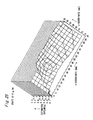
- FIG. 22 is a graph showing a distribution of the magnetic field measured on the xy-plane in the state of FIG. 19 ;
- FIG. 23 is a graph showing a distribution of the transformation factor ⁇ calculated on the xy-plane in the state of FIG. 19 ;
- FIG. 24 is a graph showing a distribution of the magnetic field measured on the xy-plane in the state of FIG. 20 ;
- FIG. 25 is a graph showing a distribution of the estimated SAR on the xy-plane in the state of FIG. 20 ;
- FIG. 26 is a graph showing a distribution of the actually measured SAR on the xy-plane in the state of FIG. 20 ;
- FIG. 29 is a front view showing a state of a first holding posture of the portable radio apparatus 10 a with respect to a head portion 60 of a human body phantom in a seventh preferred embodiment of the present invention
- FIG. 30 is a front view showing a state of a second holding posture of the portable radio apparatus 10 a with respect to the head portion 60 of the human body phantom in the seventh preferred embodiment of the present invention
- FIG. 31 is a flowchart showing an SAR calculation process executed by an SAR calculation controller of the seventh preferred embodiment of the present invention.
- FIG. 32 is a sectional view showing a state in which the state in the magnetic field measurement stage is inclined by an angle 0 from the state in which the SAR should be measured according to a modified preferred embodiment of the seventh preferred embodiment of the present invention
- FIG. 33 is a perspective view showing a plurality of layers 70 - 1 to 70 -K in a z-direction used for SAR measurement in an eighth preferred embodiment of the present invention.
- FIG. 34 is a perspective view showing a coordinates of a cubic phantom 54 when an average SAR is calculated in the eighth preferred embodiment of the present invention.
- FIG. 35 is a flowchart showing a first part of the SAR calculation process executed by the SAR calculation controller of the eighth preferred embodiment of the present invention.
- FIG. 36 is a flowchart showing a second part of the SAR calculation process executed by the SAR calculation controller of the eighth preferred embodiment of the present invention.
- FIG. 37 is a perspective view showing a coordinates of the cubic phantom 54 when the average SAR is calculated by another method according to a modified preferred embodiment of the eighth preferred embodiment of the present invention.
- FIG. 38 is a graph showing measured values and estimated values of SAR with respect to a position in the z-direction (z-coordinate) in the state of FIG. 37 ;
- FIG. 39 is a flowchart showing a first part of the SAR calculation process executed by the SAR calculation controller of the modified preferred embodiment of the eighth preferred embodiment of the present invention.
- FIG. 40 is a flowchart showing a second part of the SAR calculation process executed by the SAR calculation controller of the modified preferred embodiment of the eighth preferred embodiment of the present invention.
- FIG. 41 is a sectional view showing a coordinates of a portion where the magnetic field probe 1 and the phantom 54 are adjacent to each other when the SAR calculation method of the modified preferred embodiment of the eighth preferred embodiment of the present invention is verified;
- FIG. 42 is a side view showing a structure of a magnetic field probe 1 p according to a first implemental example for use in the preferred embodiments of the present invention.
- FIG. 43 is a side view showing a structure of a magnetic field probe 1 q according to a second implemental example for use in the preferred embodiments of the present invention.
- FIG. 44 is a perspective view showing a structure of a magnetic field probe 1 r , according to a third implemental example for use in the preferred embodiments of the present invention.
- FIG. 45 is a block diagram showing a structure of a modified preferred embodiment of a signal cable to the magnetic field probe 1 according to a fourth implemental example for use in the preferred embodiments of the, present invention.
- FIG. 46 is a block diagram showing a structure of a modified preferred embodiment of an apparatus for processing a detection signal from the magnetic field probe 1 according to a fifth implemental example for use in the preferred embodiments of the present invention
- FIG. 47A is a sectional view of a zx-plane showing an arrangement method of a plurality of magnetic field probes 1 according to a sixth implemental example for use in the preferred embodiments of the present invention
- FIG. 47B is a sectional view of the xy-plane showing the arrangement method of FIG. 47A ;
- FIG. 48A is a sectional view of the zx-plane when the plurality of magnetic field probes 1 are moved by a distance of “d” in the x-direction from the state of FIGS. 45A and 45B ;
- FIG. 48B is a sectional view of the xy-plane showing the movement of FIG. 48A ;
- FIG. 49A is a sectional view of the zx-plane showing an arrangement method of a pair of magnetic field probes 1 according to a seventh implemental example for use in the preferred embodiments of the present invention
- FIG. 49B is a sectional view of the xy-plane showing the arrangement method of FIG. 49A ;
- FIG. 50 is a perspective view showing an arrangement method of a magnetic field probe 1 m comprised of three magnetic field probe portions 301 , 302 and 303 according to an eighth implemental example for use in the preferred embodiments of the present invention
- FIG. 51A is a perspective view showing an arrangement method of a magnetic field probe 1 m comprised of three magnetic field probe portions 301 , 302 and 303 in a first case according to a ninth implemental example for use in the preferred embodiments of the present invention
- FIG. 51B is a perspective view showing an arrangement method of the magnetic field probe 1 m comprised of the three magnetic field probe portions 301 , 302 and 303 in a second case according to the ninth implemental example for use in the preferred embodiments of the present invention;
- FIG. 51C is a perspective view showing an arrangement method of the magnetic field probe 1 m comprised of the three magnetic field probe portions 301 , 302 and 303 in a third case according to the ninth implemental example for use in the preferred embodiments of the present invention.
- FIG. 52 is a perspective view showing an arrangement method of the magnetic field probe 1 m comprised of the three magnetic field probe portions 301 , 302 and 303 according to a tenth implemental example for use in the preferred embodiments of the present invention.
- a radio apparatus means a radio communication apparatus such as a potable telephone, a business-use potable transceiver or the like.
- FIG. 1 is a perspective view and a block diagram showing a structure of an SAR measuring apparatus for measuring SAR of a portable radio apparatus 10 according to the first preferred embodiment of the present invention.
- a whip antenna 12 is mounted so as to extend upward from its casing 11 , and a keyboard section 13 is formed in a lower portion of the front surface of the portable radio apparatus 10 .
- a plurality of, for example, four magnetic field probes 1 are arranged at regular intervals linearly or aligned in the horizontal direction on the front surface of the keyboard section 13 of the portable radio apparatus 10 so that the probes are located a predetermined distance of adjacency apart from the front surface.
- the portable radio apparatus 10 is provided with a built-in flat antenna (not shown) such as an inverted F type antenna, which is arranged on the inside of the casing 11 so as to be parallel to the front surface of the keyboard section 13 in addition to the whip antenna 12 . Therefore, radio wave from the portable radio apparatus 10 is radiated from the whip antenna 12 and/or the built-in flat antenna. In particular, when the radio wave is radiated from these antennas, a casing current flows in the casing 11 , and a magnetic field is generated in the vicinity of the front surface of the keyboard section 13 .
- a built-in flat antenna such as an inverted F type antenna
- each of the magnetic field probes 1 includes a circular loop for detecting the magnetic field and a connection cable connected to the loop, and the cross section of the circular loop is arranged perpendicular to the front surface of the portable radio apparatus 10 .
- Each magnetic field probe 1 detects a near magnetic field generated on the front surface of the keyboard section 13 , and outputs a detection signal that represents a detection voltage proportional to the near magnetic field to an SAR calculation controller 20 via a detection signal cable 2 .
- the SAR calculation controller 20 executes an SAR calculation process of FIG.
- the direction of arrangement of the plurality of magnetic field probes 1 is an x-direction and a direction directed from the plurality of magnetic field probes 1 toward the portable radio apparatus 10 (i.e., this direction means the direction extending from the front surface to the rear surface of the portable radio apparatus 10 , and being perpendicular to the front surface) is a y-direction.
- a surface of the portable radio apparatus 10 which is made to be in contact with a human body, is the front surface on which the keyboard section 13 and so on are arranged.
- the front surface of the portable radio apparatus 10 is parallel to the zx-plane and arranged so as to be adjacent to the plurality of magnetic field probes 1 .
- the plurality of magnetic field probes 1 is able to detect the near magnetic field on the front surface of the portable radio apparatus 10 and to obtain detection signals, which are proportional to the intensity of the fields.
- the SAR calculation process of FIG. 2 is executed.
- a method will be next described for estimating the SAR distribution from the magnetic field intensity distribution in free space, or the measurement method of the present preferred embodiment.
- a distribution H ref (x) in the x-direction of the near magnetic field intensity H and a distribution SAR ref (x) in the x-direction of SAR are previously measured by using a half-wavelength dipole antenna having a simple antenna structure or a portable radio apparatus of a reference radio apparatus as one example.
- the former near magnetic field intensity distribution H ref (x) can be measured by using the magnetic field probes 1
- the SAR distribution SAR ref (x) can be measured by an electric field probe method (hereinafter referred to as a standard measurement method) using the relational equation (the above-mentioned equation (1)) that the SAR value is proportional to the electric field disclosed in the first prior art document and by using a cubic phantom 54 described later or the head portion 60 of a human body phantom. Since the SAR value is an electric power, if the SAR distribution is compared with a near magnetic field square value distribution, then the square value distribution H 2 (x) of the near magnetic field and the SAR distribution SAR(x) have distributions similar to each other as described later with reference to FIGS.
- ⁇ (x) denotes a distribution in the x-direction of a transformation factor.
- the SAR distribution SAR estimate (x) is estimated and calculated by using this transformation factor distribution ⁇ (x) in the SAR measuring apparatus of the present preferred embodiment.
- this transformation factor distribution ⁇ (x) it is required to previously obtain the near magnetic field intensity distribution H ref (x) and the measured value SAR ref (x) of SAR by using, for example, a half-wavelength dipole of a reference antenna or a portable radio apparatus of a reference radio apparatus.
- the maximum value of the transformation factor distribution ⁇ (x) when the half-wavelength dipole was used was 0.35 V ⁇ m2/A ⁇ kg as one example.
- FIG. 2 is a flowchart showing an SAR calculation process executed by the SAR calculation controller 20 of FIG. 1 .
- step S 1 the transformation factor distribution ⁇ (x) is calculated by using the equation (4) based on the near magnetic field distribution H ref (x) previously measured by using the portable radio apparatus of the reference radio apparatus and the SAR distribution SAR ref (x) previously measured by using an electric field probe 1001 , the portable radio apparatus and the cubic phantom 54 or a head portion 60 of a human body phantom as described later.
- the former near magnetic field H ref (x) can be measured by using the magnetic field probes 1
- the SAR distribution SAR ref (x) can be measured by using the standard measurement method.
- step S 2 detection signals from respective magnetic field probes 1 provided on the front surface of the portable radio apparatus 10 to be measured are received, and the magnetic field square value distribution H 2 measure (x) in the vicinity of the front surface of the portable radio apparatus 10 to be measured is calculated based on the voltages of the detection signals.
- step S 3 the SAR distribution SAR estimate (x) is calculated by multiplying the calculated magnetic field square value distribution H 2 measure (x) by the transformation factor distribution ⁇ (x) by using the equation (3), and then, is outputted to and displayed on the CRT display 21 . Then the SAR calculation process is completed.
- the SAR distribution SAR estimate (x) in the x-direction of the portable radio apparatus 10 to be measured can be estimated and calculated extremely simply at a higher speed and automatically as compared with those of the prior arts.
- the four magnetic field probes 1 are linearly arranged or aligned.
- the present invention is not limited to this, and it is acceptable to arrange at least one magnetic field probe 1 in a linear array (or in one dimension), a two-dimensional array or a three-dimensional array.
- two magnetic field probes 1 in the x-direction and arrange two magnetic field probes 1 in the z-direction With this arrangement, it is unnecessary to retrieve the maximum value by moving the probes in the z-direction, and therefore, the SAR measurement can be executed at a higher speed.
- the magnetic field square value distribution H 2 measure (x) in the vicinity of the front surface of the portable radio apparatus 10 is calculated in step S 2 of FIG. 2 , and the SAR distribution SAR estimate (x) is estimated and calculated in step S 3 .
- the present invention is not limited to this, and it is acceptable to calculate the maximum value H max 2 of the magnetic field square value distribution H 2 measure (x) in the vicinity of the front surface of the portable radio apparatus 10 , calculate the maximum value SAR estimatemax of the SAR distribution SAR estimate (x) that has been estimated and calculated in step S 3 , and then, output to and display the calculated value on the CRT display 21 .
- the near magnetic fields of the portable radio apparatus of the reference apparatus and the portable radio apparatus 10 to be measured can be measured by the same magnetic field probes 1 . This can be applied to the other preferred embodiments hereinbelow.
- FIG. 3 is a perspective view and a block diagram showing a structure of an SAR measuring apparatus for measuring the SAR of a portable radio apparatus 10 according to the second preferred embodiment of the present invention
- FIG. 4 is a sectional view showing an arrangement of magnetic field probes 1 - 1 to 1 - 4 of FIG. 3 .
- a loop type magnetic field probe provided with a conductor line circular loop at its tip is employed.
- the magnetic field detection planes of the cross sections of the circular loops of the magnetic field probes 1 are arranged so as to intersect the x-axis parallel to the direction in which the magnetic field probes 1 are arranged (parallel to the front surface of the portable radio apparatus 10 ) at an angle of 45 degrees, an angle between mutually adjacent one pair of magnetic field probes 1 becomes 90 degrees, and further, the cross sections of the circular loops become perpendicular to the front surface of the portable radio apparatus 10 .
- each of the magnetic field probes 1 measures the magnetic field on the zx-plane.
- each of the magnetic field probes 1 is required to detect an x-component Hx and a z-component Hz of the near magnetic field H. Accordingly, these magnetic field probes 1 are arranged so as to make an angle of 45 degrees with respect to the x-axis. Further, an angle made between mutually adjacent magnetic field probes 1 is set to 90 degrees in order to weaken the mutual coupling between the mutually adjacent magnetic field probes 1 .
- the maximum value of SAR of the entire portable radio apparatus 10 is calculated by moving the portable radio apparatus 10 in the z-direction.
- a plurality of portable radio apparatuses 10 which are to be measured and are mass-produced, can be continuously measured during the production process by moving the apparatuses using, for example, a belt conveyer and a robot arm. This enables higher-speed SAR estimation and further automatic measurement of the SAR distribution and the maximum SAR.
- the operation and advantageous effects similar to those of the first preferred embodiment can be obtained, and the mutual coupling between the magnetic field probes 1 can be weakened as compared with that of the first preferred embodiment. Therefore, errors which may be caused in the SAR measurement due to the mutual coupling can be reduced, and the SAR distribution and the maximum SAR can be measured with higher accuracy. Also, the various kinds of modified preferred embodiments described in connection with the first preferred embodiment can be applied to the second preferred embodiment.
- FIG. 5 is a perspective view and a block diagram showing a structure of an SAR measuring apparatus for measuring the SAR of a portable radio apparatus 10 according to the third preferred embodiment of the present invention.
- the SAR measuring apparatus of this third preferred embodiment is characterized in that magnetic field probes (hereinafter referred to as dummy magnetic field probes) 1 - 11 and 1 - 12 are linearly arranged or aligned so as to be parallel on the outside of the two magnetic field probes located at both ends of four magnetic field probes 1 - 1 to 1 - 4 .
- the two dummy magnetic field probes 1 - 11 and 1 - 12 located outside are respectively terminated via respective detection signal cables 2 by non-reflection terminating resistors 3 - 1 and 3 - 2 each having the same resistance value as the characteristic impedance of the detection signal cable 2 .
- the non-reflection terminating resistors 3 - 1 and 3 - 2 absorb the voltages of the detection signals detected and outputted from the dummy magnetic field probes 1 - 11 and 1 - 12 , respectively.
- the magnetic field probes ( 1 - 1 and 1 - 3 ) and ( 1 - 2 and 1 - 4 ) are located on both sides of the magnetic field probes 1 - 2 and 1 - 3 located inside, respectively, while only the magnetic field probes 1 - 2 and 1 - 3 exist on only one side of the magnetic field probes 1 - 1 and 1 - 4 located outside, respectively.
- the dummy magnetic field probes 1 - 11 and 1 - 12 each having the same structure as that of each of the magnetic field probes 1 - 1 to 1 - 4 are arranged on the outside of the magnetic field probes 1 - 1 and 1 - 4 , respectively, and this leads to that the influence exerted from the adjacent probes on the magnetic field probes 1 - 1 and 1 - 4 and the influence exerted from the adjacent probes on the magnetic field probes 1 - 2 and 1 - 3 are made equal to each other. With this arrangement, the variations in the detection signals obtained from the magnetic field probes 1 - 1 to 1 - 4 can be reduced.
- the operation and advantageous effects similar to those of the first and second preferred embodiments can be obtained, and the arrangement of the dummy magnetic field probes 1 - 11 and 1 - 12 on the outside of the magnetic field probes 1 - 1 to 1 - 4 reduces the variations in the detection signals obtained from the magnetic field probes 1 - 1 to 1 - 4 .
- the near magnetic field can be measured more accurately, and the SAR measurement based on this can be executed with higher accuracy as compared with the prior art.
- FIG. 6 is a perspective view and a block diagram showing a structure of an SAR measuring apparatus for measuring the SAR of a portable radio apparatus 10 according to the fourth preferred embodiment of the present invention.
- the SAR measuring apparatus of this fourth preferred embodiment is characterized in that the portable radio apparatus 10 is supported by a movement support section 32 of a movement mechanism apparatus 30 so that the portable radio apparatus 10 can be moved in the z-direction of arrow 501 .
- the movement mechanism apparatus 30 has a rectangular-columnar-shaped supporting column 31 extended upward or in the vertical direction, and has the movement support section 32 for movably supporting the portable radio apparatus 10 along the longitudinal direction (in the direction of arrow 501 ) of the supporting column 31 .
- the components 31 and 32 of the movement mechanism apparatus 30 are made of resin of, for example, acrylic resin, Teflon resin, ABS resin or the like, so that no influence is exerted on the magnetic field distribution to be measured.
- the portable radio apparatus 10 can be automatically moved in the z-direction, and the positions of the tips of the magnetic field probes 1 can be moved relatively to the portable radio apparatus 10 . Therefore, the portable radio apparatus 10 and the positions of the tips of the magnetic field probes 1 can be moved automatically and stably, and the maximum value of the SAR distribution can be easily retrieved and outputted. It is to be noted that the characteristic structures of the second and third preferred embodiments can be also applied to the fourth preferred embodiment.
- the portable radio apparatus 10 is moved with respect to the plurality of magnetic field probes 1 .
- the present invention is not limited to this, and it is acceptable to move the plurality of magnetic field probes 1 with respect to the portable radio apparatus 10 . That is, the portable radio apparatus 10 and the magnetic field probes 1 may be moved relatively to each other.
- FIG. 7 is a perspective view and a block diagram showing a structure of an SAR measuring apparatus for measuring the SAR of a portable radio apparatus 10 according to the fifth preferred embodiment of the present invention.
- the SAR measuring apparatus of this fifth preferred embodiment is characterized in that variable amplifiers 35 - 1 to 35 - 4 and variable phase shifters 36 - 1 to 36 - 4 are inserted in the detection signal cables 2 between the magnetic field probes 1 and an SAR calculation controller 20 a.
- the magnetic field distribution and the SAR distribution are detected or measured by means of a reference antenna of which the magnetic field distribution and the SAR distribution have been already known prior to the SAR measurement.
- the SAR calculation controller 20 a adjusts the degrees of amplification of the variable amplifiers 35 - 1 to 35 - 4 and the quantities of phase shifts of the variable phase shifters 36 - 1 to 36 - 4 so that the obtained SAR distribution substantially coincide with the predetermined SAR distribution of the reference antenna, and thereafter, executes the above-mentioned SAR measurement process on the portable radio apparatus 10 to be measured.
- variable amplifiers 35 - 1 to 35 - 4 and the variable phase shifters 36 - 1 to 36 - 4 can be adjusted so that the magnetic field characteristics of the magnetic field probes 1 become the predetermined characteristics, and therefore, the SAR distribution can be measured with higher accuracy by calibrating the measuring apparatus. It is to be noted that the characteristic structures of the second to fourth preferred embodiments can be also applied to the fifth preferred embodiment.
- variable amplifiers 35 - 1 to 35 - 4 and the variable phase shifters 36 - 1 to 36 - 4 are provided with the variable amplifiers 35 - 1 to 35 - 4 and the variable phase shifters 36 - 1 to 36 - 4 .
- present invention is not limited to this, and it is acceptable to provide at least one of the variable amplifiers 35 - 1 to 35 - 4 and the variable phase shifters 36 - 11 to 36 - 4 .
- FIG. 8 is a perspective view and a block diagram showing a structure of an SAR measuring apparatus for measuring the SAR of a portable radio apparatus 10 according to the sixth preferred embodiment of the present invention.
- the SAR measuring apparatus of this sixth preferred embodiment is characterized in that it is provided with a movement mechanism apparatus 40 for moving the portable radio apparatus 10 while supporting the radio apparatus in the mutually orthogonal x-direction, y-direction and z-direction, and an SAR is measured by measuring the near magnetic field of the portable radio apparatus 10 by using one magnetic field probe 1 .
- the movement mechanism apparatus 40 is constituted by comprising, on its support base 41 an X-stage 42 movable in the x-direction, a Y-stage 43 movable in the y-direction, a supporting column 44 extended in the z-direction above the support base 41 and a movement support section 45 that is movable in the longitudinal direction (z-direction) of the supporting column 44 and supports the portable radio apparatus 10 .
- the portable radio apparatus 10 is supported by the movement support section 45 so that the keyboard section 13 faces upward and moved in the x-direction, y-direction and z-direction which are orthogonal to each other.
- the x-direction is set in the direction parallel to the longitudinal direction of the portable radio apparatus 10
- the y-direction is set in the direction parallel to the horizontal direction of the portable radio apparatus 10 .
- the movement in the z-direction is used in the eighth and subsequent preferred embodiments described later.
- the position coordinates (x, y) of the magnetic field detection position of the portable radio apparatus 10 with respect to the magnetic field probe 1 are previously calibrated, and the movement mechanism apparatus 40 calculates the position coordinate data (x, y) of the magnetic field detection position, and outputs the data to an SAR calculation controller 20 b.
- the one magnetic field probe 1 is arranged so that the cross section of its circular loop becomes perpendicular to the front surface of the portable radio apparatus 10 .
- the magnetic field probe 1 detects the near magnetic field on the front surface of the keyboard section 13 by scanning on, for example, the xy-plane, and then, outputs a detection signal that represents the detection voltage to the SAR calculation controller 20 b via the detection signal cable 2 .
- the SAR calculation controller 20 b executes the SAR calculation process of FIG.
- FIG. 9 is a sectional view showing a coordinate system of near magnetic field distribution measurement of a dipole antenna 50 of a reference antenna apparatus
- FIG. 10 is a sectional view showing a coordinate system of SAR measurement using a cubic phantom 54 .
- the half-wavelength dipole antenna 51 of the reference antenna is constituted by two antenna elements 50 a and 50 b , and a transmission signal is fed via a balun (unbalanced to balanced transformer) 51 to the antenna elements 50 a and 50 b .
- the dipole antenna 51 is aligned so that a distance from its feeding point to the origin of the xyz-coordinate system becomes 18.7 mm.
- the frequency of the transmission signal is set to 900 MHz. As shown in FIG.
- the SAR measurement by a standard measurement method is performed by inserting an electric field probe 1001 having a sensor portion 1001 s in the SAR solution 53 .
- the SAR distribution in FIG. 10 can be obtained as follows.
- the electric field probe 1001 is moved to be scanned in the x-direction and the y-direction along the surface configuration of the cubic phantom 54 by means of a movement mechanism apparatus 1002 .
- An SAR calculation controller 1003 calculates the electric field intensity based on a detection signal that represents the electric field intensity from the electric field probe 1001 , and then, calculates and outputs the SAR distribution by using the equation (1) based on the electric field intensity. It is to be noted that the movement by the movement mechanism apparatus 1002 is only required to be able to move the electric field probe 1001 relatively to the cubic phantom 54 and the half-wavelength dipole antenna 50 . That is, the cubic phantom 54 and the half-wavelength dipole antenna 50 may be moved relatively to the electric field probe 1001 .
- the distribution of the magnetic field square value H 2 and the distribution of SAR are both normalized by the respective maximum values.
- the SAR distribution can be estimated by measuring the near magnetic field in free space on the front surface of the portable radio apparatus 10 even if the electromagnetic mutual coupling between the portable radio apparatus 10 and the phantom 54 is not taken into consideration.
- the measurement by the SAR measuring apparatus of the present preferred embodiment is performed by first of all detecting the magnetic field radiated from the half-wavelength dipole 50 of the reference antenna or the portable radio apparatus of the reference radio apparatus by means of the magnetic field probe 1 and by then calculating the position coordinate data (x, y) of the magnetic field probe 1 for these apparatuses by means of the movement mechanism apparatus 40 and outputting the data to the SAR calculation controller 20 b .
- the normal line direction of the front surface (i.e., display surface) of the keyboard section 13 of the portable radio apparatus 10 is set to the +z-direction
- the longitudinal direction of the portable radio apparatus 10 is set to the x-direction
- the transverse direction of the portable radio apparatus 10 is set to the y-direction.
- the near magnetic field of the portable radio apparatus 10 is measured by scanning on the support base 41 measurement points on the xy-plane located apart by a certain interval in the +z-direction from the portable radio apparatus 10 while moving the movement support section 45 of the movement mechanism apparatus 40 by means of the X-stage 43 and the Y-stage 44 .
- SAR ref (x, y) denotes an SAR distribution of the portable radio apparatus of the reference radio apparatus
- SAR estimate (x, y) is an estimated SAR distribution of the portable radio apparatus 10 to be measured
- H measure (x, y) is a near magnetic field distribution in free space of the portable radio apparatus 10 to be measured.
- the SAR distribution of the portable radio apparatus 10 can be estimated and calculated based on the near magnetic field in free space by the above-mentioned method.
- FIG. 13 is a flowchart showing an SAR calculation process executed by the SAR calculation controller 20 b of FIG. 8 .
- a transformation factor distribution ⁇ (x, y) is calculated for a plurality of predetermined position coordinates (x, y) by using the equation (5), based on (a) the near magnetic field distribution H ref (x, y) previously measured while moving the portable radio apparatus of the reference radio apparatus in the x-direction and the y-direction by using the movement mechanism apparatus 40 , and (b) the SAR distribution SAR ref (x, y) previously measured while moving the electric field probe 1001 in the x-direction and the y-direction with respect to the portable radio apparatus and the cubic phantom 54 .
- the near magnetic field distribution H ref (x, y) can be measured by using the magnetic field probe 1
- the SAR distribution SAR ref (x, y) can be measured by using the above-mentioned standard measurement method.
- the detection signal from the magnetic field probe 1 which is provided on the apparatus surface and detects the near magnetic field, is received while moving the portable radio apparatus 10 to be measured in the x-direction and the y-direction by means of the movement mechanism apparatus 40 , and the magnetic field square value distribution H 2 measure (x, y) in the vicinity of the front surface of the portable radio apparatus 10 to be measured is calculated for a plurality of determined position coordinates (x, y) based on the voltage of the detection signal.
- step S 13 the SAR distribution SAR estimate (x, y) is estimated and calculated by multiplying the calculated magnetic field square value distribution H 2 measure (x, y) by the calculated transformation factor distribution ⁇ (x, y) using the equation (6), and the calculated SAR distribution SAR estimate (x, y) is outputted to and displayed on the CRT display 21 . Then the SAR calculation process is completed.
- the estimation and analysis of SAR was performed by using an FDTD method with regard to a spherical-ball-shaped phantom 55 of the standard conforming to IEEE SCC (Standards Coordinating Committee) 34 as a human head model and the half-wavelength dipole antenna 50 of the reference antenna arranged in the vicinity of the phantom. It is acceptable to estimate and analyze the SAR and its SAR distribution by using the FDTD method instead of the above-mentioned SAR standard measurement method used in each of the preferred embodiments of the present invention.
- FIG. 14 is a sectional view showing a coordinate system of a magnetic field distribution measurement of the dipole antenna 50 employing the ball-shaped phantom 55 .
- the feeding point of the dipole antenna 50 is set to the origin of the xyz-coordinate system, and the dipole antenna 50 having an antenna length of 158 mm was arranged along the x-axis.
- the ball-shaped phantom 55 had its center located in the z-direction, and there was an arrangement in which a closest approach distance in the z-direction between the bottom surface of the ball-shaped phantom 55 and the dipole antenna 50 became 5 mm.
- the frequency of the transmission signal from the dipole antenna 50 is set to 900 MHz.
- the distribution of the magnetic field square value H 2 of FIG. 15 has the analyzed values at a position located apart by a distance of 5 mm from the dipole antenna 50 in the +z-direction.
- the distributions of the magnetic field square value H 2 and SAR of FIG. 15 are H 2 ref (x) and SAR ref (x), respectively, and the transformation factor distribution ⁇ (x) is calculated by using the equation (4).
- This transformation factor distribution ⁇ (x) is shown in FIG. 16 .
- the transformation factor ⁇ (x) is changed in accordance with the position in the y-direction and has a maximum value roughly at the feeding point of the dipole antenna 50 .
- FIG. 18 shows an estimated calculation value of SAR (hereinafter referred to as an estimated SAR distribution) calculated by multiplying the square value of the near magnetic field distribution H measure (x) by the transformation factor distribution ⁇ (x) of FIG. 16 , and analyzed values of the SAR distribution analyzed by the estimated analysis method of SAR by using the FDTD method in the state of FIG. 17 .
- the estimated SAR distribution obtained by using the multiplication equation of ⁇ H 2 become values very close to those of the analyzed SAR distribution analyzed by the estimating and analyzing method of SAR by using the FDTD method. According to the results, it can be understood that the SAR of different current distributions in the near radiation magnetic field can be estimated and calculated by multiplying the transformation factor distribution ⁇ (x) in the x-direction by the square value H 2 of the near magnetic field in free space.
- FIG. 19 is a sectional view in the zx-plane, showing a positional relationship between the head portion 60 of a human body phantom and a folding type portable radio apparatus 10 a when the folding type portable radio apparatus 10 a is made to be in contact with a right-hand side surface 60 a of the head portion 60 of the human body phantom and a whip antenna 12 a of the portable radio apparatus 10 a is retracted, and FIG.
- FIG. 20 is a sectional view in the zx-plane, showing a positional relationship between the head portion 60 of the human body phantom and the folding type portable radio apparatus 10 a when the folding type portable radio apparatus 10 a is made to be in contact with the right-hand side surface 60 a of the head portion 60 of the human body phantom and the whip antenna 12 a of the portable radio apparatus 10 a is extended.
- the folding type portable radio apparatus 10 a is constituted by joining a main body casing 14 a located in a lower portion to a display section casing 14 b located in an upper portion via a hinge 14 c , and has a length of 200 mm and a width of 50 mm.
- the whip antenna 12 a is provided so as to extend from the upper portion of the main body casing 14 a .
- the whip antenna 12 a is in a state as shown in FIG. 19 when retracted in the main body casing 14 a .
- the antenna 12 a when the whip antenna 12 a is extended from the main body casing 14 a , the antenna is extended so as to extend in the longitudinal direction from the main body casing 14 a as shown in FIG. 29 .
- the folding type portable radio apparatus 10 a is arranged so as to be adjacent to the head portion 60 of the human body phantom, and the head portion surface 60 a is made to be in contact with the display section casing 14 b .
- An ear portion 61 of the head portion 60 of the human body phantom is located so as to be adjacent to a sound hole portion 16 of a speaker, and a mouth portion 62 of the head portion 60 of the human body phantom is located so as to be adjacent to a microphone 15 .
- the state in which the whip antenna 12 a was retracted as shown in FIG. 19 was assumed to be the reference state, and the near magnetic field H ref (x, y) was actually measured by using the magnetic field probe 1 .
- the actually measured SAR distribution SAR ref (x, y) was measured by using the above-mentioned standard measurement method, and the transformation factor distribution ⁇ (x, y) was calculated by using the equation (5).
- FIG. 21 is a graph showing an actually measured SAR distribution on the xy-plane in the state of FIG. 19 .
- FIG. 21 measurement intervals were set to 5 mm in the x-direction, and were set to 5 mm in the y-direction.
- a setting frequency of the transmission signal from the portable radio apparatus 10 a was set to 925 MHz, and a transmission signal having a transmission power of 0.8 W was used.
- FIG. 22 is a graph showing a distribution of the magnetic field measured on the xy-plane in the state of FIG. 19 .
- transmission setting conditions of the portable radio apparatus 10 a were set to be similar to those of the SAR measurement stage, and a distance from the surface of the portable radio apparatus 10 a to the magnetic field probe 1 was set to about 5 mm.
- the transformation factor distribution ⁇ (x, y) of the portable radio apparatus 10 a was calculated by using the equation (5) based on the distribution SAR ref (x, y) of the actually measured SAR of FIG. 21 measured by using the above-mentioned standard measurement method and the distribution H ref (x, y) of the measured magnetic field intensity of the above-mentioned measured near magnetic field, and the result are shown in FIG. 23 .
- the near magnetic field H measure (x, y) in the state (state of FIG. 20 ) in which the whip antenna 12 a of the portable radio apparatus 10 a was extended was measured, and the results are shown in FIG. 24 .
- the transmission setting conditions of the portable radio apparatus 10 a were set to be similar to those of the state of FIG. 19 in which the antenna was retracted. In this case, the distance from the front surface of the portable radio apparatus 10 a to the probe was set to about 5 mm.
- the estimated SAR distribution in the state in which the whip antenna 12 a was extended was calculated by multiplying the square value of the actually measured near magnetic field H measure (x, y) by the calculated transformation factor distribution ⁇ (x, y), and the estimated calculation result is shown in FIG. 25 .
- FIG. 26 shows the actually measured SAR distribution in the state in which the whip antenna was extended, the distribution being actually measured by the above-mentioned standard measurement method.
- the estimated SAR distribution by the estimative measurement method of the present preferred embodiment closely resembles the actually measured SAR distribution measured by the above-mentioned standard measurement method, and the estimation accuracy is very high.
- the maximum value of the estimated SAR distribution was 0.747 mW/g, while the maximum value of the actually measured SAR distribution was 0.775 mW/g, then an error of 4% existed between them.
- the maximum value of the error within the measurement range was about 18%.
- the SAR was able to be estimated with higher accuracy than that of the prior art even when the portable radio apparatus of the reference radio apparatus was used, and the effectiveness of the estimative measurement method of the preferred embodiment of the present invention was demonstrated.
- the near magnetic field distribution H ref (x, y) and SAR ref (x, y) of the reference antenna or the reference radio apparatus are not always required to be obtained by the above-mentioned standard measurement method, and it is acceptable to calculate the transformation factor distribution ⁇ (x, y) by the method of the sixth preferred embodiment by using a near magnetic field distribution and an SAR distribution calculated by a predetermined well-known electromagnetic field simulation.
- the portable radio apparatus 10 a is moved with respect to the magnetic field probe 1 .
- the present invention is not limited to this, and it is acceptable to move the magnetic field probes 1 with respect to the portable radio apparatus 10 , i.e., they may be moved relatively to each other. This can be applied to the other preferred embodiments.
- FIG. 29 is a front view showing a state of a first holding posture of the portable radio apparatus 10 a with respect to the head portion 60 of a human body phantom in the seventh preferred embodiment of the present invention
- FIG. 30 is a front view showing a state of a second holding posture of the portable radio apparatus 10 a with respect to the head portion 60 of the human body phantom in the seventh preferred embodiment of the present invention. That is, with regard to the holding posture of the portable radio apparatus 10 a such as a portable telephone, there can be considered roughly two kinds of holding postures as shown in FIGS. 29 and 30 .
- the first holding posture shown in FIG. 29 is a normal holding posture in a state in which the front surface of the main body casing 14 a of the portable radio apparatus 10 a is closely fit onto the right cheek of the head portion 60 of the human body phantom.
- the second holding posture shown in FIG. 30 is a holding posture when the voice from the other party is hard to hear in a state in which the sound hole portion 16 of the speaker of the portable radio apparatus 10 a is closely fit onto the right ear portion 61 of the head portion 60 of the human body phantom. According to the actual SAR measurement disclosed in FIG. 3 . 1 - 2 on page 9 of the first prior art document, measurement is carried out for these two kinds of holding postures.
- SAR ref (x, y) denotes an SAR distribution of the reference portable radio apparatus in the first holding posture of FIG. 29
- ⁇ 1 (x, y) denotes a transformation factor distribution of the first holding posture of FIG. 29
- SAR ref2 (x, y) denotes an SAR distribution of the reference portable radio apparatus in the second holding posture of FIG. 30
- ⁇ 2 (x, y) denotes a transformation factor distribution of the second holding posture of FIG. 30 .
- H ref (x, y) is measured by a measurement method similar to that of the sixth preferred embodiment regardless of the holding posture of the reference portable radio apparatus.
- FIG. 31 is a flowchart showing an SAR calculation process executed by the SAR calculation controller of the seventh preferred embodiment of the present invention.
- the near magnetic field distribution H ref (x, y) can be measured by using the magnetic field probe 1
- the SAR distribution SAR ref (x, y) can be measured by using the above-mentioned standard measurement method.
- step S 22 while moving the portable radio apparatus 10 a to be measured in the x-direction and the y-direction by means of the movement mechanism apparatus 40 , a detection signal from the magnetic field probe 1 , which is provided on its surface and detects the near magnetic field, is received, and the magnetic field square value distribution H 2 measure (x, y) in the vicinity of the front surface of the portable radio apparatus 10 a to be measured is calculated for a plurality of determined position coordinates (x, y) based on the voltages of the detection signals.
- the measuring time can be shortened to about a quarter as compared with the measuring time of the prior art method, and then the SAR measurement can be done in a higher speed.
- FIG. 32 is a sectional view showing a state in which the state in the magnetic field measurement stage is inclined by an angle 0 from the state in which the SAR should be measured according to a modified preferred embodiment of the seventh preferred embodiment of the present invention.
- the original measurement results are made to correspond to the near magnetic field distribution H ref (x, y) of the reference radio apparatus and the measurement points of the SAR distribution SAR ref (x, y).
- FIG. 33 is a perspective view showing a plurality of layers 70 - 1 to 70 -K in the z-direction used for the SAR measurement in the eighth preferred embodiment of the present invention.
- the SAR estimation method of the measurement apparatus of the present preferred embodiment is similar to that of the sixth preferred embodiment. As shown in FIG.
- SAR ref (x i , y j , z k ) denotes an SAR distribution of a k-th layer from the phantom surface of the reference portable radio apparatus
- H ref (x i , y j ) denotes a near magnetic field distribution of the k-th layer in the reference portable radio apparatus.
- the near magnetic field is measured at an arbitrary distance within a range of about several millimeters from the surface of the portable radio apparatus, and the distribution of the near magnetic field changes similarly within the range. Therefore, the distance in the z-direction is not taken into consideration.
- the SAR distribution of the k-th layer of the portable radio apparatus to be measured is calculated by using the following equation based on the transformation factor distribution ⁇ (x i , y j , z k ) calculated by using the equation (12):
- SAR estimate ⁇ ( x i , y j , z k ) ⁇ ⁇ ( x i , y j , z k ) ⁇ H measure 2 ⁇ ( x i , y j ) , ( 13 )
- SAR estimate (x i , y j , z k ) denotes an estimated SAR distribution of the k-th layer from the phantom surface.
- SAR estimate (x i , y j , z k ) denotes an estimated SAR distribution of the k-th layer from the phantom surface.
- the average SAR can be calculated as an average value of SAR values SAR estimate (x i , y j , z k ) at the measurement points 71 included within the cubic lattice 54 A having one side length L.
- a 1-gram average SAR value which is the average SAR of one gram of the head tissue of the human body phantom, can be calculated by using the following equation (equation (14)), and a 10-gram average SAR value, which is the average SAR of ten grams of the head tissue of the human body phantom, can be calculated by using the following equation (equation (15)).
- the SAR averaged within a tissue of one gram or ten grams is called the local SAR, and the maximum value of the local SAR is called the local maximum SAR.
- M x , M y , M z , N x , N y and N z are defined as follows:
- M x is the number of measurement points in the x-direction required for calculating the 1-gram average SAR value
- M y is the number of measurement points in the y-direction required for calculating the 1-gram average SAR value
- M z is the number of measurement points in the z-direction required for calculating the 1-gram average SAR value
- N x is the number of measurement points in the x-direction required for calculating the 10-gram average SAR value
- N y is the number of measurement points in the y-direction required for calculating the 10-gram average SAR value
- N z is the number of measurement points in the z-direction required for calculating the 10-gram average SAR value.
- FIGS. 35 and 36 are flowcharts showing an SAR calculation process executed by the SAR calculation controller of the eighth preferred embodiment of the present invention.
- the electric field probe 1001 is moved in the x-direction, y-direction and z-direction orthogonal to each other by, for example, a movement mechanism apparatus 1002 as shown in FIG. 10 .
- the near magnetic field distribution H ref (x i , y j ) can be measured by using the magnetic field probe 1
- the SAR distributions SAR ref (x i , y j , z k ) can be measured by using the above-mentioned standard measurement method.
- step S 32 while moving the portable radio apparatus 10 a to be measured in the x-direction and the y-direction by the movement mechanism apparatus 40 , a detection signal from the magnetic field probe 1 , which is provided on its front surface and detects the near magnetic field, is received, and the magnetic field square value distribution H 2 measure (x i , y j ) in the vicinity of the front surface of the portable radio apparatus 10 a to be measured is calculated for a plurality of predetermined position coordinates (x i , y j ) based on the voltages of the detection signals.
- step S 36 it is determined whether or not the retrieved maximum value is equal to or smaller than a predetermined standard value (or threshold value). Then the program flow proceeds to step S 37 when the answer is YES or proceeds to step S 38 when the answer is NO.
- step S 38 it is determined that the portable radio apparatus 10 a is non-defective, and the results are displayed on the CRT display 21 , then the SAR calculation process is completed.
- step S 39 it is determined that the portable radio apparatus 10 a is defective, and the results are displayed on the CRT display 21 , and the SAR calculation process is completed.
- the present invention is not limited to this. It is acceptable to print the information by means of a printer, to output the information by synthetic voices by sound information means or to output the information by the other information output means.
- the measured value by the above-mentioned standard measurement method and the estimated value by the equation (20) are compared with each other with regard to the SAR distribution in the z-direction when the half-wavelength dipole antenna 50 is located so as to be adjacent to the cubic phantom 54 shown in FIG. 37 .
- the cubic container 52 has a thickness of 2 mm, and one side thereof has an inside dimension of 200 mm.
- the half-wavelength dipole antenna 50 has an antenna length of 158 mm, and the measurement frequency, which is the frequency of the transmission signal, is set to 900 MHz.
- the SAR measurement by the above-mentioned standard measurement method is carried out by inserting the electric field probe 1001 having the sensor portion 1001 s in the SAR solution 53 , and the SAR distribution shown in FIG.
- FIG. 38 is a graph showing measured values and estimated values of SAR with respect to a position in the z-direction (z-coordinate) in the state of FIG. 37 .
- FIG. 38 shows measured values of the SAR distribution on the z-axis according to the above-mentioned standard measurement method and the estimated values using the equation (20).
- the estimated values satisfactorily coincide with the measured values, and it can be understood that the SAR distribution in the z-direction can be estimated by using the equation (20).
- the equation (20) into the equation (14) and the equation (15)
- the average SAR can be calculated.
- the SAR measurement plane necessary for this calculation method is one plane. Therefore, it is merely required to measure only one plane when the transformation factor distribution a is calculated, and the measurement of the SAR distribution can be remarkably simplified.
- FIGS. 39 and 40 are flowcharts showing an SAR calculation process executed by the SAR calculation controller according to the modified preferred embodiment of the eighth preferred embodiment of the present invention.
- FIGS. 39 and 40 it is to be noted that the same step numbers are given to the same processings as those of FIGS. 35 and 36 .
- the near magnetic field distribution H ref (x i , y j ) can be measured by using the magnetic field probe 1
- the SAR distribution SAR ref (x i , y j , z l ) can be measured by using the above-mentioned standard measurement method.
- step S 32 while moving the portable radio apparatus 10 a to be measured in the x-direction and the y-direction by means of the movement mechanism apparatus 40 , a detection signal from the magnetic field probe 1 , which is provided on its front surface and detects the near magnetic field, is received, and the magnetic field square value distribution H 2 measure (x i , y j ) in the vicinity of the front surface of the portable radio apparatus 10 a to be measured is calculated for a plurality of predetermined position coordinates (x i , y j ) based on the voltages of the detection signals.
- the SAR in the z-direction can be estimated and calculated by using the equation (20) as compared with the average SAR estimation method of the eighth preferred embodiment shown in FIGS. 35 and 36 . Accordingly, the measurement of the SAR distribution in the z-direction by the reference portable radio apparatus and the calculation of the transformation factor distribution ⁇ (x, y, z) in the z-direction calculation are not required to be executed in step S 31 A. Furthermore, there is no need for carrying out the calculation of the SAR distribution in the z-direction in step S 33 A, and this allows the amount of calculation to be remarkably reduced.
- the 1-gram average SAR can be calculated as an arithmetic mean of SARs at the coordinates on the inside of the cubic lattice 54 where one side of the bottom surface of the cubic lattice 54 A has a size of 10 mm.
- the SAR is measured at intervals of 5 mm, and the 1-gram average SAR is calculated. This calculation method will be described with reference to FIG. 41 .
- FIG. 41 shows a state in which the sensor portion 1001 s of the electric field probe 1001 is located so as to be adjacent to a surface line 84 of the head portion 60 of the human body phantom.
- the SAR measurement surface has herein an area of 10 mm ⁇ 10 mm) of the SAR measurement surface (xy-plane) including a measurement limit line 83 centered about an SAR measurement maximum point 82 among a plurality of measurement points 81 shown in FIG. 41
- the SAR distribution in the z-direction is estimated by using the equation (20).
- the measurement can be performed by using the above-mentioned standard measurement method only on the SAR measurement surface including the measurement limit line 83 located inside by 3.7 mm from the surface line 84 of the head portion 60 of the human body phantom, as shown in FIG. 41 . It is assumed that the SAR located at the SAR measurement maximum point 82 is set as SAR estimate (x i , y j , z l ).
- the 1-gram average SAR value can be calculated.
- the 1-gram average SAR value in the state in which the antenna is extended according to the above-mentioned standard measurement method was 0.637 mW/g
- the 1-gram average SAR value according to the estimation method using the equation (20) of the modified preferred embodiment of the eighth preferred embodiment was 0.645 mW/g. Therefore, the error of the 1-gram average SAR value was +1%.
- the present inventors conducted estimation of the 10-gram average SAR value in a similar manner.
- the average of the SAR values in a cube having one side of 22 mm was calculated.
- the 10-gram average SAR value in the state in which the antenna is extended according to the above-mentioned standard measurement method was 0.398 mW/g
- the 10-gram average SAR value using the equation (20) of the modified preferred embodiment of the eighth preferred embodiment was 0.423 mW/g. Therefore, the error of the 10-gram average SAR value was ⁇ 6%
- the average SAR estimation method of the eighth preferred embodiment or the average SAR estimation method of the modified preferred embodiment of the eighth preferred embodiment the average SAR can be estimated and calculated very simply with higher accuracy as compared with the prior art.
- the magnetic field probe 1 is employed.
- the present invention is not limited to this, and it is acceptable to employ magnetic field probes described below.
- FIG. 42 is a side view showing a structure of a magnetic field probe 1 p according to a first implemental example for use in the preferred embodiments of the present invention.
- a magnetic field probe 1 p is provided with a single gap type shielded loop having a gap at its tip.
- a semicircular arc portion of the loop for detecting the magnetic field is constituted by a coaxial cable 90 comprised of a central conductor 91 and a grounding conductor 92
- the other semicircular portion is constituted by a conductor line 93 having an outside diameter substantially equal to the outside diameter of the coaxial cable 90 .
- one end located on the leading end side of the conductor line 93 is connected to the central conductor 91 of the coaxial cable 90 , and another end thereof is connected to the grounding conductor 92 of the coaxial cable 90 .
- FIG. 43 is a side view showing a structure of a magnetic field probe 1 q according to a second implemental example for use in the preferred embodiments of the present invention.
- the magnetic field probe 1 q is provided with a double gap type (balanced type) shielded loop, and is constituted by two coaxial cables 90 a and 90 b , and a semicircular metal wire 94 .
- the coaxial cable 90 a includes a central conductor 91 a and a grounding conductor 92 a
- the coaxial cable 90 b includes a central conductor 91 b and a grounding conductor 92 b
- One end of the metal wire 94 is connected to the central conductor 91 a of the coaxial cable 90 a
- another end of the metal wire 94 is connected to the central conductor 91 b of the coaxial cable 90 b .
- the two coaxial cables 90 a and 90 b are connected to the balanced terminal of a balun 95 of a balanced to unbalanced transformer, while a coaxial cable 96 for feeding an electric power is connected to the unbalanced terminal of the balun 95 .
- FIG. 44 is a perspective view showing a structure of a magnetic field probe 1 r according to a third implemental example for use in the preferred embodiments of the present invention.
- the magnetic field probe 1 r is a shielded loop having a structure that employs a multi-layer printed wiring board
- FIG. 44 shows one example in which a magnetic field probe provided with the single gap type shielded loop is constituted by a three-layer substrate.
- a grounding conductor pattern 110 comprised of a roughly circular portion 111 having a gap and a linear strip portion 112 connected to the intermediate position of the roughly circular portion 111 is formed on a dielectric substrate 101 .
- a transmission conductor pattern 120 including a roughly semicircular portion 121 having a gap and a linear strip portion 122 connected to one end of the roughly semicircular portion 121 is formed on a dielectric substrate 102 .
- a grounding conductor pattern 130 comprised of a roughly circular portion 131 having a gap and a linear strip portion 132 connected to the intermediate position of the roughly circular portion 131 is formed on a dielectric substrate 103 .
- the three dielectric substrates 101 , 102 and 103 are stuck together in a laminating manner so that the transmission conductor pattern 120 is interposed between the two grounding conductor patterns 110 and 130 .
- a through hole 140 is formed so as to penetrate the dielectric substrate 101 in the direction of thickness at the leading end of the roughly circular portion 111 , penetrates the dielectric substrate 102 in the direction of thickness at the leading end of the roughly semicircular portion 121 , and penetrates the dielectric substrate 103 in the direction of thickness at the leading end of the roughly circular portion 131 .
- the formed through hole 140 is formed by being internally filled with a through hole conductor 140 c .
- a feeding planar transmission line such as a double-sided type microstrip line, a coplanar line and a slot line using, for example, a dielectric substrate.
- FIG. 45 is a block diagram showing a structure of a modified preferred embodiment of a signal cable to the magnetic field probe 1 according to a fourth implemental example for use in the preferred embodiments of the present invention.
- a detection signal that represents the detection voltage proportional to the magnetic field detected by the magnetic field probe 1 is subjected to electric to light conversion by an electric to light converter 150 provided with a laser diode or the like, and thereafter, the converted optical signal is transmitted via an optical fiber cable 151 and then inputted to a photoelectric converter 152 .
- the photoelectric converter 152 photoelectrically converts the inputted optical signal into an electric signal, and then, outputs the electric signal via a feeder cable.
- the detection signal of the magnetic field probe 1 is photoelectrically converted and transmitted, and therefore, the influence of external noises on the detection signal can be remarkably reduced.
- FIG. 46 is a block diagram showing a structure of a modified preferred embodiment of an apparatus for processing the detection signal from the magnetic field probe 1 according to a fifth implemental example for use in the preferred embodiments of the present invention.
- the detection signal from the magnetic field probe 1 is outputted via a variable amplifier 35 and a variable phase shifter 36 .
- a loop diameter of the magnetic field probe 1 is reduced to increase the resolving power of SAR measurement, while the voltage of the detection signal is amplified by using the variable amplifier 35 .
- a minute magnetic field can be detected.
- the SAR distribution can be measured with higher accuracy by calibrating the SAR measuring apparatus by adjusting the amplification of the variable amplifier 35 and the quantity of phase shift of the variable phase shifter 36 so that the measured SAR distribution substantially coincides with the predetermined SAR distribution of the reference antenna and thereafter executing the SAR measurement process for the portable radio apparatus to be measured.
- variable amplifier 35 and the variable phase shifter 36 are provided with the variable amplifier 35 and the variable phase shifter 36 .
- present invention is not limited to this, and it is acceptable to provide at least one of the variable amplifier 35 and the variable phase shifter 36 .
- FIG. 47A is a sectional view of the zx-plane showing an arrangement method of a plurality of magnetic field probes 1 according to a sixth implemental example for use in the preferred embodiments of the present invention
- FIG. 47B is a sectional view of the xy-plane.
- FIGS. 47A and 47B it is acceptable to provide a linear array arrangement in which the probes are aligned at intervals of “d” so that mutually adjacent one pair of magnetic field probes ( 1 - 1 and 1 - 2 ; 1 - 2 and 1 - 3 ; and 1 - 3 and 1 - 4 ) are perpendicular to each other.
- FIGS. 47A and 47B it is acceptable to provide a linear array arrangement in which the probes are aligned at intervals of “d” so that mutually adjacent one pair of magnetic field probes ( 1 - 1 and 1 - 2 ; 1 - 2 and 1 - 3 ; and 1 - 3 and 1 - 4 ) are perpendicular to
- the magnetic field intensities of the xy components at a magnetic field detection point 201 in FIGS. 47A and 47B are calculated as follows. First of all, a magnetic field intensity H 1 when the center of the loop of the magnetic field probe 1 - 1 is located at the magnetic field detection point 201 is detected. Next, as shown in FIGS. 48A and 48B , the magnetic field probes 1 - 1 to 1 - 4 are shifted by a distance of “d” in the ⁇ x-direction. At this time, the magnetic field detection point 201 is located at the center of the loop of the magnetic field probe 1 - 2 . In this case, the magnetic field intensity detected by the magnetic field probe 1 - 2 is assumed to be H 2 .
- the detection point 201 of the magnetic field intensity at this time is located at the midpoint (or intermediate position) of a distance between the centers of the loops of the two magnetic field probes 1 - 1 and 1 - 2 .
- the magnetic field intensity can be measured at a higher speed since the method is accompanied by no shift for aligning the coordinates of the mutually adjacent magnetic field probes 1 - 1 and 1 - 2 .
- FIG. 50 is a perspective view showing an arrangement method of a magnetic field probe 1 m comprised of three magnetic field probe portions 301 , 302 and 303 according to an eighth implemental example for use in the preferred embodiments of the present invention.
- a magnetic field probe 1 m is comprised of the three magnetic field probe portions 301 , 302 and 303 .
- these magnetic field probe portions 301 , 302 and 303 are arranged in a manner that the x-axis penetrates the center of the loop of the magnetic field probe portion 301 so as to be perpendicular to its loop plane, the y-axis penetrates the center of the loop of the magnetic field probe portion 302 so as to be perpendicular to its loop plane, and the z-axis penetrates the center of the loop of the magnetic field probe portion 303 so as to be perpendicular to its loop plane.
- the magnetic electric field intensity at the detection point 201 of FIG. 50 can be also calculated by subjecting the detected intensity when the magnetic field probe 1 m arranged with the arrangement relationship similar to that of FIG. 50 is shifted so that the centers of the loops of the three magnetic field probe portions 301 , 302 and 303 are located at the origin of the xyz-coordinate system as shown in FIGS. 51A , 51 B and 51 C to the operation of the sum of squares.
- H total H 1 2 + H 2 2 + H 3 2 .
- the three mutually perpendicular magnetic field probe portions 301 , 302 and 303 shown in FIG. 52 may be formed as a one-element magnetic field probe 1 m , and a plurality of magnetic field probes 1 m may be arranged in a linear array arrangement or a two-dimensional array arrangement. With this arrangement, the magnetic field measurement can be achieved with higher accuracy at a higher speed.
- the magnetic field probe 1 it is preferable to enclose the magnetic field probe 1 , the portable radio apparatus 10 or 10 a , the movement mechanism apparatus 30 or 40 and so on with metal plates in order to reduce the superimposition of external noises on the detection signal from the magnetic field probe 1 .
- the movement mechanism apparatuses 30 and 40 are formed of a metallic material.
- a resin material of, for example, polyethylene fluoride or acrylic or of a dielectric substance such as wood or the like.
- the distribution of the transformation factor ⁇ differs depending on the transmission frequencies of the portable radio apparatuses 10 and 10 a and the models of products. In order to cope with various models and many frequencies, it is acceptable to provide a function to switch over the distribution of the transformation factor ⁇ used for SAR calculation according to the portable radio apparatuses 10 and 10 a to be measured.
- the movement mechanism apparatuses 30 and 40 are provided with the movement mechanisms, and the near magnetic field distributions thereof are measured while moving the portable radio apparatuses 10 and 10 a .
- the present invention is not limited to this, and it is acceptable to provide the magnetic field probe 1 or the array of the magnetic field probes 1 with a movement mechanism.
- a first measurement device measures in free space a first near magnetic field of a radio wave radiated from either a reference radio apparatus or a reference antenna
- a second measurement device measures a specific absorption rate (SAR) of the radio wave radiated from either the reference radio apparatus or the reference antenna by using a predetermined phantom according to a predetermined measurement method.
- SAR specific absorption rate
- a first calculation device calculates a transformation factor ⁇ by dividing the measured specific absorption rate (SAR) by a square value of the measured first near magnetic field, and a third measurement device measures in free space a second near magnetic field of a radio wave radiated from a radio apparatus to be measured.
- a second calculation device estimates and calculates a specific absorption rate (SAR) of the radio wave radiated from SAR radio apparatus to be measured by multiplying a square value of the measured second near magnetic field by the calculated transformation factor ⁇ .
- a first movement device moves either the reference radio apparatus or the reference antenna in one, two or three dimension relatively to the first measurement device and the second measurement device, and a second movement device moves the second measurement device in one, two or three dimension relatively to the radio apparatus to be measured and the phantom.
- the first measurement device measures in free space a distribution of the first near magnetic field of the radio wave radiated from either the reference radio apparatus or the reference antenna, while moving either the reference radio apparatus or the reference antenna by the first movement device
- the second measurement device measures a distribution of the specific absorption rate (SAR) of the radio wave radiated from either the reference radio apparatus or the reference antenna, while moving either the reference radio apparatus or the reference antenna by the first movement device, according to the measurement method.
- SAR specific absorption rate
- the first calculation device calculates a distribution of the transformation factor ⁇ by dividing the distribution of the measured specific absorption rate (SAR) by a distribution of the square value of the measured first near magnetic field
- third measurement device measures in free space a distribution of the second near magnetic field of the radio wave radiated from the radio apparatus to be measured, while moving the radio apparatus to be measured by the second movement device.
- the second calculation device estimates and calculates a distribution of the specific absorption rate (SAR) of the radio wave radiated from the radio apparatus to be measured by multiplying a distribution of the square value of the measured second near magnetic field by the distribution of the calculated transformation factor ⁇ .
- the present invention it is possible to measure in free space the near magnetic field distribution radiated from the radio apparatus such as a portable telephone, and estimate and calculate an SAR or its distribution at a higher speed with higher accuracy as compared with the prior art, based on the measured near magnetic field distribution with a simple apparatus structure. Moreover, according to the present invention, it is possible to measure an SAR or its distribution in the arrangement of the radio apparatus such as a portable telephone in conformity to the actual SAR measurement. Furthermore, according to the present invention, it is possible to measure an SAR or its distribution of the radio apparatus such as a portable telephone on a production line more easily than that of the prior art.
Landscapes
- Physics & Mathematics (AREA)
- Electromagnetism (AREA)
- General Physics & Mathematics (AREA)
- Measuring Magnetic Variables (AREA)
- Mobile Radio Communication Systems (AREA)
- Magnetic Resonance Imaging Apparatus (AREA)
Abstract
Description
SAR=(σE 2)/ρ (1).
SAR estimate(x, y)=α(x, y)·H 2 measure(x, y) (6).
SAR estimate1(x, y)=α1(x, y)·H 2 measure(x, y) (9), and
SAR estimate2(x, y)=α2(x, y)·H 2 measure(x, y) (10).
x SAR =x H·cos θ (11).
Eighth Preferred Embodiment
E(z)=E oexp(−z/δ) (16),
δ=(πfμσ) −1/2 (17),
SAR=σE 2/ρ (18).
SAR∝exp(−2z/δ) (19).
SAR calculate(x i , y j , z)=SAR estimate(x i , y j, 0)exp(−2z/δ) (20),
Claims (18)
Applications Claiming Priority (4)
| Application Number | Priority Date | Filing Date | Title |
|---|---|---|---|
| JP2002118882 | 2002-04-22 | ||
| JPP2002-118882 | 2002-04-22 | ||
| JPP2002-362045 | 2002-12-13 | ||
| JP2002362045 | 2002-12-13 |
Publications (2)
| Publication Number | Publication Date |
|---|---|
| US20040017115A1 US20040017115A1 (en) | 2004-01-29 |
| US6919845B2 true US6919845B2 (en) | 2005-07-19 |
Family
ID=29217991
Family Applications (1)
| Application Number | Title | Priority Date | Filing Date |
|---|---|---|---|
| US10/419,813 Expired - Fee Related US6919845B2 (en) | 2002-04-22 | 2003-04-22 | Apparatus for measuring specific absorption rate based on near magnetic field for use in radio apparatus |
Country Status (4)
| Country | Link |
|---|---|
| US (1) | US6919845B2 (en) |
| EP (1) | EP1359428B1 (en) |
| CN (1) | CN1300573C (en) |
| DE (1) | DE60300464T2 (en) |
Cited By (22)
| Publication number | Priority date | Publication date | Assignee | Title |
|---|---|---|---|---|
| US20040102694A1 (en) * | 2001-08-08 | 2004-05-27 | Takahiro Iyama | Absorption power measuring device |
| US20040232776A1 (en) * | 2003-02-26 | 2004-11-25 | Akihiro Ozaki | Apparatus for measuring specific absorption rate of radio communication apparatus |
| US20060066304A1 (en) * | 2004-08-27 | 2006-03-30 | The Board of Regents University | Electric/magnetic field sensor |
| US20060120330A1 (en) * | 2004-12-06 | 2006-06-08 | Pantech Co., Ltd. | Method of converting communication channel in mobile communication terminal |
| US20060208875A1 (en) * | 2005-01-31 | 2006-09-21 | Masato Ebihara | Dimension measuring system |
| US20070236229A1 (en) * | 2004-11-02 | 2007-10-11 | Ntt Docomo, Inc | Specific absorption rate measuring system, and a method thereof |
| US20080265902A1 (en) * | 2006-10-23 | 2008-10-30 | Ntt Docomo, Inc. | Specific absorption rate measurement system and method |
| US20110193566A1 (en) * | 2006-04-05 | 2011-08-11 | Emscan Corporation | Multichannel absorberless near field measurement system |
| US20110267075A1 (en) * | 2008-12-31 | 2011-11-03 | Jong-Myung Woo | Method of measuring specific absorption rate of electromagnetic waves |
| US20110309945A1 (en) * | 2010-06-18 | 2011-12-22 | Searete Llc, A Limited Liability Corporation Of The State Of Delaware | Irradiation self-protection from user telecommunication device |
| US8188435B2 (en) | 2010-06-03 | 2012-05-29 | Tyco Healthcare Group Lp | Specific absorption rate measurement and energy-delivery device characterization using thermal phantom and image analysis |
| US20120157001A1 (en) * | 2010-12-16 | 2012-06-21 | Chieh-Ping Chiu | Method of Reducing Specific Absoption Rate for an Electronic Device, and the Electronic Device |
| US8462002B2 (en) | 2010-06-18 | 2013-06-11 | The Invention Science Fund I, Llc | Personal telecommunication device with target-based exposure control |
| US8519856B2 (en) | 2010-06-18 | 2013-08-27 | The Invention Science Fund I, Llc | Mapping system for irradiation protection |
| US8686865B2 (en) | 2010-06-18 | 2014-04-01 | The Invention Science Fund I, Llc | Interactive technique to reduce irradiation from external source |
| US20150188590A1 (en) * | 2013-12-31 | 2015-07-02 | Electronics And Telecommunications Research Institute | Method of providing amount of exposure to electromagnetic waves and user terminal |
| US9241762B2 (en) | 2010-06-03 | 2016-01-26 | Covidien Lp | Specific absorption rate measurement and energy-delivery device characterization using image analysis |
| US9377367B2 (en) | 2010-06-03 | 2016-06-28 | Covidien Lp | Specific absorption rate measurement and energy-delivery device characterization using thermal phantom and image analysis |
| US9380541B1 (en) | 2015-06-02 | 2016-06-28 | Qualcomm Incorporated | Managing specific absorption rate distribution to maximize transmit power of a wireless device |
| US9468492B2 (en) | 2010-06-03 | 2016-10-18 | Covidien Lp | Specific absorption rate measurement and energy-delivery device characterization using image analysis |
| US10812125B1 (en) * | 2019-05-31 | 2020-10-20 | Intel Corporation | Radiation exposure control for beamforming technologies |
| US20230021077A1 (en) * | 2021-06-23 | 2023-01-19 | Sudeep Divakaran | Regulatory limit compliant packet priority-based adaptive transmit power controller |
Families Citing this family (13)
| Publication number | Priority date | Publication date | Assignee | Title |
|---|---|---|---|---|
| CN100443889C (en) * | 2004-07-05 | 2008-12-17 | 株式会社Ntt都科摩 | Specific Absorption Rate Measuring Device |
| CA2511134C (en) * | 2004-07-05 | 2011-04-19 | Ntt Docomo, Inc. | Measurement system of specific absorption rate |
| FR2907909B1 (en) * | 2006-10-31 | 2009-02-13 | Antennessa | METHOD AND DIPOSITIVE FOR MEASURING THE ELECTROMAGNETIC RADIATION ABSORPTION RATE PRODUCED IN AN ABSORBENT MEDIUM |
| DE102007020463B4 (en) * | 2007-04-27 | 2020-02-06 | Conti Temic Microelectronic Gmbh | Sensor for measuring field components of an electromagnetic field |
| CN102467595B (en) * | 2010-11-12 | 2015-04-01 | 中兴通讯股份有限公司 | Method and device for processing laptop device model |
| CN104054120B (en) * | 2011-11-29 | 2017-11-24 | 艺斐公司 | Simulate the composition of the dielectric property of human body and its purposes for carrying out SAR measurements |
| US8971821B2 (en) * | 2012-11-20 | 2015-03-03 | Apple Inc. | Robotic wireless test system |
| US9684023B2 (en) * | 2015-06-30 | 2017-06-20 | Microsoft Technology Licensing, Llc | RF measurement device and system |
| FR3039282B1 (en) * | 2015-07-24 | 2020-12-25 | Univ Rennes | DEVICE FOR ELECTROMAGNETIC DOSIMETRY AND ASSOCIATED METHOD |
| CN107345990B (en) * | 2016-05-05 | 2020-09-11 | 北京小米移动软件有限公司 | Electromagnetic wave absorption ratio test method and device |
| CN109270361B (en) * | 2018-10-10 | 2024-04-26 | 东莞华贝电子科技有限公司 | SAR testing device and method for mobile terminal |
| CN109856463B (en) * | 2019-02-27 | 2021-07-27 | Oppo广东移动通信有限公司 | Test Equipment |
| US12463326B2 (en) * | 2022-12-08 | 2025-11-04 | Intel Corporation | Antenna design and arrangement methodologies for SAR and power density human exposure optimization |
Citations (5)
| Publication number | Priority date | Publication date | Assignee | Title |
|---|---|---|---|---|
| US5610519A (en) * | 1994-09-21 | 1997-03-11 | Nec Corporation | Device and method for measuring specific absorption rate of electromagnetic waves in models of human bodies |
| US5789929A (en) * | 1995-12-15 | 1998-08-04 | Nec Corporation | Method and device for measuring the specific absorption rate of electric power in a simulated human body |
| US6434372B1 (en) * | 2001-01-12 | 2002-08-13 | The Regents Of The University Of California | Long-range, full-duplex, modulated-reflector cell phone for voice/data transmission |
| US20030064761A1 (en) * | 2001-09-28 | 2003-04-03 | Siemens Information And Communication Mobile Llc | System and method for reducing SAR values |
| US20040201514A1 (en) * | 2003-01-14 | 2004-10-14 | The Regents Of The University Of California | Differential optical synthetic aperture radar |
Family Cites Families (1)
| Publication number | Priority date | Publication date | Assignee | Title |
|---|---|---|---|---|
| US6525657B1 (en) * | 2000-04-25 | 2003-02-25 | Aprel, Inc. | Apparatus and method for production testing of the RF performance of wireless communications devices |
-
2003
- 2003-04-22 CN CNB031106846A patent/CN1300573C/en not_active Expired - Fee Related
- 2003-04-22 DE DE60300464T patent/DE60300464T2/en not_active Expired - Lifetime
- 2003-04-22 US US10/419,813 patent/US6919845B2/en not_active Expired - Fee Related
- 2003-04-22 EP EP03009145A patent/EP1359428B1/en not_active Expired - Lifetime
Patent Citations (6)
| Publication number | Priority date | Publication date | Assignee | Title |
|---|---|---|---|---|
| US5610519A (en) * | 1994-09-21 | 1997-03-11 | Nec Corporation | Device and method for measuring specific absorption rate of electromagnetic waves in models of human bodies |
| US5789929A (en) * | 1995-12-15 | 1998-08-04 | Nec Corporation | Method and device for measuring the specific absorption rate of electric power in a simulated human body |
| JP2790103B2 (en) | 1995-12-15 | 1998-08-27 | 日本電気株式会社 | Specific absorption rate measuring device and specific absorption rate measuring method |
| US6434372B1 (en) * | 2001-01-12 | 2002-08-13 | The Regents Of The University Of California | Long-range, full-duplex, modulated-reflector cell phone for voice/data transmission |
| US20030064761A1 (en) * | 2001-09-28 | 2003-04-03 | Siemens Information And Communication Mobile Llc | System and method for reducing SAR values |
| US20040201514A1 (en) * | 2003-01-14 | 2004-10-14 | The Regents Of The University Of California | Differential optical synthetic aperture radar |
Non-Patent Citations (4)
| Title |
|---|
| "Standard of Specific Absorption Rate Measurement Method of Portable Radio Terminal", issued by Association of Radio Industries and Business in Japan, ARIB STB-T56 Ver. 2.0, revised on January 24, 2002. |
| Koyanagi, Y., et al., entitled "Estimation of the Radiation and SAR Characteristics of the NHA at 150 MHz by Use of the Cylindroid Whole Body Phantom ", IEEE Antennas and Propagation Society International Symposium. 2001 Digest. APS. Boston, MA, Jul. 8-13, New York, vol. 1 of 4, pp. 78-81 |
| N. Kuster et al., "Energy Absorption Mechanism by Biological Bodies in the Near Field of Dipole Antennas Above 300 MHz", IEEE Transaction of Vehicle Technology, vol. 41, No. 1, pp. 17-23, Feb. 1992. |
| Rosenberger, B., entitled "Miniature Dielectric-Loaded Personal Telephone Antennas with Low SAR", Radio and Wireless Conference, 1998. Rawcon 98. IEEE Colorado Springs, Co., Aug. 1998, pp. 103-108. |
Cited By (39)
| Publication number | Priority date | Publication date | Assignee | Title |
|---|---|---|---|---|
| US20040102694A1 (en) * | 2001-08-08 | 2004-05-27 | Takahiro Iyama | Absorption power measuring device |
| US20060172432A1 (en) * | 2001-08-08 | 2006-08-03 | Ntt Docomo, Inc | Apparatus for measuring absorbed power |
| US7615188B2 (en) | 2001-08-08 | 2009-11-10 | Ntt Docomo, Inc. | Apparatus for measuring absorbed power |
| US7186377B2 (en) * | 2001-08-08 | 2007-03-06 | Ntt Docomo, Inc. | Absorption power measuring device |
| US20040232776A1 (en) * | 2003-02-26 | 2004-11-25 | Akihiro Ozaki | Apparatus for measuring specific absorption rate of radio communication apparatus |
| US7268564B2 (en) * | 2003-02-26 | 2007-09-11 | Matsushita Electric Industrial Co., Ltd. | Apparatus for measuring specific absorption rate of radio communication apparatus |
| US7482814B2 (en) * | 2004-08-27 | 2009-01-27 | The Board of Regents University Community College System of Nevada on Behalf of the University of Nevada-Las Vegas | Electric/magnetic field sensor |
| US20060066304A1 (en) * | 2004-08-27 | 2006-03-30 | The Board of Regents University | Electric/magnetic field sensor |
| US20070236229A1 (en) * | 2004-11-02 | 2007-10-11 | Ntt Docomo, Inc | Specific absorption rate measuring system, and a method thereof |
| US7511511B2 (en) * | 2004-11-02 | 2009-03-31 | Ntt Docomo, Inc. | Specific absorption rate measuring system, and a method thereof |
| US7567530B2 (en) * | 2004-12-06 | 2009-07-28 | Pantech Co., Ltd. | Method of converting communication channel in mobile communication terminal |
| US20060120330A1 (en) * | 2004-12-06 | 2006-06-08 | Pantech Co., Ltd. | Method of converting communication channel in mobile communication terminal |
| US20060208875A1 (en) * | 2005-01-31 | 2006-09-21 | Masato Ebihara | Dimension measuring system |
| WO2007025242A3 (en) * | 2005-08-26 | 2009-05-07 | Regents Nevada System Of Highe | Electric/magnetic field sensor |
| US8502546B2 (en) | 2006-04-05 | 2013-08-06 | Emscan Corporation | Multichannel absorberless near field measurement system |
| US20110193566A1 (en) * | 2006-04-05 | 2011-08-11 | Emscan Corporation | Multichannel absorberless near field measurement system |
| US20080265902A1 (en) * | 2006-10-23 | 2008-10-30 | Ntt Docomo, Inc. | Specific absorption rate measurement system and method |
| US7683632B2 (en) * | 2006-10-23 | 2010-03-23 | Ntt Docomo, Inc. | Specific absorption rate measurement system and method |
| US8710851B2 (en) * | 2008-12-31 | 2014-04-29 | The Industry & Academic Cooperation In Chungnam National University (Iac) | Method of measuring specific absorption rate of electromagnetic waves |
| US20110267075A1 (en) * | 2008-12-31 | 2011-11-03 | Jong-Myung Woo | Method of measuring specific absorption rate of electromagnetic waves |
| US8188435B2 (en) | 2010-06-03 | 2012-05-29 | Tyco Healthcare Group Lp | Specific absorption rate measurement and energy-delivery device characterization using thermal phantom and image analysis |
| US9468492B2 (en) | 2010-06-03 | 2016-10-18 | Covidien Lp | Specific absorption rate measurement and energy-delivery device characterization using image analysis |
| US9377367B2 (en) | 2010-06-03 | 2016-06-28 | Covidien Lp | Specific absorption rate measurement and energy-delivery device characterization using thermal phantom and image analysis |
| US9241762B2 (en) | 2010-06-03 | 2016-01-26 | Covidien Lp | Specific absorption rate measurement and energy-delivery device characterization using image analysis |
| US8519856B2 (en) | 2010-06-18 | 2013-08-27 | The Invention Science Fund I, Llc | Mapping system for irradiation protection |
| US8462002B2 (en) | 2010-06-18 | 2013-06-11 | The Invention Science Fund I, Llc | Personal telecommunication device with target-based exposure control |
| US8686865B2 (en) | 2010-06-18 | 2014-04-01 | The Invention Science Fund I, Llc | Interactive technique to reduce irradiation from external source |
| US20110309945A1 (en) * | 2010-06-18 | 2011-12-22 | Searete Llc, A Limited Liability Corporation Of The State Of Delaware | Irradiation self-protection from user telecommunication device |
| US8810425B2 (en) | 2010-06-18 | 2014-08-19 | The Invention Science Fund I, Llc | Travel route mapping based on radiation exposure risks |
| US8463288B2 (en) * | 2010-06-18 | 2013-06-11 | The Invention Science Fund I, Llc | Irradiation self-protection from user telecommunication device |
| US8548388B2 (en) * | 2010-12-16 | 2013-10-01 | Quanta Computer Inc. | Method of reducing specific absoption rate for an electronic device, and the electronic device |
| US20120157001A1 (en) * | 2010-12-16 | 2012-06-21 | Chieh-Ping Chiu | Method of Reducing Specific Absoption Rate for an Electronic Device, and the Electronic Device |
| US20150188590A1 (en) * | 2013-12-31 | 2015-07-02 | Electronics And Telecommunications Research Institute | Method of providing amount of exposure to electromagnetic waves and user terminal |
| US9407309B2 (en) * | 2013-12-31 | 2016-08-02 | Electronics And Telecommunications Research Instit | Method of providing amount of exposure to electromagnetic waves and user terminal |
| US9380541B1 (en) | 2015-06-02 | 2016-06-28 | Qualcomm Incorporated | Managing specific absorption rate distribution to maximize transmit power of a wireless device |
| US10812125B1 (en) * | 2019-05-31 | 2020-10-20 | Intel Corporation | Radiation exposure control for beamforming technologies |
| US11336319B2 (en) * | 2019-05-31 | 2022-05-17 | Intel Corporation | Radiation exposure control for beamforming technologies |
| US20230021077A1 (en) * | 2021-06-23 | 2023-01-19 | Sudeep Divakaran | Regulatory limit compliant packet priority-based adaptive transmit power controller |
| US12207203B2 (en) * | 2021-06-23 | 2025-01-21 | Intel Corporation | Regulatory limit compliant packet priority-based adaptive transmit power controller |
Also Published As
| Publication number | Publication date |
|---|---|
| DE60300464T2 (en) | 2006-02-23 |
| EP1359428B1 (en) | 2005-04-06 |
| CN1453592A (en) | 2003-11-05 |
| EP1359428A2 (en) | 2003-11-05 |
| DE60300464D1 (en) | 2005-05-12 |
| US20040017115A1 (en) | 2004-01-29 |
| EP1359428A3 (en) | 2003-12-10 |
| CN1300573C (en) | 2007-02-14 |
Similar Documents
| Publication | Publication Date | Title |
|---|---|---|
| US6919845B2 (en) | Apparatus for measuring specific absorption rate based on near magnetic field for use in radio apparatus | |
| EP1452880B1 (en) | Apparatus for measuring specific absorption rate of radio communication apparatus | |
| US5789929A (en) | Method and device for measuring the specific absorption rate of electric power in a simulated human body | |
| US7683632B2 (en) | Specific absorption rate measurement system and method | |
| US20070024293A1 (en) | Method and apparatus of electromagnetic measurement | |
| Min et al. | A miniature high-sensitivity active electric field probe for near-field measurement | |
| US7315173B2 (en) | Method of measuring electric field distribution and electric field distribution measuring instrument | |
| KR20100053482A (en) | Multichannel absorberless near field measurement system | |
| Ding et al. | Near-field scanning based shielding effectiveness analysis of system in package | |
| JP4471583B2 (en) | SAR measuring device | |
| Jomaa et al. | Development of a 3D scanning system for magnetic near-field characterization | |
| CN100360946C (en) | Local absorption rate measuring device and method for measuring local absorption rate | |
| Sivaraman et al. | Three dimensional scanning system for near-field measurements | |
| Kriz et al. | Analysis of the CISPR 25 component test setup | |
| Faraone et al. | Characterization of miniaturized E-field probes for SAR measurements | |
| Le Boudec et al. | Single-shot experimental localization of electromagnetic interference sources with application to electrostatic discharges | |
| Pokotilov et al. | Evaluation of three-axis magnetic loop antenna cross coupling for low-frequency measurements | |
| Kriz et al. | An accurate validation procedure for component testing chambers | |
| JP5170955B2 (en) | Electromagnetic wave measuring method and electromagnetic wave measuring device | |
| Loh et al. | A method to minimize emission measurement uncertainty of electrically large EUTs in GTEM cells and FARs above 1 GHz | |
| Sevgi et al. | Antenna calibration for EMC tests and measurements | |
| Haake et al. | Treatment of a low cost spherical coordinates electric field scanner under consideration of radiation measurement | |
| Garn | Radiated emission measurements in completely absorber-lined anechoic chambers without groundplanes | |
| JP2011017535A (en) | Distant electromagnetic field noise measuring method and device | |
| JP2004279411A (en) | Specific absorption rate measurement device for wireless communication devices |
Legal Events
| Date | Code | Title | Description |
|---|---|---|---|
| AS | Assignment |
Owner name: MATSUSHITA ELECTRIC INDUSTRIAL CO., LTD., JAPAN Free format text: ASSIGNMENT OF ASSIGNORS INTEREST;ASSIGNORS:OZAKI, AKIHIRO;OGAWA, KOICHI;KOYANAGI, YOSHIO;AND OTHERS;REEL/FRAME:014389/0323;SIGNING DATES FROM 20030624 TO 20030715 |
|
| FEPP | Fee payment procedure |
Free format text: PAYOR NUMBER ASSIGNED (ORIGINAL EVENT CODE: ASPN); ENTITY STATUS OF PATENT OWNER: LARGE ENTITY |
|
| CC | Certificate of correction | ||
| FPAY | Fee payment |
Year of fee payment: 4 |
|
| REMI | Maintenance fee reminder mailed | ||
| LAPS | Lapse for failure to pay maintenance fees | ||
| STCH | Information on status: patent discontinuation |
Free format text: PATENT EXPIRED DUE TO NONPAYMENT OF MAINTENANCE FEES UNDER 37 CFR 1.362 |
|
| STCH | Information on status: patent discontinuation |
Free format text: PATENT EXPIRED DUE TO NONPAYMENT OF MAINTENANCE FEES UNDER 37 CFR 1.362 |
|
| FP | Lapsed due to failure to pay maintenance fee |
Effective date: 20130719 |