US6911444B2 - Non-steroidal IL-5 inhibitors, processes and intermediates for their preparation and pharmaceutical compositions comprising said inhibitors - Google Patents
Non-steroidal IL-5 inhibitors, processes and intermediates for their preparation and pharmaceutical compositions comprising said inhibitors Download PDFInfo
- Publication number
- US6911444B2 US6911444B2 US10/075,876 US7587602A US6911444B2 US 6911444 B2 US6911444 B2 US 6911444B2 US 7587602 A US7587602 A US 7587602A US 6911444 B2 US6911444 B2 US 6911444B2
- Authority
- US
- United States
- Prior art keywords
- alkyl
- het
- cycloalkyl
- substituted
- formula
- Prior art date
- Legal status (The legal status is an assumption and is not a legal conclusion. Google has not performed a legal analysis and makes no representation as to the accuracy of the status listed.)
- Expired - Fee Related, expires
Links
- 0 CC.CN1N=CC(=O)NC1=O.[2*]*C([3*])([4*])C1=CC=CC=C1 Chemical compound CC.CN1N=CC(=O)NC1=O.[2*]*C([3*])([4*])C1=CC=CC=C1 0.000 description 25
- VFHYMZAUGBDHGI-UHFFFAOYSA-N CN1CCCC1=O.CN1CCCCC1=O.CN1CCCCCC1=O Chemical compound CN1CCCC1=O.CN1CCCCC1=O.CN1CCCCCC1=O VFHYMZAUGBDHGI-UHFFFAOYSA-N 0.000 description 16
- LNWFXOGWMBEWFC-UHFFFAOYSA-L CCC#N.CCP(=O)(O[Re])O[Rf] Chemical compound CCC#N.CCP(=O)(O[Re])O[Rf] LNWFXOGWMBEWFC-UHFFFAOYSA-L 0.000 description 6
- GZEMTOOOQIIYMK-UHFFFAOYSA-N CC(C)(C(=O)O)C(Br)C(=O)C1=CC=CC=C1 Chemical compound CC(C)(C(=O)O)C(Br)C(=O)C1=CC=CC=C1 GZEMTOOOQIIYMK-UHFFFAOYSA-N 0.000 description 3
- LZVYSAYLVJMSJR-UHFFFAOYSA-N CC(C)(C1=NC(C2=CC=CC=C2)=C(C(=O)OC2C(=O)OCC2(C)C)S1)C1=C(Cl)C=C(N2N=CC(=O)NC2=O)C=C1Cl Chemical compound CC(C)(C1=NC(C2=CC=CC=C2)=C(C(=O)OC2C(=O)OCC2(C)C)S1)C1=C(Cl)C=C(N2N=CC(=O)NC2=O)C=C1Cl LZVYSAYLVJMSJR-UHFFFAOYSA-N 0.000 description 3
- ZJJIGZSWNQSAPS-UHFFFAOYSA-N CCC1COc2ccccc2O1 Chemical compound CCC1COc2ccccc2O1 ZJJIGZSWNQSAPS-UHFFFAOYSA-N 0.000 description 3
- TYIBCBODFNRMIE-UHFFFAOYSA-N [H]OC(=O)C1=C(c2ccccc2)N=C(C(C)(C)c2c(Cl)cc(N3N=CC(=O)N([H])C3=O)cc2Cl)S1 Chemical compound [H]OC(=O)C1=C(c2ccccc2)N=C(C(C)(C)c2c(Cl)cc(N3N=CC(=O)N([H])C3=O)cc2Cl)S1 TYIBCBODFNRMIE-UHFFFAOYSA-N 0.000 description 3
- CZMVLSIQNATTDI-UHFFFAOYSA-N C#CCOC(=O)C1=C(c2ccccc2)N=C(C(C)(C)c2c(Cl)cc(N3N=CC(=O)NC3=O)cc2Cl)S1 Chemical compound C#CCOC(=O)C1=C(c2ccccc2)N=C(C(C)(C)c2c(Cl)cc(N3N=CC(=O)NC3=O)cc2Cl)S1 CZMVLSIQNATTDI-UHFFFAOYSA-N 0.000 description 2
- KPNITCWLKLWJLB-UHFFFAOYSA-L C.C.C.C.C.C.C.C.C.CC.CC.CC1C=CC(=O)O1.CC1C=COC1=O.CCC.CCC1=C(C)OC(=O)O1.CCC1OC(=O)OC1C.CCCC.CCP(=O)(O[Re])O[Rf].O=C1CCCS1 Chemical compound C.C.C.C.C.C.C.C.C.CC.CC.CC1C=CC(=O)O1.CC1C=COC1=O.CCC.CCC1=C(C)OC(=O)O1.CCC1OC(=O)OC1C.CCCC.CCP(=O)(O[Re])O[Rf].O=C1CCCS1 KPNITCWLKLWJLB-UHFFFAOYSA-L 0.000 description 2
- IDGIRYVTTKOXDP-UHFFFAOYSA-L C.C.C.C.C.C.C.C.C.CC.CC.CC1C=CC(=O)O1.CC1C=COC1=O.CCC.CCC1=C(C)OC(=[W])O1.CCC1OC(=[W])OC1C.CCCC.CCP(=O)(O[Re])O[Rf].O=C1CCCS1 Chemical compound C.C.C.C.C.C.C.C.C.CC.CC.CC1C=CC(=O)O1.CC1C=COC1=O.CCC.CCC1=C(C)OC(=[W])O1.CCC1OC(=[W])OC1C.CCCC.CCP(=O)(O[Re])O[Rf].O=C1CCCS1 IDGIRYVTTKOXDP-UHFFFAOYSA-L 0.000 description 2
- PQZSJOBIXUKBFN-UHFFFAOYSA-N CC(C)(C(=O)O)C1=C(C2=CC=CC=C2)N=C(C(C)(C)C2=C(Cl)C=C(N3N=CC(=O)NC3=O)C=C2Cl)S1 Chemical compound CC(C)(C(=O)O)C1=C(C2=CC=CC=C2)N=C(C(C)(C)C2=C(Cl)C=C(N3N=CC(=O)NC3=O)C=C2Cl)S1 PQZSJOBIXUKBFN-UHFFFAOYSA-N 0.000 description 2
- NEHBFTBZHLBONX-UHFFFAOYSA-N CC(C)(C(=O)OC1C(=O)OCC1(C)C)C1=C(C2=CC=CC=C2)N=C(C(C)(C)C2=C(Cl)C=C(N3N=CC(=O)NC3=O)C=C2Cl)S1 Chemical compound CC(C)(C(=O)OC1C(=O)OCC1(C)C)C1=C(C2=CC=CC=C2)N=C(C(C)(C)C2=C(Cl)C=C(N3N=CC(=O)NC3=O)C=C2Cl)S1 NEHBFTBZHLBONX-UHFFFAOYSA-N 0.000 description 2
- CNYGGPMYGRKYSE-UHFFFAOYSA-N CC(Cl)OC(=O)OCCS(C)(=O)=O Chemical compound CC(Cl)OC(=O)OCCS(C)(=O)=O CNYGGPMYGRKYSE-UHFFFAOYSA-N 0.000 description 2
- CDOGYDQSWLXREI-UHFFFAOYSA-K CC.CC.CC.CC.CC.CC(=O)CS[Rh].CC(=O)OC(C)[RaH].CC1=C(C)OC(=O)O1.CC1OC(=O)OC1C.CCC.CCC(=O)N(C)C.CCC(C)OCCO[Rn].CCN1C(=O)c2ccccc2C1=O.CP(=O)(O[Re])O[Rf].O=C1CCCO1.O=C1CCCO1.O=C1CCCS1 Chemical compound CC.CC.CC.CC.CC.CC(=O)CS[Rh].CC(=O)OC(C)[RaH].CC1=C(C)OC(=O)O1.CC1OC(=O)OC1C.CCC.CCC(=O)N(C)C.CCC(C)OCCO[Rn].CCN1C(=O)c2ccccc2C1=O.CP(=O)(O[Re])O[Rf].O=C1CCCO1.O=C1CCCO1.O=C1CCCS1 CDOGYDQSWLXREI-UHFFFAOYSA-K 0.000 description 2
- RDXFQYDVKHRAEP-UHFFFAOYSA-N CC1(C(=O)C(Br)C(=O)C2=CC=CC=C2)OCCO1 Chemical compound CC1(C(=O)C(Br)C(=O)C2=CC=CC=C2)OCCO1 RDXFQYDVKHRAEP-UHFFFAOYSA-N 0.000 description 2
- HELGJGUDSKMXKV-UHFFFAOYSA-N CC1(C(Br)C(=O)C2=CC=CC=C2)OCCO1 Chemical compound CC1(C(Br)C(=O)C2=CC=CC=C2)OCCO1 HELGJGUDSKMXKV-UHFFFAOYSA-N 0.000 description 2
- RUOJZAUFBMNUDX-UHFFFAOYSA-N CC1COC(=O)O1 Chemical compound CC1COC(=O)O1 RUOJZAUFBMNUDX-UHFFFAOYSA-N 0.000 description 2
- LKVCHWUNARZNPB-UHFFFAOYSA-N CN(C)S(=O)(=O)N1CCN(CCOC(=O)C2=C(c3ccccc3)N=C(C(C)(C)c3c(Cl)cc(N4N=CC(=O)NC4=O)cc3Cl)S2)CC1 Chemical compound CN(C)S(=O)(=O)N1CCN(CCOC(=O)C2=C(c3ccccc3)N=C(C(C)(C)c3c(Cl)cc(N4N=CC(=O)NC4=O)cc3Cl)S2)CC1 LKVCHWUNARZNPB-UHFFFAOYSA-N 0.000 description 2
- KHKXYZLPGXUZCT-UHFFFAOYSA-N CN1CCN(CCO)S1(=O)=O Chemical compound CN1CCN(CCO)S1(=O)=O KHKXYZLPGXUZCT-UHFFFAOYSA-N 0.000 description 2
- SZVYNQQCPDPFQM-UHFFFAOYSA-N COCCOC(=O)OC(C)Cl Chemical compound COCCOC(=O)OC(C)Cl SZVYNQQCPDPFQM-UHFFFAOYSA-N 0.000 description 2
- ZWGDOXOOASDLQB-UHFFFAOYSA-N COCCOCCOC(=O)C1=C(c2ccccc2)N=C(C(C)(C)c2c(Cl)cc(N3N=CC(=O)NC3=O)cc2Cl)S1 Chemical compound COCCOCCOC(=O)C1=C(c2ccccc2)N=C(C(C)(C)c2c(Cl)cc(N3N=CC(=O)NC3=O)cc2Cl)S1 ZWGDOXOOASDLQB-UHFFFAOYSA-N 0.000 description 2
- URMFWYGWJMJPPM-UHFFFAOYSA-N O=C(OCCCO)C(Br)C(=O)C1=CC=CC=C1 Chemical compound O=C(OCCCO)C(Br)C(=O)C1=CC=CC=C1 URMFWYGWJMJPPM-UHFFFAOYSA-N 0.000 description 2
- ZBYVRXMDJREGAI-UHFFFAOYSA-N [H]N1C(=O)C=NN(c2cc(Cl)c(C(C)(C)C3=NC(C4=CC=CS4)=C(CC(=O)OCC)S3)c(Cl)c2)C1=O Chemical compound [H]N1C(=O)C=NN(c2cc(Cl)c(C(C)(C)C3=NC(C4=CC=CS4)=C(CC(=O)OCC)S3)c(Cl)c2)C1=O ZBYVRXMDJREGAI-UHFFFAOYSA-N 0.000 description 2
- IWFVOHXVHVSHGY-UHFFFAOYSA-N [H]N1C(=O)C=NN(c2cc(Cl)c(C(C)(C)C3=NC(c4ccccc4)=C(C(=O)OC(C)(C)C)S3)c(Cl)c2)C1=O Chemical compound [H]N1C(=O)C=NN(c2cc(Cl)c(C(C)(C)C3=NC(c4ccccc4)=C(C(=O)OC(C)(C)C)S3)c(Cl)c2)C1=O IWFVOHXVHVSHGY-UHFFFAOYSA-N 0.000 description 2
- VBCJRYXWQVZFGF-UHFFFAOYSA-N [H]N1C(=O)C=NN(c2cc(Cl)c(C(C)(C)C3=NOC(c4ccccc4CC#N)=N3)c(Cl)c2)C1=O Chemical compound [H]N1C(=O)C=NN(c2cc(Cl)c(C(C)(C)C3=NOC(c4ccccc4CC#N)=N3)c(Cl)c2)C1=O VBCJRYXWQVZFGF-UHFFFAOYSA-N 0.000 description 2
- QHCCOYAKYCWDOJ-UHFFFAOYSA-N [H]N1C(CC)=Nc2ccccc21 Chemical compound [H]N1C(CC)=Nc2ccccc21 QHCCOYAKYCWDOJ-UHFFFAOYSA-N 0.000 description 2
- KFIUVLWAHASVFT-UHFFFAOYSA-N C=C1C=NN(C2=CC(Cl)=C(C(C)(C)C3=NC(C4=CC=CC=C4)=C(C(C)(C)C(=O)OC4C(=O)OCC4(C)C)S3)C(Cl)=C2)C(=O)N1.CC(C)(C1=NC(C2=CC=CC=C2)=C(C(=O)OC2C(=O)OCC2(C)C)S1)C1=C(Cl)C=C(N2N=CC(=O)NC2=O)C=C1Cl.CC(C)(C1=NC(C2=CC=CC=C2)=C(C(=O)OCCCO)S1)C1=C(Cl)C=C(N2N=CC(=O)NC2=O)C=C1Cl.CC(C)(C1=NC(C2=CC=CC=C2)=C(C(=O)OCCN2CCN(S(=O)(=O)N3CCCC3)CC2)S1)C1=C(Cl)C=C(N2N=CC(=O)NC2=O)C=C1Cl Chemical compound C=C1C=NN(C2=CC(Cl)=C(C(C)(C)C3=NC(C4=CC=CC=C4)=C(C(C)(C)C(=O)OC4C(=O)OCC4(C)C)S3)C(Cl)=C2)C(=O)N1.CC(C)(C1=NC(C2=CC=CC=C2)=C(C(=O)OC2C(=O)OCC2(C)C)S1)C1=C(Cl)C=C(N2N=CC(=O)NC2=O)C=C1Cl.CC(C)(C1=NC(C2=CC=CC=C2)=C(C(=O)OCCCO)S1)C1=C(Cl)C=C(N2N=CC(=O)NC2=O)C=C1Cl.CC(C)(C1=NC(C2=CC=CC=C2)=C(C(=O)OCCN2CCN(S(=O)(=O)N3CCCC3)CC2)S1)C1=C(Cl)C=C(N2N=CC(=O)NC2=O)C=C1Cl KFIUVLWAHASVFT-UHFFFAOYSA-N 0.000 description 1
- AODDWOPWEYSTDS-UHFFFAOYSA-N C=CCOC(=O)C1=C(c2ccccc2)N=C(C(C)(C)c2c(Cl)cc(N3N=CC(=O)NC3=O)cc2Cl)S1 Chemical compound C=CCOC(=O)C1=C(c2ccccc2)N=C(C(C)(C)c2c(Cl)cc(N3N=CC(=O)NC3=O)cc2Cl)S1 AODDWOPWEYSTDS-UHFFFAOYSA-N 0.000 description 1
- RLYGHCIRMHSTSP-UHFFFAOYSA-N CC(=O)C1=C(C2=CC=CC=C2)N=C(C(C)(C)C2=C(Cl)C=C(N3N=CC(=O)NC3=O)C=C2Cl)S1 Chemical compound CC(=O)C1=C(C2=CC=CC=C2)N=C(C(C)(C)C2=C(Cl)C=C(N3N=CC(=O)NC3=O)C=C2Cl)S1 RLYGHCIRMHSTSP-UHFFFAOYSA-N 0.000 description 1
- VMMBVFVCZOAJBB-UHFFFAOYSA-N CC(=O)CC1=C(C2=CC=CC=C2)N=C(C(C)(C)C2=C(Cl)C=C(N3N=CC(=O)NC3=O)C=C2Cl)S1 Chemical compound CC(=O)CC1=C(C2=CC=CC=C2)N=C(C(C)(C)C2=C(Cl)C=C(N3N=CC(=O)NC3=O)C=C2Cl)S1 VMMBVFVCZOAJBB-UHFFFAOYSA-N 0.000 description 1
- BHOKUGKMSLIICL-UHFFFAOYSA-M CC(=O)CS[Rh].CC1=C(C)OC(=O)O1.CC1OC(=O)OC1C.CCN1C(=O)c2ccccc2C1=O Chemical compound CC(=O)CS[Rh].CC1=C(C)OC(=O)O1.CC1OC(=O)OC1C.CCN1C(=O)c2ccccc2C1=O BHOKUGKMSLIICL-UHFFFAOYSA-M 0.000 description 1
- RRLLQBVYJBNJQN-UHFFFAOYSA-N CC(C(=O)O)C1=C(C2=CC=CC=C2)N=C(C(C)(C)C2=C(Cl)C=C(N3N=CC(=O)NC3=O)C=C2Cl)S1 Chemical compound CC(C(=O)O)C1=C(C2=CC=CC=C2)N=C(C(C)(C)C2=C(Cl)C=C(N3N=CC(=O)NC3=O)C=C2Cl)S1 RRLLQBVYJBNJQN-UHFFFAOYSA-N 0.000 description 1
- ZQWMKVIYESZDAJ-UHFFFAOYSA-N CC(C(=O)OC1CCOC1=O)C1=C(C2=CC=CC=C2)N=C(C(C)(C)C2=C(Cl)C=C(N3N=CC(=O)NC3=O)C=C2Cl)S1 Chemical compound CC(C(=O)OC1CCOC1=O)C1=C(C2=CC=CC=C2)N=C(C(C)(C)C2=C(Cl)C=C(N3N=CC(=O)NC3=O)C=C2Cl)S1 ZQWMKVIYESZDAJ-UHFFFAOYSA-N 0.000 description 1
- NBBLUQWLILWTNM-UHFFFAOYSA-N CC(C)(C(=O)N1C=CN=C1)C1=C(C2=CC=CC=C2)N=C(C(C)(C)C2=C(Cl)C=C(N3N=CC(=O)NC3=O)C=C2Cl)S1 Chemical compound CC(C)(C(=O)N1C=CN=C1)C1=C(C2=CC=CC=C2)N=C(C(C)(C)C2=C(Cl)C=C(N3N=CC(=O)NC3=O)C=C2Cl)S1 NBBLUQWLILWTNM-UHFFFAOYSA-N 0.000 description 1
- DLCLRNWVAYFRFL-UHFFFAOYSA-N CC(C)(C(=O)OC1C(=O)OCC1(C)C)C1=C(C2=CC=CC=C2)N=C(C(C)(C)C2=C(Cl)C=C(N3N=CC(=O)NC3=O)C=C2Cl)S1.CC(C)(C1=NC(C2=CC=CC=C2)=C(C(=O)OC2C(=O)OCC2(C)C)S1)C1=C(Cl)C=C(N2N=CC(=O)NC2=O)C=C1Cl.CC(C)(C1=NC(C2=CC=CC=C2)=C(C(=O)OCCCO)S1)C1=C(Cl)C=C(N2N=CC(=O)NC2=O)C=C1Cl.CC(C)(C1=NC(C2=CC=CC=C2)=C(C(=O)OCCN2CCN(S(=O)(=O)N3CCCC3)CC2)S1)C1=C(Cl)C=C(N2N=CC(=O)NC2=O)C=C1Cl Chemical compound CC(C)(C(=O)OC1C(=O)OCC1(C)C)C1=C(C2=CC=CC=C2)N=C(C(C)(C)C2=C(Cl)C=C(N3N=CC(=O)NC3=O)C=C2Cl)S1.CC(C)(C1=NC(C2=CC=CC=C2)=C(C(=O)OC2C(=O)OCC2(C)C)S1)C1=C(Cl)C=C(N2N=CC(=O)NC2=O)C=C1Cl.CC(C)(C1=NC(C2=CC=CC=C2)=C(C(=O)OCCCO)S1)C1=C(Cl)C=C(N2N=CC(=O)NC2=O)C=C1Cl.CC(C)(C1=NC(C2=CC=CC=C2)=C(C(=O)OCCN2CCN(S(=O)(=O)N3CCCC3)CC2)S1)C1=C(Cl)C=C(N2N=CC(=O)NC2=O)C=C1Cl DLCLRNWVAYFRFL-UHFFFAOYSA-N 0.000 description 1
- XPOYQILLYKEMRO-UHFFFAOYSA-N CC(C)(C)OC(=O)C(SC(=N)C(C)(C)C1=C(Cl)C=C(N2N=CC(=O)NC2=O)C=C1Cl)C(=O)C1=CC=CC=C1 Chemical compound CC(C)(C)OC(=O)C(SC(=N)C(C)(C)C1=C(Cl)C=C(N2N=CC(=O)NC2=O)C=C1Cl)C(=O)C1=CC=CC=C1 XPOYQILLYKEMRO-UHFFFAOYSA-N 0.000 description 1
- PRTKMICNYGEWGB-UHFFFAOYSA-N CC(C)(C)OC(=O)CC(=O)c1ccccc1 Chemical compound CC(C)(C)OC(=O)CC(=O)c1ccccc1 PRTKMICNYGEWGB-UHFFFAOYSA-N 0.000 description 1
- ZCCXZUIKTPEVFE-UHFFFAOYSA-N CC(C)(C)OC(=O)N(CCOC(=O)CC1=C(C2=CC=CC=C2)N=C(C(C)(C)C2=C(Cl)C=C(N3N=CC(=O)NC3=O)C=C2Cl)S1)CC1=CC=CC=C1 Chemical compound CC(C)(C)OC(=O)N(CCOC(=O)CC1=C(C2=CC=CC=C2)N=C(C(C)(C)C2=C(Cl)C=C(N3N=CC(=O)NC3=O)C=C2Cl)S1)CC1=CC=CC=C1 ZCCXZUIKTPEVFE-UHFFFAOYSA-N 0.000 description 1
- YVJPHDVXQBZJDI-UHFFFAOYSA-N CC(C)(C)OC(=O)N1CCN(S(=O)(=O)N2CCCC2)CC1 Chemical compound CC(C)(C)OC(=O)N1CCN(S(=O)(=O)N2CCCC2)CC1 YVJPHDVXQBZJDI-UHFFFAOYSA-N 0.000 description 1
- KMLBXBLFHUMNNZ-UHFFFAOYSA-N CC(C)(C1=NC(C2=CC=CC=C2)=C(C(=O)CBr)S1)C1=C(Cl)C=C(N2N=CC(=O)NC2=O)C=C1Cl Chemical compound CC(C)(C1=NC(C2=CC=CC=C2)=C(C(=O)CBr)S1)C1=C(Cl)C=C(N2N=CC(=O)NC2=O)C=C1Cl KMLBXBLFHUMNNZ-UHFFFAOYSA-N 0.000 description 1
- NTIFVYKXYSMKNI-UHFFFAOYSA-N CC(C)(C1=NC(C2=CC=CC=C2)=C(C(=O)CSC2CCOC2=O)S1)C1=C(Cl)C=C(N2N=CC(=O)NC2=O)C=C1Cl Chemical compound CC(C)(C1=NC(C2=CC=CC=C2)=C(C(=O)CSC2CCOC2=O)S1)C1=C(Cl)C=C(N2N=CC(=O)NC2=O)C=C1Cl NTIFVYKXYSMKNI-UHFFFAOYSA-N 0.000 description 1
- AXSLNQGXQRATCY-UHFFFAOYSA-M CC(C)(C1=NC(C2=CC=CC=C2)=C(C(=O)OC(C=O)C(C)(C)CO)S1)C1=C(Cl)C=C(N2N=CC(=O)[N-]C2=O)C=C1Cl.[Na+].[Na+].[OH-] Chemical compound CC(C)(C1=NC(C2=CC=CC=C2)=C(C(=O)OC(C=O)C(C)(C)CO)S1)C1=C(Cl)C=C(N2N=CC(=O)[N-]C2=O)C=C1Cl.[Na+].[Na+].[OH-] AXSLNQGXQRATCY-UHFFFAOYSA-M 0.000 description 1
- PRBWSOZIPQGVTP-UHFFFAOYSA-M CC(C)(C1=NC(C2=CC=CC=C2)=C(C(=O)OC(C=O)CCO)S1)C1=C(Cl)C=C(N2N=CC(=O)[N-]C2=O)C=C1Cl.[Na+].[Na+].[OH-] Chemical compound CC(C)(C1=NC(C2=CC=CC=C2)=C(C(=O)OC(C=O)CCO)S1)C1=C(Cl)C=C(N2N=CC(=O)[N-]C2=O)C=C1Cl.[Na+].[Na+].[OH-] PRBWSOZIPQGVTP-UHFFFAOYSA-M 0.000 description 1
- OZWJJFYBJCWDLQ-UHFFFAOYSA-N CC(C)(C1=NC(C2=CC=CC=C2)=C(C(=O)OC2C(=O)OCC23CCCCC3)S1)C1=C(Cl)C=C(N2N=CC(=O)NC2=O)C=C1Cl Chemical compound CC(C)(C1=NC(C2=CC=CC=C2)=C(C(=O)OC2C(=O)OCC23CCCCC3)S1)C1=C(Cl)C=C(N2N=CC(=O)NC2=O)C=C1Cl OZWJJFYBJCWDLQ-UHFFFAOYSA-N 0.000 description 1
- MSMJSEITEYPNHP-UHFFFAOYSA-N CC(C)(C1=NC(C2=CC=CC=C2)=C(C(=O)OC2CCC(O)CC2)S1)C1=C(Cl)C=C(N2N=CC(=O)NC2=O)C=C1Cl Chemical compound CC(C)(C1=NC(C2=CC=CC=C2)=C(C(=O)OC2CCC(O)CC2)S1)C1=C(Cl)C=C(N2N=CC(=O)NC2=O)C=C1Cl MSMJSEITEYPNHP-UHFFFAOYSA-N 0.000 description 1
- CRDUNIAIBRFCQQ-UHFFFAOYSA-N CC(C)(C1=NC(C2=CC=CC=C2)=C(C(=O)OC2CCCC(O)C2)S1)C1=C(Cl)C=C(N2N=CC(=O)NC2=O)C=C1Cl Chemical compound CC(C)(C1=NC(C2=CC=CC=C2)=C(C(=O)OC2CCCC(O)C2)S1)C1=C(Cl)C=C(N2N=CC(=O)NC2=O)C=C1Cl CRDUNIAIBRFCQQ-UHFFFAOYSA-N 0.000 description 1
- VDKAKALUOUBTBE-UHFFFAOYSA-N CC(C)(C1=NC(C2=CC=CC=C2)=C(C(=O)OC2CCCC(OC(=O)C3=C(C4=CC=CC=C4)N=C(C(C)(C)C4=C(Cl)C=C(N5N=CC(=O)NC5=O)C=C4Cl)S3)C2)S1)C1=C(Cl)C=C(N2N=CC(=O)NC2=O)C=C1Cl Chemical compound CC(C)(C1=NC(C2=CC=CC=C2)=C(C(=O)OC2CCCC(OC(=O)C3=C(C4=CC=CC=C4)N=C(C(C)(C)C4=C(Cl)C=C(N5N=CC(=O)NC5=O)C=C4Cl)S3)C2)S1)C1=C(Cl)C=C(N2N=CC(=O)NC2=O)C=C1Cl VDKAKALUOUBTBE-UHFFFAOYSA-N 0.000 description 1
- HILISYMQHOGEPG-UHFFFAOYSA-N CC(C)(C1=NC(C2=CC=CC=C2)=C(C(=O)OC2CCCOC2=O)S1)C1=C(Cl)C=C(N2N=CC(=O)NC2=O)C=C1Cl Chemical compound CC(C)(C1=NC(C2=CC=CC=C2)=C(C(=O)OC2CCCOC2=O)S1)C1=C(Cl)C=C(N2N=CC(=O)NC2=O)C=C1Cl HILISYMQHOGEPG-UHFFFAOYSA-N 0.000 description 1
- WKTFKVPIZKCUBG-UHFFFAOYSA-N CC(C)(C1=NC(C2=CC=CC=C2)=C(C(=O)OC2COC(=O)C2O)S1)C1=C(Cl)C=C(N2N=CC(=O)NC2=O)C=C1Cl Chemical compound CC(C)(C1=NC(C2=CC=CC=C2)=C(C(=O)OC2COC(=O)C2O)S1)C1=C(Cl)C=C(N2N=CC(=O)NC2=O)C=C1Cl WKTFKVPIZKCUBG-UHFFFAOYSA-N 0.000 description 1
- WOTHAOUEPBYMEZ-UHFFFAOYSA-N CC(C)(C1=NC(C2=CC=CC=C2)=C(C(=O)OCC2CCC(CO)CC2)S1)C1=C(Cl)C=C(N2N=CC(=O)NC2=O)C=C1Cl Chemical compound CC(C)(C1=NC(C2=CC=CC=C2)=C(C(=O)OCC2CCC(CO)CC2)S1)C1=C(Cl)C=C(N2N=CC(=O)NC2=O)C=C1Cl WOTHAOUEPBYMEZ-UHFFFAOYSA-N 0.000 description 1
- QXXTZZQGFVCDLH-UHFFFAOYSA-N CC(C)(C1=NC(C2=CC=CC=C2)=C(C(=O)OCC2COC(=S)O2)S1)C1=C(Cl)C=C(N2N=CC(=O)NC2=O)C=C1Cl Chemical compound CC(C)(C1=NC(C2=CC=CC=C2)=C(C(=O)OCC2COC(=S)O2)S1)C1=C(Cl)C=C(N2N=CC(=O)NC2=O)C=C1Cl QXXTZZQGFVCDLH-UHFFFAOYSA-N 0.000 description 1
- NPPDYAXGBDLUDB-UHFFFAOYSA-N CC(C)(C1=NC(C2=CC=CC=C2)=C(C(=O)OCCN2CCN(S(=O)(=O)N3CCCC3)CC2)S1)C1=C(Cl)C=C(N2N=CC(=O)NC2=O)C=C1Cl Chemical compound CC(C)(C1=NC(C2=CC=CC=C2)=C(C(=O)OCCN2CCN(S(=O)(=O)N3CCCC3)CC2)S1)C1=C(Cl)C=C(N2N=CC(=O)NC2=O)C=C1Cl NPPDYAXGBDLUDB-UHFFFAOYSA-N 0.000 description 1
- MBOMRKFYMBNRPT-UHFFFAOYSA-N CC(C)(C1=NC(C2=CC=CC=C2)=C(C(=O)OCOC(=O)C2CCCCC2)S1)C1=C(Cl)C=C(N2N=CC(=O)NC2=O)C=C1Cl Chemical compound CC(C)(C1=NC(C2=CC=CC=C2)=C(C(=O)OCOC(=O)C2CCCCC2)S1)C1=C(Cl)C=C(N2N=CC(=O)NC2=O)C=C1Cl MBOMRKFYMBNRPT-UHFFFAOYSA-N 0.000 description 1
- NDPFBEHUKFMGCM-UHFFFAOYSA-N CC(C)(C1=NC(C2=CC=CC=C2)=C(C(O)C2(C)OCCO2)S1)C1=C(Cl)C=C(N2N=CC(=O)NC2=O)C=C1Cl Chemical compound CC(C)(C1=NC(C2=CC=CC=C2)=C(C(O)C2(C)OCCO2)S1)C1=C(Cl)C=C(N2N=CC(=O)NC2=O)C=C1Cl NDPFBEHUKFMGCM-UHFFFAOYSA-N 0.000 description 1
- QCNLCGJVAGJMJO-UHFFFAOYSA-N CC(C)(C1=NC(C2=CC=CC=C2)=C(CC(=O)OC2OC(=O)C3=C2C=CC=C3)S1)C1=C(Cl)C=C(N2N=CC(=O)NC2=O)C=C1Cl Chemical compound CC(C)(C1=NC(C2=CC=CC=C2)=C(CC(=O)OC2OC(=O)C3=C2C=CC=C3)S1)C1=C(Cl)C=C(N2N=CC(=O)NC2=O)C=C1Cl QCNLCGJVAGJMJO-UHFFFAOYSA-N 0.000 description 1
- ARIQTPOOIGMNNO-UHFFFAOYSA-N CC(C)(C1=NC(C2=CC=CC=C2)=C(CCl)S1)C1=C(Cl)C=C(N2N=CC(=O)NC2=O)C=C1Cl Chemical compound CC(C)(C1=NC(C2=CC=CC=C2)=C(CCl)S1)C1=C(Cl)C=C(N2N=CC(=O)NC2=O)C=C1Cl ARIQTPOOIGMNNO-UHFFFAOYSA-N 0.000 description 1
- SCCXUKUDLQNJMG-UHFFFAOYSA-N CC(C)(C1=NC(C2=CC=CC=C2)=C(CO)S1)C1=C(Cl)C=C(N2N=CC(=O)NC2=O)C=C1Cl Chemical compound CC(C)(C1=NC(C2=CC=CC=C2)=C(CO)S1)C1=C(Cl)C=C(N2N=CC(=O)NC2=O)C=C1Cl SCCXUKUDLQNJMG-UHFFFAOYSA-N 0.000 description 1
- KMJVKJDVZSJXLE-UHFFFAOYSA-N CC(C)(C1=NC(C2=CC=CC=C2)=C(CSC2CCOC2=O)S1)C1=C(Cl)C=C(N2N=CC(=O)NC2=O)C=C1Cl Chemical compound CC(C)(C1=NC(C2=CC=CC=C2)=C(CSC2CCOC2=O)S1)C1=C(Cl)C=C(N2N=CC(=O)NC2=O)C=C1Cl KMJVKJDVZSJXLE-UHFFFAOYSA-N 0.000 description 1
- INWVENUKRNKBCW-UHFFFAOYSA-N CC(C)(C1=NC(c2ccccc2)=C(C(=O)OCC#N)S1)c1c(Cl)cc(N2N=CC(=O)NC2=O)cc1Cl Chemical compound CC(C)(C1=NC(c2ccccc2)=C(C(=O)OCC#N)S1)c1c(Cl)cc(N2N=CC(=O)NC2=O)cc1Cl INWVENUKRNKBCW-UHFFFAOYSA-N 0.000 description 1
- KOEBCWIKFPWSRI-UHFFFAOYSA-N CC(C)(C1=NC(c2ccccc2)=C(C(=O)OCC(F)(F)F)S1)c1c(Cl)cc(N2N=CC(=O)NC2=O)cc1Cl Chemical compound CC(C)(C1=NC(c2ccccc2)=C(C(=O)OCC(F)(F)F)S1)c1c(Cl)cc(N2N=CC(=O)NC2=O)cc1Cl KOEBCWIKFPWSRI-UHFFFAOYSA-N 0.000 description 1
- CVLKXHHHDFOJFC-UHFFFAOYSA-N CC(C)(C1=NC(c2ccccc2)=C(C(=O)OCCN2CCN(S(N)(=O)=O)CC2)S1)c1c(Cl)cc(N2N=CC(=O)NC2=O)cc1Cl Chemical compound CC(C)(C1=NC(c2ccccc2)=C(C(=O)OCCN2CCN(S(N)(=O)=O)CC2)S1)c1c(Cl)cc(N2N=CC(=O)NC2=O)cc1Cl CVLKXHHHDFOJFC-UHFFFAOYSA-N 0.000 description 1
- NJYASSGVTJMHNF-UHFFFAOYSA-N CC(C)(C1=NC(c2ccccc2)=C(C(=O)OCCNS(=O)(=O)N2CCCCC2)S1)c1c(Cl)cc(N2N=CC(=O)NC2=O)cc1Cl Chemical compound CC(C)(C1=NC(c2ccccc2)=C(C(=O)OCCNS(=O)(=O)N2CCCCC2)S1)c1c(Cl)cc(N2N=CC(=O)NC2=O)cc1Cl NJYASSGVTJMHNF-UHFFFAOYSA-N 0.000 description 1
- MHIFMGGWVLOECJ-UHFFFAOYSA-N CC(C)(C1=NC(c2ccccc2)=C(C(=O)S)S1)c1c(Cl)cc(N2N=CC(=O)NC2=O)cc1Cl Chemical compound CC(C)(C1=NC(c2ccccc2)=C(C(=O)S)S1)c1c(Cl)cc(N2N=CC(=O)NC2=O)cc1Cl MHIFMGGWVLOECJ-UHFFFAOYSA-N 0.000 description 1
- FJRLEJCODGNCQE-UHFFFAOYSA-N CC(C)(C1=NC(c2ccccc2)=C(CC(=O)S)S1)c1c(Cl)cc(N2N=CC(=O)NC2=O)cc1Cl Chemical compound CC(C)(C1=NC(c2ccccc2)=C(CC(=O)S)S1)c1c(Cl)cc(N2N=CC(=O)NC2=O)cc1Cl FJRLEJCODGNCQE-UHFFFAOYSA-N 0.000 description 1
- YTYDGKRJFUOPBD-UHFFFAOYSA-N CC(C)(C1=NC(c2ccccc2)=C(CCC(=O)O)S1)c1c(Cl)cc(N2N=CC(=O)NC2=O)cc1Cl Chemical compound CC(C)(C1=NC(c2ccccc2)=C(CCC(=O)O)S1)c1c(Cl)cc(N2N=CC(=O)NC2=O)cc1Cl YTYDGKRJFUOPBD-UHFFFAOYSA-N 0.000 description 1
- GEKODYANLVHXQH-UHFFFAOYSA-N CC(C)(C1=NC(c2ccccc2)=C(CCC(=O)OC2CCOC2=O)S1)c1c(Cl)cc(N2N=CC(=O)NC2=O)cc1Cl Chemical compound CC(C)(C1=NC(c2ccccc2)=C(CCC(=O)OC2CCOC2=O)S1)c1c(Cl)cc(N2N=CC(=O)NC2=O)cc1Cl GEKODYANLVHXQH-UHFFFAOYSA-N 0.000 description 1
- MXRGXUHNNUMKBS-UHFFFAOYSA-N CC(C)(CO)NC(=O)CC1=C(C2=CC=CC=C2)N=C(C(C)(C)C2=C(Cl)C=C(N3N=CC(=O)NC3=O)C=C2Cl)S1 Chemical compound CC(C)(CO)NC(=O)CC1=C(C2=CC=CC=C2)N=C(C(C)(C)C2=C(Cl)C=C(N3N=CC(=O)NC3=O)C=C2Cl)S1 MXRGXUHNNUMKBS-UHFFFAOYSA-N 0.000 description 1
- LYFSDCQNUABBMW-UHFFFAOYSA-N CC(C)OC(=O)OC(OC(=O)CC1=C(C2=CC=CC=C2)N=C(C(C)(C)C2=C(Cl)C=C(N3N=CC(=O)NC3=O)C=C2Cl)S1)C(C)C Chemical compound CC(C)OC(=O)OC(OC(=O)CC1=C(C2=CC=CC=C2)N=C(C(C)(C)C2=C(Cl)C=C(N3N=CC(=O)NC3=O)C=C2Cl)S1)C(C)C LYFSDCQNUABBMW-UHFFFAOYSA-N 0.000 description 1
- DMYPQCVAMMOSDT-UHFFFAOYSA-N CC(OC(=O)C1=C(C2=CC=CC=C2)N=C(C(C)(C)C2=C(Cl)C=C(N3N=CC(=O)NC3=O)C=C2Cl)S1)OC(=O)C(C1=CC=CC=C1)C1CCCC1 Chemical compound CC(OC(=O)C1=C(C2=CC=CC=C2)N=C(C(C)(C)C2=C(Cl)C=C(N3N=CC(=O)NC3=O)C=C2Cl)S1)OC(=O)C(C1=CC=CC=C1)C1CCCC1 DMYPQCVAMMOSDT-UHFFFAOYSA-N 0.000 description 1
- PSVDTQUBFFAOFK-UHFFFAOYSA-N CC(OC(=O)OCCS(C)(=O)=O)OC(=O)C1=C(C2=CC=CC=C2)N=C(C(C)(C)C2=C(Cl)C=C(N3N=CC(=O)NC3=O)C=C2Cl)S1 Chemical compound CC(OC(=O)OCCS(C)(=O)=O)OC(=O)C1=C(C2=CC=CC=C2)N=C(C(C)(C)C2=C(Cl)C=C(N3N=CC(=O)NC3=O)C=C2Cl)S1 PSVDTQUBFFAOFK-UHFFFAOYSA-N 0.000 description 1
- VABRVNTYPDHJSV-UHFFFAOYSA-J CC.CC(=O)CS[Rh].CC([RaH])OC(=O)O[Rb].CC1=C(C)OC(=O)O1.CC1OC(=O)OC1C.CCC(=O)N(C)C.CCN1C(=O)c2ccccc2C1=O.CP(=O)(O[Re])O[Rf].O=C1CCCO1.[H]OCCOCCC Chemical compound CC.CC(=O)CS[Rh].CC([RaH])OC(=O)O[Rb].CC1=C(C)OC(=O)O1.CC1OC(=O)OC1C.CCC(=O)N(C)C.CCN1C(=O)c2ccccc2C1=O.CP(=O)(O[Re])O[Rf].O=C1CCCO1.[H]OCCOCCC VABRVNTYPDHJSV-UHFFFAOYSA-J 0.000 description 1
- HBWLRIHTJMRHIK-UHFFFAOYSA-K CC.CC([RaH])OC(=O)O[Rb].CCC(=O)N(C)C.CP(=O)(O[Re])O[Rf].O=C1CCCO1.[H]OCCOCCC Chemical compound CC.CC([RaH])OC(=O)O[Rb].CCC(=O)N(C)C.CP(=O)(O[Re])O[Rf].O=C1CCCO1.[H]OCCOCCC HBWLRIHTJMRHIK-UHFFFAOYSA-K 0.000 description 1
- FSFWOSCUGKYVGX-UHFFFAOYSA-K CC.CC.CC.CC.CC.CC(=O)CS[Rh].CC(=O)OC(C)[RaH].CC1=C(C)OC(=[W])O1.CC1OC(=[W])OC1C.CCC.CCC(=O)N(C)C.CCC(C)OCCO[Rn].CCN1C(=O)c2ccccc2C1=O.CP(=O)(O[Re])O[Rf].O=C1CCCO1.O=C1CCCO1.O=C1CCCS1 Chemical compound CC.CC.CC.CC.CC.CC(=O)CS[Rh].CC(=O)OC(C)[RaH].CC1=C(C)OC(=[W])O1.CC1OC(=[W])OC1C.CCC.CCC(=O)N(C)C.CCC(C)OCCO[Rn].CCN1C(=O)c2ccccc2C1=O.CP(=O)(O[Re])O[Rf].O=C1CCCO1.O=C1CCCO1.O=C1CCCS1 FSFWOSCUGKYVGX-UHFFFAOYSA-K 0.000 description 1
- PEEAYIUDGYKRCV-UHFFFAOYSA-K CC.CC.CC.CC.CC.CC(=O)CS[Rh].CC(=O)OC(C)[RaH].CC1=C(C)OC(=[W])O1.CC1OC(=[W])OC1C.CCC.CCC(=O)N(C)C.CCC(C)OCCO[Rn].CCN1C(=O)c2ccccc2C1=O.CP(=O)(O[Re])O[Rf].O=C1CCCO1.O=C1CCCS1.O=C1CCCS1 Chemical compound CC.CC.CC.CC.CC.CC(=O)CS[Rh].CC(=O)OC(C)[RaH].CC1=C(C)OC(=[W])O1.CC1OC(=[W])OC1C.CCC.CCC(=O)N(C)C.CCC(C)OCCO[Rn].CCN1C(=O)c2ccccc2C1=O.CP(=O)(O[Re])O[Rf].O=C1CCCO1.O=C1CCCS1.O=C1CCCS1 PEEAYIUDGYKRCV-UHFFFAOYSA-K 0.000 description 1
- FOIXPOIKIHHUBC-UHFFFAOYSA-N CC.CC1=CC=CC=C1.CN1N=CC(=O)NC1=O Chemical compound CC.CC1=CC=CC=C1.CN1N=CC(=O)NC1=O FOIXPOIKIHHUBC-UHFFFAOYSA-N 0.000 description 1
- PIKFZXFSDOTHBE-UHFFFAOYSA-N CC.CCOC(=O)N1CCC(C)CC1 Chemical compound CC.CCOC(=O)N1CCC(C)CC1 PIKFZXFSDOTHBE-UHFFFAOYSA-N 0.000 description 1
- RNQCIBSBHRLSMC-UHFFFAOYSA-N CC1(C(=O)C2=C(C3=CC=CC=C3)N=C(C(C)(C)C3=C(Cl)C=C(N4N=CC(=O)NC4=O)C=C3Cl)S2)OCCO1 Chemical compound CC1(C(=O)C2=C(C3=CC=CC=C3)N=C(C(C)(C)C3=C(Cl)C=C(N4N=CC(=O)NC4=O)C=C3Cl)S2)OCCO1 RNQCIBSBHRLSMC-UHFFFAOYSA-N 0.000 description 1
- UKZQXIYRGFKXRP-UHFFFAOYSA-N CC1(C)OC(=O)C(C(=O)CC2=C(C3=CC=CC=C3)N=C(C(C)(C)C3=C(Cl)C=C(N4N=CC(=O)NC4=O)C=C3Cl)S2)C(=O)O1 Chemical compound CC1(C)OC(=O)C(C(=O)CC2=C(C3=CC=CC=C3)N=C(C(C)(C)C3=C(Cl)C=C(N4N=CC(=O)NC4=O)C=C3Cl)S2)C(=O)O1 UKZQXIYRGFKXRP-UHFFFAOYSA-N 0.000 description 1
- NWQMBTTYUGJAJS-UHFFFAOYSA-N CC1(C)OCC(COC(=O)C2=C(C3=CC=CC=C3)N=C(C(C)(C)C3=C(Cl)C=C(N4N=CC(=O)NC4=O)C=C3Cl)S2)O1 Chemical compound CC1(C)OCC(COC(=O)C2=C(C3=CC=CC=C3)N=C(C(C)(C)C3=C(Cl)C=C(N4N=CC(=O)NC4=O)C=C3Cl)S2)O1 NWQMBTTYUGJAJS-UHFFFAOYSA-N 0.000 description 1
- XGWJZHHNKRPQLP-UHFFFAOYSA-N CC1=C(C(=O)C2=CC=CC=C2)SC(C(C)(C)C2=C(Cl)C=C(N3N=CC(=O)NC3=O)C=C2Cl)=N1 Chemical compound CC1=C(C(=O)C2=CC=CC=C2)SC(C(C)(C)C2=C(Cl)C=C(N3N=CC(=O)NC3=O)C=C2Cl)=N1 XGWJZHHNKRPQLP-UHFFFAOYSA-N 0.000 description 1
- GFNJXVDJVYOXHI-UHFFFAOYSA-N CC1=C(COC(=O)CC2=C(c3ccccc3)N=C(C(C)(C)c3c(Cl)cc(N4N=CC(=O)NC4=O)cc3Cl)S2)OC(=O)O1 Chemical compound CC1=C(COC(=O)CC2=C(c3ccccc3)N=C(C(C)(C)c3c(Cl)cc(N4N=CC(=O)NC4=O)cc3Cl)S2)OC(=O)O1 GFNJXVDJVYOXHI-UHFFFAOYSA-N 0.000 description 1
- LSMDNVMEKUPHHO-UHFFFAOYSA-N CC1=C(CSC(=O)C2=C(c3ccccc3)N=C(C(C)(C)c3c(Cl)cc(N4N=CC(=O)NC4=O)cc3Cl)S2)OC(=O)O1 Chemical compound CC1=C(CSC(=O)C2=C(c3ccccc3)N=C(C(C)(C)c3c(Cl)cc(N4N=CC(=O)NC4=O)cc3Cl)S2)OC(=O)O1 LSMDNVMEKUPHHO-UHFFFAOYSA-N 0.000 description 1
- PAINEJSOJCKOEQ-UHFFFAOYSA-N CC1=C(CSC(=O)CC2=C(c3ccccc3)N=C(C(C)(C)c3c(Cl)cc(N4N=CC(=O)NC4=O)cc3Cl)S2)OC(=O)O1 Chemical compound CC1=C(CSC(=O)CC2=C(c3ccccc3)N=C(C(C)(C)c3c(Cl)cc(N4N=CC(=O)NC4=O)cc3Cl)S2)OC(=O)O1 PAINEJSOJCKOEQ-UHFFFAOYSA-N 0.000 description 1
- REYDLGVIKHOSMB-UHFFFAOYSA-N CC1C(=O)OCC1(C)C Chemical compound CC1C(=O)OCC1(C)C REYDLGVIKHOSMB-UHFFFAOYSA-N 0.000 description 1
- IYJMJJJBGWGVKX-UHFFFAOYSA-N CC1CC(C)C(=O)O1 Chemical compound CC1CC(C)C(=O)O1 IYJMJJJBGWGVKX-UHFFFAOYSA-N 0.000 description 1
- WGKRKIPFNRNXNI-UHFFFAOYSA-N CC1CCN(CN)CC1 Chemical compound CC1CCN(CN)CC1 WGKRKIPFNRNXNI-UHFFFAOYSA-N 0.000 description 1
- ALZLTHLQMAFAPA-UHFFFAOYSA-N CC1COC(=O)C1 Chemical compound CC1COC(=O)C1 ALZLTHLQMAFAPA-UHFFFAOYSA-N 0.000 description 1
- SUTHPEWHDOBZSK-UHFFFAOYSA-N CCC.CCC(=O)OC Chemical compound CCC.CCC(=O)OC SUTHPEWHDOBZSK-UHFFFAOYSA-N 0.000 description 1
- OPTCHSMAUQAOEX-UHFFFAOYSA-N CCC1=C(C)OC(=O)O1 Chemical compound CCC1=C(C)OC(=O)O1 OPTCHSMAUQAOEX-UHFFFAOYSA-N 0.000 description 1
- JUGXMTPUTVRLIY-UHFFFAOYSA-N CCCC(=O)OCOC(=O)C1=C(C2=CC=CC=C2)N=C(C(C)(C)C2=C(Cl)C=C(N3N=CC(=O)NC3=O)C=C2Cl)S1 Chemical compound CCCC(=O)OCOC(=O)C1=C(C2=CC=CC=C2)N=C(C(C)(C)C2=C(Cl)C=C(N3N=CC(=O)NC3=O)C=C2Cl)S1 JUGXMTPUTVRLIY-UHFFFAOYSA-N 0.000 description 1
- SHGMWBUKVLJWRL-UHFFFAOYSA-N CCCCCCCCCCCCCCCC(=O)OCCCOC(=O)C1=C(C2=CC=CC=C2)N=C(C(C)(C)C2=C(Cl)C=C(N3N=CC(=O)NC3=O)C=C2Cl)S1 Chemical compound CCCCCCCCCCCCCCCC(=O)OCCCOC(=O)C1=C(C2=CC=CC=C2)N=C(C(C)(C)C2=C(Cl)C=C(N3N=CC(=O)NC3=O)C=C2Cl)S1 SHGMWBUKVLJWRL-UHFFFAOYSA-N 0.000 description 1
- TWTHQQSVQDFEOF-UHFFFAOYSA-N CCCCCCCCCCCCCCCOC(=O)CC1=C(c2ccccc2)N=C(C(C)(C)c2c(Cl)cc(N3N=CC(=O)NC3=O)cc2Cl)S1 Chemical compound CCCCCCCCCCCCCCCOC(=O)CC1=C(c2ccccc2)N=C(C(C)(C)c2c(Cl)cc(N3N=CC(=O)NC3=O)cc2Cl)S1 TWTHQQSVQDFEOF-UHFFFAOYSA-N 0.000 description 1
- RLARUBPTQYKZKA-UHFFFAOYSA-N CCCN1C(=O)c2ccccc2C1=O Chemical compound CCCN1C(=O)c2ccccc2C1=O RLARUBPTQYKZKA-UHFFFAOYSA-N 0.000 description 1
- DCALJVULAGICIX-UHFFFAOYSA-N CCCN1CCCC1=O Chemical compound CCCN1CCCC1=O DCALJVULAGICIX-UHFFFAOYSA-N 0.000 description 1
- FBNUBDUVGGBLNL-NYYWCZLTSA-N CCCN1CCN(C/C=N/C)CC1 Chemical compound CCCN1CCN(C/C=N/C)CC1 FBNUBDUVGGBLNL-NYYWCZLTSA-N 0.000 description 1
- QXVULFKIBBPRCU-UHFFFAOYSA-N CCCN1CCN(CN(C)C)CC1 Chemical compound CCCN1CCN(CN(C)C)CC1 QXVULFKIBBPRCU-UHFFFAOYSA-N 0.000 description 1
- NMILGIZTAZXMTM-UHFFFAOYSA-N CCCN1CCOCC1 Chemical compound CCCN1CCOCC1 NMILGIZTAZXMTM-UHFFFAOYSA-N 0.000 description 1
- RPTKMZRQBREOMV-UHFFFAOYSA-N CCCOCc1ccccc1 Chemical compound CCCOCc1ccccc1 RPTKMZRQBREOMV-UHFFFAOYSA-N 0.000 description 1
- DSNYFFJTZPIKFZ-UHFFFAOYSA-N CCCOc1ccccc1 Chemical compound CCCOc1ccccc1 DSNYFFJTZPIKFZ-UHFFFAOYSA-N 0.000 description 1
- WPMJJNUOUNCJJF-UHFFFAOYSA-N CCN(CC)C(=O)OC(C)OC(=O)CC1=C(C2=CC=CC=C2)N=C(C(C)(C)C2=C(Cl)C=C(N3N=CC(=O)NC3=O)C=C2Cl)S1 Chemical compound CCN(CC)C(=O)OC(C)OC(=O)CC1=C(C2=CC=CC=C2)N=C(C(C)(C)C2=C(Cl)C=C(N3N=CC(=O)NC3=O)C=C2Cl)S1 WPMJJNUOUNCJJF-UHFFFAOYSA-N 0.000 description 1
- GJTPXTNTLIRVLL-UHFFFAOYSA-N CCOC(=O)C(C)C1=C(C2=CC=CC=C2)N=C(C(C)(C)C2=C(Cl)C=C(N3N=CC(=O)NC3=O)C=C2Cl)S1 Chemical compound CCOC(=O)C(C)C1=C(C2=CC=CC=C2)N=C(C(C)(C)C2=C(Cl)C=C(N3N=CC(=O)NC3=O)C=C2Cl)S1 GJTPXTNTLIRVLL-UHFFFAOYSA-N 0.000 description 1
- NZEPDSNALKLMQM-UHFFFAOYSA-N CCOC(=O)CC(Br)C(=O)c1ccccc1 Chemical compound CCOC(=O)CC(Br)C(=O)c1ccccc1 NZEPDSNALKLMQM-UHFFFAOYSA-N 0.000 description 1
- IMFVDEPVHDHMPN-UHFFFAOYSA-N CCOC(=O)CCC1=C(c2ccccc2)N=C(C(C)(C)c2c(Cl)cc(N3N=CC(=O)NC3=O)cc2Cl)S1 Chemical compound CCOC(=O)CCC1=C(c2ccccc2)N=C(C(C)(C)c2c(Cl)cc(N3N=CC(=O)NC3=O)cc2Cl)S1 IMFVDEPVHDHMPN-UHFFFAOYSA-N 0.000 description 1
- AEHVMUMGWLAZNV-UHFFFAOYSA-N CCOC(=O)OC(C)C Chemical compound CCOC(=O)OC(C)C AEHVMUMGWLAZNV-UHFFFAOYSA-N 0.000 description 1
- IJWFUSXXBBFWBX-UHFFFAOYSA-N CCOP(=O)(COC(=O)C1=C(c2ccccc2)N=C(C(C)(C)c2c(Cl)cc(N3N=CC(=O)NC3=O)cc2Cl)S1)OCC Chemical compound CCOP(=O)(COC(=O)C1=C(c2ccccc2)N=C(C(C)(C)c2c(Cl)cc(N3N=CC(=O)NC3=O)cc2Cl)S1)OCC IJWFUSXXBBFWBX-UHFFFAOYSA-N 0.000 description 1
- DCJPFZKLLICWPY-UHFFFAOYSA-N CC[PH](=O)OC#CC#CO Chemical compound CC[PH](=O)OC#CC#CO DCJPFZKLLICWPY-UHFFFAOYSA-N 0.000 description 1
- VQWAEYKWNJSTCY-UHFFFAOYSA-N CN(C)S(=O)(=O)N1CCN(CCO)CC1 Chemical compound CN(C)S(=O)(=O)N1CCN(CCO)CC1 VQWAEYKWNJSTCY-UHFFFAOYSA-N 0.000 description 1
- CGKRTUGCBWFHJK-UHFFFAOYSA-N CN(C)S(=O)(=O)NCCOC(=O)C1=C(c2ccccc2)N=C(C(C)(C)c2c(Cl)cc(N3N=CC(=O)NC3=O)cc2Cl)S1 Chemical compound CN(C)S(=O)(=O)NCCOC(=O)C1=C(c2ccccc2)N=C(C(C)(C)c2c(Cl)cc(N3N=CC(=O)NC3=O)cc2Cl)S1 CGKRTUGCBWFHJK-UHFFFAOYSA-N 0.000 description 1
- SECXISVLQFMRJM-UHFFFAOYSA-N CN(CCC1)C1=O Chemical compound CN(CCC1)C1=O SECXISVLQFMRJM-UHFFFAOYSA-N 0.000 description 1
- GGYVTHJIUNGKFZ-UHFFFAOYSA-N CN(CCCC1)C1=O Chemical compound CN(CCCC1)C1=O GGYVTHJIUNGKFZ-UHFFFAOYSA-N 0.000 description 1
- DEDHVDASWOMPEE-UHFFFAOYSA-N CN1CCN(CCOC(=O)C2=C(C3=CC=CC=C3)N=C(C(C)(C)C3=C(Cl)C=C(N4N=CC(=O)NC4=O)C=C3Cl)S2)S1(=O)=O Chemical compound CN1CCN(CCOC(=O)C2=C(C3=CC=CC=C3)N=C(C(C)(C)C3=C(Cl)C=C(N4N=CC(=O)NC4=O)C=C3Cl)S2)S1(=O)=O DEDHVDASWOMPEE-UHFFFAOYSA-N 0.000 description 1
- PMCRWPWTGRPVLL-UHFFFAOYSA-N COC(=O)C(CCCO)OC(=O)C1=C(C2=CC=CC=C2)N=C(C(C)(C)C2=C(Cl)C=C(N3N=CC(=O)NC3=O)C=C2Cl)S1 Chemical compound COC(=O)C(CCCO)OC(=O)C1=C(C2=CC=CC=C2)N=C(C(C)(C)C2=C(Cl)C=C(N3N=CC(=O)NC3=O)C=C2Cl)S1 PMCRWPWTGRPVLL-UHFFFAOYSA-N 0.000 description 1
- CTCHBHDDXYOYAX-UHFFFAOYSA-N COC(=O)C(COC(=O)CC1=C(C2=CC=CC=C2)N=C(C(C)(C)C2=C(Cl)C=C(N3N=CC(=O)NC3=O)C=C2Cl)S1)NC(=O)OC(C)(C)C Chemical compound COC(=O)C(COC(=O)CC1=C(C2=CC=CC=C2)N=C(C(C)(C)C2=C(Cl)C=C(N3N=CC(=O)NC3=O)C=C2Cl)S1)NC(=O)OC(C)(C)C CTCHBHDDXYOYAX-UHFFFAOYSA-N 0.000 description 1
- NBGYYELSTNYUPS-UHFFFAOYSA-N COC(=O)C(N)COC(=O)CC1=C(C2=CC=CC=C2)N=C(C(C)(C)C2=C(Cl)C=C(N3N=CC(=O)NC3=O)C=C2Cl)S1 Chemical compound COC(=O)C(N)COC(=O)CC1=C(C2=CC=CC=C2)N=C(C(C)(C)C2=C(Cl)C=C(N3N=CC(=O)NC3=O)C=C2Cl)S1 NBGYYELSTNYUPS-UHFFFAOYSA-N 0.000 description 1
- XXWSQVSXLKERMT-UHFFFAOYSA-N COC(=O)C(O)C(CO)OC(=O)C1=C(C2=CC=CC=C2)N=C(C(C)(C)C2=C(Cl)C=C(N3N=CC(=O)NC3=O)C=C2Cl)S1 Chemical compound COC(=O)C(O)C(CO)OC(=O)C1=C(C2=CC=CC=C2)N=C(C(C)(C)C2=C(Cl)C=C(N3N=CC(=O)NC3=O)C=C2Cl)S1 XXWSQVSXLKERMT-UHFFFAOYSA-N 0.000 description 1
- ZHIKQKIOSMINKF-UHFFFAOYSA-N COCC(=O)CC(Br)C(=O)C1=CC=CS1 Chemical compound COCC(=O)CC(Br)C(=O)C1=CC=CS1 ZHIKQKIOSMINKF-UHFFFAOYSA-N 0.000 description 1
- FAYYTRTZEBLUPQ-UHFFFAOYSA-N COCCOC(=O)OC(C)OC(=O)C1=C(C2=CC=CC=C2)N=C(C(C)(C)C2=C(Cl)C=C(N3N=CC(=O)NC3=O)C=C2Cl)S1 Chemical compound COCCOC(=O)OC(C)OC(=O)C1=C(C2=CC=CC=C2)N=C(C(C)(C)C2=C(Cl)C=C(N3N=CC(=O)NC3=O)C=C2Cl)S1 FAYYTRTZEBLUPQ-UHFFFAOYSA-N 0.000 description 1
- AJYKPTKYYVKZOC-UHFFFAOYSA-N COCCOCOC(=O)CC1=C(C2=CC=CC=C2)N=C(C(C)(C)C2=C(Cl)C=C(N3N=CC(=O)NC3=O)C=C2Cl)S1 Chemical compound COCCOCOC(=O)CC1=C(C2=CC=CC=C2)N=C(C(C)(C)C2=C(Cl)C=C(N3N=CC(=O)NC3=O)C=C2Cl)S1 AJYKPTKYYVKZOC-UHFFFAOYSA-N 0.000 description 1
- RPEPCDNNSARVSU-UHFFFAOYSA-N COCCOCSC(=O)CC1=C(C2=CC=CC=C2)N=C(C(C)(C)C2=C(Cl)C=C(N3N=CC(=O)NC3=O)C=C2Cl)S1 Chemical compound COCCOCSC(=O)CC1=C(C2=CC=CC=C2)N=C(C(C)(C)C2=C(Cl)C=C(N3N=CC(=O)NC3=O)C=C2Cl)S1 RPEPCDNNSARVSU-UHFFFAOYSA-N 0.000 description 1
- SRJYIZVJWFZODH-UHFFFAOYSA-N CON(C)C(=O)C1=C(C2=CC=CC=C2)N=C(C(C)(C)C2=C(Cl)C=C(N3N=CC(=O)NC3=O)C=C2Cl)S1 Chemical compound CON(C)C(=O)C1=C(C2=CC=CC=C2)N=C(C(C)(C)C2=C(Cl)C=C(N3N=CC(=O)NC3=O)C=C2Cl)S1 SRJYIZVJWFZODH-UHFFFAOYSA-N 0.000 description 1
- JLMMMGDLNYPWBI-UHFFFAOYSA-N CS(=O)CSC(=O)CC1=C(C2=CC=CC=C2)N=C(C(C)(C)C2=C(Cl)C=C(N3N=CC(=O)NC3=O)C=C2Cl)S1 Chemical compound CS(=O)CSC(=O)CC1=C(C2=CC=CC=C2)N=C(C(C)(C)C2=C(Cl)C=C(N3N=CC(=O)NC3=O)C=C2Cl)S1 JLMMMGDLNYPWBI-UHFFFAOYSA-N 0.000 description 1
- AAPUCFSHJJLOMR-UHFFFAOYSA-N CSCSC(=O)CC1=C(C2=CC=CC=C2)N=C(C(C)(C)C2=C(Cl)C=C(N3N=CC(=O)NC3=O)C=C2Cl)S1 Chemical compound CSCSC(=O)CC1=C(C2=CC=CC=C2)N=C(C(C)(C)C2=C(Cl)C=C(N3N=CC(=O)NC3=O)C=C2Cl)S1 AAPUCFSHJJLOMR-UHFFFAOYSA-N 0.000 description 1
- KOXPYZTWOTWJQX-UHFFFAOYSA-N O=S(=O)(N1CCCC1)N1CCN(CCO)CC1 Chemical compound O=S(=O)(N1CCCC1)N1CCN(CCO)CC1 KOXPYZTWOTWJQX-UHFFFAOYSA-N 0.000 description 1
- FAIWKSJXVXAVTR-UHFFFAOYSA-N O=S(=O)(N1CCCC1)N1CCNCC1 Chemical compound O=S(=O)(N1CCCC1)N1CCNCC1 FAIWKSJXVXAVTR-UHFFFAOYSA-N 0.000 description 1
- BSNRTQFQQZYGBN-KRUMMXJUSA-N [H]/N=C(\SC(CC(=O)OC(C)(C)C)C(=O)c1ccccc1)C(C)(C)c1c(Cl)cc(N2N=CC(=O)N([H])C2=O)cc1Cl Chemical compound [H]/N=C(\SC(CC(=O)OC(C)(C)C)C(=O)c1ccccc1)C(C)(C)c1c(Cl)cc(N2N=CC(=O)N([H])C2=O)cc1Cl BSNRTQFQQZYGBN-KRUMMXJUSA-N 0.000 description 1
- PPQWTDKYDVWUIW-UHFFFAOYSA-N [H]N1C(=C)C=NN(c2cc(Cl)c(C(C)(C)C3=NOC(c4ccccc4C)=N3)c(Cl)c2)C1=O Chemical compound [H]N1C(=C)C=NN(c2cc(Cl)c(C(C)(C)C3=NOC(c4ccccc4C)=N3)c(Cl)c2)C1=O PPQWTDKYDVWUIW-UHFFFAOYSA-N 0.000 description 1
- SQELTQZSIUWVFA-UHFFFAOYSA-N [H]N1C(=O)C=NN(c2cc(Cl)c(C(C)(C)C3=NC(C4=CC=CS4)=C(CC(=O)OC4CCOC4=O)S3)c(Cl)c2)C1=O Chemical compound [H]N1C(=O)C=NN(c2cc(Cl)c(C(C)(C)C3=NC(C4=CC=CS4)=C(CC(=O)OC4CCOC4=O)S3)c(Cl)c2)C1=O SQELTQZSIUWVFA-UHFFFAOYSA-N 0.000 description 1
- GJMBOUBVMREKEH-UHFFFAOYSA-N [H]N1C(=O)C=NN(c2cc(Cl)c(C(C)(C)C3=NC(c4ccccc4)=C(C(=O)OC4CCOC4=O)S3)c(Cl)c2)C1=O Chemical compound [H]N1C(=O)C=NN(c2cc(Cl)c(C(C)(C)C3=NC(c4ccccc4)=C(C(=O)OC4CCOC4=O)S3)c(Cl)c2)C1=O GJMBOUBVMREKEH-UHFFFAOYSA-N 0.000 description 1
- VPNOFSFBGOUZAP-UHFFFAOYSA-N [H]N1C(=O)C=NN(c2cc(Cl)c(C(C)(C)C3=NC(c4ccccc4)=C(C(=O)SC4CCOC4=O)S3)c(Cl)c2)C1=O Chemical compound [H]N1C(=O)C=NN(c2cc(Cl)c(C(C)(C)C3=NC(c4ccccc4)=C(C(=O)SC4CCOC4=O)S3)c(Cl)c2)C1=O VPNOFSFBGOUZAP-UHFFFAOYSA-N 0.000 description 1
- PFMWABGOMQZMIJ-UHFFFAOYSA-N [H]N1C(=O)C=NN(c2cc(Cl)c(C(C)(C)C3=NC(c4ccccc4)=C(CC(=O)NC4CCOC4=O)S3)c(Cl)c2)C1=O Chemical compound [H]N1C(=O)C=NN(c2cc(Cl)c(C(C)(C)C3=NC(c4ccccc4)=C(CC(=O)NC4CCOC4=O)S3)c(Cl)c2)C1=O PFMWABGOMQZMIJ-UHFFFAOYSA-N 0.000 description 1
- JOMNPCMZGZYFLA-UHFFFAOYSA-N [H]N1C(=O)C=NN(c2cc(Cl)c(C(C)(C)C3=NC(c4ccccc4)=C(CC(=O)OC4CCOC4=O)S3)c(Cl)c2)C1=O Chemical compound [H]N1C(=O)C=NN(c2cc(Cl)c(C(C)(C)C3=NC(c4ccccc4)=C(CC(=O)OC4CCOC4=O)S3)c(Cl)c2)C1=O JOMNPCMZGZYFLA-UHFFFAOYSA-N 0.000 description 1
- HMHUWLLACINJNW-UHFFFAOYSA-N [H]N1C(=O)C=NN(c2cc(Cl)c(C(C)(C)C3=NOC(c4ccccc4C(Cl)(Cl)C(=O)Cl)=N3)c(Cl)c2)C1=O Chemical compound [H]N1C(=O)C=NN(c2cc(Cl)c(C(C)(C)C3=NOC(c4ccccc4C(Cl)(Cl)C(=O)Cl)=N3)c(Cl)c2)C1=O HMHUWLLACINJNW-UHFFFAOYSA-N 0.000 description 1
- WTYKECYKUQXNKX-UHFFFAOYSA-N [H]N1C(=O)C=NN(c2cc(Cl)c(C(C)(C)C3=NOC(c4ccccc4C(Cl)(Cl)C(=O)OCC)=N3)c(Cl)c2)C1=O Chemical compound [H]N1C(=O)C=NN(c2cc(Cl)c(C(C)(C)C3=NOC(c4ccccc4C(Cl)(Cl)C(=O)OCC)=N3)c(Cl)c2)C1=O WTYKECYKUQXNKX-UHFFFAOYSA-N 0.000 description 1
- JXIRGIRYXMQEAF-UHFFFAOYSA-N [H]N1C(=O)C=NN(c2cc(Cl)c(C(C)(C)C3=NOC(c4ccccc4CC(=O)O)=N3)c(Cl)c2)C1=O Chemical compound [H]N1C(=O)C=NN(c2cc(Cl)c(C(C)(C)C3=NOC(c4ccccc4CC(=O)O)=N3)c(Cl)c2)C1=O JXIRGIRYXMQEAF-UHFFFAOYSA-N 0.000 description 1
- PYLXOGGVPGYAEM-UHFFFAOYSA-N [H]OC(=O)CC1=C(C2=CC=CS2)N=C(C(C)(C)c2c(Cl)cc(N3N=CC(=O)N([H])C3=O)cc2Cl)S1 Chemical compound [H]OC(=O)CC1=C(C2=CC=CS2)N=C(C(C)(C)c2c(Cl)cc(N3N=CC(=O)N([H])C3=O)cc2Cl)S1 PYLXOGGVPGYAEM-UHFFFAOYSA-N 0.000 description 1
Classifications
-
- A—HUMAN NECESSITIES
- A61—MEDICAL OR VETERINARY SCIENCE; HYGIENE
- A61K—PREPARATIONS FOR MEDICAL, DENTAL OR TOILETRY PURPOSES
- A61K51/00—Preparations containing radioactive substances for use in therapy or testing in vivo
- A61K51/02—Preparations containing radioactive substances for use in therapy or testing in vivo characterised by the carrier, i.e. characterised by the agent or material covalently linked or complexing the radioactive nucleus
- A61K51/04—Organic compounds
- A61K51/0491—Sugars, nucleosides, nucleotides, oligonucleotides, nucleic acids, e.g. DNA, RNA, nucleic acid aptamers
-
- A—HUMAN NECESSITIES
- A61—MEDICAL OR VETERINARY SCIENCE; HYGIENE
- A61K—PREPARATIONS FOR MEDICAL, DENTAL OR TOILETRY PURPOSES
- A61K51/00—Preparations containing radioactive substances for use in therapy or testing in vivo
- A61K51/02—Preparations containing radioactive substances for use in therapy or testing in vivo characterised by the carrier, i.e. characterised by the agent or material covalently linked or complexing the radioactive nucleus
- A61K51/04—Organic compounds
- A61K51/041—Heterocyclic compounds
- A61K51/044—Heterocyclic compounds having nitrogen as a ring hetero atom, e.g. guanethidine, rifamycins
- A61K51/0461—Heterocyclic compounds having nitrogen as a ring hetero atom, e.g. guanethidine, rifamycins having six-membered rings with three nitrogens as the only ring hetero atoms, e.g. chlorazanil, melamine
-
- A—HUMAN NECESSITIES
- A61—MEDICAL OR VETERINARY SCIENCE; HYGIENE
- A61K—PREPARATIONS FOR MEDICAL, DENTAL OR TOILETRY PURPOSES
- A61K51/00—Preparations containing radioactive substances for use in therapy or testing in vivo
- A61K51/02—Preparations containing radioactive substances for use in therapy or testing in vivo characterised by the carrier, i.e. characterised by the agent or material covalently linked or complexing the radioactive nucleus
- A61K51/04—Organic compounds
- A61K51/041—Heterocyclic compounds
- A61K51/044—Heterocyclic compounds having nitrogen as a ring hetero atom, e.g. guanethidine, rifamycins
- A61K51/0463—Heterocyclic compounds having nitrogen as a ring hetero atom, e.g. guanethidine, rifamycins having six-membered rings with at least one nitrogen and one oxygen as the ring hetero atoms, e.g. 1,2-oxazines
-
- A—HUMAN NECESSITIES
- A61—MEDICAL OR VETERINARY SCIENCE; HYGIENE
- A61K—PREPARATIONS FOR MEDICAL, DENTAL OR TOILETRY PURPOSES
- A61K51/00—Preparations containing radioactive substances for use in therapy or testing in vivo
- A61K51/02—Preparations containing radioactive substances for use in therapy or testing in vivo characterised by the carrier, i.e. characterised by the agent or material covalently linked or complexing the radioactive nucleus
- A61K51/04—Organic compounds
- A61K51/041—Heterocyclic compounds
- A61K51/044—Heterocyclic compounds having nitrogen as a ring hetero atom, e.g. guanethidine, rifamycins
- A61K51/0468—Heterocyclic compounds having nitrogen as a ring hetero atom, e.g. guanethidine, rifamycins having seven-membered rings, e.g. azelastine, pentylenetetrazole
-
- A—HUMAN NECESSITIES
- A61—MEDICAL OR VETERINARY SCIENCE; HYGIENE
- A61P—SPECIFIC THERAPEUTIC ACTIVITY OF CHEMICAL COMPOUNDS OR MEDICINAL PREPARATIONS
- A61P1/00—Drugs for disorders of the alimentary tract or the digestive system
- A61P1/02—Stomatological preparations, e.g. drugs for caries, aphtae, periodontitis
-
- A—HUMAN NECESSITIES
- A61—MEDICAL OR VETERINARY SCIENCE; HYGIENE
- A61P—SPECIFIC THERAPEUTIC ACTIVITY OF CHEMICAL COMPOUNDS OR MEDICINAL PREPARATIONS
- A61P1/00—Drugs for disorders of the alimentary tract or the digestive system
- A61P1/04—Drugs for disorders of the alimentary tract or the digestive system for ulcers, gastritis or reflux esophagitis, e.g. antacids, inhibitors of acid secretion, mucosal protectants
-
- A—HUMAN NECESSITIES
- A61—MEDICAL OR VETERINARY SCIENCE; HYGIENE
- A61P—SPECIFIC THERAPEUTIC ACTIVITY OF CHEMICAL COMPOUNDS OR MEDICINAL PREPARATIONS
- A61P11/00—Drugs for disorders of the respiratory system
- A61P11/06—Antiasthmatics
-
- A—HUMAN NECESSITIES
- A61—MEDICAL OR VETERINARY SCIENCE; HYGIENE
- A61P—SPECIFIC THERAPEUTIC ACTIVITY OF CHEMICAL COMPOUNDS OR MEDICINAL PREPARATIONS
- A61P11/00—Drugs for disorders of the respiratory system
- A61P11/08—Bronchodilators
-
- A—HUMAN NECESSITIES
- A61—MEDICAL OR VETERINARY SCIENCE; HYGIENE
- A61P—SPECIFIC THERAPEUTIC ACTIVITY OF CHEMICAL COMPOUNDS OR MEDICINAL PREPARATIONS
- A61P15/00—Drugs for genital or sexual disorders; Contraceptives
- A61P15/02—Drugs for genital or sexual disorders; Contraceptives for disorders of the vagina
-
- A—HUMAN NECESSITIES
- A61—MEDICAL OR VETERINARY SCIENCE; HYGIENE
- A61P—SPECIFIC THERAPEUTIC ACTIVITY OF CHEMICAL COMPOUNDS OR MEDICINAL PREPARATIONS
- A61P17/00—Drugs for dermatological disorders
- A61P17/06—Antipsoriatics
-
- A—HUMAN NECESSITIES
- A61—MEDICAL OR VETERINARY SCIENCE; HYGIENE
- A61P—SPECIFIC THERAPEUTIC ACTIVITY OF CHEMICAL COMPOUNDS OR MEDICINAL PREPARATIONS
- A61P27/00—Drugs for disorders of the senses
- A61P27/02—Ophthalmic agents
-
- A—HUMAN NECESSITIES
- A61—MEDICAL OR VETERINARY SCIENCE; HYGIENE
- A61P—SPECIFIC THERAPEUTIC ACTIVITY OF CHEMICAL COMPOUNDS OR MEDICINAL PREPARATIONS
- A61P27/00—Drugs for disorders of the senses
- A61P27/16—Otologicals
-
- A—HUMAN NECESSITIES
- A61—MEDICAL OR VETERINARY SCIENCE; HYGIENE
- A61P—SPECIFIC THERAPEUTIC ACTIVITY OF CHEMICAL COMPOUNDS OR MEDICINAL PREPARATIONS
- A61P37/00—Drugs for immunological or allergic disorders
-
- A—HUMAN NECESSITIES
- A61—MEDICAL OR VETERINARY SCIENCE; HYGIENE
- A61P—SPECIFIC THERAPEUTIC ACTIVITY OF CHEMICAL COMPOUNDS OR MEDICINAL PREPARATIONS
- A61P37/00—Drugs for immunological or allergic disorders
- A61P37/08—Antiallergic agents
-
- A—HUMAN NECESSITIES
- A61—MEDICAL OR VETERINARY SCIENCE; HYGIENE
- A61P—SPECIFIC THERAPEUTIC ACTIVITY OF CHEMICAL COMPOUNDS OR MEDICINAL PREPARATIONS
- A61P43/00—Drugs for specific purposes, not provided for in groups A61P1/00-A61P41/00
-
- C—CHEMISTRY; METALLURGY
- C07—ORGANIC CHEMISTRY
- C07D—HETEROCYCLIC COMPOUNDS
- C07D417/00—Heterocyclic compounds containing two or more hetero rings, at least one ring having nitrogen and sulfur atoms as the only ring hetero atoms, not provided for by group C07D415/00
- C07D417/02—Heterocyclic compounds containing two or more hetero rings, at least one ring having nitrogen and sulfur atoms as the only ring hetero atoms, not provided for by group C07D415/00 containing two hetero rings
- C07D417/10—Heterocyclic compounds containing two or more hetero rings, at least one ring having nitrogen and sulfur atoms as the only ring hetero atoms, not provided for by group C07D415/00 containing two hetero rings linked by a carbon chain containing aromatic rings
-
- C—CHEMISTRY; METALLURGY
- C07—ORGANIC CHEMISTRY
- C07D—HETEROCYCLIC COMPOUNDS
- C07D417/00—Heterocyclic compounds containing two or more hetero rings, at least one ring having nitrogen and sulfur atoms as the only ring hetero atoms, not provided for by group C07D415/00
- C07D417/14—Heterocyclic compounds containing two or more hetero rings, at least one ring having nitrogen and sulfur atoms as the only ring hetero atoms, not provided for by group C07D415/00 containing three or more hetero rings
Definitions
- the present invention relates to IL-5 inhibiting 6-azauracil derivatives useful for treating eosinophil-dependent inflammatory diseases, to processes and intermediates for their preparation as well as to pharmaceutical compositions comprising the said derivatives. It further relates to the use of such derivatives as a medicine, and to processes for marking a receptor or imaging an organ using the said derivatives.
- IL-5 cytokine interleukin-5
- eosinophils provide a therapeutic approach to the treatment of bronchial asthma and allergic diseases such as, atopic dermatitis, allergic rhinitis, allergic conjunctivitis, and also other eosinophil-dependent inflammatory diseases.
- U.S. Pat. No. 4,631,278 discloses ⁇ -aryl-4-(4,5-dihydro-3,5-dioxo-1,2,4-triazin-2(3H)-yl)-benzene-acetonitriles and U.S. Pat. No. 4,767,760 discloses 2-(substituted phenyl)-1,2,4-triazine-3,5(2H,4H)-diones, all having anti-protozoal activity, in particular, anti-coccidial activity.
- EP 831,088 discloses 1,2,4-triazine-3,5-diones as anticoccidial agents.
- WO99/02505 discloses 6-azauracil derivatives which prove to be potent inhibitors of the production of IL-5.
- the present invention first relates to compounds having the formula: the N-oxides, the pharmaceutically acceptable addition salts and the stereochemically isomeric forms thereof, wherein: p represents an integer being 0, 1, 2, 3 or 4; X represents O, S, NR 5 or a direct bond or —X—R 2 taken together may represent cyano; Y represents O, S, NR 5 , or S(O) 2 ; each R independently represents C( ⁇ O) ⁇ Z—R 14 , C 1-6 alkyl, halo, polyhaloC 1-6 alkyl, hydroxy, mercapto, C 1-6 alkyloxy, C 1-6 alkylthio, C 1-6 alkylcarbonyloxy, aryl, cyano, nitro, Het 3 , R 6 , NR 7 R 8 or C 1-4 alkyl substituted with C( ⁇ O)—Z ⁇ R 14 , Het 3 , R 6 or NR 7 R 8 ; R 2 represents Het 1 , C 3-7 cycloalky
- Het 1 , Het 2 , Het 3 , Het 4 and Het 5 are meant to include all possible isomeric forms of the heterocycles mentioned in the above definitions, for instance pyrrolyl also includes 2H-pyrrolyl; triazolyl includes 1,2,4-triazolyl and 1,3,4-triazolyl; oxadiazolyl includes 1,2,3-oxadiazolyl, 1,2,4-oxadiazolyl, 1,2,5-oxadiazolyl and 1,3,4-oxadiazolyl; thiadiazolyl includes 1,2,3-thiadiazolyl, 1,2,4-thiadiazolyl, 1,2,5-thiadiazolyl and 1,3,4-thiadiazolyl; pyranyl includes 2H-pyranyl and 4H-pyranyl.
- heterocycles represented by Het 1 , Het 2 , Het 3 , Het 4 and Het 5 may be attached to the remainder of the molecule of formula (I) through any ring carbon or heteroatom as appropriate.
- the heterocycle when it is imidazolyl, it may be a 1-imidazolyl, 2-imidazolyl, 4-imidazolyl and 5-imidazolyl; when it is thiazolyl, it may be 2-thiazolyl, 4-thiazolyl and 5-thiazolyl; when it is triazolyl, it may be 1,2,4-triazol-1-yl, 1,2,4-triazol-3-yl, 1,2,4-triazol-5-yl, 1,3,4-triazol-1-yl and 1,3,4-triazol-2-yl; when it is benzothiazolyl, it may be 2-benzothiazolyl, 4-benzothiazolyl, 5-benzothiazolyl, 6-benzothiazolyl and 7-benzothiazo
- the C 1-20 acyl is derived from:
- the pharmaceutically acceptable addition salts as mentioned hereinabove are meant to comprise the therapeutically active non-toxic acid addition salt forms which the compounds having the formula (I) are able to form.
- the latter can conveniently be obtained by treating the base form with such appropriate acids as inorganic acids, for example, hydrohalic acids, e.g.
- hydrochloric, hydrobromic and the like sulfuric acid; nitric acid; phosphoric acid and the like; or organic acids, for example, acetic, propanoic, hydroxyacetic, 2-hydroxypropanoic, 2-oxopropanoic, ethanedioic, propanedioic, butanedioic, 2-butenedioic, 2-butenedioic, 2-hydroxybutanedioic, 2,3-dihydroxybutanedioic, 2-hydroxy-1,2,3-propanetricarboxylic, methanesulfonic, ethanesulfonic, benzenesulfonic, 4-methylbenzenesulfonic, cyclohexanesulfamic, 2-hydroxybenzoic, 4-amino-2-hydroxybenzoic and the like.
- the salt form can be converted by treatment with alkali into the free base form.
- Compounds having the formula (I) which contain acidic protons may be converted into their therapeutically active non-toxic metal or amine addition salt forms by treatment with appropriate organic and inorganic bases.
- Appropriate base salt forms comprise, for example, the ammonium salts, the alkali and earth alkaline metal salts, e.g. the lithium, sodium, potassium, magnesium, calcium salts and the like, salts with organic bases, e.g. the benzathine, N-methyl-D-glucamine, 2-amino-2-(hydroxymethyl)-1,3-propanediol, hydrabamine salts, and salts with naturally occurring amino-acids such as, for example, arginine, lysine and the like.
- addition salt also comprises the hydrates and solvent addition forms of such salts which the compounds having the formula (I) are able to form. Examples of such forms are e.g. hydrates, alcoholates and the like.
- N-oxide forms of the present compounds are meant to comprise compounds having the formula (I), wherein one or several nitrogen atoms are oxidized to the so-called N-oxide.
- one or more nitrogen atoms of any of the heterocycles in the definition of Het 1 , Het 2 , Het 3 , Het 4 and Het 5 may be N-oxidized.
- a hydroxy substituted triazine moiety may also exist as the corresponding triazinone moiety
- a hydroxy substituted pyrimidine moiety may also exist as the corresponding pyrimidinone moiety.
- stereochemically isomeric forms as used hereinbefore defines all the possible stereoisomeric forms in which the compounds of formula (I) can exist. Unless otherwise mentioned or indicated, the chemical designation of compounds denotes the mixture of all possible stereochemically isomeric forms, said mixtures containing all diastereomers and enantiomers of the basic molecular structure. More in particular, stereogenic centers may have the R- or S-configuration, used herein in accordance with Chemical Abstracts nomenclature. Stereochemically isomeric forms of the compounds of formula (I) certainly are intended to be embraced within the scope of this invention.
- the compounds of formula (I) and some of the intermediates in the present invention contain one or more asymmetric carbon atoms.
- the pure and mixed stereochemically isomeric forms of the compounds of formula (I) are also intended to be embraced within the scope of the present invention.
- the term “compounds of formula (I)” is meant to also include their N-oxide forms, their pharmaceutically acceptable addition salts, and their stereochemically isomeric forms.
- An interesting group of compounds are those compounds of formula (I) wherein the 6-azauracil moiety is connected to the phenyl ring in the para or meta position relative to the carbon atom bearing the —X—R 2 , R 3 and R 4 substituents; preferably in the para position.
- Another interesting group contains those compounds of formula (I) wherein one or more of the following restrictions apply:
- Particular compounds are those compounds of formula (I) wherein p is 2 and both R 1 substituents are chloro; more preferably the two chloro substituents are in the ortho positions relative to the carbon atom bearing the —X—R 2 , R 3 and R 4 substituents.
- R 2 is a monocyclic heterocycle selected from pyrrolyl, imidazolyl, pyrazolyl, triazolyl, tetrazolyl, furanyl, thienyl, oxazolyl, isoxazolyl, thiazolyl, isothiazolyl, thiadiazolyl, oxadiazolyl, pyridinyl, pyrimidinyl, pyrazinyl, pyranyl, pyridazinyl and triazinyl, in particular imidazolyl, oxadiazolyl, thiazolyl, pyrimidinyl or pyridinyl, wherein said monocyclic heterocycles each independently may optionally be substituted with one, or where possible, two or three substituents each independently selected from Het 2 , R 11 and C 1-4 alkyl optionally substituted with Het 2 or R 11 ; more
- Preferred compounds are those compounds of formula (I) wherein R 3 and R 4 are both methyl and —X—R 2 is Het 1 wherein Het 1 suitably is optionally substituted thiazolyl, pyridinyl or oxadiazolyl.
- More preferred compounds are those compounds of formula (I) wherein R 3 and R 4 are both methyl, —X—R 2 is optionally substituted 2-thiazolyl or 3-oxadiazolyl, the 6-azauracil moiety is in the para position relative to the carbon atom bearing the —X—R 2 , R 3 and R 4 substituents, and p is 2 whereby both R 1 substituents are chloro positioned ortho relative to the carbon atom bearing the —X—R 2 , R 3 and R 4 substituents.
- Particularly preferred such compounds are those in which —X—R 2 is di-substituted with phenyl and either (i) R 11 where R 11 is a group of formula —C( ⁇ O)—Z—R 14 in which Z is 0 and R 14 is C 1-20 alkyl substituted with hydroxy or with Het 5 especially where Het 5 is piperazinyl substituted with Het 6 sulfonyl, especially where Het 6 is pyrrolidinyl, or R 14 is a radical of formula (a) in which R j is C 1-6 alkyl and s is 2, or (ii) C 1-4 alkyl substituted with R 11 where R 11 is a a group of formula —C( ⁇ O)—Z—R 14 in which Z is 0 and R 14 is a radical of formula (a) in which R j is C 1-6 alkyl and s is 2.
- Examples of compounds of formula (I) further includes compounds of formula (I′) in which p, X, Y, R 1 , R 2 , R 3 , R 4 , R 5 , R 6 , R 7 , R 8 , R 9 , R 10 , R 11 , R 12 , R 13 , R 14 , n, m, R a , R b , R c , R d , R e , R f , R g , R h , R 15 , R 16 , Z, aryl, 'Het 1 , Het 2 , Het 3 , Het 4 as used in relation to compounds of formula (1′) have the meanings below:
- the present invention is concerned with the compounds of formula the N-oxides, the pharmaceutically acceptable addition salts and the stereochemically isomeric forms thereof, wherein
- Compounds of formula (I) can generally be prepared by a series of reactions comprising the step of reacting an intermediate of formula (II) wherein W 1 is a suitable leaving group such as, for example, a halogen atom, with an appropriate reagent of formula (III).
- reaction may be performed in a reaction-inert solvent such as, for example, acetonitrile, N,N-dimethylformamide, acetic acid, tetrahydrofuran, ethanol or a mixture thereof.
- a reaction-inert solvent such as, for example, acetonitrile, N,N-dimethylformamide, acetic acid, tetrahydrofuran, ethanol or a mixture thereof.
- a reaction-inert solvent such as, for example, 1,8-diazabicyclo[5.4.0]undec-7-ene, sodium bicarbonate, sodiumethanolate and the like.
- Convenient reaction temperatures range between ⁇ 70° C. and reflux temperature.
- the reaction products may be isolated from the reaction medium and, if necessary, further purified according to methodologies generally known in the art such as, for example, extraction, crystallization, distillation, trituration and chromatography.
- compounds of formula (I) may generally be prepared by cyclizing an intermediate of formula (IV) wherein L is a suitable leaving group such as, for example, C 1-6 alkyloxy or halo, and E represents an appropriate electron attracting group such as, for example, an ester, an amide, a cyanide, C 1-6 alkylsulfonyloxy and the like groups; and eliminating the group E of the thus obtained triazinedione of formula (V).
- the cyclization can suitably be carried out by refluxing the intermediate (IV) in acidic medium such as acetic acid and in the presence of a base such as, for example, potassium acetate.
- E can be eliminated using various art-known elimination procedures.
- E when E is an amide or a cyano moiety, it can be hydrolized to a carboxylic moiety by for instance refluxing the intermediate bearing the E group in hydrochloric acid and acetic acid.
- the thus obtained intermediate can then be further reacted with mercaptoacetic acid or a functional derivative thereof to obtain a compound of formula (I).
- Said reaction is conveniently carried out at elevated temperatures ranging up to reflux temperature.
- a suitable way to prepare intermediates of formula (IV) involves the reaction of an intermediate of formula (VI) with sodium nitrate or a functional derivative thereof in an acidic medium such as for example hydrochloric acid in acetic acid, and preferably in the same reaction mixture, further reacting the thus obtained intermediate with a reagent of formula (VII) wherein L and E are as defined above, in the presence of a base such as, for example, sodium acetate.
- An interesting subgroup within the present invention are those compounds of formula (I) wherein —X—R 2 is an optionally substituted 2-thiazolyl moiety, said compounds being represented by formula (I-a).
- the optionally substituted 2-thiazolyl moiety can be incorporated in the compounds of formula (I-a) at different stages of the preparation process.
- scheme 1 above depicts three possible ways to prepare compounds of formula (I-a).
- a first pathway involves the reaction of the cyano moiety in an intermediate of formula (VIII) to the corresponding thioamide using H 2 S gas in a suitable solvent such as, for example, pyridine and in the presence of a base such as, for example, triethylamine, thus obtaining an intermediate of formula (IX-a).
- This thioamide can then be cyclized with an intermediate of formula (XII) wherein W is a suitable leaving group such as, for example, a halogen, e.g. bromo, in a suitable solvent such as, for example, ethanol.
- the amino moiety in the resulting 2-thiazolyl derivative of formula (IX-b) can then be further reacted as described hereinabove to form a 6-azauracil ring, thus obtaining a compound of formula (I-a).
- a second pathway to form compounds of formula (I-a) involves first the protecting of the amino moiety in an intermediate of formula (VIII) by introducing a suitable protective group P such as, for example, an alkylcarbonyl group, using art-known protection techniques.
- P being a alkylcarbonyl group
- the intermediates of formula (VII) can be reacted with the corresponding anhydride of formula alkyl-C( ⁇ O)—O—C( ⁇ O)-alkyl in an appropriate solvent such as, for example, toluene.
- the thus obtained intermediate of formula (X-a) can then be further reacted according to the first pathway described hereinabove.
- the final step, before formation of the 6-azauracil ring can be initiated after having deprotected the amino moiety using art-known deprotection techniques.
- the intermediates of formula (X-c) may be deprotected by reacting them in a suitable solvent such as, for example, ethanol, in the presence of an acid such as, for example, hydrochloric acid.
- a third pathway involves first the formation of the 6-azauracil ring as described hereinabove but starting from an intermediate of formula (VIII), and subsequently reacting the thus formed intermediate of formula (XI-a) with H 2 S and further reacting the thioamide of formula (XI-b) with an intermediate of formula (XII) as described in the first pathway, to finally form a compound of formula (I-a).
- Another interesting subgroup within the present invention are those compounds of formula (I) wherein —X—R 2 is an optionally substituted 1,2,4-oxadiazol-3-yl moiety, said compounds being represented by formula (I-b-1).
- the optionally substituted 1,2,4-oxadiazol-3-yl moiety can be incorporated at the same stages of the reaction procedure as depicted for the 2-thiazolyl derivatives in scheme 1.
- compounds of formula (I-b-1) can be prepared by reacting an intermediate of formula (VIII) as depicted in scheme 2.
- the cyano group of an intermediate of formula (VIII) is reacted with hydroxylamine or a functional derivative thereof in a suitable solvent such as, for example, methanol, and in the presence of a base such as, for example sodium methanolate.
- a suitable solvent such as, for example, methanol
- a base such as, for example sodium methanolate.
- W is a suitable leaving group such as, for example, a halogen, e.g. chloro, in an appropriate solvent such as, for example, dichloromethane, and in the presence of a base, such as, for example, N,N-(1-methylethyl)ethaneamine.
- Still another interesting subgroup within the present invention are those compounds of formula (I) wherein —X—R 2 is an optionally substituted 1,3,4-oxadiazol-2-yl moiety, said compounds being represented by formula (I-b-2).
- the nitrite moiety in an intermediate of formula (XV) is transformed into a carboxylic acid moiety using art-known techniques.
- the nitrite derivative may be refluxed in a mixture of sulfuric acid and acetic acid in water.
- the carboxylic acid derivative of formula (XVI-a) may the further be reacted with a chlorinating agent such as, for example, thionyl chloride, to form an acylchloride derivative of formula (XVI-b).
- the acyl chloride may be reacted with a hydrazine derivative of formula (XVII) in a suitable solvent such as, for example, dichloromethane, and in the presence of a base such as, for example N,N-(1-methylethyl)ethaneamine.
- a suitable solvent such as, for example, dichloromethane
- a base such as, for example N,N-(1-methylethyl)ethaneamine.
- the thus formed intermediate of formula (XVI-c) may be cyclized to a 1,2,4-oxadiazol-2-yl derivative of formula (XVI-d) in the presence of phophoryl chloride.
- the nitro group in the intermediates of formula (XVI-e) is reduced to an amino group using art-known reduction techniques such as, for instance, reducing the nitro group with hydrogen in methanol and in the presence of a catalyst such as Raney Nickel.
- the cyano moiety of an intermediate of formula (XI-a) is hydrolized to the corresponding amide using art-known techniques such as, for instance, hydrolysis in the presence of acetic acid and sulfuric acid.
- the thus formed amide in the intermediates of formula (XVIII-a) can be transformed in an amine using (diacetoxyiodo)benzene or a functional derivative thereof in a suitable solvent such as, for example a mixture of water and acetonitrile.
- the amine derivative of formula (XVIII-b) can then be reacted with benzotriazol-1-yloxytris(dimethylamino) phosphonium hexafluoro-phosphate as described in Tetrahedron Letters No.14 (1975) p. 1219-1222 to obtain a compound, or with a functional derivative thereof such as, for instance, an isothiocyanate, in an appropriate solvent such as, for example, tetrahydrofuran.
- An intermediate of formula (XIX) and an intermediate of formula (XX) may be reacted in a suitable solvent such as, for example, dimethylsulfoxide, in the presence of a base such as, for example sodium hydroxide, to form an intermediate of formula (XV-a).
- a suitable solvent such as, for example, dimethylsulfoxide
- a base such as, for example sodium hydroxide
- the nitro moiety in the intermediates of formula (XV-a) may either be immediately reduced to an amino group using art-known reduction techniques such as, for example, reducing the nitro group with hydrogen in methanol and in the presnece of a catalyst such as Raney Nickel, or may first be reacted with an intermediate of formula R 4′ -W wherein R 4′ is the same as R 4 but other than hydrogen and W is a suitable leaving group such as, for example, a halogen, e.g. iodo, in a suitable solvent such as, for example, N,N-dimethylformamide, and in the presence of a suitable base such as, for example, sodium hydride, before reducing the nitro moiety.
- art-known reduction techniques such as, for example, reducing the nitro group with hydrogen in methanol and in the presnece of a catalyst such as Raney Nickel
- R 4′ is the same as R 4 but other than hydrogen
- W is a suitable leaving group such as, for example,
- compounds of formula (I) can also be converted into each other following art-known procedures of functional group transformation such as, for example, those mentioned in WO99/02505 and the ones exemplified in the experimental part hereinafter.
- compounds of formula (I) containing at least one —C( ⁇ O)—Z—R 14 moiety born by R 2 , wherein Z is O or S and R 14 is other than hydrogen can suitably be prepared by reacting the compound of formula (XXI) containing the corresponding moiety —C( ⁇ O)—Z—H with an appropriate reagent of formula (XXII) wherein W 2 is a suitable leaving group, as follows:
- a first process of such preparation involves reacting the compound of formula (XXI) containing the corresponding moiety —C( ⁇ O)—Z—H with a halide, preferably a bromide having the formula Br—R 14 , in a reaction-inert solvent such as defined above and in the presence of sodium hydrogenocarbonate.
- the said reaction is performed at a temperature below the boiling point of the solvent used and, for example, for a period of time between about 2 and 18 hours when dimethylformamide is used as the solvent.
- a second process of such preparation involves reacting the compound of formula (XXI) containing the corresponding moiety —C( ⁇ O)—Z—H with an alcohol having the formula R 14 —OH, in a reaction-inert solvent such as defined above and in the presence of 1,1′-carbonylbis-1H-imidazole optionally admixed with 1,8-Diaza-7-bicyclo (5.4.0) undecene.
- a reaction-inert solvent such as defined above and in the presence of 1,1′-carbonylbis-1H-imidazole optionally admixed with 1,8-Diaza-7-bicyclo (5.4.0) undecene.
- the reaction may be performed at room temperature for a period of time of several hours.
- the present invention is also concerned with new compounds of formula: wherein R 20 and R 21 are each independently selected from hydrogen or C 1-20 alkyl or R 20 and R 21 taken together with the carbon atom to which they are attached form a cycloalkyl radical. These new compounds are useful for preparing a compound of formula (I) when Het 5 represents a sulfonamido substituted piperazine.
- Such intermediate compounds of formula (XXIII) can be prepared by reacting N,N-dimethyl-1-piperazinesulfonamide with an alkylene oxide in a reaction-inert solvent such as methanol and/or methylene chloride.
- Suitable alkylene oxides for this purpose include for instance ethylene oxide, propylene oxide, 1-2 butylene oxide, cyclohexylene oxide and the like.
- the present invention is also concerned with new compounds of formulae:
- the compounds of formula (I) may also be converted to the corresponding N-oxide forms following art-known procedures for converting a trivalent nitrogen into its N-oxide form.
- Said N-oxidation reaction may generally be carried out by reacting the starting material of formula (I) with 3-phenyl-2-(phenylsulfonyl)oxaziridine or with an appropriate organic or inorganic peroxide.
- Appropriate inorganic peroxides comprise, for example, hydrogen peroxide, alkali metal or earth alkaline metal peroxides, e.g.
- organic peroxides may comprise peroxy acids such as, for example, benzenecarboperoxoic acid or halo substituted benzenecarboperoxoic acid, e.g. 3-chlorobenzenecarboperoxoic acid, peroxoalkanoic acids, e.g. peroxoacetic acid, alkylhydroperoxides, e.g. t-butyl hydroperoxide.
- Suitable solvents are, for example, water, lower alkanols, e.g. ethanol and the like, hydrocarbons, e.g. toluene, ketones, e.g. 2-butanone, halogenated hydrocarbons, e.g. dichloromethane, and mixtures of such solvents.
- Diastereomers may be separated by physical methods such as selective crystallization and chromatographic techniques, e.g. counter-current distribution, liquid chromatography and the like.
- Some of the compounds of formula (I) and some of the intermediates in the present invention may contain an asymmetric carbon atom.
- Pure stereochemically isomeric forms of said compounds and said intermediates can be obtained by the application of art-known procedures.
- diastereoisomers can be separated by physical methods such as selective crystallization or chromatographic techniques, e.g. counter current distribution, liquid chromatography and the like methods.
- Enantiomers can be obtained from racemic mixtures by first converting said racemic mixtures with suitable resolving agents such as, for example, chiral acids, to mixtures of diastereomeric salts or compounds; then physically separating said mixtures of diastereomeric salts or compounds by, for example, selective crystallization or chromatographic techniques, e.g.
- IL-5 also known as eosinophil differentiating factor (EDF) or eosinophil colony stimulating factor (Eo-CSF)
- EDF eosinophil differentiating factor
- Eo-CSF eosinophil colony stimulating factor
- eosinophil influx is an important pathogenic event in bronchial asthma and allergic diseases such as, cheilitis, irritable bowel disease, eczema, urticaria, vasculitis, vulvitis, winterfeet, atopic dermatitis, pollinosis, allergic rhinitis and allergic conjunctivitis; and other inflammatory diseases, such as eosinophilic syndrome, allergic angiitis, eosinophilic fasciitis, eosinophilic pneumonia, PIE syndrome, idiopathic eosinophilia, eosinophilic myalgia, Crohn's disease, ulcerative colitis and the like diseases.
- MCP-1 and MCP-3 monocyte chemotactic protein-1 and -3
- MCP-1 monocyte chemotactic protein-1 and -3
- monocytes which are known to act synergetically with eosinophils (Carr et al., 1994, Immunology, 91, 3652-3656).
- MCP-3 also plays a primary role in allergic inflammation as it is known to mobilize and activate basophil and eosinophil leukocytes (Baggiolini et al., 1994, Immunology Today, 15(3), 127-133).
- the present compounds have no or little effect on the production of other chemokines such as IL-1, IL-2, II-3, IL-4, IL-6, IL-10, ⁇ -interferon (IFN-) and granulocyte-macrophage colony stimulating factor (GM-CSF) indicating that the present IL-5 inhibitors do not act as broad-spectrum immunosuppressives.
- chemokines such as IL-1, IL-2, II-3, IL-4, IL-6, IL-10, ⁇ -interferon (IFN-) and granulocyte-macrophage colony stimulating factor (GM-CSF) indicating that the present IL-5 inhibitors do not act as broad-spectrum immunosuppressives.
- the selective chemokine inhibitory effect of the present compounds can be demonstrated by in vitro chemokine measurements in human blood.
- In vivo observations such as the inhibition of eosinophilia in mouse ear, the inhibition of blood eosinophilia in the Ascaris mouse model; the reduction of serum IL-5 protein production and splenic IL-5 mRNA expression induced by anti-CD3 antibody in mice and the inhibition of allergen- or Sephadex-induced pulmonary influx of eosinophils in guinea-pig are indicative for the usefulness of the present compounds in the treatment of eosinophil-dependent inflammatory diseases.
- the present inhibitors of IL-5 production are particularly useful for administration via inhalation.
- the intermediates of formula (XI-a) are interesting intermediates. Not only have they a particular usefulness as intermediates in the preparation of the compounds of formula (I), they also have valuable pharmacological activity.
- the compounds of formula (I) can be used as a medicine.
- the present compounds can be used in the manufacture of a medicament for treating eosinophil-dependent inflammatory diseases as mentioned hereinabove, more in particular bronchial asthma, atopic dertmatitis, allergic rhinitis and allergic conjunctivitis.
- a method of treating warm-blooded animals, including humans, suffering from eosinophil-dependent inflammatory diseases, in particular bronchial asthma, atopic dertmatitis, allergic rhinitis and allergic conjunctivitis comprises the systemic or topical administration of an effective amount of a Compound of formula (I), a N-oxide form, a pharmaceutically acceptable addition salt or a possible stereoisomeric form thereof, to warm-blooded animals, including humans.
- the present invention also provides compositions for treating eosinophil-dependent inflammatory diseases comprising a therapeutically effective amount of a compound of formula (I) and a pharmaceutically acceptable carrier or diluent.
- compositions of this invention a therapeutically effective amount of the particular compound, in base form or addition salt form, as the active ingredient is combined in intimate admixture with a pharmaceutically acceptable carrier, which may take a wide variety of forms depending on the form of preparation desired for administration.
- a pharmaceutically acceptable carrier which may take a wide variety of forms depending on the form of preparation desired for administration.
- These pharmaceutical compositions are desirably in unitary dosage form suitable, preferably, for systemic administration such as parenteral administration; or topical administration such as via inhalation, a nose spray or the like.
- Application of said compositions may be by aerosol, e.g.
- a propellent such as nitrogen, carbon dioxide, a freon, or without a propellent such as a pump spray, drops, lotions, or a semisolid such as a thickened composition which can be applied by a swab.
- semisolid compositions such as salves, creams, gellies, ointments and the like will conveniently be used.
- Dosage unit form as used in the specification and claims herein refers to physically discrete units suitable as unitary dosages, each unit containing a predetermined quantity of active ingredient calculated to produce the desired therapeutic effect in association with the required pharmaceutical carrier.
- dosage unit forms are tablets (including scored or coated tablets), capsules, pills, powder packets, wafers, injectable solutions or suspensions, teaspoonfuls, tablespoonfuls and the like, and segregated multiples thereof.
- cyclodextrins are ⁇ -, ⁇ -, ⁇ -cyclodextrins or ethers and mixed ethers thereof wherein one or more of the hydroxy groups of the anhydroglucose units of the cyclodextrin are substituted with C 1-6 alkyl, particularly methyl, ethyl or isopropyl, e.g.
- ⁇ -CD randomly methylated ⁇ -CD
- hydroxyC 1-6 alkyl particularly hydroxyethyl, hydroxy-propyl or hydroxybutyl
- carboxyC 1-6 alkyl particularly carboxymethyl or carboxy-ethyl
- C 1-6 alkylcarbonyl particularly acetyl
- C 1-6 alkylcarbonyloxyC 1-6 alkyl particularly 2-acetyloxypropyl.
- complexants and/or solubilizers are ⁇ -CD, randomly methylated ⁇ -CD, 2,6-dimethyl- ⁇ -CD, 2-hydroxyethyl- ⁇ -CD, 2-hydroxyethyl- ⁇ -CD, 2-hydroxypropyl- ⁇ -CD and (2-carboxymethoxy)propyl- ⁇ -CD, and in particular 2-hydroxypropyl- ⁇ -CD (2-HP- ⁇ -CD).
- mixed ether denotes cyclodextrin derivatives wherein at least two cyclodextrin hydroxy groups are etherified with different groups such as, for example, hydroxypropyl and hydroxyethyl.
- the average molar substitution is used as a measure of the average number of moles of alkoxy units per mole of anhydroglucose.
- the M.S. value can be determined by various analytical techniques, preferably, as measured by mass spectrometry, the M.S. ranges from 0.125 to 10.
- the average substitution degree refers to the average number of substituted hydroxyls per anhydroglucose unit.
- the D.S. value can be determined by various analytical techniques, preferably, as measured by mass spectrometry, the D.S. ranges from 0.125 to 3.
- the compounds of formula (I) as defined above are also useful to mark or identify receptors.
- the compounds of the present invention need to be labelled, in particular by replacing, partially or completely, one or more atoms in the molecule by their radioactive isotopes.
- Examples of interesting labelled compounds are those compounds having at least one halo which is a radioactive isotope of iodine, bromine or fluorine; or those compounds having at least one 11 C-atom or tritium atom.
- R 1 is a radioactive halogen atom.
- any compound of formula (I) containing a halogen atom is prone for radiolabelling by replacing the halogen atom by a suitable isotope.
- Suitable halogen radioisotopes to this purpose are radioactive iodides, e.g. 122 I, 123 I, 125 I, 131 I; radioactive bromides, e.g. 75 Br, 76 Br, 77 Br and 82 Br, and radioactive fluorides, e.g. 18 F.
- the introduction of a radioactive halogen atom can be performed by a suitable exchange reaction or by using any one of the procedures as described hereinabove to prepare halogen derivatives of formula (I).
- radiolabelling is by substituting a carbon atom by a 11 C-atom or the substitution of a hydrogen atom by a tritium atom.
- said radiolabelled compounds of formula (I) can be used in a process of specifically marking receptor sites in biological material. Said process comprises the steps of (a) radiolabelling a compound of formula (I), (b) administering this radiolabelled compound to biological material and subsequently (c) detecting the emissions from the radiolabelled compound.
- biological material is meant to comprise every kind of material which has a biological origin. More in particular this term refers to tissue samples, plasma or body fluids but also to animals, specially warm-blooded animals, or parts of animals such as organs.
- the radiolabelled compounds of formula (I) are also useful as agents for screening whether a test compound has the ability to occupy or bind to a particular receptor site.
- the degree to which a test compound will displace a compound of formula (I) from such a particular receptor site will show the test compound ability as either an agonist, an antagonist or a mixed agonist/antagonist of said receptor.
- the radiolabelled compounds When used in in vivo assays, the radiolabelled compounds are administered in an appropriate composition to an animal and the location of said radiolabelled compounds is detected using imaging techniques, such as, for instance, Single Photon Emission Computerized Tomography (SPECT) or Positron Emission Tomography (PET) and the like.
- imaging techniques such as, for instance, Single Photon Emission Computerized Tomography (SPECT) or Positron Emission Tomography (PET) and the like.
- SPECT Single Photon Emission Computerized Tomography
- PET Positron Emission Tomography
- a therapeutically effective daily amount would be from 0.01 mg/kg to 50 mg/kg body weight, in particular from 0.05 mg/kg to 10 mg/kg body weight.
- a method of treatment may also include administering the active ingredient on a regimen of between two or four intakes per day.
- DMSO dimethylsulfoxide
- RT room temperature
- DMF N,N-dimethylformamide
- EtOAc ethylacetate
- DIPE diisopropylether
- THF tetrahydrofuran
- the residue (13 g) was purified by flash column chromatography over silica gel (eluent: CH 2 Cl 2 /CH 3 OH 100/0, then 99/1, ending with 98/2). The desired fractions were collected and the solvent was evaporated. Toluene was added and azeotroped on the rotary evaporator. The residue (6.5 g) was crystallized from CH 3 CN.
- 1,1′-carbonylbis-1H-imidazole (0.0159 mole) was added portionwise at RT under a nitrogen flow to a solution of intermediate (13) (0.00795 mole) in DMF (60 ml). The mixture was stirred at RT overnight. H 2 S was bubbled through the mixture for 1 hour. The mixture was stirred at RT for 1 hour, poured out into a sarurated NaCl solution and extracted twice with CH 2 Cl 2 . The combined organic layer was dried (MgSO 4 ), filtered and the solvent was evaporated. The resulting intermediate 14, represented by the formula was used without further purification.
- the following table 1 lists compounds of formula (IA) which were prepared according to the procedure of example B7, while replacing cyclohexylmethanol by the relevant alcohol having the formula R 14 OH.
- the amount of dichloromethane was increased up to 50 ml, and for compound 53 up to 60 ml.
- dichloromethane was replaced by 45 ml DMF.
- This table also indicates the melting point (when available) M.P. (expressed in ° C.) and the yield Y of obtention (expressed as a percentage) of the said compounds.
- 1,1′-carbonylbis-1H-imidazole (0.0017 mole) was added to a mixture of intermediate (13) (0.0014 mole) in DMF (6 ml). The mixture was stirred at 40° C. for one hour. A solution of N,N-dimethylethanolaminesulfonamide (0.0028 mole) and 1,8-diazabicyclo (5.4.0) undecene-7 (0.0014 mole) in DMF (3 ml) was added. The mixture was stirred at 40° C. for 3 hours, then brought to RT, poured out into water, acidified with HCl 3N, filtered and washed with water. The precipitate was filtered off and dried. The residue was taken up in diethyl ether.
- 1,1′-carbonylbis-1H-imidazole (0.0013 mole) was added at RT to a mixture of intermediate (13) (0.0010 mole) in DMF (4 ml). The mixture was stirred at 40° C. for 45 minutes. A mixture of N-(2-hydroxyethyl)-1-piperidinesulfonamide (0.0019 mole) and 1,8-diazabicyclo (5.4.0) undecene-7 (0.0010 mole) in DMF (2 ml) was added fastly. The mixture was stirred at 40° C. for 90 minutes, then brought to RT, poured out into water and acidified with HCl 3N. The precipitate was filtered off and dried.
- 1,1′-carbonylbis-1H-imidazole (0.0030 mole) was added at RT to a mixture of intermediate (13) (0.0024 mole) in DMF (12 ml). The mixture was stirred at 40° C. for one hour. A solution of 2,2,2-trifluoroethanol (0.0048 mole) and 1,8-diazabicyclo (5.4.0) undecene-7 (0.0024 mole) in DMF (5 ml) was added. The mixture was stirred at 40° C. for 2 hours, poured out on ice/HCl 3N, filtered and washed with water. The precipitate was taken up in CH 2 Cl 2 . The organic layer was separated, dried (MgSO 4 ), filtered and the solvent was evaporated. The residue was crystallized from diethyl ether, then filtered off and dried, yielding 0.51 g (31%) of compound 78 having a molecular weight of 583.5 g, a melting point of 180° C. and being represented by the formula
- 1,1′-carbonylbis-1H-imidazole (0.0050 mole) was added to a mixture of intermediate (13) (0.0040 mole) in DMF (15 ml). The mixture was stirred at 40° C. for one hour. A solution of N-(2-hydroxyethyl)-N′-piperazinesulfonamide (0.0104 mole) and 1,8-diazabicyclo (5.4.0) undecene-7 (0.0040 mole) in DMF (10 ml) was added. The mixture was stirred at 40° C. for 2 hours, then brought to RT, poured out on ice water and acidified with HCl 3N. The precipitate was filtered, washed with water and taken up in CH 2 Cl 2 /CH 3 OH.
- 1,1′-carbonylbis-1H-imidazole (0.0048 mole) was added to a mixture of intermediate (13) (0.00397 mole) in methylene chloride (36 ml). The resulting mixture was stirred at room temperature for 24 hours, then HCl 1N was added. The organic layer was separated, dried (MgSO 4 ), filtered and the solvent was evaporated. The residue (1.95 g) was purified by flash column chromatography over silica gel (eluent: CH 2 Cl 2 /CH 3 OH 99/1; 35-70 ⁇ m). The pure fractions were collected and the solvent was evaporated, yielding 1.16 g (53%) of a compound 89 having a molecular weight of 546.4 g, a melting point of 112° C. and being represented by the formula
- the residue was purified by high-performance liquid chromatography over RP BDS Spherical (200 g Hyperprep C18 (100 ⁇ , 8 ⁇ m; eluent: [(0.5% NH 4 OAc in H 2 O)/CH 3 CN 90/10)]//CH 3 CN (0 minute) 60/40, (24 minutes) 40/60, (up to 32 minutes) 0/100).
- the product fractions were collected and the solvent was evaporated.
- the residue was dried under vacuum at 50° C., yielding 0.25 g of a compound 95 having a molecular weight of 675.6 g and being represented by the formula
- Fraction A was purified by high-performance liquid chromatography over RP BDS Spherical (200 g Hyperprep C18 (100 ⁇ , 8 ⁇ m; eluent: [(0.5% NH 4 OAc in H 2 O)/CH 3 CN 90/10)]/CH 3 CN (0 min) 65/35,(24 minutes) 65/35, (up to 32 minutes) 0/100).
- 1,1′-carbonylbis-1H-imidazole (0.012 mole) was added at room temperature to a mixture of compound 97 (0.0088 mole) in DMF (70 ml). The mixture was stirred at room temperature for one hour. Ethanol (20 ml) was added at room temperature. The mixture was stirred for two hours, then the solvent was evaporated under reduced pressure. The residue was purified by column chromatography over silica gel (eluent: CH 2 Cl 2 /EtOH 99.5/0.5 to 95/5). The pure fractions were collected and the solvent was evaporated. The residue (3.3 g) was stirred in EtOAc/hexane 30/70. The precipitate was filtered off and dried, yielding 2.26 g (46%) of compound 96.
- 1,1′-carbonylbis-1H-imidazole (0.0116 mole) was added at room temperature to a stirring mixture of intermediate (10) (0.00773 mole) in methylene chloride (75 ml) under a nitrogen flow. The mixture was stirred for two hours. A solution of N-[(1,1-dimethylethoxy)carbonyl]-, methyl ester L-Serine. (0.0116 mole) in methylene chloride (5 ml) was added. The mixture was stirred overnight and then washed three times with water. The organic layer was separated, dried (MgSO 4 ), filtered and the solvent was evaporated.
- the first fraction (0.4 g) was crystallized from diethyl ether, the precipitate was filtered off and dried, yielding 0.29 g of compound 105.
- the second fraction (0.44 g) was crystallized from diethyl ether, the precipitate was filtered off and dried, yielding 0.19 g of a compound 107 having a molecular weight of 501.4 g, a melting point of 174° C. and being represented by the formula
- 1,1′-carbonylbis-1H-imidazole (0.0084 mole) was added to a solution of intermediate (10) (0.0056 mole) in DMF (30 ml). The reaction mixture was stirred for one hour at room temperature. C (0.0112 mol) was added. Then (0.0056 mol) was added at room temperature and the resulting reaction mixture was stirred for two hours at room temperature. The reaction mixture was poured out into water and the aqueous layer was extracted with EtOAc. The organic layer was separated, dried, filtered and the solvent evaporated under reduced pressure. The residue was purified by column chromatography over silica gel (eluent: CH 2 Cl 2 /EtOAc 99.5/0.5 up to 96/4).
- 1,1′-carbonylbis-1H-imidazole (0.941 g) was added to a suspension of intermediate (10) (0.00387 mole) in methylene chloride (40 ml) and stirred at room temperature. The mixture was stirred for one hour at room temperature. Methyl-2-amino-2-propanol (0.0058 mole) was added and the reaction mixture was stirred overnight at room temperature. The reaction mixture was washed with water. The layers were separated. The organic layer was dried (MgSO 4 ), filtered and the solvent was evaporated under reduced pressure. The residue was purified by column chromatography over silica gel (eluent: CH 2 Cl 2 /EtOAc 99/1 to 95/5).
- 1,1′-carbonylbis-1H-imidazole (0.0116 mole) was added at room temperature under a nitrogen flow to a stirring mixture of intermediate (10) (0.00773 mole) in methylene chloride (75 ml). The mixture was stirred for three hours. A solution of (2-hydroxyethyl)(phenylmethyl-)1,1-dimethylethyl ester Carbamic acid, (0.0116 mole) in methylene chloride (5 ml) was added. The mixture was stirred overnight and then washed three times with water. The organic layer was separated, dried (MgSO 4 ), filtered and the solvent was evaporated.
- the residue was purified by column chromatography over silica gel (eluent: CH 2 Cl 2 /THF 98/2). The desired fractions were collected and the solvent was evaporated. Toluene was added, then the solvent was evaporated. The residue was purified again by high performance liquid chromatography over Hyperprep (eluent: (0.5% ammonium acetate aqueous solution/CH 3 CN 90/10)/CH 3 CN 40/60 and 3/97; column: C18 HS BDS 100 ⁇ 8 ⁇ m). The desired fractions were collected and the solvent was evaporated. The residue was dissolved in CH 2 Cl 2 /EtOAc, filtered over a paper-frit and the filtrate was evaporated.
- Trifluoroacetic acid (3 ml) was added to a solution of compound 101 (0.00122 mole) in methylene chloride (10 ml) and stirred at room temperature under a nitrogen flow for three hours. The solvent was evaporated, then toluene was added and the solvent was again evaporated. The residue was stirred in methylene chloride (15 ml). The mixture was treated with gaseous hydrogen chloride for 15 minutes. Some toluene was added, then all solvent was evaporated again.
- the second fraction consists of 0.3 g of a compound 132 having a molecular weight of 635.5 g, a melting point of 110° C., an optical rotation (measured in methanol) of ⁇ 14.8° and being represented by the formula
- 1,1′-carbonylbis-1H-imidazole (0.0027 mole) was added to a solution of intermediate (13) (0.0021 mole) in DMF (10 ml). The mixture was stirred at 40° C. for one hour and 1-(hydromethyl)-, ⁇ -lactone Cyclohexaneglycolic acid (0.0032 mole) then 1,8-diazabicyclo (5.4.0) undecene-7 (0.0021 mole) were added. The mixture was stirred at 40° C. for 12 hours, poured out into ice water and acidified with HCl 3N. The precipitate was filtered and washed with water. The mixture was dried, taken up in methylene chloride and washed with water.
- 1,1′-carbonylbis-1H-imidazole (0.0042 mole) was added to a solution of intermediate (13) (0.0034 mole) in DMF (10 ml). The mixture was stirred at 40° C. for one hour. 1,3-dihydroxy cyclohexane (0.02 mole) then 1,8-diazabicyclo (5.4.0) undecene-7 (0.0034 mole) were added. The mixture was stirred at 40° C. for six hours, poured out into ice water and acidified with HCl 3N. The precipitate was filtered, washed with water, dried, taken up in methylene chloride and washed with water. The organic layer was separated, dried (MgSO 4 ), filtered and the solvent was evaporated.
Landscapes
- Health & Medical Sciences (AREA)
- Chemical & Material Sciences (AREA)
- Life Sciences & Earth Sciences (AREA)
- Organic Chemistry (AREA)
- Animal Behavior & Ethology (AREA)
- Veterinary Medicine (AREA)
- Public Health (AREA)
- Medicinal Chemistry (AREA)
- General Health & Medical Sciences (AREA)
- Pharmacology & Pharmacy (AREA)
- Engineering & Computer Science (AREA)
- Optics & Photonics (AREA)
- Proteomics, Peptides & Aminoacids (AREA)
- Epidemiology (AREA)
- Physics & Mathematics (AREA)
- General Chemical & Material Sciences (AREA)
- Chemical Kinetics & Catalysis (AREA)
- Nuclear Medicine, Radiotherapy & Molecular Imaging (AREA)
- Bioinformatics & Cheminformatics (AREA)
- Pulmonology (AREA)
- Biotechnology (AREA)
- Biochemistry (AREA)
- Molecular Biology (AREA)
- Immunology (AREA)
- Gynecology & Obstetrics (AREA)
- Ophthalmology & Optometry (AREA)
- Dermatology (AREA)
- Endocrinology (AREA)
- Reproductive Health (AREA)
- Pharmaceuticals Containing Other Organic And Inorganic Compounds (AREA)
- Plural Heterocyclic Compounds (AREA)
- Medicines That Contain Protein Lipid Enzymes And Other Medicines (AREA)
- Nitrogen Condensed Heterocyclic Rings (AREA)
- Peptides Or Proteins (AREA)
Abstract
Description

the N-oxides, the pharmaceutically acceptable addition salts and the stereochemically isomeric forms thereof, wherein:
p represents an integer being 0, 1, 2, 3 or 4;
X represents O, S, NR5 or a direct bond or —X—R2 taken together may represent cyano;
Y represents O, S, NR5, or S(O)2;
each R independently represents C(═O)·Z—R14, C1-6alkyl, halo, polyhaloC1-6alkyl, hydroxy, mercapto, C1-6alkyloxy, C1-6alkylthio, C1-6alkylcarbonyloxy, aryl, cyano, nitro, Het3, R6, NR7R8 or C1-4alkyl substituted with C(═O)—Z·R14, Het3, R6 or NR7R8;
R2 represents Het1, C3-7cycloalkyl optionally substituted with C(═O)—Z—R14, C1-6alkyl or C1-6alkyl substituted with one or two substituents selected from C(═O)·Z—R14, hydroxy, mercapto, cyano, amino, mono- or di(C1-4alkyl)amino, C1-6alkyloxy optionally substituted with C(═O)—Z—R14, C1-6alkylthio optionally substituted with C(═O)—Z—R14, C1-6alkylsulfonyloxy, C3-7cycloalkyl optionally substituted with C(═O)—Z—R14, aryl, aryloxy, arylthio, Het1, Het1oxy and Het1thio; and if X is O, S or NR5, then R2 may also represent aminothiocarbonyl, C1-4alkylcarbonyl optionally substituted with C(═O)—Z—R14, C1-4alkylthiocarbonyl optionally substituted with C(═O)—Z—R14, arylcarbonyl, arylthiocarbonyl, Het1carbonyl or Het1thiocarbonyl;
R3 represents hydrogen, C1-6alkyl or C3-7cycloalkyl;
R4 represents hydrogen, C1-6alkyl or C3-7cycloalkyl; or
R3 and R4 taken together form a C2-6alkanediyl;
R5 represents hydrogen or C1-4alkyl;
each R6 independently represents C1-6alkylsulfonyl, aminosulfonyl, piperidinylsulfonyl, mono- or di(C1-4alkyl)aminosulfonyl, mono- or di(benzyl)aminosulfonyl, polyhaloC1-6alkylsulfonyl, C1-6alkylsulfinyl, phenylC1-4alkylsulfonyl, piperazinylsulfonyl, aminopiperidinylsulfonyl, piperidinyl-aminosulfonyl, N—C1-4alkyl-N-piperidinylaminosulfonyl, Y—R14, mono- or di-(C1-4alkyl)aminoC1-4alkylsulfonyl, Het6sulfonyl or C3-7 cycloalkylsulfonyl;
each R7 and each R3 are independently selected from hydrogen, C1-4alkyl, hydroxyC1-4alkyl, mercapto-C1-4alkyl, dihydroxyC1-4alkyl, aryl, arylC1-4alkyl, C1-4alkyloxyC1-4alkyl, C1-4alkylcarbonyl, C1-4alkyl-thiocarbonyl, arylcarbonyl, arylthiocarbonyl, Het3thiocarbonyl, Het3carbonyl, mono- or di(C1-4alkyl)aminoC1-4alkyl, arylaminocarbonyl, arylaminothiocarbonyl, Het3aminocarbonyl, Het3aminothiocarbonyl, C3-7cycloalkyl, pyridinylC1-4alkyl, C1-4alkanediyl-C(═O)—Z—R14, —C(═O)—Z—R14, —Y—C1-4alkanediyl-C(═O)—Z—R14, Het3, Het4 and R6; or R7 and R8 taken together with the nitrogen atom to which they are attached form a radical of formula

R9 and R10 are each independently selected from hydrogen, C1-4alkyl, hydroxyC1-4alkyl, mercapto-C1-4alkyl, dihydroxyC1-4alkyl, phenyl, phenylC1-4alkyl, C1-4alkyloxyC1-4alkyl, C1-4alkylcarbonyl, arylcarbonyl, Het3carbonyl, Het3thiocarbonyl, mono- or di(C1-4alkyl)aminoC1-4alkyl, arylaminocarbonyl, arylaminothiocarbonyl, Het3aminocarbonyl, Het3aminothiocarbonyl, C3-7cycloalkyl, pyridinylC1-4alkyl, C1-4alkanediyl-C(═O)—Z—R14, —C(═O)—Z—R14, —Y—C1-4alkanediyl-C(═O)—Z—R14, Het3, Het4 and R6; or R9 and R10 taken together with the nitrogen atom to which they are attached form a radical of formula

each R11 independently being selected from hydroxy, mercapto, cyano, nitro, halo, trihalomethyl, C1-4alkyloxy optionally substituted with C(═O)—Z—R14, C1-6alkylthio optionally substituted with C(═O)—Z—R14, formyl, trihaloC1-4alkylsulfonyloxy, R6, NR7R8, C(═O)NR15R16, —C(═O)—Z—R14—Y—C1-4alkanediyl-C(═O)—Z—R14, aryl, aryloxy, arylcarbonyl, arylthiocarbonyl, C3-7cycloalkyl optionally substituted with C(═O)—Z—R14, C3-7cycloalkyloxy optionally substituted with C(═O)—Z—R14, C3-7cycloalkylthio optionally substituted with C(═O)—Z—R14, phthalimide-2-yl, H Het4, C(═O)Het3, C(═O)C1-4alkyl optionally be substituted with one or more substituents independently selected from hydroxy, mercapto, halo and phenyl;
R12 and R13 are each independently selected from hydrogen, C1-4alkyl, hydroxyC1-4alkyl, mercapto-C1-4alkyl, dihydroxyC1-4alkyl, phenyl, phenyl-C1-4alkyl, C1-4alkyloxyC1-4alkyl, C1-4alkylcarbonyl, C1-4alkylthiocarbonyl, arylcarbonyl, mono- or di(C1-4alkyl)aminoC1-4alkyl, arylaminocarbonyl, arylaminothiocarbonyl, C3-7cycloalkyl, pyridinylC1-4alkyl, C1-4alkanediyl-C(═O)—Z—R14, —C(═O)—Z—R14, —Y—C1-4alkanediyl-C(═O)—Z—R14 and
R6; or R12 and R13 taken together with the nitrogen atom to which they are attached form a radical of formula

each R14 independently represents hydrogen; C1-20acyl or C1-20alkylC1-20acyl (having a straight or branched, saturated or unsaturated hydrocarbon chain having 1 to 20 carbon atoms) optionally substituted with one or more substituents selected from hydroxy, mercapto, hydroxyC1-4alkyl, mercapto-C1-4alkyl, NR17R18, aryl, mono- or di-(C1-4alkyl)amino, cyano and Het5; C1-20alkyl optionally substituted with one or more substituents selected from hydroxy, halo, mercapto, C1-4alkyloxyC1-4alkyloxy, mercaptoC1-4alkyl, NR17R18, aryl, mono- or di-(C1-4alkyl)amino, cyano, Het5, C1-4alkyloxycarbonyl, arylC1-4 alkyloxycarbonyl, arylC1-4alkyloxy, arylC1-4alkylthiocarbonyl, arylC1-4alkylthio, Het5C1-4alkyloxy, arylC1-4alkylthio, C3-7 cycloalkyl and Het5C1-4alkylthio; C3-20alkenyl optionally substituted with phenyl; C3-20alkynyl; C3-7 cycloalkyl optionally substituted with one or more substituents selected from hydroxy, mercapto, halo, mercaptoC1-4alkyl and hydroxyC1-4alkyl; Het5 or phenyl or R14 represents a radical having any of the following formulae:


wherein m is 1 to 4, n is 0 to 5, q is 0 to 2, r is 0 to 2 and s is 0 to 4;
Rb is selected from hydrogen, C1-6alkyl, phenyl, C3-7cycloalkyl, C1-4 alkyloxyC1-6alkyl and C1-4 alkyl-Y—C1-4alkyl;
Ra, Rc, Rd, Re and Rf are each independently selected from hydrogen, C1-6alkyl, phenyl and C3-7cycloalkyl, or Re and Rf taken together may form —CH2—CH2—, —CH2—CH2—CH2— or —CH2—CH2—CH2—CH2—;
Rg, Rh and Rk are each independently hydrogen or C1-4 alkyl;
Ri is selected from hydroxy, C3-7cycloalkyl and C1-4alkyl, or two Ri taken together may form —CH2—CH2—, —CH2—CH2—CH2— or —CH2—CH2—CH2—CH2— (thus building a spiro radical);
Rj is selected from —O—Rb; C1-6alkyl optionally substituted with phenyl or C3-7cycloalkyl; phenyl; C3-7cycloalkyl optionally substituted with C1-4 alkyloxy and mono- or di(C1-4alkyl)amino;
Rm is hydrogen or C1-4 alkyloxy;
Rn is hydrogen, C1-4alkyl, C3-7cycloalkyl, phenyl or phenylC1-4alkyl; and
W represents O or S;
each Z independently represents O, S, NH, —CH2—O— or —CH2—S— whereby —CH2— is attached to the carbonyl group; or
—Z—R14 taken together form a radical of formula

R15 and R15 are each independently selected from hydrogen; C1-4alkyl optionally substituted with one or more substituents independently selected from hydroxy, mercapto, aryl, mono- or di(C1-4alkyl) amino and pyridinyl; C1-4alkyloxy; aryl; —C(═O)—Z—R14; arylcarbonyl; arylthiocarbonyl; arylaminocarbonyl; arylaminothiocarbonyl; aminocarbonylmethylene; mono- or di(C1-4alkyl) aminocarbonylmethylene; Het3aminocarbonyl; Het3aminothio-carbonyl; pyridinylC1-4alkyl; Het3 and R6; or R15 and R16 taken together with the nitrogen atom to which they are attached form a radical of formula

R17 and R13 are each independently selected from hydrogen, C1-6alkyl optionally substituted with one or more substituents independently selected from hydroxy, mercapto, aryl, mono- or di(C1-4alkyl) amino, C1-4 alkyloxy and pyridinyl;
C1-4alkyloxycarbonyl; aryl; C1-4alkylcarbonyl; C1-4alkylthiocarbonyl; arylcarbonyl; arylthiocarbonyl; arylaminocarbonyl; arylaminothiocarbonyl; C3-7cycloalkyl;
C1-4alkane-diyl-C(═O)—Z—C1-6alkyl; —C(═O)—Z—C1-6alkyl;
—Y—C1-4alkanediyl-C(═O)—Z—C1-6alkyl and R6;
aryl represents phenyl optionally substituted with one, two or three substituents each independently selected from nitro, azido, cyano, halo, hydroxy, mercapto, C1-4alkyl, C3-7cycloalkyl, C1-4alkyloxy, C1-4alkylthio, formyl, polyhaloC1-4alkyl, NR9R10, C(═O)NR9R10, C(═O)—Z—R14, R6, —O—R6, phenyl, Het3, C(═O)Het3 and C1-4alkyl substituted with one or more substituents each independently selected from halo, hydroxy, mercapto, C1-4alkyloxy, C1-4alkylthio, C(═O)—Z—R14, —Y—C1-4alkanediyl-C(═O)—Z—R14, Het3 or NR9R10;
Het1 represents a three-membered, four-membered, five-membered or six-membered aromatic or non-aromatic, monocyclic or polycyclic heterocycle comprising one or more, preferably one to four, heteroatoms, preferably selected from nitrogen, oxygen, sulfur and phosphorus, or a fused polycyclic ring system including such heterocycle (such as for instance a fused benzoheterocycle); non-limiting examples of such heterocycles include for instance pyrrolyl, pyrrolinyl, imidazolyl, imidazolinyl, pyrazolyl, pyrazolinyl, triazolyl, tetrazolyl, furanyl, tetrahydrofuranyl, thienyl, thiolanyl, dioxolanyl, oxazolyl, oxazolinyl, isoxazolyl, thiazolyl, thiazolinyl, isothiazolyl, thiadiazolyl, oxadiazolyl, pyridinyl, pyrimidinyl, pyrazinyl, pyranyl, pyridazinyl, pyrrolidinyl, piperidinyl, piperazinyl, morpholinyl, thiomorpholinyl, dioxanyl, dithianyl, trithianyl, triazinyl, benzothienyl, isobenzothienyl, benzofuranyl, isobenzofuranyl, benzothiazolyl, benzoxazolyl, benzodioxanyl, indolyl, isoindolyl, indolinyl, purinyl, 1H-pyrazolo[3,4-d]pyrimidinyl, benzimidazolyl, quinolyl, isoquinolyl, cinnolinyl, phtalazinyl, quinazolinyl, quinoxalinyl, thiazolopyridinyl, oxazolopyridinyl and imidazo[2,1-b]thiazolyl; wherein said heterocycles each independently may optionally be substituted with one, or where possible, two or three substituents each independently selected from Het2, R11 and C1-4alkyl optionally substituted with one or, where possible, two or three substituents each independently selected from Het2 and R11;
Het2 represents a three-membered, four-membered, five-membered or six-membered aromatic or non-aromatic, monocyclic or polycyclic heterocycle comprising one or more, preferably one to four, heteroatoms, preferably selected from nitrogen, oxygen, sulfur and phosphorus, or a fused polycyclic ring system including such heterocycle (such as for instance a fused benzoheterocycle); non-limiting examples of such heterocycles include for instance pyrrolyl, pyrrolinyl, imidazolyl, imidazolinyl, pyrazolyl, pyrazolinyl, triazolyl, tetrazolyl, furanyl, tetrahydrofuranyl, thienyl, thiolanyl, dioxolanyl, oxazolyl, oxazolinyl, isoxazolyl, thiazolyl, thiazolinyl, isothiazolyl, thiadiazolyl, oxadiazolyl, pyridinyl, pyrimidinyl, pyrazinyl, pyranyl, pyridazinyl, dioxanyl, dithianyl, trithianyl, triazinyl, benzothienyl, isobenzothienyl, benzofuranyl, isobenzofuranyl, benzothiazolyl, benzoxazolyl, indolyl, isoindolyl, indolinyl, purinyl, 1H-pyrazolo[3,4-d]pyrimidinyl, benzimidazolyl, quinolyl, isoquinolyl, cinnolinyl, phtalazinyl, quinazolinyl, quinoxalinyl, thiazolopyridinyl, oxazolopyridinyl and imidazo[2,1-b]thiazolyl; wherein said heterocycles each independently may optionally be substituted with one, or where possible, two or three substituents each independently selected from Het4, R11 and C1-4alkyl optionally substituted with one or, where possible, two or three substituents each independently selected from Het4 and R11;
Het3 represents a three-membered, four-membered, five-membered or six-membered aromatic or non-aromatic monocyclic heterocycle comprising one or more, preferably one to four, heteroatoms, preferably selected from nitrogen, oxygen, sulfur and phosphorus; non-limiting examples of such heterocycles include for instance pyrrolidinyl, piperidinyl, piperazinyl, morpholinyl, thiomorpholinyl, dioxolanyl and tetrahydropyranyl; wherein said monocyclic heterocycles each independently may optionally be substituted with, where possible, one, two, three or four substituents each independently selected from hydroxy, C1-4alkyl, C1-4alkyloxy, C1-4alkylcarbonyl, piperidinyl, NR12R13, C(═O)—Z—R14, R6 and C1-4alkyl substituted with one or two substituents independently selected from hydroxy, carbonyl C1-4alkyloxy, phenyl, C(═O)—Z—R14, —Y—C1-4alkanediyl-C(═O)—Z—R14, R6 and NR12R13;
Het4 represents a three-membered, four-membered, five-membered or six-membered aromatic or non-aromatic monocyclic heterocycle comprising one or more, preferably one to four, heteroatoms, preferably selected from nitrogen, oxygen, sulfur and phosphorus; non-limiting examples of such heterocycles include for instance pyrrolyl, imidazolyl, pyrazolyl, triazolyl, tetrazolyl, furanyl, thienyl, oxazolyl, isoxazolyl, thiazolyl, isothiazolyl, thiadiazolyl, oxadiazolyl, pyridinyl, pyrimidinyl, pyrazinyl, pyranyl, pyridazinyl and triazinyl;
Het5 represents a three-membered, four-membered, five-membered or six-membered aromatic or non-aromatic, monocyclic or polycyclic heterocycle comprising one or more, preferably one to four, heteroatoms, preferably selected from nitrogen, oxygen, sulfur and phosphorus, or a fused polycyclic ring system including such heterocycle (such as for instance a fused benzoheterocycle); non-limiting examples of such heterocycles include for instance pyrrolyl, pyrrolinyl, imidazolyl, imidazolinyl, pyrazolyl, pyrazolinyl, triazolyl, tetrazolyl, furanyl, tetrahydrofuranyl, thienyl, thiolanyl, dioxolanyl, oxazolyl, oxazolinyl, isoxazolyl, thiazolyl, thiazolinyl, isothiazolyl, thiadiazolyl, oxadiazolyl, pyridinyl, pyrimidinyl, pyrazinyl, pyranyl, pyridazinyl, pyrrolidinyl, piperidinyl, piperazinyl, morpholinyl, thiomorpholinyl, tetrahydropyranyl, dioxanyl, dithianyl, trithianyl, triazinyl, benzothienyl, isobenzothienyl, benzofuranyl, isobenzofuranyl, benzothiazolyl, benzoxazolyl, benzodioxanyl, indolyl, isoindolyl, indolinyl, purinyl, 1H-pyrazolo[3,4-d]pyrimidinyl, benzimidazolyl, quinolyl, isoquinolyl, cinnolinyl, phtalazinyl, quinazolinyl, quinoxalinyl, thiazolopyridinyl, oxazolopyridinyl and imidazo[2,1-b]thiazolyl; wherein said heterocycles each independently may be substituted with, where possible, one, two, three or four substituents each independently selected from hydroxy, mercapto, carbonyl, C1-4alkyl, C1-4alkyloxy, C1-4alkylthio, C1-4alkylcarbonyl, piperidinyl, NR17R18, C(═O)—Z—C1-6alkyl, R6, sulfonamido and C1-4alkyl substituted with one or two substituents independently selected from hydroxy, C1-4alkyloxy, mercapto, C1-4alkylthio, phenyl, C(═O)—Z—C1-16alkyl, —Y—C1-4alkanediyl-C(═O)—Z—C1-6alkyl, R6 and NR17R18;
Het6 represents a three-membered, four-membered, five-membered or six-membered aromatic or non-aromatic monocyclic heterocycle comprising one or more, preferably one to four, heteroatoms, preferably selected from nitrogen, oxygen, sulfur and phosphorus; non-limiting examples of such heterocycles include for instance pyrrolidinyl, piperidinyl, azaridinyl, pyrazolinyl and pyrolinyl, wherein said heterocycle may optionally be substituted with one, or where possible, two or three substituents each independently selected from Het2, R11 and C1-4alkyl optionally substituted with one or more substituents independently selected from Het2 and R11, provided however that
-
- R2 is other than C1-6 alkyloxycarbonylC1-6alkyl or aminocarbonyl; and
- R7, R8, R9 and R10 are other than aminocarbonyl, C1-4alkylcarbonyloxy-C1-4alkylcarbonyl, hydroxyC1-4alkylcarbonyl, C1-4alkyloxycarbonylcarbonyl, C(═O)—O—R19, C1-4alkanediylC(═O)—O—R19 or —Y—C1-4alkanediylC(═O)—O—R19; and
- R12 and R13 are other than C1-4alkylcarbonyloxy-C1-4alkylcarbonyl, hydroxyC1-4alkylcarbonyl or C1-4alkylcarbonylcarbonyl; and
- R11 is other than C(═O)—O—R19, Y—C1-4alkanediyl —C(═O)—OR19, C(═O)NH2, C(═O)NHC1-4alkyl or C(═O)NHC3-7cycloalkyl; and
- R15 and R16 are other than aminocarbonyl, C1-4alkylcarbonyloxy-C1-4alkylcarbonyl, hydroxy C1-4alkylcarbonyl or C1-4alkyloxycarbonylcarbonyl; and
- aryl is other than phenyl substituted with C(═O)—O—R19, C(═O)NH2, C(═O)NHC1-4alkyl, C(═O)NHC3-7cycloalkyl and/or with C1-4alkyl substituted with C(═O)—O—R19 or Y—C1-4alkanediyl —C(═O)—O—R14; and
- Het3 is other than a monocyclic heterocycle substituted with C(═O)·O—R19 and/or with C1-4alkyl substituted with C(═O)—O—R19 and/or Y—C1-4alkanediyl C(═O)—O—R19; and
- in each of the above proviso's R19 is defined as hydrogen, C1-4alkyl, C3-7cycloalkyl, aminocarbonylmethylene or mono- or di(C1-4alkyl)aminocarbonylmethylene; and
wherein the said compound having the formula (1) contains at least one —C(═O)—Z—R14 moiety.
-
- the term “halo” is generic to fluoro, chloro, bromo and iodo;
- the term “C3-7cycloalkyl” is generic to cyclopropyl, cyclobutyl, cyclopentyl, cyclohexyl and cycloheptyl;
- the term “C1-4alkyl” defines straight and branched chain saturated hydrocarbon radicals having from 1 to 4 carbon atoms such as, for example, methyl, ethyl, propyl, butyl, 1-methylethyl, 2-methylpropyl, 2,2-dimethylethyl and the like;
- the term “C1-6alkyl” is meant to include C1-4alkyl and the higher homologues thereof having 5 or 6 carbon atoms such as, for example, pentyl, 2-methylbutyl, hexyl, 2-methylpentyl and the like;
- the term “C1-20alkyl” is meant to include C1-6alkyl and the higher homologues thereof having 7 to 20 carbon atoms such as, for example, heptyl, octyl, nonyl, decyl, undecyl, dodecyl, tridecyl, tetradecyl, pentadecyl, octadecyl, nonadecyl, eicosyl and the like;
- the term “C5-20alkyl” is meant to include C1-20alkyl except for C1-4alkyl;
- the term “C3-20alkenyl” defines straight and branched chain hydrocarbon radicals containing one double bond and having from 3 to 20 carbon atoms such as, for example, 2-propenyl, 3-butenyl, 2-butenyl, 2-pentenyl, 3-pentenyl, 3-methyl-2-butenyl, 3-hexenyl and the like, the carbon atom of the said C3-20alkenyl connected to the remainder of the molecule being preferably saturated;
- the term “C3-20alkynyl” defines straight and branched chain hydrocarbon radicals containing one triple bond and having from 3 to 20 carbon atoms such as, for example, 2-propynyl, 3-butynyl, 2-butynyl, 2-pentynyl, 3-pentynyl, 3-methyl-2-butynyl, 3-hexynyl and the like, the carbon atom of the said C3-20alkynyl connected to the remainder of the molecule being preferably saturated;
- the term “polyhaloC1-4alkyl” is defined as polyhalosubstituted C1-4alkyl, in particular C1-4alkyl substituted with 1 to 6 halogen atoms, more particularly difluoro- or trifluoromethyl;
- the term “polyhaloC1-6alkyl” is defined as polyhalosubstituted C1-6alkyl;
- the term “polyhaloC1-20alkyl” is defined as polyhalosubstituted C1-20alkyl;
- the term “C1-4alkanediyl” defines bivalent straight or branch chained alkanediyl radicals having from 1 to 4 carbon atoms such as, for example, methylene, 1,2-ethanediyl, 1,3-propanediyl, 1,4-butanediyl and the like;
- the term “C2-6alkanediyl” defines bivalent straight or branch chained alkanediyl radicals having from 2 to 6 carbon atoms such as, for example, 1,2-ethanediyl, 1,3-propanediyl, 1,4-butanediyl, 1,5-pentanediyl, 1,6-hexanediyl and the like.
| acetic acid | CH3COOH | tridecanoic acid | C12H25COOH |
| propionic acid | C2H5COOH | myristic acid | C13H27COOH |
| butyric acid | C3H7COOH | pentadecanoic acid | C14H29COOH |
| valeric acid | C4H9COOH | palmitic acid | C15H31COOH |
| hexanoic acid | C5H11COOH | heptadecanoic acid | C16H33COOH |
| heptanoic acid | C6H13COOH | stearic acid | C17H35COOH |
| octanoic acid | C7H15COOH | oleic acid | C17H33COOH |
| nonanoic acid | C8H17COOH | linolic acid | C17H31COOH |
| decanoic acid | C9H19COOH | linolenic acid | C17H29COOH |
| undecanoic acid | C10H21COOH | nonadecanoic acid | C18H37COOH |
| lauric acid | C11H23COOH | icosanoic acid | C19H39COOH |
-
- p is 0, 1 or 2;
- X is S, NR5 or a direct bond; more preferably a direct bond;
- each R1 independently is halo, polyhaloC1-6alkyl, C1-6alkyl, C1-6alkyloxy or aryl, preferably, chloro or trifluoromethyl, more preferably chloro;
- the at least one —C(═O)—Z—R14 moiety contained by the compound of formula (I) is born by R.
- R is Het1 or C1-6alkyl substituted with one or two substituents selected from hydroxy, cyano, amino, mono- or di(C1-4alkyl)amino, C(═O)—Z—R14, C1-6alkyloxy optionally substituted with C(═O)—Z—R14, C1-6alkylsulfonyloxy, C3-7cycloalkyl optionally substituted with C(═O)—Z—R14, aryl, aryloxy, arylthio, Het1, Het1oxy and Het1thio; and if X is O, S or NR5, then R2 may also represent aminothiocarbonyl, C1-4alkylcarbonyl optionally substituted with C(═O)—Z—R14, C1-4alkylthiocarbonyl optionally substituted with C(═O)—Z—R14, arylcarbonyl, arylthiocarbonyl, Het1carbonyl or Het1thiocarbonyl; more preferably R2 is Het1
- R3 is hydrogen, methyl, ethyl, propyl or cyclohexyl, more preferably methyl;
- R4 is hydrogen or methyl, more preferably methyl;
- R3 and R4 are taken together to form a 1,4-butanediyl;
- R6 is C1-6alkylsulfonyl, aminosulfonyl or Het6sulfonyl, more preferably Het6sulfonyl;
- R7 and R8 are each independently hydrogen, C1-4alkyl, Het3 or R6;
- R9 and R10 are each independently hydrogen, C1-4alkyloxyC1-4alkyl, C1-4alkylcarbonyl, aminocarbonyl, Het3carbonyl, Het3 or R6;
- R11 is cyano, nitro, halo, C1-4alkyloxy, formyl, NR7R8, C(═O)NR15R16, —C(═O)—Z—R14, aryl, arylcarbonyl, Het3 or C(═O)Het3; more preferably R11 is phenyl, —C(═O)—O—R14, —C(═O)—S—R14 or —C(═O)—NH—R14.
- each R11 independently being selected from hydroxy, mercapto, cyano, nitro, halo, trihalomethyl, C1-4alkyloxy optionally substituted with C(═O)—Z—R14, C1-6alkylthio optionally substituted with C(═O)—Z—R14, formyl, trihaloC1-4alkylsulfonyloxy, R6, NR7R3, C(═O)NR15R16, —C(═O)—Z—R14, —Y—C1-4alkanediyl-C(═O)—Z—R14, aryl, aryloxy, arylcarbonyl, arylthiocarbonyl, C3-7cycloalkyl optionally substituted with C(═O)—Z—R14, C3-7cycloalkyloxy optionally substituted with C(═O)—Z—R14, C3-7cycloalkylthio optionally substituted with C(═O)—Z—R14, phthalimide-2-yl, Het3, C(═O)Het3, C(═O)C1-4alkyl optionally be substituted with one or more substituents independently selected from hydroxy, mercapto, halo and phenyl;
- R14 is dihydrofuranyl, C5-20alkyl, C3-20alkenyl, polyhaloC1-6alkyl, Het5, a radical of formula (a) or C1-20alkyl substituted with one or more substituents selected from phenyl, C1-4alkylamino, cyano, Het1, Het5, hydroxy and C3-7cycloalkyl, more preferably a radical of formula (a) in which Rj is C1-6alkyl and s is 2, or C1-20alkyl substituted with hydroxy or Het5;
- R17 and R18 are each independently hydrogen or phenyl;
- aryl is phenyl optionally substituted with one, two or three substituents each independently selected from nitro, cyano, halo, hydroxy, C1-4alkyl, C3-7cycloalkyl, C1-4alkyloxy, formyl, polyhaloC1-4alkyl, NR9R10, C(═O)NR9R10, C(═O)—O—R14, —O—R6, phenyl, C(═O)Het3 and C1-4alkyl substituted with one or more substituents each independently selected from halo, hydroxy, C1-4alkyloxy, C(═O)—Z—R14, Het3 and NR9R10;
- Het1 is a monocyclic heterocycle selected from pyrrolyl, imidazolyl, pyrazolyl, triazolyl, tetrazolyl, furanyl, thienyl, oxazolyl, isoxazolyl, thiazolyl, isothiazolyl, thiadiazolyl, oxadiazolyl, pyridinyl, pyrimidinyl, pyrazinyl, pyranyl, pyridazinyl and triazinyl, in particular imidazolyl, oxadiazolyl, thiazolyl, pyrimidinyl or pyridinyl, wherein said monocyclic heterocycles each independently may optionally be substituted with one, or where possible, two or three substituents each independently selected from Het2, R11 and C1-4alkyl optionally substituted with Het2 or R11; more preferably Het1 is imidazolyl, oxadiazolyl, thiazolyl or pyridinyl, especially thiazolyl, each independently and optionally substituted with one, or where possible, two or three substituents each independently selected from Het2, R11 and C1-4alkyl optionally substituted with Het2 or R11, more preferably two substituents each independently selected from R11 and C1-4alkyl substituted with R11;
- Het2 is an aromatic heterocycle; more in particular furanyl, thienyl, pyridinyl or benzothienyl, wherein said aromatic heterocycles each independently may optionally be substituted with one, or where possible, two or three substituents each independently selected from R11 and C1-4alkyl;
- Het3 is piperidinyl, piperazinyl, morpholinyl or tetrahydropyranyl each independently and optionally substituted with, where possible, one, two, three or four substituents each independently selected from hydroxy, C1-4alkyl, C1-4alkylcarbonyl, piperidinyl and C1-4alkyl substituted with one or two substituents independently selected from hydroxy, C1-4alkyloxy and phenyl;
- Het4 is thienyl;
- Het5 is piperidinyl or piperazinyl optionally substituted with C1-4alkyl, sulfonamido or R6, more preferably R6;
- Het6 is pyrrrolidinyl.

Examples of compounds of formula (I) further includes compounds of formula (I′) in which p, X, Y, R1, R2, R3, R4, R5, R6, R7, R8, R9, R10, R11, R12, R13, R14, n, m, Ra, Rb, Rc, Rd, Re, Rf, Rg, Rh, R15, R16, Z, aryl, 'Het1, Het2, Het3, Het4 as used in relation to compounds of formula (1′) have the meanings below:
The present invention is concerned with the compounds of formula

the N-oxides, the pharmaceutically acceptable addition salts and the stereochemically
isomeric forms thereof, wherein
- p represents an integer being 0, 1, 2, 3 or 4;
- X represents O, S, NR5 or a direct bond or —X—R2 taken together may represent cyano;
- Y represents O, S, NR5, or S(O)2;
- each R1independently represents C(═O)·Z—R14, C1-6alkyl, halo, polyhaloC1-6alkyl, hydroxy, mercapto, C1-6alkyloxy, C1-6alkylthio, C1-6alkylcarbonyloxy, aryl, cyano, nitro, Het3, R6, NR7R8 or C1-4alkyl substituted with C(═O)—Z·R14, Het3, R6 or NR7R8;
- R2 represents Het1, C3-7cycloalkyl optionally substituted with C(═O)—Z—R14, C1-6alkyl or C1-6alkyl substituted with one or two substituents selected from C(═O)·Z—R14, hydroxy, cyano, amino, mono- or di(C1-4alkyl)amino, C1-6alkyloxy optionally substituted with C(═O)—Z—R14, C1-6alkylsulfonyloxy, C3-7cycloalkyl optionally substituted with C(═O)—Z—R14, aryl, aryloxy, arylthio, Het1, Het1oxy and Het1thio; and if X is O, S or NR5, then R2 may also represent aminothiocarbonyl, C1-4alkylcarbonyl optionally substituted with C(═O)—Z—R14, C1-4alkylthiocarbonyl optionally substituted with C(═O)—Z—R14, arylcarbonyl, arylthiocarbonyl, Het1carbonyl or Het1thiocarbonyl;
- R3 represents hydrogen, C1-6alkyl or C3-7cycloalkyl;
- R4 represents hydrogen, C1-6alkyl or C3-7cycloalkyl; or
- R3 and R4 taken together form a C2-6alkanediyl;
- R5 represents hydrogen or C1-4alkyl;
- each R6 independently represents C1-6alkylsulfonyl, aminosulfonyl, mono- or di-(C1-4alkyl)aminosulfonyl, mono- or di(benzyl)aminosulfonyl, polyhaloC1-6alkylsulfonyl, C1-6alkylsulfinyl, phenylC1-4alkylsulfonyl, piperazinylsulfonyl, aminopiperidinylsulfonyl, piperidinylaminosulfonyl, N—C1-4alkyl-N-piperidinylaminosulfonyl or mono- or di(C1-4alkyl)aminoC1-4alkylsulfonyl;
- each R7 and each R8 are independently selected from hydrogen, C1-4alkyl, hydroxyC1-4alkyl, dihydroxyC1-4alkyl, aryl, arylC1-4alkyl, C1-4alkyloxyC1-4alkyl, C1-4alkylcarbonyl, arylcarbonyl, Het3carbonyl, mono- or di(C1-4alkyl)aminoC1-4alkyl, arylaminocarbonyl, arylaminothiocarbonyl, Het3aminocarbonyl, Het3aminothiocarbonyl, C3-7cycloalkyl, pyridinylC1-4alkyl, C1-4alkanediylC(═O)—Z—R14, —C(═O)—Z—R14, —Y—C1-4alkanediyl-C(═O)—Z—R14, Het3 and R6;
- R9 and R10 are each independently selected from hydrogen, C1-4alkyl, hydroxyC1-4alkyl, dihydroxyC1-4alkyl, phenyl, phenylC1-4alkyl, C1-4alkyloxyC1-4alkyl, C1-4alkylcarbonyl, phenylcarbonyl, Het3carbonyl, mono- or di(C1-4alkyl)aminoC1-4alkyl, phenylaminocarbonyl, phenylaminothiocarbonyl, Het3aminocarbonyl, Het3aminothiocarbonyl, C3-7cycloalkyl, pyridinylC1-4alkyl, C1-4alkanediyl-C(═O)—Z—R14, —C(═O)—Z—R14, —Y—C1-4alkanediyl-C(═O)—Z—R14, Het3 and R6;
- each R11 independently being selected from hydroxy, mercapto, cyano, nitro, halo, trihalomethyl, C1-4alkyloxy optionally substituted with C(═O)—Z—R14, formyl, trihaloC1-4alkylsulfonyloxy, R6, NR7R8, C(═O)NR15R16, —C(═O)—Z—R14, —Y—C1-4alkanediyl-C(═O)—Z—R14, aryl, aryloxy, arylcarbonyl, C3-7cycloalkyl optionally substituted with C(═O)—Z—R14, C3-7cycloalkyloxy optionally substituted with C(═O)—Z—R14, phthalimide-2-yl, Het3, Het4 and C(═O)Het3;
- R12 and R13 are each independently selected from hydrogen, C1-4alkyl, hydroxyC1-4alkyl, dihydroxyC1-4alkyl, phenyl, phenylC1-4alkyl, C1-4alkyloxyC1-4alkyl, C1-4alkylcarbonyl, phenylcarbonyl, mono- or di(C1-4alkyl)aminoC1-4alkyl, phenylaminocarbonyl, phenylaminothiocarbonyl, C3-7cycloalkyl, pyridinylC1-4alkyl, C1-4alkanediyl-C(═O)—Z—R14, —C(═O)—Z—R14, —Y—C1-4alkanediyl-C(═O)—Z—R14 and R5;
- each R14 independently represents C1-4 alkyl substituted with one or more substituents selected from phenyl, di-C1-4alkylamino, cyano, Het1 and C3-7 cycloalkyl, hydrogen, C1-20acyl (having a straight or branched, saturated or unsaturated hydrocarbon chain having 1 to 20 carbon atoms), C1-20alkyl, C3-7cycloalkyl, polyhaloC1-20alkyl or a radical of formula

- wherein n is 0 to 5;
- Ra, Rb, Rc, Rd, Re and Rf are each independently hydrogen, C1-6alkyl or C3-7cycloalkyl; or
- Re and Rf taken together may form —CH2—CH2—, —CH2—CH2—CH2— or —CH2—CH2—CH2—CH2—; or a radical of formula

- wherein m is 1 to 4
- Rg and Rh are each independently C1-4 alkyl;
- each Z independently represents O, S, NH, —CH2—O— or —CH2—S— whereby —CH2— is attached to the carbonyl group;
- —Z—R14 taken together form a radical of formula

- R15 and R16 are each independently selected from dihydroxyC1-4alkyl, aryl, arylC1-4alkyl, C1-4alkyloxyC1-4alkyl, —C(═O)—Z—R14, arylcarbonyl, mono- or di(C1-4alkyl)aminoC1-4alkyl, arylaminocarbonyl, arylaminothiocarbonyl, Het3aminocarbonyl, Het3aminothiocarbonyl, pyridinylC1-4alkyl, Het3 or R6;
- aminocarbonylmethylene or mono- or di(C1-4alkyl)aminocarbonyl methylene;
- aryl represents phenyl optionally substituted with one, two or three substituents each independently selected from nitro, azido, cyano, halo, hydroxy, C1-4alkyl, C3-7cycloalkyl, C1-4alkyloxy, formyl, polyhaloC1-4alkyl, NR9R10, C(═O)NR9R10, C(═O)—Z—R14, R6, —O—R6, phenyl, Het3, C(═O)Het3 and C1-4alkyl substituted with one or more substituents each independently selected from halo, hydroxy, C1-4alkyloxy, C(═O)—Z—R14, —Y—C1-4alkanediyl-C(═O)—Z—R14, Het3 or NR9R10;
- Het1 represents a heterocycle selected from pyrrolyl, pyrrolinyl, imidazolyl, imidazolinyl, pyrazolyl, pyrazolinyl, triazolyl, tetrazolyl, furanyl, tetrahydrofuranyl, thienyl, thiolanyl, dioxolanyl, oxazolyl, oxazolinyl, isoxazolyl, thiazolyl, thiazolinyl, isothiazolyl, thiadiazolyl, oxadiazolyl, pyridinyl, pyrimidinyl, pyrazinyl, pyranyl, pyridazinyl, pyrrolidinyl, piperidinyl, piperazinyl, morpholinyl, thiomorpholinyl, dioxanyl, dithianyl, trithianyl, triazinyl, benzothienyl, isobenzothienyl, benzofuranyl, isobenzofuranyl, benzothiazolyl, benzoxazolyl, indolyl, isoindolyl, indolinyl, purinyl, 1H-pyrazolo[3,4-d]pyrimidinyl, benzimidazolyl, quinolyl, isoquinolyl, cinnolinyl, phtalazinyl, quinazolinyl, quinoxalinyl, thiazolopyridinyl, oxazolopyridinyl and imidazo[2,1-b]thiazolyl; wherein said heterocycles each independently may optionally be substituted with one, or where possible, two or three substituents each independently selected from Het2, R11 and C1-4alkyl optionally substituted with one or two substituents independently selected from Het2 and R11;
- Het2 represents a heterocycle selected from pyrrolyl, pyrrolinyl, imidazolyl, imidazolinyl, pyrazolyl, pyrazolinyl, triazolyl, tetrazolyl, furanyl, tetrahydrofuranyl, thienyl, thiolanyl, dioxolanyl, oxazolyl, oxazolinyl, isoxazolyl, thiazolyl, thiazolinyl, isothiazolyl, thiadiazolyl, oxadiazolyl, pyridinyl, pyrimidinyl, pyrazinyl, pyranyl, pyridazinyl, dioxanyl, dithianyl, trithianyl, triazinyl, benzothienyl, isobenzothienyl, benzofuranyl, isobenzofuranyl, benzothiazolyl, benzoxazolyl, indolyl, isoindolyl, indolinyl, purinyl, 1H-pyrazolo[3,4-d]pyrimidinyl, benzimidazolyl, quinolyl, isoquinolyl, cinnolinyl, phtalazinyl, quinazolinyl, quinoxalinyl, thiazolopyridinyl, oxazolopyridinyl and imidazo[2,1-b]thiazolyl; wherein said heterocycles each independently may optionally be substituted with one, or where possible, two or three substituents each independently selected from R11 and C1-4alkyl optionally substituted with one or two substituents independently selected from R11;
- Het3 represents a monocyclic heterocycle selected from pyrrolidinyl, piperidinyl, piperazinyl, morpholinyl, thiomorpholinyl and tetrahydropyranyl; wherein said monocyclic heterocycles each independently may optionally be substituted with, where possible, one, two, three or four substituents each independently selected from hydroxy, C1-4alkyl, C1-4alkyloxy, C1-4alkylcarbonyl, piperidinyl, NR12R13, C(═O)—Z—R14, R6 and C1-4alkyl substituted with one or two substituents independently selected from hydroxy, C1-4alkyloxy, phenyl, C(═O)—Z—R14, —Y—C1-4alkanediyl-C(═O)—Z—R14, R6 and NR12R13;
- Het4 represents a monocyclic heterocycle selected from pyrrolyl, imidazolyl, pyrazolyl, triazolyl, tetrazolyl, furanyl, thienyl, oxazolyl, isoxazolyl, thiazolyl, isothiazolyl, thiadiazolyl, oxadiazolyl, pyridinyl, pyrimidinyl, pyrazinyl, pyranyl, pyridazinyl and triazinyl provided however that
- R2 is other than C1-6 alkyloxycarbonylC1-6alkyl, aminocarbonyl; and
- R7, R8, R9 and R10 are other than aminocarbonyl, C1-4alkylcarbonyloxy-C1-4alkylcarbonyl, hydroxy C1-4alkylcarbonyl, C1-4alkyloxycarbonylcarbonyl C(═O)—O—R14, C1-4alkanediylC(═O)—O—R14 and —Y—C1-4alkanediylC(═O)—O—R14; and
- R12 and R13 are other than C-4alkylcarbonyloxy-C1-4alkylcarbonyl, hydroxy C1-4alkylcarbonyl, C1-4alkylcarbonylcabonyl; and
- R11 is other than C(═O)—O—R14, Y—C1-4alkanediyl —C(═O)—OR14, C(═O)NH2, C(═O)NHC1-4alkyl or C(═O)NHC3-7cycloalkyl; and
- R14 is other than hydrogen, C1-4alkyl, C3-7cycloalkyl, aminocarbonylmethylene, mono- or di (C1-4alkyl) aminocarbonylmethylene in the event Z is 0; and
- R15 and R16 are other than aminocarbonyl, C1-4alkylcarbonyloxy-C1-4alkylcarbonyl, hydroxy C1-4alkylcarbonyl or C1-4alkyloxycarbonylcarbonyl; and
- Aryl is other than phenyl substituted with C(═O)—O—R14 C(═O)NH2, C(═O)NHC1-4alkyl, C(═O)NHC3-7cycloalkyl and/or with C1-4alkyl substituted with C(═O)—O—R14 or Y—C1-4alkanediyl —C(═O)—O—R14; and
- Het3 is other than a monocyclic heterocycle substituted with C(═O)·O—R14 and/or with C1-4alkyl substituted with C(═O)—O—R14 and/or Y—C1-4alkanediyl (═O)—O—R14; and
- The said compound of formula (I) contains at least one —C(═O)—Z—R14 moiety.
An interesting group of compounds are those compounds of formula (I′) wherein the 6-azauracil moiety is connected to the phenyl ring in the para or meta position relative to the carbon atom bearing the —X—R2, R3 and R4 substituents; preferably in the para position.
Further compounds according to the invention include compounds of formula (I′) wherein one or more of the following restrictions apply: - p is 0, 1 or 2;
- X is S, NR5, or a direct bond; more in particular NH or a direct bond;
- each R1 independently is halo, polyhaloC1-6alkyl, C1-6alkyl, C1-6alkyloxy or aryl, preferably, chloro or trifluoromethyl, more preferably chloro;
- R is Het1 or C1-6alkyl substituted with one or two substituents selected from hydroxy, cyano, amino, mono- or di(C1-4alkyl)amino, C(═O)—Z—R14 C1-6alkyloxy optionally substituted with C(═O)—Z—R14, C1-6alkylsulfonyloxy, C3-7cycloalkyl optionally substituted with C(═O)—Z—R14, aryl, aryloxy, arylthio, Het1, Het1oxy and Het1thio; and if X is O, S or NR5, then R2 may also represent aminothiocarbonyl, C1-4alkylcarbonyl optionally substituted with C(═O)—Z—R14, C1-4alkylthiocarbonyl optionally substituted with C(═O)—Z—R14, arylcarbonyl, arylthiocarbonyl, Het1carbonyl or Het1thiocarbonyl; particularly R2 is Het1 or in the event X is NH, R2 may also be aminothiocarbonyl or Het1carbonyl;
- R3 is hydrogen, methyl, ethyl, propyl or cyclohexyl; preferably, methyl;
- R4 is hydrogen or methyl; preferably, methyl;
- R3 and R4 are taken together to form a 1,4-butanediyl;
- R6 is C1-6alkylsulfonyl or aminosulfonyl;
- R7 and R8 are each independently hydrogen, C1-4alkyl, Het3 or R6;
- R9 and R10 are each independently hydrogen, C1-4alkyloxyC1-4alkyl, C1-4alkylcarbonyl, aminocarbonyl, Het3carbonyl, Het3 or R6;
- R11 is cyano, nitro halo, C1-4alkyloxy, formyl, NR7R8, C(═O)NR15R16, —C(═O)—Z—R14, aryl, arylcarbonyl, Het3, Het4 and C(═O)Het3;
- R14 isdihydrofuranyl, C5-20alkyl, C1-4alkyl substituted with one or more substituents selected from phenyl, C1-4alkylamino, cyano, Het1 and C3-7cycloalkyl;
- aryl is phenyl optionally substituted with one, two or three substituents each independently selected from nitro, cyano, halo, hydroxy, C1-4alkyl, C3-7cycloalkyl, C1-4alkyloxy, formyl, polyhaloC1-4alkyl, NR9R10, C(═O)NR9R10, C(═O)—O—R14, —O—R6, phenyl, C(═O)Het3 and C1-4alkyl substituted with one or more substituents each independently selected from halo, hydroxy, C1-4alkyloxy, C(═O)—Z—R14, Het3 or NR9R10;
- Het1 is a monocyclic heterocycle selected from pyrrolyl, imidazolyl, pyrazolyl, triazolyl, tetrazolyl, furanyl, thienyl, oxazolyl, isoxazolyl, thiazolyl, isothiazolyl, thiadiazolyl, oxadiazolyl, pyridinyl, pyrimidinyl, pyrazinyl, pyranyl, pyridazinyl and triazinyl, in particular imidazolyl, oxadiazolyl, thiazolyl, pyrimidinyl or pyridinyl, wherein said monocyclic heterocycles each independently may optionally be substituted with one, or where possible, two or three substituents each independently selected from Het2, R11 and C1-4alkyl optionally substituted with Het2 or R11; preferably Het1 is imidazolyl, oxadiazolyl, thiazolyl or pyridinyl each independently and optionally substituted with one, or where possible, two or three substituents each independently selected from Het2, R11 and C1-4alkyl optionally substituted with Het2 or R11;
- Het2 is an aromatic heterocycle; more in particular furanyl, thienyl, pyridinyl or benzothienyl, wherein said aromatic heterocycles each independently may optionally be substituted with one, or where possible, two or three substituents each independently selected from R11 and C1-4alkyl;
- Het3 is piperidinyl, piperazinyl, morpholinyl and tetrahydropyranyl each independently and optionally substituted with, where possible, one, two, three or four substituents each independently selected from hydroxy, C1-4alkyl, C1-4alkylcarbonyl, piperidinyl and C1-4alkyl substituted with one or two substituents independently selected from hydroxy, C1-4alkyloxy and phenyl;
- Het4 is thienyl.
Special compounds are those compounds of formula (I′) wherein p is 2 and both R1 substituents are chloro; more preferably the two chloro substituents are in the ortho positions relative to the carbon atom bearing the —X—R2, R3 and R4 substituents.
Particular compounds are those compounds of formula (I′) wherein the 6-azauracil moiety is in the para position relative to the carbon atom bearing the —X—R2, R3 and R4 substituents, and p is 2 whereby both R1 substituents are chloro positioned ortho relative to the carbon atom bearing the —X—R2, R3 and R4 substituents.
Other particular compounds are those compounds of formula (I′) wherein X is a direct bond and R2 is a monocyclic heterocycle selected from pyrrolyl, imidazolyl, pyrazolyl, triazolyl, tetrazolyl, furanyl, thienyl, oxazolyl, isoxazolyl, thiazolyl, isothiazolyl, thiadiazolyl, oxadiazolyl, pyridinyl, pyrimidinyl, pyrazinyl, pyranyl, pyridazinyl and triazinyl, in particular imidazolyl, oxadiazolyl, thiazolyl, pyrimidinyl or pyridinyl, wherein said monocyclic heterocycles each independently may optionally be substituted with one, or where possible, two or three substituents each independently selected from Het2, R11 and C1-4alkyl optionally substituted with Het2 or R11; more in particular R2 is optionally substituted thiazolyl, pyridinyl or oxadiazolyl.
Preferred compounds are those compounds of formula (I′) wherein R3 and R4 are both methyl and —X—R2 is Het1 wherein Het1 suitably is optionally substituted thiazolyl, pyridinyl or oxadiazolyl.
More preferred compounds are those compounds of formula (I′) wherein R3 and R4 are both methyl, —X—R2 is optionally substituted 2-thiazolyl or 3-oxadiazolyl, the 6-azauracil moiety is in the para position relative to the carbon atom bearing the —X—R2, R3 and R4 substituents, and p is 2 whereby both R1 substituents are chloro positioned ortho relative to the carbon atom bearing the —X—R2, R3 and R4 substituents.
Examples of compounds of formula (I) further includes compounds of formula (I in which p, X, Y R1, R2, R3, R4, R5, R6, R7, R8, R9, R10, R11, R12, R13, R14, m, n, q, r, s Ra, Rb, Rc, Rd, Re, Rf, Rg, Rh, Rk, Ri, Rj, Rm, Rn, R15, R16, R17, R18, Z, aryl, 'Het1, Het2, Het3, Het4, Het5 as used in relation to compounds of formula (I″) have the meanings below:
The present invention is concerned with the compounds of formula
the N-oxides, the pharmaceutically acceptable addition salts and the stereochemically isomeric forms thereof, wherein:
- p represents an integer being 0, 1, 2, 3 or 4;
- X represents O, S, NR5 or a direct bond or —X—R2 taken together may represent cyano;
- Y represents O, S, NR5, or S(O)2;
- each R1 independently represents C(═O)·Z—R14, C1-6alkyl, halo, polyhaloC1-6alkyl, hydroxy, mercapto, C1-6alkyloxy, C1-6alkylthio, C1-6alkylcarbonyloxy, aryl, cyano, nitro, Het3, R6, NR7R8 or C1-4alkyl substituted with C(═O)—Z·R14, Het3, R6 or NR7R8;
- R represents Het1, C3-7cycloalkyl optionally substituted with C(═O)—Z—R14, C1-6alkyl or C1-6alkyl substituted with one or two substituents selected from C(═O)·Z—R14, hydroxy, cyano, amino, mono- or di(C1-4alkyl)amino, C1-6alkyloxy optionally substituted with C(═O)—Z—R14, C1-6alkylsulfonyloxy, C3-7cycloalkyl optionally substituted with C(═O)—Z—R14, aryl, aryloxy, arylthio, Het1, Het1oxy and Het1thio; and if X is O, S or NR5, then R2 may also represent aminothiocarbonyl, C1-4alkylcarbonyl optionally substituted with C(═O)—Z—R14, C1-4alkylthiocarbonyl optionally substituted with C(═O)—Z—R14, arylcarbonyl, arylthiocarbonyl, Het1carbonyl or Het1thiocarbonyl;
- R3 represents hydrogen, C1-6alkyl or C3-7cycloalkyl;
- R4 represents hydrogen, C1-6alkyl or C3-7cycloalkyl; or
- R3 and R4 taken together form a C2-6alkanediyl;
- R5 represents hydrogen or C1-4alkyl;
- each R6 independently represents C1-6alkylsulfonyl, aminosulfonyl, piperidinylsulfonyl, mono- or di(C1-4alkyl)aminosulfonyl, mono- or di(benzyl)aminosulfonyl, polyhaloC1-6alkylsulfonyl, C1-6alkylsulfinyl, phenylC1-4alkylsulfonyl, piperazinylsulfonyl, aminopiperidinylsulfonyl, piperidinylaminosulfonyl, N—C-4alkyl-N-piperidinylaminosulfonyl or mono- or di(C1-4alkyl)aminoC1-4alkylsulfonyl;
- each R7 and each R8 are independently selected from hydrogen, C1-4alkyl, hydroxyC1-4alkyl, dihydroxyC1-4alkyl, aryl, arylC1-4alkyl, C1-4alkyloxyC1-4alkyl, C1-4alkylcarbonyl, arylcarbonyl, Het3carbonyl, mono- or di(C1-4alkyl)aminoC1-4alkyl, arylaminocarbonyl, arylaminothiocarbonyl, Het3aminocarbonyl, Het3aminothiocarbonyl, C3-7cycloalkyl, pyridinylC1-4alkyl, C1-4alkanediylC(═O)—Z—R14, —C(═O)—Z—R14, —Y—C1-4alkanediyl-C(═O)—Z—R14, Het3, Het4 and R6; or R7 and R8 taken together with the nitrogen atom to which they are attached form a radical of formula

- R9 and R10 are each independently selected from hydrogen, C1-4alkyl, hydroxyC1-4alkyl, dihydroxyC1-4alkyl, phenyl, phenylC1-4alkyl, C1-4alkyloxyC1-4alkyl, C1-4alkylcarbonyl, phenylcarbonyl, Het3carbonyl, mono- or di(C1-4alkyl)aminoC1-4alkyl, phenylaminocarbonyl, phenylaminothiocarbonyl, Het3aminocarbonyl, Het3aminothiocarbonyl, C3-7cycloalkyl, pyridinylC1-4alkyl, C1-4alkanediyl-C(═O)—Z—R14, —C(═O)—Z—R14, —Y—C1-4alkanediyl-C(═O)—Z—R14, Het3, Het4 and R6; or R9 and R10 taken together with the nitrogen atom to which they are attached form a radical of formula

- each R11 independently being selected from hydroxy, mercapto, cyano, nitro, halo, trihalomethyl, C1-4alkyloxy optionally substituted with C(═O)—Z—R14, formyl, trihaloC1-4alkylsulfonyloxy, R6, NR7R8, C(═O)NR15R16, —C(═O)—Z—R14—Y—C1-4alkanediyl-C(═O)—Z—R14, aryl, aryloxy, arylcarbonyl, C3-7cycloalkyl optionally substituted with C(═O)—Z—R14, C3-7cycloalkyloxy optionally substituted with C(═O)—Z—R14, phthalimide-2-yl, Het3 and C(═O)Het3;
- R12 and R13 are each independently selected from hydrogen, C1-4alkyl, hydroxyC1-4alkyl, dihydroxyC1-4alkyl, phenyl, phenylC1-4alkyl, C1-4alkyloxyC1-4alkyl, C1-4alkylcarbonyl, phenylcarbonyl, mono- or di(C1-4alkyl)aminoC1-4alkyl, phenylaminocarbonyl, phenylaminothiocarbonyl, C3-7cycloalkyl, pyridinylC1-4alkyl, C1-4alkanediyl-C(═O)—Z—R14, —C(═O)—Z—R14, —Y—C1-4alkanediyl-C(═O)—Z—R14 and R6; or R12 and R13 taken together with the nitrogen atom to which they are attached form a radical of formula

- each R14 independently represents hydrogen, C1-20acyl (having a straight or branched, saturated or unsaturated hydrocarbon chain having 1 to 20 carbon atoms), C1-20alkyl, C3-20alkenyl optionally substituted with phenyl, C3-20alkynyl, C3-7 cycloalkyl, polyhaloC1-20alkyl, Het5, phenyl or C1-20 alkyl substituted with one or more substituents selected from hydroxy, NR17R18, phenyl, mono- or di-(C1-4alkyl)amino, cyano, Het5, C1-4 alkyloxycarbonyl, phenyl C1-4 alkyloxycarbonyl and C3-7 cycloalkyl, or R14 represents a radical of formula


- wherein m is 1 to 4, n is 0 to 5, q is 0 to 2, r is 0 to 2 and s is 0 to 4;
- Ra, Rb, Rc, Rd, Re and Rf are each independently hydrogen, C1-6alkyl, phenyl or C3-7cycloalkyl; or
- Re and Rf taken together may form —CH2—CH2—, —CH2—CH2—CH2— or —CH2—CH2—CH2—CH2—;
- Rg, Rh and Rk are each independently hydrogen or C1-4 alkyl
- Ri is C1-4alkyl;
- Rj is —O—Rb, C1-6alkyl, phenyl or C3-7cycloalkyl optionally substituted with C1-4 alkyloxy;
- where Rm is hydrogen or C1-4 alkyloxy and Rn is hydrogen, C1-4alkyl,
- C3-7cycloalkyl, phenyl or phenylC1-4alkyl each Z independently represents O, S, NH, —CH2—O— or —CH2—S— whereby —CH2— is attached to the carbonyl group; or
- —Z—R14 taken together form a radical of formula

- R15 and R16 are each independently selected from hydrogen, C1-4alkyl, hydroxyC1-4alkyl, dihydroxyC1-4alkyl, aryl, arylC1-4alkyl, C1-4alkyloxyC1-4alkyl, —C(═O)—Z—R14, arylcarbonyl, mono- or di(C1-4alkyl)aminoC1-4alkyl, arylaminocarbonyl, arylaminothiocarbonyl, aminocarbonylmethylene, mono- or di(C1-4alkyl) aminocarbonylmethylene, Het3aminocarbonyl, Het3aminothiocarbonyl, pyridinylC1-4alkyl, Het3 or R6; or R15 and R16 taken together with the nitrogen atom to which they are attached form a radical of formula

- R17 and R18 are each independently selected from hydrogen, C1-4alkyl, hydroxyC1-4alkyl, dihydroxyC1-4alkyl, phenyl, phenylC1-4alkyl, C1-4alkyloxyC1-4alkyl, C1-4alkylcarbonyl, phenylcarbonyl, mono- or di(C1-4alkyl)aminoC1-4alkyl, phenylaminocarbonyl, phenylaminothiocarbonyl, C3-7cycloalkyl, pyridinylC1-4alkyl, C1-4alkanediyl-C(═O)—Z—C1-6alkyl, —C(═O)—Z—C1-6alkyl, —Y—C1-4alkanediyl-C(═O)—Z—C1-6alkyl and R6;
- aryl represents phenyl optionally substituted with one, two or three substituents each independently selected from nitro, azido, cyano, halo, hydroxy, C1-4alkyl, C3-7cycloalkyl, C1-4alkyloxy, formyl, polyhaloC1-4alkyl, NR9R10, C(═O)NR9R10, C(═O)—Z—R14 R6, —O—R6, phenyl, Het3, C(═O)Het3 and C1-4alkyl substituted with one or more substituents each independently selected from halo, hydroxy, C1-4alkyloxy, C(═O)—Z—R14, —Y—C1-4alkanediyl-C(═O)—Z—R14, Het3 or NR9R10;
- Het1 represents a heterocycle selected from pyrrolyl, pyrrolinyl, imidazolyl, imidazolinyl, pyrazolyl, pyrazolinyl, triazolyl, tetrazolyl, furanyl, tetrahydrofuranyl, thienyl, thiolanyl, dioxolanyl, oxazolyl, oxazolinyl, isoxazolyl, thiazolyl, thiazolinyl, isothiazolyl, thiadiazolyl, oxadiazolyl, pyridinyl, pyrimidinyl, pyrazinyl, pyranyl, pyridazinyl, pyrrolidinyl, piperidinyl, piperazinyl, morpholinyl, thiomorpholinyl, dioxanyl, dithianyl, trithianyl, triazinyl, benzothienyl, isobenzothienyl, benzofuranyl, isobenzofuranyl, benzothiazolyl, benzoxazolyl, benzodioxanyl, indolyl, isoindolyl, indolinyl, purinyl, 1H-pyrazolo[3,4-d]pyrimidinyl, benzimidazolyl, quinolyl, isoquinolyl, cinnolinyl, phtalazinyl, quinazolinyl, quinoxalinyl, thiazolopyridinyl, oxazolopyridinyl and imidazo[2,1-b]thiazolyl; wherein said heterocycles each independently may optionally be substituted with one, or where possible, two or three substituents each independently selected from Het2, R11 and C1-4alkyl optionally substituted with one or two substituents independently selected from Het2 and R11;
- Het2 represents a heterocycle selected from pyrrolyl, pyrrolinyl, imidazolyl, imidazolinyl, pyrazolyl, pyrazolinyl, triazolyl, tetrazolyl, furanyl, tetrahydrofuranyl, thienyl, thiolanyl, dioxolanyl, oxazolyl, oxazolinyl, isoxazolyl, thiazolyl, thiazolinyl, isothiazolyl, thiadiazolyl, oxadiazolyl, pyridinyl, pyrimidinyl, pyrazinyl, pyranyl, pyridazinyl, dioxanyl, dithianyl, trithianyl, triazinyl, benzothienyl, isobenzothienyl, benzofuranyl, isobenzofuranyl, benzothiazolyl, benzoxazolyl, indolyl, isoindolyl, indolinyl, purinyl, 1H-pyrazolo[3,4-d]pyrimidinyl, benzimidazolyl, quinolyl, isoquinolyl, cinnolinyl, phtalazinyl, quinazolinyl, quinoxalinyl, thiazolopyridinyl, oxazolopyridinyl and imidazo[2,1-b]thiazolyl; wherein said heterocycles each independently may optionally be substituted with one, or where possible, two or three substituents each independently selected from Het4, R11 and C1-4alkyl optionally substituted with one or two substituents independently selected from Het4 and R11;
- Het3 represents a monocyclic heterocycle selected from pyrrolidinyl, piperidinyl, piperazinyl, morpholinyl, thiomorpholinyl and tetrahydropyranyl; wherein said monocyclic heterocycles each independently may optionally be substituted with, where possible, one, two, three or four substituents each independently selected from hydroxy, C1-4alkyl, C1-4alkyloxy, C1-4alkylcarbonyl, piperidinyl, NR12R13, C(═O)—Z—R14, R6 and C1-4alkyl substituted with one or two substituents independently selected from hydroxy, C1-4alkyloxy, phenyl, C(═O)—Z—R14, —Y—C1-4alkanediyl-C(═O)—Z—R14, R6 and NR12R13;
- Het4 represents a monocyclic heterocycle selected from pyrrolyl, imidazolyl, pyrazolyl, triazolyl, tetrazolyl, furanyl, thienyl, oxazolyl, isoxazolyl, thiazolyl, isothiazolyl, thiadiazolyl, oxadiazolyl, pyridinyl, pyrimidinyl, pyrazinyl, pyranyl, pyridazinyl and triazinyl;
- Het5 represents a heterocycle selected from pyrrolyl, pyrrolinyl, imidazolyl, imidazolinyl, pyrazolyl, pyrazolinyl, triazolyl, tetrazolyl, furanyl, tetrahydrofuranyl, thienyl, thiolanyl, dioxolanyl, oxazolyl, oxazolinyl, isoxazolyl, thiazolyl, thiazolinyl, isothiazolyl, thiadiazolyl, oxadiazolyl, pyridinyl, pyrimidinyl, pyrazinyl, pyranyl, pyridazinyl, pyrrolidinyl, piperidinyl, piperazinyl, morpholinyl, thiomorpholinyl, tetrahydropyranyl, dioxanyl, dithianyl, trithianyl, triazinyl, benzothienyl, isobenzothienyl, benzofuranyl, isobenzofuranyl, benzothiazolyl, benzoxazolyl, benzodioxanyl, indolyl, isoindolyl, indolinyl, purinyl, 1H-pyrazolo[3,4-d]pyrimidinyl, benzimidazolyl, quinolyl, isoquinolyl, cinnolinyl, phtalazinyl, quinazolinyl, quinoxalinyl, thiazolopyridinyl, oxazolopyridinyl and imidazo[2,1-b]thiazolyl; wherein said heterocycles each independently may be substituted with, where possible, one, two, three or four substituents each independently selected from hydroxy, C1-4alkyl, C1-4alkyloxy, C1-4alkylcarbonyl, piperidinyl, NR17R18, C(═O)—Z—C1-6alkyl, R6, sulfonamido and C1-4alkyl substituted with one or two substituents independently selected from hydroxy, C1-4alkyloxy, phenyl, C(═O)—Z—C1-6alkyl, —Y—C1-4alkanediyl-C(═O)—Z—C1-6alkyl, R6 and NR17R18; provided however that
- R2 is other than C1-6 alkyloxycarbonylC1-6alkyl or aminocarbonyl; and
- R7, R8, R9 and R10 are other than aminocarbonyl, C1-4alkylcarbonyloxy-C1-4alkylcarbonyl, hydroxy C1-4alkylcarbonyl, C1-4alkyloxycarbonylcarbonyl, C(═O)—O—R19, C1-4alkanediylC(═O)—O—R19 or —Y—C1-4alkanediylC(═O)—O—R19; and
- R12 and R13 are other than C1-4alkylcarbonyloxy-C1-4alkylcarbonyl, hydroxy C1-4alkylcarbonyl or C1-4alkylcarbonylcarbonyl; and
- R11 is other than C(═O)—O—R19, Y—C1-4alkanediyl —C(═O)—OR19, C(═O)NH2, C(═O)NHC1-4alkyl or C(═O)NHC3-7cycloalkyl; and
- R15 and R16 are other than aminocarbonyl, C1-4alkylcarbonyloxy-C1-4alkylcarbonyl, hydroxy C1-4alkylcarbonyl or C1-4alkyloxycarbonylcarbonyl; and
- aryl is other than phenyl substituted with C(═O)—O—R19, C(═O)NH2, C(═O)NHC1-4alkyl, C(═O)NHC3-7cycloalkyl and/or with C1-4alkyl substituted with C(═O)—O—R19 or Y—C1-4alkanediyl —C(═O)—O—R14; and
- Het3 is other than a monocyclic heterocycle substituted with C(═O)·O—R19 and/or with C1-4alkyl substituted with C(═O)—O—R19 and/or Y—C1-4alkanediyl (═O)—O—R19; and
- in each of the above proviso's R19 is defined as hydrogen, C1-4alkyl, C3-7cycloalkyl, aminocarbonylmethylene or mono- or di(C1-4alkyl)aminocarbonylmethylene; and
- the said compound of formula (I) contains at least one —C(═O)—Z—R14 moiety.
An interesting group of compounds are those compounds of formula (I″) wherein the 6-azauracil moiety is connected to the phenyl ring in the para or meta position relative to the carbon atom bearing the —X—R2, R3 and R4 substituents; preferably in the para position. Another interesting group contains those compounds of formula (I″) wherein one or more of the following restrictions apply: - p is 0, 1 or 2;
- X is S, NR5 or a direct bond; more preferably a direct bond;
- each R1 independently is halo, polyhaloC1-6alkyl, C1-6alkyl, C1-6alkyloxy or aryl, preferably, chloro or trifluoromethyl, more preferably chloro;
- the at least one —C(═O)—Z—R14 moiety contained by the compound of formula (I″) is born by R2,
- R2 is Het1 or C1-6alkyl substituted with one or two substituents selected from hydroxy, cyano, amino, mono- or di(C1-4alkyl)amino, C(═O)—Z—R14, C1-6alkyloxy optionally substituted with C(═O)—Z—R14, C1-6alkylsulfonyloxy, C3-7cycloalkyl optionally substituted with C(═O)—Z—R14, aryl, aryloxy, arylthio, Het1, Het1oxy and Het1thio; and if X is O, S or NR5, then R2 may also represent aminothiocarbonyl, C1-4alkylcarbonyl optionally substituted with C(═O)—Z—R14, C1-4alkylthiocarbonyl optionally substituted with C(═O)—Z—R14, arylcarbonyl, arylthiocarbonyl, Het1carbonyl or Het1thiocarbonyl; more preferably R2 is Het1;
- R3 is hydrogen, methyl, ethyl, propyl or cyclohexyl, more preferably methyl;
- R4 is hydrogen or methyl, more preferably methyl;
- R3 and R4 are taken together to form a 1,4-butanediyl;
- R6 is C1-6alkylsulfonyl or aminosulfonyl;
- R7 and R8 are each independently hydrogen, C1-4alkyl, Het3 or R6;
- R9 and R10 are each independently hydrogen, C1-4alkyloxyC1-4alkyl, C1-4alkylcarbonyl, aminocarbonyl, Het3carbonyl, Het3 or R6;
- R11 is cyano, nitro, halo, C1-4alkyloxy, formyl, NR7R3, C(═O)NR15R16, —C(═O)—Z—R14, aryl, arylcarbonyl, Het3 or C(═O)Het3; more preferably R11 is phenyl, —C(═O)—O—R14, —C(═O)—S—R14 or —C(═O)—NH—R14,
- R14 is dihydrofuranyl, C5-20alkyl, C3-20alkenyl, polyhaloC1-6alkyl, Het5 or C1-20alkyl substituted with one or more substituents selected from phenyl, C1-4alkylamino, cyano, Het1, hydroxy and C3-7cycloalkyl;
- R17 and R18 are each independently hydrogen or phenyl;
- aryl is phenyl optionally substituted with one, two or three substituents each independently selected from nitro, cyano, halo, hydroxy, C1-4alkyl, C3-7cycloalkyl, C1-4alkyloxy, formyl, polyhaloC1-4alkyl, NR9R10, C(═O)NR9R10, C(═O)—O—R14, —O—R6, phenyl, C(═O)Het3 and C1-4alkyl substituted with one or more substituents each independently selected from halo, hydroxy, C1-4alkyloxy, C(═O)—Z—R14, Het3 and NR9R10;
- Het1 is a monocyclic heterocycle selected from pyrrolyl, imidazolyl, pyrazolyl, triazolyl, tetrazolyl, furanyl, thienyl, oxazolyl, isoxazolyl, thiazolyl, isothiazolyl, thiadiazolyl, oxadiazolyl, pyridinyl, pyrimidinyl, pyrazinyl, pyranyl, pyridazinyl and triazinyl, in particular imidazolyl, oxadiazolyl, thiazolyl, pyrimidinyl or pyridinyl, wherein said monocyclic heterocycles each independently may optionally be substituted with one, or where possible, two or three substituents each independently selected from Het2, R11 and C1-4alkyl optionally substituted with Het2 or R11; more preferably Het1 is imidazolyl, oxadiazolyl, thiazolyl or pyridinyl each independently and optionally substituted with one, or where possible, two or three substituents each independently selected from Het2, R11 and C1-4alkyl optionally substituted with Het2 or R11;
- Het2 is an aromatic heterocycle; more in particular furanyl, thienyl, pyridinyl or benzothienyl, wherein said aromatic heterocycles each independently may optionally be substituted with one, or where possible, two or three substituents each independently selected from R11 and C1-4alkyl;
- Het3 is piperidinyl, piperazinyl, morpholinyl or tetrahydropyranyl each independently and optionally substituted with, where possible, one, two, three or four substituents each independently selected from hydroxy, C1-4alkyl, C1-4alkylcarbonyl, piperidinyl and C1-4alkyl substituted with one or two substituents independently selected from hydroxy, C1-4alkyloxy and phenyl;
- Het4 is thienyl;
- Het5 is piperidinyl or piperazinyl optionally substituted with C1-4alkyl or sulfonamido.
Special compounds are those compounds of formula (I″) wherein p is 2 and both R1 substituents are chloro; more preferably the two chloro substituents are in the ortho positions relative to the carbon atom bearing the —X—R2, R3 and R4 substituents.
Particular compounds are those compounds of formula (I″) wherein the 6-azauracil moiety is in the para position relative to the carbon atom bearing the —X—R2, R3 and R4 substituents, and p is 2 whereby both R1 substituents are chloro positioned ortho relative to the carbon atom bearing the —X—R2, R3 and R4 substituents.
Other particular compounds are those compounds of formula (I″) wherein X is a direct bond and R2 is a monocyclic heterocycle selected from pyrrolyl, imidazolyl, pyrazolyl, triazolyl, tetrazolyl, furanyl, thienyl, oxazolyl, isoxazolyl, thiazolyl, isothiazolyl, thiadiazolyl, oxadiazolyl, pyridinyl, pyrimidinyl, pyrazinyl, pyranyl, pyridazinyl and triazinyl, in particular imidazolyl, oxadiazolyl, thiazolyl, pyrimidinyl or pyridinyl, wherein said monocyclic heterocycles each independently may optionally be substituted with one, or where possible, two or three substituents each independently selected from Het2, R11 and C1-4alkyl optionally substituted with Het2 or R11; more in particular R2 is optionally substituted thiazolyl, pyridinyl or oxadiazolyl.
Preferred compounds are those compounds of formula (I″) wherein R3 and R4 are both methyl and —X—R2 is Het1 wherein Het1 suitably is optionally substituted thiazolyl, pyridinyl or oxadiazolyl.
More preferred compounds are those compounds of formula (I″) wherein R3 and R4 are both methyl, —X—R2 is optionally substituted 2-thiazolyl or 3-oxadiazolyl, the 6-azauracil moiety is in the para position relative to the carbon atom bearing the —X—R2, R3 and R4 substituents, and p is 2 whereby both R1 substituents are chloro positioned ortho relative to the carbon atom bearing the —X—R2, R3 and R4 substituents.
- R2 is other than C1-6 alkyloxycarbonylC1-6alkyl or aminocarbonyl; and

will hereinafter be represented by the symbol D.


wherein R20 and R21 are each independently selected from hydrogen or C1-20 alkyl or R20 and R21 taken together with the carbon atom to which they are attached form a cycloalkyl radical. These new compounds are useful for preparing a compound of formula (I) when Het5 represents a sulfonamido substituted piperazine. Such intermediate compounds of formula (XXIII) can be prepared by reacting N,N-dimethyl-1-piperazinesulfonamide with an alkylene oxide in a reaction-inert solvent such as methanol and/or methylene chloride. Suitable alkylene oxides for this purpose include for instance ethylene oxide, propylene oxide, 1-2 butylene oxide, cyclohexylene oxide and the like.
 |
 |
 |
 |
 |
 |
which are useful intermediates in the preparation of some of the compounds of formula (I).

(0.0157 mole) in ethanol (60 ml) and DMF (30 ml; dried over molecular sieves) was stirred for 6.5 hours at 60° C., then overnight at RT. The solvent was evaporated. The residue was taken up into water (100 ml) and this mixture was extracted with CH2Cl2 (100 ml). The separated organic layer was dried (MgSO4), filtered and the solvent evaporated, then co-evaporated with toluene. The residue (13 g) was purified by flash column chromatography over silica gel (eluent: CH2Cl2/CH3OH 100/0, then 99/1, ending with 98/2). The desired fractions were collected and the solvent was evaporated. Toluene was added and azeotroped on the rotary evaporator. The residue (6.5 g) was crystallized from CH3CN. The precipitate was filtered off, washed with CH3CN and DIPE, then dried under vacuum at 50° C., yielding 3.17 g (46.5%) of ethyl-2-[1-[2,6-dichloro-4-(4,5-dihydro-3,5-dioxo-1,2,4-triazin-2(3H)-yl]phenyl]-1-methylethyl]-4-phenyl-5-thiazoleacetate (intermediate 9) having a melting point of 148° C.

(0.0227 mole) in CH2Cl2 (50 ml). The mixture was stirred at 10° C. for 1 hour. H2O and solid K2CO3 were added. The organic layer was separated, dried (MgSO4), filtered and the solvent was evaporated. The reaction was carried out 4 times, using the same quantities and combining the residues, yielding 14 g (51%) of 1,1-dimethylethyl ∀-bromo-∃-oxo-benzenepropanoate. A mixture of intermediate (8) (0.0119 mole), 1,1-dimethylethyl ∀-bromo-∃-oxo-benzenepropanoate (0.0137 mole) and K2CO3 (0.0357 mole) in CH3CN (55 ml) was stirred at room temperature for 3.5 hours. Ice and EtOAc were added. The mixture was acidified with HCl 3N. The organic layer was separated, dried (MgSO4), filtered and the solvent was evaporated. The product was used without further purification, yielding 8 g of intermediate 11 having the formula


was used without further purification.

(0.0237 mole) in ethanol (60 ml) and DMF (40 ml) was stirred at 60° C. for 4 hours. The solvent was evaporated. EtOAc was added. The organic solution was washed 3 times with H2O, dried (MgSO4), filtered and the solvent was evaporated. The residue (11.2 g) was purified by column chromatography over silica gel (eluent: CH2Cl2/CH3OH 98/2; 15-40 μm). The desired fractions were collected and the solvent was evaporated, yielding 4.2 g (47%) of a product, part of which (1.5 g) was crystallized from petroleum ether and DIPE. The precipitate was filtered off and dried, yielding 1.15 g of intermediate 15 having a melting point of 126° C. and represented by the formula


B. Preparation of the Final Compounds


wherein R14 is cyclohexylmethyl.
| TABLE 1 | |||
| COMPOUND NO. | R14 | M.P. (° C.) | Y (%) |
| 8 |
 |
||
| 9 | Isopentyl | 148 | |
| 10 | 2-phenyl-ethyl | 130 | 38 |
| 11 | 3-phenyl-n-propyl | 114 | 41 |
| 12 | 2-(N,N′-diisopropylamino)-ethyl | 136 | |
| 13 | 2-cyano-ethyl | 179 | 62 |
| 14 |
 |
75 | |
| 15 | 3-cyclohexyl-n-propyl | 130 | |
| 16 | 4-phenyl-n-butyl | 128 | |
| 17 | Cyclopentylmethyl | ||
| 18 | 3-cyclopropyl-n-propyl | ||
| 19 |
 |
50 | |
| 20 |
 |
||
| 21 | 5-phenyl-n-pentyl | 155 | |
| 22 | Cyclobutylmethyl | 150 | |
| 23 | 2-cyclohexylethyl | 150 | |
| 24 |
 |
56 | |
| 25 | Cyclopentylmethyl | 160 | |
| 26 | 2-isopentenyl | 175 | |
| 27 | 1-Cyanoethyl | ||
| 28 |
 |
||
| 29 | 4-Cyclohexyl-n-butyl | ||
| 30 |
 |
33 | |
| 31 | 2,2,2-trifluoroethyl | 67 | |
| 32 | Phenylmethyl | ||
| 33 | Phenyl | ||
| 34 | 2-methoxyethyl | ||
| 35 | 3-ol-n-propyl | ||
| 36 | Acetamido | 246 | 29 |
| 37 | N,N′-diethylacetamido | 162 | 60 |
| 38 | Dimethylaminoethyl | ||
| 39 | Styrylmethyl | ||
| 40 | Cyclohexyl | 183 | 17 |
| 41 | Toluylacetyloxy | 151 | 71 |
| 42 |
 |
140 | 37 |
| 43 | N-methylpiperidinyl | 28 | |
| 44 |
 |
160 | |
| 45 |
 |
22 | |
| 46 |
 |
156 | 49 |
| 47 |
 |
191 | 37 |
| 48 | 2,2-diethoxyethyl | 156 | |
| 49 |
 |
19 | |
| 50 | Benzylaminoethyl | ||
| 51 |
 |
40 | |
| 52 |
 |
22 | |
| 53 |
 |
43 | |

wherein R14 is


| TABLE 2 | |||
| Y | |||
| COMPOUND NO. | R14 | M.P. (° C.) | (%) |
| 54 |
 |
182 | 53 |
| 55 | Phenyl-2 ethyl | 146 | 20 |
| 56 | Phenylmethyl | 167 | 30 |
| 57 | Tert-butyl acetyl | 165 | 17 |
| 58 | Cyclopropylmethyl | 100 | 13 |
| 59 | Dimethylaminoethyl | 204 | 22 |
| 60 |
 |
163 | 11 |
| 61 | Ethylacetyl | 198 | |
| 62 | Phenyl-3 propyl | 165 | 27 |
| 63 |
 |
172 | 14 |
| 64 | Cyclobutylmethyl | 80 | 33 |
| 65 | Hydroxy-3 propyl | 85 | 31 |
| 66 | Methyl-3-butene-2-yl | 90 | 11 |
| 67 | Trimethylacetyl | 80 | 10 |
| 68 | Diethylacetamido | 157 | |
| 69 |
 |
90 | 36 |
| 70 |
 |
102 | 14 |


in 80 ml DMF, was treated with a solution of 4-bromomethyl-5-methyl-1,3-dioxol-2-one (0.013 mole) in DMF (20 ml). The reaction mixture was stirred for one hour, then poured out into water and extracted twice with EtOAc. The organic layer was separated, dried (MgSO4), filtered and the solvent was evaporated. The residue was purified over silica gel on a glass filter (eluent: CH2Cl2/EtOAc 92.5/7.5). The pure fractions were collected and the solvent was evaporated. The residue was stirred in DIPE, filtered off, washed and dried under vacuum for one hour, yielding 2.68 g (54%) of compound 75 represented by the formula


which, after crystallization from diethyl ether, shows a melting point of 186° C. A mixture of -bromo- -butyrolactone (0.0021 mole) in DMF (5 ml) was added dropwise at RT to a mixture of the compound obtained in the preceding step (0.0021 mole) and NaHCO3 (0.0021 mole) in DMF (5 ml). The mixture was stirred at 70° C. for five hours, poured out on ice, neutralized slowly with HCl (3N) and extracted with EtOAc and washed with water. The organic layer was separated, washed several times with water, dried (MgSO4), filtered and the solvent was evaporated. The residue (1.1 g) was purified by column chromatography over silica gel (eluent: CH2Cl2/CH3OH 99/1; 1540 μm). The pure fractions were collected and the solvent was evaporated. The residue (1.2 g) was crystallized from diethylether and CH3CN. The precipitate was filtered off and dried, yielding 0.25 g (19%) of compound 81 having a molecular weight of 615.5 g, a melting point of 190° C. and being represented by the formula


which after crystallization from diethyl ether, shows a melting point of 186° C.


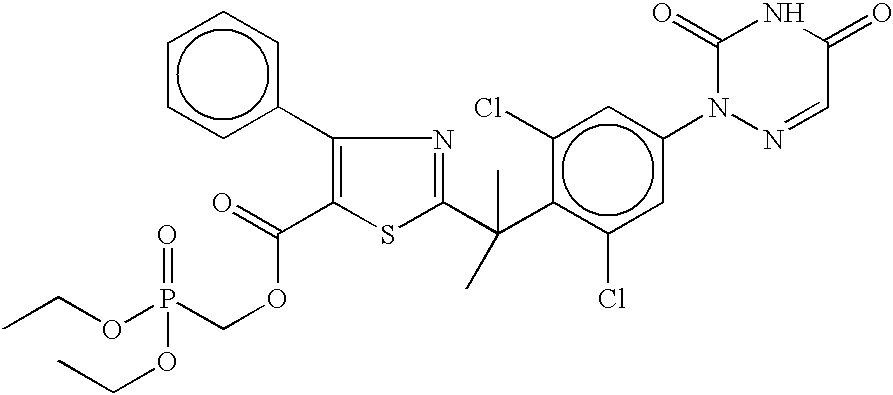


Fraction A was purified by high-performance liquid chromatography over RP BDS Spherical (200 g Hyperprep C18 (100 Å, 8 μm; eluent: [(0.5% NH4OAc in H2O)/CH3CN 90/10)]/CH3CN (0 min) 65/35,(24 minutes) 65/35, (up to 32 minutes) 0/100). The pure fractions were collected, the solvent was evaporated and the resulting product was recrystallized from EtOAc/hexane 1/1 (20 ml), filtered off and dried, yielding 0.33 g of a compound 97 having a molecular weight of 531.4 g and being represented by the formula


Further analysis shows that it consists of a mixture of 35% of an isomer with a melting point of 141° C. and 65% of another isomer with a melting point of 128° C.


and 1.4 g of a fraction which was then crystallized from 2-propanone/diethyl ether. The precipitate was filtered off and dried, yielding 1 g (49%) of a compound 140 having a molecular weight of 601.5 g and a melting point of 175° C. and being represented by the formula


Claims (13)


Applications Claiming Priority (5)
| Application Number | Priority Date | Filing Date | Title |
|---|---|---|---|
| EP998.70170.0 | 1999-08-06 | ||
| EP99870170 | 1999-08-06 | ||
| EP99126035 | 1999-12-27 | ||
| EP99126035.7 | 1999-12-27 | ||
| PCT/EP2000/007358 WO2001010866A1 (en) | 1999-08-06 | 2000-07-31 | Interleukin-5 inhibiting 6-azauracil derivatives |
Related Parent Applications (2)
| Application Number | Title | Priority Date | Filing Date |
|---|---|---|---|
| US10049038 Continuation-In-Part | 2000-07-31 | ||
| PCT/EP2000/007358 Continuation-In-Part WO2001010866A1 (en) | 1999-08-06 | 2000-07-31 | Interleukin-5 inhibiting 6-azauracil derivatives |
Publications (2)
| Publication Number | Publication Date |
|---|---|
| US20030114453A1 US20030114453A1 (en) | 2003-06-19 |
| US6911444B2 true US6911444B2 (en) | 2005-06-28 |
Family
ID=26153219
Family Applications (1)
| Application Number | Title | Priority Date | Filing Date |
|---|---|---|---|
| US10/075,876 Expired - Fee Related US6911444B2 (en) | 1999-08-06 | 2002-02-14 | Non-steroidal IL-5 inhibitors, processes and intermediates for their preparation and pharmaceutical compositions comprising said inhibitors |
Country Status (30)
| Country | Link |
|---|---|
| US (1) | US6911444B2 (en) |
| EP (1) | EP1206471B1 (en) |
| JP (1) | JP2003506451A (en) |
| KR (1) | KR100795484B1 (en) |
| CN (1) | CN1188410C (en) |
| AR (1) | AR025046A1 (en) |
| AT (1) | ATE318811T1 (en) |
| AU (1) | AU780047B2 (en) |
| BG (1) | BG106367A (en) |
| BR (1) | BR0013014A (en) |
| CA (1) | CA2380759A1 (en) |
| CO (1) | CO5050264A1 (en) |
| CZ (1) | CZ2002356A3 (en) |
| DE (1) | DE60026312T2 (en) |
| EA (1) | EA004740B1 (en) |
| EE (1) | EE200200057A (en) |
| ES (1) | ES2260031T3 (en) |
| HK (1) | HK1048634B (en) |
| HR (1) | HRP20020096A2 (en) |
| HU (1) | HUP0202692A3 (en) |
| IL (1) | IL147976A0 (en) |
| MX (1) | MXPA02001343A (en) |
| MY (1) | MY133512A (en) |
| NO (1) | NO322386B1 (en) |
| NZ (1) | NZ516506A (en) |
| PL (1) | PL353475A1 (en) |
| SK (1) | SK1642002A3 (en) |
| TR (1) | TR200200310T2 (en) |
| TW (1) | TWI271404B (en) |
| WO (1) | WO2001010866A1 (en) |
Cited By (10)
| Publication number | Priority date | Publication date | Assignee | Title |
|---|---|---|---|---|
| US8420655B2 (en) | 2009-12-04 | 2013-04-16 | Boehringer Ingelheim International Gmbh | Benzimidazole inhibitors of leukotriene production |
| US8575201B2 (en) | 2010-09-23 | 2013-11-05 | Boehringer Ingelheim International Gmbh | Oxadiazole inhibitors of leukotriene production |
| US8580829B2 (en) | 2010-08-26 | 2013-11-12 | Boehringer Ingelheim International Gmbh | Oxadiazole inhibitors of leukotriene production |
| US8580825B2 (en) | 2010-09-23 | 2013-11-12 | Boehringer Ingelheim International Gmbh | Oxadiazole inhibitors of leukotriene production |
| US8618300B2 (en) | 2008-09-04 | 2013-12-31 | Boehringer Ingelheim International Gmbh | Indolizine inhibitors of leukotriene production |
| US8658661B2 (en) | 2010-08-16 | 2014-02-25 | Boehringer Ingelheim International Gmbh | Oxadiazole inhibitors of leukotriene production |
| US8772304B2 (en) | 2010-11-01 | 2014-07-08 | Boehringer Ingelheim International Gmbh | Benzimidazole inhibitors of leukotriene production |
| US8829200B2 (en) | 2010-10-29 | 2014-09-09 | Boehringer Ingelheim International Gmbh | Benzimidazole inhibitors of leukotriene production |
| US9073895B2 (en) | 2010-12-16 | 2015-07-07 | Boehringer Ingelheim International Gmbh | Biarylamide inhibitors of leukotriene production |
| US9248187B2 (en) | 2012-02-01 | 2016-02-02 | Boehringer Ingelheim International Gmbh | Oxadiazole inhibitors of leukotriene production for combination therapy |
Families Citing this family (7)
| Publication number | Priority date | Publication date | Assignee | Title |
|---|---|---|---|---|
| US8048917B2 (en) | 2005-04-06 | 2011-11-01 | Xenoport, Inc. | Prodrugs of GABA analogs, compositions and uses thereof |
| US6818787B2 (en) | 2001-06-11 | 2004-11-16 | Xenoport, Inc. | Prodrugs of GABA analogs, compositions and uses thereof |
| US7232924B2 (en) | 2001-06-11 | 2007-06-19 | Xenoport, Inc. | Methods for synthesis of acyloxyalkyl derivatives of GABA analogs |
| US7186855B2 (en) | 2001-06-11 | 2007-03-06 | Xenoport, Inc. | Prodrugs of GABA analogs, compositions and uses thereof |
| US7183276B2 (en) | 2002-02-28 | 2007-02-27 | Takeda Pharmaceutical Company Limited | Azole compounds |
| EP1758874A1 (en) * | 2004-05-29 | 2007-03-07 | 7TM Pharma A/S | Substituted thiazoleacetic acids as crth2 ligands |
| JP4743340B1 (en) | 2009-10-28 | 2011-08-10 | セントラル硝子株式会社 | Chemical solution for protective film formation |
Citations (7)
| Publication number | Priority date | Publication date | Assignee | Title |
|---|---|---|---|---|
| FR2532313A2 (en) | 1980-02-18 | 1984-03-02 | Roussel Uclaf | New oximes derived from 3-alkyloxymethyl- or 3-alkylthiomethyl-7-[(aminothiazolyl)acetamido]cephalosporanic acid, process for preparing them and their use as medicaments |
| US4631278A (en) | 1984-08-01 | 1986-12-23 | Janssen Pharmaceutica N.V. | Anti-protozoal α-aryl-4-(4,5-dihydro-3,5-dioxo-1,2,4-triazin-2(3H)-yl)-benzeneacetonitrile derivatives, pharmaceutical compositions, and method of use therefor |
| EP0170316B1 (en) | 1984-08-01 | 1990-05-30 | Janssen Pharmaceutica N.V. | Alpha-aryl-4-(4,5-dihydro-3,5-dioxo-1,2,4-triazin-2(3h)-yl)benzeneacetonitriles |
| EP0232932B1 (en) | 1986-01-30 | 1991-01-02 | Janssen Pharmaceutica N.V. | 5,6-dihydro-2-(substituted phenyl)-1,2,4-triazine-3,5(2h,4h)-diones |
| WO1999002505A1 (en) | 1997-07-10 | 1999-01-21 | Janssen Pharmaceutica N.V. | Il-5 inhibiting 6-azauracil derivatives |
| WO1999002504A1 (en) | 1997-07-10 | 1999-01-21 | Janssen Pharmaceutica N.V. | 6-azauracil derivatives as il-5 inhibitors |
| EP0987265A1 (en) * | 1998-09-18 | 2000-03-22 | Janssen Pharmaceutica N.V. | Interleukin-5 inhibiting 6-azauracil derivatives |
Family Cites Families (2)
| Publication number | Priority date | Publication date | Assignee | Title |
|---|---|---|---|---|
| US10177A (en) * | 1853-11-01 | Improved pen and pencil case | ||
| US42416A (en) * | 1864-04-19 | Improvement in harvesters |
-
2000
- 2000-07-31 EA EA200200232A patent/EA004740B1/en not_active IP Right Cessation
- 2000-07-31 ES ES00948015T patent/ES2260031T3/en not_active Expired - Lifetime
- 2000-07-31 HR HR20020096A patent/HRP20020096A2/en not_active Application Discontinuation
- 2000-07-31 IL IL14797600A patent/IL147976A0/en not_active IP Right Cessation
- 2000-07-31 DE DE60026312T patent/DE60026312T2/en not_active Expired - Fee Related
- 2000-07-31 TR TR2002/00310T patent/TR200200310T2/en unknown
- 2000-07-31 KR KR1020027000704A patent/KR100795484B1/en not_active Expired - Fee Related
- 2000-07-31 NZ NZ516506A patent/NZ516506A/en unknown
- 2000-07-31 PL PL00353475A patent/PL353475A1/en unknown
- 2000-07-31 CA CA002380759A patent/CA2380759A1/en not_active Abandoned
- 2000-07-31 AU AU61609/00A patent/AU780047B2/en not_active Ceased
- 2000-07-31 HU HU0202692A patent/HUP0202692A3/en unknown
- 2000-07-31 CN CNB008113394A patent/CN1188410C/en not_active Expired - Fee Related
- 2000-07-31 MX MXPA02001343A patent/MXPA02001343A/en active IP Right Grant
- 2000-07-31 AT AT00948015T patent/ATE318811T1/en not_active IP Right Cessation
- 2000-07-31 EP EP00948015A patent/EP1206471B1/en not_active Expired - Lifetime
- 2000-07-31 EE EEP200200057A patent/EE200200057A/en unknown
- 2000-07-31 BR BR0013014-1A patent/BR0013014A/en not_active Application Discontinuation
- 2000-07-31 SK SK164-2002A patent/SK1642002A3/en not_active Application Discontinuation
- 2000-07-31 HK HK03100718.8A patent/HK1048634B/en not_active IP Right Cessation
- 2000-07-31 WO PCT/EP2000/007358 patent/WO2001010866A1/en not_active Ceased
- 2000-07-31 JP JP2001515675A patent/JP2003506451A/en not_active Withdrawn
- 2000-07-31 CZ CZ2002356A patent/CZ2002356A3/en unknown
- 2000-08-03 MY MYPI20003534 patent/MY133512A/en unknown
- 2000-08-04 TW TW089115824A patent/TWI271404B/en not_active IP Right Cessation
- 2000-08-04 AR ARP000104044A patent/AR025046A1/en unknown
- 2000-08-04 CO CO00058843A patent/CO5050264A1/en unknown
-
2002
- 2002-01-30 BG BG06367A patent/BG106367A/en unknown
- 2002-02-05 NO NO20020565A patent/NO322386B1/en not_active IP Right Cessation
- 2002-02-14 US US10/075,876 patent/US6911444B2/en not_active Expired - Fee Related
Patent Citations (9)
| Publication number | Priority date | Publication date | Assignee | Title |
|---|---|---|---|---|
| FR2532313A2 (en) | 1980-02-18 | 1984-03-02 | Roussel Uclaf | New oximes derived from 3-alkyloxymethyl- or 3-alkylthiomethyl-7-[(aminothiazolyl)acetamido]cephalosporanic acid, process for preparing them and their use as medicaments |
| US4631278A (en) | 1984-08-01 | 1986-12-23 | Janssen Pharmaceutica N.V. | Anti-protozoal α-aryl-4-(4,5-dihydro-3,5-dioxo-1,2,4-triazin-2(3H)-yl)-benzeneacetonitrile derivatives, pharmaceutical compositions, and method of use therefor |
| EP0170316B1 (en) | 1984-08-01 | 1990-05-30 | Janssen Pharmaceutica N.V. | Alpha-aryl-4-(4,5-dihydro-3,5-dioxo-1,2,4-triazin-2(3h)-yl)benzeneacetonitriles |
| EP0232932B1 (en) | 1986-01-30 | 1991-01-02 | Janssen Pharmaceutica N.V. | 5,6-dihydro-2-(substituted phenyl)-1,2,4-triazine-3,5(2h,4h)-diones |
| WO1999002505A1 (en) | 1997-07-10 | 1999-01-21 | Janssen Pharmaceutica N.V. | Il-5 inhibiting 6-azauracil derivatives |
| WO1999002504A1 (en) | 1997-07-10 | 1999-01-21 | Janssen Pharmaceutica N.V. | 6-azauracil derivatives as il-5 inhibitors |
| US20020042416A1 (en) | 1997-07-10 | 2002-04-11 | Freyne Eddy Jean Edgard | 6-azauracil derivatives as IL-5 inhibitors |
| EP0987265A1 (en) * | 1998-09-18 | 2000-03-22 | Janssen Pharmaceutica N.V. | Interleukin-5 inhibiting 6-azauracil derivatives |
| US20020010177A1 (en) | 1998-09-18 | 2002-01-24 | Freyne Eddy Jean Edgard | IL-5 inhibiting 6-azauracil derivatives |
Non-Patent Citations (9)
| Title |
|---|
| Baggiolini, M., et al., CC chemokines in allergic inflammation, Immunology Today, 1994, 15(3), 127-133. |
| Buzas, A., et al., CAPLUS Accession No. 1961:131401, Chemical Abstract, 1961, vol. 55, Abstract # 131,401. |
| Carr, M. W. et al., "Monocyte chemoattractant protein 1 acts as a T-lymphocyte chemoattractant.". Proc. Natl. Acad. Sci. 1994, 91, 3652-3656. |
| Office Action received in U.S. Appl. No. 10/049,038 to which U.S. Appl. No. 10/075,876 claims priority as a continuation-in-part thereof. |
| PCT International Search Report PCT/EP00/07358 dated Jan. 25, 2001, which relates to U.S. Appl. 10/075,876. |
| Peet, N.P., et al., "Synthesis of a Novel indolobenzodiazepine." J. Heterocyclic Chem., 1983, pp. 1355-1357, vol. 20. |
| Published Application for U.S. Patent 2002/0010177 (A1), which relates in family to EP 0987265, and a MicroPatent(R) Family Lookup. |
| Published Application for U.S. Patent 20020042416 (A1), and a MicroPatent(R) Family Lookup. |
| Wang-Lin, Y., et al., "Synthesis of 1,4-bis(1,3,4-oxadiazol-2-yl)-2,5-dialkoxybenzene-oligothiophene copolymers with different emissive colors: synthetically tuning the photoluminescence of conjugated polymers." Chemical Comm. 1957, pp. 1957-1958. |
Cited By (10)
| Publication number | Priority date | Publication date | Assignee | Title |
|---|---|---|---|---|
| US8618300B2 (en) | 2008-09-04 | 2013-12-31 | Boehringer Ingelheim International Gmbh | Indolizine inhibitors of leukotriene production |
| US8420655B2 (en) | 2009-12-04 | 2013-04-16 | Boehringer Ingelheim International Gmbh | Benzimidazole inhibitors of leukotriene production |
| US8658661B2 (en) | 2010-08-16 | 2014-02-25 | Boehringer Ingelheim International Gmbh | Oxadiazole inhibitors of leukotriene production |
| US8580829B2 (en) | 2010-08-26 | 2013-11-12 | Boehringer Ingelheim International Gmbh | Oxadiazole inhibitors of leukotriene production |
| US8575201B2 (en) | 2010-09-23 | 2013-11-05 | Boehringer Ingelheim International Gmbh | Oxadiazole inhibitors of leukotriene production |
| US8580825B2 (en) | 2010-09-23 | 2013-11-12 | Boehringer Ingelheim International Gmbh | Oxadiazole inhibitors of leukotriene production |
| US8829200B2 (en) | 2010-10-29 | 2014-09-09 | Boehringer Ingelheim International Gmbh | Benzimidazole inhibitors of leukotriene production |
| US8772304B2 (en) | 2010-11-01 | 2014-07-08 | Boehringer Ingelheim International Gmbh | Benzimidazole inhibitors of leukotriene production |
| US9073895B2 (en) | 2010-12-16 | 2015-07-07 | Boehringer Ingelheim International Gmbh | Biarylamide inhibitors of leukotriene production |
| US9248187B2 (en) | 2012-02-01 | 2016-02-02 | Boehringer Ingelheim International Gmbh | Oxadiazole inhibitors of leukotriene production for combination therapy |
Also Published As
Similar Documents
| Publication | Publication Date | Title |
|---|---|---|
| US6911444B2 (en) | Non-steroidal IL-5 inhibitors, processes and intermediates for their preparation and pharmaceutical compositions comprising said inhibitors | |
| US6894046B2 (en) | IL-5 inhibiting 6-azauracil derivatives | |
| US6951857B2 (en) | 6-Azauracil derivatives as IL-5 inhibitors | |
| US6498158B1 (en) | Il-5 inhibiting 6-azauracil derivatives | |
| US6803364B1 (en) | Il-5 inhibiting 6-azauracil derivatives | |
| US6469001B1 (en) | IL-5 inhibiting 6-azauracil derivatives | |
| CZ457699A3 (en) | Derivatives of 6-azauracil as IL-5 inhibitors, process of their preparation and pharmaceutical preparations |
Legal Events
| Date | Code | Title | Description |
|---|---|---|---|
| AS | Assignment |
Owner name: JANSSEN PHARMACEUTICA, N.V., BELGIUM Free format text: ASSIGNMENT OF ASSIGNORS INTEREST;ASSIGNOR:JANSSEN-CILAG S.A.;REEL/FRAME:014824/0982 Effective date: 20040526 Owner name: JANSSEN PHARMACEUTICA, N.V., BELGIUM Free format text: ASSIGNMENT OF ASSIGNORS INTEREST;ASSIGNORS:FREYNE, EDDY JEAN EDGARD;DEROOSE, FREDERIK DIRK;COESEMANS, ERWIN;REEL/FRAME:014825/0076 Effective date: 20040602 Owner name: JANSSEN PHARMACEUTICA, N.V., BELGIUM Free format text: ASSIGNMENT OF ASSIGNORS INTEREST;ASSIGNORS:LACRAMPE, JEAN FERNAND ARMAND;FORTIN, JEROME MICHEL CLAUDE;REEL/FRAME:014825/0078 Effective date: 20040526 |
|
| FPAY | Fee payment |
Year of fee payment: 4 |
|
| REMI | Maintenance fee reminder mailed | ||
| LAPS | Lapse for failure to pay maintenance fees | ||
| STCH | Information on status: patent discontinuation |
Free format text: PATENT EXPIRED DUE TO NONPAYMENT OF MAINTENANCE FEES UNDER 37 CFR 1.362 |
|
| STCH | Information on status: patent discontinuation |
Free format text: PATENT EXPIRED DUE TO NONPAYMENT OF MAINTENANCE FEES UNDER 37 CFR 1.362 |
|
| FP | Lapsed due to failure to pay maintenance fee |
Effective date: 20130628 |