US6903112B2 - Heterocyclylindazole and -azaindazole compounds as 5-hydroxytryptamine-6 ligands - Google Patents
Heterocyclylindazole and -azaindazole compounds as 5-hydroxytryptamine-6 ligands Download PDFInfo
- Publication number
- US6903112B2 US6903112B2 US10/691,937 US69193703A US6903112B2 US 6903112 B2 US6903112 B2 US 6903112B2 US 69193703 A US69193703 A US 69193703A US 6903112 B2 US6903112 B2 US 6903112B2
- Authority
- US
- United States
- Prior art keywords
- piperidin
- indole
- benzenesulfonyl
- chloro
- alkyl
- Prior art date
- Legal status (The legal status is an assumption and is not a legal conclusion. Google has not performed a legal analysis and makes no representation as to the accuracy of the status listed.)
- Expired - Fee Related, expires
Links
- 0 [1*]C.[2*]C.[5*]CN1/[W]=C(/c2cCC[Y]C2)C2=C1C=CC=C2 Chemical compound [1*]C.[2*]C.[5*]CN1/[W]=C(/c2cCC[Y]C2)C2=C1C=CC=C2 0.000 description 13
- ZWHHPODHIHIWFS-UHFFFAOYSA-N C1=CC2=C(C=C1)C(C1CCCNC1)=CN2.C1=CC=C(CN2CCC=C(C3=CNC4=C3C=CC=C4)C2)C=C1 Chemical compound C1=CC2=C(C=C1)C(C1CCCNC1)=CN2.C1=CC=C(CN2CCC=C(C3=CNC4=C3C=CC=C4)C2)C=C1 ZWHHPODHIHIWFS-UHFFFAOYSA-N 0.000 description 1
- JFLHAMJBEHCMMV-UHFFFAOYSA-N C1=CC2=C(C=C1)C(C1CCCNC1)=CN2.CB(O)N1CCCC(C2=CNC3=C2C=CC=C3)C1 Chemical compound C1=CC2=C(C=C1)C(C1CCCNC1)=CN2.CB(O)N1CCCC(C2=CNC3=C2C=CC=C3)C1 JFLHAMJBEHCMMV-UHFFFAOYSA-N 0.000 description 1
- WIFBOFOKMLZOEF-UHFFFAOYSA-N C1=CC2=C(C=C1)NC=C2.CC(=O)O.CN1C(=O)C=CC1=O.CN1C(=O)CC(C2=CNC3=C2C=CC=C3)C1=O Chemical compound C1=CC2=C(C=C1)NC=C2.CC(=O)O.CN1C(=O)C=CC1=O.CN1C(=O)CC(C2=CNC3=C2C=CC=C3)C1=O WIFBOFOKMLZOEF-UHFFFAOYSA-N 0.000 description 1
- QBTAHORMUBFQJB-UHFFFAOYSA-N C1=CC=C(CN2CCC=C(C3=CNC4=C3C=CC=C4)C2)C=C1.C1=CC=C2NC=CC2=C1.O=C1CCCN(CC2=CC=CC=C2)C1 Chemical compound C1=CC=C(CN2CCC=C(C3=CNC4=C3C=CC=C4)C2)C=C1.C1=CC=C2NC=CC2=C1.O=C1CCCN(CC2=CC=CC=C2)C1 QBTAHORMUBFQJB-UHFFFAOYSA-N 0.000 description 1
- PFOBIQWKXQFFGV-UHFFFAOYSA-N C1=CCCCC1.C1=NCCC[Y]1.C1=NCC[Y]1.C1CCC[Y]CC1.C1CC[Y]C1.C1CC[Y]C1.C1CC[Y]CC1.C1CC[Y]CC1.C1C[Y]C[Y]1.C1C[Y]C[Y]C1.CC.CC.CC.CC.CC.CC.CC.CC.CC.CC Chemical compound C1=CCCCC1.C1=NCCC[Y]1.C1=NCC[Y]1.C1CCC[Y]CC1.C1CC[Y]C1.C1CC[Y]C1.C1CC[Y]CC1.C1CC[Y]CC1.C1C[Y]C[Y]1.C1C[Y]C[Y]C1.CC.CC.CC.CC.CC.CC.CC.CC.CC.CC PFOBIQWKXQFFGV-UHFFFAOYSA-N 0.000 description 1
- JEIISENIHCRZNE-UHFFFAOYSA-N CB(O)N1CCCC(/C2=C/NC3=C2C=CC=C3)C1.CN1C=C(C2CCCNC2)C2=C1C=CC=C2 Chemical compound CB(O)N1CCCC(/C2=C/NC3=C2C=CC=C3)C1.CN1C=C(C2CCCNC2)C2=C1C=CC=C2 JEIISENIHCRZNE-UHFFFAOYSA-N 0.000 description 1
- DEQHIMNJTCSQEE-UHFFFAOYSA-N CB(O)N1CCCC(C2=CNC3=C2C=CC=C3)C1.O=S(=O)(Cl)C1=CC=CC=C1.OO(SN1C=C(C2CCCNC2)C2=C1C=CC=C2)C1=CC=CC=C1 Chemical compound CB(O)N1CCCC(C2=CNC3=C2C=CC=C3)C1.O=S(=O)(Cl)C1=CC=CC=C1.OO(SN1C=C(C2CCCNC2)C2=C1C=CC=C2)C1=CC=CC=C1 DEQHIMNJTCSQEE-UHFFFAOYSA-N 0.000 description 1
- GZEUDTWPGAJCBH-UHFFFAOYSA-N CC1=CC=C(O(O)SN2C=C(C3CCN(C)C3)C3=C2C=CC=C3)C=C1.CC1=CC=C(S(=O)(=O)Cl)C=C1.CN1CCC(C2=CNC3=C2C=CC=C3)C1 Chemical compound CC1=CC=C(O(O)SN2C=C(C3CCN(C)C3)C3=C2C=CC=C3)C=C1.CC1=CC=C(S(=O)(=O)Cl)C=C1.CN1CCC(C2=CNC3=C2C=CC=C3)C1 GZEUDTWPGAJCBH-UHFFFAOYSA-N 0.000 description 1
- PGBXVSZTYOOKCQ-UHFFFAOYSA-N CN1C(=O)CC(C2=CNC3=C2C=CC=C3)C1=O.CN1CCC(C2=CNC3=C2C=CC=C3)C1.[AlH3].[LiH] Chemical compound CN1C(=O)CC(C2=CNC3=C2C=CC=C3)C1=O.CN1CCC(C2=CNC3=C2C=CC=C3)C1.[AlH3].[LiH] PGBXVSZTYOOKCQ-UHFFFAOYSA-N 0.000 description 1
- ZALNUJQHMWCRDL-UHFFFAOYSA-N CN1C=C(C2CCCNC2)C2=C1C=CC=C2 Chemical compound CN1C=C(C2CCCNC2)C2=C1C=CC=C2 ZALNUJQHMWCRDL-UHFFFAOYSA-N 0.000 description 1
Classifications
-
- C—CHEMISTRY; METALLURGY
- C07—ORGANIC CHEMISTRY
- C07D—HETEROCYCLIC COMPOUNDS
- C07D401/00—Heterocyclic compounds containing two or more hetero rings, having nitrogen atoms as the only ring hetero atoms, at least one ring being a six-membered ring with only one nitrogen atom
- C07D401/02—Heterocyclic compounds containing two or more hetero rings, having nitrogen atoms as the only ring hetero atoms, at least one ring being a six-membered ring with only one nitrogen atom containing two hetero rings
- C07D401/04—Heterocyclic compounds containing two or more hetero rings, having nitrogen atoms as the only ring hetero atoms, at least one ring being a six-membered ring with only one nitrogen atom containing two hetero rings directly linked by a ring-member-to-ring-member bond
-
- A—HUMAN NECESSITIES
- A61—MEDICAL OR VETERINARY SCIENCE; HYGIENE
- A61K—PREPARATIONS FOR MEDICAL, DENTAL OR TOILETRY PURPOSES
- A61K31/00—Medicinal preparations containing organic active ingredients
- A61K31/33—Heterocyclic compounds
- A61K31/395—Heterocyclic compounds having nitrogen as a ring hetero atom, e.g. guanethidine or rifamycins
- A61K31/40—Heterocyclic compounds having nitrogen as a ring hetero atom, e.g. guanethidine or rifamycins having five-membered rings with one nitrogen as the only ring hetero atom, e.g. sulpiride, succinimide, tolmetin, buflomedil
- A61K31/403—Heterocyclic compounds having nitrogen as a ring hetero atom, e.g. guanethidine or rifamycins having five-membered rings with one nitrogen as the only ring hetero atom, e.g. sulpiride, succinimide, tolmetin, buflomedil condensed with carbocyclic rings, e.g. carbazole
- A61K31/404—Indoles, e.g. pindolol
-
- A—HUMAN NECESSITIES
- A61—MEDICAL OR VETERINARY SCIENCE; HYGIENE
- A61K—PREPARATIONS FOR MEDICAL, DENTAL OR TOILETRY PURPOSES
- A61K31/00—Medicinal preparations containing organic active ingredients
- A61K31/33—Heterocyclic compounds
- A61K31/395—Heterocyclic compounds having nitrogen as a ring hetero atom, e.g. guanethidine or rifamycins
- A61K31/41—Heterocyclic compounds having nitrogen as a ring hetero atom, e.g. guanethidine or rifamycins having five-membered rings with two or more ring hetero atoms, at least one of which being nitrogen, e.g. tetrazole
- A61K31/425—Thiazoles
- A61K31/427—Thiazoles not condensed and containing further heterocyclic rings
-
- A—HUMAN NECESSITIES
- A61—MEDICAL OR VETERINARY SCIENCE; HYGIENE
- A61K—PREPARATIONS FOR MEDICAL, DENTAL OR TOILETRY PURPOSES
- A61K31/00—Medicinal preparations containing organic active ingredients
- A61K31/33—Heterocyclic compounds
- A61K31/395—Heterocyclic compounds having nitrogen as a ring hetero atom, e.g. guanethidine or rifamycins
- A61K31/435—Heterocyclic compounds having nitrogen as a ring hetero atom, e.g. guanethidine or rifamycins having six-membered rings with one nitrogen as the only ring hetero atom
- A61K31/44—Non condensed pyridines; Hydrogenated derivatives thereof
- A61K31/445—Non condensed piperidines, e.g. piperocaine
- A61K31/4523—Non condensed piperidines, e.g. piperocaine containing further heterocyclic ring systems
- A61K31/454—Non condensed piperidines, e.g. piperocaine containing further heterocyclic ring systems containing a five-membered ring with nitrogen as a ring hetero atom, e.g. pimozide, domperidone
-
- A—HUMAN NECESSITIES
- A61—MEDICAL OR VETERINARY SCIENCE; HYGIENE
- A61K—PREPARATIONS FOR MEDICAL, DENTAL OR TOILETRY PURPOSES
- A61K31/00—Medicinal preparations containing organic active ingredients
- A61K31/33—Heterocyclic compounds
- A61K31/395—Heterocyclic compounds having nitrogen as a ring hetero atom, e.g. guanethidine or rifamycins
- A61K31/435—Heterocyclic compounds having nitrogen as a ring hetero atom, e.g. guanethidine or rifamycins having six-membered rings with one nitrogen as the only ring hetero atom
- A61K31/44—Non condensed pyridines; Hydrogenated derivatives thereof
- A61K31/445—Non condensed piperidines, e.g. piperocaine
- A61K31/4523—Non condensed piperidines, e.g. piperocaine containing further heterocyclic ring systems
- A61K31/4545—Non condensed piperidines, e.g. piperocaine containing further heterocyclic ring systems containing a six-membered ring with nitrogen as a ring hetero atom, e.g. pipamperone, anabasine
-
- A—HUMAN NECESSITIES
- A61—MEDICAL OR VETERINARY SCIENCE; HYGIENE
- A61P—SPECIFIC THERAPEUTIC ACTIVITY OF CHEMICAL COMPOUNDS OR MEDICINAL PREPARATIONS
- A61P1/00—Drugs for disorders of the alimentary tract or the digestive system
- A61P1/04—Drugs for disorders of the alimentary tract or the digestive system for ulcers, gastritis or reflux esophagitis, e.g. antacids, inhibitors of acid secretion, mucosal protectants
-
- A—HUMAN NECESSITIES
- A61—MEDICAL OR VETERINARY SCIENCE; HYGIENE
- A61P—SPECIFIC THERAPEUTIC ACTIVITY OF CHEMICAL COMPOUNDS OR MEDICINAL PREPARATIONS
- A61P25/00—Drugs for disorders of the nervous system
-
- A—HUMAN NECESSITIES
- A61—MEDICAL OR VETERINARY SCIENCE; HYGIENE
- A61P—SPECIFIC THERAPEUTIC ACTIVITY OF CHEMICAL COMPOUNDS OR MEDICINAL PREPARATIONS
- A61P25/00—Drugs for disorders of the nervous system
- A61P25/06—Antimigraine agents
-
- A—HUMAN NECESSITIES
- A61—MEDICAL OR VETERINARY SCIENCE; HYGIENE
- A61P—SPECIFIC THERAPEUTIC ACTIVITY OF CHEMICAL COMPOUNDS OR MEDICINAL PREPARATIONS
- A61P25/00—Drugs for disorders of the nervous system
- A61P25/08—Antiepileptics; Anticonvulsants
-
- A—HUMAN NECESSITIES
- A61—MEDICAL OR VETERINARY SCIENCE; HYGIENE
- A61P—SPECIFIC THERAPEUTIC ACTIVITY OF CHEMICAL COMPOUNDS OR MEDICINAL PREPARATIONS
- A61P25/00—Drugs for disorders of the nervous system
- A61P25/18—Antipsychotics, i.e. neuroleptics; Drugs for mania or schizophrenia
-
- A—HUMAN NECESSITIES
- A61—MEDICAL OR VETERINARY SCIENCE; HYGIENE
- A61P—SPECIFIC THERAPEUTIC ACTIVITY OF CHEMICAL COMPOUNDS OR MEDICINAL PREPARATIONS
- A61P25/00—Drugs for disorders of the nervous system
- A61P25/20—Hypnotics; Sedatives
-
- A—HUMAN NECESSITIES
- A61—MEDICAL OR VETERINARY SCIENCE; HYGIENE
- A61P—SPECIFIC THERAPEUTIC ACTIVITY OF CHEMICAL COMPOUNDS OR MEDICINAL PREPARATIONS
- A61P25/00—Drugs for disorders of the nervous system
- A61P25/22—Anxiolytics
-
- A—HUMAN NECESSITIES
- A61—MEDICAL OR VETERINARY SCIENCE; HYGIENE
- A61P—SPECIFIC THERAPEUTIC ACTIVITY OF CHEMICAL COMPOUNDS OR MEDICINAL PREPARATIONS
- A61P25/00—Drugs for disorders of the nervous system
- A61P25/24—Antidepressants
-
- A—HUMAN NECESSITIES
- A61—MEDICAL OR VETERINARY SCIENCE; HYGIENE
- A61P—SPECIFIC THERAPEUTIC ACTIVITY OF CHEMICAL COMPOUNDS OR MEDICINAL PREPARATIONS
- A61P25/00—Drugs for disorders of the nervous system
- A61P25/28—Drugs for disorders of the nervous system for treating neurodegenerative disorders of the central nervous system, e.g. nootropic agents, cognition enhancers, drugs for treating Alzheimer's disease or other forms of dementia
-
- A—HUMAN NECESSITIES
- A61—MEDICAL OR VETERINARY SCIENCE; HYGIENE
- A61P—SPECIFIC THERAPEUTIC ACTIVITY OF CHEMICAL COMPOUNDS OR MEDICINAL PREPARATIONS
- A61P25/00—Drugs for disorders of the nervous system
- A61P25/30—Drugs for disorders of the nervous system for treating abuse or dependence
-
- A—HUMAN NECESSITIES
- A61—MEDICAL OR VETERINARY SCIENCE; HYGIENE
- A61P—SPECIFIC THERAPEUTIC ACTIVITY OF CHEMICAL COMPOUNDS OR MEDICINAL PREPARATIONS
- A61P43/00—Drugs for specific purposes, not provided for in groups A61P1/00-A61P41/00
-
- C—CHEMISTRY; METALLURGY
- C07—ORGANIC CHEMISTRY
- C07D—HETEROCYCLIC COMPOUNDS
- C07D403/00—Heterocyclic compounds containing two or more hetero rings, having nitrogen atoms as the only ring hetero atoms, not provided for by group C07D401/00
- C07D403/02—Heterocyclic compounds containing two or more hetero rings, having nitrogen atoms as the only ring hetero atoms, not provided for by group C07D401/00 containing two hetero rings
- C07D403/04—Heterocyclic compounds containing two or more hetero rings, having nitrogen atoms as the only ring hetero atoms, not provided for by group C07D401/00 containing two hetero rings directly linked by a ring-member-to-ring-member bond
-
- C—CHEMISTRY; METALLURGY
- C07—ORGANIC CHEMISTRY
- C07D—HETEROCYCLIC COMPOUNDS
- C07D471/00—Heterocyclic compounds containing nitrogen atoms as the only ring hetero atoms in the condensed system, at least one ring being a six-membered ring with one nitrogen atom, not provided for by groups C07D451/00 - C07D463/00
- C07D471/02—Heterocyclic compounds containing nitrogen atoms as the only ring hetero atoms in the condensed system, at least one ring being a six-membered ring with one nitrogen atom, not provided for by groups C07D451/00 - C07D463/00 in which the condensed system contains two hetero rings
- C07D471/04—Ortho-condensed systems
Definitions
- a number of central nervous system disorders such as anxiety, depression, motor disorders, etc., are believed to involve a disturbance of the neurotransmitter 5-hydroxytryptamine (5-HT) or serotonin.
- Serotonin is localized in the central and peripheral nervous systems and is known to affect many types of conditions including psychiatric disorders, motor activity, feeding behavior, sexual activity, and neuroendocrine regulation among others.
- the effects of serotonin are regulated by the various 5-HT receptor subtypes.
- Known 5-HT receptors include 5-HT1, 5-HT2, 5-HT3, 5-HT4, 5-HT5, 5-HT6 and 5-HT7 subtypes.
- 5-hydroxytryptamine-6 (5-HT6) receptor subtype The recently identified human 5-hydroxytryptamine-6 (5-HT6) receptor subtype has been cloned, and the extensive distribution of its mRNA has been reported. Highest levels of 5-HT6 receptor mRNA have been observed in the olfactory tubercle, the striatum, nucleus accumbens, dentate gyrus and CA1, CA2 and CA3 regions of the hippocampus. Northern blots have revealed that 5-HT6 receptor mRNA appears to be exclusively present in the brain, with little evidence for its presence in peripheral tissues.
- 5-HT6 ligands Compounds which interact with, stimulate or inhibit the 5-HT6 receptor are commonly referred to as 5-HT6 ligands.
- 5-HT6 receptor ligands are believed to be of potential use in the treatment of a variety of central nervous system disorders such as anxiety, depression, epilepsy, obsessive-compulsive disorders, migraine, cognitive disorders, sleep disorders, feeding disorders, panic attacks, disorders relating to withdrawl from drug abuse, schizophrenia, or the like or in the treatment of certain gastrointestinal disorders such as irritable bowel syndrome.
- the compounds provided may also be used to further study and elucidate the 5-HT6 receptor.
- the present invention provides a compound of formula I wherein
- the present invention further provides methods and compositions useful for the treatment of central nervous system disorders affected by or related to the 5-HT6 receptor.
- the 5-hydroxytryptamine-6 (5-HT6) receptor is one of the most recent receptors to be identified by molecular cloning. Its ability to bind a wide range of therapeutic compounds used in psychiatry, coupled with its intriguing distribution in the brain has stimulated significant interest in new compounds which are capable of interacting with or affecting said receptor. At present, there are no known fully selective agonists. Significant efforts are being made to understand the possible role of the 5-HT6 receptor in psychiatry, cognitive dysfunction, motor function and control, memory, mood and the like. To that end, compounds which demonstrate a binding affinity for the 5-HT6 receptor are earnestly sought both as an aid in the study of the 5-HT6 receptor and as potential therapeutic agents in the treatment of central nervous system disorders.
- heterocyclylindazole or -azaindazole compounds of formula I demonstrate affinity for the 5-HT6 receptor along with significant receptor sub-type selectivity.
- said formula I compounds are effective therapeutic agents for the treatment of central nervous system (CNS) disorders associated with or affected by the 5-HT6 receptor.
- CNS central nervous system
- the present invention provides heterocyclylindazole or -azaindazole compounds of formula I wherein
- halogen designates Br, Cl, I or F
- aryl designates phenyl or naphthyl
- cycloheteroalkyl designates a 5- to 7-membered monocyclic ring system containing 1 or 2 heteroatoms, which may be the same or different, selected from N, O or S and optionally containing one double bond.
- exemplary of the cycloheteroalkyl ring systems included in the term as designated herein are the following rings wherein Y 1 is NR, O or S and R is H or an optional substituent as described hereinbelow.
- heteroaryl designates a 5- to 10-membered monocyclic or bicyclic aromatic ring system containing 1 to 3 heteroatoms, which may be the same or different, selected from N, O or S.
- heteroaryl ring systems include pyrrolyl, azolyl, oxazolyl, thiazolyl, imidazolyl, furyl, thienyl, quinolinyl, isoquinolinyl, indolinyl, benzothienyl, benzofuranyl, benzisoxazolyl and the like.
- haloalkyl designates a C n H 2n+1 group having from one to 2n+1 halogen atoms which may be the same or different; and the term haloalkoxy designates an OC n H 2n+1 group having from one to 2n+1 halogen atoms which may be the same or different.
- substituents include halogen atoms, nitro, cyano, thiocyanato, cyanato, hydroxyl, alkyl, haloalkyl, alkoxy, haloalkoxy, amino, alkylamino, dialkylamino, formyl, alkoxycarbonyl, carboxyl, alkanoyl, alkylthio, alkylsuphinyl, alkylsulphonyl, carbamoyl, alkylamido, phenyl, phenoxy, benzyl, benzyloxy, cycloheteroalkyl, heteroaryl or cycloalkyl groups, preferably halogen atoms or lower alkyl groups.
- substituents may be present.
- this may be linear or branched and may contain up to 12, preferably up to 6, more preferably up to 4 carbon atoms.
- Pharmaceutically acceptable salts may be any acid addition salt formed by a compound of formula I and a pharmaceutically acceptable acid such as phosphoric, sulfuric, hydrochloric, hydrobromic, citric, maleic, mandelic, malonic, succinic, fumaric, acetic, lactic, nitric, sulfonic, p-toluene sulfonic, methane sulfonic acid or the like.
- a pharmaceutically acceptable acid such as phosphoric, sulfuric, hydrochloric, hydrobromic, citric, maleic, mandelic, malonic, succinic, fumaric, acetic, lactic, nitric, sulfonic, p-toluene sulfonic, methane sulfonic acid or the like.
- Compounds of the invention include esters, carbamates or other conventional prodrug forms, which in general, are functional derivatives of the compounds of the invention and which are readily converted to the inventive active moiety in vivo.
- the method of the invention embraces the treatment of the various conditions described hereinabove with a compound of formula I or with a compound which is not specifically disclosed but which, upon administration, converts to a compound of formula I in vivo.
- metabolites of the compounds of the present invention defined as active species produced upon introduction of these compounds into a biological system.
- Stereoisomers of the invention may exist as one or more stereoisomers.
- the various stereoisomers include enantiomers, diastereomers, atropisomers and geometric isomers.
- one stereoisomer may be more active or may exhibit beneficial effects when enriched relative to the other stereoisomer(s) or when separated from the other stereoisomer(s). Additionally, the skilled artisan knows how to separate, enrich or selectively prepare said stereoisomers.
- the present invention comprises compounds of Formula I, the stereoisomers thereof and the pharmaceutically acceptable salts thereof.
- the compounds of the invention may be present as a mixture of stereoisomers, individual stereoisomers, or as an optically active form.
- Preferred compounds of the invention are those compounds of formula I wherein n is 1 and Y is NR 8 . Also preferred are those compounds of formula I wherein n is 0. Further preferred compounds of the invention are those compounds of formula I wherein Q is SO 2 or CO and R 5 is an optionally substituted aryl or heteroaryl group. Another group of preferred compounds is those compounds of formula I wherein represents a single bond.
- More preferred compounds of the invention are those compounds of formula I wherein n is 0; Q is SO 2 ; X is CR 7 ; and Z is NR 11 .
- Another group of more preferred inventive compounds are those formula I compounds wherein n is 1; Q is SO 2 ; Y is NR 8 ; X is CR 7 ; and R 5 is an optionally substituted aryl group.
- Further more preferred compounds of the invention are those compounds of formula I wherein n is 0; Q is SO 2 ; W is CR 6 ; X is CR 7 ; Z is NR 11 ; R 5 is an optionally substituted aryl group; and represents a single bond.
- compounds of the invention may be prepared using conventional synthetic methods and, if required, standard separation or isolation techniques.
- compounds of formula I wherein n is 1; Q is SO 2 ; Y is CH 2 ; Z is NH; and represents a double bond (Ia) may be prepared by reacting a compound of formula II with a protected 4-piperidone compound of formula III, such as 1-t-butoxycarbonyl-4-piperidone, in the presence of a base to give the protected tetrahydropyridinyl compound of formula IV; sulfonating said formula IV compound to give the protected 1-sulfonyl derivative of formula V; and deprotecting the formula V compound to give the desired formula Ia product.
- a protected 4-piperidone compound of formula III such as 1-t-butoxycarbonyl-4-piperidone
- the formula V compound may be reduced to give the formula VI protected piperidin-4-yl derivative and deprotection of the formula VI compound affords the compound of formula I wherein n is 1; Q is SO 2 ; Y is CH 2 , Z is NH; and represents a single bond (1b).
- the reaction schemes are shown in flow diagram I wherein G represents a protecting group.
- Commonly used protecting groups include t-butylcarboxylate, benzyl, acetyl, benzyloxycarbonyl, or any conventional group known to protect a basic nitrogen in standard synthetic procedures.
- commpounds of formula I wherein n is 1; Q is SO 2 ; Y is NH and Z is CH 2 may be prepared by reacting a formula II compound with a protected 3-piperidone of formula VII in the presence of a base to give the protected tetrahydropyridinyl compound of formula VIII; reducing said formula VIII compound via catalytic hydrogenation to give the compound of formula IX; sulfonating the formula VIII or IX compound to give the corresponding protected 1-sulfonyl derivative and deprotecting said derivative to give the desired product of formula Id.
- the reaction sequence is shown in flow diagram III wherein G represents a protecting group.
- the inventive compound of formula I may be utilized in the treatment of central nervous system disorders relating to or affected by the 5-HT6 receptor such as motor, mood, psychiatric, cognitive, neurodegenerative, or the like disorders.
- CNS disorders such as anxiety, depression, schizophrenia, Alzheimer's disease, Parkinson's disease, eating disorders, disorders related to alcohol or drug withdrawl, sexual dysfunction, attention deficit, memory loss or the like.
- the present invention provides a method for the treatment of a disorder of the central nervous system (CNS) related to or affected by the 5-HT6 receptor in a patient in need thereof which comprises providing said patient with a therapeutically effective amount of a compound of formula I as described hereinabove.
- the compounds may be provided via oral or parenteral administration or in any common manner known to be an effective administration of a therapeutic agent to a patient in need thereof.
- the therapeutically effective amount provided in the treatment of a specific CNS disorder may vary according to the specific condition(s) being treated, the size, age and response pattern of the patient, the severity of the disorder, the judgment of the attending physician and the like.
- effective amounts for daily oral administration may be about 0.01 to 1,000 mg/kg, preferably about 0.5 to 500 mg/kg and effective amounts for parenteral administration may be about 0.1 to 100 mg/kg, preferably about 0.5 to 50 mg/kg.
- the compounds of the invention are administered in a solid or liquid form, either neat or in combination with one or more conventional pharmaceutical carriers or excipients. Accordingly, the present invention provides a pharmaceutical composition which comprises a pharmaceutically acceptable carrier and an effective amount of a compound of formula I as described hereinabove.
- Solid carriers suitable for use in the composition of the invention include one or more substances which may also act as flavoring agents, lubricants, solubilizers, suspending agents, fillers, glidants, compression aides, binders, tablet-disintegrating agents or encapsulating materials.
- the carrier may be a finely divided solid which is in admixture with a finely divided compound of formula I.
- the formula I compound may be mixed with a carrier having the necessary compression properties in suitable proportions and compacted in the shape and size desired. Said powders and tablets may contain up to 99% by weight of the formula I compound.
- Solid carriers suitable for use in the composition of the invention include calcium phosphate, magnesium stearate, talc, sugars, lactose, dextrin, starch, gelatin, cellulose, methyl cellulose, sodium carboxymethyl cellulose, polyvinylpyrrolidine, low melting waxes and ion exchange resins.
- any pharmaceutically acceptable liquid carrier suitable for preparing solutions, suspensions, emulsions, syrups and elixirs may be employed in the composition of the invention.
- Compounds of formula I may be dissolved or suspended in a pharmaceutically acceptable liquid carrier such as water, an organic solvent, or a pharmaceutically acceptable oil or fat, or a mixture thereof.
- Said liquid composition may contain other suitable pharmaceutical additives such as solubilizers, emulsifiers, buffers, preservatives, sweeteners, flavoring agents, suspending agents, thickening agents, coloring agents, viscosity regulators, stabilizers, osmo-regulators, or the like.
- liquid carriers suitable for oral and parenteral administration include water (particularly containing additives as above, e.g., cellulose derivatives, preferably sodium carboxymethyl cellulose solution), alcohols (including monohydric alcohols and polyhydric alcohols, e.g., glycols) or their derivatives, or oils (e.g., fractionated coconut oil and arachis oil).
- the carrier may also be an oily ester such as ethyl oleate or isopropyl myristate.
- compositions of the invention which are sterile solutions or suspensions are suitable for intramuscular, intraperitoneal or subcutaneous injection. Sterile solutions may also be administered intravenously.
- Inventive compositions suitable for oral administration may be in either liquid or solid composition form.
- HPLC and NMR designate high performance liquid chromatography and nuclear magnetic resonance, respectively.
- the resultant residue is purified by column chromatography (silica gel, 1% NH 4 OH in MeOH:CHCl 3 , 0:100 to 10:90 as eluent) to afford the title product, 1.25 g, identified by HPLC and mass spectral analyses.
- the affinity of test compounds for the serotonin 5-HT6 receptor is evaluated in the following manner. Cultured Hela cells expressing human cloned 5-HT6 receptors are harvested and centrifuged at low speed (1,000 ⁇ g) for 10.0 min to remove the culture media. The harvested cells are suspended in half volume of fresh physiological phosphate buffered saline solution and recentrifuged at the same speed. This operation is repeated. The collected cells are then homogenized in ten volumes of 50 mM Tris.HCl (pH 7.4) and 0.5 mM EDTA. The homogenate is centrifuged at 40,000 ⁇ g for 30.0 min and the precipitate is collected.
- the obtained pellet is resuspended in 10 volumes of Tris.HCl buffer and recentrifuged at the same speed.
- the final pellet is suspended in a small volume of Tris.HCl buffer and the tissue protein content is determined in aliquots of 10-25 ⁇ l volumes.
- Bovine Serum Albumin is used as the standard in the protein determination according to the method described in Lowry et al., J. Biol. Chem ., 193:265 (1951).
- the volume of the suspended cell membranes is adjusted to give a tissue protein concentration of 1.0 mg/ml of suspension.
- the prepared membrane suspension (10 times concentrated) is aliquoted in 1.0 ml volumes and stored at ⁇ 70° C. until used in subsequent binding experiments.
- Binding experiments are performed in a 96 well microtiter plate format, in a total volume of 200 ⁇ l. To each well is added the following mixture: 80.0 ⁇ l of incubation buffer made in 50 mM Tris.HCl buffer (pH 7.4) containing 10.0 mM MgCl 2 and 0.5 mM EDTA and 20 ⁇ l of [ 3 H]-LSD (S.A., 86.0 Ci/mmol, available from Amersham Life Science), 3.0 nM.
- the dissociation constant, K D of the [ 3 H]LSD at the human serotonin 5-HT6 receptor is 2.9 nM, as determined by saturation binding with increasing concentrations of [ 3 H]LSD.
- the reaction is initiated by the final addition of 100.0 ⁇ l of tissue suspension. Nonspecific binding is measured in the presence of 10.0 ⁇ M methiothepin.
- the test compounds are added in 20.0 ⁇ l volume.
- the reaction is allowed to proceed in the dark for 120 min at room temperature, at which time, the bound ligand-receptor complex is filtered off on a 96 well unifilter with a Packard Filtermate® 196 Harvester.
- the bound complex caught on the filter disk is allowed to air dry and the radioactivity is measured in a Packard TopCount® equipped with six photomultiplier detectors, after the addition of 40.0 ⁇ l Microscint®-20 scintillant to each shallow well.
- the unifilter plate is heat-sealed and counted in a PackardTopCount® with a tritium efficiency of 31.0%.
- Specific binding to the 5-HT6 receptor is defined as the total radioactivity bound less the amount bound in the presence of 10.0 ⁇ M unlabeled methiothepin. Binding in the presence of varying concentrations of test compound is expressed as a percentage of specific binding in the absence of test compound. The results are plotted as log % bound versus log concentration of test compound. Nonlinear regression analysis of data points with a computer assisted program Prism® yielded both the IC 50 and the K i values of test compounds with 95% confidence limits.
- K i IC 50 /(1 +L/K D ) where L is the concentration of the radioactive ligand used and K D is the dissociation constant of the ligand for the receptor, both expressed in nM.
- Ki values are determined and compared to those values obtained by representative compounds known to demonstrate binding to the 5-HT6 receptor.
- the data are shown in Table IV, below.
- the compounds of the invention demonstrate a high affinity for the 5-HT6 receptor.
Landscapes
- Health & Medical Sciences (AREA)
- Chemical & Material Sciences (AREA)
- Organic Chemistry (AREA)
- General Health & Medical Sciences (AREA)
- Veterinary Medicine (AREA)
- Public Health (AREA)
- Medicinal Chemistry (AREA)
- Pharmacology & Pharmacy (AREA)
- Life Sciences & Earth Sciences (AREA)
- Animal Behavior & Ethology (AREA)
- Bioinformatics & Cheminformatics (AREA)
- Engineering & Computer Science (AREA)
- Nuclear Medicine, Radiotherapy & Molecular Imaging (AREA)
- General Chemical & Material Sciences (AREA)
- Chemical Kinetics & Catalysis (AREA)
- Biomedical Technology (AREA)
- Neurology (AREA)
- Neurosurgery (AREA)
- Epidemiology (AREA)
- Psychiatry (AREA)
- Pain & Pain Management (AREA)
- Addiction (AREA)
- Hospice & Palliative Care (AREA)
- Anesthesiology (AREA)
- Pharmaceuticals Containing Other Organic And Inorganic Compounds (AREA)
- Nitrogen Condensed Heterocyclic Rings (AREA)
- Plural Heterocyclic Compounds (AREA)
- Nitrogen And Oxygen Or Sulfur-Condensed Heterocyclic Ring Systems (AREA)
Abstract
The present invention provides a compound of formula I and the use thereof in the therapeutic treatment of disorders related to or affected by the 5-HT6 receptor.

Description
This is a divisional of application Ser. No. 10/028,168 filed on Dec. 20, 2001, now U.S. Pat. No. 6,767,912, which claims the benefit of provisional application Ser. No. 60/257,627 filed on Dec. 22, 2000; the entire disclosure of each application is incorporated by reference.
A number of central nervous system disorders such as anxiety, depression, motor disorders, etc., are believed to involve a disturbance of the neurotransmitter 5-hydroxytryptamine (5-HT) or serotonin. Serotonin is localized in the central and peripheral nervous systems and is known to affect many types of conditions including psychiatric disorders, motor activity, feeding behavior, sexual activity, and neuroendocrine regulation among others. The effects of serotonin are regulated by the various 5-HT receptor subtypes. Known 5-HT receptors include 5-HT1, 5-HT2, 5-HT3, 5-HT4, 5-HT5, 5-HT6 and 5-HT7 subtypes.
The recently identified human 5-hydroxytryptamine-6 (5-HT6) receptor subtype has been cloned, and the extensive distribution of its mRNA has been reported. Highest levels of 5-HT6 receptor mRNA have been observed in the olfactory tubercle, the striatum, nucleus accumbens, dentate gyrus and CA1, CA2 and CA3 regions of the hippocampus. Northern blots have revealed that 5-HT6 receptor mRNA appears to be exclusively present in the brain, with little evidence for its presence in peripheral tissues.
The high affinity of a number of antipsychotic agents for the 5-HT6 receptor, in addition to its mRNA localization in striatum, olfactory tubercle and nucleus accumbens suggests that some of the clinical actions of these compounds may be mediated through this receptor. Compounds which interact with, stimulate or inhibit the 5-HT6 receptor are commonly referred to as 5-HT6 ligands. These 5-HT6 receptor ligands are believed to be of potential use in the treatment of a variety of central nervous system disorders such as anxiety, depression, epilepsy, obsessive-compulsive disorders, migraine, cognitive disorders, sleep disorders, feeding disorders, panic attacks, disorders relating to withdrawl from drug abuse, schizophrenia, or the like or in the treatment of certain gastrointestinal disorders such as irritable bowel syndrome.
Therefore, it is an object of this invention to provide compounds which are useful as therapeutic agents in the treatment of a variety of central nervous system disorders related to or affected by the 5-HT6 receptor.
It is another object of this invention to provide therapeutic methods and pharmaceutical compositions useful for the treatment of central nervous system disorders related to or affected by the 5-HT6 receptor.
It is a feature of this invention that the compounds provided may also be used to further study and elucidate the 5-HT6 receptor.
These and other objects and features of the invention will become more apparent by the detailed description set forth hereinbelow.
The present invention provides a compound of formula I wherein

-
- Q is SO2, CO, CONR24, CSNR25 or CH2;
- W is N or CR6;
- X is N or CR7;
- Y is NR8 or CR9R10;
- n is 0 or an integer of 1 or 2;
- Z is NR11 or CR12R13 with the proviso that when n is 1, Q is SO2, CO or CH2, and W is CR6 then Z must be CR12R13 and with the further provisos that when Y is NR8 then Z must be CR12R13 and at least one of Y and Z must be NR8 or NR11;
- R1, R2 and R7 are each independently H, halogen, CN, OCO2R14, CO2R15, CONR29R30, CNR16NR17R18, SOmR19, NR20R21, OR22, COR23 or a C1-C6alkyl, C2-C6alkenyl, C2-C6alkynyl, C3-C6cycloalkyl, cycloheteroalkyl, aryl or heteroaryl group each optionally substituted;
- R3, R4, R9, R10, R12 and R13 are each independently H or an optionally substituted C1-C6alkyl group;
- R5 is an optionally substituted C1-C6alkyl, aryl or heteroaryl group;
- m is 0 or an integer of 1 or 2;
- R6 is H, halogen, or an optionally substituted C1-C6alkyl, C1-C6alkoxy, aryl or heteroaryl group;
- R8 and R11 are each independently H, CNR26NR27R28 or a C1-C6alkyl, C3-C6cycloalkyl, cycloheteralkyl, aryl or heteroaryl group each optionally substituted;
- R14, R15, R22 and R23 are each independently H or an optionally substituted C1-C6alkyl, C2-C6alkenyl, C2-C6alkynyl, C3-C6cycloalkyl, cycloheteroalkyl, aryl or heteroaryl group;
- R16, R17, R18, R20, R21, R26, R27, R28, R29 and R30 are each independently H or C1-C4alkyl;
- R19 is an optionally substituted C1-C6alkyl, aryl or heteroaryl group;
- R24 and R2 are each independently H or an optionally substituted C1-C6alkyl, aryl or heteroaryl group; and
- represents a single bond or a double bond; or the stereoisomers thereof or the pharmaceutically acceptable salts thereof.
The present invention further provides methods and compositions useful for the treatment of central nervous system disorders affected by or related to the 5-HT6 receptor.
The 5-hydroxytryptamine-6 (5-HT6) receptor is one of the most recent receptors to be identified by molecular cloning. Its ability to bind a wide range of therapeutic compounds used in psychiatry, coupled with its intriguing distribution in the brain has stimulated significant interest in new compounds which are capable of interacting with or affecting said receptor. At present, there are no known fully selective agonists. Significant efforts are being made to understand the possible role of the 5-HT6 receptor in psychiatry, cognitive dysfunction, motor function and control, memory, mood and the like. To that end, compounds which demonstrate a binding affinity for the 5-HT6 receptor are earnestly sought both as an aid in the study of the 5-HT6 receptor and as potential therapeutic agents in the treatment of central nervous system disorders.
Surprisingly, it has now been found that heterocyclylindazole or -azaindazole compounds of formula I demonstrate affinity for the 5-HT6 receptor along with significant receptor sub-type selectivity. Advantageously, said formula I compounds are effective therapeutic agents for the treatment of central nervous system (CNS) disorders associated with or affected by the 5-HT6 receptor. Accordingly, the present invention provides heterocyclylindazole or -azaindazole compounds of formula I

wherein
wherein
-
- Q is SO2, CO, CONR24, CSNR25 or CH2;
- W is N or CR6;
- X is N or CR7;
- Y is NR8 or CR9R10;
- n is 0 or an integer of 1 or 2;
- Z is NR11 or CR12R13 with the proviso that when n is 1, Q is SO2 CO or CH2 and W is CR6 then Z must be CR12R13 and with the further provisos that when Y is NR8 then Z must be CR12R13 and at least one of Y and Z must be NR8 or NR11;
- R1, R2 and R7 are each independently H, halogen, CN, OCO2 R14, CO2R15, CONR29R30, CNR16NR17R18, SOmR19, NR20R21, OR22, COR23 or a C1-C6alkyl, C2-C6alkenyl, C2-C6alkynyl, C3-C6cycloalkyl, cycloheteroalkyl, aryl or heteroaryl group each optionally substituted;
- R3, R4, R9, R10, R12 and R13 are each independently H or an optionally substituted C1-C6alkyl group;
- R5 is an optionally substituted C1-C6alkyl, aryl or heteroaryl group;
- m is 0 or an integer of 1 or 2;
- R6 is H, halogen, or an optionally substituted C1-C6alkyl, C1-C6alkoxy, aryl or heteroaryl group;
- R8 and R11 are each independently H, CNR26NR27R28 or a C1-C6alkyl, C3-C6cycloalkyl, cycloheteralkyl, aryl or heteroaryl group each optionally substituted;
- R14, R15, R22 and R23 are each independently H or an optionally substituted C1-C6alkyl, C2-C6alkenyl, C2-C6alkynyl, C3-C6cycloalkyl, cycloheteroalkyl, aryl or heteroaryl group;
- R16, R17, R18, R20, R21, R26, R27, R28, R29 and R30 are each independently H or C1-C4alkyl;
- R19 is an optionally substituted C1-C6alkyl, aryl or heteroaryl group;
- R24 and R25 are each independently H or an optionally substituted C1-C6alkyl, aryl or heteroaryl group; and
- represents a single bond or a double bond; or the stereoisomers thereof or the pharmaceutically acceptable salts thereof.
As used in the specification and claims, the term halogen designates Br, Cl, I or F; the term aryl designates phenyl or naphthyl; and the term cycloheteroalkyl designates a 5- to 7-membered monocyclic ring system containing 1 or 2 heteroatoms, which may be the same or different, selected from N, O or S and optionally containing one double bond. Exemplary of the cycloheteroalkyl ring systems included in the term as designated herein are the following rings wherein Y1 is NR, O or S and R is H or an optional substituent as described hereinbelow.

Similarly, as used in the specification and claims, the term heteroaryl designates a 5- to 10-membered monocyclic or bicyclic aromatic ring system containing 1 to 3 heteroatoms, which may be the same or different, selected from N, O or S. Such heteroaryl ring systems include pyrrolyl, azolyl, oxazolyl, thiazolyl, imidazolyl, furyl, thienyl, quinolinyl, isoquinolinyl, indolinyl, benzothienyl, benzofuranyl, benzisoxazolyl and the like. The term haloalkyl designates a CnH2n+1 group having from one to 2n+1 halogen atoms which may be the same or different; and the term haloalkoxy designates an OCnH2n+1 group having from one to 2n+1 halogen atoms which may be the same or different.
In the specification and claims, when the terms C1-C6alkyl, C2-C6alkenyl, C2-C6alkynl, C3-C7cycloalkyl, cycloheteroalkyl, C1-C6alkanoyl, aryl or heteroaryl are designated as being optionally substituted, the substituent groups which are optionally present may be one or more of those customarily employed in the development of pharmaceutical compounds or the modification of such compounds to influence their structure/activity, persistence, absorption, stability or other beneficial property. Specific examples of such substituents include halogen atoms, nitro, cyano, thiocyanato, cyanato, hydroxyl, alkyl, haloalkyl, alkoxy, haloalkoxy, amino, alkylamino, dialkylamino, formyl, alkoxycarbonyl, carboxyl, alkanoyl, alkylthio, alkylsuphinyl, alkylsulphonyl, carbamoyl, alkylamido, phenyl, phenoxy, benzyl, benzyloxy, cycloheteroalkyl, heteroaryl or cycloalkyl groups, preferably halogen atoms or lower alkyl groups. Typically, up to 3 substituents may be present. When any of the foregoing substituents represents or contains an alkyl substituent group, this may be linear or branched and may contain up to 12, preferably up to 6, more preferably up to 4 carbon atoms.
Pharmaceutically acceptable salts may be any acid addition salt formed by a compound of formula I and a pharmaceutically acceptable acid such as phosphoric, sulfuric, hydrochloric, hydrobromic, citric, maleic, mandelic, malonic, succinic, fumaric, acetic, lactic, nitric, sulfonic, p-toluene sulfonic, methane sulfonic acid or the like.
Compounds of the invention include esters, carbamates or other conventional prodrug forms, which in general, are functional derivatives of the compounds of the invention and which are readily converted to the inventive active moiety in vivo. Correspondingly, the method of the invention embraces the treatment of the various conditions described hereinabove with a compound of formula I or with a compound which is not specifically disclosed but which, upon administration, converts to a compound of formula I in vivo. Also included are metabolites of the compounds of the present invention defined as active species produced upon introduction of these compounds into a biological system.
Compounds of the invention may exist as one or more stereoisomers. The various stereoisomers include enantiomers, diastereomers, atropisomers and geometric isomers. One skilled in the art will appreciate that one stereoisomer may be more active or may exhibit beneficial effects when enriched relative to the other stereoisomer(s) or when separated from the other stereoisomer(s). Additionally, the skilled artisan knows how to separate, enrich or selectively prepare said stereoisomers. Accordingly, the present invention comprises compounds of Formula I, the stereoisomers thereof and the pharmaceutically acceptable salts thereof. The compounds of the invention may be present as a mixture of stereoisomers, individual stereoisomers, or as an optically active form.
Preferred compounds of the invention are those compounds of formula I wherein n is 1 and Y is NR8. Also preferred are those compounds of formula I wherein n is 0. Further preferred compounds of the invention are those compounds of formula I wherein Q is SO2 or CO and R5 is an optionally substituted aryl or heteroaryl group. Another group of preferred compounds is those compounds of formula I wherein represents a single bond.
More preferred compounds of the invention are those compounds of formula I wherein n is 0; Q is SO2; X is CR7; and Z is NR11. Another group of more preferred inventive compounds are those formula I compounds wherein n is 1; Q is SO2; Y is NR8; X is CR7; and R5 is an optionally substituted aryl group. Further more preferred compounds of the invention are those compounds of formula I wherein n is 0; Q is SO2; W is CR6; X is CR7; Z is NR11; R5 is an optionally substituted aryl group; and represents a single bond.
Among the preferred compounds of the invention are:
- 1-(phenylsulfonyl)-3-(piperidin-4-yl)-1H-indazole;
- 1-(4-nitrophenyl)-3-(piperidin-4-yl)-1H-indazole;
- 1-(4-fluorophenyl)-3-(piperidin-4-yl)-1H-indazole;
- 1-(4-fluorophenylsulfonyl)-3-(1-methyl-pyrrolidin-3-yl)-1H-indole;
- 1-(4-chlorophenylsulfonyl)-3-(1-methylpyrrolidin-3-yl)-1H-indole;
- 1-(naphth-2-ylsulfonyl)-3-(1-methylpyrrolidin-3-yl)-1H-indole;
- 1-(4-aminophenylsulfonyl)-3-(1-methylpyrrolidin-3-yl)-1H-indole;
- 1-(3,4-dimethoxyphenylsulfonyl)-3-(1-methylpyrrolidin-3-yl)-1H-indole;
- 1-(3,4-dichlorophenylsulfonyl)-3-(1-methylpyrrolidin-3-yl)-1H-indole;
- 1-[(4,5-dichlorothien-2-yl)sulfonyl]-3-(1-methyl-pyrrolidin-3-yl)-1H-indole;
- 1-(2-bromophenylsulfonyl)-3-(1-methylpyrrolidin-3-yl)-1H-indole;
- 1-(4-iodophenylsulfonyl)-3-(1-methylpyrrolidin-3-yl)-1H-indole;
- 1-(2-iodophenylsulfonyl)-3-(1-methylpyrrolidin-3-yl)-1H-indole;
- 1-(4-aminophenylsulfonyl)-3-(1-benzylpyrrolidin-3-yl)-1H-indole;
- 3-(1-benzylpyrrolidin-3-yl)-1-(4-methylphenylsulfonyl)-1H-indole;
- 3-(1-benzylpyrrolidin-3-yl)-1-(3,4-dichlorophenyl-sulfonyl)-1H-indole;
- 3-(1-benzylpyrrolidin-3-yl)-1-(2-bromophenylsulfonyl)-1H-indole;
- 5-[3-(1-benzylpyrrolidin-3-yl)-indole-1-sulfonyl]-4-methyl-thiazol-2-ylamine;
- 3-(1-benzylpyrrolidin-3-yl)-1-[(5-bromothien-2-yl)sulfonyl]-1H-indole;
- 1-phenylsulfonyl-3-(1-methylpyrrolidin-3-yl)-1H-pyrrolo[2,3-b]pyridine;
- 1-phenylsulfonyl-3-(1-methylpyrrolidin-3-yl)-1H-indazole;
- 1-phenylsulfonyl-3-(1-methyl-2,5-dihydro-1H-pyrrol-3-yl)-1H-pyrrolo[2,3-b]pyridine;
- 1-phenylsulfonyl-3-(1-methyl-2,5-dihydro-1H-pyrrol-3-yl)-1H-indole;
- 1-phenylsulfonyl-3-(1-methylpiperidin-4-yl)-1H-indazole;
- 1-phenylsulfonyl-3-(1-methyl-1,2,3,6-tetrahydropyridin-4-yl)-1H-indazole;
- 1-phenylsulfonyl-3-(1-methylazepan-4-yl)-1H-pyrrolo[2,3-b]pyridine;
- 1-phenylsulfonyl-3-(1-methylazepan-4-yl)-1H-indole;
- 1-phenylsulfonyl-5-fluoro-3-(1-methylazepan-4-yl)-1H-indole;
- 1-phenylsulfonyl-3-(1-methyl-2,3,6,7-tetrahydro-1H-azepin-4-yl)-1H-indole;
- 1-phenylsulfonyl-3-(1-methyl-2,5,6,7-tetrahydro-1H-azepin-4-yl)-1H-indole;
- 1-phenylsulfonyl-3-(1-methyl-2,3,6,7-tetrahydro-1H-azepin-4-yl)-1H-pyrrolo[2,3-b]pyridine;
- 1-phenylsulfonyl-5-fluoro-3-(1-methyl-2,3,6,7-tetrahydro-1H-azepin-4-yl)-1H-indole;
- 1-phenylsulfonyl-5-fluoro-3-(1-methyl-2,5,6,7-tetrahydro-1H-azepin-4-yl)-1H-indole;
- 1-(benzo[b]thioen-4-ylsulfonyl)-3-(1-methyl-pyrrolidin-3-yl)-1H-pyrrolo[2,3-b]pyridine;
- 1-(3-fluorophenylsulfonyl)-3-(1-methylpyrrolidin-3-yl)-1H-indazole;
- 1-(2,5-dichlorophenylsulfonyl)-3-(2,5-dihydro-1H-pyrrol-3-yl)-1H-pyrrolo[2,3-b]pyridine;
- 8-[3-(1-methyl-2,5-dihydro-1H-pyrrol-3-yl)indole-1-sulfonyl]-quinoline;
- 1-phenylsulfonyl-5-chloro-3-(1-methylpiperidin-4-yl)-1H-indazole;
- 5-methoxy-3-(1-methyl-1,2,3,6-tetrahydropyridin-4-yl)-1-(naphth-1-yl-sulfonyl)-1H-indazole;
- 3-(1-methylazepan-4-yl)-1-(naphth-1-yl-sulfonyl)-1H-pyrrolo[2,3-b]pyridine;
- 3-(1-methylazepan-4-yl)-1-(naphth-1-yl-sulfonyl)-1H-indole;
- 1-(benzo[b]thien-4-ylsulfonyl)-5-fluoro-3-(1-methylazepan-4-yl)-1H-indole;
- 8-[3-(1-methyl-2,3,6,7-tetrahydro-1H-azepin-4-yl)-indole-1-sulfonyl]-quinoline;
- 3-(1-methyl-2,5,6,7-tetrahydro-1H-azepin-4-yl)-1-(naphth-1ylsulfonyl)-1H-indole;
- 8-[3-(1-methyl-2,3,6,7-tetrahydro-1H-azepin-4-yl)-pyrrolo[2,3-b]pyridine-1-sulfonyl]-quinoline;
- 8-[5-fluoro-3-(1-methyl-2,3,6,7-tetrahydro-1H-azepin-4-yl)-indole-1-sulfonyl]-quinoline;
- 5-fluoro-3-(1-methyl-2,5,6,7-tetrahydro-1H-azepin-4-yl)-1-(naphth-1-ylsulfonyl)-1-indole;
- 1-(benzo[b]thien-4-ylsulfonyl)-3-(1-benzyl-pyrrolidin-3-yl)-1H-pyrrolo[2,3-b]pyridine;
- 1-(3-fluoro-phenylsulfonyl)-3-(1-phenethyl-pyrrolidin-3-yl)-1H-indazole;
- 1-(2,5-dichlorophenylsulfonyl)-3-(1-ethyl-2,5-dihydro-1H-pyrrol-3-yl)-1H-pyrrolo[2,3-b]pyridine;
- 3-(1-methyl-2,5-dihydro-1H-pyrrol-3-yl)-1-(naphth-2-ylsulfonyl)-1H-indole;
- 5-chloro-1-(3-fluorophenylsulfonyl)-3-piperidin-4-yl-1H-indazole;
- 5-methoxy-1-(naphth-1-ylsulfonyl)-3-(1,2,2-trimethyl-1,2,3,6-tetrahydro-pyridin-4-yl)-1H-indazole;
- 1-(naphth-1-ylsulfonyl)-3-(1-phenethyl-azepan-4-yl)-1H-pyrrolo[2,3-b]pyridine;
- 3-azepan-4-yl-1-(naphth-1-ylsulfonyl)-1H-indole;
- 3-azepan-4-yl-1-(3-chloro-5-methyl-benzo[b]thien-2-ylsulfonyl)-5-fluoro-1H-indole;
- 8-[3-(1-phenethyl-2,3,6,7-tetrahydro-1H-azepin-4-yl)-indole-1-sulfonyl]-quinoline;
- 3-[1-(3,3-dimethylbutyl)-2,5,6,7-tetrahydro-1H-azepin-4-yl]-1-(naphth-2-ylsulfonyl)-1H-indole;
- 1-(2,3-dichlorophenylsulfonyl)-3-(1-methyl-2,3,6,7-tetrahydro-1H-azepin-4-yl)-1H-pyrrolo[2,3-]pyridine;
- 1-[(3-chloro-5-methoxyphenylsulfonyl)]-3-(2,2-dimethyl-2,3,6,7-tetrahydro-1H-azepin-4-yl)-5-fluoro-1H-indole;
- 3-azepan-4-yl-5-fluoro-1-(naphth-2-ylsulfonyl)-1H-indole;
- 1-benzenesulfonyl-3-piperidin-3-yl-1H-indole;
- 1-(4-isopropyl-benzenesulfonyl)-3-piperidin-3-yl-1H-indole;
- 1-(5-chloro-thiophene-2-sulfonyl)-3-piperidin-3-yl-1H-indole;
- 1-(3-chloro-benzenesulfonyl)-3-piperidin-3-yl-1H-indole;
- 1-(3,4-difluoro-benzenesulfonyl)-3-piperidin-3-yl-1H-indole;
- 1-(4-trifluoromethoxy-benzenesulfonyl)-3-piperidin-3-yl-1H-indole;
- 1-(4-methoxy-benzenesulfonyl)-3-piperidin-3-yl-1H-indole;
- 1-(4-trifluoromethy-benzenesulfonyl)-3-piperidin-3-yl-1H-indole;
- 1-(3-chloro-4-methyl-benzenesulfonyl)-3-piperidin-3-yl-1H-indole;
- 1-(2-chloro-4-trifluoromethyl-benzenesulfonyl)-3-piperidin-3-yl-1H-indole;
- 1-(2-naphthylenesulfonyl)-3-piperidin-3-yl-1H-indole;
- 1-(5-chloro-3-methyl-benzo[b]thiophene-2-sulfonyl)-3-piperidin-3-yl-1H-indole;
- 1-(2,6-dichloro-imidazo[2,1-b]thiazole-5-sulfonyl)-3-piperidin-3-yl-1H-indole;
- 2-chloro-3-(3-piperidin-3-yl-indole-1-sulfonyl)-imidazo[1,2-a]pyridine;
- 2-chloro-3-(3-piperidin-3-yl-indole-1-sulfonyl)-benzo[d]imidazo[2,1-b]thiazole;
- 1-(4-isopropyl-benzenesulfonyl)-3-piperidin-3-yl-1H-pyrrolo[2,3-b]pyridine;
- 1-(5-chloro-thiophene-2-sulfonyl)-3-piperidin-3-yl-1H-pyrrolo[2,3-b]pyridine;
- 1-(3-chloro-benzenesulfonyl)-3-piperidin-3-yl-1H-pyrrolo[2,3-b]pyridine;
- 1-(3,4-difluoro-benzenesulfonyl)-3-piperidin-3-yl-1H-pyrrolo[2,3-b]pyridine;
- 1-(4-trifluoromethoxy-benzenesulfonyl)-3-piperidin-3-yl-1H-pyrrolo[2,3-b]pyridine;
- 1-(3-chloro-4-methyl-benzenesulfonyl)-3-piperidin-3-yl-1H-pyrrolo[2,3-b]pyridine;
- 1-(2-chloro-4-trifluoromethyl-benzenesulfonyl)-3-piperidin-3-yl-1H-pyrrolo[2,3-b]pyridine;
- 1-(2-naphthylenesulfonyl)-3-piperidin-3-yl-1H-pyrrolo[2,3b]pyridine;
- 1-(5-chloro-3-methyl-benzo[b]thiophene-2-sulfonyl)-3-piperidin-3-yl-1H-pyrrolo[2,3-b]pyridine;
- 2-chloro-3-(3-piperidin-3-yl-pyrrolo[2,3-b]pyridine-1-sulfonyl)-imidazo[1,2-a]pyridine;
- 2-chloro-3-(3-piperidin-3-yl-pyrrolo[2,3-b]pyridine-1-sulfonyl)-benzo[d]imidazo[2,1-b]thiazole;
- or the pharmaceutically acceptable salts thereof.
Compounds of the invention may be prepared using conventional synthetic methods and, if required, standard separation or isolation techniques. For example, compounds of formula I wherein n is 1; Q is SO2; Y is CH2; Z is NH; and represents a double bond (Ia) may be prepared by reacting a compound of formula II with a protected 4-piperidone compound of formula III, such as 1-t-butoxycarbonyl-4-piperidone, in the presence of a base to give the protected tetrahydropyridinyl compound of formula IV; sulfonating said formula IV compound to give the protected 1-sulfonyl derivative of formula V; and deprotecting the formula V compound to give the desired formula Ia product. Alternatively, the formula V compound may be reduced to give the formula VI protected piperidin-4-yl derivative and deprotection of the formula VI compound affords the compound of formula I wherein n is 1; Q is SO2; Y is CH2, Z is NH; and represents a single bond (1b). The reaction schemes are shown in flow diagram I wherein G represents a protecting group.

Commonly used protecting groups include t-butylcarboxylate, benzyl, acetyl, benzyloxycarbonyl, or any conventional group known to protect a basic nitrogen in standard synthetic procedures.
The corresponding compounds of formula I wherein Z is NR11 and R11 is other than H may be prepared by alkylating the formula Ia or Ib compound with an alkylating agent R11-Hal, wherein Hal is Cl, Br or I. The reaction is illustrated in flow diagram II.

Similarly, commpounds of formula I wherein n is 1; Q is SO2; Y is NH and Z is CH2 (Id) may be prepared by reacting a formula II compound with a protected 3-piperidone of formula VII in the presence of a base to give the protected tetrahydropyridinyl compound of formula VIII; reducing said formula VIII compound via catalytic hydrogenation to give the compound of formula IX; sulfonating the formula VIII or IX compound to give the corresponding protected 1-sulfonyl derivative and deprotecting said derivative to give the desired product of formula Id. The reaction sequence is shown in flow diagram III wherein G represents a protecting group.

Compounds of formula I wherein is 0, Q is SO2; Y is CH2; Z is NH and represents a single bond (Ie) may be prepared by reacting a compound of formula II with a protected maleimide in the presence of an acid to give the compound of formula X; reducing the formula X compound with LiAlH4 to give the 3-pyrrolidinyl compound of formula XI and sulfonating and deprotecting as described hereinabove to give the desired product of formula Ie. The reactions are shown in flow diagram IV wherein G represents a protecting group.

Utilizing the reactions shown in flow diagrams I, II, and III hereinabove and employing the appropriate pyrrolidone or homopiperidone affords compounds of formula I wherein n is 0 or 2 and Q is SO2. Compounds of formula Id or Ie may be alkylated as shown in flow diagram III to give the corresponding formula I products wherein R8 or R11 is other than H. Compounds of formula I wherein Q is CO, CONR24 or CH2 may be prepared by reacting the protected intermediate of formula IV, VIII, IX or XI with the appropriate carbonyl halide, carbamoyl halide or alkyl halide, respectively. These and other literature procedures may be utilized to prepare the formula I compounds of the invention.
Advantageously, the inventive compound of formula I may be utilized in the treatment of central nervous system disorders relating to or affected by the 5-HT6 receptor such as motor, mood, psychiatric, cognitive, neurodegenerative, or the like disorders. In particular, CNS disorders such as anxiety, depression, schizophrenia, Alzheimer's disease, Parkinson's disease, eating disorders, disorders related to alcohol or drug withdrawl, sexual dysfunction, attention deficit, memory loss or the like. Accordingly, the present invention provides a method for the treatment of a disorder of the central nervous system (CNS) related to or affected by the 5-HT6 receptor in a patient in need thereof which comprises providing said patient with a therapeutically effective amount of a compound of formula I as described hereinabove. The compounds may be provided via oral or parenteral administration or in any common manner known to be an effective administration of a therapeutic agent to a patient in need thereof.
The therapeutically effective amount provided in the treatment of a specific CNS disorder may vary according to the specific condition(s) being treated, the size, age and response pattern of the patient, the severity of the disorder, the judgment of the attending physician and the like. In general, effective amounts for daily oral administration may be about 0.01 to 1,000 mg/kg, preferably about 0.5 to 500 mg/kg and effective amounts for parenteral administration may be about 0.1 to 100 mg/kg, preferably about 0.5 to 50 mg/kg.
In actual practice, the compounds of the invention are administered in a solid or liquid form, either neat or in combination with one or more conventional pharmaceutical carriers or excipients. Accordingly, the present invention provides a pharmaceutical composition which comprises a pharmaceutically acceptable carrier and an effective amount of a compound of formula I as described hereinabove.
Solid carriers suitable for use in the composition of the invention include one or more substances which may also act as flavoring agents, lubricants, solubilizers, suspending agents, fillers, glidants, compression aides, binders, tablet-disintegrating agents or encapsulating materials. In powders, the carrier may be a finely divided solid which is in admixture with a finely divided compound of formula I. In tablets, the formula I compound may be mixed with a carrier having the necessary compression properties in suitable proportions and compacted in the shape and size desired. Said powders and tablets may contain up to 99% by weight of the formula I compound. Solid carriers suitable for use in the composition of the invention include calcium phosphate, magnesium stearate, talc, sugars, lactose, dextrin, starch, gelatin, cellulose, methyl cellulose, sodium carboxymethyl cellulose, polyvinylpyrrolidine, low melting waxes and ion exchange resins.
Any pharmaceutically acceptable liquid carrier suitable for preparing solutions, suspensions, emulsions, syrups and elixirs may be employed in the composition of the invention. Compounds of formula I may be dissolved or suspended in a pharmaceutically acceptable liquid carrier such as water, an organic solvent, or a pharmaceutically acceptable oil or fat, or a mixture thereof. Said liquid composition may contain other suitable pharmaceutical additives such as solubilizers, emulsifiers, buffers, preservatives, sweeteners, flavoring agents, suspending agents, thickening agents, coloring agents, viscosity regulators, stabilizers, osmo-regulators, or the like. Examples of liquid carriers suitable for oral and parenteral administration include water (particularly containing additives as above, e.g., cellulose derivatives, preferably sodium carboxymethyl cellulose solution), alcohols (including monohydric alcohols and polyhydric alcohols, e.g., glycols) or their derivatives, or oils (e.g., fractionated coconut oil and arachis oil). For parenteral administration the carrier may also be an oily ester such as ethyl oleate or isopropyl myristate.
Compositions of the invention which are sterile solutions or suspensions are suitable for intramuscular, intraperitoneal or subcutaneous injection. Sterile solutions may also be administered intravenously. Inventive compositions suitable for oral administration may be in either liquid or solid composition form.
For a more clear understanding, and in order to illustrate the invention more clearly, specific examples thereof are set forth hereinbelow. The following examples are merely illustrative and are not to be understood as limiting the scope and underlying principles of the invention in any way.
Unless otherwise stated, all parts are parts by weight. The terms HPLC and NMR designate high performance liquid chromatography and nuclear magnetic resonance, respectively.

A mixture of indole (3.14 g) and N-methylmaleimide (6.2 g, 3 equiv.) in acetic acid is heated at 105° C. for 16 hr, cooled to room temperature, held for 16 hr and filtered. The filtercake is washed with acetic acid and dried to afford the title product, 5.5 g, identified by HPLC and mass spectral analyses.

A solution of 3-(1-H-indol-3-yl)-1-methyl-pyrrolidine-2,5-dione (1.4 g) in tetrahydrofuran is treated with LiAlH4 (12 mL, 1.0M solution, 2 equiv), stirred at 50° C. for 8 hr, cooled to room temperature, quenched with water and 15% aqueous NaOH and filtered. The filtrate is dried over MgSO4 and concentrated in vacuo to afford the title product as an oil, 1.1 g, identified by HPLC and mass spectral analyses.
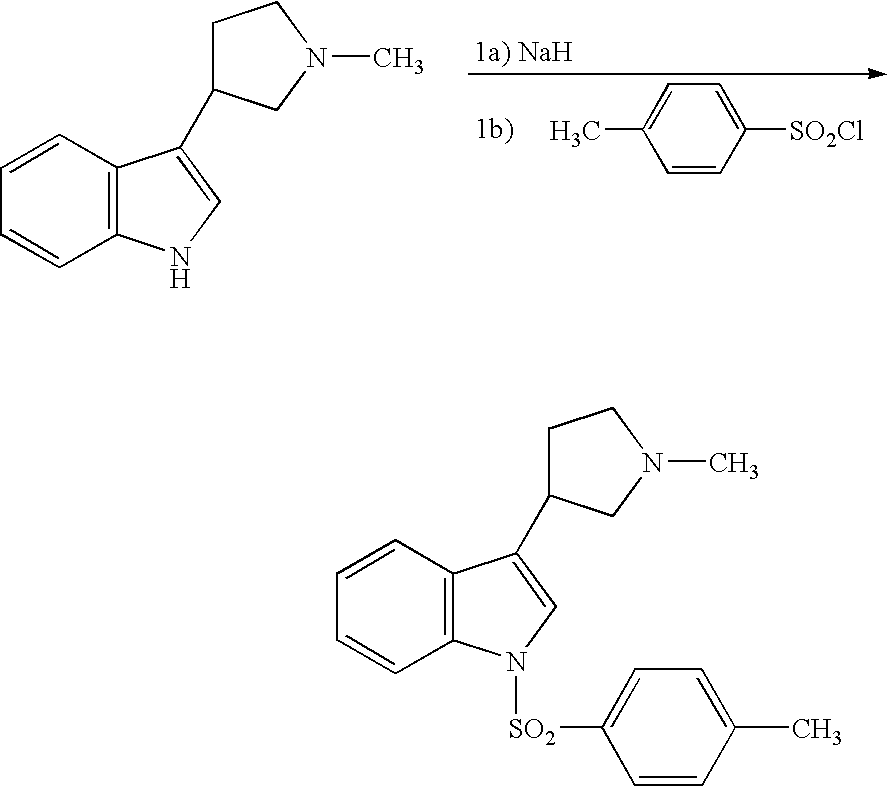
A solution of 3-(1-methylpyrrolidin-3-yl)-1H-indole (50.1 mg, 0.25 mmol) in tetrahydrofuran is treated sequentially with NaH (60% dispersion in mineral oil, 0.75 mmol) and 4-methylphenylsulfonyl chloride (47 mg, 0.25 mmol), stirred for 12 hr and concentrated in vacuo to give a residue. Purification of the residue by HPLC affords the title product as a solid, characterized by HPLC and mass spectral analyses, [M+H] 355.15, LCMS1 retention time 1.82 min.
- 1LCMS conditions: HP1100 MSD system; Waters Xterra C18, 2 mm×50 mm ID, 5 uM column; 10 uL injectin; Solvent A: 0.02% TFA/water; Solvent B:0.02% TFA/acetonitrile; Gradient: Time 0: 95% A; 0.3 min: 95% A; 5 min: 10% A, Flow rate 1 mL/min; Detection: 254 nm DAD.

Using essentially the same procedures described in Examples 3, 4 and 5 and employing the appropriate maleimide and suitable arylsulfonyl chloride the compounds shown in Table II are prepared and identified by HPLC and mass spectral analyses. (LCMS1)
- 1LCMS conditions: HP1100 MSD system; Waters Xterra C18, 2 mm×50 mm ID, 5 uM column; 10 uL injectin; Solvent A: 0.02% TFA/water; Solvent B:0.02% TFA/acetonitrile; Gradient: Time 0: 95% A; 0.3 min: 95% A; 5 min: 10% A, Flow rate 1 mL/min; Detection: 254 nm DAD.
| TABLE II |
 |
| Ex. | LCMS | |||
| No. | R8 | R5 | M + H | (min) |
| 4 | methyl | 4-fluorophenyl | 359 | 1.78 |
| 5 | methyl | 4-methoxyphenyl | 371 | 1.82 |
| 6 | methyl | 4-chlorophenyl | 375 | 1.90 |
| 7 | methyl | 5-chlorothien-2-yl | 381 | 1.94 |
| 8 | methyl | 2-naphthyl | 391 | 2.05 |
| 9 | methyl | 4-anilinyl | 356 | 1.58 |
| 10 | methyl | 3,4-dimethoxyphenyl | 401 | 1.74 |
| 11 | methyl | 3,4-dichlorophenyl | 409 | 2.07 |
| 12 | methyl | 4,5-dichlorothien-2-yl | 415 | 2.14 |
| 13 | methyl | 2-bromophenyl | 419 | 1.84 |
| 14 | methyl | 2-amino-4-methylthiazol- | 377 | 1.53 |
| 5-yl | ||||
| 15 | methyl | 5-chloro-3-methyl-1- | 445 | 2.28 |
| benzothien-2-yl | ||||
| 16 | methyl | 4-iodophenyl | 467 | 1.88 |
| 17 | methyl | 2-iodophenyl | 467 | 2.00 |
| 18 | benzyl | 4-methylphenyl | 431 | 2.17 |
| 19 | benzyl | 4-methoxyphenyl | 447 | 2.14 |
| 20 | benzyl | 4-aminophenyl | 432 | 1.68 |
| 21 | benzyl | 3,4-dichlorophenyl | 487 | 2.40 |
| 22 | benzyl | 2-bromophenyl | 495 | 2.15 |
| 23 | benzyl | 2-amino-4-methylthiazol-5- | 453 | 1.60 |
| yl | ||||
| 24 | benzyl | 5-bromothien-2-yl | 501 | 2.30 |
| 26 | benzyl | 4-iodophenyl | 543 | 2.21 |
| 27 | benzyl | 2-iodophenyl | 543 | 2.34 |

A mixture of indole (2 g, 17 mmol) and 1-benzyl-piperidin-3-one hydrochloride hydrate (7.7 g, 34 mmol) and 2N KOH/isopropanol is heated at 80° C. for 14 hours, cooled to room temperature, poured over ice/water and extracted with ethyl acetate. The extracts are combined, washed with water, dried over Na2SO4 and concentrated in vacuo to afford the title product, identified by HPLC and mass spectral analyses.

A mixture of the 3-(1-benzyl-1,2,5,6-tetrahydropyridin-3-yl)-1H-indole obtained in Example 28 and 10% palladium on carbon in a mixture of formic acid and methanol is stirred at room temperature for 3 days and filtered through celite. The celite is washed with methanol. The filtrates are combined and concentrated in vacuo to afford the title product, identified by HPLC and mass spectral analyses.

A solution of the 3-piperidin-3-yl-1H-indole obtained in Example 29 in acetone/water (1:1) at 0° C. is treated with di-tert-dicarbonate (4.1 g, 18.7 mmol) and K2CO3 (11.75 g, 85 mmol), stirred for 2 hours while warming to room temperature, and concentrated in vacuo. The resultant aqueous mixture is extracted with ethyl acetate. The extracts are combined, dried over Na2SO4 and concentrated in vacuo. The resultant residue is purified by column chromatography (silica gel, 1% NH4OH in MeOH:CHCl3, 0:100 to 10:90 as eluent) to afford the title product, 1.25 g, identified by HPLC and mass spectral analyses.

A solution of 3-(1H-indol-3-yl)-piperidine-1-carboxylic acid tert-butyl ester (75 mg, 0.25 mmol) and phenylsulfonyl chloride (50 mg, 0.27 mmol) in tetrahydrofuran (THF) at room temperature is treated with potassium tert-butoxide (0.275 mL, 1 M solution in THF, 0.275 mmol), shaken at room temperature for 16 hours, treated with HCl (4 N in dioxane, 0.5 mL), shaken for 2 hours and concentrated in vacuo to give a residue. Purification of the residue by HPLC1 affords the title product, characterized by HPLC and mass spectral analyses [M+H] 341.45, LCMS2 retention time 1.67 min.
- 1HPLC conditions: Gilson Preparative HPLC system; YMC Pro C18, 20 mm×50 mm ID, 5 uM column; 2 mL injection; Solvent A: 0.02% TFA/water; Solvent B:0.02% TFA/acetonitrile; Gradient: Time 0: 95% A; 2 min: 95% A; 14 min: 10% A, 15 min: 10% A, 16 min: 95% A; Flow rate 22.5 mL/min; Detection: 254 nm DAD.
- 2LCMS conditions: HP1100 MSD system; Waters Xterra C18, 2 mm×50 mm ID, 5 uM column; 10 uL injectin; Solvent A: 0.02% TFA/water; Solvent B:0.02% TFA/acetonitrile; Gradient: Time 0: 95% A; 0.3 min: 95% A; 5 min: 10% A, Flow rate 1 mL/min; Detection: 254 nm DAD.

Using essentially the same procedures described in Examples 28-31 and employing the appropriate indole or azaindole substrate and a suitable arylsulfonyl chloride the compounds shown in Table III are prepared and identified by HPLC and mass spectral analyses. (LCMS1)
- 1 LCMS conditions: HP1100 MSD system; Waters Xterra C18, 2 mm×50 mm ID, 5 uM column; 10 uL injectin; Solvent A: 0.02% TFA/water; Solvent B:0.02% TFA/acetonitrile; Gradient: Time 0: 95% A; 0.3 min: 95% A; 3 min: 10% A, Flow rate 1 mL/min; Detection: 254 nm DAD.
| TABLE III |
 |
| Ex. | LCMS | |||
| No. | R5 | X | M + H | (min) |
| 32 | 4-isopropylphenyl | CH | 384 | 1.95 |
| 33 | 5-chlorothien-2-yl | CH | 382 | 1.83 |
| 34 | 3-chlorophenyl | CH | 376 | 1.90 |
| 35 | 3,4-difluorophenyl | CH | 377 | 1.79 |
| 36 | 4-trifluoromethoxyphenyl | CH | 425 | 1.94 |
| 37 | 4-methoxyphenyl | CH | 371 | 1.76 |
| 38 | 4-trifluoromethylphenyl | CH | 409 | 1.94 |
| 39 | 3-chloro-4-methylphenyl | CH | 390 | 1.96 |
| 40 | 2-chloro-4-trifluorophenyl | CH | 444 | 2.02 |
| 41 | 2-naphthyl | CH | 392 | 1.94 |
| 42 | 5-chloro-3-methylbenzo[B]- | CH | 446 | 2.15 |
| thiene-2-yl | ||||
| 43 | 2,6-dichloro-imidazo[2,1- | CH | 456 | 1.90 |
| b]thiazol-5-yl | ||||
| 44 | 2-Chloro-imidazo[1,2- | CH | 416 | 1.72 |
| a]pyrid-3-yl | ||||
| 45 | 2-Chloro-benzo[d]imidazo- | CH | 472 | 1.92 |
| [2,1-b]thiazol-3-yl | ||||
| 46 | 4-isopropylphenyl | N | 385 | 1.95 |
| 47 | 5-chlorothien-2-yl | N | 383 | 1.63 |
| 48 | 3-chlorophenyl | N | 377 | 1.65 |
| 49 | 3,4-difluorophenyl | N | 378 | 1.62 |
| 50 | 4-trifluoromethoxyphenyl | N | 426 | 1.94 |
| 51 | 4-trifluoromethylphenyl | N | 410 | 1.86 |
| 52 | 3-chloro-4-methylphenyl | N | 391 | 1.84 |
| 53 | 2-chloro-4-trifluorophenyl | N | 445 | 1.99 |
| 54 | 2-naphthyl | N | 393 | 1.82 |
| 55 | 2,6-dichloro-imidazo[2,1- | N | 447 | 2.13 |
| b]thiazol-5-yl | ||||
| 56 | 2-Chloro-imidazo[1,2-a]- | N | 417 | 1.63 |
| pyrid-3-yl | ||||
| 57 | 2-Chloro-benzo[d]- | N | 473 | 1.88 |
| imidazo[2,1-b]thiazol-3-yl | ||||
The affinity of test compounds for the serotonin 5-HT6 receptor is evaluated in the following manner. Cultured Hela cells expressing human cloned 5-HT6 receptors are harvested and centrifuged at low speed (1,000×g) for 10.0 min to remove the culture media. The harvested cells are suspended in half volume of fresh physiological phosphate buffered saline solution and recentrifuged at the same speed. This operation is repeated. The collected cells are then homogenized in ten volumes of 50 mM Tris.HCl (pH 7.4) and 0.5 mM EDTA. The homogenate is centrifuged at 40,000×g for 30.0 min and the precipitate is collected. The obtained pellet is resuspended in 10 volumes of Tris.HCl buffer and recentrifuged at the same speed. The final pellet is suspended in a small volume of Tris.HCl buffer and the tissue protein content is determined in aliquots of 10-25 μl volumes. Bovine Serum Albumin is used as the standard in the protein determination according to the method described in Lowry et al., J. Biol. Chem., 193:265 (1951). The volume of the suspended cell membranes is adjusted to give a tissue protein concentration of 1.0 mg/ml of suspension. The prepared membrane suspension (10 times concentrated) is aliquoted in 1.0 ml volumes and stored at −70° C. until used in subsequent binding experiments.
Binding experiments are performed in a 96 well microtiter plate format, in a total volume of 200 μl. To each well is added the following mixture: 80.0 μl of incubation buffer made in 50 mM Tris.HCl buffer (pH 7.4) containing 10.0 mM MgCl2 and 0.5 mM EDTA and 20 μl of [3H]-LSD (S.A., 86.0 Ci/mmol, available from Amersham Life Science), 3.0 nM. The dissociation constant, KD of the [3H]LSD at the human serotonin 5-HT6 receptor is 2.9 nM, as determined by saturation binding with increasing concentrations of [3H]LSD. The reaction is initiated by the final addition of 100.0 μl of tissue suspension. Nonspecific binding is measured in the presence of 10.0 μM methiothepin. The test compounds are added in 20.0 μl volume.
The reaction is allowed to proceed in the dark for 120 min at room temperature, at which time, the bound ligand-receptor complex is filtered off on a 96 well unifilter with a Packard Filtermate® 196 Harvester. The bound complex caught on the filter disk is allowed to air dry and the radioactivity is measured in a Packard TopCount® equipped with six photomultiplier detectors, after the addition of 40.0 μl Microscint®-20 scintillant to each shallow well. The unifilter plate is heat-sealed and counted in a PackardTopCount® with a tritium efficiency of 31.0%.
Specific binding to the 5-HT6 receptor is defined as the total radioactivity bound less the amount bound in the presence of 10.0 μM unlabeled methiothepin. Binding in the presence of varying concentrations of test compound is expressed as a percentage of specific binding in the absence of test compound. The results are plotted as log % bound versus log concentration of test compound. Nonlinear regression analysis of data points with a computer assisted program Prism® yielded both the IC50 and the Ki values of test compounds with 95% confidence limits. A linear regression line of data points is plotted, from which the IC50 value is determined and the Ki value is determined based upon the following equation:
K i =IC 50/(1+L/K D)
where L is the concentration of the radioactive ligand used and KD is the dissociation constant of the ligand for the receptor, both expressed in nM.
K i =IC 50/(1+L/K D)
where L is the concentration of the radioactive ligand used and KD is the dissociation constant of the ligand for the receptor, both expressed in nM.
Using this assay, the following Ki values are determined and compared to those values obtained by representative compounds known to demonstrate binding to the 5-HT6 receptor. The data are shown in Table IV, below.
| TABLE IV | |||
| Test Compound | 5-HT6 Binding Ki | ||
| (Ex. No.) | (nM) | ||
| 4 | 2 | ||
| 6 | 1 | ||
| 8 | 3 | ||
| 9 | 1 | ||
| 10 | 5 | ||
| 11 | 3 | ||
| 12 | 4 | ||
| 13 | 1 | ||
| 16 | 1 | ||
| 17 | 2 | ||
| 18 | 8 | ||
| 20 | 1 | ||
| 21 | 15 | ||
| 22 | 14 | ||
| 23 | 3 | ||
| 24 | 9 | ||
| 31 | 2 | ||
| 32 | 5 | ||
| 33 | 3 | ||
| 34 | 2 | ||
| 35 | 7 | ||
| 37 | 10 | ||
| 38 | 10 | ||
| 39 | 6 | ||
| 41 | 8 | ||
| 47 | 7 | ||
| 48 | 6 | ||
| Clozapine | 6.0 | ||
| Loxapine | 41.4 | ||
| Methiothepin | 8.3 | ||
| Bromocriptine | 23.0 | ||
| Mianserin | 44.2 | ||
| Olzanzepine | 19.5 | ||
As can be seen from the data in table II, the compounds of the invention demonstrate a high affinity for the 5-HT6 receptor.
Claims (13)
1. A compound of formula I

wherein
Q is SO2;
either W is N or CR6 and X is N, or W is CR6 and X is N or CR7;
Y is NR8 or CR9R10;
n is an integer of 1;
Z is NR11 or CR12R13 with the proviso that when W is CR6 then Z must be CR12R13 and with the further provisos that when Y is NR8 then Z must be CR12R13 and at least one of Y and Z must be NR8 or NR11;
R1, R2 and R7, are each independently H, halogen, CN, OCO2R14, CO2R15, CONR29R30, CNR16NR17R18, SOmR19, NR20R21, OR22, COR23 or a C1-C6alkyl, C2-C6alkenyl, C2-C6alkynyl, C3-C6cycloalkyl, cycloheteroalkyl, aryl or heteroaryl group each optionally substituted;
R3, R4, R9, R10, R12 and R13 are each independently H or an optionally substituted C1-C6alkyl group;
R5 is an optionally substituted C1-C6alkyl, aryl or heteroaryl group;
m is 0 or an integer of 1 or 2;
R6 is H, halogen, or an optionally substituted C1-C6alkyl, C1-C6alkoxy, aryl or heteroaryl group;
R8 and R11 are each independently H, CNR26NR27R28 or a C1-C6alkyl, C3-C6cycloalkyl, cycloheteralkyl, aryl or heteroaryl group;
R14, R15, R22 and R23 are each independently H or an optionally substituted C1-C6alkyl, C2-C6alkenyl, C2-C6alkynyl, C3-C6cycloalkyl, cycloheteroalkyl, aryl or heteroaryl group;
R16, R17, R18, R20, R21, R26, R27, R28, R29 and R30 are each independently H or C1-C4alkyl;
R19, is an optionally substituted C1-C4alkyl, aryl or heteroaryl group;
R24 and R25 are each independently H or an optionally substituted C1-C6alkyl, aryl or heteroaryl group; and represents a single bond or a double bond; or the stereoisomers thereof or the pharmaceutically acceptable salts thereof.
2. The compound according to claim 1 wherein Y is NR8.
3. The compound according to claim 1 wherein W is N.
4. The compound according to claim 3 wherein Z is NR11.
5. The compound according to claim 1 wherein Q is SO2 and R5 is an optionally substituted aryl or heteroaryl group.
6. The compound according to claim 5 wherein X is CH and represents a single bond.
7. The compound according to claim 1 selected from the group consisting of:
1-benzenesulfonyl-3-piperidin-3-yl-1H-indole;
1-(4-isopropyl-benzenesulfonyl)-3-piperidin-3-yl-1H-indole;
1-(5-chloro-thiophene-2-sulfonyl)-3-piperidin-3-yl-1H-indole;
1-(3-chloro-benzenesulfonyl)-3-piperidin-3-yl-1H-indole;
1-(3,4-difluoro-benzenesulfonyl)-3-piperidin-3-yl-1H-indole;
1-(4-trifluoromethoxy-benzenesulfonyl)-3-piperidin-3-yl-1H-indole;
1-(4-methoxy-benzenesulfonyl)-3-piperidin-3-yl-1H-indole;
1-(4-trifluoromethy-benzenesulfonyl)-3-piperidin-3-yl-1H-indole;
1-(3-chloro-4-methyl-benzenesulfonyl)-3-piperidin-3-yl-1H-indole;
1-(2-chloro-4-trifluoromethyl-benzenesulfonyl)-3-piperidin-3-yl-1H-indole;
1-(2-naphthylenesulfonyl)-3-piperidin-3-yl-1H-indole;
1-(5-chloro-3-methyl-benzo[b]thiophene-2-sulfonyl)-3-piperidin-3-yl-1H-indole;
1-(2,6-dichloro-imidazo[2,1-b]thiazole-5-sulfonyl)-3-piperidin-3-yl-1H-indole.
2-chloro-3-(3-piperidin-3-yl-indole-1-sulfonyl)-imidazo[1,2-a]pyridine;
2-chloro-3-(3-piperidin-3-yl-indole-1-sulfonyl)-benzo[d]imidazo[2,1-b]thiazole;
1-(4-isopropyl-benzenesulfonyl)-3-piperidin-3-yl-1H-pyrrolo[2,3-b]pyridine;
1-(5-chloro-thiophene-2-sulfonyl)-3-piperidin-3-yl-1H-pyrrolo[2,3-b]pyridine;
1-(3-chloro-benzenesulfonyl)-3-piperidin-3-yl-1H-pyrrolo[2,3-b]pyridine;
1-(3,4-difluoro-benzenesulfonyl)-3-piperidin-3-yl-1H-pyrrolo[2,3-b]pyridine;
1-(4-trifluoromethoxy-benzenesulfonyl)-3-piperidin-3-yl-1H-pyrrolo[2,3-b]pyridine;
1-(3-chloro-4-methyl-benzenesulfonyl)-3-piperidin-3-yl-1H-pyrrolo[2,3-b]pyridine;
1-(2-chloro-4-trifluoromethyl-benzenesulfonyl)-3-piperidin-3-yl-1H-pyrrolo[2,3-b]pyridine;
1-(2-naphthylenesulfonyl)-3-piperidin-3-yl-1H-pyrrolo[2,3-b]pyridine;
1-(5-chloro-3-methyl-benzo[b]thiophene-2-sulfonyl)-3-piperidin-3-yl-1H-pyrrolo[2,3-b]pyridine;
2-chloro-3-(3-piperidin-3-yl-pyrrolo[2,3-b]pyridine-1-sulfonyl)-imidazo[1,2-a]pyridine;
2-chloro-3-(3-piperidin-3-yl-pyrrolo[2,3-b]pyridine-1-sulfonyl)-benzo[d]imidazo[2,1-b]thiazole; and
the pharmaceutically acceptable salts thereof.
8. A pharmaceutical composition which comprises a pharmaceutically acceptable carrier and an effective amount of a compound of formula I

wherein
Q is SO2;
either W is N or CR6 and X is N, or W is Cr6 and X is N or CR7;
Y is NR8, or CR9R10;
n is an integer of 1;
Z is NR11 or CR12R13 with the proviso that when W is CR6 then Z must be CR12R13 and with the further provisos that when Y is NR8 then Z must be CR12R13 and at least one of Y and Z must be NR8 or NR11;
R1, R2 and R7 are each independently H, halogen, CN, OCO2R14, CO2R15, CONR29R30, CNR16NR17R18, SOmR19, NR20R21, OR22, COR23 or a C1-C6alkyl, C2-C6alkenyl, C2-C6alkynyl, C3-C6cycloalkyl, cycloheteroalkyl, aryl or heteroaryl group each optionally substituted;
R3, R4, R9, R10, R12 and R13 are each independently H or an optionally substituted C1-C6alkyl group;
R5 is an optionally substituted C1-C6alkyl, aryl or heteroaryl group;
m is 0 or an integer of 1 or 2;
R6is H, halogen, or an optionally substituted C1-C6alkyl, C1-C6alkoxy, aryl or heteroaryl group;
R8 and R11 are each independently H, CNR26NR27R28 or a C1-C6alkyl, C3-C6cycloalkyl, cycloheteralkyl, aryl or heteroaryl group;
R14, R15, R22 and R23 are each independently H or an optionally substituted C1-C6alkyl, C2-C6alkenyl, C2-C6alkynyl, C3-C6cycloalkyl, cycloheteroalkyl, aryl or heteroaryl group;
R16, R17, R18, R20, R21, R26, R27, R28, R29, and R30 are each independently H or C1-C4alkyl;
R19 is an optionally substituted C1-C6alkyl, aryl or heteroaryl group;
R24 and R25 are each independently H or an optionally substituted C1-C6alkyl, aryl or heteroaryl group; and represents a single bond or a double bond; or the stereoisomers thereof or the pharmaceutically acceptable salts thereof.
9. The composition according to claim 8 having a formula I compound wherein n is 1; Q is SO2; Y is NR8; and X is CR7.
10. The composition according to claim 8 having a formula I compound wherein Q is SO2; X is CR7; and Z is NR11.
11. The composition according to claim 9 having a formula I compound wherein R5 is an optionally substituted aryl group and represents a single bond.
12. The composition according to claim 8 having a formula I compound selected from the group consisting of:
1-benzenesulfonyl-3-piperidin-3-yl-1H-indole;
1-(4-isopropyl-benzenesulfonyl)-3-piperidin-3-yl-1H-indole;
1-(5-chloro-thiophene-2-sulfonyl)-3-piperidin-3-yl-1H-indole;
1-(3-chloro-benzenesulfonyl)-3-piperidin-3-yl-1H-indole;
1-(3,4-difluoro-benzenesulfonyl)-3-piperidin-3-yl-1H-indole;
1-(4-trifluoromethoxy-benzenesulfonyl)-3-piperidin-3-yl-1H-indole;
1-(4-methoxy-benzenesulfonyl)-3-piperidin-3-yl-1H-indole;
1-(4-trifluoromethy-benzenesulfonyl)-3-piperidin-3-yl-1H-indole;
1-(3-chloro-4-methyl-benzenesulfonyl)-3-piperidin-3-yl-1H-indole;
1-(2-chloro-4-trifluoromethyl-benzenesulfonyl)-3-piperidin-3-yl-1H-indole;
1-(2-naphthylenesulfonyl)-3-piperidin-3-yl-1H-indole;
1-(5-chloro-3-methyl-benzo[b]thiophene-2-sulfonyl)-3-piperidin-3-yl-1H-indole;
1-(2,6-dichloro-imidazo[2,1-b]thiazole-5-sulfonyl)-3-piperidin-3-yl-1H-indole;
2-chloro-3-(3-piperidin-3-yl-indole-1-sulfonyl)-imidazo[1,2-a]pyridine;
2-chloro-3-(3-piperidin-3-yl-indole-1-sulfonyl)-benzo[d]imidazo[2,1-b]thiazole;
1-(4-isopropyl-benzenesulfonyl)-3-piperidin-3-yl-1H-pyrrolo[2,3-b]pyridine;
1-(5-chloro-thiophene-2-sulfonyl)-3-piperidin-3-yl-1H-pyrrolo[2,3-b]pyridine;
1-(3-chloro-benzenesulfonyl)-3-piperidin-3-yl-1H-pyrrolo[2,3-b]pyridine;
1-(3,4-difluoro-benzenesulfonyl)-3-piperidin-3-yl-1H-pyrrolo[2,3-b]pyridine;
1-(4-trifluoromethoxy-benzenesulfonyl)-3-piperidin-3-yl-1H-pyrrolo[2,3-b]pyridine;
1-(3-chloro-4-methyl-benzenesulfonyl)-3-piperidin-3-yl-1H-pyrrolo[2,3-b]pyridine;
1-(2-chloro-4-trifluoromethyl-benzenesulfonyl)-3-piperidin-3-yl-1H-pyrrolo[2,3-b]pyridine;
1-(2-naphthylenesulfonyl)-3-piperidin-3-yl-1H-pyrrolo[2,3-b]pyridine;
1-(5-chloro-3-methyl-benzo[b]thiophene-2-sulfonyl)-3-piperidin-3-yl-1H-pyrrolo[2,3-b]pyridine;
2-chloro-3-(3-piperidin-3-yl-pyrrolo[2,3-b]pyridine-1-sulfonyl)-imidazo[1,2-a]pyridine;
2-chloro-3-(3-piperidin-3-yl-pyrrolo[2,3-b]pyridine-1-sulfonyl)-benzo[d]imidazo[2,1-b]thiazole; and
the pharmaceutically acceptable salts thereof.
13. A process for the preparation of a compound of formula If

wherein
Q is SO2;
W is N or CR6;
either W is N or CR6 and X is N, or W is CR6 and X is N or CR7;
Y is NR8 or CR9R10;
n is an integer of 1;
Z is NR11 or CR12R13 with the proviso that when W is CR6 then Z must be CR12R13 and with the further provisos that when Y is NR8 then Z must be CR12R13 and at least one of Y and Z must be NR8 or NR11;
R1, R2 and R7 are each independently H, halogen, CN, OCO2R14, CO2R15, CONR29R30, CNR16NR17R18, SOmR19, NR20R21, OR22, COR23 or a C1-C6alkyl, C2-C6alkenyl, C2-C6alkynyl, C3-C6cycloalkyl, cycloheteroalkyl, aryl or heteroaryl group each optionally substituted;
R3, R4, R9, R10, R12 and R13 are each independently H or an optionally substituted C1-C6alkyl group;
R5 is an optionally substituted C1-C6alkyl, aryl or heteroaryl group;
m is 0 or an integer of 1 or 2;
R6 is H, halogen, or an optionally substituted C1-C6alkyl, C1-C6alkoxy, aryl or heteroaryl group;
R8, and R11 are each independently H, CNR26NR27R28 or a C1-C6alkyl, C3-C6cycloalkyl, cycloheteralkyl, aryl or heteroaryl group;
R14, R15, R22 and R23 are each independently H or an optionally substituted C1-C6alkyl, C2-C6alkenyl, C2-C6alkynyl, C3-C6cycloalkyl, cycloheteroalkyl, aryl or heteroaryl group;
R16, R17, R18, R20, R21, R26, R27, R28, R29 and R30 are each independently H or C1-C6alkyl;
R19 is an optionally substituted C1-C6alkyl, aryl or heteroaryl group;
R24 and R25 are each independently H or an optionally substituted C1-C6alkyl, aryl or heteroaryl group; and represents a single bond or a double bond which process comprises reacting a compound of formula IVa

wherein W, X, Y, Z, n, R1, R2, R3 and R4 are as defined above with a sulfonyl chloride, R5SO2Cl, wherein R5 is defined above in the presence of a base.
Priority Applications (2)
| Application Number | Priority Date | Filing Date | Title |
|---|---|---|---|
| US10/691,937 US6903112B2 (en) | 2000-12-22 | 2003-10-23 | Heterocyclylindazole and -azaindazole compounds as 5-hydroxytryptamine-6 ligands |
| US11/039,344 US20050124603A1 (en) | 2000-12-22 | 2005-01-20 | Heterocyclylindazole and -azaindazole compounds as 5-hydroxytryptamine-6 ligands |
Applications Claiming Priority (3)
| Application Number | Priority Date | Filing Date | Title |
|---|---|---|---|
| US25762700P | 2000-12-22 | 2000-12-22 | |
| US10/028,168 US6767912B2 (en) | 2000-12-22 | 2001-12-20 | Heterocyclylindazole and -azaindazole compounds as 5-hydroxytryptamine-6 ligands |
| US10/691,937 US6903112B2 (en) | 2000-12-22 | 2003-10-23 | Heterocyclylindazole and -azaindazole compounds as 5-hydroxytryptamine-6 ligands |
Related Parent Applications (1)
| Application Number | Title | Priority Date | Filing Date |
|---|---|---|---|
| US10/028,168 Division US6767912B2 (en) | 2000-12-22 | 2001-12-20 | Heterocyclylindazole and -azaindazole compounds as 5-hydroxytryptamine-6 ligands |
Related Child Applications (1)
| Application Number | Title | Priority Date | Filing Date |
|---|---|---|---|
| US11/039,344 Division US20050124603A1 (en) | 2000-12-22 | 2005-01-20 | Heterocyclylindazole and -azaindazole compounds as 5-hydroxytryptamine-6 ligands |
Publications (2)
| Publication Number | Publication Date |
|---|---|
| US20040092526A1 US20040092526A1 (en) | 2004-05-13 |
| US6903112B2 true US6903112B2 (en) | 2005-06-07 |
Family
ID=22977057
Family Applications (3)
| Application Number | Title | Priority Date | Filing Date |
|---|---|---|---|
| US10/028,168 Expired - Fee Related US6767912B2 (en) | 2000-12-22 | 2001-12-20 | Heterocyclylindazole and -azaindazole compounds as 5-hydroxytryptamine-6 ligands |
| US10/691,937 Expired - Fee Related US6903112B2 (en) | 2000-12-22 | 2003-10-23 | Heterocyclylindazole and -azaindazole compounds as 5-hydroxytryptamine-6 ligands |
| US11/039,344 Abandoned US20050124603A1 (en) | 2000-12-22 | 2005-01-20 | Heterocyclylindazole and -azaindazole compounds as 5-hydroxytryptamine-6 ligands |
Family Applications Before (1)
| Application Number | Title | Priority Date | Filing Date |
|---|---|---|---|
| US10/028,168 Expired - Fee Related US6767912B2 (en) | 2000-12-22 | 2001-12-20 | Heterocyclylindazole and -azaindazole compounds as 5-hydroxytryptamine-6 ligands |
Family Applications After (1)
| Application Number | Title | Priority Date | Filing Date |
|---|---|---|---|
| US11/039,344 Abandoned US20050124603A1 (en) | 2000-12-22 | 2005-01-20 | Heterocyclylindazole and -azaindazole compounds as 5-hydroxytryptamine-6 ligands |
Country Status (20)
| Country | Link |
|---|---|
| US (3) | US6767912B2 (en) |
| EP (1) | EP1355904B1 (en) |
| JP (1) | JP4307073B2 (en) |
| KR (1) | KR20030062442A (en) |
| CN (1) | CN1281605C (en) |
| AR (1) | AR034283A1 (en) |
| AT (1) | ATE368658T1 (en) |
| BR (1) | BR0116323A (en) |
| CA (1) | CA2432654A1 (en) |
| DE (1) | DE60129746T2 (en) |
| DK (1) | DK1355904T3 (en) |
| EA (1) | EA200300717A1 (en) |
| ES (1) | ES2290187T3 (en) |
| HU (1) | HUP0400684A2 (en) |
| IL (1) | IL156517A0 (en) |
| MX (1) | MXPA03005432A (en) |
| NO (1) | NO20032840L (en) |
| PL (1) | PL363241A1 (en) |
| WO (1) | WO2002051837A2 (en) |
| ZA (1) | ZA200305622B (en) |
Cited By (11)
| Publication number | Priority date | Publication date | Assignee | Title |
|---|---|---|---|---|
| US20040266769A1 (en) * | 2003-03-17 | 2004-12-30 | Syrrx, Inc. | Histone deacetylase inhibitors |
| US20050171118A1 (en) * | 2001-06-07 | 2005-08-04 | Beard Colin C. | New indole derivatives with 5-HT6 receptor affinity |
| US20080039462A1 (en) * | 2006-02-17 | 2008-02-14 | Memory Pharmaceuticals Corporation | Compounds having 5-HT6 receptor affinity |
| US20080200471A1 (en) * | 2007-02-16 | 2008-08-21 | Memory Pharmaceuticals Corporation | 6' substituted compounds having 5-ht6 receptor affinity |
| US20080318941A1 (en) * | 2007-05-24 | 2008-12-25 | Memory Pharmaceuticals Corporation | 4' substituted compounds having 5-ht6 receptor affinity |
| US20090069337A1 (en) * | 2007-08-15 | 2009-03-12 | Memory Pharmaceuticals Corporation | 3' substituted compounds having 5-ht6 receptor affinity |
| US20090105303A1 (en) * | 2006-04-05 | 2009-04-23 | Wyeth | Sulfonyl-3-heterocyclylindazole derivatives as 5-hydroxytryptamine-6 ligands |
| US20100016297A1 (en) * | 2008-06-24 | 2010-01-21 | Memory Pharmaceuticals Corporation | Alkyl-substituted 3' compounds having 5-ht6 receptor affinity |
| US20100022581A1 (en) * | 2008-07-02 | 2010-01-28 | Memory Pharmaceuticals Corporation | Pyrrolidine-substituted azaindole compounds having 5-ht6 receptor affinity |
| US20100029629A1 (en) * | 2008-07-25 | 2010-02-04 | Memory Pharmaceuticals Corporation | Acyclic compounds having 5-ht6 receptor affinity |
| US20100056531A1 (en) * | 2008-08-22 | 2010-03-04 | Memory Pharmaceuticals Corporation | Alkyl-substituted 3' compounds having 5-ht6 receptor affinity |
Families Citing this family (62)
| Publication number | Priority date | Publication date | Assignee | Title |
|---|---|---|---|---|
| JP4307073B2 (en) * | 2000-12-22 | 2009-08-05 | ワイス | Heterocycle indazole and azaindazole compounds as 5-hydroxytryptamine-6 ligands |
| AU2002309585B2 (en) * | 2001-04-20 | 2008-01-31 | Wyeth | Heterocyclylalkoxy-, -alkylthio- and -alkylaminobenzazole derivatives as 5-hydroxytryptamine-6 ligands |
| CN1293072C (en) * | 2001-04-20 | 2007-01-03 | 惠氏公司 | Heterocyclyloxy-, -thio-, and -aminoindole derivatives as serotonin-6 ligands |
| DE60322186D1 (en) * | 2002-02-12 | 2008-08-28 | Organon Nv | 1-ARYLSULFONYL-3-SUBSTITUTED INDOL AND INDOLINEDERIVATE USEFUL FOR THE TREATMENT OF DISEASES OF THE CENTRAL NERVOUS SYSTEM |
| ES2201899B1 (en) | 2002-04-01 | 2005-06-01 | Almirall Prodesfarma, S.A. | DERIVATIVES OF AZAINDOLILPIPERIDINE AS ANTIHISTAMINIC AND ANTIALERGIC AGENTS. |
| JP4484108B2 (en) * | 2002-05-16 | 2010-06-16 | 塩野義製薬株式会社 | Compound having PGD2 receptor antagonistic action |
| TW200401641A (en) * | 2002-07-18 | 2004-02-01 | Wyeth Corp | 1-Heterocyclylalkyl-3-sulfonylindole or-indazole derivatives as 5-hydroxytryptamine-6 ligands |
| BRPI0407253A (en) * | 2003-02-14 | 2006-01-31 | Wyeth Corp | Heterocyclyl-3-sulfonylindazoles as ligands 5-hydroxytryptamine-6 process for their preparation, their uses in the preparation of a pharmaceutical composition and a pharmaceutical composition comprising said compounds |
| WO2005005439A1 (en) * | 2003-07-09 | 2005-01-20 | Suven Life Sciences Limited | Benzothiazino indoles |
| BRPI0412868A (en) * | 2003-07-23 | 2006-10-03 | Wyeth Corp | sulfonylhydroimidazopyridinone compounds as 5-hydroxytryptamine-6 binders |
| ES2222828B1 (en) * | 2003-07-30 | 2006-04-16 | Laboratorios Del Dr. Esteve, S.A. | DERIVATIVES OF 1-SULPHONYLINDOLS, ITS PREPARATION AND ITS APPLICATION AS MEDICINES. |
| BRPI0413234A (en) | 2003-08-01 | 2006-10-03 | Genelabs Tech Inc | bicyclic imidazole derivatives against flaviviridae |
| DE10337184A1 (en) | 2003-08-13 | 2005-03-10 | Gruenenthal Gmbh | Substituted 3-pyrrolidine-indole derivatives |
| WO2005066157A1 (en) * | 2004-01-02 | 2005-07-21 | Suven Life Sciences | 3-(pyrolidin-3-l) indoles as 5-ht6 receptor modulators |
| EP1704154B1 (en) * | 2004-01-02 | 2009-05-06 | Suven Life Sciences Limited | Novel indeno [2,1a]indenes and isoindol [2,1-a]indoles |
| CA2558109A1 (en) | 2004-02-27 | 2005-09-15 | F. Hoffmann-La Roche Ag | Heteroaryl-fused pyrazolo derivatives |
| RU2006134022A (en) | 2004-02-27 | 2008-04-10 | Ф.Хоффманн-Ля Рош Аг (Ch) | INDAZOLE DERIVATIVES AND PHARMACEUTICAL COMPOSITIONS CONTAINING THEM |
| CA2557575A1 (en) | 2004-02-27 | 2005-09-15 | F. Hoffmann-La Roche Ag | Fused derivatives of pyrazole |
| NZ584499A (en) | 2004-03-30 | 2011-08-26 | Vertex Pharma | Azaindoles Useful as Inhibitors of Jak and Other Protein Kinases |
| TW200616967A (en) | 2004-06-24 | 2006-06-01 | Smithkline Beecham Corp | Novel indazole carboxamides and their use |
| BRPI0513899A (en) | 2004-07-27 | 2008-05-20 | Sgx Pharmaceuticals Inc | fused ring heterocyclic kinase modulators |
| US7626021B2 (en) | 2004-07-27 | 2009-12-01 | Sgx Pharmaceuticals, Inc. | Fused ring heterocycle kinase modulators |
| US7361763B2 (en) | 2004-07-27 | 2008-04-22 | Sgx Pharmaceuticals, Inc. | Pyrrolo-pyridine kinase modulators |
| US7361764B2 (en) | 2004-07-27 | 2008-04-22 | Sgx Pharmaceuticals, Inc. | Pyrrolo-pyridine kinase modulators |
| TW200626142A (en) | 2004-09-21 | 2006-08-01 | Glaxo Group Ltd | Chemical compounds |
| CN101111494A (en) * | 2004-11-29 | 2008-01-23 | 沃纳-兰伯特有限公司 | Therapeutic pyrazolo[3,4-b]pyridines and indazoles |
| US8063071B2 (en) | 2007-10-31 | 2011-11-22 | GlaxoSmithKline, LLC | Chemical compounds |
| WO2007032833A1 (en) * | 2005-08-15 | 2007-03-22 | Wyeth | Azinyl-3-sulfonylindazole derivatives as 5-hydroxytryptamine-6 ligands |
| NZ565872A (en) * | 2005-08-15 | 2011-06-30 | Wyeth Corp | Substituted-3-sulfonylindazole derivatives as 5-hydroxytryptamine-6 ligands |
| WO2007023111A2 (en) | 2005-08-25 | 2007-03-01 | F. Hoffmann-La Roche Ag | P38 map kinase inhibitors and methods for using the same |
| WO2007032572A1 (en) * | 2005-09-15 | 2007-03-22 | Korea Reserach Institute Of Chemical Technology | N-substituted-1h-quinoline-2, 4-diones, preparation method thereof, and pharmaceutical composition containing the same |
| US7915286B2 (en) | 2005-09-16 | 2011-03-29 | Ranbaxy Laboratories Limited | Substituted pyrazolo [3,4-b] pyridines as phosphodiesterase inhibitors |
| WO2007050381A2 (en) * | 2005-10-24 | 2007-05-03 | Janssen Pharmaceutica, N.V. | 3-piperidin-4-yl-indole orl-1 receptor modulators |
| GB2431927B (en) | 2005-11-04 | 2010-03-17 | Amira Pharmaceuticals Inc | 5-Lipoxygenase-activating protein (FLAP) inhibitors |
| US7977359B2 (en) | 2005-11-04 | 2011-07-12 | Amira Pharmaceuticals, Inc. | 5-lipdxygenase-activating protein (FLAP) inhibitors |
| US8399666B2 (en) | 2005-11-04 | 2013-03-19 | Panmira Pharmaceuticals, Llc | 5-lipoxygenase-activating protein (FLAP) inhibitors |
| WO2007120596A1 (en) * | 2006-04-12 | 2007-10-25 | Wyeth | DIHYDRO[1,4]DIOXINO[2,3-e]INDAZOLE DERIVATIVES AS 5-HYDROXYTRYPTAMINE-6 LIGANDS |
| US8247421B2 (en) | 2006-12-21 | 2012-08-21 | Vertex Pharmaceuticals Incorporated | 5-cyano-4-(pyrrolo [2,3B] pyridine-3-yl)-pyrimidine derivatives useful as protein kinase inhibitors |
| SI2124944T1 (en) | 2007-03-14 | 2012-05-31 | Ranbaxy Lab Ltd | Pyrazolo?á3,4-b?åpyridine derivatives as phosphodiesterase inhibitors |
| PE20081889A1 (en) | 2007-03-23 | 2009-03-05 | Smithkline Beecham Corp | INDOL CARBOXAMIDES AS INHIBITORS OF IKK2 |
| EP2078020A4 (en) | 2007-04-10 | 2011-10-19 | Sgx Pharmaceuticals Inc | Fused ring heterocycle kinase modulators |
| HRP20130097T1 (en) | 2007-11-05 | 2013-02-28 | Merck Patent Gmbh | 7-azaindole derivatives as selective 11-beta-hydroxysteroid dehydrogenase type 1 inhibitors |
| BRPI0912267A2 (en) | 2008-05-23 | 2015-10-13 | Amira Pharmaceuticals Inc | pharmaceutically acceptable salt, pharmaceutical composition, article of manufacture, methods for treating asthma, allergic rhinitis, disease, gastric lesions and pain, methods for preventing bronchoconstriction and allergic rhinitis, use of a pharmaceutically acceptable salt, and process for preparing a salt pharmaceutically acceptable. |
| US8546576B2 (en) | 2008-06-06 | 2013-10-01 | Sk Biopharmaceuticals Co., Ltd. | 3 or 4-substituted piperidine compounds |
| US8546431B2 (en) | 2008-10-01 | 2013-10-01 | Panmira Pharmaceuticals, Llc | 5-lipoxygenase-activating protein (FLAP) inhibitors |
| JP2012520257A (en) | 2009-03-10 | 2012-09-06 | グラクソ グループ リミテッド | Indole derivatives as IKK2 inhibitors |
| GEAP202213376A (en) | 2009-06-17 | 2022-02-25 | Vertex Pharmaceuticals Incorporated Us | Inhibitors of influenza viruses replication |
| EP2569301A1 (en) | 2010-05-12 | 2013-03-20 | Abbvie Inc. | Indazole inhibitors of kinase |
| CN103492381A (en) | 2010-12-16 | 2014-01-01 | 沃泰克斯药物股份有限公司 | Inhibitors of influenza viruses replication |
| UA118010C2 (en) | 2011-08-01 | 2018-11-12 | Вертекс Фармасьютікалз Інкорпорейтед | INFLUENCES OF INFLUENZA VIRUS REPLICATION |
| CN105732639A (en) | 2012-06-29 | 2016-07-06 | 辉瑞大药厂 | Novel 4-(Substituted Amino)-7H-Pyrrolo[2,3-d] Pyrimidines As LRRK2 Inhibitors |
| LT3068776T (en) | 2013-11-13 | 2019-08-12 | Vertex Pharmaceuticals Incorporated | Inhibitors of influenza viruses replication |
| HUE052178T2 (en) | 2013-11-13 | 2021-04-28 | Vertex Pharma | Methods of preparing inhibitors of influenza viruses replication |
| EP3083618B1 (en) | 2013-12-17 | 2018-02-21 | Pfizer Inc | Novel 3,4-disubstituted-1h-pyrrolo[2,3-b]pyridines and 4,5-disubstituted-7h-pyrrolo[2,3-c]pyridazines as lrrk2 inhibitors |
| CN104725295B (en) | 2013-12-20 | 2019-05-24 | 广东东阳光药业有限公司 | Aromatic Heterocyclic Derivatives and Their Application in Medicine |
| CA2953004C (en) | 2014-07-08 | 2023-02-21 | Sunshine Lake Pharma Co., Ltd. | Aromatic heterocyclic derivatives and pharmaceutical applications thereof |
| JP6857617B2 (en) | 2015-05-13 | 2021-04-14 | バーテックス ファーマシューティカルズ インコーポレイテッドVertex Pharmaceuticals Incorporated | Influenza virus replication inhibitor |
| WO2016183116A1 (en) | 2015-05-13 | 2016-11-17 | Vertex Pharmaceuticals Incorporated | Methods of preparing inhibitors of influenza viruses replication |
| CN108137586B (en) | 2015-09-14 | 2021-04-13 | 辉瑞大药厂 | Novel imidazo[4,5-c]quinoline and imidazo[4,5-c][1,5]naphthyridine derivatives as LRRK2 inhibitors |
| TWI748194B (en) | 2018-06-28 | 2021-12-01 | 德商菲尼克斯 Fxr有限責任公司 | Novel lxr modulators with bicyclic core moiety |
| CN109678776B (en) * | 2019-01-24 | 2020-07-14 | 苏州大学 | Preparation method of 3-arylsuccinimide compounds |
| EP4216949A4 (en) * | 2020-09-28 | 2024-12-11 | Yale University | SELECTIVE AGONISTS OF THE 5-HT2A RECEPTOR AND METHODS OF USE |
Citations (13)
| Publication number | Priority date | Publication date | Assignee | Title |
|---|---|---|---|---|
| US4670447A (en) * | 1983-08-22 | 1987-06-02 | Hoechst-Roussel Pharmaceuticals Inc. | Antipsychotic 3-(piperidinyl)- and 3-(pyrrolidinyl)-1H-indazoles |
| US5196425A (en) * | 1988-09-02 | 1993-03-23 | Janssen Pharmaceutica N.V. | Antihypertensive 3-piperidinyl-indazole derivatives |
| US5409941A (en) | 1992-02-03 | 1995-04-25 | Pfizer Inc. | 5-heteroyl indole derivatives |
| WO1997049698A1 (en) * | 1996-06-21 | 1997-12-31 | Glaxo Group Limited | Piperidine acetic acid derivatives and their use in the treatment of thrombotic disorders |
| WO1998023587A1 (en) | 1996-11-26 | 1998-06-04 | Allelix Biopharmaceuticals Inc. | 5-cyclo indole compounds as 5-ht1d receptor ligands |
| US5861414A (en) * | 1994-12-23 | 1999-01-19 | Glaxo Group Limited | Piperidineacetic acid derivatives useful as fibrinogen antagonist agent |
| WO1999047511A1 (en) * | 1998-03-17 | 1999-09-23 | Merck Sharp & Dohme Limited | Indole derivatives as 5-ht2a receptor antagonists |
| WO1999065906A1 (en) | 1998-06-15 | 1999-12-23 | Allelix Biopharmaceuticals Inc. | Bicyclic piperidine and piperazine compounds having 5-ht6 receptor affinity |
| US6066637A (en) | 1998-06-19 | 2000-05-23 | American Home Products Corporation | Indolyl derivatives as serotonergic agents |
| US6133287A (en) | 1998-03-24 | 2000-10-17 | Allelix Biopharmaceuticals Inc. | Piperidine-indole compounds having 5-HT6 affinity |
| WO2000063203A1 (en) | 1999-04-21 | 2000-10-26 | Allelix Biopharmaceuticals Inc. | Piperidine-indole compounds having 5-ht6 affinity |
| US6143744A (en) | 1997-01-23 | 2000-11-07 | Syntex (U.S.A.) Inc. | Sulfamide-metalloprotease inhibitors |
| US6191141B1 (en) | 1999-08-12 | 2001-02-20 | Nps Allelix Corp. | Azaindoles having serotonin receptor affinity |
Family Cites Families (1)
| Publication number | Priority date | Publication date | Assignee | Title |
|---|---|---|---|---|
| JP4307073B2 (en) * | 2000-12-22 | 2009-08-05 | ワイス | Heterocycle indazole and azaindazole compounds as 5-hydroxytryptamine-6 ligands |
-
2001
- 2001-12-11 JP JP2002552932A patent/JP4307073B2/en not_active Expired - Fee Related
- 2001-12-11 DE DE60129746T patent/DE60129746T2/en not_active Expired - Lifetime
- 2001-12-11 IL IL15651701A patent/IL156517A0/en unknown
- 2001-12-11 PL PL01363241A patent/PL363241A1/en unknown
- 2001-12-11 HU HU0400684A patent/HUP0400684A2/en unknown
- 2001-12-11 BR BR0116323-0A patent/BR0116323A/en not_active IP Right Cessation
- 2001-12-11 ES ES01986147T patent/ES2290187T3/en not_active Expired - Lifetime
- 2001-12-11 CA CA002432654A patent/CA2432654A1/en not_active Abandoned
- 2001-12-11 EP EP01986147A patent/EP1355904B1/en not_active Expired - Lifetime
- 2001-12-11 WO PCT/US2001/047935 patent/WO2002051837A2/en not_active Ceased
- 2001-12-11 MX MXPA03005432A patent/MXPA03005432A/en active IP Right Grant
- 2001-12-11 EA EA200300717A patent/EA200300717A1/en unknown
- 2001-12-11 CN CNB018228283A patent/CN1281605C/en not_active Expired - Fee Related
- 2001-12-11 AT AT01986147T patent/ATE368658T1/en not_active IP Right Cessation
- 2001-12-11 DK DK01986147T patent/DK1355904T3/en active
- 2001-12-11 KR KR10-2003-7008394A patent/KR20030062442A/en not_active Withdrawn
- 2001-12-20 US US10/028,168 patent/US6767912B2/en not_active Expired - Fee Related
- 2001-12-21 AR ARP010106001A patent/AR034283A1/en unknown
-
2003
- 2003-06-20 NO NO20032840A patent/NO20032840L/en not_active Application Discontinuation
- 2003-07-21 ZA ZA200305622A patent/ZA200305622B/en unknown
- 2003-10-23 US US10/691,937 patent/US6903112B2/en not_active Expired - Fee Related
-
2005
- 2005-01-20 US US11/039,344 patent/US20050124603A1/en not_active Abandoned
Patent Citations (13)
| Publication number | Priority date | Publication date | Assignee | Title |
|---|---|---|---|---|
| US4670447A (en) * | 1983-08-22 | 1987-06-02 | Hoechst-Roussel Pharmaceuticals Inc. | Antipsychotic 3-(piperidinyl)- and 3-(pyrrolidinyl)-1H-indazoles |
| US5196425A (en) * | 1988-09-02 | 1993-03-23 | Janssen Pharmaceutica N.V. | Antihypertensive 3-piperidinyl-indazole derivatives |
| US5409941A (en) | 1992-02-03 | 1995-04-25 | Pfizer Inc. | 5-heteroyl indole derivatives |
| US5861414A (en) * | 1994-12-23 | 1999-01-19 | Glaxo Group Limited | Piperidineacetic acid derivatives useful as fibrinogen antagonist agent |
| WO1997049698A1 (en) * | 1996-06-21 | 1997-12-31 | Glaxo Group Limited | Piperidine acetic acid derivatives and their use in the treatment of thrombotic disorders |
| WO1998023587A1 (en) | 1996-11-26 | 1998-06-04 | Allelix Biopharmaceuticals Inc. | 5-cyclo indole compounds as 5-ht1d receptor ligands |
| US6143744A (en) | 1997-01-23 | 2000-11-07 | Syntex (U.S.A.) Inc. | Sulfamide-metalloprotease inhibitors |
| WO1999047511A1 (en) * | 1998-03-17 | 1999-09-23 | Merck Sharp & Dohme Limited | Indole derivatives as 5-ht2a receptor antagonists |
| US6133287A (en) | 1998-03-24 | 2000-10-17 | Allelix Biopharmaceuticals Inc. | Piperidine-indole compounds having 5-HT6 affinity |
| WO1999065906A1 (en) | 1998-06-15 | 1999-12-23 | Allelix Biopharmaceuticals Inc. | Bicyclic piperidine and piperazine compounds having 5-ht6 receptor affinity |
| US6066637A (en) | 1998-06-19 | 2000-05-23 | American Home Products Corporation | Indolyl derivatives as serotonergic agents |
| WO2000063203A1 (en) | 1999-04-21 | 2000-10-26 | Allelix Biopharmaceuticals Inc. | Piperidine-indole compounds having 5-ht6 affinity |
| US6191141B1 (en) | 1999-08-12 | 2001-02-20 | Nps Allelix Corp. | Azaindoles having serotonin receptor affinity |
Non-Patent Citations (6)
| Title |
|---|
| Busacca, C. A., et al., A facile synthesis of 4-Aryl-2,3-Dihydropyrroles, Tetrahedron Letters, <U STYLE="SINGLE">1996, vol. 37(23), 3947-3950, Elsevier Science Publishers, Amsterdam, NL. |
| Julia et al. Bulletin de la Societe Chimque de France (1964), 8:1939-45. * |
| Schut, R. N. et al., 2-Tetrahydropyridylindoles as histamine and serotonin antagonists, Journal of Medicinal Chemistry, <U STYLE="SINGLE">1970, vol. 13(3), 394-397. |
| Sleight, et al., The 5-hydroxytryptamine-6 receptor: localisation and function, Expert Opinion on Therapeutic Patents, <U STYLE="SINGLE">1998, vol. 8(10), 1217-1224, Ashley Publications, GB. |
| Zheng, Q. et al., Palladium catalyzed cross-coupling reaction between 3-indole boronic acids and tetrahydropyridine triflates, Tetrahedron Letters, <U STYLE="SINGLE">1993, vol. 34(14), 2235-2238, Elsevier Science Publishers, Amsterdam, NL. |
| Zheng, Q. et al., Vinylation of the indole 3-position via palladium-catalyzed cross-coupling, Heterocycles, <U STYLE="SINGLE">1994, vol. 37(3), 1761-1772. |
Cited By (14)
| Publication number | Priority date | Publication date | Assignee | Title |
|---|---|---|---|---|
| US20050171118A1 (en) * | 2001-06-07 | 2005-08-04 | Beard Colin C. | New indole derivatives with 5-HT6 receptor affinity |
| US7169801B2 (en) * | 2003-03-17 | 2007-01-30 | Takeda San Diego, Inc. | Histone deacetylase inhibitors |
| US7381825B2 (en) | 2003-03-17 | 2008-06-03 | Takeda San Diego, Inc. | Histone deacetylase inhibitors |
| US20040266769A1 (en) * | 2003-03-17 | 2004-12-30 | Syrrx, Inc. | Histone deacetylase inhibitors |
| US20080039462A1 (en) * | 2006-02-17 | 2008-02-14 | Memory Pharmaceuticals Corporation | Compounds having 5-HT6 receptor affinity |
| US7696229B2 (en) | 2006-02-17 | 2010-04-13 | Memory Pharmaceuticals Corporation | Compounds having 5-HT6 receptor affinity |
| US20090105303A1 (en) * | 2006-04-05 | 2009-04-23 | Wyeth | Sulfonyl-3-heterocyclylindazole derivatives as 5-hydroxytryptamine-6 ligands |
| US20080200471A1 (en) * | 2007-02-16 | 2008-08-21 | Memory Pharmaceuticals Corporation | 6' substituted compounds having 5-ht6 receptor affinity |
| US20080318941A1 (en) * | 2007-05-24 | 2008-12-25 | Memory Pharmaceuticals Corporation | 4' substituted compounds having 5-ht6 receptor affinity |
| US20090069337A1 (en) * | 2007-08-15 | 2009-03-12 | Memory Pharmaceuticals Corporation | 3' substituted compounds having 5-ht6 receptor affinity |
| US20100016297A1 (en) * | 2008-06-24 | 2010-01-21 | Memory Pharmaceuticals Corporation | Alkyl-substituted 3' compounds having 5-ht6 receptor affinity |
| US20100022581A1 (en) * | 2008-07-02 | 2010-01-28 | Memory Pharmaceuticals Corporation | Pyrrolidine-substituted azaindole compounds having 5-ht6 receptor affinity |
| US20100029629A1 (en) * | 2008-07-25 | 2010-02-04 | Memory Pharmaceuticals Corporation | Acyclic compounds having 5-ht6 receptor affinity |
| US20100056531A1 (en) * | 2008-08-22 | 2010-03-04 | Memory Pharmaceuticals Corporation | Alkyl-substituted 3' compounds having 5-ht6 receptor affinity |
Also Published As
| Publication number | Publication date |
|---|---|
| JP4307073B2 (en) | 2009-08-05 |
| CN1553910A (en) | 2004-12-08 |
| AR034283A1 (en) | 2004-02-18 |
| US20040092526A1 (en) | 2004-05-13 |
| EP1355904B1 (en) | 2007-08-01 |
| NO20032840L (en) | 2003-08-20 |
| WO2002051837A2 (en) | 2002-07-04 |
| ATE368658T1 (en) | 2007-08-15 |
| KR20030062442A (en) | 2003-07-25 |
| US6767912B2 (en) | 2004-07-27 |
| JP2004518668A (en) | 2004-06-24 |
| US20020198213A1 (en) | 2002-12-26 |
| DE60129746T2 (en) | 2008-04-30 |
| EP1355904A2 (en) | 2003-10-29 |
| DE60129746D1 (en) | 2007-09-13 |
| BR0116323A (en) | 2003-10-14 |
| PL363241A1 (en) | 2004-11-15 |
| ES2290187T3 (en) | 2008-02-16 |
| EA200300717A1 (en) | 2003-12-25 |
| MXPA03005432A (en) | 2003-09-10 |
| CN1281605C (en) | 2006-10-25 |
| HUP0400684A2 (en) | 2004-07-28 |
| WO2002051837A3 (en) | 2003-01-16 |
| ZA200305622B (en) | 2004-10-21 |
| DK1355904T3 (en) | 2007-10-15 |
| CA2432654A1 (en) | 2002-07-04 |
| NO20032840D0 (en) | 2003-06-20 |
| IL156517A0 (en) | 2004-01-04 |
| US20050124603A1 (en) | 2005-06-09 |
Similar Documents
| Publication | Publication Date | Title |
|---|---|---|
| US6903112B2 (en) | Heterocyclylindazole and -azaindazole compounds as 5-hydroxytryptamine-6 ligands | |
| US6995176B2 (en) | 1-heterocyclylalkyl-3-sulfonyl-indole or -indazole derivatives as 5-hydroxytryptamine-6 ligands | |
| US7057039B2 (en) | 1-heterocyclylalkyl-3-sulfonylazaindole or -azaindazole derivatives as 5-hydroxytryptamine-6 ligands | |
| EP1455779B1 (en) | Indolylalkylamine derivatives as 5-hydroxytryptamine-6 ligands | |
| US6613781B2 (en) | Heterocyclylaklylindole or -azaindole compounds as 5-hydroxytryptamine-6 ligands | |
| US7608717B2 (en) | Sulfonyldihydroimidazopyridinone compounds as 5-hydroxytryptamine-6 ligands | |
| US6906095B2 (en) | Indolylalkylidenehydrazine-carboximidamide derivatives as 5-hydroxytryptamine-6 ligands | |
| EP1803720A1 (en) | Heterocyclindazole and -azaindazole compounds as 5-hydroxytryptamine-6 ligands | |
| AU2002236613A1 (en) | Heterocyclindazole and azaindazole compounds as 5-hydroxytryptamine-6 ligands | |
| HK1065949B (en) | Indolylalkylamine derivatives as 5-hydroxytryptamine-6 ligands | |
| US20030225121A1 (en) | Heterocyclylalkylindole or-azaindole compounds as 5-hydroxytryptamine-6 ligands |
Legal Events
| Date | Code | Title | Description |
|---|---|---|---|
| FEPP | Fee payment procedure |
Free format text: PAYOR NUMBER ASSIGNED (ORIGINAL EVENT CODE: ASPN); ENTITY STATUS OF PATENT OWNER: LARGE ENTITY |
|
| FPAY | Fee payment |
Year of fee payment: 4 |
|
| REMI | Maintenance fee reminder mailed | ||
| LAPS | Lapse for failure to pay maintenance fees | ||
| STCH | Information on status: patent discontinuation |
Free format text: PATENT EXPIRED DUE TO NONPAYMENT OF MAINTENANCE FEES UNDER 37 CFR 1.362 |
|
| STCH | Information on status: patent discontinuation |
Free format text: PATENT EXPIRED DUE TO NONPAYMENT OF MAINTENANCE FEES UNDER 37 CFR 1.362 |
|
| FP | Lapsed due to failure to pay maintenance fee |
Effective date: 20130607 |