US6900183B2 - Macrolide antibiotics - Google Patents
Macrolide antibiotics Download PDFInfo
- Publication number
- US6900183B2 US6900183B2 US10/450,886 US45088603A US6900183B2 US 6900183 B2 US6900183 B2 US 6900183B2 US 45088603 A US45088603 A US 45088603A US 6900183 B2 US6900183 B2 US 6900183B2
- Authority
- US
- United States
- Prior art keywords
- group
- formula
- compound
- conversion
- oxo
- Prior art date
- Legal status (The legal status is an assumption and is not a legal conclusion. Google has not performed a legal analysis and makes no representation as to the accuracy of the status listed.)
- Expired - Fee Related
Links
- 0 *C1C(=O)O[C@]2(C)[C@@H](CC)OC(=O)[C@]([3*])(C)C(=O)[C@H](C)[C@@H](O[C@@H]3O[C@H](C)C[C@H](N(C)C)[C@H]3*)C(C)(C)C[C@@H](C)C(=O)[C@H](C)[C@@H]12 Chemical compound *C1C(=O)O[C@]2(C)[C@@H](CC)OC(=O)[C@]([3*])(C)C(=O)[C@H](C)[C@@H](O[C@@H]3O[C@H](C)C[C@H](N(C)C)[C@H]3*)C(C)(C)C[C@@H](C)C(=O)[C@H](C)[C@@H]12 0.000 description 21
Classifications
-
- C—CHEMISTRY; METALLURGY
- C07—ORGANIC CHEMISTRY
- C07H—SUGARS; DERIVATIVES THEREOF; NUCLEOSIDES; NUCLEOTIDES; NUCLEIC ACIDS
- C07H17/00—Compounds containing heterocyclic radicals directly attached to hetero atoms of saccharide radicals
- C07H17/04—Heterocyclic radicals containing only oxygen as ring hetero atoms
- C07H17/08—Hetero rings containing eight or more ring members, e.g. erythromycins
-
- A—HUMAN NECESSITIES
- A61—MEDICAL OR VETERINARY SCIENCE; HYGIENE
- A61K—PREPARATIONS FOR MEDICAL, DENTAL OR TOILETRY PURPOSES
- A61K9/00—Medicinal preparations characterised by special physical form
- A61K9/0012—Galenical forms characterised by the site of application
- A61K9/0019—Injectable compositions; Intramuscular, intravenous, arterial, subcutaneous administration; Compositions to be administered through the skin in an invasive manner
-
- A—HUMAN NECESSITIES
- A61—MEDICAL OR VETERINARY SCIENCE; HYGIENE
- A61K—PREPARATIONS FOR MEDICAL, DENTAL OR TOILETRY PURPOSES
- A61K9/00—Medicinal preparations characterised by special physical form
- A61K9/20—Pills, tablets, discs, rods
- A61K9/2004—Excipients; Inactive ingredients
- A61K9/2013—Organic compounds, e.g. phospholipids, fats
- A61K9/2018—Sugars, or sugar alcohols, e.g. lactose, mannitol; Derivatives thereof, e.g. polysorbates
-
- A—HUMAN NECESSITIES
- A61—MEDICAL OR VETERINARY SCIENCE; HYGIENE
- A61P—SPECIFIC THERAPEUTIC ACTIVITY OF CHEMICAL COMPOUNDS OR MEDICINAL PREPARATIONS
- A61P31/00—Antiinfectives, i.e. antibiotics, antiseptics, chemotherapeutics
- A61P31/04—Antibacterial agents
Definitions
- the present invention relates to novel semi-synthetic macrolides having antibacterial activity. More particularly this invention relates to 11,12 ⁇ lactone ketolides, to processes for their preparation, to compositions containing them and to their use in medicine.
- EP 1114826 inter alia generically discloses macrolide compounds of formula (A) having antibacterial activity wherein R 1 is hydrogen or a hydroxyl protecting group; R 4 is inter alia an optionally substituted C 1-10 alkyl, X 1 is inter alia oxygen, X 2 is inter alia CH 2 , Y is NH, O or S, R 5 is inter alia C(O) and R 13 is hydrogen or halo.
- a further embodiment of the invention provides compounds of general formula (I) wherein
- Suitable pharmaceutically acceptable salts of the compounds of general formula (I) include acid addition salts formed with pharmaceutically acceptable organic or inorganic acids, for example hydrochlorides, hydrobromides, sulphates, alkyl- or arylsulphonates (e.g. methanesulphonates or p-toluenesulphonates), phosphates, acetates, citrates, succinates, tartrates, fumarates and maleates.
- pharmaceutically acceptable organic or inorganic acids for example hydrochlorides, hydrobromides, sulphates, alkyl- or arylsulphonates (e.g. methanesulphonates or p-toluenesulphonates), phosphates, acetates, citrates, succinates, tartrates, fumarates and maleates.
- the compound of formula (I) and salts thereof may form solvates and the invention includes all such solvates.
- the solvates may, for example, be hydrates.
- references hereinafter to a compound according to the invention include both compounds of formula (I) and their pharmaceutically acceptable acid addition salts together with pharmaceutically acceptable solvates.
- the compound of formula (I) and salts thereof may form solvates (e.g. hydrates) and the invention includes all such solvates.
- the solid wedge shaped bond indicates that the bond is above the plane of the paper.
- the broken bond indicates that the bond is below the plane of the paper.
- the configuration for the carbon atom shown as 21 in formula 1a is hereinafter referred to as the ⁇ configuration and in formula 1b as the ⁇ configuration.
- OR 2 is a protected hydroxyl group this is a non-toxic protecting group, conveniently OR 2 is an acyloxy group (i.e. acetoxy or benzyloxy).
- C 1-4 alkyl as used herein as a group or a part of the group refers to a straight or branched alkyl group containing from 1 to 4 carbon atoms; examples of such groups include methyl, ethyl, propyl, isopropyl, n-butyl, isobutyl and tert-butyl.
- C 1-10 alkylene chain refers to straight or branched chain containing from 1 to 10 carbon atoms examples of such group include, but are not limited to methylene, ethylene, propylene, isopropylene, n-butylene, isobutylene, tert-butylene, pentylene, n-heptylene, n-octylene, n-nonylene and n-decylene.
- C 3-10 alkenylene chain refers to a straight or branched alkylene chain containing from 3 to 12 carbon atoms and having at least one double bond; examples of such groups include 2-propenylene, 1-propenylene, isopropenylene, 2-butenylene, 2-pentenylene, 2-hexenylene and the like.
- C 3-10 alkynylene chain refers to a straight or branched alkylene chain containing from 3 to 12 carbon atoms and having at least one triple bond; examples of such groups include 2-propynylene, 1-propynylene, isopropynylene, 2-butynylene, 2-pentynylene, 2-hexenylene and the like.
- halogen refers to a fluorine, chlorine, bromine or iodine atom.
- Examples of 5 or 6 membered heteroaryl group according to the invention include furanyl, thiophenyl, pyrrolyl, imidazolyl, thiazolyl, oxazolyl, pyrazolyl, isoxazolyl, isothiazolyl, 1,2,3-triazolyl, 1,2,3-oxadiazolyl, 1,2,3-thiadiazolyl, 1,2,4-triazolyl, 1,3,4-oxadiazolyl, 1,3,4-thiadiazolyl, 1,2,5-oxadiazolyl, 1,2,5-thiadiazolyl, pyridyl, pyridazinyl, pyrimidinyl, pyrazinyl, 1,2,4 oxadiazolyl, 1,2,5-triazinyl or 1,3,5-triazinyl and the like.
- 9 to 10 membered fused bicyclic heterocyclic group refers to a 5,6/6,5 or 6,6 bicyclic ring system, containing at least one heteroatom selected from oxygen, sulphur or nitrogen, which may be saturated, unsaturated or aromatic.
- the term 9 to 10 membered fused bicyclic heterocyclic group also refers to a phenyl fused to one 5 or 6 membered heterocyclic group.
- Example of such groups include benzofuranyl, benzothiophenyl, indolyl, benzoxazolyl, 3H-imidazo[4,5-c]pyridin-yl, dihydrophthazinyl, 1H-imidazo[4,5-c]pyridin-1-yl, imidazo[4,5-b]pyridyl, 1,3 benzo[1,3]dioxolyl, 2H-chromanyl, isochromanyl, 5-oxo-2,3 dihydro-5H-[1,3]thiazolo[3,2-a]pyrimidyl, 1,3-benzothiazolyl, 1,4,5,6 tetrahydropyridaziyl, 1,2,3,4,7,8 hexahydropteridinyl, 2-thioxo2,3,6,9-tetrahydro-1H-purin-8-yl, 3,7-dihydro-1H-purin-8-yl, 3,4 dihydropyrimidin-1-y
- 9 to 10 membered fused bicyclic carbocyclic group refers to a 5,6/6,5 or 6,6 bicyclic carbocyclic ring system which may be saturated, unsaturated or aromatic. It also refers to a phenyl fused to one 5 or 6 membered saturated or unsaturated carbocyclic group. Examples of such groups include naphthyl, 1,2,3,4 tetrahydronaphthyl, indenyl or indanyl and the like.
- R 6 is a substituted phenyl or a substituted 5 or 6 membered heteroaryl group this refers to a phenyl or a 5 or 6 membered heteroaryl group which is substituted by 1 to 2 groups, which may be the same or different, selected from (CH 2 ) r R 7 group wherein r is zero or an integer from 1 to 4 and R 7 is selected from:
- R 6 is an optionally substituted 9 to 10 fused bicyclic heteroaryl group or substituted 9 to 10 membered fused bicyclic carbocyclic ring, such groups are optionally substituted by one to 2 substituents which may be the same or different and selected from alkyl, halogen, cyano, nitro, trifluoromethyl and NR 4 R 5 .
- X is a C 1-10 alkylene, a C 3-10 alkenylene or a C 3-10 alkynylene chain which is interrupted by a bivalent radical group selected from —N(R 5 )—, —C(O)—, —S(O)n—, —N(R 5 )C(O)—, —C(O)N(R 5 )—, this refers for example to —C 1-10 alkylene-N(R 5 )—, C 1-10 alkylene-C(O)—, C 1-10 alkylene-S(O)n—, C 1-10 alkylene-N(R 5 )C(O)—, C 1-10 alkylene-C(O)N(R 5 )—,C 3-10 alkenylene-N(R 5 )—,C 3-10 alkenylene-C(O)—, C 3-10 alkenylene-S(O)n—, C 3-10 alkenylene-N(R 5 )C(O)—, C
- X is an optionally substituted C 1-10 alkylene, C 3-10 alkenylene or C 3-10 alkynylene interrupted by a bivalent radical selected from —N(R 5 )—, —S(O)n—, —N(R 5 )C(O)— said bivalent radicals are preferably linked the oxygen atom by an optionally substituted alkylene chain containing at least two carbon atoms.
- this chain contains one double bond at the two terminal carbon atoms of the chain.
- X is an optionally substituted C 3-10 alkenylene which is interrupted by a bivalent radical group selected from —N(R 5 )—, —C(O)—, —S(O)n—, —N(R 5 )C(O)—, —C(O)N(R 5 ,—
- said bivalent radicals are preferably linked to the double bond by an optionally substituted alkylene chain containing at least one carbon atom.
- this chain contains one triple bond at the two terminal carbon atoms of the chain.
- X is an optionally substituted C 3-10 alkynylene which is interrupted by a bivalent radical group selected from —N(R 5 )—, —C(O)—, —S(O)n—, —N(R 5 )C(O)—, —C(O)N(R 5 )—
- said bivalent radicals are preferably linked to the triple bond by an optionally substituted alkylene chain containing at least one carbon atom.
- a preferred group of compounds of formula (I) are those in which the carbon atom shown as 21 is in the ⁇ configuration.
- R 2 is preferably hydrogen.
- R 3 is preferably hydrogen or fluorine.
- R 4 and R 5 are preferably hydrogen.
- R 6 is preferably phenyl, quinolinyl, pyridinyl-imidazolyl or pyridinyl-4-thiazolyl.
- X is preferably a C 1-6 alkylene or C 3-6 alkenylene chain.
- a preferred group of compounds of formula (I) is that wherein X is a C 1-6 alkylene or C 3-6 alkenylene chain, R 6 is a group selected from phenyl, quinolinyl, pyridyl-imidazolyl, pyridyl-4-thiazolyl and R 2 , R 3 , R 4 and R 5 are hydrogen.
- Particularly preferred compounds of the invention are selected from:
- Compounds according to the invention also exhibit a broad spectrum of antibacterial activity against a wide range of clinical pathogenic microorganisms.
- compounds of the invention have been found to exhibit useful levels of activity against a wide range of pathogenic microorganisims including strains of Staphylococcus aureus, Streptopococcus pneumoniae, Moraxella catarrhalis, Streptococcus pyogenes, Haemophilus influenzae.
- the compounds of the invention may therefore be used for treating a variety of diseases caused by pathogenic bacteria in human beings and animals.
- a method of treatment of the human or non-human animal body to combat bacterial infections comprises administering to the body an effective amount of a compound of formula (I) or a physiologically acceptable salt thereof.
- treatment is also meant to include prophylaxis.
- a compound of the invention may be administered as the raw chemical, it is preferable to present the active ingredient as a pharmaceutical formulation.
- compositions comprising a compound of the invention adapted for use in human or veterinary medicine.
- Such compositions may be presented for use in conventional manner with the aid of one or more suitable carriers or excipients.
- suitable carriers or excipients include those in a form especially formulated for parenteral, oral, buccal, rectal, topical, implant, ophthalmic, nasal or genito-urinary use.
- the compounds according to the invention may be formulated for use in human or veterinary medicine by injection (e.g. by intravenous bolus injection or infusion or via intramuscular, subcutaneous or intrathecal routes) and may be presented in unit dose form, in ampoules, or other unit-dose containers, or in multi-dose containers, if necessary with an added preservative.
- the compositions for injection may be in the form of suspensions, solutions, or emulsions, in oily or aqueous vehicles, and may contain formulatory agents such as suspending, stabilising, solubilising and/or dispersing agents.
- the active ingredient may be in sterile powder form for reconstitution with a suitable vehicle, e.g. sterile, pyrogen-free water, before use.
- the compounds of the invention may also be presented for human or veterinary use in a form suitable for oral or buccal administration, for example in the form of solutions, gels, syrups, mouth washes or suspensions, or a dry powder for constitution with water or other suitable vehicle before use, optionally with flavouring and colouring agents.
- Solid compositions such as tablets, capsules, lozenges, pastilles, pills, boluses, powder, pastes, granules, bullets or premix preparations may also be used.
- Solid and liquid compositions for oral use may be prepared according to methods well known in the art. Such compositions may also contain one or more pharmaceutically acceptable carriers and excipients which may be in solid or liquid form.
- the compounds of the invention may also be administered orally in veterinary medicine in the form of a liquid drench such as a solution, suspension or dispersion of the active ingredient together with a pharmaceutically acceptable carrier or excipient.
- a liquid drench such as a solution, suspension or dispersion of the active ingredient together with a pharmaceutically acceptable carrier or excipient.
- the compounds of the invention may also, for example, be formulated as suppositories, e.g. containing conventional suppository bases for use in human or veterinary medicine or as pessaries e.g. containing conventional pessary bases.
- the compounds according to the invention may be formulated for topical administration, for use in human and veterinary medicine, in the form of ointments, creams, gels, lotions, shampoos, powders, (including spray powders), pessaries, tampons, sprays, dips, aerosols, drops (e.g. eye ear or nose drops) or pour-ons.
- Aerosol sprays are conveniently delivered from pressurised packs, with the use of a suitable propellant, e.g. dichlorodifluoromethane, trichlorofluoromethane, dichlorotetrafluoroethane, carbon dioxide or other suitable gas.
- a suitable propellant e.g. dichlorodifluoromethane, trichlorofluoromethane, dichlorotetrafluoroethane, carbon dioxide or other suitable gas.
- the compounds according to the invention may be delivered for use in human or veterinary medicine via a nebuliser.
- compositions for topical administration may also contain other active ingredients such as corticosteroids or antifungals as appropriate.
- compositions may contain from 0.01-99% of the active material.
- the composition will generally contain from 0.01-10%, more preferably 0.01-1% of the active material.
- the daily dose as employed for adult human treatment it will range from 2-100 mg/kg body weight, preferably 5-60 mg/kg body weight, which may be administered in 1 to 4 daily doses, for example, depending on the route of administration and the condition of the patient.
- each unit will preferably contain 200 mg to 1 g of active ingredient.
- the duration of treatment will be dictated by the rate of response rather than by arbitrary numbers of days.
- R is hydrogen
- R 1a has the meaning defined above for formula (I) for R 1 or is a group convertible thereto
- R 10 is a cladinose derivative of formula (III) or hydroxy
- R 11 is hydrogen or R 11 together
- R 10 is an oxygen atom, followed if required, subjecting the resulting compound to one or more of the following operations: a) conversion of the group R 1a into the group R 1 ; b) hydrolysis of the cladinose derivative (III); c) conversion of the 3-hydroxy group into the 3-oxo and d) removal of the protecting group R 2 .
- the decarboxylation may be carried out in the presence of a lithium salt such as lithium chloride, preferably in an organic solvent such as dimethylsulphoxide.
- Compounds of formula (I), wherein R is cyano may be prepared by cyclisation of chlorine derivatives (IV) wherein R 1a , R 10 and R 11 have the meaning as defined for compounds of formula (II) followed, if required, subjecting the resulting compound to one or more of the following operations: a) conversion of the group R 1a into the group R 1 ; b) hydrolysis of the cladinose derivative (III); c) conversion of the 3-hydroxy group into the 3-oxo and d) removal of the protecting group R 2 .
- cyclisation of a compound of formula (IV) is carried out in the presence of potassium cyanide and conveniently in the presence of a solvent such as a N—N dimethylformamide.
- compounds of formula (I) wherein R is hydrogen may be prepared by elimination of cyano group by treatment of compounds of formula(IVa) with aluminum oxide wherein R 1a , R 10 and R 11 have the meaning as defined for compounds of formula (II), followed, if required, subjecting the resulting compound to one or more of the following operations: a) conversion of the group R 1a into the group R 1 ; b) hydrolysis of the cladinose derivative (III); c) conversion of the 3-hydroxy group into the 3-oxo and d) removal of the protecting group R 2 .
- Compounds of formula (I), wherein R is NR 4 R 5 , R 4 is C 1-4 alkyl and R 5 is hydrogen or C 1-4 alkyl, may be prepared by treating amino compounds of formula (V) in which R 1a , R 10 and R 11 have the meaning defined in formula (II) with a suitable alkylating agent of formula L-R 4 (VI) wherein R 4 is C 1-4 alkyl and L is a suitable leaving group such as a halogen (e.g. chlorine, bromine or iodine) or a sulfonyl (e.g.
- a suitable alkylating agent of formula L-R 4 (VI) wherein R 4 is C 1-4 alkyl and L is a suitable leaving group such as a halogen (e.g. chlorine, bromine or iodine) or a sulfonyl (e.g.
- Compounds of formula (I), wherein R is NR 4 R 5 , R 4 is C(O)R 5 may be prepared by treating amino compounds of formula (V) in which R 10 and R 11 have the meaning defined in formula (II), by acylation reaction with an activated derivative of the acid HO(O)CR 5 (VI a), followed if required, subjecting the resulting compound to one or more of the following operations: a) conversion of the group R 1a into the group R 1 ; b) hydrolysis of the cladinose derivative (II); c) conversion of the 3-hydroxy group into the 3-oxo and d) removal of the protecting group R 2 .
- Suitable activated derivatives of the carboxyl group or the sulphonic acid include the corresponding acyl halide, mixed anhydride or activated ester such as a thioester or a pentafluoroester.
- the reaction is preferably carried out in the presence of a base such as a tertiary amine e.g. triethylamine or pyridine in a solvent such as a halohydrocarbon e.g. dichloromethane at a temperature within the range 0° to 50° C.
- a base such as a tertiary amine e.g. triethylamine or pyridine
- a solvent such as a halohydrocarbon e.g. dichloromethane
- Compounds of formula (I), wherein R is NH 2 may be prepared by intramolecular Michael reaction of compounds of formula (VII) wherein R 12 is a suitable nitrogen protecting group, R 1a , R 10 and R 11 have the meaning defined in formula (II), in the presence of an organic base such as 1,8-diazabicyclo[5.4.0]undec-7-ene, followed, if required, subjecting the resulting compound to one or more of the following operations: a) conversion of the group R 1a into the group R 1 ; b) hydrolysis of the cladinose derivative (II); c) conversion of the 3-hydroxy group into the 3-oxo and d) removal of the protecting groups R 2 and R 12 .
- an organic base such as 1,8-diazabicyclo[5.4.0]undec-7-ene
- the reaction conveniently takes place in an aprotic polar solvent such as acetonitrile, dimethylformamide or an aqueous mixture thereof, followed by removal of the nitrogen protecting group R 12 .
- aprotic polar solvent such as acetonitrile, dimethylformamide or an aqueous mixture thereof
- Suitable nitrogen protecting group R 12 for use in this reaction include diarylmethylidene such as diphenylmethylidene.
- R 1a is a group convertible into the group R 1 this is suitably C 1-10 alkyl, C 3-10 alkenyl or C 3-10 alkynyl.
- the cladinose derivative of formula (III) may be removed by treatment with an organic or inorganic acid.
- An example of a suitable inorganic acid is hydrochloride.
- the reaction is carried out in the presence of water or an organic solvent such tetrahydrofuran, dichloromethane or mixture thereof.
- the conversion of the 3-hydroxy group into the 3-oxo may be performed by oxidation reaction using a modified Moffatt-Pfitzner procedure.
- Suitable oxidizing agents include N,N-Dimethylaminopropyl-3-ethyl carbodiimide-dimethylsulfoxide.
- the reaction is suitably carried out in the presence of pyridiniumtrifluoro acetate in a chlorinated solvent such as methylene chloride at ⁇ 10° C. to 25° C.
- the oxidation may be carried out using Dess Martin periodinane reagent.
- the reaction may be carried out using a catalytic amount of a Palladium (0) complex such as tetrakis(triaryl phosphine)palladium (e.g. tetrakis(tri-o-tolylphosphine)palladium or tetrakis(triphenyl phosphine)palladium).
- a Palladium (0) complex such as tetrakis(triaryl phosphine)palladium (e.g. tetrakis(tri-o-tolylphosphine)palladium or tetrakis(triphenyl phosphine)palladium).
- reaction is conveniently carried out in an aprotic solvent such as acetonitrile, dimethylformamide or toluene at a temperature with the range of 60° C. to 150° C.
- aprotic solvent such as acetonitrile, dimethylformamide or toluene
- the reaction may be carried out using a catalytic amount of a Palladium (0) complex such as tetrakis(triaryl phosphine)palladium (e.g. tetrakis(tri-o-tolylphosphine)palladium or tetrakis(triphenyl phosphine)palladium).
- a Palladium (0) complex such as tetrakis(triaryl phosphine)palladium (e.g. tetrakis(tri-o-tolylphosphine)palladium or tetrakis(triphenyl phosphine)palladium).
- reaction is conveniently carried out in an aprotic solvent such as acetonitrile, dimethylformamide or toluene at a temperature with the range of 60° C. to 150° C.
- aprotic solvent such as acetonitrile, dimethylformamide or toluene
- X is C 3-10 alkylene optionally substituted as defined in formula (I), may be prepared by reduction of the compound of formula (I) wherein X is C 3-10 alkenylene.
- the reduction may be carried out using hydrogen in the presence of a metal catalyst e.g. palladium on a suitable support e.g. carbon or alumina.
- a metal catalyst e.g. palladium on a suitable support e.g. carbon or alumina.
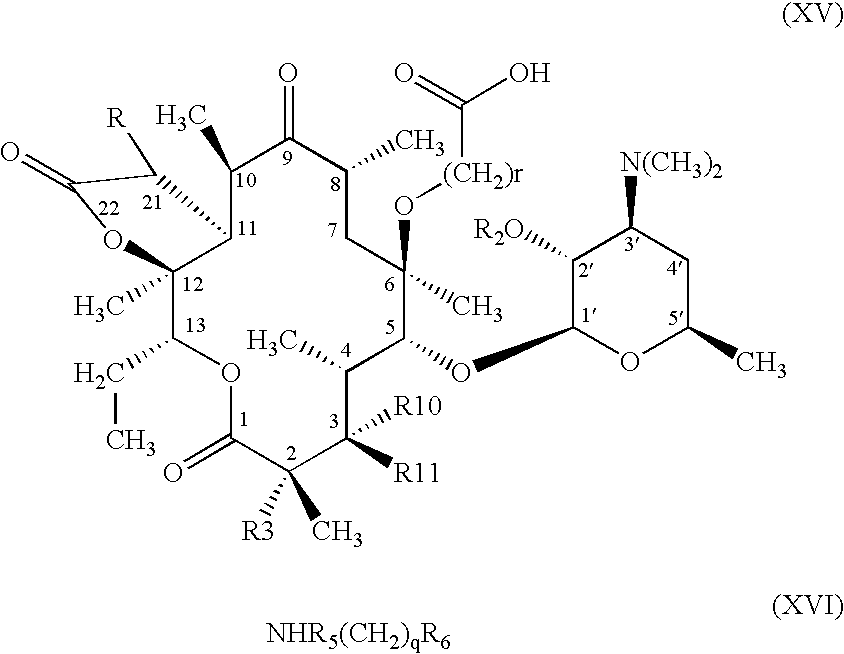
- Compounds of formula (I) or compounds of formulas (II), (IV), (IVa) or (V), wherein R 1a is XR 6 , wherein X is (CH2) r C(O)(CH2)q, r is an integer from 1 to 4 and q is an integer from 6 to 9, may be prepared by ozonolysis of a compound of formula (XI), wherein followed by treatment the corresponding aldehyde (XII), with an organo metalic derivative of formula (XIII) M(CH 2 )qR 6 (XIII), in which M is a metal, and by oxidation of the alcohol (XIII) to the keto group (XIV) according to the following reaction sequence.
- Examples of suitable metal which may be used in this reaction include lithium, zinc or magnesium.
- reaction with compound (XII) is suitably carried out in an aprotic solvent such as toluene, tetrahydrofuran at a temperature ranging from ⁇ 70° to ⁇ 20° C.
- an aprotic solvent such as toluene, tetrahydrofuran at a temperature ranging from ⁇ 70° to ⁇ 20° C.
- the oxidation reaction may be carried out using conventional oxidising agents known in the art for converting a secondary alcohol into a ketone.
- the oxidation may be carried out using pyridinium chlorochromate or oxalyl chloride and dimethylsulphoxide.
- the reaction is preferably carried out in a solvent such as methylene chloride.
- a suitable activating agent of the carboxyl group is for example acyl halide.
- reaction is suitably carried out in an aprotic solvent such as dichloromethane and in the presence of a suitable reducing agent such as sodium cyanoborohydride or sodium triacetoxyborohydride.
- a suitable reducing agent such as sodium cyanoborohydride or sodium triacetoxyborohydride.
- the reaction is preferably carried out in a suitable aprotic solvent such as a halohydrocarbon (e.g. dichloromethane) or N,N-dimethylformamide optionally in the presence of a tertiary base such as pyridine, dimethylaminopyridine or triethylamine and at a temperature within the range of 0° to 120° C.
- a suitable aprotic solvent such as a halohydrocarbon (e.g. dichloromethane) or N,N-dimethylformamide
- a tertiary base such as pyridine, dimethylaminopyridine or triethylamine
- a suitable activating agent of the carboxyl group is for example acyl halide.
- the hydroxyl protecting groups may be removed by well known standard procedures such as those described in T. W. Greene and P. G. M Wuts in Protective Groups in Organic Synthesis 2 nd ed., John Wiley & Son,Inc. 1991.
- R 2a is a trialkyllsilyl group
- this may be removed by treatment with tetrabutylammonium fluoride and acetic acid or by reaction with fluoride ions source such as triethyl amine tris (hydrogen fluoride) or this process is conveniently carried out in a solvent such as tetrahydrofuran or acetonitrile.
- R 2a is alkanoyl (i.e. acetyl or benzoyl) these may be removed by treatment with an alcohol (e.g. methanol or ethanol).
- Compounds of formula (II) may be prepared by cyclisation of a malonic ester of formula (XVIII), wherein R 1a has the meaning defined in formula (II) in the presence of a strong base such as 1,8 diazabicyclo [5.4.0]undec-7-ene.
- This reaction is conveniently carried out in an organic solvent such acetonitrile, N,N dimethylformamide and the like.
- Compounds of formula (XVIII) may be prepared by a reaction of a compounds of formula (XIX), wherein R 1a has the meaning defined in formula (II), with a chloride of formula (XX) ClCOCH2COOMe(XX), in the presence of a tertiary base such as pyridine, dimethylaminopyridine or triethylamine and at a temperature within the range of 0° to 30°.
- a tertiary base such as pyridine, dimethylaminopyridine or triethylamine
- Compounds of formula (IV) may be prepared by a reaction of a compounds of formula (XIX) with a suitable activated derivative of the acid HOCOCH 2 Cl(XXI).
- esterification may be carried out by reaction with anhydride (ClCH 2 CO) 2 O (XXII) in a suitable aprotic solvent such as a halohydrocarbon (e.g. dichloromethane) or N,N-dimethylformamide and in the presence of a tertiary base such as pyridine, dimethylaminopyridine or triethylamine and at a temperature within the range of 0° C. to 120° C.
- a suitable aprotic solvent such as a halohydrocarbon (e.g. dichloromethane) or N,N-dimethylformamide
- a tertiary base such as pyridine, dimethylaminopyridine or triethylamine
- Compounds of formula (VII) may be prepared by treating a compound of formula (IV) with sodium azide, subjecting the resulting azido compound to the following operations: a) reduction by conventional means for reducing azido group to amino group and b) conversion of the group NH 2 into the nitrogen protecting group N ⁇ R 12 wherein R 12 has the meaning defined above and if required by removal of the hydroxy protecting group R 2 .
- Compounds of formula (XIX) may be prepared by reacting 11,12-carbonate, erythromycin A derivatives (XXIII), wherein R 2a is a suitable hydroxy protecting group, R 10 and R 11 have the meaning defined in formula (II) wherein R 1a has the meaning defined in formula (II), with a strong base such as 1,8 diazabicyclo [5.4.0]undec-7-ene.
- the elimination reaction may be carried out in an organic solvent such toluene, ethyl acetate, N,N dimethylformamide or a mixture thereof, conveniently with heating.
- Compounds of formula (XXIII), may be prepared from erythromycin A derivatives of formula (XXIV), wherein R 1a has the meaning defined in formula (II), by conversion of the 2′-hydroxy group into the corresponding hydroxy protected group and by conversion of the 11,12 hydroxy into a carbonate group using triphosgene in a suitable solvent such as dicholorometane, in the presence of pyridine.
- Compounds of formula (XXIV), wherein R 1a is X or XR 6 in which X is an optionally substituted C 1-10 alkylene, an optionally substituted C 3-10 alkenylene or an optionally substituted C 3-10 alkynylene, may be prepared by alkylation of an oxime of formula (XXV) wherein, R 13 is an oxime protecting group and R 2 and R 2a is a hydroxyl protecting group, with a compound of formula (XXVI) L-R 1a (XXVI) in which L is a suitable leaving group such as a halogen (e.g. chlorine, bromine or iodine) or a sulfonyl (e.g. tosyl, methanesulfonyl), in the presence of a base, followed by hydrolysis of cladinose derivative and conversion of the 3-hydroxy group into the 3-oxo.
- a suitable leaving group such as a halogen (e.g. chlorine, bromine or
- reaction with compound (XXV) is preferably carried out in a solvent such as a halohydrocarbon (e.g. dichloromethane), an ether (e.g. tetrahydrofuran, dimethoxyethane), acetonitrile and the like.
- a solvent such as a halohydrocarbon (e.g. dichloromethane), an ether (e.g. tetrahydrofuran, dimethoxyethane), acetonitrile and the like.
- bases examples include potassium hydroxide, cesium hydroxide, tetraalkylammonium hydroxyde, sodium hydride, potassium hydride and the like, followed by subsequent removal of oxime protecting group.
- a suitable oxime protecting group is R 13 , for example, 1-isopropoxycyclohex-1-yl.
- Oxime compounds (XXV) may be prepared by reaction of a compound of formula (XXVI) wherein R 2 and R 2a is hydrogen using analogous methods to those described in U.S. Pat. No. 6,110,965.
- Compounds of formula (I) wherein R 3 is halogen may be prepared from compounds of formula (I) in which R 3 is hydrogen and R 2 is hydroxy protecting group by reaction with a halogenating agent in the presence of an organic or inorganic base.
- Suitable halogenating agents include N-fluoro benzensulfonimide, SELECTFLUORTM for fluorination, pyridinium tribromide or cyanogen bromide for bromination or hexachloroethane for chlorination.
- a convenient base for the reaction is selected from sodium hydride, potassium hydride, sodium carbonate, potassium hexamethyldisilazide, lithium diisopropylamide or pyridine.
- the reaction is carried out in a solvent such as N,N dimethylformamide, tetrahydrofuran or N-methylpyrrolidone or a mixture thereof, conveniently at a temperature within the range ⁇ 78° to 60° C.
- the halo group in position 2 of the macrolide ring may be introduced in an earlier step of the synthesis of compounds of formula (I).
- it may be introduced by treating a compound of formulas (II), (IV), (IVa), (V), (VII), (VIII), (X), (XI), (XII), (XIII), (XIV), (XV), (XVIII), (XIX), (XXIII) or (XXIV) provided that R 10 together with R 11 is an oxygen atom, using the method above described for obtaining compounds of formula (I) wherein R 3 is a halo group.
- the nitrogen protection reaction may be carried out with an appropriate imine such as benzophenone imine in an aprotic solvent, e.g. dichloromethane, preferably at room temperature.
- an appropriate imine such as benzophenone imine in an aprotic solvent, e.g. dichloromethane, preferably at room temperature.
- a compound formula (I) as a salt thereof, for example a pharmaceutically acceptable salt
- this may be achieved by reacting the compound of formula (I) in the form of the free base with an appropriate amount of suitable acid and in a suitable solvent such as an alcohol (e.g. ethanol or methanol), an ester (e.g. ethyl acetate) or an ether (e.g. diethyl ether or tetrahydrofuran).
- a suitable solvent such as an alcohol (e.g. ethanol or methanol), an ester (e.g. ethyl acetate) or an ether (e.g. diethyl ether or tetrahydrofuran).
- Pharmaceutically acceptable salts may also be prepared from other salts, including other pharmaceutically acceptable salts, of the compound of formula (I) using conventional methods.
- Suitable hydroxy protecting reagent are those described by T. W. Greene and P. G. M Wuts in Protective Groups in Organic Synthesis 2 nd ed., John Wiley & Son, Inc 1991, which is incorporating by reference.
- suitable hydroxy protecting reagents include acetic anhydride, benzoic anhydride or a trialkylsilyl chloride in a protic solvent.
- aprotic solvent examples of aprotic solvent are dichloromethane, NN-dimethylformamide, dimethylsulfoxide, tetrahydrofuran and the like.
- the hydroxyl protecting groups may be removed by well known standard procedures.
- R 2a is a trialkyllsilyl group
- this may be removed by treatment with tetrabutylammonium fluoride and acetic acid or by reaction with fluoride ions source such as triethyl amine tris (hydrogen fluoride) or this process is conveniently carried out in a solvent such as tetrahydrofuran or acetonitrile.
- fluoride ions source such as triethyl amine tris (hydrogen fluoride)
- R 2 or R 2a is alkanoyl (i.e acetyl or benzoyl) these may be removed by treatment with an alcohol (e.g. methanol or ethanol).
- the nitrogen protecting group may be removed by well known standard procedures such as those described in T. W. Greene and P. G. M Wuts in Protective Groups in Organic Synthesis 2 nd ed., John Wiley &Son, Inc. 1991.
- R 8 and R 9 indipendently represent alkoxycarbonyl group may be removed by acid hydrolisis.
- the individual stereoisomers of the compounds of formula (I) may be separated each other by conventional techniques such as fractional crystallisation or more particularly by column chromatography, using for example a silica column.
- the individual stereoisomer of formula (1a) wherein R is NH 2 may be prepared by epimerisation reaction of a compound of formula(1b) or mixture of (1a) and (1b) wherein R is NH 2 .
- the reaction is carried out in the presence of benzaldehyde and DBU, followed by hydrolysis of the imine derivative with inorganic acid such as hydrochloride.
- the reaction is suitable carried out in aprotic solvent such as for example toluene, N-N dimethylformamide.
- the 1 H-NMR spectra refers to the 1 H-NMR spectra of the predominant diastereoisomer (i.e. 21 S).
- the active ingredient and the lactose are blended together and then granulated using water as granulating fluid.
- the dried granules are blended with ethyl cellulose, sodium lauryl sulphate and magnesium stearate and the tablet core formed using an appropriate punch.
- the tablet may be coated using conventional technique and coatings.
- the sterile vials were filled with the sterile active ingredient (500 mg). Purge the vial head space with sterile nitrogen; close the vials using rubber and metal overseals.
- the product may be constituted by dissolving in water for injection(10 ml) or other suitable sterile vehicle for injection shortly before administration.
- MIC microbial inhibition concentration
Landscapes
- Health & Medical Sciences (AREA)
- Chemical & Material Sciences (AREA)
- Life Sciences & Earth Sciences (AREA)
- General Health & Medical Sciences (AREA)
- Organic Chemistry (AREA)
- Animal Behavior & Ethology (AREA)
- Molecular Biology (AREA)
- Veterinary Medicine (AREA)
- Public Health (AREA)
- Medicinal Chemistry (AREA)
- Pharmacology & Pharmacy (AREA)
- Biotechnology (AREA)
- Epidemiology (AREA)
- Genetics & Genomics (AREA)
- Biochemistry (AREA)
- Engineering & Computer Science (AREA)
- Oncology (AREA)
- Nuclear Medicine, Radiotherapy & Molecular Imaging (AREA)
- Dermatology (AREA)
- Biophysics (AREA)
- Chemical Kinetics & Catalysis (AREA)
- Communicable Diseases (AREA)
- General Chemical & Material Sciences (AREA)
- Pharmaceuticals Containing Other Organic And Inorganic Compounds (AREA)
- Medicines Containing Material From Animals Or Micro-Organisms (AREA)
- Saccharide Compounds (AREA)
- Agricultural Chemicals And Associated Chemicals (AREA)
- Steroid Compounds (AREA)
Abstract

and pharmaceutically acceptable salts and solvates thereof, wherein R, R1, R2, and R3 are as described herein. The disclosure also relates to processes for the preparation of such compounds, to compositions containing them, and to their use in the therapy or prophylaxis of systemic or topical bacterial infections in a human or animal body.
Description

wherein R1 is hydrogen or a hydroxyl protecting group; R4 is inter alia an optionally substituted C1-10 alkyl, X1 is inter alia oxygen, X2 is inter alia CH2, Y is NH, O or S, R5 is inter alia C(O) and R13 is hydrogen or halo.

wherein
- R is hydrogen, cyano or NR4R5;
- R1 is XR6;
- R2 is hydrogen or a hydroxyl protecting group;
- R3 is hydrogen or halogen;
- R6 is selected from:
- optionally substituted phenyl;
- optionally substituted 5 or 6 membered heteroaryl in which the 5-membered heteroaryl contains at least one heteroatom selected from oxygen, sulphur or nitrogen and the 6-membered heteroaryl group contains from 1 to 3 nitrogen atoms,
- optionally substituted 5-6 membered heterocyclic,
- optionally substituted 9 to 10 membered fused bicyclic carbocyclic; or
- R6 is an optionally substituted 9 or 10 membered fused bicyclic heterocyclic having at least one heteroatom selected from oxygen, sulphur or nitrogen;
- X is a C1-10 alkylene, a C3-10 alkenylene or a C3-10 alkynylene chain wherein said chains are:
- i) optionally interrupted by a bivalent radical group selected from —N(R5)—, —C(O)—, —S(O)n—, —N(R5)C(O)—, —C(O)N(R5)—,
- ii) optionally substituted by one or two groups selected from:
- C1-4 alkyl, oxo, C1-4 alkoxy, halogen, cyano, phenoxy, hydroxy, NR4R5;
- R4 is hydrogen, C1-4 alkyl or C(O)R5;
- R5 is hydrogen or C1-4 alkyl;
- n is 0 or an integer from 1 to 2;
and pharmaceutically acceptable salts and solvates thereof.
- R is hydrogen, cyano or NR4R5;
- R1 is XR6;
- R2 is hydrogen or a hydroxyl protecting group;
- R3 is hydrogen or halogen;
- R6 is selected from:
- optionally substituted phenyl;
- optionally substituted 9 to 10 membered aromatic fused bicyclic carbocyclic ring;
- optionally substituted 5 or 6 membered heteroaryl in which the 5-membered heteroaryl contains at least one heteroatom selected from oxygen, sulphur or nitrogen and the 6-membered heteroaryl group contains from 1 to 3 nitrogen atoms;
- R6 is optionally substituted fused bicyclic heteroaryl groups containing 9 or 10 ring members having at least one heteroatom selected from oxygen, sulphur or nitrogen;
- X is a group selected from:
- C1-6 alkyl, optionally substituted by one or two groups selected from a C1-4 alkoxy, hydroxy or by NR4R5;
- C3-6 alkenyl group optionally substituted by one or two groups selected from C1-4 alkoxy, a halogen, a hydroxy or by a NR4R5 group;
- C3-6 alkynyl;
- (CH2)pY(CH2)q wherein Y is selected from CO, S(O)n, NR5, N(R5)C(O) or C(O)N(R5);
- R4 is hydrogen, C1-4 alkyl or C(O)R5;
- R5 is hydrogen or C1-4 alkyl;
p is 0 or an integer from 1 to 4; q is 0 or an integer from 1 to 5; with the proviso that the sum of p and q is an integer from 0 to 5; n is 0 or an integer from 1 to 2; provided that when Y is NR6, S(O)n or N(R5)C(O), p is not 0 or 1; and pharmaceutically acceptable salts and solvates thereof.

-
- hydrogen;
- halogen;
- C1-4alkoxy;
- hydroxy;
- cyano;
- nitro;
- trifluoromethyl;
- carboxy;
- NR4R5;
- CONR4R5;
- NHCOR8 wherein R8 is C1-4alkyl phenyl, 5 membered heteroaryl containing at least 1 heteroatom selected from oxygen, sulphur or nitrogen or 6-membered heteroaryl group containing at least 1 nitrogen atoms;
- NR5CONR8R5;
- NHS(O2)R9 (wherein R9 is C1-4alkyl or phenyl);
- S(O)nR8 (wherein n is 0 or an integer from 1 to 2);
- C1-4 alkanoyl amino;
- phenyl (optionally substituted by halogen, C1-4alkoxy or NR4R5);
- phenoxy;
- 5-membered heteroaryl containing at least 1 heteroatoms selected from oxygen, sulphur or nitrogen and a 6-membered heteroaryl group containing at least 1 nitrogen atom.
- —N(R5)—, —C(O)—, —S(O)n—, —N(R5)C(O)—, —C(O)N(R5)—.
- (11S,21R)-3-Decladinosyl-11,12-dideoxy-6-O-[(quinolin-3-yl)-propen-3-yl]-3-oxo-12,11-[oxycarbonyl-(cyano)-methylene]-erythromycin A;
- (11S)-3-Decladinosyl-11,12-dideoxy-6-O-[(quinolin-3-yl)-propen-3-yl]-3-oxo-12,11-[oxycarbonyl-methylene]-erythromycin A;
- (11S,21R)-3-Decladinosyl-11,12-dideoxy-6-O-[(quinolin-5-yl)-propen-3-yl]-3-oxo-12,11-[oxycarbonyl-(cyano)-methylene]-erythromycin A;
- (11S,21R)-3-Decladinosyl-11,12-dideoxy-6-O-[(quinolin-6-yl)-propen-3-yl]-3-oxo-12,11-[oxycarbonyl-(cyano)-methylene]-erythromycin A;
- (11S,21R)-3-Decladinosyl-11,12-dideoxy-6-O-[(quinolin-7-yl)-propen-3-yl]-3-oxo-12,11-[oxycarbonyl-(cyano)-methylene]-erythromycin A;
- (11S,21R)-3-decladinosyl-11,12-dideoxy-6-O-[(quinolin-5-yl)-propen-3-yl]-3-oxo-12,11-[oxycarbonyl-methylene]-erythromycin A;
- (11S,21R)-3-decladinosyl-11,12-dideoxy-6-O-[(quinolin-6-yl)-propen-3-yl]-3-oxo-12,11-[oxycarbonyl-methylene]-erythromycin A.


followed, if required, subjecting the resulting compound to one or more of the following operations: a) conversion of the group R1a into the group R1; b) hydrolysis of the cladinose derivative (III); c) conversion of the 3-hydroxy group into the 3-oxo and d) removal of the protecting group R2.

wherein R1a, R10 and R11 have the meaning as defined for compounds of formula (II), followed, if required, subjecting the resulting compound to one or more of the following operations: a) conversion of the group R1a into the group R1; b) hydrolysis of the cladinose derivative (III); c) conversion of the 3-hydroxy group into the 3-oxo and d) removal of the protecting group R2.

with a suitable alkylating agent of formula L-R4 (VI) wherein R4 is C1-4 alkyl and L is a suitable leaving group such as a halogen (e.g. chlorine, bromine or iodine) or a sulfonyl (e.g. tosyl, methansulfonyl), in the presence of a base, followed, if required, subjecting the resulting compound to one or more of the following operations: a) conversion of the group R1a into the group R1; b) hydrolysis of the cladinose derivative (II); c) conversion of the 3-hydroxy group into the 3-oxo and d) removal of the protecting group R2.


wherein R10 and R11 have the meaning defined in formula (II), p is an integer from 1 to 8 with a ZR6 (IX) compound wherein Z is a chloride, bromide or triflate.

wherein R10 and R11 have the meaning defined in formula (II) and p is an integer from 1 to 8, with a boronic acid derivative R6B(OH)2(Xa), wherein R6 has the meaning defined in formula (IX)


in the presence of a strong base such as 1,8 diazabicyclo [5.4.0]undec-7-ene.


by conversion of the 2′-hydroxy group into the corresponding hydroxy protected group and by conversion of the 11,12 hydroxy into a carbonate group using triphosgene in a suitable solvent such as dicholorometane, in the presence of pyridine.

wherein, R13 is an oxime protecting group and R2 and R2a is a hydroxyl protecting group, with a compound of formula (XXVI) L-R1a (XXVI) in which L is a suitable leaving group such as a halogen (e.g. chlorine, bromine or iodine) or a sulfonyl (e.g. tosyl, methanesulfonyl), in the presence of a base, followed by hydrolysis of cladinose derivative and conversion of the 3-hydroxy group into the 3-oxo.

| Tablets |
| mg/tab | ||
| Active ingredient | 320 | ||
| Lactose | 150 | ||
| Ethyl cellulose | 20 | ||
| Sodium lauryl sulphate | 7 | ||
| Magnesium stearate | 3 | ||
| Tablet core | 500 | ||
Claims (9)


Applications Claiming Priority (3)
| Application Number | Priority Date | Filing Date | Title |
|---|---|---|---|
| GB0031312.2 | 2000-12-21 | ||
| GBGB0031312.2A GB0031312D0 (en) | 2000-12-21 | 2000-12-21 | Macrolides |
| PCT/GB2001/005669 WO2002050092A1 (en) | 2000-12-21 | 2001-12-20 | Macrolide antibiotics |
Publications (2)
| Publication Number | Publication Date |
|---|---|
| US20040082526A1 US20040082526A1 (en) | 2004-04-29 |
| US6900183B2 true US6900183B2 (en) | 2005-05-31 |
Family
ID=9905640
Family Applications (1)
| Application Number | Title | Priority Date | Filing Date |
|---|---|---|---|
| US10/450,886 Expired - Fee Related US6900183B2 (en) | 2000-12-21 | 2001-12-20 | Macrolide antibiotics |
Country Status (9)
| Country | Link |
|---|---|
| US (1) | US6900183B2 (en) |
| EP (1) | EP1343797B1 (en) |
| JP (1) | JP2004520314A (en) |
| AT (1) | ATE340184T1 (en) |
| AU (1) | AU2002222296A1 (en) |
| DE (1) | DE60123277T2 (en) |
| ES (1) | ES2272410T3 (en) |
| GB (1) | GB0031312D0 (en) |
| WO (1) | WO2002050092A1 (en) |
Cited By (5)
| Publication number | Priority date | Publication date | Assignee | Title |
|---|---|---|---|---|
| WO2008023248A2 (en) | 2006-08-24 | 2008-02-28 | Wockhardt Research Centre | Novel macrolides and ketolides having antimicrobial activity |
| US20090076253A1 (en) * | 2006-05-01 | 2009-03-19 | Taisho Pharmaceutical Co., Ltd | Macrolide derivatives |
| WO2010136971A1 (en) | 2009-05-27 | 2010-12-02 | Wockhardt Research Centre | Ketolide compounds having antimicrobial activity |
| WO2012076989A1 (en) | 2010-12-09 | 2012-06-14 | Wockhardt Limited | Ketolide compounds |
| WO2012117357A2 (en) | 2011-03-01 | 2012-09-07 | Wockhardt Limited | Process for preparation of ketolide intermediates |
Families Citing this family (23)
| Publication number | Priority date | Publication date | Assignee | Title |
|---|---|---|---|---|
| CN1589277A (en) * | 2001-09-17 | 2005-03-02 | 奥索-麦克尼尔药品公司 | 6-O-carbamate-11,12-lacto-ketolide antimicrobials |
| US6995143B2 (en) * | 2002-02-28 | 2006-02-07 | Basilea Pharmaceutica Ag | Macrolides with antibacterial activity |
| US6727229B2 (en) | 2002-08-19 | 2004-04-27 | Enanta Pharmaceuticals, Inc. | 11,12-substituted lactone ketolide derivatives having antibacterial activity |
| US6720308B1 (en) | 2002-11-07 | 2004-04-13 | Enanta Pharmaceuticals, Inc. | Anhydrolide derivatives having antibacterial activity |
| EP1638549A4 (en) | 2003-03-10 | 2011-06-15 | Optimer Pharmaceuticals Inc | NEW ANTIBACTERIAL AGENTS |
| US6790835B1 (en) | 2003-06-05 | 2004-09-14 | Enanta Pharmaceuticals, Inc. | Bicyclic macrolide derivatives |
| US20040254126A1 (en) * | 2003-06-05 | 2004-12-16 | Yao-Ling Qiu | 11-12 Bicyclic erythromycin derivatives |
| US6774115B1 (en) | 2003-06-05 | 2004-08-10 | Enanta Pharmaceuticals, Inc. | 6-O-substituted bicyclic ketolides |
| WO2004108745A2 (en) * | 2003-06-05 | 2004-12-16 | Enanta Pharmaceuticals, Inc. | 11-12 bicyclic erythromycin derivatives |
| US6716820B1 (en) | 2003-06-05 | 2004-04-06 | Enanta Pharmaceuticals, Inc. | 6-O-substituted bicyclic macrolides |
| US6765016B1 (en) | 2003-06-05 | 2004-07-20 | Enanta Pharmaceuticals, Inc. | Bicyclic ketolide derivatives |
| WO2006120541A1 (en) | 2005-05-10 | 2006-11-16 | Glaxosmithkline Istrazivacki Centar Zagreb D.O.O. | Ether linked macrolides useful for the treatment of microbial infections |
| CA2703475A1 (en) | 2007-10-25 | 2009-04-30 | Cempra Pharmaceuticals, Inc. | Process for the preparation of macrolide antibacterial agents |
| US8796232B2 (en) | 2008-10-24 | 2014-08-05 | Cempra Pharmaceuticals, Inc. | Methods for treating resistant diseases using triazole containing macrolides |
| US9937194B1 (en) | 2009-06-12 | 2018-04-10 | Cempra Pharmaceuticals, Inc. | Compounds and methods for treating inflammatory diseases |
| JP5914335B2 (en) | 2009-09-10 | 2016-05-11 | センプラ ファーマシューティカルズ,インコーポレイテッド | Method for treating malaria, tuberculosis and MAC disease |
| CN103080122A (en) | 2010-03-22 | 2013-05-01 | 森普拉制药公司 | Crystalline forms of macrolides and their uses |
| WO2011146829A1 (en) | 2010-05-20 | 2011-11-24 | Cempra Pharmaceuticals, Inc. | Processes for preparing macrolides and ketolides and intermediates therefor |
| JP6042334B2 (en) | 2010-09-10 | 2016-12-14 | センプラ ファーマシューティカルズ,インコーポレイテッド | Hydrogen bond forming fluoroketolides for disease treatment |
| CN104470527B (en) | 2012-03-27 | 2019-05-28 | 森普拉制药公司 | Parenteral formulations for administration of macrolide antibiotics |
| RU2015138796A (en) | 2013-03-14 | 2017-04-19 | Семпра Фармасьютикалс, Инк. | METHODS AND COMPOSITIONS FOR TREATMENT OF RESPIRATORY DISEASES |
| WO2014145210A1 (en) | 2013-03-15 | 2014-09-18 | Cempra Pharmaceuticals, Inc. | Convergent processes for preparing macrolide antibacterial agents |
| US10857171B2 (en) | 2016-01-12 | 2020-12-08 | Wockhardt Limited | Pharmaceutical compositions |
Citations (4)
| Publication number | Priority date | Publication date | Assignee | Title |
|---|---|---|---|---|
| US6011142A (en) | 1995-10-09 | 2000-01-04 | Hoechst Marion Roussel | 5-O-deosaminyl 6-O-methyl erythronolide A derivatives, preparation method therefor and use thereof for preparing biologically active materials |
| WO2000055168A1 (en) | 1999-03-15 | 2000-09-21 | Abbott Laboratories | 6-o-substituted macrolides having antibacterial activity |
| US6124269A (en) | 1997-10-29 | 2000-09-26 | Abbott Laboratories | 2-Halo-6-O-substituted ketolide derivatives |
| EP1114826A2 (en) | 1999-12-29 | 2001-07-11 | Pfizer Products Inc. | Novel antibacterial and prokinetic macrolides |
-
2000
- 2000-12-21 GB GBGB0031312.2A patent/GB0031312D0/en not_active Ceased
-
2001
- 2001-12-20 US US10/450,886 patent/US6900183B2/en not_active Expired - Fee Related
- 2001-12-20 DE DE60123277T patent/DE60123277T2/en not_active Expired - Fee Related
- 2001-12-20 AU AU2002222296A patent/AU2002222296A1/en not_active Abandoned
- 2001-12-20 ES ES01271381T patent/ES2272410T3/en not_active Expired - Lifetime
- 2001-12-20 EP EP01271381A patent/EP1343797B1/en not_active Expired - Lifetime
- 2001-12-20 AT AT01271381T patent/ATE340184T1/en not_active IP Right Cessation
- 2001-12-20 JP JP2002551985A patent/JP2004520314A/en not_active Ceased
- 2001-12-20 WO PCT/GB2001/005669 patent/WO2002050092A1/en not_active Ceased
Patent Citations (4)
| Publication number | Priority date | Publication date | Assignee | Title |
|---|---|---|---|---|
| US6011142A (en) | 1995-10-09 | 2000-01-04 | Hoechst Marion Roussel | 5-O-deosaminyl 6-O-methyl erythronolide A derivatives, preparation method therefor and use thereof for preparing biologically active materials |
| US6124269A (en) | 1997-10-29 | 2000-09-26 | Abbott Laboratories | 2-Halo-6-O-substituted ketolide derivatives |
| WO2000055168A1 (en) | 1999-03-15 | 2000-09-21 | Abbott Laboratories | 6-o-substituted macrolides having antibacterial activity |
| EP1114826A2 (en) | 1999-12-29 | 2001-07-11 | Pfizer Products Inc. | Novel antibacterial and prokinetic macrolides |
Cited By (7)
| Publication number | Priority date | Publication date | Assignee | Title |
|---|---|---|---|---|
| US20090076253A1 (en) * | 2006-05-01 | 2009-03-19 | Taisho Pharmaceutical Co., Ltd | Macrolide derivatives |
| US8124744B2 (en) * | 2006-05-01 | 2012-02-28 | Taisho Pharmaceutical Co., Ltd. | Macrolide derivatives |
| WO2008023248A2 (en) | 2006-08-24 | 2008-02-28 | Wockhardt Research Centre | Novel macrolides and ketolides having antimicrobial activity |
| WO2010136971A1 (en) | 2009-05-27 | 2010-12-02 | Wockhardt Research Centre | Ketolide compounds having antimicrobial activity |
| WO2012076989A1 (en) | 2010-12-09 | 2012-06-14 | Wockhardt Limited | Ketolide compounds |
| EP3216798A2 (en) | 2010-12-09 | 2017-09-13 | Wockhardt Limited | Ketolide compounds |
| WO2012117357A2 (en) | 2011-03-01 | 2012-09-07 | Wockhardt Limited | Process for preparation of ketolide intermediates |
Also Published As
| Publication number | Publication date |
|---|---|
| WO2002050092A1 (en) | 2002-06-27 |
| GB0031312D0 (en) | 2001-02-07 |
| AU2002222296A1 (en) | 2002-07-01 |
| DE60123277D1 (en) | 2006-11-02 |
| ATE340184T1 (en) | 2006-10-15 |
| ES2272410T3 (en) | 2007-05-01 |
| US20040082526A1 (en) | 2004-04-29 |
| JP2004520314A (en) | 2004-07-08 |
| DE60123277T2 (en) | 2007-09-13 |
| EP1343797A1 (en) | 2003-09-17 |
| EP1343797B1 (en) | 2006-09-20 |
Similar Documents
| Publication | Publication Date | Title |
|---|---|---|
| US20040082526A1 (en) | Macrolide antibiotics | |
| EP1291350B1 (en) | 6-0 substituted ketolides having antibacterial activity | |
| US20050080025A1 (en) | Macrolides | |
| CZ303474B6 (en) | 6-O-substituted erythromycin ketolide derivative, process for its preparation, its use and pharmaceutical composition containing thereof | |
| EA005156B1 (en) | 13-membered azalides and their use as antibiotic agents | |
| AU737310B2 (en) | 3'-n-modified 6-o-substituted erythromycin ketolide derivatives having antibacterial activity | |
| WO1997042205A1 (en) | 3-descladinose-2,3-anhydroerythromycin derivatives | |
| US6420535B1 (en) | 6-O-carbamate ketolide derivatives | |
| EP0201166B1 (en) | Erythromycin derivatives | |
| US7351696B2 (en) | Compounds | |
| EP0262904A2 (en) | Modifications of mycinose and 3-0-demethylmycinose in tylosintype macrolides | |
| US7262172B2 (en) | Macrolides | |
| EP1181300B1 (en) | 6-o-carbamate ketolide derivatives | |
| JP2003501439A5 (en) | ||
| WO2004101589A1 (en) | Novel 14 and 15 membered-ring compounds | |
| US20040002464A1 (en) | 11-C-substituted ketolides | |
| CA2564377C (en) | 6-o-substituted ketolides having antibacterial activity | |
| EP1756134A1 (en) | Carbamate linked macrolides useful for the treatment of microbial infections | |
| HK1021537B (en) | 6-o-substituted ketolides having antibacterial activity |
Legal Events
| Date | Code | Title | Description |
|---|---|---|---|
| AS | Assignment |
Owner name: GLAXO GROUP LIMITED, ENGLAND Free format text: ASSIGNMENT OF ASSIGNORS INTEREST;ASSIGNORS:ANDREOTTI, DANIELE;BIONDI, STEFANO;LOCIURO, SERGIO;REEL/FRAME:014449/0982;SIGNING DATES FROM 20031017 TO 20031205 Owner name: PLIVA D.D., CROATIA Free format text: ASSIGNMENT OF ASSIGNORS INTEREST;ASSIGNORS:ANDREOTTI, DANIELE;BIONDI, STEFANO;LOCIURO, SERGIO;REEL/FRAME:014449/0982;SIGNING DATES FROM 20031017 TO 20031205 |
|
| AS | Assignment |
Owner name: GLAXO GROUP LIMITED, ENGLAND Free format text: ASSIGNMENT OF ASSIGNORS INTEREST;ASSIGNORS:ANDREOTTI, DANIELE;BIONDI, STEFANO;LOCIURO, SERGIO;REEL/FRAME:014538/0366;SIGNING DATES FROM 20031017 TO 20031205 |
|
| FPAY | Fee payment |
Year of fee payment: 4 |
|
| REMI | Maintenance fee reminder mailed | ||
| LAPS | Lapse for failure to pay maintenance fees | ||
| STCH | Information on status: patent discontinuation |
Free format text: PATENT EXPIRED DUE TO NONPAYMENT OF MAINTENANCE FEES UNDER 37 CFR 1.362 |
|
| STCH | Information on status: patent discontinuation |
Free format text: PATENT EXPIRED DUE TO NONPAYMENT OF MAINTENANCE FEES UNDER 37 CFR 1.362 |
|
| FP | Lapsed due to failure to pay maintenance fee |
Effective date: 20130531 |