US6878732B2 - NK1 antagonists - Google Patents
NK1 antagonists Download PDFInfo
- Publication number
- US6878732B2 US6878732B2 US10/386,577 US38657703A US6878732B2 US 6878732 B2 US6878732 B2 US 6878732B2 US 38657703 A US38657703 A US 38657703A US 6878732 B2 US6878732 B2 US 6878732B2
- Authority
- US
- United States
- Prior art keywords
- group
- alkyl
- compound
- independently selected
- ring
- Prior art date
- Legal status (The legal status is an assumption and is not a legal conclusion. Google has not performed a legal analysis and makes no representation as to the accuracy of the status listed.)
- Expired - Fee Related, expires
Links
- 0 *C([2*])(C)CC([3*])([H])C1(C)C([4*])([5*])C([6*])([7*])C1([8*])[9*] Chemical compound *C([2*])(C)CC([3*])([H])C1(C)C([4*])([5*])C([6*])([7*])C1([8*])[9*] 0.000 description 63
- GLMYRENDOZHTSS-JYMLRBTQSA-N C[C@@H](OCC1(C2=CC=CC=C2)CC(N)(C(N)=O)C1)C1=CC(C(F)(F)F)=CC(C(F)(F)F)=C1 Chemical compound C[C@@H](OCC1(C2=CC=CC=C2)CC(N)(C(N)=O)C1)C1=CC(C(F)(F)F)=CC(C(F)(F)F)=C1 GLMYRENDOZHTSS-JYMLRBTQSA-N 0.000 description 4
- OSWSZJCVDCBQDG-RTOPAQNCSA-N C[C@@H](OC[C@]1(C2=CC=CC=C2)C[C@]2(C1)N=CN(C)C2=O)C1=CC(C(F)(F)F)=CC(C(F)(F)F)=C1 Chemical compound C[C@@H](OC[C@]1(C2=CC=CC=C2)C[C@]2(C1)N=CN(C)C2=O)C1=CC(C(F)(F)F)=CC(C(F)(F)F)=C1 OSWSZJCVDCBQDG-RTOPAQNCSA-N 0.000 description 4
- ODAONNQISJZBQW-UHFFFAOYSA-N CC1CC(=O)N(C(C)C)C1C Chemical compound CC1CC(=O)N(C(C)C)C1C ODAONNQISJZBQW-UHFFFAOYSA-N 0.000 description 3
- GGLJYHTXYBEGQM-BGYRXZFFSA-N CNC(=O)[C@]1(N)C[C@@](COCC2=CC(C(F)(F)F)=CC(C(F)(F)F)=C2)(C2=CC=CC=C2)C1 Chemical compound CNC(=O)[C@]1(N)C[C@@](COCC2=CC(C(F)(F)F)=CC(C(F)(F)F)=C2)(C2=CC=CC=C2)C1 GGLJYHTXYBEGQM-BGYRXZFFSA-N 0.000 description 3
- RSABPPVRUPFDEN-CYBMUJFWSA-N C[C@@H](OCC1(C2=CC=CC=C2)CC(=O)C1)C1=CC(C(F)(F)F)=CC(C(F)(F)F)=C1 Chemical compound C[C@@H](OCC1(C2=CC=CC=C2)CC(=O)C1)C1=CC(C(F)(F)F)=CC(C(F)(F)F)=C1 RSABPPVRUPFDEN-CYBMUJFWSA-N 0.000 description 3
- JHDXXNTYBOADFV-VZPUWSDOSA-N C[C@@H](OC[C@]1(C2=CC=CC=C2)C[C@@H](N2CCCC2=O)C1)C1=CC(C(F)(F)F)=CC(C(F)(F)F)=C1 Chemical compound C[C@@H](OC[C@]1(C2=CC=CC=C2)C[C@@H](N2CCCC2=O)C1)C1=CC(C(F)(F)F)=CC(C(F)(F)F)=C1 JHDXXNTYBOADFV-VZPUWSDOSA-N 0.000 description 3
- KCIRGNNJJBAOTF-XMDBHEJHSA-N C[C@@H](OC[C@]1(C2=CC=CC=C2)C[C@@]2(C1)N=CNC2=O)C1=CC(C(F)(F)F)=CC(C(F)(F)F)=C1 Chemical compound C[C@@H](OC[C@]1(C2=CC=CC=C2)C[C@@]2(C1)N=CNC2=O)C1=CC(C(F)(F)F)=CC(C(F)(F)F)=C1 KCIRGNNJJBAOTF-XMDBHEJHSA-N 0.000 description 3
- ZTCDETKVYPFKRC-KHIBUBOWSA-N C[C@@H](OC[C@]1(C2=CC=CC=C2)C[C@@]2(C1)NC(=O)N(C)C2=O)C1=CC(C(F)(F)F)=CC(C(F)(F)F)=C1 Chemical compound C[C@@H](OC[C@]1(C2=CC=CC=C2)C[C@@]2(C1)NC(=O)N(C)C2=O)C1=CC(C(F)(F)F)=CC(C(F)(F)F)=C1 ZTCDETKVYPFKRC-KHIBUBOWSA-N 0.000 description 3
- MGQPFQSOUKYJAE-DURYTUKUSA-N C[C@@H](OC[C@]1(C2=CC=CC=C2)C[C@@]2(C1)NC(=O)OC2(C)C)C1=CC(C(F)(F)F)=CC(C(F)(F)F)=C1 Chemical compound C[C@@H](OC[C@]1(C2=CC=CC=C2)C[C@@]2(C1)NC(=O)OC2(C)C)C1=CC(C(F)(F)F)=CC(C(F)(F)F)=C1 MGQPFQSOUKYJAE-DURYTUKUSA-N 0.000 description 3
- PAIIDYOLPOWNAL-XMDBHEJHSA-N C[C@@H](OC[C@]1(C2=CC=CC=C2)C[C@@]2(C1)NCNC2=O)C1=CC(C(F)(F)F)=CC(C(F)(F)F)=C1 Chemical compound C[C@@H](OC[C@]1(C2=CC=CC=C2)C[C@@]2(C1)NCNC2=O)C1=CC(C(F)(F)F)=CC(C(F)(F)F)=C1 PAIIDYOLPOWNAL-XMDBHEJHSA-N 0.000 description 3
- PAIIDYOLPOWNAL-IFZYUDKTSA-N C[C@@H](OC[C@]1(C2=CC=CC=C2)C[C@]2(C1)NCNC2=O)C1=CC(C(F)(F)F)=CC(C(F)(F)F)=C1 Chemical compound C[C@@H](OC[C@]1(C2=CC=CC=C2)C[C@]2(C1)NCNC2=O)C1=CC(C(F)(F)F)=CC(C(F)(F)F)=C1 PAIIDYOLPOWNAL-IFZYUDKTSA-N 0.000 description 3
- NQQVDBGEUDENFZ-XYJCDUHRSA-N [H]N([H])C1CC(CO[C@H](C)C2=CC(C(F)(F)F)=CC(C(F)(F)F)=C2)(C2=CC=CC=C2)C1 Chemical compound [H]N([H])C1CC(CO[C@H](C)C2=CC(C(F)(F)F)=CC(C(F)(F)F)=C2)(C2=CC=CC=C2)C1 NQQVDBGEUDENFZ-XYJCDUHRSA-N 0.000 description 3
- ZOPRZQRKBZNHLP-XMDBHEJHSA-N CC(=O)N[C@H]1C[C@](CO[C@H](C)C2=CC(C(F)(F)F)=CC(C(F)(F)F)=C2)(C2=CC=CC=C2)C1 Chemical compound CC(=O)N[C@H]1C[C@](CO[C@H](C)C2=CC(C(F)(F)F)=CC(C(F)(F)F)=C2)(C2=CC=CC=C2)C1 ZOPRZQRKBZNHLP-XMDBHEJHSA-N 0.000 description 2
- GLAACCVUOGYBHP-VEYWIMSWSA-N CC(C)C(=O)NC[C@]1(N)C[C@@](CO[C@H](C)C2=CC(C(F)(F)F)=CC(C(F)(F)F)=C2)(C2=CC=CC=C2)C1 Chemical compound CC(C)C(=O)NC[C@]1(N)C[C@@](CO[C@H](C)C2=CC(C(F)(F)F)=CC(C(F)(F)F)=C2)(C2=CC=CC=C2)C1 GLAACCVUOGYBHP-VEYWIMSWSA-N 0.000 description 2
- GLAACCVUOGYBHP-UOKFIYJESA-N CC(C)C(=O)NC[C@]1(N)C[C@](CO[C@H](C)C2=CC(C(F)(F)F)=CC(C(F)(F)F)=C2)(C2=CC=CC=C2)C1 Chemical compound CC(C)C(=O)NC[C@]1(N)C[C@](CO[C@H](C)C2=CC(C(F)(F)F)=CC(C(F)(F)F)=C2)(C2=CC=CC=C2)C1 GLAACCVUOGYBHP-UOKFIYJESA-N 0.000 description 2
- OHDQKQGDHONPAR-XMDBHEJHSA-N CNC(=O)[C@]1(N)C[C@](CO[C@H](C)C2=CC(C(F)(F)F)=CC(C(F)(F)F)=C2)(C2=CC=CC=C2)C1 Chemical compound CNC(=O)[C@]1(N)C[C@](CO[C@H](C)C2=CC(C(F)(F)F)=CC(C(F)(F)F)=C2)(C2=CC=CC=C2)C1 OHDQKQGDHONPAR-XMDBHEJHSA-N 0.000 description 2
- CUTGIMKSYPJECF-IXLSOUTGSA-N C[C@@H](OC(O[C@H](C)C1=CC(C(F)(F)F)=CC(C(F)(F)F)=C1)C1(C23=CC=CC=C2=C/C=C\C=3)CC2(CNC(=O)C2)C1)C1=CC(C(F)(F)F)=CC(C(F)(F)F)=C1 Chemical compound C[C@@H](OC(O[C@H](C)C1=CC(C(F)(F)F)=CC(C(F)(F)F)=C1)C1(C23=CC=CC=C2=C/C=C\C=3)CC2(CNC(=O)C2)C1)C1=CC(C(F)(F)F)=CC(C(F)(F)F)=C1 CUTGIMKSYPJECF-IXLSOUTGSA-N 0.000 description 2
- ULDJAVNLIXOQLU-WOWWPIEJSA-N C[C@@H](OCC1(C2=CC=CC=C2)CC(=NO)C1)C1=CC(C(F)(F)F)=CC(C(F)(F)F)=C1 Chemical compound C[C@@H](OCC1(C2=CC=CC=C2)CC(=NO)C1)C1=CC(C(F)(F)F)=CC(C(F)(F)F)=C1 ULDJAVNLIXOQLU-WOWWPIEJSA-N 0.000 description 2
- NIXQCIOTTPPGOB-CYBMUJFWSA-N C[C@@H](OCC1(C2=CC=CC=C2)CC(=O)C1)C1=CC(F)=CC(F)=C1 Chemical compound C[C@@H](OCC1(C2=CC=CC=C2)CC(=O)C1)C1=CC(F)=CC(F)=C1 NIXQCIOTTPPGOB-CYBMUJFWSA-N 0.000 description 2
- HTNBBVDKJHTSMJ-IYJORBIASA-N C[C@@H](OCC1(C2=CC=CC=C2)CC2(CNC(=O)C2)C1)C1=CC(C(F)(F)F)=CC(C(F)(F)F)=C1 Chemical compound C[C@@H](OCC1(C2=CC=CC=C2)CC2(CNC(=O)C2)C1)C1=CC(C(F)(F)F)=CC(C(F)(F)F)=C1 HTNBBVDKJHTSMJ-IYJORBIASA-N 0.000 description 2
- BTJQGEZNLLGSCI-BSOCMFCZSA-N C[C@@H](OCC1(C2=CC=CC=C2)CCC1=O)C1=CC(C(F)(F)F)=CC(C(F)(F)F)=C1 Chemical compound C[C@@H](OCC1(C2=CC=CC=C2)CCC1=O)C1=CC(C(F)(F)F)=CC(C(F)(F)F)=C1 BTJQGEZNLLGSCI-BSOCMFCZSA-N 0.000 description 2
- CYYIWZLSPAXSDM-KZULUSFZSA-N C[C@@H](OC[C@@]1(C2=CC=CC=C2)CC(=O)C1(Cl)Cl)C1=CC(C(F)(F)F)=CC(C(F)(F)F)=C1 Chemical compound C[C@@H](OC[C@@]1(C2=CC=CC=C2)CC(=O)C1(Cl)Cl)C1=CC(C(F)(F)F)=CC(C(F)(F)F)=C1 CYYIWZLSPAXSDM-KZULUSFZSA-N 0.000 description 2
- CYYIWZLSPAXSDM-XIKOKIGWSA-N C[C@@H](OC[C@]1(C2=CC=CC=C2)CC(=O)C1(Cl)Cl)C1=CC(C(F)(F)F)=CC(C(F)(F)F)=C1 Chemical compound C[C@@H](OC[C@]1(C2=CC=CC=C2)CC(=O)C1(Cl)Cl)C1=CC(C(F)(F)F)=CC(C(F)(F)F)=C1 CYYIWZLSPAXSDM-XIKOKIGWSA-N 0.000 description 2
- VNVORKAVARVJNK-OFSQETHSSA-N C[C@@H](OC[C@]1(C2=CC=CC=C2)C[C@@H](NC(=O)C(C)(C)N)C1)C1=CC(C(F)(F)F)=CC(C(F)(F)F)=C1 Chemical compound C[C@@H](OC[C@]1(C2=CC=CC=C2)C[C@@H](NC(=O)C(C)(C)N)C1)C1=CC(C(F)(F)F)=CC(C(F)(F)F)=C1 VNVORKAVARVJNK-OFSQETHSSA-N 0.000 description 2
- GLMYRENDOZHTSS-SMHULIPUSA-N C[C@@H](OC[C@]1(C2=CC=CC=C2)C[C@@](N)(C(N)=O)C1)C1=CC(C(F)(F)F)=CC(C(F)(F)F)=C1 Chemical compound C[C@@H](OC[C@]1(C2=CC=CC=C2)C[C@@](N)(C(N)=O)C1)C1=CC(C(F)(F)F)=CC(C(F)(F)F)=C1 GLMYRENDOZHTSS-SMHULIPUSA-N 0.000 description 2
- XNZDXGGYFXASNA-JSNMRZPZSA-N C[C@@H](OC[C@]1(C2=CC=CC=C2)C[C@@](N)(CN)C1)C1=CC(C(F)(F)F)=CC(C(F)(F)F)=C1 Chemical compound C[C@@H](OC[C@]1(C2=CC=CC=C2)C[C@@](N)(CN)C1)C1=CC(C(F)(F)F)=CC(C(F)(F)F)=C1 XNZDXGGYFXASNA-JSNMRZPZSA-N 0.000 description 2
- FIBNAKIYKJQZIS-ZYKLXPEUSA-N C[C@@H](OC[C@]1(C2=CC=CC=C2)C[C@@](N)(CNC(=O)N2CCCC2)C1)C1=CC(C(F)(F)F)=CC(C(F)(F)F)=C1 Chemical compound C[C@@H](OC[C@]1(C2=CC=CC=C2)C[C@@](N)(CNC(=O)N2CCCC2)C1)C1=CC(C(F)(F)F)=CC(C(F)(F)F)=C1 FIBNAKIYKJQZIS-ZYKLXPEUSA-N 0.000 description 2
- BEJKBLIQSNXWAI-JSNMRZPZSA-N C[C@@H](OC[C@]1(C2=CC=CC=C2)C[C@@](N)(CO)C1)C1=CC(C(F)(F)F)=CC(C(F)(F)F)=C1 Chemical compound C[C@@H](OC[C@]1(C2=CC=CC=C2)C[C@@](N)(CO)C1)C1=CC(C(F)(F)F)=CC(C(F)(F)F)=C1 BEJKBLIQSNXWAI-JSNMRZPZSA-N 0.000 description 2
- OSWSZJCVDCBQDG-UJUVCNOISA-N C[C@@H](OC[C@]1(C2=CC=CC=C2)C[C@@]2(C1)N=CN(C)C2=O)C1=CC(C(F)(F)F)=CC(C(F)(F)F)=C1 Chemical compound C[C@@H](OC[C@]1(C2=CC=CC=C2)C[C@@]2(C1)N=CN(C)C2=O)C1=CC(C(F)(F)F)=CC(C(F)(F)F)=C1 OSWSZJCVDCBQDG-UJUVCNOISA-N 0.000 description 2
- YZXBMNLVWCRBLA-OBVPDXSSSA-N C[C@@H](OC[C@]1(C2=CC=CC=C2)C[C@@]2(C1)NC(=O)NC2=O)C1=CC(F)=CC(F)=C1 Chemical compound C[C@@H](OC[C@]1(C2=CC=CC=C2)C[C@@]2(C1)NC(=O)NC2=O)C1=CC(F)=CC(F)=C1 YZXBMNLVWCRBLA-OBVPDXSSSA-N 0.000 description 2
- KTPHNGJKWBYELR-UJUVCNOISA-N C[C@@H](OC[C@]1(C2=CC=CC=C2)C[C@@]2(C1)NCN(C)C2=O)C1=CC(C(F)(F)F)=CC(C(F)(F)F)=C1 Chemical compound C[C@@H](OC[C@]1(C2=CC=CC=C2)C[C@@]2(C1)NCN(C)C2=O)C1=CC(C(F)(F)F)=CC(C(F)(F)F)=C1 KTPHNGJKWBYELR-UJUVCNOISA-N 0.000 description 2
- ZROBLWGLLLBISJ-XMDBHEJHSA-N C[C@@H](OC[C@]1(C2=CC=CC=C2)C[C@@]2(CC(=O)N2)C1)C1=CC(C(F)(F)F)=CC(C(F)(F)F)=C1 Chemical compound C[C@@H](OC[C@]1(C2=CC=CC=C2)C[C@@]2(CC(=O)N2)C1)C1=CC(C(F)(F)F)=CC(C(F)(F)F)=C1 ZROBLWGLLLBISJ-XMDBHEJHSA-N 0.000 description 2
- SINJOZSPOMHOEO-IPHXSNPTSA-N C[C@@H](OC[C@]1(C2=CC=CC=C2)C[C@@]2(CCN2)C1)C1=CC(C(F)(F)F)=CC(C(F)(F)F)=C1 Chemical compound C[C@@H](OC[C@]1(C2=CC=CC=C2)C[C@@]2(CCN2)C1)C1=CC(C(F)(F)F)=CC(C(F)(F)F)=C1 SINJOZSPOMHOEO-IPHXSNPTSA-N 0.000 description 2
- GESDWGROBLGECA-UJUVCNOISA-N C[C@@H](OC[C@]1(C2=CC=CC=C2)C[C@@]2(COC(=O)CN2)C1)C1=CC(C(F)(F)F)=CC(C(F)(F)F)=C1 Chemical compound C[C@@H](OC[C@]1(C2=CC=CC=C2)C[C@@]2(COC(=O)CN2)C1)C1=CC(C(F)(F)F)=CC(C(F)(F)F)=C1 GESDWGROBLGECA-UJUVCNOISA-N 0.000 description 2
- QKGHZGQQHHFNEF-XMDBHEJHSA-N C[C@@H](OC[C@]1(C2=CC=CC=C2)C[C@@]2(COC(=O)N2)C1)C1=CC(C(F)(F)F)=CC(C(F)(F)F)=C1 Chemical compound C[C@@H](OC[C@]1(C2=CC=CC=C2)C[C@@]2(COC(=O)N2)C1)C1=CC(C(F)(F)F)=CC(C(F)(F)F)=C1 QKGHZGQQHHFNEF-XMDBHEJHSA-N 0.000 description 2
- JHDXXNTYBOADFV-FQQGMQMYSA-N C[C@@H](OC[C@]1(C2=CC=CC=C2)C[C@H](N2CCCC2=O)C1)C1=CC(C(F)(F)F)=CC(C(F)(F)F)=C1 Chemical compound C[C@@H](OC[C@]1(C2=CC=CC=C2)C[C@H](N2CCCC2=O)C1)C1=CC(C(F)(F)F)=CC(C(F)(F)F)=C1 JHDXXNTYBOADFV-FQQGMQMYSA-N 0.000 description 2
- VNVORKAVARVJNK-ZFUCPZCZSA-N C[C@@H](OC[C@]1(C2=CC=CC=C2)C[C@H](NC(=O)C(C)(C)N)C1)C1=CC(C(F)(F)F)=CC(C(F)(F)F)=C1 Chemical compound C[C@@H](OC[C@]1(C2=CC=CC=C2)C[C@H](NC(=O)C(C)(C)N)C1)C1=CC(C(F)(F)F)=CC(C(F)(F)F)=C1 VNVORKAVARVJNK-ZFUCPZCZSA-N 0.000 description 2
- RPTUFMPIXDZPLM-XMDBHEJHSA-N C[C@@H](OC[C@]1(C2=CC=CC=C2)C[C@](C)(NC(N)=O)C1)C1=CC(C(F)(F)F)=CC(C(F)(F)F)=C1 Chemical compound C[C@@H](OC[C@]1(C2=CC=CC=C2)C[C@](C)(NC(N)=O)C1)C1=CC(C(F)(F)F)=CC(C(F)(F)F)=C1 RPTUFMPIXDZPLM-XMDBHEJHSA-N 0.000 description 2
- LZAMAIYCMMYJAG-DURYTUKUSA-N C[C@@H](OC[C@]1(C2=CC=CC=C2)C[C@](C)(NCC2=NNC(=O)N2)C1)C1=CC(C(F)(F)F)=CC(C(F)(F)F)=C1 Chemical compound C[C@@H](OC[C@]1(C2=CC=CC=C2)C[C@](C)(NCC2=NNC(=O)N2)C1)C1=CC(C(F)(F)F)=CC(C(F)(F)F)=C1 LZAMAIYCMMYJAG-DURYTUKUSA-N 0.000 description 2
- LQRDBJSVJUNPHC-RTOPAQNCSA-N C[C@@H](OC[C@]1(C2=CC=CC=C2)C[C@](N)(C(=O)N(C)C)C1)C1=CC(C(F)(F)F)=CC(C(F)(F)F)=C1 Chemical compound C[C@@H](OC[C@]1(C2=CC=CC=C2)C[C@](N)(C(=O)N(C)C)C1)C1=CC(C(F)(F)F)=CC(C(F)(F)F)=C1 LQRDBJSVJUNPHC-RTOPAQNCSA-N 0.000 description 2
- HPUOJOVHXLUXCC-VEYWIMSWSA-N C[C@@H](OC[C@]1(C2=CC=CC=C2)C[C@](N)(C(=O)N2CCCC2)C1)C1=CC(C(F)(F)F)=CC(C(F)(F)F)=C1 Chemical compound C[C@@H](OC[C@]1(C2=CC=CC=C2)C[C@](N)(C(=O)N2CCCC2)C1)C1=CC(C(F)(F)F)=CC(C(F)(F)F)=C1 HPUOJOVHXLUXCC-VEYWIMSWSA-N 0.000 description 2
- WBCFUQRECRQFHU-XYHYBEPMSA-N C[C@@H](OC[C@]1(C2=CC=CC=C2)C[C@](N)(C(=O)N2CCCCC2)C1)C1=CC(C(F)(F)F)=CC(C(F)(F)F)=C1 Chemical compound C[C@@H](OC[C@]1(C2=CC=CC=C2)C[C@](N)(C(=O)N2CCCCC2)C1)C1=CC(C(F)(F)F)=CC(C(F)(F)F)=C1 WBCFUQRECRQFHU-XYHYBEPMSA-N 0.000 description 2
- DHIIKOQLEGYDKP-VEYWIMSWSA-N C[C@@H](OC[C@]1(C2=CC=CC=C2)C[C@](N)(C(=O)N2CCOCC2)C1)C1=CC(C(F)(F)F)=CC(C(F)(F)F)=C1 Chemical compound C[C@@H](OC[C@]1(C2=CC=CC=C2)C[C@](N)(C(=O)N2CCOCC2)C1)C1=CC(C(F)(F)F)=CC(C(F)(F)F)=C1 DHIIKOQLEGYDKP-VEYWIMSWSA-N 0.000 description 2
- ZPFLGVNHFSHCEQ-VEYWIMSWSA-N C[C@@H](OC[C@]1(C2=CC=CC=C2)C[C@](N)(CN2CCCC2=O)C1)C1=CC(C(F)(F)F)=CC(C(F)(F)F)=C1 Chemical compound C[C@@H](OC[C@]1(C2=CC=CC=C2)C[C@](N)(CN2CCCC2=O)C1)C1=CC(C(F)(F)F)=CC(C(F)(F)F)=C1 ZPFLGVNHFSHCEQ-VEYWIMSWSA-N 0.000 description 2
- FIBNAKIYKJQZIS-XYHYBEPMSA-N C[C@@H](OC[C@]1(C2=CC=CC=C2)C[C@](N)(CNC(=O)N2CCCC2)C1)C1=CC(C(F)(F)F)=CC(C(F)(F)F)=C1 Chemical compound C[C@@H](OC[C@]1(C2=CC=CC=C2)C[C@](N)(CNC(=O)N2CCCC2)C1)C1=CC(C(F)(F)F)=CC(C(F)(F)F)=C1 FIBNAKIYKJQZIS-XYHYBEPMSA-N 0.000 description 2
- KCIRGNNJJBAOTF-IFZYUDKTSA-N C[C@@H](OC[C@]1(C2=CC=CC=C2)C[C@]2(C1)N=CNC2=O)C1=CC(C(F)(F)F)=CC(C(F)(F)F)=C1 Chemical compound C[C@@H](OC[C@]1(C2=CC=CC=C2)C[C@]2(C1)N=CNC2=O)C1=CC(C(F)(F)F)=CC(C(F)(F)F)=C1 KCIRGNNJJBAOTF-IFZYUDKTSA-N 0.000 description 2
- ZTCDETKVYPFKRC-ZLUZWTFRSA-N C[C@@H](OC[C@]1(C2=CC=CC=C2)C[C@]2(C1)NC(=O)N(C)C2=O)C1=CC(C(F)(F)F)=CC(C(F)(F)F)=C1 Chemical compound C[C@@H](OC[C@]1(C2=CC=CC=C2)C[C@]2(C1)NC(=O)N(C)C2=O)C1=CC(C(F)(F)F)=CC(C(F)(F)F)=C1 ZTCDETKVYPFKRC-ZLUZWTFRSA-N 0.000 description 2
- YZXBMNLVWCRBLA-PZVFOTJXSA-N C[C@@H](OC[C@]1(C2=CC=CC=C2)C[C@]2(C1)NC(=O)NC2=O)C1=CC(F)=CC(F)=C1 Chemical compound C[C@@H](OC[C@]1(C2=CC=CC=C2)C[C@]2(C1)NC(=O)NC2=O)C1=CC(F)=CC(F)=C1 YZXBMNLVWCRBLA-PZVFOTJXSA-N 0.000 description 2
- KTPHNGJKWBYELR-RTOPAQNCSA-N C[C@@H](OC[C@]1(C2=CC=CC=C2)C[C@]2(C1)NCN(C)C2=O)C1=CC(C(F)(F)F)=CC(C(F)(F)F)=C1 Chemical compound C[C@@H](OC[C@]1(C2=CC=CC=C2)C[C@]2(C1)NCN(C)C2=O)C1=CC(C(F)(F)F)=CC(C(F)(F)F)=C1 KTPHNGJKWBYELR-RTOPAQNCSA-N 0.000 description 2
- ZROBLWGLLLBISJ-IFZYUDKTSA-N C[C@@H](OC[C@]1(C2=CC=CC=C2)C[C@]2(CC(=O)N2)C1)C1=CC(C(F)(F)F)=CC(C(F)(F)F)=C1 Chemical compound C[C@@H](OC[C@]1(C2=CC=CC=C2)C[C@]2(CC(=O)N2)C1)C1=CC(C(F)(F)F)=CC(C(F)(F)F)=C1 ZROBLWGLLLBISJ-IFZYUDKTSA-N 0.000 description 2
- SINJOZSPOMHOEO-LPTQZCDUSA-N C[C@@H](OC[C@]1(C2=CC=CC=C2)C[C@]2(CCN2)C1)C1=CC(C(F)(F)F)=CC(C(F)(F)F)=C1 Chemical compound C[C@@H](OC[C@]1(C2=CC=CC=C2)C[C@]2(CCN2)C1)C1=CC(C(F)(F)F)=CC(C(F)(F)F)=C1 SINJOZSPOMHOEO-LPTQZCDUSA-N 0.000 description 2
- GWEZZKNVPHEZOR-KDURUIRLSA-N N[C@]1(C(=O)O)C[C@](COCC2=CC(C(F)(F)F)=CC(C(F)(F)F)=C2)(C2=CC=CC=C2)C1 Chemical compound N[C@]1(C(=O)O)C[C@](COCC2=CC(C(F)(F)F)=CC(C(F)(F)F)=C2)(C2=CC=CC=C2)C1 GWEZZKNVPHEZOR-KDURUIRLSA-N 0.000 description 2
- SCMZUGBOUWCIPH-MXVIHJGJSA-N O=C1NC(=O)[C@]2(C[C@@](COCC3=CC(C(F)(F)F)=CC(C(F)(F)F)=C3)(C3=CC=CC=C3)C2)N1 Chemical compound O=C1NC(=O)[C@]2(C[C@@](COCC3=CC(C(F)(F)F)=CC(C(F)(F)F)=C3)(C3=CC=CC=C3)C2)N1 SCMZUGBOUWCIPH-MXVIHJGJSA-N 0.000 description 2
- NSDOFOMKVPFUTK-MXVIHJGJSA-N O=C1NC(=O)[C@]2(C[C@@](COCC3=CC(C(F)(F)F)=CC=C3)(C3=CC=CC=C3)C2)N1 Chemical compound O=C1NC(=O)[C@]2(C[C@@](COCC3=CC(C(F)(F)F)=CC=C3)(C3=CC=CC=C3)C2)N1 NSDOFOMKVPFUTK-MXVIHJGJSA-N 0.000 description 2
- SCMZUGBOUWCIPH-BGYRXZFFSA-N O=C1NC(=O)[C@]2(C[C@](COCC3=CC(C(F)(F)F)=CC(C(F)(F)F)=C3)(C3=CC=CC=C3)C2)N1 Chemical compound O=C1NC(=O)[C@]2(C[C@](COCC3=CC(C(F)(F)F)=CC(C(F)(F)F)=C3)(C3=CC=CC=C3)C2)N1 SCMZUGBOUWCIPH-BGYRXZFFSA-N 0.000 description 2
- AQFYTSSOIZNHLP-NIGUNECTSA-N [H]N(C(=O)OC(C)(C)C)C(C)(C)C(=O)N([H])[C@H]1C[C@@](CO[C@H](C)C2=CC(C(F)(F)F)=CC(C(F)(F)F)=C2)(C2=CC=CC=C2)C1 Chemical compound [H]N(C(=O)OC(C)(C)C)C(C)(C)C(=O)N([H])[C@H]1C[C@@](CO[C@H](C)C2=CC(C(F)(F)F)=CC(C(F)(F)F)=C2)(C2=CC=CC=C2)C1 AQFYTSSOIZNHLP-NIGUNECTSA-N 0.000 description 2
- AQFYTSSOIZNHLP-GSDGAUQMSA-N [H]N(C(=O)OC(C)(C)C)C(C)(C)C(=O)N([H])[C@H]1C[C@](CO[C@H](C)C2=CC(C(F)(F)F)=CC(C(F)(F)F)=C2)(C2=CC=CC=C2)C1 Chemical compound [H]N(C(=O)OC(C)(C)C)C(C)(C)C(=O)N([H])[C@H]1C[C@](CO[C@H](C)C2=CC(C(F)(F)F)=CC(C(F)(F)F)=C2)(C2=CC=CC=C2)C1 AQFYTSSOIZNHLP-GSDGAUQMSA-N 0.000 description 2
- QHCKTDLGDHQAID-ILPVEIHGSA-N [H]N(CC1=CC=CC=C1)C1CC(CO[C@H](C)C2=CC(C(F)(F)F)=CC(C(F)(F)F)=C2)(C2=CC=CC=C2)C1 Chemical compound [H]N(CC1=CC=CC=C1)C1CC(CO[C@H](C)C2=CC(C(F)(F)F)=CC(C(F)(F)F)=C2)(C2=CC=CC=C2)C1 QHCKTDLGDHQAID-ILPVEIHGSA-N 0.000 description 2
- IYVDWOZMEKXOMI-DNQXCXABSA-N [H]N1C(=O)N([H])C2(CC(CO[C@H](C)C3=CC(C(F)(F)F)=CC(C(F)(F)F)=C3)(CO[C@H](C)C3=CC(C(F)(F)F)=CC(C(F)(F)F)=C3)(C3=CC=CC=C3)(C3=CC=CC=C3)C2)C1=O Chemical compound [H]N1C(=O)N([H])C2(CC(CO[C@H](C)C3=CC(C(F)(F)F)=CC(C(F)(F)F)=C3)(CO[C@H](C)C3=CC(C(F)(F)F)=CC(C(F)(F)F)=C3)(C3=CC=CC=C3)(C3=CC=CC=C3)C2)C1=O IYVDWOZMEKXOMI-DNQXCXABSA-N 0.000 description 2
- UDDIDQFPZFWIFQ-XWFMNZTGSA-N B.C[C@@H](OCC1(C2=CC=CC=C2)CC(CO)(NC(=O)OC(C)(C)C)C1)C1=CC(C(F)(F)F)=CC(C(F)(F)F)=C1.C[C@@H](OCC1(C2=CC=CC=C2)CC2(C1)C(=O)OC(=O)N2C(=O)OC(C)(C)C)C1=CC(C(F)(F)F)=CC(C(F)(F)F)=C1.[LiH] Chemical compound B.C[C@@H](OCC1(C2=CC=CC=C2)CC(CO)(NC(=O)OC(C)(C)C)C1)C1=CC(C(F)(F)F)=CC(C(F)(F)F)=C1.C[C@@H](OCC1(C2=CC=CC=C2)CC2(C1)C(=O)OC(=O)N2C(=O)OC(C)(C)C)C1=CC(C(F)(F)F)=CC(C(F)(F)F)=C1.[LiH] UDDIDQFPZFWIFQ-XWFMNZTGSA-N 0.000 description 1
- NQCWNAUTLRGYAV-UHFFFAOYSA-N C.C.CC(C)N1CCCC1=O.CC(C)NC(=O)C(C)(C)NC(=O)OC(C)(C)C.CC(C)NCC1=NNC(=O)N1 Chemical compound C.C.CC(C)N1CCCC1=O.CC(C)NC(=O)C(C)(C)NC(=O)OC(C)(C)C.CC(C)NCC1=NNC(=O)N1 NQCWNAUTLRGYAV-UHFFFAOYSA-N 0.000 description 1
- QKGQLSZGOJHGFU-BBOFLBBESA-N C.C.C[C@@H](OC[C@]1(C2=CC=CC=C2)C[C@@](CN2CCCC2=O)(NCC2=CC=CC=C2)C1)C1=CC(C(F)(F)F)=CC(C(F)(F)F)=C1.C[C@@H](OC[C@]1(C2=CC=CC=C2)C[C@](N)(CN2CCCC2=O)C1)C1=CC(C(F)(F)F)=CC(C(F)(F)F)=C1 Chemical compound C.C.C[C@@H](OC[C@]1(C2=CC=CC=C2)C[C@@](CN2CCCC2=O)(NCC2=CC=CC=C2)C1)C1=CC(C(F)(F)F)=CC(C(F)(F)F)=C1.C[C@@H](OC[C@]1(C2=CC=CC=C2)C[C@](N)(CN2CCCC2=O)C1)C1=CC(C(F)(F)F)=CC(C(F)(F)F)=C1 QKGQLSZGOJHGFU-BBOFLBBESA-N 0.000 description 1
- FCOGFIIBHXEAOO-BUHSNACWSA-N C.C.C[C@@H](OC[C@]1(C2=CC=CC=C2)C[C@@](N)(CNC(=O)N2CCCC2)C1)C1=CC(C(F)(F)F)=CC(C(F)(F)F)=C1.C[C@@H](OC[C@]1(C2=CC=CC=C2)C[C@](CNC(=O)N2CCCC2)(NCC2=CC=CC=C2)C1)C1=CC(C(F)(F)F)=CC(C(F)(F)F)=C1 Chemical compound C.C.C[C@@H](OC[C@]1(C2=CC=CC=C2)C[C@@](N)(CNC(=O)N2CCCC2)C1)C1=CC(C(F)(F)F)=CC(C(F)(F)F)=C1.C[C@@H](OC[C@]1(C2=CC=CC=C2)C[C@](CNC(=O)N2CCCC2)(NCC2=CC=CC=C2)C1)C1=CC(C(F)(F)F)=CC(C(F)(F)F)=C1 FCOGFIIBHXEAOO-BUHSNACWSA-N 0.000 description 1
- FIVIPASPGHYTGT-OFJMYCHKSA-N C.COC(=O)[C@]1(NC(=O)OC(C)(C)C)C[C@@](CO[C@H](C)C2=CC(C(F)(F)F)=CC(C(F)(F)F)=C2)(C2=CC=CC=C2)C1.C[C@@H](OC[C@]1(C2=CC=CC=C2)C[C@](NC(=O)OC(C)(C)C)(C(=O)O)C1)C1=CC(C(F)(F)F)=CC(C(F)(F)F)=C1 Chemical compound C.COC(=O)[C@]1(NC(=O)OC(C)(C)C)C[C@@](CO[C@H](C)C2=CC(C(F)(F)F)=CC(C(F)(F)F)=C2)(C2=CC=CC=C2)C1.C[C@@H](OC[C@]1(C2=CC=CC=C2)C[C@](NC(=O)OC(C)(C)C)(C(=O)O)C1)C1=CC(C(F)(F)F)=CC(C(F)(F)F)=C1 FIVIPASPGHYTGT-OFJMYCHKSA-N 0.000 description 1
- SBGMPYSZAJRAEU-DQSJQYLOSA-N C.C[C@@H](OCC1(C2=CC=CC=C2)CC(CO)(NC(=O)OC(C)(C)C)C1)C1=CC(C(F)(F)F)=CC(C(F)(F)F)=C1.[H]C(=O)C1(NC(=O)OC(C)(C)C)CC(CO[C@H](C)C2=CC(C(F)(F)F)=CC(C(F)(F)F)=C2)(C2=CC=CC=C2)C1 Chemical compound C.C[C@@H](OCC1(C2=CC=CC=C2)CC(CO)(NC(=O)OC(C)(C)C)C1)C1=CC(C(F)(F)F)=CC(C(F)(F)F)=C1.[H]C(=O)C1(NC(=O)OC(C)(C)C)CC(CO[C@H](C)C2=CC(C(F)(F)F)=CC(C(F)(F)F)=C2)(C2=CC=CC=C2)C1 SBGMPYSZAJRAEU-DQSJQYLOSA-N 0.000 description 1
- JVYKBBJKOYFBDW-YJCVPMLUSA-N C.C[C@@H](OCC1(C2=CC=CC=C2)CC(N)(C(N)=O)C1)C1=CC(C(F)(F)F)=CC(C(F)(F)F)=C1.C[C@@H](OCC1(C2=CC=CC=C2)CC(NCC2=CC=CC=C2)(C(N)=O)C1)C1=CC(C(F)(F)F)=CC(C(F)(F)F)=C1 Chemical compound C.C[C@@H](OCC1(C2=CC=CC=C2)CC(N)(C(N)=O)C1)C1=CC(C(F)(F)F)=CC(C(F)(F)F)=C1.C[C@@H](OCC1(C2=CC=CC=C2)CC(NCC2=CC=CC=C2)(C(N)=O)C1)C1=CC(C(F)(F)F)=CC(C(F)(F)F)=C1 JVYKBBJKOYFBDW-YJCVPMLUSA-N 0.000 description 1
- DZJWZURRTCSVLI-YPWNCWQFSA-N C.C[C@@H](OC[C@]1(C2=CC=CC=C2)C[C@@](CN)(NCC2=CC=CC=C2)C1)C1=CC(C(F)(F)F)=CC(C(F)(F)F)=C1.C[C@@H](OC[C@]1(C2=CC=CC=C2)C[C@](N)(CN)C1)C1=CC(C(F)(F)F)=CC(C(F)(F)F)=C1 Chemical compound C.C[C@@H](OC[C@]1(C2=CC=CC=C2)C[C@@](CN)(NCC2=CC=CC=C2)C1)C1=CC(C(F)(F)F)=CC(C(F)(F)F)=C1.C[C@@H](OC[C@]1(C2=CC=CC=C2)C[C@](N)(CN)C1)C1=CC(C(F)(F)F)=CC(C(F)(F)F)=C1 DZJWZURRTCSVLI-YPWNCWQFSA-N 0.000 description 1
- YINBDZOFCPPLHE-YCODTIADSA-N C.C[C@@H](OC[C@]1(C2=CC=CC=C2)C[C@@]2(C1)NC(=O)NC2=O)C1=CC(C(F)(F)F)=CC=C1.C[C@@H](OC[C@]1(C2=CC=CC=C2)C[C@]2(C1)NC(=O)NC2=O)C1=CC(C(F)(F)F)=CC=C1.N#C[K].O=C1CC(COCC2=CC(C(F)(F)F)=CC=C2)(C2=CC=CC=C2)C1 Chemical compound C.C[C@@H](OC[C@]1(C2=CC=CC=C2)C[C@@]2(C1)NC(=O)NC2=O)C1=CC(C(F)(F)F)=CC=C1.C[C@@H](OC[C@]1(C2=CC=CC=C2)C[C@]2(C1)NC(=O)NC2=O)C1=CC(C(F)(F)F)=CC=C1.N#C[K].O=C1CC(COCC2=CC(C(F)(F)F)=CC=C2)(C2=CC=CC=C2)C1 YINBDZOFCPPLHE-YCODTIADSA-N 0.000 description 1
- PAOQZYRKDQAEDU-OTEDZQCKSA-N C.N#C[K].O=C1CC(COCC2=CC(C(F)(F)F)=CC(C(F)(F)F)=C2)(C2=CC=CC=C2)C1.O=C1NC(=O)[C@]2(C[C@@](COCC3=CC(C(F)(F)F)=CC(C(F)(F)F)=C3)(C3=CC=CC=C3)C2)N1.O=C1NC(=O)[C@]2(C[C@](COCC3=CC(C(F)(F)F)=CC(C(F)(F)F)=C3)(C3=CC=CC=C3)C2)N1 Chemical compound C.N#C[K].O=C1CC(COCC2=CC(C(F)(F)F)=CC(C(F)(F)F)=C2)(C2=CC=CC=C2)C1.O=C1NC(=O)[C@]2(C[C@@](COCC3=CC(C(F)(F)F)=CC(C(F)(F)F)=C3)(C3=CC=CC=C3)C2)N1.O=C1NC(=O)[C@]2(C[C@](COCC3=CC(C(F)(F)F)=CC(C(F)(F)F)=C3)(C3=CC=CC=C3)C2)N1 PAOQZYRKDQAEDU-OTEDZQCKSA-N 0.000 description 1
- BUMXHSRQXFTITA-ZAHFKIDPSA-N C1=CC=C(C2CCC2)C=C1.CC(=O)N[C@H]1C[C@@](CO[C@H](C)C2=CC(C(F)(F)F)=CC(C(F)(F)F)=C2)(C2=CC=CC=C2)C1.CC(N)=O.CO[C@H](C)C1=CC(C(F)(F)F)=CC(C(F)(F)F)=C1 Chemical compound C1=CC=C(C2CCC2)C=C1.CC(=O)N[C@H]1C[C@@](CO[C@H](C)C2=CC(C(F)(F)F)=CC(C(F)(F)F)=C2)(C2=CC=CC=C2)C1.CC(N)=O.CO[C@H](C)C1=CC(C(F)(F)F)=CC(C(F)(F)F)=C1 BUMXHSRQXFTITA-ZAHFKIDPSA-N 0.000 description 1
- MVNDVIKQMFNQPG-IOYKOBRQSA-N C1=CC=C2(=CC=CC=C2)C=C1.C[C@@H](OC(O[C@H](C)C1=CC(C(F)(F)F)=CC(C(F)(F)F)=C1)(O[C@H](C)C1=CC(C(F)(F)F)=CC(C(F)(F)F)=C1)(O[C@H](C)C1=CC(C(F)(F)F)=CC(C(F)(F)F)=C1)C1(C23(=CC=CC=C2)=CC=CC=C3)CC(N(CC2=CC=CC=C2)CC2=NNC(=O)N2)C1)C1=CC(C(F)(F)F)=CC(C(F)(F)F)=C1 Chemical compound C1=CC=C2(=CC=CC=C2)C=C1.C[C@@H](OC(O[C@H](C)C1=CC(C(F)(F)F)=CC(C(F)(F)F)=C1)(O[C@H](C)C1=CC(C(F)(F)F)=CC(C(F)(F)F)=C1)(O[C@H](C)C1=CC(C(F)(F)F)=CC(C(F)(F)F)=C1)C1(C23(=CC=CC=C2)=CC=CC=C3)CC(N(CC2=CC=CC=C2)CC2=NNC(=O)N2)C1)C1=CC(C(F)(F)F)=CC(C(F)(F)F)=C1 MVNDVIKQMFNQPG-IOYKOBRQSA-N 0.000 description 1
- BPCOKROTKDIRGR-SNTMIYPUSA-N C1CCOC1.CCOP(=O)(CC(=O)OC)OCC.COC(=O)C=C1CC(CO[C@H](C)C2=CC(C(F)(F)F)=CC(C(F)(F)F)=C2)(C2=CC=CC=C2)C1.C[C@@H](OCC1(C2=CC=CC=C2)CC(=O)C1)C1=CC(C(F)(F)F)=CC(C(F)(F)F)=C1 Chemical compound C1CCOC1.CCOP(=O)(CC(=O)OC)OCC.COC(=O)C=C1CC(CO[C@H](C)C2=CC(C(F)(F)F)=CC(C(F)(F)F)=C2)(C2=CC=CC=C2)C1.C[C@@H](OCC1(C2=CC=CC=C2)CC(=O)C1)C1=CC(C(F)(F)F)=CC(C(F)(F)F)=C1 BPCOKROTKDIRGR-SNTMIYPUSA-N 0.000 description 1
- OTSCUYMAZZNLRK-GFDQMEHGSA-N C1CCOC1.COC(=O)/C=C\C1(NC(=O)OC(C)(C)C)CC(CO[C@H](C)C2=CC(C(F)(F)F)=CC(C(F)(F)F)=C2)(C2=CC=CC=C2)C1.COC(=O)CP(=O)(OC)OC.[H]C(=O)C1(NC(=O)OC(C)(C)C)CC(CO[C@H](C)C2=CC(C(F)(F)F)=CC(C(F)(F)F)=C2)(C2=CC=CC=C2)C1 Chemical compound C1CCOC1.COC(=O)/C=C\C1(NC(=O)OC(C)(C)C)CC(CO[C@H](C)C2=CC(C(F)(F)F)=CC(C(F)(F)F)=C2)(C2=CC=CC=C2)C1.COC(=O)CP(=O)(OC)OC.[H]C(=O)C1(NC(=O)OC(C)(C)C)CC(CO[C@H](C)C2=CC(C(F)(F)F)=CC(C(F)(F)F)=C2)(C2=CC=CC=C2)C1 OTSCUYMAZZNLRK-GFDQMEHGSA-N 0.000 description 1
- GHOPWUWJMJYIKV-IZTMAAFISA-N C1CCOC1.COC(=O)C=C1CC(CO[C@H](C)C2=CC(C(F)(F)F)=CC(C(F)(F)F)=C2)(C2=CC=CC=C2)C1.COC(=O)CC1(C[N+](=O)[O-])CC(CO[C@H](C)C2=CC(C(F)(F)F)=CC(C(F)(F)F)=C2)(C2=CC=CC=C2)C1 Chemical compound C1CCOC1.COC(=O)C=C1CC(CO[C@H](C)C2=CC(C(F)(F)F)=CC(C(F)(F)F)=C2)(C2=CC=CC=C2)C1.COC(=O)CC1(C[N+](=O)[O-])CC(CO[C@H](C)C2=CC(C(F)(F)F)=CC(C(F)(F)F)=C2)(C2=CC=CC=C2)C1 GHOPWUWJMJYIKV-IZTMAAFISA-N 0.000 description 1
- MWKJPEOOCKKHHK-DEANPQBRSA-M C1CCOC1.COC(=O)[C@]1(NC(=O)OC(C)(C)C)C[C@@](CO[C@H](C)C2=CC(C(F)(F)F)=CC(C(F)(F)F)=C2)(C2=CC=CC=C2)C1.C[C@@H](OC[C@]1(C2=CC=CC=C2)C[C@]2(C1)NC(=O)OC2(C)C)C1=CC(C(F)(F)F)=CC(C(F)(F)F)=C1.C[Mg]Br Chemical compound C1CCOC1.COC(=O)[C@]1(NC(=O)OC(C)(C)C)C[C@@](CO[C@H](C)C2=CC(C(F)(F)F)=CC(C(F)(F)F)=C2)(C2=CC=CC=C2)C1.C[C@@H](OC[C@]1(C2=CC=CC=C2)C[C@]2(C1)NC(=O)OC2(C)C)C1=CC(C(F)(F)F)=CC(C(F)(F)F)=C1.C[Mg]Br MWKJPEOOCKKHHK-DEANPQBRSA-M 0.000 description 1
- JEGODWWKTYZQBZ-GPWDZCMMSA-N C1CCOC1.C[C@@H](OC[C@]1(C2=CC=CC=C2)C[C@@](N)(C(=O)O)C1)C1=CC(C(F)(F)F)=CC(C(F)(F)F)=C1.C[C@@H](OC[C@]1(C2=CC=CC=C2)C[C@@](N)(CO)C1)C1=CC(C(F)(F)F)=CC(C(F)(F)F)=C1 Chemical compound C1CCOC1.C[C@@H](OC[C@]1(C2=CC=CC=C2)C[C@@](N)(C(=O)O)C1)C1=CC(C(F)(F)F)=CC(C(F)(F)F)=C1.C[C@@H](OC[C@]1(C2=CC=CC=C2)C[C@@](N)(CO)C1)C1=CC(C(F)(F)F)=CC(C(F)(F)F)=C1 JEGODWWKTYZQBZ-GPWDZCMMSA-N 0.000 description 1
- AIYXHZKCZIWTNX-UHFFFAOYSA-N C=C(CCl)CCl.C=C1CC(C#N)(C2=CC=CC=C2)C1.N#CCC1=CC=CC=C1 Chemical compound C=C(CCl)CCl.C=C1CC(C#N)(C2=CC=CC=C2)C1.N#CCC1=CC=CC=C1 AIYXHZKCZIWTNX-UHFFFAOYSA-N 0.000 description 1
- MISFGCPQIPXTJS-UHFFFAOYSA-N C=C(CCl)CCl.C=C1CC(C)(C#N)C1.C=C1CC(C)(C=O)C1.C=C1CC(C)(CC)C1.C=C1CC(C)(CCCC)C1.CCC.CCC#N.CCCCC1(C)CC(=O)C1 Chemical compound C=C(CCl)CCl.C=C1CC(C)(C#N)C1.C=C1CC(C)(C=O)C1.C=C1CC(C)(CC)C1.C=C1CC(C)(CCCC)C1.CCC.CCC#N.CCCCC1(C)CC(=O)C1 MISFGCPQIPXTJS-UHFFFAOYSA-N 0.000 description 1
- OVDPFBANPKZROP-XOLGZOETSA-N C=C(CO[C@H](C)C1=CC(C(F)(F)F)=CC(C(F)(F)F)=C1)C1=CC=CC=C1.C[C@@H](OCC(=O)C1=CC=CC=C1)C1=CC(C(F)(F)F)=CC(C(F)(F)F)=C1 Chemical compound C=C(CO[C@H](C)C1=CC(C(F)(F)F)=CC(C(F)(F)F)=C1)C1=CC=CC=C1.C[C@@H](OCC(=O)C1=CC=CC=C1)C1=CC(C(F)(F)F)=CC(C(F)(F)F)=C1 OVDPFBANPKZROP-XOLGZOETSA-N 0.000 description 1
- YSLOTXDCZBKSAN-RZMJCVTESA-N C=C(CO[C@H](C)C1=CC(C(F)(F)F)=CC(C(F)(F)F)=C1)C1=CC=CC=C1.C[C@@H](OC[C@@]1(C2=CC=CC=C2)CC(=O)C1(Cl)Cl)C1=CC(C(F)(F)F)=CC(C(F)(F)F)=C1.C[C@@H](OC[C@]1(C2=CC=CC=C2)CC(=O)C1(Cl)Cl)C1=CC(C(F)(F)F)=CC(C(F)(F)F)=C1 Chemical compound C=C(CO[C@H](C)C1=CC(C(F)(F)F)=CC(C(F)(F)F)=C1)C1=CC=CC=C1.C[C@@H](OC[C@@]1(C2=CC=CC=C2)CC(=O)C1(Cl)Cl)C1=CC(C(F)(F)F)=CC(C(F)(F)F)=C1.C[C@@H](OC[C@]1(C2=CC=CC=C2)CC(=O)C1(Cl)Cl)C1=CC(C(F)(F)F)=CC(C(F)(F)F)=C1 YSLOTXDCZBKSAN-RZMJCVTESA-N 0.000 description 1
- PIHHBIISSYYHLT-UHFFFAOYSA-N C=C1CC(C#N)(C2=CC=CC=C2)C1.C=C1CC(C=O)(C2=CC=CC=C2)C1 Chemical compound C=C1CC(C#N)(C2=CC=CC=C2)C1.C=C1CC(C=O)(C2=CC=CC=C2)C1 PIHHBIISSYYHLT-UHFFFAOYSA-N 0.000 description 1
- NXAUHLPDANZTCD-UHFFFAOYSA-N C=C1CC(C=O)(C2=CC=CC=C2)C1.C=C1CC(CO)(C2=CC=CC=C2)C1 Chemical compound C=C1CC(C=O)(C2=CC=CC=C2)C1.C=C1CC(CO)(C2=CC=CC=C2)C1 NXAUHLPDANZTCD-UHFFFAOYSA-N 0.000 description 1
- MKLHOAWVKKTEFL-UHFFFAOYSA-N C=C1CC(CO)(C2=CC=CC=C2)C1.C=C1CC(COCC2=CC(C(F)(F)F)=CC(C(F)(F)F)=C2)(C2=CC=CC=C2)C1.FC(F)(F)C1=CC(CBr)=CC(C(F)(F)F)=C1 Chemical compound C=C1CC(CO)(C2=CC=CC=C2)C1.C=C1CC(COCC2=CC(C(F)(F)F)=CC(C(F)(F)F)=C2)(C2=CC=CC=C2)C1.FC(F)(F)C1=CC(CBr)=CC(C(F)(F)F)=C1 MKLHOAWVKKTEFL-UHFFFAOYSA-N 0.000 description 1
- MCVMMVYFDMCCEH-BXWNDNFDSA-N C=C1CC(COCC2=CC(C(F)(F)F)=CC(C(F)(F)F)=C2)(C2=CC=CC=C2)C1.O=C1CC(COCC2=CC(C(F)(F)F)=CC(C(F)(F)F)=C2)(C2=CC=CC=C2)C1.OOO.[3H]B[AlH2] Chemical compound C=C1CC(COCC2=CC(C(F)(F)F)=CC(C(F)(F)F)=C2)(C2=CC=CC=C2)C1.O=C1CC(COCC2=CC(C(F)(F)F)=CC(C(F)(F)F)=C2)(C2=CC=CC=C2)C1.OOO.[3H]B[AlH2] MCVMMVYFDMCCEH-BXWNDNFDSA-N 0.000 description 1
- OLCBCNMRCJOAAV-OAHLLOKOSA-N C=C1CC(CO[C@H](C)C2=CC(C(F)(F)F)=CC(C(F)(F)F)=C2)(C2=CC=CC=C2)C1 Chemical compound C=C1CC(CO[C@H](C)C2=CC(C(F)(F)F)=CC(C(F)(F)F)=C2)(C2=CC=CC=C2)C1 OLCBCNMRCJOAAV-OAHLLOKOSA-N 0.000 description 1
- HZRIXJWIBUBPOL-GPUONSERSA-N C=C1CC(CO[C@H](C)C2=CC(C(F)(F)F)=CC(C(F)(F)F)=C2)(C2=CC=CC=C2)C1.CCOCC.C[C@@H](OC[C@]1(C2=CC=CC=C2)C[C@@]2(CC(=O)N2)C1)C1=CC(C(F)(F)F)=CC(C(F)(F)F)=C1.C[C@@H](OC[C@]1(C2=CC=CC=C2)C[C@]2(CC(=O)N2)C1)C1=CC(C(F)(F)F)=CC(C(F)(F)F)=C1.O=C=NS(=O)(=O)Cl Chemical compound C=C1CC(CO[C@H](C)C2=CC(C(F)(F)F)=CC(C(F)(F)F)=C2)(C2=CC=CC=C2)C1.CCOCC.C[C@@H](OC[C@]1(C2=CC=CC=C2)C[C@@]2(CC(=O)N2)C1)C1=CC(C(F)(F)F)=CC(C(F)(F)F)=C1.C[C@@H](OC[C@]1(C2=CC=CC=C2)C[C@]2(CC(=O)N2)C1)C1=CC(C(F)(F)F)=CC(C(F)(F)F)=C1.O=C=NS(=O)(=O)Cl HZRIXJWIBUBPOL-GPUONSERSA-N 0.000 description 1
- HNNXVMVDEPXCRA-GRISUBORSA-N C=C1CC(CO[C@H](C)C2=CC(C(F)(F)F)=CC(C(F)(F)F)=C2)(C2=CC=CC=C2)C1.CP(Br)(C1=CC=CC=C1)(C1=CC=CC=C1)C1=CC=CC=C1.C[C@@H](OCC1(C2=CC=CC=C2)CC(=O)C1)C1=CC(C(F)(F)F)=CC(C(F)(F)F)=C1 Chemical compound C=C1CC(CO[C@H](C)C2=CC(C(F)(F)F)=CC(C(F)(F)F)=C2)(C2=CC=CC=C2)C1.CP(Br)(C1=CC=CC=C1)(C1=CC=CC=C1)C1=CC=CC=C1.C[C@@H](OCC1(C2=CC=CC=C2)CC(=O)C1)C1=CC(C(F)(F)F)=CC(C(F)(F)F)=C1 HNNXVMVDEPXCRA-GRISUBORSA-N 0.000 description 1
- ATFYUOBBHLWCJQ-DLHYTUALSA-N C=C1CC(CO[C@H](C)C2=CC(C(F)(F)F)=CC(C(F)(F)F)=C2)(C2=CC=CC=C2)C1.C[C@@H](OCC1(C2=CC=CC=C2)CC(C)(N(O)CC2=CC=CC=C2)C1)C1=CC(C(F)(F)F)=CC(C(F)(F)F)=C1 Chemical compound C=C1CC(CO[C@H](C)C2=CC(C(F)(F)F)=CC(C(F)(F)F)=C2)(C2=CC=CC=C2)C1.C[C@@H](OCC1(C2=CC=CC=C2)CC(C)(N(O)CC2=CC=CC=C2)C1)C1=CC(C(F)(F)F)=CC(C(F)(F)F)=C1 ATFYUOBBHLWCJQ-DLHYTUALSA-N 0.000 description 1
- TYULPMSJCLPDQH-OAHLLOKOSA-N C=C1CC(CO[C@H](C)C2=CC(F)=CC(F)=C2)(C2=CC=CC=C2)C1 Chemical compound C=C1CC(CO[C@H](C)C2=CC(F)=CC(F)=C2)(C2=CC=CC=C2)C1 TYULPMSJCLPDQH-OAHLLOKOSA-N 0.000 description 1
- FKSVXDVTUXXHAA-UHFFFAOYSA-N C=C1CC2(CN1)C(C)C2C Chemical compound C=C1CC2(CN1)C(C)C2C FKSVXDVTUXXHAA-UHFFFAOYSA-N 0.000 description 1
- ZOPRZQRKBZNHLP-OZJRSANCSA-N CC(=O)NC1CC(CO[C@H](C)C2=CC(C(F)(F)F)=CC(C(F)(F)F)=C2)(C2=CC=CC=C2)C1 Chemical compound CC(=O)NC1CC(CO[C@H](C)C2=CC(C(F)(F)F)=CC(C(F)(F)F)=C2)(C2=CC=CC=C2)C1 ZOPRZQRKBZNHLP-OZJRSANCSA-N 0.000 description 1
- LHFQEPJOOZNFOJ-ZSEKEXDJSA-N CC(=O)NC1CC(CO[C@H](C)C2=CC(C(F)(F)F)=CC(C(F)(F)F)=C2)(C2=CC=CC=C2)C1.CC(=O)N[C@H]1C[C@@](CO[C@H](C)C2=CC(C(F)(F)F)=CC(C(F)(F)F)=C2)(C2=CC=CC=C2)C1.CC(=O)N[C@H]1C[C@](CO[C@H](C)C2=CC(C(F)(F)F)=CC(C(F)(F)F)=C2)(C2=CC=CC=C2)C1 Chemical compound CC(=O)NC1CC(CO[C@H](C)C2=CC(C(F)(F)F)=CC(C(F)(F)F)=C2)(C2=CC=CC=C2)C1.CC(=O)N[C@H]1C[C@@](CO[C@H](C)C2=CC(C(F)(F)F)=CC(C(F)(F)F)=C2)(C2=CC=CC=C2)C1.CC(=O)N[C@H]1C[C@](CO[C@H](C)C2=CC(C(F)(F)F)=CC(C(F)(F)F)=C2)(C2=CC=CC=C2)C1 LHFQEPJOOZNFOJ-ZSEKEXDJSA-N 0.000 description 1
- ZBEKXWPNSZNRRH-WVLHYOSYSA-N CC(C)(C)OC(=O)OC(=O)OC(C)(C)C.C[C@@H](OC[C@]1(C2=CC=CC=C2)C[C@](N)(C(=O)O)C1)C1=CC(C(F)(F)F)=CC(C(F)(F)F)=C1.C[C@@H](OC[C@]1(C2=CC=CC=C2)C[C@](NC(=O)OC(C)(C)C)(C(=O)O)C1)C1=CC(C(F)(F)F)=CC(C(F)(F)F)=C1.C[C@@H](OC[C@]1(C2=CC=CC=C2)C[C@]2(C1)NC(=O)NC2=O)C1=CC(C(F)(F)F)=CC(C(F)(F)F)=C1 Chemical compound CC(C)(C)OC(=O)OC(=O)OC(C)(C)C.C[C@@H](OC[C@]1(C2=CC=CC=C2)C[C@](N)(C(=O)O)C1)C1=CC(C(F)(F)F)=CC(C(F)(F)F)=C1.C[C@@H](OC[C@]1(C2=CC=CC=C2)C[C@](NC(=O)OC(C)(C)C)(C(=O)O)C1)C1=CC(C(F)(F)F)=CC(C(F)(F)F)=C1.C[C@@H](OC[C@]1(C2=CC=CC=C2)C[C@]2(C1)NC(=O)NC2=O)C1=CC(C(F)(F)F)=CC(C(F)(F)F)=C1 ZBEKXWPNSZNRRH-WVLHYOSYSA-N 0.000 description 1
- XPOKOFLMMVDNML-RELNVGOUSA-N CC1=CC(C(C)(C)C)=NC(C(C)(C)C)=C1.C[C@@H](O)C1=CC(C(F)(F)F)=CC(C(F)(F)F)=C1.C[C@@H](OCC(=O)C1=CC=CC=C1)C1=CC(C(F)(F)F)=CC(C(F)(F)F)=C1.O=C(CO)C1=CC=CC=C1 Chemical compound CC1=CC(C(C)(C)C)=NC(C(C)(C)C)=C1.C[C@@H](O)C1=CC(C(F)(F)F)=CC(C(F)(F)F)=C1.C[C@@H](OCC(=O)C1=CC=CC=C1)C1=CC(C(F)(F)F)=CC(C(F)(F)F)=C1.O=C(CO)C1=CC=CC=C1 XPOKOFLMMVDNML-RELNVGOUSA-N 0.000 description 1
- MCIBGHNZMQVOBQ-NPFVIJTESA-N CC1=CC(C(F)(F)F)=CC([C@@H](C)OC[C@]2(C3=CC=CC=C3)C[C@@]3(C2)NCNC3=O)=C1 Chemical compound CC1=CC(C(F)(F)F)=CC([C@@H](C)OC[C@]2(C3=CC=CC=C3)C[C@@]3(C2)NCNC3=O)=C1 MCIBGHNZMQVOBQ-NPFVIJTESA-N 0.000 description 1
- XPHAMILBTSJYHI-HVETUWLQSA-N CC1=CC(C(F)(F)F)=CC([C@@H](C)OC[C@]2(C3=CC=CC=C3)C[C@]3(C2)N=CNC3=O)=C1 Chemical compound CC1=CC(C(F)(F)F)=CC([C@@H](C)OC[C@]2(C3=CC=CC=C3)C[C@]3(C2)N=CNC3=O)=C1 XPHAMILBTSJYHI-HVETUWLQSA-N 0.000 description 1
- MCIBGHNZMQVOBQ-HVETUWLQSA-N CC1=CC(C(F)(F)F)=CC([C@@H](C)OC[C@]2(C3=CC=CC=C3)C[C@]3(C2)NCNC3=O)=C1 Chemical compound CC1=CC(C(F)(F)F)=CC([C@@H](C)OC[C@]2(C3=CC=CC=C3)C[C@]3(C2)NCNC3=O)=C1 MCIBGHNZMQVOBQ-HVETUWLQSA-N 0.000 description 1
- BFIRFQMVZCFXJS-XEMVSCQFSA-N CC1=CC=CC=C1.CNC(=O)[C@]1(N)C[C@H](CO[C@H](C)C2=CC(C(F)(F)F)=CC(C(F)(F)F)=C2)C1 Chemical compound CC1=CC=CC=C1.CNC(=O)[C@]1(N)C[C@H](CO[C@H](C)C2=CC(C(F)(F)F)=CC(C(F)(F)F)=C2)C1 BFIRFQMVZCFXJS-XEMVSCQFSA-N 0.000 description 1
- TZFSNSJAELMDDF-VELNYQSWSA-N CC1=CC=CC=C1.C[C@@H](OC[C@H]1C[C@@](C)(O)C1)C1=CC(C(F)(F)F)=CC(C(F)(F)F)=C1 Chemical compound CC1=CC=CC=C1.C[C@@H](OC[C@H]1C[C@@](C)(O)C1)C1=CC(C(F)(F)F)=CC(C(F)(F)F)=C1 TZFSNSJAELMDDF-VELNYQSWSA-N 0.000 description 1
- NQPBOZYSURQAKE-YYBKHFBGSA-N CC1=CC=CC=C1.C[C@@H](OC[C@H]1C[C@@](N)(C(N)=O)C1)C1=CC(C(F)(F)F)=CC(C(F)(F)F)=C1 Chemical compound CC1=CC=CC=C1.C[C@@H](OC[C@H]1C[C@@](N)(C(N)=O)C1)C1=CC(C(F)(F)F)=CC(C(F)(F)F)=C1 NQPBOZYSURQAKE-YYBKHFBGSA-N 0.000 description 1
- TZFSNSJAELMDDF-IOOZKYRYSA-N CC1=CC=CC=C1.C[C@@H](OC[C@H]1C[C@](C)(O)C1)C1=CC(C(F)(F)F)=CC(C(F)(F)F)=C1 Chemical compound CC1=CC=CC=C1.C[C@@H](OC[C@H]1C[C@](C)(O)C1)C1=CC(C(F)(F)F)=CC(C(F)(F)F)=C1 TZFSNSJAELMDDF-IOOZKYRYSA-N 0.000 description 1
- IYGHAIXMEBACEK-UHFFFAOYSA-N CC1C(C)C12CC(=O)N2 Chemical compound CC1C(C)C12CC(=O)N2 IYGHAIXMEBACEK-UHFFFAOYSA-N 0.000 description 1
- QNNXLYTWQSHEKV-UHFFFAOYSA-N CC1C(C)C12CCC(=O)N2 Chemical compound CC1C(C)C12CCC(=O)N2 QNNXLYTWQSHEKV-UHFFFAOYSA-N 0.000 description 1
- KCKHJJGYROZRRJ-UHFFFAOYSA-N CC1C(C)C12N=CCC2=O Chemical compound CC1C(C)C12N=CCC2=O KCKHJJGYROZRRJ-UHFFFAOYSA-N 0.000 description 1
- JLVJVFRJRXZADK-UHFFFAOYSA-N CC1C(C)C12NC(=O)CC2=O Chemical compound CC1C(C)C12NC(=O)CC2=O JLVJVFRJRXZADK-UHFFFAOYSA-N 0.000 description 1
- SITIVOWLOHBDOR-UHFFFAOYSA-N CC1C(C)C12NC(=O)OC2(C)C Chemical compound CC1C(C)C12NC(=O)OC2(C)C SITIVOWLOHBDOR-UHFFFAOYSA-N 0.000 description 1
- JLEVGWVKMLIQKF-UHFFFAOYSA-N CC1C(C)C12NCCC2=O Chemical compound CC1C(C)C12NCCC2=O JLEVGWVKMLIQKF-UHFFFAOYSA-N 0.000 description 1
- KPJHMOPMABKURC-UHFFFAOYSA-N CCC(C)(CN1)NC1=O Chemical compound CCC(C)(CN1)NC1=O KPJHMOPMABKURC-UHFFFAOYSA-N 0.000 description 1
- NFFFUCNSHSZCJG-CYRPYXKRSA-N CCOCC.C[C@@H](OC[C@]1(C2=CC=CC=C2)C[C@@](C#N)(NCC2=CC=CC=C2)C1)C1=CC(C(F)(F)F)=CC(C(F)(F)F)=C1.C[C@@H](OC[C@]1(C2=CC=CC=C2)C[C@@](CN)(NCC2=CC=CC=C2)C1)C1=CC(C(F)(F)F)=CC(C(F)(F)F)=C1 Chemical compound CCOCC.C[C@@H](OC[C@]1(C2=CC=CC=C2)C[C@@](C#N)(NCC2=CC=CC=C2)C1)C1=CC(C(F)(F)F)=CC(C(F)(F)F)=C1.C[C@@H](OC[C@]1(C2=CC=CC=C2)C[C@@](CN)(NCC2=CC=CC=C2)C1)C1=CC(C(F)(F)F)=CC(C(F)(F)F)=C1 NFFFUCNSHSZCJG-CYRPYXKRSA-N 0.000 description 1
- OHDQKQGDHONPAR-IFZYUDKTSA-N CNC(=O)[C@]1(N)C[C@@](CO[C@H](C)C2=CC(C(F)(F)F)=CC(C(F)(F)F)=C2)(C2=CC=CC=C2)C1 Chemical compound CNC(=O)[C@]1(N)C[C@@](CO[C@H](C)C2=CC(C(F)(F)F)=CC(C(F)(F)F)=C2)(C2=CC=CC=C2)C1 OHDQKQGDHONPAR-IFZYUDKTSA-N 0.000 description 1
- CBWXRQAGXVLHEM-OVKLONRKSA-N CNC(=O)[C@]1(N)C[C@@](CO[C@H](C)C2=CC(C(F)(F)F)=CC(C(F)(F)F)=C2)(C2=CC=CC=C2)C1.CNC(=O)[C@]1(NC(=O)OC(C)(C)C)C[C@@](CO[C@H](C)C2=CC(C(F)(F)F)=CC(C(F)(F)F)=C2)(C2=CC=CC=C2)C1 Chemical compound CNC(=O)[C@]1(N)C[C@@](CO[C@H](C)C2=CC(C(F)(F)F)=CC(C(F)(F)F)=C2)(C2=CC=CC=C2)C1.CNC(=O)[C@]1(NC(=O)OC(C)(C)C)C[C@@](CO[C@H](C)C2=CC(C(F)(F)F)=CC(C(F)(F)F)=C2)(C2=CC=CC=C2)C1 CBWXRQAGXVLHEM-OVKLONRKSA-N 0.000 description 1
- IOTWAEULSQPLSJ-KTKUFAEYSA-N CNC(=O)[C@]1(NC(=O)OC(C)(C)C)C[C@@](CO[C@H](C)C2=CC(C(F)(F)F)=CC(C(F)(F)F)=C2)(C2=CC=CC=C2)C1.C[C@@H](OC[C@]1(C2=CC=CC=C2)C[C@](NC(=O)OC(C)(C)C)(C(=O)O)C1)C1=CC(C(F)(F)F)=CC(C(F)(F)F)=C1 Chemical compound CNC(=O)[C@]1(NC(=O)OC(C)(C)C)C[C@@](CO[C@H](C)C2=CC(C(F)(F)F)=CC(C(F)(F)F)=C2)(C2=CC=CC=C2)C1.C[C@@H](OC[C@]1(C2=CC=CC=C2)C[C@](NC(=O)OC(C)(C)C)(C(=O)O)C1)C1=CC(C(F)(F)F)=CC(C(F)(F)F)=C1 IOTWAEULSQPLSJ-KTKUFAEYSA-N 0.000 description 1
- QNLWGKBAMZGJAN-IZSNJIDVSA-N CO.COC(=O)CC1(C[N+](=O)[O-])CC(CO[C@H](C)C2=CC(C(F)(F)F)=CC(C(F)(F)F)=C2)(C2=CC=CC=C2)C1.C[C@@H](OCC1(C2=CC=CC=C2)CC2(CNC(=O)C2)C1)C1=CC(C(F)(F)F)=CC(C(F)(F)F)=C1.C[C@@H](OCC1(C2=CC=CC=C2)CC2(CNC(=O)C2)C1)C1=CC(C(F)(F)F)=CC(C(F)(F)F)=C1 Chemical compound CO.COC(=O)CC1(C[N+](=O)[O-])CC(CO[C@H](C)C2=CC(C(F)(F)F)=CC(C(F)(F)F)=C2)(C2=CC=CC=C2)C1.C[C@@H](OCC1(C2=CC=CC=C2)CC2(CNC(=O)C2)C1)C1=CC(C(F)(F)F)=CC(C(F)(F)F)=C1.C[C@@H](OCC1(C2=CC=CC=C2)CC2(CNC(=O)C2)C1)C1=CC(C(F)(F)F)=CC(C(F)(F)F)=C1 QNLWGKBAMZGJAN-IZSNJIDVSA-N 0.000 description 1
- JILCPTLHSDRJDR-XKAHKBGPSA-N CO.C[C@@H](OC[C@]1(C2=CC=CC=C2)C[C@](C)(N(CC2=CC=CC=C2)CC2=NNC(=O)N2)C1)C1=CC(C(F)(F)F)=CC(C(F)(F)F)=C1.C[C@@H](OC[C@]1(C2=CC=CC=C2)C[C@](C)(NCC2=NNC(=O)N2)C1)C1=CC(C(F)(F)F)=CC(C(F)(F)F)=C1 Chemical compound CO.C[C@@H](OC[C@]1(C2=CC=CC=C2)C[C@](C)(N(CC2=CC=CC=C2)CC2=NNC(=O)N2)C1)C1=CC(C(F)(F)F)=CC(C(F)(F)F)=C1.C[C@@H](OC[C@]1(C2=CC=CC=C2)C[C@](C)(NCC2=NNC(=O)N2)C1)C1=CC(C(F)(F)F)=CC(C(F)(F)F)=C1 JILCPTLHSDRJDR-XKAHKBGPSA-N 0.000 description 1
- TYZJCGSNGHJNHC-SIVQQLMQSA-N COC(=O)/C=C\C1(NC(=O)OC(C)(C)C)CC(CO[C@H](C)C2=CC(C(F)(F)F)=CC(C(F)(F)F)=C2)(C2=CC=CC=C2)C1.COC(=O)CCC1(NC(=O)OC(C)(C)C)CC(CO[C@H](C)C2=CC(C(F)(F)F)=CC(C(F)(F)F)=C2)(C2=CC=CC=C2)C1 Chemical compound COC(=O)/C=C\C1(NC(=O)OC(C)(C)C)CC(CO[C@H](C)C2=CC(C(F)(F)F)=CC(C(F)(F)F)=C2)(C2=CC=CC=C2)C1.COC(=O)CCC1(NC(=O)OC(C)(C)C)CC(CO[C@H](C)C2=CC(C(F)(F)F)=CC(C(F)(F)F)=C2)(C2=CC=CC=C2)C1 TYZJCGSNGHJNHC-SIVQQLMQSA-N 0.000 description 1
- KVFTXQPWXGZCKH-ZVJRLNEASA-N COC(=O)CCC1(NC(=O)OC(C)(C)C)CC(CO[C@H](C)C2=CC(C(F)(F)F)=CC(C(F)(F)F)=C2)(C2=CC=CC=C2)C1.C[C@@H](OCC1(C2=CC=CC=C2)CC2(CCC(=O)N2)C1)C1=CC(C(F)(F)F)=CC(C(F)(F)F)=C1 Chemical compound COC(=O)CCC1(NC(=O)OC(C)(C)C)CC(CO[C@H](C)C2=CC(C(F)(F)F)=CC(C(F)(F)F)=C2)(C2=CC=CC=C2)C1.C[C@@H](OCC1(C2=CC=CC=C2)CC2(CCC(=O)N2)C1)C1=CC(C(F)(F)F)=CC(C(F)(F)F)=C1 KVFTXQPWXGZCKH-ZVJRLNEASA-N 0.000 description 1
- MBTRJEXIDISUFT-YAVNRCACSA-N CON=C1CC(CO[C@H](C)C2=CC(C(F)(F)F)=CC(C(F)(F)F)=C2)(C2=CC=CC=C2)C1 Chemical compound CON=C1CC(CO[C@H](C)C2=CC(C(F)(F)F)=CC(C(F)(F)F)=C2)(C2=CC=CC=C2)C1 MBTRJEXIDISUFT-YAVNRCACSA-N 0.000 description 1
- SBWIGKPFZJFVQT-ASYPYFJMSA-N C[C@@H](OC(O[C@H](C)C1=CC(C(F)(F)F)=CC(C(F)(F)F)=C1)C1(C23=CC=CC=C2=C/C=C\C=3)CC(C)(OC(N)=O)C1)C1=CC(C(F)(F)F)=CC(C(F)(F)F)=C1 Chemical compound C[C@@H](OC(O[C@H](C)C1=CC(C(F)(F)F)=CC(C(F)(F)F)=C1)C1(C23=CC=CC=C2=C/C=C\C=3)CC(C)(OC(N)=O)C1)C1=CC(C(F)(F)F)=CC(C(F)(F)F)=C1 SBWIGKPFZJFVQT-ASYPYFJMSA-N 0.000 description 1
- COYLUQJMCODDBS-IXLSOUTGSA-N C[C@@H](OC(O[C@H](C)C1=CC(C(F)(F)F)=CC(C(F)(F)F)=C1)C1(C23=CC=CC=C2=C/C=C\C=3)CC2(CCC(=O)N2)C1)C1=CC(C(F)(F)F)=CC(C(F)(F)F)=C1 Chemical compound C[C@@H](OC(O[C@H](C)C1=CC(C(F)(F)F)=CC(C(F)(F)F)=C1)C1(C23=CC=CC=C2=C/C=C\C=3)CC2(CCC(=O)N2)C1)C1=CC(C(F)(F)F)=CC(C(F)(F)F)=C1 COYLUQJMCODDBS-IXLSOUTGSA-N 0.000 description 1
- WBJADAWNYZNDBK-JHKMLKBOSA-N C[C@@H](OC(O[C@H](C)C1=CC(C(F)(F)F)=CC(C(F)(F)F)=C1)[C@]1(C23(=CC=CC=C2)=CC=CC=C3)C[C@@]2(CNC(=O)N2)C1)C1=CC(C(F)(F)F)=CC(C(F)(F)F)=C1 Chemical compound C[C@@H](OC(O[C@H](C)C1=CC(C(F)(F)F)=CC(C(F)(F)F)=C1)[C@]1(C23(=CC=CC=C2)=CC=CC=C3)C[C@@]2(CNC(=O)N2)C1)C1=CC(C(F)(F)F)=CC(C(F)(F)F)=C1 WBJADAWNYZNDBK-JHKMLKBOSA-N 0.000 description 1
- ULMYJMZJYSAMJM-ROGROODGSA-N C[C@@H](OC(O[C@H](C)C1=CC(C(F)(F)F)=CC(C(F)(F)F)=C1)[C@]1(C23=CC=CC=C2=C/C=C\C=3)C[C@@]2(CNC(=O)CN2)C1)C1=CC(C(F)(F)F)=CC(C(F)(F)F)=C1 Chemical compound C[C@@H](OC(O[C@H](C)C1=CC(C(F)(F)F)=CC(C(F)(F)F)=C1)[C@]1(C23=CC=CC=C2=C/C=C\C=3)C[C@@]2(CNC(=O)CN2)C1)C1=CC(C(F)(F)F)=CC(C(F)(F)F)=C1 ULMYJMZJYSAMJM-ROGROODGSA-N 0.000 description 1
- ULMYJMZJYSAMJM-ZLDMRXFCSA-N C[C@@H](OC(O[C@H](C)C1=CC(C(F)(F)F)=CC(C(F)(F)F)=C1)[C@]1(C23=CC=CC=C2=C/C=C\C=3)C[C@]2(CNC(=O)CN2)C1)C1=CC(C(F)(F)F)=CC(C(F)(F)F)=C1 Chemical compound C[C@@H](OC(O[C@H](C)C1=CC(C(F)(F)F)=CC(C(F)(F)F)=C1)[C@]1(C23=CC=CC=C2=C/C=C\C=3)C[C@]2(CNC(=O)CN2)C1)C1=CC(C(F)(F)F)=CC(C(F)(F)F)=C1 ULMYJMZJYSAMJM-ZLDMRXFCSA-N 0.000 description 1
- VXBDJXAJQRHWKA-PKEBPFPISA-M C[C@@H](OCC1(C2=CC=CC=C2)CC(=O)C1)C1=CC(C(F)(F)F)=CC(C(F)(F)F)=C1.C[C@@H](OCC1(C2=CC=CC=C2)CC(NCC2=CC=CC=C2)(C(N)=O)C1)C1=CC(C(F)(F)F)=CC(C(F)(F)F)=C1.OO.O[Na].[C-]#[N+]C1(NCC2=CC=CC=C2)CC(CO[C@H](C)C2=CC(C(F)(F)F)=CC(C(F)(F)F)=C2)(C2=CC=CC=C2)C1 Chemical compound C[C@@H](OCC1(C2=CC=CC=C2)CC(=O)C1)C1=CC(C(F)(F)F)=CC(C(F)(F)F)=C1.C[C@@H](OCC1(C2=CC=CC=C2)CC(NCC2=CC=CC=C2)(C(N)=O)C1)C1=CC(C(F)(F)F)=CC(C(F)(F)F)=C1.OO.O[Na].[C-]#[N+]C1(NCC2=CC=CC=C2)CC(CO[C@H](C)C2=CC(C(F)(F)F)=CC(C(F)(F)F)=C2)(C2=CC=CC=C2)C1 VXBDJXAJQRHWKA-PKEBPFPISA-M 0.000 description 1
- QHQGJSRTGAEMGI-WPUWVODUSA-N C[C@@H](OCC1(C2=CC=CC=C2)CC(C)(N)C1)C1=CC(C(F)(F)F)=CC(C(F)(F)F)=C1 Chemical compound C[C@@H](OCC1(C2=CC=CC=C2)CC(C)(N)C1)C1=CC(C(F)(F)F)=CC(C(F)(F)F)=C1 QHQGJSRTGAEMGI-WPUWVODUSA-N 0.000 description 1
- MBGUECUAKGCEBR-OZJRSANCSA-N C[C@@H](OCC1(C2=CC=CC=C2)CC(C)(OC(N)=O)C1)C1=CC(C(F)(F)F)=CC(C(F)(F)F)=C1 Chemical compound C[C@@H](OCC1(C2=CC=CC=C2)CC(C)(OC(N)=O)C1)C1=CC(C(F)(F)F)=CC(C(F)(F)F)=C1 MBGUECUAKGCEBR-OZJRSANCSA-N 0.000 description 1
- VZSHZPFHRNJCDE-HTOVQITJSA-N C[C@@H](OCC1(C2=CC=CC=C2)CC(N(CC2=CC=CC=C2)CC2=NNC(=O)N2)C1)C1=CC(C(F)(F)F)=CC(C(F)(F)F)=C1 Chemical compound C[C@@H](OCC1(C2=CC=CC=C2)CC(N(CC2=CC=CC=C2)CC2=NNC(=O)N2)C1)C1=CC(C(F)(F)F)=CC(C(F)(F)F)=C1 VZSHZPFHRNJCDE-HTOVQITJSA-N 0.000 description 1
- WAIRUEBRAAKTLM-WVSVPPAPSA-N C[C@@H](OCC1(C2=CC=CC=C2)CC2(C1)C(=O)OC(=O)N2C(=O)OC(C)(C)C)C1=CC(C(F)(F)F)=CC(C(F)(F)F)=C1.C[C@@H](OC[C@]1(C2=CC=CC=C2)C[C@@](NC(=O)OC(C)(C)C)(C(=O)O)C1)C1=CC(C(F)(F)F)=CC(C(F)(F)F)=C1.C[C@@H](OC[C@]1(C2=CC=CC=C2)C[C@](NC(=O)OC(C)(C)C)(C(=O)O)C1)C1=CC(C(F)(F)F)=CC(C(F)(F)F)=C1 Chemical compound C[C@@H](OCC1(C2=CC=CC=C2)CC2(C1)C(=O)OC(=O)N2C(=O)OC(C)(C)C)C1=CC(C(F)(F)F)=CC(C(F)(F)F)=C1.C[C@@H](OC[C@]1(C2=CC=CC=C2)C[C@@](NC(=O)OC(C)(C)C)(C(=O)O)C1)C1=CC(C(F)(F)F)=CC(C(F)(F)F)=C1.C[C@@H](OC[C@]1(C2=CC=CC=C2)C[C@](NC(=O)OC(C)(C)C)(C(=O)O)C1)C1=CC(C(F)(F)F)=CC(C(F)(F)F)=C1 WAIRUEBRAAKTLM-WVSVPPAPSA-N 0.000 description 1
- ILLNQXIXVZJYQL-IYJORBIASA-N C[C@@H](OCC1(C2=CC=CC=C2)CC2(CCC(=O)N2)C1)C1=CC(C(F)(F)F)=CC(C(F)(F)F)=C1 Chemical compound C[C@@H](OCC1(C2=CC=CC=C2)CC2(CCC(=O)N2)C1)C1=CC(C(F)(F)F)=CC(C(F)(F)F)=C1 ILLNQXIXVZJYQL-IYJORBIASA-N 0.000 description 1
- BDGAVQXZWMLKDB-XJVWEDPNSA-N C[C@@H](OCC1(C2=CC=CC=C2)CCC1)C1=CC(C(F)(F)F)=CC(C(F)(F)F)=C1.C[C@@H](OC[C@]1(C2=CC=CC=C2)C[C@](C)(NC(=O)N2CCCC2)C1)C1=CC(C(F)(F)F)=CC(C(F)(F)F)=C1 Chemical compound C[C@@H](OCC1(C2=CC=CC=C2)CCC1)C1=CC(C(F)(F)F)=CC(C(F)(F)F)=C1.C[C@@H](OC[C@]1(C2=CC=CC=C2)C[C@](C)(NC(=O)N2CCCC2)C1)C1=CC(C(F)(F)F)=CC(C(F)(F)F)=C1 BDGAVQXZWMLKDB-XJVWEDPNSA-N 0.000 description 1
- KBCAQEIGMZXLDA-KEGUSBQZSA-N C[C@@H](OCC1(C2=CC=CC=C2)CCC1)C1=CC(C(F)(F)F)=CC(C(F)(F)F)=C1.C[C@@H](OC[C@]1(C2=CC=CC=C2)C[C@](N)(CN)C1)C1=CC(C(F)(F)F)=CC(C(F)(F)F)=C1 Chemical compound C[C@@H](OCC1(C2=CC=CC=C2)CCC1)C1=CC(C(F)(F)F)=CC(C(F)(F)F)=C1.C[C@@H](OC[C@]1(C2=CC=CC=C2)C[C@](N)(CN)C1)C1=CC(C(F)(F)F)=CC(C(F)(F)F)=C1 KBCAQEIGMZXLDA-KEGUSBQZSA-N 0.000 description 1
- XUNSXOSWGHBAJH-JWQCQUIFSA-N C[C@@H](OCC1(CO[C@H](C)C2=CC(C(F)(F)F)=CC(C(F)(F)F)=C2)(C2=CC=CC=C2)(C2=CC=CC=C2)CC2(CNC(=O)N2)C1)C1=CC(C(F)(F)F)=CC(C(F)(F)F)=C1 Chemical compound C[C@@H](OCC1(CO[C@H](C)C2=CC(C(F)(F)F)=CC(C(F)(F)F)=C2)(C2=CC=CC=C2)(C2=CC=CC=C2)CC2(CNC(=O)N2)C1)C1=CC(C(F)(F)F)=CC(C(F)(F)F)=C1 XUNSXOSWGHBAJH-JWQCQUIFSA-N 0.000 description 1
- FPJBWUUMWNOLTK-XMCHAPAWSA-N C[C@@H](OC[C@]1(C2=CC=CC=C2)C[C@@](C)(O)C1)C1=CC(C(F)(F)F)=CC(C(F)(F)F)=C1 Chemical compound C[C@@H](OC[C@]1(C2=CC=CC=C2)C[C@@](C)(O)C1)C1=CC(C(F)(F)F)=CC(C(F)(F)F)=C1 FPJBWUUMWNOLTK-XMCHAPAWSA-N 0.000 description 1
- CTNQRQAKYRTOMO-PIXOKWIXSA-N C[C@@H](OC[C@]1(C2=CC=CC=C2)C[C@@](CN)(NCC2=CC=CC=C2)C1)C1=CC(C(F)(F)F)=CC(C(F)(F)F)=C1.C[C@@H](OC[C@]1(C2=CC=CC=C2)C[C@@](CN2CCCC2=O)(NCC2=CC=CC=C2)C1)C1=CC(C(F)(F)F)=CC(C(F)(F)F)=C1.C[C@@H](OC[C@]1(C2=CC=CC=C2)C[C@@](CNC(=O)CCCCl)(NCC2=CC=CC=C2)C1)C1=CC(C(F)(F)F)=CC(C(F)(F)F)=C1 Chemical compound C[C@@H](OC[C@]1(C2=CC=CC=C2)C[C@@](CN)(NCC2=CC=CC=C2)C1)C1=CC(C(F)(F)F)=CC(C(F)(F)F)=C1.C[C@@H](OC[C@]1(C2=CC=CC=C2)C[C@@](CN2CCCC2=O)(NCC2=CC=CC=C2)C1)C1=CC(C(F)(F)F)=CC(C(F)(F)F)=C1.C[C@@H](OC[C@]1(C2=CC=CC=C2)C[C@@](CNC(=O)CCCCl)(NCC2=CC=CC=C2)C1)C1=CC(C(F)(F)F)=CC(C(F)(F)F)=C1 CTNQRQAKYRTOMO-PIXOKWIXSA-N 0.000 description 1
- UUXMRCGIENJIOA-SMHULIPUSA-N C[C@@H](OC[C@]1(C2=CC=CC=C2)C[C@@](N)(C(=O)O)C1)C1=CC(C(F)(F)F)=CC(C(F)(F)F)=C1 Chemical compound C[C@@H](OC[C@]1(C2=CC=CC=C2)C[C@@](N)(C(=O)O)C1)C1=CC(C(F)(F)F)=CC(C(F)(F)F)=C1 UUXMRCGIENJIOA-SMHULIPUSA-N 0.000 description 1
- PNBODIWJLMPYAC-YSTXUQMKSA-N C[C@@H](OC[C@]1(C2=CC=CC=C2)C[C@@](NC(=O)OC(C)(C)C)(C(=O)O)C1)C1=CC(C(F)(F)F)=CC(C(F)(F)F)=C1 Chemical compound C[C@@H](OC[C@]1(C2=CC=CC=C2)C[C@@](NC(=O)OC(C)(C)C)(C(=O)O)C1)C1=CC(C(F)(F)F)=CC(C(F)(F)F)=C1 PNBODIWJLMPYAC-YSTXUQMKSA-N 0.000 description 1
- QHMXCGSKMNFDOD-VBKKEDCWSA-N C[C@@H](OC[C@]1(C2=CC=CC=C2)C[C@@](NC(=O)OC(C)(C)C)(C(=O)O)C1)C1=CC(C(F)(F)F)=CC(C(F)(F)F)=C1.C[C@@H](OC[C@]1(C2=CC=CC=C2)C[C@@]2(C1)NC(=O)OC2(C)C)C1=CC(C(F)(F)F)=CC(C(F)(F)F)=C1 Chemical compound C[C@@H](OC[C@]1(C2=CC=CC=C2)C[C@@](NC(=O)OC(C)(C)C)(C(=O)O)C1)C1=CC(C(F)(F)F)=CC(C(F)(F)F)=C1.C[C@@H](OC[C@]1(C2=CC=CC=C2)C[C@@]2(C1)NC(=O)OC2(C)C)C1=CC(C(F)(F)F)=CC(C(F)(F)F)=C1 QHMXCGSKMNFDOD-VBKKEDCWSA-N 0.000 description 1
- YFJSIPFLGBXTQD-OBVPDXSSSA-N C[C@@H](OC[C@]1(C2=CC=CC=C2)C[C@@]2(C1)NC(=O)NC2=O)C1=CC(C(F)(F)F)=CC(C(F)(F)F)=C1 Chemical compound C[C@@H](OC[C@]1(C2=CC=CC=C2)C[C@@]2(C1)NC(=O)NC2=O)C1=CC(C(F)(F)F)=CC(C(F)(F)F)=C1 YFJSIPFLGBXTQD-OBVPDXSSSA-N 0.000 description 1
- HWPLPJLAEBHHTA-XMDBHEJHSA-N C[C@@H](OC[C@]1(C2=CC=CC=C2)C[C@@]2(C1)NC(=O)NC2=O)C1=CC(C(F)(F)F)=CC=C1 Chemical compound C[C@@H](OC[C@]1(C2=CC=CC=C2)C[C@@]2(C1)NC(=O)NC2=O)C1=CC(C(F)(F)F)=CC=C1 HWPLPJLAEBHHTA-XMDBHEJHSA-N 0.000 description 1
- LRPMINKHNGNQJX-UJUVCNOISA-N C[C@@H](OC[C@]1(C2=CC=CC=C2)C[C@@]2(CNC(=O)CN2)C1)C1=CC(C(F)(F)F)=CC(C(F)(F)F)=C1 Chemical compound C[C@@H](OC[C@]1(C2=CC=CC=C2)C[C@@]2(CNC(=O)CN2)C1)C1=CC(C(F)(F)F)=CC(C(F)(F)F)=C1 LRPMINKHNGNQJX-UJUVCNOISA-N 0.000 description 1
- KAMJUKYBWDKYND-XMDBHEJHSA-N C[C@@H](OC[C@]1(C2=CC=CC=C2)C[C@@]2(CNC(=O)N2)C1)C1=CC(C(F)(F)F)=CC(C(F)(F)F)=C1 Chemical compound C[C@@H](OC[C@]1(C2=CC=CC=C2)C[C@@]2(CNC(=O)N2)C1)C1=CC(C(F)(F)F)=CC(C(F)(F)F)=C1 KAMJUKYBWDKYND-XMDBHEJHSA-N 0.000 description 1
- GISNTIPUPBRUHC-APHAUKLDSA-N C[C@@H](OC[C@]1(C2=CC=CC=C2)C[C@](C)(N(CC2=CC=CC=C2)C(=O)N2CCCC2)C1)C1=CC(C(F)(F)F)=CC(C(F)(F)F)=C1.C[C@@H](OC[C@]1(C2=CC=CC=C2)C[C@](C)(NC(=O)N2CCCC2)C1)C1=CC(C(F)(F)F)=CC(C(F)(F)F)=C1 Chemical compound C[C@@H](OC[C@]1(C2=CC=CC=C2)C[C@](C)(N(CC2=CC=CC=C2)C(=O)N2CCCC2)C1)C1=CC(C(F)(F)F)=CC(C(F)(F)F)=C1.C[C@@H](OC[C@]1(C2=CC=CC=C2)C[C@](C)(NC(=O)N2CCCC2)C1)C1=CC(C(F)(F)F)=CC(C(F)(F)F)=C1 GISNTIPUPBRUHC-APHAUKLDSA-N 0.000 description 1
- WWHRPGCFPSZNSO-WLJQOQOJSA-N C[C@@H](OC[C@]1(C2=CC=CC=C2)C[C@](C)(N(CC2=CC=CC=C2)C(=O)N2CCCC2)C1)C1=CC(C(F)(F)F)=CC(C(F)(F)F)=C1.C[C@@H](OC[C@]1(C2=CC=CC=C2)C[C@](C)(NCC2=CC=CC=C2)C1)C1=CC(C(F)(F)F)=CC(C(F)(F)F)=C1.O=C(Cl)N1CCCC1 Chemical compound C[C@@H](OC[C@]1(C2=CC=CC=C2)C[C@](C)(N(CC2=CC=CC=C2)C(=O)N2CCCC2)C1)C1=CC(C(F)(F)F)=CC(C(F)(F)F)=C1.C[C@@H](OC[C@]1(C2=CC=CC=C2)C[C@](C)(NCC2=CC=CC=C2)C1)C1=CC(C(F)(F)F)=CC(C(F)(F)F)=C1.O=C(Cl)N1CCCC1 WWHRPGCFPSZNSO-WLJQOQOJSA-N 0.000 description 1
- KOAFEDCVORMBAD-IMVKUWRFSA-N C[C@@H](OC[C@]1(C2=CC=CC=C2)C[C@](C)(N(CC2=CC=CC=C2)CC2=NNC(=O)N2)C1)C1=CC(C(F)(F)F)=CC(C(F)(F)F)=C1.C[C@@H](OC[C@]1(C2=CC=CC=C2)C[C@](C)(NCC2=CC=CC=C2)C1)C1=CC(C(F)(F)F)=CC(C(F)(F)F)=C1.O=C1NN=C(CCl)N1 Chemical compound C[C@@H](OC[C@]1(C2=CC=CC=C2)C[C@](C)(N(CC2=CC=CC=C2)CC2=NNC(=O)N2)C1)C1=CC(C(F)(F)F)=CC(C(F)(F)F)=C1.C[C@@H](OC[C@]1(C2=CC=CC=C2)C[C@](C)(NCC2=CC=CC=C2)C1)C1=CC(C(F)(F)F)=CC(C(F)(F)F)=C1.O=C1NN=C(CCl)N1 KOAFEDCVORMBAD-IMVKUWRFSA-N 0.000 description 1
- WDXAFSCWKXOJTF-GWLPQKLHSA-N C[C@@H](OC[C@]1(C2=CC=CC=C2)C[C@](C)(N(O)CC2=CC=CC=C2)C1)C1=CC(C(F)(F)F)=CC(C(F)(F)F)=C1.C[C@@H](OC[C@]1(C2=CC=CC=C2)C[C@](C)(NCC2=CC=CC=C2)C1)C1=CC(C(F)(F)F)=CC(C(F)(F)F)=C1 Chemical compound C[C@@H](OC[C@]1(C2=CC=CC=C2)C[C@](C)(N(O)CC2=CC=CC=C2)C1)C1=CC(C(F)(F)F)=CC(C(F)(F)F)=C1.C[C@@H](OC[C@]1(C2=CC=CC=C2)C[C@](C)(NCC2=CC=CC=C2)C1)C1=CC(C(F)(F)F)=CC(C(F)(F)F)=C1 WDXAFSCWKXOJTF-GWLPQKLHSA-N 0.000 description 1
- QHQGJSRTGAEMGI-JSNMRZPZSA-N C[C@@H](OC[C@]1(C2=CC=CC=C2)C[C@](C)(N)C1)C1=CC(C(F)(F)F)=CC(C(F)(F)F)=C1 Chemical compound C[C@@H](OC[C@]1(C2=CC=CC=C2)C[C@](C)(N)C1)C1=CC(C(F)(F)F)=CC(C(F)(F)F)=C1 QHQGJSRTGAEMGI-JSNMRZPZSA-N 0.000 description 1
- AERXGGNYAUEWQF-VOBRJIITSA-N C[C@@H](OC[C@]1(C2=CC=CC=C2)C[C@](C)(N)C1)C1=CC(C(F)(F)F)=CC(C(F)(F)F)=C1.C[C@@H](OC[C@]1(C2=CC=CC=C2)C[C@](C)(NCC2=CC=CC=C2)C1)C1=CC(C(F)(F)F)=CC(C(F)(F)F)=C1 Chemical compound C[C@@H](OC[C@]1(C2=CC=CC=C2)C[C@](C)(N)C1)C1=CC(C(F)(F)F)=CC(C(F)(F)F)=C1.C[C@@H](OC[C@]1(C2=CC=CC=C2)C[C@](C)(NCC2=CC=CC=C2)C1)C1=CC(C(F)(F)F)=CC(C(F)(F)F)=C1 AERXGGNYAUEWQF-VOBRJIITSA-N 0.000 description 1
- BHAXJNVWWTXMHV-ZYKLXPEUSA-N C[C@@H](OC[C@]1(C2=CC=CC=C2)C[C@](C)(NC(=O)N2CCCC2)C1)C1=CC(C(F)(F)F)=CC(C(F)(F)F)=C1 Chemical compound C[C@@H](OC[C@]1(C2=CC=CC=C2)C[C@](C)(NC(=O)N2CCCC2)C1)C1=CC(C(F)(F)F)=CC(C(F)(F)F)=C1 BHAXJNVWWTXMHV-ZYKLXPEUSA-N 0.000 description 1
- FPJBWUUMWNOLTK-JSNMRZPZSA-N C[C@@H](OC[C@]1(C2=CC=CC=C2)C[C@](C)(O)C1)C1=CC(C(F)(F)F)=CC(C(F)(F)F)=C1 Chemical compound C[C@@H](OC[C@]1(C2=CC=CC=C2)C[C@](C)(O)C1)C1=CC(C(F)(F)F)=CC(C(F)(F)F)=C1 FPJBWUUMWNOLTK-JSNMRZPZSA-N 0.000 description 1
- NZHFOBPNTJFXRY-LNYUQPRGSA-N C[C@@H](OC[C@]1(C2=CC=CC=C2)C[C@](CN)(NCC2=CC=CC=C2)C1)C1=CC(C(F)(F)F)=CC(C(F)(F)F)=C1 Chemical compound C[C@@H](OC[C@]1(C2=CC=CC=C2)C[C@](CN)(NCC2=CC=CC=C2)C1)C1=CC(C(F)(F)F)=CC(C(F)(F)F)=C1 NZHFOBPNTJFXRY-LNYUQPRGSA-N 0.000 description 1
- PFCPVXGJOLXOST-YVFKTQOTSA-N C[C@@H](OC[C@]1(C2=CC=CC=C2)C[C@](CN)(NCC2=CC=CC=C2)C1)C1=CC(C(F)(F)F)=CC(C(F)(F)F)=C1.C[C@@H](OC[C@]1(C2=CC=CC=C2)C[C@](CNC(=O)N2CCCC2)(NCC2=CC=CC=C2)C1)C1=CC(C(F)(F)F)=CC(C(F)(F)F)=C1.ClCCl.O=C(Cl)N1CCCC1 Chemical compound C[C@@H](OC[C@]1(C2=CC=CC=C2)C[C@](CN)(NCC2=CC=CC=C2)C1)C1=CC(C(F)(F)F)=CC(C(F)(F)F)=C1.C[C@@H](OC[C@]1(C2=CC=CC=C2)C[C@](CNC(=O)N2CCCC2)(NCC2=CC=CC=C2)C1)C1=CC(C(F)(F)F)=CC(C(F)(F)F)=C1.ClCCl.O=C(Cl)N1CCCC1 PFCPVXGJOLXOST-YVFKTQOTSA-N 0.000 description 1
- IAOGPDWTGXEQTF-ISPSZCHVSA-N C[C@@H](OC[C@]1(C2=CC=CC=C2)C[C@](N)(C(=O)N(C)C)C1)C1=CC(C(F)(F)F)=CC(C(F)(F)F)=C1.C[C@@H](OC[C@]1(C2=CC=CC=C2)C[C@](NC(=O)OC(C)(C)C)(C(=O)N(C)C)C1)C1=CC(C(F)(F)F)=CC(C(F)(F)F)=C1 Chemical compound C[C@@H](OC[C@]1(C2=CC=CC=C2)C[C@](N)(C(=O)N(C)C)C1)C1=CC(C(F)(F)F)=CC(C(F)(F)F)=C1.C[C@@H](OC[C@]1(C2=CC=CC=C2)C[C@](NC(=O)OC(C)(C)C)(C(=O)N(C)C)C1)C1=CC(C(F)(F)F)=CC(C(F)(F)F)=C1 IAOGPDWTGXEQTF-ISPSZCHVSA-N 0.000 description 1
- GLMYRENDOZHTSS-GBLZOACLSA-N C[C@@H](OC[C@]1(C2=CC=CC=C2)C[C@](N)(C(N)=O)C1)C1=CC(C(F)(F)F)=CC(C(F)(F)F)=C1 Chemical compound C[C@@H](OC[C@]1(C2=CC=CC=C2)C[C@](N)(C(N)=O)C1)C1=CC(C(F)(F)F)=CC(C(F)(F)F)=C1 GLMYRENDOZHTSS-GBLZOACLSA-N 0.000 description 1
- XNZDXGGYFXASNA-XMCHAPAWSA-N C[C@@H](OC[C@]1(C2=CC=CC=C2)C[C@](N)(CN)C1)C1=CC(C(F)(F)F)=CC(C(F)(F)F)=C1 Chemical compound C[C@@H](OC[C@]1(C2=CC=CC=C2)C[C@](N)(CN)C1)C1=CC(C(F)(F)F)=CC(C(F)(F)F)=C1 XNZDXGGYFXASNA-XMCHAPAWSA-N 0.000 description 1
- OIENBRBEFSHCRN-PGDQXGBESA-N C[C@@H](OC[C@]1(C2=CC=CC=C2)C[C@](NC(=O)OC(C)(C)C)(C(=O)N(C)C)C1)C1=CC(C(F)(F)F)=CC(C(F)(F)F)=C1.C[C@@H](OC[C@]1(C2=CC=CC=C2)C[C@](NC(=O)OC(C)(C)C)(C(=O)O)C1)C1=CC(C(F)(F)F)=CC(C(F)(F)F)=C1 Chemical compound C[C@@H](OC[C@]1(C2=CC=CC=C2)C[C@](NC(=O)OC(C)(C)C)(C(=O)N(C)C)C1)C1=CC(C(F)(F)F)=CC(C(F)(F)F)=C1.C[C@@H](OC[C@]1(C2=CC=CC=C2)C[C@](NC(=O)OC(C)(C)C)(C(=O)O)C1)C1=CC(C(F)(F)F)=CC(C(F)(F)F)=C1 OIENBRBEFSHCRN-PGDQXGBESA-N 0.000 description 1
- YFJSIPFLGBXTQD-PZVFOTJXSA-N C[C@@H](OC[C@]1(C2=CC=CC=C2)C[C@]2(C1)NC(=O)NC2=O)C1=CC(C(F)(F)F)=CC(C(F)(F)F)=C1 Chemical compound C[C@@H](OC[C@]1(C2=CC=CC=C2)C[C@]2(C1)NC(=O)NC2=O)C1=CC(C(F)(F)F)=CC(C(F)(F)F)=C1 YFJSIPFLGBXTQD-PZVFOTJXSA-N 0.000 description 1
- HWPLPJLAEBHHTA-IFZYUDKTSA-N C[C@@H](OC[C@]1(C2=CC=CC=C2)C[C@]2(C1)NC(=O)NC2=O)C1=CC(C(F)(F)F)=CC=C1 Chemical compound C[C@@H](OC[C@]1(C2=CC=CC=C2)C[C@]2(C1)NC(=O)NC2=O)C1=CC(C(F)(F)F)=CC=C1 HWPLPJLAEBHHTA-IFZYUDKTSA-N 0.000 description 1
- MGQPFQSOUKYJAE-IEKZBVHVSA-N C[C@@H](OC[C@]1(C2=CC=CC=C2)C[C@]2(C1)NC(=O)OC2(C)C)C1=CC(C(F)(F)F)=CC(C(F)(F)F)=C1 Chemical compound C[C@@H](OC[C@]1(C2=CC=CC=C2)C[C@]2(C1)NC(=O)OC2(C)C)C1=CC(C(F)(F)F)=CC(C(F)(F)F)=C1 MGQPFQSOUKYJAE-IEKZBVHVSA-N 0.000 description 1
- LRPMINKHNGNQJX-RTOPAQNCSA-N C[C@@H](OC[C@]1(C2=CC=CC=C2)C[C@]2(CNC(=O)CN2)C1)C1=CC(C(F)(F)F)=CC(C(F)(F)F)=C1 Chemical compound C[C@@H](OC[C@]1(C2=CC=CC=C2)C[C@]2(CNC(=O)CN2)C1)C1=CC(C(F)(F)F)=CC(C(F)(F)F)=C1 LRPMINKHNGNQJX-RTOPAQNCSA-N 0.000 description 1
- KAMJUKYBWDKYND-IFZYUDKTSA-N C[C@@H](OC[C@]1(C2=CC=CC=C2)C[C@]2(CNC(=O)N2)C1)C1=CC(C(F)(F)F)=CC(C(F)(F)F)=C1 Chemical compound C[C@@H](OC[C@]1(C2=CC=CC=C2)C[C@]2(CNC(=O)N2)C1)C1=CC(C(F)(F)F)=CC(C(F)(F)F)=C1 KAMJUKYBWDKYND-IFZYUDKTSA-N 0.000 description 1
- PRMFWZGKXNQQHW-LWRMFSKNSA-N C[C@H](c1cc(C(F)(F)F)cc(C(F)(F)F)c1)OCC(C1)(CC1(C(N)=O)NCc1ccccc1)c1ccccc1 Chemical compound C[C@H](c1cc(C(F)(F)F)cc(C(F)(F)F)c1)OCC(C1)(CC1(C(N)=O)NCc1ccccc1)c1ccccc1 PRMFWZGKXNQQHW-LWRMFSKNSA-N 0.000 description 1
- QSHWLKRUPGDAOO-UHFFFAOYSA-N O=C1CC(COCC2=CC(C(F)(F)F)=CC=C2)(C2=CC=CC=C2)C1 Chemical compound O=C1CC(COCC2=CC(C(F)(F)F)=CC=C2)(C2=CC=CC=C2)C1 QSHWLKRUPGDAOO-UHFFFAOYSA-N 0.000 description 1
- NSDOFOMKVPFUTK-BGYRXZFFSA-N O=C1NC(=O)[C@]2(C[C@](COCC3=CC(C(F)(F)F)=CC=C3)(C3=CC=CC=C3)C2)N1 Chemical compound O=C1NC(=O)[C@]2(C[C@](COCC3=CC(C(F)(F)F)=CC=C3)(C3=CC=CC=C3)C2)N1 NSDOFOMKVPFUTK-BGYRXZFFSA-N 0.000 description 1
- BGEDJZLNLFQBOS-MVOCKOGCSA-N [H]N(CC1=NNC(=O)N1)C1CC(C(O[C@H](C)C2=CC(C(F)(F)F)=CC(C(F)(F)F)=C2)(O[C@H](C)C2=CC(C(F)(F)F)=CC(C(F)(F)F)=C2)(O[C@H](C)C2=CC(C(F)(F)F)=CC(C(F)(F)F)=C2)O[C@H](C)C2=CC(C(F)(F)F)=CC(C(F)(F)F)=C2)(C23(=CC=CC=C2)=CC=CC=C3)C1 Chemical compound [H]N(CC1=NNC(=O)N1)C1CC(C(O[C@H](C)C2=CC(C(F)(F)F)=CC(C(F)(F)F)=C2)(O[C@H](C)C2=CC(C(F)(F)F)=CC(C(F)(F)F)=C2)(O[C@H](C)C2=CC(C(F)(F)F)=CC(C(F)(F)F)=C2)O[C@H](C)C2=CC(C(F)(F)F)=CC(C(F)(F)F)=C2)(C23(=CC=CC=C2)=CC=CC=C3)C1 BGEDJZLNLFQBOS-MVOCKOGCSA-N 0.000 description 1
- BHOBTAHATOPTPK-QDAZHVTCSA-N [H]N(CC1=NNC(=O)N1)C1CC(CO[C@H](C)C2=CC(C(F)(F)F)=CC(C(F)(F)F)=C2)(C2=CC=CC=C2)C1 Chemical compound [H]N(CC1=NNC(=O)N1)C1CC(CO[C@H](C)C2=CC(C(F)(F)F)=CC(C(F)(F)F)=C2)(C2=CC=CC=C2)C1 BHOBTAHATOPTPK-QDAZHVTCSA-N 0.000 description 1
- RMQUFDKFEQGGBG-AUDZJJNUSA-N [H]N1C(=O)N([H])[C@]2(C[C@@](CO[C@H](C)C3=CC(C(C)(F)F)=CC(C(F)(F)F)=C3)(C3=CC=CC=C3)C2)C1=O Chemical compound [H]N1C(=O)N([H])[C@]2(C[C@@](CO[C@H](C)C3=CC(C(C)(F)F)=CC(C(F)(F)F)=C3)(C3=CC=CC=C3)C2)C1=O RMQUFDKFEQGGBG-AUDZJJNUSA-N 0.000 description 1
- RMQUFDKFEQGGBG-BQKRCXSJSA-N [H]N1C(=O)N([H])[C@]2(C[C@](CO[C@H](C)C3=CC(C(C)(F)F)=CC(C(F)(F)F)=C3)(C3=CC=CC=C3)C2)C1=O Chemical compound [H]N1C(=O)N([H])[C@]2(C[C@](CO[C@H](C)C3=CC(C(C)(F)F)=CC(C(F)(F)F)=C3)(C3=CC=CC=C3)C2)C1=O RMQUFDKFEQGGBG-BQKRCXSJSA-N 0.000 description 1
- SYCUNUOERZAECU-DURYTUKUSA-N [H]N1C[C@]2(C[C@@](CO[C@H](C)C3=CC(C(C)(F)F)=CC(C(F)(F)F)=C3)(C3=CC=CC=C3)C2)N([H])C1=O Chemical compound [H]N1C[C@]2(C[C@@](CO[C@H](C)C3=CC(C(C)(F)F)=CC(C(F)(F)F)=C3)(C3=CC=CC=C3)C2)N([H])C1=O SYCUNUOERZAECU-DURYTUKUSA-N 0.000 description 1
Classifications
-
- C—CHEMISTRY; METALLURGY
- C07—ORGANIC CHEMISTRY
- C07D—HETEROCYCLIC COMPOUNDS
- C07D207/00—Heterocyclic compounds containing five-membered rings not condensed with other rings, with one nitrogen atom as the only ring hetero atom
- C07D207/02—Heterocyclic compounds containing five-membered rings not condensed with other rings, with one nitrogen atom as the only ring hetero atom with only hydrogen or carbon atoms directly attached to the ring nitrogen atom
- C07D207/18—Heterocyclic compounds containing five-membered rings not condensed with other rings, with one nitrogen atom as the only ring hetero atom with only hydrogen or carbon atoms directly attached to the ring nitrogen atom having one double bond between ring members or between a ring member and a non-ring member
- C07D207/22—Heterocyclic compounds containing five-membered rings not condensed with other rings, with one nitrogen atom as the only ring hetero atom with only hydrogen or carbon atoms directly attached to the ring nitrogen atom having one double bond between ring members or between a ring member and a non-ring member with hetero atoms or with carbon atoms having three bonds to hetero atoms with at the most one bond to halogen, e.g. ester or nitrile radicals, directly attached to ring carbon atoms
- C07D207/24—Oxygen or sulfur atoms
- C07D207/26—2-Pyrrolidones
- C07D207/263—2-Pyrrolidones with only hydrogen atoms or radicals containing only hydrogen and carbon atoms directly attached to other ring carbon atoms
- C07D207/27—2-Pyrrolidones with only hydrogen atoms or radicals containing only hydrogen and carbon atoms directly attached to other ring carbon atoms with substituted hydrocarbon radicals directly attached to the ring nitrogen atom
-
- A—HUMAN NECESSITIES
- A61—MEDICAL OR VETERINARY SCIENCE; HYGIENE
- A61P—SPECIFIC THERAPEUTIC ACTIVITY OF CHEMICAL COMPOUNDS OR MEDICINAL PREPARATIONS
- A61P1/00—Drugs for disorders of the alimentary tract or the digestive system
-
- A—HUMAN NECESSITIES
- A61—MEDICAL OR VETERINARY SCIENCE; HYGIENE
- A61P—SPECIFIC THERAPEUTIC ACTIVITY OF CHEMICAL COMPOUNDS OR MEDICINAL PREPARATIONS
- A61P1/00—Drugs for disorders of the alimentary tract or the digestive system
- A61P1/08—Drugs for disorders of the alimentary tract or the digestive system for nausea, cinetosis or vertigo; Antiemetics
-
- A—HUMAN NECESSITIES
- A61—MEDICAL OR VETERINARY SCIENCE; HYGIENE
- A61P—SPECIFIC THERAPEUTIC ACTIVITY OF CHEMICAL COMPOUNDS OR MEDICINAL PREPARATIONS
- A61P11/00—Drugs for disorders of the respiratory system
-
- A—HUMAN NECESSITIES
- A61—MEDICAL OR VETERINARY SCIENCE; HYGIENE
- A61P—SPECIFIC THERAPEUTIC ACTIVITY OF CHEMICAL COMPOUNDS OR MEDICINAL PREPARATIONS
- A61P11/00—Drugs for disorders of the respiratory system
- A61P11/14—Antitussive agents
-
- A—HUMAN NECESSITIES
- A61—MEDICAL OR VETERINARY SCIENCE; HYGIENE
- A61P—SPECIFIC THERAPEUTIC ACTIVITY OF CHEMICAL COMPOUNDS OR MEDICINAL PREPARATIONS
- A61P13/00—Drugs for disorders of the urinary system
-
- A—HUMAN NECESSITIES
- A61—MEDICAL OR VETERINARY SCIENCE; HYGIENE
- A61P—SPECIFIC THERAPEUTIC ACTIVITY OF CHEMICAL COMPOUNDS OR MEDICINAL PREPARATIONS
- A61P13/00—Drugs for disorders of the urinary system
- A61P13/10—Drugs for disorders of the urinary system of the bladder
-
- A—HUMAN NECESSITIES
- A61—MEDICAL OR VETERINARY SCIENCE; HYGIENE
- A61P—SPECIFIC THERAPEUTIC ACTIVITY OF CHEMICAL COMPOUNDS OR MEDICINAL PREPARATIONS
- A61P25/00—Drugs for disorders of the nervous system
-
- A—HUMAN NECESSITIES
- A61—MEDICAL OR VETERINARY SCIENCE; HYGIENE
- A61P—SPECIFIC THERAPEUTIC ACTIVITY OF CHEMICAL COMPOUNDS OR MEDICINAL PREPARATIONS
- A61P25/00—Drugs for disorders of the nervous system
- A61P25/04—Centrally acting analgesics, e.g. opioids
-
- A—HUMAN NECESSITIES
- A61—MEDICAL OR VETERINARY SCIENCE; HYGIENE
- A61P—SPECIFIC THERAPEUTIC ACTIVITY OF CHEMICAL COMPOUNDS OR MEDICINAL PREPARATIONS
- A61P25/00—Drugs for disorders of the nervous system
- A61P25/06—Antimigraine agents
-
- A—HUMAN NECESSITIES
- A61—MEDICAL OR VETERINARY SCIENCE; HYGIENE
- A61P—SPECIFIC THERAPEUTIC ACTIVITY OF CHEMICAL COMPOUNDS OR MEDICINAL PREPARATIONS
- A61P25/00—Drugs for disorders of the nervous system
- A61P25/18—Antipsychotics, i.e. neuroleptics; Drugs for mania or schizophrenia
-
- A—HUMAN NECESSITIES
- A61—MEDICAL OR VETERINARY SCIENCE; HYGIENE
- A61P—SPECIFIC THERAPEUTIC ACTIVITY OF CHEMICAL COMPOUNDS OR MEDICINAL PREPARATIONS
- A61P25/00—Drugs for disorders of the nervous system
- A61P25/20—Hypnotics; Sedatives
-
- A—HUMAN NECESSITIES
- A61—MEDICAL OR VETERINARY SCIENCE; HYGIENE
- A61P—SPECIFIC THERAPEUTIC ACTIVITY OF CHEMICAL COMPOUNDS OR MEDICINAL PREPARATIONS
- A61P25/00—Drugs for disorders of the nervous system
- A61P25/22—Anxiolytics
-
- A—HUMAN NECESSITIES
- A61—MEDICAL OR VETERINARY SCIENCE; HYGIENE
- A61P—SPECIFIC THERAPEUTIC ACTIVITY OF CHEMICAL COMPOUNDS OR MEDICINAL PREPARATIONS
- A61P25/00—Drugs for disorders of the nervous system
- A61P25/24—Antidepressants
-
- A—HUMAN NECESSITIES
- A61—MEDICAL OR VETERINARY SCIENCE; HYGIENE
- A61P—SPECIFIC THERAPEUTIC ACTIVITY OF CHEMICAL COMPOUNDS OR MEDICINAL PREPARATIONS
- A61P25/00—Drugs for disorders of the nervous system
- A61P25/30—Drugs for disorders of the nervous system for treating abuse or dependence
- A61P25/32—Alcohol-abuse
-
- A—HUMAN NECESSITIES
- A61—MEDICAL OR VETERINARY SCIENCE; HYGIENE
- A61P—SPECIFIC THERAPEUTIC ACTIVITY OF CHEMICAL COMPOUNDS OR MEDICINAL PREPARATIONS
- A61P25/00—Drugs for disorders of the nervous system
- A61P25/30—Drugs for disorders of the nervous system for treating abuse or dependence
- A61P25/36—Opioid-abuse
-
- A—HUMAN NECESSITIES
- A61—MEDICAL OR VETERINARY SCIENCE; HYGIENE
- A61P—SPECIFIC THERAPEUTIC ACTIVITY OF CHEMICAL COMPOUNDS OR MEDICINAL PREPARATIONS
- A61P3/00—Drugs for disorders of the metabolism
- A61P3/04—Anorexiants; Antiobesity agents
-
- A—HUMAN NECESSITIES
- A61—MEDICAL OR VETERINARY SCIENCE; HYGIENE
- A61P—SPECIFIC THERAPEUTIC ACTIVITY OF CHEMICAL COMPOUNDS OR MEDICINAL PREPARATIONS
- A61P43/00—Drugs for specific purposes, not provided for in groups A61P1/00-A61P41/00
-
- C—CHEMISTRY; METALLURGY
- C07—ORGANIC CHEMISTRY
- C07C—ACYCLIC OR CARBOCYCLIC COMPOUNDS
- C07C217/00—Compounds containing amino and etherified hydroxy groups bound to the same carbon skeleton
- C07C217/52—Compounds containing amino and etherified hydroxy groups bound to the same carbon skeleton having etherified hydroxy groups or amino groups bound to carbon atoms of rings other than six-membered aromatic rings of the same carbon skeleton
-
- C—CHEMISTRY; METALLURGY
- C07—ORGANIC CHEMISTRY
- C07C—ACYCLIC OR CARBOCYCLIC COMPOUNDS
- C07C229/00—Compounds containing amino and carboxyl groups bound to the same carbon skeleton
- C07C229/46—Compounds containing amino and carboxyl groups bound to the same carbon skeleton having amino or carboxyl groups bound to carbon atoms of rings other than six-membered aromatic rings of the same carbon skeleton
- C07C229/48—Compounds containing amino and carboxyl groups bound to the same carbon skeleton having amino or carboxyl groups bound to carbon atoms of rings other than six-membered aromatic rings of the same carbon skeleton with amino groups and carboxyl groups bound to carbon atoms of the same non-condensed ring
-
- C—CHEMISTRY; METALLURGY
- C07—ORGANIC CHEMISTRY
- C07C—ACYCLIC OR CARBOCYCLIC COMPOUNDS
- C07C233/00—Carboxylic acid amides
- C07C233/01—Carboxylic acid amides having carbon atoms of carboxamide groups bound to hydrogen atoms or to acyclic carbon atoms
- C07C233/16—Carboxylic acid amides having carbon atoms of carboxamide groups bound to hydrogen atoms or to acyclic carbon atoms having the nitrogen atom of at least one of the carboxamide groups bound to a carbon atom of a hydrocarbon radical substituted by singly-bound oxygen atoms
- C07C233/23—Carboxylic acid amides having carbon atoms of carboxamide groups bound to hydrogen atoms or to acyclic carbon atoms having the nitrogen atom of at least one of the carboxamide groups bound to a carbon atom of a hydrocarbon radical substituted by singly-bound oxygen atoms with the substituted hydrocarbon radical bound to the nitrogen atom of the carboxamide group by a carbon atom of a ring other than a six-membered aromatic ring
-
- C—CHEMISTRY; METALLURGY
- C07—ORGANIC CHEMISTRY
- C07C—ACYCLIC OR CARBOCYCLIC COMPOUNDS
- C07C237/00—Carboxylic acid amides, the carbon skeleton of the acid part being further substituted by amino groups
- C07C237/02—Carboxylic acid amides, the carbon skeleton of the acid part being further substituted by amino groups having the carbon atoms of the carboxamide groups bound to acyclic carbon atoms of the carbon skeleton
- C07C237/04—Carboxylic acid amides, the carbon skeleton of the acid part being further substituted by amino groups having the carbon atoms of the carboxamide groups bound to acyclic carbon atoms of the carbon skeleton the carbon skeleton being acyclic and saturated
-
- C—CHEMISTRY; METALLURGY
- C07—ORGANIC CHEMISTRY
- C07C—ACYCLIC OR CARBOCYCLIC COMPOUNDS
- C07C237/00—Carboxylic acid amides, the carbon skeleton of the acid part being further substituted by amino groups
- C07C237/02—Carboxylic acid amides, the carbon skeleton of the acid part being further substituted by amino groups having the carbon atoms of the carboxamide groups bound to acyclic carbon atoms of the carbon skeleton
- C07C237/20—Carboxylic acid amides, the carbon skeleton of the acid part being further substituted by amino groups having the carbon atoms of the carboxamide groups bound to acyclic carbon atoms of the carbon skeleton the carbon skeleton containing six-membered aromatic rings
-
- C—CHEMISTRY; METALLURGY
- C07—ORGANIC CHEMISTRY
- C07C—ACYCLIC OR CARBOCYCLIC COMPOUNDS
- C07C239/00—Compounds containing nitrogen-to-halogen bonds; Hydroxylamino compounds or ethers or esters thereof
- C07C239/08—Hydroxylamino compounds or their ethers or esters
- C07C239/12—Hydroxylamino compounds or their ethers or esters having nitrogen atoms of hydroxylamino groups further bound to carbon atoms of hydrocarbon radicals substituted by singly-bound oxygen atoms
-
- C—CHEMISTRY; METALLURGY
- C07—ORGANIC CHEMISTRY
- C07C—ACYCLIC OR CARBOCYCLIC COMPOUNDS
- C07C251/00—Compounds containing nitrogen atoms doubly-bound to a carbon skeleton
- C07C251/32—Oximes
- C07C251/34—Oximes with oxygen atoms of oxyimino groups bound to hydrogen atoms or to carbon atoms of unsubstituted hydrocarbon radicals
- C07C251/44—Oximes with oxygen atoms of oxyimino groups bound to hydrogen atoms or to carbon atoms of unsubstituted hydrocarbon radicals with the carbon atom of at least one of the oxyimino groups being part of a ring other than a six-membered aromatic ring
-
- C—CHEMISTRY; METALLURGY
- C07—ORGANIC CHEMISTRY
- C07C—ACYCLIC OR CARBOCYCLIC COMPOUNDS
- C07C271/00—Derivatives of carbamic acids, i.e. compounds containing any of the groups, the nitrogen atom not being part of nitro or nitroso groups
- C07C271/06—Esters of carbamic acids
- C07C271/08—Esters of carbamic acids having oxygen atoms of carbamate groups bound to acyclic carbon atoms
- C07C271/10—Esters of carbamic acids having oxygen atoms of carbamate groups bound to acyclic carbon atoms with the nitrogen atoms of the carbamate groups bound to hydrogen atoms or to acyclic carbon atoms
- C07C271/22—Esters of carbamic acids having oxygen atoms of carbamate groups bound to acyclic carbon atoms with the nitrogen atoms of the carbamate groups bound to hydrogen atoms or to acyclic carbon atoms to carbon atoms of hydrocarbon radicals substituted by carboxyl groups
-
- C—CHEMISTRY; METALLURGY
- C07—ORGANIC CHEMISTRY
- C07C—ACYCLIC OR CARBOCYCLIC COMPOUNDS
- C07C271/00—Derivatives of carbamic acids, i.e. compounds containing any of the groups, the nitrogen atom not being part of nitro or nitroso groups
- C07C271/06—Esters of carbamic acids
- C07C271/08—Esters of carbamic acids having oxygen atoms of carbamate groups bound to acyclic carbon atoms
- C07C271/24—Esters of carbamic acids having oxygen atoms of carbamate groups bound to acyclic carbon atoms with the nitrogen atom of at least one of the carbamate groups bound to a carbon atom of a ring other than a six-membered aromatic ring
-
- C—CHEMISTRY; METALLURGY
- C07—ORGANIC CHEMISTRY
- C07C—ACYCLIC OR CARBOCYCLIC COMPOUNDS
- C07C271/00—Derivatives of carbamic acids, i.e. compounds containing any of the groups, the nitrogen atom not being part of nitro or nitroso groups
- C07C271/06—Esters of carbamic acids
- C07C271/32—Esters of carbamic acids having oxygen atoms of carbamate groups bound to carbon atoms of rings other than six-membered aromatic rings
- C07C271/34—Esters of carbamic acids having oxygen atoms of carbamate groups bound to carbon atoms of rings other than six-membered aromatic rings with the nitrogen atoms of the carbamate groups bound to hydrogen atoms or to acyclic carbon atoms
-
- C—CHEMISTRY; METALLURGY
- C07—ORGANIC CHEMISTRY
- C07C—ACYCLIC OR CARBOCYCLIC COMPOUNDS
- C07C275/00—Derivatives of urea, i.e. compounds containing any of the groups, the nitrogen atoms not being part of nitro or nitroso groups
- C07C275/26—Derivatives of urea, i.e. compounds containing any of the groups, the nitrogen atoms not being part of nitro or nitroso groups having nitrogen atoms of urea groups bound to carbon atoms of rings other than six-membered aromatic rings
-
- C—CHEMISTRY; METALLURGY
- C07—ORGANIC CHEMISTRY
- C07C—ACYCLIC OR CARBOCYCLIC COMPOUNDS
- C07C43/00—Ethers; Compounds having groups, groups or groups
- C07C43/02—Ethers
- C07C43/03—Ethers having all ether-oxygen atoms bound to acyclic carbon atoms
- C07C43/14—Unsaturated ethers
- C07C43/17—Unsaturated ethers containing halogen
- C07C43/174—Unsaturated ethers containing halogen containing six-membered aromatic rings
- C07C43/1747—Unsaturated ethers containing halogen containing six-membered aromatic rings containing six membered aromatic rings and other rings
-
- C—CHEMISTRY; METALLURGY
- C07—ORGANIC CHEMISTRY
- C07C—ACYCLIC OR CARBOCYCLIC COMPOUNDS
- C07C43/00—Ethers; Compounds having groups, groups or groups
- C07C43/02—Ethers
- C07C43/03—Ethers having all ether-oxygen atoms bound to acyclic carbon atoms
- C07C43/14—Unsaturated ethers
- C07C43/178—Unsaturated ethers containing hydroxy or O-metal groups
- C07C43/1788—Unsaturated ethers containing hydroxy or O-metal groups containing six-membered aromatic rings and other rings
-
- C—CHEMISTRY; METALLURGY
- C07—ORGANIC CHEMISTRY
- C07C—ACYCLIC OR CARBOCYCLIC COMPOUNDS
- C07C49/00—Ketones; Ketenes; Dimeric ketenes; Ketonic chelates
- C07C49/587—Unsaturated compounds containing a keto groups being part of a ring
- C07C49/753—Unsaturated compounds containing a keto groups being part of a ring containing ether groups, groups, groups, or groups
-
- C—CHEMISTRY; METALLURGY
- C07—ORGANIC CHEMISTRY
- C07D—HETEROCYCLIC COMPOUNDS
- C07D205/00—Heterocyclic compounds containing four-membered rings with one nitrogen atom as the only ring hetero atom
- C07D205/12—Heterocyclic compounds containing four-membered rings with one nitrogen atom as the only ring hetero atom condensed with carbocyclic rings or ring systems
-
- C—CHEMISTRY; METALLURGY
- C07—ORGANIC CHEMISTRY
- C07D—HETEROCYCLIC COMPOUNDS
- C07D209/00—Heterocyclic compounds containing five-membered rings, condensed with other rings, with one nitrogen atom as the only ring hetero atom
- C07D209/02—Heterocyclic compounds containing five-membered rings, condensed with other rings, with one nitrogen atom as the only ring hetero atom condensed with one carbocyclic ring
- C07D209/54—Spiro-condensed
-
- C—CHEMISTRY; METALLURGY
- C07—ORGANIC CHEMISTRY
- C07D—HETEROCYCLIC COMPOUNDS
- C07D235/00—Heterocyclic compounds containing 1,3-diazole or hydrogenated 1,3-diazole rings, condensed with other rings
- C07D235/02—Heterocyclic compounds containing 1,3-diazole or hydrogenated 1,3-diazole rings, condensed with other rings condensed with carbocyclic rings or ring systems
-
- C—CHEMISTRY; METALLURGY
- C07—ORGANIC CHEMISTRY
- C07D—HETEROCYCLIC COMPOUNDS
- C07D241/00—Heterocyclic compounds containing 1,4-diazine or hydrogenated 1,4-diazine rings
- C07D241/36—Heterocyclic compounds containing 1,4-diazine or hydrogenated 1,4-diazine rings condensed with carbocyclic rings or ring systems
- C07D241/38—Heterocyclic compounds containing 1,4-diazine or hydrogenated 1,4-diazine rings condensed with carbocyclic rings or ring systems with only hydrogen or carbon atoms directly attached to the ring nitrogen atoms
-
- C—CHEMISTRY; METALLURGY
- C07—ORGANIC CHEMISTRY
- C07D—HETEROCYCLIC COMPOUNDS
- C07D253/00—Heterocyclic compounds containing six-membered rings having three nitrogen atoms as the only ring hetero atoms, not provided for by group C07D251/00
- C07D253/02—Heterocyclic compounds containing six-membered rings having three nitrogen atoms as the only ring hetero atoms, not provided for by group C07D251/00 not condensed with other rings
- C07D253/06—1,2,4-Triazines
-
- C—CHEMISTRY; METALLURGY
- C07—ORGANIC CHEMISTRY
- C07D—HETEROCYCLIC COMPOUNDS
- C07D263/00—Heterocyclic compounds containing 1,3-oxazole or hydrogenated 1,3-oxazole rings
- C07D263/52—Heterocyclic compounds containing 1,3-oxazole or hydrogenated 1,3-oxazole rings condensed with carbocyclic rings or ring systems
-
- C—CHEMISTRY; METALLURGY
- C07—ORGANIC CHEMISTRY
- C07D—HETEROCYCLIC COMPOUNDS
- C07D265/00—Heterocyclic compounds containing six-membered rings having one nitrogen atom and one oxygen atom as the only ring hetero atoms
- C07D265/28—1,4-Oxazines; Hydrogenated 1,4-oxazines
- C07D265/34—1,4-Oxazines; Hydrogenated 1,4-oxazines condensed with carbocyclic rings
-
- C—CHEMISTRY; METALLURGY
- C07—ORGANIC CHEMISTRY
- C07D—HETEROCYCLIC COMPOUNDS
- C07D295/00—Heterocyclic compounds containing polymethylene-imine rings with at least five ring members, 3-azabicyclo [3.2.2] nonane, piperazine, morpholine or thiomorpholine rings, having only hydrogen atoms directly attached to the ring carbon atoms
- C07D295/16—Heterocyclic compounds containing polymethylene-imine rings with at least five ring members, 3-azabicyclo [3.2.2] nonane, piperazine, morpholine or thiomorpholine rings, having only hydrogen atoms directly attached to the ring carbon atoms acylated on ring nitrogen atoms
- C07D295/18—Heterocyclic compounds containing polymethylene-imine rings with at least five ring members, 3-azabicyclo [3.2.2] nonane, piperazine, morpholine or thiomorpholine rings, having only hydrogen atoms directly attached to the ring carbon atoms acylated on ring nitrogen atoms by radicals derived from carboxylic acids, or sulfur or nitrogen analogues thereof
- C07D295/182—Radicals derived from carboxylic acids
- C07D295/185—Radicals derived from carboxylic acids from aliphatic carboxylic acids
-
- C—CHEMISTRY; METALLURGY
- C07—ORGANIC CHEMISTRY
- C07D—HETEROCYCLIC COMPOUNDS
- C07D295/00—Heterocyclic compounds containing polymethylene-imine rings with at least five ring members, 3-azabicyclo [3.2.2] nonane, piperazine, morpholine or thiomorpholine rings, having only hydrogen atoms directly attached to the ring carbon atoms
- C07D295/16—Heterocyclic compounds containing polymethylene-imine rings with at least five ring members, 3-azabicyclo [3.2.2] nonane, piperazine, morpholine or thiomorpholine rings, having only hydrogen atoms directly attached to the ring carbon atoms acylated on ring nitrogen atoms
- C07D295/20—Heterocyclic compounds containing polymethylene-imine rings with at least five ring members, 3-azabicyclo [3.2.2] nonane, piperazine, morpholine or thiomorpholine rings, having only hydrogen atoms directly attached to the ring carbon atoms acylated on ring nitrogen atoms by radicals derived from carbonic acid, or sulfur or nitrogen analogues thereof
- C07D295/215—Radicals derived from nitrogen analogues of carbonic acid
-
- C—CHEMISTRY; METALLURGY
- C07—ORGANIC CHEMISTRY
- C07C—ACYCLIC OR CARBOCYCLIC COMPOUNDS
- C07C2601/00—Systems containing only non-condensed rings
- C07C2601/04—Systems containing only non-condensed rings with a four-membered ring
Definitions
- the invention relates to antagonists of the neuropeptide neurokinin-1 (NK 1 or NK-1) receptor.
- Tachykinins are peptide ligands for neurokinin receptors.
- Neurokinin receptors such as NK 1 , NK 2 and NK 3 , are involved in a variety of biological processes. They can be found in a mammal's nervous and circulatory systems, as well as in peripheral tissues. Consequently, the modulation of these types of receptors have been studied to potentially treat or prevent various mammalian disease states. For instance, NK 1 receptors have been reported to be involved in microvascular leakage and mucus secretion.
- Representative types of neurokinin receptor antagonists and the disorders that can be treated with them include, for example, sleep, pain, migraine, emesis, nociception and inflammation, see, for example, U.S. Pat. Nos.
- Cyclobutyl heterocyclic compounds can be found in: WO 99/52848, WO 99/21824 and WO 98/57940.
- NK neuropeptide
- a NK 1 antagonist that is potent, selective, and possesses beneficial therapeutic and pharmacological properties, and good metabolic stability. It would further be beneficial to provide a NK 1 antagonist that is effective for treating a variety of physiological disorders, symptoms and diseases, while minimizing side effects. This invention provides such NK 1 antagonists.
- This invention is directed to compounds of formula (I): or the pharmaceutically-acceptable salts or solvates thereof, wherein:
- Ar 1 and Ar 2 are each independently selected from the group consisting of:
- X 1 is selected from the group consisting of —O—, —S—, —SO—, —SO 2 —, —NR 20 —, —N(COR 20 )— and —N(SO 2 R 17 )—;
- R 3 is selected from the group consisting of H, C 1 -C 6 alkyl, hydroxy(C 1 -C 3 alkyl)-, C 3 -C 8 cycloalkyl, —CH 2 F, —CHF 2 and —CF 3 ;
- R 4 and R 5 are each independently selected from the group consisting of H, C 1 -C 6 alkyl-, -halogen, —OR 20 , —O—C(O)NR 15 R 16 , —NR 15 R 16 , —NR 15 SO 2 R 17 , —NR 15 C(O)R 14 , —NR 20 C(O)NR 15 R 16 and —SR 20 ; or R 4 and R 5 , together with the carbon atom to which they are both attached, form a —C( ⁇ O)— or —C( ⁇ NR 13 )— group;
- R 6 is —(CH 2 ) n1 -G wherein n 1 is 0 to 5, wherein G is selected from the group consisting of: H, —OH, —O—(C 1 -C 6 alkyl), —O—(C 3 -C 8 cycloalkyl), —O—C(O)NR 15 R 16 , —NR 15 R 16 , —NR 15 SO 2 R 17 , —NR 15 C(O)R 14 , —NR 20 C(O)NR 15 R 16 , —C(O)NR 15 R 16 , —C(O)OR 20 , —C 3 -C 8 cycloalkyl,
- X 4 is selected from the group consisting of —O—, —S—, and
- R 7 is —(CR 40 R 41 ) n6 -J wherein R 40 and R 41 are each independently selected from the group consisting of H and —C 1 -C 2 alkyl, and n 6 is 0 to 5, and J is selected from the group consisting of —H, —CF 3 , —CHF 2 , —CH 2 F, —OH, —O—(C 1 -C 6 alkyl), —SO 2 R 15 , —O—(C 3 -C 8 cycloalkyl), —O—C(O)NR 15 R 16 , —NR 15 R 16 , —SO 2 NR 15 R 16 , —NR 15 SO 2 R 17 , —NR 15 C(O)R 14 , —NR 20 C(O)NR 15 R 16 , —C(O)NR 15 R 16 , —C(O)OR 20 , C 3 -C 8 cycloalkyl, (examples of R 7 include, but are not limited
- R 6 and R 7 together with the carbon atom to which they are both attached, form a —C( ⁇ O)—, —C( ⁇ CH 2 )—, or —C( ⁇ NR 13 )— group; or
- R 8 and R 9 are each independently selected from the group consisting of H, C 1 -C 6 alkyl-, halogen, —OR 20 , —O—C(O)NR 15 R 16 , —NR 15 R 16 , —NR 15 SO 2 R 17 , —NR 15 C(O)R 14 , —NR 20 C(O)NR 15 R 16 and —SR 20 ; or R 8 and R 9 , taken together with the carbon atom to which they are both attached, form a —C( ⁇ O)— group;
- R 10 , R 11 and R 12 are each independently selected from the group consisting of H, C 1 -C 6 alkyl, C 3 -C 8 cycloalkyl, —OR 20 , halogen, —CN, —NO 2 , —CF 3 , —CHF 2 , —CH 2 F, —CH 2 CF 3 , —OCF 3 , —OCHF 2 , —OCH 2 F, —OCH 2 CF 3 , —C(O)OR 20 , —C(O)NR 23 R 24 , —NR 23 C(O)R 20 , —NR 23 CO 2 R 17 , —NR 23 C(O)NR 23 R 24 , —NR 23 SO 2 R 17 , —NR 23 R 24 , —SO 2 NR 23 R 24 , —S(O) n5 R 17 , aryl, aryl substituted with (R 21 ) r wherein each R 21 substituent is independently selected, heteroaryl
- each R 13 is independently selected from the group consisting of —OH and —O—(C 1 -C 6 alkyl);
- each R 14 is independently selected from the group consisting of H, C 1 -C 6 alkyl, C 3 -C 8 cycloalkyl, —C 1 -C 6 alkylNH 2 and —C 1 -C 6 alkylNHC(O)OC 1 -C 6 alkyl;
- R 15 and R 16 are each independently selected from the group consisting of H, benzyl, C 1 -C 6 alkyl, and C 3 -C 8 cycloalkyl; or R 15 and R 16 , together with the nitrogen atom to which they are both attached, form a 4- to 7-membered ring that is optionally substituted with —OR 20 , and wherein one of the carbon atoms in said 4- to 7-membered ring is optionally replaced by a heteroatom selected from the group consisting of —O—, —S— and —NR 20 —;
- each R 17 is independently selected from the group consisting of C 1 -C 6 alkyl, C 3 -C 8 cycloalkyl and —CF 3 ;
- each R 20 is independently selected from the group consisting of H, C 1 -C 6 alkyl, C 3 -C 8 cycloalkyl, —(C 1 -C 6 )alkylNH 2 (e.g., —CH 2 CH 2 NH 2 ), (C 1 -C 6 )alkoxy(C 2 -C 6 )alkyl, and hydroxy(C 2 -C 6 )alkyl;
- each R 21 is a substituent on the aryl or heteroaryl ring to which it is attached and is independently selected from the group consisting of C 1 -C 6 alkyl, C 3 -C 8 cycloalkyl, —OH, -halogen, —CN, —NO 2 , —CF 3 , —CHF 2 , —CH 2 F, —OCF 3 , —OCHF 2 , —OCH 2 F, —O—(C 1 -C 6 alkyl), —O—(C 3 -C 8 cycloalkyl), —C(O)OR 20 , —C(O)NR 23 R 24 , —NR 23 R 24 , —NR 23 C(O)R 20 , —NR 23 CO 2 R 20 , —NR 23 C(O)NR 23 R 24 , —NR 23 SO 2 R 17 and —S(O) n5 R 17 ;
- R 22 is selected from the group consisting of H, C 1 -C 6 alkyl, C 3 -C 8 cycloalkyl and —(CH 2 ) n4 -heterocycloalkyl;
- R 23 and R 24 are each independently selected from the group consisting of H, C 1 -C 6 alkyl, C 3 -C 8 cycloalkyl and benzyl; or R 23 and R 24 , together with the nitrogen atom to which they are both attached, form a 4- to 7-membered ring that is optionally substituted with —OR 20 , where one of the carbon atoms in the ring is optionally replaced by a heteroatom selected from the group consisting of —O—, —S— and —NR 20 —;
- R 25 and R 26 are each independently selected from the group consisting of H and C 1 -C 6 alkyl; or R 25 and R 26 , together with the carbon atom to which they are both attached, form a —C( ⁇ O)— or cyclopropyl group;
- R 27 and R 28 are each independently selected from the group consisting of H and C 1 -C 6 alkyl; or R 27 and R 28 , together with the carbon atom to which they are both attached, form a —C( ⁇ O)— or cyclopropyl group;
- each R 29 is independently selected from the group consisting of H, C 1 -C 6 alkyl and C 3 -C 8 cycloalkyl;
- R 30 and R 31 are each independently selected from the group consisting of H, C 1 -C 6 alkyl (e.g., C 1 -C 2 alkyl), —CH 2 F, —CHF 2 , —CF 3 , —OH, and —O(C 1 to C 3 )alkyl; or R 30 and R 31 , together with the carbon atom to which they are both attached, form a —C( ⁇ O)— group;
- R 38 and R 39 are each independently selected from the group consisting of H and C 1 -C 6 alkyl; or R 38 and R 39 , together with the carbon atom to which they are both attached, form a cyclopropyl group;
- each R 45 is independently selected from the group consisting of: C 1 -C 6 alkyl (e.g., C 1 -C 2 alkyl), —CH 2 F, —CHF 2 , —CF 3 , —OH, and —O(C 1 to C 3 )alkyl; or two R 45 substituents, together with the carbon atom to which they are both attached, form a —C( ⁇ O)— group;
- X 2 is selected from the group consisting of —CH 2 —, —NR 22 —, —N(C(O)NR 15 R 16 )—, —N(CO 2 R 15 )—, —N(SO 2 R 17 )—, —N(C(O)R 20 )—, —N(SO 2 NHR 20 )—, —O—, —S—, —S(O)—, —SO 2 —, —CF 2 — and —CR 20 F—;
- r is from 1 to 3;
- n 2 is from 1 to 4;
- n 3 is from 0 to 2;
- n 4 is from 0 to 3;
- n 5 is from 0 to 2;
- n 8 is from 0 to 4.
- n 9 is from 1 to 3;
- X 2 is selected from the group consisting of —CH 2 —, —S(O)—, —SO 2 —, —CF 2 — and —CR 20 F—.
- This invention is also directed to a pharmaceutical composition
- a pharmaceutical composition comprising an effective amount of at least one (e.g., one) compound of formula (I) and a pharmaceutically acceptable carrier.
- This invention is also directed to a method for effecting an NK 1 receptor in a patient comprising administering to said patient an effective amount of at least one (e.g., one) compound of formula (I).
- This invention is also directed to a method for treating an NK 1 receptor mediated disease (i.e., a disease associated with an NK 1 receptor, or a disease involving an NK 1 receptor in part of the disease process) in a patient in need of such treatment comprising administering to said patient an effective amount of at least one (e.g., one) compound of formula (I).
- an NK 1 receptor mediated disease i.e., a disease associated with an NK 1 receptor, or a disease involving an NK 1 receptor in part of the disease process
- This invention is also directed to a method of treating a disease (or disorder or condition) in a patient in need of such treatment, wherein said disease is selected from the group consisting of: respiratory diseases (e.g., chronic lung disease, bronchitis, pneumonia, asthma, allergy, cough and bronchospasm), inflammatory diseases (e.g., arthritis and psoriasis), skin disorders (e.g., atopic dermatitis and contact dermatitis), ophthalmological disorders (e.g., retinitis, ocular hypertension and cataracts), central nervous system conditions, such as depressions (e.g., neurotic depression), anxieties (e.g., general anxiety, social anxiety and panic anxiety disorders), phobias (e.g., social phobia), and bipolar disorder, addictions (e.g., alcohol dependence and psychoactive substance abuse), epilepsy, nociception, psychosis, schizophrenia, Alzheimer's disease, AID's related dementia, Towne's disease, stress related disorders (e.
- This invention is also directed to a method of treating a disease (or disorder or condition) in a patient in need of such treatment, wherein said disease is selected from the group consisting of: respiratory diseases (e.g., cough), depression, anxiety, phobia, and bipolar disorder, alcohol dependence, psychoactive substance abuse, nociception, psychosis, schizophrenia, stress related disorders, obsessive/compulsive disorder, bulemia, anorexia nervosa and binge eating, sleep disorders, mania, premenstrual syndrome, gastrointestinal disorders, obesity, pain related disorders, bladder disorders, genitourinary disorders, emesis and nausea, comprising administering to said patient an effective amount of at least one (e.g., one) compound of formula (I).
- respiratory diseases e.g., cough
- depression anxiety, phobia, and bipolar disorder
- alcohol dependence psychoactive substance abuse, nociception, psychosis
- schizophrenia stress related disorders
- obsessive/compulsive disorder bulemia
- This invention is also directed to a method of treating a disease wherein there is microvascular leakage and mucus secretion in a patient in need of such treatment, comprising administering to said patient an effective amount of at least one (e.g., one) compound of formula (I).
- This invention is also directed to a method of treating asthma, emesis, nausea, depressions, anxieties, cough and pain related disorders in a patient in need of such treatment comprising administering to said patient an effective amount of at least one (e.g., one) compound of formula (I).
- This invention is also directed to a method of treating emesis, depression, anxiety and cough in a patient in need of such treatment comprising administering to said patient an effective amount of at least one (e.g., one) compound of formula (I).
- This invention is also directed to a method for antagonizing an effect of a Substance P at a neurokinin-1 receptor site in a patient in need of such treatment, comprising administering to said patient at least one (e.g., one) compound of formula (I).
- This invention is also directed to a method for the blockade of neurokinin-1 receptors in a patient in need of such treatment, comprising administering to said patient at least one (e.g., one) compound of formula (I).
- This invention is also directed to a method for treating depression and/or anxiety in a patient in need of such treatment comprising administering to said patient an effective amount of one or more (e.g., one) compounds of formula (I) in combination with an effective amount of one or more (e.g., one) anti-depressant agents and/or one or more (e.g., one) anti-anxiety agents.
- an effective amount of one or more (e.g., one) compounds of formula (I) in combination with an effective amount of one or more (e.g., one) anti-depressant agents and/or one or more (e.g., one) anti-anxiety agents.
- This invention is also directed to a method of treating an NK 1 receptor mediated disease in a patient in need of such treatment comprising administering to said patient an effective amount of one or more (e.g., one) compounds of formula (I) in combination with an effective amount of one or more (e.g., one) selective serotonin reuptake inhibitors (“SSRIs”).
- SSRIs selective serotonin reuptake inhibitors
- This invention is also directed to a method of treating depression and/or anxiety in a patient in need of such treatment comprising administering to said patient an effective amount of one or more (e.g., one) compounds of formula (I) in combination with an effective amount of one or more (e.g., one) selective serotonin reuptake inhibitors.
- an effective amount of one or more (e.g., one) compounds of formula (I) in combination with an effective amount of one or more (e.g., one) selective serotonin reuptake inhibitors.
- This invention is also directed to a method of treating an NK 1 receptor mediated disease in a patient in need of such treatment comprising administering to said patient an effective amount of at least one (e.g., one) compound of formula (I) in combination with at least one (e.g., one) therapeutic agent selected from the group consisting of: other types of NK 1 receptor antagonists (e.g., those that are disclosed in the neurokinin receptor antagonist patents cited in the above Background Section), prostanoids, H 1 receptor antagonists, ⁇ -adrenergic receptor agonists, dopamine receptor agonists, melanocortin receptor agonists, endothelin receptor antagonists, endothelin converting enzyme inhibitors, angiotensin II receptor antagonists, angiotensin converting enzyme inhibitors, neutral metalloendopeptidase inhibitors, ET A antagonists, renin inhibitors, serotonin 5-HT 3 receptor antagonists (e.g., ondansetron), serotonin 5-HT 2c receptor
- This invention is also directed to a method for treating an NK 1 mediated disease in a patient in need of such treatment comprising administering to said patient an effective amount of a compound of formula (I) in combination at least one (e.g., one) therapeutic agent selected from the group consisting of: prostanoids, such as prostaglandin E 1 ; ⁇ -adrenergic agonists, such as phentolamine mesylate; dopamine receptor agonists, such as apomorphine; angiotensin II antagonists, such as losartan, irbesartan, valsartan and candesartan; ET A antagonists, such as bosentan and ABT-627; serotonin 5-HT 3 receptor antagonists, such as ondansetron; and glucocorticoids, such as dexamethasone.
- prostanoids such as prostaglandin E 1
- ⁇ -adrenergic agonists such as phentolamine mesylate
- dopamine receptor agonists
- This invention is also directed to a method for treating an NK 1 mediated disease in a patient in need of such treatment comprising administering to said patient an effective amount of at least one (e.g., one) compound of formula (I) in combination with and effective amount of at least one (e.g., one) therapeutic agent selected from the group consisting of: other types of NK 1 receptor antagonists, SSRIs, dopamine receptor agonists, serotonin 5-HT 3 receptor antagonists, serotonin 5-HT 2c receptor agonists, nociceptin receptor agonists, glucocorticoids and inhibitors of multi-drug resistance protein 5.
- This invention is also directed to a method for treating emesis, nausea and/or vomiting in a patient in need of such treatment comprising administering to said patient an effective amount of at least one (e.g., one) compound of formula (I) in combination with and effective amount of at least one (e.g., one) serotonin 5-HT 3 receptor antagonist (e.g., ondansetron) and/or at least one glucocorticoid (e.g., dexamethasone).
- at least one e.g., one
- serotonin 5-HT 3 receptor antagonist e.g., ondansetron
- at least one glucocorticoid e.g., dexamethasone
- alkyl refers to “alkyl” as well as the “alkyl” portions of “hydroxyalkyl,” “haloalkyl,” “alkoxy,” etc.
- each selection for that substituent is made independently of any other selections (e.g., for (R 21 ) r each R 21 substituent is independently selected).
- Heteroatom means a nitrogen, sulfur, or oxygen atom. Multiple heteroatoms in the same group may be the same or different.
- “One or more”, examples include 1-3, or 1-2 or 1.
- “Patient” means a mammal, such as a human, and preferably a human.
- Alkyl means an unsubstituted or substituted, straight or branched, hydrocarbon chain having, preferably, from one to twenty-four carbon atoms, more preferably, from one to twelve carbon atoms, and even more preferably, from one to six carbon atoms.
- Cycloalkyl or “cycloalkane” means an unsubstituted or substituted, saturated, stable, non-aromatic, carbocyclic ring, having, preferably, from three to fifteen carbon atoms, more preferably, from three to eight carbon atoms, most preferably 5 to 6 carbon atoms.
- the cycloalkyl ring can be fused with one to two cycloalkyl, aromatic (e.g., a benzofused ring), heterocyclic or heteroaromatic rings.
- the cycloalkyl ring can be attached at any endocyclic carbon atom that results in a stable structure. Examples of cycloalkyl rings include cyclopropyl, cyclobutyl, cyclopentyl, cyclohexyl, cycloheptyl, and the like.
- Aryl means a substituted or unsubstituted aromatic carbocyclic ring system comprising, for example, from one to two aromatic rings.
- the aryl moiety generally comprises from 6 to 14, preferably 6 to 10, carbon atoms with all available substitutable carbon atoms of the aryl moiety being intended as possible points of attachment.
- Representative examples include phenyl, tolyl, xylyl, cumenyl, naphthyl, tetrahydronaphthyl, indanyl, indenyl and the like.
- the carbocyclic ring can optionally be substituted with from one to five, preferably one to three, moieties, such as mono- through pentahalo, alkyl, trifluoromethyl, phenyl, hydroxy, alkoxy, phenoxy, amino, monoalkylamino, dialkylamino, and the like, said moieties being independently selected.
- moieties such as mono- through pentahalo, alkyl, trifluoromethyl, phenyl, hydroxy, alkoxy, phenoxy, amino, monoalkylamino, dialkylamino, and the like, said moieties being independently selected.
- Heteroaryl means an aromatic ring system comprising, for example, one or two aromatic rings and at least one nitrogen, oxygen or sulfur hetero atom in an aromatic ring.
- the heteroaryl group typically comprises 5 to 10 ring atoms (e.g., 5-6 or 9-10).
- the heteroaryl groups can be unsubstituted or substituted with a one or more substituents, preferably, one to five substituents, more preferably, one, two or three substituents (e.g., mono- through pentahalo, alkyl, trifluoromethyl, phenyl, hydroxy, alkoxy, phenoxy, amino, monoalkylamino, dialkylamino, and the like).
- heteroaryl (heteroaromatic) groups are pyridinyl, pyrimidinyl, pyrazinyl, pyridazinyl, furanyl, benzofuranyl, thienyl, benzothienyl, thiazolyl, thiadiazolyl, imidazolyl, pyrazolyl, triazolyl, isothiazolyl, benzothiazolyl, benzoxazolyl, oxazolyl, pyrrolyl, isoxazolyl, 1,3,5-triazinyl and indolyl groups.
- Heterocycloalkyl means an unsubstituted or substituted, saturated, cyclic ring system comprising from three to fifteen ring atoms, preferably, from three to eight ring atoms, and comprising carbon atoms and at least one heteroatom as part of the ring.
- Heterocycloalkenyl means an unsubstituted or substituted, non-aromatic cyclic ring system comprising at least one (e.g., one) double bond, said ring system comprising from three to fifteen ring atoms, preferably, from three to eight ring atoms, and comprising carbon atoms and at least one heteroatom as part of the ring, and comprising.
- Heterocyclic ring or “heterocycle” means an unsubstituted or substituted, saturated, unsaturated or aromatic mono cyclic or polycyclic ring, comprising carbon atoms and one or more heteroatoms in the ring.
- Monocyclic rings preferably contain from three to eight atoms in the ring structure, most preferably, five to seven atoms.
- Polycyclic ring systems comprising two rings preferably comprise from six to sixteen atoms, most preferably, ten to twelve atoms.
- Polycyclic ring systems comprising three rings comprise, preferably, from thirteen to seventeen atoms, most preferably, fourteen to fifteen atoms.
- Each heterocyclic ring has at least one heteroatom. Unless otherwise stated, the heteroatoms are each independently selected from the group consisting of: nitrogen, sulfur and oxygen atoms.
- Carbocyclic ring or “carbocycle” means an unsubstituted or substituted, saturated, unsaturated or aromatic (e.g., aryl) hydrocarbon ring. Carbocycles may be monocyclic or polycyclic. Monocyclic rings, preferably, contain from three to eight atoms, more preferably, five to seven atoms. Polycyclic rings having two rings, preferably, contain from six to sixteen atoms, more preferably, ten to twelve atoms, and those having three rings, preferably, contain from thirteen to seventeen atoms, more preferably, fourteen to fifteen atoms.
- Alkoxy means an oxygen atom bonded to an alkyl group(-O-alkyl).
- Representative alkoxy groups include methoxy, ethoxy and isopropoxy groups.
- “Hydroxyalkyl” means an alkyl group, as defined above, comprising at least one hydroxy substituent (-alkyl-OH). Additional substituents to the alkyl group may also be present.
- Representative hydroxyalkyl groups include hydroxymethyl, hydroxyethyl and hydroxypropyl groups.
- Halo means a chloro, bromo, fluoro or iodo atom radical. Chlorides, bromides and fluorides are preferred halides.
- “Sulfonyl” represents a group having the formula —S(O) 2 —.
- Prodrug represents compounds that are drug precursors which, following administration to a patient, release the drug in vivo via a chemical or physiological process (e.g., a prodrug on being brought to a physiological pH or through an enzyme action is converted to the desired drug form).
- a chemical or physiological process e.g., a prodrug on being brought to a physiological pH or through an enzyme action is converted to the desired drug form.
- Effective amount means an amount of a compound or composition which is sufficient enough to significantly and positively modify the symptoms and/or conditions to be treated (e.g., provide a positive clinical response).
- the effective amount of an active ingredient for use in a pharmaceutical composition will vary with the particular condition being treated, the severity of the condition, the duration of the treatment, the nature of concurrent therapy, and the particular active ingredient(s) being employed, and like factors within the knowledge and expertise of the attending physician.
- This invention is directed to compounds having the formula (I) or Ia (defined below), including any and all isomers, such as enantiomers, stereoisomers, diastereomers, rotomers, and tautomers, and prodrugs of the compounds having the formula (I) or (Ia), and the isomers thereof, and their corresponding salts, solvates (e.g., hydrates), esters, and the like.
- the invention is also directed to pharmaceutical compositions comprising one or more compounds of formula (I) or (Ia) and one or more pharmaceutically acceptable excipients/carriers, or salts, solvates, and esters thereof.
- the compounds of formula (I) or (Ia) can be useful for treating a variety of diseases, symptoms and physiological disorders, such as emesis, depression, anxiety and cough.
- the invention is also directed to methods of treating such types of diseases, symptoms and disorders by administering to a patient in need of such treatment an effective amount of a pharmaceutical composition comprising at least one compound having the formula (I) or (Ia) and at least one pharmaceutically acceptable excipient/carrier.
- kits comprising separate containers in a single package, wherein the inventive pharmaceutical compounds, compositions and/or salts thereof are used in combination with pharmaceutically-acceptable carriers to treat a variety of physiological disorders, symptoms and diseases.
- Compounds having the formula (I) or (Ia) can have at least one asymmetrical carbon atom. All isomers, including stereoisomers, diastereomers, enantiomers, tautomers and rotational isomers, are contemplated as being part of the invention. Prodrugs, salts, solvates, esters, etc., derived from the compounds having the formula (I) or (Ia), or precursors thereof, are also within the scope of the invention.
- the invention includes d- and I-isomers in pure form and in admixture, including racemic mixtures. Isomers can be prepared using conventional techniques, either by reacting optically pure or optically enriched starting materials or by separating isomers of a compound having the formula (I) or (Ia).
- inventive compounds can exist in unsolvated as well as solvated forms, including hydrated forms.
- solvated forms with pharmaceutically-acceptable solvents, such as water, ethanol, and the like, are equivalent to the unsolvated forms for purposes of this invention.
- the inventive compounds may form pharmaceutically-acceptable salts with organic and inorganic acids.
- suitable acids for salt formation are hydrochloric, sulfuric, phosphoric, acetic, citric, malonic, salicylic, malic, fumaric, succinic, ascorbic, maleic, methanesulfonic and other mineral and carboxylic acids well known to those skilled in the art.
- the salts are prepared by contacting the free base forms with a sufficient amount of the desired acid to produce a salt in a conventional manner.
- the free base forms may be regenerated by treating the salt with a suitable dilute aqueous base solution, such as dilute aqueous sodium hydroxide, potassium carbonate, ammonia or sodium bicarbonate.
- the free base forms may differ somewhat from their respective salt forms in certain physical properties, such as solubility in polar solvents, but the salts are otherwise equivalent to their respective free base forms for purposes of the invention.
- Acidic compounds of the invention e.g., those compounds which possess a carboxyl group
- pharmaceutically-acceptable salts with inorganic and organic bases.
- Representative examples of such types of salts are sodium, potassium, calcium, aluminum, gold and silver salts.
- salts formed with pharmaceutically-acceptable amines such as ammonia, alkyl amines, hydroxyalkylamines, N-methylglucamine, and the like.
- Preferred cationic salts include alkali metal salts (e.g., sodium and potassium) and alkaline earth metal salts (e.g., magnesium and calcium).
- Preferred anionic salts include halide (e.g., chloride), acetate and phosphate salts.
- n8 is preferably 0-2 and most preferably 0-1.
- t is preferably 1-2.
- R 30 and R 31 are preferably selected from the group consisting of: H, and (C 1 -C 6 )alkyl, and most preferably H and —CH 3 .
- R 45 is preferably selected from the group consisting of: H, and (C 1 -C 6 )alkyl, and most preferably H and —CH 3 .
- R 20 is preferably H in the substituent —NR 20 —.
- moieties formed as a result of R 6 and R 7 being taken together with the carbon atom to which they are bound include: wherein t is from 1 to 4, and X 4 is selected from the group consisting of —O—, —S— or —NR 20 — (wherein R 20 , R 30 , R 31 , R 45 , and n 8 are as defined for formula (I)).
- moieties formed as a result of R 6 and R 7 being taken together with the carbon atom to which they are bound also include: wherein t is 1 to 4.
- One embodiment of the invention is directed to compounds wherein R 6 and R 7 taken together with the carbon atom to which they are bound form a ring selected from the group consisting of: wherein t is 1 to 4.
- One embodiment of the invention is directed to compounds of formula (I) wherein R 6 and R 7 taken together with the carbon to which they are bound form the ring: wherein X 4 is selected from the group consisting of: —O—, —S— and —NR 20 —, and wherein R 20 , R 30 and R 31 are as defined for formula (I).
- One embodiment of the invention is directed to compounds of formula (I) wherein R 6 and R 7 taken together with the carbon to which they are bound form the ring: wherein t is 1-4, and R 20 , R 45 and n8 are as defined for formula (I).
- One embodiment of the invention is directed to compounds of formula (I) wherein R 6 and R 7 taken together with the carbon to which they are bound form the ring: wherein X 4 is selected from the group consisting of: —O—, —S— and —NR 20 —, and wherein R 20 , R 45 and n8 are as defined for formula (I).
- One embodiment of the invention is directed to compounds of formula (I) wherein R 6 and R 7 taken together with the carbon to which they are bound form the ring: wherein R 20 , R 30 , and R 31 are as defined for formula (I).
- One embodiment of the invention is directed to compounds of formula (I) wherein R 6 and R 7 taken together with the carbon to which they are bound form the ring: wherein R 30 is as defined for formula (I).
- One embodiment of the invention is directed to compounds of formula (I) wherein R 6 and R 7 taken together with the carbon to which they are bound form the ring: wherein t is 1 to 4.
- One embodiment of the invention is directed to compounds of formula (I) wherein R 6 and R 7 taken together with the carbon to which they are bound form the ring:
- One embodiment of the invention is directed to compounds of formula (I) wherein R 6 and R 7 taken together with the carbon to which they are bound form the ring:
- One embodiment of the invention is directed to compounds of formula (I) wherein R 6 and R 7 taken together with the carbon to which they are bound form the ring:
- One embodiment of the invention is directed to compounds of formula (I) wherein R 6 and R 7 taken together with the carbon to which they are bound form the ring:
- One embodiment of the invention is directed to compounds of formula (I) wherein R 6 and R 7 taken together with the carbon to which they are bound form the ring:
- One embodiment of the invention is directed to compounds of formula (I) wherein R 6 and R 7 taken together with the carbon to which they are bound form the ring:
- One embodiment of the invention is directed to compounds of formula (I) wherein R 6 or R 7 is wherein n8 is 0-1 and R 45 is selected from the group consisting of —OH and —O(C 1 -C 3 )alkyl, and all other substituents are as defined for formula (I).
- One embodiment of the invention is directed to compounds of formula (I) wherein R 6 and R 7 together with the carbon to which they are bound form the ring wherein R 30 is selected from the group consisting of —OH and —O(C 1 -C 3 )alkyl, and R 31 is H, and all other substituents are as defined for formula (I).
- One embodiment of the invention is directed to compounds of formula (I) wherein R 4 is H and R 5 is —OH, and all other substituents are as defined for formula (I).
- One embodiment of the invention is directed to compounds of formula (I) wherein R 6 or R 7 is wherein n8 is 0-1, R 45 is selected from the group consisting of —OH and —O(C 1 -C 3 )alkyl, R 4 is H and R 5 is —OH, and all other substituents are as defined for formula (I).
- One embodiment of the invention is directed to compounds of formula (I) wherein R 6 and R 7 together with the carbon to which they are bound form the ring wherein R 30 is selected from the group consisting of —OH and —O(C 1 -C 3 )alkyl, R 31 is H, R 4 is H and R 5 is —OH, and all other substituents are as defined for formula (I).
- One embodiment of the invention is directed to compounds of formula (I) wherein R 8 is H and R 9 is —OH, and all other substituents are as defined for formula (I).
- One embodiment of the invention is directed to compounds of formula (I) wherein R 6 or R 7 is wherein n8 is 0-1, R 45 is selected from the group consisting of —OH and —O(C 1 -C 3 )alkyl, R 8 is H and R 9 is —OH, and all other substituents are as defined for formula (I).
- One embodiment of the invention is directed to compounds of formula (I) wherein R 6 and R 7 together with the carbon to which they are bound form the ring wherein R 30 is selected from the group consisting of —OH and —O(C 1 -C 3 )alkyl, R 31 is H, R 8 is H and R 9 is —OH, and all other substituents are as defined for formula (I).
- Preferred embodiments of this invention are directed to compounds of formula (I) comprising one of, or any two or more of, the groups of substituents defined in (1) to (7) below:
- Ar 1 and Ar 2 are each independently (i.e., Ar 1 and Ar 2 are the same or different group) wherein R 10 , R 11 and R 12 are as defined for formula (1); more preferably, R 10 , R 11 and R 12 are each independently selected from the group consisting of H, C 1 -C 6 alkyl, C 3 -C 8 cycloalkyl, —OR 20 , halogen, —CN, —NO 2 , —CF 3 , —CHF 2 , —CH 2 F, —CH 2 CF 3 , —OCF 3 , —OCHF 2 , —OCH 2 F, —OCH 2 CF 3 , heteroaryl, and heteroaryl substituted with (R 21 ) r ; even more preferably, R 10 , R 11 and R 12 are each independently selected from the group consisting of H, C 1 -C 6 alkyl, halogen, —CF 3 , —CHF 2 and —CH 2 F; and still more preferably
- X 1 is selected from the group consisting of —O— and —NR 20 —; and more preferably X 1 is —O—;
- R 1 and R 2 are each independently selected from the group consisting of H, C 1 -C 6 alkyl, hydroxy(C 1 -C 3 alkyl)-, C 3 -C 8 cycloalkyl, —CH 2 F, —CHF 2 and —CF 3 ; more preferably R 1 and R 2 are each independently selected from the group consisting of H and C 1 -C 6 alkyl; and even more preferably R 1 and R 2 are each independently selected from the group consisting of H and —CH 3 ;
- R 3 is selected from the group consisting of —H, C 1 -C 6 alkyl, —CH 2 F, —CHF 2 and —CF 3 ; more preferably R 3 is selected from the group consisting of H and C 1 -C 6 alkyl; and even more preferably R 3 is H;
- R 4 and R 5 are each independently selected from the group consisting of H, C 1 -C 6 alkyl. —OH and halogen (e.g., Cl); more preferably R 4 and R 5 are each independently selected from the group consisting of H and C 1 -C 6 alkyl; and even more preferably R 4 and R 5 are each H;
- n 1 is 0, 1, or 2 for R 6
- G for R 6 is selected from the group consisting of: H, —NR 15 R 16 , —NR 15 SO 2 R 17 , —NR 15 C(O)R 14 , —NR 20 C(O)NR 15 R 16 , —C(O)NR 15 R 16 , —C(O)OR 20 , C 3 -C 8 cycloalkyl, wherein R 14 , R 15 , R 16 , R 17 , R 20 , R 25 , R 26 , R 27 , R 28 , R 29 , X 2 , R 45 , n 2 , n 3 , and n 8 are as defined for formula (I); and
- R 7 is —(CH 2 ) n6 -J (i.e., R 40 and R 41 are H) wherein n 6 is 0, 1 or 2, and J is selected from the group consisting of H, —CF 3 , —CHF 2 , —CH 2 F, —NR 15 R 16 , —NR 15 SO 2 R 17 , —NR 15 C(O)R 14 , —NR 20 C(O)NR 15 R 16 , —C(O)NR 15 R 16 , —C(O)OR 20 , C 3 -C 8 cycloalkyl, —O—C(O)NR 15 R 16 , wherein R 14 , R 15 , R 16 , R 17 , R 20 , R 25 , R 26 , R 27 , R 28 , R 29 , X 2 , R 45 , n 2 , n 3 and n 8 are as defined for formula (I).
- R 6 and R 7 together with the carbon atom to which they are both attached, form a 4- to 7-membered ring comprising from, preferably, 0 to 2 heteroatoms that are each independently selected from the group consisting of —O—, —S—, —S(O)—, —SO 2 —, —N ⁇ and —NR 20 —, the 4- to 7-membered ring being optionally substituted with from 1 to 4 R 45 substituents wherein each R 45 substituent is independently selected.
- the ring is selected from the group consisting of: wherein t is 1 to 4, X 4 is selected from the group consisting of: —O—, —S—, and —NR 20 —, and R 20 , R 30 , R 31 , R 45 , and n 8 are as defined for formula (I). Even more preferably the ring is selected from the group consisting of: wherein t is 1 to 4. Still more preferably the ring is selected from the group consisting of: wherein t is 1 to 4.
- R 6 is as defined for formula (I) (and most preferably n, for R 6 is 0 to 3, and R 7 is selected from the group consisting of —NR 15 R 16 (e.g., —NH 2 ), —NR 15 C(O)R 14 and —NR 20 C(O)NR 15 R 16 , wherein R 14 , R 15 , R 16 and R 20 are as defined for formula(I).
- R 14 , R 15 , R 16 and R 20 are as defined for formula(I).
- R 6 is selected from the group consisting of —CH 3 , —CF 3 , —CHF 2 , —CH 2 F, —OH, —O—(C 1 -C 6 alkyl), —O—(C 3 -C 8 cycloalkyl), —NR 15 R 16 , —NR 15 C(O)R 14 , —NR 20 C(O)NR 15 R 16 , —C(O)NR 15 R 16 and —C(O)OR 20 , wherein R 14 , R 15 , R 16 and R 20 are as defined for formula (I).
- R 6 and R 7 together with the carbon atom to which they are both attached, form a —C( ⁇ O)—, —C( ⁇ CH 2 )—, or —C( ⁇ NR 13 )— group.
- R 8 and R 9 are each independently selected from the group consisting of H, —OH, C 1 -C 6 alkyl and halogen (e.g., F or Cl), or R 8 and R 9 , together with the carbon atom to which they are both attached, form a —C( ⁇ O)— group. More preferably, R 8 and R 9 are each independently selected from the group consisting of H and C 1 -C 6 alkyl. Even more preferably, R 8 and R 9 are each H.
- each R 13 is independently selected from the group consisting of —OH and —OCH 3 .
- each R 14 is independently selected from the group consisting of H, C 1 -C 6 alkyl (e.g., methyl, ethyl, n-propyl, isopropyl, n-butyl, sec-butyl, tert-butyl, etc.), —C 1 -C 6 alkylNH 2 and —C 1 -C 6 alkylNHC(O)OC 1 -C 6 alkyl. More preferably, each R 14 is independently selected from the group consisting of H and —CH 3 .
- R 15 and R 16 are each independently selected from the group consisting of H, C 1 -C 6 alkyl and C 3 -C 8 cycloalkyl, or R 15 and R 16 , together with the nitrogen atom to which they are both attached form a 4- to 7-membered ring that is optionally substituted with —OR 20 , wherein one of the carbon atoms in the ring is optionally replaced by a heteroatom selected from the group consisting of —O—, —S— and —NR 20 —, and wherein R 20 is as defined for formula (I).
- R 15 and R 16 are each independently selected from the group consisting of H and CH 3 .
- each R 17 is selected from the group consisting of C 1 -C 6 alkyl and —CF 3 . More preferably, each R 17 is C 1 -C 6 alkyl (e.g., —CH 3 ).
- each R 20 is independently selected from the group consisting of H and C 1 -C 6 alkyl. More preferably, each R 20 is independently selected from the group consisting of H and —CH 3 .
- each R 21 is independently selected from the group consisting of H, C 1 -C 6 alkyl, —CF 3 , —CHF 2 , —CH 2 F, —OCF 3 , —OCHF 2 and —OCH 2 F. More preferably, each R 21 is selected from the group consisting of H and C 1 -C 6 alkyl.
- R 22 is selected from the group consisting of H and C 1 -C 6 alkyl. More preferably, R 22 is selected from the group consisting of H and —CH 3 .
- R 23 and R 24 are each independently selected from the group consisting of H and C 1 -C 6 alkyl. More preferably, R 23 and R 24 are each independently selected from the group consisting of H and —CH 3 .
- R 25 and R 26 are each independently selected from the group consisting of H and C 1 -C 6 alkyl. More preferably, R 25 and R 26 are each independently selected from the group consisting of H and —CH 3 .
- R 27 and R 28 are each independently selected from the group consisting of H and C 1 -C 6 alkyl. More preferably, R 27 and R 28 are each independently selected from the group consisting of H and —CH 3 .
- X 2 is selected from the group consisting of —CH 2 , —CF 2 — and —CR 20 F—, where R 20 is defined the same as above in the summary of the invention.
- R 29 is selected from the group consisting of H and C 1 -C 6 alkyl. More preferably R 29 is selected from the group consisting of H and —CH 3 .
- R 30 and R 31 are each independently selected from the group consisting of H and C 1 -C 2 alkyl (e.g., —CH 3 ), or R 30 and R 31 , together with the carbon atom to which they are both attached form a —C( ⁇ O)— group.
- R 38 and R 39 are each independently selected from the group consisting of H and C 1 -C 2 alkyl; or R 38 and R 39 , together with the carbon atom to which they are both attached, form a cyclopropyl group.
- each R 45 is independently a C 1 -C 2 alkyl (e.g., —CH 3 ), or two R 45 substitutents, together with the carbon atom to which they are both attached, form a —C( ⁇ O)— group.
- X 2 is selected from the group consisting of —NR 22 , —O—, —S—, —S(O)—, —SO 2 —, —CH 2 —, —CF 2 — and —CR 12 F—. More preferably, X 2 is selected from the group consisting of —NR 22 , —O— and —CH 2 —.
- r is 1 or 2, and more preferably 1.
- n 2 is 2 or 3.
- n 3 is 0, 1 or 2, and more preferably 1.
- n 4 is 1, 2 or 3, and more preferably 1.
- n 5 is 0 or 1.
- n 8 is 0-2, and more preferably 0-1.
- Preferred embodiments of the invention are also directed to compounds of formula (I) having one, or a combination of any two or more, of the groups of substituents defined in (1) to (8) below:
- X 1 is —O— or —NR 20 —;
- Ar 1 and Ar 2 are each independently: (i.e., Ar 1 and Ar 2 are the same or different group) wherein
- R 1 and R 2 are each independently selected from the group consisting of H and C 1 -C 6 alkyl (e.g., —CH 3 ); or
- R 4 and R 5 are each H; or
- R 8 and R 9 are each H; or
- R 6 is —NH 2
- R 7 is selected from the group consisting of H, —CH 3 , —C(O)NH 2 , —C(O)NHCH 3 , —C(O)N(CH 3 ) 2 and —C(O)OH;
- X 1 is —O— or —NR 20 —;
- Another preferred embodiment of the invention is directed to a compound of formula (I) having formula (Ia): or pharmaceutically acceptable salts or solvates thereof, wherein:
- Ar 2a is represented by the following formula: wherein R 10 , R 11 and R 12 are independently selected from the group consisting of: H, C 1 -C 6 alkyl, C 3 -C 8 cycloalkyl, —OR 20 (wherein R 20 is as defined for formula (I)), halogen, —CN, —NO 2 , —CF 3 , —CHF 2 , —CH 2 F, —CH 2 CF 3 , —OCF 3 , —OCHF 2 , —OCH 2 F, —OCH 2 CF 3 , heteroaryl, and heteroaryl substituted with (R 21 ) r wherein each R 21 substituent is independently selected and R 21 is as defined for formula (I) (preferably R 10 , R 11 and R 12 are each independently selected from the group consisting of H, halogen, —OH, —O(C 1 -C 6 )alkyl, C 1 -C 6 alkyl and —CF 3 );
- R 1a and R 2a are each independently selected from the group consisting of H, C 1 -C 6 alkyl and hydroxy(C 1 -C 3 alkyl)-;
- R 6 and R 7 are as defined for formula (I).
- R 6 is —NR 15 R 16
- R 7 is selected from the group consisting of H, C 1 -C 6 alkyl (e.g., —CH 3 , —CH 2 CH 3 , —CH 2 CH 2 CH 3 , —CH 2 CH 2 CH 2 CH 3 , and)-CH 2 CH 2 CH 2 CH 3 ), —C(O)NR 15 R 16 and —C(O)OR 20 , wherein R 15 , R 16 and R 20 are as defined for formula (I).
- R 6 is —NH 2
- R 7 is selected from the group consisting of H, —CH 3 , —CH 2 CH 3 , —CH 2 CH 2 CH 3 , —CH 2 CH 2 CH 2 CH 3 , —CH 2 CH 2 CH 2 CH 3 , —C(O)NH 2 , —C(O)NHCH 3 , —C(O)N(CH 3 ) 2 and —C(O)OH.
- R 6 and R 7 together with the carbon atom to which they are both attached, form a 4- to 7-membered ring, and preferably a 4- to 7-membered ring having 0 to 2 heteroatoms, said ring being as defined for formula (I).
- the 4- to 7-membered ring is selected from the group consisting of: wherein t is from 1 to 4, X 4 is selected from the group consisting of: —O—, —S— and —NR 20 —, and R 20 , R 30 , R 31 , R 45 and n 8 are as defined for formula (I).
- the 4- to 7-membered ring is selected from the group consisting of: wherein t is 1 to 4.
- the ring is selected from the group consisting of: wherein t is 1 to 4.
- Representative compounds of the invention include, but are not limited to, the compounds in Table I.
- “Me” represents methyl.
- Preferred compounds of the invention are compounds of Examples 7, 8a, 8b, 9c, 10a, 11a, 11b, 12a, 12b, 14, 16b, 17a, 17b, 18, 26b, 27-36, 39, 43-54, 57, 63b, and 64 in Table I.
- More preferred compounds of the invention are compounds of Examples 11a, 11b, 12a, 12b, 27-29, 39, 43, 44-50 in Table I.
- the in vitro and in vivo NK 1 , NK 2 and NK 3 activities of the compounds having the formulas (I) and (Ia) can be determined by various procedures known in the art, such as a test for their ability to inhibit the activity of the NK 1 agonist Substance P.
- the percent inhibition of neurokinin agonist activity is the difference between the percent of maximum specific binding (“MSB”) and 100%.
- MSB percent of maximum specific binding
- the concentration at which a compound having the formula (I) or (Ia) produces 50% inhibition of binding is then used to determine an inhibition constant (“K i ”) using the Chang-Prusoff equation.
- the K i values can be determined following the procedure of Duffy, Ruth A. et al., “Correlation of Neurokinin (NK) 1 Receptor Occupancy in Gerbil Striatum with Behavioral Effects of NK1 Antagonists”, J Pharmacol Exp Ther, 2002, 301:536-542, the disclosure of which is incorporated herein by reference thereto.
- In vivo activity may be measured by inhibition of an agonist-induced foot tapping in a gerbil, as described in Science , 281, 1640-1695 (1998), the disclosure of which is incorporated herein by reference thereto.
- the compound of Example 49 had a K i of 0.2 nM.
- Compounds having the formula (I) or (Ia) can be effective antagonists of the NK 1 receptor, and of an effect of its endogenous agonist, Substance P, at the NK 1 receptor site, and therefore, can be useful in treating conditions caused or aggravated by the activity of said receptor
- inventive compounds have a number of utilities.
- the inventive compounds can be useful as antagonists of neurokinin receptors, particularly, NK 1 receptors in a mammal, such as a human.
- they may be useful in treating and preventing one or more of a variety of mammalian (human and animal) disease states (physiological disorders, symptoms and diseases) in a patient in need of such treatment, for instance, respiratory diseases (e.g., chronic lung disease, bronchitis, pneumonia, asthma, allergy, cough and bronchospasm), inflammatory diseases (e.g., arthritis and psoriasis), skin disorders (e.g., atopic dermatitis and contact dermatitis), ophthalmalogical disorders (e.g., retinitis, ocular hypertension and cataracts), central nervous system conditions, such as depressions (e.g., neurotic depression), anxieties (e.g., general anxiety, social anxiety and panic anxiety disorders), phobia
- phobia e.g., general anxiety, social
- the inventive compounds can be useful in treating and preventing one of the following mammalian (e.g., human) disease states in a patient in need of such treatment: respiratory diseases (e.g., cough), depression, anxiety, phobia, and bipolar disorder, alcohol dependence, psychoactive substance abuse, nociception, psychosis, schizophrenia, stress related disorders, obsessive/compulsive disorder, bulemia, anorexia nervosa and binge eating, sleep disorders, mania, premenstrual syndrome, gastrointestinal disorders, obesity, pain related disorders, bladder disorders, genitourinary disorders and nausea.
- the compounds having the formulas (I) and (Ia) are useful for treating disease states related to microvascular leakage and mucus secretion. Consequently, the compounds of the invention are especially useful in the treatment and prevention of asthma, emesis, nausea, depressions, anxieties, cough and pain related disorders, more especially, emesis, depression, anxiety and cough.
- the invention in another aspect, relates to pharmaceutical compositions comprising at least one compound (e.g., one to three compounds, preferably, one compound) represented by the formula (I) or (Ia) and at least one pharmaceutically-acceptable excipient/carrier.
- the invention also relates to the use of such pharmaceutical compositions in the treatment of mammalian (e.g., human) disease states, such as those listed above.
- a method for antagonizing an effect of a Substance P at a neurokinin-1 receptor site or for the blockade of one or more neurokinin-1 receptors in a mammal comprising administering to the mammal an effective amount of at least one (e.g., one) compound having the formula (I) or (Ia).
- an effective amount of one or more of the inventive NK 1 receptor antagonists may be combined with an effective amount of one or more anti-depressant agents and/or one or more anti-anxiety agents (e.g., gepirone (e.g., gepirone hydrochloride), and nefazodone (e.g., nefazodone hydrochloride, e.g., Serzone®) to treat depression and/or anxiety.
- gepirone e.g., gepirone hydrochloride
- nefazodone e.g., nefazodone hydrochloride, e.g., Serzone®
- U.S. Pat. No. 6,117,855 (2000) which is incorporated herein by reference thereto, discloses a method for treating or preventing depression or anxiety with a combination therapy of a specific NK 1 receptor antagonist together with an anti-depressant and/or anti-anxiety agent.
- anti-depressant and/or anti-anxiety agents such as those disclosed in U.S. Pat. No. 6,117,855 (2000), can be combined with one or more (e.g., one) compounds having the formulas (I) and/or (Ia) to treat depression and/or anxiety disease states in a mammal, preferably, a human.
- an effective amount of one or more (e.g., one) of the inventive NK 1 receptor antagonists may be combined with an effective amount of one or more (e.g., one) selective serotonin reuptake inhibitors (“SSRIs”) to treat a variety of mammalian disease states, such as those described above.
- SSRIs alter the synaptic availability of serotonin through their inhibition of presynaptic reaccumulation of neuronally released serotonin.
- U.S. Pat. No. 6,162,805 (2000) which is incorporated herein by reference thereto, discloses a method for treating obesity with a combination therapy of a NK 1 receptor antagonist and an SSRI.
- An inventive compound(s) having the formula (I) or (Ia) can be combined together with an SSRI(s) in a single pharmaceutical composition, or it can be administered simultaneously, concurrently or sequentially with an SSRI. This combination may be useful in the treatment and prevention of obesity or another of the above-identified human and animal disease states.
- an effective amount of at least one (e.g., one) compound having the formula (I) or (Ia), alone or together with an effective amount of at least one (e.g., one) selective serotonin reuptake inhibitor can be useful in the treatment and prevention of emesis, depression, anxiety and/or cough.
- SSRIs include, without limitation, the following: fluoxetine (e.g., fluoxetine hydrochloride, e.g., Prozac®), fluvoxamine (e.g., fluvoxamine maleate, e.g.
- paroxetine e.g., paroxetine hydrochloride, e.g., Paxil®
- sertraline e.g., sertraline hydrochloride, e.g., Zoloft®
- citalopram e.g., citalopram hydrobromide, e.g., CelexaTM
- duloxetine e.g., duloxetine hydrochloride
- venlafaxine e.g., venlafaxine hydrochloride, e.g., Effexor®
- Further SSRIs include those disclosed in U.S. Pat. No. 6,162,805 (2000).
- one aspect of the invention relates to a pharmaceutical composition
- a pharmaceutical composition comprising at least one (e.g., one) NK 1 receptor antagonist having the formula (I) or (Ia), at least one (e.g., one) SSRI, and at least one pharmaceutically-acceptable excipient/carrier.
- Another aspect of the invention relates to a method of treating the above identified mammalian (e.g., human) disease states, the method comprising administering to a patient in need of such treatment an effective amount of a pharmaceutical composition comprising at least one (e.g., one) NK 1 receptor antagonist having the formula (I) or (Ia) in combination with at least one (e.g., one) SSRI, such as one of those recited above, and at least one pharmaceutically-acceptable excipient/carrier.
- a pharmaceutical composition comprising at least one (e.g., one) NK 1 receptor antagonist having the formula (I) or (Ia) in combination with at least one (e.g., one) SSRI, such as one of those recited above, and at least one pharmaceutically-acceptable excipient/carrier.
- the invention relates to a method of treating emesis, depression, anxiety and/or cough, the method comprising administering to a patient in need of such treatment an effective amount of at least one (e.g., one) NK 1 receptor antagonist having the formula (I) or (Ia) in combination with at least one (e.g., one) SSRI, such as one of those described above.
- a NK 1 receptor antagonist having the formula (I) or (Ia) in combination with at least one (e.g., one) SSRI, such as one of those described above.
- the two active ingredients can be administered simultaneously, consecutively (one after the other within a relatively short period of time), or sequentially (first one and then the other over a period of time).
- the inventive NK 1 receptor antagonist is, preferably, administered before the administration of the SSRI.
- the compounds of the invention may be employed alone or in combination with other active agents.
- Combination therapy includes the administration of two or more active ingredients to a patient in need of treatment.
- the compounds having the formula (I) and (Ia) may be combined with one or more other active agents, such as the following: other types of NK 1 receptor antagonists (e.g., those that are disclosed in the neurokinin receptor antagonist patents cited above in the related art description section), prostanoids, H 1 receptor antagonists, ⁇ -adrenergic receptor agonists, dopamine receptor agonists, melanocortin receptor agonists, endothelin receptor antagonists, endothelin converting enzyme inhibitors, angiotensin II receptor antagonists, angiotensin converting enzyme inhibitors, neutral metalloendopeptidase inhibitors, ET A antagonists, renin inhibitors, serotonin 5-HT 3 receptor antagonists (e.g., ondansetron (e.
- Preferable therapeutic agents for combination therapy with compounds of the invention are the following: prostanoids, such as prostaglandin E 1 ; ⁇ -adrenergic agonists, such as phentolamine mesylate; dopamine receptor agonists, such as apomorphine; angiotensin II antagonists, such as losartan, irbesartan, valsartan and candesartan; ET A antagonists, such as bosentan and ABT-627; serotonin 5-HT 3 receptor antagonists, such as ondansetron; and glucocorticoids, such as dexamethasone.
- prostanoids such as prostaglandin E 1
- ⁇ -adrenergic agonists such as phentolamine mesylate
- dopamine receptor agonists such as apomorphine
- angiotensin II antagonists such as losartan, irbesartan, valsartan and candesartan
- ET A antagonists such as bosentan and
- the inventive compounds can be combined with: other types of NK 1 receptor antagonists, SSRIs, dopamine receptor agonists, serotonin 5-HT 3 receptor antagonists, serotonin 5-HT 2c receptor agonists, nociceptin receptor agonists, glucocorticoids and/or inhibitors of multi-drug resistance protein 5.
- a preferred embodiment of the invention is directed to a combination therapy comprising the administration to a patient of an effective amount of at least one (e.g., one) compound having the formula (I) or (Ia) in combination with an effective amount of at least one (e.g., one) serotonin 5-HT 3 receptor antagonist (e.g., ondansetron) and/or at least one (e.g., one) glucocorticoid (e.g., dexamethasone).
- at least one e.g., one
- serotonin 5-HT 3 receptor antagonist e.g., ondansetron
- at least one e.g., one
- glucocorticoid e.g., dexamethasone
- compositions may contain from about 0.1 to about 99.9 weight percent, or from about 5 to about 95 weight percent, or from about 20 to about 80 weight percent of active ingredient (compound having the formula (I) or (Ia)).
- inert, pharmaceutically acceptable carriers can be either solid or liquid.
- Solid form preparations include powders, tablets, dispersible granules, capsules, cachets and suppositories.
- the powders and tablets may be comprised of from about 5 to about 95 percent active ingredient.
- Suitable solid carriers are known in the art, e.g. magnesium carbonate, magnesium stearate, talc, sugar or lactose. Tablets, powders, cachets and capsules can be used as solid dosage forms suitable for oral administration. Examples of pharmaceutically acceptable carriers and methods of manufacture for various compositions may be found in A. Gennaro (ed.), Remington: The Science and Practice of Pharmacy, 20 th Edition, (2000), Lippincott Williams & Wilkins, Baltimore, Md.
- Liquid form preparations include solutions, suspensions and emulsions. As an example may be mentioned water or water-propylene glycol solutions for parenteral injection or addition of sweeteners and opacifiers for oral solutions, suspensions and emulsions. Liquid form preparations may also include solutions for intranasal administration.
- Aerosol preparations suitable for inhalation may include solutions and solids in powder form, which may be in combination with a pharmaceutically acceptable carrier, such as an inert compressed gas, e.g. nitrogen.
- a pharmaceutically acceptable carrier such as an inert compressed gas, e.g. nitrogen.
- solid form preparations which are intended to be converted, shortly before use, to liquid form preparations for either oral or parenteral administration.
- liquid forms include solutions, suspensions and emulsions.
- the compounds of the invention may also be deliverable transdermally.
- the transdermal compositions can take the form of creams, lotions, aerosols and/or emulsions and can be included in a transdermal patch of the matrix or reservoir type as are conventional in the art for this purpose.
- the compound is administered orally.
- the pharmaceutical preparation is in a unit dosage form.
- the preparations subdivided into suitably sized unit doses containing appropriate quantities of the active component, e.g., an effective amount to achieve the desired purpose.
- the quantity of active compound in a unit dose of preparation may be varied or adjusted from about 0.01 mg to about 4000 mg, preferably from about 0.02 mg to about 1000 mg, more preferably from about 0.3 mg to about 500 mg, and most preferably from about 0.04 mg to about 250 mg according to the particular application.
- the actual dosage employed may be varied depending upon the requirements of the patient and the severity of the condition being treated. Determination of the proper dosage regimen for a particular situation is within the skill in the art. For convenience, the total daily dosage may be divided and administered in portions during the day as required.
- a typical recommended daily dosage regimen for oral administration can range from about 0.02 mg/day to about 2000 mg/day, in two to four divided doses.
- compositions of the invention may be administered from about 1 to about 5 times per day, or alternatively, as a continuous infusion. Such administration can be used as a chronic or acute therapy.
- the quantity of NK 1 receptor antagonist in combination with a selective serotonin reuptake inhibitor (“SSRI”) in a unit dose of preparation may be from about 10 to about 300 mg of NK 1 receptor antagonist combined with from about 10 to about 100 mg of SSRI.
- the quantity of NK 1 receptor antagonist in combination with a SSRI in a unit dose of preparation may be from about 50 to about 300 mg of NK 1 receptor antagonist combined with from about 10 to about 100 mg of SSRI.
- the quantity of NK 1 receptor antagonist in combination with SSRI in a unit dose of preparation may be from about 50 to about 300 mg of NK 1 receptor antagonist combined with from about 20 to about 50 mg of SSRI.
- the actual dosage employed may be varied depending upon the requirements of the patient and the severity of the condition being treated. Determination of the proper dosage regimen for a particular situation is within the skill of the art. For convenience, the total daily dosage may be divided and administered in portions during the day as required. Upon improvement of a patient's condition, a maintenance dose of a compound, composition or combination of the invention may be administered, if necessary. Subsequently, the dosage or frequency of administration, or both, may be reduced, as a function of the symptoms, to a level at which the improved condition is retained. When the symptoms have been alleviated to the desired level, treatment should cease. Patients may, however, require intermittent treatment on a long-term basis upon any recurrence of disease symptoms.
- Specific dosage and treatment regimens for any particular patient may be varied and will depend upon a variety of factors, including the activity of the specific compound employed, the age, body weight, general health status, sex and diet of the patient, the time of administration, the rate of excretion, the specific drug combination, the severity and course of the symptoms being treated, the patient's disposition to the condition being treated and the judgment of the treating physician. Determination of the proper dosage regimen for a particular situation is within the skill of the art.
- Ar 1 , Ar 2 , X 1 , R 1 through R 3 and R 10 through R 35 are as defined for formula (I);
- R 4 and R 5 are independently selected from the group consisting of —H and —Cl;
- R 6 and R 7 together with the carbon atom to which they are both attached, form a —C( ⁇ O) group
- R 8 and R 9 are each —H.
- ketone A1 Wittig olefination of ketone A1 with the methyltriphenylphosphonium bromide and a suitable base, such as sodium amide or n-butyllithium, in THF provides alkene A2.
- the ketene may also be prepared in situ with dichloroacetylchloride, triethylamine, and a suitable solvent such as hexane.
- the zinc-copper couple can be replaced with zinc dust when the cycloaddition is performed using ultrasound.
- a suitable reducing agent such as sodium iodide and zinc dust in acetic acid gives cyclobutanone A4.
- Alkylation of A8 with an electrophile containing the second aryl moiety, Ar 2 further functionalizes the side chain to provide cyclobutane A9.
- Ozonolysis of the alkene in dichloromethane is the method of choice for the formation of ketone A10.
- cyclobutanone A4 Further derivatization of cyclobutanone A4 may be performed through deprotonation with a suitable base, such as LDA or KHMDS, followed by the addition of an electrophile to provide the substituted cyclobutanone A11.
- a suitable base such as LDA or KHMDS
- electrophiles can be, but are not limited, to alkyl halides, peroxide reagents, trisylazide, and disulfides.
- R 4 , R 5 , R 8 , and R 9 are independently selected from H, C 1 -C 6 alkyl, —OR 20 , —O—C(O)NR 15 R 16 , —NR 15 R 16 , —NR 15 SO 2 R 17 , —NR 15 COR 14 , —NR 14 CONR 15 R 16 , or —SR 20 ; or R 4 and R 5 together are ⁇ O or ⁇ NR 13 .
- ketone A12 can provide compounds of the type A13 where R 6 is H, and R 7 is either —OH, —O—(C 1 -C 6 alkyl), —SO 2 R 15 , —O—(C 3 -C 8 cycloalkyl), —O—C(O)NR 15 R 16 , —NR 15 R 16 , —SO 2 NR 15 R 16 , —NR 15 SO 2 R 17 , —NR 15 COR 14 , —NR 14 CONR 15 R 16 or one of the structures below:
- Reduction of the ketone A12 with a hydride reducing agent such as lithium aluminum hydride or sodium borohydride, will provide a secondary alcohol. Conversion of the alcohol to ethers, thioethers, sulfones, carbamates and sulfonamides as defined above can be performed with standard methods. Preferably, reductive amination of ketone A12 with a primary or secondary amine and sodium triacetoxyborohydride readily afford amines. Alternatively, reductive aminations can be accomplished with sodium cyanoborohydride, sodium borohydride, zinc/HCl, or BH 3 -pyridine as the reducing agent. Additional functionalization of the amines by standard alkylation, acylation, sulfonylation, addition to isocyanates, or coupling with an appropriate carboxylic acid to the above analogs can be recognized by those skilled in the art.
- a hydride reducing agent such as lithium aluminum hydride or sodium borohydride
- a quaternary center may be generated from ketone A12 to provide compound A17 where R 7 is —(CH 2 ) n6 -J, where n 6 is 0-5, J is H, —CF 3 , —CHF 2 , —CH 2 F, —C 3 -C 8 cycloalkyl, and R 6 is —OH, —O—(C 1 -C 6 alkyl), —O—(C 3 -C 8 cycloalkyl), —O—C(O)NR 15 R 16 , —NR 15 R 16 , —NR 15 SO 2 R 17 , —NR 15 COR 14 , —NR 14 CONR 15 R 16 , or one of the structures below.
- aqueous mild acid hydrolyzes the silylether to the desired carbinol A16.
- basic hydrolysis with potassium carbonate and methanol or TBAF in THF can be used.
- the difluoromethyl group can be incorporated in a similar manner using (difluoromethyl)phenyldimethylsilane and catalytic TASF or potassium fluoride in DMF followed by mild acid hydrolysis.
- Functionalization of the alcohol A16 to ethers, thioethers, sulfones, and sulfonamides can be performed with standard methods.
- alkyl groups particularly —CH 2 F
- epoxide A18 with dimethyloxosulfonium methylide or diazomethane.
- Nucleophilic addition to the epoxide would provide an alternate route to tertiary alcohol derivative A16.
- the formation of a quaternary center at R 6 and R 7 commences with the conversion of the ketone to a nitrone.
- formation of the nitrone with N-hydroxylbenzylamine and subsequent addition of a Grignard reagent generates the benzyl-protected hydroxylamine A19.
- Reduction to the secondary amine with zinc dust in acetic acid affords the benzylamine, which can be derivatized to nitrogen-containing analogs by the previously listed methods.
- an imine, iminium salt, or a chiral sulfoxylimine is also a viable intermediate.
- Grignard reagents add to iminium salts, however, when using a sulfoxylimine or imine, alkyllithiums are the reagents of choice.
- the previously described chemistry to incorporate a —CF 3 or —CHF 2 can be applied to imines with the addition of trimethylsilylimidazole to the reaction and the use of stoichiometric cesium fluoride.
- Spirocyclic analogs can be prepared where R 6 and R 7 together with the carbon to which they are attached form a four to seven-member heterocycloalkyl or heterocycloalkenyl ring, which includes but is not limited to hydantoins, ureas, lactams, imidazolones, imidazolidinones, piperazines, morpholines, and cyclic amines.
- Ketone A12 is converted to hydantoin A21 with potassium cyanide and ammonium carbonate in aqueous ethanol with heating. Reduction of the hydantoin to the cyclic urea A22 occurs with the addition of lithium aluminum hydride and aluminum trichloride in THF.
- ketone A12 to a hydantoin may also be accomplished through a stepwise process using the Strecker reaction.
- Initial formation of an aminonitrile from ketone A12 is obtained with sodium cyanide, and a suitably protected-primary amine, such as benzylamine, in methanol and acetic acid.
- Preferential basic hydrolysis of the nitrile with hydrogen peroxide and sodium hydroxide in ethanol provides the amino amide A23.
- Deprotection of the amine can be performed by methods known to those skilled in the art.
- triphosgene to the amino amide affords the spirocyclic hydantoin A21.
- the spirocyclic beta-lactam is synthesized from alkene A14 by a [2+2] addition with N-chlorosulfonylisocyanate to afford lactam A24.
- Ring expansion of the beta- to the gamma-lactam may be achieved through the following route where the lactam nitrogen is protected preferably as the t-butyl carbamate.
- Wolff rearrangement of the diazoketone is carried out photolytically in benzene or in the presence of a catalytic amount of silver benzoate and triethylamine in THF.
- An alternative method for the preparation of lactam A25 involves hydrolysis of the hydantoin A 21 by protection of the hydantoin with Boc-anhydride and the subsequent addition of lithium hydroxide solution to form the amino acid A28.
- An alternate method for the basic hydrolysis of the hydantoin is with sodium hydroxide in aqueous ethanol at elevated temperatures. Protection of the nitrogen as the tert-butyl carbamate A29 followed by cyclization with triphosgene then affords the UNCA derivative A30. Hydride reduction of the UNCA to the alcohol, preferably with lithium borohydride, and subsequent oxidation to the aldehyde with the Swern protocol generates Boc-amino aldehyde A31.
- the spirocyclic gamma-lactam positional isomer is prepared from cyclobutanone A12.
- An initial Horner-Wadsworth-Emmons reaction with an ester phosphonate is followed by a Michael addition with nitromethane in the presence of a suitable base, such as TBAF, in refluxing THF to provide nitro ester A33.
- a suitable base such as TBAF
- the nitro group is reduced by hydrogenation in the presence of Raney nickel to the amine which spontaneously cyclizes to afford the lactam A34.
- Boc-protected UNCA derivative A30 addition of an alkoxide or amine would provide an ester or amide analog.
- the Boc-protecting group is removed with trifluoroacetic acid in dichloromethane to afford A35.
- Functionalization of the amine by standard alkylation, acylation, sulfonylation, addition to isocyanates, or coupling with an appropriate carboxylic acid can be recognized by those skilled in the art.
- the Boc-protected amino acid A29 can undergo a coupling reaction with ammonia, primary or secondary amines, preferably in the presence of PyBOP to activate the carboxylic acid, to provide Boc-amino amide A37.
- Nitrogen-substituted analogs of hydantoin A21 can be prepared from secondary amino amides A38 where R 20 is C 1 -C 6 alkyl, C 3 -C 8 cycloalkyl, hydroxy(C 2 -C 8 )alkyl, or (C 1 -C 6 )alkoxy(C 1 -C 6 )alkyl.
- R 20 is C 1 -C 6 alkyl, C 3 -C 8 cycloalkyl, hydroxy(C 2 -C 8 )alkyl, or (C 1 -C 6 )alkoxy(C 1 -C 6 )alkyl.
- triphosgene in the presence of an amine base affords substituted hydantoin A39.
- N-alkyl substituted hydantoins can be prepared from hydantoin A21 by standard alkylation conditions with potassium carbonate and an alkyl bromide in DMF to obtain A39.
- Alkylation of the less reactive nitrogen of the hydantoin to provide analog A40 could be accomplished through protection of the more reactive nitrogen, standard alkylation, and subsequent removal of the protecting group.
- Spirocyclic imidazolones and imidazolidinones can be prepared from primary and secondary amino amides A41, where R 15 is the same as defined in the summary of the invention.
- Condensation of the amino amide with an orthoformate, preferably triethylorthoformate, in refluxing toluene with catalytic acetic acid affords the imidazolone A42.
- Reduction to the imidazolone is accomplished preferably with sodium borohydride in methanol to give imidazolidinone A43.
- the imidazolone can also be reduced by hydrogenation over platinum oxide, Raney nickel, or palladium on carbon.
- One carbon homologation of aldehyde A31 can be obtained using Wittig reagents such as methoxymethyl triphenylphosphonium bromide or cyanomethyltriphenylphosphonium bromide. Additionally, formation of an acid chloride followed by the Arndt-Eistert protocol will afford the homologated ester or amide analogs. Further chain extensions can be obtained through Wittig and Horner-Wadsworth-Emmons chemistry. Functionalization of the amine to afford derivatives of the type A47 is analogous to the previously reported procedures.
- Initial formation of an amino nitrile from ketone A12 is obtained with sodium cyanide, and a suitable protected primary amine, such as benzylamine, in methanol and acetic acid.
- Reduction of the nitrile, preferably with lithium aluminum hydride, in ether affords the protected diamine A48.
- Those who are skilled in the art will recognize other methods to reduce nitriles to amines with other hydride reducing agents or hydrogenation with a catalyst.
- Deprotection of the amine or further functionalization followed by deprotection will afford derivatives with the structure A49.
- R 6 and R 7 together with the carbon atom to which they are both attached, can form a piperazine ring.
- Deprotection of diamine A48 followed by cyclization with chloroacetyl chloride will provide the keto-piperazine derivative A50.
- Cyclic carbamates and morpholine analogs can be prepared from amino acid A28. Reduction of the carboxylic acid with lithium borohydride in the presence of trimethylsilyl chloride in THF provides amino alcohol A51. Cyclization to carbamate A52 and keto-morpholine A53 is accomplished with triphosgene or phenylbromoacetate addition, respectively, to the amino alcohol in the presence of diisopropylethylamine.
- Boc-amino acid A29 Esterification of the Boc-amino acid A29 with trimethylsilyldiazomethane, a safer alternative to diazomethane, followed by addition of methyl magnesium bromide affords a mixture of the Boc-amino alcohol A54 and cyclic carbamate A55.
- Derivative A54 can afford an amino alcohol upon deprotection of the Boc-moiety with TFA or with further functionalization of the alcohol followed by deprotection afford amino ethers or amino carbamates.
- a ketomorpholine derivative analogous to A53 can be prepared by the previously defined conditions.
- Example 2 To the dichloroketene Example 1a and 1b (4.3 g, 8.86 mmol, 1.0 equiv) in acetic acid (39 mL) was added zinc dust (4.46 g, 70.9 mmol, 8.0 equiv) followed by Nal (2.65 g, 17.7 mmol, 2.0 equiv). The reaction mixture was allowed to stir for 48 h. The solution was allowed to cool to room temperature and was filtered through a plug of celite washing with EtOAc. The reaction mixture was taken up in EtOAc and washed with saturated NaHCO 3 (1 ⁇ 100 mL) followed by brine (1 ⁇ 100 mL). The organic layers were combined, dried over Na 2 SO 4 , filtered, and concentrated in vacuo. The crude material was purified by flash chromatography using a biotage eluting with a solvent gradient of 5% EtOAc/hexane to 10% EtOAc/hexane to afford Example 2 as yellow oil (3.0 g, 82% yield).
- Example 2 (0.091 g, 0.22 mmol, 1.0 equiv) in pyridine (1 mL) was added methoxylamine hydrochloride (0.22 g, 0.26 mmol, 1.2 equiv) and the reaction mixture was allowed to stir at room temperature for 24 hours. The reaction was quenched with H 2 O and diluted with EtOAc. The organic layer was washed twice with H 2 O, and once with brine, dried over Na 2 SO 4 , filtered, and concentrated in vacuo to afford a yellow oil. The crude material was purified by flash chromatography using a biotage eluting with 5% EtOAc/hexane to afford the desired product Example 4 (0.10 g, 100% yield) as a colorless oil.
- the title compound was prepared by a method analogous to that described for Example 4, using hydroxylamine hydrochloride in place of methoxylamine hydrochloride.
- Example 2 To Example 2 (2.9 g, 7.0 mmol, 1.0 equiv) in 1,2-dichloroethane (28 mL) under N 2 was added benzylamine (6.0 g, 56 mmol, 8.0 equiv). After 20 minutes, sodium triacetoxyborohydride (3.0 g, 14 mmol, 2.0 equiv) was added followed by acetic acid (0.5 g, 8.4 mmol, 1.2 equiv). The reaction was monitored by TLC and showed the presence of starting material after 6 hours. An additional 1.5 g of sodium triacetoxyborohydride was added and the reaction mixture was allowed to stir for an additional 18 h. The reaction was quenched with saturated NaHCO 3 solution and diluted with EtOAc.
- Example 6 a 1:1 mixture of diastereomers, as a light yellow oil (3.33 g, 94% yield).
- Example 6 To Example 6 (1.9 g, 3.7 mmol, 1.0 equiv) in EtOH (30 mL) under N 2 was added 20% Pd(OH) 2 on carbon. The reaction mixture was allowed to stir overnight under H 2 . The TLC indicated the presence of starting material, and an additional 0.3 g of 20% Pd(OH) 2 on carbon was added. After 36 h, the reaction mixture was filtered through celite and washed with EtOAc. The crude material was purified by flash chromatography using a biotage eluting with 5% Et 3 N/EtOAc to afford Example 7, a 1:1 mixture of diastereomers, as a pale yellow oil (1.25 g, 81% yield).
- the biphasic mixture was allowed to stir for 1.5 hours.
- the organic layer was washed twice with brine, dried over Na 2 SO 4 , filtered, and concentrated in vacuo to afford the crude product as an oil/solid mixture.
- the crude material was purified by flash chromatography using a biotage eluting with the solvent gradient 15% EtOAc/hexane to 50% EtOAc/hexane to afford the desired product (0.033 g, 60% yield) as a mixture of two isomers.
- the isomers were separated by HPLC on a Chiralcel AD column using 9/1 hexane/IPA to afford Examples 8a and 8b.
- Example 7 To Example 7 (0.1 g, 0.24 mmol, 1.0 equiv) in 1,2-dichloroethane (2 mL) under N 2 at 0° C. was added triethyl amine (0.61 g, 0.6 mmol, 2.5 equiv) followed by acetyl chloride (0.020 g, 0.26 mmol, 1.1 equiv). After 2 h at 0° C., the solution was concentrated under vacuo to afford the crude product as a white solid. The crude material was purified by flash chromatography using a biotage eluting with 70% EtOAc/hexane to afford Example 9a as a 1:1 diastereomeric mixture of isomers (0.102 g, 93% yield).
- Example 9a Separated 0.90 g of Example 9a by HPLC on a Chiralcel OD column using 9/1 hexane/IPA. Isomer A as Example 9b (0.042 g) and Isomer B as Example 9c (0.041 g) were obtained.
- Example 7 To Example 7 (0.097 g, 0.23 mmol, 1.0 equiv) in 1,2-dichloroethane (1.7 mL) under N 2 at 0° C. was added triethyl amine (0.81 mL, 0.58 mmol, 2.5 equiv) followed by 4-chlorobutyryl chloride (0.035 g, 0.25 mmol, 1.1 equiv). After 3 hours at 0° C., the reaction mixture was quenched with saturated NH 4 Cl solution and diluted with CH 2 Cl 2 . The aqueous layer was extracted twice with CH 2 Cl 2 , dried over Na 2 SO 4 , filtered, and concentrated in vacuo to afford a colorless oil.
- the oil was diluted with anhydrous THF (2 mL) and cooled to 0° C.
- Sodium hydride as a 60% dispersion in mineral oil (0.019 g, 0.46 mmol, 2.0 equiv) was then added to the solution.
- the reaction mixture was allowed to warm to room temperature and stir for 14 h.
- the reaction was quenched with saturated NH 4 Cl solution and diluted with EtOAc.
- the organic layer was washed once with brine, dried over Na 2 SO 4 , filtered, and concentrated in vacuo to afford a colorless oil.
- the crude material was purified by flash chromatography using a biotage eluting with 80% EtOAc/hexane to afford the desired product as mixture of isomers (0.090 g, 80% yield).
- Example 2 To Example 2 (1.35 g, 3.2 mmol, 1.0 equiv) in 50% EtOH (20 mL) was added KCN (0.42 g, 6.4 mmol, 2.0 equiv) and ammonium carbonate (1.25 g, 13 mmol, 4.0). The reaction mixture was heated in a steel bomb to 90° C. After 36 h, the bomb was allowed to cool to room temperature. The reaction mixture was diluted with EtOAc (200 mL). The organic layer was washed once with brine, dried over Na 2 SO 4 , filtered, and concentrated in vacuo to afford a white foam.
- Example 11a (0.71 g, 46% yield) as a white foam and Example 11b (0.66 g, 43% yield) as a white foam.
- Example 11b The title compound was prepared by a method analogous to Example 12b, using Example 11a in place of Example 11b.
- the reaction mixture was cooled to 0° C. and quenched slowly with saturated sodium/potassium tartrate solution. After 1 h, the biphasic solution was diluted with EtOAc and the aqueous layer was extracted twice with EtOAc. The combined organics were washed once with brine, dried over Na 2 SO 4 , filtered, and concentrated in vacuo to afford the crude product as a white solid.
- the crude material was purified by flash chromatography using a biotage eluting with 90% EtOAc/hexane to afford the desired product (0.34 g, 84% yield) as white solid.
- Example 6 To a solution of Example 6 (0.4 g, 0.79 mmol, 1.0 equiv) and potassium carbonate (0.12 g, 0.87 mmol, 1.1 equiv) in DMF (1.0 mL) at 0° C. was added a solution of the chlorotriazolinone (0.1 g, 0.79 mmol, 1.0 equiv) in DMF (1.7 mL). After 5 h, an additional amount (0.01 g) of chlorotriazolinone was added to the reaction. After 4 h, the solution was concentrated in vacuo to afford a yellow oil.
- Example 13 To Example 13 (0.31 g, 0.51 mmol, 1.0 equiv) in MeOH (5.0 mL) under N 2 was added 10% Pd/C (0.3 g) followed by ammonium formate (0.16 g, 2.6 mmol, 5.0 equiv). The reaction mixture was refluxed for one hour and then was allowed to cool to room temperature. The suspension was filtered through celite washing with EtOAc. The solution was concentrated in vacuo to afford a white solid (0.24 g, 92% yield) Example 14.
- Example 7 To a solution of Example 7 (0.47 g, 1.1 mmol, 1.0 equiv) in CH 2 Cl 2 (5.5 mL) under N 2 was added Boc- ⁇ -methylalanine (0.1 g, 0.79 mmol, 1.0 equiv) followed by DCC (0.23 g, 1.1 mmol, 1.0 equiv). The reaction was complete after 18 h. The suspension was diluted with CH 2 Cl 2 (20 mL) and filtered through a fritted-glass funnel. The reaction mixture was concentrated to afford a 0.74 g of a yellow solid.
- Example 15a To a solution of Example 15a (0.26 g, 0.43 mmol, 1.0 equiv) in anhydrous CH 2 Cl 2 (5.0 mL) under N 2 at 0° C. was added TFA (0.1 mL). The reaction mixture was monitored by TLC and showed a small amount of starting material after 4 hours. An excess amount of TFA (0.4 mL) was added and the reaction was allowed to warm to room temperature. After 2 h, the reaction mixture was cooled to 0° C., and quenched with saturated NaHCO 3 solution.
- Example 16a (0.22 g, 100% yield) as a colorless oil.
- Example 15b The title compound was prepared by a method analogous to Example 16a, using Example 15b.
- Example 17a and 17b The title compounds were prepared by a method analogous to Example 12b, using Examples 8a and 8b.
- the isomers were separated by HPLC on a Chiralcel AD column using 9/1 hexane/IPA to afford Examples 17a and 17b.
- Methyl magnesium bromide (0.43 mL, 1.3 mmol, 1.1 equiv) was added over 1 minute. The resulting yellow solution was allowed to warm to room temperature after 10 minutes. The reaction mixture was monitored by TLC and after 45 minutes indicated the presence of starting material. The solution was recooled to ⁇ 78° C. and (0.43 mL) of MeMgBr was added. The cold bath removed after 10 minutes and the reaction mixture was allowed to stir for 2 h. The reaction mixture was cooled to 0° C. and quenched with saturated NH 4 Cl solution and diluted with EtOAc. The organic layer was washed once with brine, dried over Na 2 SO 4 , filtered, and concentrated in vacuo to afford a yellow oil. The crude material was purified by flash chromatography using a biotage eluting with the solvent gradient 5% EtOAc/hexane to 40% EtOAc/hexane to afford Compound 5 (0.25 g, 38% yield).
- Example 2 To Example 2 (0.21 g, 0.5 mmol, 1.0 equiv) in anhydrous MeOH (1.5 mL) under N 2 was added sodium cyanide (0.03 g, 0.6 mmol, 1.2 equiv) and benzylamine (0.07 g, 0.65 mmol, 1.3 equiv). The reaction mixture was cooled to 0° C. and acetic acid (70 ⁇ l) was added dropwise. The ice bath was removed after 30 minutes and the reaction was heated to reflux. After 19 h, the reaction mixture was quenched with saturated NaHCO 3 solution and diluted with EtOAc.
- Compound 9 was prepared using similar procedure as for Compound 2 using 3,5-difluoromethylbenzyl alcohol instead of 3,5-bistrifluoromethylbenzyl alcohol.
- Compound 16 was prepared using a similar procedure as for Compound 2 using 3-trifluoromethylbenzyl alcohol instead of 3,5-bistrifluoromethylbenzyl alcohol.
- Examples 23a and 23b were prepared using similar procedure as for Examples 11a and 11b using Compound 16 instead of Compound 2.
- Example 22b (0.120 g, 0.254 mmol, 1.0 equiv) was dissolved in MeOH (2 mL) and water (3 mL) and was treated with a 50% aqueous solution NaOH (0.5 mL). The suspension was sealed and heated at 100-110° C. for 20 hours. The volatiles were blown away with N 2 at 100° C. The residue was diluted with MeOH (10 mL) and neutralized with 1M HCl in ether to pH 7. The mixture was filtered and the residue was washed with MeOH. The filtrate was concentrated in vacuo and the resulting residue was diluted with water and EtOAc. The aqueous layer was further extracted twice with EtOAc. The combined organic layers were dried over Na 2 SO 4 , filtered, and concentrated in vacuo to give the crude product. The material was dissolved in DMSO and subjected to Gilson (RP C18) to provide Example 24 (0.064 g, 56% yield).
- Example 24 (0.056 g, 0.123 mmol, 1.0 equiv) in DMF (1 mL), was added a 2.0 M solution of methylamine in MeOH (0.135 mL, 0.27 mmol, 2.2 equiv) followed by the addition of HATU (0.052 g, 1.35 mmol, 11 equiv). The reaction mixture was allowed to stir at 23° C. overnight. The reaction mixture was diluted with DMF (1 mL) and subjected to separation by Gilson (RP C18) to give Example 25 (0.001 g, 2% yield).
- Example 2 To a solution of Example 2 (0.39 g, 0.93 mmol, 1.0 equiv) in dry ether (10 mL) at ⁇ 78° C. was added methylmagnesium bromide (0.34 mL, 1.005 mmol, 1.07 equiv). After 10 minutes at ⁇ 78° C., the reaction mixture was allowed to warm to room temperature. After 16 h, no progress in the reaction was observed by TLC. The solution was cooled to ⁇ 78° C. and methylmagnesium bromide (1.0 equiv) was added. The solution was allowed to warm to room temperature and stir for 5 h. The reaction mixture was quenched with saturated NaHCO 3 solution (20 mL) and was extracted with EtOAc (2 ⁇ 100 mL).
- Example 11a To a solution of Example 11a (7.5 g, 15.4 mmol, 1.0 equiv) in anhydrous THF (200 mL) under N 2 was added di-tert-butyl dicarbonate (6.7 g, 30.8 mmol, 2.0 equiv) and catalytic DMAP (50 mg, 0.41 mmol, 0.03 equiv). After 3 hours, 1M LiOH solution (150 mL) was added to the reaction mixture and the resulting suspension was allowed to stir for 24 h. The reaction mixture was diluted with water (200 mL) and EtOAc (700 mL).
- the title compound was prepared by a method analogous to Example 27 from Compound 18, using ammonia gas in place of methylamine.
- Example 29 was prepared from Compound 20 by a method analogous to Example 27 from Compound 19.
- the title compound was prepared by a method analogous to Example 29 from Compound 18, using pyrrolidine in place of dimethylamine.
- the title compound was prepared by a method analogous to Example 29 from Compound 18, using piperidine in place of dimethylamine.
- the title compound was prepared by a method analogous to Example 29 from Compound 18, using morpholine in place of dimethylamine.
- Example 11b The title compound was prepared from Example 11b by a method analogous to Example 27 from Example 11a.
- Example 11b The title compound was prepared from Example 11b by a method analogous to Example 27 from Example 11a.
- Compound 21 was prepared from Example 11b by a method analogous to Compound 17 from Example 11a.
- Example 35 To a solution of Example 35 (0.12 g, 0.27 mmol, 1.0 equiv) in anhydrous CH 2 Cl 2 (2 mL) under N 2 was added diisopropylethylamine (0.24 mL, 1.4 mmol, 5.0 equiv) and triphosgene (0.042 g, 0.14 mmol, 0.5 equiv). After 4 h, the reaction mixture was concentrated in vacuo to afford a yellow foam (0.2 g). The crude product was purified by flash chromatography using a biotage eluting with the solvent gradient 10% EtOAc/hexane to 50% EtOAc/hexane to afford Example 36 (0.10 g, 78% yield) as a white solid.
- Example 35 To a solution of Example 35 (0.14 g, 0.31 mmol, 1.0 equiv) in CH 3 CN (3 mL) under N 2 was added diisopropylethylamine (0.13 mL, 0.78 mmol, 2.5 equiv) and a solution of phenyl bromoacetate (0.073 g, 0.34 mmol, 1.1 equiv) in CH 3 CN (1 mL). After 24 h, the reaction mixture was concentrated in vacuo to afford a colorless oil (0.2 g). The crude product was purified by flash chromatography using a biotage eluting with the solvent gradient 20% EtOAc/hexane to 80% EtOAc/hexane to afford Example 37 (0.10 g, 68% yield).
- Compound 24 was prepared from Compound 21 by a method analogous to Compound 18 from Compound 17.
- Example 39 was prepared from Compound 24 by a method analogous to Example 38 from Compound 18.
- the title compound was prepared from Compound 6 by a method analogous to Example 40 from Compound 6 using trimethylsilyl isocyanate in place of 1-pyrrolidinecarbonyl chloride.
- Example 42 was prepared from Compound 26 by a method analogous to Example 18 from Compound 6.
- Example 34 0.058 g, 0.13 mmol, 1.0 equiv) in toluene (1.6 mL) under N 2 was added triethylorthoformate (0.027 mL, 0.16 mmol, 1.2 equiv) followed by AcOH (0.010 mL). The solution was refluxed for 4.5 h. The reaction mixture was allowed to cool to room temperature and was quenched with water. The solution was diluted with EtOAc, washed once with brine, dried over Na 2 SO 4 , filtered, and concentrated in vacuo to afford a colorless oil (0.058 g). The crude product was purified by flash chromatography using a biotage eluting with 2% MeOH/CH 2 Cl 2 to afford Example 43 (0.038 g, 62% yield) as a colorless gum.
- Example 33 The title compound was prepared from Example 33 by a method analogous to Example 43 from Example 34.
- Example 27 The title compound was prepared from Example 27 by a method analogous to Example 43 from Example 34.
- Example 28 To a solution of Example 28 (1.8 g, 3.9 mmol, 1.0 equiv) in toluene (96 mL) under N 2 was added triethylorthoformate (0.77 mL, 4.68 mmol, 1.2 equiv) followed by AcOH (0.3 mL). The solution was refluxed for 3 h. The reaction mixture was allowed to cool to room temperature and was quenched with water. The solution was diluted with EtOAc, washed once with saturated NaHCO 3 solution and brine, dried over Na 2 SO 4 , filtered, and concentrated in vacuo to afford a colorless oil (1.89 g). The crude product was purified by flash chromatography using a biotage eluting with the solvent gradient 2% MeOH/CH 2 Cl 2 to 5% MeOH/CH 2 Cl 2 to afford Example 46 (1.26 g, 68% yield) as a white foam.
- Example 45 To a solution of Example 45 (0.080 g, 0.17 mmol, 1.0 equiv) in MeOH (1.0 mL) under N 2 was added sodium borohydride (0.013 g, 0.34 mmol, 2.0 equiv). After 7 h, the solution was neutralized with AcOH and concentrated in vacuo. The residue was dissolved with EtOAc, washed once with saturated sodium bicarbonate solution, water, and brine, dried over Na 2 SO 4 , filtered, and concentrated in vacuo to afford a colorless oil (0.076 g).
- Example 47 (0.047 g, 59% yield).
- Example 44 The title compound was prepared from Example 44 by a method analogous to Example 47 from Example 45.
- Example 46 To a solution of Example 46 (1.21 g, 2.57 mmol, 1.0 equiv) in MeOH (15 mL) under N 2 at 0° C. was added sodium borohydride (0.19 g, 5.14 mmol, 2.0 equiv). After 2.5 h at 0° C., the solution was neutralized with AcOH (2 mL) and concentrated in vacuo. The residue was dissolved with EtOAc, washed once with saturated sodium bicarbonate solution, water, and brine, dried over Na 2 SO 4 , filtered, and concentrated in vacuo to afford a white solid.
- Example 49 (1.15 g, 95% yield) as a white solid.
- Example 43 The title compound was prepared from Example 43 by a method analogous to Example 47 from Example 45.
- Example 27 0.054 g, 0.114 mmol, 1.0 equiv
- diisopropylethylamine 0.044 mL, 0.25 mmol, 2.2 equiv
- triphosgene 0.010 g, 0.034 mmol, 0.3 equiv
- the reaction mixture was diluted with CH 2 Cl 2 , washed twice with brine, dried over Na 2 SO 4 , filtered, and concentrated in vacuo.
- the crude product was purified by flash chromatography using a biotage eluting with 75% EtOAc/hexane to afford Example 51 (0.028 g, 49% yield) as a white solid.
- Example 33 The title compound was prepared from Example 33 by a method analogous to Example 51 from Example 27.
- Example 53 was prepared from Compound 27 by a method analogous to Example 18 from Compound 6.
- Compound 28 was prepared from Compound 7b by a method analogous to Compound 27 from Compound 7a.
- Example 55 was prepared from Compound 29 by a method analogous to Example 18 from Compound 6.
- the title compound was prepared from Compound 28 by a method analogous to Example 55 from Compound 28 using isobutyryl chloride in place of 1-pyrrolidinecarbonyl chloride.
- the title compound was prepared from Compound 27 by a method analogous to Example 55 from Compound 28 using isobutyryl chloride in place of 1-pyrrolidinecarbonyl chloride.
- Example 59 was prepared from Compound 30 by a method analogous to Example 18 from Compound 6.
- the title compound was prepared from Compound 27 by a method analogous to Example 59 from Compound 27 using 2-chloroacetyl chloride in place of 4-chlorobutyryl chloride.
- the title compound was prepared from Compound 28 by a method analogous to Example 59 from Compound 27 using 2-chloroacetyl chloride in place of 4-chlorobutyryl chloride.
- Example 63a the first eluted isomer, was obtained as a white foam and Example 63b, the second eluted product, was obtained as a white foam.
- Example 64 was prepared from Compound 38 by a method analogous to Example 27 from Compound 19.
Landscapes
- Organic Chemistry (AREA)
- Chemical & Material Sciences (AREA)
- Health & Medical Sciences (AREA)
- Bioinformatics & Cheminformatics (AREA)
- Engineering & Computer Science (AREA)
- Chemical Kinetics & Catalysis (AREA)
- Medicinal Chemistry (AREA)
- Nuclear Medicine, Radiotherapy & Molecular Imaging (AREA)
- General Chemical & Material Sciences (AREA)
- Pharmacology & Pharmacy (AREA)
- Life Sciences & Earth Sciences (AREA)
- Animal Behavior & Ethology (AREA)
- General Health & Medical Sciences (AREA)
- Public Health (AREA)
- Veterinary Medicine (AREA)
- Neurosurgery (AREA)
- Biomedical Technology (AREA)
- Neurology (AREA)
- Addiction (AREA)
- Psychiatry (AREA)
- Pain & Pain Management (AREA)
- Urology & Nephrology (AREA)
- Pulmonology (AREA)
- Otolaryngology (AREA)
- Hematology (AREA)
- Obesity (AREA)
- Diabetes (AREA)
- Child & Adolescent Psychology (AREA)
- Hospice & Palliative Care (AREA)
- Anesthesiology (AREA)
- Pharmaceuticals Containing Other Organic And Inorganic Compounds (AREA)
- Acyclic And Carbocyclic Compounds In Medicinal Compositions (AREA)
- Pyrrole Compounds (AREA)
- Medicines That Contain Protein Lipid Enzymes And Other Medicines (AREA)
- Steroid Compounds (AREA)
- Indole Compounds (AREA)
- Heterocyclic Carbon Compounds Containing A Hetero Ring Having Nitrogen And Oxygen As The Only Ring Hetero Atoms (AREA)
- Organic Low-Molecular-Weight Compounds And Preparation Thereof (AREA)
- Plural Heterocyclic Compounds (AREA)
- Hydrogenated Pyridines (AREA)
Abstract

Description

or the pharmaceutically-acceptable salts or solvates thereof, wherein:
-
- (a) heteroaryl,
- (b) heteroaryl substituted with (R21)r, and
- (c)

-
- when X1 is selected from the group consisting of —SO—, —SO2—, —N(COR20)— and —N(SO2R17)—, then R1 and R2 are each independently selected from the group consisting of H, C1-C6 alkyl, hydroxy(C1-C3 alkyl)-, C3-C8 cycloalkyl, —CH2F, —CHF2 and —CF3; or R1 and R2, together with the carbon atom to which they are both attached, form a C3-C6 cycloalkyl ring; and
- when X1 is selected from the group consisting of —O—, —S— and —NR20—, then R1 and R2 are each independently selected from the group consisting of H, C1-C6 alkyl, hydroxy(C1-C3 alkyl)-, C3-C8 cycloalkyl, —CH2F, —CHF2 and —CF3; or R1 and R2, together with the carbon atom to which they are both attached, form a C3-C6 cycloalkyl group; or R1 and R2, together with the carbon atom to which they are both attached, form a —C(═O) group;


(examples of R7 include, but are not limited to, —(CH2)n6-J and —C(CH3)2-J);
-
- (a) when R6 is —(CH2)n1-G, where n1 is 0, then G is selected from the group consisting of: —OH, —O—(C1-C6 alkyl), —O—(C3-C8 cycloalkyl), —O—C(O)NR15R16, —NR15R16, —NR15SO2R17, —NR15C(O)R14, —NR20C(O)NR15R16,

- and
- (b) R7 is —(CR40R41)n6-J, wherein n6 is 0, then J is selected from the group consisting of —H, —CF3, —CHF2, —CH2F, —C(O)NR15R16, —C(O)OR20,

- and
- (c) when n1 for R6 is 0, and n6 for R7 is 0, and one of R6 and R7 is bound through a heteroatom (e.g., O or N) to the ring carbon of the cyclobutane ring then the other of R6 and R7 is bound through a carbon atom to the ring carbon of the cyclobutane ring (i.e., only one of R6 or R7 can be bound through a heteroatom to the carbon atom of the cyclobutane ring, i.e., the ring carbon atom to which R6 and R7 are bound does not have two heteroatoms bound to said ring carbon); or
- (a) when R6 is —(CH2)n1-G, where n1 is 0, then G is selected from the group consisting of: —OH, —O—(C1-C6 alkyl), —O—(C3-C8 cycloalkyl), —O—C(O)NR15R16, —NR15R16, —NR15SO2R17, —NR15C(O)R14, —NR20C(O)NR15R16,
-
- (a) a 4- to 7-membered carbon ring (e.g., a C4 to C7 cycloalkyl ring);
- (b) a 4- to 7-membered heterocycloalkyl ring; or
- (c) a 4 to 7-membered heterocycloalkenyl ring;
wherein said heterocycloalkyl or said heterocycloalkenyl comprises from 1 to 4 heteroatoms independently selected from the group consisting of: —O—, —S—, —S(O)—, —SO2—, —N═, and —NR20— (wherein R20 is defined below), provided that a ring —S— in said heterocycloalkyl and said heterocycloalkenyl rings is not bound to another ring —S— or ring —S(O)— or ring —O—, and provided that a ring —O— in said heterocycloalkyl and said heterocycloalkenyl rings is not bound to another ring —O—; said 4- to 7-membered rings being optionally substituted with from 1 to 4 R45 substituents wherein each R45 substituent is independently selected;

wherein t is from 1 to 4, and X4 is selected from the group consisting of —O—, —S— or —NR20— (wherein R20, R30, R31, R45, and n8 are as defined for formula (I)).

wherein t is 1 to 4.

wherein t is 1 to 4.

wherein X4 is selected from the group consisting of: —O—, —S— and —NR20—, and wherein R20, R30 and R31 are as defined for formula (I).

wherein t is 1-4, and R20, R45 and n8 are as defined for formula (I).

wherein X4 is selected from the group consisting of: —O—, —S— and —NR20—, and wherein R20, R45 and n8 are as defined for formula (I).

wherein R20, R30, and R31 are as defined for formula (I).

wherein R30 is as defined for formula (I).

wherein t is 1 to 4.


wherein n8 is 0-1 and R45 is selected from the group consisting of —OH and —O(C1-C3)alkyl, and all other substituents are as defined for formula (I).

wherein R30 is selected from the group consisting of —OH and —O(C1-C3)alkyl, and R31 is H, and all other substituents are as defined for formula (I).

wherein n8 is 0-1, R45 is selected from the group consisting of —OH and —O(C1-C3)alkyl, R4 is H and R5 is —OH, and all other substituents are as defined for formula (I).

wherein R30 is selected from the group consisting of —OH and —O(C1-C3)alkyl, R31 is H, R4 is H and R5 is —OH, and all other substituents are as defined for formula (I).

wherein n8 is 0-1, R45 is selected from the group consisting of —OH and —O(C1-C3)alkyl, R8 is H and R9 is —OH, and all other substituents are as defined for formula (I).

wherein R30 is selected from the group consisting of —OH and —O(C1-C3)alkyl, R31 is H, R8 is H and R9 is —OH, and all other substituents are as defined for formula (I).

(i.e., Ar1 and Ar2 are the same or different

group)
wherein R10, R11 and R12 are as defined for formula (1); more preferably, R10, R11 and R12 are each independently selected from the group consisting of H, C1-C6 alkyl, C3-C8 cycloalkyl, —OR20, halogen, —CN, —NO2, —CF3, —CHF2, —CH2F, —CH2CF3, —OCF3, —OCHF2, —OCH2F, —OCH2CF3, heteroaryl, and heteroaryl substituted with (R21)r; even more preferably, R10, R11 and R12 are each independently selected from the group consisting of H, C1-C6 alkyl, halogen, —CF3, —CHF2 and —CH2F; and still more preferably, when X1 is —O—, R10, R11 and R12 are each independently selected from the group consisting of H, halogen, —CF3, —OH, C1-C6alkyl, and —O(C1-C6)alkyl;

wherein R14, R15, R16, R17, R20, R25, R26, R27, R28, R29, X2, R45, n2, n3, and n8 are as defined for formula (I); and

wherein R14, R15, R16, R17, R20, R25, R26, R27, R28, R29, X2, R45, n2, n3 and n8 are as defined for formula (I).

wherein t is 1 to 4, X4 is selected from the group consisting of: —O—, —S—, and —NR20—, and R20, R30, R31, R45, and n8 are as defined for formula (I). Even more preferably the ring is selected from the group consisting of:

wherein t is 1 to 4. Still more preferably the ring is selected from the group consisting of:

wherein t is 1 to 4.

(i.e., Ar1 and Ar2 are the same or different

group)
wherein
-
- (a) R10, R11 and R12 are as defined for formula (I); or
- (b) For Ar1:
- (i) R10, R11 and R12 are each H; or
- (ii) at least one (e.g., 1) of R10, R11 and R12 is halogen, preferably, F; or
- (c) For Ar2:
- (i) at least two (e.g., 2) of R10, R11 and R12 are each —CF3; or
- (ii) at least two (e.g., 2) of R10, R11 and R12 are each independently selected from the group consisting of F and Cl;
-
- (b) One of R1 and R2 is C1-C6 alkyl, preferably —CH3;
-
- (b) R4 and R5 are each Cl; or
- (c) R4 and R5, together with the carbon atom to which they are both attached, form a —C(═O)— group;
-
- (b) R8 and R9, together with the carbon atom to which they are both attached, form a —C(═O)— group;
-
- (b) R6 is —NH2, and R7 is selected from the group consisting of H, C1-C6alkyl (e.g., —CH3, —CH2CH3, —CH2CH2CH3, —CH2CH2CH2CH3, and —CH2CH2CH2CH2CH3), —C(O)NR15R16 and —C(O)OR20, wherein R15, R16 and R20 are as defined for formula (I);
- (c) R6 is H, and R7 is selected from the group consisting of —NH2, —NHC(O)CH3, —NHC(O)C(NH2)(CH3)2,

- (d) R6 is H, and R7 is selected from the group consisting of —NR15R16, —NR15C(O)R14 and NR20C(O)NR15R16, wherein R14, R15 and R16 are as defined for formula (I);
- (e) R6 and R7, together with the carbon atom to which they are both attached, form a 4- to 7-membered ring selected from the group consisting of:

- wherein t is from 1 to 4, X4 is selected from the group consisting of: —O—, —S— and —NR20—, and R20, R30, R31, R45 and n8 are as defined for formula (I);
- (f) R6 and R7, together with the carbon atom to which they are both attached, form a 4- to 7-membered ring selected from the group consisting of:

- wherein t is from 1 to 4; or
- (g) R6 and R7, together with the carbon atom to which they are both attached, form a 4- to 7-membered ring selected from the group consisting of:

- wherein t is from 1 to 4; and
-
- Ar1 and Ar2 are each independently represented by the formula:

- (i.e., AR1 and Ar2 are the same or different

- group)
- wherein R10, R11 and R12 are each independently selected from the group consisting of H, F, Cl, C1-C6 alkyl, —CF3, —CHF2, —CH2F, —OR20, —OCF3, —OCHF2, heteroaryl, and heteroaryl substituted with (R21)r;
- R1 and R2 are each independently selected from the group consisting of H, C1-C6 alkyl and hydroxy(C1-C3alkyl)-; or R1 and R2, together with the carbon atom to which they are both attached, form a —C(═O)— group;
- R3 is selected from the group consisting of H and C1-C6 alkyl;
- R4 and R5 are each independently selected from the group consisting of H, —OH, C1-C6 alkyl and halogen; or R4 and R5, together with the carbon atom to which they are both attached, form a —C(═O)— group; and
- R8 and R9 are each independently selected from the group consisting of H, —OH, C1-C6 alkyl and halogen; or R8 and R9, together with the carbon atom to which they are both attached, form a —C(═O)— group.
- Ar1 and Ar2 are each independently represented by the formula:

or pharmaceutically acceptable salts or solvates thereof, wherein:
-
- Ar1a is represented by the following formula:

wherein R10, R11 and R12 are each independently selected from the group consisting of H, halogen, —OH, —O(C1-C6)alkyl, C1-C6alkyl and —CF3 (preferably R10, R11 and R12 are each H);
- Ar1a is represented by the following formula:

wherein R10, R11 and R12 are independently selected from the group consisting of: H, C1-C6 alkyl, C3-C8 cycloalkyl, —OR20 (wherein R20 is as defined for formula (I)), halogen, —CN, —NO2, —CF3, —CHF2, —CH2F, —CH2CF3, —OCF3, —OCHF2, —OCH2F, —OCH2CF3, heteroaryl, and heteroaryl substituted with (R21)r wherein each R21 substituent is independently selected and R21 is as defined for formula (I) (preferably R10, R11 and R12 are each independently selected from the group consisting of H, halogen, —OH, —O(C1-C6)alkyl, C1-C6alkyl and —CF3);

wherein t is from 1 to 4, X4 is selected from the group consisting of: —O—, —S— and —NR20—, and R20, R30, R31, R45 and n8 are as defined for formula (I). Most preferably the 4- to 7-membered ring is selected from the group consisting of:

wherein t is 1 to 4. Still more preferably the ring is selected from the group consisting of:

wherein t is 1 to 4.
| TABLE I | |
| EXAMPLE | STRUCTURE |
| 1a |
 |
| 1b |
 |
| 2 |
 |
| 3 |
 |
| 4 |
 |
| 5 |
 |
| 6 |
 |
| 7 |
 |
| 8a |
 |
| 8b |
 |
| 9a |
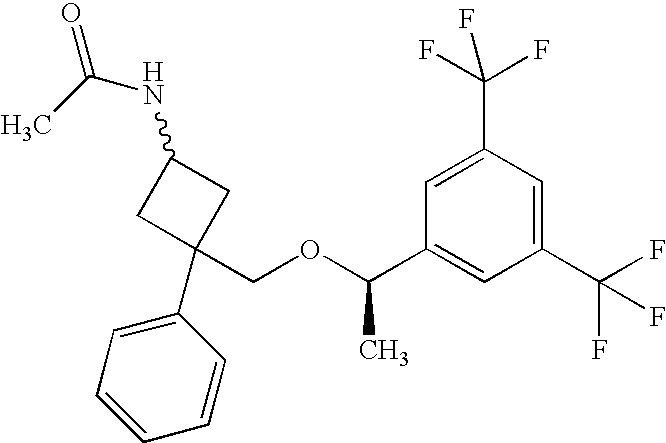 |
| 9b |
 |
| 9c |
 |
| 10a |
 |
| 10b |
 |
| 11a |
 |
| 11b |
 |
| 12a |
 |
| 12b |
 |
| 13 |
 |
| 14 |
 |
| 15a |
 |
| 15b |
 |
| 16a |
 |
| 16b |
 |
| 17a |
 |
| 17b |
 |
| 18 |
 |
| 19 |
 |
| 20 |
 |
| 21a |
 |
| 21b |
 |
| 22a |
 |
| 22b |
 |
| 23a |
 |
| 23b |
 |
| 24 |
 |
| 25 |
 |
| 26a |
 |
| 26b |
 |
| 27 |
 |
| 28 |
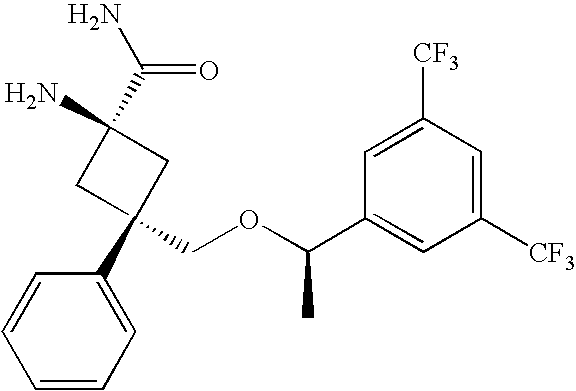 |
| 29 |
 |
| 30 |
 |
| 31 |
 |
| 32 |
 |
| 33 |
 |
| 34 |
 |
| 35 |
 |
| 36 |
 |
| 37 |
 |
| 38 |
 |
| 39 |
 |
| 40 |
 |
| 41 |
 |
| 42 |
 |
| 43 |
 |
| 44 |
 |
| 45 |
 |
| 46 |
 |
| 47 |
 |
| 48 |
 |
| 49 |
 |
| 50 |
 |
| 51 |
 |
| 52 |
 |
| 53 |
 |
| 54 |
 |
| 55 |
 |
| 56 |
 |
| 57 |
 |
| 58 |
 |
| 59 |
 |
| 60 |
 |
| 61 |
 |
| 62 |
 |
| 63a |
 |
| 63b |
 |
| 64 |
 |
The concentration at which a compound having the formula (I) or (Ia) produces 50% inhibition of binding is then used to determine an inhibition constant (“Ki”) using the Chang-Prusoff equation.


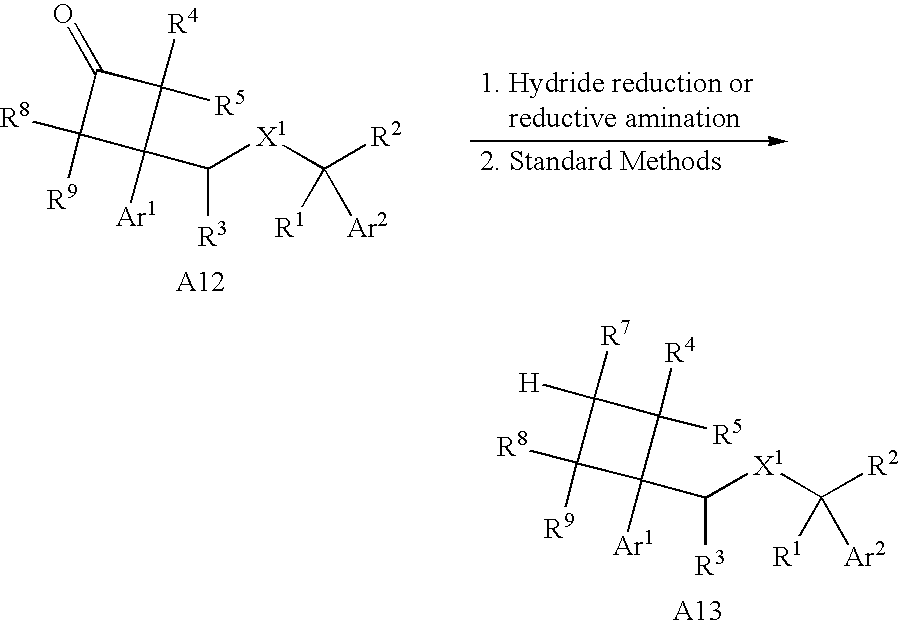


Claims (26)


Priority Applications (1)
| Application Number | Priority Date | Filing Date | Title |
|---|---|---|---|
| US10/386,577 US6878732B2 (en) | 2002-03-13 | 2003-03-12 | NK1 antagonists |
Applications Claiming Priority (2)
| Application Number | Priority Date | Filing Date | Title |
|---|---|---|---|
| US36376102P | 2002-03-13 | 2002-03-13 | |
| US10/386,577 US6878732B2 (en) | 2002-03-13 | 2003-03-12 | NK1 antagonists |
Publications (2)
| Publication Number | Publication Date |
|---|---|
| US20040072854A1 US20040072854A1 (en) | 2004-04-15 |
| US6878732B2 true US6878732B2 (en) | 2005-04-12 |
Family
ID=28041807
Family Applications (1)
| Application Number | Title | Priority Date | Filing Date |
|---|---|---|---|
| US10/386,577 Expired - Fee Related US6878732B2 (en) | 2002-03-13 | 2003-03-12 | NK1 antagonists |
Country Status (18)
| Country | Link |
|---|---|
| US (1) | US6878732B2 (en) |
| EP (1) | EP1483228B1 (en) |
| JP (1) | JP4458853B2 (en) |
| KR (1) | KR20040093123A (en) |
| CN (1) | CN100506776C (en) |
| AR (1) | AR039084A1 (en) |
| AT (1) | ATE469875T1 (en) |
| AU (1) | AU2003220215B2 (en) |
| CA (1) | CA2478211A1 (en) |
| DE (1) | DE60332816D1 (en) |
| ES (1) | ES2345437T3 (en) |
| IL (1) | IL163939A0 (en) |
| MX (1) | MXPA04008803A (en) |
| NZ (1) | NZ535121A (en) |
| PE (1) | PE20040682A1 (en) |
| TW (1) | TWI231756B (en) |
| WO (1) | WO2003078376A1 (en) |
| ZA (1) | ZA200407244B (en) |
Cited By (4)
| Publication number | Priority date | Publication date | Assignee | Title |
|---|---|---|---|---|
| US20060074067A1 (en) * | 2004-09-20 | 2006-04-06 | Balwinder Bhatti | N-aryl azaspiroalkene and azaspiroalkane compounds and methods of preparation and use thereof |
| US20100298397A1 (en) * | 2009-05-19 | 2010-11-25 | Singh Nikhilesh N | Method of treatment of obsessive compulsive disorder with ondansetron |
| EP2727915A1 (en) | 2007-09-13 | 2014-05-07 | Concert Pharmaceuticals Inc. | Synthesis of deuterated catechols and benzo[d][1,3]dioxoles and derivatives thereof |
| US20190016685A1 (en) * | 2017-07-12 | 2019-01-17 | Grünenthal GmbH | 1,3-diaza-spiro-[3.4]-octane derivatives |
Families Citing this family (15)
| Publication number | Priority date | Publication date | Assignee | Title |
|---|---|---|---|---|
| WO2002066453A1 (en) * | 2001-02-22 | 2002-08-29 | Natco Pharma Limited | Process for the preparation of citalopram |
| SE0400850D0 (en) * | 2004-03-30 | 2004-03-31 | Astrazeneca Ab | Novel Compounds |
| US20070249607A1 (en) | 2006-04-17 | 2007-10-25 | Bristol-Myers Squibb Company | Nk-1 and serotonin transporter inhibitors |
| WO2007146224A2 (en) * | 2006-06-12 | 2007-12-21 | Merck & Co., Inc. | Combination therapy for the treatment of urinary frequency, urinary urgency and urinary incontinence |
| US8071778B2 (en) | 2006-07-27 | 2011-12-06 | Bristol-Myers Squibb Company | Substituted heterocyclic ethers and their use in CNS disorders |
| AU2007293393A1 (en) * | 2006-09-06 | 2008-03-13 | Merck & Co., Inc. | Liquid and semi-solid pharmaceutical formulations for oral administration of a substituted amide |
| US8026257B2 (en) | 2007-07-11 | 2011-09-27 | Bristol-Myers Squibb Company | Substituted heterocyclic ethers and their use in CNS disorders |
| US7632861B2 (en) | 2007-11-13 | 2009-12-15 | Bristol-Myers Squibb Company | Substituted heterocyclic ethers and their use in CNS disorders |
| US9802954B2 (en) | 2011-08-24 | 2017-10-31 | Boehringer Ingelheim International Gmbh | Piperidino-dihydrothienopyrimidine sulfoxides and their use for treating COPD and asthma |
| WO2015199167A1 (en) * | 2014-06-25 | 2015-12-30 | 日本たばこ産業株式会社 | METHOD FOR PRODUCING SUBSTITUTED SPIROPYRIDO[1,2-a]PYRAZINE DERIVATIVE, AND INTERMEDIATE |
| MY194647A (en) * | 2016-03-31 | 2022-12-09 | Takeda Pharmaceuticals Co | Heterocyclic compound |
| WO2018152554A1 (en) * | 2017-05-22 | 2018-08-23 | Attenua, Inc. | Antitussive compositions and methods |
| CA3176113A1 (en) * | 2020-03-26 | 2021-09-30 | Janssen Pharmaceutica Nv | Aminocyclobutanes as monoacylglycerol lipase modulators |
| CN115362151B (en) * | 2020-03-26 | 2025-02-11 | 詹森药业有限公司 | Arylpiperidines as monoacylglycerol lipase modulators |
| CN112233750B (en) * | 2020-10-20 | 2024-02-02 | 吾征智能技术(北京)有限公司 | Information matching system based on hemoptysis characters and diseases |
Citations (3)
| Publication number | Priority date | Publication date | Assignee | Title |
|---|---|---|---|---|
| US4629727A (en) * | 1982-09-30 | 1986-12-16 | The Boots Company Plc | Therapeutic agents |
| US5620989A (en) | 1992-10-28 | 1997-04-15 | Merck Sharp & Dohme Limited | 4-Arylmethyloxymethyl piperidines as tachykinin antagonsits |
| US6455571B1 (en) * | 1998-04-23 | 2002-09-24 | Abbott Laboratories | Inhibitors of neuraminidases |
Family Cites Families (1)
| Publication number | Priority date | Publication date | Assignee | Title |
|---|---|---|---|---|
| JP3411416B2 (en) * | 1994-10-13 | 2003-06-03 | 株式会社ボッシュオートモーティブシステム | Parallel shaft differential gearing |
-
2003
- 2003-03-12 WO PCT/US2003/007633 patent/WO2003078376A1/en not_active Ceased
- 2003-03-12 PE PE2003000252A patent/PE20040682A1/en not_active Application Discontinuation
- 2003-03-12 MX MXPA04008803A patent/MXPA04008803A/en active IP Right Grant
- 2003-03-12 AT AT03716511T patent/ATE469875T1/en not_active IP Right Cessation
- 2003-03-12 AR ARP030100861A patent/AR039084A1/en unknown
- 2003-03-12 IL IL16393903A patent/IL163939A0/en unknown
- 2003-03-12 ES ES03716511T patent/ES2345437T3/en not_active Expired - Lifetime
- 2003-03-12 KR KR10-2004-7014217A patent/KR20040093123A/en not_active Ceased
- 2003-03-12 AU AU2003220215A patent/AU2003220215B2/en not_active Ceased
- 2003-03-12 US US10/386,577 patent/US6878732B2/en not_active Expired - Fee Related
- 2003-03-12 CA CA002478211A patent/CA2478211A1/en not_active Abandoned
- 2003-03-12 DE DE60332816T patent/DE60332816D1/en not_active Expired - Lifetime
- 2003-03-12 JP JP2003576385A patent/JP4458853B2/en not_active Expired - Fee Related
- 2003-03-12 EP EP03716511A patent/EP1483228B1/en not_active Expired - Lifetime
- 2003-03-12 CN CNB03810282XA patent/CN100506776C/en not_active Expired - Fee Related
- 2003-03-12 NZ NZ535121A patent/NZ535121A/en unknown
- 2003-03-13 TW TW092105475A patent/TWI231756B/en not_active IP Right Cessation
-
2004
- 2004-09-09 ZA ZA200407244A patent/ZA200407244B/en unknown
Patent Citations (3)
| Publication number | Priority date | Publication date | Assignee | Title |
|---|---|---|---|---|
| US4629727A (en) * | 1982-09-30 | 1986-12-16 | The Boots Company Plc | Therapeutic agents |
| US5620989A (en) | 1992-10-28 | 1997-04-15 | Merck Sharp & Dohme Limited | 4-Arylmethyloxymethyl piperidines as tachykinin antagonsits |
| US6455571B1 (en) * | 1998-04-23 | 2002-09-24 | Abbott Laboratories | Inhibitors of neuraminidases |
Non-Patent Citations (4)
| Title |
|---|
| Heal, "Sibutramine: A novel anti-obesity drug. A review of the pharmacological evidence to differentiate it from d-amphetamine and d-fenfluramine" International Journal of Obesity 22, Suppl. No. 1:S18-S28 (1998). |
| Holan, et al. "Synthesis and insecticidal properties of ether analogs of DDT-pyrethroids" Chemical Abstracts Service, Columbus, Ohio, US, retrieved from STN Database accession no. 106:214159 (1986). |
| Kozlik et al, 1984, CAS:101:210713.* * |
| PCT International Search Report dated Jul. 2, 2003 for corresponding PCT Application No. PCT/US03/07633. |
Cited By (10)
| Publication number | Priority date | Publication date | Assignee | Title |
|---|---|---|---|---|
| US20060074067A1 (en) * | 2004-09-20 | 2006-04-06 | Balwinder Bhatti | N-aryl azaspiroalkene and azaspiroalkane compounds and methods of preparation and use thereof |
| US7384929B2 (en) * | 2004-09-20 | 2008-06-10 | Targacept, Inc. | N-aryl azaspiroalkene and azaspiroalkane compounds and methods of preparation and use thereof |
| US20080242689A1 (en) * | 2004-09-20 | 2008-10-02 | Balwinder Bhatti | N-aryl azaspiroalkene and azaspiroalkane compounds and methods of preparation and use thereof |
| US7754708B2 (en) | 2004-09-20 | 2010-07-13 | Targacept, Inc. | N-aryl azaspiroalkene and azaspiroalkane compounds and methods of preparation and use thereof |
| US20100240689A1 (en) * | 2004-09-20 | 2010-09-23 | Targacept, Inc. | N-aryl azaspiroalkene and azaspiroalkane compounds and methods of preparation and use thereof |
| EP2727915A1 (en) | 2007-09-13 | 2014-05-07 | Concert Pharmaceuticals Inc. | Synthesis of deuterated catechols and benzo[d][1,3]dioxoles and derivatives thereof |
| US20100298397A1 (en) * | 2009-05-19 | 2010-11-25 | Singh Nikhilesh N | Method of treatment of obsessive compulsive disorder with ondansetron |
| US20190016685A1 (en) * | 2017-07-12 | 2019-01-17 | Grünenthal GmbH | 1,3-diaza-spiro-[3.4]-octane derivatives |
| US20190382355A1 (en) * | 2017-07-12 | 2019-12-19 | Grünenthal GmbH | 1,3-Diaza-Spiro-[3.4]-Octane Derivatives |
| US10738015B2 (en) * | 2017-07-12 | 2020-08-11 | Grünenthal GmbH | 1,3-diaza-spiro-[3.4]-octane derivatives |
Also Published As
| Publication number | Publication date |
|---|---|
| JP4458853B2 (en) | 2010-04-28 |
| TWI231756B (en) | 2005-05-01 |
| ATE469875T1 (en) | 2010-06-15 |
| KR20040093123A (en) | 2004-11-04 |
| NZ535121A (en) | 2007-02-23 |
| CN100506776C (en) | 2009-07-01 |
| US20040072854A1 (en) | 2004-04-15 |
| MXPA04008803A (en) | 2004-11-26 |
| AU2003220215B2 (en) | 2007-01-04 |
| HK1066787A1 (en) | 2005-04-01 |
| DE60332816D1 (en) | 2010-07-15 |
| CA2478211A1 (en) | 2003-09-25 |
| AU2003220215B9 (en) | 2003-09-29 |
| EP1483228B1 (en) | 2010-06-02 |
| ES2345437T3 (en) | 2010-09-23 |
| PE20040682A1 (en) | 2004-10-07 |
| IL163939A0 (en) | 2005-12-18 |
| EP1483228A1 (en) | 2004-12-08 |
| TW200304815A (en) | 2003-10-16 |
| AU2003220215A1 (en) | 2003-09-29 |
| CN1653025A (en) | 2005-08-10 |
| ZA200407244B (en) | 2005-10-04 |
| AR039084A1 (en) | 2005-02-09 |
| JP2005519965A (en) | 2005-07-07 |
| WO2003078376A1 (en) | 2003-09-25 |
Similar Documents
| Publication | Publication Date | Title |
|---|---|---|
| US7041682B2 (en) | NK1 antagonists | |
| US9688693B2 (en) | NK1 antagonists | |
| US20040072854A1 (en) | NK1 antagonists | |
| JP2010090163A (en) | Nk1 antagonist | |
| US7939528B2 (en) | Heterocycle compounds | |
| HK1066787B (en) | Nk1 antagonists | |
| HK1063791B (en) | Nk1 antagonists |
Legal Events
| Date | Code | Title | Description |
|---|---|---|---|
| AS | Assignment |
Owner name: SCHERING CORPORATION, NEW JERSEY Free format text: ASSIGNMENT OF ASSIGNORS INTEREST;ASSIGNOR:REICHARD, GREGORY A.;REEL/FRAME:014383/0423 Effective date: 20030311 Owner name: SCHERING CORPORATION, NEW JERSEY Free format text: ASSIGNMENT OF ASSIGNORS INTEREST;ASSIGNORS:WROBLESKI, MICHELLE LACI;SHIH, NENG-YANG;XIAO, DONG;REEL/FRAME:014383/0433 Effective date: 20030307 |
|
| CC | Certificate of correction | ||
| CC | Certificate of correction | ||
| CC | Certificate of correction | ||
| FPAY | Fee payment |
Year of fee payment: 4 |
|
| REMI | Maintenance fee reminder mailed | ||
| LAPS | Lapse for failure to pay maintenance fees | ||
| STCH | Information on status: patent discontinuation |
Free format text: PATENT EXPIRED DUE TO NONPAYMENT OF MAINTENANCE FEES UNDER 37 CFR 1.362 |
|
| STCH | Information on status: patent discontinuation |
Free format text: PATENT EXPIRED DUE TO NONPAYMENT OF MAINTENANCE FEES UNDER 37 CFR 1.362 |
|
| FP | Lapsed due to failure to pay maintenance fee |
Effective date: 20130412 |