US6867776B2 - Standard for perlin noise - Google Patents
Standard for perlin noise Download PDFInfo
- Publication number
- US6867776B2 US6867776B2 US10/042,647 US4264702A US6867776B2 US 6867776 B2 US6867776 B2 US 6867776B2 US 4264702 A US4264702 A US 4264702A US 6867776 B2 US6867776 B2 US 6867776B2
- Authority
- US
- United States
- Prior art keywords
- images
- bit
- noise
- computer
- producing
- Prior art date
- Legal status (The legal status is an assumption and is not a legal conclusion. Google has not performed a legal analysis and makes no representation as to the accuracy of the status listed.)
- Expired - Lifetime
Links
Images
Classifications
-
- G—PHYSICS
- G06—COMPUTING OR CALCULATING; COUNTING
- G06T—IMAGE DATA PROCESSING OR GENERATION, IN GENERAL
- G06T11/00—Two-dimensional [2D] image generation
- G06T11/10—Texturing; Colouring; Generation of textures or colours
Definitions
- the present invention is related to an improved standard for noise. More specifically, the present invention is related to noise where images have texture but do not have visible grid artifacts and/or are visually isotropic.
- Perlin Noise can be separated from the shortcomings of any particular implementation which aims to approximate this ideal.
- Perlin, K., An Image Synthesizer , Computer Graphics; Vol. 19 No. 3, incorporated by reference herein outlined a number of characteristics for an ideal Perlin Noise.
- a hardware-implemented standard would conform to this ideal, without suffering from any shortcomings.
- the present invention pertains to an apparatus for generating an image.
- the apparatus comprises a computer.
- the apparatus comprises a display connected to the computer upon which images from the computer appear.
- the apparatus comprises a mechanism for producing images with texture that do not have visible grid artifacts, the producing mechanism disposed in the computer.
- the present invention pertains to a method for generating images.
- the method comprises the steps of producing the images with texture that do not have visible grid artifacts with the computer.
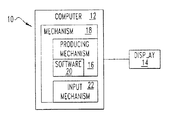
- FIG. 1 is a schematic representation of the apparatus of the present invention.
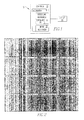
- FIG. 2 is a side-by-side visual comparison of “traditional” Perlin Noise with the method described here.
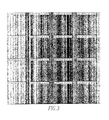
- FIG. 3 is the same comparison, this time with the domain magnified by a factor of four.
- the apparatus 10 for generating an image.
- the apparatus 10 comprises a computer 12 .
- the apparatus 10 comprises a display 14 connected to the computer 12 upon which images from the computer 12 appear.
- the apparatus 10 comprises a mechanism 16 for producing images with texture that do not have visible grid artifacts, the producing mechanism 16 disposed in the computer 12 .
- the computer 12 has a memory 18 , and the producing mechanism 16 includes software 20 disposed in the memory 18 for producing images with texture that do not have visible artifacts.
- the computer 12 also has an input mechanism 22 , such as a keyboard or modem or DVD drive, to name but a few of many possible input mechanism 22 in which information can be introduced into the computer 12 .
- the present invention pertains to a method for generating images.
- the method comprises the steps of producing the images with texture that do not have visible grid artifacts with the computer 12 .
- FIG. 3 is the same comparison, this time with the domain magnified by a factor of four.
- 6t ⁇ 6t 2 which contains a linear term.
- the presence of this linear term causes the derivative of the Noise function to be discontinuous at cubic cell boundaries.
- the new method is a result of combining several different ideas together. When used in combination, the result is a far superior Noise function that satisfies all of the requirements outlined above:
- this interpolation scheme uses a spherically symmetric kernel, multiplied by a linear gradient, at each component surrounding vertex. This confers three advantages:
- the new reconstruction method uses a method that produces more visually uniform results, and is easier to integrate into a derivative calculation, while requiring no multiplies at all.
- the new method uses a bit-manipulation algorithm to generate a six bit quantity. This six bit quantity is then used to generate a gradient direction.
- the six bit quantity is defined as the lower six bits of the sum: b(i,j,k,0)+b(j,k,i,1)+b(k,i,j,2)+b(i,j,k,3)+b(j,k,i,4)+b(k,i,j,5)+b(i,j,k,6)+b(j,k,i,7) where b( ) uses its last argument as a bit index into a very small table of bitPatterns.
- the new method converts a six bit pseudo-random index into a visually uniform gradient vector which is easy to integrate into a derivative calculation and which requires no multiplies to compute.
- the key innovation is to use values of only zero or one for the gradient magnitude. This is a refinement of the technique first introduced in [Perlin, K., Patent Application, Hardware implementation of Perlin Noise, incorporated by reference herein] for computing the gradient without doing any multiplication operations.
- the specific new technique is as follows: The six bit index is split into (i) a lower three bit quantity, which is used to compute a magnitude of either zero or one for each of x,y and z, and (ii) an upper three bit quantity, which is used to determine an octant for the resulting gradient (positive or negative sign in each of x,y, and z).
- the new method can be implemented as a set of pipelined hardware logic gates, in a way that would be very straightforward to one skilled in the art, given the reference implementation below.
- To determine which simplex surrounds the input point one must sort the coordinates in the difference vector (u 1 , . . . u n ) from the lower vertex of the surrounding skewed hypercube to the input point.
- the exact radius and amplitude of the hypersphere-shaped kernel centered at each simplex vertex need to be tuned so as to produce the best visual results for each choice of n.
Landscapes
- Physics & Mathematics (AREA)
- General Physics & Mathematics (AREA)
- Engineering & Computer Science (AREA)
- Theoretical Computer Science (AREA)
- Image Processing (AREA)
Abstract
Description
-
- Lack of a single standard reference implementation: Unlike the situation to date with software Noise, all implementations should ideally produce the same result for the same input, up to the inherent limitation imposed by limited bit depth, on all platforms and implementations.
- Requiring many multiplies: The original formulation of Noise required, as a subset of its component calculations, that a gradient be evaluated at each corner of a cube surrounding the input point. Each gradient evaluation requires an inner product, which costs three multiplies, at each of eight cube vertices, for a total of 24 multiplies. A multiply is expensive in its use of hardware, relative to such other operations as bit manipulation and addition. In a hardware implementation, it would be greatly advantageous to redefine Noise so that it does not require this large number of multiplies.
- Visually significant anisotropy: The Noise function is ideally a directionally insensitive (isotropic) signal. However, the original implementation, because it consists of adjoining 3D tricubic patches, contains visible directional artifacts which are an unavoidable consequence of its underlying algorithm. This is also the case for approximations that mimic that implementation, such as nVidia's recent Noise patch [Technical Demos—Perlin Noise http://www.nvidia.com/Support/Developer Relations/Technical Demos, Disclosed Nov. 10, 2000, incorporated by reference herein].
-
- Gradient artifacts: The original Noise function uses a piecewise cubic blending function 3t2−2t3 in each dimension. When the Noise function uses this blending function, then visually noticeable discontinuities appear in the derivative of the Noise function along the 3D tricubic patch boundaries of the Noise function's domain, since the derivative of the derivative of this blending function contains a piecewise constant term.
- Difficulty of computing a derivative: The original Noise algorithm contains an associated derivative function which is difficult to compute algorithmically, since it consists of a product of a linear function with three cubic splines. In non-real time applications, the Noise derivative has generally been approximated by evaluating differences of Noise at closely spaced sample points along the three coordinate axes. This has required evaluating the Noise function four times. In a hardware implementation such an approach would not only consume valuable gates, but would be impractical for any method that used less than full floating point precision, since the use of difference methods to computer derivative requires high bit depth. It is desirable for a hardware Noise standard to possess an associated derivative function that can be computable analytically, at a cost of a relatively modest number of gates. This is particularly important when using Noise to compute normal perturbations and other effects that use the derivative of Noise, as opposed to its value.
- Need for table memory: The original Noise algorithm relied on a number of table lookups, which are quite reasonable in a software implementation, but which in a hardware implementation are expensive and constitute a cost bottleneck, particularly when multiple instances of the Noise function are required in parallel. Ideally, a Noise implementation should not rely on the presence of tables of significant size.
- Memory-limited extent of the volume tile: Perlin Noise is generally defined within a repeating volumetric tile. In previous implementations, the extent of this tile has been limited by table size. Ideally, Noise should be based on a virtual volume which is scalable, inexpensively, to any extent.
- Expense of generalizing to higher dimensions: The original implementation of Noise was based on a cubic lattice. Moving to higher dimensions causes implementation cost to more than double with each additional dimension, since it requires moving to an n-dimensional hypercube lattice. In hardware, this cost would be measured as a product of gate count and number of successive instruction cycles. For example, the cost of Noise over four dimensions is at least twice the cost of Noise over three dimensions. Quite soon, it will be desirable to extend the standard from 3D Noise to 4D Noise (to account for time-varying volume textures), and thereafter to 5D Noise (to specify textured BRDFs). It is important to address this issue now.
- Lack of separation between signal and reconstruction: The original Noise presented the pseudo-random gradient field (its “signal”) and its tricubic interpolation scheme (its “reconstruction filter”) as a single functional object. It would be greatly advantageous for a method to allow these two operations to be cleanly separable, so that other signals which share the same hardware and abstract machine language can also use this reconstruction filter.
-
- provides a single uniform standard result on any platform,
- is visually isotropic, unlike the original algorithm,
- does not require significant table space to compute good pseudo-random gradients,
- can have an arbitrarily large extent for its repeating virtual tile, at very low cost,
- does not require multiplies to evaluate gradient at surrounding grid vertices,
- does not produce visible grid artifacts,
- does not produce visible artifacts in the derivative,
- is cheaper to compute than is the original algorithm,
- allows for a direct analytic computation of derivative at reasonable cost,
- can be generalized to higher dimensions at relatively small computational expense.
The method is described in two parts: - A pseudo-random signal generator primitive, and
- A reconstruction primitive.
This separation enables other signal generators that reside on the same graphics hardware chip to share the same reconstruction hardware and API.
FIG. 2 is a side-by-side visual comparison of “traditional” Perlin Noise with the method described here. The four quadrants ofFIG. 2 represent, respectively:
| df/dx = d(Noise(xyz))/dx | df/dy = d(Noise(xyz))/dy | ||
| df/dz = d(Noise(xyz))/dz | f(xyz) = Noise(xyz) | ||
Each of these quadrants is divided into four sub-quadrants. These represent, respectively:
| old Noise at z = 0 | new Noise at z = 0 | ||
| old Noise at z = 0.5 | new Noise at z = 0.5 | ||
- 1. Rather than using a table lookup scheme to compute the index of a pseudo-random gradient at each surrounding vertex, the new method uses a bit-manipulation scheme that uses only a very small number of hardware gates.
- 2. Rather than using a cubic interpolation grid, the new method uses a simplicial grid. This confers two advantages during reconstruction:
- 1. Only four component evaluations need be done per Noise evaluation (one per contributing vertex), rather than the eight evaluations required in a cubic lattice, and
- 2. The axis aligned visual impression of a grid structure is replaced by a far less visually noticeable simplicial packing structure.
-
- 1. The new method contains no directional artifacts due to interpolation function;
- 2. The new method contains no directional or discontinuity artifacts in gradient;
- 3. Using the new method, it is practicable to compute the derivative function directly.
b(i,j,k,0)+b(j,k,i,1)+b(k,i,j,2)+b(i,j,k,3)+b(j,k,i,4)+b(k,i,j,5)+b(i,j,k,6)+b(j,k,i,7)
where b( ) uses its last argument as a bit index into a very small table of bitPatterns.
-
- define b(i,j,k,B):
patternIndex=4*bitB(i)+2*bitB(j)+bitB(k) return bitPatterns[patternIndex]
and where the bit pattern table is defined as:
bitPatterns[ ]={0×15,0×38,0×32,0×2c,0×0d,0×13,0×07,0×2a}
Using Index to Derive Pseudorandom Gradient
- define b(i,j,k,B):
| bit2bit1bit0 | bit2bit1bit0 | ||
| 000 | p = x q = y r = z | 100 | p = x q = y r = z |
| 001 | p = y q = z r = 0 | 101 | p = y q = 0 r = x |
| 010 | p = z q = x r = 0 | 110 | p = z q = 0 r = y |
| 011 | p = x q = y r = 0 | 111 | p = x q = 0 r = z |
(ii) Octant Computation, Based on the Three Upper Bits
| bit5bit4bit3 | bit5bit4bit3 | ||||
| 000 | −p − q + r | 100 | p + q − r | ||
| 001 | p − q − r | 101 | −p + q + r | ||
| 010 | −p + q − r | 110 | p − q + r | ||
| 011 | p + q + r | 111 | −p − q − r | ||
- 1. Skew the input point (x,y,z) to:
- define skew((x,y,z)−>(x′,y′,z′)):
s=(x+y+z)/3
(x′,y′,z′)=(x+s,y+s,z+s)
This skew transformation linearly scales about the origin, along the x=y=z axis, bringing the point (1,1,1) to the point (2,2,2).
- define skew((x,y,z)−>(x′,y′,z′)):
- 2. Use the integer coordinates in the skewed space to determine a surrounding unit cube whose corner vertex with lowest coordinate values is:
(i′,j′,k′)=(floor(x′),floor(y′),floor(z′))
This corner point can be converted back to the original unskewed coordinate system via:- define unskew((i′,j′,k′)−>(i,j,k)):
s′=(i′+j′+k′)/6(i,j,k)=(i−s′,j−s′,k−s′)
Also consider the original coordinates relative to the unskewed image of the cube corner:
(u,v,w)=(x−i, y−j, z−k)
- define unskew((i′,j′,k′)−>(i,j,k)):
- 3. Find the simplex containing the point. Relative to (i,j,k), the skewed image of relative point (u,v,w) will lie in one of the six simplices:
- {(0,0,0), (1,0,0), (1,1,0), (1,1,1)}
- {(0,0,0), (1,0,0), (1,0,1), (1,1,1)}
- {(0,0,0), (0,1,0), (1,1,0), (1,1,1)}
- {(0,0,0), (0,1,0), (0,1,1), (1,1,1)}
- {(0,0,0), (0,0,1), (1,0,1), (1,1,1)}
- {(0,0,0), (0,0,1), (0,1,1), (1,1,1)}
Each of these simplices can be defined as an ordered traversal A,B,C from vertex (0,0,0) to vertex (1,1,1) of a unit cube in the skewed space, where {A,B,C} is some permutation of {(1,0,0), (0,1,0), (0,0,1)}. For example, the last simplex above can be defined as an z,y,x traversal, since its first transition A=(0,0,1), its second transition B=(0,1,0), and its third transition C=(0,0,1).
Which simplex contains the input point is determined by the relative magnitudes of u, v and w. For example, if w>v and v>u, then the first transition will be in the z dimension, so A=(0,0,1), and the second transition will be in the y dimension, so B=(0,1,0). In this case, the point lies within the simplex whose traversal order is z,y,x.
The four surrounding vertices of the simplex can now be defined as:
{(i,j,k), (i,j,k)+unskew(A), (i,j,k)+unskew(A+B), (i,j,k)+unskew(A+B+C)}
Spherical Kernel
t=0.6−(u 2 +v 2 +w 2)
if t>0 then 8 (t4) else 0
Hardware Integration
- 1. A supervisory process fills a memory array with a sequence of (x,y,z) tuples to be evaluated;
- 2. The disclosed method is invoked by pipelining these input values into a section of logic circuitry that implements the method;
- 3. The resulting sequence, of Noise derivative/value tuples (fx, fy, fz,f) is placed into an output memory array;
- 4. The supervisory process reads out this array of results, and moves on to the next operation within the algorithmic sequence of texture synthesis.
| APPENDIX |
| A complete implementation of a function returning a value that |
| conforms to the new method is given below as a Java class |
| 6/34 definition: |
| public final class Noise3 { |
| static int i,j,k, A[ ] = {0,0,0}; | |
| static double u,v,w; | |
| static double noise (double x, double y, double z) { |
| double s = (x+y+z)/3; | |
| i=(int)Math.floor(x+s); j=(int)Math.floor(y+s); k=(int)Math.floor(z+s); | |
| s = (i+j+k)/6.; u = x−i+s; v = y−j+s; w = z−k+s; | |
| A[0]=A[1]=A[2]=0; | |
| int hi = u>=w ? u>=v ? 0 : 1 : v>=w ? 1 : 2; | |
| int lo = u< w ? u< v ? 0 : 1 : v< w ? 1 : 2; | |
| return K(hi) + K(3−hi−lo) + K(lo) − K(0); |
| } | |
| static double K(int a) { |
| double s = (A[0]+A[1]+A[2])/6.; | |
| double x = u−A[0]+s, y = v−A[1]+s, z = w−A[2]+s, t = .6−x*x−y*y−z*z; | |
| int h = shuffle(i+A[0],j+A[1],k+A[2]); | |
| A[a]++; | |
| if (t < 0) |
| return 0; |
| int b5 = h>>5 & 1, b4 = h>>4 & 1, b3 = h>>3 & 1, b2 = h>>2 & 1, b = h & 3; | |
| double p = b= =1?x:b= =2?y:z, q = b= =1?y:b= =2?z:x, r = b= =1?z:b= =2?x:y; | |
| p = (b5= =b3 ? −p : p); q = (b5= =b4 ? −q : q); r = (b5!=(b4{circumflex over ( )}b3) ? −r : r); | |
| t *= t | |
| return 8 * t * t * (p + (b= =0 ? q+r : b2= =0 ? q : r)); |
| } | |
| static int shuffle(int i, int j, int k) { |
| return b(i,j,k,0) + b(j,k,i,1) + b(k,i,j,2) + b(i,j,k,3) + |
| b(j,k,i,4) + b(k,i,j,5) + b(i,j,k,6) + b(j,k,i,7) ; |
| } | |
| static int b(int i, int j, int k, int B) { return T[b(i,B)<<2 | b(j,B)<<1 | |
| b(k,B)]; } |
| static int b(int N, int B) { return N>>B & 1; } | |
| static int TN[] = {0x15,0x38,0x32,0x2c,0x0d,0x13,0x07,Ox2a}; |
| } |
Claims (6)
b(i,j,k,0)+b(j,k,i,1)+b(k,i,j,2)+b(i,j,k3)+b(j,k,i,4)+b(k,i,j,5)+b(i,j,k,6)+b(j,k,i,7)
patternIndex=4*bitB(i)+2*bitB(j)+bitB(k) return bitPatterns[patternIndex]
define skew((x,y,z)−>(x′,y′,z′)): s=(x+y+z)/3 (x′,y′,z′)=(x+s,y+s,z+s); and
(i′,j′,k′)=(floor(x′),floor(y′),floor(z′)).
Priority Applications (1)
| Application Number | Priority Date | Filing Date | Title |
|---|---|---|---|
| US10/042,647 US6867776B2 (en) | 2001-01-10 | 2002-01-08 | Standard for perlin noise |
Applications Claiming Priority (2)
| Application Number | Priority Date | Filing Date | Title |
|---|---|---|---|
| US26075101P | 2001-01-10 | 2001-01-10 | |
| US10/042,647 US6867776B2 (en) | 2001-01-10 | 2002-01-08 | Standard for perlin noise |
Publications (2)
| Publication Number | Publication Date |
|---|---|
| US20020135590A1 US20020135590A1 (en) | 2002-09-26 |
| US6867776B2 true US6867776B2 (en) | 2005-03-15 |
Family
ID=26719481
Family Applications (1)
| Application Number | Title | Priority Date | Filing Date |
|---|---|---|---|
| US10/042,647 Expired - Lifetime US6867776B2 (en) | 2001-01-10 | 2002-01-08 | Standard for perlin noise |
Country Status (1)
| Country | Link |
|---|---|
| US (1) | US6867776B2 (en) |
Cited By (3)
| Publication number | Priority date | Publication date | Assignee | Title |
|---|---|---|---|---|
| EP3537373A1 (en) | 2018-03-07 | 2019-09-11 | Novaquark | Non-local computation of gradient noise for computer-generated digital images |
| WO2020245556A1 (en) | 2019-06-05 | 2020-12-10 | The Secretary Of State For Defence | Obtaining patterns for surfaces of objects |
| WO2025201635A1 (en) | 2024-03-26 | 2025-10-02 | Univerza V Ljubljani | A method and a device for tiling fractal noise |
Families Citing this family (1)
| Publication number | Priority date | Publication date | Assignee | Title |
|---|---|---|---|---|
| US7672476B2 (en) * | 2005-01-26 | 2010-03-02 | Pixar | Bandlimited noise for computer graphics |
Citations (1)
| Publication number | Priority date | Publication date | Assignee | Title |
|---|---|---|---|---|
| US6088036A (en) * | 1990-06-29 | 2000-07-11 | U.S. Philips Corporation | Method of generating an image |
-
2002
- 2002-01-08 US US10/042,647 patent/US6867776B2/en not_active Expired - Lifetime
Patent Citations (1)
| Publication number | Priority date | Publication date | Assignee | Title |
|---|---|---|---|---|
| US6088036A (en) * | 1990-06-29 | 2000-07-11 | U.S. Philips Corporation | Method of generating an image |
Non-Patent Citations (1)
| Title |
|---|
| "An Image Synthesizer." Perlin, Ken. Proceedings of the 12th annual conference on Computer graphics and interactive techniques. ACM Press, 1985. pp. 287-296. * |
Cited By (3)
| Publication number | Priority date | Publication date | Assignee | Title |
|---|---|---|---|---|
| EP3537373A1 (en) | 2018-03-07 | 2019-09-11 | Novaquark | Non-local computation of gradient noise for computer-generated digital images |
| WO2020245556A1 (en) | 2019-06-05 | 2020-12-10 | The Secretary Of State For Defence | Obtaining patterns for surfaces of objects |
| WO2025201635A1 (en) | 2024-03-26 | 2025-10-02 | Univerza V Ljubljani | A method and a device for tiling fractal noise |
Also Published As
| Publication number | Publication date |
|---|---|
| US20020135590A1 (en) | 2002-09-26 |
Similar Documents
| Publication | Publication Date | Title |
|---|---|---|
| US12347016B2 (en) | Image rendering method and apparatus, device, medium, and computer program product | |
| Pajarola et al. | Survey of semi-regular multiresolution models for interactive terrain rendering | |
| Tarini et al. | Ambient occlusion and edge cueing for enhancing real time molecular visualization | |
| Kähler et al. | Hierarchical voxel block hashing for efficient integration of depth images | |
| US6016151A (en) | 3D triangle rendering by texture hardware and color software using simultaneous triangle-walking and interpolation for parallel operation | |
| US6677957B2 (en) | Hardware-accelerated visualization of surface light fields | |
| US20040249615A1 (en) | Surface light field decomposition using non-negative factorization | |
| US7170527B2 (en) | Interactive horizon mapping | |
| Theoharis et al. | Graphics and visualization: principles & algorithms | |
| US20090141026A1 (en) | Computer graphics with enumerating qmc sequences in voxels | |
| TW201541403A (en) | Gradient adjustment for texture mapping to non-orthonormal grid | |
| Keller | Myths of computer graphics | |
| Kooima et al. | Planetary-scale terrain composition | |
| US7053894B2 (en) | Compression of surface light fields | |
| US20020135590A1 (en) | Standard for perlin noise | |
| Song et al. | Vector regression functions for texture compression | |
| Yuan et al. | High dynamic range volume visualization | |
| Jenny et al. | Plan oblique relief for web maps | |
| CN117152334A (en) | A three-dimensional simulation method based on big data of radio waves and meteorological cloud images | |
| US5900882A (en) | Determining texture coordinates in computer graphics | |
| Nozick et al. | Multi-view Rendering using GPU for 3-D Displays | |
| US8111261B1 (en) | Method and apparatus for noise | |
| Kaufman et al. | Texture synthesis techniques for computer graphics | |
| Khardekar et al. | Rendering higher order finite element surfaces in hardware | |
| JPH09147136A (en) | Modeling data creation device and method |
Legal Events
| Date | Code | Title | Description |
|---|---|---|---|
| STCF | Information on status: patent grant |
Free format text: PATENTED CASE |
|
| AS | Assignment |
Owner name: NOKIA CORPORATION, FINLAND Free format text: ASSIGNMENT OF ASSIGNORS INTEREST;ASSIGNOR:PERLIN, KENNETH;REEL/FRAME:018109/0452 Effective date: 20060808 |
|
| FEPP | Fee payment procedure |
Free format text: PAT HOLDER NO LONGER CLAIMS SMALL ENTITY STATUS, ENTITY STATUS SET TO UNDISCOUNTED (ORIGINAL EVENT CODE: STOL); ENTITY STATUS OF PATENT OWNER: SMALL ENTITY |
|
| REFU | Refund |
Free format text: REFUND - SURCHARGE, PETITION TO ACCEPT PYMT AFTER EXP, UNINTENTIONAL (ORIGINAL EVENT CODE: R2551); ENTITY STATUS OF PATENT OWNER: SMALL ENTITY |
|
| FPAY | Fee payment |
Year of fee payment: 4 |
|
| FPAY | Fee payment |
Year of fee payment: 8 |
|
| AS | Assignment |
Owner name: NOKIA TECHNOLOGIES OY, FINLAND Free format text: ASSIGNMENT OF ASSIGNORS INTEREST;ASSIGNOR:NOKIA CORPORATION;REEL/FRAME:035561/0438 Effective date: 20150116 |
|
| FEPP | Fee payment procedure |
Free format text: PAT HOLDER CLAIMS SMALL ENTITY STATUS, ENTITY STATUS SET TO SMALL (ORIGINAL EVENT CODE: LTOS); ENTITY STATUS OF PATENT OWNER: SMALL ENTITY |
|
| REMI | Maintenance fee reminder mailed | ||
| FPAY | Fee payment |
Year of fee payment: 12 |
|
| SULP | Surcharge for late payment |
Year of fee payment: 11 |
|
| AS | Assignment |
Owner name: OMEGA CREDIT OPPORTUNITIES MASTER FUND, LP, NEW YORK Free format text: SECURITY INTEREST;ASSIGNOR:WSOU INVESTMENTS, LLC;REEL/FRAME:043966/0574 Effective date: 20170822 Owner name: OMEGA CREDIT OPPORTUNITIES MASTER FUND, LP, NEW YO Free format text: SECURITY INTEREST;ASSIGNOR:WSOU INVESTMENTS, LLC;REEL/FRAME:043966/0574 Effective date: 20170822 |
|
| AS | Assignment |
Owner name: WSOU INVESTMENTS, LLC, CALIFORNIA Free format text: ASSIGNMENT OF ASSIGNORS INTEREST;ASSIGNOR:NOKIA TECHNOLOGIES OY;REEL/FRAME:043953/0822 Effective date: 20170722 |
|
| AS | Assignment |
Owner name: BP FUNDING TRUST, SERIES SPL-VI, NEW YORK Free format text: SECURITY INTEREST;ASSIGNOR:WSOU INVESTMENTS, LLC;REEL/FRAME:049235/0068 Effective date: 20190516 |
|
| AS | Assignment |
Owner name: WSOU INVESTMENTS, LLC, CALIFORNIA Free format text: RELEASE BY SECURED PARTY;ASSIGNOR:OCO OPPORTUNITIES MASTER FUND, L.P. (F/K/A OMEGA CREDIT OPPORTUNITIES MASTER FUND LP;REEL/FRAME:049246/0405 Effective date: 20190516 |
|
| AS | Assignment |
Owner name: OT WSOU TERRIER HOLDINGS, LLC, CALIFORNIA Free format text: SECURITY INTEREST;ASSIGNOR:WSOU INVESTMENTS, LLC;REEL/FRAME:056990/0081 Effective date: 20210528 |
|
| AS | Assignment |
Owner name: WSOU INVESTMENTS, LLC, CALIFORNIA Free format text: RELEASE BY SECURED PARTY;ASSIGNOR:TERRIER SSC, LLC;REEL/FRAME:056526/0093 Effective date: 20210528 |