US6864313B2 - Use of 2,2,6,6 tetraalkylpiperidine-N-oxyl radicals having long alkyl chains as polymerization regulators - Google Patents
Use of 2,2,6,6 tetraalkylpiperidine-N-oxyl radicals having long alkyl chains as polymerization regulators Download PDFInfo
- Publication number
- US6864313B2 US6864313B2 US10/354,613 US35461303A US6864313B2 US 6864313 B2 US6864313 B2 US 6864313B2 US 35461303 A US35461303 A US 35461303A US 6864313 B2 US6864313 B2 US 6864313B2
- Authority
- US
- United States
- Prior art keywords
- alkyl
- compound
- formula
- process according
- ethylenically unsaturated
- Prior art date
- Legal status (The legal status is an assumption and is not a legal conclusion. Google has not performed a legal analysis and makes no representation as to the accuracy of the status listed.)
- Expired - Fee Related, expires
Links
- 238000006116 polymerization reaction Methods 0.000 title claims abstract description 26
- 125000000217 alkyl group Chemical group 0.000 title claims description 15
- 239000000178 monomer Substances 0.000 claims abstract description 49
- 150000001875 compounds Chemical class 0.000 claims abstract description 46
- 238000000034 method Methods 0.000 claims abstract description 27
- 239000000203 mixture Substances 0.000 claims abstract description 19
- 239000001257 hydrogen Substances 0.000 claims abstract description 11
- 229910052739 hydrogen Inorganic materials 0.000 claims abstract description 11
- 125000004432 carbon atom Chemical group C* 0.000 claims abstract description 5
- 229910052799 carbon Inorganic materials 0.000 claims abstract description 3
- 125000001997 phenyl group Chemical group [H]C1=C([H])C([H])=C(*)C([H])=C1[H] 0.000 claims abstract description 3
- 150000003254 radicals Chemical class 0.000 claims description 32
- 229920000642 polymer Polymers 0.000 claims description 24
- -1 alkali metal cation Chemical class 0.000 claims description 18
- PPBRXRYQALVLMV-UHFFFAOYSA-N Styrene Chemical compound C=CC1=CC=CC=C1 PPBRXRYQALVLMV-UHFFFAOYSA-N 0.000 claims description 16
- 229920001577 copolymer Polymers 0.000 claims description 11
- 238000010526 radical polymerization reaction Methods 0.000 claims description 9
- 230000000379 polymerizing effect Effects 0.000 claims description 6
- 125000002924 primary amino group Chemical group [H]N([H])* 0.000 claims description 6
- JLBJTVDPSNHSKJ-UHFFFAOYSA-N 4-Methylstyrene Chemical compound CC1=CC=C(C=C)C=C1 JLBJTVDPSNHSKJ-UHFFFAOYSA-N 0.000 claims description 5
- XYLMUPLGERFSHI-UHFFFAOYSA-N alpha-Methylstyrene Chemical compound CC(=C)C1=CC=CC=C1 XYLMUPLGERFSHI-UHFFFAOYSA-N 0.000 claims description 5
- 238000004519 manufacturing process Methods 0.000 claims description 5
- HGINCPLSRVDWNT-UHFFFAOYSA-N Acrolein Chemical compound C=CC=O HGINCPLSRVDWNT-UHFFFAOYSA-N 0.000 claims description 4
- KAKZBPTYRLMSJV-UHFFFAOYSA-N Butadiene Chemical compound C=CC=C KAKZBPTYRLMSJV-UHFFFAOYSA-N 0.000 claims description 4
- UFHFLCQGNIYNRP-UHFFFAOYSA-N Hydrogen Chemical compound [H][H] UFHFLCQGNIYNRP-UHFFFAOYSA-N 0.000 claims description 4
- RRHGJUQNOFWUDK-UHFFFAOYSA-N Isoprene Chemical compound CC(=C)C=C RRHGJUQNOFWUDK-UHFFFAOYSA-N 0.000 claims description 4
- 125000004178 (C1-C4) alkyl group Chemical group 0.000 claims description 3
- NIXOWILDQLNWCW-UHFFFAOYSA-N 2-Propenoic acid Natural products OC(=O)C=C NIXOWILDQLNWCW-UHFFFAOYSA-N 0.000 claims description 3
- NLHHRLWOUZZQLW-UHFFFAOYSA-N Acrylonitrile Chemical compound C=CC#N NLHHRLWOUZZQLW-UHFFFAOYSA-N 0.000 claims description 3
- QVGXLLKOCUKJST-UHFFFAOYSA-N atomic oxygen Chemical compound [O] QVGXLLKOCUKJST-UHFFFAOYSA-N 0.000 claims description 3
- 238000010438 heat treatment Methods 0.000 claims description 3
- 125000002496 methyl group Chemical group [H]C([H])([H])* 0.000 claims description 3
- 239000001301 oxygen Substances 0.000 claims description 3
- 229910052760 oxygen Inorganic materials 0.000 claims description 3
- NINIDFKCEFEMDL-UHFFFAOYSA-N Sulfur Chemical compound [S] NINIDFKCEFEMDL-UHFFFAOYSA-N 0.000 claims description 2
- XTXRWKRVRITETP-UHFFFAOYSA-N Vinyl acetate Chemical compound CC(=O)OC=C XTXRWKRVRITETP-UHFFFAOYSA-N 0.000 claims description 2
- 150000003926 acrylamides Chemical class 0.000 claims description 2
- 229910052783 alkali metal Inorganic materials 0.000 claims description 2
- 230000006835 compression Effects 0.000 claims description 2
- 238000007906 compression Methods 0.000 claims description 2
- 150000001993 dienes Chemical class 0.000 claims description 2
- 125000003055 glycidyl group Chemical group C(C1CO1)* 0.000 claims description 2
- 125000000956 methoxy group Chemical group [H]C([H])([H])O* 0.000 claims description 2
- SNVLJLYUUXKWOJ-UHFFFAOYSA-N methylidenecarbene Chemical compound C=[C] SNVLJLYUUXKWOJ-UHFFFAOYSA-N 0.000 claims description 2
- 229910052717 sulfur Inorganic materials 0.000 claims description 2
- 239000011593 sulfur Substances 0.000 claims description 2
- 150000002431 hydrogen Chemical class 0.000 claims 2
- SMZOUWXMTYCWNB-UHFFFAOYSA-N 2-(2-methoxy-5-methylphenyl)ethanamine Chemical compound COC1=CC=C(C)C=C1CCN SMZOUWXMTYCWNB-UHFFFAOYSA-N 0.000 claims 1
- 125000004435 hydrogen atom Chemical class [H]* 0.000 abstract description 5
- YXFVVABEGXRONW-UHFFFAOYSA-N Toluene Chemical compound CC1=CC=CC=C1 YXFVVABEGXRONW-UHFFFAOYSA-N 0.000 description 18
- 229920001400 block copolymer Polymers 0.000 description 12
- 238000006243 chemical reaction Methods 0.000 description 11
- VLKZOEOYAKHREP-UHFFFAOYSA-N n-Hexane Chemical compound CCCCCC VLKZOEOYAKHREP-UHFFFAOYSA-N 0.000 description 9
- 239000000243 solution Substances 0.000 description 9
- XEKOWRVHYACXOJ-UHFFFAOYSA-N Ethyl acetate Chemical compound CCOC(C)=O XEKOWRVHYACXOJ-UHFFFAOYSA-N 0.000 description 8
- ZMANZCXQSJIPKH-UHFFFAOYSA-N Triethylamine Chemical compound CCN(CC)CC ZMANZCXQSJIPKH-UHFFFAOYSA-N 0.000 description 6
- 239000003999 initiator Substances 0.000 description 6
- 238000009413 insulation Methods 0.000 description 6
- 239000000463 material Substances 0.000 description 6
- 238000002360 preparation method Methods 0.000 description 6
- 239000000047 product Substances 0.000 description 6
- 239000002904 solvent Substances 0.000 description 6
- XLYOFNOQVPJJNP-UHFFFAOYSA-N water Substances O XLYOFNOQVPJJNP-UHFFFAOYSA-N 0.000 description 6
- RTZKZFJDLAIYFH-UHFFFAOYSA-N Diethyl ether Chemical compound CCOCC RTZKZFJDLAIYFH-UHFFFAOYSA-N 0.000 description 5
- 229920000578 graft copolymer Polymers 0.000 description 5
- 229920005989 resin Polymers 0.000 description 5
- 239000011347 resin Substances 0.000 description 5
- 0 *CC1C([5*])([6*])C([3*])([4*])N([O])C([9*])([10*])C1([7*])[8*] Chemical compound *CC1C([5*])([6*])C([3*])([4*])N([O])C([9*])([10*])C1([7*])[8*] 0.000 description 4
- OZAIFHULBGXAKX-UHFFFAOYSA-N 2-(2-cyanopropan-2-yldiazenyl)-2-methylpropanenitrile Chemical compound N#CC(C)(C)N=NC(C)(C)C#N OZAIFHULBGXAKX-UHFFFAOYSA-N 0.000 description 4
- MHAJPDPJQMAIIY-UHFFFAOYSA-N Hydrogen peroxide Chemical compound OO MHAJPDPJQMAIIY-UHFFFAOYSA-N 0.000 description 4
- CSNNHWWHGAXBCP-UHFFFAOYSA-L Magnesium sulfate Chemical compound [Mg+2].[O-][S+2]([O-])([O-])[O-] CSNNHWWHGAXBCP-UHFFFAOYSA-L 0.000 description 4
- UIIMBOGNXHQVGW-UHFFFAOYSA-M Sodium bicarbonate Chemical compound [Na+].OC([O-])=O UIIMBOGNXHQVGW-UHFFFAOYSA-M 0.000 description 4
- 230000015572 biosynthetic process Effects 0.000 description 4
- 238000005227 gel permeation chromatography Methods 0.000 description 4
- 229920002959 polymer blend Polymers 0.000 description 4
- 239000011541 reaction mixture Substances 0.000 description 4
- UHOVQNZJYSORNB-UHFFFAOYSA-N Benzene Chemical compound C1=CC=CC=C1 UHOVQNZJYSORNB-UHFFFAOYSA-N 0.000 description 3
- LFQSCWFLJHTTHZ-UHFFFAOYSA-N Ethanol Chemical compound CCO LFQSCWFLJHTTHZ-UHFFFAOYSA-N 0.000 description 3
- LYCAIKOWRPUZTN-UHFFFAOYSA-N Ethylene glycol Chemical compound OCCO LYCAIKOWRPUZTN-UHFFFAOYSA-N 0.000 description 3
- 239000004609 Impact Modifier Substances 0.000 description 3
- OKKJLVBELUTLKV-UHFFFAOYSA-N Methanol Chemical compound OC OKKJLVBELUTLKV-UHFFFAOYSA-N 0.000 description 3
- VYPSYNLAJGMNEJ-UHFFFAOYSA-N Silicium dioxide Chemical compound O=[Si]=O VYPSYNLAJGMNEJ-UHFFFAOYSA-N 0.000 description 3
- 239000000853 adhesive Substances 0.000 description 3
- 230000001070 adhesive effect Effects 0.000 description 3
- 238000013019 agitation Methods 0.000 description 3
- 235000019400 benzoyl peroxide Nutrition 0.000 description 3
- 238000000576 coating method Methods 0.000 description 3
- 229940125904 compound 1 Drugs 0.000 description 3
- 239000002270 dispersing agent Substances 0.000 description 3
- 238000009826 distribution Methods 0.000 description 3
- 239000007788 liquid Substances 0.000 description 3
- 229920002521 macromolecule Polymers 0.000 description 3
- 238000002844 melting Methods 0.000 description 3
- 230000008018 melting Effects 0.000 description 3
- GDOPTJXRTPNYNR-UHFFFAOYSA-N methyl-cyclopentane Natural products CC1CCCC1 GDOPTJXRTPNYNR-UHFFFAOYSA-N 0.000 description 3
- 239000012074 organic phase Substances 0.000 description 3
- 239000003960 organic solvent Substances 0.000 description 3
- 239000005022 packaging material Substances 0.000 description 3
- 239000000741 silica gel Substances 0.000 description 3
- 229910002027 silica gel Inorganic materials 0.000 description 3
- 229960001866 silicon dioxide Drugs 0.000 description 3
- 239000007787 solid Substances 0.000 description 3
- 125000003011 styrenyl group Chemical group [H]\C(*)=C(/[H])C1=C([H])C([H])=C([H])C([H])=C1[H] 0.000 description 3
- 239000004094 surface-active agent Substances 0.000 description 3
- 239000003981 vehicle Substances 0.000 description 3
- CSGAUKGQUCHWDP-UHFFFAOYSA-N 1-hydroxy-2,2,6,6-tetramethylpiperidin-4-ol Chemical compound CC1(C)CC(O)CC(C)(C)N1O CSGAUKGQUCHWDP-UHFFFAOYSA-N 0.000 description 2
- RKMGAJGJIURJSJ-UHFFFAOYSA-N 2,2,6,6-tetramethylpiperidine Chemical compound CC1(C)CCCC(C)(C)N1 RKMGAJGJIURJSJ-UHFFFAOYSA-N 0.000 description 2
- WFOVEDJTASPCIR-UHFFFAOYSA-N 3-[(4-methyl-5-pyridin-4-yl-1,2,4-triazol-3-yl)methylamino]-n-[[2-(trifluoromethyl)phenyl]methyl]benzamide Chemical compound N=1N=C(C=2C=CN=CC=2)N(C)C=1CNC(C=1)=CC=CC=1C(=O)NCC1=CC=CC=C1C(F)(F)F WFOVEDJTASPCIR-UHFFFAOYSA-N 0.000 description 2
- VHYFNPMBLIVWCW-UHFFFAOYSA-N 4-Dimethylaminopyridine Chemical compound CN(C)C1=CC=NC=C1 VHYFNPMBLIVWCW-UHFFFAOYSA-N 0.000 description 2
- XKRFYHLGVUSROY-UHFFFAOYSA-N Argon Chemical compound [Ar] XKRFYHLGVUSROY-UHFFFAOYSA-N 0.000 description 2
- IJGRMHOSHXDMSA-UHFFFAOYSA-N Atomic nitrogen Chemical compound N#N IJGRMHOSHXDMSA-UHFFFAOYSA-N 0.000 description 2
- 239000004342 Benzoyl peroxide Substances 0.000 description 2
- OMPJBNCRMGITSC-UHFFFAOYSA-N Benzoylperoxide Chemical compound C=1C=CC=CC=1C(=O)OOC(=O)C1=CC=CC=C1 OMPJBNCRMGITSC-UHFFFAOYSA-N 0.000 description 2
- AOHSJXZXNCTVMB-UHFFFAOYSA-N CCCCCCCCC(=O)OC1CC(C)(C)N(O)C(C)(C)C1 Chemical compound CCCCCCCCC(=O)OC1CC(C)(C)N(O)C(C)(C)C1 AOHSJXZXNCTVMB-UHFFFAOYSA-N 0.000 description 2
- XTHFKEDIFFGKHM-UHFFFAOYSA-N Dimethoxyethane Chemical compound COCCOC XTHFKEDIFFGKHM-UHFFFAOYSA-N 0.000 description 2
- VEXZGXHMUGYJMC-UHFFFAOYSA-N Hydrochloric acid Chemical compound Cl VEXZGXHMUGYJMC-UHFFFAOYSA-N 0.000 description 2
- 241001082241 Lythrum hyssopifolia Species 0.000 description 2
- IMNFDUFMRHMDMM-UHFFFAOYSA-N N-Heptane Chemical compound CCCCCCC IMNFDUFMRHMDMM-UHFFFAOYSA-N 0.000 description 2
- 239000004793 Polystyrene Substances 0.000 description 2
- PMZURENOXWZQFD-UHFFFAOYSA-L Sodium Sulfate Chemical compound [Na+].[Na+].[O-]S([O-])(=O)=O PMZURENOXWZQFD-UHFFFAOYSA-L 0.000 description 2
- FAPWRFPIFSIZLT-UHFFFAOYSA-M Sodium chloride Chemical compound [Na+].[Cl-] FAPWRFPIFSIZLT-UHFFFAOYSA-M 0.000 description 2
- WYURNTSHIVDZCO-UHFFFAOYSA-N Tetrahydrofuran Chemical compound C1CCOC1 WYURNTSHIVDZCO-UHFFFAOYSA-N 0.000 description 2
- KYIKRXIYLAGAKQ-UHFFFAOYSA-N abcn Chemical compound C1CCCCC1(C#N)N=NC1(C#N)CCCCC1 KYIKRXIYLAGAKQ-UHFFFAOYSA-N 0.000 description 2
- 125000002947 alkylene group Chemical group 0.000 description 2
- 239000007864 aqueous solution Substances 0.000 description 2
- 239000012300 argon atmosphere Substances 0.000 description 2
- 125000000484 butyl group Chemical group [H]C([*])([H])C([H])([H])C([H])([H])C([H])([H])[H] 0.000 description 2
- 239000003795 chemical substances by application Substances 0.000 description 2
- MVPPADPHJFYWMZ-UHFFFAOYSA-N chlorobenzene Chemical compound ClC1=CC=CC=C1 MVPPADPHJFYWMZ-UHFFFAOYSA-N 0.000 description 2
- 239000011248 coating agent Substances 0.000 description 2
- 238000004440 column chromatography Methods 0.000 description 2
- 239000006184 cosolvent Substances 0.000 description 2
- 238000000354 decomposition reaction Methods 0.000 description 2
- LSXWFXONGKSEMY-UHFFFAOYSA-N di-tert-butyl peroxide Chemical compound CC(C)(C)OOC(C)(C)C LSXWFXONGKSEMY-UHFFFAOYSA-N 0.000 description 2
- 235000019439 ethyl acetate Nutrition 0.000 description 2
- 238000001704 evaporation Methods 0.000 description 2
- 230000008020 evaporation Effects 0.000 description 2
- 239000012458 free base Substances 0.000 description 2
- AOGQPLXWSUTHQB-UHFFFAOYSA-N hexyl acetate Chemical compound CCCCCCOC(C)=O AOGQPLXWSUTHQB-UHFFFAOYSA-N 0.000 description 2
- 229920001519 homopolymer Polymers 0.000 description 2
- 229960002163 hydrogen peroxide Drugs 0.000 description 2
- 238000003384 imaging method Methods 0.000 description 2
- 229910052943 magnesium sulfate Inorganic materials 0.000 description 2
- 235000019341 magnesium sulphate Nutrition 0.000 description 2
- QYZFTMMPKCOTAN-UHFFFAOYSA-N n-[2-(2-hydroxyethylamino)ethyl]-2-[[1-[2-(2-hydroxyethylamino)ethylamino]-2-methyl-1-oxopropan-2-yl]diazenyl]-2-methylpropanamide Chemical compound OCCNCCNC(=O)C(C)(C)N=NC(C)(C)C(=O)NCCNCCO QYZFTMMPKCOTAN-UHFFFAOYSA-N 0.000 description 2
- 229940038597 peroxide anti-acne preparations for topical use Drugs 0.000 description 2
- 150000002978 peroxides Chemical class 0.000 description 2
- 125000001436 propyl group Chemical group [H]C([*])([H])C([H])([H])C([H])([H])[H] 0.000 description 2
- 229920005604 random copolymer Polymers 0.000 description 2
- 238000001542 size-exclusion chromatography Methods 0.000 description 2
- 235000017557 sodium bicarbonate Nutrition 0.000 description 2
- 229910000030 sodium bicarbonate Inorganic materials 0.000 description 2
- 229910052938 sodium sulfate Inorganic materials 0.000 description 2
- 235000011152 sodium sulphate Nutrition 0.000 description 2
- 239000000725 suspension Substances 0.000 description 2
- 229920001169 thermoplastic Polymers 0.000 description 2
- 239000012745 toughening agent Substances 0.000 description 2
- QEQBMZQFDDDTPN-UHFFFAOYSA-N (2-methylpropan-2-yl)oxy benzenecarboperoxoate Chemical compound CC(C)(C)OOOC(=O)C1=CC=CC=C1 QEQBMZQFDDDTPN-UHFFFAOYSA-N 0.000 description 1
- LMQJZPNTLDBCHC-UHFFFAOYSA-N 1,1,3,3-tetraethyl-2h-isoindole Chemical compound C1=CC=C2C(CC)(CC)NC(CC)(CC)C2=C1 LMQJZPNTLDBCHC-UHFFFAOYSA-N 0.000 description 1
- WNGJCVHWVCNYHU-UHFFFAOYSA-N 1,1,3,3-tetrapropyl-2h-isoindole Chemical compound C1=CC=C2C(CCC)(CCC)NC(CCC)(CCC)C2=C1 WNGJCVHWVCNYHU-UHFFFAOYSA-N 0.000 description 1
- ZPOUDMYDJJMHOO-UHFFFAOYSA-N 1-(1-hydroxycyclohexyl)peroxycyclohexan-1-ol Chemical compound C1CCCCC1(O)OOC1(O)CCCCC1 ZPOUDMYDJJMHOO-UHFFFAOYSA-N 0.000 description 1
- VMKOFRJSULQZRM-UHFFFAOYSA-N 1-bromooctane Chemical compound CCCCCCCCBr VMKOFRJSULQZRM-UHFFFAOYSA-N 0.000 description 1
- DURPTKYDGMDSBL-UHFFFAOYSA-N 1-butoxybutane Chemical compound CCCCOCCCC DURPTKYDGMDSBL-UHFFFAOYSA-N 0.000 description 1
- LGJCFVYMIJLQJO-UHFFFAOYSA-N 1-dodecylperoxydodecane Chemical compound CCCCCCCCCCCCOOCCCCCCCCCCCC LGJCFVYMIJLQJO-UHFFFAOYSA-N 0.000 description 1
- LLVWLCAZSOLOTF-UHFFFAOYSA-N 1-methyl-4-[1,4,4-tris(4-methylphenyl)buta-1,3-dienyl]benzene Chemical compound C1=CC(C)=CC=C1C(C=1C=CC(C)=CC=1)=CC=C(C=1C=CC(C)=CC=1)C1=CC=C(C)C=C1 LLVWLCAZSOLOTF-UHFFFAOYSA-N 0.000 description 1
- FMRWQLAJBBKXDM-UHFFFAOYSA-N 2,2,5,5-tetramethylpyrrolidine Chemical compound CC1(C)CCC(C)(C)N1 FMRWQLAJBBKXDM-UHFFFAOYSA-N 0.000 description 1
- FTVFPPFZRRKJIH-UHFFFAOYSA-N 2,2,6,6-tetramethylpiperidin-4-amine Chemical compound CC1(C)CC(N)CC(C)(C)N1 FTVFPPFZRRKJIH-UHFFFAOYSA-N 0.000 description 1
- CCTFAOUOYLVUFG-UHFFFAOYSA-N 2-(1-amino-1-imino-2-methylpropan-2-yl)azo-2-methylpropanimidamide Chemical compound NC(=N)C(C)(C)N=NC(C)(C)C(N)=N CCTFAOUOYLVUFG-UHFFFAOYSA-N 0.000 description 1
- AVTLBBWTUPQRAY-UHFFFAOYSA-N 2-(2-cyanobutan-2-yldiazenyl)-2-methylbutanenitrile Chemical compound CCC(C)(C#N)N=NC(C)(CC)C#N AVTLBBWTUPQRAY-UHFFFAOYSA-N 0.000 description 1
- XMNIXWIUMCBBBL-UHFFFAOYSA-N 2-(2-phenylpropan-2-ylperoxy)propan-2-ylbenzene Chemical compound C=1C=CC=CC=1C(C)(C)OOC(C)(C)C1=CC=CC=C1 XMNIXWIUMCBBBL-UHFFFAOYSA-N 0.000 description 1
- XNWFRZJHXBZDAG-UHFFFAOYSA-N 2-METHOXYETHANOL Chemical compound COCCO XNWFRZJHXBZDAG-UHFFFAOYSA-N 0.000 description 1
- LDQYWNUWKVADJV-UHFFFAOYSA-N 2-[(1-amino-2-methyl-1-oxopropan-2-yl)diazenyl]-2-methylpropanamide;dihydrate Chemical compound O.O.NC(=O)C(C)(C)N=NC(C)(C)C(N)=O LDQYWNUWKVADJV-UHFFFAOYSA-N 0.000 description 1
- PFHOSZAOXCYAGJ-UHFFFAOYSA-N 2-[(2-cyano-4-methoxy-4-methylpentan-2-yl)diazenyl]-4-methoxy-2,4-dimethylpentanenitrile Chemical compound COC(C)(C)CC(C)(C#N)N=NC(C)(C#N)CC(C)(C)OC PFHOSZAOXCYAGJ-UHFFFAOYSA-N 0.000 description 1
- WYGWHHGCAGTUCH-UHFFFAOYSA-N 2-[(2-cyano-4-methylpentan-2-yl)diazenyl]-2,4-dimethylpentanenitrile Chemical compound CC(C)CC(C)(C#N)N=NC(C)(C#N)CC(C)C WYGWHHGCAGTUCH-UHFFFAOYSA-N 0.000 description 1
- NGNBDVOYPDDBFK-UHFFFAOYSA-N 2-[2,4-di(pentan-2-yl)phenoxy]acetyl chloride Chemical compound CCCC(C)C1=CC=C(OCC(Cl)=O)C(C(C)CCC)=C1 NGNBDVOYPDDBFK-UHFFFAOYSA-N 0.000 description 1
- CKSAKVMRQYOFBC-UHFFFAOYSA-N 2-cyanopropan-2-yliminourea Chemical compound N#CC(C)(C)N=NC(N)=O CKSAKVMRQYOFBC-UHFFFAOYSA-N 0.000 description 1
- NHQDETIJWKXCTC-UHFFFAOYSA-N 3-chloroperbenzoic acid Chemical compound OOC(=O)C1=CC=CC(Cl)=C1 NHQDETIJWKXCTC-UHFFFAOYSA-N 0.000 description 1
- OPPHXULEHGYZRW-UHFFFAOYSA-N 4-methoxy-2,4-dimethyl-2-phenyldiazenylpentanenitrile Chemical compound COC(C)(C)CC(C)(C#N)N=NC1=CC=CC=C1 OPPHXULEHGYZRW-UHFFFAOYSA-N 0.000 description 1
- FKAJZOZTZXQGTJ-UHFFFAOYSA-N 5,5-dimethyl-1,3-diazabicyclo[2.2.0]hex-3-ene Chemical compound C1N2C(C1(C)C)=NC2 FKAJZOZTZXQGTJ-UHFFFAOYSA-N 0.000 description 1
- DKPFZGUDAPQIHT-UHFFFAOYSA-N Butyl acetate Natural products CCCCOC(C)=O DKPFZGUDAPQIHT-UHFFFAOYSA-N 0.000 description 1
- HIBWGGKDGCBPTA-UHFFFAOYSA-N C=CC1=CC=CC=C1.C=CC1=CC=CC=C1 Chemical compound C=CC1=CC=CC=C1.C=CC1=CC=CC=C1 HIBWGGKDGCBPTA-UHFFFAOYSA-N 0.000 description 1
- QMIZXRUUIMTWLP-UHFFFAOYSA-N CC#CC#CC#CC#CC#CC#CC#CC#CC#CC#CC(=O)OC1CC(C)(C)N(O)C(C)(C)C1.[HH].[HH].[HH].[HH].[HH].[HH].[HH].[HH].[HH].[HH].[HH].[HH].[HH].[HH].[HH].[HH].[HH].[HH].[HH].[HH] Chemical compound CC#CC#CC#CC#CC#CC#CC#CC#CC#CC#CC(=O)OC1CC(C)(C)N(O)C(C)(C)C1.[HH].[HH].[HH].[HH].[HH].[HH].[HH].[HH].[HH].[HH].[HH].[HH].[HH].[HH].[HH].[HH].[HH].[HH].[HH].[HH] QMIZXRUUIMTWLP-UHFFFAOYSA-N 0.000 description 1
- MDYSIEVACMMZCM-UHFFFAOYSA-N CC#CC#CC#CC#CC#CC#CC#CC#CC(=O)OC1CC(C)(C)N(O)C(C)(C)C1.[HH].[HH].[HH].[HH].[HH].[HH].[HH].[HH].[HH].[HH].[HH] Chemical compound CC#CC#CC#CC#CC#CC#CC#CC#CC(=O)OC1CC(C)(C)N(O)C(C)(C)C1.[HH].[HH].[HH].[HH].[HH].[HH].[HH].[HH].[HH].[HH].[HH] MDYSIEVACMMZCM-UHFFFAOYSA-N 0.000 description 1
- KDMUXDXMUIHIGX-UHFFFAOYSA-N CC(=O)OC1CC(C)(C)N([O])C(C)(C)C1 Chemical compound CC(=O)OC1CC(C)(C)N([O])C(C)(C)C1 KDMUXDXMUIHIGX-UHFFFAOYSA-N 0.000 description 1
- LHJYCYVPOZLZII-UHFFFAOYSA-N CCCCCCCCC(=O)N(CCCC)C1CC(C)(C)N(O)C(C)(C)C1 Chemical compound CCCCCCCCC(=O)N(CCCC)C1CC(C)(C)N(O)C(C)(C)C1 LHJYCYVPOZLZII-UHFFFAOYSA-N 0.000 description 1
- JADXGUWILUCCPA-UHFFFAOYSA-N CCCCCCCCCCC(=O)OC1CC(C)(C)N(O)C(C)(C)C1 Chemical compound CCCCCCCCCCC(=O)OC1CC(C)(C)N(O)C(C)(C)C1 JADXGUWILUCCPA-UHFFFAOYSA-N 0.000 description 1
- CVQSLXAUWBJCGQ-UHFFFAOYSA-N CCCCCCCCCCCC(=O)N(CCCC)C1CC(C)(C)N(O)C(C)(C)C1 Chemical compound CCCCCCCCCCCC(=O)N(CCCC)C1CC(C)(C)N(O)C(C)(C)C1 CVQSLXAUWBJCGQ-UHFFFAOYSA-N 0.000 description 1
- JVHALJGGDYUAQU-UHFFFAOYSA-N CCCCCCCCCCCC(=O)NC1CC(C)(C)N(O)C(C)(C)C1 Chemical compound CCCCCCCCCCCC(=O)NC1CC(C)(C)N(O)C(C)(C)C1 JVHALJGGDYUAQU-UHFFFAOYSA-N 0.000 description 1
- BSUMOBUVIBTZPN-UHFFFAOYSA-N CCCCCCCCCCCC(=O)NC1CC(C)(C)NC(C)(C)C1 Chemical compound CCCCCCCCCCCC(=O)NC1CC(C)(C)NC(C)(C)C1 BSUMOBUVIBTZPN-UHFFFAOYSA-N 0.000 description 1
- WIGDVUJSSUHFOF-UHFFFAOYSA-N CCCCCCCCCCCC(=O)OC1CC(C)(C)N(O)C(C)(C)C1 Chemical compound CCCCCCCCCCCC(=O)OC1CC(C)(C)N(O)C(C)(C)C1 WIGDVUJSSUHFOF-UHFFFAOYSA-N 0.000 description 1
- HSCBKFCPWKKRCU-UHFFFAOYSA-N CCCCCCCCCCCCC(=O)OC1CC(C)(C)N(O)C(C)(C)C1 Chemical compound CCCCCCCCCCCCC(=O)OC1CC(C)(C)N(O)C(C)(C)C1 HSCBKFCPWKKRCU-UHFFFAOYSA-N 0.000 description 1
- ZIXORBMZMANWSB-UHFFFAOYSA-N CCCCCCCCCCCCC(=O)OC1CC(C)(C)N([O])C(C)(C)C1 Chemical compound CCCCCCCCCCCCC(=O)OC1CC(C)(C)N([O])C(C)(C)C1 ZIXORBMZMANWSB-UHFFFAOYSA-N 0.000 description 1
- ANJQFVKBZPHDQK-UHFFFAOYSA-N CCCCCCCCCCCCCC(=O)OC1CC(C)(C)N(O)C(C)(C)C1 Chemical compound CCCCCCCCCCCCCC(=O)OC1CC(C)(C)N(O)C(C)(C)C1 ANJQFVKBZPHDQK-UHFFFAOYSA-N 0.000 description 1
- BEALFQQKLNABIY-UHFFFAOYSA-N CCCCCCCCCCCCCOC1CC(C)(C)N(O)C(C)(C)C1 Chemical compound CCCCCCCCCCCCCOC1CC(C)(C)N(O)C(C)(C)C1 BEALFQQKLNABIY-UHFFFAOYSA-N 0.000 description 1
- ZUIAITMMDHOTBK-UHFFFAOYSA-N CCCCCCCCOC1CC(C)(C)N(O)C(C)(C)C1 Chemical compound CCCCCCCCOC1CC(C)(C)N(O)C(C)(C)C1 ZUIAITMMDHOTBK-UHFFFAOYSA-N 0.000 description 1
- VJFLCXWEXNJFAQ-UHFFFAOYSA-N CCCCCCCCOC1CC(C)(C)N([O])C(C)(C)C1 Chemical compound CCCCCCCCOC1CC(C)(C)N([O])C(C)(C)C1 VJFLCXWEXNJFAQ-UHFFFAOYSA-N 0.000 description 1
- 239000004971 Cross linker Substances 0.000 description 1
- YMWUJEATGCHHMB-UHFFFAOYSA-N Dichloromethane Chemical compound ClCCl YMWUJEATGCHHMB-UHFFFAOYSA-N 0.000 description 1
- SNRUBQQJIBEYMU-UHFFFAOYSA-N Dodecane Natural products CCCCCCCCCCCC SNRUBQQJIBEYMU-UHFFFAOYSA-N 0.000 description 1
- NHTMVDHEPJAVLT-UHFFFAOYSA-N Isooctane Chemical compound CC(C)CC(C)(C)C NHTMVDHEPJAVLT-UHFFFAOYSA-N 0.000 description 1
- 238000005481 NMR spectroscopy Methods 0.000 description 1
- CTQNGGLPUBDAKN-UHFFFAOYSA-N O-Xylene Chemical compound CC1=CC=CC=C1C CTQNGGLPUBDAKN-UHFFFAOYSA-N 0.000 description 1
- HEMHJVSKTPXQMS-UHFFFAOYSA-M Sodium hydroxide Chemical compound [OH-].[Na+] HEMHJVSKTPXQMS-UHFFFAOYSA-M 0.000 description 1
- QYTDEUPAUMOIOP-UHFFFAOYSA-N TEMPO Chemical group CC1(C)CCCC(C)(C)N1[O] QYTDEUPAUMOIOP-UHFFFAOYSA-N 0.000 description 1
- PAAIVUHVACVINB-UHFFFAOYSA-N [HH].[HH].[HH].[HH].[HH].[HH].[HH].[HH].[HH].[HH].[HH].[H]N(C(=O)C#CC#CC#CC#CC#CC#CC#CC#CC)C1CC(C)(C)N(O)C(C)(C)C1 Chemical compound [HH].[HH].[HH].[HH].[HH].[HH].[HH].[HH].[HH].[HH].[HH].[H]N(C(=O)C#CC#CC#CC#CC#CC#CC#CC#CC)C1CC(C)(C)N(O)C(C)(C)C1 PAAIVUHVACVINB-UHFFFAOYSA-N 0.000 description 1
- CETFLSVOITXTEI-UHFFFAOYSA-N [H]N(C(=O)CCCCCCCCCCCC)C1CC(C)(C)N(O)C(C)(C)C1 Chemical compound [H]N(C(=O)CCCCCCCCCCCC)C1CC(C)(C)N(O)C(C)(C)C1 CETFLSVOITXTEI-UHFFFAOYSA-N 0.000 description 1
- 150000001252 acrylic acid derivatives Chemical class 0.000 description 1
- 230000010933 acylation Effects 0.000 description 1
- 238000005917 acylation reaction Methods 0.000 description 1
- 239000000654 additive Substances 0.000 description 1
- 239000002318 adhesion promoter Substances 0.000 description 1
- 150000001335 aliphatic alkanes Chemical class 0.000 description 1
- 125000005262 alkoxyamine group Chemical group 0.000 description 1
- 150000001408 amides Chemical class 0.000 description 1
- YLFIGGHWWPSIEG-UHFFFAOYSA-N aminoxyl Chemical compound [O]N YLFIGGHWWPSIEG-UHFFFAOYSA-N 0.000 description 1
- 150000003863 ammonium salts Chemical class 0.000 description 1
- 125000001204 arachidyl group Chemical group [H]C([*])([H])C([H])([H])C([H])([H])C([H])([H])C([H])([H])C([H])([H])C([H])([H])C([H])([H])C([H])([H])C([H])([H])C([H])([H])C([H])([H])C([H])([H])C([H])([H])C([H])([H])C([H])([H])C([H])([H])C([H])([H])C([H])([H])C([H])([H])[H] 0.000 description 1
- 229910052786 argon Inorganic materials 0.000 description 1
- 239000010426 asphalt Substances 0.000 description 1
- 125000002511 behenyl group Chemical group [H]C([*])([H])C([H])([H])C([H])([H])C([H])([H])C([H])([H])C([H])([H])C([H])([H])C([H])([H])C([H])([H])C([H])([H])C([H])([H])C([H])([H])C([H])([H])C([H])([H])C([H])([H])C([H])([H])C([H])([H])C([H])([H])C([H])([H])C([H])([H])C([H])([H])C([H])([H])[H] 0.000 description 1
- KQNZLOUWXSAZGD-UHFFFAOYSA-N benzylperoxymethylbenzene Chemical compound C=1C=CC=CC=1COOCC1=CC=CC=C1 KQNZLOUWXSAZGD-UHFFFAOYSA-N 0.000 description 1
- 230000003115 biocidal effect Effects 0.000 description 1
- 239000003139 biocide Substances 0.000 description 1
- WPKWPKDNOPEODE-UHFFFAOYSA-N bis(2,4,4-trimethylpentan-2-yl)diazene Chemical compound CC(C)(C)CC(C)(C)N=NC(C)(C)CC(C)(C)C WPKWPKDNOPEODE-UHFFFAOYSA-N 0.000 description 1
- VVTWRWLFHVNZSU-UHFFFAOYSA-N bis(5-ethyl-1,3-dioxan-5-yl)diazene Chemical compound C1OCOCC1(CC)N=NC1(CC)COCOC1 VVTWRWLFHVNZSU-UHFFFAOYSA-N 0.000 description 1
- 238000000071 blow moulding Methods 0.000 description 1
- 238000012662 bulk polymerization Methods 0.000 description 1
- 238000003490 calendering Methods 0.000 description 1
- 239000000919 ceramic Substances 0.000 description 1
- 125000003901 ceryl group Chemical group [H]C([*])([H])C([H])([H])C([H])([H])C([H])([H])C([H])([H])C([H])([H])C([H])([H])C([H])([H])C([H])([H])C([H])([H])C([H])([H])C([H])([H])C([H])([H])C([H])([H])C([H])([H])C([H])([H])C([H])([H])C([H])([H])C([H])([H])C([H])([H])C([H])([H])C([H])([H])C([H])([H])C([H])([H])C([H])([H])C([H])([H])[H] 0.000 description 1
- 230000000052 comparative effect Effects 0.000 description 1
- 238000007796 conventional method Methods 0.000 description 1
- 238000001816 cooling Methods 0.000 description 1
- 238000005260 corrosion Methods 0.000 description 1
- 230000007797 corrosion Effects 0.000 description 1
- 239000002537 cosmetic Substances 0.000 description 1
- YQHLDYVWEZKEOX-UHFFFAOYSA-N cumene hydroperoxide Chemical compound OOC(C)(C)C1=CC=CC=C1 YQHLDYVWEZKEOX-UHFFFAOYSA-N 0.000 description 1
- 125000002704 decyl group Chemical group [H]C([H])([H])C([H])([H])C([H])([H])C([H])([H])C([H])([H])C([H])([H])C([H])([H])C([H])([H])C([H])([H])C([H])([H])* 0.000 description 1
- 239000000412 dendrimer Substances 0.000 description 1
- 229920000736 dendritic polymer Polymers 0.000 description 1
- 238000003795 desorption Methods 0.000 description 1
- 239000003599 detergent Substances 0.000 description 1
- 238000011161 development Methods 0.000 description 1
- 229920000359 diblock copolymer Polymers 0.000 description 1
- 235000014113 dietary fatty acids Nutrition 0.000 description 1
- JVSWJIKNEAIKJW-UHFFFAOYSA-N dimethyl-hexane Natural products CCCCCC(C)C JVSWJIKNEAIKJW-UHFFFAOYSA-N 0.000 description 1
- GKCPCPKXFGQXGS-UHFFFAOYSA-N ditert-butyldiazene Chemical compound CC(C)(C)N=NC(C)(C)C GKCPCPKXFGQXGS-UHFFFAOYSA-N 0.000 description 1
- 125000003438 dodecyl group Chemical group [H]C([H])([H])C([H])([H])C([H])([H])C([H])([H])C([H])([H])C([H])([H])C([H])([H])C([H])([H])C([H])([H])C([H])([H])C([H])([H])C([H])([H])* 0.000 description 1
- 238000001035 drying Methods 0.000 description 1
- 229920001971 elastomer Polymers 0.000 description 1
- 239000000806 elastomer Substances 0.000 description 1
- 239000012776 electronic material Substances 0.000 description 1
- 239000003995 emulsifying agent Substances 0.000 description 1
- 238000005516 engineering process Methods 0.000 description 1
- 150000002148 esters Chemical class 0.000 description 1
- 150000002168 ethanoic acid esters Chemical class 0.000 description 1
- 150000002170 ethers Chemical class 0.000 description 1
- 125000001495 ethyl group Chemical group [H]C([H])([H])C([H])([H])* 0.000 description 1
- 238000002474 experimental method Methods 0.000 description 1
- 239000000194 fatty acid Substances 0.000 description 1
- 229930195729 fatty acid Natural products 0.000 description 1
- 150000004665 fatty acids Chemical class 0.000 description 1
- 238000001914 filtration Methods 0.000 description 1
- 239000000499 gel Substances 0.000 description 1
- 238000007429 general method Methods 0.000 description 1
- 150000002334 glycols Chemical class 0.000 description 1
- 238000000227 grinding Methods 0.000 description 1
- 150000008282 halocarbons Chemical class 0.000 description 1
- 125000002818 heptacosyl group Chemical group [H]C([*])([H])C([H])([H])C([H])([H])C([H])([H])C([H])([H])C([H])([H])C([H])([H])C([H])([H])C([H])([H])C([H])([H])C([H])([H])C([H])([H])C([H])([H])C([H])([H])C([H])([H])C([H])([H])C([H])([H])C([H])([H])C([H])([H])C([H])([H])C([H])([H])C([H])([H])C([H])([H])C([H])([H])C([H])([H])C([H])([H])C([H])([H])[H] 0.000 description 1
- 125000003187 heptyl group Chemical group [H]C([*])([H])C([H])([H])C([H])([H])C([H])([H])C([H])([H])C([H])([H])C([H])([H])[H] 0.000 description 1
- 125000004051 hexyl group Chemical group [H]C([H])([H])C([H])([H])C([H])([H])C([H])([H])C([H])([H])C([H])([H])* 0.000 description 1
- 229930195733 hydrocarbon Natural products 0.000 description 1
- 150000002430 hydrocarbons Chemical class 0.000 description 1
- 150000002432 hydroperoxides Chemical class 0.000 description 1
- 238000007654 immersion Methods 0.000 description 1
- 239000003112 inhibitor Substances 0.000 description 1
- 238000001746 injection moulding Methods 0.000 description 1
- 238000012690 ionic polymerization Methods 0.000 description 1
- 125000000959 isobutyl group Chemical group [H]C([H])([H])C([H])(C([H])([H])[H])C([H])([H])* 0.000 description 1
- 238000002955 isolation Methods 0.000 description 1
- 125000001449 isopropyl group Chemical group [H]C([H])([H])C([H])(*)C([H])([H])[H] 0.000 description 1
- 238000005304 joining Methods 0.000 description 1
- 239000010985 leather Substances 0.000 description 1
- 125000005647 linker group Chemical group 0.000 description 1
- 239000000314 lubricant Substances 0.000 description 1
- 238000004949 mass spectrometry Methods 0.000 description 1
- 239000011159 matrix material Substances 0.000 description 1
- 230000001404 mediated effect Effects 0.000 description 1
- ZQMHJBXHRFJKOT-UHFFFAOYSA-N methyl 2-[(1-methoxy-2-methyl-1-oxopropan-2-yl)diazenyl]-2-methylpropanoate Chemical compound COC(=O)C(C)(C)N=NC(C)(C)C(=O)OC ZQMHJBXHRFJKOT-UHFFFAOYSA-N 0.000 description 1
- 238000002156 mixing Methods 0.000 description 1
- 239000003607 modifier Substances 0.000 description 1
- 125000002819 montanyl group Chemical group [H]C([*])([H])C([H])([H])C([H])([H])C([H])([H])C([H])([H])C([H])([H])C([H])([H])C([H])([H])C([H])([H])C([H])([H])C([H])([H])C([H])([H])C([H])([H])C([H])([H])C([H])([H])C([H])([H])C([H])([H])C([H])([H])C([H])([H])C([H])([H])C([H])([H])C([H])([H])C([H])([H])C([H])([H])C([H])([H])C([H])([H])C([H])([H])C([H])([H])[H] 0.000 description 1
- 229920006030 multiblock copolymer Polymers 0.000 description 1
- 125000001421 myristyl group Chemical group [H]C([*])([H])C([H])([H])C([H])([H])C([H])([H])C([H])([H])C([H])([H])C([H])([H])C([H])([H])C([H])([H])C([H])([H])C([H])([H])C([H])([H])C([H])([H])C([H])([H])[H] 0.000 description 1
- VXRNYQMFDGOGSI-UHFFFAOYSA-N n-(1,3-dihydroxy-2-methylpropan-2-yl)-2-[[1-[(1,3-dihydroxy-2-methylpropan-2-yl)amino]-2-methyl-1-oxopropan-2-yl]diazenyl]-2-methylpropanamide Chemical compound OCC(C)(CO)NC(=O)C(C)(C)N=NC(C)(C)C(=O)NC(C)(CO)CO VXRNYQMFDGOGSI-UHFFFAOYSA-N 0.000 description 1
- YKYONYBAUNKHLG-UHFFFAOYSA-N n-Propyl acetate Natural products CCCOC(C)=O YKYONYBAUNKHLG-UHFFFAOYSA-N 0.000 description 1
- PDMRBQJBCBURGY-UHFFFAOYSA-N n-[1,3-dihydroxy-2-(hydroxymethyl)propan-2-yl]-2-methylpropanamide Chemical compound CC(C)C(=O)NC(CO)(CO)CO PDMRBQJBCBURGY-UHFFFAOYSA-N 0.000 description 1
- CATWEXRJGNBIJD-UHFFFAOYSA-N n-tert-butyl-2-methylpropan-2-amine Chemical compound CC(C)(C)NC(C)(C)C CATWEXRJGNBIJD-UHFFFAOYSA-N 0.000 description 1
- 229910052757 nitrogen Inorganic materials 0.000 description 1
- 125000001400 nonyl group Chemical group [H]C([*])([H])C([H])([H])C([H])([H])C([H])([H])C([H])([H])C([H])([H])C([H])([H])C([H])([H])C([H])([H])[H] 0.000 description 1
- WTBAHSZERDXKKZ-UHFFFAOYSA-N octadecanoyl chloride Chemical compound CCCCCCCCCCCCCCCCCC(Cl)=O WTBAHSZERDXKKZ-UHFFFAOYSA-N 0.000 description 1
- 125000005064 octadecenyl group Chemical group C(=CCCCCCCCCCCCCCCCC)* 0.000 description 1
- TVMXDCGIABBOFY-UHFFFAOYSA-N octane Chemical compound CCCCCCCC TVMXDCGIABBOFY-UHFFFAOYSA-N 0.000 description 1
- 125000004365 octenyl group Chemical group C(=CCCCCCC)* 0.000 description 1
- 125000002347 octyl group Chemical group [H]C([*])([H])C([H])([H])C([H])([H])C([H])([H])C([H])([H])C([H])([H])C([H])([H])C([H])([H])[H] 0.000 description 1
- 230000003647 oxidation Effects 0.000 description 1
- 238000007254 oxidation reaction Methods 0.000 description 1
- 239000003973 paint Substances 0.000 description 1
- 125000000913 palmityl group Chemical group [H]C([*])([H])C([H])([H])C([H])([H])C([H])([H])C([H])([H])C([H])([H])C([H])([H])C([H])([H])C([H])([H])C([H])([H])C([H])([H])C([H])([H])C([H])([H])C([H])([H])C([H])([H])C([H])([H])[H] 0.000 description 1
- 239000000123 paper Substances 0.000 description 1
- 125000002460 pentacosyl group Chemical group [H]C([*])([H])C([H])([H])C([H])([H])C([H])([H])C([H])([H])C([H])([H])C([H])([H])C([H])([H])C([H])([H])C([H])([H])C([H])([H])C([H])([H])C([H])([H])C([H])([H])C([H])([H])C([H])([H])C([H])([H])C([H])([H])C([H])([H])C([H])([H])C([H])([H])C([H])([H])C([H])([H])C([H])([H])C([H])([H])[H] 0.000 description 1
- 125000001147 pentyl group Chemical group C(CCCC)* 0.000 description 1
- 125000003386 piperidinyl group Chemical group 0.000 description 1
- 239000004033 plastic Substances 0.000 description 1
- 229920003023 plastic Polymers 0.000 description 1
- 229920000058 polyacrylate Polymers 0.000 description 1
- 229920002239 polyacrylonitrile Polymers 0.000 description 1
- 239000002952 polymeric resin Substances 0.000 description 1
- 229920000193 polymethacrylate Polymers 0.000 description 1
- 229920002223 polystyrene Polymers 0.000 description 1
- 229920005553 polystyrene-acrylate Polymers 0.000 description 1
- 239000002243 precursor Substances 0.000 description 1
- 239000003755 preservative agent Substances 0.000 description 1
- BWJUFXUULUEGMA-UHFFFAOYSA-N propan-2-yl propan-2-yloxycarbonyloxy carbonate Chemical compound CC(C)OC(=O)OOC(=O)OC(C)C BWJUFXUULUEGMA-UHFFFAOYSA-N 0.000 description 1
- 238000000746 purification Methods 0.000 description 1
- 239000000376 reactant Substances 0.000 description 1
- 230000035484 reaction time Effects 0.000 description 1
- 230000006798 recombination Effects 0.000 description 1
- 238000005215 recombination Methods 0.000 description 1
- 239000006254 rheological additive Substances 0.000 description 1
- 229920006395 saturated elastomer Polymers 0.000 description 1
- 239000012047 saturated solution Substances 0.000 description 1
- 238000013341 scale-up Methods 0.000 description 1
- 125000002914 sec-butyl group Chemical group [H]C([H])([H])C([H])([H])C([H])(*)C([H])([H])[H] 0.000 description 1
- 238000005245 sintering Methods 0.000 description 1
- 239000011780 sodium chloride Substances 0.000 description 1
- 241000894007 species Species 0.000 description 1
- 238000009987 spinning Methods 0.000 description 1
- 239000007858 starting material Substances 0.000 description 1
- 125000004079 stearyl group Chemical group [H]C([*])([H])C([H])([H])C([H])([H])C([H])([H])C([H])([H])C([H])([H])C([H])([H])C([H])([H])C([H])([H])C([H])([H])C([H])([H])C([H])([H])C([H])([H])C([H])([H])C([H])([H])C([H])([H])C([H])([H])C([H])([H])[H] 0.000 description 1
- 239000012258 stirred mixture Substances 0.000 description 1
- 229920003048 styrene butadiene rubber Polymers 0.000 description 1
- 150000003440 styrenes Chemical class 0.000 description 1
- 125000001424 substituent group Chemical group 0.000 description 1
- 238000003786 synthesis reaction Methods 0.000 description 1
- 229920003002 synthetic resin Polymers 0.000 description 1
- 125000000999 tert-butyl group Chemical group [H]C([H])([H])C(*)(C([H])([H])[H])C([H])([H])[H] 0.000 description 1
- JRMUNVKIHCOMHV-UHFFFAOYSA-M tetrabutylammonium bromide Chemical compound [Br-].CCCC[N+](CCCC)(CCCC)CCCC JRMUNVKIHCOMHV-UHFFFAOYSA-M 0.000 description 1
- NZNAAUDJKMURFU-UHFFFAOYSA-N tetrakis(2,2,6,6-tetramethylpiperidin-4-yl) butane-1,2,3,4-tetracarboxylate Chemical compound C1C(C)(C)NC(C)(C)CC1OC(=O)CC(C(=O)OC1CC(C)(C)NC(C)(C)C1)C(C(=O)OC1CC(C)(C)NC(C)(C)C1)CC(=O)OC1CC(C)(C)NC(C)(C)C1 NZNAAUDJKMURFU-UHFFFAOYSA-N 0.000 description 1
- 239000004753 textile Substances 0.000 description 1
- 239000004416 thermosoftening plastic Substances 0.000 description 1
- 239000002562 thickening agent Substances 0.000 description 1
- 229920000428 triblock copolymer Polymers 0.000 description 1
- 125000002889 tridecyl group Chemical group [H]C([*])([H])C([H])([H])C([H])([H])C([H])([H])C([H])([H])C([H])([H])C([H])([H])C([H])([H])C([H])([H])C([H])([H])C([H])([H])C([H])([H])C([H])([H])[H] 0.000 description 1
- 125000005065 undecenyl group Chemical group C(=CCCCCCCCCC)* 0.000 description 1
- 125000002948 undecyl group Chemical group [H]C([*])([H])C([H])([H])C([H])([H])C([H])([H])C([H])([H])C([H])([H])C([H])([H])C([H])([H])C([H])([H])C([H])([H])C([H])([H])[H] 0.000 description 1
- 239000002023 wood Substances 0.000 description 1
- 239000008096 xylene Substances 0.000 description 1
Classifications
-
- C—CHEMISTRY; METALLURGY
- C08—ORGANIC MACROMOLECULAR COMPOUNDS; THEIR PREPARATION OR CHEMICAL WORKING-UP; COMPOSITIONS BASED THEREON
- C08F—MACROMOLECULAR COMPOUNDS OBTAINED BY REACTIONS ONLY INVOLVING CARBON-TO-CARBON UNSATURATED BONDS
- C08F4/00—Polymerisation catalysts
-
- C—CHEMISTRY; METALLURGY
- C08—ORGANIC MACROMOLECULAR COMPOUNDS; THEIR PREPARATION OR CHEMICAL WORKING-UP; COMPOSITIONS BASED THEREON
- C08F—MACROMOLECULAR COMPOUNDS OBTAINED BY REACTIONS ONLY INVOLVING CARBON-TO-CARBON UNSATURATED BONDS
- C08F2/00—Processes of polymerisation
- C08F2/38—Polymerisation using regulators, e.g. chain terminating agents, e.g. telomerisation
Definitions
- the present invention relates to a polymerizable composition
- a polymerizable composition comprising a) at least one ethylenically unsaturated monomer, b) a free radical source and c) a 2,2,6,6-tetraalkylpiperidine having a long chain alkyl group.
- Further aspects of the present invention are a process for polymerizing ethylenically unsaturated monomers, and the use of a 2,2,6,6-tetraalkylpiperidine derivative having a long chain alkyl group for controlled polymerization.
- the compounds of the present invention provide polymeric resin products having low polydispersity.
- the polymerization process proceeds with enhanced monomer to polymer conversion efficiency.
- this invention relates to stable free radical-mediated polymerization processes which provide homopolymers, random copolymers, block copolymers, multiblock copolymers, graft copolymers and the like, at enhanced rates of polymerization and enhanced monomer to polymer conversions.
- Polymers or copolymers prepared by conventional free radical polymerization processes inherently have broad molecular weight distributions or polydispersities which are generally higher than the theoretical limit of 1.5-2.0. In industrial processes values higher than four are not uncommon.
- U.S. Pat. No. 4,581,429 to Solomon et al. discloses a free radical polymerization process which controls the growth of polymer chains to produce short chain or oligomeric homopolymers and copolymers, including block and graft copolymers.
- the process employs an initiator having the formula (in part) R′R′′N—O—X, where X is a free radical species capable of polymerizing unsaturated monomers.
- the reactions typically have low conversion rates.
- radical R′R′′N—O groups are derived from 1,1,3,3-tetraethylisoindoline, 1,1,3,3-tetrapropylisoindoline, 2,2,6,6-tetramethylpiperidine, 2,2,5,5-tetramethylpyrrolidine or di-t-butylamine.
- the suggested compounds do not fulfill all requirements.
- EP-A-735 052 discloses a general method for preparing thermoplastic polymers of narrow polydispersities by free radical-initiated polymerization, which comprises adding a free radical initiator (free radical source) and a stable free radical agent to the monomer compound.
- This method has the disadvantage that uncontrollable recombinations of initiator radicals occur immediately after their formation, thus producing variable ratios between initiator radicals and stable free radicals. Consequently monomer to polymer conversion may become low and/or polydispersity high.
- JP 8269117 published 1996 has selected the N-oxyls of bis(2,2,6,6-tetramethyl-4-piperidyl)sebacic acid ester and tetrakis (2,2,6,6-tetramethyl-4-piperidyl)1,2,3,4-butanetetracarboxylate as being particularly useful in controlled polymerization reactions.
- Monomer to polymer conversion is higher as known from prior art polymerizations and polydispersity of the polymers produced is surprisingly low, whereas reaction times are short even at relatively low temperatures, making the polymerization process particularly suitable for industrial applications.
- the polymerization processes and resin products of the present invention can be used for a wide range of purposes, for example for pipes, profiles, sheets, cable insulations, sports equipment, garden furniture, films, structural parts, parts of vehicles and machines, and containers of any type, for example bottles, foamed materials, such as insulation panels or packaging material.
- the polymerization processes are useful for the preparation of block copolymers which are useful as compatibilizing agents or impact modifiers for polymer blends, or dispersing agents for coating systems or for the preparation of narrow molecular weight resins or oligomers for use in coating technologies and thermoplastic films or as toner resins and liquid immersion development ink resins or ink additives used for electrophotographic imaging processes.
- the polymers obtainable according to this invention can be brought into the desired shape in known manner.
- Such processes are, for example grinding, calendering, extruding, injection moulding, blow moulding, sintering and spinning.
- the resulting (co)polymers are of high purity, therefore not requiring any further purification.
- One object of the present invention is to provide a polymerizable composition, comprising
- alkyl radicals may be linear or branched.
- alkyl containing 1 to 18 carbon atoms are methyl, ethyl, propyl, isopropyl, butyl, 2-butyl, isobutyl, t-butyl, pentyl, 2-pentyl, hexyl, heptyl, octyl, 2-ethylhexyl, t-octyl, nonyl, decyl, undecyl, dodecyl, tridecyl, tetradecyl, hexadecyl and octadecyl.
- alkyl containing up to 36 carbon atoms examples are eicosyl, docosyl, pentacosyl, hexacosyl, heptacosyl or octacosyl.
- the alkenyl radicals may be linear or branched.
- Examples of C 8 -C 36 alkenyl are octenyl, undecenyl, octadecenyl, eicosenyl, pentacosenyl or octacosenyl.
- C 8 -C 36 alkinyl examples are 5-undecinyl, 6-octadecinyl, eicosinyl, pentacosinyl or octacosinyl.
- the alkinyl radicals may be linear or branched.
- Typical alkylen groups are decylen, eicosylen, pentacosylen
- R 3 , R 4 , R 9 , R 10 are methyl groups and R 5 , R 6 , R 7 , R 8 are hydrogen.
- X is —O— or —O—C(O)—, more preferably X is —O—C(O)—.
- n is 1 and R 1 is C 8 -C 25 alkyl, more preferably C 11 -C 25 alkyl and most preferably C 15 -C 25 alkyl.
- a particularly preferred group of compounds are those of formula
- n 2 and R 1 is C 12 -C 24 alkylen.
- R 2 is preferably hydrogen or C 1 -C 4 alkyl.
- R 1 may often be a mixture of alkyl or alkylene chains of different lengths, centered around a main component.
- the ethylenically unsaturated monomer or oligomer is selected from the group consisting of styrene, substituted styrene, conjugated dienes, acrolein, acrylonitril, vinyl acetate, (alkyl)acrylic acidanhydrides, (alkyl)acrylic acid salts, (alkyl)acrylic esters or (alkyl)acrylamides.
- the ethylenically unsaturated monomer is styrene, a-methyl styrene, p-methyl styrene, 1,3-dienes or a compound of formula CH 2 ⁇ C(R a )—(C ⁇ Z)—R b , wherein R a is hydrogen or C 1 -C 4 alkyl, R b is NH 2 , OMe, glycidyl, unsubstituted C 1 -C 18 alkoxy or hydroxy-substituted C 1 -C 18 alkoxy, unsubstituted C 1 -C 18 alkylamino, di(C 1 -C 18 alkyl)amino, hydroxy-substituted C 1 -C 18 alkylamino or hydroxy-substituted di(C 1 -C 18 alkyl)amino.
- Z is oxygen or sulfur and Me is an alkali metal cation.
- the ethylenically unsaturated monomer is styrene, ⁇ -methyl styrene, p-methyl styrene, butadiene, isoprene.
- the compound of formula (I) or a mixture thereof is present in an amount of from 0.001 mol-% to 30 mol-%, more preferred in an amount of from 0.002 mol-% to 5 mol-% and most preferred in an amount of from 0.005 mol-% to 2 mol-% based on the monomer or monomer mixture.
- the molar ratio between free radical source b) and the nitroxyl compound of formula I is preferably from 20:1-1:2, more preferably from 10:1-1:1.5 and most preferably from 2:1-1:1.4. Particularly preferred is a molar ratio of 1:1.3.
- mol % is based on an average molecular weight of the mixture.
- a further object of the present invention is a process for preparing an oligomer, a cooligomer, a polymer or a copolymer (block or random) by free radical polymerization of at least one ethylenically unsaturated monomer or oligomer, which comprises heating the monomer or monomers/oligomers in the presence of a free radical source and a compound of formula (I) and polymerizing the ethylenically unsaturated monomer or oligomer, and where no compression step is applied to the ethylenically unsaturated monomer, monomers, oligomer or oligomers prior to polymerization.
- composition applies also for the process for preparing an oligomer, a cooligomer, a polymer or a copolymer.
- the polymerization reaction temperature is kept relatively constant throughout the heating step by providing an adjustable external heat source and the temperature is from about 60° C. to 220° C. preferably between 100° C. and 180° C. and optimally between 120° C. and 140° C. Reactions performed above 160° C. tend to result in a broadening of the poly-dispersity.
- a reaction volume may be selected for any size that enables simple adding, mixing, reacting and isolating the product on an economic or convenient scale.
- the free radicals from the free radical source are generated thermally. Therefore the radical formation depends on the decomposition temperature of the radical generator.
- Peroxides can be used within a temperature range from 60° C. to 180° C. more preferably from 110° C. to 180° C.
- Azo compounds have lower decomposition temperatures and can therefore be used within 40° C. to 140° C. more preferably from 60° C. to 120° C.
- Yet another object of the present invention is the use of a compound of formula (I) together with a free radical source for the controlled polymerization of ethylenically unsaturated monomers or oligomers.
- free radical sources suitable in the present invention are derived from peroxides, hydroperoxides or azo compounds
- Examples for free radical sources are 2,2′-azobisisobutyronitrile, 2,2′-azobis(2-methylbutyronitrile), 2,2′-azobis(2,4-dimethylvaleronitrile), 2,2′-azobis(4-methoxy-2,4-dimethylvaleronitrile), 1,1′-azobis(1-cyclohexanecarbonitrile), 2,2′-azobis(isobutyramide) dihydrate, 2-phenylazo-2,4-dimethyl-4-methoxyvaleronitrile, dimethyl-2,2′-azobisisobutyrate, 2-(carbamoylazo)isobutyronitrile, 2,2′-azobis(2,4,4trimethylpentane), 2,2′-azobis(2-methylpropane), 2,2′-azobis(N,N′-dimethyleneisobutyramidine), free base or hydrochloride, 2,2′-azobis(2-amidinopropane), free base or hydrochloride,
- Preferred radical sources are 2,2′-azobisisobutyronitrile, 1,1′-azobis(1-cyclohexanecarbonitrile), 2,2′-azobisisobutylacetate. 5,5′-azobis-(5-ethyl-1,3-dioxane), dibenzoylperoxide, dicumylperoxide, di-tert.butylperoxide, di-laurylperoxide, cumylhydroperoxide and hydrogenperoxide and mixtures thereof.
- the radical source is present in an amount of from 0.001 to 25 mol %, more preferably from 0.002 to 10 mol % and most preferred from 0.005 to 2 mol %, based on the monomer used.
- Suitable monomers are those mentioned above.
- the polymers formed by the present process may be isolated prior to a next reaction step or may be used without isolation, and a second monomer is added to the reaction mixture of the first step, which leads to block copolymers.
- Block copolymers are, for example, block copolymers of polystyrene and poly-1,3-dienes (e.g. Poly(styrene-co-butadiene) or Poly(styrene-co-butadiene-co-styrene)) or polystyrene and polyacrylates (e.g. Poly(styrene-co-acrylate) or Poly(styrene-co-acrylatestyrene). They are useful as polymers in applications for pipes, profiles, sheets, cable insulations, sports equipment, garden furniture, films, structural parts, parts of vehicles and machines, and containers of any type, for example bottles, foamed materials, such as insulation panels or packaging material.
- polystyrene and poly-1,3-dienes e.g. Poly(styrene-co-butadiene) or Poly(styrene-co-butadiene-co-styrene)
- polyacrylates e.g. Poly(s
- Block copolymers of styrene, (meth)acrylates and/or acrylonitrile are useful plastics, elastomers and adhesives.
- block copolymers of this invention wherein the blocks alternate between polar monomers and non-polar monomers, are useful in many applications as amphiphilic surfactants or dispersants for preparing highly uniform polymer blends.
- the (co)polymers of the present invention may have a number average molecular weight from 1 000 to 500 000 g/mol, preferably from 2 000 to 250 000 g/mol and, more preferably, from 5 000 to 150 000 g/mol.
- the number average molecular weight may be determined by size exclusion chromatography (SEC), gel permeation chromatography (GPC), matrix assisted laser desorption/ionization mass spectrometry (MALDI-MS) or, if the initiator carries a group which can be easily distinguished from the monomer(s), by NMR spectroscopy or other conventional methods.
- the (co)polymers of the present invention typically have a low polydispersity.
- the polydispersity is from 1.1 to 2.2, more preferably from 1.1 to 1.9 and most preferably from 1.2 to 1.8.
- the present invention also encompasses in the synthesis novel block, multi-block, star, gradient, random, hyperbranched and dendritic copolymers, as well as graft or copolymers.
- the polymers prepared by the present invention are useful for following applications:
- the present polymerizaton is a “living” polymerization, it can be started and stopped practically at will. Furthermore, the polymer product retains the functional alkoxyamine group allowing a continuation of the polymerization in a living matter.
- a second monomer can then be added to form a second block on the growing polymer chain in a second polymerization step. Therefore it is possible to carry out additional polymerizations with the same or different monomer(s) to prepare multi-block copolymers. Furthermore, since this is a radical polymerization, blocks can be prepared in essentially any order.
- a multi-block copolymer in which a styrene or 1,3-diene block is prepared first, then a polyacrylonitrile or a poly(meth)acrylate block is attached thereto, and so on.
- a plurality of specifically designed polymers and copolymers are accessible by the present invention, such as star and graft (co)polymers as described, inter alia, by C. J. Hawker in Angew. Chemie, 1995, 107, pages 1623-1627, dendrimers as described by K. Matyaszewski et al. in Macromolecules 1996, 29, pages 4167-4171, graft (co)polymers as described by C. J. Hawker et al. in Macromol. Chem. Phys. 1997, 198, 155-166, random copolymers as described by C. J. Hawker in Macromolecules 1996, 29, 2686-2688, or diblock and triblock copolymers as described by N. A. Listigovers in Macromolecules 1996, 29, 8992-8993.
- the process may be carried out in the presence of an organic solvent or in the presence of water or in mixtures of organic solvents and water. Additional cosolvents or surfactants, such as glycols or ammonium salts of fatty acids, may be present. Other suitable cosolvents are described hereinafter.
- Preferred processes use as little solvents as possible.
- the reaction mixture it is preferred to use more than 30% by weight of monomer, radical source and regulator, particularly preferably more than 50% and most preferrably more than 80%.
Landscapes
- Chemical & Material Sciences (AREA)
- Health & Medical Sciences (AREA)
- Chemical Kinetics & Catalysis (AREA)
- Medicinal Chemistry (AREA)
- Polymers & Plastics (AREA)
- Organic Chemistry (AREA)
- Engineering & Computer Science (AREA)
- Materials Engineering (AREA)
- Polymerisation Methods In General (AREA)
Abstract
The present invention relates to a polymerizable composition, comprising
- a) at least one ethylenically unsaturated monomer or oligomer,
- b) a radical source capable of starting polymerization of the ethylenically unsaturated monomer or oligomer and
- c) at least one compound of formula (I)

wherein - n is 1 or 2
- R3, R4, R9, R10 are each independently of one another C1-C18alkyl, C2-C18alkenyl or C2-C18alkinyl; or
- R3 and R4 and/or R9 and R10 form together with the linking carbon atom a C3-C12cycloalkyl radical;
- R5, R6, R7, R8 are each independently of one another hydrogen, C1-C18alkyl, C2-C18alkenyl or C2-C18alkinyl;
- X is —O—, —O—C(O)—, —NR2— or —NR2—C(O)—;
- R2 is hydrogen, C1-C18alkyl or phenyl;
- if n is 1,
- R1 is C8-C38alkyl, C8-C36alkenyl or C8-C36alkinyl
- if n is 2
- R1 is C10-C38alkylen, C10-C36alkenylen or C10-C36alkinylen.
Further objects of the present invention are a process for polymerization and the use of compounds of formula I for the polymerization of ethylenically unsaturated monomers.
Description
This is a continuation-in-part of application Ser. No. 09/720,440, filed Dec. 22, 2000, now U.S. Pat. No. 6,569,940, which is a 371 of PCT/EP99/04119, filed Jun. 15, 1999.
The present invention relates to a polymerizable composition comprising a) at least one ethylenically unsaturated monomer, b) a free radical source and c) a 2,2,6,6-tetraalkylpiperidine having a long chain alkyl group. Further aspects of the present invention are a process for polymerizing ethylenically unsaturated monomers, and the use of a 2,2,6,6-tetraalkylpiperidine derivative having a long chain alkyl group for controlled polymerization.
The compounds of the present invention provide polymeric resin products having low polydispersity. The polymerization process proceeds with enhanced monomer to polymer conversion efficiency. In particular, this invention relates to stable free radical-mediated polymerization processes which provide homopolymers, random copolymers, block copolymers, multiblock copolymers, graft copolymers and the like, at enhanced rates of polymerization and enhanced monomer to polymer conversions.
Polymers or copolymers prepared by conventional free radical polymerization processes inherently have broad molecular weight distributions or polydispersities which are generally higher than the theoretical limit of 1.5-2.0. In industrial processes values higher than four are not uncommon.
Conventional radical polymerization processes pose various significant problems, such as difficulties in predicting or controlling the molecular weight, the polydispersity and the modality of the polymers produced. These prior art polymerization processes produce polymers having broad polydispersities.
Furthermore, free radical polymerization processes in bulk of the prior art are difficult to control because the polymerization reaction is strongly exothermic and an efficient heat removal in the highly viscous polymer is mostly impossible. The exothermic nature of the prior art free radical polymerization processes often severely restricts the concentration of reactants or the reactor size upon scale-up.
Due to the above mentioned uncontrollable polymerization reactions, gel formation in conventional free radical polymerization processes are also possible and cause broad molecular weight distributions and/or difficulties during filtering, drying and manipulating the product resin.
U.S. Pat. No. 4,581,429 to Solomon et al., issued Apr. 8, 1986, discloses a free radical polymerization process which controls the growth of polymer chains to produce short chain or oligomeric homopolymers and copolymers, including block and graft copolymers. The process employs an initiator having the formula (in part) R′R″N—O—X, where X is a free radical species capable of polymerizing unsaturated monomers. The reactions typically have low conversion rates. Specifically mentioned radical R′R″N—O groups are derived from 1,1,3,3-tetraethylisoindoline, 1,1,3,3-tetrapropylisoindoline, 2,2,6,6-tetramethylpiperidine, 2,2,5,5-tetramethylpyrrolidine or di-t-butylamine. However, the suggested compounds do not fulfill all requirements.
EP-A-735 052 discloses a general method for preparing thermoplastic polymers of narrow polydispersities by free radical-initiated polymerization, which comprises adding a free radical initiator (free radical source) and a stable free radical agent to the monomer compound.
This method has the disadvantage that uncontrollable recombinations of initiator radicals occur immediately after their formation, thus producing variable ratios between initiator radicals and stable free radicals. Consequently monomer to polymer conversion may become low and/or polydispersity high.
JP 8269117, published 1996 has selected the N-oxyls of bis(2,2,6,6-tetramethyl-4-piperidyl)sebacic acid ester and tetrakis (2,2,6,6-tetramethyl-4-piperidyl)1,2,3,4-butanetetracarboxylate as being particularly useful in controlled polymerization reactions.
Surprisingly it has now been found that 2,2,6,6-tetraalkylpiperidine derivatives having a long chain alkyl or alkylene group in 4 position attached to the piperidine ring are excellent regulators in such systems.
Monomer to polymer conversion is higher as known from prior art polymerizations and polydispersity of the polymers produced is surprisingly low, whereas reaction times are short even at relatively low temperatures, making the polymerization process particularly suitable for industrial applications.
The polymerization processes and resin products of the present invention can be used for a wide range of purposes, for example for pipes, profiles, sheets, cable insulations, sports equipment, garden furniture, films, structural parts, parts of vehicles and machines, and containers of any type, for example bottles, foamed materials, such as insulation panels or packaging material. The polymerization processes are useful for the preparation of block copolymers which are useful as compatibilizing agents or impact modifiers for polymer blends, or dispersing agents for coating systems or for the preparation of narrow molecular weight resins or oligomers for use in coating technologies and thermoplastic films or as toner resins and liquid immersion development ink resins or ink additives used for electrophotographic imaging processes.
The polymers obtainable according to this invention can be brought into the desired shape in known manner. Such processes are, for example grinding, calendering, extruding, injection moulding, blow moulding, sintering and spinning.
The resulting (co)polymers are of high purity, therefore not requiring any further purification.
One object of the present invention is to provide a polymerizable composition, comprising
- a) at least one ethylenically unsaturated monomer or oligomer,
- b) a radical source capable of starting polymerization of the ethylenically unsaturated monomer or oligomer and
- c) at least one compound of formula (I)

wherein - n is 1 or 2
- R3, R4, R9, R10 are each independently of one another C1-C18alkyl, C2-C18alkenyl or C2-C18alkinyl; or
- R3 and R4 and/or R9 and R10 form together with the linking carbon atom a C3-C12cycloalkyl radical;
- R5, R6, R7, R8 are each independently of one another hydrogen, C1-C18alkyl, C2-C18alkenyl or C2-C18alkinyl;
- X is —O—, —O—C(O)—, —NR2— or —NR2—C(O)—;
- R2 is hydrogen, C1-C18alkyl or phenyl;
- if n is 1,
- R1 is C8-C36alkyl, C8-C36alkenyl or C8-C36alkinyl
- if n is 2
- R1 is C10-C36alkylen, C10-C36alkenylen or C10-C36alkinylen.
The alkyl radicals may be linear or branched. Examples of alkyl containing 1 to 18 carbon atoms are methyl, ethyl, propyl, isopropyl, butyl, 2-butyl, isobutyl, t-butyl, pentyl, 2-pentyl, hexyl, heptyl, octyl, 2-ethylhexyl, t-octyl, nonyl, decyl, undecyl, dodecyl, tridecyl, tetradecyl, hexadecyl and octadecyl.
Examples for alkyl containing up to 36 carbon atoms are eicosyl, docosyl, pentacosyl, hexacosyl, heptacosyl or octacosyl.
The alkenyl radicals may be linear or branched. Examples of C8-C36alkenyl are octenyl, undecenyl, octadecenyl, eicosenyl, pentacosenyl or octacosenyl.
Examples of C8-C36alkinyl are 5-undecinyl, 6-octadecinyl, eicosinyl, pentacosinyl or octacosinyl. The alkinyl radicals may be linear or branched.
Typical alkylen groups are decylen, eicosylen, pentacosylen
Preferably R3, R4, R9, R10 are methyl groups and R5, R6, R7, R8 are hydrogen.
Preferably X is —O— or —O—C(O)—, more preferably X is —O—C(O)—.
Preferably n is 1 and R1 is C8-C25alkyl, more preferably C11-C25alkyl and most preferably C15-C25alkyl.
A particularly preferred group of compounds are those of formula

Another preferred group of compounds is, wherein n is 2 and R1 is C12-C24alkylen.
R2 is preferably hydrogen or C1-C4alkyl.
When the compounds of formula (I) are prepared from commercial grade starting materials the substituent R1 may often be a mixture of alkyl or alkylene chains of different lengths, centered around a main component.
Preferably the ethylenically unsaturated monomer or oligomer is selected from the group consisting of styrene, substituted styrene, conjugated dienes, acrolein, acrylonitril, vinyl acetate, (alkyl)acrylic acidanhydrides, (alkyl)acrylic acid salts, (alkyl)acrylic esters or (alkyl)acrylamides.
More preferably the ethylenically unsaturated monomer is styrene, a-methyl styrene, p-methyl styrene, 1,3-dienes or a compound of formula CH2═C(Ra)—(C═Z)—Rb, wherein Ra is hydrogen or C1-C4alkyl, Rb is NH2, OMe, glycidyl, unsubstituted C1-C18alkoxy or hydroxy-substituted C1-C18alkoxy, unsubstituted C1-C18alkylamino, di(C1-C18alkyl)amino, hydroxy-substituted C1-C18alkylamino or hydroxy-substituted di(C1-C18alkyl)amino. Z is oxygen or sulfur and Me is an alkali metal cation.
Most preferably the ethylenically unsaturated monomer is styrene, α-methyl styrene, p-methyl styrene, butadiene, isoprene.
Preferably the compound of formula (I) or a mixture thereof is present in an amount of from 0.001 mol-% to 30 mol-%, more preferred in an amount of from 0.002 mol-% to 5 mol-% and most preferred in an amount of from 0.005 mol-% to 2 mol-% based on the monomer or monomer mixture.
The molar ratio between free radical source b) and the nitroxyl compound of formula I is preferably from 20:1-1:2, more preferably from 10:1-1:1.5 and most preferably from 2:1-1:1.4. Particularly preferred is a molar ratio of 1:1.3.
When monomer mixtures are used mol % is based on an average molecular weight of the mixture.
A further object of the present invention is a process for preparing an oligomer, a cooligomer, a polymer or a copolymer (block or random) by free radical polymerization of at least one ethylenically unsaturated monomer or oligomer, which comprises heating the monomer or monomers/oligomers in the presence of a free radical source and a compound of formula (I) and polymerizing the ethylenically unsaturated monomer or oligomer, and where no compression step is applied to the ethylenically unsaturated monomer, monomers, oligomer or oligomers prior to polymerization.
The definitions and preferences given for the composition apply also for the process for preparing an oligomer, a cooligomer, a polymer or a copolymer.
The polymerization reaction temperature is kept relatively constant throughout the heating step by providing an adjustable external heat source and the temperature is from about 60° C. to 220° C. preferably between 100° C. and 180° C. and optimally between 120° C. and 140° C. Reactions performed above 160° C. tend to result in a broadening of the poly-dispersity.
A reaction volume may be selected for any size that enables simple adding, mixing, reacting and isolating the product on an economic or convenient scale.
Preferably the free radicals from the free radical source are generated thermally. Therefore the radical formation depends on the decomposition temperature of the radical generator. Peroxides can be used within a temperature range from 60° C. to 180° C. more preferably from 110° C. to 180° C. Azo compounds have lower decomposition temperatures and can therefore be used within 40° C. to 140° C. more preferably from 60° C. to 120° C.
Yet another object of the present invention is the use of a compound of formula (I) together with a free radical source for the controlled polymerization of ethylenically unsaturated monomers or oligomers.
The production of C-centered radicals is described, inter alia, in Houben Weyl, Methoden der Organischen Chemie, Vol. E 19a, pages 60-147. These methods can be applied in general analogy.
Examples of free radical sources suitable in the present invention are derived from peroxides, hydroperoxides or azo compounds
Examples for free radical sources are 2,2′-azobisisobutyronitrile, 2,2′-azobis(2-methylbutyronitrile), 2,2′-azobis(2,4-dimethylvaleronitrile), 2,2′-azobis(4-methoxy-2,4-dimethylvaleronitrile), 1,1′-azobis(1-cyclohexanecarbonitrile), 2,2′-azobis(isobutyramide) dihydrate, 2-phenylazo-2,4-dimethyl-4-methoxyvaleronitrile, dimethyl-2,2′-azobisisobutyrate, 2-(carbamoylazo)isobutyronitrile, 2,2′-azobis(2,4,4trimethylpentane), 2,2′-azobis(2-methylpropane), 2,2′-azobis(N,N′-dimethyleneisobutyramidine), free base or hydrochloride, 2,2′-azobis(2-amidinopropane), free base or hydrochloride, 2,2′-azobis{2-methyl-N-[1,1-bis(hydroxymethyl)ethyl]propionamide} or 2,2′-azobis(2-methyl-N-[1,1-bis(hydroxymethyl)-2-hydroxyethyl]propionamide, methylethylketonperoxide, 2,5-dimethyl-2,5-di-tert.-butylperoxyhexane, 2,5-dimethyl-2,5-di-tert.-butylperoxyhexyne, di-tert.-butyl-peroxide, di-tert.-butylperoxyisopropylbenzene, tert.-butyl-3-isopropenylcumeneperoxide, di-(1-hydroxycyclohexyl)peroxide, dibenzylperoxid), diisopropylperoxydicarbonate, bis-(4-tert.-butylcyclohexyl)peroxidicarbonate, tert.-butylperoxybenzoate or hydrogenperoxide.
Preferred radical sources are 2,2′-azobisisobutyronitrile, 1,1′-azobis(1-cyclohexanecarbonitrile), 2,2′-azobisisobutylacetate. 5,5′-azobis-(5-ethyl-1,3-dioxane), dibenzoylperoxide, dicumylperoxide, di-tert.butylperoxide, di-laurylperoxide, cumylhydroperoxide and hydrogenperoxide and mixtures thereof.
Preferably the radical source is present in an amount of from 0.001 to 25 mol %, more preferably from 0.002 to 10 mol % and most preferred from 0.005 to 2 mol %, based on the monomer used.
The compounds of formula (I) and their precursors are known and their preparation is described for example in U.S. Pat. Nos. 5,654,434 and 5,204,473.
Suitable monomers are those mentioned above. The polymers formed by the present process may be isolated prior to a next reaction step or may be used without isolation, and a second monomer is added to the reaction mixture of the first step, which leads to block copolymers.
Block copolymers are, for example, block copolymers of polystyrene and poly-1,3-dienes (e.g. Poly(styrene-co-butadiene) or Poly(styrene-co-butadiene-co-styrene)) or polystyrene and polyacrylates (e.g. Poly(styrene-co-acrylate) or Poly(styrene-co-acrylatestyrene). They are useful as polymers in applications for pipes, profiles, sheets, cable insulations, sports equipment, garden furniture, films, structural parts, parts of vehicles and machines, and containers of any type, for example bottles, foamed materials, such as insulation panels or packaging material. They can also be used as impact modifiers, adhesives, compatibilizers for polymer blends or as polymer toughening agents. Block copolymers of styrene, (meth)acrylates and/or acrylonitrile are useful plastics, elastomers and adhesives.
Furthermore, block copolymers of this invention, wherein the blocks alternate between polar monomers and non-polar monomers, are useful in many applications as amphiphilic surfactants or dispersants for preparing highly uniform polymer blends.
The (co)polymers of the present invention may have a number average molecular weight from 1 000 to 500 000 g/mol, preferably from 2 000 to 250 000 g/mol and, more preferably, from 5 000 to 150 000 g/mol. The number average molecular weight may be determined by size exclusion chromatography (SEC), gel permeation chromatography (GPC), matrix assisted laser desorption/ionization mass spectrometry (MALDI-MS) or, if the initiator carries a group which can be easily distinguished from the monomer(s), by NMR spectroscopy or other conventional methods.
The (co)polymers of the present invention typically have a low polydispersity. Preferably the polydispersity is from 1.1 to 2.2, more preferably from 1.1 to 1.9 and most preferably from 1.2 to 1.8.
The present invention also encompasses in the synthesis novel block, multi-block, star, gradient, random, hyperbranched and dendritic copolymers, as well as graft or copolymers.
The polymers prepared by the present invention are useful for following applications:
- pipes, profiles, sheets, cable insulations, sports equipment, garden furniture, films, structural parts, parts of vehicles and machines, and containers of any type, for example bottles, foamed materials, such as insulation panels or packaging material, impact modifiers, compatibilizers for polymer blends, polymer toughening agents, adhesives, detergents, dispersants, emulsifiers, surfactants, defoamers, adhesion promoters, corrosion inhibitors, viscosity improvers, lubricants, rheology modifiers, thickeners, crosslinkers, paper treatment, water treatment, electronic materials, paints, coatings, photography, ink materials, imaging materials, superabsorbants, cosmetics, hair products, preservatives, biocide materials or modifiers for asphalt, leather, textiles, ceramics and wood.
Because the present polymerizaton is a “living” polymerization, it can be started and stopped practically at will. Furthermore, the polymer product retains the functional alkoxyamine group allowing a continuation of the polymerization in a living matter. Thus, in one embodiment of this invention, once the first monomer is consumed in the initial polymerizing step a second monomer can then be added to form a second block on the growing polymer chain in a second polymerization step. Therefore it is possible to carry out additional polymerizations with the same or different monomer(s) to prepare multi-block copolymers. Furthermore, since this is a radical polymerization, blocks can be prepared in essentially any order. One is not necessarily restricted to preparing block copolymers where the sequential polymerizing steps must flow from the least stabilized polymer intermediate to the most stabilized polymer intermediate, such as is the case in ionic polymerization. Thus it is possible to prepare a multi-block copolymer in which a styrene or 1,3-diene block is prepared first, then a polyacrylonitrile or a poly(meth)acrylate block is attached thereto, and so on. Furthermore, there is no linking group required for joining the different blocks of the present block copolymer. One can simply add successive monomers to form successive blocks. A plurality of specifically designed polymers and copolymers are accessible by the present invention, such as star and graft (co)polymers as described, inter alia, by C. J. Hawker in Angew. Chemie, 1995, 107, pages 1623-1627, dendrimers as described by K. Matyaszewski et al. in Macromolecules 1996, 29, pages 4167-4171, graft (co)polymers as described by C. J. Hawker et al. in Macromol. Chem. Phys. 1997, 198, 155-166, random copolymers as described by C. J. Hawker in Macromolecules 1996, 29, 2686-2688, or diblock and triblock copolymers as described by N. A. Listigovers in Macromolecules 1996, 29, 8992-8993.
The process may be carried out in the presence of an organic solvent or in the presence of water or in mixtures of organic solvents and water. Additional cosolvents or surfactants, such as glycols or ammonium salts of fatty acids, may be present. Other suitable cosolvents are described hereinafter.
Preferred processes use as little solvents as possible. In the reaction mixture it is preferred to use more than 30% by weight of monomer, radical source and regulator, particularly preferably more than 50% and most preferrably more than 80%.
Most preferred processes are bulk polymerizations without any solvent.
If organic solvents are used, suitable solvents or mixtures of solvents are typically pure alkanes (hexane, heptane, octane, isooctane), hydrocarbons (benzene, toluene, xylene), halogenated hydrocarbons (chlorobenzene), alkanols (methanol, ethanol, ethylene glycol, ethylene glycol monomethyl ether), esters (ethyl acetate, propyl, butyl or hexyl acetate) and ethers (diethyl ether, dibutyl ether, ethylene glycol dimethyl ether), or mixtures thereof.
The following examples illustrate the invention.
Preparation of Compound 101
To a solution of 2,2,6,6-tetramethylpiperidin-4-hydroxy-1-N-oxyl (43.1 g) in toluene (60 g) tetrabutylammonium bromide (2.7 g) is added, followed by a solution of sodium hydroxyde (33 g) in water (33 g). The mixture is heated to 55° C. To the well stirred mixture 1 octyl bromide (96.6 g) is added over a period of one hour. The reaction mixture is stirred over night and then cooled down to room temperature. The mixture is washed with water and the organic phase dried over sodium sulfate. After evaporation of the solvent a red liquid, which is further purified by column chromatography (silica gel; petrol ether/acetic ester=9/1) is obtained. The red oil corresponds to the formula

Preparation of Compound 107
Preparation of Compound 107
To an agitated ice cold solution of 2,2,6,6-tetramethylpiperidin-4-hydroxy-1-N-oxyl (98.2 g) and triethylamine (69.3 g) in toluene (220 g) a solution of stearic acid chloride (205.4 g) in toluene (220 g) is added within one hour. After completed addition the temperature is raised to room temperature and agitation continued for another 18 h. The suspension is extracted with water several times. The organic phase is dried over magnesium sulfate, filtered and evaporated to dryness. The residue is dissolved in petrolether/acetic acid ester (9/1) and filtered over a silicagel column. After evaporation of the solvents, the residue is dried under high vacuum at 60° C. Compound 107 is obtained as a red brownish solid with a melting point of 34-35° C.:

Preparation of Compound 108
Acylation
Preparation of Compound 108
Acylation
To an agitated solution of 2,2,6,6-tetramethyl-4-amino-piperidine (71.2 g) in toluene (430 g) triethylamine (60.7 g) and 4-dimethylamino-pyridine (0.6 g) are added at room temperature. Within 30 min a solution of laurinic acid chloride (120.3 g) in toluene (87 g) is slowly added and the reaction temperature maintained below 40° C. After complete addition the temperature is raised to 100° C. and agitation continued for 18 h. After cooling to room temperature the suspension is filtered and the residue taken up with methylenchloride (660 g) and washed several times with a saturated aqueous solution of sodium bicarbonate. The organic solution is dried over magnesium sulfate and evaporated to dryness. A white solid of formula

is obtained melting at >250° C.
Oxidation
is obtained melting at >250° C.
Oxidation
To an agitated ice cold mixture of the above amide (101.6 g) in tetrahydrofurane (250 g) a solution of m-chloroperbenzoic acid (70%, 125.8 g) in tetrahydrofurane (460 g) is added within one hour. After complete addition agitation is continued for 17 h at room temperature. The red solution is diluted with hexane (600 g) and the mixture extracted with several portions of a 1M aqueous solution of sodium bicarbonate and afterwards with a saturated solution of sodium chloride. The organic phase is dried over sodium sulfate and evaporated to dryness. The residue is further purified by column chromatography (silica gel; hexane/acetic acid ethylester=1:1). Compound 108 is obtained as a red solid with a melting point of 48-50° C.
Compounds are prepared are listed in Table 1
| TABLE 1 | ||
| Compound No. | Structure | Remarks |
| 101 |
 |
red oil |
| 102 |
 |
prepared in analogy to compound 101; mp.41-44° C. |
| 103 |
 |
prepared in analogy to compound 107; red oil |
| 104 |
 |
prepared in analogy to compound 107; red oil |
| 105 |
 |
prepared in analogy to compound 107; mp. 35-36° C. |
| 106 |
 |
prepared in analogy to compound 107; red oil |
| 107 |
 |
mp. 34-35° C. |
| 108 |
 |
mp. 48-50° C. |
| 109 |
 |
prepared in analogy to compound 108; mp. 41-43° C. |
| 110 |
 |
prepared in analogy to compound 108, mp. 49-52° C. |
| 111 |
 |
prepared in analogy to compound 107; mp. 33.5° C. |
| 112 |
 |
prepared in analogy to compound 108; mp. 54° C. |
| 113 |
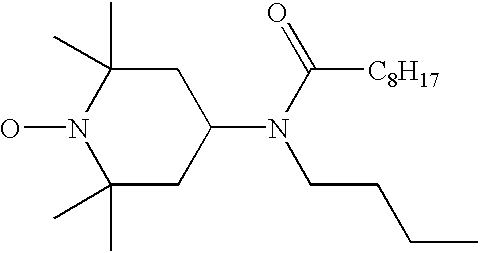 |
prepared in analogy to compound 108; red oil |
| 114 |
 |
prepared in analogy to compound 107; mp. 54-55° C. |
In an evacuated Schlenk reactor, purged with argon, the amount of initiator and stable nitroxyl radical given in Table 2 are added to 50 ml styrene under argon atmosphere. Dissolved oxygen is removed in two freeze thaw cycles (liquid nitrogen). The reaction mixture is stirred and heated under argon atmosphere to 130° C. for 6 hours. Remaining monomer is removed at 60° C. under vacuum. The residue is dried in a first step under second step under normal pressure at 70° C. until constant weight is achieved.
Molecular weights and molecular weight distributions are determined by gel permeation chromatography (GPC).
The results shown in Table 2
| TABLE 2 | |||||||
| Conc. % on | BPO % on | Conversion | Mw/ | ||||
| No. | NO-radical | styrene | styrene | (%) | Mn | Mw | Mn |
| V1 | TEMPO | 1 mol % | 0.77 mol % | 28 | 3700 | 4800 | 1.29 |
| V2 | HO-TEMPO | 1 mol % | 0.77 mol % | 17 | 2100 | 2600 | 1.26 |
| V3 | Benzoyl- | 1 mol % | 0.77 mol % | 39 | 4800 | 6000 | 1.25 |
| TEMPO | |||||||
| Ex. 1 | Compound | 1 mol % | 0.77 mol % | 63 | 9000 | 11200 | 1.25 |
| 107 | |||||||
| Ex. 2 | Compound | 0.1 mol % | 0.077 mol % | 75 | 54000 | 77300 | 1.43 |
| 107 | |||||||
| Ex. 3 | Compound | 0.01 mol % | 0.0077 mol % | 72 | 148300 | 272100 | 1.83 |
| 107 | |||||||
| Ex. 4 | Compound | 0.05 mol % | 0.0385 mol % | 73 | 78300 | 114300 | 1.46 |
| 107 | |||||||
| Ex. 5 | Compound | 0.5 mol % | 0.385 mol % | 61 | 16300 | 20500 | 1.26 |
| 107 | |||||||
| Ex. 6 | Compound | 0.01 mol % | 0.0077 mol % | 72 | 153000 | 254000 | 1.65 |
| 104 | |||||||
| Ex. 7 | Compound | 0.05 mol % | 0.0385 mol % | 71 | 77200 | 110100 | 1.43 |
| 104 | |||||||
| Ex. 8 | Compound | 0.5 mol % | 0.385 mol % | 40 | 10200 | 12100 | 1.20 |
| 104 | |||||||
| Ex. 9 | Compound | 1 mol % | 0.77 mol % | 49 | 7900 | 9200 | 1.16 |
| 104 | |||||||
| Ex. 10 | Compound | 0.1 mol % | 0.077 mol % | 68 | 51900 | 76300 | 1.47 |
| 103 | |||||||
| Ex. 11 | Compound | 1 mol % | 0.77 mol % | 66 | 10200 | 13100 | 1.28 |
| 103 | |||||||
| TEMPO = 2,2,6,6-tetramethylpiperidine-1-oxyl; HO-TEMPO = 2,2,6,6-tetramethylpiperidine-4-hydroxy-1-oxyl; Benzoyl-TEMPO = 2,2,6,6-Tetramethylpiperidine-4-benzoyl-1-oxyl; | |||||||
| BPO = bis - benzoylperoxide | |||||||
| V1-V3 comparative experiments. | |||||||
Claims (11)
1. A process for preparing an oligomer, a cooligomer, a polymer or a copolymer (block or random) by free radical polymerization of at least one ethylenically unsaturated monomer or oligomer, which process comprises
heating the monomer, monomers, oligomer or oligomers in the presence of a free radical source and at least one compound of formula (I) and polymerizing the ethylenically unsaturated monomer or oligomer,
where no compression step is applied to the ethylenically unsaturated monomer, monomers, oligomer or oligomers prior to polymerization, and
where the compound of formula (I) is

where
n is 1 or 2;
R3, R4, R9, R10 are each independently of one another C1-C18alkyl, C2-C18alkenyl or C2-C18alkinyl; or
R3 and R4 and/or R9 and R10 form together with the linking carbon atom a C3-C12cycloalkyl radical;
R5, R6, R7, R8 are each independently of one another hydrogen, C1-C18alkyl, C2-C18alkenyl or C18alkinyl;
X is —O—, —O—C(O)—, —NR2— or —NR2—C(O)—;
R2 is hydrogen, C1-C18alkyl or phenyl;
if n is 1,
R1 is C8-C38alkyl, C8-C36alkenyl or C8-C36alkinyl; and
if n is 2,
R1 is C10-C38alkylene, C10-C36alkenylene or C10-C36alkinylene.
2. A process according to claim 1 , where in the compound of formula (I), R3, R4, R9 and R10 are each methyl and R5, R6, R7 and R8 are each hydrogen.
3. A process according to claim 1 where in the compound of formula (I), X is O or —O—C(O)—.
4. A process according to claim 1 where in the compound of formula (I), n is 1 and R1 is C8-C25alkyl.
5. A process according to claim 1 where in the compound of formula (I), n is 2 and R1 is C12-C24alkylene.
6. A process according to claim 1 , where the ethylenically unsaturated monomers or oligomers are selected from the group consisting of styrene, α-methyl styrene, p-methyl styrene, conjugated dienes, acrolein, acrylonitrile, vinyl acetate, (alkyl)acrylic acid anhydrides, (alkyl)acrylic acid salts, (alkyl)acrylic esters and (alkyl)acrylamides.
7. A process according to claim 6 wherein the ethylenically unsaturated monomers are selected from the group consisting of styrene, α-methyl styrene, p-methyl styrene, 1,3-dienes and compounds of formula CH2═C(Ra)—(C═Z)—Rb,
where
Ra is hydrogen or C1-C4alkyl, Rb is NH2, OMe, glycidyl, unsubstituted C1-C18alkoxy or hydroxy-substituted C1-C18alkoxy, unsubstituted C1-C18alkylamino, di(C1-C18alkyl)amino, hydroxy-substituted C1-C18alkylamino or hydroxy-substituted di(C1-C18alkyl)amino;
Z is oxygen or sulfur and
Me is an alkali metal cation.
8. A process according to claim 6 , where the ethylenically unsaturated monomers are styrene, α-methyl styrene, p-methyl styrene, butadiene or isoprene.
9. A process according to claim 1 , wherein the compound of formula (I) or a mixture thereof is present in an amount of from 0.001 mol-% to 30 mol-%, based on the monomer or monomer mixture.
10. A process according to claim 1 , where the free radicals from the free radical source are generated at a temperature from 60° C. to 220° C.
11. A process according to claim 10 , wherein the free radicals from the free radical source are generated at a temperature from 60° C. to 180° C.
Priority Applications (1)
| Application Number | Priority Date | Filing Date | Title |
|---|---|---|---|
| US10/354,613 US6864313B2 (en) | 1998-06-25 | 2003-01-30 | Use of 2,2,6,6 tetraalkylpiperidine-N-oxyl radicals having long alkyl chains as polymerization regulators |
Applications Claiming Priority (4)
| Application Number | Priority Date | Filing Date | Title |
|---|---|---|---|
| EP98810585 | 1998-06-25 | ||
| EP98810585.4 | 1998-06-25 | ||
| US09/720,440 US6569940B1 (en) | 1998-06-25 | 1999-06-15 | Use of 2,2,6,6 tetraalkylpiperidine-N-oxyl radicals having long alkyl chains as polymerization regulators |
| US10/354,613 US6864313B2 (en) | 1998-06-25 | 2003-01-30 | Use of 2,2,6,6 tetraalkylpiperidine-N-oxyl radicals having long alkyl chains as polymerization regulators |
Related Parent Applications (3)
| Application Number | Title | Priority Date | Filing Date |
|---|---|---|---|
| US09720440 Continuation-In-Part | 1999-06-15 | ||
| US09/720,440 Continuation-In-Part US6569940B1 (en) | 1998-06-25 | 1999-06-15 | Use of 2,2,6,6 tetraalkylpiperidine-N-oxyl radicals having long alkyl chains as polymerization regulators |
| PCT/EP1999/004119 Continuation-In-Part WO1999067298A1 (en) | 1998-06-25 | 1999-06-15 | Use of 2,2,6,6 tetraalkylpiperidine-n-oxyl radicals having long alkyl chains as polymerization regulators |
Publications (2)
| Publication Number | Publication Date |
|---|---|
| US20030229177A1 US20030229177A1 (en) | 2003-12-11 |
| US6864313B2 true US6864313B2 (en) | 2005-03-08 |
Family
ID=29713331
Family Applications (1)
| Application Number | Title | Priority Date | Filing Date |
|---|---|---|---|
| US10/354,613 Expired - Fee Related US6864313B2 (en) | 1998-06-25 | 2003-01-30 | Use of 2,2,6,6 tetraalkylpiperidine-N-oxyl radicals having long alkyl chains as polymerization regulators |
Country Status (1)
| Country | Link |
|---|---|
| US (1) | US6864313B2 (en) |
Cited By (4)
| Publication number | Priority date | Publication date | Assignee | Title |
|---|---|---|---|---|
| US12098070B2 (en) | 2019-04-02 | 2024-09-24 | Ecolab Usa Inc. | Pure chlorine dioxide generation system with reduced acid usage |
| US12304980B2 (en) | 2022-04-01 | 2025-05-20 | Ecolab Usa Inc. | Antifoulant compositions for vapor-space applications |
| US12344581B2 (en) | 2022-04-01 | 2025-07-01 | Ecolab Usa Inc. | Antifoulant compositions for high-severity processing of vinylic monomer streams |
| US12428360B2 (en) | 2022-04-01 | 2025-09-30 | Ecolab Usa Inc. | Abating unwanted emulsion polymerization during extractive distillation of conjugated diene monomers |
Citations (13)
| Publication number | Priority date | Publication date | Assignee | Title |
|---|---|---|---|---|
| SU478838A1 (en) | 1973-09-17 | 1975-07-30 | Отделение ордена Ленина института химической физики АН СССР | Method of inhibiting radical polymerization of oligoester acrylates |
| US4314933A (en) | 1979-02-15 | 1982-02-09 | Ciba-Geigy Corporation | Method for light stabilization of two-layer uni-lacquer coatings |
| US4581429A (en) | 1983-07-11 | 1986-04-08 | Commonwealth Scientific And Industrial Research Organization | Polymerization process and polymers produced thereby |
| US5204473A (en) | 1987-09-21 | 1993-04-20 | Ciba-Geigy Corporation | O-substituted N-hydroxy hindered amine stabilizers |
| US5412047A (en) | 1994-05-13 | 1995-05-02 | Xerox Corporation | Homoacrylate polymerization processes with oxonitroxides |
| US5654434A (en) | 1995-11-09 | 1997-08-05 | Ciba-Geigy Corporation | Hydrogen peroxide oxidation of 4-hydroxy-2, 2, 6, 6-tetramethylpiperidine |
| WO1997036944A1 (en) | 1996-03-29 | 1997-10-09 | The Dow Chemical Company | In situ block copolymer formation during polymerization of a vinyl aromatic monomer |
| DE19648811A1 (en) | 1996-11-27 | 1998-05-28 | Basf Ag | Process for the polymerization of vinyl monomers |
| US5872252A (en) | 1996-06-05 | 1999-02-16 | Basf Aktiengesellschaft | Compression of ethylenically unsaturated monomers |
| US5922244A (en) | 1995-03-21 | 1999-07-13 | Basf Aktiengesellschaft | 4-acylaminopiperidin-N-oxyle |
| US6140396A (en) | 1997-12-19 | 2000-10-31 | Nippon Shokubai Co., Ltd. | Thermosetting resin composition and producing process thereof |
| US6281311B1 (en) | 1997-03-31 | 2001-08-28 | Pmd Holdings Corp. | Controlled free radical polymerization process |
| US6288186B1 (en) | 1996-08-22 | 2001-09-11 | Carnegie Mellon University | Rate enhancement of nitroxyl radical-mediated polymerization |
-
2003
- 2003-01-30 US US10/354,613 patent/US6864313B2/en not_active Expired - Fee Related
Patent Citations (14)
| Publication number | Priority date | Publication date | Assignee | Title |
|---|---|---|---|---|
| SU478838A1 (en) | 1973-09-17 | 1975-07-30 | Отделение ордена Ленина института химической физики АН СССР | Method of inhibiting radical polymerization of oligoester acrylates |
| US4314933A (en) | 1979-02-15 | 1982-02-09 | Ciba-Geigy Corporation | Method for light stabilization of two-layer uni-lacquer coatings |
| US4581429A (en) | 1983-07-11 | 1986-04-08 | Commonwealth Scientific And Industrial Research Organization | Polymerization process and polymers produced thereby |
| US5204473A (en) | 1987-09-21 | 1993-04-20 | Ciba-Geigy Corporation | O-substituted N-hydroxy hindered amine stabilizers |
| US5412047A (en) | 1994-05-13 | 1995-05-02 | Xerox Corporation | Homoacrylate polymerization processes with oxonitroxides |
| US5922244A (en) | 1995-03-21 | 1999-07-13 | Basf Aktiengesellschaft | 4-acylaminopiperidin-N-oxyle |
| US5654434A (en) | 1995-11-09 | 1997-08-05 | Ciba-Geigy Corporation | Hydrogen peroxide oxidation of 4-hydroxy-2, 2, 6, 6-tetramethylpiperidine |
| WO1997036944A1 (en) | 1996-03-29 | 1997-10-09 | The Dow Chemical Company | In situ block copolymer formation during polymerization of a vinyl aromatic monomer |
| US5872252A (en) | 1996-06-05 | 1999-02-16 | Basf Aktiengesellschaft | Compression of ethylenically unsaturated monomers |
| US5914379A (en) | 1996-06-05 | 1999-06-22 | Basf Aktiengesellschaft | Compression of ethylenically unsaturated monomers |
| US6288186B1 (en) | 1996-08-22 | 2001-09-11 | Carnegie Mellon University | Rate enhancement of nitroxyl radical-mediated polymerization |
| DE19648811A1 (en) | 1996-11-27 | 1998-05-28 | Basf Ag | Process for the polymerization of vinyl monomers |
| US6281311B1 (en) | 1997-03-31 | 2001-08-28 | Pmd Holdings Corp. | Controlled free radical polymerization process |
| US6140396A (en) | 1997-12-19 | 2000-10-31 | Nippon Shokubai Co., Ltd. | Thermosetting resin composition and producing process thereof |
Non-Patent Citations (1)
| Title |
|---|
| Derwent Abstr. 95-515030/51 for JP 08269117 (1996). |
Cited By (4)
| Publication number | Priority date | Publication date | Assignee | Title |
|---|---|---|---|---|
| US12098070B2 (en) | 2019-04-02 | 2024-09-24 | Ecolab Usa Inc. | Pure chlorine dioxide generation system with reduced acid usage |
| US12304980B2 (en) | 2022-04-01 | 2025-05-20 | Ecolab Usa Inc. | Antifoulant compositions for vapor-space applications |
| US12344581B2 (en) | 2022-04-01 | 2025-07-01 | Ecolab Usa Inc. | Antifoulant compositions for high-severity processing of vinylic monomer streams |
| US12428360B2 (en) | 2022-04-01 | 2025-09-30 | Ecolab Usa Inc. | Abating unwanted emulsion polymerization during extractive distillation of conjugated diene monomers |
Also Published As
| Publication number | Publication date |
|---|---|
| US20030229177A1 (en) | 2003-12-11 |
Similar Documents
| Publication | Publication Date | Title |
|---|---|---|
| US6569940B1 (en) | Use of 2,2,6,6 tetraalkylpiperidine-N-oxyl radicals having long alkyl chains as polymerization regulators | |
| US6353107B1 (en) | 1-alkoxy-polyallkyl-piperidine derivatives and their use as polymerization regulators | |
| US6566468B1 (en) | Nitroxyl derivatives with glycidyl or alkylcarbonyl groups as initiators for radical polymerization | |
| US6624306B2 (en) | 2,2,6,6 diethyl-dimethyl-1-alkoxy-piperidine compounds and their corresponding 1-oxides | |
| US6235857B1 (en) | Control of molecular weight and end-group functionality in polymers | |
| AU6874398A (en) | Controlled free radical polymerization process | |
| EP1397349B1 (en) | 4-imino-n-alkoxy or oxy-polyalkyl-piperidine compounds and their use as polymerization regulators | |
| EP1189875B1 (en) | Mono and multifunctional alkoxyamines for the preparation of functionalized macromers | |
| US20030229177A1 (en) | Use of 2,2,6,6 tetraalkylpiperidine-N-oxyl radicals having long alkyl chains as polymerization regulators | |
| US6825299B2 (en) | Process for controlled radical polymerization in aqueous dispersion | |
| ES2246585T3 (en) | COMPOSITION AND PROCEDURE FOR CONTROLLED RADICAL POLYMERIZATION USING MULTIFUNCTIONAL INITIATOR COMPOUNDS / REGULATORS. | |
| US20040002606A1 (en) | Process for the synthesis for alkoxy amines and their use in controlled radical polymerization | |
| JP2004509989A (en) | Compositions and methods for enhancing controlled free radical polymerization | |
| MXPA01002660A (en) | 2,2,6,6-diethyl-dimethyl-1-alkoxy-piperidine compounds and their corresponding 1-oxides | |
| CZ346399A3 (en) | Controlled free-radical polymerization process |
Legal Events
| Date | Code | Title | Description |
|---|---|---|---|
| AS | Assignment |
Owner name: CIBA SPECIALTY CHEMICALS CORP., NEW YORK Free format text: ASSIGNMENT OF ASSIGNORS INTEREST;ASSIGNORS:WUNDERLICH, WIEBKE;CLAUSS, MARGOT;ROTH, MICHAEL;AND OTHERS;REEL/FRAME:014459/0570;SIGNING DATES FROM 20030528 TO 20030603 |
|
| FPAY | Fee payment |
Year of fee payment: 4 |
|
| REMI | Maintenance fee reminder mailed | ||
| LAPS | Lapse for failure to pay maintenance fees | ||
| STCH | Information on status: patent discontinuation |
Free format text: PATENT EXPIRED DUE TO NONPAYMENT OF MAINTENANCE FEES UNDER 37 CFR 1.362 |
|
| FP | Lapsed due to failure to pay maintenance fee |
Effective date: 20130308 |