US6847851B1 - Apparatus for improved general-purpose PID and non-PID controllers - Google Patents
Apparatus for improved general-purpose PID and non-PID controllers Download PDFInfo
- Publication number
- US6847851B1 US6847851B1 US10/194,190 US19419002A US6847851B1 US 6847851 B1 US6847851 B1 US 6847851B1 US 19419002 A US19419002 A US 19419002A US 6847851 B1 US6847851 B1 US 6847851B1
- Authority
- US
- United States
- Prior art keywords
- log
- output
- controller
- gain
- generate
- Prior art date
- Legal status (The legal status is an assumption and is not a legal conclusion. Google has not performed a legal analysis and makes no representation as to the accuracy of the status listed.)
- Expired - Fee Related, expires
Links
Images
Classifications
-
- G—PHYSICS
- G05—CONTROLLING; REGULATING
- G05B—CONTROL OR REGULATING SYSTEMS IN GENERAL; FUNCTIONAL ELEMENTS OF SUCH SYSTEMS; MONITORING OR TESTING ARRANGEMENTS FOR SUCH SYSTEMS OR ELEMENTS
- G05B11/00—Automatic controllers
- G05B11/01—Automatic controllers electric
- G05B11/36—Automatic controllers electric with provision for obtaining particular characteristics, e.g. proportional, integral, differential
- G05B11/42—Automatic controllers electric with provision for obtaining particular characteristics, e.g. proportional, integral, differential for obtaining a characteristic which is both proportional and time-dependent, e.g. P. I., P. I. D.
Definitions
- the present invention relates to the field of controllers. More particularly, the present invention relates to improved general-purpose proportional-integrative-derivative (PID)) and improved non-PID general-purpose controllers.
- PID proportional-integrative-derivative
- the purpose of a controller is to force, in a meritorious way, the response of a system (conventionally called the plant) to achieve a specified response (the reference signal).
- Controllers are ubiquitous in real world industrial and commercial settings. Controllers are embedded in almost every electronic product and every real-world mechanical and thermodynamic system.
- the cruise control device in an automobile is an example of a controller.
- the driver may want his automobile to travel at 65 miles per hour (mph).
- the controller causes fuel to flow into the automobile's engine (the plant) so as to close the gap between the car's current speed (the current plant response) and the desired speed (the reference signal). Since the plant does not respond instantaneously to a new setting of the reference signal by the driver, the speed of the car (the plant response) does not instantaneously become 65 mph. Instead, the controller continuously adjusts the flow of fuel based on the continuously changing difference between the car's actual speed and the reference signal. That is, there is continuous feedback of the plant output to the controller.
- the output signal of the controller (the control variable) would be set to initially increase the flow of fuel to the automobile's engine.
- the output signal of the controller (the control variable) would be set to initially decrease the flow of fuel.
- controllers are constructed from components that operate in continuous time.
- controllers can be constructed from mechanical, pneumatic, and electrical components (e.g., inductors, capacitors, resistors, amplifiers). These components operate in continuous time.
- many other real-world controllers are constructed from components that operate in discrete time steps such that the overall effect closely (and adequately) approximates the continuous version of the same controller.
- controllers that is, controllers that automatically process information concerning reference signal(s) and plant response(s) (and possibly other information, such as the available internal states of the plant) in order to generate the control signals.
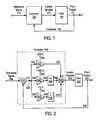
- FIG. 1 shows elements of an illustrative closed-loop feedback controller in a system.
- a controller 120 and a plant 140 are contained in the system.
- the output of the controller is a control variable (signal) 130 .
- the control variable 130 is the input to the plant 140 .
- the plant 140 has one output 150 (referred to herein as the plant response).
- the controller 120 has two inputs, namely the reference signal 110 and the plant response 150 .
- Controller 120 receives the plant response 150 by use of the feedback signal 160 .
- the system in FIG. 1 is called a “closed loop” system because there is feedback 160 of the plant output 150 back to the controller 120 .
- a feedback loop created by feedback signal 160 is referred to herein as an external feedback because the feedback loop is external to the controller 120 . Controllers without such external feedback are called “open loop” controllers. “Open loop” controllers are considerably simpler (and generally less useful in real world applications) than “closed loop” controllers.
- the actual plant response 150 is typically compared to the externally supplied reference signal 110 . This comparison typically entails subtracting these two time-domain signals. When the comparison is done in this way, the controller acts only on the difference between the actual plant response 150 and the reference signal 110 . When subtraction is used, the subtractor (not shown here) is sometimes shown outside of controller 120 .
- a closed-loop controller is to produce, given the reference signal 110 and the feedback signal 160 , a value for the control variable 130 that causes the plant response to approach and/or match the reference signal 110 in a meritorious way.
- Controller 120 may have more than one distinct output (i.e., control variable). In that event, each such control variable is an input to the plant.
- Plant 140 may have more than one distinct output 150 . If a plant has k outputs that are to be controlled, then there are k reference signals and each reference signal is paired with a particular plant output that is to be controlled. Each of the k plant outputs that is to be controlled is compared with (e.g., subtracted from) its associated reference signal. The controller uses the results of the k comparisons in determining the output(s) of the controller.
- internal states of a plant are sometimes made available as additional inputs to a controller. Internal states provide additional information to the controller.
- the number of plant outputs, the number of control variables, and the number of internal states (if any are used at all) are, in general, not equal to each other (although they may, by coincidence, be equal).
- Automatic controllers are typically constructed from a variety of signal-processing blocks that process time-domain signals. Each processing block has one or more inputs and a single output. Examples include, but are not limited to,
- FIG. 2 is a block diagram of a control system consisting of a plant and a PID controller composed of proportional, integrative, derivative, adder, and subtractor blocks.
- the output signal of the illustrative controller 500 is control variable 590 .
- the control variable is, in turn, the input to the plant 592 .
- the plant has one output (plant response) 594 .
- the plant response is fed back (externally as signal 596 ) and becomes one of the controller's two inputs.
- the controller's other input is the reference signal 508 .
- the fed-back plant response, signal 596 , and the externally supplied reference signal 508 are compared (by simple subtraction at subtractor 510 ).
- the providing of the plant output as an input to the controller is often referred to as external feedback.
- the input to a controller typically consists of reference signal(s) and plant response(s).
- the input to a controller sometimes also includes internal state variables of the plant.
- the output(s) of the controller may be made directly available as inputs to the controller.
- the providing of the controller output as an input to the controller is sometimes referred to as internal feedback.
- a controller often uses the difference (error) between each reference signal and the corresponding plant response.
- the output of a controller consists of control variable(s) that are passed from the controller to the plant.
- the individual signal-processing blocks of a controller are coupled to one another in a particular topological arrangement.
- the topology of a controller entails the specification of
- Block diagrams are a useful tool for representing the flow of information in controllers and systems containing controllers.
- Block diagrams contain signal-processing function blocks, external input and output points, and directed lines carrying signals between the blocks.
- Lines in a block diagram herein represent time-domain signals. Lines herein are directional in that they represent the flow of information.
- a function block within a block diagram for a controller typically has one or more inputs, but only one output. The lines pointing toward a block represent signals coming into the block. The single line pointing away from a block represents the block's single output.
- an external input is represented by an external point with a directed line pointing away from that point.
- an external output point is represented by an external point with a line pointing toward that point.
- Adders are conventionally represented by circles in the block diagrams included herein, where each input to an adder is labeled with a positive or negative sign (so adders may be used to perform both addition and subtraction).
- adder 510 performs the function of subtracting the plant output 596 (which is given a minus sign) from the externally supplied reference signal 508 (which is given a plus sign). This particular arrangement implements negative feedback.
- Takeoff points (conventionally represented in block diagrams herein by a large dot) provide a way to disseminate a signal to more than one other function block in a block diagram.
- Takeoff point 520 in FIG. 2 receives subtractor output 512 and disseminates this signal to function blocks 530 , 540 , and 550 .
- subtractor output 512 output from subtractor 510 is passed (through 520 and 522 ) into a gain block 530 .
- a gain block (as shown in FIG. 2 as a triangle) multiplies (amplifies) its input by a specified constant amplification factor (e.g., the numerical constant 214.0).
- the amplified result 538 becomes the first of the three inputs to addition block 580 .
- This portion of FIG. 2 implements proportional control.
- the simplest type of controller merely considers the difference (error) between the reference signal and the plant output and produces a control variable (i.e., the input to the plant) that is proportional to the current value of the error.
- proportional control leads to overshoot, instability, and inefficiency.
- the subtractor's output 512 is also passed (through 520 and 524 ) into gain block 540 (with a gain of 1,000.0) and the amplified result 548 is passed into integrator block 560 .
- the integrator is shown in FIG. 2 by a rectangle labeled 1/s, where s is the Laplace transform variable.
- the result 568 of this integration (with respect to time) becomes the second input to addition block 580 .
- This portion of the Figure implements integral control based on the integral, over time, of the difference between the plant output and reference signal.
- the subtractor's output 512 is also passed (through 520 and 526 ) into gain block 550 (with a gain of 15.5) and the amplified result 558 is passed into differentiator block 570 (shown in the Figure by a rectangle labeled with the Laplace transform variable s) and becomes the third input to addition block 580 .
- This portion of the Figure implements derivative control based on the derivative, over time, of the difference between the plant output and reference signal.
- control variable 590 the output (i.e., control variable 590 ) of the controller in FIG. 2 is the sum of a proportional (P) term, an integrative (I) term, and a differentiating (D) term
- P proportional
- I integrative
- D differentiating
- Each of the three parts of a PID controller contributes to its overall performance.
- the proportional part of the controller provides direct feedback of the error between the plant output and the externally supplied reference signal.
- the integral part of the controller enables the controller to make the plant output agree with the reference signal in the steady state. Even a small positive (negative) error will, when integrated over time, lead to an increasing (decreasing) control signal.
- the derivative part of the controller enables the controller to improve closed-loop stability.
- a proportional controller is almost always late in compensating for an error between the plant output and the reference signal.
- the derivative part of the controller enables the controller to make a prediction of future error (based on extrapolating the slope of the tangent to the error curve).
- the PID controller was patented in 1939 by Albert Callender and Allan Stevenson of Imperial Chemical Limited of Northwich, England.
- the PID controller was a significant improvement over earlier and simpler control techniques (which often were merely proportional).
- the goal of minimizing the time required to bring about the desired plant response is stated in terms of the rise time or the settling time.
- the rise time is the time required for the plant output to first reach a specified percentage (e.g., 95%) of the reference signal.
- the settling time is the first time for which the plant response reaches and stays within a specified percentage (e.g., 2%) of the reference signal.
- control engineers express the goal of minimizing the time required to bring about the desired plant response in terms of minimizing the integral of the time-weighted absolute error. This measure favors the rapid reduction of the discrepancy between the reference signal and the plant response and imposes ever-greater penalties on discrepancies that occur at later times.
- a controller is required to do much more than merely minimize the time-weighted absolute error.
- the measure of merit of a controller is typically multi-objective in the sense that it involves more than one element. In practice, there is often a conflict among these elements.
- the overshoot is the percentage by which the plant response exceeds the reference signal after first achieving the reference value.
- Overshoot can be dangerous because the plant can be destroyed (e.g., a boiler exceeds its safe operating temperature).
- overshoot is typically costly in terms of energy.
- the cost of the energy required to bring about the desired plant response is often an additional explicit consideration in measuring the merit of a controller.
- Real-world controllers must also comply with the reality that the actual value of a control variable must be finite (e.g., cannot be an impulse of infinite amplitude). Thus, it is also common to place certain practical limits on the value of the control variable(s) so that the plant is not presented with extreme values for the control variable(s). This is often accomplished by inserting a limiter between the controller and the plant. The limiter alone introduces significant non-linearity into the overall control process. A plant's internal state variables are often similarly constrained.
- a plant typically does not accurately receive the control signal that the controller actually produced. It is desirable that a controller operates robustly in the face of disturbances that may be added into the controller's output (i.e., the control variable) prior to reaching the plant. Thus, disturbance rejection is often a requirement of an effective real world controller.
- the controller may not receive an accurate reading of the plant's output or the reference signal because of sensor noise. It is desirable that a controller operates robustly in the face of noise in the plant output or reference signal.
- a good controller should operate in a consistent manner in the face of variations in the step size of the reference signal.
- Stability is another important consideration in measuring the merit of a controller. In fact, it is often an overriding concern. A system whose performance varies radically with small changes in the plant (e.g., a car whose engine response doubled with a small change in temperature) would, at the minimum, be useless and, at worst be dangerous.
- Astrom and Hagglund developed a method in their 1995 book for automatically tuning PID controllers for all the plants in all four of these industrially representative families of plants.
- Astrom and Hagglund employed the widely used Ziegler-Nichols rules as a “starting point” for their work.
- the Astrom-Hagglund tuning rules outperform the widely used Ziegler-Nichols rules on all the plants in all four families of plants.
- Astrom and Hagglund use two frequency-domain parameters, namely the ultimate gain, K u (the minimum value of the gain that must be introduced into the feedback path to cause the system to oscillate) and the ultimate period, T u (the period of this lowest frequency oscillation).
- Astrom and Hagglund use two time-domain parameters, namely the time constant, T r , and the dead time, L (the period before the plant output begins to respond significantly to a new reference signal).
- T r time constant
- L the dead time
- PID controllers were built from mechanical, pneumatic, or analog electrical components that implemented the proportional, integrative, and derivative parts of the PID controller.
- inductors and capacitors can be used to implement differentiation and integration in an analog electrical controller.
- the component values of these physical components were variable-valued.
- the topology of these controllers was typically not variable. Instead, the topology was the fixed proportional-integrative-derivative topology.
- a PIN controller comprises a proportional element, an integrative element, and a derivative element coupled together and responsive to a reference signal to generate a control signal in response thereto to cause a plant to generate a plant output
- the proportional element has a gain element with a gain being substantially equal to 0.72 * K u * e - 1.6 K u + 1.2 K u 2 - .001234000198 ⁇ * T u - 6.117274273 ⁇ * 10 - 6 where K u is the ultimate gain of the plant and T u is the ultimate period of the plant.
- FIG. 1 shows the major elements of an illustrative control system containing a controller and a plant.
- FIG. 2 shows a block diagram of a control system consisting of a plant and a PID controller.
- FIG. 3 shows a PID controller with setpoint weighting of the reference signal.
- FIG. 4 is a block diagram of one embodiment of a non-PID controller.
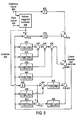
- FIG. 5 is a block diagram of another embodiment of a non-PID controller.
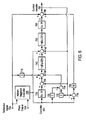
- FIG. 6 is a block diagram of yet another embodiment of a non-PID controller.
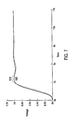
- FIG. 7 compares the time-domain response of the first non-PD controller of the present invention and the Astrom and Hagglund controller for a particular illustrative plant.
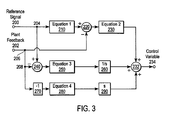
- FIG. 3 shows a PID controller with setpoint weighting of the reference signal.
- the topology of the controller in FIG. 3 is the topology of the PID controller devised by Astrom and Hagglund in their 1995 book (and is also the topology of an improved PID controller described herein).
- the topology for a PD controller in FIG. 3 differs from that of FIG. 2 in that FIG. 3 has the additional feature of setpoint weighting of the reference signal.
- the inputs to the controller of FIG. 3 are the reference signal 200 and the plant output 202 (feedback) while the output of this controller is the control variable 234 .
- the block 260 with 1/s represents integration and the block 290 with s represents differentiation.
- Block 270 with ⁇ 1 is a gain block with a gain of ⁇ 1.
- Adder 232 is shown with positive signs on all its inputs represents an adder.
- Subtractors 220 and 240 as shown with a positive sign on one input and a negative sign on the second input represents a subtractor.
- the block 210 (whose gain is specified below by “Equation 1”) implements setpoint weighting for the input to the proportional (P) block 230 (whose gain is specified below by “Equation 2”). That is, the reference signal 200 (setpoint) is weighted by a constant specified by the gain block 210 and Equation 1 below before the plant output 202 (feedback) is subtracted. Note that there is no setpoint weighting for the input to the gain block 250 (whose gain is specified below by “Equation 3”) associated with the integrative (I) block.
- the tuning rules devised by Astrom and Hagglund in their 1995 book for the PD controller of FIG. 3 outperform the widely used Ziegler-Nichols tuning rules on the 16 industrially representative plants used by Astrom and Hagglund.
- Column 7 identifies the 16 plants that are in the test bed used by Astrom and Hagglund in their 1995 book.
- the PID and three non-PID controllers described herein are evaluated in terms of various combinations of plants from this table.
- Column 8 indicates which plants are employed in evaluating a PID controller (indicated by “P”) described herein and which plants are employed in evaluating the three non-PID controllers described herein (indicated by “1,” “2,” or “3”). There are 18 plants marked “1,” 24 marked with “2,” and 24 marked with “3.”
- Table 2 shows the characteristics of 18 additional plants that are used to further evaluate the performance of the controllers described herein. All of these additional plants are members of Astrom and Hagglund's families A, C, and D. Columns 3, 4, 5, and 6 of the table describe the plants in terms of each plant's ultimate gain, K u ; ultimate period, T u ; dead time, L; and the time constant, T r ; respectively. There are no additional plants within family B in this table because the plant parameter for this family must be an integer, and all of the integer values within the range of values used by Astrom and Hagglund are already covered by the plants in Table 1.
- the Astrom-Hagglund controller has the following performance for the 16 plants used by Astrom and Hagglund in their 1995 book:
- ITAE is the integral of the time-weighted absolute error. This measure is commonly used in evaluating controllers. In this evaluation of performance, the controller is exposed to a reference signal for a certain amount of time. Then, at a later time, a disturbance signal starts to be added.
- ITAE for setpoint refers to the value of ITAE up to the time the disturbance signal starts. Once the disturbance signal starts, the clock used for the time-weighting in ITAE is reset to zero and a new ITAE value is computed for the time period that includes the disturbance signal. This new computation of ITAE is referred to as the “ITAE for disturbance”.
- the Astrom-Hagglund controller has the following performance for the 18 plants of table 2:
- the Astrom-Hagglund controller has the following performance for the 20 plants of table 1 marked with a “1” in column 8 of table 1:
- the Astrom-Hagglund controller has the following performance for the 24 plants of table 1 marked with a “2” in column 8 of table 1:
- the Astrom-Hagglund controller has the following performance for the 30 plants of table 1 marked with a “3” in column 8 of table 1:
- the topology of the controller in FIG. 3 is the common topology of the Astrom-Hagglund PID controller and the improved PD controller described herein.
- One difference between the Astrom-Hagglund controller and the improved PID controller described herein are in the values of b, K p , K i , and K d . That is, this difference is in the “tuning.”
- K p-adj ⁇ .001234000198 *T u ⁇ 6.117274273*10 ⁇ 6
- b adj K u e K u
- the improved PID controller has the following performance for the 16 plants used by Astrom and Hagglund in their 1995 book (i.e., the 16 plants marked with a “A” in column 7 of table 1):
- the improved PID controller has the following performance for the 18 plants of table 2:
- the improved PID controller has the following performance for the 30 plants marked with a “3” in column 8 of table 1:
- the improved PID controller has
- the improved PID controller has
- the improved PID controller (and, as will be seen below, three non-PID controllers described herein) is an improvement over the PID controller devised by Astrom and Hagglund in their 1995 book.
- the tuning rules devised by Astrom and Hagglund for their PD controller outperform the widely used Ziegler-Nichols tuning rules on the 16 industrially representative plants used by Astrom and Hagglund.
- the improved PID controller described above creates a control variable (output of the controller) that depends on the following six inputs:
- the first four of the above items are constant values and are characteristics of the particular plant that is to be controlled by the controller.
- the last two of the above times are typically time-domain signals.
- a PD controller with one or more of these specific gains (but not including all) is still advantageous to use.
- a PID controller in which the proportional gain element as specified above yet does not have an integrative element and a derivative element with the gains as specified above nor the weighting of the reference signal as specified is advantageous to use in certain situations.
- a PID controller with an integrative element having the gain as specified above operating in conjunction with one or more of the proportional elements and the derivative element applying different gains and/or a reference signal with a different weighting is also advantageous to use in certain situations. The same is true for PID controllers applying the same gain as the derivative element specified above and/or the weighting of the reference signal specified above, yet with different gains for the proportional gain element and/or the integrative element.
- transfer functions are indicative of topologies
- the PID of the present invention as set forth herein is not limited to PID controller with the transfer function set forth above and extends to a PID controller that generates an output that is the same or substantially similar to the PID controller given above.
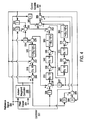
- FIG. 4 is a block diagram of one embodiment of a non-PID controller.
- non-PID controller 301 is composed of the following types of signal processing blocks:
- non-PID controller 301 There are three inputs to non-PID controller 301 , namely
- Astrom-Hagglund controller 306 is the PID controller of FIG. 2 that is tuned according to the equations presented earlier based on the ultimate gain, K u , and the ultimate period, T u , of the plant.
- non-PID controller 301 has eight gain blocks ( 326 , 327 , 332 , 334 , 336 , 382 , 384 , and 385 ) that are parameterized by a constant numerical amplification factor.
- gain blocks 326 , 332 , 382 , and 384 each have a gain of 3.
- Gain blocks 327 , 334 , 336 , and 385 each have a gain of 2.
- non-PID controller 301 has five gain blocks ( 310 , 330 , 340 , 360 , and 370 ) that are parameterized by equations as follows.
- Gain block 310 in FIG. 4 is parameterized by equation 11: 10 e log
- Gain block 330 in FIG. 4 is parameterized by equation 13: 10 e log
- Gain block 340 in FIG. 4 is parameterized by equation 14: e log
- Gain block 360 in FIG. 4 is parameterized by equation 16: 10 e log
- Gain block 370 in FIG. 4 is parameterized by equation 17: e log(K u )
- non-PD controller 301 also has three lag blocks 320 , 350 , and 380 (i.e., blocks with transfer function of the form 1/(1+ ⁇ s)) that are given as follows.
- Lag block 320 in FIG. 4 is parameterized by equation 12: T r
- Lag block 350 in FIG. 4 is parameterized by equation 15: T r
- Lag block 380 in FIG. 4 is parameterized by equation 18: T r
- non-PID controller 301 has internal feedback in several places. For one thing, its own output (control variable 390 ) is fed back to seven other blocks ( 308 , 312 , 327 , 336 , 338 , 346 , and 384 ) within this controller. In addition, there is internal feedback involving subtractor 376 , lag block 380 , and adder 387 .
- non-PD controller 301 has 12 adders and subtractors.
- it has four two-argument adders ( 324 , 352 , 388 , and 387 ), seven two-argument subtractors ( 308 , 312 , 338 , 346 , 366 , 376 , and 386 ), and two three-argument subtractors ( 328 and 335 ) in which one signal is subtracted from the sum of the two other signals.
- the output 390 (control variable) of non-PID controller 301 is the sum of two signals as described below.
- the two signals that are added together by adder 388 are described in detail below. Focusing on the bottom portion of FIG. 4 , the first of two signals that are added together (by adder 388 ) to create the output 390 of non-PID controller 301 is the result of subtracting with subtractor 386 the result of applying gain of 3, via gain block 384 , to the controller output 390 from the result of applying gain of 3, via gain block 382 , to the output of the Astrom-Hagglund controller 306 . Focusing on the top portion of FIG.
- “the second of the two signals” that are added together (by adder 388 ) to create the output 390 of non-PID controller 301 is the sum 387 of the result of applying gain of 2, via gain block 385 , to the reference signal 300 and the result of applying lag, via lag block 380 , parameterized (equation 18) by T r to a incoming signal (the output of subtractor 376 ).
- This incoming signal (the output of subtractor 376 ) is described in detail below and is the result of subtracting “the second of the two signals” as defined above (that is, “the second of the two signals” is participating in an internal feedback loop within non-PID controller 301 ) from the result of applying gain, via gain block 370 , (equation 17) of e log(K u ) to the result of subtracting via subtractor 366 the reference signal 300 from the result of applying gain, via gain block 360 , (equation 16) of 10 e log
- the two earlier signals that are added together by adder 352 are described in detail below.
- the first of the two earlier signals is the result of a three-way subtraction performed using subtractor 335 in which the result of applying gain of 2, via gain block 336 , to the controller output 390 is subtracted from the sum of the result of applying gain of 3, via gain block 332 , to the output of the Astrom-Hagglund controller 306 and the result of applying gain of 2, via gain block 334 , to the reference signal 300 .
- the second of these two earlier signals is the result of applying lag, via lag block 350 , (equation 15) parameterized by T r to the result of subtracting by subtractor 346 the controller output 390 from the result of applying gain, via gain block 340 , (equation 14) of e log
- the two intermediate signals that are added together by adder 324 are described in detail below.
- the first of these two intermediate signals is the result of applying a gain of 2 via gain block 334 to the reference signal 300 .
- the second of these two intermediate signals is the result of applying lag by lag block 320 (equation 12 ) parameterized by T r to the result of subtracting, via subtractor 312 , the controller output 390 from the result of gain, via gain block 310 , (equation 11) parameterized by 10 e log
- Non-PID controller 301 can also be described in terms of its transfer function.
- U is the controller output
- A is the output of the Astrom-Hagglund controller
- R is the reference signal
- E 11 through E 17
- Non-PID controller 301 has the following performance for the 18 plants of table 2:
- Non-PID controller 301 has the following performance for the 20 plants marked with a “1” in column 8 of table 1:
- non-PID controller 301 has
- non-PID controller 301 has
- non-PID controller 301 is an improvement over the PID controller devised by Astrom and Hagglund in their 1995 book.
- FIG. 7 compares the time-domain response of non-PID controller 301 (solid line labeled 920 ) and the Astrom and Hagglund controller (dotted line labeled 910 ) for the three-lag plant (a particular one of the plants used by Astrom and Hagglund in their 1995 book) to a reference signal that steps up from 0 volts to 1 volt.
- the response of the Astrom and Hagglund controller is slower than non-PID controller 301 ; overshoots the target value of 1 to a greater degree than non-PID controller 301 ; and takes longer to settle than non-PID controller 301 .
- Similar results are obtained for the other 15 plants in the family of plants specified by Astrom and Hagglund and for additional plants not specified by Astrom and Hagglund.
- FIG. 5 is a block diagram of one embodiment of another non-PID controller, non-PID controller 401 .
- non-PID controller 401 is composed of the following types of signal processing blocks:
- the output of non-PID controller 401 is control variable 490 .
- non-PID controller 401 There are three inputs to non-PID controller 401 , namely
- Astrom-Hagglund controller 406 is the PID controller of FIG. 2 that is tuned according to the equations presented above based on the ultimate period, T u , and the ultimate gain, K u , of the particular plant.
- non-PID controller 401 has three gain blocks ( 412 , 416 , and 442 ) that are parameterized by a constant numerical amplification factor.
- gain block 412 has a gain of 3.
- Gain block 416 has a gain of 15.
- Gain block 442 has a gain of 2.
- non-PID controller 401 also has eight lag blocks 410 , 420 , 430 , 440 , 450 , 460 , 470 , and 480 (i.e., blocks with transfer function of the form 1/(1+ ⁇ s)) as follows.
- Lag block 410 in FIG. 5 is parameterized by equation 21: log
- Lag block 420 in FIG. 5 is parameterized by equation 22: abs ( log ( abs ( T r + K u ⁇ ⁇ K u ⁇ ⁇ ( 0.68631 1 K u ⁇ ⁇ 0.13031 T u log ⁇ ⁇ log ⁇ ⁇ T r + K u ( K u L ) ⁇ ⁇ ⁇ ( K u L ) L ⁇ T u 1 T r + K u ⁇ ⁇ 0.69897 T r + K u L ⁇ T r L - T u ⁇ T r L ⁇ T u ) ) ) ) ) ) ) ) ) ) ) ) )
- Lag block 430 in FIG. 5 is parameterized by equation 23: log
- Lag block 440 in FIG. 5 is parameterized by equation 24:
- Lag block 450 in FIG. 5 is parameterized by equation 25:
- Lag block 460 in FIG. 5 is parameterized by equation 26: log
- where x T r +K u log
- Lag block 470 in FIG. 5 is parameterized by equation 27: log
- Lag block 480 in FIG. 5 is parameterized by equation 28: log
- non-PID controller 401 has internal feedback of its own output (control variable 490 ) back into itself.
- control variable 490 is input to six lag blocks ( 410 , 420 , 430 , 440 , 460 , and 470 ).
- control variable 490 is subtracted, via subtractor 414 , from the output of the PID) controller 406 devised by Astrom and Hagglund in their 1995 book and the difference becomes the input to gain block 416 .
- non-PID controller 401 also has one three-argument adder 488 , two two-argument adders ( 418 and 452 ), and six two-argument subtractors ( 414 , 422 , 424 , 426 , 444 , and 472 ).
- the output 490 (control variable) of non-PID controller 401 is the sum 488 of three signals.
- the first of these three signals that are added together (by adder 488 ) to create the output 490 of non-PID controller 401 is the sum 418 the result of applying gain of 3, via gain block 412 , to the reference signal 400 and the result of applying gain of 15, via gain block 415 , to the result of subtracting the controller output 490 from the output of the Astrom-Hagglund controller 406 .
- the second of the three signals that are added together (by adder 488 ) to create the output 490 of non-PID controller 401 is the result of subtracting three decrementing signals from the result of applying lag 420 , via gain block 420 , parameterized (equation 22) by abs ( log ( abs ( T r + K u ⁇ ⁇ K u ⁇ ⁇ ( 0.68631 1 K u ⁇ ⁇ 0.13031 T u log ⁇ ⁇ log ⁇ ⁇ T r + K u ( K u L ) ⁇ ⁇ - ( K u L ) L - T u 1 T r + K u ⁇ ⁇ 0.69897 T r + K u L - T r L - T u - T r L - T u ) ) ) ) ) ) ) ) ) to the controller output 490 .
- the first of the three decrementing signals is the result of applying lag, via lag block 410 , parameterized (equation 21) by
- the second of the three decrementing signals is the result of applying lag, via lag block 430 , parameterized (equation 23) by log
- the third of the three decrementing signals is the result of applying lag, via lag block 440 , parameterized (equation 24) by log
- the third of the three signals that are added together (by adder 488 ) to create the output 490 of non-PID controller 401 is the sum, via adder 452 , of two intermediate signals.
- the two intermediate signals that are that are added together by adder 452 are described in detail below.
- the first of these intermediate signals that are added together by adder 452 is the result of applying lag, via lag block 450 , (equation 25) parameterized by
- where x T r +K u log
- the second of these intermediate signals that are added together by adder 452 is the result of applying lag, via lag block 480 , (equation 28) parameterized by log
- Non-PID controller 401 can also be described in terms of its transfer function.
- U is the controller output
- A is the output of the Astrom-Hagglund controller
- R is the reference signal
- E 21 through E 28 correspond to equations 21 through 28, respectively.
- Non-PID controller 401 has the following performance for the 18 plants of table 2:
- Non-PID controller 401 has the following performance for the 24 plants marked with a “2” in column 8 of table 1:
- non-PID controller 401 has
- non-PID controller 401 has
- non-PID controller 401 is an improvement over the PID controller devised by Astrom and Hagglund in their 1995 book.
- FIG. 6 is a block diagram of still another embodiment of a non-PID controller.
- non-PID controller 701 is composed of the following types of signal processing blocks:
- the output of non-PID controller 701 is control variable 790 .
- non-PID controller 701 there are three inputs to non-PID) controller 701 , namely
- Non-PID controller 701 enters non-PID controller 701 through a PID controller 706 that is tuned with the tuning rules devised by Astrom and Hagglund in their 1995 book. That is, Astrom-Hagglund controller 706 is the PID controller of FIG. 2 that is tuned according to the equations presented earlier based on the ultimate period, T u , and ultimate gain, K u , of the particular plant.
- non-PID controller 701 has four gain blocks ( 710 , 720 , 770 , and 780 ) that are parameterized with constant numerical amplification factor.
- gain block 710 has a gain of 3.
- Each of gain blocks 720 and 770 have a gain of 2.
- Gain block 780 has again of 10.
- non-PID controller 701 also has two gain blocks ( 730 and 760 ) whose gain is expressed as an equation involving the four free variables that describe a particular plant, namely the plant's time constant, T r , ultimate period, T u , ultimate gain, K u , dead time, L.
- the gain block 730 has a gain (equation 31) of ⁇ log ⁇ ⁇ T r - T u + log ⁇ ⁇ log ⁇ ( ⁇ L ⁇ L ) T u + 1 ⁇ ⁇ ⁇ while gain block 760 has a gain (equation 34) of
- Non-PID controller 701 also has two lead blocks 740 and 750 (i.e., blocks with transfer functions of the form 1+ ⁇ s).
- Lead block 740 in FIG. 6 is parameterized by equation 32: NLM(log
- NLM is the following non-linear mapping from its argument x to the final parameter of the lead block:
- NLM ⁇ ( x ) ⁇ 10 0 if ⁇ ⁇ x ⁇ - 100 ⁇ ⁇ or ⁇ ⁇ x > 100 ⁇ 10 - 100 19 - 1 19 ⁇ x if ⁇ - 100 ⁇ x ⁇ - 5 ⁇ 10 100 19 - 1 19 ⁇ x if ⁇ ⁇ 5 ⁇ x ⁇ 100 ⁇ 10 x if - 5 ⁇ x ⁇ 5
- Lead block 750 in FIG. 6 is parameterized by equation 33:
- non-PID controller 701 has internal feedback of its own output (control variable 790 ) back into itself.
- control variable 790 is subtracted from the output of the PID controller 706 devised by Astrom and Hagglund in their 1995 book. The difference (amplified by a factor of 10 by gain block 780 ) becomes one of the three signals that are added together (by adder 788 ) to create control variable 790 .
- control variable 790 (amplified by a factor of 2 by gain block 770 ) is subtracted from the output of the Astrom-Hagglund controller 706 (amplified by a factor of 2 by gain block 720 ) by subtractor 734 .
- non-PID controller 701 also has three three-argument adders ( 738 , 748 , and 788 ) and three two-argument subtractors ( 734 , 736 , and 778 ).
- the output 790 (control variable) of non-PID controller 701 is the sum from adder 788 of three signals.
- the first of the three signals that are added together (by adder 788 ) to create the output 790 of non-PID controller 701 is the reference signal 700 to the controller.
- the second of the three signals that are added together (by adder 788 ) to create the output 790 of non-PID controller 701 is the result of applying gain of 10, via gain block 780 , to the result 778 of subtracting the controller output 790 from the output of the Astrom-Hagglund controller 706 . That is, this controller has internal feedback in which its own output, output 790 , is fed back into the controller itself. In particular, output 790 is fed back (negatively) into subtractor 778 .
- the output of subtractor 778 is the result of subtracting the controller output 790 from the output of the Astrom-Hagglund controller 706 . This difference is then multiplied by a factor of 10 by gain block 780 .
- the result of this multiplication becomes one of the three signals that are added together (by adder 788 ) to create the output 790 of non-PID controller 701 .
- the third of the three signals that are added together (by adder 788 ) to create the output 790 of non-PID controller 701 is the result of applying a gain, via gain block 760 , (equation 34) of
- the three intermediate signals that are added together by adder 748 are described in detail below.
- the first of these intermediate signals is the output of the Astrom-Hagglund controller 706 .
- the second of these intermediate signals is the controller output 790 .
- the third of the intermediate signals is the result of applying a lead using lead block 740 (equation 32) parameterized by NLM(log
- the three earlier signals that are added together by adder 738 are described in detail below.
- the first of these earlier signals is the result of applying a gain of 3, via gain block 710 , to the reference signal 700 .
- the second of these earlier signals is the result of subtracting, using subtractor 736 , the controller output 790 from the result of applying a gain, via gain block 730 , parameterized (equation 31) by ⁇ log ⁇ ⁇ T r - T u + log ⁇ ⁇ log ⁇ ( ⁇ L ⁇ L ) T u + 1 ⁇ ⁇ ⁇ to the output of the Astrom-Hagglund controller 706 .
- the third of these earlier signals is the result of subtracting the result of applying a gain of 2, via gain block 770 , to the controller output 790 from the result of applying a gain of 2, via gain block 720 , to the output of the Astrom-Hagglund controller 706 .
- non-PID controller 701 can also be described in terms of its transfer function given below.
- U R ⁇ ( 1 + 3 ⁇ E 34 ⁇ ( 1 + E 32 * s ) ⁇ ( 1 + E 33 * s ) ) + A ⁇ ( 10 + E 34 ⁇ ( 3 + E 31 + 2 ⁇ E 32 * s + E 31 ⁇ E 32 * s ) ⁇ ( 1 + E 33 * s ) ) 11 + E 34 ⁇ ( 2 + 3 ⁇ E 32 * s ) ⁇ ( 1 + E 33 * s )
- R is the reference signal
- A is the output of the Astrom-Hagglund controller
- U is the controller output
- P is the plant output (which is not used explicitly)
- E 31 , E 32 , E 33 , and E 34 refer to equations 31, 32, 33, and 34 respectively.
- Non-PID controller 701 has the following performance for the 18 plants of table 2:
- Non-PID controller 701 has the following performance for the 24 plants marked with a “3” in column 8 of table 1:
- non-PID controller 701 has
- non-PID controller 701 has
- non-PID controller 701 is an improvement over the PID controller devised by Astrom and Hagglund in their 1995 book.
- control variable output of the controller
- the first four of the above items are constant values and are characteristics of the particular plant that is to be controlled by the controller.
- the last two of the above times are typically time-domain signals.
- control variable output of the controller
- controller output i.e., control variable
- each of the non-PID controllers includes an Astrom-Hagglund controller that generates its output and another controller that operates in response to the output from the Astrom-Hagglund controller, where this second, or subsequent, controller includes at least one in lag element or at least one lead element.
- this subsequent controller utilizes internal feedback to take a control variable that is generated as an output by the controller and feed it back to one of its inputs.
- One of the three non-PID controller includes an internal feedback loop that provides a signal to the controller that is not the final output of the controller itself (i.e., provides internal feedback from one point inside the controller).
- the improved PID controller and the three non-PID improved controllers can be implemented by physical devices or by computer programs.
- the present invention also relates to apparatus for performing the operations herein.
- This apparatus may be specially constructed for the required purposes, or it may comprise a general purpose computer selectively activated or reconfigured by a computer program stored in the computer.
- a computer program may be stored in a computer readable storage medium, such as, but is not limited to, any type of disk including floppy disks, optical disks, CD-ROMs, and magnetic-optical disks, read-only memories (ROMs), random access memories (RAMs), EPROMs, EEPROMs, magnetic or optical cards, or any type of media suitable for storing electronic instructions, and each coupled to a computer system bus.
- a machine-readable medium includes any mechanism for storing or transmitting information in a form readable by a machine (e.g., a computer).
- a machine-readable medium includes read only memory (“ROM”); random access memory (“RAM”); magnetic disk storage medial; optical storage media; flash memory devices; electrical, optical, acoustical or other form propagated signals (e.g., carrier waves, infrared signals, digital signal, etc.); etc.
Landscapes
- Physics & Mathematics (AREA)
- General Physics & Mathematics (AREA)
- Engineering & Computer Science (AREA)
- Automation & Control Theory (AREA)
- Feedback Control In General (AREA)
Abstract
Description
-
- gain (i.e., multiplication of a time-domain signal by a constant),
- differeutiator (which can be represented with a transfer function of S, where s is the Laplace transform operator),
- integrator (transfer function of 1/s),
- adder,
- subtractor (an adder in which one input is negated),
- lead (transfer function of the
form 1+τs), - lag (transfer function of the
form 1/(1+τs)), - differential input integrators (i.e., integral of the difference between two signals),
- delay,
- inverter,
- absolute value,
- limiter,
- multiplier (i.e., multiplication of two signals),
- divider, and
- conditional operators (switches).
-
- the total number of processing blocks to be employed in the controller,
- the type of each block (e.g., gain, integrator, differentiator, lead, lag, adder, subtractor),
- the connections (directed lines) between the input point(s) and the output point of each block in the controller,
- the connections (directed lines) between blocks of the controller and the external input(s) to the controller, and
- the connections (directed lines) between blocks of the controller and the external output(s) of the controller.
-
- “In process control, more than 95% of the control loops are of PID types”
-
- “ . . . audits of paper mills in Canada [show] that a typical mill has more than 2,000 control loops and that 97% use PI control. Only 20% of the control loops were found to work well.”
-
- “A large cadre of instrument and process engineers are familiar with PD control. There is a well-established practice of installing, tuning, and using the controllers. In spite of this there are substantial potentials for improving PD control.”
-
- “The challenge for controller design is to productively use the enormous computing power available. Many current methods of computer-aided controller design simply automate procedures developed in the 1930's through the 1950's, for example, plotting root loci or Bode plots. Even the ‘modern’ state-space and frequency-domain methods (which require the solution of algebraic Riccati equations) greatly underutilize available computing power.”
-
- “[Our] new methods give substantial improvements in control performance while retaining much of the simplicity of the Ziegler-Nichols rules.”
-
- “Practically all PID controllers made today are based on microprocessors.”
- The fact that most present day controllers are electronic devices that are programmed by use of software means that a topology that differs from the conventional PID topology can be readily implemented today merely by changing software.
- Callender, Albert and Stevenson, Allan Brown. 1939. Automatic Control of Variable Physical Characteristics. U.S. Pat. No. 2,175,985. Filed Feb. 17, 1936 in United States. Filed Feb. 13, 1935 in Great Britain. Issued Oct. 10, 1939 in United States.
- Astrom, Karl J. and Hagglund, Tore. 1995. PID Controllers: Theory, Design, and Tuning. Second Edition. Research Triangle Park, NC: Instrument Society of America.
- Boyd, S. P. and Barratt, C. H. 1991. Linear Controller Design: Limits of Performance. Englewood Cliffs, N.J.: Prentice Hall.
- Ziegler, J. G. and Nichols, N. B. 1942. Optimum settings for automatic controllers. Transactions of ASME (American Society for Mechanical Engineers). (64) 759-768.
where Ku is the ultimate gain of the plant and Tu is the ultimate period of the plant.
-
- where T=0.1, . . . , 10.
-
- where n=3, 4, and 8.
-
- where α=0.2, 0.5, and 0.7.
-
- where α=0.1, 0.2, 0.5, 1.0, and 2.0.
| TABLE 1 |
| Characteristics of 33 plants |
| Plants | |||||||
| used in | |||||||
| Astrom | Plants | ||||||
| and | used | ||||||
| Parameter | Hag- | for | |||||
| Family | value | Ko | Tu | L | Tr | glund | evaluation |
| A | T = 0.1 | 1.07 | 2.37 | 1.00 | 0.10 | X | P, 1, 2, 3 |
| A | T = 0.3 | 1.40 | 3.07 | 1.01 | 0.29 | X | P, 1, 2, 3 |
| A | T = 1 | 2.74 | 4.85 | 1.00 | 1.00 | X | P, 1, 2, 3 |
| A | T = 3 | 6.80 | 7.87 | 1.02 | 2.99 | X | P, 1, 2, 3 |
| A | T = 4.5 | 9.67 | 9.60 | 1.00 | 4.50 | P | |
| A | T = 6 | 12.7 | 11.1 | 1.00 | 6.00 | P, 2, 3 | |
| A | T = 7.5 | 15.6 | 12.3 | 1.00 | 7.50 | P | |
| A | T = 9 | 18.7 | 13.4 | 1.01 | 9.00 | P | |
| A | T = 10 | 20.8 | 14.2 | 0.92 | 10.1 | X | P, 1, 2, 3 |
| B | n = 3 | 8.08 | 3.62 | 0.52 | 1.24 | X | P, 1, 2, 3 |
| B | n = 4 | 4.04 | 6.27 | 1.13 | 1.44 | X | P, 1, 2, 3 |
| B | n = 5 | 2.95 | 8.62 | 1.79 | 1.61 | P, 2, 3 | |
| B | n = 6 | 2.39 | 10.9 | 2.45 | 1.78 | P, 1, 2, 3 | |
| B | n = 7 | 2.09 | 13.0 | 3.17 | 1.92 | P, 2, 3 | |
| B | n = 8 | 1.89 | 15.2 | 3.88 | 2.06 | X | P, 1, 2, 3 |
| B | n = 11 | 1.57 | 21.6 | 6.19 | 2.41 | 1 | |
| C | α = 0.1 | 113 | 0.198 | −0.244 | 0.674 | 1 | |
| C | α = 0.2 | 30.8 | 0.56 | −0.14 | 0.69 | X | P, 1, 2, 3 |
| C | α = 0.215 | 26.6 | 0.63 | −0.16 | 0.71 | P | |
| C | α = 0.23 | 23.6 | 0.69 | −0.12 | 0.71 | P | |
| C | α = 0.26 | 19.0 | 0.83 | −0.10 | 0.72 | P | |
| C | α = 0.3 | 15.0 | 1.04 | −0.02 | 0.72 | P, 2, 3 | |
| C | α = 0.4 | 9.62 | 1.59 | 0.11 | 0.76 | P, 2, 3 | |
| C | α = 0.5 | 6.85 | 2.23 | 0.27 | 0.80 | X | P, 1, 2, 3 |
| C | α = 0.6 | 5.41 | 2.92 | 0.43 | 0.87 | P, 2, 3 | |
| C | α = 0.7 | 4.68 | 3.67 | 0.60 | 0.96 | X | P, 1, 2, 3 |
| C | α = 0.9 | 4.18 | 5.31 | 3.44 | 0.685 | 1 | |
| D | α = 0.1 | 6.21 | 4.06 | 0.64 | 1.22 | X | P, 1, 2, 3 |
| D | α = 0.2 | 5.03 | 4.44 | 0.74 | 1.23 | X | P, 1, 2, 3 |
| D | α = 0.5 | 3.23 | 5.35 | 1.15 | 1.17 | X | P, 1, 2, 3 |
| D | α = 0.7 | 2.59 | 5.81 | 1.38 | 1.16 | P, 2, 3 | |
| D | α = 1 | 2.02 | 6.3 | 1.85 | 1.07 | X | P, 1, 2, 3 |
| D | α = 2 | 1.15 | 7.46 | 3.46 | 0.765 | X | P, 1, 2, 3 |
| TABLE 2 |
| Characteristics of 18 additional plants |
| Parameter | |||||
| Family | value | Ko | Tu | L | Tr |
| A | 0.15 | 1.134152 | 2.573214 | 0.993183 | 0.153733 |
| A | 0.5 | 1.740201 | 3.651538 | 0.982342 | 0.509153 |
| A | 0.9 | 2.513191 | 4.597013 | 1.011091 | 0.894777 |
| A | 2.5 | 5.691241 | 7.252302 | 0.999461 | 2.500589 |
| A | 4.0 | 8.682941 | 9.067256 | 1.002152 | 3.99924 |
| A | 9.0 | 18.69671 | 13.44237 | 1.005105 | 8.996778 |
| C | 0.25 | 20.2764 | 0.786096 | −0.0998 | 0.713911 |
| C | 0.34 | 12.04297 | 1.245879 | 0.005431 | 0.744685 |
| C | 0.43 | 8.345211 | 1.77205 | 0.144091 | 0.775107 |
| C | 0.52 | 6.403112 | 2.357631 | 0.287422 | 0.821741 |
| C | 0.61 | 5.301533 | 2.995545 | 0.439193 | 0.884892 |
| C | 0.69 | 4.715286 | 3.601437 | 0.563387 | 0.965559 |
| D | 0.15 | 5.523179 | 4.260649 | 0.680462 | 1.234716 |
| D | 0.3 | 4.207509 | 4.769533 | 0.846353 | 1.226771 |
| D | 0.6 | 2.858337 | 5.539566 | 1.236692 | 1.181601 |
| D | 0.85 | 2.254037 | 6.032202 | 1.616708 | 1.116592 |
| D | 1.2 | 1.740722 | 6.568647 | 2.158801 | 1.020546 |
| D | 1.8 | 1.250292 | 7.252302 | 3.15099 | 0.82445 |
-
- 0.2172262 average ITAE for setpoint
- 0.2312103 average ITAE for disturbance rejection
- 0.03457885 average reciprocal of minimum attenuation
- 1.814599 average maximum sensitivity
-
- 0.2100210 average ITAE for setpoint
- 0.2102676 average ITAE for disturbance rejection
- 0.03300830 average reciprocal of minimum attenuation
- 1.803764 average maximum sensitivity
-
- 0.2122177 average ITAE for setpoint
- 0.2246510 average ITAE for disturbance rejection
- 0.03118940 average reciprocal of minimum attenuation
- 1.794630 average maximum sensitivity
-
- 0.2077904 average ITAE for setpoint
- 0.2114775 average ITAE for disturbance rejection
- 0.03052635 average reciprocal of minimum attenuation
- 1.798578 average maximum sensitivity
-
- 0.1970922 average ITAE for setpoint
- 0.1764673 average ITAE for disturbance rejection
- 0.03093210 average reciprocal of minimum attenuation
- 1.754127 average maximum sensitivity
A Novel PID Controller
K p-adj=−.001234000198*T u−6.117274273*10−6
-
- 0.1980355 average ITAE for setpoint
- 0.2268145 average ITAE for disturbance rejection
- 0.03093210 average reciprocal of minimum attenuation
- 1.791002 average maximum sensitivity
-
- 0.1884844 average ITAE for setpoint
- 0.2009776 average ITAE for disturbance rejection
- 0.03284905 average reciprocal of minimum attenuation
- 1.777227 average maximum sensitivity
-
- 0.1805829 average ITAE for setpoint
- 0.1697852 average ITAE for disturbance rejection
- 0.03078645 average reciprocal of minimum attenuation
- 1.730238 average maximum sensitivity
-
- 90.5% of the setpoint ITAE of the Astrom-Hagglund controller,
- 96% of the ITAE for disturbance rejection of the Astrom-Hagglund controller,
- 99.3% of the reciprocal of minimum attenuation of the Astrom-Hagglund controller, and
- 98.5% of the maximum sensitivity, Ms, of the Astrom-Hagglund controller.
-
- 89.7% of the setpoint ITAE of the Astrom-Hagglund controller,
- 95.6% of the ITAE for disturbance rejection of the Astrom-Hagglund controller,
- 99.5% of the reciprocal of minimum attenuation of the Astrom-Hagglund controller, and
- 98.5% of the maximum sensitivity, Ms, of the Astrom-Hagglund controller.
-
- 91.6% of the setpoint ITAE of the Astrom-Hagglund controller,
- 96.2% of the RTAE for disturbance rejection of the Astrom-Hagglund controller,
- 99.5% of the reciprocal of minimum attenuation of the Astrom-Hagglund controller, and
- 98.6% of the maximum sensitivity, Ms, of the Astrom-Hagglund controller.
-
- the time constant, Tr of the plant,
- ultimate gain, Ku, of the plant,
- ultimate period, Tu, of the plant,
- dead time, L, of the plant,
- the plant output, and
- the reference signal to the controller.
-
- gain (i.e., multiplication of a time-domain signal by a constant),
- differentiator (transfer function of s),
- integrator (transfer function of 1/s),
- adder,
- subtractor, and
- lag (transfer function of the
form 1/(1+τs)).
The output ofnon-PD controller 301 is control variable 390.
-
- the
reference signal 300, - the
plant output 304, and - control variable 390 (i.e., internal feedback of the output of
non-PID controller 301 into itself).
- the
10e
10e
e log|K
10e
e log(K
T r
T r
T r
T r
to a incoming signal (the output of subtractor 376). This incoming signal (the output of subtractor 376) is described in detail below and is the result of subtracting “the second of the two signals” as defined above (that is, “the second of the two signals” is participating in an internal feedback loop within non-PID controller 301) from the result of applying gain, via
e log(K
to the result of subtracting via
10e
to the sum of two earlier signals generated using
T r
to the result of subtracting by
e log|log|K
to the result of subtracting by
10e
to the result of three-way subtraction via
T r
to the result of subtracting, via
10e
to the result of subtracting via
where U is the controller output, A is the output of the Astrom-Hagglund controller, R is the reference signal, E11 through E17 correspond to
The transfer function for the Astrom-Hagglund PID controller is given by the equation:
where A is the output of the Astrom-Hagglund controller, R is the reference signal, P is the plant output, and b, Kp, Ki, and Kd are given by the equations above.
-
- 0.1347030 average ITAE for setpoint
- 0.1785071 average ITAE for disturbance rejection
- 0.03161919 average reciprocal of minimum attenuation
- 1.685891 average maximum sensitivity
-
- 0.1408500 average ITAE for setpoint
- 0.1924412 average ITAE for disturbance rejection
- 0.02951210 average reciprocal of minimum attenuation
- 1.667144 average maximum sensitivity
-
- 64.1% of the setpoint ITAE of the Astrom-Hagglund controller,
- 84.9% of the ITAE for disturbance rejection of the Astrom-Hagglund controller,
- 95.8% of the reciprocal of minimum attenuation of the Astrom-Hagglund controller, and
- 93.5% of the maximum sensitivity, Ms, of the Astrom-Hagglund controller.
-
- 66.4% of the setpoint ITAE of the Astrom-Hagglund controller,
- 85.7% of the ITAE for disturbance rejection of the Astrom-Hagglund controller,
- 94.6% of the reciprocal of minimum attenuation of the Astrom-Hagglund controller, and
- 92.9% of the maximum sensitivity, M5, of the Astrom-Hagglund controller.
-
- gain (i.e., multiplication of a time-domain signal by a constant),
- differentiator (transfer function of s),
- integrator (transfer function of 1/s),
- adder,
- subtractor, and
- lag (transfer function of the
form 1/(1+τs)).
-
- the
reference signal 400, - the
plant output 404, and - control variable 490 (i.e., internal feedback of the output of
non-PID controller 401 into itself).
- the
log|2Tr+Ku L|
log|2Tr+Ku log|T
|log|Tr+Ku L|
|log|Tr+log(Tr+1.2784)||
log|Tr+(Tr+(x)log|log|K
where
x=T r +K u log|log|T
log|Tr+(Tr+Ku L)L|
log|2Tr+Ku L|
to the
log|2Tr+Ku log|T
to the
log|Tr+Ku L|
to the
|log|Tr+log(Tr+1.2784)||
to the result of subtracting using
log|Tr+(Tr+(x)log|log|K
where
x=T r +K u log|log|T
to the
log|2Tr+Ku L|
to the result of subtracting using
log|Tr+(Tr+Ku L)L|
to the
where U is the controller output, A is the output of the Astrom-Hagglund controller, R is the reference signal, and E21 through E28 correspond to equations 21 through 28, respectively.
-
- 0.1763263 average ITAE for setpoint
- 0.1904819 average ITAE for disturbance rejection
- 0.03264539 average reciprocal of minimum attenuation
- 1.757822 average maximum sensitivity
-
- 0.1777198 average ITAE for setpoint
- 0.1941363 average ITAE for disturbance rejection
- 0.03018042 average reciprocal of minimum attenuation
- 1.752849 average maximum sensitivity
-
- 84% of the setpoint ITAE of the Astrom-Hagglund controller,
- 90.6% of the ITAE for disturbance rejection of the Astrom-Hagglund controller,
- 98.9% of the reciprocal of minimum attenuation of the Astrom-Hagglund controller, and
- 97.5% of the maximum sensitivity, Ms, of the Astrom-Hagglund controller.
-
- 85.5% of the setpoint ITAE of the Astrom-Hagglund controller,
- 91.8% of the ITAE for disturbance rejection of the Astrom-Hagglund controller,
- 98.9% of the reciprocal of minimum attenuation of the Astrom-Hagglund controller, and
- 97.5% of the maximum sensitivity, Ms, of the Astrom-Hagglund controller.
-
- gain (i.e., multiplication of a time-domain signal by a constant),
- differentiator (transfer function of s),
- integrator (transfer function of 1/s),
- adder,
- subtractor, and
- lead (transfer function of the
form 1+τs).
-
- the
reference signal 700, - the
plant output 704, and - control variable 790 (i.e., internal feedback of the output of non-PID controller 701 into itself).
- the
while
|log|Tr+1||
NLM(log|L|−(abs(L)L)2Tu 3(Tu+1)TreL−2TueL)
where NLM is the following non-linear mapping from its argument x to the final parameter of the lead block:
|log|Tr+1||
to the result of applying a lead using lead block 750 (equation 33) parameterized by
NLM(log|L|−2TueL(2Ku(log|KueL|−log|L|)Tu+KueL))
to the sum of three intermediate signals (summed together using adder 748).
NLM(log|L|−(abs(L)L)2Tu 3(Tu+1)TreL−2TueL)
to the sum of three earlier signals (summed using adder 738).
to the output of the Astrom-
where R is the reference signal, A is the output of the Astrom-Hagglund controller, U is the controller output, P is the plant output (which is not used explicitly), E31, E32, E33, and E34, refer to
-
- 0.1717871 average ITAE for setpoint
- 0.1981528 average ITAE for disturbance rejection
- 0.03290757 average reciprocal of minimum attenuation
- 1.668334 average maximum sensitivity
-
- 0.1698771 average ITAE for setpoint
- 0.1984384 average ITAE for disturbance rejection
- 0.03017291 average reciprocal of minimum attenuation
- 1.679423 average maximum sensitivity
-
- 81.8% of the setpoint ITAE of the Astrom-Hagglund controller,
- 94.2% of the ITAE for disturbance rejection of the Astrom-Hagglund controller,
- 99.7% of the reciprocal of minimum attenuation of the Astrom-Hagglund controller, and
- 92.5% of the maximum sensitivity, Ms, of the Astrom-Hagglund controller.
-
- 81.8% of the setpoint ITAE of the Astrom-Hagglund controller,
- 93.8% of the ITAE for disturbance rejection of the Astrom-Hagglund controller,
- 98.8% of the reciprocal of minimum attenuation of the Astrom-Hagglund controller, and
- 93.4% of the maximum sensitivity, Ms, of the Astrom-Hagglund controller.
-
- the time constant, Tr of the plant,
- ultimate gain, Ku, of the plant,
- ultimate period, Tu, of the plant,
- dead time, L, of the plant,
- the plant output, and
- the reference signal to the controller.
-
- the controller output (i.e., the control variable).
Claims (50)
E 11=10e
E 13=10e
E 14 =e log|K
E 16=10e
and
E 17 =e log(K
E 21=log|2T r +K u L|
E 24=log |T r +K u L|
E 25=|log|T r+log(T r+1.2784)||
E 26=log|T
where
x=T r +K u log|log|T
E 27=log|T r+(T r +K u L)L|
and
E 28=log|2T r +K u L|
E 33 =NLM(log|L|−2T u e L(2K u(log|K u e L|−log|L|)T u +K u e L))
and
E 34=|log|T r+1||
E 11=10e
E 13=10e
E 14 =e log|K
E 16=10e
and
E 17 =e log(K
E 21=log|2T r +K u L|
E 24=log|T r +K u L|
E 25=|log|T r+log(T r+1.2784)||
E 26=log|T
where
x=T r +K u log|log|T
E 27=log|T r+(T r +K u L)L|
and
E 28=log |2T r +K u L|
E 33 =NLM(log|L|−2T u e L(2K u(log|K u e L|−log|L|)T u +K u e L))
and
E 34=|log|T r+1||
E 13=10e
E 14 =e log|K
E 16=10e
and
E 17 =e log(K
E 21=log|2T r +K u L|
E 24=log|T r +K u L|
E 25=|log|T r+log(T r+1.2784)||
E 26=log|T r+(T r+(x)log|log|K
where
x=T r +K u log|log|T
E 27=log|T r+(T r +K u L)L|
and
E 28=log|2T r +K u L|
E 33 =NLM(log|L|−2T u e L(2K u(log|K u e L|−log|L|)T u +K u e L))
and
E 34=|log|T r+1||
E 11=10e
E 13=10e
E 16=10e
and
E 17 =e log(K
E 21=log|2T r +K u L|
E 24=log|T r +K u L|
E 25=|log|T r+log(T r+1.2784)||
where
x=T r +K u log|log|T
E 27=log|T r+(T r +K u L)L|
and
E 28=log|2T r +K u L|
E 33 =NLM(log|L|−2T u e L(2K u(log|K u e L|−log|L|)T u +K u e L))
and
E 11=10e
E 13=10e
E 14 =e log|K
E 16=10e
and
E 17 =e log(K
E 21=log|2T r +K u L|
E 24=log|T r +K u L|
E 25=|log|T r+log(T r+1.2784)||
E 26=log|T
x=T r +K u log|log|T
E 27=log|T r+(T r +K u L)L|
and
E 28=log|2T r +K u L|
E 33 =NLM(log|L|−2T u e L(2K u(log|K u e L|−log|L|)T u +K u e L))
and
E34=|log|T r+1||
Tr
elog(K
10e
elog|K /L|,
10e
Tr
10e
E11=10e
E13=10e
E14=elog |K
E16=10e
and
E17=elog(K
E11=10e
E13=10e
E14=elog|K
E16=10e
and
log|2Tr+Ku L|
log|2Tr+Ku log|T
log|Tr+Ku L|
log|Tr+(Tr+(x)log|log|K
where
x=T r +K u log|log|T
|log|Tr+log(Tr+1.2784)||
log|Tr+(Tr+Ku L)L|
log|2Tr+Ku L|
E 21=log|2T r +K u L|
E 24=log|T r +K u L|
E 25=|log|T r+log(T r+1.2784)||
E 26=log|T
where
x=T r +K u log|log|T
E 27=log|T r+(T r +K u L)L|
and
E 28=log|2T r +K u L|
E 21=log|2T r +K u L|
E 24=log|T r +K u L|
E 25=log|T r+log(T r+1.2784)||
where
x=T r +K u log|log|T
and
E 28=log |2T r +K u L|
NLM(log|L|−(abs(L)L)2Tu 3(Tu+1)Te L−2TueL)
NLM(log|L|−2TueL(2Ku(log|KueL|−log|L|)Tu+KueL)),
|log|Tr+1||,
E 33 =NLM(log|L|−2T u e L(2K u(log|K u e L|−log|L|)T u +K u e L))
and
E 34|log|T r+1||
E 33 =NLM(log|L|−2T u e L(2K u(log|K u e L|−log|L|)T u +K u e L))
and
E 34=|log|T r+1||
Priority Applications (1)
| Application Number | Priority Date | Filing Date | Title |
|---|---|---|---|
| US10/194,190 US6847851B1 (en) | 2002-07-12 | 2002-07-12 | Apparatus for improved general-purpose PID and non-PID controllers |
Applications Claiming Priority (1)
| Application Number | Priority Date | Filing Date | Title |
|---|---|---|---|
| US10/194,190 US6847851B1 (en) | 2002-07-12 | 2002-07-12 | Apparatus for improved general-purpose PID and non-PID controllers |
Publications (1)
| Publication Number | Publication Date |
|---|---|
| US6847851B1 true US6847851B1 (en) | 2005-01-25 |
Family
ID=34061587
Family Applications (1)
| Application Number | Title | Priority Date | Filing Date |
|---|---|---|---|
| US10/194,190 Expired - Fee Related US6847851B1 (en) | 2002-07-12 | 2002-07-12 | Apparatus for improved general-purpose PID and non-PID controllers |
Country Status (1)
| Country | Link |
|---|---|
| US (1) | US6847851B1 (en) |
Cited By (4)
| Publication number | Priority date | Publication date | Assignee | Title |
|---|---|---|---|---|
| US20060248171A1 (en) * | 2003-05-08 | 2006-11-02 | Siemens Aktiengesellschaft | Method for adapting software |
| US20070077948A1 (en) * | 2005-10-04 | 2007-04-05 | Vivek Sharma | Non-circular paging areas |
| US20100292813A1 (en) * | 2009-05-18 | 2010-11-18 | Imb Controls Inc. | Method and Apparatus for Tuning a PID Controller |
| CN111781818A (en) * | 2020-07-06 | 2020-10-16 | 山东大学 | AGV control method and system based on improved fuzzy PID control algorithm |
Citations (22)
| Publication number | Priority date | Publication date | Assignee | Title |
|---|---|---|---|---|
| US2175985A (en) | 1935-02-13 | 1939-10-10 | Ici Ltd | Automatic control of variable physical characteristics |
| US4231825A (en) * | 1979-04-23 | 1980-11-04 | Owens-Corning Fiberglas Corporation | Method of making jacketed foam pipe insulation |
| US4549123A (en) | 1981-08-24 | 1985-10-22 | Naf Controls Ab | Method and an apparatus in tuning a PID-regulator |
| US4935877A (en) | 1988-05-20 | 1990-06-19 | Koza John R | Non-linear genetic algorithms for solving problems |
| US5069453A (en) | 1990-01-05 | 1991-12-03 | John R. Koza | Ticket apparatus with a transmitter |
| US5112050A (en) | 1990-01-05 | 1992-05-12 | John R. Koza | Broadcast lottery |
| US5136686A (en) | 1990-03-28 | 1992-08-04 | Koza John R | Non-linear genetic algorithms for solving problems by finding a fit composition of functions |
| US5148513A (en) | 1988-05-20 | 1992-09-15 | John R. Koza | Non-linear genetic process for use with plural co-evolving populations |
| US5343554A (en) | 1988-05-20 | 1994-08-30 | John R. Koza | Non-linear genetic process for data encoding and for solving problems using automatically defined functions |
| US5390282A (en) | 1992-06-16 | 1995-02-14 | John R. Koza | Process for problem solving using spontaneously emergent self-replicating and self-improving entities |
| US5587899A (en) * | 1994-06-10 | 1996-12-24 | Fisher-Rosemount Systems, Inc. | Method and apparatus for determining the ultimate gain and ultimate period of a controlled process |
| US5742503A (en) * | 1996-03-25 | 1998-04-21 | National Science Council | Use of saturation relay feedback in PID controller tuning |
| US5742738A (en) | 1988-05-20 | 1998-04-21 | John R. Koza | Simultaneous evolution of the architecture of a multi-part program to solve a problem using architecture altering operations |
| US5867397A (en) | 1996-02-20 | 1999-02-02 | John R. Koza | Method and apparatus for automated design of complex structures using genetic programming |
| US6081751A (en) * | 1997-12-19 | 2000-06-27 | National Instruments Corporation | System and method for closed loop autotuning of PID controllers |
| US6264111B1 (en) * | 1993-06-16 | 2001-07-24 | Siemens Building Technologies, Inc. | Proportional-integral-derivative controller having adaptive control capability |
| US6424959B1 (en) | 1999-06-17 | 2002-07-23 | John R. Koza | Method and apparatus for automatic synthesis, placement and routing of complex structures |
| US6438431B1 (en) * | 1997-08-30 | 2002-08-20 | National University Of Singapore | Apparatus for relay based multiple point process frequency response estimation and control tuning |
| US6510351B1 (en) * | 1999-03-15 | 2003-01-21 | Fisher-Rosemount Systems, Inc. | Modifier function blocks in a process control system |
| US6564194B1 (en) * | 1999-09-10 | 2003-05-13 | John R. Koza | Method and apparatus for automatic synthesis controllers |
| US6577908B1 (en) * | 2000-06-20 | 2003-06-10 | Fisher Rosemount Systems, Inc | Adaptive feedback/feedforward PID controller |
| US6697767B2 (en) * | 2000-10-18 | 2004-02-24 | The National University Of Singapore | Robust process identification and auto-tuning control |
-
2002
- 2002-07-12 US US10/194,190 patent/US6847851B1/en not_active Expired - Fee Related
Patent Citations (24)
| Publication number | Priority date | Publication date | Assignee | Title |
|---|---|---|---|---|
| US2175985A (en) | 1935-02-13 | 1939-10-10 | Ici Ltd | Automatic control of variable physical characteristics |
| US4231825A (en) * | 1979-04-23 | 1980-11-04 | Owens-Corning Fiberglas Corporation | Method of making jacketed foam pipe insulation |
| US4549123A (en) | 1981-08-24 | 1985-10-22 | Naf Controls Ab | Method and an apparatus in tuning a PID-regulator |
| US5742738A (en) | 1988-05-20 | 1998-04-21 | John R. Koza | Simultaneous evolution of the architecture of a multi-part program to solve a problem using architecture altering operations |
| US4935877A (en) | 1988-05-20 | 1990-06-19 | Koza John R | Non-linear genetic algorithms for solving problems |
| US5148513A (en) | 1988-05-20 | 1992-09-15 | John R. Koza | Non-linear genetic process for use with plural co-evolving populations |
| US5343554A (en) | 1988-05-20 | 1994-08-30 | John R. Koza | Non-linear genetic process for data encoding and for solving problems using automatically defined functions |
| US6058385A (en) | 1988-05-20 | 2000-05-02 | Koza; John R. | Simultaneous evolution of the architecture of a multi-part program while solving a problem using architecture altering operations |
| US5069453A (en) | 1990-01-05 | 1991-12-03 | John R. Koza | Ticket apparatus with a transmitter |
| US5112050A (en) | 1990-01-05 | 1992-05-12 | John R. Koza | Broadcast lottery |
| US5136686A (en) | 1990-03-28 | 1992-08-04 | Koza John R | Non-linear genetic algorithms for solving problems by finding a fit composition of functions |
| US5390282A (en) | 1992-06-16 | 1995-02-14 | John R. Koza | Process for problem solving using spontaneously emergent self-replicating and self-improving entities |
| US6264111B1 (en) * | 1993-06-16 | 2001-07-24 | Siemens Building Technologies, Inc. | Proportional-integral-derivative controller having adaptive control capability |
| US5587899A (en) * | 1994-06-10 | 1996-12-24 | Fisher-Rosemount Systems, Inc. | Method and apparatus for determining the ultimate gain and ultimate period of a controlled process |
| US6360191B1 (en) | 1996-02-20 | 2002-03-19 | John R. Koza | Method and apparatus for automated design of complex structures using genetic programming |
| US5867397A (en) | 1996-02-20 | 1999-02-02 | John R. Koza | Method and apparatus for automated design of complex structures using genetic programming |
| US5742503A (en) * | 1996-03-25 | 1998-04-21 | National Science Council | Use of saturation relay feedback in PID controller tuning |
| US6438431B1 (en) * | 1997-08-30 | 2002-08-20 | National University Of Singapore | Apparatus for relay based multiple point process frequency response estimation and control tuning |
| US6081751A (en) * | 1997-12-19 | 2000-06-27 | National Instruments Corporation | System and method for closed loop autotuning of PID controllers |
| US6510351B1 (en) * | 1999-03-15 | 2003-01-21 | Fisher-Rosemount Systems, Inc. | Modifier function blocks in a process control system |
| US6424959B1 (en) | 1999-06-17 | 2002-07-23 | John R. Koza | Method and apparatus for automatic synthesis, placement and routing of complex structures |
| US6564194B1 (en) * | 1999-09-10 | 2003-05-13 | John R. Koza | Method and apparatus for automatic synthesis controllers |
| US6577908B1 (en) * | 2000-06-20 | 2003-06-10 | Fisher Rosemount Systems, Inc | Adaptive feedback/feedforward PID controller |
| US6697767B2 (en) * | 2000-10-18 | 2004-02-24 | The National University Of Singapore | Robust process identification and auto-tuning control |
Non-Patent Citations (3)
| Title |
|---|
| Astrom, Karl J. and Hagglund, Tore. 1995. PID Controllers: Theory, Design, and Tuning. Second Edition. Research Triangle Park, NC: Instrument Society of America, pp. 59-199, 230-272. |
| Boyd, S. P. and Barratt, C. H. 1991. Linear Controller Design: Limits of Performance. Englewood Cliffs, NJ: Prentice Hall, pp .23-66, 145-194, 311-371. |
| Ziegler, J. G. and Nichols, N. B. 1942. Optimium settings for automatic controllers. Transactions of ASME (American Society for Mechanical Engineers). (64) 759-768. |
Cited By (6)
| Publication number | Priority date | Publication date | Assignee | Title |
|---|---|---|---|---|
| US20060248171A1 (en) * | 2003-05-08 | 2006-11-02 | Siemens Aktiengesellschaft | Method for adapting software |
| US20070077948A1 (en) * | 2005-10-04 | 2007-04-05 | Vivek Sharma | Non-circular paging areas |
| US20100292813A1 (en) * | 2009-05-18 | 2010-11-18 | Imb Controls Inc. | Method and Apparatus for Tuning a PID Controller |
| US8255066B2 (en) * | 2009-05-18 | 2012-08-28 | Imb Controls Inc. | Method and apparatus for tuning a PID controller |
| CN111781818A (en) * | 2020-07-06 | 2020-10-16 | 山东大学 | AGV control method and system based on improved fuzzy PID control algorithm |
| CN111781818B (en) * | 2020-07-06 | 2021-10-22 | 山东大学 | AGV control method and system based on improved fuzzy PID control algorithm |
Similar Documents
| Publication | Publication Date | Title |
|---|---|---|
| KR900005546B1 (en) | Adaptive Process Control | |
| US9720387B2 (en) | Scaling and parameterizing a controller | |
| US4903192A (en) | Pid controller system | |
| EP2105810A2 (en) | Apparatus and method for controlling a system | |
| US20230324885A1 (en) | Control assistance device, control system, and control assistance method | |
| JPH04601A (en) | Two-freedon degree regulator | |
| CN117170421A (en) | A hydrogen concentration control method, device, electronic equipment and medium | |
| CN120049793A (en) | Servo motor speed loop self-tuning method and device | |
| Divakar et al. | A technical review on IMC-PID design for integrating process with dead time | |
| Zagirnyak et al. | Improvement of the qualitative characteristics of an automatic control system with a fractional-order PID-controller | |
| Huang et al. | Optimal full-state feedback observer integrated backstepping control of chemical processes with unknown internal dynamics | |
| Gerov et al. | Parameter estimation methods for the fopdt model, using the lambert w function | |
| Sree et al. | Control of unstable bioreactor with dominant unstable zero | |
| Di Teodoro et al. | Sliding-mode controller based on fractional order calculus for chemical processes | |
| Tan et al. | Deadtime compensation via setpoint variation | |
| JPH09146610A (en) | Multivariable nonlinear process controller | |
| KR20050096780A (en) | Method and device for controlling of industrial system using 2-dof pid controller with target filter | |
| Wache et al. | Sensitivity-based iterative state-feedback tuning for MIMO systems | |
| JPH0272404A (en) | Deciding method for membership function | |
| JP7771871B2 (en) | Process control device and process control method | |
| Siddikov et al. | Self-Tuning system of regulation of technological parameters of cotton ginning process | |
| Charkoutsis et al. | Towards a Novel Nonlinear PID Controller Tuned with Particle Swarm Optimization with Improved Performance for First Order Plus Time Delay (FOPTD) Systems. | |
| Lapeto et al. | Synthesis of Control Systems with delay by the embedding theory on the basis of approximation of delay | |
| Moraru | Tuning method of automatic controllers to object models with second order advance-delay and dead time | |
| Keviczky et al. | Control structures and control algorithms: the advantages of YOULA parameterization |
Legal Events
| Date | Code | Title | Description |
|---|---|---|---|
| AS | Assignment |
Owner name: KOZA, JOHN R., CALIFORNIA Free format text: ASSIGNMENT OF ASSIGNORS INTEREST;ASSIGNORS:KEANE, MARTIN A.;STREETER, MATTHEW J.;REEL/FRAME:013102/0478 Effective date: 20020711 |
|
| FPAY | Fee payment |
Year of fee payment: 4 |
|
| FPAY | Fee payment |
Year of fee payment: 8 |
|
| REMI | Maintenance fee reminder mailed | ||
| LAPS | Lapse for failure to pay maintenance fees | ||
| STCH | Information on status: patent discontinuation |
Free format text: PATENT EXPIRED DUE TO NONPAYMENT OF MAINTENANCE FEES UNDER 37 CFR 1.362 |
|
| STCH | Information on status: patent discontinuation |
Free format text: PATENT EXPIRED DUE TO NONPAYMENT OF MAINTENANCE FEES UNDER 37 CFR 1.362 |
|
| FP | Lapsed due to failure to pay maintenance fee |
Effective date: 20170125 |