US6838581B2 - Process for the preparation of enantiomerically pure 3-phenyl-3-hydroxypropylamine - Google Patents
Process for the preparation of enantiomerically pure 3-phenyl-3-hydroxypropylamine Download PDFInfo
- Publication number
- US6838581B2 US6838581B2 US10/309,010 US30901002A US6838581B2 US 6838581 B2 US6838581 B2 US 6838581B2 US 30901002 A US30901002 A US 30901002A US 6838581 B2 US6838581 B2 US 6838581B2
- Authority
- US
- United States
- Prior art keywords
- phenyl
- formula
- group
- mixture
- compound
- Prior art date
- Legal status (The legal status is an assumption and is not a legal conclusion. Google has not performed a legal analysis and makes no representation as to the accuracy of the status listed.)
- Expired - Fee Related
Links
- 238000000034 method Methods 0.000 title claims abstract description 55
- PHIYHIOQVWTXII-UHFFFAOYSA-N 3-amino-1-phenylpropan-1-ol Chemical compound NCCC(O)C1=CC=CC=C1 PHIYHIOQVWTXII-UHFFFAOYSA-N 0.000 title claims abstract description 23
- 238000002360 preparation method Methods 0.000 title claims description 4
- PPBRXRYQALVLMV-UHFFFAOYSA-N Styrene Chemical compound C=CC1=CC=CC=C1 PPBRXRYQALVLMV-UHFFFAOYSA-N 0.000 claims abstract description 24
- 150000001875 compounds Chemical class 0.000 claims abstract description 22
- XEKOWRVHYACXOJ-UHFFFAOYSA-N Ethyl acetate Chemical compound CCOC(C)=O XEKOWRVHYACXOJ-UHFFFAOYSA-N 0.000 claims description 83
- YMWUJEATGCHHMB-UHFFFAOYSA-N Dichloromethane Chemical compound ClCCl YMWUJEATGCHHMB-UHFFFAOYSA-N 0.000 claims description 48
- RTZKZFJDLAIYFH-UHFFFAOYSA-N Diethyl ether Chemical compound CCOCC RTZKZFJDLAIYFH-UHFFFAOYSA-N 0.000 claims description 38
- 239000000203 mixture Substances 0.000 claims description 27
- 239000000243 solution Substances 0.000 claims description 27
- 238000003756 stirring Methods 0.000 claims description 22
- YXFVVABEGXRONW-UHFFFAOYSA-N Toluene Chemical compound CC1=CC=CC=C1 YXFVVABEGXRONW-UHFFFAOYSA-N 0.000 claims description 21
- 239000007832 Na2SO4 Substances 0.000 claims description 19
- PMZURENOXWZQFD-UHFFFAOYSA-L Sodium Sulfate Chemical compound [Na+].[Na+].[O-]S([O-])(=O)=O PMZURENOXWZQFD-UHFFFAOYSA-L 0.000 claims description 19
- 239000012043 crude product Substances 0.000 claims description 19
- 239000003208 petroleum Substances 0.000 claims description 19
- 229910052938 sodium sulfate Inorganic materials 0.000 claims description 19
- 239000007787 solid Substances 0.000 claims description 17
- YYROPELSRYBVMQ-UHFFFAOYSA-N 4-toluenesulfonyl chloride Chemical compound CC1=CC=C(S(Cl)(=O)=O)C=C1 YYROPELSRYBVMQ-UHFFFAOYSA-N 0.000 claims description 14
- 239000012267 brine Substances 0.000 claims description 14
- BWHMMNNQKKPAPP-UHFFFAOYSA-L potassium carbonate Chemical compound [K+].[K+].[O-]C([O-])=O BWHMMNNQKKPAPP-UHFFFAOYSA-L 0.000 claims description 14
- -1 potassium ferricyanide Chemical compound 0.000 claims description 14
- GEHJYWRUCIMESM-UHFFFAOYSA-L sodium sulfite Chemical compound [Na+].[Na+].[O-]S([O-])=O GEHJYWRUCIMESM-UHFFFAOYSA-L 0.000 claims description 14
- HPALAKNZSZLMCH-UHFFFAOYSA-M sodium;chloride;hydrate Chemical compound O.[Na+].[Cl-] HPALAKNZSZLMCH-UHFFFAOYSA-M 0.000 claims description 14
- QMMFVYPAHWMCMS-UHFFFAOYSA-N Dimethyl sulfide Chemical compound CSC QMMFVYPAHWMCMS-UHFFFAOYSA-N 0.000 claims description 12
- ZMANZCXQSJIPKH-UHFFFAOYSA-N Triethylamine Chemical compound CCN(CC)CC ZMANZCXQSJIPKH-UHFFFAOYSA-N 0.000 claims description 12
- LFQSCWFLJHTTHZ-UHFFFAOYSA-N Ethanol Chemical compound CCO LFQSCWFLJHTTHZ-UHFFFAOYSA-N 0.000 claims description 11
- 239000003446 ligand Substances 0.000 claims description 11
- 239000003153 chemical reaction reagent Substances 0.000 claims description 10
- XLYOFNOQVPJJNP-UHFFFAOYSA-N water Substances O XLYOFNOQVPJJNP-UHFFFAOYSA-N 0.000 claims description 9
- XSCHRSMBECNVNS-UHFFFAOYSA-N benzopyrazine Natural products N1=CC=NC2=CC=CC=C21 XSCHRSMBECNVNS-UHFFFAOYSA-N 0.000 claims description 8
- 239000003960 organic solvent Substances 0.000 claims description 8
- 230000003213 activating effect Effects 0.000 claims description 7
- 150000002009 diols Chemical class 0.000 claims description 7
- 229910000489 osmium tetroxide Inorganic materials 0.000 claims description 7
- 229910000027 potassium carbonate Inorganic materials 0.000 claims description 7
- 235000010265 sodium sulphite Nutrition 0.000 claims description 7
- 239000003638 chemical reducing agent Substances 0.000 claims description 6
- 239000012280 lithium aluminium hydride Substances 0.000 claims description 6
- 238000010791 quenching Methods 0.000 claims description 6
- 230000000171 quenching effect Effects 0.000 claims description 6
- 239000002585 base Substances 0.000 claims description 5
- MCQRPQCQMGVWIQ-UHFFFAOYSA-N boron;methylsulfanylmethane Chemical compound [B].CSC MCQRPQCQMGVWIQ-UHFFFAOYSA-N 0.000 claims description 5
- 239000000047 product Substances 0.000 claims description 5
- XFXPMWWXUTWYJX-UHFFFAOYSA-N Cyanide Chemical compound N#[C-] XFXPMWWXUTWYJX-UHFFFAOYSA-N 0.000 claims description 4
- JUJWROOIHBZHMG-UHFFFAOYSA-N Pyridine Chemical compound C1=CC=NC=C1 JUJWROOIHBZHMG-UHFFFAOYSA-N 0.000 claims description 4
- VYPSYNLAJGMNEJ-UHFFFAOYSA-N Silicium dioxide Chemical compound O=[Si]=O VYPSYNLAJGMNEJ-UHFFFAOYSA-N 0.000 claims description 4
- 229910052784 alkaline earth metal Inorganic materials 0.000 claims description 4
- 239000003795 chemical substances by application Substances 0.000 claims description 4
- 238000001035 drying Methods 0.000 claims description 4
- 229910052751 metal Inorganic materials 0.000 claims description 4
- 239000002184 metal Substances 0.000 claims description 4
- LFSXCDWNBUNEEM-UHFFFAOYSA-N phthalazine Chemical compound C1=NN=CC2=CC=CC=C21 LFSXCDWNBUNEEM-UHFFFAOYSA-N 0.000 claims description 4
- 239000000741 silica gel Substances 0.000 claims description 4
- 229910002027 silica gel Inorganic materials 0.000 claims description 4
- 229960001866 silicon dioxide Drugs 0.000 claims description 4
- 239000012359 Methanesulfonyl chloride Substances 0.000 claims description 3
- QARBMVPHQWIHKH-UHFFFAOYSA-N methanesulfonyl chloride Chemical compound CS(Cl)(=O)=O QARBMVPHQWIHKH-UHFFFAOYSA-N 0.000 claims description 3
- NGNBDVOYPDDBFK-UHFFFAOYSA-N 2-[2,4-di(pentan-2-yl)phenoxy]acetyl chloride Chemical compound CCCC(C)C1=CC=C(OCC(Cl)=O)C(C(C)CCC)=C1 NGNBDVOYPDDBFK-UHFFFAOYSA-N 0.000 claims description 2
- XRHGYUZYPHTUJZ-UHFFFAOYSA-M 4-chlorobenzoate Chemical compound [O-]C(=O)C1=CC=C(Cl)C=C1 XRHGYUZYPHTUJZ-UHFFFAOYSA-M 0.000 claims description 2
- 239000012448 Lithium borohydride Substances 0.000 claims description 2
- CZPWVGJYEJSRLH-UHFFFAOYSA-N Pyrimidine Chemical compound C1=CN=CN=C1 CZPWVGJYEJSRLH-UHFFFAOYSA-N 0.000 claims description 2
- NPXOKRUENSOPAO-UHFFFAOYSA-N Raney nickel Chemical compound [Al].[Ni] NPXOKRUENSOPAO-UHFFFAOYSA-N 0.000 claims description 2
- 239000003513 alkali Substances 0.000 claims description 2
- 229910052783 alkali metal Inorganic materials 0.000 claims description 2
- 150000001340 alkali metals Chemical class 0.000 claims description 2
- 150000008064 anhydrides Chemical class 0.000 claims description 2
- 239000002024 ethyl acetate extract Substances 0.000 claims description 2
- 238000001914 filtration Methods 0.000 claims description 2
- 150000004678 hydrides Chemical class 0.000 claims description 2
- 125000005561 phenanthryl group Chemical group 0.000 claims description 2
- UMJSCPRVCHMLSP-UHFFFAOYSA-N pyridine Natural products COC1=CC=CN=C1 UMJSCPRVCHMLSP-UHFFFAOYSA-N 0.000 claims description 2
- 238000010992 reflux Methods 0.000 claims description 2
- 239000012279 sodium borohydride Substances 0.000 claims description 2
- 229910000033 sodium borohydride Inorganic materials 0.000 claims description 2
- BEOOHQFXGBMRKU-UHFFFAOYSA-N sodium cyanoborohydride Chemical compound [Na+].[B-]C#N BEOOHQFXGBMRKU-UHFFFAOYSA-N 0.000 claims description 2
- YBBRCQOCSYXUOC-UHFFFAOYSA-N sulfuryl dichloride Chemical compound ClS(Cl)(=O)=O YBBRCQOCSYXUOC-UHFFFAOYSA-N 0.000 claims description 2
- 238000005406 washing Methods 0.000 claims description 2
- 230000015572 biosynthetic process Effects 0.000 abstract description 14
- 238000003786 synthesis reaction Methods 0.000 abstract description 14
- 238000005834 sharpless asymmetric dihydroxylation reaction Methods 0.000 abstract description 7
- 125000003277 amino group Chemical group 0.000 abstract description 3
- 239000000935 antidepressant agent Substances 0.000 abstract description 3
- 125000004093 cyano group Chemical group *C#N 0.000 abstract description 3
- 238000006073 displacement reaction Methods 0.000 abstract description 3
- 230000000269 nucleophilic effect Effects 0.000 abstract description 3
- 150000003138 primary alcohols Chemical class 0.000 abstract description 3
- 239000007858 starting material Substances 0.000 abstract description 2
- 235000019439 ethyl acetate Nutrition 0.000 description 30
- 239000011541 reaction mixture Substances 0.000 description 24
- OKKJLVBELUTLKV-UHFFFAOYSA-N Methanol Chemical compound OC OKKJLVBELUTLKV-UHFFFAOYSA-N 0.000 description 15
- 239000003480 eluent Substances 0.000 description 15
- 239000012074 organic phase Substances 0.000 description 15
- 238000010898 silica gel chromatography Methods 0.000 description 15
- 229940093499 ethyl acetate Drugs 0.000 description 14
- HILDHWAXSORHRZ-SECBINFHSA-N (3r)-3-hydroxy-3-phenylpropanenitrile Chemical compound N#CC[C@@H](O)C1=CC=CC=C1 HILDHWAXSORHRZ-SECBINFHSA-N 0.000 description 13
- 238000006243 chemical reaction Methods 0.000 description 13
- HEMHJVSKTPXQMS-UHFFFAOYSA-M Sodium hydroxide Chemical compound [OH-].[Na+] HEMHJVSKTPXQMS-UHFFFAOYSA-M 0.000 description 12
- RTHCYVBBDHJXIQ-MRXNPFEDSA-N (R)-fluoxetine Chemical compound O([C@H](CCNC)C=1C=CC=CC=1)C1=CC=C(C(F)(F)F)C=C1 RTHCYVBBDHJXIQ-MRXNPFEDSA-N 0.000 description 9
- PWMWNFMRSKOCEY-QMMMGPOBSA-N (1r)-1-phenylethane-1,2-diol Chemical compound OC[C@H](O)C1=CC=CC=C1 PWMWNFMRSKOCEY-QMMMGPOBSA-N 0.000 description 8
- PHIYHIOQVWTXII-SECBINFHSA-N (1r)-3-amino-1-phenylpropan-1-ol Chemical compound NCC[C@@H](O)C1=CC=CC=C1 PHIYHIOQVWTXII-SECBINFHSA-N 0.000 description 7
- XXSDCGNHLFVSET-UHFFFAOYSA-N 3-(methylamino)-1-phenylpropan-1-ol Chemical compound CNCCC(O)C1=CC=CC=C1 XXSDCGNHLFVSET-UHFFFAOYSA-N 0.000 description 7
- 229960002464 fluoxetine Drugs 0.000 description 7
- 239000000543 intermediate Substances 0.000 description 6
- ZQXSFZAMFNRZOQ-UHFFFAOYSA-N 2-methylpropan-2-ol;hydrate Chemical compound O.CC(C)(C)O ZQXSFZAMFNRZOQ-UHFFFAOYSA-N 0.000 description 5
- 239000012230 colorless oil Substances 0.000 description 5
- ARUVKPQLZAKDPS-UHFFFAOYSA-L copper(II) sulfate Chemical compound [Cu+2].[O-][S+2]([O-])([O-])[O-] ARUVKPQLZAKDPS-UHFFFAOYSA-L 0.000 description 5
- 229910000366 copper(II) sulfate Inorganic materials 0.000 description 5
- IDGUHHHQCWSQLU-UHFFFAOYSA-N ethanol;hydrate Chemical compound O.CCO IDGUHHHQCWSQLU-UHFFFAOYSA-N 0.000 description 5
- YUCBLVFHJWOYDN-PPIALRKJSA-N 4-[(r)-[(2r,4s,5r)-5-ethyl-1-azabicyclo[2.2.2]octan-2-yl]-(6-methoxyquinolin-4-yl)methoxy]-1-[(r)-[(2r,4r,5s)-5-ethyl-1-azabicyclo[2.2.2]octan-2-yl]-(6-methoxyquinolin-4-yl)methoxy]phthalazine Chemical compound C1=C(OC)C=C2C([C@@H](OC=3C4=CC=CC=C4C(O[C@@H]([C@@H]4N5CC[C@@H]([C@@H](C5)CC)C4)C=4C5=CC(OC)=CC=C5N=CC=4)=NN=3)[C@H]3C[C@@H]4CCN3C[C@@H]4CC)=CC=NC2=C1 YUCBLVFHJWOYDN-PPIALRKJSA-N 0.000 description 4
- VHGCDTVCOLNTBX-QGZVFWFLSA-N atomoxetine Chemical compound O([C@H](CCNC)C=1C=CC=CC=1)C1=CC=CC=C1C VHGCDTVCOLNTBX-QGZVFWFLSA-N 0.000 description 4
- 229960002430 atomoxetine Drugs 0.000 description 4
- 238000001816 cooling Methods 0.000 description 4
- 238000004821 distillation Methods 0.000 description 4
- 238000000605 extraction Methods 0.000 description 4
- MLSKXPOBNQFGHW-UHFFFAOYSA-N methoxy(dioxido)borane Chemical compound COB([O-])[O-] MLSKXPOBNQFGHW-UHFFFAOYSA-N 0.000 description 4
- BAVYZALUXZFZLV-UHFFFAOYSA-N mono-methylamine Natural products NC BAVYZALUXZFZLV-UHFFFAOYSA-N 0.000 description 4
- PWMWNFMRSKOCEY-MRVPVSSYSA-N (1s)-1-phenylethane-1,2-diol Chemical compound OC[C@@H](O)C1=CC=CC=C1 PWMWNFMRSKOCEY-MRVPVSSYSA-N 0.000 description 3
- XVMSFILGAMDHEY-UHFFFAOYSA-N 6-(4-aminophenyl)sulfonylpyridin-3-amine Chemical compound C1=CC(N)=CC=C1S(=O)(=O)C1=CC=C(N)C=N1 XVMSFILGAMDHEY-UHFFFAOYSA-N 0.000 description 3
- ITJNARMNRKSWTA-UHFFFAOYSA-N nisoxetine Chemical compound C=1C=CC=CC=1C(CCNC)OC1=CC=CC=C1OC ITJNARMNRKSWTA-UHFFFAOYSA-N 0.000 description 3
- 229950004211 nisoxetine Drugs 0.000 description 3
- MHOVAHRLVXNVSD-UHFFFAOYSA-N rhodium atom Chemical compound [Rh] MHOVAHRLVXNVSD-UHFFFAOYSA-N 0.000 description 3
- MNWBNISUBARLIT-UHFFFAOYSA-N sodium cyanide Chemical compound [Na+].N#[C-] MNWBNISUBARLIT-UHFFFAOYSA-N 0.000 description 3
- PHIYHIOQVWTXII-VIFPVBQESA-N (1s)-3-amino-1-phenylpropan-1-ol Chemical compound NCC[C@H](O)C1=CC=CC=C1 PHIYHIOQVWTXII-VIFPVBQESA-N 0.000 description 2
- OOCCDEMITAIZTP-QPJJXVBHSA-N (E)-cinnamyl alcohol Chemical compound OC\C=C\C1=CC=CC=C1 OOCCDEMITAIZTP-QPJJXVBHSA-N 0.000 description 2
- KTJRGPZVSKWRTJ-UHFFFAOYSA-N 3-chloro-1-phenylpropan-1-one Chemical compound ClCCC(=O)C1=CC=CC=C1 KTJRGPZVSKWRTJ-UHFFFAOYSA-N 0.000 description 2
- HBAQYPYDRFILMT-UHFFFAOYSA-N 8-[3-(1-cyclopropylpyrazol-4-yl)-1H-pyrazolo[4,3-d]pyrimidin-5-yl]-3-methyl-3,8-diazabicyclo[3.2.1]octan-2-one Chemical class C1(CC1)N1N=CC(=C1)C1=NNC2=C1N=C(N=C2)N1C2C(N(CC1CC2)C)=O HBAQYPYDRFILMT-UHFFFAOYSA-N 0.000 description 2
- IJGRMHOSHXDMSA-UHFFFAOYSA-N Atomic nitrogen Chemical compound N#N IJGRMHOSHXDMSA-UHFFFAOYSA-N 0.000 description 2
- GKKZMYDNDDMXSE-UHFFFAOYSA-N Ethyl 3-oxo-3-phenylpropanoate Chemical compound CCOC(=O)CC(=O)C1=CC=CC=C1 GKKZMYDNDDMXSE-UHFFFAOYSA-N 0.000 description 2
- 230000002255 enzymatic effect Effects 0.000 description 2
- DBGIVFWFUFKIQN-VIFPVBQESA-N (+)-Fenfluramine Chemical compound CCN[C@@H](C)CC1=CC=CC(C(F)(F)F)=C1 DBGIVFWFUFKIQN-VIFPVBQESA-N 0.000 description 1
- XXSDCGNHLFVSET-SNVBAGLBSA-N (1r)-3-(methylamino)-1-phenylpropan-1-ol Chemical compound CNCC[C@@H](O)C1=CC=CC=C1 XXSDCGNHLFVSET-SNVBAGLBSA-N 0.000 description 1
- GOOUUOYVIYFDBL-SECBINFHSA-N (2r)-2-hydroxy-3-phenylpropanenitrile Chemical compound N#C[C@H](O)CC1=CC=CC=C1 GOOUUOYVIYFDBL-SECBINFHSA-N 0.000 description 1
- GOOUUOYVIYFDBL-VIFPVBQESA-N (2s)-2-hydroxy-3-phenylpropanenitrile Chemical compound N#C[C@@H](O)CC1=CC=CC=C1 GOOUUOYVIYFDBL-VIFPVBQESA-N 0.000 description 1
- HILDHWAXSORHRZ-VIFPVBQESA-N (3s)-3-hydroxy-3-phenylpropanenitrile Chemical compound N#CC[C@H](O)C1=CC=CC=C1 HILDHWAXSORHRZ-VIFPVBQESA-N 0.000 description 1
- IWYDHOAUDWTVEP-ZETCQYMHSA-N (S)-mandelic acid Chemical compound OC(=O)[C@@H](O)C1=CC=CC=C1 IWYDHOAUDWTVEP-ZETCQYMHSA-N 0.000 description 1
- YUCBLVFHJWOYDN-HVLQGHBFSA-N 1,4-bis[(s)-[(2r,4s,5r)-5-ethyl-1-azabicyclo[2.2.2]octan-2-yl]-(6-methoxyquinolin-4-yl)methoxy]phthalazine Chemical compound C1=C(OC)C=C2C([C@H](OC=3C4=CC=CC=C4C(O[C@H]([C@@H]4N5CC[C@H]([C@H](C5)CC)C4)C=4C5=CC(OC)=CC=C5N=CC=4)=NN=3)[C@H]3C[C@@H]4CCN3C[C@@H]4CC)=CC=NC2=C1 YUCBLVFHJWOYDN-HVLQGHBFSA-N 0.000 description 1
- PQWGFUFROKIJBO-UHFFFAOYSA-N 1-(3-chlorophenyl)propan-1-one Chemical compound CCC(=O)C1=CC=CC(Cl)=C1 PQWGFUFROKIJBO-UHFFFAOYSA-N 0.000 description 1
- DELJNDWGTWHHFA-UHFFFAOYSA-N 1-azaniumylpropyl(hydroxy)phosphinate Chemical compound CCC(N)P(O)(O)=O DELJNDWGTWHHFA-UHFFFAOYSA-N 0.000 description 1
- PLPWFOPUQNNXQS-KRWDZBQOSA-N 2-[(1s)-1-hydroxy-1-phenylpropyl]isoindole-1,3-dione Chemical compound C1([C@](O)(N2C(C3=CC=CC=C3C2=O)=O)CC)=CC=CC=C1 PLPWFOPUQNNXQS-KRWDZBQOSA-N 0.000 description 1
- 125000003006 2-dimethylaminoethyl group Chemical group [H]C([H])([H])N(C([H])([H])[H])C([H])([H])C([H])([H])* 0.000 description 1
- LNCWFHRJTAQGBG-UHFFFAOYSA-N 3-[benzyl(methyl)amino]-1-phenylpropan-1-one Chemical compound C=1C=CC=CC=1CN(C)CCC(=O)C1=CC=CC=C1 LNCWFHRJTAQGBG-UHFFFAOYSA-N 0.000 description 1
- JZFUHAGLMZWKTF-UHFFFAOYSA-N 3-chloro-1-phenylpropan-1-ol Chemical compound ClCCC(O)C1=CC=CC=C1 JZFUHAGLMZWKTF-UHFFFAOYSA-N 0.000 description 1
- HILDHWAXSORHRZ-UHFFFAOYSA-N 3-hydroxy-3-phenylpropionitrile Chemical compound N#CCC(O)C1=CC=CC=C1 HILDHWAXSORHRZ-UHFFFAOYSA-N 0.000 description 1
- LIUQUIPHRFFOIE-UHFFFAOYSA-N 3-hydroxy-n-methyl-3-phenylpropanamide Chemical compound CNC(=O)CC(O)C1=CC=CC=C1 LIUQUIPHRFFOIE-UHFFFAOYSA-N 0.000 description 1
- 208000007848 Alcoholism Diseases 0.000 description 1
- 208000019901 Anxiety disease Diseases 0.000 description 1
- 208000032841 Bulimia Diseases 0.000 description 1
- 206010006550 Bulimia nervosa Diseases 0.000 description 1
- OLKSVVSGQGFSLD-VEGQZIJNSA-N C=CC1=CC=CC=C1.CC1=CC=C(S(=O)(=O)OC[C@@H](O)C2=CC=CC=C2)C=C1.N#CC[C@@H](O)C1=CC=CC=C1.NCC[C@@H](O)C1=CC=CC=C1.OC[C@@H](O)C1=CC=CC=C1 Chemical compound C=CC1=CC=CC=C1.CC1=CC=C(S(=O)(=O)OC[C@@H](O)C2=CC=CC=C2)C=C1.N#CC[C@@H](O)C1=CC=CC=C1.NCC[C@@H](O)C1=CC=CC=C1.OC[C@@H](O)C1=CC=CC=C1 OLKSVVSGQGFSLD-VEGQZIJNSA-N 0.000 description 1
- IOTJIFRGXYQHAQ-OAHLLOKOSA-N CC1=CC=C(S(=O)(=O)OC[C@@H](O)C2=CC=CC=C2)C=C1 Chemical compound CC1=CC=C(S(=O)(=O)OC[C@@H](O)C2=CC=CC=C2)C=C1 IOTJIFRGXYQHAQ-OAHLLOKOSA-N 0.000 description 1
- HQRWWHIETAKIMO-SNVBAGLBSA-N CCC[C@@H](O)C1=CC=CC=C1 Chemical compound CCC[C@@H](O)C1=CC=CC=C1 HQRWWHIETAKIMO-SNVBAGLBSA-N 0.000 description 1
- 239000004367 Lipase Substances 0.000 description 1
- 102000004882 Lipase Human genes 0.000 description 1
- 108090001060 Lipase Proteins 0.000 description 1
- GIYXAJPCNFJEHY-UHFFFAOYSA-N N-methyl-3-phenyl-3-[4-(trifluoromethyl)phenoxy]-1-propanamine hydrochloride (1:1) Chemical compound Cl.C=1C=CC=CC=1C(CCNC)OC1=CC=C(C(F)(F)F)C=C1 GIYXAJPCNFJEHY-UHFFFAOYSA-N 0.000 description 1
- 208000008589 Obesity Diseases 0.000 description 1
- 101710145642 Probable Xaa-Pro aminopeptidase P Proteins 0.000 description 1
- 240000004808 Saccharomyces cerevisiae Species 0.000 description 1
- 235000014680 Saccharomyces cerevisiae Nutrition 0.000 description 1
- 201000007930 alcohol dependence Diseases 0.000 description 1
- OOCCDEMITAIZTP-UHFFFAOYSA-N allylic benzylic alcohol Natural products OCC=CC1=CC=CC=C1 OOCCDEMITAIZTP-UHFFFAOYSA-N 0.000 description 1
- 230000009435 amidation Effects 0.000 description 1
- 238000007112 amidation reaction Methods 0.000 description 1
- 150000001408 amides Chemical class 0.000 description 1
- 230000036506 anxiety Effects 0.000 description 1
- 238000009876 asymmetric hydrogenation reaction Methods 0.000 description 1
- 229910000085 borane Inorganic materials 0.000 description 1
- UWTDFICHZKXYAC-UHFFFAOYSA-N boron;oxolane Chemical compound [B].C1CCOC1 UWTDFICHZKXYAC-UHFFFAOYSA-N 0.000 description 1
- 239000003054 catalyst Substances 0.000 description 1
- 125000002091 cationic group Chemical group 0.000 description 1
- KXZJHVJKXJLBKO-UHFFFAOYSA-N chembl1408157 Chemical compound N=1C2=CC=CC=C2C(C(=O)O)=CC=1C1=CC=C(O)C=C1 KXZJHVJKXJLBKO-UHFFFAOYSA-N 0.000 description 1
- PSEHHVRCDVOTID-VMAIWCPRSA-N chloro-bis[(1r,3r,4s,5r)-4,6,6-trimethyl-3-bicyclo[3.1.1]heptanyl]borane Chemical compound C([C@H]([C@@H]1C)B(Cl)[C@H]2[C@H](C)[C@]3(C[C@@](C2)(C3(C)C)[H])[H])[C@@]2([H])C(C)(C)[C@]1([H])C2 PSEHHVRCDVOTID-VMAIWCPRSA-N 0.000 description 1
- 238000009833 condensation Methods 0.000 description 1
- 230000005494 condensation Effects 0.000 description 1
- 229960004597 dexfenfluramine Drugs 0.000 description 1
- 238000010586 diagram Methods 0.000 description 1
- 239000003814 drug Substances 0.000 description 1
- 239000012039 electrophile Substances 0.000 description 1
- 238000006735 epoxidation reaction Methods 0.000 description 1
- 150000002118 epoxides Chemical class 0.000 description 1
- 238000006266 etherification reaction Methods 0.000 description 1
- RIFGWPKJUGCATF-UHFFFAOYSA-N ethyl chloroformate Chemical compound CCOC(Cl)=O RIFGWPKJUGCATF-UHFFFAOYSA-N 0.000 description 1
- 239000000706 filtrate Substances 0.000 description 1
- 229960000389 fluoxetine hydrochloride Drugs 0.000 description 1
- 230000007062 hydrolysis Effects 0.000 description 1
- 238000006460 hydrolysis reaction Methods 0.000 description 1
- 235000019421 lipase Nutrition 0.000 description 1
- 239000000463 material Substances 0.000 description 1
- 230000002503 metabolic effect Effects 0.000 description 1
- 229910052987 metal hydride Inorganic materials 0.000 description 1
- 150000004681 metal hydrides Chemical class 0.000 description 1
- XVRCVKWYKYJEIG-UHFFFAOYSA-N methyl 4-oxo-4-phenylbutanoate Chemical compound COC(=O)CCC(=O)C1=CC=CC=C1 XVRCVKWYKYJEIG-UHFFFAOYSA-N 0.000 description 1
- 125000002496 methyl group Chemical group [H]C([H])([H])* 0.000 description 1
- 125000000250 methylamino group Chemical group [H]N(*)C([H])([H])[H] 0.000 description 1
- 238000007040 multi-step synthesis reaction Methods 0.000 description 1
- 229910052757 nitrogen Inorganic materials 0.000 description 1
- 235000020824 obesity Nutrition 0.000 description 1
- JRTYPQGPARWINR-UHFFFAOYSA-N palladium platinum Chemical compound [Pd].[Pt] JRTYPQGPARWINR-UHFFFAOYSA-N 0.000 description 1
- 125000001997 phenyl group Chemical group [H]C1=C([H])C([H])=C(*)C([H])=C1[H] 0.000 description 1
- BASFCYQUMIYNBI-UHFFFAOYSA-N platinum Chemical compound [Pt] BASFCYQUMIYNBI-UHFFFAOYSA-N 0.000 description 1
- 239000002244 precipitate Substances 0.000 description 1
- 239000002243 precursor Substances 0.000 description 1
- 208000020016 psychiatric disease Diseases 0.000 description 1
- 230000035484 reaction time Effects 0.000 description 1
- 230000008707 rearrangement Effects 0.000 description 1
- 230000002829 reductive effect Effects 0.000 description 1
- 229910052703 rhodium Inorganic materials 0.000 description 1
- 239000010948 rhodium Substances 0.000 description 1
- 238000000926 separation method Methods 0.000 description 1
- 238000006467 substitution reaction Methods 0.000 description 1
- 239000000725 suspension Substances 0.000 description 1
- 230000002194 synthesizing effect Effects 0.000 description 1
- 238000010626 work up procedure Methods 0.000 description 1
Classifications
-
- C—CHEMISTRY; METALLURGY
- C07—ORGANIC CHEMISTRY
- C07C—ACYCLIC OR CARBOCYCLIC COMPOUNDS
- C07C215/00—Compounds containing amino and hydroxy groups bound to the same carbon skeleton
- C07C215/02—Compounds containing amino and hydroxy groups bound to the same carbon skeleton having hydroxy groups and amino groups bound to acyclic carbon atoms of the same carbon skeleton
- C07C215/22—Compounds containing amino and hydroxy groups bound to the same carbon skeleton having hydroxy groups and amino groups bound to acyclic carbon atoms of the same carbon skeleton the carbon skeleton being unsaturated
- C07C215/28—Compounds containing amino and hydroxy groups bound to the same carbon skeleton having hydroxy groups and amino groups bound to acyclic carbon atoms of the same carbon skeleton the carbon skeleton being unsaturated and containing six-membered aromatic rings
- C07C215/30—Compounds containing amino and hydroxy groups bound to the same carbon skeleton having hydroxy groups and amino groups bound to acyclic carbon atoms of the same carbon skeleton the carbon skeleton being unsaturated and containing six-membered aromatic rings containing hydroxy groups and carbon atoms of six-membered aromatic rings bound to the same carbon atom of the carbon skeleton
-
- C—CHEMISTRY; METALLURGY
- C07—ORGANIC CHEMISTRY
- C07B—GENERAL METHODS OF ORGANIC CHEMISTRY; APPARATUS THEREFOR
- C07B2200/00—Indexing scheme relating to specific properties of organic compounds
- C07B2200/07—Optical isomers
-
- Y—GENERAL TAGGING OF NEW TECHNOLOGICAL DEVELOPMENTS; GENERAL TAGGING OF CROSS-SECTIONAL TECHNOLOGIES SPANNING OVER SEVERAL SECTIONS OF THE IPC; TECHNICAL SUBJECTS COVERED BY FORMER USPC CROSS-REFERENCE ART COLLECTIONS [XRACs] AND DIGESTS
- Y02—TECHNOLOGIES OR APPLICATIONS FOR MITIGATION OR ADAPTATION AGAINST CLIMATE CHANGE
- Y02P—CLIMATE CHANGE MITIGATION TECHNOLOGIES IN THE PRODUCTION OR PROCESSING OF GOODS
- Y02P20/00—Technologies relating to chemical industry
- Y02P20/50—Improvements relating to the production of bulk chemicals
- Y02P20/582—Recycling of unreacted starting or intermediate materials
Definitions
- the present invention relates to an improved process for the synthesis of enantiomerically pure 3-phenyl-3-hydroxypropylamine of formula I.
- the present invention relates to the said process using styrene.
- 3-Phenyl-3-hydroxypropylamine is an important intermediate for the synthesis of a variety of antidepressant drugs such as fluoxetine, tomoxetine and nisoxetine etc.
- Fluoxetine, tomoxetine and nisoxetine are among the most important pharmaceuticals for the treatment of psychiatric disorders (depression, anxiety, alcoholism) and also metabolic problems (obesity and bulimia) [(a) Zerbe, R. L.; Rowe, H.; Enas, G. G.; Wong, D.; Farid, N.; Lemberger, L. J. Pharmacol. Exp. Ther.
- N-methyl-3-phenyl-3-hydroxypropylamine can be obtained from asymmetric reduction of ⁇ -chloropropiophenone with BH 3 and chiral oxazoborolidine and subsequent substitution with methyl amine (Corey, E. J. et al Tetrahedron Lett 1989, 30, 5207).
- N-methyl-3-phenyl-3-hydroxypropylamine was obtained by enzymatic resolution process of ⁇ -chloropropiophenone and subsequent substitution with methylamine (Schneider, M. P. et al Tetrahedron Asymmetry 1992, 3, 525).
- N-methyl-3-phenyl-3-hydroxypropylamine was obtained by asymmetric epoxidation of cinnamyl alcohol and regioselective reductive opening of epoxide with Red-Al (Sharpless K. B. et al J. Org. Chem. 1988, 53, 4081; Young, J. W. WO92-US888, 1992, US-91-793036, 1991).
- 3-phenyl-3-hydroxypropylamine was obtained by the reduction of 3-phenyl-3-hydroxypropanenitrile (Koenig, T. M. et al Tetrahedron Lett. 1994, 35, 1339; Mitchell D. et al Synth. Commun. 1995, 25, 1231).
- 3-phenyl-3-hydroxypropylamine was obtained by asymmetric hydrogenation of ⁇ -aminoketone catalyzed by cationic Rhodium (1) ⁇ AMPP ⁇ complex (Devocelle, M. et al Synlett 1997,1307).
- 3-phenyl-3-hydroxypropylamine was obtained by the asymmetric reduction of methyl-3-benzoylpropionate and subsequent conversion of product to amide and Hoffman rearrangement (Hilborn, J. M. Tetrahedron Lett. 2001, 42, 8919).
- Tomoxetine has been prepared via reduction of phenyl haloalkyl ketones with diisopinocamphenyl haloboranes as key steps.
- the intermediate phenyl haloalkylketone was prepared in 75% yield and 97% ee (Brown, H. C. et. al U.S. Pat. No. 4,868,344, 1989; J. Org. Chem. 1988, 53, 2916).
- the same intermediate was prepared by Baker's yeast reduction and was further used for the synthesis of (R)-fluoxetine and (R)- and (S)-fenfluramine (Fronza, G. et. al J. Org. Chem., 1991, 56, 6019).
- fluoxetine hydrochloride is manufactured catalytically by hydrogenating 2-benzoyl-N-benzyl-N-methylethylamine in ethylacetate under H pressure of 5 bar using Pt/C or Pd-Pt/C catalyst as key step (Kairisalo, P. J. FI 81083, 1990).
- the (S)-3-amino-1-phenyl-propanol was prepared by the reaction of (S)-1-phthalimido-1-phenyl-propanol and anhydrous N 2 H 4 in ethanol. This intermediate was subsequently used for the synthesis of fluoxetine derivatives (Fuller, R. W. et al EP 369685, 1990).
- N-methyl-3-phenyl-3-hydroxypropylamine was prepared by the condensation of PhCH(OH)CH 2 CH 2 NMe 2 with ClCO 2 Et and subsequent hydrolysis (Schwartz, E. EP 529842, 1993).
- the optically active fluoxetine was prepared employing N-methyl-3-phenyl-3-hydroxypropionamide as a precursor which in turn was prepared by lipase catalyzed resolution of PhCH(OH)CH 2 COOEt (Yashida, N. Jpn. Kokai Tokkyo Koho JP 04005268, 1992).
- Fluoxetine and its analogs are prepared by the etherification of 1-phenyl-3-(N-methylamino)-propan-1-ol with an arylating reagent (Agusti Cruz, A. ES 2120368, 1998; Arosio, R. U.S. Pat. No. 5,847,214, 1998).
- N-methyl-3R-hydroxy-3-phenylpropylamine was prepared by resolving the racemic by S-(+)-mandelic acid (Ratz, A. M. EP 909754, 1999).
- 3-(methylamino)-1-phenyl-1-propanol was prepared by reaction of methylamine with 3-chloro-1-phenyl-1-propanol and subsequently converting into fluoxetine (Weber, B. WO 2000037425, 2000) or by converting chloropropiophenone into racemic alcohol and resolving it by the chiral separation (Gattuso, M. J. Jpn. Kokai Tokkyo Koho JP 2000290239, 2000).
- the main object of the present invention is to provide an improved, efficient process for the synthesis of enantiomerically pure 3-phenyl-3-hydroxy-propylamine, which overcomes the drawbacks of the prior-art processes employing the Sharpless asymmetric dihydroxylation, selective monotosylation of primary alcohol and nucleophilic displacement by cyano and subsequent reduction to amino group.
- Another object of the invention is to provides a process of synthesizing enantiomerically pure 3-phenyl-3-hydroxy-propylamine using chiral ligands to induce chirality.
- Another object is to synthesis of enantiomerically pure 3-phenyl-3-hydroxy-propylamine relatively at lower temperature or room temperature
- In yet another object of the invention is to provide a process of preparing both the enantiomers of 3-phenyl-3-hydroxypropylamine.
- the present invention provides a process of improved process for the synthesis of enantiomerically pure 3-phenyl-3-hydroxypropylamine of formula I.
- the present invention relates to the said process using styrene for producing enantiomerically pure 3-phenyl-3-hydroxypropylamine of formula I.
- the present invention provides an improved process for the preparation of enantiomerically pure 3-phenyl-3-hydroxy propyl amine, said process comprising the steps of:
- An embodiment of the present invention provides a process, wherein the chiral ligand used may be one of the 1 st or 2 nd generation mono- or bi-dentate ligands selected from a group consisting of phthalazine, pyrimidine, phenanthryl, quinoxaline, p-chlorobenzoate, preferably phthalazine.
- the ratio of activating agent to chiral diol (2) used is in the range of 1:5-5:1.
- the organic solvent used in step (i) is preferably toluene.
- the ratio of petroleum ether to ethyl acetate used in step (v) ranges from 4:1 to 2:1.
- the activating reagent used in step (vi) is selected from a group consisting of acid chloride, anhydride, and sulfonyl chloride like p-toluene sulfonyl chloride, methane sulfonyl chloride preferably p-toluene sulfonyl chloride.
- step (vi) wherein the base used in step (vi) is selected from a group consisting of triethylamine and pyridine.
- the quenching agent used in step (vi) is preferably water.
- the metal cyanide used in (vii) is an alkali or alkaline earth metal cyanide, preferably sodium cyanide.
- the aqueous alcohol used in step (vii) is preferably ethanol.
- the organic solvent used in step (viii) is preferably dichloromethane.
- the reducing agent used in (viii) is selected from a group consisting of dimethyl sulfide complex neat or THF solution, hydrides of alkali metals exemplified by sodium borohydride, lithium borohydride, lithium aluminum hydride, sodium cyanoborohydride and Raney Ni preferably borane-dimethyl sulfide complex/lithium aluminum hydride.
- the 3-phenyl-3-hydroxypropylamine may be used to obtain O-arylated compounds, intermediates for the preparation of fluoxetine, tomoxetine and nisoxetine by reacting it with an arylating reagent as an electrophile in the presence of a base at ambient temperature.
- the present invention provides an improved highly enantioselective synthesis of 3-phenyl-3-hydroxypropylamine.
- the synthetic strategy features a Sharpless asymmetric dihydroxylation (SAD) route to the target compound.
- SAD Sharpless asymmetric dihydroxylation
- the Sharpless asymmetric dihydroxylation of styrene, a readily accessible starting material gives the optically pure dihydroxy compound (ee >97%).
- the selective monotosylation of primary alcohol, nucleophilic displacement by cyano and subsequent reduction to amino group furnishes the desired 3-phenyl-3-hydroxypropylamine in enantiomerically pure form, a key intermediate in the synthesis of variety of oxetine related anti-depressant drugs.
Landscapes
- Chemical & Material Sciences (AREA)
- Organic Chemistry (AREA)
- Organic Low-Molecular-Weight Compounds And Preparation Thereof (AREA)
Abstract
The present invention relates to an improved process for the synthesis of enantiomerically pure 3-phenyl-3-hydroxypropylamine of formula I; more particularly the present invention relates to the said process using styrene;

the synthetic strategy features a Sharpless asymmetric dihydroxylation (SAD) route to the target compound, using styrene, a readily accessible starting material gives the optically pure dihydroxy compound (ee >97%; the selective monotosylation of primary alcohol, nucleophilic displacement by cyano and subsequent reduction to amino group furnishes the desired 3-phenyl-3-hydroxypropylamine in enatiomerically pure form, a key intermediate in the synthesis of variety of oxetine related anti-depressant drugs.
the synthetic strategy features a Sharpless asymmetric dihydroxylation (SAD) route to the target compound, using styrene, a readily accessible starting material gives the optically pure dihydroxy compound (ee >97%; the selective monotosylation of primary alcohol, nucleophilic displacement by cyano and subsequent reduction to amino group furnishes the desired 3-phenyl-3-hydroxypropylamine in enatiomerically pure form, a key intermediate in the synthesis of variety of oxetine related anti-depressant drugs.
Description
The present invention relates to an improved process for the synthesis of enantiomerically pure 3-phenyl-3-hydroxypropylamine of formula I.

More particularly the present invention relates to the said process using styrene.
3-Phenyl-3-hydroxypropylamine is an important intermediate for the synthesis of a variety of antidepressant drugs such as fluoxetine, tomoxetine and nisoxetine etc. Fluoxetine, tomoxetine and nisoxetine are among the most important pharmaceuticals for the treatment of psychiatric disorders (depression, anxiety, alcoholism) and also metabolic problems (obesity and bulimia) [(a) Zerbe, R. L.; Rowe, H.; Enas, G. G.; Wong, D.; Farid, N.; Lemberger, L. J. Pharmacol. Exp. Ther. 1985, 232, 139; (b) Stark, P.; Hardison, C. D. Clin. J. Psychiatry 1985, 46, 53; (c) Robertson, D. W.; Jones, N. D.; Swrtzendruber, J. K.; Yang, K. S.; Wang, D. T. J. Med. Chem. 1988, 31, 185; (d) Robertson, D. W.; Krushinski, J. H.; Fuller, R. W.; Leander, J. D. J. Med. Chem. 1988, 31, 1412].
In the prior-art the synthesis of 3-phenyl-3-hydroxypropylamine segment of fluoxetine and related analogues has been accomplished employing various synthetic strategies. A commonly used strategy for the synthesis of N-methyl-3-phenyl-3-hydroxypropylamine is to employ the reduction of ethylbenzoylacetate with a metal hydride followed by amidation, (G. Magnone, EP 380924, 8 Aug. 1990; Kumar, A. et al Tetrahedron Lett 1991, 32, 1901; Kumar, A. et al Indian J. Chem 1992, 31B, 803; Chenevert, R. et al Tetrahedron 1992, 48, 6769), enzymatic reduction of ethyl benzoylacetate with a chiral ligand e.g. (−)-DIP-chloride (Hilborn, J. W. U.S. Pat. No. 5,936,124, 1999).
In another prior-art method, N-methyl-3-phenyl-3-hydroxypropylamine can be obtained from asymmetric reduction of β-chloropropiophenone with BH3 and chiral oxazoborolidine and subsequent substitution with methyl amine (Corey, E. J. et al Tetrahedron Lett 1989, 30, 5207).
In yet another prior-art method, N-methyl-3-phenyl-3-hydroxypropylamine was obtained by enzymatic resolution process of β-chloropropiophenone and subsequent substitution with methylamine (Schneider, M. P. et al Tetrahedron Asymmetry 1992, 3, 525).
In still another prior-art method, N-methyl-3-phenyl-3-hydroxypropylamine was obtained by asymmetric epoxidation of cinnamyl alcohol and regioselective reductive opening of epoxide with Red-Al (Sharpless K. B. et al J. Org. Chem. 1988, 53, 4081; Young, J. W. WO92-US888, 1992, US-91-793036, 1991).
In another prior-art method, 3-phenyl-3-hydroxypropylamine was obtained by the reduction of 3-phenyl-3-hydroxypropanenitrile (Koenig, T. M. et al Tetrahedron Lett. 1994, 35, 1339; Mitchell D. et al Synth. Commun. 1995, 25, 1231).
In yet another prior-art method, 3-phenyl-3-hydroxypropylamine was obtained by asymmetric hydrogenation of β-aminoketone catalyzed by cationic Rhodium (1) {AMPP} complex (Devocelle, M. et al Synlett 1997,1307).
In still another prior-art method, 3-phenyl-3-hydroxypropylamine was obtained by the asymmetric reduction of methyl-3-benzoylpropionate and subsequent conversion of product to amide and Hoffman rearrangement (Hilborn, J. M. Tetrahedron Lett. 2001, 42, 8919).
Tomoxetine has been prepared via reduction of phenyl haloalkyl ketones with diisopinocamphenyl haloboranes as key steps. The intermediate phenyl haloalkylketone was prepared in 75% yield and 97% ee (Brown, H. C. et. al U.S. Pat. No. 4,868,344, 1989; J. Org. Chem. 1988, 53, 2916). The same intermediate was prepared by Baker's yeast reduction and was further used for the synthesis of (R)-fluoxetine and (R)- and (S)-fenfluramine (Fronza, G. et. al J. Org. Chem., 1991, 56, 6019). In another prior-art method, fluoxetine hydrochloride is manufactured catalytically by hydrogenating 2-benzoyl-N-benzyl-N-methylethylamine in ethylacetate under H pressure of 5 bar using Pt/C or Pd-Pt/C catalyst as key step (Kairisalo, P. J. FI 81083, 1990).
In yet another prior-art method, the (S)-3-amino-1-phenyl-propanol was prepared by the reaction of (S)-1-phthalimido-1-phenyl-propanol and anhydrous N2H4 in ethanol. This intermediate was subsequently used for the synthesis of fluoxetine derivatives (Fuller, R. W. et al EP 369685, 1990).
In still another prior-art method, the N-methyl-3-phenyl-3-hydroxypropylamine was prepared by the condensation of PhCH(OH)CH2CH2NMe2 with ClCO2Et and subsequent hydrolysis (Schwartz, E. EP 529842, 1993).
In prior-art method, the optically active fluoxetine was prepared employing N-methyl-3-phenyl-3-hydroxypropionamide as a precursor which in turn was prepared by lipase catalyzed resolution of PhCH(OH)CH2COOEt (Yashida, N. Jpn. Kokai Tokkyo Koho JP 04005268, 1992).
Fluoxetine and its analogs are prepared by the etherification of 1-phenyl-3-(N-methylamino)-propan-1-ol with an arylating reagent (Agusti Cruz, A. ES 2120368, 1998; Arosio, R. U.S. Pat. No. 5,847,214, 1998).
In yet another prior-art method, N-methyl-3R-hydroxy-3-phenylpropylamine was prepared by resolving the racemic by S-(+)-mandelic acid (Ratz, A. M. EP 909754, 1999).
In still another prior-art method, 3-(methylamino)-1-phenyl-1-propanol was prepared by reaction of methylamine with 3-chloro-1-phenyl-1-propanol and subsequently converting into fluoxetine (Weber, B. WO 2000037425, 2000) or by converting chloropropiophenone into racemic alcohol and resolving it by the chiral separation (Gattuso, M. J. Jpn. Kokai Tokkyo Koho JP 2000290239, 2000).
Some of the major drawbacks of the methods known in the prior-art are such as:
-
- (i) Multi-step synthesis
- (ii) High cost of materials involved
- (iii) Complicated reagents, longer reaction time and high reaction temperature
- (iv) Difficulties involved in work-up procedure
- (v) Difficulties involved in handling sophisticated reagents
- (vi) Overall low yield of the desired compound
- (vii) Poor enantio-selectivity
- (viii) Lack of reusability of expensive reagents
In view of the abovementioned drawbacks and disadvantages of the prior-art procedure, it is desirable to develop an improved, efficient and enantioselective process for the synthesis of 3-phenyl-3-hydroxypropylamine.
The main object of the present invention is to provide an improved, efficient process for the synthesis of enantiomerically pure 3-phenyl-3-hydroxy-propylamine, which overcomes the drawbacks of the prior-art processes employing the Sharpless asymmetric dihydroxylation, selective monotosylation of primary alcohol and nucleophilic displacement by cyano and subsequent reduction to amino group.
Another object of the invention is to provides a process of synthesizing enantiomerically pure 3-phenyl-3-hydroxy-propylamine using chiral ligands to induce chirality.
Another object is to synthesis of enantiomerically pure 3-phenyl-3-hydroxy-propylamine relatively at lower temperature or room temperature
In yet another object of the invention is to provide a process of preparing both the enantiomers of 3-phenyl-3-hydroxypropylamine.
Accordingly, the present invention provides a process of improved process for the synthesis of enantiomerically pure 3-phenyl-3-hydroxypropylamine of formula I.

More particularly the present invention relates to the said process using styrene for producing enantiomerically pure 3-phenyl-3-hydroxypropylamine of formula I.
In accordance to the objectives of the present invention, the said process is described in details in schematic diagram herein below

Accordingly, the present invention provides an improved process for the preparation of enantiomerically pure 3-phenyl-3-hydroxy propyl amine, said process comprising the steps of:
-
- i) adding osmium tetraoxide to a mixture of potassium ferricyanide, potassium carbonate, chiral ligand in an aqueous organic solvent at a temperature in the range of 0 to 5° C.;
- ii) stirring the mixture obtained in step (i) with styrene at a temperature in the range of 0 to 5° C. for 12 to 24 hours and then quenching with solid sodium sulfite;
- iii) further stirring the contents of step (ii) for a period range of 30 minutes to 2 hours and extracting with ethylacetate repeatedly;
- iv) washing the combined ethylacetate extracts with brine, drying over anhydrous Na2SO4, filtering and concentrating to obtain a crude product;
- v) purifying the crude product obtained in step (iv) over silica-gel column using a proportionate mixture of petroleum ether and ethyl acetate to obtain pure chiral diol compound of formula (2);
- vi) reacting chiral diol of formula (2) with an activating reagent portion wise in presence of a base stirring it for a period in the range of 15 to 24 hours at a temperature range of −40° C. to 35° C. and then quenching to obtain compound of formula (3);
- vii) reacting compound of formula (3) obtained from step (vi) with a metal cyanide in an aqueous alcohol at room temperature for a period of 15 to 24 hours, concentrating it at a temperature range of 40-70° C., extracting with brine, drying over anhydrous Na2SO4, purifying it over silica gel column to obtain a pure chiral cyano compound of formula (4); and
- viii) reducing the compound of formula (4) obtained from step (vii) with a reducing agent at −15 to 0° C., refluxing for a period of 1-3 hours, extracting the mixture with an organic solvent and then concentrating to obtain the product of formula (1).
An embodiment of the present invention provides a process, wherein the chiral ligand used may be one of the 1st or 2nd generation mono- or bi-dentate ligands selected from a group consisting of phthalazine, pyrimidine, phenanthryl, quinoxaline, p-chlorobenzoate, preferably phthalazine.
Another embodiment of the present invention, the ratio of activating agent to chiral diol (2) used is in the range of 1:5-5:1.
In still another embodiment, the organic solvent used in step (i) is preferably toluene.
In yet another embodiment, the ratio of petroleum ether to ethyl acetate used in step (v) ranges from 4:1 to 2:1.
In yet another embodiment, the activating reagent used in step (vi) is selected from a group consisting of acid chloride, anhydride, and sulfonyl chloride like p-toluene sulfonyl chloride, methane sulfonyl chloride preferably p-toluene sulfonyl chloride.
In yet another embodiment, wherein the base used in step (vi) is selected from a group consisting of triethylamine and pyridine.
In yet another embodiment, the quenching agent used in step (vi) is preferably water.
In yet another embodiment, the metal cyanide used in (vii) is an alkali or alkaline earth metal cyanide, preferably sodium cyanide.
In yet another embodiment, the aqueous alcohol used in step (vii) is preferably ethanol.
In yet another embodiment, the organic solvent used in step (viii) is preferably dichloromethane.
In yet another embodiment, the reducing agent used in (viii) is selected from a group consisting of dimethyl sulfide complex neat or THF solution, hydrides of alkali metals exemplified by sodium borohydride, lithium borohydride, lithium aluminum hydride, sodium cyanoborohydride and Raney Ni preferably borane-dimethyl sulfide complex/lithium aluminum hydride.
The 3-phenyl-3-hydroxypropylamine may be used to obtain O-arylated compounds, intermediates for the preparation of fluoxetine, tomoxetine and nisoxetine by reacting it with an arylating reagent as an electrophile in the presence of a base at ambient temperature.
In a feature of the present invention in order to make both the enantiomer of the 3-phenyl-3-hydroxypropylamine, a variety of ligands used in Sharpless asymmetric dihydroxylation procedure were procured from Aldrich Co.
The present invention provides an improved highly enantioselective synthesis of 3-phenyl-3-hydroxypropylamine. The synthetic strategy features a Sharpless asymmetric dihydroxylation (SAD) route to the target compound. The Sharpless asymmetric dihydroxylation of styrene, a readily accessible starting material gives the optically pure dihydroxy compound (ee >97%). The selective monotosylation of primary alcohol, nucleophilic displacement by cyano and subsequent reduction to amino group furnishes the desired 3-phenyl-3-hydroxypropylamine in enantiomerically pure form, a key intermediate in the synthesis of variety of oxetine related anti-depressant drugs.
The process of the present invention is described herein below with examples, which are illustrative only and should not be construed to limit the scope of present invention in any manner.
To a mixture of K3Fe(CN)6, K2CO3 and (DHQ)2PHAL in t-BuOH—H2O (1:1) cooled to 0° C. was added OsO4 (0.1 M solution in toluene). After stirring for 5 minutes at 0° C., styrene was added in one portion. The reaction mixture was stirred at 0° C. for 24 h and then quenched with solid sodium sulfite. The stirring was continued for 1 h and the solution was extracted with ethyl acetate. The combined organic phase was washed with brine, dried (Na2SO4) and concentrated. Silica gel column chromatography of crude product using petroleum ether:EtOAc (3.5:1.5) as eluent gave (R)-phenylethylene glycol as a white solid.
To a mixture of (R)-phenylethylene glycol, dry pyridine in dry dichloromethane cooled at −15° C. was added portion wise p-toluenesulfonyl chloride over a period of 1 h. The reaction was stirred at −15° C. for 24 h and quenched by adding water. The solution was extracted with dichloromethane and then combined organic phase was washed with aqueous CuSO4, dried (Na2SO4) and concentrated. Silica gel column chromatography of crude product using petroleum ether:EtOAc (4:1) as eluent gave monotosyl compound as a white solid.
To stirring mixture of monotosyl compound in ethanol-H2O (4:1) at 0° C. was added NaCN in one portion. The reaction mixture was stirred at room temperature for 24 h. The reaction mixture was concentrated at 50° C. on rotatory evaporator and extracted with ethyl acetate. The combined organic phases were washed with brine, dried (Na2SO4) and concentrated. Silica gel column chromatography of crude product using petroleum ether:EtOAc (3:1) as eluent gave (R)-3-phenyl-3-hydroxypropanenitrile (4) as a colorless oil.
To a THF solution of (R)-3-phenyl-3-hydroxypropanenitrile was slowly added borane dimethyl sulfide complex at room temperature. Methyl sulfide was then distilled from the reaction vessel and the resulting THF solution refluxed for 2.5 h. After cooling to room temperature methanolic HCl was added to the reaction mixture. Methanol and methyl borate were removed by distillation and the reaction mixture neutralized with sodium hydroxide (5N). Extraction of the mixture with dichloromethane followed by concentration provided the crystalline (R)-3-phenyl-3-hydroxypropylamine.
To a mixture of K3Fe(CN)6, K2CO3 and (DHQ)2PHAL in t-BuOH—H2O (1:1) cooled to 0° C. was added OsO4 (0.1 M solution in toluene). After stirring for 5 minutes at 0° C., styrene was added in one portion. The reaction mixture was stirred at 0° C. for 24 h and then quenched with solid sodium sulfite. The stirring was continued for 1 h and the solution was extracted with ethyl acetate. The combined organic phase was washed with brine, dried (Na2SO4) and concentrated. Silica gel column chromatography of crude product using petroleum ether:EtOAc (3.5:1.5) as eluent gave (R)-phenylethylene glycol as a white solid.
To a mixture of (R)-phenylethylene glycol, dry triethylamine in dry dichloromethane cooled at −15° C. was added portion wise methanesulfonyl chloride over a period of 1 h. The reaction was stirred at −15° C. for 24 h and quenched by adding water. The solution was extracted with dichloromethane and then combined organic phase was washed with aqueous CuSO4, dried (Na2SO4) and concentrated. Silica gel column chromatography of crude product using petroleum ether:EtOAc (4:1) as eluent gave monomesyl compound as a white solid.
To stirring mixture of monomesyl compound in ethanol-H2O (4:1) at 0° C. was added KCN in one portion. The reaction mixture was stirred at room temperature for 24 h. The reaction mixture was concentrated at 50° C. on rotatory evaporator and extracted with ethyl acetate. The combined organic phases were washed with brine, dried (Na2SO4) and concentrated. Silica gel column chromatography of crude product using petroleum ether:EtOAc (3:1) as eluent gave (R)-3-phenyl-3-hydroxypropanenitrile (4) as a colorless oil.
To a THF solution of (R)-3-phenyl-3-hydroxypropanenitrile was slowly added borane THF complex at room temperature and then the resulting solution was refluxed for 2.5 h. After cooling to room temperature methanolic HCl was added to the reaction mixture. Methanol and methyl borate were removed by distillation and the reaction mixture neutralized with sodium hydroxide (5N). Extraction of the mixture with dichloromethane,followed by concentration provided the crystalline (R)-3-phenyl-3-hydroxypropylamine.
To a mixture of K3Fe(CN)6, K2CO3 and (DHQ)2PHAL in t-BuOH—H2O (1:1) cooled to 0° C. was added OsO4 (0.1 M solution in toluene). After stirring for 5 minutes at 0° C., styrene was added in one portion. The reaction mixture was stirred at 0° C. for 24 h and then quenched with solid sodium sulfite. The stirring was continued for 1 h and the solution was extracted with ethyl acetate. The combined organic phase was washed with brine, dried (Na2SO4) and concentrated. Silica gel column chromatography of crude product using petroleum ether:EtOAc (3.5:1.5) as eluent gave (R)-phenylethylene glycol as a white solid.
To a mixture of (R)-phenylethylene glycol, dry pyridine in dry dichloromethane cooled at −15° C. was added portion wise p-toluenesulfonyl chloride over a period of 1 h. The reaction was stirred at −15° C. for 24 h and quenched by adding water. The solution was extracted with dichloromethane and then combined organic phase was washed with aqueous CuSO4, dried (Na2SO4) and concentrated. Silica gel column chromatography of crude product using petroleum ether:EtOAc (4:1) as eluent gave monotosyl compound as a white solid.
To stirring mixture of monotosyl compound in ethanol-H2O (4:1) at 0° C. was added NaCN in one portion. The reaction mixture was stirred at room temperature for 24 h. The reaction mixture was concentrated at 50° C. on rotatory evaporator and extracted with ethyl acetate. The combined organic phases were washed with brine, dried (Na2SO4) and concentrated. Silica gel column chromatography of crude product using petroleum ether:EtOAc (3:1) as eluent gave (R)-3-phenyl-3-hydroxypropanenitrile as a colorless oil.
To a stirring suspension of lithium aluminum hydride in dry THF at 0° C. was added a solution of (R)-3-phenyl-3-hydroxypropanenitrile in dry THF under nitrogen. The ice bath was removed and then the reaction mixture was refluxed for 2 h. Excess lithium aluminum hydride was destroyed by adding H2O and EtOAc. The white precipitate obtained was filtered and washed with MeOH. The combined filtrate was concentrated to give (R)-3-phenyl-3-hydroxypropylamine.
To a mixture of K3Fe(CN)6, K2CO3 and (DHQ)2PHAL in t-BuOH—H2O (1:1) cooled to 0° C. was added OsO4 (0.1 M solution in toluene). After stirring for 5 minutes at 0° C., styrene was added in one portion. The reaction mixture was stirred at 0° C. for 24 h and then quenched with solid sodium sulfite. The stirring was continued for 1 h and the solution was extracted with ethyl acetate. The combined organic phase was washed with brine, dried (Na2SO4) and concentrated. Silica gel column chromatography of crude product using petroleum ether:EtOAc (3.5:1.5) as eluent gave (R)-phenylethylene glycol as a white solid.
To a mixture of (R)-phenylethylene glycol, dry pyridine in dry dichloromethane cooled at −15° C. was added portion wise p-toluenesulfonyl chloride over a period of 1 h. The reaction was stirred at −15° C. for 24 h and quenched by adding water. The solution was extracted with dichloromethane and then combined organic phase was washed with aqueous CuSO4, dried (Na2SO4) and concentrated. Silica gel column chromatography of crude product using petroleum ether:EtOAc (4:1) as eluent gave monotosyl compound as a white solid.
To stirring mixture of monotosyl compound in ethanol-H2O (4:1) at 0° C. was added KCN in one portion. The reaction mixture was stirred at room temperature for 24 h. The reaction mixture was concentrated at 50° C. on rotatory evaporator and extracted with ethyl acetate. The combined organic phases were washed with brine, dried (Na2SO4) and concentrated. Silica gel column chromatography of crude product using petroleum ether:EtOAc (3:1) as eluent gave (R)-3-phenyl-hydroxypropanenitrile as a colorless oil.
To a THF solution of (R)-3-phenyl-3-hydroxypropanenitrile was slowly added borane dimethyl sulfide complex at room temperature. Methyl sulfide was then distilled from the reaction vessel and the resulting THF solution refluxed for 2.5 h. After cooling to room temperature methanolic HCl was added to the reaction mixture. Methanol and methyl borate were removed by distillation and the reaction mixture neutralized with sodium hydroxide (5N). Extraction of the mixture with dichloromethane followed by concentration provided the crystalline (R)-3-phenyl-3-hydroxypropylamine.
To a mixture of K3Fe(CN)6, K2CO3 and (DHQD)2PHAL in t-BuOH—H2O (1:1) cooled to 0° C. was added OsO4 (0.1 M solution in toluene). After stirring for 5 minutes at 0° C., styrene was added in one portion. The reaction mixture was stirred at 0° C. for 24 h and then quenched with solid sodium sulfite. The stirring was continued for 1 h and the solution was extracted with ethyl acetate. The combined organic phase was washed with brine, dried (Na2SO4) and concentrated. Silica gel column chromatography of crude product using petroleum ether:EtOAc (3.5:1.5) as eluent gave (S)-phenylethylene glycol as a white solid.
To a mixture of (S)-phenylethylene glycol, dry triethylamine in dry dichloromethane cooled at −15° C. was added portion wise p-toluenesulfonyl chloride over a period of 1 h. The reaction was stirred at −15° C. for 24 h and quenched by adding water. The solution was extracted with dichloromethane and then combined organic phase was washed with aqueous CuSO4, dried (Na2SO4) and concentrated. Silica gel column chromatography of crude product using petroleum ether:EtOAc (4:1) as eluent gave monotosyl compound as a white solid.
To stirring mixture of monotosyl compound in ethanol-H2O (4:1) at 0° C. was added NaCN in one portion. The reaction mixture was stirred at room temperature for 24 h. The reaction mixture was concentrated at 50° C. on rotatory evaporator and extracted with ethyl acetate. The combined organic phases were washed with brine, dried (Na2SO4) and concentrated. Silica gel column chromatography of crude product using petroleum ether:EtOAc (3:1) as eluent gave (S)-3-phenyl-hydroxypropanenitrile as a colorless oil.
To a THF solution of (S)-3-phenyl-3-hydroxypropanenitrile was slowly added THF solution of borane dimethyl sulfide complex at room temperature. Methyl sulfide was then distilled from the reaction vessel and the resulting THF solution refluxed for 2.5 h. After cooling to room temperature methanolic HCl was added to the reaction mixture. Methanol and methyl borate were removed by distillation and the reaction mixture neutralized with sodium hydroxide (5N). Extraction of the mixture with dichloromethane,followed by concentration provided the crystalline (S)-3-phenyl-3-hydroxypropylamine.
The advantages of the present invention are as follows:
-
- (i) the process relatively involves less number of steps.
- (ii) the reactions involved in each step, according to the present invention, could be carried out lower temperature or room temperature.
- (iii) the process leads to high yields of the desired products.
- (iv) Both the enantiomers of the 3-phenyl-3-hydroxypropylamine could be prepared using this process.
- (v) the process gives high enantioselectivity of the product.
- (vi) the chiral ligands used to induce chirality could be recovered.
Claims (16)
1. A process for the preparation of enantiomerically pure 3-phenyl-3-hydroxy propyl amine, said process comprising the steps of:
i. adding osmium tetraoxide to a mixture of potassium ferricyanide, potassium carbonate, chiral ligand in an aqueous organic solvent at a temperature in the range of 0 to 5° C.;
ii. stirring the mixture obtained in step (i) with styrene at a temperature in the range of 0 to 5° C. for 12 to 24 hours and then quenching with solid sodium sulfite;
iii. further stirring the contents of step (ii) for a period range of 30 minutes to 2 hours and extracting with ethyl acetate repeatedly;
iv. washing the combined ethyl acetate extracts with brine, drying over anhydrous Na2SO4, filtering and concentrating to obtain a crude product;
v. purifying the crude product obtained in step (iv) over silica-gel column using a proportionate mixture of petroleum ether and ethyl acetate to obtain pure chiral diol compound of formula (2);

vi. reacting chiral diol of formula (2) with an activating reagent portion wise in presence of a base stirring it for a period in the range of 15 to 24 hours at a temperature range of −40° C. to 35° C. and then quenching to obtain compound of formula (3);
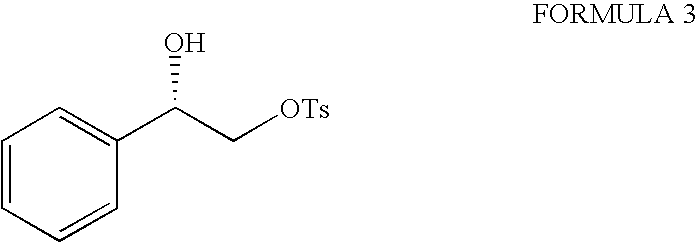
vii. reacting compound of formula (3) obtained from step (vi) with a metal cyanide in an aqueous alcohol at room temperature for a period of 15 to 24 hours, concentrating it at a temperature range of 40-70° C., extracting with brine, drying over anhydrous Na2SO4, purifying it over silica gel column to obtain a pure chiral cyano compound of formula (4);

viii. reducing the compound of formula (4) obtained from step (vii) with a reducing agent at −15 to 0° C., refluxing for a period of 1-3 hours, extracting the mixture with an organic solvent and then concentrating to obtain the product of formula (1)

2. A process as claimed in claim 1 , wherein the chiral ligand is at least one of the 1st or 2nd generation mono- or bi-dentate ligands selected from a group consisting of phthalazine, pyrimidine, phenanthryl, quinoxaline, p-chlorobenzoate.
3. A process as claimed in claim 1 , wherein the ratio of activating agent to chiral diol (2) is in the range of 1:5-5:1.
4. A process as claimed in claim 1 , wherein the organic solvent used in step (i) is toluene.
5. A process as claimed in claim 1 , wherein in step (v), the ratio of petroleum ether to ethyl acetate ranges from 4:1 to 2:1.
6. A process as claimed in claim 1 , wherein the activating reagent used in step (vi) is at least one selected from a group consisting of acid chloride, anhydride, and sulfonyl chloride.
7. A process as claimed in claim 1 , wherein the base used in step (vi) is at least one selected from a group consisting of triethylamine and pyridine.
8. A process as claimed in claim 1 , wherein the quenching agent used in step (vi) is water.
9. A process as claimed in claim 1 , wherein the metal cyanide used in step (vii) is an alkali or alkaline earth metal cyanide.
10. A process as claimed in claim 1 , wherein the aqueous alcohol used in step (vii) is ethanol.
11. A process as claimed in claim 1 , wherein the organic solvent used in step (viii) is dichloromethane.
12. A process as claimed in claim 1 , wherein the reducing agent used in step (viii) is at least one selected from a group consisting of neat dimethyl sulfide complex, THF solution dimethyl sulfide complex, and hydrides of alkali metals.
13. A process as claimed in claim 2 , wherein the chiral ligand is phthalazine.
14. A process as claimed in claim 6 , wherein the activating reagent is at least one selected from the group consisting of p-toluene sulfonyl chloride and methane sulfonyl chloride.
15. A process as claimed in claim 1 , wherein the reducing agent used in step (viii) is at least one selected from the group consisting of sodium borohydride, lithium borohydride, lithium aluminum hydride, sodium cyanoborohydride and Raney Ni.
16. A process as claimed in claim 12 , wherein the reducing agent is at least one selected from the group consisting of borane-dimethyl sulfide complex and lithium aluminum hydride.
Priority Applications (1)
| Application Number | Priority Date | Filing Date | Title |
|---|---|---|---|
| US10/309,010 US6838581B2 (en) | 2002-12-04 | 2002-12-04 | Process for the preparation of enantiomerically pure 3-phenyl-3-hydroxypropylamine |
Applications Claiming Priority (1)
| Application Number | Priority Date | Filing Date | Title |
|---|---|---|---|
| US10/309,010 US6838581B2 (en) | 2002-12-04 | 2002-12-04 | Process for the preparation of enantiomerically pure 3-phenyl-3-hydroxypropylamine |
Publications (2)
| Publication Number | Publication Date |
|---|---|
| US20040110985A1 US20040110985A1 (en) | 2004-06-10 |
| US6838581B2 true US6838581B2 (en) | 2005-01-04 |
Family
ID=32467822
Family Applications (1)
| Application Number | Title | Priority Date | Filing Date |
|---|---|---|---|
| US10/309,010 Expired - Fee Related US6838581B2 (en) | 2002-12-04 | 2002-12-04 | Process for the preparation of enantiomerically pure 3-phenyl-3-hydroxypropylamine |
Country Status (1)
| Country | Link |
|---|---|
| US (1) | US6838581B2 (en) |
-
2002
- 2002-12-04 US US10/309,010 patent/US6838581B2/en not_active Expired - Fee Related
Non-Patent Citations (2)
| Title |
|---|
| Database CASREACT on STN, Acc. No. 106:84441, Annuziata et al., Journal of the Chemical Society, Perkin Transactions 1: Organic and Bio-Organic Chemistry (1972-1999) (1985), 11, p. 2289-92 (abstract).* * |
| Pandey et al., Tetrahedron Letters 43 (2002), p. 4425-4426. * |
Also Published As
| Publication number | Publication date |
|---|---|
| US20040110985A1 (en) | 2004-06-10 |
Similar Documents
| Publication | Publication Date | Title |
|---|---|---|
| US6310248B2 (en) | Process and intermediates | |
| Effenberger et al. | Synthesis of the adrenergic bronchodilators (R)-Terbutaline and (R)-Salbutamol from (R)-Cyanohydrins1 | |
| Kumar et al. | Asymmetric dihydroxylation route to (R)-isoprenaline,(R)-norfluoxetine and (R)-fluoxetine | |
| CN101671265B (en) | A kind of benzocyclobutane compound and its preparation method and application | |
| Asami et al. | Enantioselective addition of dialkylzinc to aldehydes catalyzed by (S)-2-(N, N-disubstituted aminomethyl) indoline | |
| US6686505B2 (en) | Process for producing optically active amino alcohols and intermediates therefore | |
| CN115160158B (en) | Preparation method of chiral tertiary leucinol | |
| Schneider et al. | An efficient route to enantiomerically pure antidepressants: tomoxetine, nisoxetine and fluoxetine | |
| CN102002065A (en) | Method for preparing tapentadolhydrochloride and intermediate thereof | |
| US8299305B2 (en) | Method for preparing atomoxetine | |
| US6838581B2 (en) | Process for the preparation of enantiomerically pure 3-phenyl-3-hydroxypropylamine | |
| CN115745808B (en) | A method for preparing secondary amine compounds by catalyzing the reduction of imine compounds | |
| US20030204114A1 (en) | Phenyl propenone compounds | |
| JP4800482B2 (en) | (2S, 4R, 9S) -Octahydro-1H-indole-2-carboxylic acid production method and intermediates thereof | |
| CN101481335A (en) | Rivastigmine intermediate preparation | |
| WO2007026373A2 (en) | Process for preparing rivastigmine | |
| KR100803548B1 (en) | Method of preparing L-carnitine | |
| US9409855B2 (en) | Asymmetric synthesis of (−)-venlafaxine using organocatalyst | |
| JP2002030048A (en) | METHOD FOR PRODUCING OPTICALLY ACTIVE alpha-METHYL- BIS-3,5-(TRIFLUOROMETHYL)BENZYLAMINE | |
| Yanagisawa et al. | Asymmetric α-Amination Reaction of Alkenoate Cyclic Esters Catalyzed by Chiral Tin Alkoxides | |
| CA2511683C (en) | An efficient method for preparing 3-aryloxy-3-arylpropylamines and their optical stereoisomers | |
| Tanaka et al. | Catalytic Asymmetric Synthesis of (-)-Ritodrine Hydrochloride via Sllyl Enol Ether Amination Using Dirhodium (II) Tetrakls-(tetrafluorophthaloyl-(S)-tert-leucinate) | |
| CN104230880A (en) | Simple preparation method of 2-((4R,6R)-6-aminoethyl-2,2-dimethyl-1,3-dioxyhexacyclo-4-yl)acetate | |
| CN118955306B (en) | Improved process method of dapoxetine hydrochloride | |
| CN110668976A (en) | Rivastigmine optical isomeric intermediate and synthetic method of (R) -rivastigmine |
Legal Events
| Date | Code | Title | Description |
|---|---|---|---|
| AS | Assignment |
Owner name: COUNCIL OF SCIENTIFIC AND INDUSTRIAL RESEARCH, IND Free format text: ASSIGNMENT OF ASSIGNORS INTEREST;ASSIGNORS:KUMAR, PRADEEP;PANDEY, RAJESH KUMAR;REEL/FRAME:013908/0791 Effective date: 20030314 |
|
| FPAY | Fee payment |
Year of fee payment: 4 |
|
| REMI | Maintenance fee reminder mailed | ||
| LAPS | Lapse for failure to pay maintenance fees | ||
| STCH | Information on status: patent discontinuation |
Free format text: PATENT EXPIRED DUE TO NONPAYMENT OF MAINTENANCE FEES UNDER 37 CFR 1.362 |
|
| FP | Lapsed due to failure to pay maintenance fee |
Effective date: 20130104 |