US6837496B2 - Bullet trapping medium and system - Google Patents

Bullet trapping medium and system Download PDF

Info

Publication number
US6837496B2
US6837496B2 US10/307,427 US30742702A US6837496B2 US 6837496 B2 US6837496 B2 US 6837496B2 US 30742702 A US30742702 A US 30742702A US 6837496 B2 US6837496 B2 US 6837496B2
Authority
US
United States
Prior art keywords
backstop
medium
support structure
hydrated
gel
Prior art date
Legal status (The legal status is an assumption and is not a legal conclusion. Google has not performed a legal analysis and makes no representation as to the accuracy of the status listed.)
Expired - Fee Related
Application number
US10/307,427
Other versions
US20040104533A1 (en
Inventor
Steven L. Larson
Charles A. Weiss
Joe G. Tom
Philip G. Malone
Edward J. Fransen
Current Assignee (The listed assignees may be inaccurate. Google has not performed a legal analysis and makes no representation or warranty as to the accuracy of the list.)
United States Department of the Army
Original Assignee
United States Department of the Army
Priority date (The priority date is an assumption and is not a legal conclusion. Google has not performed a legal analysis and makes no representation as to the accuracy of the date listed.)
Filing date
Publication date
Assigned to ARMY, UNITED STATES GOVERNMENT AS REPRESENTED BY THE SECRETARY OF THE reassignment ARMY, UNITED STATES GOVERNMENT AS REPRESENTED BY THE SECRETARY OF THE ASSIGNMENT OF ASSIGNORS INTEREST (SEE DOCUMENT FOR DETAILS). Assignors: FRANSEN, EDWARD J., LARSON, STEVEN L., MALONE, PHILIP G., TOM, JOE G., WEISS JR., CHARLES A.
Priority to US10/307,427 priority Critical patent/US6837496B2/en
Application filed by United States Department of the Army filed Critical United States Department of the Army
Priority to US10/848,433 priority patent/US7354044B2/en
Publication of US20040104533A1 publication Critical patent/US20040104533A1/en
Priority to US10/890,846 priority patent/US7134664B2/en
Priority to US10/911,771 priority patent/US7111847B2/en
Priority to US10/979,834 priority patent/US7571912B2/en
Publication of US6837496B2 publication Critical patent/US6837496B2/en
Application granted granted Critical
Priority to US11/484,558 priority patent/US7243921B2/en
Anticipated expiration legal-status Critical
Expired - Fee Related legal-status Critical Current

Links

Images

Classifications

    • FMECHANICAL ENGINEERING; LIGHTING; HEATING; WEAPONS; BLASTING
    • F41WEAPONS
    • F41JTARGETS; TARGET RANGES; BULLET CATCHERS
    • F41J13/00Bullet catchers

Definitions

  • the present invention relates generally to the firing of projectiles on a range, and, more particularly, to an apparatus and method for decelerating and trapping munitions fired on a range.
  • bullet containment systems focus on two different types of systems.
  • the first often called a bullet stop and containment chamber, has a pair of plates that channel bullets toward an opening in a containment chamber. Inside the containment chamber are impact plates that slow the bullet to a stop.
  • impact plates that slow the bullet to a stop.
  • the second type of containment system is the bullet backstop or bullet trap system.
  • Bullet backstops typically include a back plate made of steel inclined to the line of fire. On an upper surface of the back plate, a layer of material is disposed to provide a medium for decelerating and trapping bullets. This layer is several feet thick in the direction the bullet travels.
  • the impact material is typically a resilient granular material. As a bullet impacts the material, it will decelerate sufficiently such that, if it does impact the back plate, any ricochet will be minimal.
  • a number of bullet traps utilize rubber chunks or chips as the impact material.
  • U.S. Pat. No. 6,378,870 to Sovine (“the '870 Patent”) teaches the use of relatively large rubber nuggets disposed along a plane inclined to the line of fire
  • U.S. Pat. No. 5,848,794 to Wojcinski et al. (“the '794 Patent”) discloses a similar bullet trap using relatively small rubber granules disposed along an inclined plane.
  • the '794 Patent further teaches the use of a self-healing membrane covering the rubber granules.
  • trapping systems like those disclosed in the '870 Patent and the '794 Patent lack inherent fire retardant characteristics. Thus, they often suffer from heat and fire problems, especially if the chips are not treated with a fire retardant, are improperly maintained, contain steel or fiber, or if the chips are relatively small. To combat these hazards, both the '870 Patent and the '974 Patent teach treating the rubber nuggets with a fire retardant. Unfortunately, the fire retardants used in these and other prior art systems tend to wash off, such that traps maintained outdoors will rapidly lose their fire retardant characteristics during and after a rain. Additionally, though these systems trap the bullet, they do nothing to stabilize them from an environmental hazard standpoint. Thus, expended rounds must periodically be recovered from the trap to prevent heavy metal leaching and associated environmental contamination.
  • Still another object of the present invention is to provide a bullet trapping system that will not leach heavy metals into the environment.
  • Yet another object of the present invention is to provide a bullet trapping system that can accommodate many different calibers and types of bullets.
  • a further object of the present invention is to provide a bullet trapping system that requires minimal maintenance over an extended useful life.
  • the present invention is a backstop for decelerating and trapping projectiles.
  • the backstop generally includes a support structure having an inclined surface and a projectile trapping medium disposed on the inclined surface.
  • the projectile trapping medium may be either a resilient granular ballistic medium, such as rubber chunks, plastic scrap, or wood chips, or a combination of a ballistic medium with a hydrated super absorbent polymer (SAP) gel.
  • the support structure is made of a shock absorbing, foamed, fiber-reinforced concrete, such as SACON®.
  • the support structure also includes an enclosure.
  • the enclosure includes a back wall and opposing sidewalls, and optionally includes a toe block adjacent to the foot of the inclined surface.
  • Additives such as phosphates, carbonates, silicates, bicarbonates, and hydroxides may also be included in the projectile trapping medium. These additives may serve to raise the pH of the SAP gel, prevent leaching of heavy metals from the projectile into the environment, stabilize the SAP gel chemically, act as a flame retardant, retard the growth of mold or bacteria in the SAP gel, or some combination thereof.
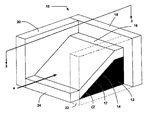
  • FIG. 1 is a perspective view of a bullet trapping backstop according to the present invention, with one sidewall shown in phantom for clarity;
  • FIG. 2 is a partial top plan view of the bullet trapping backstop of FIG. 1 ;
  • FIG. 3 is a cross-sectional side view of the bullet trapping backstop of FIG. 1 , taken along line 3 - 3 with the optional toe block removed;
  • FIG. 4 is a detail view of the chunk plus hydrated super absorbent polymer (SAP) gel medium according to the present invention.
  • Backstop 10 for decelerating and trapping projectiles traveling along a line of fire “a” towards backstop 10 .
  • Backstop 10 generally includes a foundation or support structure 12 having an upper surface 14 and a projectile trapping medium 16 disposed on upper surface 14 .
  • FIG. 2 shows a plan view of upper surface 14 of bullet trapping backstop 10 .
  • support structure 12 includes a back wall 18 and opposing first and second sidewalls 20 , 22 , forming an enclosure around projectile trapping medium 16 .
  • second sidewall 22 is shown in phantom for clarity.
  • Support structure 12 may also include a toe block 24 disposed adjacent to the foot of the inclined portion 17 of upper surface 14 .
  • toe block 24 is not required to hold bullet trapping medium 16 in place. This embodiment of backstop 10 is best illustrated in FIG. 3 .
  • support structure 12 (including back wall 18 , first and second sidewalls 20 , 22 , and toe block 24 when present) is made of a shock absorbing, foamed, fiber-reinforced concrete, such as SACON®.
  • SACON® shock absorbing, foamed, fiber-reinforced concrete
  • bullet trapping medium 16 includes a resilient granular ballistic medium 26 , such as rubber chunks, wood chips, plastic scrap, or any other material that will not produce a ricochet when impacted by a bullet. Rubber chunks are preferred because of their durability when subjected to impacts from incoming bullets.
  • ballistic medium 26 is deposited directly onto upper surface 14 of support structure 12 .
  • ballistic medium 26 is preferably mixed with a hydrated super absorbent polymer (SAP) gel 28 to form an “artificial soil” of ballistic medium 26 “chunks” in an SAP gel 28 matrix. That is, ballistic medium 26 serves as a framework to hold hydrated SAP gel 28 , and hydrated SAP gel 28 occupies interstices 30 within ballistic medium 26 .
  • This combination provides for a higher angle of repose ⁇ (shown in FIGS. 1 and 2 ), a reduced likelihood of sluffing of bullet trapping medium 16 , and therefore the potential for a more compact backstop 10 in the direction of line of fire “a.”
  • SAP will absorb up to 400 times its mass in water, such that the resulting hydrated SAP gel 28 can be up to 97.5% water by mass, with nearly the density of water.
  • SAP material is marketed in a variety of forms (e.g., granules, powders, and fibers).
  • hydrated SAP gel 28 is a sodium or potassium acrylate, acrylamide, or carboxylate polymer, or some combination thereof.
  • the mixture of ballistic medium 26 and SAP gel 28 may be more than 50% SAP by volume, such that there is a substantially reduced likelihood of fire, thereby reducing or eliminating the need for flame retardant additives.
  • Cross-linked polyacrylate and polyamide SAP gels 28 are most stable when maintained in a wet condition with a pH above 4.5, as they tend to shrink and shed water in acids. Additionally, higher alkalinities reduce the solubility of lead and other heavy metal ions.
  • at least one additive is mixed with hydrated SAP gel 28 to maintain a pH of at least 4.5, and preferably a pH between 8 and 12, inclusive.
  • the most preferred additives typically provide a pH of approximately 10.4.
  • SAP gel has an inherent ability to bind lead.
  • Cetco, Inc. of Arlington Heights, Ill. claims that a granular cross-linked polyacrylate will absorb a 30 ppm lead solution, producing a volume change of 110 times the volume of the absorbent. Since most of the lead in bullet backstop 10 will be in the form of metallic lead, however, it is also desirable to include at least one additive that will form a passive coating on the metallic particles, thereby preventing the lead from corroding, formulating soluble lead compounds, and leaching into the environment.
  • the preferred additives generally have low solubility in water, and will typically remain as powdery solids in the mixture.
  • Appropriate choices are phosphates, carbonates, hydroxides, silicates, and bicarbonates, either singly or in combination. These additives can serve both purposes discussed above. That is, they will both increase the pH of SAP gel 28 and prevent leaching of heavy metals into the environment. They can also help stabilize hydrated SAP gel 28 chemically, retard the growth of mold or bacteria in hydrated SAP gel 28 , and enhance the flame retardant characteristics of bullet trapping medium 16 .
  • an appropriate cation such as potassium, sodium, aluminum, magnesium, or calcium, for the additive. It will also be apparent to one skilled in the art that different or additional additives may be used as well. However, as will be discussed below, the most preferred additives are calcium phosphate, calcium carbonate, and aluminum hydroxide.
  • SAP absorbs less water per unit dry weight when the water around it contains large quantities of dissolved materials. For example, a typical SAP will absorb approximately 50 times its dry weight in water in a 1% NaCl solution, but only 22 times its dry weight in a 10% NaCl solution. Most buffering and passivating compounds are most effective when they are in solution in reasonably constant concentrations. Additionally, soluble forms of phosphorus can leach out of the SAP mixture, causing environmental pollution. Furthermore, any phosphate precipitated as lead or copper phosphate is no longer available to act as a buffer.
  • the present invention preferably addresses these considerations by using calcium phosphate compounds having low solubilities as additives.
  • concentration of these calcium compounds in solution is never high enough to alter the water absorbance of the SAP.
  • more solid (particulate) calcium phosphate dissolves to maintain a saturated, but not very concentrated, solution.
  • calcium carbonate and aluminum hydroxide are valuable additives. Calcium carbonate provides additional buffering capacity, while aluminum hydroxide adds to the buffering capacity and can also react with lead phosphates to form very insoluble lead aluminum phosphates.
  • bullet trapping medium 16 One useful method of designing bullet trapping medium 16 is to estimate the volume of ballistic medium 26 to be employed in backstop 10 and determine the proportion of interstices 30 in that volume. Typically, this would be approximately 50% of the volume of ballistic medium 26 . Assume that the density of hydrated SAP gel 28 needed to fill interstices 30 will approximate that of water and calculate the weight of hydrated SAP gel 28 . Each additive can then be added to bullet trapping medium 16 as 5 to 10 parts of each additive for every 100 parts of hydrated SAP gel 28 .
  • the resulting bullet trapping medium 16 reduces the leaching of heavy metals, thus prolonging the life of the trap. Since the trapped rounds are stabilized from an environmental perspective, there is also a substantially reduced need to periodically “clean” the trap and reclaim spent rounds. Furthermore, the medium is adapted for use with various calibers and metals, and provides for a nearly noiseless bullet impact. The medium may also be used to anchor disposable papier-mâché or cardboard targets, thus providing a stable and transportable target display without the use of items that will produce a ricochet or require retrieval and removal.

Landscapes

  • Engineering & Computer Science (AREA)
  • General Engineering & Computer Science (AREA)
  • Aiming, Guidance, Guns With A Light Source, Armor, Camouflage, And Targets (AREA)
  • Compositions Of Macromolecular Compounds (AREA)
  • Processing Of Solid Wastes (AREA)

Abstract

A backstop for decelerating and trapping projectiles generally includes a support structure having an inclined surface and a projectile trapping medium disposed on the inclined surface. The projectile trapping medium may be either a resilient granular ballistic medium or a combination of a ballistic medium with a hydrated super absorbent polymer (SAP) gel. Preferably, the support structure is made of a shock absorbing, foamed, fiber-reinforced concrete, such as SACON®. In embodiments, the support structure also includes an enclosure. Additives may also be mixed into the projectile trapping medium to control alkalinity and prevent leaching of heavy metals.

Description

STATEMENT OF GOVERNMENT INTEREST
The invention described herein may be manufactured and used by or for the United States Government for governmental purposes without the payment of any royalties thereon.
BACKGROUND OF THE INVENTION
1. Field of the Invention
The present invention relates generally to the firing of projectiles on a range, and, more particularly, to an apparatus and method for decelerating and trapping munitions fired on a range.
2. Background Description
In order to maintain proficiency in the use of firearms, it is common to engage in target practice on a training range. Traditionally, the primary concern on a training range was the prevention of ricochets. Thus, ranges often use a large dirt berm behind the target to decelerate and trap the bullet.
More recently, however, considerable concern has been raised about the environmental impact of heavy metals (e.g., lead, tungsten, copper) contained within the bullet. Though a bullet fired into a mound of dirt is safely contained from the standpoint of no longer being a dangerous projectile, heavy metals within the bullet remain free to leach into the soil, thereby contaminating the environment. Thus, shooting ranges have begun to stress containment and removal of expended rounds in order to prevent environmental contamination.
Additionally, there is a growing desire to build shooting ranges within enclosed structures. This permits frequent use of the range regardless of weather and without excessive travel time. Obviously, however, use of a dirt berm behind the target is impractical for such indoor ranges.
Thus, current trends in bullet containment systems focus on two different types of systems. The first, often called a bullet stop and containment chamber, has a pair of plates that channel bullets toward an opening in a containment chamber. Inside the containment chamber are impact plates that slow the bullet to a stop. Unfortunately, such systems are relatively expensive and difficult to manufacture and maintain.
The second type of containment system is the bullet backstop or bullet trap system. Bullet backstops typically include a back plate made of steel inclined to the line of fire. On an upper surface of the back plate, a layer of material is disposed to provide a medium for decelerating and trapping bullets. This layer is several feet thick in the direction the bullet travels. The impact material is typically a resilient granular material. As a bullet impacts the material, it will decelerate sufficiently such that, if it does impact the back plate, any ricochet will be minimal.
A number of bullet traps utilize rubber chunks or chips as the impact material. For example, U.S. Pat. No. 6,378,870 to Sovine (“the '870 Patent”) teaches the use of relatively large rubber nuggets disposed along a plane inclined to the line of fire, while U.S. Pat. No. 5,848,794 to Wojcinski et al. (“the '794 Patent”) discloses a similar bullet trap using relatively small rubber granules disposed along an inclined plane. To reduce scatter and sluffing of the impact material, the '794 Patent further teaches the use of a self-healing membrane covering the rubber granules.
However, trapping systems like those disclosed in the '870 Patent and the '794 Patent lack inherent fire retardant characteristics. Thus, they often suffer from heat and fire problems, especially if the chips are not treated with a fire retardant, are improperly maintained, contain steel or fiber, or if the chips are relatively small. To combat these hazards, both the '870 Patent and the '974 Patent teach treating the rubber nuggets with a fire retardant. Unfortunately, the fire retardants used in these and other prior art systems tend to wash off, such that traps maintained outdoors will rapidly lose their fire retardant characteristics during and after a rain. Additionally, though these systems trap the bullet, they do nothing to stabilize them from an environmental hazard standpoint. Thus, expended rounds must periodically be recovered from the trap to prevent heavy metal leaching and associated environmental contamination.
SUMMARY OF THE INVENTION
Accordingly, it is an object of the present invention to provide a bullet trapping system with inherent flame retardant characteristics.
It is another object of the present invention to provide a bullet trapping system that substantially reduces the likelihood of ricochets.
Still another object of the present invention is to provide a bullet trapping system that will not leach heavy metals into the environment.
Yet another object of the present invention is to provide a bullet trapping system that can accommodate many different calibers and types of bullets.
A further object of the present invention is to provide a bullet trapping system that requires minimal maintenance over an extended useful life.
The present invention is a backstop for decelerating and trapping projectiles. The backstop generally includes a support structure having an inclined surface and a projectile trapping medium disposed on the inclined surface. The projectile trapping medium may be either a resilient granular ballistic medium, such as rubber chunks, plastic scrap, or wood chips, or a combination of a ballistic medium with a hydrated super absorbent polymer (SAP) gel. Preferably, the support structure is made of a shock absorbing, foamed, fiber-reinforced concrete, such as SACON®. In embodiments, the support structure also includes an enclosure. The enclosure includes a back wall and opposing sidewalls, and optionally includes a toe block adjacent to the foot of the inclined surface. Additives, such as phosphates, carbonates, silicates, bicarbonates, and hydroxides may also be included in the projectile trapping medium. These additives may serve to raise the pH of the SAP gel, prevent leaching of heavy metals from the projectile into the environment, stabilize the SAP gel chemically, act as a flame retardant, retard the growth of mold or bacteria in the SAP gel, or some combination thereof.
Further advantages of the present invention will be apparent from the description below with reference to the accompanying drawings, in which like numbers indicate like elements.
BRIEF DESCRIPTION OF THE DRAWINGS
FIG. 1 is a perspective view of a bullet trapping backstop according to the present invention, with one sidewall shown in phantom for clarity;
FIG. 2 is a partial top plan view of the bullet trapping backstop of FIG. 1;
FIG. 3 is a cross-sectional side view of the bullet trapping backstop of FIG. 1, taken along line 3-3 with the optional toe block removed; and
FIG. 4 is a detail view of the chunk plus hydrated super absorbent polymer (SAP) gel medium according to the present invention.
DETAILED DESCRIPTION OF PREFERRED EMBODIMENTS OF THE INVENTION
Referring now to the drawings, and specifically to FIGS. 1 through 3, there is shown a bullet trapping backstop 10 for decelerating and trapping projectiles traveling along a line of fire “a” towards backstop 10. (It should be understood that the terms “bullet,” “projectile,” and “round” are used interchangeably herein and refer to projectiles or munitions of any sort or caliber.) Backstop 10 generally includes a foundation or support structure 12 having an upper surface 14 and a projectile trapping medium 16 disposed on upper surface 14. FIG. 2 shows a plan view of upper surface 14 of bullet trapping backstop 10. At least a portion 17 of upper surface 14 is inclined with respect to line of fire “a” by an angle α, which is preferably less than or equal to the angle of repose of projectile trapping medium 16. In embodiments, support structure 12 includes a back wall 18 and opposing first and second sidewalls 20, 22, forming an enclosure around projectile trapping medium 16. (In FIG. 1, second sidewall 22 is shown in phantom for clarity.) Support structure 12 may also include a toe block 24 disposed adjacent to the foot of the inclined portion 17 of upper surface 14. However, one skilled in the art will realize that, because angle α should not exceed the angle of repose of bullet trapping medium 16, toe block 24 is not required to hold bullet trapping medium 16 in place. This embodiment of backstop 10 is best illustrated in FIG. 3.
Preferably, support structure 12 (including back wall 18, first and second sidewalls 20, 22, and toe block 24 when present) is made of a shock absorbing, foamed, fiber-reinforced concrete, such as SACON®. Such construction reduces the likelihood of dangerous ricochets of any rounds that impact support structure 12 instead of bullet trapping medium 16. However, one skilled in the art will recognize that all or part of support structure 12 may also be made from any other appropriate material, such as wood, steel, or earth.
Referring now to FIG. 4, bullet trapping medium 16 includes a resilient granular ballistic medium 26, such as rubber chunks, wood chips, plastic scrap, or any other material that will not produce a ricochet when impacted by a bullet. Rubber chunks are preferred because of their durability when subjected to impacts from incoming bullets.
In embodiments, ballistic medium 26 is deposited directly onto upper surface 14 of support structure 12. However, ballistic medium 26 is preferably mixed with a hydrated super absorbent polymer (SAP) gel 28 to form an “artificial soil” of ballistic medium 26 “chunks” in an SAP gel 28 matrix. That is, ballistic medium 26 serves as a framework to hold hydrated SAP gel 28, and hydrated SAP gel 28 occupies interstices 30 within ballistic medium 26. This combination provides for a higher angle of repose α (shown in FIGS. 1 and 2), a reduced likelihood of sluffing of bullet trapping medium 16, and therefore the potential for a more compact backstop 10 in the direction of line of fire “a.”
SAP will absorb up to 400 times its mass in water, such that the resulting hydrated SAP gel 28 can be up to 97.5% water by mass, with nearly the density of water. Thus, for bullet trapping backstops 10 maintained outside, rainfall enhances, rather than impairs, performance. SAP material is marketed in a variety of forms (e.g., granules, powders, and fibers). Preferably, hydrated SAP gel 28 is a sodium or potassium acrylate, acrylamide, or carboxylate polymer, or some combination thereof. Further, the mixture of ballistic medium 26 and SAP gel 28 may be more than 50% SAP by volume, such that there is a substantially reduced likelihood of fire, thereby reducing or eliminating the need for flame retardant additives.
Cross-linked polyacrylate and polyamide SAP gels 28 are most stable when maintained in a wet condition with a pH above 4.5, as they tend to shrink and shed water in acids. Additionally, higher alkalinities reduce the solubility of lead and other heavy metal ions. Thus, in embodiments, at least one additive is mixed with hydrated SAP gel 28 to maintain a pH of at least 4.5, and preferably a pH between 8 and 12, inclusive. The most preferred additives, as discussed below, typically provide a pH of approximately 10.4.
Further, SAP gel has an inherent ability to bind lead. For example, Cetco, Inc. of Arlington Heights, Ill. claims that a granular cross-linked polyacrylate will absorb a 30 ppm lead solution, producing a volume change of 110 times the volume of the absorbent. Since most of the lead in bullet backstop 10 will be in the form of metallic lead, however, it is also desirable to include at least one additive that will form a passive coating on the metallic particles, thereby preventing the lead from corroding, formulating soluble lead compounds, and leaching into the environment.
The preferred additives generally have low solubility in water, and will typically remain as powdery solids in the mixture. Appropriate choices are phosphates, carbonates, hydroxides, silicates, and bicarbonates, either singly or in combination. These additives can serve both purposes discussed above. That is, they will both increase the pH of SAP gel 28 and prevent leaching of heavy metals into the environment. They can also help stabilize hydrated SAP gel 28 chemically, retard the growth of mold or bacteria in hydrated SAP gel 28, and enhance the flame retardant characteristics of bullet trapping medium 16. One skilled in the art will understand how to select an appropriate cation, such as potassium, sodium, aluminum, magnesium, or calcium, for the additive. It will also be apparent to one skilled in the art that different or additional additives may be used as well. However, as will be discussed below, the most preferred additives are calcium phosphate, calcium carbonate, and aluminum hydroxide.
The use of buffering and passivating additives with SAP presents additional considerations. SAP absorbs less water per unit dry weight when the water around it contains large quantities of dissolved materials. For example, a typical SAP will absorb approximately 50 times its dry weight in water in a 1% NaCl solution, but only 22 times its dry weight in a 10% NaCl solution. Most buffering and passivating compounds are most effective when they are in solution in reasonably constant concentrations. Additionally, soluble forms of phosphorus can leach out of the SAP mixture, causing environmental pollution. Furthermore, any phosphate precipitated as lead or copper phosphate is no longer available to act as a buffer.
The present invention preferably addresses these considerations by using calcium phosphate compounds having low solubilities as additives. The concentration of these calcium compounds in solution is never high enough to alter the water absorbance of the SAP. However, as the phosphate is removed by reactions with lead and copper, more solid (particulate) calcium phosphate dissolves to maintain a saturated, but not very concentrated, solution. In addition to calcium phosphate compounds, calcium carbonate and aluminum hydroxide are valuable additives. Calcium carbonate provides additional buffering capacity, while aluminum hydroxide adds to the buffering capacity and can also react with lead phosphates to form very insoluble lead aluminum phosphates.
It will be apparent to one skilled in the art how to produce an SAP mixture with a pH in the desired range and saturated with respect to the additives used. One useful method of designing bullet trapping medium 16 is to estimate the volume of ballistic medium 26 to be employed in backstop 10 and determine the proportion of interstices 30 in that volume. Typically, this would be approximately 50% of the volume of ballistic medium 26. Assume that the density of hydrated SAP gel 28 needed to fill interstices 30 will approximate that of water and calculate the weight of hydrated SAP gel 28. Each additive can then be added to bullet trapping medium 16 as 5 to 10 parts of each additive for every 100 parts of hydrated SAP gel 28.
The resulting bullet trapping medium 16 reduces the leaching of heavy metals, thus prolonging the life of the trap. Since the trapped rounds are stabilized from an environmental perspective, there is also a substantially reduced need to periodically “clean” the trap and reclaim spent rounds. Furthermore, the medium is adapted for use with various calibers and metals, and provides for a nearly noiseless bullet impact. The medium may also be used to anchor disposable papier-mâché or cardboard targets, thus providing a stable and transportable target display without the use of items that will produce a ricochet or require retrieval and removal.
While the invention has been described in terms of its preferred embodiments, those skilled in the art will recognize that the invention can be practiced with modifications within the spirit and scope of the appended claims. Thus, it is intended that all matter contained in the foregoing description or shown in the accompanying drawings shall be interpreted as illustrative rather than limiting, and the invention should be defined only in accordance with the following claims and their equivalents.
Claims (18)

1. A backstop for decelerating and trapping projectiles traveling along a line of fire, said backstop comprising:
a support structure having an upper surface, said upper surface having at least one segment inclined with respect to the line of fire; and
a projectile trapping medium disposed on said upper surface, said projectile trapping medium comprising a mixture of a resilient granular ballistic medium in a hydrated super-absorbent polymer (SAP) gel matrix.
2. The backstop according to claim 1, wherein said support structure further comprises a back wall and two opposing sidewalls.
3. The backstop according to claim 2, wherein said support structure further comprises a toe block disposed adjacent a foot of said inclined segment.
4. The backstop according to claim 1, wherein said support structure further comprises a shock absorbing, foamed, fiber-reinforced concrete enclosure.
5. The backstop according to claim 4, wherein said shock absorbing, foamed, fiber-reinforced concrete is SACON®.
6. The backstop according to claim 1, wherein said ballistic medium is selected from the group consisting of rubber chunks, wood chips, plastic scraps, and any combination thereof.
7. The backstop according to claim 1, wherein said hydrated SAP gel is selected from the group consisting of sodium acrylate, potassium acrylate, sodium acrylamide, potassium acrylamide, sodium carboxylate, potassium carboxylate, and any combination thereof.
8. The backstop according to claim 1, wherein said projectile trapping medium further comprises at least one additive.
9. The backstop according to claim 8, wherein said at least one additive is selected from the group consisting of phosphates, carbonates, hydroxides, silicates, bicarbonates, and any combination thereof.
10. The backstop according to claim 8, wherein said at least one additive serves to maintain a pH of said hydrated SAP gel at 4.5 or higher.
11. The backstop according to claim 10, wherein the pH of said hydrated SAP gel is between 8 and 12, inclusive.
12. The backstop according to claim 8, wherein said at least one additive serves to inhibit leaching of heavy metals that may be contained within the projectiles.
13. The backstop according to claim 1, wherein said inclined segment is inclined with respect to the line of fire by an angle less than or equal to an angle of repose of the projectile trapping medium.
14. A method of forming a backstop for decelerating and trapping projectiles traveling along a line of fire, comprising the steps of:
providing a support structure having an inclined surface;
mixing a resilient granular ballistic medium with a hydrated super absorbent polymer (SAP) gel, thereby forming a projectile trapping medium comprising a mixture of a resilient granular ballistic medium in a hydrated super-absorbent polymer (SAP) gel matrix; and
disposing said projectile trapping medium on the inclined surface.
15. The method according to claim 14, further comprising the step of adding to the projectile trapping medium at least one additive selected from the group consisting of additives serving to increase a pH of the hydrated SAP gel, additives serving to prevent leaching of heavy metals that may be contained within the projectiles, and flame retardant additives.
16. The method according to claim 14, wherein said step of providing a support structure comprises providing a shock absorbing, foamed, fiber-reinforced concrete support structure.
17. The method according to claim 14, further comprising the step of maintaining a pH of the hydrated SAP gel at a value of at least 4.5.
18. The method according to claim 17, wherein said step of maintaining a pH of the hydrated SAP gel at a value of at least 4.5 comprises maintaining the pH of the hydrated SAP gel at a value between 8 and 12, inclusive.
US10/307,427 2002-12-02 2002-12-02 Bullet trapping medium and system Expired - Fee Related US6837496B2 (en)

Priority Applications (6)

Application Number Priority Date Filing Date Title
US10/307,427 US6837496B2 (en) 2002-12-02 2002-12-02 Bullet trapping medium and system
US10/848,433 US7354044B2 (en) 2002-12-02 2004-05-19 Partitioned particulate bullet trap
US10/890,846 US7134664B2 (en) 2002-12-02 2004-07-09 Modular bullet trap cover
US10/911,771 US7111847B2 (en) 2002-12-02 2004-08-04 Self-dispensing bullet trap buffer block
US10/979,834 US7571912B2 (en) 2002-12-02 2004-11-03 Bullet trapping medium, system for employing said medium and method of use of said medium
US11/484,558 US7243921B2 (en) 2002-12-02 2006-07-12 Method providing self-dispensing additive from buffer blocks for use with a medium in a bullet trap

Applications Claiming Priority (1)

Application Number Priority Date Filing Date Title
US10/307,427 US6837496B2 (en) 2002-12-02 2002-12-02 Bullet trapping medium and system

Related Child Applications (4)

Application Number Title Priority Date Filing Date
US10/848,433 Continuation-In-Part US7354044B2 (en) 2002-12-02 2004-05-19 Partitioned particulate bullet trap
US10/890,846 Continuation-In-Part US7134664B2 (en) 2002-12-02 2004-07-09 Modular bullet trap cover
US10/911,771 Continuation-In-Part US7111847B2 (en) 2002-12-02 2004-08-04 Self-dispensing bullet trap buffer block
US10/979,834 Continuation US7571912B2 (en) 2002-12-02 2004-11-03 Bullet trapping medium, system for employing said medium and method of use of said medium

Publications (2)

Publication Number Publication Date
US20040104533A1 US20040104533A1 (en) 2004-06-03
US6837496B2 true US6837496B2 (en) 2005-01-04

Family

ID=32392563

Family Applications (2)

Application Number Title Priority Date Filing Date
US10/307,427 Expired - Fee Related US6837496B2 (en) 2002-12-02 2002-12-02 Bullet trapping medium and system
US10/979,834 Expired - Fee Related US7571912B2 (en) 2002-12-02 2004-11-03 Bullet trapping medium, system for employing said medium and method of use of said medium

Family Applications After (1)

Application Number Title Priority Date Filing Date
US10/979,834 Expired - Fee Related US7571912B2 (en) 2002-12-02 2004-11-03 Bullet trapping medium, system for employing said medium and method of use of said medium

Country Status (1)

Country Link
US (2) US6837496B2 (en)

Cited By (8)

* Cited by examiner, † Cited by third party
Publication number Priority date Publication date Assignee Title
US20040212151A1 (en) * 2002-12-02 2004-10-28 Jeffrey Peiten Statement regarding federally sponsored research or development
US20050093243A1 (en) * 2002-12-02 2005-05-05 Larson Steven L. Bullet trapping medium and system
US20050220686A1 (en) * 2004-01-30 2005-10-06 Solucorp Industries, Ltd Remediation of heavy metals in ammunition traps and shooting ranges
US20070126184A1 (en) * 2002-12-02 2007-06-07 Larson Steven L Method providing self-dispensing additive from buffer blocks for use with a medium in a bullet trap
US7421893B1 (en) * 2005-11-15 2008-09-09 Mann Ii Richard A Bullet test tube and method
WO2023281472A1 (en) * 2021-07-09 2023-01-12 1054610 Bc Ltd. Systems and methods for separating bullets from backstop material
US12252441B2 (en) 2020-10-28 2025-03-18 The Procter & Gamble Company Cementitious compositions comprising recycled superabsorbent polymer
USD1112579S1 (en) 2021-11-05 2026-02-10 Timothy Scott Schmalbeck Combined gun clearing and test trap

Families Citing this family (15)

* Cited by examiner, † Cited by third party
Publication number Priority date Publication date Assignee Title
DE60326769D1 (en) * 2003-01-20 2009-04-30 Gerth Moberg DEVICE FOR FIREPLACES
US7134233B1 (en) * 2003-10-01 2006-11-14 The United States Of America As Represented By The Secretary Of The Army Acoustically tuned cartridge casing catcher
EP2113817B1 (en) * 2007-02-22 2018-12-26 ETA SA Manufacture Horlogère Suisse Chronograph
EP1990599A1 (en) * 2007-05-07 2008-11-12 Schweiz. Eidgenossenschaft vertr. durch das Eidg. Dep. VBS handelnd durch Logistikbasis der Armee Bullet catcher, method and system for their recovery
US8371282B2 (en) * 2010-05-10 2013-02-12 The Maya Group, Inc. Soft-projectile launching device
US8596255B2 (en) * 2010-05-10 2013-12-03 Hobbeezone, Inc. Super absorbent polymer projectile launching device
KR200453613Y1 (en) 2010-07-29 2011-05-16 김재진 Automatic shooting signs
US8550466B2 (en) 2010-08-13 2013-10-08 Brian Paul Priebe Bullet decelerating medium and bullet trapping system and method using the medium
US8720426B2 (en) 2011-02-25 2014-05-13 Razor Usa, Llc Soft impact projectile launcher
USD687905S1 (en) 2012-03-15 2013-08-13 Razor Usa Llc Projectile launcher
USD687904S1 (en) 2012-03-15 2013-08-13 Razor Usa Llc Projectile launcher
MX2012004821A (en) * 2012-04-25 2013-10-24 Jorge Armando Haro Covarrubias Projectile recovery chamber.
CN108981504A (en) * 2018-09-28 2018-12-11 无锡市帆鹰警用器材新技术有限公司 Water tank bomb-gripper
RU2714541C1 (en) * 2019-07-25 2020-02-18 федеральное государственное бюджетное образовательное учреждение высшего образования "Донской государственный технический университет" (ДГТУ) Bullet-absorbing material (fibrous foam concrete) and method for its production
CN112923811A (en) * 2021-01-21 2021-06-08 中国科学院力学研究所 Receiving device for gas detonation driven ultra-high-speed emission

Citations (10)

* Cited by examiner, † Cited by third party
Publication number Priority date Publication date Assignee Title
WO1991017408A1 (en) * 1990-05-09 1991-11-14 Demetrio Leone Bullet catcher for stopping bullets
US5435571A (en) 1990-01-19 1995-07-25 Caswell International Corporation Granulate backstop assembly
US5607163A (en) 1990-01-19 1997-03-04 Caswell International Corporation Granulate backstop assembly
US5848794A (en) 1991-01-18 1998-12-15 Caswell International Corporation Granulate backstop assembly
US5901960A (en) 1998-01-13 1999-05-11 Caswell International Corporation Granulate-backstop assembly
US6173956B1 (en) 1996-09-27 2001-01-16 O.M.F. Inc. Projectile backstop assembly
US6264735B1 (en) * 1998-10-21 2001-07-24 U.S. Army Corps Of Engineers As Represented By The Secretary Of The Army Low-lead leaching foamed concrete bullet barrier
US6378870B1 (en) 1999-12-24 2002-04-30 Action Target, Inc. Apparatus and method for decelerating projectiles
US6446974B1 (en) * 2001-03-05 2002-09-10 The United States Of America As Represented By The Secretary Of The Army Durable system for controlling the disposition of expended munitions fired at a target positioned close to the shooter
US6573358B2 (en) * 2000-04-20 2003-06-03 Bayer Aktiengesellschaft Process for the preparation of superabsorbent polymers from polyacrylonitrile precipitation polymers

Family Cites Families (5)

* Cited by examiner, † Cited by third party
Publication number Priority date Publication date Assignee Title
US6565961B2 (en) * 1997-03-07 2003-05-20 Koslow Technologies Corporation Absorbent articles
US6562743B1 (en) * 1998-12-24 2003-05-13 Bki Holding Corporation Absorbent structures of chemically treated cellulose fibers
US6688811B2 (en) 2002-01-29 2004-02-10 Keith E Forrester Stabilization method for lead projectile impact area
US6620236B2 (en) 2002-02-08 2003-09-16 The United States Of America As Represented By The Secretary Of The Army Material, and method of producing it, for immobilizing heavy metals later entrained therein
US6837496B2 (en) 2002-12-02 2005-01-04 The United States Of America As Represented By The Secretary Of The Army Bullet trapping medium and system

Patent Citations (13)

* Cited by examiner, † Cited by third party
Publication number Priority date Publication date Assignee Title
US5435571A (en) 1990-01-19 1995-07-25 Caswell International Corporation Granulate backstop assembly
US5607163A (en) 1990-01-19 1997-03-04 Caswell International Corporation Granulate backstop assembly
WO1991017408A1 (en) * 1990-05-09 1991-11-14 Demetrio Leone Bullet catcher for stopping bullets
US6027120A (en) 1991-01-18 2000-02-22 Caswell International Corporation Granulate backstop assembly
US5848794A (en) 1991-01-18 1998-12-15 Caswell International Corporation Granulate backstop assembly
US6293552B1 (en) 1991-01-18 2001-09-25 Caswell International Corporation Granulate backstop assembly
US6173956B1 (en) 1996-09-27 2001-01-16 O.M.F. Inc. Projectile backstop assembly
US5901960A (en) 1998-01-13 1999-05-11 Caswell International Corporation Granulate-backstop assembly
US6000700A (en) 1998-01-13 1999-12-14 Caswell International Corporation Granulate-backstop assembly
US6264735B1 (en) * 1998-10-21 2001-07-24 U.S. Army Corps Of Engineers As Represented By The Secretary Of The Army Low-lead leaching foamed concrete bullet barrier
US6378870B1 (en) 1999-12-24 2002-04-30 Action Target, Inc. Apparatus and method for decelerating projectiles
US6573358B2 (en) * 2000-04-20 2003-06-03 Bayer Aktiengesellschaft Process for the preparation of superabsorbent polymers from polyacrylonitrile precipitation polymers
US6446974B1 (en) * 2001-03-05 2002-09-10 The United States Of America As Represented By The Secretary Of The Army Durable system for controlling the disposition of expended munitions fired at a target positioned close to the shooter

Cited By (12)

* Cited by examiner, † Cited by third party
Publication number Priority date Publication date Assignee Title
US20040212151A1 (en) * 2002-12-02 2004-10-28 Jeffrey Peiten Statement regarding federally sponsored research or development
US20050093243A1 (en) * 2002-12-02 2005-05-05 Larson Steven L. Bullet trapping medium and system
US20070126184A1 (en) * 2002-12-02 2007-06-07 Larson Steven L Method providing self-dispensing additive from buffer blocks for use with a medium in a bullet trap
US7243921B2 (en) 2002-12-02 2007-07-17 The United States Of America As Represented By The Secretary Of The Army Method providing self-dispensing additive from buffer blocks for use with a medium in a bullet trap
US7354044B2 (en) * 2002-12-02 2008-04-08 The United States Of America As Represented By The Secretary Of The Navy Partitioned particulate bullet trap
US7571912B2 (en) * 2002-12-02 2009-08-11 The United States Of America As Represented By The Secretary Of The Army Bullet trapping medium, system for employing said medium and method of use of said medium
US20050220686A1 (en) * 2004-01-30 2005-10-06 Solucorp Industries, Ltd Remediation of heavy metals in ammunition traps and shooting ranges
WO2005074651A3 (en) * 2004-01-30 2006-12-28 Solucorp Ind Ltd Remediation of heavy metals in ammunition traps and shooting ranges
US7421893B1 (en) * 2005-11-15 2008-09-09 Mann Ii Richard A Bullet test tube and method
US12252441B2 (en) 2020-10-28 2025-03-18 The Procter & Gamble Company Cementitious compositions comprising recycled superabsorbent polymer
WO2023281472A1 (en) * 2021-07-09 2023-01-12 1054610 Bc Ltd. Systems and methods for separating bullets from backstop material
USD1112579S1 (en) 2021-11-05 2026-02-10 Timothy Scott Schmalbeck Combined gun clearing and test trap

Also Published As

Publication number Publication date
US20050093243A1 (en) 2005-05-05
US7571912B2 (en) 2009-08-11
US20040104533A1 (en) 2004-06-03

Similar Documents

Publication Publication Date Title
US6837496B2 (en) Bullet trapping medium and system
US6378870B1 (en) Apparatus and method for decelerating projectiles
US9891029B2 (en) Apparatus for collecting warheads
KR102022825B1 (en) A panel for preventing from ricochet bullet
US5456155A (en) Bullet trap assembly
KR102022827B1 (en) Sloped Bullet Recovery Device Using Natural Rubber Panel
US7243921B2 (en) Method providing self-dispensing additive from buffer blocks for use with a medium in a bullet trap
EP2188584A2 (en) A bullet trap with inclined plates
US7354044B2 (en) Partitioned particulate bullet trap
NZ333763A (en) Environmentally safe projectable shooting targets
US6446974B1 (en) Durable system for controlling the disposition of expended munitions fired at a target positioned close to the shooter
KR101505983B1 (en) Bullet head collecting apparatus for combat shooting training range
KR101525959B1 (en) Bullet head collecting apparatus for zero point shooting range
US7134664B2 (en) Modular bullet trap cover
KR102022826B1 (en) Wall-Typed Bullet Recovery Device Using Natural Rubber Panel
McConnell et al. A study of shotgun pellet ricochet
US20050220686A1 (en) Remediation of heavy metals in ammunition traps and shooting ranges
US20210148680A1 (en) Apparatus for Target Shooting and Projectile Containment
KR101492715B1 (en) Bullet head collecting apparatus for real distance shooting range
Nishshanka et al. Impact evidence and post-ricochet behaviour of shotgun pellets ricocheting off standard floor tiles
KR102667388B1 (en) Integral projectile block and integral projectile block assembly
RU103610U1 (en) Dust collector
JP2001215098A (en) Bulletproof wall
KR102031154B1 (en) Apparatus for collecting bullet
US20130019740A1 (en) Method and apparatus for absorbing the energy of bullet impacts

Legal Events

Date Code Title Description
AS Assignment

Owner name: ARMY, UNITED STATES GOVERNMENT AS REPRESENTED BY T

Free format text: ASSIGNMENT OF ASSIGNORS INTEREST;ASSIGNORS:LARSON, STEVEN L.;WEISS JR., CHARLES A.;TOM, JOE G.;AND OTHERS;REEL/FRAME:013565/0555;SIGNING DATES FROM 20021112 TO 20021114

FPAY Fee payment

Year of fee payment: 4

REMI Maintenance fee reminder mailed
FPAY Fee payment

Year of fee payment: 8

SULP Surcharge for late payment

Year of fee payment: 7

REMI Maintenance fee reminder mailed
LAPS Lapse for failure to pay maintenance fees
STCH Information on status: patent discontinuation

Free format text: PATENT EXPIRED DUE TO NONPAYMENT OF MAINTENANCE FEES UNDER 37 CFR 1.362

STCH Information on status: patent discontinuation

Free format text: PATENT EXPIRED DUE TO NONPAYMENT OF MAINTENANCE FEES UNDER 37 CFR 1.362

FP Lapsed due to failure to pay maintenance fee

Effective date: 20170104