US6835139B2 - Universal joint having a balancing arrangement - Google Patents

Universal joint having a balancing arrangement Download PDF

Info

Publication number
US6835139B2
US6835139B2 US10/445,620 US44562003A US6835139B2 US 6835139 B2 US6835139 B2 US 6835139B2 US 44562003 A US44562003 A US 44562003A US 6835139 B2 US6835139 B2 US 6835139B2
Authority
US
United States
Prior art keywords
universal joint
balancing
bore
support
joint according
Prior art date
Legal status (The legal status is an assumption and is not a legal conclusion. Google has not performed a legal analysis and makes no representation as to the accuracy of the status listed.)
Expired - Fee Related
Application number
US10/445,620
Other versions
US20030224862A1 (en
Inventor
Hans-Jürgen Schultze
Current Assignee (The listed assignees may be inaccurate. Google has not performed a legal analysis and makes no representation or warranty as to the accuracy of the list.)
Spicer Gelenkwellenbau GmbH
Original Assignee
Spicer Gelenkwellenbau GmbH
Priority date (The priority date is an assumption and is not a legal conclusion. Google has not performed a legal analysis and makes no representation as to the accuracy of the date listed.)
Filing date
Publication date
Application filed by Spicer Gelenkwellenbau GmbH filed Critical Spicer Gelenkwellenbau GmbH
Assigned to SPICER GELENKWELLENBAU GMBH & CO. reassignment SPICER GELENKWELLENBAU GMBH & CO. ASSIGNMENT OF ASSIGNORS INTEREST (SEE DOCUMENT FOR DETAILS). Assignors: SCHULTZE, HANS-JURGEN
Assigned to SPICER GELENKWELLENBAU GMBH & CO KG reassignment SPICER GELENKWELLENBAU GMBH & CO KG CORRECTIVE ASSIGNMENT TO CORRECT NAME OF ASSIGNEE, PREVIOUSLY RECORDED ON REEL 014124, FRAME 0634. Assignors: SCHULTZE, HANS-JURGEN
Publication of US20030224862A1 publication Critical patent/US20030224862A1/en
Application granted granted Critical
Publication of US6835139B2 publication Critical patent/US6835139B2/en
Anticipated expiration legal-status Critical
Expired - Fee Related legal-status Critical Current

Links

Images

Classifications

    • FMECHANICAL ENGINEERING; LIGHTING; HEATING; WEAPONS; BLASTING
    • F16ENGINEERING ELEMENTS AND UNITS; GENERAL MEASURES FOR PRODUCING AND MAINTAINING EFFECTIVE FUNCTIONING OF MACHINES OR INSTALLATIONS; THERMAL INSULATION IN GENERAL
    • F16DCOUPLINGS FOR TRANSMITTING ROTATION; CLUTCHES; BRAKES
    • F16D3/00Yielding couplings, i.e. with means permitting movement between the connected parts during the drive
    • F16D3/16Universal joints in which flexibility is produced by means of pivots or sliding or rolling connecting parts
    • F16D3/26Hooke's joints or other joints with an equivalent intermediate member to which each coupling part is pivotally or slidably connected
    • F16D3/38Hooke's joints or other joints with an equivalent intermediate member to which each coupling part is pivotally or slidably connected with a single intermediate member with trunnions or bearings arranged on two axes perpendicular to one another
    • F16D3/40Hooke's joints or other joints with an equivalent intermediate member to which each coupling part is pivotally or slidably connected with a single intermediate member with trunnions or bearings arranged on two axes perpendicular to one another with intermediate member provided with two pairs of outwardly-directed trunnions on intersecting axes
    • FMECHANICAL ENGINEERING; LIGHTING; HEATING; WEAPONS; BLASTING
    • F16ENGINEERING ELEMENTS AND UNITS; GENERAL MEASURES FOR PRODUCING AND MAINTAINING EFFECTIVE FUNCTIONING OF MACHINES OR INSTALLATIONS; THERMAL INSULATION IN GENERAL
    • F16DCOUPLINGS FOR TRANSMITTING ROTATION; CLUTCHES; BRAKES
    • F16D3/00Yielding couplings, i.e. with means permitting movement between the connected parts during the drive
    • F16D3/16Universal joints in which flexibility is produced by means of pivots or sliding or rolling connecting parts
    • F16D3/26Hooke's joints or other joints with an equivalent intermediate member to which each coupling part is pivotally or slidably connected
    • F16D3/38Hooke's joints or other joints with an equivalent intermediate member to which each coupling part is pivotally or slidably connected with a single intermediate member with trunnions or bearings arranged on two axes perpendicular to one another
    • F16D3/40Hooke's joints or other joints with an equivalent intermediate member to which each coupling part is pivotally or slidably connected with a single intermediate member with trunnions or bearings arranged on two axes perpendicular to one another with intermediate member provided with two pairs of outwardly-directed trunnions on intersecting axes
    • F16D3/41Hooke's joints or other joints with an equivalent intermediate member to which each coupling part is pivotally or slidably connected with a single intermediate member with trunnions or bearings arranged on two axes perpendicular to one another with intermediate member provided with two pairs of outwardly-directed trunnions on intersecting axes with ball or roller bearings
    • FMECHANICAL ENGINEERING; LIGHTING; HEATING; WEAPONS; BLASTING
    • F16ENGINEERING ELEMENTS AND UNITS; GENERAL MEASURES FOR PRODUCING AND MAINTAINING EFFECTIVE FUNCTIONING OF MACHINES OR INSTALLATIONS; THERMAL INSULATION IN GENERAL
    • F16CSHAFTS; FLEXIBLE SHAFTS; ELEMENTS OR CRANKSHAFT MECHANISMS; ROTARY BODIES OTHER THAN GEARING ELEMENTS; BEARINGS
    • F16C35/00Rigid support of bearing units; Housings, e.g. caps, covers
    • F16C35/04Rigid support of bearing units; Housings, e.g. caps, covers in the case of ball or roller bearings
    • F16C35/06Mounting or dismounting of ball or roller bearings; Fixing them onto shaft or in housing
    • F16C35/067Fixing them in a housing
    • FMECHANICAL ENGINEERING; LIGHTING; HEATING; WEAPONS; BLASTING
    • F16ENGINEERING ELEMENTS AND UNITS; GENERAL MEASURES FOR PRODUCING AND MAINTAINING EFFECTIVE FUNCTIONING OF MACHINES OR INSTALLATIONS; THERMAL INSULATION IN GENERAL
    • F16DCOUPLINGS FOR TRANSMITTING ROTATION; CLUTCHES; BRAKES
    • F16D3/00Yielding couplings, i.e. with means permitting movement between the connected parts during the drive
    • F16D3/16Universal joints in which flexibility is produced by means of pivots or sliding or rolling connecting parts
    • F16D3/26Hooke's joints or other joints with an equivalent intermediate member to which each coupling part is pivotally or slidably connected
    • F16D3/38Hooke's joints or other joints with an equivalent intermediate member to which each coupling part is pivotally or slidably connected with a single intermediate member with trunnions or bearings arranged on two axes perpendicular to one another
    • F16D3/382Hooke's joints or other joints with an equivalent intermediate member to which each coupling part is pivotally or slidably connected with a single intermediate member with trunnions or bearings arranged on two axes perpendicular to one another constructional details of other than the intermediate member
    • FMECHANICAL ENGINEERING; LIGHTING; HEATING; WEAPONS; BLASTING
    • F16ENGINEERING ELEMENTS AND UNITS; GENERAL MEASURES FOR PRODUCING AND MAINTAINING EFFECTIVE FUNCTIONING OF MACHINES OR INSTALLATIONS; THERMAL INSULATION IN GENERAL
    • F16CSHAFTS; FLEXIBLE SHAFTS; ELEMENTS OR CRANKSHAFT MECHANISMS; ROTARY BODIES OTHER THAN GEARING ELEMENTS; BEARINGS
    • F16C21/00Combinations of sliding-contact bearings with ball or roller bearings, for exclusively rotary movement
    • F16C21/005Combinations of sliding-contact bearings with ball or roller bearings, for exclusively rotary movement the external zone of a bearing with rolling members, e.g. needles, being cup-shaped, with or without a separate thrust-bearing disc or ring, e.g. for universal joints
    • FMECHANICAL ENGINEERING; LIGHTING; HEATING; WEAPONS; BLASTING
    • F16ENGINEERING ELEMENTS AND UNITS; GENERAL MEASURES FOR PRODUCING AND MAINTAINING EFFECTIVE FUNCTIONING OF MACHINES OR INSTALLATIONS; THERMAL INSULATION IN GENERAL
    • F16DCOUPLINGS FOR TRANSMITTING ROTATION; CLUTCHES; BRAKES
    • F16D2300/00Special features for couplings or clutches
    • F16D2300/22Vibration damping

Definitions

  • the invention relates to a universal joint having a balancing arrangement.
  • European Patent Application Publication No. 385,176 A1 describes a balancing arrangement for a universal joint shaft in which a separate fixing ring, together with a connection tube, is fixed on a universal joint.
  • the fixing ring encloses a partial length portion of the connection tube.
  • individual balancing weights can be attached by means of point welding.
  • This arrangement does not allow, especially during repair works of a joint shaft and the renewed balancing, a destruction-free disassembly.
  • a high expenditure method has to be carried out, as special devices are necessary by which the balancing weights can be welded on. A faulty attachment can also only be corrected by means of a destruction.
  • the invention therefore, has the object to provide a universal joint having a balancing arrangement that can be made in a simple and reproducible manner and also allows in a simple way a balancing during repair works.
  • a universal joint having a balancing arrangement comprising two joint yokes, having, respectively, two yoke arms, in which, respectively, a support bore, centered on a common bore axis, is arranged.
  • the support bore has a groove.
  • the balancing arrangement further includes a journal cross assembly having four journals, of which, respectively, two are arranged on a common axis and intersect each other perpendicularly. Bearing bushings are supported on the journals and have, respectively, a bottom and an outer face. A bearing bushing is received, respectively, in each of the support bores.
  • a retaining ring is provided in each support bore and serves to fix the bearing bushing.
  • the retaining ring engages in the groove of the support bore and is supported on the outer face of the bottom of the corresponding bearing bushing.
  • the retaining ring has a support portion arranged radially outwardly in reference to the bore axis and abuts the bottom of the bearing bushing.
  • the retaining ring has at least one holding portion pointing radially inwardly to the bore axis, which is axially off-set in reference to the support portion and is distanced to the bottom, thereby forming a gap.
  • the balancing arrangement further including a balancing weight, formed as a ring, interrupted at one point, and retainable in the gap between the bottom and the at least one holding portion.
  • the balancing weight is attached where the imbalances in a universal joint are concentrated. Furthermore, it is advantageous that in case of repair works, a simple re-balancing is possible as the balancing weights are attached removably. At the same time, it is easily possible to increase the balancing accuracy by means of exchanging the weights during the balancing.
  • each holding portion and the balancing weight have a first and a second contact face, respectively, which contact each other, wherein at least one of the contact faces forms part of a face of an envelope of a cone approaching away from the bore axis along the outer face of the bottom.
  • the faces contacting each other can be formed concerning their extension path in such a way that a self-locking is achieved and, therefore, a detaching is prevented. Forces that act in the direction towards the bottom of the bearing bushing do not act on to the balancing weight, as they are directly introduced into the yoke arms of the corresponding joint yoke by means of the retaining ring.
  • the balance weight has a fixing portion radially at the outside in reference to the bore axis, the fixing portion engaging in the gap of the retaining ring.
  • the balancing weight has balancing segments, and the balancing segments are attached on the fixing portion radially towards the bore axis.
  • the balancing segments can be individually detachable from the fixing portion and/or from each other.
  • the balancing weight has at least one slot extending, starting from an inner contour, radially to the outside into the fixing portion. Balancing weights with different masses can also be formed in such a way that the balancing segments in their thickness are formed differently and have different dimensions in radial direction at a constant thickness.
  • a universal joint shaft in which a universal joint is provided with a balancing arrangement according to the invention, and different design possibilities for the balancing weights are represented schematically in the drawing and are described by means of these.
  • FIG. 1 shows a universal joint shaft having a balancing arrangement according to the invention.
  • FIG. 2 shows a cross-sectional view of the detail X of FIG. 1 in an enlarged scale.
  • FIG. 3 shows a top view of FIG. 2 .
  • FIG. 4 shows the detail Y of FIG. 2 in an again enlarged scale of a first embodiment of a balancing weight.
  • FIG. 5 show the detail Y of FIG. 2 in an again enlarged condition with an alternative embodiment of a balancing weight.
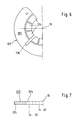
  • FIG. 6 shows a representation of a half of the first embodiment of the balancing weight of FIG. 5 .
  • FIG. 7 shows a half cross-sectional view through a further embodiment of a balancing weight.
  • FIG. 1 shows a universal joint shaft including a first universal joint 1 having a first joint yoke 2 with a first yoke arm 3 and distanced thereto a second yoke arm 4 .
  • a support bore 5 extends through both yoke arms 3 and 4 .
  • Both support bores 5 (only one is illustrated) are centered on a bore axis 10 .
  • a pair of bearing bushings 8 are received in the support bores 5 of the two yoke arms 3 and 4 .
  • the bearing bushings 8 are supported on journals 7 .
  • These, together with a journal cross 6 form the first half of a journal cross assembly.
  • the journal cross 6 has, furthermore, two further journals that are arranged perpendicularly to the first journals 7 and, together with these, in the same plane.
  • a groove 11 is arranged in the support bore 5 .
  • a retaining ring 17 rests, supporting the bearing bushing 8 along the bore axis 10 .
  • the two further journals of the journal cross 6 supporting also bearing bushings, are held in the yoke arms of a second joint yoke 12 according to the arrangement, as described in connection with the first joint yoke 2 .
  • the above described components form together the first universal joint 1 .
  • a second universal joint 13 corresponding to the universal joint 1 is arranged on an end of a connection shaft 14 distanced from the first joint yoke 2 , and which connection shaft 14 allowing a length adjustment in a telescopic manner.
  • FIGS. 2 and 3 show the first yoke arm 3 of the first joint yoke 2 having the support bore 5 . It has the bore axis 10 .
  • the journal 7 of the journal cross 6 is received by means of interposition of rolling members and the bearing bushing 8 .
  • the bearing bushing 8 has a bottom 15 with an outer circumferential face 16 .
  • the groove 11 extends continuously around the bore axis 10 .
  • the balancing arrangement comprises the retaining ring 17 having a support portion 18 engaging in the groove 11 and abutting, furthermore, the outer face 16 of the bottom 15 of the bearing bushing 8 .
  • the journal cross 6 is held centered in the direction of the bore axis 10 between the two yoke arms 3 and 4 of the first joint yoke 2 .
  • the retaining ring 17 is, as shown in FIG. 3, formed open at a point in the circumferential direction so that it can be reduced in diameter by a suitable tool and can be pushed into the support bore 5 such that it enters the groove 11 .
  • three holding portions 19 are distributedly arranged around the circumference and are attached radially towards the inside, which are cranked or angled, furthermore, in reference to the path of extension of the support portion 18 , so that towards the outer face 16 of the bottom 15 of the bearing bushing 8 , a gap 20 is formed that is open towards the bore axis 10 .
  • the holding portions 19 Distanced from the outer face 16 of the bottom 15 of the bearing bushing 8 and opposed thereto, the holding portions 19 have a first contact face 21 , as especially shown in FIG.
  • Balancing weights 22 of different masses can be arranged to the retaining ring 17 .
  • These balancing weights 22 are formed similar to the retaining ring 17 and have radially, in reference to the bore axis 10 , on the outside, a fixing portion 24 that enters the gap 20 .
  • balancing segments 25 are arranged. The balancing segments 25 are separated from each other by means of a slot 26 .
  • FIG. 3 shows, respectively, only one half of the retaining ring 17 and of the annular balancing weight 22 .
  • two slots 26 are provided, starting from the inner contour of the balancing segments 25 and extending radially into the fixing portion 24 .
  • the balancing segments 25 differ in reference to their thickness from the portion of the balancing weight 17 , having a second contact face 23 contacting the first contact face 21 of the holding portion 19 .
  • the second contact face 23 and a face 27 supported on the outer face 16 of the bottom 15 extend parallel.
  • the second contact face 123 extends corresponding to the path of extension of the first contact face 21 of the holding portion 19 of the retaining ring 17 , fitting same in form of a partial envelope of a cone.
  • the individual balancing weights 22 can differ from each other according to their masses in such a way that they have a different thickness, it is provided in the embodiment of a balancing weight 222 of FIG. 7 that the balancing segments 225 attached on the fixing portion 224 in radial direction towards the bore axis 10 have different radial dimensions so that inner diameters D 1 and D 2 with different sizes are achieved.

Landscapes

  • Engineering & Computer Science (AREA)
  • General Engineering & Computer Science (AREA)
  • Mechanical Engineering (AREA)
  • Shafts, Cranks, Connecting Bars, And Related Bearings (AREA)
  • Motor Power Transmission Devices (AREA)
  • Pivots And Pivotal Connections (AREA)

Abstract

A universal joint has a balancing arrangement that includes yoke arms having respectively, a support bore, centered on a common bore axis, and the support bore having a groove. A journal cross assembly comprises four journals, which axes intersect each other perpendicularly, and bearing bushings, having, respectively, a bottom, having an outer face, and in which bearing bushings, a journal is, respectively, supported. Respectively, one bearing bushing is received in a support bore and is secured by means of a retaining ring, engaging in the groove and supported on the outer face of the bottom of the corresponding bearing bushing. The retaining ring has a support portion on which radially inwards and projecting towards the bore axis, a holding portion is attached, axially offset to the support portion and distanced to the bottom, forming a gap. A balancing weight, formed as a ring discontinued at a point, can be retained in the gap between the bottom and the at least one holding portion.

Description

BACKGROUND OF THE INVENTION
The invention relates to a universal joint having a balancing arrangement.
European Patent Application Publication No. 385,176 A1, incorporated herein by reference, describes a balancing arrangement for a universal joint shaft in which a separate fixing ring, together with a connection tube, is fixed on a universal joint. The fixing ring encloses a partial length portion of the connection tube. On the outer face of the fixing ring, individual balancing weights can be attached by means of point welding. This arrangement, however, does not allow, especially during repair works of a joint shaft and the renewed balancing, a destruction-free disassembly. Furthermore, for such an arrangement, a high expenditure method has to be carried out, as special devices are necessary by which the balancing weights can be welded on. A faulty attachment can also only be corrected by means of a destruction. Furthermore, the position for the attachments of the balancing weights is not optimal, as the largest imbalance lies in the universal joint itself. Further, in short universal joint couplings, in which practically no connection tube is provided, up to now it was only possible to remove the masses by means of drilling-out, which leads, however, to the disadvantage, that a weakening results.
SUMMARY OF THE INVENTION
The invention, therefore, has the object to provide a universal joint having a balancing arrangement that can be made in a simple and reproducible manner and also allows in a simple way a balancing during repair works.
This object is achieved according to the invention by a universal joint having a balancing arrangement comprising two joint yokes, having, respectively, two yoke arms, in which, respectively, a support bore, centered on a common bore axis, is arranged. The support bore has a groove. The balancing arrangement further includes a journal cross assembly having four journals, of which, respectively, two are arranged on a common axis and intersect each other perpendicularly. Bearing bushings are supported on the journals and have, respectively, a bottom and an outer face. A bearing bushing is received, respectively, in each of the support bores. A retaining ring is provided in each support bore and serves to fix the bearing bushing. To accomplish this, the retaining ring engages in the groove of the support bore and is supported on the outer face of the bottom of the corresponding bearing bushing. The retaining ring has a support portion arranged radially outwardly in reference to the bore axis and abuts the bottom of the bearing bushing. The retaining ring has at least one holding portion pointing radially inwardly to the bore axis, which is axially off-set in reference to the support portion and is distanced to the bottom, thereby forming a gap. The balancing arrangement further including a balancing weight, formed as a ring, interrupted at one point, and retainable in the gap between the bottom and the at least one holding portion.
In the embodiment, it is advantageous that the balancing weight is attached where the imbalances in a universal joint are concentrated. Furthermore, it is advantageous that in case of repair works, a simple re-balancing is possible as the balancing weights are attached removably. At the same time, it is easily possible to increase the balancing accuracy by means of exchanging the weights during the balancing.
Preferably, on the support portion, three holding portions for retaining the balancing weight are provided. These are distributedly arranged on the support portion. For a secure retainment of the balancing weight, it is provided that each holding portion and the balancing weight have a first and a second contact face, respectively, which contact each other, wherein at least one of the contact faces forms part of a face of an envelope of a cone approaching away from the bore axis along the outer face of the bottom. In this case, the faces contacting each other can be formed concerning their extension path in such a way that a self-locking is achieved and, therefore, a detaching is prevented. Forces that act in the direction towards the bottom of the bearing bushing do not act on to the balancing weight, as they are directly introduced into the yoke arms of the corresponding joint yoke by means of the retaining ring.
For fixing, the balance weight has a fixing portion radially at the outside in reference to the bore axis, the fixing portion engaging in the gap of the retaining ring.
An advantageous solution is where the balancing weight has balancing segments, and the balancing segments are attached on the fixing portion radially towards the bore axis. In this case, the balancing segments can be individually detachable from the fixing portion and/or from each other.
To be able to mount the balancing weight in a simpler way, it has at least one slot extending, starting from an inner contour, radially to the outside into the fixing portion. Balancing weights with different masses can also be formed in such a way that the balancing segments in their thickness are formed differently and have different dimensions in radial direction at a constant thickness.
A universal joint shaft, in which a universal joint is provided with a balancing arrangement according to the invention, and different design possibilities for the balancing weights are represented schematically in the drawing and are described by means of these.
Various objects and advantages of this invention will become apparent to those skilled in the art from the following detailed description of the preferred embodiments, when read in light of the accompanying drawings.
BRIEF DESCRIPTION OF THE DRAWINGS
FIG. 1 shows a universal joint shaft having a balancing arrangement according to the invention.
FIG. 2 shows a cross-sectional view of the detail X of FIG. 1 in an enlarged scale.
FIG. 3 shows a top view of FIG. 2.
FIG. 4 shows the detail Y of FIG. 2 in an again enlarged scale of a first embodiment of a balancing weight.
FIG. 5 show the detail Y of FIG. 2 in an again enlarged condition with an alternative embodiment of a balancing weight.
FIG. 6 shows a representation of a half of the first embodiment of the balancing weight of FIG. 5.
FIG. 7 shows a half cross-sectional view through a further embodiment of a balancing weight.
DETAILED DESCRIPTION OF THE PREFERRED EMBODIMENTS
FIG. 1 shows a universal joint shaft including a first universal joint 1 having a first joint yoke 2 with a first yoke arm 3 and distanced thereto a second yoke arm 4. Through both yoke arms 3 and 4 a support bore 5 extends. Both support bores 5 (only one is illustrated) are centered on a bore axis 10. In the support bores 5 of the two yoke arms 3 and 4, a pair of bearing bushings 8 are received. The bearing bushings 8 are supported on journals 7. These, together with a journal cross 6, form the first half of a journal cross assembly. The journal cross 6 has, furthermore, two further journals that are arranged perpendicularly to the first journals 7 and, together with these, in the same plane.
In the support bore 5, a groove 11 is arranged. In this groove 11, a retaining ring 17 rests, supporting the bearing bushing 8 along the bore axis 10. The two further journals of the journal cross 6, supporting also bearing bushings, are held in the yoke arms of a second joint yoke 12 according to the arrangement, as described in connection with the first joint yoke 2. The above described components form together the first universal joint 1. A second universal joint 13 corresponding to the universal joint 1 is arranged on an end of a connection shaft 14 distanced from the first joint yoke 2, and which connection shaft 14 allowing a length adjustment in a telescopic manner.
The balancing arrangement is firstly described as follows by means of FIGS. 2, 3, 4, and 6. FIGS. 2 and 3 show the first yoke arm 3 of the first joint yoke 2 having the support bore 5. It has the bore axis 10. In the support bore 5, the journal 7 of the journal cross 6 is received by means of interposition of rolling members and the bearing bushing 8. The bearing bushing 8 has a bottom 15 with an outer circumferential face 16. In the support bore 5, in the area of the bottom 15, the groove 11 extends continuously around the bore axis 10. The balancing arrangement comprises the retaining ring 17 having a support portion 18 engaging in the groove 11 and abutting, furthermore, the outer face 16 of the bottom 15 of the bearing bushing 8. Hereby, the journal cross 6 is held centered in the direction of the bore axis 10 between the two yoke arms 3 and 4 of the first joint yoke 2. The retaining ring 17 is, as shown in FIG. 3, formed open at a point in the circumferential direction so that it can be reduced in diameter by a suitable tool and can be pushed into the support bore 5 such that it enters the groove 11. On the support portion 18, three holding portions 19 are distributedly arranged around the circumference and are attached radially towards the inside, which are cranked or angled, furthermore, in reference to the path of extension of the support portion 18, so that towards the outer face 16 of the bottom 15 of the bearing bushing 8, a gap 20 is formed that is open towards the bore axis 10. Distanced from the outer face 16 of the bottom 15 of the bearing bushing 8 and opposed thereto, the holding portions 19 have a first contact face 21, as especially shown in FIG. 4, which is shown as a part of an envelope or surface of a cone that is centered on the bore axis 10, and which envelope of a cone approaches the outer face 16 of the bottom 15 as it extends outwardly from the bore axis 10. Balancing weights 22 of different masses can be arranged to the retaining ring 17. These balancing weights 22 are formed similar to the retaining ring 17 and have radially, in reference to the bore axis 10, on the outside, a fixing portion 24 that enters the gap 20. Continuous with the fixing portion 24 and radially inwards towards the bore axis 10, balancing segments 25 are arranged. The balancing segments 25 are separated from each other by means of a slot 26. FIG. 3 shows, respectively, only one half of the retaining ring 17 and of the annular balancing weight 22. Altogether, two slots 26 are provided, starting from the inner contour of the balancing segments 25 and extending radially into the fixing portion 24. From FIG. 2, it can be seen that the balancing segments 25 differ in reference to their thickness from the portion of the balancing weight 17, having a second contact face 23 contacting the first contact face 21 of the holding portion 19. In the embodiment of FIGS. 2, 3, and 4, the second contact face 23 and a face 27 supported on the outer face 16 of the bottom 15, extend parallel.
In the embodiment of a balancing weight 122 of FIG. 5, the second contact face 123 extends corresponding to the path of extension of the first contact face 21 of the holding portion 19 of the retaining ring 17, fitting same in form of a partial envelope of a cone.
While in the embodiment of FIGS. 2 and 3, the individual balancing weights 22 can differ from each other according to their masses in such a way that they have a different thickness, it is provided in the embodiment of a balancing weight 222 of FIG. 7 that the balancing segments 225 attached on the fixing portion 224 in radial direction towards the bore axis 10 have different radial dimensions so that inner diameters D1 and D2 with different sizes are achieved.
From the embodiment of FIG. 6, it also can be taken that the individual balancing weights 125 are separated from each other by means of notches so that they are removable to be able to produce the correct mass for the desired balancing quality.
In accordance with the provisions of the patent statutes, the principle and mode of operation of this invention have been explained and illustrated in its preferred embodiments. However, it must be understood that this invention may be practiced otherwise than as specifically explained and illustrated without departing from its spirit or scope.

Claims (10)

What is claimed is:
1. A universal joint having a balancing arrangement comprising:
two joint yokes having, respectively, two yoke arms in which, respectively, a support bore, centered on a common bore axis, is arranged, the support bore having a groove;
a journal cross assembly having four journals of which, respectively, two are arranged on a common axis, which axes intersect each other perpendicularly, having bearing bushings having, respectively, a bottom and an outer face, and in which bearing bushes, respectively, a journal is supported, wherein, respectively, the bearing bushings are received in the support bores;
a retaining ring provided in each support bore and serving to fix the bearing bushing and for this, engaging in the groove of the support bore supporting on the outer face of the bottom of the corresponding bearing bushing, the retaining ring having a support portion arranged radially outwardly in reference to the bore axis and abutting the bottom on which pointing radially inwardly to the bore axis, at least one holding portion is attached that is axially off-set in reference to the support portion and is distanced to the bottom, thereby forming a gap; and
a balancing weight formed as a ring, interrupted at one point, and retainable in the gap between the bottom and the at least one holding portion.
2. The universal joint according to claim 1, characterized in that three holding portions are attached distributedly on the support portion.
3. The universal joint according to claim 2, characterized in that each holding portion and the balancing weight have a first and a second contact face, respectively, that contact each other, wherein at least one of the contact faces forms a part of a face of an envelope of a cone, which approaches the outer face of the bottom as it extends outwardly from the bore axis.
4. The universal joint according to claim 1, characterized in that each holding portion and the balancing weight have a first and a second contact face, respectively, which contact each other, wherein at least one of the contact faces forms a part of a face of an envelope of a cone that, away from the bore axis, approaches the outer face of the bottom.
5. The universal joint according to claim 1, characterized in that the balancing weight has, in reference to the bore axis, radially outside, a fixing portion, the fixing portion engaging in the gap of the retaining ring.
6. The universal joint according to claim 5, characterized in that the balancing weight has balancing segments, and that the balancing segments are attached on the fixing portion radially towards the bore axis.
7. The universal joint according to claim 5, characterized in that the balancing segments are individually detachable from the fixing portion.
8. The universal joint according to claim 7, characterized in that the balancing segments are individually detachable from one another.
9. The universal joint according to claim 5, characterized in that the balancing segments are individually detachable from one another.
10. The universal joint according to claim 5, characterized in that the balancing weight has at least one slot extending, starting from an inner contour, radially to the outside into the fixing portion.
US10/445,620 2002-05-28 2003-05-27 Universal joint having a balancing arrangement Expired - Fee Related US6835139B2 (en)

Applications Claiming Priority (3)

Application Number Priority Date Filing Date Title
DE10223849 2002-05-28
DE10223849.9 2002-05-28
DE10223849A DE10223849C1 (en) 2002-05-28 2002-05-28 Cross-link with balancing fitting has bearing shell in bearing boring with securing ring

Publications (2)

Publication Number Publication Date
US20030224862A1 US20030224862A1 (en) 2003-12-04
US6835139B2 true US6835139B2 (en) 2004-12-28

Family

ID=27588633

Family Applications (1)

Application Number Title Priority Date Filing Date
US10/445,620 Expired - Fee Related US6835139B2 (en) 2002-05-28 2003-05-27 Universal joint having a balancing arrangement

Country Status (4)

Country Link
US (1) US6835139B2 (en)
JP (1) JP2003343593A (en)
KR (1) KR20030091802A (en)
DE (1) DE10223849C1 (en)

Cited By (1)

* Cited by examiner, † Cited by third party
Publication number Priority date Publication date Assignee Title
US20090279822A1 (en) * 2008-05-06 2009-11-12 Schaeffler Kg Axial thrust washers partially for unbalance shafts

Families Citing this family (8)

* Cited by examiner, † Cited by third party
Publication number Priority date Publication date Assignee Title
US6821207B2 (en) * 2003-02-24 2004-11-23 American Axle & Manufacturing, Inc. Driveshaft assembly with retention mechanism
US6813973B1 (en) * 2003-08-20 2004-11-09 Torque-Traction Technologies, Inc. Drive shaft balancing
US7115037B2 (en) * 2003-10-30 2006-10-03 Automotive Components Holdings, Llc Universal joint and method of servicing a staked universal joint
ATE339629T1 (en) * 2003-10-31 2006-10-15 Voith Turbo Kg UNIVERSAL JOINT ARRANGEMENT WITH A BALANCING ARRANGEMENT AND BALANCING WEIGHT
DE102004036105A1 (en) * 2004-07-24 2006-03-16 Ina-Schaeffler Kg Bearing arrangement in a universal joint
DE102005055397B4 (en) * 2005-11-17 2012-10-25 Spicer Gelenkwellenbau Gmbh Fixation arrangement for bearing bushes on a universal joint fork
JP4504410B2 (en) 2006-10-20 2010-07-14 イノヴァティヴ ソニック リミテッド Method and apparatus for setting uplink transmission channel configuration in a wireless communication system
US7887422B2 (en) 2007-08-02 2011-02-15 American Axle & Manufacturing, Inc. Universal joint with bearing cup retention mechanism

Citations (5)

* Cited by examiner, † Cited by third party
Publication number Priority date Publication date Assignee Title
US1993357A (en) * 1933-04-11 1935-03-05 Cleveland Steel Products Corp Universal joint
US4705490A (en) * 1984-12-20 1987-11-10 J. M. Voith Gmbh Hooke's-type joint for a universal shaft
EP0385176A1 (en) 1989-02-28 1990-09-05 GKN Cardantec International Gesellschaft für Antriebstechnik mbH Arrangement of the balancing weight for a propeller shaft with universal joints
US5746658A (en) * 1991-05-06 1998-05-05 Dana Corporation Anti-rotation retainer for universal joint
US5989125A (en) * 1996-01-16 1999-11-23 Voith Turbo Gmbh And Co., Kg Universal joint apparatus for a cardan shaft

Patent Citations (5)

* Cited by examiner, † Cited by third party
Publication number Priority date Publication date Assignee Title
US1993357A (en) * 1933-04-11 1935-03-05 Cleveland Steel Products Corp Universal joint
US4705490A (en) * 1984-12-20 1987-11-10 J. M. Voith Gmbh Hooke's-type joint for a universal shaft
EP0385176A1 (en) 1989-02-28 1990-09-05 GKN Cardantec International Gesellschaft für Antriebstechnik mbH Arrangement of the balancing weight for a propeller shaft with universal joints
US5746658A (en) * 1991-05-06 1998-05-05 Dana Corporation Anti-rotation retainer for universal joint
US5989125A (en) * 1996-01-16 1999-11-23 Voith Turbo Gmbh And Co., Kg Universal joint apparatus for a cardan shaft

Cited By (2)

* Cited by examiner, † Cited by third party
Publication number Priority date Publication date Assignee Title
US20090279822A1 (en) * 2008-05-06 2009-11-12 Schaeffler Kg Axial thrust washers partially for unbalance shafts
US8276561B2 (en) * 2008-05-06 2012-10-02 Schaeffler Technologies AG & Co. KG Axial thrust washers partially for unbalance shafts

Also Published As

Publication number Publication date
US20030224862A1 (en) 2003-12-04
KR20030091802A (en) 2003-12-03
DE10223849C1 (en) 2003-08-14
JP2003343593A (en) 2003-12-03

Similar Documents

Publication Publication Date Title
AU2006203303B2 (en) Driveshaft assembly and method of manufacturing same
US6835139B2 (en) Universal joint having a balancing arrangement
US4802882A (en) Diaphragm disk assembly for torque transmitting joint and process for its fabrication
EP1193370B1 (en) Turbocharger rotor with alignment couplings
US5364309A (en) Resilient-membrane coupling element for use in a torque transmission path, and method of manufacture
US20120045156A1 (en) Bearing assembly for a support roller
CN105065478B (en) Clamping device for being fixed on hollow shaft or hub on axis
JP2012191842A (en) Sectioned tuning ring for rotating body
EP1605178A2 (en) Flange assembly for supporting a bearing and an end fitting in a driveshaft assembly
CN105773219B (en) A kind of processing tool suitable for shaft-like workpiece
US4540386A (en) Axial securing device for universal joint assembly
CA1202794A (en) Universal joint
US20030050128A1 (en) Driveshaft assembly that is balanced for rotation and method of manufacturing same
US6918837B2 (en) Universal joint having a balancing arrangement and balancing weight for same
US4182011A (en) Method for installing a bearing in a universal coupling
US6364780B1 (en) Driveshaft
CN106476559A (en) Lateral stability assembly
US20040092319A1 (en) Universal joint shaft
EP1717063B1 (en) Bearing wheel hub unit
US10995800B2 (en) Flexible coupling for a drive system
US8092311B2 (en) Bearing arrangement in a universal joint
US20230291272A1 (en) Motor shaft
WO2020060512A1 (en) Bearing assembly for a driveshaft
US7338381B2 (en) Spider and universal joint arrangement
CN118339386A (en) Components for receiving and clamping the rotor

Legal Events

Date Code Title Description
AS Assignment

Owner name: SPICER GELENKWELLENBAU GMBH & CO., GERMANY

Free format text: ASSIGNMENT OF ASSIGNORS INTEREST;ASSIGNOR:SCHULTZE, HANS-JURGEN;REEL/FRAME:014124/0634

Effective date: 20030523

AS Assignment

Owner name: SPICER GELENKWELLENBAU GMBH & CO KG, GERMANY

Free format text: CORRECTIVE ASSIGNMENT TO CORRECT NAME OF ASSIGNEE, PREVIOUSLY RECORDED ON REEL 014124, FRAME 0634;ASSIGNOR:SCHULTZE, HANS-JURGEN;REEL/FRAME:014159/0629

Effective date: 20030523

REMI Maintenance fee reminder mailed
LAPS Lapse for failure to pay maintenance fees
STCH Information on status: patent discontinuation

Free format text: PATENT EXPIRED DUE TO NONPAYMENT OF MAINTENANCE FEES UNDER 37 CFR 1.362

FP Lapsed due to failure to pay maintenance fee

Effective date: 20081228