US6828427B1 - Oligomeric aminodiol-containing compounds, libraries thereof, and process of preparing the same - Google Patents
Oligomeric aminodiol-containing compounds, libraries thereof, and process of preparing the same Download PDFInfo
- Publication number
- US6828427B1 US6828427B1 US08/973,381 US97338198A US6828427B1 US 6828427 B1 US6828427 B1 US 6828427B1 US 97338198 A US97338198 A US 97338198A US 6828427 B1 US6828427 B1 US 6828427B1
- Authority
- US
- United States
- Prior art keywords
- group
- acid
- alkyl
- mmol
- solution
- Prior art date
- Legal status (The legal status is an assumption and is not a legal conclusion. Google has not performed a legal analysis and makes no representation as to the accuracy of the status listed.)
- Expired - Fee Related
Links
- 150000001875 compounds Chemical class 0.000 title claims abstract description 256
- 238000000034 method Methods 0.000 title claims abstract description 223
- 230000008569 process Effects 0.000 title claims abstract description 26
- 239000000178 monomer Substances 0.000 claims abstract description 132
- 125000005647 linker group Chemical group 0.000 claims abstract description 12
- 239000007787 solid Substances 0.000 claims description 136
- RTZKZFJDLAIYFH-UHFFFAOYSA-N Diethyl ether Chemical compound CCOCC RTZKZFJDLAIYFH-UHFFFAOYSA-N 0.000 claims description 70
- 150000001412 amines Chemical class 0.000 claims description 66
- -1 hydroxylamino Chemical group 0.000 claims description 66
- 125000002924 primary amino group Chemical group [H]N([H])* 0.000 claims description 66
- 125000002887 hydroxy group Chemical group [H]O* 0.000 claims description 54
- 125000006239 protecting group Chemical group 0.000 claims description 48
- 125000000217 alkyl group Chemical group 0.000 claims description 39
- 239000002253 acid Substances 0.000 claims description 35
- 125000003118 aryl group Chemical group 0.000 claims description 33
- 125000004432 carbon atom Chemical group C* 0.000 claims description 33
- 125000003342 alkenyl group Chemical group 0.000 claims description 27
- 229910052760 oxygen Inorganic materials 0.000 claims description 24
- LYCAIKOWRPUZTN-UHFFFAOYSA-N Ethylene glycol Chemical compound OCCO LYCAIKOWRPUZTN-UHFFFAOYSA-N 0.000 claims description 23
- IJGRMHOSHXDMSA-UHFFFAOYSA-N nitrogen Substances N#N IJGRMHOSHXDMSA-UHFFFAOYSA-N 0.000 claims description 23
- 125000000623 heterocyclic group Chemical group 0.000 claims description 22
- 125000000304 alkynyl group Chemical group 0.000 claims description 19
- QVGXLLKOCUKJST-UHFFFAOYSA-N atomic oxygen Chemical compound [O] QVGXLLKOCUKJST-UHFFFAOYSA-N 0.000 claims description 19
- 229910052736 halogen Inorganic materials 0.000 claims description 19
- 150000002367 halogens Chemical class 0.000 claims description 19
- 239000001257 hydrogen Substances 0.000 claims description 18
- 229910052739 hydrogen Inorganic materials 0.000 claims description 18
- 239000001301 oxygen Substances 0.000 claims description 18
- 229910052751 metal Inorganic materials 0.000 claims description 17
- 239000002184 metal Substances 0.000 claims description 17
- 229910052757 nitrogen Inorganic materials 0.000 claims description 16
- 125000005915 C6-C14 aryl group Chemical group 0.000 claims description 15
- 125000003710 aryl alkyl group Chemical group 0.000 claims description 15
- 125000000449 nitro group Chemical group [O-][N+](*)=O 0.000 claims description 15
- ZRALSGWEFCBTJO-UHFFFAOYSA-N Guanidine Chemical compound NC(N)=N ZRALSGWEFCBTJO-UHFFFAOYSA-N 0.000 claims description 14
- 150000003573 thiols Chemical class 0.000 claims description 14
- 125000006374 C2-C10 alkenyl group Chemical group 0.000 claims description 13
- 125000001570 methylene group Chemical group [H]C([H])([*:1])[*:2] 0.000 claims description 13
- 125000001424 substituent group Chemical group 0.000 claims description 13
- 150000003457 sulfones Chemical class 0.000 claims description 13
- 150000003462 sulfoxides Chemical class 0.000 claims description 13
- 125000003178 carboxy group Chemical group [H]OC(*)=O 0.000 claims description 12
- 229910052717 sulfur Inorganic materials 0.000 claims description 12
- 125000004434 sulfur atom Chemical group 0.000 claims description 12
- 125000000876 trifluoromethoxy group Chemical group FC(F)(F)O* 0.000 claims description 12
- 125000002023 trifluoromethyl group Chemical group FC(F)(F)* 0.000 claims description 12
- KDCGOANMDULRCW-UHFFFAOYSA-N 7H-purine Chemical compound N1=CNC2=NC=NC2=C1 KDCGOANMDULRCW-UHFFFAOYSA-N 0.000 claims description 10
- 125000005865 C2-C10alkynyl group Chemical group 0.000 claims description 10
- 125000004435 hydrogen atom Chemical group [H]* 0.000 claims description 10
- 125000001434 methanylylidene group Chemical group [H]C#[*] 0.000 claims description 10
- 125000003545 alkoxy group Chemical group 0.000 claims description 9
- 150000001408 amides Chemical class 0.000 claims description 9
- WVDDGKGOMKODPV-UHFFFAOYSA-N Benzyl alcohol Chemical group OCC1=CC=CC=C1 WVDDGKGOMKODPV-UHFFFAOYSA-N 0.000 claims description 8
- 229910019142 PO4 Inorganic materials 0.000 claims description 8
- 125000000852 azido group Chemical group *N=[N+]=[N-] 0.000 claims description 8
- 125000001997 phenyl group Chemical group [H]C1=C([H])C([H])=C(*)C([H])=C1[H] 0.000 claims description 8
- 239000010452 phosphate Substances 0.000 claims description 8
- 229920001223 polyethylene glycol Polymers 0.000 claims description 8
- 125000005309 thioalkoxy group Chemical group 0.000 claims description 8
- 229930194542 Keto Natural products 0.000 claims description 7
- CHJJGSNFBQVOTG-UHFFFAOYSA-N N-methyl-guanidine Natural products CNC(N)=N CHJJGSNFBQVOTG-UHFFFAOYSA-N 0.000 claims description 7
- 229910002651 NO3 Inorganic materials 0.000 claims description 7
- NHNBFGGVMKEFGY-UHFFFAOYSA-N Nitrate Chemical compound [O-][N+]([O-])=O NHNBFGGVMKEFGY-UHFFFAOYSA-N 0.000 claims description 7
- NINIDFKCEFEMDL-UHFFFAOYSA-N Sulfur Chemical compound [S] NINIDFKCEFEMDL-UHFFFAOYSA-N 0.000 claims description 7
- UCKMPCXJQFINFW-UHFFFAOYSA-N Sulphide Chemical compound [S-2] UCKMPCXJQFINFW-UHFFFAOYSA-N 0.000 claims description 7
- 150000001409 amidines Chemical class 0.000 claims description 7
- SWSQBOPZIKWTGO-UHFFFAOYSA-N dimethylaminoamidine Natural products CN(C)C(N)=N SWSQBOPZIKWTGO-UHFFFAOYSA-N 0.000 claims description 7
- 229910052740 iodine Inorganic materials 0.000 claims description 7
- 150000002825 nitriles Chemical class 0.000 claims description 7
- 229920000570 polyether Polymers 0.000 claims description 7
- 239000011593 sulfur Substances 0.000 claims description 7
- BWGNESOTFCXPMA-UHFFFAOYSA-N Dihydrogen disulfide Chemical compound SS BWGNESOTFCXPMA-UHFFFAOYSA-N 0.000 claims description 6
- JCXJVPUVTGWSNB-UHFFFAOYSA-N Nitrogen dioxide Chemical compound O=[N]=O JCXJVPUVTGWSNB-UHFFFAOYSA-N 0.000 claims description 6
- 229910004679 ONO2 Inorganic materials 0.000 claims description 6
- 150000001720 carbohydrates Chemical class 0.000 claims description 6
- 229910052799 carbon Inorganic materials 0.000 claims description 6
- 125000000291 glutamic acid group Chemical group N[C@@H](CCC(O)=O)C(=O)* 0.000 claims description 6
- 125000001188 haloalkyl group Chemical group 0.000 claims description 6
- 125000000717 hydrazino group Chemical group [H]N([*])N([H])[H] 0.000 claims description 6
- 125000000468 ketone group Chemical group 0.000 claims description 6
- 125000001893 nitrooxy group Chemical group [O-][N+](=O)O* 0.000 claims description 6
- 125000001181 organosilyl group Chemical group [SiH3]* 0.000 claims description 6
- 125000002467 phosphate group Chemical group [H]OP(=O)(O[H])O[*] 0.000 claims description 6
- 125000006853 reporter group Chemical group 0.000 claims description 6
- 239000002202 Polyethylene glycol Substances 0.000 claims description 5
- 239000004721 Polyphenylene oxide Substances 0.000 claims description 5
- CZPWVGJYEJSRLH-UHFFFAOYSA-N Pyrimidine Chemical compound C1=CN=CN=C1 CZPWVGJYEJSRLH-UHFFFAOYSA-N 0.000 claims description 5
- 125000003827 glycol group Chemical group 0.000 claims description 5
- WGCNASOHLSPBMP-UHFFFAOYSA-N hydroxyacetaldehyde Natural products OCC=O WGCNASOHLSPBMP-UHFFFAOYSA-N 0.000 claims description 5
- 230000001590 oxidative effect Effects 0.000 claims description 5
- NBIIXXVUZAFLBC-UHFFFAOYSA-K phosphate Chemical compound [O-]P([O-])([O-])=O NBIIXXVUZAFLBC-UHFFFAOYSA-K 0.000 claims description 5
- 125000000008 (C1-C10) alkyl group Chemical group 0.000 claims description 4
- 125000003358 C2-C20 alkenyl group Chemical group 0.000 claims description 3
- 125000003396 thiol group Chemical class [H]S* 0.000 claims description 3
- OJMIONKXNSYLSR-UHFFFAOYSA-N phosphorous acid Chemical group OP(O)O OJMIONKXNSYLSR-UHFFFAOYSA-N 0.000 claims 3
- 125000003275 alpha amino acid group Chemical group 0.000 claims 2
- WSNMPAVSZJSIMT-UHFFFAOYSA-N COc1c(C)c2COC(=O)c2c(O)c1CC(O)C1(C)CCC(=O)O1 Chemical compound COc1c(C)c2COC(=O)c2c(O)c1CC(O)C1(C)CCC(=O)O1 WSNMPAVSZJSIMT-UHFFFAOYSA-N 0.000 claims 1
- 239000000243 solution Substances 0.000 description 228
- JUJWROOIHBZHMG-UHFFFAOYSA-N Pyridine Chemical compound C1=CC=NC=C1 JUJWROOIHBZHMG-UHFFFAOYSA-N 0.000 description 222
- YMWUJEATGCHHMB-UHFFFAOYSA-N Dichloromethane Chemical compound ClCCl YMWUJEATGCHHMB-UHFFFAOYSA-N 0.000 description 215
- ZMXDDKWLCZADIW-UHFFFAOYSA-N N,N-Dimethylformamide Chemical compound CN(C)C=O ZMXDDKWLCZADIW-UHFFFAOYSA-N 0.000 description 210
- XEKOWRVHYACXOJ-UHFFFAOYSA-N Ethyl acetate Chemical compound CCOC(C)=O XEKOWRVHYACXOJ-UHFFFAOYSA-N 0.000 description 170
- OKKJLVBELUTLKV-UHFFFAOYSA-N Methanol Chemical compound OC OKKJLVBELUTLKV-UHFFFAOYSA-N 0.000 description 162
- UIIMBOGNXHQVGW-UHFFFAOYSA-M Sodium bicarbonate Chemical compound [Na+].OC([O-])=O UIIMBOGNXHQVGW-UHFFFAOYSA-M 0.000 description 129
- CSNNHWWHGAXBCP-UHFFFAOYSA-L Magnesium sulfate Chemical compound [Mg+2].[O-][S+2]([O-])([O-])[O-] CSNNHWWHGAXBCP-UHFFFAOYSA-L 0.000 description 127
- UMJSCPRVCHMLSP-UHFFFAOYSA-N pyridine Natural products COC1=CC=CN=C1 UMJSCPRVCHMLSP-UHFFFAOYSA-N 0.000 description 111
- ZMANZCXQSJIPKH-UHFFFAOYSA-N Triethylamine Chemical compound CCN(CC)CC ZMANZCXQSJIPKH-UHFFFAOYSA-N 0.000 description 103
- WYURNTSHIVDZCO-UHFFFAOYSA-N Tetrahydrofuran Chemical compound C1CCOC1 WYURNTSHIVDZCO-UHFFFAOYSA-N 0.000 description 100
- WEVYAHXRMPXWCK-UHFFFAOYSA-N Acetonitrile Chemical compound CC#N WEVYAHXRMPXWCK-UHFFFAOYSA-N 0.000 description 99
- 239000000047 product Substances 0.000 description 87
- XLYOFNOQVPJJNP-UHFFFAOYSA-N water Substances O XLYOFNOQVPJJNP-UHFFFAOYSA-N 0.000 description 83
- 239000002904 solvent Substances 0.000 description 82
- 239000000203 mixture Substances 0.000 description 76
- KRKNYBCHXYNGOX-UHFFFAOYSA-N citric acid Chemical compound OC(=O)CC(O)(C(O)=O)CC(O)=O KRKNYBCHXYNGOX-UHFFFAOYSA-N 0.000 description 72
- 239000012267 brine Substances 0.000 description 71
- HPALAKNZSZLMCH-UHFFFAOYSA-M sodium;chloride;hydrate Chemical compound O.[Na+].[Cl-] HPALAKNZSZLMCH-UHFFFAOYSA-M 0.000 description 71
- 125000000524 functional group Chemical group 0.000 description 68
- 235000019439 ethyl acetate Nutrition 0.000 description 65
- 229910052943 magnesium sulfate Inorganic materials 0.000 description 63
- VZGDMQKNWNREIO-UHFFFAOYSA-N tetrachloromethane Chemical compound ClC(Cl)(Cl)Cl VZGDMQKNWNREIO-UHFFFAOYSA-N 0.000 description 62
- 229920005989 resin Polymers 0.000 description 61
- 239000011347 resin Substances 0.000 description 61
- 238000003818 flash chromatography Methods 0.000 description 59
- 229910000030 sodium bicarbonate Inorganic materials 0.000 description 59
- 238000006243 chemical reaction Methods 0.000 description 58
- 230000015572 biosynthetic process Effects 0.000 description 55
- 238000003786 synthesis reaction Methods 0.000 description 55
- YXFVVABEGXRONW-UHFFFAOYSA-N Toluene Chemical compound CC1=CC=CC=C1 YXFVVABEGXRONW-UHFFFAOYSA-N 0.000 description 54
- 238000007254 oxidation reaction Methods 0.000 description 50
- LFQSCWFLJHTTHZ-UHFFFAOYSA-N Ethanol Chemical compound CCO LFQSCWFLJHTTHZ-UHFFFAOYSA-N 0.000 description 48
- NQRYJNQNLNOLGT-UHFFFAOYSA-N Piperidine Chemical compound C1CCNCC1 NQRYJNQNLNOLGT-UHFFFAOYSA-N 0.000 description 48
- PTMHPRAIXMAOOB-UHFFFAOYSA-L phosphoramidate Chemical compound NP([O-])([O-])=O PTMHPRAIXMAOOB-UHFFFAOYSA-L 0.000 description 48
- 239000005289 controlled pore glass Substances 0.000 description 44
- VYPSYNLAJGMNEJ-UHFFFAOYSA-N Silicium dioxide Chemical compound O=[Si]=O VYPSYNLAJGMNEJ-UHFFFAOYSA-N 0.000 description 43
- 239000003153 chemical reaction reagent Substances 0.000 description 41
- VEXZGXHMUGYJMC-UHFFFAOYSA-N Hydrochloric acid Chemical compound Cl VEXZGXHMUGYJMC-UHFFFAOYSA-N 0.000 description 37
- 230000003647 oxidation Effects 0.000 description 37
- 239000000741 silica gel Substances 0.000 description 37
- 229910002027 silica gel Inorganic materials 0.000 description 37
- IXCSERBJSXMMFS-UHFFFAOYSA-N hydrogen chloride Substances Cl.Cl IXCSERBJSXMMFS-UHFFFAOYSA-N 0.000 description 36
- 102000004190 Enzymes Human genes 0.000 description 35
- 108090000790 Enzymes Proteins 0.000 description 35
- RAXXELZNTBOGNW-UHFFFAOYSA-N imidazole Natural products C1=CNC=N1 RAXXELZNTBOGNW-UHFFFAOYSA-N 0.000 description 33
- 230000002829 reductive effect Effects 0.000 description 31
- RWRDLPDLKQPQOW-UHFFFAOYSA-N Pyrrolidine Chemical compound C1CCNC1 RWRDLPDLKQPQOW-UHFFFAOYSA-N 0.000 description 30
- 238000010168 coupling process Methods 0.000 description 27
- 230000000694 effects Effects 0.000 description 27
- 230000008878 coupling Effects 0.000 description 26
- 238000005859 coupling reaction Methods 0.000 description 26
- 239000007858 starting material Substances 0.000 description 26
- 239000000725 suspension Substances 0.000 description 26
- 125000003277 amino group Chemical group 0.000 description 25
- 150000004713 phosphodiesters Chemical class 0.000 description 25
- 239000000463 material Substances 0.000 description 23
- 238000003556 assay Methods 0.000 description 22
- WGQKYBSKWIADBV-UHFFFAOYSA-N benzylamine Chemical compound NCC1=CC=CC=C1 WGQKYBSKWIADBV-UHFFFAOYSA-N 0.000 description 22
- 238000007306 functionalization reaction Methods 0.000 description 22
- HEMHJVSKTPXQMS-UHFFFAOYSA-M Sodium hydroxide Chemical compound [OH-].[Na+] HEMHJVSKTPXQMS-UHFFFAOYSA-M 0.000 description 21
- 239000000126 substance Substances 0.000 description 21
- VHYFNPMBLIVWCW-UHFFFAOYSA-N 4-Dimethylaminopyridine Chemical compound CN(C)C1=CC=NC=C1 VHYFNPMBLIVWCW-UHFFFAOYSA-N 0.000 description 20
- HEDRZPFGACZZDS-MICDWDOJSA-N Trichloro(2H)methane Chemical compound [2H]C(Cl)(Cl)Cl HEDRZPFGACZZDS-MICDWDOJSA-N 0.000 description 20
- 239000000523 sample Substances 0.000 description 20
- 239000002585 base Substances 0.000 description 19
- RYHBNJHYFVUHQT-UHFFFAOYSA-N 1,4-Dioxane Chemical compound C1COCCO1 RYHBNJHYFVUHQT-UHFFFAOYSA-N 0.000 description 18
- XKRFYHLGVUSROY-UHFFFAOYSA-N Argon Chemical compound [Ar] XKRFYHLGVUSROY-UHFFFAOYSA-N 0.000 description 18
- JGFZNNIVVJXRND-UHFFFAOYSA-N N,N-Diisopropylethylamine (DIPEA) Chemical compound CCN(C(C)C)C(C)C JGFZNNIVVJXRND-UHFFFAOYSA-N 0.000 description 16
- CDBYLPFSWZWCQE-UHFFFAOYSA-L Sodium Carbonate Chemical compound [Na+].[Na+].[O-]C([O-])=O CDBYLPFSWZWCQE-UHFFFAOYSA-L 0.000 description 16
- 239000003054 catalyst Substances 0.000 description 16
- 239000000284 extract Substances 0.000 description 16
- 125000003088 (fluoren-9-ylmethoxy)carbonyl group Chemical group 0.000 description 15
- 238000005160 1H NMR spectroscopy Methods 0.000 description 15
- ABLZXFCXXLZCGV-UHFFFAOYSA-N Phosphorous acid Chemical group OP(O)=O ABLZXFCXXLZCGV-UHFFFAOYSA-N 0.000 description 15
- 239000012448 Lithium borohydride Substances 0.000 description 14
- 102000004169 proteins and genes Human genes 0.000 description 14
- 108090000623 proteins and genes Proteins 0.000 description 14
- 238000000746 purification Methods 0.000 description 14
- 239000006228 supernatant Substances 0.000 description 14
- RYYWUUFWQRZTIU-UHFFFAOYSA-K thiophosphate Chemical compound [O-]P([O-])([O-])=S RYYWUUFWQRZTIU-UHFFFAOYSA-K 0.000 description 14
- LOSXTWDYAWERDB-UHFFFAOYSA-N 1-[chloro(diphenyl)methyl]-2,3-dimethoxybenzene Chemical compound COC1=CC=CC(C(Cl)(C=2C=CC=CC=2)C=2C=CC=CC=2)=C1OC LOSXTWDYAWERDB-UHFFFAOYSA-N 0.000 description 13
- 238000001704 evaporation Methods 0.000 description 13
- 230000008020 evaporation Effects 0.000 description 13
- 239000003112 inhibitor Substances 0.000 description 13
- 230000003993 interaction Effects 0.000 description 13
- 238000010992 reflux Methods 0.000 description 13
- 239000000758 substrate Substances 0.000 description 13
- VHUUQVKOLVNVRT-UHFFFAOYSA-N Ammonium hydroxide Chemical compound [NH4+].[OH-] VHUUQVKOLVNVRT-UHFFFAOYSA-N 0.000 description 12
- XSQUKJJJFZCRTK-UHFFFAOYSA-N Urea Chemical compound NC(N)=O XSQUKJJJFZCRTK-UHFFFAOYSA-N 0.000 description 12
- HUMNYLRZRPPJDN-UHFFFAOYSA-N benzaldehyde Chemical compound O=CC1=CC=CC=C1 HUMNYLRZRPPJDN-UHFFFAOYSA-N 0.000 description 12
- 238000004128 high performance liquid chromatography Methods 0.000 description 12
- 230000005764 inhibitory process Effects 0.000 description 12
- 238000002360 preparation method Methods 0.000 description 12
- 239000011541 reaction mixture Substances 0.000 description 12
- LQVMZVKOVPITOO-UHFFFAOYSA-N 9h-fluoren-1-ylmethyl carbonochloridate Chemical compound C1C2=CC=CC=C2C2=C1C(COC(=O)Cl)=CC=C2 LQVMZVKOVPITOO-UHFFFAOYSA-N 0.000 description 11
- YNAVUWVOSKDBBP-UHFFFAOYSA-N Morpholine Chemical group C1COCCN1 YNAVUWVOSKDBBP-UHFFFAOYSA-N 0.000 description 11
- 150000001299 aldehydes Chemical class 0.000 description 11
- 235000011114 ammonium hydroxide Nutrition 0.000 description 11
- 150000002148 esters Chemical class 0.000 description 11
- 150000002632 lipids Chemical class 0.000 description 11
- VLKZOEOYAKHREP-UHFFFAOYSA-N n-Hexane Chemical class CCCCCC VLKZOEOYAKHREP-UHFFFAOYSA-N 0.000 description 11
- 238000012216 screening Methods 0.000 description 11
- 238000003756 stirring Methods 0.000 description 11
- FAPWRFPIFSIZLT-UHFFFAOYSA-M Sodium chloride Chemical compound [Na+].[Cl-] FAPWRFPIFSIZLT-UHFFFAOYSA-M 0.000 description 10
- 229960000643 adenine Drugs 0.000 description 10
- OPTASPLRGRRNAP-UHFFFAOYSA-N cytosine Chemical compound NC=1C=CNC(=O)N=1 OPTASPLRGRRNAP-UHFFFAOYSA-N 0.000 description 10
- 238000001212 derivatisation Methods 0.000 description 10
- 229960004132 diethyl ether Drugs 0.000 description 10
- 238000001914 filtration Methods 0.000 description 10
- 230000002209 hydrophobic effect Effects 0.000 description 10
- 108020004999 messenger RNA Proteins 0.000 description 10
- 150000008298 phosphoramidates Chemical group 0.000 description 10
- BWHMMNNQKKPAPP-UHFFFAOYSA-L potassium carbonate Chemical compound [K+].[K+].[O-]C([O-])=O BWHMMNNQKKPAPP-UHFFFAOYSA-L 0.000 description 10
- 150000003335 secondary amines Chemical class 0.000 description 10
- FALRKNHUBBKYCC-UHFFFAOYSA-N 2-(chloromethyl)pyridine-3-carbonitrile Chemical compound ClCC1=NC=CC=C1C#N FALRKNHUBBKYCC-UHFFFAOYSA-N 0.000 description 9
- QTBSBXVTEAMEQO-UHFFFAOYSA-N Acetic acid Chemical compound CC(O)=O QTBSBXVTEAMEQO-UHFFFAOYSA-N 0.000 description 9
- WFDIJRYMOXRFFG-UHFFFAOYSA-N Acetic anhydride Chemical compound CC(=O)OC(C)=O WFDIJRYMOXRFFG-UHFFFAOYSA-N 0.000 description 9
- 238000013459 approach Methods 0.000 description 9
- 229910052786 argon Inorganic materials 0.000 description 9
- 230000000875 corresponding effect Effects 0.000 description 9
- UYTPUPDQBNUYGX-UHFFFAOYSA-N guanine Chemical compound O=C1NC(N)=NC2=C1N=CN2 UYTPUPDQBNUYGX-UHFFFAOYSA-N 0.000 description 9
- VNYSSYRCGWBHLG-AMOLWHMGSA-N leukotriene B4 Chemical compound CCCCC\C=C/C[C@@H](O)\C=C\C=C\C=C/[C@@H](O)CCCC(O)=O VNYSSYRCGWBHLG-AMOLWHMGSA-N 0.000 description 9
- FAIAAWCVCHQXDN-UHFFFAOYSA-N phosphorus trichloride Chemical compound ClP(Cl)Cl FAIAAWCVCHQXDN-UHFFFAOYSA-N 0.000 description 9
- KDYFGRWQOYBRFD-UHFFFAOYSA-L succinate(2-) Chemical compound [O-]C(=O)CCC([O-])=O KDYFGRWQOYBRFD-UHFFFAOYSA-L 0.000 description 9
- 229940014800 succinic anhydride Drugs 0.000 description 9
- 229940113082 thymine Drugs 0.000 description 9
- 239000013638 trimer Substances 0.000 description 9
- YBJHBAHKTGYVGT-ZKWXMUAHSA-N (+)-Biotin Chemical compound N1C(=O)N[C@@H]2[C@H](CCCCC(=O)O)SC[C@@H]21 YBJHBAHKTGYVGT-ZKWXMUAHSA-N 0.000 description 8
- JBWYRBLDOOOJEU-UHFFFAOYSA-N 1-[chloro-(4-methoxyphenyl)-phenylmethyl]-4-methoxybenzene Chemical compound C1=CC(OC)=CC=C1C(Cl)(C=1C=CC(OC)=CC=1)C1=CC=CC=C1 JBWYRBLDOOOJEU-UHFFFAOYSA-N 0.000 description 8
- KDLHZDBZIXYQEI-UHFFFAOYSA-N Palladium Chemical compound [Pd] KDLHZDBZIXYQEI-UHFFFAOYSA-N 0.000 description 8
- 0 [1*]N(CCO[3*])CCO[4*].[1*]N1C(CO[3*])CCC1CO[4*].[1*]N1C2CC(O[3*])CC1C(O[4*])C2.[1*]N1C2CC(O[3*])CC1CC(O[4*])C2.[1*]N1CC(CO[3*])C(CO[4*])C1.[1*]N1CC(O[3*])CC(O[4*])C1.[1*]N1CC(O[3*])CC1CO[4*].[1*]N1CC2CC(O[4*])CCC2CC1CO[3*].[3*]OC1CC(C)CC(O[4*])C1.[3*]OCC(CC)CO[4*] Chemical compound [1*]N(CCO[3*])CCO[4*].[1*]N1C(CO[3*])CCC1CO[4*].[1*]N1C2CC(O[3*])CC1C(O[4*])C2.[1*]N1C2CC(O[3*])CC1CC(O[4*])C2.[1*]N1CC(CO[3*])C(CO[4*])C1.[1*]N1CC(O[3*])CC(O[4*])C1.[1*]N1CC(O[3*])CC1CO[4*].[1*]N1CC2CC(O[4*])CCC2CC1CO[3*].[3*]OC1CC(C)CC(O[4*])C1.[3*]OCC(CC)CO[4*] 0.000 description 8
- 239000000908 ammonium hydroxide Substances 0.000 description 8
- 230000008901 benefit Effects 0.000 description 8
- 150000004820 halides Chemical class 0.000 description 8
- 239000010410 layer Substances 0.000 description 8
- QNGNSVIICDLXHT-UHFFFAOYSA-N para-ethylbenzaldehyde Natural products CCC1=CC=C(C=O)C=C1 QNGNSVIICDLXHT-UHFFFAOYSA-N 0.000 description 8
- WLJVXDMOQOGPHL-UHFFFAOYSA-N phenylacetic acid Chemical compound OC(=O)CC1=CC=CC=C1 WLJVXDMOQOGPHL-UHFFFAOYSA-N 0.000 description 8
- 229910000029 sodium carbonate Inorganic materials 0.000 description 8
- YBBRCQOCSYXUOC-UHFFFAOYSA-N sulfuryl dichloride Chemical class ClS(Cl)(=O)=O YBBRCQOCSYXUOC-UHFFFAOYSA-N 0.000 description 8
- RWQNBRDOKXIBIV-UHFFFAOYSA-N thymine Chemical compound CC1=CNC(=O)NC1=O RWQNBRDOKXIBIV-UHFFFAOYSA-N 0.000 description 8
- QGJOPFRUJISHPQ-UHFFFAOYSA-N Carbon disulfide Chemical compound S=C=S QGJOPFRUJISHPQ-UHFFFAOYSA-N 0.000 description 7
- IAZDPXIOMUYVGZ-UHFFFAOYSA-N Dimethylsulphoxide Chemical compound CS(C)=O IAZDPXIOMUYVGZ-UHFFFAOYSA-N 0.000 description 7
- MIBQYWIOHFTKHD-UHFFFAOYSA-N adamantane-1-carbonyl chloride Chemical compound C1C(C2)CC3CC2CC1(C(=O)Cl)C3 MIBQYWIOHFTKHD-UHFFFAOYSA-N 0.000 description 7
- 150000001413 amino acids Chemical class 0.000 description 7
- 239000011324 bead Substances 0.000 description 7
- 239000012472 biological sample Substances 0.000 description 7
- 235000013877 carbamide Nutrition 0.000 description 7
- 150000001732 carboxylic acid derivatives Chemical class 0.000 description 7
- 150000001735 carboxylic acids Chemical class 0.000 description 7
- 230000003197 catalytic effect Effects 0.000 description 7
- IRXSLJNXXZKURP-UHFFFAOYSA-N fluorenylmethyloxycarbonyl chloride Chemical compound C1=CC=C2C(COC(=O)Cl)C3=CC=CC=C3C2=C1 IRXSLJNXXZKURP-UHFFFAOYSA-N 0.000 description 7
- 238000010348 incorporation Methods 0.000 description 7
- 239000000543 intermediate Substances 0.000 description 7
- 238000011068 loading method Methods 0.000 description 7
- 239000012528 membrane Substances 0.000 description 7
- 150000007523 nucleic acids Chemical class 0.000 description 7
- 150000003904 phospholipids Chemical class 0.000 description 7
- YNJBWRMUSHSURL-UHFFFAOYSA-N trichloroacetic acid Chemical compound OC(=O)C(Cl)(Cl)Cl YNJBWRMUSHSURL-UHFFFAOYSA-N 0.000 description 7
- 125000002221 trityl group Chemical group [H]C1=C([H])C([H])=C([H])C([H])=C1C([*])(C1=C(C(=C(C(=C1[H])[H])[H])[H])[H])C1=C([H])C([H])=C([H])C([H])=C1[H] 0.000 description 7
- IAZDPXIOMUYVGZ-WFGJKAKNSA-N Dimethyl sulfoxide Chemical compound [2H]C([2H])([2H])S(=O)C([2H])([2H])[2H] IAZDPXIOMUYVGZ-WFGJKAKNSA-N 0.000 description 6
- 239000007821 HATU Substances 0.000 description 6
- SJRJJKPEHAURKC-UHFFFAOYSA-N N-Methylmorpholine Chemical compound CN1CCOCC1 SJRJJKPEHAURKC-UHFFFAOYSA-N 0.000 description 6
- 125000001797 benzyl group Chemical group [H]C1=C([H])C([H])=C(C([H])=C1[H])C([H])([H])* 0.000 description 6
- 239000003795 chemical substances by application Substances 0.000 description 6
- 239000012216 imaging agent Substances 0.000 description 6
- 230000007246 mechanism Effects 0.000 description 6
- 125000000956 methoxy group Chemical group [H]C([H])([H])O* 0.000 description 6
- 238000002156 mixing Methods 0.000 description 6
- QJGQUHMNIGDVPM-UHFFFAOYSA-N nitrogen group Chemical group [N] QJGQUHMNIGDVPM-UHFFFAOYSA-N 0.000 description 6
- 108020004707 nucleic acids Proteins 0.000 description 6
- 102000039446 nucleic acids Human genes 0.000 description 6
- 239000012074 organic phase Substances 0.000 description 6
- 230000003285 pharmacodynamic effect Effects 0.000 description 6
- 239000002002 slurry Substances 0.000 description 6
- 239000011780 sodium chloride Substances 0.000 description 6
- 239000001384 succinic acid Substances 0.000 description 6
- 238000005406 washing Methods 0.000 description 6
- WMPDAIZRQDCGFH-UHFFFAOYSA-N 3-methoxybenzaldehyde Chemical compound COC1=CC=CC(C=O)=C1 WMPDAIZRQDCGFH-UHFFFAOYSA-N 0.000 description 5
- ZETIVVHRRQLWFW-UHFFFAOYSA-N 3-nitrobenzaldehyde Chemical compound [O-][N+](=O)C1=CC=CC(C=O)=C1 ZETIVVHRRQLWFW-UHFFFAOYSA-N 0.000 description 5
- SJILKDPNOANEEJ-UHFFFAOYSA-N 4-decoxy-4-oxobutanoic acid Chemical compound CCCCCCCCCCOC(=O)CCC(O)=O SJILKDPNOANEEJ-UHFFFAOYSA-N 0.000 description 5
- ZCYVEMRRCGMTRW-UHFFFAOYSA-N 7553-56-2 Chemical compound [I] ZCYVEMRRCGMTRW-UHFFFAOYSA-N 0.000 description 5
- 229930024421 Adenine Natural products 0.000 description 5
- 108010054814 DNA Gyrase Proteins 0.000 description 5
- RYYWUUFWQRZTIU-UHFFFAOYSA-N Thiophosphoric acid Chemical class OP(O)(S)=O RYYWUUFWQRZTIU-UHFFFAOYSA-N 0.000 description 5
- ISAKRJDGNUQOIC-UHFFFAOYSA-N Uracil Chemical compound O=C1C=CNC(=O)N1 ISAKRJDGNUQOIC-UHFFFAOYSA-N 0.000 description 5
- 239000000370 acceptor Substances 0.000 description 5
- BVVCDLLKIBUISQ-UHFFFAOYSA-N acetonitrile;pyridine Chemical compound CC#N.C1=CC=NC=C1 BVVCDLLKIBUISQ-UHFFFAOYSA-N 0.000 description 5
- 238000001994 activation Methods 0.000 description 5
- 238000013019 agitation Methods 0.000 description 5
- 238000010533 azeotropic distillation Methods 0.000 description 5
- 239000004202 carbamide Substances 0.000 description 5
- 229940104302 cytosine Drugs 0.000 description 5
- 150000002009 diols Chemical class 0.000 description 5
- 238000001035 drying Methods 0.000 description 5
- 230000002255 enzymatic effect Effects 0.000 description 5
- 229910001385 heavy metal Inorganic materials 0.000 description 5
- 208000027866 inflammatory disease Diseases 0.000 description 5
- 239000011630 iodine Substances 0.000 description 5
- 239000012948 isocyanate Substances 0.000 description 5
- 150000002513 isocyanates Chemical class 0.000 description 5
- 239000003446 ligand Substances 0.000 description 5
- OVWYEQOVUDKZNU-UHFFFAOYSA-N m-tolualdehyde Chemical compound CC1=CC=CC(C=O)=C1 OVWYEQOVUDKZNU-UHFFFAOYSA-N 0.000 description 5
- 239000002777 nucleoside Chemical group 0.000 description 5
- 125000003835 nucleoside group Chemical group 0.000 description 5
- 229910000027 potassium carbonate Inorganic materials 0.000 description 5
- 239000002243 precursor Substances 0.000 description 5
- 108090000765 processed proteins & peptides Proteins 0.000 description 5
- 238000010561 standard procedure Methods 0.000 description 5
- 238000006467 substitution reaction Methods 0.000 description 5
- WSLDOOZREJYCGB-UHFFFAOYSA-N 1,2-Dichloroethane Chemical compound ClCCCl WSLDOOZREJYCGB-UHFFFAOYSA-N 0.000 description 4
- HCDMJFOHIXMBOV-UHFFFAOYSA-N 3-(2,6-difluoro-3,5-dimethoxyphenyl)-1-ethyl-8-(morpholin-4-ylmethyl)-4,7-dihydropyrrolo[4,5]pyrido[1,2-d]pyrimidin-2-one Chemical compound C=1C2=C3N(CC)C(=O)N(C=4C(=C(OC)C=C(OC)C=4F)F)CC3=CN=C2NC=1CN1CCOCC1 HCDMJFOHIXMBOV-UHFFFAOYSA-N 0.000 description 4
- 229960000549 4-dimethylaminophenol Drugs 0.000 description 4
- UJOBWOGCFQCDNV-UHFFFAOYSA-N 9H-carbazole Chemical compound C1=CC=C2C3=CC=CC=C3NC2=C1 UJOBWOGCFQCDNV-UHFFFAOYSA-N 0.000 description 4
- QGZKDVFQNNGYKY-UHFFFAOYSA-N Ammonia Chemical compound N QGZKDVFQNNGYKY-UHFFFAOYSA-N 0.000 description 4
- KTZSFYNCPSAEKK-UHFFFAOYSA-N C[PH](C)(C)C Chemical compound C[PH](C)(C)C KTZSFYNCPSAEKK-UHFFFAOYSA-N 0.000 description 4
- NZNMSOFKMUBTKW-UHFFFAOYSA-N Cyclohexanecarboxylic acid Natural products OC(=O)C1CCCCC1 NZNMSOFKMUBTKW-UHFFFAOYSA-N 0.000 description 4
- 108020004414 DNA Proteins 0.000 description 4
- ZNZYKNKBJPZETN-WELNAUFTSA-N Dialdehyde 11678 Chemical compound N1C2=CC=CC=C2C2=C1[C@H](C[C@H](/C(=C/O)C(=O)OC)[C@@H](C=C)C=O)NCC2 ZNZYKNKBJPZETN-WELNAUFTSA-N 0.000 description 4
- DKMROQRQHGEIOW-UHFFFAOYSA-N Diethyl succinate Chemical compound CCOC(=O)CCC(=O)OCC DKMROQRQHGEIOW-UHFFFAOYSA-N 0.000 description 4
- WMFOQBRAJBCJND-UHFFFAOYSA-M Lithium hydroxide Chemical compound [Li+].[OH-] WMFOQBRAJBCJND-UHFFFAOYSA-M 0.000 description 4
- 108091034117 Oligonucleotide Proteins 0.000 description 4
- 102000015439 Phospholipases Human genes 0.000 description 4
- 108010064785 Phospholipases Proteins 0.000 description 4
- OAICVXFJPJFONN-UHFFFAOYSA-N Phosphorus Chemical compound [P] OAICVXFJPJFONN-UHFFFAOYSA-N 0.000 description 4
- GLUUGHFHXGJENI-UHFFFAOYSA-N Piperazine Chemical compound C1CNCCN1 GLUUGHFHXGJENI-UHFFFAOYSA-N 0.000 description 4
- KAESVJOAVNADME-UHFFFAOYSA-N Pyrrole Chemical compound C=1C=CNC=1 KAESVJOAVNADME-UHFFFAOYSA-N 0.000 description 4
- PMZURENOXWZQFD-UHFFFAOYSA-L Sodium Sulfate Chemical compound [Na+].[Na+].[O-]S([O-])(=O)=O PMZURENOXWZQFD-UHFFFAOYSA-L 0.000 description 4
- DTQVDTLACAAQTR-UHFFFAOYSA-N Trifluoroacetic acid Chemical compound OC(=O)C(F)(F)F DTQVDTLACAAQTR-UHFFFAOYSA-N 0.000 description 4
- 238000002835 absorbance Methods 0.000 description 4
- DZBUGLKDJFMEHC-UHFFFAOYSA-N acridine Chemical compound C1=CC=CC2=CC3=CC=CC=C3N=C21 DZBUGLKDJFMEHC-UHFFFAOYSA-N 0.000 description 4
- 230000004913 activation Effects 0.000 description 4
- YZXBAPSDXZZRGB-DOFZRALJSA-N arachidonic acid Chemical compound CCCCC\C=C/C\C=C/C\C=C/C\C=C/CCCC(O)=O YZXBAPSDXZZRGB-DOFZRALJSA-N 0.000 description 4
- 230000000903 blocking effect Effects 0.000 description 4
- MCQRPQCQMGVWIQ-UHFFFAOYSA-N boron;methylsulfanylmethane Chemical compound [B].CSC MCQRPQCQMGVWIQ-UHFFFAOYSA-N 0.000 description 4
- 235000010633 broth Nutrition 0.000 description 4
- 210000004027 cell Anatomy 0.000 description 4
- QOPVNWQGBQYBBP-UHFFFAOYSA-N chloroethyl chloroformate Chemical compound CC(Cl)OC(Cl)=O QOPVNWQGBQYBBP-UHFFFAOYSA-N 0.000 description 4
- 239000013058 crude material Substances 0.000 description 4
- 239000012043 crude product Substances 0.000 description 4
- 239000000539 dimer Substances 0.000 description 4
- 238000009826 distribution Methods 0.000 description 4
- 229940093476 ethylene glycol Drugs 0.000 description 4
- 230000006870 function Effects 0.000 description 4
- 230000007062 hydrolysis Effects 0.000 description 4
- 238000006460 hydrolysis reaction Methods 0.000 description 4
- 150000002500 ions Chemical class 0.000 description 4
- 235000019341 magnesium sulphate Nutrition 0.000 description 4
- 239000002773 nucleotide Substances 0.000 description 4
- 125000003729 nucleotide group Chemical group 0.000 description 4
- TVMXDCGIABBOFY-UHFFFAOYSA-N octane Chemical compound CCCCCCCC TVMXDCGIABBOFY-UHFFFAOYSA-N 0.000 description 4
- CTSLXHKWHWQRSH-UHFFFAOYSA-N oxalyl chloride Chemical compound ClC(=O)C(Cl)=O CTSLXHKWHWQRSH-UHFFFAOYSA-N 0.000 description 4
- RDOWQLZANAYVLL-UHFFFAOYSA-N phenanthridine Chemical compound C1=CC=C2C3=CC=CC=C3C=NC2=C1 RDOWQLZANAYVLL-UHFFFAOYSA-N 0.000 description 4
- 239000003279 phenylacetic acid Substances 0.000 description 4
- 229960003424 phenylacetic acid Drugs 0.000 description 4
- 239000008363 phosphate buffer Substances 0.000 description 4
- 150000008300 phosphoramidites Chemical class 0.000 description 4
- 229910052698 phosphorus Inorganic materials 0.000 description 4
- 239000011574 phosphorus Substances 0.000 description 4
- 239000002244 precipitate Substances 0.000 description 4
- 102000004196 processed proteins & peptides Human genes 0.000 description 4
- 235000017557 sodium bicarbonate Nutrition 0.000 description 4
- 229910052938 sodium sulfate Inorganic materials 0.000 description 4
- 210000001179 synovial fluid Anatomy 0.000 description 4
- FPGGTKZVZWFYPV-UHFFFAOYSA-M tetrabutylammonium fluoride Chemical compound [F-].CCCC[N+](CCCC)(CCCC)CCCC FPGGTKZVZWFYPV-UHFFFAOYSA-M 0.000 description 4
- HWCKGOZZJDHMNC-UHFFFAOYSA-M tetraethylammonium bromide Chemical compound [Br-].CC[N+](CC)(CC)CC HWCKGOZZJDHMNC-UHFFFAOYSA-M 0.000 description 4
- 238000004809 thin layer chromatography Methods 0.000 description 4
- UMGDCJDMYOKAJW-UHFFFAOYSA-N thiourea Chemical compound NC(N)=S UMGDCJDMYOKAJW-UHFFFAOYSA-N 0.000 description 4
- 229940035893 uracil Drugs 0.000 description 4
- ZILSBZLQGRBMOR-UHFFFAOYSA-N 1,3-benzodioxol-5-ylmethanamine Chemical compound NCC1=CC=C2OCOC2=C1 ZILSBZLQGRBMOR-UHFFFAOYSA-N 0.000 description 3
- LEUCVRSDXZZLGS-UHFFFAOYSA-N 10-[(2,3-dimethoxyphenyl)-diphenylmethoxy]decan-1-ol Chemical compound COC1=CC=CC(C(OCCCCCCCCCCO)(C=2C=CC=CC=2)C=2C=CC=CC=2)=C1OC LEUCVRSDXZZLGS-UHFFFAOYSA-N 0.000 description 3
- PNHGJPJOMCXSKN-UHFFFAOYSA-N 2-(1-methylpyrrolidin-2-yl)ethanamine Chemical compound CN1CCCC1CCN PNHGJPJOMCXSKN-UHFFFAOYSA-N 0.000 description 3
- NGNBDVOYPDDBFK-UHFFFAOYSA-N 2-[2,4-di(pentan-2-yl)phenoxy]acetyl chloride Chemical compound CCCC(C)C1=CC=C(OCC(Cl)=O)C(C(C)CCC)=C1 NGNBDVOYPDDBFK-UHFFFAOYSA-N 0.000 description 3
- 125000004080 3-carboxypropanoyl group Chemical group O=C([*])C([H])([H])C([H])([H])C(O[H])=O 0.000 description 3
- CSCPPACGZOOCGX-UHFFFAOYSA-N Acetone Chemical compound CC(C)=O CSCPPACGZOOCGX-UHFFFAOYSA-N 0.000 description 3
- GFFGJBXGBJISGV-UHFFFAOYSA-N Adenine Chemical compound NC1=NC=NC2=C1N=CN2 GFFGJBXGBJISGV-UHFFFAOYSA-N 0.000 description 3
- NLXLAEXVIDQMFP-UHFFFAOYSA-N Ammonium chloride Substances [NH4+].[Cl-] NLXLAEXVIDQMFP-UHFFFAOYSA-N 0.000 description 3
- 241000894006 Bacteria Species 0.000 description 3
- BVKZGUZCCUSVTD-UHFFFAOYSA-M Bicarbonate Chemical compound OC([O-])=O BVKZGUZCCUSVTD-UHFFFAOYSA-M 0.000 description 3
- OYPRJOBELJOOCE-UHFFFAOYSA-N Calcium Chemical compound [Ca] OYPRJOBELJOOCE-UHFFFAOYSA-N 0.000 description 3
- KXDHJXZQYSOELW-UHFFFAOYSA-M Carbamate Chemical compound NC([O-])=O KXDHJXZQYSOELW-UHFFFAOYSA-M 0.000 description 3
- OKTJSMMVPCPJKN-UHFFFAOYSA-N Carbon Chemical group [C] OKTJSMMVPCPJKN-UHFFFAOYSA-N 0.000 description 3
- QOSSAOTZNIDXMA-UHFFFAOYSA-N Dicylcohexylcarbodiimide Chemical compound C1CCCCC1N=C=NC1CCCCC1 QOSSAOTZNIDXMA-UHFFFAOYSA-N 0.000 description 3
- 241000588724 Escherichia coli Species 0.000 description 3
- 208000022559 Inflammatory bowel disease Diseases 0.000 description 3
- UEZVMMHDMIWARA-UHFFFAOYSA-N Metaphosphoric acid Chemical compound OP(=O)=O UEZVMMHDMIWARA-UHFFFAOYSA-N 0.000 description 3
- 239000004952 Polyamide Substances 0.000 description 3
- ACWQBUSCFPJUPN-UHFFFAOYSA-N Tiglaldehyde Natural products CC=C(C)C=O ACWQBUSCFPJUPN-UHFFFAOYSA-N 0.000 description 3
- DGEZNRSVGBDHLK-UHFFFAOYSA-N [1,10]phenanthroline Chemical compound C1=CN=C2C3=NC=CC=C3C=CC2=C1 DGEZNRSVGBDHLK-UHFFFAOYSA-N 0.000 description 3
- JLCPHMBAVCMARE-UHFFFAOYSA-N [3-[[3-[[3-[[3-[[3-[[3-[[3-[[3-[[3-[[3-[[3-[[5-(2-amino-6-oxo-1H-purin-9-yl)-3-[[3-[[3-[[3-[[3-[[3-[[5-(2-amino-6-oxo-1H-purin-9-yl)-3-[[5-(2-amino-6-oxo-1H-purin-9-yl)-3-hydroxyoxolan-2-yl]methoxy-hydroxyphosphoryl]oxyoxolan-2-yl]methoxy-hydroxyphosphoryl]oxy-5-(5-methyl-2,4-dioxopyrimidin-1-yl)oxolan-2-yl]methoxy-hydroxyphosphoryl]oxy-5-(6-aminopurin-9-yl)oxolan-2-yl]methoxy-hydroxyphosphoryl]oxy-5-(6-aminopurin-9-yl)oxolan-2-yl]methoxy-hydroxyphosphoryl]oxy-5-(6-aminopurin-9-yl)oxolan-2-yl]methoxy-hydroxyphosphoryl]oxy-5-(6-aminopurin-9-yl)oxolan-2-yl]methoxy-hydroxyphosphoryl]oxyoxolan-2-yl]methoxy-hydroxyphosphoryl]oxy-5-(5-methyl-2,4-dioxopyrimidin-1-yl)oxolan-2-yl]methoxy-hydroxyphosphoryl]oxy-5-(4-amino-2-oxopyrimidin-1-yl)oxolan-2-yl]methoxy-hydroxyphosphoryl]oxy-5-(5-methyl-2,4-dioxopyrimidin-1-yl)oxolan-2-yl]methoxy-hydroxyphosphoryl]oxy-5-(5-methyl-2,4-dioxopyrimidin-1-yl)oxolan-2-yl]methoxy-hydroxyphosphoryl]oxy-5-(6-aminopurin-9-yl)oxolan-2-yl]methoxy-hydroxyphosphoryl]oxy-5-(6-aminopurin-9-yl)oxolan-2-yl]methoxy-hydroxyphosphoryl]oxy-5-(4-amino-2-oxopyrimidin-1-yl)oxolan-2-yl]methoxy-hydroxyphosphoryl]oxy-5-(4-amino-2-oxopyrimidin-1-yl)oxolan-2-yl]methoxy-hydroxyphosphoryl]oxy-5-(4-amino-2-oxopyrimidin-1-yl)oxolan-2-yl]methoxy-hydroxyphosphoryl]oxy-5-(6-aminopurin-9-yl)oxolan-2-yl]methoxy-hydroxyphosphoryl]oxy-5-(4-amino-2-oxopyrimidin-1-yl)oxolan-2-yl]methyl [5-(6-aminopurin-9-yl)-2-(hydroxymethyl)oxolan-3-yl] hydrogen phosphate Polymers Cc1cn(C2CC(OP(O)(=O)OCC3OC(CC3OP(O)(=O)OCC3OC(CC3O)n3cnc4c3nc(N)[nH]c4=O)n3cnc4c3nc(N)[nH]c4=O)C(COP(O)(=O)OC3CC(OC3COP(O)(=O)OC3CC(OC3COP(O)(=O)OC3CC(OC3COP(O)(=O)OC3CC(OC3COP(O)(=O)OC3CC(OC3COP(O)(=O)OC3CC(OC3COP(O)(=O)OC3CC(OC3COP(O)(=O)OC3CC(OC3COP(O)(=O)OC3CC(OC3COP(O)(=O)OC3CC(OC3COP(O)(=O)OC3CC(OC3COP(O)(=O)OC3CC(OC3COP(O)(=O)OC3CC(OC3COP(O)(=O)OC3CC(OC3COP(O)(=O)OC3CC(OC3COP(O)(=O)OC3CC(OC3COP(O)(=O)OC3CC(OC3CO)n3cnc4c(N)ncnc34)n3ccc(N)nc3=O)n3cnc4c(N)ncnc34)n3ccc(N)nc3=O)n3ccc(N)nc3=O)n3ccc(N)nc3=O)n3cnc4c(N)ncnc34)n3cnc4c(N)ncnc34)n3cc(C)c(=O)[nH]c3=O)n3cc(C)c(=O)[nH]c3=O)n3ccc(N)nc3=O)n3cc(C)c(=O)[nH]c3=O)n3cnc4c3nc(N)[nH]c4=O)n3cnc4c(N)ncnc34)n3cnc4c(N)ncnc34)n3cnc4c(N)ncnc34)n3cnc4c(N)ncnc34)O2)c(=O)[nH]c1=O JLCPHMBAVCMARE-UHFFFAOYSA-N 0.000 description 3
- 150000008065 acid anhydrides Chemical class 0.000 description 3
- 230000010933 acylation Effects 0.000 description 3
- 238000005917 acylation reaction Methods 0.000 description 3
- 229940024606 amino acid Drugs 0.000 description 3
- 238000004458 analytical method Methods 0.000 description 3
- 239000003242 anti bacterial agent Substances 0.000 description 3
- 230000001580 bacterial effect Effects 0.000 description 3
- PASDCCFISLVPSO-UHFFFAOYSA-N benzoyl chloride Chemical compound ClC(=O)C1=CC=CC=C1 PASDCCFISLVPSO-UHFFFAOYSA-N 0.000 description 3
- 229960002685 biotin Drugs 0.000 description 3
- 235000020958 biotin Nutrition 0.000 description 3
- 239000011616 biotin Substances 0.000 description 3
- ZTQSAGDEMFDKMZ-UHFFFAOYSA-N butyric aldehyde Natural products CCCC=O ZTQSAGDEMFDKMZ-UHFFFAOYSA-N 0.000 description 3
- 239000011575 calcium Substances 0.000 description 3
- 229910052791 calcium Inorganic materials 0.000 description 3
- 150000004657 carbamic acid derivatives Chemical class 0.000 description 3
- PFKFTWBEEFSNDU-UHFFFAOYSA-N carbonyldiimidazole Chemical compound C1=CN=CN1C(=O)N1C=CN=C1 PFKFTWBEEFSNDU-UHFFFAOYSA-N 0.000 description 3
- 238000006555 catalytic reaction Methods 0.000 description 3
- 150000001768 cations Chemical class 0.000 description 3
- 230000001413 cellular effect Effects 0.000 description 3
- 238000012512 characterization method Methods 0.000 description 3
- 239000002738 chelating agent Substances 0.000 description 3
- 238000004587 chromatography analysis Methods 0.000 description 3
- 230000002860 competitive effect Effects 0.000 description 3
- 150000001923 cyclic compounds Chemical class 0.000 description 3
- 238000010511 deprotection reaction Methods 0.000 description 3
- 238000013461 design Methods 0.000 description 3
- HPNMFZURTQLUMO-UHFFFAOYSA-N diethylamine Chemical compound CCNCC HPNMFZURTQLUMO-UHFFFAOYSA-N 0.000 description 3
- 239000003085 diluting agent Substances 0.000 description 3
- 239000003814 drug Substances 0.000 description 3
- 238000002474 experimental method Methods 0.000 description 3
- 238000002825 functional assay Methods 0.000 description 3
- 239000000499 gel Substances 0.000 description 3
- NPZTUJOABDZTLV-UHFFFAOYSA-N hydroxybenzotriazole Substances O=C1C=CC=C2NNN=C12 NPZTUJOABDZTLV-UHFFFAOYSA-N 0.000 description 3
- 238000000099 in vitro assay Methods 0.000 description 3
- 230000001965 increasing effect Effects 0.000 description 3
- 230000028709 inflammatory response Effects 0.000 description 3
- 150000002540 isothiocyanates Chemical class 0.000 description 3
- 230000004060 metabolic process Effects 0.000 description 3
- BGEHHAVMRVXCGR-UHFFFAOYSA-N methylundecylketone Natural products CCCCCCCCCCCCC=O BGEHHAVMRVXCGR-UHFFFAOYSA-N 0.000 description 3
- 230000004048 modification Effects 0.000 description 3
- 238000012986 modification Methods 0.000 description 3
- BXGTVNLGPMZLAZ-UHFFFAOYSA-N n'-ethylmethanediimine;hydrochloride Chemical compound Cl.CCN=C=N BXGTVNLGPMZLAZ-UHFFFAOYSA-N 0.000 description 3
- 238000010647 peptide synthesis reaction Methods 0.000 description 3
- 239000012071 phase Substances 0.000 description 3
- UEZVMMHDMIWARA-UHFFFAOYSA-M phosphonate Chemical compound [O-]P(=O)=O UEZVMMHDMIWARA-UHFFFAOYSA-M 0.000 description 3
- 229920002647 polyamide Polymers 0.000 description 3
- 229920000768 polyamine Polymers 0.000 description 3
- 150000003141 primary amines Chemical class 0.000 description 3
- 150000003212 purines Chemical class 0.000 description 3
- 150000003230 pyrimidines Chemical class 0.000 description 3
- 230000035945 sensitivity Effects 0.000 description 3
- 235000011152 sodium sulphate Nutrition 0.000 description 3
- 241000894007 species Species 0.000 description 3
- 230000009897 systematic effect Effects 0.000 description 3
- BCNZYOJHNLTNEZ-UHFFFAOYSA-N tert-butyldimethylsilyl chloride Chemical compound CC(C)(C)[Si](C)(C)Cl BCNZYOJHNLTNEZ-UHFFFAOYSA-N 0.000 description 3
- NEHNMFOYXAPHSD-SNVBAGLBSA-N (+)-Citronellal Chemical compound O=CC[C@H](C)CCC=C(C)C NEHNMFOYXAPHSD-SNVBAGLBSA-N 0.000 description 2
- MBDOYVRWFFCFHM-SNAWJCMRSA-N (2E)-hexenal Chemical compound CCC\C=C\C=O MBDOYVRWFFCFHM-SNAWJCMRSA-N 0.000 description 2
- GOUUPUICWUFXPM-XIKOKIGWSA-N (2s,4r)-1-(9h-fluoren-9-ylmethoxycarbonyl)-4-hydroxypyrrolidine-2-carboxylic acid Chemical compound C1[C@H](O)C[C@@H](C(O)=O)N1C(=O)OCC1C2=CC=CC=C2C2=CC=CC=C21 GOUUPUICWUFXPM-XIKOKIGWSA-N 0.000 description 2
- ZJYIVHWYSNWCSX-LBPRGKRZSA-N (3s)-7-hydroxy-2-[(2-methylpropan-2-yl)oxycarbonyl]-3,4-dihydro-1h-isoquinoline-3-carboxylic acid Chemical compound OC1=CC=C2C[C@@H](C(O)=O)N(C(=O)OC(C)(C)C)CC2=C1 ZJYIVHWYSNWCSX-LBPRGKRZSA-N 0.000 description 2
- VGXRHDUVYJKKOX-UHFFFAOYSA-N (6-acetyloxy-9-azabicyclo[3.3.1]nonan-2-yl) acetate Chemical compound N1C2C(OC(=O)C)CCC1C(OC(C)=O)CC2 VGXRHDUVYJKKOX-UHFFFAOYSA-N 0.000 description 2
- FQKQNUONJZOCBS-UHFFFAOYSA-N (6-acetyloxy-9-methyl-9-azabicyclo[3.3.1]nonan-2-yl) acetate Chemical compound C1CC(OC(C)=O)C2CCC(OC(C)=O)C1N2C FQKQNUONJZOCBS-UHFFFAOYSA-N 0.000 description 2
- BSAIUMLZVGUGKX-BQYQJAHWSA-N (E)-non-2-enal Chemical compound CCCCCC\C=C\C=O BSAIUMLZVGUGKX-BQYQJAHWSA-N 0.000 description 2
- NEHNMFOYXAPHSD-JTQLQIEISA-N (S)-(-)-Citronellal Chemical compound O=CC[C@@H](C)CCC=C(C)C NEHNMFOYXAPHSD-JTQLQIEISA-N 0.000 description 2
- 108091032973 (ribonucleotides)n+m Proteins 0.000 description 2
- YGFGZTXGYTUXBA-UHFFFAOYSA-N (±)-2,6-dimethyl-5-heptenal Chemical compound O=CC(C)CCC=C(C)C YGFGZTXGYTUXBA-UHFFFAOYSA-N 0.000 description 2
- SCYULBFZEHDVBN-UHFFFAOYSA-N 1,1-Dichloroethane Chemical compound CC(Cl)Cl SCYULBFZEHDVBN-UHFFFAOYSA-N 0.000 description 2
- JUDOLRSMWHVKGX-UHFFFAOYSA-N 1,1-dioxo-1$l^{6},2-benzodithiol-3-one Chemical compound C1=CC=C2C(=O)SS(=O)(=O)C2=C1 JUDOLRSMWHVKGX-UHFFFAOYSA-N 0.000 description 2
- MYRTYDVEIRVNKP-UHFFFAOYSA-N 1,2-Divinylbenzene Chemical compound C=CC1=CC=CC=C1C=C MYRTYDVEIRVNKP-UHFFFAOYSA-N 0.000 description 2
- BDNKZNFMNDZQMI-UHFFFAOYSA-N 1,3-diisopropylcarbodiimide Chemical compound CC(C)N=C=NC(C)C BDNKZNFMNDZQMI-UHFFFAOYSA-N 0.000 description 2
- YBXJEAPQVULNKE-UHFFFAOYSA-N 1-acetyl-5-methylpyrimidine-2,4-dione Chemical compound CC(=O)N1C=C(C)C(=O)NC1=O YBXJEAPQVULNKE-UHFFFAOYSA-N 0.000 description 2
- FJJYHTVHBVXEEQ-UHFFFAOYSA-N 2,2-dimethylpropanal Chemical compound CC(C)(C)C=O FJJYHTVHBVXEEQ-UHFFFAOYSA-N 0.000 description 2
- JVSFQJZRHXAUGT-UHFFFAOYSA-N 2,2-dimethylpropanoyl chloride Chemical compound CC(C)(C)C(Cl)=O JVSFQJZRHXAUGT-UHFFFAOYSA-N 0.000 description 2
- IXWOUPGDGMCKGT-UHFFFAOYSA-N 2,3-dihydroxybenzaldehyde Chemical compound OC1=CC=CC(C=O)=C1O IXWOUPGDGMCKGT-UHFFFAOYSA-N 0.000 description 2
- VEPOHXYIFQMVHW-XOZOLZJESA-N 2,3-dihydroxybutanedioic acid (2S,3S)-3,4-dimethyl-2-phenylmorpholine Chemical compound OC(C(O)C(O)=O)C(O)=O.C[C@H]1[C@@H](OCCN1C)c1ccccc1 VEPOHXYIFQMVHW-XOZOLZJESA-N 0.000 description 2
- JIVGSHFYXPRRSZ-UHFFFAOYSA-N 2,3-dimethoxybenzaldehyde Chemical compound COC1=CC=CC(C=O)=C1OC JIVGSHFYXPRRSZ-UHFFFAOYSA-N 0.000 description 2
- CRBZVDLXAIFERF-UHFFFAOYSA-N 2,4,6-trimethoxybenzaldehyde Chemical compound COC1=CC(OC)=C(C=O)C(OC)=C1 CRBZVDLXAIFERF-UHFFFAOYSA-N 0.000 description 2
- ZIIUUSVHCHPIQD-UHFFFAOYSA-N 2,4,6-trimethyl-N-[3-(trifluoromethyl)phenyl]benzenesulfonamide Chemical compound CC1=CC(C)=CC(C)=C1S(=O)(=O)NC1=CC=CC(C(F)(F)F)=C1 ZIIUUSVHCHPIQD-UHFFFAOYSA-N 0.000 description 2
- IUNJCFABHJZSKB-UHFFFAOYSA-N 2,4-dihydroxybenzaldehyde Chemical compound OC1=CC=C(C=O)C(O)=C1 IUNJCFABHJZSKB-UHFFFAOYSA-N 0.000 description 2
- LWRSYTXEQUUTKW-UHFFFAOYSA-N 2,4-dimethoxybenzaldehyde Chemical compound COC1=CC=C(C=O)C(OC)=C1 LWRSYTXEQUUTKW-UHFFFAOYSA-N 0.000 description 2
- CLFRCXCBWIQVRN-UHFFFAOYSA-N 2,5-dihydroxybenzaldehyde Chemical compound OC1=CC=C(O)C(C=O)=C1 CLFRCXCBWIQVRN-UHFFFAOYSA-N 0.000 description 2
- OISVCGZHLKNMSJ-UHFFFAOYSA-N 2,6-dimethylpyridine Chemical compound CC1=CC=CC(C)=N1 OISVCGZHLKNMSJ-UHFFFAOYSA-N 0.000 description 2
- VRBVHQUSAOKVDH-UHFFFAOYSA-N 2-(4-chlorophenoxy)acetyl chloride Chemical compound ClC(=O)COC1=CC=C(Cl)C=C1 VRBVHQUSAOKVDH-UHFFFAOYSA-N 0.000 description 2
- MXIUWSYTQJLIKE-UHFFFAOYSA-N 2-(trifluoromethyl)benzoyl chloride Chemical compound FC(F)(F)C1=CC=CC=C1C(Cl)=O MXIUWSYTQJLIKE-UHFFFAOYSA-N 0.000 description 2
- WZUODJNEIXSNEU-UHFFFAOYSA-N 2-Hydroxy-4-methoxybenzaldehyde Chemical compound COC1=CC=C(C=O)C(O)=C1 WZUODJNEIXSNEU-UHFFFAOYSA-N 0.000 description 2
- FTZILAQGHINQQR-UHFFFAOYSA-N 2-Methylpentanal Chemical compound CCCC(C)C=O FTZILAQGHINQQR-UHFFFAOYSA-N 0.000 description 2
- XDVHNTNSKRXFMD-HUUCEWRRSA-N 2-[(3s,4s)-4-(carboxymethyl)-1-(9h-fluoren-9-ylmethoxycarbonyl)pyrrolidin-3-yl]acetic acid Chemical compound C1[C@@H](CC(O)=O)[C@H](CC(=O)O)CN1C(=O)OCC1C2=CC=CC=C2C2=CC=CC=C21 XDVHNTNSKRXFMD-HUUCEWRRSA-N 0.000 description 2
- FZWGECJQACGGTI-UHFFFAOYSA-N 2-amino-7-methyl-1,7-dihydro-6H-purin-6-one Chemical compound NC1=NC(O)=C2N(C)C=NC2=N1 FZWGECJQACGGTI-UHFFFAOYSA-N 0.000 description 2
- SMNDYUVBFMFKNZ-UHFFFAOYSA-N 2-furoic acid Chemical compound OC(=O)C1=CC=CO1 SMNDYUVBFMFKNZ-UHFFFAOYSA-N 0.000 description 2
- BYGQBDHUGHBGMD-UHFFFAOYSA-N 2-methylbutanal Chemical compound CCC(C)C=O BYGQBDHUGHBGMD-UHFFFAOYSA-N 0.000 description 2
- GPPUPQFYDYLTIY-UHFFFAOYSA-N 2-oxooctanoic acid Chemical compound CCCCCCC(=O)C(O)=O GPPUPQFYDYLTIY-UHFFFAOYSA-N 0.000 description 2
- USECIYVEPXUVHT-UHFFFAOYSA-N 2-propan-2-yloxyethanamine Chemical compound CC(C)OCCN USECIYVEPXUVHT-UHFFFAOYSA-N 0.000 description 2
- OALHHIHQOFIMEF-UHFFFAOYSA-N 3',6'-dihydroxy-2',4',5',7'-tetraiodo-3h-spiro[2-benzofuran-1,9'-xanthene]-3-one Chemical compound O1C(=O)C2=CC=CC=C2C21C1=CC(I)=C(O)C(I)=C1OC1=C(I)C(O)=C(I)C=C21 OALHHIHQOFIMEF-UHFFFAOYSA-N 0.000 description 2
- OPHQOIGEOHXOGX-UHFFFAOYSA-N 3,4,5-trimethoxybenzaldehyde Chemical compound COC1=CC(C=O)=CC(OC)=C1OC OPHQOIGEOHXOGX-UHFFFAOYSA-N 0.000 description 2
- IBGBGRVKPALMCQ-UHFFFAOYSA-N 3,4-dihydroxybenzaldehyde Chemical compound OC1=CC=C(C=O)C=C1O IBGBGRVKPALMCQ-UHFFFAOYSA-N 0.000 description 2
- VFZRZRDOXPRTSC-UHFFFAOYSA-N 3,5-Dimethoxybenzaldehyde Chemical compound COC1=CC(OC)=CC(C=O)=C1 VFZRZRDOXPRTSC-UHFFFAOYSA-N 0.000 description 2
- DOZRDZLFLOODMB-UHFFFAOYSA-N 3,5-di-tert-Butyl-4-hydroxybenzaldehyde Chemical compound CC(C)(C)C1=CC(C=O)=CC(C(C)(C)C)=C1O DOZRDZLFLOODMB-UHFFFAOYSA-N 0.000 description 2
- FLJXIBHYDIMYRS-UHFFFAOYSA-N 3,5-dinitrosalicylaldehyde Chemical compound OC1=C(C=O)C=C([N+]([O-])=O)C=C1[N+]([O-])=O FLJXIBHYDIMYRS-UHFFFAOYSA-N 0.000 description 2
- WADSJYLPJPTMLN-UHFFFAOYSA-N 3-(cycloundecen-1-yl)-1,2-diazacycloundec-2-ene Chemical compound C1CCCCCCCCC=C1C1=NNCCCCCCCC1 WADSJYLPJPTMLN-UHFFFAOYSA-N 0.000 description 2
- SRWILAKSARHZPR-UHFFFAOYSA-N 3-chlorobenzaldehyde Chemical compound ClC1=CC=CC(C=O)=C1 SRWILAKSARHZPR-UHFFFAOYSA-N 0.000 description 2
- NHQDETIJWKXCTC-UHFFFAOYSA-N 3-chloroperbenzoic acid Chemical compound OOC(=O)C1=CC=CC(Cl)=C1 NHQDETIJWKXCTC-UHFFFAOYSA-N 0.000 description 2
- RKFNAZGRJVNWEW-UHFFFAOYSA-N 3-cyclohexylpropanal Chemical compound O=CCCC1CCCCC1 RKFNAZGRJVNWEW-UHFFFAOYSA-N 0.000 description 2
- IHCCAYCGZOLTEU-UHFFFAOYSA-N 3-furoic acid Chemical compound OC(=O)C=1C=COC=1 IHCCAYCGZOLTEU-UHFFFAOYSA-N 0.000 description 2
- IAVREABSGIHHMO-UHFFFAOYSA-N 3-hydroxybenzaldehyde Chemical compound OC1=CC=CC(C=O)=C1 IAVREABSGIHHMO-UHFFFAOYSA-N 0.000 description 2
- RUQIUASLAXJZIE-UHFFFAOYSA-N 3-methoxybenzoyl chloride Chemical compound COC1=CC=CC(C(Cl)=O)=C1 RUQIUASLAXJZIE-UHFFFAOYSA-N 0.000 description 2
- YHOYYHYBFSYOSQ-UHFFFAOYSA-N 3-methylbenzoyl chloride Chemical compound CC1=CC=CC(C(Cl)=O)=C1 YHOYYHYBFSYOSQ-UHFFFAOYSA-N 0.000 description 2
- SEPQTYODOKLVSB-UHFFFAOYSA-N 3-methylbut-2-enal Chemical compound CC(C)=CC=O SEPQTYODOKLVSB-UHFFFAOYSA-N 0.000 description 2
- YGHRJJRRZDOVPD-UHFFFAOYSA-N 3-methylbutanal Chemical compound CC(C)CC=O YGHRJJRRZDOVPD-UHFFFAOYSA-N 0.000 description 2
- OXTNCQMOKLOUAM-UHFFFAOYSA-L 3-oxopentanedioate Chemical compound [O-]C(=O)CC(=O)CC([O-])=O OXTNCQMOKLOUAM-UHFFFAOYSA-L 0.000 description 2
- YGCZTXZTJXYWCO-UHFFFAOYSA-N 3-phenylpropanal Chemical compound O=CCCC1=CC=CC=C1 YGCZTXZTJXYWCO-UHFFFAOYSA-N 0.000 description 2
- 238000004679 31P NMR spectroscopy Methods 0.000 description 2
- BGNGWHSBYQYVRX-UHFFFAOYSA-N 4-(dimethylamino)benzaldehyde Chemical compound CN(C)C1=CC=C(C=O)C=C1 BGNGWHSBYQYVRX-UHFFFAOYSA-N 0.000 description 2
- CWRKZMLUDFBPAO-SREVYHEPSA-N 4-Decenal Chemical compound CCCCC\C=C/CCC=O CWRKZMLUDFBPAO-SREVYHEPSA-N 0.000 description 2
- GRDXCFKBQWDAJH-UHFFFAOYSA-N 4-acetamidobenzenesulfonyl chloride Chemical compound CC(=O)NC1=CC=C(S(Cl)(=O)=O)C=C1 GRDXCFKBQWDAJH-UHFFFAOYSA-N 0.000 description 2
- OTHIDQZVUQAMEW-UHFFFAOYSA-N 4-heptoxybenzoyl chloride Chemical compound CCCCCCCOC1=CC=C(C(Cl)=O)C=C1 OTHIDQZVUQAMEW-UHFFFAOYSA-N 0.000 description 2
- UYGBSRJODQHNLQ-UHFFFAOYSA-N 4-hydroxy-3,5-dimethylbenzaldehyde Chemical compound CC1=CC(C=O)=CC(C)=C1O UYGBSRJODQHNLQ-UHFFFAOYSA-N 0.000 description 2
- RGHHSNMVTDWUBI-UHFFFAOYSA-N 4-hydroxybenzaldehyde Chemical compound OC1=CC=C(C=O)C=C1 RGHHSNMVTDWUBI-UHFFFAOYSA-N 0.000 description 2
- KYHULTSMPDXSLR-UHFFFAOYSA-N 4-methoxy-2,5-dimethylbenzaldehyde Chemical compound COC1=CC(C)=C(C=O)C=C1C KYHULTSMPDXSLR-UHFFFAOYSA-N 0.000 description 2
- NQUVCRCCRXRJCK-UHFFFAOYSA-N 4-methylbenzoyl chloride Chemical compound CC1=CC=C(C(Cl)=O)C=C1 NQUVCRCCRXRJCK-UHFFFAOYSA-N 0.000 description 2
- BXRFQSNOROATLV-UHFFFAOYSA-N 4-nitrobenzaldehyde Chemical compound [O-][N+](=O)C1=CC=C(C=O)C=C1 BXRFQSNOROATLV-UHFFFAOYSA-N 0.000 description 2
- OTLNPYWUJOZPPA-UHFFFAOYSA-N 4-nitrobenzoic acid Chemical compound OC(=O)C1=CC=C([N+]([O-])=O)C=C1 OTLNPYWUJOZPPA-UHFFFAOYSA-N 0.000 description 2
- PXDIELLGFUEAIX-UHFFFAOYSA-N 5-bromo-2,4-dimethoxybenzaldehyde Chemical compound COC1=CC(OC)=C(C=O)C=C1Br PXDIELLGFUEAIX-UHFFFAOYSA-N 0.000 description 2
- FZHSPPYCNDYIKD-UHFFFAOYSA-N 5-methoxysalicylaldehyde Chemical compound COC1=CC=C(O)C(C=O)=C1 FZHSPPYCNDYIKD-UHFFFAOYSA-N 0.000 description 2
- CYJRNFFLTBEQSQ-UHFFFAOYSA-N 8-(3-methyl-1-benzothiophen-5-yl)-N-(4-methylsulfonylpyridin-3-yl)quinoxalin-6-amine Chemical compound CS(=O)(=O)C1=C(C=NC=C1)NC=1C=C2N=CC=NC2=C(C=1)C=1C=CC2=C(C(=CS2)C)C=1 CYJRNFFLTBEQSQ-UHFFFAOYSA-N 0.000 description 2
- LRFVTYWOQMYALW-UHFFFAOYSA-N 9H-xanthine Chemical compound O=C1NC(=O)NC2=C1NC=N2 LRFVTYWOQMYALW-UHFFFAOYSA-N 0.000 description 2
- VGLPRGKRGVLVME-GJZGRUSLSA-N 9h-fluoren-9-ylmethyl (3s,4s)-3,4-bis(hydroxymethyl)pyrrolidine-1-carboxylate Chemical compound C1[C@@H](CO)[C@H](CO)CN1C(=O)OCC1C2=CC=CC=C2C2=CC=CC=C21 VGLPRGKRGVLVME-GJZGRUSLSA-N 0.000 description 2
- XVRVGKQYSRYVBK-IUFKWIDOSA-N 9h-fluoren-9-ylmethyl (3s,4s)-3-[dimethoxy(trityloxy)methyl]-4-(hydroxymethyl)pyrrolidine-1-carboxylate Chemical compound COC(OC)([C@H]1[C@@H](CN(C1)C(=O)OCC1C2=CC=CC=C2C2=CC=CC=C21)CO)OC(C=1C=CC=CC=1)(C=1C=CC=CC=1)C1=CC=CC=C1 XVRVGKQYSRYVBK-IUFKWIDOSA-N 0.000 description 2
- HSKKJVMWXPGVDA-UHFFFAOYSA-N 9h-fluoren-9-ylmethyl 2,6-dihydroxy-9-azabicyclo[3.3.1]nonane-9-carboxylate Chemical compound C12=CC=CC=C2C2=CC=CC=C2C1COC(=O)N1C2CCC(O)C1CCC2O HSKKJVMWXPGVDA-UHFFFAOYSA-N 0.000 description 2
- SCXXARDQPGZAJU-UHFFFAOYSA-N 9h-fluoren-9-ylmethyl 4-hydroxy-2-(hydroxymethyl)pyrrolidine-1-carboxylate Chemical compound OCC1CC(O)CN1C(=O)OCC1C2=CC=CC=C2C2=CC=CC=C21 SCXXARDQPGZAJU-UHFFFAOYSA-N 0.000 description 2
- IKHGUXGNUITLKF-UHFFFAOYSA-N Acetaldehyde Chemical compound CC=O IKHGUXGNUITLKF-UHFFFAOYSA-N 0.000 description 2
- HGINCPLSRVDWNT-UHFFFAOYSA-N Acrolein Chemical compound C=CC=O HGINCPLSRVDWNT-UHFFFAOYSA-N 0.000 description 2
- VVJKKWFAADXIJK-UHFFFAOYSA-N Allylamine Chemical compound NCC=C VVJKKWFAADXIJK-UHFFFAOYSA-N 0.000 description 2
- FERIUCNNQQJTOY-UHFFFAOYSA-N Butyric acid Chemical compound CCCC(O)=O FERIUCNNQQJTOY-UHFFFAOYSA-N 0.000 description 2
- HEDRZPFGACZZDS-UHFFFAOYSA-N Chloroform Chemical compound ClC(Cl)Cl HEDRZPFGACZZDS-UHFFFAOYSA-N 0.000 description 2
- KRKNYBCHXYNGOX-UHFFFAOYSA-K Citrate Chemical compound [O-]C(=O)CC(O)(CC([O-])=O)C([O-])=O KRKNYBCHXYNGOX-UHFFFAOYSA-K 0.000 description 2
- YVHAIVPPUIZFBA-UHFFFAOYSA-N Cyclopentylacetic acid Chemical compound OC(=O)CC1CCCC1 YVHAIVPPUIZFBA-UHFFFAOYSA-N 0.000 description 2
- 230000006820 DNA synthesis Effects 0.000 description 2
- 206010012438 Dermatitis atopic Diseases 0.000 description 2
- ROSDSFDQCJNGOL-UHFFFAOYSA-N Dimethylamine Chemical compound CNC ROSDSFDQCJNGOL-UHFFFAOYSA-N 0.000 description 2
- DHMQDGOQFOQNFH-UHFFFAOYSA-N Glycine Chemical compound NCC(O)=O DHMQDGOQFOQNFH-UHFFFAOYSA-N 0.000 description 2
- OAKJQQAXSVQMHS-UHFFFAOYSA-N Hydrazine Chemical compound NN OAKJQQAXSVQMHS-UHFFFAOYSA-N 0.000 description 2
- UFHFLCQGNIYNRP-UHFFFAOYSA-N Hydrogen Chemical compound [H][H] UFHFLCQGNIYNRP-UHFFFAOYSA-N 0.000 description 2
- SIKJAQJRHWYJAI-UHFFFAOYSA-N Indole Chemical compound C1=CC=C2NC=CC2=C1 SIKJAQJRHWYJAI-UHFFFAOYSA-N 0.000 description 2
- HCUARRIEZVDMPT-UHFFFAOYSA-N Indole-2-carboxylic acid Chemical compound C1=CC=C2NC(C(=O)O)=CC2=C1 HCUARRIEZVDMPT-UHFFFAOYSA-N 0.000 description 2
- 206010061218 Inflammation Diseases 0.000 description 2
- AMIMRNSIRUDHCM-UHFFFAOYSA-N Isopropylaldehyde Chemical compound CC(C)C=O AMIMRNSIRUDHCM-UHFFFAOYSA-N 0.000 description 2
- TWRXJAOTZQYOKJ-UHFFFAOYSA-L Magnesium chloride Chemical compound [Mg+2].[Cl-].[Cl-] TWRXJAOTZQYOKJ-UHFFFAOYSA-L 0.000 description 2
- PVNIIMVLHYAWGP-UHFFFAOYSA-N Niacin Chemical compound OC(=O)C1=CC=CN=C1 PVNIIMVLHYAWGP-UHFFFAOYSA-N 0.000 description 2
- YJQPYGGHQPGBLI-UHFFFAOYSA-N Novobiocin Natural products O1C(C)(C)C(OC)C(OC(N)=O)C(O)C1OC1=CC=C(C(O)=C(NC(=O)C=2C=C(CC=C(C)C)C(O)=CC=2)C(=O)O2)C2=C1C YJQPYGGHQPGBLI-UHFFFAOYSA-N 0.000 description 2
- 108010043958 Peptoids Proteins 0.000 description 2
- PCNDJXKNXGMECE-UHFFFAOYSA-N Phenazine Natural products C1=CC=CC2=NC3=CC=CC=C3N=C21 PCNDJXKNXGMECE-UHFFFAOYSA-N 0.000 description 2
- 102000010780 Platelet-Derived Growth Factor Human genes 0.000 description 2
- 108010038512 Platelet-Derived Growth Factor Proteins 0.000 description 2
- 239000004698 Polyethylene Substances 0.000 description 2
- NBBJYMSMWIIQGU-UHFFFAOYSA-N Propionic aldehyde Chemical compound CCC=O NBBJYMSMWIIQGU-UHFFFAOYSA-N 0.000 description 2
- SMWDFEZZVXVKRB-UHFFFAOYSA-N Quinoline Chemical compound N1=CC=CC2=CC=CC=C21 SMWDFEZZVXVKRB-UHFFFAOYSA-N 0.000 description 2
- 239000002262 Schiff base Substances 0.000 description 2
- 150000004753 Schiff bases Chemical class 0.000 description 2
- 206010040070 Septic Shock Diseases 0.000 description 2
- KEAYESYHFKHZAL-UHFFFAOYSA-N Sodium Chemical compound [Na] KEAYESYHFKHZAL-UHFFFAOYSA-N 0.000 description 2
- UIIMBOGNXHQVGW-DEQYMQKBSA-M Sodium bicarbonate-14C Chemical class [Na+].O[14C]([O-])=O UIIMBOGNXHQVGW-DEQYMQKBSA-M 0.000 description 2
- DWAQJAXMDSEUJJ-UHFFFAOYSA-M Sodium bisulfite Chemical compound [Na+].OS([O-])=O DWAQJAXMDSEUJJ-UHFFFAOYSA-M 0.000 description 2
- 241000191967 Staphylococcus aureus Species 0.000 description 2
- DKGAVHZHDRPRBM-UHFFFAOYSA-N Tert-Butanol Chemical compound CC(C)(C)O DKGAVHZHDRPRBM-UHFFFAOYSA-N 0.000 description 2
- IQFYYKKMVGJFEH-XLPZGREQSA-N Thymidine Chemical compound O=C1NC(=O)C(C)=CN1[C@@H]1O[C@H](CO)[C@@H](O)C1 IQFYYKKMVGJFEH-XLPZGREQSA-N 0.000 description 2
- DRTQHJPVMGBUCF-XVFCMESISA-N Uridine Chemical compound O[C@@H]1[C@H](O)[C@@H](CO)O[C@H]1N1C(=O)NC(=O)C=C1 DRTQHJPVMGBUCF-XVFCMESISA-N 0.000 description 2
- 241000700605 Viruses Species 0.000 description 2
- YRKCREAYFQTBPV-UHFFFAOYSA-N acetylacetone Chemical compound CC(=O)CC(C)=O YRKCREAYFQTBPV-UHFFFAOYSA-N 0.000 description 2
- 238000010306 acid treatment Methods 0.000 description 2
- 230000009471 action Effects 0.000 description 2
- 230000003213 activating effect Effects 0.000 description 2
- 125000002252 acyl group Chemical group 0.000 description 2
- 150000001334 alicyclic compounds Chemical class 0.000 description 2
- 125000002723 alicyclic group Chemical group 0.000 description 2
- 125000001931 aliphatic group Chemical group 0.000 description 2
- 150000001350 alkyl halides Chemical class 0.000 description 2
- PNEYBMLMFCGWSK-UHFFFAOYSA-N aluminium oxide Inorganic materials [O-2].[O-2].[O-2].[Al+3].[Al+3] PNEYBMLMFCGWSK-UHFFFAOYSA-N 0.000 description 2
- 229910021529 ammonia Inorganic materials 0.000 description 2
- 150000008064 anhydrides Chemical class 0.000 description 2
- 125000000129 anionic group Chemical group 0.000 description 2
- PYKYMHQGRFAEBM-UHFFFAOYSA-N anthraquinone Natural products CCC(=O)c1c(O)c2C(=O)C3C(C=CC=C3O)C(=O)c2cc1CC(=O)OC PYKYMHQGRFAEBM-UHFFFAOYSA-N 0.000 description 2
- 150000004056 anthraquinones Chemical class 0.000 description 2
- 229940088710 antibiotic agent Drugs 0.000 description 2
- 229940114079 arachidonic acid Drugs 0.000 description 2
- 235000021342 arachidonic acid Nutrition 0.000 description 2
- 201000008937 atopic dermatitis Diseases 0.000 description 2
- ZYGHJZDHTFUPRJ-UHFFFAOYSA-N benzo-alpha-pyrone Natural products C1=CC=C2OC(=O)C=CC2=C1 ZYGHJZDHTFUPRJ-UHFFFAOYSA-N 0.000 description 2
- XXFOKTXKYDDQDD-UHFFFAOYSA-N benzyl 2-[2-[2-(2-methoxyethoxy)ethoxy]ethoxy]acetate Chemical compound COCCOCCOCCOCC(=O)OCC1=CC=CC=C1 XXFOKTXKYDDQDD-UHFFFAOYSA-N 0.000 description 2
- DMJMWUCEPYFCKJ-UHFFFAOYSA-N benzyl 2-amino-3-pyridin-2-yl-2-(1-pyridin-2-ylethyl)butanoate Chemical compound C=1C=CC=NC=1C(C)C(N)(C(=O)OCC=1C=CC=CC=1)C(C)C1=CC=CC=N1 DMJMWUCEPYFCKJ-UHFFFAOYSA-N 0.000 description 2
- JHVLLYQQQYIWKX-UHFFFAOYSA-N benzyl 2-bromoacetate Chemical compound BrCC(=O)OCC1=CC=CC=C1 JHVLLYQQQYIWKX-UHFFFAOYSA-N 0.000 description 2
- KUXKATKSNUNDHH-QWHCGFSZSA-N benzyl n-[(1r,4s)-4-hydroxycyclohex-2-en-1-yl]carbamate Chemical compound C1=C[C@@H](O)CC[C@H]1NC(=O)OCC1=CC=CC=C1 KUXKATKSNUNDHH-QWHCGFSZSA-N 0.000 description 2
- QIVSXTSYXODYSG-NWDGAFQWSA-N benzyl n-[(1r,4s)-4-hydroxycyclopent-2-en-1-yl]carbamate Chemical compound C1=C[C@@H](O)C[C@H]1NC(=O)OCC1=CC=CC=C1 QIVSXTSYXODYSG-NWDGAFQWSA-N 0.000 description 2
- UCMIRNVEIXFBKS-UHFFFAOYSA-N beta-alanine Chemical compound NCCC(O)=O UCMIRNVEIXFBKS-UHFFFAOYSA-N 0.000 description 2
- 230000001588 bifunctional effect Effects 0.000 description 2
- 238000004166 bioassay Methods 0.000 description 2
- 230000003115 biocidal effect Effects 0.000 description 2
- 230000002051 biphasic effect Effects 0.000 description 2
- 239000000872 buffer Substances 0.000 description 2
- HQABUPZFAYXKJW-UHFFFAOYSA-N butan-1-amine Chemical compound CCCCN HQABUPZFAYXKJW-UHFFFAOYSA-N 0.000 description 2
- 239000000969 carrier Substances 0.000 description 2
- 230000009920 chelation Effects 0.000 description 2
- 150000001805 chlorine compounds Chemical class 0.000 description 2
- AOGYCOYQMAVAFD-UHFFFAOYSA-N chlorocarbonic acid Chemical class OC(Cl)=O AOGYCOYQMAVAFD-UHFFFAOYSA-N 0.000 description 2
- WDJQAYUPVJEQJW-UHFFFAOYSA-N chloroform;n,n-diethylethanamine;methanol Chemical compound OC.ClC(Cl)Cl.CCN(CC)CC WDJQAYUPVJEQJW-UHFFFAOYSA-N 0.000 description 2
- 235000012000 cholesterol Nutrition 0.000 description 2
- 150000001841 cholesterols Chemical class 0.000 description 2
- 239000007979 citrate buffer Substances 0.000 description 2
- 230000000295 complement effect Effects 0.000 description 2
- 230000002596 correlated effect Effects 0.000 description 2
- 235000001671 coumarin Nutrition 0.000 description 2
- 150000004775 coumarins Chemical class 0.000 description 2
- 239000007822 coupling agent Substances 0.000 description 2
- 239000013078 crystal Substances 0.000 description 2
- WTWBUQJHJGUZCY-UHFFFAOYSA-N cuminaldehyde Chemical compound CC(C)C1=CC=C(C=O)C=C1 WTWBUQJHJGUZCY-UHFFFAOYSA-N 0.000 description 2
- MLIREBYILWEBDM-UHFFFAOYSA-N cyanoacetic acid Chemical compound OC(=O)CC#N MLIREBYILWEBDM-UHFFFAOYSA-N 0.000 description 2
- KVFDZFBHBWTVID-UHFFFAOYSA-N cyclohexanecarbaldehyde Chemical compound O=CC1CCCCC1 KVFDZFBHBWTVID-UHFFFAOYSA-N 0.000 description 2
- 230000001086 cytosolic effect Effects 0.000 description 2
- KSMVZQYAVGTKIV-UHFFFAOYSA-N decanal Chemical compound CCCCCCCCCC=O KSMVZQYAVGTKIV-UHFFFAOYSA-N 0.000 description 2
- DIOQZVSQGTUSAI-NJFSPNSNSA-N decane Chemical group CCCCCCCCC[14CH3] DIOQZVSQGTUSAI-NJFSPNSNSA-N 0.000 description 2
- 238000006114 decarboxylation reaction Methods 0.000 description 2
- 238000001514 detection method Methods 0.000 description 2
- JXTHNDFMNIQAHM-UHFFFAOYSA-N dichloroacetic acid Chemical compound OC(=O)C(Cl)Cl JXTHNDFMNIQAHM-UHFFFAOYSA-N 0.000 description 2
- 239000002027 dichloromethane extract Substances 0.000 description 2
- ZBCBWPMODOFKDW-UHFFFAOYSA-N diethanolamine Chemical compound OCCNCCO ZBCBWPMODOFKDW-UHFFFAOYSA-N 0.000 description 2
- BGRWYRAHAFMIBJ-UHFFFAOYSA-N diisopropylcarbodiimide Natural products CC(C)NC(=O)NC(C)C BGRWYRAHAFMIBJ-UHFFFAOYSA-N 0.000 description 2
- CUPGMRSSZADEIW-UHFFFAOYSA-N dimethyl 3-hydroxypentanedioate Chemical compound COC(=O)CC(O)CC(=O)OC CUPGMRSSZADEIW-UHFFFAOYSA-N 0.000 description 2
- 125000000118 dimethyl group Chemical group [H]C([H])([H])* 0.000 description 2
- 230000008034 disappearance Effects 0.000 description 2
- KPUWHANPEXNPJT-UHFFFAOYSA-N disiloxane Chemical compound [SiH3]O[SiH3] KPUWHANPEXNPJT-UHFFFAOYSA-N 0.000 description 2
- HFJRKMMYBMWEAD-UHFFFAOYSA-N dodecanal Chemical compound CCCCCCCCCCCC=O HFJRKMMYBMWEAD-UHFFFAOYSA-N 0.000 description 2
- 238000007876 drug discovery Methods 0.000 description 2
- 239000000975 dye Substances 0.000 description 2
- CFEPCPHKICBCJV-UHFFFAOYSA-N ethyl 4-isocyanatobenzoate Chemical compound CCOC(=O)C1=CC=C(N=C=O)C=C1 CFEPCPHKICBCJV-UHFFFAOYSA-N 0.000 description 2
- 239000002024 ethyl acetate extract Substances 0.000 description 2
- OAYLNYINCPYISS-UHFFFAOYSA-N ethyl acetate;hexane Chemical class CCCCCC.CCOC(C)=O OAYLNYINCPYISS-UHFFFAOYSA-N 0.000 description 2
- PQJJJMRNHATNKG-UHFFFAOYSA-N ethyl bromoacetate Chemical compound CCOC(=O)CBr PQJJJMRNHATNKG-UHFFFAOYSA-N 0.000 description 2
- CBOQJANXLMLOSS-UHFFFAOYSA-N ethyl vanillin Chemical compound CCOC1=CC(C=O)=CC=C1O CBOQJANXLMLOSS-UHFFFAOYSA-N 0.000 description 2
- 238000011156 evaluation Methods 0.000 description 2
- 230000029142 excretion Effects 0.000 description 2
- 239000000706 filtrate Substances 0.000 description 2
- 239000007789 gas Substances 0.000 description 2
- 125000001475 halogen functional group Chemical group 0.000 description 2
- 125000005842 heteroatom Chemical group 0.000 description 2
- JARKCYVAAOWBJS-UHFFFAOYSA-N hexanal Chemical compound CCCCCC=O JARKCYVAAOWBJS-UHFFFAOYSA-N 0.000 description 2
- WUAXWQRULBZETB-UHFFFAOYSA-N homoveratric acid Chemical compound COC1=CC=C(CC(O)=O)C=C1OC WUAXWQRULBZETB-UHFFFAOYSA-N 0.000 description 2
- 229930195733 hydrocarbon Natural products 0.000 description 2
- 150000003840 hydrochlorides Chemical class 0.000 description 2
- IKGLACJFEHSFNN-UHFFFAOYSA-N hydron;triethylazanium;trifluoride Chemical compound F.F.F.CCN(CC)CC IKGLACJFEHSFNN-UHFFFAOYSA-N 0.000 description 2
- FDGQSTZJBFJUBT-UHFFFAOYSA-N hypoxanthine Chemical compound O=C1NC=NC2=C1NC=N2 FDGQSTZJBFJUBT-UHFFFAOYSA-N 0.000 description 2
- 150000007928 imidazolide derivatives Chemical class 0.000 description 2
- SEOVTRFCIGRIMH-UHFFFAOYSA-N indole-3-acetic acid Chemical compound C1=CC=C2C(CC(=O)O)=CNC2=C1 SEOVTRFCIGRIMH-UHFFFAOYSA-N 0.000 description 2
- 230000004054 inflammatory process Effects 0.000 description 2
- 238000002347 injection Methods 0.000 description 2
- 239000007924 injection Substances 0.000 description 2
- FGKJLKRYENPLQH-UHFFFAOYSA-N isocaproic acid Chemical compound CC(C)CCC(O)=O FGKJLKRYENPLQH-UHFFFAOYSA-N 0.000 description 2
- TWBYWOBDOCUKOW-UHFFFAOYSA-N isonicotinic acid Chemical compound OC(=O)C1=CC=NC=C1 TWBYWOBDOCUKOW-UHFFFAOYSA-N 0.000 description 2
- JVTZFYYHCGSXJV-UHFFFAOYSA-N isovanillin Chemical compound COC1=CC=C(C=O)C=C1O JVTZFYYHCGSXJV-UHFFFAOYSA-N 0.000 description 2
- 238000012804 iterative process Methods 0.000 description 2
- 150000002576 ketones Chemical class 0.000 description 2
- LULAYUGMBFYYEX-UHFFFAOYSA-N metachloroperbenzoic acid Natural products OC(=O)C1=CC=CC(Cl)=C1 LULAYUGMBFYYEX-UHFFFAOYSA-N 0.000 description 2
- BDAGIHXWWSANSR-UHFFFAOYSA-N methanoic acid Natural products OC=O BDAGIHXWWSANSR-UHFFFAOYSA-N 0.000 description 2
- YDCHPLOFQATIDS-UHFFFAOYSA-N methyl 2-bromoacetate Chemical compound COC(=O)CBr YDCHPLOFQATIDS-UHFFFAOYSA-N 0.000 description 2
- NQMRYBIKMRVZLB-UHFFFAOYSA-N methylamine hydrochloride Chemical compound [Cl-].[NH3+]C NQMRYBIKMRVZLB-UHFFFAOYSA-N 0.000 description 2
- 239000000693 micelle Substances 0.000 description 2
- XBDUZBHKKUFFRH-UHFFFAOYSA-N n-(2-oxo-1h-pyrimidin-6-yl)benzamide Chemical compound OC1=NC=CC(NC(=O)C=2C=CC=CC=2)=N1 XBDUZBHKKUFFRH-UHFFFAOYSA-N 0.000 description 2
- GYHFUZHODSMOHU-UHFFFAOYSA-N nonanal Chemical compound CCCCCCCCC=O GYHFUZHODSMOHU-UHFFFAOYSA-N 0.000 description 2
- BKIMMITUMNQMOS-UHFFFAOYSA-N nonane Chemical compound CCCCCCCCC BKIMMITUMNQMOS-UHFFFAOYSA-N 0.000 description 2
- 229960002950 novobiocin Drugs 0.000 description 2
- YJQPYGGHQPGBLI-KGSXXDOSSA-M novobiocin(1-) Chemical compound O1C(C)(C)[C@H](OC)[C@@H](OC(N)=O)[C@@H](O)[C@@H]1OC1=CC=C(C([O-])=C(NC(=O)C=2C=C(CC=C(C)C)C(O)=CC=2)C(=O)O2)C2=C1C YJQPYGGHQPGBLI-KGSXXDOSSA-M 0.000 description 2
- NUJGJRNETVAIRJ-UHFFFAOYSA-N octanal Chemical compound CCCCCCCC=O NUJGJRNETVAIRJ-UHFFFAOYSA-N 0.000 description 2
- 239000012044 organic layer Substances 0.000 description 2
- PXQPEWDEAKTCGB-UHFFFAOYSA-N orotic acid Chemical compound OC(=O)C1=CC(=O)NC(=O)N1 PXQPEWDEAKTCGB-UHFFFAOYSA-N 0.000 description 2
- 150000002924 oxiranes Chemical class 0.000 description 2
- ZRSNZINYAWTAHE-UHFFFAOYSA-N p-methoxybenzaldehyde Chemical compound COC1=CC=C(C=O)C=C1 ZRSNZINYAWTAHE-UHFFFAOYSA-N 0.000 description 2
- QCXJEYYXVJIFCE-UHFFFAOYSA-N para-acetamidobenzoic acid Natural products CC(=O)NC1=CC=C(C(O)=O)C=C1 QCXJEYYXVJIFCE-UHFFFAOYSA-N 0.000 description 2
- LCPDWSOZIOUXRV-UHFFFAOYSA-N phenoxyacetic acid Chemical compound OC(=O)COC1=CC=CC=C1 LCPDWSOZIOUXRV-UHFFFAOYSA-N 0.000 description 2
- DTUQWGWMVIHBKE-UHFFFAOYSA-N phenylacetaldehyde Chemical compound O=CCC1=CC=CC=C1 DTUQWGWMVIHBKE-UHFFFAOYSA-N 0.000 description 2
- XHXFXVLFKHQFAL-UHFFFAOYSA-N phosphoryl trichloride Chemical compound ClP(Cl)(Cl)=O XHXFXVLFKHQFAL-UHFFFAOYSA-N 0.000 description 2
- 230000000704 physical effect Effects 0.000 description 2
- SIOXPEMLGUPBBT-UHFFFAOYSA-N picolinic acid Chemical compound OC(=O)C1=CC=CC=N1 SIOXPEMLGUPBBT-UHFFFAOYSA-N 0.000 description 2
- SATCULPHIDQDRE-UHFFFAOYSA-N piperonal Chemical compound O=CC1=CC=C2OCOC2=C1 SATCULPHIDQDRE-UHFFFAOYSA-N 0.000 description 2
- VDVJGIYXDVPQLP-UHFFFAOYSA-N piperonylic acid Chemical compound OC(=O)C1=CC=C2OCOC2=C1 VDVJGIYXDVPQLP-UHFFFAOYSA-N 0.000 description 2
- 238000011176 pooling Methods 0.000 description 2
- 239000013641 positive control Substances 0.000 description 2
- 239000000843 powder Substances 0.000 description 2
- 230000000770 proinflammatory effect Effects 0.000 description 2
- AOJFQRQNPXYVLM-UHFFFAOYSA-N pyridin-1-ium;chloride Chemical compound [Cl-].C1=CC=[NH+]C=C1 AOJFQRQNPXYVLM-UHFFFAOYSA-N 0.000 description 2
- HDOUGSFASVGDCS-UHFFFAOYSA-N pyridin-3-ylmethanamine Chemical compound NCC1=CC=CN=C1 HDOUGSFASVGDCS-UHFFFAOYSA-N 0.000 description 2
- VQMSRUREDGBWKT-UHFFFAOYSA-N quinoline-4-carboxylic acid Chemical compound C1=CC=C2C(C(=O)O)=CC=NC2=C1 VQMSRUREDGBWKT-UHFFFAOYSA-N 0.000 description 2
- 230000008707 rearrangement Effects 0.000 description 2
- 238000011160 research Methods 0.000 description 2
- 238000012552 review Methods 0.000 description 2
- 238000010898 silica gel chromatography Methods 0.000 description 2
- 239000000377 silicon dioxide Substances 0.000 description 2
- 150000003384 small molecules Chemical class 0.000 description 2
- 239000012312 sodium hydride Substances 0.000 description 2
- 229910000104 sodium hydride Inorganic materials 0.000 description 2
- 235000010267 sodium hydrogen sulphite Nutrition 0.000 description 2
- 125000000547 substituted alkyl group Chemical group 0.000 description 2
- 125000003107 substituted aryl group Chemical group 0.000 description 2
- KDYFGRWQOYBRFD-UHFFFAOYSA-N succinic acid Chemical compound OC(=O)CCC(O)=O KDYFGRWQOYBRFD-UHFFFAOYSA-N 0.000 description 2
- 230000035322 succinylation Effects 0.000 description 2
- 238000010613 succinylation reaction Methods 0.000 description 2
- 229940124530 sulfonamide Drugs 0.000 description 2
- 150000003456 sulfonamides Chemical class 0.000 description 2
- CLLSZDBTNJSXGL-LBPRGKRZSA-N tert-butyl (3s)-7-hydroxy-3-(hydroxymethyl)-3,4-dihydro-1h-isoquinoline-2-carboxylate Chemical compound OC1=CC=C2C[C@@H](CO)N(C(=O)OC(C)(C)C)CC2=C1 CLLSZDBTNJSXGL-LBPRGKRZSA-N 0.000 description 2
- CXPNFRZAOUNPJV-UHFFFAOYSA-N tert-butyl 3-(hydroxymethyl)pyrrole-1-carboxylate Chemical compound CC(C)(C)OC(=O)N1C=CC(CO)=C1 CXPNFRZAOUNPJV-UHFFFAOYSA-N 0.000 description 2
- 238000012360 testing method Methods 0.000 description 2
- UWHCKJMYHZGTIT-UHFFFAOYSA-N tetraethylene glycol Chemical group OCCOCCOCCOCCO UWHCKJMYHZGTIT-UHFFFAOYSA-N 0.000 description 2
- 230000001225 therapeutic effect Effects 0.000 description 2
- 150000007970 thio esters Chemical class 0.000 description 2
- QERYCTSHXKAMIS-UHFFFAOYSA-N thiophene-2-carboxylic acid Chemical compound OC(=O)C1=CC=CS1 QERYCTSHXKAMIS-UHFFFAOYSA-N 0.000 description 2
- 229940104230 thymidine Drugs 0.000 description 2
- VXUYXOFXAQZZMF-UHFFFAOYSA-N titanium(IV) isopropoxide Chemical compound CC(C)O[Ti](OC(C)C)(OC(C)C)OC(C)C VXUYXOFXAQZZMF-UHFFFAOYSA-N 0.000 description 2
- DVKJHBMWWAPEIU-UHFFFAOYSA-N toluene 2,4-diisocyanate Chemical compound CC1=CC=C(N=C=O)C=C1N=C=O DVKJHBMWWAPEIU-UHFFFAOYSA-N 0.000 description 2
- 230000000699 topical effect Effects 0.000 description 2
- QCIDBNKTKNBPKM-UHFFFAOYSA-N trencam-3,2-hopo Chemical compound NC(=O)C1=CC=CC(O)=C1O QCIDBNKTKNBPKM-UHFFFAOYSA-N 0.000 description 2
- AQRLNPVMDITEJU-UHFFFAOYSA-N triethylsilane Chemical compound CC[SiH](CC)CC AQRLNPVMDITEJU-UHFFFAOYSA-N 0.000 description 2
- QAEDZJGFFMLHHQ-UHFFFAOYSA-N trifluoroacetic anhydride Chemical compound FC(F)(F)C(=O)OC(=O)C(F)(F)F QAEDZJGFFMLHHQ-UHFFFAOYSA-N 0.000 description 2
- APJYDQYYACXCRM-UHFFFAOYSA-N tryptamine Chemical compound C1=CC=C2C(CCN)=CNC2=C1 APJYDQYYACXCRM-UHFFFAOYSA-N 0.000 description 2
- 238000002211 ultraviolet spectrum Methods 0.000 description 2
- 150000003672 ureas Chemical class 0.000 description 2
- HGBOYTHUEUWSSQ-UHFFFAOYSA-N valeric aldehyde Natural products CCCCC=O HGBOYTHUEUWSSQ-UHFFFAOYSA-N 0.000 description 2
- 239000002435 venom Substances 0.000 description 2
- 210000001048 venom Anatomy 0.000 description 2
- 231100000611 venom Toxicity 0.000 description 2
- WJUFSDZVCOTFON-UHFFFAOYSA-N veratraldehyde Chemical compound COC1=CC=C(C=O)C=C1OC WJUFSDZVCOTFON-UHFFFAOYSA-N 0.000 description 2
- 238000005303 weighing Methods 0.000 description 2
- 125000005023 xylyl group Chemical group 0.000 description 2
- VCGRFBXVSFAGGA-UHFFFAOYSA-N (1,1-dioxo-1,4-thiazinan-4-yl)-[6-[[3-(4-fluorophenyl)-5-methyl-1,2-oxazol-4-yl]methoxy]pyridin-3-yl]methanone Chemical compound CC=1ON=C(C=2C=CC(F)=CC=2)C=1COC(N=C1)=CC=C1C(=O)N1CCS(=O)(=O)CC1 VCGRFBXVSFAGGA-UHFFFAOYSA-N 0.000 description 1
- SODZBMGDYKEZJG-DTWKUNHWSA-N (1r,2r)-2-phenylcyclopropane-1-carbonyl chloride Chemical compound ClC(=O)[C@@H]1C[C@H]1C1=CC=CC=C1 SODZBMGDYKEZJG-DTWKUNHWSA-N 0.000 description 1
- VCQURUZYYSOUHP-UHFFFAOYSA-N (2,3,4,5,6-pentafluorophenyl) 2,2,2-trifluoroacetate Chemical compound FC1=C(F)C(F)=C(OC(=O)C(F)(F)F)C(F)=C1F VCQURUZYYSOUHP-UHFFFAOYSA-N 0.000 description 1
- BERNQQVIUAZUHY-UHFFFAOYSA-N (2-chloro-2-oxo-1-phenylethyl) acetate Chemical compound CC(=O)OC(C(Cl)=O)C1=CC=CC=C1 BERNQQVIUAZUHY-UHFFFAOYSA-N 0.000 description 1
- IQGZCSXWIRBTRW-ZZXKWVIFSA-N (2E)-2-ethyl-2-butenal Chemical compound CC\C(=C/C)C=O IQGZCSXWIRBTRW-ZZXKWVIFSA-N 0.000 description 1
- 239000001893 (2R)-2-methylbutanal Substances 0.000 description 1
- PAORVUMOXXAMPL-VIFPVBQESA-N (2r)-3,3,3-trifluoro-2-methoxy-2-phenylpropanoyl chloride Chemical compound CO[C@@](C(Cl)=O)(C(F)(F)F)C1=CC=CC=C1 PAORVUMOXXAMPL-VIFPVBQESA-N 0.000 description 1
- LINPSOODYGSBAH-HZPDHXFCSA-N (2r,3r)-2,3-dibenzoyloxy-4-(dimethylamino)-4-oxobutanoic acid Chemical compound O([C@@H](C(=O)N(C)C)[C@@H](OC(=O)C=1C=CC=CC=1)C(O)=O)C(=O)C1=CC=CC=C1 LINPSOODYGSBAH-HZPDHXFCSA-N 0.000 description 1
- JNIOQRWRORXADR-ZETCQYMHSA-N (2s)-2-(methoxymethyl)pyrrolidine-1-carbaldehyde Chemical compound COC[C@@H]1CCCN1C=O JNIOQRWRORXADR-ZETCQYMHSA-N 0.000 description 1
- CALDMMCNNFPJSI-CRCLSJGQSA-N (3r,5s)-5-(hydroxymethyl)pyrrolidin-3-ol Chemical compound OC[C@@H]1C[C@@H](O)CN1 CALDMMCNNFPJSI-CRCLSJGQSA-N 0.000 description 1
- MAYZWDRUFKUGGP-VIFPVBQESA-N (3s)-1-[5-tert-butyl-3-[(1-methyltetrazol-5-yl)methyl]triazolo[4,5-d]pyrimidin-7-yl]pyrrolidin-3-ol Chemical compound CN1N=NN=C1CN1C2=NC(C(C)(C)C)=NC(N3C[C@@H](O)CC3)=C2N=N1 MAYZWDRUFKUGGP-VIFPVBQESA-N 0.000 description 1
- SODPIMGUZLOIPE-UHFFFAOYSA-N (4-chlorophenoxy)acetic acid Chemical compound OC(=O)COC1=CC=C(Cl)C=C1 SODPIMGUZLOIPE-UHFFFAOYSA-N 0.000 description 1
- RUMOYJJNUMEFDD-SNVBAGLBSA-N (4s)-4-prop-1-en-2-ylcyclohexene-1-carbaldehyde Chemical compound CC(=C)[C@H]1CCC(C=O)=CC1 RUMOYJJNUMEFDD-SNVBAGLBSA-N 0.000 description 1
- DTCCTIQRPGSLPT-ONEGZZNKSA-N (E)-2-pentenal Chemical compound CC\C=C\C=O DTCCTIQRPGSLPT-ONEGZZNKSA-N 0.000 description 1
- AFDXODALSZRGIH-QPJJXVBHSA-N (E)-3-(4-methoxyphenyl)prop-2-enoic acid Chemical compound COC1=CC=C(\C=C\C(O)=O)C=C1 AFDXODALSZRGIH-QPJJXVBHSA-N 0.000 description 1
- NDFKTBCGKNOHPJ-AATRIKPKSA-N (E)-hept-2-enal Chemical compound CCCC\C=C\C=O NDFKTBCGKNOHPJ-AATRIKPKSA-N 0.000 description 1
- LVBXEMGDVWVTGY-VOTSOKGWSA-N (E)-oct-2-enal Chemical compound CCCCC\C=C\C=O LVBXEMGDVWVTGY-VOTSOKGWSA-N 0.000 description 1
- 235000011976 (R)-(+)-citronellal Nutrition 0.000 description 1
- 235000012121 (S)-(-)-citronellal Nutrition 0.000 description 1
- IWYDHOAUDWTVEP-ZETCQYMHSA-N (S)-mandelic acid Chemical compound OC(=O)[C@@H](O)C1=CC=CC=C1 IWYDHOAUDWTVEP-ZETCQYMHSA-N 0.000 description 1
- IDEYZABHVQLHAF-GQCTYLIASA-N (e)-2-methylpent-2-enal Chemical compound CC\C=C(/C)C=O IDEYZABHVQLHAF-GQCTYLIASA-N 0.000 description 1
- RUPXNPWALFDXJD-ZZXKWVIFSA-N (e)-3-(4-nitrophenyl)prop-2-enoyl chloride Chemical compound [O-][N+](=O)C1=CC=C(\C=C\C(Cl)=O)C=C1 RUPXNPWALFDXJD-ZZXKWVIFSA-N 0.000 description 1
- JGAMOQYFDMQPRJ-GQCTYLIASA-N (e)-3-(dimethylamino)-2-methylprop-2-enal Chemical compound CN(C)\C=C(/C)C=O JGAMOQYFDMQPRJ-GQCTYLIASA-N 0.000 description 1
- RRLMPLDPCKRASL-ONEGZZNKSA-N (e)-3-(dimethylamino)prop-2-enal Chemical compound CN(C)\C=C\C=O RRLMPLDPCKRASL-ONEGZZNKSA-N 0.000 description 1
- JHAPZUDWRRBZHZ-OWOJBTEDSA-N (e)-3-(furan-3-yl)prop-2-enoic acid Chemical compound OC(=O)\C=C\C=1C=COC=1 JHAPZUDWRRBZHZ-OWOJBTEDSA-N 0.000 description 1
- HGQSKTQYEWJJRZ-SNAWJCMRSA-N (e)-3-[3-(trifluoromethyl)phenyl]prop-2-enoyl chloride Chemical compound FC(F)(F)C1=CC=CC(\C=C\C(Cl)=O)=C1 HGQSKTQYEWJJRZ-SNAWJCMRSA-N 0.000 description 1
- KDOAHVPFGIYCEU-AATRIKPKSA-N (e)-3-ethoxy-2-methylprop-2-enal Chemical compound CCO\C=C(/C)C=O KDOAHVPFGIYCEU-AATRIKPKSA-N 0.000 description 1
- WOGITNXCNOTRLK-VOTSOKGWSA-N (e)-3-phenylprop-2-enoyl chloride Chemical compound ClC(=O)\C=C\C1=CC=CC=C1 WOGITNXCNOTRLK-VOTSOKGWSA-N 0.000 description 1
- CWRKZMLUDFBPAO-VOTSOKGWSA-N (e)-dec-4-enal Chemical compound CCCCC\C=C\CCC=O CWRKZMLUDFBPAO-VOTSOKGWSA-N 0.000 description 1
- ZGYIXVSQHOKQRZ-COIATFDQSA-N (e)-n-[4-[3-chloro-4-(pyridin-2-ylmethoxy)anilino]-3-cyano-7-[(3s)-oxolan-3-yl]oxyquinolin-6-yl]-4-(dimethylamino)but-2-enamide Chemical compound N#CC1=CN=C2C=C(O[C@@H]3COCC3)C(NC(=O)/C=C/CN(C)C)=CC2=C1NC(C=C1Cl)=CC=C1OCC1=CC=CC=N1 ZGYIXVSQHOKQRZ-COIATFDQSA-N 0.000 description 1
- MOWXJLUYGFNTAL-DEOSSOPVSA-N (s)-[2-chloro-4-fluoro-5-(7-morpholin-4-ylquinazolin-4-yl)phenyl]-(6-methoxypyridazin-3-yl)methanol Chemical compound N1=NC(OC)=CC=C1[C@@H](O)C1=CC(C=2C3=CC=C(C=C3N=CN=2)N2CCOCC2)=C(F)C=C1Cl MOWXJLUYGFNTAL-DEOSSOPVSA-N 0.000 description 1
- WQRWNOKNRHCLHV-TWGQIWQCSA-N (z)-2-bromo-3-phenylprop-2-enal Chemical compound O=CC(/Br)=C/C1=CC=CC=C1 WQRWNOKNRHCLHV-TWGQIWQCSA-N 0.000 description 1
- BCMCBBGGLRIHSE-UHFFFAOYSA-N 1,3-benzoxazole Chemical compound C1=CC=C2OC=NC2=C1 BCMCBBGGLRIHSE-UHFFFAOYSA-N 0.000 description 1
- XEFUJGURFLOFAN-UHFFFAOYSA-N 1,3-dichloro-5-isocyanatobenzene Chemical compound ClC1=CC(Cl)=CC(N=C=O)=C1 XEFUJGURFLOFAN-UHFFFAOYSA-N 0.000 description 1
- ZXDYFTWNWCMEOS-UHFFFAOYSA-N 1,3-dimethyl-2,6-dioxopyrimidine-4-carboxylic acid Chemical compound CN1C(C(O)=O)=CC(=O)N(C)C1=O ZXDYFTWNWCMEOS-UHFFFAOYSA-N 0.000 description 1
- WERYXYBDKMZEQL-UHFFFAOYSA-N 1,4-butanediol Substances OCCCCO WERYXYBDKMZEQL-UHFFFAOYSA-N 0.000 description 1
- CMLDRMOPXHHMKT-UHFFFAOYSA-N 1,4-dioxa-10-azaspiro[4.5]decane Chemical compound O1CCOC11NCCCC1 CMLDRMOPXHHMKT-UHFFFAOYSA-N 0.000 description 1
- NBOOZXVYXHATOW-UHFFFAOYSA-N 1-(1,3-benzodioxol-5-ylmethyl)piperazine Chemical compound C=1C=C2OCOC2=CC=1CN1CCNCC1 NBOOZXVYXHATOW-UHFFFAOYSA-N 0.000 description 1
- ZCCPVTVGEQLONB-UHFFFAOYSA-N 1-(1,3-dioxolan-2-yl)-n-methylmethanamine Chemical compound CNCC1OCCO1 ZCCPVTVGEQLONB-UHFFFAOYSA-N 0.000 description 1
- APWRZPQBPCAXFP-UHFFFAOYSA-N 1-(1-oxo-2H-isoquinolin-5-yl)-5-(trifluoromethyl)-N-[2-(trifluoromethyl)pyridin-4-yl]pyrazole-4-carboxamide Chemical compound O=C1NC=CC2=C(C=CC=C12)N1N=CC(=C1C(F)(F)F)C(=O)NC1=CC(=NC=C1)C(F)(F)F APWRZPQBPCAXFP-UHFFFAOYSA-N 0.000 description 1
- SWHUGXBRBHHKFB-UHFFFAOYSA-N 1-(3-aminophenyl)-5-oxo-4h-pyrazole-3-carboxylic acid Chemical compound NC1=CC=CC(N2C(CC(=N2)C(O)=O)=O)=C1 SWHUGXBRBHHKFB-UHFFFAOYSA-N 0.000 description 1
- MOZSVHZOUDIZMF-UHFFFAOYSA-N 1-(4-isocyanatophenyl)ethanone Chemical compound CC(=O)C1=CC=C(N=C=O)C=C1 MOZSVHZOUDIZMF-UHFFFAOYSA-N 0.000 description 1
- AYUGAOYMYXSOKU-UHFFFAOYSA-N 1-(4-methylphenyl)cyclopropane-1-carboxylic acid Chemical compound C1=CC(C)=CC=C1C1(C(O)=O)CC1 AYUGAOYMYXSOKU-UHFFFAOYSA-N 0.000 description 1
- ZKSOJQDNSNJIQW-UHFFFAOYSA-N 1-(bromomethyl)-3-methoxybenzene Chemical compound COC1=CC=CC(CBr)=C1 ZKSOJQDNSNJIQW-UHFFFAOYSA-N 0.000 description 1
- FWLWTILKTABGKQ-UHFFFAOYSA-N 1-(bromomethyl)-3-methylbenzene Chemical compound CC1=CC=CC(CBr)=C1 FWLWTILKTABGKQ-UHFFFAOYSA-N 0.000 description 1
- LNWXALCHPJANMJ-UHFFFAOYSA-N 1-(bromomethyl)-3-nitrobenzene Chemical compound [O-][N+](=O)C1=CC=CC(CBr)=C1 LNWXALCHPJANMJ-UHFFFAOYSA-N 0.000 description 1
- OBYMZHLTKVXPQF-UHFFFAOYSA-N 1-(chloromethyl)-4-isocyanatobenzene Chemical compound ClCC1=CC=C(N=C=O)C=C1 OBYMZHLTKVXPQF-UHFFFAOYSA-N 0.000 description 1
- 239000005968 1-Decanol Substances 0.000 description 1
- ASOKPJOREAFHNY-UHFFFAOYSA-N 1-Hydroxybenzotriazole Chemical compound C1=CC=C2N(O)N=NC2=C1 ASOKPJOREAFHNY-UHFFFAOYSA-N 0.000 description 1
- ABDDQTDRAHXHOC-QMMMGPOBSA-N 1-[(7s)-5,7-dihydro-4h-thieno[2,3-c]pyran-7-yl]-n-methylmethanamine Chemical compound CNC[C@@H]1OCCC2=C1SC=C2 ABDDQTDRAHXHOC-QMMMGPOBSA-N 0.000 description 1
- DOGCTUGYGZGSFX-UHFFFAOYSA-N 1-aminopropane-1,3-diol Chemical compound NC(O)CCO DOGCTUGYGZGSFX-UHFFFAOYSA-N 0.000 description 1
- HHIRBXHEYVDUAM-UHFFFAOYSA-N 1-chloro-3-isocyanatobenzene Chemical compound ClC1=CC=CC(N=C=O)=C1 HHIRBXHEYVDUAM-UHFFFAOYSA-N 0.000 description 1
- RQAVSDINDRNIKL-UHFFFAOYSA-N 1-chloro-3-isocyanatopropane Chemical compound ClCCCN=C=O RQAVSDINDRNIKL-UHFFFAOYSA-N 0.000 description 1
- DSVGFKBFFICWLZ-UHFFFAOYSA-N 1-fluoro-4-isocyanatobenzene Chemical compound FC1=CC=C(N=C=O)C=C1 DSVGFKBFFICWLZ-UHFFFAOYSA-N 0.000 description 1
- FPIRBHDGWMWJEP-UHFFFAOYSA-N 1-hydroxy-7-azabenzotriazole Chemical compound C1=CN=C2N(O)N=NC2=C1 FPIRBHDGWMWJEP-UHFFFAOYSA-N 0.000 description 1
- GBFWRNRCKSYGEW-UHFFFAOYSA-N 1-hydroxypiperidin-2-ol Chemical compound OC1CCCCN1O GBFWRNRCKSYGEW-UHFFFAOYSA-N 0.000 description 1
- IHHUGFJSEJSCGE-UHFFFAOYSA-N 1-isocyanato-2-phenylbenzene Chemical compound O=C=NC1=CC=CC=C1C1=CC=CC=C1 IHHUGFJSEJSCGE-UHFFFAOYSA-N 0.000 description 1
- GFFGYTMCNVMFAJ-UHFFFAOYSA-N 1-isocyanato-3-nitrobenzene Chemical compound [O-][N+](=O)C1=CC=CC(N=C=O)=C1 GFFGYTMCNVMFAJ-UHFFFAOYSA-N 0.000 description 1
- PNBUGOFIKAHZRW-UHFFFAOYSA-N 1-isocyanato-4-phenoxybenzene Chemical compound C1=CC(N=C=O)=CC=C1OC1=CC=CC=C1 PNBUGOFIKAHZRW-UHFFFAOYSA-N 0.000 description 1
- BDQNKCYCTYYMAA-UHFFFAOYSA-N 1-isocyanatonaphthalene Chemical compound C1=CC=C2C(N=C=O)=CC=CC2=C1 BDQNKCYCTYYMAA-UHFFFAOYSA-N 0.000 description 1
- MCTWTZJPVLRJOU-UHFFFAOYSA-N 1-methyl-1H-imidazole Chemical compound CN1C=CN=C1 MCTWTZJPVLRJOU-UHFFFAOYSA-N 0.000 description 1
- MAHAMBLNIDMREX-UHFFFAOYSA-N 1-methylindole-2-carboxylic acid Chemical compound C1=CC=C2N(C)C(C(O)=O)=CC2=C1 MAHAMBLNIDMREX-UHFFFAOYSA-N 0.000 description 1
- ILAOVOOZLVGAJF-UHFFFAOYSA-N 1-methylpyrrole-2-carboxylic acid Chemical compound CN1C=CC=C1C(O)=O ILAOVOOZLVGAJF-UHFFFAOYSA-N 0.000 description 1
- OBJNHRVZECUANE-UHFFFAOYSA-N 1-n,1-n'-dimethylpropane-1,1,3-triamine Chemical compound CNC(NC)CCN OBJNHRVZECUANE-UHFFFAOYSA-N 0.000 description 1
- SQAINHDHICKHLX-UHFFFAOYSA-N 1-naphthaldehyde Chemical compound C1=CC=C2C(C=O)=CC=CC2=C1 SQAINHDHICKHLX-UHFFFAOYSA-N 0.000 description 1
- YWWWGFSJHCFVOW-QMMMGPOBSA-N 1-o-tert-butyl 2-o-ethyl (2s)-5-oxopyrrolidine-1,2-dicarboxylate Chemical compound CCOC(=O)[C@@H]1CCC(=O)N1C(=O)OC(C)(C)C YWWWGFSJHCFVOW-QMMMGPOBSA-N 0.000 description 1
- HTQWGIHCFPWKAS-UHFFFAOYSA-N 1-phenyl-1,3,8-triazaspiro[4.5]decan-4-one Chemical compound C1CNCCC11C(=O)NCN1C1=CC=CC=C1 HTQWGIHCFPWKAS-UHFFFAOYSA-N 0.000 description 1
- NFKAWBGFIMBUMB-UHFFFAOYSA-N 1-phenylpentan-2-one Chemical compound CCCC(=O)CC1=CC=CC=C1 NFKAWBGFIMBUMB-UHFFFAOYSA-N 0.000 description 1
- SHYBXXMECBHHFH-UHFFFAOYSA-N 10-chloroanthracene-9-carbaldehyde Chemical compound C1=CC=C2C(Cl)=C(C=CC=C3)C3=C(C=O)C2=C1 SHYBXXMECBHHFH-UHFFFAOYSA-N 0.000 description 1
- KVWSVUPNZVIFBN-UHFFFAOYSA-N 10-methylanthracene-9-carbaldehyde Chemical compound C1=CC=C2C(C)=C(C=CC=C3)C3=C(C=O)C2=C1 KVWSVUPNZVIFBN-UHFFFAOYSA-N 0.000 description 1
- OFHHDSQXFXLTKC-UHFFFAOYSA-N 10-undecenal Chemical compound C=CCCCCCCCCC=O OFHHDSQXFXLTKC-UHFFFAOYSA-N 0.000 description 1
- WJFKNYWRSNBZNX-UHFFFAOYSA-N 10H-phenothiazine Chemical compound C1=CC=C2NC3=CC=CC=C3SC2=C1 WJFKNYWRSNBZNX-UHFFFAOYSA-N 0.000 description 1
- TZMSYXZUNZXBOL-UHFFFAOYSA-N 10H-phenoxazine Chemical compound C1=CC=C2NC3=CC=CC=C3OC2=C1 TZMSYXZUNZXBOL-UHFFFAOYSA-N 0.000 description 1
- HYZJCKYKOHLVJF-UHFFFAOYSA-N 1H-benzimidazole Chemical compound C1=CC=C2NC=NC2=C1 HYZJCKYKOHLVJF-UHFFFAOYSA-N 0.000 description 1
- BAXOFTOLAUCFNW-UHFFFAOYSA-N 1H-indazole Chemical compound C1=CC=C2C=NNC2=C1 BAXOFTOLAUCFNW-UHFFFAOYSA-N 0.000 description 1
- STZOOTNYAOKYQA-UHFFFAOYSA-N 2,2,5,7-tetramethyl-1-oxo-3h-indene-4-carboxylic acid Chemical compound CC1=CC(C)=C(C(O)=O)C2=C1C(=O)C(C)(C)C2 STZOOTNYAOKYQA-UHFFFAOYSA-N 0.000 description 1
- OGFKTAMJLKHRAZ-UHFFFAOYSA-N 2,2-dimethoxyacetaldehyde Chemical compound COC(OC)C=O OGFKTAMJLKHRAZ-UHFFFAOYSA-N 0.000 description 1
- DXSDIWHOOOBQTJ-UHFFFAOYSA-N 2,2-dimethylpent-4-enal Chemical compound O=CC(C)(C)CC=C DXSDIWHOOOBQTJ-UHFFFAOYSA-N 0.000 description 1
- HLLGFGBLKOIZOM-UHFFFAOYSA-N 2,2-diphenylacetaldehyde Chemical compound C=1C=CC=CC=1C(C=O)C1=CC=CC=C1 HLLGFGBLKOIZOM-UHFFFAOYSA-N 0.000 description 1
- MSYLETHDEIJMAF-UHFFFAOYSA-N 2,2-diphenylacetyl chloride Chemical compound C=1C=CC=CC=1C(C(=O)Cl)C1=CC=CC=C1 MSYLETHDEIJMAF-UHFFFAOYSA-N 0.000 description 1
- QJXCFMJTJYCLFG-UHFFFAOYSA-N 2,3,4,5,6-pentafluorobenzaldehyde Chemical compound FC1=C(F)C(F)=C(C=O)C(F)=C1F QJXCFMJTJYCLFG-UHFFFAOYSA-N 0.000 description 1
- XBNGYFFABRKICK-UHFFFAOYSA-N 2,3,4,5,6-pentafluorophenol Chemical compound OC1=C(F)C(F)=C(F)C(F)=C1F XBNGYFFABRKICK-UHFFFAOYSA-N 0.000 description 1
- UPJHEKIKCNDMEX-UHFFFAOYSA-N 2,3,4,5-tetrafluorobenzaldehyde Chemical compound FC1=CC(C=O)=C(F)C(F)=C1F UPJHEKIKCNDMEX-UHFFFAOYSA-N 0.000 description 1
- UQEDGFZRPSAHLC-UHFFFAOYSA-N 2,3,4-trifluorobenzaldehyde Chemical compound FC1=CC=C(C=O)C(F)=C1F UQEDGFZRPSAHLC-UHFFFAOYSA-N 0.000 description 1
- CRPNQSVBEWWHIJ-UHFFFAOYSA-N 2,3,4-trihydroxybenzaldehyde Chemical compound OC1=CC=C(C=O)C(O)=C1O CRPNQSVBEWWHIJ-UHFFFAOYSA-N 0.000 description 1
- UCTUXUGXIFRVGX-UHFFFAOYSA-N 2,3,4-trimethoxybenzaldehyde Chemical compound COC1=CC=C(C=O)C(OC)=C1OC UCTUXUGXIFRVGX-UHFFFAOYSA-N 0.000 description 1
- DJYRZTCLVDKWBL-UHFFFAOYSA-N 2,3,5-trichlorobenzaldehyde Chemical compound ClC1=CC(Cl)=C(Cl)C(C=O)=C1 DJYRZTCLVDKWBL-UHFFFAOYSA-N 0.000 description 1
- AURSMWWOMOVHBM-UHFFFAOYSA-N 2,3,6-trichlorobenzaldehyde Chemical compound ClC1=CC=C(Cl)C(C=O)=C1Cl AURSMWWOMOVHBM-UHFFFAOYSA-N 0.000 description 1
- BOBCYEPTLFPZKT-UHFFFAOYSA-N 2,3-dibromo-3-phenylpropanoyl chloride Chemical compound ClC(=O)C(Br)C(Br)C1=CC=CC=C1 BOBCYEPTLFPZKT-UHFFFAOYSA-N 0.000 description 1
- LLMLNAVBOAMOEE-UHFFFAOYSA-N 2,3-dichlorobenzaldehyde Chemical compound ClC1=CC=CC(C=O)=C1Cl LLMLNAVBOAMOEE-UHFFFAOYSA-N 0.000 description 1
- WDBAXYQUOZDFOJ-UHFFFAOYSA-N 2,3-difluorobenzaldehyde Chemical compound FC1=CC=CC(C=O)=C1F WDBAXYQUOZDFOJ-UHFFFAOYSA-N 0.000 description 1
- CWKXDPPQCVWXAG-UHFFFAOYSA-N 2,3-dihydro-1,4-benzodioxine-6-carbaldehyde Chemical compound O1CCOC2=CC(C=O)=CC=C21 CWKXDPPQCVWXAG-UHFFFAOYSA-N 0.000 description 1
- IAJBQAYHSQIQRE-UHFFFAOYSA-N 2,4,5-trimethoxybenzaldehyde Chemical compound COC1=CC(OC)=C(C=O)C=C1OC IAJBQAYHSQIQRE-UHFFFAOYSA-N 0.000 description 1
- HIKRJHFHGKZKRI-UHFFFAOYSA-N 2,4,6-trimethylbenzaldehyde Chemical compound CC1=CC(C)=C(C=O)C(C)=C1 HIKRJHFHGKZKRI-UHFFFAOYSA-N 0.000 description 1
- GISVICWQYMUPJF-UHFFFAOYSA-N 2,4-Dimethylbenzaldehyde Chemical compound CC1=CC=C(C=O)C(C)=C1 GISVICWQYMUPJF-UHFFFAOYSA-N 0.000 description 1
- YSFBEAASFUWWHU-UHFFFAOYSA-N 2,4-dichlorobenzaldehyde Chemical compound ClC1=CC=C(C=O)C(Cl)=C1 YSFBEAASFUWWHU-UHFFFAOYSA-N 0.000 description 1
- WCGPCBACLBHDCI-UHFFFAOYSA-N 2,4-difluorobenzaldehyde Chemical compound FC1=CC=C(C=O)C(F)=C1 WCGPCBACLBHDCI-UHFFFAOYSA-N 0.000 description 1
- UOKAZUWUHOBBMD-UHFFFAOYSA-N 2,4-dimethoxy-3-methylbenzaldehyde Chemical compound COC1=CC=C(C=O)C(OC)=C1C UOKAZUWUHOBBMD-UHFFFAOYSA-N 0.000 description 1
- KVIUXRJCBBXEGJ-UHFFFAOYSA-N 2,4-dimethoxybenzoyl chloride Chemical compound COC1=CC=C(C(Cl)=O)C(OC)=C1 KVIUXRJCBBXEGJ-UHFFFAOYSA-N 0.000 description 1
- GPTMCJMLSOIYGU-UHFFFAOYSA-N 2,4-dimethylpentanal Chemical compound CC(C)CC(C)C=O GPTMCJMLSOIYGU-UHFFFAOYSA-N 0.000 description 1
- SMUVABOERCFKRW-UHFFFAOYSA-N 2,5-Dimethylbenzaldehyde Chemical compound CC1=CC=C(C)C(C=O)=C1 SMUVABOERCFKRW-UHFFFAOYSA-N 0.000 description 1
- LRJNPOCQOZWIGR-UHFFFAOYSA-N 2,5-bis(trifluoromethyl)benzoyl chloride Chemical compound FC(F)(F)C1=CC=C(C(F)(F)F)C(C(Cl)=O)=C1 LRJNPOCQOZWIGR-UHFFFAOYSA-N 0.000 description 1
- VVVOJODFBWBNBI-UHFFFAOYSA-N 2,5-difluorobenzaldehyde Chemical compound FC1=CC=C(F)C(C=O)=C1 VVVOJODFBWBNBI-UHFFFAOYSA-N 0.000 description 1
- AFUKNJHPZAVHGQ-UHFFFAOYSA-N 2,5-dimethoxy-Benzaldehyde Chemical compound COC1=CC=C(OC)C(C=O)=C1 AFUKNJHPZAVHGQ-UHFFFAOYSA-N 0.000 description 1
- SHELADVIRCCTFN-UHFFFAOYSA-N 2,5-dimethoxybenzenesulfonyl chloride Chemical compound COC1=CC=C(OC)C(S(Cl)(=O)=O)=C1 SHELADVIRCCTFN-UHFFFAOYSA-N 0.000 description 1
- QMIGEDXMDGEZSR-UHFFFAOYSA-N 2,5-dimethoxyoxolane-3-carbaldehyde Chemical compound COC1CC(C=O)C(OC)O1 QMIGEDXMDGEZSR-UHFFFAOYSA-N 0.000 description 1
- YYBWIMWOFKMHPE-UHFFFAOYSA-N 2,5-dimethyl-1-phenylpiperazine Chemical compound CC1CNC(C)CN1C1=CC=CC=C1 YYBWIMWOFKMHPE-UHFFFAOYSA-N 0.000 description 1
- SOXVXJQIQVOCAY-UHFFFAOYSA-N 2,5-dimethylphenyl isocyanate Chemical compound CC1=CC=C(C)C(N=C=O)=C1 SOXVXJQIQVOCAY-UHFFFAOYSA-N 0.000 description 1
- VHTFHZGAMYUZEP-UHFFFAOYSA-N 2,6,6-Trimethyl-1-cyclohexen-1-acetaldehyde Chemical compound CC1=C(CC=O)C(C)(C)CCC1 VHTFHZGAMYUZEP-UHFFFAOYSA-N 0.000 description 1
- DMIYKWPEFRFTPY-UHFFFAOYSA-N 2,6-dichlorobenzaldehyde Chemical compound ClC1=CC=CC(Cl)=C1C=O DMIYKWPEFRFTPY-UHFFFAOYSA-N 0.000 description 1
- SOWRUJSGHKNOKN-UHFFFAOYSA-N 2,6-difluorobenzaldehyde Chemical compound FC1=CC=CC(F)=C1C=O SOWRUJSGHKNOKN-UHFFFAOYSA-N 0.000 description 1
- WXSGQHKHUYTJNB-UHFFFAOYSA-N 2,6-dimethoxybenzaldehyde Chemical compound COC1=CC=CC(OC)=C1C=O WXSGQHKHUYTJNB-UHFFFAOYSA-N 0.000 description 1
- NDXRPDJVAUCBOH-UHFFFAOYSA-N 2,6-dimethoxybenzoyl chloride Chemical compound COC1=CC=CC(OC)=C1C(Cl)=O NDXRPDJVAUCBOH-UHFFFAOYSA-N 0.000 description 1
- 229940029225 2,6-dimethyl-5-heptenal Drugs 0.000 description 1
- WHFZQNNDIJKLIO-UHFFFAOYSA-N 2,6-dinitrobenzaldehyde Chemical compound [O-][N+](=O)C1=CC=CC([N+]([O-])=O)=C1C=O WHFZQNNDIJKLIO-UHFFFAOYSA-N 0.000 description 1
- WQINSVOOIJDOLJ-UHFFFAOYSA-N 2-(1,3-dioxoisoindol-2-yl)acetic acid Chemical compound C1=CC=C2C(=O)N(CC(=O)O)C(=O)C2=C1 WQINSVOOIJDOLJ-UHFFFAOYSA-N 0.000 description 1
- LGCODSNZJOVMHV-UHFFFAOYSA-N 2-(2,3,4,5,6-pentafluorophenyl)acetic acid Chemical compound OC(=O)CC1=C(F)C(F)=C(F)C(F)=C1F LGCODSNZJOVMHV-UHFFFAOYSA-N 0.000 description 1
- TULDPXYHBFBRGW-UHFFFAOYSA-N 2-(2,3-dihydro-1h-inden-2-yl)acetic acid Chemical compound C1=CC=C2CC(CC(=O)O)CC2=C1 TULDPXYHBFBRGW-UHFFFAOYSA-N 0.000 description 1
- AZFAIOQVEYTPKD-UHFFFAOYSA-N 2-(2,4,5-trichlorophenoxy)acetyl chloride Chemical compound ClC(=O)COC1=CC(Cl)=C(Cl)C=C1Cl AZFAIOQVEYTPKD-UHFFFAOYSA-N 0.000 description 1
- RAPIPBRHRYSAHQ-UHFFFAOYSA-N 2-(2,5-dimethoxyphenyl)acetyl chloride Chemical compound COC1=CC=C(OC)C(CC(Cl)=O)=C1 RAPIPBRHRYSAHQ-UHFFFAOYSA-N 0.000 description 1
- RPTRFSADOICSSK-UHFFFAOYSA-N 2-(2-fluorophenyl)acetic acid Chemical compound OC(=O)CC1=CC=CC=C1F RPTRFSADOICSSK-UHFFFAOYSA-N 0.000 description 1
- SHWKIHWUFNTMIB-UHFFFAOYSA-N 2-(2-phenoxyethylsulfanyl)acetic acid Chemical compound OC(=O)CSCCOC1=CC=CC=C1 SHWKIHWUFNTMIB-UHFFFAOYSA-N 0.000 description 1
- HKSHGWNNRIEAAX-UHFFFAOYSA-N 2-(2-phenylcyclohexen-1-yl)acetic acid Chemical compound C1CCCC(CC(=O)O)=C1C1=CC=CC=C1 HKSHGWNNRIEAAX-UHFFFAOYSA-N 0.000 description 1
- VFYKRBZHJFJOGQ-UHFFFAOYSA-N 2-(2-phenylmethoxyphenyl)acetic acid Chemical compound OC(=O)CC1=CC=CC=C1OCC1=CC=CC=C1 VFYKRBZHJFJOGQ-UHFFFAOYSA-N 0.000 description 1
- QBJIMTPENIGDOG-UHFFFAOYSA-N 2-(3,4-dimethoxyphenyl)acetyl chloride Chemical compound COC1=CC=C(CC(Cl)=O)C=C1OC QBJIMTPENIGDOG-UHFFFAOYSA-N 0.000 description 1
- UZUYKYNVSJTWEH-UHFFFAOYSA-N 2-(3-methoxyphenyl)acetyl chloride Chemical compound COC1=CC=CC(CC(Cl)=O)=C1 UZUYKYNVSJTWEH-UHFFFAOYSA-N 0.000 description 1
- YWECCEXWKFHHQJ-UHFFFAOYSA-N 2-(4-chlorobenzoyl)benzoic acid Chemical compound OC(=O)C1=CC=CC=C1C(=O)C1=CC=C(Cl)C=C1 YWECCEXWKFHHQJ-UHFFFAOYSA-N 0.000 description 1
- WUSKUMDOLSBRHW-UHFFFAOYSA-N 2-(4-chlorobenzoyl)benzoyl chloride Chemical compound ClC(=O)C1=CC=CC=C1C(=O)C1=CC=C(Cl)C=C1 WUSKUMDOLSBRHW-UHFFFAOYSA-N 0.000 description 1
- SSFDAZXGUKDEAH-UHFFFAOYSA-N 2-(4-chlorophenyl)-2-methylpropanoic acid Chemical compound OC(=O)C(C)(C)C1=CC=C(Cl)C=C1 SSFDAZXGUKDEAH-UHFFFAOYSA-N 0.000 description 1
- CXJOONIFSVSFAD-UHFFFAOYSA-N 2-(4-methoxyphenyl)acetyl chloride Chemical compound COC1=CC=C(CC(Cl)=O)C=C1 CXJOONIFSVSFAD-UHFFFAOYSA-N 0.000 description 1
- KSZLPVGPJCYPCJ-UHFFFAOYSA-N 2-(4-methylphenoxy)pyridine-3-carboxylic acid Chemical compound C1=CC(C)=CC=C1OC1=NC=CC=C1C(O)=O KSZLPVGPJCYPCJ-UHFFFAOYSA-N 0.000 description 1
- CKOMAFAOCHXEQX-UHFFFAOYSA-N 2-(4-methylphenyl)quinoline-4-carboxylic acid Chemical compound C1=CC(C)=CC=C1C1=CC(C(O)=O)=C(C=CC=C2)C2=N1 CKOMAFAOCHXEQX-UHFFFAOYSA-N 0.000 description 1
- AQDHXMBUTDLAMD-UHFFFAOYSA-N 2-(4-methylphenyl)sulfonylacetic acid Chemical compound CC1=CC=C(S(=O)(=O)CC(O)=O)C=C1 AQDHXMBUTDLAMD-UHFFFAOYSA-N 0.000 description 1
- URNMGYXKADUUTL-UHFFFAOYSA-N 2-(4-nitrophenylthio)benzoic acid Chemical compound OC(=O)C1=CC=CC=C1SC1=CC=C([N+]([O-])=O)C=C1 URNMGYXKADUUTL-UHFFFAOYSA-N 0.000 description 1
- DIQIMRBTAXGZBW-UHFFFAOYSA-N 2-(5,6,7,8-tetrahydronaphthalen-2-ylmethyl)benzoic acid Chemical compound OC(=O)C1=CC=CC=C1CC1=CC=C(CCCC2)C2=C1 DIQIMRBTAXGZBW-UHFFFAOYSA-N 0.000 description 1
- CSSBGISTZHPJPH-UHFFFAOYSA-N 2-(chloromethyl)-8-phenylmethoxyimidazo[1,2-a]pyridine Chemical compound C12=NC(CCl)=CN2C=CC=C1OCC1=CC=CC=C1 CSSBGISTZHPJPH-UHFFFAOYSA-N 0.000 description 1
- IXVPCJUAKDVYKX-UHFFFAOYSA-N 2-(furan-2-yl)-2-oxoacetic acid Chemical compound OC(=O)C(=O)C1=CC=CO1 IXVPCJUAKDVYKX-UHFFFAOYSA-N 0.000 description 1
- WTUKXPYMQWVXOB-UHFFFAOYSA-N 2-(pyridine-2-carbonyl)benzoic acid Chemical compound OC(=O)C1=CC=CC=C1C(=O)C1=CC=CC=N1 WTUKXPYMQWVXOB-UHFFFAOYSA-N 0.000 description 1
- ZYHXBGMQUWRUBE-UHFFFAOYSA-N 2-(tetrazol-2-yl)acetic acid Chemical compound OC(=O)CN1N=CN=N1 ZYHXBGMQUWRUBE-UHFFFAOYSA-N 0.000 description 1
- UNNGUFMVYQJGTD-UHFFFAOYSA-N 2-Ethylbutanal Chemical compound CCC(CC)C=O UNNGUFMVYQJGTD-UHFFFAOYSA-N 0.000 description 1
- PKZJLOCLABXVMC-UHFFFAOYSA-N 2-Methoxybenzaldehyde Chemical compound COC1=CC=CC=C1C=O PKZJLOCLABXVMC-UHFFFAOYSA-N 0.000 description 1
- IDEYZABHVQLHAF-UHFFFAOYSA-N 2-Methyl-2-pentenal Natural products CCC=C(C)C=O IDEYZABHVQLHAF-UHFFFAOYSA-N 0.000 description 1
- LBLYYCQCTBFVLH-UHFFFAOYSA-N 2-Methylbenzenesulfonic acid Chemical compound CC1=CC=CC=C1S(O)(=O)=O LBLYYCQCTBFVLH-UHFFFAOYSA-N 0.000 description 1
- HVAUUPRFYPCOCA-AREMUKBSSA-N 2-O-acetyl-1-O-hexadecyl-sn-glycero-3-phosphocholine Chemical compound CCCCCCCCCCCCCCCCOC[C@@H](OC(C)=O)COP([O-])(=O)OCC[N+](C)(C)C HVAUUPRFYPCOCA-AREMUKBSSA-N 0.000 description 1
- HMKKIXGYKWDQSV-SDNWHVSQSA-N 2-Pentyl-3-phenyl-2-propenal Chemical compound CCCCC\C(C=O)=C/C1=CC=CC=C1 HMKKIXGYKWDQSV-SDNWHVSQSA-N 0.000 description 1
- WOXFMYVTSLAQMO-UHFFFAOYSA-N 2-Pyridinemethanamine Chemical compound NCC1=CC=CC=N1 WOXFMYVTSLAQMO-UHFFFAOYSA-N 0.000 description 1
- JNINWXJHBOKKCT-UHFFFAOYSA-N 2-[(2-methoxyphenyl)carbamoyl]benzoic acid Chemical compound COC1=CC=CC=C1NC(=O)C1=CC=CC=C1C(O)=O JNINWXJHBOKKCT-UHFFFAOYSA-N 0.000 description 1
- YLIIKFWDUODSIV-UHFFFAOYSA-N 2-[(3-methylpyridin-2-yl)carbamoyl]benzoic acid Chemical compound CC1=CC=CN=C1NC(=O)C1=CC=CC=C1C(O)=O YLIIKFWDUODSIV-UHFFFAOYSA-N 0.000 description 1
- KFTMQMWHZHHZIQ-UHFFFAOYSA-N 2-[(4-aminophenyl)methyl]-3-[(2-methylpropan-2-yl)oxy]-3-oxopropanoic acid Chemical compound CC(C)(C)OC(=O)C(C(O)=O)CC1=CC=C(N)C=C1 KFTMQMWHZHHZIQ-UHFFFAOYSA-N 0.000 description 1
- WCOXFTGMNJJABC-SREVYHEPSA-N 2-[(z)-2-phenylethenyl]sulfonylacetic acid Chemical compound OC(=O)CS(=O)(=O)\C=C/C1=CC=CC=C1 WCOXFTGMNJJABC-SREVYHEPSA-N 0.000 description 1
- BCGLNCAVZDQPGE-UHFFFAOYSA-N 2-[2-[2-(2-methoxyethoxy)ethoxy]ethoxy]acetic acid Chemical compound COCCOCCOCCOCC(O)=O BCGLNCAVZDQPGE-UHFFFAOYSA-N 0.000 description 1
- BLXXCCIBGGBDHI-UHFFFAOYSA-N 2-[3-(trifluoromethyl)phenyl]acetic acid Chemical compound OC(=O)CC1=CC=CC(C(F)(F)F)=C1 BLXXCCIBGGBDHI-UHFFFAOYSA-N 0.000 description 1
- KQGHTOZUPICELS-UHFFFAOYSA-N 2-[4-(dimethylamino)phenyl]acetic acid Chemical compound CN(C)C1=CC=C(CC(O)=O)C=C1 KQGHTOZUPICELS-UHFFFAOYSA-N 0.000 description 1
- IQOMYCGTGFGDFN-UHFFFAOYSA-N 2-[4-(trifluoromethyl)phenyl]benzoic acid Chemical compound OC(=O)C1=CC=CC=C1C1=CC=C(C(F)(F)F)C=C1 IQOMYCGTGFGDFN-UHFFFAOYSA-N 0.000 description 1
- ZEWATXWNOZESPI-UHFFFAOYSA-N 2-[5-(trifluoromethyl)pyridin-2-yl]ethanethioic s-acid Chemical compound OC(=S)CC1=CC=C(C(F)(F)F)C=N1 ZEWATXWNOZESPI-UHFFFAOYSA-N 0.000 description 1
- QHFXORCWAQTTGH-UHFFFAOYSA-N 2-[[5-(dimethylamino)naphthalen-1-yl]sulfonylamino]acetic acid Chemical compound C1=CC=C2C(N(C)C)=CC=CC2=C1S(=O)(=O)NCC(O)=O QHFXORCWAQTTGH-UHFFFAOYSA-N 0.000 description 1
- GOJUJUVQIVIZAV-UHFFFAOYSA-N 2-amino-4,6-dichloropyrimidine-5-carbaldehyde Chemical group NC1=NC(Cl)=C(C=O)C(Cl)=N1 GOJUJUVQIVIZAV-UHFFFAOYSA-N 0.000 description 1
- RFGVBYWGCKSGEX-UHFFFAOYSA-N 2-amino-4-pyridin-2-yl-2-(2-pyridin-2-ylethyl)butanoic acid Chemical compound C=1C=CC=NC=1CCC(C(O)=O)(N)CCC1=CC=CC=N1 RFGVBYWGCKSGEX-UHFFFAOYSA-N 0.000 description 1
- PYBVXNWDSBYQSA-UHFFFAOYSA-N 2-aminobutane-1,4-diol Chemical group OCC(N)CCO PYBVXNWDSBYQSA-UHFFFAOYSA-N 0.000 description 1
- UEDDHBVGNLVMRQ-UHFFFAOYSA-N 2-aminopentane-1,5-diol Chemical group OCC(N)CCCO UEDDHBVGNLVMRQ-UHFFFAOYSA-N 0.000 description 1
- KJJPLEZQSCZCKE-UHFFFAOYSA-N 2-aminopropane-1,3-diol Chemical compound OCC(N)CO KJJPLEZQSCZCKE-UHFFFAOYSA-N 0.000 description 1
- FGTYTUFKXYPTML-UHFFFAOYSA-N 2-benzoylbenzoic acid Chemical compound OC(=O)C1=CC=CC=C1C(=O)C1=CC=CC=C1 FGTYTUFKXYPTML-UHFFFAOYSA-N 0.000 description 1
- UQQROBHFUDBOOK-UHFFFAOYSA-N 2-bromo-4,5-dimethoxybenzaldehyde Chemical compound COC1=CC(Br)=C(C=O)C=C1OC UQQROBHFUDBOOK-UHFFFAOYSA-N 0.000 description 1
- NDOPHXWIAZIXPR-UHFFFAOYSA-N 2-bromobenzaldehyde Chemical compound BrC1=CC=CC=C1C=O NDOPHXWIAZIXPR-UHFFFAOYSA-N 0.000 description 1
- KMQWNQKESAHDKD-UHFFFAOYSA-N 2-chloro-4-fluorobenzaldehyde Chemical compound FC1=CC=C(C=O)C(Cl)=C1 KMQWNQKESAHDKD-UHFFFAOYSA-N 0.000 description 1
- ZMOMCILMBYEGLD-UHFFFAOYSA-N 2-chloro-4-hydroxybenzaldehyde Chemical compound OC1=CC=C(C=O)C(Cl)=C1 ZMOMCILMBYEGLD-UHFFFAOYSA-N 0.000 description 1
- OZZOJJJYKYKBNH-UHFFFAOYSA-N 2-chloro-5-(trifluoromethyl)benzaldehyde Chemical compound FC(F)(F)C1=CC=C(Cl)C(C=O)=C1 OZZOJJJYKYKBNH-UHFFFAOYSA-N 0.000 description 1
- VFVHWCKUHAEDMY-UHFFFAOYSA-N 2-chloro-5-nitrobenzaldehyde Chemical compound [O-][N+](=O)C1=CC=C(Cl)C(C=O)=C1 VFVHWCKUHAEDMY-UHFFFAOYSA-N 0.000 description 1
- LYTJUQLAYSVAEX-UHFFFAOYSA-N 2-chloro-6-fluoro-n-(4-methylphenyl)aniline Chemical compound C1=CC(C)=CC=C1NC1=C(F)C=CC=C1Cl LYTJUQLAYSVAEX-UHFFFAOYSA-N 0.000 description 1
- OACPOWYLLGHGCR-UHFFFAOYSA-N 2-chloro-6-fluorobenzaldehyde Chemical compound FC1=CC=CC(Cl)=C1C=O OACPOWYLLGHGCR-UHFFFAOYSA-N 0.000 description 1
- RZDOUWDCYULHJX-UHFFFAOYSA-N 2-chloro-6-nitrobenzaldehyde Chemical compound [O-][N+](=O)C1=CC=CC(Cl)=C1C=O RZDOUWDCYULHJX-UHFFFAOYSA-N 0.000 description 1
- FPYUJUBAXZAQNL-UHFFFAOYSA-N 2-chlorobenzaldehyde Chemical compound ClC1=CC=CC=C1C=O FPYUJUBAXZAQNL-UHFFFAOYSA-N 0.000 description 1
- ZBCRHIQRNYDVMB-UHFFFAOYSA-N 2-diazonio-1-methoxy-3-oxobut-1-en-1-olate Chemical compound COC(=O)C(=[N+]=[N-])C(C)=O ZBCRHIQRNYDVMB-UHFFFAOYSA-N 0.000 description 1
- DUVJMSPTZMCSTQ-UHFFFAOYSA-N 2-ethoxybenzaldehyde Chemical compound CCOC1=CC=CC=C1C=O DUVJMSPTZMCSTQ-UHFFFAOYSA-N 0.000 description 1
- PJGFNNXYKMSCCU-UHFFFAOYSA-N 2-ethylbenzoyl chloride Chemical compound CCC1=CC=CC=C1C(Cl)=O PJGFNNXYKMSCCU-UHFFFAOYSA-N 0.000 description 1
- LGYNIFWIKSEESD-UHFFFAOYSA-N 2-ethylhexanal Chemical compound CCCCC(CC)C=O LGYNIFWIKSEESD-UHFFFAOYSA-N 0.000 description 1
- XDMZVNQKVMTCSP-UHFFFAOYSA-N 2-fluoro-3-(trifluoromethyl)benzaldehyde Chemical compound FC1=C(C=O)C=CC=C1C(F)(F)F XDMZVNQKVMTCSP-UHFFFAOYSA-N 0.000 description 1
- ZWDVQMVZZYIAHO-UHFFFAOYSA-N 2-fluorobenzaldehyde Chemical compound FC1=CC=CC=C1C=O ZWDVQMVZZYIAHO-UHFFFAOYSA-N 0.000 description 1
- NTCCNERMXRIPTR-UHFFFAOYSA-N 2-hydroxy-1-naphthaldehyde Chemical compound C1=CC=CC2=C(C=O)C(O)=CC=C21 NTCCNERMXRIPTR-UHFFFAOYSA-N 0.000 description 1
- NEAQRZUHTPSBBM-UHFFFAOYSA-N 2-hydroxy-3,3-dimethyl-7-nitro-4h-isoquinolin-1-one Chemical class C1=C([N+]([O-])=O)C=C2C(=O)N(O)C(C)(C)CC2=C1 NEAQRZUHTPSBBM-UHFFFAOYSA-N 0.000 description 1
- MYWSBJKVOUZCIA-UHFFFAOYSA-N 2-hydroxy-3,5-diiodobenzaldehyde Chemical compound OC1=C(I)C=C(I)C=C1C=O MYWSBJKVOUZCIA-UHFFFAOYSA-N 0.000 description 1
- FQRQWPNYJOFDLO-UHFFFAOYSA-N 2-hydroxy-4,6-dimethoxybenzaldehyde Chemical compound COC1=CC(O)=C(C=O)C(OC)=C1 FQRQWPNYJOFDLO-UHFFFAOYSA-N 0.000 description 1
- WQUZBERVMUEJTD-UHFFFAOYSA-N 2-hydroxy-5-(trifluoromethoxy)benzaldehyde Chemical compound OC1=CC=C(OC(F)(F)F)C=C1C=O WQUZBERVMUEJTD-UHFFFAOYSA-N 0.000 description 1
- IHFRMUGEILMHNU-UHFFFAOYSA-N 2-hydroxy-5-nitrobenzaldehyde Chemical compound OC1=CC=C([N+]([O-])=O)C=C1C=O IHFRMUGEILMHNU-UHFFFAOYSA-N 0.000 description 1
- VHBSECWYEFJRNV-UHFFFAOYSA-N 2-hydroxybenzoic acid Chemical compound OC(=O)C1=CC=CC=C1O.OC(=O)C1=CC=CC=C1O VHBSECWYEFJRNV-UHFFFAOYSA-N 0.000 description 1
- YEDUAINPPJYDJZ-UHFFFAOYSA-N 2-hydroxybenzothiazole Chemical compound C1=CC=C2SC(O)=NC2=C1 YEDUAINPPJYDJZ-UHFFFAOYSA-N 0.000 description 1
- GSLTVFIVJMCNBH-UHFFFAOYSA-N 2-isocyanatopropane Chemical compound CC(C)N=C=O GSLTVFIVJMCNBH-UHFFFAOYSA-N 0.000 description 1
- IBZKBSXREAQDTO-UHFFFAOYSA-N 2-methoxy-n-(2-methoxyethyl)ethanamine Chemical compound COCCNCCOC IBZKBSXREAQDTO-UHFFFAOYSA-N 0.000 description 1
- RZNHSEZOLFEFGB-UHFFFAOYSA-N 2-methoxybenzoyl chloride Chemical compound COC1=CC=CC=C1C(Cl)=O RZNHSEZOLFEFGB-UHFFFAOYSA-N 0.000 description 1
- ASUDFOJKTJLAIK-UHFFFAOYSA-N 2-methoxyethanamine Chemical compound COCCN ASUDFOJKTJLAIK-UHFFFAOYSA-N 0.000 description 1
- YIQGLTKAOHRZOL-UHFFFAOYSA-N 2-methoxynaphthalene-1-carbaldehyde Chemical compound C1=CC=CC2=C(C=O)C(OC)=CC=C21 YIQGLTKAOHRZOL-UHFFFAOYSA-N 0.000 description 1
- GMXVFNHJKDDELJ-UHFFFAOYSA-N 2-methoxypiperidine-1-carbaldehyde Chemical compound COC1CCCCN1C=O GMXVFNHJKDDELJ-UHFFFAOYSA-N 0.000 description 1
- DIMCOLKYJNAEQA-UHFFFAOYSA-N 2-methoxypyrrolidine-1-carbaldehyde Chemical compound COC1CCCN1C=O DIMCOLKYJNAEQA-UHFFFAOYSA-N 0.000 description 1
- GMLDCZYTIPCVMO-UHFFFAOYSA-N 2-methylidenebutanal Chemical compound CCC(=C)C=O GMLDCZYTIPCVMO-UHFFFAOYSA-N 0.000 description 1
- IWEWQGKFUYQGSN-UHFFFAOYSA-N 2-methylidenehexanal Chemical compound CCCCC(=C)C=O IWEWQGKFUYQGSN-UHFFFAOYSA-N 0.000 description 1
- OTIQERGVDQYVAK-UHFFFAOYSA-N 2-methylpropanoic acid Chemical compound CC(C)C(O)=O.CC(C)C(O)=O OTIQERGVDQYVAK-UHFFFAOYSA-N 0.000 description 1
- DGMOBVGABMBZSB-UHFFFAOYSA-N 2-methylpropanoyl chloride Chemical compound CC(C)C(Cl)=O DGMOBVGABMBZSB-UHFFFAOYSA-N 0.000 description 1
- NFAVNWJJYQAGNB-UHFFFAOYSA-N 2-methylundecanal Chemical compound CCCCCCCCCC(C)C=O NFAVNWJJYQAGNB-UHFFFAOYSA-N 0.000 description 1
- PJKVFARRVXDXAD-UHFFFAOYSA-N 2-naphthaldehyde Chemical compound C1=CC=CC2=CC(C=O)=CC=C21 PJKVFARRVXDXAD-UHFFFAOYSA-N 0.000 description 1
- UOBYKYZJUGYBDK-UHFFFAOYSA-N 2-naphthoic acid Chemical compound C1=CC=CC2=CC(C(=O)O)=CC=C21 UOBYKYZJUGYBDK-UHFFFAOYSA-N 0.000 description 1
- RZCJYMOBWVJQGV-UHFFFAOYSA-N 2-naphthyloxyacetic acid Chemical compound C1=CC=CC2=CC(OCC(=O)O)=CC=C21 RZCJYMOBWVJQGV-UHFFFAOYSA-N 0.000 description 1
- CMWKITSNTDAEDT-UHFFFAOYSA-N 2-nitrobenzaldehyde Chemical compound [O-][N+](=O)C1=CC=CC=C1C=O CMWKITSNTDAEDT-UHFFFAOYSA-N 0.000 description 1
- CGCWRLDEYHZQCW-UHFFFAOYSA-N 2-nitrophenylpyruvic acid Chemical compound OC(=O)C(=O)CC1=CC=CC=C1[N+]([O-])=O CGCWRLDEYHZQCW-UHFFFAOYSA-N 0.000 description 1
- KDVFRMMRZOCFLS-UHFFFAOYSA-N 2-oxopentanoic acid Chemical compound CCCC(=O)C(O)=O KDVFRMMRZOCFLS-UHFFFAOYSA-N 0.000 description 1
- PKUPAJQAJXVUEK-UHFFFAOYSA-N 2-phenoxyacetyl chloride Chemical compound ClC(=O)COC1=CC=CC=C1 PKUPAJQAJXVUEK-UHFFFAOYSA-N 0.000 description 1
- PKRSYEPBQPFNRB-UHFFFAOYSA-N 2-phenoxybenzoic acid Chemical compound OC(=O)C1=CC=CC=C1OC1=CC=CC=C1 PKRSYEPBQPFNRB-UHFFFAOYSA-N 0.000 description 1
- BDSSZTXPZHIYHM-UHFFFAOYSA-N 2-phenoxypropanoyl chloride Chemical compound ClC(=O)C(C)OC1=CC=CC=C1 BDSSZTXPZHIYHM-UHFFFAOYSA-N 0.000 description 1
- CQGAXJGXGLVFGJ-UHFFFAOYSA-N 2-phenoxypyridine-3-carboxylic acid Chemical compound OC(=O)C1=CC=CN=C1OC1=CC=CC=C1 CQGAXJGXGLVFGJ-UHFFFAOYSA-N 0.000 description 1
- VMZCDNSFRSVYKQ-UHFFFAOYSA-N 2-phenylacetyl chloride Chemical compound ClC(=O)CC1=CC=CC=C1 VMZCDNSFRSVYKQ-UHFFFAOYSA-N 0.000 description 1
- QGXMHCMPIAYMGT-UHFFFAOYSA-N 2-phenylbutanoyl chloride Chemical compound CCC(C(Cl)=O)C1=CC=CC=C1 QGXMHCMPIAYMGT-UHFFFAOYSA-N 0.000 description 1
- 125000000094 2-phenylethyl group Chemical group [H]C1=C([H])C([H])=C(C([H])=C1[H])C([H])([H])C([H])([H])* 0.000 description 1
- FMKYTRJPDYJNNC-UHFFFAOYSA-N 2-phenylimidazo[1,2-a]pyridine-6-carboxylic acid Chemical compound C=1N2C=C(C(=O)O)C=CC2=NC=1C1=CC=CC=C1 FMKYTRJPDYJNNC-UHFFFAOYSA-N 0.000 description 1
- QISAUDWTBBNJIR-UHFFFAOYSA-N 2-phenylmethoxyacetyl chloride Chemical compound ClC(=O)COCC1=CC=CC=C1 QISAUDWTBBNJIR-UHFFFAOYSA-N 0.000 description 1
- JMWUCWHLVXOJIE-UHFFFAOYSA-N 2-phenylsulfanylpropanoyl chloride Chemical compound ClC(=O)C(C)SC1=CC=CC=C1 JMWUCWHLVXOJIE-UHFFFAOYSA-N 0.000 description 1
- 125000003903 2-propenyl group Chemical group [H]C([*])([H])C([H])=C([H])[H] 0.000 description 1
- WKJRYVOTVRPAFN-UHFFFAOYSA-N 2-pyridin-1-ium-4-ylacetic acid;chloride Chemical compound Cl.OC(=O)CC1=CC=NC=C1 WKJRYVOTVRPAFN-UHFFFAOYSA-N 0.000 description 1
- PGUPJAPHYIEKLT-UHFFFAOYSA-N 2-pyridin-4-ylsulfanylacetic acid Chemical compound OC(=O)CSC1=CC=NC=C1 PGUPJAPHYIEKLT-UHFFFAOYSA-N 0.000 description 1
- HVPKWTFFQKLXPG-UHFFFAOYSA-N 2-sulfonylethyl carbamate Chemical class NC(=O)OCC=S(=O)=O HVPKWTFFQKLXPG-UHFFFAOYSA-N 0.000 description 1
- SMJRBWINMFUUDS-UHFFFAOYSA-N 2-thienylacetic acid Chemical compound OC(=O)CC1=CC=CS1 SMJRBWINMFUUDS-UHFFFAOYSA-N 0.000 description 1
- HVLUYXIJZLDNIS-UHFFFAOYSA-N 2-thiophen-2-ylethanamine Chemical compound NCCC1=CC=CS1 HVLUYXIJZLDNIS-UHFFFAOYSA-N 0.000 description 1
- GUOVBFFLXKJFEE-UHFFFAOYSA-N 2h-benzotriazole-5-carboxylic acid Chemical compound C1=C(C(=O)O)C=CC2=NNN=C21 GUOVBFFLXKJFEE-UHFFFAOYSA-N 0.000 description 1
- LTNUSYNQZJZUSY-UHFFFAOYSA-N 3,3-dimethylbutanal Chemical compound CC(C)(C)CC=O LTNUSYNQZJZUSY-UHFFFAOYSA-N 0.000 description 1
- BZQGAPWJKAYCHR-UHFFFAOYSA-N 3,3-diphenylpropanoic acid Chemical compound C=1C=CC=CC=1C(CC(=O)O)C1=CC=CC=C1 BZQGAPWJKAYCHR-UHFFFAOYSA-N 0.000 description 1
- BUHYMJLFRZAFBF-UHFFFAOYSA-N 3,4,5-trimethoxybenzoyl chloride Chemical compound COC1=CC(C(Cl)=O)=CC(OC)=C1OC BUHYMJLFRZAFBF-UHFFFAOYSA-N 0.000 description 1
- PCYGLFXKCBFGPC-UHFFFAOYSA-N 3,4-Dihydroxy hydroxymethyl benzene Natural products OCC1=CC=C(O)C(O)=C1 PCYGLFXKCBFGPC-UHFFFAOYSA-N 0.000 description 1
- XDDLXZHBWVFPRG-UHFFFAOYSA-N 3,4-bis(phenylmethoxy)benzaldehyde Chemical compound C=1C=CC=CC=1COC1=CC(C=O)=CC=C1OCC1=CC=CC=C1 XDDLXZHBWVFPRG-UHFFFAOYSA-N 0.000 description 1
- ZWUSBSHBFFPRNE-UHFFFAOYSA-N 3,4-dichlorobenzaldehyde Chemical compound ClC1=CC=C(C=O)C=C1Cl ZWUSBSHBFFPRNE-UHFFFAOYSA-N 0.000 description 1
- JPHKMYXKNKLNDF-UHFFFAOYSA-N 3,4-difluorobenzaldehyde Chemical compound FC1=CC=C(C=O)C=C1F JPHKMYXKNKLNDF-UHFFFAOYSA-N 0.000 description 1
- VIOBGCWEHLRBEP-UHFFFAOYSA-N 3,4-dimethoxybenzoyl chloride Chemical compound COC1=CC=C(C(Cl)=O)C=C1OC VIOBGCWEHLRBEP-UHFFFAOYSA-N 0.000 description 1
- WTPYRCJDOZVZON-UHFFFAOYSA-N 3,5,5-Trimethylhexanal Chemical compound O=CCC(C)CC(C)(C)C WTPYRCJDOZVZON-UHFFFAOYSA-N 0.000 description 1
- CHUAMRVJSRBRHT-UHFFFAOYSA-N 3,5-bis(phenylmethoxy)benzaldehyde Chemical compound C=1C(OCC=2C=CC=CC=2)=CC(C=O)=CC=1OCC1=CC=CC=C1 CHUAMRVJSRBRHT-UHFFFAOYSA-N 0.000 description 1
- LDWLIXZSDPXYDR-UHFFFAOYSA-N 3,5-bis(trifluoromethyl)benzaldehyde Chemical compound FC(F)(F)C1=CC(C=O)=CC(C(F)(F)F)=C1 LDWLIXZSDPXYDR-UHFFFAOYSA-N 0.000 description 1
- WAKMMQSMEDJRRI-UHFFFAOYSA-N 3,5-bis(trifluoromethyl)benzoyl chloride Chemical compound FC(F)(F)C1=CC(C(Cl)=O)=CC(C(F)(F)F)=C1 WAKMMQSMEDJRRI-UHFFFAOYSA-N 0.000 description 1
- JHZOXYGFQMROFJ-UHFFFAOYSA-N 3,5-dibromo-2-hydroxybenzaldehyde Chemical compound OC1=C(Br)C=C(Br)C=C1C=O JHZOXYGFQMROFJ-UHFFFAOYSA-N 0.000 description 1
- FABVMBDCVAJXMB-UHFFFAOYSA-N 3,5-dichloro-2-hydroxybenzaldehyde Chemical compound OC1=C(Cl)C=C(Cl)C=C1C=O FABVMBDCVAJXMB-UHFFFAOYSA-N 0.000 description 1
- CASRSOJWLARCRX-UHFFFAOYSA-N 3,5-dichlorobenzaldehyde Chemical compound ClC1=CC(Cl)=CC(C=O)=C1 CASRSOJWLARCRX-UHFFFAOYSA-N 0.000 description 1
- RJSQINMKOSOUGT-UHFFFAOYSA-N 3,5-dichlorobenzenesulfonyl chloride Chemical compound ClC1=CC(Cl)=CC(S(Cl)(=O)=O)=C1 RJSQINMKOSOUGT-UHFFFAOYSA-N 0.000 description 1
- ASOFZHSTJHGQDT-UHFFFAOYSA-N 3,5-difluorobenzaldehyde Chemical compound FC1=CC(F)=CC(C=O)=C1 ASOFZHSTJHGQDT-UHFFFAOYSA-N 0.000 description 1
- HAQLHRYUDBKTJG-UHFFFAOYSA-N 3,5-dihydroxybenzaldehyde Chemical compound OC1=CC(O)=CC(C=O)=C1 HAQLHRYUDBKTJG-UHFFFAOYSA-N 0.000 description 1
- FTHPLWDYWAKYCY-UHFFFAOYSA-N 3,5-dimethoxybenzoyl chloride Chemical compound COC1=CC(OC)=CC(C(Cl)=O)=C1 FTHPLWDYWAKYCY-UHFFFAOYSA-N 0.000 description 1
- GZLPFEYTAAXJCP-UHFFFAOYSA-N 3,5-dimethyl-1,2-oxazole-4-sulfonyl chloride Chemical compound CC1=NOC(C)=C1S(Cl)(=O)=O GZLPFEYTAAXJCP-UHFFFAOYSA-N 0.000 description 1
- LAFOZKQZOGJYKC-UHFFFAOYSA-N 3-(1,1,2,2-tetrafluoroethoxy)benzaldehyde Chemical compound FC(F)C(F)(F)OC1=CC=CC(C=O)=C1 LAFOZKQZOGJYKC-UHFFFAOYSA-N 0.000 description 1
- HQNOODJDSFSURF-UHFFFAOYSA-N 3-(1h-imidazol-2-yl)propan-1-amine Chemical compound NCCCC1=NC=CN1 HQNOODJDSFSURF-UHFFFAOYSA-N 0.000 description 1
- XCUBPAHMWSOZGI-UHFFFAOYSA-N 3-(2,4,5-trimethyl-3,6-dioxocyclohexa-1,4-dien-1-yl)sulfanylpropanoic acid Chemical compound CC1=C(C)C(=O)C(SCCC(O)=O)=C(C)C1=O XCUBPAHMWSOZGI-UHFFFAOYSA-N 0.000 description 1
- XAWHCSKPALFWBI-UHFFFAOYSA-N 3-(2,5-difluorophenyl)prop-2-enoic acid Chemical compound OC(=O)C=CC1=CC(F)=CC=C1F XAWHCSKPALFWBI-UHFFFAOYSA-N 0.000 description 1
- DAYPQGQLFQVFPV-UHFFFAOYSA-N 3-(2-fluorophenyl)-4,5-dihydro-1,2-oxazole-5-carboxylic acid Chemical compound O1C(C(=O)O)CC(C=2C(=CC=CC=2)F)=N1 DAYPQGQLFQVFPV-UHFFFAOYSA-N 0.000 description 1
- QIJTUXYFQLHGJI-UHFFFAOYSA-N 3-(2-methyl-4-nitro-1h-imidazol-1-yl)propanoic acid Chemical compound CC1=NC([N+]([O-])=O)=CN1CCC(O)=O QIJTUXYFQLHGJI-UHFFFAOYSA-N 0.000 description 1
- ABQHJSHFFLAGHF-UHFFFAOYSA-N 3-(3,4-dichlorophenoxy)benzaldehyde Chemical compound C1=C(Cl)C(Cl)=CC=C1OC1=CC=CC(C=O)=C1 ABQHJSHFFLAGHF-UHFFFAOYSA-N 0.000 description 1
- BISWHYILBVQCRA-UHFFFAOYSA-N 3-(3,5-dichlorophenoxy)benzaldehyde Chemical compound ClC1=CC(Cl)=CC(OC=2C=C(C=O)C=CC=2)=C1 BISWHYILBVQCRA-UHFFFAOYSA-N 0.000 description 1
- QVWAEZJXDYOKEH-UHFFFAOYSA-N 3-(3-hydroxyphenyl)propanoic acid Chemical compound OC(=O)CCC1=CC=CC(O)=C1 QVWAEZJXDYOKEH-UHFFFAOYSA-N 0.000 description 1
- BYHQTRFJOGIQAO-GOSISDBHSA-N 3-(4-bromophenyl)-8-[(2R)-2-hydroxypropyl]-1-[(3-methoxyphenyl)methyl]-1,3,8-triazaspiro[4.5]decan-2-one Chemical compound C[C@H](CN1CCC2(CC1)CN(C(=O)N2CC3=CC(=CC=C3)OC)C4=CC=C(C=C4)Br)O BYHQTRFJOGIQAO-GOSISDBHSA-N 0.000 description 1
- MYQFRCYBOOWGJQ-UHFFFAOYSA-N 3-(4-chlorophenoxy)benzaldehyde Chemical compound C1=CC(Cl)=CC=C1OC1=CC=CC(C=O)=C1 MYQFRCYBOOWGJQ-UHFFFAOYSA-N 0.000 description 1
- SJMRZGIIQIWIFS-UHFFFAOYSA-N 3-(4-iodophenyl)propanoic acid Chemical compound OC(=O)CCC1=CC=C(I)C=C1 SJMRZGIIQIWIFS-UHFFFAOYSA-N 0.000 description 1
- ASKLCRGXIJGVOY-UHFFFAOYSA-N 3-(4-methylphenoxy)benzaldehyde Chemical compound C1=CC(C)=CC=C1OC1=CC=CC(C=O)=C1 ASKLCRGXIJGVOY-UHFFFAOYSA-N 0.000 description 1
- YZIHNHLGGMSWAD-UHFFFAOYSA-N 3-(4-tert-butylphenoxy)benzaldehyde Chemical compound C1=CC(C(C)(C)C)=CC=C1OC1=CC=CC(C=O)=C1 YZIHNHLGGMSWAD-UHFFFAOYSA-N 0.000 description 1
- RSKVDNXGAFVGIU-UHFFFAOYSA-N 3-(5-phenyl-1h-pyrrol-2-yl)propanoic acid Chemical compound N1C(CCC(=O)O)=CC=C1C1=CC=CC=C1 RSKVDNXGAFVGIU-UHFFFAOYSA-N 0.000 description 1
- LINBWYYLPWJQHE-UHFFFAOYSA-N 3-(9h-fluoren-9-ylmethoxycarbonylamino)propanoic acid Chemical compound C1=CC=C2C(COC(=O)NCCC(=O)O)C3=CC=CC=C3C2=C1 LINBWYYLPWJQHE-UHFFFAOYSA-N 0.000 description 1
- YCAIYRWHKSJKEB-UHFFFAOYSA-N 3-(chloromethyl)benzoyl chloride Chemical compound ClCC1=CC=CC(C(Cl)=O)=C1 YCAIYRWHKSJKEB-UHFFFAOYSA-N 0.000 description 1
- RXYDVDHUAVNAND-UHFFFAOYSA-N 3-(dichloromethyl)benzoyl chloride Chemical compound ClC(Cl)C1=CC=CC(C(Cl)=O)=C1 RXYDVDHUAVNAND-UHFFFAOYSA-N 0.000 description 1
- QQVHFNAGPZTCBE-UHFFFAOYSA-N 3-(diethylamino)propanoic acid;hydron;chloride Chemical compound Cl.CCN(CC)CCC(O)=O QQVHFNAGPZTCBE-UHFFFAOYSA-N 0.000 description 1
- FPQQSJJWHUJYPU-UHFFFAOYSA-N 3-(dimethylamino)propyliminomethylidene-ethylazanium;chloride Chemical compound Cl.CCN=C=NCCCN(C)C FPQQSJJWHUJYPU-UHFFFAOYSA-N 0.000 description 1
- KXEOEQHTECQKDQ-UHFFFAOYSA-N 3-(furan-2-yl)-2-oxopropanethioic s-acid Chemical compound OC(=S)C(=O)CC1=CC=CO1 KXEOEQHTECQKDQ-UHFFFAOYSA-N 0.000 description 1
- RSTKLPZEZYGQPY-UHFFFAOYSA-N 3-(indol-3-yl)pyruvic acid Chemical compound C1=CC=C2C(CC(=O)C(=O)O)=CNC2=C1 RSTKLPZEZYGQPY-UHFFFAOYSA-N 0.000 description 1
- FQEVHRCPXFKJHF-UHFFFAOYSA-N 3-(trifluoromethoxy)benzaldehyde Chemical compound FC(F)(F)OC1=CC=CC(C=O)=C1 FQEVHRCPXFKJHF-UHFFFAOYSA-N 0.000 description 1
- RUJYJCANMOTJMO-UHFFFAOYSA-N 3-(trifluoromethyl)benzoyl chloride Chemical compound FC(F)(F)C1=CC=CC(C(Cl)=O)=C1 RUJYJCANMOTJMO-UHFFFAOYSA-N 0.000 description 1
- DKKDMJAXGSRRRY-SVQMELKDSA-N 3-[(2s)-1-(9h-fluoren-9-ylmethoxycarbonyl)-5-(4-methylphenyl)sulfanyloxycarbonylpyrrolidin-2-yl]propanoic acid Chemical compound C1=CC(C)=CC=C1SOC(=O)C1N(C(=O)OCC2C3=CC=CC=C3C3=CC=CC=C32)[C@H](CCC(O)=O)CC1 DKKDMJAXGSRRRY-SVQMELKDSA-N 0.000 description 1
- HAWHZTLBEDKNNA-UHFFFAOYSA-N 3-[(3-methylbenzoyl)amino]benzoic acid Chemical compound CC1=CC=CC(C(=O)NC=2C=C(C=CC=2)C(O)=O)=C1 HAWHZTLBEDKNNA-UHFFFAOYSA-N 0.000 description 1
- WNEODWDFDXWOLU-QHCPKHFHSA-N 3-[3-(hydroxymethyl)-4-[1-methyl-5-[[5-[(2s)-2-methyl-4-(oxetan-3-yl)piperazin-1-yl]pyridin-2-yl]amino]-6-oxopyridin-3-yl]pyridin-2-yl]-7,7-dimethyl-1,2,6,8-tetrahydrocyclopenta[3,4]pyrrolo[3,5-b]pyrazin-4-one Chemical compound C([C@@H](N(CC1)C=2C=NC(NC=3C(N(C)C=C(C=3)C=3C(=C(N4C(C5=CC=6CC(C)(C)CC=6N5CC4)=O)N=CC=3)CO)=O)=CC=2)C)N1C1COC1 WNEODWDFDXWOLU-QHCPKHFHSA-N 0.000 description 1
- RPORRWJOHNQOHN-UHFFFAOYSA-N 3-[3-(trifluoromethyl)phenoxy]benzaldehyde Chemical compound FC(F)(F)C1=CC=CC(OC=2C=C(C=O)C=CC=2)=C1 RPORRWJOHNQOHN-UHFFFAOYSA-N 0.000 description 1
- SRVXSISGYBMIHR-UHFFFAOYSA-N 3-[3-[3-(2-amino-2-oxoethyl)phenyl]-5-chlorophenyl]-3-(5-methyl-1,3-thiazol-2-yl)propanoic acid Chemical compound S1C(C)=CN=C1C(CC(O)=O)C1=CC(Cl)=CC(C=2C=C(CC(N)=O)C=CC=2)=C1 SRVXSISGYBMIHR-UHFFFAOYSA-N 0.000 description 1
- ZUDRZKWAUVPDHR-UHFFFAOYSA-N 3-[4-[(4-nitrophenyl)methoxy]phenyl]prop-2-enoic acid Chemical compound C1=CC(C=CC(=O)O)=CC=C1OCC1=CC=C([N+]([O-])=O)C=C1 ZUDRZKWAUVPDHR-UHFFFAOYSA-N 0.000 description 1
- MVRGLMCHDCMPKD-UHFFFAOYSA-N 3-amino-1h-1,2,4-triazole-5-carboxylic acid Chemical compound NC1=NNC(C(O)=O)=N1 MVRGLMCHDCMPKD-UHFFFAOYSA-N 0.000 description 1
- KQIGMPWTAHJUMN-UHFFFAOYSA-N 3-aminopropane-1,2-diol Chemical compound NCC(O)CO KQIGMPWTAHJUMN-UHFFFAOYSA-N 0.000 description 1
- NDBNSZKHDMXOJE-UHFFFAOYSA-N 3-benzylsulfanylpropanoic acid Chemical compound OC(=O)CCSCC1=CC=CC=C1 NDBNSZKHDMXOJE-UHFFFAOYSA-N 0.000 description 1
- ICVODPFGWCUVJC-UHFFFAOYSA-N 3-bromo-4,5-dimethoxybenzaldehyde Chemical compound COC1=CC(C=O)=CC(Br)=C1OC ICVODPFGWCUVJC-UHFFFAOYSA-N 0.000 description 1
- KLSHZDPXXKAHIJ-UHFFFAOYSA-N 3-bromo-4-hydroxy-5-methoxybenzaldehyde Chemical compound COC1=CC(C=O)=CC(Br)=C1O KLSHZDPXXKAHIJ-UHFFFAOYSA-N 0.000 description 1
- GVORVQPNNSASDM-UHFFFAOYSA-N 3-chloro-4-fluorobenzaldehyde Chemical compound FC1=CC=C(C=O)C=C1Cl GVORVQPNNSASDM-UHFFFAOYSA-N 0.000 description 1
- LMRKXSDOAFUINK-UHFFFAOYSA-N 3-chlorosulfonylbenzoic acid Chemical compound OC(=O)C1=CC=CC(S(Cl)(=O)=O)=C1 LMRKXSDOAFUINK-UHFFFAOYSA-N 0.000 description 1
- RPESZQVUWMFBEO-UHFFFAOYSA-N 3-cyanobenzoyl chloride Chemical compound ClC(=O)C1=CC=CC(C#N)=C1 RPESZQVUWMFBEO-UHFFFAOYSA-N 0.000 description 1
- VAMZHXWLGRQSJS-UHFFFAOYSA-N 3-ethoxy-4-methoxybenzaldehyde Chemical compound CCOC1=CC(C=O)=CC=C1OC VAMZHXWLGRQSJS-UHFFFAOYSA-N 0.000 description 1
- NWDHTEIVMDYWQJ-UHFFFAOYSA-N 3-fluoro-2-hydroxybenzaldehyde Chemical compound OC1=C(F)C=CC=C1C=O NWDHTEIVMDYWQJ-UHFFFAOYSA-N 0.000 description 1
- HSUCYMJBFHBMTB-UHFFFAOYSA-N 3-fluoro-2-methylbenzaldehyde Chemical compound CC1=C(F)C=CC=C1C=O HSUCYMJBFHBMTB-UHFFFAOYSA-N 0.000 description 1
- SOQCZBSZZLWDGU-UHFFFAOYSA-N 3-fluoro-4-methoxybenzaldehyde Chemical compound COC1=CC=C(C=O)C=C1F SOQCZBSZZLWDGU-UHFFFAOYSA-N 0.000 description 1
- PIKNVEVCWAAOMJ-UHFFFAOYSA-N 3-fluorobenzaldehyde Chemical compound FC1=CC=CC(C=O)=C1 PIKNVEVCWAAOMJ-UHFFFAOYSA-N 0.000 description 1
- JJMOMMLADQPZNY-UHFFFAOYSA-N 3-hydroxy-2,2-dimethylpropanal Chemical compound OCC(C)(C)C=O JJMOMMLADQPZNY-UHFFFAOYSA-N 0.000 description 1
- AUBBVPIQUDFRQI-UHFFFAOYSA-N 3-hydroxy-4-nitrobenzaldehyde Chemical compound OC1=CC(C=O)=CC=C1[N+]([O-])=O AUBBVPIQUDFRQI-UHFFFAOYSA-N 0.000 description 1
- GDTUACILWWLIJF-UHFFFAOYSA-N 3-methoxy-2-nitrobenzaldehyde Chemical compound COC1=CC=CC(C=O)=C1[N+]([O-])=O GDTUACILWWLIJF-UHFFFAOYSA-N 0.000 description 1
- LBZHTZHIZXKRQK-UHFFFAOYSA-N 3-methoxy-4-[(4-nitrophenyl)methoxy]benzaldehyde Chemical compound COC1=CC(C=O)=CC=C1OCC1=CC=C([N+]([O-])=O)C=C1 LBZHTZHIZXKRQK-UHFFFAOYSA-N 0.000 description 1
- JSHLOPGSDZTEGQ-UHFFFAOYSA-N 3-methoxy-4-phenylmethoxybenzaldehyde Chemical compound COC1=CC(C=O)=CC=C1OCC1=CC=CC=C1 JSHLOPGSDZTEGQ-UHFFFAOYSA-N 0.000 description 1
- RONBYWGSEXDEKC-UHFFFAOYSA-N 3-methyl-1h-indene-2-carboxylic acid Chemical compound C1=CC=C2C(C)=C(C(O)=O)CC2=C1 RONBYWGSEXDEKC-UHFFFAOYSA-N 0.000 description 1
- UIKUBYKUYUSRSM-UHFFFAOYSA-N 3-morpholinopropylamine Chemical compound NCCCN1CCOCC1 UIKUBYKUYUSRSM-UHFFFAOYSA-N 0.000 description 1
- NXTNASSYJUXJDV-UHFFFAOYSA-N 3-nitrobenzoyl chloride Chemical compound [O-][N+](=O)C1=CC=CC(C(Cl)=O)=C1 NXTNASSYJUXJDV-UHFFFAOYSA-N 0.000 description 1
- MRLGCTNJRREZHZ-UHFFFAOYSA-N 3-phenoxybenzaldehyde Chemical compound O=CC1=CC=CC(OC=2C=CC=CC=2)=C1 MRLGCTNJRREZHZ-UHFFFAOYSA-N 0.000 description 1
- MYHGOWDLVRDUFA-UHFFFAOYSA-N 3-phenylbutanal Chemical compound O=CCC(C)C1=CC=CC=C1 MYHGOWDLVRDUFA-UHFFFAOYSA-N 0.000 description 1
- MFEILWXBDBCWKF-UHFFFAOYSA-N 3-phenylpropanoyl chloride Chemical compound ClC(=O)CCC1=CC=CC=C1 MFEILWXBDBCWKF-UHFFFAOYSA-N 0.000 description 1
- LPDGWMLCUHULJF-UHFFFAOYSA-N 3-piperidin-1-ylpropanoic acid Chemical compound OC(=O)CCN1CCCCC1 LPDGWMLCUHULJF-UHFFFAOYSA-N 0.000 description 1
- VHYUNSUGCNKWSO-UHFFFAOYSA-N 3-propan-2-yloxypropan-1-amine Chemical compound CC(C)OCCCN VHYUNSUGCNKWSO-UHFFFAOYSA-N 0.000 description 1
- COYPLDIXZODDDL-UHFFFAOYSA-N 3h-benzimidazole-5-carboxylic acid Chemical compound OC(=O)C1=CC=C2N=CNC2=C1 COYPLDIXZODDDL-UHFFFAOYSA-N 0.000 description 1
- YWSPWKXREVSQCA-UHFFFAOYSA-N 4,5-dimethoxy-2-nitrobenzaldehyde Chemical compound COC1=CC(C=O)=C([N+]([O-])=O)C=C1OC YWSPWKXREVSQCA-UHFFFAOYSA-N 0.000 description 1
- HBGCQDKHXFOLPK-UHFFFAOYSA-N 4-(2-methyl-1-oxoisoquinolin-3-yl)butanoic acid Chemical compound C1=CC=C2C(=O)N(C)C(CCCC(O)=O)=CC2=C1 HBGCQDKHXFOLPK-UHFFFAOYSA-N 0.000 description 1
- CLXSBHRRZNBTRT-UHFFFAOYSA-N 4-(2-phenylethenyl)benzaldehyde Chemical compound C1=CC(C=O)=CC=C1C=CC1=CC=CC=C1 CLXSBHRRZNBTRT-UHFFFAOYSA-N 0.000 description 1
- XBVWRTUNAGHJGJ-UHFFFAOYSA-N 4-(2-sulfanylidene-3h-1,3-benzothiazol-4-yl)butanoic acid Chemical compound OC(=O)CCCC1=CC=CC2=C1N=C(S)S2 XBVWRTUNAGHJGJ-UHFFFAOYSA-N 0.000 description 1
- DNKIZDFFMHNPNH-UHFFFAOYSA-N 4-(3,4-dihydro-2h-quinolin-1-yl)-4-oxobutanoic acid Chemical compound C1=CC=C2N(C(=O)CCC(=O)O)CCCC2=C1 DNKIZDFFMHNPNH-UHFFFAOYSA-N 0.000 description 1
- OSWFIVFLDKOXQC-UHFFFAOYSA-N 4-(3-methoxyphenyl)aniline Chemical compound COC1=CC=CC(C=2C=CC(N)=CC=2)=C1 OSWFIVFLDKOXQC-UHFFFAOYSA-N 0.000 description 1
- CUGBBQWDGCXWNB-UHFFFAOYSA-N 4-(3-methyl-5-oxo-4h-pyrazol-1-yl)benzoic acid Chemical compound O=C1CC(C)=NN1C1=CC=C(C(O)=O)C=C1 CUGBBQWDGCXWNB-UHFFFAOYSA-N 0.000 description 1
- BLKZSCZBOQMBKO-UHFFFAOYSA-N 4-(4-acetylphenyl)butanoic acid Chemical compound CC(=O)C1=CC=C(CCCC(O)=O)C=C1 BLKZSCZBOQMBKO-UHFFFAOYSA-N 0.000 description 1
- SIYAHZSHQIPQLY-UHFFFAOYSA-N 4-(4-chlorophenoxy)butanoic acid Chemical compound OC(=O)CCCOC1=CC=C(Cl)C=C1 SIYAHZSHQIPQLY-UHFFFAOYSA-N 0.000 description 1
- UKDSGGJQRSNTHC-UHFFFAOYSA-N 4-(4-chlorophenyl)sulfanylthiophene-3-carboxylic acid Chemical compound OC(=O)C1=CSC=C1SC1=CC=C(Cl)C=C1 UKDSGGJQRSNTHC-UHFFFAOYSA-N 0.000 description 1
- WUYWHIAAQYQKPP-UHFFFAOYSA-N 4-(4-fluorophenyl)-4-oxobutanoic acid Chemical compound OC(=O)CCC(=O)C1=CC=C(F)C=C1 WUYWHIAAQYQKPP-UHFFFAOYSA-N 0.000 description 1
- LOIRMIGGBFNYOZ-UHFFFAOYSA-N 4-(4-methylsulfonylphenyl)-4-oxobutanoic acid Chemical compound CS(=O)(=O)C1=CC=C(C(=O)CCC(O)=O)C=C1 LOIRMIGGBFNYOZ-UHFFFAOYSA-N 0.000 description 1
- HUAUALYGYUXWQY-UHFFFAOYSA-N 4-(9h-fluoren-1-ylmethoxy)-4-oxobutanoic acid Chemical compound C1C2=CC=CC=C2C2=C1C(COC(=O)CCC(=O)O)=CC=C2 HUAUALYGYUXWQY-UHFFFAOYSA-N 0.000 description 1
- XFVZSRRZZNLWBW-UHFFFAOYSA-N 4-(Diethylamino)salicylaldehyde Chemical compound CCN(CC)C1=CC=C(C=O)C(O)=C1 XFVZSRRZZNLWBW-UHFFFAOYSA-N 0.000 description 1
- GBYPNHOAQRPCLD-UHFFFAOYSA-N 4-(aminomethyl)-2-[(2-methylpropan-2-yl)oxycarbonyl]benzoic acid Chemical compound CC(C)(C)OC(=O)C1=CC(CN)=CC=C1C(O)=O GBYPNHOAQRPCLD-UHFFFAOYSA-N 0.000 description 1
- SEZSXFMMFHSRFG-UHFFFAOYSA-N 4-(benzenesulfonyl)butanethioic s-acid Chemical compound OC(=S)CCCS(=O)(=O)C1=CC=CC=C1 SEZSXFMMFHSRFG-UHFFFAOYSA-N 0.000 description 1
- RCOVTJVRTZGSBP-UHFFFAOYSA-N 4-(chloromethyl)benzoyl chloride Chemical compound ClCC1=CC=C(C(Cl)=O)C=C1 RCOVTJVRTZGSBP-UHFFFAOYSA-N 0.000 description 1
- VNWPLOWYHIDMEB-UHFFFAOYSA-N 4-(dibutylamino)benzaldehyde Chemical compound CCCCN(CCCC)C1=CC=C(C=O)C=C1 VNWPLOWYHIDMEB-UHFFFAOYSA-N 0.000 description 1
- HTMXMFARWHNJDW-UHFFFAOYSA-N 4-(diethoxymethyl)benzaldehyde Chemical compound CCOC(OCC)C1=CC=C(C=O)C=C1 HTMXMFARWHNJDW-UHFFFAOYSA-N 0.000 description 1
- XCQFZIFIUMBSAO-UHFFFAOYSA-N 4-(dimethylamino)naphthalene-1-carbaldehyde Chemical compound C1=CC=C2C(N(C)C)=CC=C(C=O)C2=C1 XCQFZIFIUMBSAO-UHFFFAOYSA-N 0.000 description 1
- XQNVDQZWOBPLQZ-UHFFFAOYSA-N 4-(trifluoromethoxy)benzaldehyde Chemical compound FC(F)(F)OC1=CC=C(C=O)C=C1 XQNVDQZWOBPLQZ-UHFFFAOYSA-N 0.000 description 1
- ZXKKOFJYPRJFIE-UHFFFAOYSA-N 4-(trifluoromethoxy)benzoyl chloride Chemical compound FC(F)(F)OC1=CC=C(C(Cl)=O)C=C1 ZXKKOFJYPRJFIE-UHFFFAOYSA-N 0.000 description 1
- OXZYBOLWRXENKT-UHFFFAOYSA-N 4-(trifluoromethyl)benzoyl chloride Chemical compound FC(F)(F)C1=CC=C(C(Cl)=O)C=C1 OXZYBOLWRXENKT-UHFFFAOYSA-N 0.000 description 1
- BAKYASSDAXQKKY-UHFFFAOYSA-N 4-Hydroxy-3-methylbenzaldehyde Chemical compound CC1=CC(C=O)=CC=C1O BAKYASSDAXQKKY-UHFFFAOYSA-N 0.000 description 1
- DPBWFNDFMCCGGJ-UHFFFAOYSA-N 4-Piperidine carboxamide Chemical compound NC(=O)C1CCNCC1 DPBWFNDFMCCGGJ-UHFFFAOYSA-N 0.000 description 1
- AXEHCDKWGWWKQP-UHFFFAOYSA-N 4-[(2-methylphenyl)carbamoylamino]benzoic acid Chemical compound CC1=CC=CC=C1NC(=O)NC1=CC=C(C(O)=O)C=C1 AXEHCDKWGWWKQP-UHFFFAOYSA-N 0.000 description 1
- BDAOMFAJMMJWRL-UHFFFAOYSA-N 4-[(3-fluorobenzoyl)amino]benzoic acid Chemical compound C1=CC(C(=O)O)=CC=C1NC(=O)C1=CC=CC(F)=C1 BDAOMFAJMMJWRL-UHFFFAOYSA-N 0.000 description 1
- MAOOYMBTNQRNKR-UHFFFAOYSA-N 4-[(4-nitrophenyl)diazenyl]benzoyl chloride Chemical compound C1=CC([N+](=O)[O-])=CC=C1N=NC1=CC=C(C(Cl)=O)C=C1 MAOOYMBTNQRNKR-UHFFFAOYSA-N 0.000 description 1
- NFRUIESPXUTDTG-UHFFFAOYSA-N 4-[2-(methanesulfonamido)ethoxy]benzoic acid Chemical compound CS(=O)(=O)NCCOC1=CC=C(C(O)=O)C=C1 NFRUIESPXUTDTG-UHFFFAOYSA-N 0.000 description 1
- ZYOHTXKOHWSJMZ-UHFFFAOYSA-N 4-[3-(dimethylamino)propoxy]benzaldehyde Chemical compound CN(C)CCCOC1=CC=C(C=O)C=C1 ZYOHTXKOHWSJMZ-UHFFFAOYSA-N 0.000 description 1
- KVCQTKNUUQOELD-UHFFFAOYSA-N 4-amino-n-[1-(3-chloro-2-fluoroanilino)-6-methylisoquinolin-5-yl]thieno[3,2-d]pyrimidine-7-carboxamide Chemical compound N=1C=CC2=C(NC(=O)C=3C4=NC=NC(N)=C4SC=3)C(C)=CC=C2C=1NC1=CC=CC(Cl)=C1F KVCQTKNUUQOELD-UHFFFAOYSA-N 0.000 description 1
- ZRYZBQLXDKPBDU-UHFFFAOYSA-N 4-bromobenzaldehyde Chemical compound BrC1=CC=C(C=O)C=C1 ZRYZBQLXDKPBDU-UHFFFAOYSA-N 0.000 description 1
- XHWMNHADTZZHGI-UHFFFAOYSA-N 4-butoxybenzaldehyde Chemical compound CCCCOC1=CC=C(C=O)C=C1 XHWMNHADTZZHGI-UHFFFAOYSA-N 0.000 description 1
- KMGCTFHTBKBITO-UHFFFAOYSA-N 4-butoxybenzoyl chloride Chemical compound CCCCOC1=CC=C(C(Cl)=O)C=C1 KMGCTFHTBKBITO-UHFFFAOYSA-N 0.000 description 1
- OUOWCSJYDCPVDM-UHFFFAOYSA-N 4-butylbenzoyl chloride Chemical compound CCCCC1=CC=C(C(Cl)=O)C=C1 OUOWCSJYDCPVDM-UHFFFAOYSA-N 0.000 description 1
- HETBKLHJEWXWBM-UHFFFAOYSA-N 4-chloro-3-nitrobenzaldehyde Chemical compound [O-][N+](=O)C1=CC(C=O)=CC=C1Cl HETBKLHJEWXWBM-UHFFFAOYSA-N 0.000 description 1
- FHQAWINGVCDTTG-UHFFFAOYSA-N 4-chloro-3-sulfamoylbenzoic acid Chemical compound NS(=O)(=O)C1=CC(C(O)=O)=CC=C1Cl FHQAWINGVCDTTG-UHFFFAOYSA-N 0.000 description 1
- QFBRTAZCGKXPJK-UHFFFAOYSA-N 4-chloro-6,7-dihydro-5h-cyclopenta[d]pyrimidine Chemical compound ClC1=NC=NC2=C1CCC2 QFBRTAZCGKXPJK-UHFFFAOYSA-N 0.000 description 1
- JGHDVROWMPBQSR-UHFFFAOYSA-N 4-chloro-n-(oxomethylidene)benzenesulfonamide Chemical compound ClC1=CC=C(S(=O)(=O)N=C=O)C=C1 JGHDVROWMPBQSR-UHFFFAOYSA-N 0.000 description 1
- AVPYQKSLYISFPO-UHFFFAOYSA-N 4-chlorobenzaldehyde Chemical compound ClC1=CC=C(C=O)C=C1 AVPYQKSLYISFPO-UHFFFAOYSA-N 0.000 description 1
- USEDMAWWQDFMFY-UHFFFAOYSA-N 4-cyanobenzoyl chloride Chemical compound ClC(=O)C1=CC=C(C#N)C=C1 USEDMAWWQDFMFY-UHFFFAOYSA-N 0.000 description 1
- JRHHJNMASOIRDS-UHFFFAOYSA-N 4-ethoxybenzaldehyde Chemical compound CCOC1=CC=C(C=O)C=C1 JRHHJNMASOIRDS-UHFFFAOYSA-N 0.000 description 1
- XLWQUESMILVIPR-UHFFFAOYSA-N 4-ethoxybenzoyl chloride Chemical compound CCOC1=CC=C(C(Cl)=O)C=C1 XLWQUESMILVIPR-UHFFFAOYSA-N 0.000 description 1
- UOQXIWFBQSVDPP-UHFFFAOYSA-N 4-fluorobenzaldehyde Chemical compound FC1=CC=C(C=O)C=C1 UOQXIWFBQSVDPP-UHFFFAOYSA-N 0.000 description 1
- DQQOONVCLQZWOY-UHFFFAOYSA-N 4-hexoxybenzoyl chloride Chemical compound CCCCCCOC1=CC=C(C(Cl)=O)C=C1 DQQOONVCLQZWOY-UHFFFAOYSA-N 0.000 description 1
- XRAHLPNMIIAEPP-UHFFFAOYSA-N 4-hexylbenzoyl chloride Chemical compound CCCCCCC1=CC=C(C(Cl)=O)C=C1 XRAHLPNMIIAEPP-UHFFFAOYSA-N 0.000 description 1
- XXTRGLCPRZQPHJ-UHFFFAOYSA-N 4-hydroxy-2,6-dimethylbenzaldehyde Chemical compound CC1=CC(O)=CC(C)=C1C=O XXTRGLCPRZQPHJ-UHFFFAOYSA-N 0.000 description 1
- FBBCSYADXYILEH-UHFFFAOYSA-N 4-hydroxy-3-iodo-5-methoxybenzaldehyde Chemical compound COC1=CC(C=O)=CC(I)=C1O FBBCSYADXYILEH-UHFFFAOYSA-N 0.000 description 1
- YTHJCZRFJGXPTL-UHFFFAOYSA-N 4-hydroxy-3-nitrobenzaldehyde Chemical compound OC1=CC=C(C=O)C=C1[N+]([O-])=O YTHJCZRFJGXPTL-UHFFFAOYSA-N 0.000 description 1
- MAFDJCNDRCNZFM-UHFFFAOYSA-N 4-methoxy-2,3-dimethylbenzaldehyde Chemical compound COC1=CC=C(C=O)C(C)=C1C MAFDJCNDRCNZFM-UHFFFAOYSA-N 0.000 description 1
- MYLBIQHZWFWSMH-UHFFFAOYSA-N 4-methoxy-3-methylbenzaldehyde Chemical compound COC1=CC=C(C=O)C=C1C MYLBIQHZWFWSMH-UHFFFAOYSA-N 0.000 description 1
- VQVQZFHUXRSRBZ-UHFFFAOYSA-N 4-methoxy-3-phenylmethoxybenzaldehyde Chemical compound COC1=CC=C(C=O)C=C1OCC1=CC=CC=C1 VQVQZFHUXRSRBZ-UHFFFAOYSA-N 0.000 description 1
- MVXMNHYVCLMLDD-UHFFFAOYSA-N 4-methoxynaphthalene-1-carbaldehyde Chemical compound C1=CC=C2C(OC)=CC=C(C=O)C2=C1 MVXMNHYVCLMLDD-UHFFFAOYSA-N 0.000 description 1
- UQRONKZLYKUEMO-UHFFFAOYSA-N 4-methyl-1-(2,4,6-trimethylphenyl)pent-4-en-2-one Chemical group CC(=C)CC(=O)Cc1c(C)cc(C)cc1C UQRONKZLYKUEMO-UHFFFAOYSA-N 0.000 description 1
- QRVYABWJVXXOTN-UHFFFAOYSA-N 4-methylsulfanylbenzaldehyde Chemical compound CSC1=CC=C(C=O)C=C1 QRVYABWJVXXOTN-UHFFFAOYSA-N 0.000 description 1
- GZKLCZIMSAHQDR-UHFFFAOYSA-N 4-naphthalen-2-yl-4-oxobutanoic acid Chemical compound C1=CC=CC2=CC(C(=O)CCC(=O)O)=CC=C21 GZKLCZIMSAHQDR-UHFFFAOYSA-N 0.000 description 1
- BTJIUGUIPKRLHP-UHFFFAOYSA-N 4-nitrophenol Chemical class OC1=CC=C([N+]([O-])=O)C=C1 BTJIUGUIPKRLHP-UHFFFAOYSA-N 0.000 description 1
- FABBWECRHZNMDQ-UHFFFAOYSA-N 4-oxo-4,5,6,7-tetrahydrobenzo[b]furan-3-carboxylic acid Chemical compound C1CCC(=O)C2=C1OC=C2C(=O)O FABBWECRHZNMDQ-UHFFFAOYSA-N 0.000 description 1
- BQTOWQQIWDSOTG-UHFFFAOYSA-N 4-oxo-4-(pyridin-2-ylamino)butanoic acid Chemical compound OC(=O)CCC(=O)NC1=CC=CC=N1 BQTOWQQIWDSOTG-UHFFFAOYSA-N 0.000 description 1
- XBHFJUYTHQXMEA-UHFFFAOYSA-N 4-oxo-4-[2-(trifluoromethyl)phenyl]butanoic acid Chemical compound OC(=O)CCC(=O)C1=CC=CC=C1C(F)(F)F XBHFJUYTHQXMEA-UHFFFAOYSA-N 0.000 description 1
- KMQLIDDEQAJAGJ-UHFFFAOYSA-N 4-oxo-4-phenylbutyric acid Chemical compound OC(=O)CCC(=O)C1=CC=CC=C1 KMQLIDDEQAJAGJ-UHFFFAOYSA-N 0.000 description 1
- FBBRKYLXMNQFQU-UHFFFAOYSA-N 4-pentylbenzoyl chloride Chemical compound CCCCCC1=CC=C(C(Cl)=O)C=C1 FBBRKYLXMNQFQU-UHFFFAOYSA-N 0.000 description 1
- QWLHJVDRPZNVBS-UHFFFAOYSA-N 4-phenoxybenzaldehyde Chemical compound C1=CC(C=O)=CC=C1OC1=CC=CC=C1 QWLHJVDRPZNVBS-UHFFFAOYSA-N 0.000 description 1
- GIUAGKGTDDIMHB-UHFFFAOYSA-N 4-phenyl-5-(trifluoromethyl)thiophene-2-carboxylic acid Chemical compound S1C(C(=O)O)=CC(C=2C=CC=CC=2)=C1C(F)(F)F GIUAGKGTDDIMHB-UHFFFAOYSA-N 0.000 description 1
- ISDBWOPVZKNQDW-UHFFFAOYSA-N 4-phenylbenzaldehyde Chemical compound C1=CC(C=O)=CC=C1C1=CC=CC=C1 ISDBWOPVZKNQDW-UHFFFAOYSA-N 0.000 description 1
- JPVUWCPKMYXOKW-UHFFFAOYSA-N 4-phenylbenzoyl chloride Chemical compound C1=CC(C(=O)Cl)=CC=C1C1=CC=CC=C1 JPVUWCPKMYXOKW-UHFFFAOYSA-N 0.000 description 1
- RYMHZBAYPLCCAC-UHFFFAOYSA-N 4-phenyldiazenylbenzoyl chloride Chemical compound C1=CC(C(=O)Cl)=CC=C1N=NC1=CC=CC=C1 RYMHZBAYPLCCAC-UHFFFAOYSA-N 0.000 description 1
- ZVTWZSXLLMNMQC-UHFFFAOYSA-N 4-phenylmethoxybenzaldehyde Chemical compound C1=CC(C=O)=CC=C1OCC1=CC=CC=C1 ZVTWZSXLLMNMQC-UHFFFAOYSA-N 0.000 description 1
- ZVERWTXKKWSSHH-UHFFFAOYSA-N 4-propan-2-yloxybenzoic acid Chemical compound CC(C)OC1=CC=C(C(O)=O)C=C1 ZVERWTXKKWSSHH-UHFFFAOYSA-N 0.000 description 1
- FGXZWMCBNMMYPL-UHFFFAOYSA-N 4-propoxybenzaldehyde Chemical compound CCCOC1=CC=C(C=O)C=C1 FGXZWMCBNMMYPL-UHFFFAOYSA-N 0.000 description 1
- NLSIIPKSANRIGS-UHFFFAOYSA-N 4-pyrrol-1-ylbenzoic acid Chemical compound C1=CC(C(=O)O)=CC=C1N1C=CC=C1 NLSIIPKSANRIGS-UHFFFAOYSA-N 0.000 description 1
- OVONXEQGWXGFJD-UHFFFAOYSA-N 4-sulfanylidene-1h-pyrimidin-2-one Chemical compound SC=1C=CNC(=O)N=1 OVONXEQGWXGFJD-UHFFFAOYSA-N 0.000 description 1
- WNLMYNASWOULQY-UHFFFAOYSA-N 4-tert-butylbenzoyl chloride Chemical compound CC(C)(C)C1=CC=C(C(Cl)=O)C=C1 WNLMYNASWOULQY-UHFFFAOYSA-N 0.000 description 1
- ZQGNYADTFOYSRY-UHFFFAOYSA-N 5-(2-carbamoylanilino)-5-oxopentanoic acid Chemical compound NC(=O)C1=CC=CC=C1NC(=O)CCCC(O)=O ZQGNYADTFOYSRY-UHFFFAOYSA-N 0.000 description 1
- KFODYSFLGQDJLD-UHFFFAOYSA-N 5-(dimethylsulfamoyl)-2-methoxybenzoyl chloride Chemical compound COC1=CC=C(S(=O)(=O)N(C)C)C=C1C(Cl)=O KFODYSFLGQDJLD-UHFFFAOYSA-N 0.000 description 1
- KORCUYJISXYUFP-UHFFFAOYSA-N 5-(pyridin-2-ylsulfanylmethyl)furan-2-carboxylic acid Chemical compound O1C(C(=O)O)=CC=C1CSC1=CC=CC=N1 KORCUYJISXYUFP-UHFFFAOYSA-N 0.000 description 1
- GFMRZAMDGJIWRB-UHFFFAOYSA-N 5-[(2-methylpropan-2-yl)oxycarbonylamino]pentanoic acid Chemical compound CC(C)(C)OC(=O)NCCCCC(O)=O GFMRZAMDGJIWRB-UHFFFAOYSA-N 0.000 description 1
- IRPVABHDSJVBNZ-RTHVDDQRSA-N 5-[1-(cyclopropylmethyl)-5-[(1R,5S)-3-(oxetan-3-yl)-3-azabicyclo[3.1.0]hexan-6-yl]pyrazol-3-yl]-3-(trifluoromethyl)pyridin-2-amine Chemical compound C1=C(C(F)(F)F)C(N)=NC=C1C1=NN(CC2CC2)C(C2[C@@H]3CN(C[C@@H]32)C2COC2)=C1 IRPVABHDSJVBNZ-RTHVDDQRSA-N 0.000 description 1
- HWAXMFYECKQLDX-UHFFFAOYSA-N 5-[[(4-chlorobenzoyl)amino]methyl]thiophene-2-sulfonyl chloride Chemical compound C1=CC(Cl)=CC=C1C(=O)NCC1=CC=C(S(Cl)(=O)=O)S1 HWAXMFYECKQLDX-UHFFFAOYSA-N 0.000 description 1
- MKKSTJKBKNCMRV-UHFFFAOYSA-N 5-bromo-2-hydroxybenzaldehyde Chemical compound OC1=CC=C(Br)C=C1C=O MKKSTJKBKNCMRV-UHFFFAOYSA-N 0.000 description 1
- IJIBRSFAXRFPPN-UHFFFAOYSA-N 5-bromo-2-methoxybenzaldehyde Chemical compound COC1=CC=C(Br)C=C1C=O IJIBRSFAXRFPPN-UHFFFAOYSA-N 0.000 description 1
- VZMVJTBLKJIURM-UHFFFAOYSA-N 5-bromo-5-fluorocyclohexa-1,3-diene-1-carbaldehyde Chemical compound FC1(Br)CC(C=O)=CC=C1 VZMVJTBLKJIURM-UHFFFAOYSA-N 0.000 description 1
- FUGKCSRLAQKUHG-UHFFFAOYSA-N 5-chloro-2-hydroxybenzaldehyde Chemical compound OC1=CC=C(Cl)C=C1C=O FUGKCSRLAQKUHG-UHFFFAOYSA-N 0.000 description 1
- SWGPIDCNYAYXMJ-UHFFFAOYSA-N 5-chloro-2-nitrobenzaldehyde Chemical compound [O-][N+](=O)C1=CC=C(Cl)C=C1C=O SWGPIDCNYAYXMJ-UHFFFAOYSA-N 0.000 description 1
- XLYPHUGUKGMURE-UHFFFAOYSA-N 5-hydroxy-2-nitrobenzaldehyde Chemical compound OC1=CC=C([N+]([O-])=O)C(C=O)=C1 XLYPHUGUKGMURE-UHFFFAOYSA-N 0.000 description 1
- GQYQHAGPALBYDO-UHFFFAOYSA-N 5-methyl-2-phenyltriazole-4-carboxylic acid Chemical compound N1=C(C(O)=O)C(C)=NN1C1=CC=CC=C1 GQYQHAGPALBYDO-UHFFFAOYSA-N 0.000 description 1
- QBQOOUMQVKQIQH-UHFFFAOYSA-N 5-methylsulfanyl-1h-1,2,4-triazole Chemical compound CSC=1N=CNN=1 QBQOOUMQVKQIQH-UHFFFAOYSA-N 0.000 description 1
- ZEHYRTJBFMZHCY-UHFFFAOYSA-N 5-nitrovanillin Chemical compound COC1=CC(C=O)=CC([N+]([O-])=O)=C1O ZEHYRTJBFMZHCY-UHFFFAOYSA-N 0.000 description 1
- KCBWAFJCKVKYHO-UHFFFAOYSA-N 6-(4-cyclopropyl-6-methoxypyrimidin-5-yl)-1-[[4-[1-propan-2-yl-4-(trifluoromethyl)imidazol-2-yl]phenyl]methyl]pyrazolo[3,4-d]pyrimidine Chemical compound C1(CC1)C1=NC=NC(=C1C1=NC=C2C(=N1)N(N=C2)CC1=CC=C(C=C1)C=1N(C=C(N=1)C(F)(F)F)C(C)C)OC KCBWAFJCKVKYHO-UHFFFAOYSA-N 0.000 description 1
- RYYIULNRIVUMTQ-UHFFFAOYSA-N 6-chloroguanine Chemical compound NC1=NC(Cl)=C2N=CNC2=N1 RYYIULNRIVUMTQ-UHFFFAOYSA-N 0.000 description 1
- BLHCMGRVFXRYRN-UHFFFAOYSA-N 6-hydroxynicotinic acid Chemical compound OC(=O)C1=CC=C(O)N=C1 BLHCMGRVFXRYRN-UHFFFAOYSA-N 0.000 description 1
- NRZWECORTTWSEF-UHFFFAOYSA-N 6-nitro-1,3-benzodioxole-5-carbaldehyde Chemical compound C1=C(C=O)C([N+](=O)[O-])=CC2=C1OCO2 NRZWECORTTWSEF-UHFFFAOYSA-N 0.000 description 1
- KMRMUZKLFIEVAO-UHFFFAOYSA-N 7,7-dimethylbicyclo[3.1.1]hept-3-ene-4-carbaldehyde Chemical compound C1C2C(C)(C)C1CC=C2C=O KMRMUZKLFIEVAO-UHFFFAOYSA-N 0.000 description 1
- YPIFGDQKSSMYHQ-UHFFFAOYSA-N 7,7-dimethyloctanoic acid Chemical compound CC(C)(C)CCCCCC(O)=O YPIFGDQKSSMYHQ-UHFFFAOYSA-N 0.000 description 1
- IDWULKZGRNHZNR-JTQLQIEISA-N 7-Methoxy-3,7-dimethyl-octanal Natural products COC(C)(C)CCC[C@H](C)CC=O IDWULKZGRNHZNR-JTQLQIEISA-N 0.000 description 1
- WWEGVSHNWGNDIX-UHFFFAOYSA-N 7-fluoro-1,2,3,4-tetrahydronaphthalen-2-amine Chemical compound C1=C(F)C=C2CC(N)CCC2=C1 WWEGVSHNWGNDIX-UHFFFAOYSA-N 0.000 description 1
- OSAHCBHKCKPJGI-UHFFFAOYSA-N 7-keto-n-caprylic acid Chemical compound CC(=O)CCCCCC(O)=O OSAHCBHKCKPJGI-UHFFFAOYSA-N 0.000 description 1
- IDWULKZGRNHZNR-UHFFFAOYSA-N 7-methoxy-3,7-dimethyloctanal Chemical compound COC(C)(C)CCCC(C)CC=O IDWULKZGRNHZNR-UHFFFAOYSA-N 0.000 description 1
- MUKNVPMLFAHORL-UHFFFAOYSA-N 7-phenylmethoxy-1h-indole-2-carboxylic acid Chemical compound C=12NC(C(=O)O)=CC2=CC=CC=1OCC1=CC=CC=C1 MUKNVPMLFAHORL-UHFFFAOYSA-N 0.000 description 1
- MSSXOMSJDRHRMC-UHFFFAOYSA-N 9H-purine-2,6-diamine Chemical compound NC1=NC(N)=C2NC=NC2=N1 MSSXOMSJDRHRMC-UHFFFAOYSA-N 0.000 description 1
- OQKYEMHWZYHWBL-UHFFFAOYSA-N 9h-fluoren-1-ylmethanol Chemical compound C1C2=CC=CC=C2C2=C1C(CO)=CC=C2 OQKYEMHWZYHWBL-UHFFFAOYSA-N 0.000 description 1
- OLUGTGHHATWJLW-VVXOGMOBSA-N 9h-fluoren-9-ylmethyl (3s)-7-hydroxy-3-(hydroxymethyl)-3,4,4a,5,6,7,8,8a-octahydro-1h-isoquinoline-2-carboxylate Chemical compound C12=CC=CC=C2C2=CC=CC=C2C1COC(=O)N1CC2CC(O)CCC2C[C@H]1CO OLUGTGHHATWJLW-VVXOGMOBSA-N 0.000 description 1
- NEHZDXMOBCKLTJ-UHFFFAOYSA-N 9h-fluoren-9-ylmethyl n-(1,3-dihydroxypropan-2-yl)carbamate Chemical compound C1=CC=C2C(COC(=O)NC(CO)CO)C3=CC=CC=C3C2=C1 NEHZDXMOBCKLTJ-UHFFFAOYSA-N 0.000 description 1
- MNQGEQSXFDKAPY-UHFFFAOYSA-N 9h-fluorene-2-carbaldehyde Chemical compound C1=CC=C2C3=CC=C(C=O)C=C3CC2=C1 MNQGEQSXFDKAPY-UHFFFAOYSA-N 0.000 description 1
- HRPVXLWXLXDGHG-UHFFFAOYSA-N Acrylamide Chemical compound NC(=O)C=C HRPVXLWXLXDGHG-UHFFFAOYSA-N 0.000 description 1
- USFZMSVCRYTOJT-UHFFFAOYSA-N Ammonium acetate Chemical compound N.CC(O)=O USFZMSVCRYTOJT-UHFFFAOYSA-N 0.000 description 1
- 239000005695 Ammonium acetate Substances 0.000 description 1
- 108010001478 Bacitracin Proteins 0.000 description 1
- 108020000946 Bacterial DNA Proteins 0.000 description 1
- DWRXFEITVBNRMK-UHFFFAOYSA-N Beta-D-1-Arabinofuranosylthymine Natural products O=C1NC(=O)C(C)=CN1C1C(O)C(O)C(CO)O1 DWRXFEITVBNRMK-UHFFFAOYSA-N 0.000 description 1
- ROFVEXUMMXZLPA-UHFFFAOYSA-N Bipyridyl Chemical compound N1=CC=CC=C1C1=CC=CC=N1 ROFVEXUMMXZLPA-UHFFFAOYSA-N 0.000 description 1
- IATSDPQKKYGIMH-OVYSDVJJSA-N C/C=C/CC.C=CCC.CC.CC1CCN1.CCC.CCC.CCC1=CC=C(O)C(O)=C1.CCC1=CC=CC=C1.CCC1=CNC2=CC=CC=C12.CCC1=CNC=N1.CCC=CCC(=O)O.CCCC.CCCC.CCCCC.CCCCC.CCCCCN.CCCCN.CCCCNC=CN.CCCCNNCN.CCCO.CCCO.CCCSC.CCCSCC.CCO.CCOC.CCS.CCSSC/N=C/C(=O)O Chemical compound C/C=C/CC.C=CCC.CC.CC1CCN1.CCC.CCC.CCC1=CC=C(O)C(O)=C1.CCC1=CC=CC=C1.CCC1=CNC2=CC=CC=C12.CCC1=CNC=N1.CCC=CCC(=O)O.CCCC.CCCC.CCCCC.CCCCC.CCCCCN.CCCCN.CCCCNC=CN.CCCCNNCN.CCCO.CCCO.CCCSC.CCCSCC.CCO.CCOC.CCS.CCSSC/N=C/C(=O)O IATSDPQKKYGIMH-OVYSDVJJSA-N 0.000 description 1
- OJRUSAPKCPIVBY-KQYNXXCUSA-N C1=NC2=C(N=C(N=C2N1[C@H]3[C@@H]([C@@H]([C@H](O3)COP(=O)(CP(=O)(O)O)O)O)O)I)N Chemical compound C1=NC2=C(N=C(N=C2N1[C@H]3[C@@H]([C@@H]([C@H](O3)COP(=O)(CP(=O)(O)O)O)O)O)I)N OJRUSAPKCPIVBY-KQYNXXCUSA-N 0.000 description 1
- GNDVZVXIPDNOTH-BDOQSNMKSA-N CC(C)(C)[Si](C)(C)O[C@@H]1C[C@@H](CO)N(CC2=CC=CC=C2)C1.CC(C)(C)[Si](C)(C)O[C@@H]1C[C@@H](O)CN(CC2=CC=CC=C2)C1.S Chemical compound CC(C)(C)[Si](C)(C)O[C@@H]1C[C@@H](CO)N(CC2=CC=CC=C2)C1.CC(C)(C)[Si](C)(C)O[C@@H]1C[C@@H](O)CN(CC2=CC=CC=C2)C1.S GNDVZVXIPDNOTH-BDOQSNMKSA-N 0.000 description 1
- UPPBIUUSEOPQQG-HCORMREBSA-N CC(C)(C)[Si](C)(C)O[C@@H]1C[C@@H](CO)N(CC2=CC=CC=C2)C1.S.S.[H]N1C[C@H](O)C[C@H]1C(=O)O Chemical compound CC(C)(C)[Si](C)(C)O[C@@H]1C[C@@H](CO)N(CC2=CC=CC=C2)C1.S.S.[H]N1C[C@H](O)C[C@H]1C(=O)O UPPBIUUSEOPQQG-HCORMREBSA-N 0.000 description 1
- BHPQYMZQTOCNFJ-UHFFFAOYSA-N Calcium cation Chemical compound [Ca+2] BHPQYMZQTOCNFJ-UHFFFAOYSA-N 0.000 description 1
- UXVMQQNJUSDDNG-UHFFFAOYSA-L Calcium chloride Chemical compound [Cl-].[Cl-].[Ca+2] UXVMQQNJUSDDNG-UHFFFAOYSA-L 0.000 description 1
- 239000004215 Carbon black (E152) Substances 0.000 description 1
- 241000700199 Cavia porcellus Species 0.000 description 1
- 229930186147 Cephalosporin Natural products 0.000 description 1
- VEXZGXHMUGYJMC-UHFFFAOYSA-M Chloride anion Chemical compound [Cl-] VEXZGXHMUGYJMC-UHFFFAOYSA-M 0.000 description 1
- HTJDQJBWANPRPF-UHFFFAOYSA-N Cyclopropylamine Chemical compound NC1CC1 HTJDQJBWANPRPF-UHFFFAOYSA-N 0.000 description 1
- 108090000695 Cytokines Proteins 0.000 description 1
- 102000004127 Cytokines Human genes 0.000 description 1
- MNQZXJOMYWMBOU-VKHMYHEASA-N D-glyceraldehyde Chemical compound OC[C@@H](O)C=O MNQZXJOMYWMBOU-VKHMYHEASA-N 0.000 description 1
- AHJKRLASYNVKDZ-UHFFFAOYSA-N DDD Chemical compound C=1C=C(Cl)C=CC=1C(C(Cl)Cl)C1=CC=C(Cl)C=C1 AHJKRLASYNVKDZ-UHFFFAOYSA-N 0.000 description 1
- 101710137619 DNA gyrase inhibitor Proteins 0.000 description 1
- 230000004543 DNA replication Effects 0.000 description 1
- XPDXVDYUQZHFPV-UHFFFAOYSA-N Dansyl Chloride Chemical compound C1=CC=C2C(N(C)C)=CC=CC2=C1S(Cl)(=O)=O XPDXVDYUQZHFPV-UHFFFAOYSA-N 0.000 description 1
- 201000004624 Dermatitis Diseases 0.000 description 1
- 206010059866 Drug resistance Diseases 0.000 description 1
- KCXVZYZYPLLWCC-UHFFFAOYSA-N EDTA Chemical compound OC(=O)CN(CC(O)=O)CCN(CC(O)=O)CC(O)=O KCXVZYZYPLLWCC-UHFFFAOYSA-N 0.000 description 1
- GKQLYSROISKDLL-UHFFFAOYSA-N EEDQ Chemical compound C1=CC=C2N(C(=O)OCC)C(OCC)C=CC2=C1 GKQLYSROISKDLL-UHFFFAOYSA-N 0.000 description 1
- IAYPIBMASNFSPL-UHFFFAOYSA-N Ethylene oxide Chemical compound C1CO1 IAYPIBMASNFSPL-UHFFFAOYSA-N 0.000 description 1
- 206010016952 Food poisoning Diseases 0.000 description 1
- 208000019331 Foodborne disease Diseases 0.000 description 1
- JZNWSCPGTDBMEW-UHFFFAOYSA-N Glycerophosphorylethanolamin Natural products NCCOP(O)(=O)OCC(O)CO JZNWSCPGTDBMEW-UHFFFAOYSA-N 0.000 description 1
- 239000004471 Glycine Substances 0.000 description 1
- MDCTVRUPVLZSPG-BQBZGAKWSA-N His-Asp Chemical group OC(=O)C[C@@H](C(O)=O)NC(=O)[C@@H](N)CC1=CNC=N1 MDCTVRUPVLZSPG-BQBZGAKWSA-N 0.000 description 1
- 241000282412 Homo Species 0.000 description 1
- 101100312806 Homo sapiens TMEM106C gene Proteins 0.000 description 1
- AVXURJPOCDRRFD-UHFFFAOYSA-N Hydroxylamine Chemical compound ON AVXURJPOCDRRFD-UHFFFAOYSA-N 0.000 description 1
- PMMYEEVYMWASQN-DMTCNVIQSA-N Hydroxyproline Chemical compound O[C@H]1CN[C@H](C(O)=O)C1 PMMYEEVYMWASQN-DMTCNVIQSA-N 0.000 description 1
- UGQMRVRMYYASKQ-UHFFFAOYSA-N Hypoxanthine nucleoside Natural products OC1C(O)C(CO)OC1N1C(NC=NC2=O)=C2N=C1 UGQMRVRMYYASKQ-UHFFFAOYSA-N 0.000 description 1
- 108090001005 Interleukin-6 Proteins 0.000 description 1
- 108010044467 Isoenzymes Proteins 0.000 description 1
- MNQZXJOMYWMBOU-GSVOUGTGSA-N L-(-)-glyceraldehyde Chemical compound OC[C@H](O)C=O MNQZXJOMYWMBOU-GSVOUGTGSA-N 0.000 description 1
- BOWUOGIPSRVRSJ-YFKPBYRVSA-N L-2-aminohexano-6-lactam Chemical compound N[C@H]1CCCCNC1=O BOWUOGIPSRVRSJ-YFKPBYRVSA-N 0.000 description 1
- ZGEYCCHDTIDZAE-BYPYZUCNSA-N L-glutamic acid 5-methyl ester Chemical compound COC(=O)CC[C@H](N)C(O)=O ZGEYCCHDTIDZAE-BYPYZUCNSA-N 0.000 description 1
- 239000002841 Lewis acid Substances 0.000 description 1
- 229930184725 Lipoxin Natural products 0.000 description 1
- WHXSMMKQMYFTQS-UHFFFAOYSA-N Lithium Chemical compound [Li] WHXSMMKQMYFTQS-UHFFFAOYSA-N 0.000 description 1
- 102000011720 Lysophospholipase Human genes 0.000 description 1
- 108020002496 Lysophospholipase Proteins 0.000 description 1
- 206010027439 Metal poisoning Diseases 0.000 description 1
- 241001465754 Metazoa Species 0.000 description 1
- STNJBCKSHOAVAJ-UHFFFAOYSA-N Methacrolein Chemical compound CC(=C)C=O STNJBCKSHOAVAJ-UHFFFAOYSA-N 0.000 description 1
- CERQOIWHTDAKMF-UHFFFAOYSA-N Methacrylic acid Chemical compound CC(=C)C(O)=O CERQOIWHTDAKMF-UHFFFAOYSA-N 0.000 description 1
- AFVFQIVMOAPDHO-UHFFFAOYSA-N Methanesulfonic acid Chemical compound CS(O)(=O)=O AFVFQIVMOAPDHO-UHFFFAOYSA-N 0.000 description 1
- 239000012359 Methanesulfonyl chloride Substances 0.000 description 1
- LSDPWZHWYPCBBB-UHFFFAOYSA-N Methanethiol Chemical compound SC LSDPWZHWYPCBBB-UHFFFAOYSA-N 0.000 description 1
- 238000005654 Michaelis-Arbuzov synthesis reaction Methods 0.000 description 1
- 241000186359 Mycobacterium Species 0.000 description 1
- KMRMUZKLFIEVAO-RKDXNWHRSA-N Myrtenal Natural products C1[C@H]2C(C)(C)[C@@H]1CC=C2C=O KMRMUZKLFIEVAO-RKDXNWHRSA-N 0.000 description 1
- NQTADLQHYWFPDB-UHFFFAOYSA-N N-Hydroxysuccinimide Chemical class ON1C(=O)CCC1=O NQTADLQHYWFPDB-UHFFFAOYSA-N 0.000 description 1
- ZVIDMSBTYRSMAR-UHFFFAOYSA-N N-Methyl-4-aminobenzoate Chemical compound CNC1=CC=C(C(O)=O)C=C1 ZVIDMSBTYRSMAR-UHFFFAOYSA-N 0.000 description 1
- AYCPARAPKDAOEN-LJQANCHMSA-N N-[(1S)-2-(dimethylamino)-1-phenylethyl]-6,6-dimethyl-3-[(2-methyl-4-thieno[3,2-d]pyrimidinyl)amino]-1,4-dihydropyrrolo[3,4-c]pyrazole-5-carboxamide Chemical compound C1([C@H](NC(=O)N2C(C=3NN=C(NC=4C=5SC=CC=5N=C(C)N=4)C=3C2)(C)C)CN(C)C)=CC=CC=C1 AYCPARAPKDAOEN-LJQANCHMSA-N 0.000 description 1
- CJUMAFVKTCBCJK-UHFFFAOYSA-N N-benzyloxycarbonylglycine Chemical compound OC(=O)CNC(=O)OCC1=CC=CC=C1 CJUMAFVKTCBCJK-UHFFFAOYSA-N 0.000 description 1
- PKCSYDDSNIJRIX-UHFFFAOYSA-N N-methylhippuric acid Chemical compound OC(=O)CN(C)C(=O)C1=CC=CC=C1 PKCSYDDSNIJRIX-UHFFFAOYSA-N 0.000 description 1
- NPKSPKHJBVJUKB-UHFFFAOYSA-N N-phenylglycine Chemical compound OC(=O)CNC1=CC=CC=C1 NPKSPKHJBVJUKB-UHFFFAOYSA-N 0.000 description 1
- 238000005481 NMR spectroscopy Methods 0.000 description 1
- RGVCLMWHXYTBJC-UHFFFAOYSA-N NP(O)(O)=O.NP(O)(O)=O.NP(O)(O)=O.N.N Chemical compound NP(O)(O)=O.NP(O)(O)=O.NP(O)(O)=O.N.N RGVCLMWHXYTBJC-UHFFFAOYSA-N 0.000 description 1
- 239000007832 Na2SO4 Substances 0.000 description 1
- 108091028043 Nucleic acid sequence Proteins 0.000 description 1
- NKEIKAAOTCAEET-UHFFFAOYSA-N OC(=O)C1CCNCC1.CC(C)(C)OC(=O)N1CCC(C(O)=O)CC1 Chemical compound OC(=O)C1CCNCC1.CC(C)(C)OC(=O)N1CCC(C(O)=O)CC1 NKEIKAAOTCAEET-UHFFFAOYSA-N 0.000 description 1
- IDRGFNPZDVBSSE-UHFFFAOYSA-N OCCN1CCN(CC1)c1ccc(Nc2ncc3cccc(-c4cccc(NC(=O)C=C)c4)c3n2)c(F)c1F Chemical compound OCCN1CCN(CC1)c1ccc(Nc2ncc3cccc(-c4cccc(NC(=O)C=C)c4)c3n2)c(F)c1F IDRGFNPZDVBSSE-UHFFFAOYSA-N 0.000 description 1
- PCEAEURPWOIORP-UHFFFAOYSA-N OP([O-])=O.CC[NH+](CC)CC Chemical compound OP([O-])=O.CC[NH+](CC)CC PCEAEURPWOIORP-UHFFFAOYSA-N 0.000 description 1
- 239000005642 Oleic acid Substances 0.000 description 1
- 241000283973 Oryctolagus cuniculus Species 0.000 description 1
- MUBZPKHOEPUJKR-UHFFFAOYSA-N Oxalic acid Chemical compound OC(=O)C(O)=O MUBZPKHOEPUJKR-UHFFFAOYSA-N 0.000 description 1
- ZCQWOFVYLHDMMC-UHFFFAOYSA-N Oxazole Chemical compound C1=COC=N1 ZCQWOFVYLHDMMC-UHFFFAOYSA-N 0.000 description 1
- 229930182555 Penicillin Natural products 0.000 description 1
- JGSARLDLIJGVTE-MBNYWOFBSA-N Penicillin G Chemical compound N([C@H]1[C@H]2SC([C@@H](N2C1=O)C(O)=O)(C)C)C(=O)CC1=CC=CC=C1 JGSARLDLIJGVTE-MBNYWOFBSA-N 0.000 description 1
- 108091093037 Peptide nucleic acid Proteins 0.000 description 1
- SCKXCAADGDQQCS-UHFFFAOYSA-N Performic acid Chemical compound OOC=O SCKXCAADGDQQCS-UHFFFAOYSA-N 0.000 description 1
- 102000011420 Phospholipase D Human genes 0.000 description 1
- 108090000553 Phospholipase D Proteins 0.000 description 1
- 108010003541 Platelet Activating Factor Proteins 0.000 description 1
- 206010035664 Pneumonia Diseases 0.000 description 1
- 239000004793 Polystyrene Substances 0.000 description 1
- 201000004681 Psoriasis Diseases 0.000 description 1
- WTKZEGDFNFYCGP-UHFFFAOYSA-N Pyrazole Chemical compound C=1C=NNC=1 WTKZEGDFNFYCGP-UHFFFAOYSA-N 0.000 description 1
- 241000700159 Rattus Species 0.000 description 1
- 206010057190 Respiratory tract infections Diseases 0.000 description 1
- 206010040047 Sepsis Diseases 0.000 description 1
- 102000012479 Serine Proteases Human genes 0.000 description 1
- 108010022999 Serine Proteases Proteins 0.000 description 1
- 241000270295 Serpentes Species 0.000 description 1
- QAOWNCQODCNURD-UHFFFAOYSA-N Sulfuric acid Chemical compound OS(O)(=O)=O QAOWNCQODCNURD-UHFFFAOYSA-N 0.000 description 1
- 239000012317 TBTU Substances 0.000 description 1
- STSCVKRWJPWALQ-UHFFFAOYSA-N TRIFLUOROACETIC ACID ETHYL ESTER Chemical compound CCOC(=O)C(F)(F)F STSCVKRWJPWALQ-UHFFFAOYSA-N 0.000 description 1
- GKLVYJBZJHMRIY-OUBTZVSYSA-N Technetium-99 Chemical compound [99Tc] GKLVYJBZJHMRIY-OUBTZVSYSA-N 0.000 description 1
- FZWLAAWBMGSTSO-UHFFFAOYSA-N Thiazole Chemical compound C1=CSC=N1 FZWLAAWBMGSTSO-UHFFFAOYSA-N 0.000 description 1
- GNVMUORYQLCPJZ-UHFFFAOYSA-M Thiocarbamate Chemical compound NC([S-])=O GNVMUORYQLCPJZ-UHFFFAOYSA-M 0.000 description 1
- 206010044248 Toxic shock syndrome Diseases 0.000 description 1
- 231100000650 Toxic shock syndrome Toxicity 0.000 description 1
- 108091023040 Transcription factor Proteins 0.000 description 1
- 102000040945 Transcription factor Human genes 0.000 description 1
- 102100034851 Transmembrane protein 106C Human genes 0.000 description 1
- DTQVDTLACAAQTR-UHFFFAOYSA-M Trifluoroacetate Chemical compound [O-]C(=O)C(F)(F)F DTQVDTLACAAQTR-UHFFFAOYSA-M 0.000 description 1
- 239000007983 Tris buffer Substances 0.000 description 1
- 102000014384 Type C Phospholipases Human genes 0.000 description 1
- 108010079194 Type C Phospholipases Proteins 0.000 description 1
- 108010059993 Vancomycin Proteins 0.000 description 1
- LXRZVMYMQHNYJB-UNXOBOICSA-N [(1R,2S,4R)-4-[[5-[4-[(1R)-7-chloro-1,2,3,4-tetrahydroisoquinolin-1-yl]-5-methylthiophene-2-carbonyl]pyrimidin-4-yl]amino]-2-hydroxycyclopentyl]methyl sulfamate Chemical compound CC1=C(C=C(S1)C(=O)C1=C(N[C@H]2C[C@H](O)[C@@H](COS(N)(=O)=O)C2)N=CN=C1)[C@@H]1NCCC2=C1C=C(Cl)C=C2 LXRZVMYMQHNYJB-UNXOBOICSA-N 0.000 description 1
- JJSCUXAFAJEQGB-MRVPVSSYSA-N [(1r)-1-isocyanatoethyl]benzene Chemical compound O=C=N[C@H](C)C1=CC=CC=C1 JJSCUXAFAJEQGB-MRVPVSSYSA-N 0.000 description 1
- TUPUHSXMDIWJQT-UHFFFAOYSA-N [3-(trifluoromethoxy)phenyl]methanamine Chemical compound NCC1=CC=CC(OC(F)(F)F)=C1 TUPUHSXMDIWJQT-UHFFFAOYSA-N 0.000 description 1
- CLZISMQKJZCZDN-UHFFFAOYSA-N [benzotriazol-1-yloxy(dimethylamino)methylidene]-dimethylazanium Chemical compound C1=CC=C2N(OC(N(C)C)=[N+](C)C)N=NC2=C1 CLZISMQKJZCZDN-UHFFFAOYSA-N 0.000 description 1
- WLLIXJBWWFGEHT-UHFFFAOYSA-N [tert-butyl(dimethyl)silyl] trifluoromethanesulfonate Chemical compound CC(C)(C)[Si](C)(C)OS(=O)(=O)C(F)(F)F WLLIXJBWWFGEHT-UHFFFAOYSA-N 0.000 description 1
- WDJHALXBUFZDSR-UHFFFAOYSA-N acetoacetic acid Chemical compound CC(=O)CC(O)=O WDJHALXBUFZDSR-UHFFFAOYSA-N 0.000 description 1
- 125000002777 acetyl group Chemical group [H]C([H])([H])C(*)=O 0.000 description 1
- 239000012190 activator Substances 0.000 description 1
- 230000001154 acute effect Effects 0.000 description 1
- 150000001260 acyclic compounds Chemical class 0.000 description 1
- 150000001263 acyl chlorides Chemical class 0.000 description 1
- 150000001265 acyl fluorides Chemical class 0.000 description 1
- DXMPMKSMHQNXSC-UHFFFAOYSA-N adamantane;carbonyl dichloride;dipropan-2-yl hydrogen phosphite Chemical compound ClC(Cl)=O.CC(C)OP(O)OC(C)C.C1C(C2)CC3CC1CC2C3 DXMPMKSMHQNXSC-UHFFFAOYSA-N 0.000 description 1
- 239000000654 additive Substances 0.000 description 1
- 239000011543 agarose gel Substances 0.000 description 1
- 150000007824 aliphatic compounds Chemical class 0.000 description 1
- 150000003973 alkyl amines Chemical class 0.000 description 1
- 125000003282 alkyl amino group Chemical group 0.000 description 1
- 230000002152 alkylating effect Effects 0.000 description 1
- 230000029936 alkylation Effects 0.000 description 1
- 238000005804 alkylation reaction Methods 0.000 description 1
- HXBPYFMVGFDZFT-UHFFFAOYSA-N allyl isocyanate Chemical compound C=CCN=C=O HXBPYFMVGFDZFT-UHFFFAOYSA-N 0.000 description 1
- 125000006242 amine protecting group Chemical group 0.000 description 1
- 125000000539 amino acid group Chemical group 0.000 description 1
- 125000004103 aminoalkyl group Chemical group 0.000 description 1
- WPLPHHJYCYPUKM-UHFFFAOYSA-N aminophosphonic acid;n-methylmethanamine Chemical compound CNC.NP(O)(O)=O WPLPHHJYCYPUKM-UHFFFAOYSA-N 0.000 description 1
- 229940043376 ammonium acetate Drugs 0.000 description 1
- 235000019257 ammonium acetate Nutrition 0.000 description 1
- AVKUERGKIZMTKX-NJBDSQKTSA-N ampicillin Chemical compound C1([C@@H](N)C(=O)N[C@H]2[C@H]3SC([C@@H](N3C2=O)C(O)=O)(C)C)=CC=CC=C1 AVKUERGKIZMTKX-NJBDSQKTSA-N 0.000 description 1
- 229960000723 ampicillin Drugs 0.000 description 1
- MXMOTZIXVICDSD-UHFFFAOYSA-N anisoyl chloride Chemical compound COC1=CC=C(C(Cl)=O)C=C1 MXMOTZIXVICDSD-UHFFFAOYSA-N 0.000 description 1
- YMNKUHIVVMFOFO-UHFFFAOYSA-N anthracene-9-carbaldehyde Chemical compound C1=CC=C2C(C=O)=C(C=CC=C3)C3=CC2=C1 YMNKUHIVVMFOFO-UHFFFAOYSA-N 0.000 description 1
- 230000000845 anti-microbial effect Effects 0.000 description 1
- 230000002389 anti-papilloma Effects 0.000 description 1
- 238000002802 antimicrobial activity assay Methods 0.000 description 1
- 239000007864 aqueous solution Substances 0.000 description 1
- 150000003934 aromatic aldehydes Chemical class 0.000 description 1
- 150000001491 aromatic compounds Chemical class 0.000 description 1
- DNAVOCNYHNNEQI-UHFFFAOYSA-N asaronaldehyde Natural products COC1=CC(OC)=C(C=CC=O)C=C1OC DNAVOCNYHNNEQI-UHFFFAOYSA-N 0.000 description 1
- 239000012298 atmosphere Substances 0.000 description 1
- 208000010668 atopic eczema Diseases 0.000 description 1
- HONIICLYMWZJFZ-UHFFFAOYSA-N azetidine Chemical compound C1CNC1 HONIICLYMWZJFZ-UHFFFAOYSA-N 0.000 description 1
- 150000001540 azides Chemical class 0.000 description 1
- 125000000751 azo group Chemical group [*]N=N[*] 0.000 description 1
- QXNDZONIWRINJR-UHFFFAOYSA-N azocane Chemical compound C1CCCNCCC1 QXNDZONIWRINJR-UHFFFAOYSA-N 0.000 description 1
- 125000005337 azoxy group Chemical group [N+]([O-])(=N*)* 0.000 description 1
- 229960003071 bacitracin Drugs 0.000 description 1
- 229930184125 bacitracin Natural products 0.000 description 1
- CLKOFPXJLQSYAH-ABRJDSQDSA-N bacitracin A Chemical compound C1SC([C@@H](N)[C@@H](C)CC)=N[C@@H]1C(=O)N[C@@H](CC(C)C)C(=O)N[C@H](CCC(O)=O)C(=O)N[C@@H]([C@@H](C)CC)C(=O)N[C@@H]1C(=O)N[C@H](CCCN)C(=O)N[C@@H]([C@@H](C)CC)C(=O)N[C@H](CC=2C=CC=CC=2)C(=O)N[C@@H](CC=2N=CNC=2)C(=O)N[C@H](CC(O)=O)C(=O)N[C@@H](CC(N)=O)C(=O)NCCCC1 CLKOFPXJLQSYAH-ABRJDSQDSA-N 0.000 description 1
- 244000052616 bacterial pathogen Species 0.000 description 1
- 239000003659 bee venom Substances 0.000 description 1
- IZALUMVGBVKPJD-UHFFFAOYSA-N benzene-1,3-dicarbaldehyde Chemical compound O=CC1=CC=CC(C=O)=C1 IZALUMVGBVKPJD-UHFFFAOYSA-N 0.000 description 1
- CSKNSYBAZOQPLR-UHFFFAOYSA-N benzenesulfonyl chloride Chemical compound ClS(=O)(=O)C1=CC=CC=C1 CSKNSYBAZOQPLR-UHFFFAOYSA-N 0.000 description 1
- UKXSKSHDVLQNKG-UHFFFAOYSA-N benzilic acid Chemical compound C=1C=CC=CC=1C(O)(C(=O)O)C1=CC=CC=C1 UKXSKSHDVLQNKG-UHFFFAOYSA-N 0.000 description 1
- 229940087675 benzilic acid Drugs 0.000 description 1
- 229940049706 benzodiazepine Drugs 0.000 description 1
- 125000003310 benzodiazepinyl group Chemical class N1N=C(C=CC2=C1C=CC=C2)* 0.000 description 1
- 235000010233 benzoic acid Nutrition 0.000 description 1
- 150000001558 benzoic acid derivatives Chemical class 0.000 description 1
- 150000001559 benzoic acids Chemical class 0.000 description 1
- LURYMYITPCOQAU-UHFFFAOYSA-N benzoyl isocyanate Chemical compound O=C=NC(=O)C1=CC=CC=C1 LURYMYITPCOQAU-UHFFFAOYSA-N 0.000 description 1
- AGEZXYOZHKGVCM-UHFFFAOYSA-N benzyl bromide Chemical compound BrCC1=CC=CC=C1 AGEZXYOZHKGVCM-UHFFFAOYSA-N 0.000 description 1
- DTCCTIQRPGSLPT-UHFFFAOYSA-N beta-Aethyl-acrolein Natural products CCC=CC=O DTCCTIQRPGSLPT-UHFFFAOYSA-N 0.000 description 1
- IQFYYKKMVGJFEH-UHFFFAOYSA-N beta-L-thymidine Natural products O=C1NC(=O)C(C)=CN1C1OC(CO)C(O)C1 IQFYYKKMVGJFEH-UHFFFAOYSA-N 0.000 description 1
- DRTQHJPVMGBUCF-PSQAKQOGSA-N beta-L-uridine Natural products O[C@H]1[C@@H](O)[C@H](CO)O[C@@H]1N1C(=O)NC(=O)C=C1 DRTQHJPVMGBUCF-PSQAKQOGSA-N 0.000 description 1
- AJIBZRIAUXVGQJ-UHFFFAOYSA-N bicyclo[2.2.1]hept-2-ene-5-carbaldehyde Chemical compound C1C2C(C=O)CC1C=C2 AJIBZRIAUXVGQJ-UHFFFAOYSA-N 0.000 description 1
- 239000011230 binding agent Substances 0.000 description 1
- 238000010256 biochemical assay Methods 0.000 description 1
- 230000004071 biological effect Effects 0.000 description 1
- 230000008033 biological extinction Effects 0.000 description 1
- QRZAKQDHEVVFRX-UHFFFAOYSA-N biphenyl-4-ylacetic acid Chemical compound C1=CC(CC(=O)O)=CC=C1C1=CC=CC=C1 QRZAKQDHEVVFRX-UHFFFAOYSA-N 0.000 description 1
- 239000008280 blood Substances 0.000 description 1
- 210000004369 blood Anatomy 0.000 description 1
- 238000009835 boiling Methods 0.000 description 1
- WEDIIKBPDQQQJU-UHFFFAOYSA-N butane-1-sulfonyl chloride Chemical compound CCCCS(Cl)(=O)=O WEDIIKBPDQQQJU-UHFFFAOYSA-N 0.000 description 1
- ZBUUQAQINOYWBJ-UHFFFAOYSA-N butanedioate;triethylazanium Chemical compound CCN(CC)CC.CCN(CC)CC.OC(=O)CCC(O)=O ZBUUQAQINOYWBJ-UHFFFAOYSA-N 0.000 description 1
- 239000001110 calcium chloride Substances 0.000 description 1
- 229910001628 calcium chloride Inorganic materials 0.000 description 1
- 229910001424 calcium ion Inorganic materials 0.000 description 1
- 125000002837 carbocyclic group Chemical group 0.000 description 1
- 150000001718 carbodiimides Chemical class 0.000 description 1
- BVKZGUZCCUSVTD-UHFFFAOYSA-N carbonic acid Chemical class OC(O)=O BVKZGUZCCUSVTD-UHFFFAOYSA-N 0.000 description 1
- 125000002915 carbonyl group Chemical group [*:2]C([*:1])=O 0.000 description 1
- 230000015556 catabolic process Effects 0.000 description 1
- 238000000423 cell based assay Methods 0.000 description 1
- 229940124587 cephalosporin Drugs 0.000 description 1
- 150000001780 cephalosporins Chemical class 0.000 description 1
- 230000008859 change Effects 0.000 description 1
- 150000001793 charged compounds Chemical class 0.000 description 1
- 239000013522 chelant Substances 0.000 description 1
- 238000002144 chemical decomposition reaction Methods 0.000 description 1
- 238000007385 chemical modification Methods 0.000 description 1
- 239000003638 chemical reducing agent Substances 0.000 description 1
- XKQTZYDZYSXGBD-UHFFFAOYSA-N chloro(isocyanato)methane Chemical compound ClCN=C=O XKQTZYDZYSXGBD-UHFFFAOYSA-N 0.000 description 1
- 208000037976 chronic inflammation Diseases 0.000 description 1
- 208000037893 chronic inflammatory disorder Diseases 0.000 description 1
- 125000000490 cinnamyl group Chemical group C(C=CC1=CC=CC=C1)* 0.000 description 1
- 238000003776 cleavage reaction Methods 0.000 description 1
- TXCGAZHTZHNUAI-UHFFFAOYSA-N clofibric acid Chemical compound OC(=O)C(C)(C)OC1=CC=C(Cl)C=C1 TXCGAZHTZHNUAI-UHFFFAOYSA-N 0.000 description 1
- 238000001297 coherence probe microscopy Methods 0.000 description 1
- 230000006957 competitive inhibition Effects 0.000 description 1
- 229940125758 compound 15 Drugs 0.000 description 1
- 239000012141 concentrate Substances 0.000 description 1
- 238000012790 confirmation Methods 0.000 description 1
- 238000001816 cooling Methods 0.000 description 1
- 229920001577 copolymer Polymers 0.000 description 1
- 239000006184 cosolvent Substances 0.000 description 1
- MLUCVPSAIODCQM-NSCUHMNNSA-N crotonaldehyde Chemical compound C\C=C\C=O MLUCVPSAIODCQM-NSCUHMNNSA-N 0.000 description 1
- MLUCVPSAIODCQM-UHFFFAOYSA-N crotonaldehyde Natural products CC=CC=O MLUCVPSAIODCQM-UHFFFAOYSA-N 0.000 description 1
- VMKJWLXVLHBJNK-UHFFFAOYSA-N cyanuric fluoride Chemical compound FC1=NC(F)=NC(F)=N1 VMKJWLXVLHBJNK-UHFFFAOYSA-N 0.000 description 1
- VZFUCHSFHOYXIS-UHFFFAOYSA-N cycloheptane carboxylic acid Natural products OC(=O)C1CCCCCC1 VZFUCHSFHOYXIS-UHFFFAOYSA-N 0.000 description 1
- XPCJYQUUKUVAMI-UHFFFAOYSA-N cyclohex-2-ene-1-carbaldehyde Chemical compound O=CC1CCCC=C1 XPCJYQUUKUVAMI-UHFFFAOYSA-N 0.000 description 1
- KQWGXHWJMSMDJJ-UHFFFAOYSA-N cyclohexyl isocyanate Chemical compound O=C=NC1CCCCC1 KQWGXHWJMSMDJJ-UHFFFAOYSA-N 0.000 description 1
- IGGUWVNICWZJQU-UHFFFAOYSA-N cyclooctanecarbaldehyde Chemical compound O=CC1CCCCCCC1 IGGUWVNICWZJQU-UHFFFAOYSA-N 0.000 description 1
- JMYVMOUINOAAPA-UHFFFAOYSA-N cyclopropanecarbaldehyde Chemical compound O=CC1CC1 JMYVMOUINOAAPA-UHFFFAOYSA-N 0.000 description 1
- FOTKYAAJKYLFFN-UHFFFAOYSA-N decane-1,10-diol Chemical compound OCCCCCCCCCCO FOTKYAAJKYLFFN-UHFFFAOYSA-N 0.000 description 1
- 238000006731 degradation reaction Methods 0.000 description 1
- 230000003111 delayed effect Effects 0.000 description 1
- 229940009976 deoxycholate Drugs 0.000 description 1
- KXGVEGMKQFWNSR-LLQZFEROSA-N deoxycholic acid Chemical compound C([C@H]1CC2)[C@H](O)CC[C@]1(C)[C@@H]1[C@@H]2[C@@H]2CC[C@H]([C@@H](CCC(O)=O)C)[C@@]2(C)[C@@H](O)C1 KXGVEGMKQFWNSR-LLQZFEROSA-N 0.000 description 1
- 238000004807 desolvation Methods 0.000 description 1
- ULCKEERECJMLHP-UHFFFAOYSA-N dibenzofuran-2-sulfonyl chloride Chemical compound C1=CC=C2C3=CC(S(=O)(=O)Cl)=CC=C3OC2=C1 ULCKEERECJMLHP-UHFFFAOYSA-N 0.000 description 1
- 229960005215 dichloroacetic acid Drugs 0.000 description 1
- 150000001993 dienes Chemical class 0.000 description 1
- 235000014113 dietary fatty acids Nutrition 0.000 description 1
- 230000029087 digestion Effects 0.000 description 1
- 238000010790 dilution Methods 0.000 description 1
- 239000012895 dilution Substances 0.000 description 1
- LDCRTTXIJACKKU-ONEGZZNKSA-N dimethyl fumarate Chemical compound COC(=O)\C=C\C(=O)OC LDCRTTXIJACKKU-ONEGZZNKSA-N 0.000 description 1
- 229960004419 dimethyl fumarate Drugs 0.000 description 1
- HPYNZHMRTTWQTB-UHFFFAOYSA-N dimethylpyridine Natural products CC1=CC=CN=C1C HPYNZHMRTTWQTB-UHFFFAOYSA-N 0.000 description 1
- ZZVUWRFHKOJYTH-UHFFFAOYSA-N diphenhydramine Chemical group C=1C=CC=CC=1C(OCCN(C)C)C1=CC=CC=C1 ZZVUWRFHKOJYTH-UHFFFAOYSA-N 0.000 description 1
- 239000006185 dispersion Substances 0.000 description 1
- 238000006073 displacement reaction Methods 0.000 description 1
- 238000004090 dissolution Methods 0.000 description 1
- PMMYEEVYMWASQN-UHFFFAOYSA-N dl-hydroxyproline Natural products OC1C[NH2+]C(C([O-])=O)C1 PMMYEEVYMWASQN-UHFFFAOYSA-N 0.000 description 1
- 231100000673 dose–response relationship Toxicity 0.000 description 1
- 229940079593 drug Drugs 0.000 description 1
- 238000009510 drug design Methods 0.000 description 1
- 239000012039 electrophile Substances 0.000 description 1
- 239000003480 eluent Substances 0.000 description 1
- 239000000839 emulsion Substances 0.000 description 1
- 230000002708 enhancing effect Effects 0.000 description 1
- 150000002084 enol ethers Chemical class 0.000 description 1
- 150000002085 enols Chemical class 0.000 description 1
- 238000006911 enzymatic reaction Methods 0.000 description 1
- 230000032050 esterification Effects 0.000 description 1
- 238000005886 esterification reaction Methods 0.000 description 1
- ZMMJGEGLRURXTF-UHFFFAOYSA-N ethidium bromide Chemical compound [Br-].C12=CC(N)=CC=C2C2=CC=C(N)C=C2[N+](CC)=C1C1=CC=CC=C1 ZMMJGEGLRURXTF-UHFFFAOYSA-N 0.000 description 1
- 229960005542 ethidium bromide Drugs 0.000 description 1
- FPIQZBQZKBKLEI-UHFFFAOYSA-N ethyl 1-[[2-chloroethyl(nitroso)carbamoyl]amino]cyclohexane-1-carboxylate Chemical compound ClCCN(N=O)C(=O)NC1(C(=O)OCC)CCCCC1 FPIQZBQZKBKLEI-UHFFFAOYSA-N 0.000 description 1
- DUVOZUPPHBRJJO-UHFFFAOYSA-N ethyl 2-isocyanatoacetate Chemical compound CCOC(=O)CN=C=O DUVOZUPPHBRJJO-UHFFFAOYSA-N 0.000 description 1
- ZJXZSIYSNXKHEA-UHFFFAOYSA-N ethyl dihydrogen phosphate Chemical compound CCOP(O)(O)=O ZJXZSIYSNXKHEA-UHFFFAOYSA-N 0.000 description 1
- WBJINCZRORDGAQ-UHFFFAOYSA-N ethyl formate Chemical compound CCOC=O WBJINCZRORDGAQ-UHFFFAOYSA-N 0.000 description 1
- 125000001495 ethyl group Chemical group [H]C([H])([H])C([H])([H])* 0.000 description 1
- NPUKDXXFDDZOKR-LLVKDONJSA-N etomidate Chemical class CCOC(=O)C1=CN=CN1[C@H](C)C1=CC=CC=C1 NPUKDXXFDDZOKR-LLVKDONJSA-N 0.000 description 1
- 230000007717 exclusion Effects 0.000 description 1
- 238000000605 extraction Methods 0.000 description 1
- 229930195729 fatty acid Natural products 0.000 description 1
- 239000000194 fatty acid Substances 0.000 description 1
- 150000004665 fatty acids Chemical class 0.000 description 1
- 238000000855 fermentation Methods 0.000 description 1
- 230000004151 fermentation Effects 0.000 description 1
- 239000012467 final product Substances 0.000 description 1
- 238000013100 final test Methods 0.000 description 1
- 238000000799 fluorescence microscopy Methods 0.000 description 1
- 150000002222 fluorine compounds Chemical class 0.000 description 1
- 235000019253 formic acid Nutrition 0.000 description 1
- 125000004005 formimidoyl group Chemical group [H]\N=C(/[H])* 0.000 description 1
- 239000012634 fragment Substances 0.000 description 1
- 235000021588 free fatty acids Nutrition 0.000 description 1
- 238000001502 gel electrophoresis Methods 0.000 description 1
- 239000011521 glass Substances 0.000 description 1
- 239000011491 glass wool Substances 0.000 description 1
- 150000004676 glycans Chemical class 0.000 description 1
- MNQZXJOMYWMBOU-UHFFFAOYSA-N glyceraldehyde Chemical compound OCC(O)C=O MNQZXJOMYWMBOU-UHFFFAOYSA-N 0.000 description 1
- 229960002449 glycine Drugs 0.000 description 1
- 125000003630 glycyl group Chemical group [H]N([H])C([H])([H])C(*)=O 0.000 description 1
- 239000002271 gyrase inhibitor Substances 0.000 description 1
- 208000010501 heavy metal poisoning Diseases 0.000 description 1
- FXHGMKSSBGDXIY-UHFFFAOYSA-N heptanal Chemical compound CCCCCCC=O FXHGMKSSBGDXIY-UHFFFAOYSA-N 0.000 description 1
- 239000004009 herbicide Substances 0.000 description 1
- 150000002391 heterocyclic compounds Chemical class 0.000 description 1
- NDFKTBCGKNOHPJ-UHFFFAOYSA-N hex-2-enal Natural products CCCCC=CC=O NDFKTBCGKNOHPJ-UHFFFAOYSA-N 0.000 description 1
- DCFICEJAMGURSD-UHFFFAOYSA-L hexanoate;rhodium(2+) Chemical compound [Rh+2].CCCCCC([O-])=O.CCCCCC([O-])=O DCFICEJAMGURSD-UHFFFAOYSA-L 0.000 description 1
- 125000000487 histidyl group Chemical group [H]N([H])C(C(=O)O*)C([H])([H])C1=C([H])N([H])C([H])=N1 0.000 description 1
- 239000012456 homogeneous solution Substances 0.000 description 1
- 229920001519 homopolymer Polymers 0.000 description 1
- 238000009396 hybridization Methods 0.000 description 1
- 150000002430 hydrocarbons Chemical class 0.000 description 1
- 125000001183 hydrocarbyl group Chemical group 0.000 description 1
- AFQIYTIJXGTIEY-UHFFFAOYSA-N hydrogen carbonate;triethylazanium Chemical compound OC(O)=O.CCN(CC)CC AFQIYTIJXGTIEY-UHFFFAOYSA-N 0.000 description 1
- 230000003301 hydrolyzing effect Effects 0.000 description 1
- CBOIHMRHGLHBPB-UHFFFAOYSA-N hydroxymethyl Chemical compound O[CH2] CBOIHMRHGLHBPB-UHFFFAOYSA-N 0.000 description 1
- 239000005457 ice water Substances 0.000 description 1
- 238000003384 imaging method Methods 0.000 description 1
- 150000002466 imines Chemical class 0.000 description 1
- 238000001727 in vivo Methods 0.000 description 1
- 238000011534 incubation Methods 0.000 description 1
- PZOUSPYUWWUPPK-UHFFFAOYSA-N indole Natural products CC1=CC=CC2=C1C=CN2 PZOUSPYUWWUPPK-UHFFFAOYSA-N 0.000 description 1
- 239000003617 indole-3-acetic acid Substances 0.000 description 1
- RKJUIXBNRJVNHR-UHFFFAOYSA-N indolenine Natural products C1=CC=C2CC=NC2=C1 RKJUIXBNRJVNHR-UHFFFAOYSA-N 0.000 description 1
- 239000000411 inducer Substances 0.000 description 1
- 230000006698 induction Effects 0.000 description 1
- 230000003960 inflammatory cascade Effects 0.000 description 1
- 230000002401 inhibitory effect Effects 0.000 description 1
- 208000014674 injury Diseases 0.000 description 1
- 239000002917 insecticide Substances 0.000 description 1
- 238000003780 insertion Methods 0.000 description 1
- 230000037431 insertion Effects 0.000 description 1
- 230000002452 interceptive effect Effects 0.000 description 1
- 238000011835 investigation Methods 0.000 description 1
- 125000001449 isopropyl group Chemical group [H]C([H])([H])C([H])(*)C([H])([H])[H] 0.000 description 1
- KVMMIDQDXZOPAB-UHFFFAOYSA-N isoquinoline-3-carboxylic acid Chemical compound C1=CC=C2C=NC(C(=O)O)=CC2=C1 KVMMIDQDXZOPAB-UHFFFAOYSA-N 0.000 description 1
- 238000010501 iterative synthesis reaction Methods 0.000 description 1
- 150000002617 leukotrienes Chemical class 0.000 description 1
- 150000007517 lewis acids Chemical class 0.000 description 1
- 150000002639 lipoxins Chemical class 0.000 description 1
- 239000007788 liquid Substances 0.000 description 1
- 239000007791 liquid phase Substances 0.000 description 1
- 229910052744 lithium Inorganic materials 0.000 description 1
- 229910001629 magnesium chloride Inorganic materials 0.000 description 1
- 238000010907 mechanical stirring Methods 0.000 description 1
- 230000001404 mediated effect Effects 0.000 description 1
- 238000002844 melting Methods 0.000 description 1
- 230000008018 melting Effects 0.000 description 1
- 229910021645 metal ion Inorganic materials 0.000 description 1
- TWXDDNPPQUTEOV-FVGYRXGTSA-N methamphetamine hydrochloride Chemical compound Cl.CN[C@@H](C)CC1=CC=CC=C1 TWXDDNPPQUTEOV-FVGYRXGTSA-N 0.000 description 1
- QARBMVPHQWIHKH-UHFFFAOYSA-N methanesulfonyl chloride Chemical compound CS(Cl)(=O)=O QARBMVPHQWIHKH-UHFFFAOYSA-N 0.000 description 1
- RMIODHQZRUFFFF-UHFFFAOYSA-N methoxyacetic acid Chemical compound COCC(O)=O RMIODHQZRUFFFF-UHFFFAOYSA-N 0.000 description 1
- HUNUAFNLLYVTQD-UHFFFAOYSA-N methyl 2-chlorosulfonylbenzoate Chemical compound COC(=O)C1=CC=CC=C1S(Cl)(=O)=O HUNUAFNLLYVTQD-UHFFFAOYSA-N 0.000 description 1
- 150000004702 methyl esters Chemical class 0.000 description 1
- 125000002496 methyl group Chemical group [H]C([H])([H])* 0.000 description 1
- HAMGRBXTJNITHG-UHFFFAOYSA-N methyl isocyanate Chemical compound CN=C=O HAMGRBXTJNITHG-UHFFFAOYSA-N 0.000 description 1
- 230000002906 microbiologic effect Effects 0.000 description 1
- IBMRTYCHDPMBFN-UHFFFAOYSA-N monomethyl glutaric acid Chemical compound COC(=O)CCCC(O)=O IBMRTYCHDPMBFN-UHFFFAOYSA-N 0.000 description 1
- MTOBBWSVOWVDDX-UHFFFAOYSA-N n,n-diethylethanamine;2-[(2,2,2-trifluoroacetyl)amino]acetic acid Chemical compound CCN(CC)CC.OC(=O)CNC(=O)C(F)(F)F MTOBBWSVOWVDDX-UHFFFAOYSA-N 0.000 description 1
- PQSOLLURQXDZSZ-UHFFFAOYSA-N n,n-diethylethanamine;ethyl acetate;methanol Chemical compound OC.CCOC(C)=O.CCN(CC)CC PQSOLLURQXDZSZ-UHFFFAOYSA-N 0.000 description 1
- PSHKMPUSSFXUIA-UHFFFAOYSA-N n,n-dimethylpyridin-2-amine Chemical compound CN(C)C1=CC=CC=N1 PSHKMPUSSFXUIA-UHFFFAOYSA-N 0.000 description 1
- JFCHSQDLLFJHOA-UHFFFAOYSA-N n,n-dimethylsulfamoyl chloride Chemical compound CN(C)S(Cl)(=O)=O JFCHSQDLLFJHOA-UHFFFAOYSA-N 0.000 description 1
- KKHLKORVTUUSBC-YFKPBYRVSA-N n-(2,4-dinitrophenyl)-l-alanine Chemical compound OC(=O)[C@H](C)NC1=CC=C([N+]([O-])=O)C=C1[N+]([O-])=O KKHLKORVTUUSBC-YFKPBYRVSA-N 0.000 description 1
- DAKZISABEDGGSV-UHFFFAOYSA-N n-(2-aminoethyl)acetamide Chemical compound CC(=O)NCCN DAKZISABEDGGSV-UHFFFAOYSA-N 0.000 description 1
- RPZAAFUKDPKTKP-UHFFFAOYSA-N n-(methoxymethyl)-1-phenyl-n-(trimethylsilylmethyl)methanamine Chemical compound COCN(C[Si](C)(C)C)CC1=CC=CC=C1 RPZAAFUKDPKTKP-UHFFFAOYSA-N 0.000 description 1
- UJYAZVSPFMJCLW-UHFFFAOYSA-N n-(oxomethylidene)benzenesulfonamide Chemical compound O=C=NS(=O)(=O)C1=CC=CC=C1 UJYAZVSPFMJCLW-UHFFFAOYSA-N 0.000 description 1
- GPXLMGHLHQJAGZ-JTDSTZFVSA-N nafcillin Chemical compound C1=CC=CC2=C(C(=O)N[C@@H]3C(N4[C@H](C(C)(C)S[C@@H]43)C(O)=O)=O)C(OCC)=CC=C21 GPXLMGHLHQJAGZ-JTDSTZFVSA-N 0.000 description 1
- 229960000515 nafcillin Drugs 0.000 description 1
- MHWLWQUZZRMNGJ-UHFFFAOYSA-N nalidixic acid Chemical compound C1=C(C)N=C2N(CC)C=C(C(O)=O)C(=O)C2=C1 MHWLWQUZZRMNGJ-UHFFFAOYSA-N 0.000 description 1
- 229960000210 nalidixic acid Drugs 0.000 description 1
- ZIPLKLQPLOWLTM-UHFFFAOYSA-N naphthalene-2,3-dicarbaldehyde Chemical compound C1=CC=C2C=C(C=O)C(C=O)=CC2=C1 ZIPLKLQPLOWLTM-UHFFFAOYSA-N 0.000 description 1
- OPECTNGATDYLSS-UHFFFAOYSA-N naphthalene-2-sulfonyl chloride Chemical compound C1=CC=CC2=CC(S(=O)(=O)Cl)=CC=C21 OPECTNGATDYLSS-UHFFFAOYSA-N 0.000 description 1
- 125000001624 naphthyl group Chemical group 0.000 description 1
- 229930014626 natural product Natural products 0.000 description 1
- 239000006225 natural substrate Substances 0.000 description 1
- 230000010807 negative regulation of binding Effects 0.000 description 1
- 229960003512 nicotinic acid Drugs 0.000 description 1
- 235000001968 nicotinic acid Nutrition 0.000 description 1
- 239000011664 nicotinic acid Substances 0.000 description 1
- 125000000018 nitroso group Chemical group N(=O)* 0.000 description 1
- 239000012038 nucleophile Substances 0.000 description 1
- BTFQKIATRPGRBS-UHFFFAOYSA-N o-tolualdehyde Chemical compound CC1=CC=CC=C1C=O BTFQKIATRPGRBS-UHFFFAOYSA-N 0.000 description 1
- 238000006384 oligomerization reaction Methods 0.000 description 1
- 238000002515 oligonucleotide synthesis Methods 0.000 description 1
- 229920001542 oligosaccharide Polymers 0.000 description 1
- 150000002482 oligosaccharides Polymers 0.000 description 1
- 238000005580 one pot reaction Methods 0.000 description 1
- 230000003287 optical effect Effects 0.000 description 1
- 229960005010 orotic acid Drugs 0.000 description 1
- JJVNINGBHGBWJH-UHFFFAOYSA-N ortho-vanillin Chemical compound COC1=CC=CC(C=O)=C1O JJVNINGBHGBWJH-UHFFFAOYSA-N 0.000 description 1
- 201000008482 osteoarthritis Diseases 0.000 description 1
- WCPAKWJPBJAGKN-UHFFFAOYSA-N oxadiazole Chemical compound C1=CON=N1 WCPAKWJPBJAGKN-UHFFFAOYSA-N 0.000 description 1
- 125000003431 oxalo group Chemical group 0.000 description 1
- AVPKHOTUOHDTLW-UHFFFAOYSA-N oxane-4-carboxylic acid Chemical compound OC(=O)C1CCOCC1 AVPKHOTUOHDTLW-UHFFFAOYSA-N 0.000 description 1
- YNOGYQAEJGADFJ-UHFFFAOYSA-N oxolan-2-ylmethanamine Chemical compound NCC1CCCO1 YNOGYQAEJGADFJ-UHFFFAOYSA-N 0.000 description 1
- 229940094443 oxytocics prostaglandins Drugs 0.000 description 1
- AFDXODALSZRGIH-UHFFFAOYSA-N p-coumaric acid methyl ether Natural products COC1=CC=C(C=CC(O)=O)C=C1 AFDXODALSZRGIH-UHFFFAOYSA-N 0.000 description 1
- FXLOVSHXALFLKQ-UHFFFAOYSA-N p-tolualdehyde Chemical compound CC1=CC=C(C=O)C=C1 FXLOVSHXALFLKQ-UHFFFAOYSA-N 0.000 description 1
- YJVFFLUZDVXJQI-UHFFFAOYSA-L palladium(ii) acetate Chemical compound [Pd+2].CC([O-])=O.CC([O-])=O YJVFFLUZDVXJQI-UHFFFAOYSA-L 0.000 description 1
- 244000045947 parasite Species 0.000 description 1
- 238000005192 partition Methods 0.000 description 1
- 244000052769 pathogen Species 0.000 description 1
- 230000007310 pathophysiology Effects 0.000 description 1
- 229940049954 penicillin Drugs 0.000 description 1
- IZUPBVBPLAPZRR-UHFFFAOYSA-N pentachloro-phenol Natural products OC1=C(Cl)C(Cl)=C(Cl)C(Cl)=C1Cl IZUPBVBPLAPZRR-UHFFFAOYSA-N 0.000 description 1
- 125000000538 pentafluorophenyl group Chemical group FC1=C(F)C(F)=C(*)C(F)=C1F 0.000 description 1
- 238000005897 peptide coupling reaction Methods 0.000 description 1
- RUMOYJJNUMEFDD-UHFFFAOYSA-N perillaldehyde Natural products CC(=C)C1CCC(C=O)=CC1 RUMOYJJNUMEFDD-UHFFFAOYSA-N 0.000 description 1
- 239000008194 pharmaceutical composition Substances 0.000 description 1
- 230000000144 pharmacologic effect Effects 0.000 description 1
- QECIGCMPORCORE-UHFFFAOYSA-N phenanthrene-9-carbaldehyde Chemical compound C1=CC=C2C(C=O)=CC3=CC=CC=C3C2=C1 QECIGCMPORCORE-UHFFFAOYSA-N 0.000 description 1
- 229950000688 phenothiazine Drugs 0.000 description 1
- KRIOVPPHQSLHCZ-UHFFFAOYSA-N phenyl propionaldehyde Natural products CCC(=O)C1=CC=CC=C1 KRIOVPPHQSLHCZ-UHFFFAOYSA-N 0.000 description 1
- 229940100595 phenylacetaldehyde Drugs 0.000 description 1
- OAHKWDDSKCRNFE-UHFFFAOYSA-N phenylmethanesulfonyl chloride Chemical compound ClS(=O)(=O)CC1=CC=CC=C1 OAHKWDDSKCRNFE-UHFFFAOYSA-N 0.000 description 1
- 150000008104 phosphatidylethanolamines Chemical class 0.000 description 1
- 239000003358 phospholipase A2 inhibitor Substances 0.000 description 1
- 150000004714 phosphonium salts Chemical class 0.000 description 1
- XKJCHHZQLQNZHY-UHFFFAOYSA-N phthalimide Chemical compound C1=CC=C2C(=O)NC(=O)C2=C1 XKJCHHZQLQNZHY-UHFFFAOYSA-N 0.000 description 1
- 125000005544 phthalimido group Chemical group 0.000 description 1
- IBBMAWULFFBRKK-UHFFFAOYSA-N picolinamide Chemical compound NC(=O)C1=CC=CC=N1 IBBMAWULFFBRKK-UHFFFAOYSA-N 0.000 description 1
- 229940081066 picolinic acid Drugs 0.000 description 1
- 229940081310 piperonal Drugs 0.000 description 1
- 239000000419 plant extract Substances 0.000 description 1
- 239000013612 plasmid Substances 0.000 description 1
- BASFCYQUMIYNBI-UHFFFAOYSA-N platinum Chemical compound [Pt] BASFCYQUMIYNBI-UHFFFAOYSA-N 0.000 description 1
- 229920003217 poly(methylsilsesquioxane) Polymers 0.000 description 1
- 238000002264 polyacrylamide gel electrophoresis Methods 0.000 description 1
- 229920001515 polyalkylene glycol Polymers 0.000 description 1
- 229920000642 polymer Polymers 0.000 description 1
- 229920001282 polysaccharide Polymers 0.000 description 1
- 239000005017 polysaccharide Substances 0.000 description 1
- 229920002223 polystyrene Polymers 0.000 description 1
- 230000003389 potentiating effect Effects 0.000 description 1
- 238000001556 precipitation Methods 0.000 description 1
- 230000001737 promoting effect Effects 0.000 description 1
- 239000001294 propane Substances 0.000 description 1
- 150000003180 prostaglandins Chemical class 0.000 description 1
- 230000006916 protein interaction Effects 0.000 description 1
- 239000013014 purified material Substances 0.000 description 1
- 239000012264 purified product Substances 0.000 description 1
- NIPZZXUFJPQHNH-UHFFFAOYSA-N pyrazine-2-carboxylic acid Chemical compound OC(=O)C1=CN=CC=N1 NIPZZXUFJPQHNH-UHFFFAOYSA-N 0.000 description 1
- RCYFOPUXRMOLQM-UHFFFAOYSA-N pyrene-1-carbaldehyde Chemical compound C1=C2C(C=O)=CC=C(C=C3)C2=C2C3=CC=CC2=C1 RCYFOPUXRMOLQM-UHFFFAOYSA-N 0.000 description 1
- 125000001725 pyrenyl group Chemical group 0.000 description 1
- GZRKXKUVVPSREJ-UHFFFAOYSA-N pyridinylpiperazine Chemical compound C1CNCCN1C1=CC=CC=N1 GZRKXKUVVPSREJ-UHFFFAOYSA-N 0.000 description 1
- WZVMPLQBJMSTRY-UHFFFAOYSA-N pyrrolidine;trihydroxy(sulfanylidene)-$l^{5}-phosphane Chemical compound C1CCNC1.OP(O)(O)=S WZVMPLQBJMSTRY-UHFFFAOYSA-N 0.000 description 1
- 238000003908 quality control method Methods 0.000 description 1
- 238000011002 quantification Methods 0.000 description 1
- 150000003242 quaternary ammonium salts Chemical class 0.000 description 1
- JUYUYCIJACTHMK-UHFFFAOYSA-N quinoline-8-sulfonyl chloride Chemical compound C1=CN=C2C(S(=O)(=O)Cl)=CC=CC2=C1 JUYUYCIJACTHMK-UHFFFAOYSA-N 0.000 description 1
- 230000002285 radioactive effect Effects 0.000 description 1
- 239000002287 radioligand Substances 0.000 description 1
- 238000009790 rate-determining step (RDS) Methods 0.000 description 1
- 239000000376 reactant Substances 0.000 description 1
- 230000009257 reactivity Effects 0.000 description 1
- 230000009467 reduction Effects 0.000 description 1
- 238000006722 reduction reaction Methods 0.000 description 1
- 238000005932 reductive alkylation reaction Methods 0.000 description 1
- 230000001105 regulatory effect Effects 0.000 description 1
- 238000007634 remodeling Methods 0.000 description 1
- 238000009877 rendering Methods 0.000 description 1
- 230000008439 repair process Effects 0.000 description 1
- 206010039073 rheumatoid arthritis Diseases 0.000 description 1
- QBERHIJABFXGRZ-UHFFFAOYSA-M rhodium;triphenylphosphane;chloride Chemical compound [Cl-].[Rh].C1=CC=CC=C1P(C=1C=CC=CC=1)C1=CC=CC=C1.C1=CC=CC=C1P(C=1C=CC=CC=1)C1=CC=CC=C1.C1=CC=CC=C1P(C=1C=CC=CC=1)C1=CC=CC=C1 QBERHIJABFXGRZ-UHFFFAOYSA-M 0.000 description 1
- 238000006049 ring expansion reaction Methods 0.000 description 1
- 238000003345 scintillation counting Methods 0.000 description 1
- 230000007017 scission Effects 0.000 description 1
- 238000007423 screening assay Methods 0.000 description 1
- XIIOFHFUYBLOLW-UHFFFAOYSA-N selpercatinib Chemical compound OC(COC=1C=C(C=2N(C=1)N=CC=2C#N)C=1C=NC(=CC=1)N1CC2N(C(C1)C2)CC=1C=NC(=CC=1)OC)(C)C XIIOFHFUYBLOLW-UHFFFAOYSA-N 0.000 description 1
- 230000036303 septic shock Effects 0.000 description 1
- 208000013223 septicemia Diseases 0.000 description 1
- XGVXKJKTISMIOW-ZDUSSCGKSA-N simurosertib Chemical compound N1N=CC(C=2SC=3C(=O)NC(=NC=3C=2)[C@H]2N3CCC(CC3)C2)=C1C XGVXKJKTISMIOW-ZDUSSCGKSA-N 0.000 description 1
- 206010040872 skin infection Diseases 0.000 description 1
- 239000003998 snake venom Substances 0.000 description 1
- OIIWPAYIXDCDNL-UHFFFAOYSA-M sodium 3-(trimethylsilyl)propionate Chemical compound [Na+].C[Si](C)(C)CCC([O-])=O OIIWPAYIXDCDNL-UHFFFAOYSA-M 0.000 description 1
- 239000007790 solid phase Substances 0.000 description 1
- 238000001228 spectrum Methods 0.000 description 1
- 210000000952 spleen Anatomy 0.000 description 1
- 239000012086 standard solution Substances 0.000 description 1
- 150000003431 steroids Chemical group 0.000 description 1
- 125000005017 substituted alkenyl group Chemical group 0.000 description 1
- 125000004426 substituted alkynyl group Chemical group 0.000 description 1
- 150000003900 succinic acid esters Chemical class 0.000 description 1
- 230000006103 sulfonylation Effects 0.000 description 1
- 238000005694 sulfonylation reaction Methods 0.000 description 1
- 230000009885 systemic effect Effects 0.000 description 1
- KUCOHFSKRZZVRO-UHFFFAOYSA-N terephthalaldehyde Chemical compound O=CC1=CC=C(C=O)C=C1 KUCOHFSKRZZVRO-UHFFFAOYSA-N 0.000 description 1
- UBMYIQMAMGSXEM-ARAJFMJPSA-N tert-butyl (3s)-7-hydroxy-3-(hydroxymethyl)-3,4,4a,5,6,7,8,8a-octahydro-1h-isoquinoline-2-carboxylate Chemical compound C1C(O)CCC2C[C@@H](CO)N(C(=O)OC(C)(C)C)CC21 UBMYIQMAMGSXEM-ARAJFMJPSA-N 0.000 description 1
- 239000012085 test solution Substances 0.000 description 1
- 229940072172 tetracycline antibiotic Drugs 0.000 description 1
- YLQBMQCUIZJEEH-UHFFFAOYSA-N tetrahydrofuran Natural products C=1C=COC=1 YLQBMQCUIZJEEH-UHFFFAOYSA-N 0.000 description 1
- 150000003536 tetrazoles Chemical class 0.000 description 1
- 238000010257 thawing Methods 0.000 description 1
- HJZYBDPHAHGHAZ-UHFFFAOYSA-N thiadiazole-4-carboxylic acid Chemical compound OC(=O)C1=CSN=N1 HJZYBDPHAHGHAZ-UHFFFAOYSA-N 0.000 description 1
- 125000004001 thioalkyl group Chemical group 0.000 description 1
- 150000003595 thromboxanes Chemical class 0.000 description 1
- 230000036964 tight binding Effects 0.000 description 1
- 210000001519 tissue Anatomy 0.000 description 1
- JOXIMZWYDAKGHI-UHFFFAOYSA-N toluene-4-sulfonic acid Chemical compound CC1=CC=C(S(O)(=O)=O)C=C1 JOXIMZWYDAKGHI-UHFFFAOYSA-N 0.000 description 1
- 125000003944 tolyl group Chemical group 0.000 description 1
- MBDOYVRWFFCFHM-UHFFFAOYSA-N trans-2-hexenal Natural products CCCC=CC=O MBDOYVRWFFCFHM-UHFFFAOYSA-N 0.000 description 1
- ACWQBUSCFPJUPN-HWKANZROSA-N trans-2-methyl-2-butenal Chemical compound C\C=C(/C)C=O ACWQBUSCFPJUPN-HWKANZROSA-N 0.000 description 1
- LVBXEMGDVWVTGY-UHFFFAOYSA-N trans-2-octenal Natural products CCCCCC=CC=O LVBXEMGDVWVTGY-UHFFFAOYSA-N 0.000 description 1
- PMMYEEVYMWASQN-IMJSIDKUSA-N trans-4-Hydroxy-L-proline Natural products O[C@@H]1CN[C@H](C(O)=O)C1 PMMYEEVYMWASQN-IMJSIDKUSA-N 0.000 description 1
- 229910052723 transition metal Inorganic materials 0.000 description 1
- 150000003624 transition metals Chemical class 0.000 description 1
- 230000008733 trauma Effects 0.000 description 1
- 150000003852 triazoles Chemical class 0.000 description 1
- REEQLXCGVXDJSQ-UHFFFAOYSA-N trichlopyr Chemical compound OC(=O)COC1=NC(Cl)=C(Cl)C=C1Cl REEQLXCGVXDJSQ-UHFFFAOYSA-N 0.000 description 1
- GKASDNZWUGIAMG-UHFFFAOYSA-N triethyl orthoformate Chemical compound CCOC(OCC)OCC GKASDNZWUGIAMG-UHFFFAOYSA-N 0.000 description 1
- JLGLQAWTXXGVEM-UHFFFAOYSA-N triethylene glycol monomethyl ether Chemical compound COCCOCCOCCO JLGLQAWTXXGVEM-UHFFFAOYSA-N 0.000 description 1
- ITMCEJHCFYSIIV-UHFFFAOYSA-M triflate Chemical compound [O-]S(=O)(=O)C(F)(F)F ITMCEJHCFYSIIV-UHFFFAOYSA-M 0.000 description 1
- XFNJVJPLKCPIBV-UHFFFAOYSA-N trimethylenediamine Chemical class NCCCN XFNJVJPLKCPIBV-UHFFFAOYSA-N 0.000 description 1
- LENZDBCJOHFCAS-UHFFFAOYSA-N tris Chemical compound OCC(N)(CO)CO LENZDBCJOHFCAS-UHFFFAOYSA-N 0.000 description 1
- KMPQYAYAQWNLME-UHFFFAOYSA-N undecanal Chemical compound CCCCCCCCCCC=O KMPQYAYAQWNLME-UHFFFAOYSA-N 0.000 description 1
- 241000701447 unidentified baculovirus Species 0.000 description 1
- DRTQHJPVMGBUCF-UHFFFAOYSA-N uracil arabinoside Natural products OC1C(O)C(CO)OC1N1C(=O)NC(=O)C=C1 DRTQHJPVMGBUCF-UHFFFAOYSA-N 0.000 description 1
- 229940045145 uridine Drugs 0.000 description 1
- 210000002700 urine Anatomy 0.000 description 1
- 125000005500 uronium group Chemical group 0.000 description 1
- 229910052720 vanadium Inorganic materials 0.000 description 1
- MYPYJXKWCTUITO-LYRMYLQWSA-N vancomycin Chemical compound O([C@@H]1[C@@H](O)[C@H](O)[C@@H](CO)O[C@H]1OC1=C2C=C3C=C1OC1=CC=C(C=C1Cl)[C@@H](O)[C@H](C(N[C@@H](CC(N)=O)C(=O)N[C@H]3C(=O)N[C@H]1C(=O)N[C@H](C(N[C@@H](C3=CC(O)=CC(O)=C3C=3C(O)=CC=C1C=3)C(O)=O)=O)[C@H](O)C1=CC=C(C(=C1)Cl)O2)=O)NC(=O)[C@@H](CC(C)C)NC)[C@H]1C[C@](C)(N)[C@H](O)[C@H](C)O1 MYPYJXKWCTUITO-LYRMYLQWSA-N 0.000 description 1
- MYPYJXKWCTUITO-UHFFFAOYSA-N vancomycin Natural products O1C(C(=C2)Cl)=CC=C2C(O)C(C(NC(C2=CC(O)=CC(O)=C2C=2C(O)=CC=C3C=2)C(O)=O)=O)NC(=O)C3NC(=O)C2NC(=O)C(CC(N)=O)NC(=O)C(NC(=O)C(CC(C)C)NC)C(O)C(C=C3Cl)=CC=C3OC3=CC2=CC1=C3OC1OC(CO)C(O)C(O)C1OC1CC(C)(N)C(O)C(C)O1 MYPYJXKWCTUITO-UHFFFAOYSA-N 0.000 description 1
- 229960003165 vancomycin Drugs 0.000 description 1
- MWOOGOJBHIARFG-UHFFFAOYSA-N vanillin Chemical compound COC1=CC(C=O)=CC=C1O MWOOGOJBHIARFG-UHFFFAOYSA-N 0.000 description 1
- FGQOOHJZONJGDT-UHFFFAOYSA-N vanillin Natural products COC1=CC(O)=CC(C=O)=C1 FGQOOHJZONJGDT-UHFFFAOYSA-N 0.000 description 1
- 235000012141 vanillin Nutrition 0.000 description 1
- 229920001567 vinyl ester resin Polymers 0.000 description 1
- 125000000391 vinyl group Chemical group [H]C([*])=C([H])[H] 0.000 description 1
- 239000002699 waste material Substances 0.000 description 1
- 210000000707 wrist Anatomy 0.000 description 1
- 229940075420 xanthine Drugs 0.000 description 1
Images


Classifications
-
- C—CHEMISTRY; METALLURGY
- C07—ORGANIC CHEMISTRY
- C07D—HETEROCYCLIC COMPOUNDS
- C07D207/00—Heterocyclic compounds containing five-membered rings not condensed with other rings, with one nitrogen atom as the only ring hetero atom
- C07D207/02—Heterocyclic compounds containing five-membered rings not condensed with other rings, with one nitrogen atom as the only ring hetero atom with only hydrogen or carbon atoms directly attached to the ring nitrogen atom
- C07D207/30—Heterocyclic compounds containing five-membered rings not condensed with other rings, with one nitrogen atom as the only ring hetero atom with only hydrogen or carbon atoms directly attached to the ring nitrogen atom having two double bonds between ring members or between ring members and non-ring members
- C07D207/32—Heterocyclic compounds containing five-membered rings not condensed with other rings, with one nitrogen atom as the only ring hetero atom with only hydrogen or carbon atoms directly attached to the ring nitrogen atom having two double bonds between ring members or between ring members and non-ring members with only hydrogen atoms, hydrocarbon or substituted hydrocarbon radicals, directly attached to ring carbon atoms
- C07D207/33—Heterocyclic compounds containing five-membered rings not condensed with other rings, with one nitrogen atom as the only ring hetero atom with only hydrogen or carbon atoms directly attached to the ring nitrogen atom having two double bonds between ring members or between ring members and non-ring members with only hydrogen atoms, hydrocarbon or substituted hydrocarbon radicals, directly attached to ring carbon atoms with substituted hydrocarbon radicals, directly attached to ring carbon atoms
- C07D207/337—Radicals substituted by carbon atoms having three bonds to hetero atoms with at the most one bond to halogen, e.g. ester or nitrile radicals
-
- C—CHEMISTRY; METALLURGY
- C07—ORGANIC CHEMISTRY
- C07D—HETEROCYCLIC COMPOUNDS
- C07D207/00—Heterocyclic compounds containing five-membered rings not condensed with other rings, with one nitrogen atom as the only ring hetero atom
- C07D207/02—Heterocyclic compounds containing five-membered rings not condensed with other rings, with one nitrogen atom as the only ring hetero atom with only hydrogen or carbon atoms directly attached to the ring nitrogen atom
- C07D207/04—Heterocyclic compounds containing five-membered rings not condensed with other rings, with one nitrogen atom as the only ring hetero atom with only hydrogen or carbon atoms directly attached to the ring nitrogen atom having no double bonds between ring members or between ring members and non-ring members
- C07D207/10—Heterocyclic compounds containing five-membered rings not condensed with other rings, with one nitrogen atom as the only ring hetero atom with only hydrogen or carbon atoms directly attached to the ring nitrogen atom having no double bonds between ring members or between ring members and non-ring members with hetero atoms or with carbon atoms having three bonds to hetero atoms with at the most one bond to halogen, e.g. ester or nitrile radicals, directly attached to ring carbon atoms
- C07D207/12—Oxygen or sulfur atoms
-
- C—CHEMISTRY; METALLURGY
- C07—ORGANIC CHEMISTRY
- C07D—HETEROCYCLIC COMPOUNDS
- C07D231/00—Heterocyclic compounds containing 1,2-diazole or hydrogenated 1,2-diazole rings
- C07D231/02—Heterocyclic compounds containing 1,2-diazole or hydrogenated 1,2-diazole rings not condensed with other rings
- C07D231/10—Heterocyclic compounds containing 1,2-diazole or hydrogenated 1,2-diazole rings not condensed with other rings having two or three double bonds between ring members or between ring members and non-ring members
- C07D231/12—Heterocyclic compounds containing 1,2-diazole or hydrogenated 1,2-diazole rings not condensed with other rings having two or three double bonds between ring members or between ring members and non-ring members with only hydrogen atoms, hydrocarbon or substituted hydrocarbon radicals, directly attached to ring carbon atoms
-
- C—CHEMISTRY; METALLURGY
- C07—ORGANIC CHEMISTRY
- C07D—HETEROCYCLIC COMPOUNDS
- C07D233/00—Heterocyclic compounds containing 1,3-diazole or hydrogenated 1,3-diazole rings, not condensed with other rings
- C07D233/54—Heterocyclic compounds containing 1,3-diazole or hydrogenated 1,3-diazole rings, not condensed with other rings having two double bonds between ring members or between ring members and non-ring members
- C07D233/56—Heterocyclic compounds containing 1,3-diazole or hydrogenated 1,3-diazole rings, not condensed with other rings having two double bonds between ring members or between ring members and non-ring members with only hydrogen atoms or radicals containing only hydrogen and carbon atoms, attached to ring carbon atoms
-
- C—CHEMISTRY; METALLURGY
- C07—ORGANIC CHEMISTRY
- C07D—HETEROCYCLIC COMPOUNDS
- C07D249/00—Heterocyclic compounds containing five-membered rings having three nitrogen atoms as the only ring hetero atoms
- C07D249/02—Heterocyclic compounds containing five-membered rings having three nitrogen atoms as the only ring hetero atoms not condensed with other rings
- C07D249/08—1,2,4-Triazoles; Hydrogenated 1,2,4-triazoles
-
- C—CHEMISTRY; METALLURGY
- C07—ORGANIC CHEMISTRY
- C07D—HETEROCYCLIC COMPOUNDS
- C07D401/00—Heterocyclic compounds containing two or more hetero rings, having nitrogen atoms as the only ring hetero atoms, at least one ring being a six-membered ring with only one nitrogen atom
- C07D401/02—Heterocyclic compounds containing two or more hetero rings, having nitrogen atoms as the only ring hetero atoms, at least one ring being a six-membered ring with only one nitrogen atom containing two hetero rings
- C07D401/06—Heterocyclic compounds containing two or more hetero rings, having nitrogen atoms as the only ring hetero atoms, at least one ring being a six-membered ring with only one nitrogen atom containing two hetero rings linked by a carbon chain containing only aliphatic carbon atoms
-
- C—CHEMISTRY; METALLURGY
- C07—ORGANIC CHEMISTRY
- C07D—HETEROCYCLIC COMPOUNDS
- C07D401/00—Heterocyclic compounds containing two or more hetero rings, having nitrogen atoms as the only ring hetero atoms, at least one ring being a six-membered ring with only one nitrogen atom
- C07D401/14—Heterocyclic compounds containing two or more hetero rings, having nitrogen atoms as the only ring hetero atoms, at least one ring being a six-membered ring with only one nitrogen atom containing three or more hetero rings
-
- C—CHEMISTRY; METALLURGY
- C07—ORGANIC CHEMISTRY
- C07D—HETEROCYCLIC COMPOUNDS
- C07D403/00—Heterocyclic compounds containing two or more hetero rings, having nitrogen atoms as the only ring hetero atoms, not provided for by group C07D401/00
- C07D403/02—Heterocyclic compounds containing two or more hetero rings, having nitrogen atoms as the only ring hetero atoms, not provided for by group C07D401/00 containing two hetero rings
- C07D403/06—Heterocyclic compounds containing two or more hetero rings, having nitrogen atoms as the only ring hetero atoms, not provided for by group C07D401/00 containing two hetero rings linked by a carbon chain containing only aliphatic carbon atoms
-
- C—CHEMISTRY; METALLURGY
- C07—ORGANIC CHEMISTRY
- C07D—HETEROCYCLIC COMPOUNDS
- C07D413/00—Heterocyclic compounds containing two or more hetero rings, at least one ring having nitrogen and oxygen atoms as the only ring hetero atoms
- C07D413/02—Heterocyclic compounds containing two or more hetero rings, at least one ring having nitrogen and oxygen atoms as the only ring hetero atoms containing two hetero rings
- C07D413/06—Heterocyclic compounds containing two or more hetero rings, at least one ring having nitrogen and oxygen atoms as the only ring hetero atoms containing two hetero rings linked by a carbon chain containing only aliphatic carbon atoms
-
- C—CHEMISTRY; METALLURGY
- C07—ORGANIC CHEMISTRY
- C07D—HETEROCYCLIC COMPOUNDS
- C07D417/00—Heterocyclic compounds containing two or more hetero rings, at least one ring having nitrogen and sulfur atoms as the only ring hetero atoms, not provided for by group C07D415/00
- C07D417/02—Heterocyclic compounds containing two or more hetero rings, at least one ring having nitrogen and sulfur atoms as the only ring hetero atoms, not provided for by group C07D415/00 containing two hetero rings
- C07D417/12—Heterocyclic compounds containing two or more hetero rings, at least one ring having nitrogen and sulfur atoms as the only ring hetero atoms, not provided for by group C07D415/00 containing two hetero rings linked by a chain containing hetero atoms as chain links
-
- C—CHEMISTRY; METALLURGY
- C07—ORGANIC CHEMISTRY
- C07D—HETEROCYCLIC COMPOUNDS
- C07D473/00—Heterocyclic compounds containing purine ring systems
- C07D473/26—Heterocyclic compounds containing purine ring systems with an oxygen, sulphur, or nitrogen atom directly attached in position 2 or 6, but not in both
- C07D473/32—Nitrogen atom
- C07D473/34—Nitrogen atom attached in position 6, e.g. adenine
-
- C—CHEMISTRY; METALLURGY
- C07—ORGANIC CHEMISTRY
- C07F—ACYCLIC, CARBOCYCLIC OR HETEROCYCLIC COMPOUNDS CONTAINING ELEMENTS OTHER THAN CARBON, HYDROGEN, HALOGEN, OXYGEN, NITROGEN, SULFUR, SELENIUM OR TELLURIUM
- C07F9/00—Compounds containing elements of Groups 5 or 15 of the Periodic Table
- C07F9/02—Phosphorus compounds
- C07F9/06—Phosphorus compounds without P—C bonds
- C07F9/08—Esters of oxyacids of phosphorus
- C07F9/141—Esters of phosphorous acids
- C07F9/143—Esters of phosphorous acids with unsaturated acyclic alcohols
-
- C—CHEMISTRY; METALLURGY
- C07—ORGANIC CHEMISTRY
- C07F—ACYCLIC, CARBOCYCLIC OR HETEROCYCLIC COMPOUNDS CONTAINING ELEMENTS OTHER THAN CARBON, HYDROGEN, HALOGEN, OXYGEN, NITROGEN, SULFUR, SELENIUM OR TELLURIUM
- C07F9/00—Compounds containing elements of Groups 5 or 15 of the Periodic Table
- C07F9/02—Phosphorus compounds
- C07F9/06—Phosphorus compounds without P—C bonds
- C07F9/22—Amides of acids of phosphorus
- C07F9/24—Esteramides
- C07F9/2404—Esteramides the ester moiety containing a substituent or a structure which is considered as characteristic
- C07F9/2408—Esteramides the ester moiety containing a substituent or a structure which is considered as characteristic of hydroxyalkyl compounds
-
- C—CHEMISTRY; METALLURGY
- C07—ORGANIC CHEMISTRY
- C07F—ACYCLIC, CARBOCYCLIC OR HETEROCYCLIC COMPOUNDS CONTAINING ELEMENTS OTHER THAN CARBON, HYDROGEN, HALOGEN, OXYGEN, NITROGEN, SULFUR, SELENIUM OR TELLURIUM
- C07F9/00—Compounds containing elements of Groups 5 or 15 of the Periodic Table
- C07F9/02—Phosphorus compounds
- C07F9/06—Phosphorus compounds without P—C bonds
- C07F9/22—Amides of acids of phosphorus
- C07F9/24—Esteramides
- C07F9/2404—Esteramides the ester moiety containing a substituent or a structure which is considered as characteristic
- C07F9/2429—Esteramides the ester moiety containing a substituent or a structure which is considered as characteristic of arylalkanols
-
- C—CHEMISTRY; METALLURGY
- C07—ORGANIC CHEMISTRY
- C07F—ACYCLIC, CARBOCYCLIC OR HETEROCYCLIC COMPOUNDS CONTAINING ELEMENTS OTHER THAN CARBON, HYDROGEN, HALOGEN, OXYGEN, NITROGEN, SULFUR, SELENIUM OR TELLURIUM
- C07F9/00—Compounds containing elements of Groups 5 or 15 of the Periodic Table
- C07F9/02—Phosphorus compounds
- C07F9/547—Heterocyclic compounds, e.g. containing phosphorus as a ring hetero atom
- C07F9/553—Heterocyclic compounds, e.g. containing phosphorus as a ring hetero atom having one nitrogen atom as the only ring hetero atom
- C07F9/572—Five-membered rings
-
- C—CHEMISTRY; METALLURGY
- C07—ORGANIC CHEMISTRY
- C07F—ACYCLIC, CARBOCYCLIC OR HETEROCYCLIC COMPOUNDS CONTAINING ELEMENTS OTHER THAN CARBON, HYDROGEN, HALOGEN, OXYGEN, NITROGEN, SULFUR, SELENIUM OR TELLURIUM
- C07F9/00—Compounds containing elements of Groups 5 or 15 of the Periodic Table
- C07F9/02—Phosphorus compounds
- C07F9/547—Heterocyclic compounds, e.g. containing phosphorus as a ring hetero atom
- C07F9/553—Heterocyclic compounds, e.g. containing phosphorus as a ring hetero atom having one nitrogen atom as the only ring hetero atom
- C07F9/572—Five-membered rings
- C07F9/5728—Five-membered rings condensed with carbocyclic rings or carbocyclic ring systems
-
- C—CHEMISTRY; METALLURGY
- C07—ORGANIC CHEMISTRY
- C07F—ACYCLIC, CARBOCYCLIC OR HETEROCYCLIC COMPOUNDS CONTAINING ELEMENTS OTHER THAN CARBON, HYDROGEN, HALOGEN, OXYGEN, NITROGEN, SULFUR, SELENIUM OR TELLURIUM
- C07F9/00—Compounds containing elements of Groups 5 or 15 of the Periodic Table
- C07F9/02—Phosphorus compounds
- C07F9/547—Heterocyclic compounds, e.g. containing phosphorus as a ring hetero atom
- C07F9/553—Heterocyclic compounds, e.g. containing phosphorus as a ring hetero atom having one nitrogen atom as the only ring hetero atom
- C07F9/576—Six-membered rings
- C07F9/59—Hydrogenated pyridine rings
-
- C—CHEMISTRY; METALLURGY
- C07—ORGANIC CHEMISTRY
- C07F—ACYCLIC, CARBOCYCLIC OR HETEROCYCLIC COMPOUNDS CONTAINING ELEMENTS OTHER THAN CARBON, HYDROGEN, HALOGEN, OXYGEN, NITROGEN, SULFUR, SELENIUM OR TELLURIUM
- C07F9/00—Compounds containing elements of Groups 5 or 15 of the Periodic Table
- C07F9/02—Phosphorus compounds
- C07F9/547—Heterocyclic compounds, e.g. containing phosphorus as a ring hetero atom
- C07F9/645—Heterocyclic compounds, e.g. containing phosphorus as a ring hetero atom having two nitrogen atoms as the only ring hetero atoms
- C07F9/6503—Five-membered rings
- C07F9/65031—Five-membered rings having the nitrogen atoms in the positions 1 and 2
-
- C—CHEMISTRY; METALLURGY
- C07—ORGANIC CHEMISTRY
- C07F—ACYCLIC, CARBOCYCLIC OR HETEROCYCLIC COMPOUNDS CONTAINING ELEMENTS OTHER THAN CARBON, HYDROGEN, HALOGEN, OXYGEN, NITROGEN, SULFUR, SELENIUM OR TELLURIUM
- C07F9/00—Compounds containing elements of Groups 5 or 15 of the Periodic Table
- C07F9/02—Phosphorus compounds
- C07F9/547—Heterocyclic compounds, e.g. containing phosphorus as a ring hetero atom
- C07F9/645—Heterocyclic compounds, e.g. containing phosphorus as a ring hetero atom having two nitrogen atoms as the only ring hetero atoms
- C07F9/6503—Five-membered rings
- C07F9/65031—Five-membered rings having the nitrogen atoms in the positions 1 and 2
- C07F9/65038—Five-membered rings having the nitrogen atoms in the positions 1 and 2 condensed with carbocyclic rings or carbocyclic ring systems
-
- C—CHEMISTRY; METALLURGY
- C07—ORGANIC CHEMISTRY
- C07F—ACYCLIC, CARBOCYCLIC OR HETEROCYCLIC COMPOUNDS CONTAINING ELEMENTS OTHER THAN CARBON, HYDROGEN, HALOGEN, OXYGEN, NITROGEN, SULFUR, SELENIUM OR TELLURIUM
- C07F9/00—Compounds containing elements of Groups 5 or 15 of the Periodic Table
- C07F9/02—Phosphorus compounds
- C07F9/547—Heterocyclic compounds, e.g. containing phosphorus as a ring hetero atom
- C07F9/645—Heterocyclic compounds, e.g. containing phosphorus as a ring hetero atom having two nitrogen atoms as the only ring hetero atoms
- C07F9/6503—Five-membered rings
- C07F9/6506—Five-membered rings having the nitrogen atoms in positions 1 and 3
-
- C—CHEMISTRY; METALLURGY
- C07—ORGANIC CHEMISTRY
- C07F—ACYCLIC, CARBOCYCLIC OR HETEROCYCLIC COMPOUNDS CONTAINING ELEMENTS OTHER THAN CARBON, HYDROGEN, HALOGEN, OXYGEN, NITROGEN, SULFUR, SELENIUM OR TELLURIUM
- C07F9/00—Compounds containing elements of Groups 5 or 15 of the Periodic Table
- C07F9/02—Phosphorus compounds
- C07F9/547—Heterocyclic compounds, e.g. containing phosphorus as a ring hetero atom
- C07F9/645—Heterocyclic compounds, e.g. containing phosphorus as a ring hetero atom having two nitrogen atoms as the only ring hetero atoms
- C07F9/6509—Six-membered rings
- C07F9/6512—Six-membered rings having the nitrogen atoms in positions 1 and 3
-
- C—CHEMISTRY; METALLURGY
- C07—ORGANIC CHEMISTRY
- C07F—ACYCLIC, CARBOCYCLIC OR HETEROCYCLIC COMPOUNDS CONTAINING ELEMENTS OTHER THAN CARBON, HYDROGEN, HALOGEN, OXYGEN, NITROGEN, SULFUR, SELENIUM OR TELLURIUM
- C07F9/00—Compounds containing elements of Groups 5 or 15 of the Periodic Table
- C07F9/02—Phosphorus compounds
- C07F9/547—Heterocyclic compounds, e.g. containing phosphorus as a ring hetero atom
- C07F9/6515—Heterocyclic compounds, e.g. containing phosphorus as a ring hetero atom having three nitrogen atoms as the only ring hetero atoms
- C07F9/6521—Six-membered rings
-
- C—CHEMISTRY; METALLURGY
- C07—ORGANIC CHEMISTRY
- C07F—ACYCLIC, CARBOCYCLIC OR HETEROCYCLIC COMPOUNDS CONTAINING ELEMENTS OTHER THAN CARBON, HYDROGEN, HALOGEN, OXYGEN, NITROGEN, SULFUR, SELENIUM OR TELLURIUM
- C07F9/00—Compounds containing elements of Groups 5 or 15 of the Periodic Table
- C07F9/02—Phosphorus compounds
- C07F9/547—Heterocyclic compounds, e.g. containing phosphorus as a ring hetero atom
- C07F9/6527—Heterocyclic compounds, e.g. containing phosphorus as a ring hetero atom having nitrogen and oxygen atoms as the only ring hetero atoms
- C07F9/6533—Six-membered rings
-
- C—CHEMISTRY; METALLURGY
- C07—ORGANIC CHEMISTRY
- C07F—ACYCLIC, CARBOCYCLIC OR HETEROCYCLIC COMPOUNDS CONTAINING ELEMENTS OTHER THAN CARBON, HYDROGEN, HALOGEN, OXYGEN, NITROGEN, SULFUR, SELENIUM OR TELLURIUM
- C07F9/00—Compounds containing elements of Groups 5 or 15 of the Periodic Table
- C07F9/02—Phosphorus compounds
- C07F9/547—Heterocyclic compounds, e.g. containing phosphorus as a ring hetero atom
- C07F9/6527—Heterocyclic compounds, e.g. containing phosphorus as a ring hetero atom having nitrogen and oxygen atoms as the only ring hetero atoms
- C07F9/6533—Six-membered rings
- C07F9/65335—Six-membered rings condensed with carbocyclic rings or carbocyclic ring systems
-
- C—CHEMISTRY; METALLURGY
- C07—ORGANIC CHEMISTRY
- C07F—ACYCLIC, CARBOCYCLIC OR HETEROCYCLIC COMPOUNDS CONTAINING ELEMENTS OTHER THAN CARBON, HYDROGEN, HALOGEN, OXYGEN, NITROGEN, SULFUR, SELENIUM OR TELLURIUM
- C07F9/00—Compounds containing elements of Groups 5 or 15 of the Periodic Table
- C07F9/02—Phosphorus compounds
- C07F9/547—Heterocyclic compounds, e.g. containing phosphorus as a ring hetero atom
- C07F9/6536—Heterocyclic compounds, e.g. containing phosphorus as a ring hetero atom having nitrogen and sulfur atoms with or without oxygen atoms, as the only ring hetero atoms
- C07F9/6544—Six-membered rings
- C07F9/6547—Six-membered rings condensed with carbocyclic rings or carbocyclic ring systems
-
- C—CHEMISTRY; METALLURGY
- C07—ORGANIC CHEMISTRY
- C07F—ACYCLIC, CARBOCYCLIC OR HETEROCYCLIC COMPOUNDS CONTAINING ELEMENTS OTHER THAN CARBON, HYDROGEN, HALOGEN, OXYGEN, NITROGEN, SULFUR, SELENIUM OR TELLURIUM
- C07F9/00—Compounds containing elements of Groups 5 or 15 of the Periodic Table
- C07F9/02—Phosphorus compounds
- C07F9/547—Heterocyclic compounds, e.g. containing phosphorus as a ring hetero atom
- C07F9/6561—Heterocyclic compounds, e.g. containing phosphorus as a ring hetero atom containing systems of two or more relevant hetero rings condensed among themselves or condensed with a common carbocyclic ring or ring system, with or without other non-condensed hetero rings
-
- C—CHEMISTRY; METALLURGY
- C07—ORGANIC CHEMISTRY
- C07F—ACYCLIC, CARBOCYCLIC OR HETEROCYCLIC COMPOUNDS CONTAINING ELEMENTS OTHER THAN CARBON, HYDROGEN, HALOGEN, OXYGEN, NITROGEN, SULFUR, SELENIUM OR TELLURIUM
- C07F9/00—Compounds containing elements of Groups 5 or 15 of the Periodic Table
- C07F9/02—Phosphorus compounds
- C07F9/547—Heterocyclic compounds, e.g. containing phosphorus as a ring hetero atom
- C07F9/6561—Heterocyclic compounds, e.g. containing phosphorus as a ring hetero atom containing systems of two or more relevant hetero rings condensed among themselves or condensed with a common carbocyclic ring or ring system, with or without other non-condensed hetero rings
- C07F9/65616—Heterocyclic compounds, e.g. containing phosphorus as a ring hetero atom containing systems of two or more relevant hetero rings condensed among themselves or condensed with a common carbocyclic ring or ring system, with or without other non-condensed hetero rings containing the ring system having three or more than three double bonds between ring members or between ring members and non-ring members, e.g. purine or analogs
-
- C—CHEMISTRY; METALLURGY
- C07—ORGANIC CHEMISTRY
- C07H—SUGARS; DERIVATIVES THEREOF; NUCLEOSIDES; NUCLEOTIDES; NUCLEIC ACIDS
- C07H21/00—Compounds containing two or more mononucleotide units having separate phosphate or polyphosphate groups linked by saccharide radicals of nucleoside groups, e.g. nucleic acids
-
- C—CHEMISTRY; METALLURGY
- C12—BIOCHEMISTRY; BEER; SPIRITS; WINE; VINEGAR; MICROBIOLOGY; ENZYMOLOGY; MUTATION OR GENETIC ENGINEERING
- C12Q—MEASURING OR TESTING PROCESSES INVOLVING ENZYMES, NUCLEIC ACIDS OR MICROORGANISMS; COMPOSITIONS OR TEST PAPERS THEREFOR; PROCESSES OF PREPARING SUCH COMPOSITIONS; CONDITION-RESPONSIVE CONTROL IN MICROBIOLOGICAL OR ENZYMOLOGICAL PROCESSES
- C12Q1/00—Measuring or testing processes involving enzymes, nucleic acids or microorganisms; Compositions therefor; Processes of preparing such compositions
- C12Q1/68—Measuring or testing processes involving enzymes, nucleic acids or microorganisms; Compositions therefor; Processes of preparing such compositions involving nucleic acids
- C12Q1/6811—Selection methods for production or design of target specific oligonucleotides or binding molecules
-
- C—CHEMISTRY; METALLURGY
- C40—COMBINATORIAL TECHNOLOGY
- C40B—COMBINATORIAL CHEMISTRY; LIBRARIES, e.g. CHEMICAL LIBRARIES
- C40B40/00—Libraries per se, e.g. arrays, mixtures
- C40B40/04—Libraries containing only organic compounds
-
- C—CHEMISTRY; METALLURGY
- C40—COMBINATORIAL TECHNOLOGY
- C40B—COMBINATORIAL CHEMISTRY; LIBRARIES, e.g. CHEMICAL LIBRARIES
- C40B50/00—Methods of creating libraries, e.g. combinatorial synthesis
- C40B50/14—Solid phase synthesis, i.e. wherein one or more library building blocks are bound to a solid support during library creation; Particular methods of cleavage from the solid support
-
- B—PERFORMING OPERATIONS; TRANSPORTING
- B01—PHYSICAL OR CHEMICAL PROCESSES OR APPARATUS IN GENERAL
- B01J—CHEMICAL OR PHYSICAL PROCESSES, e.g. CATALYSIS OR COLLOID CHEMISTRY; THEIR RELEVANT APPARATUS
- B01J2219/00—Chemical, physical or physico-chemical processes in general; Their relevant apparatus
- B01J2219/00274—Sequential or parallel reactions; Apparatus and devices for combinatorial chemistry or for making arrays; Chemical library technology
- B01J2219/00583—Features relative to the processes being carried out
- B01J2219/00592—Split-and-pool, mix-and-divide processes
-
- B—PERFORMING OPERATIONS; TRANSPORTING
- B01—PHYSICAL OR CHEMICAL PROCESSES OR APPARATUS IN GENERAL
- B01J—CHEMICAL OR PHYSICAL PROCESSES, e.g. CATALYSIS OR COLLOID CHEMISTRY; THEIR RELEVANT APPARATUS
- B01J2219/00—Chemical, physical or physico-chemical processes in general; Their relevant apparatus
- B01J2219/00274—Sequential or parallel reactions; Apparatus and devices for combinatorial chemistry or for making arrays; Chemical library technology
- B01J2219/0068—Means for controlling the apparatus of the process
- B01J2219/00695—Synthesis control routines, e.g. using computer programs
Definitions
- combinatorial libraries are useful per se and that such libraries and compounds comprising them have great commercial importance. Indeed, a branch of chemistry has developed to exploit the many commercial aspects of combinatorial libraries.
- a technique called SURFTM (Synthetic Unrandomization of Randomized Fragments), involves the synthesis of subsets of oligomers containing a known residue at one fixed position and equimolar mixtures of residues at all other positions.
- SURFTM Synthetic Unrandomization of Randomized Fragments
- Each subset is then screened in a functional assay and the best subset is identified (e.g. NNAN).
- a second set of subsets is synthesized and screened, each containing the fixed residue from the previous round, and a second fixed residue (e.g. ANAN, BNAN, CNAN, each containing 9 molecules).
- a second fixed residue e.g. ANAN, BNAN, CNAN, each containing 9 molecules.
- the combinatorial chemical approach that has been most utilized to date, utilizes an oligomerization from a solid support using monomeric units and a defined connecting chemistry, i.e. a solid support monomer approach.
- This approach has been utilized in the synthesis of libraries of peptides, peptoids, carbamates and vinylogous peptides connected by amide or carbamate linkages or nucleic acids connected by phosphate linkages as exemplified by the citations in previous paragraphs above.
- a mixture of oligomers (pool or library) is obtained from the addition of a mixture of activated monomers during the coupling step or from the coupling of individual monomers with a portion of the support (bead splitting) followed by remixing of the support and subsequent splitting for the next coupling.
- each monomeric unit would carry a tethered letter, i.e., a functional group for interaction with the target.
- Further coupling chemistry that allows for the insertion of a tethered letter at a chemically activated intermediate stage is referred to as the sub-monomer approach.
- the diversity of the oligomeric pool is represented by the inherent physical properties of each monomer, the number of different monomers mixed at each coupling, the physical properties of the chemical bonds arising from the coupling chemistry (the backbone), the number of couplings (length of oligomer), and the interactions of the backbone and monomer chemistries. Taken together, these interactions provide a unique conformation for each individual molecule.
- oligomeric compounds and libraries of such compounds comprising a plurality of aminodiol monomer subunits joined by linking groups, wherein each of said aminodiol monomer subunits has one of the structures I, II, III, IV, V, VI, VII, VIII, IX, X, or XI;
- each x is, independently, 0 to 5;
- na, nb and nc are each, independently, 0 to 2, where the sum of na, nb and nc is from 1 to 5;
- R 1 is —T—L or a base labile protecting group
- T is a single bond, a methylene group or a group having formula:
- R 10 is ⁇ O, ⁇ S, or ⁇ NR 11 ;
- R 5 and E independently, are a single bond, CH ⁇ CH, C ⁇ C, O, S, NR 11 , or C 6 -C 14 aryl;
- each R 6 , R 7 , R 8 , R 9 , R 11 , R 12 and R 13 are, independently, H, alkyl or haloalkyl having 1 to about 10 carbon atoms, alkenyl having 2 to about 10 carbon atoms, alkynyl having 2 to about 10 carbon atoms, or aryl having 7 to about 14 carbon atoms;
- n and n independently, are 0 to 5;
- p is 0 or 1;
- q 1 to about 10
- L is H, substituted or unsubstituted C 2 -C 10 alkyl, substituted or unsubstituted C 2 -C 10 alkenyl, substituted or unsubstituted C 2 -C 10 alkynyl, substituted or unsubstituted C 4 -C 7 carbocyclic alkyl, substituted or unsubstituted C 4 -C 7 carbocyclic alkenyl, substituted or unsubstituted C 4 -C 7 carbocyclic alkynyl, substituted or unsubstituted C 6 -C 14 aryl, an ether having 2 to 10 carbon atoms and 1 to 4 oxygen or sulfur atoms, a nitrogen containing heterocycle, a sulfur containing heterocycle, an oxygen containing heterocycle, a metal coordination group, a conjugate group, halogen, hydroxyl (OH), thiol (SH), keto (C ⁇ O), carboxyl (COOH), amide (CONR 12 ), amidine (C
- R 2 is hydrogen or C 1 -C 10 alkyl
- R 3 and R 4 are independently hydrogen, an acid labile hydroxyl protecting group, a linking group or a conjugate group, wherein said linking group has the formula:
- J 1 is ⁇ O or ⁇ S
- J 2 is OH or N(Y 0 )T 0 ;
- Y 0 is H or [Q 2 ] j —Z 2 ;
- T 0 is [Q 1 ] k —Z 1 , or together Y 0 and T 0 are joined in a nitrogen heterocycle;
- Q 1 and Q 2 independently are C 2 -C 10 alkyl, C 2 -C 10 alkenyl, C 2 -C 10 alkynyl, C 4 -C 7 carbocylo alkyl C 4 -C 7 carbocylo alkenyl, a heterocycle, an ether having 2 to 10 carbon atoms and 1 to 4 oxygen or sulfur atoms, a polyalkyl glycol, or C 7 -C 14 aralkyl;
- j and k independently are 0 or 1;
- Z 1 and Z 2 independently are H, C 1 -C 2 alkyl, C 2 -C 20 alkenyl, C 2 -C 20 alkynyl, C 6 -C 14 aryl, C 7 -C 15 aralkyl, halogen, CH ⁇ O, OR 12 , SR 12 , NR 12 R 13 , C( ⁇ NH)NR 12 R 13 , CH(NR 12 R 13 ), NHC( ⁇ NH)NR 12 R 13 , CH(NH 2 )C( ⁇ O)OH, C( ⁇ O)NR 12 R 13 , C( ⁇ O)OR 12 , a metal coordination group, a reporter group, a nitrogen-containing heterocycle, a purine, a pyrimidine, a phosphate group, a polyether group, or a polyethylene glycol group; and
- each x is, independently, 0 to 5;
- na, nb and nc are each, independently, 0 to 2, where the sum of na, nb and nc is from 1 to 5;
- R 1 is a base labile protecting group
- R 2 is hydrogen or C 1 -C 10 alkyl
- R 3 or R 4 is hydrogen or an activated phosphite group and the other of R 3 or R 4 is an acid labile hydroxyl protecting group;
- steps (e) and (d) optionally iteratively repeating steps (c) and (d) to increase the length of the oligomeric compound bound to said solid support;
- step (f) optionally, prior to step (c) or after step (d) oxidizing said phosphite linkage to form a phosphate linking group wherein said linking groups are selected having formula:
- J 1 is ⁇ O or ⁇ S
- J 2 is OH or N (Y 0 )T 0 ;
- Y 0 is H or [Q 2 ] j —Z 2 ;
- T 0 is [Q 1 ] k —Z 1 , or together Y 0 and T 0 are joined in a nitrogen heterocycle;
- Q 1 and Q 2 independently, are C 2 -C 10 alkyl, C 2 -C 10 alkenyl, C 2 -C 10 alkynyl, C 4 -C 7 carbocylo alkyl or alkenyl, a heterocycle, an ether having 2 to 10 carbon atoms and 1 to 4 oxygen or sulfur atoms, a polyalkyl glycol, or C 7 -C 14 aralkyl;
- j and k independently, are 0 or 1;
- Z 1 and Z 2 independently are H, C 1 -C 2 alkyl, C 2 -C 10 alkenyl, C 2 -C 20 alkynyl, C 6 -C 14 aryl, C 7 -C 15 aralkyl, halogen, CH ⁇ O, OR 12 , SR 12 , NR 12 R 13 , C( ⁇ NH)NR 12 R 13 , CH(NR 12 R 13 ), NHC( ⁇ NH)NR 12 R 13 , CH(NH 2 )C( ⁇ O)OH, C( ⁇ O)NR 12 R 13 , C( ⁇ O)OR 12 , a metal coordination group, a reporter group, a nitrogen-containing heterocycle, a purine, a pyrimidine, a phosphate group, a polyether group, or a polyethylene glycol group; and
- step (g) prior to step (e) or after step (f) contacting said solid support bound aminodiol monomer subunit or said support bound oligomeric compound with a base to remove said base labile amino protecting group to form the solid support bound aminodiol monomer subunit or support bound oligomeric compound having a free amine, and derivatizing said free amine with a group of the formula -T-L;
- T is a single bond, a methylene group or a group having formula:
- R 10 is ⁇ O, ⁇ S, or ⁇ NR 11 ;
- R 5 and E independently, are a single bond, CH ⁇ CH, C ⁇ C, O, S, NR 11 , or C 6 -C 14 aryl;
- each R 6 , R 7 , R 8 , R 9 , R 11 , R 12 and R 13 are, independently, H, alkyl or haloalkyl having 1 to about 10 carbon atoms, alkenyl having 2 to about 10 carbon atoms, alkynyl having 2 to about 10 carbon atoms, or aryl having 7 to about 14 carbon atoms;
- n and n independently, are 0 to 5;
- p is 0 or 1;
- q 1 to about 10
- L is H, substituted or unsubstituted C 2 -C 10 alkyl, substituted or unsubstituted C 2 -C 10 alkenyl, substituted or unsubstituted C 2 -C 10 alkynyl, substituted or unsubstituted C 4 -C 7 carbocyclic alkyl, substituted or unsubstituted C 4 -C 7 carbocyclic alkenyl, substituted or unsubstituted C 4 -C 7 carbocyclic alkynyl, substituted or unsubstituted C 6 -C 14 aryl, an ether having 2 to 10 carbon atoms and 1 to 4 oxygen or sulfur atoms, a nitrogen containing heterocycle, a sulfur containing heterocycle, an oxygen containing heterocycle, a metal coordination group, a conjugate group, halogen, hydroxyl (OH), thiol (SH), keto (C ⁇ O), carboxyl (COOH), amide (CONR 12 ), amidine (C
- step (h) optionally repeating steps (c) and (d) followed by step (g) to increase the length of the oligomeric compound bound to said solid support;
- FIG. 1 A and FIG. 1B are flow schemes illustrating certain processes of the inventions.
- the present invention provides combinatorial libraries of phosphate linked aminodiol monomer subunits having phosphodiester, phosphorothioate, and phosphoramidate linkages.
- an aminodiol monomer subunit (monomer subunit or backbone segment) is a cyclic or acyclic compound having a protected reactive amino group either primary or secondary and two hydroxyls that can be either primary or secondary. One of the hydroxyls is protected with an acid labile protecting group and the other is in the form of the free hydroxyl or in the form of an H-phosphonate.
- the monomer subunits of the invention are coupled using H-phosphonate chemistry to form oligomeric compounds which are substituted with diverse functional groups.
- Oligomeric compounds of the invention have reactive sites, also referred to as combinatorial sites, that may be combinatorialized with diverse functional groups.
- Sites that are available for combinatorializing include reactive amino groups, terminal hydroxyl groups, and H-phosphonate phosphorous groups that can be oxidized with, for example, a) carbon tetrachloride and primary or secondary amines to form a phosphoramidate, b) iodine and water to form phosphodiesters, or c) sulfur in carbon disulfide to form phosphorothioates and terminal hydroxyls.
- Terminal hydroxyls may also be substituted with a variety of functional groups such as nucleotides or nucleosides to give a chimeric compound or may include any of a variety of other groups such as conjugates, and reporter groups.
- Tethering groups are bivalent or polyvalent groups that have a primary or secondary amine or other suitable group to react with an H phosphonate backbone segment of the invention together with a second functional group capable of binding a “letter”.
- Such tethers can be used to position “letters” in space with respect to the linear backbone of the oligomeric compound synthesized or to link letters that themselves do not include an amine group—necessary to form a phosphoramidate linkage—as an inherent part of the letter.
- a particularly preferred group of compounds, when substituted with an appropriate amine functional group where necessary, useful as tethering groups include, but are not limited to C 2 -C 10 alkyl, C 2 -C 10 alkenyl, C 1 -C 10 alkynyl, C 4 -C 7 carbocylo-alkyl or alkenyl, hetero-cycles, an ether having 2 to 10 carbon atoms and 1 to 4 oxygen or sulfur atoms, polyalkylene glycols and C 7 -C 14 aralkyl groups.
- Other representative tethers useful in the practice of the invention are disclosed in U.S. application Ser. No. 08/116,801, filed Sep.
- the present invention provides for the addition of functional groups onto the backbone of the oligomeric compounds on the solid support.
- the synthesis of a large set of monomer subunits bearing various functional groups is not necessary.
- the oligomeric compounds of the invention are composed of three components.
- the preparation of the combinatorial libraries begins with an aminodiol monomer subunit attached to the solid support directly through a linker stable to the synthesis conditions, but cleavable to release the compound into solution at the end of the synthesis.
- Preferred linkers include esters, particularly succinic acid.
- the monomers can be coupled to a constant moiety attached to the CPG, such as DMT ethylene glycol or a similar diol.
- Other attachment points to the solid support are possible, for example: nucleosides, amino acids or other groups imparting pharmacokinetic, pharmacodynamic or other desirable properties.
- the backbone segments are a structurally diverse set of aminodiols which give different relative orientations of the functional groups.
- the backbone segment amine function also referred to as the reactive amino group, or amino combinatorial site, is protected with a base labile protecting group and one hydroxyl is blocked with a protecting group removable with mild acid such as a dimethoxytrityl (DMT) ether.
- DMT dimethoxytrityl
- the nitrogen protecting group is first removed from the backbone segment(s) and diverse functional groups added to the reactive amino group. Methods for achieving this are described below.
- a second monomer subunit can then be added through H-phosphonate coupling after removal of the acid labile protecting group on the terminal end of the compound on the solid support by, for example, treating with dilute acid.
- the intermediate hydrogen phosphonate diester can be oxidized with, for example, a solution of CCl 4 Pyridine (1:1) containing 10% (v/v) of a primary or secondary amine, resulting in the formation of a phosphoramidate linkage.
- the H-phosphonate linkage can be oxidized to the phosphodiester or the phosphorothioate using standard methods and techniques.
- the second backbone segment can then be substituted with diverse functional groups as above. Any combination of backbone segments and functional groups at the backbone segment amino combinatorial sites can be introduced at any position of the oligomer and a large number of amines can be used at the oxidation step.
- an oligomeric compound is synthesized having any desired sequence of functional groups on the monomer subunits, and amidate derivatives at any linking position.
- Random positions are introduced into the library by dividing the solid support into portions before the addition of the appropriate reagent. Either the monomers, the monomer substituents or the amines can be randomized. At least one position in the oligomer subsets must be fixed to allow iterative deconvolution.
- the library subsets are screened in the biological assay of interest. The most active subset defines the most active residue at the fixed position. Further rounds of synthesis and screening are used to determine the sequence of the most active compound in the library.
- One feature of the present invention is the use of a nitrogen blocking group to block the reactive amino site.
- the nitrogen blocking group can be removed under basic (non hydrolytic) conditions.
- the nitrogen is then derivatized with the diverse functional group of choice.
- This group can be attached to the amino combinatorial site via a variety of linkage groups: amide, sulfonamide, carbamate, urea, aminoalkane, thiocarbamate, thiourea, etc. This can be accomplished by choosing the appropriate electrophile to derivatize the nitrogen.
- carboxylic acids can be activated using peptide coupling reagents such as EDC, BOP or HATU.
- reagents which can be used include acid chlorides, -fluorides, -imidazolides, -anhydrides, sulfonyl chlorides, chloroformates, isocyanates, aldehydes (under reductive alkylation conditions), alkyl halides, isothiocyanates, etc.
- the aminodiol monomer subunits in the combinatorial library each bear functional groups e.g. “letters” in addition to those that form linkages. When the aminodiol monomer subunits are linked together, these functional groups provide diverse properties (“diversity”) to the resulting oligomeric compounds.
- the functional groups include hydrogen-bond donors and acceptors, ionic moieties, polar moieties, hydrophobic moieties, aromatic centers, and electron-donors and acceptors. Together, the properties of the individual monomers contribute to the uniqueness of the oligomeric compounds in which they are found.
- a library of such oligomers would have a myriad of properties, i.e., “diversity.”
- properties of the individual monomers that together form an oligomeric compound contribute to the uniqueness of such oligomeric compound and impart certain characteristics thereto for interaction with cellular, enzymatic or nucleic acid target sites.
- a protecting group such as a member of the trityl family preferably can be used as the acid labile protecting group of one of the two hydroxyls of the aminodiol monomer subunit.
- the trityl family includes at least trityl, mono-methoxytrityl, dimethoxytrityl and trimethoxytrityl.
- the dimethoxytrityl group is preferred and can be added by reacting the primary hydroxyl group with 4,4′-dimethoxytrityl chloride.
- Other hydroxyl protecting groups can be used. Representative hydroxyl protecting groups are described by Beaucage, et al., Tetrahedron 1992, 48, 2223.
- Preferred hydroxyl protecting groups are acid-labile, such as the trityl, monomethoxytrityl, dimethoxytrityl, trimethoxytrityl, 9-phenylxanthine-9-yl (Pixyl) and 9-(p-methoxyphenyl)xanthine-9-yl (MOX).
- acid labile groups which are stable to the trichloroacetic acid treatment used for DMT removal
- BOC-type protecting groups are used. They are stable to extended TCA treatment, but are removed by trifluoroacetic acid solutions (e.g. 5% in CH 2 Cl 2 ).
- Another protecting group class which is compatible to this methodology is the allyl class. These groups are cleaved using transition metal catalysts. These types of protecting group are particularly valuable in cases where the selective deprotection of a particular functional group is desired while the oligomer is still attached to the solid support, allowing a new reactive site to be uncovered. Additional protecting group tactics are possible: e.g. photolabile protecting groups are also compatible with this methodology.
- nitrogen protecting groups that are stable to acid treatment and are selectively removed with base treatment are used to make reactive amino groups selectively available for substitution.
- examples of such groups are the FMOC (E. Atherton, R. C. Sheppard in The Peptides . S. Udenfriend, J. Meienhofer, Eds. Academic Press, Orlando, 1987, vol 9, p1-38), and various substituted sulfonylethyl carbamates exemplified by the Nsc group (V. V. Samukov, A. N. Sabirov, P. I. Pozdnyakov, Tetrahedron Lett , 1994, 35, p7821; C. G. J. Verhart, G. I. Tesser, Rec. Trav. Chim. Pays - Bas , 1987, 107, p. 621).
- Heterocycles, including nitrogen heterocycles, suitable for use as functional groups include, but are not limited to, imidazole, pyrrole, pyrazole, indole, 1H-indazole, a-carboline, carbazole, phenothiazine, phenoxazine, tetrazole, thiazole, oxazole, oxadiazole, benzoxazole, benzimidazole, triazole, pyrrolidine, piperidine, pyridine, quinoline, piperazine and morpholine groups.
- Purines and pyrimidines suitable for use as functional groups include adenine, guanine, cytosine, uridine, and thymine, as well as other synthetic and natural nucleobases (nucleosidic bases) such as xanthine, hypoxanthine, 2-aminoadenine, 6-methyl and other alkyl derivatives of adenine and guanine, 2-propyl and other alkyl derivatives of adenine and guanine, 5-halo uracil and cytosine, 6-azo uracil, cytosine and thymine, 5-uracil (pseudo uracil), 4-thiouracil, 8-halo, amino, thiol, thioalkyl, hydroxyl and other 8-substituted adenines and guanines, 5-trifluoromethyl and other 5-substituted uracils and cytosines, 7-methylguanine.
- Alkyl, alkenyl, and alkynyl groups according to the invention include but are not limited to substituted and unsubstituted straight chain, branch chain, and alicyclic hydrocarbons.
- a straight chain compound means an open chain compound, such as an aliphatic compound, including alkyl, alkenyl, or alkynyl.
- a branched compound, as used herein comprises a straight chain compound, such as an alkyl, alkenyl, alkynyl compound, which has further straight or branched chains attached to the carbon atoms of the straight chain.
- a cyclic compound, as used herein, refers to closed chain compounds, i.e.
- a ring of carbon atoms such as an alicyclic or aromatic compound.
- the straight, branched, or cyclic compounds may be internally interrupted, as in alkoxy or heterocyclic compounds.
- internally interrupted means that the carbon chains may be interrupted with heteroatoms such as O, N, or S. However, if desired, the carbon chain may have no heteroatoms.
- aryl groups include but are not limited to substituted and unsubstituted aromatic hydrocarbyl groups.
- Aralkyl groups include but are not limited to groups having both aryl and alkyl functionalities, such as benzyl and xylyl groups.
- Preferred aryl and aralkyl groups include, but are not, limited to, phenyl, benzyl, xylyl, naphthyl, tolyl, pyrenyl, anthracyl, azulyl, phenethyl, cinnamyl, benzhydryl, and mesityl. These can be substituted or unsubstituted.
- substituted or unsubstituted means that the compounds may have any one of a variety of substituents, in replacement, for example, of one or more hydrogen atoms in the compound, or may have no substituents.
- Typical substituents for substitution include, but are not limited to, hydroxyl, alkoxy, alcohol, benzyl, phenyl, nitro, thiol, thioalkoxy, halogen, or alkyl, aryl, alkenyl, or alkynyl groups.
- Conjugate groups of the invention include intercalators, reporter molecules, polyamines, polyamides, polyethers including polyethylene glycols, and other moieties known in the art for enhancing the pharmacodynamic properties or the pharmacokinetic properties.
- Typical conjugate groups include PEG groups, cholesterols, phospholipids, biotin, phenanthroline, phenazine, phenanthridine, anthraquinone, acridine, fluoresceins, rhodamines, coumarins, and dyes.
- Metal coordination groups according to the invention include but are not limited to hydroxamic acids, catecholamide, acetylacetone, 2,2′-bipyridine, 1,10-phenanthroline, diacetic acid, pyridine-2-carboxamide, isoalkyldiamine, thiocarbamato, oxalate, glycyl, histidyl and terpyridyl.
- Other metal coordination groups are known, as for example see Mellor, D. P., Chemistry of Chelation and Chelating Agents in International Encyclopedia of Pharmacology and Therapeutics , Section 70, The Chelation of Heavy Metals, Levine, W. G. Ed., Pergamon Press, Elmford, N.Y., 1979.
- Solid supports according to the invention include controlled pore glass (CPG), oxalyl-controlled pore glass (see, e.g.,) or Poros—a copolymer of polystyrene/divinylbenzene.
- CPG controlled pore glass
- oxalyl-controlled pore glass see, e.g.,
- Poros a copolymer of polystyrene/divinylbenzene.
- Non-reactive functionalities used as functional groups include groups that improve uptake and enhance resistance to enzymatic or chemical degradation. Non-reactive functionalities may also enhance pharmacokinetic properties. In the context of this invention, such groups improve uptake, distribution, metabolism or excretion. Non-reactive functionalities include, but are not limited to, alkyl chains, polyamines, ethylene glycols, steroids, polyamides, aminoalkyl chains, amphipathic moieties, and conjugate groups attached to any of the nitrogenous sites for attachment, as described above.
- a number of functional groups can be introduced into compounds of the invention in a blocked form and subsequently deblocked to form a final, desired compound.
- a blocking group renders a chemical functionality of a molecule inert to specific reaction conditions and can later be removed from such functionality in a molecule without substantially damaging the remainder of the molecule (Green and Wuts, Protective Groups in Organic Synthesis, 2d edition, John Wiley & Sons, New York, 1991).
- amino groups can be blocked as phthalimido groups, as 9-fluorenylmethoxycarbonyl (FMOC) groups, and with triphenylmethylsulfenyl, t-BOC or CBZ groups. Hydroxyl groups can be protected as acetyl groups.
- hydroxyl protecting groups are described by Beaucage et al., Tetrahedron 1992, 48, 2223.
- Preferred hydroxyl protecting groups are acid-labile, such as the trityl, monomethoxytrityl, dimethoxytrityl, trimethoxytrityl, 9-phenylxanthine-9-yl (Pixyl) and 9-(p-methoxyphenyl)xanthine-9-yl (MOX).
- Chemical functional groups can also be “blocked” by including them in a precursor form.
- an azido group can be used considered as a “blocked” form of an amine since the azido group is easily converted to the amine.
- Additional functional groups include but are not limited to H, alkyl or substituted alkyl, alkenyl or substituted alkenyl, alkynyl or substituted alkynyl, carbocyclic alkyl, alkenyl or alkynyl or substituted carbocyclic, or aryl or substituted aryl where the substituent groups are selected from hydroxyl, amino, alkoxy, alcohol, benzyl, phenyl, nitro, thiol, thioalkoxy, halogen, alkyl, aryl, alkenyl, or alkynyl groups; an gluether having 2 to 10 carbon atoms and 1 to 4 oxygen or sulfur atoms; a nitrogen, sulfur or oxygen containing heterocycle; a metal coordination group; a conjugate group; halogen; hydroxyl (OH); thiol (SH); keto (C ⁇ O); carboxyl (COOH); amide (CONR 12 ), amidine (C( ⁇ NH)NR 12 R 13
- T is a single bond, a methylene group or a group having formula:
- R 10 is ⁇ O, ⁇ S, or ⁇ NR 11 ;
- R 5 and E independently, are a single bond, CH ⁇ CH, C ⁇ C, O, S, NR 11 , or C 6 -C 14 aryl;
- each R 6 , R 7 , R 8 , R 9 , R 11 , R 12 and R 13 are, independently, H, alkyl or haloalkyl having 1 to about 10 carbon atoms, alkenyl having 2 to about 10 carbon atoms, alkynyl having 2 to about 10 carbon atoms, or aryl having 7 to about 14 carbon atoms;
- n and n independently, are 0 to 5;
- p is 0 or 1;
- q 1 to about 10
- L is H, substituted or unsubstituted C 2 -C 10 alkyl, substituted or unsubstituted C 2 -C 10 alkenyl, substituted or unsubstituted C 2 -C 10 alkynyl, substituted or unsubstituted C 4 -C 7 carbocyclic alkyl, substituted or unsubstituted C 4 -C 7 carbocyclic alkenyl, substituted or unsubstituted C 4 -C 7 carbocyclic alkynyl, substituted or unsubstituted C 6 -C 14 aryl, an ether having 2 to 10 carbon atoms and 1 to 4 oxygen or sulfur atoms, a nitrogen containing heterocycle, a sulfur containing heterocycle, an oxygen containing heterocycle, a metal coordination group, a conjugate group, halogen, hydroxyl (OH), thiol (SH), keto (C ⁇ O), carboxyl (COOH), amide (CONR 12 ), amidine (C
- a “functional” group is one that, when attached to a parent molecule, imparts to that molecule a particular and unique characteristic. It contributes diversity to the parent molecule by rendering the parent molecule different in some way from what it was before attachment of the group.
- Several chemical functional groups can be attached to a particular molecule and when considered together, the sum total of their properties will impart global diversity characteristics to the parent molecule.
- Each set of combinations of chemical functional groups on a particular molecule will modify the parent such that the parent molecule having each particular combinations of groups will be different from the parent molecule having any of the other combinations of groups. When all of the combinations of the groups on the parent are considered, a library of compounds will be formed that include all of the possible combinations of groups.
- Oligomeric compounds of the invention can be synthesized with both the position and the choice of the chemical functional groups predetermined, or allowed to be selected by combinatorial selection.
- “combinatorial” does not mean arbitrary, haphazard or indiscriminate.
- “combinatorial” is construed to mean that within the totality of the population of oligomeric compounds that can be formed using a particular set of functional groups and a particular location of combinatorial sites within the oligomeric compound, there will be sub-populations of each of the possible species. Thus, each of the different combinations of a) choice of functional group and b) positioning of the functional groups will be represented.
- “Combinatorial” is distinct from “random.” To illustrate the distinction, if all or nearly all possible combinations are present in the total molecular population, then it is a combinatorial population of molecules. If, however, only one or a small number of molecules from that total population is selected, then the selected molecule or molecules might be randomly selected if it is picked at whim or will from the total population. When the totality of the population is considered, all species are present and it is not a random population. If a systematic selection was made until the totality of the population was exhausted, then all of the species would eventually be selected, however, the order of selection might be random. Thus, in certain preferred embodiments, a pre-ordered selection and/or location of chemical functional groups will be present. In further preferred embodiments, a combinatorialized population of all possible combinations and ordering of the chemical functional groups is present. In even further preferred embodiments, the sequence is modulated between fixed and combinatorial. This is especially useful, as for example, in certain deconvolution strategies.
- Deconvolution is construed to mean taking the totality of a population and systematically working through that population to establish the identity of a particular memeber, selected members, or all members of the population. In deconvoluting a combinatorial library of compounds, systematic selection is practiced until an individual oligomeric compound or a group of individual oligomeric compounds having a particular characteristic, as for instance being an active species in a specific functional assay, is identified.
- Conjugate groups can also be used as functional groups in the present invention.
- Conjugate groups include intercalators, reporter molecules, polyamines, polyamides, polyethylene glycols, polyethers, groups that enhance the pharmacodynamic properties of oligomers, and groups that enhance the pharmacokinetic properties of oligomers.
- Typical conjugates groups include cholesterols, phospholipids, biotin, phenanthroline, phenazine, phenanthridine, anthraquinone, acridine, fluoresceins, rhodamines, coumarins, and dyes.
- Groups that enhance the pharmacodynamic properties include groups that improve oligomer uptake, enhance oligomer resistance to degradation, and/or strengthen sequence-specific hybridization with RNA or protein targets.
- Groups that enhance the pharmacokinetic properties include groups that improve compound uptake, distribution, metabolism or excretion. Representative conjugate groups are disclosed in International Patent Application PCT/US92/09196, filed Oct. 23, 1992, U.S. patent application Ser. No. 116,801, filed Sep. 3, 1993, and U.S. Pat. No. 5,218,105. Each of the foregoing is commonly assigned with this application. The entire disclosure of each is incorporated herein by reference.
- Amines include amines of all of the above alkyl, alkenyl and aryl groups including primary and secondary amines and “masked amines” such as phthalimide. Amines of this invention are also meant to include polyalkylamino compounds and aminoalkylamines such as aminopropylamines and further heterocycloalkylamines, such as imidazol-1, 2, or 4-yl-propylamine.
- Amino groups amenable to the present invention have the formula N(Y 0 )T 0 , wherein:
- Y 0 is H, or [Q 2 ] j —Z 2 ;
- T 0 is [Q 1 ] k —Z 1 , or together Y 0 and T 0 are joined in a nitrogen heterocycle;
- Q 1 and Q 2 independently, are C 2 -C 10 alkyl, C 2 -C 10 alkenyl, C 2 -C 10 alkynyl, C 4 -C 7 carbocylo alkyl or alkenyl, a hetero-cycle, an ether having 2 to 10 carbon atoms and 1 to 4 oxygen or sulfur atoms, a polyalkyl glycol, or C 7 -C 14 aralkyl;
- j and k independently, are 0 or 1;
- Z 1 and Z 2 independently are H, C 1 -C 2 alkyl, C 2 -C 10 alkenyl, C 2 -C 20 alkynyl, C 6 -C 14 aryl, C 7 -C 15 aralkyl, halogen, CH ⁇ O, OR 12 , SR 12 , NR 12 R 13 , C( ⁇ NH)NR 12 R 13 , CH (NR 12 R 13 ), NHC( ⁇ NH)NR 12 R 13 , CH(NH 2 )C( ⁇ O)OH, C( ⁇ O)NR 12 R 13 , C( ⁇ O)OR 12 , a metal coordination group, a reporter group, a nitrogen-containing heterocycle, a purine, a pyrimidine, a phosphate group, a polyether group, or a polyethylene glycol group.
- the oligomeric compounds of the invention are from 2 to about 30 aminodiol monomers in length. More preferred embodiments have from 2 to about 15 aminodiol monomers, and especially preferred embodiments have from 2 to about 6 aminodiol monomers.
- Phosphorus linkages amenable to the present invention include phosphodiester (OPO), phosphorothioate (OPS), and phosphoramidate (OPN).
- the desired combinatorial library can be prepared with a single type of phosphorus linkage, or with different linkages at each position of the oligomer.
- OPS linkage can be selectively introduced at any position in a OPO oligomer.
- OPN linkages can be introduced selectively into the oligomeric compounds. The presence or absence of a type of linkage at a particular position in an oligomer will have profound effects on the properties of the molecule.
- a further level of diversity is possible by oxidizing the H-phosphonate diester linkage with a solution such as CCl 4 Pyridine (1:1) containing 10% (v/v) of a primary or secondary amine, resulting in the formation of a phosphoramidate linkage.
- a solution such as CCl 4 Pyridine (1:1) containing 10% (v/v) of a primary or secondary amine, resulting in the formation of a phosphoramidate linkage.
- Any of the H-phosphonate monomer subunits can be introduced at any position of the oligomer and a large number of amines can be used at the oxidation step.
- Chemical diversity can be generated at several levels in SURFTM libraries. We have described below the preparation of a number of monomer subunits. These monomers have been prepared to explore two aspects of chemical diversity: first a wide number of functional groups are available, covering a range of chemical properties. Second, these functional groups can be attached directly to combinatorial sites or via tethering groups to combinatorial sites. Many different tethering groups are commercially available and are amenable to the present invention. The use of tethering groups alters the presentation of functional groups, in space in different ways, allowing variable flexibility.
- Oligonucleosides phosphodiesters and phosphorothioates have been prepared using this approach,(see Froehler, B. C., Matteucci, M. D. Tetrahedron Lett . 1986, 27, 469-472), as well as oligonucleosides phosphoramidates (see Froehler, B. C. Tetrahedron Lett . 1986, 27, 5575-5579. Letsinger, R. L., Singman, C. N., Histand, G., Salunkhe, M. J. Am. Chem. Soc . 1988, 110, 4470-4471.
- the monomers of the present invention support the necessary chemistry.
- the monomer subunits of the present invention used as the corresponding H-Phosphonate monoesters. In one aspect of the present invention this is accomplished using PCl 3 and imidazole as the phosphitylating reagent (see Garegg, P. J., Regberg, T., Stawinski, J., Strömberg, R. Chem. Scr . 1986, 26, 59-62).
- H-phosphonates monomer subunits may be oligomerized on solid support by activation with pivaloyl chloride, adamantoyl chloride or other appropriate activating agent.
- the intermediate H-Phosphonate diesters are oxidized to the phosphate diesters in high yields using iodine in aqueous pyridine. This allowed for the comparison of the coupling efficiency of the H-phosphonate and phosphoramidite methods. Essentially the same coupling efficiency is achieved with both methodologies.
- the H-phosphonate diesters are converted to phosphoramidates by the use of a 10% solution of the appropriate amine in pyridine/CCl 4 (1:1).
- libraries are available through this methodology.
- the simplest kind is a library made from a set of monomer subunits of the present invention, and a set of 4 to 16 or more functional groups, of 2 to 10 or more monomer subunits in length, which is substituted at phosphorus with a single amine.
- These libraries are prepared by split bead synthesis, following the H-phosphonate synthesis protocol rather than phosphoramidite chemistry.
- intermediate H-phosphonate diesters are left intact until the final step.
- the oligomer library pools are oxidized with CCl 4 /Pyridine containing 10% of the appropriate primary or secondary amine.
- the library therefore is composed of all possible sequences of the monomers, separated into subsets unique at a fixed position, linked together by a constant phosphoramidate linkage. It should be evident that the final properties of the library will be determined by the choice of amine used in the oxidation step. Thus, water solubility, pharmacokinetics and pharmacodynamics of the library components can be modulated by the choice of amine.
- oligomer library is synthesized by H-phosphonate chemistry, which can be oxidized with (R 2 NH, CCl 4 /Py or S8, CS 2 /TEA or H 2 O, CCl 4 /Py), and a second portion of the library synthesized and oxidized with a second set of reagents.
- H-phosphonate chemistry can be oxidized with (R 2 NH, CCl 4 /Py or S8, CS 2 /TEA or H 2 O, CCl 4 /Py)
- One advantage of the present invention is that the simple design of monomer subunits of the inventions allows for combining rational drug design with screen mechanisms for thousands of compounds. This is achieved by using the monomer subunits of the invention in a combinatorial techniques such as the SURFTM strategies.
- oligomeric compounds of the invention are selected for their potential to interact with, and preferably inhibit, the enzyme PLA 2 .
- the oligomeric compounds of the invention can be used for topical and/or systematic treatment of inflammatory diseases including atopic dermatitis and inflammatory bowel disease.
- advantage can be taken of PLA 2 's preference for anionic vesicles over zwitterionic vesicles.
- backbone segments that bear these functional groups further advantage can be taken of fact that the natural substrate of PLA 2 contains a phosphate group. Therefore, phosphodiester or phosphorothioate and other phosphate linked oligomeric compounds may be selected, providing a negatively charged compound for binding with the positively charged interfacial binding site of PLA 2 .
- Compounds of the invention also include aromatic functional groups to facilitate binding to the cleft of the PLA 2 enzyme.
- aromatic functional groups to facilitate binding to the cleft of the PLA 2 enzyme.
- Benzyl and 4-hexylbenzyl groups are preferred aromatic groups.
- the compounds of the invention can further include hydrophobic functional groups such as tetraethylene glycol groups. Since the PLA 2 enzyme has a hydrophobic channel, hydrophobicity is believed to be an important property of inhibitors of the enzyme.
- aminodiol monomer subunits are incorporated into libraries of oligomeric compounds and increasingly less complex subsets of oligomeric compounds are identified in combinatorial screening techniques such as the above described SURFTM technique by successive rounds of screens.
- the PLA 2 assay can be effected using a combinatorial screening strategy such as the SURFTM strategy.
- the libraries of oligomeric compounds are screened for inhibition of human type II PLA 2 enzymatic activity. Typically, these libraries contain about 100 to 100,000 different compounds. Successive iterations of the SURFTM technique is effected to select unique oligomeric compounds from the library.
- the libraries additionally can be screened in other in vitro assays to determine further mechanisms of inhibition.
- oligomeric compounds in a first phase of screening Upon identification of oligomeric compounds in a first phase of screening, further modifications can be made to the contents of the libraries of oligomeric compounds. For example, if a first iteration of screening results in an active compound that contains a benzyl group, then in subsequent iterations of the screen this aromatic residue can then be varied using substituted benzyl groups. In this way, structural activity is identified in a stepwise manner to define potent inhibitors of the enzymatic activity.
- an array of functional groups typically are included in a randomized library.
- Aminodiol monomer subunits can be linked with one another to form homopolymeric structures or they can be linked with nucleotides and/or other moieties to form chimeric structures.
- chimeric structures can be formed that include one or more regions or “stretches” of the monomer subunits of the invention joined to one or more regions or “stretches” of naturally occurring or synthetic oligonucleotides or to other synthetic or natural oligomeric compounds such as peptides, peptoids, peptide nucleic acids, oligo and/or polysaccharides.
- oligomeric compounds of the invention can be incorporated into chimeric structures along with the compounds disclosed in the patent application entitled “Monomeric Diols And Phosphate Linked Oligomeric compounds Formed Therefrom,” Ser. No. 08/179,970 filed Jan. 11, 1994; which is the parent case for PCT/US95/0049, filed Jan. 11, 1995; and the patent application entitled “Oligonucleosides Mimics Having Nitrogen-Containing Linkages,” Ser. No. 08/180,124, filed Jan. 11, 1994; which is the parent case for PCT Application bearing attorney docket ISIS-1852, filed Jan. 11, 1995.
- the foregoing patent applications are commonly assigned, and are incorporated herein by reference.
- a combinatorial library of oligomeric compounds is synthesized by first attaching a plurality of aminodiol monomer subunits, each having structure I, II, III, IV, V, VI, VII, VIII, IX, X, or XI, below, to a solid support.
- the first aminodiol monomer subunits have base labile protecting groups for R 1 and a hydrogen or an alkyl group for R 2 , if present.
- One of R 3 and R 4 is an acid labile protecting group and the other is hydrogen e.g. a free hydroxyl.
- the free hydroxyl is reacted with a group on the solid support to effect the attachment of the aminodiol monomer subunit to the solid support.
- bifunctional groups such as ethylene glycol are attached to the solid support with many such compounds known in the art and many commercially available.
- Solid supports are also available with linking groups previously attached, ready for use without a derivatization step.
- the base labile protecting group on the reactive amino group is removed by contacting with a base such as 10% piperidine in DMF or DBU (diazabicycloundecene) in pyridine, and a substituted carboxylic acid or another electrophilic reagent (acid chloride, sulfonyl chloride, etc.) is then covalently linked to the backbone segment amino combinatorial site using standard coupling methods (for examples see Bodansky, M., Principles of Peptide Synthesis , 1984, Springer-Verlag, Berlin). Carbamates can be obtained by the treatment of the amine with an appropriate alkyl or aryl chloroformate.
- Carbamates can be obtained by the treatment of the amine with an appropriate alkyl or aryl chloroformate, in the presence of a catalyst such as pyridine.
- a urea or thiourea can be formed by reacting the backbone segment amino combinatorial site with an isocyanate or isothiocyanate, or by treatment with carbonyl diimidazole followed by a second amine, in the presence of base.
- Sulfonamides can be prepared from the amine by the reaction with a sulfonyl chloride in the presence of a base.
- the nitrogen can be alkylated by treatment with a halide such as the illustrative halides (benzyl bromide, 3-methylbenzyl bromide, 3-methoxybenzyl bromide or 3-nitrobenzyl bromide) used in the examples below.
- a halide such as the illustrative halides (benzyl bromide, 3-methylbenzyl bromide, 3-methoxybenzyl bromide or 3-nitrobenzyl bromide) used in the examples below.
- a halide such as the illustrative halides (benzyl bromide, 3-methylbenzyl bromide, 3-methoxybenzyl bromide or 3-nitrobenzyl bromide) used in the examples below.
- a halide such as the illustrative halides (benzyl bromide, 3-methylbenzyl bromide, 3-methoxybenzyl bromide or 3-nitrobenzyl bromide) used in the examples below.
- Functional groups that require protection are derivatized using acid labile protecting groups which are stable to TCA.
- the acid labile hydroxyl protecting group is removed by treating with an acid (3% TCA in dichloromethane) and the resulting free hydroxyl is reacted with a second aminodiol monomer subunit H-phosphonate having a base labile protecting group for R 1 and a hydrogen or an alkyl group for R 2 , if present.
- One of R 3 and R 4 is an acid labile protecting group and the other is an activated phosphite.
- the free hydroxyl of the first monomer subunit on the solid support is reacted with the activated phosphite of the second monomer subunit to form a phosphite linkage thereby increasing the length of the growing oligomeric compound by one monomer subunit.
- the phosphite linkage is oxidized to a phosphoramidate using a 10% solution of a primary or secondary amine in CCl 4 /pyridine.
- the base labile protecting group on the second monomer subunit is then removed with piperidine as above.
- the resulting amino group is further reacted with an activated functional group.
- additional monomer subunits can be added by repeating the synthetic steps described above.
- Monomer subunits of the invention can be used to prepare oligomeric compounds having either preselected sequences or sequences determined via combinatorial strategies.
- One useful combinatorial strategy is the above-noted SURFTM strategy, which is disclosed and claimed in U.S. patent application Ser. No. 749,000, filed Aug. 23, 1991, and PCT Application US92/07121, filed Aug. 21, 1992, both of which are commonly assigned with this application. The entire disclosure of these applications are herein incorporated by reference.
- variable parameters which can be controlled are the following: the backbone segments, the functional groups attached to the backbone segment amino combinatorial site, the amines attached at the phosphoramidate linkage, and the length of the oligomer.
- This library is prepared by using two different backbone segments, A and B, two carboxylic acids X and Y, and two amines, P and Q. 1) One begins by weighing equal amounts of solid supports derivatized with A and B. The two solid supports are mixed together by suspending the gels in DMF/dichloromethane (1:1) or other solvent, and mixing gently.
- the fixed position is the last one, but similar methods can be used to fix any position in the library independently. It is also possible to have a single structure or functionality at any position. Once the most active moiety at position 5 is determined for a particular assay e.g. A, then two additional pools are synthesized having this residue in all cases. A second position is fixed and the remainder randomized: for example A 5 X 4 N 3 N 2 N 1 , where N 1-3 are as above and X 4 is either P or Q.
- a unique structure is determined after 5 rounds of synthesis and screening. The advantage is uncovered when more than two possible components are used in each position: If ten different components are available at each position then 100,000 unique structures exist, yet only 5 rounds of synthesis and screening are necessary.
- Illustrative of the SURFTM strategy is a 2′-O-methyl oligonucleosides library (see, Ecker et. al., ibid.) shown in Table I, below.
- Table I describes the selection of a 2′-O-methyl oligonucleotide for binding to an RNA hairpin.
- the K D 's, i.e., the binding constants, were determined by gel shift. “X” is used to indicate the position being varied and underlining is used to indicate positions that become fixed during successive iterations of the SURFTM strategy.
- One aspect of the present invention is the inclusion of monomer subunits of the invention in the above-described SURFTM strategy.
- the SURFTM strategy is equally applicable to libraries of chemical compounds of the present invention in a completely parallel manner.
- Many other assays are also used as the selection criteria to deduce a winning sequence with the highest activity
- the functional groups appended to the reactive amino groups of the oligomeric compounds of the invention can be of various structures that impart particular interactive properties to the oligomeric compounds. These chemical functional groups can effect interactions of at least the following types: hydrogen-bond donors and acceptors, ionic, polar, hydrophobic, aromatic, electron donors and acceptors, pi bond stacking or metal binding.
- the oligomeric compounds of the invention have unique properties effecting the overall global shape, the conformational space, electron density, dipole moment and ability of the compound to interact with enzyme pockets and other binding sites and other similar properties.
- the concentration of the active molecule is selected to be of sufficiently great that the molecule can be detected within the sensitivity of the chosen assay.
- the number of unique structures within a subset produced via a combinatorial technique depends on the length of the oligomer and the number of different functionalities employed. The number of structures is given by the product of the number components at each variable position. This is illustrated in Table II. Table II also indicates the concentration of each sequence when the subset concentration is 100 uM, a typical high-test concentration.
- the complexity of the library can be based upon an estimate of the expected IC 50 (i.e., a concentration at which 50% of enzyme activity is inhibited) that is desirable in a final oligomeric compound.
- the expected IC 50 i.e., a concentration at which 50% of enzyme activity is inhibited
- the complexities shown in Table II are acceptable, that is, the libraries shown in Table II have complexities that would allow detection of a unique sequence with an IC 50 of about 100 nM or less.
- the functional groups or components can also be referred to as “letters.”
- the use of such terminology reflects the fact that the different functional groups on the compounds of the invention are positioned in sequences (either predetermined or by random selection) much like letters of the alphabet, hence the term “letter.”
- These letters can be “reactive” or “non-reactive.”
- reactive it is meant that they will interact with a target molecule in some manner (that need not but can be predefined).
- non-reactive it is meant that they are not designed to primarily interact with a target molecule, and in fact while they may interact with the target molecule, the primary purpose of the non-reactive moieties are to impart other properties to the molecule such as, but not necessarily limited to, effecting up-take, distribution, metabolism or identification.
- a further advantage of this invention is the ability to synthesize oligomeric compounds that, in addition to or in place of variability in the sequences of the diverse functional groups, have an asymmetric sequence of monomer subunits. Stated otherwise, the monomer subunits can also vary within the oligomeric compounds. This is easily accomplished by using different aminodiol monomer subunits that eventually become the backbone of the oligomeric compounds.
- the oligomeric compounds of the invention can be used in diagnostics, therapeutics and as research reagents and kits. They can be used in pharmaceutical compositions by including a suitable pharmaceutically acceptable diluent or carrier.
- the compounds of the invention act as inhibitors of enzymes such as phospholipase A 2 ; as inhibitors of pathogens such as virus, mycobacterium, bacteria (gram negative and gram positive), protozoa and parasites; as inhibitors of ligand-receptor interactions such as PDGF (platelet derived growth factor), LTB 4 (leukotriene B 4 ), IL-6 and complement C5 A ; as inhibitors of protein/protein interactions including transcription factors such as p50 (NF_B protein) and fos/jun; for the inhibition of cell-based interactions including ICAM induction (using inducers such as IL1- ⁇ , TNF and LPS) and as herbicides and insecticides.
- enzymes such as phospholipase A 2
- pathogens such as virus, my
- the compounds of the invention are used as diagnostic reagents for each of the above noted biological entities, and as reagents in assays and as probes. In other preferred embodiments, the compounds of the invention are used to chelate heavy metals and as imaging agents.
- the functional groups can be selected based on chain length, i.e. short versus long, based on the use of a ring versus a linear group, use of an aromatic versus aliphatic group, use of a functionalized group versus a non-functionalized group, to mention only a few of the wide variety of chemical functional groups available. Indeed simply varying functional moieties, e.g.
- an aminodiol monomer subunit or group of aminodiol monomer subunits is/are selected.
- the selected monomer or monomers are processed at process step 12 wherein the aminodiol monomer subunit or subunits is/are attached to a solid support as per Examples 26, 30, 35, 45, 46, 57, 55, and 61, set forth below.
- the aminodiol monomer subunit may be attached to the solid support via a H-phosphonate diester linkage, through a succinyl linkage, or through an ethylene-glycol linkage. Many other types of linkages are known in the art and are amenable to the present invention.
- a group of aminodiol monomer subunits may be advantageously attached at this step by utilizing a split bead synthesis.
- the process steps effected at process step 12 can be otherwise characterized as a selecting and attaching procedure depicted by box 102 .
- Convergent point 14 represents the point in the iterative process of the invention wherein growing oligomeric compounds from later steps are reintroduced via this iterative process to undergo further oxidation, amine group functionalization and elongation as discussed below.
- the processes of the invention further include an oxidization step effected via procedures included in the general oxidization procedure depicted by box 104 .
- the product of process step 12 (or the growing oligomeric compounds introduced at convergent point 14 ) is (are) either converted by oxidation from P III to P V compounds via the positive branch of this step or the P III phosphite linkages are not oxidized and the compounds are maintained with P III linkages and are taken to the next decision step via the negative branch of decision block 16 leading to convergent point 42 .
- growing oligomeric compounds are either oxidized to phosphodiesters at process step 24 via the positive branch of decision block 20 or they are oxidized to phosphorothioates at process step 25 via the negative branch of decision block 20 .
- Oxidation to either the phosphorothioate or phosphodiester, as illustrated in Example 69, can be effected simultaneously on multiple positions on the same growing oligomeric compound, as for instance if the negative branch was taken at decision block 16 for one or more previous iterations of the process. If there are previous unoxidized sites and if the positive branch of decision block 16 is selected during the current iteration, multiple monomeric units are oxidized simultaneously.
- the resulting phosphodiesters and phosphorothioates converge at convergent point 38 and from there lead to convergent point 40 .
- growing oligomeric compounds at decision block 22 can be converted to phosphoramidates by one of three process steps.
- the decision to effect substitution using a single amine is effected at decision block 22 .
- Growing oligomeric compounds following the positive branch from decision block 22 are converted at process step 26 using a single amine in solution as illustrated in Example 67, to give phosphoramidate linkages having uniform substituents.
- Growing oligomeric compounds following the negative branch from decision block 22 are combinatorialzed by one of two processes.
- Growing oligomeric compounds following the negative branch from the competitive combinatorialzation decision block 28 are combinatorialzed at process step 30 by a split bead synthesis.
- Growing oligomeric compounds following the positive branch of decision block 28 are combinatorialized at process step 32 using a mixture of amines as illustrated in Example 67 Method B.
- the growing oligomeric compounds are deblocked to expose a free amino site on the growing oligomeric compound. This free amino site is now available for functionalization.
- amino deblocking and functionalization is bypassed.
- the amine protecting groups are maintained and the growing oligomeric compound is taken directly to convergent point 66 .
- decision block 56 leads to decision block 56 where the deprotected amino site on the growing oligomeric compound can be functionalized with multiple reagents via two different combinatorialization procedures.
- decision block 56 combinatorialization of the free amino site(s) of the growing oligomeric compound(s) is effected at process step 58 using a split bead synthesis.
- combinatorialization of the free amino site(s) is effected at process step 60 by using a mixture of compounds e.g. carboxylic acids or acid halide as, for example, via Examples 63 and 65.
- a query is made at decision block 68 to discontinue synthesis or to further elongate the growing oligomeric compound. If the current oligomeric compounds is of sufficient length, at decision block 68 , a decision to effect final deblocking, generally depicted by box 108 , is made. Following the negative branch of decision block 68 , final deblocking is effected at process step 72 to give the final product or products 78 .
- the positive branch of decision block 68 is followed. This leads to the extension procedure generally depicted by box 110 .
- a hydroxyl protecting group is removed and at process step 74 a further aminodiol monomer subunit is added.
- the growing oligomeric compound is now re-introduced at conversion point 14 (via connecting point 46 ) into the process loop for a further iteration of synthesis depicted in FIG. 1 A.
- the process of selection of paths independently leading to or bypassing oxidation and/or functionalization is then repeated.
- the process of the invention can generally be characterized as first selecting and attaching one or more monomer subunits to a support. This corresponds generally to procedure box 102 of the figures. For the moment bypassing the oxidization procedure, generally depicted by box 104 , and the functionalization procedure, generally depicted by box 106 , the hydroxyl blocking group of the monomeric subunits can be removed and a further iteration of the addition of monomer units effected. This is accomplished by the extension procedure generally depicted by box 110 .
- oxidization will be effected via the oxidization procedure generally depicted by box 104 .
- functionalization is effected via the functionalization procedure generally depicted by box 106 .
- synthesis is halted and the compound or compounds are deblocked and cleaved from their supports via the final deblocking procedure, generally depicted by box 108 .
- the oxidization step of the first monomer subunit can be effected or oxidization of each subsequently added monomer subunit can be effected during the iteration of the process when they are added.
- oxidization need not be effected for each monomeric subunit added but can be effected during some subsequent iteration of the process.
- functionalization of the amino site can be effected for the first monomer subunit and it can be effected for each added monomer subunit.
- functionalization need not be effected for each monomeric subunit added but can be effected during some subsequent iteration of the process.
- trans-4-Hydroxy-L-proline (5.00 g, 38.2 mmol) and NaHCO 3 (8.00 g, 95.2 mmol) were suspended in 150 ml H 2 O/Dioxane (1:1). Fluorenylmethyl chloroformate (11.4 g, 44.0 mmol) in 25 ml toluene was added dropwise. The temperature of the reaction was not allowed to rise above 25° C. during the addition. The mixture was stirred vigorously overnight, and then quenched with 50 ml saturated NaHCO 3 solution and 50 ml water. The solution was then extracted with 100 ml diethyl ether.
- the diol, N-Fmoc-3-hydroxypyrrolidine-5-methanol (10.59 g, 31.2 mmol) was coevaporated with dry pyridine (2 ⁇ 50 ml), redissolved in 200 ml dry pyridine, and cooled in an ice bath. Dimethoxytrityl chloride (11.0 g, 32.5 mmol) was added in portions over 30 min, and the solution stirred at 0° C. overnight. Methanol was then added (10 ml), and the solvent removed under reduced pressure. The resulting gum was redissolved in toluene (100 ml), filtered to remove the pyridinium hydrochloride and taken to dryness again.
- N-Fmoc-5-dimethoxytrityloxymethyl-3-hydroxypyrrolidine (3.40 g, 5.30 mmol) in 15 ml DMF was added piperidine (1.09 ml, 0.935 g, 11.0 mmol).
- the solution was stirred at room temperature for 1 hour, water (100 ml) added, and the aqueous solution extracted with ethyl acetate (2 ⁇ 75 ml).
- the organic extracts were washed with aqueous NaHCO 3 , brine, dried with MgSO 4 and evaporated.
- the residue was purified by flash column chromatography using a gradient of 1-3% MeOH in CH 2 Cl 2 containing 0.5% triethylamine.
- Phenylacetic acid (1.50 g, 11 mmol) and HOBT (1.63 g, 12 mmol) were dissolved in 100 ml CH 2 Cl 2 and EDC (15 mmol, 2.88 g) was added. After 15 min, 5-dimethoxytrityloxymethyl-3-hydroxypyrrolidine was added, followed by DIEA (20 mmol, 3.5 ml). The reaction was stirred until the starting material was consumed, and quenched with 10 ml NaHCO 3 . The mixture was extracted twice with ethyl acetate, washed with NaHCO 3 , brine, dried with MgSO 4 , and evaporated. The product was purified by flash chromatography to give 4.0 g product (75%).
- Methyl bromoacetate (25.5 g, 15.2 ml, 160 mmol) was added to a suspension of K 2 CO 3 (44.2 g, 320 mmol) and thymine (20.2 g, 160 mmol) in 500 ml dry DMF with stirring overnight. The suspension was filtered and the solvent removed under reduced pressure. The residue was suspended in 120 ml H 2 O and 30 ml 4 N HCl, stirred for 30 minutes and filtered again. The solid was suspended in 250 ml H 2 O, to which was added 100 ml 2.5 M NaOH. The solution was heated to boiling, cooled and acidified to pH 1 with concentrated HCl.
- Imidazole (3.7 g, 54 mmol) was added to a suspension of sodium hydride (2.6 g of a 60% dispersion in oil, 60 mmol) in 50 ml dry THF. Bromoacetic acid (3.4 g, 24 mmol) was then added and the mixture stirred overnight. Water (1 ml) was then added and the solvent removed under reduced pressure. The residue was taken up in water (50 ml, pH >10), extracted with ether and the organic layer discarded. The aqueous layer was acidified to pH 1 with concentrated HCl and extracted again with ether. The aqueous layer was evaporated to dryness.
- Triethyleneglycol monomethyl ether (10 mmol) and benzyl bromoacetate (11 mmol) are added to a suspension of anhydrous K 2 CO 3 (15 mmol) in 50 ml anhydrous DMF. The suspension is stirred at room temperature overnight. Water is added and the emulsion is extracted with ethyl acetate (3 ⁇ 200 ml), washed with water, brine, and dried with MgSO 4 . The solvent is evaporated and the residual oil purified by flash chromatography to give the title compound.
- Benzyl-3,6,9,12-Tetraoxatridecanoate (5 mmol) is dissolved in methanol (50 ml) and 10% palladium on carbon is added (100 mg catalyst/mmol). The suspension is shaken under 30 psi H 2 until the starting material is consumed. The suspension is filtered through a short pad of Celite, washed thoroughly with methanol, and the solvent evaporated. The product is used directly without purification.
- Benzyl bis-[(2-pyridyl)-2-ethyl]-aminoacetate (5 mmol) is dissolved in methanol (50 ml) and 10% palladium on carbon is added (100 mg catalyst/mmol). The suspension is shaken under 30 psi H 2 until the starting material is consumed. The suspension is filtered through a short pad of Celite, washed thoroughly with methanol, and the solvent evaporated. The product is used directly without purification.
- the title compound is prepared as per Example 13 using pyrrole as the starting heterocycle.
- 2-O-(Dimethoxytrityl)ethylsuccinate half ester triethyl-ammonium salt (135 mg) was dissolved in dichloromethane (5 ml). 4-Dimethylaminopyridine catalyst (40 mg, 0.2 mmol) was added followed by toluene diisocyanate (0.029 ml, 0.2 mmol). The mixture was shaken for 18 min. Long chain alkyl amine controlled pore glass (LCAA CPG) (1.0 g) was added and the mixture was shaken with the exclusion of light for 16 hrs. The mixture was filtered and washed with dichloromethane and then diethylether (3 ⁇ 10 ml each).
- LCAA CPG Long chain alkyl amine controlled pore glass
- the CPG was shaken for 16 hrs in pyridine/water (4:1), filtered, and rinsed with pyridine (5 ⁇ 5 ml).
- a 10 mg sample of the dried CPG was treated with 3% trichloroacetic acid in dichloromethane.
- the presence of the trityl ion qualitatively verified the derivatization.
- the loading was measured to be 30 ⁇ mol/g by measuring the absorbance of the dimethoxytrityl cation.
- a solution of decane-1,10-diol in dry pyridine and containing excess triethylamine is treated with one equivalent of dimethoxytrityl chloride for a period of six hours.
- the resulting solution is evaporated to dryness under reduced pressure, the residue redissolved in methylene chloride and the solution washed with cold saturated sodium bicarbonate, water and brine.
- the organic phase is separated, dried over sodium sulfate, filtered and again evaporated under reduced pressure.
- the resulting residue is flash-chromatographed on silica gel using ethyl acetate-hexanes to isolate the purified product. Characterization by H-NMR yields signals for the DMT group (multiplet, 8.0-7.0 ppm), the decane group (multiplets, 1.2-4.0 ppm) and the alcohol (variable).
- a solution of three equivalents of imidazole in dry acetonitrile is treated dropwise with one equivalent of PC13 over a period of 30 minutes.
- the resulting solution is further treated with excess triethylamine to drive the reaction to completion.
- the mixture is treated with a solution of one equivalent of 10-O-(dimethoxytrityl)decan-1,10-diol in dry acetonitrile and the mixture stirred at room temperature for an additional hour.
- This mixture is treated with an excess of a solution of triethylammonium bicarbonate, pH 8, to yield the title compound.
- the compound is purified by repeated extraction of the bicarbonate solution with ethyl acetate.
- LCAA CPG controlled pore glass derivatized with long chain alkylamine groups
- the quantity of 10-O-(dimethoxytrityl)decylsuccinate half ester which is used in each treatment is based on the concentration of available amine groups per gram of LCAA CPG, generally found to be 25-40 mmoles/gram.
- the CPG is then treated with a dilute solution of acetic anhydride in pyridine for 1 hr to cap all unreacted amine functionalities and then washed several times with acetonitrile.
- the extent to which this CPG has been derivatized is determined by treating an accurately weighed sample of the resulting CPG with 2% dichloroacetic acid in acetonitrile and measuring the absorbance of an aliquot of the supernatant at 498 nm.
- 2-Amino-1,3-propanediol (3.48 g, 38.2 mmol) and NaHCO 3 (8.00 g, 95.2 mmol) are suspended in 150 ml H 2 O/Dioxane (1:1).
- Fluorenylmethyl chloroformate (11.4 g, 44.0 mmol) in 25 ml toluene is added dropwise. The temperature of the reaction is maintained below 25° C. during the addition. The mixture is stirred vigorously overnight, and then quenched with 50 ml saturated NaHCO 3 solution and 50 ml water. The solution is extracted with 100 ml diethyl ether.
- the aqueous layer is acidified to pH 1 with concentrated HCl, and extracted twice with ethyl acetate, and the organic extracts are washed with brine.
- the solution is dried with MgSO 4 , filtered and the solvent removed in vacuo.
- the crude material is purified by silica gel column chromatography to give the title compound.
- N-Fmoc-2-amino-1,3-propanediol 13.79 g, 44 mmol
- dry pyridine 250 ml
- Excess triethylamine (7 ml) and 4-dimethylaminopyridine catalyst 120 mg, 1 mmol
- dimethoxytrityl chloride 14.8 g, 44 mmol
- the mixture is stirred at 0° C. until complete.
- the resulting solution is quenched with methanol and evaporated to dryness under reduced pressure.
- the residue is dissolved in saturated NaHCO 3 and extracted with EtOAc.
- a solution of imidazole (4.29 g, 63 mmol)in dry acetonitrile at 0° C. (300 ml) is treated dropwise with PCl 3 (1.77 ml, 20.3 mmol) over a period of 30 minutes.
- the resulting solution is further treated with triethylamine (9.06 ml, 65 mmol).
- To the thick slurry was added 1-O-Dimethoxytrityl-N-Fmoc-2-Aminopropan-3-ol (3.58 g, 5.81 mmol) in anhydrous acetonitrile (150 ml) slowly over a period of 30 minutes. The mixture is allowed to warm to room temperature and stirred for 15 minutes.
- the mixture is quenched with pyridine/water 9:1 (100 mL) and the mixture is evaporated in vacua to a minimum volume and extracted with dichloromethane (2 ⁇ 150 ml).
- the dichloromethane extracts are washed with water and evaporated in vacuo.
- the residue is purified by silica gel column chromatography using dichloromethane/MeOH/pyridine to give the title compound.
- the Fmoc protecting group on the 2-amino group of the 1-O-dimethoxytrityl-N-Fmoc-2-amino-1,3-propan-3-ol succinate derivatized CPG is removed by treatment with piperidine in dimethylformamide (DMF).
- DMF dimethylformamide
- CPG bound 1-O-dimethoxytrityl-N-Fmoc-2-amino-1,3-propanediol is treated with 2 equivalents of piperidine in DMF.
- the CPG is then washed with acetonitrile/pyridine 1:1 and then treated a second time with 2 equivalents of piperidine in DMF. Finally, the CPG is washed with acetonitrile-pyridine and then acetonitrile to give the deprotected material.
- the 1-O-dimethoxytrityl-2-aminopropane-3-ol succinate derivatized resin (2.0 g, 1.0 mmol/gm loading, 1% cross-linked) is swollen in dichloromethane (200 mL) and to this is added thymine-2-acetic acid (2.0 g, 10 mmol), [O-(7-azabenzotriazol-1-yl)-1,1,3,-tetramethyluronium hexafluorophosphate (3.8 g, 10 mmol) and triethylamine (2.0 g, 20 mmol). After 30 to 60 minutes the resin is washed 5 times with dichoromethane (50 mL), then 3 times with diethyl ether (100 mL), and is dried under a stream of nitrogen. The free flowing resin powder is used as is.
- the 1-O-dimethoxytrityl-2-amino-1,3-propanediol succinate derivatized resin (2.0 g, 1.0 mmol/gm loading, 1% cross-linked) is swollen in dichloromethane (200 mL) and to this is added HOBt (0.1 M), PyBOP (0.1 M), N-methylmorpholine (0.15 M), as solutions in DMF followed by thymine-2-acetic acid (2.0 g, 10 mmol). Coupling is allowed to proceed for 2-3 hours or overnight.
- the resin is washed 5 times with dichoromethane (50 mL), then 3 times with diethyl ether (100 mL), and is dried under a stream of nitrogen.
- the free flowing resin powder is used as is.
- the dimethoxytrityl protecting group of the derivatized resin of Example 37 is removed by a treatment with a solution of trichloroacetic acid (3% w/v) in dichloromethane. The solution is passed over the solid support until the DMT cation color is completely gone. The solid support is washed with dichloromethane until no trace of acid remains. The resin is then washed with acetonitrile-pyridine (4:1) followed by a simultaneous treatment of the CPG with 10 equivalents of 1-O-dimethoxytrityl-N-Fmoc-2-amino-3-O-phosphonic acid and 30 equivalents of adamantane carbonyl chloride in acetonitrile-pyridine (1:1).
- the mixture is agitated by circulating the reagents in the synthesis vessel for 2 minutes.
- the CPG is then briefly washed with acetonitrile-pyridine and then treated with diisopropyl phosphite adamantane carbonyl chloride to cap all unreacted hydroxyl groups.
- the CPG is washed with acetonitrile-pyridine and then acetonitrile.
- the resulting phosphonic acid diester is reacted with a large molar excess of 10% diethylamine (the amine letter) in carbon tetrachloride/pyridine (1:1).
- the solid support is shaken for 15 minutes and the supernatant is removed by filtration.
- the solid support is washed with pyridine.
- a second treatment with diethylamine in carbon tetrachloride/pyridine followed by shaking will ensure efficient oxidation to the phosphoramidate.
- the Fmoc protecting group is removed as per the general procedure of Example 62.
- the resulting free amine group is treated with thymine-2-acetic acid as per the procedure of Example 37.
- This procedure is repeated twice to give a dimer having thymineacetyl groups corresponding to the letter and the tether covalently bound to the amine group attached to carbon in the backbone segment.
- the functional groups bound to the phosphoramidate nitrogen are ethyl groups. This procedure when repeated n times will give a fully functionalized oligomer that is n+1 backbone segments long.
- the solid support is washed with pyridine/acetonitrile and the phosphoramidate is cleaved from the resin by treatment with concentrated ammonium hydroxide at room temperature for 3 hours. Evaporation of the supernatant and purification of the phosphoramidate on an RP-18 HPLC column yields the final oligomer.
- Aspartic acid- ⁇ -benzyl ester 150 mmol
- diisopropylethylamine 66.3 ml, 49.1 g, 380 mmol
- Fluorenylmethyl chloroformate 43.25 g, 1.1 eq
- the temperature of the reaction is not allowed to rise above 10° C. during the addition.
- the mixture is stirred vigorously overnight, and most of the solvent removed in vacuo. Water and satd bicarbonate solution are added (250 ml each), and the solution extracted with 250 ml diethyl ether, which is discarded.
- the aqueous layer is acidified to pH 1 with conc HCl, and extracted twice with ethyl acetate (2 ⁇ 300 ml), and the organic extracts washed with brine.
- the solution is dried with MgSO 4 , filtered and the solvent removed in vacuo to give the title compound.
- 2-N-Fmoc-aspartic acid- ⁇ -benzyl ester (10 mmol) is dissolved in dry THF (100 ml), cooled to 0° C. and Lithium borohydride (15 mmol) added. The solution is stirred at 0° C. and then room temperature until the complete disappearance of the starting material. Excess ethyl acetate is then added, and the solution is washed with 0.1M citric acid solution, brine and dried with MgSO 4 . The crude material is purified by flash chromatography to give the title compound.
- the residue is dissolved in CH 2 Cl 2 (300 ml), washed with 150 ml 0.1 M citric acid solution, 150 ml sat NaHCO 3 , brine, and dried with MgSO 4 followed by evaporation.
- the residue is purified by flash chromatography.
- Example 45 The derivatized resin of Example 45 is treated as per the general procedure of Example 62 to remove the Fmoc protecting group giving the title compound attached to resin.
- the derivatized resin of Example 46 is treated with N-1-thymine-2-acetic acid as per the procedure of Example 37 to give the title compound attached to resin.
- 1-O-Dimethoxytrityl-2-(N-2-acetylthymine)-aminobutane derivatized resin is treated with 1-O-dimethoxytrityl-2-N-Fmoc-2-amino-4-phosphonic acid-1,4-butanediol, morpholine, and N-1-thymine acetic acid as per the procedures of Example 38 and Example 126 to give a 3 mer with 2-N-acetylthymine bound to the amino groups and morpholine groups as the phosphoramidate substituent.
- Glutamic acid- ⁇ -methyl ester 150 mmol
- diisopropylethylamine 66.3 ml, 49.1 g, 380 mmol
- Fluorenylmethyl chloroformate 43.25 g, 1.1 eq
- the temperature of the reaction is not allowed to rise above 10° C. during the addition.
- the mixture is stirred vigorously overnight, and most of the solvent removed in vacuo. Water and satd bicarbonate solution are added (250 ml each), and the solution extracted with 250 ml diethyl ether, which is discarded.
- the aqueous layer is acidified to pH 1 with conc HCl, and extracted twice with ethyl acetate (2 ⁇ 300 ml), and the organic extracts washed with brine.
- the solution is dried with MgSO 4 , filtered and the solvent removed in vacuo to give the title compound.
- Imidazole (6.81 g, 100 mmol) is dissolved in 400 ml dry CH 3 CN and cooled to 0° C.
- Phosphorus trichloride (2.62 ml, 4.12 g, 30 mmol) is added dropwise, followed by triethylamine (21 ml, 15.2 g, 150 mmol).
- a thick slurry develops to which is added over 15 min a solution of 5-O-dimethoxytrityl-4-N-Fmoc-2-amino-1,5-pentanediol (10 mmol) in 50 ml CH 3 CN.
- the ice bath is removed and the solution stirred at RT for 30 min.
- the reaction is stopped by the addition of 100 ml pyridine/water (9:1). The solvent is removed and the residue extracted (3 ⁇ 200 ml) with CH 2 Cl 2 , and washed with water. The organic phase is dried with MgSO4 and concentrated under reduced pressure. The product is further purified by flash chromatography using a gradient of MeOH (1-10%) in CH 2 Cl 2 +1% pyridine.
- the derivatized resin of Example 55 is treated as per the procedure of Example 62 to remove the Fmoc protecting group giving the title compound attached to resin.
- Example 56 The derivatized resin of Example 56 is treated with phenyl acetic acid as per the procedure of Example 38 to give the title compound attached to resin.
- 1-O-Dimethoxytrityl-2(phenylacetyl)-Amino-5-Phosphonic Acid-1,5-pentanediol Derivatized Resin is treated with 1-O-dimethoxytrityl-2-N-Fmoc-2-amino-5-phosphonic acid-1,5-pentanediol, morpholine, and phenylacetic acid as per the procedure of Example 38 and Example 126 to give a 3 mer with phenylacetyl bound to the amino groups and morpholine groups as the phosphoramidate substituent.
- N-Fmoc-5-Dimethoxytrityloxymethylpyrrolidine (2.0 mmol), succinic anhydride (300 mg, 3.0 mmol), DMAP (1.0 mmol, 120 mg) and triethylamine (0.4 ml, 3.0 mmol) are dissolved in dichloromethane and stirred overnight. The solution is extracted with dichloromethane, washed with 0.1M citric acid, water, brine, dried and evaporated. The residue is filtered through a short pad of silica and used directly.
- N-Fmoc-5-Dimethoxytrityloxymethylpyrrolidine-Controlled Pore Glass N-FMOC-5-DMT-hp-CPG
- N-Fmoc-5-Dimethoxytrityloxymethylpyrrolidine-3-O-Succinate is dissolved in dry dichloromethane (50 ml), DMAP added (250 mg, 2 mmol) followed by toluenediisocyanate (288 ul, 2.0 mmol). The mixture is swirled for 10 min then 10 g LCAA-CPG is added followed by DIEA (2 mmol, 0,34 ml). The suspension is kept in the dark and agitated periodically for 6-16 h. The solid is filtered, washed with dichloromethane and ether, then suspended in 80 ml pyridine+20 ml water.
- the support is filtered, washed with dry pyridine (5 ⁇ ), dichloromethane (3 ⁇ ), and suspended in 60 ml dichloromethane, to which 10 ml TEA, 10 ml acetic anhydride, 3 ml N-methylimidazole are added.
- the support is filtered, washed extensively with dichloromethane and ether and dried.
- the CPG is analyzed for loading by weighing a portion of CPG , dissolving in 0.1M toluene sulfonic acid and measuring the absorbance at 498 nm.
- the solid support (1-10 umol) bearing an EMOC protected amine is washed with a 10% (v/v) solution of piperidine in DMF for 15 seconds, and suspended in the piperidine solution for 15 minutes. The solvent is removed and a fresh portion of piperidine/DMF is added for a further 15 minutes. The solid support is then washed with several portions of DMF to remove all traces of piperidine.
- Deprotected backbone segment amino combinatorial sites are treated simultaneously with a solution of a carboxylic acid (0.4 mmol/ml) and diisopropylethylamine (0.8 mmol/ml) in DMF, and BOP reagent or HATU(0.4 mmol/ml) in DMF. A tenfold excess of reagents are added at the 10 umol scale level. The reaction is allowed to proceed for 30 minutes and a further ten equivalents of carboxylic acid and BOP is added. After 30 minutes, the solid support is washed with DMF until all the reagents are removed.
- Aminodiol monomeric subunits having dimethoxytrityl protecting group are deprotected using a solution of trichloroacetic acid (3%, w/v) in dichloromethane is passed over the solid support until the DMT cation color is completely gone. The solid support is washed with dichloromethane until no trace of acid remains.
- the reactions described can be carried out on single compounds attached to the solid support, or on complex mixtures prepared by the technique of bead portioning/mixing.
- these techniques involve the addition of unique reagents to an equal number of separate portions of solid support.
- the portions of solid support are combined and mixed thoroughly as a slurry in an appropriate solvent and redivided into the number of portions required by the number of different reagents in the next step. In this way, a unique reagent is added to a mixture of compounds, to create all possible combinations of the different reagents.
- the solid support (e.g. LCAA CPG) is derivatized with a first monomeric subunit or other group having a terminal reactive group capable of forming a covalent bond with a primary or secondary amine.
- Example 26 illustrates a non-aminodiol monomer subunit attached to a solid support and
- Example 45 illustrates attachment of an aminodiol monomer subunit to a solid support.
- an aminodiol monomer subunit is derivatized to the solid support the amino group is deprotected using the general procedure of Example 62 and coupled with a letter having an optional tether as illustrated in Examples 36, 37, 63, and 65(also see Examples 122-130).
- Example 64 The hydroxyl protecting group is then removed as illustrated in Example 64 and the next desired aminodiol monomer subunit having a phosphonic acid monoester group on one of the hydroxyls is condensed onto the terminal free hydroxyl of the derivatized solid support as per the procedure of Example 48.
- the resulting phosphonic acid diester is reacted with a large molar excess of a primary or secondary amine in carbon tetrachloride/pyridine to form the phosphoramidate having a letter attached thereto.
- the amine letter is added in a solution of carbon tetrachloride/pyridine.
- the solid support is washed with pyridine.
- a second treatment with a large molar excess of the amine letter in carbon tetrachloride/pyridine followed by shaking will ensure efficient oxidation to the phosphoramidate.
- the amino protecting group on the second backbone substituent is removed using piperidine treatment and the free amino is coupled to a letter as above. In this case the procedures give an oligomeric compound two units in length.
- Additional functionalized monomer units can be added by repeating the following steps as often as desired: 1) removal of the oxygen protecting group, 2) coupling of an additional scaffold phosphonate monoester, 3) oxidation of the phosphonate diester with carbon tetrachloride in the presence of the desired amine letter, 4) removal of the nitrogen protecting group on the last scaffold monomer unit, 5) functionalization of the amino group with the desired functionality.
- the oxidative incorporation of letters to form phosphoramidate linkages can be performed stepwise or all at once for a uniform substitution of letters.
- the oxidation step can delayed until the backbone to support all of these letters is synthesized and all H phosphonate sites that will bear this letter are then oxidized simultaneously.
- the above steps are repeated until all of the letters of the oligomer have been added. All letters are predetermined in this method of synthesis.
- the solid support is washed with pyridine/acetonitrile and the phosphoramidate is cleaved from the resin by treatment with concentrated ammonium hydroxide at room temperature for 3 hours. Evaporation of the supernatant and purification of the phosphoramidate on an RP-18 HPLC column yields the final oligomer.
- the method of oligomer synthesis as described above in Method A is repeated to synthesize the oligomer of desired length.
- the method of adding a letter as described in Method a above is followed except that, for randomization, the amine letters in carbon tetrachloride and a suitable cosolvent are added as a mixture, preferably one normalized for relative reactivity. Random distribution of amine letters from this mixture of amine letters is verified experimentally by treatment of an oligomer, which has been previously treated with a mixture of amine letters and subsequently worked up and purified, with 10% aqueous formic acid at 50-70° C. to release the amine letters.
- the actual percentages of incorporation of the individual amine letters is then determined by HPLC analysis of the reaction mixture and the relative individual rates are calculated. Having once determined the relative rates, in further iteration of the sequences, the concentration of amine letters within a mixture is adjusted to reflect these rate differences.
- the resin upon completion of the synthesis of the first backbone segment, the resin is split into five portion and each portion is individually oxidized with one of the amine letter. The individual portions of the resin are recombined and a further backbone segment is attached thereby extending the oligomeric compound a further unit. The resin is then again split, and the individual portion each oxidized with one of the amine letter. This cycle is repeated to complete the synthesis.
- a Coupling of letters to the free amino positions is performed as in Method A for a predetermined sequence or Method B for a random sequence.
- Combining methods A and B above can be used to fix certain positions while randomizing other positions as the oligomeric compound is synthesized. This method is further used in combination with a SURFTM combinatorial strategy.
- a solid support is derivatized with 2-O-(dimethoxytrityl)ethylsuccinate half ester as in Example 26.
- the DMT protecting group is removed using the standard method of Example 64.
- 4-O-Dimethoxytrityl-2-N-Fmoc-aminobutan-1-ol is treated with PCl 3 as per Example 28 to form the phosphonic acid which is condensed onto the derivatized resin as in Example 38.
- the Fmoc amino protecting group is removed as per Example 4 and (N1-thymine)-2-acetic acid (Example 7) is coupled to the resulting free amino as per the method of Example 38.
- the resin is washed with pyridine/acetonitrile and then the phosphoramidate is cleaved from the resin by a treatment with concentrated ammonium hydroxide at room temperature for 3 hours. Evaporation of the supernatant and purification of the phosphoramidate on an RP-18 HPLC column will yield the final oligomer.
- the stepwise H phosphonate coupling efficiency is determined by is measuring the absorbance of the trityl ion. The resulting six mer will have a benzylamine at each of the phosphoramidate linkages and will have an acetylthymine group at each of the backbone segment amino combinatorial sites.
- CPG solid support
- TentaGel solid support
- DMT protected alcohol linked via a succinate linker 1 ⁇ mol
- the product of this sequence of reactions is an H-phosphonate diester, which is oxidized by one of several methods including those described below.
- the solid support-bound H-phosphonate diester is treated (manually or automatically) with equal volumes of solution A (0.2 M I 2 in THF) and solution B (N-methylmorpholine/H 2 O/THF 1:1:8) for 5 min, followed by equal volumes of solution A and solution C (TEA/H 2 O/THF 1:1:8) for 5 min, followed by washing with CH 3 CN/Py (1:1).
- the solid support-bound H-phosphonate diester is treated (manually or automatically) with a solution of S 8 in CS 2 /Lutidine for 30 min. The solid support is then washed with CH 3 CN/Py (1:1).
- the solid support-bound H-phosphonate diester is treated (manually or automatically) with a solution of the required amine (10% V/V) in CCl 4 /Pyridine 1:1 for 15-30 min. The solid support is then washed with CH 3 CN/Py (1:1).
- a solid support is divided into three equal portions and each portion is treated with one of the succinyl derivatized aminodiol monomer subunits as per Example 61.
- the solid support is combined and the amino protecting groups are removed as per the general procedure of Example 62.
- the solid support is washed with pyridine/acetonitrile, dried, and redivided into three equal parts.
- Each portion of the solid support is treated with one of (N1-Thymine)-2-acetic acid (Example 7), (N6-benzoyl-9-adenine)-2-acetic acid (Example 11), or N-4-benzoyl-1-cytosine-2-acetic acid (Example 13) following the general heprocedure of Example 63.
- the procedure of mixing, drying and redividing the solid support is repeated.
- Each portion of solid support is treated with one of the H-phosphonate monoesters above as per the procedure of Example 30, to form the H-phosphonate diesters.
- the procedure of mixing, drying and redividing the solid support is repeated.
- Each portion of the solid support is treated with a large molar excess of one of benzylamine, 2-(2-aminoethyl)-1-methylpyrrolidine, or piperonyl amine in carbon tetrachloride/pyridine.
- the solid support is shaken for 15 minutes and the supernatant is removed by filtration and then washed with pyridine.
- a second treatment with a large excess of each amine letter in carbon tetrachloride/pyridine followed by shaking will insure efficient oxidation to the phosphoramidate.
- the solid support is combined and the amino protecting groups are removed as above.
- the solid support is washed with pyridine/acetonitrile, dried, and redivided.
- Example 7 Each portion of the solid support is treated with one of (N1-Thymine)-2-acetic acid (Example 7), (N6-benzoyl-9-adenine)-2-acetic acid (Example 11), or N-4-benzoyl-1-cytosine-2-acetic acid (Example 13) following the general procedure of Example 63.
- the procedure of mixing, deblocking the hydroxyl protecting group as per Example 64, drying and redividing the solid support is repeated.
- Each portion of solid support is treated with one of the H-phosphonate monoesters above as per the procedure of Example 69 to form the H-phosphonate diesters.
- the procedure of mixing, drying and redividing the solid support is repeated.
- Each portion of the solid support is treated with a large molar excess of one of benzylamine, 2-(2-aminoethyl)-1-methylpyrrolidine, or piperonyl amine in carbon tetrachloride/pyridine.
- the solid support is shaken for 15 minutes and the supernatant is removed by filtration and then washed with pyridine.
- Example 7 Each portion of the solid support is treated with one of (N1-Thymine)-2-acetic acid (Example 7), (N6-benzoyl-9-adenine)-2-acetic acid (Example 11), or N-4-benzoyl-1-cytosine-2-acetic acid (Example 13) following the general procedure of Example 63.
- oligomeric compounds are cleaved from the solid support by a treatment with concentrated ammonium hydroxide at room temperature for 3 hours. Evaporation of the supernatant and purification of the phosphoramidate linked oligomeric compounds on an RP-18 HPLC column will yield the final combinatorial libraries consisting of all the possible oligomeric compounds that can be prepared using the three aminodiol monomer subunits, the three functional groups, and the three amines.
- a three mer is synthesized using the reagents and procedures of Example 68 except that oxidation of the H-phosphonate diester linkage is accomplished using the procedures illustrated in Example 69, Procedure 1 or 2, to give either uniform phosphodiester or uniform phosphorothioate linkages.
- a three mer is synthesized using the reagents and procedures of Example 68 except that oxidation of the H-phosphonate diester linkage is accomplished by dividing the solid support into three equal portions and using the procedures illustrated in Example 69, Procedure 1, 2, or 3 to give phosphodiester, phosphorothioate, or phosphoramidate linkages.
- oligomeric compounds of the invention are synthesized on an automated DNA synthesizer (Applied Bio-systems model 380B) as is done with standard oligonucleotides using standard phosphoramidate chemistry with oxidation by iodine (see, Oligonucleotide Synthesis, A Practical Approach, M. J. Gait., ed., Oxford University Press, New York, 1990).
- phosphorothioate oligomeric compounds the standard oxidation bottle is replaced by 0.2 M solution of 3H-1,2-benzodithiole-3-one 1,1-dioxide in acetonitrile for the step wise thiation of the phosphite linkages.
- the thiation wait step is increased to 68 sec and is followed by the capping step.
- the oligomeric compounds can be purified by precipitation twice out of 0.5 M NaCl solution with 2.5 volumes ethanol or by HPLC chromatography using a RP-18 column.
- “Aforvirsen” is an anti-papilloma agent having the nucleobase sequence:
- a pyrrolidine phosphodiester linked oligomer of this preselected sequence is prepared using the T, A, C and G reagents from Examples 7, 11, 13 and 14, respectively, as per the procedure of Example 73 using iodine as the oxidation reagent to give the phosphodiester linked oligomeric compound having the “Aforvirsen” sequence.
- a pyrrolidine phosphorothioate-linked oligomer of sequence SEQ ID NO:1 TTG CTT CCA TCT TCC TCG TC is prepared using the T, A, C and G reagents from Examples 7, 11, 13 and 14, respectively, as per the procedure of Example 73 using 3H-1,2-benzodithiole-3-one 1,1-dioxide as the oxidation reagent to give the phosphorothioate linked oligomeric compound.
- a controlled pore glass resin derivatized with a 3′-5′ phosphodiester linked dimer of thymidine (5′-DMT-O-T-O-P( ⁇ O)—O—T-CPG] was synthesized in a standard manner. Two aliquots of this resin (each 24.6 mg, 47.5 mmole/g resin) were separately detritylated using 3% trichloroacetic acid in dichloromethane and then sequentially washed with anhydrous acetonitrile and pyridine.
- N-Benzyl-(5R)-O-(t-butyldimethylsilyl)-(3R)-hydroxypiperidine (J. Cossy, C. Dumas, P. Michel, D. Gomez Pardo, Tetrahedron Lett ., 1995, 36, 549) is dissolved in ethanol synthesized according to the synthetic scheme set forth by Cossy et al. (Tetrahedron Lett., 1995, 36, 549).
- N-Benzyl-(5R)-O-(t-butyldimethylsilyl)-(3R)-hydroxypiperidine is prepared as follows.
- Compound 15 was synthesized from (4R)-hydroxy-L-proline 14 in three steps.
- the first step of this ring expansion is probably the esterification of the alcohol by the trifluoroacetic anhydride and the formation of a quaternary ammonium salt. Without any triethylamine, no rearrangement is observed. When the triethylamine is added, an azidirinium ion is probably formed and the attack of the trifluoroacetate anion takes place either intra- or intermolecularly. A catalytic amount of 10% Pd/C is added, and the solution shaken under 3 ATM H 2 . Once the starting material is consumed, the catalyst is filtered and the solvent removed under reduced pressure. The product is used without further purification.
- N-(FMOC)-(5R)-O-(t-butyldimethylsilyl)-(3R)-hydroxypiperidine is coevaporated with dry pyridine, and redissolved in dry pyridine (0.1M).
- Dimethoxytrityl chloride (1.2 eq) is added in portions over 15 minutes, and the solution stirred at RT overnight.
- Methanol is then added (10 ml), and the solvent removed under reduced pressure.
- the resulting gum is redissolved in ethyl acetate, washed with 0.1 M citric acid, NaHCO 3 , brine, dried with MgSO 4 , and evaporated.
- the product is purified by silica gel flash column chromatography.
- N-(FMOC)-(3R)-O-dimethoxytrityl-(5R)-O-(t-butyldimethylsilyl)-Piperidine is dissolved in THF (0.1M), and added to a solution of tetrabutylammonium fluoride (3 eq) and acetic acid (9 eq)in THF. The solution is stirred until the starting material is consumed. The reaction is quenched with NaHCO 3 , extracted with diethyl ether, washed with NaHCO 3 , brine and dried with MgSO 4 .
- the title compound is prepared from N-(FMOC)-(3R)-O-dimethoxytrityl-(5R)-hydroxypiperidine using the general procedure of Example 59.
- the title compound is prepared from N-(FMOC)-(3R)-O-dimethoxytrityl-(5R)-hydroxypiperidine using the general procedure of Example 60.
- the title compound is prepared from N-(FMOC)-(3R)-O-dimethoxytrityl-piperidine-(5R)-O-succinate using the general procedure of Example 61.
- the title compound is obtained as a mixture of epimers at C5 from N-BOC-Pyroglutamate ethyl ester using the method of J. Ezquerra, A., Rubio, C., Pedregal, G., Sanz, J. H., Rodriguez, J. L., Garcia R., Tetrahedron Lett . 1993, 34, 4989.
- the mixture of thioesters from the Example 85 are dissolved in THF and treated with Pd(OAc) 2 and triethylsilane. Once the thioesters are reduced to the aldehyde, the solution is cooled to 0° C., and 1 eq LiBH 4 added. The reaction is stopped by the addition of acetic acid. The solvent is removed, and the residue extracted with ethyl acetate, washed with 5% NaHCO3, brine and dried with MgSO4. The products (epimers) are separated by silica gel flash column chromatography.
- N-FMOC-(2S)-carboxyethyl-(5R)-hydroxymethyl-pyrrolidine is coevaporated with dry pyridine, and redissolved in dry pyridine (0.1M).
- Dimethoxytrityl chloride (1.2 eq) is added in portions over 15 minutes, and the solution stirred at RT overnight.
- Methanol is then added (10 ml), and the solvent removed under reduced pressure.
- the resulting gum is redissolved in ethyl acetate, washed with 0.1 M citric acid, NaHCO 3 , brine, dried with MgSO 4 , and evaporated. The residue is purified by silica gel flash column chromatography.
- N-FMOC-(2S)-carboxyethyl-(5R)-dimethoxytrityloxymethyl-pyrrolidine is dissolved in dry THF, cooled to 0° C., and 2 eq LiBH4 is added. The solution is warmed to room temperature until the starting material is consumed. The reaction is quenched with ethyl acetate, and washed with 0.1 M citric acid, NaHCO 3 , brine, dried with MgSO 4 and evaporated. The product is purified by silica gel flash column chromatography.
- the title product is prepared from N-FMOC-(2S)-Hydroxymethyl-(5R)-Dimethoxytrityloxymethyl-Pyrrolidine using the general procedure of Example 59.
- the title product is prepared from N-FMOC-(2S)-Hydroxymethyl-(5R)-Dimethoxytrityloxymethyl-Pyrrolidine using the general procedure of Example 60.
- the title product is prepared from N-FMOC-(5R)-dimethoxytrityloxymethyl-pyrrolidine-(2S)-Oxymethyl Succinate using the general procedure of Example 61.
- N-FMOC-(2S)-Carboxyethyl-(5S)-Hydroxymethyl-Pyrrolidine is coevaporated with dry pyridine, and redissolved in dry pyridine (0.1M).
- Dimethoxytrityl chloride (1.2 eq) is added in portions over 15 minutes and the solution is stirred at RT overnight.
- Methanol (10 ml) is then added and the solvent removed under reduced pressure.
- the resulting gum is redissolved in ethyl acetate, washed with 0.1 M citric acid, concentrated NaHCO 3 solution, brine, dried with MgSO 4 , and evaporated.
- the residue is purified by silica gel flash column chromatography.
- N-FMOC-(2S)-carboxyethyl-(5S)-dimethoxytrityloxymethyl-pyrrolidine is dissolved in dry THF, cooled to 0° C., and 2 eq LiBH 4 is added. The solution is warmed to room temperature until the starting material is consumed. The reaction is quenched with ethyl acetate, and washed with 0.1 M citric acid, concentrated NaHCO 3 solution, brine, dried with MgSO 4 and evaporated. The product is purified by silica gel flash column chromatography.
- the title product is prepared from N-FMOC-(2S)-hydroxymethyl-(5S)-dimethoxytrityloxymethyl-pyrrolidine using the general procedure of Example 59.
- the title product is prepared from N-FMOC-(2S)-Hydroxymethyl-(5S)-Dimethoxytrityloxymethyl-Pyrrolidine fusing the general procedure of Example 60.
- the title product is prepared from N-FMOC-(5S)-Dimethoxytrityloxymethyl-Pyrrolidine-(2S)-Oxymethyl Succinate using the general procedure of Example 61.
- N-FMOC-2,2′-dihydroxyethylamine is coevaporated with dry pyridine, and redissolved in dry pyridine (0.1 M).
- Dimethoxytrityl chloride (1.2 eq) is added in portions over 15 minutes, and the solution stirred at RT overnight.
- Methanol (10 ml) is then added and the solvent removed under reduced pressure.
- the resulting gum is redissolved in ethyl acetate, washed with 0.1 M citric acid, concentrated NaHCO 3 , solution, brine, dried with MgSO 4 , and evaporated. The residue is purified by silica gel flash column chromatography.
- N-FMOC-2,3-Propanediol is coevaporated with dry pyridine, and redissolved in dry pyridine (0.1 M). Dimethoxytrityl chloride (1.2 eq) is added in portions over 15 minutes and the solution stirred at RT overnight. Methanol (10 ml)is then added and the solvent removed under reduced pressure. The resulting gum is redissolved in ethyl acetate, washed with 0.1 M citric acid, concentrated NaHCO 3 solution, brine, dried with MgSO 4 , and evaporated. The residue is purified by silica gel flash column chromatography.
- Dimethylfumarate (38.7 g, 268 mmol) was dissolved in 1 l CH 2 Cl 2 , and trifluoroacetic acid added (3 ml, 40 mmol).
- the Azomethine ylide precursor N-Benzyl-N-Methoxymethyl-N-(Trimethylsilylmethyl)-amine was added dropwise with stirring (60.4 g, 255 mmol). The solution was stirred overnight at RT. The solvent was removed and the crude product was redissolved in 1.5 l methanol. 300 ml 1 N HCl was added, the solution degassed with Ar, and 10 g 10% Pd/C added. H 2 was bubbled through then the solution stirred under a H 2 balloon until the material was consumed (24 hr).
- the catalyst was filtered, the solvent removed and the residue redissolved in 500 ml H 2 O and 500 ml dioxane to which was added 32 g (300 mmol) Na 2 CO 3 .
- a solution of Fmoc-Cl (66 g, 255 mmol) in 500 ml dioxane was added dropwise. The solution was stirred 16 h, acidified to pH 3 and the solvent evaporated. The residue was extracted with EtOAc, washed with water, brine dried with MgSO 4 and evaporated. 92 g title product was obtained.
- N-Fmoc-3,4-Trans-Dicarboxymethylpyrrolidine (92 g, 225 mmol) was dissolved in 1000 ml THF, and 250 ml LiBH 4 (2M in THF, Aldrich) was added with cooling (exothermic). The solution was stirred at RT 2 hrs and carefully quenched with 50% HCl to pH 2. The solvent was evaporated. The residue was extracted with EtOAc (2 ⁇ 500 ml), washed with NaHCO 3 , brine, and dried with MgSO 4 and evaporated. 78.6 g crude product was obtained (100%). The product was recrystallized from 300 ml acetonitrile to give 60 g
- N-Fmoc-3,4-Trans-Dihydroxymethylpyrrolidine was dissolved in CH 2 Cl 2 and pyridine (9:1), cooled to 0° C. and DMT-Cl added in portions (1.0 eq). The solution was stirred overnight at 0° C. The reaction was quenched with MeOH, evaporated and excess solvent removed by azeotropic distillation with toluene. The product was redissolved in EtOAc, washed with 5% citric acid, NaHCO 3 , brine and dried with MgSO 4 . Purification was achieved by silica gel flash column chromatography, using a gradient of from 0 to 3% methanol, in CH 2 Cl 2 . The product was obtained in 50% yield, along with 25% ditritylated material which is conserved and recycled, and 25% unreacted starting material.
- the title product is prepared from N-FMOC-trans-3-(Hydroxymethyl)-4-(Dimethoxytrityloxymethyl)-Pyrrolidine using the general procedure of Example 60.
- the title product is prepared from N-FMOC-trans-3-(Hydroxymethyl)-4-(Dimethoxytrityloxymethyl)-Pyrrolidine using the general procedure of Example 61.
- the product is prepared by the method of A. R. Ritter, M. J. Miller, Tetrahedron Lett. 1994, 35, 9379.
- N-CBZ-cis-4-Amino-2-cyclopenten-1-ol is dissolved in dichloromethane and meta chloroperbenzoic acid is added. The solution is stirred until the starting material disappears. The reaction is quenched by the addition of a 5% solution of sodium bisulfite, extracted with dichloromethane, washed with NaHCO 3 , brine and dried. The title compound is purified by silica gel flash column chromatography.
- Example 110 The epoxide of Example 110 is dissolved in THF, and treated with 2 eq LiBH 4 in the presence of a catalytic amount of Ti(OiPr) 4 . Stirring is continued until the reaction is complete. The reaction is diluted with ethyl acetate, washed with 0.1 M citric acid, NaHCO 3 , brine, dried with MgSO 4 and evaporated. The title compound is purified by silica gel flash column chromatography.
- N-CBZ-cis-4-Aminocyclopentan-1,2-diol is coevaporated with dry pyridine, and redissolved in dry pyridine (0.1 M).
- Dimethoxytrityl chloride (1.0 eq) is added in portions over 15 minutes and the solution stirred at RT overnight.
- Methanol is then added (10 ml), and the solvent removed under reduced pressure.
- the resulting gum is redissolved in ethyl acetate, washed with 0.1 M citric acid, NaHCO 3 , brine, dried with MgSO 4 , and evaporated.
- the title compound is purified by silica gel flash column chromatography.
- N-CBZ-cis-4-Amino-2-O-dimethoxytritylcyclopentan-1-ol is dissolved in ethanol and 10% Pd/C is added. The mixture is shaken under 1 ATM H 2 until all the material is consumed. The catalyst is filtered, the solvent removed. The residue and Na 2 CO 3 (1.3 eq) are suspended in H 2 O/Dioxane (1:1) (0.1 M). Fluorenylmethyl chloroformate (1.1 eq) in toluene is added dropwise. The temperature of the reaction is not allowed to rise above 25° C. during the addition. The mixture is stirred vigorously overnight, acidified to pH 3 with concentrated HCl, and extracted twice with ethyl acetate. The organic extract is washed with brine, dried with MgSO 4 , filtered and the solvent removed in vacuo. The title compound is purified by silica gel flash column chromatography.
- the product is prepared by the method of A. R. Ritter, M. J. Miller, J. Org. Chem. 1994, 59, 4602.
- N-CBZ-cis-4-Amino-2-cyclohexen-1-ol is dissolved in dichloromethane and meta chloroperbenzoic acid is added. The solution is stirred until the starting material disappears. The reaction is quenched by the addition of a 5% solution of sodium bisulfite, extracted with dichloromethane, washed with NaHCO 3 , brine and dried. The title compound is purified by silica gel flash column chromatography.
- the epoxide of the previous example is dissolved in THF, and treated with 2 eq LiBH 4 in the presence of a catalytic amount of Ti(OiPr) 4 . Stirring is continued until the reaction is complete. The reaction is diluted with ethyl acetate, washed with 0.1M citric acid, NaHCO3, brine, dried with MgSO 4 and evaporated. The title compound is purified by silica gel flash column chromatography.
- N-CBZ-cis-4-aminocyclohexan-1,2-diol is coevaporated with dry pyridine, and redissolved in dry pyridine (0.1 M).
- Dimethoxytrityl chloride (1.0 eq) is added in portions over 15 min, and the solution stirred at RT overnight.
- Methanol is then added (10 ml), and the solvent removed under reduced pressure.
- the resulting gum is redissolved in ethyl acetate, washed with 0.1 M citric acid, NaHCO 3 , brine, dried with MgSO 4 , and evaporated.
- the title compound is purified by silica gel flash column chromatography.
- N-CBZ-cis-4-Amino-2-O-dimethoxytritylcyclohexan-1-ol is dissolved in ethanol and 10% Pd/C is added. The mixture is shaken under 1 ATM H 2 until all the material is consumed. The catalyst is filtered, the solvent removed. The residue and Na 2 CO 3 (1.3 eq) are suspended in H 2 O/Dioxane (1:1) (0.1 M). Fluorenylmethyl chloroformate (1.1 eq) in toluene is added dropwise. The temperature of the reaction is not allowed to rise above 25° C. during the addition. The mixture is stirred vigorously overnight, acidified to pH 3 with concentrated HCl, and extracted twice with ethyl acetate. The organic extract is washed with brine, dried with MgSO 4 , filtered and the solvent removed in vacua. The title compound is purified by silica gel flash column chromatography.
- a solid support is derivatized with 2-O-(dimethoxytrityl)ethylsuccinate half ester as in Example 26.
- the DMT protecting group is removed using the standard method of Example 64.
- 4-O-Dimethoxytrityl-2-N-Fmoc-aminobutan-1-ol is treated with PCl 3 as per Example 28 to form the phosphonic acid which is condensed onto the derivatized resin as in Example 38.
- the Fmoc amino protecting group is removed as per Example 4 and the solid support is divided into 4 equal portions and each portion is reacted with one of benzaldehyde, m-tolualdehyde, m-anisaldehyde, or 3-nitrobenzaldehyde to effect coupling to the resulting free amino as per the method of Example 66 and the method of Look, G. C., et al., Tetrahedron Lett ., 1995, 36, 2937-2940, and the portions of solid support recombined.
- the combined solid support is treated with a solution of NaCNBH 3 or LiBH 4 in tetrahydrofuran for 30 minutes followed by washing of the solid support by methanol.
- the resin is washed with pyridine/acetonitrile and then the phosphoramidate is cleaved from the resin by a treatment with concentrated ammonium hydroxide at room temperature for 3 hours. Evaporation of the supernatant and purification of the phosphoramidate on an RP-18 HPLC column will yield the final oligomer.
- a solid support is derivatized with 2-O-(dimethoxytrityl)ethylsuccinate half ester as in Example 26.
- the DMT protecting group is removed using the standard method of Example 64.
- 4-O-Dimethoxytrityl-2-N-Fmoc-aminobutan-1-ol is treated with PCl 3 as per Example 28 to form the phosphonic acid which is condensed onto the derivatized resin as in Example 38. Following this procedure the four mer is synthesized in four iterations of the above.
- the Fmoc amino protecting groups are removed as per Example 4 and is reacted concurrently, in one pot, with benzaldehyde, m-tolualdehyde, m-anisaldehyde, and 3-nitrobenzaldehyde.
- 50 ⁇ mol of oligomeric compound attached to solid support is reacted with 50 ⁇ mol benzaldehyde, 50 ⁇ mol m-tolualdehyde, 50 ⁇ mol m-anisaldehyde, and 50 ⁇ mol 3-nitrobenzaldehyde in triethyl orthoformate.
- the resulting imines are reduced as per the procedure of method 1 above.
- the resin is washed with pyridine/acetonitrile and then the phosphoramidate is cleaved from the resin by a treatment with concentrated ammonium hydroxide at room temperature for 3 hours. Evaporation of the supernatant and purification of the phosphoramidate on an RP-18 HPLC column will yield the final oligomer.
- example 121 libraries are prepared from oligomeric compounds of the invention that are derivatized with one, two, three, four or more of the following aldehydes available from Aldrich Chemical Company, Inc., Milwaukee, Wis.
- Aldrich catalog number is given in the right hand column and the compound name is given in the left hand column:
- libraries are prepared from oligomeric compounds that are derivatized with one, two, three, four, or more of the following acid halides available from Aldrich Chemical Company, Inc., Milwaukee, Wis.
- Aldrich catalog number is given in the right hand column and the compound name in the left hand column:
Landscapes
- Chemical & Material Sciences (AREA)
- Organic Chemistry (AREA)
- Life Sciences & Earth Sciences (AREA)
- Health & Medical Sciences (AREA)
- Biochemistry (AREA)
- Molecular Biology (AREA)
- General Health & Medical Sciences (AREA)
- Engineering & Computer Science (AREA)
- Biotechnology (AREA)
- Zoology (AREA)
- Proteomics, Peptides & Aminoacids (AREA)
- Medicinal Chemistry (AREA)
- General Chemical & Material Sciences (AREA)
- Chemical Kinetics & Catalysis (AREA)
- Genetics & Genomics (AREA)
- Wood Science & Technology (AREA)
- Immunology (AREA)
- Bioinformatics & Cheminformatics (AREA)
- General Engineering & Computer Science (AREA)
- Microbiology (AREA)
- Biophysics (AREA)
- Physics & Mathematics (AREA)
- Analytical Chemistry (AREA)
- Structural Engineering (AREA)
- Organic Low-Molecular-Weight Compounds And Preparation Thereof (AREA)
Abstract
Oligomeric compounds comprising a plurality of aminodiol monomer subunits joined by linking groups are provided, as well as libraries of such compounds and processes for preparing the oligomeric compounds and libraries.
Description
This application is a continuation-in-part of U.S. application Ser. No. 08/483,311, filed Jun. 7, 1995, now U.S. Pat. No. 6,184,389, which is a continuation-in-part of International patent application Serial No. PCT/US95/00356 filed Jan. 11, 1995, which is a continuation-in-part of U.S. application Ser. No. 08/180,134, filed Jan. 11, 1994, now U.S. Pat. No. 5,519,134, which is a continuation in part of U.S. application Ser. No. 08/179,970, filed Jan. 11, 1994, which issued on Sep. 10, 2002 as U.S. Pat. No. 6,448,373. Each of these patent applications are assigned to the assignee of this application and are incorporated by reference herein.
Traditional processes of drug discovery involve the screening of complex fermentation broths and plant extracts for a desired biological activity or the chemical synthesis of many new compounds for evaluation as potential drugs. The advantage of screening mixtures from biological sources is that a large number of compounds are screened simultaneously, in some cases leading to the discovery of novel and complex natural products with activity that could not have been predicted otherwise. The disadvantages are that many different samples must be screened and numerous purifications must be carried out to identify the active component, often present only in trace amounts. On the other hand, laboratory syntheses give unambiguous products, but the preparation of each new structure requires significant amounts of resources. Generally, the de nova design of active compounds based on the high resolution structures of enzymes has not been successful.
It is thus now widely appreciated that combinatorial libraries are useful per se and that such libraries and compounds comprising them have great commercial importance. Indeed, a branch of chemistry has developed to exploit the many commercial aspects of combinatorial libraries.
In order to maximize the advantages of each classical approach, new strategies for combinatorial deconvolution have been developed independently by several groups. Selection techniques have been used with libraries of peptides (Geysen, H. M., Rodda, S. J., Mason, T. J., Tribbick, G. and Schoofs, P. G., J. Immun. Meth. 1987, 102, 259-274; Houghten, R. A., Pinilla, C., Blondelle, S. E., Appel, J. R., Dooley, C. T. and Cuervo, J. H., Nature, 1991, 354, 84-86; Owens, R. A., Gesellchen, P. D., Houchins, B. J. and DiMarchi, R. D., Biochem. Biophys. Res. Commun., 1991, 181, 402-408; Doyle, M. V., PCT WO 94/28424; Brennan, T. M., PCT WO 94/27719); nucleic acids (Wyatt, J. R., et al., Proc. Natl. Acad. Sci. USA, 1994, 91, 1356-1360; Ecker, D. J., Vickers, T. A., Hanecak, R., Driver, V. and Anderson, K., Nucleic Acids Res., 1993, 21, 1853-1856); nonpeptides and small molecules (Simon, R. J., et al., Proc. Natl. Acad. Sci. USA, 1992, 89, 9367-9371; Zuckermann, R. N., et al., J. Amer. Chem. Soc., 1992, 114, 10646-10647; Bartlett, Santi, Simon, PCT W091/19735; Ohlmeyer, M. H., et al., Proc. Natl. Acad. Sci. USA, 1993, 90, 10922-10926; DeWitt, S. H., Kiely, J. S., Stankovic, C. J., Schroeder, M. C. Reynolds Cody, D. M. and Pavia, M. R., Proc. Natl. Acad. Sci. USA, 1993, 90, 6909-6913; Cody et al., U.S. Pat. No. 5,324,483; Houghten et al., PCT WO 94/26775; Ellman, U.S. Pat. No. 5,288,514; Still et al., PCT WO 94/08051; Kauffman et al., PCT WO 94/24314; Carell, T., Wintner, D. A., Bashir-Hashemi, A. and Rebek, J., Angew. Chem. Int. Ed. Engel., 1994, 33, 2059-2061; Carell, T., Wintner, D. A. and Rebek, J., Angew. Chem. Int. Ed. Engel., 1994, 33, 2061-2064; Lebl, et al., PCT WO 94/28028). A review of the above references reveals that the most advanced of these techniques are those for selection of peptides and nucleic acids. Several groups are working on selection of heterocycles such as benzodiazepines. With the exception of Rebek et al., scant attention has been given to combinatorial discovery of other types of molecules.
The majority of the techniques reported to date involve iterative synthesis and screening of increasingly simplified subsets of oligomers. Monomers or sub-monomers that have been utilized include amino acids, amino acid-like molecules, i.e. carbamate precursors, and nucleotides, both of which are bifunctional. Utilizing these techniques, libraries have been assayed for activity in either cell-based assays, or for binding and/or inhibition of purified protein targets.
A technique, called SURF™ (Synthetic Unrandomization of Randomized Fragments), involves the synthesis of subsets of oligomers containing a known residue at one fixed position and equimolar mixtures of residues at all other positions. For a library of oligomers four residues long containing three monomers (A, B, C), three subsets each containing 27 compounds would be synthesized (NNAN, NNBN, NNCN, where N represents equal incorporation of each of the three monomers). Each subset is then screened in a functional assay and the best subset is identified (e.g. NNAN). A second set of subsets is synthesized and screened, each containing the fixed residue from the previous round, and a second fixed residue (e.g. ANAN, BNAN, CNAN, each containing 9 molecules). Through successive rounds of screening and synthesis, a unique sequence with activity in the functional assay can be identified. The SURF™ technique is described in Ecker, D. J., Vickers, T. A., Hanecak, R., Driver, V. & Anderson, K., Nucleic Acids Res., 1993, 21, 1853-1856. The SURF™ method is further described in PCT patent application WO 93/04204, the entire disclosure of which is herein incorporated by reference.
The combinatorial chemical approach that has been most utilized to date, utilizes an oligomerization from a solid support using monomeric units and a defined connecting chemistry, i.e. a solid support monomer approach. This approach has been utilized in the synthesis of libraries of peptides, peptoids, carbamates and vinylogous peptides connected by amide or carbamate linkages or nucleic acids connected by phosphate linkages as exemplified by the citations in previous paragraphs above. A mixture of oligomers (pool or library) is obtained from the addition of a mixture of activated monomers during the coupling step or from the coupling of individual monomers with a portion of the support (bead splitting) followed by remixing of the support and subsequent splitting for the next coupling. In this monomeric approach, each monomeric unit would carry a tethered letter, i.e., a functional group for interaction with the target. Further coupling chemistry that allows for the insertion of a tethered letter at a chemically activated intermediate stage is referred to as the sub-monomer approach.
The diversity of the oligomeric pool is represented by the inherent physical properties of each monomer, the number of different monomers mixed at each coupling, the physical properties of the chemical bonds arising from the coupling chemistry (the backbone), the number of couplings (length of oligomer), and the interactions of the backbone and monomer chemistries. Taken together, these interactions provide a unique conformation for each individual molecule.
There remains a need in the art for molecules which have fixed preorganized geometry that matches that of targets such as proteins and enzymes, nucleic acids, lipids and other targets. The backbone of such molecules should be rigid with some flexibility, and such molecules should be easy to construct via automated synthesis on solid support.
In accordance with this invention there are provided oligomeric compounds and libraries of such compounds comprising a plurality of aminodiol monomer subunits joined by linking groups, wherein each of said aminodiol monomer subunits has one of the structures I, II, III, IV, V, VI, VII, VIII, IX, X, or XI; 

wherein:
each x is, independently, 0 to 5;
na, nb and nc are each, independently, 0 to 2, where the sum of na, nb and nc is from 1 to 5;
R1 is —T—L or a base labile protecting group;
T is a single bond, a methylene group or a group having formula:
where:
R10 is ═O, ═S, or ═NR11;
R5 and E, independently, are a single bond, CH═CH, C∇C, O, S, NR11, or C6-C14 aryl;
each R6, R7, R8, R9, R11, R12 and R13 are, independently, H, alkyl or haloalkyl having 1 to about 10 carbon atoms, alkenyl having 2 to about 10 carbon atoms, alkynyl having 2 to about 10 carbon atoms, or aryl having 7 to about 14 carbon atoms;
m and n, independently, are 0 to 5;
p is 0 or 1;
q is 1 to about 10;
L is H, substituted or unsubstituted C2-C10 alkyl, substituted or unsubstituted C2-C10 alkenyl, substituted or unsubstituted C2-C10 alkynyl, substituted or unsubstituted C4-C7 carbocyclic alkyl, substituted or unsubstituted C4-C7 carbocyclic alkenyl, substituted or unsubstituted C4-C7 carbocyclic alkynyl, substituted or unsubstituted C6-C14 aryl, an ether having 2 to 10 carbon atoms and 1 to 4 oxygen or sulfur atoms, a nitrogen containing heterocycle, a sulfur containing heterocycle, an oxygen containing heterocycle, a metal coordination group, a conjugate group, halogen, hydroxyl (OH), thiol (SH), keto (C═O), carboxyl (COOH), amide (CONR12), amidine (C(═NH)NR12R13), guanidine (NHC(═NH)NR12R13), glutamyl (R12OOCCH(NR12R13)(CH2)2C(═O), nitrate (ONO2), nitro (NO2), nitrile (CN), trifluoromethyl (CF3), trifluoromethoxy (OCF3), O-alkyl, S-alkyl, NH-alkyl, N-dialkyl, O-aralkyl, S-aralkyl, NH-aralkyl, amino (NH2), azido (N3), hydrazino (NHNH2), hydroxylamino (ONH2), sulfoxide (SO), sulfone (SO2), sulfide (S—), disulfide (S—S), silyl, a nucleosidic base, an amino acid side chain, a carbohydrate, a biopharmaceutically active moiety, or group capable of hydrogen bonding where the substituent groups are selected from hydroxyl, amino, alkoxy, alcohol, benzyl, phenyl, nitro, thiol, thioalkoxy, halogen, alkyl, aryl, alkenyl, and alkynyl groups;
R2 is hydrogen or C1-C10 alkyl;
R3 and R4 are independently hydrogen, an acid labile hydroxyl protecting group, a linking group or a conjugate group, wherein said linking group has the formula: 
wherein:
J1 is ═O or ═S;
J2 is OH or N(Y0)T0;
Y0 is H or [Q2]j—Z2;
T0 is [Q1]k—Z1, or together Y0 and T0 are joined in a nitrogen heterocycle;
Q1 and Q2 independently are C2-C10 alkyl, C2-C10 alkenyl, C2-C10 alkynyl, C4-C7 carbocylo alkyl C4-C7 carbocylo alkenyl, a heterocycle, an ether having 2 to 10 carbon atoms and 1 to 4 oxygen or sulfur atoms, a polyalkyl glycol, or C7-C14 aralkyl;
j and k independently are 0 or 1;
Z1 and Z2 independently are H, C1-C2 alkyl, C2-C20 alkenyl, C2-C20 alkynyl, C6-C14 aryl, C7-C15 aralkyl, halogen, CH═O, OR12, SR12, NR12R13, C(═NH)NR12R13, CH(NR12R13), NHC(═NH)NR12R13, CH(NH2)C(═O)OH, C(═O)NR12R13, C(═O)OR12, a metal coordination group, a reporter group, a nitrogen-containing heterocycle, a purine, a pyrimidine, a phosphate group, a polyether group, or a polyethylene glycol group; and
provided that at least one of said aminodiol monomer subunits in said oligomeric compound does not have structure III.
Further in accordance with this invention there are provided processes for preparing oligomeric compounds and libraries of such compounds comprising:
(a) selecting an aminodiol monomer subunit having the structure I, II, III, IV, V, VI, VII, VIII, IX, X, or XI: 

wherein:
each x is, independently, 0 to 5;
na, nb and nc are each, independently, 0 to 2, where the sum of na, nb and nc is from 1 to 5;
R1 is a base labile protecting group;
R2 is hydrogen or C1-C10 alkyl; and
one of R3 or R4 is hydrogen or an activated phosphite group and the other of R3 or R4 is an acid labile hydroxyl protecting group;
(b) attaching said aminodiol monomer subunit to a solid support to form a solid support bound aminodiol monomer subunit;
(c) treating said acid labile hydroxyl protecting group with a dilute acid to form a free hydroxyl group,
(d) reacting said free hydroxyl group with a further aminodiol monomer subunit having structure I, II, III, IV, V, VI, VII, VIII, IX, X, or XI, thereby forming an oligomeric compound bound to said solid support, said oligomeric compound containing a phosphite linkage;
(e) optionally iteratively repeating steps (c) and (d) to increase the length of the oligomeric compound bound to said solid support;
(f) optionally, prior to step (c) or after step (d) oxidizing said phosphite linkage to form a phosphate linking group wherein said linking groups are selected having formula: 
wherein:
J1 is ═O or ═S;
J2 is OH or N (Y0)T0;
Y0 is H or [Q2]j—Z2;
T0 is [Q1]k—Z1, or together Y0 and T0 are joined in a nitrogen heterocycle;
Q1 and Q2 independently, are C2-C10 alkyl, C2-C10 alkenyl, C2-C10 alkynyl, C4-C7 carbocylo alkyl or alkenyl, a heterocycle, an ether having 2 to 10 carbon atoms and 1 to 4 oxygen or sulfur atoms, a polyalkyl glycol, or C7-C14 aralkyl;
j and k independently, are 0 or 1;
Z1 and Z2 independently are H, C1-C2 alkyl, C2-C10 alkenyl, C2-C20 alkynyl, C6-C14 aryl, C7-C15 aralkyl, halogen, CH═O, OR12, SR12, NR12R13, C(═NH)NR12R13, CH(NR12R13), NHC(═NH)NR12R13, CH(NH2)C(═O)OH, C(═O)NR12R13, C(═O)OR12, a metal coordination group, a reporter group, a nitrogen-containing heterocycle, a purine, a pyrimidine, a phosphate group, a polyether group, or a polyethylene glycol group; and
(g) prior to step (e) or after step (f) contacting said solid support bound aminodiol monomer subunit or said support bound oligomeric compound with a base to remove said base labile amino protecting group to form the solid support bound aminodiol monomer subunit or support bound oligomeric compound having a free amine, and derivatizing said free amine with a group of the formula -T-L;
wherein:
T is a single bond, a methylene group or a group having formula:
where:
R10 is ═O, ═S, or ═NR11;
R5 and E, independently, are a single bond, CH═CH, C≡C, O, S, NR11, or C6-C14 aryl;
each R6, R7, R8, R9, R11, R12 and R13 are, independently, H, alkyl or haloalkyl having 1 to about 10 carbon atoms, alkenyl having 2 to about 10 carbon atoms, alkynyl having 2 to about 10 carbon atoms, or aryl having 7 to about 14 carbon atoms;
m and n, independently, are 0 to 5;
p is 0 or 1;
q is 1 to about 10;
L is H, substituted or unsubstituted C2-C10 alkyl, substituted or unsubstituted C2-C10 alkenyl, substituted or unsubstituted C2-C10 alkynyl, substituted or unsubstituted C4-C7 carbocyclic alkyl, substituted or unsubstituted C4-C7 carbocyclic alkenyl, substituted or unsubstituted C4-C7 carbocyclic alkynyl, substituted or unsubstituted C6-C14 aryl, an ether having 2 to 10 carbon atoms and 1 to 4 oxygen or sulfur atoms, a nitrogen containing heterocycle, a sulfur containing heterocycle, an oxygen containing heterocycle, a metal coordination group, a conjugate group, halogen, hydroxyl (OH), thiol (SH), keto (C═O), carboxyl (COOH), amide (CONR12), amidine (C(═NH)NR12R13), guanidine (NHC(═NH)NR12R13), glutamyl (R12OOCCH(NR12R13)(CH2)2C(═O), nitrate (ONO2), nitro (NO2), nitrile (CN), trifluoromethyl (CF3), trifluoromethoxy (OCF3), O-alkyl, S-alkyl, NH-alkyl, N-dialkyl, O-aralkyl, S-aralkyl, NH-aralkyl, amino (NH2), azido (N3), hydrazino (NHNH2), hydroxylamino (ONH2), sulfoxide (SO), sulfone (SO2), sulfide (S—), disulfide (S—S), silyl, a nucleosidic base, an amino acid side chain, a carbohydrate, a biopharmaceutically active moiety, or group capable of hydrogen bonding where the substituent groups are selected from hydroxyl, amino, alkoxy, alcohol, benzyl, phenyl, nitro, thiol, thioalkoxy, halogen, alkyl, aryl, alkenyl, and alkynyl groups;
(h) optionally repeating steps (c) and (d) followed by step (g) to increase the length of the oligomeric compound bound to said solid support;
(i) treating said oligomeric compound bound to said solid support with acid to deprotect any protecting groups; and
(j) cleaving said oligomeric compound from said solid support.
FIG. 1A and FIG. 1B are flow schemes illustrating certain processes of the inventions.
The present invention provides combinatorial libraries of phosphate linked aminodiol monomer subunits having phosphodiester, phosphorothioate, and phosphoramidate linkages. As used in the context of the present invention an aminodiol monomer subunit (monomer subunit or backbone segment) is a cyclic or acyclic compound having a protected reactive amino group either primary or secondary and two hydroxyls that can be either primary or secondary. One of the hydroxyls is protected with an acid labile protecting group and the other is in the form of the free hydroxyl or in the form of an H-phosphonate. The monomer subunits of the invention are coupled using H-phosphonate chemistry to form oligomeric compounds which are substituted with diverse functional groups.
Oligomeric compounds of the invention have reactive sites, also referred to as combinatorial sites, that may be combinatorialized with diverse functional groups. Sites that are available for combinatorializing include reactive amino groups, terminal hydroxyl groups, and H-phosphonate phosphorous groups that can be oxidized with, for example, a) carbon tetrachloride and primary or secondary amines to form a phosphoramidate, b) iodine and water to form phosphodiesters, or c) sulfur in carbon disulfide to form phosphorothioates and terminal hydroxyls. Terminal hydroxyls may also be substituted with a variety of functional groups such as nucleotides or nucleosides to give a chimeric compound or may include any of a variety of other groups such as conjugates, and reporter groups.
Functional groups may be attached directly to combinatorial sites or may include a tethering group to alter their orientation in space. The functional groups are attached to the backbone segment and phosphoramidate moiety with or without intervening tethering groups. Tethering groups, as used in the context of this invention, are bivalent or polyvalent groups that have a primary or secondary amine or other suitable group to react with an H phosphonate backbone segment of the invention together with a second functional group capable of binding a “letter”. Such tethers can be used to position “letters” in space with respect to the linear backbone of the oligomeric compound synthesized or to link letters that themselves do not include an amine group—necessary to form a phosphoramidate linkage—as an inherent part of the letter. A particularly preferred group of compounds, when substituted with an appropriate amine functional group where necessary, useful as tethering groups include, but are not limited to C2-C10 alkyl, C2-C10 alkenyl, C1-C10 alkynyl, C4-C7 carbocylo-alkyl or alkenyl, hetero-cycles, an ether having 2 to 10 carbon atoms and 1 to 4 oxygen or sulfur atoms, polyalkylene glycols and C7-C14 aralkyl groups. Other representative tethers useful in the practice of the invention are disclosed in U.S. application Ser. No. 08/116,801, filed Sep. 3, 1993, entitled “Thiol-Derivatized Nucleosides and Oligonucleosides” and U.S. application Ser. No. 117,363, filed Sep. 3, 1993, entitled “Amine-Derivatized Nucleosides and Oligonucleosides”, the disclosures of which are hereby incorporated by reference.
The present invention provides for the addition of functional groups onto the backbone of the oligomeric compounds on the solid support. In contrast to previous methods, the synthesis of a large set of monomer subunits bearing various functional groups is not necessary. In one aspect the oligomeric compounds of the invention are composed of three components. The preparation of the combinatorial libraries begins with an aminodiol monomer subunit attached to the solid support directly through a linker stable to the synthesis conditions, but cleavable to release the compound into solution at the end of the synthesis. Preferred linkers include esters, particularly succinic acid. Alternatively, the monomers can be coupled to a constant moiety attached to the CPG, such as DMT ethylene glycol or a similar diol. Other attachment points to the solid support are possible, for example: nucleosides, amino acids or other groups imparting pharmacokinetic, pharmacodynamic or other desirable properties.
The backbone segments are a structurally diverse set of aminodiols which give different relative orientations of the functional groups. The backbone segment amine function, also referred to as the reactive amino group, or amino combinatorial site, is protected with a base labile protecting group and one hydroxyl is blocked with a protecting group removable with mild acid such as a dimethoxytrityl (DMT) ether. The nitrogen protecting group is first removed from the backbone segment(s) and diverse functional groups added to the reactive amino group. Methods for achieving this are described below. A second monomer subunit can then be added through H-phosphonate coupling after removal of the acid labile protecting group on the terminal end of the compound on the solid support by, for example, treating with dilute acid. The intermediate hydrogen phosphonate diester can be oxidized with, for example, a solution of CCl4 Pyridine (1:1) containing 10% (v/v) of a primary or secondary amine, resulting in the formation of a phosphoramidate linkage. Alternatively the H-phosphonate linkage can be oxidized to the phosphodiester or the phosphorothioate using standard methods and techniques. The second backbone segment can then be substituted with diverse functional groups as above. Any combination of backbone segments and functional groups at the backbone segment amino combinatorial sites can be introduced at any position of the oligomer and a large number of amines can be used at the oxidation step. By repeating these synthetic steps an oligomeric compound is synthesized having any desired sequence of functional groups on the monomer subunits, and amidate derivatives at any linking position. Random positions are introduced into the library by dividing the solid support into portions before the addition of the appropriate reagent. Either the monomers, the monomer substituents or the amines can be randomized. At least one position in the oligomer subsets must be fixed to allow iterative deconvolution. The library subsets are screened in the biological assay of interest. The most active subset defines the most active residue at the fixed position. Further rounds of synthesis and screening are used to determine the sequence of the most active compound in the library.
One feature of the present invention is the use of a nitrogen blocking group to block the reactive amino site. Once the first aminodiol monomer subunit is attached to the solid support, the nitrogen blocking group can be removed under basic (non hydrolytic) conditions. The nitrogen is then derivatized with the diverse functional group of choice. This group can be attached to the amino combinatorial site via a variety of linkage groups: amide, sulfonamide, carbamate, urea, aminoalkane, thiocarbamate, thiourea, etc. This can be accomplished by choosing the appropriate electrophile to derivatize the nitrogen. For example, carboxylic acids can be activated using peptide coupling reagents such as EDC, BOP or HATU. Other reagents which can be used include acid chlorides, -fluorides, -imidazolides, -anhydrides, sulfonyl chlorides, chloroformates, isocyanates, aldehydes (under reductive alkylation conditions), alkyl halides, isothiocyanates, etc. Thus each time a functional group is desired in a library it is introduced via the appropriate coupling conditions using simple starting materials.
The aminodiol monomer subunits in the combinatorial library each bear functional groups e.g. “letters” in addition to those that form linkages. When the aminodiol monomer subunits are linked together, these functional groups provide diverse properties (“diversity”) to the resulting oligomeric compounds. The functional groups include hydrogen-bond donors and acceptors, ionic moieties, polar moieties, hydrophobic moieties, aromatic centers, and electron-donors and acceptors. Together, the properties of the individual monomers contribute to the uniqueness of the oligomeric compounds in which they are found. Thus, a library of such oligomers would have a myriad of properties, i.e., “diversity.” Collectively, the properties of the individual monomers that together form an oligomeric compound contribute to the uniqueness of such oligomeric compound and impart certain characteristics thereto for interaction with cellular, enzymatic or nucleic acid target sites.
A protecting group such as a member of the trityl family preferably can be used as the acid labile protecting group of one of the two hydroxyls of the aminodiol monomer subunit. The trityl family includes at least trityl, mono-methoxytrityl, dimethoxytrityl and trimethoxytrityl. The dimethoxytrityl group is preferred and can be added by reacting the primary hydroxyl group with 4,4′-dimethoxytrityl chloride. Other hydroxyl protecting groups can be used. Representative hydroxyl protecting groups are described by Beaucage, et al., Tetrahedron 1992, 48, 2223. Preferred hydroxyl protecting groups are acid-labile, such as the trityl, monomethoxytrityl, dimethoxytrityl, trimethoxytrityl, 9-phenylxanthine-9-yl (Pixyl) and 9-(p-methoxyphenyl)xanthine-9-yl (MOX).
In other aspects of the present invention the use of acid labile groups which are stable to the trichloroacetic acid treatment used for DMT removal such as BOC-type protecting groups are used. They are stable to extended TCA treatment, but are removed by trifluoroacetic acid solutions (e.g. 5% in CH2Cl2). Another protecting group class which is compatible to this methodology is the allyl class. These groups are cleaved using transition metal catalysts. These types of protecting group are particularly valuable in cases where the selective deprotection of a particular functional group is desired while the oligomer is still attached to the solid support, allowing a new reactive site to be uncovered. Additional protecting group tactics are possible: e.g. photolabile protecting groups are also compatible with this methodology.
In another aspect of the invention, nitrogen protecting groups that are stable to acid treatment and are selectively removed with base treatment are used to make reactive amino groups selectively available for substitution. Examples of such groups are the FMOC (E. Atherton, R. C. Sheppard in The Peptides. S. Udenfriend, J. Meienhofer, Eds. Academic Press, Orlando, 1987, vol 9, p1-38), and various substituted sulfonylethyl carbamates exemplified by the Nsc group (V. V. Samukov, A. N. Sabirov, P. I. Pozdnyakov, Tetrahedron Lett, 1994, 35, p7821; C. G. J. Verhart, G. I. Tesser, Rec. Trav. Chim. Pays-Bas, 1987, 107, p. 621).
Heterocycles, including nitrogen heterocycles, suitable for use as functional groups include, but are not limited to, imidazole, pyrrole, pyrazole, indole, 1H-indazole, a-carboline, carbazole, phenothiazine, phenoxazine, tetrazole, thiazole, oxazole, oxadiazole, benzoxazole, benzimidazole, triazole, pyrrolidine, piperidine, pyridine, quinoline, piperazine and morpholine groups.
Purines and pyrimidines suitable for use as functional groups include adenine, guanine, cytosine, uridine, and thymine, as well as other synthetic and natural nucleobases (nucleosidic bases) such as xanthine, hypoxanthine, 2-aminoadenine, 6-methyl and other alkyl derivatives of adenine and guanine, 2-propyl and other alkyl derivatives of adenine and guanine, 5-halo uracil and cytosine, 6-azo uracil, cytosine and thymine, 5-uracil (pseudo uracil), 4-thiouracil, 8-halo, amino, thiol, thioalkyl, hydroxyl and other 8-substituted adenines and guanines, 5-trifluoromethyl and other 5-substituted uracils and cytosines, 7-methylguanine. Further purines and pyrimidines include those disclosed in U.S. Pat. No. 3,687,808, those disclosed in the Concise Encyclopedia Of Polymer Science And Engineering, pages 858-859, Kroschwitz, J. I., ed. John Wiley & Sons, 1990, and those disclosed by Englisch et al., Angewandte Chemie, International Edition 1991, 30, 613.
Alkyl, alkenyl, and alkynyl groups according to the invention include but are not limited to substituted and unsubstituted straight chain, branch chain, and alicyclic hydrocarbons. Further, in the context of this invention, a straight chain compound means an open chain compound, such as an aliphatic compound, including alkyl, alkenyl, or alkynyl. A branched compound, as used herein, comprises a straight chain compound, such as an alkyl, alkenyl, alkynyl compound, which has further straight or branched chains attached to the carbon atoms of the straight chain. A cyclic compound, as used herein, refers to closed chain compounds, i.e. a ring of carbon atoms, such as an alicyclic or aromatic compound. The straight, branched, or cyclic compounds may be internally interrupted, as in alkoxy or heterocyclic compounds. In the context of this invention, internally interrupted means that the carbon chains may be interrupted with heteroatoms such as O, N, or S. However, if desired, the carbon chain may have no heteroatoms.
Further in the context of this specification aryl groups include but are not limited to substituted and unsubstituted aromatic hydrocarbyl groups. Aralkyl groups include but are not limited to groups having both aryl and alkyl functionalities, such as benzyl and xylyl groups. Preferred aryl and aralkyl groups include, but are not, limited to, phenyl, benzyl, xylyl, naphthyl, tolyl, pyrenyl, anthracyl, azulyl, phenethyl, cinnamyl, benzhydryl, and mesityl. These can be substituted or unsubstituted.
The aliphatic and aromatic groups as noted above may be substituted or unsubstituted. In the context of this invention, substituted or unsubstituted, means that the compounds may have any one of a variety of substituents, in replacement, for example, of one or more hydrogen atoms in the compound, or may have no substituents. Typical substituents for substitution include, but are not limited to, hydroxyl, alkoxy, alcohol, benzyl, phenyl, nitro, thiol, thioalkoxy, halogen, or alkyl, aryl, alkenyl, or alkynyl groups.
Conjugate groups of the invention include intercalators, reporter molecules, polyamines, polyamides, polyethers including polyethylene glycols, and other moieties known in the art for enhancing the pharmacodynamic properties or the pharmacokinetic properties. Typical conjugate groups include PEG groups, cholesterols, phospholipids, biotin, phenanthroline, phenazine, phenanthridine, anthraquinone, acridine, fluoresceins, rhodamines, coumarins, and dyes.
Metal coordination groups according to the invention include but are not limited to hydroxamic acids, catecholamide, acetylacetone, 2,2′-bipyridine, 1,10-phenanthroline, diacetic acid, pyridine-2-carboxamide, isoalkyldiamine, thiocarbamato, oxalate, glycyl, histidyl and terpyridyl. Other metal coordination groups are known, as for example see Mellor, D. P., Chemistry of Chelation and Chelating Agents in International Encyclopedia of Pharmacology and Therapeutics, Section 70, The Chelation of Heavy Metals, Levine, W. G. Ed., Pergamon Press, Elmford, N.Y., 1979.
Solid supports according to the invention include controlled pore glass (CPG), oxalyl-controlled pore glass (see, e.g.,) or Poros—a copolymer of polystyrene/divinylbenzene.
Non-reactive functionalities used as functional groups, such as groups that enhance pharmacodynamic properties, include groups that improve uptake and enhance resistance to enzymatic or chemical degradation. Non-reactive functionalities may also enhance pharmacokinetic properties. In the context of this invention, such groups improve uptake, distribution, metabolism or excretion. Non-reactive functionalities include, but are not limited to, alkyl chains, polyamines, ethylene glycols, steroids, polyamides, aminoalkyl chains, amphipathic moieties, and conjugate groups attached to any of the nitrogenous sites for attachment, as described above.
A number of functional groups can be introduced into compounds of the invention in a blocked form and subsequently deblocked to form a final, desired compound. In general, a blocking group renders a chemical functionality of a molecule inert to specific reaction conditions and can later be removed from such functionality in a molecule without substantially damaging the remainder of the molecule (Green and Wuts, Protective Groups in Organic Synthesis, 2d edition, John Wiley & Sons, New York, 1991). For example, amino groups can be blocked as phthalimido groups, as 9-fluorenylmethoxycarbonyl (FMOC) groups, and with triphenylmethylsulfenyl, t-BOC or CBZ groups. Hydroxyl groups can be protected as acetyl groups. Representative hydroxyl protecting groups are described by Beaucage et al., Tetrahedron 1992, 48, 2223. Preferred hydroxyl protecting groups are acid-labile, such as the trityl, monomethoxytrityl, dimethoxytrityl, trimethoxytrityl, 9-phenylxanthine-9-yl (Pixyl) and 9-(p-methoxyphenyl)xanthine-9-yl (MOX). Chemical functional groups can also be “blocked” by including them in a precursor form. Thus, an azido group can be used considered as a “blocked” form of an amine since the azido group is easily converted to the amine.
Additional functional groups according to the invention include but are not limited to H, alkyl or substituted alkyl, alkenyl or substituted alkenyl, alkynyl or substituted alkynyl, carbocyclic alkyl, alkenyl or alkynyl or substituted carbocyclic, or aryl or substituted aryl where the substituent groups are selected from hydroxyl, amino, alkoxy, alcohol, benzyl, phenyl, nitro, thiol, thioalkoxy, halogen, alkyl, aryl, alkenyl, or alkynyl groups; an gluether having 2 to 10 carbon atoms and 1 to 4 oxygen or sulfur atoms; a nitrogen, sulfur or oxygen containing heterocycle; a metal coordination group; a conjugate group; halogen; hydroxyl (OH); thiol (SH); keto (C═O); carboxyl (COOH); amide (CONR12), amidine (C(═NH)NR12R13), guanidine (NHC(═NH)NR12R13), glutamyl (R1OOCCH(NR12R13) (CH2)2C(═O), nitrate (ONO2), nitro (NO2), nitrile (CN), trifluoromethyl (CF3), trifluoromethoxy (OCF3), O-alkyl, S-alkyl, NH-alkyl, N-dialkyl, O-aralkyl, S-aralkyl, NH-aralkyl, amino (NH2), azido (N3), hydrazino (NHNH2), hydroxylamino (ONH2), sulfoxide (SO), sulfone (SO2), sulfide (S—), disulfide (S—S), silyl, a nucleosidic base, an amino acid side chain, a carbohydrate, a biopharmaceutically active moiety, or group capable of hydrogen bonding where the substituent groups are selected from hydroxyl, amino, alkoxy, alcohol, benzyl, phenyl, nitro, thiol, thioalkoxy, halogen, alkyl, aryl, alkenyl, and alkynyl groups.
Functional groups of the invention can be represented by structure:
where T is a single bond, a methylene group or a group having formula:
where:
R10 is ═O, ═S, or ═NR11;
R5 and E, independently, are a single bond, CH═CH, C≡C, O, S, NR11, or C6-C14 aryl;
each R6, R7, R8, R9, R11, R12 and R13 are, independently, H, alkyl or haloalkyl having 1 to about 10 carbon atoms, alkenyl having 2 to about 10 carbon atoms, alkynyl having 2 to about 10 carbon atoms, or aryl having 7 to about 14 carbon atoms;
m and n, independently, are 0 to 5;
p is 0 or 1;
q is 1 to about 10;
L is H, substituted or unsubstituted C2-C10 alkyl, substituted or unsubstituted C2-C10 alkenyl, substituted or unsubstituted C2-C10 alkynyl, substituted or unsubstituted C4-C7 carbocyclic alkyl, substituted or unsubstituted C4-C7 carbocyclic alkenyl, substituted or unsubstituted C4-C7 carbocyclic alkynyl, substituted or unsubstituted C6-C14 aryl, an ether having 2 to 10 carbon atoms and 1 to 4 oxygen or sulfur atoms, a nitrogen containing heterocycle, a sulfur containing heterocycle, an oxygen containing heterocycle, a metal coordination group, a conjugate group, halogen, hydroxyl (OH), thiol (SH), keto (C═O), carboxyl (COOH), amide (CONR12), amidine (C(═NH)NR12R13), guanidine (NHC(═NH)NR12R13), glutamyl (R12OOCCH (NR12R13)(CH)2C(═O), nitrate (ONO2), nitro (NO2), nitrile (CN), trifluoromethyl (CF3), trifluoromethoxy (OCF3), O-alkyl, S-alkyl, NH-alkyl, N-dialkyl, O-aralkyl, S-aralkyl, NH-aralkyl, amino (NH), azido (N3), hydrazino (NHNH2), hydroxylamino (ONH2), sulfoxide (SO), sulfone (SO2), sulfide (S—), disulfide (S—S), silyl, a nucleosidic base, an amino acid side chain, a carbohydrate, a biopharmaceutically active moiety, or group capable of hydrogen bonding where the substituent groups are selected from hydroxyl, amino, alkoxy, alcohol, benzyl, phenyl, nitro, thiol, thioalkoxy, halogen, alkyl, aryl, alkenyl, and alkynyl groups.
As used in this specification, a “functional” group is one that, when attached to a parent molecule, imparts to that molecule a particular and unique characteristic. It contributes diversity to the parent molecule by rendering the parent molecule different in some way from what it was before attachment of the group. Several chemical functional groups can be attached to a particular molecule and when considered together, the sum total of their properties will impart global diversity characteristics to the parent molecule. Each set of combinations of chemical functional groups on a particular molecule will modify the parent such that the parent molecule having each particular combinations of groups will be different from the parent molecule having any of the other combinations of groups. When all of the combinations of the groups on the parent are considered, a library of compounds will be formed that include all of the possible combinations of groups.
Oligomeric compounds of the invention can be synthesized with both the position and the choice of the chemical functional groups predetermined, or allowed to be selected by combinatorial selection. In the context of this invention, “combinatorial” does not mean arbitrary, haphazard or indiscriminate. In the context of this invention, “combinatorial” is construed to mean that within the totality of the population of oligomeric compounds that can be formed using a particular set of functional groups and a particular location of combinatorial sites within the oligomeric compound, there will be sub-populations of each of the possible species. Thus, each of the different combinations of a) choice of functional group and b) positioning of the functional groups will be represented.
“Combinatorial” is distinct from “random.” To illustrate the distinction, if all or nearly all possible combinations are present in the total molecular population, then it is a combinatorial population of molecules. If, however, only one or a small number of molecules from that total population is selected, then the selected molecule or molecules might be randomly selected if it is picked at whim or will from the total population. When the totality of the population is considered, all species are present and it is not a random population. If a systematic selection was made until the totality of the population was exhausted, then all of the species would eventually be selected, however, the order of selection might be random. Thus, in certain preferred embodiments, a pre-ordered selection and/or location of chemical functional groups will be present. In further preferred embodiments, a combinatorialized population of all possible combinations and ordering of the chemical functional groups is present. In even further preferred embodiments, the sequence is modulated between fixed and combinatorial. This is especially useful, as for example, in certain deconvolution strategies.
“Deconvolution” is construed to mean taking the totality of a population and systematically working through that population to establish the identity of a particular memeber, selected members, or all members of the population. In deconvoluting a combinatorial library of compounds, systematic selection is practiced until an individual oligomeric compound or a group of individual oligomeric compounds having a particular characteristic, as for instance being an active species in a specific functional assay, is identified.
Conjugate groups can also be used as functional groups in the present invention. Conjugate groups include intercalators, reporter molecules, polyamines, polyamides, polyethylene glycols, polyethers, groups that enhance the pharmacodynamic properties of oligomers, and groups that enhance the pharmacokinetic properties of oligomers. Typical conjugates groups include cholesterols, phospholipids, biotin, phenanthroline, phenazine, phenanthridine, anthraquinone, acridine, fluoresceins, rhodamines, coumarins, and dyes. Groups that enhance the pharmacodynamic properties, in the context of this invention, include groups that improve oligomer uptake, enhance oligomer resistance to degradation, and/or strengthen sequence-specific hybridization with RNA or protein targets. Groups that enhance the pharmacokinetic properties, in the context of this invention, include groups that improve compound uptake, distribution, metabolism or excretion. Representative conjugate groups are disclosed in International Patent Application PCT/US92/09196, filed Oct. 23, 1992, U.S. patent application Ser. No. 116,801, filed Sep. 3, 1993, and U.S. Pat. No. 5,218,105. Each of the foregoing is commonly assigned with this application. The entire disclosure of each is incorporated herein by reference.
Amines include amines of all of the above alkyl, alkenyl and aryl groups including primary and secondary amines and “masked amines” such as phthalimide. Amines of this invention are also meant to include polyalkylamino compounds and aminoalkylamines such as aminopropylamines and further heterocycloalkylamines, such as imidazol-1, 2, or 4-yl-propylamine.
Amino groups amenable to the present invention have the formula N(Y0)T0, wherein:
Y0 is H, or [Q2]j—Z2;
T0 is [Q1]k—Z1, or together Y0 and T0 are joined in a nitrogen heterocycle;
Q1 and Q2 independently, are C2-C10 alkyl, C2-C10 alkenyl, C2-C10 alkynyl, C4-C7 carbocylo alkyl or alkenyl, a hetero-cycle, an ether having 2 to 10 carbon atoms and 1 to 4 oxygen or sulfur atoms, a polyalkyl glycol, or C7-C14 aralkyl;
j and k independently, are 0 or 1;
Z1 and Z2 independently are H, C1-C2 alkyl, C2-C10 alkenyl, C2-C20 alkynyl, C6-C14 aryl, C7-C15 aralkyl, halogen, CH═O, OR12, SR12, NR12R13, C(═NH)NR12R13, CH (NR12R13), NHC(═NH)NR12R13, CH(NH2)C(═O)OH, C(═O)NR12R13, C(═O)OR12, a metal coordination group, a reporter group, a nitrogen-containing heterocycle, a purine, a pyrimidine, a phosphate group, a polyether group, or a polyethylene glycol group.
In some preferred embodiments, the oligomeric compounds of the invention are from 2 to about 30 aminodiol monomers in length. More preferred embodiments have from 2 to about 15 aminodiol monomers, and especially preferred embodiments have from 2 to about 6 aminodiol monomers.
To synthesize a combinatorial library having a large degree of chemical diversity is an important aspect of the present invention. Chemical diversity is introduced at one level by varying the nature of the phosphorus linkage. Phosphorus linkages amenable to the present invention include phosphodiester (OPO), phosphorothioate (OPS), and phosphoramidate (OPN). The desired combinatorial library can be prepared with a single type of phosphorus linkage, or with different linkages at each position of the oligomer. For example, a single OPS linkage can be selectively introduced at any position in a OPO oligomer. In fact, all possible combinations of OPO, OPS, and OPN linkages can be introduced selectively into the oligomeric compounds. The presence or absence of a type of linkage at a particular position in an oligomer will have profound effects on the properties of the molecule.
In the case of phosphoramidate linked libraries, a further level of diversity is possible by oxidizing the H-phosphonate diester linkage with a solution such as CCl4 Pyridine (1:1) containing 10% (v/v) of a primary or secondary amine, resulting in the formation of a phosphoramidate linkage. Any of the H-phosphonate monomer subunits can be introduced at any position of the oligomer and a large number of amines can be used at the oxidation step. Thus it is possible to introduce a wide variety of amines into the oligomeric compound at H-phosphonate linkages by oxidation to the OPN linkage. It is possible to have the same amine substituents at each OPN linkage or a different amine at each position. In the preparation of a combinatorial library from a set of monomer subunits, amines and function groups, all possible combinations are synthesized simultaneously.
Chemical diversity can be generated at several levels in SURF™ libraries. We have described below the preparation of a number of monomer subunits. These monomers have been prepared to explore two aspects of chemical diversity: first a wide number of functional groups are available, covering a range of chemical properties. Second, these functional groups can be attached directly to combinatorial sites or via tethering groups to combinatorial sites. Many different tethering groups are commercially available and are amenable to the present invention. The use of tethering groups alters the presentation of functional groups, in space in different ways, allowing variable flexibility.
Hydrogen phosphonate chemistry allows additional chemical modifications to be introduced into oligomeric compounds. Oligonucleosides phosphodiesters and phosphorothioates have been prepared using this approach,(see Froehler, B. C., Matteucci, M. D. Tetrahedron Lett. 1986, 27, 469-472), as well as oligonucleosides phosphoramidates (see Froehler, B. C. Tetrahedron Lett. 1986, 27, 5575-5579. Letsinger, R. L., Singman, C. N., Histand, G., Salunkhe, M. J. Am. Chem. Soc. 1988, 110, 4470-4471. The synthesis of oligomeric compounds containing both phosphodiesters and phosphoramidates was reported, as well as the use of phosphoramidite chemistry in conjunction with the synthesis of phosphoramidates (see Jung, P. M., Histand, G., Letsinger, R. L. Nucleosides & Nucleotides, 1994, 13, 1597-1605). In this latter work, alternating phosphodiester and phosphoramidate oligomeric compounds were prepared by coupling phosphoramidites and H-Phosphonates to the growing oligomer, followed by the appropriate oxidation step. In general, however, all the examples described thus far have incorporated the same amine substitution at all phosphoramidate linkages in the oligomer. These studies have shown the feasibility of using the phosphoramidate bond as an additional site for the incorporation of diverse functional groups.
A wide variety of amines can be used in the oxidative step, and the monomers of the present invention support the necessary chemistry. Thus, for the preparation of combinatorial libraries incorporating phosphoramidate linkages, the monomer subunits of the present invention used as the corresponding H-Phosphonate monoesters. In one aspect of the present invention this is accomplished using PCl3 and imidazole as the phosphitylating reagent (see Garegg, P. J., Regberg, T., Stawinski, J., Strömberg, R. Chem. Scr. 1986, 26, 59-62). These H-phosphonates monomer subunits may be oligomerized on solid support by activation with pivaloyl chloride, adamantoyl chloride or other appropriate activating agent. The intermediate H-Phosphonate diesters are oxidized to the phosphate diesters in high yields using iodine in aqueous pyridine. This allowed for the comparison of the coupling efficiency of the H-phosphonate and phosphoramidite methods. Essentially the same coupling efficiency is achieved with both methodologies. The H-phosphonate diesters are converted to phosphoramidates by the use of a 10% solution of the appropriate amine in pyridine/CCl4 (1:1). Under these conditions, a H-phosphonate diester is oxidized to a phosphoryl chloride via an Arbuzov reaction, followed by displacement of the chloride by a primary or secondary amine. The second step has proven to be quite general, with a wide variety of amines giving satisfactory yields. Moreover, the yield of phosphoramidate is comparable to the yield of phosphodiester.
Several types of libraries are available through this methodology. The simplest kind is a library made from a set of monomer subunits of the present invention, and a set of 4 to 16 or more functional groups, of 2 to 10 or more monomer subunits in length, which is substituted at phosphorus with a single amine. These libraries are prepared by split bead synthesis, following the H-phosphonate synthesis protocol rather than phosphoramidite chemistry.
In one aspect of the present invention, intermediate H-phosphonate diesters are left intact until the final step. At that point the oligomer library pools are oxidized with CCl4/Pyridine containing 10% of the appropriate primary or secondary amine. The library therefore is composed of all possible sequences of the monomers, separated into subsets unique at a fixed position, linked together by a constant phosphoramidate linkage. It should be evident that the final properties of the library will be determined by the choice of amine used in the oxidation step. Thus, water solubility, pharmacokinetics and pharmacodynamics of the library components can be modulated by the choice of amine.
It is also possible to prepare oligomer libraries with mixed linkages by having an intermediate oxidation step (see Gryaznov, S. M., Sokolova, N. I. Tetrahedron Lett. 1990, 31, 3205-3208; Gryaznov, S. M., Potapov, V. K. Tetrahedron Lett. 1991, 32, 3715-3718; Farooqui, F., Sarin, P. S., Sun, D., Letsinger, R. L. Bioconjugate Chem., 1991, 2, 422-426; Iso, Y., Yoneda, F., Ikeda, H., Tanaka, K., Fuji, K. Tetrahedron Lett. 1992, 33, 503-506). Thus, a portion of the oligomer library is synthesized by H-phosphonate chemistry, which can be oxidized with (R2NH, CCl4/Py or S8, CS2/TEA or H2O, CCl4/Py), and a second portion of the library synthesized and oxidized with a second set of reagents. This creates a chimeric library, where a segment of the random oligomeric compounds in each subset has a different linkage than the rest of the molecule.
By extension of this methodology, it is possible to incorporate a different linkage at each position of the oligomer library by having a different oxidation step after each monomer subunit coupling. The linkage can be combinatorialized by performing a separate oxidation on a portion of the H-phosphonate diester-linked solid support, followed by pooling of the subsets in the same way that the monomer subunit positions are randomized. Thus, each monomer and the linkage between them can be randomized by a split synthesis strategy.
One advantage of the present invention is that the simple design of monomer subunits of the inventions allows for combining rational drug design with screen mechanisms for thousands of compounds. This is achieved by using the monomer subunits of the invention in a combinatorial techniques such as the SURF™ strategies.
In one preferred embodiment, functional groups appended to oligomeric compounds of the invention are selected for their potential to interact with, and preferably inhibit, the enzyme PLA2. Thus, the oligomeric compounds of the invention can be used for topical and/or systematic treatment of inflammatory diseases including atopic dermatitis and inflammatory bowel disease. In selecting the functional groups, advantage can be taken of PLA2's preference for anionic vesicles over zwitterionic vesicles. In selecting the backbone segments that bear these functional groups, further advantage can be taken of fact that the natural substrate of PLA2 contains a phosphate group. Therefore, phosphodiester or phosphorothioate and other phosphate linked oligomeric compounds may be selected, providing a negatively charged compound for binding with the positively charged interfacial binding site of PLA2.
Compounds of the invention also include aromatic functional groups to facilitate binding to the cleft of the PLA2 enzyme. (see, Oinuma, et al., J. Med. Chem. 1991, 34, 2260; Marki, et al., Agents Actions 1993, 38, 202; and Tanaka, et al., J. Antibiotics 1992, 45, 1071). Benzyl and 4-hexylbenzyl groups are preferred aromatic groups. The compounds of the invention can further include hydrophobic functional groups such as tetraethylene glycol groups. Since the PLA2 enzyme has a hydrophobic channel, hydrophobicity is believed to be an important property of inhibitors of the enzyme.
In certain embodiments of the invention, aminodiol monomer subunits are incorporated into libraries of oligomeric compounds and increasingly less complex subsets of oligomeric compounds are identified in combinatorial screening techniques such as the above described SURF™ technique by successive rounds of screens. The PLA2 assay can be effected using a combinatorial screening strategy such as the SURF™ strategy. For this assay, the libraries of oligomeric compounds are screened for inhibition of human type II PLA2 enzymatic activity. Typically, these libraries contain about 100 to 100,000 different compounds. Successive iterations of the SURF™ technique is effected to select unique oligomeric compounds from the library. The libraries additionally can be screened in other in vitro assays to determine further mechanisms of inhibition.
Upon identification of oligomeric compounds in a first phase of screening, further modifications can be made to the contents of the libraries of oligomeric compounds. For example, if a first iteration of screening results in an active compound that contains a benzyl group, then in subsequent iterations of the screen this aromatic residue can then be varied using substituted benzyl groups. In this way, structural activity is identified in a stepwise manner to define potent inhibitors of the enzymatic activity.
To maximize the identification of a tight binding oligomeric inhibitor of PLA2 via a combinatorial approach, an array of functional groups typically are included in a randomized library.
Aminodiol monomer subunits can be linked with one another to form homopolymeric structures or they can be linked with nucleotides and/or other moieties to form chimeric structures. For example, chimeric structures can be formed that include one or more regions or “stretches” of the monomer subunits of the invention joined to one or more regions or “stretches” of naturally occurring or synthetic oligonucleotides or to other synthetic or natural oligomeric compounds such as peptides, peptoids, peptide nucleic acids, oligo and/or polysaccharides. Further, oligomeric compounds of the invention can be incorporated into chimeric structures along with the compounds disclosed in the patent application entitled “Monomeric Diols And Phosphate Linked Oligomeric compounds Formed Therefrom,” Ser. No. 08/179,970 filed Jan. 11, 1994; which is the parent case for PCT/US95/0049, filed Jan. 11, 1995; and the patent application entitled “Oligonucleosides Mimics Having Nitrogen-Containing Linkages,” Ser. No. 08/180,124, filed Jan. 11, 1994; which is the parent case for PCT Application bearing attorney docket ISIS-1852, filed Jan. 11, 1995. The foregoing patent applications are commonly assigned, and are incorporated herein by reference.
In one aspect of the invention, a combinatorial library of oligomeric compounds is synthesized by first attaching a plurality of aminodiol monomer subunits, each having structure I, II, III, IV, V, VI, VII, VIII, IX, X, or XI, below, to a solid support. 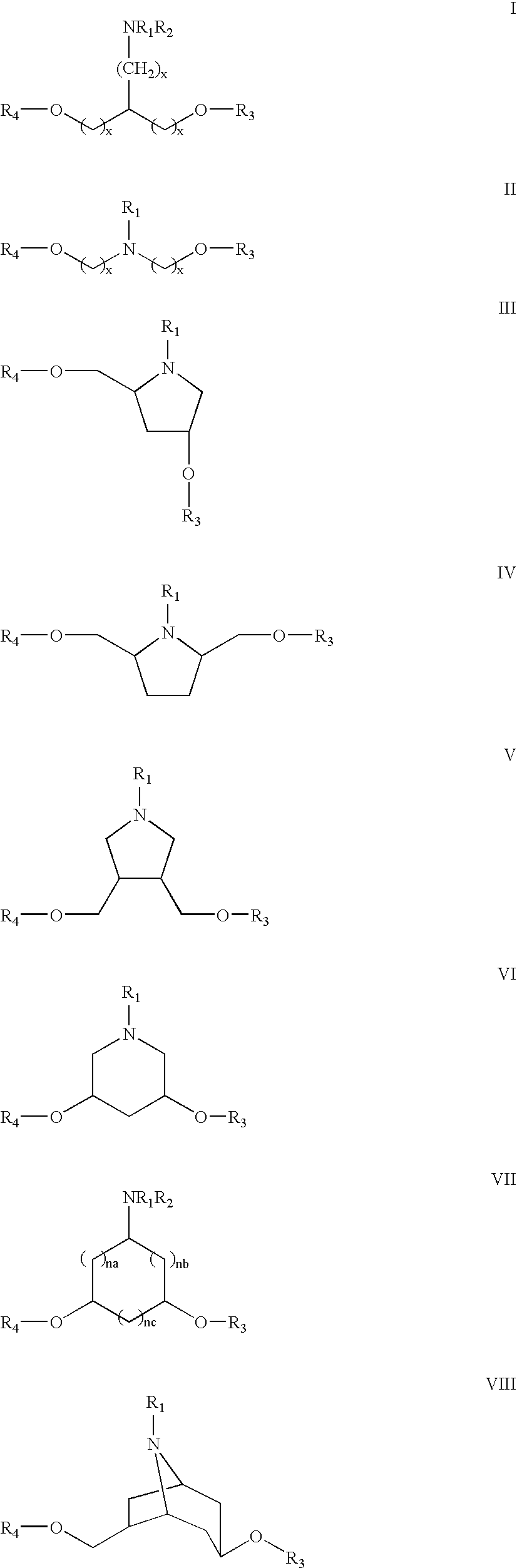

The first aminodiol monomer subunits have base labile protecting groups for R1 and a hydrogen or an alkyl group for R2, if present. One of R3 and R4 is an acid labile protecting group and the other is hydrogen e.g. a free hydroxyl. The free hydroxyl is reacted with a group on the solid support to effect the attachment of the aminodiol monomer subunit to the solid support. Alternatively other bifunctional groups such as ethylene glycol are attached to the solid support with many such compounds known in the art and many commercially available. Solid supports are also available with linking groups previously attached, ready for use without a derivatization step.
The base labile protecting group on the reactive amino group is removed by contacting with a base such as 10% piperidine in DMF or DBU (diazabicycloundecene) in pyridine, and a substituted carboxylic acid or another electrophilic reagent (acid chloride, sulfonyl chloride, etc.) is then covalently linked to the backbone segment amino combinatorial site using standard coupling methods (for examples see Bodansky, M., Principles of Peptide Synthesis, 1984, Springer-Verlag, Berlin). Carbamates can be obtained by the treatment of the amine with an appropriate alkyl or aryl chloroformate. Carbamates can be obtained by the treatment of the amine with an appropriate alkyl or aryl chloroformate, in the presence of a catalyst such as pyridine. A urea or thiourea can be formed by reacting the backbone segment amino combinatorial site with an isocyanate or isothiocyanate, or by treatment with carbonyl diimidazole followed by a second amine, in the presence of base. Sulfonamides can be prepared from the amine by the reaction with a sulfonyl chloride in the presence of a base. The nitrogen can be alkylated by treatment with a halide such as the illustrative halides (benzyl bromide, 3-methylbenzyl bromide, 3-methoxybenzyl bromide or 3-nitrobenzyl bromide) used in the examples below. A wide spectrum of halides can be used for this purpose. Additionally, amino compounds can be functionalized by reaction with an aldehyde or ketone forming a Schiff base. The Schiff base is then reduced in the presence of a reducing agent such as NaCNBH,.
Functional groups that require protection are derivatized using acid labile protecting groups which are stable to TCA. The acid labile hydroxyl protecting group is removed by treating with an acid (3% TCA in dichloromethane) and the resulting free hydroxyl is reacted with a second aminodiol monomer subunit H-phosphonate having a base labile protecting group for R1 and a hydrogen or an alkyl group for R2, if present. One of R3 and R4 is an acid labile protecting group and the other is an activated phosphite. The free hydroxyl of the first monomer subunit on the solid support is reacted with the activated phosphite of the second monomer subunit to form a phosphite linkage thereby increasing the length of the growing oligomeric compound by one monomer subunit.
The phosphite linkage is oxidized to a phosphoramidate using a 10% solution of a primary or secondary amine in CCl4/pyridine. The base labile protecting group on the second monomer subunit is then removed with piperidine as above. The resulting amino group is further reacted with an activated functional group. If desired, additional monomer subunits can be added by repeating the synthetic steps described above.
Monomer subunits of the invention can be used to prepare oligomeric compounds having either preselected sequences or sequences determined via combinatorial strategies. One useful combinatorial strategy is the above-noted SURF™ strategy, which is disclosed and claimed in U.S. patent application Ser. No. 749,000, filed Aug. 23, 1991, and PCT Application US92/07121, filed Aug. 21, 1992, both of which are commonly assigned with this application. The entire disclosure of these applications are herein incorporated by reference.
The following is an example of the methods used for the synthesis of a simple combinatorial library. The variable parameters which can be controlled are the following: the backbone segments, the functional groups attached to the backbone segment amino combinatorial site, the amines attached at the phosphoramidate linkage, and the length of the oligomer. In the example described here a very simple library composed of only 32 molecules will be described. This library is prepared by using two different backbone segments, A and B, two carboxylic acids X and Y, and two amines, P and Q. 1) One begins by weighing equal amounts of solid supports derivatized with A and B. The two solid supports are mixed together by suspending the gels in DMF/dichloromethane (1:1) or other solvent, and mixing gently. If more than two backbone segments are used in the library, all the different supports are mixed together at this stage. The mixture of supports is then treated with piperidine in DMF to remove the N-protecting group from both supports. 2) The mixture is separated into a number of equal portions corresponding to the number of reagents to be added in the next step, in this case two. To the first mixture is added activated carboxylic acid X, to the is added activated Y. Once the reaction is complete, the solid supports are mixed as above to give an equimolar mixture of all four possible combinations. The mixture is then treated with trichloroacetic acid to remove the DMT protecting groups on the monomer subunits and provide a free OH group. 3) The mixture is separated into a number of equal portions corresponding to the number of monomer subunits to be added, in this case two. To each mixture a monomer subunit H-phosphonate is then coupled, the solid supports are again mixed, and the support is again divided into equal portions corresponding to the number of amines to be added, in this case two. 4) At this stage all eight possible combinations are present. Each portion is treated separately with a solution an amine, P or Q in CCl4/Pyridine. The portions are then pooled, treated with piperidine in DMF and split. 5) Each mixture of 16 compounds on solid support treated with an activated carboxylic acid, X and Y. The result is two unique pools of 16 compounds each, which can then be deprotected to remove the terminal DMT group and any protecting groups on the functionalities, and cleaved from the solid support. It is also possible to add further combinatorial sites by coupling additional monomer subunits and extending the library molecules. We have used the following nomenclature to describe mixtures of compounds in a concise manner: X represents a fixed position, that is the backbone segment or functional group on the amino combinatorial site at that position is unique and serves to define the pool composition. N represents an equimolar mixture of all possible structures at a particular position. The subscript defines the synthetic step in the library synthesis. In the above example the library made was X5N4N3N2N1, where X5=X or Y, N4 is an equal mixture of P and Q, N3=A and B, N2=X and Y, and N1=A and B. In this case the fixed position is the last one, but similar methods can be used to fix any position in the library independently. It is also possible to have a single structure or functionality at any position. Once the most active moiety at position 5 is determined for a particular assay e.g. A, then two additional pools are synthesized having this residue in all cases. A second position is fixed and the remainder randomized: for example A5X4N3N2N1, where N1-3 are as above and X4 is either P or Q. A unique structure is determined after 5 rounds of synthesis and screening. The advantage is uncovered when more than two possible components are used in each position: If ten different components are available at each position then 100,000 unique structures exist, yet only 5 rounds of synthesis and screening are necessary.
Illustrative of the SURF™ strategy is a 2′-O-methyl oligonucleosides library (see, Ecker et. al., ibid.) shown in Table I, below. Table I describes the selection of a 2′-O-methyl oligonucleotide for binding to an RNA hairpin. The KD's, i.e., the binding constants, were determined by gel shift. “X” is used to indicate the position being varied and underlining is used to indicate positions that become fixed during successive iterations of the SURF™ strategy.
| TABLE I | ||
| KD (mM) | ||
| Subsets | X = A | X = C | X = G | X = T |
| Round 1 | 22 | 10 | >100 | >100 |
| NNNNXNNNN | ||||
| Round 2 | >10 | 4 | >10 | >10 |
| NNNNCNXNN | ||||
| Round 3 | >10 | 0.5 | >10 | >10 |
| NNXNCNCNN | ||||
| Round 4 | >10 | 0.15 | >10 | >10 |
| NNCXCNCNN | ||||
| Round 5 | 0.08 | >1 | 0.4 | >1 |
| NNCCCXCNN | ||||
| Round 6 | 0.05 | >0.5 | 0.08 | >0.5 |
| NNCCCACXN | ||||
| Round 7 | >0.1 | >0.1 | 0.03 | >0.1 |
| NXCCCACAN | ||||
| Round 8 | 0.05 | 0.02 | 0.05 | 0.04 |
| NGCCCACAX | ||||
| Round 9 | 0.03 | 0.05 | 0.02 | 0.01 |
| XGCCCACAC | ||||
One aspect of the present invention is the inclusion of monomer subunits of the invention in the above-described SURF™ strategy. The SURF™ strategy is equally applicable to libraries of chemical compounds of the present invention in a completely parallel manner. Many other assays are also used as the selection criteria to deduce a winning sequence with the highest activity The functional groups appended to the reactive amino groups of the oligomeric compounds of the invention can be of various structures that impart particular interactive properties to the oligomeric compounds. These chemical functional groups can effect interactions of at least the following types: hydrogen-bond donors and acceptors, ionic, polar, hydrophobic, aromatic, electron donors and acceptors, pi bond stacking or metal binding. As a result of such interactions, the oligomeric compounds of the invention have unique properties effecting the overall global shape, the conformational space, electron density, dipole moment and ability of the compound to interact with enzyme pockets and other binding sites and other similar properties.
To detect an active sequence generated via a combinatorial technique, the concentration of the active molecule is selected to be of sufficiently great that the molecule can be detected within the sensitivity of the chosen assay. As will be recognized, the number of unique structures within a subset produced via a combinatorial technique depends on the length of the oligomer and the number of different functionalities employed. The number of structures is given by the product of the number components at each variable position. This is illustrated in Table II. Table II also indicates the concentration of each sequence when the subset concentration is 100 uM, a typical high-test concentration. We have found that the complexity of the library can be based upon an estimate of the expected IC50 (i.e., a concentration at which 50% of enzyme activity is inhibited) that is desirable in a final oligomeric compound. For an expected IC50 of 100 nM, the complexities shown in Table II are acceptable, that is, the libraries shown in Table II have complexities that would allow detection of a unique sequence with an IC50of about 100 nM or less.
| TABLE II |
| Complexity of Libraries |
| Variable | ||||
| Positions | Sequences nM | Each Sequence | ||
| (Mer) | per Subset | At 100 μM Subset | ||
| 5 Components | ||||
| 4-mer | 125 | 800 | ||
| 5-mer | 625 | 160 | ||
| 6 Components | ||||
| 4-mer | 216 | 463 | ||
| 5-mer | 1,296 | 77 | ||
| 7 Components | ||||
| 4-mer | 343 | 291 | ||
| 8 Components | ||||
| 4-mer | 512 | 195 | ||
| 10 Components | ||||
| 4-mer | 1,000 | 100 | ||
The functional groups or components can also be referred to as “letters.” The use of such terminology reflects the fact that the different functional groups on the compounds of the invention are positioned in sequences (either predetermined or by random selection) much like letters of the alphabet, hence the term “letter.” These letters can be “reactive” or “non-reactive.” By “reactive,” it is meant that they will interact with a target molecule in some manner (that need not but can be predefined). By non-reactive,” it is meant that they are not designed to primarily interact with a target molecule, and in fact while they may interact with the target molecule, the primary purpose of the non-reactive moieties are to impart other properties to the molecule such as, but not necessarily limited to, effecting up-take, distribution, metabolism or identification.
A further advantage of this invention is the ability to synthesize oligomeric compounds that, in addition to or in place of variability in the sequences of the diverse functional groups, have an asymmetric sequence of monomer subunits. Stated otherwise, the monomer subunits can also vary within the oligomeric compounds. This is easily accomplished by using different aminodiol monomer subunits that eventually become the backbone of the oligomeric compounds.
The oligomeric compounds of the invention can be used in diagnostics, therapeutics and as research reagents and kits. They can be used in pharmaceutical compositions by including a suitable pharmaceutically acceptable diluent or carrier. In preferred embodiments, the compounds of the invention act as inhibitors of enzymes such as phospholipase A2; as inhibitors of pathogens such as virus, mycobacterium, bacteria (gram negative and gram positive), protozoa and parasites; as inhibitors of ligand-receptor interactions such as PDGF (platelet derived growth factor), LTB4 (leukotriene B4), IL-6 and complement C5A; as inhibitors of protein/protein interactions including transcription factors such as p50 (NF_B protein) and fos/jun; for the inhibition of cell-based interactions including ICAM induction (using inducers such as IL1-β, TNF and LPS) and as herbicides and insecticides. In other preferred embodiments, the compounds of the invention are used as diagnostic reagents for each of the above noted biological entities, and as reagents in assays and as probes. In other preferred embodiments, the compounds of the invention are used to chelate heavy metals and as imaging agents.
The functional groups can be selected based on chain length, i.e. short versus long, based on the use of a ring versus a linear group, use of an aromatic versus aliphatic group, use of a functionalized group versus a non-functionalized group, to mention only a few of the wide variety of chemical functional groups available. Indeed simply varying functional moieties, e.g. acid, alcohol, aldehyde, amide, amine, amidine, azo, azoxy, double bond, ether, ethylene oxide, guanidine, halide, haloalkyl, hydrazine, hydroxylamine, ketone, mercaptan, nitrate, nitrile, nitro, nitroso, quaternary nitrogen, sulfide, sulfone, sulfoxide, triple bond, urea, etc. on a single backbone segment amino combinatorial site, e.g. a simple alkyl group, yields a vast array of diversity functions. When this is expanded to include placement of such varied functional moieties on a broad platform of backbones, e.g. a series of alkyl compounds, a series of aryl compounds, a series of alicyclic compounds, etc., the potential for a vast array of chemical functional groups is apparent. Other chemical functional groups include alkyl, alkenyl, alkynyl, alicyclic and substituted alkyl, alkenyl, alkynyl, alicyclic; aryl and substituted aryl; aralkyl, substituted aralkyl, heterocycles, nucleobases such as pyrimidines and purines, metal chelating groups and moieties as found in the α-position of amino acids, such as those shown below: 
The various combination of reactions that can be effected utilizing the teaching of this invention can be further demonstrate by use of a logical flow scheme. This flow scheme is set forth in FIGS. 1A and 1B.
Referring to the figures, at the start 10 of the synthesis, an aminodiol monomer subunit or group of aminodiol monomer subunits is/are selected. The selected monomer or monomers are processed at process step 12 wherein the aminodiol monomer subunit or subunits is/are attached to a solid support as per Examples 26, 30, 35, 45, 46, 57, 55, and 61, set forth below. The aminodiol monomer subunit may be attached to the solid support via a H-phosphonate diester linkage, through a succinyl linkage, or through an ethylene-glycol linkage. Many other types of linkages are known in the art and are amenable to the present invention. A group of aminodiol monomer subunits may be advantageously attached at this step by utilizing a split bead synthesis. The process steps effected at process step 12 can be otherwise characterized as a selecting and attaching procedure depicted by box 102.
From the procedure box 102, the path of the flow scheme intersects convergent point 14. Convergent point 14 represents the point in the iterative process of the invention wherein growing oligomeric compounds from later steps are reintroduced via this iterative process to undergo further oxidation, amine group functionalization and elongation as discussed below.
Downstream of the convergent point 14, the processes of the invention further include an oxidization step effected via procedures included in the general oxidization procedure depicted by box 104. At decision block 16, within the oxidization procedure generally depicted at box 104, the product of process step 12 (or the growing oligomeric compounds introduced at convergent point 14) is (are) either converted by oxidation from PIII to PV compounds via the positive branch of this step or the PIII phosphite linkages are not oxidized and the compounds are maintained with PIII linkages and are taken to the next decision step via the negative branch of decision block 16 leading to convergent point 42. For those products of process step 12 (or the growing oligomeric compounds introduced at convergent point 14) wherein oxidization is desired during this iteration of the process (those moving along the positive branch of decision block 16), at decision block 18 they are either converted to phosphoramidates via the positive branch leading from decision block 18 or they are converted into phosphorothioates or phosphodiesters via the negative branch leading from decision block 18.
At decision block 20, growing oligomeric compounds are either oxidized to phosphodiesters at process step 24 via the positive branch of decision block 20 or they are oxidized to phosphorothioates at process step 25 via the negative branch of decision block 20. Oxidation to either the phosphorothioate or phosphodiester, as illustrated in Example 69, can be effected simultaneously on multiple positions on the same growing oligomeric compound, as for instance if the negative branch was taken at decision block 16 for one or more previous iterations of the process. If there are previous unoxidized sites and if the positive branch of decision block 16 is selected during the current iteration, multiple monomeric units are oxidized simultaneously. The resulting phosphodiesters and phosphorothioates converge at convergent point 38 and from there lead to convergent point 40.
Following the positive branch from decision block 18, growing oligomeric compounds at decision block 22 can be converted to phosphoramidates by one of three process steps. First, the decision to effect substitution using a single amine is effected at decision block 22. Growing oligomeric compounds following the positive branch from decision block 22 are converted at process step 26 using a single amine in solution as illustrated in Example 67, to give phosphoramidate linkages having uniform substituents. Growing oligomeric compounds following the negative branch from decision block 22 are combinatorialzed by one of two processes. Growing oligomeric compounds following the negative branch from the competitive combinatorialzation decision block 28 are combinatorialzed at process step 30 by a split bead synthesis. Growing oligomeric compounds following the positive branch of decision block 28 are combinatorialized at process step 32 using a mixture of amines as illustrated in Example 67 Method B.
Growing oligomeric compounds that may have been oxidized (via the positive branch of decision block 16) or may not have been oxidized (via the negative branch of decision block 16) converge at convergent point 42 within the general oxidization procedure box 106. From convergent point 42 the process is continued on FIG. 1B via connector point 44 that connects FIG. 1A and FIG. 1B. A further connector point, point 46, leads back from FIG. 1B to FIG. 1A.
At decision block 48 within the generalized functional-ization procedure depicted by box 106, following the positive branch of decision block 48, the growing oligomeric compounds, at process step 50, are deblocked to expose a free amino site on the growing oligomeric compound. This free amino site is now available for functionalization. Alternatively, following the negative branch from decision block 48, amino deblocking and functionalization is bypassed. Following the negative branch of decision block 48, the amine protecting groups are maintained and the growing oligomeric compound is taken directly to convergent point 66.
If in one or more earlier iterations of the process, the negative branch of decision block 48 was selected, there will be multiple amino sites that now are protected and can be deblocked for functionalization. Thus functionalization can be effected at one or at more than one site during any one iteration of the functionalization procedure generally depicted by box 106.
Following the positive branch of the functionalization procedure decision block 48, after deblocking at process step 50, several alternatives are available for functionalization of the resulting free amino site(s). At decision block 52, functionalization with a single functional group or with multiple functional groups is queried. Following the positive branch from decision block 52, functionalization is effected with a single functional group. This functionalization can be performed on a single position or, as noted above, if the functionalization procedure was bypassed in prior iterations of the process, multiple amino positions in a growing oligomeric compound or combinatorial library of such compounds can be functionalized simultaneously. The negative branch of decision block 52 leads to decision block 56 where the deprotected amino site on the growing oligomeric compound can be functionalized with multiple reagents via two different combinatorialization procedures. Following the negative branch from decision block 56, combinatorialization of the free amino site(s) of the growing oligomeric compound(s) is effected at process step 58 using a split bead synthesis. Following the positive branch from decision block 56, combinatorialization of the free amino site(s) is effected at process step 60 by using a mixture of compounds e.g. carboxylic acids or acid halide as, for example, via Examples 63 and 65.
The products of process steps 58 and 60 converge at convergent point 62 and these in turn converge with the products of process step 54 at convergent point 64. Both of these points converge at convergent point 66 where intermediates that were shunted by the deblocking process step 50 via the negative branch of the decision block 48 also converge.
A query is made at decision block 68 to discontinue synthesis or to further elongate the growing oligomeric compound. If the current oligomeric compounds is of sufficient length, at decision block 68, a decision to effect final deblocking, generally depicted by box 108, is made. Following the negative branch of decision block 68, final deblocking is effected at process step 72 to give the final product or products 78.
If further extension of the growing oligomeric compound is desired, the positive branch of decision block 68 is followed. This leads to the extension procedure generally depicted by box 110. To effect oligomeric compound elongation, at process step 70 a hydroxyl protecting group is removed and at process step 74 a further aminodiol monomer subunit is added. The growing oligomeric compound is now re-introduced at conversion point 14 (via connecting point 46) into the process loop for a further iteration of synthesis depicted in FIG. 1A. Here the process of selection of paths independently leading to or bypassing oxidation and/or functionalization is then repeated.
The process of the invention can generally be characterized as first selecting and attaching one or more monomer subunits to a support. This corresponds generally to procedure box 102 of the figures. For the moment bypassing the oxidization procedure, generally depicted by box 104, and the functionalization procedure, generally depicted by box 106, the hydroxyl blocking group of the monomeric subunits can be removed and a further iteration of the addition of monomer units effected. This is accomplished by the extension procedure generally depicted by box 110.
If during this iteration of the process, oxidization of the phosphate linker is desired, oxidization will be effected via the oxidization procedure generally depicted by box 104. Further if prior to the next iteration but post the oxidization procedure, functionalization of the amino group of the last monomer subunit(s) added is desired, functionalization is effected via the functionalization procedure generally depicted by box 106.
If the growing oligomeric compound or compounds is/are of sufficient length, synthesis is halted and the compound or compounds are deblocked and cleaved from their supports via the final deblocking procedure, generally depicted by box 108.
It is of course recognized that the oxidization step of the first monomer subunit can be effected or oxidization of each subsequently added monomer subunit can be effected during the iteration of the process when they are added. Alternatively, oxidization need not be effected for each monomeric subunit added but can be effected during some subsequent iteration of the process. It is further recognized that functionalization of the amino site can be effected for the first monomer subunit and it can be effected for each added monomer subunit. Alternatively, functionalization need not be effected for each monomeric subunit added but can be effected during some subsequent iteration of the process.
trans-4-Hydroxy-L-proline (5.00 g, 38.2 mmol) and NaHCO3 (8.00 g, 95.2 mmol) were suspended in 150 ml H2O/Dioxane (1:1). Fluorenylmethyl chloroformate (11.4 g, 44.0 mmol) in 25 ml toluene was added dropwise. The temperature of the reaction was not allowed to rise above 25° C. during the addition. The mixture was stirred vigorously overnight, and then quenched with 50 ml saturated NaHCO3 solution and 50 ml water. The solution was then extracted with 100 ml diethyl ether. The aqueous layer was acidified to pH 1 with concentrated HCl, and extracted twice with ethyl acetate, and the organic extracts washed with brine. The solution was dried with MgSO4, filtered and the solvent removed in vacuo. The pure product crystallized from the concentrated solution. Yield: 13.4 g (100%). 1H NMR: (CDCl3, 200 MHz) δ 7.75-7.15 (8H, m, ArH), 4.55-4.05 (5H, m, ArCHCH2, H2, H4), 3.65-3.45 (2H, m, 2 H5), 2.35-2.10 (2H, m, 2 H3).
To a solution of N-Fmoc-trans-4-hydroxy-L-proline (13.4 g, 38.1 mmol) in 250 ml THF was added borane-methyl sulfide (78 mmol, 5.78 g, 7.22 ml) dropwise at room temperature. After the evolution of H2 had ceased, the solution was heated to reflux with mechanical stirring. After 1 hour a white precipitate had formed. Methanol was carefully added, and the resulting solution refluxed for a further 15 minutes. The solution was cooled to room temperature, the solvents evaporated under reduced pressure, and the residual gum coevaporated with 2×100 ml methanol. The resulting crystalline product weighed 12.0 g (35.3 mmol, 93%). 1H NMR: (CDCl3, 200 MHz) δ 7.85-7.25 (8H, m, ArH), 4.50-4.10 (5H, m, ArCHCH2, H3, H5), 3.80-3.40 (4H, m, 2 H2, 2 H6), 2.15-1.95 (1H, m, H2a), 1.80-1.60 (1H, m, H2b).
The diol, N-Fmoc-3-hydroxypyrrolidine-5-methanol (10.59 g, 31.2 mmol) was coevaporated with dry pyridine (2×50 ml), redissolved in 200 ml dry pyridine, and cooled in an ice bath. Dimethoxytrityl chloride (11.0 g, 32.5 mmol) was added in portions over 30 min, and the solution stirred at 0° C. overnight. Methanol was then added (10 ml), and the solvent removed under reduced pressure. The resulting gum was redissolved in toluene (100 ml), filtered to remove the pyridinium hydrochloride and taken to dryness again. The residue was dissolved in CH2Cl2 (300 ml), washed with 150 ml 0.1 M citric acid solution, 150 ml sat NaHCO3, brine, and dried with Mgso4 followed by evaporation. The residue was crystallized from methanol and dried to give (15.4 g, 23.9 mmol, 77%).
To a solution N-Fmoc-5-dimethoxytrityloxymethyl-3-hydroxypyrrolidine (3.40 g, 5.30 mmol) in 15 ml DMF was added piperidine (1.09 ml, 0.935 g, 11.0 mmol). The solution was stirred at room temperature for 1 hour, water (100 ml) added, and the aqueous solution extracted with ethyl acetate (2×75 ml). The organic extracts were washed with aqueous NaHCO3, brine, dried with MgSO4 and evaporated. The residue was purified by flash column chromatography using a gradient of 1-3% MeOH in CH2Cl2 containing 0.5% triethylamine. Pure product was obtained (1.86 g, 84%). 1HNMR: (CDCl3, 200 MHz) δ 7.42-6.80 (13H, ArH), 4,35 (1H, m, H5), 3.77 (6H, s, 2 OCH3), 3.62 (1H, m, H3), 3.13-2.88 (4H, m, 2 H6, 2 H2), 1.87 (1H, q, H4a), 1.65 (1H, m, H4b).
Phenylacetic acid (1.50 g, 11 mmol) and HOBT (1.63 g, 12 mmol) were dissolved in 100 ml CH2Cl2 and EDC (15 mmol, 2.88 g) was added. After 15 min, 5-dimethoxytrityloxymethyl-3-hydroxypyrrolidine was added, followed by DIEA (20 mmol, 3.5 ml). The reaction was stirred until the starting material was consumed, and quenched with 10 ml NaHCO3. The mixture was extracted twice with ethyl acetate, washed with NaHCO3, brine, dried with MgSO4, and evaporated. The product was purified by flash chromatography to give 4.0 g product (75%). 1H NMR: (CDCl3, 200 MHz) (2 rotamers, 3′-O-TMS) d 7.43-7.13, 6.88-6.74 (13 Ar—H), 4.67, 4.49, 4.37, 4.13 (4 m, 2H, H3, H5), 3.78 (s, 6H, OCH3), 3.78-3.50 (m, 2H, H2a, b), 3.66, (s, 2H, CH2Ar) 3.35 (q, 1H, H6a), 3.12 (m, 1H, H6b), 2.14-1.70 (m, 2H, H4a, b), 0.10 (d, 9H, OSi(CH3)3).
Fluorenemethanol (10.0 g, 51.0 mmol) was dissolved in 150 ml CH2Cl2, and succinic anhydride (5.6 g, 56 mmol) was added. The solution was stirred for 6 h, and a further portion of succinic anhydride (2.5 g, 25 mmol) was added, and stirring continued overnight. The reaction appeared complete by TLC. The solvent was then removed, and the residue extracted with ethyl acetate, washed with 1% HCl, water, brine, dried (MgSO4) and evaporated to an oil which crystallized on standing. A quantitative yield of crude product was obtained which was used without further purification.
Methyl bromoacetate (25.5 g, 15.2 ml, 160 mmol) was added to a suspension of K2CO3 (44.2 g, 320 mmol) and thymine (20.2 g, 160 mmol) in 500 ml dry DMF with stirring overnight. The suspension was filtered and the solvent removed under reduced pressure. The residue was suspended in 120 ml H2O and 30 ml 4 N HCl, stirred for 30 minutes and filtered again. The solid was suspended in 250 ml H2O, to which was added 100 ml 2.5 M NaOH. The solution was heated to boiling, cooled and acidified to pH 1 with concentrated HCl. The precipitate was dried in vacuo to give 13.6 g (73.6 mmol, 46%) pure product. 1H NMR: (DMSO-d6, 200 MHz) δ 7.48 (s, 1H, H6), 4.37 (s, 2H, CH2), 1.76 (s, 3H, CH3).
Sodium bicarbonate (2.52 g, 30 mmol) and 3-aminopropionic acid (1.00 g, 11.2 mmol) were dissolved in 50 ml water and 50 ml dioxane was added. A solution of fluorenylmethyl chloroformate (3.10 g, 12.0 mmol) in 50 ml dioxane was added dropwise with stirring. After 6 hours the solution was diluted with water (100 ml) and saturated bicarbonate solution (50 ml), extracted once with diethyl ether, and the aqueous layer acidified to pH 2 with concentrated HCl. The cloudy solution was extracted with ethyl acetate (2×100 ml), washed with brine and dried with MgSO4. After evaporation a mixture of the title product and the peptide dimer was obtained. The pure product was obtained by flash chromatography. 1H NMR: (CDCl3, 200 MHz) δ 7.95-7.26 (8H, m, ArH), 7.40-7.15 (3H, m, CHCH2O), 3.20 (2H, t, J=8 Hz, CH2N), 2.40 (2H, t, J=8 Hz, HOOCCH2).
Imidazole (3.7 g, 54 mmol) was added to a suspension of sodium hydride (2.6 g of a 60% dispersion in oil, 60 mmol) in 50 ml dry THF. Bromoacetic acid (3.4 g, 24 mmol) was then added and the mixture stirred overnight. Water (1 ml) was then added and the solvent removed under reduced pressure. The residue was taken up in water (50 ml, pH >10), extracted with ether and the organic layer discarded. The aqueous layer was acidified to pH 1 with concentrated HCl and extracted again with ether. The aqueous layer was evaporated to dryness. The oily residue was dissolved in absolute ethanol (EtOH) to precipitate NaCl, and recrystallized from acetone/methanol to give 1.22 g (7.5 mmol, 30%) pure product as the hydrochloride. 1H NMR: (DMSO-d6, 200 MHz) δ 9.20 (s, H2), 7.76 (d, J=1.5 Hz), 7.69 (d, J=1.5 Hz), 5.20 (s, CH2).
Sodium hydride (8.20 g 60% in oil, 205 mmol) was added to a suspension of adenine (25.0 g, 185 mmol) in 500 ml DMF. After vigorous stirring for 2 hours using a mechanical stirrer, H2 evolution stopped and a thick slurry was obtained. Ethyl bromoacetate (55.6 g, 36.9 ml, 333 mmol) was added dropwise over 3 hours, and stirring continued for a further 1 hour. Water (10 ml) and H2SO4 were added to pH 4. The solvent was evaporated and the residue suspended in 500 ml H2O, filtered and washed with water. The residue was recrystallized from 400 ml ethanol to give 23.8 g (108 mmol, 58%) pure product.
To a suspension of (9-adenylyl)-2-acetic acid ethyl ester (6.06 g, 27.4 mmol) in 250 ml dry pyridine was added benzoyl chloride (9.60 ml, 11.6 g, 82 mmol), and the solution stirred for 4 hours at room temperature. Methanol (25 ml) was added and the solvents evaporated. The residue was dissolved in ethyl acetate (2×250 ml), washed with 0.1 N HCl, H2O, saturated NaHCO3, brine, and dried with Na2SO4. The organic extracts were evaporated and the solid residue was redissolved in 250 ml THF at 0° C., to which was added 100 ml 1M NaOH. The solution was stirred at 0° C. for 1 hour and acidified to pH 1 with concentrated HCl, and the aqueous portion extracted once with ether. The product, which began to crystallize almost immediately, was collected by filtration to yield 4.96 g (61%). 1H NMR: (DMSO-d6, 200 MHz) δ 8.86, 8.84 (d, H2, H8), 8.1 (d, 2H, J=7.0 Hz, ArH), 7.69-7.58 (m, 3H, Ar—H), 5.22 (s, 2H, CH2).
Cytosine hemihydrate (12.0 g, 100 mmol) was coevaporated with pyridine and resuspended in 250 ml dry pyridine. Benzoyl chloride (58 ml, 70.3 g, 500 mmol) was added dropwise (exothermic). The solution was stirred at RT overnight, and water (50 ml) carefully added. The solvent was evaporated, and the residue dissolved in 700 ml H2O containing 55 g NaOH. The solution was stirred for 1 h after complete dissolution of the material. Concentrated HCl was then added to pH 4.0, the white precipitate was collected and boiled in 1 liter EtOH, cooled to RT and filtered to give 16.1 g product (75%).
To a suspension of N-4-Benzoylcytosine (15.0 g, 69.7 mmol) and K2CO3 (9.7 g, 70 mmol) in 500 ml DMF was added methyl bromoacetate (6.6 ml, 10.7 g, 70 mmol). The suspension was stirred vigorously for 3 days, filtered and evaporated. The residue was treated with water (120 ml), and 10 ml 4N HCl for 15 min, and the solid collected by filtration. The residue was resuspended in 120 ml water, and 60 ml 2N NaOH added. The suspension was stirred at RT for 45 min, until all the solids had dissolved. The solution was acidified to pH 2 with conc HCl, filtered, and the solid dried in vacuo at 60° C. to give 11.6 g product (61%).
To a suspension of 2-amino-6-chloropurine (10 mmol) and K2CO3 (15 mmol) in DMF (25 ml) is added ethyl bromoacetate (10 mmol). The mixture is stirred vigorously for 24 hours, filtered and the solvent evaporated. The residue is resuspended in 25 ml pyridine and isobutyroyl chloride added (20 mmol). After stirring for 18 hours, water is added and the solvent removed. The residue is suspended in 1N HCl and heated to reflux for 1 hour. The suspension is then cooled to 0° C., NaOH added to pH 12, and the suspension stirred for 1 hour. The solution is acidified to pH 3, and the product is collected by filtration.
Triethyleneglycol monomethyl ether (10 mmol) and benzyl bromoacetate (11 mmol) are added to a suspension of anhydrous K2CO3 (15 mmol) in 50 ml anhydrous DMF. The suspension is stirred at room temperature overnight. Water is added and the emulsion is extracted with ethyl acetate (3×200 ml), washed with water, brine, and dried with MgSO4. The solvent is evaporated and the residual oil purified by flash chromatography to give the title compound.
Benzyl-3,6,9,12-Tetraoxatridecanoate (5 mmol) is dissolved in methanol (50 ml) and 10% palladium on carbon is added (100 mg catalyst/mmol). The suspension is shaken under 30 psi H2 until the starting material is consumed. The suspension is filtered through a short pad of Celite, washed thoroughly with methanol, and the solvent evaporated. The product is used directly without purification.
To a suspension of K2CO3 (15 mmol) in 25 ml DMF was added 2,2′-bis(2-pyridylethyl)-amine (10 mmol) followed by benzyl bromoacetate (12 mmol). The suspension was stirred for 4 hours at room temperature. Water was then added, and the suspension extracted with ethyl acetate (2×100 ml), washed with 5% Na2CO3, water, brine, dried with MgSO4 and the solvents removed. The product was obtained as an oil in quantitative yield. Product was identified by NMR.
Benzyl bis-[(2-pyridyl)-2-ethyl]-aminoacetate (5 mmol) is dissolved in methanol (50 ml) and 10% palladium on carbon is added (100 mg catalyst/mmol). The suspension is shaken under 30 psi H2 until the starting material is consumed. The suspension is filtered through a short pad of Celite, washed thoroughly with methanol, and the solvent evaporated. The product is used directly without purification.
The title compound is prepared as per Example 13 using carbazole as the starting heterocycle.
The title compound is prepared as per Example 13 using pyrrole as the starting heterocycle.
To a suspension of glycine (1.50 g, 20 mmol) in 100 ml dry methanol were added triethylamine (3.5 ml, 2.5 g, 25 mmol) and ethyl trifluoroacetate (3.0 ml, 3.55 g, 25 mmol). The mixture was stirred overnight to give a homogeneous solution. The solvents were removed and the resulting oil coevaporated with toluene to remove traces of methanol. The product was used without purification.
A solution of ethylene glycol (2.45 ml, 44 mmol) in dry pyridine (25 ml) was cooled to 0° C. in an ice bath. Excess triethylamine (7 ml) and 4-dimethylaminopyridine catalyst (120 mg, 1 mmol) was added followed by the slow addition of dimethoxytrityl chloride (7.42 g, 21.9 mmol) over 30 minutes. The mixture was stirred at 0° C. for 1 hr and then room temperature for 1 hr. The resulting solution was quenched with methanol and evaporated to dryness under reduced pressure. The residue was dissolved in saturated NaHCO3 and extracted with EtOAc. The EtOAc extracts were washed with cold saturated sodium bicarbonate and brine. The organic phase was separated, dried over sodium sulfate, filtered and evaporated under reduced pressure. The resulting residue was purified by flash column chromatography on silica gel using ethyl acetate-hexanes (gradient 10 to 20%). The title compound was isolated to yield 5.53 g (70%). 1H NMR: (CDCl3) δ 7.50-7.20, 6.90-6.80 (m, 13 H, ArH), 3.80 (s, 6 H, OCH3), 3.75 (t, 2H, CH2OH), 3.25 (t, 2H, DMTOCH2).
A solution of 2-O-(dimethoxytrityl)ethanol (1.0 g, 2.77 mmol), triethylamine (0.4 ml, 3 mmol), and 4-dimethylaminopyridine catalyst (120 mg, 1 mmol) in dry dichloroethane was treated with succinic anhydride (410 mg, 0.41 mmol). The mixture was stirred at room temperature for 16 hrs. The mixture was filtered and the filtrate was purified by silica gel flash column chromatography using chloroform-methanol-triethylamine to yield the title compound as a triethylammonium salt. 1H NMR: (CDCl3) δ 7.50-7.20, 6.90-6.80 (m, 13H, ArH), 4.26 (t, 2H, CH2OCO), 3.80 (s, 6H, OCH3), 3.25 (t, 2H, DMTOCH2), 3.05 (q, 6H, N(CH2CH3)3), 2.70 (m, 4H, OOCCH2CH2COO), 1.25 (t, 9H, N(CH2CH3)3.
A solution of imidazole (4.29 g, 63 mmol)in dry acetonitrile at 0° C. (100 ml) was treated dropwise with PCl3 (1.77 ml, 20.3 mmol) over a period of 30 minutes. The resulting solution was further treated with triethylamine (9.06 ml, 65 mmol). To the thick slurry was added 2-O-(dimethoxytrityl)ethanol (2.10 g, 5.81 mmol) in anhydrous acetonitrile (150 ml) slowly over a period of 30 minutes. The mixture was allowed to warm to room temperature and stirred for 15 minutes. The mixture was quenched with 1M TEAB and the mixture is evaporated in vacuo to a minimum volume and extracted with dichloromethane (2×150 ml). The dichloromethane extracts were washed with TEAB and evaporated in vacuo. The residue was purified by flash column chromatography using a gradient of 0% to 5% methanol in dichloromethane/1% triethylamine to yield 1.3 g purified material (43%). 1H NMR: (CDCl3) δ 7.50-7.20, 6.90-6.80 (m, 13 H, ArH), 6.96 (d, 1H, JPH=624 Hz, PH), 4.06 (m, 2H, CH2OP), 3.80 (s, 6H, OCH3), 3.25 (t, 2H, DMTOCH2), 3.05 (q, 6H, N(CH2CH3)3), 1.25 (t, 9H, N(CH2CH3)3). 31P NMR (CDCl3); 5.89.
A solution of 2-O-(dimethoxytrityl)ethanol (1.0 g, 2.77 mmol), triethylamine (0.4 ml, 3 mmol), and 4-dimethylaminopyridine catalyst (120 mg, 1 mmol) in dry dichloroethane was treated with succinic anhydride (410 mg, 0.41 mmol). The mixture was stirred at room temperature for 16 hrs. The mixture was filtered and the filtrate was purified by silica gel flash column chromatography using chloroform-methanol-triethylamine to yield the title compound as a triethylammonium salt. 1H NMR: (CDCl3) δ 7.50-7.20, 6.90-6.80 (m, 13H, ArH), 4.26 (t, 2H, CH2OCO), 3.80 (s, 6H, OCH3), 3.25 (t, 2H, DMTOCH2), 3.05 (q, 6H, N(CH2CH3)3), 2.70 (m, 4H, OOCCH2CH2COO), 1.25 (t, 9H, N(CH2CH3)3.
2-O-(Dimethoxytrityl)ethylsuccinate half ester triethyl-ammonium salt (135 mg) was dissolved in dichloromethane (5 ml). 4-Dimethylaminopyridine catalyst (40 mg, 0.2 mmol) was added followed by toluene diisocyanate (0.029 ml, 0.2 mmol). The mixture was shaken for 18 min. Long chain alkyl amine controlled pore glass (LCAA CPG) (1.0 g) was added and the mixture was shaken with the exclusion of light for 16 hrs. The mixture was filtered and washed with dichloromethane and then diethylether (3×10 ml each). The CPG was shaken for 16 hrs in pyridine/water (4:1), filtered, and rinsed with pyridine (5×5 ml). A 10 mg sample of the dried CPG was treated with 3% trichloroacetic acid in dichloromethane. The presence of the trityl ion qualitatively verified the derivatization. The loading was measured to be 30 μmol/g by measuring the absorbance of the dimethoxytrityl cation.
A solution of decane-1,10-diol in dry pyridine and containing excess triethylamine is treated with one equivalent of dimethoxytrityl chloride for a period of six hours. The resulting solution is evaporated to dryness under reduced pressure, the residue redissolved in methylene chloride and the solution washed with cold saturated sodium bicarbonate, water and brine. The organic phase is separated, dried over sodium sulfate, filtered and again evaporated under reduced pressure. The resulting residue is flash-chromatographed on silica gel using ethyl acetate-hexanes to isolate the purified product. Characterization by H-NMR yields signals for the DMT group (multiplet, 8.0-7.0 ppm), the decane group (multiplets, 1.2-4.0 ppm) and the alcohol (variable).
A solution of three equivalents of imidazole in dry acetonitrile is treated dropwise with one equivalent of PC13 over a period of 30 minutes. The resulting solution is further treated with excess triethylamine to drive the reaction to completion. After 1 hr the mixture is treated with a solution of one equivalent of 10-O-(dimethoxytrityl)decan-1,10-diol in dry acetonitrile and the mixture stirred at room temperature for an additional hour. This mixture is treated with an excess of a solution of triethylammonium bicarbonate, pH 8, to yield the title compound. The compound is purified by repeated extraction of the bicarbonate solution with ethyl acetate. Pooling and drying of the extracts over sodium bicarbonate followed by evaporation of the solvent under reduced pressure yields a compound which is used as such without further purification. Characterization by 31P NMR (doublet, 6 ppm, JP-H=600 Hz) and 1H NMR yields signals for the DMT and the decane groups as for 10-O-(dimethoxytrityl)decandiol and signals for the triethylammonium groups (doublet, triplet, 3.2-2.2 ppm).
A solution of 10-O-(dimethoxytrityl)decan-1,10-diol in dry dichloromethane is treated with one equivalent of succinic anhydride, excess triethylamine and 5 mole % of 4-dimethylaminopyridine catalyst. The mixture is stirred overnight under anhydrous conditions and then further diluted with dichloromethane. This solution is washed with cold, saturated sodium bicarbonate, water and brine. The solution is then dried over magnesium sulfate, filtered and evaporated to dryness under reduced pressure. The resulting solid is purified by silica gel flash column chromatography using ethyl acetate-methanol-triethylamine to yield the title compound as the triethylammonium salt. The free acid is obtained by repeated coevaporation of this material with wet methanol. Characterization by 1H NMR yields signals for the DMT and decylene groups as for 10-O-(dimethoxytrityl)decan-1,10-diol and signals for the succinic group (two closely spaced doublet of doublets, 2.5-3.0 ppm).
A commercially obtained sample of controlled pore glass derivatized with long chain alkylamine groups (LCAA CPG) is suspended in dry acetonitrile. In a separate dry container, 10-O-(dimethoxytrityl)decylsuccinate half ester is treated with two equivalents of pentafluorophenol, excess triethylamine and two equivalents of dicyclohexyl carbodiimide. The mixture containing activated 10-O-(dimethoxytrityl)decylsuccinate half ester is stirred under argon for one hour and then added to the suspension of CPG while maintaining anhydrous conditions. The mixture is then shaken gently for 6 hr, the supernatant is separated and the process is repeated twice more. The quantity of 10-O-(dimethoxytrityl)decylsuccinate half ester which is used in each treatment is based on the concentration of available amine groups per gram of LCAA CPG, generally found to be 25-40 mmoles/gram. The CPG is then treated with a dilute solution of acetic anhydride in pyridine for 1 hr to cap all unreacted amine functionalities and then washed several times with acetonitrile. The extent to which this CPG has been derivatized is determined by treating an accurately weighed sample of the resulting CPG with 2% dichloroacetic acid in acetonitrile and measuring the absorbance of an aliquot of the supernatant at 498 nm.
2-Amino-1,3-propanediol (3.48 g, 38.2 mmol) and NaHCO3 (8.00 g, 95.2 mmol) are suspended in 150 ml H2O/Dioxane (1:1). Fluorenylmethyl chloroformate (11.4 g, 44.0 mmol) in 25 ml toluene is added dropwise. The temperature of the reaction is maintained below 25° C. during the addition. The mixture is stirred vigorously overnight, and then quenched with 50 ml saturated NaHCO3 solution and 50 ml water. The solution is extracted with 100 ml diethyl ether. The aqueous layer is acidified to pH 1 with concentrated HCl, and extracted twice with ethyl acetate, and the organic extracts are washed with brine. The solution is dried with MgSO4, filtered and the solvent removed in vacuo. The crude material is purified by silica gel column chromatography to give the title compound.
A solution of N-Fmoc-2-amino-1,3-propanediol (13.79 g, 44 mmol) in dry pyridine (250 ml) is cooled to 0° C. in an ice bath. Excess triethylamine (7 ml) and 4-dimethylaminopyridine catalyst (120 mg, 1 mmol) is added followed by the slow addition of dimethoxytrityl chloride (14.8 g, 44 mmol) over 30 minutes. The mixture is stirred at 0° C. until complete. The resulting solution is quenched with methanol and evaporated to dryness under reduced pressure. The residue is dissolved in saturated NaHCO3 and extracted with EtOAc. The EtOAc extracts are washed with cold saturated sodium bicarbonate and brine. The organic phase is separated, dried over sodium sulfate, filtered and evaporated under reduced pressure. The resulting residue is purified by flash column chromatography on silica gel to give the title compound.
A solution of imidazole (4.29 g, 63 mmol)in dry acetonitrile at 0° C. (300 ml) is treated dropwise with PCl3 (1.77 ml, 20.3 mmol) over a period of 30 minutes. The resulting solution is further treated with triethylamine (9.06 ml, 65 mmol). To the thick slurry was added 1-O-Dimethoxytrityl-N-Fmoc-2-Aminopropan-3-ol (3.58 g, 5.81 mmol) in anhydrous acetonitrile (150 ml) slowly over a period of 30 minutes. The mixture is allowed to warm to room temperature and stirred for 15 minutes. The mixture is quenched with pyridine/water 9:1 (100 mL) and the mixture is evaporated in vacua to a minimum volume and extracted with dichloromethane (2×150 ml). The dichloromethane extracts are washed with water and evaporated in vacuo. The residue is purified by silica gel column chromatography using dichloromethane/MeOH/pyridine to give the title compound.
1-O-Dimethoxytrityl-N-Fmoc-2-aminopropan-3-ol is treated with succinic anhydride as per the general procedure of Example 60 to give the title compound.
1-O-Dimethoxytrityl-N-Fmoc-2-Aminopropane-3-O-Succinate ester is coupled onto LCAA CPG as per the general procedure of Example 61 to give the derivatized resin.
The Fmoc protecting group on the 2-amino group of the 1-O-dimethoxytrityl-N-Fmoc-2-amino-1,3-propan-3-ol succinate derivatized CPG is removed by treatment with piperidine in dimethylformamide (DMF). CPG bound 1-O-dimethoxytrityl-N-Fmoc-2-amino-1,3-propanediol is treated with 2 equivalents of piperidine in DMF. The CPG is then washed with acetonitrile/pyridine 1:1 and then treated a second time with 2 equivalents of piperidine in DMF. Finally, the CPG is washed with acetonitrile-pyridine and then acetonitrile to give the deprotected material.
Method A
The 1-O-dimethoxytrityl-2-aminopropane-3-ol succinate derivatized resin (2.0 g, 1.0 mmol/gm loading, 1% cross-linked) is swollen in dichloromethane (200 mL) and to this is added thymine-2-acetic acid (2.0 g, 10 mmol), [O-(7-azabenzotriazol-1-yl)-1,1,3,-tetramethyluronium hexafluorophosphate (3.8 g, 10 mmol) and triethylamine (2.0 g, 20 mmol). After 30 to 60 minutes the resin is washed 5 times with dichoromethane (50 mL), then 3 times with diethyl ether (100 mL), and is dried under a stream of nitrogen. The free flowing resin powder is used as is.
Method B
The 1-O-dimethoxytrityl-2-amino-1,3-propanediol succinate derivatized resin (2.0 g, 1.0 mmol/gm loading, 1% cross-linked) is swollen in dichloromethane (200 mL) and to this is added HOBt (0.1 M), PyBOP (0.1 M), N-methylmorpholine (0.15 M), as solutions in DMF followed by thymine-2-acetic acid (2.0 g, 10 mmol). Coupling is allowed to proceed for 2-3 hours or overnight. The resin is washed 5 times with dichoromethane (50 mL), then 3 times with diethyl ether (100 mL), and is dried under a stream of nitrogen. The free flowing resin powder is used as is.
The dimethoxytrityl protecting group of the derivatized resin of Example 37 is removed by a treatment with a solution of trichloroacetic acid (3% w/v) in dichloromethane. The solution is passed over the solid support until the DMT cation color is completely gone. The solid support is washed with dichloromethane until no trace of acid remains. The resin is then washed with acetonitrile-pyridine (4:1) followed by a simultaneous treatment of the CPG with 10 equivalents of 1-O-dimethoxytrityl-N-Fmoc-2-amino-3-O-phosphonic acid and 30 equivalents of adamantane carbonyl chloride in acetonitrile-pyridine (1:1). The mixture is agitated by circulating the reagents in the synthesis vessel for 2 minutes. The CPG is then briefly washed with acetonitrile-pyridine and then treated with diisopropyl phosphite adamantane carbonyl chloride to cap all unreacted hydroxyl groups. The CPG is washed with acetonitrile-pyridine and then acetonitrile. The resulting phosphonic acid diester is reacted with a large molar excess of 10% diethylamine (the amine letter) in carbon tetrachloride/pyridine (1:1). The solid support is shaken for 15 minutes and the supernatant is removed by filtration. The solid support is washed with pyridine. A second treatment with diethylamine in carbon tetrachloride/pyridine followed by shaking will ensure efficient oxidation to the phosphoramidate. The Fmoc protecting group is removed as per the general procedure of Example 62. The resulting free amine group is treated with thymine-2-acetic acid as per the procedure of Example 37. This procedure is repeated twice to give a dimer having thymineacetyl groups corresponding to the letter and the tether covalently bound to the amine group attached to carbon in the backbone segment. The functional groups bound to the phosphoramidate nitrogen are ethyl groups. This procedure when repeated n times will give a fully functionalized oligomer that is n+1 backbone segments long.
Upon completion of the addition of the last of the desired length and configuration of oligomeric sequence, the solid support is washed with pyridine/acetonitrile and the phosphoramidate is cleaved from the resin by treatment with concentrated ammonium hydroxide at room temperature for 3 hours. Evaporation of the supernatant and purification of the phosphoramidate on an RP-18 HPLC column yields the final oligomer.
Aspartic acid-β-benzyl ester (150 mmol) and diisopropylethylamine (66.3 ml, 49.1 g, 380 mmol) are suspended in 150 ml H2O+300 ml dioxane. Fluorenylmethyl chloroformate (43.25 g, 1.1 eq) in 100 ml dioxane is added dropwise. The temperature of the reaction is not allowed to rise above 10° C. during the addition. The mixture is stirred vigorously overnight, and most of the solvent removed in vacuo. Water and satd bicarbonate solution are added (250 ml each), and the solution extracted with 250 ml diethyl ether, which is discarded. The aqueous layer is acidified to pH 1 with conc HCl, and extracted twice with ethyl acetate (2×300 ml), and the organic extracts washed with brine. The solution is dried with MgSO4, filtered and the solvent removed in vacuo to give the title compound.
2-N-Fmoc-aspartic acid-β-benzyl ester (10 mmol) is dissolved in dry THF (100 ml), cooled to 0° C. and Lithium borohydride (15 mmol) added. The solution is stirred at 0° C. and then room temperature until the complete disappearance of the starting material. Excess ethyl acetate is then added, and the solution is washed with 0.1M citric acid solution, brine and dried with MgSO4. The crude material is purified by flash chromatography to give the title compound.
4-Hydroxy-2-N-Fmoc-aminobutanoic acid (30 mmol) is coevaporated with dry pyridine (2×50 ml), redissolved in 200 ml dry pyridine, and cooled in an ice bath. Dimethoxytrityl chloride (22.0 g, 65 mmol) is added in portions over 30 min, and the solution stirred at RT overnight. Water is then added (10 ml), and the solution stirred until the trityl ester is completely hydrolyzed. The solvent is removed under reduced pressure. The residue is dissolved in CH2Cl2 (300 ml), washed with 150 ml 0.1 M citric acid solution, 150 ml sat NaHCO3, brine, and dried with MgSO4 followed by evaporation. The residue is purified by flash chromatography.
To a stirred solution of 4-O-Dimethoxytrityl-2-N-Fmoc-aminobutanoic acid (140 mmol) in 500 ml THF is added Borane-methyl sulfide (290 mmol, 21.8 g, 27.3 ml) dropwise at RT. Stirring is continued until the reaction is complete. Methanol is carefully added (vigorous H2 evolution), and the resulting solution stirred for a further 15 min. The solvent is evaporated under reduced pressure, and the residual gum coevaporated with 2×300 ml MeOH. The product is purified by flash chromatography.
1-O-Dimethoxytrityl-2-N-Fmoc-2-aminobutan-4-ol is treated as per the general procedure of Example 59 to give the title compound.
1-O-Dimethoxytrityl-2-N-Fmoc-2-aminobutan-1-ol is treated as per the general procedure of Example 60 to give the title compound.
1-O-Dimethoxytrityl-2-N-Fmoc-2-aminobutane-4-O-succinate is treated as per the general procedure of Example 61 to give the derivatized resin.
The derivatized resin of Example 45 is treated as per the general procedure of Example 62 to remove the Fmoc protecting group giving the title compound attached to resin.
The derivatized resin of Example 46 is treated with N-1-thymine-2-acetic acid as per the procedure of Example 37 to give the title compound attached to resin.
1-O-Dimethoxytrityl-2-(N-2-acetylthymine)-aminobutane derivatized resin is treated with 1-O-dimethoxytrityl-2-N-Fmoc-2-amino-4-phosphonic acid-1,4-butanediol, morpholine, and N-1-thymine acetic acid as per the procedures of Example 38 and Example 126 to give a 3 mer with 2-N-acetylthymine bound to the amino groups and morpholine groups as the phosphoramidate substituent.
Glutamic acid-γ-methyl ester (150 mmol) and diisopropylethylamine (66.3 ml, 49.1 g, 380 mmol) are suspended in 150 ml H2O+300 ml dioxane. Fluorenylmethyl chloroformate (43.25 g, 1.1 eq) in 100 ml dioxane is added dropwise. The temperature of the reaction is not allowed to rise above 10° C. during the addition. The mixture is stirred vigorously overnight, and most of the solvent removed in vacuo. Water and satd bicarbonate solution are added (250 ml each), and the solution extracted with 250 ml diethyl ether, which is discarded. The aqueous layer is acidified to pH 1 with conc HCl, and extracted twice with ethyl acetate (2×300 ml), and the organic extracts washed with brine. The solution is dried with MgSO4, filtered and the solvent removed in vacuo to give the title compound.
To a solution of 2-(N-Fmoc)-glutamic acid-γ-methyl ester (140 mmol) in 500 ml THF is added Borane-methyl sulfide (290 mmol, 21.8 g, 27.3 ml) dropwise at RT (3 neck flask, mechanical stirrer, condenser, dropping funnel). After the evolution of H2 has ceased, the solution is heated to reflux with vigorous stirring. After 1 hr a white precipitate has formed. Methanol is carefully added (vigorous H2 evolution), and the resulting solution refluxed for a further 15 min. The solution is cooled to RT, the solvents evaporated under reduced pressure, and the residual gum coevaporated with 2×300 ml MeOH. The product is purified by flash chromatography.
5-Hydroxy-4-N-Fmoc-aminopentanoic acid methyl ester (30 mmol) is coevaporated with dry pyridine (2×50 ml), redissolved in 200 ml dry pyridine, and cooled in an ice bath. Dimethoxytrityl chloride (11.0 g, 32.5 mmol) is added in portions over 30 min, and the solution stirred at 0° C. overnight. Methanol is then added (10 ml), and the solvent removed under reduced pressure. The resulting gum is redissolved in toluene (100 ml), filtered to remove the pyridinium hydrochloride and taken to dryness again. The residue is dissolved in CH2Cl2 (300 ml), washed with 150 ml 0.1 M citric acid solution, 150 ml sat NaHCO3, brine, and dried with MgSO4 followed by evaporation. The residue is purified by flash chromatography to give the title compound.
5-O-Dimethoxytrityl-4-Fmoc-aminopantanoic acid methyl ester (10 mmol) is dissolved in dry THF (100 ml), cooled to 0° C. and Lithium borohydride (10 mmol) added. The solution is stirred at 0° C. and then room temperature until the complete disappearance of the starting material. Excess ethyl acetate is then added, and the solution washed with 0.1M citric acid solution, sat NaHCO3, brine and dried with MgSO4. The product is purified by flash chromatography
Imidazole (6.81 g, 100 mmol) is dissolved in 400 ml dry CH3CN and cooled to 0° C. Phosphorus trichloride (2.62 ml, 4.12 g, 30 mmol) is added dropwise, followed by triethylamine (21 ml, 15.2 g, 150 mmol). A thick slurry develops to which is added over 15 min a solution of 5-O-dimethoxytrityl-4-N-Fmoc-2-amino-1,5-pentanediol (10 mmol) in 50 ml CH3CN. Once the addition is complete, the ice bath is removed and the solution stirred at RT for 30 min. The reaction is stopped by the addition of 100 ml pyridine/water (9:1). The solvent is removed and the residue extracted (3×200 ml) with CH2Cl2, and washed with water. The organic phase is dried with MgSO4 and concentrated under reduced pressure. The product is further purified by flash chromatography using a gradient of MeOH (1-10%) in CH2Cl2+1% pyridine.
5-O-Dimethoxytrityl-4-N-Fmoc-aminopentane-1-ol is treated as per the general procedure of Example 60 to give the title compound.
5-O-Dimethoxytrityl-4-N-Fmoc-Aminopentane-1-O-Succinic Acid Half Ester is treated as per the general procedure of Example 61 to give the derivatized resin.
The derivatized resin of Example 55 is treated as per the procedure of Example 62 to remove the Fmoc protecting group giving the title compound attached to resin.
The derivatized resin of Example 56 is treated with phenyl acetic acid as per the procedure of Example 38 to give the title compound attached to resin.
1-O-Dimethoxytrityl-2(phenylacetyl)-Amino-5-Phosphonic Acid-1,5-pentanediol Derivatized Resin is treated with 1-O-dimethoxytrityl-2-N-Fmoc-2-amino-5-phosphonic acid-1,5-pentanediol, morpholine, and phenylacetic acid as per the procedure of Example 38 and Example 126 to give a 3 mer with phenylacetyl bound to the amino groups and morpholine groups as the phosphoramidate substituent.
N-Fmoc-5-Dimethoxytrityloxymethylpyrrolidine-3-O-Hydrogen Phosphonate Triethylammonium salt
Imidazole (6.81 g, 100 mmol) was dissolved in 400 ml dry CH3CN and cooled to 0° C. Phosphorus trichloride (2.62 ml, 4.12 g, 30 mmol) was added dropwise, followed by triethylamine (21 ml, 15.2 g, 150 mmol). A thick slurry developed to which was added over 15 min a solution of N-Fmoc-5-dimethoxytrityloxymethyl-3-hydroxypyrrolidine (10 mmol) in 50 ml CH3CN. Once the addition was complete, the ice bath was removed and the solution stirred at RT for 30 min. The reaction was stopped by the addition of 100 ml Pyridine and 10 ml water. The solvent was removed and the residue coevaporated with 100 ml Pyridine, then 100 ml toluene. The residue was then dissolved in 0.05M TEAB, extracted (3×200 ml) with CH2Cl2, and the extract washed with 0.05M TEAB. The organic phase was dried with MgSO4 and concentrated under reduced pressure. The product was further purified by flash chromatography using a gradient of MeOH (1-10%) in CH2Cl2+0.5% TEA.
N-Fmoc-5-Dimethoxytrityloxymethylpyrrolidine-3-O-Succinate
N-Fmoc-5-Dimethoxytrityloxymethylpyrrolidine (2.0 mmol), succinic anhydride (300 mg, 3.0 mmol), DMAP (1.0 mmol, 120 mg) and triethylamine (0.4 ml, 3.0 mmol) are dissolved in dichloromethane and stirred overnight. The solution is extracted with dichloromethane, washed with 0.1M citric acid, water, brine, dried and evaporated. The residue is filtered through a short pad of silica and used directly.
N-Fmoc-5-Dimethoxytrityloxymethylpyrrolidine-3-O-Succinate is dissolved in dry dichloromethane (50 ml), DMAP added (250 mg, 2 mmol) followed by toluenediisocyanate (288 ul, 2.0 mmol). The mixture is swirled for 10 min then 10 g LCAA-CPG is added followed by DIEA (2 mmol, 0,34 ml). The suspension is kept in the dark and agitated periodically for 6-16 h. The solid is filtered, washed with dichloromethane and ether, then suspended in 80 ml pyridine+20 ml water. After 1 h, the support is filtered, washed with dry pyridine (5×), dichloromethane (3×), and suspended in 60 ml dichloromethane, to which 10 ml TEA, 10 ml acetic anhydride, 3 ml N-methylimidazole are added. After 1 h, the support is filtered, washed extensively with dichloromethane and ether and dried. The CPG is analyzed for loading by weighing a portion of CPG , dissolving in 0.1M toluene sulfonic acid and measuring the absorbance at 498 nm.
The solid support (1-10 umol) bearing an EMOC protected amine is washed with a 10% (v/v) solution of piperidine in DMF for 15 seconds, and suspended in the piperidine solution for 15 minutes. The solvent is removed and a fresh portion of piperidine/DMF is added for a further 15 minutes. The solid support is then washed with several portions of DMF to remove all traces of piperidine.
Using this procedure the Fmoc protected backbone segment amino combinatorial site of the solid support bound N-Fmoc-5-dimethoxytrityloxymethylpyrrolidine of Example 61 is deprotected.
Deprotected backbone segment amino combinatorial sites are treated simultaneously with a solution of a carboxylic acid (0.4 mmol/ml) and diisopropylethylamine (0.8 mmol/ml) in DMF, and BOP reagent or HATU(0.4 mmol/ml) in DMF. A tenfold excess of reagents are added at the 10 umol scale level. The reaction is allowed to proceed for 30 minutes and a further ten equivalents of carboxylic acid and BOP is added. After 30 minutes, the solid support is washed with DMF until all the reagents are removed.
Aminodiol monomeric subunits having dimethoxytrityl protecting group are deprotected using a solution of trichloroacetic acid (3%, w/v) in dichloromethane is passed over the solid support until the DMT cation color is completely gone. The solid support is washed with dichloromethane until no trace of acid remains.
To the free amine on solid support obtained by piperidine treatment of the FMOC protected backbone segment is added simultaneously a solution of a sulfonyl chloride (0.1 mmol/ml) and diisopropylethylamine (0.25 mmol/ml) in pyridine/CH3CN. A tenfold excess of reagents is added at the 10 umol scale level. The reaction is allowed to proceed for 30 minutes, and the solid support was washed with Pyridine/CH3CN until all the reagents are removed.
To the free amine on solid support are added simultaneously a solution of an activated acylating agent (0.1 mmol/ml) and diisopropylethylamine (0.25 mmol/ml) in Pyridine/CH3CN. A tenfold excess of reagents are added at the 10 umol scale level. The reaction is allowed to proceed for 30 minutes, the solid support is washed with Pyridine/CH3CN until all the reagents are removed. Groups useful for acylating the free amine combinatorial site include acid halides, acid fluorides, acid imidazolides, acid anhydrides, sulfonyl chlorides, chloroformates, isocyanates, isothiocyanates.
The general procedures described below outline the methods for the preparation of phosphoramidate combinatorial libraries. All manipulations can be accomplished using an automated synthesizer to deliver solvents and reagents to a reaction vessel containing the reactants attached to a solid support, usually controlled pore glass (CPG) or Tentagel (TG). The design of such synthesizers and the loading of the solid support allow the manipulations to be performed on scales ranging from 50 pmol to approximately 10 mmol if desired. The manipulations can also be carried out manually by using a syringe with a glass frit as the reaction vessel, by drawing the appropriate solutions into the syringe. The reactions described can be carried out on single compounds attached to the solid support, or on complex mixtures prepared by the technique of bead portioning/mixing. In brief, these techniques involve the addition of unique reagents to an equal number of separate portions of solid support. Once the individual reactions are complete, the portions of solid support are combined and mixed thoroughly as a slurry in an appropriate solvent and redivided into the number of portions required by the number of different reagents in the next step. In this way, a unique reagent is added to a mixture of compounds, to create all possible combinations of the different reagents.
Oxidation of H-Phosphonate Diester linkages to Form Phosphoramidate Linkages Having Letters
Method A: Incorporation of Letters in Predetermined Sequence
The solid support (e.g. LCAA CPG) is derivatized with a first monomeric subunit or other group having a terminal reactive group capable of forming a covalent bond with a primary or secondary amine. Example 26 illustrates a non-aminodiol monomer subunit attached to a solid support and Example 45 illustrates attachment of an aminodiol monomer subunit to a solid support. When an aminodiol monomer subunit is derivatized to the solid support the amino group is deprotected using the general procedure of Example 62 and coupled with a letter having an optional tether as illustrated in Examples 36, 37, 63, and 65(also see Examples 122-130). The hydroxyl protecting group is then removed as illustrated in Example 64 and the next desired aminodiol monomer subunit having a phosphonic acid monoester group on one of the hydroxyls is condensed onto the terminal free hydroxyl of the derivatized solid support as per the procedure of Example 48. The resulting phosphonic acid diester is reacted with a large molar excess of a primary or secondary amine in carbon tetrachloride/pyridine to form the phosphoramidate having a letter attached thereto. The amine letter is added in a solution of carbon tetrachloride/pyridine. The solid support is washed with pyridine. A second treatment with a large molar excess of the amine letter in carbon tetrachloride/pyridine followed by shaking will ensure efficient oxidation to the phosphoramidate. The amino protecting group on the second backbone substituent is removed using piperidine treatment and the free amino is coupled to a letter as above. In this case the procedures give an oligomeric compound two units in length.
Additional functionalized monomer units can be added by repeating the following steps as often as desired: 1) removal of the oxygen protecting group, 2) coupling of an additional scaffold phosphonate monoester, 3) oxidation of the phosphonate diester with carbon tetrachloride in the presence of the desired amine letter, 4) removal of the nitrogen protecting group on the last scaffold monomer unit, 5) functionalization of the amino group with the desired functionality.
The oxidative incorporation of letters to form phosphoramidate linkages can be performed stepwise or all at once for a uniform substitution of letters. For the addition of two adjacent like letters in the oligomeric structure, the oxidation step can delayed until the backbone to support all of these letters is synthesized and all H phosphonate sites that will bear this letter are then oxidized simultaneously.
The above steps are repeated until all of the letters of the oligomer have been added. All letters are predetermined in this method of synthesis. Upon completion of the addition of the last of the desired length and configuration of the oligomeric compound, the solid support is washed with pyridine/acetonitrile and the phosphoramidate is cleaved from the resin by treatment with concentrated ammonium hydroxide at room temperature for 3 hours. Evaporation of the supernatant and purification of the phosphoramidate on an RP-18 HPLC column yields the final oligomer.
Method B: Incorporation of Phosphoramidate Letters in a Random Sequence
The method of oligomer synthesis as described above in Method A is repeated to synthesize the oligomer of desired length. To randomize the amine letters on the oligomer, the method of adding a letter as described in Method a above is followed except that, for randomization, the amine letters in carbon tetrachloride and a suitable cosolvent are added as a mixture, preferably one normalized for relative reactivity. Random distribution of amine letters from this mixture of amine letters is verified experimentally by treatment of an oligomer, which has been previously treated with a mixture of amine letters and subsequently worked up and purified, with 10% aqueous formic acid at 50-70° C. to release the amine letters. The actual percentages of incorporation of the individual amine letters is then determined by HPLC analysis of the reaction mixture and the relative individual rates are calculated. Having once determined the relative rates, in further iteration of the sequences, the concentration of amine letters within a mixture is adjusted to reflect these rate differences.
In a variation of this method of randomization, in a five mer all sites of which are to be randomized, the oxidation is effected simultaneously. The five mer backbone is synthesized as above and a mixture of the letters added. Upon completion of the backbone synthesis, the oxidation of amine letters is effected on all five sites as a single step.
In a further variation of this method of randomization, upon completion of the synthesis of the first backbone segment, the resin is split into five portion and each portion is individually oxidized with one of the amine letter. The individual portions of the resin are recombined and a further backbone segment is attached thereby extending the oligomeric compound a further unit. The resin is then again split, and the individual portion each oxidized with one of the amine letter. This cycle is repeated to complete the synthesis.
A Coupling of letters to the free amino positions is performed as in Method A for a predetermined sequence or Method B for a random sequence.
Method C: Incorporation of Amine Letters in Fixed/random Sequence
Combining methods A and B above can be used to fix certain positions while randomizing other positions as the oligomeric compound is synthesized. This method is further used in combination with a SURF™ combinatorial strategy.
The following is a representative list of amine letters:
allylamine
3,3-Dimethylaminopropylamine
1-Phenyl-1,3,8-Triazaspiro[4.5]decan-4-one
Azetidine
Benzylamine
Butylamine
L-(−)-2-Aminocaprolactam
Heptamethyleneimine
cyclopropylamine
Diethylamine
Dimethoxyethylamine
2,5-Dimethyl-N-phenylpiperazine
Methylaminomethyl-1,3-dioxolane
N-Acetyl Ethylenediamine
3-Aminopropyl Imidazole
Methoxyethylamine
Morpholine
3-Aminopropyl Morpholine
Isonipecotamide
Piperonylamine
2-Aminomethylpyridine
Piperidine
Piperidone ethylene ketal
2-Aminoethyl-1-methylpyrrolidine
N(2-Pyridyl)piperazine
Piperonylpiperazine
3-Isopropoxypropylamine
Piperazine
Thienylethylamine
3-Trifluoromethoxybenzylamine
Tryptamine
Tetrahydrofurfurylamine
A solid support is derivatized with 2-O-(dimethoxytrityl)ethylsuccinate half ester as in Example 26. The DMT protecting group is removed using the standard method of Example 64. 4-O-Dimethoxytrityl-2-N-Fmoc-aminobutan-1-ol is treated with PCl3 as per Example 28 to form the phosphonic acid which is condensed onto the derivatized resin as in Example 38. The Fmoc amino protecting group is removed as per Example 4 and (N1-thymine)-2-acetic acid (Example 7) is coupled to the resulting free amino as per the method of Example 38. The above methods of examples 64, 28, 37 and 38 are repeated until six of the above phosphonic acid residues are incorporated. The resulting six mer is treated using the procedures of Example 67, with a large excess of benzylamine in carbon tetrachloride/pyridine. The solid support is shaken for 15 minutes and the supernatant is removed by filtration and then washed with pyridine. A second treatment with a large excess of benzylamine in carbon tetrachloride/pyridine followed by shaking will insure efficient oxidation to the phosphoramidate. The resin is washed with pyridine/acetonitrile and then the phosphoramidate is cleaved from the resin by a treatment with concentrated ammonium hydroxide at room temperature for 3 hours. Evaporation of the supernatant and purification of the phosphoramidate on an RP-18 HPLC column will yield the final oligomer. The stepwise H phosphonate coupling efficiency is determined by is measuring the absorbance of the trityl ion. The resulting six mer will have a benzylamine at each of the phosphoramidate linkages and will have an acetylthymine group at each of the backbone segment amino combinatorial sites.
A portion of solid support (CPG or other polymeric support e.g. TentaGel) derivatized with a DMT protected alcohol linked via a succinate linker (1 μmol) is loaded into a DNA synthesis column, and attached to an automated DNA synthesizer programmed to perform the following functions:
1) Wash with dichloromethane;
2) Treat with 3% trichloroacetic acid in dichloromethane to remove the DMT protecting group;
3) Wash with dichloromethane and CH3CN/Pyridine (1:1);
4) Coupling: addition of alternating portions of 0.2 M Adamantoyl chloride or Pivaloyl chloride in CH3CN/Py (1:1) and 0.05 M H-phosphonate monomer in CH3CN/Py (1:1) for 1 min;
5) Wash with CH3CN/Pyridine (1:1);
6) Stop and proceed to an oxidation procedure for oxidation of each linkage independently or repeat steps 1 through 5 to add additional monomer subunits prior to oxidation.
The product of this sequence of reactions is an H-phosphonate diester, which is oxidized by one of several methods including those described below.
Oxidation Procedure 1: Phosphodiester
The solid support-bound H-phosphonate diester is treated (manually or automatically) with equal volumes of solution A (0.2 M I2 in THF) and solution B (N-methylmorpholine/H2O/THF 1:1:8) for 5 min, followed by equal volumes of solution A and solution C (TEA/H2O/THF 1:1:8) for 5 min, followed by washing with CH3CN/Py (1:1).
Oxidation Procedure 2: Phosphorothioate
The solid support-bound H-phosphonate diester is treated (manually or automatically) with a solution of S8 in CS2/Lutidine for 30 min. The solid support is then washed with CH3CN/Py (1:1).
Oxidation Procedure 3: Phosphoramidate
The solid support-bound H-phosphonate diester is treated (manually or automatically) with a solution of the required amine (10% V/V) in CCl4/Pyridine 1:1 for 15-30 min. The solid support is then washed with CH3CN/Py (1:1).
N-Fmoc-5-dimethoxytrityloxymethyl-3-hydroxypyrrolidine (Example 2), 1-O-dimethoxytrityl-N-Fmoc-2-amino-1,3-propanediol (Example 32), and 4-O-dimethoxytrityl-2-N-Fmoc-aminobutan-1-ol (Example 42) are treated in separate reactions with succinic anhydride as per example 60 to give the corresponding succinyl derivatives. In a separate set of reactions each of the above aminodiol monomer subunits are treated with PCl3 as per Example 28 to give the corresponding H-phosphonate monoesters. A solid support is divided into three equal portions and each portion is treated with one of the succinyl derivatized aminodiol monomer subunits as per Example 61. The solid support is combined and the amino protecting groups are removed as per the general procedure of Example 62. The solid support is washed with pyridine/acetonitrile, dried, and redivided into three equal parts.
Each portion of the solid support is treated with one of (N1-Thymine)-2-acetic acid (Example 7), (N6-benzoyl-9-adenine)-2-acetic acid (Example 11), or N-4-benzoyl-1-cytosine-2-acetic acid (Example 13) following the general heprocedure of Example 63. The procedure of mixing, drying and redividing the solid support is repeated.
Each portion of solid support is treated with one of the H-phosphonate monoesters above as per the procedure of Example 30, to form the H-phosphonate diesters. The procedure of mixing, drying and redividing the solid support is repeated. Each portion of the solid support is treated with a large molar excess of one of benzylamine, 2-(2-aminoethyl)-1-methylpyrrolidine, or piperonyl amine in carbon tetrachloride/pyridine. The solid support is shaken for 15 minutes and the supernatant is removed by filtration and then washed with pyridine. A second treatment with a large excess of each amine letter in carbon tetrachloride/pyridine followed by shaking will insure efficient oxidation to the phosphoramidate. The solid support is combined and the amino protecting groups are removed as above. The solid support is washed with pyridine/acetonitrile, dried, and redivided.
Each portion of the solid support is treated with one of (N1-Thymine)-2-acetic acid (Example 7), (N6-benzoyl-9-adenine)-2-acetic acid (Example 11), or N-4-benzoyl-1-cytosine-2-acetic acid (Example 13) following the general procedure of Example 63. The procedure of mixing, deblocking the hydroxyl protecting group as per Example 64, drying and redividing the solid support is repeated.
Each portion of solid support is treated with one of the H-phosphonate monoesters above as per the procedure of Example 69 to form the H-phosphonate diesters. The procedure of mixing, drying and redividing the solid support is repeated. Each portion of the solid support is treated with a large molar excess of one of benzylamine, 2-(2-aminoethyl)-1-methylpyrrolidine, or piperonyl amine in carbon tetrachloride/pyridine. The solid support is shaken for 15 minutes and the supernatant is removed by filtration and then washed with pyridine. A second treatment with a large excess of each amine letter in carbon tetrachloride/pyridine followed by shaking will insure efficient oxidation to the phosphoramidate. The solid support is combined and the amino protecting groups are removed as above. The solid support is washed with pyridine/acetonitrile, dried, and redivided.
Each portion of the solid support is treated with one of (N1-Thymine)-2-acetic acid (Example 7), (N6-benzoyl-9-adenine)-2-acetic acid (Example 11), or N-4-benzoyl-1-cytosine-2-acetic acid (Example 13) following the general procedure of Example 63.
The resulting oligomeric compounds are cleaved from the solid support by a treatment with concentrated ammonium hydroxide at room temperature for 3 hours. Evaporation of the supernatant and purification of the phosphoramidate linked oligomeric compounds on an RP-18 HPLC column will yield the final combinatorial libraries consisting of all the possible oligomeric compounds that can be prepared using the three aminodiol monomer subunits, the three functional groups, and the three amines.
A three mer is synthesized using the reagents and procedures of Example 68 except that oxidation of the H-phosphonate diester linkage is accomplished using the procedures illustrated in Example 69, Procedure 1 or 2, to give either uniform phosphodiester or uniform phosphorothioate linkages.
A three mer is synthesized using the reagents and procedures of Example 68 except that oxidation of the H-phosphonate diester linkage is accomplished by dividing the solid support into three equal portions and using the procedures illustrated in Example 69, Procedure 1, 2, or 3 to give phosphodiester, phosphorothioate, or phosphoramidate linkages.
The oligomeric compounds of the invention are synthesized on an automated DNA synthesizer (Applied Bio-systems model 380B) as is done with standard oligonucleotides using standard phosphoramidate chemistry with oxidation by iodine (see, Oligonucleotide Synthesis, A Practical Approach, M. J. Gait., ed., Oxford University Press, New York, 1990). For phosphorothioate oligomeric compounds, the standard oxidation bottle is replaced by 0.2 M solution of 3H-1,2-benzodithiole-3-one 1,1-dioxide in acetonitrile for the step wise thiation of the phosphite linkages. The thiation wait step is increased to 68 sec and is followed by the capping step. After cleavage from the CPG column and deblocking in concentrated ammonium hydroxide at 55° C. (18 hours), the oligomeric compounds can be purified by precipitation twice out of 0.5 M NaCl solution with 2.5 volumes ethanol or by HPLC chromatography using a RP-18 column. Analytical gel electrophoresis is effected in 20% acrylamide, 8 M urea, 454 mM Tris-borate buffer, pH=7.0. Phosphodiester and phosphorothioate oligomeric compounds are judged from polyacrylamide gel electrophoresis as to material length.
“Aforvirsen” is an anti-papilloma agent having the nucleobase sequence:
SEQ ID NO:1 TTG CTT CCA TCT TCC TCG TC.
A pyrrolidine phosphodiester linked oligomer of this preselected sequence is prepared using the T, A, C and G reagents from Examples 7, 11, 13 and 14, respectively, as per the procedure of Example 73 using iodine as the oxidation reagent to give the phosphodiester linked oligomeric compound having the “Aforvirsen” sequence.
A pyrrolidine phosphorothioate-linked oligomer of sequence SEQ ID NO:1 TTG CTT CCA TCT TCC TCG TC is prepared using the T, A, C and G reagents from Examples 7, 11, 13 and 14, respectively, as per the procedure of Example 73 using 3H-1,2-benzodithiole-3-one 1,1-dioxide as the oxidation reagent to give the phosphorothioate linked oligomeric compound.
A controlled pore glass resin derivatized with a 3′-5′ phosphodiester linked dimer of thymidine (5′-DMT-O-T-O-P(═O)—O—T-CPG] was synthesized in a standard manner. Two aliquots of this resin (each 24.6 mg, 47.5 mmole/g resin) were separately detritylated using 3% trichloroacetic acid in dichloromethane and then sequentially washed with anhydrous acetonitrile and pyridine. Each was vigorously agitated with 1 mL of a solution of the N-(2-[1-Tyrosinyl]acetyl)-2-O-dimethoxytrityloxymethyl-pyrrolidine-3-H-phosphonate monomer (25 mM) in adamantoyl chloride (50 mM) and pyridine for five minutes. The resins were then washed repeatedly with anhydrous pyridine and blown dry with argon gas. To one column was added 1 mL of iodine/pyridine/water (2/90/8) solution and agitated vigorously; to the second column was added 1 mL of morpholine/carbon tetrachloride/pyridine (1/5/5) solution and both were agitated for 30 minutes. The columns were subsequently washed with pyridine and acetonitrile and then blown dry with argon gas. Products were cleaved from the CPG by treatment with 1 mL of concentrated ammonium hydroxide for 30 minutes. The ammonia solutions were evaporated to dryness and then treated with 80% acetic acid in water for 30 minutes to remove the trityl group An aliquot of the solution from the first column exhibited a single peak in an HPLC analysis (27.8 min, Vyadec C-18, 260 nm, linear gradient of ammonium acetate (pH 7)-acetonitrile, 0-75% acetonitrile in 52 minutes) corresponding to the phosphodiester trimer. A similar analysis yielded a pair of HPLC peaks (39.7 and 39.9 min) corresponding to the phosphoramidate diastereomeric trimers.
In a parallel set of experiments using the HPP-Tyrosine H-phosphonate monomer and the 5′-DMT-O-T-O—P(═O)—O-T-CPG, the coupled resins were oxidized to the phosphodiester trimer or to the phosphoramidate trimer using dimethylamine/carbon tetrachloride. These experiments yielded the phosphodiester trimer and the unresolved dimethylamine phosphoramidate trimers at 12.4 min by an HPLC analysis, under the conditions described before.
N-Benzyl-(5R)-O-(t-butyldimethylsilyl)-(3R)-hydroxypiperidine (J. Cossy, C. Dumas, P. Michel, D. Gomez Pardo, Tetrahedron Lett., 1995, 36, 549) is dissolved in ethanol synthesized according to the synthetic scheme set forth by Cossy et al. (Tetrahedron Lett., 1995, 36, 549). As set forth in Cossy et al., N-Benzyl-(5R)-O-(t-butyldimethylsilyl)-(3R)-hydroxypiperidine is prepared as follows.
Compound 15 was synthesized from (4R)-hydroxy-L-proline 14 in three steps. 
The ring expanded product 17 was obtained with a yield of 89%. After deprotection of the alcohol at C-5 the αD was equal to +151° (c=0.5, ethanol). 
molecule was optically active, a C-2 axis of symmetry was present in the molecule and proved that the absolute configuration at C-3 was (R).
The first step of this ring expansion is probably the esterification of the alcohol by the trifluoroacetic anhydride and the formation of a quaternary ammonium salt. Without any triethylamine, no rearrangement is observed. When the triethylamine is added, an azidirinium ion is probably formed and the attack of the trifluoroacetate anion takes place either intra- or intermolecularly. A catalytic amount of 10% Pd/C is added, and the solution shaken under 3 ATM H2. Once the starting material is consumed, the catalyst is filtered and the solvent removed under reduced pressure. The product is used without further purification.
(5R)-O-(t-butyldimethylsilyl)-3R)-hydroxypiperidine and Na2CO3 (1.3 eq) are suspended in H2O/Dioxane (1:1) (0.1M). Fluorenylmethyl chloroformate (1.1 eq) in toluene is added dropwise. The temperature of the reaction is not allowed to rise above 25° C. during the addition. The mixture is stirred vigorously overnight, acidified to pH 3 with concentrated HCl, and extracted twice with ethyl acetate. The organic extract is washed with brine. The solution is dried with MgSO4, filtered and the solvent removed in vacuo. The product is purified by silica gel flash column chromatography.
N-(FMOC)-(5R)-O-(t-butyldimethylsilyl)-(3R)-hydroxypiperidine is coevaporated with dry pyridine, and redissolved in dry pyridine (0.1M). Dimethoxytrityl chloride (1.2 eq) is added in portions over 15 minutes, and the solution stirred at RT overnight. Methanol is then added (10 ml), and the solvent removed under reduced pressure. The resulting gum is redissolved in ethyl acetate, washed with 0.1 M citric acid, NaHCO3, brine, dried with MgSO4, and evaporated. The product is purified by silica gel flash column chromatography.
N-(FMOC)-(3R)-O-dimethoxytrityl-(5R)-O-(t-butyldimethylsilyl)-Piperidine is dissolved in THF (0.1M), and added to a solution of tetrabutylammonium fluoride (3 eq) and acetic acid (9 eq)in THF. The solution is stirred until the starting material is consumed. The reaction is quenched with NaHCO3, extracted with diethyl ether, washed with NaHCO3, brine and dried with MgSO4.
The title compound is prepared from N-(FMOC)-(3R)-O-dimethoxytrityl-(5R)-hydroxypiperidine using the general procedure of Example 59.
The title compound is prepared from N-(FMOC)-(3R)-O-dimethoxytrityl-(5R)-hydroxypiperidine using the general procedure of Example 60.
The title compound is prepared from N-(FMOC)-(3R)-O-dimethoxytrityl-piperidine-(5R)-O-succinate using the general procedure of Example 61.
The title compound is obtained as a mixture of epimers at C5 from N-BOC-Pyroglutamate ethyl ester using the method of J. Ezquerra, A., Rubio, C., Pedregal, G., Sanz, J. H., Rodriguez, J. L., Garcia R., Tetrahedron Lett. 1993, 34, 4989.
(2S)-Carboxyethyl-pyrrolidine-5-carboxylic acid-4-methylphenylthioester and Na2CO3 (1.3 eq) are suspended in H2O/Dioxane (1:1) (0.1 M). Fluorenylmethyl chloroformate (1.1 eq) in toluene is added dropwise. The temperature of the reaction is not allowed to rise above 25° C. during the addition. The mixture is stirred vigorously overnight, acidified to pH 3 with concentrated HCl, and extracted twice with ethyl acetate. The organic extract is washed with brine. The solution is dried with MgSO4, filtered and the solvent removed in vacuo. The product is purified by silica gel flash column chromatography.
The mixture of thioesters from the Example 85 are dissolved in THF and treated with Pd(OAc)2 and triethylsilane. Once the thioesters are reduced to the aldehyde, the solution is cooled to 0° C., and 1 eq LiBH4 added. The reaction is stopped by the addition of acetic acid. The solvent is removed, and the residue extracted with ethyl acetate, washed with 5% NaHCO3, brine and dried with MgSO4. The products (epimers) are separated by silica gel flash column chromatography.
N-FMOC-(2S)-carboxyethyl-(5R)-hydroxymethyl-pyrrolidine is coevaporated with dry pyridine, and redissolved in dry pyridine (0.1M). Dimethoxytrityl chloride (1.2 eq) is added in portions over 15 minutes, and the solution stirred at RT overnight. Methanol is then added (10 ml), and the solvent removed under reduced pressure. The resulting gum is redissolved in ethyl acetate, washed with 0.1 M citric acid, NaHCO3, brine, dried with MgSO4, and evaporated. The residue is purified by silica gel flash column chromatography.
N-FMOC-(2S)-carboxyethyl-(5R)-dimethoxytrityloxymethyl-pyrrolidine is dissolved in dry THF, cooled to 0° C., and 2 eq LiBH4 is added. The solution is warmed to room temperature until the starting material is consumed. The reaction is quenched with ethyl acetate, and washed with 0.1 M citric acid, NaHCO3, brine, dried with MgSO4 and evaporated. The product is purified by silica gel flash column chromatography.
The title product is prepared from N-FMOC-(2S)-Hydroxymethyl-(5R)-Dimethoxytrityloxymethyl-Pyrrolidine using the general procedure of Example 59.
The title product is prepared from N-FMOC-(2S)-Hydroxymethyl-(5R)-Dimethoxytrityloxymethyl-Pyrrolidine using the general procedure of Example 60.
The title product is prepared from N-FMOC-(5R)-dimethoxytrityloxymethyl-pyrrolidine-(2S)-Oxymethyl Succinate using the general procedure of Example 61.
N-FMOC-(2S)-Carboxyethyl-(5S)-Hydroxymethyl-Pyrrolidine is coevaporated with dry pyridine, and redissolved in dry pyridine (0.1M). Dimethoxytrityl chloride (1.2 eq) is added in portions over 15 minutes and the solution is stirred at RT overnight. Methanol (10 ml) is then added and the solvent removed under reduced pressure. The resulting gum is redissolved in ethyl acetate, washed with 0.1 M citric acid, concentrated NaHCO3 solution, brine, dried with MgSO4, and evaporated. The residue is purified by silica gel flash column chromatography.
N-FMOC-(2S)-carboxyethyl-(5S)-dimethoxytrityloxymethyl-pyrrolidine is dissolved in dry THF, cooled to 0° C., and 2 eq LiBH4 is added. The solution is warmed to room temperature until the starting material is consumed. The reaction is quenched with ethyl acetate, and washed with 0.1 M citric acid, concentrated NaHCO3 solution, brine, dried with MgSO4 and evaporated. The product is purified by silica gel flash column chromatography.
The title product is prepared from N-FMOC-(2S)-hydroxymethyl-(5S)-dimethoxytrityloxymethyl-pyrrolidine using the general procedure of Example 59.
The title product is prepared from N-FMOC-(2S)-Hydroxymethyl-(5S)-Dimethoxytrityloxymethyl-Pyrrolidine fusing the general procedure of Example 60.
The title product is prepared from N-FMOC-(5S)-Dimethoxytrityloxymethyl-Pyrrolidine-(2S)-Oxymethyl Succinate using the general procedure of Example 61.
Diethanolamine and Na2CO3 (1.3 eq) are suspended in H2O/Dioxane (1:1) (0.1M). Fluorenylmethyl chloroformate (1.1 eq) in toluene is added dropwise. The temperature of the reaction is not allowed to rise above 25° C. during the addition. The mixture is stirred vigorously overnight, acidified to pH 3 with concentrated HCl, and extracted twice with ethyl acetate. The organic extract is washed with brine, dried with MgSO4, filtered and the solvent removed in vacuo. The product is purified by silica gel flash column chromatography.
N-FMOC-2,2′-dihydroxyethylamine is coevaporated with dry pyridine, and redissolved in dry pyridine (0.1 M). Dimethoxytrityl chloride (1.2 eq) is added in portions over 15 minutes, and the solution stirred at RT overnight. Methanol (10 ml) is then added and the solvent removed under reduced pressure. The resulting gum is redissolved in ethyl acetate, washed with 0.1 M citric acid, concentrated NaHCO3, solution, brine, dried with MgSO4, and evaporated. The residue is purified by silica gel flash column chromatography.
The title product is prepared from N-FMOC-2′-Hydroxyethyl-2-O-Dimethoxytritylethylamine using the general procedure of Example 59.
1-Aminopropanediol and Na2CO3 (1.3 eq) are suspended in H2O/Dioxane (1:1) (0.1 M). Fluorenylmethyl chloroformate (1.1 eq) in toluene is added dropwise. The temperature of the reaction is not allowed to rise above 25° C. during the addition. The mixture is stirred vigorously overnight, acidified to pH 3 with concentrated HCl, and extracted twice with ethyl acetate. The organic extract is washed with brine, dried with MgSO4, filtered and the solvent removed in vacuo. The product is purified by silica gel flash column chromatography.
N-FMOC-2,3-Propanediol is coevaporated with dry pyridine, and redissolved in dry pyridine (0.1 M). Dimethoxytrityl chloride (1.2 eq) is added in portions over 15 minutes and the solution stirred at RT overnight. Methanol (10 ml)is then added and the solvent removed under reduced pressure. The resulting gum is redissolved in ethyl acetate, washed with 0.1 M citric acid, concentrated NaHCO3 solution, brine, dried with MgSO4, and evaporated. The residue is purified by silica gel flash column chromatography.
To the free amine on solid support is added a solution of carbonyl diimidazole (0.1 mmol/ml) in DMF. A tenfold excess of reagent is added at the 10 umol scale level. The reaction is allowed to proceed for 30 min, and the reagent removed with DMF. A solution of the desired amine in DMF (10% v/v) is then added. After 30 minutes the solid support is washed with DMF until all the reagents are removed to give the urea derivatized backbone segment amino combinatorial site.
Dimethylfumarate (38.7 g, 268 mmol) was dissolved in 1 l CH2Cl2, and trifluoroacetic acid added (3 ml, 40 mmol). The Azomethine ylide precursor N-Benzyl-N-Methoxymethyl-N-(Trimethylsilylmethyl)-amine was added dropwise with stirring (60.4 g, 255 mmol). The solution was stirred overnight at RT. The solvent was removed and the crude product was redissolved in 1.5 l methanol. 300 ml 1 N HCl was added, the solution degassed with Ar, and 10 g 10% Pd/C added. H2 was bubbled through then the solution stirred under a H2 balloon until the material was consumed (24 hr). The catalyst was filtered, the solvent removed and the residue redissolved in 500 ml H2O and 500 ml dioxane to which was added 32 g (300 mmol) Na2CO3. A solution of Fmoc-Cl (66 g, 255 mmol) in 500 ml dioxane was added dropwise. The solution was stirred 16 h, acidified to pH 3 and the solvent evaporated. The residue was extracted with EtOAc, washed with water, brine dried with MgSO4 and evaporated. 92 g title product was obtained.
N-Fmoc-3,4-Trans-Dicarboxymethylpyrrolidine (92 g, 225 mmol) was dissolved in 1000 ml THF, and 250 ml LiBH4 (2M in THF, Aldrich) was added with cooling (exothermic). The solution was stirred at RT 2 hrs and carefully quenched with 50% HCl to pH 2. The solvent was evaporated. The residue was extracted with EtOAc (2×500 ml), washed with NaHCO3, brine, and dried with MgSO4 and evaporated. 78.6 g crude product was obtained (100%). The product was recrystallized from 300 ml acetonitrile to give 60 g
N-Fmoc-3,4-Trans-Dihydroxymethylpyrrolidine was dissolved in CH2Cl2 and pyridine (9:1), cooled to 0° C. and DMT-Cl added in portions (1.0 eq). The solution was stirred overnight at 0° C. The reaction was quenched with MeOH, evaporated and excess solvent removed by azeotropic distillation with toluene. The product was redissolved in EtOAc, washed with 5% citric acid, NaHCO3, brine and dried with MgSO4. Purification was achieved by silica gel flash column chromatography, using a gradient of from 0 to 3% methanol, in CH2Cl2. The product was obtained in 50% yield, along with 25% ditritylated material which is conserved and recycled, and 25% unreacted starting material.
The title product is prepared from N-Fmoc-3-Dimethoxytrityloxymethyl-4-hydroxymethylpyrrolidine using the general procedure of Example 59.
The title product is prepared from N-FMOC-trans-3-(Hydroxymethyl)-4-(Dimethoxytrityloxymethyl)-Pyrrolidine using the general procedure of Example 60.
The title product is prepared from N-FMOC-trans-3-(Hydroxymethyl)-4-(Dimethoxytrityloxymethyl)-Pyrrolidine using the general procedure of Example 61.
The product is prepared by the method of A. R. Ritter, M. J. Miller, Tetrahedron Lett. 1994, 35, 9379.
N-CBZ-cis-4-Amino-2-cyclopenten-1-ol is dissolved in dichloromethane and meta chloroperbenzoic acid is added. The solution is stirred until the starting material disappears. The reaction is quenched by the addition of a 5% solution of sodium bisulfite, extracted with dichloromethane, washed with NaHCO3, brine and dried. The title compound is purified by silica gel flash column chromatography.
The epoxide of Example 110 is dissolved in THF, and treated with 2 eq LiBH4 in the presence of a catalytic amount of Ti(OiPr)4. Stirring is continued until the reaction is complete. The reaction is diluted with ethyl acetate, washed with 0.1 M citric acid, NaHCO3, brine, dried with MgSO4 and evaporated. The title compound is purified by silica gel flash column chromatography.
N-CBZ-cis-4-Aminocyclopentan-1,2-diol is coevaporated with dry pyridine, and redissolved in dry pyridine (0.1 M). Dimethoxytrityl chloride (1.0 eq) is added in portions over 15 minutes and the solution stirred at RT overnight. Methanol is then added (10 ml), and the solvent removed under reduced pressure. The resulting gum is redissolved in ethyl acetate, washed with 0.1 M citric acid, NaHCO3, brine, dried with MgSO4, and evaporated. The title compound is purified by silica gel flash column chromatography.
N-CBZ-cis-4-Amino-2-O-dimethoxytritylcyclopentan-1-ol is dissolved in ethanol and 10% Pd/C is added. The mixture is shaken under 1 ATM H2 until all the material is consumed. The catalyst is filtered, the solvent removed. The residue and Na2CO3 (1.3 eq) are suspended in H2O/Dioxane (1:1) (0.1 M). Fluorenylmethyl chloroformate (1.1 eq) in toluene is added dropwise. The temperature of the reaction is not allowed to rise above 25° C. during the addition. The mixture is stirred vigorously overnight, acidified to pH 3 with concentrated HCl, and extracted twice with ethyl acetate. The organic extract is washed with brine, dried with MgSO4, filtered and the solvent removed in vacuo. The title compound is purified by silica gel flash column chromatography.
The title compound is prepared using the general procedure of Example 59.
The product is prepared by the method of A. R. Ritter, M. J. Miller, J. Org. Chem. 1994, 59, 4602.
N-CBZ-cis-4-Amino-2-cyclohexen-1-ol is dissolved in dichloromethane and meta chloroperbenzoic acid is added. The solution is stirred until the starting material disappears. The reaction is quenched by the addition of a 5% solution of sodium bisulfite, extracted with dichloromethane, washed with NaHCO3, brine and dried. The title compound is purified by silica gel flash column chromatography.
The epoxide of the previous example is dissolved in THF, and treated with 2 eq LiBH4 in the presence of a catalytic amount of Ti(OiPr)4. Stirring is continued until the reaction is complete. The reaction is diluted with ethyl acetate, washed with 0.1M citric acid, NaHCO3, brine, dried with MgSO4 and evaporated. The title compound is purified by silica gel flash column chromatography.
N-CBZ-cis-4-aminocyclohexan-1,2-diol is coevaporated with dry pyridine, and redissolved in dry pyridine (0.1 M). Dimethoxytrityl chloride (1.0 eq) is added in portions over 15 min, and the solution stirred at RT overnight. Methanol is then added (10 ml), and the solvent removed under reduced pressure. The resulting gum is redissolved in ethyl acetate, washed with 0.1 M citric acid, NaHCO3, brine, dried with MgSO4, and evaporated. The title compound is purified by silica gel flash column chromatography.
N-CBZ-cis-4-Amino-2-O-dimethoxytritylcyclohexan-1-ol is dissolved in ethanol and 10% Pd/C is added. The mixture is shaken under 1 ATM H2 until all the material is consumed. The catalyst is filtered, the solvent removed. The residue and Na2CO3 (1.3 eq) are suspended in H2O/Dioxane (1:1) (0.1 M). Fluorenylmethyl chloroformate (1.1 eq) in toluene is added dropwise. The temperature of the reaction is not allowed to rise above 25° C. during the addition. The mixture is stirred vigorously overnight, acidified to pH 3 with concentrated HCl, and extracted twice with ethyl acetate. The organic extract is washed with brine, dried with MgSO4, filtered and the solvent removed in vacua. The title compound is purified by silica gel flash column chromatography.
The title compound is prepared using the general procedure of Example 59.
Method 1: Bead Splitting
A solid support is derivatized with 2-O-(dimethoxytrityl)ethylsuccinate half ester as in Example 26. The DMT protecting group is removed using the standard method of Example 64. 4-O-Dimethoxytrityl-2-N-Fmoc-aminobutan-1-ol is treated with PCl3 as per Example 28 to form the phosphonic acid which is condensed onto the derivatized resin as in Example 38. The Fmoc amino protecting group is removed as per Example 4 and the solid support is divided into 4 equal portions and each portion is reacted with one of benzaldehyde, m-tolualdehyde, m-anisaldehyde, or 3-nitrobenzaldehyde to effect coupling to the resulting free amino as per the method of Example 66 and the method of Look, G. C., et al., Tetrahedron Lett., 1995, 36, 2937-2940, and the portions of solid support recombined. The combined solid support is treated with a solution of NaCNBH3 or LiBH4 in tetrahydrofuran for 30 minutes followed by washing of the solid support by methanol. The above methods are repeated until four aminodiol monomer subunits are incorporated having an equal molar mixture of each aldehyde letter at each of the amino sites. The resulting four mer is treated using the procedures of Example 67, with a large excess of benzylamine in carbon tetrachloride/pyridine. The solid support is shaken for 15 minutes and the supernatant is removed by filtration and then washed with pyridine. A second treatment with a large excess of benzylamine in carbon tetrachloride/pyridine followed by shaking will insure efficient oxidation to the phosphoramidate. The resin is washed with pyridine/acetonitrile and then the phosphoramidate is cleaved from the resin by a treatment with concentrated ammonium hydroxide at room temperature for 3 hours. Evaporation of the supernatant and purification of the phosphoramidate on an RP-18 HPLC column will yield the final oligomer.
Method 2
A solid support is derivatized with 2-O-(dimethoxytrityl)ethylsuccinate half ester as in Example 26. The DMT protecting group is removed using the standard method of Example 64. 4-O-Dimethoxytrityl-2-N-Fmoc-aminobutan-1-ol is treated with PCl3 as per Example 28 to form the phosphonic acid which is condensed onto the derivatized resin as in Example 38. Following this procedure the four mer is synthesized in four iterations of the above. The Fmoc amino protecting groups are removed as per Example 4 and is reacted concurrently, in one pot, with benzaldehyde, m-tolualdehyde, m-anisaldehyde, and 3-nitrobenzaldehyde. To effect this concurrent reaction 50 μmol of oligomeric compound attached to solid support is reacted with 50 μmol benzaldehyde, 50 μmol m-tolualdehyde, 50 μmol m-anisaldehyde, and 50 μmol 3-nitrobenzaldehyde in triethyl orthoformate. The resulting imines are reduced as per the procedure of method 1 above. In this way the four amino combinatorial sites of each oligomeric compound attached to the solid support are combinatorialized utilizing a competitive mechanism involving a mixture of aldehydes. The resulting four mer is treated using the procedures of Example 67, with a large excess of benzylamine in carbon tetrachloride/pyridine. The solid support is shaken for 15 minutes and the supernatant is removed by filtration and then washed with pyridine. A second treatment with a large excess of benzylamine in carbon tetrachloride/ pyridine followed by shaking will insure efficient oxidation to the phosphoramidate. The resin is washed with pyridine/acetonitrile and then the phosphoramidate is cleaved from the resin by a treatment with concentrated ammonium hydroxide at room temperature for 3 hours. Evaporation of the supernatant and purification of the phosphoramidate on an RP-18 HPLC column will yield the final oligomer.
Using the procedure of example 121 libraries are prepared from oligomeric compounds of the invention that are derivatized with one, two, three, four or more of the following aldehydes available from Aldrich Chemical Company, Inc., Milwaukee, Wis. The Aldrich catalog number is given in the right hand column and the compound name is given in the left hand column:
Aromatic Aldehydes
10793-5 Phenylacetaldehyde
D20425 Diphenylacetaldehyde
24582-8 Hydrocinnamaldehyde
24136-9 Phenylpropionaldehyde
28902-7 (+/−)-3-Phenylbutyraldehyde
28899-3 Alpha-amylcinnamaldehyde
16116-0 Alpha-bromocinnamaldehyde
26813-5 4-Stilbenecarboxaldehyde
B133-4 Benzaldehyde
11755-2 o-Tolualdehyde
25069-4 Alpha.alpha.alpha-trifluoro-o-tolualdehyde
F480-7 2-Fluorobenzaldehyde
12497-4 2-Chlorobenzaldehyde
B5700-1 2-Bromobenzaldehyde
10962-2 o-Anisaldehyde
15372-9 2-Ethoxybenzaldehyde
N1080-2 2-Nitrobenzaldehyde
T3550-5 m-Tolualdehyde
19687-8 Alpha.alpha.alpha-trifluoro-m-tolualdehyde
F500-5 3-Fluorobenzaldehyde
C2340-3 3-Chlorobenzaldehyde
B5720-6 3-Chlorobenzaldehyde
12965-8 m-Anisaldehyde
34648-9 3-(Trifluoromethoxy)-benzaldehyde
34199-1 3-(1,1,2,2-Tetrafluoroethoxy)-benzaldehyde
H1980-8 3-Hydroxybenzaldehyde
N1084-5 3-Nitrobenzaldehyde
11528-2 Isophthaldehyde
T3560-2 p-Tolualdehyde
23363-3 4-Ethylbenzaldehyde
13517-8 4-Isopropylbenzaldehyde
22494-4 Alpha.alpha.alpha-trifluoro-p-tolualdehyde
12837-6 4-Fluorobenzaldehyde
11221-6 4-Chlorobenzaldehyde
B5740-0 4-Bromobenzaldehyde
A8810-7 p-Anisaldehyde
17360-6 4-Ethoxybenzaldehyde
33363-8 4-Propoxybenzaldehyde
23808-2 4-Butoxybenzaldehyde
37060-6 4-(Trifluoromethoxy)-benzaldehyde
27486-0 Terephthaldehyde mono-(diethyl acetal)
14408-8 4-Hydroxybenzaldehyde
22277-1 4-(Methylthio)benzaldehyde
10976-2 4-(Dimethylamino)benzaldehyde
D8625-6 4-(Dimethylamino)benzaldehyde
33851-6 4-(Dibutylamino)benzaldehyde
29355-5 4-(3-Dimethylaminopropoxy)benzaldehyde
13017-6 4-Nitrobenzaldehyde
T220-7 Terephthaldicarboxaldehyde
34252-1 3-Fluoro-2-methylbenzaldehyde
34649-7 2-Fluoro-3-(trifluoromethyl)-benzaldehyde
26514-4 2,3-Difluorobenzaldehyde
26515-2 2,6-Difluorobenzaldehyde
14124-0 2-Chloro-6-fluorobenzaldehyde
D5650-0 2,6-Dichlorobenzaldehyde
25483-5 2,3-Dichlorobenzaldehyde
D13020-6 2,3-Dimethoxybenzaldehyde
29250-8 2,6-Dimethoxybenzaldehyde
31980-5 3-Fluorosalicylaldehyde
12080-4 o-Vanillin
18983-9 2,3-Dihydroxybenzaldehyde
10604-6 2-Chloro-6-nitrobenzaldehyde
16382-1 3-methoxy-2-nitrobenzaldehyde
11750-1 2,6-Dinitrobenzaldehyde
15104-1 2,4-Dimethylbenzaldehyde
15106-8 2,5-Dimethylbenzaldehyde
37682-5 2-Chloro-5-(trifluoromethyl)benzaldehyde
26516-0 3,4-Difluorobenzaldehyde
26517-9 2,4-Difluorobenzaldehyde
26518-7 2,5-Difluorobenzaldehyde
30600-2 3-Chloro-4-fluorobenzaldehyde
34807-4 2-Chloro-4-fluorobenzaldehyde
33954-7 3-Bromo-3-fluorobenzaldehyde
D5660-8 3,4-Dichlorobenzaldehyde
14675-7 2,4-Dichlorobenzaldehyde
15212-9 3-Methyl-p-anisaldehyde
15558-6 3-Fluoro-p-anisaldehyde
15429-6 5-Bromo-o-anisaldehyde
D13040-0 2,4-Dimethoxybenzaldehyde
D13060-5 2,5-Dimethoxybenzaldehyde
14375-8 3,4-Dimethoxybenzaldehyde
25275-1 3-Ethoxy-4-methoxybenzaldehyde
P4910-4 Piperonal
26459-8 1,4-Benzodioxan-6-carboxaldehyde
31691-1 4-Hydroxy-3-methylbenzaldehyde
34606-3 2-Chloro-4-hydroxybenzaldehyde
25975-6 5-Chlorosalicylaldehyde
13728-6 5-Bromosalicylaldehyde
14686-2 2-Hydroxy-5-methoxybenzaldehyde
16069-5 2-Hydroxy-4-methoxybenzaldehyde
14368-5 3-Hydroxy-4-methoxybenzaldehyde
V110-4 Vanillin
12809-0 3-Ethoxy-4-hydroxybenzaldehyde
34215-7 5-(Trifluoromethoxy)salicylaldehyde
D10840-5 3,4-Dihydroxybenzaldehyde
D10820-0 2,5-Dihydroxybenzaldehyde
16863-7 2,4-Dihydroxybenzaldehyde
22568-1 4-(Diethylamino)salicylaldehyde
C5880-0 5-Chloro-2-nitrobenzaldehyde
13903-3 2-Chloro-5-nitrobenzaldehyde
C5870-3 4-Chloro-3-nitrobenzaldehyde
14432-0 4-Hydroxy-3-nitrobenzaldehyde
15616-7 3-Hydroxy-4-nitrobenzaldehyde
27535-2 2-Hydroxy-5-nitrobenzaldehyde
H4810-7 5-Hydroxy-2-nitrobenzaldehyde
D19360-7 2,4-Nitrobenzaldehyde
29013-0 3,5-Bis(trifluoromethyl)benzaldehyde
29017-3 3,5-Difluorobenzaldehyde
13940-8 3,5-Dichlorobenzaldehyde
36811-3 3,5-Dihydroxybenzaldehyde
12269-2 3,5-Dimethoxybenzaldehyde
36810-5 3,5-Dibenzyloxybenzaldehyde
M680-8 Mesitaldehyde
29233-8 2,3,5-Trichlorobenzaldehyde
13061-3 5-Bromoveratraldehyde
13871-1 2,4,6-Trimethoxybenzaldehyde
T6840-3 3,4,5-Trimethoxybenzaldehyde
14039-2 3,5-Dimethyl-4-hydroxybenzaldehyde
35768-5 2,6-Dimethyl-4-hydroxybenzaldehyde
14040-6 3,5-Di-tert-butyl-4-hydroxybenzaldehyde hemihydrate
26181-5 3,5-Dichlorosalicylaldehyde
12213-0 3,5-Dibromosalicylaldehyde
28344-4 3,5-Diiodosalicylaldehyde
13060-5 5-Bromovanillin
12948-8 5-Iodovanillin
13879-7 4,6-Dimethoxysalicylaldehyde
25871-7 5-Nitrovanillin
S760-2 3,5-Dinitrosalicylaldehyde
25959-4 2,5-Dimethyl-p-anisaldehyde
T6540-4 5-Bromo-2,4-dimethoxybenzaldehyde
N2800-0 4-Nitrovanillin
27680-4 3,5-Dinitrosalicylaldehyde
15205-6 2,5-Dimethyl-p-anisaldehyde
29251-6 5-Bromo-2,4-dimethoxybenzaldehyde
15557-8 6-Bromoveratraldehyde
13215-2 2,4,5-Trimethoxybenzaldehyde
27960-9 6-Nitroveratraldehyde
13765-0 6-Nitropiperonal
27679-0 2,5-Dichloroterephthaldehyde
33066-3 2,3,4-Trifluorobenzaldehyde
29231-1 2,3,6-Trichlorobenzaldehyde
15201-3 2,3-Dimethyl-p-anisaldehyde
29627-9 2,4-Dimethoxy-3-methylbenzaldehyde
15209-9 2,3,4-Trimethoxybenzaldehyde
26084-3 2,3,4-Trihydroxybenzaldehyde
32893-6 Tetrafluorobenzaldehyde
10374-8 Pentafluorobenzaldehyde
B3468-0 4-Biphenylcarboxaldehyde
19175-2 3-Phenoxybenzaldehyde
B2700-5 3-Benzloxybenzaldehyde
19540-5 3-(4-Methylphenoxy)benzaldehyde
19592-8 3-(4-tert-Butylphenoxy)benzaldehyde
19539-1 3-[3-(Trifluoromethyl)phenoxy]benzaldehyde
19530-8 3-(4-Chlorophenoxy)benzaldehyde
19590-1 3-(3,4-Dichlorophenoxy)benzaldehyde
19774-2 3-(3,5-Dichlorophenoxy)benzaldehyde
19589-8 3-(4-Methoxyphonoxy)benzaldehyde
21126-5 4-Phenoxybenzaldehyde
12371-4 4-Benzyloxybenzaldehyde
16361-9 4-Benzyloxy-3-methoxybenzaldehyde
16395-3 3-Benzyloxy-4-methoxybenzaldehyde
34603-9 3-Methoxy-4-(4-nitrobenzyloxy)benzaldehyde
D3600-3 3,4-Dibenzyloxybenzaldehyde
N10-9 1-Naphthaldehyde
N20-6 2-Naphthaldehyde
15134-3 2-Methoxy-1-naphthaldehyde
10324-1 4-Methoxy-1-naphthaldehyde
H4535-3 2-Hydroxy-1-naphthaldehyde
27208-6 4-Dimethylamino-1-naphthaldehyde
38201-9 2,3-Naphthalendicarboxaldehyde
15014-2 2-Fluorenecarboxaldehyde
27868-8 9-Anthraldehyde
M2965-7 10-Methylanthracene-9-carboxaldehyde
15211-0 10-Chloro-9-anthraldehyde
P1160-3 Phenanthrene-9-carboxaldehyde
14403-7 1-Pyrenecarboxaldehyde
Aliphatic Aldehydes
25254-9 Formaldehylde
11007-8 Acetaldehyde
P5145-1 Propionaldehyde
24078-8 Isobutyraldehyde
T7150-1 Trimethylacetaldehyde
B10328-4 Butyraldehyde
M3347-6 2-Methylbutyraldehyde
11009-4 2-Ethylbutyraldehyde
14645-5 Isovaleraldehyde
35990-4 3,3-Dimethylbutyraldehyde
11013-2 Valeraldehyde
25856-3 2-Methylvaleraldehyde
D19050-0 2,4-Dimethylvaleraldehyde
11560-6 Hexanal
E2910-9 2-Ethylhexanal
30355-0 3,5,5-Trimethylhexanal
H212-0 Heptaldehyde
0560-8 Octyl aldehyde
N3080-3 Nonyl aldehyde
12577-6 Decyl aldehyde
U220-2 Undecylic aldehyde
M8675-8 2-Methylundecanal
D22200-3 Dodecyl aldehyde
26923-9 Tridecanal
T1000-6 Tetradecy aldehyde
11022-1 Acrolein
13303-5 Methacrolein
25614-5 2-Ethylacrolein
25613-7 2-Butylacrolein
13298-5 Crotonaldehyde
19261-9 trans-2-Methyl-2-butenal
29468-3 2-Ethyl-trans-2-butenal
30407-7 3-Methyl-2-butenal
26925-5 trans-2-pentenal
29466-7 2-Methyl-2-pentenal
29097-1 2,2-Dimethyl-4-pentenal
13265-9 trans-2-Hexenal
25176-3 trans-2-Heptenal
30796-3 2,6-Dimethyl-5-heptenal
26995-6 trans-2-Octenal
34364-1 (R)-(+)-Citronellal
37375-3 (S)-(−)-Citronellal
25565-3 trans-2-Nonenal
37562-4 cis-4-Decenal
36733-8 trans-4-Decenal
13227-6 Undecylenic aldehyde
24911-4 dis-9-hexadecenal
27221-3 Cyclopropanecarboxaldehyde
10846-4 Cyclohexanecarboxaldehyde
10933-9 Cyclooctanecarboxaldehyde
30441-7 3-Cyclohexylpropionaldehyde
T1220-3 Tetrahydrobenzaldehyde
21829-4 (S)-(−)-Perillaldehyde
26467-9 2,6,6-Trimethyl-1-cyclohexene-1-acetaldehyde
10937-1 5-Norbornen-2-carboxaldehyde
21824-3 (1R)-(−)-Myrtenal
37531-4 Glyoxal-1,1-dimethyl acetal
21877-4 7-Methoxy-3,7-dimethyloctanal
23254-8 3-Ethoxymethacrolein
27525-5 2,5-Dimethoxy-3-tetrahydrofurancarboxaldehyde
26918-2 2,2-Dimethyl-3-hydroxypropionaldehyde
G480-2 DL-Glyceraldehyde
G478-0 D-Glyceraldehyde
21665-8 L-Glyceraldehyde
34140-13-(methylthio)propianaldehyde.
30583-9 3-(Dimethylamino)acrolein
36549-9 3-(Dimethylamino)-2-methyl-2-propenal
17733-4 Pyrubic aldehyde
27706-1 (S)-(−)-2-(Methoxymethyl)-1-pyrrolidinecarboxaldehyde
29211-7 2-Methoxy-1-pyrrolidinecarboxaldehyde
29210-9 2-Methoxy-1-piperidinecarboxaldehyde
Use of Benzoyl Chloride Aldrich; 3-methylbenzoyl chloride Aldrich-T3,550-5; 3-methoxybenzoyl chloride, Aldrich-12,965-9; and 3-nitrobenzoyl Chloride Aldrich-N1,084-5, as Illustrative Letters
Preparation of combinatorial libraries as per Example 121 using benzoic acids and benzoic acid derivatives is effected in place of benzyl aldehydes described above using the general procedure of Examples 63 and 65.
Using the above, libraries are prepared from oligomeric compounds that are derivatized with one, two, three, four, or more of the following acid halides available from Aldrich Chemical Company, Inc., Milwaukee, Wis. The Aldrich catalog number is given in the right hand column and the compound name in the left hand column:
10663-1 p-Toluoyl chloride
30253-8 3-Cyanobenzoyl chloride
13096-6 (+/−)-2-Cloro-2-phenylacetyl chloride
26366-4 3-(Chloromethyl)benzoyl chloride
27078-4 4-(Chloromethyl)benzoyl chloride
24947-5 4-(Trifluoromethyl)benzoyl chloride
19394-1 4-Chlorophenoxyacetyl chloride
24948-3 2-(Trifluoromethyl)benzoyl chloride
19394-1 4-Chlorophenoxyacetyl chloride
24948-3 2-(Trifluoromethyl)benzoyl chloride
10663-1 p-Toluoyl chloride
25027-9 3-(Trifluoromethyl)benzoyl chloride
S67828-7 2-(2,4,5-Trichlorophenoxy)acetyl chloride
12201-7 o-Toluoyl chloride
40248-6 4-(Trifluoromethoxy)benzoyl chloride
37502-0 3-(Dichloromethyl)benzoyl chloride
12225-4 m-Toluoyl chloride
12482-6 4-Cyanobenzoyl chloride
P1675-3 Phenylacetyl chloride
S88415-4 2-(Phenylthio)propionyl chloride
15862-3 Phenoxyacetyl chloride
36475-4 trans-4-Nitrocinnamoyl chloride
28882-9 4-Ethoxybenzoyl chloride
23024-3 m-Anisoyl chloride
S67595-4 2,3-Dibromo-3-phenylpropionyl chloride
30101-9 Benzyloxyacetyl chloride
25470-3 o-Anisoyl chloride
C8110-1 Cinnamoyl chloride
31693-8 3-Methoxyphenylacetyl chloride
A8847-6 p-Anisoyl chloride
16519-0 Acetylsalicyloyl chloride
36569-6 4-Methoxyphenylacetyl chloride
24944-0 Hydrocinnamoyl chloride
26528-4 3,5-Bis(trifluoromethyl)benzoyl chloride
28350-94 Ethylbenzoyl chloride
S40503-5 2-Phenoxypropionyl chloride
33304-2 2,5-Bis(trifluoromethyl)benzoyl chloride
S62043-2 p-Tolylacetyl chloride
16171-3 3,5-Dimethoxybenzoyl chloride
42339-4 (R)-(−)-A-Methoxy-A-(trifluoromethyl)-phenylacetyl chloride
26480-6 2,5-Dimethoxyphenylacetyl chloride
25804-0 3,4-Dimethoxybenzoyl chloride
T6980-9 3,4,5-Trimethoxybenzoyl chloride
26242-0 2,6-Dimethoxybenzoyl chloride
13430-9 trans-2-Phenyl-1-cyclopropanecarbonyl chloride
S62264-8 5-(Dimethylsulfamoyl)-2-methoxybenzoyl chloride
37383-4 2,4-Dimethoxybenzoyl chloride
A1740-4 o-Acetylmandelic chloride
24945-9 4-Phenyl-1,2,3,4-tetrachloro-1,3-butadiene-1-carbonyl cloride
36848-2 trans-3-(trifluoromethyl)cinnamoyl chloride
15712-0 4-tert-butylbenzoyl chloride
S42860-4 2-Phenylbutyryl chloride
22203-8 4-Butylbenzoyl chloride
23747-7 3,4-Dimethoxyphenylacetyl chloride
22204-6 4-Butoxybenzoyl chloride
S65659-3 2-(4-Chlorobenzoyl)benzoyl chloride
22214-3 4-Pentylbenzoyl chloride
C3928-8 2-Chloro-2,2-diphenylacetyl chloride
S43639-9 4(4-Nitrophenylazo)benzoyl chloride
33158-9 Diphenylacetyl chloride
S80926-8 4-(Phenylazo)benzoyl chloride
S61661-3 2-Diphenylacetyl chloride
16114-4 4-Biphenylcarbonyl chloride
22209-7 4-Hexylbenzoyl chloride
22205-4 4-Heptyloxybenzoyl chloride
22211-9 4-Hexyloxybenzoyl chloride
22206-2 4-Heptyloxybenzoyl chloride
Loading of Solid Support, General Procedure
Method 1: Succinylation and Activation of Aminodiol Monomer
An FMOC protected mono-DMT aminodiol monomer (36 mmol) was dissolved in 400 ml CH2Cl2, and triethylamine (45 mmol, 6.25 ml) and succinic anhydride (40 mmol, 4.0 g) added. A catalytic amount of DMAP was added (5 mol %) and the solution stirred at room temperature overnight. TLC showed all the starting material was converted to a more polar spot. To the solution was then added pentafluorophenyl trifluoroacetate (6.9 ml, 40 mmol). The solution was stirred 1 hr, and the polar material was converted to a non-polar spot on TLC. Toluene (150 ml) was added, and the solvents evaporated. The oily residue was loaded on a flash chromatography column, and eluted with ethyl acetate and hexanes to give the product (33 mmol, 93%).
Method 2: Derivatization of TentaGel
TentaGel-NH2 (50 g, 11 mmol NH2) was swelled in 150 ml CH2Cl2, then washed with 5% diisopropylethylamine in CH2Cl2, followed by CH2Cl2. The resin was sucked dry, and a solution of monomer succinate PFP ester (17 mmol) in 120 ml CH2Cl2 and triethylamine (3.5 ml, 25 mmol) were added. The solution was agitated on a wrist shaker for 6 hours, filtered and rinsed with CH2Cl2, and a second portion of PFP ester (16 mmol) and triethylamine (3.5 ml) added. The solid support was shaken overnight, filtered and resuspended in 60 ml CH2Cl2, 60 ml pyridine and 10 ml acetic anhydride added. After 1 hr, the resin was filtered and washed with CH2Cl2, pyridine/CH2Cl2/Methanol (1:8:1), and diethyl ether. The resin was dried under high vacuum. The loading was determined by DMT cation to be 0.14-0.20 mmol/g.
An aminodiol monomer on a solid support (0.5 g Tentagel, 0.15 mmol/g) is placed in a shaker flask and purged with argon for 15 minutes. The support is pre-swelled in CH2Cl2 (60 min.) then washed with DMF(6 ml). The FMOC protecting group, if present, is removed by addition of piperidine/DMF (10%, 6 mL, ˜80 eq.), followed by agitation of the reaction mixture for 15 minutes. The support was washed with DMF (6 ml×5). A solution of a carboxylic acid (0.4 M, ˜5 eq.) and DIEA (0.8 M, ˜10 eq.) in DMF was added, followed by a solution of activator, BOP or HATU in DMF (0.4 M, 5 eq). The reaction mixture was agitated (30 min.) and then washed with DMF (6 ml×3) and CH2Cl2 (6 ml×3). Several other activating agents can be used. These include carbodiimides such as dicyclohexyl carbodiimide (DCC), diisopropyl carbodiimide (DIC), dimethylaminopropyl ethyl carbodiimide hydrochloride (EDC), EEDQ and IIDQ, carbonyl diimidazole, with or without the addition of additives such as dimethylaminopyridine, N-hydroxybenzotriazole, N-hydroxy-7-azabenzotriazole, and others known to those skilled in the art. Other useful coupling agents include substituted uronium salts and phosphonium salts such as HBTU, TBTU, BOP, PyBROP and other analogous reagents, and reagents for producing acyl fluorides, such as cyanuric fluoride. Representative examples of each of these reagents can be found in Bodanszky, M. Principles of Peptide Synthesis, 2nd Ed. Springer-Verlag, Berlin, 1993.
Representative carboxylic acids that can be used to derivatize an amino group of an aminodiol of the invention include:
2-oxovaleric acid
2-oxo-octanoic acid
2-oxo-2-(2-furyl)acetic acid
indole-3-pyruvic acid
2-nitrophenylpyruvic acid
2-furylthiopyruvic acid
methacrylic acid
2-methylpropionic acid (isobutyric acid)
cyanoacetic acid
methoxyacetic acid
3-methylthiopropionic acid
4-methylpentanoic acid
3-trimethylsilylpropionic acid sodium salt
N-BOC-5-aminovaleric acid
3-(N,N-diethylamino)propionic acid hydrochloride
monomethyl glutarate
7-oxo-octanoic acid
neodecanoic acid
1,2,3-thiadiazole-4-carboxylic acid
3-amino-1,2,4-triazole-5-carboxylic acid
3-furoic acid
2-furoic acid
4-(S)-butyrolactone-4-carboxylic acid
1-methylpyrrole-2-carboxylic acid
4-methyl-2-phenyl-1,2,3-triazole-5-carboxylic acid
1-(3′-aminophenyl)-3-carboxy-5-pyrazolone
4-phenyl-5-trifluoromethyl-thiophene-2-carboxylic acid
3-(4-chlorophenylthio)thiophene-4-carboxylic acid
5-(2-pyridylthiomethyl)-2-furancarboxylic acid
indole-2-carboxylic acid
1-methylindole-2-carboxylic acid
7-benzyloxyindole-2-carboxylic acid
4-oxo-4,5,6,7-tetrahydrobenzo[b]furan-3-carboxylic acid
1-methylindene-2-carboxylic acid
4-chloro-3-sulfamoylbenzoic acid
2-hydroxybenzoic acid (salicylic acid)
a-mercapto-p-toluic acid
BOC 4-(aminomethyl)benzoic acid
BOC 4-(methylamino)benzoic acid
N-acetyl-4-aminobenzoic acid
4-isopropoxybenzoic acid
4-(2-[methylsulfonamido]ethoxy) benzoic acid
4-(1H-pyrrol-1-yl)benzoic acid
4-(3-methyl-5-oxo-2-pyrazolin-1-yl)benzoic acid
4′-(trifluoromethyl)-2-biphenylcarboxylic acid
2-(4-nitrophenylthio)benzoic acid
2-phenoxybenzoic acid
2-(4-chlorobenzoyl)benzoic acid
2-benzoylbenzoic acid
a-phenyl-o-toluic acid
a-(4-methoxy-1-naphthyl)-o-toluic acid
2-(1,2,3,4-tetrahydro-6-naphthylmethyl)benzoic acid
2-(2-pyridylcarbonyl)benzoic acid
4-(3-fluorobenzamido)benzoic acid
3′-carboxy-3-methylbenzanilide
2′-methoxyphthalanilic acid
3-benzyloxy-4-methoxybenzoic acid
N-(3-methyl-2-pyridyl)phthalamic acid
1-(4-carboxyphenyl)-3-(o-tolyl)urea
benzotriazole-5-carboxylic acid
5-benzimidazolecarboxylic acid
piperonylic acid
2,2,5,7-tetramethylindan-1-one-4-carboxylic acid
2-naphthoic acid
2-pyrazinecarboxylic acid
picolinic acid
nicotinic acid
isonicotinic acid
6-hydroxynicotinic acid
tetrahydropyran-4-carboxylic acid
N-BOC 4-piperidinecarboxylic acid (isonipecotic acid)
1,3-dimethyl-6-uracilcarboxylic acid
2-pyrrolopyridine-5-carboxylic acid
2-phenoxynicotinic acid
2-(4-methylphenoxy)pyridine-3-carboxylic acid
2-phenylimidazo(1,2-A)pyridine-6-carboxylic acid
3-isoquinolinecarboxylic acid
4-quinolinecarboxylic acid
4-hydroxy-7-trifluoromethyl-3-quinolinecarboxylic acid
2-p-tolylcinchoninic acid
nalidixic acid
thiophene-2-acetic acid
5-(1-pyrrolidine)2-tetrazoleacetic acid
N-phthaloylglycine
indole-3-acetic acid
cyclopentylacetic acid
2-indanylacetic acid
pentafluorophenylacetic acid
2-(2-fluorophenyl)acetic acid
(S)-(+)-mandelic acid
(a,a,a-trifluoro-m-tolyl)acetic acid
R-(−)-a-methoxyphenylacetic acid
2-(4-chlorophenyl)-2,2-dimethylacetic acid
(R)-(−)-2-phenylbutyric acid
(3,4-dimethoxyphenyl)acetic acid]
4-(dimethylamino)phenylacetic acid
4-biphenylacetic acid
2-benzyloxyphenylacetic acid
1-(4-methylphenyl)-1-cyclopropanecarboxylic acid
benzilic acid
orotic acid
4-pyridylacetic acid hydrochloride
phenylacetic acid
2-(2-phenyl-1-cyclohexenyl)acetic acid
trans-3-furanacrylic acid
2-methyl-4-nitro-1-imidazolepropionic acid
5-phenyl-2-pyrrolepropionic acid
2-(4-chlorophenoxy)acetic acid
phenoxyacetic acid
N-phenylglycine
2,5-difluorocinnamic acid
3-(4-iodophenyl)propionic acid
N-(2,4-dinitrophenyl)-L-alanine
3-(3-hydroxyphenyl)propionic acid
p-toluenesulfonylacetic acid
BOC-3-(p-aminophenyl)propionic acid
4-cyanocinnamic acid
4-methoxycinnamic acid
2-(p-chlorophenoxy)-2-methylpropionic acid
p-(p-nitrobenzyloxy)cinnamic acid
2-naphthoxyacetic acid
3,3-diphenylpropionic acid
3,5,6-trichloro-2-pyridoxyacetic acid
4-pyridylthioacetic acid
5-trifluoromethyl-2-pyridylthioacetic acid
1-piperidinepropionic acid
4-oxo-4-(1-pyrrolidine)butyric acid
3-(4-fluorobenzoyl)propionic acid
3-benzoylpropionic acid
N-methylhippuric acid
4-oxo-4-(2-trifluoromethylphenyl)butyric acid
3-(4-methoxybenzoyl)propionic acid
3-(4-methylsulfonylbenzoyl)propionic acid
4-(4-acetylphenyl)butyric acid
4-oxo-4-(2-naphthyl)butyric acid
dansyl glycine
3-(4-methoxy-1-naphthoyl)propionic acid
(−)-O,O′-dibenzoyl-L-tartaric acid mono(dimethylamide)
1-(3-carboxy-1-oxopropyl)-1,2,3,4-tetrahydroquinoline
1,2-dihydro-2-methyl-1-oxo-3-isoquinolinebutyric acid
2-(2-carboxyethylthio)-3,5,6-trimethyl-1,4-benzoquinone
(+)-biotin
4-(2-mercaptobenzothiazolyl)butyric acid
Z-styrenesulfonylacetic acid
4-(p-chlorophenoxy)butyric acid
3-(benzylthio)propionic acid
N-(2-pyridyl)succinamic acid
Cbz-glycine
2-[(2-phenoxyethyl)thio]acetic acid
2-(benzenesulfonyl)ethylthioacetic acid
2′-carbamoylglutaranilic acid.
An aminodiol monomer on a solid support (0.5 g Tentagel, 0.15 mmol/g) was placed in a shaker flask and purged with argon (15 min.). The support was pre-swelled in CH2Cl2 (60 min.) then washed with DMF(6 ml). The FMOC protecting group, if present, is removed by addition of piperidine/DMF (10%, 6 mL, ˜80 eq.), followed by agitation of the reaction mixture for 15 minutes. The support was washed with DMF (6 ml×5). A solution of py/DMF (10%, 3 mL, ˜50 eq.), acid chloride/DMF (0.12 M, 3 mL, ˜5 eq.) was added, and the reaction mixture agitated for 30 minutes. A solution of acid anhydride or other activated derivative in DMF could be used instead of acid chloride. The support was then washed with DMF (6 ml×3) and CH2Cl2 (6 ml×3). Examples of reagents which can be substituted for acid chlorides are: acid anhydrides and mixed anhydrides, imidazolides, or active esters such as N-hydroxy succinimide esters and other O-acyl hydroxylamine derivatives, acyl azides, 4-nitrophenol esters, pentachlorophenyl or pentafluorophenyl esters and other active aryl and vinyl esters. Representative examples of each of these reagents can be found in Bodanszky, M. Principles of Peptide Synthesis, 2nd Ed. Springer-Verlag, Berlin, 1993.
An aminodiol monomer on a solid support (0.5 g Tentagel, 0.15 mmol/g) was placed in a shaker flask and purged with argon (15 min.). The support was pre-swelled in CH2Cl2 (60 min.) then washed with DMF(6 ml). The FMOC protecting group, if present, is removed by addition of piperidine/DMF (10%, 6 mL, ˜80 eq.), followed by agitation of the reaction mixture for 15 minutes. The support was washed with DMF (6 ml×5). A solution of TEA/CH3CN (10%, 3 mL, ˜30 eq.) was added followed by the sulfonyl chloride in CH3CN/Pyridine (0.12 M, 3 mL, ˜5 eq.), and the reaction mixture agitated for 30 minutes. The support was washed with pyridine (6 ml×3), DMF (6 ml×3) and CH2Cl2 (6 ml×3).
Representative sulfonyl chlorides suitable for use in the invention include:
methanesulfonyl chloride
dimethylsulfamoyl chloride
1-butanesulfonyl chloride
3,5-dimethylisoxazole-4-sulfonyl chloride
5-(4-chlorobenzamidomethyl) thiophene-2-sulfonyl chloride
benzenesulfonyl chloride
o-carbomethoxybenzenesulfonyl chloride
N-acetylsulfanilyl chloride
2,5-dimethoxybenzenesulfonyl chloride
3-(chlorosulfonyl)benzoic acid
2-dibenzofuransulfonyl chloride
2-naphthalenesulfonyl chloride
8-quinolinesulfonyl chloride
phenylmethanesulfonyl chloride
(+/−)-10-camphorsulfonyl chloride
N-acetylsulfanilyl chloride
3,5-dichlorobenzene sulfonyl chloride
dansyl chloride.
An aminodiol monomer on a solid support (0.5 g Tentagel, 0.15 mmol/g) was placed in a shaker flask and purged with argon (15 min.). The support was pre-swelled in CH2Cl2 (60 min.) then washed with DMF (6 ml). The FMOC protecting group, if present, is removed by addition of piperidine/DMF (10%, 6 mL, ˜80 eq.), followed by agitation of the reaction mixture for 15 minutes. The support was washed with DMF (6 ml×5). A solution of DIEA in DMF (10%, 3 mL, ˜50 eq.), alkylating reagent (Alkyl halide, mesylate, tosylate or triflate) in DMF (0.2 M, 3 mL, ˜5 eq.) is added, and the reaction mixture is agitated for 120 min. The support is then washed with DMF (6 ml×3) and CH2Cl2 (6 ml×3).
An aminodiol monomer on a solid support (0.5 g Tentagel, 0.15 mmol/g) was placed in a shaker flask and purged with argon (15 min.). The support was pre-swelled in CH2Cl2 (60 min.) then washed with DMF(6 ml). The FMOC protecting group, if present, is removed by addition of piperidine/DMF (10%, 6 mL, ˜80 eq.), followed by agitation of the reaction mixture for 15 minutes. The support was washed with DMF (6 ml×5). A solution of isocyanate in DMF (2.0 ml, 0.2M) is added, followed by DMAP in DMF (2.0 ml, 0.02M) and the resulting mixture agitated (120 min.). The support is then washed with DMF (6 ml×3) and CH2Cl2 (6 ml×3).
Representative isocyanates suitable for use in the invention include:
benzoyl isocyanate
4-chlorobenzenesulfonyl isocyanate
benzenesulfonyl isocyanate
3-nitrophenyl isocyanate
4-acetylphenyl isocyanate
2,5-dimethylphenyl isocyanate
ethyl 4-isocyanatobenzoate
2-phenylphenyl isocyanate
4-phenoxyphenyl isocyanate
1-naphthyl isocyanate
R-(+)-a-methylbenzyl isocyanate
Methyl Isocyanate
Isopropyl Isocyanate
Cyclohexyl isocyanate
Allyl Isocyanate
Chloromethyl Isocyanate
Chloropropyl Isocyanate
Ethyl Isocyanatoacetate
4-(Chloromethyl) phenyl isocyanate
3-Chlorophenyl Isocyanate
4-Fluorophenyl Isocyanate
Ethyl 4-Isocyanatobenzoate
3,5-Dichlorophenyl Isocyanate
An aliquot (5 mg) of a scaffold attached to a solid support that has been derivatized is placed in a 1 mL disposable syringe fitted with glass wool plug. TCA/CH2Cl2 (3%, 0.4 ml×5) is drawn in, and the reaction mixture is agitated manually to remove the DMT. The support is washed with CH2Cl2 (6 ml×3) and pyridine-CH3CN (6 ml×3). DMT-deoxythymidine H-phosphonate in pyridine-CH3CN (0.1 M, 0.4 mL, ˜50 eq.) is added, followed by a solution of adamantoyl chloride in pyridine-CH3CN, and the reaction mixture is agitated manually for 3 minutes. The support is washed with pyridine-CH3CN (1 ml×3) and THF (1 ml×3). Oxidation of the H-phosphonate diester is achieved by adding a solution of I2 in THF (0.2 M, 0.4 mL, ˜100 eq.) and H2O/TEA/THF (1:1:8, 0.4 mL), and agitating periodically. The support is washed with THF (1 mL×3), pyridine-CH3CN (1 mL×5), DMF (1 mL×3), CH2Cl2 (1 mL×3), and MeOH (1 mL×3). NH4OH (28-30%, 0.5 mL) is added to cleave the product from the support. After 1-2 hours, the ammonia solution is collected in vials and subjected to HPLC and mass spectrometric analyses.
The title compound was made by the method of Verschueren, K., Thoth, G., Tourwé, D., Lebl, M., Van Binst, G., Hruby, V. Synthesis, 1992, 5, 458-4602.
(S)-2-t-Butoxycarbonyl-1,2,3,4-tetrahydro-7-hydroxyisoquinoline-3-carboxylic acid (100 mmol) is dissolved in THF (1 L). Borane methyl sulfide complex (200 mmol) is added carefully, and the solution heated at reflux for 1 hour. The solution is cooled, quenched with MeOH, and 1 N HCl to pH 2. The solution is neutralized to pH 7-8 with NaHCO3 and the solvent evaporated. The oily residue is diluted with water, extracted with EtOAC, washed with NaHCO3 and brine, then dried with MgSO4 and evaporated to give the title compound.
To a solution of t-butyl alcohol (9.1 g, 123 mmol), 50 ml ether, and ammonia (150 mL) is added (S)-2-t-butoxycarbonyl-1,2,3,4-tetrahydro-3-hydroxymethyl-7-hydroxyisoquinoline (5 mmol). The solution is brought to reflux, and lithium shot (0.51 g, 82 mmol) is added over 30 minutes. The solution is allowed to reflux for 3 hours, and solid NH4Cl added until the color disappears. The ammonia is allowed to evaporate overnight, ice-water is added, and the organic layer separated. The aqueous layer is extracted with chloroform and the combined organic phases are washed with brine, dried and evaporated. The crude product is redissolved in methanol, 5% Pt/C added and the solution shaken under 3 atm H2 for 6 hours to complete the reduction. The catalyst is filtered and the solvent evaporated. The resulting residue is purified by silica gel flash column chromatography to give the title compound.
The Boc protected material from the previous example is dissolved in ethyl acetate and 1 N HCl in ethyl acetate is added. The solution is stirred until all the starting material is consumed. The solvent is evaporated and the residue redissolved in 2M NaHCO3 (25 ml) and dioxane (25 ml). FMOC-Cl is added and the solution stirred for 6 hours. The solvent is evaporated, and the product is extracted with ethyl acetate, washed with NaHCO3, and then brine, dried with MgSO4, and evaporated. The resulting residue is purified by silica gel flash column chromatography to give the title compound.
The product from the previous example is dissolved in pyridine, cooled to 0° C. and 1.2 eq DMT-Cl added. The solution is stirred overnight at 0° C., quenched with methanol, and the solvent evaporated. The residue is redissolved in EtOAc, washed with 5% citric acid, NaHCO3, and brine, and evaporated. The resulting residue is purified by silica gel flash column chromatography to give the title compound.
The title compound is prepared according to the method of Davies, H. M. L., Matasi, J. J., Ahmed, G. J. Org. Chem. 1996, 61, 2305.
1-BOC-3-hydroxymethylpyrrole (2.5 eq) and imidazole (2.5 eq) are dissolved in DMF and TBDMS-Cl (1.2 eq) is added. The solution is stirred overnight, quenched with water, and extracted with EtOAc. The extracts are washed with water, NaHCO3, and brine, and dried with MgSO4. The resulting residue is purified by silica gel flash column chromatography to give the title compound.
A solution of methyl 2-diazoacetoacetate (25 mmol) and triethylamine (30 mmol) in CH2Cl2 is cooled to 0° C., and TBDMS-triflate (27 mmol) is added. The solution is stirred at 0° C. for 30 minutes, diluted with hexane, and washed with 5% NaHCO3. The extracts are dried and evaporated, and the crude enol silyl ether is used directly. The enol ether is dissolved in hexane (50 mL), and added slowly to a solution of 1-BOC-3-O-TBDMS-hydroxymethylpyrrole (20 mmol) and rhodium (II) hexanoate in refluxing hexane (50 mL) under an atmosphere of argon. The solution is heated a further 12 hours and evaporated. The product is purified by flash cromatography. The resulting residue is purified by silica gel flash column chromatography to give the title compound.
The diene product of the previous example and tris(triphenylphosphine) rhodium chloride (5 mol %) are dissolved in ethanol, and shaken under 45 psi H2 for 12 hours. The solvent is evaporated and the resulting residue is purified by silica gel flash column chromatography to give the title compound.
The bis silyl ether of the previous example is dissolved in THF, and a solution of tetrabutylammonium fluoride in THF is added (3 eq). The solution is stirred at room temperature until the starting material is consumed. The solvent is evaporated, the residue redissolved in ether and washed with dilute NaHCO3, brine, and dried with MgSO4. The crude material is filtered through silica gel to give the title compound.
The keto ester of the previous example is dissolved in DMSO, and 1 eq NaCl and 1 eq H2O added. The solution is heated to 160° C. for 1 hour in an open vessel, cooled to room temperature and diluted with water. The suspension is extracted with EtOAc, washed with 5% NaHCO3, brine, dried over MgSO4, and evaporated. The resulting residue is purified by silica gel flash column chromatography to give the title compound.
3-oxo-6-hydroxymethyl-8-BOC-8-azabicyclo[3.2.1.]octane is dissolved in ethyl acetate and 1 N HCl in ethyl acetate is added. The solution is stirred until all the starting material is consumed. The solvent is evaporated and the residue redissolved in 2M NaHCO3 (25 mL) and dioxane (25 mL). FMOC-Cl is added and the solution stirred for 6 hours. The solvent is evaporated, and the product extracted with ethyl acetate, washed with NaHCO3, brine, dried over MgSO4, and evaporated. The crude material is dissolved in pyridine, cooled to 0° C. and 1.2 eq DMT-Cl added. The solution is stirred overnight at 0° C., quenched with methanol, and the solvent evaporated. The residue is redissolved in EtOAc, washed with 5% citric acid, NaHCO3, brine and evaporated. The resulting residue is purified by silica gel flash column chromatography to give the title compound.
The product from the previous example is dissolved in THF and 1 eq of a solution of LiBH4 is added. The solution is stirred until the starting material was consumed. The reaction is carefully quenched to pH 4 (wet litmus), and neutralized with NaHCO3. The solvent is evaporated, the residue extracted with ethyl acetate, washed with NaHCO3, brine, dried and evaporated. The product is purified by flash chromatography.
The title compound is made by the method of Clousdale, I. S., Kluge, A. F., McClure, N. L. J. Org. Chem. 1982, 47, 919.
The material from the previous example (10 mmol) is dissolved in 100 ml 1,2-dichloroethane, cooled to 0° C. and 1-chloroethyl chloroformate (11 mmol) is added. The solution is warmed to reflux temperature after 15 minutes, and heated until the starting material is consumed. The solvent is then removed, and the residue redissolved in anhydrous methanol, and warmed to 50° C. for 1 hour. The solvent is removed to give the title compound as the HCl salt.
The material from the previous example (10 mmol) is dissolved in 50 ml 1:1 aqueous THF, and 50 mmol LiOH added. The biphasic solution is stirred at room temperature for 6 hours. A solution of FMOC-Cl (11 mmol) in THF is then added dropwise at room temperature over 15 minutes. After 1 hour the solution is acidified with 10% HCl to pH 2, and extracted with EtOAc, washed with water, brine and dried with MgSO4. The product is purified by flash chromatography.
The diol from the previous example (10 mmol) is dissolved in CH2Cl2 and pyridine (9:1), cooled to 0° C. and DMT-Cl (10 mmol) is added in portions (1.0 eq). The solution is stirred overnight at 0° C. The reaction is quenched with MeOH, evaporated, and excess solvent is removed by azeotropic distillation with toluene. The residue is redissolved in EtOAc, washed with 5% citric acid, NaHCO3, brine and dried with MgSO4. The product is purified by flash chromatography using a gradient of MeOH in CH2Cl2. The product is obtained in 50% yield, along with 25% ditritylated material which is conserved and recycled, and 25% unreacted starting material.
Dimethyl 3-hydroxyglutarate (34 mmol) and imidazole (85 mmol) are dissolved in 150 ml DMF, and TBDMS-Cl added (40 mmol). The solution is stirred overnight, quenched with water (400 ml), extracted with EtOAc, washed with NaHCO3, brine and dried with MgSO4 to give the title compound.
The material from the previous example in dissolved in dry THF and 35 ml of 2M LiBH4 in THF added. The solution is heated to reflux for 1.5 hrs, cooled to room temperature and quenched carefully with 10% HCl to pH 2, neutralized with NaHCO3 and evaporated. The residue is extracted with EtOAc, washed with NaHCO3, brine and dried with MgSO4 to give the title compound.
To a stirred solution of oxalyl chloride (10 mmol) in 20 ml THF at −78° C. is added 11 mmol dimethylsulfoxide. The solution is warmed to −35° C. for 5 minutes and recooled to −78° C. A solution of 3-O-TBDMS-1,5-pentanediol (5 mmol) in 10 ml THF is added, and the solution warmed to 0° C. After 15 minutes, triethylamine (40 mmol) is added and the solution stirred at room temperature to effect complete conversion to the dialdehyde. The solvent is evaporated under reduced pressure, and the crude dialdehyde is redissolved in 40 ml citrate/phosphate buffer (pH 5.5) to which is added 15 mmol methylamine hydrochloride in 50 ml water, followed by the dropwise addition of 12 mmol acetone dicarboxylate in 80 ml water. The solution is stirred 24 hrs, 5 ml concentrated HCl added, and the solution heated to 90° C. for 1 hr to complete the decarboxylation. Sodium hydroxide is added to pH 12, and the solution extracted with CH2Cl2, dried over MgSO4 and purified by chromatography on alumina to yield the product.
The material from the previous example (10 mmol) is dissolved in 100 ml 1,2-dichloroethane, cooled to 0° C. and 1-chloroethyl chloroformate (22 mmol) is added. The solution is warmed to reflux temperature after 15 minutes, and heated until the starting material is consumed. The solvent is then removed, and the residue redissolved in anhydrous methanol, and warmed to 50° C. for 1 hour. The solvent is removed and the residue redissolved in 25 ml THF and 25 ml saturated NaHCO3. A solution of FMOC-Cl (11 mmol) in THF is then added dropwise at room temperature over 15 minutes. After 1 hr the solution is acidified with 10% HCl to pH 2, and extracted with EtOAc, washed with water, brine and dried with MgSO4. The product is purified by flash chromatography.
The material from the previous example (10 mmol) in dissolved in dry THF and 6 ml of 2 M LiBH4 in THF added. The solution is stirred at room temperature and quenched carefully with 10% HCl to pH 2, neutralized with NaHCO3 and evaporated. The residue is extracted with EtOAc, washed with NaHCO3, brine and dried with MgSO4.
The alcohol from the previous example (10 mmol) is dissolved in CH2Cl2 and pyridine (9:1), cooled to 0° C. and DMT-Cl (11 mmol) added in portions (1.0 eq). The solution is stirred overnight at room temperature. The reaction is quenched with MeOH, evaporated, and excess solvent removed by azeotropic distillation with toluene. The residue is redissolved in EtOAc, washed with 5% citric acid, NaHCO3, brine and dried with MgSO4. The product is purified by silica gel flash chromatography with a gradient of MeOH in CH2Cl2.
The product of the previous example is added to a solution of triethylamine trihydrofluoride (100 mmol) and triethylamine (50 mmol) in 50 ml of THF. The solution is stirred until the starting material is completely consumed. The reaction is stopped by the addition of saturated NaHCO3 followed by evaporation of the solvent. The residue is extracted with EtOAc, washed with NaHCO3, brine and dried with MgSO4. The product is purified by flash chromatography.
The title compound is made by the method of Clousdale, I. S., Kluge, A. F., McClure, N. L. J. Org. Chem. 1982, 47, 919.
The material from the previous example (10 mmol) is dissolved in 100 ml 1,2-dichloroethane, cooled to 0° C. and 1-chloroethyl chloroformate (11 mmol) is added. The solution is warmed to reflux temperature after 15 minutes, and heated until the starting material is consumed. The solvent is then removed, and the residue redissolved in anhydrous methanol, and warmed to 50° C. for 1 hour. The solvent is removed to give the title compound as the HCl salt.
The material from the previous example (10 mmol) is dissolved in 50 ml 1:1 aqueous THF, and 50 mmol LiOH added. The biphasic solution is stirred at room temperature for 6 hours. A solution of FMOC-Cl (11 mmol) in THF is then added dropwise at room temperature over 15 minutes. After 1 hr the solution is acidified with 10% HCl to pH 2, and extracted with EtOAc, washed with water, brine and dried with MgSO4. The product is purified by flash chromatography.
The diol from the previous example (10 mmol) is dissolved in CH2Cl2 and pyridine (9:1), cooled to 0° C. and DMT-Cl (10 mmol)is added in portions (1.0 eq). The solution is stirred overnight at 0° C. The reaction is quenched with MeOH, evaporated, excess solvent removed by azeotropic distillation with toluene. The residue is redissolved in EtOAc, washed with 5% citric acid, NaHCO3, brine and dried with MgSO4. The product is purified by flash chromatography on a gradient of MeOH in CH2Cl2. The product is obtained in 50% yield, along with 25% ditritylated material which is conserved and recycled, and 25% unreacted starting material.
Dimethyl 3-hydroxyglutarate (34 mmol) and imidazole (85 mmol) are dissolved in 150 ml DMF, and TBDMS-Cl added (40 mmol). The solution is stirred overnight, quenched with water (400 ml), extracted with EtOAc, washed with NaHCO3, brine and dried with MgSO4.
The material from the previous example in dissolved in dry THF and 35 ml 2 M LiBH4 in THF added. The solution is heated at reflux for 1.5 hrs, cooled to room temperature and quenched carefully with 10% HCl to pH 2, neutralized with NaHCO3 and evaporated. The residue is extracted with EtOAc, washed with NaHCO3, brine and dried with MgSO4.
To a stirred solution of oxalyl chloride (10 mmol) in 20 ml THF at −78° C. is added 11 mmol dimethylsulfoxide. The solution is warmed to −35° C. for 5 minutes and recooled to −78° C. A solution of 3-O-TBDMS-1,5-pentanediol (5 mmol) in 10 ml THF is added, and the solution warmed to 0° C. After 15 minutes, triethylamine (40 mmol) is added and the solution stirred at room temperature to effect complete conversion to the dialdehyde. The solvent is evaporated under reduced pressure, and the crude dialdehyde is redissolved in 40 ml citrate/phosphate buffer (pH 5.5) to which is added 15 mmol methylamine hydrochloride in 50 ml water, followed by the dropwise addition of 12 mmol acetone dicarboxylate in 80 ml water. The solution is stirred 24 hrs, 5 ml of concentrated Hcl is added, and the solution is heated to 90° C. for 1 hr to complete the decarboxylation. Sodium hydroxide is added to pH 12, and the solution extracted with CH2Cl2, dried over MgSO4 and purified by chromatography on alumina.
The material from the previous example (10 mmol) is dissolved in 100 ml 1,2-dichloroethane, cooled to 0° C. and 1-chloroethyl chloroformate (22 mmol) is added. The solution is warmed to reflux temperature after 15 minutes, and heated until the starting material is consumed. The solvent is then removed, and the residue redissolved in anhydrous methanol, and warmed to 50° C. for 1 hour. The solvent is removed and the residue redissolved in 25 ml THF and 25 ml saturated NaHCO3. A solution of FMOC-Cl (11 mmol) in THF is then added dropwise at room temperature over 15 minutes. After 1 hr the solution is acidified with 10% HCl to pH 2, and extracted with EtOAc, washed with water, brine and dried with MgSO4. The product is purified by flash chromatography.
The material from the previous example (10 mmol) is dissolved in dry THF and 6 ml 2 M LiBH4 in THF is added. The solution is stirred at room temperature and quenched carefully with 10% HCl to pH 2, neutralized with NaHCO3 and evaporated. The residue is extracted with EtOAc, washed with NaHCO3, brine and dried with MgSO4.
The alcohol from the previous example (10 mmol) is dissolved in CH2Cl2 and pyridine (9:1), cooled to 0° C. and DMT-Cl (11 mmol) added in portions (1.0 eq). The solution is stirred overnight at room temperature. The reaction is quenched with MeOH, evaporated, and excess solvent removed by azeotropic distillation with toluene. The residue is redissolved in EtOAc, washed with 5% citric acid, NaHCO3, brine and dried with MgSO4. The product is purified by silica gael flash chromatography with a gradient of MeOH in CH2Cl2.
The product of the previous example is added to a solution of triethylamine trihydrofluoride (100 mmol) and triethylamine (50 mmol) in 50 ml THF. The solution is stirred until the starting material is completely consumed. The reaction is stopped by the addition of saturated NaHCO3 followed by evaporation of the solvent. The residue is extracted with EtOAc, washed with NaHCO3, brine and dried with MgSO4. The product is purified by flash chromatography.
A shaker flask is charged with 10 umol (ca. 67 mg) of N-FMOC-2-O-DMT-diethylamino-2′-O-succinylamino TentaGel (abbreviated DMT-FMOC-dea-TG), prepared by succinylation of N-FMOC-2′-hydroxyethyl-2-O-DMT-ethylamine of Example 98, followed by coupling to amino Tentagel using using the General Procedure of Example 124. The DMT-FMOC-diethanolamine-TG is treated with 10% piperidine in DMF to remove the FMOC group, washed with DMF, and then with CH2Cl2. The free amine is acylated with cyclohexane carboxylic acid using HATU as the coupling agent following General Procedure of Example 125 and Example 126 to give DMT-de(CH)-TG. The resin is washed with DMF and CH2Cl2, the trityl group removed with 3% TCA in CH2Cl2, and the resin washed with CH2Cl2 and pyridine/CH3CN (1:1). The resin is then treated with the second scaffold H-phosphonate of Example 81 (abbr. DMT-FMOC-pd-Hphos) and adamantoyl chloride in pyridine/CH3CN using the method of the General Procedures of Example 69 and Example 73. After washing with pyridine/CH3CN, the resin is treated with a 10% solution of isopropoxyethylamine in carbon tetrachloride/pyridine (1:1) for 20 minutes. The amine solution is removed and the resin washed with DMF, followed by 10% piperidine in DMF to remove the second FMOC group. After washing the resin with DMF, the dimer is acylated with Thiophene carboxylic acid and HATU using the General Procedure. After the acylation is complete, the resin is again washed with DMF, CH2Cl2 and detritylated with 3% TCA in CH2Cl2, and then washed with pyridine/CH3CN (1:1). The resin is then treated with the third scaffold H-phosphonate of Example 59 (abbr. DMT-FMOC-hp-Hphos) and adamantoyl chloride in pyridine/CH3CN using the method of the General Procedures of Example 69 and Example 73. After washing with pyridine/CH3CN, the resin is treated with a 10% solution of 3-aminomethylpyridine in carbon tetrachloride/pyridine (1:1) for 20 minutes. The amine solution is removed and the resin washed with DMF, followed by 10% piperidine in DMF to remove the third FMOC group. After washing the resin with DMF, the trimer is acylated with 4-nitrobenzoic acid and HATU using the General Procedure. The resin is washed with DMF, CH2Cl2, and detritylated with 3% TCA in CH2Cl2. The resin is washed with CH2Cl2 to remove traces of acid, and the solid support treated with NH4OH to cleave the product from the solid support. The ammonia solution is removed in vacuo to give the final compound composed of three different scaffolds (1: diethanolamine, 2: piperidinediol and 3: hydroxyprolinol) acylated with three different carboxylic acids (1: cyclohexane carboxylic acid, 2: thiophene carboxylic acid, and 3: 4-nitrobenzoic acid) and linked with two different substituted phosphoramidates (1-2: isopropoxyethylamine, and 2-3: 3-aminomethylpyridine).
Antimicrobial Assay
Staphylococcus aureus
Staphylococcus aureus is known to cause localized skin infections as a result of poor hygiene, minor trauma, psoriasis or eczema. It also causes respiratory infections, pneumonia, toxic shock syndrome and septicemia. It is a common cause of acute food poisoning. It exhibits rapid emergence of drug resistance to penicillin, cephalosporin, vancomycin and nafcillin.
In this assay, the strain S. aureus ATCC 25923 (American Type Culture Collection) is used in the bioassay. To initiate the exponential phase of bacterial growth prior to the assay, a sample of bacteria grown overnight at 37° C. in typtocase soy broth (BBL) is used to reinoculate sample wells of 96-well microtiter plates. The assays are carried out in the 96-well microtiter plates in 150 μL volume with approximately 1×10⁶ cells per well.
Bacteria in typtocase soy broth (75 μL) is added to the compound mixtures of the invention in solution in 75μ water in the individual well of the microtiter plate. Final concentrations of the compound mixtures are 25 μM, 10 μM and 1 μM. Each concentration of the compound mixtures is assayed in triplicate. The plates are incubated at 37° C. and growth monitored over a 24 hour period by measuring the optical density at 595 nm using a BioRad model 3550 UV microplate reader. The percentage of growth relative to a well containing no compound is determined. Ampicillin and tetracycline antibiotic positive controls are concurrently tested in each screening assay.
Antimicrobial Mechanistic Assay
Bacterial DNA Gyrase
DNA gyrase is a bacterial enzyme which can introduce negative supercoils into DNA utilizing the free energy derived from ATP hydrolysis. This activity is critical during DNA replication and is a well characterized target for antibiotic inhibition of bacterial growth. In this assay, libraries of compounds of the invention are screened for inhibition of DNA gyrase. The assay measures the supercoiling of a relaxed plasmid by DNA gyrase as an electrophoretic shift on an agarose gel. Initially all library pools are screened for inhibitory activity at 30 μM and then a dose response analysis is effected with active subsets. Novobiocin, an antibiotic that binds to the β subunit of DNA gyrase is used as a positive control in the assay. The sensitivity of the DNA gyrase assay was determined by titrating the concentration of the know DNA gyrase inhibitor, Novobiocin, in the supercoiling assay. The IC50 was determined to be 8 nM, sufficient to identify the activity of a single active species of comparable activity in a library having 30 μM concentration.
This procedure is used to identify specific compounds of the invention contained in libraries of compounds which each contain a ring which contains an ultraviolet chromophore. The diversity groups attached to the compound bridge are selected from metal binders, coordinating groups such as amine, hydroxyl and carbonyl groups, and other groups having lone pairs of electrons, such that the oligomeric compounds of the invention can form coordination complexes with heavy metals and imaging agents. The procedure is used to identify oligomeric compounds of the invention for chelating and removing heavy metals from industrial broths, waste stream eluents, heavy metal poisoning of farm animals and other sources of contaminating heavy metals, and for use in identifying imaging agent carriers, such as carriers for technetium 99.
An aliquot of a test solution having the desired ion or imaging agent at a known concentration is added to an aliquot of standard solution of the pool of compounds of the invention being assayed. The UV spectrum of this aliquot is measured and is compared to the UV spectrum of a further aliquot of the same solution lacking the test ion or imaging agent. A shift in the extinction coefficient is indicative of binding of the metal ion or imaging ion to a compound in the library pool being assayed.
Assay of Combinatorial Library for PLA2 Inhibitors
A preferred target for assay of combinatorially generated pools of compounds is the phospholipase A family. Phospholipases A2 (PLA2) are a family of enzymes that hydrolyze the sn-2 ester linkage of membrane phospholipids resulting in release of a free fatty acid and a lysophospholipid (Dennis, E. A., The Enzymes, Vol. 16, pp. 307-353, Boyer, P. D., ed., Academic Press, New York, 1983). Elevated levels of type II PLA2 are correlated with a number of human inflammatory diseases. The PLA2-catalyzed reaction is the rate-limiting step in the release of a number of pro-inflammatory mediators. Arachidonic acid, a fatty acid commonly linked at the sn-2 position, serves as a precursor to leukotrienes, prostaglandins, lipoxins and thromboxanes. The lysophospholipid can be a precursor to platelet-activating factor. PLA2 is regulated by pro-inflammatory cytokines and, thus, occupies a central position in the inflammatory cascade (Dennis, ibid.; Glaser et al., TiPs Reviews 1992, 14, 92; and Pruzanski et al., Inflammation 1992, 16, 451). All mammalian tissues evaluated thus far have exhibited PLA2 activity. At least three different types of PLA2 are found in humans: pancreatic (type I), synovial fluid (type II) and cytosolic. Studies suggest that additional isoenzymes exist. Type I and type II, the secreted forms of PLA2, share strong similarity with phospholipases isolated from the venom of snakes. The PLA2 enzymes are important for normal functions including digestion, cellular membrane remodeling and repair, and in mediation of the inflammatory response. Both cytosolic and type II enzymes are of interest as therapeutic targets. Increased levels of the type II PLA2 are correlated with a variety of inflammatory disorders including rheumatoid arthritis, osteoarthritis, inflammatory bowel disease and septic shock, suggesting that inhibitors of this enzyme would have therapeutic utility. Additional support for a role of PLA2 in promoting the pathophysiology observed in certain chronic inflammatory disorders was the observation that injection of type II PLA2 into the footpad of rats (Vishwanath et al., Inflammation 1988, 12, 549) or into the articular space of rabbits (Bomalaski et al., J. Immunol. 1991, 146, 3904) produced an inflammatory response. When the protein was denatured before injection, no inflammatory response was produced.
The type II PLA2 enzyme from synovial fluid is a relatively small molecule (about 14 kD) and can be distinguished from type I enzymes (e.g. pancreatic) by the sequence and pattern of its disulfide bonds. Both types of enzymes require calcium for activity. The crystal structures of secreted PLA2 enzymes from venom and pancreatic PLA2, with and without inhibitors, have been reported (Scott et al., Science 1990, 250, 1541). Recently, the crystal structure of PLA2 from human synovial fluid has been determined (Wery et al., Nature 1991, 352, 79). The structure clarifies the role of calcium and amino acid residues in catalysis. Calcium acts as a Lewis acid to activate the scissile ester carbonyl bond of 1,2-diacylglycerophospholipids and binds to the lipid, and a His-Asp side chain dyad acts as a general base catalyst to activate a water molecule nucleophile. This is consistent with the absence of any acyl enzyme intermediates, and is also comparable to the catalytic mechanism of serine proteases. The catalytic residues and the calcium ion are at the end of a deep cleft (ca. 14 Å) in the enzyme. The walls of this cleft contact the hydrocarbon portion of the phospholipid and are composed of hydrophobic and aromatic residues. The positively-charged amino-terminal helix is situated above the opening of the hydrophobic cleft. Several lines of evidence suggest that the N-terminal portion is the interfacial binding site (Achari et al., Cold Spring Harbor Symp. Quant. Biol. 1987, 52, 441; Cho et al., J. Biol. Chem. 1988, 263, 11237; Yang et al., Biochem. J. 1989, 262, 855; and Noel et al., J. Am. Chem. Soc. 1990, 112, 3704).
Much work has been reported in recent years on the study of the mechanism and properties of PLA2-catalyzed hydrolysis of phospholipids. In in vitro assays, PLA2 displays a lag phase during which the enzyme adsorbs to the substrate bilayer and a process called interfacial activation occurs. This activation may involve desolvation of the enzyme/lipid interface or a change in the physical state of the lipid around the cleft opening. Evidence favoring this hypothesis comes from studies revealing that rapid changes in PLA2 activity occur concurrently with changes in the fluorescence of a membrane probe (Burack et al., Biochemistry 1993, 32, 583). This suggests that lipid rearrangement is occurring during the interfacial activation process. PLA2 activity is maximal around the melting temperature of the lipid, where regions of gel and liquid-crystalline lipid coexist. This is also consistent with the sensitivity of PLA2 activity to temperature and to the composition of the substrate, both of which can lead to structurally distinct lipid arrangements separated by a boundary region. Fluorescence microscopy was used to simultaneously identify the physical state of the lipid and the position of the enzyme during catalysis (Grainger et al., FEBS Lett. 1989, 252, 73). These studies clearly show that PLA2 binds exclusively at the boundary region between liquid and solid phase lipid. While the hydrolysis of the secondary ester bond of 1,2-diacylglycerophospholipids catalyzed by the enzyme is relatively simple, the mechanistic and kinetic picture is clouded by the complexity of the enzyme-substrate interaction. A remarkable characteristic of PLA2 is that maximal catalytic activity is observed on substrate that is aggregated (i.e. phospholipid above its critical micelle concentration), while low levels of activity are observed on monomeric substrate. As a result, competitive inhibitors of PLA2 either have a high affinity for the active site of the enzyme before it binds to the substrate bilayer or partition into the membrane and compete for the active site with the phospholipid substrate. Although a number of inhibitors appear to show promising inhibition of PLA2 in biochemical assays (Yuan et al., J. Am. Chem. Soc. 1987, 109, 8071; Lombardo et al., J. Biol. Chem. 1985, 260, 7234; Washburn et al., J. Biol. Chem. 1991, 266, 5042; Campbell et al., J. Chem. Soc., Chem. Commun. 1988, 1560; and Davidson et al., Biochem. Biophys. Res. Commun. 1986, 137, 587), reports describing in vivo activity are limited (Miyake et al., J. Pharmacol. Exp. Ther. 1992, 263, 1302).
In one preferred embodiment, oligomeric compounds of the invention are selected for their potential to interact with, and preferably inhibit, the enzyme PLA2. Thus, compounds of the invention can be used for topical and/or systemic treatment of inflammatory diseases including atopic dermatitis and inflammatory bowel disease. In selecting the functional groups, advantage can be taken of PLA2's preference for anionic vesicles over zwitterionic vesicles. Preferred compounds of the invention for assay for PLA2 include those having aromatic diversity groups to facilitate binding to the cleft of the PLA2 enzyme (Oinuma et al., J. Med. Chem. 1991, 34, 2260; Marki et al., Agents Actions 1993, 38, 202; and Tanaka et al., J. Antibiotics 1992, 45, 1071). Benzyl and 4-hexylbenzyl groups are preferred aromatic diversity groups. PLA2-directed oligoneric compounds of the invention can further include hydrophobic functional groups such as tetraethylene glycol groups. Since the PLA2 enzyme has a hydrophobic channel, hydrophobicity is believed to be an important property of inhibitors of the enzyme.
After each round of synthesis as described in the above examples, the resulting pools of compounds are screened for inhibition of human type II PLA2 enzymatic activity. The assay is effected at the conclusion of synthesis to identify the wining compounds of that synthesis. Concurrently, the libraries additionally can be screened in other in vitro assays to determine further mechanisms of inhibition.
The pools of the oligomeric compound libraries are screened for inhibition of PLA2 in the assay using E. coli labeled with 3H-oleic acid (Franson et al., J. Lipid Res. 1974, 15, 380; and Davidson et al., J. Biol. Chem. 1987, 262, 1698) as the substrate. Type II PLA2 (originally isolated from synovial fluid), expressed in a baculovirus system and partially purified, serves as a source of the enzyme. A series of dilutions of each the library pools is done in water: 10 μl of each pool is incubated for 5 minutes at room temperature with a mixture of 10 μl PLA2, 20 μl 5×PLA2 Buffer (500 mM Tris 7.0-7.5, 5 mM CaCl2), and 50 μl water. Samples of each pool are run in duplicate. At this point, 10 μl of 3H E. coli cells is added. This mixture is incubated at 37° C. for 15 minutes. The enzymatic reaction is stopped with the addition of 50 μl 2M HCl and 50 μl fatty-acid-free BSA (20 mg/ml PBS), vortexed for 5 seconds, and centrifuged at high speed for 5 minutes. 165 μl of each supernate is then put into a scintillation vial containing 6 ml of scintillant (ScintiVerse) and cpms are measured in a Beckman Liquid Scintillation Counter. As a control, a reaction without the combinatorial pool is run alongside the other reactions as well as a baseline reaction containing no oligomeric compounds as well as no PLA2 enzyme. CPMs are corrected for by subtracting the baseline from each reaction data point.
Confirmation of the “winners” is made to confirm that the oligomeric compound binds to enzyme rather than substrate and that the inhibition of any oligomeric compound selected is specific for type II PLA2. An assay using 14C-phosphatidyl ethanolamine (14C-PE) as substrate, rather than E. coli membrane, is used to insure enzyme rather than substrate specificity. Micelles of 14C-PE and deoxycholate are incubated with the enzyme and oligomer. 14C-labeled arachidonic acid released as a result of PLA2-catalyzed hydrolysis is separated from substrate by thin layer chromatography and the radioactive product is quantitated. The “winner” is compared to phosphatidyl ethanolamine, the preferred substrate of human type II PLA2, to confirm its activity. PLA2 from other sources (snake venom, pancreatic, bee venom) and phospholipase C, phospholipase D and lysophospholipase can be used to further confirm that the inhibition is specific for human type II PLA2.
Probes for the Detection of Specific Proteins and mRNA in Biological Samples
For the reliable, rapid, simultaneous quantification of multiple varieties of proteins or mRNA in a biological sample without the need to purify the protein or mRNA from other cellular components, a protein or mRNA of interest from a suitable biological sample, i.e., a blood borne virus, a bacterial pathogen product in stool, urine and other like biological samples, is identified using standard microbiological techniques. A probe comprising an oligomeric compound of the invention is identified by a combinatorial search as noted in the above examples. Preferred for the mRNA probe are compounds synthesized to include “nucleobase” diversity groups (adenine, guanine, thymine and cytosine as the letters) complementary to at least a portion of the nucleic acid sequence of the mRNA. Preferred for the protein probe are compounds synthesized to include chemical functional groups that act as hydrogen bond donors and acceptors, sulfhydryl groups, hydrophobic lipophilic moieties capable of hydrophobic interactions groups and groups capable of ionic interactions. The probe is immobilized on insoluble CPG solid support utilizing the procedure of Pon, R. T., Protocols for Oligonucleotides and Analogs, Agrawal, S., Ed., Humana Press, Totowa, N.J., 1993, p 465-496. A known aliquot of the biological sample under investigation is incubated with the insoluble CPG support having the probe thereon for a time sufficient to hybridize the protein or mRNA to probe and thus to link them via the probe to the solid support. This immobilizes protein or mRNA present in the sample to the CPG support. Other non-immobilized materials and components are then washed off the CPG with a wash media suitable for use with the biological sample. The mRNA on the support is labeled with ethidium bromide, biotin or a commercial radionucleotide and the amount of label immobilized on the CPG support is measured to indicate the amount of mRNA present in the biological sample. In a similar a protein is also labeled and quantified.
Leukotriene B4 Assay
Leukotriene B4 (LTB4) has been implicated in a variety of human inflammatory diseases, and its pharmacological effects are mediated via its interaction with specific surface cell receptors. Library subsets are screened for competitive inhibition of radiolabeled LTB4 binding to a receptor preparation.
A Nenquest™ Drug Discovery System Kit (NEN Research Products, Boston, Mass.) is used to select an inhibitor of the interaction of Leukotriene B4 (LTB4) with receptors on a preparation of guinea pig spleen membrane. [3H] Leukotriene B4 reagent is prepared by adding 5 mL of ligand diluent (phosphate buffer containing NaCl, MgCl2, EDTA and Bacitracin, pH 7.2) to 0.25 mL of the radioligand. The receptor preparation is made by thawing the concentrate, adding 35 mL of ligand diluent and swirling gently in order to resuspend the receptor homogeneously. Reagents are kept on ice during the course of the experiment, and the remaining portions are stored at −20° C.
Library subsets prepared as per general procedure of examples above are diluted to 5 μM, 50 μM and 500 μM in phosphate buffer (1×PBS, 0.1% azide and 0.1% BSA, pH 7.2), yielding final test concentrations of 0.5 μM, 5 μM and 50 μM, respectively. Samples are assayed in duplicate. [3H] LTB4 (25 μL) is added to 25 μL of either appropriately diluted standard (unlabeled LTB4) or library subset. The receptor suspension (0.2 mL) is added to each tube. Samples are incubated at 4° C. for 2 hours. Controls include [3H] LTB4 without receptor suspension (total count vials), and sample of ligand and receptor without library molecules (standard).
After the incubation period, the samples are filtered through GF/B paper that had been previously rinsed with cold saline. The contents of each tube are aspirated onto the filter paper to remove unbound ligand from the membrane preparation, and the tubes washed (2×4 mL) with cold saline. The filter paper is removed from the filtration unit and the filter disks are placed in appropriate vials for scintillation counting. Fluor is added, and the vials shaken and allowed to stand at room temperature for 2 to 3 hours prior to counting. The counts/minute (cpm) obtained for each sample are subtracted from those obtained from the total count vials to determine the net cpm for each sample. The degree of inhibition of binding for each library subset is determined relative to the standard (sample of ligand and receptor without library molecules).
Each of the published documents mentioned in this specification are herein incorporated in their entirety.
Those skilled in the art will appreciate that numerous changes and modifications may be made to the preferred embodiments of the invention and that such changes and modifications may be made without departing from the spirit of the invention. It is therefore intended that the appended claims cover all such equivalent variations as fall within the true spirit and scope of the invention.
Claims (14)
1. An oligomeric compound comprising a plurality of aminodiol monomer subunits joined by linking groups, wherein each of said aminodiol monomer subunits has one of the structures II, III, IV or VI: 
wherein:
each x is, independently, 0 to 5;
R1 is —T—L or a base labile protecting group;
T is a single bond, a methylene group or a group having formula:
wherein:
R10 is ═O, ═S, or ═NR11;
R5 and E, independently, are a single bond, CH═CH, C≡C, O, S, NR11, or C6-C14 aryl;
each R6, R7, R8, R9, R11, R12 and R13 are, independently, H, alkyl or haloalkyl having 1 to about 10 carbon atoms, alkenyl having 2 to about 10 carbon atoms, alkenyl having 2 to about 10 carbon atoms, or aryl having 7 to about 14 carbon atoms;
m and n, independently, are 0 to 5;
p is 0 or 1;
q is 1 to about 10;
L is H, substituted or unsubstituted C2-C10 alkyl, substituted or unsubstituted C2-C10 alkenyl, substituted or unsubstituted C2-C10 alkynyl, substituted or unsubstituted C4-C7 carbocyclic alkyl, substituted or unsubstituted C4-C7 carbocyclic alkenyl, substituted or unsubstituted C4-C7 carbocyclic alkynyl, substituted or unsubstituted C6-C14 aryl, an ether having 2 to 10 carbon atoms and 1 to 4 oxygen or sulfur atoms, a nitrogen containing heterocycle, a sulfur containing heterocycle, an oxygen containing heterocycle, a metal coordination group, a conjugate group, halogen, hydroxyl (OH), thiol (SH), keto (C═O), carboxyl (COOH), amide (CONR12), amidine (C(═NH)NR12R13), guanidine (NHC(═NH)NR12R13), glutamyl (R12OOCCH(NR12R13)(CH2)2C(═O), nitrate (ONO2), nitro (NO2), nitrile (CN), trifluoromethyl (CF3), trifluoromethoxy (OCF3), O-alkyl, S-alkyl, NH-alkyl, N-dialkyl, O-aralkyl, S-aralkyl, NH-aralkyl, amino (NH2), azido (N3), hydrazino (NHNH2), hydroxylamino (ONH2), sulfoxide (SO), sulfone (SO2), sulfide (S—), disulfide (S—S), silyl, a nucleosidic base, an amino acid side chain, a carbohydrate, a biopharmaceutically active moiety, or group capable of hydrogen bonding where the substituent groups are selected from hydroxyl, amino, alkoxy, alcohol, benzyl, phenyl, nitro, thiol, thioalkoxy, halogen, alkyl, aryl, alkenyl, and alkynyl groups;
R2 is hydrogen or C1-C10 alkyl;
R3 and R4 are independently hydrogen, an acid labile hydroxyl protecting group, a linking group or a conjugate group, wherein said linking group has the formula: 
wherein:
J1 is ═O or ═S;
J2 is OH or N(Y0)T0;
Y0 is H or (Q2)j—Z2;
T0 is (Q1)k—Z1, or together Y0 and T0 are joined in a nitrogen heterocycle;
Q1 and Q2 independently are C2-C10 alkyl, C2-C10 alkenyl, C2-C10 alkynyl, C4-C7 carbocylo alkyl C4-C7 carbocylo alkenyl, a heterocycle, an ether having 2 to 10 carbon atoms and 1 to 4 oxygen or sulfur atoms, a polyalky glycol, or C7-C14 aralkyl;
j and k independently are 0 or 1;
Z1 and Z2 independently are H, C1-C2 alkyl, C2-C20 alkenyl, C2-C20 alkynyl, C6-C14 aryl, C7-C15 aralkyl, halogen, CH═O, OR12, SR12, NR12R13, C(═NH)NR12R13 CH(NR12R13), NHC(═NH)NR12R13, CH(NH2)C(═O)OH, C(═O)NR12R13, C(═O)OR12, a metal coordination group, a reporter group, a nitrogen-containing heterocycle, a purine, a pyrimidine, a phosphate group, a polyether group, or a polyethylene glycol group; and
provided that at least one of said aminodiol monomer subunits in said oligomeric compound does not have structure III.
2. The oligomeric compound of claim 1 wherein said J1 is ═O or ═S and said J2 is OH.
3. The oligomeric compound of claim 1 wherein said J1 is ═O, said J2 is N(Y0)T0 and at least two of said N(Y0)T0 are the same.
4. The oligomeric compound of claim 1 wherein said J1 is ═O, said J2 is N(Y0)T0 and wherein at least two of said N(Y0)T0 are different.
5. The oligomeric compound of claim 1 wherein each said R1 are the same.
6. The oligomeric compound of claim 1 wherein at least two of said R1 are different.
7. The oligomeric compound of claim 1 wherein each of said aminodiol monomer subunits are the same.
8. The oligomeric compound of claim 1 wherein at least two of said aminodiol monomer subunits are different.
9. A method for preparing an oligomer comprising:
(a) selecting an aminodiol monomer subunit having the structure II, III, IV, V, or VI; 
wherein:
each x is, independently, 0 to 5;
R1 is a base labile amino protecting group;
R2 is hydrogen or C1-C10 alkyl;
one of R3 or R4 is hydrogen or an activated phosphite group and the other of R3 or R4 is an acid labile hydroxyl protecting group;
(b) attaching said aminodiol monomer subunit to a solid support to form a solid support bound aminodiol monomer subunit;
(c) treating said acid labile hydroxyl protecting group with a dilute acid to form a free hydroxyl group;
(d) reacting said free hydroxyl group with a further aminodiol monomer subunit having structure I, I, III, IV, V, or VI thereby forming an oligomeric compound bound to said solid support, said oligomeric compound containing a phosphite linkage;
(e) optionally iteratively repeating steps (c) and (d) to increase the length of the oligomeric compound bound to said solid support;
(f) optionally, prior to step (c) or after step (d) oxidizing said phosphite linkage to form a phosphate liking group wherein said linking groups are selected having formula: 
wherein:
J1 is ═O or ═S;
J2 is OH or N(Y0)T0;
Y0 is H or (Q2)j—Z2;
T0 is (Q1)k—Z1, or together Y0 and T0 are joined in a nitrogen heterocycle;
Q1 and Q2 independently are C2-C10 alkyl, C2-C10 alkenyl, C2-C10 alkynyl, C4-C7 carbocylo alkyl C4-C7 carbocylo alkenyl, a heterocycle, an ether having 2 to 10 carbon atoms and 1 to 4 oxygen or sulfur atoms, a polyalkyl glycol, or C7-C14 aralkyl;
j and k independently are 0 or 1;
Z1 and Z2 independently are H, C1-C2 alkyl, C2-C20 alkenyl, C2-C20 alkynyl, C6-C14 aryl, C7-C15 aralkyl, halogen, CH═O, OR12, SR12, NR12R13, C(═NH)NR12R13, CH(NR12R13), NHC(═NH)NR12R13, CH(NH2)C(═O)OH, C(═O)NR12R13, C(═O)OR12, a metal coordination group, a reporter group, a nitrogen-containing heterocycle, a purine, a pyrimidine, a phosphate group, a polyether group, or a polyethylene glycol group,
provided that at least one of said aminodiol monomer subunits in said oligomeric compound does not have structure III;
(g) prior to step (e) or after step (f) contacting said solid support bound aminodiol monomer subunit or said support bound oligomeric compound with a base to remove said base labile or protecting group to form the solid support bound aminodiol monomer subunit or support bound oligomeric compound having a free amine, and derivatizing said free amine with a group of the formula:
wherein:
T is a single bond, a methylene group or a group having formula:
wherein:
R10 is ═O, ═S, or ═NR11;
R5 and E, independently, are a single bond, CH═CH, C≡C, O, S, NR11, or C6-C14 aryl;
each R6, R7, R8, R9, R11, R12 and R13 are, independently, H, alkyl or haloalkyl having 1 to about 10 carbon atoms alkenyl having 2 to about 10 carbon atoms, alkynyl having 2 to about 10 carbon atoms, or aryl having 7 to about 14 carbon atoms;
m and n, independently, are 0 to 5;
p is 0 or 1;
q is 1 to about 10;
L is H, substituted or unsubstituted C2-C10 alkyl, substituted or unsubstituted C2-C10 alkenyl, substituted or unsubstituted C2-C10 alkynyl, substituted or unsubstituted C4-C7 carbocyclic alkyl, substituted or unsubstituted C4-C7 carbocyclic alkenyl, substituted or unsubstituted C4-C7 carbocyclic alkynyl, substituted or unsubstituted C6-C14 aryl, an ether having 2 to 10 carbon atoms and 1 to 4 oxygen or sulfur atoms, a nitrogen containing heterocycle, a sulfur containing heterocycle, an oxygen containing heterocycle, a metal coordination group, a conjugate group, halogen, hydroxyl (OH), thiol (SH), keto (C═O), carboxyl (COOH), amide (CONR12), amidine (C(═NH)NR12R13), guanidine (NHC(═NH)NR12R13), glutamyl (R12OOCCH(NR12R13)(CH2)2C(═O), nitrate (ONO2), nitro (NO2), nitrile (CN), trifluoromethyl (CF3), trifluoromethoxy (OCF3), O-alkyl, S-alkyl, NH-alkyl, N-dialkyl, O-aralkyl, S-aralkyl, NH-aralkyl, amino (NH2), azido (N3), hydrazino (NHNH2), hydroxylamino (ONH2), sulfoxide (SO), sulfone (SO2), sulfide (S—), disulfide (S—S), silyl, a nucleosidic base, an amino acid side chain, a carbohydrate, a biopharmaceutically active moiety, or group capable of hydrogen bonding where the substituent groups are selected from hydroxyl, amino, alkoxy, alcohol, benzyl phenyl, nitro, thiol, thioalkoxy, halogen, alkyl, aryl, alkenyl, and alkynyl groups;
(h) optionally repeating steps (c) and (d) followed by step (g) to increase the length of the oligomeric compound bound to said solid support;
(i) treating said oligomeric compound bound to said solid support with acid to deprotect any protecting groups; and
(j) cleaving said oligomeric compound from said solid support.
10. The process of claim 9 wherein said step (g) is conducted after said step (b).
11. The process of claim 9 wherein said step (g) is conducted prior to step (d) for the addition of at least one monomeric subunit to said oligomeric compound.
12. The process of claim 9 wherein said step (g) is conducted prior to each iteration of said step (d).
13. The process of claim 9 wherein said step (g) is conducted only after at least one iteration of said step (e).
14. The process of claim 9 wherein said step (g) is conducted after said step (f) for the addition of at least one monomeric subunit to said oligomeric compound.
Priority Applications (1)
| Application Number | Priority Date | Filing Date | Title |
|---|---|---|---|
| US08/973,381 US6828427B1 (en) | 1994-01-11 | 1996-06-07 | Oligomeric aminodiol-containing compounds, libraries thereof, and process of preparing the same |
Applications Claiming Priority (6)
| Application Number | Priority Date | Filing Date | Title |
|---|---|---|---|
| US08/180,134 US5519134A (en) | 1994-01-11 | 1994-01-11 | Pyrrolidine-containing monomers and oligomers |
| US08/179,970 US6448373B1 (en) | 1994-01-11 | 1994-01-11 | Phosphate linked oligomers formed of monomeric diols and processes for preparing same |
| PCT/US1995/000356 WO1995018792A1 (en) | 1994-01-11 | 1995-01-11 | Pyrrolidine-containing monomers and oligomers |
| US08/483,311 US6184389B1 (en) | 1994-01-11 | 1995-06-07 | Combinatorial libraries having aminodiol monomer subunits |
| PCT/US1996/009604 WO1996040672A1 (en) | 1995-06-07 | 1996-06-07 | Combinatorial libraries having aminodiol monomer subunits |
| US08/973,381 US6828427B1 (en) | 1994-01-11 | 1996-06-07 | Oligomeric aminodiol-containing compounds, libraries thereof, and process of preparing the same |
Related Parent Applications (1)
| Application Number | Title | Priority Date | Filing Date |
|---|---|---|---|
| US08/483,311 Continuation-In-Part US6184389B1 (en) | 1994-01-11 | 1995-06-07 | Combinatorial libraries having aminodiol monomer subunits |
Publications (1)
| Publication Number | Publication Date |
|---|---|
| US6828427B1 true US6828427B1 (en) | 2004-12-07 |
Family
ID=33479686
Family Applications (1)
| Application Number | Title | Priority Date | Filing Date |
|---|---|---|---|
| US08/973,381 Expired - Fee Related US6828427B1 (en) | 1994-01-11 | 1996-06-07 | Oligomeric aminodiol-containing compounds, libraries thereof, and process of preparing the same |
Country Status (1)
| Country | Link |
|---|---|
| US (1) | US6828427B1 (en) |
Cited By (2)
| Publication number | Priority date | Publication date | Assignee | Title |
|---|---|---|---|---|
| US20110077389A1 (en) * | 2009-09-30 | 2011-03-31 | Nelson Biotechnologies, Inc. | Novel Reagents Utilizing A Serinol Scaffold For Labeling Synthetic Oligonucleotides |
| WO2019231617A1 (en) | 2018-05-29 | 2019-12-05 | Elitechgroup, Inc. | Carborhodamine compounds and methods of preparation thereof |
Citations (28)
| Publication number | Priority date | Publication date | Assignee | Title |
|---|---|---|---|---|
| US3687808A (en) | 1969-08-14 | 1972-08-29 | Univ Leland Stanford Junior | Synthetic polynucleotides |
| US3856835A (en) | 1970-10-14 | 1974-12-24 | Uniroyal Inc | Reaction product of an organometallic compound and an aminopolyol |
| WO1987001374A2 (en) | 1985-08-28 | 1987-03-12 | George Pieczenik | Method and means for sorting and identifying biological information |
| US4958013A (en) | 1989-06-06 | 1990-09-18 | Northwestern University | Cholesteryl modified oligonucleotides |
| WO1991012331A1 (en) | 1990-02-14 | 1991-08-22 | Receptor Laboratories, Inc. | Method for generating and screening useful peptides |
| WO1991013080A1 (en) | 1990-02-20 | 1991-09-05 | Gilead Sciences, Inc. | Pseudonucleosides and pseudonucleotides and their polymers |
| WO1991019735A1 (en) | 1990-06-14 | 1991-12-26 | Bartlett Paul A | Libraries of modified peptides with protease resistance |
| WO1992002532A1 (en) | 1990-08-09 | 1992-02-20 | Genta Incorporated | Improved non-nucleotide-based linker reagents for oligomers |
| WO1992003568A1 (en) | 1990-08-13 | 1992-03-05 | Isis Pharmaceuticals, Inc. | Sugar modified oligonucleotides that detect and modulate gene expression |
| WO1992005186A1 (en) | 1990-09-20 | 1992-04-02 | Gilead Sciences | Modified internucleoside linkages |
| US5144045A (en) | 1990-11-13 | 1992-09-01 | American Cyanamid Company | Phosphocholine derivative inhibitors of phospholipase A2 |
| WO1993004204A1 (en) | 1991-08-23 | 1993-03-04 | Isis Pharmaceuticals, Inc. | Synthetic unrandomization of oligomer fragments |
| WO1993007883A1 (en) | 1991-10-24 | 1993-04-29 | Isis Pharmaceuticals, Inc. | Derivatized oligonucleotides having improved uptake and other properties |
| US5210264A (en) | 1992-01-10 | 1993-05-11 | Isis Pharmaceuticals, Inc. | S-(2,4-dichlorobenzyl)-β-cyanoethyl phosphorothioate diester |
| US5212295A (en) | 1990-01-11 | 1993-05-18 | Isis Pharmaceuticals | Monomers for preparation of oligonucleotides having chiral phosphorus linkages |
| US5218105A (en) | 1990-07-27 | 1993-06-08 | Isis Pharmaceuticals | Polyamine conjugated oligonucleotides |
| WO1993015221A1 (en) | 1992-01-29 | 1993-08-05 | Hitachi Chemical Co., Ltd. | Method for measuring messenger rna |
| US5288514A (en) | 1992-09-14 | 1994-02-22 | The Regents Of The University Of California | Solid phase and combinatorial synthesis of benzodiazepine compounds on a solid support |
| WO1994008051A1 (en) | 1992-10-01 | 1994-04-14 | The Trustees Of Columbia University In The City Of New York | Complex combinatorial chemical libraries encoded with tags |
| US5324483A (en) | 1992-10-08 | 1994-06-28 | Warner-Lambert Company | Apparatus for multiple simultaneous synthesis |
| WO1994024314A1 (en) | 1993-04-19 | 1994-10-27 | Kauffman Stuart A | Random chemistry for the generation of new compounds |
| WO1994026775A1 (en) | 1993-05-18 | 1994-11-24 | Houghten Pharmaceuticals, Inc. | Linear substituted oligoalkyleneimine libraries |
| WO1994027719A1 (en) | 1993-05-27 | 1994-12-08 | Protogene Laboratories, Inc. | Method and apparatus for conducting an array of chemical reactions on a support surface |
| WO1994028424A1 (en) | 1993-05-28 | 1994-12-08 | Chiron Corporation | Method for selection of biologically active peptide sequences |
| WO1994028028A1 (en) | 1993-05-27 | 1994-12-08 | Selectide Corporation | Topologically segregated, encoded solid phase libraries |
| US5419966A (en) | 1991-06-10 | 1995-05-30 | Microprobe Corporation | Solid support for synthesis of 3'-tailed oligonucleotides |
| WO1995018820A1 (en) | 1994-01-11 | 1995-07-13 | Isis Pharmaceuticals, Inc. | Monomeric diols and phosphate linked oligomers formed therefrom |
| WO1995018623A1 (en) | 1994-01-11 | 1995-07-13 | Isis Pharmaceuticals, Inc. | Oligomeric compounds having nitrogen-containing linkages |
-
1996
- 1996-06-07 US US08/973,381 patent/US6828427B1/en not_active Expired - Fee Related
Patent Citations (29)
| Publication number | Priority date | Publication date | Assignee | Title |
|---|---|---|---|---|
| US3687808A (en) | 1969-08-14 | 1972-08-29 | Univ Leland Stanford Junior | Synthetic polynucleotides |
| US3856835A (en) | 1970-10-14 | 1974-12-24 | Uniroyal Inc | Reaction product of an organometallic compound and an aminopolyol |
| WO1987001374A2 (en) | 1985-08-28 | 1987-03-12 | George Pieczenik | Method and means for sorting and identifying biological information |
| US4958013A (en) | 1989-06-06 | 1990-09-18 | Northwestern University | Cholesteryl modified oligonucleotides |
| US5212295A (en) | 1990-01-11 | 1993-05-18 | Isis Pharmaceuticals | Monomers for preparation of oligonucleotides having chiral phosphorus linkages |
| WO1991012331A1 (en) | 1990-02-14 | 1991-08-22 | Receptor Laboratories, Inc. | Method for generating and screening useful peptides |
| WO1991013080A1 (en) | 1990-02-20 | 1991-09-05 | Gilead Sciences, Inc. | Pseudonucleosides and pseudonucleotides and their polymers |
| WO1991019735A1 (en) | 1990-06-14 | 1991-12-26 | Bartlett Paul A | Libraries of modified peptides with protease resistance |
| US5218105A (en) | 1990-07-27 | 1993-06-08 | Isis Pharmaceuticals | Polyamine conjugated oligonucleotides |
| WO1992002532A1 (en) | 1990-08-09 | 1992-02-20 | Genta Incorporated | Improved non-nucleotide-based linker reagents for oligomers |
| WO1992003568A1 (en) | 1990-08-13 | 1992-03-05 | Isis Pharmaceuticals, Inc. | Sugar modified oligonucleotides that detect and modulate gene expression |
| WO1992005186A1 (en) | 1990-09-20 | 1992-04-02 | Gilead Sciences | Modified internucleoside linkages |
| US5144045A (en) | 1990-11-13 | 1992-09-01 | American Cyanamid Company | Phosphocholine derivative inhibitors of phospholipase A2 |
| US5419966A (en) | 1991-06-10 | 1995-05-30 | Microprobe Corporation | Solid support for synthesis of 3'-tailed oligonucleotides |
| WO1993004204A1 (en) | 1991-08-23 | 1993-03-04 | Isis Pharmaceuticals, Inc. | Synthetic unrandomization of oligomer fragments |
| WO1993007883A1 (en) | 1991-10-24 | 1993-04-29 | Isis Pharmaceuticals, Inc. | Derivatized oligonucleotides having improved uptake and other properties |
| US5210264A (en) | 1992-01-10 | 1993-05-11 | Isis Pharmaceuticals, Inc. | S-(2,4-dichlorobenzyl)-β-cyanoethyl phosphorothioate diester |
| WO1993015221A1 (en) | 1992-01-29 | 1993-08-05 | Hitachi Chemical Co., Ltd. | Method for measuring messenger rna |
| US5288514A (en) | 1992-09-14 | 1994-02-22 | The Regents Of The University Of California | Solid phase and combinatorial synthesis of benzodiazepine compounds on a solid support |
| WO1994008051A1 (en) | 1992-10-01 | 1994-04-14 | The Trustees Of Columbia University In The City Of New York | Complex combinatorial chemical libraries encoded with tags |
| US5324483A (en) | 1992-10-08 | 1994-06-28 | Warner-Lambert Company | Apparatus for multiple simultaneous synthesis |
| US5324483B1 (en) | 1992-10-08 | 1996-09-24 | Warner Lambert Co | Apparatus for multiple simultaneous synthesis |
| WO1994024314A1 (en) | 1993-04-19 | 1994-10-27 | Kauffman Stuart A | Random chemistry for the generation of new compounds |
| WO1994026775A1 (en) | 1993-05-18 | 1994-11-24 | Houghten Pharmaceuticals, Inc. | Linear substituted oligoalkyleneimine libraries |
| WO1994027719A1 (en) | 1993-05-27 | 1994-12-08 | Protogene Laboratories, Inc. | Method and apparatus for conducting an array of chemical reactions on a support surface |
| WO1994028028A1 (en) | 1993-05-27 | 1994-12-08 | Selectide Corporation | Topologically segregated, encoded solid phase libraries |
| WO1994028424A1 (en) | 1993-05-28 | 1994-12-08 | Chiron Corporation | Method for selection of biologically active peptide sequences |
| WO1995018820A1 (en) | 1994-01-11 | 1995-07-13 | Isis Pharmaceuticals, Inc. | Monomeric diols and phosphate linked oligomers formed therefrom |
| WO1995018623A1 (en) | 1994-01-11 | 1995-07-13 | Isis Pharmaceuticals, Inc. | Oligomeric compounds having nitrogen-containing linkages |
Non-Patent Citations (99)
Cited By (3)
| Publication number | Priority date | Publication date | Assignee | Title |
|---|---|---|---|---|
| US20110077389A1 (en) * | 2009-09-30 | 2011-03-31 | Nelson Biotechnologies, Inc. | Novel Reagents Utilizing A Serinol Scaffold For Labeling Synthetic Oligonucleotides |
| US8394948B2 (en) * | 2009-09-30 | 2013-03-12 | Glen Research Corporation | Reagents utilizing a serinol scaffold for labeling synthetic oligonucleotides |
| WO2019231617A1 (en) | 2018-05-29 | 2019-12-05 | Elitechgroup, Inc. | Carborhodamine compounds and methods of preparation thereof |
Similar Documents
| Publication | Publication Date | Title |
|---|---|---|
| JP2972344B2 (en) | New phosphoramidate and phosphorothioamidate oligomer compounds | |
| US5714606A (en) | Pyrrolidine-containing monomers and oligomers | |
| US5886177A (en) | Phosphate linked oligomers | |
| US6750344B1 (en) | Amine compounds and combinatorial libraries comprising same | |
| McGall et al. | The efficiency of light-directed synthesis of DNA arrays on glass substrates | |
| US5864010A (en) | Peptide nucleic acid combinatorial libraries | |
| EP0746326A1 (en) | Oligomeric compounds having nitrogen-containing linkages | |
| US6197965B1 (en) | Compounds having a plurality of nitrogenous substituents | |
| AU2004206856A8 (en) | Capture compounds, collections thereof and methods for analyzing the proteome and complex compositions | |
| JP3072127B2 (en) | Monomer diols and phosphate-linked oligomers formed therefrom | |
| US6559303B1 (en) | Methods for processing chemical compounds having reactive functional groups | |
| US6184389B1 (en) | Combinatorial libraries having aminodiol monomer subunits | |
| US6828427B1 (en) | Oligomeric aminodiol-containing compounds, libraries thereof, and process of preparing the same | |
| US6121433A (en) | Oligomeric compounds having nitrogen-containing linkages | |
| US8853132B2 (en) | Directed synthesis of oligophosphoramidate stereoisomers | |
| WO1998010286A1 (en) | Methods for processing chemical compounds having reactive functional groups |
Legal Events
| Date | Code | Title | Description |
|---|---|---|---|
| AS | Assignment |
Owner name: ISIS PHARMACEUTICALS INC., CALIFORNIA Free format text: ASSIGNMENT OF ASSIGNORS INTEREST;ASSIGNOR:HEBERT, NORMAND;REEL/FRAME:009690/0285 Effective date: 19980121 |
|
| CC | Certificate of correction | ||
| FPAY | Fee payment |
Year of fee payment: 4 |
|
| REMI | Maintenance fee reminder mailed | ||
| FPAY | Fee payment |
Year of fee payment: 8 |
|
| SULP | Surcharge for late payment |
Year of fee payment: 7 |
|
| REMI | Maintenance fee reminder mailed | ||
| LAPS | Lapse for failure to pay maintenance fees | ||
| STCH | Information on status: patent discontinuation |
Free format text: PATENT EXPIRED DUE TO NONPAYMENT OF MAINTENANCE FEES UNDER 37 CFR 1.362 |
|
| FP | Lapsed due to failure to pay maintenance fee |
Effective date: 20161207 |