US6809206B2 - Method for acylating cyclic compounds - Google Patents
Method for acylating cyclic compounds Download PDFInfo
- Publication number
- US6809206B2 US6809206B2 US10/396,047 US39604703A US6809206B2 US 6809206 B2 US6809206 B2 US 6809206B2 US 39604703 A US39604703 A US 39604703A US 6809206 B2 US6809206 B2 US 6809206B2
- Authority
- US
- United States
- Prior art keywords
- formula
- group
- fluoride
- mmol
- source
- Prior art date
- Legal status (The legal status is an assumption and is not a legal conclusion. Google has not performed a legal analysis and makes no representation as to the accuracy of the status listed.)
- Expired - Fee Related, expires
Links
- 238000000034 method Methods 0.000 title claims abstract description 71
- 150000001923 cyclic compounds Chemical class 0.000 title claims abstract description 15
- KRHYYFGTRYWZRS-UHFFFAOYSA-M Fluoride anion Chemical compound [F-] KRHYYFGTRYWZRS-UHFFFAOYSA-M 0.000 claims abstract description 18
- XFXPMWWXUTWYJX-UHFFFAOYSA-N Cyanide Chemical compound N#[C-] XFXPMWWXUTWYJX-UHFFFAOYSA-N 0.000 claims abstract description 12
- -1 salt cation Chemical class 0.000 claims description 50
- IJGRMHOSHXDMSA-UHFFFAOYSA-N Atomic nitrogen Chemical compound N#N IJGRMHOSHXDMSA-UHFFFAOYSA-N 0.000 claims description 40
- 125000001424 substituent group Chemical group 0.000 claims description 27
- 230000008569 process Effects 0.000 claims description 21
- 239000002585 base Substances 0.000 claims description 20
- 229910052757 nitrogen Inorganic materials 0.000 claims description 20
- NROKBHXJSPEDAR-UHFFFAOYSA-M potassium fluoride Chemical compound [F-].[K+] NROKBHXJSPEDAR-UHFFFAOYSA-M 0.000 claims description 18
- 125000003118 aryl group Chemical group 0.000 claims description 17
- 125000005647 linker group Chemical group 0.000 claims description 17
- MWFMGBPGAXYFAR-UHFFFAOYSA-N 2-hydroxy-2-methylpropanenitrile Chemical compound CC(C)(O)C#N MWFMGBPGAXYFAR-UHFFFAOYSA-N 0.000 claims description 14
- 125000004122 cyclic group Chemical group 0.000 claims description 13
- 125000000623 heterocyclic group Chemical group 0.000 claims description 12
- QVGXLLKOCUKJST-UHFFFAOYSA-N atomic oxygen Chemical compound [O] QVGXLLKOCUKJST-UHFFFAOYSA-N 0.000 claims description 11
- 229910052736 halogen Inorganic materials 0.000 claims description 11
- 150000002367 halogens Chemical class 0.000 claims description 11
- 229910052760 oxygen Inorganic materials 0.000 claims description 11
- 239000001301 oxygen Substances 0.000 claims description 11
- 125000000217 alkyl group Chemical group 0.000 claims description 10
- 229910052799 carbon Inorganic materials 0.000 claims description 10
- NNFCIKHAZHQZJG-UHFFFAOYSA-N potassium cyanide Chemical compound [K+].N#[C-] NNFCIKHAZHQZJG-UHFFFAOYSA-N 0.000 claims description 9
- 239000011698 potassium fluoride Substances 0.000 claims description 9
- 235000003270 potassium fluoride Nutrition 0.000 claims description 9
- UHOVQNZJYSORNB-UHFFFAOYSA-N Benzene Chemical compound C1=CC=CC=C1 UHOVQNZJYSORNB-UHFFFAOYSA-N 0.000 claims description 8
- OKTJSMMVPCPJKN-UHFFFAOYSA-N Carbon Chemical compound [C] OKTJSMMVPCPJKN-UHFFFAOYSA-N 0.000 claims description 8
- CDBYLPFSWZWCQE-UHFFFAOYSA-L Sodium Carbonate Chemical compound [Na+].[Na+].[O-]C([O-])=O CDBYLPFSWZWCQE-UHFFFAOYSA-L 0.000 claims description 8
- 125000003342 alkenyl group Chemical group 0.000 claims description 8
- 125000000304 alkynyl group Chemical group 0.000 claims description 8
- 125000004432 carbon atom Chemical group C* 0.000 claims description 8
- 125000000753 cycloalkyl group Chemical group 0.000 claims description 8
- BWHMMNNQKKPAPP-UHFFFAOYSA-L potassium carbonate Chemical compound [K+].[K+].[O-]C([O-])=O BWHMMNNQKKPAPP-UHFFFAOYSA-L 0.000 claims description 8
- 229920006395 saturated elastomer Polymers 0.000 claims description 8
- SURCGQGDUADKBL-UHFFFAOYSA-N 2-(2-hydroxyethylamino)-5-nitrobenzo[de]isoquinoline-1,3-dione Chemical group [O-][N+](=O)C1=CC(C(N(NCCO)C2=O)=O)=C3C2=CC=CC3=C1 SURCGQGDUADKBL-UHFFFAOYSA-N 0.000 claims description 7
- QGZKDVFQNNGYKY-UHFFFAOYSA-O Ammonium Chemical class [NH4+] QGZKDVFQNNGYKY-UHFFFAOYSA-O 0.000 claims description 7
- 125000003545 alkoxy group Chemical group 0.000 claims description 7
- 150000004673 fluoride salts Chemical class 0.000 claims description 7
- JUJWROOIHBZHMG-UHFFFAOYSA-N Pyridine Chemical compound C1=CC=NC=C1 JUJWROOIHBZHMG-UHFFFAOYSA-N 0.000 claims description 6
- 125000003302 alkenyloxy group Chemical group 0.000 claims description 6
- 125000004414 alkyl thio group Chemical group 0.000 claims description 6
- 125000005133 alkynyloxy group Chemical group 0.000 claims description 6
- XJHCXCQVJFPJIK-UHFFFAOYSA-M caesium fluoride Chemical compound [F-].[Cs+] XJHCXCQVJFPJIK-UHFFFAOYSA-M 0.000 claims description 6
- 125000000392 cycloalkenyl group Chemical group 0.000 claims description 6
- 125000006575 electron-withdrawing group Chemical group 0.000 claims description 6
- YLQBMQCUIZJEEH-UHFFFAOYSA-N Furan Chemical compound C=1C=COC=1 YLQBMQCUIZJEEH-UHFFFAOYSA-N 0.000 claims description 5
- 125000004429 atom Chemical group 0.000 claims description 5
- 239000003444 phase transfer catalyst Substances 0.000 claims description 5
- 150000003512 tertiary amines Chemical class 0.000 claims description 5
- KYQCOXFCLRTKLS-UHFFFAOYSA-N Pyrazine Chemical compound C1=CN=CC=N1 KYQCOXFCLRTKLS-UHFFFAOYSA-N 0.000 claims description 4
- KAESVJOAVNADME-UHFFFAOYSA-N Pyrrole Chemical compound C=1C=CNC=1 KAESVJOAVNADME-UHFFFAOYSA-N 0.000 claims description 4
- YTPLMLYBLZKORZ-UHFFFAOYSA-N Thiophene Chemical compound C=1C=CSC=1 YTPLMLYBLZKORZ-UHFFFAOYSA-N 0.000 claims description 4
- 125000005136 alkenylsulfinyl group Chemical group 0.000 claims description 4
- 125000005137 alkenylsulfonyl group Chemical group 0.000 claims description 4
- 125000005108 alkenylthio group Chemical group 0.000 claims description 4
- 125000004453 alkoxycarbonyl group Chemical group 0.000 claims description 4
- 125000004448 alkyl carbonyl group Chemical group 0.000 claims description 4
- 125000004644 alkyl sulfinyl group Chemical group 0.000 claims description 4
- 125000004390 alkyl sulfonyl group Chemical group 0.000 claims description 4
- 125000005134 alkynylsulfinyl group Chemical group 0.000 claims description 4
- 125000005139 alkynylsulfonyl group Chemical group 0.000 claims description 4
- 125000005109 alkynylthio group Chemical group 0.000 claims description 4
- 125000002837 carbocyclic group Chemical group 0.000 claims description 4
- 125000001183 hydrocarbyl group Chemical group 0.000 claims description 4
- LELOWRISYMNNSU-UHFFFAOYSA-N hydrogen cyanide Chemical compound N#C LELOWRISYMNNSU-UHFFFAOYSA-N 0.000 claims description 4
- XGZVUEUWXADBQD-UHFFFAOYSA-L lithium carbonate Chemical compound [Li+].[Li+].[O-]C([O-])=O XGZVUEUWXADBQD-UHFFFAOYSA-L 0.000 claims description 4
- 229910052808 lithium carbonate Inorganic materials 0.000 claims description 4
- 125000000449 nitro group Chemical group [O-][N+](*)=O 0.000 claims description 4
- 229910000027 potassium carbonate Inorganic materials 0.000 claims description 4
- 229910000029 sodium carbonate Inorganic materials 0.000 claims description 4
- 125000004434 sulfur atom Chemical group 0.000 claims description 4
- 125000001054 5 membered carbocyclic group Chemical group 0.000 claims description 3
- 125000004008 6 membered carbocyclic group Chemical group 0.000 claims description 3
- 125000001960 7 membered carbocyclic group Chemical group 0.000 claims description 3
- 125000006323 alkenyl amino group Chemical group 0.000 claims description 3
- 125000005089 alkenylaminocarbonyl group Chemical group 0.000 claims description 3
- 125000005090 alkenylcarbonyl group Chemical group 0.000 claims description 3
- 125000004466 alkoxycarbonylamino group Chemical group 0.000 claims description 3
- 125000004457 alkyl amino carbonyl group Chemical group 0.000 claims description 3
- 125000005195 alkyl amino carbonyloxy group Chemical group 0.000 claims description 3
- 125000003282 alkyl amino group Chemical group 0.000 claims description 3
- 125000006319 alkynyl amino group Chemical group 0.000 claims description 3
- 125000005095 alkynylaminocarbonyl group Chemical group 0.000 claims description 3
- 125000005087 alkynylcarbonyl group Chemical group 0.000 claims description 3
- 125000005100 aryl amino carbonyl group Chemical group 0.000 claims description 3
- 125000001769 aryl amino group Chemical group 0.000 claims description 3
- 125000005162 aryl oxy carbonyl amino group Chemical group 0.000 claims description 3
- 125000005135 aryl sulfinyl group Chemical group 0.000 claims description 3
- 125000004391 aryl sulfonyl group Chemical group 0.000 claims description 3
- 125000004104 aryloxy group Chemical group 0.000 claims description 3
- 125000003917 carbamoyl group Chemical group [H]N([H])C(*)=O 0.000 claims description 3
- 125000004093 cyano group Chemical group *C#N 0.000 claims description 3
- 125000002485 formyl group Chemical group [H]C(*)=O 0.000 claims description 3
- ORTFAQDWJHRMNX-UHFFFAOYSA-N hydroxidooxidocarbon(.) Chemical group O[C]=O ORTFAQDWJHRMNX-UHFFFAOYSA-N 0.000 claims description 3
- 125000002887 hydroxy group Chemical group [H]O* 0.000 claims description 3
- 125000002924 primary amino group Chemical group [H]N([H])* 0.000 claims description 3
- UMJSCPRVCHMLSP-UHFFFAOYSA-N pyridine Natural products COC1=CC=CN=C1 UMJSCPRVCHMLSP-UHFFFAOYSA-N 0.000 claims description 3
- 125000004169 (C1-C6) alkyl group Chemical group 0.000 claims description 2
- JYEUMXHLPRZUAT-UHFFFAOYSA-N 1,2,3-triazine Chemical compound C1=CN=NN=C1 JYEUMXHLPRZUAT-UHFFFAOYSA-N 0.000 claims description 2
- PCNDJXKNXGMECE-UHFFFAOYSA-N Phenazine Natural products C1=CC=CC2=NC3=CC=CC=C3N=C21 PCNDJXKNXGMECE-UHFFFAOYSA-N 0.000 claims description 2
- CZPWVGJYEJSRLH-UHFFFAOYSA-N Pyrimidine Chemical compound C1=CN=CN=C1 CZPWVGJYEJSRLH-UHFFFAOYSA-N 0.000 claims description 2
- 229910001515 alkali metal fluoride Chemical class 0.000 claims description 2
- 150000001412 amines Chemical class 0.000 claims description 2
- KXZJHVJKXJLBKO-UHFFFAOYSA-N chembl1408157 Chemical compound N=1C2=CC=CC=C2C(C(=O)O)=CC=1C1=CC=C(O)C=C1 KXZJHVJKXJLBKO-UHFFFAOYSA-N 0.000 claims description 2
- 125000002950 monocyclic group Chemical group 0.000 claims description 2
- XYFCBTPGUUZFHI-UHFFFAOYSA-O phosphonium Chemical class [PH4+] XYFCBTPGUUZFHI-UHFFFAOYSA-O 0.000 claims description 2
- PBMFSQRYOILNGV-UHFFFAOYSA-N pyridazine Chemical compound C1=CC=NN=C1 PBMFSQRYOILNGV-UHFFFAOYSA-N 0.000 claims description 2
- 229930192474 thiophene Natural products 0.000 claims description 2
- 150000003852 triazoles Chemical class 0.000 claims description 2
- GTLDTDOJJJZVBW-UHFFFAOYSA-N zinc cyanide Chemical compound [Zn+2].N#[C-].N#[C-] GTLDTDOJJJZVBW-UHFFFAOYSA-N 0.000 claims description 2
- 125000000547 substituted alkyl group Chemical group 0.000 claims 1
- 125000001997 phenyl group Chemical group [H]C1=C([H])C([H])=C(*)C([H])=C1[H] 0.000 abstract description 25
- 239000003054 catalyst Substances 0.000 abstract description 7
- 239000003795 chemical substances by application Substances 0.000 abstract description 5
- WEVYAHXRMPXWCK-UHFFFAOYSA-N Acetonitrile Chemical compound CC#N WEVYAHXRMPXWCK-UHFFFAOYSA-N 0.000 description 60
- YMWUJEATGCHHMB-UHFFFAOYSA-N Dichloromethane Chemical compound ClCCl YMWUJEATGCHHMB-UHFFFAOYSA-N 0.000 description 60
- 125000002496 methyl group Chemical group [H]C([H])([H])* 0.000 description 55
- ZMANZCXQSJIPKH-UHFFFAOYSA-N Triethylamine Chemical compound CCN(CC)CC ZMANZCXQSJIPKH-UHFFFAOYSA-N 0.000 description 51
- HEDRZPFGACZZDS-MICDWDOJSA-N Trichloro(2H)methane Chemical compound [2H]C(Cl)(Cl)Cl HEDRZPFGACZZDS-MICDWDOJSA-N 0.000 description 44
- 238000006243 chemical reaction Methods 0.000 description 39
- 239000000047 product Substances 0.000 description 39
- RTZKZFJDLAIYFH-UHFFFAOYSA-N Diethyl ether Chemical compound CCOCC RTZKZFJDLAIYFH-UHFFFAOYSA-N 0.000 description 38
- 239000000203 mixture Substances 0.000 description 37
- 150000001875 compounds Chemical class 0.000 description 32
- XEKOWRVHYACXOJ-UHFFFAOYSA-N Ethyl acetate Chemical compound CCOC(C)=O XEKOWRVHYACXOJ-UHFFFAOYSA-N 0.000 description 29
- 239000007787 solid Substances 0.000 description 25
- VEXZGXHMUGYJMC-UHFFFAOYSA-N Hydrochloric acid Chemical compound Cl VEXZGXHMUGYJMC-UHFFFAOYSA-N 0.000 description 22
- ZMXDDKWLCZADIW-UHFFFAOYSA-N N,N-Dimethylformamide Chemical compound CN(C)C=O ZMXDDKWLCZADIW-UHFFFAOYSA-N 0.000 description 21
- 238000002360 preparation method Methods 0.000 description 21
- 239000002253 acid Substances 0.000 description 19
- CSNNHWWHGAXBCP-UHFFFAOYSA-L Magnesium sulfate Chemical compound [Mg+2].[O-][S+2]([O-])([O-])[O-] CSNNHWWHGAXBCP-UHFFFAOYSA-L 0.000 description 18
- 238000010992 reflux Methods 0.000 description 17
- 238000005160 1H NMR spectroscopy Methods 0.000 description 16
- VLKZOEOYAKHREP-UHFFFAOYSA-N n-Hexane Chemical class CCCCCC VLKZOEOYAKHREP-UHFFFAOYSA-N 0.000 description 16
- 239000002904 solvent Substances 0.000 description 16
- XLYOFNOQVPJJNP-UHFFFAOYSA-N water Substances O XLYOFNOQVPJJNP-UHFFFAOYSA-N 0.000 description 16
- HJSLFCCWAKVHIW-UHFFFAOYSA-N cyclohexane-1,3-dione Chemical compound O=C1CCCC(=O)C1 HJSLFCCWAKVHIW-UHFFFAOYSA-N 0.000 description 14
- 239000000843 powder Substances 0.000 description 14
- 150000003839 salts Chemical class 0.000 description 14
- 238000005481 NMR spectroscopy Methods 0.000 description 13
- KFZMGEQAYNKOFK-UHFFFAOYSA-N Isopropanol Chemical compound CC(C)O KFZMGEQAYNKOFK-UHFFFAOYSA-N 0.000 description 12
- VYPSYNLAJGMNEJ-UHFFFAOYSA-N Silicium dioxide Chemical compound O=[Si]=O VYPSYNLAJGMNEJ-UHFFFAOYSA-N 0.000 description 10
- 229910052943 magnesium sulfate Inorganic materials 0.000 description 9
- 235000019341 magnesium sulphate Nutrition 0.000 description 9
- 239000003039 volatile agent Substances 0.000 description 9
- UIIMBOGNXHQVGW-UHFFFAOYSA-M Sodium bicarbonate Chemical compound [Na+].OC([O-])=O UIIMBOGNXHQVGW-UHFFFAOYSA-M 0.000 description 8
- YXFVVABEGXRONW-UHFFFAOYSA-N Toluene Chemical compound CC1=CC=CC=C1 YXFVVABEGXRONW-UHFFFAOYSA-N 0.000 description 8
- 238000003818 flash chromatography Methods 0.000 description 8
- 125000001188 haloalkyl group Chemical group 0.000 description 8
- 239000012267 brine Substances 0.000 description 7
- 150000002148 esters Chemical class 0.000 description 7
- 125000005842 heteroatom Chemical group 0.000 description 7
- 239000012044 organic layer Substances 0.000 description 7
- 150000003254 radicals Chemical class 0.000 description 7
- 239000011541 reaction mixture Substances 0.000 description 7
- 239000000741 silica gel Substances 0.000 description 7
- 229910002027 silica gel Inorganic materials 0.000 description 7
- HPALAKNZSZLMCH-UHFFFAOYSA-M sodium;chloride;hydrate Chemical compound O.[Na+].[Cl-] HPALAKNZSZLMCH-UHFFFAOYSA-M 0.000 description 7
- 239000000126 substance Substances 0.000 description 7
- LNIXDLOVQMJKNF-UHFFFAOYSA-N (4-methoxycarbonylphenyl) 5',8'-dimethyl-1',1'-dioxospiro[1,3-dioxolane-2,4'-2,3-dihydrothiochromene]-6'-carboxylate Chemical compound C1=CC(C(=O)OC)=CC=C1OC(=O)C1=CC(C)=C2S(=O)(=O)CCC3(OCCO3)C2=C1C LNIXDLOVQMJKNF-UHFFFAOYSA-N 0.000 description 6
- IAZDPXIOMUYVGZ-WFGJKAKNSA-N Dimethyl sulfoxide Chemical compound [2H]C([2H])([2H])S(=O)C([2H])([2H])[2H] IAZDPXIOMUYVGZ-WFGJKAKNSA-N 0.000 description 6
- IAZDPXIOMUYVGZ-UHFFFAOYSA-N Dimethylsulphoxide Chemical compound CS(C)=O IAZDPXIOMUYVGZ-UHFFFAOYSA-N 0.000 description 6
- KWYUFKZDYYNOTN-UHFFFAOYSA-M Potassium hydroxide Chemical compound [OH-].[K+] KWYUFKZDYYNOTN-UHFFFAOYSA-M 0.000 description 6
- HEMHJVSKTPXQMS-UHFFFAOYSA-M Sodium hydroxide Chemical compound [OH-].[Na+] HEMHJVSKTPXQMS-UHFFFAOYSA-M 0.000 description 6
- NINIDFKCEFEMDL-UHFFFAOYSA-N Sulfur Chemical group [S] NINIDFKCEFEMDL-UHFFFAOYSA-N 0.000 description 6
- 229910052783 alkali metal Inorganic materials 0.000 description 6
- 239000000460 chlorine Substances 0.000 description 6
- ISWSIDIOOBJBQZ-UHFFFAOYSA-N phenol group Chemical group C1(=CC=CC=C1)O ISWSIDIOOBJBQZ-UHFFFAOYSA-N 0.000 description 6
- 229910052717 sulfur Chemical group 0.000 description 6
- 239000011593 sulfur Chemical group 0.000 description 6
- IUBMPRVDSFYURK-UHFFFAOYSA-N 2-(3-chlorobenzoyl)indene-1,3-dione Chemical compound ClC1=CC=CC(C(=O)C2C(C3=CC=CC=C3C2=O)=O)=C1 IUBMPRVDSFYURK-UHFFFAOYSA-N 0.000 description 5
- 230000002378 acidificating effect Effects 0.000 description 5
- 150000001266 acyl halides Chemical class 0.000 description 5
- 125000004435 hydrogen atom Chemical group [H]* 0.000 description 5
- 239000010410 layer Substances 0.000 description 5
- 239000000243 solution Substances 0.000 description 5
- GETQZCLCWQTVFV-UHFFFAOYSA-N trimethylamine Chemical compound CN(C)C GETQZCLCWQTVFV-UHFFFAOYSA-N 0.000 description 5
- UDFGHQXTIDVMKX-UHFFFAOYSA-N (4-acetylphenyl) 5',8'-dimethyl-1',1'-dioxospiro[1,3-dioxolane-2,4'-2,3-dihydrothiochromene]-6'-carboxylate Chemical compound C1=CC(C(=O)C)=CC=C1OC(=O)C1=CC(C)=C2S(=O)(=O)CCC3(OCCO3)C2=C1C UDFGHQXTIDVMKX-UHFFFAOYSA-N 0.000 description 4
- PAYRUJLWNCNPSJ-UHFFFAOYSA-N Aniline Chemical compound NC1=CC=CC=C1 PAYRUJLWNCNPSJ-UHFFFAOYSA-N 0.000 description 4
- ZAMOUSCENKQFHK-UHFFFAOYSA-N Chlorine atom Chemical compound [Cl] ZAMOUSCENKQFHK-UHFFFAOYSA-N 0.000 description 4
- 0 O=C(OC1=CC=CC=C1)OC1=CC=CC=C1.[2*]C(=O)OC1=CC=CC=C1 Chemical compound O=C(OC1=CC=CC=C1)OC1=CC=CC=C1.[2*]C(=O)OC1=CC=CC=C1 0.000 description 4
- 150000007513 acids Chemical class 0.000 description 4
- 150000001263 acyl chlorides Chemical class 0.000 description 4
- 150000001340 alkali metals Chemical class 0.000 description 4
- 229910052801 chlorine Inorganic materials 0.000 description 4
- PGRHXDWITVMQBC-UHFFFAOYSA-N dehydroacetic acid Chemical compound CC(=O)C1C(=O)OC(C)=CC1=O PGRHXDWITVMQBC-UHFFFAOYSA-N 0.000 description 4
- 229960001760 dimethyl sulfoxide Drugs 0.000 description 4
- 238000001914 filtration Methods 0.000 description 4
- 125000000262 haloalkenyl group Chemical group 0.000 description 4
- 125000004438 haloalkoxy group Chemical group 0.000 description 4
- 125000004356 hydroxy functional group Chemical group O* 0.000 description 4
- OSWPMRLSEDHDFF-UHFFFAOYSA-N methyl salicylate Chemical compound COC(=O)C1=CC=CC=C1O OSWPMRLSEDHDFF-UHFFFAOYSA-N 0.000 description 4
- 150000002825 nitriles Chemical class 0.000 description 4
- CTSLXHKWHWQRSH-UHFFFAOYSA-N oxalyl chloride Chemical compound ClC(=O)C(Cl)=O CTSLXHKWHWQRSH-UHFFFAOYSA-N 0.000 description 4
- 239000003128 rodenticide Substances 0.000 description 4
- 229910000030 sodium bicarbonate Inorganic materials 0.000 description 4
- 235000017557 sodium bicarbonate Nutrition 0.000 description 4
- 238000003756 stirring Methods 0.000 description 4
- FYSNRJHAOHDILO-UHFFFAOYSA-N thionyl chloride Chemical compound ClS(Cl)=O FYSNRJHAOHDILO-UHFFFAOYSA-N 0.000 description 4
- ICHZYLNUDPKMDX-UHFFFAOYSA-N (2-methoxycarbonylphenyl) 5',8'-dimethyl-1',1'-dioxospiro[1,3-dioxolane-2,4'-2,3-dihydrothiochromene]-6'-carboxylate Chemical compound COC(=O)C1=CC=CC=C1OC(=O)C1=CC(C)=C2S(=O)(=O)CCC3(OCCO3)C2=C1C ICHZYLNUDPKMDX-UHFFFAOYSA-N 0.000 description 3
- MXBWTFMTECWPEM-UHFFFAOYSA-N (4-nitrophenyl) 2-chloro-4-methylsulfonylbenzoate Chemical compound ClC1=CC(S(=O)(=O)C)=CC=C1C(=O)OC1=CC=C([N+]([O-])=O)C=C1 MXBWTFMTECWPEM-UHFFFAOYSA-N 0.000 description 3
- JAKDAOCTWXVPHT-UHFFFAOYSA-N (4-nitrophenyl) 4-methylsulfonyl-2-nitrobenzoate Chemical compound [O-][N+](=O)C1=CC(S(=O)(=O)C)=CC=C1C(=O)OC1=CC=C([N+]([O-])=O)C=C1 JAKDAOCTWXVPHT-UHFFFAOYSA-N 0.000 description 3
- YBADLXQNJCMBKR-UHFFFAOYSA-N (4-nitrophenyl)acetic acid Chemical compound OC(=O)CC1=CC=C([N+]([O-])=O)C=C1 YBADLXQNJCMBKR-UHFFFAOYSA-N 0.000 description 3
- WNXJIVFYUVYPPR-UHFFFAOYSA-N 1,3-dioxolane Chemical group C1COCO1 WNXJIVFYUVYPPR-UHFFFAOYSA-N 0.000 description 3
- UHKAJLSKXBADFT-UHFFFAOYSA-N 1,3-indandione Chemical compound C1=CC=C2C(=O)CC(=O)C2=C1 UHKAJLSKXBADFT-UHFFFAOYSA-N 0.000 description 3
- PVWMAOPFDINGAY-UHFFFAOYSA-N 2-(3-methylbutanoyl)indene-1,3-dione Chemical compound C1=CC=C2C(=O)C(C(=O)CC(C)C)C(=O)C2=C1 PVWMAOPFDINGAY-UHFFFAOYSA-N 0.000 description 3
- ZWEHNKRNPOVVGH-UHFFFAOYSA-N 2-Butanone Chemical compound CCC(C)=O ZWEHNKRNPOVVGH-UHFFFAOYSA-N 0.000 description 3
- NGNBDVOYPDDBFK-UHFFFAOYSA-N 2-[2,4-di(pentan-2-yl)phenoxy]acetyl chloride Chemical group CCCC(C)C1=CC=C(OCC(Cl)=O)C(C(C)CCC)=C1 NGNBDVOYPDDBFK-UHFFFAOYSA-N 0.000 description 3
- KSORIVRRDUCFKQ-UHFFFAOYSA-N 3-[3-(3-hydroxyphenyl)propanoyl]-6-methylpyran-2,4-dione Chemical compound O=C1OC(C)=CC(=O)C1C(=O)CCC1=CC=CC(O)=C1 KSORIVRRDUCFKQ-UHFFFAOYSA-N 0.000 description 3
- PLGPBTCNKJQJHQ-UHFFFAOYSA-N 4,4-dimethylcyclohexane-1,3-dione Chemical compound CC1(C)CCC(=O)CC1=O PLGPBTCNKJQJHQ-UHFFFAOYSA-N 0.000 description 3
- ZCYVEMRRCGMTRW-UHFFFAOYSA-N 7553-56-2 Chemical compound [I] ZCYVEMRRCGMTRW-UHFFFAOYSA-N 0.000 description 3
- WKBOTKDWSSQWDR-UHFFFAOYSA-N Bromine atom Chemical compound [Br] WKBOTKDWSSQWDR-UHFFFAOYSA-N 0.000 description 3
- BFFXNTRQVOASRG-UHFFFAOYSA-N CCN(CC)CC.CC=1C(C2(OCCO2)CCS2(=O)=O)=C2C(C)=CC=1C(=O)C1=C(O)CCCC1=O Chemical compound CCN(CC)CC.CC=1C(C2(OCCO2)CCS2(=O)=O)=C2C(C)=CC=1C(=O)C1=C(O)CCCC1=O BFFXNTRQVOASRG-UHFFFAOYSA-N 0.000 description 3
- UDHXJZHVNHGCEC-UHFFFAOYSA-N Chlorophacinone Chemical compound C1=CC(Cl)=CC=C1C(C=1C=CC=CC=1)C(=O)C1C(=O)C2=CC=CC=C2C1=O UDHXJZHVNHGCEC-UHFFFAOYSA-N 0.000 description 3
- JYGLAHSAISAEAL-UHFFFAOYSA-N Diphenadione Chemical compound O=C1C2=CC=CC=C2C(=O)C1C(=O)C(C=1C=CC=CC=1)C1=CC=CC=C1 JYGLAHSAISAEAL-UHFFFAOYSA-N 0.000 description 3
- KRHYYFGTRYWZRS-UHFFFAOYSA-N Fluorane Chemical compound F KRHYYFGTRYWZRS-UHFFFAOYSA-N 0.000 description 3
- PXGOKWXKJXAPGV-UHFFFAOYSA-N Fluorine Chemical compound FF PXGOKWXKJXAPGV-UHFFFAOYSA-N 0.000 description 3
- WMFOQBRAJBCJND-UHFFFAOYSA-M Lithium hydroxide Chemical compound [Li+].[OH-] WMFOQBRAJBCJND-UHFFFAOYSA-M 0.000 description 3
- RZKYEQDPDZUERB-UHFFFAOYSA-N Pindone Chemical compound C1=CC=C2C(=O)C(C(=O)C(C)(C)C)C(=O)C2=C1 RZKYEQDPDZUERB-UHFFFAOYSA-N 0.000 description 3
- UIIMBOGNXHQVGW-DEQYMQKBSA-M Sodium bicarbonate-14C Chemical compound [Na+].O[14C]([O-])=O UIIMBOGNXHQVGW-DEQYMQKBSA-M 0.000 description 3
- QAOWNCQODCNURD-UHFFFAOYSA-N Sulfuric acid Chemical compound OS(O)(=O)=O QAOWNCQODCNURD-UHFFFAOYSA-N 0.000 description 3
- WYURNTSHIVDZCO-UHFFFAOYSA-N Tetrahydrofuran Chemical compound C1CCOC1 WYURNTSHIVDZCO-UHFFFAOYSA-N 0.000 description 3
- 240000008042 Zea mays Species 0.000 description 3
- 235000002017 Zea mays subsp mays Nutrition 0.000 description 3
- VSCWAEJMTAWNJL-UHFFFAOYSA-K aluminium trichloride Chemical compound Cl[Al](Cl)Cl VSCWAEJMTAWNJL-UHFFFAOYSA-K 0.000 description 3
- GDTBXPJZTBHREO-UHFFFAOYSA-N bromine Substances BrBr GDTBXPJZTBHREO-UHFFFAOYSA-N 0.000 description 3
- 229910052794 bromium Inorganic materials 0.000 description 3
- 239000006227 byproduct Substances 0.000 description 3
- 125000002915 carbonyl group Chemical group [*:2]C([*:1])=O 0.000 description 3
- 239000003153 chemical reaction reagent Substances 0.000 description 3
- BADXJIPKFRBFOT-UHFFFAOYSA-N dimedone Chemical compound CC1(C)CC(=O)CC(=O)C1 BADXJIPKFRBFOT-UHFFFAOYSA-N 0.000 description 3
- 238000004821 distillation Methods 0.000 description 3
- 230000000694 effects Effects 0.000 description 3
- 150000002084 enol ethers Chemical class 0.000 description 3
- 150000002118 epoxides Chemical class 0.000 description 3
- 239000011737 fluorine Substances 0.000 description 3
- 229910052731 fluorine Inorganic materials 0.000 description 3
- 238000004128 high performance liquid chromatography Methods 0.000 description 3
- XLYOFNOQVPJJNP-UHFFFAOYSA-M hydroxide Chemical compound [OH-] XLYOFNOQVPJJNP-UHFFFAOYSA-M 0.000 description 3
- 239000005457 ice water Substances 0.000 description 3
- 239000011630 iodine Substances 0.000 description 3
- 229910052740 iodine Inorganic materials 0.000 description 3
- BUCOQPHDYUOJSI-UHFFFAOYSA-N prohexadione Chemical compound CCC(=O)C1C(=O)CC(C(O)=O)CC1=O BUCOQPHDYUOJSI-UHFFFAOYSA-N 0.000 description 3
- PQTBTIFWAXVEPB-UHFFFAOYSA-N sulcotrione Chemical compound ClC1=CC(S(=O)(=O)C)=CC=C1C(=O)C1C(=O)CCCC1=O PQTBTIFWAXVEPB-UHFFFAOYSA-N 0.000 description 3
- HHVIBTZHLRERCL-UHFFFAOYSA-N sulfonyldimethane Chemical compound CS(C)(=O)=O HHVIBTZHLRERCL-UHFFFAOYSA-N 0.000 description 3
- 238000003786 synthesis reaction Methods 0.000 description 3
- WYRSGXAIHNMKOL-UHFFFAOYSA-N $l^{1}-sulfanylethane Chemical compound CC[S] WYRSGXAIHNMKOL-UHFFFAOYSA-N 0.000 description 2
- QSLPNSWXUQHVLP-UHFFFAOYSA-N $l^{1}-sulfanylmethane Chemical compound [S]C QSLPNSWXUQHVLP-UHFFFAOYSA-N 0.000 description 2
- NPINDTNZYNFTCX-UHFFFAOYSA-N (2-nitrophenyl) 5',8'-dimethyl-1',1'-dioxospiro[1,3-dioxolane-2,4'-2,3-dihydrothiochromene]-6'-carboxylate Chemical compound CC=1C(C2(OCCO2)CCS2(=O)=O)=C2C(C)=CC=1C(=O)OC1=CC=CC=C1[N+]([O-])=O NPINDTNZYNFTCX-UHFFFAOYSA-N 0.000 description 2
- ZDRYPPICSNKLEV-UHFFFAOYSA-N (4-nitrophenyl) 3-chlorobenzoate Chemical compound C1=CC([N+](=O)[O-])=CC=C1OC(=O)C1=CC=CC(Cl)=C1 ZDRYPPICSNKLEV-UHFFFAOYSA-N 0.000 description 2
- HYSJQRYYQGEYMY-BQYQJAHWSA-N 2,5-dihydroxy-3-methoxy-6-[(e)-3-phenylprop-2-enoyl]cyclohexa-2,5-diene-1,4-dione Chemical compound O=C1C(OC)=C(O)C(=O)C(C(=O)\C=C\C=2C=CC=CC=2)=C1O HYSJQRYYQGEYMY-BQYQJAHWSA-N 0.000 description 2
- UNPABTKSZYKCBK-UHFFFAOYSA-N 2-(5',8'-dimethyl-1',1'-dioxospiro[1,3-dioxolane-2,4'-2,3-dihydrothiochromene]-6'-carbonyl)cyclohexane-1,3-dione Chemical compound CC=1C(C2(OCCO2)CCS2(=O)=O)=C2C(C)=CC=1C(=O)C1C(=O)CCCC1=O UNPABTKSZYKCBK-UHFFFAOYSA-N 0.000 description 2
- VXZJSGUENNCVGE-UHFFFAOYSA-N 2-acetyl-4,4-dimethylcyclohexane-1,3-dione Chemical compound CC(=O)C1C(=O)CCC(C)(C)C1=O VXZJSGUENNCVGE-UHFFFAOYSA-N 0.000 description 2
- CHNXDYRMRBQOEF-UHFFFAOYSA-N 2-acetylcyclohexane-1,3-dione Chemical compound CC(=O)C1C(=O)CCCC1=O CHNXDYRMRBQOEF-UHFFFAOYSA-N 0.000 description 2
- QMNFICMPAXFAPC-UHFFFAOYSA-N 2-benzoylcyclohexane-1,3-dione Chemical compound C=1C=CC=CC=1C(=O)C1C(=O)CCCC1=O QMNFICMPAXFAPC-UHFFFAOYSA-N 0.000 description 2
- TXFPEBPIARQUIG-UHFFFAOYSA-N 4'-hydroxyacetophenone Chemical compound CC(=O)C1=CC=C(O)C=C1 TXFPEBPIARQUIG-UHFFFAOYSA-N 0.000 description 2
- QPIRCDOSRYKKDE-UHFFFAOYSA-N 4,4-dimethyl-2-(4-methylbenzoyl)cyclohexane-1,3-dione Chemical compound C1=CC(C)=CC=C1C(=O)C1C(=O)C(C)(C)CCC1=O QPIRCDOSRYKKDE-UHFFFAOYSA-N 0.000 description 2
- FKHHPTUDGBEHEL-CMDGGOBGSA-N 4,5-dimethoxy-2-[(e)-3-phenylprop-2-enoyl]cyclopent-4-ene-1,3-dione Chemical compound O=C1C(OC)=C(OC)C(=O)C1C(=O)\C=C\C1=CC=CC=C1 FKHHPTUDGBEHEL-CMDGGOBGSA-N 0.000 description 2
- SHOJXDKTYKFBRD-UHFFFAOYSA-N 4-Methyl-3-penten-2-one, 9CI Chemical compound CC(C)=CC(C)=O SHOJXDKTYKFBRD-UHFFFAOYSA-N 0.000 description 2
- BTJIUGUIPKRLHP-UHFFFAOYSA-N 4-nitrophenol Chemical compound OC1=CC=C([N+]([O-])=O)C=C1 BTJIUGUIPKRLHP-UHFFFAOYSA-N 0.000 description 2
- LINCXCFQVPMTPX-UHFFFAOYSA-N 6'-iodo-5',8'-dimethylspiro[1,3-dioxolane-2,4'-2,3-dihydrothiochromene] 1',1'-dioxide Chemical compound CC1=CC(I)=C(C)C2=C1S(=O)(=O)CCC21OCCO1 LINCXCFQVPMTPX-UHFFFAOYSA-N 0.000 description 2
- QTBSBXVTEAMEQO-UHFFFAOYSA-M Acetate Chemical compound CC([O-])=O QTBSBXVTEAMEQO-UHFFFAOYSA-M 0.000 description 2
- CSCPPACGZOOCGX-UHFFFAOYSA-N Acetone Chemical compound CC(C)=O CSCPPACGZOOCGX-UHFFFAOYSA-N 0.000 description 2
- XFUQYRMDHAXBOL-PVOKDAACSA-M CC(=O)/C(C=O)=C\O[Y] Chemical compound CC(=O)/C(C=O)=C\O[Y] XFUQYRMDHAXBOL-PVOKDAACSA-M 0.000 description 2
- PYYLPDQEDNFCDG-UHFFFAOYSA-N CC.CC(=O)OC1=CC=CC=C1 Chemical compound CC.CC(=O)OC1=CC=CC=C1 PYYLPDQEDNFCDG-UHFFFAOYSA-N 0.000 description 2
- MZDZECVJPIIFPM-UHFFFAOYSA-N CS(=O)(=O)c1ccc(C(=O)C2=C(O)CCCC2=O)c(Cl)c1 Chemical compound CS(=O)(=O)c1ccc(C(=O)C2=C(O)CCCC2=O)c(Cl)c1 MZDZECVJPIIFPM-UHFFFAOYSA-N 0.000 description 2
- CURLTUGMZLYLDI-UHFFFAOYSA-N Carbon dioxide Chemical compound O=C=O CURLTUGMZLYLDI-UHFFFAOYSA-N 0.000 description 2
- UGFAIRIUMAVXCW-UHFFFAOYSA-N Carbon monoxide Chemical compound [O+]#[C-] UGFAIRIUMAVXCW-UHFFFAOYSA-N 0.000 description 2
- OJFNFMJQLASIQK-UHFFFAOYSA-N Cc1cc(C)c2c(c1C)C1(CCS2(=O)=O)OCCO1 Chemical compound Cc1cc(C)c2c(c1C)C1(CCS2(=O)=O)OCCO1 OJFNFMJQLASIQK-UHFFFAOYSA-N 0.000 description 2
- 241000551547 Dione <red algae> Species 0.000 description 2
- LFQSCWFLJHTTHZ-UHFFFAOYSA-N Ethanol Chemical compound CCO LFQSCWFLJHTTHZ-UHFFFAOYSA-N 0.000 description 2
- JGFZNNIVVJXRND-UHFFFAOYSA-N N,N-Diisopropylethylamine (DIPEA) Chemical compound CCN(C(C)C)C(C)C JGFZNNIVVJXRND-UHFFFAOYSA-N 0.000 description 2
- JHYRERIIDNJKPV-TYYBGVCCSA-M O=C/C=C/O[Y] Chemical compound O=C/C=C/O[Y] JHYRERIIDNJKPV-TYYBGVCCSA-M 0.000 description 2
- NBIIXXVUZAFLBC-UHFFFAOYSA-N Phosphoric acid Chemical compound OP(O)(O)=O NBIIXXVUZAFLBC-UHFFFAOYSA-N 0.000 description 2
- OAICVXFJPJFONN-UHFFFAOYSA-N Phosphorus Chemical compound [P] OAICVXFJPJFONN-UHFFFAOYSA-N 0.000 description 2
- 235000016383 Zea mays subsp huehuetenangensis Nutrition 0.000 description 2
- 125000001931 aliphatic group Chemical group 0.000 description 2
- 229910000272 alkali metal oxide Inorganic materials 0.000 description 2
- 229910052784 alkaline earth metal Inorganic materials 0.000 description 2
- 125000004183 alkoxy alkyl group Chemical group 0.000 description 2
- 150000003973 alkyl amines Chemical class 0.000 description 2
- 150000001408 amides Chemical class 0.000 description 2
- 239000003146 anticoagulant agent Substances 0.000 description 2
- 229940127219 anticoagulant drug Drugs 0.000 description 2
- 239000000010 aprotic solvent Substances 0.000 description 2
- 239000007864 aqueous solution Substances 0.000 description 2
- QVQLCTNNEUAWMS-UHFFFAOYSA-N barium oxide Chemical compound [Ba]=O QVQLCTNNEUAWMS-UHFFFAOYSA-N 0.000 description 2
- 230000015572 biosynthetic process Effects 0.000 description 2
- AXCZMVOFGPJBDE-UHFFFAOYSA-L calcium dihydroxide Chemical compound [OH-].[OH-].[Ca+2] AXCZMVOFGPJBDE-UHFFFAOYSA-L 0.000 description 2
- 239000000920 calcium hydroxide Substances 0.000 description 2
- 229910001861 calcium hydroxide Inorganic materials 0.000 description 2
- 150000001721 carbon Chemical group 0.000 description 2
- 229910002092 carbon dioxide Inorganic materials 0.000 description 2
- 229910002091 carbon monoxide Inorganic materials 0.000 description 2
- 150000001735 carboxylic acids Chemical class 0.000 description 2
- 230000003197 catalytic effect Effects 0.000 description 2
- 150000001805 chlorine compounds Chemical class 0.000 description 2
- MVPPADPHJFYWMZ-UHFFFAOYSA-N chlorobenzene Chemical compound ClC1=CC=CC=C1 MVPPADPHJFYWMZ-UHFFFAOYSA-N 0.000 description 2
- 239000013078 crystal Substances 0.000 description 2
- 150000004292 cyclic ethers Chemical class 0.000 description 2
- 238000000354 decomposition reaction Methods 0.000 description 2
- 230000001419 dependent effect Effects 0.000 description 2
- ROORDVPLFPIABK-UHFFFAOYSA-N diphenyl carbonate Chemical class C=1C=CC=CC=1OC(=O)OC1=CC=CC=C1 ROORDVPLFPIABK-UHFFFAOYSA-N 0.000 description 2
- 235000013399 edible fruits Nutrition 0.000 description 2
- 239000012156 elution solvent Substances 0.000 description 2
- 238000011067 equilibration Methods 0.000 description 2
- 150000002170 ethers Chemical class 0.000 description 2
- 125000001495 ethyl group Chemical group [H]C([H])([H])C([H])([H])* 0.000 description 2
- 125000004387 flavanoid group Chemical group 0.000 description 2
- 229940124600 folk medicine Drugs 0.000 description 2
- 238000007429 general method Methods 0.000 description 2
- 125000000232 haloalkynyl group Chemical group 0.000 description 2
- 230000002363 herbicidal effect Effects 0.000 description 2
- 125000001449 isopropyl group Chemical group [H]C([H])([H])C([H])(*)C([H])([H])[H] 0.000 description 2
- 238000005304 joining Methods 0.000 description 2
- PQXKHYXIUOZZFA-UHFFFAOYSA-M lithium fluoride Chemical compound [Li+].[F-] PQXKHYXIUOZZFA-UHFFFAOYSA-M 0.000 description 2
- 235000009973 maize Nutrition 0.000 description 2
- 238000004519 manufacturing process Methods 0.000 description 2
- KPUREKXXPHOJQT-UHFFFAOYSA-N mesotrione Chemical compound [O-][N+](=O)C1=CC(S(=O)(=O)C)=CC=C1C(=O)C1C(=O)CCCC1=O KPUREKXXPHOJQT-UHFFFAOYSA-N 0.000 description 2
- 125000000956 methoxy group Chemical group [H]C([H])([H])O* 0.000 description 2
- 229960001047 methyl salicylate Drugs 0.000 description 2
- LXCFILQKKLGQFO-UHFFFAOYSA-N methylparaben Chemical compound COC(=O)C1=CC=C(O)C=C1 LXCFILQKKLGQFO-UHFFFAOYSA-N 0.000 description 2
- 125000004123 n-propyl group Chemical group [H]C([H])([H])C([H])([H])C([H])([H])* 0.000 description 2
- 150000002894 organic compounds Chemical class 0.000 description 2
- YJVFFLUZDVXJQI-UHFFFAOYSA-L palladium(ii) acetate Chemical compound [Pd+2].CC([O-])=O.CC([O-])=O YJVFFLUZDVXJQI-UHFFFAOYSA-L 0.000 description 2
- 150000002989 phenols Chemical class 0.000 description 2
- 150000001564 phenyl benzoates Chemical class 0.000 description 2
- 229910052698 phosphorus Inorganic materials 0.000 description 2
- 239000011574 phosphorus Substances 0.000 description 2
- 125000003367 polycyclic group Chemical group 0.000 description 2
- XAEFZNCEHLXOMS-UHFFFAOYSA-M potassium benzoate Chemical compound [K+].[O-]C(=O)C1=CC=CC=C1 XAEFZNCEHLXOMS-UHFFFAOYSA-M 0.000 description 2
- 239000002244 precipitate Substances 0.000 description 2
- 238000004445 quantitative analysis Methods 0.000 description 2
- 230000008707 rearrangement Effects 0.000 description 2
- GHMLBKRAJCXXBS-UHFFFAOYSA-N resorcinol Chemical compound OC1=CC=CC(O)=C1 GHMLBKRAJCXXBS-UHFFFAOYSA-N 0.000 description 2
- 238000012552 review Methods 0.000 description 2
- AHLATJUETSFVIM-UHFFFAOYSA-M rubidium fluoride Chemical compound [F-].[Rb+] AHLATJUETSFVIM-UHFFFAOYSA-M 0.000 description 2
- CPRMKOQKXYSDML-UHFFFAOYSA-M rubidium hydroxide Chemical compound [OH-].[Rb+] CPRMKOQKXYSDML-UHFFFAOYSA-M 0.000 description 2
- PUZPDOWCWNUUKD-UHFFFAOYSA-M sodium fluoride Chemical compound [F-].[Na+] PUZPDOWCWNUUKD-UHFFFAOYSA-M 0.000 description 2
- 238000000638 solvent extraction Methods 0.000 description 2
- IATRAKWUXMZMIY-UHFFFAOYSA-N strontium oxide Chemical compound [O-2].[Sr+2] IATRAKWUXMZMIY-UHFFFAOYSA-N 0.000 description 2
- 238000006467 substitution reaction Methods 0.000 description 2
- HXJUTPCZVOIRIF-UHFFFAOYSA-N sulfolane Chemical compound O=S1(=O)CCCC1 HXJUTPCZVOIRIF-UHFFFAOYSA-N 0.000 description 2
- 150000003462 sulfoxides Chemical class 0.000 description 2
- NHGXDBSUJJNIRV-UHFFFAOYSA-M tetrabutylammonium chloride Chemical compound [Cl-].CCCC[N+](CCCC)(CCCC)CCCC NHGXDBSUJJNIRV-UHFFFAOYSA-M 0.000 description 2
- FPGGTKZVZWFYPV-UHFFFAOYSA-M tetrabutylammonium fluoride Chemical compound [F-].CCCC[N+](CCCC)(CCCC)CCCC FPGGTKZVZWFYPV-UHFFFAOYSA-M 0.000 description 2
- QIAWNOODTBZTGG-UHFFFAOYSA-N (4-cyanophenyl) 4-methylbenzoate Chemical compound C1=CC(C)=CC=C1C(=O)OC1=CC=C(C#N)C=C1 QIAWNOODTBZTGG-UHFFFAOYSA-N 0.000 description 1
- GMKZBFFLCONHDE-UHFFFAOYSA-N (4-nitrophenyl) benzoate Chemical compound C1=CC([N+](=O)[O-])=CC=C1OC(=O)C1=CC=CC=C1 GMKZBFFLCONHDE-UHFFFAOYSA-N 0.000 description 1
- STPKWKPURVSAJF-LJEWAXOPSA-N (4r,5r)-5-[4-[[4-(1-aza-4-azoniabicyclo[2.2.2]octan-4-ylmethyl)phenyl]methoxy]phenyl]-3,3-dibutyl-7-(dimethylamino)-1,1-dioxo-4,5-dihydro-2h-1$l^{6}-benzothiepin-4-ol Chemical compound O[C@H]1C(CCCC)(CCCC)CS(=O)(=O)C2=CC=C(N(C)C)C=C2[C@H]1C(C=C1)=CC=C1OCC(C=C1)=CC=C1C[N+]1(CC2)CCN2CC1 STPKWKPURVSAJF-LJEWAXOPSA-N 0.000 description 1
- COLOHWPRNRVWPI-UHFFFAOYSA-N 1,1,1-trifluoroethane Chemical compound [CH2]C(F)(F)F COLOHWPRNRVWPI-UHFFFAOYSA-N 0.000 description 1
- RYHBNJHYFVUHQT-UHFFFAOYSA-N 1,4-Dioxane Chemical compound C1COCCO1 RYHBNJHYFVUHQT-UHFFFAOYSA-N 0.000 description 1
- 125000006017 1-propenyl group Chemical group 0.000 description 1
- 125000000530 1-propynyl group Chemical group [H]C([H])([H])C#C* 0.000 description 1
- MFGOFGRYDNHJTA-UHFFFAOYSA-N 2-amino-1-(2-fluorophenyl)ethanol Chemical compound NCC(O)C1=CC=CC=C1F MFGOFGRYDNHJTA-UHFFFAOYSA-N 0.000 description 1
- CTTWSFIIFMWHLQ-UHFFFAOYSA-N 2-chloro-4-methylsulfonylbenzoic acid Chemical compound CS(=O)(=O)C1=CC=C(C(O)=O)C(Cl)=C1 CTTWSFIIFMWHLQ-UHFFFAOYSA-N 0.000 description 1
- 125000003903 2-propenyl group Chemical group [H]C([*])([H])C([H])=C([H])[H] 0.000 description 1
- 125000001494 2-propynyl group Chemical group [H]C#CC([H])([H])* 0.000 description 1
- YQTIWISENUYMQD-UOIYJLCQSA-N 3-[(1s,2s,4ar,6s,8as)-2,6-dimethyl-1,2,4a,5,6,7,8,8a-octahydronaphthalene-1-carbonyl]-5-[(1r,2r,5r,6r)-2,5-dihydroxy-7-oxabicyclo[4.1.0]heptan-5-yl]-4-hydroxy-1h-pyridin-2-one Chemical compound C1C[C@@H](O)[C@H]2O[C@H]2[C@]1(O)C1=CNC(=O)C(C(=O)[C@H]2[C@@H](C)C=C[C@@H]3[C@@H]2CC[C@@H](C3)C)=C1O YQTIWISENUYMQD-UOIYJLCQSA-N 0.000 description 1
- CSDQQAQKBAQLLE-UHFFFAOYSA-N 4-(4-chlorophenyl)-4,5,6,7-tetrahydrothieno[3,2-c]pyridine Chemical compound C1=CC(Cl)=CC=C1C1C(C=CS2)=C2CCN1 CSDQQAQKBAQLLE-UHFFFAOYSA-N 0.000 description 1
- VHYFNPMBLIVWCW-UHFFFAOYSA-N 4-Dimethylaminopyridine Chemical compound CN(C)C1=CC=NC=C1 VHYFNPMBLIVWCW-UHFFFAOYSA-N 0.000 description 1
- 229940073735 4-hydroxy acetophenone Drugs 0.000 description 1
- NSPMIYGKQJPBQR-UHFFFAOYSA-N 4H-1,2,4-triazole Chemical compound C=1N=CNN=1 NSPMIYGKQJPBQR-UHFFFAOYSA-N 0.000 description 1
- DDFHBQSCUXNBSA-UHFFFAOYSA-N 5-(5-carboxythiophen-2-yl)thiophene-2-carboxylic acid Chemical compound S1C(C(=O)O)=CC=C1C1=CC=C(C(O)=O)S1 DDFHBQSCUXNBSA-UHFFFAOYSA-N 0.000 description 1
- QGZKDVFQNNGYKY-UHFFFAOYSA-N Ammonia Chemical class N QGZKDVFQNNGYKY-UHFFFAOYSA-N 0.000 description 1
- YQTIWISENUYMQD-UHFFFAOYSA-N Apiosporamide Natural products C1CC(O)C2OC2C1(O)C1=CNC(=O)C(C(=O)C2C(C)C=CC3C2CCC(C3)C)=C1O YQTIWISENUYMQD-UHFFFAOYSA-N 0.000 description 1
- 241000219310 Beta vulgaris subsp. vulgaris Species 0.000 description 1
- QROGIFZRVHSFLM-QHHAFSJGSA-N C/C=C/C1=CC=CC=C1 Chemical compound C/C=C/C1=CC=CC=C1 QROGIFZRVHSFLM-QHHAFSJGSA-N 0.000 description 1
- QHMVQKOXILNZQR-ONEGZZNKSA-N C/C=C/OC Chemical compound C/C=C/OC QHMVQKOXILNZQR-ONEGZZNKSA-N 0.000 description 1
- SBDQUWKHGZSCQL-IHXMTZSUSA-L C=[N-].CC.CC.CC(=O)/C(C=O)=C\O[Y].CC(=O)OC1=CC=CC=C1.O=C/C=C/O[Y].OC1=CC=CC=C1 Chemical compound C=[N-].CC.CC.CC(=O)/C(C=O)=C\O[Y].CC(=O)OC1=CC=CC=C1.O=C/C=C/O[Y].OC1=CC=CC=C1 SBDQUWKHGZSCQL-IHXMTZSUSA-L 0.000 description 1
- YUSGUDZQXRNPRY-PVOKDAACSA-N CC(=O)/C(C=O)=C\O.CC(=O)C(C=O)C=O Chemical compound CC(=O)/C(C=O)=C\O.CC(=O)C(C=O)C=O YUSGUDZQXRNPRY-PVOKDAACSA-N 0.000 description 1
- OKFAIMCETXZHTR-UHFFFAOYSA-N CC(=O)C(C=O)C=O Chemical compound CC(=O)C(C=O)C=O OKFAIMCETXZHTR-UHFFFAOYSA-N 0.000 description 1
- JJILJGBYNJMTAH-QGLCECKVSA-N CC(=O)C(C=O)C=O.CC(=O)O/C=C/C=O Chemical compound CC(=O)C(C=O)C=O.CC(=O)O/C=C/C=O JJILJGBYNJMTAH-QGLCECKVSA-N 0.000 description 1
- GYBYCSHTGOTTKR-IKXJGISXSA-N CC(=O)O/C=C/C=O.CC(C)=O.O=CCC=O Chemical compound CC(=O)O/C=C/C=O.CC(C)=O.O=CCC=O GYBYCSHTGOTTKR-IKXJGISXSA-N 0.000 description 1
- OMWUABDOXSZJHX-UHFFFAOYSA-N CC(C1=CC=CC=C1)C1=CC=C(Cl)C=C1 Chemical compound CC(C1=CC=CC=C1)C1=CC=C(Cl)C=C1 OMWUABDOXSZJHX-UHFFFAOYSA-N 0.000 description 1
- BSZXAFXFTLXUFV-UHFFFAOYSA-N CC(C1=CC=CC=C1)C1=CC=CC=C1 Chemical compound CC(C1=CC=CC=C1)C1=CC=CC=C1 BSZXAFXFTLXUFV-UHFFFAOYSA-N 0.000 description 1
- KYLCNDHHFBJAGX-UHFFFAOYSA-N CC1(C)C(=O)C(C(=O)C2=CC3=C(C=C2[N+](=O)[O-])OCO3)C(=O)C(C)(C)C1=O Chemical compound CC1(C)C(=O)C(C(=O)C2=CC3=C(C=C2[N+](=O)[O-])OCO3)C(=O)C(C)(C)C1=O KYLCNDHHFBJAGX-UHFFFAOYSA-N 0.000 description 1
- DOZWCONHUMHEPS-UHFFFAOYSA-N CC1(C)C(=O)CC(=O)C(C)(C)C1=O Chemical compound CC1(C)C(=O)CC(=O)C(C)(C)C1=O DOZWCONHUMHEPS-UHFFFAOYSA-N 0.000 description 1
- OXBDLEXAVKAJFD-UHFFFAOYSA-N CC1=C([N+](=O)[O-])C=C(S(C)(=O)=O)C=C1 Chemical compound CC1=C([N+](=O)[O-])C=C(S(C)(=O)=O)C=C1 OXBDLEXAVKAJFD-UHFFFAOYSA-N 0.000 description 1
- GYHBVAHWGBJKHA-UHFFFAOYSA-N CC1=CC(=O)CC(=O)O1 Chemical compound CC1=CC(=O)CC(=O)O1 GYHBVAHWGBJKHA-UHFFFAOYSA-N 0.000 description 1
- HSJXVJRZFPZLSP-UHFFFAOYSA-N CC1=CC2=C(C=C1[N+](=O)[O-])OCO2 Chemical compound CC1=CC2=C(C=C1[N+](=O)[O-])OCO2 HSJXVJRZFPZLSP-UHFFFAOYSA-N 0.000 description 1
- OSOUNOBYRMOXQQ-UHFFFAOYSA-N CC1=CC=CC(Cl)=C1 Chemical compound CC1=CC=CC(Cl)=C1 OSOUNOBYRMOXQQ-UHFFFAOYSA-N 0.000 description 1
- QZYHIOPPLUPUJF-UHFFFAOYSA-N CC1=CC=CC([N+](=O)[O-])=C1 Chemical compound CC1=CC=CC([N+](=O)[O-])=C1 QZYHIOPPLUPUJF-UHFFFAOYSA-N 0.000 description 1
- DMIIMPQQPXUKOO-UHFFFAOYSA-N CC1CC(=O)CC(=O)C1 Chemical compound CC1CC(=O)CC(=O)C1 DMIIMPQQPXUKOO-UHFFFAOYSA-N 0.000 description 1
- MPWGZBWDLMDIHO-UHFFFAOYSA-N CCCC1=CC=CC(O)=C1 Chemical compound CCCC1=CC=CC(O)=C1 MPWGZBWDLMDIHO-UHFFFAOYSA-N 0.000 description 1
- QWGLNWHWBCINBS-UHFFFAOYSA-N CCCCCCCCCC1=CC=CC(O)=C1 Chemical compound CCCCCCCCCC1=CC=CC(O)=C1 QWGLNWHWBCINBS-UHFFFAOYSA-N 0.000 description 1
- GPASKFIFXOCRNP-UHFFFAOYSA-N CN=C(C)C Chemical compound CN=C(C)C GPASKFIFXOCRNP-UHFFFAOYSA-N 0.000 description 1
- JQHHKDPSHCURAE-UHFFFAOYSA-N COC1=C(O)C(=O)C=C(O)C1=O Chemical compound COC1=C(O)C(=O)C=C(O)C1=O JQHHKDPSHCURAE-UHFFFAOYSA-N 0.000 description 1
- UNVUEQKKROUWIM-UHFFFAOYSA-N COC1=C(OC)C(=O)CC1=O Chemical compound COC1=C(OC)C(=O)CC1=O UNVUEQKKROUWIM-UHFFFAOYSA-N 0.000 description 1
- BNJRARLHTLUQCH-UHFFFAOYSA-N COC1=C(OC)C=C([N+](=O)[O-])C(C)=C1 Chemical compound COC1=C(OC)C=C([N+](=O)[O-])C(C)=C1 BNJRARLHTLUQCH-UHFFFAOYSA-N 0.000 description 1
- DYSQWXCUPUODLM-UHFFFAOYSA-N CS(=O)(=O)c1ccc(C(=O)C2=C(O)CCCC2=O)c([N+](=O)[O-])c1 Chemical compound CS(=O)(=O)c1ccc(C(=O)C2=C(O)CCCC2=O)c([N+](=O)[O-])c1 DYSQWXCUPUODLM-UHFFFAOYSA-N 0.000 description 1
- FTXTWQFRMYOYDE-UHFFFAOYSA-N Cc1cc(C(=O)C2C(=O)CCCC2[O-])c(C)c2c1S(=O)(=O)CCC21OCCO1 Chemical compound Cc1cc(C(=O)C2C(=O)CCCC2[O-])c(C)c2c1S(=O)(=O)CCC21OCCO1 FTXTWQFRMYOYDE-UHFFFAOYSA-N 0.000 description 1
- XEMQGVDSQSSOFB-UHFFFAOYSA-N Cc1cc(C(=O)Cl)c(C)c2c1S(=O)(=O)CCC21OCCO1.Cc1cc(C(=O)O)c(C)c2c1S(=O)(=O)CCC21OCCO1.Cl.O=S(Cl)Cl.O=S=O Chemical compound Cc1cc(C(=O)Cl)c(C)c2c1S(=O)(=O)CCC21OCCO1.Cc1cc(C(=O)O)c(C)c2c1S(=O)(=O)CCC21OCCO1.Cl.O=S(Cl)Cl.O=S=O XEMQGVDSQSSOFB-UHFFFAOYSA-N 0.000 description 1
- LZZYPRNAOMGNLH-UHFFFAOYSA-M Cetrimonium bromide Chemical compound [Br-].CCCCCCCCCCCCCCCC[N+](C)(C)C LZZYPRNAOMGNLH-UHFFFAOYSA-M 0.000 description 1
- 239000004287 Dehydroacetic acid Substances 0.000 description 1
- 241000226645 Didymocarpus Species 0.000 description 1
- 241000196324 Embryophyta Species 0.000 description 1
- GMEONFUTDYJSNV-UHFFFAOYSA-N Ethyl levulinate Chemical compound CCOC(=O)CCC(C)=O GMEONFUTDYJSNV-UHFFFAOYSA-N 0.000 description 1
- IYXGSMUGOJNHAZ-UHFFFAOYSA-N Ethyl malonate Chemical compound CCOC(=O)CC(=O)OCC IYXGSMUGOJNHAZ-UHFFFAOYSA-N 0.000 description 1
- WSFSSNUMVMOOMR-UHFFFAOYSA-N Formaldehyde Chemical compound O=C WSFSSNUMVMOOMR-UHFFFAOYSA-N 0.000 description 1
- 238000005727 Friedel-Crafts reaction Methods 0.000 description 1
- 241000233866 Fungi Species 0.000 description 1
- 244000068988 Glycine max Species 0.000 description 1
- 235000010469 Glycine max Nutrition 0.000 description 1
- 240000005979 Hordeum vulgare Species 0.000 description 1
- 235000007340 Hordeum vulgare Nutrition 0.000 description 1
- UFHFLCQGNIYNRP-UHFFFAOYSA-N Hydrogen Chemical compound [H][H] UFHFLCQGNIYNRP-UHFFFAOYSA-N 0.000 description 1
- 239000005909 Kieselgur Substances 0.000 description 1
- 241000604819 Lindera erythrocarpa Species 0.000 description 1
- 235000007688 Lycopersicon esculentum Nutrition 0.000 description 1
- FXHOOIRPVKKKFG-UHFFFAOYSA-N N,N-Dimethylacetamide Chemical compound CN(C)C(C)=O FXHOOIRPVKKKFG-UHFFFAOYSA-N 0.000 description 1
- SECXISVLQFMRJM-UHFFFAOYSA-N N-Methylpyrrolidone Chemical compound CN1CCCC1=O SECXISVLQFMRJM-UHFFFAOYSA-N 0.000 description 1
- PLVIEYWLNOYVPO-MFSASHKZSA-N O=C1C=C(O)C(C2(O)CC[C@@H](O)[C@H]3OC32)CN1 Chemical compound O=C1C=C(O)C(C2(O)CC[C@@H](O)[C@H]3OC32)CN1 PLVIEYWLNOYVPO-MFSASHKZSA-N 0.000 description 1
- BQLSCAPEANVCOG-UHFFFAOYSA-N O=C1CC(=O)C2=CC=CC=C2O1 Chemical compound O=C1CC(=O)C2=CC=CC=C2O1 BQLSCAPEANVCOG-UHFFFAOYSA-N 0.000 description 1
- MCGPFJGIBKPQGO-UHFFFAOYSA-N O=C1CC(=O)CC(C(=O)O)C1 Chemical compound O=C1CC(=O)CC(C(=O)O)C1 MCGPFJGIBKPQGO-UHFFFAOYSA-N 0.000 description 1
- UPPYKNLSSLIIAZ-UHFFFAOYSA-N O=C1CC(=O)CC(C2=CC=CC=C2)C1 Chemical compound O=C1CC(=O)CC(C2=CC=CC=C2)C1 UPPYKNLSSLIIAZ-UHFFFAOYSA-N 0.000 description 1
- HNYOPLTXPVRDBG-UHFFFAOYSA-N O=C1CC(=O)NC(=O)N1 Chemical compound O=C1CC(=O)NC(=O)N1 HNYOPLTXPVRDBG-UHFFFAOYSA-N 0.000 description 1
- WLVMZTPVLIZCGS-UHFFFAOYSA-N O=C1CCCC(=O)C1C(=O)C1=CC2=C(C=C1[N+](=O)[O-])OCO2 Chemical compound O=C1CCCC(=O)C1C(=O)C1=CC2=C(C=C1[N+](=O)[O-])OCO2 WLVMZTPVLIZCGS-UHFFFAOYSA-N 0.000 description 1
- CNRPRLWCUGZYJK-UHFFFAOYSA-N O=C1CCOC(=O)C1 Chemical compound O=C1CCOC(=O)C1 CNRPRLWCUGZYJK-UHFFFAOYSA-N 0.000 description 1
- VDHPFHUCOPGRLS-UHFFFAOYSA-N O=C1CSCC(=O)C1 Chemical compound O=C1CSCC(=O)C1 VDHPFHUCOPGRLS-UHFFFAOYSA-N 0.000 description 1
- 240000007594 Oryza sativa Species 0.000 description 1
- 235000007164 Oryza sativa Nutrition 0.000 description 1
- 241000209504 Poaceae Species 0.000 description 1
- 239000002202 Polyethylene glycol Substances 0.000 description 1
- 239000005986 Prohexadione Substances 0.000 description 1
- 239000007868 Raney catalyst Substances 0.000 description 1
- NPXOKRUENSOPAO-UHFFFAOYSA-N Raney nickel Chemical compound [Al].[Ni] NPXOKRUENSOPAO-UHFFFAOYSA-N 0.000 description 1
- 229910000564 Raney nickel Inorganic materials 0.000 description 1
- KEAYESYHFKHZAL-UHFFFAOYSA-N Sodium Chemical compound [Na] KEAYESYHFKHZAL-UHFFFAOYSA-N 0.000 description 1
- 240000003768 Solanum lycopersicum Species 0.000 description 1
- 244000061456 Solanum tuberosum Species 0.000 description 1
- 235000002595 Solanum tuberosum Nutrition 0.000 description 1
- 235000021536 Sugar beet Nutrition 0.000 description 1
- 239000005618 Sulcotrione Substances 0.000 description 1
- 235000021307 Triticum Nutrition 0.000 description 1
- 244000098338 Triticum aestivum Species 0.000 description 1
- QYKIQEUNHZKYBP-UHFFFAOYSA-N Vinyl ether Chemical class C=COC=C QYKIQEUNHZKYBP-UHFFFAOYSA-N 0.000 description 1
- 235000005824 Zea mays ssp. parviglumis Nutrition 0.000 description 1
- JQXJJKBPDVDGQK-UHFFFAOYSA-N [H]C(=O)N(CC1=NC2=C(N=C1)N=C(N)N=C2N)C1=CC=C(C(=O)O)C=C1.[H]C(=O)N(CC1=NC2=C(N=C1)N=C(N)N=C2N)C1=CC=C(C(=O)OC2=CC=C([N+](=O)[O-])C=C2)C=C1 Chemical compound [H]C(=O)N(CC1=NC2=C(N=C1)N=C(N)N=C2N)C1=CC=C(C(=O)O)C=C1.[H]C(=O)N(CC1=NC2=C(N=C1)N=C(N)N=C2N)C1=CC=C(C(=O)OC2=CC=C([N+](=O)[O-])C=C2)C=C1 JQXJJKBPDVDGQK-UHFFFAOYSA-N 0.000 description 1
- NKNWCNXZBKUORG-HNMFLPSRSA-N [H][C@@]12CCC(C)[C@]([H])(C)[C@@]1([H])CC[C@H](C)C2 Chemical compound [H][C@@]12CCC(C)[C@]([H])(C)[C@@]1([H])CC[C@H](C)C2 NKNWCNXZBKUORG-HNMFLPSRSA-N 0.000 description 1
- YQTIWISENUYMQD-DCOXKYRTSA-N [H][C@]1(C(=O)C2=C(O)C(C3(O)CC[C@@H](O)[C@H]4OC43)=CNC2=O)[C@@H](C)C=C[C@@]2([H])C[C@@H](C)CC[C@]12[H] Chemical compound [H][C@]1(C(=O)C2=C(O)C(C3(O)CC[C@@H](O)[C@H]4OC43)=CNC2=O)[C@@H](C)C=C[C@@]2([H])C[C@@H](C)CC[C@]12[H] YQTIWISENUYMQD-DCOXKYRTSA-N 0.000 description 1
- 150000001241 acetals Chemical class 0.000 description 1
- 125000002777 acetyl group Chemical group [H]C([H])([H])C(*)=O 0.000 description 1
- 125000002015 acyclic group Chemical group 0.000 description 1
- 125000000777 acyl halide group Chemical group 0.000 description 1
- 230000010933 acylation Effects 0.000 description 1
- 238000005917 acylation reaction Methods 0.000 description 1
- BTGRAWJCKBQKAO-UHFFFAOYSA-N adiponitrile Chemical compound N#CCCCCC#N BTGRAWJCKBQKAO-UHFFFAOYSA-N 0.000 description 1
- 230000002411 adverse Effects 0.000 description 1
- 150000001335 aliphatic alkanes Chemical class 0.000 description 1
- 239000003513 alkali Substances 0.000 description 1
- 229910001854 alkali hydroxide Inorganic materials 0.000 description 1
- 229910000288 alkali metal carbonate Inorganic materials 0.000 description 1
- 150000008041 alkali metal carbonates Chemical class 0.000 description 1
- 150000008044 alkali metal hydroxides Chemical class 0.000 description 1
- 229910001860 alkaline earth metal hydroxide Inorganic materials 0.000 description 1
- 229910000287 alkaline earth metal oxide Inorganic materials 0.000 description 1
- 150000001342 alkaline earth metals Chemical class 0.000 description 1
- 150000001336 alkenes Chemical class 0.000 description 1
- 150000001345 alkine derivatives Chemical class 0.000 description 1
- 150000004703 alkoxides Chemical class 0.000 description 1
- 125000005083 alkoxyalkoxy group Chemical group 0.000 description 1
- 125000005210 alkyl ammonium group Chemical group 0.000 description 1
- 150000004996 alkyl benzenes Chemical class 0.000 description 1
- HSFWRNGVRCDJHI-UHFFFAOYSA-N alpha-acetylene Natural products C#C HSFWRNGVRCDJHI-UHFFFAOYSA-N 0.000 description 1
- 229910000147 aluminium phosphate Inorganic materials 0.000 description 1
- 125000003277 amino group Chemical group 0.000 description 1
- 229940070337 ammonium silicofluoride Drugs 0.000 description 1
- 238000004458 analytical method Methods 0.000 description 1
- 230000000507 anthelmentic effect Effects 0.000 description 1
- 230000000844 anti-bacterial effect Effects 0.000 description 1
- 230000001093 anti-cancer Effects 0.000 description 1
- 230000003178 anti-diabetic effect Effects 0.000 description 1
- 230000000843 anti-fungal effect Effects 0.000 description 1
- 230000003276 anti-hypertensive effect Effects 0.000 description 1
- 230000000078 anti-malarial effect Effects 0.000 description 1
- 239000003472 antidiabetic agent Substances 0.000 description 1
- 229940121375 antifungal agent Drugs 0.000 description 1
- 239000003430 antimalarial agent Substances 0.000 description 1
- 238000013459 approach Methods 0.000 description 1
- 150000001502 aryl halides Chemical class 0.000 description 1
- 238000000065 atmospheric pressure chemical ionisation Methods 0.000 description 1
- 150000003851 azoles Chemical class 0.000 description 1
- RQPZNWPYLFFXCP-UHFFFAOYSA-L barium dihydroxide Chemical compound [OH-].[OH-].[Ba+2] RQPZNWPYLFFXCP-UHFFFAOYSA-L 0.000 description 1
- 229910001863 barium hydroxide Inorganic materials 0.000 description 1
- 230000008901 benefit Effects 0.000 description 1
- 125000001797 benzyl group Chemical group [H]C1=C([H])C([H])=C(C([H])=C1[H])C([H])([H])* 0.000 description 1
- 150000004718 beta keto acids Chemical class 0.000 description 1
- 230000003115 biocidal effect Effects 0.000 description 1
- ACBQROXDOHKANW-UHFFFAOYSA-N bis(4-nitrophenyl) carbonate Chemical compound C1=CC([N+](=O)[O-])=CC=C1OC(=O)OC1=CC=C([N+]([O-])=O)C=C1 ACBQROXDOHKANW-UHFFFAOYSA-N 0.000 description 1
- 125000004369 butenyl group Chemical group C(=CCC)* 0.000 description 1
- 125000000484 butyl group Chemical group [H]C([*])([H])C([H])([H])C([H])([H])C([H])([H])[H] 0.000 description 1
- 125000004744 butyloxycarbonyl group Chemical group 0.000 description 1
- 125000000480 butynyl group Chemical group [*]C#CC([H])([H])C([H])([H])[H] 0.000 description 1
- FJDQFPXHSGXQBY-UHFFFAOYSA-L caesium carbonate Chemical compound [Cs+].[Cs+].[O-]C([O-])=O FJDQFPXHSGXQBY-UHFFFAOYSA-L 0.000 description 1
- 229910000024 caesium carbonate Inorganic materials 0.000 description 1
- HUCVOHYBFXVBRW-UHFFFAOYSA-M caesium hydroxide Inorganic materials [OH-].[Cs+] HUCVOHYBFXVBRW-UHFFFAOYSA-M 0.000 description 1
- BRPQOXSCLDDYGP-UHFFFAOYSA-N calcium oxide Chemical compound [O-2].[Ca+2] BRPQOXSCLDDYGP-UHFFFAOYSA-N 0.000 description 1
- 239000000292 calcium oxide Substances 0.000 description 1
- ODINCKMPIJJUCX-UHFFFAOYSA-N calcium oxide Inorganic materials [Ca]=O ODINCKMPIJJUCX-UHFFFAOYSA-N 0.000 description 1
- 150000004657 carbamic acid derivatives Chemical class 0.000 description 1
- 239000001569 carbon dioxide Substances 0.000 description 1
- 230000006315 carbonylation Effects 0.000 description 1
- 238000005810 carbonylation reaction Methods 0.000 description 1
- 150000001732 carboxylic acid derivatives Chemical class 0.000 description 1
- 230000015556 catabolic process Effects 0.000 description 1
- 238000006555 catalytic reaction Methods 0.000 description 1
- 150000001768 cations Chemical class 0.000 description 1
- 239000007795 chemical reaction product Substances 0.000 description 1
- 239000007810 chemical reaction solvent Substances 0.000 description 1
- 238000013375 chromatographic separation Methods 0.000 description 1
- 238000010960 commercial process Methods 0.000 description 1
- 238000004891 communication Methods 0.000 description 1
- 238000009833 condensation Methods 0.000 description 1
- 230000005494 condensation Effects 0.000 description 1
- 235000005822 corn Nutrition 0.000 description 1
- 150000003983 crown ethers Chemical class 0.000 description 1
- 239000012043 crude product Substances 0.000 description 1
- 125000000000 cycloalkoxy group Chemical group 0.000 description 1
- 125000001995 cyclobutyl group Chemical group [H]C1([H])C([H])([H])C([H])(*)C1([H])[H] 0.000 description 1
- 125000000596 cyclohexenyl group Chemical group C1(=CCCCC1)* 0.000 description 1
- 125000000113 cyclohexyl group Chemical group [H]C1([H])C([H])([H])C([H])([H])C([H])(*)C([H])([H])C1([H])[H] 0.000 description 1
- 125000002933 cyclohexyloxy group Chemical group C1(CCCCC1)O* 0.000 description 1
- LOGSONSNCYTHPS-UHFFFAOYSA-N cyclopentane-1,3-dione Chemical compound O=C1CCC(=O)C1 LOGSONSNCYTHPS-UHFFFAOYSA-N 0.000 description 1
- 125000002433 cyclopentenyl group Chemical group C1(=CCCC1)* 0.000 description 1
- 125000001511 cyclopentyl group Chemical group [H]C1([H])C([H])([H])C([H])([H])C([H])(*)C1([H])[H] 0.000 description 1
- 125000001887 cyclopentyloxy group Chemical group C1(CCCC1)O* 0.000 description 1
- 125000001559 cyclopropyl group Chemical group [H]C1([H])C([H])([H])C1([H])* 0.000 description 1
- 238000006731 degradation reaction Methods 0.000 description 1
- 235000019258 dehydroacetic acid Nutrition 0.000 description 1
- 229940061632 dehydroacetic acid Drugs 0.000 description 1
- GGSUCNLOZRCGPQ-UHFFFAOYSA-N diethylaniline Chemical compound CCN(CC)C1=CC=CC=C1 GGSUCNLOZRCGPQ-UHFFFAOYSA-N 0.000 description 1
- SBZXBUIDTXKZTM-UHFFFAOYSA-N diglyme Chemical compound COCCOCCOC SBZXBUIDTXKZTM-UHFFFAOYSA-N 0.000 description 1
- RXKJFZQQPQGTFL-UHFFFAOYSA-N dihydroxyacetone Chemical compound OCC(=O)CO RXKJFZQQPQGTFL-UHFFFAOYSA-N 0.000 description 1
- 229940079593 drug Drugs 0.000 description 1
- 239000003814 drug Substances 0.000 description 1
- 238000005516 engineering process Methods 0.000 description 1
- 125000004185 ester group Chemical group 0.000 description 1
- SRCZQMGIVIYBBJ-UHFFFAOYSA-N ethoxyethane;ethyl acetate Chemical compound CCOCC.CCOC(C)=O SRCZQMGIVIYBBJ-UHFFFAOYSA-N 0.000 description 1
- 125000002534 ethynyl group Chemical group [H]C#C* 0.000 description 1
- 238000001704 evaporation Methods 0.000 description 1
- 238000000605 extraction Methods 0.000 description 1
- 239000000706 filtrate Substances 0.000 description 1
- 125000000524 functional group Chemical group 0.000 description 1
- 230000000855 fungicidal effect Effects 0.000 description 1
- 239000000417 fungicide Substances 0.000 description 1
- 150000004721 gamma keto acids Chemical class 0.000 description 1
- 150000004795 grignard reagents Chemical class 0.000 description 1
- 150000004820 halides Chemical class 0.000 description 1
- 125000004995 haloalkylthio group Chemical group 0.000 description 1
- 125000005843 halogen group Chemical group 0.000 description 1
- 238000010438 heat treatment Methods 0.000 description 1
- 125000006038 hexenyl group Chemical group 0.000 description 1
- 125000004051 hexyl group Chemical group [H]C([H])([H])C([H])([H])C([H])([H])C([H])([H])C([H])([H])C([H])([H])* 0.000 description 1
- 125000003707 hexyloxy group Chemical group [H]C([H])([H])C([H])([H])C([H])([H])C([H])([H])C([H])([H])C([H])([H])O* 0.000 description 1
- 125000005980 hexynyl group Chemical group 0.000 description 1
- 150000007857 hydrazones Chemical class 0.000 description 1
- 229910052739 hydrogen Inorganic materials 0.000 description 1
- 239000001257 hydrogen Substances 0.000 description 1
- 229910000040 hydrogen fluoride Inorganic materials 0.000 description 1
- XMBWDFGMSWQBCA-UHFFFAOYSA-N hydrogen iodide Chemical compound I XMBWDFGMSWQBCA-UHFFFAOYSA-N 0.000 description 1
- 238000005984 hydrogenation reaction Methods 0.000 description 1
- 150000002466 imines Chemical class 0.000 description 1
- 230000001939 inductive effect Effects 0.000 description 1
- 239000004615 ingredient Substances 0.000 description 1
- 229910001506 inorganic fluoride Chemical class 0.000 description 1
- 229910001502 inorganic halide Inorganic materials 0.000 description 1
- 229910052500 inorganic mineral Inorganic materials 0.000 description 1
- 229910017053 inorganic salt Inorganic materials 0.000 description 1
- 239000002917 insecticide Substances 0.000 description 1
- 150000002500 ions Chemical class 0.000 description 1
- 125000000654 isopropylidene group Chemical group C(C)(C)=* 0.000 description 1
- 125000000468 ketone group Chemical group 0.000 description 1
- 150000002576 ketones Chemical class 0.000 description 1
- 239000007788 liquid Substances 0.000 description 1
- 239000012263 liquid product Substances 0.000 description 1
- FUJCRWPEOMXPAD-UHFFFAOYSA-N lithium oxide Chemical compound [Li+].[Li+].[O-2] FUJCRWPEOMXPAD-UHFFFAOYSA-N 0.000 description 1
- 229910001947 lithium oxide Inorganic materials 0.000 description 1
- 238000004949 mass spectrometry Methods 0.000 description 1
- MOVBJUGHBJJKOW-UHFFFAOYSA-N methyl 2-amino-5-methoxybenzoate Chemical compound COC(=O)C1=CC(OC)=CC=C1N MOVBJUGHBJJKOW-UHFFFAOYSA-N 0.000 description 1
- 235000010270 methyl p-hydroxybenzoate Nutrition 0.000 description 1
- 235000010755 mineral Nutrition 0.000 description 1
- 239000011707 mineral Substances 0.000 description 1
- 125000004108 n-butyl group Chemical group [H]C([H])([H])C([H])([H])C([H])([H])C([H])([H])* 0.000 description 1
- 150000002826 nitrites Chemical class 0.000 description 1
- 239000012454 non-polar solvent Substances 0.000 description 1
- 238000000655 nuclear magnetic resonance spectrum Methods 0.000 description 1
- 125000004430 oxygen atom Chemical group O* 0.000 description 1
- 125000001037 p-tolyl group Chemical group [H]C1=C([H])C(=C([H])C([H])=C1*)C([H])([H])[H] 0.000 description 1
- 230000020477 pH reduction Effects 0.000 description 1
- 125000002255 pentenyl group Chemical group C(=CCCC)* 0.000 description 1
- 125000001147 pentyl group Chemical group C(CCCC)* 0.000 description 1
- 125000001148 pentyloxycarbonyl group Chemical group 0.000 description 1
- 125000005981 pentynyl group Chemical group 0.000 description 1
- 238000003408 phase transfer catalysis Methods 0.000 description 1
- AHWALFGBDFAJAI-UHFFFAOYSA-N phenyl carbonochloridate Chemical class ClC(=O)OC1=CC=CC=C1 AHWALFGBDFAJAI-UHFFFAOYSA-N 0.000 description 1
- 150000004714 phosphonium salts Chemical class 0.000 description 1
- 230000004962 physiological condition Effects 0.000 description 1
- 230000008635 plant growth Effects 0.000 description 1
- 239000005648 plant growth regulator Substances 0.000 description 1
- 239000004014 plasticizer Substances 0.000 description 1
- 150000004291 polyenes Chemical class 0.000 description 1
- 229920000570 polyether Polymers 0.000 description 1
- 229920001223 polyethylene glycol Polymers 0.000 description 1
- 229910000105 potassium hydride Inorganic materials 0.000 description 1
- NTTOTNSKUYCDAV-UHFFFAOYSA-N potassium hydride Chemical compound [KH] NTTOTNSKUYCDAV-UHFFFAOYSA-N 0.000 description 1
- LPNYRYFBWFDTMA-UHFFFAOYSA-N potassium tert-butoxide Chemical compound [K+].CC(C)(C)[O-] LPNYRYFBWFDTMA-UHFFFAOYSA-N 0.000 description 1
- 230000001737 promoting effect Effects 0.000 description 1
- FVSKHRXBFJPNKK-UHFFFAOYSA-N propionitrile Chemical compound CCC#N FVSKHRXBFJPNKK-UHFFFAOYSA-N 0.000 description 1
- 230000009257 reactivity Effects 0.000 description 1
- 235000009566 rice Nutrition 0.000 description 1
- 125000006413 ring segment Chemical group 0.000 description 1
- WPFGFHJALYCVMO-UHFFFAOYSA-L rubidium carbonate Chemical compound [Rb+].[Rb+].[O-]C([O-])=O WPFGFHJALYCVMO-UHFFFAOYSA-L 0.000 description 1
- 229910000026 rubidium carbonate Inorganic materials 0.000 description 1
- QDRKDTQENPPHOJ-UHFFFAOYSA-N sodium ethoxide Chemical compound [Na+].CC[O-] QDRKDTQENPPHOJ-UHFFFAOYSA-N 0.000 description 1
- 239000011775 sodium fluoride Substances 0.000 description 1
- 235000013024 sodium fluoride Nutrition 0.000 description 1
- 229910000104 sodium hydride Inorganic materials 0.000 description 1
- 239000012312 sodium hydride Substances 0.000 description 1
- KKCBUQHMOMHUOY-UHFFFAOYSA-N sodium oxide Chemical compound [O-2].[Na+].[Na+] KKCBUQHMOMHUOY-UHFFFAOYSA-N 0.000 description 1
- 229910001948 sodium oxide Inorganic materials 0.000 description 1
- 159000000000 sodium salts Chemical class 0.000 description 1
- 238000010561 standard procedure Methods 0.000 description 1
- 239000007858 starting material Substances 0.000 description 1
- 150000003457 sulfones Chemical class 0.000 description 1
- 125000000999 tert-butyl group Chemical group [H]C([H])([H])C(*)(C([H])([H])[H])C([H])([H])[H] 0.000 description 1
- 238000012360 testing method Methods 0.000 description 1
- 150000005622 tetraalkylammonium hydroxides Chemical class 0.000 description 1
- 150000005621 tetraalkylammonium salts Chemical class 0.000 description 1
- DZLFLBLQUQXARW-UHFFFAOYSA-N tetrabutylammonium Chemical compound CCCC[N+](CCCC)(CCCC)CCCC DZLFLBLQUQXARW-UHFFFAOYSA-N 0.000 description 1
- VDZOOKBUILJEDG-UHFFFAOYSA-M tetrabutylammonium hydroxide Chemical compound [OH-].CCCC[N+](CCCC)(CCCC)CCCC VDZOOKBUILJEDG-UHFFFAOYSA-M 0.000 description 1
- HJBZFPLBRXFZNE-UHFFFAOYSA-M tetrabutylphosphanium fluoride hydrofluoride Chemical compound F.[F-].CCCC[P+](CCCC)(CCCC)CCCC HJBZFPLBRXFZNE-UHFFFAOYSA-M 0.000 description 1
- IBWGNZVCJVLSHB-UHFFFAOYSA-M tetrabutylphosphanium;chloride Chemical compound [Cl-].CCCC[P+](CCCC)(CCCC)CCCC IBWGNZVCJVLSHB-UHFFFAOYSA-M 0.000 description 1
- ISXOBTBCNRIIQO-UHFFFAOYSA-N tetrahydrothiophene 1-oxide Chemical compound O=S1CCCC1 ISXOBTBCNRIIQO-UHFFFAOYSA-N 0.000 description 1
- BRKFQVAOMSWFDU-UHFFFAOYSA-M tetraphenylphosphanium;bromide Chemical compound [Br-].C1=CC=CC=C1[P+](C=1C=CC=CC=1)(C=1C=CC=CC=1)C1=CC=CC=C1 BRKFQVAOMSWFDU-UHFFFAOYSA-M 0.000 description 1
- 230000001225 therapeutic effect Effects 0.000 description 1
- 239000000606 toothpaste Substances 0.000 description 1
- IMFACGCPASFAPR-UHFFFAOYSA-N tributylamine Chemical compound CCCCN(CCCC)CCCC IMFACGCPASFAPR-UHFFFAOYSA-N 0.000 description 1
- 125000000876 trifluoromethoxy group Chemical group FC(F)(F)O* 0.000 description 1
- YFNKIDBQEZZDLK-UHFFFAOYSA-N triglyme Chemical compound COCCOCCOCCOC YFNKIDBQEZZDLK-UHFFFAOYSA-N 0.000 description 1
- 125000000391 vinyl group Chemical group [H]C([*])=C([H])[H] 0.000 description 1
- 150000003738 xylenes Chemical class 0.000 description 1
Classifications
-
- C—CHEMISTRY; METALLURGY
- C07—ORGANIC CHEMISTRY
- C07D—HETEROCYCLIC COMPOUNDS
- C07D495/00—Heterocyclic compounds containing in the condensed system at least one hetero ring having sulfur atoms as the only ring hetero atoms
- C07D495/02—Heterocyclic compounds containing in the condensed system at least one hetero ring having sulfur atoms as the only ring hetero atoms in which the condensed system contains two hetero rings
- C07D495/10—Spiro-condensed systems
-
- C—CHEMISTRY; METALLURGY
- C07—ORGANIC CHEMISTRY
- C07C—ACYCLIC OR CARBOCYCLIC COMPOUNDS
- C07C315/00—Preparation of sulfones; Preparation of sulfoxides
- C07C315/04—Preparation of sulfones; Preparation of sulfoxides by reactions not involving the formation of sulfone or sulfoxide groups
-
- C—CHEMISTRY; METALLURGY
- C07—ORGANIC CHEMISTRY
- C07C—ACYCLIC OR CARBOCYCLIC COMPOUNDS
- C07C45/00—Preparation of compounds having >C = O groups bound only to carbon or hydrogen atoms; Preparation of chelates of such compounds
- C07C45/45—Preparation of compounds having >C = O groups bound only to carbon or hydrogen atoms; Preparation of chelates of such compounds by condensation
- C07C45/455—Preparation of compounds having >C = O groups bound only to carbon or hydrogen atoms; Preparation of chelates of such compounds by condensation with carboxylic acids or their derivatives
-
- C—CHEMISTRY; METALLURGY
- C07—ORGANIC CHEMISTRY
- C07C—ACYCLIC OR CARBOCYCLIC COMPOUNDS
- C07C45/00—Preparation of compounds having >C = O groups bound only to carbon or hydrogen atoms; Preparation of chelates of such compounds
- C07C45/61—Preparation of compounds having >C = O groups bound only to carbon or hydrogen atoms; Preparation of chelates of such compounds by reactions not involving the formation of >C = O groups
- C07C45/64—Preparation of compounds having >C = O groups bound only to carbon or hydrogen atoms; Preparation of chelates of such compounds by reactions not involving the formation of >C = O groups by introduction of functional groups containing oxygen only in singly bound form
-
- C—CHEMISTRY; METALLURGY
- C07—ORGANIC CHEMISTRY
- C07C—ACYCLIC OR CARBOCYCLIC COMPOUNDS
- C07C46/00—Preparation of quinones
-
- C—CHEMISTRY; METALLURGY
- C07—ORGANIC CHEMISTRY
- C07C—ACYCLIC OR CARBOCYCLIC COMPOUNDS
- C07C49/00—Ketones; Ketenes; Dimeric ketenes; Ketonic chelates
- C07C49/385—Saturated compounds containing a keto group being part of a ring
- C07C49/403—Saturated compounds containing a keto group being part of a ring of a six-membered ring
-
- C—CHEMISTRY; METALLURGY
- C07—ORGANIC CHEMISTRY
- C07C—ACYCLIC OR CARBOCYCLIC COMPOUNDS
- C07C49/00—Ketones; Ketenes; Dimeric ketenes; Ketonic chelates
- C07C49/587—Unsaturated compounds containing a keto groups being part of a ring
- C07C49/657—Unsaturated compounds containing a keto groups being part of a ring containing six-membered aromatic rings
- C07C49/665—Unsaturated compounds containing a keto groups being part of a ring containing six-membered aromatic rings a keto group being part of a condensed ring system
- C07C49/67—Unsaturated compounds containing a keto groups being part of a ring containing six-membered aromatic rings a keto group being part of a condensed ring system having two rings, e.g. tetralones
-
- C—CHEMISTRY; METALLURGY
- C07—ORGANIC CHEMISTRY
- C07C—ACYCLIC OR CARBOCYCLIC COMPOUNDS
- C07C49/00—Ketones; Ketenes; Dimeric ketenes; Ketonic chelates
- C07C49/587—Unsaturated compounds containing a keto groups being part of a ring
- C07C49/687—Unsaturated compounds containing a keto groups being part of a ring containing halogen
- C07C49/697—Unsaturated compounds containing a keto groups being part of a ring containing halogen containing six-membered aromatic rings
-
- C—CHEMISTRY; METALLURGY
- C07—ORGANIC CHEMISTRY
- C07C—ACYCLIC OR CARBOCYCLIC COMPOUNDS
- C07C49/00—Ketones; Ketenes; Dimeric ketenes; Ketonic chelates
- C07C49/587—Unsaturated compounds containing a keto groups being part of a ring
- C07C49/703—Unsaturated compounds containing a keto groups being part of a ring containing hydroxy groups
- C07C49/713—Unsaturated compounds containing a keto groups being part of a ring containing hydroxy groups a keto group being part of a six-membered ring
-
- C—CHEMISTRY; METALLURGY
- C07—ORGANIC CHEMISTRY
- C07C—ACYCLIC OR CARBOCYCLIC COMPOUNDS
- C07C49/00—Ketones; Ketenes; Dimeric ketenes; Ketonic chelates
- C07C49/587—Unsaturated compounds containing a keto groups being part of a ring
- C07C49/703—Unsaturated compounds containing a keto groups being part of a ring containing hydroxy groups
- C07C49/747—Unsaturated compounds containing a keto groups being part of a ring containing hydroxy groups containing six-membered aromatic rings
-
- C—CHEMISTRY; METALLURGY
- C07—ORGANIC CHEMISTRY
- C07C—ACYCLIC OR CARBOCYCLIC COMPOUNDS
- C07C49/00—Ketones; Ketenes; Dimeric ketenes; Ketonic chelates
- C07C49/587—Unsaturated compounds containing a keto groups being part of a ring
- C07C49/753—Unsaturated compounds containing a keto groups being part of a ring containing ether groups, groups, groups, or groups
-
- C—CHEMISTRY; METALLURGY
- C07—ORGANIC CHEMISTRY
- C07C—ACYCLIC OR CARBOCYCLIC COMPOUNDS
- C07C49/00—Ketones; Ketenes; Dimeric ketenes; Ketonic chelates
- C07C49/76—Ketones containing a keto group bound to a six-membered aromatic ring
- C07C49/782—Ketones containing a keto group bound to a six-membered aromatic ring polycyclic
- C07C49/792—Ketones containing a keto group bound to a six-membered aromatic ring polycyclic containing rings other than six-membered aromatic rings
-
- C—CHEMISTRY; METALLURGY
- C07—ORGANIC CHEMISTRY
- C07C—ACYCLIC OR CARBOCYCLIC COMPOUNDS
- C07C49/00—Ketones; Ketenes; Dimeric ketenes; Ketonic chelates
- C07C49/76—Ketones containing a keto group bound to a six-membered aromatic ring
- C07C49/80—Ketones containing a keto group bound to a six-membered aromatic ring containing halogen
- C07C49/813—Ketones containing a keto group bound to a six-membered aromatic ring containing halogen polycyclic
-
- C—CHEMISTRY; METALLURGY
- C07—ORGANIC CHEMISTRY
- C07C—ACYCLIC OR CARBOCYCLIC COMPOUNDS
- C07C49/00—Ketones; Ketenes; Dimeric ketenes; Ketonic chelates
- C07C49/76—Ketones containing a keto group bound to a six-membered aromatic ring
- C07C49/82—Ketones containing a keto group bound to a six-membered aromatic ring containing hydroxy groups
- C07C49/835—Ketones containing a keto group bound to a six-membered aromatic ring containing hydroxy groups having unsaturation outside an aromatic ring
-
- C—CHEMISTRY; METALLURGY
- C07—ORGANIC CHEMISTRY
- C07C—ACYCLIC OR CARBOCYCLIC COMPOUNDS
- C07C50/00—Quinones
- C07C50/26—Quinones containing groups having oxygen atoms singly bound to carbon atoms
- C07C50/28—Quinones containing groups having oxygen atoms singly bound to carbon atoms with monocyclic quinoid structure
Definitions
- linking group A 0 completes a 5-, 6- or 7-membered, optionally substituted carbocyclic or heterocyclic ring, and J 0 is an aliphatic or aromatic group, are well known in the literature. Examples of such compounds are disclosed in European Patent Application Publication EP-666254-A1, PCT Patent Application Publications WO96/22958 and WO97/01550, and U.S. Pat. Nos. 2,672,483, 4,560,403, 4,678,496 and 5,480,858.
- Cyclic 1,3-dicarbonyl compounds of Formula i are known to equilibrate with enolic tautomer forms, such as Formula ia:
- acylated 1,3-dicarbonyl compounds of Formula i are known to be biologically active. Examples of such compounds are disclosed in PCT Patent Application Publication WO97/01550 as valuable for controlling undesired vegetation in such important crops as rice, soybeans, sugar beets, corn (maize), potato, wheat, barley, tomato and plantation crops.
- U.S. Pat. Nos. 4,560,403 and 4,678,496 indicate compounds in this class are also plant growth regulants, both for crop and non-crop uses such as for lawns.
- Triketones STRUCTURE IDENTITY USE Sulcotrione CAS 99105-77-8 Pre and post emergence control in maize of annual and broadleaf grasses. 2-isovalerylindane- 1,3-dione CAS 83-28-3 Insecticide. Rodenticide. Pindone CAS 83-26-1 Anticoagulant, Rodenticide Chlorophacinone CAS 3691-35-8 Anticoagulent, Rodenticide Difenadione CAS 82-66-6 Anticoagulant Rodenticide Dehydroacetic acid CAS 520-45-6 Sodium salt as dip- fungicide, Bacteriacide in toothpastes. Plasticizer. Pyratrione CAS 51089-21-5 Anti-hypertensive.
- Prohexadione CAS 88805-35-0 Plant growth regulator. 2,5-dihydroxy-3- methoxy-6-[(2E)-1- oxo-3-phenyl-2- propenyl]-2,5- cyclohexadiene-1,4- dione Extract from Didymocarpus leucocalyx (M. Fujii, Natural Medicines 1996, V50, p404) 4,5-dimethoxy-2- [(2E)-1-oxo-3- phenyl-2-propenyl]- 4-cyclopentene-1,3- dione Flavanoids from the fruits of Lindera erythrocarpa , used as a folk medicine.
- Scheme i shows preparation of acylated cyclic 1,3-dicarbonyl compounds of Formula i, via rearrangement of the corresponding enol ethers of Formula ii, wherein linking group A 0 and J 0 are as already described.
- Such a rearrangement is disclosed in a number of references including PCT Patent Application Publications WO99/28282 and WO96/22958, and U.S. Pat. Nos. 4,695,673 and 4,678,496.
- catalysts include azoles such as 1,2,4-triazole as described in PCT Patent Application Publication WO99/28282, 4-(dimethylamino)pyridine as described in PCT Patent Application Publication WO93/08153, cyanide as described in U.S. Pat. No. 4,695,673 and aluminum trichloride as described in Synthesis 1978, pages 925-6.
- some enol ethers of Formula ii can be prepared by treating a 1,3-dicarbonyl compound of Formula iii with an acylating reagent of Formula iv in the presence of a base.
- linking group A 0 completes a 5-, 6- or 7-membered optionally substituted carbocyclic or heterocyclic ring.
- J 0 is an aliphatic or aromatic group, and X 0 is a halogen leaving group, usually chlorine.
- acyl halides as suitable acylating agents.
- the enol ether may be isolated, or the crude reaction mass may be treated with a catalyst, as indicated above to give the desired acylated cyclic 1,3-dicarbonyl compounds of general Formula i.
- a limitation of the method of Scheme ii is that acyl halides are produced under acidic conditions that can decompose acid-sensitive chemical substituents on the acyl halide itself causing reduced yield and purity. Also, substituents that would react with the highly reactive acyl halide group cannot be included. Additional methods to prepare acylated cyclic 1,3-dicarbonyl compounds are therefore needed.
- This invention pertains to a method for preparing an acylated product of Formula 1:
- A is a linking group comprising an optionally substituted backbone segment consisting of 2 to 4 atoms selected from carbon atoms and 0 to 2 nitrogen, 0 to 2 oxygen and 0 to 2 sulfur atoms;
- J is an optionally substituted, carbon-linked hydrocarbyl group
- Y is H or a salt cation
- y 0, 1, 2 or 3;
- each R is independently selected from electron-withdrawing groups
- a and Y are as defined for Formula 1;
- alkyl used either alone or in compound words such as “alkylthio” or “haloalkyl” includes straight-chain or branched alkyl, such as, methyl, ethyl, n-propyl, i-propyl, or the different butyl, pentyl or hexyl isomers.
- Alkenyl includes straight-chain or branched alkenes such as ethenyl, 1-propenyl, 2-propenyl, and the different butenyl, pentenyl and hexenyl isomers.
- Alkenyl also includes polyenes such as 1,2-propadienyl and 2,4-hexadienyl.
- Alkynyl includes straight-chain or branched alkynes such as ethynyl, 1-propynyl, 2-propynyl and the different butynyl, pentynyl and hexynyl isomers.
- Alkynyl can also include moieties comprised of multiple triple bonds such as 2,5-hexadiynyl.
- Alkoxy includes, for example, methoxy, ethoxy, n-propyloxy, isopropyloxy and the different butoxy, pentoxy and hexyloxy isomers.
- Alkoxyalkyl denotes alkoxy substitution on alkyl. Examples of “alkoxyalkyl” include CH 3 OCH 2 , CH 3 OCH 2 CH 2 , CH 3 CH 2 OCH 2 , CH 3 CH 2 CH 2 CH 2 OCH 2 and CH 3 CH 2 OCH 2 CH 2 .
- Alkoxyalkoxy denotes alkoxy substitution on alkoxy.
- Alkenyloxy includes straight-chain or branched alkenyloxy moieties.
- alkenyloxy examples include H 2 C ⁇ CHCH 2 O, (CH 3 ) 2 C ⁇ CHCH 2 O, (CH 3 )CH ⁇ CHCH 2 O, (CH 3 )CH ⁇ C(CH 3 )CH 2 O and CH 2 ⁇ CHCH 2 CH 2 O.
- Alkynyloxy includes straight-chain or branched alkynyloxy moieties. Examples of “alkynyloxy” include HC ⁇ CCH 2 O, CH 3 C ⁇ CCH 2 O and CH 3 C ⁇ CCH 2 CH 2 O.
- Alkylthio includes branched or straight-chain alkylthio moieties such as methylthio, ethylthio, and the different propylthio, butylthio, pentylthio and hexylthio isomers.
- alkylsulfinyl include CH 3 S(O), CH 3 CH 2 S(O), CH 3 CH 2 CH 2 S(O), (CH 3 ) 2 CHS(O) and the different butylsulfinyl, pentylsulfinyl and hexylsulfinyl isomers.
- alkylsulfonyl examples include CH 3 S(O) 2 , CH 3 CH 2 S(O) 2 , CH 3 CH 2 CH 2 S(O) 2 , (CH 3 ) 2 CHS(O) 2 and the different butyl pentylsulfonyl and hexylsulfonyl isomers.
- Alkenylthio “alkenylsulfinyl”, “alkenyl-sulfonyl”, “alkynylthio”, “alkynylsulfinyl”, “alkynylsulfonyl”, and the like, are defined analogously to the above examples.
- Cycloalkyl includes, for example, cyclopropyl, cyclobutyl, cyclopentyl, and cyclohexyl.
- cycloalkoxy includes the same groups linked through an oxygen atom such as cyclopentyloxy and cyclohexyloxy.
- Cycloalkenyl includes groups such as cyclopentenyl and cyclohexenyl as well as groups with more than one double bond such as 1,3- and 1,4-cyclohexadienyl.
- Carbocycle is meant a ring having a backbone consisting only of carbon atoms.
- heterocycle is meant a ring having a backbone in which at least one atom is other than carbon. Unless indicated otherwise, heterocyclic ring systems can be attached through any available carbon or nitrogen by replacement of a hydrogen on said carbon or nitrogen.
- aryl means a radical derived from an aromatic ring system.
- aromatic is meant fully unsaturated carbocycles and heterocycles where the Hückel rule is satisfied for an aromatic ring. In aromatic rings each of the ring atoms is essentially in the same plane and has ap-orbital perpendicular to the ring plane, and in which (4n+2) ⁇ electrons, where n is 0 or a positive integer, are associated with the ring to comply with Huckel's Rule.
- halogen either alone or in compound words such as “haloalkyl”, includes fluorine, chlorine, bromine or iodine. When used in compound words such as “haloalkyl”, said alkyl may be partially or fully substituted with halogen atoms which may be the same or different. Examples of “haloalkyl” include F 3 C, ClCH 2 , CF 3 CH 2 and CF 3 CCl 2 .
- haloalkenyl “haloalkynyl”, “haloalkoxy”, “haloalkylthio”, and the like, are defined analogously to the term “haloalkyl”.
- haloalkenyl examples include (Cl) 2 C ⁇ CHCH 2 and CF 3 CH 2 CH ⁇ CHCH 2 .
- haloalkynyl examples include HC ⁇ CCHCl, CF 3 C ⁇ C, CCl 3 C ⁇ C and FCH 2 C ⁇ CCH 2 .
- haloalkoxy examples include CF 3 O, CCl 3 CH 2 O, HCF 2 CH 2 CH 2 O and CF 3 CH 2 O.
- alkylcarbonyl examples include C(O)CH 3 , C(O)CH 2 CH 2 CH 3 and C(O)CH(CH 3 ) 2 .
- alkoxycarbonyl examples include CH 3 OC( ⁇ O), CH 3 CH 2 OC( ⁇ O), CH 3 CH 2 CH 2 OC( ⁇ O), (CH 3 ) 2 CHOC( ⁇ O) and the different butoxy- or pentoxycarbonyl isomers.
- substituents when they exceed 1, are independently selected from the group of defined substituents.
- the subscript indicates a range, e.g. (R) i-j , then the number of substituents may be selected from the integers between i and j inclusive.
- the substituents are independently selected, and unless a number is indicated, the number of substituents may vary between 0 and the number of hydrogen atoms available for replacement by substituents.
- the process of the invention involves reaction of cyclic compound of Formula 3 with a phenyl ester of Formula 2 to give the acylated cyclic compound of Formula 1 and a phenol derivative of Formula 4 byproduct.
- the phenyl ester of Formula 2 serves as the acylating agent.
- Phenyl esters of Formula 2 have been discovered to give good to excellent yields of the acylated products of Formula 1 in the presence of cyanide or fluoride ion even though they are inherently less reactive acylating agents than the acyl chlorides used in processes previously known in the art.
- the phenyl esters of Formula 2 found to work well to provide the acylated products of Formula 1 from the cyclic compounds of Formula 3 in a single process step, but they can be prepared under mild, acid-free conditions preserving sensitive functionality vulnerable to degradation under reaction conditions used to prepare the acyl chlorides of the prior art processes.
- As the process of Scheme 1 also involves mild reaction conditions, it provides a very general method useful for preparing acylated products of Formula 1 of very broad scope of chemical structure and functionality.
- Suitable cyanide sources include, but are not limited to, inorganic salts such as zinc cyanide and alkali metal salts including sodium cyanide and potassium cyanide, and organic compounds such as hydrogen cyanide and acetone cyanohydrin.
- the amount of cyanide source is typically greater than 0.01 equivalents relative to the compound of Formula 3, preferably between 0.05 and 0.3 equivalents.
- Suitable fluoride sources include, but are not limited to, ammonium, phosphonium and inorganic fluoride salts, particularly alkali metal fluoride salts such as lithium fluoride, sodium fluoride, potassium fluoride, rubidium fluoride, cesium fluoride, ammonium fluoride, ammonium silicofluoride, tetramethylammonium fluoride, tetrabutylammonium fluoride and tetrabutylphosphonium fluoride.
- Hydrogen fluoride can also be used with an equivalent of a base to convert it to a salt.
- Preferred sources include cesium fluoride and potassium fluoride, especially spray-dried potassium fluoride.
- the amount of fluoride ion is typically greater than 0.5 equivalents versus the compound of Formula 3, preferably, between 0.5 and 5.0 equivalents.
- the usefulness of fluoride in the process of the present invention is especially surprising, as fluoride has not been reported useful in the method of the prior art (shown in Scheme a).
- the method of Scheme 1 advantageously includes a source of basicity. If the starting cyclic compound of Formula 3 is present as the salt (i.e. Y is a salt cation), then the Formula 3 salt itself is generally a sufficient source of basicity, and the Formula 1 product will be produced also as the salt with the same salt cation. If the starting cyclic compound of Formula 3 is present as the free acid form (i.e. Y is H), then an added source of basicity is generally needed to achieve rapid reaction and good yields. At least about a full equivalent, and preferably more than two equivalents, of a fluoride or cyanide salt can provide not only catalysis but also the required source of basicity.
- Fluoride salts work particularly well as both catalyst and a source of basicity to give good conversion rates and yields when at least 3 equivalents of fluoride salt is present in the reaction mixture relative to the starting material of Formula 3. If the phenolic byproduct of Formula 4 is acidic enough to protonate fluoride, at least 4 equivalents of fluoride salt may be needed to obtain best results.
- the reaction product of Formula 1 may still be isolated in the free acid form (i.e. Y is H) on adding water to the reaction mixtures, possibly because in aqueous solution hydrofluoric acid appears to have greater acidity than most acylated cyclic compounds of Formula 1.
- Suitable bases that can be used in the invention include organic compounds such as organic amines, including tertiary amines, optionally substituted heterocycles such as pyridine, and the like, whose conjugate acids have a pK a of greater than 4.
- “Tertiary amines” are derivatives of ammonia that are substituted with three independently selected carbon-connected groups, whose connecting carbon atoms are not bonded to heteroatoms such as oxygen, nitrogen or sulfur.
- Typical tertiary amine substituents are alkyl and aryl, although other groups such as haloalkyl, alkenyl and alkynyl are possible.
- Tertiary amines include alkylamines such as trimethylamine, triethylamine, tributylamine, diisopropyl-ethylamine, and the like, and alkylaminobenzenes such as N,N-dimethylaminobcnzene, N,N-diethylaminobenzene, and the like.
- Suitable bases also include ionic bases such as, but not limited to, alkali metal carbonates such as lithium carbonate, sodium carbonate, potassium carbonate, rubidium carbonate and cesium carbonate, alkali metal and alkaline earth metal oxides such as lithium oxide, sodium oxide, calcium oxide, strontium oxide and barium oxide, alkali metal and alkaline earth metal hydrides such as calcium hydride, sodium hydride and potassium hydride, alkali metal and alkaline earth metal hydroxides such as lithium hydroxide, calcium hydroxide, barium hydroxide, sodium hydroxide, potassium hydroxide, rubidium hydroxide, cesium hydroxide and tetraalkylammonium hydroxides, alkoxides such as sodium ethoxide and potassium tert-butoxide, and the like.
- alkali metal carbonates such as lithium carbonate, sodium carbonate, potassium carbonate, rubidium carbonate and cesium carbonate
- alkali metal and alkaline earth metal oxides such as lithium
- preferred ionic bases are those containing an alkali metal or tetra(C 1 -C 4 )alkylammonium cation.
- Lithium carbonate, sodium carbonate and potassium carbonate are particularly useful as bases.
- the amount of base used is generally 1 equivalent or greater with respect to the compound of Formula 3, with 1-3 equivalents being preferred. If the compound of Formula 3 in the salt form (i.e. Y is a salt cation) is used in place of the compound of Formula 3 wherein Y is H, then the base can be omitted.
- Y will be Li + , Na + , K + , Ca 2+ or tetra-n-butylammonium, respectively.
- the base is an alkylamine
- Y will be the corresponding alkylammonium salt.
- trimethylamine is the base
- Y will be trimethylammonium. Because Y is provided by the base, the base used in the reaction is described as a basic source of Y.
- Y then is typically selected from alkali metal cations such as Li + , Na + and K + , alkaline earth metal cations such as Ca 2+ , Sr 2+ and Ba 2+ , tri(C 1 -C 4 alkyl)ammonium, tetra(C 1 -C 4 alkyl)ammonium, and protonated N,N-di(C 1 -C 4 alkyl)aminobenzene.
- alkali metal cations such as Li + , Na + and K +
- alkaline earth metal cations such as Ca 2+ , Sr 2+ and Ba 2+
- tri(C 1 -C 4 alkyl)ammonium such as Ca 2+ , Sr 2+ and Ba 2+
- tri(C 1 -C 4 alkyl)ammonium such as Ca 2+ , Sr 2+ and Ba 2+
- tri(C 1 -C 4 alkyl)ammonium such as Ca 2+ , Sr 2+ and Ba
- Y is preferably selected from alkali metal cations such as Li + , Na + and K + , tri(C 1 -C 4 alkyl)ammonium, tetra(C 1 -C 4 alkyl)ammonium, and protonated N,N-di(C 1 -C 4 alkyl)aminobenzene.
- alkali metal cations such as Li + , Na + and K + , tri(C 1 -C 4 alkyl)ammonium, tetra(C 1 -C 4 alkyl)ammonium, and protonated N,N-di(C 1 -C 4 alkyl)aminobenzene.
- phase transfer catalyst is optionally added. This is especially advantageous if a non-polar solvent is used and the cyanide or fluoride source is an inorganic salt.
- phase transfer catalysts that can be used are tetraalkylammonium salts, such as tetrabutylammonium chloride, cetyltrimethylammonium bromide and the like, organic phosphonium salts such as tetrabutylphosphonium chloride, tetraphenylphosphonium bromide and the like, and both cyclic and acyclic polyethers such as the various crown ethers, diglyme, triglyme, higher molecular weight polyethylene glycol ethers and the like.
- phase transfer catalyst is typically greater than 0.1 equivalents relative to the cyanide or fluoride source. Preferably 0.1 to 1.0 equivalents are used. Phase transfer catalysis is particularly advantageous when an alkali metal cyanide source is used. In this case the cyanide anion may not have sufficient solubility in the reaction solvent to produce a practical rate of reaction.
- a “phase transfer catalyst” possesses the quality of increasing the solubility of the cyanide or fluoride anion in the reaction phase and in effect transferring it from the phase it is more soluble in to that in which it is required for promoting the desired reaction.
- suitable solvent a liquid wherein the compounds of Formula 2 can be dissolved or suspended and the process proceeds at a commercially acceptable rate.
- suitable solvent any aprotic solvent can be employed, providing that it is inert in the reaction of the present invention and that the reagents have adequate solubility.
- aprotic solvents include nitrites such as acetonitrile, propionitrile and adiponitrile, ethers such as tetrahydrofuran and dioxane, ketones such as acetone and methyl ethyl ketone, aromatics such as benzene, methylbenzene, dimethylbenzenes and chlorobenzene, esters such as ethyl acetate, amides such as N,N-dimethylformamide, N,N-dimethylacetamide and N-methylpyrrolidone, sulfoxides such as dimethyl sulfoxide (alternatively named methyl sulfoxide) and tetramethylene sulfoxide, and sulfones such as dimethyl sulfone (alternatively named methyl sulfone) and sulfolane (alternatively named tetramethylene sulfone). Preferred are the nitrile and
- the reaction temperature may be chosen to obtain a commercially practical reaction rate without adversely affecting reaction yield through production of unwanted byproducts.
- the reaction temperature is maintained between 0° C. and 250° C., for from 0.5 to 130 hours for complete conversion.
- the preferred temperature range is from 40° C. to 100° C., wherein most reactions are complete within 2 to 4 hours.
- the reaction may be conducted at any pressure compatible with the chosen solvent and reaction temperature.
- the preferred pressure is from 1 to 3 atmospheres (1 ⁇ 10 5 to 3 ⁇ 10 5 Pa). For sake of convenience and simplicity, operation at about 1 atmosphere (1 ⁇ 10 5 Pa) is most preferred.
- the reaction is performed by combining the ingredients, then maintaining a suitable temperature and pressure for a period of time until the desired conversion of the compound of Formula 3 to the compound of Formula 1 has occurred.
- the product can be isolated by standard methods, e.g., by filtration.
- the product is isolated as the free acylated cyclic compound of Formula 1 (Y is H) or as its salt (Y is a salt cation).
- the salt of Formula 1 (Y is a salt cation) can be converted to the free acid-form of the acylated cyclic product of Formula 1 (Y is H) by treatment with acid having a pK a lower than the pK a of the product of Formula 1 wherein Y is H.
- At least one equivalent of acid is needed per mole of salt of Formula 1 (Y is a salt cation).
- Preferred are acids having a pK a less than about 3. More preferred as acids having a pK a less than about 2. Most preferred are strong mineral acids such as hydrochloric acid, sulfuric acid and phosphoric acid.
- the free acylated cyclic compound of Formula 1 (Y is H) can be converted to its salt (Y is a salt cation) by treatment with a base providing the desired counter ion as the cation.
- the phenyl esters of Formula 2 are substituted with 0 to 3 substituents R, wherein each R is independently selected from electron-withdrawing groups.
- electron withdrawing group is meant a functional group attached to the phenyl group of Formula 2 which attracts electrons to itself to a greater extent than would a hydrogen atom in the same position. The attraction of electrons can occur through an “inductive” and or “resonance” effect. Additional information regarding these effects can be found on pages 17-19 and page 36 of Advanced Organic Chemistry , 4th Edition by J. March; John Wiley & Sons; New York (1992). Electron-withdrawing groups can accelerate the rate of the reaction for the process of Scheme 1.
- Particularly useful electron-withdrawing groups for R include NO 2 , COOR 1 , COR 1 , SO 2 R 1 , CN, CF 3 , F, CON(R 1 ) 2 and SO 2 N(R 1 ) 2 wherein each R 1 is independently selected from C 1 -C 6 alkyl groups.
- Most preferred in the reaction of the invention are esters of Formula 2 wherein R is located in the ortho or para position with respect to the phenolic oxygen.
- J group in Formula 2 is an appendage not directly involved in the acylation reaction center. Because the reaction conditions of the process of Scheme 1 as well as those of processes useful for preparing compounds of Formula 2 are so mild, J can accommodate a wide range of molecular structural features and all but the more reactive functionalities known to those skilled in the art. Thus J is best generally described as an optionally substituted hydrocarbyl group bound through a carbon atom to the carbonyl moiety of Formula 2. J is connected through carbon to the carbonyl moiety to provide phenyl esters of Formula 2, which have the appropriate stereoelectronic profile and reactivity for the process of Scheme 1.
- hydrocarbyl group is meant a radical comprising at least one carbon and at least one hydrogen atom, and optionally containing heteroatoms.
- the carbon atom of J linking to the carbonyl moiety of Formula 2 can be part of an alkyl, alkenyl, alkynyl, cycloalkyl, cycloalkenyl or aryl group, which are optionally substituted with independently selected substituents.
- Illustrative aryl groups include benzene (phenyl), thiophene, pyridine, pyridazine, pyrazine, pyrimidine, pyrrole, triazine, triazole, furan and related structures.
- Illustrative substituents include alkyl, alkenyl, alkynyl, cycloalkyl, cycloalkenyl, cycloalkyl, aryl, hydroxycarbonyl, formyl, alkylcarbonyl, alkenylcarbonyl, alkynylcarbonyl, alkoxycarbonyl, hydroxy, alkoxy, alkenyloxy, alkynyloxy, aryloxy, alkylthio, alkenylthio, alkynylthio, alkylsulfinyl, alkenylsulfinyl, alkynylsulfinyl, arylsulfinyl, alkylsulfonyl, alkenylsulfonyl, alkynylsulfonyl, arylsulfonyl, amino, alkylamino, alkenylamino, alkynylamino, arylamino, aminocarbony
- the optional further substituents are independently selected from groups like those illustrated above to give groups such as haloalkyl, haloalkenyl and haloalkoxy.
- the substituents may also be tied together by figuratively removing one to two hydrogen atoms from each of two substituents or a substitucnt and the supporting backbone and joining the radicals to produce cyclic and polycyclic structures fused or appended to the molecular structure supporting the substituents. For example, tying together adjacent hydroxy and methoxy groups attached to, for example, a phenyl ring gives a fused dioxolane structure containing the linking group —O—CH 2 —O—.
- J comprises 1-100, more commonly 1-50, and most commonly 1-20 carbon atoms, and 0-25, more commonly 0-15 and most commonly 0-10 heteroatoms.
- the heteroatoms are commonly selected from halogen, oxygen, sulfur, nitrogen and phosphorus, and more commonly, halogen, oxygen, sulfur and nitrogen.
- Halogen includes fluorine, chlorine, bromine and iodine. Illustrative examples of the radical J are shown in Table 2.
- linking group A in Formula 3 is also not directly involved in the acylation reaction center. Because the reaction conditions of the process of Scheme 1 are so mild, linking group A can accommodate a wide range of molecular structural features and all but the more reactive functionalities known to those skilled in the art. Therefore linking group A is best generally described as a linking group comprising an optionally substituted backbone segment consisting of 2 to 4 atoms selected from carbon atoms and 0 to 2 nitrogen, 0 to 2 oxygen and 0 to 2 sulfur atoms. More commonly, said optionally substituted backbone segment consists of 2 to 3 atoms selected from carbon atoms and 0 to 2 nitrogen, 0 to 1 oxygen and 0 to 1 sulfur atoms.
- Linking group A therefore completes with the 1,3-dione moiety (or an enolic tautomer of this moiety) an optionally substituted 5-, 6- or 7-membered carbocyclic or heterocyclic ring in Formulae 1 and 3.
- the 5-, 6- or 7-membered carbocyclic or heterocyclic ring is optionally fused with another optionally substituted carbocyclic or heterocyclic, saturated, partially unsaturated or aromatic, monocyclic or polycyclic ring system to form a polycyclic ring system.
- Some product compounds of interest include an optionally substituted benzene ring fused through linking group A to the ring comprising the 1,3-dione moiety (or an enolic tautomer of this moiety).
- linking group A may contain a double or aromatic bond endocyclic to the ring containing the 1,3-dione moiety (or an enolic tautomer of this moiety), or linking group A may be fully saturated. Furthermore, linking group A may have one or more double or aromatic bonds exocyclic to the ring containing the 1,3-dione moiety (or an enolic tautomer of this moiety). The exocyclic double or aromatic bond may connect carbon or a heteroatom such as oxygen, sulfur or nitrogen, as exemplified by compounds 3.8, 3.9, 3.10 and 3.15 in Table 3 below.
- Optional substituents on linking group A including fused rings are independently selected from substitutents including, for example, alkyl, alkenyl, alkynyl, cycloalkyl, cycloalkenyl, cycloalkyl, aryl, hydroxycarbonyl, formyl, alkylcarbonyl, alkenylcarbonyl, alkynylcarbonyl, alkoxycarbonyl, hydroxy, alkoxy, alkenyloxy, alkynyloxy, aryloxy, alkylthio, alkenylthio, alkynylthio, alkylsulfinyl, alkenylsulfinyl, alkynylsulfinyl, arylsulfinyl, alkylsulfonyl, alkenylsulfonyl, alkynylsulfonyl, arylsulfonyl, amino, alkylamino, alkenylamino
- the optional further substituents are independently selected from groups like those illustrated above to give groups such as haloalkyl, haloalkenyl and haloalkoxy.
- the substituents may also be tied together by figuratively removing one to two hydrogen atoms from each of two substituents or a substituent and the supporting backbone and joining the radicals to produce cyclic and polycyclic structures fused or appended to the molecular structure supporting the substituents. For example, tying together adjacent hydroxy and methoxy groups attached to, for example, a phenyl ring gives a fused dioxolane structure containing the linking group —O—CH 2 —O—.
- a suitable for the processes of the invention typically A, including fused rings and substituents, comprises 1-50, more commonly 1-25, and most commonly 1-10 carbon atoms, and 0-10, more commonly 0-5 and most commonly 0-3 heteroatoms.
- the heteroatoms are commonly selected from halogen, oxygen, sulfur, nitrogen and phosphorus, and more commonly, halogen, oxygen, sulfur and nitrogen.
- Halogen includes fluorine, chlorine, bromine and iodine. Table 3 shows a variety of cyclic compounds illustrative of Formula 3.
- phenyl esters of Formula 2a are produced by reaction in tetrahydrofuran solvent of Grignard reagents of Formula 4, which are in turn prepared from halides, with bis-phenyl carbonates such as Formula 5.
- R 2 is, for example, ethyl, n-butyl, benzyl, phenyl or 4-methylphenyl. This route also can avoid acidic reaction conditions.
- phenyl esters of Formula 2 can be prepared by reaction of the appropriate carboxylic acids with bis-phenyl carbonates, again avoiding acidic conditions.
- A. Rosowsky et al. prepare the compound of Formula 2b by the treatment of the compound of Formula 6 with bis(p-nitrophenyl) carbonate in N,N-dimethylformamide (DMF) solvent.
- DMF N,N-dimethylformamide
- J does not include acid-sensitive substituents
- other methods can be used to prepare phenyl esters of Formula 2. These include, for example, reaction of carboxylic acids with an inorganic halide such as thionyl chloride to form the corresponding acid chlorides, and then reacting the acid chlorides with the appropriate phenols. This method is reported in Survey of Organic Syntheses , Calvin A. Buehler and Donald E. Pearson, Wiley-Interscience (1970) and utilized in Example 8A, which follows. As yet another method, William H.
- cyclic 1,3-diketones can be prepared by either treating corresponding ⁇ -keto acids with concentrated sulfuric acid, or keto esters with base.
- treating ethyl levulinate (CH 3 C(O)(CH 2 ) 2 CO 2 C 2 H 5 ) with sodium hydroxide in ethanol produces 1,3-cyclo-pentanedione. Sections 12.47 and 13.11 of Advanced Organic Chemistry by Louis F.
- 1,3-cyclohexanedione is prepared by hydrogenation of 1,3-dihydroxybenzene using Raney nickel in aqueous alkali.
- a substituted 1,3-cyclohexanedione is made by base-catalyzed condensation of an ⁇ , ⁇ -unsaturated ester with a gem di(alkoxycarbonyl)alkane.
- the resulting enolate is heated with aqueous alkali hydroxide to hydrolyze the ester group and, on acidification, the ⁇ -keto acid loses carbon dioxide to produce the substituted 1,3-cyclohexanedione.
- aqueous alkali hydroxide to hydrolyze the ester group and, on acidification, the ⁇ -keto acid loses carbon dioxide to produce the substituted 1,3-cyclohexanedione.
- 5,5-dimethylcyclohexane-1,3-dione was produced in this way from diethyl 1,3-propandioate and 4-methyl-3-penten-2-one; see also R. L.shriner and H. R. Todd, Org. Syn ., Coll. Vol. 2, 200 (1943).
- a particular advantage of the method of this invention is that acylation is carried out using a phenyl ester instead of the acyl chloride of the prior art methods.
- Any J substituent which is acid-sensitive or reactive with an acyl chloride can lead to decomposition and yield loss using the prior art method.
- the method of the present invention (Scheme 1) avoids this limitation by using phenyl esters instead of acyl halides as acylating agents.
- Using the prior art method required first preparing the acid chloride of Formula 9 from the corresponding carboxylic acid of Formula 7 by treatment with thionyl chloride (8) as shown in Scheme 3.
- Example 1 The apparatus, reagents and amounts of Example 1 were used with 6.08 g (25 mmol) of 4-nitrophenyl benzoate used in place of 4-nitrophenyl acetate. The mixture was heated to reflux with stirring for 5 hr. It was allowed to cool to room temperature and volatiles were removed under reduced pressure to give the title product as 11.84 g of red oil.
- a Fisher-Porter tube* was charged with 3.94 g (10 mmol) of 2,3-dihydro-6-iodo-5,8-dimethylspiro[4H-1-benzothiopyran-4,2′-[1,3]dioxolane] 1,1-dioxide, 1.67 g (11 mmol) of methyl 4-hydroxybenzoate, 2.28 g (22.5 mmol) of triethylamine, 23 mg (0.1 mmol) of palladium acetate, and 20 mL of dry N,N-dimethylformamide (DMF). The mixture was heated for 2.5 hr at 80° C. in a carbon monoxide atmosphere at 70 psi (4.8 ⁇ 10 5 Pa).
- the mixture was cooled to room temperature and filtered through Celite® diatomaceous earth filter aid into 150 mL of stirred ice water.
- the Celite® was rinsed with 10 mL of DMF, which was added to the ice water.
- the resulting precipitate was collected by filtration, washed with 25 mL of water, 15 mL of acetonitrile, 20 mL of diethyl ether and allowed to dry to give 4.20 g of the title product as a pale pink solid, m.p. 206-208° C.
- a Fisher-Porter tube is a thick walled test tube fitted through a gasket to a pressure gauge and associated valving to enable reactions above atmospheric pressure to be conducted.
- a Fisher-Porter tube (defined in Example 3A) was charged with 3.94 g (10 mmol) of 2,3-dihydro-6-iodo-5,8-dimethylspiro[4H-1-benzothiopyran-4,2′-[1,3]dioxolane] 1,1-dioxide, 1.53 g (15 mmol) of triethylamine, 23 mg (0.1 mmol) of palladium acetate, 1.67 g (11 mmol) of methyl salicylate, and 20 mL of DMF. The mixture was heated for 3 hr at 80° C. followed by 17 hr at 50° C. in a carbon monoxide atmosphere at 70 psi (4.8 ⁇ 10 5 Pa).
- a Fisher-Porter tube (defined in Example 3A) was charged with 3.34 g (7.5 mmol) of 2-(methoxycarbonyl)-phenyl 2,3-dihydro-5,8-dimethylspiro[4H-1-benzothiopyran-4,2′-[1,3]dioxolane]-6-carboxylate 1,1-dioxide, 0.93 g (8.25 mmol) of 1,3-cyclohexanedione, 1.70 g (17 mmol) of triethylamine, 49 mg (0.75 mmol) of potassium cyanide and 18 mL of acetonitrile. The mixture was heated for 10 hr at 90° C.
- Example 4A A Fisher-Porter tube (defined in Example 3A) was charged as in Example 4A using 1.50 g (11 mmol) of 4-hydroxyacetophenone in place of methyl salicylate. The mixture was heated for 3 hr at 80° C. It was worked up as in Example 4A to give the title product as 4.15 g of pale pink solid, m.p. 224-226° C.
- a Fisher-Porter tube (defined in Example 3A) was charged with 1.67 g (3.7 mmol) of 4-(methoxycarbonyl)phenyl 2,3-dihydro-5,8-dimethylspiro[4H-1-benzothiopyran-4,2′-[1,3]-dioxolane]-6-carboxylate 1,1-dioxide, 0.62 g of the product of Example 7A, 26 mg (0.4 mmol) of potassium cyanide, and 10 mL of acetonitrile. The mixture was heated for 19 hr at 80° C. Quantitative analysis of the reaction mixture by HPLC indicated the presence of the title product in 93% yield.
- the elution solvents were binary mixtures of hexanes, ethyl acetate, methylene chloride and 2-propanol; the choice of solvents and ratios dependent on the polarity of the product to be purified. See the footnotes below the table for specific solvents and ratios.
- aqueous solution was acidified with 1N aqueous hydrochloric acid and the product was isolated by filtration (if solid) or extraction into dichloromethane. After concentration of the dichloromethane solution, liquid products could be further purified by flash chromatography over silica gel**.
- the elution solvents were binary mixtures of hexanes, ethyl acetate, methylene chloride and 2-propanol; the choice of solvents and ratios dependent on the polarity of the product to be purified. See the footnotes below the table for specific solvents and ratios.
- Method (C) Same as Method B except that potassium cyanide (100 mg, 1.5 mmol) was used as the catalyst in place of acetone cyanohydrin.
- This solid was partitioned between diethyl ether (75 mL) and half-saturated aqueous sodium bicarbonate (30 mL). The organic layer was extracted with water (15 mL, 2 ⁇ 10 mL), then brine (10 mL). The aqueous layers were combined, 1N hydrochloric acid (25 mL) was added, and the resulting mixture was extracted with dichloromethane (50 mL, 2 ⁇ 25 mL). The dichloromethane layers were combined, dried over magnesium sulfate, and evaporated to a brown solid residue (0.56 g).
- Example 40 The procedure of Example 40 was followed, except that potassium cyanide (33 mg, 0.51 mmol) was used in place of acetone cyanohydrin.
- the title compound was obtained as a light brown powder, 0.15 g (14%), identical by 1 H NMR with the product of Example 39, m.p. 146-148° C. (hexanes-diethyl ether).
Landscapes
- Chemical & Material Sciences (AREA)
- Organic Chemistry (AREA)
- Chemical Kinetics & Catalysis (AREA)
- Organic Low-Molecular-Weight Compounds And Preparation Thereof (AREA)
Abstract
The method of this invention prepares acylated cyclic compounds by contacting phenyl esters as acylating agents with cyclic compounds in the presence of a cyanide or fluoride catalyst.
Description
Acylated cyclic 1,3-dicarbonyl compounds and salt derivatives represented by the triketone tautomer of Formula i: 
wherein linking group A0 completes a 5-, 6- or 7-membered, optionally substituted carbocyclic or heterocyclic ring, and J0 is an aliphatic or aromatic group, are well known in the literature. Examples of such compounds are disclosed in European Patent Application Publication EP-666254-A1, PCT Patent Application Publications WO96/22958 and WO97/01550, and U.S. Pat. Nos. 2,672,483, 4,560,403, 4,678,496 and 5,480,858.
Cyclic 1,3-dicarbonyl compounds of Formula i are known to equilibrate with enolic tautomer forms, such as Formula ia: 
As equilibration between the triketone of Formula i and its enolic tautomers is facile, they are chemical and biological equivalents. Through this equilibration the 1,3-dione moiety is equivalent to its enolic 3-hydroxy-2-en-1-one tautomers. These compounds are acidic and easily form salts on treatment with bases. As the free acid and salt forms of these compounds rapidly equilibrate in the environment and under physiological conditions, they can be considered biological equivalents.
Many of the acylated 1,3-dicarbonyl compounds of Formula i are known to be biologically active. Examples of such compounds are disclosed in PCT Patent Application Publication WO97/01550 as valuable for controlling undesired vegetation in such important crops as rice, soybeans, sugar beets, corn (maize), potato, wheat, barley, tomato and plantation crops. U.S. Pat. Nos. 4,560,403 and 4,678,496 indicate compounds in this class are also plant growth regulants, both for crop and non-crop uses such as for lawns. In Chemical Reviews 1999, 99(4), pages 1047-1065, D. B. Rubinov et al. published “Chemistry of 2-Acylcycloalkane-1,3-diones” in which he reviews the chemistry of this class of compounds as well as their usefulness. Rubinov indicates that these compounds exhibit antibiotic, antibacterial, antihelmintic, antimalarial, antidiabetic, anticancer and other useful therapeutic properties. Plants and fruits used as folk medicines may be extracted to yield flavanoids with this basic structure.
Examples of specific compounds represented by Formula i with commercial significance are shown in Table 1.
| TABLE 1 |
| Commercially Useful Triketones |
| STRUCTURE | IDENTITY | USE |
 |
Sulcotrione CAS 99105-77-8 | Pre and post emergence control in maize of annual and broadleaf grasses. |
 |
2-isovalerylindane- 1,3-dione CAS 83-28-3 | Insecticide. Rodenticide. |
 |
Pindone CAS 83-26-1 | Anticoagulant, Rodenticide |
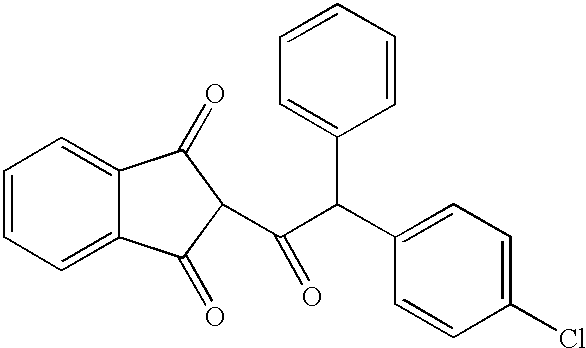 |
Chlorophacinone CAS 3691-35-8 | Anticoagulent, Rodenticide |
 |
Difenadione CAS 82-66-6 | Anticoagulant Rodenticide |
 |
Dehydroacetic acid CAS 520-45-6 | Sodium salt as dip- fungicide, Bacteriacide in toothpastes. Plasticizer. |
 |
Pyratrione CAS 51089-21-5 | Anti-hypertensive. |
 |
Prohexadione CAS 88805-35-0 | Plant growth regulator. |
 |
2,5-dihydroxy-3- methoxy-6-[(2E)-1- oxo-3-phenyl-2- propenyl]-2,5- cyclohexadiene-1,4- dione | Extract from Didymocarpus leucocalyx (M. Fujii, Natural Medicines 1996, V50, p404) |
 |
4,5-dimethoxy-2- [(2E)-1-oxo-3- phenyl-2-propenyl]- 4-cyclopentene-1,3- dione | Flavanoids from the fruits of Lindera erythrocarpa, used as a folk medicine. (Sheng-Yien Liu, Yukio Ogihara, Yakugaku Zasshi 1975, 95(9), 1114-18) |
 |
Apiosporamide | Antifungal extract from mycelium of the coprophilous fungus. (Ali A. Alfatafta et al. J. Nat. Prod. 1994, 57(12), 1696-702) |
 |
Compound 79 Table II Page 36 of EP 0 283 261 B1 | EP 0 283 261 B1 “Herbicidal Substituted Cyclic Diones” |
 |
Compound 74 Table I Page 34 of EP 0 283 261 B1 | EP 0 283 261 B1 “Herbicidal Substituted Cyclic Diones” |
Scheme i shows preparation of acylated cyclic 1,3-dicarbonyl compounds of Formula i, via rearrangement of the corresponding enol ethers of Formula ii, wherein linking group A0 and J0 are as already described. Such a rearrangement is disclosed in a number of references including PCT Patent Application Publications WO99/28282 and WO96/22958, and U.S. Pat. Nos. 4,695,673 and 4,678,496. 
The reaction requires a catalyst to proceed in satisfactory rate and yield. Known catalysts include azoles such as 1,2,4-triazole as described in PCT Patent Application Publication WO99/28282, 4-(dimethylamino)pyridine as described in PCT Patent Application Publication WO93/08153, cyanide as described in U.S. Pat. No. 4,695,673 and aluminum trichloride as described in Synthesis 1978, pages 925-6.
As described in PCT Patent Application Publication WO99/28282 and shown in Scheme ii, some enol ethers of Formula ii can be prepared by treating a 1,3-dicarbonyl compound of Formula iii with an acylating reagent of Formula iv in the presence of a base. 
wherein linking group A0 completes a 5-, 6- or 7-membered optionally substituted carbocyclic or heterocyclic ring. J0 is an aliphatic or aromatic group, and X0 is a halogen leaving group, usually chlorine.
PCT Patent Application Publications WO99/28282, WO96/22958 and WO96/22957, and U.S. Pat. Nos. 5,559,218, and 5,480,858 describe acyl halides as suitable acylating agents. The enol ether may be isolated, or the crude reaction mass may be treated with a catalyst, as indicated above to give the desired acylated cyclic 1,3-dicarbonyl compounds of general Formula i. A limitation of the method of Scheme ii is that acyl halides are produced under acidic conditions that can decompose acid-sensitive chemical substituents on the acyl halide itself causing reduced yield and purity. Also, substituents that would react with the highly reactive acyl halide group cannot be included. Additional methods to prepare acylated cyclic 1,3-dicarbonyl compounds are therefore needed.
This invention pertains to a method for preparing an acylated product of Formula 1: 
wherein
A is a linking group comprising an optionally substituted backbone segment consisting of 2 to 4 atoms selected from carbon atoms and 0 to 2 nitrogen, 0 to 2 oxygen and 0 to 2 sulfur atoms;
J is an optionally substituted, carbon-linked hydrocarbyl group; and
Y is H or a salt cation;
the process comprising contacting a phenyl ester of Formula 2: 
wherein
y is 0, 1, 2 or 3;
each R is independently selected from electron-withdrawing groups; and
J is as defined for Formula 1
with a cyclic compound of Formula 3: 
wherein
A and Y are as defined for Formula 1;
in the presence of a source of cyanide or fluoride ion.
The following definitions apply throughout the disclosure and claims of this invention. The term “alkyl”, used either alone or in compound words such as “alkylthio” or “haloalkyl” includes straight-chain or branched alkyl, such as, methyl, ethyl, n-propyl, i-propyl, or the different butyl, pentyl or hexyl isomers. “Alkenyl” includes straight-chain or branched alkenes such as ethenyl, 1-propenyl, 2-propenyl, and the different butenyl, pentenyl and hexenyl isomers. “Alkenyl” also includes polyenes such as 1,2-propadienyl and 2,4-hexadienyl. “Alkynyl” includes straight-chain or branched alkynes such as ethynyl, 1-propynyl, 2-propynyl and the different butynyl, pentynyl and hexynyl isomers. “Alkynyl” can also include moieties comprised of multiple triple bonds such as 2,5-hexadiynyl. “Alkoxy” includes, for example, methoxy, ethoxy, n-propyloxy, isopropyloxy and the different butoxy, pentoxy and hexyloxy isomers. “Alkoxyalkyl” denotes alkoxy substitution on alkyl. Examples of “alkoxyalkyl” include CH3OCH2, CH3OCH2CH2, CH3CH2OCH2, CH3CH2CH2CH2OCH2 and CH3CH2OCH2CH2. “Alkoxyalkoxy” denotes alkoxy substitution on alkoxy. “Alkenyloxy” includes straight-chain or branched alkenyloxy moieties. Examples of “alkenyloxy” include H2C═CHCH2O, (CH3)2C═CHCH2O, (CH3)CH═CHCH2O, (CH3)CH═C(CH3)CH2O and CH2═CHCH2CH2O. “Alkynyloxy” includes straight-chain or branched alkynyloxy moieties. Examples of “alkynyloxy” include HC≡CCH2O, CH3C≡CCH2O and CH3C≡CCH2CH2O. “Alkylthio” includes branched or straight-chain alkylthio moieties such as methylthio, ethylthio, and the different propylthio, butylthio, pentylthio and hexylthio isomers. Examples of “alkylsulfinyl” include CH3S(O), CH3CH2S(O), CH3CH2CH2S(O), (CH3)2CHS(O) and the different butylsulfinyl, pentylsulfinyl and hexylsulfinyl isomers. Examples of “alkylsulfonyl” include CH3S(O)2, CH3CH2S(O)2, CH3CH2CH2S(O)2, (CH3)2CHS(O)2 and the different butyl pentylsulfonyl and hexylsulfonyl isomers. “Alkenylthio”, “alkenylsulfinyl”, “alkenyl-sulfonyl”, “alkynylthio”, “alkynylsulfinyl”, “alkynylsulfonyl”, and the like, are defined analogously to the above examples. “Cycloalkyl” includes, for example, cyclopropyl, cyclobutyl, cyclopentyl, and cyclohexyl. The term “cycloalkoxy” includes the same groups linked through an oxygen atom such as cyclopentyloxy and cyclohexyloxy. “Cycloalkenyl” includes groups such as cyclopentenyl and cyclohexenyl as well as groups with more than one double bond such as 1,3- and 1,4-cyclohexadienyl. By “carbocycle” is meant a ring having a backbone consisting only of carbon atoms. By “heterocycle” is meant a ring having a backbone in which at least one atom is other than carbon. Unless indicated otherwise, heterocyclic ring systems can be attached through any available carbon or nitrogen by replacement of a hydrogen on said carbon or nitrogen. The term “aryl” means a radical derived from an aromatic ring system. By “aromatic” is meant fully unsaturated carbocycles and heterocycles where the Hückel rule is satisfied for an aromatic ring. In aromatic rings each of the ring atoms is essentially in the same plane and has ap-orbital perpendicular to the ring plane, and in which (4n+2) π electrons, where n is 0 or a positive integer, are associated with the ring to comply with Huckel's Rule. The term “halogen”, either alone or in compound words such as “haloalkyl”, includes fluorine, chlorine, bromine or iodine. When used in compound words such as “haloalkyl”, said alkyl may be partially or fully substituted with halogen atoms which may be the same or different. Examples of “haloalkyl” include F3C, ClCH2, CF3CH2 and CF3CCl2. The terms “haloalkenyl”, “haloalkynyl”, “haloalkoxy”, “haloalkylthio”, and the like, are defined analogously to the term “haloalkyl”. Examples of “haloalkenyl” include (Cl)2C═CHCH2 and CF3CH2CH═CHCH2. Examples of “haloalkynyl” include HC≡CCHCl, CF3C≡C, CCl3C≡C and FCH2C≡CCH2. Examples of “haloalkoxy” include CF3O, CCl3CH2O, HCF2CH2CH2O and CF3CH2O. Examples of “alkylcarbonyl” include C(O)CH3, C(O)CH2CH2CH3 and C(O)CH(CH3)2. Examples of “alkoxycarbonyl” include CH3OC(═O), CH3CH2OC(═O), CH3CH2CH2OC(═O), (CH3)2CHOC(═O) and the different butoxy- or pentoxycarbonyl isomers. When a compound is substituted with a substituent bearing a subscript that indicates the number of said substituents can exceed 1, said substituents (when they exceed 1) are independently selected from the group of defined substituents. Further, when the subscript indicates a range, e.g. (R)i-j, then the number of substituents may be selected from the integers between i and j inclusive. When a group is stated to be optionally substituted, the substituents are independently selected, and unless a number is indicated, the number of substituents may vary between 0 and the number of hydrogen atoms available for replacement by substituents.
As shown in Scheme 1, the process of the invention involves reaction of cyclic compound of Formula 3 with a phenyl ester of Formula 2 to give the acylated cyclic compound of Formula 1 and a phenol derivative of Formula 4 byproduct. 
wherein A, J, Y, R and y are as defined in the Summary of the Invention.
In the process of Scheme 1, the phenyl ester of Formula 2 serves as the acylating agent. Phenyl esters of Formula 2 have been discovered to give good to excellent yields of the acylated products of Formula 1 in the presence of cyanide or fluoride ion even though they are inherently less reactive acylating agents than the acyl chlorides used in processes previously known in the art. Not only are the phenyl esters of Formula 2 found to work well to provide the acylated products of Formula 1 from the cyclic compounds of Formula 3 in a single process step, but they can be prepared under mild, acid-free conditions preserving sensitive functionality vulnerable to degradation under reaction conditions used to prepare the acyl chlorides of the prior art processes. As the process of Scheme 1 also involves mild reaction conditions, it provides a very general method useful for preparing acylated products of Formula 1 of very broad scope of chemical structure and functionality.
The process as shown in Scheme 1 requires at least a catalytic amount of cyanide or fluoride ion. Suitable cyanide sources include, but are not limited to, inorganic salts such as zinc cyanide and alkali metal salts including sodium cyanide and potassium cyanide, and organic compounds such as hydrogen cyanide and acetone cyanohydrin. The amount of cyanide source is typically greater than 0.01 equivalents relative to the compound of Formula 3, preferably between 0.05 and 0.3 equivalents.
Suitable fluoride sources include, but are not limited to, ammonium, phosphonium and inorganic fluoride salts, particularly alkali metal fluoride salts such as lithium fluoride, sodium fluoride, potassium fluoride, rubidium fluoride, cesium fluoride, ammonium fluoride, ammonium silicofluoride, tetramethylammonium fluoride, tetrabutylammonium fluoride and tetrabutylphosphonium fluoride. Hydrogen fluoride can also be used with an equivalent of a base to convert it to a salt. Preferred sources include cesium fluoride and potassium fluoride, especially spray-dried potassium fluoride. The amount of fluoride ion is typically greater than 0.5 equivalents versus the compound of Formula 3, preferably, between 0.5 and 5.0 equivalents. The usefulness of fluoride in the process of the present invention is especially surprising, as fluoride has not been reported useful in the method of the prior art (shown in Scheme a).
To achieve rapid reaction and good yields, the method of Scheme 1 advantageously includes a source of basicity. If the starting cyclic compound of Formula 3 is present as the salt (i.e. Y is a salt cation), then the Formula 3 salt itself is generally a sufficient source of basicity, and the Formula 1 product will be produced also as the salt with the same salt cation. If the starting cyclic compound of Formula 3 is present as the free acid form (i.e. Y is H), then an added source of basicity is generally needed to achieve rapid reaction and good yields. At least about a full equivalent, and preferably more than two equivalents, of a fluoride or cyanide salt can provide not only catalysis but also the required source of basicity. Fluoride salts work particularly well as both catalyst and a source of basicity to give good conversion rates and yields when at least 3 equivalents of fluoride salt is present in the reaction mixture relative to the starting material of Formula 3. If the phenolic byproduct of Formula 4 is acidic enough to protonate fluoride, at least 4 equivalents of fluoride salt may be needed to obtain best results. When a fluoride salt is used as the source of basicity, the reaction product of Formula 1 may still be isolated in the free acid form (i.e. Y is H) on adding water to the reaction mixtures, possibly because in aqueous solution hydrofluoric acid appears to have greater acidity than most acylated cyclic compounds of Formula 1. If a catalytic amount of fluoride or cyanide salt is used, then generally at least one equivalent of an additional base is needed to provide a source of basicity, and the product of Formula 1 is formed as the salt of that base (i.e. Y in Formula 1 is a salt cation).
Suitable bases that can be used in the invention include organic compounds such as organic amines, including tertiary amines, optionally substituted heterocycles such as pyridine, and the like, whose conjugate acids have a pKa of greater than 4. “Tertiary amines” are derivatives of ammonia that are substituted with three independently selected carbon-connected groups, whose connecting carbon atoms are not bonded to heteroatoms such as oxygen, nitrogen or sulfur. Typical tertiary amine substituents are alkyl and aryl, although other groups such as haloalkyl, alkenyl and alkynyl are possible. Tertiary amines include alkylamines such as trimethylamine, triethylamine, tributylamine, diisopropyl-ethylamine, and the like, and alkylaminobenzenes such as N,N-dimethylaminobcnzene, N,N-diethylaminobenzene, and the like. Suitable bases also include ionic bases such as, but not limited to, alkali metal carbonates such as lithium carbonate, sodium carbonate, potassium carbonate, rubidium carbonate and cesium carbonate, alkali metal and alkaline earth metal oxides such as lithium oxide, sodium oxide, calcium oxide, strontium oxide and barium oxide, alkali metal and alkaline earth metal hydrides such as calcium hydride, sodium hydride and potassium hydride, alkali metal and alkaline earth metal hydroxides such as lithium hydroxide, calcium hydroxide, barium hydroxide, sodium hydroxide, potassium hydroxide, rubidium hydroxide, cesium hydroxide and tetraalkylammonium hydroxides, alkoxides such as sodium ethoxide and potassium tert-butoxide, and the like. For reason of solubility, preferred ionic bases are those containing an alkali metal or tetra(C1-C4)alkylammonium cation. Lithium carbonate, sodium carbonate and potassium carbonate are particularly useful as bases. The amount of base used is generally 1 equivalent or greater with respect to the compound of Formula 3, with 1-3 equivalents being preferred. If the compound of Formula 3 in the salt form (i.e. Y is a salt cation) is used in place of the compound of Formula 3 wherein Y is H, then the base can be omitted.
One skilled in the art recognizes that when the base is lithium carbonate (or hydroxide), sodium carbonate (or hydroxide), potassium carbonate (or hydroxide), calcium hydroxide or tetra-n-butylammonium hydroxide, then Y will be Li+, Na+, K+, Ca2+ or tetra-n-butylammonium, respectively. When the base is an alkylamine, then Y will be the corresponding alkylammonium salt. For example, when trimethylamine is the base, then Y will be trimethylammonium. Because Y is provided by the base, the base used in the reaction is described as a basic source of Y. Y then is typically selected from alkali metal cations such as Li+, Na+ and K+, alkaline earth metal cations such as Ca2+, Sr2+ and Ba2+, tri(C1-C4 alkyl)ammonium, tetra(C1-C4 alkyl)ammonium, and protonated N,N-di(C1-C4 alkyl)aminobenzene. To obtain best solubility, Y is preferably selected from alkali metal cations such as Li+, Na+ and K+, tri(C1-C4 alkyl)ammonium, tetra(C1-C4 alkyl)ammonium, and protonated N,N-di(C1-C4 alkyl)aminobenzene. For reason of cost, Y is most preferably selected from Na+, K+, tri(C1-C4 alkyl)ammonium, and protonated N,N-di(C1-C2 alkyl)-aminobenzene.
A phase transfer catalyst is optionally added. This is especially advantageous if a non-polar solvent is used and the cyanide or fluoride source is an inorganic salt. Examples of phase transfer catalysts that can be used are tetraalkylammonium salts, such as tetrabutylammonium chloride, cetyltrimethylammonium bromide and the like, organic phosphonium salts such as tetrabutylphosphonium chloride, tetraphenylphosphonium bromide and the like, and both cyclic and acyclic polyethers such as the various crown ethers, diglyme, triglyme, higher molecular weight polyethylene glycol ethers and the like. The amount of phase transfer catalyst is typically greater than 0.1 equivalents relative to the cyanide or fluoride source. Preferably 0.1 to 1.0 equivalents are used. Phase transfer catalysis is particularly advantageous when an alkali metal cyanide source is used. In this case the cyanide anion may not have sufficient solubility in the reaction solvent to produce a practical rate of reaction. A “phase transfer catalyst” possesses the quality of increasing the solubility of the cyanide or fluoride anion in the reaction phase and in effect transferring it from the phase it is more soluble in to that in which it is required for promoting the desired reaction.
The process is generally carried out in a suitable solvent. By “suitable solvent” is meant a liquid wherein the compounds of Formula 2 can be dissolved or suspended and the process proceeds at a commercially acceptable rate. Any aprotic solvent can be employed, providing that it is inert in the reaction of the present invention and that the reagents have adequate solubility. Examples of aprotic solvents include nitrites such as acetonitrile, propionitrile and adiponitrile, ethers such as tetrahydrofuran and dioxane, ketones such as acetone and methyl ethyl ketone, aromatics such as benzene, methylbenzene, dimethylbenzenes and chlorobenzene, esters such as ethyl acetate, amides such as N,N-dimethylformamide, N,N-dimethylacetamide and N-methylpyrrolidone, sulfoxides such as dimethyl sulfoxide (alternatively named methyl sulfoxide) and tetramethylene sulfoxide, and sulfones such as dimethyl sulfone (alternatively named methyl sulfone) and sulfolane (alternatively named tetramethylene sulfone). Preferred are the nitrile and sulfoxide solvents.
The reaction temperature may be chosen to obtain a commercially practical reaction rate without adversely affecting reaction yield through production of unwanted byproducts. Typically, the reaction temperature is maintained between 0° C. and 250° C., for from 0.5 to 130 hours for complete conversion. The preferred temperature range is from 40° C. to 100° C., wherein most reactions are complete within 2 to 4 hours.
The reaction may be conducted at any pressure compatible with the chosen solvent and reaction temperature. The preferred pressure is from 1 to 3 atmospheres (1×10⁵ to 3×10⁵ Pa). For sake of convenience and simplicity, operation at about 1 atmosphere (1×10⁵ Pa) is most preferred.
The reaction is performed by combining the ingredients, then maintaining a suitable temperature and pressure for a period of time until the desired conversion of the compound of Formula 3 to the compound of Formula 1 has occurred. The product can be isolated by standard methods, e.g., by filtration. The product is isolated as the free acylated cyclic compound of Formula 1 (Y is H) or as its salt (Y is a salt cation). The salt of Formula 1 (Y is a salt cation) can be converted to the free acid-form of the acylated cyclic product of Formula 1 (Y is H) by treatment with acid having a pKa lower than the pKa of the product of Formula 1 wherein Y is H. At least one equivalent of acid is needed per mole of salt of Formula 1 (Y is a salt cation). Preferred are acids having a pKa less than about 3. More preferred as acids having a pKa less than about 2. Most preferred are strong mineral acids such as hydrochloric acid, sulfuric acid and phosphoric acid. Conversely, the free acylated cyclic compound of Formula 1 (Y is H) can be converted to its salt (Y is a salt cation) by treatment with a base providing the desired counter ion as the cation.
In the process of Scheme 1, the phenyl esters of Formula 2 are substituted with 0 to 3 substituents R, wherein each R is independently selected from electron-withdrawing groups. By “electron withdrawing group” is meant a functional group attached to the phenyl group of Formula 2 which attracts electrons to itself to a greater extent than would a hydrogen atom in the same position. The attraction of electrons can occur through an “inductive” and or “resonance” effect. Additional information regarding these effects can be found on pages 17-19 and page 36 of Advanced Organic Chemistry, 4th Edition by J. March; John Wiley & Sons; New York (1992). Electron-withdrawing groups can accelerate the rate of the reaction for the process of Scheme 1. Particularly useful electron-withdrawing groups for R include NO2, COOR1, COR1, SO2R1, CN, CF3, F, CON(R1)2 and SO2N(R1)2 wherein each R1 is independently selected from C1-C6 alkyl groups. Most preferred in the reaction of the invention are esters of Formula 2 wherein R is located in the ortho or para position with respect to the phenolic oxygen.
The J group in Formula 2 is an appendage not directly involved in the acylation reaction center. Because the reaction conditions of the process of Scheme 1 as well as those of processes useful for preparing compounds of Formula 2 are so mild, J can accommodate a wide range of molecular structural features and all but the more reactive functionalities known to those skilled in the art. Thus J is best generally described as an optionally substituted hydrocarbyl group bound through a carbon atom to the carbonyl moiety of Formula 2. J is connected through carbon to the carbonyl moiety to provide phenyl esters of Formula 2, which have the appropriate stereoelectronic profile and reactivity for the process of Scheme 1. By “hydrocarbyl” group is meant a radical comprising at least one carbon and at least one hydrogen atom, and optionally containing heteroatoms. For sake of illustration, the carbon atom of J linking to the carbonyl moiety of Formula 2 can be part of an alkyl, alkenyl, alkynyl, cycloalkyl, cycloalkenyl or aryl group, which are optionally substituted with independently selected substituents. Illustrative aryl groups include benzene (phenyl), thiophene, pyridine, pyridazine, pyrazine, pyrimidine, pyrrole, triazine, triazole, furan and related structures. Illustrative substituents include alkyl, alkenyl, alkynyl, cycloalkyl, cycloalkenyl, cycloalkyl, aryl, hydroxycarbonyl, formyl, alkylcarbonyl, alkenylcarbonyl, alkynylcarbonyl, alkoxycarbonyl, hydroxy, alkoxy, alkenyloxy, alkynyloxy, aryloxy, alkylthio, alkenylthio, alkynylthio, alkylsulfinyl, alkenylsulfinyl, alkynylsulfinyl, arylsulfinyl, alkylsulfonyl, alkenylsulfonyl, alkynylsulfonyl, arylsulfonyl, amino, alkylamino, alkenylamino, alkynylamino, arylamino, aminocarbonyl, alkylaminocarbonyl, alkenylaminocarbonyl, alkynylaminocarbonyl, arylaminocarbonyl, alkylaminocarbonyloxy, alkenylaminocarbonyloxy, alkynylaminocarbonyloxy, arylaminocarbonyloxy, alkoxycarbonylamino, alkenyloxycarbonylamino, alkynyloxycarbonylamino and aryloxycarbonylamino, each further optionally substituted, and halogen, cyano and nitro. The optional further substituents are independently selected from groups like those illustrated above to give groups such as haloalkyl, haloalkenyl and haloalkoxy. The substituents may also be tied together by figuratively removing one to two hydrogen atoms from each of two substituents or a substitucnt and the supporting backbone and joining the radicals to produce cyclic and polycyclic structures fused or appended to the molecular structure supporting the substituents. For example, tying together adjacent hydroxy and methoxy groups attached to, for example, a phenyl ring gives a fused dioxolane structure containing the linking group —O—CH2—O—. Tying together a hydroxy group and backbone to which it is attached can give cyclic ethers, including epoxides. Although there is no definite limit to the size of J suitable for the processes of the invention, typically J comprises 1-100, more commonly 1-50, and most commonly 1-20 carbon atoms, and 0-25, more commonly 0-15 and most commonly 0-10 heteroatoms. The heteroatoms are commonly selected from halogen, oxygen, sulfur, nitrogen and phosphorus, and more commonly, halogen, oxygen, sulfur and nitrogen. Halogen includes fluorine, chlorine, bromine and iodine. Illustrative examples of the radical J are shown in Table 2.
| TABLE 2 |
| Examples of J groups useful in the methods of the invention |
| Chemical Structure | |||
| J-1 | —CH3 | ||
| J-2 | —C(CH3)3 | ||
| J-3 |
 |
||
| J-4 |
 |
||
| J-5 |
 |
||
| J-6 |
 |
||
| J-7 |
 |
||
| J-8 |
 |
||
| J-9 |
 |
||
| J-10 |
 |
||
| J-11 |
 |
||
| J-12 |
 |
||
| J-13 |
 |
||
| J-14 |
 |
||
| J-15 |
 |
||
| J-16 |
 |
||
The linking group A in Formula 3 is also not directly involved in the acylation reaction center. Because the reaction conditions of the process of Scheme 1 are so mild, linking group A can accommodate a wide range of molecular structural features and all but the more reactive functionalities known to those skilled in the art. Therefore linking group A is best generally described as a linking group comprising an optionally substituted backbone segment consisting of 2 to 4 atoms selected from carbon atoms and 0 to 2 nitrogen, 0 to 2 oxygen and 0 to 2 sulfur atoms. More commonly, said optionally substituted backbone segment consists of 2 to 3 atoms selected from carbon atoms and 0 to 2 nitrogen, 0 to 1 oxygen and 0 to 1 sulfur atoms. Linking group A therefore completes with the 1,3-dione moiety (or an enolic tautomer of this moiety) an optionally substituted 5-, 6- or 7-membered carbocyclic or heterocyclic ring in Formulae 1 and 3. The 5-, 6- or 7-membered carbocyclic or heterocyclic ring is optionally fused with another optionally substituted carbocyclic or heterocyclic, saturated, partially unsaturated or aromatic, monocyclic or polycyclic ring system to form a polycyclic ring system. Some product compounds of interest include an optionally substituted benzene ring fused through linking group A to the ring comprising the 1,3-dione moiety (or an enolic tautomer of this moiety). As illustrated by compounds 3.7, 3.8, 3.9, 3.10 and 3.12 in Table 3 below, linking group A may contain a double or aromatic bond endocyclic to the ring containing the 1,3-dione moiety (or an enolic tautomer of this moiety), or linking group A may be fully saturated. Furthermore, linking group A may have one or more double or aromatic bonds exocyclic to the ring containing the 1,3-dione moiety (or an enolic tautomer of this moiety). The exocyclic double or aromatic bond may connect carbon or a heteroatom such as oxygen, sulfur or nitrogen, as exemplified by compounds 3.8, 3.9, 3.10 and 3.15 in Table 3 below. Optional substituents on linking group A including fused rings are independently selected from substitutents including, for example, alkyl, alkenyl, alkynyl, cycloalkyl, cycloalkenyl, cycloalkyl, aryl, hydroxycarbonyl, formyl, alkylcarbonyl, alkenylcarbonyl, alkynylcarbonyl, alkoxycarbonyl, hydroxy, alkoxy, alkenyloxy, alkynyloxy, aryloxy, alkylthio, alkenylthio, alkynylthio, alkylsulfinyl, alkenylsulfinyl, alkynylsulfinyl, arylsulfinyl, alkylsulfonyl, alkenylsulfonyl, alkynylsulfonyl, arylsulfonyl, amino, alkylamino, alkenylamino, alkynylamino, arylamino, aminocarbonyl, alkylaminocarbonyl, alkenylaminocarbonyl, alkynylaminocarbonyl, arylaminocarbonyl, alkylaminocarbonyloxy, alkenylaminocarbonyloxy, alkynylaminocarbonyloxy, arylaminocarbonyloxy, alkoxycarbonylamino, alkenyloxycarbonylamino, alkynyloxycarbonylamino and aryloxycarbonylamino, each further optionally substituted, and halogen, cyano and nitro. The optional further substituents are independently selected from groups like those illustrated above to give groups such as haloalkyl, haloalkenyl and haloalkoxy. The substituents may also be tied together by figuratively removing one to two hydrogen atoms from each of two substituents or a substituent and the supporting backbone and joining the radicals to produce cyclic and polycyclic structures fused or appended to the molecular structure supporting the substituents. For example, tying together adjacent hydroxy and methoxy groups attached to, for example, a phenyl ring gives a fused dioxolane structure containing the linking group —O—CH2—O—. Tying together a hydroxy group and backbone to which it is attached can give cyclic ethers, including epoxides. Although there is no definite limit to the size of A suitable for the processes of the invention, typically A, including fused rings and substituents, comprises 1-50, more commonly 1-25, and most commonly 1-10 carbon atoms, and 0-10, more commonly 0-5 and most commonly 0-3 heteroatoms. The heteroatoms are commonly selected from halogen, oxygen, sulfur, nitrogen and phosphorus, and more commonly, halogen, oxygen, sulfur and nitrogen. Halogen includes fluorine, chlorine, bromine and iodine. Table 3 shows a variety of cyclic compounds illustrative of Formula 3.
| TABLE 3 |
| Examples of 1,3-Dicarbonyl Compounds shown in Formula 3 |
| Chemical Structure | |
| 3.1 |
 |
| 3.2 |
 |
| 3.3 |
 |
| 3.4 |
 |
| 3.5 |
 |
| 3.6 |
 |
| 3.7 |
 |
| 3.8 |
 |
| 3.9 |
 |
| 3.10 |
 |
| 3.11 |
 |
| 3.12 |
 |
| 3.13 |
 |
| 3.14 |
 |
| 3.15 |
 |
| 3.16 |
 |
Methods for preparing phenyl esters of Formula 2 are well known in the art. For example, such methods are described in Advanced Organic Chemistry, 3rd Edition by J. March; John Wiley & Sons; New York (1985). These methods include palladium-catalyzed carbonylation of an aryl halide, usually an iodide, in the presence of a phenol. This method is illustrated in Examples 3A, 4A and 5A, which follow. As this method to prepare the phenyl ester is carried out in a basic environment, acid-sensitive groups on the J radical will not be degraded by the reaction conditions. The subsequent reaction of the phenyl ester with the 1,3-diketone, shown in Scheme 1, continues in a basic medium through which acid-sensitive groups will survive without decomposition.
Another route to phenyl esters is described by G. Satyanarayana and S. Sivaram in Synthetic Communications 1990, 20(21), 3273-6 in which, as is depicted in Scheme 2, phenyl esters of Formula 2a are produced by reaction in tetrahydrofuran solvent of Grignard reagents of Formula 4, which are in turn prepared from halides, with bis-phenyl carbonates such as Formula 5. 
R2 is, for example, ethyl, n-butyl, benzyl, phenyl or 4-methylphenyl. This route also can avoid acidic reaction conditions.
As reported by A. Rosowsky et al. in the Journal of Medicinal Chemistry 1985, 28(5), 660-67, phenyl esters of Formula 2 can be prepared by reaction of the appropriate carboxylic acids with bis-phenyl carbonates, again avoiding acidic conditions. A. Rosowsky et al. prepare the compound of Formula 2b by the treatment of the compound of Formula 6 with bis(p-nitrophenyl) carbonate in N,N-dimethylformamide (DMF) solvent. 
Acyl halide counterparts of Formula 2b needed for the prior art method of Scheme ii (i.e. Formula iv) cannot be prepared, because the acid chloride moiety would react with the amino groups.
When J does not include acid-sensitive substituents, other methods can be used to prepare phenyl esters of Formula 2. These include, for example, reaction of carboxylic acids with an inorganic halide such as thionyl chloride to form the corresponding acid chlorides, and then reacting the acid chlorides with the appropriate phenols. This method is reported in Survey of Organic Syntheses, Calvin A. Buehler and Donald E. Pearson, Wiley-Interscience (1970) and utilized in Example 8A, which follows. As yet another method, William H. Coppock in the Journal of Organic Chemistry 1957, 22, 325-26 reports preparing various substituted phenyl benzoates by Friedel-Crafts reaction of a substituted phenyl chloroformate with alkylbenzenes or arylbenzenes using aluminum chloride catalyst. These last two methods are useful for preparing phenyl benzoates of Formula 2 when there are no acid sensitive groups on the J radical.
General methods for preparing cyclic compounds of Formula 3 are well known in the art, see, for example, Volume 13, page 929 of the Kirk-Othmer Encyclopedia of Chemical Technology, John Wiley & Sons. Five and six membered cyclic 1,3-diketones (including their enolic tautomers) can be prepared by either treating corresponding γ-keto acids with concentrated sulfuric acid, or keto esters with base. For example, treating ethyl levulinate (CH3C(O)(CH2)2CO2C2H5) with sodium hydroxide in ethanol produces 1,3-cyclo-pentanedione. Sections 12.47 and 13.11 of Advanced Organic Chemistry by Louis F. and Mary Fieser, Reinhold 1961 show two additional methods for synthesis of 1,3-diketones. In the first, 1,3-cyclohexanedione is prepared by hydrogenation of 1,3-dihydroxybenzene using Raney nickel in aqueous alkali. In another example, a substituted 1,3-cyclohexanedione is made by base-catalyzed condensation of an α,β-unsaturated ester with a gem di(alkoxycarbonyl)alkane. The resulting enolate is heated with aqueous alkali hydroxide to hydrolyze the ester group and, on acidification, the β-keto acid loses carbon dioxide to produce the substituted 1,3-cyclohexanedione. As an example, 5,5-dimethylcyclohexane-1,3-dione was produced in this way from diethyl 1,3-propandioate and 4-methyl-3-penten-2-one; see also R. L. Shriner and H. R. Todd, Org. Syn., Coll. Vol. 2, 200 (1943).
A particular advantage of the method of this invention is that acylation is carried out using a phenyl ester instead of the acyl chloride of the prior art methods. Any J substituent which is acid-sensitive or reactive with an acyl chloride can lead to decomposition and yield loss using the prior art method. The method of the present invention (Scheme 1) avoids this limitation by using phenyl esters instead of acyl halides as acylating agents. For example, an attempt was made to use the prior art method to prepare the product later successfully prepared in Example 3A using the method of the present invention. Using the prior art method required first preparing the acid chloride of Formula 9 from the corresponding carboxylic acid of Formula 7 by treatment with thionyl chloride (8) as shown in Scheme 3. 
Under normal commercial process conditions and hold times the dioxolane group in Formula 9 was not stable in the acid environment required in its production, and the resulting yield loss made the prior art approach impractical. The process of this invention proved superior because no acid chloride is required. Other acid-sensitive groups, which would also make the prior art method impractical, include vinyl ethers, acetals, ketals, epoxides, hydrazones, imines, carbamates and amides. Examples of such groups are shown in Table 2, structures J-13 through J-16.
Without further elaboration, it is believed that by means of the preceding description one skilled in the art can utilize the present invention to its fullest extent. The following examples are, therefore, to be construed as merely illustrative and not limiting of the disclosure in any way whatsoever.

A 200-mL 2-necked round bottom flask was fitted with thermometer, reflux condenser, magnetic stirrer, and nitrogen bypass. The flask was charged with 4.53 g (25 mmol) of 4-nitrophenyl acetate, 2.94 g (26.25 mmol) of 1,3-cyclohexanedione, 5.69 g (56.25 mmol) of triethylamine, 0.22 g (2.5 mmol) of acetone cyanohydrin, and 60 mL of acetonitrile. The mixture was heated to reflux with stirring for 3 hr. The mixture was allowed to cool to room temperature and volatiles were removed under reduced pressure to give 20.0 g of red oil. Chromatographic separation on silica gel afforded the title product. 1H NMR (CDCl3): δ 1.99 (m, 2), 2.52 (m, 2), 2.62 (s, 3), 2.68 (m, 2).

The apparatus, reagents and amounts of Example 1 were used with 6.08 g (25 mmol) of 4-nitrophenyl benzoate used in place of 4-nitrophenyl acetate. The mixture was heated to reflux with stirring for 5 hr. It was allowed to cool to room temperature and volatiles were removed under reduced pressure to give the title product as 11.84 g of red oil. 1H NMR (CDCl3): δ 2.08 (m, 2), 2.48 (m, 2), 2.72 (m, 2), 7.40 (m, 2), 7.52 (m, 3).

A Fisher-Porter tube* was charged with 3.94 g (10 mmol) of 2,3-dihydro-6-iodo-5,8-dimethylspiro[4H-1-benzothiopyran-4,2′-[1,3]dioxolane] 1,1-dioxide, 1.67 g (11 mmol) of methyl 4-hydroxybenzoate, 2.28 g (22.5 mmol) of triethylamine, 23 mg (0.1 mmol) of palladium acetate, and 20 mL of dry N,N-dimethylformamide (DMF). The mixture was heated for 2.5 hr at 80° C. in a carbon monoxide atmosphere at 70 psi (4.8×10⁵ Pa). The mixture was cooled to room temperature and filtered through Celite® diatomaceous earth filter aid into 150 mL of stirred ice water. The Celite® was rinsed with 10 mL of DMF, which was added to the ice water. The resulting precipitate was collected by filtration, washed with 25 mL of water, 15 mL of acetonitrile, 20 mL of diethyl ether and allowed to dry to give 4.20 g of the title product as a pale pink solid, m.p. 206-208° C. 1H NMR (CDCl3): δ 2.57 (s, 3), 2.58 (m, 2), 2.82 (s, 3), 3.52 (m, 2), 3.94 (s, 3), (s, 3), 4.20 (m, 2), 4.34 (m 2), 7.30 (m, 2), 7.79 (s, 1), 8.14 (m, 2).
* A Fisher-Porter tube is a thick walled test tube fitted through a gasket to a pressure gauge and associated valving to enable reactions above atmospheric pressure to be conducted.
A 300-mL 1-necked round bottom flask was fitted with magnetic stirrer and reflux condenser with balloon on top of the condenser. The flask was charged with 8.93 g (20 mmol) of 4-(methoxycarbonyl)phenyl 2,3-dihydro-5,8-dimethylspiro[4H-1-benzothio-pyran-4,2′-[1,3]dioxolane]-6-carboxylate 1,1-dioxide, 2.47 g (22 mmol) of 1,3-cyclohexane-dione, 5.05 g (50 mmol) of triethylamine, 0.20 g (3 mmol) of potassium cyanide, and 50 mL of acetonitrile. The mixture was heated for 6 hr at reflux. It was allowed to cool to room temperature, and then cooled to 5° C. Solids were collected by filtration, washed twice with 15 mL portions of acetonitrile and allowed to dry to give 8.26 g of the title product as white solid, m.p. 205-206° C. 1H NMR (CDCl3): δ 1.17 (t, 9), 1.94 (m, 2), 2.23 (s, 3), 2.44 (t, 4), 2.56 (m, 2), 2.69 (s, 3), 2.93 (q, 6), 3.43 (m, 2), 4.18 (m, 4), 6.90 (s, 1). Analysis by HPLC indicated the filtrate contained an additional 1.16 g of product.
A Fisher-Porter tube (defined in Example 3A) was charged with 3.94 g (10 mmol) of 2,3-dihydro-6-iodo-5,8-dimethylspiro[4H-1-benzothiopyran-4,2′-[1,3]dioxolane] 1,1-dioxide, 1.53 g (15 mmol) of triethylamine, 23 mg (0.1 mmol) of palladium acetate, 1.67 g (11 mmol) of methyl salicylate, and 20 mL of DMF. The mixture was heated for 3 hr at 80° C. followed by 17 hr at 50° C. in a carbon monoxide atmosphere at 70 psi (4.8×10⁵ Pa). The mixture was poured into 150 mL of ice water and filtered. The solid was washed with 10 mL of water, 10 mL of acetonitrile, and 10 mL of diethyl ether to give the title product as 3.50 g of pink solid, m.p. 179-181° C. 1H NMR (CDCl3): δ 2.58 (s, 3), 2.60 (m, 2), 2.84 (s, 3), 3.52 (m, 2), 3.84 (s, 3), 4.19 (m, 2), 4.34 (m, 2), 7.20 (d, 1), 7.36 (t, 1), 7.61 (t, 1), 8.02 (s, 1), 8.08 (d, 1).

A Fisher-Porter tube (defined in Example 3A) was charged with 3.34 g (7.5 mmol) of 2-(methoxycarbonyl)-phenyl 2,3-dihydro-5,8-dimethylspiro[4H-1-benzothiopyran-4,2′-[1,3]dioxolane]-6-carboxylate 1,1-dioxide, 0.93 g (8.25 mmol) of 1,3-cyclohexanedione, 1.70 g (17 mmol) of triethylamine, 49 mg (0.75 mmol) of potassium cyanide and 18 mL of acetonitrile. The mixture was heated for 10 hr at 90° C. It was allowed to cool to room temperature and filtered. The solid was washed with 6 mL of acetonitrile and allowed to dry under a stream of nitrogen to give the title product as 3.23 g of off-white solid, m.p. 203-205° C.

A Fisher-Porter tube (defined in Example 3A) was charged as in Example 4A using 1.50 g (11 mmol) of 4-hydroxyacetophenone in place of methyl salicylate. The mixture was heated for 3 hr at 80° C. It was worked up as in Example 4A to give the title product as 4.15 g of pale pink solid, m.p. 224-226° C. 1H NMR (CDCl3): δ 2.57 (s, 3), 2.60 (m, 2), 2.63 (s, 3), 2.82 (s, 3), 3.52 (m, 2), 4.20 (m, 2), 4.34 (m, 2), 7.31 (m, 2), 7.80 (s, 1), 8.06 (m, 2).
A 100-mL 2-necked round bottom flask was fitted with thermometer, reflux condenser with nitrogen bypass, and magnetic stirrer. The flask was charged with 1.08 g (2.5 mmol) of 4-acetylphenyl 2,3-dihydro-5,8-dimethylspiro[4H-1-benzothiopyran-4,2′-[1,3]dioxolane]-6-carboxylate 1,1-dioxide, 0.30 g (2.63 mmol) of 1,3-cyclohexanedione, 0.63 g (6.25 mmol) of triethylamine, 10 mL of acetonitrile, and 21 mg (0.25 mmol) of acetone cyanohydrin. The mixture was heated to reflux with stirring for 5 hours. It was stirred for 67 hr at 23° C. It was then heated at 80° C. for 2 hr after which 0.126 g of triethylamine was added followed by 3 hr at 80° C. The mixture was then stirred at 23° C. for 17 hr after which it was heated to 79° C. At 110 hr, 0.21 g of triethylamine and 21 mg of acetone cyanohydrin were added. Heating was continued for an additional 16 hr. The mixture was allowed to cool to room temperature and filtered. The solid was washed with 2 mL of acetonitrile, and allowed to dry under a stream of nitrogen to give the title product as 1.04 g of white solid, m.p. 205-206° C.
A 50-mL 2-necked round bottom flask was fitted with thermometer, magnetic stirrer, and distillation head. The flask was charged with 1.10 g (2.5 mmol) of 2-nitrophenyl 2,3-dihydro-5,8-dimethylspiro[4H-1-benzothiopyran-4,2′-[1,3]dioxolane]-6-carboxylate 1,1-dioxide, 0.31 g (2.75 mmol) of 1,3-cyclohexanedione, 0.58 g (10 mmol) of spray-dried potassium fluoride, 2 mL of acetonitrile, and 11 mL of methyl sulfoxide (alternatively named dimethyl sulfoxide). The pressure was reduced with a water aspirator and 3 mL of distillate was removed at a distillation temperature of 69° C. The distillation head was replaced with a reflux condenser and the mixture was heated for 2 hr at 80° C. The mixture was allowed to cool to room temperature and dissolved in aqueous acetonitrile. Quantitative analysis of this solution by HPLC indicated an 85% yield of the title product.
A 100-mL 2-necked round bottom flask was charged with 4.62 g (40 mmol) of 1,3-cyclohexanedione, 2.64 g (40 mmol) of 85% potassium hydroxide, 5 mL of water, and 50 mL of toluene. The mixture was heated to reflux and water was removed as an azeotrope until only toluene distilled over. The mixture was cooled to room temperature and filtered. The solid was dried under vacuum at room temperature to give the title product as 5.95 g of pale yellow solid, m.p. 247-250° C.
A Fisher-Porter tube (defined in Example 3A) was charged with 1.67 g (3.7 mmol) of 4-(methoxycarbonyl)phenyl 2,3-dihydro-5,8-dimethylspiro[4H-1-benzothiopyran-4,2′-[1,3]-dioxolane]-6-carboxylate 1,1-dioxide, 0.62 g of the product of Example 7A, 26 mg (0.4 mmol) of potassium cyanide, and 10 mL of acetonitrile. The mixture was heated for 19 hr at 80° C. Quantitative analysis of the reaction mixture by HPLC indicated the presence of the title product in 93% yield.

A 100-mL 2-necked round bottom flask was fitted with thermometer, magnetic stirrer, and reflux condenser with nitrogen bypass. The flask was charged with 1.23 g (5 mmol) of 2-nitro-4-(methylsulfonyl)benzoic acid, 2 drops of DMF, and 20 mL of dichloromethane. Oxalyl chloride (0.70 g, 5.5 mmol) was added dropwise and the mixture was stirred for 1 hr. A solution consisting of 0.70 g (5 mmol) of 4-nitrophenol, 0.55 g (5.5 mmol) of triethylamine and 5 mL of dichloromethane was added and the mixture was stirred for 1 hr. The mixture was diluted with 100 mL of dichloromethane, washed twice with 100 mL portions of aqueous sodium bicarbonate, once with 100 mL of water, dried with magnesium sulfate, filtered, and volatiles removed under reduced pressure to give the title product as 1.56 g of off-white solid, m.p. 171-173° C. 1H NMR (CDCl3): δ 3.19 (s, 3), 7.47 (m, 2), 8.10 (m, 1), 8.38 (m, 3), 8.69 (m, 1).

A 100-mL 2-necked round bottom flask was fitted with thermometer, magnetic stirrer, and reflux condenser with nitrogen bypass. The flask was charged with 1.10 g (3 mmol) of 4-nitrophenyl 2-nitro-4-(methylsulfonyl)benzoate, 0.37 g (3.3 mmol) 1,3-cyclohexanedione, 0.76 (75 mmol) of triethylamine, 26 mg (0.3 mmol) of acetone cyanohydrin, and 10 mL of acetonitrile. The mixture was stirred for 1 hr at 22° C. It was poured into 200 mL of dilute aqueous sodium bicarbonate, washed once with diethyl ether, once with ethyl acetate, and acidified with hydrochloric acid. It was extracted with 200 mL of dichloromethane, which was then dried over magnesium sulfate and filtered. Volatiles were removed under reduced pressure to give 1.20 g of oil. The oil was washed with 200 mL of hot water and triturated with diethyl ether to give the title product as 0.22 g of white solid, m.p. 158° C. (decomposes). 1H NMR (CDCl3): δ 2.06 (m, 2), 2.37 (m, 2), 2.82 (m, 2), 3.16 (s, 3), 7.45 (d, 1), 8.24 (d, 1), 8.76 (s,1).

A 200-mL round bottom flask was fitted with thermometer, magnetic stirrer, and reflux condenser with nitrogen bypass. The flask was charged with 0.94 g (4 mmol) of 2-chloro-4-(methylsulfonyl)benzoic acid, 2 drops of DMF, and 20 mL of dichloromethane. Oxalyl chloride (0.56 g, 4.4 mmol) was added dropwise and the mixture was stirred for 1 hr. A solution consisting of 0.62 g (4 mmol) of 4-nitrophenol, 0.44 g (4.4 mmol) of triethylamine and 5 mL of dichloromethane was added slowly. The mixture was stirred for 1 hr, diluted with 100 mL of dichloromethane, washed twice with 100 mL portions of dilute aqueous sodium bicarbonate, once with water, dried over magnesium sulfate, filtered, and volatiles removed under reduced pressure to give the title product as 1.30 g of off-white solid, m.p. 123-125° C. 1H NMR (CDCl3): δ 3.14 (s, 3), 7.48 (m, 2), 8.00 (m, 1), 8.14 (m, 1), 8.21 (m, 1), 8.36 (m, 2).

A 100-mL 2-necked round bottom flask was fitted with thermometer, magnetic stirrer, and reflux condenser with nitrogen bypass. The flask was charged with 1.06 g (3 mmol) of 4-nitrophenyl 2-chloro-4-(methylsulfonyl)benzoate, 0.37 g (3.3 mmol) of 1,3-cyclohexanedione, 0.76 g (7.5 mmol) of triethylamine, 26 mg (0.3 mmol) of acetone cyanohydrin, and 10 mL of acetonitrile. The mixture was stirred for 3 hr at 22° C. It was worked up as in Example 8B to give 1.26 g of yellow oil. Treatment of the oil as in Example 8B gave the title product as 0.35 g of white solid, m.p. 141-142° C. 1H NMR (CDCl3): δ 2.08 (m, 2), 2.46 (m, 2), 2.82 (m, 2), 3.09 (s, 3), 7.37 (d, 1), 7.88 (d, 1), 7.96 (s, 1).
Examples 10-36 of the process were carried out as shown in Scheme 4 and listed in Table 4, using the following methods:
Method (A) Ester 2c (2.3 mmol) and dione 3b (2.7 mmol), were combined in (methyl sulfoxide)-d6 (abbreviated DMSO-d6) (5.0 g) and the mixture was heated to 80° C. Potassium fluoride (0.60 g, 10 mmol) was added in a single portion and the mixture was stirred at 80° C. The progress of the reaction was followed by NMR of aliquots until the ester was >98% converted to phenol, or until no further progress was observed. Completed reactions were worked up by partitioning the cooled reaction mixture between water (25 mL) and diethyl ether (25 mL). The organic layer was washed with water (3×5 mL) and brine (5 mL), dried over magnesium sulfate, filtered, and volatiles were evaporated. The product could be isolated by flash chromatography over silica gel**.
** The elution solvents were binary mixtures of hexanes, ethyl acetate, methylene chloride and 2-propanol; the choice of solvents and ratios dependent on the polarity of the product to be purified. See the footnotes below the table for specific solvents and ratios.
Method (B) Ester 2c (11.2 mmol) and dione 3b (15 mmol) were combined in acetonitrile (15 mL). Triethylamine (2.5 g, 25 mmol) and acetone cyanohydrin (0.14 mL, 1.5 mmol) were added and the mixture was heated to reflux. The progress of the reaction was followed by NMR of aliquots until the ester was >98% converted to phenol, or until no further progress was observed. Completed reactions were worked up by evaporating volatiles and partitioning the residue between diethyl ether and saturated aqueous sodium bicarbonate solution. The aqueous solution was acidified with 1N aqueous hydrochloric acid and the product was isolated by filtration (if solid) or extraction into dichloromethane. After concentration of the dichloromethane solution, liquid products could be further purified by flash chromatography over silica gel**.
** The elution solvents were binary mixtures of hexanes, ethyl acetate, methylene chloride and 2-propanol; the choice of solvents and ratios dependent on the polarity of the product to be purified. See the footnotes below the table for specific solvents and ratios.
Method (C) Same as Method B except that potassium cyanide (100 mg, 1.5 mmol) was used as the catalyst in place of acetone cyanohydrin.
| TABLE 4 |
| SCHEME 4 |
 |
| Examples 10-36 |
| Conversion | Isolated Yield | |||||||
| Ex. # | R3 | R4 | J | Z | Method | Time | (%)a | (%) |
| 10 | H | H | CH3 | 4-O2NC6H4— | A | 2 | hr | >98 | |
| 11 | H | H | CH3 | 2-O2NC6H4— | A | 1 | hr | >98 | |
| 12 | CH3 | CH3 | CH3 | 4-O2NC6H4— | A | 1 | hr | >98 | 76b |
| 13 | CH3 | CH3 | CH3 | 2-O2NC6H4— | A | 1 | hr | >98 | |
| 14 | C6H5 | H | CH3 | 2-O2NC6H4— | A | 8 | hr | >98 | 47c |
| 15 | C6H5 | H | CH3 | 4-O2NC6H4— | A | 8 | hr | >98 | |
| 16 | CH3 | CH3 | CH3 | 4-MeO2CC6H4— | A | 21 | hr | 81 | |
| 17 | CH3 | CH3 | CH3 | 4-O2NC6H4— | Cd | 2 | hr | ˜98 | |
| 18 | CH3 | CH3 | CH3 | 4-MeO2CC6H4— | Cd,e | 6 | hr | 93 | |
| 19 | CH3 | CH3 | CH3 | 4-O2NC6H4— | Bd,f | 4 | hr | >98 | |
| 20 | CH3 | CH3 | CH3 | 4-MeO2CC6H4— | Bd | 20 | hr | 94 | |
| 21 | CH3 | CH3 | CH3 | 4-MeO2CC6H4— | B | 4 | hr | 95 | |
| 22 | CH3 | CH3 | 4-CH3C6H4 | 4-NCC6H4— | A | 8 | hr | >98 | 73g |
| 23 | CH3 | CH3 | C6H5 | 4-MeO2CC6H4— | A | 12 | hr | >98 | 73h |
| 24 | CH3 | CH3 | C9H19-n | 3-O2NC6H4— | A | 4 | hr | >98 | 86i |
| 25 | CH3 | CH3 | 3-ClC6H4 | 4-O2NC6H4— | A | 2 | hr | >98 | 76j |
| 26 | CH3 | CH3 | 3-ClC6H4 | 4-O2NC6H4— | B | 2 | hr | >98 | 76k |
| 27 | CH3 | CH3 | 3-ClC6H4 | 4-O2NC6H4— | C | 2 | hr | >98 | 91l |
| 28 | CH3 | CH3 | 4-CH3C6H4 | 4-NCC6H4— | C | 6 | hr | 97 | 89m |
| 29 | C6H5 | H | 3-ClC6H4 | 4-O2NC6H4— | A | 4 | hr | >98 | 45n |
| 30 | C6H5 | H | 4-CH3C6H4 | 4-NCC6H4— | A | 22 | hr | 96 | 53o |
| 31 | CH3 | CH3 | 4-CH3C6H4 | 4-NCC6H4— | B | 7 | hr | 96 | 87p |
| 32 | CH3 | CH3 | C6H5 | 4-MeO2CC6H4— | B | 22 | hr | 93 | 84q |
| 33 | CH3 | CH3 | C6H5 | 4-MeO2CC6H4— | C | 6 | hr | 96 | 87r |
| 34 | 4-ClC6H4 | H | 3-ClC6H4 | 4-O2NC6H4— | B | 2 | hr | >98 | 81s |
| 35 | 4-ClC6H4 | H | 3-ClC6H4 | 4-O2NC6H4— | C | 2 | hr | >98 | 76t |
| 36 | H | H | 4-CH3C6H4 | 4-NCC6H4— | B | 6 | hr | 94 | 41u |
| aDetermined by the phenol:phenyl ester ratio in the NMR spectrum of an aliquot. | |||||||||
| bPale yellow oil. 1NMR(CDCl3): δ 1.08(s, 6), 2.36(m, 2), 2.54(m, 2), 2.61(s, 3). Flash chromatography solvent was hexanes:ethyl acetate (9:1). | |||||||||
| cFluffy white solids, m.p. 99-101° C. (hexanes). 1NMR(CDCl3): δ 2.64(s, 3), 2.74(m, 2), 2.90(m, 2), 3.37(m, 1), 7.24(m, 3), 7.35(m, 2). Flash chromatography solvent was hexanes:ethyl acetate (4:1). | |||||||||
| dUsed 12.5 mmol of the starting dione and used 25 mL of acetonitrile as solvent. | |||||||||
| eAdded another 100 mg (1.5 mmol) of potassium cyanide after 2 hours refluxing. | |||||||||
| fAdded an additional 2.5 mmol of starting dione after 3 hours refluxing. | |||||||||
| gOff-white powder, m.p. 121-124° C. 1NMR(CDCl3): δ 1.15(s, 6), 2.39(m, 2), 2.40(s, 3), 2.62(m, 2), 7.19(d, 2), 7.43(d, 2). | |||||||||
| hOff-white powder, m.p. 116-117° C. 1NMR(CDCl3): δ 1.15(s, 6), 2.39(m, 2), 2.64(m, 2), 7.40(m, 2), 7.49(m, 3). | |||||||||
| iYellow oil. 1NMR(CDCl3): δ 0.88(t, 3), 1.08(s, 6), 1.2-1.4(m, 12), 1.61(m, 2), 2.35(m, 2), 2.53(m, 2), 3.02(dd, 2). | |||||||||
| jOff-white crystals, m.p. 87-91° C. 1NMR(CDCl3): δ 1.15(s, 6), 2.39(m, 2), 2.65(m, 2), 7.32(m, 2), 7.46(m, 2). Flash chromatography solvent was hexanes:ethyl acetate(9:1). | |||||||||
| kOff-white powder, m.p. 88-91° C. | |||||||||
| lOff-white powder, m.p. 87-90° C. | |||||||||
| mPale yellow powder, m.p. 125-127° C. | |||||||||
| nTan powder, m.p. 89-91° C. (hexanes-diethyl ether). 1NMR(CDCl3): δ 2.65-2.85(m, 2), 3.01(m, 2), 3.48(m, 1), 7.25-7.45(m, 7), 7.48(m, 2). | |||||||||
| oTan powder, m.p. 101-107° C. (hexanes-chlorobutane). 1NMR(CDCl3): δ 2.40(s, 3), 2.6-2.9(m, 2), 3.00(m, 2), 3.49(m, 1), 7.20-7.35(m, 5), 7.37(m, 2), 7.48(d, 2). Flash chromatography solvent was dichloromethane:2-propanol (19:1). | |||||||||
| pPale yellow powder, m.p. 126-128° C. Flash chromatography solvent was dichloromethane:2-propanol (19:1). | |||||||||
| qPale yellow powder, m.p. 115-117° C. | |||||||||
| rOff-white powder, m.p. 116-118° C. | |||||||||
| sPale yellow powder, m.p. 101-103° C. (hexanes-diethyl ether). 1NMR(CDCl3): δ 2.6-3.1(m, 4), 3.47(m, 1), 7.20(d, 2), 7.35(m, 4), 7.48(m, 2). | |||||||||
| tPale yellow powder, m.p. 91-101° C. (hexanes-diethyl ether). | |||||||||
| uLight yellow solids, m.p. 67-70° C. (hexanes). 1H NMR(CDCl3): δ 2.07(m, 2), 2.39(s, 3), 2.50(t, 2), 2.73(t, 2), 7.19(d, 2), 7.44(d, 2). Flash chromatography solvent was dichloromethane:ethyl acetate (9:1). | |||||||||

A 50-mL single neck round bottom flask was charged with 4-nitrophenyl acetate (2.03 g, 11.2 mmol), 4,4-dimethyl-1,3-cyclohexanedione (2.10 g, 15 mmol) and acetonitrile (15 mL). Then triethylamine (2.5 g, 25 mmol) and acetone cyanohydrin (0.14 mL, 1.5 mmol) were added and the mixture was stirred for 2 hours at ambient temperature. NMR analysis of an aliquot showed that 43% of the starting acetate was still unreacted. The mixture was then refluxed for 2 hours after which time NMR analysis of an aliquot showed no starting acetate remaining.
Volatiles were stripped from the reaction mixture and the residue was partitioned between diethyl ether (100 mL) and 1N hydrochloric acid (50 mL). The organic layer was washed with brine (25 mL), dried over magnesium sulfate, filtered and stripped to a brown oil (3.78 g). This oil was chromatographed on silica gel (200 g), eluting with hexanes-ethyl acetate (9:1). Concentration of the fractions containing pure product afforded the title compound as a yellow oil, 1.41 g (69.1%). 1H NMR (CDCl3): δ 1.16 (s, 3), 1.30 (s, 3), 1.83 (m, 2), 2.54 (m, 1), 2.60 (s, 3), 2.69 (m, 1).

A 50-mL single neck round bottom flask was charged with 4-cyanophenyl 4-methylbenzoate (2.65 g, 11.2 mmol), 4,4-dimethyl-1,3-cyclohexanedione (2.10 g, 15 mmol) and acetonitrile (15 mL). Then triethylamine (2.5 g, 25 mmol) and acetone cyanohydrin (0.14 mL, 1.5 mmol) were added and the mixture was refluxed for 6 hours. Volatiles were stripped from the reaction mixture and the residue was partitioned between diethyl ether (100 mL) and water (50 mL). The organic layer was extracted with saturated aqueous sodium bicarbonate (30 mL), then water (10 mL), then brine (10 mL). All aqueous layers were combined and 1N hydrochloric acid was added to pH 1. The resulting oil was extracted into dichloromethane (30 mL, 2×15 mL). The dichloromethane layers were combined, dried over magnesium sulfate, filtered and stripped to a brown oil (3.57 g). The crude product was chromatographed on silica gel (200 g), eluting with hexanes-ethyl acetate (4:1). Fractions containing pure product were concentrated to a yellow oil (2.08 g), which was crystallized from hexanes to afford the title compound as off-white crystals, 1.35 g (46.8%), m.p. 78-79° C. 1H NMR (DMSO-d6): δ 1.08 (s, 6), 1.84 (m, 2), 2.36 (s, 3), 2.61 (m, 2), 7.26 (d, 2), 7.60 (d, 2).

A 25-mL 3-neck round bottom flask was charged with 4-nitrophenyl 3-chlorobenzoate (0.64 g, 2.3 mmol), indane-1,3-dione (0.39 g, 2.7mmol) and (methyl sulfoxide)-d6 (5.0 g). The mixture was heated to 80° C. and potassium fluoride (0.60 g, 10 mmol) was added in a single portion. After stirring at 80° C. for 7 hours, the mixture was cooled, partitioned between diethyl ether-ethyl acetate (1:1, 100 mL) and 1N hydrochloric acid (25 mL). The organic layer was washed with additional portions of 1N hydrochloric acid (3×10 mL), then with brine (10 mL), dried over magnesium sulfate, filtered, and evaporated to leave a brown solid (1.05 g).
This solid was partitioned between diethyl ether (75 mL) and half-saturated aqueous sodium bicarbonate (30 mL). The organic layer was extracted with water (15 mL, 2×10 mL), then brine (10 mL). The aqueous layers were combined, 1N hydrochloric acid (25 mL) was added, and the resulting mixture was extracted with dichloromethane (50 mL, 2×25 mL). The dichloromethane layers were combined, dried over magnesium sulfate, and evaporated to a brown solid residue (0.56 g).
This residue was chromatographed on silica gel (25 g), eluting with dichloromethane. Concentration of fractions containing the product afforded the title compound as a tan solid, 0.17 g (26%), m.p. 148-149° C. (diethyl ether). 1H NMR (CDCl3): δ 7.47 (m, 1), 7.60 (m, 1), 7.76 (m, 2), 7.89 (m, 2), 8.08 (m, 1), 8.15 (m, 1). MS (AP-)***: 283, 285 (M−1, 1×Cl).
*** Mass Spectrometry Technique—Atmospheric Pressure Chemical Ionization in the negative.
A 50-mL round bottom flask was charged with 4-nitrophenyl 3-chlorobenzoate (1.05 g, 3.8 mmol), indane-1,3-dione (0.73 g, 5.0 mmol), and acetonitrile (5 mL). Triethylamine (0.85 g, 8.4 mmol) was added, followed by acetone cyanohydrin (50 μL, 0.55 mmol), and the mixture was heated under reflux for 6 hours. The reaction mixture was then cooled and partitioned between ethyl acetate (200 mL) and 1N hydrochloric acid (50 mL). The organic layer was separated, washed with additional portions of 1N hydrochloric acid (3×20 mL) and brine (20 mL), dried over magnesium sulfate, filtered, and evaporated to a dark residue (2.73 g).
The residue was partitioned between diethyl ether (150 mL) and half-saturated aqueous sodium bicarbonate (60 mL). The organic layer was further extracted with water (30 mL, 2×20 mL), then with brine (20 mL). These aqueous layers were combined, acidified to pHl with 1N hydrochloric acid (50 mL), and the resulting precipitate was filtered, washed with water, and dried to leave a brown solid (0.92 g).
This solid was chromatographed on silica gel (25 g), eluting with dichloromethane. Concentration of fractions containing the product afforded the title compound as a light brown powder, 0.31 g (29%), identical by 1H NMR with the product of Example 39, m.p. 147-149° C. (hexanes-diethyl ether).
The procedure of Example 40 was followed, except that potassium cyanide (33 mg, 0.51 mmol) was used in place of acetone cyanohydrin. The title compound was obtained as a light brown powder, 0.15 g (14%), identical by 1H NMR with the product of Example 39, m.p. 146-148° C. (hexanes-diethyl ether).
Claims (15)
1. A method for preparing an acylated cyclic product of Formula 1: 
wherein
A is a linking group comprising an optionally substituted backbone segment consisting of 2 to 4 atoms selected from carbon atoms and 0 to 2 nitrogen, 0 to 2 oxygen and 0 to 2 sulfur atoms;
J is an optionally substituted, carbon-linked hydrocarbyl group; and
Y is H or a salt cation;
the process comprising contacting a phenyl ester of Formula 2: 
wherein
y is 0, 1, 2 or 3; and
each R is independently selected from electron-withdrawing groups;
with a cyclic compound of Formula 3: 
in the presence of a source of cyanide or fluoride ion.
2. The method of claim 1 wherein the source of the cyanide ion is selected from the group consisting of sodium cyanide, potassium cyanide, zinc cyanide, hydrogen cyanide and acetone cyanohydrin.
3. The method of claim 1 wherein the source of fluoride ion is selected from the group consisting of ammonium, phosphonium and alkali metal fluoride salts.
4. The method of claim 3 wherein the source of fluoride ion is selected from the group consisting of potassium fluoride and cesium fluoride.
5. The method of claim 3 wherein the source of fluoride is spray-dried potassium fluoride.
6. The method of claim 1 further comprising adding a source of basicity.
7. The method of claim 6 wherein the source of basicity is an organic amine or an ionic base.
8. The method of claim 6 wherein the source of basicity is selected from the group consisting of lithium carbonate, sodium carbonate and potassium carbonate.
9. The method of claim 6 wherein the source of basicity is a tertiary amine.
10. The method of claim 1 further comprising adding a phase transfer catalyst.
11. The method of claim 1 wherein R is selected from the group consisting of NO2, COOR1, COR1, SO2R1, CN, CF3, F, CON(R1)2 and SO2N(R1)2 wherein each R1 is independently selected from C1-C6 alkyl groups.
12. The method of claim 1 wherein J is an optionally substituted alkyl, alkenyl, alkynyl, cycloalkenyl or aryl group.
13. The method of claim 12 wherein J is an aryl group selected from the group consisting of benzene, thiophene, pyridine, pyridazine, pyrazine, pyrimidine, pyrrole, triazine, triazole and furan.
14. The method of claim 1 wherein A together with the 1,3-dione moiety, or an enolic tautomer of the 1,3-dione moiety, forms an optionally substituted 5-, 6- or 7-membered carbocyclic or heterocyclic, saturated, partially unsaturated or heterocyclic ring, optionally fused with another optionally substituted carbocyclic or heterocyclic, saturated, partially unsaturated or aromatic, monocyclic or polycyclic ring system to form a polycyclic ring system.
15. The method of claim 14 wherein the optional substituents on A are independently selected from the group consisting of alkyl, alkenyl, alkynyl, cycloalkyl, cycloalkenyl, cycloalkyl, aryl, hydroxycarbonyl, formyl, alkylcarbonyl, alkenylcarbonyl, alkynylcarbonyl, alkoxycarbonyl, hydroxy, alkoxy, alkenyloxy, alkynyloxy, aryloxy, alkylthio, alkenylthio, alkynylthio, alkylsulfinyl, alkenylsulfinyl, alkynylsulfinyl, arylsulfinyl, alkylsulfonyl, alkenylsulfonyl, alkynylsulfonyl, arylsulfonyl, amino, alkylamino, alkenylamino, alkynylamino, arylamino, aminocarbonyl, alkylaminocarbonyl, alkenylaminocarbonyl, alkynylaminocarbonyl, arylaminocarbonyl, alkylaminocarbonyloxy, alkenylaminocarbonyloxy, alkynylaminocarbonyloxy, arylaminocarbonyloxy, alkoxycarbonylamino, alkenyloxycarbonylamino, alkynyloxycarbonylamino and aryloxycarbonylamino, each further optionally substituted, and halogen, cyano and nitro.
Priority Applications (1)
| Application Number | Priority Date | Filing Date | Title |
|---|---|---|---|
| US10/396,047 US6809206B2 (en) | 1999-02-12 | 2003-03-24 | Method for acylating cyclic compounds |
Applications Claiming Priority (4)
| Application Number | Priority Date | Filing Date | Title |
|---|---|---|---|
| US12021399P | 1999-02-12 | 1999-02-12 | |
| US48364400A | 2000-01-14 | 2000-01-14 | |
| US09/833,451 US20020049317A1 (en) | 2000-01-14 | 2001-04-12 | Method for acylating cyclic compounds |
| US10/396,047 US6809206B2 (en) | 1999-02-12 | 2003-03-24 | Method for acylating cyclic compounds |
Related Parent Applications (1)
| Application Number | Title | Priority Date | Filing Date |
|---|---|---|---|
| US09/833,451 Continuation-In-Part US20020049317A1 (en) | 1999-02-12 | 2001-04-12 | Method for acylating cyclic compounds |
Publications (2)
| Publication Number | Publication Date |
|---|---|
| US20030232984A1 US20030232984A1 (en) | 2003-12-18 |
| US6809206B2 true US6809206B2 (en) | 2004-10-26 |
Family
ID=29740655
Family Applications (1)
| Application Number | Title | Priority Date | Filing Date |
|---|---|---|---|
| US10/396,047 Expired - Fee Related US6809206B2 (en) | 1999-02-12 | 2003-03-24 | Method for acylating cyclic compounds |
Country Status (1)
| Country | Link |
|---|---|
| US (1) | US6809206B2 (en) |
Cited By (2)
| Publication number | Priority date | Publication date | Assignee | Title |
|---|---|---|---|---|
| US20060036115A1 (en) * | 2002-05-29 | 2006-02-16 | Axel Eble | Method For Producing Specific Crystalline Modifications Of Polmorphous Substances |
| US20080045751A1 (en) * | 2003-10-02 | 2008-02-21 | Julie Marie Wichert | Process for Purifying Mesotrione |
Families Citing this family (1)
| Publication number | Priority date | Publication date | Assignee | Title |
|---|---|---|---|---|
| JP2006273795A (en) * | 2005-03-30 | 2006-10-12 | Bayer Cropscience Ag | Utilization of cyclohexanedione derivative as herbicide |
Citations (11)
| Publication number | Priority date | Publication date | Assignee | Title |
|---|---|---|---|---|
| US2672483A (en) | 1951-07-16 | 1954-03-16 | Upjohn Co | 2-diphenylacetyl-1,3-indandione and salts thereof |
| US4560403A (en) | 1983-04-22 | 1985-12-24 | Kumiai Chemical Industry Co., Ltd. | Cyclohexane derivatives having plant-growth regulating activities, and uses of these derivatives |
| US4695673A (en) | 1985-11-20 | 1987-09-22 | Stauffer Chemical Company | Process for the production of acylated 1,3-dicarbonyl compounds |
| EP0283261A2 (en) | 1987-03-19 | 1988-09-21 | Zeneca Limited | Herbicidal substituted cyclic diones |
| WO1993008153A1 (en) | 1991-10-25 | 1993-04-29 | Basf Aktiengesellschaft | Cyclohexenone derivates used as herbicides |
| EP0666254A1 (en) | 1994-02-07 | 1995-08-09 | Basf Aktiengesellschaft | 2-Aroylcydohexanediones, process for their preparation and their use as herbicide or as plant growth regulating agent |
| US5480858A (en) | 1992-08-18 | 1996-01-02 | Idemitsu Kosan Co., Ltd. | Cyclohexanedione derivatives |
| WO1996022957A1 (en) | 1995-01-25 | 1996-08-01 | Zeneca Limited | Process for the production of 2-(substituted benzoyl)-1,3 cyclohexanediones |
| WO1996022958A1 (en) | 1995-01-25 | 1996-08-01 | Zeneca Limited | Process for the production of 2-(substituted benzoyl)1,3 cyclohexanediones |
| WO1997001550A1 (en) | 1995-06-29 | 1997-01-16 | E.I. Du Pont De Nemours And Company | Herbicidal ketals and spirocycles |
| WO1999028282A1 (en) | 1997-11-27 | 1999-06-10 | Zeneca Limited | Process for the preparation of acylated cyclic 1,3-dicarbonyl compounds |
-
2003
- 2003-03-24 US US10/396,047 patent/US6809206B2/en not_active Expired - Fee Related
Patent Citations (14)
| Publication number | Priority date | Publication date | Assignee | Title |
|---|---|---|---|---|
| US2672483A (en) | 1951-07-16 | 1954-03-16 | Upjohn Co | 2-diphenylacetyl-1,3-indandione and salts thereof |
| US4560403A (en) | 1983-04-22 | 1985-12-24 | Kumiai Chemical Industry Co., Ltd. | Cyclohexane derivatives having plant-growth regulating activities, and uses of these derivatives |
| US4678496A (en) | 1983-04-22 | 1987-07-07 | Kumiai Chemical Industry Co., Ltd. | Cyclohexane derivatives having plant-growth regulating activities, and uses of these derivatives |
| US4695673A (en) | 1985-11-20 | 1987-09-22 | Stauffer Chemical Company | Process for the production of acylated 1,3-dicarbonyl compounds |
| EP0283261A2 (en) | 1987-03-19 | 1988-09-21 | Zeneca Limited | Herbicidal substituted cyclic diones |
| US5523462A (en) | 1991-10-25 | 1996-06-04 | Basf Aktiengesellschaft | Cyclohexenone derivatives |
| WO1993008153A1 (en) | 1991-10-25 | 1993-04-29 | Basf Aktiengesellschaft | Cyclohexenone derivates used as herbicides |
| US5480858A (en) | 1992-08-18 | 1996-01-02 | Idemitsu Kosan Co., Ltd. | Cyclohexanedione derivatives |
| EP0666254A1 (en) | 1994-02-07 | 1995-08-09 | Basf Aktiengesellschaft | 2-Aroylcydohexanediones, process for their preparation and their use as herbicide or as plant growth regulating agent |
| US5559218A (en) | 1994-02-07 | 1996-09-24 | Basf Aktiengesellschaft | 2-aroylcyclohexanediones and their use as herbicides or plant growth-regulating agents |
| WO1996022957A1 (en) | 1995-01-25 | 1996-08-01 | Zeneca Limited | Process for the production of 2-(substituted benzoyl)-1,3 cyclohexanediones |
| WO1996022958A1 (en) | 1995-01-25 | 1996-08-01 | Zeneca Limited | Process for the production of 2-(substituted benzoyl)1,3 cyclohexanediones |
| WO1997001550A1 (en) | 1995-06-29 | 1997-01-16 | E.I. Du Pont De Nemours And Company | Herbicidal ketals and spirocycles |
| WO1999028282A1 (en) | 1997-11-27 | 1999-06-10 | Zeneca Limited | Process for the preparation of acylated cyclic 1,3-dicarbonyl compounds |
Non-Patent Citations (5)
| Title |
|---|
| Ali A. Alfatafta et al., J. Nat. Prod. 1994, 57(12), 1696-1702. |
| Chemical Reviews 1999, 99(4), p. 1047-1065, D. B. Rubinov et al. "Chemistry of 2-Acylcycloalkane-1,3-diones". |
| M. Fuji, Natural Medicines (1996), V50,P404. |
| Sheny-Yien Liu, Yukio Ogihara, Yakugaku Zasshi 1975, 95(9), 1114-1118. |
| Synthesis 1978, pp. 925-926. |
Cited By (4)
| Publication number | Priority date | Publication date | Assignee | Title |
|---|---|---|---|---|
| US20060036115A1 (en) * | 2002-05-29 | 2006-02-16 | Axel Eble | Method For Producing Specific Crystalline Modifications Of Polmorphous Substances |
| US7211697B2 (en) * | 2002-05-29 | 2007-05-01 | Bayer Cropscience Ag | Method for producing specific crystalline modifications of polmorphous substances |
| US20080045751A1 (en) * | 2003-10-02 | 2008-02-21 | Julie Marie Wichert | Process for Purifying Mesotrione |
| US7820863B2 (en) * | 2003-10-02 | 2010-10-26 | Syngenta Crop Protection, Inc. | Process for purifying Mesotrione |
Also Published As
| Publication number | Publication date |
|---|---|
| US20030232984A1 (en) | 2003-12-18 |
Similar Documents
| Publication | Publication Date | Title |
|---|---|---|
| EP1537097B1 (en) | Method for preparing 3-halo-4,5-dihydro-1 i h /i -pyrazoles | |
| RU2014327C1 (en) | Method of synthesis of 2-anilinopyrimidine derivatives | |
| US5530028A (en) | Insecticidal N'-substituted-N,N'-diacylhydrazines | |
| JPH03163063A (en) | 3-Substituted phenylpyrazole derivatives or salts thereof and their production methods and herbicides | |
| CS258495B2 (en) | Insecticide and acaricide and method of efficient substances production | |
| WO1997035851A1 (en) | Heterocycle-substituted benzene derivatives and herbicides | |
| US20080306259A1 (en) | Hydroxylation of beta-dicarbonyls with zirconium catalysts | |
| US6809206B2 (en) | Method for acylating cyclic compounds | |
| CN113845451B (en) | Method for preparing trione herbicide | |
| HU212476B (en) | Herbicidal compositions containing cyclohexenone-oxymethers, process for preparation of active ingredients and method for combating weeds | |
| EP0768298A1 (en) | Aryl-substituted cycloalkanes and cycloalkenes and herbicidal use thereof | |
| JPH03255047A (en) | Substituted bicycloheptadione derivative, its preparation and herbicide | |
| US20020049317A1 (en) | Method for acylating cyclic compounds | |
| JPH0784413B2 (en) | 3- (Unsubstituted or substituted benzyl) -1-alkyl-2-oxocyclopentanecarboxylic acid alkyl ester derivative, its production method, bactericide and use as intermediate | |
| PL191371B1 (en) | Method of obtaining pyridin-2,3-dicarboxylate compounds, intermediate compounds used in their production and method of obtaining such intermediate compounds | |
| JPH08291146A (en) | Herbicidal n-(substituted phenyl) sulfonamide compound | |
| EP0369803A1 (en) | Trisubstituted benzoic acid intermediates | |
| JPH0532660A (en) | Imidazolidine derivative, method for producing the same, insecticide and intermediate containing the same as active ingredients | |
| CS199523B2 (en) | Method of producing 2-/2',2',2',-trihalogenethyl/-4-halogencyclobutane-1-ones | |
| US4537901A (en) | Insecticidal carbamates | |
| JPH10512236A (en) | New pyrimidyloxy- and pyrimidinylamino-ethylphenyl-dioxolane derivatives | |
| JP3258402B2 (en) | N-vinyl imidazolidine derivative, process for producing the same, insecticide and intermediate containing the same as active ingredient | |
| JPH05387B2 (en) | ||
| JPS5989638A (en) | Method for producing aryloxyalkyl compound | |
| JPH0592971A (en) | Pyrimidine derivatives and herbicides |
Legal Events
| Date | Code | Title | Description |
|---|---|---|---|
| AS | Assignment |
Owner name: E. I. DU PONT DE NEMOURS AND COMPANY, DELAWARE Free format text: ASSIGNMENT OF ASSIGNORS INTEREST;ASSIGNOR:WOJTKOWSKI, PAUL WALTER;REEL/FRAME:013831/0550 Effective date: 20030718 |
|
| REMI | Maintenance fee reminder mailed | ||
| LAPS | Lapse for failure to pay maintenance fees | ||
| STCH | Information on status: patent discontinuation |
Free format text: PATENT EXPIRED DUE TO NONPAYMENT OF MAINTENANCE FEES UNDER 37 CFR 1.362 |
|
| FP | Lapsed due to failure to pay maintenance fee |
Effective date: 20081026 |