US6800642B2 - Antipsychotic aminomethyl derivatives of 7,8-dihydro-2,6,9-trioxa-3-aza-cyclopenta[a]naphthalene - Google Patents
Antipsychotic aminomethyl derivatives of 7,8-dihydro-2,6,9-trioxa-3-aza-cyclopenta[a]naphthalene Download PDFInfo
- Publication number
- US6800642B2 US6800642B2 US10/131,343 US13134302A US6800642B2 US 6800642 B2 US6800642 B2 US 6800642B2 US 13134302 A US13134302 A US 13134302A US 6800642 B2 US6800642 B2 US 6800642B2
- Authority
- US
- United States
- Prior art keywords
- carbon atoms
- hydrogen
- alkyl
- compound
- phenyl
- Prior art date
- Legal status (The legal status is an assumption and is not a legal conclusion. Google has not performed a legal analysis and makes no representation as to the accuracy of the status listed.)
- Expired - Fee Related
Links
- 230000000561 anti-psychotic effect Effects 0.000 title description 3
- UFWIBTONFRDIAS-UHFFFAOYSA-N naphthalene-acid Natural products C1=CC=CC2=CC=CC=C21 UFWIBTONFRDIAS-UHFFFAOYSA-N 0.000 title description 3
- 125000004202 aminomethyl group Chemical group [H]N([H])C([H])([H])* 0.000 title 1
- 150000001875 compounds Chemical class 0.000 claims abstract description 74
- 201000000980 schizophrenia Diseases 0.000 claims abstract description 10
- 208000012661 Dyskinesia Diseases 0.000 claims abstract description 5
- 208000028017 Psychotic disease Diseases 0.000 claims abstract description 4
- 208000020925 Bipolar disease Diseases 0.000 claims abstract description 3
- WTDRDQBEARUVNC-LURJTMIESA-N L-DOPA Chemical compound OC(=O)[C@@H](N)CC1=CC=C(O)C(O)=C1 WTDRDQBEARUVNC-LURJTMIESA-N 0.000 claims abstract description 3
- WTDRDQBEARUVNC-UHFFFAOYSA-N L-Dopa Natural products OC(=O)C(N)CC1=CC=C(O)C(O)=C1 WTDRDQBEARUVNC-UHFFFAOYSA-N 0.000 claims abstract description 3
- 208000018737 Parkinson disease Diseases 0.000 claims abstract description 3
- 208000000323 Tourette Syndrome Diseases 0.000 claims abstract description 3
- 208000016620 Tourette disease Diseases 0.000 claims abstract description 3
- 208000031424 hyperprolactinemia Diseases 0.000 claims abstract description 3
- 208000022610 schizoaffective disease Diseases 0.000 claims abstract description 3
- 125000004432 carbon atom Chemical group C* 0.000 claims description 197
- 239000001257 hydrogen Substances 0.000 claims description 99
- 229910052739 hydrogen Inorganic materials 0.000 claims description 99
- 125000004435 hydrogen atom Chemical group [H]* 0.000 claims description 99
- 125000000217 alkyl group Chemical group 0.000 claims description 90
- 125000001997 phenyl group Chemical group [H]C1=C([H])C([H])=C(*)C([H])=C1[H] 0.000 claims description 52
- -1 phenoxy, naphthyl Chemical group 0.000 claims description 45
- 125000002023 trifluoromethyl group Chemical group FC(F)(F)* 0.000 claims description 36
- 125000004093 cyano group Chemical group *C#N 0.000 claims description 29
- 125000005518 carboxamido group Chemical group 0.000 claims description 28
- 125000003545 alkoxy group Chemical group 0.000 claims description 27
- 125000005843 halogen group Chemical group 0.000 claims description 25
- 125000002924 primary amino group Chemical group [H]N([H])* 0.000 claims description 24
- 125000004423 acyloxy group Chemical group 0.000 claims description 18
- 125000005553 heteroaryloxy group Chemical group 0.000 claims description 15
- 150000003839 salts Chemical class 0.000 claims description 15
- 125000001072 heteroaryl group Chemical group 0.000 claims description 14
- 125000002887 hydroxy group Chemical group [H]O* 0.000 claims description 14
- 238000000034 method Methods 0.000 claims description 13
- 125000000956 methoxy group Chemical group [H]C([H])([H])O* 0.000 claims description 12
- 125000005186 naphthyloxy group Chemical group C1(=CC=CC2=CC=CC=C12)O* 0.000 claims description 11
- 229910052736 halogen Chemical group 0.000 claims description 10
- 150000002367 halogens Chemical group 0.000 claims description 10
- 125000001424 substituent group Chemical group 0.000 claims description 8
- 125000003178 carboxy group Chemical group [H]OC(*)=O 0.000 claims description 7
- 125000000753 cycloalkyl group Chemical group 0.000 claims description 5
- 125000001624 naphthyl group Chemical group 0.000 claims description 5
- 229910052799 carbon Inorganic materials 0.000 claims description 4
- 239000008194 pharmaceutical composition Substances 0.000 claims description 4
- REQOQHBGDLPCRI-UHFFFAOYSA-N 2,3-dihydro-[1,4]dioxino[2,3-e][2,1]benzoxazol-2-ylmethyl 4-methylbenzenesulfonate Chemical compound C1=CC(C)=CC=C1S(=O)(=O)OCC1OC(C2=CON=C2C=C2)=C2OC1 REQOQHBGDLPCRI-UHFFFAOYSA-N 0.000 claims description 3
- WJNLADKRHGFCHR-UHFFFAOYSA-N 2-(3,4-dihydro-1h-isoquinolin-2-ylmethyl)-2,3-dihydro-[1,4]dioxino[2,3-e][2,1]benzoxazole Chemical compound C1CC2=CC=CC=C2CN1CC1OC(C2=CON=C2C=C2)=C2OC1 WJNLADKRHGFCHR-UHFFFAOYSA-N 0.000 claims description 3
- AKWPFWVPVYIUPO-UHFFFAOYSA-N 2-[[4-(1h-indol-3-yl)-3,6-dihydro-2h-pyridin-1-yl]methyl]-2,3-dihydro-[1,4]dioxino[2,3-e][2,1]benzoxazole Chemical compound C1=CC=C2C(C=3CCN(CC=3)CC3OC=4C5=CON=C5C=CC=4OC3)=CNC2=C1 AKWPFWVPVYIUPO-UHFFFAOYSA-N 0.000 claims description 3
- LZNPUOMMCSSFEZ-UHFFFAOYSA-N 2-[[4-[(5-fluoro-1h-indol-3-yl)methyl]piperidin-1-yl]methyl]-2,3-dihydro-[1,4]dioxino[2,3-e][2,1]benzoxazole Chemical compound C1=CC2=NOC=C2C(O2)=C1OCC2CN(CC1)CCC1CC1=CNC2=CC=C(F)C=C21 LZNPUOMMCSSFEZ-UHFFFAOYSA-N 0.000 claims description 3
- RQXKDDQJAOCYDO-UHFFFAOYSA-N [1-(2,3-dihydro-[1,4]dioxino[2,3-e][2,1]benzoxazol-2-ylmethyl)piperidin-4-yl]-(4-fluorophenyl)methanone Chemical compound C1=CC(F)=CC=C1C(=O)C1CCN(CC2OC=3C4=CON=C4C=CC=3OC2)CC1 RQXKDDQJAOCYDO-UHFFFAOYSA-N 0.000 claims description 3
- 239000003937 drug carrier Substances 0.000 claims description 3
- GFHMUQJOUYKMPL-UHFFFAOYSA-N n-(2,3-dihydro-[1,4]dioxino[2,3-e][2,1]benzoxazol-2-ylmethyl)-3-(1h-indol-3-yl)propan-1-amine Chemical compound C1=CC=C2C(CCCNCC3OC=4C5=CON=C5C=CC=4OC3)=CNC2=C1 GFHMUQJOUYKMPL-UHFFFAOYSA-N 0.000 claims description 3
- PMYNXDOBDJSBFP-UHFFFAOYSA-N n-(2,3-dihydro-[1,4]dioxino[2,3-e][2,1]benzoxazol-2-ylmethyl)-4-phenylbutan-1-amine Chemical compound C1OC=2C=CC3=NOC=C3C=2OC1CNCCCCC1=CC=CC=C1 PMYNXDOBDJSBFP-UHFFFAOYSA-N 0.000 claims description 3
- OINKRVBJLFUUKJ-UHFFFAOYSA-N n-benzyl-1-(2,3-dihydro-[1,4]dioxino[2,3-e][2,1]benzoxazol-2-yl)methanamine Chemical compound C1OC=2C=CC3=NOC=C3C=2OC1CNCC1=CC=CC=C1 OINKRVBJLFUUKJ-UHFFFAOYSA-N 0.000 claims description 3
- 125000000449 nitro group Chemical group [O-][N+](*)=O 0.000 claims description 2
- 239000000546 pharmaceutical excipient Substances 0.000 claims description 2
- 125000004603 benzisoxazolyl group Chemical group O1N=C(C2=C1C=CC=C2)* 0.000 claims 18
- 125000001041 indolyl group Chemical group 0.000 claims 15
- 125000004076 pyridyl group Chemical group 0.000 claims 13
- 125000002943 quinolinyl group Chemical group N1=C(C=CC2=CC=CC=C12)* 0.000 claims 13
- 125000001544 thienyl group Chemical group 0.000 claims 12
- 125000003453 indazolyl group Chemical group N1N=C(C2=C1C=CC=C2)* 0.000 claims 10
- 125000000714 pyrimidinyl group Chemical group 0.000 claims 10
- 125000003016 chromanyl group Chemical group O1C(CCC2=CC=CC=C12)* 0.000 claims 3
- 125000000332 coumarinyl group Chemical group O1C(=O)C(=CC2=CC=CC=C12)* 0.000 claims 3
- 125000002541 furyl group Chemical group 0.000 claims 3
- 125000004390 alkyl sulfonyl group Chemical group 0.000 claims 1
- 125000003170 phenylsulfonyl group Chemical group C1(=CC=CC=C1)S(=O)(=O)* 0.000 claims 1
- 125000001889 triflyl group Chemical group FC(F)(F)S(*)(=O)=O 0.000 claims 1
- LFQSCWFLJHTTHZ-UHFFFAOYSA-N Ethanol Chemical compound CCO LFQSCWFLJHTTHZ-UHFFFAOYSA-N 0.000 abstract description 36
- 238000011282 treatment Methods 0.000 abstract description 20
- 229960004756 ethanol Drugs 0.000 abstract description 11
- 208000037265 diseases, disorders, signs and symptoms Diseases 0.000 abstract description 7
- ZPUCINDJVBIVPJ-LJISPDSOSA-N cocaine Chemical compound O([C@H]1C[C@@H]2CC[C@@H](N2C)[C@H]1C(=O)OC)C(=O)C1=CC=CC=C1 ZPUCINDJVBIVPJ-LJISPDSOSA-N 0.000 abstract description 4
- 208000035475 disorder Diseases 0.000 abstract description 4
- SNICXCGAKADSCV-JTQLQIEISA-N (-)-Nicotine Chemical compound CN1CCC[C@H]1C1=CC=CN=C1 SNICXCGAKADSCV-JTQLQIEISA-N 0.000 abstract description 2
- 206010012335 Dependence Diseases 0.000 abstract description 2
- 229960003920 cocaine Drugs 0.000 abstract description 2
- 206010013663 drug dependence Diseases 0.000 abstract description 2
- SNICXCGAKADSCV-UHFFFAOYSA-N nicotine Natural products CN1CCCC1C1=CC=CN=C1 SNICXCGAKADSCV-UHFFFAOYSA-N 0.000 abstract description 2
- 229960002715 nicotine Drugs 0.000 abstract description 2
- 208000011117 substance-related disease Diseases 0.000 abstract description 2
- YMWUJEATGCHHMB-UHFFFAOYSA-N Dichloromethane Chemical compound ClCCl YMWUJEATGCHHMB-UHFFFAOYSA-N 0.000 description 93
- 0 [1*]C.[2*]C1=C2C(=NO1)C=CC1=C2OC(CC)CO1 Chemical compound [1*]C.[2*]C1=C2C(=NO1)C=CC1=C2OC(CC)CO1 0.000 description 38
- IJGRMHOSHXDMSA-UHFFFAOYSA-N Atomic nitrogen Chemical compound N#N IJGRMHOSHXDMSA-UHFFFAOYSA-N 0.000 description 34
- XEKOWRVHYACXOJ-UHFFFAOYSA-N Ethyl acetate Chemical compound CCOC(C)=O XEKOWRVHYACXOJ-UHFFFAOYSA-N 0.000 description 30
- OKKJLVBELUTLKV-UHFFFAOYSA-N Methanol Chemical compound OC OKKJLVBELUTLKV-UHFFFAOYSA-N 0.000 description 30
- IAZDPXIOMUYVGZ-UHFFFAOYSA-N Dimethylsulphoxide Chemical compound CS(C)=O IAZDPXIOMUYVGZ-UHFFFAOYSA-N 0.000 description 25
- VLKZOEOYAKHREP-UHFFFAOYSA-N n-Hexane Chemical compound CCCCCC VLKZOEOYAKHREP-UHFFFAOYSA-N 0.000 description 25
- 239000000203 mixture Substances 0.000 description 24
- 239000000243 solution Substances 0.000 description 22
- UIIMBOGNXHQVGW-UHFFFAOYSA-M Sodium bicarbonate Chemical compound [Na+].OC([O-])=O UIIMBOGNXHQVGW-UHFFFAOYSA-M 0.000 description 21
- 239000000047 product Substances 0.000 description 21
- 239000007787 solid Substances 0.000 description 21
- CSNNHWWHGAXBCP-UHFFFAOYSA-L Magnesium sulfate Chemical compound [Mg+2].[O-][S+2]([O-])([O-])[O-] CSNNHWWHGAXBCP-UHFFFAOYSA-L 0.000 description 20
- VYFYYTLLBUKUHU-UHFFFAOYSA-N dopamine Chemical compound NCCC1=CC=C(O)C(O)=C1 VYFYYTLLBUKUHU-UHFFFAOYSA-N 0.000 description 20
- SIKJAQJRHWYJAI-UHFFFAOYSA-N Indole Chemical compound C1=CC=C2NC=CC2=C1 SIKJAQJRHWYJAI-UHFFFAOYSA-N 0.000 description 17
- VYPSYNLAJGMNEJ-UHFFFAOYSA-N Silicium dioxide Chemical compound O=[Si]=O VYPSYNLAJGMNEJ-UHFFFAOYSA-N 0.000 description 17
- 229910052757 nitrogen Inorganic materials 0.000 description 17
- 239000003921 oil Substances 0.000 description 17
- 235000019198 oils Nutrition 0.000 description 17
- 239000000741 silica gel Substances 0.000 description 15
- 229910002027 silica gel Inorganic materials 0.000 description 15
- JUJWROOIHBZHMG-UHFFFAOYSA-N Pyridine Chemical compound C1=CC=NC=C1 JUJWROOIHBZHMG-UHFFFAOYSA-N 0.000 description 13
- VZCYOOQTPOCHFL-OWOJBTEDSA-N Fumaric acid Chemical compound OC(=O)\C=C\C(O)=O VZCYOOQTPOCHFL-OWOJBTEDSA-N 0.000 description 12
- 238000006243 chemical reaction Methods 0.000 description 12
- 238000000921 elemental analysis Methods 0.000 description 12
- VZCYOOQTPOCHFL-UHFFFAOYSA-N trans-butenedioic acid Natural products OC(=O)C=CC(O)=O VZCYOOQTPOCHFL-UHFFFAOYSA-N 0.000 description 12
- HPALAKNZSZLMCH-UHFFFAOYSA-M sodium;chloride;hydrate Chemical class O.[Na+].[Cl-] HPALAKNZSZLMCH-UHFFFAOYSA-M 0.000 description 11
- CSNIZNHTOVFARY-UHFFFAOYSA-N 1,2-benzothiazole Chemical class C1=CC=C2C=NSC2=C1 CSNIZNHTOVFARY-UHFFFAOYSA-N 0.000 description 10
- MUBZPKHOEPUJKR-UHFFFAOYSA-N Oxalic acid Chemical compound OC(=O)C(O)=O MUBZPKHOEPUJKR-UHFFFAOYSA-N 0.000 description 10
- 229960003638 dopamine Drugs 0.000 description 10
- 229910052943 magnesium sulfate Inorganic materials 0.000 description 10
- 235000019341 magnesium sulphate Nutrition 0.000 description 10
- 235000017557 sodium bicarbonate Nutrition 0.000 description 10
- 229910000030 sodium bicarbonate Inorganic materials 0.000 description 10
- KTZQTRPPVKQPFO-UHFFFAOYSA-N 1,2-benzoxazole Chemical class C1=CC=C2C=NOC2=C1 KTZQTRPPVKQPFO-UHFFFAOYSA-N 0.000 description 9
- SMWDFEZZVXVKRB-UHFFFAOYSA-N Quinoline Chemical compound N1=CC=CC2=CC=CC=C21 SMWDFEZZVXVKRB-UHFFFAOYSA-N 0.000 description 9
- PZOUSPYUWWUPPK-UHFFFAOYSA-N indole Natural products CC1=CC=CC2=C1C=CN2 PZOUSPYUWWUPPK-UHFFFAOYSA-N 0.000 description 9
- RKJUIXBNRJVNHR-UHFFFAOYSA-N indolenine Natural products C1=CC=C2CC=NC2=C1 RKJUIXBNRJVNHR-UHFFFAOYSA-N 0.000 description 9
- 239000000543 intermediate Substances 0.000 description 9
- 239000007788 liquid Substances 0.000 description 9
- 229920006395 saturated elastomer Polymers 0.000 description 9
- 239000002904 solvent Substances 0.000 description 9
- KFZMGEQAYNKOFK-UHFFFAOYSA-N Isopropanol Chemical compound CC(C)O KFZMGEQAYNKOFK-UHFFFAOYSA-N 0.000 description 8
- JGFZNNIVVJXRND-UHFFFAOYSA-N N,N-Diisopropylethylamine (DIPEA) Chemical compound CCN(C(C)C)C(C)C JGFZNNIVVJXRND-UHFFFAOYSA-N 0.000 description 8
- JOXIMZWYDAKGHI-UHFFFAOYSA-N toluene-4-sulfonic acid Chemical compound CC1=CC=C(S(O)(=O)=O)C=C1 JOXIMZWYDAKGHI-UHFFFAOYSA-N 0.000 description 8
- XLYOFNOQVPJJNP-UHFFFAOYSA-N water Substances O XLYOFNOQVPJJNP-UHFFFAOYSA-N 0.000 description 8
- 102000015554 Dopamine receptor Human genes 0.000 description 7
- 108050004812 Dopamine receptor Proteins 0.000 description 7
- REQOQHBGDLPCRI-GFCCVEGCSA-N [(2r)-2,3-dihydro-[1,4]dioxino[2,3-e][2,1]benzoxazol-2-yl]methyl 4-methylbenzenesulfonate Chemical compound C1=CC(C)=CC=C1S(=O)(=O)OC[C@@H]1OC(C2=CON=C2C=C2)=C2OC1 REQOQHBGDLPCRI-GFCCVEGCSA-N 0.000 description 7
- 239000012267 brine Substances 0.000 description 7
- 239000012535 impurity Substances 0.000 description 7
- 239000012074 organic phase Substances 0.000 description 7
- 239000000651 prodrug Substances 0.000 description 7
- 229940002612 prodrug Drugs 0.000 description 7
- UMJSCPRVCHMLSP-UHFFFAOYSA-N pyridine Natural products COC1=CC=CN=C1 UMJSCPRVCHMLSP-UHFFFAOYSA-N 0.000 description 7
- 238000007363 ring formation reaction Methods 0.000 description 7
- YYROPELSRYBVMQ-UHFFFAOYSA-N 4-toluenesulfonyl chloride Chemical compound CC1=CC=C(S(Cl)(=O)=O)C=C1 YYROPELSRYBVMQ-UHFFFAOYSA-N 0.000 description 6
- UHOVQNZJYSORNB-UHFFFAOYSA-N Benzene Chemical compound C1=CC=CC=C1 UHOVQNZJYSORNB-UHFFFAOYSA-N 0.000 description 6
- HEMHJVSKTPXQMS-UHFFFAOYSA-M Sodium hydroxide Chemical compound [OH-].[Na+] HEMHJVSKTPXQMS-UHFFFAOYSA-M 0.000 description 6
- 239000000556 agonist Substances 0.000 description 6
- 239000012458 free base Substances 0.000 description 6
- CMWKITSNTDAEDT-UHFFFAOYSA-N 2-nitrobenzaldehyde Chemical compound [O-][N+](=O)C1=CC=CC=C1C=O CMWKITSNTDAEDT-UHFFFAOYSA-N 0.000 description 5
- 239000004480 active ingredient Substances 0.000 description 5
- 239000000969 carrier Substances 0.000 description 5
- 150000002148 esters Chemical class 0.000 description 5
- 238000001914 filtration Methods 0.000 description 5
- 150000004820 halides Chemical class 0.000 description 5
- 239000007858 starting material Substances 0.000 description 5
- 125000003903 2-propenyl group Chemical group [H]C([*])([H])C([H])=C([H])[H] 0.000 description 4
- HBAQYPYDRFILMT-UHFFFAOYSA-N 8-[3-(1-cyclopropylpyrazol-4-yl)-1H-pyrazolo[4,3-d]pyrimidin-5-yl]-3-methyl-3,8-diazabicyclo[3.2.1]octan-2-one Chemical class C1(CC1)N1N=CC(=C1)C1=NNC2=C1N=C(N=C2)N1C2C(N(CC1CC2)C)=O HBAQYPYDRFILMT-UHFFFAOYSA-N 0.000 description 4
- XKRFYHLGVUSROY-UHFFFAOYSA-N Argon Chemical compound [Ar] XKRFYHLGVUSROY-UHFFFAOYSA-N 0.000 description 4
- 102000007527 Autoreceptors Human genes 0.000 description 4
- 108010071131 Autoreceptors Proteins 0.000 description 4
- YLQBMQCUIZJEEH-UHFFFAOYSA-N Furan Chemical compound C=1C=COC=1 YLQBMQCUIZJEEH-UHFFFAOYSA-N 0.000 description 4
- WYURNTSHIVDZCO-UHFFFAOYSA-N Tetrahydrofuran Chemical compound C1CCOC1 WYURNTSHIVDZCO-UHFFFAOYSA-N 0.000 description 4
- YTPLMLYBLZKORZ-UHFFFAOYSA-N Thiophene Chemical group C=1C=CSC=1 YTPLMLYBLZKORZ-UHFFFAOYSA-N 0.000 description 4
- 230000003197 catalytic effect Effects 0.000 description 4
- 238000004440 column chromatography Methods 0.000 description 4
- 230000000694 effects Effects 0.000 description 4
- 238000001704 evaporation Methods 0.000 description 4
- 230000008020 evaporation Effects 0.000 description 4
- 239000001530 fumaric acid Substances 0.000 description 4
- 239000000463 material Substances 0.000 description 4
- 239000004031 partial agonist Substances 0.000 description 4
- 239000000843 powder Substances 0.000 description 4
- LEHBURLTIWGHEM-UHFFFAOYSA-N pyridinium chlorochromate Chemical compound [O-][Cr](Cl)(=O)=O.C1=CC=[NH+]C=C1 LEHBURLTIWGHEM-UHFFFAOYSA-N 0.000 description 4
- JQWHASGSAFIOCM-UHFFFAOYSA-M sodium periodate Chemical compound [Na+].[O-]I(=O)(=O)=O JQWHASGSAFIOCM-UHFFFAOYSA-M 0.000 description 4
- 208000024891 symptom Diseases 0.000 description 4
- FWPIDFUJEMBDLS-UHFFFAOYSA-L tin(II) chloride dihydrate Chemical compound O.O.Cl[Sn]Cl FWPIDFUJEMBDLS-UHFFFAOYSA-L 0.000 description 4
- OAQXKKVSVFXUOB-UHFFFAOYSA-N 2,3-dihydro-[1,4]dioxino[2,3-e][2,1]benzoxazol-2-ylmethanamine Chemical compound C1=CC2=NOC=C2C2=C1OCC(CN)O2 OAQXKKVSVFXUOB-UHFFFAOYSA-N 0.000 description 3
- CBENFWSGALASAD-UHFFFAOYSA-N Ozone Chemical compound [O-][O+]=O CBENFWSGALASAD-UHFFFAOYSA-N 0.000 description 3
- CZPWVGJYEJSRLH-UHFFFAOYSA-N Pyrimidine Chemical class C1=CN=CN=C1 CZPWVGJYEJSRLH-UHFFFAOYSA-N 0.000 description 3
- ZMANZCXQSJIPKH-UHFFFAOYSA-N Triethylamine Chemical compound CCN(CC)CC ZMANZCXQSJIPKH-UHFFFAOYSA-N 0.000 description 3
- RBYGDVHOECIAFC-UHFFFAOYSA-L acetonitrile;palladium(2+);dichloride Chemical compound [Cl-].[Cl-].[Pd+2].CC#N.CC#N RBYGDVHOECIAFC-UHFFFAOYSA-L 0.000 description 3
- 150000001408 amides Chemical class 0.000 description 3
- 150000001412 amines Chemical class 0.000 description 3
- WPYMKLBDIGXBTP-UHFFFAOYSA-N benzoic acid group Chemical group C(C1=CC=CC=C1)(=O)O WPYMKLBDIGXBTP-UHFFFAOYSA-N 0.000 description 3
- 230000015572 biosynthetic process Effects 0.000 description 3
- 201000010099 disease Diseases 0.000 description 3
- 230000003291 dopaminomimetic effect Effects 0.000 description 3
- 239000002552 dosage form Substances 0.000 description 3
- 238000004519 manufacturing process Methods 0.000 description 3
- AUHZEENZYGFFBQ-UHFFFAOYSA-N mesitylene Substances CC1=CC(C)=CC(C)=C1 AUHZEENZYGFFBQ-UHFFFAOYSA-N 0.000 description 3
- 125000001827 mesitylenyl group Chemical group [H]C1=C(C(*)=C(C([H])=C1C([H])([H])[H])C([H])([H])[H])C([H])([H])[H] 0.000 description 3
- 150000002825 nitriles Chemical class 0.000 description 3
- 230000003647 oxidation Effects 0.000 description 3
- 238000007254 oxidation reaction Methods 0.000 description 3
- NOQXXYIGRPAZJC-UHFFFAOYSA-N oxiran-2-ylmethyl 4-methylbenzenesulfonate Chemical compound C1=CC(C)=CC=C1S(=O)(=O)OCC1OC1 NOQXXYIGRPAZJC-UHFFFAOYSA-N 0.000 description 3
- 238000007911 parenteral administration Methods 0.000 description 3
- 238000010992 reflux Methods 0.000 description 3
- 229910000104 sodium hydride Inorganic materials 0.000 description 3
- 230000000638 stimulation Effects 0.000 description 3
- 239000000126 substance Substances 0.000 description 3
- 239000000725 suspension Substances 0.000 description 3
- 230000015883 synaptic transmission, dopaminergic Effects 0.000 description 3
- TXUICONDJPYNPY-UHFFFAOYSA-N (1,10,13-trimethyl-3-oxo-4,5,6,7,8,9,11,12,14,15,16,17-dodecahydrocyclopenta[a]phenanthren-17-yl) heptanoate Chemical compound C1CC2CC(=O)C=C(C)C2(C)C2C1C1CCC(OC(=O)CCCCCC)C1(C)CC2 TXUICONDJPYNPY-UHFFFAOYSA-N 0.000 description 2
- UWYZHKAOTLEWKK-UHFFFAOYSA-N 1,2,3,4-tetrahydroisoquinoline Chemical compound C1=CC=C2CNCCC2=C1 UWYZHKAOTLEWKK-UHFFFAOYSA-N 0.000 description 2
- HQWDRFBEJZBPRR-UHFFFAOYSA-N 1-methoxy-4-nitro-2-prop-2-enoxybenzene Chemical compound COC1=CC=C([N+]([O-])=O)C=C1OCC=C HQWDRFBEJZBPRR-UHFFFAOYSA-N 0.000 description 2
- BAXOFTOLAUCFNW-UHFFFAOYSA-N 1H-indazole Chemical class C1=CC=C2C=NNC2=C1 BAXOFTOLAUCFNW-UHFFFAOYSA-N 0.000 description 2
- HJHBFZRRZKZOTE-UHFFFAOYSA-N 4-nitro-2-prop-2-enoxyphenol Chemical compound OC1=CC=C([N+]([O-])=O)C=C1OCC=C HJHBFZRRZKZOTE-UHFFFAOYSA-N 0.000 description 2
- HEDRZPFGACZZDS-UHFFFAOYSA-N Chloroform Chemical compound ClC(Cl)Cl HEDRZPFGACZZDS-UHFFFAOYSA-N 0.000 description 2
- RTZKZFJDLAIYFH-UHFFFAOYSA-N Diethyl ether Chemical compound CCOCC RTZKZFJDLAIYFH-UHFFFAOYSA-N 0.000 description 2
- 241000124008 Mammalia Species 0.000 description 2
- ISWSIDIOOBJBQZ-UHFFFAOYSA-N Phenol Chemical compound OC1=CC=CC=C1 ISWSIDIOOBJBQZ-UHFFFAOYSA-N 0.000 description 2
- KEAYESYHFKHZAL-UHFFFAOYSA-N Sodium Chemical compound [Na] KEAYESYHFKHZAL-UHFFFAOYSA-N 0.000 description 2
- PMZURENOXWZQFD-UHFFFAOYSA-L Sodium Sulfate Chemical compound [Na+].[Na+].[O-]S([O-])(=O)=O PMZURENOXWZQFD-UHFFFAOYSA-L 0.000 description 2
- 229910021626 Tin(II) chloride Inorganic materials 0.000 description 2
- HEDRZPFGACZZDS-MICDWDOJSA-N Trichloro(2H)methane Chemical compound [2H]C(Cl)(Cl)Cl HEDRZPFGACZZDS-MICDWDOJSA-N 0.000 description 2
- DPXJVFZANSGRMM-UHFFFAOYSA-N acetic acid;2,3,4,5,6-pentahydroxyhexanal;sodium Chemical compound [Na].CC(O)=O.OCC(O)C(O)C(O)C(O)C=O DPXJVFZANSGRMM-UHFFFAOYSA-N 0.000 description 2
- 150000001298 alcohols Chemical class 0.000 description 2
- BHELZAPQIKSEDF-UHFFFAOYSA-N allyl bromide Chemical compound BrCC=C BHELZAPQIKSEDF-UHFFFAOYSA-N 0.000 description 2
- 230000008485 antagonism Effects 0.000 description 2
- 239000005557 antagonist Substances 0.000 description 2
- 229910052786 argon Inorganic materials 0.000 description 2
- 239000002585 base Substances 0.000 description 2
- WGQKYBSKWIADBV-UHFFFAOYSA-N benzylamine Chemical compound NCC1=CC=CC=C1 WGQKYBSKWIADBV-UHFFFAOYSA-N 0.000 description 2
- 238000009835 boiling Methods 0.000 description 2
- 210000004556 brain Anatomy 0.000 description 2
- 239000002775 capsule Substances 0.000 description 2
- 239000001768 carboxy methyl cellulose Substances 0.000 description 2
- YCIMNLLNPGFGHC-UHFFFAOYSA-N catechol Chemical compound OC1=CC=CC=C1O YCIMNLLNPGFGHC-UHFFFAOYSA-N 0.000 description 2
- 239000001913 cellulose Substances 0.000 description 2
- 229920002678 cellulose Polymers 0.000 description 2
- 235000010980 cellulose Nutrition 0.000 description 2
- 239000003153 chemical reaction reagent Substances 0.000 description 2
- 239000003795 chemical substances by application Substances 0.000 description 2
- IJOOHPMOJXWVHK-UHFFFAOYSA-N chlorotrimethylsilane Chemical compound C[Si](C)(C)Cl IJOOHPMOJXWVHK-UHFFFAOYSA-N 0.000 description 2
- 238000007906 compression Methods 0.000 description 2
- 230000006835 compression Effects 0.000 description 2
- 239000010779 crude oil Substances 0.000 description 2
- 238000002425 crystallisation Methods 0.000 description 2
- 230000008025 crystallization Effects 0.000 description 2
- 238000013461 design Methods 0.000 description 2
- 229940079593 drug Drugs 0.000 description 2
- 239000003814 drug Substances 0.000 description 2
- 239000000839 emulsion Substances 0.000 description 2
- 125000001495 ethyl group Chemical group [H]C([H])([H])C([H])([H])* 0.000 description 2
- 239000000796 flavoring agent Substances 0.000 description 2
- 235000013355 food flavoring agent Nutrition 0.000 description 2
- 238000001727 in vivo Methods 0.000 description 2
- 230000006742 locomotor activity Effects 0.000 description 2
- HQKMJHAJHXVSDF-UHFFFAOYSA-L magnesium stearate Chemical compound [Mg+2].CCCCCCCCCCCCCCCCCC([O-])=O.CCCCCCCCCCCCCCCCCC([O-])=O HQKMJHAJHXVSDF-UHFFFAOYSA-L 0.000 description 2
- 239000012285 osmium tetroxide Substances 0.000 description 2
- 229910000489 osmium tetroxide Inorganic materials 0.000 description 2
- 235000006408 oxalic acid Nutrition 0.000 description 2
- 230000001242 postsynaptic effect Effects 0.000 description 2
- 239000012286 potassium permanganate Substances 0.000 description 2
- LISFMEBWQUVKPJ-UHFFFAOYSA-N quinolin-2-ol Chemical compound C1=CC=C2NC(=O)C=CC2=C1 LISFMEBWQUVKPJ-UHFFFAOYSA-N 0.000 description 2
- 230000008707 rearrangement Effects 0.000 description 2
- 102000005962 receptors Human genes 0.000 description 2
- 108020003175 receptors Proteins 0.000 description 2
- 230000009467 reduction Effects 0.000 description 2
- 235000019812 sodium carboxymethyl cellulose Nutrition 0.000 description 2
- 229920001027 sodium carboxymethylcellulose Polymers 0.000 description 2
- 239000012312 sodium hydride Substances 0.000 description 2
- 229910052938 sodium sulfate Inorganic materials 0.000 description 2
- 235000011152 sodium sulphate Nutrition 0.000 description 2
- 238000010561 standard procedure Methods 0.000 description 2
- 239000001119 stannous chloride Substances 0.000 description 2
- 235000011150 stannous chloride Nutrition 0.000 description 2
- 239000008174 sterile solution Substances 0.000 description 2
- 238000003756 stirring Methods 0.000 description 2
- 239000000375 suspending agent Substances 0.000 description 2
- 238000003786 synthesis reaction Methods 0.000 description 2
- 238000012360 testing method Methods 0.000 description 2
- HJUGFYREWKUQJT-UHFFFAOYSA-N tetrabromomethane Chemical compound BrC(Br)(Br)Br HJUGFYREWKUQJT-UHFFFAOYSA-N 0.000 description 2
- FPGGTKZVZWFYPV-UHFFFAOYSA-M tetrabutylammonium fluoride Chemical compound [F-].CCCC[N+](CCCC)(CCCC)CCCC FPGGTKZVZWFYPV-UHFFFAOYSA-M 0.000 description 2
- VZGDMQKNWNREIO-UHFFFAOYSA-N tetrachloromethane Chemical compound ClC(Cl)(Cl)Cl VZGDMQKNWNREIO-UHFFFAOYSA-N 0.000 description 2
- FYSNRJHAOHDILO-UHFFFAOYSA-N thionyl chloride Chemical compound ClS(Cl)=O FYSNRJHAOHDILO-UHFFFAOYSA-N 0.000 description 2
- 229930192474 thiophene Natural products 0.000 description 2
- RIOQSEWOXXDEQQ-UHFFFAOYSA-N triphenylphosphine Chemical compound C1=CC=CC=C1P(C=1C=CC=CC=1)C1=CC=CC=C1 RIOQSEWOXXDEQQ-UHFFFAOYSA-N 0.000 description 2
- WMUZDBZPDLHUMW-UHFFFAOYSA-N (2-nitrophenyl)acetic acid Chemical compound OC(=O)CC1=CC=CC=C1[N+]([O-])=O WMUZDBZPDLHUMW-UHFFFAOYSA-N 0.000 description 1
- XGLLXYJZWWJEGV-UHFFFAOYSA-N (4-fluorophenyl)-piperidin-4-ylmethanone;4-methylbenzenesulfonic acid Chemical compound CC1=CC=C(S(O)(=O)=O)C=C1.C1=CC(F)=CC=C1C(=O)C1CCNCC1 XGLLXYJZWWJEGV-UHFFFAOYSA-N 0.000 description 1
- CAVKTOLYJSHZDK-UHFFFAOYSA-N (5-formyl-6-nitro-2,3-dihydro-1,4-benzodioxin-3-yl)methyl 4-methylbenzenesulfonate Chemical compound C1=CC(C)=CC=C1S(=O)(=O)OCC1OC2=C(C=O)C([N+]([O-])=O)=CC=C2OC1 CAVKTOLYJSHZDK-UHFFFAOYSA-N 0.000 description 1
- NPGARMBHJPKCHM-UHFFFAOYSA-N (6-nitro-5-prop-1-enyl-2,3-dihydro-1,4-benzodioxin-3-yl)methyl 4-methylbenzenesulfonate Chemical compound C1OC2=CC=C([N+]([O-])=O)C(C=CC)=C2OC1COS(=O)(=O)C1=CC=C(C)C=C1 NPGARMBHJPKCHM-UHFFFAOYSA-N 0.000 description 1
- ZHEABVOCULJJJN-UHFFFAOYSA-N (6-nitro-5-prop-2-enyl-2,3-dihydro-1,4-benzodioxin-3-yl)methanol Chemical compound C1=C([N+]([O-])=O)C(CC=C)=C2OC(CO)COC2=C1 ZHEABVOCULJJJN-UHFFFAOYSA-N 0.000 description 1
- 150000005206 1,2-dihydroxybenzenes Chemical class 0.000 description 1
- RYHBNJHYFVUHQT-UHFFFAOYSA-N 1,4-Dioxane Chemical group C1COCCO1 RYHBNJHYFVUHQT-UHFFFAOYSA-N 0.000 description 1
- 238000005160 1H NMR spectroscopy Methods 0.000 description 1
- VALYSXZRAOYNJV-UHFFFAOYSA-N 2,3-dihydro-1,4-benzodioxine;methanamine Chemical compound NC.C1=CC=C2OCCOC2=C1 VALYSXZRAOYNJV-UHFFFAOYSA-N 0.000 description 1
- POLGZEDGWWTYRJ-UHFFFAOYSA-N 2,3-dihydro-1,4-benzodioxine;methanol Chemical compound OC.C1=CC=C2OCCOC2=C1 POLGZEDGWWTYRJ-UHFFFAOYSA-N 0.000 description 1
- MVYPLSUJYZJHPG-UHFFFAOYSA-N 2,3-dihydro-[1,4]dioxino[2,3-e][2,1]benzoxazole-9-carboxylic acid Chemical compound O1CCOC2=C1C=CC1=NOC(C(=O)O)=C21 MVYPLSUJYZJHPG-UHFFFAOYSA-N 0.000 description 1
- BPNBFBAPEOLMEB-UHFFFAOYSA-N 2,3-dihydro-[1,4]dioxino[2,3-e][2,1]benzoxazole;4-methylbenzenesulfonic acid Chemical compound CC1=CC=C(S(O)(=O)=O)C=C1.C1=CC2=NOC=C2C2=C1OCCO2 BPNBFBAPEOLMEB-UHFFFAOYSA-N 0.000 description 1
- BDKLKNJTMLIAFE-UHFFFAOYSA-N 2-(3-fluorophenyl)-1,3-oxazole-4-carbaldehyde Chemical compound FC1=CC=CC(C=2OC=C(C=O)N=2)=C1 BDKLKNJTMLIAFE-UHFFFAOYSA-N 0.000 description 1
- KXKCTSZYNCDFFG-UHFFFAOYSA-N 2-Methoxy-5-nitrophenol Chemical compound COC1=CC=C([N+]([O-])=O)C=C1O KXKCTSZYNCDFFG-UHFFFAOYSA-N 0.000 description 1
- IMCVTOASIGGBKN-UHFFFAOYSA-N 2-[(4-nitro-2-prop-2-enoxyphenoxy)methyl]oxirane Chemical compound C=CCOC1=CC([N+](=O)[O-])=CC=C1OCC1OC1 IMCVTOASIGGBKN-UHFFFAOYSA-N 0.000 description 1
- WRXFJKBQZVRPHI-UHFFFAOYSA-N 2-methoxy-6-nitrophenol Chemical class COC1=CC=CC([N+]([O-])=O)=C1O WRXFJKBQZVRPHI-UHFFFAOYSA-N 0.000 description 1
- SLAMLWHELXOEJZ-UHFFFAOYSA-N 2-nitrobenzoic acid Chemical compound OC(=O)C1=CC=CC=C1[N+]([O-])=O SLAMLWHELXOEJZ-UHFFFAOYSA-N 0.000 description 1
- CIRSPTXGPFAXRE-UHFFFAOYSA-N 3-(1,2,3,6-tetrahydropyridin-4-yl)-1h-indole Chemical compound C1NCCC(C=2C3=CC=CC=C3NC=2)=C1 CIRSPTXGPFAXRE-UHFFFAOYSA-N 0.000 description 1
- GOLORTLGFDVFDW-UHFFFAOYSA-N 3-(1h-benzimidazol-2-yl)-7-(diethylamino)chromen-2-one Chemical compound C1=CC=C2NC(C3=CC4=CC=C(C=C4OC3=O)N(CC)CC)=NC2=C1 GOLORTLGFDVFDW-UHFFFAOYSA-N 0.000 description 1
- OOIAXMPVZJKJHK-UHFFFAOYSA-N 3-(1h-indol-3-yl)propan-1-amine Chemical compound C1=CC=C2C(CCCN)=CNC2=C1 OOIAXMPVZJKJHK-UHFFFAOYSA-N 0.000 description 1
- HIQIXEFWDLTDED-UHFFFAOYSA-N 4-hydroxy-1-piperidin-4-ylpyrrolidin-2-one Chemical compound O=C1CC(O)CN1C1CCNCC1 HIQIXEFWDLTDED-UHFFFAOYSA-N 0.000 description 1
- AGNFWIZBEATIAK-UHFFFAOYSA-N 4-phenylbutylamine Chemical compound NCCCCC1=CC=CC=C1 AGNFWIZBEATIAK-UHFFFAOYSA-N 0.000 description 1
- ZCYVEMRRCGMTRW-UHFFFAOYSA-N 7553-56-2 Chemical compound [I] ZCYVEMRRCGMTRW-UHFFFAOYSA-N 0.000 description 1
- QTBSBXVTEAMEQO-UHFFFAOYSA-M Acetate Chemical compound CC([O-])=O QTBSBXVTEAMEQO-UHFFFAOYSA-M 0.000 description 1
- GUBGYTABKSRVRQ-XLOQQCSPSA-N Alpha-Lactose Chemical compound O[C@@H]1[C@@H](O)[C@@H](O)[C@@H](CO)O[C@H]1O[C@@H]1[C@@H](CO)O[C@H](O)[C@H](O)[C@H]1O GUBGYTABKSRVRQ-XLOQQCSPSA-N 0.000 description 1
- 208000007415 Anhedonia Diseases 0.000 description 1
- 235000003911 Arachis Nutrition 0.000 description 1
- 244000105624 Arachis hypogaea Species 0.000 description 1
- 239000005711 Benzoic acid Substances 0.000 description 1
- WKBOTKDWSSQWDR-UHFFFAOYSA-N Bromine atom Chemical compound [Br] WKBOTKDWSSQWDR-UHFFFAOYSA-N 0.000 description 1
- COVZYZSDYWQREU-UHFFFAOYSA-N Busulfan Chemical compound CS(=O)(=O)OCCCCOS(C)(=O)=O COVZYZSDYWQREU-UHFFFAOYSA-N 0.000 description 1
- ZAMOUSCENKQFHK-UHFFFAOYSA-N Chlorine atom Chemical compound [Cl] ZAMOUSCENKQFHK-UHFFFAOYSA-N 0.000 description 1
- 206010011953 Decreased activity Diseases 0.000 description 1
- 206010012239 Delusion Diseases 0.000 description 1
- 229920001353 Dextrin Polymers 0.000 description 1
- 239000004375 Dextrin Substances 0.000 description 1
- LVGKNOAMLMIIKO-UHFFFAOYSA-N Elaidinsaeure-aethylester Natural products CCCCCCCCC=CCCCCCCCC(=O)OCC LVGKNOAMLMIIKO-UHFFFAOYSA-N 0.000 description 1
- PXGOKWXKJXAPGV-UHFFFAOYSA-N Fluorine Chemical compound FF PXGOKWXKJXAPGV-UHFFFAOYSA-N 0.000 description 1
- 108010010803 Gelatin Proteins 0.000 description 1
- 239000007818 Grignard reagent Substances 0.000 description 1
- 208000004547 Hallucinations Diseases 0.000 description 1
- VEXZGXHMUGYJMC-UHFFFAOYSA-N Hydrochloric acid Chemical compound Cl VEXZGXHMUGYJMC-UHFFFAOYSA-N 0.000 description 1
- GUBGYTABKSRVRQ-QKKXKWKRSA-N Lactose Natural products OC[C@H]1O[C@@H](O[C@H]2[C@H](O)[C@@H](O)C(O)O[C@@H]2CO)[C@H](O)[C@@H](O)[C@H]1O GUBGYTABKSRVRQ-QKKXKWKRSA-N 0.000 description 1
- 208000016285 Movement disease Diseases 0.000 description 1
- 241000699666 Mus <mouse, genus> Species 0.000 description 1
- 241000699670 Mus sp. Species 0.000 description 1
- GRYLNZFGIOXLOG-UHFFFAOYSA-N Nitric acid Chemical compound O[N+]([O-])=O GRYLNZFGIOXLOG-UHFFFAOYSA-N 0.000 description 1
- CTQNGGLPUBDAKN-UHFFFAOYSA-N O-Xylene Chemical compound CC1=CC=CC=C1C CTQNGGLPUBDAKN-UHFFFAOYSA-N 0.000 description 1
- 206010036467 Poverty of speech Diseases 0.000 description 1
- 206010041243 Social avoidant behaviour Diseases 0.000 description 1
- UIIMBOGNXHQVGW-DEQYMQKBSA-M Sodium bicarbonate-14C Chemical class [Na+].O[14C]([O-])=O UIIMBOGNXHQVGW-DEQYMQKBSA-M 0.000 description 1
- 229920002472 Starch Polymers 0.000 description 1
- 241000862969 Stella Species 0.000 description 1
- 241000906446 Theraps Species 0.000 description 1
- 229910021627 Tin(IV) chloride Inorganic materials 0.000 description 1
- ROFVXGGUISEHAM-UHFFFAOYSA-N URB597 Chemical compound NC(=O)C1=CC=CC(C=2C=C(OC(=O)NC3CCCCC3)C=CC=2)=C1 ROFVXGGUISEHAM-UHFFFAOYSA-N 0.000 description 1
- AIHIHVZYAAMDPM-MRVPVSSYSA-N [(2r)-oxiran-2-yl]methyl 3-nitrobenzenesulfonate Chemical class [O-][N+](=O)C1=CC=CC(S(=O)(=O)OC[C@@H]2OC2)=C1 AIHIHVZYAAMDPM-MRVPVSSYSA-N 0.000 description 1
- NOQXXYIGRPAZJC-SECBINFHSA-N [(2r)-oxiran-2-yl]methyl 4-methylbenzenesulfonate Chemical compound C1=CC(C)=CC=C1S(=O)(=O)OC[C@@H]1OC1 NOQXXYIGRPAZJC-SECBINFHSA-N 0.000 description 1
- AIHIHVZYAAMDPM-QMMMGPOBSA-N [(2s)-oxiran-2-yl]methyl 3-nitrobenzenesulfonate Chemical compound [O-][N+](=O)C1=CC=CC(S(=O)(=O)OC[C@H]2OC2)=C1 AIHIHVZYAAMDPM-QMMMGPOBSA-N 0.000 description 1
- NPGARMBHJPKCHM-RDFMZFSFSA-N [(3R)-6-nitro-5-[(E)-prop-1-enyl]-2,3-dihydro-1,4-benzodioxin-3-yl]methyl 4-methylbenzenesulfonate Chemical compound C([C@@H]1OC2=C(C(=CC=C2OC1)[N+]([O-])=O)/C=C/C)OS(=O)(=O)C1=CC=C(C)C=C1 NPGARMBHJPKCHM-RDFMZFSFSA-N 0.000 description 1
- CAVKTOLYJSHZDK-GFCCVEGCSA-N [(3r)-5-formyl-6-nitro-2,3-dihydro-1,4-benzodioxin-3-yl]methyl 4-methylbenzenesulfonate Chemical compound C1=CC(C)=CC=C1S(=O)(=O)OC[C@@H]1OC2=C(C=O)C([N+]([O-])=O)=CC=C2OC1 CAVKTOLYJSHZDK-GFCCVEGCSA-N 0.000 description 1
- 125000000218 acetic acid group Chemical group C(C)(=O)* 0.000 description 1
- 239000002253 acid Substances 0.000 description 1
- 150000007513 acids Chemical class 0.000 description 1
- 125000005073 adamantyl group Chemical group C12(CC3CC(CC(C1)C3)C2)* 0.000 description 1
- 239000000654 additive Substances 0.000 description 1
- 150000001299 aldehydes Chemical class 0.000 description 1
- 150000001338 aliphatic hydrocarbons Chemical group 0.000 description 1
- 150000001336 alkenes Chemical class 0.000 description 1
- 150000008052 alkyl sulfonates Chemical group 0.000 description 1
- 238000003556 assay Methods 0.000 description 1
- SRSXLGNVWSONIS-UHFFFAOYSA-M benzenesulfonate Chemical compound [O-]S(=O)(=O)C1=CC=CC=C1 SRSXLGNVWSONIS-UHFFFAOYSA-M 0.000 description 1
- 229940077388 benzenesulfonate Drugs 0.000 description 1
- 150000008316 benzisoxazoles Chemical class 0.000 description 1
- 235000010233 benzoic acid Nutrition 0.000 description 1
- 239000011230 binding agent Substances 0.000 description 1
- 210000005013 brain tissue Anatomy 0.000 description 1
- GDTBXPJZTBHREO-UHFFFAOYSA-N bromine Substances BrBr GDTBXPJZTBHREO-UHFFFAOYSA-N 0.000 description 1
- 229910052794 bromium Inorganic materials 0.000 description 1
- 239000000872 buffer Substances 0.000 description 1
- OEMDMJXDENOQAH-UHFFFAOYSA-N butanedioic acid;5-fluoro-3-(piperidin-4-ylmethyl)-1h-indole Chemical compound OC(=O)CCC(O)=O.C12=CC(F)=CC=C2NC=C1CC1CCNCC1 OEMDMJXDENOQAH-UHFFFAOYSA-N 0.000 description 1
- 239000001506 calcium phosphate Substances 0.000 description 1
- 229910000389 calcium phosphate Inorganic materials 0.000 description 1
- 235000011010 calcium phosphates Nutrition 0.000 description 1
- 150000001722 carbon compounds Chemical class 0.000 description 1
- 239000003054 catalyst Substances 0.000 description 1
- 210000003169 central nervous system Anatomy 0.000 description 1
- 239000003638 chemical reducing agent Substances 0.000 description 1
- 239000000460 chlorine Substances 0.000 description 1
- 229910052801 chlorine Inorganic materials 0.000 description 1
- VZWXIQHBIQLMPN-UHFFFAOYSA-N chromane Chemical compound C1=CC=C2CCCOC2=C1 VZWXIQHBIQLMPN-UHFFFAOYSA-N 0.000 description 1
- 238000003776 cleavage reaction Methods 0.000 description 1
- 235000019864 coconut oil Nutrition 0.000 description 1
- 239000003240 coconut oil Substances 0.000 description 1
- 239000003086 colorant Substances 0.000 description 1
- 239000012230 colorless oil Substances 0.000 description 1
- 239000012059 conventional drug carrier Substances 0.000 description 1
- 238000007796 conventional method Methods 0.000 description 1
- 238000001816 cooling Methods 0.000 description 1
- WZHCOOQXZCIUNC-UHFFFAOYSA-N cyclandelate Chemical compound C1C(C)(C)CC(C)CC1OC(=O)C(O)C1=CC=CC=C1 WZHCOOQXZCIUNC-UHFFFAOYSA-N 0.000 description 1
- 125000006165 cyclic alkyl group Chemical group 0.000 description 1
- 125000000113 cyclohexyl group Chemical group [H]C1([H])C([H])([H])C([H])([H])C([H])(*)C([H])([H])C1([H])[H] 0.000 description 1
- 230000018044 dehydration Effects 0.000 description 1
- 238000006297 dehydration reaction Methods 0.000 description 1
- 231100000868 delusion Toxicity 0.000 description 1
- 235000019425 dextrin Nutrition 0.000 description 1
- GLUUGHFHXGJENI-UHFFFAOYSA-N diethylenediamine Natural products C1CNCCN1 GLUUGHFHXGJENI-UHFFFAOYSA-N 0.000 description 1
- 229940052760 dopamine agonists Drugs 0.000 description 1
- 239000003136 dopamine receptor stimulating agent Substances 0.000 description 1
- 238000012377 drug delivery Methods 0.000 description 1
- 238000009510 drug design Methods 0.000 description 1
- 238000009509 drug development Methods 0.000 description 1
- 238000010828 elution Methods 0.000 description 1
- 239000003995 emulsifying agent Substances 0.000 description 1
- 230000032050 esterification Effects 0.000 description 1
- 238000005886 esterification reaction Methods 0.000 description 1
- LVGKNOAMLMIIKO-QXMHVHEDSA-N ethyl oleate Chemical compound CCCCCCCC\C=C/CCCCCCCC(=O)OCC LVGKNOAMLMIIKO-QXMHVHEDSA-N 0.000 description 1
- 229940093471 ethyl oleate Drugs 0.000 description 1
- 235000019197 fats Nutrition 0.000 description 1
- 239000000945 filler Substances 0.000 description 1
- 239000000706 filtrate Substances 0.000 description 1
- 239000011737 fluorine Substances 0.000 description 1
- 229910052731 fluorine Inorganic materials 0.000 description 1
- 239000006260 foam Substances 0.000 description 1
- 235000003599 food sweetener Nutrition 0.000 description 1
- 238000009472 formulation Methods 0.000 description 1
- 239000008273 gelatin Substances 0.000 description 1
- 229920000159 gelatin Polymers 0.000 description 1
- 235000019322 gelatine Nutrition 0.000 description 1
- 235000011852 gelatine desserts Nutrition 0.000 description 1
- 150000002334 glycols Chemical class 0.000 description 1
- 239000008187 granular material Substances 0.000 description 1
- LHGVFZTZFXWLCP-UHFFFAOYSA-N guaiacol Chemical class COC1=CC=CC=C1O LHGVFZTZFXWLCP-UHFFFAOYSA-N 0.000 description 1
- 238000004128 high performance liquid chromatography Methods 0.000 description 1
- 230000007062 hydrolysis Effects 0.000 description 1
- 238000006460 hydrolysis reaction Methods 0.000 description 1
- 208000013403 hyperactivity Diseases 0.000 description 1
- 150000002473 indoazoles Chemical class 0.000 description 1
- 150000002475 indoles Chemical class 0.000 description 1
- 239000004615 ingredient Substances 0.000 description 1
- 230000002401 inhibitory effect Effects 0.000 description 1
- 230000005764 inhibitory process Effects 0.000 description 1
- 238000007918 intramuscular administration Methods 0.000 description 1
- 239000007927 intramuscular injection Substances 0.000 description 1
- 238000007912 intraperitoneal administration Methods 0.000 description 1
- 239000007928 intraperitoneal injection Substances 0.000 description 1
- 239000011630 iodine Substances 0.000 description 1
- 229910052740 iodine Inorganic materials 0.000 description 1
- 239000003456 ion exchange resin Substances 0.000 description 1
- 229920003303 ion-exchange polymer Polymers 0.000 description 1
- 125000000959 isobutyl group Chemical group [H]C([H])([H])C([H])(C([H])([H])[H])C([H])([H])* 0.000 description 1
- 125000004491 isohexyl group Chemical group C(CCC(C)C)* 0.000 description 1
- 125000001972 isopentyl group Chemical group [H]C([H])([H])C([H])(C([H])([H])[H])C([H])([H])C([H])([H])* 0.000 description 1
- 125000001449 isopropyl group Chemical group [H]C([H])([H])C([H])(*)C([H])([H])[H] 0.000 description 1
- 239000008101 lactose Substances 0.000 description 1
- 230000002197 limbic effect Effects 0.000 description 1
- 239000000314 lubricant Substances 0.000 description 1
- 235000019359 magnesium stearate Nutrition 0.000 description 1
- 238000002844 melting Methods 0.000 description 1
- 230000008018 melting Effects 0.000 description 1
- 230000002503 metabolic effect Effects 0.000 description 1
- VUQUOGPMUUJORT-UHFFFAOYSA-N methyl 4-methylbenzenesulfonate Chemical compound COS(=O)(=O)C1=CC=C(C)C=C1 VUQUOGPMUUJORT-UHFFFAOYSA-N 0.000 description 1
- 229920000609 methyl cellulose Polymers 0.000 description 1
- 125000002496 methyl group Chemical group [H]C([H])([H])* 0.000 description 1
- 239000001923 methylcellulose Substances 0.000 description 1
- 235000010981 methylcellulose Nutrition 0.000 description 1
- 239000002480 mineral oil Substances 0.000 description 1
- 235000010446 mineral oil Nutrition 0.000 description 1
- 150000007522 mineralic acids Chemical class 0.000 description 1
- 230000004048 modification Effects 0.000 description 1
- 238000012986 modification Methods 0.000 description 1
- 125000004108 n-butyl group Chemical group [H]C([H])([H])C([H])([H])C([H])([H])C([H])([H])* 0.000 description 1
- 125000001280 n-hexyl group Chemical group C(CCCCC)* 0.000 description 1
- 125000000740 n-pentyl group Chemical group [H]C([H])([H])C([H])([H])C([H])([H])C([H])([H])C([H])([H])* 0.000 description 1
- 125000004123 n-propyl group Chemical group [H]C([H])([H])C([H])([H])C([H])([H])* 0.000 description 1
- 125000001971 neopentyl group Chemical group [H]C([*])([H])C(C([H])([H])[H])(C([H])([H])[H])C([H])([H])[H] 0.000 description 1
- 230000008062 neuronal firing Effects 0.000 description 1
- 239000002858 neurotransmitter agent Substances 0.000 description 1
- 229910017604 nitric acid Inorganic materials 0.000 description 1
- 239000012299 nitrogen atmosphere Substances 0.000 description 1
- 210000001009 nucleus accumben Anatomy 0.000 description 1
- JRZJOMJEPLMPRA-UHFFFAOYSA-N olefin Natural products CCCCCCCC=C JRZJOMJEPLMPRA-UHFFFAOYSA-N 0.000 description 1
- 230000003287 optical effect Effects 0.000 description 1
- 150000007524 organic acids Chemical class 0.000 description 1
- 239000003960 organic solvent Substances 0.000 description 1
- 239000007800 oxidant agent Substances 0.000 description 1
- 230000001590 oxidative effect Effects 0.000 description 1
- UHZYTMXLRWXGPK-UHFFFAOYSA-N phosphorus pentachloride Chemical compound ClP(Cl)(Cl)(Cl)Cl UHZYTMXLRWXGPK-UHFFFAOYSA-N 0.000 description 1
- 150000004885 piperazines Chemical class 0.000 description 1
- 125000003367 polycyclic group Chemical group 0.000 description 1
- 229920006316 polyvinylpyrrolidine Polymers 0.000 description 1
- 238000002360 preparation method Methods 0.000 description 1
- 239000003755 preservative agent Substances 0.000 description 1
- 230000003518 presynaptic effect Effects 0.000 description 1
- 150000003138 primary alcohols Chemical class 0.000 description 1
- 150000003140 primary amides Chemical class 0.000 description 1
- 238000011321 prophylaxis Methods 0.000 description 1
- 150000003222 pyridines Chemical class 0.000 description 1
- 150000003230 pyrimidines Chemical class 0.000 description 1
- 238000010791 quenching Methods 0.000 description 1
- 150000003248 quinolines Chemical class 0.000 description 1
- 229950001037 quinpirole Drugs 0.000 description 1
- 238000000611 regression analysis Methods 0.000 description 1
- 230000004044 response Effects 0.000 description 1
- 238000012552 review Methods 0.000 description 1
- 230000007017 scission Effects 0.000 description 1
- 125000002914 sec-butyl group Chemical group [H]C([H])([H])C([H])([H])C([H])(*)C([H])([H])[H] 0.000 description 1
- 150000003334 secondary amides Chemical class 0.000 description 1
- 238000000926 separation method Methods 0.000 description 1
- 239000000377 silicon dioxide Substances 0.000 description 1
- 235000017281 sodium acetate Nutrition 0.000 description 1
- 229940087562 sodium acetate trihydrate Drugs 0.000 description 1
- 159000000000 sodium salts Chemical class 0.000 description 1
- 239000008247 solid mixture Substances 0.000 description 1
- 239000003381 stabilizer Substances 0.000 description 1
- 239000008107 starch Substances 0.000 description 1
- 235000019698 starch Nutrition 0.000 description 1
- 239000007929 subcutaneous injection Substances 0.000 description 1
- 238000010254 subcutaneous injection Methods 0.000 description 1
- 238000006467 substitution reaction Methods 0.000 description 1
- 235000000346 sugar Nutrition 0.000 description 1
- 150000005846 sugar alcohols Polymers 0.000 description 1
- 150000008163 sugars Chemical class 0.000 description 1
- QAOWNCQODCNURD-UHFFFAOYSA-N sulfuric acid Substances OS(O)(=O)=O QAOWNCQODCNURD-UHFFFAOYSA-N 0.000 description 1
- 239000000829 suppository Substances 0.000 description 1
- 239000003765 sweetening agent Substances 0.000 description 1
- 230000005062 synaptic transmission Effects 0.000 description 1
- 239000006188 syrup Substances 0.000 description 1
- 235000020357 syrup Nutrition 0.000 description 1
- 239000003826 tablet Substances 0.000 description 1
- 239000000454 talc Substances 0.000 description 1
- 229910052623 talc Inorganic materials 0.000 description 1
- 235000012222 talc Nutrition 0.000 description 1
- 125000000999 tert-butyl group Chemical group [H]C([H])([H])C(*)(C([H])([H])[H])C([H])([H])[H] 0.000 description 1
- 150000003511 tertiary amides Chemical class 0.000 description 1
- 150000003512 tertiary amines Chemical class 0.000 description 1
- 238000010998 test method Methods 0.000 description 1
- 230000001225 therapeutic effect Effects 0.000 description 1
- 238000002560 therapeutic procedure Methods 0.000 description 1
- 239000002562 thickening agent Substances 0.000 description 1
- HPGGPRDJHPYFRM-UHFFFAOYSA-J tin(iv) chloride Chemical compound Cl[Sn](Cl)(Cl)Cl HPGGPRDJHPYFRM-UHFFFAOYSA-J 0.000 description 1
- QORWJWZARLRLPR-UHFFFAOYSA-H tricalcium bis(phosphate) Chemical compound [Ca+2].[Ca+2].[Ca+2].[O-]P([O-])([O-])=O.[O-]P([O-])([O-])=O QORWJWZARLRLPR-UHFFFAOYSA-H 0.000 description 1
- ITMCEJHCFYSIIV-UHFFFAOYSA-M triflate Chemical compound [O-]S(=O)(=O)C(F)(F)F ITMCEJHCFYSIIV-UHFFFAOYSA-M 0.000 description 1
- WZCZNEGTXVXAAS-UHFFFAOYSA-N trifluoromethanol Chemical compound OC(F)(F)F WZCZNEGTXVXAAS-UHFFFAOYSA-N 0.000 description 1
- MWKJTNBSKNUMFN-UHFFFAOYSA-N trifluoromethyltrimethylsilane Chemical compound C[Si](C)(C)C(F)(F)F MWKJTNBSKNUMFN-UHFFFAOYSA-N 0.000 description 1
- 239000003981 vehicle Substances 0.000 description 1
- 239000001993 wax Substances 0.000 description 1
- 239000008096 xylene Substances 0.000 description 1
Classifications
-
- C—CHEMISTRY; METALLURGY
- C07—ORGANIC CHEMISTRY
- C07D—HETEROCYCLIC COMPOUNDS
- C07D498/00—Heterocyclic compounds containing in the condensed system at least one hetero ring having nitrogen and oxygen atoms as the only ring hetero atoms
- C07D498/02—Heterocyclic compounds containing in the condensed system at least one hetero ring having nitrogen and oxygen atoms as the only ring hetero atoms in which the condensed system contains two hetero rings
- C07D498/04—Ortho-condensed systems
-
- A—HUMAN NECESSITIES
- A61—MEDICAL OR VETERINARY SCIENCE; HYGIENE
- A61P—SPECIFIC THERAPEUTIC ACTIVITY OF CHEMICAL COMPOUNDS OR MEDICINAL PREPARATIONS
- A61P25/00—Drugs for disorders of the nervous system
Definitions
- neuroleptics do not treat the negative symptoms of schizophrenia (social withdrawal, anhedonia, poverty of speech) which are related to a relative hypoactivity of neurotransmission in the mesocortical dopamine system and which respond to treatment by dopamine agonists.
- dopamine autoreceptor agonists produce a functional antagonism of dopaminergic neurotransmission by the reduction of neuronal firing and the inhibition of dopamine synthesis and release. Since dopamine autoreceptor agonists are partial agonists at postsynaptic dopamine receptors, they provide a residual level of stimulation sufficient to prevent the production of dyskinesias.
- partial agonists are capable of functioning as either agonists or antagonists depending on the level of dopaminergic stimulation in a given tissue or brain region, and would therefore be expected to have efficacy versus both positive and negative symptoms of schizophrenia.
- novel dopamine partial agonists are of great interest for the treatment of schizophrenia and related disorders.
- R 1 is hydrogen, halo, cyano, carboxamido, carboalkoxy of two to six carbon atoms, trifluoromethyl, alkyl of 1 to 6 carbon atoms, alkoxy of 1 to 6 carbon atoms, alkanoyloxy of 2 to 6 carbon atoms, amino, mono- or di-alkylamino in which each alkyl group has 1 to 6 carbon atoms, alkanamido of 2 to 6 carbon atoms, or alkanesulfonamido of 1 to 6 carbon atoms;
- R 2 is hydrogen, carboxy, cyano, carboxamido, carboalkoxy of two to six carbon atoms, trifluoromethyl, amino, mono- or di-alkylamino in which each alkyl group has 1 to 6 carbon atoms, alkoxy of one to six carbon atoms or alkyl of one to six carbon atoms;
- Y is hydrogen, hydroxy, cycloalkyl of 3 to 15 carbon atoms, or phenyl, substituted phenyl, phenoxy, substituted phenoxy, naphthyl, substituted naphthyl, naphthyloxy, substituted naphthyloxy, heteroaryl, substituted heteroaryl, heteroaryloxy or substituted heteroaryloxy, wherein the heteroaryl or the heteroaryl group of heteroaryloxy is selected from thiophene, furan, pyridine, indole, chroman, coumarin, carbostyril, and quinoline;
- R 3 is hydrogen or alkyl of 1 to 6 carbon atoms
- n is an integer from 0 to 6;
- R 4 is hydrogen, alkyl of 1 to 6 carbon atoms, phenyl, substituted phenyl, ⁇ -phenylalkyl, substituted ⁇ -phenylalkyl, ⁇ -diphenylalkyl, substituted ⁇ -diphenylalkyl, wherein the alkyl chain contains 1 to 4 carbon atoms, indole, substituted indole, indazole, substituted indazole, pyridine, substituted pyridine, pyrimidine, substituted pyrimidine, quinoline, substituted quinoline, benzoisothiazole, substituted benzoisothiazole, benzisoxazole, or substituted benzisoxazole;
- R 5 is hydrogen, hydroxy, cyano or carboxamido
- R 6 is hydrogen, 1-benzimidazol-2-one, benzoisothiazole, or benzisoxazole, each optionally substituted, or —Q—Ar;
- Q is C ⁇ O, CHOH, or (CH 2 ) m ,
- n is an integer from 0 to 4.
- Ar is phenyl optionally substituted
- R 7 is hydrogen
- R 8 is phenyl, naphthyl, thiophene, benzoisothiazole, or benzisoxazole, each optionally substituted; or
- R 7 and R 8 taken together with the carbon atoms to which they are attached, form phenyl or substituted phenyl;
- R 9 is hydrogen or alkyl of 1 to 6 carbon atoms
- R 10 , R 11 and R 12 are, independently hydrogen, halo, cyano, carboxamido, carboalkoxy of two to six carbon atoms, trifluoromethyl, alkyl of 1 to 6 carbon atoms, alkoxy of 1 to 6 carbon atoms, alkanoyloxy of 2 to 6 carbon atoms, amino, mono- or di-alkylamino in which each alkyl group has 1 to 6 carbon atoms, alkanamido of 2 to 6 carbon atoms, or alkanesulfonamido of 1 to 6 carbon atoms; or a pharmaceutically acceptable salt thereof.
- R 1 is hydrogen, methoxy or halo
- R 2 is hydrogen
- Z is NR 3 —(CH 2 ) n —Y and R 3 is hydrogen.
- R 2 is hydrogen, alkyl of one to six carbon atoms or trifluoromethyl
- R 4 is phenyl, indole, indazole, pyridine, pyrimidine, quinoline, benzoisothiazole, or benzisoxazole, each optionally substituted.
- R 1 is hydrogen, methoxy or halo
- R 2 is hydrogen
- R 4 is phenyl, indole, pyridine, pyrimidine, quinoline, benzoisothiazole, or benzisoxazole, each optionally substituted.
- R 2 is hydrogen, alkyl of one to six carbon atoms or trifluoromethyl
- R 5 is hydrogen or hydroxy and R 6 is 1-benzimidazol-2-one, benzoisothiazole, or benzisoxazole, each optionally substituted. More preferably R 1 is hydrogen, methoxy or halo, R 2 is hydrogen,
- R 5 is hydrogen and R 6 is 1-benzimidazol-2-one, benzoisothiazole, or benzisoxazole, each optionally substituted.
- R 2 is hydrogen, alkyl of one to six carbon atoms or trifluoromethyl
- R 5 is hydrogen or hydroxy
- R 6 is —Q—Ar
- Q is C ⁇ O or (CH 2 ) m
- m is an integer from 0 to 4
- Ar is phenyl or indole, each optionally substituted. More preferably, R 1 is hydrogen, methoxy or halo, R 2 is hydrogen,
- R 6 is hydrogen, R 6 is —Q—Ar, Q is C ⁇ O or (CH 2 ) m , m is an integer from 0 to 4, and Ar is phenyl or indole, each optionally substituted.
- R 2 is hydrogen, alkyl of one to six carbon atoms or trifluoromethyl
- R 7 is hydrogen and R 8 is phenyl, indole, benzoisothiazole, or benzisoxazole, each optionally substituted. More preferably R 1 is hydrogen, methoxy or halo, R 2 is hydrogen,
- R 7 is hydrogen and R 8 is phenyl, indole, benzoisothiazole, or benzisoxazole, each optionally substituted.
- R 2 is hydrogen, alkyl of one to six carbon atoms or trifluoromethyl
- R 1 is hydrogen, methoxy or halo
- R 2 is hydrogen
- R 7 and R 8 taken together with the carbon atoms to which they are attached form phenyl or substituted phenyl.
- substituent is “substituted” as used herein, e.g. substituted phenyl or substituted heteroaryl, it may include from 1 to 3 substituents the same or different selected from hydrogen, halo, cyano, carboxamido, carboalkoxy of two to six carbon atoms, trifluoromethyl, alkyl of 1 to 6 carbon atoms, alkoxy of 1 to 6 carbon atoms, alkanoyloxy of 2 to 6 carbon atoms, amino, mono- or di-alkylamino in which each alkyl group has 1 to 6 carbon atoms, alkanamido of 2 to 6 carbon atoms, or alkanesulfonamido of 1 to 6 carbon atoms.
- This invention relates to both the R and S stereoisomers of the 8-aminomethyl-7,8-dihydro-2,6,9-trioxa-3-aza-cyclopenta[a]naphthalene, as well as to mixtures of the R and S stereoisomers.
- the name of the product of this invention where the absolute configuration of the 8-aminomethyl-7,8-dihydro-2,6,9-trioxa-3-aza-cyclopenta[a]naphthalene is not indicated, is intended to embrace the individual R and S enantiomers as well as mixtures of the two.
- the S stereoisomer is preferred.
- an enantiomer substantially free of the corresponding enantiomer refers to a compound which is isolated or separated via separation techniques or prepared free of the corresponding enantiomer.
- substantially free means that the compound is made up of a significantly greater proportion of one stereoisomer. In preferred embodiments the compound is made up of at least about 90% by weight of a preferred stereoisomer. In other embodiments of the invention, the compound is made up of at least about 99% by weight of a preferred stereoisomer.
- Preferred stereoisomers may be isolated from racemic mixtures by any method known to those skilled in the art, including high performance liquid chromatography (HPLC) and the formation and crystallization of chiral salts or prepared by methods described herein.
- HPLC high performance liquid chromatography
- Jacques, et al. Enantiomers, Racemates and Resolutions (Wiley Interscience, New York, 1981); Wilen, S. H., et al., Tetrahedron 33:2725 (1977); Eliel, E. L. Stereochemistry of Carbon Compounds (McGraw-Hill, NY, 1962); Wilen, S. H. Tables of Resolving Agents and Optical Resolutions p. 268 (E. L. Eliel, Ed., Univ. of Notre Dame Press, Notre Dame, Ind. 1972).
- Alkyl as used herein refers to an aliphatic hydrocarbon chain and includes straight and branched chains such as methyl, ethyl, n-propyl, isopropyl, n-butyl, isobutyl, sec-butyl, t-butyl, n-pentyl, isopentyl, neo-pentyl, n-hexyl, and isohexyl.
- Lower alkyl refers to alkyl having 1 to 3 carbon atoms.
- Alkanamido refers to the group R—C( ⁇ O)—NH— where R is an alkyl group of 1 to 5 carbon atoms.
- Alkanoyloxy refers to the group R—C( ⁇ O)—O— where R is an alkyl group of 1 to 5 carbon atoms.
- Alkanesulfonamido refers to the group R—S(O) 2 —NH— where R is an alkyl group of 1 to 6 carbon atoms.
- Alkoxy as used herein refers to the group R—O— where R is an alkyl group of 1 to 6 carbon atoms.
- Carboxamido as used herein refers to the group —CO—NH 2 .
- Carboalkoxy as used herein refers to the group R—O—C( ⁇ O)— where R is an alkyl group of 1 to 5 carbon atoms.
- Cycloalkyl refers to cyclic alkyl groups including mono-, bi- and polycyclic rings having from 3 to 15 carbon atoms. Representative examples include cyclohexyl and adamantyl.
- Halogen refers to chlorine, bromine, fluorine and iodine.
- Pharmaceutically acceptable salts are those derived from such organic and inorganic acids as: acetic, lactic, citric, cinnamic, tartaric, succinic, fumaric, maleic, malonic, mandelic, malic, oxalic, propionic, hydrochloric, hydrobromic, phosphoric, nitric, sulfuric, glycolic, pyruvic, methanesulfonic, ethanesulfonic, toluenesulfonic, salicylic, benzoic, and similarly known acceptable acids.
- R 1 is hydrogen, halo, cyano, carboxamido, carboalkoxy of two to six carbon atoms, trifluoromethyl, alkyl of 1 to 6 carbon atoms, alkoxy of 1 to 6 carbon atoms, alkanoyloxy of 2 to 6 carbon atoms, amino, mono- or di-alkylamino in which each alkyl group has 1 to 6 carbon atoms, alkanamido of 2 to 6 carbon atoms, or alkanesulfonamido of 1 to 6 carbon atoms;
- R 2 is hydrogen, carboxy, cyano, carboxamido, carboalkoxy of two to six carbon atoms, trifluoromethyl, amino, mono- or di-alkylamino in which each alkyl group has 1 to 6 carbon atoms, alkoxy of one to six carbon atoms or alkyl of one to six carbon atoms; and
- X is halogen, hydroxy, alkylsulfonate of 1 to 6 carbon atoms, trifluoromethanesulfonate or benzenesulfonate, in which the benzene ring is optionally substituted with halogen, nitro, trifluoromethyl, cyano, alkyl of 1 to 6 carbon atoms or alkoxy of 1 to 6 carbon atoms.
- the 8-aminomethyl-7,8-dihydro-2,6,9-trioxa-3-aza-cyclopenta[a]-naphthalenes of the invention are prepared as illustrated below for examples in which Z is substituted piperazine.
- the appropriately substituted nitroguaiacol is alkylated with allyl bromide in the presence of a suitable base such as sodium hydride and then demethylated by a reagent such as sodium hydroxide.
- the resulting 4-nitro-2-allyloxyphenol is then alkylated with glycidyl tosylate or an epihalohydrin in the presence of a base such as sodium hydride and heated in a high boiling solvent such as mesitylene or xylene to effect both rearrangement of the allyl group and cyclization of the dioxan ring.
- the resulting primary alcohol is converted to the tosylate by reaction with p-toluenesulfonyl chloride in the presence of a tertiary amine or pyridine or alternatively to a halide by reaction with carbon tetrabromide or carbon tetrachloride in combination with triphenylphosphine.
- the allyl side chain is then isomerized by treatment with catalytic bis-acetonitrile palladium (II) chloride in refluxing methylene chloride or benzene and cleaved to the corresponding o-nitrobenzaldehyde by treatment with ozone followed by diisopropylethylamine or by
- oxidant such as pyridinium chlorochromate (PCC), Jones' reagent or the Swern procedure gives the o-nitro ketone, which upon reduction as above with stannous chloride gives the 1-alkyl-7,8-dihydro-2,6,9-trioxa-3-aza-cyclopenta[a]naphthalene.
- PCC pyridinium chlorochromate
- Jones' reagent or the Swern procedure gives the o-nitro ketone, which upon reduction as above with stannous chloride gives the 1-alkyl-7,8-dihydro-2,6,9-trioxa-3-aza-cyclopenta[a]naphthalene.
- R 2 is carboxy
- the allyl group is cleaved to an acetic acid residue by treatment with potassium permanganate. Cyclization via dehydration with concentrated sulfuric acid gives the 1-carboxy-7,8-dihydro-2,6,9-trioxa-3-aza-cyclopenta[a]naphthalene, from which the ester, amide and nitrile derivatives may be prepared by methods known to one schooled in the art.
- the o-nitrophenylacetic acid may be converted to the ester, amide or nitrile by standard methods and cyclized via treatment with phosphorus pentachloride or chlorotrimethylsilane and triethylamine to give the isoxazole ester, amide or nitrile.
- R 2 is alkoxy
- the o-nitrobenzaldehyde used in the chemistry described above may be alternatively prepared as shown below.
- the appropriate mono-allylated catechol is elaborated with glycidyl tosylate as described above and rearranged in refluxing mesitylene.
- Cyclization to the benzodioxan methanol is effected by treatment with sodium bicarbonate in ethanol and the alcohol is converted to the tosylate or halide as described above.
- the guaiacols, catechols and amines appropriate to the above chemistry are known compounds or can be prepared by one schooled in the art.
- the compounds of the invention may be resolved into their enantiomers by conventional methods or, preferably, the individual enantiomers may be prepared directly by substitution of (2R)-( ⁇ )-glycidyl 3-nitrobenzenesulfonate or tosylate (for the S benzodioxan methanamine) or (2S)-(+)-glycidyl 3-nitrobenzenesulfonate or tosylate (for the R enantiomer) in place of epihalohydrin or racemic glycidyl tosylate in the procedures above.
- the antipsychotic activity of the compounds of the invention was established by a determination of functional antagonism of dopamine receptors in vivo, specifically the compounds' ability to reduce mouse locomotor activity according to the method of Martin and Bendensky, J. Pharmacol. Exp. Therap. 229:706-711, 1984, in which mice (male, CF-1, Charles River, 20-30 g) were injected with vehicle or various doses of each drug and locomotor activity was measured for 30 minutes using automated infrared activity monitors (Omnitech—8 ⁇ 8 inch open field) located in a darkened room. ED 50 's were calculated from the horizontal activity counts collected from 10 to 20 minutes after dosing using a nonlinear regression analysis with inverse prediction. When examined in this assay, the compounds of this invention, with the exception of example 3, produce ED 50 's of less than 50 mg/kg, sc.
- Affinity for the dopamine D 2 receptor was established by a modification of the standard experimental test procedure of Seemen and Schaus, European Journal of Pharmacology 203:105-109, 1991, wherein homogenized rat striatal brain tissue is incubated with 3 H-quinpirole and various concentrations of test compound, filtered and washed and counted in a Betaplate scintillation counter. The results of this testing with compounds representative of this invention are given below.
- the compounds of the invention are partial agonists at the D 2 sub-family of dopamine receptors.
- the compounds of the invention are autoreceptor agonists; that is, they serve to modulate the synthesis and release of the neurotransmitter dopamine.
- these compounds are capable of functioning as either agonists or antagonists depending on the level of dopaminergic stimulation.
- dopaminergic neurotransmission serve to modulate dopaminergic neurotransmission and are thereby useful for treatment of disorders of the dopaminergic system, such as schizophrenia, schizoaffective disorder, bipolar disorder, Parkinson's disease, L-DOPA induced pychoses and dyskinesias, Tourette's syndrome and hyperprolactinemia and in the treatment of drug addiction such as the addiction to ethanol, nicotine or cocaine and related illnesses.
- disorders of the dopaminergic system such as schizophrenia, schizoaffective disorder, bipolar disorder, Parkinson's disease, L-DOPA induced pychoses and dyskinesias, Tourette's syndrome and hyperprolactinemia
- drug addiction such as the addiction to ethanol, nicotine or cocaine and related illnesses.
- the present invention provides methods of treating, preventing, inhibiting or alleviating each of the maladies listed above in a mammal, preferably in a human, the methods comprising providing a pharmaceutically effective amount of a compound of this invention to the mammal in need thereof.
- compositions for treating or controlling disease states or conditions of the central nervous system comprising at least one compound of Formula I, mixtures thereof, and or pharmaceutical salts thereof, and a pharmaceutically acceptable carrier therefore.
- Such compositions are prepared in accordance with acceptable pharmaceutical procedures, such as described in Remingtons Pharmaceutical Sciences , 17th edition, ed. Alfonoso R. Gennaro, Mack Publishing Company, Easton, Pa. (1985).
- Pharmaceutically acceptable carriers are those that are compatible with the other ingredients in the formulation and biologically acceptable.
- the compounds of this invention may be administered orally or parenterally, neat or in combination with conventional pharmaceutical carriers.
- Applicable solid carriers can include one or more substances which may also act as flavoring agents, lubricants, solubilizers, suspending agents, fillers, glidants, compression aids, binders or tablet-disintegrating agents or an encapsulating material.
- the carrier is a finely divided solid which is in admixture with the finely divided active ingredient.
- the active ingredient is mixed with a carrier having the necessary compression properties in suitable proportions and compacted in the shape and size desired.
- the powders and tablets preferably contain up to 99% of the active ingredient.
- Suitable solid carriers include, for example, calcium phosphate, magnesium stearate, talc, sugars, lactose, dextrin, starch, gelatin, cellulose, methyl cellulose, sodium carboxymethyl cellulose, polyvinylpyrrolidine, low melting waxes and ion exchange resins.
- Liquid carriers may be used in preparing solutions, suspensions, emulsions, syrups and elixirs.
- the active ingredient of this invention can be dissolved or suspended in a pharmaceutically acceptable liquid carrier such as water, an organic solvent, a mixture of both or pharmaceutically acceptable oils or fat.
- the liquid carrier can contain other suitable pharmaceutical additives such as solubilizers, emulsifiers, buffers, preservatives, sweeteners, flavoring agents, suspending agents, thickening agents, colors, viscosity regulators, stabilizers or osmo-regulators.
- suitable examples of liquid carriers for oral and parenteral administration include water (particularly containing additives as above e.g.
- cellulose derivatives preferably sodium carboxymethyl cellulose solution
- alcohols including monohydric alcohols and polyhydric alcohols e.g. glycols
- oils e.g. fractionated coconut oil and arachis oil
- the carrier can also be an oily ester such as ethyl oleate and isopropyl myristate.
- Sterile liquid carriers are used in sterile liquid form compositions for parenteral administration.
- Liquid pharmaceutical compositions which are sterile solutions or suspensions can be utilized by, for example, intramuscular, intraperitoneal or subcutaneous injection. Sterile solutions can also be administered intravenously. Oral administration may be either liquid or solid composition form.
- the pharmaceutical composition is in unit dosage form, e.g. as tablets, capsules, powders, solutions, suspensions, emulsions, granules, or suppositories.
- the composition is sub-divided in unit dose containing appropriate quantities of the active ingredient;
- the unit dosage forms can be packaged compositions, for example packeted powders, vials, ampoules, prefilled syringes or sachets containing liquids.
- the unit dosage form can be, for example, a capsule or tablet itself, or it can be the appropriate number of any such compositions in package form.
- the amount provided to a patient will vary depending upon what is being administered, the purpose of the administration, such as prophylaxis or therapy, and the state of the patient, the manner of administration, and the like.
- compounds of the present invention are provided to a patient already suffering from a disease in an amount sufficient to cure or at least partially ameliorate the symptoms of the disease and its complications.
- An amount adequate to accomplish this is defined as a “therapeutically effective amount.”
- the dosage to be used in the treatment of a specific case must be subjectively determined by the attending physician.
- the variables involved include the specific condition and the size, age and response pattern of the patient.
- a starting dose is about 10 mg per day with gradual increase in the daily dose to about 200 mg per day, to provide the desired dosage level in the human.
- Provide as used herein means either directly administering a compound or composition of the present invention, or administering a prodrug, derivative or analog which will form an equivalent amount of the active compound or substance within the body.
- the present invention includes prodrugs of compounds of Formula I.
- “Prodrug”, as used herein means a compound which is convertible in vivo by metabolic means (e.g. by hydrolysis) to a compound of Formula I.
- Various forms of prodrugs are known in the art, for example, as discussed in Bundgaard, (ed.), Design of Prodrugs, Elsevier (1985); Widder, et al. (ed.), Methods in Enzymology, vol. 4, Academic Press (1985); Krogsgaard-Larsen, et al., (ed).
- the impure material was recrystallized from 1.2 L of 10% ethyl acetate/hexane to give 34 g of pure (homogeneous on silica gel tlc with 1:1 hexane/methylene chloride) (R)-2-(2-allyloxy-4-nitrophenoxymethyl)-oxirane (m.p. 64° C.).
- the crude residue was column chromatographed on silica gel using methylene chloride to remove impurities and 0.5% methanol/methylene chloride to elute the product.
- the product fractions were combined and concentrated in vacuum to give 0.16 g (30%) of the free base as a yellow oil.
- the oil was crystallized from ethanol with the addition of a solution of fumaric acid (0.06 g) in hot ethanol to give 0.090 g of the (S)-enantiomer of the title compound as a light yellow solid fumarate, m.p. 180° C.
- the crude residue was column chromatographed on silica gel using methylene chloride to remove impurities and 1% methanol/methylene chloride to elute the product.
- the product fractions were combined and evaporated in vacuum to give 0.38 g (86%) of the free base as a yellow oil.
- the oil was crystallized from ethanol with the addition of a solution of fumaric acid (0.14 g) in hot ethanol to give 0.41 g of the (S)-enantiomer of the title compound as a white solid fumarate, m.p. 175-176° C.
- the oil was crystallized from ethanol with the addition of a solution of fumaric acid (0.04 g) in hot ethanol to give 0.20 g of the (S)-enantiomer of the title compound as an off-white solid fumarate, m.p. 204-206° C.
- the crude residue was column chromatographed on silica gel using methylene chloride to remove impurities and 5% methanol/methylene chloride to elute the product.
- the product fractions were combined and concentrated in vacuum to give 0.14 g (37%) of the free base as a yellow oil.
- the oil was crystallized from ethanol with the addition of a solution of fumaric acid (0.05 g) in hot ethanol to give 0.07 g of the (S)-enantiomer of the title compound as a light yellow solid fumarate, one-quarter hydrate, m.p. 172-174° C.
Landscapes
- Chemical & Material Sciences (AREA)
- Organic Chemistry (AREA)
- Health & Medical Sciences (AREA)
- Engineering & Computer Science (AREA)
- Bioinformatics & Cheminformatics (AREA)
- Biomedical Technology (AREA)
- Neurology (AREA)
- Neurosurgery (AREA)
- Chemical Kinetics & Catalysis (AREA)
- General Chemical & Material Sciences (AREA)
- Medicinal Chemistry (AREA)
- Nuclear Medicine, Radiotherapy & Molecular Imaging (AREA)
- Pharmacology & Pharmacy (AREA)
- Life Sciences & Earth Sciences (AREA)
- Animal Behavior & Ethology (AREA)
- General Health & Medical Sciences (AREA)
- Public Health (AREA)
- Veterinary Medicine (AREA)
- Pharmaceuticals Containing Other Organic And Inorganic Compounds (AREA)
- Heterocyclic Carbon Compounds Containing A Hetero Ring Having Nitrogen And Oxygen As The Only Ring Hetero Atoms (AREA)
Abstract
Compounds of the formula: 
useful for treatment of disorders such as schizophrenia, schizoaffective disorder, bipolar disorder, Parkinson's disease, L-DOPA induced pychoses and dyskinesias, Tourette's syndrome and hyperprolactinemia and in the treatment of drug addiction such as the addiction to ethanol, nicotine or cocaine and related illnesses.
Description
This application claims priority from co-pending provisional appliation Ser. No. 60/286,574, filed on Apr. 26, 2001, the entire disclosure of which is hereby incorporated by reference.
The clinical treatment of schizophrenia has long been defined by the dopamine hypothesis of schizophrenia, which holds that schizophrenia is a result of hyperactivity of dopaminergic neurotransmission, particularly in limbic brain structures such as nucleus accumbens (the mesolimbic dopamine system). Indeed, the positive symptoms of schizophrenia (hallucinations, delusions, thought disorder) are successfully treated with neuroleptics, which block dopamine receptors. However, such treatment is accompanied by the production of movement disorders or dyskinesias (extrapyramidal side effects), due to the blockade of nigrostriatal dopamine receptors. In addition, neuroleptics do not treat the negative symptoms of schizophrenia (social withdrawal, anhedonia, poverty of speech) which are related to a relative hypoactivity of neurotransmission in the mesocortical dopamine system and which respond to treatment by dopamine agonists.
Efforts to induce antipsychotic activity with dopamine autoreceptor agonists have been successful (Corsini et al., Adv. Biochem. Psychopharmacol. 16, 645-648, 1977; Tamminga et al., Psychiatry 398-402, 1986). Dopamine autoreceptor agonists produce a functional antagonism of dopaminergic neurotransmission by the reduction of neuronal firing and the inhibition of dopamine synthesis and release. Since dopamine autoreceptor agonists are partial agonists at postsynaptic dopamine receptors, they provide a residual level of stimulation sufficient to prevent the production of dyskinesias. Indeed, partial agonists are capable of functioning as either agonists or antagonists depending on the level of dopaminergic stimulation in a given tissue or brain region, and would therefore be expected to have efficacy versus both positive and negative symptoms of schizophrenia. Thus, novel dopamine partial agonists are of great interest for the treatment of schizophrenia and related disorders.
In accordance with this invention, there is provided a group of novel compounds of the formula: 
wherein
R1 is hydrogen, halo, cyano, carboxamido, carboalkoxy of two to six carbon atoms, trifluoromethyl, alkyl of 1 to 6 carbon atoms, alkoxy of 1 to 6 carbon atoms, alkanoyloxy of 2 to 6 carbon atoms, amino, mono- or di-alkylamino in which each alkyl group has 1 to 6 carbon atoms, alkanamido of 2 to 6 carbon atoms, or alkanesulfonamido of 1 to 6 carbon atoms;
R2 is hydrogen, carboxy, cyano, carboxamido, carboalkoxy of two to six carbon atoms, trifluoromethyl, amino, mono- or di-alkylamino in which each alkyl group has 1 to 6 carbon atoms, alkoxy of one to six carbon atoms or alkyl of one to six carbon atoms; 
wherein,
Y is hydrogen, hydroxy, cycloalkyl of 3 to 15 carbon atoms, or phenyl, substituted phenyl, phenoxy, substituted phenoxy, naphthyl, substituted naphthyl, naphthyloxy, substituted naphthyloxy, heteroaryl, substituted heteroaryl, heteroaryloxy or substituted heteroaryloxy, wherein the heteroaryl or the heteroaryl group of heteroaryloxy is selected from thiophene, furan, pyridine, indole, chroman, coumarin, carbostyril, and quinoline;
R3 is hydrogen or alkyl of 1 to 6 carbon atoms;
n is an integer from 0 to 6;
R4 is hydrogen, alkyl of 1 to 6 carbon atoms, phenyl, substituted phenyl, ω-phenylalkyl, substituted ω-phenylalkyl, ω-diphenylalkyl, substituted ω-diphenylalkyl, wherein the alkyl chain contains 1 to 4 carbon atoms, indole, substituted indole, indazole, substituted indazole, pyridine, substituted pyridine, pyrimidine, substituted pyrimidine, quinoline, substituted quinoline, benzoisothiazole, substituted benzoisothiazole, benzisoxazole, or substituted benzisoxazole;
R5 is hydrogen, hydroxy, cyano or carboxamido;
R6 is hydrogen, 1-benzimidazol-2-one, benzoisothiazole, or benzisoxazole, each optionally substituted, or —Q—Ar;
Q is C═O, CHOH, or (CH2)m,
m is an integer from 0 to 4;
Ar is phenyl optionally substituted; or
R5 and R6, taken together with the carbon atom to which they are attached, form 
R7 is hydrogen;
R8 is phenyl, naphthyl, thiophene, benzoisothiazole, or benzisoxazole, each optionally substituted; or
R7 and R8, taken together with the carbon atoms to which they are attached, form phenyl or substituted phenyl;
R9 is hydrogen or alkyl of 1 to 6 carbon atoms; and
R10, R11 and R12 are, independently hydrogen, halo, cyano, carboxamido, carboalkoxy of two to six carbon atoms, trifluoromethyl, alkyl of 1 to 6 carbon atoms, alkoxy of 1 to 6 carbon atoms, alkanoyloxy of 2 to 6 carbon atoms, amino, mono- or di-alkylamino in which each alkyl group has 1 to 6 carbon atoms, alkanamido of 2 to 6 carbon atoms, or alkanesulfonamido of 1 to 6 carbon atoms; or a pharmaceutically acceptable salt thereof.
In certain preferred embodiments of the invention R1 is hydrogen, methoxy or halo, R2 is hydrogen, Z is NR3—(CH2)n—Y and R3 is hydrogen.
In some preferred embodiments of the invention, R2 is hydrogen, alkyl of one to six carbon atoms or trifluoromethyl, 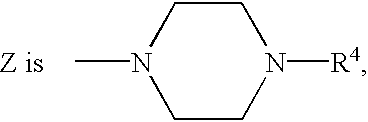
and R4 is phenyl, indole, indazole, pyridine, pyrimidine, quinoline, benzoisothiazole, or benzisoxazole, each optionally substituted. In more preferred embodiments of this invention R1 is hydrogen, methoxy or halo, R2 is hydrogen, 
and R4 is phenyl, indole, pyridine, pyrimidine, quinoline, benzoisothiazole, or benzisoxazole, each optionally substituted.
In other preferred embodiments of the invention R2 is hydrogen, alkyl of one to six carbon atoms or trifluoromethyl, 
R5 is hydrogen or hydroxy and R6 is 1-benzimidazol-2-one, benzoisothiazole, or benzisoxazole, each optionally substituted. More preferably R1 is hydrogen, methoxy or halo, R2 is hydrogen, 
R5 is hydrogen and R6 is 1-benzimidazol-2-one, benzoisothiazole, or benzisoxazole, each optionally substituted.
In still other preferred embodiments of the invention R2 is hydrogen, alkyl of one to six carbon atoms or trifluoromethyl, 
R5 is hydrogen or hydroxy, R6 is —Q—Ar, Q is C═O or (CH2)m, m is an integer from 0 to 4, and Ar is phenyl or indole, each optionally substituted. More preferably, R1 is hydrogen, methoxy or halo, R2 is hydrogen, 
R6 is hydrogen, R6 is —Q—Ar, Q is C═O or (CH2)m, m is an integer from 0 to 4, and Ar is phenyl or indole, each optionally substituted.
In yet other preferred embodiments of the invention R2 is hydrogen, alkyl of one to six carbon atoms or trifluoromethyl, 
R7 is hydrogen and R8 is phenyl, indole, benzoisothiazole, or benzisoxazole, each optionally substituted. More preferably R1 is hydrogen, methoxy or halo, R2 is hydrogen, 
R7 is hydrogen and R8 is phenyl, indole, benzoisothiazole, or benzisoxazole, each optionally substituted.
In other preferred embodiments of the invention, R2 is hydrogen, alkyl of one to six carbon atoms or trifluoromethyl, 
and R7 and R8, taken together with the carbon atoms to which they are attached form phenyl or substituted phenyl. Still more preferably, R1 is hydrogen, methoxy or halo, R2 is hydrogen, 
and R7 and R8, taken together with the carbon atoms to which they are attached form phenyl or substituted phenyl.
Where a substituent is “substituted” as used herein, e.g. substituted phenyl or substituted heteroaryl, it may include from 1 to 3 substituents the same or different selected from hydrogen, halo, cyano, carboxamido, carboalkoxy of two to six carbon atoms, trifluoromethyl, alkyl of 1 to 6 carbon atoms, alkoxy of 1 to 6 carbon atoms, alkanoyloxy of 2 to 6 carbon atoms, amino, mono- or di-alkylamino in which each alkyl group has 1 to 6 carbon atoms, alkanamido of 2 to 6 carbon atoms, or alkanesulfonamido of 1 to 6 carbon atoms.
This invention relates to both the R and S stereoisomers of the 8-aminomethyl-7,8-dihydro-2,6,9-trioxa-3-aza-cyclopenta[a]naphthalene, as well as to mixtures of the R and S stereoisomers. Throughout this application, the name of the product of this invention, where the absolute configuration of the 8-aminomethyl-7,8-dihydro-2,6,9-trioxa-3-aza-cyclopenta[a]naphthalene is not indicated, is intended to embrace the individual R and S enantiomers as well as mixtures of the two. In some embodiments of the present invention the S stereoisomer is preferred.
Where a stereoisomer is preferred, it may in some embodiments, be provided substantially free of the corresponding enantiomer. Thus, an enantiomer substantially free of the corresponding enantiomer refers to a compound which is isolated or separated via separation techniques or prepared free of the corresponding enantiomer. Substantially free, as used herein means that the compound is made up of a significantly greater proportion of one stereoisomer. In preferred embodiments the compound is made up of at least about 90% by weight of a preferred stereoisomer. In other embodiments of the invention, the compound is made up of at least about 99% by weight of a preferred stereoisomer. Preferred stereoisomers may be isolated from racemic mixtures by any method known to those skilled in the art, including high performance liquid chromatography (HPLC) and the formation and crystallization of chiral salts or prepared by methods described herein. See, for example, Jacques, et al., Enantiomers, Racemates and Resolutions (Wiley Interscience, New York, 1981); Wilen, S. H., et al., Tetrahedron 33:2725 (1977); Eliel, E. L. Stereochemistry of Carbon Compounds (McGraw-Hill, NY, 1962); Wilen, S. H. Tables of Resolving Agents and Optical Resolutions p. 268 (E. L. Eliel, Ed., Univ. of Notre Dame Press, Notre Dame, Ind. 1972).
Alkyl as used herein refers to an aliphatic hydrocarbon chain and includes straight and branched chains such as methyl, ethyl, n-propyl, isopropyl, n-butyl, isobutyl, sec-butyl, t-butyl, n-pentyl, isopentyl, neo-pentyl, n-hexyl, and isohexyl. Lower alkyl refers to alkyl having 1 to 3 carbon atoms.
Alkanamido as used herein refers to the group R—C(═O)—NH— where R is an alkyl group of 1 to 5 carbon atoms.
Alkanoyloxy as used herein refers to the group R—C(═O)—O— where R is an alkyl group of 1 to 5 carbon atoms.
Alkanesulfonamido as used herein refers to the group R—S(O)2—NH— where R is an alkyl group of 1 to 6 carbon atoms.
Alkoxy as used herein refers to the group R—O— where R is an alkyl group of 1 to 6 carbon atoms.
Carboxamido as used herein refers to the group —CO—NH2.
Carboalkoxy as used herein refers to the group R—O—C(═O)— where R is an alkyl group of 1 to 5 carbon atoms.
Cycloalkyl refers to cyclic alkyl groups including mono-, bi- and polycyclic rings having from 3 to 15 carbon atoms. Representative examples include cyclohexyl and adamantyl.
Halogen (or halo) as used herein refers to chlorine, bromine, fluorine and iodine.
Pharmaceutically acceptable salts are those derived from such organic and inorganic acids as: acetic, lactic, citric, cinnamic, tartaric, succinic, fumaric, maleic, malonic, mandelic, malic, oxalic, propionic, hydrochloric, hydrobromic, phosphoric, nitric, sulfuric, glycolic, pyruvic, methanesulfonic, ethanesulfonic, toluenesulfonic, salicylic, benzoic, and similarly known acceptable acids.
Specific compounds of the present invention include:
Benzyl-(-7,8-dihydro-2,6,9-trioxa-3-aza-cyclopenta[a]naphthalen-8-ylmethyl)-amine;
8-(3,4-dihydro-1H-isoquinolin-2-ylmethyl)-7,8-dihydro-2,6,9-trioxa-3-aza-cyclopenta[a]naphthalene;
8-[4-(1H-indol-3-yl)-3,6-dihydro-2H-pyridin-1-ylmethyl]-7,8-dihydro-2,6,9-trioxa-3-aza-cyclopenta[a]naphthalene;
8-[4-(5-fluoro-1H-indol-3-ylmethyl)-piperidin-1-ylmethyl]-7,8-dihydro-2,6,9-trioxa-3-aza-cyclopenta[a]naphthalene;
[1-(7,8-dihydro-2,6,9-trioxa-3-aza-cyclopenta[a]naphthalen-8-ylmethyl)-piperidin-4-yl]-(4-fluoro-phenyl)-methanone;
2,3-dihydro-N-[3-(1H-indol-3-yl)propyl]-1,4-dioxino[2,3-e][2,1]benzisoxazole-2-methanamine;
(7,8-dihydro-2,6,9-trioxa-3-aza-cyclopenta[a]naphthalen-8-ylmethyl)-(4-phenyl-butyl)-amine; and pharmaceutical salts thereof.
Compounds of the present invention may be prepared using intermediates of Formula II 
wherein
R1 is hydrogen, halo, cyano, carboxamido, carboalkoxy of two to six carbon atoms, trifluoromethyl, alkyl of 1 to 6 carbon atoms, alkoxy of 1 to 6 carbon atoms, alkanoyloxy of 2 to 6 carbon atoms, amino, mono- or di-alkylamino in which each alkyl group has 1 to 6 carbon atoms, alkanamido of 2 to 6 carbon atoms, or alkanesulfonamido of 1 to 6 carbon atoms;
R2 is hydrogen, carboxy, cyano, carboxamido, carboalkoxy of two to six carbon atoms, trifluoromethyl, amino, mono- or di-alkylamino in which each alkyl group has 1 to 6 carbon atoms, alkoxy of one to six carbon atoms or alkyl of one to six carbon atoms; and
X is halogen, hydroxy, alkylsulfonate of 1 to 6 carbon atoms, trifluoromethanesulfonate or benzenesulfonate, in which the benzene ring is optionally substituted with halogen, nitro, trifluoromethyl, cyano, alkyl of 1 to 6 carbon atoms or alkoxy of 1 to 6 carbon atoms.
In particular, 2,3-dihydro[1,4]dioxino[2,3-e][2,1]benzisoxazol-2-ylmethyl 4-methyl-benzenesulfonate is useful for the preparation of compounds of the present invention.
Thus, the 8-aminomethyl-7,8-dihydro-2,6,9-trioxa-3-aza-cyclopenta[a]-naphthalenes of the invention are prepared as illustrated below for examples in which Z is substituted piperazine. Specifically, the appropriately substituted nitroguaiacol is alkylated with allyl bromide in the presence of a suitable base such as sodium hydride and then demethylated by a reagent such as sodium hydroxide. The resulting 4-nitro-2-allyloxyphenol is then alkylated with glycidyl tosylate or an epihalohydrin in the presence of a base such as sodium hydride and heated in a high boiling solvent such as mesitylene or xylene to effect both rearrangement of the allyl group and cyclization of the dioxan ring. The resulting primary alcohol is converted to the tosylate by reaction with p-toluenesulfonyl chloride in the presence of a tertiary amine or pyridine or alternatively to a halide by reaction with carbon tetrabromide or carbon tetrachloride in combination with triphenylphosphine. The allyl side chain is then isomerized by treatment with catalytic bis-acetonitrile palladium (II) chloride in refluxing methylene chloride or benzene and cleaved to the corresponding o-nitrobenzaldehyde by treatment with ozone followed by diisopropylethylamine or by 
catalytic osmium tetroxide in the presence of sodium periodate. The o-nitrobenzaldehyde is cyclized to the 7,8-dihydro-2,6,9-trioxa-3-aza-cyclopenta[a]-naphthalene tosylate or halide by treatment with a suitable reducing agent such as stannous chloride dihydrate in ethyl acetate. Replacement of the tosylate or halide with amines appropriate to the invention (Z—H) in some high boiling solvent such as dimethyl sulfoxide gives the title compounds of the invention in which R2 is hydrogen.
Compounds of the invention in which R2 is alkyl are prepared by treatment of the o-nitrobenzaldehyde described above with the appropriate alkyl Grignard reagent in a suitable solvent such as ether or tetrahydrofuran prior to the cyclization. Oxidation of the resulting alcohol with a suitable 
oxidant such as pyridinium chlorochromate (PCC), Jones' reagent or the Swern procedure gives the o-nitro ketone, which upon reduction as above with stannous chloride gives the 1-alkyl-7,8-dihydro-2,6,9-trioxa-3-aza-cyclopenta[a]naphthalene. Replacement of the tosylate or halide with the appropriate amines as above gives the title compounds of the invention. Conversion of the o-nitrobenzaldehyde to the trifluoromethyl alcohol by treatment with (trifluoromethyl)trimethylsilane and catalytic tetra-n-butylammonium fluoride, followed by the oxidation and cyclization sequence described above leads to compounds of the invention in which R2 is trifluoromethyl.
Compounds of the invention in which R2 is carboxy may be prepared from the allyl derivative described above by the following procedure. The allyl group is cleaved to an acetic acid residue by treatment with potassium permanganate. Cyclization via dehydration with concentrated sulfuric acid gives the 1-carboxy-7,8-dihydro-2,6,9-trioxa-3-aza-cyclopenta[a]naphthalene, from which the ester, amide and nitrile derivatives may be prepared by methods known to one schooled in the art. Alternatively, the o-nitrophenylacetic acid may be converted to the ester, amide or nitrile by standard methods and cyclized via treatment with phosphorus pentachloride or chlorotrimethylsilane and triethylamine to give the isoxazole ester, amide or nitrile. Compounds of the invention in which R2 is alkoxy may similarly be 
prepared from the rearranged olefin by oxidation to the benzoic acid with potassium permanganate, followed by esterification by treatment with a thionyl chloride in the appropriate alcohol and cyclization by treatment with stannous chloride as above. Compounds of the invention in which R2 is amino, or mono- or di-alkylamino may be prepared by conversion of the o-nitrobenzoic acid to the appropriate primary, secondary or tertiary amide by standard methods and cyclization as described above.
The o-nitrobenzaldehyde used in the chemistry described above may be alternatively prepared as shown below. The appropriate mono-allylated catechol is elaborated with glycidyl tosylate as described above and rearranged in refluxing mesitylene. Cyclization to the benzodioxan methanol is effected by treatment with sodium bicarbonate in ethanol and the alcohol is converted to the tosylate or halide as described above. After rearrangement of the double bond by treatment with catalytic bis-acetonitrile palladium (II) chloride in refluxing methylene chloride and cleavage with ozone or osmium tetroxide/sodium periodate as described above, the resulting aldehyde is regioselectively nitrated with a combination of nitric acid and tin (IV) chloride. 
The guaiacols, catechols and amines appropriate to the above chemistry are known compounds or can be prepared by one schooled in the art. The compounds of the invention may be resolved into their enantiomers by conventional methods or, preferably, the individual enantiomers may be prepared directly by substitution of (2R)-(−)-glycidyl 3-nitrobenzenesulfonate or tosylate (for the S benzodioxan methanamine) or (2S)-(+)-glycidyl 3-nitrobenzenesulfonate or tosylate (for the R enantiomer) in place of epihalohydrin or racemic glycidyl tosylate in the procedures above.
The antipsychotic activity of the compounds of the invention was established by a determination of functional antagonism of dopamine receptors in vivo, specifically the compounds' ability to reduce mouse locomotor activity according to the method of Martin and Bendensky, J. Pharmacol. Exp. Therap. 229:706-711, 1984, in which mice (male, CF-1, Charles River, 20-30 g) were injected with vehicle or various doses of each drug and locomotor activity was measured for 30 minutes using automated infrared activity monitors (Omnitech—8×8 inch open field) located in a darkened room. ED50's were calculated from the horizontal activity counts collected from 10 to 20 minutes after dosing using a nonlinear regression analysis with inverse prediction. When examined in this assay, the compounds of this invention, with the exception of example 3, produce ED50's of less than 50 mg/kg, sc.
Affinity for the dopamine D2 receptor was established by a modification of the standard experimental test procedure of Seemen and Schaus, European Journal of Pharmacology 203:105-109, 1991, wherein homogenized rat striatal brain tissue is incubated with 3H-quinpirole and various concentrations of test compound, filtered and washed and counted in a Betaplate scintillation counter. The results of this testing with compounds representative of this invention are given below.
| D2. Receptor Affinity | |||
| Compound | (IC50 (nM)) | ||
| Example 1 | 8.05 | ||
| Example 2 | 58.8 | ||
| Example 3 | 350 | ||
| Example 4 | 36.7 | ||
| Example 5 | 32.4 | ||
| Example 6 | 4.8 | ||
| Example 7 | 4.1 | ||
The compounds of the invention are partial agonists at the D2 sub-family of dopamine receptors. At presynaptic dopamine receptors, the compounds of the invention are autoreceptor agonists; that is, they serve to modulate the synthesis and release of the neurotransmitter dopamine. At postsynaptic dopamine receptors, these compounds are capable of functioning as either agonists or antagonists depending on the level of dopaminergic stimulation. They thus serve to modulate dopaminergic neurotransmission and are thereby useful for treatment of disorders of the dopaminergic system, such as schizophrenia, schizoaffective disorder, bipolar disorder, Parkinson's disease, L-DOPA induced pychoses and dyskinesias, Tourette's syndrome and hyperprolactinemia and in the treatment of drug addiction such as the addiction to ethanol, nicotine or cocaine and related illnesses.
Thus the present invention provides methods of treating, preventing, inhibiting or alleviating each of the maladies listed above in a mammal, preferably in a human, the methods comprising providing a pharmaceutically effective amount of a compound of this invention to the mammal in need thereof.
Also encompassed by the present invention are pharmaceutical compositions for treating or controlling disease states or conditions of the central nervous system comprising at least one compound of Formula I, mixtures thereof, and or pharmaceutical salts thereof, and a pharmaceutically acceptable carrier therefore. Such compositions are prepared in accordance with acceptable pharmaceutical procedures, such as described in Remingtons Pharmaceutical Sciences, 17th edition, ed. Alfonoso R. Gennaro, Mack Publishing Company, Easton, Pa. (1985). Pharmaceutically acceptable carriers are those that are compatible with the other ingredients in the formulation and biologically acceptable.
The compounds of this invention may be administered orally or parenterally, neat or in combination with conventional pharmaceutical carriers. Applicable solid carriers can include one or more substances which may also act as flavoring agents, lubricants, solubilizers, suspending agents, fillers, glidants, compression aids, binders or tablet-disintegrating agents or an encapsulating material. In powders, the carrier is a finely divided solid which is in admixture with the finely divided active ingredient. In tablets, the active ingredient is mixed with a carrier having the necessary compression properties in suitable proportions and compacted in the shape and size desired. The powders and tablets preferably contain up to 99% of the active ingredient. Suitable solid carriers include, for example, calcium phosphate, magnesium stearate, talc, sugars, lactose, dextrin, starch, gelatin, cellulose, methyl cellulose, sodium carboxymethyl cellulose, polyvinylpyrrolidine, low melting waxes and ion exchange resins.
Liquid carriers may be used in preparing solutions, suspensions, emulsions, syrups and elixirs. The active ingredient of this invention can be dissolved or suspended in a pharmaceutically acceptable liquid carrier such as water, an organic solvent, a mixture of both or pharmaceutically acceptable oils or fat. The liquid carrier can contain other suitable pharmaceutical additives such as solubilizers, emulsifiers, buffers, preservatives, sweeteners, flavoring agents, suspending agents, thickening agents, colors, viscosity regulators, stabilizers or osmo-regulators. Suitable examples of liquid carriers for oral and parenteral administration include water (particularly containing additives as above e.g. cellulose derivatives, preferably sodium carboxymethyl cellulose solution), alcohols (including monohydric alcohols and polyhydric alcohols e.g. glycols) and their derivatives, and oils (e.g. fractionated coconut oil and arachis oil). For parenteral administration the carrier can also be an oily ester such as ethyl oleate and isopropyl myristate. Sterile liquid carriers are used in sterile liquid form compositions for parenteral administration.
Liquid pharmaceutical compositions which are sterile solutions or suspensions can be utilized by, for example, intramuscular, intraperitoneal or subcutaneous injection. Sterile solutions can also be administered intravenously. Oral administration may be either liquid or solid composition form.
Preferably the pharmaceutical composition is in unit dosage form, e.g. as tablets, capsules, powders, solutions, suspensions, emulsions, granules, or suppositories. In such form, the composition is sub-divided in unit dose containing appropriate quantities of the active ingredient; the unit dosage forms can be packaged compositions, for example packeted powders, vials, ampoules, prefilled syringes or sachets containing liquids. The unit dosage form can be, for example, a capsule or tablet itself, or it can be the appropriate number of any such compositions in package form.
The amount provided to a patient will vary depending upon what is being administered, the purpose of the administration, such as prophylaxis or therapy, and the state of the patient, the manner of administration, and the like. In therapeutic applications, compounds of the present invention are provided to a patient already suffering from a disease in an amount sufficient to cure or at least partially ameliorate the symptoms of the disease and its complications. An amount adequate to accomplish this is defined as a “therapeutically effective amount.” The dosage to be used in the treatment of a specific case must be subjectively determined by the attending physician. The variables involved include the specific condition and the size, age and response pattern of the patient. Generally, a starting dose is about 10 mg per day with gradual increase in the daily dose to about 200 mg per day, to provide the desired dosage level in the human.
Provide as used herein means either directly administering a compound or composition of the present invention, or administering a prodrug, derivative or analog which will form an equivalent amount of the active compound or substance within the body.
The present invention includes prodrugs of compounds of Formula I. “Prodrug”, as used herein means a compound which is convertible in vivo by metabolic means (e.g. by hydrolysis) to a compound of Formula I. Various forms of prodrugs are known in the art, for example, as discussed in Bundgaard, (ed.), Design of Prodrugs, Elsevier (1985); Widder, et al. (ed.), Methods in Enzymology, vol. 4, Academic Press (1985); Krogsgaard-Larsen, et al., (ed). “Design and Application of Prodrugs, Textbook of Drug Design and Development, Chapter 5, 113-191 (1991), Bundgaard, et al., Journal of Drug Deliver Reviews, 8:1-38(1992), Bundgaard, J. of Pharmaceutical Sciences, 77:285 et seq. (1988); and Higuchi and Stella (eds.) Prodrugs as Novel Drug Delivery Systems, American Chemical Society (1975).
The following examples illustrate the production of representative compounds of this invention.
97.5 g (0.51 mole) of the sodium salt of 5-nitroguaiacol was dissolved in one liter of DMF and 1.5 equivalents of allyl bromide added. The reaction was heated to 65° C. for two hours, after which time much of the dark color had discharged and tlc (1:1 CH2Cl2/hexane) indicated loss of starting material. The solvent was concentrated in vacuum and the residue washed with water. The product was isolated by filtration and dried in a vacuum. This gave 112 g of pale yellow solid. A sample recrystallized from methanol, gave m.p. 93-94° C.
To one liter of dimethyl sulfoxide was added 750 mL of 2 N aqueous sodium hydroxide and the mixture was heated to 65° C. The pale yellow solid 3-allyloxy-4-methoxynitrobenzene prepared above was added in portions over a 30 minute period and then the temperature was raised to 95° C. and maintained for 3 hours, after which time the starting material had been consumed. The mixture was allowed to cool and poured into a mixture of 1 L ice and 1 L 2 N HCl. 73 Grams of crude but homogeneous (by tlc 1:1 CH2Cl2/hexane) desired product was isolated as a light brown solid by filtration. This material was subsequently dissolved in 1:1 hexane/methylene chloride and filtered through silica gel to give 68 g of pale yellow solid, which, when recrystallized from ethyl/acetate/hexane, gave m.p. 61-62° C. The aqueous mother liquors from the initial crystallization above were extracted with 2 L of ethyl acetate. This was dried over sodium sulfate, filtered and evaporated to a dark oil. Column chromatography on silica with 1:1 CH2Cl2/hexane gave an additional 12 g of the title compound as a yellow solid. Elution with 2% MeOH in CHCl3 gave 12 g of a dark oil which slowly crystallized in vacuum. This proved to be the Claisen product, 3-allyl-4-nitrocatechol.
20 g (0.50 mole) of 60% NaH/mineral oil was placed in a two liter flask and washed with 500 mL of hexane. 1 L of DMF was added, followed by 77 g (0.40 mole) of the 2-allyloxy-4-nitrophenol prepared in the previous step. Addition of the phenol was performed in portions under argon. After stirring the mixture for 30 minutes at room temperature under argon, 108 g (0.48 moles) of (R)-glycidyl tosylate was added and the mixture heated at 70-75° C. under nitrogen overnight. Upon cooling, the DMF was removed in vacuum and replaced with one liter of methylene chloride. This was washed with 500 mL portions of 2 N HCl, saturated sodium bicarbonate and saturated brine and dried over sodium sulfate. The mixture was filtered, concentrated to an oil in vacuum and column chromatographed on silica gel using 1:1 hexane/methylene chloride as eluant. This gave 43 g of product contaminated with traces of the two starting materials, followed by 21 g of pure product as a pale yellow solid. The impure material was recrystallized from 1.2 L of 10% ethyl acetate/hexane to give 34 g of pure (homogeneous on silica gel tlc with 1:1 hexane/methylene chloride) (R)-2-(2-allyloxy-4-nitrophenoxymethyl)-oxirane (m.p. 64° C.).
Elemental Analysis for: C12H13NO5
Calc'd: C, 57.37; H, 5.21; N, 5.58
Found: C, 57.50; H, 5.21; N, 5.43
(R)-2-(2-Allyloxy-4-nitrophenoxymethyl)-oxirane (20 g, 80 mmoles) prepared as above was heated at 155° C. in mesitylene for 24 hours under nitrogen. Filtration of the black solid which formed gave 1.5 g of very polar material. Evaporation of the solvent in vacuum followed by column chromatography on silica gel with methylene chloride as eluant gave 10 g of recovered starting material and 7.5 g of the desired rearranged (S)-(8-allyl-7-nitro-2,3-dihydro-benzo(1,4)dioxin-2-yl)-methanol, which slowly crystallized on standing in vacuum (m.p. 67° C.). The yield based on recovered starting material is 75%.
Elemental Analysis for: C12H13NO5
Calc'd: C, 57.37; H, 5.21; N, 5.58
Found: C, 57.26; H, 5.20; N, 5.35
9.55 g (38.0 mmole) of (S)-(8-allyl-7-nitro-2,3-dihydro-benzo(1,4)dioxin-2-yl)-methanol was dissolved in 465 mL of pyridine, 29.0 g (152 mmole) of p-toluenesulfonyl chloride was added and the mixture stirred at room temperature under nitrogen overnight. Water was then added to quench the excess tosyl chloride and the solvent was removed in vacuum and replaced with methylene chloride. This solution was washed with 2 N HCl, with saturated sodium bicarbonate, and with saturated brine, and dried over magnesium sulfate. Filtration, evaporation in vacuum and column chromatography on silica gel with 1:1 hexane/methylene chloride as eluant gave 12.6 g (92%) of toluene-4-sulfonic acid (R)-allyl-7-nitro-2,3-benzo(1,4)dioxin-2-ylmethyl ester, which slowly crystallized to a tan solid (m.p. 60-62° C.) upon standing.
Elemental Analysis for: C19H19NO7S
Calc'd: C, 56.29; H, 4.72; N, 3.45
Found: C, 56.13; H, 4.58; N, 3.44
To a solution of 10.0 g (24.0 mmole) of (R)-[8-allyl-7-nitro-2,3-dihydro-1,4-benzodioxin-2-yl]methyl 4-methylbenzenesulfonate in 700 mL of benzene was added 1.03 g of bis(acetonitrile)dichloropalladium (II) and the mixture was refluxed under nitrogen for 48 hours. The catalyst was then removed by filtration and the filtrate concentrated in vacuum to a brown oil. Column chromatography on silica gel with methylene chloride as eluant gave 7.2 g of the title compound as a mixture of E and Z isomers. A sample of {(2R)-7-nitro-8[(E)-1-propenyl]-2,3-dihydro-1,4-benzodioxin-2-yl}methyl 4-methylbenzenesulfonate was obtained as a yellow solid (m.p. 105-106° C.) by evaporation of a pure E isomer-containing fraction.
Elemental Analysis for: C19H19NO7S
Calc'd: C, 56.29; H, 4.72; N, 3.45
Found: C, 56.12; H, 4.64; N, 3.39
{(2R)-7-Nitro-8-[1-propenyl]-2,3-dihydro-1,4-benzodioxin-2-yl}methyl 4-methylbenze (10.5 g, 25.9 mmole) dissolved in 400 mL of methylene chloride was treated with excess ozone at −78° C. Diisopropylethylamine (11.5 mL, 66.0 mmole) was then added dropwise over 30 min and the mixture allowed to come to room temperature and stir overnight under a nitrogen atmosphere. The mixture was then diluted to 600 mL with methylene chloride, washed three times with 100 mL portions of 2N HCl (aq), twice with 200 mL portions of saturated aqueous sodium bicarbonate and with 200 mL of saturated brine. The solution was dried over magnesium sulfate, filtered and concentrated in vacuum to a crude brown oil, which was column chromatographed on silica gel with 10% hexane/methylene chloride to give 7.52 g of the (R)-enantiomer of the title compound as a yellow solid. 1H—NMR (CDCl3): doublet 7.8 δ(2 H); doublet 7.62 δ(1 H); doublet 7.4 δ(2 H); doublet 7.0 δ(1 H); multiplet 4.4-4.6 δ(2 H); multiplet 4.2 δ(3 H); singlet 2.4 δ(3 H).
19.7 g (87.4 mmole) of stannous chloride dihydrate was added to a solution of 6.62 g (17.5 mmole) of (2R)-(8-formyl-7-nitro-2,3-dihydro-1,4-benzodioxin-2-yl)methyl 4-methylbenzenesulfonate in 400 mL of 1:1 tetrahydrofuran/methanol followed by the addition of 23.8 g (0.17 mole) of sodium acetate trihydrate. The mixture was stirred under nitrogen for a period of 48 hours. The solvent was removed in vacuo and replaced with an equal amount of methylene chloride and the solution was washed with 400 mL portions of saturated aqueous sodium bicarbonate and saturated brine and dried over magnesium sulfate. After the solution was filtered and concentrated in vacuum, the crude oil obtained was column chromatographed on silica gel with methylene chloride as eluant and the product fractions were combined and evaporated in vacuum to give 4.47 g (71%) of the (R)-enantiomer of the title compound as a light yellow solid, m.p.109-110° C.
Elemental Analysis for: C17H15NO6S·0.25 H2O
Calc'd: C, 55.81; H, 4.27; N, 3.83
Found: C, 55.81; H, 4.03; N, 3.67
(2R)-2,3-Dihydro[1,4]dioxino[2,3-e] [2,1]benzisoxazol-2-ylmethyl 4-methyl-benzenesulfonate (0.39 g, 1.11 mmole) and benzylamine (0.53 mL, 4.90 mmole) were combined in 25 mL of DMSO under nitrogen. This solution was heated to 75-80° C. under nitrogen for 5 hours. After completion, the reaction was cooled to room temperature and partitioned between 400 mL each of ethyl acetate and saturated aqueous sodium bicarbonate. The organic phase was removed and washed with brine, dried over magnesium sulfate and concentrated in vacuum. The crude residue was column chromatographed on silica gel using methylene chloride to remove impurities and 0.5% methanol/methylene chloride to elute the product. The product fractions were combined and concentrated in vacuum to give 0.16 g (30%) of the free base as a yellow oil. The oil was crystallized from ethanol with the addition of a solution of fumaric acid (0.06 g) in hot ethanol to give 0.090 g of the (S)-enantiomer of the title compound as a light yellow solid fumarate, m.p. 180° C.
Elemental Analysis for: C17H16N2O3·0.9 C4H4O4
Calc'd: C, 61.73; H, 4.93; N, 6.99
Found: C, 61.93; H, 5.05; N, 7.00
(2R)-2,3-Dihydro[1,4]dioxino[2,3-e][2,1] benzisoxazol-2-ylmethyl 4-methyl-benzenesulfonate (0.50 g, 1.38 mmole) and tetrahydroisoquinoline (0.80 mL, 6.39 mmole) were combined in 25 mL of DMSO under nitrogen. This solution was heated to 75-80° C. under nitrogen for 5 hours. After completion, the reaction was cooled to room temperature and partitioned between 400 mL each of ethyl acetate and saturated aqueous sodium bicarbonate. The organic phase was removed and washed with brine, dried over magnesium sulfate and concentrated in vacuum. The crude residue was column chromatographed on silica gel using methylene chloride to remove impurities and 1% methanol/methylene chloride to elute the product. The product fractions were combined and evaporated in vacuum to give 0.38 g (86%) of the free base as a yellow oil. The oil was crystallized from ethanol with the addition of a solution of fumaric acid (0.14 g) in hot ethanol to give 0.41 g of the (S)-enantiomer of the title compound as a white solid fumarate, m.p. 175-176° C.
Elemental Analysis for: C19H18N2O3·C4H4O4
Calc'd: C, 63.01; H, 5.06; N, 6.39
Found: C, 63.01; H, 5.00; N, 6.22
(2R)-2,3-Dihydro[1,4]dioxino[2,3-e][2,1]benzisoxazol-2-ylmethyl 4-methyl-benzenesulfonate (0.60 g, 1.66 mmole) and 3-(1,2,3,6-tetrahydro-4-pyridinyl)-1H-indole (0.98 g, 4.90 mmole) were combined in 30 mL of DMSO under nitrogen. This solution was heated to 75-80° C. under nitrogen for 6 hours. After completion, the reaction was cooled to room temperature and partitioned between 400 mL each of ethyl acetate and saturated aqueous sodium bicarbonate. The organic phase was removed and washed with brine, dried over magnesium sulfate and concentrated in vacuum. The crude residue was column chromatographed on silica gel using methylene chloride to remove impurities and 1% methanol/methylene chloride to elute the product. Upon evaporation of the product fractions, 0.47 g (73%) of the (S)-enantiomer of the title compound was obtained as a white solid, m.p. 110° C.
Elemental Analysis for: C23H21N3O3
Calc'd: C, 71.30; H, 5.46; N, 10.85
Found: C, 71.17; H, 5.49; N, 10.78
(2R)-2,3-Dihydro[1,4]dioxino[2,3-e][2,1]benzisoxazol-2-ylmethyl 4-methyl-benzenesulfonate (0.50 g, 1.38 mmole) and 5-fluoro-3-(4-piperidinylmethyl)-1H-indole succinate (0.46 g, 1.32 mmole) were combined in 35 ml of DMSO, followed by the addition of diisopropylethylamine (0.70 mL, 4.0 mmole). This solution was heated to 70° C. under nitrogen for 4 hours. After completion, the reaction was cooled to room temperature and partitioned between 400 mL each of ethyl acetate and saturated aqueous sodium bicarbonate. The organic phase was removed and washed with brine, dried over magnesium sulfate and concentrated in vacuum. The crude oil was column chromatographed on silica gel using methylene chloride to remove impurities and 0.6% methanol/methylene chloride to elute the product. The product fractions were combined and concentrated in vacuum to give 0.25 g (43%) of the free base as a white foam. This was crystallized from isopropanol with the addition of a solution of oxalic acid (0.04 g) in hot isopropanol to give 0.18 g of the (S)-enantiomer of the title compound as an off-white solid oxalate, m.p. 202-205° C.
Elemental Analysis for: C24H24FN3O3·C2H2O4
Calc'd: C, 61.01; H, 5.12; N, 8.21
Found: C, 60.81; H, 5.02; N, 8.20
(2R)-2,3-Dihydro[1,4]dioxino[2,3-e][2,1]benzisoxazol-2-ylmethyl 4-methyl-benzenesulfonate (0.61 g, 1.69 mmole) and 4-(4-fluorobenzoyl)piperidine p-toluene-sulfonate (1.95 g, 5.13 mmole) were combined in 30 mL of DMSO, followed by the addition of 0.90 mL (5.16 mmole) of diisopropylethylamine. This solution was heated to 75-80° C. under nitrogen for 4 hours. After completion, the reaction was cooled to room temperature and partitioned between 400 mL each of ethyl acetate and saturated aqueous sodium bicarbonate. The organic phase was removed and washed with brine, dried over magnesium sulfate and concentrated in vacuum. The crude residue was column chromatographed on silica gel using methylene chloride to remove impurities and 1% methanol/methylene chloride to elute the product. The product fractions were combined and concentrated in vacuum to give 0.15 g (22%) of the free base as a yellow oil. The oil was crystallized from ethanol with the addition of a solution of fumaric acid (0.04 g) in hot ethanol to give 0.20 g of the (S)-enantiomer of the title compound as an off-white solid fumarate, m.p. 204-206° C.
Elemental Analysis for: C22H21FN2O4·1.00 C4H4O4
Calc'd: C, 60.94; H, 4.92; N, 5.47
Found: C, 60.57; H, 5.01; N, 5.37
(2R)-2,3-Dihydro[1,4]dioxino[2,3-e][2,1]benzisoxazol-2-ylmethyl 4-methyl-benzenesulfonate (0.55 g, 1.5 mmole) and 3-(1H-indol-3-yl)-1-propanamine (1.20 g, 6.80 mmole) were combined in 35 mL of DMSO under nitrogen. This solution was heated to 75-80° C. under nitrogen for 5 hours. After completion, the reaction was cooled to room temperature and partitioned between 400 mL each of ethyl acetate and saturated aqueous sodium bicarbonate. The organic phase was removed and washed with brine, dried over magnesium sulfate and concentrated in vacuum. The crude residue was column chromatographed on silica gel using methylene chloride to remove impurities and 1% methanol/methylene chloride to elute the product. The product fractions were combined and concentrated in vacuum to give 0.40 g (73%) of the free base as a colorless oil. The oil was crystallized from isopropanol with the addition of a solution of oxalic acid (0.10 g, 1.11 mmole) in hot isopropanol to give 0.32 g of the (S)-enantiomer of the title compound as a white solid oxalate, m.p. 230° C.
Elemental Analysis for: C21H21N3O3·C2H2O4·0.2 H2O
Calc'd: C, 60.88; H, 5.11; N, 9.26
Found: C, 60.44; H, 5.16; N, 9.19
(2R)-2,3-Dihydro[1,4]dioxino[2,3-e][2,1]benzisoxazol-2-ylmethyl 4-methyl-benzenesulfonate (0.41 g, 1.13 mmole) and phenyl butylamine (0.80 mL, 5.11 mmole) were combined in 40 mL of DMSO under nitrogen. This solution was heated to 75-80° C. under nitrogen for 8 hours. After completion, the reaction was cooled to room temperature and partitioned between 400 mL each of ethyl acetate and saturated aqueous sodium bicarbonate. The organic phase was removed and washed with brine, dried over magnesium sulfate and concentrated in vacuum. The crude residue was column chromatographed on silica gel using methylene chloride to remove impurities and 5% methanol/methylene chloride to elute the product. The product fractions were combined and concentrated in vacuum to give 0.14 g (37%) of the free base as a yellow oil. The oil was crystallized from ethanol with the addition of a solution of fumaric acid (0.05 g) in hot ethanol to give 0.07 g of the (S)-enantiomer of the title compound as a light yellow solid fumarate, one-quarter hydrate, m.p. 172-174° C.
Elemental Analysis for: C20H22N2O3·C4H4O4·0.25 H2O
Calc'd: C, 62.80; H, 5.82; N, 6.10
Found: C, 62.62; H, 5.68; N, 6.08
Claims (27)
1. A compound of formula I 
wherein
R1 is hydrogen, halo, cyano, carboxamido, carboalkoxy of two to six carbon atoms, trifluoromethyl, alkyl of 1 to 6 carbon atoms, alkoxy of 1 to 6 carbon atoms, alkanoyloxy of 2 to 6 carbon atoms, amino, mono- or di-alkylamino in which each alkyl group has 1 to 6 carbon atoms, alkanamido of 2 to 6 carbon atoms, or alkanesulfonamido of 1 to 6 carbon atoms;
R2 is hydrogen, carboxy, cyano, carboxamido, carboalkoxy of two to six carbon atoms, trifluoromethyl, amino, mono- or di-alkylamino in which each alkyl group has 1 to 6 carbon atoms, alkoxy of one to six carbon atoms or alkyl of one to six carbon atoms;
Z is NR3—(CH2)n—Y, 
wherein,
Y is hydrogen, hydroxy, cycloalkyl of 3 to 15 carbon atoms, or phenyl, phenoxy, naphthyl, naphthyloxy, heteroaryl, or heteroaryloxy, wherein the heteroaryl or the heteroaryl group of heteroaryloxy is selected from thienyl, furanyl, pyridinyl, indolyl, chromanyl, coumarinyl, carbostyrilyl, and quinolinyl;
R3 is hydrogen or alkyl of 1 to 6 carbon atoms;
n is an integer from 0 to 6;
R4 is hydrogen, alkyl of 1 to 6 carbon atoms, phenyl, ω-phenylalkyl, ω-diphenylalkyl, wherein the alkyl chain contains 1 to 4 carbon atoms, indolyl, indazolyl, pyridinyl, pyrimidinyl, quinolinyl, benzoisothiazolyl, or benzisoxazolyl;
R5 is hydrogen, hydroxy, cyano or carboxamido;
R6 is hydrogen, 1-benzimidazol-2-onyl, benzoisothiazolyl, or benzisoxazolyl, or —Q—Ar;
Q is C═O, CHOH, or (CH2)m,
m is an integer from 0 to 4;
Ar is phenyl; or
R5 and R6, taken together with the carbon atom to which they are attached, form 
R7 is hydrogen;
R8 is phenyl, naphthyl, thienyl, benzoisothiazolyl, or benzisoxazolyl; or
R7 and R8, taken together with the carbon atoms to which they are attached, form a benzene ring;
R9 is hydrogen or alkyl of 1 to 6 carbon atoms; and
R10, R11 and R12 are, independently hydrogen, halo, cyano, carboxamido, carboalkoxy of two to six carbon atoms, trifluoromethyl, alkyl of 1 to 6 carbon atoms, alkoxy of 1 to 6 carbon atoms, alkanoyloxy of 2 to 6 carbon atoms, amino, mono- or di-alkylamino in which each alkyl group has 1 to 6 carbon atoms, alkanamido of 2 to 6 carbon atoms, or alkanesulfonamido of 1 to 6 carbon atoms; or a pharmaceutically acceptable salt thereof;
wherein said phenyl, phenoxy, naphthyl, naphthyloxy, heteroaryloxy, ω-phenylalkyl, ω-diphenylalkyl, indolyl, indazolyl, pyridinyl, pyrimidinyl, quinolinyl, benzoisothiazolyl, benzisoxazolyl, 1-benzimidazol-2-onyl, or thienyl groups, or the benzene ring, are optionally substituted with substituents selected from hydrogen, halo, cyano, carboxamido, carboalkoxy of two to six carbon atoms, trifluoromethyl, alkyl of 1 to 6 carbon atoms, alkoxy of 1 to 6 carbon atoms, alkanoyloxy of 2 to 6 carbon atoms, amino, mono- or di-alkylamino in which each alkyl group has 1 to 6 carbon atoms, alkanamido of 2 to 6 carbon atoms, or alkanesulfonamido of 1 to 6 carbon atoms.
2. A compound of claim 1 wherein R1 is hydrogen, methoxy or halo, R2 is hydrogen, Z is NR3—(CH2)n—Y and R3 is hydrogen.
3. A compound of claim 1 wherein R2 is hydrogen, alkyl of one to six carbon atoms or trifluoromethyl, Z is 
and R4 is phenyl, indolyl, indazolyl, pyridinyl, pyrimidinyl, quinolinyl, benzoisothiazolyl, or benzisoxazolyl, each optionally substituted.
4. A compound of claim 3 wherein R1 is hydrogen, methoxy or halogen and R2 is hydrogen.
5. A compound of claim 1 wherein R2 is hydrogen, alkyl of one to six carbon atoms or trifluoromethyl, Z is 
R5 is hydrogen or hydroxy and R6 is 1-benzimidazol-2-onyl, benzoisothiazolyl, or benzisoxazolyl, each optionally substituted.
6. A compound of claim 5 wherein R1 is hydrogen, methoxy or halogen, R2 is hydrogen and R5 is hydrogen.
7. A compound of claim 1 wherein R2 is hydrogen, alkyl of one to six carbon atoms or trifluoromethyl, Z is 
R5 is hydrogen or hydroxy, R6 is —Q—Ar, Q is C═O or (CH2)m, m is an integer from 0 to 4, and Ar is phenyl or indolyl, each optionally substituted.
8. A compound of claim 7 wherein R1 is hydrogen, methoxy or halogen, R2 is hydrogen, and R5 is hydrogen.
9. A compound of claim 1 wherein R2 is hydrogen, alkyl of one to six carbon atoms or trifluoromethyl, Z is 
R7 is hydrogen and R8 is phenyl, indolyl, benzoisothiazolyl, or benzisoxazolyl, each optionally substituted.
10. A compound of claim 9 wherein R1 is hydrogen, methoxy or halogen and R2 is hydrogen.
11. A compound of claim 1 wherein R2 is hydrogen, alkyl of one to six carbon atoms or trifluoromethyl, Z is 
and R7 and R8, taken together with the carbon atoms to which they are attached form a benzene ring.
12. A compound of claim 11 wherein R1 is hydrogen, methoxy or halogen and, R2 is hydrogen.
13. The compound of claim 1 which is benzyl-(-7,8-dihydro-2,6,9-trioxa-3-aza-cyclopenta[a]naphthalen-8-ylmethyl)-amine or a pharmaceutically acceptable salt thereof.
14. The compound of claim 1 which is 8-(3,4-dihydro-1H-isoquinolin-2-ylmethyl)-7,8-dihydro-2,6,9-trioxa-3-aza-cyclopenta[a]naphthalene or a pharmaceutically acceptable salt thereof.
15. The compound of claim 1 which is 8-[4-(1H-indol-3-yl)-3,6-dihydro-2H-pyridin-1-ylmethyl]-7,8-dihydro-2,6,9-trioxa-3-aza-cyclopenta[a]naphthalene or a pharmaceutically acceptable salt thereof.
16. The compound of claim 1 which is 8-[4-(5-fluoro-1H-indol-3-ylmethyl)-piperidin-1-ylmethyl]-7,8-dihydro-2,6,9-trioxa-3-aza-cyclopenta[a]naphthalene or a pharmaceutically acceptable salt thereof.
17. The compound of claim 1 which is [1-(7,8-dihydro-2,6,9-trioxa-3-aza-cyclopenta[a]naphthalen-8-ylmethyl)-piperidin-4-yl]-(4-fluoro-phenyl)-methanone or a pharmaceutically acceptable salt thereof.
18. The compound of claim 1 which is 2,3-dihydro-N-[3-(1H-indol-3-yl)propyl]-1,4-dioxino [2,3-e][2,1]benzisoxazole-2-methanamine or a pharmaceutically acceptable salt thereof.
19. The compound of claim 1 which is (7,8-dihydro-2,6,9-trioxa-3-aza-cyclopenta[a]naphthalen-8-ylmethyl)-(4-phenyl-butyl)-amine or a pharmaceutically acceptable salt thereof.
20. A compound of formula (II) 
wherein
R1 is hydrogen, halo, cyano, carboxamido, carboalkoxy of two to six carbon atoms, trifluoromethyl, alkyl of 1 to 6 carbon atoms, alkoxy of 1 to 6 carbon atoms, alkanoyloxy of 2 to 6 carbon atoms, amino, mono- or di-alkylamino in which each alkyl group has 1 to 6 carbon atoms, alkanamido of 2 to 6 carbon atoms, or alkanesulfonamido of 1 to 6 carbon atoms;
R2 is hydrogen, carboxy, cyano, carboxamido, carboalkoxy of two to six carbon atoms, trifluoromethyl, amino, mono- or di-alkylamino in which each alkyl group has 1 to 6 carbon atoms, alkoxy of one to six carbon atoms or alkyl of one to six carbon atoms; and
X is halogen, hydroxy, alkylsulfonyl of 1 to 6 carbon atoms, trifluoro-methanesulfonyl or benzenesulfonyl, in which the benzene ring is optionally substituted with halogen, nitro, trifluoromethyl, cyano, alkyl of 1 to 6 carbon atoms or alkoxy of 1 to 6 carbon atoms.
21. A compound of claim 20 which is 2,3-dihydro[1,4]dioxino[2,3-e]-[2,1]-benzisoxazol-2-ylmethyl 4-methylbenzenesulfonate.
22. A method of treating a subject suffering from a condition selected from schizophrenia, schizoaffective disorder, bipolar disorder, Parkinson's disease, L-DOPA induced psychoses or dyskinesias, Tourette's syndrome or hyperprolactinemia which comprises providing to the subject suffering from said condition, a therapeutically effective amount of a compound of formula I 
wherein
R1 is hydrogen, halo, cyano, carboxamido, carboalkoxy of two to six carbon atoms, trifluoromethyl, alkyl of 1 to 6 carbon atoms, alkoxy of 1 to 6 carbon atoms, alkanoyloxy of 2 to 6 carbon atoms, amino, mono- or di-alkylamino in which each alkyl group has 1 to 6 carbon atoms, alkanamido of 2 to 6 carbon atoms, or alkanesulfonamido of 1 to 6 carbon atoms;
R2 is hydrogen, carboxy, cyano, carboxamido, carboalkoxy of two to six carbon atoms, trifluoromethyl, amino, mono- or di-alkylamino in which each alkyl group has 1 to 6 carbon atoms, alkoxy of one to six carbon atoms or alkyl of one to six carbon atoms;
Z is NR3-(CH2)n—Y, 
wherein,
Y is hydrogen, hydroxy, cycloalkyl of 3 to 15 carbon atoms, or phenyl, phenoxy, naphthyl, naphthyloxy, heteroaryl, or heteroaryloxy, wherein the heteroaryl or the heteroaryl group of heteroaryloxy is selected from thienyl, furanyl, pyridinyl, indolyl, chromanyl, coumarinyl, carbostyrilyl, and quinolinyl;
R3 is hydrogen or alkyl of 1 to 6 carbon atoms;
n is an integer from 0 to 6;
R4 is hydrogen, alkyl of 1 to 6 carbon atoms, phenyl, ω-phenylalkyl, ω-diphenylalkyl, wherein the alkyl chain contains 1 to 4 carbon atoms, indolyl, indazolyl, pyridinyl, pyrimidinyl, quinolinyl, beuzoisothiazolyl, or benzisoxazolyl;
R5 is hydrogen, hydroxy, cyano or carboxamido;
R6 is hydrogen, 1-benzimidazol-2-onyl, benzoisothiazolyl, or benzisoxazolyl, or —Q—Ar;
Q is C═O, CHOH, or (CH2)m,
m is an integer from 0 to 4;
Ar is phenyl; or
R5 and R6, taken together with the carbon atom to which they are attached, form 
R7 is hydrogen;
R8 is phenyl, naphthyl, thienyl, benzoisothiazolyl, or benzisoxazolyl; or
R7 and R8, taken together with the carbon atoms to which they are attached, form a benzene ring;
R9 is hydrogen or alkyl of 1 to 6 carbon atoms; and
R10, R11 and R12 are, independently hydrogen, halo, cyano, carboxamido, carboalkoxy of two to six carbon atoms, trifluoromethyl, alkyl of 1 to 6 carbon atoms, alkoxy of 1 to 6 carbon atoms, alkanoyloxy of 2 to 6 carbon atoms, amino, mono- or di-alkylamino in which each alkyl group has 1 to 6 carbon atoms, alkanamido of 2 to 6 carbon atoms, or alkanesulfonamido of 1 to 6 carbon atoms; or a pharmaceutically acceptable salt thereof;
wherein said phenyl, phenoxy, naphthyl, naphthyloxy, heteroaryloxy, ω-phenylalkyl, ω-diphenylalkyl, indolyl, indazolyl, pyridinyl, pyrimidinyl, quinolinyl, benzoisothiazolyl, benzisoxazolyl, 1-benzimidazol-2-onyl, or thienyl groups, or the benzene ring, are optionally substituted with substituents selected from hydrogen, halo, cyano, carboxamido, carboalkoxy of two to six carbon atoms, trifluoromethyl, alkyl of 1 to 6 carbon atoms, alkoxy of 1 to 6 carbon atoms, alkanoyloxy of 2 to 6 carbon atoms, amino, mono- or di-alkylamino in which each alkyl group has 1 to 6 carbon atoms, alkanamido of 2 to 6 carbon atoms, or alkanesulfonamido of 1 to 6 carbon atoms.
23. The method of claim 22 wherein the subject is a human.
24. A pharmaceutical composition comprising a therapeutically effective amount of a compound of formula I 
wherein
R1 is hydrogen, halo, cyano, carboxamido, carboalkoxy of two to six carbon atoms, trifluoromethyl, alkyl of 1 to 6 carbon atoms, alkoxy of 1 to 6 carbon atoms, alkanoyloxy of 2 to 6 carbon atoms, amino, mono- or di-alkylamino in which each alkyl group has 1 to 6 carbon atoms, alkanamido of 2 to 6 carbon atoms, or alkanesulfonamido of 1 to 6 carbon atoms;
R2 is hydrogen, carboxy, cyano, carboxamido, carboalkoxy of two to six carbon atoms, trifluoromethyl, amino, mono- or di-alkylamino in which each alkyl group has 1 to 6 carbon atoms, alkoxy of one to six carbon atoms or alkyl of one to six carbon atoms;
Z is NR3—(CH2)n—Y, 
wherein,
Y is hydrogen, hydroxy, cycloalkyl of 3 to 15 carbon atoms, or phenyl, phenoxy, naphthyl, naphthyloxy, heteroaryl, or heteroaryloxy, wherein the heteroaryl or the heteroaryl group of heteroaryloxy is selected from thienyl, furanyl, pyridinyl, indolyl, chromanyl, coumarinyl, carbostyrilyl, and quinolinyl;
R3 is hydrogen or alkyl of 1 to 6 carbon atoms;
n is an integer from 0 to 6;
R4 is hydrogen, alkyl of 1 to 6 carbon atoms, phenyl, ω-phenylalkyl, ω-diphenylalkyl, wherein the alkyl chain contains 1 to 4 carbon atoms, indolyl, indazolyl, pyridinyl, pyrimidinyl, quinolinyl, benzoisothiazolyl, or benzisoxazolyl;
R5 is hydrogen, hydroxy, cyano or carboxamido;
R6 is hydrogen, 1-benzimidazol-2-onyl, benzoisothiazolyl, or benzisoxazolyl, or —Q—Ar;
Q is C═O, CHOH, or (CH2)m,
m is an integer from 0 to 4;
Ar is phenyl; or
R5 and R6, taken together with the carbon atom to which they are attached, form 
R7 is hydrogen;
R8 is phenyl, naphthyl, thienyl, benzoisothiazolyl, or benzisoxazolyl; or
R7 and R8, taken together with the carbon atoms to which they are attached, form a benzene ring;
R9 is hydrogen or alkyl of 1 to 6 carbon atoms; and
R10, R11 and R12 are, independently hydrogen, halo, cyano, carboxamido, carboalkoxy of two to six carbon atoms, trifluoromethyl, alkyl of 1 to 6 carbon atoms, alkoxy of 1 to 6 carbon atoms, alkanoyloxy of 2 to 6 carbon atoms, amino, mono- or di-alkylamino in which each alkyl group has 1 to 6 carbon atoms, alkanamido of 2 to 6 carbon atoms, or alkanesulfonamido of 1 to 6 carbon atoms; or a pharmaceutically acceptable salt thereof,
wherein said phenyl, phenoxy, naphthyl, naphthyloxy, heteroaryloxy, ω-phenylalkyl, ω-diphenylalkyl, indolyl, indazolyl, pyridinyl, pyrimidinyl, quinolinyl, benzoisothiazolyl, benzisoxazolyl, 1-benzimidazol-2-onyl, or thienyl groups, or the benzene ring, are optionally substituted with substituents selected from hydrogen, halo, cyano, carboxamido, carboalkoxy of two to six carbon atoms, trifluoromethyl, alkyl of 1 to 6 carbon atoms, alkoxy of 1 to 6 carbon atoms, alkanoyloxy of 2 to 6 carbon atoms, amino, mono- or di-alkylamino in which each alkyl group has 1 to 6 carbon atoms, alkanamido of 2 to 6 carbon atoms, or alkanesulfonamido of 1 to 6 carbon atoms;
and a pharmaceutically acceptable carrier or excipient.
25. A compound of claim 1 wherein at least one of said phenyl, phenoxy, naphthyl, naphthyloxy, heteroaryloxy, ω-phenylalkyl, ω-diphenylalkyl, indolyl, indazolyl, pyridinyl, pyrimidinyl, quinolinyl, benzoisothiazolyl, benzisoxazolyl, 1-benzimidazol-2-onyl, or thienyl groups, or the benzene ring, bears 1 to 3 substituents selected from hydrogen, halo, cyano, carboxamido, carboalkoxy of two to six carbon atoms, trifluoromethyl, alkyl of 1 to 6 carbon atoms, alkoxy of 1 to 6 carbon atoms, alkanoyloxy of 2 to 6 carbon atoms, amino, mono- or di-alkylamino in which each alkyl group has 1 to 6 carbon atoms, alkanamido of 2 to 6 carbon atoms, or alkanesulfonamido of 1 to 6 carbon atoms.
26. A compound of claim 22 wherein at least one of said phenyl, phenoxy, naphthyl, naphthyloxy, heteroaryloxy, ω-phenylalkyl, ω-diphenylalkyl, indolyl, indazolyl, pyridinyl, pyrimidinyl, quinolinyl, benzoisothiazolyl, benzisoxazolyl, 1-benzimidazol-2-onyl, or thienyl groups, or the benzene ring, bears 1 to 3 substituents selected from hydrogen, halo, cyano, carboxamido, carboalkoxy of two to six carbon atoms, trifluoromethyl, alkyl of 1 to 6 carbon atoms, alkoxy of 1 to 6 carbon atoms, alkanoyloxy of 2 to 6 carbon atoms, amino, mono- or di-alkylamino in which each alkyl group has 1 to 6 carbon atoms, alkanamido of 2 to 6 carbon atoms, or alkanesulfonamido of 1 to 6 carbon atoms.
27. A compound of claim 24 wherein at least one of said phenyl, phenoxy, naphthyl, naphthyloxy, heteroaryloxy, ω-phenylalkyl, ω-diphenylalkyl, indolyl, indazolyl, pyridinyl, pyrimidinyl, quinolinyl, benzoisothiazolyl, benzisoxazolyl, 1-benzimidazol-2-onyl, or thienyl groups, or the benzene ring, bears 1 to 3 substituents selected from hydrogen, halo, cyano, carboxamido, carboalkoxy of two to six carbon atoms, trifluoromethyl, alkyl of 1 to 6 carbon atoms, alkoxy of 1 to 6 carbon atoms, alkanoyloxy of 2 to 6 carbon atoms, amino, mono- or di-alkylamino in which each alkyl group has 1 to 6 carbon atoms, alkanamido of 2 to 6 carbon atoms, or alkanesulfonamido of 1 to 6 carbon atoms.
Priority Applications (1)
| Application Number | Priority Date | Filing Date | Title |
|---|---|---|---|
| US10/131,343 US6800642B2 (en) | 2001-04-26 | 2002-04-24 | Antipsychotic aminomethyl derivatives of 7,8-dihydro-2,6,9-trioxa-3-aza-cyclopenta[a]naphthalene |
Applications Claiming Priority (2)
| Application Number | Priority Date | Filing Date | Title |
|---|---|---|---|
| US28657401P | 2001-04-26 | 2001-04-26 | |
| US10/131,343 US6800642B2 (en) | 2001-04-26 | 2002-04-24 | Antipsychotic aminomethyl derivatives of 7,8-dihydro-2,6,9-trioxa-3-aza-cyclopenta[a]naphthalene |
Publications (2)
| Publication Number | Publication Date |
|---|---|
| US20020198217A1 US20020198217A1 (en) | 2002-12-26 |
| US6800642B2 true US6800642B2 (en) | 2004-10-05 |
Family
ID=23099221
Family Applications (1)
| Application Number | Title | Priority Date | Filing Date |
|---|---|---|---|
| US10/131,343 Expired - Fee Related US6800642B2 (en) | 2001-04-26 | 2002-04-24 | Antipsychotic aminomethyl derivatives of 7,8-dihydro-2,6,9-trioxa-3-aza-cyclopenta[a]naphthalene |
Country Status (2)
| Country | Link |
|---|---|
| US (1) | US6800642B2 (en) |
| WO (1) | WO2002088141A2 (en) |
Cited By (2)
| Publication number | Priority date | Publication date | Assignee | Title |
|---|---|---|---|---|
| US20110111459A1 (en) * | 2008-04-18 | 2011-05-12 | The General Hospital Corporation | Compositions and methods for nucleic acid delivery |
| US12215550B2 (en) | 2023-05-10 | 2025-02-04 | Madis XL Ltd. | Well tool pressure compensating system and method |
Families Citing this family (2)
| Publication number | Priority date | Publication date | Assignee | Title |
|---|---|---|---|---|
| KR101015811B1 (en) * | 2003-09-23 | 2011-02-22 | 엘지전자 주식회사 | Electronic device and method for controlling playback of media content based on UPnP |
| AU2006214233A1 (en) | 2005-02-17 | 2006-08-24 | Wyeth | Cycloalkylfused indole, benzothiophene, benzofuran and indene derivatives |
Citations (8)
| Publication number | Priority date | Publication date | Assignee | Title |
|---|---|---|---|---|
| WO1991013872A1 (en) | 1990-03-15 | 1991-09-19 | The Upjohn Company | Therapeutically useful heterocyclic indole compounds |
| US5318988A (en) | 1991-10-28 | 1994-06-07 | Bayer Aktiengesellschaft | 2-aminomethyl-chromans |
| US5371094A (en) | 1991-12-09 | 1994-12-06 | Bayer Aktiengesellschaft | Azaheterocyclylmethyl-chromans for treating axiety |
| WO1997023485A1 (en) | 1995-12-23 | 1997-07-03 | Knoll Aktiengesellschaft | Heteroarylcarboxamide derivatives |
| US5756532A (en) | 1995-11-06 | 1998-05-26 | American Home Products Corporation | Aminomethyl-2 3 8 9-tetrahydro-7H-1 4-dioxino 2 3-E!-indol-8-ones and derivatives |
| WO1998029415A1 (en) | 1996-12-27 | 1998-07-09 | Knoll Aktiengesellschaft | Heteroarylsulfonamide derivatives and pharmaceutical compositions containing them |
| WO1998040386A1 (en) | 1997-03-11 | 1998-09-17 | Knoll Aktiengesellschaft | Dioxino derivatives and their use as therapeutic agents |
| US5869490A (en) | 1996-10-15 | 1999-02-09 | American Home Products Corporation | Azaheterocyclymethyl derivatives of 2,3,8,9-tetrahydro-7h-1,4-dioxino (2,3-e) indol-8-one |
-
2002
- 2002-04-24 US US10/131,343 patent/US6800642B2/en not_active Expired - Fee Related
- 2002-04-25 WO PCT/US2002/013119 patent/WO2002088141A2/en not_active Ceased
Patent Citations (8)
| Publication number | Priority date | Publication date | Assignee | Title |
|---|---|---|---|---|
| WO1991013872A1 (en) | 1990-03-15 | 1991-09-19 | The Upjohn Company | Therapeutically useful heterocyclic indole compounds |
| US5318988A (en) | 1991-10-28 | 1994-06-07 | Bayer Aktiengesellschaft | 2-aminomethyl-chromans |
| US5371094A (en) | 1991-12-09 | 1994-12-06 | Bayer Aktiengesellschaft | Azaheterocyclylmethyl-chromans for treating axiety |
| US5756532A (en) | 1995-11-06 | 1998-05-26 | American Home Products Corporation | Aminomethyl-2 3 8 9-tetrahydro-7H-1 4-dioxino 2 3-E!-indol-8-ones and derivatives |
| WO1997023485A1 (en) | 1995-12-23 | 1997-07-03 | Knoll Aktiengesellschaft | Heteroarylcarboxamide derivatives |
| US5869490A (en) | 1996-10-15 | 1999-02-09 | American Home Products Corporation | Azaheterocyclymethyl derivatives of 2,3,8,9-tetrahydro-7h-1,4-dioxino (2,3-e) indol-8-one |
| WO1998029415A1 (en) | 1996-12-27 | 1998-07-09 | Knoll Aktiengesellschaft | Heteroarylsulfonamide derivatives and pharmaceutical compositions containing them |
| WO1998040386A1 (en) | 1997-03-11 | 1998-09-17 | Knoll Aktiengesellschaft | Dioxino derivatives and their use as therapeutic agents |
Cited By (2)
| Publication number | Priority date | Publication date | Assignee | Title |
|---|---|---|---|---|
| US20110111459A1 (en) * | 2008-04-18 | 2011-05-12 | The General Hospital Corporation | Compositions and methods for nucleic acid delivery |
| US12215550B2 (en) | 2023-05-10 | 2025-02-04 | Madis XL Ltd. | Well tool pressure compensating system and method |
Also Published As
| Publication number | Publication date |
|---|---|
| WO2002088141A3 (en) | 2003-02-27 |
| US20020198217A1 (en) | 2002-12-26 |
| WO2002088141A2 (en) | 2002-11-07 |
Similar Documents
| Publication | Publication Date | Title |
|---|---|---|
| US6627639B2 (en) | Uses for indoletetrahydropyridine derivatives of 2,3-dihydro-7H-[1,4]dioxino-[2,3-e]indole | |
| US6593350B2 (en) | Antidepressant indoletetrahydropyridine derivatives of 2,3-dihydro-7H-[1,4]dioxino[2,3-e]indole | |
| US6656947B2 (en) | Antidepressant azaheterocyclylmethyl derivatives of 2,3-dihydro-1,4-dioxino[2,3-f]quinazoline | |
| US6617327B2 (en) | Antidepressant azaheterocyclylmethyl derivatives of 2,3-dihydro-1,4-dioxino[2,3-f]quinoxaline | |
| US6613913B2 (en) | Intermediate for antidepressant azaheterocyclylmethyl derivatives of 7,8-dihydro-1, 6,9-trioxa-3-aza-cyclopenta [a]naphthalene | |
| EP1401839B9 (en) | Antidepressant (sssri) azaheterocyclymethyl derivatives of 7,8-dihydro-3h-t,9-dioxa-1,3-diazacyclopenta [a] naphthalene | |
| US6800641B2 (en) | Antipsychotic aminomethyl derivatives of 7,8-dihydro-3H-6,9-dioxa-2,3-diaza-cyclopenta[a]naphthalene | |
| US6800642B2 (en) | Antipsychotic aminomethyl derivatives of 7,8-dihydro-2,6,9-trioxa-3-aza-cyclopenta[a]naphthalene | |
| US6800648B2 (en) | Antipsychotic aminomethyl derivatives of 7,8-dihydro-3H-1,6,9-trioxa-3-AZA-cyclopenta[a]naphthalen-2-one | |
| US6861434B2 (en) | Antipsychotic aminomethyl derivatives of 1,3,7,8-tetrahydro-6,9-dioxa-1,3-diaza-cyclopenta[a]-naphthalen-2-one | |
| US6803368B2 (en) | Antipsychotic aminomethyl derivatives of 7,8-dihydro-3H-6,9-dioxa-1,3-diaza-cyclopenta[a]naphthalene | |
| US6815448B2 (en) | Azaheterocyclylmethyl derivatives of 7,8-dihydro-1,6,9-trioxa-3-aza-cyclopenta[a]naphthalene as 5-HT1A antagonists | |
| US7008944B2 (en) | Antidepressant azaheterocyclylmethyl derivatives of 2,3-dihydro-1,4-Dioxino[2,3-f]quinoxaline | |
| US6617334B2 (en) | Antidepressant azaheterocyclylmethyl derivatives of 7,8-dihydro-1,6,9-trioxa-3-aza-cyclopenta[a]naphthalene | |
| US20040010006A1 (en) | Antidepressant azaheterocyclylmethyl derivatives of 7,8-dihydro-3H-6,9-dioxa-1,3-diazacyclopenta[a]naphthalene |
Legal Events
| Date | Code | Title | Description |
|---|---|---|---|
| AS | Assignment |
Owner name: WYETH, NEW JERSEY Free format text: ASSIGNMENT OF ASSIGNORS INTEREST;ASSIGNORS:TRAN, MEGAN;STACK, GARY P.;REEL/FRAME:013459/0306;SIGNING DATES FROM 20020419 TO 20020424 |
|
| FPAY | Fee payment |
Year of fee payment: 4 |
|
| REMI | Maintenance fee reminder mailed | ||
| LAPS | Lapse for failure to pay maintenance fees | ||
| STCH | Information on status: patent discontinuation |
Free format text: PATENT EXPIRED DUE TO NONPAYMENT OF MAINTENANCE FEES UNDER 37 CFR 1.362 |
|
| FP | Lapsed due to failure to pay maintenance fee |
Effective date: 20121005 |