US6797437B2 - Electrolyte system and energy storage device using same - Google Patents
Electrolyte system and energy storage device using same Download PDFInfo
- Publication number
- US6797437B2 US6797437B2 US10/034,316 US3431601A US6797437B2 US 6797437 B2 US6797437 B2 US 6797437B2 US 3431601 A US3431601 A US 3431601A US 6797437 B2 US6797437 B2 US 6797437B2
- Authority
- US
- United States
- Prior art keywords
- energy storage
- storage device
- group
- electrolyte
- alkyl groups
- Prior art date
- Legal status (The legal status is an assumption and is not a legal conclusion. Google has not performed a legal analysis and makes no representation as to the accuracy of the status listed.)
- Expired - Lifetime
Links
Classifications
-
- H—ELECTRICITY
- H01—ELECTRIC ELEMENTS
- H01M—PROCESSES OR MEANS, e.g. BATTERIES, FOR THE DIRECT CONVERSION OF CHEMICAL ENERGY INTO ELECTRICAL ENERGY
- H01M10/00—Secondary cells; Manufacture thereof
- H01M10/05—Accumulators with non-aqueous electrolyte
- H01M10/056—Accumulators with non-aqueous electrolyte characterised by the materials used as electrolytes, e.g. mixed inorganic/organic electrolytes
- H01M10/0564—Accumulators with non-aqueous electrolyte characterised by the materials used as electrolytes, e.g. mixed inorganic/organic electrolytes the electrolyte being constituted of organic materials only
- H01M10/0566—Liquid materials
- H01M10/0567—Liquid materials characterised by the additives
-
- H—ELECTRICITY
- H01—ELECTRIC ELEMENTS
- H01M—PROCESSES OR MEANS, e.g. BATTERIES, FOR THE DIRECT CONVERSION OF CHEMICAL ENERGY INTO ELECTRICAL ENERGY
- H01M10/00—Secondary cells; Manufacture thereof
- H01M10/05—Accumulators with non-aqueous electrolyte
- H01M10/052—Li-accumulators
- H01M10/0525—Rocking-chair batteries, i.e. batteries with lithium insertion or intercalation in both electrodes; Lithium-ion batteries
-
- H—ELECTRICITY
- H01—ELECTRIC ELEMENTS
- H01M—PROCESSES OR MEANS, e.g. BATTERIES, FOR THE DIRECT CONVERSION OF CHEMICAL ENERGY INTO ELECTRICAL ENERGY
- H01M10/00—Secondary cells; Manufacture thereof
- H01M10/05—Accumulators with non-aqueous electrolyte
- H01M10/056—Accumulators with non-aqueous electrolyte characterised by the materials used as electrolytes, e.g. mixed inorganic/organic electrolytes
- H01M10/0564—Accumulators with non-aqueous electrolyte characterised by the materials used as electrolytes, e.g. mixed inorganic/organic electrolytes the electrolyte being constituted of organic materials only
- H01M10/0566—Liquid materials
- H01M10/0568—Liquid materials characterised by the solutes
-
- H—ELECTRICITY
- H01—ELECTRIC ELEMENTS
- H01M—PROCESSES OR MEANS, e.g. BATTERIES, FOR THE DIRECT CONVERSION OF CHEMICAL ENERGY INTO ELECTRICAL ENERGY
- H01M10/00—Secondary cells; Manufacture thereof
- H01M10/05—Accumulators with non-aqueous electrolyte
- H01M10/056—Accumulators with non-aqueous electrolyte characterised by the materials used as electrolytes, e.g. mixed inorganic/organic electrolytes
- H01M10/0564—Accumulators with non-aqueous electrolyte characterised by the materials used as electrolytes, e.g. mixed inorganic/organic electrolytes the electrolyte being constituted of organic materials only
- H01M10/0566—Liquid materials
- H01M10/0569—Liquid materials characterised by the solvents
-
- H—ELECTRICITY
- H01—ELECTRIC ELEMENTS
- H01M—PROCESSES OR MEANS, e.g. BATTERIES, FOR THE DIRECT CONVERSION OF CHEMICAL ENERGY INTO ELECTRICAL ENERGY
- H01M10/00—Secondary cells; Manufacture thereof
- H01M10/05—Accumulators with non-aqueous electrolyte
- H01M10/058—Construction or manufacture
-
- H—ELECTRICITY
- H01—ELECTRIC ELEMENTS
- H01M—PROCESSES OR MEANS, e.g. BATTERIES, FOR THE DIRECT CONVERSION OF CHEMICAL ENERGY INTO ELECTRICAL ENERGY
- H01M10/00—Secondary cells; Manufacture thereof
- H01M10/42—Methods or arrangements for servicing or maintenance of secondary cells or secondary half-cells
- H01M10/4235—Safety or regulating additives or arrangements in electrodes, separators or electrolyte
-
- H—ELECTRICITY
- H01—ELECTRIC ELEMENTS
- H01M—PROCESSES OR MEANS, e.g. BATTERIES, FOR THE DIRECT CONVERSION OF CHEMICAL ENERGY INTO ELECTRICAL ENERGY
- H01M6/00—Primary cells; Manufacture thereof
- H01M6/50—Methods or arrangements for servicing or maintenance, e.g. for maintaining operating temperature
- H01M6/5088—Initial activation; predischarge; Stabilisation of initial voltage
-
- H—ELECTRICITY
- H01—ELECTRIC ELEMENTS
- H01M—PROCESSES OR MEANS, e.g. BATTERIES, FOR THE DIRECT CONVERSION OF CHEMICAL ENERGY INTO ELECTRICAL ENERGY
- H01M2300/00—Electrolytes
- H01M2300/0017—Non-aqueous electrolytes
- H01M2300/0025—Organic electrolyte
-
- H—ELECTRICITY
- H01—ELECTRIC ELEMENTS
- H01M—PROCESSES OR MEANS, e.g. BATTERIES, FOR THE DIRECT CONVERSION OF CHEMICAL ENERGY INTO ELECTRICAL ENERGY
- H01M4/00—Electrodes
- H01M4/02—Electrodes composed of, or comprising, active material
- H01M4/36—Selection of substances as active materials, active masses, active liquids
- H01M4/48—Selection of substances as active materials, active masses, active liquids of inorganic oxides or hydroxides
- H01M4/485—Selection of substances as active materials, active masses, active liquids of inorganic oxides or hydroxides of mixed oxides or hydroxides for inserting or intercalating light metals, e.g. LiTi2O4 or LiTi2OxFy
-
- H—ELECTRICITY
- H01—ELECTRIC ELEMENTS
- H01M—PROCESSES OR MEANS, e.g. BATTERIES, FOR THE DIRECT CONVERSION OF CHEMICAL ENERGY INTO ELECTRICAL ENERGY
- H01M4/00—Electrodes
- H01M4/02—Electrodes composed of, or comprising, active material
- H01M4/36—Selection of substances as active materials, active masses, active liquids
- H01M4/48—Selection of substances as active materials, active masses, active liquids of inorganic oxides or hydroxides
- H01M4/52—Selection of substances as active materials, active masses, active liquids of inorganic oxides or hydroxides of nickel, cobalt or iron
- H01M4/525—Selection of substances as active materials, active masses, active liquids of inorganic oxides or hydroxides of nickel, cobalt or iron of mixed oxides or hydroxides containing iron, cobalt or nickel for inserting or intercalating light metals, e.g. LiNiO2, LiCoO2 or LiCoOxFy
-
- Y—GENERAL TAGGING OF NEW TECHNOLOGICAL DEVELOPMENTS; GENERAL TAGGING OF CROSS-SECTIONAL TECHNOLOGIES SPANNING OVER SEVERAL SECTIONS OF THE IPC; TECHNICAL SUBJECTS COVERED BY FORMER USPC CROSS-REFERENCE ART COLLECTIONS [XRACs] AND DIGESTS
- Y02—TECHNOLOGIES OR APPLICATIONS FOR MITIGATION OR ADAPTATION AGAINST CLIMATE CHANGE
- Y02E—REDUCTION OF GREENHOUSE GAS [GHG] EMISSIONS, RELATED TO ENERGY GENERATION, TRANSMISSION OR DISTRIBUTION
- Y02E60/00—Enabling technologies; Technologies with a potential or indirect contribution to GHG emissions mitigation
- Y02E60/10—Energy storage using batteries
-
- Y—GENERAL TAGGING OF NEW TECHNOLOGICAL DEVELOPMENTS; GENERAL TAGGING OF CROSS-SECTIONAL TECHNOLOGIES SPANNING OVER SEVERAL SECTIONS OF THE IPC; TECHNICAL SUBJECTS COVERED BY FORMER USPC CROSS-REFERENCE ART COLLECTIONS [XRACs] AND DIGESTS
- Y02—TECHNOLOGIES OR APPLICATIONS FOR MITIGATION OR ADAPTATION AGAINST CLIMATE CHANGE
- Y02P—CLIMATE CHANGE MITIGATION TECHNOLOGIES IN THE PRODUCTION OR PROCESSING OF GOODS
- Y02P70/00—Climate change mitigation technologies in the production process for final industrial or consumer products
- Y02P70/50—Manufacturing or production processes characterised by the final manufactured product
-
- Y—GENERAL TAGGING OF NEW TECHNOLOGICAL DEVELOPMENTS; GENERAL TAGGING OF CROSS-SECTIONAL TECHNOLOGIES SPANNING OVER SEVERAL SECTIONS OF THE IPC; TECHNICAL SUBJECTS COVERED BY FORMER USPC CROSS-REFERENCE ART COLLECTIONS [XRACs] AND DIGESTS
- Y10—TECHNICAL SUBJECTS COVERED BY FORMER USPC
- Y10T—TECHNICAL SUBJECTS COVERED BY FORMER US CLASSIFICATION
- Y10T29/00—Metal working
- Y10T29/49—Method of mechanical manufacture
- Y10T29/49002—Electrical device making
- Y10T29/49108—Electric battery cell making
Definitions
- lithium ion cells include secondary cells which use a carbon material that can be doped and undoped with lithium ions as a negative pole and which use a complex oxide of lithium and a second metal as a positive pole.
- Lithium ion cells are compact and lightweight, and have a high energy density. Accordingly, the use of lithium ion cells as secondary cells in portable electronic devices has expanded rapidly. Concurrently, there has been an escalating demand for improved performance, e.g., an increase in the energy density and an increase in the discharge current, etc., in lithium ion cells in order to achieve a further improvement in the function of such portable electronic devices.
- One object of the present invention is to provide an electrolyte system for an energy storage device that is extremely safe and has superior charge-discharge characteristics.
- Another object of the present invention is to provide an electrolyte system of high conductivity and low viscosity for improving the discharge capacity of a secondary cell battery.
- Another object of the present invention is to provide an electrolyte system that is chemically and electrically stable with respect to the positive pole and negative pole of the secondary cell battery.
- an electrolyte system comprises a non-aqueous electrolyte solution including a non-aqueous solvent and a salt, and a flame retardant material that is a liquid at room temperature and pressure and that is substantially immiscible in the non-aqueous electrolyte solution.
- the non-aqueous electrolyte solution is formed by dissolving a salt, preferably an alkali metal salt, in a non-aqueous solvent.
- the non-aqueous solvent is a polar aprotic organic solvent which readily dissolves alkali metal salts, and which is resistant to being electrolyzed by oxidation-reduction at the battery poles.
- the non-aqueous solvent preferably includes a cyclic carbonate and/or a linear carbonate, wherein the cyclic carbonate preferably contains an alkylene group with 2 to 5 carbon atoms, and the linear carbonate preferably contains a hydrocarbon group with 1 to 5 carbon atoms.
- Preferred electrolytes include LiPF 6 , LiBF 4 , LiOSO 2 R 1 ,
- R 1 through R 8 indicate perfluoroalkyl, alkyl or aryl groups with 1 to 6 carbon atoms, which may be the same or different groups).
- concentration of the electrolytes in the non-aqueous electrolyte solution is preferably between about 0.1 to 3.0 moles/liter, and more preferably between about 0.5 to 2.0 moles/liter.
- the flame retardant material is a liquid at room temperature and pressure and is substantially immiscible in the non-aqueous electrolyte solution.
- the flame retardant material is a halogen-containing compound.
- Preferred halogen-containing compounds contain perfluoroalkyl groups or perfluoroether groups.
- the halogen-containing compound is present in an amount by weight of non-aqueous solvent in a range of from about 1 to about 99 wt %, preferably from about 1 to about 70 wt %, even more preferably from about 10 to about 60 wt % and even more preferably from about 20 to about 40 wt %.
- An energy storage device in accordance with the present invention comprises the disclosed electrolyte system, an electrode assembly including a first electrode member, a second electrode member, a separator member physically and electrically separating the first electrode member from the second electrode member but capable of allowing ionic conductivity between the first electrode member and the second electrode member through the non-aqueous electrolyte solution, and a casing enclosing the electrode assembly and the electrolyte system.
- the first electrode member is a negative electrode containing a material selected from the group consisting of lithium metal, a lithium alloy, a carbon material that can be doped and undoped with lithium ions, a metal oxide that can be doped and undoped with lithium ions, and silicon that can be doped and undoped with lithium ions
- the second electrode member is a positive electrode containing a material selected from the group consisting of complex oxide of lithium and a transition metal, and a complex oxide of lithium, transition metal and a non-transition metal
- the separator member is a resin containing a polymer.
- a method of making a energy storage device in accordance with the present invention comprises providing an electrode assembly including a first electrode member, a second electrode member and a separator member physically and electrically separating the first electrode member from the second electrode member but capable of allowing ionic conductivity between the first electrode member and the second electrode member, placing the assembly in a casing, and filling the casing with the electrolyte system of the present invention by first, filling the casing at least partially with the non-aqueous electrolyte solution, waiting a period of time sufficient for the non-aqueous electrolyte solution to penetrate one or more pores of the electrode assembly, and then adding the flame retardant material to the casing.
- the two phase electrolyte system of the present invention realizes significant advantages over the prior art. Because the halogen-containing compound is substantially immiscible in the non-aqueous electrolyte solution, there is little ingress of the halogen-containing compound into the regions within the casing occupied by the non-aqueous electrolyte solution, i.e. in the casing regions separating the positive and negative poles and defined by the separator. As such, there is little interference by the halogen-containing compound in electrochemical reactions occuring at the poles and in the non-aqueous electrolyte solution. Further, the secondary cell is superior in terms of initial capacity and cycle characteristics. Moreover, the halogen-containing compound of the present invention interferes and/or inhibits combustion reactions that may result upon piercing or compression of the battery. Accordingly, the energy storage device of the present invention exhibits enhanced safety over prior art secondary cells.
- An electrolyte system for an energy storage device includes a non-aqueous electrolyte solution including a non-aqueous solvent and a salt, and a flame retardant material that is a liquid at room temperature and pressure and that is substantially immiscible in the non-aqueous electrolyte solution.
- the non-aqueous electrolyte solution permits the exchange of metal ions between the positive pole and negative pole of the battery.
- the non-aqueous electrolyte solution of the present invention is formed by dissolving a salt, preferably an alkali metal salt, in a non-aqueous solvent.
- the non-aqueous solvent of the present invention is preferably a polar aprotic organic solvent which readily dissolves alkali metal salts, and which is resistant to being electrolyzed by oxidation-reduction at the poles.
- the non-aqueous solvent of the present invention preferably includes one or more cyclic carbonates of the following general formula:
- R 9 and R 10 may be the same or different, and may be hydrogen, a linear alkyl group, a branched alkyl group, a cyclic alkyl group, or a halogen-substituted alkyl group in which some or all of the hydrogen atoms are substituted by at least one halogen selected from a set consisting of chlorine and bromine.
- linear alkyl groups linear alkyl groups with 1 to 4 carbon atoms such as methyl groups, ethyl groups, propyl groups and butyl groups, etc., are preferred.
- branched alkyl groups When branched alkyl groups are selected, branched alkyl groups with 3 to 10 carbon atoms, and especially 3 to 6 carbon atoms, such as isopropyl groups, isobutyl groups, sec-butyl groups and tert-butyl groups, etc., are preferred.
- cyclic alkyl groups When cyclic alkyl groups are selected, cyclic alkyl groups with 5 to 10 carbon atoms such as cyclopentyl groups, cyclohexyl groups and 1-methylcyclohexyl groups, etc., are preferred.
- the non-aqueous solvent may include cyclic carbonates having 5-member ring compounds as shown in above formula and 6-member ring compounds.
- suitable cyclic carbonates include ethylene carbonate, propylene carbonate, 1,2-butylene carbonate, 2,3-butylene carbonate, 1,3-propylene carbonate, 1,3-butylene carbonate, 2,4-pentylene carbonate, 1,3-pentylene carbonate and vinylene carbonate, etc.
- halogen-substituted cyclic carbonates in which some or all of the hydrogen atoms in the methyl groups of the aforementioned propylene carbonates, etc., are substituted by at least one halogen selected from a set consisting of fluorine, chlorine and bromine may also be used.
- the cyclic carbonate contains an alkylene group with 2 to 5 carbon atoms. More preferably, ethylene carbonate and propylene carbonate are used. Two or more such cyclic carbonates may be used in combination.
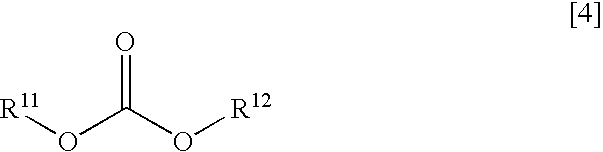
- the non-aqueous solvent of the present invention may additionally include one or more linear carbonates shown in the following general formula:
- R 11 and R 12 may be the same or different, and may be branched or cyclic alkyl groups, or halogen-substituted alkyl groups in which some or all of the hydrogen atoms are substituted by at least one halogen selected from a set consisting of fluorine, chlorine and bromine.
- halogen selected from a set consisting of fluorine, chlorine and bromine.
- linear alkyl groups with 1 to 4 carbon atoms such as methyl groups, ethyl groups, propyl groups and butyl groups, etc., are preferred.
- branched alkyl groups When branched alkyl groups are selected, branched alkyl groups with 3 to 10 carbon atoms, such as isopropyl groups, isobutyl groups, sec-butyl groups and tert-butyl groups, etc., are preferred.
- cyclic alkyl groups When cyclic alkyl groups are selected, cyclic alkyl groups with 5 to 10 carbon atoms such as cyclopentyl groups, cyclohexyl groups and 1-methylcyclohexyl groups, etc., are preferred.
- linear carbonates examples include dimethyl carbonate, diethyl carbonate, di-n-propyl carbonate, dibutyl carbonate, diisopropyl carbonate and methylethyl carbonate, etc.
- linear carbonates that contain a hydrocarbon group with 1 to 5 carbon atoms are desirable in the present invention, and dimethyl carbonate, methylethyl carbonate and diethyl carbonate are especially desirable.
- the non-aqueous solvent of the present invention may also include one or more solvents selected from the group consisting of cyclic esters such as ⁇ -butyrolactone, ⁇ -valerolactone, 3-methyl- ⁇ -butyrolactone and 2-methyl- ⁇ -butyrolactone, etc., linear esters such as methyl formate, ethyl formate, methyl acetate, ethyl acetate, propyl acetate, methyl propionate, methyl butyrate and methyl valerate, etc., cyclic ethers such as 1,4-dioxane, 1,3-dioxolane, tetrahydrofuran, 2-methyltetrahydrofuran, 3,-methyl-1,3-dioxolane and 2-methyl-1,3-dioxolane, etc., linear ethers such as 1,2-dimethoxyethane, 1,2-diethoxyethane, diethyl ether, dimethyl ether, methyle
- the non-aqueous solvent of the present invention may be one solvent used singly or may be a mixture consisting of two or more solvents.
- One or more salts are dissolved in the non-aqueous solvent in order to prepare the non-aqueous electrolyte solution of the present invention.
- concentration of the salts in the non-aqueous electrolyte solution is between about 0.1 to 3.0 moles/liter, and more preferably between about 0.5 to 2.0 moles/liter.
- the salt used in the present invention may be any salt known to those of ordinary skill in the art to be used in non-aqueous electrolyte solutions of energy storage devices such as secondary cells.
- the salt may be a single salt or a mixture of salts. Suitable examples of salts include lithium salts such as LiPF 6 , LiBF 4 , LiClO 4 , LiAsF 6 , LiAlCl 6 , Li 2 SiF 6 , LiOSO 2 R 1 ,
- R 1 through R 8 may be the same or different, and are perfluoroalkyl, alkyl or aryl groups with 1 to 6 carbon atoms, and alkali metal salts in which the lithium in the above-mentioned salts is substituted by alkali metals. These compounds may be used singly or in mixtures consisting of two or more compounds.
- Preferred electrolytes are LiPF 6 , LiBF 4 , LiOSO 2 R 1 ,
- the electrolyte system of the present invention further includes a flame retardant material.
- a suitable flame retardant material is liquid at room temperature and pressure, is substantially anhydrous and is substantially immiscible with the electrolyte solution.
- substantially immiscible means that when the non-aqueous electrolyte solution and the halogen-containing compound are mixed, a meniscus between the two liquids is formed and the concentration of the halogen-containing compound in the non-aqueous electrolyte solution is about 10 wt % or less and preferably, 1000 ppm or less. More preferably, the flame retardant material is completely immiscible in the non-aqueous electrolyte solution.
- Suitable flame retardant materials are stable with respect to electro-chemical reactions on the electrodes, and are chemically inert with respect to the electrolyte and the non-aqueous solvent in the battery environment. Suitable flame retardant materials are further characterized by having very low vapor pressure at room temperature.
- the flame retardant material is a halogen containing compound.
- Suitable halogen-containing compounds include branched or unbranched alkyls, cyclic alkyls, ethers, amino alkyls, aliphatic heterocyclic compounds in which one or more of the hydrogen atoms are substituted with a halogen atom selected from the group consisting of fluorine, chlorine and bromine.
- the halogen-containing compounds include perfluoroamine and perfluoroether compounds.
- Preferred halogen-containing compounds include perfluoro-1,3-dimethylcyclohexane and FC-70, sold under the trade name Fluorinert, having a molecular formula C 15 F 33 N, and commercially available from 3M Co. of St. Paul, Minn.
- the halogen-containing compound is present in an amount by weight of non-aqueous solvent in a range of from about 1 to about 99% by weight of non-aqueous solvent, preferably in a range of from about 1 to about 70% by weight of non-aqueous solvent, more preferably from about 10 to about 60% by weight of non-aqueous solvent, and even more preferably from about 20 to about 40% by weight of non-aqueous solvent.
- the use of the halogen-containing compound and a cyclic carbonate and/or linear carbonate is especially preferred.
- the halogen-containing compound is preferably present in an amount by weight of non-aqueous solvent ranging from about 1 to about 99 wt %, preferably from about 1 to about 70 wt %, more preferably from about 10 to about 60 wt %, and even more preferably from about 20 to about 40 wt %.
- the aforementioned cyclic carbonate and/or linear carbonate be contained in the non-aqueous solvent in an amount from about 1 to 99 wt %, preferably from about 30 to 99 wt %, and even more preferably from about 40 to 90 wt %.
- the electrolyte system of the present invention is used in connection with an electrode assembly and a casing to produce an energy storage device such as a battery.
- An energy storage device comprises an electrolyte system in accordance with the present invention, an electrode assembly, the electrode assembly including a first electrode member, a second electrode member; and a separator member physically and electrically separating the first electrode member from the second electrode member but capable of allowing ionic conductivity between the first electrode member and the second electrode member through the non-aqueous electrolyte solution, and a casing enclosing the electrode assembly and the electrolyte system.
- the energy storage device in accordance with one embodiment of the present invention is a battery in which the first electrode member is a negative electrode containing a material selected from the group consisting of lithium metal, a lithium alloy, a carbon material that can be doped and undoped with lithium ions, a metal oxide that can be doped and undoped with lithium ions, and silicon that can be doped and undoped with lithium ions.
- the negative electrode contains a metal oxide
- the metal oxide preferably is chosen from the group consisting of tin oxide and titanium oxide.
- a carbon material that can be doped and undoped with lithium ions is used as the negative pole. Suitable carbon for the negative pole includes graphite or amorphous carbon, activated carbon, carbon fibers, carbon black and meso-carbon, micro-beads, etc.
- the second electrode member is a positive electrode containing a material selected from the group consisting of complex oxide of lithium and a transition metal, and a complex oxide of lithium, transition metal and a non-transition metal.
- Suitable materials include complex oxides of lithium and transition metals, such as LiCoO 2 , LiMnO 2 , LiMn 2 O 4 , LiNiO 2 and LiNi x Co (1 ⁇ x) O 2 , etc., and V 2 O 5 , etc.
- the separator member may be a porous polymer or ceramic material.
- the separator is a resin containing a polymer, generally a microporous polymer film. Suitable examples include polyesters, polyacetyl and polyethylene.
- a method of making an energy storage device in accordance with the present invention comprises providing an electrode assembly including a first electrode member, a second electrode member, and a separator member physically and electrically separating the first electrode member from the second electrode member but capable of allowing ionic conductivity contact between the first electrode member and the second electrode member, placing the assembly in a casing, and filling the casing with the electrolyte system that is herein described by first, filling the casing at least partially with the non-aqueous electrolyte solution, waiting a period of time sufficient for the non-aqueous electrolyte solution to penetrate one or more pores of the electrode assembly, and then adding the flame retardant material to the casing.
- the method of making the energy storage device may further comprise the step of charging the energy storage device after adding the non-aqueous electrolyte solution.
- the energy storage devices of the present invention may take any suitable shape or configuration, including a battery of suitable shape and configuration, including a coin type battery, a prismatic battery, a stacked battery, cylindrical battery, etc.
- the non-aqueous electrolyte solution selected in accordance with the present invention and the halogen-containing compound selected in accordance with the present invention form two separate liquid phases. Since the non-aqueous electrolyte solution and the halogen-containing compound are substantially immiscible, one liquid phase within the battery casing is mainly non-aqueous electrolyte solution and the other liquid phase in the battery casing is mainly halogen-containing compound. In accordance with the present invention, the non-aqueous electrolyte solution phase occupies the region within the casing between the positive pole and the negative pole defined by the separator.
- the halogen-containing compound is substantially not in the region between the positive pole and the negative pole defined by the separator and does not interfere with the oxidation-reduction processes at the poles and in the non-aqueous electrolyte solution.
- the halogen-containing compound tends to inhibit the occurrence of highly energetic events such as combustion processes and therefore increases battery safety. Applicant believes the halogen-containing compound may interfere with the production of highly energetic and highly reactive carbon radicals produced in combustion processes and/or interfere with chain reaction processes by production of fluoride radicals.
- a positive pole prepared from LiCoO 2 and PVDF poly(vinylidene fluoride)) and a negative pole prepared from graphite and PVDF (poly(vinylidene fluoride)) were fastened together with a separator (manufactured by Tonen) between them, thus producing an electrode assembly.
- the assembly was then introduced into a battery casing.
- a non-aqueous electrolyte solution was prepared by mixing ethylene carbonate (EC), diethyl carbonate (DEC) and LiPF 6 in a weight ratio of EC to DEC to LiPF 6 of 21.84 wt %: 37.59 wt %: 10.57 wt %.
- the non-aqueous electrolyte solution was then introduced into the battery casing.
- the flame retardant material, a halogen-containing compound, perfluoro-1,3-dimethylcyclohexane was then introduced into the battery casing at a 30% weight ratio of halogen-containing compound to electrolyte solution.
- the battery was sealed and charged at 0.1 C. to a charge of 4.3 V by constant-current constant-voltage charging. The battery was then discharged at a constant current and the discharge capacity and safety level measured. The results are shown in Table 1.
- a non-aqueous electrolyte solution and battery were prepared in the same manner as in Example 1, except that FC-70 was used as the halogen-containing compound.
- the battery discharge capacity and safety level were measured and the results are shown in Table 1.
- a non-aqueous electrolyte solution was prepared in the same manner as in Example 1, except that a halogen-containing compound was not added to the electrolyte solution.
- the battery discharge capacity and safety level were measured and the results are shown in Table 1.
- the safety of the energy storage devices was assessed using an “Overcharge Test.”
- the above examples were overcharged at a 4.4-4.5 V.
- the temperature on the outside of the battery casing was measured. Overcharging was continued until the battery became mechanically detached or until the temperature of the battery casing peaked and began to decrease.
- Safety was assessed according to a 4 level designation:
- Level 1 Maximum Casing Temperature less than 80° C.
- Level 2 Maximum Casing Temperature between 80° C. and 120° C.
Landscapes
- Chemical & Material Sciences (AREA)
- Engineering & Computer Science (AREA)
- Manufacturing & Machinery (AREA)
- Chemical Kinetics & Catalysis (AREA)
- Electrochemistry (AREA)
- General Chemical & Material Sciences (AREA)
- General Physics & Mathematics (AREA)
- Inorganic Chemistry (AREA)
- Condensed Matter Physics & Semiconductors (AREA)
- Physics & Mathematics (AREA)
- Materials Engineering (AREA)
- Secondary Cells (AREA)
- Battery Electrode And Active Subsutance (AREA)
Abstract
Description
| TABLE 1 | ||||||
| Discharge | Safety | EC | DEC | LiPF6 | Additive | |
| Additive name | capacity (%) | level | ratio (wt %) | ratio (wt %) | ration (wt %) | ratio (%) |
| none | 100.0 | 4 | 31.2 | 53.7 | 15.1 | 0 |
| perfluoro-1,3- | 96.3 | 1 | 21.84 | 37.59 | 10.57 | 30 |
| dimethylcyclohexane | 93.7 | 2 | 21.84 | 37.59 | 10.57 | 30 |
| FC-70 | 99.5 | 2 | 21.84 | 37.59 | 10.57 | 30 |
| 100.5 | 2 | 21.84 | 37.59 | 10.57 | 30 | |
Claims (57)
Priority Applications (5)
| Application Number | Priority Date | Filing Date | Title |
|---|---|---|---|
| US10/034,316 US6797437B2 (en) | 2001-12-28 | 2001-12-28 | Electrolyte system and energy storage device using same |
| JP2003558954A JP2005514750A (en) | 2001-12-28 | 2002-12-10 | Electrolyte system and energy storage device using the same |
| US10/498,603 US7482098B2 (en) | 2001-12-28 | 2002-12-10 | Electrolyte system having multiple liquid phases in contact with one another |
| AU2002357810A AU2002357810A1 (en) | 2001-12-28 | 2002-12-10 | Electrolyte system and energy storage device using same |
| PCT/US2002/039451 WO2003058746A1 (en) | 2001-12-28 | 2002-12-10 | Electrolyte system and energy storage device using same |
Applications Claiming Priority (1)
| Application Number | Priority Date | Filing Date | Title |
|---|---|---|---|
| US10/034,316 US6797437B2 (en) | 2001-12-28 | 2001-12-28 | Electrolyte system and energy storage device using same |
Related Child Applications (1)
| Application Number | Title | Priority Date | Filing Date |
|---|---|---|---|
| US10/498,603 Continuation US7482098B2 (en) | 2001-12-28 | 2002-12-10 | Electrolyte system having multiple liquid phases in contact with one another |
Publications (2)
| Publication Number | Publication Date |
|---|---|
| US20030129498A1 US20030129498A1 (en) | 2003-07-10 |
| US6797437B2 true US6797437B2 (en) | 2004-09-28 |
Family
ID=21875659
Family Applications (2)
| Application Number | Title | Priority Date | Filing Date |
|---|---|---|---|
| US10/034,316 Expired - Lifetime US6797437B2 (en) | 2001-12-28 | 2001-12-28 | Electrolyte system and energy storage device using same |
| US10/498,603 Expired - Lifetime US7482098B2 (en) | 2001-12-28 | 2002-12-10 | Electrolyte system having multiple liquid phases in contact with one another |
Family Applications After (1)
| Application Number | Title | Priority Date | Filing Date |
|---|---|---|---|
| US10/498,603 Expired - Lifetime US7482098B2 (en) | 2001-12-28 | 2002-12-10 | Electrolyte system having multiple liquid phases in contact with one another |
Country Status (4)
| Country | Link |
|---|---|
| US (2) | US6797437B2 (en) |
| JP (1) | JP2005514750A (en) |
| AU (1) | AU2002357810A1 (en) |
| WO (1) | WO2003058746A1 (en) |
Cited By (16)
| Publication number | Priority date | Publication date | Assignee | Title |
|---|---|---|---|---|
| US20030170549A1 (en) * | 2002-02-01 | 2003-09-11 | Japan Storage Battery Co., Ltd. | Non-aqueous electrolyte battery |
| US20040265701A1 (en) * | 2001-12-28 | 2004-12-30 | Hisashi Tsukamoto | Electrolyte system and energy storage device using same |
| WO2011005054A2 (en) | 2009-07-09 | 2011-01-13 | 주식회사 엘지화학 | Non-aqueous electrolyte for rechargeable lithium batteries and a rechargeable lithium battery comprising the same |
| US20120328939A1 (en) * | 2011-06-09 | 2012-12-27 | Bhat Vinay V | Materials for Battery Electrolytes and Methods for Use |
| WO2013100466A1 (en) | 2011-12-27 | 2013-07-04 | 주식회사 엘지화학 | Non-aqueous electrolyte for lithium secondary battery and lithium secondary battery comprising same |
| US8703344B2 (en) | 2011-06-09 | 2014-04-22 | Asahi Kasei Kabushiki Kaisha | Materials for battery electrolytes and methods for use |
| US8734668B2 (en) | 2011-06-09 | 2014-05-27 | Asahi Kasei Kabushiki Kaisha | Materials for battery electrolytes and methods for use |
| US8956769B2 (en) | 2011-12-27 | 2015-02-17 | Lg Chem, Ltd. | Non-aqueous electrolyte solution for lithium secondary battery and lithium secondary battery including the same |
| US20150325884A1 (en) * | 2012-12-13 | 2015-11-12 | Eliiy Power Co., Ltd. | Method for producing non-aqueous electrolyte secondary battery |
| US9540312B2 (en) | 2015-02-03 | 2017-01-10 | Blue Current, Inc. | Non-flammable electrolyte composition including carbonate-terminated perfluoropolymer and phosphate-terminated or phosphonate-terminated perfluoropolymer and battery using same |
| US9666916B2 (en) | 2014-11-05 | 2017-05-30 | Toyota Motor Engineering & Manufacturing North America, Inc. | Biphase electrolyte for a metal-air battery |
| US9748604B2 (en) | 2012-10-19 | 2017-08-29 | The University Of North Carolina At Chapel Hill | Ion conducting polymers and polymer blends for alkali metal ion batteries |
| US9755273B2 (en) | 2013-04-01 | 2017-09-05 | The University Of North Carolina At Chapel Hill | Ion conducting fluoropolymer carbonates for alkali metal ion batteries |
| US9941559B2 (en) | 2014-11-11 | 2018-04-10 | Toyota Motor Engineering & Manufacturing North America, Inc. | Water enhanced ionic liquid electrolytes for metal-air batteries |
| US11133530B2 (en) | 2016-08-30 | 2021-09-28 | Wildcat Discovery Technologies, Inc. | Electrolyte formulations for electrochemical cells containing a silicon electrode |
| US11322778B2 (en) | 2018-05-29 | 2022-05-03 | Wildcat Discovery Technologies, Inc. | High voltage electrolyte additives |
Families Citing this family (15)
| Publication number | Priority date | Publication date | Assignee | Title |
|---|---|---|---|---|
| JP4702510B2 (en) * | 2001-09-05 | 2011-06-15 | 信越化学工業株式会社 | Lithium-containing silicon oxide powder and method for producing the same |
| US20040151951A1 (en) * | 2002-12-17 | 2004-08-05 | The University Of Chicago | Lithium based electrochemical cell systems |
| US20040180146A1 (en) * | 2003-03-14 | 2004-09-16 | Keiichiro Saikawa | Coating finishing method |
| US7339353B1 (en) | 2004-03-10 | 2008-03-04 | Quallion Llc | Power system for managing power from multiple power sources |
| US9192772B1 (en) | 2004-06-29 | 2015-11-24 | Quallion Llc | Portable medical power system |
| US8815453B1 (en) * | 2005-04-05 | 2014-08-26 | Quallion Llc | Flame retardant battery |
| JP5264099B2 (en) * | 2007-04-12 | 2013-08-14 | パナソニック株式会社 | Nonaqueous electrolyte secondary battery |
| US8227103B2 (en) * | 2008-02-27 | 2012-07-24 | Quallion Llc | Battery pack having batteries in a porous medium |
| JP4435866B2 (en) * | 2008-05-19 | 2010-03-24 | パナソニック株式会社 | Nonaqueous solvent for power storage device, nonaqueous electrolyte for power storage device, nonaqueous power storage device, lithium secondary battery and electric double layer capacitor using the same |
| EP2352157B1 (en) * | 2008-10-21 | 2014-04-16 | Panasonic Corporation | Non-aqueous solvent and non-aqueous electrolytic solution for energy storage device, and energy storage device employing the same, such as lithium secondary battery or electric double-layer capacitor |
| US20110236765A1 (en) * | 2009-09-02 | 2011-09-29 | Toru Matsui | Nonaqueous solvent, and nonaqueous electrolyte solution and nonaqueous secondary battery that use nonaqueous solvent |
| CN102208682B (en) * | 2011-05-06 | 2013-05-01 | 北京理工大学 | Additive and solvent of lithium secondary battery electrolyte |
| WO2013166074A1 (en) * | 2012-05-01 | 2013-11-07 | Altairnano, Inc. | Improved lithium titanate cell |
| CN104854754B (en) * | 2012-12-13 | 2017-12-05 | 艾利电力能源有限公司 | The manufacture method of nonaqueous electrolytic solution secondary battery and nonaqueous electrolytic solution secondary battery |
| WO2016011613A1 (en) * | 2014-07-23 | 2016-01-28 | Basf Corporation | Electrolytes for lithium transition metal phosphate batteries |
Citations (19)
| Publication number | Priority date | Publication date | Assignee | Title |
|---|---|---|---|---|
| US5229227A (en) | 1992-07-23 | 1993-07-20 | Eveready Battery Company Inc. | Low flammability nonaqueous electrolytes |
| JPH07249432A (en) | 1994-03-14 | 1995-09-26 | Nippon Telegr & Teleph Corp <Ntt> | Electrolyte for lithium secondary battery |
| EP0807986A1 (en) * | 1996-05-13 | 1997-11-19 | Hoechst Aktiengesellschaft | Fluorine-containing solvent for lithium batteries with increased security |
| JPH1012272A (en) * | 1996-06-18 | 1998-01-16 | Mitsubishi Chem Corp | Non-aqueous electrolyte secondary battery |
| US5830600A (en) * | 1996-05-24 | 1998-11-03 | Sri International | Nonflammable/self-extinguishing electrolytes for batteries |
| JPH11317232A (en) | 1999-04-05 | 1999-11-16 | Mitsubishi Chemical Corp | Flame retardant for electrolyte for lithium batteries |
| JP2000106209A (en) | 1998-09-30 | 2000-04-11 | Mitsui Chemicals Inc | Nonaqueous electrolyte and nonaqueous electrolyte secondary battery |
| JP2000164249A (en) | 1998-11-27 | 2000-06-16 | Mitsui Chemicals Inc | Nonaqueous electrolyte and nonaqueous electrolyte secondary battery |
| JP2001060464A (en) | 1999-08-20 | 2001-03-06 | Japan Storage Battery Co Ltd | Electrolyte for non-aqueous electrolyte secondary battery and non-aqueous electrolyte secondary battery using the same |
| US6210835B1 (en) * | 1998-02-20 | 2001-04-03 | Hitachi, Ltd. | Lithium secondary battery and liquid electrolyte for the battery |
| US6232020B1 (en) | 1999-05-03 | 2001-05-15 | Samsung Sdi Co., Ltd. | Non-flammable electrolyte compositions and lithium secondary batteries made thereof |
| JP2001143749A (en) | 1999-11-19 | 2001-05-25 | Nippon Zeon Co Ltd | Electrochemical element containing non-aqueous electrolyte |
| EP0631339B1 (en) | 1993-03-30 | 2001-07-25 | Canon Kabushiki Kaisha | Secondary battery |
| JP2002042891A (en) | 2000-07-27 | 2002-02-08 | Toshiba Battery Co Ltd | Thin lithium secondary battery |
| EP1205997A1 (en) | 1999-07-29 | 2002-05-15 | Bridgestone Corporation | Nonaqueous electrolyte secondary cell |
| JP2002190316A (en) | 2000-12-22 | 2002-07-05 | Mitsubishi Chemicals Corp | Non-aqueous electrolyte and lithium secondary battery using the same |
| US20020110739A1 (en) | 2000-05-26 | 2002-08-15 | Mcewen Alan B. | Non-flammable electrolytes |
| EP1253662A1 (en) | 1999-11-25 | 2002-10-30 | Bridgestone Corporation | Non-aqueous electrolyte secondary cell and, deterioration-preventing agent for non-aqueous electrolyte secondary cell and additive for non-aqueous electrolyte secondary cell for use therein |
| US20020160273A1 (en) * | 2000-09-21 | 2002-10-31 | Juichi Arai | New organic borate compounds and the nonaqueous electrolytes and lithium secondary batteries using the compounds |
Family Cites Families (11)
| Publication number | Priority date | Publication date | Assignee | Title |
|---|---|---|---|---|
| US4762636A (en) * | 1986-02-28 | 1988-08-09 | Ciba-Geigy Corporation | Process for the preparation of granules containing an active substance and to the use thereof as speckles for treating substrates |
| US5230822A (en) * | 1989-11-15 | 1993-07-27 | Lever Brothers Company, Division Of Conopco, Inc. | Wax-encapsulated particles |
| US5258132A (en) * | 1989-11-15 | 1993-11-02 | Lever Brothers Company, Division Of Conopco, Inc. | Wax-encapsulated particles |
| US5252613A (en) * | 1992-12-18 | 1993-10-12 | Exxon Research & Engineering Company | Enhanced catalyst mixing in slurry bubble columns (OP-3723) |
| JP3305035B2 (en) * | 1993-03-30 | 2002-07-22 | キヤノン株式会社 | Lithium secondary battery |
| US5460743A (en) * | 1994-05-09 | 1995-10-24 | Lever Brothers Company, Division Of Conopco, Inc. | Liquid cleaning composition containing polyvinyl ether encapsulated particles |
| JP3807459B2 (en) * | 1997-06-30 | 2006-08-09 | ダイキン工業株式会社 | Non-aqueous electrolyte battery electrolyte and non-aqueous electrolyte battery using the same |
| US6156826A (en) * | 1997-09-18 | 2000-12-05 | International Flavors & Fragrances Inc. | Matrix composition comprising surfactant and matrix useful for targeted delivery articles |
| JP3856583B2 (en) * | 1999-02-01 | 2006-12-13 | 三井化学株式会社 | Non-aqueous electrolyte for secondary battery and non-aqueous electrolyte secondary battery |
| JP2000294281A (en) * | 1999-04-08 | 2000-10-20 | Hitachi Maxell Ltd | Non-aqueous electrolyte secondary battery |
| US6797437B2 (en) | 2001-12-28 | 2004-09-28 | Quallion Llc | Electrolyte system and energy storage device using same |
-
2001
- 2001-12-28 US US10/034,316 patent/US6797437B2/en not_active Expired - Lifetime
-
2002
- 2002-12-10 AU AU2002357810A patent/AU2002357810A1/en not_active Abandoned
- 2002-12-10 JP JP2003558954A patent/JP2005514750A/en active Pending
- 2002-12-10 WO PCT/US2002/039451 patent/WO2003058746A1/en not_active Ceased
- 2002-12-10 US US10/498,603 patent/US7482098B2/en not_active Expired - Lifetime
Patent Citations (21)
| Publication number | Priority date | Publication date | Assignee | Title |
|---|---|---|---|---|
| US5229227A (en) | 1992-07-23 | 1993-07-20 | Eveready Battery Company Inc. | Low flammability nonaqueous electrolytes |
| EP0631339B1 (en) | 1993-03-30 | 2001-07-25 | Canon Kabushiki Kaisha | Secondary battery |
| JPH07249432A (en) | 1994-03-14 | 1995-09-26 | Nippon Telegr & Teleph Corp <Ntt> | Electrolyte for lithium secondary battery |
| EP0807986A1 (en) * | 1996-05-13 | 1997-11-19 | Hoechst Aktiengesellschaft | Fluorine-containing solvent for lithium batteries with increased security |
| JPH1050343A (en) | 1996-05-13 | 1998-02-20 | Hoechst Ag | Fluorine-containing solvents for lithium batteries with improved safety |
| US5916708A (en) | 1996-05-13 | 1999-06-29 | Hoechst Aktiengesellschaft | Fluorine-containing solvents for lithium batteries having increased safety |
| US5830600A (en) * | 1996-05-24 | 1998-11-03 | Sri International | Nonflammable/self-extinguishing electrolytes for batteries |
| JPH1012272A (en) * | 1996-06-18 | 1998-01-16 | Mitsubishi Chem Corp | Non-aqueous electrolyte secondary battery |
| US6210835B1 (en) * | 1998-02-20 | 2001-04-03 | Hitachi, Ltd. | Lithium secondary battery and liquid electrolyte for the battery |
| JP2000106209A (en) | 1998-09-30 | 2000-04-11 | Mitsui Chemicals Inc | Nonaqueous electrolyte and nonaqueous electrolyte secondary battery |
| JP2000164249A (en) | 1998-11-27 | 2000-06-16 | Mitsui Chemicals Inc | Nonaqueous electrolyte and nonaqueous electrolyte secondary battery |
| JPH11317232A (en) | 1999-04-05 | 1999-11-16 | Mitsubishi Chemical Corp | Flame retardant for electrolyte for lithium batteries |
| US6232020B1 (en) | 1999-05-03 | 2001-05-15 | Samsung Sdi Co., Ltd. | Non-flammable electrolyte compositions and lithium secondary batteries made thereof |
| EP1205997A1 (en) | 1999-07-29 | 2002-05-15 | Bridgestone Corporation | Nonaqueous electrolyte secondary cell |
| JP2001060464A (en) | 1999-08-20 | 2001-03-06 | Japan Storage Battery Co Ltd | Electrolyte for non-aqueous electrolyte secondary battery and non-aqueous electrolyte secondary battery using the same |
| JP2001143749A (en) | 1999-11-19 | 2001-05-25 | Nippon Zeon Co Ltd | Electrochemical element containing non-aqueous electrolyte |
| EP1253662A1 (en) | 1999-11-25 | 2002-10-30 | Bridgestone Corporation | Non-aqueous electrolyte secondary cell and, deterioration-preventing agent for non-aqueous electrolyte secondary cell and additive for non-aqueous electrolyte secondary cell for use therein |
| US20020110739A1 (en) | 2000-05-26 | 2002-08-15 | Mcewen Alan B. | Non-flammable electrolytes |
| JP2002042891A (en) | 2000-07-27 | 2002-02-08 | Toshiba Battery Co Ltd | Thin lithium secondary battery |
| US20020160273A1 (en) * | 2000-09-21 | 2002-10-31 | Juichi Arai | New organic borate compounds and the nonaqueous electrolytes and lithium secondary batteries using the compounds |
| JP2002190316A (en) | 2000-12-22 | 2002-07-05 | Mitsubishi Chemicals Corp | Non-aqueous electrolyte and lithium secondary battery using the same |
Non-Patent Citations (3)
| Title |
|---|
| Data sheet for Ethylene Carbonate obtained from Chemfinder.com [online]. CambridgeSoft Corporation, 2003 [retrieved on Feb. 23, 2003]. Retrieved from the Internet: <URL: www.chemfinder.cambridgesoft.com/result.asp>. * |
| Galden PFPE:Heat Transfer Fluids Product Data Sheet for Galden (R) HT90 Fluid [online]. Solvay Solexis, Inc., 2002 [retrieved on Feb. 23, 2003]. Retrieved from the Internet : <URL: www.solvaysolexis.com/pdf/gald_heat.pdf>.* * |
| Galden PFPE:Heat Transfer Fluids Product Data Sheet for Galden ® HT90 Fluid [online]. Solvay Solexis, Inc., 2002 [retrieved on Feb. 23, 2003]. Retrieved from the Internet : <URL: www.solvaysolexis.com/pdf/gald_heat.pdf>.* |
Cited By (22)
| Publication number | Priority date | Publication date | Assignee | Title |
|---|---|---|---|---|
| US20040265701A1 (en) * | 2001-12-28 | 2004-12-30 | Hisashi Tsukamoto | Electrolyte system and energy storage device using same |
| US7482098B2 (en) * | 2001-12-28 | 2009-01-27 | Quallion Llc | Electrolyte system having multiple liquid phases in contact with one another |
| US20030170549A1 (en) * | 2002-02-01 | 2003-09-11 | Japan Storage Battery Co., Ltd. | Non-aqueous electrolyte battery |
| WO2011005054A2 (en) | 2009-07-09 | 2011-01-13 | 주식회사 엘지화학 | Non-aqueous electrolyte for rechargeable lithium batteries and a rechargeable lithium battery comprising the same |
| US8980481B2 (en) | 2009-07-09 | 2015-03-17 | Lg Chem, Ltd. | Non-aqueous electrolyte solution for lithium secondary battery and lithium secondary battery including the same |
| US20120328939A1 (en) * | 2011-06-09 | 2012-12-27 | Bhat Vinay V | Materials for Battery Electrolytes and Methods for Use |
| US8703344B2 (en) | 2011-06-09 | 2014-04-22 | Asahi Kasei Kabushiki Kaisha | Materials for battery electrolytes and methods for use |
| US8734668B2 (en) | 2011-06-09 | 2014-05-27 | Asahi Kasei Kabushiki Kaisha | Materials for battery electrolytes and methods for use |
| WO2013100466A1 (en) | 2011-12-27 | 2013-07-04 | 주식회사 엘지화학 | Non-aqueous electrolyte for lithium secondary battery and lithium secondary battery comprising same |
| US8956769B2 (en) | 2011-12-27 | 2015-02-17 | Lg Chem, Ltd. | Non-aqueous electrolyte solution for lithium secondary battery and lithium secondary battery including the same |
| US9748604B2 (en) | 2012-10-19 | 2017-08-29 | The University Of North Carolina At Chapel Hill | Ion conducting polymers and polymer blends for alkali metal ion batteries |
| US20150325884A1 (en) * | 2012-12-13 | 2015-11-12 | Eliiy Power Co., Ltd. | Method for producing non-aqueous electrolyte secondary battery |
| US9991503B2 (en) * | 2012-12-13 | 2018-06-05 | Eliiy Power Co., Ltd. | Method for producing non-aqueous electrolyte secondary battery |
| US9755273B2 (en) | 2013-04-01 | 2017-09-05 | The University Of North Carolina At Chapel Hill | Ion conducting fluoropolymer carbonates for alkali metal ion batteries |
| US9666916B2 (en) | 2014-11-05 | 2017-05-30 | Toyota Motor Engineering & Manufacturing North America, Inc. | Biphase electrolyte for a metal-air battery |
| US9941559B2 (en) | 2014-11-11 | 2018-04-10 | Toyota Motor Engineering & Manufacturing North America, Inc. | Water enhanced ionic liquid electrolytes for metal-air batteries |
| US9540312B2 (en) | 2015-02-03 | 2017-01-10 | Blue Current, Inc. | Non-flammable electrolyte composition including carbonate-terminated perfluoropolymer and phosphate-terminated or phosphonate-terminated perfluoropolymer and battery using same |
| US10077231B2 (en) | 2015-02-03 | 2018-09-18 | Blue Current, Inc. | Functionalized fluoropolymers and electrolyte compositions |
| US10227288B2 (en) | 2015-02-03 | 2019-03-12 | Blue Current, Inc. | Functionalized fluoropolymers and electrolyte compositions |
| US10308587B2 (en) | 2015-02-03 | 2019-06-04 | Blue Current, Inc. | Functionalized fluoropolymers and electrolyte compositions |
| US11133530B2 (en) | 2016-08-30 | 2021-09-28 | Wildcat Discovery Technologies, Inc. | Electrolyte formulations for electrochemical cells containing a silicon electrode |
| US11322778B2 (en) | 2018-05-29 | 2022-05-03 | Wildcat Discovery Technologies, Inc. | High voltage electrolyte additives |
Also Published As
| Publication number | Publication date |
|---|---|
| AU2002357810A1 (en) | 2003-07-24 |
| JP2005514750A (en) | 2005-05-19 |
| US20040265701A1 (en) | 2004-12-30 |
| US7482098B2 (en) | 2009-01-27 |
| US20030129498A1 (en) | 2003-07-10 |
| WO2003058746A1 (en) | 2003-07-17 |
Similar Documents
| Publication | Publication Date | Title |
|---|---|---|
| US6797437B2 (en) | Electrolyte system and energy storage device using same | |
| US7785740B2 (en) | Overcharge protection for electrochemical cells | |
| US8673507B2 (en) | Inhibitor of reduction of life cycle of redox shuttle additive and non-aqueous electrolyte and secondary battery comprising the same | |
| EP2005511B1 (en) | Non-aqueous electrolyte and electrochemical device with an improved safety | |
| KR100898857B1 (en) | Non-aqueous electrolyte and secondary battery using the same | |
| CN100452520C (en) | Nonflammable non-aqueous electrolyte solution and lithium ion battery using same | |
| CN110998958B (en) | Nonaqueous electrolyte for lithium secondary battery and lithium secondary battery comprising same | |
| US20070231706A1 (en) | Non-Aqueous Electrolytic Solution With Mixed Salts | |
| JP3961597B2 (en) | Nonaqueous electrolyte and nonaqueous electrolyte secondary battery | |
| KR20220124870A (en) | Electrolyte Solution for Secondary Battery and Secondary Battery Comprising the Same | |
| US7422827B2 (en) | Nonaqueous electrolyte | |
| EP1093177B1 (en) | Electrolyte for rechargeable lithium battery | |
| JP2000106209A (en) | Nonaqueous electrolyte and nonaqueous electrolyte secondary battery | |
| JPH11329496A (en) | Nonaqueous electrolyte nonaqueous secondary battery | |
| ES3026672T3 (en) | Use of a compound as an additive of a non-aqueous electrolyte solution, non-aqueous electrolyte for lithium secondary battery and lithium secondary battery including the same | |
| US20070122706A1 (en) | Nonaqueous electrolyte battery | |
| EP3883037A1 (en) | Electrolyte for lithium secondary battery, and lithium secondary battery comprising same | |
| JP2000223151A (en) | Nonaqueous electrolyte, and nonaqueous electrolyte secondary battery | |
| JP2000294279A (en) | Nonaqueous electrolyte and nonaqueous electrolyte secondary battery | |
| JP2000223150A (en) | Nonaqueous electrolyte, and nonaqueous electrolyte secondary battery | |
| KR100370384B1 (en) | Non-aqueous electrolyte solution for lithium battery | |
| US20080032201A1 (en) | Nonaqueous Electrolyte for Battery | |
| KR20220018220A (en) | Electrolyte solution for secondary battery and secondary battery comprising the same | |
| KR100611462B1 (en) | Battery nonaqueous electrolyte | |
| KR20220167622A (en) | Non-Aqueous Electrolyte Solution for Secondary Battery and Secondary Battery Including Same |
Legal Events
| Date | Code | Title | Description |
|---|---|---|---|
| AS | Assignment |
Owner name: QUALLION, LLC, CALIFORNIA Free format text: ASSIGNMENT OF ASSIGNORS INTEREST;ASSIGNOR:TSUKAMOTO, HISASHI;REEL/FRAME:012426/0261 Effective date: 20011228 |
|
| AS | Assignment |
Owner name: QUALLION LLC, CALIFORNIA Free format text: ASSIGNMENT OF ASSIGNORS INTEREST;ASSIGNOR:KOIKE, TSUNEAKI;REEL/FRAME:013970/0529 Effective date: 20030414 |
|
| STCF | Information on status: patent grant |
Free format text: PATENTED CASE |
|
| CC | Certificate of correction | ||
| FPAY | Fee payment |
Year of fee payment: 4 |
|
| FPAY | Fee payment |
Year of fee payment: 8 |
|
| FEPP | Fee payment procedure |
Free format text: PAT HOLDER NO LONGER CLAIMS SMALL ENTITY STATUS, ENTITY STATUS SET TO UNDISCOUNTED (ORIGINAL EVENT CODE: STOL); ENTITY STATUS OF PATENT OWNER: LARGE ENTITY |
|
| FPAY | Fee payment |
Year of fee payment: 12 |