US6750317B2 - Material and additive for highly crosslinked chemically and thermally stable polyhydroxyamide polymers - Google Patents
Material and additive for highly crosslinked chemically and thermally stable polyhydroxyamide polymers Download PDFInfo
- Publication number
- US6750317B2 US6750317B2 US10/159,861 US15986102A US6750317B2 US 6750317 B2 US6750317 B2 US 6750317B2 US 15986102 A US15986102 A US 15986102A US 6750317 B2 US6750317 B2 US 6750317B2
- Authority
- US
- United States
- Prior art keywords
- group
- polyhydroxyamide
- bond
- radical
- carbon atoms
- Prior art date
- Legal status (The legal status is an assumption and is not a legal conclusion. Google has not performed a legal analysis and makes no representation as to the accuracy of the status listed.)
- Expired - Fee Related, expires
Links
- 0 *C.*C.*C(=O)N([H])C1=CC=CC=C1O.*C1=NC2=C(C=CC=C2)O1.[OH-] Chemical compound *C.*C.*C(=O)N([H])C1=CC=CC=C1O.*C1=NC2=C(C=CC=C2)O1.[OH-] 0.000 description 25
- KHYKMRFBNLXYQT-UHFFFAOYSA-N C.C.C.C.C.C.C.C.C.C.C.C.C1=CC=CC=C1.CCNC(O)(O)NCCNC(O)(O)NCNC(O)(O)NC(=O)CC.CCNC(O)(O)NCCNC(O)(O)NCNC(O)(O)NC(C)=O.CCNC(O)(O)NCNC(O)(O)NCNC(O)(O)NC(=O)CC.[HH].[HH].[HH].[HH].[HH].[HH].[HH].[HH].[HH].[HH].[HH].[HH].[HH].[HH].[HH].[HH].[HH].[HH] Chemical compound C.C.C.C.C.C.C.C.C.C.C.C.C1=CC=CC=C1.CCNC(O)(O)NCCNC(O)(O)NCNC(O)(O)NC(=O)CC.CCNC(O)(O)NCCNC(O)(O)NCNC(O)(O)NC(C)=O.CCNC(O)(O)NCNC(O)(O)NCNC(O)(O)NC(=O)CC.[HH].[HH].[HH].[HH].[HH].[HH].[HH].[HH].[HH].[HH].[HH].[HH].[HH].[HH].[HH].[HH].[HH].[HH] KHYKMRFBNLXYQT-UHFFFAOYSA-N 0.000 description 1
- VHRYZQNGTZXDNX-UHFFFAOYSA-N C=C(C)C(=O)Cl Chemical compound C=C(C)C(=O)Cl VHRYZQNGTZXDNX-UHFFFAOYSA-N 0.000 description 1
- MSTZGVRUOMBULC-UHFFFAOYSA-N NC1=CC(C(C2=CC=C(O)C(N)=C2)(C(F)(F)F)C(F)(F)F)=CC=C1O Chemical compound NC1=CC(C(C2=CC=C(O)C(N)=C2)(C(F)(F)F)C(F)(F)F)=CC=C1O MSTZGVRUOMBULC-UHFFFAOYSA-N 0.000 description 1
- KZLDGFZCFRXUIB-UHFFFAOYSA-N NC1=CC(C2=CC=C(O)C(N)=C2)=CC=C1O Chemical compound NC1=CC(C2=CC=C(O)C(N)=C2)=CC=C1O KZLDGFZCFRXUIB-UHFFFAOYSA-N 0.000 description 1
- BFDSFQRAMPXOCP-UHFFFAOYSA-N NC1=CC=C(OC2=CC=C(C3(C4=CC=C(OC5=CC(O)=C(N)C=C5)C=C4)C4=C(C=CC=C4)C4=C3C=CC=C4)C=C2)C=C1O Chemical compound NC1=CC=C(OC2=CC=C(C3(C4=CC=C(OC5=CC(O)=C(N)C=C5)C=C4)C4=C(C=CC=C4)C4=C3C=CC=C4)C=C2)C=C1O BFDSFQRAMPXOCP-UHFFFAOYSA-N 0.000 description 1
- BZPHJDQWFRMGER-UHFFFAOYSA-N O=C(Cl)C#CC1=CC=CC=C1 Chemical compound O=C(Cl)C#CC1=CC=CC=C1 BZPHJDQWFRMGER-UHFFFAOYSA-N 0.000 description 1
- YMTNDQJOFCTPBI-UHFFFAOYSA-N O=C(Cl)C1=CC=C(C(C2=CC=C(C(=O)Cl)C=C2)(C(F)(F)F)C(F)(F)F)C=C1 Chemical compound O=C(Cl)C1=CC=C(C(C2=CC=C(C(=O)Cl)C=C2)(C(F)(F)F)C(F)(F)F)C=C1 YMTNDQJOFCTPBI-UHFFFAOYSA-N 0.000 description 1
- HXYXVFUUHSZSNV-UHFFFAOYSA-N O=C(Cl)C1CC2C=CC1C2 Chemical compound O=C(Cl)C1CC2C=CC1C2 HXYXVFUUHSZSNV-UHFFFAOYSA-N 0.000 description 1
Classifications
-
- C—CHEMISTRY; METALLURGY
- C08—ORGANIC MACROMOLECULAR COMPOUNDS; THEIR PREPARATION OR CHEMICAL WORKING-UP; COMPOSITIONS BASED THEREON
- C08G—MACROMOLECULAR COMPOUNDS OBTAINED OTHERWISE THAN BY REACTIONS ONLY INVOLVING UNSATURATED CARBON-TO-CARBON BONDS
- C08G69/00—Macromolecular compounds obtained by reactions forming a carboxylic amide link in the main chain of the macromolecule
- C08G69/48—Polymers modified by chemical after-treatment
-
- C—CHEMISTRY; METALLURGY
- C08—ORGANIC MACROMOLECULAR COMPOUNDS; THEIR PREPARATION OR CHEMICAL WORKING-UP; COMPOSITIONS BASED THEREON
- C08G—MACROMOLECULAR COMPOUNDS OBTAINED OTHERWISE THAN BY REACTIONS ONLY INVOLVING UNSATURATED CARBON-TO-CARBON BONDS
- C08G69/00—Macromolecular compounds obtained by reactions forming a carboxylic amide link in the main chain of the macromolecule
- C08G69/02—Polyamides derived from amino-carboxylic acids or from polyamines and polycarboxylic acids
- C08G69/04—Preparatory processes
-
- C—CHEMISTRY; METALLURGY
- C08—ORGANIC MACROMOLECULAR COMPOUNDS; THEIR PREPARATION OR CHEMICAL WORKING-UP; COMPOSITIONS BASED THEREON
- C08G—MACROMOLECULAR COMPOUNDS OBTAINED OTHERWISE THAN BY REACTIONS ONLY INVOLVING UNSATURATED CARBON-TO-CARBON BONDS
- C08G69/00—Macromolecular compounds obtained by reactions forming a carboxylic amide link in the main chain of the macromolecule
- C08G69/02—Polyamides derived from amino-carboxylic acids or from polyamines and polycarboxylic acids
- C08G69/26—Polyamides derived from amino-carboxylic acids or from polyamines and polycarboxylic acids derived from polyamines and polycarboxylic acids
-
- C—CHEMISTRY; METALLURGY
- C08—ORGANIC MACROMOLECULAR COMPOUNDS; THEIR PREPARATION OR CHEMICAL WORKING-UP; COMPOSITIONS BASED THEREON
- C08G—MACROMOLECULAR COMPOUNDS OBTAINED OTHERWISE THAN BY REACTIONS ONLY INVOLVING UNSATURATED CARBON-TO-CARBON BONDS
- C08G69/00—Macromolecular compounds obtained by reactions forming a carboxylic amide link in the main chain of the macromolecule
- C08G69/02—Polyamides derived from amino-carboxylic acids or from polyamines and polycarboxylic acids
- C08G69/26—Polyamides derived from amino-carboxylic acids or from polyamines and polycarboxylic acids derived from polyamines and polycarboxylic acids
- C08G69/28—Preparatory processes
-
- C—CHEMISTRY; METALLURGY
- C08—ORGANIC MACROMOLECULAR COMPOUNDS; THEIR PREPARATION OR CHEMICAL WORKING-UP; COMPOSITIONS BASED THEREON
- C08G—MACROMOLECULAR COMPOUNDS OBTAINED OTHERWISE THAN BY REACTIONS ONLY INVOLVING UNSATURATED CARBON-TO-CARBON BONDS
- C08G69/00—Macromolecular compounds obtained by reactions forming a carboxylic amide link in the main chain of the macromolecule
- C08G69/46—Post-polymerisation treatment
Definitions
- the invention relates to polyhydroxyamides that can be used for preparing highly crosslinked polymers and to temperature stable polymers prepared from these polyhydroxyamides.
- the invention further relates to polymers that have been three-dimensionally crosslinked using the polyhydroxyamides.
- microelectronics in the automobile industry, in mechanical engineering, and in the aerospace industry, chemically-inert, high-heat-resistance polymers are needed as protective and insulating coats.
- such polymers are used, for example, as a dielectric between the chip and a metallization level or between two metal levels in a chip: for example, in multichip modules or in memory chips and logic chips.
- such polymers are also used as a buffer coat between chip and housing.
- chemically-inert, high-heat-resistance polymers are needed for producing weather-resistant protective coats.
- Polybenzoxazoles exhibit a high level of temperature stability and great chemical resistance. They are generally prepared from polyhydroxyamides that are readily soluble in organic solvents, such as N-methyl-pyrrolidone. The solutions can be applied to surfaces by spin coating, by dipping or by brush methods. The solvent can be removed subsequently by heating, which can be accompanied or followed by cyclization of the polyhydroxyamide to the polybenzoxazole, with elimination of water, in accordance with the reaction depicted below, so giving a polymer having the properties described above.
- organic solvents such as N-methyl-pyrrolidone.
- U.S. Pat. No. 3,644,288 issued to Odier et al. describes three-dimensionally crosslinked polybenzoxazoles obtained by cyclization from the corresponding crosslinked hydroxypolyamides by heating to a temperature in the range 220-400° C.
- the hydroxypolyamides are obtained by reacting an aromatic dihydroxydiamine compound, a dicarboxylic acid compound, and a tricarboxylic acid compound with one another.
- the hydroxypolyamides are prepared by preparing in a first stage a linear polyamide of low molecular weight, starting from a dihydroxydiamine and a dicarboxylic acid compound, and in a second stage crosslinking this linear polyamide by adding a triester of a tricarboxylic acid.
- the hydroxypolyamides obtained in this way have a structure that is three-dimensionally crosslinked to a high degree and are therefore insoluble solids. For further processing, these solids are pulverized.
- a, a′, a′′ to d, d′, d′′ may each be identical or different and
- Z 1 , Z 2 , and Z 3 which may each be identical or different, denote a tetravalent radical having up to 100 carbon atoms;
- Y 1 , Y 2 , and Y 3 which may each be identical or different, denote a divalent radical containing at least two carbonyl groups which form an amide bond to the adjacent nitrogen, and comprising up to 100 carbon atoms;
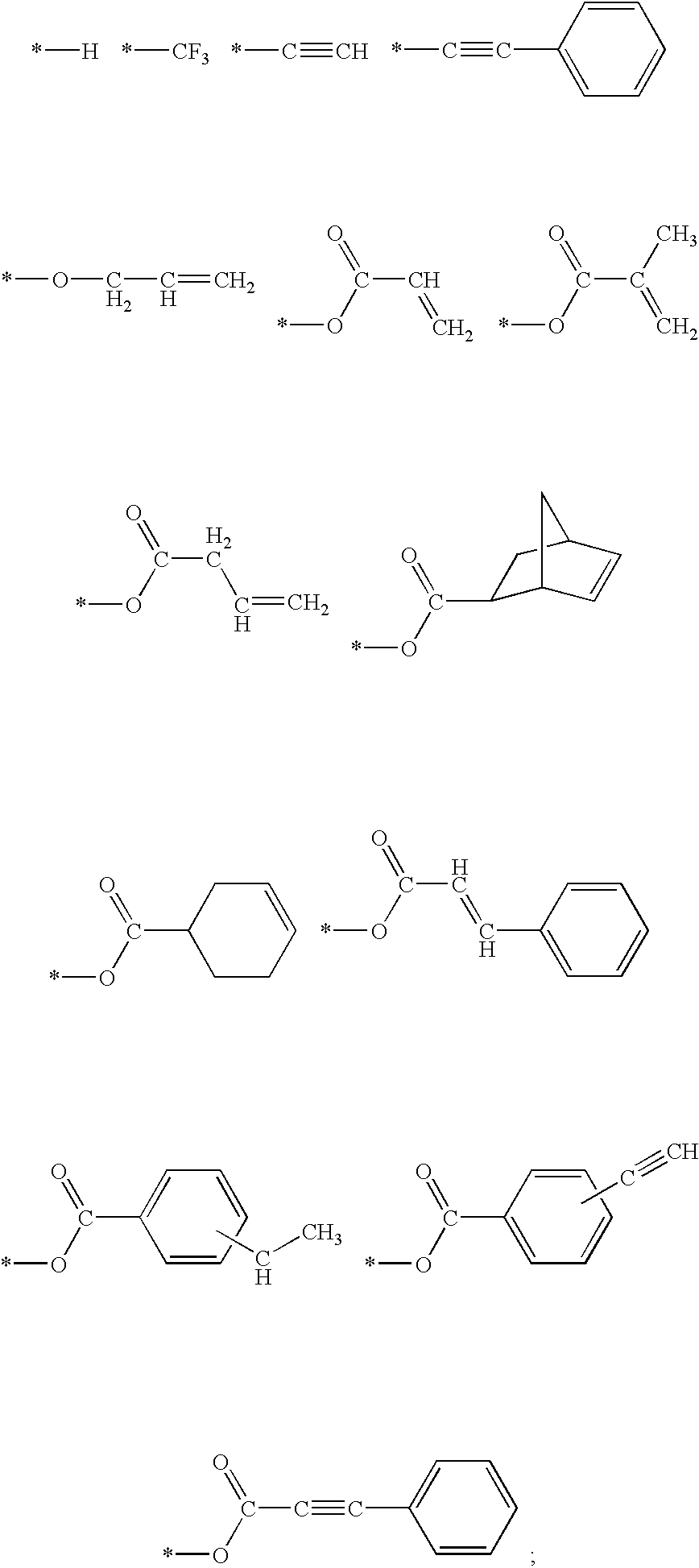
- X independently at each occurrence, denotes hydrogen or a monovalent radical having up to 30 carbon atoms which comprises at least one reactive group which is able to form a bond to another reaction center.
- the polyhydroxyamides of the invention are readily soluble in many organic solvents, such as cyclohexanone, diethylene glycol monoethyl or diethyl ether, N-methylpyrrolidone, ⁇ -butryolactone or ethyl lactate. They can be processed readily, for example, by spin coating or by brush methods. After drying and baking on the substrate, during which the polyhydroxyamide is cyclized to the polyoxazole, the resulting film exhibits a substantially higher thermal stability than other comparable materials and a markedly better adhesion to a variety of substrates.
- organic solvents such as cyclohexanone, diethylene glycol monoethyl or diethyl ether, N-methylpyrrolidone, ⁇ -butryolactone or ethyl lactate.
- the polyhydroxyamides of the invention include as their central unit a radical derived from the benzenetricarboxylic acid. Going out from this central unit in a star formation are three linear side chains. In this form, the polyhydroxyamide of the Formula I does not yet exhibit a highly crosslinked form. However, because the side chains carry terminal groups X that can react with further compounds, the polyhydroxyamides of the Formula I are able to react with further polymers and crosslink them. Therefore, by adding polyhydroxyamides of the Formula I, highly-three-dimensionally crosslinked structures that possess high mechanical stability can be formed. By adding reactive groups X, containing for example a polymerizable double bond, the polyhydroxyamides of the Formula I may also be crosslinked further themselves.
- the polyhydroxyamides of the Formula I accordingly can also be used themselves as a starting product for conversion into corresponding polybenzoxazoles.
- the polymer acquires a desirable high mechanical stability.
- the polyhydroxyamides of the Formula I may also, however, be used as crosslinking agents for other, preferably linear, polymers. Through the fraction of the added polyhydroxyamides of the Formula I, it is possible in this case to control the degree of crosslinking and consequently, for example, the solubility of the crosslinked polymer in an organic solvent as well.
- the central radical is preferably of symmetrical construction; in other words, it is derived from 1,3,5-benzenetricarboxylic acid.
- Other substitution patterns of the central benzene nucleus may be realized.
- the three side chains may be identical or different and may have different chain lengths.
- the conditions stated for the indices a to d therefore apply analogously to the indices a′ to d′ and, respectively, a′′ to d′′ as well.
- these polymers viewed macroscopically, exhibit a distribution in the length of the side chains.
- the indices a to d, a′ to d′, and a′′ to d′′ still correspond to whole numbers for one individual molecule, viewed macroscopically the average is determined over all of the side chains.
- the side chains each include groups Z 1 to Z 3 , Y 1 to Y 3 , and X.
- the groups Z 1 to Z 3 , Y 1 to Y 3 , and X may each be identical or different in the three side chains.
- the three side chains each contain identical radicals Z 1 to Z 3 , Y 1 to Y 3 , and X, respectively.
- these groups Z 1 to Z 3 , Y 1 to Y 3 , and X may exhibit a high degree of variability in their structure, in which case the properties of the polyhydroxyamide and, respectively, of the crosslinked polymer obtained from it can be modified further through the structure of these groups.
- the groups Z 1 to Z 3 each form a tetravalent radical that may include up to 100 carbon atoms.
- the 4 bonds are each formed to a hydroxyl group or to the nitrogen of an amide bond.
- the hydroxyl groups and the nitrogens are each attached to a 5- or 6-membered aromatic or heteroaromatic radical, with one hydroxyl group and one nitrogen being arranged in each case vicinally on the aromatic or heteroaromatic radical.
- two pairs of substituents are formed on each of the groups Z 1 to Z 3 , each pair being formed by a hydroxyl group and by an amide nitrogen disposed vicinally to it.
- the two pairs of substituents may be disposed on the same radical or else on different radicals within the respective groups Z 1 to Z 3 .
- an oxazole structure may be formed from each of the pairs of substituents.
- aromatic radical to which in each case at least one substituent pair, including hydroxyl group and amide nitrogen, is attached within the groups Z 1 to Z 3 a phenyl ring is preferred.
- heteroaromatic radicals to which in each case at least one substituent pair, including hydroxyl group and amide nitrogen, is attached within the groups Z 1 to Z 3 both 5-membered and 6-membered rings are preferred, it is possible for these rings to include one or more heteroatoms.
- Preferred heteroatoms are oxygen, sulfur, and nitrogen atoms.
- the aromatic or heteroaromatic radicals may in each case carry further substituents, examples being alkyl groups, aryl groups, fused-on aromatic or heteroaromatic groups or else halogens or pseudohalogens.
- substituent pairs formed from a hydroxyl group and an amide nitrogen are attached to different aromatic or heteroaromatic radicals, these radicals may be connected by fused-on phenyl radicals, by fused-on heteroaromatic 5- or 6-membered radicals or by cycloalkyl radicals, especially cyclohexyl and cyclopentyl radicals.
- the radicals that carry the substituent pairs may be connected by way of alkylene groups, preferably a methylene group.
- alkylene groups which preferably comprise from 1 to 10 carbon atoms, to carry further substituents, examples being alkyl groups or halogen atoms, and to contain heteroatoms, such as nitrogen, sulfur or silicon, in the alkyl chain or pendantly. Interlinking by way of a single bond or a heteroatom, an ether group or a thioether group, for example, is also possible.
- the alkylene chain may further include double bonds and triple bonds as well.
- Z 1 to Z 3 are selected from the group including the following:
- R 2 stands for a divalent radical selected from the group including the following:
- g denotes an integer between 1 and 10;
- R 4 denotes an alkyl group having 1 to 10 carbons, an aryl group having 6 to 20 carbons or an aralkyl group having 7 to 30 carbons, and
- R 5 denotes an alkylene group having 1 to 10 carbons, an arylene group having 6 to 20 carbons or an aralkylene group having 7 to 30 carbons.
- the groups Y 1 to Y 3 as a repeating unit, produce the connection between two adjacent units each formed by the groups Z 1 to Z 3 .
- the Y 1 to Y 3 group may also exhibit a very great structural diversity.
- the groups Y 1 to Y 3 each contain at least two carbonyl groups, which in each case together with the nitrogen attached to the adjacent Z 1 to Z 3 group form an amide bond.
- the carbonyl group is preferably attached to a phenyl ring, the two carbonyl groups being able to be attached to the same phenyl radical or to different phenyl radicals.
- the phenyl groups may be connected by way of a single bond or by way of an alkylene radical, preferably including 1 to 10 carbon atoms.
- the alkylene radical can contain heteroatoms, especially O, S and N, pendantly or in the chain, and to be substituted by further groups, especially fluorine.
- the phenyl rings that carry the carbonyl group may also be connected to one another by way of fused phenyl rings, or cycloalkyl groups may be formed between the phenyl rings.
- the phenyl groups may also carry one or more further substituents, examples being halogen, alkyl groups, alkenyl groups, alkynyl groups, alkoxy groups, alkenoxy groups or ester groups.
- the groups Y 1 to Y 3 may each also comprise heteroaromatic radicals, especially 5- and 6-membered rings that may contain one or more heteroatoms, especially O, S, and N.
- Y 1 to Y 3 is selected is from the following group:
- f denotes an integer between 1 and 10 or, if R 2 is a single bond or *—CH 2 —*, denotes an integer between and including 0 and 10;
- R 1 independently at each occurrence, denotes at least one radical selected from the group
- R 2 is as defined in claim 2 ;
- R 3 is selected from the group including the following:
- h denotes an integer between and including 0 and 10.
- the group X from Formula I permits polymerization of the polyhydroxyamides of the invention and/or copolymerization with further monomers and/or crosslinking of polymers that contain a reactive group.
- the group X must therefore include at least one reactive group that is able to form a bond to a further reaction center.
- the reactive group is preferably a polymerizable double or triple bond.
- X at its most simple is a hydrogen atom.
- the side chain ends with an amino group, which is then able to produce a bond to a further polymer, by nucleophilic attack on the carbon atom of a carbonyl or carboxyl group.
- X includes a polymerizable double or triple bond by which attachment to the double or triple bond of a further polymer can take place, by way for example of a free radical reaction.
- X may for example be a hydroxyl group.
- the side chain ends with a carboxyl group which by way of an amide bond, for example, is able to react with the amino group of a further polymer.
- the terminal group Y 1 to Y 3 may also be in ester form.
- the group X is, for example, an alkoxy group or alkenoxy group.
- Corresponding cycloalkyl groups or aromatic groups are also possible.
- the group X may also be in the form of an amino group.
- the Y 1 to Y 3 group possesses a terminal acid amide group, it being possible for the nitrogen atom thereof to be substituted by an alkyl radical, alkenyl radical, cycloalkyl radical, aryl radical, or aralkyl radical.
- polymers having advantageous properties may be obtained from the polyhydroxyamides described above.
- the invention therefore also provides a temperature stable polymer obtained by polymerizing the polyhydroxyamide described above. The polymerisation takes place preferably with heating, with ring closure to the oxazole being possible simultaneously or in a separate temperature step.
- the polyhydroxyamide from which the temperature stable polymer is obtained preferably includes a group X containing at least one polymerizable double or triple bond.
- the polyhydroxyamides of the invention may also be used for crosslinking other polymers.
- the crosslinking produces a polymer having improved mechanical and chemical stability.
- the invention therefore additionally provides a three-dimensionally crosslinked polymer obtained by subjecting a monomer, oligomer, or polymer containing at least one reactive group which is able to react with the group X of one of the above-described polyhydroxyamides to form a chemical bond to reaction with one of the above-described polyhydroxyamides.
- the group X in this case preferably includes a polymerizable double or triple bond and the reactive group that is able to react with the group X of the polyhydroxyamide to form a chemical bond preferably includes a polymerizable double or triple bond.
- the polymer is isolated by dynamic precipitation in ice water. First 3 l of ice water are introduced and the reaction solution is introduced dropwise. Gradually, a further 6 l of ice water are added until precipitation is at an end. The white precipitate is filtered with suction and washed in 3 l of deionised water, then in 3 l of a 0.25% strength solution of ammonium hydroxide, and again in 3 l of deionised water. The product is dried at 50° C./100 mbar for 72 h.
- the polyhydroxyamide prepared in this way is readily soluble in solvents such as NMP, ⁇ -butyrolactone, tetrahydrofuran, cyclohexanone, cyclopentanone, and diethylene glycol monomethyl ether.
- the polymer is isolated by dynamic precipitation in ice water. First 4 l of ice water are introduced and the reaction solution is introduced dropwise. Gradually, a further 8 l of ice water are added until precipitation is at an end. The white precipitate is filtered off with suction and washed in 3 l of deionised water, then in 4 l of a 0.25% strength solution of ammonium hydroxide, and again in 4 l of deionised water. The product is dried at 50° C./100 mbar for 72 h.
- the yield is 40.5 g.
- the polyhydroxyamide prepared in this way is readily soluble in solvents such as NMP, ⁇ -butyrolactone, tetrahydrofuran, cyclohexanone, cyclopentanone, and diethylene glycol monomethyl ether.
- the polyhydroxyamide prepared in this way is readily soluble in solvents such as NMP, ⁇ -butyrolactone, tetrahydrofuran, cyclohexanone, cyclopentanone, and diethylene glycol monomethyl ether.
- Example 2 2 g of the polyhydroxyamide 2 prepared in Example 2 are dissolved in 20 g of NMP, such as that sold under the trademark VLSI-SELECTIPUR®, together with 10 g of polyhydroxyamide prepared in analogy to Ex. 1 from U.S. Pat. No. 5,077,378.
- NMP such as that sold under the trademark VLSI-SELECTIPUR®
- the dissolution operation occurs appropriately on a shaker apparatus.
- the solution is subsequently filtered under pressure through a 0.2 ⁇ m filter into a cleaned, particle-free, glass sample vessel.
- the polymer solutions prepared in Example 4 are applied by spin coating methods (2500 rpm, 20 s) to a silicon wafer and dried at 120° C. for 60 s and at 200° C. for 2 min. The coated wafer is then heat treated in a diffusion oven under nitrogen (heating program: 1 h to 400° C. at 3 K/min).
- the polyhydroxyamide films prepared exhibit thermal stabilities of >510° C. according to TGA (instrument: STA 1500 from Rheometric Scientific, heating rate: 5 K/min, inert gas: argon).
- TGA instrument: STA 1500 from Rheometric Scientific, heating rate: 5 K/min, inert gas: argon.
- the isothermal mass loss per hour at 425° C. for 10 hours is:
- polyhydroxyamide 1 prepared in Example 1 5 g are dissolved in 20 g of NMP, such as those sold under the trademark VLSI-SELECTIPUR®.
- NMP such as those sold under the trademark VLSI-SELECTIPUR®.
- the dissolution operation takes place appropriately on a shaker apparatus.
- the solution is then filtered under pressure through a 0.2 ⁇ m filter into a cleaned, particle-free, glass sample vessel.
- a 4′′ silicon wafer is sputter coated with a titanium nitride layer 50 nm thick.
- the abovementioned solution is applied to this wafer by spin coating, 5 s at 500 rpm and 25 s at 3500 rpm.
- 10 silicon chips measuring 4 ⁇ 4 mm 2 are pressed onto the polyhydroxyamide 1 film with a force of 2 N.
- This stack is then heat treated in an oven at 300° C. in a nitrogen atmosphere for 1 h.
- an adhesion test is conducted with a shear tester, in particular, one sold under the trademark Dage series 400.
- the average force needed to shear off the Si chips is 1.9 kg/mm 2 (18.64 N/mm 2 ).
- the adhesion is determined as described in Ex. 6a except that in this case the surface of the wafer and of the chips consists not of titanium nitride but instead of tantalum nitride.
- the average force required to shear off the Si chips is 1.9 kg/mm 2 (18.64 N/mm 2 ).
- the adhesion is determined as described in Ex. 6a except that in this case the surface of the wafer and of the chips consists not of titanium nitride but instead of silicon.
- the average force required to shear off the Si chips is 2.0 kg/mm 2 (19.62 N/mm 2 ).
- Ex. 6a 1.8 kg/mm 2 (17.66 N/mm 2 )
- Ex. 6b 1.7 kg/mm 2 (16.68 N/mm 2 )
- Ex. 6c 1.9 kg/mm 2 (18.64 N/mm 2 )
- Example 2 5 g of polyhydroxyamide 2 prepared in Example 2 are dissolved in 20 g of NMP, such as that sold under the trademark VLSI-SELECTIPUR®. The dissolution operation takes place appropriately on a shaker apparatus. The solution is then filtered under pressure through a 0.2 ⁇ m filter into a cleaned, particle-free, glass sample vessel.
- NMP such as that sold under the trademark VLSI-SELECTIPUR®.
- a 4′′ silicon wafer is sputter coated with a titanium nitride layer 50 nm thick.
- the abovementioned solution is applied to this wafer by spin coating, 5 s at 500 rpm and 25 s at 3500 rpm.
- 10 silicon chips measuring 4 ⁇ 4 cm 2 are pressed onto the polyhydroxyamide 2 film with a force of 2 N.
- This stack is then heat treated in an oven at 300° C. in a nitrogen atmosphere for 1 h.
- an adhesion test is conducted with a shear tester such as those sold under the trademark Dage series 400.
- the average force needed to shear off the Si chips is 2.0 kg/mm 2 (19.62 N/mm 2 ).
- the adhesion is determined as described in Ex. 7a except that in this case the surface of the wafer and of the chips consists not of titanium nitride but instead of tantalum nitride.
- the average force required to shear off the Si chips is 1.9 kg/mm 2 (18.64 N/mm 2 ).
- the adhesion is determined as described in Ex. 7a except that in this case the surface of the wafer and of the chips consists not of titanium nitride but instead of silicon.
- the average force required to shear off the Si chips is 2.0 kg/mm 2 (19.62 N/mm 2 ).
- Ex. 7a 1.7 kg/mm 2 (16.68 N/mm 2 )
- Ex. 7b 1.9 kg/mm 2 (18.64 N/mm 2 )
- Ex. 7c 2.0 kg/mm 2 (19.62 N/mm 2 )
- Example 3 5 g of polyhydroxyamide 3 prepared in Example 3 are dissolved in 20 g of NMP, such as that sold under the trademark VLSI-SELECTIPUR®). The dissolution operation occurs appropriately on a shaker apparatus. The solution is then filtered under pressure through a 0.2 ⁇ m filter into a cleaned, particle-free, glass sample vessel.
- NMP such as that sold under the trademark VLSI-SELECTIPUR®
- a 4′′ silicon wafer is sputter coated with a titanium nitride layer 50 nm thick.
- the abovementioned solution is applied to this wafer by spin coating, 5 s at 500 rpm and 25 s at 3500 rpm.
- 10 silicon chips measuring 4 ⁇ 4 mm 2 are pressed onto the polyhydroxyamide 3 film with a force of 2 N.
- This stack is then heat treated in an oven at 300° C. in a nitrogen atmosphere for 1 h.
- an adhesion test is conducted with a shear tester, such as those sold under the trademark Dage series 400.
- the average force needed to shear off the Si chips is 1.9 kg/mm 2 (18.64 N/mm 2 ).
- the adhesion is determined as described in Ex. 8a except that in this case the surface of the wafer and of the chips consists not of titanium nitride but instead of tantalum nitride.
- the average force required to shear off the Si chips is 2.0 kg/mm 2 (19.62 N/mm 2 ).
- the adhesion is determined as described in Ex. 8a except that in this case the surface of the wafer and of the chips consists not of titanium nitride but instead of silicon.
- the average force required to shear off the Si chips is 2.1 kg/mm 2 (20.60 N/mm 2 ).
- Ex. 8a 1.8 kg/mm 2 (17.66 N/mm 2 )
- Ex. 8b 1.9 kg/mm 2 (18.64 N/mm 2 )
- Ex. 8c 2.0 kg/mm 2 (19.62 N/mm 2 )
- a 4′′ silicon wafer is sputter coated with a titanium nitride layer 50 nm thick.
- the abovementioned solution is applied to this wafer by spin coating, 5 s at 500 rpm and 25 s at 3500 rpm.
- 10 silicon chips measuring 4 ⁇ 4 mm 2 are pressed onto the polyhydroxyamide film with a force of 2 N.
- This stack is then heat treated in an oven at 300° C. in a nitrogen atmosphere for 1 h.
- an adhesion test is conducted with a shear tester, such as those sold under the trademark Dage series 400.
- the average force needed to shear off the Si chips is 1.9 kg/mm 2 (18.64 N/mm 2 ).
- the adhesion is determined as described in Ex. 9a except that in this case the surface of the wafer and of the chips consists not of titanium nitride but instead of tantalum nitride.
- the average force required to shear off the Si chips is 1.9 kg/mm 2 (18.64 N/mm 2 )
- the adhesion is determined as described in Ex. 9a except that in this case the surface of the wafer and of the chips consists not of titanium nitride but instead of silicon.
- the average force required to shear off the Si chips is 2.0 kg/mm 2 (19.62 N/mm 2 ).
- Ex. 9a 1.8 kg/mm 2 (17.66 N/mm 2 )
- Ex. 9b 1.9 kg/mm 2 (18.64 N/mm 2 )
- Ex. 9c 2.9 kg/mm 2 (18.64 N/mm 2 )
- a polyhydroxyamide is synthesized in analogy to Ex. 1 of U.S. Pat. No. 5,077,378 and a solution in NMP is prepared as described in Example 6. Thereafter the shear force is determined using the same experiments as described in Examples 6a to 6c. The following averages are measured:
- Titanium nitride surface 1.5 kg/mm 2 (14.71 N/mm 2 ) Tantalum nitride surface: 1.6 kg/mm 2 (15.69 N/mm 2 ) Silicon surface: 1.55 kg/mm 2 (15.21 N/mm 2 )
- a 4′′ silicon wafer is spin coated with polyhydroxyamide from 20% strength solution (solvent: NMP), 5 s at 500 rpm and 25 s at 3500 rpm. After a brief softbake of 1 min at 120° C. on a hotplate, the wafer is heat treated in an oven at 300° C. for 1 h in a nitrogen atmosphere. After cooling to room temperature, the coated wafer is heated at 80° C. in NMP for 5 h. Thereafter, the wafer is vacuum dried at 200° C. for 60 min and the mass difference is measured. The mass decrease is as follow:
- Ex. 1 0.6%
- Ex. 2 0.8%
- Ex. 3 0.5%
- Ex. 4 0.7% (with polyhydroxyamide 2 as additive) 7.4% (without polyhydroxyamide 2 as additive).
Landscapes
- Chemical & Material Sciences (AREA)
- Health & Medical Sciences (AREA)
- Chemical Kinetics & Catalysis (AREA)
- Medicinal Chemistry (AREA)
- Polymers & Plastics (AREA)
- Organic Chemistry (AREA)
- General Chemical & Material Sciences (AREA)
- Polyamides (AREA)
Abstract
Description


| Ex. 1: | 0.1% |
| Ex. 2: | 0.2% |
| Ex. 3: | 0.1% |
| Ex. 4: | 0.2% (with polyhydroxyamide 2 as additive) |
| 3.2% (without polyhydroxyamide 2 as additive) | |
| Ex. 6a: | 1.8 kg/mm2 (17.66 N/mm2) | ||
| Ex. 6b: | 1.7 kg/mm2 (16.68 N/mm2) | ||
| Ex. 6c: | 1.9 kg/mm2 (18.64 N/mm2) | ||
| Ex. 7a: | 1.7 kg/mm2 (16.68 N/mm2) | ||
| Ex. 7b: | 1.9 kg/mm2 (18.64 N/mm2) | ||
| Ex. 7c: | 2.0 kg/mm2 (19.62 N/mm2) | ||
| Ex. 8a: | 1.8 kg/mm2 (17.66 N/mm2) | ||
| Ex. 8b: | 1.9 kg/mm2 (18.64 N/mm2) | ||
| Ex. 8c: | 2.0 kg/mm2 (19.62 N/mm2) | ||
| Ex. 9a: | 1.8 kg/mm2 (17.66 N/mm2) | ||
| Ex. 9b: | 1.9 kg/mm2 (18.64 N/mm2) | ||
| Ex. 9c: | 2.9 kg/mm2 (18.64 N/mm2) | ||
| Titanium nitride surface: | 1.5 kg/mm2 (14.71 N/mm2) | ||
| Tantalum nitride surface: | 1.6 kg/mm2 (15.69 N/mm2) | ||
| Silicon surface: | 1.55 kg/mm2 (15.21 N/mm2) | ||
| Ex. 1: | 0.6% |
| Ex. 2: | 0.8% |
| Ex. 3: | 0.5% |
| Ex. 4: | 0.7% (with polyhydroxyamide 2 as additive) |
| 7.4% (without polyhydroxyamide 2 as additive). | |
Claims (13)




Applications Claiming Priority (3)
| Application Number | Priority Date | Filing Date | Title |
|---|---|---|---|
| DE10126572.7 | 2001-05-31 | ||
| DE10126572A DE10126572B4 (en) | 2001-05-31 | 2001-05-31 | Polyhydroxyamides and highly crosslinked chemically and thermally stable polymers obtainable therefrom |
| DE10126572 | 2001-05-31 |
Publications (2)
| Publication Number | Publication Date |
|---|---|
| US20030050431A1 US20030050431A1 (en) | 2003-03-13 |
| US6750317B2 true US6750317B2 (en) | 2004-06-15 |
Family
ID=7686798
Family Applications (1)
| Application Number | Title | Priority Date | Filing Date |
|---|---|---|---|
| US10/159,861 Expired - Fee Related US6750317B2 (en) | 2001-05-31 | 2002-05-31 | Material and additive for highly crosslinked chemically and thermally stable polyhydroxyamide polymers |
Country Status (2)
| Country | Link |
|---|---|
| US (1) | US6750317B2 (en) |
| DE (1) | DE10126572B4 (en) |
Cited By (3)
| Publication number | Priority date | Publication date | Assignee | Title |
|---|---|---|---|---|
| US20040138406A1 (en) * | 2001-03-30 | 2004-07-15 | Marcus Halik | Coating material for electronic components |
| US20060264672A1 (en) * | 2005-02-23 | 2006-11-23 | Andrews Mark A | Processes using alpha, omega-difunctional aldaramides as monomers and crosslinkers |
| US7309738B1 (en) | 2004-10-06 | 2007-12-18 | United States Of America As Represented By The Administrator Of The National Aeronautics And Space Administration | Approach for achieving flame retardancy while retaining physical properties in a compatible polymer matrix |
Citations (10)
| Publication number | Priority date | Publication date | Assignee | Title |
|---|---|---|---|---|
| FR1548307A (en) | 1967-06-05 | 1968-12-06 | ||
| DE1770564A1 (en) | 1967-06-05 | 1971-11-25 | Ferodo Sa | Polybenzoxazoles |
| GB1392935A (en) * | 1971-10-12 | 1975-05-07 | Secr Defence | Production of filaments |
| DE3717212A1 (en) | 1987-05-22 | 1988-12-08 | Viktor Dr Dr Med Balazs | METHOD FOR THE EXAMINATION OF A CELLULAR BIOLOGICAL LIQUID FOR CELLULAR ONCOGEN TRANScripts or THEIR FRAGMENTS |
| US4833230A (en) * | 1988-06-21 | 1989-05-23 | Research Corporation Technologies, Inc. | Polyhydroxypolyamides and process for making same |
| EP0317942A2 (en) | 1987-11-24 | 1989-05-31 | Hoechst Celanese Corporation | Heat resistant polyamides and polybenzoxazoles from bis-[(aminohydroxyphenyl hexafluoro-isopropyl] diphenyl ethers |
| US5077378A (en) * | 1986-10-02 | 1991-12-31 | Hoechst Celanese Corporation | Polyamide containing the hexafluoroisopropylidene group |
| US5329044A (en) * | 1992-08-12 | 1994-07-12 | Kiely Donald E | Glucaric acid monoamides and their use to prepare poly(glucaramides) |
| US5376499A (en) * | 1991-05-07 | 1994-12-27 | Siemens Aktiengesellschaft | Highly heat-resistant positive resists comprising end-capped hydroxypolyamides |
| US5434233A (en) * | 1992-08-12 | 1995-07-18 | Kiely; Donald E. | Polyaldaramide polymers useful for films and adhesives |
-
2001
- 2001-05-31 DE DE10126572A patent/DE10126572B4/en not_active Expired - Fee Related
-
2002
- 2002-05-31 US US10/159,861 patent/US6750317B2/en not_active Expired - Fee Related
Patent Citations (15)
| Publication number | Priority date | Publication date | Assignee | Title |
|---|---|---|---|---|
| FR1548307A (en) | 1967-06-05 | 1968-12-06 | ||
| DE1770564A1 (en) | 1967-06-05 | 1971-11-25 | Ferodo Sa | Polybenzoxazoles |
| US3644288A (en) * | 1967-06-05 | 1972-02-22 | Ferodo Sa | Method of preparing reticulated polybenzoxazoles |
| US3644286A (en) * | 1967-06-05 | 1972-02-22 | Ferodo Sa | Reticulated polyamides and method of preparation |
| GB1392935A (en) * | 1971-10-12 | 1975-05-07 | Secr Defence | Production of filaments |
| US5077378A (en) * | 1986-10-02 | 1991-12-31 | Hoechst Celanese Corporation | Polyamide containing the hexafluoroisopropylidene group |
| DE3717212A1 (en) | 1987-05-22 | 1988-12-08 | Viktor Dr Dr Med Balazs | METHOD FOR THE EXAMINATION OF A CELLULAR BIOLOGICAL LIQUID FOR CELLULAR ONCOGEN TRANScripts or THEIR FRAGMENTS |
| EP0317942A3 (en) | 1987-11-24 | 1990-02-28 | Hoechst Celanese Corporation | Heat resistant polyamides and polybenzoxazoles from bis-[(aminohydroxyphenyl hexafluoro-isopropyl] diphenyl ethers |
| US4845183A (en) * | 1987-11-24 | 1989-07-04 | Hoechst Celanese Corporation | Heat resistant polyamide and polybenzoxazole from bis-((amino-hydroxyphenyl)hexafluoroisopropyl)diphenyl ethers |
| EP0317942A2 (en) | 1987-11-24 | 1989-05-31 | Hoechst Celanese Corporation | Heat resistant polyamides and polybenzoxazoles from bis-[(aminohydroxyphenyl hexafluoro-isopropyl] diphenyl ethers |
| US4833230A (en) * | 1988-06-21 | 1989-05-23 | Research Corporation Technologies, Inc. | Polyhydroxypolyamides and process for making same |
| US5376499A (en) * | 1991-05-07 | 1994-12-27 | Siemens Aktiengesellschaft | Highly heat-resistant positive resists comprising end-capped hydroxypolyamides |
| EP0512339B1 (en) | 1991-05-07 | 1997-10-15 | Siemens Aktiengesellschaft | High temperature stable positive resists and process for the production of high temperature stable relief structure |
| US5329044A (en) * | 1992-08-12 | 1994-07-12 | Kiely Donald E | Glucaric acid monoamides and their use to prepare poly(glucaramides) |
| US5434233A (en) * | 1992-08-12 | 1995-07-18 | Kiely; Donald E. | Polyaldaramide polymers useful for films and adhesives |
Cited By (7)
| Publication number | Priority date | Publication date | Assignee | Title |
|---|---|---|---|---|
| US20040138406A1 (en) * | 2001-03-30 | 2004-07-15 | Marcus Halik | Coating material for electronic components |
| US7064176B2 (en) * | 2001-03-30 | 2006-06-20 | Infineon Technologies Ag | Coating material for electronic components |
| US7309738B1 (en) | 2004-10-06 | 2007-12-18 | United States Of America As Represented By The Administrator Of The National Aeronautics And Space Administration | Approach for achieving flame retardancy while retaining physical properties in a compatible polymer matrix |
| US20080064833A1 (en) * | 2004-10-06 | 2008-03-13 | U.S.A. as represented by the Administrator of the National Aeronautics & Space Administration | Approach for Achieving Flame Retardancy While Retaining Physical Properties in a Compatible Polymer Matrix |
| US20080061274A1 (en) * | 2004-10-06 | 2008-03-13 | Usa As Represented By The Administrator Of The National Aeronautics And Space Adm | Approach for Achieving Flame Retardancy While Retaining Physical Properties in a Compatible Polymer Matrix |
| US7968648B2 (en) | 2004-10-06 | 2011-06-28 | The United States Of America As Represented By The Administrator Of The National Aeronautics And Space Administration | Approach for achieving flame retardancy while retaining physical properties in a compatible polymer matrix |
| US20060264672A1 (en) * | 2005-02-23 | 2006-11-23 | Andrews Mark A | Processes using alpha, omega-difunctional aldaramides as monomers and crosslinkers |
Also Published As
| Publication number | Publication date |
|---|---|
| DE10126572A1 (en) | 2003-01-23 |
| US20030050431A1 (en) | 2003-03-13 |
| DE10126572B4 (en) | 2006-10-26 |
Similar Documents
| Publication | Publication Date | Title |
|---|---|---|
| US3766302A (en) | Novel bis imide compositions and polymers therefrom | |
| US5985969A (en) | Polyamic acid precursors and methods for preparing higher molecular weight polyamic acids and polyimidebenzoxazole | |
| JP3984991B2 (en) | Method for processing polyamic acid and polyamic acid into polyimide benzoxazole film | |
| US4973645A (en) | Novel soluble polyimidesiloxanes and methods for their preparation and use | |
| KR20010089172A (en) | Adhesion promoter and self-priming resin compositions and articles made therefrom | |
| US4759958A (en) | Method for forming polyimide film by chemical vapor deposition | |
| US6806344B2 (en) | Poly-o-hydroxamide, polybenzoxazole, and electronic component including a dielectric having a barrier effect against copper diffusion, and processes for preparing poly-o-hydroxyamides, polybenzoxazoles, and electronic components | |
| US6750317B2 (en) | Material and additive for highly crosslinked chemically and thermally stable polyhydroxyamide polymers | |
| CN117487162A (en) | Polyimide precursor capable of being cured at low temperature and preparation method thereof | |
| JPH059254A (en) | Production of polyamideimidesiloxane polymer | |
| KR100625767B1 (en) | Coating Materials for Electronic Devices | |
| US20020022310A1 (en) | Epoxy-polyimide composites suitable as encapsulants | |
| JP2020204012A (en) | Poly(amide-imide)copolymer, composition for thin film and thin film | |
| KR102014740B1 (en) | Polyarylene resins | |
| US20040082756A1 (en) | Poly-o-hydroxyamide, polybenzoxazole from the poly-o-hydroxyamide, electronic component including a polybenzoxazole, and processes for producing the same | |
| US20030134226A1 (en) | Polybenzoxazoles from poly-o-hydroxyamide, novel poly-o-hydroxyamides, preparation processes therefor, and their application in microelectronics | |
| US5569738A (en) | Melt processable etherimideimide/etherimide copolymer | |
| KR101158062B1 (en) | Polyamideimide vanish having improved water resistance | |
| Bruma et al. | Fluorinated poly (benzoxazole–imide) s | |
| KR20040013691A (en) | Manufacturing method of poly(amideimide) varnish with the improved adhesion strength | |
| JP2020070340A (en) | Polymer, resin composition and resin film | |
| TWI762419B (en) | Polyimide-polyarylene polymers | |
| JP2001139684A (en) | Interlaminar insulating film for multilevel interconnection and resin to be used therefor and its production method | |
| WO1992017516A1 (en) | Process for curing polyquinoline polymers and compositions thereof | |
| Avella et al. | “One‐pot” synthesis of poly (amide‐imide) s derived from trimellitic acid monoesters and multiring aromatic diamines |
Legal Events
| Date | Code | Title | Description |
|---|---|---|---|
| AS | Assignment |
Owner name: INFINEON TECHNOLOGIES AG, GERMANY Free format text: ASSIGNMENT OF ASSIGNORS INTEREST;ASSIGNORS:HALIK, MARCUS;HOSCH, HOLGER;RECAI, SEZI;AND OTHERS;REEL/FRAME:015281/0925;SIGNING DATES FROM 20020623 TO 20020809 |
|
| FEPP | Fee payment procedure |
Free format text: PAYER NUMBER DE-ASSIGNED (ORIGINAL EVENT CODE: RMPN); ENTITY STATUS OF PATENT OWNER: LARGE ENTITY Free format text: PAYOR NUMBER ASSIGNED (ORIGINAL EVENT CODE: ASPN); ENTITY STATUS OF PATENT OWNER: LARGE ENTITY |
|
| FPAY | Fee payment |
Year of fee payment: 4 |
|
| AS | Assignment |
Owner name: QIMONDA AG, GERMANY Free format text: ASSIGNMENT OF ASSIGNORS INTEREST;ASSIGNOR:INFINEON TECHNOLOGIES AG;REEL/FRAME:023773/0457 Effective date: 20060425 |
|
| FPAY | Fee payment |
Year of fee payment: 8 |
|
| AS | Assignment |
Owner name: INFINEON TECHNOLOGIES AG, GERMANY Free format text: ASSIGNMENT OF ASSIGNORS INTEREST;ASSIGNOR:QIMONDA AG;REEL/FRAME:035623/0001 Effective date: 20141009 |
|
| AS | Assignment |
Owner name: POLARIS INNOVATIONS LIMITED, IRELAND Free format text: ASSIGNMENT OF ASSIGNORS INTEREST;ASSIGNOR:INFINEON TECHNOLOGIES AG;REEL/FRAME:036723/0021 Effective date: 20150708 |
|
| REMI | Maintenance fee reminder mailed | ||
| LAPS | Lapse for failure to pay maintenance fees | ||
| STCH | Information on status: patent discontinuation |
Free format text: PATENT EXPIRED DUE TO NONPAYMENT OF MAINTENANCE FEES UNDER 37 CFR 1.362 |
|
| STCH | Information on status: patent discontinuation |
Free format text: PATENT EXPIRED DUE TO NONPAYMENT OF MAINTENANCE FEES UNDER 37 CFR 1.362 |
|
| FP | Lapsed due to failure to pay maintenance fee |
Effective date: 20160615 |