US6749216B2 - Head protecting air bag device - Google Patents

Head protecting air bag device Download PDF

Info

Publication number
US6749216B2
US6749216B2 US10/058,289 US5828902A US6749216B2 US 6749216 B2 US6749216 B2 US 6749216B2 US 5828902 A US5828902 A US 5828902A US 6749216 B2 US6749216 B2 US 6749216B2
Authority
US
United States
Prior art keywords
pipe
gas
inner tube
inflator
expansion
Prior art date
Legal status (The legal status is an assumption and is not a legal conclusion. Google has not performed a legal analysis and makes no representation as to the accuracy of the status listed.)
Expired - Fee Related, expires
Application number
US10/058,289
Other versions
US20020105174A1 (en
Inventor
Toshinori Tanase
Tetsuya Ogata
Hiroyuki Takahashi
Kenji Ogata
Current Assignee (The listed assignees may be inaccurate. Google has not performed a legal analysis and makes no representation or warranty as to the accuracy of the list.)
Toyoda Gosei Co Ltd
Original Assignee
Toyoda Gosei Co Ltd
Priority date (The priority date is an assumption and is not a legal conclusion. Google has not performed a legal analysis and makes no representation as to the accuracy of the date listed.)
Filing date
Publication date
Application filed by Toyoda Gosei Co Ltd filed Critical Toyoda Gosei Co Ltd
Assigned to TOYODA GOSEI CO., LTD. reassignment TOYODA GOSEI CO., LTD. ASSIGNMENT OF ASSIGNORS INTEREST (SEE DOCUMENT FOR DETAILS). Assignors: OGATA, KENJI, OGATA, TETSUYA, TAKAHASHI, HIROYUKI, TANASE, TOSHINORI
Publication of US20020105174A1 publication Critical patent/US20020105174A1/en
Application granted granted Critical
Publication of US6749216B2 publication Critical patent/US6749216B2/en
Adjusted expiration legal-status Critical
Expired - Fee Related legal-status Critical Current

Links

Images

Classifications

    • BPERFORMING OPERATIONS; TRANSPORTING
    • B60VEHICLES IN GENERAL
    • B60RVEHICLES, VEHICLE FITTINGS, OR VEHICLE PARTS, NOT OTHERWISE PROVIDED FOR
    • B60R21/00Arrangements or fittings on vehicles for protecting or preventing injuries to occupants or pedestrians in case of accidents or other traffic risks
    • B60R21/02Occupant safety arrangements or fittings, e.g. crash pads
    • B60R21/16Inflatable occupant restraints or confinements designed to inflate upon impact or impending impact, e.g. air bags
    • B60R21/23Inflatable members
    • B60R21/231Inflatable members characterised by their shape, construction or spatial configuration
    • B60R21/232Curtain-type airbags deploying mainly in a vertical direction from their top edge
    • BPERFORMING OPERATIONS; TRANSPORTING
    • B60VEHICLES IN GENERAL
    • B60RVEHICLES, VEHICLE FITTINGS, OR VEHICLE PARTS, NOT OTHERWISE PROVIDED FOR
    • B60R21/00Arrangements or fittings on vehicles for protecting or preventing injuries to occupants or pedestrians in case of accidents or other traffic risks
    • B60R21/02Occupant safety arrangements or fittings, e.g. crash pads
    • B60R21/16Inflatable occupant restraints or confinements designed to inflate upon impact or impending impact, e.g. air bags
    • B60R21/26Inflatable occupant restraints or confinements designed to inflate upon impact or impending impact, e.g. air bags characterised by the inflation fluid source or means to control inflation fluid flow
    • BPERFORMING OPERATIONS; TRANSPORTING
    • B60VEHICLES IN GENERAL
    • B60RVEHICLES, VEHICLE FITTINGS, OR VEHICLE PARTS, NOT OTHERWISE PROVIDED FOR
    • B60R21/00Arrangements or fittings on vehicles for protecting or preventing injuries to occupants or pedestrians in case of accidents or other traffic risks
    • B60R21/02Occupant safety arrangements or fittings, e.g. crash pads
    • B60R21/16Inflatable occupant restraints or confinements designed to inflate upon impact or impending impact, e.g. air bags
    • B60R21/26Inflatable occupant restraints or confinements designed to inflate upon impact or impending impact, e.g. air bags characterised by the inflation fluid source or means to control inflation fluid flow
    • B60R21/261Inflatable occupant restraints or confinements designed to inflate upon impact or impending impact, e.g. air bags characterised by the inflation fluid source or means to control inflation fluid flow with means other than bag structure to diffuse or guide inflation fluid
    • B60R2021/2612Gas guiding means, e.g. ducts
    • BPERFORMING OPERATIONS; TRANSPORTING
    • B60VEHICLES IN GENERAL
    • B60RVEHICLES, VEHICLE FITTINGS, OR VEHICLE PARTS, NOT OTHERWISE PROVIDED FOR
    • B60R21/00Arrangements or fittings on vehicles for protecting or preventing injuries to occupants or pedestrians in case of accidents or other traffic risks
    • B60R21/02Occupant safety arrangements or fittings, e.g. crash pads
    • B60R21/16Inflatable occupant restraints or confinements designed to inflate upon impact or impending impact, e.g. air bags
    • B60R21/26Inflatable occupant restraints or confinements designed to inflate upon impact or impending impact, e.g. air bags characterised by the inflation fluid source or means to control inflation fluid flow
    • B60R21/261Inflatable occupant restraints or confinements designed to inflate upon impact or impending impact, e.g. air bags characterised by the inflation fluid source or means to control inflation fluid flow with means other than bag structure to diffuse or guide inflation fluid
    • B60R2021/2612Gas guiding means, e.g. ducts
    • B60R2021/2617Curtain bag nozzles

Definitions

  • the present invention relates to a head protecting air bag device, and particularly to a head protecting air bag device having a bag body which expands and develops in the shape of a curtain in the longitudinal direction of a vehicle body on a cabin side.
  • a cloth-made inner tube in which gas outlet holes are formed at the predetermined distance in the forward and backward direction of the vehicle body is provided in a gas passage that is formed at the upper portions of a front seat expansion room and a rear seat expansion room of the bag body and extends axially in the forward and backward direction of the vehicle body, and expansion gas is supplied uniformly to each expansion room of the bag body.
  • the cloth-made inner tube provided in the bag body can be folded simultaneously with the bag body, this device is advantageous to reduce a housing space.
  • An object of the invention is, in view of the above facts, to obtain a heat protecting air bag device in which damaging of an inner tube in the vicinity of a gas ejection port in an inflator can be reduced.
  • a head protecting air bag device comprising: a bag body forming at least one expansion room and a gas passage extending in the longitudinal direction of a vehicle body communicating to the expansion room; an inflator which ejects expansion gas in the bag body; a flexible inner tube provided in the gas passage and for supplying the expansion gas into the expansion room; and a pipe coupled to a gas ejection port of the inflator and extending in an axial direction of the inner tube, a leading end of the pipe protruding into the inner tube.
  • the expansion gas from the inflator is supplied through a gas outlet hole of the inner tube to the expansion rooms of the bag body, and the bag body develops in the shape of a curtain thereby to protect the head of the occupant.
  • the pipe having the small length and the small diameter provided in the inner tube rectifies the expansion gas ejected from the gas ejection port of the inflator.
  • the inner tube folded is easily spread by the expansion gas, and the diffusion of the expansion gas becomes weaker at the outlet of the pipe than at the gas ejection port of the inflator.
  • a deflecting portion which deflects the ejecting direction of the expansion gas ejecting from a leading end of the pipe to the opposite side to a sewed portion of the inner tube.
  • the sewed portion side of the inner tube is weak in tear strength due to the existence of machine stitches, the ejecting direction of the expansion gas ejecting from the leading end of the pipe is deflected by the deflecting portion to the opposite side to the sewed portion of the inner tube, whereby the amount of the gas ejection to the sewed portion is suppressed.
  • damaging on the sewed portion side that is weak in the tear strength can be reduced effectively.
  • the deflecting portion is the leading end of the pipe cut slantingly.
  • an axis of the inflator in the mounting position is offset with respect to an axis of the leading end of the pipe in vertical direction, and a bending portion is formed at a part of the pipe that is near the gas ejection port of the inflator.
  • the axis of the inflator in the mounting position is offset with respect to the axis of the pipe in vertical direction and their axes are not on a line, in case that the pipe is bent halfway, a loss in pressure becomes large, so that this device is disadvantageous to secure an expansion development time of the bag body and the inner pressure in the bag body. Therefore, the bending portion is formed at a part of the pipe that is near the gas ejection port of the inflator, whereby the loss in pressure caused by bending of the pipe can be reduced.
  • a head protecting air bag device comprising an inflator which ejects expansion gas in a bag body, a gas passage which communicates to expansion rooms for protecting a head of an occupant and the upsides of the expansion rooms and extends in the longitudinal direction of a vehicle body, and a flexible inner tube, which is provided in the gas passage and supplies the expansion gas into the expansion rooms, there is provided a high-voltage resistant flexible tube having a small length and a small diameter is provided, which protrudes axially from the inflator into the inner tube.
  • the expansion gas from the inflator is supplied through a gas outlet hole of the inner tube to the expansion rooms of the bag body, and the bag body develops in the shape of a curtain thereby to protect the head of the occupant.
  • the high-voltage resistant flexible tube having the small length and the small diameter, which protrudes axially from the inflator into the inner tube, rectifies the expansion gas ejected from the gas ejection port of the inflator.
  • the inner tube folded by the expansion gas is easily spread, and the diffusion of the expansion gas becomes weaker at the outlet of the high-voltage resistant flexible tube than at the gas ejection port of the inflator.
  • the high-voltage resistant flexible tube since it is possible to prevent the inner pressure of the inner tube in the vicinity of the gas ejection port of the inflator from temporarily becoming high very much, damaging of the inner tube can be reduced. Further, since the high-voltage resistant flexible tube is used, it can be folded up in flat, so that deterioration of convenience of housing the bag body in the device can be further suppressed.
  • a head protecting air bag device comprising an inflator which ejects expansion gas in a bag body, a gas passage which communicates to expansion rooms for protecting a head of an occupant and the upsides of the expansion rooms and extends in the longitudinal direction of a vehicle body, and a flexible inner tube, which is provided in the gas passage and supplies the expansion gas into the expansion rooms, there is provided a high-voltage resistant flexible tube having a small length and a small diameter is provided, which protrudes axially from the inflator into the gas passage in the bag body, and the inner tube is covered with the high-voltage resistant flexible tube so that the inner tube is narrowed.
  • the expansion gas from the inflator is supplied through a gas outlet hole of the inner tube to the expansion rooms of the bag body, and the bag body develops in the shape of a curtain thereby to protect the head of the occupant.
  • the high-voltage resistant flexible tube having the small length and the small diameter, which protrudes axially from the inflator into the inner tube, rectifies the expansion gas ejected from the gas ejection port of the inflator.
  • the inner tube folded by the expansion gas is easily spread, and the diffusion of the expansion gas becomes weaker at the outlet of the high-voltage resistant flexible tube than at the gas ejection port of the inflator.
  • the high-voltage resistant flexible tube since it is possible to prevent the inner pressure of the inner tube in the vicinity of the gas ejection port of the inflator from temporarily becoming high very much, damaging of the inner tube can be reduced. Further, since the high-voltage resistant flexible tube is used, it can be folded up in flat, so that deterioration of the convenience of housing the bag body in the device can be further suppressed. Further, since the inner tube is covered with the high-voltage resistant flexible tube so that the inner tube is narrowed, the high-voltage resistant flexible tube is not directly exposed to the expansion gas by the inner tube located inside. As a result, since high-temperature resistance of the high-voltage resistant flexible tube can be lowered, a cost can be reduced.
  • an inner diameter of the pipe having the small length and the small-diameter or the high-voltage resistant flexible tube is smaller than an outer diameter of the ejection part of the inflator, and the pipe or the tube does not extend over a gas outlet hole in the inner tube that is nearest to the inflator.
  • the expansion gas can be reliably blown also into the gas outlet hole in the inner tube that is nearest to the inflator.
  • FIG. 1 is a sectional side view showing a main portion in a head protecting air bag device according to a first embodiment of the invention
  • FIG. 2 is a sectional side view showing a bag body in the head protecting air bag device according to the first embodiment of the invention
  • FIG. 3 is a schematic side view showing the head protecting air bag device according to the first embodiment of the invention.
  • FIG. 4 is a sectional side view showing a main portion in a head protecting air bag device according to a second embodiment of the invention.
  • FIG. 5 is a sectional view taken along a line of 5 — 5 in FIG. 4;
  • FIG. 6 is a sectional side view showing a main portion in a head protecting air bag device according to a third embodiment of the invention.
  • FIG. 7 is a sectional side view showing a main portion in a head protecting air bag device according to a comparative example in the third embodiment of the invention.
  • FIG. 8 is a sectional side view showing a main portion in a head protecting air bag device according to a fourth embodiment of the invention.
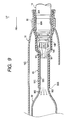
  • FIG. 9 is a sectional side view showing a main portion in a head protecting air bag device according to a fifth embodiment of the invention.
  • FIG. 10 is a sectional side view showing a bag body in a head protecting air bag device according to another embodiment of the invention.
  • FIG. 11 is a sectional side view showing a bag body in a head protecting air bag device according to another embodiment of the invention.
  • FIGS. 1 to 3 A first embodiment of a head protecting air bag device according to the invention will be described with reference to FIGS. 1 to 3 .
  • a reference character FR represents a vehicle forward direction
  • a reference character UP represents a vehicle upward direction
  • a reference character IN represents a width inside direction
  • a head protecting air bag device 10 includes mainly a sensor 12 for detecting side-crash or a roll over state, an inflator 14 which operates to eject gas, and a bag body 16 .
  • the sensor 12 is disposed, for example, in the vicinity of a lower end of a center pillar 18 (B pillar)
  • the inflator 14 is disposed at a quarter pillar (C pillar) 20 and connected to the sensor 12 . Accordingly, when the sensor 12 detects the side-crash or the roll over state, the inflator 14 operates.
  • the bag body 16 develops by gas flowing from the inflator 14 along the cabin side as shown by chain double dotted lines in FIG. 3, and protects a head 19 A of an occupant 19 on a front seat and a head of an occupant on a rear seat.
  • the bag body 16 is folded long in the shape of a bellows, and accommodated astride a front pillar (A pillar) garnish, a roof head lining, and a C pillar garnish. Its front-end 16 A is arranged in the vicinity of the lower portion of an inclined portion 22 A of an A pillar 22 . Further, a central portion 16 B of the bag body 16 is arranged along the A pillar 22 and a roof side rail 28 .
  • the bag body 16 is manufactured by double weaving using polyamide thread or polyester thread, and a connection port 29 through which expansion gas from the inflator 14 is led to the inside of the bag body 16 is formed at an upper edge rear end 16 C. Further, at the upper portion of each leading end of triangular plate-shaped portions 16 D and 16 E that are formed at front and back ends of the bag body 16 , and at the upper edge of the central portion 16 B of the bag body 16 , plural attaching members 30 in which attaching holes 30 A are formed are formed projectingly.
  • a rear end 32 A of an inner tube 32 provided inside the connection port 29 is coupled to a gas ejection port 14 A of the inflator 14 .
  • This inner tube 32 is provided in a gas passage 16 F formed at the upper edge in the bag body 16 in the longitudinal direction, that is, in the forward and backward direction of a vehicle body, and a front leading end 32 B on the opposite side to the inflator 14 is blocked up.
  • the inner tube 32 is composed of a cloth using polyamide thread or polyester thread.
  • gas outlet holes 34 are formed at the predetermined distance in the longitudinal direction, that is, in the forward and backward direction of the vehicle body.
  • plural expansion rooms 50 , 52 , 54 , 56 , 58 , 60 , 62 , and 64 are formed, which are defined by the front triangular plate-shaped portion 16 D, longitudinal stick-shaped coupling members 16 G, a central rectangular plate-shaped portion 16 H, longitudinal stick-shaped coupling members 16 G, and the rear triangular plate-shaped portion 16 E.
  • the expansion rooms 56 and 58 adjacent to each other at the central portion in the longitudinal direction are coupled to each other at their lower ends by a communication portion 66 .
  • one end (rear end) 70 A of a pipe 70 extending in the axial direction of the inner tube 32 (in the longitudinal direction of the vehicle body) is smaller in a diameter and shorter than the inner tube 32 , and has high rigidity (for example, it is made of metal), is fixed to the peripheral portion in the vicinity of the end on the gas ejection port 14 A side of the inflator 14 .
  • an inner diameter of the pipe 70 is smaller than an outer diameter of the ejection part of the inflator 14 , and the pipe does not extend over a gas outlet hole 34 in the inner tube 32 which is nearest to the inflator 14 .
  • fitting protrusions 72 and 74 are formed by caulking in the surrounding direction, and these fitting protrusions 72 and 74 fit to a flange 76 and a recess portion 78 that are formed at the peripheral portion of the inflator 14 .
  • These fitting protrusions 72 and 74 function as a positioning member for the inflator 14 and also as a slip-stopper of the pipe 70 in the forward direction (in the direction where the pipe separates from the inflator 70 ) when the bag is expanded.
  • a large diameter portion 75 adjacent to the forward side of the fitting protrusion 72 functions as a slip-stopper of the inner tube 32 and bag body 16 in the forward direction (in the direction where the inner tube and the bag body separate from the inflator 70 ) at the bag expansion time. Further, the fitting protrusion 72 is used in order to prevent, when the inner tube 32 and the bag body 16 are clamped, the corresponding rear end 70 A of the pipe 70 from deforming partially.
  • a seal member 80 is held between a part 14 B of the inflator 14 which is adjacent to the gas ejection port 14 A and the inner surrounding of the pipe 70 . Further, in the pipe 70 , its leading end 70 is thinner than a part 70 B that becomes the peripheral portion of the gas ejection port 14 A of the inflator 14 .
  • a rear leading end 32 A of the inner tube 32 is clamped by a clamp 82 , and also the vicinity of the upper edge rear end of the bag body 16 is simultaneously clamped by the clamp 82 .
  • an inner diameter R1 of the inner tube 32 is 50 mm and an inner diameter R2 of the pipe 70 is 10 mm
  • a clamp diameter R3 is smaller than an outer diameter of the inner tube 32
  • a length L2 which is a length from a leading end outlet 70 D of the pipe 70 to the clamp position of the inner tube 32 , should be set to 80 mm or more in order to expand the inner tube 32 reliably.
  • the length of the pipe 70 varies according to the relation among the inner diameter R1 of the inner tube 32 , the inner diameter R2 of the pipe 70 and the clamp diameter R3.
  • the inner diameter R2 of the pipe 70 is set to a third the size of R1 and less, for example, 8 to 15 mm
  • the length L1 of the leading end 70 C of the pipe 70 is set to 50 mm or more
  • the length L2 from the leading end outlet 70 D of the pipe 70 from the clamp position of the inner tube 32 is set to 80 mm or more.
  • the expansion gas from the inflator 14 passes through the inner tube 32 and is supplied through each gas outlet hole 34 to each of the expansion rooms 50 , 52 , 54 , 56 , 58 , 60 , 62 and 64 of the bag body 16 .
  • the bag body 16 develops in the shape of the curtain thereby to protect the head 19 A of the occupant 19 .
  • the length of the pipe 70 having the high rigidity, and particularly the protruding length L1 from the gas ejection port 14 A of the inflator 14 is shorter than the length of the inner tube 32 , the convenience of housing the bag body 16 is not greatly worsened.
  • a sewed portion 84 of an inner tube 32 is formed above a pipe 70 in a state where a head protecting air bag device 10 is mounted on the vehicle body. Further, as shown in FIG. 4, at a leading end outlet 70 D of the pipe 70 , a cut portion 86 functioning as a deflecting portion is formed.
  • This cut portion 86 is formed by slantingly cutting the pipe 70 from a leading end upper portion 70 E to a leading end lower portion 70 F, so that the ejection (shown by an arrow W 3 in FIG. 4) of the expansion gas from the leading end outlet 70 D of the pipe 70 is directed to the opposite side to the sewed portion 84 of the inner tube 32 , that is, to the slant downside.
  • This embodiment in addition to the working effect in the first embodiment, has the following working effect. Namely, since the sewed portion 84 side of the inner tube 32 is weak in tear strength due to the existence of machine stitches. Therefore, the cut portion 86 formed at the leading end outlet 70 D of the pipe 70 directs the ejection (shown by the arrow W 3 in FIG. 4) of the expansion gas from the leading end outlet 70 D of the pipe 70 to the opposite side to the sewed portion 84 of the inner tube 32 , that is, to the slant downside. In result, the amount of the gas ejection in the direction of the sewed portion 84 (shown by an arrow W 4 in FIG. 4) is suppressed compared with the amount of the gas ejection in the lower direction (shown by an arrow W 5 in FIG. 4 ). Therefore, damaging on the sewed portion 84 side that is weak in the tear strength can be reduced effectively.
  • the cut portion 86 functioning as the deflecting unit is formed at the leading end outlet 70 D of the pipe 70 .
  • the deflecting portion is limited to the cut portion 86 but may be another member such as a deflection plate as long as it can direct the ejection of the expansion gas from the leading end outlet 70 D of the pipe 70 to the opposite side to the sewed portion 84 of the inner tube 32 .
  • an axis S 1 of an inflator 14 in a mounting position to the vehicle body is offset with respect to an axis S 2 of a leading end 70 C of a pipe 70 in vertical direction.
  • a bending portion 87 is formed at the pipe 70 .
  • the bending portion 87 of the pipe 70 is formed near a gas ejection port 14 A of the inflator 14 .
  • the bending portion 87 of the pipe 70 is formed near the gas ejection port 14 A of the inflator 14 .
  • the loss in pressure at the bending portion 87 becomes smaller than that in the comparative example in FIG. 7, whereby the loss in pressure caused by bending of the pipe 70 can be reduced. Therefore, this is advantage to secure the expansion development time of the bag body 16 and the inner pressure in the bag body 16 .
  • a length L3 of the bending portion 87 from the gas ejection port 14 A of the inflator 14 is within 20 mm (L3 ⁇ 20 mm), since the pressure loss is almost the same as the pressure loss in case of the pipe having no offset.
  • a high-voltage resistant rubber tube 90 having a small length and a small diameter is provided, which functions as a high-voltage resistant flexible tube and protrudes axially from an inflator 14 into an inner tube 32 .
  • An inner diameter of the high-voltage resistant rubber tube 90 is smaller than an outer diameter of an ejection part of the inflator 14 , and the tube 90 does not extend over a gas outlet hole 34 in the inner tube 32 which is nearest to the inflator 14 .
  • one end (rear end) 90 A of this high-voltage resistant rubber tube 90 is fixed to the peripheral portion in the vicinity of an end on a gas ejection port 14 A side of the inflator 14 .
  • a rear leading end 32 A of the inner tube 32 is clamped by a clamp 82 , and also the vicinity of the upper edge rear end of the bag body 16 is simultaneously clamped.
  • the high-voltage resistant rubber tube 90 is manufactured by extruding a hose made of rubber reinforced with fibers or thermoplastic, thereafter cutting its hose in the predetermined length, and enlarging the diameter of its one end.
  • the expansion gas from the inflator 14 passes through the inner tube 32 and is supplied through each gas outlet hole 34 to each of expansion rooms 50 , 52 , 54 , 56 , 58 , 60 , 62 and 64 of a bag body 16 .
  • the bag body 16 develops in the shape of a curtain thereby to protect a head 19 A of an occupant 19 .
  • the rubber tube 90 can be folded up in flat, so that deterioration of the convenience of housing the bag body 16 can be further suppressed.
  • a high-voltage resistant rubber tube 90 having a small length and a small diameter is provided, which protrudes axially from an inflator 14 into an inner tube 32 .
  • An inner diameter of the high-voltage resistant rubber tube 90 is smaller than an outer diameter of the ejection part of the inflator 14 , and the tube 90 does not extend over a gas outlet hole 34 in the inner tube 32 which is nearest to the inflator 14 .
  • one end (rear end) 90 A of this high-voltage resistant rubber tube 90 is fixed to the peripheral portion in the vicinity of the end on a gas ejection port 14 A side of the inflator 14 .
  • a rear leading end 32 A of the inner tube 32 is clamped by a clamp 82 .
  • the vicinity of the upper edge rear end of a bag body 16 is simultaneously clamped by the clamp 82 .
  • a part 32 C of the inner tube 32 which is near the inflator 14 is covered with a leading end 90 C of the high-voltage resistant rubber tube 90 , and this part is narrowed.
  • the high-voltage resistant rubber tube 90 is manufactured by extruding a hose made of rubber reinforced with fibers or thermoplastic, thereafter cutting its hose in the predetermined length, and enlarging the diameter of its one end.
  • the expansion gas from the inflator 14 passes through the inner tube 32 and is supplied through each gas outlet hole 34 to each of expansion rooms 50 , 52 , 54 , 56 , 58 , 60 , 62 and 64 of a bag body 16 .
  • the bag body 16 develops in the shape of a curtain thereby to protect a head 19 A of an occupant 19 .
  • the rubber tube 90 can be folded up in flat, so that deterioration of the convenience of housing the bag body 16 can be further suppressed.
  • the inner tube 32 is covered with the high-voltage resistant rubber tube 90 so that the inner tube 32 is narrowed, the high-voltage resistant rubber tube 90 is not directly exposed to the expansion gas from the inflator 14 by the inner tube 32 located inside. As a result, since high-temperature resistance of the high-voltage resistant rubber tube 90 can be lowered, a cost can be reduced.
  • the inflator 14 is arranged along the axis of the inner tube 32 in the forward and backward direction of the vehicle body as shown in FIG. 2 .
  • the inflator 14 may be mounted on a C-pillar (quarter pillar) with its vehicle backside inclined downward as shown in FIG. 10 as long as the pipe 70 is extended upward and bent forward. Namely, even if the pipe 70 is thus bent, as long as the dimensional relation between L1 and L2 shown in FIG.
  • the invention as shown in FIG. 11, can be also applied to a head protecting air bag device in which an inflator 14 is coupled to a central portion of an upper end edge of a bag body 16 in the longitudinal direction, that is, to a central portion of an inner tube 32 in the forward and backward direction, and both a rear leading end 32 A and a front leading end 32 B of the inner tube 32 are blocked up.
  • the inflator 14 is mounted on the central part of a roof side rail 28 and the pipe 70 is formed in the shape of a reverse T (or reverse J), whereby the invention can be applied to this head protecting air bag device.
  • the pipe 70 is thus formed, as long as a dimensional relation between L1 and L2 in each of coupling portions of the pipe 70 to a front seat expansion part of the bag body and to a back seat expansion part of the bag body satisfies the dimensional relation between L1 and L2 shown in FIG. 1, damaging of the inner tube 32 in the vicinity of the gas ejection port of the inflator 14 can be reduced while the pressure loss of the expansion gas is kept small.
  • the gas can be supplied in a short time to both the front seat expansion part and the rear seat expansion part of the bag body 16 .
  • the invention can be applied also to a head protecting air bag device in which an inflator 14 is provided for another part such as an A-pillar.
  • the head protecting air bag device of the invention can be applied also to a vehicle having three or more rows of seats.
  • a head protecting air bag device comprising an inflator which ejects expansion gas in a bag body, a gas passage which communicates to expansion rooms for protecting a head of an occupant and the upsides of the expansion rooms and extends in the longitudinal direction of a vehicle body, and a flexible inner tube, which is provided in the gas passage and supplies the expansion gas into the expansion rooms, there is provided a pipe having a small length and a small diameter, which is coupled to a gas ejection port of the inflator, protrudes into the inner tube at its leading end, and extends in the axial direction of the inner tube. Therefore, there is a superior advantage that damaging of the inner tube in the vicinity of the gas ejection port in the inflator can be reduced.
  • a deflecting portion which deflects the ejecting direction of the expansion gas ejecting from a leading end of the pipe to the opposite side to a sewed portion of the inner tube. Therefore, in addition to the advantage of the first aspect, there is a superior advantage that damaging of the sewed portion that is weak in the tear strength can be effectively reduced.
  • the deflecting portion is the leading end of the pipe cut slantingly. Therefore, there is a superior advantage that by such a small modification, damaging of the sewed portion side that is weak in the tear strength can be reduced effectively.
  • an axis of the inflator in the mounting position is offset with respect to an axis of the leading end of the pipe in vertical direction, and a bending portion is formed at a part of the pipe that is near the gas ejection port of the inflator. Therefore, in addition to the advantage of the first aspect, there is a superior advantage that the pressure loss caused by bending of the pipe can be reduced.
  • a head protecting air bag device comprising an inflator which ejects expansion gas in a bag body, a gas passage which communicates to expansion rooms for protecting a head of an occupant and the upsides of the expansion rooms and extends in the longitudinal direction of a vehicle body, and a flexible inner tube, which is provided in the gas passage and supplies the expansion gas into the expansion rooms, there is provided a high-voltage resistant flexible tube having a small length and a small diameter is provided, which protrudes axially from the inflator into the inner tube. Therefore, there are superior advantages that damaging of the inner tube in the vicinity of the gas ejection port of the inflator can be reduced, and that deterioration of the convenience of housing the bag body in the device can be further suppressed.
  • a head protecting air bag device comprising an inflator which ejects expansion gas in a bag body, a gas passage which communicates to expansion rooms for protecting a head of an occupant and the upsides of the expansion rooms and extends in the longitudinal direction of a vehicle body, and a flexible inner tube, which is provided in the gas passage and supplies the expansion gas into the expansion rooms, there is provided a high-voltage resistant flexible tube having a small length and a small diameter is provided, which protrudes axially from the inflator into the gas passage in the bag body, and the inner tube is covered with the high-voltage resistant flexible tube and narrowed.
  • an inner diameter of the pipe having the small length and the small-diameter or the high-voltage resistant flexible tube is smaller than an outer diameter of the ejection part of the inflator, and the pipe or the tube does not extend over a gas outlet hole in the inner tube that is nearest to the inflator. Therefore, in addition to the advantage of any of the first to sixth aspects, there is a superior advantage that the expansion gas can be reliably blown also into the gas outlet hole in the inner tube that is nearest to the inflator.

Landscapes

  • Engineering & Computer Science (AREA)
  • Mechanical Engineering (AREA)
  • Physics & Mathematics (AREA)
  • Fluid Mechanics (AREA)
  • Air Bags (AREA)

Abstract

To reduce damaging of an inner tube in the vicinity of a gas ejection port of an inflator. To the peripheral portion near an end on a gas ejection port side of an inflator, one end of a pipe is fixed. The pipe extends in the axial direction of an inner tube having such flexibility as a cloth, is smaller in the diameter, shorter and higher in rigidity than the inner tube. In the pipe, its leading end is thinner than a part that is an outer portion of the gas ejection port of the inflator. Further, at the peripheral portion of the end of the pipe, a rear-leading end of the inner tube is clamped by a clamp.

Description

CROSS REFERENCE TO RELATED APPLICATION
The present application is based on Japanese Patent Applications No. 2001-28019 and No. 2001-132050, the entire contents of which are incorporated herein by reference.
BACKGROUND OF THE INVENTION
The present invention relates to a head protecting air bag device, and particularly to a head protecting air bag device having a bag body which expands and develops in the shape of a curtain in the longitudinal direction of a vehicle body on a cabin side.
Conventionally, in a head protecting air bag device having a bag body which expands and develops in the shape of a curtain in the longitudinal direction of a vehicle body on a cabin side, as disclosed in Japanese Patent Publication JP-A-2000-127886, a cloth-made inner tube in which gas outlet holes are formed at the predetermined distance in the forward and backward direction of the vehicle body is provided in a gas passage that is formed at the upper portions of a front seat expansion room and a rear seat expansion room of the bag body and extends axially in the forward and backward direction of the vehicle body, and expansion gas is supplied uniformly to each expansion room of the bag body. In such the head protecting air bag device, since the cloth-made inner tube provided in the bag body can be folded simultaneously with the bag body, this device is advantageous to reduce a housing space.
However, in this head protecting air bag device, when the bag body expands and develops, the inner tube folded must be spread by gas pressure. Further, in the vicinity of a gas ejection port of an inflator, the diffusion pressure of expansion gas is strong. Therefore, the inner pressure of the inner tube in the vicinity of the gas ejection port of the inflator becomes temporarily high very much, so that the inner tube is frequently damaged.
SUMMARY OF THE INVENTION
An object of the invention is, in view of the above facts, to obtain a heat protecting air bag device in which damaging of an inner tube in the vicinity of a gas ejection port in an inflator can be reduced.
According to the first aspect of the invention, there is provided a head protecting air bag device comprising: a bag body forming at least one expansion room and a gas passage extending in the longitudinal direction of a vehicle body communicating to the expansion room; an inflator which ejects expansion gas in the bag body; a flexible inner tube provided in the gas passage and for supplying the expansion gas into the expansion room; and a pipe coupled to a gas ejection port of the inflator and extending in an axial direction of the inner tube, a leading end of the pipe protruding into the inner tube.
Accordingly, when the inflator operates, the expansion gas from the inflator is supplied through a gas outlet hole of the inner tube to the expansion rooms of the bag body, and the bag body develops in the shape of a curtain thereby to protect the head of the occupant. At this time, the pipe having the small length and the small diameter provided in the inner tube rectifies the expansion gas ejected from the gas ejection port of the inflator. As a result, the inner tube folded is easily spread by the expansion gas, and the diffusion of the expansion gas becomes weaker at the outlet of the pipe than at the gas ejection port of the inflator. Therefore, since it is possible to prevent the inner pressure of the inner tube in the vicinity of the gas ejection port of the inflator from temporarily becoming high very much, damaging of the inner tube can be reduced. Further, since the pipe is short, the convenience of housing the bag body in the device is not greatly worsened.
According to the second aspect of the invention, in the head protecting air bag device according to the first aspect, there is provided a deflecting portion which deflects the ejecting direction of the expansion gas ejecting from a leading end of the pipe to the opposite side to a sewed portion of the inner tube.
Accordingly, in addition to the contents of the first aspect, since the sewed portion side of the inner tube is weak in tear strength due to the existence of machine stitches, the ejecting direction of the expansion gas ejecting from the leading end of the pipe is deflected by the deflecting portion to the opposite side to the sewed portion of the inner tube, whereby the amount of the gas ejection to the sewed portion is suppressed. As a result, damaging on the sewed portion side that is weak in the tear strength can be reduced effectively.
According to the third aspect of the invention, in the head protecting air bag device according to the second aspect, the deflecting portion is the leading end of the pipe cut slantingly.
Accordingly, in addition to the contents of the second aspect, by only such a small modification that the leading end of the pipe is cut slantingly, damaging on the sewed portion side that is weak in the tear strength can be reduced effectively.
According to the fourth aspect of the invention, in the head protecting air bag device according to the first aspect, an axis of the inflator in the mounting position is offset with respect to an axis of the leading end of the pipe in vertical direction, and a bending portion is formed at a part of the pipe that is near the gas ejection port of the inflator.
Accordingly, in addition to the contents of the first aspect, since the axis of the inflator in the mounting position is offset with respect to the axis of the pipe in vertical direction and their axes are not on a line, in case that the pipe is bent halfway, a loss in pressure becomes large, so that this device is disadvantageous to secure an expansion development time of the bag body and the inner pressure in the bag body. Therefore, the bending portion is formed at a part of the pipe that is near the gas ejection port of the inflator, whereby the loss in pressure caused by bending of the pipe can be reduced.
According to the fifth aspect of the invention, in a head protecting air bag device comprising an inflator which ejects expansion gas in a bag body, a gas passage which communicates to expansion rooms for protecting a head of an occupant and the upsides of the expansion rooms and extends in the longitudinal direction of a vehicle body, and a flexible inner tube, which is provided in the gas passage and supplies the expansion gas into the expansion rooms, there is provided a high-voltage resistant flexible tube having a small length and a small diameter is provided, which protrudes axially from the inflator into the inner tube.
Accordingly, when the inflator operates, the expansion gas from the inflator is supplied through a gas outlet hole of the inner tube to the expansion rooms of the bag body, and the bag body develops in the shape of a curtain thereby to protect the head of the occupant. At this time, the high-voltage resistant flexible tube having the small length and the small diameter, which protrudes axially from the inflator into the inner tube, rectifies the expansion gas ejected from the gas ejection port of the inflator. As a result, the inner tube folded by the expansion gas is easily spread, and the diffusion of the expansion gas becomes weaker at the outlet of the high-voltage resistant flexible tube than at the gas ejection port of the inflator. Therefore, since it is possible to prevent the inner pressure of the inner tube in the vicinity of the gas ejection port of the inflator from temporarily becoming high very much, damaging of the inner tube can be reduced. Further, since the high-voltage resistant flexible tube is used, it can be folded up in flat, so that deterioration of convenience of housing the bag body in the device can be further suppressed.
According to the sixth aspect of the invention, in a head protecting air bag device comprising an inflator which ejects expansion gas in a bag body, a gas passage which communicates to expansion rooms for protecting a head of an occupant and the upsides of the expansion rooms and extends in the longitudinal direction of a vehicle body, and a flexible inner tube, which is provided in the gas passage and supplies the expansion gas into the expansion rooms, there is provided a high-voltage resistant flexible tube having a small length and a small diameter is provided, which protrudes axially from the inflator into the gas passage in the bag body, and the inner tube is covered with the high-voltage resistant flexible tube so that the inner tube is narrowed.
Accordingly, when the inflator operates, the expansion gas from the inflator is supplied through a gas outlet hole of the inner tube to the expansion rooms of the bag body, and the bag body develops in the shape of a curtain thereby to protect the head of the occupant. At this time, the high-voltage resistant flexible tube having the small length and the small diameter, which protrudes axially from the inflator into the inner tube, rectifies the expansion gas ejected from the gas ejection port of the inflator. As a result, the inner tube folded by the expansion gas is easily spread, and the diffusion of the expansion gas becomes weaker at the outlet of the high-voltage resistant flexible tube than at the gas ejection port of the inflator. Therefore, since it is possible to prevent the inner pressure of the inner tube in the vicinity of the gas ejection port of the inflator from temporarily becoming high very much, damaging of the inner tube can be reduced. Further, since the high-voltage resistant flexible tube is used, it can be folded up in flat, so that deterioration of the convenience of housing the bag body in the device can be further suppressed. Further, since the inner tube is covered with the high-voltage resistant flexible tube so that the inner tube is narrowed, the high-voltage resistant flexible tube is not directly exposed to the expansion gas by the inner tube located inside. As a result, since high-temperature resistance of the high-voltage resistant flexible tube can be lowered, a cost can be reduced.
According to the seventh aspect of the invention, in the head protecting air bag device according to any of the first to sixth aspects, an inner diameter of the pipe having the small length and the small-diameter or the high-voltage resistant flexible tube is smaller than an outer diameter of the ejection part of the inflator, and the pipe or the tube does not extend over a gas outlet hole in the inner tube that is nearest to the inflator.
Accordingly, in addition to the contents of any of the first to sixth aspects, the expansion gas can be reliably blown also into the gas outlet hole in the inner tube that is nearest to the inflator.
BRIEF DESCRIPTION OF THE DRAWINGS
FIG. 1 is a sectional side view showing a main portion in a head protecting air bag device according to a first embodiment of the invention;
FIG. 2 is a sectional side view showing a bag body in the head protecting air bag device according to the first embodiment of the invention;
FIG. 3 is a schematic side view showing the head protecting air bag device according to the first embodiment of the invention;
FIG. 4 is a sectional side view showing a main portion in a head protecting air bag device according to a second embodiment of the invention;
FIG. 5 is a sectional view taken along a line of 55 in FIG. 4;
FIG. 6 is a sectional side view showing a main portion in a head protecting air bag device according to a third embodiment of the invention;
FIG. 7 is a sectional side view showing a main portion in a head protecting air bag device according to a comparative example in the third embodiment of the invention;
FIG. 8 is a sectional side view showing a main portion in a head protecting air bag device according to a fourth embodiment of the invention;
FIG. 9 is a sectional side view showing a main portion in a head protecting air bag device according to a fifth embodiment of the invention;
FIG. 10 is a sectional side view showing a bag body in a head protecting air bag device according to another embodiment of the invention; and
FIG. 11 is a sectional side view showing a bag body in a head protecting air bag device according to another embodiment of the invention.
DETAILED DESCRIPTION OF THE PREFERRED EMBODIMENTS
A first embodiment of a head protecting air bag device according to the invention will be described with reference to FIGS. 1 to 3.
In the figures, a reference character FR represents a vehicle forward direction, a reference character UP represents a vehicle upward direction, and a reference character IN represents a width inside direction.
As shown in FIG. 3, a head protecting air bag device 10 according to this embodiment includes mainly a sensor 12 for detecting side-crash or a roll over state, an inflator 14 which operates to eject gas, and a bag body 16. The sensor 12 is disposed, for example, in the vicinity of a lower end of a center pillar 18 (B pillar)
The inflator 14 is disposed at a quarter pillar (C pillar) 20 and connected to the sensor 12. Accordingly, when the sensor 12 detects the side-crash or the roll over state, the inflator 14 operates.
The bag body 16 develops by gas flowing from the inflator 14 along the cabin side as shown by chain double dotted lines in FIG. 3, and protects a head 19A of an occupant 19 on a front seat and a head of an occupant on a rear seat. The bag body 16 is folded long in the shape of a bellows, and accommodated astride a front pillar (A pillar) garnish, a roof head lining, and a C pillar garnish. Its front-end 16A is arranged in the vicinity of the lower portion of an inclined portion 22A of an A pillar 22. Further, a central portion 16B of the bag body 16 is arranged along the A pillar 22 and a roof side rail 28.
As shown in FIG. 2, the bag body 16 is manufactured by double weaving using polyamide thread or polyester thread, and a connection port 29 through which expansion gas from the inflator 14 is led to the inside of the bag body 16 is formed at an upper edge rear end 16C. Further, at the upper portion of each leading end of triangular plate-shaped portions 16D and 16E that are formed at front and back ends of the bag body 16, and at the upper edge of the central portion 16B of the bag body 16, plural attaching members 30 in which attaching holes 30A are formed are formed projectingly.
To a gas ejection port 14A of the inflator 14, a rear end 32A of an inner tube 32 provided inside the connection port 29 is coupled. This inner tube 32 is provided in a gas passage 16F formed at the upper edge in the bag body 16 in the longitudinal direction, that is, in the forward and backward direction of a vehicle body, and a front leading end 32B on the opposite side to the inflator 14 is blocked up. Further, the inner tube 32 is composed of a cloth using polyamide thread or polyester thread.
In the inner tube 32, gas outlet holes 34 are formed at the predetermined distance in the longitudinal direction, that is, in the forward and backward direction of the vehicle body. Below the respective gas outlet holes 34, plural expansion rooms 50, 52, 54, 56, 58, 60, 62, and 64 are formed, which are defined by the front triangular plate-shaped portion 16D, longitudinal stick-shaped coupling members 16G, a central rectangular plate-shaped portion 16H, longitudinal stick-shaped coupling members 16G, and the rear triangular plate-shaped portion 16E. The expansion rooms 56 and 58 adjacent to each other at the central portion in the longitudinal direction are coupled to each other at their lower ends by a communication portion 66.
As shown in FIG. 1, one end (rear end) 70A of a pipe 70, extending in the axial direction of the inner tube 32 (in the longitudinal direction of the vehicle body) is smaller in a diameter and shorter than the inner tube 32, and has high rigidity (for example, it is made of metal), is fixed to the peripheral portion in the vicinity of the end on the gas ejection port 14A side of the inflator 14. Further, an inner diameter of the pipe 70 is smaller than an outer diameter of the ejection part of the inflator 14, and the pipe does not extend over a gas outlet hole 34 in the inner tube 32 which is nearest to the inflator 14.
Further, at a rear end 70A of the pipe 70, fitting protrusions 72 and 74 are formed by caulking in the surrounding direction, and these fitting protrusions 72 and 74 fit to a flange 76 and a recess portion 78 that are formed at the peripheral portion of the inflator 14. These fitting protrusions 72 and 74 function as a positioning member for the inflator 14 and also as a slip-stopper of the pipe 70 in the forward direction (in the direction where the pipe separates from the inflator 70) when the bag is expanded. Further, a large diameter portion 75 adjacent to the forward side of the fitting protrusion 72 functions as a slip-stopper of the inner tube 32 and bag body 16 in the forward direction (in the direction where the inner tube and the bag body separate from the inflator 70) at the bag expansion time. Further, the fitting protrusion 72 is used in order to prevent, when the inner tube 32 and the bag body 16 are clamped, the corresponding rear end 70A of the pipe 70 from deforming partially.
Further, between a part 14B of the inflator 14 which is adjacent to the gas ejection port 14A and the inner surrounding of the pipe 70, a seal member 80 is held. Further, in the pipe 70, its leading end 70 is thinner than a part 70B that becomes the peripheral portion of the gas ejection port 14A of the inflator 14.
Further, at the peripheral portion of the rear end 70A of the pipe 70, a rear leading end 32A of the inner tube 32 is clamped by a clamp 82, and also the vicinity of the upper edge rear end of the bag body 16 is simultaneously clamped by the clamp 82.
In case that an inner diameter R1 of the inner tube 32 is 50 mm and an inner diameter R2 of the pipe 70 is 10 mm, tests were performed with a length L1 of the leading end 70C of the pipe 70 set to 10 mm to 150 mm. According to the test, in case that a clamp diameter R3 is smaller than an outer diameter of the inner tube 32, a length L2, which is a length from a leading end outlet 70D of the pipe 70 to the clamp position of the inner tube 32, should be set to 80 mm or more in order to expand the inner tube 32 reliably. Further, the length of the pipe 70 varies according to the relation among the inner diameter R1 of the inner tube 32, the inner diameter R2 of the pipe 70 and the clamp diameter R3. The smaller the inner diameter R1 of the inner tube 32 is, the longer the length of the pipe 70 must be made, and the larger the inner diameter R1 of the inner tube 32 is, the shorter the length of the pipe 70 must be made. Further, in case that the leading end 70D of the pipe 70 exceeds a gas outlet hole 34 in the inner tube 32 which is nearest to the inflator 14, the development of the expansion room 64 in the bag body 16 located downward of this gas outlet port 34 and nearest to the inflator becomes late (in case that the lower portion of the expansion room 64 is communicated with the adjacent forward expansion room 62, the delay in the development of the expansion room 64 can be prevented). Therefore, it is preferable that the leading end 70D of the pipe 70 does not exceed the gas outlet hole 34 in the inner tube 32 which is nearest to the inflator 14.
Specifically, in case that the inner diameter R1 of the inner tube 32 is 30 mm or more, the inner diameter R2 of the pipe 70 is set to a third the size of R1 and less, for example, 8 to 15 mm, the length L1 of the leading end 70C of the pipe 70 is set to 50 mm or more, and the length L2 from the leading end outlet 70D of the pipe 70 from the clamp position of the inner tube 32 is set to 80 mm or more.
Next, the working of this embodiment will be described.
In this embodiment, when the inflator 14 operates, the expansion gas from the inflator 14, as shown by an arrow W in FIG. 2, passes through the inner tube 32 and is supplied through each gas outlet hole 34 to each of the expansion rooms 50, 52, 54, 56, 58, 60, 62 and 64 of the bag body 16. In result, the bag body 16, as shown by the chain double dotted lines in FIG. 3, develops in the shape of the curtain thereby to protect the head 19A of the occupant 19.
At this time, by the pipe 70 having high rigidity provided in the inner tube 32, the expansion gas (shown by an arrow W1 in FIG. 1) ejected from the gas ejection port 14A in the inflator 14 is rectified. In result, the inner tube 32 folded is easily spread by the expansion gas and the diffusion of the expansion gas (shown by an arrow W2 in FIG. 1) becomes weaker at the outlet 70D of the pipe 70 than at the gas ejection port 14A of the inflator 14. Therefore, since it is possible to prevent the inner pressure of the inner tube 32 in the vicinity of the outlet 70D of the pipe 70 from temporarily increasing very much, damaging of the inner tube 32 can be reduced.
Further, since the length of the pipe 70 having the high rigidity, and particularly the protruding length L1 from the gas ejection port 14A of the inflator 14 is shorter than the length of the inner tube 32, the convenience of housing the bag body 16 is not greatly worsened.
Next, a second embodiment of the head protecting air bag device of the invention will be described with reference to FIGS. 4 and 5.
The same members as the members in the first embodiment are denoted by the same reference characters, and their description is omitted.
As shown in FIG. 5, in this embodiment, a sewed portion 84 of an inner tube 32 is formed above a pipe 70 in a state where a head protecting air bag device 10 is mounted on the vehicle body. Further, as shown in FIG. 4, at a leading end outlet 70D of the pipe 70, a cut portion 86 functioning as a deflecting portion is formed.
This cut portion 86 is formed by slantingly cutting the pipe 70 from a leading end upper portion 70E to a leading end lower portion 70F, so that the ejection (shown by an arrow W3 in FIG. 4) of the expansion gas from the leading end outlet 70D of the pipe 70 is directed to the opposite side to the sewed portion 84 of the inner tube 32, that is, to the slant downside.
Next, the working of this embodiment will be described.
This embodiment, in addition to the working effect in the first embodiment, has the following working effect. Namely, since the sewed portion 84 side of the inner tube 32 is weak in tear strength due to the existence of machine stitches. Therefore, the cut portion 86 formed at the leading end outlet 70D of the pipe 70 directs the ejection (shown by the arrow W3 in FIG. 4) of the expansion gas from the leading end outlet 70D of the pipe 70 to the opposite side to the sewed portion 84 of the inner tube 32, that is, to the slant downside. In result, the amount of the gas ejection in the direction of the sewed portion 84 (shown by an arrow W4 in FIG. 4) is suppressed compared with the amount of the gas ejection in the lower direction (shown by an arrow W5 in FIG. 4). Therefore, damaging on the sewed portion 84 side that is weak in the tear strength can be reduced effectively.
Further, in this embodiment, such the small modification that the leading end outlet 70D of the pipe 70 is cut slantingly is only performed.
In this embodiment, the cut portion 86 functioning as the deflecting unit is formed at the leading end outlet 70D of the pipe 70. However, the deflecting portion is limited to the cut portion 86 but may be another member such as a deflection plate as long as it can direct the ejection of the expansion gas from the leading end outlet 70D of the pipe 70 to the opposite side to the sewed portion 84 of the inner tube 32.
Next, a third embodiment of the head protecting air bag device of the invention will be described with reference to FIG. 6.
The same members as the members in the first embodiment are denoted by the same reference characters, and their description is omitted.
As shown in FIG. 6, in this embodiment, an axis S1 of an inflator 14 in a mounting position to the vehicle body is offset with respect to an axis S2 of a leading end 70C of a pipe 70 in vertical direction. In order to complement this offset, a bending portion 87 is formed at the pipe 70. Further, the bending portion 87 of the pipe 70 is formed near a gas ejection port 14A of the inflator 14.
Next, the working of this embodiment will be described.
In case that the axis S1 of the inflator 14 in the mounting position is offset with respect to the axis S2 of the leading end 70C of the pipe 70 in vertical direction and their axes are not on a line, it is necessary to bend the pipe 70. Therefore, as a compared example shown in FIG. 7, it is thought that a bending portion 88 is formed at a central portion in the longitudinal direction of a leading end 70C of a pipe 70. In this case, when expansion gas is ejected, a loss in pressure at the bending portion 88 becomes large, which is disadvantageous to secure an expansion development time of a bag body 16 and the inner pressure in the bag body 16.
On the contrary, in this embodiment, as shown in FIG. 6, the bending portion 87 of the pipe 70 is formed near the gas ejection port 14A of the inflator 14. In result, in case that the expansion gas is ejected, the loss in pressure at the bending portion 87 becomes smaller than that in the comparative example in FIG. 7, whereby the loss in pressure caused by bending of the pipe 70 can be reduced. Therefore, this is advantage to secure the expansion development time of the bag body 16 and the inner pressure in the bag body 16. Further, it is preferable that a length L3 of the bending portion 87 from the gas ejection port 14A of the inflator 14 is within 20 mm (L3≦20 mm), since the pressure loss is almost the same as the pressure loss in case of the pipe having no offset.
Next, a fourth embodiment of the head protecting air bag device of the invention will be described with reference to FIG. 8.
The same members as the members in the first embodiment are denoted by the same reference characters, and their description is omitted.
As shown in FIG. 8, in this embodiment, in place of the pipe 70 in the first embodiment, which is smaller in the diameter, shorter and higher in rigidity (for example, which is made of metal) than the inner tube 32, a high-voltage resistant rubber tube 90 having a small length and a small diameter is provided, which functions as a high-voltage resistant flexible tube and protrudes axially from an inflator 14 into an inner tube 32. An inner diameter of the high-voltage resistant rubber tube 90 is smaller than an outer diameter of an ejection part of the inflator 14, and the tube 90 does not extend over a gas outlet hole 34 in the inner tube 32 which is nearest to the inflator 14.
Further, one end (rear end) 90A of this high-voltage resistant rubber tube 90 is fixed to the peripheral portion in the vicinity of an end on a gas ejection port 14A side of the inflator 14. At the peripheral portion of the rear end 90A of the high-voltage resistant rubber tube 90, a rear leading end 32A of the inner tube 32 is clamped by a clamp 82, and also the vicinity of the upper edge rear end of the bag body 16 is simultaneously clamped. Further, the high-voltage resistant rubber tube 90 is manufactured by extruding a hose made of rubber reinforced with fibers or thermoplastic, thereafter cutting its hose in the predetermined length, and enlarging the diameter of its one end.
Next, the working of this embodiment will be described.
In this embodiment, when the inflator 14 operates, the expansion gas from the inflator 14, as shown by the arrow W in FIG. 2, passes through the inner tube 32 and is supplied through each gas outlet hole 34 to each of expansion rooms 50, 52, 54, 56, 58, 60, 62 and 64 of a bag body 16. In result, the bag body 16, as shown by the chain double dotted lines in FIG. 3, develops in the shape of a curtain thereby to protect a head 19A of an occupant 19.
At this time, by the high-voltage resistant rubber tube 90 provided in the inner tube 32, the expansion gas (shown by an arrow W1 in FIG. 8) ejected from the gas ejection port 14A in the inflator 14 is rectified. In result, the inner tube 32 folded is easily spread by the expansion gas and the diffusion of the expansion gas (shown by an arrow W2 in FIG. 8) becomes weaker at an outlet 90B of the high-voltage resistant rubber tube 90 than at the gas ejection port 14A of the inflator 14. Therefore, since it is possible to prevent the inner pressure of the inner tube 32 in the vicinity of the outlet 90B of the high-voltage resistant rubber tube 90 from temporarily increasing very much, damaging of the inner tube 32 can be reduced.
Further, since the high-voltage resistant rubber tube 90 is used, the rubber tube 90 can be folded up in flat, so that deterioration of the convenience of housing the bag body 16 can be further suppressed.
Next, a fifth embodiment of the head protecting air bag device of the invention will be described with reference to FIG. 9.
The same members as the members in the first embodiment are denoted by the same reference characters, and their description is omitted.
As shown in FIG. 9, in this embodiment, in place of the pipe 70 in the first embodiment, which is smaller in the diameter, shorter and higher in rigidity (for example, which is made of metal) than the inner tube 32, a high-voltage resistant rubber tube 90 having a small length and a small diameter is provided, which protrudes axially from an inflator 14 into an inner tube 32. An inner diameter of the high-voltage resistant rubber tube 90 is smaller than an outer diameter of the ejection part of the inflator 14, and the tube 90 does not extend over a gas outlet hole 34 in the inner tube 32 which is nearest to the inflator 14.
Further, one end (rear end) 90A of this high-voltage resistant rubber tube 90 is fixed to the peripheral portion in the vicinity of the end on a gas ejection port 14A side of the inflator 14. At the inner portion of the rear end 90A of the high-voltage resistant rubber tube 90, a rear leading end 32A of the inner tube 32 is clamped by a clamp 82. Further, at the peripheral portion of the rear end 90A of the high-voltage resistant rubber tube 90, the vicinity of the upper edge rear end of a bag body 16 is simultaneously clamped by the clamp 82.
Accordingly, in this embodiment, a part 32C of the inner tube 32 which is near the inflator 14 is covered with a leading end 90C of the high-voltage resistant rubber tube 90, and this part is narrowed. Further, the high-voltage resistant rubber tube 90 is manufactured by extruding a hose made of rubber reinforced with fibers or thermoplastic, thereafter cutting its hose in the predetermined length, and enlarging the diameter of its one end.
Next, the working of this embodiment will be described.
In this embodiment, when the inflator 14 operates, the expansion gas from the inflator 14, as shown by the arrow W in FIG. 2, passes through the inner tube 32 and is supplied through each gas outlet hole 34 to each of expansion rooms 50, 52, 54, 56, 58, 60, 62 and 64 of a bag body 16. In result, the bag body 16, as shown by the chain double dotted lines in FIG. 3, develops in the shape of a curtain thereby to protect a head 19A of an occupant 19.
At this time, since the part 32C of the inner tube 32 which is near the inflator 14 is covered with the leading end 90C of the high-voltage resistant rubber tube 90, and this part 32C is narrowed, the expansion gas (shown by an arrow W1 in FIG. 9) ejected from the gas ejection port 14A in the inflator 14 is rectified. In result, the inner tube 32 is easily spread folded by the expansion gas and the diffusion of the expansion gas (shown by an arrow W2 in FIG. 9) becomes weaker at an outlet 90B of the high-voltage resistant rubber tube 90 than at the gas ejection port 14A of the inflator 14. Therefore, since it is possible to prevent the inner pressure of the inner tube 32 in the vicinity of the outlet 90B of the high-voltage resistant rubber tube 90 from temporarily increasing very much, damaging of the inner tube 32 can be reduced.
Further, since the high-voltage resistant rubber tube 90 is used, the rubber tube 90 can be folded up in flat, so that deterioration of the convenience of housing the bag body 16 can be further suppressed.
Further, since the inner tube 32 is covered with the high-voltage resistant rubber tube 90 so that the inner tube 32 is narrowed, the high-voltage resistant rubber tube 90 is not directly exposed to the expansion gas from the inflator 14 by the inner tube 32 located inside. As a result, since high-temperature resistance of the high-voltage resistant rubber tube 90 can be lowered, a cost can be reduced.
Although the invention has been described above in detail in the specific embodiments, it is not limited to these embodiments but it will be obvious to those skilled in the art that other various embodiments may be possible within the scope of the invention. For example, in the above each embodiment, the inflator 14 is arranged along the axis of the inner tube 32 in the forward and backward direction of the vehicle body as shown in FIG. 2. However, in place of this arrangement, the inflator 14 may be mounted on a C-pillar (quarter pillar) with its vehicle backside inclined downward as shown in FIG. 10 as long as the pipe 70 is extended upward and bent forward. Namely, even if the pipe 70 is thus bent, as long as the dimensional relation between L1 and L2 shown in FIG. 1 is satisfied, damaging of the inner tube 32 in the vicinity of the gas ejection port of the inflator 14 can be reduced while the pressure loss of the expansion gas is kept small. Further, to thus bend the pipe 70 makes large the free degree of the mounting position of the inflator 14, so that the inflator can be mounted correspondingly to the shape of the vehicle body.
Further, the invention, as shown in FIG. 11, can be also applied to a head protecting air bag device in which an inflator 14 is coupled to a central portion of an upper end edge of a bag body 16 in the longitudinal direction, that is, to a central portion of an inner tube 32 in the forward and backward direction, and both a rear leading end 32A and a front leading end 32B of the inner tube 32 are blocked up.
In this case, for example, the inflator 14 is mounted on the central part of a roof side rail 28 and the pipe 70 is formed in the shape of a reverse T (or reverse J), whereby the invention can be applied to this head protecting air bag device. Namely, even if the pipe 70 is thus formed, as long as a dimensional relation between L1 and L2 in each of coupling portions of the pipe 70 to a front seat expansion part of the bag body and to a back seat expansion part of the bag body satisfies the dimensional relation between L1 and L2 shown in FIG. 1, damaging of the inner tube 32 in the vicinity of the gas ejection port of the inflator 14 can be reduced while the pressure loss of the expansion gas is kept small. Further, by thus forming the pipe 70, the gas can be supplied in a short time to both the front seat expansion part and the rear seat expansion part of the bag body 16.
Further, the invention can be applied also to a head protecting air bag device in which an inflator 14 is provided for another part such as an A-pillar.
Further, the head protecting air bag device of the invention can be applied also to a vehicle having three or more rows of seats.
According to the first aspect of the invention, in a head protecting air bag device comprising an inflator which ejects expansion gas in a bag body, a gas passage which communicates to expansion rooms for protecting a head of an occupant and the upsides of the expansion rooms and extends in the longitudinal direction of a vehicle body, and a flexible inner tube, which is provided in the gas passage and supplies the expansion gas into the expansion rooms, there is provided a pipe having a small length and a small diameter, which is coupled to a gas ejection port of the inflator, protrudes into the inner tube at its leading end, and extends in the axial direction of the inner tube. Therefore, there is a superior advantage that damaging of the inner tube in the vicinity of the gas ejection port in the inflator can be reduced.
According to the second aspect of the invention, in the head protecting air bag device according to the first aspect, there is provided a deflecting portion which deflects the ejecting direction of the expansion gas ejecting from a leading end of the pipe to the opposite side to a sewed portion of the inner tube. Therefore, in addition to the advantage of the first aspect, there is a superior advantage that damaging of the sewed portion that is weak in the tear strength can be effectively reduced.
According to the third aspect of the invention, in the head protecting air bag device according to the second aspect, the deflecting portion is the leading end of the pipe cut slantingly. Therefore, there is a superior advantage that by such a small modification, damaging of the sewed portion side that is weak in the tear strength can be reduced effectively.
According to the fourth aspect of the invention, in the head protecting air bag device according to the first aspect, an axis of the inflator in the mounting position is offset with respect to an axis of the leading end of the pipe in vertical direction, and a bending portion is formed at a part of the pipe that is near the gas ejection port of the inflator. Therefore, in addition to the advantage of the first aspect, there is a superior advantage that the pressure loss caused by bending of the pipe can be reduced.
According to the fifth aspect of the invention, in a head protecting air bag device comprising an inflator which ejects expansion gas in a bag body, a gas passage which communicates to expansion rooms for protecting a head of an occupant and the upsides of the expansion rooms and extends in the longitudinal direction of a vehicle body, and a flexible inner tube, which is provided in the gas passage and supplies the expansion gas into the expansion rooms, there is provided a high-voltage resistant flexible tube having a small length and a small diameter is provided, which protrudes axially from the inflator into the inner tube. Therefore, there are superior advantages that damaging of the inner tube in the vicinity of the gas ejection port of the inflator can be reduced, and that deterioration of the convenience of housing the bag body in the device can be further suppressed.
According to the sixth aspect of the invention, in a head protecting air bag device comprising an inflator which ejects expansion gas in a bag body, a gas passage which communicates to expansion rooms for protecting a head of an occupant and the upsides of the expansion rooms and extends in the longitudinal direction of a vehicle body, and a flexible inner tube, which is provided in the gas passage and supplies the expansion gas into the expansion rooms, there is provided a high-voltage resistant flexible tube having a small length and a small diameter is provided, which protrudes axially from the inflator into the gas passage in the bag body, and the inner tube is covered with the high-voltage resistant flexible tube and narrowed. Therefore, there are superior advantages that damaging of the inner tube in the vicinity of the gas ejection port of the inflator can be reduced, and that deterioration of the convenience of housing the bag body in the device can be further suppressed. Further, since high-temperature resistance of the high-voltage resistant flexible tube can be lowered, there is a superior advantage that a cost can be reduced.
According to the seventh aspect of the invention, in the head protecting air bag device according to any of the first to sixth aspects, an inner diameter of the pipe having the small length and the small-diameter or the high-voltage resistant flexible tube is smaller than an outer diameter of the ejection part of the inflator, and the pipe or the tube does not extend over a gas outlet hole in the inner tube that is nearest to the inflator. Therefore, in addition to the advantage of any of the first to sixth aspects, there is a superior advantage that the expansion gas can be reliably blown also into the gas outlet hole in the inner tube that is nearest to the inflator.

Claims (8)

What is claimed is:
1. An air bag device comprising:
a bag body having at least one expansion chamber and a gas passage extending in a longitudinal direction of a vehicle body and communicating with the at least one expansion chamber;
an inflator ejecting an expansion gas in the bag body through a gas ejection port;
a flexible inner tube provided in the gas passage and supplying the expansion gas into the expansion chamber through at least one gas outlet hole; and
a pipe coupled to the gas ejection port and extending in an axial direction of the flexible inner tube, the pipe including a leading end protruding into the inner tube,
wherein an inner diameter of the pipe is less than an outer diameter of the gas ejection port, and a length of the pipe is less than a distance between a rear end of the pipe and the at least one gas outlet hole, and wherein the inner diameter of the pipe becomes less at a predetermined point along the length thereof and remains less along the length thereof from the predetermined point to the leading end.
2. The air bag device according to claim 1, wherein the leading end of the pipe includes a deflecting portion to deflect the expansion gas from a first ejecting direction to a second direction on an opposite side of a sewed portion provided on the inner tube.
3. The air bag device according to claim 2, wherein the leading end of the pipe is slanted to form the deflecting portion.
4. The air bag device according to claim 1, wherein a first axis of the inflator at the mounting position of the pipe and a second axis of the leading end of the pipe are offset from each other to form a bending portion at a part of the pipe near the gas ejection port of the inflator.
5. An airbag device according to claim 1, wherein the inner diameter of the pipe at the predetermined point is set to determine a pressure associated with the expansion gas in a vicinity of the gas ejection port.
6. An airbag device according to claim 1, wherein the inner diameter of the pipe is changed at the predetermined point to modulate a pressure associated with the expansion gas in a vicinity of the gas ejection port.
7. An airbag device according to claim 1, wherein the pipe is rigid relative to the inner tube.
8. An airbag device according to claim 1, wherein the pipe is thinner at the leading end than at the rear end thereof.
US10/058,289 2001-02-05 2002-01-30 Head protecting air bag device Expired - Fee Related US6749216B2 (en)

Applications Claiming Priority (4)

Application Number Priority Date Filing Date Title
JP2001028019 2001-02-05
JPP.2001-028019 2001-02-05
JP2001132050A JP4005321B2 (en) 2001-02-05 2001-04-27 Head protection airbag device
JPP.2001-132050 2001-04-27

Publications (2)

Publication Number Publication Date
US20020105174A1 US20020105174A1 (en) 2002-08-08
US6749216B2 true US6749216B2 (en) 2004-06-15

Family

ID=26608911

Family Applications (1)

Application Number Title Priority Date Filing Date
US10/058,289 Expired - Fee Related US6749216B2 (en) 2001-02-05 2002-01-30 Head protecting air bag device

Country Status (2)

Country Link
US (1) US6749216B2 (en)
JP (1) JP4005321B2 (en)

Cited By (23)

* Cited by examiner, † Cited by third party
Publication number Priority date Publication date Assignee Title
US20040032116A1 (en) * 2002-08-16 2004-02-19 Trw Occupant Restraint Systems Gmbh & Co. Kg Side gas bag and side gas bag module for a vehicle occupant protection device
US20050006888A1 (en) * 2001-12-18 2005-01-13 Kimihito Yamanaka Air-bag
US20050012309A1 (en) * 2003-07-16 2005-01-20 Trw Vehicle Safety Systems Inc. Inflation fluid distribution manifold
US20050067823A1 (en) * 2003-09-30 2005-03-31 Kazutoshi Hayashi Airbag device
US20050087960A1 (en) * 2003-10-27 2005-04-28 Kurt Gammill Twist prevention apparatus and method for an inflatable airbag curtain
US20050206135A1 (en) * 2003-10-27 2005-09-22 Nelson James E Curtain airbag handling device
US20050236815A1 (en) * 2002-03-25 2005-10-27 Altay Kismir Method of assembling an airbag, and an airbag
US20060033318A1 (en) * 2004-08-10 2006-02-16 Ryan Shawn G Side airbag and method of manufacture
US20060097506A1 (en) * 2004-11-05 2006-05-11 Stevens Bruce A Micro gas generator
US20060131854A1 (en) * 2004-12-17 2006-06-22 Honda Motor Co., Ltd. Airbag device
US20070006634A1 (en) * 2005-06-28 2007-01-11 Mnp Corporation Crimped tube coupling and a crimping apparatus for making a crimped tube coupling
US20070046082A1 (en) * 2005-08-25 2007-03-01 Takata Corporation Occupant Restraining Apparatus
US20070057495A1 (en) * 2005-09-15 2007-03-15 Tesch Todd E Side airbag module and method of manufacture
US20070069512A1 (en) * 2005-09-27 2007-03-29 Takata-Petri Ag Airbag arrangement for a motor vehicle
US20070228709A1 (en) * 2006-03-30 2007-10-04 Tk Holdings, Inc. Airbag with gas diffuser
US20070284862A1 (en) * 2006-06-12 2007-12-13 Takata Corporation Side airbag apparatus, motor vehicle seat, and gas distributor of inflator
US20100253055A1 (en) * 2009-04-02 2010-10-07 Autoliv Asp, Inc. Inflatable airbag cushion assemblies with modified throat portions
US20110049848A1 (en) * 2009-09-02 2011-03-03 Autoliv Asp, Inc. Integrated airbag closing and inflator mounting members for inflatable airbag assemblies
US20110163521A1 (en) * 2010-01-07 2011-07-07 Autoliv Asp, Inc. Inflatable airbag assembly with an inflator bracket
US8505963B1 (en) 2012-02-24 2013-08-13 Autoliv Asp, Inc. Airbag assemblies with strap clamps
US10501044B2 (en) 2016-12-12 2019-12-10 Hyundai Mobis Co., Ltd. Curtain airbag apparatus
US10556564B2 (en) * 2016-12-12 2020-02-11 Hyundai Mobis Co., Ltd. Roof airbag apparatus
US10604103B2 (en) 2016-12-12 2020-03-31 Hyundai Mobis Co., Ltd. Roof airbag apparatus

Families Citing this family (37)

* Cited by examiner, † Cited by third party
Publication number Priority date Publication date Assignee Title
JP4014068B2 (en) * 1999-07-28 2007-11-28 芦森工業株式会社 Airbag device
GB2390576B (en) * 2002-07-12 2005-06-15 Autoliv Dev Improvements in or relating to an air-bag
DE10236905A1 (en) * 2002-08-12 2004-02-26 Trw Occupant Restraint Systems Gmbh & Co. Kg Method for connecting gas lance for air bag to gas generator comprises fitting end of lance over outlet of generator, or vice-versa, sleeve folded to form double layer then being fitted over joint
US7052037B2 (en) * 2002-10-29 2006-05-30 Daicel Chemical Industrials, Ltd. Inflator for air bag
GB2397806B (en) * 2003-01-31 2006-01-04 Autoliv Dev Improvements in or relating to an air-bag
GB2401585A (en) * 2003-05-14 2004-11-17 Autoliv Dev Air bag generator retainer
GB2401839B (en) * 2003-05-21 2006-03-22 Autoliv Dev Improvements in or relating to a seat belt presenter
DE10349537B4 (en) * 2003-10-22 2006-03-16 Autoliv Development Ab Steering wheel for a motor vehicle
US7712768B2 (en) * 2003-10-27 2010-05-11 Autoliv Development Ab Side curtain air bag
US7597348B2 (en) * 2003-12-08 2009-10-06 Autoliv Development Ab Automotive airbag device
US20050134025A1 (en) * 2003-12-19 2005-06-23 Trw Vehicle Safety Systems Inc. Inflatable curtain
US20050189744A1 (en) * 2004-03-01 2005-09-01 Trw Vehicle Safety Systems Inc. Inflatable curtain with open ended fill tube
DE102004022740A1 (en) * 2004-05-07 2005-12-01 Autoliv Development Ab Airbag unit
DE102004028319A1 (en) * 2004-06-11 2006-06-08 Trw Automotive Gmbh Side gas bag module for vehicle occupant restraint system, has tubular protection ply with several disperse openings that are formed in its middle section, where ply is attached to injection device
EP1781507A2 (en) * 2004-07-26 2007-05-09 Nxgen Technologies, LLC Inflatable airbag
US20060138760A1 (en) * 2004-12-28 2006-06-29 Takata Corporation Airbag with gas distribution pipe
DE102005001598A1 (en) * 2005-01-12 2006-07-20 Autoliv Development Ab Airbag and method for producing an airbag
US8366144B2 (en) * 2005-07-26 2013-02-05 Nxgen Technologies, Llc Side curtain airbag with fabric diffuser
US7971899B2 (en) * 2005-07-26 2011-07-05 Nxgen Technologies, Inc. Side curtain airbag
US8240708B2 (en) * 2005-07-26 2012-08-14 Nxgen Technologies, Llc Side curtain airbag with fabric diffuser
US20110057425A1 (en) * 2005-07-26 2011-03-10 Fink Michael F Side curtain airbag
DE202005019013U1 (en) * 2005-12-01 2006-04-20 Takata-Petri (Ulm) Gmbh Gas flow distributor for a gas bag module
DE202005019014U1 (en) * 2005-12-01 2006-04-20 Takata-Petri (Ulm) Gmbh Airbag module for a vehicle restraint system
DE102006029295A1 (en) * 2006-06-23 2007-12-27 Autoliv Development Ab Airbag and airbag unit
DE502006006346D1 (en) * 2006-10-27 2010-04-15 Delphi Tech Inc Connection between airbag and gas generator
DE202007015431U1 (en) * 2007-10-30 2008-12-24 Takata-Petri Ag Airbag device for protecting a vehicle occupant
DE102007056137B4 (en) * 2007-11-20 2015-05-13 TAKATA Aktiengesellschaft Airbag with a filler neck and airbag arrangement with a gas bag and a gas generator
JP5139212B2 (en) * 2008-09-09 2013-02-06 オートリブ ディベロップメント エービー Airbag device for vehicle
JP5349886B2 (en) * 2008-10-07 2013-11-20 住友商事株式会社 Gas guide and airbag system for airbag
DE102009045739B4 (en) * 2009-10-15 2013-11-14 TAKATA Aktiengesellschaft Diffuser for an airbag device of a vehicle occupant restraint system and airbag device with a diffuser
DE202010014286U1 (en) * 2010-10-15 2012-01-30 Trw Airbag Systems Gmbh Gas generator and gas bag module
WO2012151261A2 (en) 2011-05-02 2012-11-08 Nxgen Side curtain airbag and method and appartus for manufacturing a side curtain airbag
JP2013112163A (en) * 2011-11-29 2013-06-10 Ashimori Industry Co Ltd Airbag device
JP6151156B2 (en) * 2013-10-28 2017-06-21 日本プラスト株式会社 Head protection airbag
DE102014200252A1 (en) * 2014-01-09 2014-04-10 Takata AG Airbag arrangement for vehicle, has air bag and filling unit for filling air bag with gas, where filling unit is arranged in opening of air bag, and filling unit is elastically held in opening through adhesive arranged in area of opening
JP6500274B2 (en) * 2015-09-01 2019-04-17 豊田合成株式会社 Airbag
CN112373428A (en) * 2020-11-30 2021-02-19 芜湖金安世腾汽车安全系统有限公司 Curtain type safety airbag for lateral side of automobile

Citations (9)

* Cited by examiner, † Cited by third party
Publication number Priority date Publication date Assignee Title
US3856180A (en) * 1973-06-25 1974-12-24 Gen Motors Corp Inflator
US5316336A (en) * 1991-07-18 1994-05-31 Nippondenso Co., Ltd. Air bag apparatus
JP2000127886A (en) 1998-08-20 2000-05-09 Takata Corp Automobile occupant's head protecting bag
US6070903A (en) * 1997-02-05 2000-06-06 Trw Occupant Restraint Systems Gmbh Assembly of an inflator and a gas exit tube for a vehicle occupant restraint system
US6073961A (en) * 1998-02-20 2000-06-13 Breed Automotive Technology, Inc. Inflatable side airbag curtain module
US6293581B1 (en) * 1999-04-15 2001-09-25 Honda Giken Kogyo Kabushiki Kaisha Occupant restraint device
US6299200B1 (en) * 2000-07-18 2001-10-09 Trw Vehicle Safety Systems Inc. Side impact air bag module with shroud
US6318754B1 (en) * 1998-07-31 2001-11-20 Takata-Petri Ag Airbag apparatus with a gas generator
US6386581B1 (en) * 1999-12-13 2002-05-14 Toyota Jidosha Kabushiki Kaisha Controlling deployment of air-bag body of head-protection air-bag device

Patent Citations (9)

* Cited by examiner, † Cited by third party
Publication number Priority date Publication date Assignee Title
US3856180A (en) * 1973-06-25 1974-12-24 Gen Motors Corp Inflator
US5316336A (en) * 1991-07-18 1994-05-31 Nippondenso Co., Ltd. Air bag apparatus
US6070903A (en) * 1997-02-05 2000-06-06 Trw Occupant Restraint Systems Gmbh Assembly of an inflator and a gas exit tube for a vehicle occupant restraint system
US6073961A (en) * 1998-02-20 2000-06-13 Breed Automotive Technology, Inc. Inflatable side airbag curtain module
US6318754B1 (en) * 1998-07-31 2001-11-20 Takata-Petri Ag Airbag apparatus with a gas generator
JP2000127886A (en) 1998-08-20 2000-05-09 Takata Corp Automobile occupant's head protecting bag
US6293581B1 (en) * 1999-04-15 2001-09-25 Honda Giken Kogyo Kabushiki Kaisha Occupant restraint device
US6386581B1 (en) * 1999-12-13 2002-05-14 Toyota Jidosha Kabushiki Kaisha Controlling deployment of air-bag body of head-protection air-bag device
US6299200B1 (en) * 2000-07-18 2001-10-09 Trw Vehicle Safety Systems Inc. Side impact air bag module with shroud

Cited By (37)

* Cited by examiner, † Cited by third party
Publication number Priority date Publication date Assignee Title
US20050006888A1 (en) * 2001-12-18 2005-01-13 Kimihito Yamanaka Air-bag
US20050236815A1 (en) * 2002-03-25 2005-10-27 Altay Kismir Method of assembling an airbag, and an airbag
US20040032116A1 (en) * 2002-08-16 2004-02-19 Trw Occupant Restraint Systems Gmbh & Co. Kg Side gas bag and side gas bag module for a vehicle occupant protection device
US7066488B2 (en) * 2002-08-16 2006-06-27 Trw Occupant Restraint Systems Gmbh & Co. Kg Side gas bag and side gas bag module for a vehicle occupant protection device
US20050012309A1 (en) * 2003-07-16 2005-01-20 Trw Vehicle Safety Systems Inc. Inflation fluid distribution manifold
US20050067823A1 (en) * 2003-09-30 2005-03-31 Kazutoshi Hayashi Airbag device
US7140639B2 (en) * 2003-09-30 2006-11-28 Toyoda Gosei Co., Ltd. Airbag device
US20050087960A1 (en) * 2003-10-27 2005-04-28 Kurt Gammill Twist prevention apparatus and method for an inflatable airbag curtain
US20050206135A1 (en) * 2003-10-27 2005-09-22 Nelson James E Curtain airbag handling device
US7125038B2 (en) * 2003-10-27 2006-10-24 Autoliv Asp, Inc. Twist prevention apparatus and method for an inflatable airbag curtain
US20060033318A1 (en) * 2004-08-10 2006-02-16 Ryan Shawn G Side airbag and method of manufacture
US7469923B2 (en) 2004-08-10 2008-12-30 Delphi Technologies, Inc. Side airbag and method of manufacture
US7370885B2 (en) * 2004-11-05 2008-05-13 Automotive Systems Laboratory, Inc. Micro gas generator
US20060097506A1 (en) * 2004-11-05 2006-05-11 Stevens Bruce A Micro gas generator
US20060131854A1 (en) * 2004-12-17 2006-06-22 Honda Motor Co., Ltd. Airbag device
US20070006634A1 (en) * 2005-06-28 2007-01-11 Mnp Corporation Crimped tube coupling and a crimping apparatus for making a crimped tube coupling
US20070046082A1 (en) * 2005-08-25 2007-03-01 Takata Corporation Occupant Restraining Apparatus
US20070057495A1 (en) * 2005-09-15 2007-03-15 Tesch Todd E Side airbag module and method of manufacture
US20070069512A1 (en) * 2005-09-27 2007-03-29 Takata-Petri Ag Airbag arrangement for a motor vehicle
US7695011B2 (en) * 2005-09-27 2010-04-13 Takata-Petri Ag Airbag arrangement for a motor vehicle
US7398993B2 (en) * 2005-09-27 2008-07-15 Takata-Petri Ag Airbag arrangement for a motor vehicle
US20080238061A1 (en) * 2005-09-27 2008-10-02 Takata-Petri (Ulm) Gmbh Airbag arrangement for a motor vehicle
DE102005047703B4 (en) * 2005-09-27 2015-11-12 TAKATA Aktiengesellschaft Airbag arrangement for a motor vehicle
US20070228709A1 (en) * 2006-03-30 2007-10-04 Tk Holdings, Inc. Airbag with gas diffuser
US20070284862A1 (en) * 2006-06-12 2007-12-13 Takata Corporation Side airbag apparatus, motor vehicle seat, and gas distributor of inflator
CN101096197B (en) * 2006-06-12 2011-01-26 高田株式会社 Side airbag apparatus, motor vehicle seat, and gas distributor of inflator
US7597351B2 (en) * 2006-06-12 2009-10-06 Takata Corporation Side airbag apparatus, motor vehicle seat, and gas distributor of inflator
US20100253055A1 (en) * 2009-04-02 2010-10-07 Autoliv Asp, Inc. Inflatable airbag cushion assemblies with modified throat portions
US7963549B2 (en) 2009-04-02 2011-06-21 Autoliv Asp, Inc. Inflatable airbag cushion assemblies with modified throat portions
US20110049848A1 (en) * 2009-09-02 2011-03-03 Autoliv Asp, Inc. Integrated airbag closing and inflator mounting members for inflatable airbag assemblies
US8196952B2 (en) * 2009-09-02 2012-06-12 Autoliv Asp, Inc. Integrated airbag closing and inflator mounting members for inflatable airbag assemblies
US20110163521A1 (en) * 2010-01-07 2011-07-07 Autoliv Asp, Inc. Inflatable airbag assembly with an inflator bracket
US8007000B2 (en) 2010-01-07 2011-08-30 Autoliv Asp, Inc. Inflatable airbag assembly with an inflator bracket
US8505963B1 (en) 2012-02-24 2013-08-13 Autoliv Asp, Inc. Airbag assemblies with strap clamps
US10501044B2 (en) 2016-12-12 2019-12-10 Hyundai Mobis Co., Ltd. Curtain airbag apparatus
US10556564B2 (en) * 2016-12-12 2020-02-11 Hyundai Mobis Co., Ltd. Roof airbag apparatus
US10604103B2 (en) 2016-12-12 2020-03-31 Hyundai Mobis Co., Ltd. Roof airbag apparatus

Also Published As

Publication number Publication date
JP2002302008A (en) 2002-10-15
JP4005321B2 (en) 2007-11-07
US20020105174A1 (en) 2002-08-08

Similar Documents

Publication Publication Date Title
US6749216B2 (en) Head protecting air bag device
US6860506B2 (en) Head protecting airbag device
EP0900704B1 (en) Head-protecting air bag apparatus
US7370882B2 (en) Air bag system having diffuser structure
US6530594B1 (en) Placement structure for head-protecting air bag body
US10315609B2 (en) Airbag assembly configured to be disposed on multiple sides of an occupant of a vehicle and configured to allow the head of the occupant to rotate forward with the torso of the occupant
US7731227B2 (en) Head protection airbag device
US6705636B2 (en) Head protection airbag system
US8033568B2 (en) Head-protecting airbag
US7278655B2 (en) Head-protecting airbag
US10836342B2 (en) Airbag for head protection
US20090236833A1 (en) Head-protecting airbag
EP0899171A1 (en) Head-protecting air bag device
US6808203B2 (en) Air bag system
JP4453722B2 (en) Curtain airbag device
CA2449581C (en) Window air bag system and method of mounting the same
CN1953890A (en) Gas bag unit
CN114132285B (en) Curtain airbag device for vehicle
JP2002321587A (en) Head protection airbag device
JP4590804B2 (en) Head protection airbag device
US20220396234A1 (en) Airbag device
JP2003063348A (en) Diffuser structure of airbag device
JP4226615B2 (en) Crew restraint system
US11724660B1 (en) Airbag and airbag module
JP2004155331A (en) Airbag fixing member

Legal Events

Date Code Title Description
AS Assignment

Owner name: TOYODA GOSEI CO., LTD., JAPAN

Free format text: ASSIGNMENT OF ASSIGNORS INTEREST;ASSIGNORS:TANASE, TOSHINORI;OGATA, TETSUYA;TAKAHASHI, HIROYUKI;AND OTHERS;REEL/FRAME:012536/0857

Effective date: 20020118

FPAY Fee payment

Year of fee payment: 4

FEPP Fee payment procedure

Free format text: PAYOR NUMBER ASSIGNED (ORIGINAL EVENT CODE: ASPN); ENTITY STATUS OF PATENT OWNER: LARGE ENTITY

Free format text: PAYER NUMBER DE-ASSIGNED (ORIGINAL EVENT CODE: RMPN); ENTITY STATUS OF PATENT OWNER: LARGE ENTITY

FPAY Fee payment

Year of fee payment: 8

REMI Maintenance fee reminder mailed
LAPS Lapse for failure to pay maintenance fees
STCH Information on status: patent discontinuation

Free format text: PATENT EXPIRED DUE TO NONPAYMENT OF MAINTENANCE FEES UNDER 37 CFR 1.362

STCH Information on status: patent discontinuation

Free format text: PATENT EXPIRED DUE TO NONPAYMENT OF MAINTENANCE FEES UNDER 37 CFR 1.362

FP Lapsed due to failure to pay maintenance fee

Effective date: 20160615