US6718052B1 - Image emphasizing device for fingerprint verification - Google Patents

Image emphasizing device for fingerprint verification Download PDF

Info

Publication number
US6718052B1
US6718052B1 US09/521,943 US52194300A US6718052B1 US 6718052 B1 US6718052 B1 US 6718052B1 US 52194300 A US52194300 A US 52194300A US 6718052 B1 US6718052 B1 US 6718052B1
Authority
US
United States
Prior art keywords
data
member provided
image
amplitude value
registration
Prior art date
Legal status (The legal status is an assumption and is not a legal conclusion. Google has not performed a legal analysis and makes no representation as to the accuracy of the status listed.)
Expired - Fee Related
Application number
US09/521,943
Inventor
Noriyuki Matsumoto
Taizo Umezaki
Akihito Kimura
Current Assignee (The listed assignees may be inaccurate. Google has not performed a legal analysis and makes no representation or warranty as to the accuracy of the list.)
Chuo Hatsujo KK
Original Assignee
Chuo Hatsujo KK
Priority date (The priority date is an assumption and is not a legal conclusion. Google has not performed a legal analysis and makes no representation as to the accuracy of the date listed.)
Filing date
Publication date
Application filed by Chuo Hatsujo KK filed Critical Chuo Hatsujo KK
Assigned to CHUO HATSUJO KABUSHIKI KAISHA reassignment CHUO HATSUJO KABUSHIKI KAISHA ASSIGNMENT OF ASSIGNORS INTEREST (SEE DOCUMENT FOR DETAILS). Assignors: KIMURA, AKIHITO, MATSUMOTO, NORIYUKI, UMEZAKI, TAIZO
Application granted granted Critical
Publication of US6718052B1 publication Critical patent/US6718052B1/en
Anticipated expiration legal-status Critical
Expired - Fee Related legal-status Critical Current

Links

Images

Classifications

    • GPHYSICS
    • G06COMPUTING OR CALCULATING; COUNTING
    • G06TIMAGE DATA PROCESSING OR GENERATION, IN GENERAL
    • G06T5/00Image enhancement or restoration
    • G06T5/10Image enhancement or restoration using non-spatial domain filtering
    • GPHYSICS
    • G06COMPUTING OR CALCULATING; COUNTING
    • G06TIMAGE DATA PROCESSING OR GENERATION, IN GENERAL
    • G06T5/00Image enhancement or restoration
    • G06T5/73Deblurring; Sharpening
    • GPHYSICS
    • G06COMPUTING OR CALCULATING; COUNTING
    • G06VIMAGE OR VIDEO RECOGNITION OR UNDERSTANDING
    • G06V40/00Recognition of biometric, human-related or animal-related patterns in image or video data
    • G06V40/10Human or animal bodies, e.g. vehicle occupants or pedestrians; Body parts, e.g. hands
    • G06V40/12Fingerprints or palmprints
    • G06V40/1347Preprocessing; Feature extraction
    • GPHYSICS
    • G06COMPUTING OR CALCULATING; COUNTING
    • G06TIMAGE DATA PROCESSING OR GENERATION, IN GENERAL
    • G06T2207/00Indexing scheme for image analysis or image enhancement
    • G06T2207/20Special algorithmic details
    • G06T2207/20048Transform domain processing
    • G06T2207/20056Discrete and fast Fourier transform, [DFT, FFT]
    • GPHYSICS
    • G06COMPUTING OR CALCULATING; COUNTING
    • G06TIMAGE DATA PROCESSING OR GENERATION, IN GENERAL
    • G06T2207/00Indexing scheme for image analysis or image enhancement
    • G06T2207/20Special algorithmic details
    • G06T2207/20172Image enhancement details
    • G06T2207/20192Edge enhancement; Edge preservation

Definitions

  • the invention relates to an image emphasizing device which clarifies a two-dimensional pictorial image data and fingerprint image data.
  • features are derived from a fingerprint image based on end points and bifurcation points of fingerprint ridge lines when putting a finger tip on an extraction prism.
  • the derived features are stored in a memory as a registration data. Unknown features from an entrant are collated with an already stored features to verify whether or not the entrant is identified.
  • the ridge lines of the fingerprint image becomes lean and blurred in some places due to a poor contact relation between the finger tip and the extraction prism at the time of putting the finger tip on the extraction prism. This means that the fingerprint image is qualitatively influenced depending on the circumstances under which the fingerprint is taken. This significantly deteriorates a collating accuracy.
  • the present invention has been made with the above drawbacks in mind, it is a main object of the invention to provide an image emphasizing device which is capable of reproducing a clear image by emphasizing an obscure portion of an original pictorial image.
  • an image emphasizing device in which a Fourier transformation member regards a two-dimensional original pictorial image as a time series data to treat the two-dimensional original pictorial image with a Fourier transformation in different directions so as to determine Fourier coefficients in the same directions. This permits to process the original pictorial image within a frequency range.
  • a weight member puts weight on the Fourier coefficients along the different directions to emphasize an obscure portion of the original pictorial image.
  • the weighted Fourier coefficients along the different directions are treated with an inverse Fourier transformation to determine corresponding minute amplitude value emphasis data.
  • a synthesizing member synthesizes the corresponding minute amplitude value emphasis data to determine an image data in which the minute amplitude value is emphasized.
  • a clear fingerprint image is insured in which the obscure portion is rectified to identify the entrant with a high accuracy.
  • a clarified license plate number image is insured in which the obscure portion is rectified to identify the license plate number with a high accuracy.
  • information from the fingerprint ridge lines may be subjected to an attenuation.
  • the attenuation is suppressed effectively.
  • the different directions are represented by two lines met at right angles. This also suppresses the attenuation effectively.
  • the different directions are represented by a longitudinal line (y-axis direction) and a latitudinal line (x-axis direction) of the original pictorial image. This not only suppresses the attenuation,but also eliminates the necessity of implementing coordinates transformation substantially. With a common analysis size applied herein, the verification is implemented at a higher speed.
  • FIG. 1 is an explanatory view of an individual identification device into which an image emphasizing device is incorporated according to an embodiment of the invention
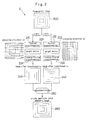
  • FIG. 2 is an explanatory view of a minute amplitude emphasis device
  • FIG. 3 is sequential views showing how a fingerprint image is emphasized
  • FIGS. 4 ( a )-( d ) is photographic representations showing how obscure fingerprint images are rectified into clear fingerprint images
  • FIG. 5 is a graphical representation showing how an collating accuracy changes depending on what season a fingerprint is taken in each group.
  • FIG. 6 is a graphical representation showing a relationship between (n) and a normalized weight in a weight function (A 3 ).
  • FIG. 1 depicts an individual identification device 100 into which an image emphasizing device is incorporated.
  • the individual identification device 100 has a fingerprint extraction device 1 on which an entrant puts his or her finger tip.
  • a minute amplitude value emphasis device 2 is provided to emphasize a minute amplitude value derived from a fingerprint image.
  • a feature extraction device 3 In the individual identification device 100 , a feature extraction device 3 , a registration device 4 , a collation device 5 and an output device 6 are each provided.
  • the fingerprint extraction device 1 has a right-angled prism (not shown) on which an index finger tip is put.
  • a light source and a charge-coupled device (CCD) are provided in a fashion to straddle the prism therebetween although not shown.
  • the charge-coupled device reads swelled portions of fingerprint ridge lines as dark image, and reading valleys of the fingerprint ridge lines as bright image so as to form a fingerprint image 200 (original pictorial image) which is fed to the minute amplitude value emphasis device 2 as two-dimensional dark and bright signal f(n).
  • a size of the fingerprint image 200 is 94 ⁇ 120 (pixel).
  • the minute amplitude value emphasis device 2 has Fourier transformation devices 211 , 212 , weight devices 221 , 222 , inverse Fourier transformation devices 231 , 232 and a synthesizing device 250 .
  • the Fourier transformation devices 211 , 212 treat the dark and bright signal f(n) with a Fourier transformation in x-axis (latitudinal) and y-axis (longitudinal) directions.
  • the fingerprint ridge lines are emphasized more as the lines become parallel to y-axis direction.
  • the fingerprint image thus produced is attenuated in the ridge lines parallel to the longitudinal direction as shown at a minute amplitude value emphasis data 242 .
  • the fingerprint image 200 is subjected in turn to the Fourier transformation in x-axis direction ⁇ the weighting procedure ⁇ the inverse Fourier transformation to produce a minute amplitude value emphasis data 241 .
  • These data 241 , 242 are synthesized to produce a minute amplitude value emphasis image.
  • the fingerprint ridge lines subjected to the Fourier transformation in y-axis direction meet latitudinal ridge lines at right angles.
  • the fingerprint ridge lines subjected to the Fourier transformation in x-axis direction meet longitudinal ridge lines at right angles. This attenuates the ridge lines perpendicular to the direction in which the ridge lines are subjected to the Fourier transformation.
  • Weight devices 221 , 222 multiply a real number component (a k ) of a Fourier coefficient F(k) in each direction by a window function (A 1 ).
  • the Fourier coefficient F(k) and the window (weight) function (A 1 ) are expressed below.
  • A1 ⁇ k if ⁇ ⁇ k ⁇ N 2 ( N - k ) if ⁇ ⁇ k > N 2
  • a feature extraction device 3 uses group delay spectra (GDS) which emphasizes peak values by removing envelope components of spectra obtained from a linear prediction analysis. By altering the window function (A 1 ), it is possible to change an emphatic characteristics without replacing a fundamental algorism.
  • GDS group delay spectra
  • inverse Fourier transformation devices 231 , 232 treat the Fourier coefficient with an inverse Fourier transformation in each direction so as to produce a time series signal g(n) represented as below.
  • a synthesizing device 250 synthetically combines the minute amplitude value emphasis data 241 , 242 to produce a minute amplitude value emphasis image 260 .
  • Dark and bright values are averaged where corresponding coordinates meet.
  • one of the minute amplitude value emphasis data 241 , 242 may be preferentially employed upon synthesizing these data 241 , 242 .
  • the minute amplitude value emphasis data 241 , 242 in x-axis and y-axis directions may be proportionally alloted by an increased range of 10 to 50% in favor of one of the minute amplitude value emphasis data 241 , 242 upon synthesizing the minute amplitude value emphasis data 241 , 242 .
  • the dark and bright values may be calculated as a geometric means instead of the average and the proportional allotment.
  • the feature extraction device 3 has a pretreatment section and an extraction section.
  • the pretreatment section calibrates a contrast and implements a cut-out for the minute amplitude value emphasis image 260 in which the minute amplitude value is emphasized.
  • the extraction section uses the group delay spectra (GDS) in which the peak values are emphasized by removing the envelope components of spectra obtained from the linear prediction analysis. This means that the minute amplitude value emphasis image 260 is analyzed in x-axis and y-axis directions to obtain two group delay spectra (GDS).
  • GDS group delay spectra
  • FIG. 4 shows the fingerprint image 200 and data obtained by treating the image 200 with GDS as indicated at (a) and (b).
  • GDS minute amplitude value emphasis image 260
  • images are obtained as depicted at right and lower sides of the minute amplitude value emphasis image 260 .
  • end points and bifurcation points and number of the ridge lines may be considered during the process in which the feature extraction is implemented.
  • the GDS may be quantized (e.g., 4-bit) to reduce the data size while insuring a high collation speed.
  • a quantized range and number of the quantized bit may be dynamically or experimentally sought. Parameters needed to transform into GDS are predetermined in accordance with optimum values for the fingerprint image 200 .
  • the registration device 4 has a memory 41 (hard disc or flash memory) and a registration control section.
  • the registration control section recognizes whether the following registration complete requirement is met when the entrant is registered. If met, a registration data 411 is stored as entrant feature extraction data in the memory 41 . If not met, a routine of “fingerprint extraction” ⁇ “minute amplitude value emphasis” ⁇ “feature extraction” is repeated until satisfied.
  • the collation device 5 has a temporary memory section and a collation control section.
  • the temporary memory section stores the feature extraction data as collation data when collating the registrant fingerprint with the entrant one to identify the entrant.
  • the collation control section compares the collation data stored in the temporary memory section with the registration data 411 stored in the memory 41 of the registration device 4 .
  • the collation Upon collating the fingerprints, the collation is implemented in terms of distance in GDS.
  • the collation data are compared with a set of registration data which contains five registration items collected five times from the fingerprint per single finger tip by way of illustration.
  • the collation data may be compared with pluralistic sets of the registration data.
  • the collation device 5 When the distance in GDS corresponds to a threshold value or less, the collation device 5 recognizes that the collation data resemble the registration data 411 enough to identify the entrant fingerprint with the registrant one so as to verify the entrant with the registrant.
  • the collation device 5 When the distance in GDS exceeds the threshold value, the collation device 5 does not recognize that the collation data resemble the registration data 411 enough to identify the entrant fingerprint with the registrant one.
  • the output device 6 When the entrant is verified, the output device 6 indicates “Permission For Entrance” on a display to generate a signal to unlock a door while recording an issuance of the “Permission”. When not verified, the output device 6 indicates “No Permission For Entrance” on the display to generate a signal to activate a buzzer while recording an issuance of the “No Permission”.
  • the fingerprint image 200 was originated from twenty fingerprints each adopted from fifty-seven registration volunteers in each month from February to August in Japan
  • the fingerprint image is illustrated at (a), (b) in FIG. 4, and the minute amplitude value emphasis image at (c), (d) in the same Figure.
  • is an experimental value represented by a highest collation rate
  • the threshold value was determined so that the rejection rate was 99.9% when the entrant was made unidentifiable.
  • the minute amplitude value emphasis image 260 was used to collate the former with the latter.
  • Group (A) belongs to the subjects which represent clarified fingerprints.
  • Group (B) belongs to the subjects which represent fingerprints often obscured in February.
  • Group (C) belongs to the subjects which particularly represent blurred fingerprints.
  • the fingerprint data in February contain many blurred fingerprints to increase the distances against the registration patterns to worsen the collation rate when treating the fingerprint image 200 with GDS. On the contrary, it is confirmed that the use of the minute amplitude value emphasis device 2 increases the collation rate by 40% or more.
  • the fingerprint image 200 becomes unclear in which some of the ridge lines are lost and blurred due to dry, sweaty, injured, chappy finger tip, particular seasons (summer or winter), or an advertent finger pressure shortage.
  • the minute amplitude value emphasis device 2 emphasizes the blurred fingerprint ridge lines to reproduce the fingerprint image as clear as that adopted under a good condition in which the fingerprint is placed in a tight contact with the prism of the fingerprint extraction device 1 .
  • window function (A 1 ) Since the alteration of the window function (A 1 ) changes the emphatic characteristics without replacing a fundamental algorism, blurred portions are effectively emphasized by using the window function appropriate for the pictorial image components and the fingerprint ridge lines. Instead of the window function (A 1 ), such window (weight) functions as represented by (A 2 ) and (A 3 ) are applied herein.
  • the window function (A 3 ) suppresses a low frequency range while emphasizing a middle frequency range and suppressing a high frequency range greater than that of the fingerprint ridge lines.
  • the original pictorial image is effectively emphasized as shown in FIG. 6 .

Landscapes

  • Engineering & Computer Science (AREA)
  • Physics & Mathematics (AREA)
  • General Physics & Mathematics (AREA)
  • Theoretical Computer Science (AREA)
  • Computer Vision & Pattern Recognition (AREA)
  • Human Computer Interaction (AREA)
  • Multimedia (AREA)
  • Collating Specific Patterns (AREA)
  • Image Processing (AREA)

Abstract

A minute amplitude value emphasis device 2 has Fourier transformation devices 211, 212 which treat a two-dimensional original pictorial image 200 with a Fourier transformation to determine Fourier coefficients in x-axis and y-axis directions. Weight devices 221, 222 emphasize the respective Fourier coefficients in the corresponding directions so as to produce weighted Fourier coefficients. Inverse Fourier transformation devices 231, 232 treat the weighted Fourier coefficients with an inverse Fourier transformation in two directions to determine the corresponding minute amplitude value emphasis data 241, 242. A synthesizing device 250 synthesizes the corresponding minute amplitude value emphasis data 241, 242 to produce a minute amplitude value emphasis image 260. An obscure portion of the two-dimensional original pictorial image 200 is rectified to reproduce a clarified pictorial image.

Description

BACKGROUND OF THE INVENTION
1. Field of the Invention
The invention relates to an image emphasizing device which clarifies a two-dimensional pictorial image data and fingerprint image data.
2. Description of Prior Art
In an individual identification device, features are derived from a fingerprint image based on end points and bifurcation points of fingerprint ridge lines when putting a finger tip on an extraction prism. The derived features are stored in a memory as a registration data. Unknown features from an entrant are collated with an already stored features to verify whether or not the entrant is identified.
Upon reading the fingerprint image, it is necessary to attain a well-contrasted fingerprint image particularly when selecting the number of the ridge lines and a positional relationship between the end points of the ridge lines or the bifurcation points of the ridge lines.
When the finger tip gets chappy in a dry season, the ridge lines of the fingerprint image becomes lean and blurred in some places due to a poor contact relation between the finger tip and the extraction prism at the time of putting the finger tip on the extraction prism. This means that the fingerprint image is qualitatively influenced depending on the circumstances under which the fingerprint is taken. This significantly deteriorates a collating accuracy.
Therefore, the present invention has been made with the above drawbacks in mind, it is a main object of the invention to provide an image emphasizing device which is capable of reproducing a clear image by emphasizing an obscure portion of an original pictorial image.
SUMMARY OF THE INVENTION
According to the present invention, there is provided an image emphasizing device in which a Fourier transformation member regards a two-dimensional original pictorial image as a time series data to treat the two-dimensional original pictorial image with a Fourier transformation in different directions so as to determine Fourier coefficients in the same directions. This permits to process the original pictorial image within a frequency range.
A weight member puts weight on the Fourier coefficients along the different directions to emphasize an obscure portion of the original pictorial image.
The weighted Fourier coefficients along the different directions are treated with an inverse Fourier transformation to determine corresponding minute amplitude value emphasis data. A synthesizing member synthesizes the corresponding minute amplitude value emphasis data to determine an image data in which the minute amplitude value is emphasized.
Upon applying to a fingerprint verification device, a clear fingerprint image is insured in which the obscure portion is rectified to identify the entrant with a high accuracy. Upon applying to a read-out of an automobile license plate number, a clarified license plate number image is insured in which the obscure portion is rectified to identify the license plate number with a high accuracy.
Depending on the direction in which the original pictorial image is treated with the Fourier transformation, information from the fingerprint ridge lines may be subjected to an attenuation. By synthesizing the data in different directions, the attenuation is suppressed effectively.
According to another aspect of the invention, the different directions are represented by two lines met at right angles. This also suppresses the attenuation effectively.
According to still another aspect of the invention, the different directions are represented by a longitudinal line (y-axis direction) and a latitudinal line (x-axis direction) of the original pictorial image. This not only suppresses the attenuation,but also eliminates the necessity of implementing coordinates transformation substantially. With a common analysis size applied herein, the verification is implemented at a higher speed.
BRIEF DESCRIPTION OF THE DRAWINGS
Preferred forms of the present invention are illustrated in the accompanying drawings in which:
FIG. 1 is an explanatory view of an individual identification device into which an image emphasizing device is incorporated according to an embodiment of the invention;
FIG. 2 is an explanatory view of a minute amplitude emphasis device;
FIG. 3 is sequential views showing how a fingerprint image is emphasized;
FIGS. 4(a)-(d) is photographic representations showing how obscure fingerprint images are rectified into clear fingerprint images;
FIG. 5 is a graphical representation showing how an collating accuracy changes depending on what season a fingerprint is taken in each group; and
FIG. 6 is a graphical representation showing a relationship between (n) and a normalized weight in a weight function (A3).
DETAILED DESCRIPTION OF THE PREFERRED EMBODIMENTS
Referring to FIGS. 1 through 3 which show an embodiment of the invention, FIG. 1 depicts an individual identification device 100 into which an image emphasizing device is incorporated. The individual identification device 100 has a fingerprint extraction device 1 on which an entrant puts his or her finger tip. A minute amplitude value emphasis device 2 is provided to emphasize a minute amplitude value derived from a fingerprint image.
In the individual identification device 100, a feature extraction device 3, a registration device 4, a collation device 5 and an output device 6 are each provided.
The fingerprint extraction device 1 has a right-angled prism (not shown) on which an index finger tip is put. A light source and a charge-coupled device (CCD) are provided in a fashion to straddle the prism therebetween although not shown. The charge-coupled device reads swelled portions of fingerprint ridge lines as dark image, and reading valleys of the fingerprint ridge lines as bright image so as to form a fingerprint image 200 (original pictorial image) which is fed to the minute amplitude value emphasis device 2 as two-dimensional dark and bright signal f(n). A size of the fingerprint image 200 is 94×120 (pixel).
As shown in FIG. 2, the minute amplitude value emphasis device 2 has Fourier transformation devices 211, 212, weight devices 221, 222, inverse Fourier transformation devices 231, 232 and a synthesizing device 250.
The Fourier transformation devices 211, 212 treat the dark and bright signal f(n) with a Fourier transformation in x-axis (latitudinal) and y-axis (longitudinal) directions.
The following are reasons why the dark and bright signal f(n) is treated with the Fourier transformation in x-axis and y-axis directions respectively.
When the fingerprint image 200 is subjected in turn to the Fourier transformation in y-axis direction → a weighting procedure → the inverse Fourier transformation, the fingerprint ridge lines are emphasized more as the lines become parallel to y-axis direction.
As a result, the fingerprint image thus produced is attenuated in the ridge lines parallel to the longitudinal direction as shown at a minute amplitude value emphasis data 242.
In order to avoid this inconvenience, the fingerprint image 200 is subjected in turn to the Fourier transformation in x-axis direction → the weighting procedure → the inverse Fourier transformation to produce a minute amplitude value emphasis data 241. These data 241, 242 are synthesized to produce a minute amplitude value emphasis image.
Among the minute amplitude value emphasis data 242, the fingerprint ridge lines subjected to the Fourier transformation in y-axis direction meet latitudinal ridge lines at right angles. Among the minute amplitude value emphasis data 241, the fingerprint ridge lines subjected to the Fourier transformation in x-axis direction meet longitudinal ridge lines at right angles. This attenuates the ridge lines perpendicular to the direction in which the ridge lines are subjected to the Fourier transformation.
Weight devices 221, 222 multiply a real number component (ak) of a Fourier coefficient F(k) in each direction by a window function (A1). The Fourier coefficient F(k) and the window (weight) function (A1) are expressed below. F ( k ) = n = 0 N - 1 f ( n ) - j 2 mk N = a k + j b k A1 = { k if k N 2 ( N - k ) if k > N 2
Figure US06718052-20040406-M00001
This emphasizes an obscure portion (high frequency range) in which the fingerprint ridge lines are blurred. This means that the ridge lines are emphasized which are perpendicular to the direction in which the ridge lines are subjected to the Fourier transformation.
A feature extraction device 3 uses group delay spectra (GDS) which emphasizes peak values by removing envelope components of spectra obtained from a linear prediction analysis. By altering the window function (A1), it is possible to change an emphatic characteristics without replacing a fundamental algorism.
In order to attain the minute amplitude value emphasis data 241, 242 in which minute amplitude values of the fingerprint ridge lines are emphasized in each direction, inverse Fourier transformation devices 231, 232 treat the Fourier coefficient with an inverse Fourier transformation in each direction so as to produce a time series signal g(n) represented as below. g ( n ) = 1 N k = 0 N - 1 ( Aa k + j b k ) j 2 mk N
Figure US06718052-20040406-M00002
A synthesizing device 250 synthetically combines the minute amplitude value emphasis data 241, 242 to produce a minute amplitude value emphasis image 260. Upon synthesizing these data 241, 242, Dark and bright values are averaged where corresponding coordinates meet. Instead of using an average value, one of the minute amplitude value emphasis data 241, 242 may be preferentially employed upon synthesizing these data 241, 242.
By way of illustration, the minute amplitude value emphasis data 241, 242 in x-axis and y-axis directions may be proportionally alloted by an increased range of 10 to 50% in favor of one of the minute amplitude value emphasis data 241, 242 upon synthesizing the minute amplitude value emphasis data 241, 242.
In this instance, the dark and bright values may be calculated as a geometric means instead of the average and the proportional allotment.
The feature extraction device 3 has a pretreatment section and an extraction section. The pretreatment section calibrates a contrast and implements a cut-out for the minute amplitude value emphasis image 260 in which the minute amplitude value is emphasized.
The extraction section uses the group delay spectra (GDS) in which the peak values are emphasized by removing the envelope components of spectra obtained from the linear prediction analysis. This means that the minute amplitude value emphasis image 260 is analyzed in x-axis and y-axis directions to obtain two group delay spectra (GDS).
FIG. 4 shows the fingerprint image 200 and data obtained by treating the image 200 with GDS as indicated at (a) and (b). By treating the minute amplitude value emphasis image 260 with GDS as shown at (c) and (d), images are obtained as depicted at right and lower sides of the minute amplitude value emphasis image 260. It is to be noted that end points and bifurcation points and number of the ridge lines may be considered during the process in which the feature extraction is implemented.
When the GDS is used, the GDS may be quantized (e.g., 4-bit) to reduce the data size while insuring a high collation speed. A quantized range and number of the quantized bit may be dynamically or experimentally sought. Parameters needed to transform into GDS are predetermined in accordance with optimum values for the fingerprint image 200.
Feature extraction data obtained from the feature extraction device 3 is fed to the registration device 4. The registration device 4 has a memory 41 (hard disc or flash memory) and a registration control section.
The registration control section recognizes whether the following registration complete requirement is met when the entrant is registered. If met, a registration data 411 is stored as entrant feature extraction data in the memory 41. If not met, a routine of “fingerprint extraction” → “minute amplitude value emphasis” → “feature extraction” is repeated until satisfied.
Registration Complete Requirement
When a single finger tip satisfies, for example, five registration items (n items in general) among requisite data to be registered. When satisfied, the registration routine ends.
The collation device 5 has a temporary memory section and a collation control section.
The temporary memory section stores the feature extraction data as collation data when collating the registrant fingerprint with the entrant one to identify the entrant.
The collation control section compares the collation data stored in the temporary memory section with the registration data 411 stored in the memory 41 of the registration device 4.
Upon collating the fingerprints, the collation is implemented in terms of distance in GDS. The collation data are compared with a set of registration data which contains five registration items collected five times from the fingerprint per single finger tip by way of illustration.
In this instance, the collation data may be compared with pluralistic sets of the registration data.
When the distance in GDS corresponds to a threshold value or less, the collation device 5 recognizes that the collation data resemble the registration data 411 enough to identify the entrant fingerprint with the registrant one so as to verify the entrant with the registrant.
When the distance in GDS exceeds the threshold value, the collation device 5 does not recognize that the collation data resemble the registration data 411 enough to identify the entrant fingerprint with the registrant one.
When the entrant is verified, the output device 6 indicates “Permission For Entrance” on a display to generate a signal to unlock a door while recording an issuance of the “Permission”. When not verified, the output device 6 indicates “No Permission For Entrance” on the display to generate a signal to activate a buzzer while recording an issuance of the “No Permission”.
An experimental test was carried out to confirm the advantages which the minute amplitude value emphasis device 2 had produced.
Experimental Data
The fingerprint image 200 was originated from twenty fingerprints each adopted from fifty-seven registration volunteers in each month from February to August in Japan
The fingerprint image is illustrated at (a), (b) in FIG. 4, and the minute amplitude value emphasis image at (c), (d) in the same Figure.
Experimental Method
Five registration patterns were selected at random from the fingerprint data adopted in April, and the rest and the registration data adopted in the other months were used for estimation. Distances in registration pattern and estimation pattern in terms of GDS were measured with the use of DP matching.
Suppose dx and dy to be distances in x-axis and y-axis directions, a minimum value was an estimation value selected among five types of distances obtained as di=α d x+(1−α)dy(i=1, 2, - - - , 5).
Where α is an experimental value represented by a highest collation rate, and the threshold value was determined so that the rejection rate was 99.9% when the entrant was made unidentifiable. When the entrant was not verified with the registrant, the minute amplitude value emphasis image 260 was used to collate the former with the latter.
Experimental Test Results
Experimental Test Results are shown in FIG. 5. The fifty-seven registration volunteers were divided into three groups.
Group (A) belongs to the subjects which represent clarified fingerprints.
Group (B) belongs to the subjects which represent fingerprints often obscured in February.
Group (C) belongs to the subjects which particularly represent blurred fingerprints.
The fingerprint data in February contain many blurred fingerprints to increase the distances against the registration patterns to worsen the collation rate when treating the fingerprint image 200 with GDS. On the contrary, it is confirmed that the use of the minute amplitude value emphasis device 2 increases the collation rate by 40% or more.
Advantages Achieved
When putting the finger tip on the fingerprint extraction device 1, the fingerprint image 200 becomes unclear in which some of the ridge lines are lost and blurred due to dry, sweaty, injured, chappy finger tip, particular seasons (summer or winter), or an advertent finger pressure shortage.
In these situations, the minute amplitude value emphasis device 2 emphasizes the blurred fingerprint ridge lines to reproduce the fingerprint image as clear as that adopted under a good condition in which the fingerprint is placed in a tight contact with the prism of the fingerprint extraction device 1. This means that the collation rate is significantly improved under the adverse circumstances (e.g., especially dry winter season) as shown in FIG. 5.
Since the alteration of the window function (A1) changes the emphatic characteristics without replacing a fundamental algorism, blurred portions are effectively emphasized by using the window function appropriate for the pictorial image components and the fingerprint ridge lines. Instead of the window function (A1), such window (weight) functions as represented by (A2) and (A3) are applied herein. A2 = { k m if k N 2 ( N - k ) m if k > N 2 A3 = { k s - k 2 2 τ 2 if k N 2 ( N - k ) s - ( N - k ) 2 2 τ 2 if k > N 2
Figure US06718052-20040406-M00003
The window function (A3) suppresses a low frequency range while emphasizing a middle frequency range and suppressing a high frequency range greater than that of the fingerprint ridge lines.
By determining a parameter (τ) to be appropriate for the fingerprint, the original pictorial image is effectively emphasized as shown in FIG. 6.
While there has been described what is at present thought to be preferred embodiments of the invention, it will be understood that modifications may be made therein and it is intended to cover in the appended claims all such modifications which fall within the scope of the invention.

Claims (13)

What is claimed is:
1. An image emphasizing device, comprising:
a Fourier transformation member provided to treat an original pictorial image with a one-dimensional Fourier transformation along different directions so as to determine respective Fourier coefficients;
a weight member provided to emphasize an obscure image represented by a minute amplitude value along said respective Fourier coefficients in the corresponding directions so as to produce weighted Fourier coefficients;
an inverse Fourier transformation member provided to treat said weighted Fourier coefficients with a one dimensional inverse Fourier transformation in said different directions to determine corresponding minute amplitude value emphasis data;
a synthesizing member provided to synthesize said corresponding minute amplitude value emphasis data to determine an image data in which said minute amplitude value is emphasized;
a feature extraction member provided to analyze said image data with the use of group delay spectra in said different directions in which peak values are emphasized by removing envelope components of spectra obtained from a linear prediction analysis;
a registration member provided to recognize whether or not a registration requirement is satisfied on the basis of a feature extraction data obtained from said feature extraction member, said feature extraction data being stored in a memory as a registration data when said registration requirement is satisfied; and
a collation member provided to collate said registration data with a collation data derived from a feature extraction data of an entrant, said registration data being collated with said collation data in terms of a distance when said distance is a threshold value or less than said threshold value,
wherein said Fourier coefficient is represented by F(k), said weight member is represented by (A2), and said weighted Fourier coefficients are processed with said one-dimensional inverse Fourier transformation to obtain a time series g(n), Where F ( k ) = n = 0 N - 1 f ( n ) - j 2 mk N = a k + j b k A2 = { k m if k N 2 ( N - k ) m if k > N 2 g ( n ) = 1 N k = 0 N - 1 ( Aa k + j b k ) j 2 mk N .
Figure US06718052-20040406-M00004
2. An image emphasizing device, comprising:
a Fourier transformation member provided to treat an original pictorial image with a one-dimensional Fourier transformation along different directions so as to determine respective Fourier coefficients;
a weight member provided to emphasize an obscure image represented by a minute amplitude value along said respective Fourier coefficients in the corresponding directions so as to produce weighted Fourier coefficients;
an inverse Fourier transformation member provided to treat said weighted Fourier coefficients with a one dimensional inverse Fourier transformation in said different directions to determine corresponding minute amplitude value emphasis data;
a synthesizing member provided to synthesize said corresponding minute amplitude value emphasis data to determine an image data in which said minute amplitude value is emphasized;
a feature extraction member provided to analyze said image data with the use of group delay spectra in said different directions in which peak values are emphasized by removing envelope components of spectra obtained from a linear prediction analysis;
a registration member provided to recognize whether or not a registration requirement is satisfied on the basis of a feature extraction data obtained from said feature extraction member, said feature extraction data being stored in a memory as a registration data when said registration requirement is satisfied; and
a collation member provided to collate said registration data with a collation data derived from a feature extraction data of an entrant, said registration data being collated with said collation data in terms of a distance when said distance is a threshold value or less than said threshold value,
wherein said Fourier coefficient is represented by F(k), said weight member is represented by (A3), and said weighted Fourier coefficients are processed with said one-dimensional inverse Fourier transformation to obtain a time series g(n), Where F ( k ) = n = 0 N - 1 f ( n ) - j 2 mk N = a k + j b k A3 = { k s - k 2 2 τ 2 if k N 2 ( N - k ) s - ( N - k ) 2 2 τ 2 if k > N 2 g ( n ) = 1 N k = 0 N - 1 ( Aa k + j b k ) j 2 mk N .
Figure US06718052-20040406-M00005
3. An image emphasizing device, comprising:
a Fourier transformation member provided to treat an original pictorial image with a one-dimensional Fourier transformation along different directions so as to determine respective Fourier coefficients;
a weight member provided to emphasize an obscure image represented by a minute amplitude value along said respective Fourier coefficients in the corresponding directions so as to produce weighted Fourier coefficients;
an inverse Fourier transformation member provided to treat said weighted Fourier coefficients with a one dimensional inverse Fourier transformation in said different directions to determine corresponding minute amplitude value emphasis data;
a synthesizing member provided to synthesize said corresponding minute amplitude value emphasis data to determine an image data in which said minute amplitude value is emphasized;
a feature extraction member provided to analyze said image data with the use of group delay spectra in said different directions in which peak values are emphasized by removing envelope components of spectra obtained from a linear prediction analysis;
a registration member provided to recognize whether or not a registration requirement is satisfied on the basis of a feature extraction data obtained from said feature extraction member, said feature extraction data being stored in a memory as a registration data when said registration requirement is satisfied; and
a collation member provided to collate said registration data with a collation data derived from a feature extraction data of an entrant, said registration data being collated with said collation data in terms of a distance when said distance is a threshold value or less than said threshold value,
wherein said amplitude characteristics emphasis data in said different directions are proportionally alloted by an increased range of 10 to 50% in favor of one of said amplitude characteristics emphasis data upon synthesizing said amplitude characteristics emphasis data.
4. An image emphasizing device comprising:
a Fourier transformation member provided to treat an original pictorial image with a one-dimensional Fourier transformation along different directions so as to determine respective Fourier coefficients;.
a weight member provided to emphasize an obscure image represented by a minute amplitude value along said respective Fourier coefficients in the corresponding directions so as to produce weighted Fourier coefficients;
an inverse Fourier transformation member provided to treat said weighted Fourier coefficients with a one-dimensional inverse Fourier transformation in said different directions to determine corresponding minute amplitude value emphasis data;
a synthesizing member provided to synthesize said corresponding minute amplitude value emphasis data to determine an image data in which said minute amplitude value is emphasized;
a feature extraction member provided to analyze said image data with the use of group delay spectra in said different directions in which peak values are emphasized by removing envelope components of spectra obtained from a linear prediction analysis;
a registration member provided to recognize whether or not a registration requirement is satisfied on the basis of a feature extraction data obtained from said feature extraction member, said feature extraction data being stored in a memory as a registration data when said registration requirement is satisfied;
a collation member provided to collate said registration data with a collation data derived from a feature extraction data of an entrant, said registration data being collated with said collation data in terms of a distance when said distance is a threshold value or less than said threshold value,
wherein said Fourier coefficient is represented by F(k), said weight member is represented by (A3), and said weighted Fourier coefficients are processed with said one-dimensional inverse Fourier transformation to obtain a time series g(n), Where F ( k ) = n = 0 N - 1 f ( n ) - j 2 mk N = a k + j b k A3 = { f ( k ) if k N 2 f ( N - k ) if k > N 2 g ( n ) = 1 N k = 0 N - 1 ( Aa k + j b k ) j 2 mk N .
Figure US06718052-20040406-M00006
5. An image emphasizing device comprising:
a Fourier transformation member provided to treat an original pictorial image with a one-dimensional Fourier transformation along different directions so as to determine respective Fourier coefficients;
a weight member provided to emphasize an obscure image represented by a minute amplitude value along said respective Fourier coefficients in the corresponding directions so as to produce weighted Fourier coefficients;
an inverse Fourier transformation member provided to treat said weighted Fourier coefficients with a one-dimensional inverse Fourier transformation in said different directions to determine corresponding minute amplitude value emphasis data;
a synthesizing member provided to synthesize said corresponding minute amplitude value emphasis data to determine an image data in which said minute amplitude value is emphasized;
a feature extraction member provided to analyze said image data with the use of group delay spectra in said different directions in which peak values are emphasized by removing envelope components of spectra obtained from a linear prediction analysis;
a registration member provided to recognize whether or not a registration requirement is satisfied on the basis of a feature extraction data obtained from said feature extraction member, said feature extraction data being stored in a memory as a registration data when said registration requirement is satisfied;
a collation member provided to collate said registration data with a collation data derived from a feature extraction data of an entrant, said registration data being collated with said collation data in terms of a distance when said distance is a threshold value or less than said threshold value,
wherein said Fourier coefficient is represented by F(k), said weight member is represented by (A4), and said weighted Fourier coefficients are processed with said one-dimensional inverse Fourier transformation to obtain a time series g(n), Where F ( k ) = n = 0 N - 1 f ( n ) - j 2 mk N = a k + j b k A3 = { f ( k ) if k N 2 f ( N - k ) if k > N 2 g ( n ) = 1 N k = 0 N - 1 A ( a k + j b k ) j 2 mk N
Figure US06718052-20040406-M00007
and f(k) represents a coefficient which reflects a value in connection with a statistically obtained distribution of a fingerprint ridge pitch, or a function showing a local maximum value at a frequency band region near the fingerprint ridge pitch.
6. An image emphasizing device comprising:
a Fourier transformation member provided to treat an original pictorial image with a one-dimensional Fourier transformation along different directions so as to determine respective Fourier coefficients;
a weight member provided to emphasize an obscure image represented by a minute amplitude value along said respective Fourier coefficients in the corresponding directions so as to produce weighted Fourier coefficients;
an inverse Fourier transformation member provided to treat said weighted Fourier coefficients with a one-dimensional inverse Fourier transformation in said different directions to determine corresponding minute amplitude value emphasis data;
a synthesizing member provided to synthesize said corresponding minute amplitude value emphasis data to determine an image data in which said minute amplitude value is emphasized;
a feature extraction member provided to analyze said image data with the use of group delay spectra in said different directions in which peak values are emphasized by removing envelope components of spectra obtained from a linear prediction analysis;
a registration member provided to recognize whether or nota registration requirement is satisfied on the basis of a feature extraction data obtained from said feature extraction member, said feature extraction data being stored in a memory as a registration data when said registration requirement is satisfied;
a collation member provided to collate said registration data with a collation data derived from a feature extraction data of an entrant, said registration data being collated with said collation data in terms of a distance when said distance is a threshold value or less than said threshold value,
wherein said Fourier coefficient is represented by F(k), said weight member is represented by (A5), (B5), and said weighted Fourier coefficients are processed with said one-dimensional inverse Fourier transformation to obtain a time series g(n), Where F ( k ) = n = 0 N - 1 f ( n ) - j 2 mk N = a k + j b k A5 = { f ( k ) if k N 2 f ( N - k ) if k > N 2 B5 = { h ( k ) if k N 2 h ( N - k ) if k > N 2 g ( n ) = 1 N k = 0 N - 1 ( Aa k + j Bb k ) j 2 mk N
Figure US06718052-20040406-M00008
and f(k) and h(k) represent coefficients which reflect a value in connection with a statistically obtained distribution of a fingerprint ridge pitch, or a function showing a local maximum value at a frequency band region near the fingerprint ridge pitch.
7. The image emphasizing device as recited in claims 1, 2, 3, 4, 5 or 6, wherein said different directions are represented by two lines met at right angles.
8. The image emphasizing device as recited in claims 1, 2, 3, 4, 5 or 6, wherein said different directions are represented by longitudinal and latitudinal lines of said original pictorial image.
9. The image emphasizing device as recited in claims 1, 2, 3, 4, 5 or 6, wherein said original pictorial image is a fingerprint image data in which a fingerprint image is emphasized.
10. The image emphasizing device as recited in claims 1, 2, 3, 4, 5 or 6, wherein said minute amplitude value in said different directions are calculated by a geometric means upon synthesizing said minute amplitude value emphasis data.
11. An image emphasizing device comprising:
a Fourier transformation member provided to treat an original pictorial image with a one-dimensional Fourier transformation along different directions so as to determine respective Fourier coefficients;
a weight member provided to emphasize an obscure image represented by a minute amplitude value along said respective Fourier coefficients in the corresponding directions so as to produce weighted Fourier coefficients;
an inverse Fourier transformation member provided to treat said weighted Fourier coefficients with a one-dimensional inverse Fourier transformation in said different directions to determine corresponding minute amplitude value emphasis data; and
a synthesizing member provided to synthesize said corresponding minute amplitude value emphasis data to determine an image data in which said minute amplitude value is emphasized
wherein said minute amplitude value in said different directions being proportionally alloted by an increased range of 10 to 50% in favor of one of said minute amplitude value emphasis data upon synthesizing said minute amplitude value emphasis data.
12. The image emphasizing device, as recited in claim 11, wherein said minute amplitude value in said different directions are calculated by a geometric means upon synthesizing said minute amplitude value emphasis data.
13. The image emphasizing device as recited in any one of claims 11 and 12, wherein a feature extraction member is provided to analyze said image data with the use of group delay spectra in said different directions by removing envelope components of spectra obtained from a linear prediction analysis.
US09/521,943 1999-03-11 2000-03-09 Image emphasizing device for fingerprint verification Expired - Fee Related US6718052B1 (en)

Applications Claiming Priority (2)

Application Number Priority Date Filing Date Title
JP11-064285 1999-03-11
JP11064285A JP2000259825A (en) 1999-03-11 1999-03-11 Image enhancement device

Publications (1)

Publication Number Publication Date
US6718052B1 true US6718052B1 (en) 2004-04-06

Family

ID=13253822

Family Applications (1)

Application Number Title Priority Date Filing Date
US09/521,943 Expired - Fee Related US6718052B1 (en) 1999-03-11 2000-03-09 Image emphasizing device for fingerprint verification

Country Status (2)

Country Link
US (1) US6718052B1 (en)
JP (1) JP2000259825A (en)

Cited By (7)

* Cited by examiner, † Cited by third party
Publication number Priority date Publication date Assignee Title
US20030068072A1 (en) * 2001-10-10 2003-04-10 Laurence Hamid Method and system for fingerprint authentication
US20030138136A1 (en) * 2000-07-24 2003-07-24 Taizo Umezaki Fingerprint verification apparatus, fingerprint verification method and a fingerprint verification program
WO2006080886A1 (en) * 2005-01-31 2006-08-03 Precise Biometrics Ab Method and device for improved fingerprint matching
US20080279430A1 (en) * 2005-12-08 2008-11-13 Koninklijke Philips Electronics, N.V. System and Method for Enabling Selection of an Image Registration Transformation
US20110058714A1 (en) * 2005-08-09 2011-03-10 Nec Corporation System for recognizing fingerprint image, method and program for the same
US9946917B2 (en) * 2016-03-31 2018-04-17 Synaptics Incorporated Efficient determination of biometric attribute for fast rejection of enrolled templates and other applications
US10726228B2 (en) 2016-08-03 2020-07-28 Samsung Electronics Co., Ltd. Semiconductor device for fingerprint sensing

Families Citing this family (3)

* Cited by examiner, † Cited by third party
Publication number Priority date Publication date Assignee Title
JP2003067751A (en) * 2001-08-27 2003-03-07 Dds:Kk Fingerprint collation device, fingerprint collation method and fingerprint collation program
JP2004110438A (en) 2002-09-18 2004-04-08 Nec Corp Image processing device, image processing method, and program
WO2007088926A1 (en) * 2006-02-01 2007-08-09 Nec Corporation Image processing, image characteristic extracting and image checking devices, methods and programs, and image checking system

Citations (7)

* Cited by examiner, † Cited by third party
Publication number Priority date Publication date Assignee Title
US5050220A (en) * 1990-07-24 1991-09-17 The United States Of America As Represented By The Secretary Of The Navy Optical fingerprint correlator
US5426708A (en) * 1992-08-06 1995-06-20 Chuo Hatsujo Kabushiki Kaisha Fingerprint scanning device for use in identification
US5619596A (en) * 1993-10-06 1997-04-08 Seiko Instruments Inc. Method and apparatus for optical pattern recognition
US5761330A (en) * 1995-06-07 1998-06-02 Mytec Technologies, Inc. Hybrid optical-digital method and apparatus for fingerprint verification
US5854710A (en) * 1996-09-09 1998-12-29 University Of Massachusetts Optical fourier processing
US5915034A (en) * 1995-05-02 1999-06-22 Yamatake-Honeywell, Co., Ltd. Pattern collation apparatus based on spatial frequency characteristics
US6018586A (en) * 1995-04-12 2000-01-25 Nec Corporation Apparatus for extracting skin pattern features and a skin pattern image processor using subregion filtering

Patent Citations (7)

* Cited by examiner, † Cited by third party
Publication number Priority date Publication date Assignee Title
US5050220A (en) * 1990-07-24 1991-09-17 The United States Of America As Represented By The Secretary Of The Navy Optical fingerprint correlator
US5426708A (en) * 1992-08-06 1995-06-20 Chuo Hatsujo Kabushiki Kaisha Fingerprint scanning device for use in identification
US5619596A (en) * 1993-10-06 1997-04-08 Seiko Instruments Inc. Method and apparatus for optical pattern recognition
US6018586A (en) * 1995-04-12 2000-01-25 Nec Corporation Apparatus for extracting skin pattern features and a skin pattern image processor using subregion filtering
US5915034A (en) * 1995-05-02 1999-06-22 Yamatake-Honeywell, Co., Ltd. Pattern collation apparatus based on spatial frequency characteristics
US5761330A (en) * 1995-06-07 1998-06-02 Mytec Technologies, Inc. Hybrid optical-digital method and apparatus for fingerprint verification
US5854710A (en) * 1996-09-09 1998-12-29 University Of Massachusetts Optical fourier processing

Cited By (14)

* Cited by examiner, † Cited by third party
Publication number Priority date Publication date Assignee Title
US7310433B2 (en) 2000-07-24 2007-12-18 Ume Tech Yugen Kaisha Fingerprint verification apparatus, fingerprint verification method and a fingerprint verification program
US20030138136A1 (en) * 2000-07-24 2003-07-24 Taizo Umezaki Fingerprint verification apparatus, fingerprint verification method and a fingerprint verification program
US20030068072A1 (en) * 2001-10-10 2003-04-10 Laurence Hamid Method and system for fingerprint authentication
US7272247B2 (en) * 2001-10-10 2007-09-18 Activcard Ireland Limited Method and system for fingerprint authentication
US20080298646A1 (en) * 2005-01-31 2008-12-04 Precise Biometrics Ab Method and Device for Improved Fingerprint Matching
WO2006080886A1 (en) * 2005-01-31 2006-08-03 Precise Biometrics Ab Method and device for improved fingerprint matching
RU2361272C2 (en) * 2005-01-31 2009-07-10 Присайз Биометрикс Аб Method and device for improved identification of fingerprints
AU2006209150B2 (en) * 2005-01-31 2009-10-08 Precise Biometrics Ab Method and device for improved fingerprint matching
US20110058714A1 (en) * 2005-08-09 2011-03-10 Nec Corporation System for recognizing fingerprint image, method and program for the same
US8019132B2 (en) * 2005-08-09 2011-09-13 Nec Corporation System for recognizing fingerprint image, method and program for the same
US20080279430A1 (en) * 2005-12-08 2008-11-13 Koninklijke Philips Electronics, N.V. System and Method for Enabling Selection of an Image Registration Transformation
US8380007B2 (en) * 2005-12-08 2013-02-19 Koninklijke Philips Electronics N.V. System and method for enabling selection of an image registration transformation
US9946917B2 (en) * 2016-03-31 2018-04-17 Synaptics Incorporated Efficient determination of biometric attribute for fast rejection of enrolled templates and other applications
US10726228B2 (en) 2016-08-03 2020-07-28 Samsung Electronics Co., Ltd. Semiconductor device for fingerprint sensing

Also Published As

Publication number Publication date
JP2000259825A (en) 2000-09-22

Similar Documents

Publication Publication Date Title
US7142699B2 (en) Fingerprint matching using ridge feature maps
US7120280B2 (en) Fingerprint template generation, verification and identification system
US6636621B2 (en) Systems and methods with identity verification by comparison & interpretation of skin patterns such as fingerprints
EP1339008B1 (en) Authentication method, and program and apparatus therefor
US6718052B1 (en) Image emphasizing device for fingerprint verification
US7617058B2 (en) Biometric apparatus and method using bio signals
KR20120047991A (en) Automatic identification of fingerprint inpainting target areas
US8538096B2 (en) Methods and apparatus for generation of cancelable fingerprint template
CN101075872B (en) Registration device, collation device and extraction method
HUE030127T2 (en) Document authentication using template matching with fast masked normalized cross-correlation
EP2104059A1 (en) Apparatus and method for processing image
Kulkarni et al. Orientation feature for fingerprint matching
KR20090058460A (en) Authentication device and authentication method
CN106056523B (en) Blind detection method of digital image splicing for tampering
Win et al. Fingerprint recognition system for low quality images
WO2008047935A1 (en) Pattern identifying method, registration device, collating device and program
US6785408B1 (en) Fingerprint segment area processing method and associated apparatus
JP3235075B2 (en) Pattern matching device
Sarfraz Introductory chapter: On fingerprint recognition
Salama et al. Efficient implementation of double random phase encoding and empirical mode decomposition for cancelable biometrics
JP3254622B2 (en) Pattern matching device
Tamrakar et al. A study on machine learning approach for fingerprint recognition system
Bhowmick et al. Determination of minutiae scores for fingerprint image applications
US8983208B2 (en) Pattern matching based on global quantitative characterization of patterns
Lavanya et al. Minutiae extraction in fingerprint using gabor filter enhancement

Legal Events

Date Code Title Description
AS Assignment

Owner name: CHUO HATSUJO KABUSHIKI KAISHA, JAPAN

Free format text: ASSIGNMENT OF ASSIGNORS INTEREST;ASSIGNORS:MATSUMOTO, NORIYUKI;UMEZAKI, TAIZO;KIMURA, AKIHITO;REEL/FRAME:010915/0662

Effective date: 20000517

FEPP Fee payment procedure

Free format text: PAYER NUMBER DE-ASSIGNED (ORIGINAL EVENT CODE: RMPN); ENTITY STATUS OF PATENT OWNER: LARGE ENTITY

Free format text: PAYOR NUMBER ASSIGNED (ORIGINAL EVENT CODE: ASPN); ENTITY STATUS OF PATENT OWNER: LARGE ENTITY

FPAY Fee payment

Year of fee payment: 4

REMI Maintenance fee reminder mailed
LAPS Lapse for failure to pay maintenance fees
STCH Information on status: patent discontinuation

Free format text: PATENT EXPIRED DUE TO NONPAYMENT OF MAINTENANCE FEES UNDER 37 CFR 1.362

FP Lapsed due to failure to pay maintenance fee

Effective date: 20120406