US6711518B1 - Method for electronically aligning the frequency of an infrared transmitter - Google Patents
Method for electronically aligning the frequency of an infrared transmitter Download PDFInfo
- Publication number
- US6711518B1 US6711518B1 US09/644,445 US64444500A US6711518B1 US 6711518 B1 US6711518 B1 US 6711518B1 US 64444500 A US64444500 A US 64444500A US 6711518 B1 US6711518 B1 US 6711518B1
- Authority
- US
- United States
- Prior art keywords
- oscillator
- bias voltage
- voltage
- frequency
- infrared transmitter
- Prior art date
- Legal status (The legal status is an assumption and is not a legal conclusion. Google has not performed a legal analysis and makes no representation as to the accuracy of the status listed.)
- Expired - Fee Related, expires
Links
- 238000000034 method Methods 0.000 title claims abstract description 17
- 239000003990 capacitor Substances 0.000 description 4
- 238000004519 manufacturing process Methods 0.000 description 3
- 230000008859 change Effects 0.000 description 2
- 238000004891 communication Methods 0.000 description 2
- 230000003321 amplification Effects 0.000 description 1
- 238000013461 design Methods 0.000 description 1
- 238000010586 diagram Methods 0.000 description 1
- 238000001914 filtration Methods 0.000 description 1
- 230000004048 modification Effects 0.000 description 1
- 238000012986 modification Methods 0.000 description 1
- 238000003199 nucleic acid amplification method Methods 0.000 description 1
- 230000008569 process Effects 0.000 description 1
- 230000004044 response Effects 0.000 description 1
- 238000012360 testing method Methods 0.000 description 1
Images



Classifications
-
- H—ELECTRICITY
- H03—ELECTRONIC CIRCUITRY
- H03L—AUTOMATIC CONTROL, STARTING, SYNCHRONISATION OR STABILISATION OF GENERATORS OF ELECTRONIC OSCILLATIONS OR PULSES
- H03L7/00—Automatic control of frequency or phase; Synchronisation
-
- H—ELECTRICITY
- H03—ELECTRONIC CIRCUITRY
- H03J—TUNING RESONANT CIRCUITS; SELECTING RESONANT CIRCUITS
- H03J1/00—Details of adjusting, driving, indicating, or mechanical control arrangements for resonant circuits in general
- H03J1/0008—Details of adjusting, driving, indicating, or mechanical control arrangements for resonant circuits in general using a central processing unit, e.g. a microprocessor
-
- H—ELECTRICITY
- H03—ELECTRONIC CIRCUITRY
- H03J—TUNING RESONANT CIRCUITS; SELECTING RESONANT CIRCUITS
- H03J2200/00—Indexing scheme relating to tuning resonant circuits and selecting resonant circuits
- H03J2200/04—Alignment of a transmitter during fabrication
Definitions
- the present invention relates generally to an oscillator circuit associated with a transmitter device and, more particularly, to a method for electronically aligning the frequency of an oscillator circuit that may be used to drive an infrared transmitter.
- An infrared transmitter is designed to broadcast a modulated signal about a carrier frequency, and thus operates in conjunction with an oscillator circuit. It is well known to use a programmable phase lock loop (PLL) design to synthesize the frequency of the oscillator circuit. In this case, a microprocessor may be used in conjunction with the phase lock loop circuit to control the frequency of the oscillator circuit.
- PLL-controlled oscillators achieve good control over the center frequency, these types of circuits typically cost more than a conventional LCR-based oscillator.
- LCR-based oscillators provide open loop control over the center frequency. Due to variations in the manufacturing process, the center frequency may vary between oscillators. Without a way to electrically control the center frequency of the oscillator, many well known mechanical alignment techniques are typically incorporated into the manufacturing process. In this way, the desired center frequency of the oscillator is accurately established. Unfortunately, manual alignment further increases the manufacturing costs associated with these types of oscillator circuits. The cost associated with mechanical alignment becomes more critical as the circuits are replicated in order to provide multiple channels within a single application.
- a method for aligning the center frequency of an infrared transmitter.
- the method comprises the steps of: (a) providing a voltage-controlled oscillator for driving the infrared transmitter, where the oscillator is adapted to receive a bias voltage from a microprocessor; (b) applying a bias voltage to the oscillator; (c) receiving an output signal from the infrared transmitter into an infrared receiver; (d) determining a frequency associated with the output signal; and (e) adjusting the bias voltage based on the frequency associated with the output signal, thereby aligning the center frequency of the infrared transmitter.
- FIG. 1 is a block diagram of an alignment and temperature compensation system for an infrared transmitter in accordance with the present invention
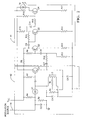
- FIG. 2 is a schematic of a conventional LCR-based oscillator circuit
- FIG. 3 is a schematic of an exemplary LCR-based oscillator circuit that is modified in accordance with the present invention.
- the alignment and temperature compensation system 10 generally includes a product 12 (e.g., a circuit board is used in the transmitter portion of a wireless headphone system) and a tester device 16 .
- the product 12 further includes an adjustable voltage source 22 , a voltage-controlled oscillator circuit 24 , and at least one infrared transmitter device 14 .
- the oscillator circuit 24 is adapted to receive a bias voltage from the adjustable voltage source 22 , where the bias voltage determines a portion of the capacitance associated with the oscillator circuit 24 . In this way, adjustments to the bias voltage control the center frequency of the oscillator circuit 24 .
- the oscillator circuit 24 in turn drives the infrared transmitter device 14 . While the following description is provided with reference to an infrared transmitter, it is readily understood that the broader aspects of the present invention are applicable to other types of wireless transmitter devices.
- the tester device 16 is provided for electronically aligning the center frequency associated with the infrared transmitter 14 .
- the tester device 16 generally includes an infrared receiver device 32 , a frequency detector component 34 and a frequency compensation component 36 .
- a communication link 38 enables the frequency compensation component 36 to effectuate any adjustments in the bias voltage generated by the adjustable voltage source 22 .
- a thermistor circuit 26 may optionally be connected to the voltage source 22 in order to improve the temperature stability of the oscillator circuit 24 .
- a recently manufactured product enters a test station that houses the tester device 16 .
- power is applied to the product 12 , whereby an output signal is generated from the infrared transmitter 14 .
- the infrared receiver device 32 is aligned with the product 12 such that it receives the output signal from the infrared transmitter 14 .
- the frequency detector component 34 determines the frequency associate with the output signal.
- the frequency compensation component 36 calculates an adjustment value for the bias voltage and then communicates this adjustment value via the communication link 38 to the product 12 .
- the product 12 is then able adjust the bias voltage generated by the adjustable voltage source 22 .
- the alignment process may be repeated until the desired center frequency for the product is achieved. It is envisioned that the frequency compensation component 36 may also calculate the offset between the frequency associated with output signal and the desired frequency, and then the product 12 would compute the appropriate adjustment value for the bias voltage.
- FIG. 2 For illustration purposes, a detailed schematic of a conventional LCR-based oscillator circuit 42 is shown in FIG. 2 .
- the oscillator 42 is adapted to receive a modulated input signal 44 .
- the output of the oscillator circuit 42 is then used to drive one or more infrared emitter diodes D 2 .
- An amplification circuit 44 may optionally be used to boost the drive signal to infrared emitter diode D 2 .
- an exemplary three-stage amplifier circuit is shown in FIG. 2 .
- the oscillator circuit is 42 further defined as a Hartley oscillator circuit.
- the principal components of the Hartley oscillator circuit include a first resistor R 5 and an inductor L 2 which is tapped through the use of a second resistor R 6 to form two inductors.
- the capacitor portion of the oscillator circuit is derived from a first capacitor C 2 in series with the capacitance value associated with a varactor diode D 1 which collectively are positioned in parallel with a second capacitor C 4 .
- the nominal capacitance provided by the varactor diode D 1 is fix biased by the values of two additional resistors, R 2 and R 4 .
- the remainder of the oscillator circuit 42 includes a first transistor Q 1 , another resistor R 7 and two additional capacitors C 6 and C 5 .
- the inductor L 2 must be mechanically aligned to set the desired center frequency of the oscillator.
- a Hartley oscillator circuit is presently preferred, it is envisioned that other types of voltage-controlled oscillator circuits fall within the broader scope of the present invention.
- FIG. 3 a similar LCR-based oscillator circuit 50 is modified in order to facilitate electronic alignment of the center frequency in accordance with the present invention.
- the oscillator circuit has been adapted to receive a bias voltage from an adjustable voltage source, but otherwise the basic components and principles of operation are generally as described above. More specifically, resistor R 4 is connected via a filter circuit 52 to a microprocessor 54 . In operation, the microprocessor 54 controls the bias voltage applied to the varactor diode D 1 . By controlling the bias voltage, the microprocessor is able to control the capacitance value across the varactor diode D 1 which in turn determines the center frequency of the oscillator circuit.
- the filter circuit 52 is used to smooth the pulse width modulated output signal from the microprocessor 54 into a clean DC bias voltage that can be input into the oscillator circuit 50 . It is envisioned that other types of filtering circuits may be used to achieve the appropriate signal form for inputting into the oscillator circuit 50 .
- a thermistor circuit 56 may be connected to the microprocessor 54 .
- the thermistor circuit 56 generates an input voltage signal proportional to the ambient temperature adjacent the oscillator circuit 50 .
- an appropriate algorithm or look-up table may be incorporated into the microprocessor 54 and used to translate a temperature change into a frequency shift, whereby the bias voltage can be adjusted to achieve the desired center frequency.
Landscapes
- Engineering & Computer Science (AREA)
- Computer Hardware Design (AREA)
- Microelectronics & Electronic Packaging (AREA)
- Inductance-Capacitance Distribution Constants And Capacitance-Resistance Oscillators (AREA)
Abstract
A method is provided for aligning the center frequency of an infrared transmitter. The method comprises the steps of: (a) providing a voltage-controlled oscillator for driving the infrared transmitter, where the oscillator is adapted to receive a bias voltage from a microprocessor; (b) applying a bias voltage to the oscillator; (c) receiving an output signal from the infrared transmitter into an infrared receiver; (d) determining a frequency associated with the output signal; and (e) adjusting the bias voltage based on the frequency associated with the output signal, thereby aligning the center frequency of the infrared transmitter.
Description
The present invention relates generally to an oscillator circuit associated with a transmitter device and, more particularly, to a method for electronically aligning the frequency of an oscillator circuit that may be used to drive an infrared transmitter.
An infrared transmitter is designed to broadcast a modulated signal about a carrier frequency, and thus operates in conjunction with an oscillator circuit. It is well known to use a programmable phase lock loop (PLL) design to synthesize the frequency of the oscillator circuit. In this case, a microprocessor may be used in conjunction with the phase lock loop circuit to control the frequency of the oscillator circuit. Although PLL-controlled oscillators achieve good control over the center frequency, these types of circuits typically cost more than a conventional LCR-based oscillator.
In contrast, conventional LCR-based oscillators provide open loop control over the center frequency. Due to variations in the manufacturing process, the center frequency may vary between oscillators. Without a way to electrically control the center frequency of the oscillator, many well known mechanical alignment techniques are typically incorporated into the manufacturing process. In this way, the desired center frequency of the oscillator is accurately established. Unfortunately, manual alignment further increases the manufacturing costs associated with these types of oscillator circuits. The cost associated with mechanical alignment becomes more critical as the circuits are replicated in order to provide multiple channels within a single application.
Therefore, it is desirable to provide a method for electronically aligning the center frequency of an LCR-based oscillator circuit that may be used to drive an infrared transmitter.
In accordance with the present invention, a method is provided for aligning the center frequency of an infrared transmitter. The method comprises the steps of: (a) providing a voltage-controlled oscillator for driving the infrared transmitter, where the oscillator is adapted to receive a bias voltage from a microprocessor; (b) applying a bias voltage to the oscillator; (c) receiving an output signal from the infrared transmitter into an infrared receiver; (d) determining a frequency associated with the output signal; and (e) adjusting the bias voltage based on the frequency associated with the output signal, thereby aligning the center frequency of the infrared transmitter.
For a more complete understanding of the invention, its objects and advantages, refer to the following specification and to the accompanying drawings.
FIG. 1 is a block diagram of an alignment and temperature compensation system for an infrared transmitter in accordance with the present invention;
FIG. 2 is a schematic of a conventional LCR-based oscillator circuit; and
FIG. 3 is a schematic of an exemplary LCR-based oscillator circuit that is modified in accordance with the present invention.
An alignment and temperature compensation system 10 embodying features of the present invention is depicted in FIG. 1. The alignment and temperature compensation system 10 generally includes a product 12 (e.g., a circuit board is used in the transmitter portion of a wireless headphone system) and a tester device 16. The product 12 further includes an adjustable voltage source 22, a voltage-controlled oscillator circuit 24, and at least one infrared transmitter device 14. The oscillator circuit 24 is adapted to receive a bias voltage from the adjustable voltage source 22, where the bias voltage determines a portion of the capacitance associated with the oscillator circuit 24. In this way, adjustments to the bias voltage control the center frequency of the oscillator circuit 24. The oscillator circuit 24 in turn drives the infrared transmitter device 14. While the following description is provided with reference to an infrared transmitter, it is readily understood that the broader aspects of the present invention are applicable to other types of wireless transmitter devices.
The tester device 16 is provided for electronically aligning the center frequency associated with the infrared transmitter 14. The tester device 16 generally includes an infrared receiver device 32, a frequency detector component 34 and a frequency compensation component 36. A communication link 38 enables the frequency compensation component 36 to effectuate any adjustments in the bias voltage generated by the adjustable voltage source 22. As will be more fully explained below, a thermistor circuit 26 may optionally be connected to the voltage source 22 in order to improve the temperature stability of the oscillator circuit 24.
In accordance with the present invention, a recently manufactured product enters a test station that houses the tester device 16. Rather than mechanically aligning the oscillator circuit 24, power is applied to the product 12, whereby an output signal is generated from the infrared transmitter 14. The infrared receiver device 32 is aligned with the product 12 such that it receives the output signal from the infrared transmitter 14. The frequency detector component 34 determines the frequency associate with the output signal. In view of the desired center frequency, the frequency compensation component 36 calculates an adjustment value for the bias voltage and then communicates this adjustment value via the communication link 38 to the product 12.
In response to the adjustment value, the product 12 is then able adjust the bias voltage generated by the adjustable voltage source 22. The alignment process may be repeated until the desired center frequency for the product is achieved. It is envisioned that the frequency compensation component 36 may also calculate the offset between the frequency associated with output signal and the desired frequency, and then the product 12 would compute the appropriate adjustment value for the bias voltage.
For illustration purposes, a detailed schematic of a conventional LCR-based oscillator circuit 42 is shown in FIG. 2. The oscillator 42 is adapted to receive a modulated input signal 44. The output of the oscillator circuit 42 is then used to drive one or more infrared emitter diodes D2. An amplification circuit 44 may optionally be used to boost the drive signal to infrared emitter diode D2. Although the invention is not limited thereby, an exemplary three-stage amplifier circuit is shown in FIG. 2.
The oscillator circuit is 42 further defined as a Hartley oscillator circuit. The principal components of the Hartley oscillator circuit include a first resistor R5 and an inductor L2 which is tapped through the use of a second resistor R6 to form two inductors. The capacitor portion of the oscillator circuit is derived from a first capacitor C2 in series with the capacitance value associated with a varactor diode D1 which collectively are positioned in parallel with a second capacitor C4. The nominal capacitance provided by the varactor diode D1 is fix biased by the values of two additional resistors, R2 and R4. The remainder of the oscillator circuit 42 includes a first transistor Q1, another resistor R7 and two additional capacitors C6 and C5. In this embodiment, the inductor L2 must be mechanically aligned to set the desired center frequency of the oscillator. Although a Hartley oscillator circuit is presently preferred, it is envisioned that other types of voltage-controlled oscillator circuits fall within the broader scope of the present invention.
In FIG. 3, a similar LCR-based oscillator circuit 50 is modified in order to facilitate electronic alignment of the center frequency in accordance with the present invention. The oscillator circuit has been adapted to receive a bias voltage from an adjustable voltage source, but otherwise the basic components and principles of operation are generally as described above. More specifically, resistor R4 is connected via a filter circuit 52 to a microprocessor 54. In operation, the microprocessor 54 controls the bias voltage applied to the varactor diode D1. By controlling the bias voltage, the microprocessor is able to control the capacitance value across the varactor diode D1 which in turn determines the center frequency of the oscillator circuit. As result, the microprocessor provides software control over the center frequency of the oscillator and thus eliminates the need for mechanical alignment of the oscillator. The filter circuit 52 is used to smooth the pulse width modulated output signal from the microprocessor 54 into a clean DC bias voltage that can be input into the oscillator circuit 50. It is envisioned that other types of filtering circuits may be used to achieve the appropriate signal form for inputting into the oscillator circuit 50.
To improve temperature stability, a thermistor circuit 56 may be connected to the microprocessor 54. The thermistor circuit 56 generates an input voltage signal proportional to the ambient temperature adjacent the oscillator circuit 50. As will be apparent to one skilled in the art, an appropriate algorithm or look-up table may be incorporated into the microprocessor 54 and used to translate a temperature change into a frequency shift, whereby the bias voltage can be adjusted to achieve the desired center frequency.
While the above description constitutes the preferred embodiment of the invention, it will be appreciated that the invention is susceptible to modification, variation, and change without departing from the proper scope or fair meaning of the accompanying claims.
Claims (8)
1. A method for aligning the frequency of a transmitter device, comprising the steps of:
providing a voltage-controlled oscillator for driving the transmitter device and an amplifier circuit interposed between the oscillator and the transmitter device, wherein the oscillator is adapted to receive a bias voltage from an adjustable voltage source;
applying a bias voltage to the oscillator; and
adjusting to bias voltage from the adjustable voltage source, thereby aligning the frequency of the transmitter device.
2. The method of claim 1 wherein the step of adjusting the bias voltage further comprises the steps of:
receiving an output signal from the transmitter device into a receiver device;
determining a frequency associated with the output signal; and
adjusting the bias voltage from the adjustable voltage source based on the frequency associated with the output signal from the transmitter device.
3. The method of claim 1 wherein the step of providing a voltage-controlled oscillator further comprises using a varactor diode to provide a portion of the capacitance associated with the oscillator and the varactor diode is adapted to receive the bias voltage from the adjustable voltage source.
4. The method of claim 1 wherein the step of providing a voltage-controlled oscillator further comprises using a Hartley oscillator circuit.
5. The method of claim 1 wherein the step of providing a voltage-controlled oscillator further comprises using a microprocessor as the adjustable voltage source.
6. The method of claim 5 further comprising the step of using a thermistor circuit connected to the microprocessor for providing a voltage level proportional to the ambient temperature adjacent to the oscillator.
7. The method of claim 6 further comprising the step of adjusting the bias voltage based on the voltage level from the thermistor circuit, thereby improving the temperature stability of the oscillator circuit.
8. A method for aligning the center frequency of an infrared transmitter, comprising the steps of:
providing a voltage-controlled oscillator for driving the infrared transmitter and an amplifier circuit interposed between the oscillator and the infrared transmitter, wherein the oscillator is adapted to receive a bias voltage from a microprocessor;
applying a bias voltage to the oscillator;
receiving and output signal from the infrared transmitter into an infrared receiver;
determining a frequency associated with the output signal; and
adjusting to bias voltage from the microprocessor based on the frequency associated with the output signal, thereby aligning the center frequency of the infrared transmitter.
Priority Applications (1)
| Application Number | Priority Date | Filing Date | Title |
|---|---|---|---|
| US09/644,445 US6711518B1 (en) | 2000-08-23 | 2000-08-23 | Method for electronically aligning the frequency of an infrared transmitter |
Applications Claiming Priority (1)
| Application Number | Priority Date | Filing Date | Title |
|---|---|---|---|
| US09/644,445 US6711518B1 (en) | 2000-08-23 | 2000-08-23 | Method for electronically aligning the frequency of an infrared transmitter |
Publications (1)
| Publication Number | Publication Date |
|---|---|
| US6711518B1 true US6711518B1 (en) | 2004-03-23 |
Family
ID=31978964
Family Applications (1)
| Application Number | Title | Priority Date | Filing Date |
|---|---|---|---|
| US09/644,445 Expired - Fee Related US6711518B1 (en) | 2000-08-23 | 2000-08-23 | Method for electronically aligning the frequency of an infrared transmitter |
Country Status (1)
| Country | Link |
|---|---|
| US (1) | US6711518B1 (en) |
Cited By (2)
| Publication number | Priority date | Publication date | Assignee | Title |
|---|---|---|---|---|
| US20070057737A1 (en) * | 2005-09-14 | 2007-03-15 | Freescale Semiconductor, Inc. | Compensation for modulation distortion |
| CN107908214A (en) * | 2017-11-01 | 2018-04-13 | 中色科技股份有限公司 | Centering and deviation-rectifying control system for uncoiling or coiling machine |
Citations (2)
| Publication number | Priority date | Publication date | Assignee | Title |
|---|---|---|---|---|
| US5019791A (en) * | 1990-08-06 | 1991-05-28 | All Systems, Inc. | Millimeter wave oscillator with flicker (1/f) noise suppression |
| US6323739B1 (en) * | 2000-01-18 | 2001-11-27 | Denso Corporation | Adjusting untrimmed VCO during operation of the oscillator |
-
2000
- 2000-08-23 US US09/644,445 patent/US6711518B1/en not_active Expired - Fee Related
Patent Citations (2)
| Publication number | Priority date | Publication date | Assignee | Title |
|---|---|---|---|---|
| US5019791A (en) * | 1990-08-06 | 1991-05-28 | All Systems, Inc. | Millimeter wave oscillator with flicker (1/f) noise suppression |
| US6323739B1 (en) * | 2000-01-18 | 2001-11-27 | Denso Corporation | Adjusting untrimmed VCO during operation of the oscillator |
Cited By (2)
| Publication number | Priority date | Publication date | Assignee | Title |
|---|---|---|---|---|
| US20070057737A1 (en) * | 2005-09-14 | 2007-03-15 | Freescale Semiconductor, Inc. | Compensation for modulation distortion |
| CN107908214A (en) * | 2017-11-01 | 2018-04-13 | 中色科技股份有限公司 | Centering and deviation-rectifying control system for uncoiling or coiling machine |
Similar Documents
| Publication | Publication Date | Title |
|---|---|---|
| US5105162A (en) | Electrically tuned RF receiver, apparatus and method therefor | |
| EP0705497B1 (en) | Low noise oscillators and tracking filters | |
| WO2000070757A1 (en) | Enhanced lc filter with tunable q | |
| US20090261876A1 (en) | Voltage controlled oscillator | |
| CA2534370A1 (en) | Tunable frequency, low phase noise and low thermal drift oscillator | |
| JP3369557B2 (en) | Oscillator with bias and buffer circuits formed inside die mounted with elements distributed over ceramic substrate | |
| US6784753B2 (en) | Method for modulating an output voltage of a RF transmitter circuit, and RF transmitter circuit | |
| US5708394A (en) | Bridge-stabilized oscillator circuit and method | |
| US6771139B2 (en) | Microwave pulse generator | |
| US7209016B2 (en) | Variable capacitance circuit arrangement | |
| US6091309A (en) | Tunable low noise oscillator using delay lines and ring mode trap filter | |
| JPH0697730B2 (en) | Electronically tuned FM receiver | |
| CA2379869C (en) | Variable oscillator | |
| KR100274325B1 (en) | Negative feedback control circuit having a common line for input and output signal | |
| US5793261A (en) | Saw stabilized FSK oscillator circuit | |
| JP3875744B2 (en) | Oscillator | |
| EP0325394A2 (en) | Transmitter having PLL circuit | |
| US7187247B2 (en) | Variable capacitance circuit arrangement | |
| US11527991B2 (en) | Circuit for extended voltage control oscillator gain linearity | |
| US4630008A (en) | Direct FM crystal-controlled oscillator | |
| EP0267332A1 (en) | Direct FM crystal-controlled oscillator | |
| US5801592A (en) | Amplitude stabilized oscillator circuit | |
| JPH0851336A (en) | Low-pass filter capable of automatic calibration | |
| JP3853176B2 (en) | ASK modulation circuit | |
| KR920000459Y1 (en) | Frequency modulator |
Legal Events
| Date | Code | Title | Description |
|---|---|---|---|
| AS | Assignment |
Owner name: DELPHI TECHNOLOGIES, INC., MICHIGAN Free format text: ASSIGNMENT OF ASSIGNORS INTEREST;ASSIGNOR:DAVIS, J. ROGER;REEL/FRAME:011696/0113 Effective date: 20010316 |
|
| FPAY | Fee payment |
Year of fee payment: 4 |
|
| REMI | Maintenance fee reminder mailed | ||
| LAPS | Lapse for failure to pay maintenance fees | ||
| STCH | Information on status: patent discontinuation |
Free format text: PATENT EXPIRED DUE TO NONPAYMENT OF MAINTENANCE FEES UNDER 37 CFR 1.362 |
|
| FP | Lapsed due to failure to pay maintenance fee |
Effective date: 20120323 |