US6673926B2 - Process of preparing 3S-3-amino-3-aryl proprionic acid and derivatives thereof - Google Patents
Process of preparing 3S-3-amino-3-aryl proprionic acid and derivatives thereof Download PDFInfo
- Publication number
- US6673926B2 US6673926B2 US10/021,369 US2136901A US6673926B2 US 6673926 B2 US6673926 B2 US 6673926B2 US 2136901 A US2136901 A US 2136901A US 6673926 B2 US6673926 B2 US 6673926B2
- Authority
- US
- United States
- Prior art keywords
- formula
- compound
- alkyl
- pyridyl
- acid
- Prior art date
- Legal status (The legal status is an assumption and is not a legal conclusion. Google has not performed a legal analysis and makes no representation as to the accuracy of the status listed.)
- Expired - Lifetime
Links
- 238000000034 method Methods 0.000 title claims description 37
- XEKOWRVHYACXOJ-UHFFFAOYSA-N Ethyl acetate Chemical group CCOC(C)=O XEKOWRVHYACXOJ-UHFFFAOYSA-N 0.000 claims description 103
- 150000001875 compounds Chemical class 0.000 claims description 57
- 125000000217 alkyl group Chemical group 0.000 claims description 31
- -1 alkyl acetate Chemical compound 0.000 claims description 30
- KRKNYBCHXYNGOX-UHFFFAOYSA-N citric acid Chemical compound OC(=O)CC(O)(C(O)=O)CC(O)=O KRKNYBCHXYNGOX-UHFFFAOYSA-N 0.000 claims description 27
- 125000004076 pyridyl group Chemical group 0.000 claims description 27
- 239000002253 acid Chemical group 0.000 claims description 25
- KWGRBVOPPLSCSI-PSASIEDQSA-N (1s,2r)-2-(methylamino)-1-phenylpropan-1-ol Chemical compound CN[C@H](C)[C@@H](O)C1=CC=CC=C1 KWGRBVOPPLSCSI-PSASIEDQSA-N 0.000 claims description 20
- 238000006243 chemical reaction Methods 0.000 claims description 20
- 150000003839 salts Chemical class 0.000 claims description 19
- XLYOFNOQVPJJNP-UHFFFAOYSA-N water Substances O XLYOFNOQVPJJNP-UHFFFAOYSA-N 0.000 claims description 19
- 125000001997 phenyl group Chemical group [H]C1=C([H])C([H])=C(*)C([H])=C1[H] 0.000 claims description 15
- KWGRBVOPPLSCSI-UHFFFAOYSA-N d-ephedrine Natural products CNC(C)C(O)C1=CC=CC=C1 KWGRBVOPPLSCSI-UHFFFAOYSA-N 0.000 claims description 14
- 125000003710 aryl alkyl group Chemical group 0.000 claims description 11
- 125000001424 substituent group Chemical group 0.000 claims description 11
- WBHQBSYUUJJSRZ-UHFFFAOYSA-M sodium bisulfate Chemical compound [Na+].OS([O-])(=O)=O WBHQBSYUUJJSRZ-UHFFFAOYSA-M 0.000 claims description 9
- 229910000342 sodium bisulfate Inorganic materials 0.000 claims description 9
- 125000003349 3-pyridyl group Chemical group N1=C([H])C([*])=C([H])C([H])=C1[H] 0.000 claims description 8
- 125000003545 alkoxy group Chemical group 0.000 claims description 8
- 229910052736 halogen Inorganic materials 0.000 claims description 8
- 150000002367 halogens Chemical class 0.000 claims description 8
- JTNCEQNHURODLX-UHFFFAOYSA-N 2-phenylethanimidamide Chemical compound NC(=N)CC1=CC=CC=C1 JTNCEQNHURODLX-UHFFFAOYSA-N 0.000 claims description 7
- 229910000343 potassium bisulfate Inorganic materials 0.000 claims description 7
- 150000007529 inorganic bases Chemical class 0.000 claims description 6
- 239000002904 solvent Substances 0.000 claims description 6
- 125000002496 methyl group Chemical group [H]C([H])([H])* 0.000 claims description 5
- 125000000714 pyrimidinyl group Chemical group 0.000 claims description 5
- LMBFAGIMSUYTBN-MPZNNTNKSA-N teixobactin Chemical compound C([C@H](C(=O)N[C@@H]([C@@H](C)CC)C(=O)N[C@@H](CO)C(=O)N[C@H](CCC(N)=O)C(=O)N[C@H]([C@@H](C)CC)C(=O)N[C@@H]([C@@H](C)CC)C(=O)N[C@@H](CO)C(=O)N[C@H]1C(N[C@@H](C)C(=O)N[C@@H](C[C@@H]2NC(=N)NC2)C(=O)N[C@H](C(=O)O[C@H]1C)[C@@H](C)CC)=O)NC)C1=CC=CC=C1 LMBFAGIMSUYTBN-MPZNNTNKSA-N 0.000 claims description 4
- 125000004105 2-pyridyl group Chemical group N1=C([*])C([H])=C([H])C([H])=C1[H] 0.000 claims description 3
- 125000000339 4-pyridyl group Chemical group N1=C([H])C([H])=C([*])C([H])=C1[H] 0.000 claims description 3
- COVZYZSDYWQREU-UHFFFAOYSA-N Busulfan Chemical compound CS(=O)(=O)OCCCCOS(C)(=O)=O COVZYZSDYWQREU-UHFFFAOYSA-N 0.000 claims description 3
- 229910052739 hydrogen Inorganic materials 0.000 claims description 3
- 239000001257 hydrogen Substances 0.000 claims description 3
- 125000004435 hydrogen atom Chemical group [H]* 0.000 claims description 3
- 125000006297 carbonyl amino group Chemical group [H]N([*:2])C([*:1])=O 0.000 claims 2
- XBDQKXXYIPTUBI-UHFFFAOYSA-N dimethylselenoniopropionate Natural products CCC(O)=O XBDQKXXYIPTUBI-UHFFFAOYSA-N 0.000 abstract description 44
- 235000019260 propionic acid Nutrition 0.000 abstract description 22
- 238000004519 manufacturing process Methods 0.000 abstract description 2
- OKKJLVBELUTLKV-UHFFFAOYSA-N Methanol Chemical compound OC OKKJLVBELUTLKV-UHFFFAOYSA-N 0.000 description 75
- 239000000243 solution Substances 0.000 description 52
- HEMHJVSKTPXQMS-UHFFFAOYSA-M Sodium hydroxide Chemical compound [OH-].[Na+] HEMHJVSKTPXQMS-UHFFFAOYSA-M 0.000 description 51
- 239000007787 solid Substances 0.000 description 42
- 239000000203 mixture Substances 0.000 description 34
- 229940093499 ethyl acetate Drugs 0.000 description 32
- 235000019439 ethyl acetate Nutrition 0.000 description 32
- RTZKZFJDLAIYFH-UHFFFAOYSA-N ether Substances CCOCC RTZKZFJDLAIYFH-UHFFFAOYSA-N 0.000 description 31
- 239000000047 product Substances 0.000 description 31
- LFQSCWFLJHTTHZ-UHFFFAOYSA-N Ethanol Chemical compound CCO LFQSCWFLJHTTHZ-UHFFFAOYSA-N 0.000 description 28
- WYURNTSHIVDZCO-UHFFFAOYSA-N Tetrahydrofuran Chemical compound C1CCOC1 WYURNTSHIVDZCO-UHFFFAOYSA-N 0.000 description 26
- 125000002915 carbonyl group Chemical group [*:2]C([*:1])=O 0.000 description 26
- 125000004213 tert-butoxy group Chemical group [H]C([H])([H])C(O*)(C([H])([H])[H])C([H])([H])[H] 0.000 description 26
- 238000003756 stirring Methods 0.000 description 25
- 239000002002 slurry Substances 0.000 description 22
- 229940095574 propionic acid Drugs 0.000 description 21
- YXFVVABEGXRONW-UHFFFAOYSA-N Toluene Chemical compound CC1=CC=CC=C1 YXFVVABEGXRONW-UHFFFAOYSA-N 0.000 description 20
- IUVKMZGDUIUOCP-BTNSXGMBSA-N quinbolone Chemical compound O([C@H]1CC[C@H]2[C@H]3[C@@H]([C@]4(C=CC(=O)C=C4CC3)C)CC[C@@]21C)C1=CCCC1 IUVKMZGDUIUOCP-BTNSXGMBSA-N 0.000 description 20
- 238000010992 reflux Methods 0.000 description 18
- DYHSDKLCOJIUFX-UHFFFAOYSA-N tert-butoxycarbonyl anhydride Chemical compound CC(C)(C)OC(=O)OC(=O)OC(C)(C)C DYHSDKLCOJIUFX-UHFFFAOYSA-N 0.000 description 18
- 125000001072 heteroaryl group Chemical group 0.000 description 14
- YLQBMQCUIZJEEH-UHFFFAOYSA-N tetrahydrofuran Natural products C=1C=COC=1 YLQBMQCUIZJEEH-UHFFFAOYSA-N 0.000 description 13
- YMWUJEATGCHHMB-UHFFFAOYSA-N Dichloromethane Chemical compound ClCCl YMWUJEATGCHHMB-UHFFFAOYSA-N 0.000 description 12
- OFOBLEOULBTSOW-UHFFFAOYSA-N Malonic acid Chemical compound OC(=O)CC(O)=O OFOBLEOULBTSOW-UHFFFAOYSA-N 0.000 description 12
- 239000012065 filter cake Substances 0.000 description 12
- RYHBNJHYFVUHQT-UHFFFAOYSA-N 1,4-Dioxane Chemical compound C1COCCO1 RYHBNJHYFVUHQT-UHFFFAOYSA-N 0.000 description 10
- QOTCEJINJFHMLO-UHFFFAOYSA-N 3-amino-3-pyridin-3-ylpropanoic acid Chemical compound OC(=O)CC(N)C1=CC=CN=C1 QOTCEJINJFHMLO-UHFFFAOYSA-N 0.000 description 8
- 125000003118 aryl group Chemical group 0.000 description 8
- VEXZGXHMUGYJMC-UHFFFAOYSA-N Hydrochloric acid Chemical compound Cl VEXZGXHMUGYJMC-UHFFFAOYSA-N 0.000 description 7
- 0 S.[1*][C@@H](N)CC Chemical compound S.[1*][C@@H](N)CC 0.000 description 7
- 238000001914 filtration Methods 0.000 description 7
- 239000000843 powder Substances 0.000 description 7
- USFZMSVCRYTOJT-UHFFFAOYSA-N Ammonium acetate Chemical compound N.CC(O)=O USFZMSVCRYTOJT-UHFFFAOYSA-N 0.000 description 6
- 239000005695 Ammonium acetate Substances 0.000 description 6
- 235000019257 ammonium acetate Nutrition 0.000 description 6
- 229940043376 ammonium acetate Drugs 0.000 description 6
- 238000002425 crystallisation Methods 0.000 description 6
- 230000008025 crystallization Effects 0.000 description 6
- 238000001035 drying Methods 0.000 description 6
- 239000003960 organic solvent Substances 0.000 description 6
- 239000000725 suspension Substances 0.000 description 6
- 239000007864 aqueous solution Substances 0.000 description 5
- 239000000706 filtrate Substances 0.000 description 5
- 239000011541 reaction mixture Substances 0.000 description 5
- JXHZRQHZVYDRGX-UHFFFAOYSA-M sodium;hydrogen sulfate;hydrate Chemical compound [OH-].[Na+].OS(O)(=O)=O JXHZRQHZVYDRGX-UHFFFAOYSA-M 0.000 description 5
- FAPWRFPIFSIZLT-UHFFFAOYSA-M Sodium chloride Chemical compound [Na+].[Cl-] FAPWRFPIFSIZLT-UHFFFAOYSA-M 0.000 description 4
- DKGAVHZHDRPRBM-UHFFFAOYSA-N Tert-Butanol Chemical compound CC(C)(C)O DKGAVHZHDRPRBM-UHFFFAOYSA-N 0.000 description 4
- 239000008346 aqueous phase Substances 0.000 description 4
- 239000012043 crude product Substances 0.000 description 4
- 238000000605 extraction Methods 0.000 description 4
- 239000005457 ice water Substances 0.000 description 4
- 238000011031 large-scale manufacturing process Methods 0.000 description 4
- 239000000523 sample Substances 0.000 description 4
- 239000012265 solid product Substances 0.000 description 4
- 238000000967 suction filtration Methods 0.000 description 4
- 239000006188 syrup Substances 0.000 description 4
- 235000020357 syrup Nutrition 0.000 description 4
- KWGRBVOPPLSCSI-WPRPVWTQSA-N (-)-ephedrine Chemical compound CN[C@@H](C)[C@H](O)C1=CC=CC=C1 KWGRBVOPPLSCSI-WPRPVWTQSA-N 0.000 description 3
- VUVORVXMOLQFMO-UHFFFAOYSA-N 3-pyridin-3-ylprop-2-enoic acid Chemical compound OC(=O)C=CC1=CC=CN=C1 VUVORVXMOLQFMO-UHFFFAOYSA-N 0.000 description 3
- WMFOQBRAJBCJND-UHFFFAOYSA-M Lithium hydroxide Chemical compound [Li+].[OH-] WMFOQBRAJBCJND-UHFFFAOYSA-M 0.000 description 3
- KWYUFKZDYYNOTN-UHFFFAOYSA-M Potassium hydroxide Chemical compound [OH-].[K+] KWYUFKZDYYNOTN-UHFFFAOYSA-M 0.000 description 3
- 125000004432 carbon atom Chemical group C* 0.000 description 3
- 125000001495 ethyl group Chemical group [H]C([H])([H])C([H])([H])* 0.000 description 3
- 125000005842 heteroatom Chemical group 0.000 description 3
- IXCSERBJSXMMFS-UHFFFAOYSA-N hydrogen chloride Substances Cl.Cl IXCSERBJSXMMFS-UHFFFAOYSA-N 0.000 description 3
- 229910000041 hydrogen chloride Inorganic materials 0.000 description 3
- 230000020477 pH reduction Effects 0.000 description 3
- 238000000634 powder X-ray diffraction Methods 0.000 description 3
- QJZUKDFHGGYHMC-UHFFFAOYSA-N pyridine-3-carbaldehyde Chemical compound O=CC1=CC=CN=C1 QJZUKDFHGGYHMC-UHFFFAOYSA-N 0.000 description 3
- 238000011084 recovery Methods 0.000 description 3
- WSLDOOZREJYCGB-UHFFFAOYSA-N 1,2-Dichloroethane Chemical compound ClCCCl WSLDOOZREJYCGB-UHFFFAOYSA-N 0.000 description 2
- HEDRZPFGACZZDS-UHFFFAOYSA-N Chloroform Chemical compound ClC(Cl)Cl HEDRZPFGACZZDS-UHFFFAOYSA-N 0.000 description 2
- KFZMGEQAYNKOFK-UHFFFAOYSA-N Isopropanol Chemical compound CC(C)O KFZMGEQAYNKOFK-UHFFFAOYSA-N 0.000 description 2
- WHXSMMKQMYFTQS-UHFFFAOYSA-N Lithium Chemical compound [Li] WHXSMMKQMYFTQS-UHFFFAOYSA-N 0.000 description 2
- CDBYLPFSWZWCQE-UHFFFAOYSA-L Sodium Carbonate Chemical compound [Na+].[Na+].[O-]C([O-])=O CDBYLPFSWZWCQE-UHFFFAOYSA-L 0.000 description 2
- PMZURENOXWZQFD-UHFFFAOYSA-L Sodium Sulfate Chemical compound [Na+].[Na+].[O-]S([O-])(=O)=O PMZURENOXWZQFD-UHFFFAOYSA-L 0.000 description 2
- 238000013019 agitation Methods 0.000 description 2
- 239000005557 antagonist Substances 0.000 description 2
- 230000015572 biosynthetic process Effects 0.000 description 2
- 238000009835 boiling Methods 0.000 description 2
- 229910052799 carbon Inorganic materials 0.000 description 2
- 238000004587 chromatography analysis Methods 0.000 description 2
- 239000000839 emulsion Substances 0.000 description 2
- 238000001704 evaporation Methods 0.000 description 2
- 230000008020 evaporation Effects 0.000 description 2
- 239000000284 extract Substances 0.000 description 2
- 239000007789 gas Substances 0.000 description 2
- 239000000543 intermediate Substances 0.000 description 2
- 229910052740 iodine Inorganic materials 0.000 description 2
- ZXEKIIBDNHEJCQ-UHFFFAOYSA-N isobutanol Chemical compound CC(C)CO ZXEKIIBDNHEJCQ-UHFFFAOYSA-N 0.000 description 2
- 125000001786 isothiazolyl group Chemical group 0.000 description 2
- 229910052744 lithium Inorganic materials 0.000 description 2
- 238000010899 nucleation Methods 0.000 description 2
- 239000012074 organic phase Substances 0.000 description 2
- 229910052760 oxygen Inorganic materials 0.000 description 2
- BWHMMNNQKKPAPP-UHFFFAOYSA-L potassium carbonate Chemical compound [K+].[K+].[O-]C([O-])=O BWHMMNNQKKPAPP-UHFFFAOYSA-L 0.000 description 2
- 239000011780 sodium chloride Substances 0.000 description 2
- 125000003107 substituted aryl group Chemical group 0.000 description 2
- 125000000999 tert-butyl group Chemical group [H]C([H])([H])C(*)(C([H])([H])[H])C([H])([H])[H] 0.000 description 2
- VDZOOKBUILJEDG-UHFFFAOYSA-M tetrabutylammonium hydroxide Chemical compound [OH-].CCCC[N+](CCCC)(CCCC)CCCC VDZOOKBUILJEDG-UHFFFAOYSA-M 0.000 description 2
- 125000000008 (C1-C10) alkyl group Chemical group 0.000 description 1
- IJXJGQCXFSSHNL-QMMMGPOBSA-N (R)-(-)-2-Phenylglycinol Chemical compound OC[C@H](N)C1=CC=CC=C1 IJXJGQCXFSSHNL-QMMMGPOBSA-N 0.000 description 1
- 238000005160 1H NMR spectroscopy Methods 0.000 description 1
- GQWRNLFTLLZYBJ-UHFFFAOYSA-N 3-[(2-methylpropan-2-yl)oxycarbonylamino]-3-pyridin-3-ylpropanoic acid Chemical compound CC(C)(C)OC(=O)NC(CC(O)=O)C1=CC=CN=C1 GQWRNLFTLLZYBJ-UHFFFAOYSA-N 0.000 description 1
- LRDIEHDJWYRVPT-UHFFFAOYSA-N 4-amino-5-hydroxynaphthalene-1-sulfonic acid Chemical compound C1=CC(O)=C2C(N)=CC=C(S(O)(=O)=O)C2=C1 LRDIEHDJWYRVPT-UHFFFAOYSA-N 0.000 description 1
- ROSCFXKNBQZLFC-UHFFFAOYSA-N 5,6-dichloropyridine-3-carbaldehyde Chemical compound ClC1=CC(C=O)=CN=C1Cl ROSCFXKNBQZLFC-UHFFFAOYSA-N 0.000 description 1
- NGUVGKAEOFPLDT-UHFFFAOYSA-N 5-bromopyridine-3-carbaldehyde Chemical compound BrC1=CN=CC(C=O)=C1 NGUVGKAEOFPLDT-UHFFFAOYSA-N 0.000 description 1
- AFWWKZCPPRPDQK-UHFFFAOYSA-N 6-chloropyridine-3-carbaldehyde Chemical compound ClC1=CC=C(C=O)C=N1 AFWWKZCPPRPDQK-UHFFFAOYSA-N 0.000 description 1
- IMWMEIWYPWVABQ-UHFFFAOYSA-N 6-methylpyridine-3-carbaldehyde Chemical compound CC1=CC=C(C=O)C=N1 IMWMEIWYPWVABQ-UHFFFAOYSA-N 0.000 description 1
- ZCYVEMRRCGMTRW-UHFFFAOYSA-N 7553-56-2 Chemical compound [I] ZCYVEMRRCGMTRW-UHFFFAOYSA-N 0.000 description 1
- 206010002388 Angina unstable Diseases 0.000 description 1
- 206010003178 Arterial thrombosis Diseases 0.000 description 1
- WKBOTKDWSSQWDR-UHFFFAOYSA-N Bromine atom Chemical compound [Br] WKBOTKDWSSQWDR-UHFFFAOYSA-N 0.000 description 1
- YLKTZWNFPFYVGC-PPHPATTJSA-N CC(C)(C)OC(=O)N[C@@H](CC(=O)O)C1=CN=CC=C1.S Chemical compound CC(C)(C)OC(=O)N[C@@H](CC(=O)O)C1=CN=CC=C1.S YLKTZWNFPFYVGC-PPHPATTJSA-N 0.000 description 1
- ZAMOUSCENKQFHK-UHFFFAOYSA-N Chlorine atom Chemical compound [Cl] ZAMOUSCENKQFHK-UHFFFAOYSA-N 0.000 description 1
- 108090000790 Enzymes Proteins 0.000 description 1
- 102000004190 Enzymes Human genes 0.000 description 1
- 108010012088 Fibrinogen Receptors Proteins 0.000 description 1
- PXGOKWXKJXAPGV-UHFFFAOYSA-N Fluorine Chemical compound FF PXGOKWXKJXAPGV-UHFFFAOYSA-N 0.000 description 1
- 206010061218 Inflammation Diseases 0.000 description 1
- CSNNHWWHGAXBCP-UHFFFAOYSA-L Magnesium sulfate Chemical compound [Mg+2].[O-][S+2]([O-])([O-])[O-] CSNNHWWHGAXBCP-UHFFFAOYSA-L 0.000 description 1
- NTIZESTWPVYFNL-UHFFFAOYSA-N Methyl isobutyl ketone Chemical compound CC(C)CC(C)=O NTIZESTWPVYFNL-UHFFFAOYSA-N 0.000 description 1
- UIHCLUNTQKBZGK-UHFFFAOYSA-N Methyl isobutyl ketone Natural products CCC(C)C(C)=O UIHCLUNTQKBZGK-UHFFFAOYSA-N 0.000 description 1
- 238000006845 Michael addition reaction Methods 0.000 description 1
- 108010073038 Penicillin Amidase Proteins 0.000 description 1
- XBDQKXXYIPTUBI-UHFFFAOYSA-M Propionate Chemical compound CCC([O-])=O XBDQKXXYIPTUBI-UHFFFAOYSA-M 0.000 description 1
- 206010038563 Reocclusion Diseases 0.000 description 1
- 208000007536 Thrombosis Diseases 0.000 description 1
- RTAQQCXQSZGOHL-UHFFFAOYSA-N Titanium Chemical compound [Ti] RTAQQCXQSZGOHL-UHFFFAOYSA-N 0.000 description 1
- 208000007814 Unstable Angina Diseases 0.000 description 1
- 206010047249 Venous thrombosis Diseases 0.000 description 1
- KXKVLQRXCPHEJC-UHFFFAOYSA-N acetic acid trimethyl ester Natural products COC(C)=O KXKVLQRXCPHEJC-UHFFFAOYSA-N 0.000 description 1
- 238000005903 acid hydrolysis reaction Methods 0.000 description 1
- 230000002378 acidificating effect Effects 0.000 description 1
- 206010000891 acute myocardial infarction Diseases 0.000 description 1
- 125000005233 alkylalcohol group Chemical group 0.000 description 1
- 238000002399 angioplasty Methods 0.000 description 1
- 239000003146 anticoagulant agent Substances 0.000 description 1
- 229940111131 antiinflammatory and antirheumatic product propionic acid derivative Drugs 0.000 description 1
- 150000004945 aromatic hydrocarbons Chemical class 0.000 description 1
- 125000000499 benzofuranyl group Chemical group O1C(=CC2=C1C=CC=C2)* 0.000 description 1
- 125000004196 benzothienyl group Chemical group S1C(=CC2=C1C=CC=C2)* 0.000 description 1
- NDKBVBUGCNGSJJ-UHFFFAOYSA-M benzyltrimethylammonium hydroxide Chemical compound [OH-].C[N+](C)(C)CC1=CC=CC=C1 NDKBVBUGCNGSJJ-UHFFFAOYSA-M 0.000 description 1
- GDTBXPJZTBHREO-UHFFFAOYSA-N bromine Substances BrBr GDTBXPJZTBHREO-UHFFFAOYSA-N 0.000 description 1
- 229910052794 bromium Inorganic materials 0.000 description 1
- 150000001768 cations Chemical class 0.000 description 1
- 239000003153 chemical reaction reagent Substances 0.000 description 1
- 229910052801 chlorine Inorganic materials 0.000 description 1
- 239000000460 chlorine Substances 0.000 description 1
- QBKFLYWZRMHHRS-UHFFFAOYSA-N chloroform;1,4-dioxane Chemical compound ClC(Cl)Cl.C1COCCO1 QBKFLYWZRMHHRS-UHFFFAOYSA-N 0.000 description 1
- 238000007796 conventional method Methods 0.000 description 1
- 238000001816 cooling Methods 0.000 description 1
- 239000013078 crystal Substances 0.000 description 1
- 239000002274 desiccant Substances 0.000 description 1
- ZFTFAPZRGNKQPU-UHFFFAOYSA-N dicarbonic acid Chemical compound OC(=O)OC(O)=O ZFTFAPZRGNKQPU-UHFFFAOYSA-N 0.000 description 1
- 208000037265 diseases, disorders, signs and symptoms Diseases 0.000 description 1
- 208000035475 disorder Diseases 0.000 description 1
- 238000004821 distillation Methods 0.000 description 1
- 230000002255 enzymatic effect Effects 0.000 description 1
- 229960002179 ephedrine Drugs 0.000 description 1
- 229910052731 fluorine Inorganic materials 0.000 description 1
- 239000011737 fluorine Substances 0.000 description 1
- 125000003838 furazanyl group Chemical group 0.000 description 1
- 125000002541 furyl group Chemical group 0.000 description 1
- 239000011521 glass Substances 0.000 description 1
- 238000010438 heat treatment Methods 0.000 description 1
- 239000008241 heterogeneous mixture Substances 0.000 description 1
- 125000004356 hydroxy functional group Chemical group O* 0.000 description 1
- 125000002883 imidazolyl group Chemical group 0.000 description 1
- 150000002466 imines Chemical class 0.000 description 1
- 125000003453 indazolyl group Chemical group N1N=C(C2=C1C=CC=C2)* 0.000 description 1
- 125000003406 indolizinyl group Chemical group C=1(C=CN2C=CC=CC12)* 0.000 description 1
- 125000001041 indolyl group Chemical group 0.000 description 1
- 230000004054 inflammatory process Effects 0.000 description 1
- 239000002198 insoluble material Substances 0.000 description 1
- 201000004332 intermediate coronary syndrome Diseases 0.000 description 1
- 239000011630 iodine Substances 0.000 description 1
- 125000000959 isobutyl group Chemical group [H]C([H])([H])C([H])(C([H])([H])[H])C([H])([H])* 0.000 description 1
- 125000000904 isoindolyl group Chemical group C=1(NC=C2C=CC=CC12)* 0.000 description 1
- 125000001449 isopropyl group Chemical group [H]C([H])([H])C([H])(*)C([H])([H])[H] 0.000 description 1
- 125000005956 isoquinolyl group Chemical group 0.000 description 1
- 125000000842 isoxazolyl group Chemical group 0.000 description 1
- 150000002576 ketones Chemical class 0.000 description 1
- AFRJJFRNGGLMDW-UHFFFAOYSA-N lithium amide Chemical compound [Li+].[NH2-] AFRJJFRNGGLMDW-UHFFFAOYSA-N 0.000 description 1
- XGZVUEUWXADBQD-UHFFFAOYSA-L lithium carbonate Chemical compound [Li+].[Li+].[O-]C([O-])=O XGZVUEUWXADBQD-UHFFFAOYSA-L 0.000 description 1
- 229910052808 lithium carbonate Inorganic materials 0.000 description 1
- 239000000463 material Substances 0.000 description 1
- 230000001404 mediated effect Effects 0.000 description 1
- 229940043265 methyl isobutyl ketone Drugs 0.000 description 1
- 238000012544 monitoring process Methods 0.000 description 1
- 125000002950 monocyclic group Chemical group 0.000 description 1
- 125000004108 n-butyl group Chemical group [H]C([H])([H])C([H])([H])C([H])([H])C([H])([H])* 0.000 description 1
- 125000001280 n-hexyl group Chemical group C(CCCCC)* 0.000 description 1
- 125000000740 n-pentyl group Chemical group [H]C([H])([H])C([H])([H])C([H])([H])C([H])([H])C([H])([H])* 0.000 description 1
- 125000004123 n-propyl group Chemical group [H]C([H])([H])C([H])([H])C([H])([H])* 0.000 description 1
- 125000001624 naphthyl group Chemical group 0.000 description 1
- 229910052757 nitrogen Inorganic materials 0.000 description 1
- 125000002971 oxazolyl group Chemical group 0.000 description 1
- 239000007800 oxidant agent Substances 0.000 description 1
- 238000007248 oxidative elimination reaction Methods 0.000 description 1
- BSCHIACBONPEOB-UHFFFAOYSA-N oxolane;hydrate Chemical compound O.C1CCOC1 BSCHIACBONPEOB-UHFFFAOYSA-N 0.000 description 1
- 239000001301 oxygen Substances 0.000 description 1
- 239000012071 phase Substances 0.000 description 1
- 229910000027 potassium carbonate Inorganic materials 0.000 description 1
- 238000001556 precipitation Methods 0.000 description 1
- BDERNNFJNOPAEC-UHFFFAOYSA-N propan-1-ol Chemical compound CCCO BDERNNFJNOPAEC-UHFFFAOYSA-N 0.000 description 1
- FXSZGKYGUFCBQY-UHFFFAOYSA-N propanoic acid;dihydrochloride Chemical compound Cl.Cl.CCC(O)=O FXSZGKYGUFCBQY-UHFFFAOYSA-N 0.000 description 1
- 239000008213 purified water Substances 0.000 description 1
- 125000000561 purinyl group Chemical group N1=C(N=C2N=CNC2=C1)* 0.000 description 1
- 125000004309 pyranyl group Chemical group O1C(C=CC=C1)* 0.000 description 1
- 125000003373 pyrazinyl group Chemical group 0.000 description 1
- 125000003226 pyrazolyl group Chemical group 0.000 description 1
- 125000002098 pyridazinyl group Chemical group 0.000 description 1
- 125000000168 pyrrolyl group Chemical group 0.000 description 1
- 125000005493 quinolyl group Chemical group 0.000 description 1
- 230000005855 radiation Effects 0.000 description 1
- 239000012066 reaction slurry Substances 0.000 description 1
- 238000001953 recrystallisation Methods 0.000 description 1
- 125000002914 sec-butyl group Chemical group [H]C([H])([H])C([H])([H])C([H])(*)C([H])([H])[H] 0.000 description 1
- 229910000029 sodium carbonate Inorganic materials 0.000 description 1
- JQWHASGSAFIOCM-UHFFFAOYSA-M sodium periodate Chemical compound [Na+].[O-]I(=O)(=O)=O JQWHASGSAFIOCM-UHFFFAOYSA-M 0.000 description 1
- 230000000707 stereoselective effect Effects 0.000 description 1
- 229910052717 sulfur Inorganic materials 0.000 description 1
- 238000003786 synthesis reaction Methods 0.000 description 1
- BNWCETAHAJSBFG-UHFFFAOYSA-N tert-butyl 2-bromoacetate Chemical compound CC(C)(C)OC(=O)CBr BNWCETAHAJSBFG-UHFFFAOYSA-N 0.000 description 1
- 238000002560 therapeutic procedure Methods 0.000 description 1
- 125000001544 thienyl group Chemical group 0.000 description 1
- 230000002537 thrombolytic effect Effects 0.000 description 1
- 229910052719 titanium Inorganic materials 0.000 description 1
- 239000010936 titanium Substances 0.000 description 1
- 125000003944 tolyl group Chemical group 0.000 description 1
Classifications
-
- C—CHEMISTRY; METALLURGY
- C07—ORGANIC CHEMISTRY
- C07D—HETEROCYCLIC COMPOUNDS
- C07D213/00—Heterocyclic compounds containing six-membered rings, not condensed with other rings, with one nitrogen atom as the only ring hetero atom and three or more double bonds between ring members or between ring members and non-ring members
- C07D213/02—Heterocyclic compounds containing six-membered rings, not condensed with other rings, with one nitrogen atom as the only ring hetero atom and three or more double bonds between ring members or between ring members and non-ring members having three double bonds between ring members or between ring members and non-ring members
- C07D213/04—Heterocyclic compounds containing six-membered rings, not condensed with other rings, with one nitrogen atom as the only ring hetero atom and three or more double bonds between ring members or between ring members and non-ring members having three double bonds between ring members or between ring members and non-ring members having no bond between the ring nitrogen atom and a non-ring member or having only hydrogen or carbon atoms directly attached to the ring nitrogen atom
- C07D213/24—Heterocyclic compounds containing six-membered rings, not condensed with other rings, with one nitrogen atom as the only ring hetero atom and three or more double bonds between ring members or between ring members and non-ring members having three double bonds between ring members or between ring members and non-ring members having no bond between the ring nitrogen atom and a non-ring member or having only hydrogen or carbon atoms directly attached to the ring nitrogen atom with substituted hydrocarbon radicals attached to ring carbon atoms
- C07D213/54—Radicals substituted by carbon atoms having three bonds to hetero atoms with at the most one bond to halogen, e.g. ester or nitrile radicals
- C07D213/55—Acids; Esters
-
- C—CHEMISTRY; METALLURGY
- C07—ORGANIC CHEMISTRY
- C07D—HETEROCYCLIC COMPOUNDS
- C07D213/00—Heterocyclic compounds containing six-membered rings, not condensed with other rings, with one nitrogen atom as the only ring hetero atom and three or more double bonds between ring members or between ring members and non-ring members
- C07D213/02—Heterocyclic compounds containing six-membered rings, not condensed with other rings, with one nitrogen atom as the only ring hetero atom and three or more double bonds between ring members or between ring members and non-ring members having three double bonds between ring members or between ring members and non-ring members
- C07D213/04—Heterocyclic compounds containing six-membered rings, not condensed with other rings, with one nitrogen atom as the only ring hetero atom and three or more double bonds between ring members or between ring members and non-ring members having three double bonds between ring members or between ring members and non-ring members having no bond between the ring nitrogen atom and a non-ring member or having only hydrogen or carbon atoms directly attached to the ring nitrogen atom
- C07D213/24—Heterocyclic compounds containing six-membered rings, not condensed with other rings, with one nitrogen atom as the only ring hetero atom and three or more double bonds between ring members or between ring members and non-ring members having three double bonds between ring members or between ring members and non-ring members having no bond between the ring nitrogen atom and a non-ring member or having only hydrogen or carbon atoms directly attached to the ring nitrogen atom with substituted hydrocarbon radicals attached to ring carbon atoms
- C07D213/36—Radicals substituted by singly-bound nitrogen atoms
- C07D213/40—Acylated substituent nitrogen atom
Definitions
- the present invention is directed to a process for preparing 3S-3-amino-3-aryl propionic acid and derivatives thereof.
- R 1 is aryl, heteroaryl, substituted aryl or substituted heteroaryl and R 2 is hydrogen, alkyl or aralkyl, or acid addition salts thereof, are useful as intermediates in the synthesis of compounds described in WO 97/41102, which is incorporated by reference herein.
- Compounds described in WO 97/41102 are antagonists of the platelet fibrinogen receptor (gp IIb/IIIa antagonist) and thus are useful for treating platelet-mediated thrombotic disorders such as arterial and venous thrombosis, acute myocardial infarction, reocclusion following thrombolytic therapy and angioplasty, inflammation, unstable angina and vaso-occlusive disorders.
- gp IIb/IIIa antagonist the platelet fibrinogen receptor
- Known methods for preparing compounds of Formula I include an asymmetric Michael addition of lithium N-(trimethylsilyl)-(R)-phenethylamide to ethyl 3-pyridyl acrylate to give the ethyl ⁇ -aminoester [Rico, J. G.; Lindmark, R. J.; Rogers, T. E.; Bovy, P. R. J. Org. Chem. 1993, 58, 7948]. This process results in inefficient formation of lithium amide and difficult removal of N- ⁇ -methylbenzyl group.
- J. Org. Chem. vol. 61, p. 2222 discloses a process wherein the lithium enolate of ethyl acetate is added to an enantiomerically pure sulfinimine, the product of which is purified by chromatography and deprotected under acidic conditions to afford the ⁇ -amino ester in greater than 90% ee.
- the need for chromatography makes this process unattractive for large-scale production.
- J. Org. Chem., vol 64, p. 12 (1999) discloses a process wherein a titanium enolate of methyl acetate is added to an enantiomerically pure t-butylsulfinimine to afford the ⁇ -amino ester in about 90% ee.
- WO 98/02410 discloses a process of stereoselective addition of the Reformatsky reagent prepared from t-butylbromoacetate to the enantiomerically pure imine prepared from 3-pyridine carboxaldehyde and (R)-2-phenylglycinol. Oxidative cleavage of the N-(1-phenyl-2-hydroxy ethyl) group with NaIO 4 in ethanol followed by acid hydrolysis affords the enantiomerically pure t-butyl ⁇ -amino ester. Use of oxidizing agents makes this process unattractive for large-scale production.
- WO 97/41102 discloses enzymatic resolution of the ( ⁇ ) ⁇ -phenylacetamido acid using penicillin amidase to afford the S-acid. This process, which utilizes enzymes, is inefficient and impractical for large scale production.
- the invention is directed to a process of making a compound of formula I, as described above, comprising reacting a compound of formula II,
- R 1 is aryl, heteroaryl, substituted aryl or substituted heteroaryl, at a pH range of between about 7 and about 11, to form a compound of formula III
- R 5 is N-t-butoxycarbonyl
- Ph is phenyl, reacting the salt of formula IV with an inorganic base in water to form a carboxylate salt of the compound of formula V, acidifying the carboxylate salt of the compound of formula V with an acid of pKa less than or equal to three, to a pH of between about 3.5 and about 6.5, to form the compound of formula V
- the invention is directed to a novel crystal form of (3S)-3-[(tert-butoxy)carbonyl]amino-3-[3′-pyridyl]propionic acid, the intermediate of formula Va
- Boc is (tert-butoxy)carbonyl designated Form 2 and characterized by its x-ray powder diffraction patterns.
- alkyl whether used alone or as part of a substituent group, shall include straight and branched chains containing 1 to 10 carbon atoms.
- alkyl radicals include methyl, ethyl, n-propyl, isopropyl, n-butyl, isobutyl, sec-butyl, t-butyl, n-pentyl, n-hexyl and the like.
- alkoxy shall denote an oxygen ether radical of the above described straight or branched chain alkyl groups. For example, methoxy, ethoxy, n-propoxy, sec-butoxy, t-butoxy, n-hexyloxy and the like.
- aryl shall refer to unsubstituted aromatic groups such as phenyl, napthyl, and the like.
- the aryl group may be substituted with one or two substituents. Suitable substituents on the aryl group are selected independently from the group consisting of halogen, alkyl, alkoxy, aralkyl, —NR 3 2 , wherein R 3 is alkyl; and R 4 CONH, wherein R 4 is phenyl or alkyl.
- heteroaryl shall denote any five or six membered monocyclic ring structure containing at least one heteroatom selected from O, N and S or a bicyclic ring system wherein the heteroaryl is fused to an aryl group.
- heteroaryl groups include, but are not limited to, pyrrolyl, pyridyl, pyrazinyl, pyrimidinyl, pyrazolyl, pyridazinyl, furanyl, pyranyl, imidazolyl, thiophenyl, oxazolyl, isothiazolyl, isoxazolyl, furazanyl, benzothienyl, benzofuranyl, indolyl, isoindolyl, indolizinyl, indazolyl, purinyl, isoquinolyl, quinolyl, isothiazolyl, and the like.
- the heteroaryl may be substituted with one or two substituents.
- Suitable substituents on the heteroaryl group are selected independently from the group consisting of halogen, alkyl, alkoxy, aralkyl, —NR 3 2 , wherein R 3 is alkyl; and R 4 CONH, wherein R 4 is phenyl or alkyl.
- the heteroaryl group may be attached at any heteroatom or carbon atom of the ring such that the result is a stable structure, except when the heteroaryl contains only one heteroatom, then the heteroaryl must be attached at a carbon atom.
- the heteroaryl is pyridyl.
- the preferred heteroaryl may be substituted with one or two substituents as described above.
- the pyridyl is unsubstituted.
- aralkyl shall mean any alkyl group substituted with an aryl group such as phenyl, napthyl and the like.
- halogen shall mean chlorine, bromine, fluorine and iodine.
- an acid of pKa less than or equal to three includes monochloroacetic, dichloroacetic, trichloroacetic, hydrochloric, hydrobromic, hydroiodic, perchloric, picric, nitric, sulfuric, phosphoric, methanesulfonic, tosic, trifluoromethanesulfonic, trifluoracetic, potassium bisulfate, sodium bisulfate, citric and the like.
- inorganic base shall mean a base having a monovalent cation component, such as lithium carbonate, sodium carbonate, potassium carbonate, lithium hydroxide, sodium hydroxide, potassium hydroxide, tetrabutyl ammonium hydroxide, trimethylbenzyl ammonium hydroxide and the like.
- alkyl alcohol shall denote a hydroxy derivative of the above described straight or branched chain alkyl groups.
- S and R shall denote the presence of a stereogenic center having the S or R configuration.
- R 1 is unsubstituted phenyl, substituted phenyl, unsubstituted pyrimidyl, substituted pyrimidyl, unsubstituted pyridyl, substituted pyridyl, unsubstituted napthyl or substituted naphthyl.
- Suitable substituents are selected independently from the group consisting of halogen, alkyl, alkoxy, aralkyl, —NR 3 2 , wherein R 3 is alkyl, and R 4 CONH, wherein R 4 is phenyl or alkyl.
- R 1 is 2-pyridyl, 3-pyridyl, 4-pyridyl, 6-methylpyridyl, 5-bromopyridyl, 6-chloropyridyl or 5,6-dichloropyridyl. Most preferably R 1 is 3-pyridyl.
- R 2 is alkyl, more preferably methyl or ethyl, most preferably methyl.
- the acid is an acid of pKa less than or equal to three, as defined above, other than potassium bisulfate, sodium bisulfate and citric acid.
- the compound of formula I is a hydrochloric acid addition salt.
- the present invention is directed to a process of making a compound of formula I
- R 1 and R 2 are as described above, or acid addition salt thereof, which comprises reacting a compound of formula II
- R 5 is N-t-butoxycarbonyl
- a compound of formula II a known compound or compound prepared by known methods [Profft, V. E.; Becker, F. J., J. Prakt. Chem. 1965, 30(1-2), 18] is reacted with di-tert-butyl dicarbonate in an organic solvent such as 1,4-dioxane, tert-butanol or tetrahydrofuran, preferably tetrahydrofuran, with addition of an aqueous solution of an inorganic base, as previously defined, preferably sodium hydroxide, at a temperature in the range of about 0° to about 100° C., preferably at a temperature between about 0° and about 35° C., at a pH in the range of about 7 to about 11, preferably at a pH of between about 9.9 and about 10.2, to form the compound of formula III.
- an organic solvent such as 1,4-dioxane, tert-butanol or tetrahydrofuran, preferably tetrahydro
- the desired compound of formula III is isolated by removal of the organic solvent by evaporation under reduced pressure, followed by acidification of the remaining aqueous solution by addition of an acid of pKa of less than or equal to three, as defined above, preferably sodium bisulfate or citric acid, to a pH of between about 3.5 and about 6.5, preferably to a pH of about 3.8, filtration or extraction with an organic solvent, such as methylene chloride, 1,2-dichloroethane, chloroform, dioxane, toluene, alkyl acetate such as ethyl acetate or mixtures thereof, preferably ethyl acetate, and optionally removal of the organic solvent by evaporation under reduced pressure.
- an organic solvent such as methylene chloride, 1,2-dichloroethane, chloroform, dioxane, toluene, alkyl acetate such as ethyl acetate or mixtures thereof, preferably ethyl
- the compound of formula III is reacted with at least 0.5 equivalents of (1R,2S)-( ⁇ )ephedrine, preferably 0.5 to 1.0 equivalent of (1R,2S)-( ⁇ )ephedrine, in an alkyl acetate solvent, preferably ethyl acetate, at a temperature from about 25° to about 78° C., to form the salt of formula IV.
- the salt of formula IV is reacted with an inorganic base, as previously defined, preferably, sodium hydroxide, in water to form a carboxylate salt of the compound of formula V (dissolved in the aqueous solution).
- an inorganic base as previously defined, preferably, sodium hydroxide
- the desired compound of formula V is isolated by removal of the (1R,2S)-( ⁇ )ephedrine by extraction with an organic solvent which is largely immiscible with water such as methylene chloride, 1,2-dichloroethane, alkyl acetate or aromatic hydrocarbon, such as toluene, or ketone, such as methyl-isobutyl ketone, followed by acidification of the remaining aqueous solution by addition of an acid of pKa less than or equal to three, as defined above, preferably sodium bisulfate or sulfuric, to a pH of between about 3.5 and about 6.5, preferably to a pH of about 3.8, and filtration to afford the compound of formula V.
- an organic solvent which is largely immiscible with water such as methylene chloride, 1,2-dichloroethane, alkyl acetate or aromatic hydrocarbon, such as toluene, or ketone, such as methyl-isobutyl ketone
- the aqueous solution containing the compound of formula V is heated to a temperature in the range of about 70-80° C. prior to extraction with the toluene and cooled to about room temperature after extraction with the toluene and prior to acidification.
- the compound of formula V is reacted with an acid of pKa less than or equal to three, as defined above, other than potassium bisulfate, sodium bisulfate and citric acid, preferably hydrochloric acid, in a C 1 -C 10 alkyl alcohol, preferably methanol, at a temperature less than about 25° C., to form the corresponding compound of formula I, which is isolated by conventional methods, such as filtration.
- Form 2 of the compound of formula Va may be characterized by its x-ray powder diffraction pattern utilizing a Siemens D5000 diffractometer and the following system conditions:
- the reaction flask was charged with 300 g (264.3 mL)(2.8 mol) of cold 3-pyridine carboxaldehyde and 60 mL of absolute ethanol. A reaction temperature of 13° C. resulted. With good stirring, 291.36 g (2.8 mol) malonic acid was added in one portion (solid addition) over about 2 min, followed by 90 mL ethanol. Immediately following this addition, 323.73 g (4.2 mol) ammonium acetate was added over about 10 min (solid addition), followed by 250 mL ethanol. During this addition, the reaction cooled to about 38° C. The bright orange mixture was heated to and maintained under gentle reflux for 5 h. The heating mantle was removed, and the mixture was allowed to cool to ambient temperature overnight.
- the solid was collected by suction filtration (50 min) and washed with 400 mL methanol (30 min). The filtercake was washed with a second portion of 200 mL methanol (10 min). The filtercake was partially dried under suction for about 60 min. The solids were dried in vacuo at 35-40° C. to constant weight (38 h) to yield 303.38 g (65.2%) 3-amino-3-(3′-pyridyl)propionic acid as a white powder.
- the reaction flask was charged with 594.52 g of a mixture of 3-amino-3-(3′-pyridyl)propionic acid and trans-3-(3′-pyridyl)acrylic acid and 1,600 mL methanol. With good stirring, the slurry was heated to and maintained under gentle reflux for 1.25 h. The slurry was filtered while hot, and was washed with 2 ⁇ 80 mL, then 160 mL warm (>50° C.) methanol (30 min). The filtercake was partially dried under suction for about 1.25 h. Further drying in vacuo at 35-40° C. for 21.5 h gave 540.22 g (90.9% weight recovery) product as a white powder.
- the reaction flask was charged with 540.12 g of a mixture of 3-amino-3-(3′-pyridyl)propionic acid and trans-3-(3′-pyridyl)acrylic acid and 1,600 mL methanol. With good stirring, the slurry was heated to and maintained under gentle reflux for 5-6 h. The slurry was filtered while hot, and was washed with 3 ⁇ 160 mL warm (>50° C.) methanol (35 min). The filtercake was partially dried under suction for about 1.75 h yielding 814.45 g (>100% weight recovery) product as a white solid (wet cake).
- the reaction flask was charged with 814.35 g of a mixture of 3-amino-3-(3′-pyridyl)propionic acid and trans-3-(3′-pyridyl)acrylic acid (wet cake) and 1,600 mL methanol. With good stirring, the slurry was heated to and maintained under gentle reflux for 3.75 h. The slurry was filtered while hot, and was washed with 3 ⁇ 160 mL warm (>50° C.) methanol (20 min). The filtercake was partially dried under suction for about 17.25 h. Further drying in vacuo at 40-45° C. for 20 h gave 390.69 g (65.7% weight recovery of original input) product as a white powder.
- the reaction flask was charged with 200 mL tetrahydrofuran and 170.88 g (1.03 mol) 3-amino-3-(3′-pyridyl)propionic acid and 614 mL tetrahydrofuran with good stirring.
- 514 mL (1.03 mol) 2M sodium hydroxide solution was added in a slow pour over about 2 min.
- the reaction temperature rose to 26° C. and most of the solid dissolved.
- a 1 L constant pressure addition funnel was charged with 407 mL tetrahydrofuran (THF) and 365.3 mL (1.54 mol) di-tert-butyl dicarbonate.
- a second 1 L constant pressure addition funnel was charged with 771 mL (1.54 mol) 2M sodium hydroxide solution.
- the tetrahydrofuran solution of the di-tert-butyl dicarbonate was added in a slow stream over about 25 min with pH monitoring. Once the pH reached about 9.90, concomitant addition of the 2M sodium hydroxide solution was started. External cooling was applied to maintain the reaction temperature at ⁇ 35° C.
- the reaction was maintained at pH 9.9-10.2 during the addition of the tetrahydrofuran/di-tert-butyl dicarbonate solution. Following its addition, the addition funnel which contained the dicarbonate/tetrahydrofuran solution was rinsed forward with 81 mL fresh tetrahydrofuran. Addition of the remaining amount of 2M sodium hydroxide solution was continued so as to maintain a pH in the range of 9.9-10.2. Following addition of the remaining amount of 2M sodium hydroxide solution, the pH probe was removed and the reaction was stirred at ambient temperature for 17 h. With good stirring, the pH was lowered from 7.68 at 21° C. to 3.87 at 27° C.
- the reaction flask was charged with 2,750 mL ethyl acetate and 227.23 g (0.77 mol) 3-[(tert-butoxy)carbonyl]amino-3-(3′-pyridyl)propionic acid. With good stirring, the solution was heated to a reaction temperature of 62° C. A freshly prepared solution of 126.9 g (0.77 mol) (1R,2S)-( ⁇ )-ephedrine in 350 mL ethyl acetate was added in a slow stream over about 9 min at 64° C. The addition funnel which contained the ephedrine solution was rinsed forward with 50 mL ethyl acetate.
- reaction beaker was charged with 303.47 g (0.67 mol) (3S)-3-[(tert-butoxy)carbonyl]amino-3-(3′-pyridyl)propionic acid, (1R,2S)-( ⁇ )-ephedrine salt and 792 mL milliquat water. After stirring 5 min, the pH of the slurry was 7.32 at 21° C. A total of 595 mL (0.60 mol) 1M sodium hydroxide solution was added in a slow pour over about 2 min with good stirring to a pH of 11.00 at 23° C.
- the slurry was warmed to ambient temperature and stirred for 2 h.
- the slurry was cooled 30 min in an ice water bath.
- the solid was collected by suction filtration and washed with 2 ⁇ 65 mL cold (0-5° C.) methanol (5 min).
- the filtercake was partially dried under suction for about 20 min. Further drying in vacuo at ambient temperature for 14 h gave 105.21 g (77.9%) product as a white, crystalline powder.
- the phases were separated, and the aqueous phase was washed with ethylacetate (3 ⁇ 20 g).
- the unified organic phases were dried over sodium sulphate anhydrous (20 g), the drying agent was filtered off, and the filter cake washed with ethylacetate (5 g).
- the resulting solution (about 250 g) was used directly for the following step.
- the aqueous phase was extracted with toluene (4 ⁇ 17.4 g) at 70° C.-80° C.
- the aqueous phase was then cooled to 15° C.-25° C., filtered, and the filter washed with water (2.5 g).
- To the unified filtrates was added a solution of sodium hydrogensulphate monohydrate (9.50 g, 0.069 mol) in water (12.1 g), resulting in a pH of 3.6-3.9 and crystallized product.
- the reaction mixture was cooled to 0° C.-5° C., stirred for 1 h further, and the product collected by filtration, washed with water (5 g) in two portions, dried in vacuo at 40° C.-50° C. to yield the product as a colorless solid (11.08 g, 72%).
Landscapes
- Chemical & Material Sciences (AREA)
- Organic Chemistry (AREA)
- Pyridine Compounds (AREA)
- Organic Low-Molecular-Weight Compounds And Preparation Thereof (AREA)
- Pharmaceuticals Containing Other Organic And Inorganic Compounds (AREA)
Abstract
The present invention is directed to a process for preparing 3S-3-amino-3-aryl propionic acid and derivatives thereof.
Description
This application is a continuation application of Ser. No. 09/531,637, filed Mar. 21, 2000 (now abandoned), which claims the benefit of U.S. Provisional Application No. 60/126,227, filed on Mar. 22, 1999.
The present invention is directed to a process for preparing 3S-3-amino-3-aryl propionic acid and derivatives thereof.
3S-3-amino-3-aryl propionic acid derivatives of the formula I 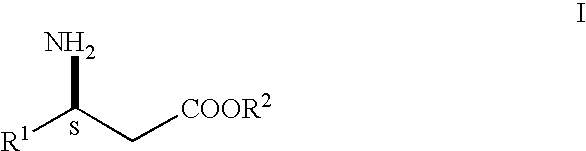
wherein
R1 is aryl, heteroaryl, substituted aryl or substituted heteroaryl and R2 is hydrogen, alkyl or aralkyl, or acid addition salts thereof, are useful as intermediates in the synthesis of compounds described in WO 97/41102, which is incorporated by reference herein. Compounds described in WO 97/41102 are antagonists of the platelet fibrinogen receptor (gp IIb/IIIa antagonist) and thus are useful for treating platelet-mediated thrombotic disorders such as arterial and venous thrombosis, acute myocardial infarction, reocclusion following thrombolytic therapy and angioplasty, inflammation, unstable angina and vaso-occlusive disorders.
Known methods for preparing compounds of Formula I include an asymmetric Michael addition of lithium N-(trimethylsilyl)-(R)-phenethylamide to ethyl 3-pyridyl acrylate to give the ethyl β-aminoester [Rico, J. G.; Lindmark, R. J.; Rogers, T. E.; Bovy, P. R. J. Org. Chem. 1993, 58, 7948]. This process results in inefficient formation of lithium amide and difficult removal of N-α-methylbenzyl group.
J. Org. Chem. vol. 61, p. 2222 (1996) discloses a process wherein the lithium enolate of ethyl acetate is added to an enantiomerically pure sulfinimine, the product of which is purified by chromatography and deprotected under acidic conditions to afford the β-amino ester in greater than 90% ee. The need for chromatography makes this process unattractive for large-scale production. Similarly, J. Org. Chem., vol 64, p. 12 (1999) discloses a process wherein a titanium enolate of methyl acetate is added to an enantiomerically pure t-butylsulfinimine to afford the β-amino ester in about 90% ee.
WO 98/02410 discloses a process of stereoselective addition of the Reformatsky reagent prepared from t-butylbromoacetate to the enantiomerically pure imine prepared from 3-pyridine carboxaldehyde and (R)-2-phenylglycinol. Oxidative cleavage of the N-(1-phenyl-2-hydroxy ethyl) group with NaIO4 in ethanol followed by acid hydrolysis affords the enantiomerically pure t-butyl β-amino ester. Use of oxidizing agents makes this process unattractive for large-scale production.
WO 97/41102 discloses enzymatic resolution of the (±)β-phenylacetamido acid using penicillin amidase to afford the S-acid. This process, which utilizes enzymes, is inefficient and impractical for large scale production.
Thus there exists a need for a process which is compatible with large scale production needs and which achieves acceptable levels of purity and yield.
The invention is directed to a process of making a compound of formula I, as described above, comprising reacting a compound of formula II, 
wherein R1 is aryl, heteroaryl, substituted aryl or substituted heteroaryl, at a pH range of between about 7 and about 11, to form a compound of formula III 
wherein R5 is N-t-butoxycarbonyl,
reacting a compound of formula III with at least 0.5 equivalents of (1R,2S)-(−)ephedrine, in an alkyl acetate solvent, to form a salt of formula IV 
wherein Ph is phenyl, reacting the salt of formula IV with an inorganic base in water to form a carboxylate salt of the compound of formula V, acidifying the carboxylate salt of the compound of formula V with an acid of pKa less than or equal to three, to a pH of between about 3.5 and about 6.5, to form the compound of formula V 
reacting the compound of formula V, at a temperature less than about 25° C., to form the compound of formula I.
In another aspect, the invention is directed to a novel crystal form of (3S)-3-[(tert-butoxy)carbonyl]amino-3-[3′-pyridyl]propionic acid, the intermediate of formula Va 
wherein Boc is (tert-butoxy)carbonyl designated Form 2 and characterized by its x-ray powder diffraction patterns.
As used herein, unless otherwise noted, “alkyl” whether used alone or as part of a substituent group, shall include straight and branched chains containing 1 to 10 carbon atoms. For example, alkyl radicals include methyl, ethyl, n-propyl, isopropyl, n-butyl, isobutyl, sec-butyl, t-butyl, n-pentyl, n-hexyl and the like.
As used herein, unless otherwise noted, “alkoxy” shall denote an oxygen ether radical of the above described straight or branched chain alkyl groups. For example, methoxy, ethoxy, n-propoxy, sec-butoxy, t-butoxy, n-hexyloxy and the like.
As used herein, unless otherwise noted, “aryl” shall refer to unsubstituted aromatic groups such as phenyl, napthyl, and the like. The aryl group may be substituted with one or two substituents. Suitable substituents on the aryl group are selected independently from the group consisting of halogen, alkyl, alkoxy, aralkyl, —NR3 2, wherein R3 is alkyl; and R4CONH, wherein R4 is phenyl or alkyl.
As used herein, unless otherwise noted, “heteroaryl” shall denote any five or six membered monocyclic ring structure containing at least one heteroatom selected from O, N and S or a bicyclic ring system wherein the heteroaryl is fused to an aryl group. Examples of suitable heteroaryl groups include, but are not limited to, pyrrolyl, pyridyl, pyrazinyl, pyrimidinyl, pyrazolyl, pyridazinyl, furanyl, pyranyl, imidazolyl, thiophenyl, oxazolyl, isothiazolyl, isoxazolyl, furazanyl, benzothienyl, benzofuranyl, indolyl, isoindolyl, indolizinyl, indazolyl, purinyl, isoquinolyl, quinolyl, isothiazolyl, and the like. The heteroaryl may be substituted with one or two substituents. Suitable substituents on the heteroaryl group are selected independently from the group consisting of halogen, alkyl, alkoxy, aralkyl, —NR3 2, wherein R3 is alkyl; and R4CONH, wherein R4 is phenyl or alkyl. The heteroaryl group may be attached at any heteroatom or carbon atom of the ring such that the result is a stable structure, except when the heteroaryl contains only one heteroatom, then the heteroaryl must be attached at a carbon atom.
Preferably, the heteroaryl is pyridyl. The preferred heteroaryl may be substituted with one or two substituents as described above. Most preferably, the pyridyl is unsubstituted.
As used herein, unless otherwise noted, “aralkyl” shall mean any alkyl group substituted with an aryl group such as phenyl, napthyl and the like.
As used herein, unless otherwise noted, “halogen” shall mean chlorine, bromine, fluorine and iodine.
As used herein, unless otherwise noted, “an acid of pKa less than or equal to three” includes monochloroacetic, dichloroacetic, trichloroacetic, hydrochloric, hydrobromic, hydroiodic, perchloric, picric, nitric, sulfuric, phosphoric, methanesulfonic, tosic, trifluoromethanesulfonic, trifluoracetic, potassium bisulfate, sodium bisulfate, citric and the like.
As used herein, unless otherwise noted, “inorganic base” shall mean a base having a monovalent cation component, such as lithium carbonate, sodium carbonate, potassium carbonate, lithium hydroxide, sodium hydroxide, potassium hydroxide, tetrabutyl ammonium hydroxide, trimethylbenzyl ammonium hydroxide and the like.
As used herein, unless otherwise noted, “alkyl alcohol” shall denote a hydroxy derivative of the above described straight or branched chain alkyl groups. For example, methanol, ethanol, N-propanol, isopropanol, isobutanol, t-butanol and the like.
As used herein, the notation “S” and “R” shall denote the presence of a stereogenic center having the S or R configuration.
In a preferred embodiment of the invention, in the compound of formula I, R1 is unsubstituted phenyl, substituted phenyl, unsubstituted pyrimidyl, substituted pyrimidyl, unsubstituted pyridyl, substituted pyridyl, unsubstituted napthyl or substituted naphthyl. Suitable substituents are selected independently from the group consisting of halogen, alkyl, alkoxy, aralkyl, —NR3 2, wherein R3 is alkyl, and R4CONH, wherein R4 is phenyl or alkyl. More preferably, R1 is 2-pyridyl, 3-pyridyl, 4-pyridyl, 6-methylpyridyl, 5-bromopyridyl, 6-chloropyridyl or 5,6-dichloropyridyl. Most preferably R1 is 3-pyridyl. Preferably R2 is alkyl, more preferably methyl or ethyl, most preferably methyl.
In an embodiment of the present invention, wherein the compound of formula I is present as an acid addition salt, the acid is an acid of pKa less than or equal to three, as defined above, other than potassium bisulfate, sodium bisulfate and citric acid. Preferably the compound of formula I is a hydrochloric acid addition salt.
The present invention is directed to a process of making a compound of formula I 
wherein R1 and R2 are as described above, or acid addition salt thereof, which comprises reacting a compound of formula II 
to form a compound of formula III 
wherein R5 is N-t-butoxycarbonyl, reacting a compound of formula III to form a salt of formula IV 
wherein Ph is phenyl, reacting the salt of formula IV to form the compound of formula V 
reacting the compound of formula V to form the compound of formula I.
In accordance with the invention, a compound of formula II, a known compound or compound prepared by known methods [Profft, V. E.; Becker, F. J., J. Prakt. Chem. 1965, 30(1-2), 18] is reacted with di-tert-butyl dicarbonate in an organic solvent such as 1,4-dioxane, tert-butanol or tetrahydrofuran, preferably tetrahydrofuran, with addition of an aqueous solution of an inorganic base, as previously defined, preferably sodium hydroxide, at a temperature in the range of about 0° to about 100° C., preferably at a temperature between about 0° and about 35° C., at a pH in the range of about 7 to about 11, preferably at a pH of between about 9.9 and about 10.2, to form the compound of formula III.
Preferably, the desired compound of formula III is isolated by removal of the organic solvent by evaporation under reduced pressure, followed by acidification of the remaining aqueous solution by addition of an acid of pKa of less than or equal to three, as defined above, preferably sodium bisulfate or citric acid, to a pH of between about 3.5 and about 6.5, preferably to a pH of about 3.8, filtration or extraction with an organic solvent, such as methylene chloride, 1,2-dichloroethane, chloroform, dioxane, toluene, alkyl acetate such as ethyl acetate or mixtures thereof, preferably ethyl acetate, and optionally removal of the organic solvent by evaporation under reduced pressure.
The compound of formula III is reacted with at least 0.5 equivalents of (1R,2S)-(−)ephedrine, preferably 0.5 to 1.0 equivalent of (1R,2S)-(−)ephedrine, in an alkyl acetate solvent, preferably ethyl acetate, at a temperature from about 25° to about 78° C., to form the salt of formula IV.
The salt of formula IV is reacted with an inorganic base, as previously defined, preferably, sodium hydroxide, in water to form a carboxylate salt of the compound of formula V (dissolved in the aqueous solution).
The desired compound of formula V is isolated by removal of the (1R,2S)-(−)ephedrine by extraction with an organic solvent which is largely immiscible with water such as methylene chloride, 1,2-dichloroethane, alkyl acetate or aromatic hydrocarbon, such as toluene, or ketone, such as methyl-isobutyl ketone, followed by acidification of the remaining aqueous solution by addition of an acid of pKa less than or equal to three, as defined above, preferably sodium bisulfate or sulfuric, to a pH of between about 3.5 and about 6.5, preferably to a pH of about 3.8, and filtration to afford the compound of formula V. When the organic solvent which is largely immiscible with water is toluene, preferably the aqueous solution containing the compound of formula V is heated to a temperature in the range of about 70-80° C. prior to extraction with the toluene and cooled to about room temperature after extraction with the toluene and prior to acidification.
The compound of formula V is reacted with an acid of pKa less than or equal to three, as defined above, other than potassium bisulfate, sodium bisulfate and citric acid, preferably hydrochloric acid, in a C1-C10 alkyl alcohol, preferably methanol, at a temperature less than about 25° C., to form the corresponding compound of formula I, which is isolated by conventional methods, such as filtration.
Form 2 of the compound of formula Va may be characterized by its x-ray powder diffraction pattern utilizing a Siemens D5000 diffractometer and the following system conditions:
a) CuKα radiation, 35 mA, 40 KV
b) Optics
1 mm slit, Goebel mirrors, 0.6 mm slit, & vertical soller slits between tube and sample
LiF monochromator between sample and detector
c) Scan 5 to 35°2θ at 0.02 Step Size at rate of 1°2θ/minute
d) Zero background sample holder
| Powder X-Ray Diffraction Results |
| Angle | d value | Intensity | Intensity | ||
| 2θ | Angstrom | Cps | % | ||
| 5.186 | 17.028 | 1.67 | 0.1 | ||
| 5.405 | 16.338 | 4.17 | 0.2 | ||
| 6.069 | 14.550 | 163 | 6.2 | ||
| 6.526 | 13.532 | 1350 | 51.1 | ||
| 7.659 | 11.534 | 28.3 | 1.1 | ||
| 9.111 | 9.698 | 22.5 | 0.9 | ||
| 10.786 | 8.196 | 1417 | 53.6 | ||
| 13.073 | 6.767 | 83.3 | 3.2 | ||
| 15.660 | 5.654 | 659 | 25.0 | ||
| 17.063 | 5.192 | 1105 | 41.8 | ||
| 18.405 | 4.817 | 102 | 3.8 | ||
| 18.843 | 4.706 | 212 | 8.0 | ||
| 19.108 | 4.641 | 343 | 13.0 | ||
| 19.679 | 4.507 | 417 | 15.8 | ||
| 20.755 | 4.276 | 36.7 | 1.4 | ||
| 21.514 | 4.127 | 2641 | 100.0 | ||
| 22.796 | 3.898 | 652 | 24.7 | ||
| 23.944 | 3.713 | 101 | 3.8 | ||
| 24.363 | 3.650 | 340 | 12.9 | ||
| 25.502 | 3.490 | 89.2 | 3.4 | ||
| 25.640 | 3.471 | 89.2 | 3.4 | ||
| 26.265 | 3.390 | 172 | 6.5 | ||
| 26.786 | 3.326 | 98.3 | 3.7 | ||
| 27.770 | 3.210 | 1152 | 43.6 | ||
| 28.722 | 3.106 | 164 | 6.2 | ||
| 29.151 | 3.061 | 764 | 28.9 | ||
| 29.656 | 3.010 | 70.8 | 2.7 | ||
| 30.468 | 2.9315 | 58.3 | 2.2 | ||
| 31.214 | 2.8631 | 61.7 | 2.3 | ||
| 31.868 | 2.8058 | 61.7 | 2.3 | ||
| 32.301 | 2.7692 | 95.8 | 3.6 | ||
| 32.874 | 2.7222 | 147 | 5.6 | ||
| 33.480 | 2.6743 | 53.3 | 2.0 | ||
| 34.081 | 2.6285 | 122 | 4.6 | ||
| 34.626 | 2.5884 | 68.3 | 2.6 | ||
The following examples describe the invention in greater detail and are intended to illustrate the invention, but not to limit it.
Part A
The reaction flask was charged with 300 g (264.3 mL)(2.8 mol) of cold 3-pyridine carboxaldehyde and 60 mL of absolute ethanol. A reaction temperature of 13° C. resulted. With good stirring, 291.36 g (2.8 mol) malonic acid was added in one portion (solid addition) over about 2 min, followed by 90 mL ethanol. Immediately following this addition, 323.73 g (4.2 mol) ammonium acetate was added over about 10 min (solid addition), followed by 250 mL ethanol. During this addition, the reaction cooled to about 38° C. The bright orange mixture was heated to and maintained under gentle reflux for 5 h. The heating mantle was removed, and the mixture was allowed to cool to ambient temperature overnight. The solid was collected by suction filtration (50 min) and washed with 400 mL methanol (30 min). The filtercake was washed with a second portion of 200 mL methanol (10 min). The filtercake was partially dried under suction for about 60 min. The solids were dried in vacuo at 35-40° C. to constant weight (38 h) to yield 303.38 g (65.2%) 3-amino-3-(3′-pyridyl)propionic acid as a white powder.
Part B
The reaction flask was charged with 594.52 g of a mixture of 3-amino-3-(3′-pyridyl)propionic acid and trans-3-(3′-pyridyl)acrylic acid and 1,600 mL methanol. With good stirring, the slurry was heated to and maintained under gentle reflux for 1.25 h. The slurry was filtered while hot, and was washed with 2×80 mL, then 160 mL warm (>50° C.) methanol (30 min). The filtercake was partially dried under suction for about 1.25 h. Further drying in vacuo at 35-40° C. for 21.5 h gave 540.22 g (90.9% weight recovery) product as a white powder.
The reaction flask was charged with 540.12 g of a mixture of 3-amino-3-(3′-pyridyl)propionic acid and trans-3-(3′-pyridyl)acrylic acid and 1,600 mL methanol. With good stirring, the slurry was heated to and maintained under gentle reflux for 5-6 h. The slurry was filtered while hot, and was washed with 3×160 mL warm (>50° C.) methanol (35 min). The filtercake was partially dried under suction for about 1.75 h yielding 814.45 g (>100% weight recovery) product as a white solid (wet cake).
The reaction flask was charged with 814.35 g of a mixture of 3-amino-3-(3′-pyridyl)propionic acid and trans-3-(3′-pyridyl)acrylic acid (wet cake) and 1,600 mL methanol. With good stirring, the slurry was heated to and maintained under gentle reflux for 3.75 h. The slurry was filtered while hot, and was washed with 3×160 mL warm (>50° C.) methanol (20 min). The filtercake was partially dried under suction for about 17.25 h. Further drying in vacuo at 40-45° C. for 20 h gave 390.69 g (65.7% weight recovery of original input) product as a white powder.
The reaction flask was charged with 200 mL tetrahydrofuran and 170.88 g (1.03 mol) 3-amino-3-(3′-pyridyl)propionic acid and 614 mL tetrahydrofuran with good stirring. At ambient temperature (22° C.), 514 mL (1.03 mol) 2M sodium hydroxide solution was added in a slow pour over about 2 min. During this addition, the reaction temperature rose to 26° C. and most of the solid dissolved. After stirring an additional 45 min at ambient temperature, a slightly hazy, colorless solution resulted; pH 10.57 at 24° C. A 1 L constant pressure addition funnel was charged with 407 mL tetrahydrofuran (THF) and 365.3 mL (1.54 mol) di-tert-butyl dicarbonate. A second 1 L constant pressure addition funnel was charged with 771 mL (1.54 mol) 2M sodium hydroxide solution. The tetrahydrofuran solution of the di-tert-butyl dicarbonate was added in a slow stream over about 25 min with pH monitoring. Once the pH reached about 9.90, concomitant addition of the 2M sodium hydroxide solution was started. External cooling was applied to maintain the reaction temperature at <35° C. The reaction was maintained at pH 9.9-10.2 during the addition of the tetrahydrofuran/di-tert-butyl dicarbonate solution. Following its addition, the addition funnel which contained the dicarbonate/tetrahydrofuran solution was rinsed forward with 81 mL fresh tetrahydrofuran. Addition of the remaining amount of 2M sodium hydroxide solution was continued so as to maintain a pH in the range of 9.9-10.2. Following addition of the remaining amount of 2M sodium hydroxide solution, the pH probe was removed and the reaction was stirred at ambient temperature for 17 h. With good stirring, the pH was lowered from 7.68 at 21° C. to 3.87 at 27° C. by portionwise addition of 393.0 g (2.85 mol) of sodium bisulfate monohydrate over about 3 h. The heterogeneous mixture was cooled 75 min in an ice water bath with good stirring. A volume of 1,285 mL water was marked on the outside of a 5 L wide-mouth round-bottom flask while mounted on the rotary evaporator. The flask was emptied, then refilled with the reaction slurry. The reaction flask was rinsed forward with 2×250 mL 98/2(v/v) tetrahydrofuran-water solution. The slurry was concentrated at 25° C. for about 3 h to a volume of about 1,285 mL. The concentrated mixture was extracted with 4×650 mL of methylene chloride. The combined extracts were dried 45 min over 23.5 g (0.20 mol) anhydrous magnesium sulfate with good stirring. After filtration, the clear, colorless filtrate was concentrated over 90 min at 25° C. to a mobile syrup. This was carefully concentrated further for 45 min at 35° C. and at <5 mm Hg to a thick syrup. Further drying in vacuo at ambient temperature for 60 h gave 227.24 g (83.0%) product as a clear, immobile glass. By 1H NMR spectroscopy, this material was assigned a purity of 89.8 w/w%.
Part A
The reaction flask was charged with 2,750 mL ethyl acetate and 227.23 g (0.77 mol) 3-[(tert-butoxy)carbonyl]amino-3-(3′-pyridyl)propionic acid. With good stirring, the solution was heated to a reaction temperature of 62° C. A freshly prepared solution of 126.9 g (0.77 mol) (1R,2S)-(−)-ephedrine in 350 mL ethyl acetate was added in a slow stream over about 9 min at 64° C. The addition funnel which contained the ephedrine solution was rinsed forward with 50 mL ethyl acetate. The clear, colorless solution (63° C.) was seeded. Within 1-2 min, heavy precipitation of the product commenced. (During crystallization the agitation speed was increased to maintain good stirring of the slurry). The slurry was slowly cooled to ambient temperature. After about 18 h, the solid was collected by suction filtration and washed with 2×125 mL fresh ethyl acetate (15 min). The filtercake was partially dried under suction for 35 min. Further drying in vacuo at 40-45° C. for 21 h gave 153.04 g (46.3%) product as a fluffy white solid.
Part B
The reaction flask was charged with 415.33 g (0.96 mol) (3S)-3-[(tert-butoxy)carbonyl]amino-3-(3′-pyridyl)propionic acid, (1R,2S)-(−)-ephedrine salt and 9 L ethyl acetate. The resulting slurry was heated and maintained under gentle reflux for 30 min with good stirring. The slurry was allowed to cool slowly to ambient temperature with continued good stirring. After 15 h, 250 mL fresh ethyl acetate was added to restore good agitation. After an additional 2 h, the solid was collected by suction filtration and washed with 2×450 mL fresh ethyl acetate (10 min). The filtercake was partially dried under suction for 75 min. Further drying in vacuo at 50-55° C. for 44 h gave 311.25 g (74.9%) product as a fluffy white solid.
The reaction beaker was charged with 303.47 g (0.67 mol) (3S)-3-[(tert-butoxy)carbonyl]amino-3-(3′-pyridyl)propionic acid, (1R,2S)-(−)-ephedrine salt and 792 mL milliquat water. After stirring 5 min, the pH of the slurry was 7.32 at 21° C. A total of 595 mL (0.60 mol) 1M sodium hydroxide solution was added in a slow pour over about 2 min with good stirring to a pH of 11.00 at 23° C. After an additional 5 min (pH 10.86), 20 mL (0.02 mol) 1M sodium hydroxide solution was added with continued good stirring to a pH of 11.00 at 23° C. After stirring an additional 65 min (pH 10.73 at 22° C.), 50 mL (0.05 mol) 1M sodium hydroxide solution was added to pH 11.07 at 22° C. The slightly hazy, colorless solution was washed with 12×880 mL methylene chloride. Following the last wash, the pH was 7.76 at 20° C. With good stirring, 47.89 g (0.35 mol) sodium bisulfate monohydrate was added portionwise over 10 min to pH 5.18 at 21° C. The cloudy solution was seeded and the developing slurry was stirred for 5 min. During this crystallization, the pH increased to 5.76 at 21° C. Next was added 47.82 g (0.34 mol) sodium bisulfate monohydrate over 25 min to pH 3.79 at 22° C. The slurry was cooled 40 min in an ice water bath, filtered (5 min) and partially dried under suction for 20 min. The filtercake was dried in vacuo at 50-55° C. for 17 h to yield 151.72 g (85.1%) product as a colorless, crystalline solid.
A round-bottom flask was charged with 142.01 g (0.53 mol) (3S)-3-[(tert-butoxy)carbonyl]amino-3-(3′-pyridyl)propionic acid and 1,350 mL methanol. The mixture was spun, without vacuum, on a rotary evaporator at 25° C. for 2 h, then carefully concentrated to a colorless mobile syrup. This syrup was transferred into the reaction flask using 1,350 mL methanol. The opaque solution was cooled in an ice water bath to 0-5° C. Next, about 194.4 g (5.33 mol) hydrogen chloride was bubbled into the solution over about 3 h. During this addition, the reaction temperature was kept at <15° C. Following seeding, the slurry was warmed to ambient temperature and stirred for 2 h. The slurry was cooled 30 min in an ice water bath. The solid was collected by suction filtration and washed with 2×65 mL cold (0-5° C.) methanol (5 min). The filtercake was partially dried under suction for about 20 min. Further drying in vacuo at ambient temperature for 14 h gave 105.21 g (77.9%) product as a white, crystalline powder.
To a mixture of 6-methylpyridine-3-carboxaldehyde (23.5 g, 0.149 mol), ammonium acetate (22.9 g, 1.5 eq.) and ethanol (350 mL) was added malonic acid (20.5 g, 1 eq.). The mixture was heated under reflux for 6 h, cooled to room temperature and filtered. This filtered solid was washed with ethanol (2×30 mL) and diethyl ether (2×100 mL) and dried to give the product as a white solid (23.2 g, 66% yield).
To a mixture of 5-bromopyridine-3-carboxaldehyde (40.4 g, 0.21 mol), ammonium acetate (24.3 g, 1.5 eq.) and absolute ethanol (650 mL) was added malonic acid (21.8 g, 1 eq.). The mixture was heated under reflux for 6.5 h, cooled to room temperature and filtered. This filtered solid was washed with ethanol and diethyl ether and dried to a crude product (28.0 g, 55% yield). This solid was heated under reflux for 30 min in methanol (500 mL), filtered hot, washed with hot methanol and dried to give the product as a white solid (17.4 g; 34%).
To a mixture of 6-chloropyridine-3-carboxaldehyde (32.6 g, 0.229 mol), ammonium acetate (26.5 g, 1.5 eq.) and absolute ethanol (300 mL) was added malonic acid (23.8 g, 1 eq.). The mixture was heated under reflux for 2.5 h, cooled to room temperature and filtered. This filtered solid was washed with ethanol and diethyl ether and dried to a crude product (30.6 g, 66% yield). This solid was heated under reflux in methanol (500 mL), filtered hot, washed with hot methanol (3×150 mL) and diethyl ether and dried to give the title compound (24.5 g; 53%). This solid was heated under reflux in methanol (500 mL), filtered hot, washed with hot methanol and diethyl ether and dried to give the product as a white solid (21.0 g; 46%).
To a mixture of 5, 6-dichloropyridine-3-carboxaldehyde (9.4 g, 0.053 mol), ammonium acetate (6.2 g, 1.5 eq.) and absolute ethanol (100 mL) was added malonic acid (5.6 g, 1 eq.). The mixture was heated under reflux for 8 h, cooled to room temperature, stirred overnight and filtered. This filtered solid was washed with ethanol and diethyl ether and dried to a crude product (7.0 g, 56% yield). This solid was heated under reflux in methanol (125 mL) for 15 min, filtered hot, washed with hot methanol (50 mL) and dried to give the product as a white solid (4.4 g; 35%).
To a cooled (5° C.) solution of 3-amino-3-[3′-(6-methyl)pyridyl]propionic acid (23.2 g, 0.128 mol), 1 N sodium hydroxide (256 mL, 2 eq.), and dioxane (150 mL) was added di-tert-butyl dicarbonate (27.9 g, 1 eq.). This mixture was stirred for 1.5 h, the ice bath removed, and stirring continued for 16 h. The dioxane was removed in vacuo, and the resultant aqueous mixture adjusted to pH 4 with 10% citric acid (250 mL). This solution was cooled in an ice bath, stirred for 30 min, and filtered to give 7.7 g white powder. The filtrate was reduced to half volume in vacuo, treated with sodium chloride (30 g), cooled for 70 h, and filtered to give a second crop (22.4 g) of product. The crops were combined to give the product as a white solid (30.1 g, 84% yield).
To a cooled (5° C.) solution of 3-amino-3-[3′-(5-bromo)pyridyl]propionic acid (17.4 g, 0.071 mol), 1 N sodium hydroxide (142 mL, 2 eq.), and dioxane (100 mL) was added di-tert-butyl dicarbonate (15.5 g, 1 eq.). This mixture was allowed to warm to ambient temperature and was stirred overnight. The dioxane was removed in vacuo, and the resultant aqueous mixture adjusted to pH 3-4 with 10% citric acid. This solution was extracted with 9/1 (v/v) chloroform—dioxane (3×150 mL), and the combined extracts were dried over anhydrous sodium sulfate, filtered and concentrated to give the product as a white solid (21.1 g, 86%).
To a cooled (5° C.) solution of 3-amino-3-[3′-(6-chloro)pyridyl]propionic acid (21.0 g, 0.105 mol), 1 N sodium hydroxide (210 mL, 2 eq.), and dioxane (150 mL) was added di-tert-butyl dicarbonate (22.89 g, 1 eq.). This mixture was allowed to warm to ambient temperature and was stirred overnight. The dioxane was removed in vacuo, and the resultant aqueous mixture adjusted to pH 3-4 with 10% citric acid. The mixture was filtered and the solids were washed with water and air dried overnight to give the product as a white solid (21.5 g, 68%).
To a cooled (5° C.) solution of 3-amino-3-[3′-(5,6-dichloro)pyridyl]propionic acid (4.4 g, 0.019 mol), 1 N sodium hydroxide (37.6 mL, 2 eq.), and dioxane (30 mL) was added di-tert-butyl dicarbonate (4.1 g, 1 eq.). This mixture was allowed to warm to ambient temperature and was stirred overnight. The dioxane was removed in vacuo, and the resultant aqueous mixture adjusted to pH 3-4 with 10% citric acid. After additional stirring at ambient temperature, the mixture was filtered, solids were washed with water and air dried to give the product as a white solid (5.0 g, 79%).
To a slurry of 3-[(tert-butoxy)carbonyl]amino-3-[3′-(6-methyl)pyridyl]propionic acid (3.85 g, 0.0137 mol) and warm ethyl acetate (170 mL) was added a solution of (1R,2S)-(−)-ephedrine (2.31 g, 1 eq.) in ethyl acetate (60 mL). This mixture was heated to reflux to give a clear solution. After 5 min at ambient conditions, the warm solution was seeded and allowed to cool to room temperature. Crystallization of the salt began when the solution had reached 30° C. After crystallization for 15 min, the mixture was filtered, and the solid product washed with ethyl acetate (50 mL) and diethyl ether (50 mL) and dried to afford a white powder (1.9 g, 31% yield).
A second crop was isolated from the mother liquors after 16 h at ambient conditions (0.33 g, 5.4% yield). The two crops were combined, slurried with warm ethyl acetate (60 mL), and filtered to give 2.2 g (36%) of the product as a white solid.
To a solution of 3-[(tert-butoxy)carbonyl]amino-3-[3′-(5-bromo)pyridyl]propionic acid (21.0 g, 0.061 mol) and ethyl acetate (125 mL) was added (1R,2S)-(−)-ephedrine (10.1 g, 1 eq.), giving a clear solution. After seeding and standing overnight at ambient temperature, the mixture was filtered, the solid product washed with cold ethyl acetate and diethyl ether and dried to afford the product as a white powder (8.3 g, 27% yield).
To a slurry of 3-[(tert-butoxy)carbonyl]amino-3-[3′-(6-chloro)pyridyl]propionic acid (21.4 g, 0.071 mol) and ethyl acetate (250 mL) was added (1R,2S)-(−)-ephedrine (11.79 g, 1 eq.). This mixture was heated to reflux to give a clear solution. The solution was cooled to room temperature and seeded. Following crystallization, additional ethyl acetate (700 mL) was added, the slurry was heated to boiling and then slowly cooled to ambient temperature. After stirring overnight, the mixture was filtered, the solid product washed with ethyl acetate and diethyl ether and dried to afford the product as a fluffy white solid (15.36 g, 46% yield).
To a slurry of 3-[(tert-butoxy)carbonyl]amino-3-[3′-(5,6-dichloro)pyridyl]propionic acid (4.9 g, 0.015 mol) and ethyl acetate (150 mL) was added (1R,2S)-(−)-ephedrine (2.42 g, 1 eq.). This mixture was heated to reflux and filtered to remove a small amount of insoluble material. The clear filtrate was slowly cooled to ambient temperature. The mixture was filtered, the solid product washed with ethyl acetate and diethyl ether and dried to give a crude product (3.1 g). Recrystallization from boiling ethyl acetate (75 mL) returned the product as a white solid (2.8 g, 38%).
Ammonium acetate (194.28 g, 2.52 mol) was suspended in ethanol (285 g). A solution of pyridine-3-carbaldehyde (62.9 g, 1.68 mol) in ethanol (80 g) was added to the suspension within 10 min at 15° C.-20° C. The reaction mixture was stirred for 1 h until a clear yellowish solution was formed. A suspension of malonic acid (174.86 g, 1.68 mol) in ethanol (235 g) was then added (within 30 min.) After stirring for 30 min at ambient temperature the reaction mixture was heated for 5 h to reflux (78° C.). Gas evolution was observed. After 3-4 h a white solid started to precipitate. The orange colored suspension was cooled to 15° C.-20° C., and a thick slurry was obtained. To this slurry was added methanol (80 g) and the reaction mixture was again heated to reflux (65° C.). The suspension was filtered hot, and the filtercake was washed with three portions of hot methanol (120 g) (at a temperature of 55° C.-65° C.). The wet product was dried in vacuo at 70° C.-80° C. to yield the product as a colorless solid (137.73 g, 49.3%). LC purity 95.8%
3-Amino-3-(3′-pyridyl)propionic acid (73.00 g, 0.439 mol) was suspended in THF (239.5 g) at 15° C.-25° C. Within 10-20 min a solution of sodium hydroxide (43.93 g, 1.10 mol) in purified water (395.4 g) was added, resulting in a slightly yellowish solution. Within 2-3 h a solution of BOC-anhydride (143.82 g, 0.659 mol) in THF (124.2 g) was added, while maintaining the solution temperature at no more than 30° C. The solution was stirred overnight (about 17 h) at 15° C.-25° C. Within 1-2 h a solution of sodium hydrogensulphate monohydrate (167.9 g, 1.22 mol) in water (160 g) was added to adjust the pH to about 3.8-3.9. Some solids were observed to precipitate, with strong evolution of gas. The suspension was cooled to 5° C.-10° C., filtered and washed with THF (50 g). The unified filtrates were reduced by distillation to one third of their original volume. Ethylacetate (102.9 g) was then added, an equal volume was distilled off, ethylacetate (99.4 g) was again added, and the same volume was distilled off. To the resulting aqueous emulsion were added sodium chloride (64.6 g) and ethylacetate (100.5 g). The phases were separated, and the aqueous phase was washed with ethylacetate (3×20 g). The unified organic phases were dried over sodium sulphate anhydrous (20 g), the drying agent was filtered off, and the filter cake washed with ethylacetate (5 g). The resulting solution (about 250 g) was used directly for the following step.
A solution of 3-[(tert-butoxy)carbonyl]amino-3-(3′-pyridyl)propionic acid (250 g) in ethylacetate containing 3-[(tert-Butoxy)carbonyl]amino-3-(3′-pyridyl)propionic acid (71.5 g, 0.269 mmol) and ethylacetate (178.5 g) was heated to 60° C.-70° C. Within 10 min a solution of (−)-ephedrine (48.80 g, 0.295 mol) in ethylacetate (90.0 g) was added. The clear solution was cooled to 20° C.-30° C. while the product crystalllized as a voluminuous, white solid. After the crystallization had started, ethylactate (270 g) was added to keep the mixture stirrable. The suspension was cooled to 15° C.-25° C., stirred for 3-5 h, and the solids collected by filtration. The filter cake was washed with ethylacetate (90 g) in two portions and dried in vacuo at 70° C.-80° C. to yield the product as a colorless solid (52.72 g, 28%). LC purity >99%
(3S)-3-[(tert-Butoxy)carbonyl]amino-3-(3′-pyridyl)propionic acid (1R,2S)-(−)-ephedrine salt (25.11 g, 0.058 mol) was dissolved in water (50.0 g) at 15° C.-25° C. Within 10-20 min a solution of sodium hydroxide (2.63 g, 0.066 mol) in water (23.3 g) was added, resulting in a clear solution. Toluene (17.4 g) was added under good stirring and the resulting emulsion was heated to 70° C.-80° C. After the stirring was stopped, the clear organic phase was separated from the slightly turbid aqueous phase. The aqueous phase was extracted with toluene (4×17.4 g) at 70° C.-80° C. The aqueous phase was then cooled to 15° C.-25° C., filtered, and the filter washed with water (2.5 g). To the unified filtrates was added a solution of sodium hydrogensulphate monohydrate (9.50 g, 0.069 mol) in water (12.1 g), resulting in a pH of 3.6-3.9 and crystallized product. The reaction mixture was cooled to 0° C.-5° C., stirred for 1 h further, and the product collected by filtration, washed with water (5 g) in two portions, dried in vacuo at 40° C.-50° C. to yield the product as a colorless solid (11.08 g, 72%). LC purity >95%
(3S)-3-[(tert-butoxy)carbonyl]amino-3-(3′-pyridyl)pro-pionic acid (9.93 g, 0.037 mol) was dissolved in methanol (45.8 g) at 0° C.-5° C. Within 2-3 h hydrogen chloride (34.2 g, 0.938 mol) was bubbled through the solution, while maintaining the temperature of the solution below about 15° C. After the addition of hydrogen chloride was complete, the reaction mixture was stirred for at least 2 h at 20° C.-25° C. and then cooled to 0° C.-5° C. After stirring for 30 min at 0° C.-5° C. the solids were collected by filtration, washed with cold methanol (14.2 g) (at a temperature of about 0° C.-5° C.) in two portions, and dried in vacuo at 20° C.14 30° C. to yield the product as a colorless solid (7.86 g, 83%). LC purity >95%
Claims (24)
1. A process of preparing the compound of formula 
wherein
R1 is pyrimidyl optionally substituted with one or two substituents selected independently from the group consisting of halogen, alkyl, alkoxy, aralkyl, —NR3 2, wherein R3 is alkyl and R4 CONH wherein R4 is phenyl or alkyl, or pyridyl optionally substituted with one or two substituents selected independently from the group consisting of halogen, alkyl, alkoxy, aralkyl, —NR3 2, wherein R3 is alkyl and R4 CONH wherein R4 is phenyl or alkyl and R2 is hydrogen, alkyl or aralkyl, or acid addition salts thereof,
comprising reacting a compound of formula II, at a pH range of between about 7 and about 11, 
to form a compound of formula III 
wherein R5 is N-t-butoxycarbonyl,
reacting a compound of formula III with at least 0.5 equivalents of (1R,2S)-(−)ephedrine, in an alkyl acetate solvent, to form a salt of formula IV 
wherein Ph is phenyl,
reacting the salt of formula IV with an inorganic base in water to form a carboxylate salt of the compound of formula V, acidifying the carboxylate salt of the compound of formula V with an acid of pKa less than or equal to three, to a pH of between about 3.5 and about 6.5, to form the compound of formula V 
reacting the compound of formula V, at a temperature less than about 25° C., to form the compound of formula I.
2. A process of preparing a compound of formula I 
wherein
R1 is pyrimidyl optionally substituted with one or two substituents selected independently from the group consisting of halogen, alkyl, alkoxy, aralkyl, —NR3 2, wherein R3 is alkyl and R4CONH wherein R4 is phenyl or alkyl, or pyridyl optionally substituted with one or two substituents selected independently from the group consisting of halogen, alkyl, alkoxy, aralkyl, —NR3 2, wherein R3 is alkyl and R4CONH wherein R4 is phenyl or alkyl and R2 is hydrogen, alkyl or aralkyl, or acid addition salts thereof,
comprising reacting a compound of formula III 
with at least 0.5 equivalents of (1R,2S)-(−)ephedrine, in alkyl acetate solvent, to form a salt of formula IV 
wherein Ph is phenyl,
reacting the salt of formula IV with an inorganic base, in water, to form a carboxylate salt of the compound of formula V, acidifying the carboxylate salt of the compound of formula V with an acid of pKa less than or equal to three, to a pH of between about 3.5 and about 6.5, to form the compound of formula V 
reacting the compound of formula V, at a temperature less than about 25° C. to form the compound of formula I.
3. A process of claim 1 , further comprising isolating the compound of formula III by acidifying the compound of formula III with an acid of pKa less than or equal to three, to a pH of between about 3.5 and about 6.5.
4. A process of claim 1 , wherein the alkyl acetate solvent is ethyl acetate.
5. A process of claim 1 , wherein the reaction of formula III with (1R,2S)-(−)ephedrine occurs at a temperature in the range of from about 25° to about 78° C.
6. A process of claim 1 , further comprising acidifying the carboxylate salt of the compound of formula V with an acid of pKa less than or equal to three, to a pH of about 3.8, to form the compound of formula V.
7. A process of claim 1 , wherein the acid of pKa less than or equal to three is selected from the group consisting of monochloroacetic, dichloroacetic, trichloroacetic, hydrochloric, hydrobromic, hydroiodic, perchloric, picric, nitric, sulfuric, phosphoric, methanesulfonic, tosic, trifluoromethanesulfOrlic, trifluoracetic, potassium bisulfate, sodium bisulfate and citric.
8. A process of claim 1 , further comprising reacting the compound of formula V with an acid of pKa less than or equal to three, other than potassium bisulfate, sodium bisulfate and citric acid.
9. A process of claim 2 , further comprising acidifying the compound of formula III with an acid of pKa less than or equal to three, to a pH of between about 3.5 and about 6.5.
10. A process of claim 2 , wherein the alkyl acetate solvent is ethyl acetate.
11. A process of claim 2 , wherein the reaction of formula III with (1R,2S)-(−)ephedrifle occurs at a temperature from about 25° to about 78° C.
12. A process of claim 2 , further comprising acidifying the carboxylate salt of the compound of formula V with an acid of pKa less than or equal to three, to a pH of about 3.8, to form the compound of formula V.
13. A process of claim 2 , wherein the acid of pKa less than or equal to three is selected from the group consisting of monochloroacetic, dichloroacetic, trichloroacetic, hydrochloric, hydrobromic, hydroiodic, perchloric, picric, nitric, sulfuric, phosphoric, methanesulfonic, tosic, trifluoromethanesulfonic, trifluoracetic, potassium bisulfate, sodium bisulfate and citric.
14. A process of claim 2 , further comprising reacting the compound of formula V with an acid of pKa less than or equal to three, other than potassium bisulfate, sodium bisulfate and citric acid.
15. A process of claim 1 , wherein R1 is 2-pyridyl, 3-pyridyl, 4-pyridyl, 6-methylpyridyl, 5-bromopyridyl, 6-chloropyridyl or 5,6-dichioropyridyl.
16. A process of claim 2 , wherein R1 is 2-pyridyl, 3-pyridyl, 4-pyridyl, 6-methylpyridyl, 5-bromopyridyl, 6-chloropyridyl or 5,6-dichioropyridyl.
17. A process of claim 1 , wherein R2 is alkyl.
18. A process of claim 2 , wherein R2 is alkyl.
19. A process of claim 1 , wherein R1 is 3-pyridyl.
20. A process of claim 2 , wherein R1 is 3-pyridyl.
21. A process of claim 1 , wherein R1 is 3-pyridyl and R2 is methyl.
22. A process of claim 2 , wherein R1 is 3-pyridyl and R2 is methyl.
23. A process of claim 1 , wherein the acid addition salt of formula I is hydrochloric.
24. A process of claim 2 , wherein the acid addition salt of formula I is hydrochloric.
Priority Applications (3)
| Application Number | Priority Date | Filing Date | Title |
|---|---|---|---|
| US10/021,369 US6673926B2 (en) | 1999-03-22 | 2001-10-29 | Process of preparing 3S-3-amino-3-aryl proprionic acid and derivatives thereof |
| US10/401,073 US20030176471A1 (en) | 1999-03-22 | 2003-03-27 | Process of preparing 3S-3-amino-3aryl propionic acid and derivatives thereof |
| US10/671,104 US20040063960A1 (en) | 1999-03-22 | 2003-09-25 | Process of preparing 3S-3-amino-3-aryl propionic acid and derivatives thereof |
Applications Claiming Priority (3)
| Application Number | Priority Date | Filing Date | Title |
|---|---|---|---|
| US12622799P | 1999-03-22 | 1999-03-22 | |
| US53163700A | 2000-03-21 | 2000-03-21 | |
| US10/021,369 US6673926B2 (en) | 1999-03-22 | 2001-10-29 | Process of preparing 3S-3-amino-3-aryl proprionic acid and derivatives thereof |
Related Parent Applications (1)
| Application Number | Title | Priority Date | Filing Date |
|---|---|---|---|
| US53163700A Continuation | 1999-03-22 | 2000-03-21 |
Related Child Applications (2)
| Application Number | Title | Priority Date | Filing Date |
|---|---|---|---|
| US10/401,073 Division US20030176471A1 (en) | 1999-03-22 | 2003-03-27 | Process of preparing 3S-3-amino-3aryl propionic acid and derivatives thereof |
| US10/671,104 Division US20040063960A1 (en) | 1999-03-22 | 2003-09-25 | Process of preparing 3S-3-amino-3-aryl propionic acid and derivatives thereof |
Publications (2)
| Publication Number | Publication Date |
|---|---|
| US20020068829A1 US20020068829A1 (en) | 2002-06-06 |
| US6673926B2 true US6673926B2 (en) | 2004-01-06 |
Family
ID=22423697
Family Applications (3)
| Application Number | Title | Priority Date | Filing Date |
|---|---|---|---|
| US10/021,369 Expired - Lifetime US6673926B2 (en) | 1999-03-22 | 2001-10-29 | Process of preparing 3S-3-amino-3-aryl proprionic acid and derivatives thereof |
| US10/401,073 Abandoned US20030176471A1 (en) | 1999-03-22 | 2003-03-27 | Process of preparing 3S-3-amino-3aryl propionic acid and derivatives thereof |
| US10/671,104 Abandoned US20040063960A1 (en) | 1999-03-22 | 2003-09-25 | Process of preparing 3S-3-amino-3-aryl propionic acid and derivatives thereof |
Family Applications After (2)
| Application Number | Title | Priority Date | Filing Date |
|---|---|---|---|
| US10/401,073 Abandoned US20030176471A1 (en) | 1999-03-22 | 2003-03-27 | Process of preparing 3S-3-amino-3aryl propionic acid and derivatives thereof |
| US10/671,104 Abandoned US20040063960A1 (en) | 1999-03-22 | 2003-09-25 | Process of preparing 3S-3-amino-3-aryl propionic acid and derivatives thereof |
Country Status (17)
| Country | Link |
|---|---|
| US (3) | US6673926B2 (en) |
| EP (1) | EP1163222A1 (en) |
| JP (1) | JP2002540100A (en) |
| KR (1) | KR20020016617A (en) |
| CN (1) | CN1362948A (en) |
| AU (1) | AU3906300A (en) |
| BR (1) | BR0009277A (en) |
| CA (1) | CA2367969A1 (en) |
| CZ (1) | CZ20013403A3 (en) |
| HR (1) | HRP20010766A2 (en) |
| HU (1) | HUP0201347A3 (en) |
| MX (1) | MXPA01009621A (en) |
| NZ (1) | NZ514383A (en) |
| RU (1) | RU2228929C2 (en) |
| SK (1) | SK13582001A3 (en) |
| WO (1) | WO2000056715A1 (en) |
| YU (1) | YU74401A (en) |
Cited By (1)
| Publication number | Priority date | Publication date | Assignee | Title |
|---|---|---|---|---|
| CN101982458A (en) * | 2010-09-14 | 2011-03-02 | 北京欧凯纳斯科技有限公司 | 3-amino-3-arylpropionic acid and preparation method thereof |
Families Citing this family (4)
| Publication number | Priority date | Publication date | Assignee | Title |
|---|---|---|---|---|
| US6306909B1 (en) | 1997-03-12 | 2001-10-23 | Queen's University At Kingston | Anti-epileptogenic agents |
| AU3906300A (en) * | 1999-03-22 | 2000-10-09 | Ortho-Mcneil Pharmaceutical, Inc. | Process of preparing 3s-3-amino-3-aryl propionic acid and derivatives thereof |
| CA2367971A1 (en) | 1999-03-22 | 2000-09-28 | Ortho-Mcneil Pharmaceutical, Inc. | Synthesis of 3-amino-3-aryl propanoates |
| WO2002096424A1 (en) * | 2001-05-25 | 2002-12-05 | Queen's University At Kingston | Hetereocyclic beta-aminoacids and their use as anti-epileptogenic agents |
Citations (5)
| Publication number | Priority date | Publication date | Assignee | Title |
|---|---|---|---|---|
| US4585887A (en) | 1983-12-07 | 1986-04-29 | Lonza Ltd. | Process for the production of optically active 3-aminocarboxylic acid esters |
| US5254573A (en) | 1991-10-15 | 1993-10-19 | Monsanto Company | Substituted heterocyclic derivatives useful as platelet aggregation inhibitors |
| WO1997041102A1 (en) | 1996-05-01 | 1997-11-06 | Ortho Pharmaceutical Corporation | Carboxamide derivatives of pyrrolidine, piperidine and hexahydroazepine for the treatment of thrombosis disorders |
| WO1998002410A1 (en) | 1996-07-12 | 1998-01-22 | G.D. Searle & Co. | Asymetric synthesis of chiral beta-amino acids |
| DE10111877A1 (en) * | 2001-03-10 | 2002-09-12 | Aventis Pharma Gmbh | Novel imidazolidine derivatives, their preparation, their use and pharmaceutical compositions containing them |
Family Cites Families (2)
| Publication number | Priority date | Publication date | Assignee | Title |
|---|---|---|---|---|
| DE4216364A1 (en) * | 1991-12-14 | 1993-11-25 | Thomae Gmbh Dr K | Pyridyl derivs. with antithrombotic properties |
| AU3906300A (en) * | 1999-03-22 | 2000-10-09 | Ortho-Mcneil Pharmaceutical, Inc. | Process of preparing 3s-3-amino-3-aryl propionic acid and derivatives thereof |
-
2000
- 2000-03-21 AU AU39063/00A patent/AU3906300A/en not_active Abandoned
- 2000-03-21 MX MXPA01009621A patent/MXPA01009621A/en unknown
- 2000-03-21 WO PCT/US2000/007492 patent/WO2000056715A1/en not_active Ceased
- 2000-03-21 KR KR1020017012068A patent/KR20020016617A/en not_active Withdrawn
- 2000-03-21 CA CA002367969A patent/CA2367969A1/en not_active Abandoned
- 2000-03-21 HU HU0201347A patent/HUP0201347A3/en unknown
- 2000-03-21 RU RU2001128426/04A patent/RU2228929C2/en active
- 2000-03-21 YU YU74401A patent/YU74401A/en unknown
- 2000-03-21 CN CN00807448A patent/CN1362948A/en active Pending
- 2000-03-21 HR HR20010766A patent/HRP20010766A2/en not_active Application Discontinuation
- 2000-03-21 SK SK1358-2001A patent/SK13582001A3/en unknown
- 2000-03-21 BR BR0009277-0A patent/BR0009277A/en not_active Application Discontinuation
- 2000-03-21 JP JP2000606577A patent/JP2002540100A/en active Pending
- 2000-03-21 NZ NZ514383A patent/NZ514383A/en unknown
- 2000-03-21 CZ CZ20013403A patent/CZ20013403A3/en unknown
- 2000-03-21 EP EP00918212A patent/EP1163222A1/en not_active Withdrawn
-
2001
- 2001-10-29 US US10/021,369 patent/US6673926B2/en not_active Expired - Lifetime
-
2003
- 2003-03-27 US US10/401,073 patent/US20030176471A1/en not_active Abandoned
- 2003-09-25 US US10/671,104 patent/US20040063960A1/en not_active Abandoned
Patent Citations (6)
| Publication number | Priority date | Publication date | Assignee | Title |
|---|---|---|---|---|
| US4585887A (en) | 1983-12-07 | 1986-04-29 | Lonza Ltd. | Process for the production of optically active 3-aminocarboxylic acid esters |
| US5254573A (en) | 1991-10-15 | 1993-10-19 | Monsanto Company | Substituted heterocyclic derivatives useful as platelet aggregation inhibitors |
| WO1997041102A1 (en) | 1996-05-01 | 1997-11-06 | Ortho Pharmaceutical Corporation | Carboxamide derivatives of pyrrolidine, piperidine and hexahydroazepine for the treatment of thrombosis disorders |
| WO1998002410A1 (en) | 1996-07-12 | 1998-01-22 | G.D. Searle & Co. | Asymetric synthesis of chiral beta-amino acids |
| US5840961A (en) | 1996-07-12 | 1998-11-24 | G. D. Searle & Co. | Asymmetric synthesis of chiral beta-amiNo acids |
| DE10111877A1 (en) * | 2001-03-10 | 2002-09-12 | Aventis Pharma Gmbh | Novel imidazolidine derivatives, their preparation, their use and pharmaceutical compositions containing them |
Non-Patent Citations (15)
| Title |
|---|
| CA 137:140741, abstract, Cohen, 2002.* * |
| CA 137:304261, abstract, Dallemagne, 2002.* * |
| Davies, Stephen G. & Ichihara, Osamu, Asymmetric Synthesis of R-beta-Amino Butanoic Acid and S-beta-Tyrosine: Homochiral Lithium Amide Equivalents for Michael Additions to alpha, beta-Unsaturated Esters, Tetrahedron:Asymmetry, vol. 2, No. 3, pp. 183-186, 1991, Great Britain. |
| Davies, Stephen G. & Ichihara, Osamu, Asymmetric Synthesis of R-β-Amino Butanoic Acid and S-β-Tyrosine: Homochiral Lithium Amide Equivalents for Michael Additions to α, β-Unsaturated Esters, Tetrahedron:Asymmetry, vol. 2, No. 3, pp. 183-186, 1991, Great Britain. |
| E. Profft & F.J. Becker, The Condensation of beta-aryl-beta-aminoacids with delta-valero- and epsilon-+ caprolactim Ethers and the Feasibility of Cyclization of the Condensation Products Obtained, Journal für praktische Chemie, 4<th >series, vol. 30, 18-38 (1965). (with English translation). |
| E. Profft & F.J. Becker, The Condensation of β-aryl-β-aminoacids with δ-valero- and ε-+ caprolactim Ethers and the Feasibility of Cyclization of the Condensation Products Obtained, Journal für praktische Chemie, 4th series, vol. 30, 18-38 (1965). (with English translation). |
| F.A. Davis, J.M. Szewczyk & R.E. Reddy, An Efficient Synthesis of (S)-(+)-Ethyl beta-Amino-3-pyridinepropanoate Using Enantiopure Sulfinimines, J. Org. Chem. 1996, 61, 2222-2225. |
| F.A. Davis, J.M. Szewczyk & R.E. Reddy, An Efficient Synthesis of (S)-(+)-Ethyl β-Amino-3-pyridinepropanoate Using Enantiopure Sulfinimines, J. Org. Chem. 1996, 61, 2222-2225. |
| Hoekstra, William J. et al., Potent Orally Active GPIIb/IIIa Antagonists Containing a Nipecotic Acid Subunit. Structure-Activity Studies Leading to the Discovery of RWJ-533308, J. Med. Chem., 1999, 42, 5254-5265. |
| J.G. Rico, R.J. Lindmark, T.E. Rogers, & P.R. Bovy, A Highly Stereoselective Michael Addition to an a, beta-Unsaturated Ester as the Crucial Step in the Synthesis of a Novel beta-Amino Acid-Containing Fibrinogen Receptor Antagonist, J. Org. Chem. 1993, 58, 7948-7951. |
| J.G. Rico, R.J. Lindmark, T.E. Rogers, & P.R. Bovy, A Highly Stereoselective Michael Addition to an a, β-Unsaturated Ester as the Crucial Step in the Synthesis of a Novel β-Amino Acid-Containing Fibrinogen Receptor Antagonist, J. Org. Chem. 1993, 58, 7948-7951. |
| T.P. Tang & J.A. Ellman, The tert-Butanesulfinyl Group: An Ideal Chiral Directing Group and Boc-Surrogate for the Asymmetric Synthesis and Applications of beta-Amino Acids, J. Org. Chem. 1999, 64, 12-13. |
| T.P. Tang & J.A. Ellman, The tert-Butanesulfinyl Group: An Ideal Chiral Directing Group and Boc-Surrogate for the Asymmetric Synthesis and Applications of β-Amino Acids, J. Org. Chem. 1999, 64, 12-13. |
| Zablocki, J.A., et al., Potent in Vitro and in Vivo Inhibitors of Platelet Aggregation Based Upon the Arg-Gly-Asp Sequence of Fibrinogen. (Aminobenzamidino)succinyl (ABAS) Series of Orally Active Fibrinogen Receptor Antagonists, J. Med. Chem., 1995, 38, 2378-2394. |
| Zablocki, Jeffery A, et al., Potent in Vitro and in Vivo Inhibitors of Platelet Aggregation Based Upon the Arg-Gly-Asp Sequence of Fibrinogen. (Aminobenzamidino)succinyl (ABAS) Series of Orally Active Fibrinogen Receptor Antagonists, J. Med. Chem., 38, No. 13, pp. 2378-2394, 1995. |
Cited By (1)
| Publication number | Priority date | Publication date | Assignee | Title |
|---|---|---|---|---|
| CN101982458A (en) * | 2010-09-14 | 2011-03-02 | 北京欧凯纳斯科技有限公司 | 3-amino-3-arylpropionic acid and preparation method thereof |
Also Published As
| Publication number | Publication date |
|---|---|
| BR0009277A (en) | 2002-02-05 |
| HUP0201347A3 (en) | 2002-12-28 |
| MXPA01009621A (en) | 2003-07-21 |
| CA2367969A1 (en) | 2000-09-28 |
| CN1362948A (en) | 2002-08-07 |
| AU3906300A (en) | 2000-10-09 |
| YU74401A (en) | 2004-07-15 |
| WO2000056715A1 (en) | 2000-09-28 |
| HRP20010766A2 (en) | 2002-12-31 |
| EP1163222A1 (en) | 2001-12-19 |
| CZ20013403A3 (en) | 2002-07-17 |
| HUP0201347A2 (en) | 2002-09-28 |
| US20030176471A1 (en) | 2003-09-18 |
| RU2228929C2 (en) | 2004-05-20 |
| NZ514383A (en) | 2004-01-30 |
| KR20020016617A (en) | 2002-03-04 |
| JP2002540100A (en) | 2002-11-26 |
| US20020068829A1 (en) | 2002-06-06 |
| US20040063960A1 (en) | 2004-04-01 |
| SK13582001A3 (en) | 2003-02-04 |
Similar Documents
| Publication | Publication Date | Title |
|---|---|---|
| CN116199607B (en) | Preparation method of pilocarpine and its intermediate compound | |
| KR100794955B1 (en) | Method for preparing trans-4-amino-1-cyclohexanecarboxylic acid derivative | |
| US20020068829A1 (en) | Process of preparing 3S-3-amino-3-aryl proprionic acid and derivatives thereof | |
| US6197998B1 (en) | Process for producing N-glycyltyrosine and its crystal structure | |
| US3201406A (en) | Pyridylcoumarins | |
| NO179517B (en) | Process for the preparation of 8-chloroquinolone derivatives | |
| AU776300B2 (en) | Synthesis of 3-amino-3-aryl propanoates | |
| JP2001521498A (en) | Method for producing O- (3-amino-2-hydroxy-propyl) -hydroxymic acid halide | |
| DE69733897T2 (en) | PREPARATION OF [1S- [1A, 2B, 3B, 4 (S *)]] - 4- [7 - [[1- (3-CHLORO-2-THIENYL) METHYL] PROPYL] AMINO] -3H-IMIDAZO [4 , 5-b] PYRIDIN-3-YL] -N-ethyl-2,3-dihydroxycyclopentanecarboxamide | |
| HU195485B (en) | Process for producing aromatic carboxylic acid derivatives and -carboxamide derivatives | |
| CN111718334B (en) | Rosuvastatin calcium intermediate compound | |
| NZ237002A (en) | Method for resolving cis 3-amino-4-(2-(2-furyl)eth-1-yl)-1-methoxycarbonylmethyl-azetidin-2-one into its enantiomers and the resolved keto-l-gulonic acid hydrate salt thereof | |
| JP5080050B2 (en) | Method for producing optically active piperazine compound | |
| JPH06104670B2 (en) | New manufacturing method of chemical compounds | |
| JP3719269B2 (en) | Process for producing 2-alkyl-4-oxo-5,6,7,8-tetrahydro-cycloheptimidazole | |
| JPH01254654A (en) | Derivative of sulfonic acid and salt thereof | |
| JP2002503648A (en) | Methods and intermediates useful for producing antifolates | |
| CN109369642A (en) | A kind of apixaban related substance and preparation method and use thereof | |
| JPWO1997011074A1 (en) | A new method for producing pyridoindole derivatives | |
| JPH0543549A (en) | Process for producing α-chlorocyanopyridines | |
| IL152921A (en) | Preparation of 4-hydroxy-3-nitro-2(1h)-pyridone from 2-hydroxy-3-cyano-4-methoxypyridine | |
| JPH11322706A (en) | Novel amino acid derivative and method for producing the same |
Legal Events
| Date | Code | Title | Description |
|---|---|---|---|
| STCF | Information on status: patent grant |
Free format text: PATENTED CASE |
|
| FPAY | Fee payment |
Year of fee payment: 4 |
|
| FPAY | Fee payment |
Year of fee payment: 8 |
|
| FPAY | Fee payment |
Year of fee payment: 12 |