US6665467B2 - Optical wavelength filter - Google Patents
Optical wavelength filter Download PDFInfo
- Publication number
- US6665467B2 US6665467B2 US09/812,685 US81268501A US6665467B2 US 6665467 B2 US6665467 B2 US 6665467B2 US 81268501 A US81268501 A US 81268501A US 6665467 B2 US6665467 B2 US 6665467B2
- Authority
- US
- United States
- Prior art keywords
- light
- optical
- mode
- modes
- wavelength
- Prior art date
- Legal status (The legal status is an assumption and is not a legal conclusion. Google has not performed a legal analysis and makes no representation as to the accuracy of the status listed.)
- Expired - Fee Related, expires
Links
Images




Classifications
-
- G—PHYSICS
- G02—OPTICS
- G02B—OPTICAL ELEMENTS, SYSTEMS OR APPARATUS
- G02B6/00—Light guides; Structural details of arrangements comprising light guides and other optical elements, e.g. couplings
- G02B6/24—Coupling light guides
- G02B6/26—Optical coupling means
- G02B6/28—Optical coupling means having data bus means, i.e. plural waveguides interconnected and providing an inherently bidirectional system by mixing and splitting signals
- G02B6/293—Optical coupling means having data bus means, i.e. plural waveguides interconnected and providing an inherently bidirectional system by mixing and splitting signals with wavelength selective means
- G02B6/29331—Optical coupling means having data bus means, i.e. plural waveguides interconnected and providing an inherently bidirectional system by mixing and splitting signals with wavelength selective means operating by evanescent wave coupling
- G02B6/29332—Wavelength selective couplers, i.e. based on evanescent coupling between light guides, e.g. fused fibre couplers with transverse coupling between fibres having different propagation constant wavelength dependency
- G02B6/29334—Grating-assisted evanescent light guide couplers, i.e. comprising grating at or functionally associated with the coupling region between the light guides, e.g. with a grating positioned where light fields overlap in the coupler
Definitions
- the present invention relates to an optical wavelength filter.
- the optical add-drop element disclosed in Document I has either one or more optical couplers and a diffraction grating in each of a plurality of parallel optical waveguides.
- the diffraction grating either, for example, is disposed inside one optical coupler like the Bragg reflecting coupler shown in FIG. 4 of Document I, or, for example, is disposed on two arms between two optical couplers as in the bandpass filter having a Michelson-Bragg diffraction grating shown in FIG. 1 of Document I.
- optical add-drop element by making light of a specific wavelength incident upon the diffraction grating, it is possible either to drop (to make wavelength division demultiplexing) light of a specific wavelength from the incident light, or to add (to make wavelength division multiplexing) light of a specific wavelength to the incident light.
- the problem is that since the light propagating in the optical coupler ordinarily becomes a propagation light of a high-order mode comprising a plurality of specific (or intrinsic) modes, this gives rise to differences in the propagation constant between the specific modes, and the wavelengths reflected on the diffraction grating will differ for each mode.
- wavelength division multiplexing light WDM light or WDM optical signal
- WDM light or WDM optical signal wavelength division multiplexing light
- an object of the present invention is to provide an optical wavelength filter, which is capable of suppressing the generation of double peaks caused by differences in the propagation constant between specific modes in an optical coupler.
- Another object of the present invention is to provide an optical wavelength filter which, more preferably, is capable of suppressing the generation of double peaks without increasing the length of the filter.
- an optical wavelength filter of the present invention comprises a first and second optical coupler and a mode converter.
- Each of the optical couplers propagate wavelength division multiplexing (WDM) light comprising a plurality of light components with different wavelengths, excite multiple modes of light including high-order mode light for each wavelength of light of the WDM light, and provide a predetermined phase difference between different modes of the multiple modes of light.
- the mode converter is arranged between the first and second optical coupler, and performs mode conversion between modes of different orders of a specific wavelength selected upon request from among the multiple modes of light excited by the optical couplers.
- mode conversion is performed between modes of different orders of a specific wavelength selected as desired from among the multiple modes of light excited by the optical couplers, it is possible to adjust the phase difference between modes of light belonging to a specific wavelength of light independently from the phase difference between modes of light belonging to another wavelength of light. Accordingly, it is possible to output only light of a specific wavelength from an output or exit port separate from that for light of another wavelength. Since mode conversion is performed between modes of light belonging to a specific wavelength, it is possible to suppress the generation of double peaks that is caused by the difference in propagation constant for each mode of light in a specific wavelength.
- mode conversion in a mode converter signifies mode conversion between at the least modes of different orders. However, in addition thereto, there can also be cases in which mode conversion is performed for reflection and so forth.
- a first optical coupler has a first input port for inputting WDM light thereto, and a first optical coupling region for exciting the multiple modes of light of the WDM light inputted from the first input port thereof, and in the optical coupling region, a phase difference of substantially ⁇ /2 is provided between the modes of light belonging to each wavelength of light, and a mode converter performs the mode conversion described hereinabove while generally maintaining the phase difference between the modes of light outputted from the first optical coupler, and a second optical coupler has a second optical coupling region for enabling the propagation of multiple modes of light, and a first output port and a second output port, and in this second optical coupling region, once again a phase difference of substantially ⁇ /2 is provided between the modes of light belonging to each wavelength of light outputted from the mode converter, and in accordance therewith, the light of a specific wavelength and other light can be outputted from either the first or second output ports, which differ from one another.
- a phase difference of either ⁇ or ⁇ can be provided between the modes of light belonging to a specific wavelength, and a phase difference of either ⁇ or ⁇ (double signs in same order) can be provided between the modes of light belonging to other wavelengths. That is, it is enabled to output the light of a specific wavelength and the light of other wavelengths from different output ports.
- a phase difference which is either granted or maintained may be considered in a range from ⁇ to ⁇ in accordance with periodicity of 2 ⁇ for each mode of light.
- a first and second optical coupler can be formed by a coupler having a symmetrical branching structure, there is no need to utilize such an asymmetrical branching waveguide as disclosed in Document II, and as a result thereof, the element length of the optical wavelength filter can be shortened.
- multiple modes of light excited by the first and second optical couplers may be made zero-order mode light and first-order mode light, and in that case, mode conversion in the mode converter can be performed between a zero-order mode light and a first-order mode light each constituting a specific wavelength of light.
- an optical wavelength filter may be constituted as a 2-mode system, which utilizes two modes of light.
- multiple modes of light excited by the first and second optical couplers may be made zero-order mode light, first-order mode light and second-order mode light, and, in that case, mode conversion in the mode converter may be performed between a zero-order mode light and a second-order mode light, both constituting (or belonging to) a specific wavelength of light.
- multiple modes of light excited by the first and second optical couplers may be zero-order mode light, first-order mode light, second-order mode light and third-order mode light, and in this case, mode conversion in the mode converter may be performed between either one of a zero-order mode light and a second-order mode light, or a first-order mode light and a third-order mode light, constituting (or belonging to) a specific wavelength light.
- a mode converter has a multimode waveguide, and a plurality of rows of diffraction gratings.
- the diffraction gratings are provided in the multimode waveguide so as to form a periodic structure along the optical wave guiding direction in the multimode waveguide, and such that the rows extend in parallel while being mutually staggered by a half period.
- a mode converter may be constituted by a multimode waveguide as mentioned above. Accordingly, a mode converter may also be constituted from a plurality of single-mode waveguides as will be described hereinbelow. Specifically, a mode converter, for example, may also have a plurality of single-mode waveguides arranged in parallel, and a plurality of rows of diffraction gratings. The diffraction gratings are provided in the respective single-mode waveguides so as to form a periodic structure along the optical wave guiding direction, and such that the rows extend in parallel while being mutually staggered by a half period.
- FIG. 1 is a diagram showing an example of a conceptual constitution of an optical wavelength filter according to the present invention
- FIG. 2 is a diagram showing a first embodiment of an optical wavelength filter according to the present invention, and more particularly, is a diagram showing a simplified constitution of a 2-mode optical wavelength filter;
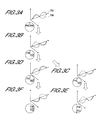
- FIG. 3 is diagrams schematically showing the phase difference between the modes of light in each portion in an optical wavelength filter according to a first embodiment of the present invention
- FIG. 4 is a diagram showing an example of another constitution of a 2-mode optical wavelength filter according to a first embodiment of the present invention.
- FIG. 5 is a diagram showing a second embodiment according to an optical wavelength filter of the present invention, and more particularly, is a diagram showing a simplified constitution of a 3-mode optical wavelength filter;
- FIG. 6 is diagrams schematically showing each mode of a 3-mode optical wavelength filter according to a second embodiment of the present invention.
- FIG. 7 is diagrams schematically showing the phase difference between the modes of light in each portion in a 3-mode optical wavelength filter according to a second embodiment of the present invention.
- FIG. 8 is a diagram showing an example of another constitution of a 3-mode optical wavelength filter according to a second embodiment of the present invention.
- FIG. 9 is a diagram showing a third embodiment of an optical wavelength filter according to the present invention, and more particularly, is a diagram showing a simplified constitution of a 4-mode optical wavelength filter (the one that performs conversion between odd modes);
- FIG. 10 is a diagram showing a simplified constitution of a 4-mode optical wavelength filter (the one that performs conversion between even modes) according to a third embodiment of the present invention.
- FIG. 11 is diagrams schematically showing each mode of a 4-mode optical wavelength filter according to a third embodiment of the present invention.
- FIG. 12 is diagrams schematically showing the phase difference between the modes of light in each portion in a 4-mode optical wavelength filter (odd mode conversion) according to a third embodiment of the present invention.
- FIG. 13 is diagrams schematically showing the phase difference between the modes of light in each portion in a 4-mode optical wavelength filter (even mode conversion) according to a third embodiment of the present invention.
- FIG. 1 is a diagram showing a conceptual constitution of an optical wavelength filter according to the present invention.
- the conceptual constitutions of embodiments of the optical wavelength filters will be explained by referring to FIG. 1, and other optical wavelength filters of a first and second embodiment will be explained.
- an optical wavelength filter 11 comprises a first optical coupler 13 , a second optical coupler 15 , and a mode converter 17 arranged or provided between the first optical coupler 13 and the second optical coupler 15 .
- the optical wavelength filter 11 shown in FIG. 1 has waveguide elements such as the optical couplers 13 and 15 and mode converter 17 formed in the substrate 19 .
- waveguide elements such as the optical couplers 13 and 15 and mode converter 17 formed in the substrate 19 .
- an optical wavelength filter having waveguide elements formed in the optical fiber configuration will not particularly need such substrate 19 as a filter constituent.
- the first optical coupler 13 and second optical coupler 15 have functions for propagating wavelength division multiplexing (WDM) light (or WDM optical signal) comprising a plurality of wavelengths.
- WDM wavelength division multiplexing
- the couplers 13 and 15 excite the light of each wavelength of the WDM light to generate multiple modes of light.
- the generated multiple modes of light comprising high-order modes of light.
- the couplers 13 and 15 provide a predetermined phase difference between different modes of the multiple modes of light.
- the first optical coupler 13 and second optical coupler 15 are couplers (multimode excitation couplers) capable of exciting multiple modes of light.
- These optical couplers can be constituted either from a multimode waveguide, or a plurality of single-mode waveguides, which are arranged in parallel, and close enough to one another for optical coupling to occur.
- the optical wavelength filter 11 can be made to function such that, for example, a light of a specific wavelength is split or demultiplexed from the WDM light incoming to the first optical coupler 13 .
- the first optical coupler 13 has a first input port 13 a for inputting WDM light and a first optical coupling region 13 b for exciting the multiple modes of light of the WDM light inputted from the first input port 13 a.
- the first optical coupling region 13 b has a function for providing a ⁇ /2+2 m ⁇ (where m is an integer) phase difference between the plurality of modes of light constituting each wavelength of light in the WDM light.
- the first optical coupler 13 of the example shown in FIG. 1 has a dummy port 13 c, and there are cases in which the dummy port 13 c is used appropriately in accordance with a design.
- the second optical coupler 15 for example, has a first output port 15 a, a second output port 15 b, and a second optical coupling region 15 c, which is capable of propagating multiple modes of light similar to the multiple modes of light generated by the first optical coupler 13 .
- This second optical coupling region 15 c has functions for further providing a ⁇ /2+2 n ⁇ (where n is an integer) phase difference between the modes of light outputted from the mode converter 17 , whereby light of a specific wavelength is outputted from the first output port 15 a, while light of the other wavelengths is outputted from the second output port 15 b.
- a 3 dB coupler constituted by a multimode waveguide or a plurality of single-mode waveguides can be utilized as a first optical coupler 13 and a second optical coupler 15 .
- first optical coupler 13 and second optical coupler 15 may have a symmetrical branching structure differently from an asymmetrical branching waveguide as disclosed in Document II, as that the couplers, can be constituted from branching waveguides that excite the same high-order modes of light. Accordingly, optical wavelength filter 11 of the embodiment does not require an asymmetrical branching waveguide such as that disclosed in Document II, and consequently, is capable of making the length of the element shorter than the constitution of that disclosed in Document II.
- the mode converter 17 is disposed or arranged between a first optical coupler 13 and a second optical coupler 15 , and is constituted so as to perform mode conversion between modes of different orders of light belonging to a specific wavelength of light selected as desired from among multiple modes of light excited by the first optical coupler 13 and the second optical coupler 15 .
- the mode converter 17 may be constituted from either one multimode waveguide, or a plurality of single-mode waveguides, as will be explained for each embodiment described hereinbelow.
- mode conversion in the mode converter 17 when high-order modes of light are inputted, mode conversion is performed between a first intrinsic or specific mode of light and a second intrinsic or specific mode of light from among the lower-order of light than that high-order modes of light.
- the mode converter 17 can be designed such that the change in the dielectric constant in parts or portions in which the overlapping of amplitudes of the first and second intrinsic modes of light is great.
- the mode converter 17 performs mode conversion while maintaining the phase differences between the modes of light of the plurality of modes of light outputted from the first optical coupler 13 in the state outputted from the first optical coupler 13 .
- the optical wavelength filter 11 With the optical wavelength filter 11 such as this, mode conversion can be performed only between specific modes of light belonging to a specific wavelength from among the wavelengths of the WDM light.
- the light of each wavelength is expressed as the sum of the modes of light belonging to the wavelength.
- a waveform which is given as the sum of modes of light constituting light of a specific wavelength, can form a peak in a location that differs from a waveform, which is given as the sum of modes of light constituting light of other wavelengths, by making the phase difference between the modes of light constituting the light of a specific wavelength differ from the phase difference between the modes of light constituting the light of other wavelengths. Therefore, only light of a specific wavelength can be outputted from an output port separate from that of the light of other wavelengths.
- mode conversion is carried out at this time between multiple modes of light constituting the light of a specific wavelength, it is possible to effectively suppress the generation of double peaks in proximity to a specific wavelength, which causes the propagation constant of each mode of light to differ.
- FIG. 2 is an example of a constitution of the optical wavelength filter of FIG. 1, and is a diagram showing a simplified constitution of an optical wavelength filter according to a first embodiment of the present invention.
- FIG. 2 there is shown one aspect of a 2-mode optical wavelength filter, which uses a zero-mode of light and a first-mode of light.
- an optical wavelength filter 21 comprises a first optical coupler 23 , a second optical coupler 25 that is similar to the first optical coupler 23 , and a mode converter 27 .
- the mode converter 27 of the first embodiment is constituted from one multimode waveguide.
- the first optical coupler 23 has a first input port 23 a for inputting WDM light, and a first optical coupling region 23 b for exciting the zero-order and first-order modes of light of the WDM light inputted from the first input port 23 a.
- the first optical coupling region 23 b has a function for providing a ⁇ /2+2 m ⁇ (where m is an integer) phase difference between a plurality of modes of light constituting each wavelength of light in the WDM light.
- the first optical coupler 23 is constituted from one multimode waveguide 23 d, which forms the first optical coupling region 23 b, and two branching waveguides (single-mode waveguides) 231 e and 232 e, which are smoothly connected to the multimode waveguide 23 d, and have a symmetrical Y branching structure. Furthermore, the first optical coupler 23 may preferably have a dummy port 23 c as in the example shown in the FIG. 2 .
- the second optical coupler 25 has a first output port 25 a, a second output port 25 b, and a second optical coupling region 25 c, which is capable of propagating multiple modes of light of the same orders (zero-order and first-order) as the multiple modes of light generated by the first optical coupler 23 .
- the second optical coupling region 25 c has functions for further providing a ⁇ /2+2 n ⁇ (where n is an integer) phase difference between the modes of light outputted from the mode converter 27 , and in accordance therewith, light of a specific wavelength is outputted from, for example, the first output port 25 a, while light of other wavelengths is outputted from, for example, the second output port 25 b.
- the second optical coupler 25 is constituted from one multimode waveguide 25 d, which forms the second optical coupling region 25 c, and two branching waveguides (single-mode waveguides) 251 e and 252 e, which are smoothly connected to the multimode waveguide 25 d, and have a symmetrical Y branching structure.
- the mode converter 27 performs mode conversion, while maintaining the phase differences between the modes of light of the plurality of modes of light outputted from the first optical coupler 23 in the state outputted from the first optical coupler 23 .
- the mode converter 27 when constituted from one multimode waveguide, has a multimode waveguide 27 a and two rows of diffraction gratings 271 b and 272 b.
- the gratings 271 b and 272 b are provided in the multimode waveguide 27 a so as to form a periodic structure along the optical waveguiding direction (that is, the mode propagation direction) a, and such that the rows extend in parallel while being mutually staggered by a half period d/2.
- the mode converter 27 has a structure, which imparts a refractive index distribution of a zigzag grating shape to the multimode waveguide 27 a.
- the first optical coupling region 23 b and second optical coupling region 25 c in the optical wavelength filter 21 are constituted from multimode waveguides 23 d and 25 d, respectively.
- the multimode waveguides 23 d and 25 d are linked to the multimode waveguide 27 a of the mode converter 27 , and have the same waveguide sectional structure. Therefore, these multimode waveguides 23 d, 25 d and 27 a are ordinarily formed together as a single waveguide.
- the refraction gratings 271 b and 272 b of the mode converter 27 can be configured as either a refractive index modulation type or as a relief type, but when formed as a relief type, it is desirable that they may be formed via the same process as the multimode waveguides 23 d and 25 d. Further, the mode converter 27 may carry out mode conversion via either an electro-optical effect or an acousto-optical effect.
- this optical wavelength filter will be explained by referring to FIG. 2 and FIG. 3 .
- FIG. 3 is diagrams schematically showing the phase difference between modes of light in each part of an optical wavelength filter.
- the solid line and broken line of FIG. 3 depict a zero-order mode light mo and a first-order mode light me, and a thick white arrow in the figure depicts a state in which the phasing plane in different parts or portions inside an optical wavelength filter rotates within a complex plane (R-i plane).
- R-i plane complex plane
- WDM wavelength division multiplexing
- the coupling length of the first optical coupling region 23 b is set beforehand such that a phase difference of ⁇ /2 occurs in the output end face of the first optical coupler 23 between a zero-order mode light mo and a first-order mode light me for light of each wavelength ⁇ 1 - ⁇ N .
- a phase difference of ⁇ /2 is granted between the zero-order mode light mo and first-order mode light me constituting the light outputted from the first optical coupler 23 , that is, the light of each wavelength ⁇ 1 - ⁇ N .
- the mode converter 27 When the light outputted from the first optical coupler 23 enters the mode converter 27 , this light is subjected to mode conversion between specific modes of light of a specific wavelength ⁇ K (provided that K is 1 ⁇ n) from among the WDM light ⁇ 1 - ⁇ N .
- the mode conversion depends on the structure of the refraction gratings 271 b and 272 b of the mode converter 27 .
- the mode converter 27 is constituted such that mode conversion occurs only between a zero-order mode light mo and a first-order mode light me of a specific wavelength ⁇ K from among a WDM light ⁇ 1 - ⁇ N . Therefore, a zero-order mode light mo and a first-order mode light me of a specific wavelength ⁇ K undergo mode conversion when propagating through the mode converter 27 , and, as is shown in FIG. 3 (D), are outputted from the output end face of the mode converter 27 in a state having a phase difference of ⁇ /2.
- Light outputted from the mode converter 27 enters the second optical coupler 25 , and propagates through the second optical coupling region 25 c of the second optical coupler 25 , and thereafter, is outputted from the output end face of the second optical coupler 25 , that is, from the first output port 25 a and second output port 25 b. That is, at the first output port 25 a and second output port 25 b, a phase difference of ⁇ /2 is once again granted between each zero-order mode light mo and first-order mode light me constituting the light of each wavelength ⁇ 1 - ⁇ N .
- a waveform of the light of a specific wavelength ⁇ K given as the sum of each mode of light constituting light of the specific wavelength ⁇ K at the output end face of the second optical coupler 25 has a peak in the first output port 25 a side as shown in FIG. 3 (F), and light of the specific wavelength ⁇ K is outputted from the first output port 25 a.
- a waveform of light other than light of a specific wavelength ⁇ K from among WDM light ⁇ 1 - ⁇ N has a peak at the second output port 25 b side as shown in FIG. 3 (E), and light of a wavelength other than the specific wavelength ⁇ K is outputted from the second output port 25 b.
- an optical wavelength filter 21 of the first embodiment splits or demultiplexes light of a specific wavelength ⁇ K from WDM light ⁇ 1 - ⁇ N .
- a wavelength ⁇ T of light outputted from the first output port of the second optical coupler 25 can be guided as follows. That is, with regard to zero-order mode light and first-order mode light of wavelength ⁇ T , which propagates through the mode converter 27 , if the wave number vectors are expressed as k o and k E , and the equivalent refractive indices are expressed as n o and n E , relational expressions (1) and (2), which are expressed therebetween as
- wavelength ⁇ T which is subjected to mode conversion in the mode converter 27 and outputted from the first output port, can be expressed by relational expression (5) as
- the wavelength of light outputted from the first output port as expressed by Expression (5), constitutes a single wavelength dependent on two modes without there being independent values for each mode.
- the mode converter 27 for example, has a transmission-type diffraction grating, and transmits both mode-converted light, which has been subjected to mode conversion, and non-mode-converted light, which has not been subjected to mode conversion.
- the present invention is not limited to this kind of aspect, and the mode converter 27 can have a reflection-type diffraction grating, and can be constituted so as to reflect light of a specific wavelength.
- the wavelength ⁇ K reflected in the mode converter 27 can be expressed by relational expression (7) as
- ⁇ K ⁇ X ( n E +n o ) (7)
- the reflected wavelength can be a single value that is not dependent on mode without there being an independent value for each mode.
- the reflected wavelengths in the even mode and odd mode differ from one another (that is, ⁇ EE ⁇ KO ), and, thus, output light having a double peak in the vicinity of a specific wavelength is generated.
- the optical wavelength filter 21 of the first embodiment of the present invention because a specific wavelength is being selected while mode conversion is being carried out between a zero-order mode and a first-order mode, it is possible to prevent the generation of a double peak.
- FIG. 4 is a diagram showing an example of another constitution of a 2-mode optical wavelength filter.
- the optical wavelength filter 41 shown in FIG. 4 can be made to function in the same way as the optical wavelength filter 21 of the first embodiment.
- the optical wavelength filter 41 shown in FIG. 4 has a mode converter 47 of a constitution, which differs from that of FIG. 2, that is, a mode converter 47 having two single-mode waveguides arranged in parallel.
- the mode converter 47 of FIG. 4 has two single-mode waveguides 471 a and 472 a arranged in parallel, and two rows of diffraction gratings 471 b and 472 b. These gratings 471 b and 472 b are provided in the single-mode waveguides 471 a and 472 a, respectively, so as to form a periodic structure along the optical waveguiding direction ⁇ in each single-mode waveguide 471 a and 472 a, and to extend the rows of the gratings in parallel while mutually staggering the rows by a half period.
- the mode converter 47 has a structure, which imparts a refractive index distribution of a zigzag grating shape to an optical coupling region 47 d formed by the two single-mode waveguides 471 a and 472 a.
- a mode converter 47 such as mentioned above can also be utilized.
- FIG. 5 is an example of one constitution of an optical wavelength filter of FIG. 1, and is a diagram showing a simplified constitution of an optical wavelength filter of a second embodiment.
- FIG. 5 shows one aspect of a 3- mode optical wavelength filter, which uses a zero-order mode light, a first-order mode light and a second-order mode light.
- the optical wavelength filter 51 comprises a first optical coupler 53 , a second optical coupler 55 similar to the first optical coupler 53 , and a mode converter 57 .
- the mode converter 57 of the second embodiment is constituted from three single-mode waveguides placed side by side.
- the first optical coupler 53 has a first input port 53 a for inputting wavelength division multiplexing. (WDM) light (or optical signals) thereto, and a first optical coupling region 53 b for exciting zero-order, first-order and second-order modes of light of WDM light inputted from the first input port 53 a.
- the first optical coupling region 53 b has a function for providing a phase difference of ⁇ /2+2m ⁇ (where m is an integer) between a plurality of modes of light constituting the light of each wavelength.
- the first optical coupler 53 is constituted from three single-mode waveguides 531 d, 532 d and 533 d, which form the first optical coupling region 53 b, and two branching waveguides (single-mode waveguides) 531 e and 533 e, which are smoothly connected to each of the separated single-mode waveguides 531 d and 533 d among three waveguides 531 d, 532 d and 533 d.
- the branching waveguides 531 e and 533 e have a symmetrical Y branching structure.
- the first optical coupler 53 can also have a dummy port 53 c as in the example shown in the FIG. 5 .
- the second optical coupler 55 has a first output port 55 a, a second output port 55 b, and a second optical coupling region 55 c, which is capable of propagating multiple modes of light of the same orders (zero-order, first-order and second-order) as the multiple modes of light generated by the first optical coupler 53 .
- the second optical coupling region 55 c has functions for further providing a phase difference of ⁇ /2+2n ⁇ (where n is an integer) between the modes of light outputted from the mode converter 57 , and in accordance therewith, light of a specific wavelength is outputted from, for example, the first output port 55 a, while outputting other light from, for example, the second output port 55 b.
- the second optical coupler 55 is constituted from three single-mode waveguides 551 d, 552 d and 553 d, which form the second optical coupling region 55 c, and two branching waveguides (single-mode waveguides) 551 e and 553 e, which are smoothly connected to each of the separated single-mode waveguides 551 d and 553 d, and have a symmetrical Y branching structure.
- the mode converter 57 performs mode conversion, while maintaining the phase differences between modes of light of the plurality of modes of light outputted from the first optical coupler 53 in the state outputted from the first optical coupler 53 .
- the mode converter 57 when constituted from a plurality of single mode waveguides arranged in rows, the mode converter 57 has three single-mode waveguides 571 a, 572 a, 573 a arranged in parallel, and three rows of diffraction gratings 571 b, 572 b, 573 b.
- These gratings 571 b, 572 b and 573 b are provided in the respective single-mode waveguides 571 a, 572 a, 573 a so as to form periodic structures along the optical waveguiding direction ⁇ in the three single-mode waveguides 571 a, 572 a, 573 a, and such that the rows extend in parallel while being mutually staggered by a half period d/2.
- the mode converter 57 has a structure, which imparts a refractive index distribution of a zigzag grating shape to the optical coupling region 57 c formed by the three single-mode waveguides 571 a, 572 a, 573 a.
- the first optical coupling region 53 b is constituted from single-mode waveguides 531 d, 532 d and 533 d, respectively
- the second optical coupling region 55 c is constituted from single-mode waveguides 551 d, 552 d and 553 d, respectively.
- These single-mode waveguides are each linked to a different single-mode waveguide 571 a, 572 a and 573 a of the mode converter 57 , and each have the same waveguide sectional structure.
- these connected single-mode waveguide groups (that is, a group of 531 d, 551 d and 571 a, a group of 532 d, 552 d and 572 a, and a group of 533 d, 553 d and 573 a ) are each ordinarily formed together as a single waveguide.
- the diffraction gratings 571 b, 572 b, 573 b of the mode converter 57 can be either a refractive index modulation-type or a relief-type configuration, but when formed as a relief-type, it is desirable that each single-mode waveguide (group of 531 d, 551 d and 571 a and others) may be formed via the same process. Further, mode conversion can be performed in the mode converter 57 by either an electro-optical effect or an acousto-optical effect.
- this optical wavelength filter 51 will be explained by referring to FIG. 5, FIG. 6 and FIG. 7 .
- FIG. 6 is a diagram schematically showing each mode of a 3-mode optical wavelength filter
- FIG. 7 is a diagram schematically showing the phase difference of each mode in each part of a 3-mode optical wavelength filter.
- the state of each mode light shown in FIG. 6 (A) shows an initial phase state similar to that shown in FIG. 7 (A)
- FIGS. 7 (B)- 7 (F) show states (sequence of the large white arrows), in which phasing planes having FIG. 7 (A) as an initial state rotate within a complex plane.
- Reference characters m 0 , m 1 and m 2 represent phases of a zero-order mode light, a first-order mode light and a second-order mode light, respectively.
- the phase difference between modes of light is substituted in a range from ⁇ to ⁇ in accordance with a periodicity of 2 ⁇ for each mode light.
- wavelength division multiplexing (WDM) light optical signals
- ⁇ 1 - ⁇ N wavelength division multiplexing (WDM) light (optical signals) ⁇ 1 - ⁇ N has entered the first input port 53 a of the optical wavelength filter 51 shown in FIG. 5 .
- the WDM light is excited by the first optical coupler 53 to generate modes of light.
- light entering the first input port 53 a of the first optical coupler 53 is propagated as a zero-order mode light m 0 , a first-order mode light ml and a second-order mode light m 2 inside the first optical coupling region 53 b.
- the coupling length of the first optical coupling region 53 b is set beforehand such that a respective phase difference of ⁇ /2 occurs at the output end face of the first optical coupler 53 between the zero-order mode light m 0 and first-order mode light m 1 , and between the first-order mode light m 1 and second-order mode light m 2 of the light of each wavelength ⁇ 1 - ⁇ N .
- a phase difference of ⁇ /2 is granted to the light outputted from the first optical coupler 53 , that is, between each of the zero-order mode light m 0 , first-order mode light m 1 and second-order mode light m 2 that constitute the light of each wavelength ⁇ 1 - ⁇ N .
- the light of each of wavelengths ⁇ 1 - ⁇ N included in WDM light is outputted from the first optical coupler 53 in a state having a phase difference of ⁇ /2 between each zero-order mode light m 0 and first-order mode light m 1 , and having a phase difference of ⁇ /2 between each first-order mode light m 1 and second-order mode light m 2 .
- mode conversion is performed between specific modes of light of a specific wavelength ⁇ K (provided K is 1 ⁇ n) from among the WDM light including light of wavelengths ⁇ 1 - ⁇ N , in accordance with the structure of the diffraction gratings 571 b, 572 b and 573 b of the mode converter 57 .
- the mode converter 57 is constituted such that mode conversion only occurs between specific modes of light belonging to a specific wavelength ⁇ K of light from among the WDM light including light of wavelengths ⁇ 1 - ⁇ N (in this embodiment, which is a 3-mode system, particularly between a zero-order mode light and a second-order mode light of specific wavelength ⁇ K of light). Consequently, the zero-order mode light and second-order mode light belonging to a specific wavelength ⁇ K are subjected to mode conversion when propagating through the mode converter 57 , and are outputted from the output end face of the mode converter 57 in a state, wherein they have a phase difference of ⁇ /2 and ⁇ /2, respectively, as shown in FIG. 7 (D).
- the light of a specific wavelength ⁇ K is outputted from the mode converter 57 in a state, having a phase difference of ⁇ /2 between zero-order mode light m 0 and first-order mode light m 1 , and having a phase difference of ⁇ /2 between first-order mode light m 1 and second-order mode light m 2 .
- light which does not undergo mode conversion (here, modes of light other than zero-order mode light and second-order mode light of wavelength ⁇ K ), propagates through the mode converter 57 without undergoing mode conversion, and, as shown in FIG. 7 (C), is outputted maintaining as-is the phase difference of the input end face of the mode converter 57 . That is, light of each wavelength ⁇ 1 - ⁇ N excluding the specific wavelength ⁇ K , is outputted from the mode converter 57 in a state having a phase difference of ⁇ /2 between zero-order mode light m 0 and first-order mode light m 1 , and having a phase difference of ⁇ /2 between first-order mode light m 1 and second-order mode light m 2 .
- mode conversion modes of light other than zero-order mode light and second-order mode light of wavelength ⁇ K
- Light outputted from the mode converter 57 enters the second optical coupler 55 , and then propagates through the second optical coupling region 55 c of the second optical coupler 55 , and thereafter, is outputted from the output end face of the second optical coupler 55 , that is, from the first output port 55 a and second output port 55 b. That is, at the first output port 55 a and the second output port 55 b, a phase difference of ⁇ /2 is further granted between each of the zero-order mode light m 0 , first-order mode light m 1 and second-order mode light m 2 constituting the light of each wavelength ⁇ 1 - ⁇ N .
- a phase difference of ⁇ /2 is further granted between each zero-order mode light m 0 and first-order mode light m 1 , and between each first-order mode light m 1 and second-order mode light m 2 of light of WDM light of wavelengths ⁇ 1 - ⁇ N .
- the light of a specific wavelength ⁇ K reaches the output end face of the second optical coupler 55 in a state, which does not have a phase difference between the zero-order mode light m 0 , first-order mode light m 1 and second-order mode light m 2 , as shown in FIG. 6 (B) and FIG. 7 (F).
- the waveform of light of a specific wavelength ⁇ K expressed as the sum of each mode light m 0 , m 1 and m 2 constituting the specific wavelength ⁇ K at the output end face of the second optical coupler 55 , as shown in FIG. 6 (B) and FIG. 7 (F), has a peak in the first output port 55 a side, and the light of the specific wavelength ⁇ K is outputted from the first output port 55 a.
- the waveform of light of wavelengths other than a specific wavelength ⁇ K selected from among WDM light including light of wavelengths ⁇ 1 - ⁇ N is expressed as the sum of modes of light m 0 , m 1 and m 2 as shown in FIG. 7 (E), the light of a wavelength other than the specific wavelength ⁇ K is outputted from the second output port 55 b.
- the selection of a specific wavelength is carried out while performing mode conversion between a zero-order mode light and second-order mode light, and accordingly it is possible to prevent the generation of double peaks.
- the optical wavelength filter 51 is constituted by a 3-mode system, and in accordance therewith, because light of a wavelength adjacent to a specific wavelength is outputted from a portion residing between a first output port 55 a and a second output port 55 b (that is, from a single-mode waveguide 552 d of the center of the second optical coupler 55 ), there is the advantage of being able to decrease crosstalk light.
- the mode converter 57 has a transmission-type diffraction grating the same as in the case of the first embodiment, and both mode-converted light, which has been subjected to mode conversion, and non-mode-converted light, which has not been subjected to mode conversion, are transmitted, but this mode converter 57 can be constituted so as to have a reflection-type diffraction grating, and to reflect the light of a specific wavelength.
- FIG. 8 is a diagram showing an example of another constitution of a 3-mode optical wavelength filter.
- the optical wavelength filter 81 shown in FIG. 8 has a mode converter 87 of a constitution that differs from that of FIG. 5, that is, it has one multimode waveguide.
- the mode converter 87 of FIG. 8 has one multimode waveguide 87 a capable of exciting three modes, and three rows of diffraction gratings 871 b, 872 b and 873 b, which are disposed in the multimode waveguide 87 a so as to form a periodic structure along the optical wave guiding direction a and such that the rows are arranged in parallel while being mutually staggered by a half period.
- the mode converter 87 has a structure, which imparts a refractive index distribution of a zigzag grating shape to the multimode waveguide 87 a.
- a mode converter 87 such as described above can also be utilized in a 3-mode system like that of the second embodiment.
- optical wavelength filters of each embodiment explained hereinabove are not limited to a 2-mode system and 3-mode system such as those of the first and second embodiments, but rather can also make use of either a 4-mode system or higher modes.
- the present invention can be constituted as in a third embodiment described hereinbelow.
- FIG. 9 and FIG. 10 are diagrams showing examples of constitutions of 4-mode optical wavelength filters of a third embodiment.
- FIG. 9 shows an optical wavelength filter for converting between odd modes of light
- FIG. 10 shows an optical wavelength filter for converting between even modes of light.
- FIG. 11 is a diagram schematically showing each mode of an optical wavelength filter in a 4-mode system
- FIG. 12 is a diagram schematically showing the phase differences between the modes of light in each part or portion of an optical wavelength filter of a 4-mode system (provided it is a case in which conversion is performed between odd modes of light).
- FIG. 13 is a diagram schematically showing the phase differences between the modes of light in each part or portion of an optical wavelength filter of a 4-mode system (provided it is a case in which conversion is performed between even modes of light).
- the state of each mode light of FIG. 11 shows an initial phase state similar to those of FIG. 12 (A) and FIG. 13 (A), and FIGS.
- FIGS. 13 (B)- 13 (F) show states (sequence of the large white arrows), in which phasing planes having the state shown in FIG. 12 (A) as an initial state rotate within a complex plane.
- FIGS. 13 (B)- 13 (F) show states (sequence of the large white arrows), in which phasing planes having the state shown in FIG. 13 (A) as an initial state rotate within a complex plane.
- m 0 , m 1 m 2 and m 3 represent the phase of a zero-order mode light, a first-order mode light, a second-order mode light and a third-order mode light, respectively. Furthermore, here, it is supposed that the phase difference between modes of light is substituted in a range from ⁇ to ⁇ in accordance with a periodicity of 2 ⁇ for each mode of light.
- a zero-order mode light m 1 , a first-order mode light m 1 , a second-order mode light m 2 and a third-order mode light m 3 are inputted to a first input port 93 a of a first optical coupler 93 in a state of phase difference 0, and propagate through a first optical coupling region 93 b.
- a phase difference of ⁇ /2 is granted, as shown in FIG. 12 (B), to the light outputted from the first optical coupler 93 , that is, between each of the zero-order mode light m 0 , first-order mode light m 1 , second-order mode light m 2 and third-order mode light m 3 that constitute the light of each wavelength ⁇ 1 - ⁇ N .
- the light of WDM light including light of wavelengths ⁇ 1 - ⁇ N is outputted from the first optical coupler 93 in a state having a phase difference of ⁇ /2 between each zero-order mode light m 0 and first-order mode m 1 , having a phase difference of ⁇ /2 between each first-order mode light m 1 and second-order mode light m 2 , and having a phase difference of ⁇ /2 between each second-order mode light m 2 and third-order mode light m 3 .
- a first-order mode light m 1 and a third-order mode light m 3 of a specific wavelength ⁇ K are subjected to mode conversion when propagating through the mode converter 97 , and are outputted from the output end face of the mode converter 97 in a state, wherein they have a phase difference of ⁇ /2 and ⁇ /2, respectively, as shown in FIG. 12 (D).
- the light of a specific wavelength ⁇ K is outputted from the mode converter 97 in a state, having a phase difference of ⁇ /2 between zero-order mode light m 0 and first-order mode light m 1 , and having a phase difference of ⁇ /2 between first-order mode light m 1 and second-order mode light m 2 , and having a phase difference of ⁇ /2 between second-order mode light m 2 and third-order mode light m 3 .
- Light outputted from the mode converter 97 enters the second optical coupler 95 , and then propagates through the second optical coupling region 95 c of the second optical coupler 95 , and thereafter, is outputted from the output end face of the second optical coupler 95 , that is, from the first output port 95 a and second output port 95 b. That is, in the first output port 95 a and the second output port 95 b, a phase difference of ⁇ /2 is further granted between each of the zero-order mode light m 0 , first-order mode light m 1 , second-order mode light m 2 and third-order mode light m 3 constituting the light of each wavelength ⁇ 1 - ⁇ N .
- a phase difference of ⁇ /2 is further granted between each zero-order mode light m 0 and first-order m 1
- a phase difference of ⁇ /2 is further granted between each first-order mode light m 1 and second-order light m 2
- a phase difference of ⁇ /2 is further granted between each second-order mode light m 2 third-order mode light m 3 , of light of WDM light including light of wavelengths ⁇ 1 - ⁇ N .
- the light of a specific wavelength ⁇ K reaches the output end face of the second optical coupler 95 in a state, which does not have a phase difference between the zero-order mode light m 0 , first-order mode light m 1 , second-order mode light m 2 and third-order mode light m 3 , as shown in FIG. 12 (F).
- ⁇ K light other than a specific wavelength ⁇ K reaches the output end face of the second optical coupler 95 in a state, wherein a zero-order mode light m 0 and second-order mode light m 2 are the same phase, a first-order mode light m 1 and third-order mode light m 3 are the same phase, and a zero-order mode light m 0 and second-order mode light m 2 , and a first-order mode light m 1 and third-order mode light m 3 have a phase difference of ⁇ as shown in FIG. 12 (E).
- the waveform of light of a specific wavelength ⁇ K expressed as the sum of modes of light m 0 , m 1 , m 2 and m 3 constituting light of the specific wavelength ⁇ K at the output end face of the second optical coupler 95 , as shown in FIG. 12 (F), has a peak in the first output port 95 a side, and the light of the specific wavelength ⁇ K is outputted from the first output port 95 a.
- the waveform of light of wavelengths other than a specific wavelength ⁇ K from among WDM light including light of wavelengths ⁇ 1 - ⁇ N is expressed as the sum of modes of light m 0 , m 1 , m 2 and m 3 as shown in FIG. 12 (E), light of a wavelength other than the specific wavelength ⁇ K is outputted from the second output port 95 b.
- the mode converter 107 performs mode conversion between even modes of light, that is, between a zero-order mode light m 0 and a second-order mode light m 2 , as shown in FIG. 11 .
- optical wavelength filter 91 or 101 because the selection of a specific wavelength is carried out while performing mode conversion either between a first-order mode light and third-order mode light, or between a zero-order mode light and second-order mode light, it is possible to prevent the generation of double peaks.
- the optical wavelength filter 91 (or 101 ) is constituted from a 4-mode system, and in accordance therewith, because light of a wavelength adjacent to a specific wavelength is outputted from between either first output port 95 a or 105 a and either second output port 95 b or 105 b, there is the advantage of being able to decrease crosstalk light.
- either mode converter 97 or 107 has a transmission-type diffraction grating the same as in the case of the first embodiment, and both mode-converted light, which has been subjected to mode conversion, and non-mode-converted light, which has not been subjected to mode conversion, are transmitted, but this mode converter 97 or 107 can be constituted so as to have a reflection-type diffraction grating, and to reflect the light of a specific wavelength. Further, either the optical wavelength filter 97 or 107 can be constituted by utilizing a plurality of single-mode waveguides lined up side-by-side in the same way as the first embodiment.
- multiple modes of light are generated for each wavelength of WDM light comprising light of a plurality of wavelengths, and mode conversion is performed between modes of different orders of light constituting light of a specific wavelength.
- a phase difference between the modes of light constituting light of a specific wavelength, and a phase difference between the modes of light constituting light of another wavelength can be independently adjusted. Accordingly, it is possible to output only light of a specific wavelength from an output port, and to output light of another wavelength from another output port. Further, because mode conversion is performed between modes of light constituting light of a specific wavelength, the generation of a double peak can be suppressed without depending on a difference of propagation constants of each mode of light belonging to a specific wavelength.
Landscapes
- Physics & Mathematics (AREA)
- General Physics & Mathematics (AREA)
- Optics & Photonics (AREA)
- Optical Modulation, Optical Deflection, Nonlinear Optics, Optical Demodulation, Optical Logic Elements (AREA)
- Optical Integrated Circuits (AREA)
Abstract
Description
Claims (12)
Applications Claiming Priority (3)
| Application Number | Priority Date | Filing Date | Title |
|---|---|---|---|
| JP2000-211653 | 2000-07-12 | ||
| JP211653/2000 | 2000-07-12 | ||
| JP2000211653A JP2002022986A (en) | 2000-07-12 | 2000-07-12 | Optical wavelength filter |
Publications (2)
| Publication Number | Publication Date |
|---|---|
| US20020015555A1 US20020015555A1 (en) | 2002-02-07 |
| US6665467B2 true US6665467B2 (en) | 2003-12-16 |
Family
ID=18707718
Family Applications (1)
| Application Number | Title | Priority Date | Filing Date |
|---|---|---|---|
| US09/812,685 Expired - Fee Related US6665467B2 (en) | 2000-07-12 | 2001-03-21 | Optical wavelength filter |
Country Status (2)
| Country | Link |
|---|---|
| US (1) | US6665467B2 (en) |
| JP (1) | JP2002022986A (en) |
Cited By (4)
| Publication number | Priority date | Publication date | Assignee | Title |
|---|---|---|---|---|
| US20030016929A1 (en) * | 2001-07-21 | 2003-01-23 | Cho Jung-Hwan | Structure of optical intensity modulator array with block waveguide |
| US20040042712A1 (en) * | 2002-08-29 | 2004-03-04 | Cho Seung Hyun | Low cost implemented optical add/drop device |
| US6915047B1 (en) * | 2003-03-24 | 2005-07-05 | Inplane Photonics, Inc. | Broadband, polarization independent integrated optical tap |
| CN104345413A (en) * | 2014-10-31 | 2015-02-11 | 连德伦 | Six-direction single-fiber transmission converter |
Families Citing this family (8)
| Publication number | Priority date | Publication date | Assignee | Title |
|---|---|---|---|---|
| KR100891265B1 (en) * | 2002-06-27 | 2009-03-30 | 주식회사 케이티 | Planar optical waveguide interleaving device for wavelength division and manufacturing method thereof |
| JP5136497B2 (en) * | 2009-03-27 | 2013-02-06 | 沖電気工業株式会社 | Optical wavelength filter |
| JP5539014B2 (en) * | 2009-05-21 | 2014-07-02 | キヤノン株式会社 | Solid-state image sensor |
| JP2013205456A (en) * | 2012-03-27 | 2013-10-07 | Oki Electric Ind Co Ltd | Wavelength-selective path-switching element |
| JP2018032043A (en) * | 2017-11-06 | 2018-03-01 | 株式会社東芝 | Optical device and manufacturing method thereof |
| CN110133803B (en) * | 2019-04-10 | 2020-07-24 | 西安理工大学 | A method to improve the coupling efficiency of single-mode fiber by using mode conversion |
| CN111983754B (en) * | 2019-05-23 | 2021-10-26 | 上海交通大学 | Ultra-compact silicon waveguide mode conversion device based on super surface structure |
| CN114094979B (en) * | 2021-11-05 | 2025-05-13 | 中国电子科技集团公司第十三研究所 | Withering Mode Micromechanical Filter |
Citations (2)
| Publication number | Priority date | Publication date | Assignee | Title |
|---|---|---|---|---|
| JPH0789183A (en) | 1993-09-24 | 1995-04-04 | Canon Inc | Recording device |
| US5901259A (en) * | 1993-05-07 | 1999-05-04 | Nippon Telegraph And Telephone Corporation | Optical waveplate, method of manufacturing the same, and waveguide device using the same |
-
2000
- 2000-07-12 JP JP2000211653A patent/JP2002022986A/en not_active Withdrawn
-
2001
- 2001-03-21 US US09/812,685 patent/US6665467B2/en not_active Expired - Fee Related
Patent Citations (2)
| Publication number | Priority date | Publication date | Assignee | Title |
|---|---|---|---|---|
| US5901259A (en) * | 1993-05-07 | 1999-05-04 | Nippon Telegraph And Telephone Corporation | Optical waveplate, method of manufacturing the same, and waveguide device using the same |
| JPH0789183A (en) | 1993-09-24 | 1995-04-04 | Canon Inc | Recording device |
Non-Patent Citations (1)
| Title |
|---|
| Raman Kashyap "A simplified approach to the Bragg grating based Michelson and the in-coupler Bragg grating add-drop multiplexer" (Optical Fiber Communication OFC'99, TuN 3-1). |
Cited By (4)
| Publication number | Priority date | Publication date | Assignee | Title |
|---|---|---|---|---|
| US20030016929A1 (en) * | 2001-07-21 | 2003-01-23 | Cho Jung-Hwan | Structure of optical intensity modulator array with block waveguide |
| US20040042712A1 (en) * | 2002-08-29 | 2004-03-04 | Cho Seung Hyun | Low cost implemented optical add/drop device |
| US6915047B1 (en) * | 2003-03-24 | 2005-07-05 | Inplane Photonics, Inc. | Broadband, polarization independent integrated optical tap |
| CN104345413A (en) * | 2014-10-31 | 2015-02-11 | 连德伦 | Six-direction single-fiber transmission converter |
Also Published As
| Publication number | Publication date |
|---|---|
| JP2002022986A (en) | 2002-01-23 |
| US20020015555A1 (en) | 2002-02-07 |
Similar Documents
| Publication | Publication Date | Title |
|---|---|---|
| Dorin et al. | Two-mode division multiplexing in a silicon-on-insulator ring resonator | |
| US5717798A (en) | Optical waveguide system comprising a mode coupling grating and a mode discrimination coupler | |
| Liu et al. | First demonstration of an on-chip quadplexer for passive optical network systems | |
| Wang et al. | Low crosstalk Bragg grating/Mach-Zehnder interferometer optical add-drop multiplexer in silicon photonics | |
| KR100207602B1 (en) | Optical filter for preventing loss of optical power and optical demultiplexer using same | |
| US6665467B2 (en) | Optical wavelength filter | |
| Zhan et al. | Silicon nitride polarization beam splitter based on polarization-independent MMIs and apodized Bragg gratings | |
| He et al. | Twelve-channel LAN wavelength-division multiplexer on lithium niobate | |
| Teng et al. | Broadband SOI mode order converter based on topology optimization | |
| Shi et al. | Silicon CWDM demultiplexers using contra-directional couplers | |
| JP6653886B2 (en) | Mode multiplexer / demultiplexer and mode multiplex transmission system | |
| JP5659341B2 (en) | Multi-core optical transmission system, optical amplification and optical amplification components | |
| Akosman et al. | Compact wavelength de-multiplexer design using slow light regime of photonic crystal waveguides | |
| US6640024B1 (en) | Add-drop wavelength filter using mode discrimination couplers and tilted bragg gratings | |
| Zhu et al. | Silicon-based wavelength division multiplexer using asymmetric grating-assisted couplers | |
| US7630643B2 (en) | Multimode optical transmission system and multimode optical transmission method | |
| Gebregiorgis et al. | Straight and curved distributed Bragg reflector design for compact WDM filters | |
| Jeong | Theoretical verification of a silicon-wire flat-spectral-band wavelength filter based on multimode interference couplers with symmetric and asymmetric splitting ratios for the broadband operating range | |
| Åslund et al. | Antisymmetric grating coupler: experimental results | |
| JP5751008B2 (en) | Optical multiplexer / demultiplexer and optical multiplexing / demultiplexing method | |
| JP2018189889A (en) | Loss difference compensator | |
| Vanani et al. | Low-crosstalk mode-group demultiplexers based on Fabry-Perot thin-film filters | |
| Tsai et al. | Multiband wavelength-division demultiplexing with a cascaded substrate-mode grating structure | |
| EP1436657A2 (en) | Optical filter | |
| JP7061771B2 (en) | Mode switch |
Legal Events
| Date | Code | Title | Description |
|---|---|---|---|
| AS | Assignment |
Owner name: OKI ELECTRIC INDUSTRY, CO., LTD, JAPAN Free format text: ASSIGNMENT OF ASSIGNORS INTEREST;ASSIGNOR:OKAYAMA, HIDEAKI;REEL/FRAME:011629/0036 Effective date: 20010305 |
|
| FEPP | Fee payment procedure |
Free format text: PAYOR NUMBER ASSIGNED (ORIGINAL EVENT CODE: ASPN); ENTITY STATUS OF PATENT OWNER: LARGE ENTITY |
|
| FPAY | Fee payment |
Year of fee payment: 4 |
|
| FPAY | Fee payment |
Year of fee payment: 8 |
|
| FEPP | Fee payment procedure |
Free format text: PAYOR NUMBER ASSIGNED (ORIGINAL EVENT CODE: ASPN); ENTITY STATUS OF PATENT OWNER: LARGE ENTITY Free format text: PAYER NUMBER DE-ASSIGNED (ORIGINAL EVENT CODE: RMPN); ENTITY STATUS OF PATENT OWNER: LARGE ENTITY |
|
| AS | Assignment |
Owner name: CHAIPARA PTE., L.L.C., DELAWARE Free format text: ASSIGNMENT OF ASSIGNORS INTEREST;ASSIGNOR:OKI ELECTRIC INDUSTRY CO., LTD.;REEL/FRAME:028316/0245 Effective date: 20120511 |
|
| REMI | Maintenance fee reminder mailed | ||
| LAPS | Lapse for failure to pay maintenance fees | ||
| AS | Assignment |
Owner name: CHEMTRON RESEARCH LLC, DELAWARE Free format text: MERGER;ASSIGNOR:CHAIPARA PTE., L.L.C.;REEL/FRAME:037404/0258 Effective date: 20150826 |
|
| STCH | Information on status: patent discontinuation |
Free format text: PATENT EXPIRED DUE TO NONPAYMENT OF MAINTENANCE FEES UNDER 37 CFR 1.362 |
|
| STCH | Information on status: patent discontinuation |
Free format text: PATENT EXPIRED DUE TO NONPAYMENT OF MAINTENANCE FEES UNDER 37 CFR 1.362 |
|
| FP | Lapsed due to failure to pay maintenance fee |
Effective date: 20151216 |