US6649618B2 - Substituted amidoalkyl-uracils and their use - Google Patents
Substituted amidoalkyl-uracils and their use Download PDFInfo
- Publication number
- US6649618B2 US6649618B2 US09/906,296 US90629601A US6649618B2 US 6649618 B2 US6649618 B2 US 6649618B2 US 90629601 A US90629601 A US 90629601A US 6649618 B2 US6649618 B2 US 6649618B2
- Authority
- US
- United States
- Prior art keywords
- group
- alkyl
- optionally substituted
- alkoxy
- formula
- Prior art date
- Legal status (The legal status is an assumption and is not a legal conclusion. Google has not performed a legal analysis and makes no representation as to the accuracy of the status listed.)
- Expired - Fee Related
Links
- 238000000034 method Methods 0.000 claims abstract description 17
- 125000006681 (C2-C10) alkylene group Chemical group 0.000 claims abstract description 3
- -1 amino, aminocarbonyl Chemical class 0.000 claims description 101
- 150000001875 compounds Chemical class 0.000 claims description 97
- 229910052757 nitrogen Inorganic materials 0.000 claims description 48
- 125000002887 hydroxy group Chemical group [H]O* 0.000 claims description 44
- 125000004178 (C1-C4) alkyl group Chemical group 0.000 claims description 40
- 125000000229 (C1-C4)alkoxy group Chemical group 0.000 claims description 38
- 239000000203 mixture Substances 0.000 claims description 38
- 229910052736 halogen Inorganic materials 0.000 claims description 36
- 150000002367 halogens Chemical group 0.000 claims description 36
- 229910052760 oxygen Inorganic materials 0.000 claims description 34
- 125000005842 heteroatom Chemical group 0.000 claims description 31
- 125000001424 substituent group Chemical group 0.000 claims description 29
- 125000000449 nitro group Chemical group [O-][N+](*)=O 0.000 claims description 28
- 125000003178 carboxy group Chemical class [H]OC(*)=O 0.000 claims description 26
- 125000000041 C6-C10 aryl group Chemical group 0.000 claims description 25
- 239000001257 hydrogen Substances 0.000 claims description 25
- 229910052739 hydrogen Inorganic materials 0.000 claims description 25
- 229910052717 sulfur Inorganic materials 0.000 claims description 24
- 125000004169 (C1-C6) alkyl group Chemical group 0.000 claims description 23
- 125000005913 (C3-C6) cycloalkyl group Chemical class 0.000 claims description 23
- 125000004043 oxo group Chemical group O=* 0.000 claims description 22
- 125000004093 cyano group Chemical group *C#N 0.000 claims description 21
- 125000002023 trifluoromethyl group Chemical class FC(F)(F)* 0.000 claims description 20
- ZAMOUSCENKQFHK-UHFFFAOYSA-N Chlorine atom Chemical group [Cl] ZAMOUSCENKQFHK-UHFFFAOYSA-N 0.000 claims description 19
- 229920006395 saturated elastomer Polymers 0.000 claims description 19
- 125000004435 hydrogen atom Chemical group [H]* 0.000 claims description 18
- 125000004433 nitrogen atom Chemical group N* 0.000 claims description 18
- 150000003839 salts Chemical class 0.000 claims description 17
- 239000000460 chlorine Chemical group 0.000 claims description 15
- 229910052801 chlorine Inorganic materials 0.000 claims description 15
- 125000002924 primary amino group Chemical group [H]N([H])* 0.000 claims description 15
- 125000006239 protecting group Chemical group 0.000 claims description 14
- 125000004191 (C1-C6) alkoxy group Chemical group 0.000 claims description 13
- 125000006552 (C3-C8) cycloalkyl group Chemical group 0.000 claims description 13
- 239000003112 inhibitor Substances 0.000 claims description 13
- 125000002861 (C1-C4) alkanoyl group Chemical group 0.000 claims description 11
- WKBOTKDWSSQWDR-UHFFFAOYSA-N Bromine atom Chemical group [Br] WKBOTKDWSSQWDR-UHFFFAOYSA-N 0.000 claims description 11
- YCKRFDGAMUMZLT-UHFFFAOYSA-N Fluorine atom Chemical compound [F] YCKRFDGAMUMZLT-UHFFFAOYSA-N 0.000 claims description 11
- GDTBXPJZTBHREO-UHFFFAOYSA-N bromine Chemical group BrBr GDTBXPJZTBHREO-UHFFFAOYSA-N 0.000 claims description 11
- 229910052794 bromium Inorganic materials 0.000 claims description 11
- 125000004454 (C1-C6) alkoxycarbonyl group Chemical class 0.000 claims description 10
- 125000001313 C5-C10 heteroaryl group Chemical group 0.000 claims description 10
- OKTJSMMVPCPJKN-UHFFFAOYSA-N Carbon Chemical group [C] OKTJSMMVPCPJKN-UHFFFAOYSA-N 0.000 claims description 10
- 206010063837 Reperfusion injury Diseases 0.000 claims description 10
- NINIDFKCEFEMDL-UHFFFAOYSA-N Sulfur Chemical compound [S] NINIDFKCEFEMDL-UHFFFAOYSA-N 0.000 claims description 10
- 239000005864 Sulphur Substances 0.000 claims description 10
- QVGXLLKOCUKJST-UHFFFAOYSA-N atomic oxygen Chemical compound [O] QVGXLLKOCUKJST-UHFFFAOYSA-N 0.000 claims description 10
- 125000004122 cyclic group Chemical group 0.000 claims description 10
- 239000001301 oxygen Substances 0.000 claims description 10
- 125000006700 (C1-C6) alkylthio group Chemical group 0.000 claims description 9
- 125000005862 (C1-C6)alkanoyl group Chemical class 0.000 claims description 9
- 125000003118 aryl group Chemical group 0.000 claims description 9
- 125000005549 heteroarylene group Chemical group 0.000 claims description 9
- 125000000623 heterocyclic group Chemical group 0.000 claims description 9
- 125000006585 (C6-C10) arylene group Chemical group 0.000 claims description 8
- IJGRMHOSHXDMSA-UHFFFAOYSA-N Atomic nitrogen Chemical compound N#N IJGRMHOSHXDMSA-UHFFFAOYSA-N 0.000 claims description 8
- 125000002915 carbonyl group Chemical group [*:2]C([*:1])=O 0.000 claims description 8
- CPPKAGUPTKIMNP-UHFFFAOYSA-N cyanogen fluoride Chemical group FC#N CPPKAGUPTKIMNP-UHFFFAOYSA-N 0.000 claims description 8
- 229910052731 fluorine Inorganic materials 0.000 claims description 8
- 239000011737 fluorine Substances 0.000 claims description 8
- VBBUFMFZDHLELS-UHFFFAOYSA-N n-(oxomethylidene)carbamoyl chloride Chemical compound ClC(=O)N=C=O VBBUFMFZDHLELS-UHFFFAOYSA-N 0.000 claims description 8
- UFHFLCQGNIYNRP-UHFFFAOYSA-N Hydrogen Chemical compound [H][H] UFHFLCQGNIYNRP-UHFFFAOYSA-N 0.000 claims description 7
- 208000028867 ischemia Diseases 0.000 claims description 7
- 125000002618 bicyclic heterocycle group Chemical group 0.000 claims description 6
- 125000002496 methyl group Chemical group [H]C([H])([H])* 0.000 claims description 6
- 125000002911 monocyclic heterocycle group Chemical group 0.000 claims description 6
- 210000004556 brain Anatomy 0.000 claims description 4
- 125000001559 cyclopropyl group Chemical group [H]C1([H])C([H])([H])C1([H])* 0.000 claims description 4
- 208000019693 Lung disease Diseases 0.000 claims description 3
- 208000030886 Traumatic Brain injury Diseases 0.000 claims description 3
- 206010000891 acute myocardial infarction Diseases 0.000 claims description 3
- 206010003246 arthritis Diseases 0.000 claims description 3
- 230000001684 chronic effect Effects 0.000 claims description 3
- 206010009887 colitis Diseases 0.000 claims description 3
- 230000000302 ischemic effect Effects 0.000 claims description 3
- 210000002027 skeletal muscle Anatomy 0.000 claims description 3
- 230000009529 traumatic brain injury Effects 0.000 claims description 3
- 125000004956 cyclohexylene group Chemical group 0.000 claims description 2
- XRHPWVDDSUPRDQ-UHFFFAOYSA-N fluoro(nitro)cyanamide Chemical group [O-][N+](=O)N(F)C#N XRHPWVDDSUPRDQ-UHFFFAOYSA-N 0.000 claims description 2
- 230000002757 inflammatory effect Effects 0.000 claims description 2
- 238000004519 manufacturing process Methods 0.000 claims description 2
- 125000000843 phenylene group Chemical group C1(=C(C=CC=C1)*)* 0.000 claims description 2
- 125000005556 thienylene group Chemical group 0.000 claims description 2
- 101001113483 Homo sapiens Poly [ADP-ribose] polymerase 1 Proteins 0.000 claims 3
- 101000630284 Homo sapiens Proline-tRNA ligase Proteins 0.000 claims 3
- 102100023712 Poly [ADP-ribose] polymerase 1 Human genes 0.000 claims 3
- 230000001404 mediated effect Effects 0.000 claims 2
- 241000124008 Mammalia Species 0.000 claims 1
- 208000001072 type 2 diabetes mellitus Diseases 0.000 claims 1
- 239000003814 drug Substances 0.000 abstract description 8
- 238000002360 preparation method Methods 0.000 abstract description 7
- 238000011282 treatment Methods 0.000 abstract description 7
- 230000008569 process Effects 0.000 abstract description 5
- 238000011321 prophylaxis Methods 0.000 abstract description 4
- 208000037265 diseases, disorders, signs and symptoms Diseases 0.000 abstract description 3
- 208000035475 disorder Diseases 0.000 abstract description 3
- 125000002993 cycloalkylene group Chemical group 0.000 abstract description 2
- 125000006413 ring segment Chemical group 0.000 abstract 1
- XEKOWRVHYACXOJ-UHFFFAOYSA-N Ethyl acetate Chemical compound CCOC(C)=O XEKOWRVHYACXOJ-UHFFFAOYSA-N 0.000 description 66
- WEVYAHXRMPXWCK-UHFFFAOYSA-N Acetonitrile Chemical compound CC#N WEVYAHXRMPXWCK-UHFFFAOYSA-N 0.000 description 40
- OKKJLVBELUTLKV-UHFFFAOYSA-N Methanol Chemical compound OC OKKJLVBELUTLKV-UHFFFAOYSA-N 0.000 description 36
- IAZDPXIOMUYVGZ-WFGJKAKNSA-N Dimethyl sulfoxide Chemical compound [2H]C([2H])([2H])S(=O)C([2H])([2H])[2H] IAZDPXIOMUYVGZ-WFGJKAKNSA-N 0.000 description 34
- 239000000243 solution Substances 0.000 description 32
- IAZDPXIOMUYVGZ-UHFFFAOYSA-N Dimethylsulphoxide Chemical compound CS(C)=O IAZDPXIOMUYVGZ-UHFFFAOYSA-N 0.000 description 29
- YXFVVABEGXRONW-UHFFFAOYSA-N Toluene Chemical compound CC1=CC=CC=C1 YXFVVABEGXRONW-UHFFFAOYSA-N 0.000 description 24
- 238000006243 chemical reaction Methods 0.000 description 22
- XLYOFNOQVPJJNP-UHFFFAOYSA-N water Substances O XLYOFNOQVPJJNP-UHFFFAOYSA-N 0.000 description 21
- YMWUJEATGCHHMB-UHFFFAOYSA-N Dichloromethane Chemical compound ClCCl YMWUJEATGCHHMB-UHFFFAOYSA-N 0.000 description 18
- VEXZGXHMUGYJMC-UHFFFAOYSA-N Hydrochloric acid Chemical compound Cl VEXZGXHMUGYJMC-UHFFFAOYSA-N 0.000 description 18
- 238000005160 1H NMR spectroscopy Methods 0.000 description 17
- 239000007787 solid Substances 0.000 description 16
- 210000004027 cell Anatomy 0.000 description 14
- 239000012071 phase Substances 0.000 description 14
- 239000002904 solvent Substances 0.000 description 13
- ZMANZCXQSJIPKH-UHFFFAOYSA-N Triethylamine Chemical compound CCN(CC)CC ZMANZCXQSJIPKH-UHFFFAOYSA-N 0.000 description 12
- 125000004432 carbon atom Chemical group C* 0.000 description 12
- 239000000047 product Substances 0.000 description 12
- 238000010992 reflux Methods 0.000 description 12
- ZMXDDKWLCZADIW-UHFFFAOYSA-N N,N-Dimethylformamide Chemical compound CN(C)C=O ZMXDDKWLCZADIW-UHFFFAOYSA-N 0.000 description 11
- 239000000126 substance Substances 0.000 description 11
- KDLHZDBZIXYQEI-UHFFFAOYSA-N Palladium Chemical compound [Pd] KDLHZDBZIXYQEI-UHFFFAOYSA-N 0.000 description 10
- JUJWROOIHBZHMG-UHFFFAOYSA-N Pyridine Chemical compound C1=CC=NC=C1 JUJWROOIHBZHMG-UHFFFAOYSA-N 0.000 description 10
- WYURNTSHIVDZCO-UHFFFAOYSA-N Tetrahydrofuran Chemical compound C1CCOC1 WYURNTSHIVDZCO-UHFFFAOYSA-N 0.000 description 10
- QGZKDVFQNNGYKY-UHFFFAOYSA-N Ammonia Chemical compound N QGZKDVFQNNGYKY-UHFFFAOYSA-N 0.000 description 9
- RTZKZFJDLAIYFH-UHFFFAOYSA-N Diethyl ether Chemical compound CCOCC RTZKZFJDLAIYFH-UHFFFAOYSA-N 0.000 description 9
- 238000012360 testing method Methods 0.000 description 9
- BAWFJGJZGIEFAR-NNYOXOHSSA-O NAD(+) Chemical compound NC(=O)C1=CC=C[N+]([C@H]2[C@@H]([C@H](O)[C@@H](COP(O)(=O)OP(O)(=O)OC[C@@H]3[C@H]([C@@H](O)[C@@H](O3)N3C4=NC=NC(N)=C4N=C3)O)O2)O)=C1 BAWFJGJZGIEFAR-NNYOXOHSSA-O 0.000 description 8
- CDBYLPFSWZWCQE-UHFFFAOYSA-L Sodium Carbonate Chemical compound [Na+].[Na+].[O-]C([O-])=O CDBYLPFSWZWCQE-UHFFFAOYSA-L 0.000 description 8
- PMZURENOXWZQFD-UHFFFAOYSA-L Sodium Sulfate Chemical compound [Na+].[Na+].[O-]S([O-])(=O)=O PMZURENOXWZQFD-UHFFFAOYSA-L 0.000 description 8
- 150000004677 hydrates Chemical class 0.000 description 8
- 0 *N1C(=O)C2=C(C*C2)N(*N([1*])[2*])C1=O Chemical compound *N1C(=O)C2=C(C*C2)N(*N([1*])[2*])C1=O 0.000 description 7
- 108020004414 DNA Proteins 0.000 description 7
- 102000053602 DNA Human genes 0.000 description 7
- VYPSYNLAJGMNEJ-UHFFFAOYSA-N Silicium dioxide Chemical compound O=[Si]=O VYPSYNLAJGMNEJ-UHFFFAOYSA-N 0.000 description 7
- 230000005764 inhibitory process Effects 0.000 description 7
- 238000002953 preparative HPLC Methods 0.000 description 7
- 239000011541 reaction mixture Substances 0.000 description 7
- XKRFYHLGVUSROY-UHFFFAOYSA-N Argon Chemical compound [Ar] XKRFYHLGVUSROY-UHFFFAOYSA-N 0.000 description 6
- LFQSCWFLJHTTHZ-UHFFFAOYSA-N Ethanol Chemical compound CCO LFQSCWFLJHTTHZ-UHFFFAOYSA-N 0.000 description 6
- 238000004440 column chromatography Methods 0.000 description 6
- JHIVVAPYMSGYDF-UHFFFAOYSA-N cyclohexanone Chemical compound O=C1CCCCC1 JHIVVAPYMSGYDF-UHFFFAOYSA-N 0.000 description 6
- BDAGIHXWWSANSR-UHFFFAOYSA-N methanoic acid Natural products OC=O BDAGIHXWWSANSR-UHFFFAOYSA-N 0.000 description 6
- 239000000651 prodrug Substances 0.000 description 6
- 229940002612 prodrug Drugs 0.000 description 6
- 125000001436 propyl group Chemical group [H]C([*])([H])C([H])([H])C([H])([H])[H] 0.000 description 6
- 102000004169 proteins and genes Human genes 0.000 description 6
- 108090000623 proteins and genes Proteins 0.000 description 6
- QTBSBXVTEAMEQO-UHFFFAOYSA-N Acetic acid Chemical compound CC(O)=O QTBSBXVTEAMEQO-UHFFFAOYSA-N 0.000 description 5
- 102000006947 Histones Human genes 0.000 description 5
- 108010033040 Histones Proteins 0.000 description 5
- 239000002585 base Substances 0.000 description 5
- MIOPJNTWMNEORI-UHFFFAOYSA-N camphorsulfonic acid Chemical compound C1CC2(CS(O)(=O)=O)C(=O)CC1C2(C)C MIOPJNTWMNEORI-UHFFFAOYSA-N 0.000 description 5
- 239000003054 catalyst Substances 0.000 description 5
- 230000030833 cell death Effects 0.000 description 5
- 238000001816 cooling Methods 0.000 description 5
- 238000011534 incubation Methods 0.000 description 5
- UMJSCPRVCHMLSP-UHFFFAOYSA-N pyridine Natural products COC1=CC=CN=C1 UMJSCPRVCHMLSP-UHFFFAOYSA-N 0.000 description 5
- 150000003254 radicals Chemical class 0.000 description 5
- 239000000741 silica gel Substances 0.000 description 5
- 229910002027 silica gel Inorganic materials 0.000 description 5
- 239000000725 suspension Substances 0.000 description 5
- YLQBMQCUIZJEEH-UHFFFAOYSA-N tetrahydrofuran Natural products C=1C=COC=1 YLQBMQCUIZJEEH-UHFFFAOYSA-N 0.000 description 5
- YNJBWRMUSHSURL-UHFFFAOYSA-N trichloroacetic acid Chemical compound OC(=O)C(Cl)(Cl)Cl YNJBWRMUSHSURL-UHFFFAOYSA-N 0.000 description 5
- XAGUKULLSUVDEZ-UHFFFAOYSA-N 2,2,2-trichloroethyl n-[3-(2,4-dioxo-7,8-dihydro-5h-thiopyrano[4,3-d]pyrimidin-1-yl)propyl]-n-methylcarbamate Chemical compound C1CSCC2=C1N(CCCN(C)C(=O)OCC(Cl)(Cl)Cl)C(=O)NC2=O XAGUKULLSUVDEZ-UHFFFAOYSA-N 0.000 description 4
- YBJCDTIWNDBNTM-UHFFFAOYSA-N CCS(C)(=O)=O Chemical compound CCS(C)(=O)=O YBJCDTIWNDBNTM-UHFFFAOYSA-N 0.000 description 4
- XDTMQSROBMDMFD-UHFFFAOYSA-N Cyclohexane Chemical compound C1CCCCC1 XDTMQSROBMDMFD-UHFFFAOYSA-N 0.000 description 4
- TWRXJAOTZQYOKJ-UHFFFAOYSA-L Magnesium chloride Chemical compound [Mg+2].[Cl-].[Cl-] TWRXJAOTZQYOKJ-UHFFFAOYSA-L 0.000 description 4
- 238000003556 assay Methods 0.000 description 4
- 239000000872 buffer Substances 0.000 description 4
- 125000001072 heteroaryl group Chemical group 0.000 description 4
- 238000000338 in vitro Methods 0.000 description 4
- LFUJIPVWTMGYDG-UHFFFAOYSA-N isoquinoline-1,5-diol Chemical compound N1=CC=C2C(O)=CC=CC2=C1O LFUJIPVWTMGYDG-UHFFFAOYSA-N 0.000 description 4
- 238000002844 melting Methods 0.000 description 4
- 230000008018 melting Effects 0.000 description 4
- 210000000440 neutrophil Anatomy 0.000 description 4
- 239000000843 powder Substances 0.000 description 4
- 239000002244 precipitate Substances 0.000 description 4
- 230000010410 reperfusion Effects 0.000 description 4
- 229910000029 sodium carbonate Inorganic materials 0.000 description 4
- 229910052938 sodium sulfate Inorganic materials 0.000 description 4
- 235000011152 sodium sulphate Nutrition 0.000 description 4
- 239000003826 tablet Substances 0.000 description 4
- 238000002560 therapeutic procedure Methods 0.000 description 4
- 238000000825 ultraviolet detection Methods 0.000 description 4
- PUADPRDRZBAYJU-UHFFFAOYSA-N 1-[3-(2-oxopyrrolidin-1-yl)propyl]-5,6,7,8-tetrahydroquinazoline-2,4-dione Chemical compound O=C1CCCN1CCCN1C(=O)NC(=O)C2=C1CCCC2 PUADPRDRZBAYJU-UHFFFAOYSA-N 0.000 description 3
- OSWFIVFLDKOXQC-UHFFFAOYSA-N 4-(3-methoxyphenyl)aniline Chemical compound COC1=CC=CC(C=2C=CC(N)=CC=2)=C1 OSWFIVFLDKOXQC-UHFFFAOYSA-N 0.000 description 3
- SRNWOUGRCWSEMX-KEOHHSTQSA-N ADP-beta-D-ribose Chemical group C([C@H]1O[C@H]([C@@H]([C@@H]1O)O)N1C=2N=CN=C(C=2N=C1)N)OP(O)(=O)OP(O)(=O)OC[C@H]1O[C@@H](O)[C@H](O)[C@@H]1O SRNWOUGRCWSEMX-KEOHHSTQSA-N 0.000 description 3
- WFDIJRYMOXRFFG-UHFFFAOYSA-N Acetic anhydride Chemical compound CC(=O)OC(C)=O WFDIJRYMOXRFFG-UHFFFAOYSA-N 0.000 description 3
- UHOVQNZJYSORNB-UHFFFAOYSA-N Benzene Chemical compound C1=CC=CC=C1 UHOVQNZJYSORNB-UHFFFAOYSA-N 0.000 description 3
- 108090000790 Enzymes Proteins 0.000 description 3
- 102000004190 Enzymes Human genes 0.000 description 3
- WTDHULULXKLSOZ-UHFFFAOYSA-N Hydroxylamine hydrochloride Chemical compound Cl.ON WTDHULULXKLSOZ-UHFFFAOYSA-N 0.000 description 3
- JGFZNNIVVJXRND-UHFFFAOYSA-N N,N-Diisopropylethylamine (DIPEA) Chemical compound CCN(C(C)C)C(C)C JGFZNNIVVJXRND-UHFFFAOYSA-N 0.000 description 3
- SJRJJKPEHAURKC-UHFFFAOYSA-N N-Methylmorpholine Chemical compound CN1CCOCC1 SJRJJKPEHAURKC-UHFFFAOYSA-N 0.000 description 3
- BAWFJGJZGIEFAR-NNYOXOHSSA-N NAD zwitterion Chemical compound NC(=O)C1=CC=C[N+]([C@H]2[C@@H]([C@H](O)[C@@H](COP([O-])(=O)OP(O)(=O)OC[C@@H]3[C@H]([C@@H](O)[C@@H](O3)N3C4=NC=NC(N)=C4N=C3)O)O2)O)=C1 BAWFJGJZGIEFAR-NNYOXOHSSA-N 0.000 description 3
- NBIIXXVUZAFLBC-UHFFFAOYSA-N Phosphoric acid Chemical compound OP(O)(O)=O NBIIXXVUZAFLBC-UHFFFAOYSA-N 0.000 description 3
- KWYUFKZDYYNOTN-UHFFFAOYSA-M Potassium hydroxide Chemical compound [OH-].[K+] KWYUFKZDYYNOTN-UHFFFAOYSA-M 0.000 description 3
- 206010040070 Septic Shock Diseases 0.000 description 3
- UIIMBOGNXHQVGW-UHFFFAOYSA-M Sodium bicarbonate Chemical class [Na+].OC([O-])=O UIIMBOGNXHQVGW-UHFFFAOYSA-M 0.000 description 3
- HEMHJVSKTPXQMS-UHFFFAOYSA-M Sodium hydroxide Chemical compound [OH-].[Na+] HEMHJVSKTPXQMS-UHFFFAOYSA-M 0.000 description 3
- 238000006619 Stille reaction Methods 0.000 description 3
- 230000004913 activation Effects 0.000 description 3
- 125000003172 aldehyde group Chemical group 0.000 description 3
- 239000008346 aqueous phase Substances 0.000 description 3
- 229910052786 argon Inorganic materials 0.000 description 3
- YNHIGQDRGKUECZ-UHFFFAOYSA-L bis(triphenylphosphine)palladium(ii) dichloride Chemical compound [Cl-].[Cl-].[Pd+2].C1=CC=CC=C1P(C=1C=CC=CC=1)C1=CC=CC=C1.C1=CC=CC=C1P(C=1C=CC=CC=1)C1=CC=CC=C1 YNHIGQDRGKUECZ-UHFFFAOYSA-L 0.000 description 3
- 230000037396 body weight Effects 0.000 description 3
- 244000309466 calf Species 0.000 description 3
- 239000002775 capsule Substances 0.000 description 3
- KRKNYBCHXYNGOX-UHFFFAOYSA-N citric acid Chemical compound OC(=O)CC(O)(C(O)=O)CC(O)=O KRKNYBCHXYNGOX-UHFFFAOYSA-N 0.000 description 3
- 238000005859 coupling reaction Methods 0.000 description 3
- 125000000113 cyclohexyl group Chemical group [H]C1([H])C([H])([H])C([H])([H])C([H])(*)C([H])([H])C1([H])[H] 0.000 description 3
- UAOMVDZJSHZZME-UHFFFAOYSA-N diisopropylamine Chemical compound CC(C)NC(C)C UAOMVDZJSHZZME-UHFFFAOYSA-N 0.000 description 3
- 230000000694 effects Effects 0.000 description 3
- 229940088598 enzyme Drugs 0.000 description 3
- 235000019253 formic acid Nutrition 0.000 description 3
- 230000008595 infiltration Effects 0.000 description 3
- 238000001764 infiltration Methods 0.000 description 3
- 210000004165 myocardium Anatomy 0.000 description 3
- VLKZOEOYAKHREP-UHFFFAOYSA-N n-Hexane Chemical compound CCCCCC VLKZOEOYAKHREP-UHFFFAOYSA-N 0.000 description 3
- WAESWJJTDYVUPW-UHFFFAOYSA-N n-[3-(2,4-dioxo-5,6,7,8-tetrahydroquinazolin-1-yl)cyclohexyl]-4-nitrobenzenesulfonamide Chemical compound C1=CC([N+](=O)[O-])=CC=C1S(=O)(=O)NC1CC(N2C(NC(=O)C=3CCCCC=32)=O)CCC1 WAESWJJTDYVUPW-UHFFFAOYSA-N 0.000 description 3
- NOHGUQOUZPJBTD-UHFFFAOYSA-N n-[3-(2,4-dioxo-5,6,7,8-tetrahydroquinazolin-1-yl)propyl]-4-fluoro-n-methylbenzenesulfonamide Chemical compound C1=2CCCCC=2C(=O)NC(=O)N1CCCN(C)S(=O)(=O)C1=CC=C(F)C=C1 NOHGUQOUZPJBTD-UHFFFAOYSA-N 0.000 description 3
- 230000017074 necrotic cell death Effects 0.000 description 3
- 230000002265 prevention Effects 0.000 description 3
- 210000001541 thymus gland Anatomy 0.000 description 3
- 210000001519 tissue Anatomy 0.000 description 3
- 241000701447 unidentified baculovirus Species 0.000 description 3
- QPFMBZIOSGYJDE-UHFFFAOYSA-N 1,1,2,2-tetrachloroethane Chemical compound ClC(Cl)C(Cl)Cl QPFMBZIOSGYJDE-UHFFFAOYSA-N 0.000 description 2
- WJAMMJBORAXCLQ-UHFFFAOYSA-N 1-[3-(methylamino)propyl]-5,6,7,8-tetrahydroquinazoline-2,4-dione Chemical compound C1CCCC2=C1N(CCCNC)C(=O)NC2=O WJAMMJBORAXCLQ-UHFFFAOYSA-N 0.000 description 2
- ZDZLYYKCXDTJEK-UHFFFAOYSA-N 1-[3-[benzyl(methyl)amino]propyl]-5,6,7,8-tetrahydroquinazoline-2,4-dione Chemical compound C1=2CCCCC=2C(=O)NC(=O)N1CCCN(C)CC1=CC=CC=C1 ZDZLYYKCXDTJEK-UHFFFAOYSA-N 0.000 description 2
- WOFSAKXVQXFFIE-UHFFFAOYSA-N 1-[3-[benzyl(methyl)amino]propyl]-7,8-dihydro-5h-thiopyrano[4,3-d]pyrimidine-2,4-dione Chemical compound C1=2CCSCC=2C(=O)NC(=O)N1CCCN(C)CC1=CC=CC=C1 WOFSAKXVQXFFIE-UHFFFAOYSA-N 0.000 description 2
- QKNYBSVHEMOAJP-UHFFFAOYSA-N 2-amino-2-(hydroxymethyl)propane-1,3-diol;hydron;chloride Chemical compound Cl.OCC(N)(CO)CO QKNYBSVHEMOAJP-UHFFFAOYSA-N 0.000 description 2
- GSCPDZHWVNUUFI-UHFFFAOYSA-N 3-aminobenzamide Chemical compound NC(=O)C1=CC=CC(N)=C1 GSCPDZHWVNUUFI-UHFFFAOYSA-N 0.000 description 2
- HBAQYPYDRFILMT-UHFFFAOYSA-N 8-[3-(1-cyclopropylpyrazol-4-yl)-1H-pyrazolo[4,3-d]pyrimidin-5-yl]-3-methyl-3,8-diazabicyclo[3.2.1]octan-2-one Chemical class C1(CC1)N1N=CC(=C1)C1=NNC2=C1N=C(N=C2)N1C2C(N(CC1CC2)C)=O HBAQYPYDRFILMT-UHFFFAOYSA-N 0.000 description 2
- CIWBSHSKHKDKBQ-JLAZNSOCSA-N Ascorbic acid Chemical compound OC[C@H](O)[C@H]1OC(=O)C(O)=C1O CIWBSHSKHKDKBQ-JLAZNSOCSA-N 0.000 description 2
- 206010006458 Bronchitis chronic Diseases 0.000 description 2
- HVMDEUOFACTLJH-UHFFFAOYSA-N CN(CCCN1C(=O)NC(=O)C2=C1CCCC2)S(=O)(=O)C1=CC=C(C2=CC=CC=C2)C=C1 Chemical compound CN(CCCN1C(=O)NC(=O)C2=C1CCCC2)S(=O)(=O)C1=CC=C(C2=CC=CC=C2)C=C1 HVMDEUOFACTLJH-UHFFFAOYSA-N 0.000 description 2
- CWRHEBFCNJTCCS-UHFFFAOYSA-N CN(CCCN1C(=O)NC(=O)C2=C1CCCC2)S(=O)(=O)C1=CC=C2NCCC2=C1 Chemical compound CN(CCCN1C(=O)NC(=O)C2=C1CCCC2)S(=O)(=O)C1=CC=C2NCCC2=C1 CWRHEBFCNJTCCS-UHFFFAOYSA-N 0.000 description 2
- KCZGIHGDLHHNOB-UHFFFAOYSA-N CN(CCCN1C(=O)NC(=O)C2=C1CCCC2)S(=O)(=O)C1=CC=CC2=CC=CC=C21 Chemical compound CN(CCCN1C(=O)NC(=O)C2=C1CCCC2)S(=O)(=O)C1=CC=CC2=CC=CC=C21 KCZGIHGDLHHNOB-UHFFFAOYSA-N 0.000 description 2
- FKPGGLFILYMVML-UHFFFAOYSA-N CN(CCCN1C(=O)NC(=O)C2=C1CCSC2)S(=O)(=O)C1=CC=CC2=NON=C12 Chemical compound CN(CCCN1C(=O)NC(=O)C2=C1CCSC2)S(=O)(=O)C1=CC=CC2=NON=C12 FKPGGLFILYMVML-UHFFFAOYSA-N 0.000 description 2
- 208000024172 Cardiovascular disease Diseases 0.000 description 2
- 231100001074 DNA strand break Toxicity 0.000 description 2
- VZCYOOQTPOCHFL-OWOJBTEDSA-N Fumaric acid Chemical compound OC(=O)\C=C\C(O)=O VZCYOOQTPOCHFL-OWOJBTEDSA-N 0.000 description 2
- 206010061216 Infarction Diseases 0.000 description 2
- 241001465754 Metazoa Species 0.000 description 2
- AFVFQIVMOAPDHO-UHFFFAOYSA-N Methanesulfonic acid Chemical compound CS(O)(=O)=O AFVFQIVMOAPDHO-UHFFFAOYSA-N 0.000 description 2
- 206010028851 Necrosis Diseases 0.000 description 2
- 206010028980 Neoplasm Diseases 0.000 description 2
- PLXBWHJQWKZRKG-UHFFFAOYSA-N Resazurin Chemical compound C1=CC(=O)C=C2OC3=CC(O)=CC=C3[N+]([O-])=C21 PLXBWHJQWKZRKG-UHFFFAOYSA-N 0.000 description 2
- VMHLLURERBWHNL-UHFFFAOYSA-M Sodium acetate Chemical compound [Na+].CC([O-])=O VMHLLURERBWHNL-UHFFFAOYSA-M 0.000 description 2
- WQDUMFSSJAZKTM-UHFFFAOYSA-N Sodium methoxide Chemical compound [Na+].[O-]C WQDUMFSSJAZKTM-UHFFFAOYSA-N 0.000 description 2
- 206010061373 Sudden Hearing Loss Diseases 0.000 description 2
- RAHZWNYVWXNFOC-UHFFFAOYSA-N Sulphur dioxide Chemical group O=S=O RAHZWNYVWXNFOC-UHFFFAOYSA-N 0.000 description 2
- 238000006069 Suzuki reaction reaction Methods 0.000 description 2
- ISAKRJDGNUQOIC-UHFFFAOYSA-N Uracil Chemical class O=C1C=CNC(=O)N1 ISAKRJDGNUQOIC-UHFFFAOYSA-N 0.000 description 2
- HCHKCACWOHOZIP-UHFFFAOYSA-N Zinc Chemical compound [Zn] HCHKCACWOHOZIP-UHFFFAOYSA-N 0.000 description 2
- 229960000583 acetic acid Drugs 0.000 description 2
- 239000002253 acid Substances 0.000 description 2
- 230000009471 action Effects 0.000 description 2
- 150000001409 amidines Chemical class 0.000 description 2
- 150000001412 amines Chemical class 0.000 description 2
- 208000006673 asthma Diseases 0.000 description 2
- WPYMKLBDIGXBTP-UHFFFAOYSA-N benzoic acid Chemical compound OC(=O)C1=CC=CC=C1 WPYMKLBDIGXBTP-UHFFFAOYSA-N 0.000 description 2
- 206010006451 bronchitis Diseases 0.000 description 2
- 201000011510 cancer Diseases 0.000 description 2
- 150000001721 carbon Chemical group 0.000 description 2
- 229910052799 carbon Inorganic materials 0.000 description 2
- 230000003197 catalytic effect Effects 0.000 description 2
- 208000007451 chronic bronchitis Diseases 0.000 description 2
- 125000001511 cyclopentyl group Chemical group [H]C1([H])C([H])([H])C([H])([H])C([H])(*)C1([H])[H] 0.000 description 2
- 230000006378 damage Effects 0.000 description 2
- 206010012601 diabetes mellitus Diseases 0.000 description 2
- 229960001760 dimethyl sulfoxide Drugs 0.000 description 2
- XBDQKXXYIPTUBI-UHFFFAOYSA-N dimethylselenoniopropionate Natural products CCC(O)=O XBDQKXXYIPTUBI-UHFFFAOYSA-N 0.000 description 2
- VHJLVAABSRFDPM-QWWZWVQMSA-N dithiothreitol Chemical compound SC[C@@H](O)[C@H](O)CS VHJLVAABSRFDPM-QWWZWVQMSA-N 0.000 description 2
- VYFYYTLLBUKUHU-UHFFFAOYSA-N dopamine Chemical compound NCCC1=CC=C(O)C(O)=C1 VYFYYTLLBUKUHU-UHFFFAOYSA-N 0.000 description 2
- 239000000839 emulsion Substances 0.000 description 2
- 210000002889 endothelial cell Anatomy 0.000 description 2
- 238000005516 engineering process Methods 0.000 description 2
- 125000002541 furyl group Chemical group 0.000 description 2
- 125000002883 imidazolyl group Chemical group 0.000 description 2
- 239000007943 implant Substances 0.000 description 2
- 230000007574 infarction Effects 0.000 description 2
- JVTAAEKCZFNVCJ-UHFFFAOYSA-N lactic acid Chemical compound CC(O)C(O)=O JVTAAEKCZFNVCJ-UHFFFAOYSA-N 0.000 description 2
- 239000007788 liquid Substances 0.000 description 2
- ZCSHNCUQKCANBX-UHFFFAOYSA-N lithium diisopropylamide Chemical compound [Li+].CC(C)[N-]C(C)C ZCSHNCUQKCANBX-UHFFFAOYSA-N 0.000 description 2
- 229910001629 magnesium chloride Inorganic materials 0.000 description 2
- 239000000463 material Substances 0.000 description 2
- 150000007522 mineralic acids Chemical class 0.000 description 2
- 125000002757 morpholinyl group Chemical group 0.000 description 2
- 230000002107 myocardial effect Effects 0.000 description 2
- LZQYISZOMMPPIP-UHFFFAOYSA-N n'-benzyl-n'-methylpropane-1,3-diamine Chemical compound NCCCN(C)CC1=CC=CC=C1 LZQYISZOMMPPIP-UHFFFAOYSA-N 0.000 description 2
- PEHMBRAWYUOYDF-UHFFFAOYSA-N n-[3-(2,4-dioxo-5,6,7,8-tetrahydroquinazolin-1-yl)propyl]-5-(4-formylphenyl)-n-methylthiophene-2-sulfonamide Chemical compound C1=2CCCCC=2C(=O)NC(=O)N1CCCN(C)S(=O)(=O)C(S1)=CC=C1C1=CC=C(C=O)C=C1 PEHMBRAWYUOYDF-UHFFFAOYSA-N 0.000 description 2
- KLFXTANRICXHLZ-UHFFFAOYSA-N n-[3-(2,4-dioxo-5,6,7,8-tetrahydroquinazolin-1-yl)propyl]-n-methyl-5-pyrazin-2-ylthiophene-2-sulfonamide Chemical compound C1=2CCCCC=2C(=O)NC(=O)N1CCCN(C)S(=O)(=O)C(S1)=CC=C1C1=CN=CC=N1 KLFXTANRICXHLZ-UHFFFAOYSA-N 0.000 description 2
- ONCKDULIMTUTRK-UHFFFAOYSA-N n-[3-(2,4-dioxo-7,8-dihydro-5h-thiopyrano[4,3-d]pyrimidin-1-yl)propyl]-n-methylbenzenesulfonamide Chemical compound C1=2CCSCC=2C(=O)NC(=O)N1CCCN(C)S(=O)(=O)C1=CC=CC=C1 ONCKDULIMTUTRK-UHFFFAOYSA-N 0.000 description 2
- 239000012074 organic phase Substances 0.000 description 2
- 239000003960 organic solvent Substances 0.000 description 2
- 150000002923 oximes Chemical class 0.000 description 2
- 229910052763 palladium Inorganic materials 0.000 description 2
- NFHFRUOZVGFOOS-UHFFFAOYSA-N palladium;triphenylphosphane Chemical compound [Pd].C1=CC=CC=C1P(C=1C=CC=CC=1)C1=CC=CC=C1.C1=CC=CC=C1P(C=1C=CC=CC=1)C1=CC=CC=C1.C1=CC=CC=C1P(C=1C=CC=CC=1)C1=CC=CC=C1.C1=CC=CC=C1P(C=1C=CC=CC=1)C1=CC=CC=C1 NFHFRUOZVGFOOS-UHFFFAOYSA-N 0.000 description 2
- 238000007911 parenteral administration Methods 0.000 description 2
- CMFNMSMUKZHDEY-UHFFFAOYSA-N peroxynitrous acid Chemical compound OON=O CMFNMSMUKZHDEY-UHFFFAOYSA-N 0.000 description 2
- 239000008194 pharmaceutical composition Substances 0.000 description 2
- 239000000546 pharmaceutical excipient Substances 0.000 description 2
- 239000000825 pharmaceutical preparation Substances 0.000 description 2
- 230000000144 pharmacologic effect Effects 0.000 description 2
- 125000001997 phenyl group Chemical group [H]C1=C([H])C([H])=C(*)C([H])=C1[H] 0.000 description 2
- 125000003386 piperidinyl group Chemical group 0.000 description 2
- BWHMMNNQKKPAPP-UHFFFAOYSA-L potassium carbonate Chemical compound [K+].[K+].[O-]C([O-])=O BWHMMNNQKKPAPP-UHFFFAOYSA-L 0.000 description 2
- AQHHHDLHHXJYJD-UHFFFAOYSA-N propranolol Chemical compound C1=CC=C2C(OCC(O)CNC(C)C)=CC=CC2=C1 AQHHHDLHHXJYJD-UHFFFAOYSA-N 0.000 description 2
- 238000000746 purification Methods 0.000 description 2
- 125000002098 pyridazinyl group Chemical group 0.000 description 2
- 125000004076 pyridyl group Chemical group 0.000 description 2
- 125000000714 pyrimidinyl group Chemical group 0.000 description 2
- 125000000719 pyrrolidinyl group Chemical group 0.000 description 2
- 239000013558 reference substance Substances 0.000 description 2
- 238000012552 review Methods 0.000 description 2
- 230000036303 septic shock Effects 0.000 description 2
- 239000001632 sodium acetate Substances 0.000 description 2
- 235000017281 sodium acetate Nutrition 0.000 description 2
- 239000011877 solvent mixture Substances 0.000 description 2
- 229940124530 sulfonamide Drugs 0.000 description 2
- 238000003786 synthesis reaction Methods 0.000 description 2
- DYHSDKLCOJIUFX-UHFFFAOYSA-N tert-butoxycarbonyl anhydride Chemical compound CC(C)(C)OC(=O)OC(=O)OC(C)(C)C DYHSDKLCOJIUFX-UHFFFAOYSA-N 0.000 description 2
- ANUHJKOYEGYSIH-UHFFFAOYSA-N tert-butyl n-[3-(2,4-dioxo-5,6,7,8-tetrahydroquinazolin-1-yl)cyclohexyl]carbamate Chemical compound C1C(NC(=O)OC(C)(C)C)CCCC1N1C(=O)NC(=O)C2=C1CCCC2 ANUHJKOYEGYSIH-UHFFFAOYSA-N 0.000 description 2
- VZGDMQKNWNREIO-UHFFFAOYSA-N tetrachloromethane Chemical compound ClC(Cl)(Cl)Cl VZGDMQKNWNREIO-UHFFFAOYSA-N 0.000 description 2
- OVRJVKCZJCNSOW-UHFFFAOYSA-N thian-4-one Chemical compound O=C1CCSCC1 OVRJVKCZJCNSOW-UHFFFAOYSA-N 0.000 description 2
- 125000001544 thienyl group Chemical group 0.000 description 2
- VZCYOOQTPOCHFL-UHFFFAOYSA-N trans-butenedioic acid Natural products OC(=O)C=CC(O)=O VZCYOOQTPOCHFL-UHFFFAOYSA-N 0.000 description 2
- 229910052723 transition metal Inorganic materials 0.000 description 2
- 150000003624 transition metals Chemical class 0.000 description 2
- JVVXZOOGOGPDRZ-UHFFFAOYSA-N (1,4a-dimethyl-7-propan-2-yl-2,3,4,9,10,10a-hexahydrophenanthren-1-yl)methanamine Chemical compound NCC1(C)CCCC2(C)C3=CC=C(C(C)C)C=C3CCC21 JVVXZOOGOGPDRZ-UHFFFAOYSA-N 0.000 description 1
- HFKPAXQHQKDLSU-MCDZGGTQSA-N (2r,3r,4s,5r)-2-(6-aminopurin-9-yl)-5-(hydroxymethyl)oxolane-3,4-diol;pyridine-3-carboxamide Chemical compound NC(=O)C1=CC=CN=C1.C1=NC=2C(N)=NC=NC=2N1[C@@H]1O[C@H](CO)[C@@H](O)[C@H]1O HFKPAXQHQKDLSU-MCDZGGTQSA-N 0.000 description 1
- AOFUBOWZWQFQJU-SNOJBQEQSA-N (2r,3s,4s,5r)-2,5-bis(hydroxymethyl)oxolane-2,3,4-triol;(2s,3r,4s,5s,6r)-6-(hydroxymethyl)oxane-2,3,4,5-tetrol Chemical compound OC[C@H]1O[C@](O)(CO)[C@@H](O)[C@@H]1O.OC[C@H]1O[C@H](O)[C@H](O)[C@@H](O)[C@@H]1O AOFUBOWZWQFQJU-SNOJBQEQSA-N 0.000 description 1
- VXWBQOJISHAKKM-UHFFFAOYSA-N (4-formylphenyl)boronic acid Chemical compound OB(O)C1=CC=C(C=O)C=C1 VXWBQOJISHAKKM-UHFFFAOYSA-N 0.000 description 1
- 125000000008 (C1-C10) alkyl group Chemical group 0.000 description 1
- 125000006373 (C2-C10) alkyl group Chemical group 0.000 description 1
- METKIMKYRPQLGS-GFCCVEGCSA-N (R)-atenolol Chemical compound CC(C)NC[C@@H](O)COC1=CC=C(CC(N)=O)C=C1 METKIMKYRPQLGS-GFCCVEGCSA-N 0.000 description 1
- BJEPYKJPYRNKOW-REOHCLBHSA-N (S)-malic acid Chemical compound OC(=O)[C@@H](O)CC(O)=O BJEPYKJPYRNKOW-REOHCLBHSA-N 0.000 description 1
- DYLIWHYUXAJDOJ-OWOJBTEDSA-N (e)-4-(6-aminopurin-9-yl)but-2-en-1-ol Chemical compound NC1=NC=NC2=C1N=CN2C\C=C\CO DYLIWHYUXAJDOJ-OWOJBTEDSA-N 0.000 description 1
- UKDOTCFNLHHKOF-FGRDZWBJSA-N (z)-1-chloroprop-1-ene;(z)-1,2-dichloroethene Chemical group C\C=C/Cl.Cl\C=C/Cl UKDOTCFNLHHKOF-FGRDZWBJSA-N 0.000 description 1
- UOCLXMDMGBRAIB-UHFFFAOYSA-N 1,1,1-trichloroethane Chemical compound CC(Cl)(Cl)Cl UOCLXMDMGBRAIB-UHFFFAOYSA-N 0.000 description 1
- VLSCHVGZLDYRBH-UHFFFAOYSA-N 1,2,3-benzothiadiazole-4-sulfonyl chloride Chemical compound ClS(=O)(=O)C1=CC=CC2=C1N=NS2 VLSCHVGZLDYRBH-UHFFFAOYSA-N 0.000 description 1
- WSLDOOZREJYCGB-UHFFFAOYSA-N 1,2-Dichloroethane Chemical compound ClCCCl WSLDOOZREJYCGB-UHFFFAOYSA-N 0.000 description 1
- RYHBNJHYFVUHQT-UHFFFAOYSA-N 1,4-Dioxane Chemical compound C1COCCO1 RYHBNJHYFVUHQT-UHFFFAOYSA-N 0.000 description 1
- 125000004161 1,4-diazepinyl group Chemical group 0.000 description 1
- KQIPXFDHGPRVGF-UHFFFAOYSA-N 1-(3-aminocyclohexyl)-5,6,7,8-tetrahydroquinazoline-2,4-dione;hydrochloride Chemical compound Cl.C1C(N)CCCC1N1C(=O)NC(=O)C2=C1CCCC2 KQIPXFDHGPRVGF-UHFFFAOYSA-N 0.000 description 1
- HJORCZCMNWLHMB-UHFFFAOYSA-N 1-(3-aminopropyl)pyrrolidin-2-one Chemical compound NCCCN1CCCC1=O HJORCZCMNWLHMB-UHFFFAOYSA-N 0.000 description 1
- ZHQJNXRGTMGIGW-UHFFFAOYSA-N 1-[3-(methylamino)propyl]-7,8-dihydro-5h-thiopyrano[4,3-d]pyrimidine-2,4-dione;hydrochloride Chemical compound Cl.C1CSCC2=C1N(CCCNC)C(=O)NC2=O ZHQJNXRGTMGIGW-UHFFFAOYSA-N 0.000 description 1
- PAMIQIKDUOTOBW-UHFFFAOYSA-N 1-methylpiperidine Chemical compound CN1CCCCC1 PAMIQIKDUOTOBW-UHFFFAOYSA-N 0.000 description 1
- LJCZNYWLQZZIOS-UHFFFAOYSA-N 2,2,2-trichlorethoxycarbonyl chloride Chemical compound ClC(=O)OCC(Cl)(Cl)Cl LJCZNYWLQZZIOS-UHFFFAOYSA-N 0.000 description 1
- YQTCQNIPQMJNTI-UHFFFAOYSA-N 2,2-dimethylpropan-1-one Chemical group CC(C)(C)[C]=O YQTCQNIPQMJNTI-UHFFFAOYSA-N 0.000 description 1
- SGTNSNPWRIOYBX-UHFFFAOYSA-N 2-(3,4-dimethoxyphenyl)-5-{[2-(3,4-dimethoxyphenyl)ethyl](methyl)amino}-2-(propan-2-yl)pentanenitrile Chemical compound C1=C(OC)C(OC)=CC=C1CCN(C)CCCC(C#N)(C(C)C)C1=CC=C(OC)C(OC)=C1 SGTNSNPWRIOYBX-UHFFFAOYSA-N 0.000 description 1
- LBLYYCQCTBFVLH-UHFFFAOYSA-N 2-Methylbenzenesulfonic acid Chemical compound CC1=CC=CC=C1S(O)(=O)=O LBLYYCQCTBFVLH-UHFFFAOYSA-N 0.000 description 1
- BMYNFMYTOJXKLE-UHFFFAOYSA-N 3-azaniumyl-2-hydroxypropanoate Chemical compound NCC(O)C(O)=O BMYNFMYTOJXKLE-UHFFFAOYSA-N 0.000 description 1
- VHYFNPMBLIVWCW-UHFFFAOYSA-N 4-Dimethylaminopyridine Chemical compound CN(C)C1=CC=NC=C1 VHYFNPMBLIVWCW-UHFFFAOYSA-N 0.000 description 1
- BFXHJFKKRGVUMU-UHFFFAOYSA-N 4-fluorobenzenesulfonyl chloride Chemical compound FC1=CC=C(S(Cl)(=O)=O)C=C1 BFXHJFKKRGVUMU-UHFFFAOYSA-N 0.000 description 1
- JXRGUPLJCCDGKG-UHFFFAOYSA-N 4-nitrobenzenesulfonyl chloride Chemical compound [O-][N+](=O)C1=CC=C(S(Cl)(=O)=O)C=C1 JXRGUPLJCCDGKG-UHFFFAOYSA-N 0.000 description 1
- VROJJOPGPKBINA-UHFFFAOYSA-N 4a,5,6,7-tetrahydro-1H-quinazoline-2,4-dione Chemical class N1C(NC(C2CCCC=C12)=O)=O VROJJOPGPKBINA-UHFFFAOYSA-N 0.000 description 1
- BSYNRYMUTXBXSQ-FOQJRBATSA-N 59096-14-9 Chemical compound CC(=O)OC1=CC=CC=C1[14C](O)=O BSYNRYMUTXBXSQ-FOQJRBATSA-N 0.000 description 1
- WWRAFPGUBABZSD-UHFFFAOYSA-N 6-amino-5-iodochromen-2-one Chemical compound O1C(=O)C=CC2=C(I)C(N)=CC=C21 WWRAFPGUBABZSD-UHFFFAOYSA-N 0.000 description 1
- ZCYVEMRRCGMTRW-UHFFFAOYSA-N 7553-56-2 Chemical group [I] ZCYVEMRRCGMTRW-UHFFFAOYSA-N 0.000 description 1
- CYJRNFFLTBEQSQ-UHFFFAOYSA-N 8-(3-methyl-1-benzothiophen-5-yl)-N-(4-methylsulfonylpyridin-3-yl)quinoxalin-6-amine Chemical compound CS(=O)(=O)C1=C(C=NC=C1)NC=1C=C2N=CC=NC2=C(C=1)C=1C=CC2=C(C(=CS2)C)C=1 CYJRNFFLTBEQSQ-UHFFFAOYSA-N 0.000 description 1
- 239000005541 ACE inhibitor Substances 0.000 description 1
- 230000002407 ATP formation Effects 0.000 description 1
- 102000009027 Albumins Human genes 0.000 description 1
- 108010088751 Albumins Proteins 0.000 description 1
- 208000024827 Alzheimer disease Diseases 0.000 description 1
- ITPDYQOUSLNIHG-UHFFFAOYSA-N Amiodarone hydrochloride Chemical compound [Cl-].CCCCC=1OC2=CC=CC=C2C=1C(=O)C1=CC(I)=C(OCC[NH+](CC)CC)C(I)=C1 ITPDYQOUSLNIHG-UHFFFAOYSA-N 0.000 description 1
- 108010058207 Anistreplase Proteins 0.000 description 1
- 206010003210 Arteriosclerosis Diseases 0.000 description 1
- 239000005711 Benzoic acid Substances 0.000 description 1
- SAKVYFDKPBQRDP-UHFFFAOYSA-N C=Cc1n[o]c(C=C)c1S(N(CCCN(C(CCCC1)=C1C(N1)=O)C1=O)C=C)(=O)=O Chemical compound C=Cc1n[o]c(C=C)c1S(N(CCCN(C(CCCC1)=C1C(N1)=O)C1=O)C=C)(=O)=O SAKVYFDKPBQRDP-UHFFFAOYSA-N 0.000 description 1
- DVBWPUXEPTYSTG-UHFFFAOYSA-N CC(=O)C1=CC=C(C2=CC=C(S(=O)(=O)N(C)CCCN3C(=O)NC(=O)C4=C3CCCC4)C=C2)C=C1 Chemical compound CC(=O)C1=CC=C(C2=CC=C(S(=O)(=O)N(C)CCCN3C(=O)NC(=O)C4=C3CCCC4)C=C2)C=C1 DVBWPUXEPTYSTG-UHFFFAOYSA-N 0.000 description 1
- DZNHUMGGXUSPTN-UHFFFAOYSA-N CC(=O)NC1=CC=C(S(=O)(=O)N(C)CCCN2C(=O)NC(=O)C3=C2CCCC3)C=C1 Chemical compound CC(=O)NC1=CC=C(S(=O)(=O)N(C)CCCN2C(=O)NC(=O)C3=C2CCCC3)C=C1 DZNHUMGGXUSPTN-UHFFFAOYSA-N 0.000 description 1
- JUGGFZPDJKDTKF-UHFFFAOYSA-N CC(=O)NC1=NC(C)=C(S(=O)(=O)N(C)CCCN2C(=O)NC(=O)C3=C2CCCC3)S1 Chemical compound CC(=O)NC1=NC(C)=C(S(=O)(=O)N(C)CCCN2C(=O)NC(=O)C3=C2CCCC3)S1 JUGGFZPDJKDTKF-UHFFFAOYSA-N 0.000 description 1
- QEKCTOTZWISOSY-UHFFFAOYSA-N CC1(C)CCC(=O)N(CCCN2C(=O)NC(=O)C3=C2CCCC3)C1 Chemical compound CC1(C)CCC(=O)N(CCCN2C(=O)NC(=O)C3=C2CCCC3)C1 QEKCTOTZWISOSY-UHFFFAOYSA-N 0.000 description 1
- MWQZCHQNPDVRKE-UHFFFAOYSA-N CC1=CC=C(S(=O)(=O)N(C)CCCN2C(=O)NC(=O)C3=C2CCCC3)C=C1 Chemical compound CC1=CC=C(S(=O)(=O)N(C)CCCN2C(=O)NC(=O)C3=C2CCCC3)C=C1 MWQZCHQNPDVRKE-UHFFFAOYSA-N 0.000 description 1
- LPFWXEXQMFOMCH-UHFFFAOYSA-N CC1=CC=CC(S(=O)(=O)N(C)CCCN2C(=O)NC(=O)C3=C2CCCC3)=C1 Chemical compound CC1=CC=CC(S(=O)(=O)N(C)CCCN2C(=O)NC(=O)C3=C2CCCC3)=C1 LPFWXEXQMFOMCH-UHFFFAOYSA-N 0.000 description 1
- AKVAQQJBJSSKIC-UHFFFAOYSA-N CC1=NC(C2=CC=C(S(=O)(=O)N(C)CCCN3C(=O)NC(=O)C4=C3CCCC4)S2)=CC=N1 Chemical compound CC1=NC(C2=CC=C(S(=O)(=O)N(C)CCCN3C(=O)NC(=O)C4=C3CCCC4)S2)=CC=N1 AKVAQQJBJSSKIC-UHFFFAOYSA-N 0.000 description 1
- SQPVVYAQVKZJCN-UHFFFAOYSA-N CC1=NN(C2=CC=C(S(=O)(=O)N(C)CCCN3C(=O)NC(=O)C4=C3CCCC4)C=C2)C=C1 Chemical compound CC1=NN(C2=CC=C(S(=O)(=O)N(C)CCCN3C(=O)NC(=O)C4=C3CCCC4)C=C2)C=C1 SQPVVYAQVKZJCN-UHFFFAOYSA-N 0.000 description 1
- PQGFTGNLMYAJKV-UHFFFAOYSA-N CC1=NN2C(=O)C3=CC=C(S(=O)(=O)N(C)CCCN4C(=O)NC(=O)C5=C4CCCC5)C=C3N(C)C2=C1 Chemical compound CC1=NN2C(=O)C3=CC=C(S(=O)(=O)N(C)CCCN4C(=O)NC(=O)C5=C4CCCC5)C=C3N(C)C2=C1 PQGFTGNLMYAJKV-UHFFFAOYSA-N 0.000 description 1
- MZZQBJGXWPHPSI-UHFFFAOYSA-N CC1=NOC(C)=C1S(=O)(=O)N(C)CCCN1C(=O)NC(=O)C2=C1CCCC2 Chemical compound CC1=NOC(C)=C1S(=O)(=O)N(C)CCCN1C(=O)NC(=O)C2=C1CCCC2 MZZQBJGXWPHPSI-UHFFFAOYSA-N 0.000 description 1
- LFEUOKIZLRJFDH-UHFFFAOYSA-N CC1CCC(=O)N(CCCN2C(=O)NC(=O)C3=C2CCSC3)C1C Chemical compound CC1CCC(=O)N(CCCN2C(=O)NC(=O)C3=C2CCSC3)C1C LFEUOKIZLRJFDH-UHFFFAOYSA-N 0.000 description 1
- KJUNRCGXOUOTHR-UHFFFAOYSA-N CCCN(CCCN1C(=O)NC(=O)C2=C1CCSC2)S(=O)(=O)C1=CC=CC=C1 Chemical compound CCCN(CCCN1C(=O)NC(=O)C2=C1CCSC2)S(=O)(=O)C1=CC=CC=C1 KJUNRCGXOUOTHR-UHFFFAOYSA-N 0.000 description 1
- MOYLXANFXMLVIP-UHFFFAOYSA-N CCOC(=O)C1=CC=C(S(=O)(=O)N(C)CCCN2C(=O)NC(=O)C3=C2CCCC3)C=C1 Chemical compound CCOC(=O)C1=CC=C(S(=O)(=O)N(C)CCCN2C(=O)NC(=O)C3=C2CCCC3)C=C1 MOYLXANFXMLVIP-UHFFFAOYSA-N 0.000 description 1
- DJNMPJNATIZFHS-UHFFFAOYSA-N CCOC(=O)N(C)CCCN1C(=O)NC(=O)C2=C1CCSC2 Chemical compound CCOC(=O)N(C)CCCN1C(=O)NC(=O)C2=C1CCSC2 DJNMPJNATIZFHS-UHFFFAOYSA-N 0.000 description 1
- AWQIJWFVEWZZIF-UHFFFAOYSA-N CCS(=O)(=O)C1=CC=CC=C1S(=O)(=O)N(C)CCCN1C(=O)NC(=O)C2=C1CCCC2 Chemical compound CCS(=O)(=O)C1=CC=CC=C1S(=O)(=O)N(C)CCCN1C(=O)NC(=O)C2=C1CCCC2 AWQIJWFVEWZZIF-UHFFFAOYSA-N 0.000 description 1
- KGGQDKSCESSNQH-UHFFFAOYSA-N CCSC1=NC2=C\C(S(=O)(=O)N(C)CCCN3C(=O)NC(=O)C4=C3CCCC4)=C/C=C\2S1 Chemical compound CCSC1=NC2=C\C(S(=O)(=O)N(C)CCCN3C(=O)NC(=O)C4=C3CCCC4)=C/C=C\2S1 KGGQDKSCESSNQH-UHFFFAOYSA-N 0.000 description 1
- GBEBYQZNAOXURH-UHFFFAOYSA-N CN(CCCN)CC1=CC=CC=C1.CN(CCCN1C(=O)NC(=O)C2=C1CCCC2)CC1=CC=CC=C1.CN(CCCN=C1CCCCC1)CC1=CC=CC=C1.NCCCN1CCCC1=O.O=C1CCCCC1.O=C1CCCCC1.O=C1CCCN1CCCN=C1CCCCC1.O=C1NC(=O)N(CCCN2CCCC2=O)C2=C1CCCC2.O=C=NC(=O)Cl.O=C=NC(=O)Cl Chemical compound CN(CCCN)CC1=CC=CC=C1.CN(CCCN1C(=O)NC(=O)C2=C1CCCC2)CC1=CC=CC=C1.CN(CCCN=C1CCCCC1)CC1=CC=CC=C1.NCCCN1CCCC1=O.O=C1CCCCC1.O=C1CCCCC1.O=C1CCCN1CCCN=C1CCCCC1.O=C1NC(=O)N(CCCN2CCCC2=O)C2=C1CCCC2.O=C=NC(=O)Cl.O=C=NC(=O)Cl GBEBYQZNAOXURH-UHFFFAOYSA-N 0.000 description 1
- LMQBZPGGMRQBGP-UHFFFAOYSA-N CN(CCCN1C(=O)NC(=O)C2=C1CCCC2)C(=O)C1=C([N+](=O)[O-])C=CC=C1 Chemical compound CN(CCCN1C(=O)NC(=O)C2=C1CCCC2)C(=O)C1=C([N+](=O)[O-])C=CC=C1 LMQBZPGGMRQBGP-UHFFFAOYSA-N 0.000 description 1
- RTIGHQKVJFYFSZ-UHFFFAOYSA-N CN(CCCN1C(=O)NC(=O)C2=C1CCCC2)C(=O)C1=CC([N+](=O)[O-])=CC=C1 Chemical compound CN(CCCN1C(=O)NC(=O)C2=C1CCCC2)C(=O)C1=CC([N+](=O)[O-])=CC=C1 RTIGHQKVJFYFSZ-UHFFFAOYSA-N 0.000 description 1
- SSQNBCYGPNFJSO-UHFFFAOYSA-N CN(CCCN1C(=O)NC(=O)C2=C1CCCC2)S(=O)(=O)C(F)(F)F Chemical compound CN(CCCN1C(=O)NC(=O)C2=C1CCCC2)S(=O)(=O)C(F)(F)F SSQNBCYGPNFJSO-UHFFFAOYSA-N 0.000 description 1
- XKDNYMXWKPGUSD-UHFFFAOYSA-N CN(CCCN1C(=O)NC(=O)C2=C1CCCC2)S(=O)(=O)C1=C(C(F)(F)F)C=CC=C1 Chemical compound CN(CCCN1C(=O)NC(=O)C2=C1CCCC2)S(=O)(=O)C1=C(C(F)(F)F)C=CC=C1 XKDNYMXWKPGUSD-UHFFFAOYSA-N 0.000 description 1
- HQQPQDPCPVZIHZ-UHFFFAOYSA-N CN(CCCN1C(=O)NC(=O)C2=C1CCCC2)S(=O)(=O)C1=C(Cl)N=C2SC=CN21 Chemical compound CN(CCCN1C(=O)NC(=O)C2=C1CCCC2)S(=O)(=O)C1=C(Cl)N=C2SC=CN21 HQQPQDPCPVZIHZ-UHFFFAOYSA-N 0.000 description 1
- FFFBDUFTTJOBDA-UHFFFAOYSA-N CN(CCCN1C(=O)NC(=O)C2=C1CCCC2)S(=O)(=O)C1=C(F)C(F)=C(F)C(F)=C1F Chemical compound CN(CCCN1C(=O)NC(=O)C2=C1CCCC2)S(=O)(=O)C1=C(F)C(F)=C(F)C(F)=C1F FFFBDUFTTJOBDA-UHFFFAOYSA-N 0.000 description 1
- UADDNLBKOXZZCJ-UHFFFAOYSA-N CN(CCCN1C(=O)NC(=O)C2=C1CCCC2)S(=O)(=O)C1=C(S(=O)(=O)C2=CC=CC=C2)C=CC=C1 Chemical compound CN(CCCN1C(=O)NC(=O)C2=C1CCCC2)S(=O)(=O)C1=C(S(=O)(=O)C2=CC=CC=C2)C=CC=C1 UADDNLBKOXZZCJ-UHFFFAOYSA-N 0.000 description 1
- NICIHEASWGJDHL-UHFFFAOYSA-N CN(CCCN1C(=O)NC(=O)C2=C1CCCC2)S(=O)(=O)C1=C([N+](=O)[O-])C=CC=C1 Chemical compound CN(CCCN1C(=O)NC(=O)C2=C1CCCC2)S(=O)(=O)C1=C([N+](=O)[O-])C=CC=C1 NICIHEASWGJDHL-UHFFFAOYSA-N 0.000 description 1
- AOQVCFNKHKLNAH-UHFFFAOYSA-N CN(CCCN1C(=O)NC(=O)C2=C1CCCC2)S(=O)(=O)C1=C([N+](=O)[O-])SC=C1 Chemical compound CN(CCCN1C(=O)NC(=O)C2=C1CCCC2)S(=O)(=O)C1=C([N+](=O)[O-])SC=C1 AOQVCFNKHKLNAH-UHFFFAOYSA-N 0.000 description 1
- PSWNXTBTMLBUKI-UHFFFAOYSA-N CN(CCCN1C(=O)NC(=O)C2=C1CCCC2)S(=O)(=O)C1=CC(C#N)=CC=C1 Chemical compound CN(CCCN1C(=O)NC(=O)C2=C1CCCC2)S(=O)(=O)C1=CC(C#N)=CC=C1 PSWNXTBTMLBUKI-UHFFFAOYSA-N 0.000 description 1
- UHVZTFRWGRWECT-UHFFFAOYSA-N CN(CCCN1C(=O)NC(=O)C2=C1CCCC2)S(=O)(=O)C1=CC(F)=CC=C1 Chemical compound CN(CCCN1C(=O)NC(=O)C2=C1CCCC2)S(=O)(=O)C1=CC(F)=CC=C1 UHVZTFRWGRWECT-UHFFFAOYSA-N 0.000 description 1
- WPVCETGYYHDPMT-UHFFFAOYSA-N CN(CCCN1C(=O)NC(=O)C2=C1CCCC2)S(=O)(=O)C1=CC(S(=O)(=O)C2=C([N+](=O)[O-])C=CC=C2)=CC=C1 Chemical compound CN(CCCN1C(=O)NC(=O)C2=C1CCCC2)S(=O)(=O)C1=CC(S(=O)(=O)C2=C([N+](=O)[O-])C=CC=C2)=CC=C1 WPVCETGYYHDPMT-UHFFFAOYSA-N 0.000 description 1
- FRJNMAQSPLAUCR-UHFFFAOYSA-N CN(CCCN1C(=O)NC(=O)C2=C1CCCC2)S(=O)(=O)C1=CC(S(=O)(=O)C2=CC=CC=C2)=CS1 Chemical compound CN(CCCN1C(=O)NC(=O)C2=C1CCCC2)S(=O)(=O)C1=CC(S(=O)(=O)C2=CC=CC=C2)=CS1 FRJNMAQSPLAUCR-UHFFFAOYSA-N 0.000 description 1
- SJJKLNKYIMCRMY-UHFFFAOYSA-N CN(CCCN1C(=O)NC(=O)C2=C1CCCC2)S(=O)(=O)C1=CC([N+](=O)[O-])=C(Cl)C=C1 Chemical compound CN(CCCN1C(=O)NC(=O)C2=C1CCCC2)S(=O)(=O)C1=CC([N+](=O)[O-])=C(Cl)C=C1 SJJKLNKYIMCRMY-UHFFFAOYSA-N 0.000 description 1
- WKNHTDPETXOYRA-UHFFFAOYSA-N CN(CCCN1C(=O)NC(=O)C2=C1CCCC2)S(=O)(=O)C1=CC([N+](=O)[O-])=CC=C1Cl Chemical compound CN(CCCN1C(=O)NC(=O)C2=C1CCCC2)S(=O)(=O)C1=CC([N+](=O)[O-])=CC=C1Cl WKNHTDPETXOYRA-UHFFFAOYSA-N 0.000 description 1
- YJHTWXLKYQYGOI-UHFFFAOYSA-N CN(CCCN1C(=O)NC(=O)C2=C1CCCC2)S(=O)(=O)C1=CC2=C3C(=C1)C=CC=C3S(=O)(=O)O2 Chemical compound CN(CCCN1C(=O)NC(=O)C2=C1CCCC2)S(=O)(=O)C1=CC2=C3C(=C1)C=CC=C3S(=O)(=O)O2 YJHTWXLKYQYGOI-UHFFFAOYSA-N 0.000 description 1
- IQQMKBSIZUMHSW-UHFFFAOYSA-N CN(CCCN1C(=O)NC(=O)C2=C1CCCC2)S(=O)(=O)C1=CC2=CC=CC=C2C=C1 Chemical compound CN(CCCN1C(=O)NC(=O)C2=C1CCCC2)S(=O)(=O)C1=CC2=CC=CC=C2C=C1 IQQMKBSIZUMHSW-UHFFFAOYSA-N 0.000 description 1
- VCUIXSFSSLVVNI-UHFFFAOYSA-N CN(CCCN1C(=O)NC(=O)C2=C1CCCC2)S(=O)(=O)C1=CC=C(Br)C=C1 Chemical compound CN(CCCN1C(=O)NC(=O)C2=C1CCCC2)S(=O)(=O)C1=CC=C(Br)C=C1 VCUIXSFSSLVVNI-UHFFFAOYSA-N 0.000 description 1
- CNADJCQLOJIRKW-UHFFFAOYSA-N CN(CCCN1C(=O)NC(=O)C2=C1CCCC2)S(=O)(=O)C1=CC=C(Br)S1 Chemical compound CN(CCCN1C(=O)NC(=O)C2=C1CCCC2)S(=O)(=O)C1=CC=C(Br)S1 CNADJCQLOJIRKW-UHFFFAOYSA-N 0.000 description 1
- IJWHPTXBPWTRQD-UHFFFAOYSA-N CN(CCCN1C(=O)NC(=O)C2=C1CCCC2)S(=O)(=O)C1=CC=C(C#N)C=C1 Chemical compound CN(CCCN1C(=O)NC(=O)C2=C1CCCC2)S(=O)(=O)C1=CC=C(C#N)C=C1 IJWHPTXBPWTRQD-UHFFFAOYSA-N 0.000 description 1
- GEODBUXRUBWIGW-UHFFFAOYSA-N CN(CCCN1C(=O)NC(=O)C2=C1CCCC2)S(=O)(=O)C1=CC=C(C(=O)O)C=C1 Chemical compound CN(CCCN1C(=O)NC(=O)C2=C1CCCC2)S(=O)(=O)C1=CC=C(C(=O)O)C=C1 GEODBUXRUBWIGW-UHFFFAOYSA-N 0.000 description 1
- FKUFPLWHYMYGSQ-UHFFFAOYSA-N CN(CCCN1C(=O)NC(=O)C2=C1CCCC2)S(=O)(=O)C1=CC=C(C(F)(F)F)C=C1F Chemical compound CN(CCCN1C(=O)NC(=O)C2=C1CCCC2)S(=O)(=O)C1=CC=C(C(F)(F)F)C=C1F FKUFPLWHYMYGSQ-UHFFFAOYSA-N 0.000 description 1
- IXQAZETVSFHHSY-UHFFFAOYSA-N CN(CCCN1C(=O)NC(=O)C2=C1CCCC2)S(=O)(=O)C1=CC=C(C2=CC=CC(C=O)=C2)S1 Chemical compound CN(CCCN1C(=O)NC(=O)C2=C1CCCC2)S(=O)(=O)C1=CC=C(C2=CC=CC(C=O)=C2)S1 IXQAZETVSFHHSY-UHFFFAOYSA-N 0.000 description 1
- SEKWVDJWQAPVOX-UHFFFAOYSA-N CN(CCCN1C(=O)NC(=O)C2=C1CCCC2)S(=O)(=O)C1=CC=C(C2=CC=CC(N)=C2)S1 Chemical compound CN(CCCN1C(=O)NC(=O)C2=C1CCCC2)S(=O)(=O)C1=CC=C(C2=CC=CC(N)=C2)S1 SEKWVDJWQAPVOX-UHFFFAOYSA-N 0.000 description 1
- YVUHJSZKTFLHJB-UHFFFAOYSA-N CN(CCCN1C(=O)NC(=O)C2=C1CCCC2)S(=O)(=O)C1=CC=C(C2=CC=CC=N2)S1 Chemical compound CN(CCCN1C(=O)NC(=O)C2=C1CCCC2)S(=O)(=O)C1=CC=C(C2=CC=CC=N2)S1 YVUHJSZKTFLHJB-UHFFFAOYSA-N 0.000 description 1
- SOLCUGSBCOICGJ-UHFFFAOYSA-N CN(CCCN1C(=O)NC(=O)C2=C1CCCC2)S(=O)(=O)C1=CC=C(C2=CC=CN=C2)C=C1 Chemical compound CN(CCCN1C(=O)NC(=O)C2=C1CCCC2)S(=O)(=O)C1=CC=C(C2=CC=CN=C2)C=C1 SOLCUGSBCOICGJ-UHFFFAOYSA-N 0.000 description 1
- DXZXYIFOKFNJQM-UHFFFAOYSA-N CN(CCCN1C(=O)NC(=O)C2=C1CCCC2)S(=O)(=O)C1=CC=C(C2=CC=CN=C2)S1 Chemical compound CN(CCCN1C(=O)NC(=O)C2=C1CCCC2)S(=O)(=O)C1=CC=C(C2=CC=CN=C2)S1 DXZXYIFOKFNJQM-UHFFFAOYSA-N 0.000 description 1
- QWJIIDQJKGBCNR-UHFFFAOYSA-N CN(CCCN1C(=O)NC(=O)C2=C1CCCC2)S(=O)(=O)C1=CC=C(C2=CC=NC=C2)S1 Chemical compound CN(CCCN1C(=O)NC(=O)C2=C1CCCC2)S(=O)(=O)C1=CC=C(C2=CC=NC=C2)S1 QWJIIDQJKGBCNR-UHFFFAOYSA-N 0.000 description 1
- XJUANDCHXFEHFG-UHFFFAOYSA-N CN(CCCN1C(=O)NC(=O)C2=C1CCCC2)S(=O)(=O)C1=CC=C(C2=CN=CN=C2)S1 Chemical compound CN(CCCN1C(=O)NC(=O)C2=C1CCCC2)S(=O)(=O)C1=CC=C(C2=CN=CN=C2)S1 XJUANDCHXFEHFG-UHFFFAOYSA-N 0.000 description 1
- LNFBWXQRSYOHSB-UHFFFAOYSA-N CN(CCCN1C(=O)NC(=O)C2=C1CCCC2)S(=O)(=O)C1=CC=C(C2=NC=CN=C2)C=C1 Chemical compound CN(CCCN1C(=O)NC(=O)C2=C1CCCC2)S(=O)(=O)C1=CC=C(C2=NC=CN=C2)C=C1 LNFBWXQRSYOHSB-UHFFFAOYSA-N 0.000 description 1
- QRYZWGMTSURGLE-UHFFFAOYSA-N CN(CCCN1C(=O)NC(=O)C2=C1CCCC2)S(=O)(=O)C1=CC=C(C2=NOC=C2)S1 Chemical compound CN(CCCN1C(=O)NC(=O)C2=C1CCCC2)S(=O)(=O)C1=CC=C(C2=NOC=C2)S1 QRYZWGMTSURGLE-UHFFFAOYSA-N 0.000 description 1
- KFHCUDKSMZRZNV-UHFFFAOYSA-N CN(CCCN1C(=O)NC(=O)C2=C1CCCC2)S(=O)(=O)C1=CC=C(CNC(=O)C2=CC=CC=C2)S1 Chemical compound CN(CCCN1C(=O)NC(=O)C2=C1CCCC2)S(=O)(=O)C1=CC=C(CNC(=O)C2=CC=CC=C2)S1 KFHCUDKSMZRZNV-UHFFFAOYSA-N 0.000 description 1
- KTWNMAYVWIVELK-UHFFFAOYSA-N CN(CCCN1C(=O)NC(=O)C2=C1CCCC2)S(=O)(=O)C1=CC=C(F)C=C1.CNCCCN1C(=O)NC(=O)C2=C1CCCC2.O=S(=O)(Cl)C1=CC=C(F)C=C1 Chemical compound CN(CCCN1C(=O)NC(=O)C2=C1CCCC2)S(=O)(=O)C1=CC=C(F)C=C1.CNCCCN1C(=O)NC(=O)C2=C1CCCC2.O=S(=O)(Cl)C1=CC=C(F)C=C1 KTWNMAYVWIVELK-UHFFFAOYSA-N 0.000 description 1
- UKGAAZIXOGLJBT-UHFFFAOYSA-N CN(CCCN1C(=O)NC(=O)C2=C1CCCC2)S(=O)(=O)C1=CC=C(N)C=C1 Chemical compound CN(CCCN1C(=O)NC(=O)C2=C1CCCC2)S(=O)(=O)C1=CC=C(N)C=C1 UKGAAZIXOGLJBT-UHFFFAOYSA-N 0.000 description 1
- SQQAKPHDZJPAPB-UHFFFAOYSA-N CN(CCCN1C(=O)NC(=O)C2=C1CCCC2)S(=O)(=O)C1=CC=C(N2C(=O)C3=C(C=CC=C3)C2=O)C=C1 Chemical compound CN(CCCN1C(=O)NC(=O)C2=C1CCCC2)S(=O)(=O)C1=CC=C(N2C(=O)C3=C(C=CC=C3)C2=O)C=C1 SQQAKPHDZJPAPB-UHFFFAOYSA-N 0.000 description 1
- YJUSMTGIMLCDST-UHFFFAOYSA-N CN(CCCN1C(=O)NC(=O)C2=C1CCCC2)S(=O)(=O)C1=CC=C(S(C)(=O)=O)C=C1 Chemical compound CN(CCCN1C(=O)NC(=O)C2=C1CCCC2)S(=O)(=O)C1=CC=C(S(C)(=O)=O)C=C1 YJUSMTGIMLCDST-UHFFFAOYSA-N 0.000 description 1
- VSDDLZXEXAMTBO-UHFFFAOYSA-N CN(CCCN1C(=O)NC(=O)C2=C1CCCC2)S(=O)(=O)C1=CC=C([N+](=O)[O-])C=C1 Chemical compound CN(CCCN1C(=O)NC(=O)C2=C1CCCC2)S(=O)(=O)C1=CC=C([N+](=O)[O-])C=C1 VSDDLZXEXAMTBO-UHFFFAOYSA-N 0.000 description 1
- WUGFZMSXXAFFCB-UHFFFAOYSA-N CN(CCCN1C(=O)NC(=O)C2=C1CCCC2)S(=O)(=O)C1=CC=C2OC(=O)C=CC2=C1 Chemical compound CN(CCCN1C(=O)NC(=O)C2=C1CCCC2)S(=O)(=O)C1=CC=C2OC(=O)C=CC2=C1 WUGFZMSXXAFFCB-UHFFFAOYSA-N 0.000 description 1
- IENAGNDIQQHUPX-UHFFFAOYSA-N CN(CCCN1C(=O)NC(=O)C2=C1CCCC2)S(=O)(=O)C1=CC=CC(Br)=C1 Chemical compound CN(CCCN1C(=O)NC(=O)C2=C1CCCC2)S(=O)(=O)C1=CC=CC(Br)=C1 IENAGNDIQQHUPX-UHFFFAOYSA-N 0.000 description 1
- YWIZNUHZASAUJB-UHFFFAOYSA-N CN(CCCN1C(=O)NC(=O)C2=C1CCCC2)S(=O)(=O)C1=CC=CC(C2=CN=CC=C2)=C1 Chemical compound CN(CCCN1C(=O)NC(=O)C2=C1CCCC2)S(=O)(=O)C1=CC=CC(C2=CN=CC=C2)=C1 YWIZNUHZASAUJB-UHFFFAOYSA-N 0.000 description 1
- ZMJSXZRHQSAHEO-UHFFFAOYSA-N CN(CCCN1C(=O)NC(=O)C2=C1CCCC2)S(=O)(=O)C1=CC=CC(C2=CN=CC=N2)=C1 Chemical compound CN(CCCN1C(=O)NC(=O)C2=C1CCCC2)S(=O)(=O)C1=CC=CC(C2=CN=CC=N2)=C1 ZMJSXZRHQSAHEO-UHFFFAOYSA-N 0.000 description 1
- UGRZJWGCJSRLAI-UHFFFAOYSA-N CN(CCCN1C(=O)NC(=O)C2=C1CCCC2)S(=O)(=O)C1=CC=CC([N+](=O)[O-])=C1 Chemical compound CN(CCCN1C(=O)NC(=O)C2=C1CCCC2)S(=O)(=O)C1=CC=CC([N+](=O)[O-])=C1 UGRZJWGCJSRLAI-UHFFFAOYSA-N 0.000 description 1
- ZFZNBHIQIXDKFO-UHFFFAOYSA-N CN(CCCN1C(=O)NC(=O)C2=C1CCCC2)S(=O)(=O)C1=CC=CC2=CN=CC=C21 Chemical compound CN(CCCN1C(=O)NC(=O)C2=C1CCCC2)S(=O)(=O)C1=CC=CC2=CN=CC=C21 ZFZNBHIQIXDKFO-UHFFFAOYSA-N 0.000 description 1
- YWBNIYMRFBJHIQ-UHFFFAOYSA-N CN(CCCN1C(=O)NC(=O)C2=C1CCCC2)S(=O)(=O)C1=CC=CC2=NSN=C12 Chemical compound CN(CCCN1C(=O)NC(=O)C2=C1CCCC2)S(=O)(=O)C1=CC=CC2=NSN=C12 YWBNIYMRFBJHIQ-UHFFFAOYSA-N 0.000 description 1
- VFBMQCZYBKTIOC-UHFFFAOYSA-N CN(CCCN1C(=O)NC(=O)C2=C1CCCC2)S(=O)(=O)C1=CC=CC=C1 Chemical compound CN(CCCN1C(=O)NC(=O)C2=C1CCCC2)S(=O)(=O)C1=CC=CC=C1 VFBMQCZYBKTIOC-UHFFFAOYSA-N 0.000 description 1
- WOCZENNNKHFYMM-UHFFFAOYSA-N CN(CCCN1C(=O)NC(=O)C2=C1CCCC2)S(=O)(=O)C1=CC=CC=C1F Chemical compound CN(CCCN1C(=O)NC(=O)C2=C1CCCC2)S(=O)(=O)C1=CC=CC=C1F WOCZENNNKHFYMM-UHFFFAOYSA-N 0.000 description 1
- CFTJFDQNMSUEHQ-UHFFFAOYSA-N CN(CCCN1C(=O)NC(=O)C2=C1CCCC2)S(=O)(=O)C1=CC=CC=C1S(C)(=O)=O Chemical compound CN(CCCN1C(=O)NC(=O)C2=C1CCCC2)S(=O)(=O)C1=CC=CC=C1S(C)(=O)=O CFTJFDQNMSUEHQ-UHFFFAOYSA-N 0.000 description 1
- QQLYCOSEJFNZNA-UHFFFAOYSA-N CN(CCCN1C(=O)NC(=O)C2=C1CCCC2)S(=O)(=O)C1=CC=CS1 Chemical compound CN(CCCN1C(=O)NC(=O)C2=C1CCCC2)S(=O)(=O)C1=CC=CS1 QQLYCOSEJFNZNA-UHFFFAOYSA-N 0.000 description 1
- AIRSJHPWEXVTTQ-UHFFFAOYSA-N CN(CCCN1C(=O)NC(=O)C2=C1CCCC2)S(=O)(=O)C1=CN=CC=C1 Chemical compound CN(CCCN1C(=O)NC(=O)C2=C1CCCC2)S(=O)(=O)C1=CN=CC=C1 AIRSJHPWEXVTTQ-UHFFFAOYSA-N 0.000 description 1
- HYLOSDJIWZNIOT-UHFFFAOYSA-N CN(CCCN1C(=O)NC(=O)C2=C1CCCC2)S(=O)(=O)C1=CSC([N+](=O)[O-])=C1 Chemical compound CN(CCCN1C(=O)NC(=O)C2=C1CCCC2)S(=O)(=O)C1=CSC([N+](=O)[O-])=C1 HYLOSDJIWZNIOT-UHFFFAOYSA-N 0.000 description 1
- ISNNCVXTIYGCFC-UHFFFAOYSA-N CN(CCCN1C(=O)NC(=O)C2=C1CCCC2)S(C)(=O)=O Chemical compound CN(CCCN1C(=O)NC(=O)C2=C1CCCC2)S(C)(=O)=O ISNNCVXTIYGCFC-UHFFFAOYSA-N 0.000 description 1
- LNSQLNDCHZBTQN-UHFFFAOYSA-N CN(CCCN1C(=O)NC(=O)C2=C1CCOC2)S(=O)(=O)C1=CC=CC=C1 Chemical compound CN(CCCN1C(=O)NC(=O)C2=C1CCOC2)S(=O)(=O)C1=CC=CC=C1 LNSQLNDCHZBTQN-UHFFFAOYSA-N 0.000 description 1
- QUQUUKUCAFPEEN-UHFFFAOYSA-N CN(CCCN1C(=O)NC(=O)C2=C1CCSC2)S(=O)(=O)C1=C([N+](=O)[O-])SC=C1 Chemical compound CN(CCCN1C(=O)NC(=O)C2=C1CCSC2)S(=O)(=O)C1=C([N+](=O)[O-])SC=C1 QUQUUKUCAFPEEN-UHFFFAOYSA-N 0.000 description 1
- LLZVNLBIORUOMX-UHFFFAOYSA-N CN(CCCN1C(=O)NC(=O)C2=C1CCSC2)S(=O)(=O)C1=CC=C(Br)C=C1 Chemical compound CN(CCCN1C(=O)NC(=O)C2=C1CCSC2)S(=O)(=O)C1=CC=C(Br)C=C1 LLZVNLBIORUOMX-UHFFFAOYSA-N 0.000 description 1
- MTMZCDJQRLLQCH-UHFFFAOYSA-N CN(CCCN1C(=O)NC(=O)C2=C1CCSC2)S(=O)(=O)C1=CC=C(Br)S1 Chemical compound CN(CCCN1C(=O)NC(=O)C2=C1CCSC2)S(=O)(=O)C1=CC=C(Br)S1 MTMZCDJQRLLQCH-UHFFFAOYSA-N 0.000 description 1
- DBIPYJDARXTECY-UHFFFAOYSA-N CN(CCCN1C(=O)NC(=O)C2=C1CCSC2)S(=O)(=O)C1=CC=C(C#N)C=C1 Chemical compound CN(CCCN1C(=O)NC(=O)C2=C1CCSC2)S(=O)(=O)C1=CC=C(C#N)C=C1 DBIPYJDARXTECY-UHFFFAOYSA-N 0.000 description 1
- WUKUSMQCWDAWAR-UHFFFAOYSA-N CN(CCCN1C(=O)NC(=O)C2=C1CCSC2)S(=O)(=O)C1=CC=C(C#N)C=C1.CN(CCCN1C(=O)NC(=O)C2=C1CCSC2)S(=O)(=O)C1=CC=C(N)C=C1.CN(CCCN1C(=O)NC(=O)C2=C1CCSC2)S(=O)(=O)C1=CC=C([N+](=O)[O-])C=C1 Chemical compound CN(CCCN1C(=O)NC(=O)C2=C1CCSC2)S(=O)(=O)C1=CC=C(C#N)C=C1.CN(CCCN1C(=O)NC(=O)C2=C1CCSC2)S(=O)(=O)C1=CC=C(N)C=C1.CN(CCCN1C(=O)NC(=O)C2=C1CCSC2)S(=O)(=O)C1=CC=C([N+](=O)[O-])C=C1 WUKUSMQCWDAWAR-UHFFFAOYSA-N 0.000 description 1
- RGQKOANKULKEBZ-UHFFFAOYSA-N CN(CCCN1C(=O)NC(=O)C2=C1CCSC2)S(=O)(=O)C1=CC=C(C2=CC=CC=N2)S1 Chemical compound CN(CCCN1C(=O)NC(=O)C2=C1CCSC2)S(=O)(=O)C1=CC=C(C2=CC=CC=N2)S1 RGQKOANKULKEBZ-UHFFFAOYSA-N 0.000 description 1
- PPJJFVSMMDCDCM-UHFFFAOYSA-N CN(CCCN1C(=O)NC(=O)C2=C1CCSC2)S(=O)(=O)C1=CC=C(C2=CC=CN=C2)S1 Chemical compound CN(CCCN1C(=O)NC(=O)C2=C1CCSC2)S(=O)(=O)C1=CC=C(C2=CC=CN=C2)S1 PPJJFVSMMDCDCM-UHFFFAOYSA-N 0.000 description 1
- LUNCIFMVMHXWGH-UHFFFAOYSA-N CN(CCCN1C(=O)NC(=O)C2=C1CCSC2)S(=O)(=O)C1=CC=C(C2=CC=NC=C2)S1 Chemical compound CN(CCCN1C(=O)NC(=O)C2=C1CCSC2)S(=O)(=O)C1=CC=C(C2=CC=NC=C2)S1 LUNCIFMVMHXWGH-UHFFFAOYSA-N 0.000 description 1
- NIAJSFJBERUQNT-UHFFFAOYSA-N CN(CCCN1C(=O)NC(=O)C2=C1CCSC2)S(=O)(=O)C1=CC=C(C2=CN=CN=C2)C=C1 Chemical compound CN(CCCN1C(=O)NC(=O)C2=C1CCSC2)S(=O)(=O)C1=CC=C(C2=CN=CN=C2)C=C1 NIAJSFJBERUQNT-UHFFFAOYSA-N 0.000 description 1
- GZSYSYJXSBKPOO-UHFFFAOYSA-N CN(CCCN1C(=O)NC(=O)C2=C1CCSC2)S(=O)(=O)C1=CC=C(C2=CN=CN=C2)S1 Chemical compound CN(CCCN1C(=O)NC(=O)C2=C1CCSC2)S(=O)(=O)C1=CC=C(C2=CN=CN=C2)S1 GZSYSYJXSBKPOO-UHFFFAOYSA-N 0.000 description 1
- XNAMHEWSGJEFCD-UHFFFAOYSA-N CN(CCCN1C(=O)NC(=O)C2=C1CCSC2)S(=O)(=O)C1=CC=C(C2=NC=CN=C2)C=C1 Chemical compound CN(CCCN1C(=O)NC(=O)C2=C1CCSC2)S(=O)(=O)C1=CC=C(C2=NC=CN=C2)C=C1 XNAMHEWSGJEFCD-UHFFFAOYSA-N 0.000 description 1
- MLJDRNXSLNUNLM-UHFFFAOYSA-N CN(CCCN1C(=O)NC(=O)C2=C1CCSC2)S(=O)(=O)C1=CC=C(C2=NC=CN=C2)S1 Chemical compound CN(CCCN1C(=O)NC(=O)C2=C1CCSC2)S(=O)(=O)C1=CC=C(C2=NC=CN=C2)S1 MLJDRNXSLNUNLM-UHFFFAOYSA-N 0.000 description 1
- NNUALBJDOFBHEQ-UHFFFAOYSA-N CN(CCCN1C(=O)NC(=O)C2=C1CCSC2)S(=O)(=O)C1=CC=C(C2=NOC=C2)S1 Chemical compound CN(CCCN1C(=O)NC(=O)C2=C1CCSC2)S(=O)(=O)C1=CC=C(C2=NOC=C2)S1 NNUALBJDOFBHEQ-UHFFFAOYSA-N 0.000 description 1
- CPTSMMJSLITKQD-UHFFFAOYSA-N CN(CCCN1C(=O)NC(=O)C2=C1CCSC2)S(=O)(=O)C1=CC=C(F)C=C1 Chemical compound CN(CCCN1C(=O)NC(=O)C2=C1CCSC2)S(=O)(=O)C1=CC=C(F)C=C1 CPTSMMJSLITKQD-UHFFFAOYSA-N 0.000 description 1
- NPYFFUXWXCJNNC-UHFFFAOYSA-N CN(CCCN1C(=O)NC(=O)C2=C1CCSC2)S(=O)(=O)C1=CC=C(N)C=C1 Chemical compound CN(CCCN1C(=O)NC(=O)C2=C1CCSC2)S(=O)(=O)C1=CC=C(N)C=C1 NPYFFUXWXCJNNC-UHFFFAOYSA-N 0.000 description 1
- QYUMIELVWCWKPQ-UHFFFAOYSA-N CN(CCCN1C(=O)NC(=O)C2=C1CCSC2)S(=O)(=O)C1=CC=C([N+](=O)[O-])C=C1 Chemical compound CN(CCCN1C(=O)NC(=O)C2=C1CCSC2)S(=O)(=O)C1=CC=C([N+](=O)[O-])C=C1 QYUMIELVWCWKPQ-UHFFFAOYSA-N 0.000 description 1
- YCGNMCXACBSBHO-UHFFFAOYSA-N CN(CCCN1C(=O)NC(=O)C2=C1CCSC2)S(=O)(=O)C1=CC=C2OC(=O)C=CC2=C1 Chemical compound CN(CCCN1C(=O)NC(=O)C2=C1CCSC2)S(=O)(=O)C1=CC=C2OC(=O)C=CC2=C1 YCGNMCXACBSBHO-UHFFFAOYSA-N 0.000 description 1
- LGOHJHJRCLPOKD-UHFFFAOYSA-N CN(CCCN1C(=O)NC(=O)C2=C1CCSC2)S(=O)(=O)C1=CC=C2OC(=O)C=CC2=C1.CN(CCCN1C(=O)NC(=O)C2=C1CCSC2)S(=O)(=O)C1=CC=CC2=NSN=C12.CN(CCCN1C(=O)NC(=O)C2=C1CCSC2)S(=O)(=O)C1=CC=CN=C1 Chemical compound CN(CCCN1C(=O)NC(=O)C2=C1CCSC2)S(=O)(=O)C1=CC=C2OC(=O)C=CC2=C1.CN(CCCN1C(=O)NC(=O)C2=C1CCSC2)S(=O)(=O)C1=CC=CC2=NSN=C12.CN(CCCN1C(=O)NC(=O)C2=C1CCSC2)S(=O)(=O)C1=CC=CN=C1 LGOHJHJRCLPOKD-UHFFFAOYSA-N 0.000 description 1
- JUZJWTPEOHZZLC-UHFFFAOYSA-N CN(CCCN1C(=O)NC(=O)C2=C1CCSC2)S(=O)(=O)C1=CC=CC2=NSN=C12 Chemical compound CN(CCCN1C(=O)NC(=O)C2=C1CCSC2)S(=O)(=O)C1=CC=CC2=NSN=C12 JUZJWTPEOHZZLC-UHFFFAOYSA-N 0.000 description 1
- YKMUKPATOJWQIW-UHFFFAOYSA-N CN(CCCN1C(=O)NC(=O)C2=C1CCSC2)S(=O)(=O)C1=CC=CN=C1 Chemical compound CN(CCCN1C(=O)NC(=O)C2=C1CCSC2)S(=O)(=O)C1=CC=CN=C1 YKMUKPATOJWQIW-UHFFFAOYSA-N 0.000 description 1
- IXJPDRWTYOYJAS-UHFFFAOYSA-N CN1C=NC(S(=O)(=O)N(C)CCCN2C(=O)NC(=O)C3=C2CCCC3)=C1 Chemical compound CN1C=NC(S(=O)(=O)N(C)CCCN2C(=O)NC(=O)C3=C2CCCC3)=C1 IXJPDRWTYOYJAS-UHFFFAOYSA-N 0.000 description 1
- KYTQZWGXWYCLIN-UHFFFAOYSA-N COC(=O)C1=CC=C(S(=O)(=O)N(C)CCCN2C(=O)NC(=O)C3=C2CCCC3)C=C1 Chemical compound COC(=O)C1=CC=C(S(=O)(=O)N(C)CCCN2C(=O)NC(=O)C3=C2CCCC3)C=C1 KYTQZWGXWYCLIN-UHFFFAOYSA-N 0.000 description 1
- XHBONCVKRRYMTJ-UHFFFAOYSA-N COC1=CC=C(S(=O)(=O)N(C)CCCN2C(=O)NC(=O)C3=C2CCCC3)C=C1 Chemical compound COC1=CC=C(S(=O)(=O)N(C)CCCN2C(=O)NC(=O)C3=C2CCCC3)C=C1 XHBONCVKRRYMTJ-UHFFFAOYSA-N 0.000 description 1
- QKVCPCLGEBBARG-UHFFFAOYSA-N CSC1=NC(C2=CC=C(S(=O)(=O)N(C)CCCN3C(=O)NC(=O)C4=C3CCSC4)S2)=CC=N1 Chemical compound CSC1=NC(C2=CC=C(S(=O)(=O)N(C)CCCN3C(=O)NC(=O)C4=C3CCSC4)S2)=CC=N1 QKVCPCLGEBBARG-UHFFFAOYSA-N 0.000 description 1
- 229940127291 Calcium channel antagonist Drugs 0.000 description 1
- 206010008120 Cerebral ischaemia Diseases 0.000 description 1
- HEDRZPFGACZZDS-UHFFFAOYSA-N Chloroform Chemical compound ClC(Cl)Cl HEDRZPFGACZZDS-UHFFFAOYSA-N 0.000 description 1
- 208000000094 Chronic Pain Diseases 0.000 description 1
- 102000018832 Cytochromes Human genes 0.000 description 1
- 108010052832 Cytochromes Proteins 0.000 description 1
- FEWJPZIEWOKRBE-JCYAYHJZSA-N Dextrotartaric acid Chemical compound OC(=O)[C@H](O)[C@@H](O)C(O)=O FEWJPZIEWOKRBE-JCYAYHJZSA-N 0.000 description 1
- BWLUMTFWVZZZND-UHFFFAOYSA-N Dibenzylamine Chemical compound C=1C=CC=CC=1CNCC1=CC=CC=C1 BWLUMTFWVZZZND-UHFFFAOYSA-N 0.000 description 1
- XTHFKEDIFFGKHM-UHFFFAOYSA-N Dimethoxyethane Chemical compound COCCOC XTHFKEDIFFGKHM-UHFFFAOYSA-N 0.000 description 1
- JRWZLRBJNMZMFE-UHFFFAOYSA-N Dobutamine Chemical compound C=1C=C(O)C(O)=CC=1CCNC(C)CCC1=CC=C(O)C=C1 JRWZLRBJNMZMFE-UHFFFAOYSA-N 0.000 description 1
- 108010061435 Enalapril Proteins 0.000 description 1
- 206010014824 Endotoxic shock Diseases 0.000 description 1
- 108010056764 Eptifibatide Proteins 0.000 description 1
- 102000003886 Glycoproteins Human genes 0.000 description 1
- 108090000288 Glycoproteins Proteins 0.000 description 1
- HTTJABKRGRZYRN-UHFFFAOYSA-N Heparin Chemical compound OC1C(NC(=O)C)C(O)OC(COS(O)(=O)=O)C1OC1C(OS(O)(=O)=O)C(O)C(OC2C(C(OS(O)(=O)=O)C(OC3C(C(O)C(O)C(O3)C(O)=O)OS(O)(=O)=O)C(CO)O2)NS(O)(=O)=O)C(C(O)=O)O1 HTTJABKRGRZYRN-UHFFFAOYSA-N 0.000 description 1
- 206010020880 Hypertrophy Diseases 0.000 description 1
- 206010021143 Hypoxia Diseases 0.000 description 1
- 108010064593 Intercellular Adhesion Molecule-1 Proteins 0.000 description 1
- 102000015271 Intercellular Adhesion Molecule-1 Human genes 0.000 description 1
- NNJVILVZKWQKPM-UHFFFAOYSA-N Lidocaine Chemical compound CCN(CC)CC(=O)NC1=C(C)C=CC=C1C NNJVILVZKWQKPM-UHFFFAOYSA-N 0.000 description 1
- 229920000168 Microcrystalline cellulose Polymers 0.000 description 1
- HOKKHZGPKSLGJE-GSVOUGTGSA-N N-Methyl-D-aspartic acid Chemical compound CN[C@@H](C(O)=O)CC(O)=O HOKKHZGPKSLGJE-GSVOUGTGSA-N 0.000 description 1
- 206010029350 Neurotoxicity Diseases 0.000 description 1
- SNIOPGDIGTZGOP-UHFFFAOYSA-N Nitroglycerin Chemical compound [O-][N+](=O)OCC(O[N+]([O-])=O)CO[N+]([O-])=O SNIOPGDIGTZGOP-UHFFFAOYSA-N 0.000 description 1
- CTQNGGLPUBDAKN-UHFFFAOYSA-N O-Xylene Chemical compound CC1=CC=CC=C1C CTQNGGLPUBDAKN-UHFFFAOYSA-N 0.000 description 1
- XYFFUGIXUYEVPO-UHFFFAOYSA-N O=C1C=CC2=CC(S(=O)(=O)NC3CCCC(N4C(=O)NC(=O)C5=C4CCCC5)C3)=CC=C2O1 Chemical compound O=C1C=CC2=CC(S(=O)(=O)NC3CCCC(N4C(=O)NC(=O)C5=C4CCCC5)C3)=CC=C2O1 XYFFUGIXUYEVPO-UHFFFAOYSA-N 0.000 description 1
- MWPWIUIKFJOHIP-UHFFFAOYSA-N O=C1CPCC1 Chemical compound O=C1CPCC1 MWPWIUIKFJOHIP-UHFFFAOYSA-N 0.000 description 1
- CLTLVOVTPZXMGD-UHFFFAOYSA-N O=C1NC(=O)N(C2CCCC(NC(=O)(=O)C3=CC=CC=C3)C2)C2=C1CCCC2 Chemical compound O=C1NC(=O)N(C2CCCC(NC(=O)(=O)C3=CC=CC=C3)C2)C2=C1CCCC2 CLTLVOVTPZXMGD-UHFFFAOYSA-N 0.000 description 1
- FBMZOWUMLAPELJ-UHFFFAOYSA-N O=C1NC(=O)N(C2CCCC(NS(=O)(=O)C3=CC=CC=C3)C2)C2=C1CCCC2 Chemical compound O=C1NC(=O)N(C2CCCC(NS(=O)(=O)C3=CC=CC=C3)C2)C2=C1CCCC2 FBMZOWUMLAPELJ-UHFFFAOYSA-N 0.000 description 1
- BYUAKGUGUQGHOV-UHFFFAOYSA-N O=C1NC(=O)N(CCCN2CC3CCCCC3C2=O)C2=C1CCCC2 Chemical compound O=C1NC(=O)N(CCCN2CC3CCCCC3C2=O)C2=C1CCCC2 BYUAKGUGUQGHOV-UHFFFAOYSA-N 0.000 description 1
- DLJXGUYVXAKTCZ-UHFFFAOYSA-N O=C1NC(=O)N(CCCN2CCCCCC2=O)C2=C1CCCC2 Chemical compound O=C1NC(=O)N(CCCN2CCCCCC2=O)C2=C1CCCC2 DLJXGUYVXAKTCZ-UHFFFAOYSA-N 0.000 description 1
- AGQCJWUKKKDIJC-UHFFFAOYSA-N O=C1NC(=O)N(CCCN2CCCCCC2=O)C2=C1CSCC2 Chemical compound O=C1NC(=O)N(CCCN2CCCCCC2=O)C2=C1CSCC2 AGQCJWUKKKDIJC-UHFFFAOYSA-N 0.000 description 1
- 102000008212 P-Selectin Human genes 0.000 description 1
- 108010035766 P-Selectin Proteins 0.000 description 1
- 208000002193 Pain Diseases 0.000 description 1
- 208000018737 Parkinson disease Diseases 0.000 description 1
- 108091026813 Poly(ADPribose) Proteins 0.000 description 1
- OFOBLEOULBTSOW-UHFFFAOYSA-N Propanedioic acid Natural products OC(=O)CC(O)=O OFOBLEOULBTSOW-UHFFFAOYSA-N 0.000 description 1
- 241000700159 Rattus Species 0.000 description 1
- UIIMBOGNXHQVGW-DEQYMQKBSA-M Sodium bicarbonate-14C Chemical compound [Na+].O[14C]([O-])=O UIIMBOGNXHQVGW-DEQYMQKBSA-M 0.000 description 1
- DBMJMQXJHONAFJ-UHFFFAOYSA-M Sodium laurylsulphate Chemical compound [Na+].CCCCCCCCCCCCOS([O-])(=O)=O DBMJMQXJHONAFJ-UHFFFAOYSA-M 0.000 description 1
- 108010023197 Streptokinase Proteins 0.000 description 1
- QAOWNCQODCNURD-UHFFFAOYSA-N Sulfuric acid Chemical compound OS(O)(=O)=O QAOWNCQODCNURD-UHFFFAOYSA-N 0.000 description 1
- FEWJPZIEWOKRBE-UHFFFAOYSA-N Tartaric acid Natural products [H+].[H+].[O-]C(=O)C(O)C(O)C([O-])=O FEWJPZIEWOKRBE-UHFFFAOYSA-N 0.000 description 1
- 108090000373 Tissue Plasminogen Activator Proteins 0.000 description 1
- 102000003978 Tissue Plasminogen Activator Human genes 0.000 description 1
- 101710183280 Topoisomerase Proteins 0.000 description 1
- 206010044221 Toxic encephalopathy Diseases 0.000 description 1
- 208000007814 Unstable Angina Diseases 0.000 description 1
- 108090000435 Urokinase-type plasminogen activator Proteins 0.000 description 1
- 102000003990 Urokinase-type plasminogen activator Human genes 0.000 description 1
- SQMKNTWGJVEASW-BUVRLJJBSA-N [H]N1C(=O)C2=C(CCCC2)N(CCCN(C)S(=O)(=O)C2=CC=C(C3=CC=C(/C=N/O)C=C3)S2)C1=O Chemical compound [H]N1C(=O)C2=C(CCCC2)N(CCCN(C)S(=O)(=O)C2=CC=C(C3=CC=C(/C=N/O)C=C3)S2)C1=O SQMKNTWGJVEASW-BUVRLJJBSA-N 0.000 description 1
- IBHZAFFGOWCBCC-UHFFFAOYSA-N [H]N1C(=O)C2=C(CCSC2)N(CCCN(C)S(=O)(=O)C2=CC=C(/C(N)=N/O)C=C2)C1=O Chemical compound [H]N1C(=O)C2=C(CCSC2)N(CCCN(C)S(=O)(=O)C2=CC=C(/C(N)=N/O)C=C2)C1=O IBHZAFFGOWCBCC-UHFFFAOYSA-N 0.000 description 1
- VZUDSWOYVLTSRD-UHFFFAOYSA-N [H]N1C(=O)C2=C(CCSC2)N(CCCN(C)S(=O)(=O)C2=CC=C(C(=N)N)C=C2)C1=O Chemical compound [H]N1C(=O)C2=C(CCSC2)N(CCCN(C)S(=O)(=O)C2=CC=C(C(=N)N)C=C2)C1=O VZUDSWOYVLTSRD-UHFFFAOYSA-N 0.000 description 1
- 238000009825 accumulation Methods 0.000 description 1
- XBJFCYDKBDVADW-UHFFFAOYSA-N acetonitrile;formic acid Chemical compound CC#N.OC=O XBJFCYDKBDVADW-UHFFFAOYSA-N 0.000 description 1
- 125000002777 acetyl group Chemical group [H]C([H])([H])C(*)=O 0.000 description 1
- 150000007513 acids Chemical class 0.000 description 1
- 230000001154 acute effect Effects 0.000 description 1
- 125000002252 acyl group Chemical group 0.000 description 1
- 239000000674 adrenergic antagonist Substances 0.000 description 1
- 239000000808 adrenergic beta-agonist Substances 0.000 description 1
- 229910052783 alkali metal Inorganic materials 0.000 description 1
- 229910000288 alkali metal carbonate Inorganic materials 0.000 description 1
- 150000008041 alkali metal carbonates Chemical class 0.000 description 1
- 150000008044 alkali metal hydroxides Chemical class 0.000 description 1
- 229910052784 alkaline earth metal Inorganic materials 0.000 description 1
- 125000003545 alkoxy group Chemical group 0.000 description 1
- 125000004453 alkoxycarbonyl group Chemical group 0.000 description 1
- 125000000217 alkyl group Chemical group 0.000 description 1
- 125000004390 alkyl sulfonyl group Chemical group 0.000 description 1
- 125000004414 alkyl thio group Chemical group 0.000 description 1
- 125000002947 alkylene group Chemical group 0.000 description 1
- BJEPYKJPYRNKOW-UHFFFAOYSA-N alpha-hydroxysuccinic acid Natural products OC(=O)C(O)CC(O)=O BJEPYKJPYRNKOW-UHFFFAOYSA-N 0.000 description 1
- 229960003318 alteplase Drugs 0.000 description 1
- 229910000147 aluminium phosphate Inorganic materials 0.000 description 1
- 150000001408 amides Chemical class 0.000 description 1
- 125000003277 amino group Chemical group 0.000 description 1
- 229960005260 amiodarone Drugs 0.000 description 1
- 229910021529 ammonia Inorganic materials 0.000 description 1
- VZTDIZULWFCMLS-UHFFFAOYSA-N ammonium formate Chemical compound [NH4+].[O-]C=O VZTDIZULWFCMLS-UHFFFAOYSA-N 0.000 description 1
- 150000003863 ammonium salts Chemical class 0.000 description 1
- 229940044094 angiotensin-converting-enzyme inhibitor Drugs 0.000 description 1
- 229960000983 anistreplase Drugs 0.000 description 1
- 230000003288 anthiarrhythmic effect Effects 0.000 description 1
- 230000000840 anti-viral effect Effects 0.000 description 1
- 239000003416 antiarrhythmic agent Substances 0.000 description 1
- 239000003146 anticoagulant agent Substances 0.000 description 1
- 229940127219 anticoagulant drug Drugs 0.000 description 1
- 239000003963 antioxidant agent Substances 0.000 description 1
- 235000006708 antioxidants Nutrition 0.000 description 1
- 229940127218 antiplatelet drug Drugs 0.000 description 1
- 239000007900 aqueous suspension Substances 0.000 description 1
- 208000011775 arteriosclerosis disease Diseases 0.000 description 1
- 150000005840 aryl radicals Chemical class 0.000 description 1
- 125000000732 arylene group Chemical group 0.000 description 1
- 235000010323 ascorbic acid Nutrition 0.000 description 1
- 229960005070 ascorbic acid Drugs 0.000 description 1
- 239000011668 ascorbic acid Substances 0.000 description 1
- 229960002274 atenolol Drugs 0.000 description 1
- 239000012298 atmosphere Substances 0.000 description 1
- 125000002785 azepinyl group Chemical group 0.000 description 1
- SRSXLGNVWSONIS-UHFFFAOYSA-N benzenesulfonic acid Chemical compound OS(=O)(=O)C1=CC=CC=C1 SRSXLGNVWSONIS-UHFFFAOYSA-N 0.000 description 1
- 235000010233 benzoic acid Nutrition 0.000 description 1
- 125000005874 benzothiadiazolyl group Chemical group 0.000 description 1
- 125000001797 benzyl group Chemical group [H]C1=C([H])C([H])=C(C([H])=C1[H])C([H])([H])* 0.000 description 1
- 239000002876 beta blocker Substances 0.000 description 1
- 229940097320 beta blocking agent Drugs 0.000 description 1
- 229920001222 biopolymer Polymers 0.000 description 1
- 230000017531 blood circulation Effects 0.000 description 1
- 244000309464 bull Species 0.000 description 1
- OVBXTKIWZAHFAC-UHFFFAOYSA-N butane;pyrazine;tin Chemical compound CCCC[Sn](CCCC)(CCCC)C1=CN=CC=N1 OVBXTKIWZAHFAC-UHFFFAOYSA-N 0.000 description 1
- 239000000480 calcium channel blocker Substances 0.000 description 1
- 159000000007 calcium salts Chemical class 0.000 description 1
- 238000004113 cell culture Methods 0.000 description 1
- 210000003855 cell nucleus Anatomy 0.000 description 1
- 239000003153 chemical reaction reagent Substances 0.000 description 1
- 229960001701 chloroform Drugs 0.000 description 1
- 230000004087 circulation Effects 0.000 description 1
- 235000015165 citric acid Nutrition 0.000 description 1
- 239000003086 colorant Substances 0.000 description 1
- 230000008602 contraction Effects 0.000 description 1
- 230000008878 coupling Effects 0.000 description 1
- 238000010168 coupling process Methods 0.000 description 1
- 239000006071 cream Substances 0.000 description 1
- 239000012043 crude product Substances 0.000 description 1
- 125000000753 cycloalkyl group Chemical group 0.000 description 1
- 125000001995 cyclobutyl group Chemical group [H]C1([H])C([H])([H])C([H])(*)C1([H])[H] 0.000 description 1
- 125000000582 cycloheptyl group Chemical group [H]C1([H])C([H])([H])C([H])([H])C([H])([H])C([H])(*)C([H])([H])C1([H])[H] 0.000 description 1
- GEQHKFFSPGPGLN-UHFFFAOYSA-N cyclohexane-1,3-diamine Chemical compound NC1CCCC(N)C1 GEQHKFFSPGPGLN-UHFFFAOYSA-N 0.000 description 1
- 125000000640 cyclooctyl group Chemical group [H]C1([H])C([H])([H])C([H])([H])C([H])([H])C([H])(*)C([H])([H])C([H])([H])C1([H])[H] 0.000 description 1
- 230000006866 deterioration Effects 0.000 description 1
- HPNMFZURTQLUMO-UHFFFAOYSA-N diethylamine Chemical compound CCNCC HPNMFZURTQLUMO-UHFFFAOYSA-N 0.000 description 1
- SBZXBUIDTXKZTM-UHFFFAOYSA-N diglyme Chemical compound COCCOCCOC SBZXBUIDTXKZTM-UHFFFAOYSA-N 0.000 description 1
- 150000004683 dihydrates Chemical class 0.000 description 1
- 229940043279 diisopropylamine Drugs 0.000 description 1
- HSUGRBWQSSZJOP-RTWAWAEBSA-N diltiazem Chemical compound C1=CC(OC)=CC=C1[C@H]1[C@@H](OC(C)=O)C(=O)N(CCN(C)C)C2=CC=CC=C2S1 HSUGRBWQSSZJOP-RTWAWAEBSA-N 0.000 description 1
- 229960004166 diltiazem Drugs 0.000 description 1
- 239000002270 dispersing agent Substances 0.000 description 1
- 229960001089 dobutamine Drugs 0.000 description 1
- 229960003638 dopamine Drugs 0.000 description 1
- 230000005782 double-strand break Effects 0.000 description 1
- 239000008298 dragée Substances 0.000 description 1
- 239000006196 drop Substances 0.000 description 1
- 238000001035 drying Methods 0.000 description 1
- 230000004064 dysfunction Effects 0.000 description 1
- 210000005069 ears Anatomy 0.000 description 1
- 239000003995 emulsifying agent Substances 0.000 description 1
- GBXSMTUPTTWBMN-XIRDDKMYSA-N enalapril Chemical compound C([C@@H](C(=O)OCC)N[C@@H](C)C(=O)N1[C@@H](CCC1)C(O)=O)CC1=CC=CC=C1 GBXSMTUPTTWBMN-XIRDDKMYSA-N 0.000 description 1
- 229960000873 enalapril Drugs 0.000 description 1
- 231100000284 endotoxic Toxicity 0.000 description 1
- 230000002346 endotoxic effect Effects 0.000 description 1
- 206010015037 epilepsy Diseases 0.000 description 1
- GLGOPUHVAZCPRB-LROMGURASA-N eptifibatide Chemical compound N1C(=O)[C@H](CC(O)=O)NC(=O)CNC(=O)[C@H](CCCCNC(=N)N)NC(=O)CCSSC[C@@H](C(N)=O)NC(=O)[C@@H]2CCCN2C(=O)[C@@H]1CC1=CN=C2[C]1C=CC=C2 GLGOPUHVAZCPRB-LROMGURASA-N 0.000 description 1
- 229960004468 eptifibatide Drugs 0.000 description 1
- CCIVGXIOQKPBKL-UHFFFAOYSA-N ethanesulfonic acid Chemical compound CCS(O)(=O)=O CCIVGXIOQKPBKL-UHFFFAOYSA-N 0.000 description 1
- DQYBDCGIPTYXML-UHFFFAOYSA-N ethoxyethane;hydrate Chemical compound O.CCOCC DQYBDCGIPTYXML-UHFFFAOYSA-N 0.000 description 1
- 125000001495 ethyl group Chemical group [H]C([H])([H])C([H])([H])* 0.000 description 1
- 125000006260 ethylaminocarbonyl group Chemical group [H]N(C(*)=O)C([H])([H])C([H])([H])[H] 0.000 description 1
- 238000011156 evaluation Methods 0.000 description 1
- 230000005284 excitation Effects 0.000 description 1
- 238000002474 experimental method Methods 0.000 description 1
- 239000000284 extract Substances 0.000 description 1
- 230000003480 fibrinolytic effect Effects 0.000 description 1
- 125000001153 fluoro group Chemical group F* 0.000 description 1
- 238000009472 formulation Methods 0.000 description 1
- 125000002485 formyl group Chemical group [H]C(*)=O 0.000 description 1
- 239000001530 fumaric acid Substances 0.000 description 1
- 235000011087 fumaric acid Nutrition 0.000 description 1
- 229940052308 general anesthetics halogenated hydrocarbons Drugs 0.000 description 1
- 239000012362 glacial acetic acid Substances 0.000 description 1
- 239000011521 glass Substances 0.000 description 1
- 239000008187 granular material Substances 0.000 description 1
- 229940093915 gynecological organic acid Drugs 0.000 description 1
- 150000008282 halocarbons Chemical class 0.000 description 1
- 229960002897 heparin Drugs 0.000 description 1
- 229920000669 heparin Polymers 0.000 description 1
- GNOIPBMMFNIUFM-UHFFFAOYSA-N hexamethylphosphoric triamide Chemical compound CN(C)P(=O)(N(C)C)N(C)C GNOIPBMMFNIUFM-UHFFFAOYSA-N 0.000 description 1
- 238000004128 high performance liquid chromatography Methods 0.000 description 1
- 230000036571 hydration Effects 0.000 description 1
- 238000006703 hydration reaction Methods 0.000 description 1
- 229930195733 hydrocarbon Natural products 0.000 description 1
- 150000002430 hydrocarbons Chemical class 0.000 description 1
- 230000000147 hypnotic effect Effects 0.000 description 1
- 230000001146 hypoxic effect Effects 0.000 description 1
- 238000001727 in vivo Methods 0.000 description 1
- 125000003453 indazolyl group Chemical group N1N=C(C2=C1C=CC=C2)* 0.000 description 1
- 125000001041 indolyl group Chemical group 0.000 description 1
- 238000001802 infusion Methods 0.000 description 1
- 238000002347 injection Methods 0.000 description 1
- 239000007924 injection Substances 0.000 description 1
- 150000007529 inorganic bases Chemical class 0.000 description 1
- 239000001023 inorganic pigment Substances 0.000 description 1
- 238000001361 intraarterial administration Methods 0.000 description 1
- 238000001990 intravenous administration Methods 0.000 description 1
- 239000011630 iodine Chemical group 0.000 description 1
- 229910052740 iodine Chemical group 0.000 description 1
- UQSXHKLRYXJYBZ-UHFFFAOYSA-N iron oxide Inorganic materials [Fe]=O UQSXHKLRYXJYBZ-UHFFFAOYSA-N 0.000 description 1
- 235000013980 iron oxide Nutrition 0.000 description 1
- VBMVTYDPPZVILR-UHFFFAOYSA-N iron(2+);oxygen(2-) Chemical class [O-2].[Fe+2] VBMVTYDPPZVILR-UHFFFAOYSA-N 0.000 description 1
- 125000000959 isobutyl group Chemical group [H]C([H])([H])C([H])(C([H])([H])[H])C([H])([H])* 0.000 description 1
- 125000001449 isopropyl group Chemical group [H]C([H])([H])C([H])(*)C([H])([H])[H] 0.000 description 1
- 125000005956 isoquinolyl group Chemical group 0.000 description 1
- MOYKHGMNXAOIAT-JGWLITMVSA-N isosorbide dinitrate Chemical compound [O-][N+](=O)O[C@H]1CO[C@@H]2[C@H](O[N+](=O)[O-])CO[C@@H]21 MOYKHGMNXAOIAT-JGWLITMVSA-N 0.000 description 1
- 229960000201 isosorbide dinitrate Drugs 0.000 description 1
- YWXYYJSYQOXTPL-SLPGGIOYSA-N isosorbide mononitrate Chemical compound [O-][N+](=O)O[C@@H]1CO[C@@H]2[C@@H](O)CO[C@@H]21 YWXYYJSYQOXTPL-SLPGGIOYSA-N 0.000 description 1
- 229960003827 isosorbide mononitrate Drugs 0.000 description 1
- 125000000842 isoxazolyl group Chemical group 0.000 description 1
- 238000011813 knockout mouse model Methods 0.000 description 1
- 239000004310 lactic acid Substances 0.000 description 1
- 235000014655 lactic acid Nutrition 0.000 description 1
- 210000005240 left ventricle Anatomy 0.000 description 1
- 229960004194 lidocaine Drugs 0.000 description 1
- YNESATAKKCNGOF-UHFFFAOYSA-N lithium bis(trimethylsilyl)amide Chemical compound [Li+].C[Si](C)(C)[N-][Si](C)(C)C YNESATAKKCNGOF-UHFFFAOYSA-N 0.000 description 1
- 210000004185 liver Anatomy 0.000 description 1
- 239000006210 lotion Substances 0.000 description 1
- 229940127215 low-molecular weight heparin Drugs 0.000 description 1
- 159000000003 magnesium salts Chemical class 0.000 description 1
- VZCYOOQTPOCHFL-UPHRSURJSA-N maleic acid Chemical compound OC(=O)\C=C/C(O)=O VZCYOOQTPOCHFL-UPHRSURJSA-N 0.000 description 1
- 239000011976 maleic acid Substances 0.000 description 1
- 239000001630 malic acid Substances 0.000 description 1
- 235000011090 malic acid Nutrition 0.000 description 1
- 238000005259 measurement Methods 0.000 description 1
- 239000000401 methanolic extract Substances 0.000 description 1
- 125000004458 methylaminocarbonyl group Chemical group [H]N(C(*)=O)C([H])([H])[H] 0.000 description 1
- 229960002237 metoprolol Drugs 0.000 description 1
- IUBSYMUCCVWXPE-UHFFFAOYSA-N metoprolol Chemical compound COCCC1=CC=C(OCC(O)CNC(C)C)C=C1 IUBSYMUCCVWXPE-UHFFFAOYSA-N 0.000 description 1
- 244000005700 microbiome Species 0.000 description 1
- 235000019813 microcrystalline cellulose Nutrition 0.000 description 1
- 239000008108 microcrystalline cellulose Substances 0.000 description 1
- 229940016286 microcrystalline cellulose Drugs 0.000 description 1
- 239000008267 milk Substances 0.000 description 1
- 235000013336 milk Nutrition 0.000 description 1
- 210000004080 milk Anatomy 0.000 description 1
- 210000003470 mitochondria Anatomy 0.000 description 1
- 230000009456 molecular mechanism Effects 0.000 description 1
- XLFWDASMENKTKL-UHFFFAOYSA-N molsidomine Chemical compound O1C(N=C([O-])OCC)=C[N+](N2CCOCC2)=N1 XLFWDASMENKTKL-UHFFFAOYSA-N 0.000 description 1
- 229960004027 molsidomine Drugs 0.000 description 1
- 150000004682 monohydrates Chemical class 0.000 description 1
- 230000010016 myocardial function Effects 0.000 description 1
- PSHKMPUSSFXUIA-UHFFFAOYSA-N n,n-dimethylpyridin-2-amine Chemical compound CN(C)C1=CC=CC=N1 PSHKMPUSSFXUIA-UHFFFAOYSA-N 0.000 description 1
- JWQBSWYNTDNODC-UHFFFAOYSA-N n-(3-aminopropyl)-n-methylbenzenesulfonamide Chemical compound NCCCN(C)S(=O)(=O)C1=CC=CC=C1 JWQBSWYNTDNODC-UHFFFAOYSA-N 0.000 description 1
- 125000004108 n-butyl group Chemical group [H]C([H])([H])C([H])([H])C([H])([H])C([H])([H])* 0.000 description 1
- 125000001298 n-hexoxy group Chemical group [H]C([H])([H])C([H])([H])C([H])([H])C([H])([H])C([H])([H])C([H])([H])O* 0.000 description 1
- 125000001280 n-hexyl group Chemical group C(CCCCC)* 0.000 description 1
- 125000004718 n-hexylthio group Chemical group C(CCCCC)S* 0.000 description 1
- 125000000740 n-pentyl group Chemical group [H]C([H])([H])C([H])([H])C([H])([H])C([H])([H])C([H])([H])* 0.000 description 1
- 125000004123 n-propyl group Chemical group [H]C([H])([H])C([H])([H])C([H])([H])* 0.000 description 1
- YZMHQCWXYHARLS-UHFFFAOYSA-N naphthalene-1,2-disulfonic acid Chemical compound C1=CC=CC2=C(S(O)(=O)=O)C(S(=O)(=O)O)=CC=C21 YZMHQCWXYHARLS-UHFFFAOYSA-N 0.000 description 1
- 125000001624 naphthyl group Chemical group 0.000 description 1
- 125000004593 naphthyridinyl group Chemical group N1=C(C=CC2=CC=CN=C12)* 0.000 description 1
- 239000007923 nasal drop Substances 0.000 description 1
- 229940100662 nasal drops Drugs 0.000 description 1
- 230000001537 neural effect Effects 0.000 description 1
- 208000015122 neurodegenerative disease Diseases 0.000 description 1
- 230000006764 neuronal dysfunction Effects 0.000 description 1
- 230000007135 neurotoxicity Effects 0.000 description 1
- 231100000228 neurotoxicity Toxicity 0.000 description 1
- HYIMSNHJOBLJNT-UHFFFAOYSA-N nifedipine Chemical compound COC(=O)C1=C(C)NC(C)=C(C(=O)OC)C1C1=CC=CC=C1[N+]([O-])=O HYIMSNHJOBLJNT-UHFFFAOYSA-N 0.000 description 1
- 229960001597 nifedipine Drugs 0.000 description 1
- 231100000252 nontoxic Toxicity 0.000 description 1
- 230000003000 nontoxic effect Effects 0.000 description 1
- 229940127073 nucleoside analogue Drugs 0.000 description 1
- 125000003835 nucleoside group Chemical group 0.000 description 1
- 239000002674 ointment Substances 0.000 description 1
- 150000007524 organic acids Chemical class 0.000 description 1
- 235000005985 organic acids Nutrition 0.000 description 1
- 150000007530 organic bases Chemical class 0.000 description 1
- 125000002971 oxazolyl group Chemical group 0.000 description 1
- 125000004430 oxygen atom Chemical group O* 0.000 description 1
- MUJIDPITZJWBSW-UHFFFAOYSA-N palladium(2+) Chemical class [Pd+2] MUJIDPITZJWBSW-UHFFFAOYSA-N 0.000 description 1
- 239000006072 paste Substances 0.000 description 1
- 239000008188 pellet Substances 0.000 description 1
- VLTRZXGMWDSKGL-UHFFFAOYSA-N perchloric acid Chemical compound OCl(=O)(=O)=O VLTRZXGMWDSKGL-UHFFFAOYSA-N 0.000 description 1
- 230000004962 physiological condition Effects 0.000 description 1
- 230000001766 physiological effect Effects 0.000 description 1
- 125000004193 piperazinyl group Chemical group 0.000 description 1
- 239000000106 platelet aggregation inhibitor Substances 0.000 description 1
- 229920001223 polyethylene glycol Polymers 0.000 description 1
- 239000001267 polyvinylpyrrolidone Substances 0.000 description 1
- 229920000036 polyvinylpyrrolidone Polymers 0.000 description 1
- 235000013855 polyvinylpyrrolidone Nutrition 0.000 description 1
- 230000008092 positive effect Effects 0.000 description 1
- 229910000027 potassium carbonate Inorganic materials 0.000 description 1
- RPDAUEIUDPHABB-UHFFFAOYSA-N potassium ethoxide Chemical compound [K+].CC[O-] RPDAUEIUDPHABB-UHFFFAOYSA-N 0.000 description 1
- BDAWXSQJJCIFIK-UHFFFAOYSA-N potassium methoxide Chemical compound [K+].[O-]C BDAWXSQJJCIFIK-UHFFFAOYSA-N 0.000 description 1
- 159000000001 potassium salts Chemical class 0.000 description 1
- LPNYRYFBWFDTMA-UHFFFAOYSA-N potassium tert-butoxide Chemical compound [K+].CC(C)(C)[O-] LPNYRYFBWFDTMA-UHFFFAOYSA-N 0.000 description 1
- 230000003389 potentiating effect Effects 0.000 description 1
- 230000002028 premature Effects 0.000 description 1
- MFDFERRIHVXMIY-UHFFFAOYSA-N procaine Chemical compound CCN(CC)CCOC(=O)C1=CC=C(N)C=C1 MFDFERRIHVXMIY-UHFFFAOYSA-N 0.000 description 1
- 229960004919 procaine Drugs 0.000 description 1
- 235000019260 propionic acid Nutrition 0.000 description 1
- 125000001501 propionyl group Chemical group O=C([*])C([H])([H])C([H])([H])[H] 0.000 description 1
- 229960003712 propranolol Drugs 0.000 description 1
- 210000002307 prostate Anatomy 0.000 description 1
- 239000011814 protection agent Substances 0.000 description 1
- 208000020016 psychiatric disease Diseases 0.000 description 1
- 125000003373 pyrazinyl group Chemical group 0.000 description 1
- 125000003226 pyrazolyl group Chemical group 0.000 description 1
- 125000001422 pyrrolinyl group Chemical group 0.000 description 1
- 125000000168 pyrrolyl group Chemical group 0.000 description 1
- 125000002294 quinazolinyl group Chemical group N1=C(N=CC2=CC=CC=C12)* 0.000 description 1
- IUVKMZGDUIUOCP-BTNSXGMBSA-N quinbolone Chemical compound O([C@H]1CC[C@H]2[C@H]3[C@@H]([C@]4(C=CC(=O)C=C4CC3)C)CC[C@@]21C)C1=CCCC1 IUVKMZGDUIUOCP-BTNSXGMBSA-N 0.000 description 1
- 125000005493 quinolyl group Chemical group 0.000 description 1
- 230000000637 radiosensitizating effect Effects 0.000 description 1
- 239000002464 receptor antagonist Substances 0.000 description 1
- 229940044551 receptor antagonist Drugs 0.000 description 1
- 239000002824 redox indicator Substances 0.000 description 1
- 230000009467 reduction Effects 0.000 description 1
- 230000008439 repair process Effects 0.000 description 1
- 230000010076 replication Effects 0.000 description 1
- 238000011160 research Methods 0.000 description 1
- 230000004044 response Effects 0.000 description 1
- 229960002917 reteplase Drugs 0.000 description 1
- 108010051412 reteplase Proteins 0.000 description 1
- 239000003215 serotonin 5-HT2 receptor antagonist Substances 0.000 description 1
- 230000035939 shock Effects 0.000 description 1
- XGVXKJKTISMIOW-ZDUSSCGKSA-N simurosertib Chemical compound N1N=CC(C=2SC=3C(=O)NC(=NC=3C=2)[C@H]2N3CCC(CC3)C2)=C1C XGVXKJKTISMIOW-ZDUSSCGKSA-N 0.000 description 1
- 230000005783 single-strand break Effects 0.000 description 1
- ODZPKZBBUMBTMG-UHFFFAOYSA-N sodium amide Chemical compound [NH2-].[Na+] ODZPKZBBUMBTMG-UHFFFAOYSA-N 0.000 description 1
- AJPJDKMHJJGVTQ-UHFFFAOYSA-M sodium dihydrogen phosphate Chemical class [Na+].OP(O)([O-])=O AJPJDKMHJJGVTQ-UHFFFAOYSA-M 0.000 description 1
- QDRKDTQENPPHOJ-UHFFFAOYSA-N sodium ethoxide Chemical compound [Na+].CC[O-] QDRKDTQENPPHOJ-UHFFFAOYSA-N 0.000 description 1
- 235000019333 sodium laurylsulphate Nutrition 0.000 description 1
- 159000000000 sodium salts Chemical class 0.000 description 1
- 239000012453 solvate Substances 0.000 description 1
- 238000001228 spectrum Methods 0.000 description 1
- 239000007921 spray Substances 0.000 description 1
- 230000007480 spreading Effects 0.000 description 1
- 238000003892 spreading Methods 0.000 description 1
- 239000003381 stabilizer Substances 0.000 description 1
- 238000011301 standard therapy Methods 0.000 description 1
- 230000004936 stimulating effect Effects 0.000 description 1
- 239000011550 stock solution Substances 0.000 description 1
- 229960005202 streptokinase Drugs 0.000 description 1
- 238000006467 substitution reaction Methods 0.000 description 1
- 239000000758 substrate Substances 0.000 description 1
- 239000007940 sugar coated tablet Substances 0.000 description 1
- BDHFUVZGWQCTTF-UHFFFAOYSA-N sulfonic acid Chemical compound OS(=O)=O BDHFUVZGWQCTTF-UHFFFAOYSA-N 0.000 description 1
- 239000001117 sulphuric acid Substances 0.000 description 1
- 235000011149 sulphuric acid Nutrition 0.000 description 1
- 239000000829 suppository Substances 0.000 description 1
- FKHIFSZMMVMEQY-UHFFFAOYSA-N talc Chemical compound [Mg+2].[O-][Si]([O-])=O FKHIFSZMMVMEQY-UHFFFAOYSA-N 0.000 description 1
- 239000011975 tartaric acid Substances 0.000 description 1
- 235000002906 tartaric acid Nutrition 0.000 description 1
- 125000000999 tert-butyl group Chemical group [H]C([H])([H])C(*)(C([H])([H])[H])C([H])([H])[H] 0.000 description 1
- OBSACSBMTRJNPH-UHFFFAOYSA-N tert-butyl n-(3-aminocyclohexyl)carbamate Chemical compound CC(C)(C)OC(=O)NC1CCCC(N)C1 OBSACSBMTRJNPH-UHFFFAOYSA-N 0.000 description 1
- 125000005931 tert-butyloxycarbonyl group Chemical group [H]C([H])([H])C(OC(*)=O)(C([H])([H])[H])C([H])([H])[H] 0.000 description 1
- 125000003718 tetrahydrofuranyl group Chemical group 0.000 description 1
- 125000000335 thiazolyl group Chemical group 0.000 description 1
- 125000004568 thiomorpholinyl group Chemical group 0.000 description 1
- 229960000103 thrombolytic agent Drugs 0.000 description 1
- 230000002537 thrombolytic effect Effects 0.000 description 1
- 229960003425 tirofiban Drugs 0.000 description 1
- COKMIXFXJJXBQG-NRFANRHFSA-N tirofiban Chemical compound C1=CC(C[C@H](NS(=O)(=O)CCCC)C(O)=O)=CC=C1OCCCCC1CCNCC1 COKMIXFXJJXBQG-NRFANRHFSA-N 0.000 description 1
- JOXIMZWYDAKGHI-UHFFFAOYSA-N toluene-4-sulfonic acid Chemical compound CC1=CC=C(S(O)(=O)=O)C=C1 JOXIMZWYDAKGHI-UHFFFAOYSA-N 0.000 description 1
- 231100000027 toxicology Toxicity 0.000 description 1
- QQJLHRRUATVHED-UHFFFAOYSA-N tramazoline Chemical compound N1CCN=C1NC1=CC=CC2=C1CCCC2 QQJLHRRUATVHED-UHFFFAOYSA-N 0.000 description 1
- 229960001262 tramazoline Drugs 0.000 description 1
- CMMXCVYESRODNH-UHFFFAOYSA-N trichloroepoxyethane Chemical class ClC1OC1(Cl)Cl CMMXCVYESRODNH-UHFFFAOYSA-N 0.000 description 1
- 125000000169 tricyclic heterocycle group Chemical group 0.000 description 1
- ITMCEJHCFYSIIV-UHFFFAOYSA-M triflate Chemical compound [O-]S(=O)(=O)C(F)(F)F ITMCEJHCFYSIIV-UHFFFAOYSA-M 0.000 description 1
- 150000004684 trihydrates Chemical class 0.000 description 1
- 210000004881 tumor cell Anatomy 0.000 description 1
- 229960005356 urokinase Drugs 0.000 description 1
- 229960001722 verapamil Drugs 0.000 description 1
- 229960005080 warfarin Drugs 0.000 description 1
- PJVWKTKQMONHTI-UHFFFAOYSA-N warfarin Chemical compound OC=1C2=CC=CC=C2OC(=O)C=1C(CC(=O)C)C1=CC=CC=C1 PJVWKTKQMONHTI-UHFFFAOYSA-N 0.000 description 1
- 239000008096 xylene Substances 0.000 description 1
Classifications
-
- C—CHEMISTRY; METALLURGY
- C07—ORGANIC CHEMISTRY
- C07D—HETEROCYCLIC COMPOUNDS
- C07D401/00—Heterocyclic compounds containing two or more hetero rings, having nitrogen atoms as the only ring hetero atoms, at least one ring being a six-membered ring with only one nitrogen atom
- C07D401/02—Heterocyclic compounds containing two or more hetero rings, having nitrogen atoms as the only ring hetero atoms, at least one ring being a six-membered ring with only one nitrogen atom containing two hetero rings
- C07D401/06—Heterocyclic compounds containing two or more hetero rings, having nitrogen atoms as the only ring hetero atoms, at least one ring being a six-membered ring with only one nitrogen atom containing two hetero rings linked by a carbon chain containing only aliphatic carbon atoms
-
- A—HUMAN NECESSITIES
- A61—MEDICAL OR VETERINARY SCIENCE; HYGIENE
- A61P—SPECIFIC THERAPEUTIC ACTIVITY OF CHEMICAL COMPOUNDS OR MEDICINAL PREPARATIONS
- A61P9/00—Drugs for disorders of the cardiovascular system
- A61P9/10—Drugs for disorders of the cardiovascular system for treating ischaemic or atherosclerotic diseases, e.g. antianginal drugs, coronary vasodilators, drugs for myocardial infarction, retinopathy, cerebrovascula insufficiency, renal arteriosclerosis
-
- C—CHEMISTRY; METALLURGY
- C07—ORGANIC CHEMISTRY
- C07D—HETEROCYCLIC COMPOUNDS
- C07D239/00—Heterocyclic compounds containing 1,3-diazine or hydrogenated 1,3-diazine rings
- C07D239/70—Heterocyclic compounds containing 1,3-diazine or hydrogenated 1,3-diazine rings condensed with carbocyclic rings or ring systems
- C07D239/72—Quinazolines; Hydrogenated quinazolines
- C07D239/95—Quinazolines; Hydrogenated quinazolines with hetero atoms directly attached in positions 2 and 4
- C07D239/96—Two oxygen atoms
-
- C—CHEMISTRY; METALLURGY
- C07—ORGANIC CHEMISTRY
- C07D—HETEROCYCLIC COMPOUNDS
- C07D403/00—Heterocyclic compounds containing two or more hetero rings, having nitrogen atoms as the only ring hetero atoms, not provided for by group C07D401/00
- C07D403/02—Heterocyclic compounds containing two or more hetero rings, having nitrogen atoms as the only ring hetero atoms, not provided for by group C07D401/00 containing two hetero rings
- C07D403/06—Heterocyclic compounds containing two or more hetero rings, having nitrogen atoms as the only ring hetero atoms, not provided for by group C07D401/00 containing two hetero rings linked by a carbon chain containing only aliphatic carbon atoms
-
- C—CHEMISTRY; METALLURGY
- C07—ORGANIC CHEMISTRY
- C07D—HETEROCYCLIC COMPOUNDS
- C07D403/00—Heterocyclic compounds containing two or more hetero rings, having nitrogen atoms as the only ring hetero atoms, not provided for by group C07D401/00
- C07D403/02—Heterocyclic compounds containing two or more hetero rings, having nitrogen atoms as the only ring hetero atoms, not provided for by group C07D401/00 containing two hetero rings
- C07D403/12—Heterocyclic compounds containing two or more hetero rings, having nitrogen atoms as the only ring hetero atoms, not provided for by group C07D401/00 containing two hetero rings linked by a chain containing hetero atoms as chain links
-
- C—CHEMISTRY; METALLURGY
- C07—ORGANIC CHEMISTRY
- C07D—HETEROCYCLIC COMPOUNDS
- C07D405/00—Heterocyclic compounds containing both one or more hetero rings having oxygen atoms as the only ring hetero atoms, and one or more rings having nitrogen as the only ring hetero atom
- C07D405/02—Heterocyclic compounds containing both one or more hetero rings having oxygen atoms as the only ring hetero atoms, and one or more rings having nitrogen as the only ring hetero atom containing two hetero rings
- C07D405/12—Heterocyclic compounds containing both one or more hetero rings having oxygen atoms as the only ring hetero atoms, and one or more rings having nitrogen as the only ring hetero atom containing two hetero rings linked by a chain containing hetero atoms as chain links
-
- C—CHEMISTRY; METALLURGY
- C07—ORGANIC CHEMISTRY
- C07D—HETEROCYCLIC COMPOUNDS
- C07D409/00—Heterocyclic compounds containing two or more hetero rings, at least one ring having sulfur atoms as the only ring hetero atoms
- C07D409/02—Heterocyclic compounds containing two or more hetero rings, at least one ring having sulfur atoms as the only ring hetero atoms containing two hetero rings
- C07D409/12—Heterocyclic compounds containing two or more hetero rings, at least one ring having sulfur atoms as the only ring hetero atoms containing two hetero rings linked by a chain containing hetero atoms as chain links
-
- C—CHEMISTRY; METALLURGY
- C07—ORGANIC CHEMISTRY
- C07D—HETEROCYCLIC COMPOUNDS
- C07D409/00—Heterocyclic compounds containing two or more hetero rings, at least one ring having sulfur atoms as the only ring hetero atoms
- C07D409/14—Heterocyclic compounds containing two or more hetero rings, at least one ring having sulfur atoms as the only ring hetero atoms containing three or more hetero rings
-
- C—CHEMISTRY; METALLURGY
- C07—ORGANIC CHEMISTRY
- C07D—HETEROCYCLIC COMPOUNDS
- C07D411/00—Heterocyclic compounds containing two or more hetero rings, at least one ring having oxygen and sulfur atoms as the only ring hetero atoms
- C07D411/02—Heterocyclic compounds containing two or more hetero rings, at least one ring having oxygen and sulfur atoms as the only ring hetero atoms containing two hetero rings
- C07D411/12—Heterocyclic compounds containing two or more hetero rings, at least one ring having oxygen and sulfur atoms as the only ring hetero atoms containing two hetero rings linked by a chain containing hetero atoms as chain links
-
- C—CHEMISTRY; METALLURGY
- C07—ORGANIC CHEMISTRY
- C07D—HETEROCYCLIC COMPOUNDS
- C07D413/00—Heterocyclic compounds containing two or more hetero rings, at least one ring having nitrogen and oxygen atoms as the only ring hetero atoms
- C07D413/02—Heterocyclic compounds containing two or more hetero rings, at least one ring having nitrogen and oxygen atoms as the only ring hetero atoms containing two hetero rings
- C07D413/12—Heterocyclic compounds containing two or more hetero rings, at least one ring having nitrogen and oxygen atoms as the only ring hetero atoms containing two hetero rings linked by a chain containing hetero atoms as chain links
-
- C—CHEMISTRY; METALLURGY
- C07—ORGANIC CHEMISTRY
- C07D—HETEROCYCLIC COMPOUNDS
- C07D413/00—Heterocyclic compounds containing two or more hetero rings, at least one ring having nitrogen and oxygen atoms as the only ring hetero atoms
- C07D413/14—Heterocyclic compounds containing two or more hetero rings, at least one ring having nitrogen and oxygen atoms as the only ring hetero atoms containing three or more hetero rings
-
- C—CHEMISTRY; METALLURGY
- C07—ORGANIC CHEMISTRY
- C07D—HETEROCYCLIC COMPOUNDS
- C07D417/00—Heterocyclic compounds containing two or more hetero rings, at least one ring having nitrogen and sulfur atoms as the only ring hetero atoms, not provided for by group C07D415/00
- C07D417/02—Heterocyclic compounds containing two or more hetero rings, at least one ring having nitrogen and sulfur atoms as the only ring hetero atoms, not provided for by group C07D415/00 containing two hetero rings
- C07D417/12—Heterocyclic compounds containing two or more hetero rings, at least one ring having nitrogen and sulfur atoms as the only ring hetero atoms, not provided for by group C07D415/00 containing two hetero rings linked by a chain containing hetero atoms as chain links
-
- C—CHEMISTRY; METALLURGY
- C07—ORGANIC CHEMISTRY
- C07D—HETEROCYCLIC COMPOUNDS
- C07D487/00—Heterocyclic compounds containing nitrogen atoms as the only ring hetero atoms in the condensed system, not provided for by groups C07D451/00 - C07D477/00
- C07D487/02—Heterocyclic compounds containing nitrogen atoms as the only ring hetero atoms in the condensed system, not provided for by groups C07D451/00 - C07D477/00 in which the condensed system contains two hetero rings
- C07D487/04—Ortho-condensed systems
-
- C—CHEMISTRY; METALLURGY
- C07—ORGANIC CHEMISTRY
- C07D—HETEROCYCLIC COMPOUNDS
- C07D495/00—Heterocyclic compounds containing in the condensed system at least one hetero ring having sulfur atoms as the only ring hetero atoms
- C07D495/02—Heterocyclic compounds containing in the condensed system at least one hetero ring having sulfur atoms as the only ring hetero atoms in which the condensed system contains two hetero rings
- C07D495/04—Ortho-condensed systems
-
- C—CHEMISTRY; METALLURGY
- C07—ORGANIC CHEMISTRY
- C07D—HETEROCYCLIC COMPOUNDS
- C07D513/00—Heterocyclic compounds containing in the condensed system at least one hetero ring having nitrogen and sulfur atoms as the only ring hetero atoms, not provided for in groups C07D463/00, C07D477/00 or C07D499/00 - C07D507/00
- C07D513/02—Heterocyclic compounds containing in the condensed system at least one hetero ring having nitrogen and sulfur atoms as the only ring hetero atoms, not provided for in groups C07D463/00, C07D477/00 or C07D499/00 - C07D507/00 in which the condensed system contains two hetero rings
- C07D513/04—Ortho-condensed systems
Definitions
- the present invention relates to novel chemical compounds, to a process for their preparation and to their use as medicaments, in particular for the prevention and/or therapy of ischaemia and reperfusion damage.
- PARS poly(ADP-ribose)-synthetase
- NMDA N-methyl-D-aspartate
- NO-induced neurotoxicity NMDA
- cerebral ischaemia Endres et al., J. Cereb. Blood Flow Metabol., 17, 1143-1151 (1997)]
- traumatic brain injuries [Wallis et al., Brain Res., 710, 169-177 (1996)] and ischaemia/reperfusion damage to heart and skeletal muscle [Thiemermann et al., Proc. Nat. Acad. Sci., 94, 679-683 (1997)].
- PARS an enzyme which constructs polymeric ADP-ribose units from nicotinamide adenosine dinucleotide (NAD + ) as substrate, is activated when the DNA is damaged by single- or double-strand breaks.
- the polymeric ADP-ribose units formed are attached both to PARS itself and to other proteins, for example histones, topoisomerases and polymerases.
- a further important point in the case of reperfusion damage is the accumulation of neutrophils in the reperfused myocardium. Activation of PARS increases the infiltration of neutrophils by stimulating the expression of P-selectin and ICAM-1.
- low-molecular-weight PARS inhibitors such as, for example, 3-aminobenzamide and 1,5-dihydroxyisoquinoline, protect the tissue against necrotic cell death (reduction of the infarct size by 30 to 48%) and delay myocardial and neuronal dysfunction.
- 3-aminobenzamide is an unspecific PARS inhibitor which also inhibits cytochrome P 450 (Eriksson et al., Toxicology and applied Pharmacology, 136, 324-331 (1996)); in contrast, 5-iodo-6-amino-1,2-benzopyrone has serious side-effects (Szabo and Dawson, Trends in Pharmacol. Sciences, 19, 287-298 (1998)).
- most inhibitors are not very potent and are therefore only efficacious in animals at a relatively high dosage (Thiemermann et al., Proc. Natl. Acad. Sci., 94, 679-683 (1997)).
- JP-A-032645679 and Chem. Pharm. Bull. 38 (10), 2726-2732 (1990) disclose bicyclic 2,4-(1H,3H)-pyrimidinediones as 5-HT 2 antagonists for the treatment of cardiovascular diseases, depression and other mental disorders.
- U.S. Pat. No. 5,859,014 discloses tetrahydroquinazolinedione derivatives as ⁇ 1 adrenergic receptor antagonists for the treatment of prostate hypertrophy.
- WO-A-00/42025 describes dihydropyrimidinones as PARS inhibitors.
- DE-A-1959705 and DE-A-2126148 list uracil derivatives for preparing crop protection agents.
- the compounds according to the invention presumably act as inhibitors of poly(ADP-ribose)-synthetase (PARS).
- PARS poly(ADP-ribose)-synthetase
- the present invention relates to compounds of the formula (I)
- A represents a ring member selected from the group consisting of:
- D represents —CH 2 —, —O— or —S—
- X represents (C 2 -C 10 )-alkylene or (C 3 -C 8 )-cycloalkylene which are optionally mono- or polysubstituted, independently of one another, by substituents selected from the group consisting of (C 1 -C 6 )-alkoxy, hydroxyl, amino, mono- and di-(C 1 -C 6 )-alkylamino and oxo,
- R 1 represents hydrogen, (C 1 -C 6 )-alkyl which is optionally mono- or polysubstituted by halogen, or represents (C 3 -C 8 )-cycloalkyl,
- R 2 represents a group of the formula —SO 2 —R 4 , —SO 2 —NR 5 R 6 , —CO—R 7 , —CO—NR 8 R 9 or —CO—OR 10 , in which
- R 4 represents (C 1 -C 6 )-alkyl or (C 3 -C 8 )-cycloalkyl which are optionally substituted by (C 1 -C 4 )-alkoxy, (C 6 -C 10 )-aryl, 5- to 10-membered heteroaryl having up to 4 heteroatoms from the group consisting of N, O and/or S, or up to trisubstituted by halogen, where the aryl or heteroaryl radicals for their part are optionally substituted by hydroxyl, (C 1 -C 4 )-alkoxy, (C 1 -C 4 )-alkyl, halogen, cyano or nitro, or represents a group of the formula
- E represents (C 6 -C 10 )-aryl or a 5- to 13-membered saturated, partially unsaturated or aromatic heterocycle having up to four heteroatoms from the group consisting of N, O and S, where the ring systems are in each case optionally substituted up to five times by identical or different substituents selected from the group consisting of nitro, cyano, halogen, optionally benzamido-substituted (C 1 -C 6 )-alkyl, trifluoromethyl, (C 3 -C 6 )-cycloalkyl, hydroxyl, oxo, (C 1 -C 6 )-alkoxy, carboxyl, (C 1 -C 6 )-alkoxycarbonyl, (C 1 -C 6 )-alkanoyl, amino, aminocarbonyl, mono- and di-(C 1 -C 6 )-alkylaminocarbonyl, (C 1 -C 6 )-alkanoylamido, (
- G is absent or represents (C 6 -C 10 )-arylene or 5- to 10-membered heteroarylene having up to 4 heteroatoms from the group consisting of N, O and S, which are in each case optionally substituted up to three times by identical or different substituents selected from the group consisting of nitro, cyano, halogen, (C 1 -C 6 )-alkyl, trifluoromethyl, (C 3 -C 6 )-cycloalkyl, hydroxyl, (C 1 -C 6 )-alkoxy, carboxyl, (C 1 -C 6 )-alkoxycarbonyl, (C 1 -C 6 )-alkanoyl, amino, aminocarbonyl, mono- and di-(C 1 -C 6 )-alkylaminocarbonyl, (C 1 -C 6 )-alkanoylamido, (C 1 -C 6 )-alkylsulphonyl and (C 1 -C 6 )-al
- R 5 and R 6 independently of one another each represent hydrogen, (C 3 -C 8 )-cycloalkyl, (C 1 -C 6 )-alkyl, (C 6 -C 10 )-aryl or 5- to 10-membered heteroaryl which, independently of one another, are in each case optionally substituted by (C 1 -C 4 )-alkoxy, hydroxyl, cyano, carboxyl, (C 1 -C 4 )-alkoxycarbonyl, up to three times by halogen, by (C 6 -C 10 )-aryl or by 5- to 10-membered heteroaryl, where the aryl and hetaryl radicals for their part are optionally substituted by hydroxyl, (C 1 -C 4 )-alkoxy, (C 1 -C 4 )-alkyl, halogen, cyano or nitro, or
- R 5 and R 6 together with the nitrogen atom to which they are attached form a saturated 3- to 7-membered heterocycle in which optionally one carbon ring member is replaced by a further heteroatom from the group consisting of nitrogen, oxygen and sulphur and which is optionally substituted by (C 1 -C 4 )-alkyl, hydroxyl, (C 1 -C 4 )-alkoxy, oxo, carboxyl or (C 1 -C 4 )-alkoxycarbonyl,
- R 7 represents (C 1 -C 6 )-alkyl or (C 3 -C 8 )-cycloalkyl which are optionally substituted by (C 1 -C 4 )-alkoxy, (C 6 -C 10 )-aryl, 5- to 10-membered heteroaryl having up to 4 heteroatoms from the group consisting of N, O and S or up to three times by halogen, where the aryl or heteroaryl radicals for their part are optionally substituted by hydroxyl, (C 1 -C 4 )-alkoxy, (C 1 -C 4 )-alkyl, halogen, cyano or nitro, or represents a group of the formula
- E represents (C 6 -C 10 )-aryl or a 5- to 13-membered saturated, partially unsaturated or aromatic heterocycle having up to four heteroatoms from the group consisting of N, O and S, where the ring systems are in each case optionally substituted up to five times by identical or different substituents selected from the group consisting of nitro, cyano, halogen, optionally benzamido-substituted (C 1 -C 6 )-alkyl, trifluoromethyl, (C 3 -C 6 )-cycloalkyl, hydroxyl, oxo, (C 1 -C 6 )-alkoxy, carboxyl, (C 1 -C 6 )-alkoxycarbonyl, (C 1 -C 6 )-alkanoyl, amino, aminocarbonyl, mono- and di-(C 1 -C 6 )-alkylaminocarbonyl, (C 1 -C 6 )-alkanoylamido, (
- G is absent or represents (C 6 -C 10 )-arylene or 5- to 10-membered heteroarylene having up to 4 heteroatoms from the group consisting of N, O and S, which are in each case optionally substituted up to three times by identical or different substituents selected from the group consisting of nitro, cyano, halogen, (C 1 -C 6 )-alkyl, trifluoromethyl, (C 3 -C 6 )-cycloalkyl, hydroxyl, (C 1 -C 6 )-alkoxy, carboxyl, (C 1 -C 6 )-alkoxycarbonyl, (C 1 -C 6 )-alkanoyl, amino, aminocarbonyl, mono- and di-(C 1 -C 6 )-alkylaminocarbonyl, (C 1 -C 6 )-alkanoylamido, (C 1 -C 6 )-alkylsulphonyl and (C 1 -C 6 )-al
- R 8 and R 9 independently of one another each represent hydrogen, (C 3 -C 8 )-cycloalkyl or (C 1 -C 6 )-alkyl which can in each case optionally be substituted by (C 1 -C 4 )-alkoxy, hydroxyl, cyano, carboxyl, (C 1 -C 4 )-alkoxycarbonyl, up to three times by halogen, by (C 6 -C 10 )-aryl or by 5- to 10-membered heteroaryl, where the aryl and hetaryl radicals for their part are optionally substituted by hydroxyl, (C 1 -C 4 )-alkoxy, (C 1 -C 4 )-alkyl, halogen, cyano or nitro, or
- R 8 and R 9 together with the nitrogen atom to which they are attached form a saturated 3- to 7-membered heterocycle in which optionally one carbon ring member is replaced by a further heteroatom from the group consisting of nitrogen, oxygen and sulphur and which is optionally substituted by (C 1 -C 4 )-alkyl, hydroxyl, (C 1 -C 4 )-alkoxy, oxo, carboxyl or (C 1 -C 4 )-alkoxycarbonyl,
- R 10 represents (C 1 -C 6 )-alkyl, (C 3 -C 8 )-cycloalkyl or (C 6 -C 10 )-aryl which are optionally mono- or polysubstituted by hydroxyl, (C 1 -C 4 )-alkoxy, halogen, cyano or nitro, or
- R 1 and R 2 together with the nitrogen atom to which they are attached form a saturated 5- to 10-membered mono- or bicyclic heterocycle, which has a carbonyl or sulphonyl group directly adjacent to the nitrogen atom to which R 1 and R 2 are attached,
- R 3 represents hydrogen or (C 1 -C 6 )-alkoxycarbonyl
- the compounds of the formula (I) according to the invention can exist in stereoisomeric forms which are either like image and mirror image (enantiomers) or are not like image and mirror image (diastereomers).
- the invention relates both to the enantiomers or diastereomers and to their respective mixtures.
- the racemic forms, like the diastereomers, can be separated in a known manner into the stereoisomerically uniform components.
- salts can be salts of the compounds according to the invention with inorganic or organic acids.
- inorganic acids such as, for example, hydrochloric acid, hydrobromic acid, phosphoric acid or sulphuric acid
- organic carboxylic or sulphonic acids such as, for example, acetic acid, propionic acid, maleic acid, fumaric acid, malic acid, citric acid, tartaric acid, lactic acid, benzoic acid, or methanesulphonic acid, ethanesulphonic acid, benzenesulphonic acid, toluenesulphonic acid or naphthalenedisulphonic acid.
- salts with customary bases such as, for example, alkali metal salts (for example sodium salts or potassium salts), alkaline earth metal salts (for example calcium salts or magnesium salts) or ammonium salts derived from ammonia or organic amines, such as, for example, diethylamine, triethylamine, ethyldiisopropylamine, procaine, dibenzylamine, N-methylmorpholine, dihydroabietylamine or methylpiperidine.
- alkali metal salts for example sodium salts or potassium salts
- alkaline earth metal salts for example calcium salts or magnesium salts
- ammonium salts derived from ammonia or organic amines such as, for example, diethylamine, triethylamine, ethyldiisopropylamine, procaine, dibenzylamine, N-methylmorpholine, dihydroabietylamine or methylpiperidine.
- hydrates are forms of the compounds of the formula (I) above which, in the solid or liquid state, form a molecular compound (solvate) by hydration with water.
- examples of hydrates are sesquihydrates, monohydrates, dihydrates and trihydrates. Equally suitable are the hydrates of salts of the compounds according to the invention.
- prodrugs are derivatives of the compounds of the formula (I) above which for their part can be biologically active or inactive, but which, following administration, can be converted under physiological conditions (for example metabolically, solvolytically or otherwise) into the corresponding biologically active form.
- Halogen represents fluorine, chlorine, bromine and iodine. Preference is given to chlorine and fluorine.
- (C 1 -C 10 )-Alkyl represents a straight-chain or branched alkyl radical having 1 to 10 carbon atoms. Examples which may be mentioned are: methyl, ethyl, n-propyl, isopropyl, n-butyl, isobutyl, tert-butyl, n-pentyl, n-hexyl, n-octyl and n-decyl.
- the corresponding alkyl groups having fewer carbon atoms such as, for example, (C 2 -C 10 )-alkyl, (C 1 -C 6 )-alkyl and (C 1 -C 4 )-alkyl, are derived analogously from this definition. In general, (C 1 -C 4 )-alkyl is preferred.
- Mono- or di-(C 1 -C 4 )-alkylaminocarbonyl represents an amino group which is attached via a carbonyl group and has one or two identical or different straight-chain or branched alkyl substituents having in each case 1 to 4 carbon atoms.
- methylaminocarbonyl ethylaminocarbonyl, n-propylaminocarbonyl, isopropyl-aminocarbonyl, t-butylaminocarbonyl, N,N-dimethylaminocarbonyl, N,N-diethyl-aminocarbonyl, N-ethyl-N-methylamino-carbonyl, N-methyl-N-n-propylaminocarbonyl, N-isopropyl-N-n-propylamino-carbonyl and N-t-butyl-N-methylamino-carbonyl.
- (C 1 -C 6 )-Alkylthio represents a straight-chain or branched alkylthio radical having 1 to 6 carbon atoms. Preference is given to a straight-chain or branched alkylthio radical having 1 to 4 carbon atoms. Examples which may be mentioned are: methylthio, ethylthio, n-propylthio, isopropylthio, t-butylthio, n-pentylthio and n-hexylthio.
- (C 3 -C 8 )-Cycloalkyl represents a cyclic alkyl radical having 3 to 8 carbon atoms. Examples which may be mentioned are: cyclopropyl, cyclobutyl, cyclopentyl, cyclohexyl, cycloheptyl or cyclooctyl.
- the corresponding cycloalkyl groups having fewer carbon atoms, such as, for example, (C 3 -C 6 )-cycloalkyl are derived analogously from this definition. Preference is given to cyclopropyl, cyclopentyl and cyclohexyl.
- (C 1 -C 6 )-Alkoxy represents a straight-chain or branched alkoxy radical having 1 to 6 carbon atoms. Examples which may be mentioned are: methoxy, ethoxy, n-propoxy, isopropoxy, n-butoxy, isobutoxy, tert-butoxy, n-pentoxy and n-hexoxy.
- the corresponding alkoxy groups having fewer carbon atoms, such as, for example, (C 1 -C 4 )-alkoxy, are derived analogously from this definition. In general, (C 1 -C 4 )-alkoxy is preferred.
- (C 1 -C 6 )-Alkanoyl represents a straight-chain or branched alkyl radical having 1 to 6 carbon atoms which carries a doubly attached oxygen atom in the 1-position and is attached via the 1-position. Examples which may be mentioned are: formyl, acetyl, propionyl, n-butyryl, i-butyryl, pivaloyl and n-hexanoyl.
- the corresponding alkanoyl groups having fewer carbon atoms, such as, for example, (C 1 -C 4 )-alkanoyl, are derived analogously from this definition. In general, preference is given to (C 1 -C 4 )-alkanoyl.
- (C 1 -C 6 )-Alkanoylamido represents an alkanoyl radical as defined above which is attached via an —NH— group.
- (C 6 -C 10 -Aryl represents an aromatic radical having 6 to 10 carbon atoms. Examples which may be mentioned are: phenyl and naphthyl.
- 5- to 13-membered heteroaryl or a 5- to 13-membered aromatic heterocycle having up to 4 heteroatoms from the group consisting of N, O and S represents a mono-, bi- or tricyclic heteroaromatic which is attached via a ring carbon atom of the heteroaromatic or, if appropriate, via a ring nitrogen atom of the heteroaromatic.
- pyridyl examples which may be mentioned are: pyridyl, pyridyl N-oxide, pyrimidyl, pyridazinyl, pyrazinyl, thienyl, furyl, pyrrolyl, pyrazolyl, imidazolyl, thiazolyl, oxazolyl or isoxazolyl, indolicenyl, indolyl, benzo[b]thienyl, benzo[b]furyl, benzothiadiazolyl, indazolyl, quinolyl, isoquinolyl, naphthyridinyl, quinazolinyl.
- heterocycles having a smaller ring size such as, for example, 5- or 6-membered aromatic heterocycles, or else heterocycles having fewer heteroatoms, such as, for example, those having up to 3 heteroatoms from the group consisting of N, O and S, are derived analogously from this definition.
- 5- or 6-membered aromatic heterocycles having up to 3 heteroatoms from the group consisting of N, O and S such as, for example, pyridyl, pyridyl-N-oxide, pyrimidyl, pyridazinyl, furyl, imidazolyl and thienyl are preferred.
- a 5- to 13-membered saturated or partially unsaturated heterocycle having up to 4 heteroatoms from the group consisting of N, O and S represents a mono-, bi- or tricyclic heterocycle which may contain one or more double bonds and which is attached via a ring carbon atom or a ring nitrogen atom.
- Examples which may be mentioned are: tetrahydrofuryl, pyrrolidinyl, pyrrolinyl, piperidinyl, 1,2-dihydropyridinyl, 1,4-dihydropyridinyl, piperazinyl, morpholinyl, morpholinyl-N-oxide, thiomorpholinyl, azepinyl, 1,4-diazepinyl and cyclohexyl. Preference is given to piperidinyl, morpholinyl and pyrrolidinyl.
- heterocycles having a different ring size such as, for example, 3- to 7-membered heterocycles, are derived analogously from this definition.
- A represents a ring member —CH 2 —D— or —D—CH 2 —, in which
- D represents —CH 2 —, —O— or —S—
- X represents (C 2 -C 4 )-alkylene or cyclohexylene
- R 1 represents hydrogen, (C 1 -C 4 )-alkyl which is optionally substituted up to three times by fluorine, or (C 3 -C 6 )-cycloalkyl,
- R 2 represents a group of the formula —SO 2 —R 4 , —CO—R 7 or —CO—OR 10 , in which
- R 4 represents (C 1 -C 4 )-alkyl which is optionally substituted up to three times by fluorine, or represents a group of the formula
- E represents (C 6 -C 10 )-aryl or a 5- to 13-membered saturated, partially unsaturated or aromatic heterocycle having up to three heteroatoms from the group consisting of N, O and S, where the ring systems are in each case optionally substituted up to three times by identical or different substituents selected from the group consisting of nitro, cyano, fluorine, chlorine, bromine, optionally benzamido-substituted (C 1 -C 4 )-alkyl, trifluoromethyl, (C 3 -C 6 )-cycloalkyl, hydroxyl, oxo, (C 1 -C 4 )-alkoxy, carboxyl, (C 1 -C 4 )-alkoxycarbonyl, (C 1 -C 4 )-alkanoyl, amino, aminocarbonyl, mono- and di-(C 1 -C 4 )-alkylaminocarbonyl, (C 1 -C 4 )-alkanoy
- G is absent or represents (C 6 -C 10 )-arylene or 5- or 6-membered heteroarylene having up to three heteroatoms from the group consisting of N, O and S, which are in each case optionally substituted up to three times by identical or different substituents selected from the group consisting of nitro, cyano, fluorine, chlorine, bromine, (C 1 -C 4 )-alkyl, trifluoromethyl, (C 3 -C 6 )-cycloalkyl, hydroxyl, (C 1 -C 4 )-alkoxy, carboxyl, (C 1 -C 4 )-alkoxycarbonyl, (C 1 -C 4 )-alkanoyl, amino, aminocarbonyl, mono- and di-(C 1 -C 4 )-alkylaminocarbonyl, (C 1 -C 4 )-alkanoylamido, (C 1 -C 4 )-alkylsulphonyl and (C 1 -C
- R 7 represents (C 6 -C 10 )-aryl which is optionally substituted by nitro
- R 10 represents (C 1 -C 4 )-alkyl which is optionally substituted up to three times by chlorine, or
- R 1 and R 2 together with the nitrogen atom to which they are attached form a saturated 5- to 10-membered mono- or bicyclic heterocycle
- R 3 represents hydrogen
- A represents a ring member —CH 2 —D— or —D—CH 2 —, in which
- D represents —CH 2 —, —O— or —S—
- X represents (C 2 -C 4 )-alkylene
- R 1 represents hydrogen, (C 1 -C 4 )-alkyl which is optionally substituted up to three times by fluorine, or (C 3 -C 6 )-cycloalkyl,
- R 2 represents a group of the formula
- E represents (C 6 -C 10 )-aryl or a 5- to 13-membered saturated, partially unsaturated or aromatic heterocycle having up to three heteroatoms from the group consisting of N, O and S, where the ring systems are in each case optionally substituted up to three times by identical or different substituents selected from the group consisting of nitro, cyano, fluorine, chlorine, bromine, optionally benzamido-substituted (C 1 -C 4 )-alkyl, trifluoromethyl, (C 3 -C 6 )-cycloalkyl, hydroxyl, oxo, (C 1 -C 4 )-alkoxy, carboxyl, (C 1 -C 4 )-alkoxycarbonyl, (C 1 -C 4 )-alkanoyl, amino, aminocarbonyl, mono- and di-(C 1 -C 4 )-alkylaminocarbonyl, (C 1 -C 4 )-alkanoy
- G is absent or represents (C 6 -C 10 )-arylene or 5- or 6-membered heteroarylene having up to three heteroatoms from the group consisting of N, O and S, which are in each case optionally substituted up to three times by identical or different substituents selected from the group consisting of nitro, cyano, fluorine, chlorine, bromine, (C 1 -C 4 )-alkyl, trifluoromethyl, (C 3 -C 6 )-cycloalkyl, hydroxyl, (C 1 -C 4 )-alkoxy, carboxyl, (C 1 -C 4 )-alkoxycarbonyl, (C 1 -C 4 )-alkanoyl, amino, aminocarbonyl, mono- and di-(C 1 -C 4 )-alkylaminocarbonyl, (C 1 -C 4 )-alkanoylamido, (C 1 -C 4 )-alkylsulphonyl and (C 1 -C
- R 1 and R 2 together with the nitrogen atom to which they are attached form a saturated 5- to 10-membered mono- or bicyclic heterocycle
- R 3 represents hydrogen
- A represents a ring member —CH 2 —D— or —D—CH 2 —, in which
- D represents —CH 2 — or —S—
- X represents (C 2 -C 4 )-alkylene
- R 1 represents hydrogen, methyl, trifluoromethyl or cyclopropyl.
- R 2 represents a group of the formula
- E represents (C 6 -C 10 )-aryl or a 5- to 10-membered partially unsaturated or aromatic heterocycle having up to three heteroatoms from the group consisting of N, O and S, where the ring systems are in each case optionally substituted up to two times by identical or different substituents selected from the group consisting of nitro, cyano, amino, fluorine, chlorine, bromine, (C 1 -C 4 )-alkyl, trifluoromethyl, (C 3 -C 6 )-cycloalkyl, hydroxyl, oxo and (C 1 -C 4 )-alkoxy, and
- G is absent or represents phenylene or thienylene
- R 3 represents hydrogen
- the present invention also provides a process for preparing the compounds of the formula (I) according to the invention, where
- Y represents R 2 or a customary amino protective group and X, R 1 and R 2 are each as defined above to give compounds of the formula (IV)
- Y represents R 2 or a customary amino protective group and A, X, R 1 and R 2 are each as defined above
- Y represents R 2 or a customary amino protective group and A, X, R 1 and R 2 are each defined above,
- A, X and R 1 are each as defined above
- R 2 is as defined above and T represents a leaving group to give compounds of the formula (V) in which
- Y represents R 2 and A, X, R 2 and R 2 are each as defined above
- R 3 is as defined above, but not hydrogen
- T represents a leaving group to give compounds of the formula (I) in which R 3 is as defined above, but not hydrogen,
- this aldehyde group may then be converted into the corresponding oxime using customary methods and/or
- this cyano group may then be converted via the stage of the corresponding hydroxylamidine, into the corresponding amidine, using customary methods.
- Solvents suitable for the process described above are organic solvents which are inert under the reaction conditions. These include halogenated hydrocarbons, such as dichloromethane, trichloromethane, carbon tetrachloride, 1,2-dichloroethane, trichloroethane, tetrachloroethane, 1,2-dichloroethylene or trichloroethylene, ethers, such as diethyl ether, dioxane, tetrahydrofuran, glycol dimethyl ether or diethylene glycol dimethyl ether, hydrocarbons, such as benzene, xylene, toluene, hexane or cyclohexane, dimethylformamide, dimethyl sulphoxide, acetonitrile, pyridine or hexamethylphosphoric triamide. It is also possible to use solvent mixtures of the solvents mentioned above.
- the reactions are generally carried out in a temperature range of from ⁇ 78° C. to reflux temperature, preferably in the range from 0° C. to reflux temperature.
- the reactions can be carried out at atmospheric, elevated or reduced pressure (for example in the range from 0.5 to 5 bar). In general, they are carried out at atmospheric pressure.
- Suitable bases are the customary inorganic or organic bases. These preferably include alkali metal hydroxides, such as, for example, sodium hydroxide or potassium hydroxide, or alkali metal carbonates, such as sodium carbonate or potassium carbonate, or sodium methoxide or potassium methoxide or sodium ethoxide or potassium ethoxide or potassium tert-butoxide, or amides, such as sodium amide, lithium bis-(trimethylsilyl)amide or lithium diisopropylamide, or amines, such as triethylamine, diisopropylethylamine, diisopropylamine, 4,N,N-dimethylaminopyridine or pyridine.
- alkali metal hydroxides such as, for example, sodium hydroxide or potassium hydroxide
- alkali metal carbonates such as sodium carbonate or potassium carbonate, or sodium methoxide or potassium methoxide or sodium ethoxide or potassium ethoxide or potassium tert-but
- Preferred solvent for the reaction of compounds of the formula (II) with compounds of the formula (III) to give compounds of the formula (IV) and the further conversion with chlorocarbonyl isocyanate and to compounds of the formula (V) is toluene.
- pyridine is preferred if R 2 is a sulphonyl radical and tetrahydrofuran, dichloromethane or acetonitrile is preferred if R 2 is an alkoxycarbonyl radical.
- the temperature range for the reaction of compounds of the formula (II) with compounds of the formula (III) to give compounds of the formula (IV) is in particular from 80 to 120° C.
- the addition of chlorocarbonyl isocyanate in the conversion of compounds of the formula (IV) into compounds of the formula (V) is in particular carried out at room temperature; the further reaction is then carried out in particular in a temperature range from 80 to 120° C.
- the reaction of compounds of the formula (VI) with compounds of the formula (VII) is, if R 2 is a sulphonyl radical, carried out in particular at room temperature.
- reaction of compounds of the formula (II) with compounds of the formula (III) to give compounds of the formula (IV) may, if appropriate, be accelerated by adding catalytic amounts of acid, preferably organic sulphonic acid, in particular camphorsulphonic acid.
- acid preferably organic sulphonic acid, in particular camphorsulphonic acid.
- Suitable leaving groups T in compounds of the formulae (VII) and (VIII) are, for example: halogen, mesylate, tosylate, triflate or 1-imidazolyl, preferably chlorine.
- Suitable amino protective groups for compounds of the formulae (III), (IV) and (V) are the radicals which are customarily used, as described, for example, in T. W. Greene, P. G. M. Wuts, Protective Groups in Organic Synthesis, second edition, New York, 1991. Examples which may be mentioned are: benzyl and BOC (tert-butoxycarbonyl). Removal of the amino protective group in the conversion of compounds of the formula (V) into compounds of the formula (VI) is carried out in the manner customary for the amino protective group in question, as described, for example, in T. W. Greene, P. G. M. Wuts, Protective Groups in Organic Synthesis, second edition, New York, 1991.
- the transition-metal-catalysed coupling reaction which is carried out, if appropriate, of aryl or hetaryl bromides with organotin compounds (Stille coupling) or organoboron compounds (Suzuki coupling) is carried out under the reaction conditions customary for these couplings, in the presence of a catalyst, preferably in the presence of a transition metal catalyst, in particular in the presence of a palladium catalyst (see, for example J. Tsuju, Palladium Reagents and Catalysts, J. Wiley & Sons, 1995), preferably in the solvent dimethylformamide.
- a catalyst preferably in the presence of a transition metal catalyst, in particular in the presence of a palladium catalyst (see, for example J. Tsuju, Palladium Reagents and Catalysts, J. Wiley & Sons, 1995), preferably in the solvent dimethylformamide.
- Preferred transition metal catalysts are palladium(0) or palladium(II) compounds, in particular bis-(triphenylphosphine)-palladium(II) chloride or tetrakis-(triphenylphosphine)-palladium(0).
- organoboron compounds are used (Suzuki coupling, review: N. Miyaura, A. Suzuki, Chem. Rev. 1995, 95, 2457-2483), the reaction is carried out, in particular, at a temperature of from 90° C. to 110° C. in the presence of a base, preferably aqueous sodium carbonate solution.
- organotin compounds are used (Stille coupling, review: V. Farina, V. Krishnamurthy, W. J. Scott in: The Stille Reaction, 1998, J. Wiley and Sons, New York), the reaction is carried out, in particular, at a temperature of from 110 to 130° C.
- the compounds of the formula (I) according to the invention have an unforeseeable useful spectrum of pharmacological activity, and they are therefore particularly suitable for the prophylaxis and/or treatment of disorders.
- They can preferably be used in medicaments for the prevention and/or therapy of ischaemic and reperfusion damage in the heart (after an acute infarction), in the brain (after a stroke) or in skeletal muscle, for cardiovascular disorders, such as, for example, unstable angina pectoris and arteriosclerosis, neuronal and neurodegenerative disorders, such as, for example, epilepsy, chronic pain, Alzheimer's disease and Parkinson's disease, traumatic brain injuries, septic shock, and also arthritis, diabetes, chronic colitis, sudden deafness, inflammable pulmonary disorders, such as, for example, asthma and chronic bronchitis, and cancer.
- cardiovascular disorders such as, for example, unstable angina pectoris and arteriosclerosis
- neuronal and neurodegenerative disorders such as, for example, epilepsy, chronic pain, Alzheimer's disease and Parkinson's disease, traumatic brain injuries, septic shock, and also arthritis
- diabetes chronic colitis
- sudden deafness sudden deafness
- inflammable pulmonary disorders such as, for
- the present invention also relates to the use of the substances of the formula (I) for preparing medicaments and to pharmaceutical compositions for the prophylaxis and/or treatment of the clinical pictures mentioned above.
- the present invention furthermore relates to a method for the prophylaxis and/or treatment of the clinical pictures mentioned above using the substances of the formula (I).
- the compounds according to the invention can also be used for the treatment of acute myocardial infarction, including in combination with one or more of the following medicaments which are used for the standard therapy of acute myocardial infarction: calcium channel blockers (such as, for example, nifedipine, diltiazem, verapamil), nitrovasodilators (such as, for example, isosorbide dinitrate, glycerol trinitrate, isosorbide 5-mono-nitrate, molsidomine), beta blockers, (such as, for example, metoprolol, atenolol, propranolol, solatol), platelet aggregation inhibitors (such as, for example, acetylsalicylic acid, triclopidine, clopidrogrel), thrombolytics (fibrinolytics) (such as, for example, streptokinase,reteplase, reteplase, uro
- Inhibition of the PARS activity can be represented as a percentage of PARS inhibition in incubation with different substances or as the concentration at which 50% of the enzyme is inhibited, i.e. as IC 50 value.
- Tris-HCl and MgCl 2 are dissolved in water, DTT is added from an aqueous 100 mM stock solution (stored at ⁇ 20° C.) and the pH is adjusted with concentrated HCl to 7.4.
- calf thymus DNA 1 mg/ml of calf thymus DNA (from Sigma) is dissolved in water and sonicated to induce strand breaks. 500 ⁇ l aliquots were stored at ⁇ 20° C.
- NAD + (from Sigma) solutions are prepared freshly before each test.
- TCA Trichloroacetic acid
- TCA is stored at 4° C. as a 10% strength by weight solution.
- Human PARS protein is expressed recombinantly in the baculo virus system (Bac-To-Bac, Baculo virus expression system; Instruction Manual; Life Technologies) and purified. 500 ⁇ l aliquots are stored at ⁇ 80° C.
- the compounds to be tested are dissolved in DMSO (dimethyl sulphoxide) at a concentration of 10 mM.
- the assay is carried out in deep 96-well plates. Per well, 70 ⁇ l of buffer, 10 ⁇ l of DNA, 10 ⁇ l of histones, 10 ⁇ l of NAD + /[ 14 C]-NAD + mix and 0.5-5 ⁇ l of PARS (about 10,000 cpm/test) are combined with 1 ⁇ l of the compounds (final concentration 0.001-10 ⁇ M), to give a total volume of about 110 ⁇ l.
- the mixture is incubated at room temperature for 10 min, and 1 ⁇ l of ice-cold TCA solution is then added, and the precipitated labelled proteins are sucked onto a filter paper (printed filter mat A; from Wallac) using a harvester (from Scatron).
- the filter is dried, sealed together with a scintillation sheet (Multilex A; from Wallac) and measured in a ⁇ counter for 1 min per well.
- DHCH 1,5-dihydroxyisoquinoline
- MHEC5-T cells/well (DSM ACC 336; German collection of microorganisms and cell cultures) are sown in 4 replications on a 96-well plate. After 24 hours, the cells are incubated with 3 mM aqueous H 2 O 2 solution and differing concentrations of the substances in the presence of 6% by volume of Alamar blue solution in the medium at 37° C. for 5 hours.
- the reference substance used is 10 ⁇ M 1,5-dihydroxyisoquinoline (DHCH) solution. After the incubation, the fluorescence is measured at an excitation wavelength of 530-560 nm and an emission wavelength of 590 nm.
- the percentage for the cell protection is calculated as the difference between the living cells treated only with H 2 O 2 and the cells treated with H 2 O 2 and PARS inhibitors.
- the internal standard used is 10 ⁇ M DHCH, which is defined as 100% protection. The results obtained for the other substances are compared to this value.
- EC 50 values indicate the concentration at which 50% of maximum cell protection is reached, maximum protection by 10 ⁇ M DHCH being defined as 100%.
- DHCH has an EC 50 value of 2 ⁇ M.
- isolated hearts of rats are subjected to a 60-minute “low-flow” phase to generate global ischaemia, and the action of the substances with respect to the reestablishment of the pressure in the left ventricle (LVPmax) and the contractile force (dP/dt) during the reperfusion phase is examined.
- the control substance used is 1,5-dihydroxyisoquinoline.
- the present invention also relates to medicaments and pharmaceutical compositions comprising at least one compound of the formula (I), preferably together with one or more pharmacologically acceptable auxiliaries or excipients, and to their use for the abovementioned purposes.
- the active compound can act systemically and/or locally. To this end, it can be administered in a suitable manner, such as, for example, orally, parenterally, pulmonarily, nasally, sublingually, lingually, buccally, rectally, transdermally, conjunctivally, otically or as an implant.
- the active compound can be administered in suitable administration forms.
- Administration forms suitable for oral administration are known administration forms which release the active compound rapidly and/or in modified form, such as, for example, tablets (uncoated and also coated tablets, for example enterically coated tablets), capsules, sugar-coated tablets, granules, pellets, powders, emulsions, suspensions and solutions.
- Parenteral administration can be effected by circumventing a bioabsorption step (in an intravenous, intraarterial, intracardial, intraspinal or intralumbal manner), or via bioabsorption (intramuscularly, subcutaneously, intracutaneously, percutaneously or intraperitoneally).
- Administration forms suitable for parenteral administration are, inter alia, preparations for injection and infusion in the form of solutions, suspensions, emulsions, lyophilisates and sterile powders.
- Medicinal forms suitable for the other administration routes are, for example, medicinal forms for inhalation (inter alia powder inhalators, nebulizers), nasal drops/solutions, sprays; tablets or capsules to be administered lingually, sublingually or buccally, suppositories, preparations for ears or eyes, vaginal capsules, aqueous suspensions (lotions, agitated mixtures), lipophilic suspensions, ointments, creams, milk, pastes, powder for spreading or implants.
- medicinal forms for inhalation inter alia powder inhalators, nebulizers
- nasal drops/solutions, sprays tablets or capsules to be administered lingually, sublingually or buccally, suppositories, preparations for ears or eyes, vaginal capsules, aqueous suspensions (lotions, agitated mixtures), lipophilic suspensions, ointments, creams, milk, pastes, powder for spreading or implants.
- the active compounds can be converted in a manner known per se into the administration forms listed. This is effected using inert non-toxic, pharmaceutically suitable auxiliaries. These include, inter alia, excipients (for example microcrystalline cellulose), solvents (for example liquid polyethylene glycols), emulsifiers (for example sodium dodecyl sulphate), dispersants (for example polyvinylpyrrolidone), synthetic and natural biopolymers (for example albumin), stabilizers (for example antioxidants such as ascorbic acid), colorants (for example inorganic pigments, such as iron oxides), or flavour- and/or odour-masking substances.
- excipients for example microcrystalline cellulose
- solvents for example liquid polyethylene glycols
- emulsifiers for example sodium dodecyl sulphate
- dispersants for example polyvinylpyrrolidone
- synthetic and natural biopolymers for example albumin
- stabilizers for example antioxidants such as ascorbic acid
- the therapeutically active compounds should be present in a concentration of from about 0.1 to 99.5, preferably from about 0.5 to 95, % by weight of the total mixture, i.e. the active compound should be present in amounts sufficient to achieve the dosage range indicated.
- the pharmaceutical preparations listed above may also comprise other pharmaceutically active compounds.
- an individual dose preferably comprises the active compound(s) according to the invention in amounts of from about 0.1 to 80, in particular from 1 to 30, mg/kg of body weight.
- the reaction mixture is partitioned between ethyl acetate and saturated sodium dihydrogen phosphate solution.
- the organic extract is washed with water and dried over sodium sulphate. Since the aqueous phase also contains product, the aqueous phase is evaporated to dryness and the resulting residue is stirred with methanol.
- the methanolic extract is combined with the ethyl acetate phase and concentrated and the product is purified by column chromatography (silica gel, ethyl acetate/methanol 4:1). The product fraction is evaporated to dryness and the residue is recrystallized from ethyl acetate. This gives 465 mg (1.6 mmol; 16% yield) of a pale yellow solid.
- the mixture is concentrated under reduced pressure, diluted with 60 ml of 0.01-molar hydrochloric acid and washed with ethyl acetate. The aqueous phase is evaporated to dryness and used for the next step without further purification.
- a solution of 150 mg (0.59 mmol) of 1-[3-(methylamino)propyl]-1,5,7,8-tetrahydro-2H-thiopyrano[4,3-d]pyrimidine-2,4(3H)-dione hydrochloride and 2.4 ml of pyridine is treated with 206.8 mg (0.88 mmol) of benzothiadiazole-4-sulphonyl chloride, 0.6 ml (4.3 mmol) of triethylamine and a spatula tip of 4-(N,N-dimethylamino)pyridine.
- Triethylamine (0.152 ml, 1.09 mmol) is added dropwise to a suspension of 200 mg (0.48 mmol) of the compound from Example 71 and 72.7 mg (1.05 mmol) of hydroxylammonium hydrochloride in ethanol (10 ml), and the reaction mixture is stirred at 75° C. for 6 hours. The ethanol is evaporated under reduced pressure and the solid is then taken up in a little water, filtered and washed with diethyl ether. This gives 186 mg of the product (82%) as an amorphous solid.
Landscapes
- Chemical & Material Sciences (AREA)
- Organic Chemistry (AREA)
- Health & Medical Sciences (AREA)
- Engineering & Computer Science (AREA)
- Bioinformatics & Cheminformatics (AREA)
- Urology & Nephrology (AREA)
- Vascular Medicine (AREA)
- Cardiology (AREA)
- Heart & Thoracic Surgery (AREA)
- Chemical Kinetics & Catalysis (AREA)
- General Chemical & Material Sciences (AREA)
- Medicinal Chemistry (AREA)
- Nuclear Medicine, Radiotherapy & Molecular Imaging (AREA)
- Pharmacology & Pharmacy (AREA)
- Life Sciences & Earth Sciences (AREA)
- Animal Behavior & Ethology (AREA)
- General Health & Medical Sciences (AREA)
- Public Health (AREA)
- Veterinary Medicine (AREA)
- Pharmaceuticals Containing Other Organic And Inorganic Compounds (AREA)
Abstract
Novel amidoalkyl-uracil derivatives of the formula (I) 
in which A represents 1-3 ring atoms and X represents optionally substituted (C2-C10)alkylene or (C3-C8)cycloalkylene as defined in claim 1, a process for their preparation, and their use as medicaments for the prophylaxis and/or treatment of disorders are described.
Description
The present invention relates to novel chemical compounds, to a process for their preparation and to their use as medicaments, in particular for the prevention and/or therapy of ischaemia and reperfusion damage.
The elucidation of the molecular mechanism of cell death is the subject of intense biomedical research efforts. The aim is to find specifically active compounds which have modulating action in this process. When the individual biochemical steps resulting in cell death were examined, attention was drawn to poly(ADP-ribose)-synthetase (PARS), a protein which is expressed strongly in the cell nucleus and which is involved in deoxyribonucleic acid (DNA) damage repair [Szabo and Dawson, Trends in Pharmacological Sciences, 19, 287-298 (1998)].
Activation of PARS plays an important role in N-methyl-D-aspartate (NMDA)- and NO-induced neurotoxicity [Zhang et al., Science, 263, 687-689 (1994); Wallis et al., NeuroReport, 5, 245-248 (1993)], cerebral ischaemia [Endres et al., J. Cereb. Blood Flow Metabol., 17, 1143-1151 (1997)], traumatic brain injuries [Wallis et al., Brain Res., 710, 169-177 (1996)] and ischaemia/reperfusion damage to heart and skeletal muscle [Thiemermann et al., Proc. Nat. Acad. Sci., 94, 679-683 (1997)]. In addition, inhibition of PARS appears to have a positive effect on the therapy of arthritis [Szaboet al., Japanese J. Pharm., 75, Supp. I:102 (1997)], diabetes [Shimabukuro et al., J. Clin. Invest., 100, 290-295 (1997)] and endotoxic or septic shock [Zingarelli et al., Shock, 5, 258-264 (1996)], radiosensitization of hypoxic tumour cells [Weltin et al., Oncol. Res., 6, 399-403 (1994)], chronic colitis [Jijon et al., Am. J. Physiol. Gastrointest. Liver Physiol., 279, G641-51 (2000)], sudden deafness [Tabuchi et al., Ann. Otol. Rhinol. Laryngol., 110(2), 118-21 (2001)], inflammatory pulmonary disorders, such as, for example, asthma and chronic bronchitis [Cuzzocrea et al., Eur. J. Pharm., 342, 67-76 (1998)] and cancer.
PARS, an enzyme which constructs polymeric ADP-ribose units from nicotinamide adenosine dinucleotide (NAD+) as substrate, is activated when the DNA is damaged by single- or double-strand breaks. The polymeric ADP-ribose units formed are attached both to PARS itself and to other proteins, for example histones, topoisomerases and polymerases.
Increased activation of PARS results in a massive NAD+ consumption. The marked decrease of the NAD+ concentration and the resulting impediment of ATP synthesis (decrease of the ATP concentration) causes deterioration of the energetic state of the cell, which may lead to premature cell death (necrosis).
In the heart, reperfusion of ischaemic myocardium results in the generation of radicals, neutrophil infiltration, destruction of the myocardial tissue structure, contraction dysfunctions and necrosis. The H2O2 generated during the reperfusion phase reacts rapidly with NO, forming peroxynitrite. NO, peroxynitrite and H2O2 cause DNA strand breaks, thus resulting in overstimulation of PARS.
A further important point in the case of reperfusion damage is the accumulation of neutrophils in the reperfused myocardium. Activation of PARS increases the infiltration of neutrophils by stimulating the expression of P-selectin and ICAM-1.
Healthy PARS knock-out mice capable of reproduction are substantially protected against reperfusion damage. Infiltration of neutrophils is reduced by 50% and the structure of the myocardial tissue remains intact during the reperfusion phase.
In cases of ischaemia and reperfusion damage to heart and brain, low-molecular-weight PARS inhibitors, such as, for example, 3-aminobenzamide and 1,5-dihydroxyisoquinoline, protect the tissue against necrotic cell death (reduction of the infarct size by 30 to 48%) and delay myocardial and neuronal dysfunction.
However, the PARS inhibitors hitherto tested in animal experiments have various disadvantages. Thus, for example, 3-aminobenzamide is an unspecific PARS inhibitor which also inhibits cytochrome P450 (Eriksson et al., Toxicology and applied Pharmacology, 136, 324-331 (1996)); in contrast, 5-iodo-6-amino-1,2-benzopyrone has serious side-effects (Szabo and Dawson, Trends in Pharmacol. Sciences, 19, 287-298 (1998)). Moreover, most inhibitors are not very potent and are therefore only efficacious in animals at a relatively high dosage (Thiemermann et al., Proc. Natl. Acad. Sci., 94, 679-683 (1997)).
JP-A-032645679 and Chem. Pharm. Bull. 38 (10), 2726-2732 (1990) disclose bicyclic 2,4-(1H,3H)-pyrimidinediones as 5-HT2 antagonists for the treatment of cardiovascular diseases, depression and other mental disorders. U.S. Pat. No. 5,859,014 discloses tetrahydroquinazolinedione derivatives as α1 adrenergic receptor antagonists for the treatment of prostate hypertrophy. WO-A-00/42025 describes dihydropyrimidinones as PARS inhibitors. DE-A-1959705 and DE-A-2126148 list uracil derivatives for preparing crop protection agents. DE-A-2142317 mentions uracil derivatives having hypnotic properties. Furthermore, various bridged uracils are described in the literature as nucleoside analogues with potential antiviral action (for example Nucleosides Nucleotides 13 (1-3), 177-196; 13 (4), 891-902 (1994) and J. Med. Chem. 39 (3), 789-795 (1996)).
Accordingly, it is an object of the present invention to provide novel substances for the prevention and/or therapy of disorders, in particular of ischaemia and reperfusion damage.
Here, the compounds according to the invention presumably act as inhibitors of poly(ADP-ribose)-synthetase (PARS).
The present invention relates to compounds of the formula (I) 
in which
A represents a ring member selected from the group consisting of:
—D—,
—CH2—D—,
—D—CH2—,
—CH═CH—CH2—,
—CH2—CH═CH—,
—CH2—CH2—D—,
—D—CH2—CH2 and
—CH2—D—CH2—, in which
D represents —CH2—, —O— or —S—,
X represents (C2-C10)-alkylene or (C3-C8)-cycloalkylene which are optionally mono- or polysubstituted, independently of one another, by substituents selected from the group consisting of (C1-C6)-alkoxy, hydroxyl, amino, mono- and di-(C1-C6)-alkylamino and oxo,
R1 represents hydrogen, (C1-C6)-alkyl which is optionally mono- or polysubstituted by halogen, or represents (C3-C8)-cycloalkyl,
R2 represents a group of the formula —SO2—R4, —SO2—NR5R6, —CO—R7, —CO—NR8R9 or —CO—OR10, in which
R4 represents (C1-C6)-alkyl or (C3-C8)-cycloalkyl which are optionally substituted by (C1-C4)-alkoxy, (C6-C10)-aryl, 5- to 10-membered heteroaryl having up to 4 heteroatoms from the group consisting of N, O and/or S, or up to trisubstituted by halogen, where the aryl or heteroaryl radicals for their part are optionally substituted by hydroxyl, (C1-C4)-alkoxy, (C1-C4)-alkyl, halogen, cyano or nitro, or represents a group of the formula
in which
E represents (C6-C10)-aryl or a 5- to 13-membered saturated, partially unsaturated or aromatic heterocycle having up to four heteroatoms from the group consisting of N, O and S, where the ring systems are in each case optionally substituted up to five times by identical or different substituents selected from the group consisting of nitro, cyano, halogen, optionally benzamido-substituted (C1-C6)-alkyl, trifluoromethyl, (C3-C6)-cycloalkyl, hydroxyl, oxo, (C1-C6)-alkoxy, carboxyl, (C1-C6)-alkoxycarbonyl, (C1-C6)-alkanoyl, amino, aminocarbonyl, mono- and di-(C1-C6)-alkylaminocarbonyl, (C1-C6)-alkanoylamido, (C1-C6)-alkylsulphonyl, (C1-C6)-alkylthio, optionally (C1-C4)-alkyl-, halogen- or nitro-substituted phenylsulphonyl, 
and
G is absent or represents (C6-C10)-arylene or 5- to 10-membered heteroarylene having up to 4 heteroatoms from the group consisting of N, O and S, which are in each case optionally substituted up to three times by identical or different substituents selected from the group consisting of nitro, cyano, halogen, (C1-C6)-alkyl, trifluoromethyl, (C3-C6)-cycloalkyl, hydroxyl, (C1-C6)-alkoxy, carboxyl, (C1-C6)-alkoxycarbonyl, (C1-C6)-alkanoyl, amino, aminocarbonyl, mono- and di-(C1-C6)-alkylaminocarbonyl, (C1-C6)-alkanoylamido, (C1-C6)-alkylsulphonyl and (C1-C6)-alkylthio,
R5 and R6 independently of one another each represent hydrogen, (C3-C8)-cycloalkyl, (C1-C6)-alkyl, (C6-C10)-aryl or 5- to 10-membered heteroaryl which, independently of one another, are in each case optionally substituted by (C1-C4)-alkoxy, hydroxyl, cyano, carboxyl, (C1-C4)-alkoxycarbonyl, up to three times by halogen, by (C6-C10)-aryl or by 5- to 10-membered heteroaryl, where the aryl and hetaryl radicals for their part are optionally substituted by hydroxyl, (C1-C4)-alkoxy, (C1-C4)-alkyl, halogen, cyano or nitro, or
R5 and R6 together with the nitrogen atom to which they are attached form a saturated 3- to 7-membered heterocycle in which optionally one carbon ring member is replaced by a further heteroatom from the group consisting of nitrogen, oxygen and sulphur and which is optionally substituted by (C1-C4)-alkyl, hydroxyl, (C1-C4)-alkoxy, oxo, carboxyl or (C1-C4)-alkoxycarbonyl,
R7 represents (C1-C6)-alkyl or (C3-C8)-cycloalkyl which are optionally substituted by (C1-C4)-alkoxy, (C6-C10)-aryl, 5- to 10-membered heteroaryl having up to 4 heteroatoms from the group consisting of N, O and S or up to three times by halogen, where the aryl or heteroaryl radicals for their part are optionally substituted by hydroxyl, (C1-C4)-alkoxy, (C1-C4)-alkyl, halogen, cyano or nitro, or represents a group of the formula
in which
E represents (C6-C10)-aryl or a 5- to 13-membered saturated, partially unsaturated or aromatic heterocycle having up to four heteroatoms from the group consisting of N, O and S, where the ring systems are in each case optionally substituted up to five times by identical or different substituents selected from the group consisting of nitro, cyano, halogen, optionally benzamido-substituted (C1-C6)-alkyl, trifluoromethyl, (C3-C6)-cycloalkyl, hydroxyl, oxo, (C1-C6)-alkoxy, carboxyl, (C1-C6)-alkoxycarbonyl, (C1-C6)-alkanoyl, amino, aminocarbonyl, mono- and di-(C1-C6)-alkylaminocarbonyl, (C1-C6)-alkanoylamido, (C1-C6)-alkylsulphonyl, (C1-C6)-alkylthio and optionally (C1-C4)-alkyl-, halogen- or nitro-substituted phenylsulphonyl, and
G is absent or represents (C6-C10)-arylene or 5- to 10-membered heteroarylene having up to 4 heteroatoms from the group consisting of N, O and S, which are in each case optionally substituted up to three times by identical or different substituents selected from the group consisting of nitro, cyano, halogen, (C1-C6)-alkyl, trifluoromethyl, (C3-C6)-cycloalkyl, hydroxyl, (C1-C6)-alkoxy, carboxyl, (C1-C6)-alkoxycarbonyl, (C1-C6)-alkanoyl, amino, aminocarbonyl, mono- and di-(C1-C6)-alkylaminocarbonyl, (C1-C6)-alkanoylamido, (C1-C6)-alkylsulphonyl and (C1-C6)-alkylthio,
R8 and R9 independently of one another each represent hydrogen, (C3-C8)-cycloalkyl or (C1-C6)-alkyl which can in each case optionally be substituted by (C1-C4)-alkoxy, hydroxyl, cyano, carboxyl, (C1-C4)-alkoxycarbonyl, up to three times by halogen, by (C6-C10)-aryl or by 5- to 10-membered heteroaryl, where the aryl and hetaryl radicals for their part are optionally substituted by hydroxyl, (C1-C4)-alkoxy, (C1-C4)-alkyl, halogen, cyano or nitro, or
R8 and R9 together with the nitrogen atom to which they are attached form a saturated 3- to 7-membered heterocycle in which optionally one carbon ring member is replaced by a further heteroatom from the group consisting of nitrogen, oxygen and sulphur and which is optionally substituted by (C1-C4)-alkyl, hydroxyl, (C1-C4)-alkoxy, oxo, carboxyl or (C1-C4)-alkoxycarbonyl,
R10 represents (C1-C6)-alkyl, (C3-C8)-cycloalkyl or (C6-C10)-aryl which are optionally mono- or polysubstituted by hydroxyl, (C1-C4)-alkoxy, halogen, cyano or nitro, or
R1 and R2 together with the nitrogen atom to which they are attached form a saturated 5- to 10-membered mono- or bicyclic heterocycle, which has a carbonyl or sulphonyl group directly adjacent to the nitrogen atom to which R1 and R2 are attached,
in which optionally up to two carbon ring members are replaced by oxygen and/or sulphur and
which is optionally substituted up to three times by identical or different substituents selected from the group consisting of (C1-C6)-alkyl, hydroxyl, oxo, (C1-C6)-alkoxy, carboxyl, (C1-C4)-alkoxycarbonyl and halogen, and
R3 represents hydrogen or (C1-C6)-alkoxycarbonyl
and their pharmaceutically acceptable salts, hydrates and prodrugs.
Depending on the substitution pattern, the compounds of the formula (I) according to the invention can exist in stereoisomeric forms which are either like image and mirror image (enantiomers) or are not like image and mirror image (diastereomers). The invention relates both to the enantiomers or diastereomers and to their respective mixtures. The racemic forms, like the diastereomers, can be separated in a known manner into the stereoisomerically uniform components.
Furthermore, certain compounds of the formula (I) can be present in tautomeric forms. This is known to the person skilled in the art, and such compounds are likewise included in the scope of the invention.
Pharmaceutically aceeptable, i.e. physiologically safe, salts can be salts of the compounds according to the invention with inorganic or organic acids. Preference is given to salts with inorganic acids such as, for example, hydrochloric acid, hydrobromic acid, phosphoric acid or sulphuric acid, or to salts with organic carboxylic or sulphonic acids such as, for example, acetic acid, propionic acid, maleic acid, fumaric acid, malic acid, citric acid, tartaric acid, lactic acid, benzoic acid, or methanesulphonic acid, ethanesulphonic acid, benzenesulphonic acid, toluenesulphonic acid or naphthalenedisulphonic acid.
Pharmaceutically acceptable salts which may be mentioned include salts with customary bases, such as, for example, alkali metal salts (for example sodium salts or potassium salts), alkaline earth metal salts (for example calcium salts or magnesium salts) or ammonium salts derived from ammonia or organic amines, such as, for example, diethylamine, triethylamine, ethyldiisopropylamine, procaine, dibenzylamine, N-methylmorpholine, dihydroabietylamine or methylpiperidine.
According to the invention, “hydrates” are forms of the compounds of the formula (I) above which, in the solid or liquid state, form a molecular compound (solvate) by hydration with water. Examples of hydrates are sesquihydrates, monohydrates, dihydrates and trihydrates. Equally suitable are the hydrates of salts of the compounds according to the invention.
According to the invention, “prodrugs” are derivatives of the compounds of the formula (I) above which for their part can be biologically active or inactive, but which, following administration, can be converted under physiological conditions (for example metabolically, solvolytically or otherwise) into the corresponding biologically active form.
Halogen represents fluorine, chlorine, bromine and iodine. Preference is given to chlorine and fluorine.
(C1-C10)-Alkyl represents a straight-chain or branched alkyl radical having 1 to 10 carbon atoms. Examples which may be mentioned are: methyl, ethyl, n-propyl, isopropyl, n-butyl, isobutyl, tert-butyl, n-pentyl, n-hexyl, n-octyl and n-decyl. The corresponding alkyl groups having fewer carbon atoms, such as, for example, (C2-C10)-alkyl, (C1-C6)-alkyl and (C1-C4)-alkyl, are derived analogously from this definition. In general, (C1-C4)-alkyl is preferred.
Also derived from this definition is the meaning of the corresponding component of other more complex substituents, such as, for example, in the case of monoalkylamino, di-acylamino, alkylsulphonyl, alkylthio or alkylene, in which an alkyl radical defined as above is attached via two positions
Mono- or di-(C1-C4)-alkylaminocarbonyl represents an amino group which is attached via a carbonyl group and has one or two identical or different straight-chain or branched alkyl substituents having in each case 1 to 4 carbon atoms. Examples which may be mentioned are: methylaminocarbonyl, ethylaminocarbonyl, n-propylaminocarbonyl, isopropyl-aminocarbonyl, t-butylaminocarbonyl, N,N-dimethylaminocarbonyl, N,N-diethyl-aminocarbonyl, N-ethyl-N-methylamino-carbonyl, N-methyl-N-n-propylaminocarbonyl, N-isopropyl-N-n-propylamino-carbonyl and N-t-butyl-N-methylamino-carbonyl.
(C1-C6)-Alkylthio represents a straight-chain or branched alkylthio radical having 1 to 6 carbon atoms. Preference is given to a straight-chain or branched alkylthio radical having 1 to 4 carbon atoms. Examples which may be mentioned are: methylthio, ethylthio, n-propylthio, isopropylthio, t-butylthio, n-pentylthio and n-hexylthio.
(C3-C8)-Cycloalkyl represents a cyclic alkyl radical having 3 to 8 carbon atoms. Examples which may be mentioned are: cyclopropyl, cyclobutyl, cyclopentyl, cyclohexyl, cycloheptyl or cyclooctyl. The corresponding cycloalkyl groups having fewer carbon atoms, such as, for example, (C3-C6)-cycloalkyl, are derived analogously from this definition. Preference is given to cyclopropyl, cyclopentyl and cyclohexyl.
The meaning of the corresponding component of other more complex substitutents, such as, for example, in the case of cycloalkylene, in which a cycloalkyl radical as defined above is attached via two positions, is also derived from this definition.
(C1-C6)-Alkoxy represents a straight-chain or branched alkoxy radical having 1 to 6 carbon atoms. Examples which may be mentioned are: methoxy, ethoxy, n-propoxy, isopropoxy, n-butoxy, isobutoxy, tert-butoxy, n-pentoxy and n-hexoxy. The corresponding alkoxy groups having fewer carbon atoms, such as, for example, (C1-C4)-alkoxy, are derived analogously from this definition. In general, (C1-C4)-alkoxy is preferred.
The meaning of the corresponding component of other more complex substitutents, such as, for example, alkoxycarbonyl, in which an alkoxy radical as defined above is attached via a carbonyl group is also derived from this definition.
(C1-C6)-Alkanoyl represents a straight-chain or branched alkyl radical having 1 to 6 carbon atoms which carries a doubly attached oxygen atom in the 1-position and is attached via the 1-position. Examples which may be mentioned are: formyl, acetyl, propionyl, n-butyryl, i-butyryl, pivaloyl and n-hexanoyl. The corresponding alkanoyl groups having fewer carbon atoms, such as, for example, (C1-C4)-alkanoyl, are derived analogously from this definition. In general, preference is given to (C1-C4)-alkanoyl.
(C1-C6)-Alkanoylamido represents an alkanoyl radical as defined above which is attached via an —NH— group.
(C6-C10-Aryl represents an aromatic radical having 6 to 10 carbon atoms. Examples which may be mentioned are: phenyl and naphthyl.
The meaning of the corresponding component of other more complex substituents, such as, for example, arylene, in which an aryl radical as defined above is attached via two positions, is also derived from this definition.
5- to 13-membered heteroaryl or a 5- to 13-membered aromatic heterocycle having up to 4 heteroatoms from the group consisting of N, O and S represents a mono-, bi- or tricyclic heteroaromatic which is attached via a ring carbon atom of the heteroaromatic or, if appropriate, via a ring nitrogen atom of the heteroaromatic. Examples which may be mentioned are: pyridyl, pyridyl N-oxide, pyrimidyl, pyridazinyl, pyrazinyl, thienyl, furyl, pyrrolyl, pyrazolyl, imidazolyl, thiazolyl, oxazolyl or isoxazolyl, indolicenyl, indolyl, benzo[b]thienyl, benzo[b]furyl, benzothiadiazolyl, indazolyl, quinolyl, isoquinolyl, naphthyridinyl, quinazolinyl. The corresponding heterocycles having a smaller ring size, such as, for example, 5- or 6-membered aromatic heterocycles, or else heterocycles having fewer heteroatoms, such as, for example, those having up to 3 heteroatoms from the group consisting of N, O and S, are derived analogously from this definition. In general, 5- or 6-membered aromatic heterocycles having up to 3 heteroatoms from the group consisting of N, O and S, such as, for example, pyridyl, pyridyl-N-oxide, pyrimidyl, pyridazinyl, furyl, imidazolyl and thienyl are preferred.
The meaning of the corresponding component of other more complex substituents, such as, for example, heteroarylene, in which a heteroaryl radical as defined above is attached via two positions, is also derived from this definition.
A 5- to 13-membered saturated or partially unsaturated heterocycle having up to 4 heteroatoms from the group consisting of N, O and S represents a mono-, bi- or tricyclic heterocycle which may contain one or more double bonds and which is attached via a ring carbon atom or a ring nitrogen atom. Examples which may be mentioned are: tetrahydrofuryl, pyrrolidinyl, pyrrolinyl, piperidinyl, 1,2-dihydropyridinyl, 1,4-dihydropyridinyl, piperazinyl, morpholinyl, morpholinyl-N-oxide, thiomorpholinyl, azepinyl, 1,4-diazepinyl and cyclohexyl. Preference is given to piperidinyl, morpholinyl and pyrrolidinyl.
The corresponding heterocycles having a different ring size, such as, for example, 3- to 7-membered heterocycles, are derived analogously from this definition.
Preference is given to compounds of the formula (I) according to the invention in which
A represents a ring member —CH2—D— or —D—CH2—, in which
D represents —CH2—, —O— or —S—,
X represents (C2-C4)-alkylene or cyclohexylene,
R1 represents hydrogen, (C1-C4)-alkyl which is optionally substituted up to three times by fluorine, or (C3-C6)-cycloalkyl,
R2 represents a group of the formula —SO2—R4, —CO—R7 or —CO—OR10, in which
R4 represents (C1-C4)-alkyl which is optionally substituted up to three times by fluorine, or represents a group of the formula
in which
E represents (C6-C10)-aryl or a 5- to 13-membered saturated, partially unsaturated or aromatic heterocycle having up to three heteroatoms from the group consisting of N, O and S, where the ring systems are in each case optionally substituted up to three times by identical or different substituents selected from the group consisting of nitro, cyano, fluorine, chlorine, bromine, optionally benzamido-substituted (C1-C4)-alkyl, trifluoromethyl, (C3-C6)-cycloalkyl, hydroxyl, oxo, (C1-C4)-alkoxy, carboxyl, (C1-C4)-alkoxycarbonyl, (C1-C4)-alkanoyl, amino, aminocarbonyl, mono- and di-(C1-C4)-alkylaminocarbonyl, (C1-C4)-alkanoylamido, (C1-C4)-alkylsulphonyl, (C1-C4)-alkylthio and optionally methyl-, fluorine-, chlorine-, bromine- or nitro-substituted phenylsulphonyl, and
G is absent or represents (C6-C10)-arylene or 5- or 6-membered heteroarylene having up to three heteroatoms from the group consisting of N, O and S, which are in each case optionally substituted up to three times by identical or different substituents selected from the group consisting of nitro, cyano, fluorine, chlorine, bromine, (C1-C4)-alkyl, trifluoromethyl, (C3-C6)-cycloalkyl, hydroxyl, (C1-C4)-alkoxy, carboxyl, (C1-C4)-alkoxycarbonyl, (C1-C4)-alkanoyl, amino, aminocarbonyl, mono- and di-(C1-C4)-alkylaminocarbonyl, (C1-C4)-alkanoylamido, (C1-C4)-alkylsulphonyl and (C1-C4)-alkylthio,
R7 represents (C6-C10)-aryl which is optionally substituted by nitro,
R10 represents (C1-C4)-alkyl which is optionally substituted up to three times by chlorine, or
R1 and R2 together with the nitrogen atom to which they are attached form a saturated 5- to 10-membered mono- or bicyclic heterocycle
which has a carbonyl group directly adjacent to the nitrogen atom to which R1 and R2 are attached,
in which optionally up to two carbon ring members are replaced by oxygen and/or sulphur and
which is optionally substituted up to three times by identical or different substituents selected from the group consisting of (C1-C4)-alkyl, hydroxyl, oxo, (C1-C4)-alkoxy, carboxyl, (C1-C4)-alkoxycarbonyl and halogen, and
R3 represents hydrogen
and their pharmaceutically acceptable salts, hydrates and prodrugs.
Particular preference is given to compounds of the formula (I) according to the invention in which
A represents a ring member —CH2—D— or —D—CH2—, in which
D represents —CH2—, —O— or —S—,
X represents (C2-C4)-alkylene,
R1 represents hydrogen, (C1-C4)-alkyl which is optionally substituted up to three times by fluorine, or (C3-C6)-cycloalkyl,
R2 represents a group of the formula 
in which
E represents (C6-C10)-aryl or a 5- to 13-membered saturated, partially unsaturated or aromatic heterocycle having up to three heteroatoms from the group consisting of N, O and S, where the ring systems are in each case optionally substituted up to three times by identical or different substituents selected from the group consisting of nitro, cyano, fluorine, chlorine, bromine, optionally benzamido-substituted (C1-C4)-alkyl, trifluoromethyl, (C3-C6)-cycloalkyl, hydroxyl, oxo, (C1-C4)-alkoxy, carboxyl, (C1-C4)-alkoxycarbonyl, (C1-C4)-alkanoyl, amino, aminocarbonyl, mono- and di-(C1-C4)-alkylaminocarbonyl, (C1-C4)-alkanoylamido, (C1-C4)-alkylsulphonyl, (C1-C4)-alkylthio and optionally methyl-, fluorine-, chlorine-, bromine- or nitro-substituted phenylsulphonyl, and
G is absent or represents (C6-C10)-arylene or 5- or 6-membered heteroarylene having up to three heteroatoms from the group consisting of N, O and S, which are in each case optionally substituted up to three times by identical or different substituents selected from the group consisting of nitro, cyano, fluorine, chlorine, bromine, (C1-C4)-alkyl, trifluoromethyl, (C3-C6)-cycloalkyl, hydroxyl, (C1-C4)-alkoxy, carboxyl, (C1-C4)-alkoxycarbonyl, (C1-C4)-alkanoyl, amino, aminocarbonyl, mono- and di-(C1-C4)-alkylaminocarbonyl, (C1-C4)-alkanoylamido, (C1-C4)-alkylsulphonyl and (C1-C4)-alkylthio, or
R1 and R2 together with the nitrogen atom to which they are attached form a saturated 5- to 10-membered mono- or bicyclic heterocycle
which has a carbonyl group directly adjacent to the nitrogen atom to which R1 and R2 are attached,
in which optionally up to two carbon ring members are replaced by oxygen and/or sulphur and
which is optionally substituted up to three times by identical or different substituents selected from the group consisting of (C1-C4)-alkyl, hydroxyl, oxo, (C1-C4)-alkoxy, carboxyl, (C1-C4)-alkoxycarbonyl and halogen, and
R3 represents hydrogen
and their pharmaceutically acceptable salts, hydrates and prodrugs.
Very particular preference is given to compounds of the formula (I) according to the invention in which
A represents a ring member —CH2—D— or —D—CH2—, in which
D represents —CH2— or —S—,
X represents (C2-C4)-alkylene,
R1 represents hydrogen, methyl, trifluoromethyl or cyclopropyl.
R2 represents a group of the formula 
in which
E represents (C6-C10)-aryl or a 5- to 10-membered partially unsaturated or aromatic heterocycle having up to three heteroatoms from the group consisting of N, O and S, where the ring systems are in each case optionally substituted up to two times by identical or different substituents selected from the group consisting of nitro, cyano, amino, fluorine, chlorine, bromine, (C1-C4)-alkyl, trifluoromethyl, (C3-C6)-cycloalkyl, hydroxyl, oxo and (C1-C4)-alkoxy, and
G is absent or represents phenylene or thienylene, and
R3 represents hydrogen,
and their pharmaceutically acceptable salts, hydrates and prodrugs.
Most preference is given to the compounds of Examples, 6, 57, 59, 69, 71, 72 and their pharmaceutically acceptable salts, hydrates and prodrugs.
The present invention also provides a process for preparing the compounds of the formula (I) according to the invention, where
Compounds of the formula (II) 
in which
A is as defined above are reacted with compounds of the formula (III) 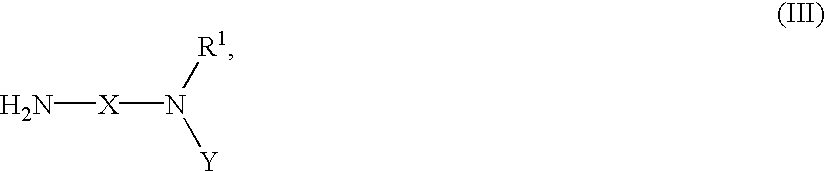
in which
Y represents R2 or a customary amino protective group and X, R1 and R2 are each as defined above to give compounds of the formula (IV) 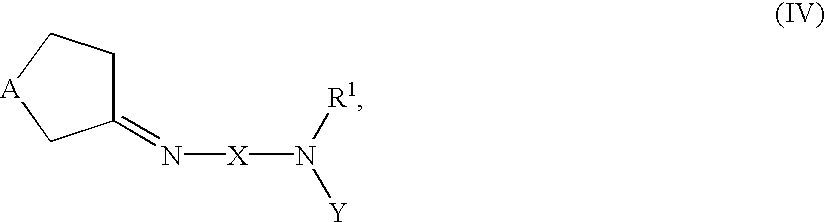
in which
Y represents R2 or a customary amino protective group and A, X, R1 and R2 are each as defined above
are subsequently reacted with chlorocarbonyl isocyanate to give compounds of the formula (V) 
in which
Y represents R2 or a customary amino protective group and A, X, R1 and R2 are each defined above,
Y represents a customary amino protective group, compounds of the formula (V) are, if appropriate, converted, by removal of this protective group, into compounds of the formula (VI) 
in which
A, X and R1 are each as defined above
and are reacted, if appropriate in the presence of a base, with compounds of the formula (VII)
in which
R2 is as defined above and T represents a leaving group to give compounds of the formula (V) in which
Y represents R2 and A, X, R2 and R2 are each as defined above
and, if appropriate, compounds of the formula (V) are reacted, if appropriate in the presence of a base, with compounds of the formula (VIII)
in which
R3 is as defined above, but not hydrogen, and T represents a leaving group to give compounds of the formula (I) in which R3 is as defined above, but not hydrogen,
where, if the compound prepared in this manner contains a bromoaryl or bromohetaryl group in the radical R3, a transition-metal-catalysed coupling reaction with an organotin or organoboron compound by customary methods may follow and/or
where, if the compound prepared in this manner contains an aldehyde group in the radical R3, this aldehyde group may then be converted into the corresponding oxime using customary methods and/or
where, if the compound prepared in this manner contains a cyano group in the radical R3, this cyano group may then be converted via the stage of the corresponding hydroxylamidine, into the corresponding amidine, using customary methods.
The process according to the invention for preparing compounds of the formula (I) can be illustrated in an exemplary, but not limiting, manner by the equations below: 

Solvents suitable for the process described above are organic solvents which are inert under the reaction conditions. These include halogenated hydrocarbons, such as dichloromethane, trichloromethane, carbon tetrachloride, 1,2-dichloroethane, trichloroethane, tetrachloroethane, 1,2-dichloroethylene or trichloroethylene, ethers, such as diethyl ether, dioxane, tetrahydrofuran, glycol dimethyl ether or diethylene glycol dimethyl ether, hydrocarbons, such as benzene, xylene, toluene, hexane or cyclohexane, dimethylformamide, dimethyl sulphoxide, acetonitrile, pyridine or hexamethylphosphoric triamide. It is also possible to use solvent mixtures of the solvents mentioned above.
The reactions are generally carried out in a temperature range of from −78° C. to reflux temperature, preferably in the range from 0° C. to reflux temperature.
The reactions can be carried out at atmospheric, elevated or reduced pressure (for example in the range from 0.5 to 5 bar). In general, they are carried out at atmospheric pressure.
Suitable bases are the customary inorganic or organic bases. These preferably include alkali metal hydroxides, such as, for example, sodium hydroxide or potassium hydroxide, or alkali metal carbonates, such as sodium carbonate or potassium carbonate, or sodium methoxide or potassium methoxide or sodium ethoxide or potassium ethoxide or potassium tert-butoxide, or amides, such as sodium amide, lithium bis-(trimethylsilyl)amide or lithium diisopropylamide, or amines, such as triethylamine, diisopropylethylamine, diisopropylamine, 4,N,N-dimethylaminopyridine or pyridine.
Preferred solvent for the reaction of compounds of the formula (II) with compounds of the formula (III) to give compounds of the formula (IV) and the further conversion with chlorocarbonyl isocyanate and to compounds of the formula (V) is toluene. In the reaction of compounds of the formula (VI) with compounds of the formula (VII), pyridine is preferred if R2 is a sulphonyl radical and tetrahydrofuran, dichloromethane or acetonitrile is preferred if R2 is an alkoxycarbonyl radical.
The temperature range for the reaction of compounds of the formula (II) with compounds of the formula (III) to give compounds of the formula (IV) is in particular from 80 to 120° C. The addition of chlorocarbonyl isocyanate in the conversion of compounds of the formula (IV) into compounds of the formula (V) is in particular carried out at room temperature; the further reaction is then carried out in particular in a temperature range from 80 to 120° C. The reaction of compounds of the formula (VI) with compounds of the formula (VII) is, if R2 is a sulphonyl radical, carried out in particular at room temperature.
The reaction of compounds of the formula (II) with compounds of the formula (III) to give compounds of the formula (IV) may, if appropriate, be accelerated by adding catalytic amounts of acid, preferably organic sulphonic acid, in particular camphorsulphonic acid.
Suitable leaving groups T in compounds of the formulae (VII) and (VIII) are, for example: halogen, mesylate, tosylate, triflate or 1-imidazolyl, preferably chlorine.
Suitable amino protective groups for compounds of the formulae (III), (IV) and (V) are the radicals which are customarily used, as described, for example, in T. W. Greene, P. G. M. Wuts, Protective Groups in Organic Synthesis, second edition, New York, 1991. Examples which may be mentioned are: benzyl and BOC (tert-butoxycarbonyl). Removal of the amino protective group in the conversion of compounds of the formula (V) into compounds of the formula (VI) is carried out in the manner customary for the amino protective group in question, as described, for example, in T. W. Greene, P. G. M. Wuts, Protective Groups in Organic Synthesis, second edition, New York, 1991.
The transition-metal-catalysed coupling reaction, which is carried out, if appropriate, of aryl or hetaryl bromides with organotin compounds (Stille coupling) or organoboron compounds (Suzuki coupling) is carried out under the reaction conditions customary for these couplings, in the presence of a catalyst, preferably in the presence of a transition metal catalyst, in particular in the presence of a palladium catalyst (see, for example J. Tsuju, Palladium Reagents and Catalysts, J. Wiley & Sons, 1995), preferably in the solvent dimethylformamide. Preferred transition metal catalysts are palladium(0) or palladium(II) compounds, in particular bis-(triphenylphosphine)-palladium(II) chloride or tetrakis-(triphenylphosphine)-palladium(0). If organoboron compounds are used (Suzuki coupling, review: N. Miyaura, A. Suzuki, Chem. Rev. 1995, 95, 2457-2483), the reaction is carried out, in particular, at a temperature of from 90° C. to 110° C. in the presence of a base, preferably aqueous sodium carbonate solution. If organotin compounds are used (Stille coupling, review: V. Farina, V. Krishnamurthy, W. J. Scott in: The Stille Reaction, 1998, J. Wiley and Sons, New York), the reaction is carried out, in particular, at a temperature of from 110 to 130° C.
The conversion of aldehyde groups into the corresponding oximes and of cyano groups, via the stage of the corresponding hydroxyamidines, into the corresponding amidines, are carried out, if appropriate, using the preparation methods customary for these reactions. Furthermore, reference is made to Examples 108 to 110 in the experimental part.
The compounds of the formulae (II), (III), (VII) and (VIII) are known to the person skilled in the art or can be prepared by customary methods.
The compounds of the formula (I) according to the invention have an unforeseeable useful spectrum of pharmacological activity, and they are therefore particularly suitable for the prophylaxis and/or treatment of disorders.
They can preferably be used in medicaments for the prevention and/or therapy of ischaemic and reperfusion damage in the heart (after an acute infarction), in the brain (after a stroke) or in skeletal muscle, for cardiovascular disorders, such as, for example, unstable angina pectoris and arteriosclerosis, neuronal and neurodegenerative disorders, such as, for example, epilepsy, chronic pain, Alzheimer's disease and Parkinson's disease, traumatic brain injuries, septic shock, and also arthritis, diabetes, chronic colitis, sudden deafness, inflammable pulmonary disorders, such as, for example, asthma and chronic bronchitis, and cancer.
The present invention also relates to the use of the substances of the formula (I) for preparing medicaments and to pharmaceutical compositions for the prophylaxis and/or treatment of the clinical pictures mentioned above.
The present invention furthermore relates to a method for the prophylaxis and/or treatment of the clinical pictures mentioned above using the substances of the formula (I).
In addition, the compounds according to the invention can also be used for the treatment of acute myocardial infarction, including in combination with one or more of the following medicaments which are used for the standard therapy of acute myocardial infarction: calcium channel blockers (such as, for example, nifedipine, diltiazem, verapamil), nitrovasodilators (such as, for example, isosorbide dinitrate, glycerol trinitrate, isosorbide 5-mono-nitrate, molsidomine), beta blockers, (such as, for example, metoprolol, atenolol, propranolol, solatol), platelet aggregation inhibitors (such as, for example, acetylsalicylic acid, triclopidine, clopidrogrel), thrombolytics (fibrinolytics) (such as, for example, streptokinase, alteplase, reteplase, urokinase, anistreplase), anticoagulants (such as, for example, heparin, warfarin, phenprocoumarin, low-molecular-weight heparins), ACE inhibitors (such as, for example, enalapril), glycoprotein IIb/IIIa receptor antagonists (such as, for example, tirofiban, eptifibatide), antiarrhythmics (such as, for example, lidocaine, amiodarone) and beta-adrenergic agonists (such as, for example, dopamine, dobutamine).
1) Test Description PARS Inhibition Test (in vitro)
The activity of substances as PARS inhibitors is tested in accordance with the method of Ushiro [Ushiro et al., J. Biol. Chem., 262, 2352-2357 (1987)]. To this end, recombinantly expressed (Bac-To-Bac, Baculo virus expression system; Instruction Manual; Life Technologies) human PARS enzyme is activated in a buffer which contains radioactively labelled [14C]-NAD+. The poly(ADP-ribose) units that are synthesized are precipitated using trichloroacetic acid, and the proportion of labelled protein is determined by scintillation measurements. Incubation of PARS with inhibitors leads to a decrease in the proportion of labelled protein and thus to a reduced radioactivity.
Inhibition of the PARS activity can be represented as a percentage of PARS inhibition in incubation with different substances or as the concentration at which 50% of the enzyme is inhibited, i.e. as IC50 value.
Material
Buffer:
100 mM
Tris-HCl,
pH 7.4
10 mM
MgCl2
1 mM
dithiothreitol (DTT)
Tris-HCl and MgCl2 are dissolved in water, DTT is added from an aqueous 100 mM stock solution (stored at −20° C.) and the pH is adjusted with concentrated HCl to 7.4.
DNA:
1 mg/ml of calf thymus DNA
1 mg/ml of calf thymus DNA (from Sigma) is dissolved in water and sonicated to induce strand breaks. 500 μl aliquots were stored at −20° C.
Histones:
10 mg/ml of type IIA histones, calf thymus
10 mg/ml of lyophilized histones (from Sigma) are dissolved in water.
500 μl aliquots are stored at −20° C.
NAD+ Mix:
2 mM NAD+ in buffer,
NAD+ (from Sigma) solutions are prepared freshly before each test.
In each case 3 μl of labelled [14C]-NAD+ (2.8 kBq, from Amersham) are added to 7 μl of cold NAD+ solution.
Trichloroacetic acid (TCA):
TCA is stored at 4° C. as a 10% strength by weight solution.
PARS:
Human PARS protein is expressed recombinantly in the baculo virus system (Bac-To-Bac, Baculo virus expression system; Instruction Manual; Life Technologies) and purified. 500 μl aliquots are stored at −80° C.
Methods
The compounds to be tested are dissolved in DMSO (dimethyl sulphoxide) at a concentration of 10 mM. The assay is carried out in deep 96-well plates. Per well, 70 μl of buffer, 10 μl of DNA, 10 μl of histones, 10 μl of NAD+/[14C]-NAD+ mix and 0.5-5 μl of PARS (about 10,000 cpm/test) are combined with 1 μl of the compounds (final concentration 0.001-10 μM), to give a total volume of about 110 μl. The mixture is incubated at room temperature for 10 min, and 1 μl of ice-cold TCA solution is then added, and the precipitated labelled proteins are sucked onto a filter paper (printed filter mat A; from Wallac) using a harvester (from Scatron). The filter is dried, sealed together with a scintillation sheet (Multilex A; from Wallac) and measured in a β counter for 1 min per well.
Results of the PARS Inhibition Test
In addition to the substances described in this application, the known PARS inhibitor 1,5-dihydroxyisoquinoline (DHCH) is tested as reference substance. The results of the test are stated as IC50 values for the inhibition of PARS.
The results are shown in Table 1:
| TABLE 1 |
| PARS inhibition (in vitro) |
| Example | IC50 [nM] | ||
| 2 | 0.02 | ||
| 4 | 0.08 | ||
| 6 | 0.009 | ||
| 17 | 0.025 | ||
| 28 | 0.08 | ||
| 59 | 0.04 | ||
2) Test Description Cell Protection Assay (in vitro)
In accordance with a method described by Bowes [Bowes et al., Br. J. Pharmacol., 124, 1760-1766 (1998)], the ability of PARS inhibitors to protect cells against cell death induced by incubation with H2O2 is examined in a cell protection assay. Incubation of endothelial cells with H2O2 results in the generation of DNA strand breaks which in turn activate PARS, resulting in a drastic energy decrease in the cells and in cell death. Living cells are quantified by a fluorimetric redox indicator (Alamar blue), which is converted in the electron transport system of the mitochondria.
Specifically, 7500 MHEC5-T cells/well (DSM ACC 336; German collection of microorganisms and cell cultures) are sown in 4 replications on a 96-well plate. After 24 hours, the cells are incubated with 3 mM aqueous H2O2 solution and differing concentrations of the substances in the presence of 6% by volume of Alamar blue solution in the medium at 37° C. for 5 hours. The reference substance used is 10 μM 1,5-dihydroxyisoquinoline (DHCH) solution. After the incubation, the fluorescence is measured at an excitation wavelength of 530-560 nm and an emission wavelength of 590 nm. The percentage for the cell protection is calculated as the difference between the living cells treated only with H2O2 and the cells treated with H2O2 and PARS inhibitors. The internal standard used is 10 μM DHCH, which is defined as 100% protection. The results obtained for the other substances are compared to this value.
Results of the cell protection assays:
Examples of the protection of endothelial cells by PARS inhibitors are listed in Table 2 below. The EC50 values indicate the concentration at which 50% of maximum cell protection is reached, maximum protection by 10 μM DHCH being defined as 100%. DHCH has an EC50 value of 2 μM.
| TABLE 2 |
| Cell protection (in vitro) |
| Example | EC50 [nM] | ||
| 2 | 0.5 | ||
| 55 | 0.4 | ||
| 57 | 0.3 | ||
| 58 | 0.4 | ||
| 59 | 0.25 | ||
| 61 | 0.5 | ||
| 67 | 0.05 | ||
3) Test Description “Working Heart” Model (in vivo)
For tests on isolated hearts in the “working heart” mode [Bardenheuer and Schrader, Circulation Res., 51, 263 (1983)], isolated hearts of rats are subjected to a 60-minute “low-flow” phase to generate global ischaemia, and the action of the substances with respect to the reestablishment of the pressure in the left ventricle (LVPmax) and the contractile force (dP/dt) during the reperfusion phase is examined. The control substance used is 1,5-dihydroxyisoquinoline.
The present invention also relates to medicaments and pharmaceutical compositions comprising at least one compound of the formula (I), preferably together with one or more pharmacologically acceptable auxiliaries or excipients, and to their use for the abovementioned purposes.
The active compound can act systemically and/or locally. To this end, it can be administered in a suitable manner, such as, for example, orally, parenterally, pulmonarily, nasally, sublingually, lingually, buccally, rectally, transdermally, conjunctivally, otically or as an implant.
For these administration routes, the active compound can be administered in suitable administration forms.
Administration forms suitable for oral administration are known administration forms which release the active compound rapidly and/or in modified form, such as, for example, tablets (uncoated and also coated tablets, for example enterically coated tablets), capsules, sugar-coated tablets, granules, pellets, powders, emulsions, suspensions and solutions.
Parenteral administration can be effected by circumventing a bioabsorption step (in an intravenous, intraarterial, intracardial, intraspinal or intralumbal manner), or via bioabsorption (intramuscularly, subcutaneously, intracutaneously, percutaneously or intraperitoneally). Administration forms suitable for parenteral administration are, inter alia, preparations for injection and infusion in the form of solutions, suspensions, emulsions, lyophilisates and sterile powders.
Medicinal forms suitable for the other administration routes are, for example, medicinal forms for inhalation (inter alia powder inhalators, nebulizers), nasal drops/solutions, sprays; tablets or capsules to be administered lingually, sublingually or buccally, suppositories, preparations for ears or eyes, vaginal capsules, aqueous suspensions (lotions, agitated mixtures), lipophilic suspensions, ointments, creams, milk, pastes, powder for spreading or implants.
The active compounds can be converted in a manner known per se into the administration forms listed. This is effected using inert non-toxic, pharmaceutically suitable auxiliaries. These include, inter alia, excipients (for example microcrystalline cellulose), solvents (for example liquid polyethylene glycols), emulsifiers (for example sodium dodecyl sulphate), dispersants (for example polyvinylpyrrolidone), synthetic and natural biopolymers (for example albumin), stabilizers (for example antioxidants such as ascorbic acid), colorants (for example inorganic pigments, such as iron oxides), or flavour- and/or odour-masking substances.
In the pharmaceutical preparations listed above, the therapeutically active compounds should be present in a concentration of from about 0.1 to 99.5, preferably from about 0.5 to 95, % by weight of the total mixture, i.e. the active compound should be present in amounts sufficient to achieve the dosage range indicated.
In addition to the compounds of the formula (I) according to the invention, the pharmaceutical preparations listed above may also comprise other pharmaceutically active compounds.
In general, it has been found to be advantageous both in human and veterinary medicine to administer the active compound(s) according to the invention in total amounts of from about 0.1 to about 500, preferably from 1 to 100, mg/kg of body weight per 24 hours, if appropriate in the form of a plurality of individual doses, to obtain the desired results. An individual dose preferably comprises the active compound(s) according to the invention in amounts of from about 0.1 to 80, in particular from 1 to 30, mg/kg of body weight.
In spite of this, it may be necessary, if appropriate, to depart from the amounts mentioned, namely depending on the body weight or on the type of administration route, on the individual response to the medicament, the manner of its formulation and the time or interval at which administration takes place. Thus, in some cases it may be adequate to manage with less than the abovementioned minimum amount, while in other cases the upper limit mentioned has to be exceeded.
The present invention is illustrated below on the basis of the following preferred examples, which, however, in no way limit the invention.
Unless indicated otherwise, all percentages in the examples below are based on weight; in the case of solvent mixtures, the ratios given are by volume.

A solution of 1.14 ml (11.0 mmol) of cyclohexanone and 1.42 g (10.0 mmol) of 1-(3-aminopropyl)-2-pyrrolidone [D. J. Bergmann et al., Tetrahedron, 17449 (1997)] in 20 ml of toluene is treated with a spatula tip of camphorsulphonic acid and boiled for 3 hours using a Dean-Stark separator. After this time, the mixture is allowed to cool to room temperature, and 0.97 ml (12.0 mmol) of chlorocarbonyl isocyanate are added. The mixture is once more heated at reflux. After 40 minutes, the reaction has ended. The reaction mixture is partitioned between ethyl acetate and saturated sodium dihydrogen phosphate solution. The organic extract is washed with water and dried over sodium sulphate. Since the aqueous phase also contains product, the aqueous phase is evaporated to dryness and the resulting residue is stirred with methanol. The methanolic extract is combined with the ethyl acetate phase and concentrated and the product is purified by column chromatography (silica gel, ethyl acetate/methanol 4:1). The product fraction is evaporated to dryness and the residue is recrystallized from ethyl acetate. This gives 465 mg (1.6 mmol; 16% yield) of a pale yellow solid.
Melting point: 189° C.
Rf value: 0.3 (ethyl acetate/methanol 4:1).
1H-NMR (200 MHz, DMSO-d6, δ/ppm): 11.17 (1H, s), 3.67 (2H, dd), 3.32 (partially obscured by the signal for water, 2H, t), 3.21 (2H, t), 2.51 (partially obscured by the signal for DMSO, 2H), 2.25-2.15 (4H, m), 1.93 (2H, quart), 1.78-1.63 (4H, m), 1.62-1.48 (2H, m).
MS (ESI): 605.2 (2M+Na+), 583 (2M+H+), 314 (M+Na+), 292.2 (M+H+).

A solution of 0.98 g (4.3 mmol) of N-(3-aminopropyl)-N-methylphenylsulphonamide [preparation according to P. Daetwyler et al., Helv. Chim. Acta, 61, 2646 (1978)], 0.55 g (4.73 mmol) of tetrahydrothiopyran-4-one and a catalytic amount of camphorsulphonic acid in 50 ml of toluene is heated at reflux for 3 hours using a Dean-Stark separator. After cooling to room temperature, the Dean-Stark separator is removed, 0.54 g (5.16 mmol) of chlorocarbonyl isocyanate are added and the mixture is refluxed for another hour. The solvent is removed using a rotary evaporator and the resulting residue is purified by preparative HPLC (RP-C18, acetonitrile/water gradient). This gives 717 mg (42% yield) of an amorphous solid.
1H-NMR (300 MHz, DMSO-d6, δ/ppm): 11.42 (1H, br. s), 7.82-7.58 (5H, m), 3.80-3.70 (2H, m), 3.42 (2H, m), 3.00 (2H, t), 2.92-2.75 (4H, m) 2.68 (3H, s), 1.80-1.65 (2H, s).
MS (DCI): 413.3 (M+NH4 +).

a) tert-butyl 3-(2,4-dioxo-3,4,5,6,7,8-hexahydro-1(2H)-quinazolinyl)cyclo-hexylcarbamate
A solution of 2.13 ml (20.53 mmol) of cyclohexanone and 4.0 g (18.66 mmol) of tert-butyl 3-aminocyclohexylcarbamate [prepared from 1,3-diaminocyclohexane and di-tert-butyl dicarbonate {(BOC)2O}] in 300 ml of toluene is treated with a spatula tip of camphorsulphonic acid and boiled for 1.5 hours, with the use of a Dean-Stark separator. The mixture is allowed to cool to room temperature, and 1.8 ml of chlorocarbonyl isocyanate are added. The mixture is again heated at reflux. After 45 minutes, the reaction has ended. Most of the toluene is removed using a rotary evaporator and the residue is diluted with dichloromethane. The mixture is washed with saturated sodium bicarbonate solution and dried over sodium sulphate. The mixture is concentrated using a rotary evaporator and the residue is purified by column chromatography (silica gel, cyclohexane/ethyl acetate 1:2). The product fraction is freed from the solvent and the residue is recrystallized from ethyl acetate. This gives 900 mg (2.48 mmol, 13% yield) of a white solid which is a cis/trans isomer mixture.
Melting point: >240° C.
Rf value: 0.46 (ethyl acetate/methanol 4:1).
1H-NMR (300 MHz, DMSO-d6, δ/ppm): 10.96 (1H, s), 6.81 (1H, d), 3.91-3.79 (1H, m) 3.40-3.24 (1H, m, partially obscured by the signal for water), 2.53-2.47 (2H, m, partially obscured by the signal for DMSO), 2.49-2.24 (2H, m), 2.21 (2H, t), 1.76-1.63 (6H, m), 1.58-1.48 (4H, m), 1.37 (9H, s).
MS (ESI): 749.4 (2M+Na+), 727 (2M+H+), 386.1 (M+Na+), 364 (M+H+).
b) 1-(3-aminocyclohexyl)-5,6,7,8-tetrahydro-2,4(1H,3H)-quinazolinedione hydrochloride
A suspension of 860 mg (2.37 mmol) of tert-butyl 3-(2,4-dioxo-3,4,5,6,7,8-hexahydro-1(2H)-quinazolinyl)cyclohexylcarbamate in 6 ml of concentrated hydrochloric acid is heated to 40-50° C. After 2.5 hours, the mixture is, for drying, concentrated using a rotary evaporator. The resulting crude product is recrystallized from ethyl acetate. This gives 700 mg (2.33 mmol, 98% yield) of a colourless solid which is a mixture of cis and trans isomers.
Melting point: >250° C.
Rf value: 0.36 (ethyl acetate/methanol 4:1).
1H-NMR (200 MHz, DMSO-d6, δ/ppm, main isomer): 11.08 (1H, s), 8.08 (3H, s broad), 4.02-3.85 (1H, m), 3.23-3.07 (1H, m), 2.52 (2H, t, partially obscured by the signal for DMSO), 2.20 (2H, t), 1.97-1.84 (2H, m), 1.73-1.62 (6H, m), 1.60-1.48 (4H, m).
MS (ESI): 264 (M−HCl+H+), 247 (M+−HCl−NH2).
c) N-[3-(2,4-dioxo-3,4,5,6,7,8-hexahydro-1(2H)-quinazolinyl)cyclohexyl]-4-nitrobenzenesulphonamide
Together with 99 mg (1.25 mmol) of sodium bicarbonate, 150 mg (0.50 mmol) of 1-(3-aminocyclohexyl)-5,6,7,8,-tetrahydro-2,4(1H,3H)-quinazolinedione hydrochloride in 10 ml of water, to which a few drops of 2-molar sodium carbonate solution have been added, are heated to 50° C. This solution is treated with 166 mg (0.75 mmol) of 4-nitrobenzenesulphonyl chloride. After a couple of minutes, a wax-like precipitate is formed. After one hour, the mixture is acidified with dilute hydrochloric acid and extracted with dichloromethane. The organic phase is concentrated and the resulting residue is recrystallized from ethyl acetate. This gives 33 mg (0.07 mmol) of a white solid.
Melting point: >240° C.
Rf value: 0.77 (ethyl acetate/methanol 4:1).
1H-NMR (200 MHz, DMSO-d6, δ/ppm, main isomer): 10.99 (1H, s), 8.42 (2H, d), 8.16 (1H, d), 8.07 (2H, d), 3.90-3.73 (1H, m) 3.31-3.13 (1H, m), 2.45-2.08 (6H, m), 1.70-1.42 (8H, m), 1.30-0.95 (2H, m).
MS (ESI): 897.5 (2H+H+), 490.3 (M+H++CH3CN), 449.3 (M+H+).

a) 1-{3-[benzyl(methyl)amino]propyl}-5,6,7,8-tetrahydro-2,4(1H, 3H)-quinazolinedione
A solution of 24.0 g (134.6 mmol) of N-(3-aminopropyl)-N-benzyl-N-methylamine [J.-M. Contreras et al., J. Med. Chem. 42, 730 (1999)] and 14.5 g (148.1 mmol) of cyclohexanone in 200 ml of toluene is heated at reflux for two hours using a Dean-Stark separator. The mixture is then allowed to cool to room temperature and treated with 17.0 g (161.6 mmol) of chlorocarbonyl isocyanate. A precipitate is formed. The mixture is once more heated at reflux. After two hours, the reaction has ended. The mixture is diluted with ethyl acetate and washed with saturated sodium bicarbonate solution and dried over sodium sulphate. The solvent is removed and the residue is purified by column chromatography (silica gel, ethyl acetate). This gives 22.5 g (68.7 mmol, 51% yield) of a yellowish oil.
Rf value: 0.3 (ethyl acetate/methanol 4:1).
1H-NMR (200 MHz, DMSO-d6, δ/ppm): 11.06 (1H, s), 7.37-7.19 (5H, m), 3.86 (2H, dd), 3.45 (2H, s), 2.60-2.50 (2H, m, partially obscured by the signal for DMSO), 2.35 (2H, t), 2.20 (2H, t), 2.07 (3H, s), 1.80-1.48 (6H, m).
MS (ESI): 328 (M+H+).
b) 1-[3-(methylamino)propyl]-5,6,7,8-tetrahydro-2,4(1H,3H)-quinazolinedione
A solution of 4.29 g (13.11 mmol) of 1-{3-[benzyl(methyl)amino]propyl}-5,6,7,8-tetrahydro-2,4(1H,3H)-quinazolinedione in a mixture of 50 ml of methanol and 10 ml of tetrahydrofuran is admixed with 5.6 mg of 10% palladium-on-carbon. Over a period of 45 minutes, three portions of in total 8.61 g (136.6 mmol) of ammonium formate are then added. After the addition has ended, the mixture is heated at reflux for 1.5 hours. After cooling, the mixture if filtered through a little kieselguhr and the solvent is removed under reduced pressure. This gives 2.24 g (9.44 mmol, 72% yield) of the product as a colourless solid.
1H-NMR (200 MHz, DMSO-d6, δ/ppm): 11.26 (1H, s), 8.95 (1H, br. s), 2.89 (2H, t), 3.82 (2H, t), 2.65-2.42 (5H, m), 2.20-2.12 (2H, m), 2.00-1.50 (6H, m).
MS (ESI): 238.1 (M+H+).
c) N-[3-(2,4-dioxo-3,4,5,6,7,8-hexahydro-1(2H)-quinazolinyl)propyl]-4-fluoro-N-methylphenylsulphonamide
A solution of 75 mg (0.32 mmol) of 1-[3-(methylamino)propyl]-5,6,7,8-tetrahydro-2,4(1H,3H)-quinazolinedione and 61.5 mg (0.32 mmol) of 4-fluorophenylsulphonyl chloride in 3 ml of pyridine is stirred at room temperature overnight. The reaction mixture is then adjusted to pH 1 using 2-molar hydrochloric acid and extracted twice with in each case 20 ml of ethyl acetate. The organic phase is concentrated under reduced pressure and the resulting residue is purified by preparative HPLC (RP-C18, acetonitrile/water gradient). This gives 43.1 mg (34% yield) of the product as an amorphous solid.
1H-NMR (300 MHz, DMSO-d6, δ/ppm): 11.20 (1H, s), 7.89-7.81 (2H, m), 7.52-7.42 (2H, m), 3.71 (2H, m), 2.98 (2H, t), 2.69 (3H, s), 2.65-2.48 (2H, m), 1.50-1.61 (2H, m), 2.20 (2H, t), 1.80-1.86 (4H, m).
MS (CI): 413.3 (M+NH4 +).

a) 1-{3-[benzyl(methyl)amino]propyl}-1,5,7,8-tetrahydro-2H-thiopyrano[4,3-d]pyrimidine-2,4(3H)-dione
A solution of 9.9 g (55.55 mmol) of N-(3-aminopropyl)-N-benzyl-N-methylamine and 7.1 g (61.11 mmol) of tetrahydro-4H-thiopyran-4-one in 250 ml of toluene is treated with a spatula tip of camphorsulphonic acid, and the mixture is heated at reflux for two hours using a Dean-Stark separator. The mixture is then allowed to cool to room temperature, and 7.0 g (66.67 mmol) of chlorocarbonyl isocyante are added. A precipitate is formed. The mixture is once more heated at reflux. After 30 minutes, the reaction has ended. The mixture is diluted with dichloromethane and washed with saturated sodium bicarbonate solution and dried over sodium sulphate. The solvent is then removed and the residue is purified by column chromatography (silica gel, ethyl acetate). This gives 12.8 g (37 mmol, 67% yield) of a yellowish material which solidifies like a glass.
Rf value: 0.42(ethyl acetate/methanol 4:1).
1H-NMR (200 MHz, DMSO-d6, δ/ppm): 11.49 (1H, s), 7.37-7.20 (5H, m), 3.79 (2H, dd), 3.45 (2H, s), 3.36 (2H, s), 2.83 (4H, s), 2.37 (2H, t), 2.10 (3H, s), 1.80-1.67 (2H, m).
MS (ESI): 346 (M+H+).
b) 2,2,2-trichloroethyl 3-(2,4-dioxo-3,4,7,8-tetrahydro-2H-thiopyrano-[4,3-d]pyrimidin-1-(5H)-yl)propyl(methyl)carbamate
A solution of 11.5 g (33.29 mmol) of 1-{3-[benzyl(methyl)amino]propyl}-1,5,7,8-tetrahydro-2H-thiopyrano[4,3-d]pyrimidine-2,4-(3H)-dione in 200 ml of acetonitrile is treated with 7.92 g (36.63 mmol) of 2,2,2-trichloroethyl chloroformate, and the mixture is stirred at room temperature for 30 minutes. The solvent is then removed under reduced pressure and the residue is purified by column chromatography (silica gel, cyclohexane/ethyl acetate 1:1). This gives 9.4 g (63% yield) of a colourless solid.
1H-NMR (200 MHz, DMSO-d6, δ/ppm): 11.40 (1H, s), 4.85-4.78 (2H, m), 3.85-3.70 (2H, m), 3.35 (3H, s), 2.98-2.80 (8H, m), 1.90-1.72 (2H, m).
MS (CI): 447 (M+NH4 +).

a) 1-[3-(methyl)amino]propyl]-1,5,7,8-tetrahydro-2H-thiopyrano[4,3-d]pyrimidine-2,4(3H)-dione hydrochloride
A solution of 3.0 g (6.96 mmol) of 2,2,2-trichloroethyl 3-(2,4-dioxo-3,4,7,8-tetrahydro-2H-thiopyrano[4,3-d]pyrimidin-1-(5H)-yl)propyl(methyl)carbamate in 60 ml of tetrahydrofuran is treated with 60 ml of 0.01-molar hydrochloric acid and 2.28 g (34.8 mmol) of zinc dust. Over a period of four hours, a total of 4 ml of 2-molar hydrochloric acid and 455 mg (6.96 mmol) of zinc dust are added in portions. After the reaction has gone to completion, the mixture is concentrated under reduced pressure, diluted with 60 ml of 0.01-molar hydrochloric acid and washed with ethyl acetate. The aqueous phase is evaporated to dryness and used for the next step without further purification.
1H-NMR (200 MHz, DMSO-d6, δ/ppm): 11.49 (1H, s), 8.30 (2H, br. s), 4.00-4.12 (4H, m), 3.82 (2H, t), 2.80-3.00 (4H, m), 2.57 (3H, t), 1.92-1.78 (2H, m).
MS (ESI+): 456.4 (M−HCl+H+).
b) N-[3-(2,4-dioxo-3,4,7,8-tetrahydro-2H-thiopyran[4,3-d]pyrimidin-1(5H)-yl)propyl]-N-methyl-2,1,3-benzothiadiazole-4-sulphonamide
A solution of 150 mg (0.59 mmol) of 1-[3-(methylamino)propyl]-1,5,7,8-tetrahydro-2H-thiopyrano[4,3-d]pyrimidine-2,4(3H)-dione hydrochloride and 2.4 ml of pyridine is treated with 206.8 mg (0.88 mmol) of benzothiadiazole-4-sulphonyl chloride, 0.6 ml (4.3 mmol) of triethylamine and a spatula tip of 4-(N,N-dimethylamino)pyridine. The mixture is stirred at room temperature overnight and then concentrated to dryness using a rotary evaporator, and the product is isolated by preparative HPLC (RP-C18, acetonitrile/water gradient). This gives 104.5 mg (0.23 mmol, 39% yield) of an amorphous solid.
1H-NMR (300 MHz, DMSO-d6, δ/ppm): 11.40 (1H, br. s), 8.46-8.18 (2H, m), 7.92-7.82 (1H, m), 3.85-3.69 (2H, m), 3.40-3.23 (4H, m), 2.75-2.90 (7H, m), 1.85-1.65 (2H, m).
MS (ESI+): 454 (M+H+).

Under argon, 186.8 mg (0.51 mmol) of 2-tributylstannylpyrazine and 27.3 mg (0.039 mmol) of bis(triphenylphosphine)palladium(II) chloride are added to a solution of 200 mg (0.39 mmol) of the compound from Example 44 in dimethylformamide (5 ml). The reaction mixture is stirred at 120° C. overnight and, after cooling, purified by preparative HPLC (RP-C18, acetonitrile/water gradient). This gives 42 mg of the product (23%) as an amorphous solid.
1H-NMR (200 MHz, DMSO-d6, δ/ppm): 11.20 (1H, br. s), 9.38 (1H, d), 8.63-8.69 (2H, m), 8.13 (1H, d), 7.75 (1H, d), 3.68-3,81 (2H, m), 3.02-3.15 (2H, m), 2.78 (3H, s), 2.45-2.60 (2H, obscured by the signal for DMSO), 2.11-2.27 (2H, m), 1.45-1.90 (6H, m).
MS (ESI+): 462.3 (M+H+).

Under argon, 500 mg (1.08 mmol) of the compound from Example 44 and 210 mg (1.41 mmol) of 4-formylphenylboronic acid are added to a solution of 75.9 mg (0.11 mmol) of bis(triphenylphosphine)palladium(II) chloride in DMF (5 ml), and the mixture is stirred at 70° C. for 1 h. 0.7 ml of aqueous sodium carbonate solution (2M) are then added and the reaction mixture is stirred at 100° C. overnight. After cooling, the reaction mixture is purified directly by preparative HPLC (RP-C18, acetonitrile/water gradient). This gives 418 mg of the product (79%) as an amorphous solid.
1H-NMR (200 MHz, DMSO-d6, δ/ppm): 11.20 (1H, br. s), 7.96-8.05 (5H, m), 7.88 (1H, d), 7.72 (1H, d), 3.65-3,82 (2H, m), 3.00-3.15 (2H, m), 2.79 (3H, s), 2.47-2.62 (2H, obscured by the signal for DMSO), 2.13-2.27 (2H, m), 1.46-1.90 (6H, m). MS (ESI+): 488.1 (M+H+).

33.8 mg (1.03 mmol) of N-hydroxylamine hydrochloride and 84.1 mg (1.03 mmol) of sodium acetate are added to a solution of 100 mg (0.21 mmol) of the compound from Example 107 in tetrahydrofuran/water (20 ml, 1:1 mixture), and the mixture is heated at reflux for 3 h. Another 33.8 mg (1.03 mmol) of N-hydroxylamine hydrochloride and 84.1 mg (1.03 mmol) of sodium acetate are then added, and the mixture is stirred at reflux overnight. After cooling, the organic solvent is evaporated under reduced pressure and the resulting precipitate is filtered and washed with water and diethyl ether. Further purification is carried out using preparative HPLC (RP-C18, acetonitrile/water gradient). This gives 32 mg of the product (31%) as an amorphous solid.
1H-NMR (200 MHz, DMSO-d6, δ/ppm): 11.40 (1H, s), 11.20 (1H, s), 8.19 (1H, s), 7.63-7.85 (6H, m), 3.68-3.82 (2H, m), 3.01-3.14 (2H, m), 2.78 (3H, s), 2.46-2.62 (2H, obscured by the signal for DMSO), 2.12-2.26 (2H, m), 1.46-1.90 (6H, m).
MS (ESI+): 503.1 (M+H+).

Triethylamine (0.152 ml, 1.09 mmol) is added dropwise to a suspension of 200 mg (0.48 mmol) of the compound from Example 71 and 72.7 mg (1.05 mmol) of hydroxylammonium hydrochloride in ethanol (10 ml), and the reaction mixture is stirred at 75° C. for 6 hours. The ethanol is evaporated under reduced pressure and the solid is then taken up in a little water, filtered and washed with diethyl ether. This gives 186 mg of the product (82%) as an amorphous solid.
1H-NMR (200 MHz, DMSO-d6, δ/ppm): 11.39 (1H, br. s), 9.97 (1H, s), 7.90 (2H, d), 7.74 (2H, d), 5.98 (2H, s), 3.69-3.82 (2H, m), 3.35 (2H, s), 2.95-3.07 (2H, m), 2.77-2.91 (4H, m), 2.69 (3H, s), 1.69-1.81 (2H, m).
MS (ESI+): 454 (M+H+).

Under argon, palladium-on-carbon (10% by weight of Pd, 40 mg) is added to a solution of 350 mg (0.695 mmol) of the compound from Example 109 in glacial acetic acid (21 ml) and acetic anhydride (78 mg, 0.76 mmol), and the mixture is hydrogenated under an atmosphere of hydrogen (atmospheric pressure) at room temperature for 48 h. The reaction mixture is filtered through Celite, the filter residue is washed with methanol and the solvent is removed under reduced pressure. The residue is separated by column chromatography on Florisil (mobile phase: dichloromethane/methanol) and then purified by preparative HPLC (RP-C18, acetonitrile/0.2% aqueous HCl gradient). This gives 17 mg of the product (5%) as an amorphous solid.
1H-NMR (200 MHz, DMSO-d6, δ/ppm): 11.45 (1H, br. s), 9.54 (2H, br. s), 9.25 (2H, br. s), 8.01 (4H, m), 3.70-3,84 (2H, m), 3.00-3.13 (2H, m), 2.80-2.94 (4H, m), 2.74 (3H, s), 2.46-2.58 (2H, obscured by the signal for DMSO), 1.68-1.88 (2H, m).
MS (ESI+): 438.1 (M−HCl+H+).
The compounds 7 to 105 listed in the table below are prepared in a similar manner:
| Example | Rt | MS | Rf value | ||
| No. | Structure | [min] [a] | [M + H]+ | [b] | m.p. [° C.] |
| 7 |
 |
0.6 (E) | |||
| 8 |
 |
0.6 (E) | |||
| 9 |
 |
0.7 (E) | |||
| 10 |
 |
3.88 (A) | 378.5 | ||
| 11 |
 |
2.43 (C) | 316.2 | ||
| 12 |
 |
3.32 (C) | 384.1 | ||
| 13 |
 |
3.99 (C) | 464.3 | ||
| 14 |
 |
4.18 (C) | 446.3 | ||
| 15 |
 |
3.11 (C) | 422.3 | ||
| 16 |
 |
3.59 (C) | 370.1 | ||
| 17 |
 |
3.51 (C) | 429.1 | ||
| 18 |
 |
3.66 (C) | 429.1 | ||
| 19 |
 |
3.03 (C) | 435.4 | ||
| 20 |
 |
3.86 (C) | 428.4 | ||
| 21 |
 |
3.39 (C) | 403.3 | ||
| 22 |
 |
3.53 (C) | 396.3 | ||
| 23 |
 |
3.57 (C) | 451.3 | ||
| 24 |
 |
3.33 (C) | 397.3 | ||
| 25 |
 |
3.44 (C) | 396.3 | ||
| 26 |
 |
3.46 (C) | 408.4 | ||
| 27 |
 |
3.61 (C) | 392.4 | ||
| 28 |
 |
3.29 (C) | 446.3 | ||
| 29 |
 |
3.62 (C) | 392.4 | ||
| 30 |
 |
3.01 (C) | 387.2 | ||
| 31 |
 |
3.01 (C) | 387.2 | ||
| 32 |
 |
4.06 (A) | 423.2 | ||
| 33 |
 |
3.74 (A) | 456.3 | ||
| 34 |
 |
3.76 (C) | 563.2 | ||
| 35 |
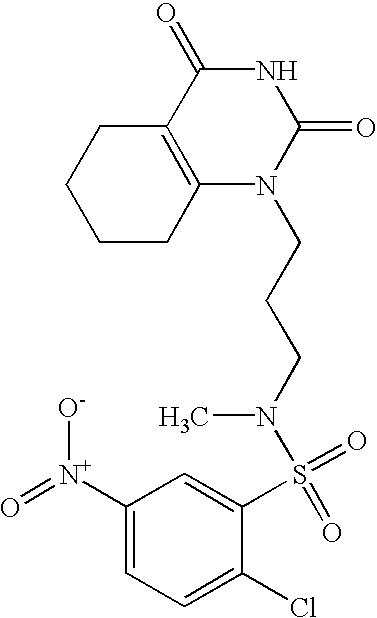 |
3.67 (C) | 457.2 | ||
| 36 |
 |
4.87 (D) | 524.2 | ||
| 37 |
 |
4.79 (D) | 461.2 | ||
| 38 |
 |
4.93 (D) | 457.1 | ||
| 39 |
 |
3.99 (A) | 423.2 | ||
| 40 |
 |
3.58 (C) | 518.2 | ||
| 41 |
 |
3.83 (A) | 470.3 | ||
| 42 |
 |
3.70 (A) | 456.3 | ||
| 43 |
 |
3.46 (C) | 423.1 | ||
| 44 |
 |
3.80 (C) | 464 | ||
| 45 |
 |
3.91 (C) | 468.1 | ||
| 46 |
 |
3.50 (C) | 517.2 | ||
| 47 |
 |
3.89 (C) | 508.1 | ||
| 48 |
 |
3.57 (A) | 380.3 | ||
| 49 |
 |
3.51 (C) | 436.2 | ||
| 50 |
 |
4.18 (A) | 428 | ||
| 51 |
 |
0.72 (E) | >240 | ||
| 52 |
 |
0.71 (E) | >240 | ||
| 53 |
 |
4.21 (A) | 506 | ||
| 54 |
 |
3.75 (C) | 430.4 | ||
| 55 |
 |
2.91 (C) | 379.1 | ||
| 56 |
 |
3.10 (C) | 513.2 | ||
| 57 |
 |
3.14 (C) | 464.1 | ||
| 58 |
 |
3.43 (C) | 414.2 | ||
| 59 |
 |
2.80 (C) | 397.2 | ||
| 60 |
 |
3.48 (A) | 328.2 [M + NH4]+ | ||
| 61 |
 |
0.28 (F) | 170 | ||
| 62 |
 |
0.57 (E) | >240 | ||
| 63 |
 |
0.5 (E) | >240 | ||
| 64 |
 |
3.64 (C) | 458.4 | ||
| 65 |
 |
0.28 (E) | 128 | ||
| 66 |
 |
4.08 (C) | 495.4 | ||
| 67 |
 |
3.47 (C) | 447 | ||
| 68 |
 |
4.48 (D) | 438.1 | ||
| 69 |
 |
3.48 (C) | 441.1 | ||
| 70 |
 |
3.67 (C) | 474 [M − H]− | ||
| 71 |
 |
3.33 (C) | 421.1 | ||
| 72 |
 |
2.89 (C) | 411.1 | ||
| 73 |
 |
3.60 (C) | 479.2 | ||
| 74 |
 |
3.71 (C) | 478.1 [M − H]− | ||
| 75 |
 |
3.80 (C) | 526.1 | ||
| 76 |
 |
3.35 (C) | 403.1 | ||
| 77 |
 |
3.86 (C) | 474 | ||
| 78 |
 |
4.24 (A) | 496 | ||
| 79 |
 |
3.13 (C) | 479.2 | ||
| 80 |
 |
3.38 (C) | 480.1 | ||
| 81 |
 |
4.17 (A) | 473.1 [M + NH4]+ | ||
| 82 |
 |
2.29 (C) | 473.1 [M + NH4]+ | ||
| 83 |
 |
3.30 (C) | 469.1 | ||
| 84 |
 |
3.69 (C) | 474 | ||
| 85 |
 |
2.98 (C) | 393.2 | ||
| 86 |
 |
4.45 (A) | 454 | ||
| 87 |
 |
3.60 (C) | 352.3 | ||
| 88 |
 |
3.22 (C) | 462.3 | ||
| 89 |
 |
2.66 (C) | 77.1 [M − H]− | ||
| 90 |
 |
4.19 (A) | 523 | ||
| 91 |
 |
3.24 (C) | 461.1 | ||
| 92 |
 |
2.79 (C) | 461.3 | ||
| 93 |
 |
4.16 (A) | 473.2 [M + NH4]+ | ||
| 94 |
 |
3.41 (C) | 338.2 | ||
| 95 |
 |
3.84 (C) | 488.2 | ||
| 96 |
 |
3.57 (A) | 455.1 | ||
| 97 |
 |
3.43 (C) | 475.3 | ||
| 98 |
 |
2.82 (C) | 429.2 | ||
| 99 |
 |
3.75 (C) | 480.1 | ||
| 100 |
 |
3.73 (C) | 406 | ||
| 101 |
 |
4.00 (C) | 404.5 | ||
| 102 |
 |
3.08 (C) | 419 | ||
| 103 |
 |
3.91 (A) | 456.1 | ||
| 104 |
 |
3.20 (C) | 292 | ||
| 105 |
 |
3.6 (A) | 455 | ||
[a] HPLC Methods
(A): Mobile phase A: 0.5% HClO4 in water; mobile phase B: acetonitrile; gradient: 0.5 min 98% A, 2% B; 4.5 min 10% A, 90% B; 6.7 min 98% A, 2% B; flow rate: 0.75 ml/min; UV detection at 210 nm; column: Kromasil C18 60×2 mm.
(B): Mobile phase A: 0.5% H3PO4 in water; mobile phase B: acetonitrile; gradient: 0.5 min 90% A, 10% B; 4.5 min 10% A, 90% B; 8.5 min 90% A, 10% B; flow rate: 0.75 ml/min; UV detection at 210 nm; column: Kromasil C18 60×2 mm.
(C): Mobile phase A: 0.1% formic acid in water; mobile phase B: 0.1% formic acid in acetonitrile; gradient: 0.5 min 90% A, 10% B; 4 min 10% A, 90% B; 6.1 min 90% A, 10% B; flow rate: 0.5 ml/min; UV detection at 210 nm; column: Symmetry C18 50×2.1 mm.
(D): Mobile phase A: 0.1% formic acid in water; mobile phase B: 0.1% formic acid acetonitrile; gradient: 1 min 95% A, 5% B; 5 min 10% A, 90% B; 6.1 min 95% A, 5% B; flow rate: 0.5 ml/min; UV detection at 210 nm; column: Symmetry C18 50×2.1 mm.
[b] TLC Solvent
(E): Ethyl acetate/methanol 4:1.
(F): Cyclohexane/ethyl acetate 1:2.
Claims (11)
1. A compound of the formula (I) 
in which
A represents a ring member selected from the group consisting of:
—D—,
—CH2—D—,
—D—CH2—,
—CH═CH—CH2—,
—CH2—CH═CH—,
—CH2—CH2—D—,
—D—CH2—CH2 and
—CH2—D—CH2—, in which
D represents —CH2—, —O— or —S—,
X represents (C2-C10)-alkylene or (C3-C8)-cycloalkylene which are optionally mono- or polysubstituted, independently of one another, by substituents selected from the group consisting of (C1-C6)-alkoxy, hydroxyl, amino, mono- and di-(C1-C6)-alkylamino and oxo,
R1 represents hydrogen, (C1-C6)-alkyl which is optionally mono- or polysubstituted by halogen, or represents (C3-C8)-cycloalkyl,
R2 represents a group of the formula —SO2—R4, —SO2—NR5R6, —CO—R7, —CO—NR8R9 or —CO—OR10, in which
R4 represents (C1-C6)-alkyl or (C3-C8)-cycloalkyl which are optionally substituted by (C1-C4)-alkoxy, (C6-C10)-aryl, 5- to 10-membered heteroaryl having up to 4 heteroatoms from the group consisting of N, O and/or S, or up to trisubstituted by halogen, where the aryl or heteroaryl radicals for their part are optionally substituted by hydroxyl, (C1-C4)-alkoxy, (C1-C4)-alkyl, halogen, cyano or nitro, or represents a group of the formula
in which
E represents (C6-C10)-aryl or a 5- to 13-membered saturated, partially unsaturated or aromatic heterocycle having up to four heteroatoms from the group consisting of N, O and S, where the ring systems are in each case optionally substituted up to five times by identical or different substituents selected from the group consisting of nitro, cyano, halogen, optionally benzamido-substituted (C1-C6)-alkyl, trifluoromethyl, (C3-C6)-cycloalkyl, hydroxyl, oxo, (C1-C6)-alkoxy, carboxyl, (C1-C6)-alkoxycarbonyl, (C1-C6)-alkanoyl, amino, aminocarbonyl, mono- and di-(C1-C6)-alkylaminocarbonyl, (C1-C6)-alkanoylamino, (C1-C6)-alkylsulphonyl, (C1-C6)-alkylthio, optionally (C1-C4)-alkyl-, halogen- or nitro-substituted phenylsulphonyl, 
and
G is absent or represents (C6-C10)-arylene or 5- to 10-membered heteroarylene having up to 4 heteroatoms from the group consisting of N, O and S, which are in each case optionally substituted up to three times by identical or different substituents selected from the group consisting of nitro, cyano, halogen, (C1-C6)-alkyl, trifluoromethyl, (C3-C6)-cycloalkyl, hydroxyl, (C1-C6)-alkoxy, carboxyl, (C1-C6)-alkoxycarbonyl, (C1-C6)-alkanoyl, amino, aminocarbonyl, mono- and di-(C1-C6)-alkylaminocarbonyl, (C1-C6)-alkanoylamino, (C1-C6)-alkylsulphonyl and (C1-C6)-alkylthio,
R5 and R6 independently of one another each represent hydrogen, (C3-C8)-cycloalkyl, (C1-C6)-alkyl, (C6-C10)-aryl or 5- to 10-membered heteroaryl which, independently of one another, are in each case optionally substituted by (C1-C4)-alkoxy, hydroxyl, cyano, carboxyl, (C1-C4)-alkoxycarbonyl, up to three times by halogen, by (C6-C10)-aryl or by 5- to 10-membered heteroaryl, where the aryl and hetaryl radicals for their part are optionally substituted by hydroxyl, (C1-C4)-alkoxy, (C1-C4)-alkyl, halogen, cyano or nitro, or
R5 and R6 together with the nitrogen atom to which they are attached form a saturated 3- to 7-membered heterocycle in which optionally one carbon ring member is replaced by a further heteroatom from the group consisting of nitrogen, oxygen and sulphur and which is optionally substituted by (C1-C4)-alkyl, hydroxyl, (C1-C4)-alkoxy, oxo, carboxyl or (C1-C4)-alkoxycarbonyl,
R7 represents (C1-C6)-alkyl or (C3-C8)-cycloalkyl which are optionally substituted by (C1-C4)-alkoxy, (C6-C10)-aryl, 5- to 10-membered heteroaryl having up to 4 heteroatoms from the group consisting of N, O and S or up to three times by halogen, where the aryl or heteroaryl radicals for their part are optionally substituted by hydroxyl, (C1-C4)-alkoxy, (C1-C4)-alkyl, halogen, cyano or nitro, or represents a group of the formula
in which
E represents (C6-C10)-aryl or a 5- to 13-membered saturated, partially unsaturated or aromatic heterocycle having up to four heteroatoms from the group consisting of N, O and S, where the ring systems are in each case optionally substituted up to five times by identical or different substituents selected from the group consisting of nitro, cyano, halogen, optionally benzamido-substituted (C1-C6)-alkyl, trifluoromethyl, (C3-C6)-cycloalkyl, hydroxyl, oxo, (C1-C6)-alkoxy, carboxyl, (C1-C6)-alkoxycarbonyl, (C1-C6)-alkanoyl, amino, aminocarbonyl, mono- and di-(C1-C6)-alkylaminocarbonyl, (C1-C6)-alkanoylamino, (C1-C6)-alkylsulphonyl, (C1-C6)-alkylthio and optionally (C1-C4)-alkyl-, halogen- or nitro-substituted phenylsulphonyl, and
G is absent or represents (C6-C10)-arylene or 5- to 10-membered heteroarylene having up to 4 heteroatoms from the group consisting of N, O and S, which are in each case optionally substituted up to three times by identical or different substituents selected from the group consisting of nitro, cyano, halogen, (C1-C6)-alkyl, trifluoromethyl, (C3-C6)-cycloalkyl, hydroxyl, (C1-C6)-alkoxy, carboxyl, (C1-C6)-alkoxycarbonyl, (C1-C6)-alkanoyl, amino, aminocarbonyl, mono- and di-(C1-C6)-alkylaminocarbonyl, (C1-C6)-alkanoylamino, (C1-C6)-alkylsulphonyl and (C1-C6)-alkylthio,
R8 and R9 independently of one another each represent hydrogen, (C3-C8)-cycloalkyl or (C1-C6)-alkyl which are in each case optionally substituted by (C1-C4)-alkoxy, hydroxyl, cyano, carboxyl, (C1-C4)-alkoxycarbonyl, up to three times by halogen, by (C6-C10)-aryl or by 5- to 10-membered heteroaryl, where the aryl and hetaryl radicals for their part are optionally substituted by hydroxyl, (C1-C4)-alkoxy, (C1-C4)-alkyl, halogen, cyano or nitro, or
R8 and R9 together with the nitrogen atom to which they are attached form a saturated 3- to 7-membered heterocycle in which optionally one carbon ring member is replaced by a further heteroatom from the group consisting of nitrogen, oxygen and sulphur and which is optionally substituted by (C1-C4)-alkyl, hydroxyl, (C1-C4)-alkoxy, oxo, carboxyl or (C1-C4)-alkoxycarbonyl,
R10 represents (C1-C6)-alkyl, (C3-C8)-cycloalkyl or (C6-C10)-aryl which are optionally mono- or polysubstituted by hydroxyl, (C1-C4)-alkoxy, halogen, cyano or nitro, or
R1 and R2 together with the nitrogen atom to which they are attached form a saturated 5- to 10-membered mono- or bicyclic heterocycle,
which has a carbonyl or sulphonyl group directly adjacent to the nitrogen atom to which R1 and R2 are attached,
in which optionally up to two carbon ring members are replaced by oxygen and/or sulphur and
which is optionally substituted up to three times by identical or different substituents selected from the group consisting of (C1-C6)-alkyl, hydroxyl, oxo, (C1-C6)-alkoxy, carboxyl, (C1-C4)-alkoxycarbonyl and halogen, and
R3 represents hydrogen or (C1-C6)-alkoxycarbonyl
or a pharmaceutically acceptable salt or hydrate thereof.
2. A compound according to claim 1 , in which
A represents a ring member —CH2—D— or —D—CH2—, in which
D represents —CH2—, —O— or —S—,
X represents (C2-C4)-alkylene or cyclohexylene,
R1 represents hydrogen, (C1-C4)-alkyl which is optionally substituted up to three times by fluorine, or (C3-C6)-cycloalkyl,
R2 represents a group of the formula —SO2—R4, —CO—R7 or —CO—OR10, in which
R4 represents (C1-C4)-alkyl which is optionally substituted up to three times by fluorine, or represents a group of the formula
in which
E represents (C6-C10)-aryl or a 5- to 13-membered saturated, partially unsaturated or aromatic heterocycle having up to three heteroatoms from the group consisting of N, O and S, where the ring systems are in each case optionally substituted up to three times by identical or different substituents selected from the group consisting of nitro, cyano, fluorine, chlorine, bromine, optionally benzamido-substituted (C1-C4)-alkyl, trifluoromethyl, (C3-C6)-cycloalkyl, hydroxyl, oxo, (C1-C4)-alkoxy, carboxyl, (C1-C4)-alkoxycarbonyl, (C1-C4)-alkanoyl, amino, aminocarbonyl, mono- and di-(C1-C4)-alkylaminocarbonyl, (C1-C4)-alkanoylamino, (C1-C4)-alkylsulphonyl, (C1-C4)-alkylthio and optionally methyl-, fluorine-, chlorine-, bromine- or nitro-substituted phenylsulphonyl, and 'G is absent or represents (C6-C10)-arylene or 5-or 6-membered heteroarylene having up to three heteroatoms from the group consisting of N, O and S, which are in each case optionally substituted up to three times by identical or different substituents selected from the group consisting of nitro, cyano, fluorine, chlorine, bromine, (C1-C4)-alkyl, trifluoromethyl, (C3-C6)-cycloalkyl, hydroxyl, (C1-C4)-alkoxy, carboxyl, (C1-C4)-alkoxycarbonyl, (C1-C4)-alkanoyl, amino, aminocarbonyl, mono- and di-(C1-C4)-alkylaminocarbonyl, (C1-C4)-alkanoyl amino, (C1-C4)-alkylsulphonyl and (C1-C4)-alkylthio,
R7 represents (C6-C10)-aryl which is optionally substituted by nitro,
R10 represents (C1-C4)-alkyl which is optionally substituted up to three times by chlorine, or
R1 and R2 together with the nitrogen atom to which they are attached form a saturated 5- to 10-membered mono- or bicyclic heterocycle
which has a carbonyl group directly adjacent to the nitrogen atom to which R1 and R2 are attached,
in which optionally up to two carbon ring members are replaced by oxygen and/or sulphur and
which is optionally substituted up to three times by identical or different substituents selected from the group consisting of (C1-C4)-alkyl, hydroxyl, oxo, (C1-C4)-alkoxy, carboxyl, (C1-C4)-alkoxycarbonyl and halogen, and
R3 represents hydrogen
or a pharmaceutically acceptable salt or hydrate thereof.
3. A compound according to claim 1 , in which
A represents a ring member —CH2—D— or —D—CH2—, in which
D represents —CH2—, —O— or —S—,
X represents (C2-C4)-alkylene,
R1 represents hydrogen, (C1-C4)-alkyl which is optionally substituted up to three times by fluorine, or (C3-C6)-cycloalkyl,
R2 represents a group of the formula 
in which
E represents (C6-C10)-aryl or a 5- to 13-membered saturated, partially unsaturated or aromatic heterocycle having up to three heteroatoms from the group consisting of N, O and S, where the ring systems are in each case optionally substituted up to three times by identical or different substituents selected from the group consisting of nitro, cyano, fluorine, chlorine, bromine, optionally benzamido-substituted (C1-C4)-alkyl, trifluoromethyl, (C3-C6)-cycloalkyl, hydroxyl, oxo, (C1-C4)-alkoxy, carboxyl, (C1-C4)-alkoxycarbonyl, (C1-C4)-alkanoyl, amino, aminocarbonyl, mono- and di-(C1-C4)-alkylaminocarbonyl, (C1-C4)-alkanoylamino, (C1-C4)-alkylsulphonyl, (C1-C4)-alkylthio and optionally methyl-, fluorine-, chlorine-, bromine- or nitro-substituted phenylsulphonyl, and
G is absent or represents (C6-C10)-arylene or 5- or 6-membered heteroarylene having up to three heteroatoms from the group consisting of N, O and S, which are in each case optionally substituted up to three times by identical or different substituents selected from the group consisting of nitro, cyano, fluorine, chlorine, bromine, (C1-C4)-alkyl, trifluoromethyl, (C3-C6)-cycloalkyl, hydroxyl, (C1-C4)-alkoxy, carboxyl, (C1-C4)-alkoxycarbonyl, (C1-C4)-alkanoyl, amino, aminocarbonyl, mono- and di-(C1-C4)-alkylaminocarbonyl, (C1-C4)-alkanoylamino, (C1-C4)-alkylsulphonyl and (C1-C4)-alkylthio, or
R1 and R2 together with the nitrogen atom to which they are attached form a saturated 5- to 10-membered mono- or bicyclic heterocycle
which has a carbonyl group directly adjacent to the nitrogen atom to which R1 and R2 are attached,
in which optionally up to two carbon ring members are replaced by oxygen and/or sulphur and
which is optionally substituted up to three times by identical or different substituents selected from the group consisting of (C1-C4)-alkyl, hydroxyl, oxo, (C1-C4)-alkoxy, carboxyl, (C1-C4)-alkoxycarbonyl and halogen, and
R3 represents hydrogen
or a pharmaceutically acceptable salt or hydrate thereof.
4. A compound according to claim 1 , in which
A represents a ring member —CH2—D— or —D—CH2—, in which
D represents —CH2— or —S—,
X represents (C2-C4)-alkylene,
R1 represents hydrogen, methyl, trifluoromethyl or cyclopropyl,
R2 represents a group of the formula 
in which
E represents (C6-C10)-aryl or a 5- to 10-membered partially unsaturated or aromatic heterocycle having up to three heteroatoms from the group consisting of N, O and S, where the ring systems are in each case optionally substituted up to two times by identical or different substituents selected from the group consisting of nitro, cyano, amino, fluorine, chlorine, bromine, (C1-C4)-alkyl, trifluoromethyl, (C3-C6)-cycloalkyl, hydroxyl, oxo and (C1-C4)-alkoxy, and
G is absent or represents phenylene or thienylene, and
R3 represents hydrogen,
or a pharmaceutically acceptable salt or hydrate thereof.
5. A compound as recited in claim 1 selected from the group consisting of 

or a pharmaceutically acceptable salt or hydrate thereof.
6. A process for preparing compounds of the formula (I), as defined in claim 1 , characterized in that compounds of the formula (IV) 
in which
Y represents R2 or a customary amino protective group and A, X, R1 and R2 are each as defined in claim 1 are reacted with chlorocarbonyl isocyanate to give compounds of the formula (V) 
in which
Y represents R2 or a customary amino protective group and A, X, R1 and R2 are each as defined in claim 1 ,
if Y represents a customary amino protective group, compounds of the formula (V) are, if appropriate, converted, by removal of this protective group, into compounds of the formula (VI) 
in which
A, X and R1 are each as defined in claim 1 and are reacted with compounds of the formula (VII)
in which
R2 is as defined in claim 1 and T represents a leaving group to give compounds of the formula (V) in which
Y represents R2 and A, X, R1 and R2 are each as defined in claim 1 and, if appropriate, compounds of the formula (V) are reacted with compounds of the formula (VIII)
in which
R3 is as defined in claim 1 , but not hydrogen, and T represents a leaving group to give compounds of the formula (I) in which R3 is as defined in claim 1 , but not hydrogen.
7. A composition comprising at least one compound of the formula (I), as defined in claim 1 , and at least one further active compound.
8. A composition comprising at least one compound of the formula (I), as defined in claim 1 , and at least one further auxiliary.
9. A method of treating or preventing PARS-mediated ischaemic and reperfusion damage, or of treating PARS-mediated traumatic brain injuries, arthritis, type II diabetes, chronic colitis, inflammatory pulmonary disorders, or acute myocardial infarction, comprising administering to a mammal an effective amount of a PARS inhibitor of the formula (I), as defined in claim 1 .
10. The method of claim 9 , wherein ischaemia and reperfusion damage are prevented or treated.
11. The method of claim 10 , wherein ischaemia and reperfusion damage in the heart, in the brain, or in skeletal muscle are prevented or treated.
Applications Claiming Priority (3)
| Application Number | Priority Date | Filing Date | Title |
|---|---|---|---|
| DE10034801 | 2000-07-18 | ||
| DE10034801A DE10034801A1 (en) | 2000-07-18 | 2000-07-18 | Substituted amidoalkyl uracils and their use |
| DE10034801.7 | 2000-07-18 |
Publications (2)
| Publication Number | Publication Date |
|---|---|
| US20030022905A1 US20030022905A1 (en) | 2003-01-30 |
| US6649618B2 true US6649618B2 (en) | 2003-11-18 |
Family
ID=7649257
Family Applications (1)
| Application Number | Title | Priority Date | Filing Date |
|---|---|---|---|
| US09/906,296 Expired - Fee Related US6649618B2 (en) | 2000-07-18 | 2001-07-16 | Substituted amidoalkyl-uracils and their use |
Country Status (6)
| Country | Link |
|---|---|
| US (1) | US6649618B2 (en) |
| EP (1) | EP1303497A1 (en) |
| AU (1) | AU2001269121A1 (en) |
| CA (1) | CA2416036A1 (en) |
| DE (1) | DE10034801A1 (en) |
| WO (1) | WO2002006247A1 (en) |
Cited By (1)
| Publication number | Priority date | Publication date | Assignee | Title |
|---|---|---|---|---|
| US20050159431A1 (en) * | 2002-01-15 | 2005-07-21 | Bayer Healthcare Ag | Substituted alkyl uracils and thereof |
Families Citing this family (4)
| Publication number | Priority date | Publication date | Assignee | Title |
|---|---|---|---|---|
| US7009052B2 (en) * | 2003-03-20 | 2006-03-07 | Warner Lambert Company Llc | Sulfonamide derivatives |
| CA2686848A1 (en) | 2007-05-08 | 2008-11-20 | Schering Corporation | Methods of treatment using intravenous formulations comprising temozolomide |
| EP2773623B1 (en) * | 2011-11-01 | 2020-04-29 | Impact Therapeutics, Inc. | 1-(arylmethyl)-5,6,7,8-tetrahydroquinazoline-2,4-diones and analogs and the use thereof |
| EP3332645A1 (en) | 2016-12-12 | 2018-06-13 | Bayer Cropscience AG | Use of substituted pyrimidine diones or their salts as agents to combat abiotic plant stress |
Citations (7)
| Publication number | Priority date | Publication date | Assignee | Title |
|---|---|---|---|---|
| DE1959705A1 (en) | 1969-11-28 | 1971-06-03 | Bayer Ag | 1-subst uracil derivs |
| DE2126148A1 (en) | 1971-05-26 | 1972-12-07 | Farbenfabriken Bayer Ag, 5090 Leverkusen | Prepn of uracil derivs - useful as plant - protection agents and their inters |
| DE2142317A1 (en) | 1971-08-24 | 1973-03-01 | Bayer Ag | Hypnotic uracil derivs - which do not have narcotic props |
| JPH03264579A (en) | 1990-03-14 | 1991-11-25 | Dai Ichi Seiyaku Co Ltd | Pyrimidine derivative |
| WO1998033802A1 (en) | 1997-02-01 | 1998-08-06 | Newcastle University Ventures Limited | Quinazolinone compounds |
| WO2000042025A1 (en) | 1999-01-14 | 2000-07-20 | Meiji Seika Kaisha, Ltd. | Poly(adp-ribose) polymerase inhibitors consisting of pyrimidine derivatives |
| JP3264579B2 (en) | 1994-03-18 | 2002-03-11 | 扶桑薬品工業株式会社 | Differentiation of Chlamydia trachomatis serotypes |
-
2000
- 2000-07-18 DE DE10034801A patent/DE10034801A1/en not_active Withdrawn
-
2001
- 2001-07-05 EP EP01947443A patent/EP1303497A1/en not_active Ceased
- 2001-07-05 WO PCT/EP2001/007670 patent/WO2002006247A1/en not_active Ceased
- 2001-07-05 AU AU2001269121A patent/AU2001269121A1/en not_active Abandoned
- 2001-07-05 CA CA002416036A patent/CA2416036A1/en not_active Abandoned
- 2001-07-16 US US09/906,296 patent/US6649618B2/en not_active Expired - Fee Related
Patent Citations (7)
| Publication number | Priority date | Publication date | Assignee | Title |
|---|---|---|---|---|
| DE1959705A1 (en) | 1969-11-28 | 1971-06-03 | Bayer Ag | 1-subst uracil derivs |
| DE2126148A1 (en) | 1971-05-26 | 1972-12-07 | Farbenfabriken Bayer Ag, 5090 Leverkusen | Prepn of uracil derivs - useful as plant - protection agents and their inters |
| DE2142317A1 (en) | 1971-08-24 | 1973-03-01 | Bayer Ag | Hypnotic uracil derivs - which do not have narcotic props |
| JPH03264579A (en) | 1990-03-14 | 1991-11-25 | Dai Ichi Seiyaku Co Ltd | Pyrimidine derivative |
| JP3264579B2 (en) | 1994-03-18 | 2002-03-11 | 扶桑薬品工業株式会社 | Differentiation of Chlamydia trachomatis serotypes |
| WO1998033802A1 (en) | 1997-02-01 | 1998-08-06 | Newcastle University Ventures Limited | Quinazolinone compounds |
| WO2000042025A1 (en) | 1999-01-14 | 2000-07-20 | Meiji Seika Kaisha, Ltd. | Poly(adp-ribose) polymerase inhibitors consisting of pyrimidine derivatives |
Non-Patent Citations (28)
| Title |
|---|
| Basnak, I., Balkan, A., Coe, P. L., and Walker, R. T., "The Synthesis of Some 5-Substituted and 5,6-Disubstituted 2′-Deoxyuridines", Nucleosides & Nucleotides, 13(1-3): 177-196 (1994). |
| Basnak, I., Balkan, A., Coe, P. L., and Walker, R. T., "The Synthesis of Some 5-Substituted and 5,6-Disubstituted 2'-Deoxyuridines", Nucleosides & Nucleotides, 13(1-3): 177-196 (1994). |
| Chaby (Drug Discovery Today 4(5) 209-221, May 1999).* * |
| Cuzzocrea, S., Zingarelli, B., Gilad, E., Hake, P., Salzman, A. L., Szabo, C., "Protective effects of 3-aminobenzamide, and inhibitor of poly (ADP-ribose) synthase in a carrageenan-induced model of local inflammation", European Journal of Pharmacology, 342: 67-76 (1998). |
| Draminski, M., Frass, E., "Alkylated Derivatives of Uracil. Part IX. Synthesis of N-(2,3-Dihydroxypropyl) Derivatives of 5,6-Tetramethyleneuracil, Structural Analogs of Nucleosides", Polish Journal of Chemistry, 55: 1547-1552 (1981). |
| Endres, M., Wang, Z.-Q., Namura, S., Waeber, C., Moskowitz, M., "Ischemic Brain Injury is Mediated by the Activation of Poly(ADP-Ribose)Polymerase", Journal of Cerebral Blood Flow and Metabolism, 17: 1143-1151 (1997). |
| Eriksson, C., Busk, L., Brittebo, E. B., "3-Aminobenzamide: Effects on Cytochrome P450-Dependent Metabolism of Chemicals and on the Toxicity of Dichlobenil in the Olfactory Mucosa", Toxicology and Applied Pharmacology, 136: 324-331 (1996). |
| Golankiewicz, K., and Celewics, L., "Synthesis of New Derivatives of 1,1′-Trimethylenebispyrimidines", P Journal of Chemistry, 52(5): 1035-1038 (1978). |
| Golankiewicz, K., and Celewics, L., "Synthesis of New Derivatives of 1,1'-Trimethylenebispyrimidines", P Journal of Chemistry, 52(5): 1035-1038 (1978). |
| Jijon, H. B., Churchill, T., Malfair, D., Wessler, A., Jewell, L. D., Parsons, H. G., Madsen, K. L., "Inhibition of poly(ADP-ribose) polymerase attenuates inflammation in a model of chronic colitis", Am. J. Physiol. Gastrointest. Liver Physiol. 279: G641-G651 (2000). |
| Opal et al (Infectious Disease Clinics of North America 13(2), pp. 285-297, Jun. 1999).* * |
| Patent Abstracts of Japan, vol. 016, No. 071 (C-0913), Feb. 21, 1992, JP 03 264579. |
| Peczak, G., Draminski, M., "Alkylated Derivatives of Uracil. Part X. Synthesis of 2,4-Diketo-5,6,7,8-Tetrahydroquinazoline", Polish Journal of Chemistry, 59: 317-326 (1985). |
| Rahim, S. G., Trivedi, N., Bogunovic-Batchelor, M. V., Hardy, G. W., Mills, G., Selway, J. W. T., Snowden, W., Littler, E., Coe, P. L., Basnak, I., Whale, R. F., Walker, R. T., "Synthesis and Anti-Herpes Virus Activity of 2′-Deoxy-4′-thiopyridimidine Nucleosides", J. Med. Chem., 39: 789-795 (1996). |
| Rahim, S. G., Trivedi, N., Bogunovic-Batchelor, M. V., Hardy, G. W., Mills, G., Selway, J. W. T., Snowden, W., Littler, E., Coe, P. L., Basnak, I., Whale, R. F., Walker, R. T., "Synthesis and Anti-Herpes Virus Activity of 2'-Deoxy-4'-thiopyridimidine Nucleosides", J. Med. Chem., 39: 789-795 (1996). |
| Renault, J., Laduree, D., Robba, M., "Synthesis and Antiviral Study of Cyclopentano [d] Pyrimdine-2,4-Diones and Octahydroquinazoline-2,4-Diones Acyclic Nucleotides as Potential Anti-HIV Agents", Nucleosides & Nucleosides, 13(4): 891-901 (1994). |
| Shimabukuro, M., Ohneda, M., Lee, Y., Unger, R. H., "Role of Nitric Oxide in Obesity-Induced beta Cell Disease", Journal of Clinical Investigation, 100(2): 290-295 (1997). |
| Shimabukuro, M., Ohneda, M., Lee, Y., Unger, R. H., "Role of Nitric Oxide in Obesity-Induced β Cell Disease", Journal of Clinical Investigation, 100(2): 290-295 (1997). |
| Szabo, C., Cussocrea, S., Hake, P., Scott, G. S., Hirsch, R., Salzman, A. L., "Protective Effect of an Inhibitor of Poly(ADP-Ribose) Synthetase in Collagen-Induced Arthritis", Japanese J. Pharm., 75, Supp. I:102, P317 (1997). |
| Szabo, C., Dawson, V., "Role of poly(ADP-ribose) synthetase in inflammation and ischaemia-reperfusion", TIPS, 19: 287-298 (Jul. 1998). |
| Tabuchi, K., Tsuji, S., Hara, A., Ito, Z., Serizawa, F., Nakagawa, A., Kusakari, J., "Poly(Adenosine Diphosphate-Ribose) Synthetase Inhibitor 3-Aminobenzamide Alleviates Cochlear Dysfunction Induced by Transient Ischemia", Ann Otol Rhinol Laryngol, 110(2): 118-121 (2001). |
| Thiemermann, C., Bowes, J., Myint, F. P., Vane, J. R., "Inhibition of the activity of poly(ADP ribose) synthetase reduces ischemia-reperfusion injury in the heart and skeletal muscle", Proc. Natl. Acad. Sci. USA, 94: 679-683 (Jan. 1997). |
| Vromen, A., Arkovitz, M. S., Zingarelli, B., Salzman, A. L., Garcia, V. G., Szabo, C., "Low-Level Expression and Limited Role for the Inducible Isoform of Nitric Oxide Synthase in the Vascular Hyporeactivity and Mortality Associated with Cecal Ligation and Puncture in the Rat", SHOCK, 6(4): 248-253 (1996). |
| Wallis, R. A., Panizzon, K. L., Girard, J. M., "Traumatic Neuroprotection with Inhibitors of Nitric Oxide and ADP-Ribosylation", Brain Research, 710: 169-177 (1996). |
| Wallis, R. A., Panizzon, K. L., Henry, D., Wasterlain, C. G., "Neuroprotection against nitric oxide injury with inhibitors of ADP-ribosylation", NeuroReport, 5(3): 245-248 (1993). |
| Watanabe, Y., Usui, H., Shibano, T., Tanaka, T., Kanao, M., "Syntheses of Monocyclic and Bicyclic 2,4(1H,3H)-Pyrimidinediones and Their Serotonin 2 Antagonist Activities", Chem. Pharm. Bull., 38(10): 2726-2732 (1990). |
| Weltin, D., Marchal, J., Dufour, P., Potworowski, E., Oth, D., Bischoff, P., Effect of 6(5H)-phenanthridinone, an Inhibitor ofPoly(ADP-ribose) Polymerase, on Cultured Tumor Cells, Oncology Research, 6(9): 399-403 (1994). |
| Zhang, J., Dawson, V. L., Dawson, T. M., Snyder, S. H., "Nitric Oxide Activation of Poly(ADP-Ribose) Synthetase in Neurotoxicity", Science, 263: 687-689 (1994). |
Cited By (1)
| Publication number | Priority date | Publication date | Assignee | Title |
|---|---|---|---|---|
| US20050159431A1 (en) * | 2002-01-15 | 2005-07-21 | Bayer Healthcare Ag | Substituted alkyl uracils and thereof |
Also Published As
| Publication number | Publication date |
|---|---|
| WO2002006247A8 (en) | 2002-02-21 |
| AU2001269121A1 (en) | 2002-01-30 |
| EP1303497A1 (en) | 2003-04-23 |
| WO2002006247A1 (en) | 2002-01-24 |
| CA2416036A1 (en) | 2002-01-24 |
| DE10034801A1 (en) | 2002-01-31 |
| US20030022905A1 (en) | 2003-01-30 |
Similar Documents
| Publication | Publication Date | Title |
|---|---|---|
| EP2799435B1 (en) | Poly (adp-ribose) polymerase inhibitor | |
| KR101624361B1 (en) | Pyrimidyl cyclopentanes as akt protein kinase inhibitors | |
| AU708979B2 (en) | Quinoline and quinazoline compounds useful in therapy | |
| KR101495408B1 (en) | Hydroxylated and methoxylated cyclopenta[d]pyrimidines as akt protein kinase inhibitors | |
| KR100968175B1 (en) | Novel tricyclic derivatives or pharmaceutically acceptable salts thereof, methods for their preparation and pharmaceutical compositions comprising the same | |
| JP4733631B2 (en) | Substituted dihydroquinazolines with antiviral properties | |
| US20050171101A1 (en) | Phenanthridinones as parp inhibitors | |
| JP2002507611A (en) | Imidazolone appetite suppressants: II. Phenyl derivative | |
| JP2008514643A (en) | Novel piperidinylamino-thieno [2,3-D] pyrimidine compounds | |
| SK13532001A3 (en) | Aminopyrimidines as sorbitol dehydrogenase inhibitors | |
| US9834555B2 (en) | Method for treating pain syndrome and other disorders | |
| WO2003051877A1 (en) | 2-substituted pyrrolo[2.1-a]isoquinolines against cancer | |
| DE10312969A1 (en) | Benzofuro-1,4-diazepin-2-one derivatives | |
| US20050159431A1 (en) | Substituted alkyl uracils and thereof | |
| US6649618B2 (en) | Substituted amidoalkyl-uracils and their use | |
| JP2002504088A (en) | Benzopyranopyrroles and benzopyranopyridine alpha-1 adrenergic compounds | |
| EP1625129B1 (en) | Heterocyclyl-substituted dihydroquinazolines and use thereof as an antiviral agent | |
| EP1966212B1 (en) | Diazepinones | |
| JP4783738B2 (en) | Substituted dihydroquinazoline II | |
| US7125995B2 (en) | Substituted amidoalkyl uracils and their use as inhibitors of the poly(adp-ribose) synthetase (PARS) | |
| KR20160010522A (en) | Pyrimidin-4-yl)oxy)-1h-indole-1-carboxamide derivatives and use thereof | |
| HK1197679A (en) | Poly (adp-ribose) polymerase inhibitor |
Legal Events
| Date | Code | Title | Description |
|---|---|---|---|
| AS | Assignment |
Owner name: BAYER AKTIENGESELLSCHAFT, GERMANY Free format text: ASSIGNMENT OF ASSIGNORS INTEREST;ASSIGNORS:HARTER, MICHAEL;ALBRECHT, BARBARA;GERISCH, MICHAEL;AND OTHERS;REEL/FRAME:012516/0038;SIGNING DATES FROM 20011029 TO 20011107 |
|
| LAPS | Lapse for failure to pay maintenance fees | ||
| STCH | Information on status: patent discontinuation |
Free format text: PATENT EXPIRED DUE TO NONPAYMENT OF MAINTENANCE FEES UNDER 37 CFR 1.362 |
|
| FP | Lapsed due to failure to pay maintenance fee |
Effective date: 20071118 |