US6649230B1 - Photoactive polymers - Google Patents
Photoactive polymers Download PDFInfo
- Publication number
- US6649230B1 US6649230B1 US09/958,043 US95804301A US6649230B1 US 6649230 B1 US6649230 B1 US 6649230B1 US 95804301 A US95804301 A US 95804301A US 6649230 B1 US6649230 B1 US 6649230B1
- Authority
- US
- United States
- Prior art keywords
- substituted
- independently
- polymer
- groups
- unsubstituted
- Prior art date
- Legal status (The legal status is an assumption and is not a legal conclusion. Google has not performed a legal analysis and makes no representation as to the accuracy of the status listed.)
- Expired - Lifetime
Links
- 229920000642 polymer Polymers 0.000 title claims abstract description 88
- 125000000217 alkyl group Chemical group 0.000 claims abstract description 95
- 125000004435 hydrogen atom Chemical group [H]* 0.000 claims abstract description 43
- 239000000178 monomer Substances 0.000 claims abstract description 34
- 125000006850 spacer group Chemical group 0.000 claims abstract description 23
- 125000002723 alicyclic group Chemical group 0.000 claims abstract description 22
- 125000003118 aryl group Chemical group 0.000 claims abstract description 22
- 230000003287 optical effect Effects 0.000 claims abstract description 18
- 239000004973 liquid crystal related substance Substances 0.000 claims abstract description 15
- 229920001577 copolymer Polymers 0.000 claims abstract description 13
- 229910052757 nitrogen Inorganic materials 0.000 claims abstract description 10
- 125000004433 nitrogen atom Chemical group N* 0.000 claims abstract description 7
- -1 pyrimidine-2,5-diyl Chemical group 0.000 claims description 152
- 125000005843 halogen group Chemical group 0.000 claims description 61
- 125000004432 carbon atom Chemical group C* 0.000 claims description 60
- 125000004093 cyano group Chemical group *C#N 0.000 claims description 51
- 125000004430 oxygen atom Chemical group O* 0.000 claims description 45
- 239000011737 fluorine Substances 0.000 claims description 44
- 229910052731 fluorine Inorganic materials 0.000 claims description 44
- 125000001153 fluoro group Chemical group F* 0.000 claims description 40
- 239000000460 chlorine Chemical group 0.000 claims description 31
- 229910052801 chlorine Inorganic materials 0.000 claims description 31
- ZAMOUSCENKQFHK-UHFFFAOYSA-N Chlorine atom Chemical group [Cl] ZAMOUSCENKQFHK-UHFFFAOYSA-N 0.000 claims description 30
- 239000000203 mixture Substances 0.000 claims description 27
- 125000004122 cyclic group Chemical group 0.000 claims description 25
- 239000001257 hydrogen Substances 0.000 claims description 23
- 229910052739 hydrogen Inorganic materials 0.000 claims description 23
- 125000002947 alkylene group Chemical group 0.000 claims description 19
- 125000000843 phenylene group Chemical group C1(=C(C=CC=C1)*)* 0.000 claims description 17
- 229910003849 O-Si Inorganic materials 0.000 claims description 15
- 229910003872 O—Si Inorganic materials 0.000 claims description 15
- 125000004959 2,6-naphthylene group Chemical group [H]C1=C([H])C2=C([H])C([*:1])=C([H])C([H])=C2C([H])=C1[*:2] 0.000 claims description 14
- 239000002253 acid Substances 0.000 claims description 14
- 150000002148 esters Chemical class 0.000 claims description 13
- UFHFLCQGNIYNRP-UHFFFAOYSA-N Hydrogen Chemical compound [H][H] UFHFLCQGNIYNRP-UHFFFAOYSA-N 0.000 claims description 9
- CERQOIWHTDAKMF-UHFFFAOYSA-M Methacrylate Chemical group CC(=C)C([O-])=O CERQOIWHTDAKMF-UHFFFAOYSA-M 0.000 claims description 9
- NIXOWILDQLNWCW-UHFFFAOYSA-M acrylate group Chemical group C(C=C)(=O)[O-] NIXOWILDQLNWCW-UHFFFAOYSA-M 0.000 claims description 9
- 125000001931 aliphatic group Chemical group 0.000 claims description 8
- 125000005731 2,5-thiophenylene group Chemical group [H]C1=C([*:1])SC([*:2])=C1[H] 0.000 claims description 6
- 125000004429 atom Chemical group 0.000 claims description 6
- 150000001875 compounds Chemical class 0.000 claims description 5
- 150000003949 imides Chemical class 0.000 claims description 5
- 238000004519 manufacturing process Methods 0.000 claims description 5
- 239000004593 Epoxy Substances 0.000 claims description 4
- PXGOKWXKJXAPGV-UHFFFAOYSA-N Fluorine Chemical compound FF PXGOKWXKJXAPGV-UHFFFAOYSA-N 0.000 claims description 4
- 125000003277 amino group Chemical group 0.000 claims description 4
- 150000004984 aromatic diamines Chemical class 0.000 claims description 4
- BLRPTPMANUNPDV-UHFFFAOYSA-N Silane Chemical compound [SiH4] BLRPTPMANUNPDV-UHFFFAOYSA-N 0.000 claims description 3
- 239000003431 cross linking reagent Substances 0.000 claims description 3
- 125000000524 functional group Chemical group 0.000 claims description 3
- 125000002887 hydroxy group Chemical group [H]O* 0.000 claims description 3
- 229910000077 silane Inorganic materials 0.000 claims description 3
- LFQSCWFLJHTTHZ-UHFFFAOYSA-N Ethanol Chemical compound CCO LFQSCWFLJHTTHZ-UHFFFAOYSA-N 0.000 claims description 2
- 125000002837 carbocyclic group Chemical group 0.000 claims description 2
- 239000012952 cationic photoinitiator Substances 0.000 claims description 2
- 125000000332 coumarinyl group Chemical group O1C(=O)C(=CC2=CC=CC=C12)* 0.000 claims description 2
- 125000004185 ester group Chemical group 0.000 claims description 2
- 125000000962 organic group Chemical group 0.000 claims description 2
- 125000001997 phenyl group Chemical class [H]C1=C([H])C([H])=C(*)C([H])=C1[H] 0.000 claims description 2
- 230000001678 irradiating effect Effects 0.000 claims 1
- 125000003011 styrenyl group Chemical class [H]\C(*)=C(/[H])C1=C([H])C([H])=C([H])C([H])=C1[H] 0.000 claims 1
- 238000010276 construction Methods 0.000 abstract description 4
- YMWUJEATGCHHMB-UHFFFAOYSA-N Dichloromethane Chemical compound ClCCl YMWUJEATGCHHMB-UHFFFAOYSA-N 0.000 description 63
- YXFVVABEGXRONW-UHFFFAOYSA-N Toluene Chemical compound CC1=CC=CC=C1 YXFVVABEGXRONW-UHFFFAOYSA-N 0.000 description 45
- 125000001231 benzoyloxy group Chemical group C(C1=CC=CC=C1)(=O)O* 0.000 description 44
- XEKOWRVHYACXOJ-UHFFFAOYSA-N Ethyl acetate Chemical compound CCOC(C)=O XEKOWRVHYACXOJ-UHFFFAOYSA-N 0.000 description 39
- GTDPSWPPOUPBNX-UHFFFAOYSA-N ac1mqpva Chemical compound CC12C(=O)OC(=O)C1(C)C1(C)C2(C)C(=O)OC1=O GTDPSWPPOUPBNX-UHFFFAOYSA-N 0.000 description 36
- XLYOFNOQVPJJNP-UHFFFAOYSA-N water Substances O XLYOFNOQVPJJNP-UHFFFAOYSA-N 0.000 description 28
- 239000000243 solution Substances 0.000 description 26
- OKKJLVBELUTLKV-UHFFFAOYSA-N Methanol Chemical compound OC OKKJLVBELUTLKV-UHFFFAOYSA-N 0.000 description 21
- WYURNTSHIVDZCO-UHFFFAOYSA-N Tetrahydrofuran Chemical compound C1CCOC1 WYURNTSHIVDZCO-UHFFFAOYSA-N 0.000 description 18
- VHYFNPMBLIVWCW-UHFFFAOYSA-N 4-Dimethylaminopyridine Chemical compound CN(C)C1=CC=NC=C1 VHYFNPMBLIVWCW-UHFFFAOYSA-N 0.000 description 14
- 238000006243 chemical reaction Methods 0.000 description 14
- WXTMDXOMEHJXQO-UHFFFAOYSA-N 2,5-dihydroxybenzoic acid Chemical compound OC(=O)C1=CC(O)=CC=C1O WXTMDXOMEHJXQO-UHFFFAOYSA-N 0.000 description 12
- RTZKZFJDLAIYFH-UHFFFAOYSA-N Diethyl ether Chemical compound CCOCC RTZKZFJDLAIYFH-UHFFFAOYSA-N 0.000 description 12
- KFZMGEQAYNKOFK-UHFFFAOYSA-N Isopropanol Chemical compound CC(C)O KFZMGEQAYNKOFK-UHFFFAOYSA-N 0.000 description 12
- 239000004642 Polyimide Substances 0.000 description 12
- VYPSYNLAJGMNEJ-UHFFFAOYSA-N Silicium dioxide Chemical compound O=[Si]=O VYPSYNLAJGMNEJ-UHFFFAOYSA-N 0.000 description 12
- 238000004587 chromatography analysis Methods 0.000 description 12
- VLKZOEOYAKHREP-UHFFFAOYSA-N n-Hexane Chemical compound CCCCCC VLKZOEOYAKHREP-UHFFFAOYSA-N 0.000 description 12
- 239000012074 organic phase Substances 0.000 description 12
- 229920001721 polyimide Polymers 0.000 description 12
- 239000000741 silica gel Substances 0.000 description 12
- 229910002027 silica gel Inorganic materials 0.000 description 12
- 125000003545 alkoxy group Chemical group 0.000 description 11
- 125000004836 hexamethylene group Chemical group [H]C([H])([*:2])C([H])([H])C([H])([H])C([H])([H])C([H])([H])C([H])([H])[*:1] 0.000 description 11
- 238000000034 method Methods 0.000 description 11
- 229920005575 poly(amic acid) Polymers 0.000 description 11
- 239000011541 reaction mixture Substances 0.000 description 11
- 239000000725 suspension Substances 0.000 description 10
- 0 B.C.CCC.CCC.CCC.CCC.CCP.[1*]C.[2HH] Chemical compound B.C.CCC.CCC.CCC.CCC.CCP.[1*]C.[2HH] 0.000 description 9
- PMZURENOXWZQFD-UHFFFAOYSA-L Sodium Sulfate Chemical compound [Na+].[Na+].[O-]S([O-])(=O)=O PMZURENOXWZQFD-UHFFFAOYSA-L 0.000 description 9
- 229910052938 sodium sulfate Inorganic materials 0.000 description 9
- 235000011152 sodium sulphate Nutrition 0.000 description 9
- YLQBMQCUIZJEEH-UHFFFAOYSA-N tetrahydrofuran Natural products C=1C=COC=1 YLQBMQCUIZJEEH-UHFFFAOYSA-N 0.000 description 9
- GQHTUMJGOHRCHB-UHFFFAOYSA-N 2,3,4,6,7,8,9,10-octahydropyrimido[1,2-a]azepine Chemical compound C1CCCCN2CCCN=C21 GQHTUMJGOHRCHB-UHFFFAOYSA-N 0.000 description 8
- 239000004977 Liquid-crystal polymers (LCPs) Substances 0.000 description 8
- XNGIFLGASWRNHJ-UHFFFAOYSA-N phthalic acid Chemical compound OC(=O)C1=CC=CC=C1C(O)=O XNGIFLGASWRNHJ-UHFFFAOYSA-N 0.000 description 8
- 238000002390 rotary evaporation Methods 0.000 description 8
- 239000000843 powder Substances 0.000 description 7
- VGGSQFUCUMXWEO-UHFFFAOYSA-N Ethene Chemical group C=C VGGSQFUCUMXWEO-UHFFFAOYSA-N 0.000 description 6
- ZMXDDKWLCZADIW-UHFFFAOYSA-N N,N-Dimethylformamide Chemical compound CN(C)C=O ZMXDDKWLCZADIW-UHFFFAOYSA-N 0.000 description 6
- QYKIQEUNHZKYBP-UHFFFAOYSA-N Vinyl ether Chemical class C=COC=C QYKIQEUNHZKYBP-UHFFFAOYSA-N 0.000 description 6
- 125000004428 fluoroalkoxy group Chemical group 0.000 description 6
- 239000000463 material Substances 0.000 description 6
- FQPSGWSUVKBHSU-UHFFFAOYSA-N methacrylamide Chemical class CC(=C)C(N)=O FQPSGWSUVKBHSU-UHFFFAOYSA-N 0.000 description 6
- 150000003440 styrenes Chemical class 0.000 description 6
- 229920001567 vinyl ester resin Chemical class 0.000 description 6
- NCWTXZWJQCMAGD-NHFJDJAPSA-N 11-(2-methylprop-2-enoyloxy)undecyl 5-[4-[(e)-3-methoxy-3-oxoprop-1-enyl]benzoyl]oxy-2-(4-propylbenzoyl)oxybenzoate Chemical compound C1=CC(CCC)=CC=C1C(=O)OC(C(=C1)C(=O)OCCCCCCCCCCCOC(=O)C(C)=C)=CC=C1OC(=O)C1=CC=C(\C=C\C(=O)OC)C=C1 NCWTXZWJQCMAGD-NHFJDJAPSA-N 0.000 description 5
- 125000005714 2,5- (1,3-dioxanylene) group Chemical group [H]C1([H])OC([H])([*:1])OC([H])([H])C1([H])[*:2] 0.000 description 5
- SZTBMYHIYNGYIA-UHFFFAOYSA-M 2-chloroacrylate Chemical compound [O-]C(=O)C(Cl)=C SZTBMYHIYNGYIA-UHFFFAOYSA-M 0.000 description 5
- YBXYCBGDIALKAK-UHFFFAOYSA-N 2-chloroprop-2-enamide Chemical class NC(=O)C(Cl)=C YBXYCBGDIALKAK-UHFFFAOYSA-N 0.000 description 5
- IMOLAGKJZFODRK-UHFFFAOYSA-N 2-phenylprop-2-enamide Chemical class NC(=O)C(=C)C1=CC=CC=C1 IMOLAGKJZFODRK-UHFFFAOYSA-N 0.000 description 5
- ONPJWQSDZCGSQM-UHFFFAOYSA-N 2-phenylprop-2-enoic acid Chemical compound OC(=O)C(=C)C1=CC=CC=C1 ONPJWQSDZCGSQM-UHFFFAOYSA-N 0.000 description 5
- FPQQSJJWHUJYPU-UHFFFAOYSA-N 3-(dimethylamino)propyliminomethylidene-ethylazanium;chloride Chemical compound Cl.CCN=C=NCCCN(C)C FPQQSJJWHUJYPU-UHFFFAOYSA-N 0.000 description 5
- 229920000106 Liquid crystal polymer Polymers 0.000 description 5
- 239000013078 crystal Substances 0.000 description 5
- 238000002425 crystallisation Methods 0.000 description 5
- 150000002431 hydrogen Chemical class 0.000 description 5
- 238000002360 preparation method Methods 0.000 description 5
- 239000007787 solid Substances 0.000 description 5
- 239000000758 substrate Substances 0.000 description 5
- 125000001140 1,4-phenylene group Chemical group [H]C1=C([H])C([*:2])=C([H])C([H])=C1[*:1] 0.000 description 4
- MVZPVFZBAPBZEA-HMMYKYKNSA-N 11-(2-methylprop-2-enoyloxy)undecyl 2-hydroxy-5-[4-[(e)-3-methoxy-3-oxoprop-1-enyl]benzoyl]oxybenzoate Chemical compound C1=CC(/C=C/C(=O)OC)=CC=C1C(=O)OC1=CC=C(O)C(C(=O)OCCCCCCCCCCCOC(=O)C(C)=C)=C1 MVZPVFZBAPBZEA-HMMYKYKNSA-N 0.000 description 4
- CAHSXAYNBVNBOQ-UHFFFAOYSA-N 11-(3,5-dinitrobenzoyl)oxyundecyl 5-[4-(3-methoxy-3-oxoprop-1-enyl)benzoyl]oxy-2-(4-pentylbenzoyl)oxybenzoate Chemical compound C1=CC(CCCCC)=CC=C1C(=O)OC(C(=C1)C(=O)OCCCCCCCCCCCOC(=O)C=2C=C(C=C(C=2)[N+]([O-])=O)[N+]([O-])=O)=CC=C1OC(=O)C1=CC=C(C=CC(=O)OC)C=C1 CAHSXAYNBVNBOQ-UHFFFAOYSA-N 0.000 description 4
- MBGPMDXXPUWUIJ-UHFFFAOYSA-N 11-bromoundecyl 2-methylprop-2-enoate Chemical compound CC(=C)C(=O)OCCCCCCCCCCCBr MBGPMDXXPUWUIJ-UHFFFAOYSA-N 0.000 description 4
- DZHCAYGDKMTMQU-UHFFFAOYSA-N 11-bromoundecyl 3,5-dinitrobenzoate Chemical compound [O-][N+](=O)C1=CC(C(=O)OCCCCCCCCCCCBr)=CC([N+]([O-])=O)=C1 DZHCAYGDKMTMQU-UHFFFAOYSA-N 0.000 description 4
- IJGRMHOSHXDMSA-UHFFFAOYSA-N Atomic nitrogen Chemical compound N#N IJGRMHOSHXDMSA-UHFFFAOYSA-N 0.000 description 4
- 239000005977 Ethylene Substances 0.000 description 4
- CSNNHWWHGAXBCP-UHFFFAOYSA-L Magnesium sulfate Chemical compound [Mg+2].[O-][S+2]([O-])([O-])[O-] CSNNHWWHGAXBCP-UHFFFAOYSA-L 0.000 description 4
- JLTDJTHDQAWBAV-UHFFFAOYSA-N N,N-dimethylaniline Chemical compound CN(C)C1=CC=CC=C1 JLTDJTHDQAWBAV-UHFFFAOYSA-N 0.000 description 4
- JUJWROOIHBZHMG-UHFFFAOYSA-N Pyridine Chemical compound C1=CC=NC=C1 JUJWROOIHBZHMG-UHFFFAOYSA-N 0.000 description 4
- QAOWNCQODCNURD-UHFFFAOYSA-N Sulfuric acid Chemical compound OS(O)(=O)=O QAOWNCQODCNURD-UHFFFAOYSA-N 0.000 description 4
- 150000003926 acrylamides Chemical class 0.000 description 4
- 239000003153 chemical reaction reagent Substances 0.000 description 4
- CCRCUPLGCSFEDV-UHFFFAOYSA-N cinnamic acid methyl ester Natural products COC(=O)C=CC1=CC=CC=C1 CCRCUPLGCSFEDV-UHFFFAOYSA-N 0.000 description 4
- ZYGHJZDHTFUPRJ-UHFFFAOYSA-N coumarin Chemical compound C1=CC=C2OC(=O)C=CC2=C1 ZYGHJZDHTFUPRJ-UHFFFAOYSA-N 0.000 description 4
- CURBACXRQKTCKZ-UHFFFAOYSA-N cyclobutane-1,2,3,4-tetracarboxylic acid Chemical compound OC(=O)C1C(C(O)=O)C(C(O)=O)C1C(O)=O CURBACXRQKTCKZ-UHFFFAOYSA-N 0.000 description 4
- 125000004386 diacrylate group Chemical group 0.000 description 4
- 238000001704 evaporation Methods 0.000 description 4
- 230000008020 evaporation Effects 0.000 description 4
- 239000011521 glass Substances 0.000 description 4
- 125000004051 hexyl group Chemical group [H]C([H])([H])C([H])([H])C([H])([H])C([H])([H])C([H])([H])C([H])([H])* 0.000 description 4
- 125000000449 nitro group Chemical group [O-][N+](*)=O 0.000 description 4
- 125000000951 phenoxy group Chemical group [H]C1=C([H])C([H])=C(O*)C([H])=C1[H] 0.000 description 4
- 239000002904 solvent Substances 0.000 description 4
- AUJXJFHANFIVKH-GQCTYLIASA-N trans-methylferulate Chemical compound COC(=O)\C=C\C1=CC=C(O)C(OC)=C1 AUJXJFHANFIVKH-GQCTYLIASA-N 0.000 description 4
- RIOQSEWOXXDEQQ-UHFFFAOYSA-N triphenylphosphine Chemical compound C1=CC=CC=C1P(C=1C=CC=CC=1)C1=CC=CC=C1 RIOQSEWOXXDEQQ-UHFFFAOYSA-N 0.000 description 4
- MTZIQCDOODTFFF-DARPEHSRSA-N 11-(2-methylprop-2-enoyloxy)undecyl 2-hydroxy-5-[6-[2-methoxy-4-[(e)-3-methoxy-3-oxoprop-1-enyl]phenyl]peroxyhexyl]benzoate Chemical compound COC1=CC(/C=C/C(=O)OC)=CC=C1OOCCCCCCC1=CC=C(O)C(C(=O)OCCCCCCCCCCCOC(=O)C(C)=C)=C1 MTZIQCDOODTFFF-DARPEHSRSA-N 0.000 description 3
- RNQZSDPIARVTKX-UHFFFAOYSA-N 11-(3,5-dinitrobenzoyl)oxyundecyl 2,5-dihydroxybenzoate Chemical compound OC1=CC=C(O)C(C(=O)OCCCCCCCCCCCOC(=O)C=2C=C(C=C(C=2)[N+]([O-])=O)[N+]([O-])=O)=C1 RNQZSDPIARVTKX-UHFFFAOYSA-N 0.000 description 3
- OZAIFHULBGXAKX-UHFFFAOYSA-N 2-(2-cyanopropan-2-yldiazenyl)-2-methylpropanenitrile Chemical compound N#CC(C)(C)N=NC(C)(C)C#N OZAIFHULBGXAKX-UHFFFAOYSA-N 0.000 description 3
- 125000003903 2-propenyl group Chemical group [H]C([*])([H])C([H])=C([H])[H] 0.000 description 3
- WEVYAHXRMPXWCK-UHFFFAOYSA-N Acetonitrile Chemical compound CC#N WEVYAHXRMPXWCK-UHFFFAOYSA-N 0.000 description 3
- XDTMQSROBMDMFD-UHFFFAOYSA-N Cyclohexane Chemical compound C1CCCCC1 XDTMQSROBMDMFD-UHFFFAOYSA-N 0.000 description 3
- LYCAIKOWRPUZTN-UHFFFAOYSA-N Ethylene glycol Chemical compound OCCO LYCAIKOWRPUZTN-UHFFFAOYSA-N 0.000 description 3
- CERQOIWHTDAKMF-UHFFFAOYSA-N Methacrylic acid Chemical compound CC(=C)C(O)=O CERQOIWHTDAKMF-UHFFFAOYSA-N 0.000 description 3
- SECXISVLQFMRJM-UHFFFAOYSA-N N-Methylpyrrolidone Chemical compound CN1CCCC1=O SECXISVLQFMRJM-UHFFFAOYSA-N 0.000 description 3
- UIIMBOGNXHQVGW-UHFFFAOYSA-M Sodium bicarbonate Chemical class [Na+].OC([O-])=O UIIMBOGNXHQVGW-UHFFFAOYSA-M 0.000 description 3
- ZMANZCXQSJIPKH-UHFFFAOYSA-N Triethylamine Chemical compound CCN(CC)CC ZMANZCXQSJIPKH-UHFFFAOYSA-N 0.000 description 3
- 150000007513 acids Chemical class 0.000 description 3
- 239000000654 additive Substances 0.000 description 3
- 230000001680 brushing effect Effects 0.000 description 3
- 210000004027 cell Anatomy 0.000 description 3
- 125000000753 cycloalkyl group Chemical group 0.000 description 3
- OFDFGWLQAKFNRX-CSKARUKUSA-N methyl (e)-3-[4-(6-hydroxyhexoxy)-3-methoxyphenyl]prop-2-enoate Chemical compound COC(=O)\C=C\C1=CC=C(OCCCCCCO)C(OC)=C1 OFDFGWLQAKFNRX-CSKARUKUSA-N 0.000 description 3
- 239000012071 phase Substances 0.000 description 3
- 125000001436 propyl group Chemical group [H]C([*])([H])C([H])([H])C([H])([H])[H] 0.000 description 3
- 238000010992 reflux Methods 0.000 description 3
- 239000007858 starting material Substances 0.000 description 3
- 238000009736 wetting Methods 0.000 description 3
- QIFBAMPSZOISLP-PJJLUWSFSA-N 11-(2-methylprop-2-enoyloxy)undecyl 5-[6-[2-methoxy-4-[(e)-3-methoxy-3-oxoprop-1-enyl]phenyl]peroxyhexyl]-2-(4-pentylbenzoyl)oxybenzoate Chemical compound C1=CC(CCCCC)=CC=C1C(=O)OC(C(=C1)C(=O)OCCCCCCCCCCCOC(=O)C(C)=C)=CC=C1CCCCCCOOC1=CC=C(\C=C\C(=O)OC)C=C1OC QIFBAMPSZOISLP-PJJLUWSFSA-N 0.000 description 2
- STLMBLZQMXPTQN-UHFFFAOYSA-N 11-(3,5-dinitrobenzoyl)oxyundecyl 2-hydroxy-5-[4-(3-methoxy-3-oxoprop-1-enyl)benzoyl]oxybenzoate Chemical compound C1=CC(C=CC(=O)OC)=CC=C1C(=O)OC1=CC=C(O)C(C(=O)OCCCCCCCCCCCOC(=O)C=2C=C(C=C(C=2)[N+]([O-])=O)[N+]([O-])=O)=C1 STLMBLZQMXPTQN-UHFFFAOYSA-N 0.000 description 2
- XFGANBYCJWQYBI-UHFFFAOYSA-N 11-bromoundecan-1-ol Chemical compound OCCCCCCCCCCCBr XFGANBYCJWQYBI-UHFFFAOYSA-N 0.000 description 2
- OISVCGZHLKNMSJ-UHFFFAOYSA-N 2,6-dimethylpyridine Chemical compound CC1=CC=CC(C)=N1 OISVCGZHLKNMSJ-UHFFFAOYSA-N 0.000 description 2
- SMZOUWXMTYCWNB-UHFFFAOYSA-N 2-(2-methoxy-5-methylphenyl)ethanamine Chemical compound COC1=CC=C(C)C=C1CCN SMZOUWXMTYCWNB-UHFFFAOYSA-N 0.000 description 2
- UENRXLSRMCSUSN-UHFFFAOYSA-N 3,5-diaminobenzoic acid Chemical compound NC1=CC(N)=CC(C(O)=O)=C1 UENRXLSRMCSUSN-UHFFFAOYSA-N 0.000 description 2
- RHRNYXVSZLSRRP-UHFFFAOYSA-N 3-(carboxymethyl)cyclopentane-1,2,4-tricarboxylic acid Chemical compound OC(=O)CC1C(C(O)=O)CC(C(O)=O)C1C(O)=O RHRNYXVSZLSRRP-UHFFFAOYSA-N 0.000 description 2
- KAWUBNUJMFOOOE-UHFFFAOYSA-N 3-amino-3-(3,5-dibromo-4-hydroxyphenyl)propanoic acid Chemical compound OC(=O)CC(N)C1=CC(Br)=C(O)C(Br)=C1 KAWUBNUJMFOOOE-UHFFFAOYSA-N 0.000 description 2
- VVBLNCFGVYUYGU-UHFFFAOYSA-N 4,4'-Bis(dimethylamino)benzophenone Chemical compound C1=CC(N(C)C)=CC=C1C(=O)C1=CC=C(N(C)C)C=C1 VVBLNCFGVYUYGU-UHFFFAOYSA-N 0.000 description 2
- YEJRWHAVMIAJKC-UHFFFAOYSA-N 4-Butyrolactone Chemical compound O=C1CCCO1 YEJRWHAVMIAJKC-UHFFFAOYSA-N 0.000 description 2
- APXJLYIVOFARRM-UHFFFAOYSA-N 4-[2-(3,4-dicarboxyphenyl)-1,1,1,3,3,3-hexafluoropropan-2-yl]phthalic acid Chemical compound C1=C(C(O)=O)C(C(=O)O)=CC=C1C(C(F)(F)F)(C(F)(F)F)C1=CC=C(C(O)=O)C(C(O)=O)=C1 APXJLYIVOFARRM-UHFFFAOYSA-N 0.000 description 2
- GOUHYARYYWKXHS-UHFFFAOYSA-N 4-formylbenzoic acid Chemical compound OC(=O)C1=CC=C(C=O)C=C1 GOUHYARYYWKXHS-UHFFFAOYSA-N 0.000 description 2
- HOOIIRHGHALACD-UHFFFAOYSA-N 5-(2,5-dioxooxolan-3-yl)-3-methylcyclohex-3-ene-1,2-dicarboxylic acid Chemical compound C1C(C(O)=O)C(C(O)=O)C(C)=CC1C1C(=O)OC(=O)C1 HOOIIRHGHALACD-UHFFFAOYSA-N 0.000 description 2
- WFDIJRYMOXRFFG-UHFFFAOYSA-N Acetic anhydride Chemical compound CC(=O)OC(C)=O WFDIJRYMOXRFFG-UHFFFAOYSA-N 0.000 description 2
- NLXLAEXVIDQMFP-UHFFFAOYSA-N Ammonia chloride Chemical compound [NH4+].[Cl-] NLXLAEXVIDQMFP-UHFFFAOYSA-N 0.000 description 2
- PAYRUJLWNCNPSJ-UHFFFAOYSA-N Aniline Chemical compound NC1=CC=CC=C1 PAYRUJLWNCNPSJ-UHFFFAOYSA-N 0.000 description 2
- XKRFYHLGVUSROY-UHFFFAOYSA-N Argon Chemical compound [Ar] XKRFYHLGVUSROY-UHFFFAOYSA-N 0.000 description 2
- UDUPPSGFTZTEJC-HMZBKAONSA-N C=C(C)C(=O)OCCCCCCCCCCCOC(=O)C1=CC(OCCCCCCOC2=C(OC)C=C(/C=C/C(=O)OC)C=C2)=CC=C1OC(=O)C1=CC=C(CCCCC)C=C1 Chemical compound C=C(C)C(=O)OCCCCCCCCCCCOC(=O)C1=CC(OCCCCCCOC2=C(OC)C=C(/C=C/C(=O)OC)C=C2)=CC=C1OC(=O)C1=CC=C(CCCCC)C=C1 UDUPPSGFTZTEJC-HMZBKAONSA-N 0.000 description 2
- IAQUIKFFGYNHOL-VLCJHJDCSA-L CC(C)CNC(=O)C1C(=O)N(C)C1=O.CC[C@@H](C)CN1C(=O)C2(C(=O)N(C)C2=O)C1=O.CC[C@@H](C)CNC(=O)C(C(=O)NC)(C(=O)OC)C(=O)OC.CNC(=O)C(C(=O)NCC(C)C)C(=O)OC.CNC(=O)C(C[C@H](C)CC(C(=O)N[K]C)C(=O)OC)C(=O)OC.C[K]N1C(=O)C(C[C@@H](C)CC2C(=O)N(C)C2=O)C1=O Chemical compound CC(C)CNC(=O)C1C(=O)N(C)C1=O.CC[C@@H](C)CN1C(=O)C2(C(=O)N(C)C2=O)C1=O.CC[C@@H](C)CNC(=O)C(C(=O)NC)(C(=O)OC)C(=O)OC.CNC(=O)C(C(=O)NCC(C)C)C(=O)OC.CNC(=O)C(C[C@H](C)CC(C(=O)N[K]C)C(=O)OC)C(=O)OC.C[K]N1C(=O)C(C[C@@H](C)CC2C(=O)N(C)C2=O)C1=O IAQUIKFFGYNHOL-VLCJHJDCSA-L 0.000 description 2
- YSHGCJBKLSUCOW-QUPMIFSKSA-N CCCC1=CC=C(C(=O)OC2=C(C(=O)OCCCCCCCCCCCOC(=O)C(C)(C)CC)C=C(OC(=O)C3=CC=C(/C=C/C(=O)OC)C=C3)C=C2)C=C1 Chemical compound CCCC1=CC=C(C(=O)OC2=C(C(=O)OCCCCCCCCCCCOC(=O)C(C)(C)CC)C=C(OC(=O)C3=CC=C(/C=C/C(=O)OC)C=C3)C=C2)C=C1 YSHGCJBKLSUCOW-QUPMIFSKSA-N 0.000 description 2
- VEXZGXHMUGYJMC-UHFFFAOYSA-N Hydrochloric acid Chemical compound Cl VEXZGXHMUGYJMC-UHFFFAOYSA-N 0.000 description 2
- FAPWRFPIFSIZLT-UHFFFAOYSA-M Sodium chloride Chemical class [Na+].[Cl-] FAPWRFPIFSIZLT-UHFFFAOYSA-M 0.000 description 2
- PPBRXRYQALVLMV-UHFFFAOYSA-N Styrene Chemical compound C=CC1=CC=CC=C1 PPBRXRYQALVLMV-UHFFFAOYSA-N 0.000 description 2
- 150000008065 acid anhydrides Chemical class 0.000 description 2
- VSCWAEJMTAWNJL-UHFFFAOYSA-K aluminium trichloride Chemical compound Cl[Al](Cl)Cl VSCWAEJMTAWNJL-UHFFFAOYSA-K 0.000 description 2
- RDOXTESZEPMUJZ-UHFFFAOYSA-N anisole Chemical compound COC1=CC=CC=C1 RDOXTESZEPMUJZ-UHFFFAOYSA-N 0.000 description 2
- BKDVBBSUAGJUBA-UHFFFAOYSA-N bicyclo[2.2.2]oct-7-ene-2,3,5,6-tetracarboxylic acid Chemical compound C1=CC2C(C(O)=O)C(C(=O)O)C1C(C(O)=O)C2C(O)=O BKDVBBSUAGJUBA-UHFFFAOYSA-N 0.000 description 2
- 230000015572 biosynthetic process Effects 0.000 description 2
- 125000000484 butyl group Chemical group [H]C([*])([H])C([H])([H])C([H])([H])C([H])([H])[H] 0.000 description 2
- 229910052799 carbon Inorganic materials 0.000 description 2
- 239000003054 catalyst Substances 0.000 description 2
- 239000003795 chemical substances by application Substances 0.000 description 2
- 235000001671 coumarin Nutrition 0.000 description 2
- 229960000956 coumarin Drugs 0.000 description 2
- 210000002858 crystal cell Anatomy 0.000 description 2
- 229920005565 cyclic polymer Polymers 0.000 description 2
- 238000006352 cycloaddition reaction Methods 0.000 description 2
- WOSVXXBNNCUXMT-UHFFFAOYSA-N cyclopentane-1,2,3,4-tetracarboxylic acid Chemical compound OC(=O)C1CC(C(O)=O)C(C(O)=O)C1C(O)=O WOSVXXBNNCUXMT-UHFFFAOYSA-N 0.000 description 2
- BGTOWKSIORTVQH-UHFFFAOYSA-N cyclopentanone Chemical compound O=C1CCCC1 BGTOWKSIORTVQH-UHFFFAOYSA-N 0.000 description 2
- KZTYYGOKRVBIMI-UHFFFAOYSA-N diphenyl sulfone Chemical compound C=1C=CC=CC=1S(=O)(=O)C1=CC=CC=C1 KZTYYGOKRVBIMI-UHFFFAOYSA-N 0.000 description 2
- 125000001495 ethyl group Chemical group [H]C([H])([H])C([H])([H])* 0.000 description 2
- FAMRKDQNMBBFBR-UHFFFAOYSA-N ethyl n-ethoxycarbonyliminocarbamate Chemical compound CCOC(=O)N=NC(=O)OCC FAMRKDQNMBBFBR-UHFFFAOYSA-N 0.000 description 2
- 150000002237 fumaric acid derivatives Chemical class 0.000 description 2
- 229920001002 functional polymer Polymers 0.000 description 2
- 238000005227 gel permeation chromatography Methods 0.000 description 2
- 229910052736 halogen Inorganic materials 0.000 description 2
- 150000002367 halogens Chemical class 0.000 description 2
- 125000003707 hexyloxy group Chemical group [H]C([H])([H])C([H])([H])C([H])([H])C([H])([H])C([H])([H])C([H])([H])O* 0.000 description 2
- 125000005935 hexyloxycarbonyl group Chemical group 0.000 description 2
- AMGQUBHHOARCQH-UHFFFAOYSA-N indium;oxotin Chemical compound [In].[Sn]=O AMGQUBHHOARCQH-UHFFFAOYSA-N 0.000 description 2
- 230000001939 inductive effect Effects 0.000 description 2
- 125000000959 isobutyl group Chemical group [H]C([H])([H])C([H])(C([H])([H])[H])C([H])([H])* 0.000 description 2
- 238000006317 isomerization reaction Methods 0.000 description 2
- 125000001449 isopropyl group Chemical group [H]C([H])([H])C([H])(*)C([H])([H])[H] 0.000 description 2
- 229910052943 magnesium sulfate Inorganic materials 0.000 description 2
- 235000019341 magnesium sulphate Nutrition 0.000 description 2
- 150000002688 maleic acid derivatives Chemical class 0.000 description 2
- QSHDDOUJBYECFT-UHFFFAOYSA-N mercury Chemical compound [Hg] QSHDDOUJBYECFT-UHFFFAOYSA-N 0.000 description 2
- 229910052753 mercury Inorganic materials 0.000 description 2
- OFDFGWLQAKFNRX-UHFFFAOYSA-N methyl 3-[4-(6-hydroxyhexoxy)-3-methoxyphenyl]prop-2-enoate Chemical compound COC(=O)C=CC1=CC=C(OCCCCCCO)C(OC)=C1 OFDFGWLQAKFNRX-UHFFFAOYSA-N 0.000 description 2
- 125000002496 methyl group Chemical group [H]C([H])([H])* 0.000 description 2
- 125000002347 octyl group Chemical group [H]C([*])([H])C([H])([H])C([H])([H])C([H])([H])C([H])([H])C([H])([H])C([H])([H])C([H])([H])[H] 0.000 description 2
- 229910052760 oxygen Inorganic materials 0.000 description 2
- 125000001147 pentyl group Chemical group C(CCCC)* 0.000 description 2
- LGRFSURHDFAFJT-UHFFFAOYSA-N phthalic anhydride Chemical compound C1=CC=C2C(=O)OC(=O)C2=C1 LGRFSURHDFAFJT-UHFFFAOYSA-N 0.000 description 2
- 239000002861 polymer material Substances 0.000 description 2
- 229910052700 potassium Inorganic materials 0.000 description 2
- UMJSCPRVCHMLSP-UHFFFAOYSA-N pyridine Natural products COC1=CC=CN=C1 UMJSCPRVCHMLSP-UHFFFAOYSA-N 0.000 description 2
- CYIDZMCFTVVTJO-UHFFFAOYSA-N pyromellitic acid Chemical compound OC(=O)C1=CC(C(O)=O)=C(C(O)=O)C=C1C(O)=O CYIDZMCFTVVTJO-UHFFFAOYSA-N 0.000 description 2
- LISFMEBWQUVKPJ-UHFFFAOYSA-N quinolin-2-ol Chemical class C1=CC=C2NC(=O)C=CC2=C1 LISFMEBWQUVKPJ-UHFFFAOYSA-N 0.000 description 2
- 230000005855 radiation Effects 0.000 description 2
- 229920006395 saturated elastomer Polymers 0.000 description 2
- 239000005266 side chain polymer Substances 0.000 description 2
- ARCGXLSVLAOJQL-UHFFFAOYSA-N trimellitic acid Chemical compound OC(=O)C1=CC=C(C(O)=O)C(C(O)=O)=C1 ARCGXLSVLAOJQL-UHFFFAOYSA-N 0.000 description 2
- XFNJVJPLKCPIBV-UHFFFAOYSA-N trimethylenediamine Chemical compound NCCCN XFNJVJPLKCPIBV-UHFFFAOYSA-N 0.000 description 2
- JNELGWHKGNBSMD-UHFFFAOYSA-N xanthone Chemical compound C1=CC=C2C(=O)C3=CC=CC=C3OC2=C1 JNELGWHKGNBSMD-UHFFFAOYSA-N 0.000 description 2
- GGAUUQHSCNMCAU-ZXZARUISSA-N (2s,3r)-butane-1,2,3,4-tetracarboxylic acid Chemical compound OC(=O)C[C@H](C(O)=O)[C@H](C(O)=O)CC(O)=O GGAUUQHSCNMCAU-ZXZARUISSA-N 0.000 description 1
- MRAKLTZPBIBWFH-ARJAWSKDSA-N (z)-2-ethenylbut-2-enedioic acid Chemical compound OC(=O)\C=C(\C=C)C(O)=O MRAKLTZPBIBWFH-ARJAWSKDSA-N 0.000 description 1
- 125000004955 1,4-cyclohexylene group Chemical group [H]C1([H])C([H])([H])C([H])([*:1])C([H])([H])C([H])([H])C1([H])[*:2] 0.000 description 1
- PWGJDPKCLMLPJW-UHFFFAOYSA-N 1,8-diaminooctane Chemical compound NCCCCCCCCN PWGJDPKCLMLPJW-UHFFFAOYSA-N 0.000 description 1
- UTODJLYGGZNGSL-UHFFFAOYSA-N 1-(3,5-diaminobenzoyl)oxyundecyl 5-[4-(3-methoxy-3-oxoprop-1-enyl)benzoyl]oxy-2-(4-pentylbenzoyl)oxybenzoate Chemical compound C=1C(OC(=O)C=2C=CC(C=CC(=O)OC)=CC=2)=CC=C(OC(=O)C=2C=CC(CCCCC)=CC=2)C=1C(=O)OC(CCCCCCCCCC)OC(=O)C1=CC(N)=CC(N)=C1 UTODJLYGGZNGSL-UHFFFAOYSA-N 0.000 description 1
- HSGLYHHOCKTAEL-UHFFFAOYSA-N 1-(6,6-dimethoxycyclohexa-2,4-dien-1-yl)ethanone Chemical compound COC1(OC)C=CC=CC1C(C)=O HSGLYHHOCKTAEL-UHFFFAOYSA-N 0.000 description 1
- YDFDTKKXMZRNHR-UHFFFAOYSA-N 1-n,3-n-dimethylcyclohexane-1,3-diamine Chemical compound CNC1CCCC(NC)C1 YDFDTKKXMZRNHR-UHFFFAOYSA-N 0.000 description 1
- BUZMJVBOGDBMGI-UHFFFAOYSA-N 1-phenylpropylbenzene Chemical compound C=1C=CC=CC=1C(CC)C1=CC=CC=C1 BUZMJVBOGDBMGI-UHFFFAOYSA-N 0.000 description 1
- GOLBIMYPYSVRQV-QUPMIFSKSA-N 11-(2-methylprop-2-enoyloxy)undecyl 5-[4-[(e)-3-methoxy-3-oxoprop-1-enyl]benzoyl]oxy-2-(4-pentylbenzoyl)oxybenzoate Chemical compound C1=CC(CCCCC)=CC=C1C(=O)OC(C(=C1)C(=O)OCCCCCCCCCCCOC(=O)C(C)=C)=CC=C1OC(=O)C1=CC=C(\C=C\C(=O)OC)C=C1 GOLBIMYPYSVRQV-QUPMIFSKSA-N 0.000 description 1
- MTDMRAZNDSXPKR-UHFFFAOYSA-N 11-(3,5-diaminobenzoyl)oxyundecyl 5-[4-(3-methoxy-3-oxoprop-1-enyl)benzoyl]oxy-2-(4-pentylbenzoyl)oxybenzoate Chemical compound C1=CC(CCCCC)=CC=C1C(=O)OC(C(=C1)C(=O)OCCCCCCCCCCCOC(=O)C=2C=C(N)C=C(N)C=2)=CC=C1OC(=O)C1=CC=C(C=CC(=O)OC)C=C1 MTDMRAZNDSXPKR-UHFFFAOYSA-N 0.000 description 1
- UXOXUHMFQZEAFR-UHFFFAOYSA-N 2,2',5,5'-Tetrachlorobenzidine Chemical group C1=C(Cl)C(N)=CC(Cl)=C1C1=CC(Cl)=C(N)C=C1Cl UXOXUHMFQZEAFR-UHFFFAOYSA-N 0.000 description 1
- 125000004206 2,2,2-trifluoroethyl group Chemical group [H]C([H])(*)C(F)(F)F 0.000 description 1
- HVIRLGRKYPEHCB-UHFFFAOYSA-N 2,4-dimethylbicyclo[2.2.2]oct-2-ene-5,6,7,8-tetracarboxylic acid Chemical compound OC(=O)C1C(C(O)=O)C2C(C)=CC1(C)C(C(O)=O)C2C(O)=O HVIRLGRKYPEHCB-UHFFFAOYSA-N 0.000 description 1
- QKHWUKPTSMULMZ-UHFFFAOYSA-N 2-(aminomethyl)-3,3,5-trimethylcyclopentan-1-amine Chemical compound CC1CC(C)(C)C(CN)C1N QKHWUKPTSMULMZ-UHFFFAOYSA-N 0.000 description 1
- MFYSUUPKMDJYPF-UHFFFAOYSA-N 2-[(4-methyl-2-nitrophenyl)diazenyl]-3-oxo-n-phenylbutanamide Chemical class C=1C=CC=CC=1NC(=O)C(C(=O)C)N=NC1=CC=C(C)C=C1[N+]([O-])=O MFYSUUPKMDJYPF-UHFFFAOYSA-N 0.000 description 1
- AOBIOSPNXBMOAT-UHFFFAOYSA-N 2-[2-(oxiran-2-ylmethoxy)ethoxymethyl]oxirane Chemical compound C1OC1COCCOCC1CO1 AOBIOSPNXBMOAT-UHFFFAOYSA-N 0.000 description 1
- UAIUNKRWKOVEES-UHFFFAOYSA-N 3,3',5,5'-tetramethylbenzidine Chemical compound CC1=C(N)C(C)=CC(C=2C=C(C)C(N)=C(C)C=2)=C1 UAIUNKRWKOVEES-UHFFFAOYSA-N 0.000 description 1
- JRBJSXQPQWSCCF-UHFFFAOYSA-N 3,3'-Dimethoxybenzidine Chemical group C1=C(N)C(OC)=CC(C=2C=C(OC)C(N)=CC=2)=C1 JRBJSXQPQWSCCF-UHFFFAOYSA-N 0.000 description 1
- NUIURNJTPRWVAP-UHFFFAOYSA-N 3,3'-Dimethylbenzidine Chemical group C1=C(N)C(C)=CC(C=2C=C(C)C(N)=CC=2)=C1 NUIURNJTPRWVAP-UHFFFAOYSA-N 0.000 description 1
- VYWYYJYRVSBHJQ-UHFFFAOYSA-N 3,5-dinitrobenzoic acid Chemical compound OC(=O)C1=CC([N+]([O-])=O)=CC([N+]([O-])=O)=C1 VYWYYJYRVSBHJQ-UHFFFAOYSA-N 0.000 description 1
- NNOHXABAQAGKRZ-UHFFFAOYSA-N 3,5-dinitrobenzoyl chloride Chemical compound [O-][N+](=O)C1=CC(C(Cl)=O)=CC([N+]([O-])=O)=C1 NNOHXABAQAGKRZ-UHFFFAOYSA-N 0.000 description 1
- ZBMISJGHVWNWTE-UHFFFAOYSA-N 3-(4-aminophenoxy)aniline Chemical compound C1=CC(N)=CC=C1OC1=CC=CC(N)=C1 ZBMISJGHVWNWTE-UHFFFAOYSA-N 0.000 description 1
- DKKYOQYISDAQER-UHFFFAOYSA-N 3-[3-(3-aminophenoxy)phenoxy]aniline Chemical compound NC1=CC=CC(OC=2C=C(OC=3C=C(N)C=CC=3)C=CC=2)=C1 DKKYOQYISDAQER-UHFFFAOYSA-N 0.000 description 1
- YOOSAIJKYCBPFW-UHFFFAOYSA-N 3-[4-(3-aminopropoxy)butoxy]propan-1-amine Chemical compound NCCCOCCCCOCCCN YOOSAIJKYCBPFW-UHFFFAOYSA-N 0.000 description 1
- FGZXFCIPHKGHIO-UHFFFAOYSA-N 3-but-1-ynoxy-5-chloro-4-pent-1-ynoxypent-1-yne Chemical compound C(#CCC)OC(C#C)C(CCl)OC#CCCC FGZXFCIPHKGHIO-UHFFFAOYSA-N 0.000 description 1
- 125000005917 3-methylpentyl group Chemical group 0.000 description 1
- MECNWXGGNCJFQJ-UHFFFAOYSA-N 3-piperidin-1-ylpropane-1,2-diol Chemical compound OCC(O)CN1CCCCC1 MECNWXGGNCJFQJ-UHFFFAOYSA-N 0.000 description 1
- WECDUOXQLAIPQW-UHFFFAOYSA-N 4,4'-Methylene bis(2-methylaniline) Chemical compound C1=C(N)C(C)=CC(CC=2C=C(C)C(N)=CC=2)=C1 WECDUOXQLAIPQW-UHFFFAOYSA-N 0.000 description 1
- YBRVSVVVWCFQMG-UHFFFAOYSA-N 4,4'-diaminodiphenylmethane Chemical compound C1=CC(N)=CC=C1CC1=CC=C(N)C=C1 YBRVSVVVWCFQMG-UHFFFAOYSA-N 0.000 description 1
- IBOFVQJTBBUKMU-UHFFFAOYSA-N 4,4'-methylene-bis-(2-chloroaniline) Chemical compound C1=C(Cl)C(N)=CC=C1CC1=CC=C(N)C(Cl)=C1 IBOFVQJTBBUKMU-UHFFFAOYSA-N 0.000 description 1
- FFKSVVOWOROQIU-UHFFFAOYSA-N 4-(2,5-dioxooxolan-3-yl)-1,2,3,4-tetrahydronaphthalene-1,2-dicarboxylic acid Chemical compound C12=CC=CC=C2C(C(O)=O)C(C(=O)O)CC1C1CC(=O)OC1=O FFKSVVOWOROQIU-UHFFFAOYSA-N 0.000 description 1
- AVCOFPOLGHKJQB-UHFFFAOYSA-N 4-(3,4-dicarboxyphenyl)sulfonylphthalic acid Chemical compound C1=C(C(O)=O)C(C(=O)O)=CC=C1S(=O)(=O)C1=CC=C(C(O)=O)C(C(O)=O)=C1 AVCOFPOLGHKJQB-UHFFFAOYSA-N 0.000 description 1
- NRLUQVLHGAVXQB-UHFFFAOYSA-N 4-(4-amino-2-chloro-5-methoxyphenyl)-5-chloro-2-methoxyaniline Chemical group C1=C(N)C(OC)=CC(C=2C(=CC(N)=C(OC)C=2)Cl)=C1Cl NRLUQVLHGAVXQB-UHFFFAOYSA-N 0.000 description 1
- KBZRHVNJCPVYDQ-UHFFFAOYSA-N 4-(carboxymethyl)bicyclo[2.2.1]heptane-2,3,6-tricarboxylic acid Chemical compound C1C2C(C(O)=O)CC1(CC(=O)O)C(C(O)=O)C2C(O)=O KBZRHVNJCPVYDQ-UHFFFAOYSA-N 0.000 description 1
- HLBLWEWZXPIGSM-UHFFFAOYSA-N 4-Aminophenyl ether Chemical compound C1=CC(N)=CC=C1OC1=CC=C(N)C=C1 HLBLWEWZXPIGSM-UHFFFAOYSA-N 0.000 description 1
- JLBJTVDPSNHSKJ-UHFFFAOYSA-N 4-Methylstyrene Chemical compound CC1=CC=C(C=C)C=C1 JLBJTVDPSNHSKJ-UHFFFAOYSA-N 0.000 description 1
- DZIHTWJGPDVSGE-UHFFFAOYSA-N 4-[(4-aminocyclohexyl)methyl]cyclohexan-1-amine Chemical compound C1CC(N)CCC1CC1CCC(N)CC1 DZIHTWJGPDVSGE-UHFFFAOYSA-N 0.000 description 1
- ISESBQNCWCFFFR-UHFFFAOYSA-N 4-[2-(4-amino-2-methylphenyl)ethyl]-3-methylaniline Chemical group CC1=CC(N)=CC=C1CCC1=CC=C(N)C=C1C ISESBQNCWCFFFR-UHFFFAOYSA-N 0.000 description 1
- BEKFRNOZJSYWKZ-UHFFFAOYSA-N 4-[2-(4-aminophenyl)-1,1,1,3,3,3-hexafluoropropan-2-yl]aniline Chemical compound C1=CC(N)=CC=C1C(C(F)(F)F)(C(F)(F)F)C1=CC=C(N)C=C1 BEKFRNOZJSYWKZ-UHFFFAOYSA-N 0.000 description 1
- UHNUHZHQLCGZDA-UHFFFAOYSA-N 4-[2-(4-aminophenyl)ethyl]aniline Chemical compound C1=CC(N)=CC=C1CCC1=CC=C(N)C=C1 UHNUHZHQLCGZDA-UHFFFAOYSA-N 0.000 description 1
- WUPRYUDHUFLKFL-UHFFFAOYSA-N 4-[3-(4-aminophenoxy)phenoxy]aniline Chemical compound C1=CC(N)=CC=C1OC1=CC=CC(OC=2C=CC(N)=CC=2)=C1 WUPRYUDHUFLKFL-UHFFFAOYSA-N 0.000 description 1
- WJMZKMOQJDOAIE-UHFFFAOYSA-N 4-[3-[2-[3-(4-aminophenoxy)phenyl]-1,1,1,3,3,3-hexafluoropropan-2-yl]phenoxy]aniline Chemical compound C1=CC(N)=CC=C1OC1=CC=CC(C(C=2C=C(OC=3C=CC(N)=CC=3)C=CC=2)(C(F)(F)F)C(F)(F)F)=C1 WJMZKMOQJDOAIE-UHFFFAOYSA-N 0.000 description 1
- JCRRFJIVUPSNTA-UHFFFAOYSA-N 4-[4-(4-aminophenoxy)phenoxy]aniline Chemical compound C1=CC(N)=CC=C1OC(C=C1)=CC=C1OC1=CC=C(N)C=C1 JCRRFJIVUPSNTA-UHFFFAOYSA-N 0.000 description 1
- KMKWGXGSGPYISJ-UHFFFAOYSA-N 4-[4-[2-[4-(4-aminophenoxy)phenyl]propan-2-yl]phenoxy]aniline Chemical compound C=1C=C(OC=2C=CC(N)=CC=2)C=CC=1C(C)(C)C(C=C1)=CC=C1OC1=CC=C(N)C=C1 KMKWGXGSGPYISJ-UHFFFAOYSA-N 0.000 description 1
- MRTAEHMRKDVKMS-UHFFFAOYSA-N 4-[4-[4-(3,4-dicarboxyphenoxy)phenyl]sulfanylphenoxy]phthalic acid Chemical compound C1=C(C(O)=O)C(C(=O)O)=CC=C1OC(C=C1)=CC=C1SC(C=C1)=CC=C1OC1=CC=C(C(O)=O)C(C(O)=O)=C1 MRTAEHMRKDVKMS-UHFFFAOYSA-N 0.000 description 1
- HYDATEKARGDBKU-UHFFFAOYSA-N 4-[4-[4-(4-aminophenoxy)phenyl]phenoxy]aniline Chemical group C1=CC(N)=CC=C1OC1=CC=C(C=2C=CC(OC=3C=CC(N)=CC=3)=CC=2)C=C1 HYDATEKARGDBKU-UHFFFAOYSA-N 0.000 description 1
- NVKGJHAQGWCWDI-UHFFFAOYSA-N 4-[4-amino-2-(trifluoromethyl)phenyl]-3-(trifluoromethyl)aniline Chemical group FC(F)(F)C1=CC(N)=CC=C1C1=CC=C(N)C=C1C(F)(F)F NVKGJHAQGWCWDI-UHFFFAOYSA-N 0.000 description 1
- KIFDSGGWDIVQGN-UHFFFAOYSA-N 4-[9-(4-aminophenyl)fluoren-9-yl]aniline Chemical compound C1=CC(N)=CC=C1C1(C=2C=CC(N)=CC=2)C2=CC=CC=C2C2=CC=CC=C21 KIFDSGGWDIVQGN-UHFFFAOYSA-N 0.000 description 1
- FAUAZXVRLVIARB-UHFFFAOYSA-N 4-[[4-[bis(oxiran-2-ylmethyl)amino]phenyl]methyl]-n,n-bis(oxiran-2-ylmethyl)aniline Chemical compound C1OC1CN(C=1C=CC(CC=2C=CC(=CC=2)N(CC2OC2)CC2OC2)=CC=1)CC1CO1 FAUAZXVRLVIARB-UHFFFAOYSA-N 0.000 description 1
- CWYNKKGQJYAHQG-UHFFFAOYSA-N 4-pentylbenzoic acid Chemical compound CCCCCC1=CC=C(C(O)=O)C=C1 CWYNKKGQJYAHQG-UHFFFAOYSA-N 0.000 description 1
- VQVIHDPBMFABCQ-UHFFFAOYSA-N 5-(1,3-dioxo-2-benzofuran-5-carbonyl)-2-benzofuran-1,3-dione Chemical compound C1=C2C(=O)OC(=O)C2=CC(C(C=2C=C3C(=O)OC(=O)C3=CC=2)=O)=C1 VQVIHDPBMFABCQ-UHFFFAOYSA-N 0.000 description 1
- QQGYZOYWNCKGEK-UHFFFAOYSA-N 5-[(1,3-dioxo-2-benzofuran-5-yl)oxy]-2-benzofuran-1,3-dione Chemical compound C1=C2C(=O)OC(=O)C2=CC(OC=2C=C3C(=O)OC(C3=CC=2)=O)=C1 QQGYZOYWNCKGEK-UHFFFAOYSA-N 0.000 description 1
- HJSYPLCSZPEDCQ-UHFFFAOYSA-N 5-[2-(3-amino-4-methylphenyl)-1,1,1,3,3,3-hexafluoropropan-2-yl]-2-methylaniline Chemical compound C1=C(N)C(C)=CC=C1C(C(F)(F)F)(C(F)(F)F)C1=CC=C(C)C(N)=C1 HJSYPLCSZPEDCQ-UHFFFAOYSA-N 0.000 description 1
- ASPUDHDPXIBNAP-UHFFFAOYSA-N 6-ethenoxyhexan-1-ol Chemical compound OCCCCCCOC=C ASPUDHDPXIBNAP-UHFFFAOYSA-N 0.000 description 1
- SNCJAJRILVFXAE-UHFFFAOYSA-N 9h-fluorene-2,7-diamine Chemical compound NC1=CC=C2C3=CC=C(N)C=C3CC2=C1 SNCJAJRILVFXAE-UHFFFAOYSA-N 0.000 description 1
- OZAIFHULBGXAKX-VAWYXSNFSA-N AIBN Substances N#CC(C)(C)\N=N\C(C)(C)C#N OZAIFHULBGXAKX-VAWYXSNFSA-N 0.000 description 1
- NLHHRLWOUZZQLW-UHFFFAOYSA-N Acrylonitrile Chemical compound C=CC#N NLHHRLWOUZZQLW-UHFFFAOYSA-N 0.000 description 1
- QTHHZTLFODXCHC-GOVJKNGPSA-N B.C.C.C.CC.CC.CCC.CCC.CCC.CCC.CCCCCC(CCC(=O)C(C)=C(C)C)CCC(C)C[2H]C(=O)C([Y])=C(C)C.C[K] Chemical compound B.C.C.C.CC.CC.CCC.CCC.CCC.CCC.CCCCCC(CCC(=O)C(C)=C(C)C)CCC(C)C[2H]C(=O)C([Y])=C(C)C.C[K] QTHHZTLFODXCHC-GOVJKNGPSA-N 0.000 description 1
- SNWUBFZEXYWHQM-LQFDRFRHSA-N B.C.CCC.CCC.CCC(C)C.[2H]CC(=O)/C=C/C Chemical compound B.C.CCC.CCC.CCC(C)C.[2H]CC(=O)/C=C/C SNWUBFZEXYWHQM-LQFDRFRHSA-N 0.000 description 1
- OMPJBNCRMGITSC-UHFFFAOYSA-N Benzoylperoxide Chemical compound C=1C=CC=CC=1C(=O)OOC(=O)C1=CC=CC=C1 OMPJBNCRMGITSC-UHFFFAOYSA-N 0.000 description 1
- AJMCKVKEDDVIHK-UHFFFAOYSA-N C=1C=CC=CC=1P(C=1C=CC=CC=1)(CC(=O)OC)C1=CC=CC=C1 Chemical compound C=1C=CC=CC=1P(C=1C=CC=CC=1)(CC(=O)OC)C1=CC=CC=C1 AJMCKVKEDDVIHK-UHFFFAOYSA-N 0.000 description 1
- VJNXGJWWJAHNEO-UHFFFAOYSA-N C=C(C)C(=O)OCCCCCCCCCCCOC(=O)C1=C(O)C=CC(O)=C1 Chemical compound C=C(C)C(=O)OCCCCCCCCCCCOC(=O)C1=C(O)C=CC(O)=C1 VJNXGJWWJAHNEO-UHFFFAOYSA-N 0.000 description 1
- BWHBWKMWUDNYHP-FCDQGJHFSA-N C=C(C)C(=O)OCCCCCCCCCCCOC(=O)C1=CC(OCCCCCCOC2=C(OC)C=C(/C=C/C(=O)OC)C=C2)=CC=C1O Chemical compound C=C(C)C(=O)OCCCCCCCCCCCOC(=O)C1=CC(OCCCCCCOC2=C(OC)C=C(/C=C/C(=O)OC)C=C2)=CC=C1O BWHBWKMWUDNYHP-FCDQGJHFSA-N 0.000 description 1
- URIORZQHSJPPFU-LGUFXXKBSA-N C=C(C)C(=O)OCCCCCCCCCCOC(=O)C1=C(OC(=O)C2=CC=C(CCC)C=C2)C=CC(OC(=O)C2=CC=C(/C=C/C(=O)OC)C=C2)=C1 Chemical compound C=C(C)C(=O)OCCCCCCCCCCOC(=O)C1=C(OC(=O)C2=CC=C(CCC)C=C2)C=CC(OC(=O)C2=CC=C(/C=C/C(=O)OC)C=C2)=C1 URIORZQHSJPPFU-LGUFXXKBSA-N 0.000 description 1
- BFPQSQCXMUWCLV-UHFFFAOYSA-N C=CC(=O)OCCCCCCOC1=CC=C(C(=O)OC2=CC=C(OC(=O)C3=CC=C(OCCCCCCOC(=O)C=C)C=C3)C(C(=O)OCCCCC)=C2)C=C1.C=CC(=O)OCCCCCCOC1=CC=C(C(=O)OC2=CC=C(OC(=O)C3=CC=C(OCCCCCCOC(=O)C=C)C=C3)C(C)=C2)C=C1.C=CC(=O)OCCCCCCOC1=CC=C(C(=O)OC2=CC=C(OC(=O)C3=CC=C(OCCCCCCOC(=O)C=C)C=C3)C(Cl)=C2)C=C1 Chemical compound C=CC(=O)OCCCCCCOC1=CC=C(C(=O)OC2=CC=C(OC(=O)C3=CC=C(OCCCCCCOC(=O)C=C)C=C3)C(C(=O)OCCCCC)=C2)C=C1.C=CC(=O)OCCCCCCOC1=CC=C(C(=O)OC2=CC=C(OC(=O)C3=CC=C(OCCCCCCOC(=O)C=C)C=C3)C(C)=C2)C=C1.C=CC(=O)OCCCCCCOC1=CC=C(C(=O)OC2=CC=C(OC(=O)C3=CC=C(OCCCCCCOC(=O)C=C)C=C3)C(Cl)=C2)C=C1 BFPQSQCXMUWCLV-UHFFFAOYSA-N 0.000 description 1
- QLQHPXFPXPMVJX-UHFFFAOYSA-N CC(C)(C1CCCCCCCC1)N Chemical compound CC(C)(C1CCCCCCCC1)N QLQHPXFPXPMVJX-UHFFFAOYSA-N 0.000 description 1
- ZLSCBZQDCCXIDU-UHFFFAOYSA-N CC.CC.CC.CC.CCC.C[SbH]C Chemical compound CC.CC.CC.CC.CCC.C[SbH]C ZLSCBZQDCCXIDU-UHFFFAOYSA-N 0.000 description 1
- HPHTVRVCZACAQW-UHFFFAOYSA-N CC.CC.CC.CCC.CCCC Chemical compound CC.CC.CC.CCC.CCCC HPHTVRVCZACAQW-UHFFFAOYSA-N 0.000 description 1
- PNSMECHZQGPJBD-XIEYBQDHSA-N CCCC1=CC=C(C(=O)OC2=CC=C(OC(=O)C3=CC=C(/C=C/C(=O)OC)C=C3)C=C2C(=O)OCCCCCCCCCCCOC(=O)C2=CC(N)=CC(N)=C2)C=C1 Chemical compound CCCC1=CC=C(C(=O)OC2=CC=C(OC(=O)C3=CC=C(/C=C/C(=O)OC)C=C3)C=C2C(=O)OCCCCCCCCCCCOC(=O)C2=CC(N)=CC(N)=C2)C=C1 PNSMECHZQGPJBD-XIEYBQDHSA-N 0.000 description 1
- UMTFUFJNVTVRCB-XIEYBQDHSA-N CCCC1=CC=C(C(=O)OC2=CC=C(OC(=O)C3=CC=C(/C=C/C(=O)OC)C=C3)C=C2C(=O)OCCCCCCCCCCCOC(=O)C2=CC([N+](=O)[O-])=CC([N+](=O)[O-])=C2)C=C1 Chemical compound CCCC1=CC=C(C(=O)OC2=CC=C(OC(=O)C3=CC=C(/C=C/C(=O)OC)C=C3)C=C2C(=O)OCCCCCCCCCCCOC(=O)C2=CC([N+](=O)[O-])=CC([N+](=O)[O-])=C2)C=C1 UMTFUFJNVTVRCB-XIEYBQDHSA-N 0.000 description 1
- LJVCDOKNUZSSBB-CDSHQWRTSA-N CCCCCC1=CC=C(C(=O)OC2=C(C(=O)OCCCCCCCCCCCOC(=O)C(C)(C)CC)C=C(OCCCCCCOC3=C(OC)C=C(/C=C/C(=O)OC)C=C3)C=C2)C=C1 Chemical compound CCCCCC1=CC=C(C(=O)OC2=C(C(=O)OCCCCCCCCCCCOC(=O)C(C)(C)CC)C=C(OCCCCCCOC3=C(OC)C=C(/C=C/C(=O)OC)C=C3)C=C2)C=C1 LJVCDOKNUZSSBB-CDSHQWRTSA-N 0.000 description 1
- OSMJRWKTGVKMDR-KYYMXPAGSA-N CCCCCC1=CC=C(C(=O)OC2=C(C(=O)OCCCCCCCCCCCOC(=O)C(C)(CC)CCCC(C)(CCC)C(=O)OCCCCCCCCCCCOC(=O)C3=C(OC(=O)C4=CC=C(CCC)C=C4)C=CC(OC(=O)C4=CC=C(/C=C/C(=O)OC)C=C4)=C3)C=C(OC(=O)C3=CC=C(/C=C/C(=O)OC)C=C3)C=C2)C=C1 Chemical compound CCCCCC1=CC=C(C(=O)OC2=C(C(=O)OCCCCCCCCCCCOC(=O)C(C)(CC)CCCC(C)(CCC)C(=O)OCCCCCCCCCCCOC(=O)C3=C(OC(=O)C4=CC=C(CCC)C=C4)C=CC(OC(=O)C4=CC=C(/C=C/C(=O)OC)C=C4)=C3)C=C(OC(=O)C3=CC=C(/C=C/C(=O)OC)C=C3)C=C2)C=C1 OSMJRWKTGVKMDR-KYYMXPAGSA-N 0.000 description 1
- WNQUXRWZRJWTBX-QPJJXVBHSA-N COC(=O)/C=C/C1=CC=C(C(=O)O)C=C1 Chemical compound COC(=O)/C=C/C1=CC=C(C(=O)O)C=C1 WNQUXRWZRJWTBX-QPJJXVBHSA-N 0.000 description 1
- STLMBLZQMXPTQN-QGOAFFKASA-N COC(=O)/C=C/C1=CC=C(C(=O)OC2=CC=C(O)C(C(=O)OCCCCCCCCCCCOC(=O)C3=CC([N+](=O)[O-])=CC([N+](=O)[O-])=C3)=C2)C=C1 Chemical compound COC(=O)/C=C/C1=CC=C(C(=O)OC2=CC=C(O)C(C(=O)OCCCCCCCCCCCOC(=O)C3=CC([N+](=O)[O-])=CC([N+](=O)[O-])=C3)=C2)C=C1 STLMBLZQMXPTQN-QGOAFFKASA-N 0.000 description 1
- 101100457849 Caenorhabditis elegans mon-2 gene Proteins 0.000 description 1
- MQJKPEGWNLWLTK-UHFFFAOYSA-N Dapsone Chemical compound C1=CC(N)=CC=C1S(=O)(=O)C1=CC=C(N)C=C1 MQJKPEGWNLWLTK-UHFFFAOYSA-N 0.000 description 1
- QOSSAOTZNIDXMA-UHFFFAOYSA-N Dicylcohexylcarbodiimide Chemical compound C1CCCCC1N=C=NC1CCCCC1 QOSSAOTZNIDXMA-UHFFFAOYSA-N 0.000 description 1
- SNRUBQQJIBEYMU-UHFFFAOYSA-N Dodecane Natural products CCCCCCCCCCCC SNRUBQQJIBEYMU-UHFFFAOYSA-N 0.000 description 1
- PIICEJLVQHRZGT-UHFFFAOYSA-N Ethylenediamine Chemical compound NCCN PIICEJLVQHRZGT-UHFFFAOYSA-N 0.000 description 1
- 239000002841 Lewis acid Substances 0.000 description 1
- OFOBLEOULBTSOW-UHFFFAOYSA-N Malonic acid Chemical compound OC(=O)CC(O)=O OFOBLEOULBTSOW-UHFFFAOYSA-N 0.000 description 1
- BZLVMXJERCGZMT-UHFFFAOYSA-N Methyl tert-butyl ether Chemical compound COC(C)(C)C BZLVMXJERCGZMT-UHFFFAOYSA-N 0.000 description 1
- GYCMBHHDWRMZGG-UHFFFAOYSA-N Methylacrylonitrile Chemical compound CC(=C)C#N GYCMBHHDWRMZGG-UHFFFAOYSA-N 0.000 description 1
- FXHOOIRPVKKKFG-UHFFFAOYSA-N N,N-Dimethylacetamide Chemical compound CN(C)C(C)=O FXHOOIRPVKKKFG-UHFFFAOYSA-N 0.000 description 1
- PCWWGODVCNSOIV-UHFFFAOYSA-N NC(C=CC=C1)=CC=CC=C1P Chemical compound NC(C=CC=C1)=CC=CC=C1P PCWWGODVCNSOIV-UHFFFAOYSA-N 0.000 description 1
- 239000004988 Nematic liquid crystal Substances 0.000 description 1
- 239000002202 Polyethylene glycol Substances 0.000 description 1
- 239000004793 Polystyrene Substances 0.000 description 1
- NINIDFKCEFEMDL-UHFFFAOYSA-N Sulfur Chemical compound [S] NINIDFKCEFEMDL-UHFFFAOYSA-N 0.000 description 1
- 239000005864 Sulphur Substances 0.000 description 1
- 229910003074 TiCl4 Inorganic materials 0.000 description 1
- HCHKCACWOHOZIP-UHFFFAOYSA-N Zinc Chemical compound [Zn] HCHKCACWOHOZIP-UHFFFAOYSA-N 0.000 description 1
- KCFUMRQNTTUNKH-XPXRSFDGSA-N [1-[5-[2-methoxy-4-[(e)-3-methoxy-3-oxoprop-1-enyl]phenyl]peroxyhexyl]-6-[11-(2-methylprop-2-enoyloxy)undecoxycarbonyl]cyclohexa-2,4-dien-1-yl] 4-pentylbenzoate Chemical compound C1=CC(CCCCC)=CC=C1C(=O)OC1(CCCCC(C)OOC=2C(=CC(\C=C\C(=O)OC)=CC=2)OC)C(C(=O)OCCCCCCCCCCCOC(=O)C(C)=C)C=CC=C1 KCFUMRQNTTUNKH-XPXRSFDGSA-N 0.000 description 1
- FDLQZKYLHJJBHD-UHFFFAOYSA-N [3-(aminomethyl)phenyl]methanamine Chemical group NCC1=CC=CC(CN)=C1 FDLQZKYLHJJBHD-UHFFFAOYSA-N 0.000 description 1
- ISKQADXMHQSTHK-UHFFFAOYSA-N [4-(aminomethyl)phenyl]methanamine Chemical group NCC1=CC=C(CN)C=C1 ISKQADXMHQSTHK-UHFFFAOYSA-N 0.000 description 1
- 239000002318 adhesion promoter Substances 0.000 description 1
- 125000005907 alkyl ester group Chemical group 0.000 description 1
- 125000005336 allyloxy group Chemical group 0.000 description 1
- 230000009435 amidation Effects 0.000 description 1
- 150000001408 amides Chemical class 0.000 description 1
- 150000001412 amines Chemical class 0.000 description 1
- 235000019270 ammonium chloride Nutrition 0.000 description 1
- 238000004873 anchoring Methods 0.000 description 1
- 150000008064 anhydrides Chemical group 0.000 description 1
- HOPRXXXSABQWAV-UHFFFAOYSA-N anhydrous collidine Natural products CC1=CC=NC(C)=C1C HOPRXXXSABQWAV-UHFFFAOYSA-N 0.000 description 1
- 229910052786 argon Inorganic materials 0.000 description 1
- QVGXLLKOCUKJST-UHFFFAOYSA-N atomic oxygen Chemical compound [O] QVGXLLKOCUKJST-UHFFFAOYSA-N 0.000 description 1
- 150000001555 benzenes Chemical class 0.000 description 1
- RWCCWEUUXYIKHB-UHFFFAOYSA-N benzophenone Chemical compound C=1C=CC=CC=1C(=O)C1=CC=CC=C1 RWCCWEUUXYIKHB-UHFFFAOYSA-N 0.000 description 1
- 235000019400 benzoyl peroxide Nutrition 0.000 description 1
- XQBSPQLKNWMPMG-UHFFFAOYSA-N bicyclo[2.2.2]octane-2,3,5,6-tetracarboxylic acid Chemical compound C1CC2C(C(O)=O)C(C(=O)O)C1C(C(O)=O)C2C(O)=O XQBSPQLKNWMPMG-UHFFFAOYSA-N 0.000 description 1
- TUQQUUXMCKXGDI-UHFFFAOYSA-N bis(3-aminophenyl)methanone Chemical compound NC1=CC=CC(C(=O)C=2C=C(N)C=CC=2)=C1 TUQQUUXMCKXGDI-UHFFFAOYSA-N 0.000 description 1
- ZLSMCQSGRWNEGX-UHFFFAOYSA-N bis(4-aminophenyl)methanone Chemical compound C1=CC(N)=CC=C1C(=O)C1=CC=C(N)C=C1 ZLSMCQSGRWNEGX-UHFFFAOYSA-N 0.000 description 1
- WKDNYTOXBCRNPV-UHFFFAOYSA-N bpda Chemical compound C1=C2C(=O)OC(=O)C2=CC(C=2C=C3C(=O)OC(C3=CC=2)=O)=C1 WKDNYTOXBCRNPV-UHFFFAOYSA-N 0.000 description 1
- 125000006251 butylcarbonyl group Chemical group 0.000 description 1
- 125000004744 butyloxycarbonyl group Chemical group 0.000 description 1
- 125000000480 butynyl group Chemical group [*]C#CC([H])([H])C([H])([H])[H] 0.000 description 1
- VHRGRCVQAFMJIZ-UHFFFAOYSA-N cadaverine Chemical compound NCCCCCN VHRGRCVQAFMJIZ-UHFFFAOYSA-N 0.000 description 1
- UTBIMNXEDGNJFE-UHFFFAOYSA-N collidine Natural products CC1=CC=C(C)C(C)=N1 UTBIMNXEDGNJFE-UHFFFAOYSA-N 0.000 description 1
- 239000003086 colorant Substances 0.000 description 1
- 238000009833 condensation Methods 0.000 description 1
- 230000005494 condensation Effects 0.000 description 1
- 238000004132 cross linking Methods 0.000 description 1
- SSJXIUAHEKJCMH-UHFFFAOYSA-N cyclohexane-1,2-diamine Chemical compound NC1CCCCC1N SSJXIUAHEKJCMH-UHFFFAOYSA-N 0.000 description 1
- 125000006639 cyclohexyl carbonyl group Chemical group 0.000 description 1
- 125000000113 cyclohexyl group Chemical group [H]C1([H])C([H])([H])C([H])([H])C([H])(*)C([H])([H])C1([H])[H] 0.000 description 1
- 125000001511 cyclopentyl group Chemical group [H]C1([H])C([H])([H])C([H])([H])C([H])(*)C1([H])[H] 0.000 description 1
- YQLZOAVZWJBZSY-UHFFFAOYSA-N decane-1,10-diamine Chemical compound NCCCCCCCCCCN YQLZOAVZWJBZSY-UHFFFAOYSA-N 0.000 description 1
- 125000002704 decyl group Chemical group [H]C([H])([H])C([H])([H])C([H])([H])C([H])([H])C([H])([H])C([H])([H])C([H])([H])C([H])([H])C([H])([H])C([H])([H])* 0.000 description 1
- 230000001419 dependent effect Effects 0.000 description 1
- LSXWFXONGKSEMY-UHFFFAOYSA-N di-tert-butyl peroxide Chemical compound CC(C)(C)OOC(C)(C)C LSXWFXONGKSEMY-UHFFFAOYSA-N 0.000 description 1
- 150000004985 diamines Chemical class 0.000 description 1
- 150000001991 dicarboxylic acids Chemical class 0.000 description 1
- HPYNZHMRTTWQTB-UHFFFAOYSA-N dimethylpyridine Natural products CC1=CC=CN=C1C HPYNZHMRTTWQTB-UHFFFAOYSA-N 0.000 description 1
- KPUWHANPEXNPJT-UHFFFAOYSA-N disiloxane Chemical class [SiH3]O[SiH3] KPUWHANPEXNPJT-UHFFFAOYSA-N 0.000 description 1
- QFTYSVGGYOXFRQ-UHFFFAOYSA-N dodecane-1,12-diamine Chemical compound NCCCCCCCCCCCCN QFTYSVGGYOXFRQ-UHFFFAOYSA-N 0.000 description 1
- FWSSQPLKPNGUEQ-UHFFFAOYSA-N dodecyl 3,5-diaminobenzoate Chemical compound CCCCCCCCCCCCOC(=O)C1=CC(N)=CC(N)=C1 FWSSQPLKPNGUEQ-UHFFFAOYSA-N 0.000 description 1
- 125000003438 dodecyl group Chemical group [H]C([H])([H])C([H])([H])C([H])([H])C([H])([H])C([H])([H])C([H])([H])C([H])([H])C([H])([H])C([H])([H])C([H])([H])C([H])([H])C([H])([H])* 0.000 description 1
- 238000001035 drying Methods 0.000 description 1
- 239000000839 emulsion Substances 0.000 description 1
- 230000032050 esterification Effects 0.000 description 1
- 238000005886 esterification reaction Methods 0.000 description 1
- 238000006266 etherification reaction Methods 0.000 description 1
- 125000003754 ethoxycarbonyl group Chemical group C(=O)(OCC)* 0.000 description 1
- 125000004672 ethylcarbonyl group Chemical group [H]C([H])([H])C([H])([H])C(*)=O 0.000 description 1
- KSEBMYQBYZTDHS-HWKANZROSA-N ferulic acid Chemical compound COC1=CC(\C=C\C(O)=O)=CC=C1O KSEBMYQBYZTDHS-HWKANZROSA-N 0.000 description 1
- KSEBMYQBYZTDHS-UHFFFAOYSA-N ferulic acid Natural products COC1=CC(C=CC(O)=O)=CC=C1O KSEBMYQBYZTDHS-UHFFFAOYSA-N 0.000 description 1
- 238000011049 filling Methods 0.000 description 1
- 239000000706 filtrate Substances 0.000 description 1
- 238000001914 filtration Methods 0.000 description 1
- ANSXAPJVJOKRDJ-UHFFFAOYSA-N furo[3,4-f][2]benzofuran-1,3,5,7-tetrone Chemical compound C1=C2C(=O)OC(=O)C2=CC2=C1C(=O)OC2=O ANSXAPJVJOKRDJ-UHFFFAOYSA-N 0.000 description 1
- 239000003365 glass fiber Substances 0.000 description 1
- 238000010438 heat treatment Methods 0.000 description 1
- PWSKHLMYTZNYKO-UHFFFAOYSA-N heptane-1,7-diamine Chemical compound NCCCCCCCN PWSKHLMYTZNYKO-UHFFFAOYSA-N 0.000 description 1
- 125000003187 heptyl group Chemical group [H]C([*])([H])C([H])([H])C([H])([H])C([H])([H])C([H])([H])C([H])([H])C([H])([H])[H] 0.000 description 1
- 125000005842 heteroatom Chemical group 0.000 description 1
- 125000000623 heterocyclic group Chemical group 0.000 description 1
- NAQMVNRVTILPCV-UHFFFAOYSA-N hexane-1,6-diamine Chemical compound NCCCCCCN NAQMVNRVTILPCV-UHFFFAOYSA-N 0.000 description 1
- YWJHBIZRCBKFRR-UHFFFAOYSA-N hexyl 3,5-diaminobenzoate Chemical compound CCCCCCOC(=O)C1=CC(N)=CC(N)=C1 YWJHBIZRCBKFRR-UHFFFAOYSA-N 0.000 description 1
- 229920001519 homopolymer Polymers 0.000 description 1
- 239000005457 ice water Substances 0.000 description 1
- 239000003112 inhibitor Substances 0.000 description 1
- 239000003999 initiator Substances 0.000 description 1
- 125000006328 iso-butylcarbonyl group Chemical group [H]C([H])([H])C([H])(C(*)=O)C([H])([H])[H] 0.000 description 1
- 125000005929 isobutyloxycarbonyl group Chemical group [H]C([H])([H])C([H])(C([H])([H])[H])C([H])([H])OC(*)=O 0.000 description 1
- 125000001972 isopentyl group Chemical group [H]C([H])([H])C([H])(C([H])([H])[H])C([H])([H])C([H])([H])* 0.000 description 1
- 125000005932 isopentyloxycarbonyl group Chemical group 0.000 description 1
- 125000005928 isopropyloxycarbonyl group Chemical group [H]C([H])([H])C([H])(OC(*)=O)C([H])([H])[H] 0.000 description 1
- 150000007517 lewis acids Chemical class 0.000 description 1
- 239000007788 liquid Substances 0.000 description 1
- FPYJFEHAWHCUMM-UHFFFAOYSA-N maleic anhydride Chemical compound O=C1OC(=O)C=C1 FPYJFEHAWHCUMM-UHFFFAOYSA-N 0.000 description 1
- 238000005259 measurement Methods 0.000 description 1
- UZKWTJUDCOPSNM-UHFFFAOYSA-N methoxybenzene Substances CCCCOC=C UZKWTJUDCOPSNM-UHFFFAOYSA-N 0.000 description 1
- IYWLDOMAEQHKJZ-UHFFFAOYSA-N methyl 3,5-diaminobenzoate Chemical compound COC(=O)C1=CC(N)=CC(N)=C1 IYWLDOMAEQHKJZ-UHFFFAOYSA-N 0.000 description 1
- CCRCUPLGCSFEDV-BQYQJAHWSA-N methyl trans-cinnamate Chemical compound COC(=O)\C=C\C1=CC=CC=C1 CCRCUPLGCSFEDV-BQYQJAHWSA-N 0.000 description 1
- CLCWCGOCHZSFQE-UHFFFAOYSA-N n,n-bis(oxiran-2-ylmethyl)cyclohexanamine Chemical compound C1OC1CN(C1CCCCC1)CC1CO1 CLCWCGOCHZSFQE-UHFFFAOYSA-N 0.000 description 1
- KQSABULTKYLFEV-UHFFFAOYSA-N naphthalene-1,5-diamine Chemical compound C1=CC=C2C(N)=CC=CC2=C1N KQSABULTKYLFEV-UHFFFAOYSA-N 0.000 description 1
- DOBFTMLCEYUAQC-UHFFFAOYSA-N naphthalene-2,3,6,7-tetracarboxylic acid Chemical compound OC(=O)C1=C(C(O)=O)C=C2C=C(C(O)=O)C(C(=O)O)=CC2=C1 DOBFTMLCEYUAQC-UHFFFAOYSA-N 0.000 description 1
- YTVNOVQHSGMMOV-UHFFFAOYSA-N naphthalenetetracarboxylic dianhydride Chemical compound C1=CC(C(=O)OC2=O)=C3C2=CC=C2C(=O)OC(=O)C1=C32 YTVNOVQHSGMMOV-UHFFFAOYSA-N 0.000 description 1
- 239000012299 nitrogen atmosphere Substances 0.000 description 1
- SXJVFQLYZSNZBT-UHFFFAOYSA-N nonane-1,9-diamine Chemical compound NCCCCCCCCCN SXJVFQLYZSNZBT-UHFFFAOYSA-N 0.000 description 1
- 125000001400 nonyl group Chemical group [H]C([*])([H])C([H])([H])C([H])([H])C([H])([H])C([H])([H])C([H])([H])C([H])([H])C([H])([H])C([H])([H])[H] 0.000 description 1
- 230000005693 optoelectronics Effects 0.000 description 1
- 239000003960 organic solvent Substances 0.000 description 1
- 125000004043 oxo group Chemical group O=* 0.000 description 1
- UFOIOXZLTXNHQH-UHFFFAOYSA-N oxolane-2,3,4,5-tetracarboxylic acid Chemical compound OC(=O)C1OC(C(O)=O)C(C(O)=O)C1C(O)=O UFOIOXZLTXNHQH-UHFFFAOYSA-N 0.000 description 1
- 239000001301 oxygen Substances 0.000 description 1
- FZUGPQWGEGAKET-UHFFFAOYSA-N parbenate Chemical compound CCOC(=O)C1=CC=C(N(C)C)C=C1 FZUGPQWGEGAKET-UHFFFAOYSA-N 0.000 description 1
- 125000004675 pentylcarbonyl group Chemical group C(CCCC)C(=O)* 0.000 description 1
- 125000001148 pentyloxycarbonyl group Chemical group 0.000 description 1
- 125000005981 pentynyl group Chemical group 0.000 description 1
- 125000005003 perfluorobutyl group Chemical group FC(F)(F)C(F)(F)C(F)(F)C(F)(F)* 0.000 description 1
- 125000005007 perfluorooctyl group Chemical group FC(C(C(C(C(C(C(C(F)(F)F)(F)F)(F)F)(F)F)(F)F)(F)F)(F)F)(F)* 0.000 description 1
- 125000005009 perfluoropropyl group Chemical group FC(C(C(F)(F)F)(F)F)(F)* 0.000 description 1
- NHKJPPKXDNZFBJ-UHFFFAOYSA-N phenyllithium Chemical compound [Li]C1=CC=CC=C1 NHKJPPKXDNZFBJ-UHFFFAOYSA-N 0.000 description 1
- 238000006068 polycondensation reaction Methods 0.000 description 1
- 229920001223 polyethylene glycol Polymers 0.000 description 1
- 229920002959 polymer blend Polymers 0.000 description 1
- 229920002223 polystyrene Polymers 0.000 description 1
- USHAGKDGDHPEEY-UHFFFAOYSA-L potassium persulfate Chemical compound [K+].[K+].[O-]S(=O)(=O)OOS([O-])(=O)=O USHAGKDGDHPEEY-UHFFFAOYSA-L 0.000 description 1
- 239000002243 precursor Substances 0.000 description 1
- 125000002924 primary amino group Chemical group [H]N([H])* 0.000 description 1
- 239000000047 product Substances 0.000 description 1
- CLNCMEVPMGQWTB-UHFFFAOYSA-N propan-2-yl 3,5-diaminobenzoate Chemical compound CC(C)OC(=O)C1=CC(N)=CC(N)=C1 CLNCMEVPMGQWTB-UHFFFAOYSA-N 0.000 description 1
- WYVAMUWZEOHJOQ-UHFFFAOYSA-N propionic anhydride Chemical compound CCC(=O)OC(=O)CC WYVAMUWZEOHJOQ-UHFFFAOYSA-N 0.000 description 1
- 125000004673 propylcarbonyl group Chemical group 0.000 description 1
- 125000004742 propyloxycarbonyl group Chemical group 0.000 description 1
- 125000002568 propynyl group Chemical group [*]C#CC([H])([H])[H] 0.000 description 1
- KIDHWZJUCRJVML-UHFFFAOYSA-N putrescine Chemical compound NCCCCN KIDHWZJUCRJVML-UHFFFAOYSA-N 0.000 description 1
- 125000006413 ring segment Chemical group 0.000 description 1
- 229930195734 saturated hydrocarbon Natural products 0.000 description 1
- 125000002914 sec-butyl group Chemical group [H]C([H])([H])C([H])([H])C([H])(*)C([H])([H])[H] 0.000 description 1
- 125000005930 sec-butyloxycarbonyl group Chemical group [H]C([H])([H])C([H])([H])C([H])(OC(*)=O)C([H])([H])[H] 0.000 description 1
- 238000004528 spin coating Methods 0.000 description 1
- 229920006301 statistical copolymer Polymers 0.000 description 1
- 238000003756 stirring Methods 0.000 description 1
- 239000000126 substance Substances 0.000 description 1
- 125000001424 substituent group Chemical group 0.000 description 1
- 125000000547 substituted alkyl group Chemical group 0.000 description 1
- 238000006467 substitution reaction Methods 0.000 description 1
- GFYHSKONPJXCDE-UHFFFAOYSA-N sym-collidine Natural products CC1=CN=C(C)C(C)=C1 GFYHSKONPJXCDE-UHFFFAOYSA-N 0.000 description 1
- 238000003786 synthesis reaction Methods 0.000 description 1
- 125000000999 tert-butyl group Chemical group [H]C([H])([H])C(*)(C([H])([H])[H])C([H])([H])[H] 0.000 description 1
- 125000005931 tert-butyloxycarbonyl group Chemical group [H]C([H])([H])C(OC(*)=O)(C([H])([H])[H])C([H])([H])[H] 0.000 description 1
- 150000003512 tertiary amines Chemical class 0.000 description 1
- YRHRIQCWCFGUEQ-UHFFFAOYSA-N thioxanthen-9-one Chemical compound C1=CC=C2C(=O)C3=CC=CC=C3SC2=C1 YRHRIQCWCFGUEQ-UHFFFAOYSA-N 0.000 description 1
- XJDNKRIXUMDJCW-UHFFFAOYSA-J titanium tetrachloride Chemical compound Cl[Ti](Cl)(Cl)Cl XJDNKRIXUMDJCW-UHFFFAOYSA-J 0.000 description 1
- 238000007056 transamidation reaction Methods 0.000 description 1
- 238000005809 transesterification reaction Methods 0.000 description 1
- 230000007704 transition Effects 0.000 description 1
- 125000005409 triarylsulfonium group Chemical group 0.000 description 1
- IMFACGCPASFAPR-UHFFFAOYSA-N tributylamine Chemical compound CCCCN(CCCC)CCCC IMFACGCPASFAPR-UHFFFAOYSA-N 0.000 description 1
- QAEDZJGFFMLHHQ-UHFFFAOYSA-N trifluoroacetic anhydride Chemical compound FC(F)(F)C(=O)OC(=O)C(F)(F)F QAEDZJGFFMLHHQ-UHFFFAOYSA-N 0.000 description 1
- 125000000876 trifluoromethoxy group Chemical group FC(F)(F)O* 0.000 description 1
- 125000002023 trifluoromethyl group Chemical group FC(F)(F)* 0.000 description 1
- KLNPWTHGTVSSEU-UHFFFAOYSA-N undecane-1,11-diamine Chemical compound NCCCCCCCCCCCN KLNPWTHGTVSSEU-UHFFFAOYSA-N 0.000 description 1
- 125000002948 undecyl group Chemical group [H]C([*])([H])C([H])([H])C([H])([H])C([H])([H])C([H])([H])C([H])([H])C([H])([H])C([H])([H])C([H])([H])C([H])([H])C([H])([H])[H] 0.000 description 1
- 125000000391 vinyl group Chemical group [H]C([*])=C([H])[H] 0.000 description 1
- 229910052724 xenon Inorganic materials 0.000 description 1
- FHNFHKCVQCLJFQ-UHFFFAOYSA-N xenon atom Chemical compound [Xe] FHNFHKCVQCLJFQ-UHFFFAOYSA-N 0.000 description 1
- 229910052725 zinc Inorganic materials 0.000 description 1
- 239000011701 zinc Substances 0.000 description 1
- NWONKYPBYAMBJT-UHFFFAOYSA-L zinc sulfate Chemical compound [Zn+2].[O-]S([O-])(=O)=O NWONKYPBYAMBJT-UHFFFAOYSA-L 0.000 description 1
Classifications
-
- C—CHEMISTRY; METALLURGY
- C08—ORGANIC MACROMOLECULAR COMPOUNDS; THEIR PREPARATION OR CHEMICAL WORKING-UP; COMPOSITIONS BASED THEREON
- C08F—MACROMOLECULAR COMPOUNDS OBTAINED BY REACTIONS ONLY INVOLVING CARBON-TO-CARBON UNSATURATED BONDS
- C08F246/00—Copolymers in which the nature of only the monomers in minority is defined
-
- G—PHYSICS
- G02—OPTICS
- G02F—OPTICAL DEVICES OR ARRANGEMENTS FOR THE CONTROL OF LIGHT BY MODIFICATION OF THE OPTICAL PROPERTIES OF THE MEDIA OF THE ELEMENTS INVOLVED THEREIN; NON-LINEAR OPTICS; FREQUENCY-CHANGING OF LIGHT; OPTICAL LOGIC ELEMENTS; OPTICAL ANALOGUE/DIGITAL CONVERTERS
- G02F1/00—Devices or arrangements for the control of the intensity, colour, phase, polarisation or direction of light arriving from an independent light source, e.g. switching, gating or modulating; Non-linear optics
- G02F1/01—Devices or arrangements for the control of the intensity, colour, phase, polarisation or direction of light arriving from an independent light source, e.g. switching, gating or modulating; Non-linear optics for the control of the intensity, phase, polarisation or colour
- G02F1/13—Devices or arrangements for the control of the intensity, colour, phase, polarisation or direction of light arriving from an independent light source, e.g. switching, gating or modulating; Non-linear optics for the control of the intensity, phase, polarisation or colour based on liquid crystals, e.g. single liquid crystal display cells
- G02F1/133—Constructional arrangements; Operation of liquid crystal cells; Circuit arrangements
- G02F1/1333—Constructional arrangements; Manufacturing methods
- G02F1/1337—Surface-induced orientation of the liquid crystal molecules, e.g. by alignment layers
- G02F1/133711—Surface-induced orientation of the liquid crystal molecules, e.g. by alignment layers by organic films, e.g. polymeric films
-
- C—CHEMISTRY; METALLURGY
- C09—DYES; PAINTS; POLISHES; NATURAL RESINS; ADHESIVES; COMPOSITIONS NOT OTHERWISE PROVIDED FOR; APPLICATIONS OF MATERIALS NOT OTHERWISE PROVIDED FOR
- C09K—MATERIALS FOR MISCELLANEOUS APPLICATIONS, NOT PROVIDED FOR ELSEWHERE
- C09K2323/00—Functional layers of liquid crystal optical display excluding electroactive liquid crystal layer characterised by chemical composition
- C09K2323/02—Alignment layer characterised by chemical composition
-
- C—CHEMISTRY; METALLURGY
- C09—DYES; PAINTS; POLISHES; NATURAL RESINS; ADHESIVES; COMPOSITIONS NOT OTHERWISE PROVIDED FOR; APPLICATIONS OF MATERIALS NOT OTHERWISE PROVIDED FOR
- C09K—MATERIALS FOR MISCELLANEOUS APPLICATIONS, NOT PROVIDED FOR ELSEWHERE
- C09K2323/00—Functional layers of liquid crystal optical display excluding electroactive liquid crystal layer characterised by chemical composition
- C09K2323/02—Alignment layer characterised by chemical composition
- C09K2323/023—Organic silicon compound, e.g. organosilicon
-
- C—CHEMISTRY; METALLURGY
- C09—DYES; PAINTS; POLISHES; NATURAL RESINS; ADHESIVES; COMPOSITIONS NOT OTHERWISE PROVIDED FOR; APPLICATIONS OF MATERIALS NOT OTHERWISE PROVIDED FOR
- C09K—MATERIALS FOR MISCELLANEOUS APPLICATIONS, NOT PROVIDED FOR ELSEWHERE
- C09K2323/00—Functional layers of liquid crystal optical display excluding electroactive liquid crystal layer characterised by chemical composition
- C09K2323/02—Alignment layer characterised by chemical composition
- C09K2323/025—Polyamide
-
- C—CHEMISTRY; METALLURGY
- C09—DYES; PAINTS; POLISHES; NATURAL RESINS; ADHESIVES; COMPOSITIONS NOT OTHERWISE PROVIDED FOR; APPLICATIONS OF MATERIALS NOT OTHERWISE PROVIDED FOR
- C09K—MATERIALS FOR MISCELLANEOUS APPLICATIONS, NOT PROVIDED FOR ELSEWHERE
- C09K2323/00—Functional layers of liquid crystal optical display excluding electroactive liquid crystal layer characterised by chemical composition
- C09K2323/02—Alignment layer characterised by chemical composition
- C09K2323/027—Polyimide
-
- C—CHEMISTRY; METALLURGY
- C09—DYES; PAINTS; POLISHES; NATURAL RESINS; ADHESIVES; COMPOSITIONS NOT OTHERWISE PROVIDED FOR; APPLICATIONS OF MATERIALS NOT OTHERWISE PROVIDED FOR
- C09K—MATERIALS FOR MISCELLANEOUS APPLICATIONS, NOT PROVIDED FOR ELSEWHERE
- C09K2323/00—Functional layers of liquid crystal optical display excluding electroactive liquid crystal layer characterised by chemical composition
- C09K2323/02—Alignment layer characterised by chemical composition
- C09K2323/027—Polyimide
- C09K2323/0271—Polyimidfluoride
-
- G—PHYSICS
- G02—OPTICS
- G02F—OPTICAL DEVICES OR ARRANGEMENTS FOR THE CONTROL OF LIGHT BY MODIFICATION OF THE OPTICAL PROPERTIES OF THE MEDIA OF THE ELEMENTS INVOLVED THEREIN; NON-LINEAR OPTICS; FREQUENCY-CHANGING OF LIGHT; OPTICAL LOGIC ELEMENTS; OPTICAL ANALOGUE/DIGITAL CONVERTERS
- G02F1/00—Devices or arrangements for the control of the intensity, colour, phase, polarisation or direction of light arriving from an independent light source, e.g. switching, gating or modulating; Non-linear optics
- G02F1/01—Devices or arrangements for the control of the intensity, colour, phase, polarisation or direction of light arriving from an independent light source, e.g. switching, gating or modulating; Non-linear optics for the control of the intensity, phase, polarisation or colour
- G02F1/13—Devices or arrangements for the control of the intensity, colour, phase, polarisation or direction of light arriving from an independent light source, e.g. switching, gating or modulating; Non-linear optics for the control of the intensity, phase, polarisation or colour based on liquid crystals, e.g. single liquid crystal display cells
- G02F1/133—Constructional arrangements; Operation of liquid crystal cells; Circuit arrangements
- G02F1/1333—Constructional arrangements; Manufacturing methods
- G02F1/1337—Surface-induced orientation of the liquid crystal molecules, e.g. by alignment layers
- G02F1/133711—Surface-induced orientation of the liquid crystal molecules, e.g. by alignment layers by organic films, e.g. polymeric films
- G02F1/133723—Polyimide, polyamide-imide
-
- G—PHYSICS
- G02—OPTICS
- G02F—OPTICAL DEVICES OR ARRANGEMENTS FOR THE CONTROL OF LIGHT BY MODIFICATION OF THE OPTICAL PROPERTIES OF THE MEDIA OF THE ELEMENTS INVOLVED THEREIN; NON-LINEAR OPTICS; FREQUENCY-CHANGING OF LIGHT; OPTICAL LOGIC ELEMENTS; OPTICAL ANALOGUE/DIGITAL CONVERTERS
- G02F1/00—Devices or arrangements for the control of the intensity, colour, phase, polarisation or direction of light arriving from an independent light source, e.g. switching, gating or modulating; Non-linear optics
- G02F1/01—Devices or arrangements for the control of the intensity, colour, phase, polarisation or direction of light arriving from an independent light source, e.g. switching, gating or modulating; Non-linear optics for the control of the intensity, phase, polarisation or colour
- G02F1/13—Devices or arrangements for the control of the intensity, colour, phase, polarisation or direction of light arriving from an independent light source, e.g. switching, gating or modulating; Non-linear optics for the control of the intensity, phase, polarisation or colour based on liquid crystals, e.g. single liquid crystal display cells
- G02F1/133—Constructional arrangements; Operation of liquid crystal cells; Circuit arrangements
- G02F1/1333—Constructional arrangements; Manufacturing methods
- G02F1/1337—Surface-induced orientation of the liquid crystal molecules, e.g. by alignment layers
- G02F1/13378—Surface-induced orientation of the liquid crystal molecules, e.g. by alignment layers by treatment of the surface, e.g. embossing, rubbing or light irradiation
- G02F1/133788—Surface-induced orientation of the liquid crystal molecules, e.g. by alignment layers by treatment of the surface, e.g. embossing, rubbing or light irradiation by light irradiation, e.g. linearly polarised light photo-polymerisation
Definitions
- the present invention relates to new photoactive polymers, and their use as orientation layers for liquid crystals and in the construction of unstructured and structured optical elements and multi-layer systems.
- VAN Vertically aligned nematic
- HAN hybrid aligned nematic
- B crushed polyimides which are capable of inducing high pretilt angles suffer from the known drawbacks of the brushing technique.
- VAN-LCDs especially scratches caused by brushing and insufficient pretilt angle uniformity are well known problems of the brushing technique.
- stable photoalignable materials for high pretilt angles which would solve the above problems, are not known so far.
- Liquid crystal polymers which were photoaligned by LPP-materials prior to polymerisation are ideally suited to such an application, as the tilt of the optical axis can principally be adjusted to any value between 0° and 90° by the adjacent alignment layer.
- a drawback of known alignment materials inducing very high pretilt angles is their high surface tension which causes wetting problems. Consequently, it is not possible to coat a uniform layer of LCP-prepolymers on top of such alignment layers.
- EP-A-0 611 786 discloses polymers having isomerisation/dimerisation units of the general formula:
- M a , M b , M c signify monomer units for homo- or copolymers
- x, y, z indicate mole fractions of the copolymers, whereby in each case 0 ⁇ x ⁇ 1; 0 ⁇ y ⁇ 1 and 0 ⁇ z ⁇ 1;
- Sa, Sb represent spacer units
- Za, Zb represent molecule units which can undergo photochemical isomerisation/dimerisation
- n is from 4-100 000
- m 0 or 1.
- linear and cyclic polymers or oligomers have a photoreactive ethene group for use as orientating layers for liquid crystals.
- WO-A-96/10049 discloses polymers of the general formula:
- p signifies 4 to 30 000
- S 1 and S 2 signify spacer units
- a and B each independently signify pyridine-2,5-diyl, pyrimidine-2,5-diyl, 1,4-cyclohexylene, 1,3-dioxane-2,5-diyl or optionally substituted 1,4-phenylene;
- Z 1 and Z 2 each independently signify a single covalent bond, —CH 2 —CH 2 —, —CH 2 O—, —OCH 2 —, —CONR—, —RNCO—, —COO— or —OOC—;
- R signifies hydrogen or lower alkyl
- R 1 signifies hydrogen, optionally substituted alkyl or alkoxy with in each case 1 to 12 carbon atoms, cyano, nitro or halogen;
- z signifies 0 or 1
- n and n each independently signify 0 or 1.
- linear and cyclic polymers or oligomers of coumarin and quinolinone derivatives have a photoreactive ethene group and may be used as orienting layers for liquid crystals.
- EP-A-0 763 552 discloses polymer compositions in which repeating units of general formula I are present:
- M 1 signifies a repeating monomer unit from the group; acrylate, methacrylate, 2-chloroacrylate, 2-phenylacrylate; optionally N-lower alkyl substituted acrylamide, methacrylamide, 2-chloroacrylamide and 2-phenylacrylamide; vinyl ether, vinyl ester, styrene derivative, siloxane;
- S 1 signifies spacer units such as, for example, a single covalent bond, a straight-chain or branched alkylene grouping represented hereinafter by —(CH 2 ) r —, as well as —(CH 2 ) r —O—, —(CH 2 ) r —O—(CH 2 ) s —, —(CH 2 ) r —O—(CH 2 ) s —O—, —(CH 2 ) r —CO—, —(CH 2 ) r —CO—O—, —(CH 2 ) r —O—CO—, —(CH 2 ) r —NR 2 —, —(CH 2 ) r —CO—NR 2 —, —(CH 2 ) r —NR 2 —CO—, —(CH 2 ) r —NR 2 —CO—, —(CH 2 ) r —NR 2 —CO—, —(CH
- ring A signifies phenylene which is unsubstituted or optionally substituted with fluorine, chlorine, cyano, alkyl or alkoxy, pyridine-2,5-diyl, pyrimidine-2,5-diyl, 1,3-dioxane-2,5-diyl, cyclohexane-1,4-diyl, piperidine-1,4-diyl, piperazine-1,4-diyl;
- ring B signifies phenylene which is unsubstituted or optionally substituted with fluorine, chlorine, cyano, alkyl or alkoxy, pyridine-2,5-diyl, pyrimidine-2,5-diyl, 1,4- or 2,6-naphthylene, 1,3-dioxane-2,5-diyl, cyclohexane-1,4-diyl;
- Y 1 , Y 2 each independently signify a single covalent bond, —(CH 2 ) t —, —O—, —CO—, —CO—O—, —O—OC—, —NR 4 —, —CO—NR 4 —, —R 4 N—CO—, —(CH 2 ) u —O—, —O—(CB 2 ) u —, —(CH 2 ) u —NR 4 — or —NR 4 —(CH 2 ) u —, in which
- R 4 signifies hydrogen or lower alkyl
- t signifies a whole number of 1 to 4.
- u signifies a whole number of 1 to 3;
- n each independently signify 0 or 1;
- ring C signifies phenylene which is unsubstituted or optionally substituted with fluorine, chlorine, cyano, alkyl or alkoxy, or pyrimidine-2,5-diyl, pyridine-2,5-diyl, 2,5-thiophenylene, 2,5-furanylene, 1,4- or 2,6-naphthylene;
- Z signifies —O— or —NR 5 —, in which R 5 signifies hydrogen or lower alkyl, or a second group of formula D, in which
- D signifies a straight-chain or branched alkylene group with 1 to 20 carbon atoms which is optionally substituted with fluorine or chlorine, a cycloalkyl residue with 3 to 8 ring atoms which is optionally substituted with fluorine, chlorine alkyl or alkoxy.
- cross-linkable, photoactive polymer materials with 3-arylacrylic acid esters and amides may be used as orienting layers for liquid crystals and for the production of non-structured and structured optical elements and multi-layer systems.
- EP-A-0860455 discloses polymers of the general formula I:
- M 1 , M 1 ′ denote a recurring monomer unit form the group: acrylate, methacrylate, 2-chloroacrylate, 2-phenylacrylate; optionally by lower alkyl N-substituted acrylamide, methacrylamide, 2-chloroacrylamide and 2-phenylacrylamide; vinyl ethers, vinyl esters, styrene derivatives, siloxanes;
- M 2 denotes a recurring monomer unit from the group: acrylate, methacrylate, 2-chloroacrylate, 2-phenylacrylate, optionally by lower alkyl N-substituted acrylamide, methacrylamide, 2-chloroacrylamide and 2-phenylacrylamide; vinyl ether, vinyl ester; straight-chain or branched alkyl esters of acrylic or methacrylic acid, allyl esters of acrylic or methacrylic acid, alkyl vinyl ethers or ester, phenoxyalkyl acrylates or phenoxyalkyl methacrylates or hydroxyalkyl acrylates or hydroxyalkyl methacrylates, phenylalkyl acrylates or phenylalkyl methacrylates, in which the alkyl groups have 1 to 20, preferably 5 to 20, but in particular 5 to 18 carbon atoms; acrylonitrile, methacrylonitrile, styrene, 4-methylstyrene or siloxanes;
- w, w 1 , w 2 are molar fractions of the comonomers with 0 ⁇ w ⁇ 1.0 ⁇ w 1 ⁇ 1 and 0 ⁇ w 2 ⁇ 0.5;
- a spacer unit such as an optionally monosubstituted or polysubstituted by fluorine, chlorine or cyano straight-chain or branched alkylene group —(CH 2 ) r —, or a chain of formula —(CH 2 ) r —L—(CH 2 ) s —, in which L denotes a single bond or a linkng functional group such as —O—, —COO—, —OOC—, —NR—, —NR 1 —CO—, —CO—NR 1 —, —NR 1 —COO—, —OCO—NR 1 —, —NR 1 —CO—NR 1 —, —CH ⁇ CH—, —C ⁇ C—; in which R 1 denotes hydrogen or lower alkyl and r and s each represent an integer from 1 to 20, with the proviso that r+s ⁇ 24;
- D, D′ independently of one another —O— or NR 2 — in which R 2 denotes hydrogen or lower alkyl;
- X, X′, Y, Y′ independently of one another denote hydrogen, fluorine, chlorine, cyano, alkyl with 1 to 12 carbon atoms which is optionally substituted with fluorine and in which optionally one CH 2 group or a plurality of non-neighbouring CH 2 groups may be replaced by O, —COO—, —OOC—, and/or —CH ⁇ CH—;
- A, A′ independently of one another denote phenylene, pyridine-2,5-diyl, pyrimidine-2,5-diyl, 1,3-dioxane-2,5-diyl, cyclohexane-1,4-diyl, piperidine-1,4-diyl, piperazine-1,4-diyl which is unsubstituted or optionally substituted with fluorine, chlorine, cyano, alkyl, alkoxy or fluoroalkoxy;
- B, B′ independently of one another denote phenylene, pyridine-2,5-diyl, pyrimidine-2,5-diyl, 1,4- or 2,6-naphthylene, 1,3-dioxane-2,5-diyl, cyclohexane-1,4-diyl which is unsubstituted or optionally substituted with fluorine, chlorine, cyano, alkyl, alkoxy or fluoroalkoxy;
- C, C′ independently of one another denote phenylene, or pyrimidine-2,5-diyl, pyridine-2,5-diyl, 2,5-thiophenylene, 2,5-furanylene, 1,4- or 2,6-naphthylene which is unsubstituted or optionally substituted with fluorine, chlorine, cyano, alkyl, alkoxy or fluoroalkoxy;
- K, K′ independently of one another denote hydrogen, fluorine, chlorine, cyano, nitro or a straight-chain or branched alkyl-, alkoxy-alkyl-COO—, alkyl-CO—NR 3 or alkyl-OCO-group with 1 to 20 carbon atoms optionally substituted with fluorine, chlorine, cyano or nitro in which optionally a CH 2 group or a plurality of non-neighbouring CH 2 groups may be replaced by —O—, —CH ⁇ CH— or —C ⁇ C— and in which R 3 hydrogen or lower alkyl;
- At least one of the rings A, B, C and/or at least one of the rings A′, B′, C′ represents a phenylene group, which is substituted with at least one alkoxy group or fluoroalkoxy group, in which, if K denotes alkoxy or fluoroalkoxy, at least one of the rings A, B, C and/or at least one of the rings A′, B′, C′ represents a phenylene group, which is substituted with at least one further alkoxy group or fluoroalkoxy group;
- Z, Z′, Z′, Z 1 ′ independently of one another denote a single covalent bond, —(CH 2 ) t —, —O—, —CO—, —CO—O—, —O—OC—, —NR 4 —, —CO—NR 4 —, —R 4 N—CO—, —(CH 2 ) u —O—, —O—(CH 2 ) u —, —(CH 2 ) u —NR 4 — or —NR 4 —(CH 2 ) u —;
- R 4 denotes hydrogen or lower alkyl
- t denotes an integer from 1 to 4.
- u denotes an integer from 1 to 3;
- p, p′, n, n′ independently of one another denotes 0 or 1.
- crosslinkable photoactive polymers may be used as orientation layers for liquid crystals and for the production: of unstructured or structured optical elements and mulitilayer systems.
- the present invention provides optically active or inactive photoactive polymers of the general formula I:
- P is a photoactive group which can photoisomerise and/or photodimerise
- B represents an aromatic or alicyclic group which is unsubstituted or substituted by fluorine, chlorine or cyano, or by a cyclic, straight-chain or branched alkyl residue which is unsubstituted, mono-substituted by cyano or halogeno, or poly-substituted by halogeno, having 1 to 18 carbon atoms and wherein one or more CH 2 groups may independently be replaced by —O—, —CO—, —CO—O—, —O—CO—, —Si(CH 3 ) 2 —O—Si(CH 3 ) 2 —, NR 2 —, —NR 2 —CO—, —CO—NR 2 —, —NR 2 —CO—O—, —O—CO—NR 2 —, —NR 2 —CO—NR 2 —, —CH ⁇ CH—, —C ⁇ C—, —O—CO—O—, with the proviso that oxygen atoms
- A, C, D each independently of the other represents an aromatic or alicyclic group which is unsubstituted or substituted by fluorine, chlorine, cyano, or by a cyclic, straight-chain or branched alkyl residue which is unsubstituted, mono-substituted by cyano or halogeno, or poly-substituted by halogeno, having 1 to 18 carbon atoms and wherein one or more CH 2 groups may independently be replaced by —O—, —CO—, —CO—O—, —O—CO—, —Si(CH 3 ) 2 —O—Si(CH 3 ) 2 —, —NR 2 —, —NR 2 —CO—, —CO—NR 2 —, —NR 2 —CO—O—, —O—CO—NR 2 —, —NR 2 —CO—NR 2 —, —CH ⁇ CH—, —C ⁇ C—, —O—CO—O—,
- M represents a repeating monomer unit in a homo- or copolymer
- S 1 , S 2 , S 3 , S 4 , S 5 represent a single covalent bond or a spacer unit, such as a straight-chain or branched alkylene residue which is unsubstituted, mono-substituted by cyano or halogeno, or poly-substituted by halogeno, having 1 to 24 carbon atoms, wherein one or more CH 2 groups may independently be replaced by —O—, —CO—, —CO—O—, —O—CO—, —Si(CH 3 ) 2 —O—Si(CH 3 ) 2 —, —NR 2 —, —NR 2 —CO—, —CO—NR 2 —, —NR 2 —CO—O—, —O—CO—NR 2 —, —NR 2 —CO—NR 2 —, —CH ⁇ CH—, —C ⁇ C—, —O—CO—O—, with the proviso that oxygen atoms are not directly
- n 1 , n 2 are each independently 0, 1 or 2 with the proviso that n 1 +n 2 ⁇ 2
- R 1 is a hydrogen atom, or a straight-chain or branched alkyl residue which is unsubstituted, mono-substituted by cyano or halogeno, or poly-substituted by halogeno, having 1 to 18 carbon atoms, wherein one or more CH 2 groups may independently be replaced by —O—, —CO—, —CO—CO, —O—CO—, —Si(CH 3 ) 2 —O—Si(CH 3 ) 2 —, —NR 2 —, —NR 2 —CO—, —CO—NR 2 —, —NR 2 —CO—O—, —O—CO—NR 2 —, —NR 2 —CO—NR 2 —, —CH ⁇ CH—, —C ⁇ —C—, —O—CO—C), with the proviso that oxygen atoms are not directly attached to each other, and wherein R 2 represents a hydrogen atom or lower alkyl.
- the invention also provides the use of the polymers of the general formula I as orientation layers for liquid crystals and in the construction of unstructured and structured optical elements and multi-layer systems.
- the new photoreactive materials show excellent alignment and induce very high pretilt angles in the liquid crystal layer in LCDs.
- these materials can easily be coated with LCP-prepolymers without wetting problems.
- the pretilt angle of the optical axis in an LCP-layer is very high. Tilt domains which are sometimes observed in tilted LCP-layers do not show up.
- Preferred photoactive groups P are groups which undergo a photocyclisation and have the general formula II and III:
- R 4 , R 5 and R 6 are a hydrogen atom or a cyclic, straight-chain or branched alkyl residue which is unsubstituted, mono-substituted by halogeno, or poly-substituted by halogeno, having 1 to 18 carbon atoms and wherein one or more CH 2 groups may independently be replaced by —O—, —CO—, —CO—O—, —O—CO—, —CH ⁇ CH—, with the proviso that oxygen atoms are not directly attached to each other, or R 5 and R 6 are linked together to form an alicyclic ring with 5 to 8 atoms;
- X, Y each independently of the other represents hydrogen, fluorine, chlorine, cyano, alkyl optionally substituted by fluorine having from 1 to 12 carbon atoms in which optionally one or more non-adjacent CH 2 groups are replaced by —O—, —CO—O—, —O—CO— and/or —CH ⁇ CH—;
- R 3 is a hydrogen atom, or a straight-chain or branched alkyl residue which is unsubstituted, mono-substituted by cyano or halogeno, or poly-substituted by halogeno, having 1 to 18 carbon atoms, wherein one or more CH 2 groups may independently be replaced by —O—, —CO—, —CO—O—, —O—CO—, —Si(CH 3 ) 2 —O—Si(CH 3 ) 2 —, —NR 2 —, —NR 2 —CO—, —CO—NR 2 —, —NR 2 —CO—O—, —O—CO—NR 2 —, —NR 2 —CO—NR 2 —, —CH ⁇ CH—, —C ⁇ C—, —O—CO—O—, with the proviso that oxygen atoms are not directly attached to each other, and wherein R 2 represents a hydrogen atom or lower alkyl.
- F represents —OR 4 or —NR 5 R 6 , wherein R 4 and R 5 are a cyclic, straight-chain or branched alkyl residue which unsubstituted, mono-substituted by halogeno, or poly-substituted by halogeno, having 1 to 18 carbon atoms and wherein one or more CH 2 groups may independently be replaced by —O— or —CH ⁇ CH—, with the proviso that oxygen atoms are not directly attached to each other, and wherein R 6 is a hydrogen atom or a cyclic, straight-chain or branched alkyl residue which is unsubstituted, mono-substituted by halogeno, or poly-substituted by halogeno, having 1 to 18 carbon atoms and wherein one or more CH 2 groups may independently be replaced by —O— or —CH ⁇ CH—, with the proviso that oxygen atoms are not directly attached to each other, or R 5 and R 6 link together to form
- E represents phenylene which is unsubstituted or substituted by a cyclic, straight-chain or branched alkyl residue which is unsubstituted, mono-substituted by halogeno, or poly-substituted by halogeno, having 1 to 12 carbon atoms and wherein one or more CH 2 groups may independently be replaced by —O—, —CO—, —CO—O—, —O—CO, —CH ⁇ CH—, —C ⁇ C—, with the proviso that oxygen atoms are not directly attached to each other, or E further represents pyrimidine-2,5-diyl, pyridine-2,5-diyl, 2,5-thiophenylene, 2,5-furanylene, 1,4- or 2,6-naphthylene.
- Especially preferred photoactive P groups have the general formula IV wherein:
- E represents phenylene which is unsubstituted or substituted by a straight-chain or branched alkyl residue which is unsubstituted or mono- or polysubstituted by fluorine, having 1 to 6 carbon atoms and wherein one or more CH 2 groups may independently be replaced by —O—, —CO—, —CO—O—, —O—CO, —CH ⁇ CH—, with the proviso that oxygen atoms are not directly attached to each other, or E further represents pyrimidine-2,5-diyl, pyridine-2,5-diyl, 2,5-furanylene, 1,4- or 2,6-naphthylene;
- F represents —OR 4 or —NHR 5 , wherein R 4 and R 5 are a cyclic, straight-chain or branched alkyl residue which is unsubstituted or mono- or polysubstituted by fluorine, having 1 to 18 carbon atoms and wherein one or more CH 2 groups may independently be replaced by —O—, with the proviso that oxygen atoms are not directly attached to each other.
- the preferred polymers of formula I can be further divided into:
- Preferred groups B are aromatic which are unsubstituted or substituted by fluorine, chlorine or cyano, or by a cyclic, straight-chain or branched alkyl residue which is unsubstituted, mono-substituted by cyano or halogeno, or poly-substituted by halogeno, having 1 to 18 carbon atoms and wherein one or more CH 2 groups may independently be replaced by —O—, —CO—, —CO—O—, —O—CO—, —CH ⁇ CH—, with the proviso that oxygen atoms are not directly attached to each other, or B further represents —CR 2 —, wherein R 2 represents hydrogen atom or lower alkyl.
- Especially preferred groups B are 1,2,5-benzenetriyl and 1,3,5-benzenetriyl groups which are unsubstituted or substituted by fluorine and where the spacer group S 5 is in position 1.
- Preferred groups A, C and D are phenylene which is unsubstituted or substituted by fluorine, chlorine, cyano, or by a cyclic, straight-chain or branched alkyl residue which is unsubstituted, mono-substituted by cyano or halogeno, or poly-substituted by halogeno, having 1 to 12 carbon atoms, wherein one or more CH 2 groups may independently be replaced by —O—, —CO—, —CO—O—, —O—CO—, —CH ⁇ CH—, —C ⁇ C— or —O—CO—O— with the proviso that oxygen atoms are not directly attached to each other, or A, C and D further represents cyclohexane-1,4-diyl, pyrimidine-2,5-diyl, pyridine-2,5-diyl, 1,4- or 2,6-naphthylene.
- Especially preferred groups A, C and D are phenylene, which is unsubstituted or substituted by fluorine, straight-chain or branched alkyl residue which is unsubstituted or mono- or polysubstituted by fluorine, having 1 to 8 carbon atoms, wherein one or more CH 2 groups may independently be replaced by —O—, —CO—, —CO—O—, —O—CO— or —CH ⁇ CH— with the proviso that oxygen atoms are not directly attached to each other, or A, C and D further represents cyclohexane-1,4-diyl, pyrimidine-2,5-diyl, pyridine-2,5-diyl or 2,6-naphthylene.
- Preferred “spacer units” S 1 , S 2 , S 3 , S 4 and S 5 in the context of the present invention represent a single covalent bond or a spacer unit, such as a straight-chain or branched alkylene grouping represented by (CH 2 ) r —, optionally mono- or poly-substituted by fluorine, chlorine or cyano, or a chain of the formula —L 1 —(CH 2 ) r —L 2 — or —L 1 —(CH 2 ) r —L 2 —(CH 2 ) s —L 3 —, wherein L 1 , L 2 and L 3 each independently of the others represent a single bond or linking functional groups such as —O—, —CO—O—, —O—CO—, —NR 2 —, —NR 2 —CO—, —CO—NR 2 —, —NR 2 —CO—O—, —O—CO—NR 2 —, —NR 2
- Especially preferred “spacer units” S 1 , S 2 , S 3 , S 4 and S 5 in the context of the present invention are a straight-chain or branched alkylene grouping, represented by —(CH 2 ) r —, and also —(CH 2 ) r —O—, —(CH 2 ) r —CO—, —(CH 2 ) r —CO—O—, —(CH 2 ) r —O—CO—, —(CH 2 ) r —CO—NR 2 —, —(CH 2 ) r —NR 2 —CO—, —(CH 2 ) r —NR 2 —, —O—(CH 2 ) r —, —CO—O—(CH 2 ) r —, —O—CO—(CH 2 ) r —, —NR 2 —CO—(CH 2 ) r —, —NR 2 —CO—(CH 2 )
- Most preferred “spacer units” S 1 , S 2 , S 3 , S 4 and S 5 are a straight-chain alkylene grouping represented by —(CH 2 ) r —, and also —(CH 2 ) r —O—, —(CH 2 ) r —CO—O—, —(CH 2 ) r —O—CO—, —(CH 2 ) r —CO—NH—, —(CH 2 ) r —NH—CO—, —O—(CH 2 ) r —, —CO—O—(CH 2 ) r —, —CO—NH—(CH 2 ) r —, —O—CO—(CH 2 ) r —, —O—CO—(CH 2 ) r —CO—O—, —O—(CH 2 ) r —O—CO—, —O—(CH 2 ) r —CO—NH—, —O—(CH 2
- Examples of preferred “spacer units” S 1 , S 2 , S 3 , S 4 and S 5 are 1,2-ethylene, 1,3-propylene, 1,4-butylene, 1,5-pentylene, 1,6-hexylene, 1,7-heptylene, 1,8-octylene, 1,9-nonylene, 1,10-decylene, 1,11-undecylene, 1,12-dodecylene, 3-methyl-1,4-butylene, 3-propyleneoxy, 3-propyleneoxycarbonyl, 2-ethylenecarbonyloxy, 4-butyleneoxy, 4-butyleneoxycarbonyl, 3-propylenecarbonyloxy, 5-pentyleneoxy, 5-pentyleneoxycarbonyl, 4-butylenecarbonyloxy, 6-hexyleneoxy, 6-hexyleneoxycarbonyl, 5-pentylenecarbonyloxy, 7-heptyleneoxy, 7-heptyleneoxycarbonyl, 6-hexylenecarbonyloxy, 8-oct
- Preferred groups R 1 are a hydrogen atom, or a straight-chain or branched alkyl residue which is unsubstituted or halogeno or polyhalogeno-substituted, having 1 to 12 carbon atoms, wherein one or more CH 2 groups may independently be replaced by —O—, —CO—, —CO—O—, —O—CO—, —CH ⁇ CH— or —C ⁇ C—, with the proviso that oxygen atoms are not directly attached to each other.
- R 1 are straight-chain or branched alkyl residue, having 1 to 8 carbon atoms, wherein one or more CH 2 groups are each independently replaced by —O—, —CO—, —CO—O— or —O—CO— or —CH ⁇ CH—, with the proviso that oxygen atoms are not directly attached to each other.
- Preferred repeating monomer units M are acrylate, methacrylate, 2-chloroacrylate, 2-phenylacrylate, optionally N-lower alkyl substituted acrylamide, methacrylamide, 2-chloroacrylamide, 2-phenylacrylamide, vinyl ether, vinyl ester, styrene derivatives, siloxanes, imides, amic acids and their esters, amidimides, maleic acid derivatives, fumaric acid derivatives.
- Especially preferred repeating monomer unit M are acrylate, methacrylate, optionally N-lower-alkyl-substituted acrylamide, methacrylamide, vinyl ether, vinyl ester, styrene derivatives, imides, amic acids and there esters, amidimides.
- Most preferred repeating monomer units M are acrylate, methacrylate, styrene derivatives, imides, amic acids and their esters, and amidimides.
- Preferred imide units M from which the main chains of the side-chain polymers according to the invention are generally synthesised are groups of the general formulae III, V and VII and/or the analogous amic acid groups and amic acid ester groups of the general formulae IV, VI and VIII:
- T 1 represents the tetravalent organic radical of a tetracarboxylic acid dianhydride after formal removal of the two —CO—O—CO— groups, the four valencies of which are distributed between four different carbon atoms of the radical;
- T 2 , T 3 each independently of the other represents an aromatic or alicyclic trivalent group, the three valencies of which are distributed between three different carbon atoms of the group, the group being unsubstituted or substituted by fluorine, chlorine, cyano, by a cyclic, straight-chain or branched alkyl residue which is unsubstituted, mono-substituted by halogeno, or poly-substituted by halogeno, having 1 to 18 carbon atoms and wherein one or more CH 2 groups may independently be replaced by —O—, —CO—, —CO—O—, —O—CO—, —CH ⁇ CH—, —C ⁇ C—, with the proviso that oxygen atoms are not directly attached to each other;
- S 6 , S 7 , S 8 , S 9 , S 10 represent a single covalent bond or a spacer unit, such a straight-chain or branched alkylene residue which is unsubstituted, mono-substituted by cyano or halogeno, or poly-substituted by halogeno, having 1 to 24 carbon atoms, wherein one or more CH 2 groups may independently be replaced by —O—, —CO—, —CO—O—, —O—CO—, —Si(CH 3 ) 2 —O—Si(CH 3 ) 2 —, —NR 2 —, —NR 2 —CO—, —CO—NR 2 —, —NR 2 —CO—O—, —O—CO—NR 2 —, —NR 2 —CO—NR 2 —, —CH ⁇ CH—, —C ⁇ C—, —O—CO—O—, with the proviso that oxygen atoms are not directly attached
- J represents an aromatic or alicyclic divalent, trivalent or tetravalent group, the valencies of which are distributed between different atoms of the group, which is unsubstituted or substituted by fluorine, chlorine, cyano, by a cyclic, straight-chain or branched alkyl residue which is unsubstituted or mono cyano, or halogeno or polyhalogeno-substituted, having 1 to 18 carbon atoms and wherein one or more CH 2 groups may independently be replaced by —O—, —CO—, —CO—O—, —O—CO—, —CH ⁇ CH—, —C ⁇ C—, with the proviso that oxygen atoms are not directly attached to each other, or J further represents a nitrogen atom or —CR 2 — and wherein R 2 represents a hydrogen atom or lower alkyl;
- K represents the radical of an aliphatic, alicyclic or aromatic diamine after formal removal of the two amino groups
- G represents hydrogen atom or a monovalent organic group, derived from an alcohol after formal removal of the hydroxy group.
- the tetracarboxylic acid dianhydride on which the tetravalent organic radical T 1 is based may be aliphatic, alicyclic or aromatic.
- Preferred examples of aliphatic or alicyclic tetracarboxylic acid anhydrides are:
- the groups T 2 and T 3 can be derived from aliphatic, alicyclic or aromatic dicarboxylic acid anhydrides.
- Preferred groups T 2 and T 3 are trivalent aromatic or carbocyclic groups, the three valencies of which are so distributed between three different carbon atoms that two of those valencies are located at adjacent carbon atoms.
- T 2 and T 3 are trivalent benzene derivatives, the three valencies of which are so distributed between three different carbon atoms that two of those valencies are in the ortho position relative to one another.
- Preferred “spacer units” S 6 in the context of the present invention are a straight-chain or branched alkylene grouping, represented by —(CH 2 ) r —, and also —(CH 2 ) r —O—, —(CH 2 ) r —CO—, —(CH 2 ) r —CO—O—, —(CH 2 ) r —O—CO—, —(CH 2 ) r —CO—NR 2 —, —(CH 2 ) r —NR 2 —CO—, —(CH 2 ) r —NR 2 —, —(CH 2 ) r —O—(CH 2 ) s —, —(CH 2 ) r —CO—O—(CH 2 ) s —, —(CH 2 ) r —O—CO—(CH 2 ) s —, —(CH 2 ) r —NR 2 —CO—(CH 2
- Examples of preferred “spacer units” S 6 are 1,2-ethylene, 1,3-propylene, 1,4-butylene, 1,5-pentylene, 1,6-hexylene, 1,7-heptylene, 1,8-octylene, 1,9-nonylene, 1,10-decylene, 1,11-undecylene, 1,12-dodecylene, 3-methyl-1,4-butylene, 3-propyleneoxy, 3-propyleneoxycarbonyl, 2-ethylenecarbonyloxy, 4-butyleneoxy, 4-butyleneoxycarbonyl, 3-propylenecarbonyloxy, 5-pentyleneoxy, 5-pentyleneoxycarbonyl, 4-butylenecarbonyloxy, 6-hexyleneoxy, 6-hexyleneoxycarbonyl, 5-pentylenecarbonyloxy, 7-heptyleneoxy, 7-heptyleneoxycarbonyl, 6-hexylenecarbonyloxy, 8-octyleneoxy, 8-octyleneoxycarbonyl
- Preferred “spacer units” S 7 and S 10 in the context of the present invention are a straight-chain or branched alkylene grouping, represented by —(CH 2 ) r —, and also —O—(CH 2 ) r —, —CO—(CH 2 ) r —, —CO—O—(CH 2 ) r —, —O—CO—(CH 2 ) r —, —NR 2 —CO—(CH 2 ) r —, —NR 2 —(CH 2 ) r —, —CO—NR 2 —(CH 2 ) r —, —NR 2 —CO—(CH 2 ) r —, —O—(CH 2 ) r —O—(CH 2 ) s —, —(CH 2 ) r —CO—O—(CH 2 ) s —, —(CH 2 ) r —CO—O—(CH 2 ) s
- Examples of preferred “spacer units” S 7 and S 10 are 1,2-ethylene, 1,3-propylene, 1,4-butylene, 1,5-pentylene, 1,6-hexylene, 1,7-heptylene, 1,8-octylene, 1,9-nonylene, 1,10-decylene, 1,11-undecylene, 1,12-dodecylene, 3-methyl-1,4-butylene, 2-oxyethylene, 3-oxypropylene, 4-oxybutylene, 5-oxypentylene, 6-oxyhexylene, 7-oxyheptylene, 8-oxyoctylene, 9-oxynonylene, 10-oxydecylene, 11-oxyundecylene, 12-oxydodecylene, 2-(oxycarbonyl)ethylene, 3-(oxycarbonyl)propylene, 4-(oxycarbonyl)butylene, 5-(oxycarbonyl)pentylene, 6-(oxycarbonyl)hexylene, 7-(oxycarbonyl)hept
- Preferred “spacer units” S 8 and S 9 in the context of the present invention are a straight-chain or branched alkylene grouping, represented by —(CH 2 ) r —, and also —(CH 2 ) r —O—, —(CH 2 ) r —CO—, —(CH 2 ) r —CO—O—, —(CH 2 ) r —O—CO—, —(CH 2 ) r —CO—NR 2 —, —(CH 2 ) r —NR 2 —CO—, —(CH 2 ) r —NR 2 —, —O—(CH 2 ) r —, —CO—O—(CH 2 ) r —, —O—CO—(CH 2 ) r —, —NR 2 —CO—(CH 2 ) r —, —NR 2 —CO—(CH 2 ) r —, —NR 2 —CO—(
- Examples of preferred “spacer units” S 8 and S 9 are 1,2-ethylene, 1,3-propylene, 1,4-butylene, 1,5-pentylene, 1,6-hexylene, 1,7-heptylene, 1,8-octylene, 1,9-nonylene, 1,10-decylene, 1,11-undecylene, 1,12-dodecylene, 3-methyl-1,4-butylene, 3-propyleneoxy, 3-propyleneoxycarbonyl, 2-ethylenecarbonyloxy, 4-butyleneoxy, 4-butyleneoxycarbonyl, 3-propylenecarbonyloxy, 5-pentyleneoxy, 5-pentyleneoxycarbonyl, 4-butylenecarbonyloxy, 6-hexyleneoxy, 6-hexyleneoxycarbonyl, 5-pentylenecarbonyloxy, 7-heptyleneoxy, 7-heptyleneoxycarbonyl, 6-hexylenecarbonyloxy, 8-octyleneoxy, 8-octyleneoxy
- the radicals K are divalent groups that can be derived from aliphatic, alicyclic or aromatic diamines by formal removal of the amino groups.
- ethylenediamine 1,3-propylenediamine, 1,4-butylenediamine, 1,5-pentylenediamine, 1,6-hexylenediamine, 1,7-heptylenediamine, 1,8-octylenediamine, 1,9-nonylenediamine, 1,10-decylenediamine, 1,11-undecylenediamine, 1,12-dodecylenediamine, ⁇ , ⁇ ′-diamino-m-xylene, ⁇ , ⁇ ′-diamino-p-xylene, (5-amino-2,2,4-trimethylcyclopentyl)methylamine, 1,2-diaminocyclohexane, 4,4′-diaminodicyclohexylmethane, 1,3-bis(methylamino)cyclohexane, and 4,9-dioxadodecane-1,12-diamine.
- aromatic diamines are:
- 1,3-bis(3-aminophenoxy)benzene 2,7-diaminofluorene; 9,9-bis(4-aminophenyl)fluorene; 4,4′-methylenebis(2-chloroaniline); 4,4-bis(4-aminophenoxy)biphenyl;
- the divalent, trivalent or tetravalent group J serves essentially as a grouping for linking the polymer main chain to the side-chain, which comprises the whole of formula I except M.
- Two of the valencies in J serve as linkages, indicated in formulae III to VIII, via S 6 to S 10 within the main chain.
- the third and optionally the fourth valency serves as the linkage to one or two side-chain(s) of the formula I (formula 1 except M).
- the polymer chain may, however, also comprise building blocks of the formulae II to VIII in which the side-chain of formula I is absent, that is to say where the group J is merely divalent.
- the proportion of building blocks of the formulae III to VII in which J is divalent, that is to say in which there is no crosslinkable side-chain of the formula I present, is generally less than 75%, but preferably less than 50% and more especially less than 30%.
- the trivalent groups J that contain one or two crosslinkable side-chains of the formula I are preferred.
- the photoactive polymer of formula I may be a bomopolymer or a copolymer. However, we prefer it to be a copolymer.
- At least 50% of the monomer building blocks forming the main chain of photoactive polymer of formula I are linked to one or two side-chains, which U comprises the whole of formula I except M.
- the monomer building blocks carrying a side-chain are each linked to only one side-chain.
- the building blocks of the formulae IV, VI and VIII are amic acid groupings or amic acid ester groupings (i.e. carboxamide-carboxylic acid groupings or carboxamide-carboxylic acid ester groupings) which on the one hand may occur as a result of incomplete imidisation in the polyimide chain.
- polymers that consist only of building blocks of formulae IV, VI or VIII that is to say polyamic acids or polyamic acid esters, are important precursors for the preparation of the polyimides according to the invention and are also included in the present invention.
- G is hydrogen
- phenylene includes in the context of the present invention 1,2-, 1,3- or 1,4-phenylene that is unsubstituted or mono- or poly-substituted. Preference is given to 1,3- or 1,4-phenylene, but especially to 1,4-phenylene.
- aliphatic includes straight-chain and branched alkyl, as well as saturated and unsaturated groups.
- Possible substituents include alkyl, aryl (thus giving an araliphatic group) and cycloalkyl, as well as amino, cyano, epoxy, halogen, hydroxy, nitro, oxo etc.
- Possible heteroatoms which may replace carbon atoms include nitrogen, oxygen and sulphur. In the case of nitrogen further substitution is possible with groups such as alkyl, aryl and cycloalkyl.
- alkyl likewise, unless the context requires otherwise, includes straight-chain and branched alkyl, as well as saturated and unsaturated groups.
- lower alkyl denotes straight-chain and branched saturated hydrocarbon radicals having from 1 to 6, preferably from 1 to 3, carbon atoms, such as methyl ethyl, propyl or isopropyl and the like.
- aromatic includes carbocylic and heterocyclic groups, either unsubstituted or substituted by one or more groups.
- the side-chain polymers according to the invention can be present in the form of homopolymers as well as in the form of copolymers.
- copolymers is to be understood as meaning especially statistical copolymers.
- the polymers of formula I are characterised by being readily accessible.
- the methods for the production will be known to a person skilled in the art.
- the polymers of formula I with acrylate, methacrylate and styrene derivative as repeating monomer unit, can be prepared in principle according to two different processes. In addition to the direct polymerisation of pre-finished monomers there exists the possibility of polymer-analogous reaction of reactive photoactive derivatives with functional polymers.
- the monomers and the comonomers are firstly prepared separately from the individual components.
- the formation of the polymers is subsequently effected in a manner known per se under the influence of TV radiation or heat or by the action of radical or ionic catalysts.
- Potassium peroxodisulfate, dibenzoyl peroxide, azobisisobutyronitrile or di-tert-butyl peroxide are examples of radical initiators.
- Ionic catalysts are alkali-organic compounds such as phenyllithium or naphthylsodium or Lewis acids such as BF 3 , AlCl 3 , SnCl 3 or TiCl 4 .
- the monomers can be polymerised in solution, suspension, emulsion or substance.
- a polymer of formula I can also be produced in a polymer-analogous reaction from a pre-finished functional polymer and a suitable functionalised photoactive derivative.
- a suitable functionalised photoactive derivative such as, for example, esterification, trans-esterification, amidation or the etherification are suitable for polymer-analogous reactions.
- This polymers have a molecular weight M W between 1000 and 5 000 000, preferably however between 5 000 and 2 000 000, especially advantageously however between 10 000 and 1 000 000.
- the preparation of the polyamic acids and polyimides according to the invention is generally carried out analogously to the methods frequently described in the polyimide literature, for example Plast. Eng . 36 (1996) (Polyimides, fundamentals and applications).
- the polycondensation reaction for the preparation of the polyamic acids is carried out in solution in a polar aprotic organic solvent, such as ⁇ -butyrolactone, N,N-dimethylacetamide, N-methylpyrrolidone or N,N-dimethylformamide.
- a polar aprotic organic solvent such as ⁇ -butyrolactone, N,N-dimethylacetamide, N-methylpyrrolidone or N,N-dimethylformamide.
- a polar aprotic organic solvent such as ⁇ -butyrolactone, N,N-dimethylacetamide, N-methylpyrrolidone or N,N-dimethylformamide.
- a polar aprotic organic solvent such as ⁇ -butyrolactone, N,N-dimethylacetamide, N-methylpyrrolidone or N,N-dimethylformamide.
- the cyclisation of the polyamic acids to form the polyimides can be carried out by heating, that is to say by condensation with removal of water or by other imidisation reactions with reagents.
- the imidisation of the polyamic acids is not always complete, that is to say the resulting polyimides may still contain proportions of polyamic acid.
- the imidisation reactions are generally carried out at a temperature of from 60 to 250° C., but preferably at less than 200° C. In order to achieve imidisation at rather lower temperatures there are additionally mixed into the reaction mixture reagents that facilitate the removal of water.
- Such reagents are, for example, mixtures consisting of acid anhydrides, such as acetic acid anhydride, propionic acid anhydride, phthalic acid anhydride, trifluoroacetic acid anhydride, and tertiary amines, such as triethylamine, trimethylarmine, tributylamine, pyridine, N,N-dimethylaniline, lutidine, collidine etc.
- the amount of reagents used in that case is preferably at least two equivalents of amine and four equivalents of acid anhydride per equivalent of polyamic acid to be condensed.
- the imidisation reaction can be carried out before or alternatively only after application to a support.
- the latter variant is preferred especially when the polyimide in question has poor solubility in the customary solvents.
- the polyamic acids and the polyimides of the present invention has an intrinsic viscosity preferably in range of 0.05 to 10 dL/g, more preferably 0.05 to 5 dL/g.
- the number of monomer building blocks from which the polymer chains according to the invention are synthesised can vary within a wide range. It is generally from 2 to 2000, but especially from 3 to 200.
- the polymer according to the invention may contain additives such as silane-containing compounds and epoxy-containing crosslinking agents for further improving the adhesion of the polymer to a substrate.
- additives such as silane-containing compounds and epoxy-containing crosslinking agents for further improving the adhesion of the polymer to a substrate.
- silane adhesion promoters were described in the literature, for example Plast. Eng . 36 (1996) (Polyimides, fundamentals and applications).
- the above epoxy-containing crosslinking agent preferably includes 4,4′-methylenebis(N,N-diglycidylaniline), trimethylolpropane triglycidyl ether, benzene-1,2,4,5-tetracarboxylic acid 1,2:4,5-N,N′-diglycidyldiimide, polyethylene glycol diglycidyl ether, N,N-diglycidylcyclohexylamine and the like.
- the polymer according to the invention may contain additives such a photosensitiser, a photoradical generator and/or a cationic photoinitiator.
- additives such as 2,2-dimethoxyphenylethanone, mixture of diphenylmethanone and N,N-dimethylbenzenamine or ethyl 4-(dimethylamino)benzoate, xanthone, thioxanthone, IRGACURETM 184, 369, 500, 651 and 907 (Ciba), Michler's ketone, triaryl sulfonium salt and the like.
- the polymers according to the invention may be used as a single polymer or as mixture with other polymers, oligomers, monomers, photoactive polymers, photoactive oligomers and/or photoactive monomers.
- the properties of the layer may be modified to give what is sought. For example, an induced pretilt angles, good surface wetting, high voltage holding ratio, a specific anchoring energy etc. may be obtained.
- the polymers according to the invention can then be applied to a support and, after any imidisation step which may be necessary, crosslinked by irradiation with linearly polarised light, that is to say by cycloaddition of their side-chains containing the photoreactive group, there being obtained, depending upon the direction of polarisation of the light radiated in, a preferred direction of orientation and of the angle of tilt for liquid crystals that are bought into contact with the orientation layer.
- By spatially selective irradiation of the molecular units according to the invention it is hence possible for very specific regions of a surface to be aligned and provided with a defined angle of tilt. At the same time the orientation layer so produced is also stabilised by the cycloaddition.
- the present invention therefore relates also to the use of the polymers according to the invention as orientation layers for liquid crystals, and to their use in optical constictional elements, especially in the production of hybrid layer elements.
- orientation layers can be produced, for example, by first preparing a solution of the resulting polymer material, which is applied to a support, which is optionally coated with an electrode (for example a glass plate coated with indium-tin oxide (ITO)), in a spin-coating apparatus, so that homogeneous layers of 0.05 to 50 ⁇ m thickness are produced. Then, or optionally after prior imidisation, the regions to be oriented can be irradiated, for example, with a high-pressure mercury vapour lamp, a xenon lamp or a pulsed TV laser, using a polariser and optionally a mask for creating images of structures. The irradiation time is dependent upon the output of the individual lamps and can vary from a few seconds to several hours. The dimerisation can also be carried out, however, by irradiation of the homogeneous layer using filters that, for example, allow only the radiation suitable for the crosslinking reaction to pass through.
- ITO indium-tin oxide
- Optical or electro-optical devices having at least one orientation layer, characterised in that the orientation layer contains polymers according to formula I;
- T g signifies the glass temperature
- C signifies the crystalline phase
- N signifies the nematic phase
- I signifies the isotropic phase
- p signifies the number of repeating units in the polymer.
- Relative molecular weights were determined by gel permeation chromatography (GPC) at 35° C. using THF as solvent with polystyrene standard.
- the polymer was reprecipitated from THF (7.0 ml) into 750 ml methanol to yield 0.71 g (80%) poly-[1-[11-[5-[4-[(E)-2-methoxycarbonylvinyl]benzoyloxy]-2-(4-propylbenzoyloxy)benzoyloxy]undecyloxycarbonyl]-1-methylethylene] as a hard solid;
- reaction solution 150 ml of methanol and 10 drops of concentrated sulfuric acid were then added to the reaction solution and the mixture was stirred for 1.5 hours.
- the reaction mixture was then partitioned between ethyl acetate and water; the organic phase was washed with a saturated sodium bicarbonate solution and repeatedly with saturated sodium chloride solution, dried over magnesium sulfate, filtered and concentrated by evaporation.
- the mixture was subsequently allowed to react for 3 hours at 0° C.
- the reaction mixture was then partitioned between ethyl acetate and water; the organic phase was washed with repeatedly with saturated sodium chloride solution, dried over magnesium sulfate, filtered and concentrated by evaporation.
- the residue was digest in a mixture form methanol and water 3:2. The solid was then filtered off and dried overnight at 45° C. under vacuum.
- the mixture was subsequently allowed to react for 69 hours at room temperature.
- the polymer mixture was diluted with 3.0 ml THF, precipitated into 150 ml diethyl ether and collected.
- copolymers can be synthesis in a analogous manner:
- a two percent by weight solution S1 of the photoreactive polymer A was prepared using cyclopentanone as a solvent. The solution was stirred for 30 minutes at room temperature.
- Solution S1 was spin-coated at 2000 rpm onto two ITO (indium-tin oxide) coated glass plates, which were then dried for 10 minutes at 180° C.
- Both substrates were subsequently exposed for six minutes to the polarised ultraviolet light from a 200W high pressure mercury lamp.
- the intensity of the UV-light measured in a surface perpendicular to the propagation of the light was 1.6 mW/cm 2 .
- a film polariser HNP'B by Polaroid was used to polarise the UV-light.
- the substrates were TILTED BY 70° resective to the direction of the incoming light.
- the two plates were assembled into a parallel cell, using a glass fibre of 20 ⁇ m as a spacer.
- the cell was immediately filled with a nematic liquid crystal mixture MLC12000-000 (Merck) at a temperature only just above the nematic-isotropic transition temperature of 89° C. After filling the cell was slowly cooled.
- MLC12000-000 Merck
- the pretilt angle in the above liquid crystal cell was determined as 88°.
- a mixture M LCP was prepared comprising the following liquid crystalline diacrylate monomers:
- solution S1 was spincoated on a glass plate, dried and subsequently exposed to the polarised UV-light, having an incidence angle of 70°. Then diacrylate solution S(LCP) was spin-coated at 800 rpm for 2 minutes on top of the irradiated LPP-layer. To cross-link the diacrylates the plate was exposed to isotropic UV-light under nitrogen atmosphere for 5 minutes.
Landscapes
- Physics & Mathematics (AREA)
- Chemical & Material Sciences (AREA)
- Nonlinear Science (AREA)
- Optics & Photonics (AREA)
- Mathematical Physics (AREA)
- General Physics & Mathematics (AREA)
- Crystallography & Structural Chemistry (AREA)
- Spectroscopy & Molecular Physics (AREA)
- Chemical Kinetics & Catalysis (AREA)
- Medicinal Chemistry (AREA)
- Polymers & Plastics (AREA)
- Organic Chemistry (AREA)
- Health & Medical Sciences (AREA)
- Addition Polymer Or Copolymer, Post-Treatments, Or Chemical Modifications (AREA)
- Polymers With Sulfur, Phosphorus Or Metals In The Main Chain (AREA)
- Other Resins Obtained By Reactions Not Involving Carbon-To-Carbon Unsaturated Bonds (AREA)
- Macromolecular Compounds Obtained By Forming Nitrogen-Containing Linkages In General (AREA)
- Polyesters Or Polycarbonates (AREA)
- Organic Low-Molecular-Weight Compounds And Preparation Thereof (AREA)
Abstract
A photoactive polymer of the general formula I: 
in which:
P is a photoactive group which can photoisomerise and/or photodimerise;
B represents an aromatic or alicyclic group, or B further represents a nitrogen atom or —CR2—;
A, C, D each independently of the other represents an aromatic or alicyclic group;
M represents a repeating monomer unit in a homo- or copolymer;
S1, S2, S3, S4, S5 represent a single covalent bond or a spacer unit;
n1, n2 are each independently a positive integer up to 2 with the proviso that n1+n2≦2;
R1 is a hydrogen atom, or a straight-chain or branched alkyl residue wherein R2 represents a hydrogen atom or lower alkyl.
The photoactive polymers may be used as orientation layers for liquid crystals and in the construction of unstructured and structured optical elements and multi-layer systems.
Description
This application is a national stage filing under 35 U.S.C. §371 of international application no. PCT/IB00/00349, filed on Mar. 27, 2000, which published in the English language.
The present invention relates to new photoactive polymers, and their use as orientation layers for liquid crystals and in the construction of unstructured and structured optical elements and multi-layer systems.
Different electro-optical effects used for liquid crystal displays (LCD) require alignment layers with very high pretilt angles. Vertically aligned nematic (VAN). LCDs for instance require pretilt angles between 85° and 90°, measured from the surface plane. In the case of hybrid aligned nematic (HAN)-LCDs, the pretilt angle at one of the substrates has to be in the above range, whereas the tilt angle at the other substrate is low (typically 0-10°). Brushed polyimides which are capable of inducing high pretilt angles suffer from the known drawbacks of the brushing technique. In the case of VAN-LCDs especially scratches caused by brushing and insufficient pretilt angle uniformity are well known problems of the brushing technique. On the other hand, stable photoalignable materials for high pretilt angles, which would solve the above problems, are not known so far.
Most of the known electro-optic LCD-modes suffer from residual birefringence of the liquid crystal layer which results in reduced contrast, intrinsic colours and/or restricted viewing angles. Optical retarders are applied to the LCD to compensate for the residual birefringence. Tilted LC-configurations which are formed upon applying a voltage to the LCD are used in most of the commercialised LCDs to adjust grey scale. The very asymmetric viewing angle dependence of such tilted LC-configurations is optimally compensated if the optical axis of the compensating retarder is tilted as well. Liquid crystal polymers (LCP) which were photoaligned by LPP-materials prior to polymerisation are ideally suited to such an application, as the tilt of the optical axis can principally be adjusted to any value between 0° and 90° by the adjacent alignment layer. A drawback of known alignment materials inducing very high pretilt angles is their high surface tension which causes wetting problems. Consequently, it is not possible to coat a uniform layer of LCP-prepolymers on top of such alignment layers.
EP-A-0 611 786 (F. Hoffinann-La Roche AG) discloses polymers having isomerisation/dimerisation units of the general formula: 
wherein:
Ma, Mb, Mc signify monomer units for homo- or copolymers;
x, y, z indicate mole fractions of the copolymers, whereby in each case 0<x≦1; 0≦y≦1 and 0≦z≦1;
Sa, Sb represent spacer units;
Za, Zb represent molecule units which can undergo photochemical isomerisation/dimerisation;
n is from 4-100 000; and
m is 0 or 1.
These linear and cyclic polymers or oligomers have a photoreactive ethene group for use as orientating layers for liquid crystals.
WO-A-96/10049 (F. Hoffinann-La Roche AG) discloses polymers of the general formula: 
wherein:
M1 and M2 signify monomer units for homo- or copolymers; x and yindicate mole fractions of the comonomers, with in each case 0<x≦1 and 0≦y<1 and x+y=1;
p signifies 4 to 30 000;
S1 and S2 signify spacer units;
Q1 signifies a structural unit of the formula:
Q2 signifies a structural unit of the formula:
A and B each independently signify pyridine-2,5-diyl, pyrimidine-2,5-diyl, 1,4-cyclohexylene, 1,3-dioxane-2,5-diyl or optionally substituted 1,4-phenylene;,
Z1 and Z2 each independently signify a single covalent bond, —CH2—CH2—, —CH2O—, —OCH2—, —CONR—, —RNCO—, —COO— or —OOC—;
R signifies hydrogen or lower alkyl;
R1 signifies hydrogen, optionally substituted alkyl or alkoxy with in each case 1 to 12 carbon atoms, cyano, nitro or halogen;
z signifies 0 or 1;
C signifies a photochemically dimerisable coumarin or quinolinone derivative; and
m and n each independently signify 0 or 1.
These linear and cyclic polymers or oligomers of coumarin and quinolinone derivatives have a photoreactive ethene group and may be used as orienting layers for liquid crystals.
EP-A-0 763 552 (Rolic AG) discloses polymer compositions in which repeating units of general formula I are present: 
wherein
M1 signifies a repeating monomer unit from the group; acrylate, methacrylate, 2-chloroacrylate, 2-phenylacrylate; optionally N-lower alkyl substituted acrylamide, methacrylamide, 2-chloroacrylamide and 2-phenylacrylamide; vinyl ether, vinyl ester, styrene derivative, siloxane;
S1 signifies spacer units such as, for example, a single covalent bond, a straight-chain or branched alkylene grouping represented hereinafter by —(CH2)r—, as well as —(CH2)r—O—, —(CH2)r—O—(CH2)s—, —(CH2)r—O—(CH2)s—O—, —(CH2)r—CO—, —(CH2)r—CO—O—, —(CH2)r—O—CO—, —(CH2)r—NR2—, —(CH2)r—CO—NR2—, —(CH2)r—NR2—CO—, —(CH2)r—NR2—CO—O— or —(CH2)r—NR2—CO—NR3—, which is optionally mono- or multiply-substituted with fluorine, chlorine or cyano and in which r and s are each a whole number of 1 to 20, with the proviso that r+s≦20, and R2 and R3 each independently signify hydrogen or lower alkyl;
ring A signifies phenylene which is unsubstituted or optionally substituted with fluorine, chlorine, cyano, alkyl or alkoxy, pyridine-2,5-diyl, pyrimidine-2,5-diyl, 1,3-dioxane-2,5-diyl, cyclohexane-1,4-diyl, piperidine-1,4-diyl, piperazine-1,4-diyl;
ring B signifies phenylene which is unsubstituted or optionally substituted with fluorine, chlorine, cyano, alkyl or alkoxy, pyridine-2,5-diyl, pyrimidine-2,5-diyl, 1,4- or 2,6-naphthylene, 1,3-dioxane-2,5-diyl, cyclohexane-1,4-diyl;
Y1, Y2 each independently signify a single covalent bond, —(CH2)t—, —O—, —CO—, —CO—O—, —O—OC—, —NR4—, —CO—NR4—, —R4N—CO—, —(CH2)u—O—, —O—(CB2)u—, —(CH2)u—NR4— or —NR4—(CH2)u—, in which
R4 signifies hydrogen or lower alkyl;
t signifies a whole number of 1 to 4;
u signifies a whole number of 1 to 3;
m, n each independently signify 0 or 1;
ring C signifies phenylene which is unsubstituted or optionally substituted with fluorine, chlorine, cyano, alkyl or alkoxy, or pyrimidine-2,5-diyl, pyridine-2,5-diyl, 2,5-thiophenylene, 2,5-furanylene, 1,4- or 2,6-naphthylene;
Z signifies —O— or —NR5—, in which R5 signifies hydrogen or lower alkyl, or a second group of formula D, in which
D signifies a straight-chain or branched alkylene group with 1 to 20 carbon atoms which is optionally substituted with fluorine or chlorine, a cycloalkyl residue with 3 to 8 ring atoms which is optionally substituted with fluorine, chlorine alkyl or alkoxy.
These cross-linkable, photoactive polymer materials with 3-arylacrylic acid esters and amides may be used as orienting layers for liquid crystals and for the production of non-structured and structured optical elements and multi-layer systems.
EP-A-0860455 (Rolic AG) discloses polymers of the general formula I: 
wherein:
M1, M1′ denote a recurring monomer unit form the group: acrylate, methacrylate, 2-chloroacrylate, 2-phenylacrylate; optionally by lower alkyl N-substituted acrylamide, methacrylamide, 2-chloroacrylamide and 2-phenylacrylamide; vinyl ethers, vinyl esters, styrene derivatives, siloxanes;
M2 denotes a recurring monomer unit from the group: acrylate, methacrylate, 2-chloroacrylate, 2-phenylacrylate, optionally by lower alkyl N-substituted acrylamide, methacrylamide, 2-chloroacrylamide and 2-phenylacrylamide; vinyl ether, vinyl ester; straight-chain or branched alkyl esters of acrylic or methacrylic acid, allyl esters of acrylic or methacrylic acid, alkyl vinyl ethers or ester, phenoxyalkyl acrylates or phenoxyalkyl methacrylates or hydroxyalkyl acrylates or hydroxyalkyl methacrylates, phenylalkyl acrylates or phenylalkyl methacrylates, in which the alkyl groups have 1 to 20, preferably 5 to 20, but in particular 5 to 18 carbon atoms; acrylonitrile, methacrylonitrile, styrene, 4-methylstyrene or siloxanes;
w, w1, w2 are molar fractions of the comonomers with 0<w≦1.0≦w1<1 and 0≦w2≦0.5;
S1, S1′, independently of one another a spacer unit, such as an optionally monosubstituted or polysubstituted by fluorine, chlorine or cyano straight-chain or branched alkylene group —(CH2)r—, or a chain of formula —(CH2)r—L—(CH2)s—, in which L denotes a single bond or a linkng functional group such as —O—, —COO—, —OOC—, —NR—, —NR1—CO—, —CO—NR1—, —NR1—COO—, —OCO—NR1—, —NR1—CO—NR1—, —CH═CH—, —C≡C—; in which R1 denotes hydrogen or lower alkyl and r and s each represent an integer from 1 to 20, with the proviso that r+s≦24;
D, D′ independently of one another —O— or NR2— in which R2 denotes hydrogen or lower alkyl;
X, X′, Y, Y′ independently of one another denote hydrogen, fluorine, chlorine, cyano, alkyl with 1 to 12 carbon atoms which is optionally substituted with fluorine and in which optionally one CH2 group or a plurality of non-neighbouring CH2 groups may be replaced by O, —COO—, —OOC—, and/or —CH═CH—;
A, A′ independently of one another denote phenylene, pyridine-2,5-diyl, pyrimidine-2,5-diyl, 1,3-dioxane-2,5-diyl, cyclohexane-1,4-diyl, piperidine-1,4-diyl, piperazine-1,4-diyl which is unsubstituted or optionally substituted with fluorine, chlorine, cyano, alkyl, alkoxy or fluoroalkoxy;
B, B′ independently of one another denote phenylene, pyridine-2,5-diyl, pyrimidine-2,5-diyl, 1,4- or 2,6-naphthylene, 1,3-dioxane-2,5-diyl, cyclohexane-1,4-diyl which is unsubstituted or optionally substituted with fluorine, chlorine, cyano, alkyl, alkoxy or fluoroalkoxy;
C, C′ independently of one another denote phenylene, or pyrimidine-2,5-diyl, pyridine-2,5-diyl, 2,5-thiophenylene, 2,5-furanylene, 1,4- or 2,6-naphthylene which is unsubstituted or optionally substituted with fluorine, chlorine, cyano, alkyl, alkoxy or fluoroalkoxy;
K, K′ independently of one another denote hydrogen, fluorine, chlorine, cyano, nitro or a straight-chain or branched alkyl-, alkoxy-alkyl-COO—, alkyl-CO—NR3 or alkyl-OCO-group with 1 to 20 carbon atoms optionally substituted with fluorine, chlorine, cyano or nitro in which optionally a CH2 group or a plurality of non-neighbouring CH2 groups may be replaced by —O—, —CH═CH— or —C≡C— and in which R3 hydrogen or lower alkyl;
with the proviso that at least one of the rings A, B, C and/or at least one of the rings A′, B′, C′ represents a phenylene group, which is substituted with at least one alkoxy group or fluoroalkoxy group, in which, if K denotes alkoxy or fluoroalkoxy, at least one of the rings A, B, C and/or at least one of the rings A′, B′, C′ represents a phenylene group, which is substituted with at least one further alkoxy group or fluoroalkoxy group;
Z, Z′, Z′, Z1′ independently of one another denote a single covalent bond, —(CH2)t—, —O—, —CO—, —CO—O—, —O—OC—, —NR4—, —CO—NR4—, —R4N—CO—, —(CH2)u—O—, —O—(CH2)u—, —(CH2)u—NR4— or —NR4—(CH2)u—;
in which R4 denotes hydrogen or lower alkyl,
t denotes an integer from 1 to 4;
u denotes an integer from 1 to 3; and
p, p′, n, n′ independently of one another denotes 0 or 1.
These crosslinkable photoactive polymers may be used as orientation layers for liquid crystals and for the production: of unstructured or structured optical elements and mulitilayer systems.
The present invention provides optically active or inactive photoactive polymers of the general formula I: 
in which:
P is a photoactive group which can photoisomerise and/or photodimerise;
B represents an aromatic or alicyclic group which is unsubstituted or substituted by fluorine, chlorine or cyano, or by a cyclic, straight-chain or branched alkyl residue which is unsubstituted, mono-substituted by cyano or halogeno, or poly-substituted by halogeno, having 1 to 18 carbon atoms and wherein one or more CH2 groups may independently be replaced by —O—, —CO—, —CO—O—, —O—CO—, —Si(CH3)2—O—Si(CH3)2—, NR2—, —NR2—CO—, —CO—NR2—, —NR2—CO—O—, —O—CO—NR2—, —NR2—CO—NR2—, —CH═CH—, —C≡C—, —O—CO—O—, with the proviso that oxygen atoms are not directly attached to each other, and wherein R2 represents a hydrogen atom or lower alkyl, or B further represents a nitrogen atom or —CR2—;
A, C, D each independently of the other represents an aromatic or alicyclic group which is unsubstituted or substituted by fluorine, chlorine, cyano, or by a cyclic, straight-chain or branched alkyl residue which is unsubstituted, mono-substituted by cyano or halogeno, or poly-substituted by halogeno, having 1 to 18 carbon atoms and wherein one or more CH2 groups may independently be replaced by —O—, —CO—, —CO—O—, —O—CO—, —Si(CH3)2—O—Si(CH3)2—, —NR2—, —NR2—CO—, —CO—NR2—, —NR2—CO—O—, —O—CO—NR2—, —NR2—CO—NR2—, —CH═CH—, —C≡C—, —O—CO—O—, with the proviso that oxygen atoms are not directly attached to each other, and wherein R2 represents a hydrogen atom or lower alkyl;
M represents a repeating monomer unit in a homo- or copolymer;
S1, S2, S3, S4, S5 represent a single covalent bond or a spacer unit, such as a straight-chain or branched alkylene residue which is unsubstituted, mono-substituted by cyano or halogeno, or poly-substituted by halogeno, having 1 to 24 carbon atoms, wherein one or more CH2 groups may independently be replaced by —O—, —CO—, —CO—O—, —O—CO—, —Si(CH3)2—O—Si(CH3)2—, —NR2—, —NR2—CO—, —CO—NR2—, —NR2—CO—O—, —O—CO—NR2—, —NR2—CO—NR2—, —CH═CH—, —C≡C—, —O—CO—O—, with the proviso that oxygen atoms are not directly attached to each other, and wherein R2 represents a hydrogen atom or lower alkyl;
n1, n2 are each independently 0, 1 or 2 with the proviso that n1+n2≦2
R1 is a hydrogen atom, or a straight-chain or branched alkyl residue which is unsubstituted, mono-substituted by cyano or halogeno, or poly-substituted by halogeno, having 1 to 18 carbon atoms, wherein one or more CH2 groups may independently be replaced by —O—, —CO—, —CO—CO, —O—CO—, —Si(CH3)2—O—Si(CH3)2—, —NR2—, —NR2—CO—, —CO—NR2—, —NR2—CO—O—, —O—CO—NR2—, —NR2—CO—NR2—, —CH═CH—, —C≡—C—, —O—CO—C), with the proviso that oxygen atoms are not directly attached to each other, and wherein R2 represents a hydrogen atom or lower alkyl.
The invention also provides the use of the polymers of the general formula I as orientation layers for liquid crystals and in the construction of unstructured and structured optical elements and multi-layer systems.
The new photoreactive materials show excellent alignment and induce very high pretilt angles in the liquid crystal layer in LCDs.
Surprisingly these materials can easily be coated with LCP-prepolymers without wetting problems. For example, in a liquid crystal cell the pretilt angle of the optical axis in an LCP-layer is very high. Tilt domains which are sometimes observed in tilted LCP-layers do not show up.
Preferred photoactive groups P are groups which undergo a photocyclisation and have the general formula II and III: 
wherein the broken line indicates the point of linkage to S1 and wherein:
E represents phenylene which is unsubstituted or substituted by fluorine, chlorine or cyano, or by a cyclic, straight-chain or branched alkyl residue which is unsubstituted, mono-substituted by cyano or halogeno, or poly-substituted by halogeno, having 1 to 18 carbon atoms and wherein one or more CH2 groups may independently be replaced by —O—, —CO—, —CO—O—, —O—CO—, —Si(CH3)2—O—Si(CH3)2—, —NR2—, —NR2—CO—, —CO—NR2—, —NR2—CO—O—, —O—CO—NR2—, —NR2—CO—NR2—, —CH=CH—, —C≡C—, —O—CO—O—, with the proviso that oxygen atoms are not directly attached to each other, and wherein R2 represents a hydrogen atom or lower alkyl, or E further represents pyrimidine-2,5-diyl, pyridine-2,5-diyl, 2,5-thiophenylene, 2,5-furanylene, or 1,4- or 2,6-naphthylene;
F represents —OR4, —NR5R6, or an oxygen atom linked to ring E in the ortho position to form a coumarin unit wherein R4, R5 and R6 are a hydrogen atom or a cyclic, straight-chain or branched alkyl residue which is unsubstituted, mono-substituted by halogeno, or poly-substituted by halogeno, having 1 to 18 carbon atoms and wherein one or more CH2 groups may independently be replaced by —O—, —CO—, —CO—O—, —O—CO—, —CH═CH—, with the proviso that oxygen atoms are not directly attached to each other, or R5 and R6 are linked together to form an alicyclic ring with 5 to 8 atoms;
X, Y each independently of the other represents hydrogen, fluorine, chlorine, cyano, alkyl optionally substituted by fluorine having from 1 to 12 carbon atoms in which optionally one or more non-adjacent CH2 groups are replaced by —O—, —CO—O—, —O—CO— and/or —CH═CH—;
R3 is a hydrogen atom, or a straight-chain or branched alkyl residue which is unsubstituted, mono-substituted by cyano or halogeno, or poly-substituted by halogeno, having 1 to 18 carbon atoms, wherein one or more CH2 groups may independently be replaced by —O—, —CO—, —CO—O—, —O—CO—, —Si(CH3)2—O—Si(CH3)2—, —NR2—, —NR2—CO—, —CO—NR2—, —NR2—CO—O—, —O—CO—NR2—, —NR2—CO—NR2—, —CH═CH—, —C≡C—, —O—CO—O—, with the proviso that oxygen atoms are not directly attached to each other, and wherein R2 represents a hydrogen atom or lower alkyl.
Special preferred photoactive groups P have the general formula IV and V: 
wherein the broken line indicates the point of linkage to S1 and wherein R3 has the meaning given under formula II and III;
F represents —OR4 or —NR5R6, wherein R4 and R5 are a cyclic, straight-chain or branched alkyl residue which unsubstituted, mono-substituted by halogeno, or poly-substituted by halogeno, having 1 to 18 carbon atoms and wherein one or more CH2 groups may independently be replaced by —O— or —CH═CH—, with the proviso that oxygen atoms are not directly attached to each other, and wherein R6 is a hydrogen atom or a cyclic, straight-chain or branched alkyl residue which is unsubstituted, mono-substituted by halogeno, or poly-substituted by halogeno, having 1 to 18 carbon atoms and wherein one or more CH2 groups may independently be replaced by —O— or —CH═CH—, with the proviso that oxygen atoms are not directly attached to each other, or R5 and R6 link together to form an alicyclic zing with 5 to 8 atoms; and
E represents phenylene which is unsubstituted or substituted by a cyclic, straight-chain or branched alkyl residue which is unsubstituted, mono-substituted by halogeno, or poly-substituted by halogeno, having 1 to 12 carbon atoms and wherein one or more CH2 groups may independently be replaced by —O—, —CO—, —CO—O—, —O—CO, —CH═CH—, —C≡C—, with the proviso that oxygen atoms are not directly attached to each other, or E further represents pyrimidine-2,5-diyl, pyridine-2,5-diyl, 2,5-thiophenylene, 2,5-furanylene, 1,4- or 2,6-naphthylene.
Especially preferred photoactive P groups have the general formula IV wherein:
E represents phenylene which is unsubstituted or substituted by a straight-chain or branched alkyl residue which is unsubstituted or mono- or polysubstituted by fluorine, having 1 to 6 carbon atoms and wherein one or more CH2 groups may independently be replaced by —O—, —CO—, —CO—O—, —O—CO, —CH═CH—, with the proviso that oxygen atoms are not directly attached to each other, or E further represents pyrimidine-2,5-diyl, pyridine-2,5-diyl, 2,5-furanylene, 1,4- or 2,6-naphthylene;
F represents —OR4 or —NHR5, wherein R4 and R5 are a cyclic, straight-chain or branched alkyl residue which is unsubstituted or mono- or polysubstituted by fluorine, having 1 to 18 carbon atoms and wherein one or more CH2 groups may independently be replaced by —O—, with the proviso that oxygen atoms are not directly attached to each other.
The preferred polymers of formula I can be further divided into:
a) polymers of formula I in which B represents a aromatic or alicyclic group and where n1+n2=1;
b) polymers of formula I in which B represents a aromatic or alicyclic group and where n1+n2=0;
c) polymers of formula I in which B represents a group —CR2— and where 0<n1+n2≦2; and
d) optically inactive polymers of formula I.
Preferred groups B are aromatic which are unsubstituted or substituted by fluorine, chlorine or cyano, or by a cyclic, straight-chain or branched alkyl residue which is unsubstituted, mono-substituted by cyano or halogeno, or poly-substituted by halogeno, having 1 to 18 carbon atoms and wherein one or more CH2 groups may independently be replaced by —O—, —CO—, —CO—O—, —O—CO—, —CH═CH—, with the proviso that oxygen atoms are not directly attached to each other, or B further represents —CR2—, wherein R2 represents hydrogen atom or lower alkyl.
Especially preferred groups B are 1,2,5-benzenetriyl and 1,3,5-benzenetriyl groups which are unsubstituted or substituted by fluorine and where the spacer group S5 is in position 1.
Preferred groups A, C and D are phenylene which is unsubstituted or substituted by fluorine, chlorine, cyano, or by a cyclic, straight-chain or branched alkyl residue which is unsubstituted, mono-substituted by cyano or halogeno, or poly-substituted by halogeno, having 1 to 12 carbon atoms, wherein one or more CH2 groups may independently be replaced by —O—, —CO—, —CO—O—, —O—CO—, —CH═CH—, —C≡C— or —O—CO—O— with the proviso that oxygen atoms are not directly attached to each other, or A, C and D further represents cyclohexane-1,4-diyl, pyrimidine-2,5-diyl, pyridine-2,5-diyl, 1,4- or 2,6-naphthylene.
Especially preferred groups A, C and D are phenylene, which is unsubstituted or substituted by fluorine, straight-chain or branched alkyl residue which is unsubstituted or mono- or polysubstituted by fluorine, having 1 to 8 carbon atoms, wherein one or more CH2 groups may independently be replaced by —O—, —CO—, —CO—O—, —O—CO— or —CH═CH— with the proviso that oxygen atoms are not directly attached to each other, or A, C and D further represents cyclohexane-1,4-diyl, pyrimidine-2,5-diyl, pyridine-2,5-diyl or 2,6-naphthylene.
Preferred “spacer units” S1, S2, S3, S4 and S5 in the context of the present invention represent a single covalent bond or a spacer unit, such as a straight-chain or branched alkylene grouping represented by (CH2)r—, optionally mono- or poly-substituted by fluorine, chlorine or cyano, or a chain of the formula —L1—(CH2)r—L2— or —L1—(CH2)r—L2—(CH2)s—L3—, wherein L1, L2 and L3 each independently of the others represent a single bond or linking functional groups such as —O—, —CO—O—, —O—CO—, —NR2—, —NR2—CO—, —CO—NR2—, —NR2—CO—O—, —O—CO—NR2—, —NR2—CO—NR2—, —CH═CH—, —C≡C—, —O—CO—O—, —Si(CH3)2—O—Si(CH3)2—, wherein R2 represents hydrogen atom or lower alkyl and r and s are each an integer from 1 to 20, with the proviso that r+s≦24 and with the proviso that in the case where the repeating monomer unit M is linked to S5 via a nitrogen atom or a oxygen atom which is by definition part of M, as for example in acrylate, methacrylate, 2-chloroacrylate, 2-phenylacrylate, optionally N-lower alkyl substituted acrylamide, methacrylamide, 2-chloroacrylamide, 2-phenylacrylamide; or a vinyl ether, vinyl ester, maleic acid derivative or fumaric acid derivative; L1 signifies a single bond.
Especially preferred “spacer units” S1, S2, S3, S4 and S5 in the context of the present invention are a straight-chain or branched alkylene grouping, represented by —(CH2)r—, and also —(CH2)r—O—, —(CH2)r—CO—, —(CH2)r—CO—O—, —(CH2)r—O—CO—, —(CH2)r—CO—NR2—, —(CH2)r—NR2—CO—, —(CH2)r—NR2—, —O—(CH2)r—, —CO—O—(CH2)r—, —O—CO—(CH2)r—, —NR2—CO—(CH2)r—, —CO—NR2—(CH2)r—, —NR2—(CH2)r—, —O—(CH2)r—CO—O—, —O—(CH2)r—O—CO—, —O—(CH2)r—CO—NR2—, —O—(CH2)r—NR2—, —O—(CH2)r—O—, —O—(CH2)r—NR2—CO—, —NR2—(CH2)r—CO—O—, —NR2—(CH2)r—O—, —NR2—(CH2)r—NR2—, —NR2—(CH2)r—O—CO—, —CO—NR2—(CH2)r—O—, —CO—NR2—(CH2)r—NR2—, —CO—NR2—(CH2)r—O—CO—, —O—CO—(CH2)r—CO—, —O—CO—(CH2)r—O—, —O—CO—(CH2)r—NR2—, —O—CO—(CH2)r—CO—O—, —O—CO—(CH2)r—CO—NR2—, —O—CO—(CH2)r—NR2—CO—, —(CH2)r—O—(CH2)s—, —(CH2)r—CO—O—(CH2)s—, —(CH2)r—O—CO—(CH2)s—, —(CH2)r—NR2—CO—(CH2)s—, —(CH2)r—NR2—CO—O—(CH2)s—, —(CH2)r—O—(CH2)s—O—, —(CH2)r—CO—O—(CH2)s—O—, —(CH2)r—O—CO—(CH2)s—O—, —(CH2)r—NR2—CO—(CH2)s—O—, —(CH2)r—NR2—CO—O—(CH2)s—O—, —O—(CH2)r—O—(CH2)s—, —O—(CH2)r—CO—O—(CH2)s—, —O—(CH2)r—NR2—CO—O—(CH2)s—, —O—(CH2)r—CO—O—(CH2)s—O—, —O—(CH2)r—O—(CH2)s—O—, —O—(CH2)r—NR2—CO—(CH2)s—O—, —O—(CH2)r—NR2—CO—O—(CH2)s—O—, —CO—O—(CH2)r—O—(CH2)s—, —CO—O—(CH2)r—O—(CH2)s—O—, wherein r and s are each an integer from 1 to 20, but especially from 2 to 12, with the proviso that r+s≦21, especially ≦15, and wherein R2 represents hydrogen or lower alkyl.
Most preferred “spacer units” S1, S2, S3, S4 and S5 are a straight-chain alkylene grouping represented by —(CH2)r—, and also —(CH2)r—O—, —(CH2)r—CO—O—, —(CH2)r—O—CO—, —(CH2)r—CO—NH—, —(CH2)r—NH—CO—, —O—(CH2)r—, —CO—O—(CH2)r—, —CO—NH—(CH2)r—, —O—CO—(CH2)r—, —O—CO—(CH2)r—CO—O—, —O—(CH2)r—O—CO—, —O—(CH2)r—CO—NH—, —O—(CH2)r—NH—CO—, —CO—O—(CH2)r—O—, —CO—NH—(CH2)r—O—, —O—(CH2)r—O—, —(CH2)r—NH—CO—(CH2)s—, —(CH2)r—NH—CO—O—(CH2)s—, —(CH2)r—O—(CH2)s—O—, —(CH2)r—NH—CO—(CH2)s—O—, —(CH2)r—NH—CO—O—(CH2)s—O—, —O—(CH2)r—NH—CO—(CH2)s—, —O—(CH2)r—O—(CH2)s—O—, —O—CO—(CH2)r—O—(CH2)s—O—, —CO—O—(CH2)r—O—(CH2)s—O—, —O—(CH2)r—NH—CO—(CH2)s—O—, —O—CO—(CH2)r—NH—CO—(CH2)s—O—, wherein r and s are each an integer from 2 to 12 and the sum of r+s≦15.
Examples of preferred “spacer units” S1, S2, S3, S4 and S5 are 1,2-ethylene, 1,3-propylene, 1,4-butylene, 1,5-pentylene, 1,6-hexylene, 1,7-heptylene, 1,8-octylene, 1,9-nonylene, 1,10-decylene, 1,11-undecylene, 1,12-dodecylene, 3-methyl-1,4-butylene, 3-propyleneoxy, 3-propyleneoxycarbonyl, 2-ethylenecarbonyloxy, 4-butyleneoxy, 4-butyleneoxycarbonyl, 3-propylenecarbonyloxy, 5-pentyleneoxy, 5-pentyleneoxycarbonyl, 4-butylenecarbonyloxy, 6-hexyleneoxy, 6-hexyleneoxycarbonyl, 5-pentylenecarbonyloxy, 7-heptyleneoxy, 7-heptyleneoxycarbonyl, 6-hexylenecarbonyloxy, 8-octyleneoxy, 8-octyleneoxycarbonyl, 7-heptylenecarbonyloxy, 9-nonyleneoxy, 9-nonyleneoxycarbonyl, 8-octylenecarbonyloxy, 10-decyleneoxy, 10-decyleneoxycarbonyl, 9-nonylenecarbonyloxy, 11-undecyleneoxy, 11-undecyleneoxycarbonyl, 10-decylenecarbonyloxy, 12-dodecyleneoxy, 12-dodecyleneoxycarbonyl, 11-undecylenecarbonyloxy, 3-propyleneiminocarbonyl, 4-butyleneiminocarbonyl, 5-pentyleneiminocarbonyl, 6-hexyleneiminocarbonyl, 7-heptyleneiminocarbonyl, 8-octyleneiminocarbonyl, 9-nonyleneiminocarbonyl, 10-decyleneiminocarbonyl, 11-undecyleneiminocarbonyl, 12-dodecyleneiminocarbonyl, 2-ethylenecarbonylimino, 3-propylenecarbonylimino, 4-butylenecarbonylimino, 5-pentylenecarbonylimino, 6-hexylenecarbonylimino, 7-heptylenecarbonylimino, 8-octylenecarbonylimino, 9-nonylenecarbonylimino, 10-decylenecarbonylimino, 11-undecylenecarbonylimino, 6-(3-propyleneiminocarbonyloxy)hexylene, 6-(3-propyleneoxy)hexylene, 6-(3-propyleneoxy)hexyleneoxy, 6-(3-propyleneiminocarbonyloxy)hexyleneoxy, 6-(3-propyleneiminocarbonyl)hexyl, 6-(3-propyleneiminocarbonyl)hexyloxy, 1,2-ethylenedioxy, 1,3-propylenedioxy, 1,4-butylenedioxy, 1,5-pentylenedioxy, 1,6-hexylenedioxy, 1,7-heptylenedioxy, 1,8-octylenedioxy, 1,9-nonylenedioxy, 1,10-decylenedioxy, 1,11-undecylenedioxy, 1,12-dodecylenedioxy and the like.
Preferred groups R1 are a hydrogen atom, or a straight-chain or branched alkyl residue which is unsubstituted or halogeno or polyhalogeno-substituted, having 1 to 12 carbon atoms, wherein one or more CH2 groups may independently be replaced by —O—, —CO—, —CO—O—, —O—CO—, —CH═CH— or —C≡C—, with the proviso that oxygen atoms are not directly attached to each other.
Especially preferred groups R1 are straight-chain or branched alkyl residue, having 1 to 8 carbon atoms, wherein one or more CH2 groups are each independently replaced by —O—, —CO—, —CO—O— or —O—CO— or —CH═CH—, with the proviso that oxygen atoms are not directly attached to each other. For example, methyl, ethyl, propyl, butyl, isobutyl, pentyl, hexyl, octyl, allyl, but-3-en-1-yl, pent-4-en-1-yl, hex-5-en-1-yl, methoxy, ethoxy, propoxy, butoxy, pentyloxy, hexyloxy, heptyloxy, octyloxy, 3-methylpentyloxy, but-3-enyloxy, pent-4-enyloxy and the like.
Preferred repeating monomer units M are acrylate, methacrylate, 2-chloroacrylate, 2-phenylacrylate, optionally N-lower alkyl substituted acrylamide, methacrylamide, 2-chloroacrylamide, 2-phenylacrylamide, vinyl ether, vinyl ester, styrene derivatives, siloxanes, imides, amic acids and their esters, amidimides, maleic acid derivatives, fumaric acid derivatives.
Especially preferred repeating monomer unit M are acrylate, methacrylate, optionally N-lower-alkyl-substituted acrylamide, methacrylamide, vinyl ether, vinyl ester, styrene derivatives, imides, amic acids and there esters, amidimides.
Most preferred repeating monomer units M are acrylate, methacrylate, styrene derivatives, imides, amic acids and their esters, and amidimides.
Preferred imide units M from which the main chains of the side-chain polymers according to the invention are generally synthesised are groups of the general formulae III, V and VII and/or the analogous amic acid groups and amic acid ester groups of the general formulae IV, VI and VIII: 
in which the broken line symbolises the linkage to S5 and wherein:
T1 represents the tetravalent organic radical of a tetracarboxylic acid dianhydride after formal removal of the two —CO—O—CO— groups, the four valencies of which are distributed between four different carbon atoms of the radical;
T2, T3 each independently of the other represents an aromatic or alicyclic trivalent group, the three valencies of which are distributed between three different carbon atoms of the group, the group being unsubstituted or substituted by fluorine, chlorine, cyano, by a cyclic, straight-chain or branched alkyl residue which is unsubstituted, mono-substituted by halogeno, or poly-substituted by halogeno, having 1 to 18 carbon atoms and wherein one or more CH2 groups may independently be replaced by —O—, —CO—, —CO—O—, —O—CO—, —CH═CH—, —C≡C—, with the proviso that oxygen atoms are not directly attached to each other;
S6, S7, S8, S9, S10 represent a single covalent bond or a spacer unit, such a straight-chain or branched alkylene residue which is unsubstituted, mono-substituted by cyano or halogeno, or poly-substituted by halogeno, having 1 to 24 carbon atoms, wherein one or more CH2 groups may independently be replaced by —O—, —CO—, —CO—O—, —O—CO—, —Si(CH3)2—O—Si(CH3)2—, —NR2—, —NR2—CO—, —CO—NR2—, —NR2—CO—O—, —O—CO—NR2—, —NR2—CO—NR2—, —CH═CH—, —C≡C—, —O—CO—O—, with the proviso that oxygen atoms are not directly attached to each other, and wherein R2 represents hydrogen atom or lower alkyl;
J represents an aromatic or alicyclic divalent, trivalent or tetravalent group, the valencies of which are distributed between different atoms of the group, which is unsubstituted or substituted by fluorine, chlorine, cyano, by a cyclic, straight-chain or branched alkyl residue which is unsubstituted or mono cyano, or halogeno or polyhalogeno-substituted, having 1 to 18 carbon atoms and wherein one or more CH2 groups may independently be replaced by —O—, —CO—, —CO—O—, —O—CO—, —CH═CH—, —C≡C—, with the proviso that oxygen atoms are not directly attached to each other, or J further represents a nitrogen atom or —CR2— and wherein R2 represents a hydrogen atom or lower alkyl;
K represents the radical of an aliphatic, alicyclic or aromatic diamine after formal removal of the two amino groups; and
G represents hydrogen atom or a monovalent organic group, derived from an alcohol after formal removal of the hydroxy group.
The tetracarboxylic acid dianhydride on which the tetravalent organic radical T1 is based may be aliphatic, alicyclic or aromatic.
Preferred examples of aliphatic or alicyclic tetracarboxylic acid anhydrides are:
butanetetracarboxylic acid dianhydride;
ethylenemaleic acid dianhydride;
1,2,3,4-cyclobutanetetracarboxylic acid dianhydride;
1,2,3,4-cyclopentanetetracarboxylic acid dianhydride;
2,3,5-tricarboxycyclopentylacetic acid dianhydride;
3,5,6-tricarboxynorbornylacetic acid dianhydride;
2,3,4,5-tetrahydrofurantetracarboxylic acid dianhydride;
4-(2,5-dioxotetrahydrofuran-3-yl)tetrahydronaphthalene-1,2-dicarboxylic acid dianhydride;
5-(2,5-dioxotetrahydrofuran-3-yl)-3-methyl-3-cyclohexene-1,2-dicarboxylic acid dianhydride;
bicyclo[2.2.2]oct-7-ene-2,3,5,6-tetracarboxylic acid dianhydride;
bicyclo[2.2.2]octane-2,3,5,6-tetracarboxylic acid dianhydride; and
1,8-dimethylbicyclo[2.2.2]oct-7-ene-2,3,5,6-tetracarboxylic acid dianhydride.
Examples of preferred aromatic tetracarboxylic acid dianhydrides are:
pyromellitic acid dianhydride;
3,3′,4,4′-benzophenonetetracarboxylic acid dianhydride;
4,4′-oxydiphthalic acid dianhydride;
3,3′,4,4′-diphenylsulfonetetracarboxylic acid dianhydride;
1,4,5,8-naphthalenetetracarboxylic acid dianhydride;
2,3,6,7-naphthalenetetracarboxylic acid dianhydride;
3,3′,4,4′-dimethyldiphenylsilanetetracarboxylic acid dianhydride;
3,3′,4,4′-tetraphenylsilanetetracarboxylic acid dianhydride;
1,2,3,4-furantetracarboxylic acid dianhydride;
4,4′-bis(3,4-dicarboxyphenoxy)diphenyl sulfide dianhydride;
4,4′-bis(3,4-dicarboxyphenoxy)diphenyl sulfone dianhydride;
4,4′-bis(3,4-dicarboxyphenoxy)diphenylpropane dianhydride;
3,3′,4,4′-biphenyltetracarboxylic acid dianhydride;
ethylene glycol bis(trimellitic acid)dianhydride;
4,4′-(1,4-phenylene)bis(phthalic acid)dianhydride;
4,4′-(1,3-phenylene)bis(phthalic acid)dianhydride;
4,4′-(hexafluoroisopropylidene)diphthalic acid dianhydride;
4,4′-oxydi(1,4-phenylene)bis(phthalic acid)dianhydride; and
4,4′-methylenedi(1,4-phenylene)bis(phthalic acid)dianhydride.
Especially preferred are:
1,2,3,4-cyclobutanetetracarboxylic acid dianhydride;
1,2,3,4-cyclopentanetetracarboxylic acid dianhydride;
2,3,5-tricarboxycyclopentylacetic acid dianhydride;
5-(2,5-dioxotetrahydrofuran-3-yl)-3-methyl-3-cyclohexene-1,2-dicarboxylic acid dianhydride;
4-(2,5-dioxotetrabydrofuran-3-yl)tetrahydronaphthalene-1,2-dicarboxylic acid dianhydride;
4,4′-(hexafluoroisopropylidene)diphthalic acid dianhydride; and
bicyclo[2.2.2]oct-7-ene-2,3,5,6-tetracarboxylic acid dianhydride.
The groups T2 and T3 can be derived from aliphatic, alicyclic or aromatic dicarboxylic acid anhydrides.
Preferred groups T2 and T3 are trivalent aromatic or carbocyclic groups, the three valencies of which are so distributed between three different carbon atoms that two of those valencies are located at adjacent carbon atoms.
Especially preferred groups T2 and T3 are trivalent benzene derivatives, the three valencies of which are so distributed between three different carbon atoms that two of those valencies are in the ortho position relative to one another.
Preferred “spacer units” S6 in the context of the present invention are a straight-chain or branched alkylene grouping, represented by —(CH2)r—, and also —(CH2)r—O—, —(CH2)r—CO—, —(CH2)r—CO—O—, —(CH2)r—O—CO—, —(CH2)r—CO—NR2—, —(CH2)r—NR2—CO—, —(CH2)r—NR2—, —(CH2)r—O—(CH2)s—, —(CH2)r—CO—O—(CH2)s—, —(CH2)r—O—CO—(CH2)s—, —(CH2)r—NR2—CO—(CH2)s—, —(CH2)r—NR2—CO—O—(CH2)s—, —(CH2)r—O—(CH2)s—O—, —(CH2)r—CO—O—(CH2)s—O—, —(CH2)r—O—CO—(CH2)s—O—, —(CH2)r—NR2—CO—(CH2)s—O—, —(CH2)r—NR2—CO—O—(CH2)s—O—, —(CH2)r—O—(CH2)s—CO—O—, —(CH2)r—O—(CH2)s—O—CO—, wherein r and s are each an integer from 1 to 20, but especially from 2 to 12, with the proviso that r+s≦21, especially ≦15, and wherein R2 represents hydrogen or lower alkyl.
Examples of preferred “spacer units” S6 are 1,2-ethylene, 1,3-propylene, 1,4-butylene, 1,5-pentylene, 1,6-hexylene, 1,7-heptylene, 1,8-octylene, 1,9-nonylene, 1,10-decylene, 1,11-undecylene, 1,12-dodecylene, 3-methyl-1,4-butylene, 3-propyleneoxy, 3-propyleneoxycarbonyl, 2-ethylenecarbonyloxy, 4-butyleneoxy, 4-butyleneoxycarbonyl, 3-propylenecarbonyloxy, 5-pentyleneoxy, 5-pentyleneoxycarbonyl, 4-butylenecarbonyloxy, 6-hexyleneoxy, 6-hexyleneoxycarbonyl, 5-pentylenecarbonyloxy, 7-heptyleneoxy, 7-heptyleneoxycarbonyl, 6-hexylenecarbonyloxy, 8-octyleneoxy, 8-octyleneoxycarbonyl, 7-heptylenecarbonyloxy, 9-nonyleneoxy, 9-nonyleneoxycarbonyl, 8-octylenecarbonyloxy, 10-decyleneoxy, 10-decyleneoxycarbonyl, 9-nonylenecarbonyloxy, 11-undecyleneoxy, 11-undecyleneoxycarbonyl, 10-decylenecarbonyloxy, 12-dodecyleneoxy, 12-dodecyleneoxycarbonyl, 11-undecylenecarbonyloxy, 3-propyleneiminocarbonyl, 4-butyleneiminocarbonyl, 5-pentyleneiminocarbonyl, 6-hexyleneiminocarbonyl, 7-heptyleneiminocarbonyl, 8-octyleneiminocarbonyl, 9-nonyleneiminocarbonyl, 10-decyleneiminocarbonyl, 11-undecyleneiminocarbonyl, 12-dodecyleneiminocarbonyl, 2-ethylenecarbonylimino, 3-propylenecarbonylimino, 4-butylenecarbonylimino, 5-pentylenecarbonylimino, 6-hexylenecarbonylimino, 7-heptylenecarbonylimino, 8-octylenecarbonylimino, 9-nonylenecarbonylimino, 10-decylenecarbonylimino, 11-undecylenecarbonylimino, 6-(3-propyleneiminocarbonyloxy)hexylene, 6-(3-propyleneoxy)hexylene, 6-(3-propyleneoxy)hexyleneoxy, 6-(3-propyleneiminocarbonyloxy)hexyleneoxy, 6-(3-propyleneiminocarbonyl)hexylene, 6-(3-propyleneiminocarbonyl)hexyleneoxy and the like.
Preferred “spacer units” S7 and S10 in the context of the present invention are a straight-chain or branched alkylene grouping, represented by —(CH2)r—, and also —O—(CH2)r—, —CO—(CH2)r—, —CO—O—(CH2)r—, —O—CO—(CH2)r—, —NR2—CO—(CH2)r—, —NR2—(CH2)r—, —CO—NR2—(CH2)r—, —NR2—CO—(CH2)r—, —O—(CH2)r—O—(CH2)s—, —(CH2)r—CO—O—(CH2)s—, —(CH2)r—O—CO—(CH2)s—, —(CH2)r—NR2—CO—(CH2)s—, —(CH2)r—NR2—CO—O—(CH2)s—, —O—(CH2)r—O—(CH2)s—, —O—(CH2)r—CO—O—(CH2)s—, —O—(CH2)r—O—CO—(CH2)s—, —O—(CH2)r—NR2—CO—(CH2)s—, —O—(CH2)r—NR2—CO—O—(CH2)s—, —O—CO—(CH2)r—O—(CH2)s—, —CO—O—(CH2)r—O—(CH2)s—, wherein r and s are each an integer from 1 to 20, but especially from 2 to 12, with the proviso that r+s≦21, especially ≦15, and wherein R2 represents hydrogen or lower alkyl.
Examples of preferred “spacer units” S7 and S10 are 1,2-ethylene, 1,3-propylene, 1,4-butylene, 1,5-pentylene, 1,6-hexylene, 1,7-heptylene, 1,8-octylene, 1,9-nonylene, 1,10-decylene, 1,11-undecylene, 1,12-dodecylene, 3-methyl-1,4-butylene, 2-oxyethylene, 3-oxypropylene, 4-oxybutylene, 5-oxypentylene, 6-oxyhexylene, 7-oxyheptylene, 8-oxyoctylene, 9-oxynonylene, 10-oxydecylene, 11-oxyundecylene, 12-oxydodecylene, 2-(oxycarbonyl)ethylene, 3-(oxycarbonyl)propylene, 4-(oxycarbonyl)butylene, 5-(oxycarbonyl)pentylene, 6-(oxycarbonyl)hexylene, 7-(oxycarbonyl)heptylene, 8-(oxycarbonyl)octylene, 9-(oxycarbonyl)nonylene, 10-(oxycarbonyl)decylene, 11-(oxycarbonyl)undecylene, 12-(oxycarbonyl)dodecylene, 2-(carbonyloxy)ethylene, 3-(carbonyloxypropylene, 4-(carbonyloxy)butylene, 5-(carbonyloxy)pentylene, 6-(carbonyloxy)hexylene, 7-(carbonyloxy)heptylene, 8-(carbonyloxy)octylene, 9-(carbonyloxy)nonylene, 10-(carbonyloxy)decylene, 11-(carbonyloxy)undecylene, 12-(carbonyloxy)dodecylene, 2-(carbonylimino)ethylene, 3-(carbonylimino)propylene, 4-(carbonylimino)butylene, 5-(carbonylimino)pentylene, 6-(carbonylimino)hexylene, 7-(carbonylimino)heptylene, 8-(carbonylimino)octylene, 9-(carbonylimino)nonylene, 10-(carbonylimino)decylene, 11-(carbonylimino)undecylene, 12-(carbonylimino)dodecylene, 2-iminoethylene, 3-iminopropylene, 4-iminobutylene, 5-iminopentylene, 6-iminohexylene, 7-iminoheptylene, 8-iminooctylene, 9-iminononylene, 10-iminodecylene, 11-iminoundecylene, 12-iminododecylene, 2-iminocarbonylethylene, 3-iminocarbonylpropylene, 4-iminocarbonylbutylene, 5-iminocarbonylpentylene, 6-iminocarbonylhexylene, 7-iminocarbonylheptylene, 8-iminocarbonyloctylene, 9-iminocarbonylnonylene, 10-iminocarbonyldecylene, 11-iminocarbonylundecylene, 12-iminocarbonyldodecylene, 2-(2-ethyleneoxy)ethylene, 2-(3-propyleneoxy)ethylene, 6-(4-butyleneoxy)hexylene, 2-(2-ethyleneiminocarbonyl)ethylene, 2-(3-propyleneiminocarbonyl)ethylene, 6-(4-butyleneiminocarbonyl)hexylene, 6-(3-propyleneiminocarbonyloxy)hexylene, 6-(3-propyleneiminocarbonyl)hexylene and the like.
Preferred “spacer units” S8 and S9 in the context of the present invention are a straight-chain or branched alkylene grouping, represented by —(CH2)r—, and also —(CH2)r—O—, —(CH2)r—CO—, —(CH2)r—CO—O—, —(CH2)r—O—CO—, —(CH2)r—CO—NR2—, —(CH2)r—NR2—CO—, —(CH2)r—NR2—, —O—(CH2)r—, —CO—O—(CH2)r—, —O—CO—(CH2)r—, —NR2—CO—(CH2)r—, —CO—NR2—(CH2)r—, —NR2—(CH2)r—, —O—(CH2)r—CO—O—, —O—(CH2)r—O—CO—, —O—(CH2)r—CO—NR2—, —O—(CH2)r—NR2—, —O—(CH2)r—O—, —O—(CH2)r—NR2—CO—, —NR2—(CH2)r—CO—O—, —NR2—(CH2)r—O—, —NR2—(CH2)r—NR2—, —NR2—(CH2)r—O—CO—, —CO—NR2—(CH2)r—O—, —CO—NR2—(CH2)r—NR2—, —CO—NR2—(CH2)r—O—CO—, —O—CO—(CH2)r—CO—, —O—CO—(CH2)r—O—, —O—CO—(CH2)r—NR2—, —O—CO—(CH2)r—CO—O—, —O—CO—(CH2)r—CO—NR2—, —O—CO—(CH2)r—NR2—CO—, —(CH2)r—O—(CH2)s—, —(CH2)r—CO—O—(CH2)s—, —(CH2)r—O—CO—(CH2)s—, —(CH2)r—NR2—CO—(CH2)s—, —(CH2)r—NR2—CO—O—(CH2)s—, —(CH2)r—O—(CH2)s—O—, —(CH2)r—CO—O—(CH2)s—O—, —(CH2)r—O—CO—(CH2)s—O—, —(CH2)r—NR2—CO—(CH2)s—O—, —(CH2)r—NR2—CO—O—(CH2)s—O—, —O—(CH2)r—O—(CH2)s—, —O—(CH2)r—CO—O—(CH2)s—, —O—(CH2)r—NR2—CO—(CH2)s—, —O—(CH2)r—NR2—CO—O—(CH2)s—, —O—(CH2)r—CO—O—(CH2)s—O—, —O—(CH2)r—O—(CH2)s—O—, —O—(CH2)r—NR2—CO—(CH2)s—O—, —O—(CH2)r—NR2—CO—O—(CH2)s—O—, —CO—O—(CH2)r—O—(CH2)s—, —CO—O—(CH2)r—O—(CH2)s—O—, wherein r and s are each an integer from 1 to 20, but especially from 2 to 12, with the proviso that r+s≦21, especially ≦15, and wherein R2 represents hydrogen or lower alkyl.
Examples of preferred “spacer units” S8 and S9 are 1,2-ethylene, 1,3-propylene, 1,4-butylene, 1,5-pentylene, 1,6-hexylene, 1,7-heptylene, 1,8-octylene, 1,9-nonylene, 1,10-decylene, 1,11-undecylene, 1,12-dodecylene, 3-methyl-1,4-butylene, 3-propyleneoxy, 3-propyleneoxycarbonyl, 2-ethylenecarbonyloxy, 4-butyleneoxy, 4-butyleneoxycarbonyl, 3-propylenecarbonyloxy, 5-pentyleneoxy, 5-pentyleneoxycarbonyl, 4-butylenecarbonyloxy, 6-hexyleneoxy, 6-hexyleneoxycarbonyl, 5-pentylenecarbonyloxy, 7-heptyleneoxy, 7-heptyleneoxycarbonyl, 6-hexylenecarbonyloxy, 8-octyleneoxy, 8-octyleneoxycarbonyl, 7-heptylenecarbonyloxy, 9-nonyleneoxy, 9-nonyleneoxycarbonyl, 8-octylenecarbonyloxy, 10-decyleneoxy, 10-decyleneoxycarbonyl, 9-nonylenecarbonyloxy, 11-undecyleneoxy, 11-undecyleneoxycarbonyl, 10-decylenecarbonyloxy, 12-dodecyleneoxy, 12-dodecyleneoxycarbonyl, 11-undecylenecarbonyloxy, 3-propyleneiminocarbonyl, 4-butyleneiminocarbonyl, 5-pentyleneiminocarbonyl, 6-hexyleneiminocarbonyl, 7-heptyleneiminocarbonyl, 8-octyleneiminocarbonyl, 9-nonyleneiminocarbonyl, 10-decyleneiminocarbonyl, 11-undecyleneiminocarbonyl, 12-dodecyleneiminocarbonyl, 2-ethylenecarbonylimino, 3-propylenecarbonylimino, 4-butylenecarbonylimino, 5-pentylenecarbonylimino, 6-hexylenecarbonylimino, 7-heptylenecarbonylimino, 8-octylenecarbonylimino, 9-nonylenecarbonylimino, 10-decylenecarbonylimino, 11-undecylenecarbonylimino, 6-(3-propyleneiminocarbonyloxy)hexylene, 6-(3-propyleneoxy)hexylene, 6-(3-propyleneoxy)hexyleneoxy, 6-(3-propyleneiminocarbonyloxy)hexyleneoxy, 6-(3-propyleneiminocarbonyl)hexyl, 6-(3-propyleneiminocarbonyl)hexyloxy, 1,2-ethylenedioxy, 1,3-propylenedioxy, 1,4-butylenedioxy, 1,5-pentylenedioxy, 1,6-hexylenedioxy, 1,7-heptylenedioxy, 1,8-octylenedioxy, 1,9-nonylenedioxy, 1,10-decylenedioxy, 1,11-undecylenedioxy, 1,12-dodecylenedioxy and the like.
The radicals K are divalent groups that can be derived from aliphatic, alicyclic or aromatic diamines by formal removal of the amino groups.
Preferred examples of such aliphatic and alicyclic diamines are:
ethylenediamine, 1,3-propylenediamine, 1,4-butylenediamine, 1,5-pentylenediamine, 1,6-hexylenediamine, 1,7-heptylenediamine, 1,8-octylenediamine, 1,9-nonylenediamine, 1,10-decylenediamine, 1,11-undecylenediamine, 1,12-dodecylenediamine, α,α′-diamino-m-xylene, α,α′-diamino-p-xylene, (5-amino-2,2,4-trimethylcyclopentyl)methylamine, 1,2-diaminocyclohexane, 4,4′-diaminodicyclohexylmethane, 1,3-bis(methylamino)cyclohexane, and 4,9-dioxadodecane-1,12-diamine.
Preferred examples of aromatic diamines are:
3,5-diaminobenzoic acid methyl ester; 3,5-diaminobenzoic acid hexyl ester,
3,5-diaminobenzoic acid dodecyl ester; 3,5-diaminobenzoic acid isopropyl ester;
4,4′-methylenedianiline; 4,4′-ethylenedianiline; 4,4′-diamino-3,3′-dimethyldiphenylmethane; 3,3′,5,5′-tetramethylbenzidine; 4,4′-diaminodiphenyl sulfone; 4,4′-diaminodiphenyl ether; 1,5-diaminonaphthalene; 3,3′-dimethyl-4,4′-diaminobiphenyl;
3,4′-diaminodiphenyl ether; 3,3′-diaminobenzophenone; 4,4′-diaminobenzophenone;
4,4′-diamino-2,2′-dimethylbibenzyl; 2,2-bis[4-(4-aminophenoxy)phenyl]sulfone;
1,4-bis(4-aminophenoxy)benzene; 1,3-bis(4-aminophenoxy)benzene;
1,3-bis(3-aminophenoxy)benzene; 2,7-diaminofluorene; 9,9-bis(4-aminophenyl)fluorene; 4,4′-methylenebis(2-chloroaniline); 4,4-bis(4-aminophenoxy)biphenyl;
2,2′,5,5′-tetrachloro4,4′-diaminobiphenyl; 2,2′-dichloro4,4′-diamino-5,5′-dimethoxybiphenyl; 3,3′-dimethoxy-4,4′-diaminobiphenyl; 4,4′-(1,4-phenyleneisopropylidene)bisaniline; 4,4′-(1,3-phenyleneisopropylidene)bisaniline; 2,2-bis[4-(4-aminophenoxy)phenyl]propane; 2,2-bis[3-(4-aminophenoxy)phenyl]hexafluoropropane; 2,2-bis[3-amino-4-methylphenyl]hexafluoropropane; 2,2-bis(4-aminophenyl)hexafluoropropane; 2,2′-bis[4-(4-amino-2-trifluoromethylphenoxy)phenyl]hexafluoropropane;
4,4′-diamino-2,2′-bis(trifluoromethyl)biphenyl; and 4,4′-bis[(4-amino-2-trifluoromethyl)phenoxy]-2,3,5,6,2′,3′,5′,6′-octafluorobiphenyl.
The divalent, trivalent or tetravalent group J serves essentially as a grouping for linking the polymer main chain to the side-chain, which comprises the whole of formula I except M. Two of the valencies in J serve as linkages, indicated in formulae III to VIII, via S6 to S10 within the main chain. The third and optionally the fourth valency serves as the linkage to one or two side-chain(s) of the formula I (formula 1 except M). The polymer chain may, however, also comprise building blocks of the formulae II to VIII in which the side-chain of formula I is absent, that is to say where the group J is merely divalent. The proportion of building blocks of the formulae III to VII in which J is divalent, that is to say in which there is no crosslinkable side-chain of the formula I present, is generally less than 75%, but preferably less than 50% and more especially less than 30%. Of the trivalent and tetravalent groups J that contain one or two crosslinkable side-chains of the formula I, the trivalent groups, that is to say those groups which are linked to only one crosslinkable side-chain of the formula I, are preferred.
The photoactive polymer of formula I may be a bomopolymer or a copolymer. However, we prefer it to be a copolymer.
Preferably at least 50% of the monomer building blocks forming the main chain of photoactive polymer of formula I are linked to one or two side-chains, which U comprises the whole of formula I except M. Especially preferred is a polymer in which at least 70% of the monomer building blocks forming the main chain are linked to one or two of the side-chains.
Preferably the monomer building blocks carrying a side-chain are each linked to only one side-chain.
The building blocks of the formulae IV, VI and VIII are amic acid groupings or amic acid ester groupings (i.e. carboxamide-carboxylic acid groupings or carboxamide-carboxylic acid ester groupings) which on the one hand may occur as a result of incomplete imidisation in the polyimide chain. On the other hand, polymers that consist only of building blocks of formulae IV, VI or VIII, that is to say polyamic acids or polyamic acid esters, are important precursors for the preparation of the polyimides according to the invention and are also included in the present invention. Of those polymers which contain groups of formulae IV, VI or VIII, preference is given to those in which G is hydrogen, that is to say those which consist exclusively of, or contain some, polyamic acid groups.
The term “phenylene” includes in the context of the present invention 1,2-, 1,3- or 1,4-phenylene that is unsubstituted or mono- or poly-substituted. Preference is given to 1,3- or 1,4-phenylene, but especially to 1,4-phenylene.
The expression “cyclic, straight-chain or branched alkyl residue which is unsubstituted or halogeno or polyhalogeno-substituted, having 1 to 12 carbon atoms and wherein one or more CH2 groups may independently be replaced by —O—, —CO—, —CO—O—, —O—CO, —CH═CH—, —C≡C—, with the proviso that oxygen atoms are not directly attached to each other” denotes for example, methyl, ethyl, propyl, isopropyl, butyl, isobutyl, sec-butyl, tert-butyl, pentyl, isopentyl, cyclopentyl, hexyl, cyclohexyl, heptyl, octyl, nonyl, decyl, undecyl, dodecyl, 3-methylpentyl, allyl, but-3-en-1-yl, pent4-en-1-yl, hex-5-en-1-yl, propynyl, butynyl, pentynyl, methoxy, ethoxy, propoxy, isopropoxy, butoxy, isobutoxy, sec-butoxy, tert-butoxy, pentyloxy, isopentyloxy, cyclopentyloxy, hexyloxy, cyclohexyloxy, heptyloxy, octyloxy, nonyloxy, decyloxy, undecyloxy, dodecyloxy, 3-methylpentyloxy, allyloxy, but-3-enyloxy, pent-4-enyloxy, cylohexylmethoxy, cyclopentylmethoxy, methoxycarbonyl, ethoxycarbonyl, propoxycarbonyl, isopropoxycarbonyl, butoxycarbonyl, isobutoxycarbonyl, sec-butoxycarbonyl, tert-butoxycarbonyl, pentyloxycarbonyl, isopentyloxycarbonyl, cyclopentyloxycarbonyl, hexyloxycarbonyl, cyclohexyloxycarbonyl, octyloxycarbonyl, nonyloxycarbonyl, decyloxycarbonyl, undecyloxycarbonyl, dodecyloxycarbonyl, 3-methylpentyloxycarbonyl, allyloxycarbonyl, but-3-enyloxycarbonyl, pent-4-enyloxycarbonyl, cylohexylnethoxycarbonyl, cyclopentylmethoxycarbonyl, acetoxy, ethylcarbonyloxy, propylcarbonyloxy, isopropylcarbonyloxy, butylcarbonyloxy, isobutylcarbonyloxy, sec-butylcarbonyloxy, tert-butylcarbonyloxy, pentylcarbonyloxy, isopentylcarbonyloxy, cyclopentylcarbonyloxy, hexylcarbonyloxy, cyclohexylcarbonyloxy, octylcarbonyloxy, nonylcarbonyloxy, decylcarbonyloxy, undecylcarbonyloxy, dodecylcarbonyloxy, 3-methylpentylcarbonyloxy, but-3-enyloxy, pent-4-enyloxy, acetyl, ethylcarbonyl, propylcarbonyl, isopropylcarbonyl, butylcarbonyl, isobutylcarbonyl, sec-butylcarbonyl, pentylcarbonyl, isopentylcarbonyl, cyclohexylcarbonyl, octylcarbonyl, nonylcarbonyl, decylcarbonyl, undecylcarbonyl, dodecylcarbonyl, methoxyacetoxy, 1-methoxy-2-propoxy, 3-methoxy-1-propoxy, 2-methoxyethoxy, 2-isopropoxyethoxy, 1-ethoxy-3-pentyloxy, 3-butyn-1-oxy, 4-pentyn-1-oxy, 5-chloro-1-pentyn, 4-pentynecarbonyloxy, 6-propyloxyhexyl, 6-propyloxyhexyloxy, 2-fluoroethyl, trifluoromethyl, 2,2,2-trifluoroethyl, 1H,1H-pentadecafluorooctyl, 1H,1H,7H-dodecafluoroheptyl, 2-(perfluorooctyl)ethyl, 2-(perfluorobutyl)ethyl, 2-(perfluorohexyl)ethyl, 2-(perfluorodecyl)ethyl, perfluoropropyl, perfluorobutyl, perfluoroheptyl, perfluorooctyl, perfluorononyl. 1-fluoropropoxy, 1-fluoropentyloxy, 2-fluoropropoxy, 2,2-difluoropropoxy, 3-fluoropropoxy, 3,3-difluoropropoxy, 3,3,3-trifluoropropoxy, trifluoromethoxy and the like.
The term “aliphatic”, unless the context requires otherwise, includes straight-chain and branched alkyl, as well as saturated and unsaturated groups. Possible substituents include alkyl, aryl (thus giving an araliphatic group) and cycloalkyl, as well as amino, cyano, epoxy, halogen, hydroxy, nitro, oxo etc. Possible heteroatoms which may replace carbon atoms include nitrogen, oxygen and sulphur. In the case of nitrogen further substitution is possible with groups such as alkyl, aryl and cycloalkyl.
The term “alkyl” likewise, unless the context requires otherwise, includes straight-chain and branched alkyl, as well as saturated and unsaturated groups.
The term “lower alkyl”, denotes straight-chain and branched saturated hydrocarbon radicals having from 1 to 6, preferably from 1 to 3, carbon atoms, such as methyl ethyl, propyl or isopropyl and the like.
The term “aromatic” includes carbocylic and heterocyclic groups, either unsubstituted or substituted by one or more groups.
The side-chain polymers according to the invention can be present in the form of homopolymers as well as in the form of copolymers. The term “copolymers” is to be understood as meaning especially statistical copolymers.
The polymers of formula I are characterised by being readily accessible. The methods for the production will be known to a person skilled in the art.
The polymers of formula I, with acrylate, methacrylate and styrene derivative as repeating monomer unit, can be prepared in principle according to two different processes. In addition to the direct polymerisation of pre-finished monomers there exists the possibility of polymer-analogous reaction of reactive photoactive derivatives with functional polymers.
For the direct polymerisation, the monomers and the comonomers are firstly prepared separately from the individual components. The formation of the polymers is subsequently effected in a manner known per se under the influence of TV radiation or heat or by the action of radical or ionic catalysts. Potassium peroxodisulfate, dibenzoyl peroxide, azobisisobutyronitrile or di-tert-butyl peroxide are examples of radical initiators. Ionic catalysts are alkali-organic compounds such as phenyllithium or naphthylsodium or Lewis acids such as BF3, AlCl3, SnCl3 or TiCl4. The monomers can be polymerised in solution, suspension, emulsion or substance.
In the second process a polymer of formula I can also be produced in a polymer-analogous reaction from a pre-finished functional polymer and a suitable functionalised photoactive derivative. Many known processes such as, for example, esterification, trans-esterification, amidation or the etherification are suitable for polymer-analogous reactions.
This polymers have a molecular weight MW between 1000 and 5 000 000, preferably however between 5 000 and 2 000 000, especially advantageously however between 10 000 and 1 000 000.
The preparation of the polyamic acids and polyimides according to the invention is generally carried out analogously to the methods frequently described in the polyimide literature, for example Plast. Eng. 36 (1996) (Polyimides, fundamentals and applications).
For example, the polycondensation reaction for the preparation of the polyamic acids is carried out in solution in a polar aprotic organic solvent, such as γ-butyrolactone, N,N-dimethylacetamide, N-methylpyrrolidone or N,N-dimethylformamide. In most cases equimolar amounts of the dianhydride and the diamine are used, that is to say one amino group per anhydride group. If it is desired to stabilise the molecular weight of the polymer, it is possible for that purpose to add an excess or a less-than-stoichiometric amount of one of the two components or to add a monofunctional compound in the form of a dicarboxylic acid monoanbydride or in the form of a monoamine. Examples of such monofunctional compounds are maleic acid anhydride, phthalic acid anhydride, aniline and so on. The reaction is carried out preferably at a temperature of less than 100° C.
The cyclisation of the polyamic acids to form the polyimides can be carried out by heating, that is to say by condensation with removal of water or by other imidisation reactions with reagents. When carried out purelythermally, the imidisation of the polyamic acids is not always complete, that is to say the resulting polyimides may still contain proportions of polyamic acid. The imidisation reactions are generally carried out at a temperature of from 60 to 250° C., but preferably at less than 200° C. In order to achieve imidisation at rather lower temperatures there are additionally mixed into the reaction mixture reagents that facilitate the removal of water. Such reagents are, for example, mixtures consisting of acid anhydrides, such as acetic acid anhydride, propionic acid anhydride, phthalic acid anhydride, trifluoroacetic acid anhydride, and tertiary amines, such as triethylamine, trimethylarmine, tributylamine, pyridine, N,N-dimethylaniline, lutidine, collidine etc. The amount of reagents used in that case is preferably at least two equivalents of amine and four equivalents of acid anhydride per equivalent of polyamic acid to be condensed.
The imidisation reaction can be carried out before or alternatively only after application to a support. The latter variant is preferred especially when the polyimide in question has poor solubility in the customary solvents.
The polyamic acids and the polyimides of the present invention has an intrinsic viscosity preferably in range of 0.05 to 10 dL/g, more preferably 0.05 to 5 dL/g. Herein, the intrinsic viscosity (ηinh=1n ηrel/C) is determined by measuring a solution containing a polymer in a concentration of 0.5 g/100 ml for its viscosity at 30° C. using N-methyl-2-pyrrolidone as solvent.
The number of monomer building blocks from which the polymer chains according to the invention are synthesised can vary within a wide range. It is generally from 2 to 2000, but especially from 3 to 200.
The polymer according to the invention may contain additives such as silane-containing compounds and epoxy-containing crosslinking agents for further improving the adhesion of the polymer to a substrate. Example for silane adhesion promoters were described in the literature, for example Plast. Eng. 36 (1996) (Polyimides, fundamentals and applications). The above epoxy-containing crosslinking agent preferably includes 4,4′-methylenebis(N,N-diglycidylaniline), trimethylolpropane triglycidyl ether, benzene-1,2,4,5-tetracarboxylic acid 1,2:4,5-N,N′-diglycidyldiimide, polyethylene glycol diglycidyl ether, N,N-diglycidylcyclohexylamine and the like.
The polymer according to the invention may contain additives such a photosensitiser, a photoradical generator and/or a cationic photoinitiator. Example for such additives were 2,2-dimethoxyphenylethanone, mixture of diphenylmethanone and N,N-dimethylbenzenamine or ethyl 4-(dimethylamino)benzoate, xanthone, thioxanthone, IRGACURE™ 184, 369, 500, 651 and 907 (Ciba), Michler's ketone, triaryl sulfonium salt and the like.
The polymers according to the invention may be used as a single polymer or as mixture with other polymers, oligomers, monomers, photoactive polymers, photoactive oligomers and/or photoactive monomers. Thus the properties of the layer may be modified to give what is sought. For example, an induced pretilt angles, good surface wetting, high voltage holding ratio, a specific anchoring energy etc. may be obtained.
The polymers according to the invention can then be applied to a support and, after any imidisation step which may be necessary, crosslinked by irradiation with linearly polarised light, that is to say by cycloaddition of their side-chains containing the photoreactive group, there being obtained, depending upon the direction of polarisation of the light radiated in, a preferred direction of orientation and of the angle of tilt for liquid crystals that are bought into contact with the orientation layer. By spatially selective irradiation of the molecular units according to the invention it is hence possible for very specific regions of a surface to be aligned and provided with a defined angle of tilt. At the same time the orientation layer so produced is also stabilised by the cycloaddition.
The present invention therefore relates also to the use of the polymers according to the invention as orientation layers for liquid crystals, and to their use in optical constictional elements, especially in the production of hybrid layer elements.
Such orientation layers can be produced, for example, by first preparing a solution of the resulting polymer material, which is applied to a support, which is optionally coated with an electrode (for example a glass plate coated with indium-tin oxide (ITO)), in a spin-coating apparatus, so that homogeneous layers of 0.05 to 50 μm thickness are produced. Then, or optionally after prior imidisation, the regions to be oriented can be irradiated, for example, with a high-pressure mercury vapour lamp, a xenon lamp or a pulsed TV laser, using a polariser and optionally a mask for creating images of structures. The irradiation time is dependent upon the output of the individual lamps and can vary from a few seconds to several hours. The dimerisation can also be carried out, however, by irradiation of the homogeneous layer using filters that, for example, allow only the radiation suitable for the crosslinking reaction to pass through.
Further aspects of the present invention are:
a) Optical or electro-optical devices having at least one orientation layer, characterised in that the orientation layer contains polymers according to formula I; and
b) Use of polymer according formula I in the construction of unstructured and structured optical elements and multi-layer systems.
The polymers in accordance with the invention are illustrated in more detail by the following Examples. In the Examples hereinafter Tg signifies the glass temperature, C signifies the crystalline phase, N signifies the nematic phase I signifies the isotropic phase and p signifies the number of repeating units in the polymer. Relative molecular weights were determined by gel permeation chromatography (GPC) at 35° C. using THF as solvent with polystyrene standard.

A mixture of 0.89 g (1.22 mmol) (E)-5-[4-(2-methoxycarbonylvinyl)benzoyloxy]-2-(4-propylbenzoyloxy)benzoic acid 11-(2-methylacryloyloxy)undecyl ester and 2.0 mg (0.012 mmol) α,α′-azoisobutyronitrile (AIBN) in 2.45 ml dry tetrahydrofuran (THF) was degassed in a sealable tube. The tube was then sealed under argon and stirred at 60° C. for 17 h. The polymer was diluted with 2.5 ml THF, precipitated into 500 ml diethyl ether and collected. The polymer was reprecipitated from THF (7.0 ml) into 750 ml methanol to yield 0.71 g (80%) poly-[1-[11-[5-[4-[(E)-2-methoxycarbonylvinyl]benzoyloxy]-2-(4-propylbenzoyloxy)benzoyloxy]undecyloxycarbonyl]-1-methylethylene] as a hard solid;
Mn=7.4×10⁴, pdi=6.59, Tg=49.5° C., cl.p. (N/I) 127.3° C.
The (E)-5-[4-(2-methoxycarbonylvinyl)benzoyloxy]-2-(4-propylbenzoyloxy)benzoic acid 11-(2-methylacryloyloxy)undecyl ester used as starting material was prepared in accordance with the following procedure:
(E)4-Carboxyl Cinnamic Acid Methyl Ester 
10.0 g (66.6 mmol) 4-carboxybenzaldehyde were dissolved in 100 ml toluene and 23.6 g (69.9 mmol) [(methoxycarbonyl)methyl]triphenylphosphorane were added. The reaction was slightly exothermic. The thick suspension was diluted with 50 ml toluene. After 18 h at room temperature the product was collected by filtration and was digest in 100 ml isopropyl alcohol at reflux temperature for 1 hour. The solid was then filtered off at 0° C., dried overnight at 45° C. under vacuum, resulting in 8.9 g (65%) (E)-4-carboxyl cinnamic acid methyl ester as white powder.
2-Methylacrylic Acid 11-Bromoundecyl Ester 
19.2 g (76.4 mmol) 11-bromo-1-undecanol, 7.2 g (84.1 mmol) methacrylic acid and 1.03 g (8.4 mmol) 4-dimethylaminopyridine were dissolved in 157 ml dichloromethane. The solution was subsequently cooled to 0° C. and then a solution of 17.4 g (84.2 mmol) dicyclohexylcarbodiimide in 80 ml dichloromethane was added dropwise, in the course of 45 minutes at 0° C. The reaction was allowed to warm to room temperature, stirred for 19 hours and filtered. The filtrate was concentrated by evaporation. Chromatography of the residue on 170 g silica gel using toluene yielded 19.3 g (98.4%) 2-methylacrylic acid 11-bromoundecyl ester.
2,5-Dihydroxybenzoic Acid 11-(2-Methylacryloyloxy)ester 
8.46 g (54.9 mmol) 2,5-dihydroxybenzoic acid was suspended in 55 ml acetonitrile. 8.24 ml (54.9 mmol) 1,8-diazabicyclo[5.4.0]undec-7-ene(1,5-5) (DBU) were added dropwise in the course of 10 minutes. The reaction temperature rise to 40° C. 19.3 g (60.4 mmol) 2-methyl-acrylic acid 11-bromo-undecyl ester were added by room temperature and the mixture was then heated at reflux temperature for 17.5 hours. The reaction mixture was cooled and then partitioned between diethyl ether and water; the organic phase was washed with water, with IN sulfuric acid and again with water, dried over sodium sulfate, filtered and concentrated by rotary evaporation. The residue was recrystallised, first form a mixture of ethyl acetate (17 ml) and hexane (100 ml) and again form a mixture of tert-butyl methyl ether (50 ml) and hexane (100 ml) to yield 17.1 g (79%) 2,5-dihydroxybenzoic acid 11-(2-methylacryloyloxy)ester as white crystals.
(E)-2-Hydroxy-5-[4-(2-methoxycarbonylvinyl)benzoyloxy]benzoic Acid 11-(2-Methylacryloyloxy)undecyl Ester 
4.76 g (12.1 mmol) 2,5-dihydroxybenzoic acid 11-(2-methylacryloyloxy)ester, 2.50 g (12.1 mmol) (E)4carboxyl cinnamic acid methyl ester and 0.37 g (3.0 mmol) 4-dimethylaminopyridine were dissolved in 30 ml of dichlotomethane. A suspension of 2.32g (12.1 mmol) N-(3-dimethylaminopropyl)N′-ethylcarbodiimide hydrochloride and 25 ml dichloromethane were added dropwise in the course of 1 hour. After 1.5 hour at room temperature the reaction mixture was partitioned between dichloromethane and water; the organic phase was washed repeatedly with water, dried over sodium sulfate, filtered and concentrated by rotary evaporation. Chromatography of the residue on 240 g silica gel using cyclohexane:ethyl acetate 9:1 yielded 6.1 g (87%) (E)-2-hydroxy-5-[4-(2-methoxycarbonylvinyl)benzoyloxy]benzoic acid 11-(2-methylacryloyloxy)-undecyl ester as white powder, m.p.=51° C.
(E)-5-[4-(2-Methoxycarbonylvinyl)benzoyloxy]-2-(4-propylbenzoyloxy)benzoic acid 11-(2-methylacryloyloxy)undecyl ester 
1.0 g (1.72 mmol) (E)-2-hydroxy-5-[4-(2-methoxycarbonylvinyl)benzoyloxy]benzoic acid 11-(2-methylacryloyloxy)undecyl ester, 0.37 g (2.24 mmol) 4-propylbenzoic acid and 58 mg (0.47 mmol) 4-dimethylaminopyridine were dissolved in 20 ml of dichloromethane. A suspension of 0.43g (2.24 mmol) N-(3-dimethylaminopropyl)-N′-ethylcarbodiimide hydrochloride and 10 ml dichloromethane were added dropwise in the course of 45 minutes. After 65 hour at room temperature the reaction mixture was partitioned between dichloromethane and water; the organic phase was washed repeatedly with water, dried over sodium sulfate, filtered and concentrated by rotary evaporation. Chromatography of the residue on 120 g silica gel using cyclohexane:ethyl acetate 4:1 and subsequent crystallisation form 50 ml isopropyl alcohol yielded 0.99 g (79%) (E)-5-[4-(2-methoxycarbonylvinyl)benzoyloxy]-2-(4-propylbenzoyloxy)benzoic acid 11-(2-methylacryloyloxy)undecyl ester as white powder, m.p. (C/N) 86.8° C., cl.p (N/I) 102.8° C.
The following compounds were prepared in an analogous manner:
Poly[1-[11-[5-[4-[(E)-2-methoxycarbonylvinyl]benzoyloxy]-2-(4-pentylbenzoyloxy)benzoyloxy]undecyloxycarbonyl]-1-methylethylene], Mn=6.9×10⁴, pdi=5.08, Tg=45.9° C., cl.p (N/I) 127.3° C.
Poly[1-[11-[5-[4-[(E)-2-methoxycarbonyl-vinyl]-benzoyloxy]-2-(4-heptylbenzoyloxy)benzoyloxy]-undecyloxycarbonyl]-1-methylethylene], Mn=1.00×10⁵, pdi=7.04, Tg=41.7° C., cl.p. (N/I) 123.6° C.
Poly[1-[11-[5-[4-[(E)-2-methoxycarbonylvinyl]benzoyloxy]-2-(4-propylcyclohexanoyloxy)benzoyloxy]undecyloxycarbonyl]-1-methyl ethylene], Mn=7.2×10⁴, pdi=4.29, Tg=45.4° C., cl.p. (N/I) 113.6° C.
Poly-[1-[8-[5-[4-[(E)-2-methoxycarbonylvinyl]benzoyloxy]-2-(4-propylbenzoyloxy)benzoyloxy]octyloxycarbonyl]-1-methylethylene], Mn=1.68×10⁵, pdi=2.96, Tg=62.7° C., cl.p (N/I) 138.8° C.
Poly-[1-[6-[5-[4-[(E)-2-methoxycarbonylvinyl]benzoyloxy]-2-(4-propylbenzoyloxy)benzoyloxy]hexyloxycarbonyl]-1-methylethylene], Mn=1.17×10⁵, pdi=2.61, Tg=62.7° C., cl.p (N/I) 138.8° C.
Poly-[1-[11-[2-[4-[(E)-2-metboxycarbonylvinyl]benzoyloxy]-5-(4-propylbenzoyloxy)benzoyloxy]undecyloxycarbonyl]-1-methylethylene], Mn=4.7×10⁴, pdi=2.31, Tg=54.8° C., cl.p (N/I) 124.3° C.

Preparation was carried out analogously to Example 1 using 1.0 g (1.17 mmol) (E)-2-[4-pentylbenzoyloxy]-5-[6-[2-methoxy-4-(methoxycarbonylvinyl)phenoxy]oxyhexyl]bepzoic acid 11-(2-methylacryloyloxy)undecyl ester yielding 0.84 g (84%) poly-[1-[11-[2-[4-pentylbenzoyloxy]-5-[6-[2-methoxy-4-(methoxycarbonylvinyl)phenoxy]oxyhexyl]benzoyloxy]undecyloxycarbonyl]-1-methylethylene] as hard solid; Mn=7.3×10⁴, pdi=4.40, Tg=34.0° C., cl.p. (N/I) 54.2° C.
The (E)-2-[4-pentylbenzoyloxy]-2-[5-[2-methoxy-4-(methoxycarbonylvinyl)phenoxy]oxyhexyl]benzoic acid 11-(2-methylacryloyloxy)undecyl ester used as starting material was prepared in accordance with the following procedure:
(E)-4-Hydroxy-3-methoxycinnamic Acid Methyl Ester 
25 g (0.13 mol) of (E)4-hydroxy-3-methoxycinnamic acid were dissolved in 180 ml of methanol, and 5 ml of concentrated sulfuric acid were added. The solution was heated under reflux for 2 hours. The main amount of the methanol (about 150 ml) was then distilled off and the residue that remained was poured into 500 ml of ice-water. The precipitated ester was filtered off with suction, washed in succession with cold water, with a small amount of a cold saturated sodium bicarbonate solution and again with cold water and dried at 50° C. under a water-jet vacuum. Chromatography on 250 g of silica gel using dichloromethane:diethyl ether (19:1) yielded 21.78 g of (E)4-hydroxy-3-methoxycinnamic acid methyl ester in the form of a light-yellow oil.
(E)4-(6-Hydroxyhexyloxy)-3-methoxycinnamic Acid Methyl Ester 
3.92 ml (25.2 mmol) of 1,6-hexanediol vinyl ether were added to a solution of 5.0 g (24.0 mmol) of (E)-4-hydroxy-3-methoxycinnamic acid methyl ester and 6.61 g (25.2 mmol) of triphenylphosphine in 150 ml of tetrahydrofuran. The colourless solution was subsequently cooled to 0° C. and then 11.5 ml (25.3 mmol) of a 40% solution of azodicarboxylic acid diethyl ester in toluene were added dropwise thereto in the course of 30 minutes. The mixture was subsequently allowed to react first for minutes at 0° C. and then for 22.5 hours at room temperature. 150 ml of methanol and 10 drops of concentrated sulfuric acid were then added to the reaction solution and the mixture was stirred for 1.5 hours. The reaction mixture was then partitioned between ethyl acetate and water; the organic phase was washed with a saturated sodium bicarbonate solution and repeatedly with saturated sodium chloride solution, dried over magnesium sulfate, filtered and concentrated by evaporation. Chromatography of the residue on 470 g of silica gel using toluene:ethyl acetate 1:1 and subsequent crystallisation from ethyl acetate:hexane 3:5 yielded 6.13 g of 4-(6-hydroxyhexyloxy)-3-methoxycinnamic acid methyl ester.
(E)-2-Hydroxy-5-[6-[2-methoxy-4-(methoxycarbonylvinyl)phenoxy]oxyhexyl]benzoic Acid 11-(2-Methylacryloyloxy)undecyl Ester 
1.27 g (3.24 mmol) 2,5-dihydroxybenzoic acid 11-(2-methylacryloyloxy)ester, 1.0 g (3.24 mmol) 4-(6-hydroxyhexyloxy)-3-methoxycinnamic acid methyl ester and 0.89 g (3.40 mmol) of triphenylphosphine in 20 ml of tetrahydrofuran. The colourless solution was subsequently cooled to 0° C. and then 1.48 ml (3.40 mmol) of a 40% solution of azodicarboxylic acid diethyl ester in toluene were added dropwise thereto in the course of 10 minutes. The mixture was subsequently allowed to react for 3 hours at 0° C. The reaction mixture was then partitioned between ethyl acetate and water; the organic phase was washed with repeatedly with saturated sodium chloride solution, dried over magnesium sulfate, filtered and concentrated by evaporation. The residue was digest in a mixture form methanol and water 3:2. The solid was then filtered off and dried overnight at 45° C. under vacuum. Chromatography of the solid on 150 g of silica gel using toluene:ethyl acetate 1:1 yielded 1.45 g (65%) of (E)-2-hydroxy-5-[6-[2-methoxy-4-(methoxycarbonylvinyl)phenoxy]oxyhexyl]benzoic acid 11-(2-methylacryloyloxy)undecyl ester as colourless oil.
(E)-2-[4-pentylbenzoyloxy]-5-[6-[2-methoxy-4-(methoxycarbonylvinyl)phenoxy] oxyhexyl]benzoic acid 11-(2-methylacryloyloxy)undecyl Ester 
1.43 g (2.09 mmol) (E)-2-hydroxy-5-[6-[2-methoxy-4-(methoxycarbonylvinyl)phenoxy]oxyhexyl]benzoic acid 11-(2-methylacryloyloxy)undecyl ester, 0.42 g (2.20 mmol) 4-pentylbenzoic acid and 64 mg (0.52 mmol) 4-dimethylaminopyridine were dissolved in 30 ml of dichloromethane. A suspension of 0.42 g (2.20 mmol) N-(3-dimethylaminopropyl)-N′-ethylcarbodiimide hydrochloride and 3 ml dichloromethane were added dropwise in the course of 15 minutes. After 20 hour at room temperature the reaction mixture was partitioned between dichloromethane and water; the organic phase was washed repeatedly with water, dried over sodium sulfate, filtered and concentrated by rotary evaporation. Chromatography of the residue on 150 g silica gel using cyclohexane:ethyl acetate 4:1 and subsequent crystallisation form 20 ml isopropyl alcohol yielded 1.40 g (78%) (E)-2-[4-pentylbenzoyloxy]-5-[6-[2-methoxy-4-(methoxycarbonylvinyl)phenoxy]oxyhexyl]benzoic acid 11-(2-methylacryloyloxy)undecyl ester as white crystals.
96.6 mg (0.493 mmol) of 1,2,3,4-cyclobutantetracarboxylic acid dianhydride was added to a solution of 0.434 g (0.547 mmol) of 3,5-diaminobenzoic acid 11-[2-[4-pentylbenzoyloxy]-5-[4-(2-methoxycarbonyl-vinyl)benzoyloxy]benzoyloxy]undecyl ester in 3 ml of tetrahydrofuran. Stirring was then carried out at 0° C. for 2 hours. 10.7 mg (0.055 mmol)) of 1,2,3,4-cyclobutantetracarboxylic acid dianhydride were added. The mixture was subsequently allowed to react for 69 hours at room temperature. The polymer mixture was diluted with 3.0 ml THF, precipitated into 150 ml diethyl ether and collected. The polymer was reprecipitated form TBIF (10 ml) into 500 ml water to yield, after drying at room temperature under vacuum, 0.51 g of polyamic acid A in the form of a beige powder; [η]=0.51 dL/g.
The 3,5-diaminobenzoic acid 1-[2-[4-pentylbenzoyloxy]-5-[4-(2-methoxycarbonylvinyl)benzoyloxy]benzoyloxy]undecyl ester used as starting material was prepared in accordance with the following procedure:
3,5-Dinitrobenzoic Acid 11-Bromoundecyl Ester 
11.4 g (45.4 mmol) 11-bromo-1-undecanol, 11.0 g (47.7 mmol) 3,5-dinitrobenzoyl chloride, 54 mg 4-dimethylaminopyridine were dissolved in 94 ml dichloromethane. The solution was subsequently cooled to 0° C. and then 18.3 ml (227 mmol) Pyridine was added dropwise, in the course of 25 minutes. After 4.5 hours at 0° C. the reaction mixture was partitioned between dichloromethane and water; the organic phase was washed repeatedly with water, dried over sodium sulfate, filtered and concentrated by rotary evaporation. Chromatography of the residue on 200 g silica gel using Toluene yielded 18.1 g (90%) 3,5-Dinitrobenzoic acid 11-bromoundecyl ester as yellow powder.
3,5-Dinitrobenzoic Acid 11-[12,5-Dihydroxybenzoyloxy]undecyl Ester 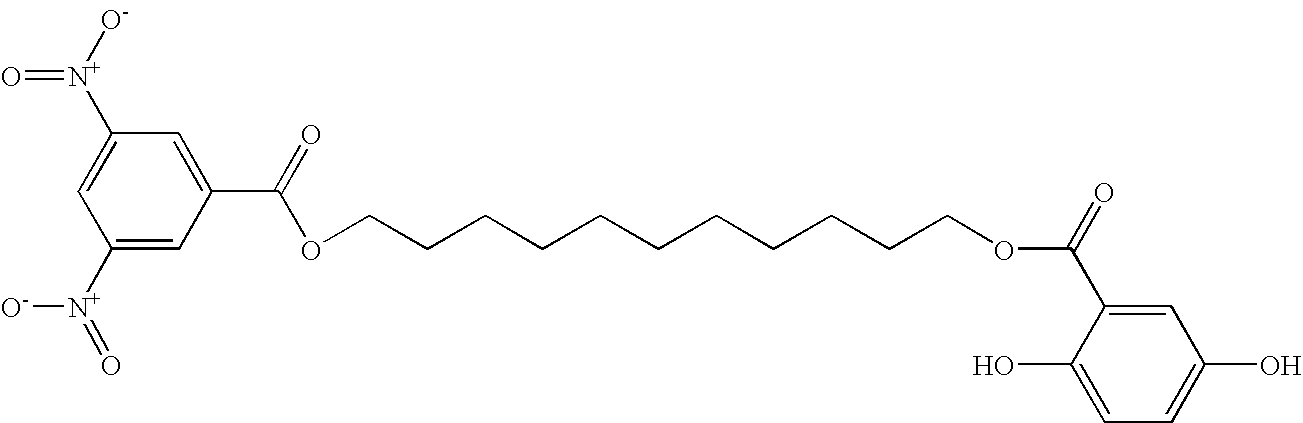
2.78 g (18.0 mmol) 2,5-dihydroxybenzoic acid were dissolved in 36 ml dimethylformamide. 2.96 ml (19.8 mmol) 1,8-diazabicyclo[5.4.0]undec-7-ene(1,5-5) (DBU) were added dropwise in the course of 15 minutes. The reaction temperature rise to 30° C., subsequently 8.83 g (19.8 mmol) 3,5-dinitrobenzoic acid 11-bromoundecyl ester were added in one portion. The mixture was then heated at 80° C. for 2 hours. The reaction mixture was cooled and then partitioned between dichloromethane and 1N hydrochloric acid, the organic phase was washed twice with water, dried over sodium sulfate, filtered and concentrated by rotary evaporation. Chromatography of the residue on 200 g silica gel using Toluene yielded 5.28 g (57%) 3,5-dinitrobenzoic acid 11-[2,5-dihydroxybenzoyloxy]undecyl ester as yellow powder.
3,5-Dinitrobenzoic Acid 11-[2-Hydroxy-5-[4-(2-methoxycarbonylvinyl)benzoyloxy]benzoyloxy]undecyl Ester 
2.50 g (4.82 mmol) 3,5-Dinitrobenzoic acid 11-[2,5-dihydroxybenzoyloxy]undecyl ester, 0.99 g (4.82 mmol) (E)-4-carboxyl cinnamic acid methyl ester and 0.15 g (1.20 mmol) 4-dimethylaminopyridine were dissolved in 12 ml of dichloromethane. A suspension of 0.92 g (4.82 mmol) N-(3-dimethylaminopropyl)-N′-ethylcarbodiimide hydrochloride and 10 ml dichloromethane were added dropwise in the course of 45 minutes. After 3 hours at room temperature the reaction mixture was partitioned between dichloromethane and water; the organic phase was washed repeatedly with water, dried over sodium sulfate, filtered and concentrated by rotary evaporation. Chromatography of the residue on 100 g silica gel using toluene yielded 2.63 g (77%) 3,5-dinitrobenzoic acid 11-[2-hydroxy 5-[4-(2-methoxycarbonyl-vinyl)benzoyloxy]benzoyloxy]undecyl ester as yellow powder.
3,5-Dinitrobenzoic Acid 11-[2-[4-Pentylbenzoyloxy]-5-[4-(2-methoxycarbonylvinyl)benzoyloxy]benzoyloxy]undecyl Ester 
1.31 g (1.86 mmol) 3,5-dinitrobenzoic acid 11-[2-[4-pentylbenzoyloxy]-5-[4-(2-methoxycarbonylvinyl)benzoyloxy]benzoyloxy]undecyl ester, 0.34 g (2.05 mmol) 4-propylbenzoic acid and 63 mg (0.51 mmol) 4-dimethylaminopyridine were dissolved in 26 ml of dichloromethane. A suspension of 0.39 g (2.05 mmol) N-(3-dimethylaminopropyl)-N′-ethylcarbodiimide hydrochloride and 11 ml dichloromethane were added dropwise in the course of 40 minutes. After 27.5 hour at room temperature the reaction mixture was partitioned between dichloromethane and water; the organic phase was washed repeatedly with water, dried over sodium sulfate, filtered and concentrated by rotary evaporation. Chromatography of the residue on 50 g silica gel using first toluene then toluene: ethyl acetate and subsequent crystallisation form 300 ml isopropyl alcohol yielded 1.23 g (77%) 3,5-dinitrobenzoic acid 11-[2-[4-pentylbenzoyloxy]-5-[4-(2-methoxycarbonylvinyl)benzoyloxy]benzoyloxy]undecyl ester as white crystals.
3,5-Diaminobenzoic Acid 11-[2-[4-Pentylbenzoyloxy]-5-[4-(2-metboxycarbonylvinyl)benzoyloxy]benzoyloxy]undecyl Ester 
1.23 g (1.44 mmol) of 3,5-dinitrobenzoic acid 11-[2-[4-pentylbenzoyloxy]-5-[4-(2-methoxycarbonyl-vinyl)benzoyloxy]benzoyloxy]undecyl ester and 0.31 g (5.76 mmol) of ammonium chloride were suspended in 15 ml of a mixture consisting of methanol:water 9:1. 1.88 g (28.8 mmol) of zinc were then added in one portions. After 0.5 hour at room temperature 20 ml of a mixture consisting of methanol:water 9:1 were added to the thick suspension. After a further 21 hours the reaction suspension was partitioned between dichloromethane and water. The resulting suspension was filtered, the organic phase was washed with a saturated sodium bicarbonate solution and repeatedly with water. The organic phase was then dried over sodium sulfate, filtered and concentrated by evaporation. Chromatography of the residue on 25 g of silica gel using toluene, toluene:ethyl acetate 9:1 and toluene:ethyl acetate 1:1 and subsequent twice crystallisation form a mixture of 5 ml ethyl acetate and 3.5 ml hexane yielded 0.434 g (38%) of 3,5-diaminobenzoic acid 11-[2-[4-pentylbenzoyloxy]-5-[4-(2-metboxycarbonylvinyl)benzoyloxy]benzoyloxy]undecyl ester as yellow crystals.
poly-[1-[11-[5-[4-[(E)-2-Methoxycarbonylvinyl]benzoyloxy]-2-(4-propylbenzoyloxy)benzoyloxy]undecyloxycarbonyl]-1-methylethylene-co-1-[11-[5-[4-[((E)-2-methoxycarbonylvinyl]benzoyloxy]-2-(4-pentylbenzoyloxy)benzoyloxy]undecyloxycarbonyl]-1-methylethylene] 
Preparation can be carried out analogously to Example 1 using 0.89 g (1.22 mmol) (E)-5-[4-(2-methoxycarbonylvinyl)benzoyloxy]-2-(4-propylbenzoyloxy)benzoic acid 11-(2-methylacryloyloxy)undecyl ester, 0.10 (0.13 mmol) (E)-5-[4-(2-methoxycarbonylvinyl)benzoyloxy]-2-(4-pentylbenzoyloxy)benzoic acid 11-(2-methylacryloyloxy)undecyl ester and (0.013 mmol) α,α′-azoisobutyronitrile yield poly-[1-[11-[5-[4-[(E)-2-methoxycarbonylvinyl]benzoyloxy]2-(4-propylbenzoyloxy)benzoyloxy]undecyloxycarbonyl]1-methyl ethylene-co-1-[11-[5-[4-[((E)-2-Methoxycarbonylvinyl]benzoyloxy]-2-(4-pentyllbenzoyloxy)benzoyloxy]undecyloxycarbonyl]-1-methylethylene].
The following copolymers can be synthesis in a analogous manner:
Poly-[1-[11-[5-[4-[(E)-2-methoxycarbonylvinyl]benzoyloxy]-2-(4-propylbenzoyloxy)benzoyloxy]undecyloxycarbonyl]-1-methylethylene-co-1-[11-[5-[4-[((E)-2-methoxycarbonylvinyl]benzoyloxy]-2-(4-heptylbenzoyloxy)benzoyloxy]undecyloxycarbonyl]-1-methylethylene]
Poly-[1-[11-[5-[4-[(E)-2-methoxycarbonylvinyl]benzoyloxy]-2-(4-pentylbenzoyloxy)benzoyloxy]undecyloxycarbonyl]-1-methylethylene-co-1-[11-[5-[4-[((E)-2-methoxycarbonylvinyl]benzoyloxy]-2-(4-heptylbenzoyloxy)benzoyloxy]undecyloxycarbonyl]-1-methylethylene]
Poly-[1-[11-[5-[4-[(E)-2-metboxycarbonylvinyl]benzoyloxy]-2-(4-propylbenzoyloxy)benzoyloxy]undecyloxycarbonyl]-1-methylethylene-co-1-[11-[5-[4-[((E)-2-methoxycarbonylvinyl]benzoyloxy]-2-(4-propylcyclohexanoyloxy)benzoyloxy]undecyloxycarbonyl]-1-methylethylene]
Poly-[1-[8-[5-[4-[(E)-2-methoxycarbonylvinyl]benzoyloxy]-2-(4-propylbenzoyloxy)benzoyloxy]octyloxycarbonyl]-1-methylethylene-co-1-[8-[5-[4-[((E)-2-methoxycarbonylvinyl]benzoyloxy]-2-(4-heptylbenzoyloxy)benzoyloxy]octyloxycarbonyl]-1-methylethylene]
Poly-[1-[8-[5-[4-[(E)-2-methoxycarbonylvinyl]benzoyloxy]-2-(4-propylbenzoyloxy)benzoyloxy]octyloxycarbonyl]-1-methylethylene-co-1-[11-[5-[4-[((E)-2-methoxycarbonylvinyl]benzoyloxy]-2-(4-heptylbenzoyloxy)benzoyloxy]undecyloxycarbonyl]-1-methylethylene]
A two percent by weight solution S1 of the photoreactive polymer A was prepared using cyclopentanone as a solvent. The solution was stirred for 30 minutes at room temperature.
Photopolymer A: 
Solution S1 was spin-coated at 2000 rpm onto two ITO (indium-tin oxide) coated glass plates, which were then dried for 10 minutes at 180° C.
Both substrates were subsequently exposed for six minutes to the polarised ultraviolet light from a 200W high pressure mercury lamp. The intensity of the UV-light, measured in a surface perpendicular to the propagation of the light was 1.6 mW/cm2. A film polariser HNP'B by Polaroid was used to polarise the UV-light. During irradiation the substrates were TILTED BY 70° resective to the direction of the incoming light.
With the coated sides facing inwards, the two plates were assembled into a parallel cell, using a glass fibre of 20 μm as a spacer. The cell was immediately filled with a nematic liquid crystal mixture MLC12000-000 (Merck) at a temperature only just above the nematic-isotropic transition temperature of 89° C. After filling the cell was slowly cooled.
Using the crystal rotation technique, the pretilt angle in the above liquid crystal cell was determined as 88°.
A mixture MLCP was prepared comprising the following liquid crystalline diacrylate monomers: 
In addition to the diacrylate monomers, photoinitiator IRGACURE™ 369 from Ciba SC as well as BHT which served as an inhibitor were added to the mixture. Thus the composition of mixture MLCP was as follows:
| Mon1 | 77 | wt. % | ||
| Mon2 | 14.5 | wt. % | ||
| Mon3 | 4.7 | wt. % | ||
| IRGACURE ™ 369 | 1.9 | wt. % | ||
| BHT | 1.9 | wt. % | ||
Finally, the solution S(LCP) resulted from dissolving 20 wt. % of mixture MLCP in anisole.
Like in example 5, solution S1 was spincoated on a glass plate, dried and subsequently exposed to the polarised UV-light, having an incidence angle of 70°. Then diacrylate solution S(LCP) was spin-coated at 800 rpm for 2 minutes on top of the irradiated LPP-layer. To cross-link the diacrylates the plate was exposed to isotropic UV-light under nitrogen atmosphere for 5 minutes.
Between crossed polarisers it was found that the LCP-layer was well aligned according the direction of the LPP-irradiating polarised UV-light. From the strong asymmetric viewing angle dependence of the LCP-retarder it was concluded that the optical axis of the LCP-layer was highly tilted.
To estimate the mean tilt angle of the optical axis, the effective optical anisotropy An, when looked perpendicularly through the layer was determined from measurements of the layer thickness d and the retardation Δnd as Δneff=0.033. From the known Δn=0.13 of the LCP material the mean tilt angle of the optical axis was calculated as 58°.
Claims (36)
1. A photoactive polymer, which comprises identical or different repeating monomer units M, wherein one or more of the monomer units M are substituted with at least one side chain as shown in formula I: 
in which:
P is a photoactive group which can photoisomerise and/or photodimerise;
B represents an aromatic or alicyclic group which is unsubstituted or substituted by fluorine, chlorine or cyano, or by a cyclic, straight-chain or branched alkyl residue which is unsubstituted, mono-substituted by cyano or halogeno, or poly-substituted by halogeno, having 1 to 18 carbon atoms and wherein one or more CH2 groups may independently be replaced by —O—, —CO—, —CO—O—, —O—CO—, —Si(CH3)2—O—Si(CH3)2—, —NR2—, —NR2—CO—, —CO—NR2—, —NR2—CO—O—, —O—CO—NR2—, —NR2—CO—NR2—, —CH═CH—, —C≡C—, or —O—CO—O—, with the proviso that oxygen atoms are not directly attached to each other, and wherein R2 represents a hydrogen atom or lower alkyl, or B alternatively represents a nitrogen atom or —CR2—;
A, C, D each independently of the other represents an aromatic or alicyclic group which is unsubstituted or substituted by fluorine, chlorine, or cyano, or by a cyclic, straight-chain or branched alkyl residue which is unsubstituted, mono-substituted by cyano or halogeno, or poly-substituted by halogeno, having 1 to 18 carbon atoms and wherein one or more CH2 groups may independently be replaced by —O—, —CO—, —CO—O—, —O—CO—, —Si(CH3)2—O—Si(CH3)2—, —NR2—, —NR2—CO—, —CO—NR2—, —NR2—CO—O—, —O—CO—NR2—, —NR2—CO—NR2—, —CH═CH—, —C≡C—, or —O—CO—O—, with the proviso that oxygen atoms are not directly attached to each other, and wherein R2 represents a hydrogen atom or lower alkyl;
M represents a repeating monomer unit in a homo- or copolymer;
S1, S2, S3, S4, S5 each independently represent a single covalent bond or a spacer unit, comprising a straight-chain or branched alkylene residue which is unsubstituted, mono-substituted by cyano or halogeno, or poly-substituted by halogeno, having 1 to 24 carbon atoms, wherein one or more CH2 groups may independently be replaced by —O—, —CO—, —CO—O—, —O—CO—, —Si(CH3)2—O—Si(CH3)2—, —NR2—, —NR2—CO—, —CO—NR2—, —NR2—CO—O—, —O—CO—NR2—, —NR2—CO—NR2—, —CH═CH—, —C≡C—, or —O—CO—O—, with the proviso that oxygen atoms are not directly attached to each other, and wherein R2 represents a hydrogen atom or lower alkyl;
n1, n2 are each independently 0, 1 or 2 with the proviso that n1+n2≦2;
R1 is a hydrogen atom, or a straight-chain or branched alkyl residue which is unsubstituted, mono-substituted by cyano or halogeno, or poly-substituted by halogeno, having 1 to 18 carbon atoms, wherein one or more CH2 groups may independently be replaced by —O—, —CO—, —CO—O—, —O—CO—, —Si(CH3)2—O—Si(CH3)2—, —NR2—, —NR2—CO—, —CO—NR2—, —NR2—CO—O—, —O—CO—NR2—, —NR2—CO—NR2—, —CH═CH—, —C≡C—, or —O—CO—O—, with the proviso that oxygen atoms are not directly attached to each other, and wherein R2 represents a hydrogen atom or lower alkyl.
2. A polymer as claimed in claim 1 , in which group P is a group which undergoes a photocyclisation and has the formula II or III: 
wherein the broken line indicates the point of linkage to S1 and wherein:
E represents phenylene which is unsubstituted or substituted by fluorine, chlorine or cyano, or by a cyclic, straight-chain or branched alkyl residue which is unsubstituted, mono-substituted by cyano or halogeno, or poly-substituted by halogeno, having 1 to 18 carbon atoms and wherein one or more CH2 groups may independently be replaced by —O—, —CO—, —CO—O—, —O—CO—, —Si(CH3)2—O—Si(CH3)2—, —NR2—, —NR2—CO—, —CO—NR2—, —NR2—CO—O—, —O—CO—NR2—, —NR2—CO—NR2—, —CH═CH—, —C≡C—, or —O—CO—O—, with the proviso that oxygen atoms are not directly attached to each other, and wherein R2 represents a hydrogen atom or lower alkyl, or E alternatively represents pyrimidine-2,5-diyl, pyridine-2,5-diyl, 2,5-thiophenylene, 2,5-furanylene, or 1,4- or 2,6-naphthylene;
F represents —OR4, —NR5R , or an oxygen atom linked to ring E in the ortho position to form a coumarin unit wherein R4, R5 and R6 are a hydrogen atom or a cyclic, straight-chain or branched alkyl residue which is unsubstituted, mono-substituted by halogeno, or poly-substituted by halogeno, having 1 to 18 carbon atoms and wherein one or more CH2 groups may independently be replaced by —O—, —CO—, —CO—O—, —O—CO—, or —CH═CH—, with the proviso that oxygen atoms are not directly attached to each other, or R5 and R6 are linked together to form an alicyclic ring with 5 to 8 atoms;
X, Y each independently of the other represents hydrogen, fluorine, chlorine, cyano, alkyl optionally substituted by fluorine having from 1 to 12 carbon atoms in which optionally one or more non-adjacent CH2 groups are replaced by —O—, —CO—O—, —O—CO— and/or —CH═CH—;
R3 is a hydrogen atom, or a straight-chain or branched alkyl residue which is unsubstituted, mono-substituted by cyano or halogeno, or poly-substituted by halogeno, having 1 to 18 carbon atoms, wherein one or more CH2 groups may independently be replaced by —O—, —CO—, —CO—O—, —O—CO—, —Si(CH3)2—O—Si(CH3)2—, —NR2—, —NR2—CO—, —CO—NR2—, —NR2—CO—O—, —O—CO—NR2—, —NR2—CO—NR2—, —CH═CH—, —C≡C—, or —O—CO—O—, with the proviso that oxygen atoms are not directly attached to each other, and wherein R2 represents a hydrogen atom or lower alkyl.
3. A polymer as claimed in claim 2 , in which group P has the formula IV or V: 
wherein the broken line indicates the point of linkage to S1 and wherein R3 has the meaning given under formula II and III in claim 2 ;
F represents —OR4 or —NR5R6, wherein R4 and R5 are a cyclic, straight-chain or branched alkyl residue which is unsubstituted, mono-substituted by halogeno, or poly-substituted by halogeno, having 1 to 18 carbon atoms and wherein one or more CH2 groups may independently be replaced by —O— or —CH═CH—, with the proviso that oxygen atoms are not directly attached to each other, and wherein R6 is a hydrogen atom or a cyclic, -straight-chain or branched alkyl residue which is unsubstituted, mono-substituted by halogeno, or poly-substituted by halogeno, having 1 to 18 carbon atoms and wherein one or more CH2 groups may independently be replaced by —O— or —CH═CH—, with the proviso that oxygen atoms are not directly attached to each other, or R5 and R6 link together to form an alicyclic ring with 5 to 8 atoms; and
E represents phenylene which is unsubstituted or substituted by a cyclic, straight-chain or branched alkyl residue which is unsubstituted, mono-substituted by halogeno, or poly-substituted by halogeno, having 1 to 12 carbon atoms and wherein one or more CH2 groups may independently be replaced by —O—, —CO—, —CO—O—, —O—CO, —CH═CH—, or —C≡C—, with the proviso that oxygen atoms are not directly attached to each other, or E alternatively represents pyrimidine-2,5-diyl, pyridine-2,5-diyl, 2,5-thiophenylene, 2,5-furanylene, 1,4- or 2,6-naphthylene.
4. A polymer as claimed in claim 3 , in which group P has the formula IV wherein:
E represents phenylene which is unsubstituted or substituted by a straight-chain or branched alkyl residue which is unsubstituted or mono- or polysubstituted by fluorine, having 1 to 6 carbon atoms and wherein one or more CH2 groups may independently be replaced by —O—, —CO—, —CO—O—, —O—CO, or —CH═CH—, with the proviso that oxygen atoms are not directly attached to each other, or E alternatively represents pyrimidine-2,5-diyl, pyridine-2,5-diyl, 2,5-furanylene, 1,4- or 2,6-naphthylene;
F represents —OR4 or —NHR5, wherein R4 and R5 are a cyclic, straight-chain or branched alkyl residue which is unsubstituted or mono- or polysubstituted by fluorine, having 1 to 18 carbon atoms and wherein one or more CH2 groups may independently be replaced by —O—, with the proviso that oxygen atoms are not directly attached to each other.
5. A polymer as claimed in claim 1 , in which B represents an aromatic or alicyclic group and where n1+n2=0 or 1.
6. A polymer as claimed in claim 1 , in which B represents a group —CR2— and where 0<n1+n2≦2.
7. A polymer as claimed in claim 1 , in which the polymer is optically inactive.
8. A polymer as claimed in claim 1 , in which group B is an aromatic group which is unsubstituted or substituted by fluorine, chlorine or cyano, or by a cyclic, straight-chain or branched alkyl residue which is unsubstituted, mono-substituted by cyano or halogeno, or poly-substituted by halogeno, having 1 to 18 carbon atoms and wherein one or more CH2 groups may independently be replaced by —O—, —CO—, —CO—O—, —O—CO—, or —CH═CH—, with the proviso that oxygen atoms are not directly attached to each other, or B alternatively represents —CR2—, wherein R2 represents hydrogen atom or lower alkyl.
9. A polymer as claimed in claim 8 , in which group B is a 1,2,5-benzenetriyl or 1,3,5-benzenetriyl group which is unsubstituted or substituted by fluorine and where the spacer group S5 is in position 1.
10. A polymer as claimed in claim 1 , in which groups A, C and D are phenylene which is unsubstituted or substituted by fluorine, chlorine, or cyano, or by a cyclic, straight-chain or branched alkyl residue which is unsubstituted, mono-substituted by cyano or halogeno, or poly-substituted by halogeno, having 1 to 12 carbon atoms, wherein one or more CH2 groups may independently be replaced by —O—, —CO—, —CO—O—, —O—CO—, —CH═CH—, —C≡C— or —O—CO—O— with the proviso that oxygen atoms are not directly attached to each other, or A, C and D alternatively represents cyclohexane-1,4-diyl, pyrimidine-2,5-diyl, pyridine-2,5-diyl, 1,4- or 2,6-naphthylene.
11. A polymer as claimed in claim 10 , in which groups A, C and D are phenylene, which is unsubstituted or substituted by fluorine, straight-chain or branched alkyl residue which is unsubstituted or mono- or polysubstituted by fluorine, having 1 to 8 carbon atoms, wherein one or more CH2 groups may independently be replaced by —O—, —CO—, —CO—O—, —O—CO— or —CH═CH— with the proviso that oxygen atoms are not directly attached to each other, or A, C and D alternatively represents cyclohexane-1,4-diyl, pyrimidine-2,5-diyl, pyridine-2,5-diyl or 2,6-naphthylene.
12. A polymer as claimed in claim 1 , in which S1, S2, S3, S4 and S5 each independently represent a single covalent bond or a straight-chain or branched alkylene grouping represented by —(CH2)r—, optionally mono- or poly-substituted by fluorine, chlorine or cyano, or a chain of the formula —L1—(CH2)r—L2— or —L1—(CH2)r—L2—(CH2)s—L3—, wherein L1, L2 and L3 each independently of the others represent a single bond or linking functional group, wherein R2 represents hydrogen atom or lower alkyl and r and s are each an integer from 1 to 20, with the proviso that r+s≦24 and with the proviso that in the case where the repeating monomer unit M is linked to S5 via a nitrogen atom or a oxygen atom which is by definition part of M, L1 signifies a single bond.
13. A polymer as claimed in claim 12 , in which S1, S2, S3, S4 and S5 are each independently a straight-chain or branched alkylene grouping, represented by —(CH2)r—, or are each independently —(CH2)r—O—, —(CH2)r—CO—, —(CH2)r—CO—O—, —(CH2)r—O—CO—, —(CH2)r—CO—NR2—, —(CH2)r—NR2—CO—, —(CH2)r—NR2—, —O—(CH2)r—, —CO—O—(CH2)r—, —O—CO—(CH2)r—, —NR2—CO—(CH2)r—, —CO—NR2—(CH2)r—, —NR2—(CH2)r—, —O—(CH2)r—CO—O—, —O—(CH2)r—O—CO—, —O—(CH2)r—CO—NR2—, —O—(CH2)r—NR2—, —O—(CH2)r—O—, —O—(CH2)r—NR2—CO—, —NR2—(CH2)r—CO—O—, —NR2—(CH2)r—O—, —NR2—(CH2)r—NR2—, —NR2—(CH2)r—O—CO—, —CO—NR2—(CH2)r—O—, —CO—NR2—(CH2)r—NR2—, —CO—NR2—(CH2)r—O—CO—, —O—CO—(CH2)r—CO—, —O—CO—(CH2)r—O—, —O—CO—(CH2)r—NR2—, —OCO—(CH2)r—CO—O—, —O—CO—(CH2)r—CO—NR2—, —O—CO—(CH2)r—NR2—CO—, —(CH2)r—O—(CH2)s—, —(CH2)r—CO—O—(CH2)s—, —(CH2)r—O—CO—(CH2)s—, —(CH2)r—NR2—CO—(CH2)s—, —(CH2)r—NR2—CO—O—(CH2)s—, —(CH2)r—O—(CH2)s—O—, —(CH2)r—CO—O—(CH2)s—O—, —(CH2)r—O—CO—(CH2)s—O—, —(CH2)r—NR2—CO—(CH2)s—O—, —(CH2)r—NR2—CO—O—(CH2)s—O—, —O—(CH2)r—O—(CH2)s—, —O—(CH2)r—CO—O—(CH2)s—, —O—(CH2)r—NR2—CO—(CH2)s—, —O—(CH2)r—NR2—CO—O—(CH2)s—, —O—(CH2)r—CO—O—(CH2)s—O—, —O—(CH2)r—O—(CH2)s—O—, —O—(CH2)r—NR2—CO—(CH2)s—O—, —O—(CH2)r—NR2—CO—O—(CH2)s—O—, —CO—O—(CH2)r—O—(CH2)s—, or —CO—O—(CH2)r—O—(CH2)s—O—, wherein r and s are each an integer from 1 to 20, with the proviso that r+s≦21, and wherein R2 represents hydrogen or lower alkyl.
14. A polymer as claimed in claim 13 , in which S1, S2, S3, S4 and S5 are each independently a straight-chain alkylene grouping represented by —(CH2)r—, or are each independently —(CH2)r—O—, —(CH2)r—CO—O—, —(CH2)r—O—CO—, —(CH2)r—CO—NH—, —(CH2)r—NH—CO—, —O—(CH2)r—, —CO—O—(CH2)r—, —CO—NH—(CH2)r—, —O—CO—(CH2)r—, —O—CO—(CH2)r—CO—O—, —O—(CH2)r—O—CO—, —O—(CH2)r—CO—NH—, —O—(CH2)r—NH—CO—, —CO—O—(CH2)r—O—, —CO—NH—(CH2)r—O—, —O—(CH2)r—O—, —(CH2)r—NH—CO—(CH2)s—, —(CH2)r—NH—CO—O—(CH2)s—, —(CH2)r—O—(CH2)s—O—, —(CH2)r—NH—CO—(CH2)s—O—, —(CH2)r—NH—CO—O—(CH2)s—O—, —O—(CH2)r—NH—CO—(CH2)s—, —O—(CH2)r—O—(CH2)s—O—, —O—CO—(CH2)r—O—(CH2)s—O—, —CO—O—(CH2)r—O—(CH2)s—O—, —O—(CH2)r—NH—CO—(CH2)s—O—, or —O—CO—(CH2)r—NH—CO—(CH2)s—O—, wherein r and s are each an integer from 2 to 12 and the sum of r+s≦15.
15. A polymer as claimed in claim 1 , in which R1 is a hydrogen atom, or a straight-chain or branched alkyl residue which is unsubstituted or halogeno or polyhalogeno-substituted, having 1 to 12 carbon atoms, wherein one or more CH2 groups may independently be replaced by —O—, —CO—, —CO—O—, —O—CO—, —CH═CH— or —C≡C—, with the proviso that oxygen atoms are not directly attached to each other.
16. A polymer as claimed in claim 15 , in which R1 is a straight-chain or branched alkyl residue, having 1 to 8 carbon atoms, wherein one or more CH2 groups are each independently replaced by —O—, —CO—, —CO—O— or —O—CO— or —CH═CH—, with the proviso that oxygen atoms are not directly attached to each other.
17. A polymer as claimed in claim 1 , in which the repeating monomer unit M is acrylate, methacrylate, a styrene derivative, an imide, an amic acid or an ester thereof or an amidimide.
18. A polymer as claimed in claim 1 , in which the repeating monomer units M are one or more groups of the formulae III, V and VII and/or the analogous amic acid groups and amic acid ester groups of the formulae IV, VI and VIII: 
in which the broken line symbolises the linkage to S5 and wherein:
T1 represents the tetravalent organic radical of a tetracarboxylic acid dianhydride after formal removal of the two —CO—O—CO— groups, the four valencies of which are distributed between four different carbon atoms of the radical;
T2, T3 each independently of the other represents an aromatic or alicyclic trivalent group, the three valencies of which are distributed between three different carbon atoms of the group, the group being unsubstituted or substituted by fluorine, chlorine, cyano, by a cyclic, straight-chain or branched alkyl residue which is unsubstituted, mono-substituted by halogeno, or poly-substituted by halogeno, having 1 to 18 carbon atoms and wherein one or more CH2 groups may independently be replaced by —O—, —CO—, —CO—O—, —O—CO—, —CH═CH—, or —C≡C—, with the proviso that oxygen atoms are not directly attached to each other;
S6, S7, S8, S9, S10 each independently represent a single covalent bond or a spacer unit, comprising a straight-chain or branched alkylene residue which is unsubstituted, mono-substituted by cyano or halogeno, or poly-substituted by halogeno, having 1 to 24 carbon atoms, wherein one or more CH2 groups may independently be replaced by —O—, —CO—, —CO—O—, —O—CO—, —Si(CH3)2—O—Si(CH3)2—, —NR2—, —NR2—CO—, —CO—NR2—, —NR2—CO—O—, —O—CO—NR2—, —NR2—CO—NR2—, —CH═CH—, —C≡C—, or —O—CO—O—, with the proviso that oxygen atoms are not directly attached to each other, and wherein R2 represents hydrogen atom or lower alkyl;
represents an aromatic or alicyclic divalent, trivalent or tetravalent group, the valencies of which are distributed between different atoms of the group, which is unsubstituted or substituted by fluorine, chlorine, cyano, by a cyclic, straight-chain or branched alkyl residue which is unsubstituted or mono cyano, or halogeno or polyhalogeno-substituted, having 1 to 18 carbon atoms and wherein one or more CH2 groups may independently be replaced by —O—, —CO—, —CO—O—, —O—CO—, —CH═CH—, or —C≡C—, with the proviso that oxygen atoms are not directly attached to each other, or J alternatively represents a nitrogen atom or —CR2— and wherein R2 represents a hydrogen atom or lower alkyl;
K represents the radical of an aliphatic, alicyclic or aromatic diamine after formal removal of the two amino groups; and
G represents hydrogen atom or a monovalent organic group, derived from an alcohol after formal removal of the hydroxy group.
19. A polymer as claimed in claim 18 , in which the groups T2 and T3 are trivalent aromatic or carbocyclic groups, the three valencies of which are so distributed between three different carbon atoms that two of those valencies are located at adjacent carbon atoms.
20. A polymer as claimed in claim 19 , in which the groups T2 and T3 are trivalent benzene derivatives, the three valencies of which are so distributed between three different carbon atoms that two of those valencies are in the ortho position relative to one another.
21. A polymer as claimed in claim 18 , in which S6 is a straight-chain or branched alkylene grouping, represented by —(CH2)r—, or is —(CH2)r—O—, —(CH2)r—CO—, —(CH2)r—CO—O—, —(CH2)r—O—CO—, —(CH2)r—CO—NR2—, —(CH2)r—NR2—CO—, —(CH2)r—NR2—, —(CH2)r—O—(CH2)s—, —(CH2)r—CO—O—(CH2)s—, —(CH2)r—O—CO—(CH2)s—, —(CH2)r—NR2—CO—(CH2)s—, —(CH2)r—NR2—CO—O—(CH2)s—, —(CH2)r—O—(CH2)s—O—, —(CH2)r—CO—O—(CH2)s—O—, —(CH2)r—O—CO—(CH2)s—O—, —(CH2)r—NR2—CO—(CH2)s—O—, —(CH2)r—NR2—CO—O—(CH2)s—O—, —(CH2)r—O—(CH2)s—CO—O—, or —(CH2)r—O—(CH2)s—O—CO—, wherein r and s are each an integer from 1 to 20, with the proviso that r+s≦21, and wherein R2 represents hydrogen or lower alkyl.
22. A polymer as claimed in claim 18 , in which S7 and S10 are each independently a straight-chain or branched alkylene grouping, represented by —(CH2)r—, or are each independently —O—(CH2)r—, —CO—(CH2)r—, —CO—O—(CH2)r—, —O—CO—(CH2)r—, —NR2—CO—(CH2)r—, —NR2—(CH2)r—, —CO—NR2—(CH2)r—, —NR2—CO—(CH2)r—, —O—(CH2)r—O—(CH2)s—, —(CH2)r—CO—O—(CH2)s—, —(CH2)r—O—CO—(CH2)s—, —(CH2)r—NR2—CO—(CH2)s—, —(CH2)r—NR2—CO—O—(CH2)s—, —O—(CH2)r—O—(CH2)s—, —O—(CH2)r—CO—O—(CH2)s—, —O—(CH2)r—O—CO—(CH2)s—, —O—(CH2)r—NR2—CO—(CH2)s—, —O—(CH2)r—NR2—CO—O—(CH2)s—, —O—CO—(CH2)r—O—(CH2)s—, or —CO—O—(CH2)r—O—(CH2)s—, wherein r and s are each an integer from 1 to 20, with the proviso that r+s≦21 and wherein R2 represents hydrogen or lower alkyl.
23. A polymer as claimed in claim 18 , in which S8 and S9 each independently are a straight-chain or branched alkylene grouping, represented by —(CH2)r—, or are each independently —(CH2)r—O—, —(CH2)r—CO—, —(CH2)r—CO—O—, —(CH2)r—O—CO—, —(CH2)r—CO—NR2—, —(CH2)r—NR2—CO—, —(CH2)r—NR2—, —O—(CH2)r—, —CO—O—(CH2)r, —O—CO—(CH2)r—, —NR2—CO—(CH2)r—, —CO—NR2—(CH2)r—, —NR2—(CH2)r—, —O—(CH2)r—CO—O—, —O—(CH2)r—O—CO—, —O—(CH2)r—CO—NR2—, —O—(CH2)r—NR2—, —O—(CH2)r—O—, —O—(CH2)r—NR2—CO—, —NR2—(CH2)r—CO—O—, —NR2—(CH2)r—O—, —NR2—(CH2)r—NR2—, —NR2—(CH2)r—O—CO—, —CO—NR2—(CH2)r—O—, —CO—NR2—(CH2)r—NR2—, —CO—NR2—(CH2)r—O—CO—, —O—CO—(CH2)r—CO—, —O—CO—(CH2)r—O—, —O—CO—(CH2)r—NR2—, —O—CO—(CH2)r—CO—O—, —O—CO—(CH2)r—CO—NR2—, —O—CO—(CH2)r—NR2—CO—, —(CH2)r—O—(CH2)s—, —(CH2)r—CO—O—(CH2)s—, —(CH2)r—O—CO—(CH2)s—, —(CH2)r—NR2—CO—(CH2)s—, —(CH2)r—NR2—CO—O—(CH2)s—, —(CH2)r—O—(CH2)s—O—, —(CH2)r—CO—O—(CH2)s—O—, —(CH2)r—O—CO—(CH2)s—O—, —(CH2)r—NR2—CO—(CH2)s—O—, —(CH2)r—NR2—CO—O—(CH2)s—O—, —O—(CH2)r—O—(CH2)s—, —O—(CH2)r—CO—O—(CH2)s—, —O—(CH2)r—NR2—CO—(CH2)s—, —O—(CH2)r—NR2—CO—O—(CH2)s—, —O—(CH2)r—CO—O—(CH2)s—O—, —O—(CH2)r—O—(CH2)s—O—, —O—(CH2)r—NR2—CO—(CH2)s—O—, —O—(CH2)r—NR2—CO—O—(CH2)s—O—, —CO—O—(CH2)r—O—(CH2)s—, or —CO—O—(CH2)r—O—(CH2)s—O—, wherein r and s are each an integer from 1 to 20, with the proviso that r+s≦21, and wherein R2 represents hydrogen or lower alkyl.
24. A polymer according to claim 18 , wherein at least 50% of the repeating monomer units M are linked to one or two of the side-chains.
25. A polymer according to claim 24 , wherein at least 70% of the repeating monomer units M are linked to one or two of the side-chains.
26. A polymer according to claim 18 , wherein the repeating monomer units M are each linked to only one side-chain.
27. A polymer as claimed in claim 18 , which contains one or more groups of formulae IV, VI or VIII, in which G is hydrogen.
28. A polymer according to claim 1 , wherein the polymer is a copolymer.
29. A composition comprising a polymer as claimed in claim 1 and a silane-containing compound and/or an epoxy-containing crosslinking agent.
30. A composition comprising a polymer as claimed in claim 1 and a photosensitiser, a photoradical generator and/or a cationic photoinitiator.
31. A composition comprising a polymer as claimed in claim 1 in mixture with one or more other polymers, oligomers, monomers, photoactive polymers, photoactive oligomers and/or photoactive monomers.
32. A product which comprises a polymer as claimed in claim 1 applied to a support, wherein the polymer applied to the support, after any imidisation step which may be necessary, has been crosslinked by irradiation with linearly polarized light.
33. An orientation layer for liquid crystals, which comprises a polymer as claimed in claim 1 that is crosslinked by irradiation with linearly polarized light.
34. A method of making an orientation layer as claimed in claim 33 , which comprises preparing a solution of the polymer, applying the solution to a support, which support is optionally provided with an electrode, so that layers of 0.05 to 50 μm thickness are produced, then irradiating the regions to be oriented.
35. An optical or electro-optical device having at least one orientation layer as claimed in claim 33 .
36. An unstructured or structured optical element or a multi-layer system, which comprises a polymer as claimed in claim 1 .
Applications Claiming Priority (3)
| Application Number | Priority Date | Filing Date | Title |
|---|---|---|---|
| GBGB9907801.6A GB9907801D0 (en) | 1999-04-06 | 1999-04-06 | Photoactive polymers |
| GB9907801 | 1999-04-06 | ||
| PCT/IB2000/000349 WO2000059966A1 (en) | 1999-04-06 | 2000-03-27 | Photoactive polymers |
Publications (1)
| Publication Number | Publication Date |
|---|---|
| US6649230B1 true US6649230B1 (en) | 2003-11-18 |
Family
ID=10850998
Family Applications (1)
| Application Number | Title | Priority Date | Filing Date |
|---|---|---|---|
| US09/958,043 Expired - Lifetime US6649230B1 (en) | 1999-04-06 | 2000-03-27 | Photoactive polymers |
Country Status (11)
| Country | Link |
|---|---|
| US (1) | US6649230B1 (en) |
| EP (1) | EP1171493B1 (en) |
| JP (1) | JP4755345B2 (en) |
| KR (1) | KR100585044B1 (en) |
| CN (1) | CN1157425C (en) |
| AT (1) | ATE238361T1 (en) |
| AU (1) | AU3315400A (en) |
| DE (1) | DE60002312T2 (en) |
| GB (1) | GB9907801D0 (en) |
| HK (1) | HK1039949B (en) |
| WO (1) | WO2000059966A1 (en) |
Cited By (28)
| Publication number | Priority date | Publication date | Assignee | Title |
|---|---|---|---|---|
| US20020013382A1 (en) * | 1999-05-19 | 2002-01-31 | Furman Benjamin L. | Methods of functionalizing and functionalized metal oxide particles and mechanically strong and transparent or translucent composites made using such particles |
| US20020039160A1 (en) * | 2000-10-04 | 2002-04-04 | Lg Philips Lcd Co., Ltd. | Liquid crystal display device and method for manufacturing the same |
| US20020177727A1 (en) * | 2001-01-23 | 2002-11-28 | Wellinghoff Stephen T. | Novel mesogens |
| US20030099785A1 (en) * | 2001-06-29 | 2003-05-29 | O'neill Mary | Liquid crystal alignment layer |
| US20030125435A1 (en) * | 2001-03-07 | 2003-07-03 | Norling Barry K. | Ultra-low shrinkage composite resins based on blended nematic liquid crystal monomers |
| US20040144954A1 (en) * | 2001-01-23 | 2004-07-29 | Southwest Research Institute | Selective ether cleavage synthesis of liquid crystals |
| US20040185215A1 (en) * | 2001-02-05 | 2004-09-23 | Guy Marck | Photoactive polymer |
| US20040199004A1 (en) * | 2001-01-23 | 2004-10-07 | Southwest Research Institute | Novel mesogens |
| US20040241319A1 (en) * | 2003-05-30 | 2004-12-02 | Lg.Philips Lcd Co., Ltd. | Method of manufacturing phase-difference film using polarized ultraviolet light |
| US20040265742A1 (en) * | 2001-07-17 | 2004-12-30 | Guy Marck | Photoactive materials |
| US20050040364A1 (en) * | 2001-09-24 | 2005-02-24 | Cherkaoui Zoubair Mohammed | Liquid crystalline laterally polymerizable compounds |
| US20050128380A1 (en) * | 2003-12-11 | 2005-06-16 | Jds Uniphase Corporation | Polarization controlling elements |
| US20050179006A1 (en) * | 2002-05-23 | 2005-08-18 | Nissan Chemical Industries, Ld. | Liquid crystal aligning agent liquid crystal aligning films and liquid crystal display devices |
| US20050288426A1 (en) * | 2002-12-06 | 2005-12-29 | Peggy Studer | Crosslinkable, photoactive polymers and their use |
| US7098359B2 (en) | 2001-07-09 | 2006-08-29 | Southwest Research Institute | Mesogens and methods for their synthesis and use |
| US20080241426A1 (en) * | 2002-10-17 | 2008-10-02 | Zbd Displays Ltd., | Liquid crystal alignment layer |
| EP2138889A1 (en) * | 2008-06-26 | 2009-12-30 | Lachezar Komitov | Alignment layer for LCD |
| US20100266821A1 (en) * | 2007-12-21 | 2010-10-21 | Rolic Ag | Functionalized photoreactive compounds |
| US20100266814A1 (en) * | 2007-12-21 | 2010-10-21 | Rolic Ag | Photoalignment composition |
| US20110065859A1 (en) * | 2007-05-02 | 2011-03-17 | Rolic Ag | Thermally stable alignment materials |
| US7959990B2 (en) | 2005-09-20 | 2011-06-14 | Rolic Ag | Functionalized photoreactive compounds |
| US20120082805A1 (en) * | 2009-06-23 | 2012-04-05 | Nissan Chemical Industries, Ltd. | Composition for forming thermoset film having photo alignment properties |
| WO2013026691A1 (en) | 2011-08-25 | 2013-02-28 | Rolic Ag | Photoreactive compounds |
| WO2014162219A3 (en) * | 2013-04-02 | 2015-02-19 | Empire Technology Development Llc | Photo-responsive hydrophilic coating |
| US9334366B2 (en) | 2011-10-03 | 2016-05-10 | Rolic Ag | Photoaligning materials |
| US9493394B2 (en) | 2011-10-03 | 2016-11-15 | Rolic Ag | Photoaligning materials |
| US10557085B2 (en) | 2015-03-31 | 2020-02-11 | Rolic Ag | Photoalignment composition |
| US11827727B2 (en) * | 2021-11-29 | 2023-11-28 | Fujifilm Corporation | Photo-alignment polymer, binder composition, binder layer, optical laminate, optical laminate manufacturing method, and image display device |
Families Citing this family (13)
| Publication number | Priority date | Publication date | Assignee | Title |
|---|---|---|---|---|
| EP1070731A1 (en) * | 1999-07-23 | 2001-01-24 | Rolic AG | Compound |
| JP3904518B2 (en) * | 2001-04-09 | 2007-04-11 | 積水化学工業株式会社 | Photoreactive composition |
| EP1386910A1 (en) | 2002-07-30 | 2004-02-04 | Rolic AG | Photoactive materials |
| US7785488B2 (en) | 2005-12-08 | 2010-08-31 | Chisso Corporation | Lateral oxirane compound and polymer thereof |
| US7919648B2 (en) | 2005-12-08 | 2011-04-05 | Chisso Corporation | Lateral α-substituted acrylate compound and polymer thereof |
| EP2305632A1 (en) | 2005-12-23 | 2011-04-06 | Rolic AG | Photocrosslinkable materials |
| US7927671B2 (en) | 2006-09-21 | 2011-04-19 | Chisso Corporation | Trifunctional compound, composition and polymer thereof |
| CN101652707B (en) * | 2007-03-19 | 2012-09-26 | Jsr株式会社 | Liquid crystal aligning agent and liquid crystal display element |
| JP5245118B2 (en) * | 2008-03-07 | 2013-07-24 | 和歌山県 | Novel polymerizable compound and method for producing the same |
| JP5630014B2 (en) * | 2009-01-30 | 2014-11-26 | ソニー株式会社 | Manufacturing method of liquid crystal display device |
| EP3374416A1 (en) | 2015-11-11 | 2018-09-19 | ROLIC Technologies AG | Photoalignment materials |
| JP2019531398A (en) * | 2016-10-11 | 2019-10-31 | ロリク・テクノロジーズ・アーゲーRolic Technologies Ag | Photo-alignment copolymer material |
| US20250180952A1 (en) | 2022-03-16 | 2025-06-05 | Rolic Technologies AG | Photoaligning materials |
Citations (10)
| Publication number | Priority date | Publication date | Assignee | Title |
|---|---|---|---|---|
| EP0611786A1 (en) | 1993-02-17 | 1994-08-24 | F. Hoffmann-La Roche Ag | Orientation layer for liquid crystals |
| WO1996010049A1 (en) | 1994-09-29 | 1996-04-04 | F. Hoffmann-La Roche Ag | Cumarin and quinolinone derivatives for preparing liquid crystal orientation layers |
| US5602661A (en) | 1993-02-17 | 1997-02-11 | Hoffmann-La Roche Inc. | Optical component |
| EP0763552A2 (en) | 1995-09-15 | 1997-03-19 | Rolic AG | Curable, photoactive polymeric materials |
| EP0860455A2 (en) | 1997-02-24 | 1998-08-26 | Rolic AG | Photocrosslinkable polymers |
| US5965761A (en) * | 1996-10-28 | 1999-10-12 | Rolic Ag | Photoactive silane derivatives for liquid crystals |
| US6084057A (en) * | 1997-05-20 | 2000-07-04 | Elsicon, Inc. | Polarizable amines and polyimides for optical alignment of liquid crystals |
| US6103322A (en) * | 1998-12-23 | 2000-08-15 | Elsicon Inc. | Materials for inducing alignment of liquid crystals and liquid crystal optical elements |
| US6340506B1 (en) * | 1997-09-25 | 2002-01-22 | Rolic Ag | Photocrosslinkable polyimides |
| US20020061996A1 (en) * | 1997-02-24 | 2002-05-23 | Richard Buchecker | Photocrosslinkable polymers |
Family Cites Families (3)
| Publication number | Priority date | Publication date | Assignee | Title |
|---|---|---|---|---|
| JP2761781B2 (en) * | 1988-12-30 | 1998-06-04 | キヤノン株式会社 | Polymer liquid crystal compounds, monomeric liquid crystal compounds, their liquid crystal compositions and their liquid crystal devices |
| DE4115415A1 (en) * | 1991-05-10 | 1992-11-12 | Basf Ag | LIQUID CRYSTAL POLYMERS WITH APPROXIMATELY Uniform Molecular Weight |
| JP4207233B2 (en) * | 1997-11-18 | 2009-01-14 | Dic株式会社 | Liquid crystal composition and optical anisotropic body using the same |
-
1999
- 1999-04-06 GB GBGB9907801.6A patent/GB9907801D0/en not_active Ceased
-
2000
- 2000-03-27 DE DE60002312T patent/DE60002312T2/en not_active Expired - Lifetime
- 2000-03-27 AU AU33154/00A patent/AU3315400A/en not_active Abandoned
- 2000-03-27 HK HK02100918.7A patent/HK1039949B/en not_active IP Right Cessation
- 2000-03-27 WO PCT/IB2000/000349 patent/WO2000059966A1/en not_active Ceased
- 2000-03-27 EP EP00911160A patent/EP1171493B1/en not_active Expired - Lifetime
- 2000-03-27 AT AT00911160T patent/ATE238361T1/en not_active IP Right Cessation
- 2000-03-27 CN CNB008056498A patent/CN1157425C/en not_active Expired - Lifetime
- 2000-03-27 KR KR1020017012704A patent/KR100585044B1/en not_active Expired - Fee Related
- 2000-03-27 JP JP2000609472A patent/JP4755345B2/en not_active Expired - Lifetime
- 2000-03-27 US US09/958,043 patent/US6649230B1/en not_active Expired - Lifetime
Patent Citations (13)
| Publication number | Priority date | Publication date | Assignee | Title |
|---|---|---|---|---|
| EP0611786A1 (en) | 1993-02-17 | 1994-08-24 | F. Hoffmann-La Roche Ag | Orientation layer for liquid crystals |
| US5539074A (en) | 1993-02-17 | 1996-07-23 | Hoffmann-La Roche Inc. | Linear and cyclic polymers or oligomers having a photoreactive ethene group |
| US5602661A (en) | 1993-02-17 | 1997-02-11 | Hoffmann-La Roche Inc. | Optical component |
| WO1996010049A1 (en) | 1994-09-29 | 1996-04-04 | F. Hoffmann-La Roche Ag | Cumarin and quinolinone derivatives for preparing liquid crystal orientation layers |
| US6201087B1 (en) | 1994-09-29 | 2001-03-13 | Rolic Ag | Coumarin and quinolinone derivatives for the production of orienting layers for liquid crystals |
| US6107427A (en) | 1995-09-15 | 2000-08-22 | Rolic Ag | Cross-linkable, photoactive polymer materials |
| EP0763552A2 (en) | 1995-09-15 | 1997-03-19 | Rolic AG | Curable, photoactive polymeric materials |
| US5965761A (en) * | 1996-10-28 | 1999-10-12 | Rolic Ag | Photoactive silane derivatives for liquid crystals |
| EP0860455A2 (en) | 1997-02-24 | 1998-08-26 | Rolic AG | Photocrosslinkable polymers |
| US20020061996A1 (en) * | 1997-02-24 | 2002-05-23 | Richard Buchecker | Photocrosslinkable polymers |
| US6084057A (en) * | 1997-05-20 | 2000-07-04 | Elsicon, Inc. | Polarizable amines and polyimides for optical alignment of liquid crystals |
| US6340506B1 (en) * | 1997-09-25 | 2002-01-22 | Rolic Ag | Photocrosslinkable polyimides |
| US6103322A (en) * | 1998-12-23 | 2000-08-15 | Elsicon Inc. | Materials for inducing alignment of liquid crystals and liquid crystal optical elements |
Non-Patent Citations (4)
| Title |
|---|
| Derwent Abstract of EP 0 611 786. |
| Derwent Abstract of EP 0 763 552. |
| Derwent Abstract of EP 0 860 455. |
| Derwent Abstract of WO 96/10049. |
Cited By (54)
| Publication number | Priority date | Publication date | Assignee | Title |
|---|---|---|---|---|
| US7037583B2 (en) | 1999-05-19 | 2006-05-02 | Southwest Research Institute | Functionalized zirconium oxide particles |
| US20020013382A1 (en) * | 1999-05-19 | 2002-01-31 | Furman Benjamin L. | Methods of functionalizing and functionalized metal oxide particles and mechanically strong and transparent or translucent composites made using such particles |
| US20020039160A1 (en) * | 2000-10-04 | 2002-04-04 | Lg Philips Lcd Co., Ltd. | Liquid crystal display device and method for manufacturing the same |
| US7429412B2 (en) * | 2000-10-04 | 2008-09-30 | Lg Display Co., Ltd. | Liquid crystal display device and method for manufacturing the same |
| US7041234B2 (en) * | 2001-01-23 | 2006-05-09 | Southwest Research Institute | Methods for synthesis of liquid crystals |
| US7108801B2 (en) * | 2001-01-23 | 2006-09-19 | Southwest Reasearch Institute | Methods and blends for controlling rheology and transition temperature of liquid crystals |
| US7238831B2 (en) | 2001-01-23 | 2007-07-03 | Southwest Research Institute | Mesogens |
| US20040144954A1 (en) * | 2001-01-23 | 2004-07-29 | Southwest Research Institute | Selective ether cleavage synthesis of liquid crystals |
| US20040199004A1 (en) * | 2001-01-23 | 2004-10-07 | Southwest Research Institute | Novel mesogens |
| US20030055280A1 (en) * | 2001-01-23 | 2003-03-20 | Wellinghoff Stephen T. | Methods for synthesis of liquid crystals |
| US7147800B2 (en) | 2001-01-23 | 2006-12-12 | Southwest Research Institute | Selective ether cleavage synthesis of liquid crystals |
| US20030036609A1 (en) * | 2001-01-23 | 2003-02-20 | Wellinghoff Stephen T. | Novel methods and blends for controlling rheology and transition temperature of liquid crystals |
| US20020177727A1 (en) * | 2001-01-23 | 2002-11-28 | Wellinghoff Stephen T. | Novel mesogens |
| US20040185215A1 (en) * | 2001-02-05 | 2004-09-23 | Guy Marck | Photoactive polymer |
| US7034098B2 (en) * | 2001-02-05 | 2006-04-25 | Rolic Ag | Photoactive polymer |
| US20030125435A1 (en) * | 2001-03-07 | 2003-07-03 | Norling Barry K. | Ultra-low shrinkage composite resins based on blended nematic liquid crystal monomers |
| US20040206934A1 (en) * | 2001-03-07 | 2004-10-21 | Board Of Regents, The University Of Texas System | Ultra-low shrinkage composite resins based on blended nematic liquid crystal secondary monomers |
| US7094358B2 (en) * | 2001-03-07 | 2006-08-22 | The University Of Texas System | Ultra-low shrinkage composite resins based on blended nematic liquid crystal monomers |
| AU2002252258B2 (en) * | 2001-03-07 | 2006-09-07 | University Of Texas System | Ultra-low shrinkage composite resins based on blended nematic liquid crystal monomers |
| US7135589B2 (en) * | 2001-03-07 | 2006-11-14 | Board Of Regents, The University Of Texas System | Bridged monomers |
| US7118787B2 (en) * | 2001-06-29 | 2006-10-10 | University Of Hull | Liquid crystal alignment layer |
| US20030099785A1 (en) * | 2001-06-29 | 2003-05-29 | O'neill Mary | Liquid crystal alignment layer |
| US7098359B2 (en) | 2001-07-09 | 2006-08-29 | Southwest Research Institute | Mesogens and methods for their synthesis and use |
| US20040265742A1 (en) * | 2001-07-17 | 2004-12-30 | Guy Marck | Photoactive materials |
| US7491752B2 (en) * | 2001-07-17 | 2009-02-17 | Rolic Ag | Photoactive materials |
| US20050040364A1 (en) * | 2001-09-24 | 2005-02-24 | Cherkaoui Zoubair Mohammed | Liquid crystalline laterally polymerizable compounds |
| US20050179006A1 (en) * | 2002-05-23 | 2005-08-18 | Nissan Chemical Industries, Ld. | Liquid crystal aligning agent liquid crystal aligning films and liquid crystal display devices |
| US7105211B2 (en) * | 2002-05-23 | 2006-09-12 | Nissan Chemical Industries, Ltd. | Liquid crystal aligning agent, liquid crystal aligning films, and liquid crystal display devices |
| US20110194058A1 (en) * | 2002-10-17 | 2011-08-11 | Zbd Displays Ltd. | Liquid crystal alignment layer |
| US20080241426A1 (en) * | 2002-10-17 | 2008-10-02 | Zbd Displays Ltd., | Liquid crystal alignment layer |
| US8470411B2 (en) | 2002-10-17 | 2013-06-25 | Zbd Displays Ltd. | Liquid crystal alignment layer |
| US20050288426A1 (en) * | 2002-12-06 | 2005-12-29 | Peggy Studer | Crosslinkable, photoactive polymers and their use |
| US20040241319A1 (en) * | 2003-05-30 | 2004-12-02 | Lg.Philips Lcd Co., Ltd. | Method of manufacturing phase-difference film using polarized ultraviolet light |
| US20050128380A1 (en) * | 2003-12-11 | 2005-06-16 | Jds Uniphase Corporation | Polarization controlling elements |
| US7626661B2 (en) * | 2003-12-11 | 2009-12-01 | Jds Uniphase Corporation | Polarization controlling elements |
| US7959990B2 (en) | 2005-09-20 | 2011-06-14 | Rolic Ag | Functionalized photoreactive compounds |
| US20110065859A1 (en) * | 2007-05-02 | 2011-03-17 | Rolic Ag | Thermally stable alignment materials |
| US9499649B2 (en) | 2007-12-21 | 2016-11-22 | Rolic Ag | Functionalized photoreactive compounds |
| US20100266814A1 (en) * | 2007-12-21 | 2010-10-21 | Rolic Ag | Photoalignment composition |
| US20100266821A1 (en) * | 2007-12-21 | 2010-10-21 | Rolic Ag | Functionalized photoreactive compounds |
| US10558089B2 (en) | 2007-12-21 | 2020-02-11 | Rolic Ag | Photoalignment composition |
| US9715144B2 (en) | 2007-12-21 | 2017-07-25 | Rolic Ag | Photoalignment composition |
| US20110129622A1 (en) * | 2008-06-26 | 2011-06-02 | Lachezar Komitov | Alignment layer for lcd |
| EP2138889A1 (en) * | 2008-06-26 | 2009-12-30 | Lachezar Komitov | Alignment layer for LCD |
| TWI493261B (en) * | 2008-06-26 | 2015-07-21 | Lachezar Komitov | A polymer for usr in an alignment layer for a liquid crystal material, a surface director alignment layer material, and a liquid crystal device and a method for the manufacture the same |
| US20120082805A1 (en) * | 2009-06-23 | 2012-04-05 | Nissan Chemical Industries, Ltd. | Composition for forming thermoset film having photo alignment properties |
| US9733519B2 (en) * | 2009-06-23 | 2017-08-15 | Nissan Chemical Industries, Ltd. | Composition for forming thermoset film having photo alignment properties |
| US9366906B2 (en) | 2011-08-25 | 2016-06-14 | Rolic Ag | Photoreactive compounds |
| WO2013026691A1 (en) | 2011-08-25 | 2013-02-28 | Rolic Ag | Photoreactive compounds |
| US9493394B2 (en) | 2011-10-03 | 2016-11-15 | Rolic Ag | Photoaligning materials |
| US9334366B2 (en) | 2011-10-03 | 2016-05-10 | Rolic Ag | Photoaligning materials |
| WO2014162219A3 (en) * | 2013-04-02 | 2015-02-19 | Empire Technology Development Llc | Photo-responsive hydrophilic coating |
| US10557085B2 (en) | 2015-03-31 | 2020-02-11 | Rolic Ag | Photoalignment composition |
| US11827727B2 (en) * | 2021-11-29 | 2023-11-28 | Fujifilm Corporation | Photo-alignment polymer, binder composition, binder layer, optical laminate, optical laminate manufacturing method, and image display device |
Also Published As
| Publication number | Publication date |
|---|---|
| JP2002541277A (en) | 2002-12-03 |
| KR100585044B1 (en) | 2006-06-01 |
| EP1171493B1 (en) | 2003-04-23 |
| HK1039949A1 (en) | 2002-05-17 |
| KR20010108454A (en) | 2001-12-07 |
| HK1039949B (en) | 2003-08-22 |
| CN1345342A (en) | 2002-04-17 |
| JP4755345B2 (en) | 2011-08-24 |
| DE60002312D1 (en) | 2003-05-28 |
| DE60002312T2 (en) | 2004-02-19 |
| AU3315400A (en) | 2000-10-23 |
| CN1157425C (en) | 2004-07-14 |
| EP1171493A1 (en) | 2002-01-16 |
| GB9907801D0 (en) | 1999-06-02 |
| ATE238361T1 (en) | 2003-05-15 |
| WO2000059966A1 (en) | 2000-10-12 |
Similar Documents
| Publication | Publication Date | Title |
|---|---|---|
| EP1171493B1 (en) | Photoactive polymers | |
| US6831148B2 (en) | Photoactive polyimides, polyamide acids or esters with side chain photocrosslinkable groups | |
| US7034098B2 (en) | Photoactive polymer | |
| US8436132B2 (en) | Photoactive materials | |
| EP1021479B1 (en) | Photocrosslinkable polyimides | |
| US6833421B1 (en) | Compound | |
| HK1057571B (en) | Photoactive polymer |
Legal Events
| Date | Code | Title | Description |
|---|---|---|---|
| AS | Assignment |
Owner name: ROLIC AG, SWITZERLAND Free format text: ASSIGNMENT OF ASSIGNORS INTEREST;ASSIGNORS:SEIBERLE, HUBERT;MARCK, GUY;MULLER, OLIVIER;REEL/FRAME:012315/0735;SIGNING DATES FROM 20010903 TO 20010904 |
|
| STCF | Information on status: patent grant |
Free format text: PATENTED CASE |
|
| FEPP | Fee payment procedure |
Free format text: PAYOR NUMBER ASSIGNED (ORIGINAL EVENT CODE: ASPN); ENTITY STATUS OF PATENT OWNER: LARGE ENTITY |
|
| FPAY | Fee payment |
Year of fee payment: 4 |
|
| FPAY | Fee payment |
Year of fee payment: 8 |
|
| FPAY | Fee payment |
Year of fee payment: 12 |