US6642390B2 - One step synthesis of 1,2,3-triazole carboxylic acids - Google Patents
One step synthesis of 1,2,3-triazole carboxylic acids Download PDFInfo
- Publication number
- US6642390B2 US6642390B2 US10/193,591 US19359102A US6642390B2 US 6642390 B2 US6642390 B2 US 6642390B2 US 19359102 A US19359102 A US 19359102A US 6642390 B2 US6642390 B2 US 6642390B2
- Authority
- US
- United States
- Prior art keywords
- alkyl
- azide
- base
- water
- hydroxy
- Prior art date
- Legal status (The legal status is an assumption and is not a legal conclusion. Google has not performed a legal analysis and makes no representation as to the accuracy of the status listed.)
- Expired - Fee Related
Links
- GTODOEDLCNTSLG-UHFFFAOYSA-N 2h-triazole-4-carboxylic acid Chemical class OC(=O)C1=CNN=N1 GTODOEDLCNTSLG-UHFFFAOYSA-N 0.000 title claims abstract description 11
- 230000015572 biosynthetic process Effects 0.000 title description 8
- 238000003786 synthesis reaction Methods 0.000 title description 8
- 238000000034 method Methods 0.000 claims abstract description 42
- 150000001540 azides Chemical class 0.000 claims abstract description 19
- LFQSCWFLJHTTHZ-UHFFFAOYSA-N Ethanol Chemical compound CCO LFQSCWFLJHTTHZ-UHFFFAOYSA-N 0.000 claims description 70
- BWHMMNNQKKPAPP-UHFFFAOYSA-L potassium carbonate Chemical group [K+].[K+].[O-]C([O-])=O BWHMMNNQKKPAPP-UHFFFAOYSA-L 0.000 claims description 58
- -1 —C(O)-alkyl Chemical group 0.000 claims description 57
- XLYOFNOQVPJJNP-UHFFFAOYSA-N water Substances O XLYOFNOQVPJJNP-UHFFFAOYSA-N 0.000 claims description 49
- 229910000027 potassium carbonate Inorganic materials 0.000 claims description 29
- 239000002585 base Substances 0.000 claims description 20
- 125000003545 alkoxy group Chemical group 0.000 claims description 19
- 125000003118 aryl group Chemical group 0.000 claims description 16
- 125000004663 dialkyl amino group Chemical group 0.000 claims description 15
- 125000003342 alkenyl group Chemical group 0.000 claims description 14
- 125000000304 alkynyl group Chemical group 0.000 claims description 14
- 229910052736 halogen Inorganic materials 0.000 claims description 14
- 150000002367 halogens Chemical class 0.000 claims description 14
- 125000000217 alkyl group Chemical group 0.000 claims description 12
- 125000001072 heteroaryl group Chemical group 0.000 claims description 12
- 239000002904 solvent Substances 0.000 claims description 10
- 150000001356 alkyl thiols Chemical class 0.000 claims description 9
- 125000000753 cycloalkyl group Chemical group 0.000 claims description 6
- 125000003710 aryl alkyl group Chemical group 0.000 claims description 5
- 125000004446 heteroarylalkyl group Chemical group 0.000 claims description 5
- 229910052783 alkali metal Inorganic materials 0.000 claims description 4
- 150000001340 alkali metals Chemical class 0.000 claims description 4
- 229910052784 alkaline earth metal Inorganic materials 0.000 claims description 4
- 125000001997 phenyl group Chemical group [H]C1=C([H])C([H])=C(*)C([H])=C1[H] 0.000 claims description 3
- 239000003586 protic polar solvent Substances 0.000 claims description 3
- QWENRTYMTSOGBR-UHFFFAOYSA-N 1H-1,2,3-Triazole Chemical compound C=1C=NNN=1 QWENRTYMTSOGBR-UHFFFAOYSA-N 0.000 claims description 2
- 125000001316 cycloalkyl alkyl group Chemical group 0.000 claims description 2
- 150000007530 organic bases Chemical class 0.000 claims description 2
- 125000003396 thiol group Chemical class [H]S* 0.000 claims 6
- 239000000243 solution Substances 0.000 description 26
- YMWUJEATGCHHMB-UHFFFAOYSA-N Dichloromethane Chemical compound ClCCl YMWUJEATGCHHMB-UHFFFAOYSA-N 0.000 description 24
- 238000006243 chemical reaction Methods 0.000 description 21
- XEKOWRVHYACXOJ-UHFFFAOYSA-N Ethyl acetate Chemical compound CCOC(C)=O XEKOWRVHYACXOJ-UHFFFAOYSA-N 0.000 description 20
- PXIPVTKHYLBLMZ-UHFFFAOYSA-N Sodium azide Chemical compound [Na+].[N-]=[N+]=[N-] PXIPVTKHYLBLMZ-UHFFFAOYSA-N 0.000 description 14
- VEXZGXHMUGYJMC-UHFFFAOYSA-N Hydrochloric acid Chemical compound Cl VEXZGXHMUGYJMC-UHFFFAOYSA-N 0.000 description 13
- 239000000203 mixture Substances 0.000 description 12
- 239000000284 extract Substances 0.000 description 11
- 239000011541 reaction mixture Substances 0.000 description 11
- RTZKZFJDLAIYFH-UHFFFAOYSA-N Diethyl ether Chemical compound CCOCC RTZKZFJDLAIYFH-UHFFFAOYSA-N 0.000 description 10
- PMZURENOXWZQFD-UHFFFAOYSA-L Sodium Sulfate Chemical compound [Na+].[Na+].[O-]S([O-])(=O)=O PMZURENOXWZQFD-UHFFFAOYSA-L 0.000 description 10
- 150000001875 compounds Chemical class 0.000 description 10
- 229910052938 sodium sulfate Inorganic materials 0.000 description 10
- 235000011152 sodium sulphate Nutrition 0.000 description 10
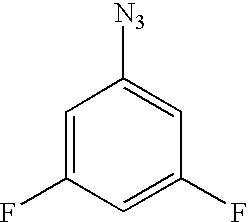
- HWZAUOAEASHHOX-UHFFFAOYSA-N 1-azido-3,5-difluorobenzene Chemical compound FC1=CC(F)=CC(N=[N+]=[N-])=C1 HWZAUOAEASHHOX-UHFFFAOYSA-N 0.000 description 9
- 0 I.II.I[IH]I.[1*]C(=O)CC(=O)O[3*].[1*]C1=C(C(=O)O)N([2*])N=N1.[2*]N=[N+]=[N-] Chemical compound I.II.I[IH]I.[1*]C(=O)CC(=O)O[3*].[1*]C1=C(C(=O)O)N([2*])N=N1.[2*]N=[N+]=[N-] 0.000 description 9
- VYPSYNLAJGMNEJ-UHFFFAOYSA-N Silicium dioxide Chemical compound O=[Si]=O VYPSYNLAJGMNEJ-UHFFFAOYSA-N 0.000 description 9
- 239000000543 intermediate Substances 0.000 description 9
- 239000003039 volatile agent Substances 0.000 description 9
- BLJPSWUXQQLRLD-UHFFFAOYSA-N 4-azido-2-fluoro-1-methylbenzene Chemical compound CC1=CC=C(N=[N+]=[N-])C=C1F BLJPSWUXQQLRLD-UHFFFAOYSA-N 0.000 description 8
- NLXLAEXVIDQMFP-UHFFFAOYSA-N Ammonia chloride Chemical compound [NH4+].[Cl-] NLXLAEXVIDQMFP-UHFFFAOYSA-N 0.000 description 8
- IAZDPXIOMUYVGZ-UHFFFAOYSA-N Dimethylsulphoxide Chemical compound CS(C)=O IAZDPXIOMUYVGZ-UHFFFAOYSA-N 0.000 description 8
- 239000012267 brine Substances 0.000 description 8
- HPALAKNZSZLMCH-UHFFFAOYSA-M sodium;chloride;hydrate Chemical compound O.[Na+].[Cl-] HPALAKNZSZLMCH-UHFFFAOYSA-M 0.000 description 8
- 235000019439 ethyl acetate Nutrition 0.000 description 7
- OKKJLVBELUTLKV-UHFFFAOYSA-N Methanol Chemical compound OC OKKJLVBELUTLKV-UHFFFAOYSA-N 0.000 description 6
- HEMHJVSKTPXQMS-UHFFFAOYSA-M Sodium hydroxide Chemical compound [OH-].[Na+] HEMHJVSKTPXQMS-UHFFFAOYSA-M 0.000 description 6
- CTRLRINCMYICJO-UHFFFAOYSA-N phenyl azide Chemical compound [N-]=[N+]=NC1=CC=CC=C1 CTRLRINCMYICJO-UHFFFAOYSA-N 0.000 description 6
- IVRMZWNICZWHMI-UHFFFAOYSA-N Azide Chemical compound [N-]=[N+]=[N-] IVRMZWNICZWHMI-UHFFFAOYSA-N 0.000 description 5
- 150000002118 epoxides Chemical class 0.000 description 5
- 125000002496 methyl group Chemical group [H]C([H])([H])* 0.000 description 5
- VLKZOEOYAKHREP-UHFFFAOYSA-N n-Hexane Chemical compound CCCCCC VLKZOEOYAKHREP-UHFFFAOYSA-N 0.000 description 5
- 239000007787 solid Substances 0.000 description 5
- 150000000177 1,2,3-triazoles Chemical class 0.000 description 4
- IJGRMHOSHXDMSA-UHFFFAOYSA-N Atomic nitrogen Chemical group N#N IJGRMHOSHXDMSA-UHFFFAOYSA-N 0.000 description 4
- XKULPGAAJZXZMM-UHFFFAOYSA-N CC1=CC=C(N2N=NC(C)=C2C(=O)O)C=C1F Chemical compound CC1=CC=C(N2N=NC(C)=C2C(=O)O)C=C1F XKULPGAAJZXZMM-UHFFFAOYSA-N 0.000 description 4
- WRQNANDWMGAFTP-UHFFFAOYSA-N Methylacetoacetic acid Chemical compound COC(=O)CC(C)=O WRQNANDWMGAFTP-UHFFFAOYSA-N 0.000 description 4
- 235000019270 ammonium chloride Nutrition 0.000 description 4
- 125000002837 carbocyclic group Chemical group 0.000 description 4
- 239000012230 colorless oil Substances 0.000 description 4
- 125000004093 cyano group Chemical group *C#N 0.000 description 4
- 125000000623 heterocyclic group Chemical group 0.000 description 4
- SHFJWMWCIHQNCP-UHFFFAOYSA-M hydron;tetrabutylazanium;sulfate Chemical compound OS([O-])(=O)=O.CCCC[N+](CCCC)(CCCC)CCCC SHFJWMWCIHQNCP-UHFFFAOYSA-M 0.000 description 4
- WRGLZAJBHUOPFO-UHFFFAOYSA-N methyl 3-oxo-3-phenylpropanoate Chemical compound COC(=O)CC(=O)C1=CC=CC=C1 WRGLZAJBHUOPFO-UHFFFAOYSA-N 0.000 description 4
- QGBPKJFJAVDUNC-UHFFFAOYSA-N methyl 4-methoxy-3-oxobutanoate Chemical compound COCC(=O)CC(=O)OC QGBPKJFJAVDUNC-UHFFFAOYSA-N 0.000 description 4
- VWDWKYIASSYTQR-UHFFFAOYSA-N sodium nitrate Chemical compound [Na+].[O-][N+]([O-])=O VWDWKYIASSYTQR-UHFFFAOYSA-N 0.000 description 4
- 238000003756 stirring Methods 0.000 description 4
- 125000001424 substituent group Chemical group 0.000 description 4
- BDCLDNALSPBWPQ-UHFFFAOYSA-M 3-oxohexanoate Chemical compound CCCC(=O)CC([O-])=O BDCLDNALSPBWPQ-UHFFFAOYSA-M 0.000 description 3
- STBMXWORHXFHES-UHFFFAOYSA-N CC(=O)NC1=CC=C(N=[N+]=[N-])C=C1 Chemical compound CC(=O)NC1=CC=C(N=[N+]=[N-])C=C1 STBMXWORHXFHES-UHFFFAOYSA-N 0.000 description 3
- VVLQPWITLORFQP-UHFFFAOYSA-N CC1=C(C(=O)O)N(C2=CC(F)=CC(F)=C2)N=N1 Chemical compound CC1=C(C(=O)O)N(C2=CC(F)=CC(F)=C2)N=N1 VVLQPWITLORFQP-UHFFFAOYSA-N 0.000 description 3
- ZMXDDKWLCZADIW-UHFFFAOYSA-N N,N-Dimethylformamide Chemical compound CN(C)C=O ZMXDDKWLCZADIW-UHFFFAOYSA-N 0.000 description 3
- 150000004982 aromatic amines Chemical class 0.000 description 3
- 125000004432 carbon atom Chemical group C* 0.000 description 3
- 239000012954 diazonium Substances 0.000 description 3
- 150000001989 diazonium salts Chemical class 0.000 description 3
- 238000001704 evaporation Methods 0.000 description 3
- 230000008020 evaporation Effects 0.000 description 3
- 239000005457 ice water Substances 0.000 description 3
- 239000002244 precipitate Substances 0.000 description 3
- 238000002360 preparation method Methods 0.000 description 3
- 238000000746 purification Methods 0.000 description 3
- 239000007858 starting material Substances 0.000 description 3
- 125000003107 substituted aryl group Chemical group 0.000 description 3
- PXQLVRUNWNTZOS-UHFFFAOYSA-N sulfanyl Chemical class [SH] PXQLVRUNWNTZOS-UHFFFAOYSA-N 0.000 description 3
- DKYOGNQCSUTQSS-UHFFFAOYSA-N 1-azido-2-methoxycyclohexane Chemical compound COC1CCCCC1N=[N+]=[N-] DKYOGNQCSUTQSS-UHFFFAOYSA-N 0.000 description 2
- UFOILRIAHBQPNH-UHFFFAOYSA-N 2-(azidomethyl)oxane Chemical compound [N-]=[N+]=NCC1CCCCO1 UFOILRIAHBQPNH-UHFFFAOYSA-N 0.000 description 2
- LVHTWQGAJYFGPP-UHFFFAOYSA-N 3-(4-acetamidophenyl)-5-phenyltriazole-4-carboxylic acid Chemical compound C1=CC(NC(=O)C)=CC=C1N1C(C(O)=O)=C(C=2C=CC=CC=2)N=N1 LVHTWQGAJYFGPP-UHFFFAOYSA-N 0.000 description 2
- VHUUQVKOLVNVRT-UHFFFAOYSA-N Ammonium hydroxide Chemical compound [NH4+].[OH-] VHUUQVKOLVNVRT-UHFFFAOYSA-N 0.000 description 2
- PAYRUJLWNCNPSJ-UHFFFAOYSA-N Aniline Chemical compound NC1=CC=CC=C1 PAYRUJLWNCNPSJ-UHFFFAOYSA-N 0.000 description 2
- GMQGQLWHPYMVJK-UHFFFAOYSA-N CC1=C(C(=O)O)N(C2=CC=CC=C2)N=N1 Chemical compound CC1=C(C(=O)O)N(C2=CC=CC=C2)N=N1 GMQGQLWHPYMVJK-UHFFFAOYSA-N 0.000 description 2
- YVXDRCDGBCOJHX-UHFFFAOYSA-N CC1=CC=C(N=[N+]=[N-])C=C1 Chemical compound CC1=CC=C(N=[N+]=[N-])C=C1 YVXDRCDGBCOJHX-UHFFFAOYSA-N 0.000 description 2
- NHNBFGGVMKEFGY-UHFFFAOYSA-N Nitrate Chemical compound [O-][N+]([O-])=O NHNBFGGVMKEFGY-UHFFFAOYSA-N 0.000 description 2
- OFBQJSOFQDEBGM-UHFFFAOYSA-N Pentane Chemical compound CCCCC OFBQJSOFQDEBGM-UHFFFAOYSA-N 0.000 description 2
- JUJWROOIHBZHMG-UHFFFAOYSA-N Pyridine Chemical compound C1=CC=NC=C1 JUJWROOIHBZHMG-UHFFFAOYSA-N 0.000 description 2
- CDBYLPFSWZWCQE-UHFFFAOYSA-L Sodium Carbonate Chemical compound [Na+].[Na+].[O-]C([O-])=O CDBYLPFSWZWCQE-UHFFFAOYSA-L 0.000 description 2
- UIIMBOGNXHQVGW-UHFFFAOYSA-M Sodium bicarbonate Chemical class [Na+].OC([O-])=O UIIMBOGNXHQVGW-UHFFFAOYSA-M 0.000 description 2
- NINIDFKCEFEMDL-UHFFFAOYSA-N Sulfur Chemical group [S] NINIDFKCEFEMDL-UHFFFAOYSA-N 0.000 description 2
- 150000001342 alkaline earth metals Chemical class 0.000 description 2
- 150000001350 alkyl halides Chemical class 0.000 description 2
- 239000000908 ammonium hydroxide Substances 0.000 description 2
- 239000003242 anti bacterial agent Substances 0.000 description 2
- 230000003266 anti-allergic effect Effects 0.000 description 2
- 239000000043 antiallergic agent Substances 0.000 description 2
- 229940088710 antibiotic agent Drugs 0.000 description 2
- 229940125681 anticonvulsant agent Drugs 0.000 description 2
- 239000001961 anticonvulsive agent Substances 0.000 description 2
- 239000000935 antidepressant agent Substances 0.000 description 2
- 229940005513 antidepressants Drugs 0.000 description 2
- 239000002257 antimetastatic agent Substances 0.000 description 2
- 239000008346 aqueous phase Substances 0.000 description 2
- QVGXLLKOCUKJST-UHFFFAOYSA-N atomic oxygen Chemical group [O] QVGXLLKOCUKJST-UHFFFAOYSA-N 0.000 description 2
- UDLLFLQFQMACJB-UHFFFAOYSA-N azidomethylbenzene Chemical compound [N-]=[N+]=NCC1=CC=CC=C1 UDLLFLQFQMACJB-UHFFFAOYSA-N 0.000 description 2
- 125000004122 cyclic group Chemical group 0.000 description 2
- PPKDSHDYUBDVKL-UHFFFAOYSA-N diazonio-(4-methoxyphenyl)azanide Chemical compound COC1=CC=C([N-][N+]#N)C=C1 PPKDSHDYUBDVKL-UHFFFAOYSA-N 0.000 description 2
- VAYGXNSJCAHWJZ-UHFFFAOYSA-N dimethyl sulfate Chemical compound COS(=O)(=O)OC VAYGXNSJCAHWJZ-UHFFFAOYSA-N 0.000 description 2
- ZUOUZKKEUPVFJK-UHFFFAOYSA-N diphenyl Chemical compound C1=CC=CC=C1C1=CC=CC=C1 ZUOUZKKEUPVFJK-UHFFFAOYSA-N 0.000 description 2
- 239000000706 filtrate Substances 0.000 description 2
- 150000004820 halides Chemical class 0.000 description 2
- 125000005842 heteroatom Chemical group 0.000 description 2
- DTMSEOVTDVSPDO-UHFFFAOYSA-N methyl 3-oxo-4-phenylbutanoate Chemical compound COC(=O)CC(=O)CC1=CC=CC=C1 DTMSEOVTDVSPDO-UHFFFAOYSA-N 0.000 description 2
- CZTKGERSDUGZPQ-UHFFFAOYSA-N methyl 3-oxoheptanoate Chemical compound CCCCC(=O)CC(=O)OC CZTKGERSDUGZPQ-UHFFFAOYSA-N 0.000 description 2
- 230000007935 neutral effect Effects 0.000 description 2
- 229910052757 nitrogen Chemical group 0.000 description 2
- 230000000269 nucleophilic effect Effects 0.000 description 2
- 229910052760 oxygen Inorganic materials 0.000 description 2
- 239000001301 oxygen Substances 0.000 description 2
- 239000000047 product Substances 0.000 description 2
- 239000000377 silicon dioxide Substances 0.000 description 2
- 235000010344 sodium nitrate Nutrition 0.000 description 2
- 239000004317 sodium nitrate Substances 0.000 description 2
- 229910052717 sulfur Inorganic materials 0.000 description 2
- 239000011593 sulfur Chemical group 0.000 description 2
- 238000005406 washing Methods 0.000 description 2
- SXQIUJWKUSMDHQ-UHFFFAOYSA-N (3-azido-2-methoxypropyl)benzene Chemical compound [N-]=[N+]=NCC(OC)CC1=CC=CC=C1 SXQIUJWKUSMDHQ-UHFFFAOYSA-N 0.000 description 1
- 125000004191 (C1-C6) alkoxy group Chemical group 0.000 description 1
- 125000004169 (C1-C6) alkyl group Chemical group 0.000 description 1
- 125000001399 1,2,3-triazolyl group Chemical group N1N=NC(=C1)* 0.000 description 1
- YBUWMBRGTPWWCB-UHFFFAOYSA-N 1-azido-2-methoxy-4-methylpentane Chemical compound CC(C)CC(OC)CN=[N+]=[N-] YBUWMBRGTPWWCB-UHFFFAOYSA-N 0.000 description 1
- KOFFFKMEMKRWMT-UHFFFAOYSA-N 1-azidoethylbenzene Chemical compound [N-]=[N+]=NC(C)C1=CC=CC=C1 KOFFFKMEMKRWMT-UHFFFAOYSA-N 0.000 description 1
- BUAAYMXHYIEKND-UHFFFAOYSA-N 2-(azidomethyl)oxolane Chemical compound [N-]=[N+]=NCC1CCCO1 BUAAYMXHYIEKND-UHFFFAOYSA-N 0.000 description 1
- MHNWCBOXPOLLIB-UHFFFAOYSA-N 2-(bromomethyl)oxane Chemical compound BrCC1CCCCO1 MHNWCBOXPOLLIB-UHFFFAOYSA-N 0.000 description 1
- QECSGTHYJAPXMH-UHFFFAOYSA-N 2-azidocyclohexan-1-ol Chemical compound OC1CCCCC1N=[N+]=[N-] QECSGTHYJAPXMH-UHFFFAOYSA-N 0.000 description 1
- VMZCDNSFRSVYKQ-UHFFFAOYSA-N 2-phenylacetyl chloride Chemical compound ClC(=O)CC1=CC=CC=C1 VMZCDNSFRSVYKQ-UHFFFAOYSA-N 0.000 description 1
- KQOIBXZRCYFZSO-UHFFFAOYSA-N 3,5-difluoroaniline Chemical compound NC1=CC(F)=CC(F)=C1 KQOIBXZRCYFZSO-UHFFFAOYSA-N 0.000 description 1
- GVPAARWOTAUHBV-UHFFFAOYSA-N 3-(azidomethyl)pentane Chemical compound CCC(CC)CN=[N+]=[N-] GVPAARWOTAUHBV-UHFFFAOYSA-N 0.000 description 1
- 125000005917 3-methylpentyl group Chemical group 0.000 description 1
- 125000005925 3-methylpentyloxy group Chemical group 0.000 description 1
- ZCYVEMRRCGMTRW-UHFFFAOYSA-N 7553-56-2 Chemical compound [I] ZCYVEMRRCGMTRW-UHFFFAOYSA-N 0.000 description 1
- WKBOTKDWSSQWDR-UHFFFAOYSA-N Bromine atom Chemical compound [Br] WKBOTKDWSSQWDR-UHFFFAOYSA-N 0.000 description 1
- UNEBRUBRAJKPIL-UHFFFAOYSA-M C.N#[N+][Ar].N=N[NH-].N[Ar].O[N-]OO.[N-]=[N+]=N[Ar].[V].[V]I Chemical compound C.N#[N+][Ar].N=N[NH-].N[Ar].O[N-]OO.[N-]=[N+]=N[Ar].[V].[V]I UNEBRUBRAJKPIL-UHFFFAOYSA-M 0.000 description 1
- BAYVKYXLCNQCAY-UHFFFAOYSA-N CC(=O)NC1=CC=C(N2N=NC(C)=C2C(=O)O)C=C1 Chemical compound CC(=O)NC1=CC=C(N2N=NC(C)=C2C(=O)O)C=C1 BAYVKYXLCNQCAY-UHFFFAOYSA-N 0.000 description 1
- GFGLVMJGQJXMTD-UHFFFAOYSA-N CC1=CC=C(N2N=NC(C3=C(F)C=CC=C3)=C2C(=O)O)C=C1 Chemical compound CC1=CC=C(N2N=NC(C3=C(F)C=CC=C3)=C2C(=O)O)C=C1 GFGLVMJGQJXMTD-UHFFFAOYSA-N 0.000 description 1
- DIFGZIPNPPTJMB-UHFFFAOYSA-N CC1=CC=C(N2N=NC(C3=C(F)C=CC=C3)=C2C(=O)O)C=C1F Chemical compound CC1=CC=C(N2N=NC(C3=C(F)C=CC=C3)=C2C(=O)O)C=C1F DIFGZIPNPPTJMB-UHFFFAOYSA-N 0.000 description 1
- HQJTYNJQRPMJCR-UHFFFAOYSA-N CC1=CC=C(N2N=NC(C3=CC=CC=C3)=C2C(=O)O)C=C1 Chemical compound CC1=CC=C(N2N=NC(C3=CC=CC=C3)=C2C(=O)O)C=C1 HQJTYNJQRPMJCR-UHFFFAOYSA-N 0.000 description 1
- UZYWLRKYSLWJAS-UHFFFAOYSA-N CC1=CC=C(N2N=NC(C3=CC=CC=C3)=C2C(=O)O)C=C1F Chemical compound CC1=CC=C(N2N=NC(C3=CC=CC=C3)=C2C(=O)O)C=C1F UZYWLRKYSLWJAS-UHFFFAOYSA-N 0.000 description 1
- LVLXNUDGCDGUMH-UHFFFAOYSA-N CCC1=C(C(=O)O)N(C2=CC=CC=C2)N=N1 Chemical compound CCC1=C(C(=O)O)N(C2=CC=CC=C2)N=N1 LVLXNUDGCDGUMH-UHFFFAOYSA-N 0.000 description 1
- TZHBWBMHSRCYRP-UHFFFAOYSA-N CCCC1=C(C(=O)O)N(C2=CC(F)=CC(F)=C2)N=N1 Chemical compound CCCC1=C(C(=O)O)N(C2=CC(F)=CC(F)=C2)N=N1 TZHBWBMHSRCYRP-UHFFFAOYSA-N 0.000 description 1
- NQWWFZVJHWGTDQ-UHFFFAOYSA-N CCCC1=C(C(=O)O)N(C2=CC=C(C)C(F)=C2)N=N1 Chemical compound CCCC1=C(C(=O)O)N(C2=CC=C(C)C(F)=C2)N=N1 NQWWFZVJHWGTDQ-UHFFFAOYSA-N 0.000 description 1
- SVDLCRLEPILRSS-UHFFFAOYSA-N CCCC1=C(C(=O)O)N(C2=CC=C(NC(C)=O)C=C2)N=N1 Chemical compound CCCC1=C(C(=O)O)N(C2=CC=C(NC(C)=O)C=C2)N=N1 SVDLCRLEPILRSS-UHFFFAOYSA-N 0.000 description 1
- JDYMBVUTHWJSGV-UHFFFAOYSA-N CCCC1=C(C(=O)O)N(C2=CC=CC=C2)N=N1 Chemical compound CCCC1=C(C(=O)O)N(C2=CC=CC=C2)N=N1 JDYMBVUTHWJSGV-UHFFFAOYSA-N 0.000 description 1
- OGVIAFGWJNSYOL-UHFFFAOYSA-N COCC1=C(C(=O)O)N(C2=CC(F)=CC(F)=C2)N=N1 Chemical compound COCC1=C(C(=O)O)N(C2=CC(F)=CC(F)=C2)N=N1 OGVIAFGWJNSYOL-UHFFFAOYSA-N 0.000 description 1
- GPNCLLCCEDMSIR-UHFFFAOYSA-N COCC1=C(C(=O)O)N(C2=CC=C(C)C(F)=C2)N=N1 Chemical compound COCC1=C(C(=O)O)N(C2=CC=C(C)C(F)=C2)N=N1 GPNCLLCCEDMSIR-UHFFFAOYSA-N 0.000 description 1
- VWCCMYGDQHIMSG-UHFFFAOYSA-N COCC1=C(C(=O)O)N(C2=CC=C(C)C=C2)N=N1 Chemical compound COCC1=C(C(=O)O)N(C2=CC=C(C)C=C2)N=N1 VWCCMYGDQHIMSG-UHFFFAOYSA-N 0.000 description 1
- GHIVFDCPALTHJS-UHFFFAOYSA-N COCC1=C(C(=O)O)N(C2=CC=C(NC(C)=O)C=C2)N=N1 Chemical compound COCC1=C(C(=O)O)N(C2=CC=C(NC(C)=O)C=C2)N=N1 GHIVFDCPALTHJS-UHFFFAOYSA-N 0.000 description 1
- VRRTWSAGRLBFOT-UHFFFAOYSA-N COCC1=C(C(=O)O)N(C2=CC=CC=C2)N=N1 Chemical compound COCC1=C(C(=O)O)N(C2=CC=CC=C2)N=N1 VRRTWSAGRLBFOT-UHFFFAOYSA-N 0.000 description 1
- DKYOGNQCSUTQSS-RNFRBKRXSA-N CO[C@@H]1CCCC[C@H]1N=[N+]=[N-] Chemical compound CO[C@@H]1CCCC[C@H]1N=[N+]=[N-] DKYOGNQCSUTQSS-RNFRBKRXSA-N 0.000 description 1
- OYPRJOBELJOOCE-UHFFFAOYSA-N Calcium Chemical compound [Ca] OYPRJOBELJOOCE-UHFFFAOYSA-N 0.000 description 1
- ZAMOUSCENKQFHK-UHFFFAOYSA-N Chlorine atom Chemical compound [Cl] ZAMOUSCENKQFHK-UHFFFAOYSA-N 0.000 description 1
- LCGLNKUTAGEVQW-UHFFFAOYSA-N Dimethyl ether Chemical compound COC LCGLNKUTAGEVQW-UHFFFAOYSA-N 0.000 description 1
- GKKZMYDNDDMXSE-UHFFFAOYSA-N Ethyl 3-oxo-3-phenylpropanoate Chemical compound CCOC(=O)CC(=O)C1=CC=CC=C1 GKKZMYDNDDMXSE-UHFFFAOYSA-N 0.000 description 1
- PXGOKWXKJXAPGV-UHFFFAOYSA-N Fluorine Chemical compound FF PXGOKWXKJXAPGV-UHFFFAOYSA-N 0.000 description 1
- DGAQECJNVWCQMB-PUAWFVPOSA-M Ilexoside XXIX Chemical compound C[C@@H]1CC[C@@]2(CC[C@@]3(C(=CC[C@H]4[C@]3(CC[C@@H]5[C@@]4(CC[C@@H](C5(C)C)OS(=O)(=O)[O-])C)C)[C@@H]2[C@]1(C)O)C)C(=O)O[C@H]6[C@@H]([C@H]([C@@H]([C@H](O6)CO)O)O)O.[Na+] DGAQECJNVWCQMB-PUAWFVPOSA-M 0.000 description 1
- 229930194542 Keto Natural products 0.000 description 1
- FYYHWMGAXLPEAU-UHFFFAOYSA-N Magnesium Chemical compound [Mg] FYYHWMGAXLPEAU-UHFFFAOYSA-N 0.000 description 1
- AFVFQIVMOAPDHO-UHFFFAOYSA-N Methanesulfonic acid Chemical compound CS(O)(=O)=O AFVFQIVMOAPDHO-UHFFFAOYSA-N 0.000 description 1
- BZLVMXJERCGZMT-UHFFFAOYSA-N Methyl tert-butyl ether Chemical compound COC(C)(C)C BZLVMXJERCGZMT-UHFFFAOYSA-N 0.000 description 1
- OAPDQKANFCSBSN-UHFFFAOYSA-N O=C(O)C1=C(C2=C(F)C=CC=C2)N=NN1C1=CC(F)=CC(F)=C1 Chemical compound O=C(O)C1=C(C2=C(F)C=CC=C2)N=NN1C1=CC(F)=CC(F)=C1 OAPDQKANFCSBSN-UHFFFAOYSA-N 0.000 description 1
- BUWHWOXRYUTHAC-UHFFFAOYSA-N O=C(O)C1=C(C2=CC=CC=C2)N=NN1C1=CC(F)=CC(F)=C1 Chemical compound O=C(O)C1=C(C2=CC=CC=C2)N=NN1C1=CC(F)=CC(F)=C1 BUWHWOXRYUTHAC-UHFFFAOYSA-N 0.000 description 1
- MAQBDLAKLGOZSX-UHFFFAOYSA-N O=C(O)C1=C(C2=CC=CC=C2)N=NN1C1=CC=CC=C1 Chemical compound O=C(O)C1=C(C2=CC=CC=C2)N=NN1C1=CC=CC=C1 MAQBDLAKLGOZSX-UHFFFAOYSA-N 0.000 description 1
- ZLMJMSJWJFRBEC-UHFFFAOYSA-N Potassium Chemical compound [K] ZLMJMSJWJFRBEC-UHFFFAOYSA-N 0.000 description 1
- 150000000475 acetylene derivatives Chemical class 0.000 description 1
- 239000002253 acid Substances 0.000 description 1
- 125000004423 acyloxy group Chemical group 0.000 description 1
- 150000001347 alkyl bromides Chemical class 0.000 description 1
- 125000004414 alkyl thio group Chemical group 0.000 description 1
- 150000001412 amines Chemical class 0.000 description 1
- 125000005428 anthryl group Chemical group [H]C1=C([H])C([H])=C2C([H])=C3C(*)=C([H])C([H])=C([H])C3=C([H])C2=C1[H] 0.000 description 1
- 239000000010 aprotic solvent Substances 0.000 description 1
- 239000007864 aqueous solution Substances 0.000 description 1
- 239000012298 atmosphere Substances 0.000 description 1
- SSJIACUDWJVGLB-UHFFFAOYSA-N azidocyclopentane Chemical compound [N-]=[N+]=NC1CCCC1 SSJIACUDWJVGLB-UHFFFAOYSA-N 0.000 description 1
- SVXPKXPIBAQFJC-UHFFFAOYSA-N azidomethylcyclohexane Chemical compound [N-]=[N+]=NCC1CCCCC1 SVXPKXPIBAQFJC-UHFFFAOYSA-N 0.000 description 1
- 125000003785 benzimidazolyl group Chemical group N1=C(NC2=C1C=CC=C2)* 0.000 description 1
- 125000004541 benzoxazolyl group Chemical group O1C(=NC2=C1C=CC=C2)* 0.000 description 1
- AGEZXYOZHKGVCM-UHFFFAOYSA-N benzyl bromide Chemical compound BrCC1=CC=CC=C1 AGEZXYOZHKGVCM-UHFFFAOYSA-N 0.000 description 1
- 235000010290 biphenyl Nutrition 0.000 description 1
- 239000004305 biphenyl Substances 0.000 description 1
- GDTBXPJZTBHREO-UHFFFAOYSA-N bromine Substances BrBr GDTBXPJZTBHREO-UHFFFAOYSA-N 0.000 description 1
- 229910052794 bromium Inorganic materials 0.000 description 1
- 244000309464 bull Species 0.000 description 1
- YTIVTFGABIZHHX-UHFFFAOYSA-N butynedioic acid Chemical class OC(=O)C#CC(O)=O YTIVTFGABIZHHX-UHFFFAOYSA-N 0.000 description 1
- 239000011575 calcium Substances 0.000 description 1
- 229910052791 calcium Inorganic materials 0.000 description 1
- 150000004649 carbonic acid derivatives Chemical class 0.000 description 1
- 239000000460 chlorine Substances 0.000 description 1
- 229910052801 chlorine Inorganic materials 0.000 description 1
- 238000001816 cooling Methods 0.000 description 1
- 239000013058 crude material Substances 0.000 description 1
- 239000012043 crude product Substances 0.000 description 1
- 125000001995 cyclobutyl group Chemical group [H]C1([H])C([H])([H])C([H])(*)C1([H])[H] 0.000 description 1
- 125000000582 cycloheptyl group Chemical group [H]C1([H])C([H])([H])C([H])([H])C([H])([H])C([H])(*)C([H])([H])C1([H])[H] 0.000 description 1
- ZWAJLVLEBYIOTI-UHFFFAOYSA-N cyclohexene oxide Chemical compound C1CCCC2OC21 ZWAJLVLEBYIOTI-UHFFFAOYSA-N 0.000 description 1
- FWFSEYBSWVRWGL-UHFFFAOYSA-N cyclohexene oxide Natural products O=C1CCCC=C1 FWFSEYBSWVRWGL-UHFFFAOYSA-N 0.000 description 1
- 125000001559 cyclopropyl group Chemical group [H]C1([H])C([H])([H])C1([H])* 0.000 description 1
- 230000001419 dependent effect Effects 0.000 description 1
- 229910001873 dinitrogen Inorganic materials 0.000 description 1
- 125000000532 dioxanyl group Chemical group 0.000 description 1
- 239000003814 drug Substances 0.000 description 1
- 229940079593 drug Drugs 0.000 description 1
- 238000001035 drying Methods 0.000 description 1
- 150000002148 esters Chemical class 0.000 description 1
- 150000002170 ethers Chemical class 0.000 description 1
- 125000001495 ethyl group Chemical group [H]C([H])([H])C([H])([H])* 0.000 description 1
- 239000012467 final product Substances 0.000 description 1
- 229910052731 fluorine Inorganic materials 0.000 description 1
- 239000011737 fluorine Substances 0.000 description 1
- 125000002541 furyl group Chemical group 0.000 description 1
- 125000005843 halogen group Chemical group 0.000 description 1
- GNOIPBMMFNIUFM-UHFFFAOYSA-N hexamethylphosphoric triamide Chemical compound CN(C)P(=O)(N(C)C)N(C)C GNOIPBMMFNIUFM-UHFFFAOYSA-N 0.000 description 1
- 125000004051 hexyl group Chemical group [H]C([H])([H])C([H])([H])C([H])([H])C([H])([H])C([H])([H])C([H])([H])* 0.000 description 1
- 125000002887 hydroxy group Chemical group [H]O* 0.000 description 1
- 125000002883 imidazolyl group Chemical group 0.000 description 1
- 239000011630 iodine Substances 0.000 description 1
- 229910052740 iodine Inorganic materials 0.000 description 1
- 125000001972 isopentyl group Chemical group [H]C([H])([H])C([H])(C([H])([H])[H])C([H])([H])C([H])([H])* 0.000 description 1
- 125000001449 isopropyl group Chemical group [H]C([H])([H])C([H])(*)C([H])([H])[H] 0.000 description 1
- 125000000468 ketone group Chemical group 0.000 description 1
- 239000007788 liquid Substances 0.000 description 1
- 239000011777 magnesium Substances 0.000 description 1
- 229910052749 magnesium Inorganic materials 0.000 description 1
- 238000004519 manufacturing process Methods 0.000 description 1
- 239000000463 material Substances 0.000 description 1
- GXHFUVWIGNLZSC-UHFFFAOYSA-N meldrum's acid Chemical compound CC1(C)OC(=O)CC(=O)O1 GXHFUVWIGNLZSC-UHFFFAOYSA-N 0.000 description 1
- 229910052751 metal Inorganic materials 0.000 description 1
- 239000002184 metal Substances 0.000 description 1
- 238000012986 modification Methods 0.000 description 1
- 230000004048 modification Effects 0.000 description 1
- 125000004108 n-butyl group Chemical group [H]C([H])([H])C([H])([H])C([H])([H])C([H])([H])* 0.000 description 1
- 125000001624 naphthyl group Chemical group 0.000 description 1
- 125000001971 neopentyl group Chemical group [H]C([*])([H])C(C([H])([H])[H])(C([H])([H])[H])C([H])([H])[H] 0.000 description 1
- 125000000449 nitro group Chemical group [O-][N+](*)=O 0.000 description 1
- QJGQUHMNIGDVPM-UHFFFAOYSA-N nitrogen group Chemical group [N] QJGQUHMNIGDVPM-UHFFFAOYSA-N 0.000 description 1
- 239000012038 nucleophile Substances 0.000 description 1
- 238000007340 nucleophilic aliphatic substitution reaction Methods 0.000 description 1
- 239000003921 oil Substances 0.000 description 1
- 150000002894 organic compounds Chemical class 0.000 description 1
- 239000012074 organic phase Substances 0.000 description 1
- 125000002971 oxazolyl group Chemical group 0.000 description 1
- 125000001147 pentyl group Chemical group C(CCCC)* 0.000 description 1
- 125000005561 phenanthryl group Chemical group 0.000 description 1
- 239000011591 potassium Substances 0.000 description 1
- 229910052700 potassium Inorganic materials 0.000 description 1
- 239000002243 precursor Substances 0.000 description 1
- 125000002924 primary amino group Chemical group [H]N([H])* 0.000 description 1
- 125000001436 propyl group Chemical group [H]C([*])([H])C([H])([H])C([H])([H])[H] 0.000 description 1
- 125000006239 protecting group Chemical group 0.000 description 1
- 125000004309 pyranyl group Chemical group O1C(C=CC=C1)* 0.000 description 1
- UMJSCPRVCHMLSP-UHFFFAOYSA-N pyridine Natural products COC1=CC=CN=C1 UMJSCPRVCHMLSP-UHFFFAOYSA-N 0.000 description 1
- 125000004076 pyridyl group Chemical group 0.000 description 1
- 125000000714 pyrimidinyl group Chemical group 0.000 description 1
- 125000002943 quinolinyl group Chemical group N1=C(C=CC2=CC=CC=C12)* 0.000 description 1
- 238000013341 scale-up Methods 0.000 description 1
- 125000002914 sec-butyl group Chemical group [H]C([H])([H])C([H])([H])C([H])(*)C([H])([H])[H] 0.000 description 1
- 239000000741 silica gel Substances 0.000 description 1
- 229910002027 silica gel Inorganic materials 0.000 description 1
- 239000011734 sodium Substances 0.000 description 1
- 229910052708 sodium Inorganic materials 0.000 description 1
- 229910000029 sodium carbonate Inorganic materials 0.000 description 1
- 238000006467 substitution reaction Methods 0.000 description 1
- 239000000758 substrate Substances 0.000 description 1
- 239000000725 suspension Substances 0.000 description 1
- 238000010189 synthetic method Methods 0.000 description 1
- 125000000999 tert-butyl group Chemical group [H]C([H])([H])C(*)(C([H])([H])[H])C([H])([H])[H] 0.000 description 1
- 125000003718 tetrahydrofuranyl group Chemical group 0.000 description 1
- 125000000335 thiazolyl group Chemical group 0.000 description 1
- 125000001544 thienyl group Chemical group 0.000 description 1
- JOXIMZWYDAKGHI-UHFFFAOYSA-N toluene-4-sulfonic acid Chemical compound CC1=CC=C(S(O)(=O)=O)C=C1 JOXIMZWYDAKGHI-UHFFFAOYSA-N 0.000 description 1
- 150000003852 triazoles Chemical class 0.000 description 1
- 125000000876 trifluoromethoxy group Chemical group FC(F)(F)O* 0.000 description 1
- 125000002023 trifluoromethyl group Chemical group FC(F)(F)* 0.000 description 1
Classifications
-
- C—CHEMISTRY; METALLURGY
- C07—ORGANIC CHEMISTRY
- C07D—HETEROCYCLIC COMPOUNDS
- C07D249/00—Heterocyclic compounds containing five-membered rings having three nitrogen atoms as the only ring hetero atoms
- C07D249/02—Heterocyclic compounds containing five-membered rings having three nitrogen atoms as the only ring hetero atoms not condensed with other rings
- C07D249/04—1,2,3-Triazoles; Hydrogenated 1,2,3-triazoles
Definitions
- This invention relates to a one-step process to prepare triazole carboxylic acids from azides and ⁇ -ketoesters.
- the 1,2,3-triazole unit is an important element in a number of drugs and development candidates.
- the triazole is a structural backbone of many antibiotics, antiallergics, antimetastasis agents, anticonvulsants and antidepressants. Their synthesis usually involves the reaction of organic azides with unsaturated compounds. Such unsaturated compounds are usually acetylenic compounds (Hiroto et al., Chem Pharm. Bull. 1990, 38(9), 2597-2601; Palacios et al., Heterocycles 1994, 38(1), 95-102), as, for example, acetylene dicarboxylic acid derivatives.
- An object of the present invention is to develop a large scale, safe and efficient procedure for the syntheses of azides. Another object of the present invention is to provide an efficient one-step synthesis of triazole-carboxylic acids from azides and ⁇ -keto esters.
- This invention provides for a one step process for preparing 1,2,3-triazole carboxylic acids from an azide and a ⁇ -ketoester. Specifically, the method of the present invention calls for the treatment of an azide and a ⁇ -ketoester with a base to form a 3H-[1,2,3]triazole-4-carboxylic acid. These compounds are important precursors for antibiotics, antiallergics, antimetastasis agents, anticonvulsants and antidepressants.
- the invention also provides for a method for preparing an aromatic azide intermediate from an aromatic amine.
- the aromatic amine is treated with a nitrate ion in the presence of an acid to form a diazonium salt. Subsequent treatment with an azide ion affords the desired aromatic azide.
- the invention further provides for a method for preparing an aliphatic azide intermediate from the corresponding alkyl halide and an azide ion.
- the reaction proceeds via S N 2 nucleophilic aliphatic substitution and the time and temperature of the reaction is dependent on the individual alkyl halide.
- the invention further provides for a method for preparing a ⁇ -hydroxy aliphatic azide intermediate by regioselective nucleophilic opening of an epoxide by an azide ion in the presence of ammonium chloride.
- a method for preparing a ⁇ -hydroxy aliphatic azide intermediate by regioselective nucleophilic opening of an epoxide by an azide ion in the presence of ammonium chloride For azides to be converted to the corresponding 1,2,3-triazole carboxylic acids according to the method of the present invention, the alcohol is subsequently protected.
- a preferred embodiment of the present invention relates to a method for the formation of a 3H-[1,2,3]triazole-4-carboxylic acid III by reacting an azide I with a ⁇ -ketoester II in the presence of a base.
- R 1 and R 2 independently are lower alkyl or cycloalkyl optionally substituted with one, two or three groups independently selected from halogen, lower alkoxy, —C(O)-alkyl, hydroxy, amino, mono- or dialkylamino, mercapto, alkylthiol, —C(O)NH-alkyl, C(O)N-dialkyl, —NHC(O)-alkyl, alkenyl or alkynyl, or
- R 1 and R 2 independently are aryl, arylalkyl, cycloalkylalkyl, heteroaryl or heteroarylalkyl wherein the ring portion of each is optionally substituted with one, two or three groups independently selected from halogen, lower alkoxy, —C(O)-alkyl, hydroxy, amino, mono- or dialkylamino, mercapto, alkylthiol, —C(O)NH-alkyl, C(O)N-dialkyl, —NHC(O)-alkyl, alkenyl or alkynyl; and
- R 3 is lower alkyl.
- R 2 is aryl or heteroaryl optionally substituted with one, two or three groups independently selected from halogen, lower alkoxy, —C(O)-alkyl, hydroxy, amino, mono- or dialkylamino, mercapto, alkylthiol, —C(O)NH-alkyl, C(O)N-dialkyl, —NHC(O)-alkyl, alkenyl or alkynyl.
- alkyl straight or branched chain alkyl groups having 1-6 carbon atoms, such as, methyl, ethyl, propyl, isopropyl, n-butyl, sec-butyl, tert-butyl, pentyl, 2-pentyl, isopentyl, neopentyl, hexyl, 2-hexyl, 3-hexyl, and 3-methylpentyl.
- These groups may be substituted with up to four groups mentioned below for substituted aryl.
- alkoxy straight or branched chain alkoxy groups having 1-6 carbon atoms, such as, for example, methoxy, ethoxy, propoxy, isopropoxy, n-butoxy, sec-butoxy, tert-butoxy, pentoxy, 2-pentyl, isopentoxy, neopentoxy, hexoxy, 2-hexoxy, 3-hexoxy, and 3-methylpentoxy.
- groups may be substituted with up to four groups mentioned below for substituted aryl.
- halogen in the present invention is meant fluorine, bromine, chlorine, and iodine.
- a “carbocyclic group” or “cycloalkyl” is a nonaromatic cyclic ring or fused rings having from 3 to 7 ring members. Examples include cyclopropyl, cyclobutyl, and cycloheptyl. These rings may be substituted with one or more of the substituent groups mentioned below for aryl, for example alkyl, halo, amino, hydroxy, and alkoxy. Typical substituted carbocyclic groups include 2-chlorocyclopropyl, 2,3-diethoxycyclopentyl, and 2,2,4,4-tetrafluorocyclohexyl.
- the carbocyclic group may contain one or two heteroatoms selected from oxygen, sulfur, and nitrogen, and such ring systems may be referred to as “heterocyclyl” or “heterocyclic”. Examples include pyranyl, tetrahydrofuranyl, and dioxanyl. These heterocyclyl groups may be substituted with up to four of the substituent groups mentioned for aryl.
- heteroaryl is meant one or more aromatic ring systems of 5-, 6-, or 7-membered rings containing at least one and up to four heteroatoms selected from nitrogen, oxygen, or sulfur.
- heteroaryl groups include, for example, thienyl, furanyl, thiazolyl, imidazolyl, (is)oxazolyl, pyridyl, pyrimidinyl, (iso)quinolinyl, napthyridinyl, benzimidazolyl, benzoxazolyl.
- the heteroaryl group is optionally substituted with up to four groups mentioned below for substituted aryl.
- aryl is meant an aromatic carbocyclic group having a single ring (e.g., phenyl), multiple rings (e.g., biphenyl), or multiple condensed rings in which at least one is aromatic, (e.g., 1,2,3,4-tetrahydronaphthyl, naphthyl, anthryl, or phenanthryl), which is optionally mono-, di-, or trisubstituted with, e.g., halogen, —OH, —SH, lower alkyl, lower alkoxy, lower alkylthio, trifluoromethyl, trifluoromethoxy, lower acyloxy, aryl, heteroaryl, amino, mono- or dialkylamino, and nitro.
- a preferred aryl is phenyl.
- the azide I, the ⁇ -ketoester II and the base are reacted together in a suitable solvent.
- the reaction mixture in such a solvent can be homogenous or heterogenous.
- suitable solvents for the present method include, but are not limited to, one or more of the following: a protic solvent such as methanol, ethanol or water; or aprotic solvents such as dimethylsulfoxide, dimethylformamide or hexamethylphosphorotriamide.
- the solvent is ethanol or water; and the most preferred is a combination of water and ethanol.
- acceptable bases used in the present method are those with alkali metals or alkaline earth metals such as sodium, potassium, calcium and magnesium, and those with organic bases including, but not limited to, amines.
- Preferred bases are alkali metal bases or alkaline earth metal bases.
- Even more preferred bases are alkaline metal carbonates, such as, for example, potassium carbonate or sodium carbonate.
- the method of the present invention is carried out at temperatures of from between 0° C. and 150° C. More preferably, the reaction temperature is from between 50° C. and 100° C. and even more preferably the reaction temperature is from between 65° C. and 90° C. A most preferred temperature is around 80° C.
- Another preferred embodiment of the present invention relates to preparing an aromatic azide intermediate Ia by reacting an aromatic amine IV with a nitrate ion to form the corresponding diazonium salt V.
- the diazonium salt V is then treated with an azide ion to afford the desired aromatic azide Ia.
- Ar is aryl or heteroaryl optionally substituted with one, two or three groups independently selected from halogen, lower alkoxy, —C(O)-alkyl, hydroxy, amino, mono- or dialkylamino, —C(O)NH-alkyl, C(O)N-dialkyl, —NHC(O)-alkyl, alkenyl or alkynyl.
- Scheme 3 shows a method of preparing alkyl azide intermediates Ib by S N 2 substitution of the corresponding halide VI using azide ion as the nucleophile.
- X is a suitable leaving group, including but not limited to a halide, a mesylate or a tosylate;
- R 4 is lower alkyl or cycloalkyl optionally substituted with one, two or three groups independently selected from lower alkoxy, —C(O)-alkyl, hydroxy, amino, mono- or dialkylamino, —C(O)NH-alkyl, C(O)N-dialkyl, —C(O)O-alkyl, —NHC(O)-alkyl, cyano, alkenyl or alkynyl, or
- R 4 is aryl, arylalkyl, heteroaryl or heteroarylalkyl wherein the ring portion of each is optionally substituted with one, two or three groups independently selected from halogen, lower alkoxy, —C(O)-alkyl, hydroxy, amino, mono- or dialkylamino, —C(O)NH-alkyl, C(O)N-dialkyl, —C(O)O-alkyl, —NHC(O)-alkyl, cyano, alkenyl or alkynyl.
- Scheme 4 shows yet another preferred embodiment of the present invention, which relates to preparing ⁇ -hydroxy alkyl azide intermediates Ic by regioselective nucleophilic opening of epoxide VII in the presence of ammonium chloride.
- R 4 is lower alkyl or cycloalkyl optionally substituted with one, two or three groups independently selected from lower alkoxy, —C(O)-alkyl, hydroxy, amino, mono- or dialkylamino, —C(O)NH-alkyl, C(O)N-dialkyl, —C(O)O-alkyl, —NHC(O)-alkyl, cyano, alkenyl or alkynyl, or
- R 4 is aryl, arylalkyl, heteroaryl or heteroarylalkyl wherein the ring portion of each is optionally substituted with one, two or three groups independently selected from halogen, lower alkoxy, —C(O)-alkyl, hydroxy, amino, mono- or dialkylamino, —C(O)NH-alkyl, C(O)N-dialkyl, —C(O)O-alkyl, —NHC(O)-alkyl, cyano, alkenyl or alkynyl.
- the ⁇ -hydroxy alkyl azide intermediate Ic is protected with conventional hydroxy-protecting groups known to those skilled in the art to survive the reaction conditions of the present invention.
- Preferred protecting groups are those that will form ethers.
- the hydroxy group is protected as the methyl ether.
- the starting materials and various intermediates may be obtained from commercial sources, prepared from commercially available organic compounds, or prepared using well known synthetic methods.
- reaction mixture is then extracted with ether (3 ⁇ 400 ml), and the combined organic extracts are washed with saturated sodium bicarbonate solution (400 ml)and then brine (400 ml), and dried over sodium sulfate. Removal of the volatiles in vacuo affords pure aryl azides in 80-90% yield.
- 3,5-Difluoroaniline (64.5 g, 0.5 mol) is added to a solution of water (206 ml) and concentrated hydrochloric acid (116 ml). The resulting solution is stirred for 10 minutes and cooled to 0° C. A solution of sodium nitrate (37.4 g, 0.54 mol) in water (125 ml) is added in a dropwise manner. After being stirred for one hour, the mixture is filtered and the filtrate is cooled to 0° C. A solution of sodium azide (40.2 g, 0.62 mol) in water (125 ml) is added in a dropwise manner, and stirring is allowed to continue for 30 minutes.
- reaction mixture is extracted with ether (3 ⁇ 250 ml), and the combined organic extracts are washed with saturated sodium bicarbonate solution (250 ml) and then brine (250 ml), and dried over sodium sulfate. Removal of the volatiles in vacuo affords pure title compound as a yellow liquid (70 g, 90%).
- Phenyl azide (54 g) is prepared according to the procedure found in Lindsay, R. O. et al., Org. Synth. Coll. Vol. 3, 710, incorporated herein by reference.
- alkyl azides are prepared essentially according to the procedure described in Synthesis 1997, 413, incorporated herein in its entirety.
- ⁇ -hydroxy azide (0.5 mol) and tetrabutylammonium hydrogen sulfate (0.005 mol) are sequentially added to a solution of methylene chloride (350 ml) and a 50% w/w solution of sodium hydroxide (60 ml). The resulting mixture is vigorously stirred for 30 minutes before being cooled to 0° C. Dimethylsulfate (0.6 mol) is then added in a dropwise manner with vigorous stirring over a period of one hour. The reaction is allowed to warm to room temperature and stirred until t.l.c analysis reveals that the reaction is complete (ca. 20 hours). Upon completion, concentrated ammonium hydroxide solution (10 ml) is added, and the reaction is allowed to stir for 45 minutes.
- the ⁇ -ketoesters of the present invention are prepared essentially according to the procedures described in Oikawa, Y. et al., Org. Synth. Coll. Vol. 7, 359, (1988); Oikawa, Y. et al., J. Org. Chem., 43, 2087 (1978); and Capozzi, G., J. Org. Chem., 58, 7932 (1993).
- reaction mixture is diluted with methylene chloride (100 ml), washed with 2M hydrochloric acid (250 ml) and brine (250 ml), and dried over sodium sulfate. Removal of the solvent in vacuo gives the crude acyl Meldrum's acid as an orange solid, which is used directly without any further purification.
- the crude orange solid is refluxed in methanol (1 L) for 2.5 hours.
- the solvent is removed in vacuo, and the ⁇ -ketoester is purified by passing the crude material through silica gel eluting with pentane and ethyl acetate (9:1).
- the product (92.6 g, 80%) is obtained as a colorless oil.
- reaction mixture is then allowed to warm to room temperature and stirred for 20 hours. TLC analysis indicates a small amount of alcohol still remaining, and thus the reaction is allowed to proceed for an additional 12 hours at 50° C.
- the reaction is quenched by addition of concentrated ammonium hydroxide solution (100 ml) and allowed to stir for 45 minutes.
- the mixture is poured into water (500 ml) and extracted with methylene chloride (2 ⁇ 500 ml). The organic extracts are washed with water (3 ⁇ 500 ml) until the washings are neutral. The extracts are dried over sodium sulfate and the volatiles removed in vacuo.
- the crude product is passed through a plug of silica eluting with hexanes:ethyl acetate (9:1) to yield 1-azido-2-methoxycyclohexane (110 g, 58%) as a colorless oil.
- the azide I (25 mmol), K 2 CO 3 (10.5 g, 3 eq) and the keto-ester II (28 mmol) are combined in a 500 mL round bottomed flask.
- Aqueous ethanol (95%, 45 mL) is added followed by water (15 mL).
- the reaction is agitated at 80° C. for 16 hours, at which time the reaction mixture usually becomes homogeneous.
- the resulting dark solution is allowed to cool to room temperature and then extracted with 100 mL of EtOAc.
- the organic phase is discarded and the aqueous phase is cooled to 0° C. and neutralized with 1M HCl (approximately 150 mL). This results in the formation of a white precipitate.
- the precipitate is filtered off and washed with water.
- the final product is obtained by drying the precipitate over P 2 O 5 under high vacuum.
- Reaction yields typically range from 30%-95% and reactions are run on a scale up to about 100 g.
- Table 1 depicts other examples of 1,2,3-triazoles prepared essentially by the above-mentioned procedure.
Landscapes
- Chemical & Material Sciences (AREA)
- Organic Chemistry (AREA)
- Pharmaceuticals Containing Other Organic And Inorganic Compounds (AREA)
- Plural Heterocyclic Compounds (AREA)
- Organic Low-Molecular-Weight Compounds And Preparation Thereof (AREA)
Abstract
Disclosed is a one step method for preparing a 1,2,3-triazole carboxylic acid by treating an azide with a β-ketoester in the presence of a base.
Description
This application claims the benefit of U.S. Provisional Patent Application No. 60/304,462, filed Jul. 11, 2001.
1. Field of the Invention
This invention relates to a one-step process to prepare triazole carboxylic acids from azides and β-ketoesters.
2. Description of the Related Art
The 1,2,3-triazole unit is an important element in a number of drugs and development candidates. The triazole is a structural backbone of many antibiotics, antiallergics, antimetastasis agents, anticonvulsants and antidepressants. Their synthesis usually involves the reaction of organic azides with unsaturated compounds. Such unsaturated compounds are usually acetylenic compounds (Hiroto et al., Chem Pharm. Bull. 1990, 38(9), 2597-2601; Palacios et al., Heterocycles 1994, 38(1), 95-102), as, for example, acetylene dicarboxylic acid derivatives. Because these acetylenic starting materials usually carry the same substituents on both acetylenic carbon atoms, the reaction gives rise to symmetrically substituted 1,2,3-triazoles (i.e. 1,2,3-triazoles carrying identical substituents in positions 4 and 5). If unsymmetrical substituted acetylenes are used, the resulting 1,2,3-triazoles are usually mixtures of regioisomers. Regioselectivity issues can be avoided with β-ketoesters as starting materials (Bertelli et al., Eur. J. Med. Chem. 1998, 33(2), 113-122). However, β-ketoesters have been used only in rare cases, and the yields have been poor. Additionally, azides are difficult to obtain, and published 1,2,3-triazole syntheses are usually not very efficient with respect to throughput and scale.
An object of the present invention is to develop a large scale, safe and efficient procedure for the syntheses of azides. Another object of the present invention is to provide an efficient one-step synthesis of triazole-carboxylic acids from azides and β-keto esters.
This invention provides for a one step process for preparing 1,2,3-triazole carboxylic acids from an azide and a β-ketoester. Specifically, the method of the present invention calls for the treatment of an azide and a β-ketoester with a base to form a 3H-[1,2,3]triazole-4-carboxylic acid. These compounds are important precursors for antibiotics, antiallergics, antimetastasis agents, anticonvulsants and antidepressants.
The invention also provides for a method for preparing an aromatic azide intermediate from an aromatic amine. The aromatic amine is treated with a nitrate ion in the presence of an acid to form a diazonium salt. Subsequent treatment with an azide ion affords the desired aromatic azide.
The invention further provides for a method for preparing an aliphatic azide intermediate from the corresponding alkyl halide and an azide ion. The reaction proceeds via SN2 nucleophilic aliphatic substitution and the time and temperature of the reaction is dependent on the individual alkyl halide.
The invention further provides for a method for preparing a β-hydroxy aliphatic azide intermediate by regioselective nucleophilic opening of an epoxide by an azide ion in the presence of ammonium chloride. For azides to be converted to the corresponding 1,2,3-triazole carboxylic acids according to the method of the present invention, the alcohol is subsequently protected.
According to Scheme 1, a preferred embodiment of the present invention relates to a method for the formation of a 3H-[1,2,3]triazole-4-carboxylic acid III by reacting an azide I with a β-ketoester II in the presence of a base. 
In Scheme 1:
R1 and R2 independently are lower alkyl or cycloalkyl optionally substituted with one, two or three groups independently selected from halogen, lower alkoxy, —C(O)-alkyl, hydroxy, amino, mono- or dialkylamino, mercapto, alkylthiol, —C(O)NH-alkyl, C(O)N-dialkyl, —NHC(O)-alkyl, alkenyl or alkynyl, or
R1 and R2 independently are aryl, arylalkyl, cycloalkylalkyl, heteroaryl or heteroarylalkyl wherein the ring portion of each is optionally substituted with one, two or three groups independently selected from halogen, lower alkoxy, —C(O)-alkyl, hydroxy, amino, mono- or dialkylamino, mercapto, alkylthiol, —C(O)NH-alkyl, C(O)N-dialkyl, —NHC(O)-alkyl, alkenyl or alkynyl; and
R3 is lower alkyl.
In a more preferred embodiment of the invention R2 is aryl or heteroaryl optionally substituted with one, two or three groups independently selected from halogen, lower alkoxy, —C(O)-alkyl, hydroxy, amino, mono- or dialkylamino, mercapto, alkylthiol, —C(O)NH-alkyl, C(O)N-dialkyl, —NHC(O)-alkyl, alkenyl or alkynyl.
By “alkyl”, “lower alkyl”, and “C1-C6 alkyl” in the present invention is meant straight or branched chain alkyl groups having 1-6 carbon atoms, such as, methyl, ethyl, propyl, isopropyl, n-butyl, sec-butyl, tert-butyl, pentyl, 2-pentyl, isopentyl, neopentyl, hexyl, 2-hexyl, 3-hexyl, and 3-methylpentyl. These groups may be substituted with up to four groups mentioned below for substituted aryl.
By “alkoxy”, “lower alkoxy”, and “C1-C6 alkoxy” in the present invention is meant straight or branched chain alkoxy groups having 1-6 carbon atoms, such as, for example, methoxy, ethoxy, propoxy, isopropoxy, n-butoxy, sec-butoxy, tert-butoxy, pentoxy, 2-pentyl, isopentoxy, neopentoxy, hexoxy, 2-hexoxy, 3-hexoxy, and 3-methylpentoxy. These groups may be substituted with up to four groups mentioned below for substituted aryl.
By the term “halogen” in the present invention is meant fluorine, bromine, chlorine, and iodine.
A “carbocyclic group” or “cycloalkyl” is a nonaromatic cyclic ring or fused rings having from 3 to 7 ring members. Examples include cyclopropyl, cyclobutyl, and cycloheptyl. These rings may be substituted with one or more of the substituent groups mentioned below for aryl, for example alkyl, halo, amino, hydroxy, and alkoxy. Typical substituted carbocyclic groups include 2-chlorocyclopropyl, 2,3-diethoxycyclopentyl, and 2,2,4,4-tetrafluorocyclohexyl. The carbocyclic group may contain one or two heteroatoms selected from oxygen, sulfur, and nitrogen, and such ring systems may be referred to as “heterocyclyl” or “heterocyclic”. Examples include pyranyl, tetrahydrofuranyl, and dioxanyl. These heterocyclyl groups may be substituted with up to four of the substituent groups mentioned for aryl.
By heteroaryl is meant one or more aromatic ring systems of 5-, 6-, or 7-membered rings containing at least one and up to four heteroatoms selected from nitrogen, oxygen, or sulfur. Such heteroaryl groups include, for example, thienyl, furanyl, thiazolyl, imidazolyl, (is)oxazolyl, pyridyl, pyrimidinyl, (iso)quinolinyl, napthyridinyl, benzimidazolyl, benzoxazolyl. The heteroaryl group is optionally substituted with up to four groups mentioned below for substituted aryl.
By aryl is meant an aromatic carbocyclic group having a single ring (e.g., phenyl), multiple rings (e.g., biphenyl), or multiple condensed rings in which at least one is aromatic, (e.g., 1,2,3,4-tetrahydronaphthyl, naphthyl, anthryl, or phenanthryl), which is optionally mono-, di-, or trisubstituted with, e.g., halogen, —OH, —SH, lower alkyl, lower alkoxy, lower alkylthio, trifluoromethyl, trifluoromethoxy, lower acyloxy, aryl, heteroaryl, amino, mono- or dialkylamino, and nitro. A preferred aryl is phenyl.
In another more preferred embodiment, the azide I, the β-ketoester II and the base are reacted together in a suitable solvent. The reaction mixture in such a solvent can be homogenous or heterogenous. Examples of suitable solvents for the present method include, but are not limited to, one or more of the following: a protic solvent such as methanol, ethanol or water; or aprotic solvents such as dimethylsulfoxide, dimethylformamide or hexamethylphosphorotriamide. In an even more preferred embodiment, the solvent is ethanol or water; and the most preferred is a combination of water and ethanol.
Examples of acceptable bases used in the present method are those with alkali metals or alkaline earth metals such as sodium, potassium, calcium and magnesium, and those with organic bases including, but not limited to, amines. Preferred bases are alkali metal bases or alkaline earth metal bases. Even more preferred bases are alkaline metal carbonates, such as, for example, potassium carbonate or sodium carbonate.
In another preferred embodiment, the method of the present invention is carried out at temperatures of from between 0° C. and 150° C. More preferably, the reaction temperature is from between 50° C. and 100° C. and even more preferably the reaction temperature is from between 65° C. and 90° C. A most preferred temperature is around 80° C.
Another preferred embodiment of the present invention, as depicted in Scheme 2, relates to preparing an aromatic azide intermediate Ia by reacting an aromatic amine IV with a nitrate ion to form the corresponding diazonium salt V. The diazonium salt V is then treated with an azide ion to afford the desired aromatic azide Ia. 
In Scheme 2:
Ar is aryl or heteroaryl optionally substituted with one, two or three groups independently selected from halogen, lower alkoxy, —C(O)-alkyl, hydroxy, amino, mono- or dialkylamino, —C(O)NH-alkyl, C(O)N-dialkyl, —NHC(O)-alkyl, alkenyl or alkynyl.
In yet another preferred embodiment, Scheme 3 shows a method of preparing alkyl azide intermediates Ib by SN2 substitution of the corresponding halide VI using azide ion as the nucleophile. 
In Scheme 3:
X is a suitable leaving group, including but not limited to a halide, a mesylate or a tosylate;
R4 is lower alkyl or cycloalkyl optionally substituted with one, two or three groups independently selected from lower alkoxy, —C(O)-alkyl, hydroxy, amino, mono- or dialkylamino, —C(O)NH-alkyl, C(O)N-dialkyl, —C(O)O-alkyl, —NHC(O)-alkyl, cyano, alkenyl or alkynyl, or
R4 is aryl, arylalkyl, heteroaryl or heteroarylalkyl wherein the ring portion of each is optionally substituted with one, two or three groups independently selected from halogen, lower alkoxy, —C(O)-alkyl, hydroxy, amino, mono- or dialkylamino, —C(O)NH-alkyl, C(O)N-dialkyl, —C(O)O-alkyl, —NHC(O)-alkyl, cyano, alkenyl or alkynyl.
Scheme 4 shows yet another preferred embodiment of the present invention, which relates to preparing β-hydroxy alkyl azide intermediates Ic by regioselective nucleophilic opening of epoxide VII in the presence of ammonium chloride. 
In Scheme 4:
R4 is lower alkyl or cycloalkyl optionally substituted with one, two or three groups independently selected from lower alkoxy, —C(O)-alkyl, hydroxy, amino, mono- or dialkylamino, —C(O)NH-alkyl, C(O)N-dialkyl, —C(O)O-alkyl, —NHC(O)-alkyl, cyano, alkenyl or alkynyl, or
R4 is aryl, arylalkyl, heteroaryl or heteroarylalkyl wherein the ring portion of each is optionally substituted with one, two or three groups independently selected from halogen, lower alkoxy, —C(O)-alkyl, hydroxy, amino, mono- or dialkylamino, —C(O)NH-alkyl, C(O)N-dialkyl, —C(O)O-alkyl, —NHC(O)-alkyl, cyano, alkenyl or alkynyl.
Even more preferably, before treatment with the β-ketoester II, the β-hydroxy alkyl azide intermediate Ic is protected with conventional hydroxy-protecting groups known to those skilled in the art to survive the reaction conditions of the present invention. Preferred protecting groups are those that will form ethers. Most preferably, the hydroxy group is protected as the methyl ether.
The disclosures in this application of all articles and references, including patents, are incorporated herein by reference.
The invention is illustrated further by the following examples which are not to be construed as limiting the invention in scope or spirit to the specific procedures described in them.
The starting materials and various intermediates may be obtained from commercial sources, prepared from commercially available organic compounds, or prepared using well known synthetic methods.
Representative examples of methods for preparing intermediates of the invention are set forth below.
An aniline (1 mol) is added to a solution of water (400 ml) and concentrated hydrochloric acid (225 ml). The resulting solution is stirred for 10 minutes before being cooled to 0° C. A solution of sodium nitrate (1.05 mol) in water (250 ml) is added in a dropwise manner. After being stirred for one hour, the mixture is filtered and the filtrate is cooled to 0° C. A solution of sodium azide (1.2 mol) in water (250 ml) is added in a dropwise manner (during the addition, the evolution of nitrogen gas is evident). After the addition is completed, the reaction is stirred for an additional 30 minutes. The reaction mixture is then extracted with ether (3×400 ml), and the combined organic extracts are washed with saturated sodium bicarbonate solution (400 ml)and then brine (400 ml), and dried over sodium sulfate. Removal of the volatiles in vacuo affords pure aryl azides in 80-90% yield.
1. 3,5-Difluorophenyl azide 
3,5-Difluoroaniline (64.5 g, 0.5 mol) is added to a solution of water (206 ml) and concentrated hydrochloric acid (116 ml). The resulting solution is stirred for 10 minutes and cooled to 0° C. A solution of sodium nitrate (37.4 g, 0.54 mol) in water (125 ml) is added in a dropwise manner. After being stirred for one hour, the mixture is filtered and the filtrate is cooled to 0° C. A solution of sodium azide (40.2 g, 0.62 mol) in water (125 ml) is added in a dropwise manner, and stirring is allowed to continue for 30 minutes. The reaction mixture is extracted with ether (3×250 ml), and the combined organic extracts are washed with saturated sodium bicarbonate solution (250 ml) and then brine (250 ml), and dried over sodium sulfate. Removal of the volatiles in vacuo affords pure title compound as a yellow liquid (70 g, 90%).
The following compounds are prepared essentially according to the same procedure:
(a) 3-Fluoro-4-methylphenylazide (70 g); and
(b) 4-Methoxyphenylazide (225 g).
Phenyl azide (54 g) is prepared according to the procedure found in Lindsay, R. O. et al., Org. Synth. Coll. Vol. 3, 710, incorporated herein by reference.
The alkyl azides are prepared essentially according to the procedure described in Synthesis 1997, 413, incorporated herein in its entirety.
A mixture of sodium azide (1 mol), dimethylsulfoxide (800 ml) and an alkyl bromide (0.5 mol) is stirred at room temperature (some substrates require slightly elevated temperatures) for 4 to 20 hours. The reaction mixture is poured into ice water and extracted with ether (3×400 ml). The combined organic extracts are washed with water (500 ml) and then brine (500 ml), and dried over sodium sulfate. Evaporation of the volatiles in vacuo affords the pure alkyl azides (85-95% yield).
1a. 2-(Azidomethyl)-tetrahydro-2H-pyran 
A mixture of sodium azide (65 g, 1 mol), dimethylsulfoxide (800 ml), and 2-(bromomethyl)-tetrahydro-2H-pyran (89.5 g, 0.5 mol) is stirred at 50° C. for 12 hours. The reaction mixture is allowed cool to room temperature and then slowly poured into ice water. The reaction is extracted with ether (3×400 ml). The combined organic extracts are washed with water (500 ml) and then brine (500 ml), and dried over sodium sulfate. Removal of the volatiles in vacuo affords the pure title compound (62 g, 88%) as a colorless oil.
1b. Benzyl azide 
A mixture of sodium azide (76 g, 1.169 mol), dimethylsulfoxide (800 ml) and benzyl bromide (100 g, 0.584 mol) is stirred at room temperature for 5 hours. The reaction mixture is then slowly poured into ice water and extracted with ether (3×400 ml). The combined organic extracts are washed with water (500 ml), brine (500 ml) and dried over sodium sulfate. Removal of the volatiles in vacuo affords pure title compound (77 g, 99%) as a colorless oil.
The following compounds are prepared essentially according to the same procedure:
(a) (1-Azidoethyl)benzene (20 hours at room temperature; 56 g);
(b) Cyclopentylazide (20 hours at room temperature; 41 g);
(c) 2-Azidomethyltetrahydrofuran (12 hours at 50° C.; 62 g);
(d) Azidomethylcyclohexane (12 hours at 50° C.; 66 g); and
(e) 3-Azidomethylpentane (2 hours at room temperature followed by 2 hours at 40° C.; 98 g).
To a solution of the epoxide (0.75 mol) in a mixture of ethanol (300 ml) and water (300 ml) is added ammonium chloride (1.5 mol) followed by sodium azide (1.25 mol). The resulting solution is stirred gently at 50° C. for 12 hours before being allowed to cool. The ethanol is removed in vacuo. A solution of 6 M hydrochloric acid is added until the reaction mixture is pH 7. The mixture is then extracted with ethyl acetate (2×500 ml) and the organic extracts are washed with brine (500 ml) and dried over sodium sulfate. Evaporation of the volatiles in vacuo affords the β-hydroxy azide (70-80%).
The β-hydroxy azide (0.5 mol) and tetrabutylammonium hydrogen sulfate (0.005 mol) are sequentially added to a solution of methylene chloride (350 ml) and a 50% w/w solution of sodium hydroxide (60 ml). The resulting mixture is vigorously stirred for 30 minutes before being cooled to 0° C. Dimethylsulfate (0.6 mol) is then added in a dropwise manner with vigorous stirring over a period of one hour. The reaction is allowed to warm to room temperature and stirred until t.l.c analysis reveals that the reaction is complete (ca. 20 hours). Upon completion, concentrated ammonium hydroxide solution (10 ml) is added, and the reaction is allowed to stir for 45 minutes. The reaction is poured into water and extracted with methylene chloride (2×250 ml). The organic extracts are washed with water (3×250 ml—or until the washings are neutral) and dried over sodium sulfate. Evaporation of the volatiles gives the pure β-methoxy azide (>98% pure by gc. 90-95% yield). If desired, further purification can be carried out by passing the material through a pad of silica eluting with hexane/ethyl acetate (9:1).
The following compounds are prepared essentially according to the same procedure:
(a) (3-Azido-2-methoxypropyl)benzene (113 g);
(b) 1-Azido-2-methoxy-4-methylpentane (21 g); and
(c) 1-Azido-2-methoxycyclohexane (101 g).
The β-ketoesters of the present invention are prepared essentially according to the procedures described in Oikawa, Y. et al., Org. Synth. Coll. Vol. 7, 359, (1988); Oikawa, Y. et al., J. Org. Chem., 43, 2087 (1978); and Capozzi, G., J. Org. Chem., 58, 7932 (1993).
1. Methyl 3-oxo-4-phenylbutanoate 
Pyridine (132 ml, 1.63 mol) is added to a cooled solution of recrystallized Meldrum's acid (95 g, 0.66 mol) in methylene chloride (200 ml) in a dropwise manner over 20 minutes under an inert atmosphere. To the resulting solution is added a solution of phenylacetyl chloride (100 g, 0.65 mol) in methylene chloride (200 ml) over a period of two hours. When the addition is complete, the orange cloudy reaction mixture is stirred for 1 hour at 0° C., and then for a further hour at room temperature. The reaction mixture is diluted with methylene chloride (100 ml), washed with 2M hydrochloric acid (250 ml) and brine (250 ml), and dried over sodium sulfate. Removal of the solvent in vacuo gives the crude acyl Meldrum's acid as an orange solid, which is used directly without any further purification.
The crude orange solid is refluxed in methanol (1 L) for 2.5 hours. The solvent is removed in vacuo, and the β-ketoester is purified by passing the crude material through silica gel eluting with pentane and ethyl acetate (9:1). The product (92.6 g, 80%) is obtained as a colorless oil.
1. (1R,2R)-2-(Azadiazomvinyl)-1-methoxycyclohexane 
To a solution of cyclohexene oxide (150 g, 1.53 mol) in a mixture of ethanol (600 ml) and water (600 ml) is added ammonium chloride (168 g, 3.1 mol) followed by sodium azide (198 g, 3 mol). The resulting solution is stirred gently at 50° C. for 12 hours before being allowed to cool. The volatiles are removed in vacuo, and 6M hydrochloric acid (˜120 ml) is added to bring the reaction to pH 7. The reaction is extracted with ethyl acetate (2×750 ml), and the organic extracts are washed with brine (750 ml) and dried over sodium sulfate. Removal of the solvent in vacuo affords 2-azido-cyclohexan-1-ol as a slightly yellow oil (171.8 g, 80%), which is used in the following step without further purification.
The azide (171.8 g, 1.22 mol) and tetrabutylammonium hydrogensulfate (4.2 g, 12.4 mmol) are sequentially added to a solution of methylene chloride (700 ml) and a 50% w/w aqueous solution of sodium hydroxide (129 g in 129 ml of water). The resulting mixture is vigorously stirred for 30 minutes before being cooled to 0° C. Dimethyl sulfate (186 g, 140 ml, 1.48 mol) is added in a dropwise manner to the vigorously stirred solution over a period of one hour, during which time a solid mass forms. This is broken up by addition of a further portion of methylene chloride (150 ml). The reaction mixture is then allowed to warm to room temperature and stirred for 20 hours. TLC analysis indicates a small amount of alcohol still remaining, and thus the reaction is allowed to proceed for an additional 12 hours at 50° C. After cooling to room temperature, the reaction is quenched by addition of concentrated ammonium hydroxide solution (100 ml) and allowed to stir for 45 minutes. The mixture is poured into water (500 ml) and extracted with methylene chloride (2×500 ml). The organic extracts are washed with water (3×500 ml) until the washings are neutral. The extracts are dried over sodium sulfate and the volatiles removed in vacuo. The crude product is passed through a plug of silica eluting with hexanes:ethyl acetate (9:1) to yield 1-azido-2-methoxycyclohexane (110 g, 58%) as a colorless oil.
The azide I (25 mmol), K2CO3 (10.5 g, 3 eq) and the keto-ester II (28 mmol) are combined in a 500 mL round bottomed flask. Aqueous ethanol (95%, 45 mL) is added followed by water (15 mL). The reaction is agitated at 80° C. for 16 hours, at which time the reaction mixture usually becomes homogeneous. The resulting dark solution is allowed to cool to room temperature and then extracted with 100 mL of EtOAc. The organic phase is discarded and the aqueous phase is cooled to 0° C. and neutralized with 1M HCl (approximately 150 mL). This results in the formation of a white precipitate. The precipitate is filtered off and washed with water. The final product is obtained by drying the precipitate over P2O5 under high vacuum.
Reaction yields typically range from 30%-95% and reactions are run on a scale up to about 100 g.
1. 1-[4-(Acetylamino)phenyl]-4-phenyl-1,2,3-triazole-5-carboxylic acid 
A suspension of 4-azidoacetanilide (4.4 g, 25 mmol), potassium carbonate (O.5 g, 76 mmol) and ethyl benzoylacetate (5.3 g, 4.75 ml, 27.6 mmol) in 95% ethanol (45 ml) and water (15 ml) is vigorously agitated at 80° C. for 16 hours. During this time, the reaction becomes homgeneous. The dark solution is allowed to cool to room temperature and extracted with ethyl acetate (100 ml). The organic extract is discarded, and the aqueous phase is cooled to 0° C. and neutralized with 1M hydrochloric acid (150 ml). The solid obtained is filtered and washed with cold water (100 ml) and methyl-t-butyl ether (100 ml) to give the triazole carboxylic acid as a colorless solid (12) (6.6 g, 82%).
Table 1 depicts other examples of 1,2,3-triazoles prepared essentially by the above-mentioned procedure.
| TABLE 1 | |||||
| Condition | |||||
| (base/ | Yield | ||||
| Keto | Scale | solvent/ | (mmol) | ||
| Azide | Ester | (mmol) | temp.) | Product | (%) |
 |
Methyl aceto acetate | 25 | K2CO3/EtOH and water/ 80° C. |
 |
13.98 mmol; 56% |
 |
Methyl aceto acetate | 25 | K2CO3/EtOH and water/ 80° C. |
 |
16.38 mmol; 66% |
 |
Methyl aceto acetate | 25 | K2CO3/EtOH and water/ 80° C. |
 |
21.84 mmol; 87% |
 |
Methyl aceto acetate | 25 | K2CO3/EtOH and water/ 80° C. |
 |
14.73 mmol; 59% |
 |
Methyl propionyl acetate | 25 | K2CO3/EtOH and water/ 80° C. |
 |
11.79 mmol; 47% |
 |
Methyl propionyl acetate | 25 | K2CO3/EtOH and water/ 80° C. |
 |
13.9 mmol; 56% |
 |
Methyl propionyl acetate | 25 | K2CO3/EtOH and water/ 80° C. |
 |
22.51 mmol; 90% |
 |
Methyl 3- oxo-3- phenylpro- panoate | 25 | K2CO3/EtOH and water/ 80° C. |
 |
21.48 mmol; 86% |
 |
Methyl 3- oxo-3- phenylpro- panoate | 25 | K2CO3/EtOH and water/ 80° C. |
 |
14.49 mmol; 58% |
 |
Methyl 3- oxo-3- phenylpro- panoate | 25 | K2CO3/EtOH and water/ 80° C. |
 |
22.52 mmol; 90% |
 |
Methyl 3- oxo-3- phenylpro- panoate | 25 | K2CO3/EtOH and water/ 80° C. |
 |
18.34 mmol; 73% |
 |
Methyl 3- oxohex- anoate | 25 | K2CO3/EtOH and water/ 80° C. |
 |
12.41 mmol; 50% |
 |
Methyl 3- oxohex- anoate | 25 | K2CO3/EtOH and water/ 80° C. |
 |
19.23 mmol; 77% |
 |
Methyl 3- oxohex- anoate | 25 | K2CO3/EtOH and water/ 80° C. |
 |
24.30 mmol; 97% |
 |
Methyl 3- oxohex- anoate | 25 | K2CO3/EtOH and water/ 80° C. |
 |
10.47 mmol; 42% |
 |
Methyl 4- methoxy- 3- oxobuta- noate | 25 | K2CO3/EtOH and water/ 80° C. |
 |
10.82 mmol; 43% |
 |
Methyl 4- methoxy- 3- oxobu- tanoate | 25 | K2CO3/EtOH and water/ 80° C. |
 |
12.06 mmol; 48% |
 |
Methyl 4- methoxy- 3- oxobu- tanoate | 25 | K2CO3/EtOH and water/ 80° C. |
 |
17.60 mmol; 70% |
 |
Methyl 4- methoxy- 3- oxobu- tanoate | 25 | K2CO3/EtOH and water/ 80° C. |
 |
17.88 mmol; 72% |
 |
Methyl 4- methoxy- 3- oxobu- tanoate | 25 | K2CO3/EtOH and water/ 80° C. |
 |
14.34 mmol; 57% |
 |
Methyl 3- (2- fluorophen- yl)-3- oxopro- panoate | 25 | K2CO3/EtOH and water/ 80° C. |
 |
19.24 mmol; 77% |
 |
Methyl 3- (2- fluorophen- yl)-3- oxopro- panoate | 25 | K2CO3/EtOH and water/ 80° C. |
 |
24.1 mmol; 96% |
 |
Methyl 3- (2- fluorophen- yl)-3- oxopro- panoate | 25 | K2CO3/EtOH and water/ 80° C. |
 |
23.54 mmol; 94% |
 |
Methyl 3- oxohep- tanoate | 25 | K2CO3/EtOH and water/ 80° C. |
 |
16.84 mmol 67% |
 |
Methyl 3- oxohep- tanoate | 25 | K2CO3/EtOH and water/ 80° C. |
 |
21.44 mmol; 86% |
The invention and manner and process of making and using it, are now described in such full, clear, concise and exact terms as to enable any person skilled in the art to which it pertains, to make and use the same. It is to be understood that the foregoing describes preferred embodiments of the present invention and that modifications may be made therein without departing from the spirit or scope of the present invention as set forth in the claims. To particularly point out and distinctly claim the subject matter regarded as the invention, the following claims conclude this specification.
Claims (13)
1. A method for preparing a 3H-[1,2,3]-triazole-4-carboxylic acid comprising treating an azide with a β-ketoester in the presence of a base.
2. The method of claim 1 wherein the 1,2,3-triazole carboxylic acid is 
where
R1 and R2 independently are lower alkyl or cycloalkyl optionally substituted with one, two or three groups independently selected from halogen, lower alkoxy, —C(O)-alkyl, hydroxy, amino, mono- or dialkylamino, mercapto, alkylthiol, —C(O)NH-alkyl, C(O)N-dialkyl, alkenyl or alkynyl, or
R1 and R2 independently are aryl, arylalkyl, cycloalkylalkyl, heteroaryl or heteroarylalkyl wherein the ring portion of each is optionally substituted with one, two or three groups independently selected from halogen, lower alkoxy, —C(O)-alkyl, hydroxy, amino, mono- or dialkylamino, mercapto, alkylthiol, —C(O)NH-alkyl, C(O)N-dialkyl, alkenyl or alkynyl.
3. The method of claim 1 wherein the azide is treated with the β-ketoester in the presence of base at a temperature of from between 50° C. and 100° C.
4. The method of claim 3 wherein the temperature is about 80° C.
5. The method of claim 1 wherein the base is an alkali metal base, an alkali earth metal base or an organic base.
6. The method of claim 5 wherein the base is an alkali metal base or an alkali earth metal base.
7. The method of claim 6 wherein the base is potassium carbonate.
8. The method of claim 1 wherein the azide is treated with the β-ketoester in the presence of base in at least one suitable solvent.
9. The method of claim 8 wherein the at least one solvent is a protic solvent.
10. The method of claim 9 wherein the at least one protic solvent is a combination of ethanol and water.
11. A method of preparing a 1,2,3-triazole of the formula 
wherein
R1 and R2 independently are lower alkyl or cycloalkyl optionally substituted with one, two or three groups independently selected from halogen, lower alkoxy, —C(O)-alkyl, hydroxy, amino, mono- or dialkylamino, mercapto, alkylthiol, —C(O)NH-alkyl, C(O)N-dialkyl, alkenyl or alkynyl, or
R1 and R2 independently are aryl, arylalkyl, heteroaryl or heteroarylalkyl wherein the ring portion of each is optionally substituted with one, two or three groups independently selected from halogen, lower alkoxy, —C(O)-alkyl, hydroxy, amino, mono- or dialkylamino, mercapto, alkylthiol, —C(O)NH-alkyl, C(O)N-dialkyl, alkenyl or alkynyl;
the method comprising
treating an azide of the formula 
with a β-ketoester of the formula 
wherein R3 is lower alkyl,
in the presence of a base.
12. The method according to claim 11 wherein R2 is aryl or heteroaryl optionally substituted with one, two or three groups independently selected from halogen, lower alkoxy, —C(O)-alkyl, hydroxy, amino, mono- or dialkylamino, mercapto, alkylthiol, —C(O)NH-alkyl, C(O)N-dialkyl, alkenyl or alkynyl.
13. The method according to claim 12 wherein R2 is phenyl optionally substituted with one, two or three groups independently selected from halogen, lower alkoxy, —C(O)-alkyl, hydroxy, amino, mono- or dialkylamino, mercapto, alkylthiol, —C(O)NH-alkyl, C(O)N-dialkyl, alkenyl or alkynyl.
Priority Applications (1)
| Application Number | Priority Date | Filing Date | Title |
|---|---|---|---|
| US10/193,591 US6642390B2 (en) | 2001-07-11 | 2002-07-11 | One step synthesis of 1,2,3-triazole carboxylic acids |
Applications Claiming Priority (2)
| Application Number | Priority Date | Filing Date | Title |
|---|---|---|---|
| US30446201P | 2001-07-11 | 2001-07-11 | |
| US10/193,591 US6642390B2 (en) | 2001-07-11 | 2002-07-11 | One step synthesis of 1,2,3-triazole carboxylic acids |
Publications (2)
| Publication Number | Publication Date |
|---|---|
| US20030135050A1 US20030135050A1 (en) | 2003-07-17 |
| US6642390B2 true US6642390B2 (en) | 2003-11-04 |
Family
ID=26889152
Family Applications (1)
| Application Number | Title | Priority Date | Filing Date |
|---|---|---|---|
| US10/193,591 Expired - Fee Related US6642390B2 (en) | 2001-07-11 | 2002-07-11 | One step synthesis of 1,2,3-triazole carboxylic acids |
Country Status (1)
| Country | Link |
|---|---|
| US (1) | US6642390B2 (en) |
Cited By (4)
| Publication number | Priority date | Publication date | Assignee | Title |
|---|---|---|---|---|
| WO2013171334A1 (en) | 2012-05-18 | 2013-11-21 | Vironova Ab | Methanethione compounds having antiviral activity |
| US11220492B2 (en) | 2017-05-17 | 2022-01-11 | Arcus Biosciences, Inc. | Quinazoline-pyrazole derivatives for the treatment of cancer-related disorders |
| US12378229B2 (en) | 2021-02-02 | 2025-08-05 | Liminal Biosciences Limited | GPR84 antagonists and uses thereof |
| US12617777B2 (en) | 2021-02-02 | 2026-05-05 | Liminal Biosciences Limited | GPR84 antagonists and uses thereof |
Families Citing this family (2)
| Publication number | Priority date | Publication date | Assignee | Title |
|---|---|---|---|---|
| US11820805B2 (en) | 2017-12-18 | 2023-11-21 | Merck Sharp & Dohme Llc | Conjugate based systems for controlled insulin delivery |
| WO2019125879A2 (en) | 2017-12-18 | 2019-06-27 | Merck Sharp & Dohme Corp. | Conjugate based systems for controlled insulin delivery |
-
2002
- 2002-07-11 US US10/193,591 patent/US6642390B2/en not_active Expired - Fee Related
Non-Patent Citations (8)
Cited By (4)
| Publication number | Priority date | Publication date | Assignee | Title |
|---|---|---|---|---|
| WO2013171334A1 (en) | 2012-05-18 | 2013-11-21 | Vironova Ab | Methanethione compounds having antiviral activity |
| US11220492B2 (en) | 2017-05-17 | 2022-01-11 | Arcus Biosciences, Inc. | Quinazoline-pyrazole derivatives for the treatment of cancer-related disorders |
| US12378229B2 (en) | 2021-02-02 | 2025-08-05 | Liminal Biosciences Limited | GPR84 antagonists and uses thereof |
| US12617777B2 (en) | 2021-02-02 | 2026-05-05 | Liminal Biosciences Limited | GPR84 antagonists and uses thereof |
Also Published As
| Publication number | Publication date |
|---|---|
| US20030135050A1 (en) | 2003-07-17 |
Similar Documents
| Publication | Publication Date | Title |
|---|---|---|
| NZ253742A (en) | Heterocyclylaminoalkoxy substituted phenyl derivatives and pharmaceutical compositions | |
| KR101719891B1 (en) | Method of producing 4-[5-(pyridin-4-yl)-1h-1,2,4-triazole-3-yl]pyridin-2-carbonitrile, and intermediary thereof | |
| EP1274686B1 (en) | Process for preparing 2-(4-chlorobenzolamino) -3- 2(1h) -quinolinon-4-yl proprionic acid | |
| US20030135050A1 (en) | One step synthesis of 1,2,3-triazole carboxylic acids | |
| US5426196A (en) | Synthesis of diaryl methanes | |
| FI101222B (en) | Process for the preparation of therapeutically active quinolin-2-ylmethoxy phenyl derivatives | |
| US6803463B2 (en) | Process for the preparation of pyrazolopyridine derivatives | |
| JP2539022B2 (en) | Process for producing 1-alkyl-5-nitroimidazole | |
| US6187926B1 (en) | Process for producing quinolone derivatives | |
| KR20160120009A (en) | Novel process for preparing 4,4-difluoro-((2-dialkylamino) methylene)-3-oxobutanic acid alkyl ester | |
| JP2771994B2 (en) | Method for producing propenoic acid derivative | |
| JP5095945B2 (en) | Process for producing 4-trifluoromethylnicotinic acid or a salt thereof | |
| JP3145760B2 (en) | Process for producing insecticidal, acaricidal and molluscicidal 2-halopyrrole-3-carbonitrile compounds | |
| KR100302346B1 (en) | A method of preparing 6-hydroxy-2-oxo-1,2,3,4-tetrahydroquinoline | |
| HUP0104797A2 (en) | Method for preparing 4-(3-pyridinyl)-1h-imidazole and the intermediates used | |
| JPH0662577B2 (en) | Process for producing 1-methyl-5-hydroxypyrazole | |
| US6252082B1 (en) | Pyridone derivatives, their preparation and their use as synthesis intermediates | |
| JPH0735361B2 (en) | Hydrazone derivative and method for producing the same | |
| EP1687276B1 (en) | Novel method of preparing 3-fluorinated quinolines | |
| US5817814A (en) | Method for the preparation of benzyluracils | |
| EP0279644B1 (en) | Cyanoguanidine derivative and process for preparation thereof | |
| EP2888250A1 (en) | Process for the synthesis of substituted gamma lactams | |
| JP4336913B2 (en) | Method for producing amide derivative | |
| US6410750B1 (en) | Processes and intermediates for preparing 3(S)-[(5-chloro-1H-indole-2-carbonyl)-amino]-2(R)-hydroxy-4-phenyl-butyric acid | |
| US6433170B1 (en) | Method for producing 4-[2',5'-diamino-6'-halopyrimidine-4'-yl)amino]- cyclopent-2-enylmethanols |
Legal Events
| Date | Code | Title | Description |
|---|---|---|---|
| AS | Assignment |
Owner name: LEXICON PHARMACEUTICALS, INC., NEW JERSEY Free format text: ASSIGNMENT OF ASSIGNORS INTEREST;ASSIGNORS:KOLB, HARTMUTH C.;CAVALLARO, CULLEN;SHI, ZHI-CAI;AND OTHERS;REEL/FRAME:013624/0319;SIGNING DATES FROM 20021025 TO 20021211 |
|
| FPAY | Fee payment |
Year of fee payment: 4 |
|
| REMI | Maintenance fee reminder mailed | ||
| LAPS | Lapse for failure to pay maintenance fees | ||
| STCH | Information on status: patent discontinuation |
Free format text: PATENT EXPIRED DUE TO NONPAYMENT OF MAINTENANCE FEES UNDER 37 CFR 1.362 |
|
| FP | Lapsed due to failure to pay maintenance fee |
Effective date: 20111104 |