US6635090B1 - Dyeing method using a specific cationic derivative and a compound selected among a specific aldehyde, a specific ketone, a quinone and a di-imino-isoindoline or 3-amino-isoindolone derivative - Google Patents
Dyeing method using a specific cationic derivative and a compound selected among a specific aldehyde, a specific ketone, a quinone and a di-imino-isoindoline or 3-amino-isoindolone derivative Download PDFInfo
- Publication number
- US6635090B1 US6635090B1 US09/622,710 US62271000A US6635090B1 US 6635090 B1 US6635090 B1 US 6635090B1 US 62271000 A US62271000 A US 62271000A US 6635090 B1 US6635090 B1 US 6635090B1
- Authority
- US
- United States
- Prior art keywords
- groups
- chosen
- imino
- ylamine
- isoindol
- Prior art date
- Legal status (The legal status is an assumption and is not a legal conclusion. Google has not performed a legal analysis and makes no representation as to the accuracy of the status listed.)
- Expired - Fee Related
Links
- 0 */C(=C\C)N[1*].*/C(C)=[NH+]/[1*] Chemical compound */C(=C\C)N[1*].*/C(C)=[NH+]/[1*] 0.000 description 31
Classifications
-
- A—HUMAN NECESSITIES
- A61—MEDICAL OR VETERINARY SCIENCE; HYGIENE
- A61Q—SPECIFIC USE OF COSMETICS OR SIMILAR TOILETRY PREPARATIONS
- A61Q5/00—Preparations for care of the hair
- A61Q5/10—Preparations for permanently dyeing the hair
-
- A—HUMAN NECESSITIES
- A61—MEDICAL OR VETERINARY SCIENCE; HYGIENE
- A61K—PREPARATIONS FOR MEDICAL, DENTAL OR TOILETRY PURPOSES
- A61K8/00—Cosmetics or similar toiletry preparations
- A61K8/18—Cosmetics or similar toiletry preparations characterised by the composition
- A61K8/30—Cosmetics or similar toiletry preparations characterised by the composition containing organic compounds
- A61K8/33—Cosmetics or similar toiletry preparations characterised by the composition containing organic compounds containing oxygen
-
- A—HUMAN NECESSITIES
- A61—MEDICAL OR VETERINARY SCIENCE; HYGIENE
- A61K—PREPARATIONS FOR MEDICAL, DENTAL OR TOILETRY PURPOSES
- A61K8/00—Cosmetics or similar toiletry preparations
- A61K8/18—Cosmetics or similar toiletry preparations characterised by the composition
- A61K8/30—Cosmetics or similar toiletry preparations characterised by the composition containing organic compounds
- A61K8/33—Cosmetics or similar toiletry preparations characterised by the composition containing organic compounds containing oxygen
- A61K8/35—Ketones, e.g. benzophenone
- A61K8/355—Quinones
-
- A—HUMAN NECESSITIES
- A61—MEDICAL OR VETERINARY SCIENCE; HYGIENE
- A61K—PREPARATIONS FOR MEDICAL, DENTAL OR TOILETRY PURPOSES
- A61K8/00—Cosmetics or similar toiletry preparations
- A61K8/18—Cosmetics or similar toiletry preparations characterised by the composition
- A61K8/30—Cosmetics or similar toiletry preparations characterised by the composition containing organic compounds
- A61K8/49—Cosmetics or similar toiletry preparations characterised by the composition containing organic compounds containing heterocyclic compounds
-
- A—HUMAN NECESSITIES
- A61—MEDICAL OR VETERINARY SCIENCE; HYGIENE
- A61K—PREPARATIONS FOR MEDICAL, DENTAL OR TOILETRY PURPOSES
- A61K8/00—Cosmetics or similar toiletry preparations
- A61K8/18—Cosmetics or similar toiletry preparations characterised by the composition
- A61K8/30—Cosmetics or similar toiletry preparations characterised by the composition containing organic compounds
- A61K8/49—Cosmetics or similar toiletry preparations characterised by the composition containing organic compounds containing heterocyclic compounds
- A61K8/4906—Cosmetics or similar toiletry preparations characterised by the composition containing organic compounds containing heterocyclic compounds with one nitrogen as the only hetero atom
- A61K8/4913—Cosmetics or similar toiletry preparations characterised by the composition containing organic compounds containing heterocyclic compounds with one nitrogen as the only hetero atom having five membered rings, e.g. pyrrolidone carboxylic acid
- A61K8/492—Cosmetics or similar toiletry preparations characterised by the composition containing organic compounds containing heterocyclic compounds with one nitrogen as the only hetero atom having five membered rings, e.g. pyrrolidone carboxylic acid having condensed rings, e.g. indol
-
- A—HUMAN NECESSITIES
- A61—MEDICAL OR VETERINARY SCIENCE; HYGIENE
- A61K—PREPARATIONS FOR MEDICAL, DENTAL OR TOILETRY PURPOSES
- A61K8/00—Cosmetics or similar toiletry preparations
- A61K8/18—Cosmetics or similar toiletry preparations characterised by the composition
- A61K8/30—Cosmetics or similar toiletry preparations characterised by the composition containing organic compounds
- A61K8/49—Cosmetics or similar toiletry preparations characterised by the composition containing organic compounds containing heterocyclic compounds
- A61K8/4906—Cosmetics or similar toiletry preparations characterised by the composition containing organic compounds containing heterocyclic compounds with one nitrogen as the only hetero atom
- A61K8/4926—Cosmetics or similar toiletry preparations characterised by the composition containing organic compounds containing heterocyclic compounds with one nitrogen as the only hetero atom having six membered rings
Definitions
- the present invention relates to the use, for dyeing keratin fibres, of at least one heterocyclic cationic amine and of at least one compound chosen from a specific aldehyde of formula (III) defined below, a specific ketone of formula (IV) or (V) defined below, a quinone and a diiminoisoindoline or 3-aminoisoindolone derivative, to dye compositions comprising a combination of these compounds, to dyeing processes using the said compounds and to a multi-compartment device containing these compounds.
- the Applicant has just discovered a novel dyeing process, which does not involve a process of oxidative development of dyes, and which gives a wide range of shades.
- the compounds used by the Applicant are small molecules which can penetrate into keratin easily.
- the Applicant has found, surprisingly, that these compounds can then condense to form chromophores or dyes, bulkier molecules which remain trapped inside the keratin.
- the Applicant has thus found that the dyes obtained withstand shampooing and perspiration and are stable with respect to light, bad weather and chemical agents.
- the Applicant has, in a way, discovered a novel dyeing process which has the advantages of so-called oxidation dyeing without exhibiting its drawbacks, since no oxidizing agent is used.
- One subject of the present invention is thus the use, for dyeing keratin fibres, of a specific cationic derivative and of a compound chosen from an aldehyde of formula (III), a ketone of formula (IV) or (V), a quinone and a diiminoisoindoline or 3-amino-isoindolone derivative.
- Another subject of the invention relates to dye compositions comprising these compounds.
- a subject of the present invention is also a process for dyeing keratin fibres, which consists in applying a specific cationic derivative and a compound chosen from an aldehyde of formula (III), a ketone of formula (IV) or (V), a quinone and a diiminoisoindoline or 3-aminoisoindolone derivative to the fibres, either simultaneously, in the form of a mixture prepared at the time of use, or successively.
- Another subject of the invention also consists of a dyeing agent for carrying out the process of the invention.
- the main subject of the present invention is thus the use, for dyeing keratin fibres, in particular human keratin fibres such as the hair, of at least one specific cationic derivative and of at least one compound chosen from an aldehyde of formula (III), a ketone of formula (IV) or (V), a quinone and a diiminoisoindoline or 3-aminoisoindolone derivative, in order to obtain, by reaction without an oxidizing agent, a coloration of the said keratin fibres.
- cationic derivatives are chosen from:
- n denotes an integer from 1 to 4.
- R 1 denotes an alkyl, hydroxyalkyl, polyhydroxyalkyl, alkylhydroxyalkyl, alkylsulphonyl, carboxyalkyl, aminoalkyl, (dihydroxy)alkylaminoalkyl, alkyl-NR′R′′ (in which R′ and R′′ are alkyl or can form, together with the nitrogen atom to which they are attached, a 5- or 6-membered aliphatic or heterocyclic ring) or an aryl radical, the alkyl radicals of the groups defined above containing from 1 to 4 carbon atoms and being linear or branched;
- a and the nitrogen together form an unsaturated, aromatic or heterocyclic, 5- or 6-membered hydrocarbon-based ring which may be interrupted with one or more nitrogen, oxygen or sulphur atoms and which may be substituted with one or more radicals such as —NO 2 , —NH 2 , acetylamino, —OH, —SO 3 H, a halogen atom, —CH 3 SO 2 , —CF 3 , C 1 -C 4 alkyl, C 1 -C 4 alkoxy, C 1 -C 4 alkylthio and (C 1 -C 4 ) alkoxycarbonyl,
- A denotes a substituted or unsubstituted carbon, a substituted or unsubstituted nitrogen, an oxygen or a sulphur;
- the 5- or 6-membered hydrocarbon-based ring formed by A and the nitrogen can also be fused with a substituted or unsubstituted aromatic ring such as, in particular, aryl or naphthyl substituted with one or more halogen, allyl or alkoxy radicals;
- R 1 is defined as above,
- R 2 , R 3 , R 4 or R 5 which may be identical or different, denote the substituents denoted by R 1 ;
- B denotes —CH— or a nitrogen
- the groups R 1 and R 2 , R 2 and R 3 , R 3 and R 4 , R 5 and R 1 , the group R 5 or R 4 and B can form, together with the atoms to which they are attached, an unsaturated, aromatic or heterocyclic, 5- or 6-membered hydrocarbon-based ring which may be interrupted with one or more nitrogen or sulphur atoms and which may be substituted with one or more radicals such as —NO 2 , —NH 2 , acetylamino, —OH, —SO 3 H, a halogen atom, —CH 3 SO 2 , —CF 3 , —OCF 3 , C 1 -C 4 alkyl, C 1 -C 4 alkoxy, C 1 -C 4 alkylthio and (C 1 -C 4 )alkoxycarbonyl and the cosmetically acceptable salts of these compounds.
- an unsaturated, aromatic or heterocyclic, 5- or 6-membered hydrocarbon-based ring which may be interrupted
- the compounds of formula (II) can be chosen from:
- the aldehyde corresponds to formula (III) below:
- R 6 denotes a group of formula (III A) below:
- R 7 and R 8 which may be identical or different, denote a hydrogen atom or an alkyl, mono- or polyhydroxyalkyl, alkylhydroxyalkyl, alkoxy, —CF 3 , or —OCF 3 group,
- R 7 and R 8 can also form, together with the atoms to which they are attached, an aryl ring or a 5- or 6-membered heterocyclic ring, it being possible for the said rings to be substituted or unsubstituted;
- n denotes an integer from 0 to 3
- R 8 denotes the substituents denoted by R 7 , a substituted or unsubstituted aryl or alkylaryl group or a substituted or unsubstituted 5- or 6-membered heterocyclic group,
- the ketone can be chosen from the ketones of formula (IV) or (V) below:
- R 10 denotes the substituents denoted by R 6 ,
- R 11 denotes an alkyl, mono- or polyhydroxyalkyl or alkylhydroxyalkyl group, or a substituted or unsubstituted aryl, alkylaryl or 5- or 6-membered heterocyclic group,
- R 10 and R 11 can also form, together with the atoms to which they are attached, a 5- or 6-membered aryl ring or a heterocyclic ring comprising hetero atoms such as N or S, it being possible for the said ring itself to be attached to a 5- or 6-membered aryl ring or to a heterocycle comprising hetero atoms such as N or S, it being possible for the said rings to be substituted or unsubstituted,
- the quinone can correspond to formulae (VI) and (VII) below:
- R 12 denotes a hydrogen or halogen atom or a sulphonic or alkoxy group
- R 13 , R 14 and R 15 which may be identical or different, denote a hydrogen or halogen atom, a hydroxyl, alkyl, mono- or polyhydroxyalkyl, alkylhydroxyalkyl, alkylsulphonyl, carboxyalkyl, aminoalkyl, alkylaminoalkyl, (dihydroxy)alkylaminoalkyl or alkyl-NR′R′′ group (with R′ and R′′ denoting alkyl or possibly forming, together with the nitrogen atom to which they are attached, an aryl ring or a 5- or 6-membered heterocycle), an aryl group or an amino group which can be substituted with an alkyl or a hydroxyalkyl,
- R 12 and R 13 , R 13 and R 14 or R 14 and R 15 can form, together with the atoms to which they are attached, a substituted or unsubstituted aryl ring or 5- or 6-membered heterocycle;
- diiminoisoindoline or 3-aminoisoindolone derivatives can be those corresponding to formula (VIII) below:
- R 16 and R 17 which may be identical or different, denote a hydrogen atom, an alkyl, mono- or polyhydroxyalkyl, alkylhydroxyalkyl, aminoalkyl, alkylaminoalkyl or (dihydroxy)alkylaminoalkyl group or an alkyl-NR′R′′ group, with R′ and R′′ denoting alkyl or possibly forming, together with the nitrogen atom to which they are attached, an aryl ring or a 5- or 6-membered heterocycle,
- A denotes an oxygen atom or NH
- X and Z together form a substituted, or unsubstituted aryl ring or 5- or 6-membered heterocycle
- benzaldehyde 2,3,4-monohydroxybenzaldehydes, 2,3,4-monomethoxybenzaldehydes, 2,3,4-monomethylbenzaldehydes, (2,3)-, (2,4)-, (2,5)-, (2,6)- and (3,5)-dihydroxybenzaldehydes, (2,3)-, (2,4)-, (2,5)-, (2,6)- and (3,5)-dimethoxybenzaldehydes, vanillin, isovanillin, syringaldehyde (2,3)-, (2,4)-, (2,5)-, (2,6)- and (3,5)-dimethylbenzaldehydes, 4-isopropylbenzaldehyde, 4-dimethylaminobenzaldehyde, 4-diethylaminobenzaldehyde, piperonal, (2,6)- and (3,5)-dimethyl-4-hydroxybenzaldehy
- ketones of formulae (IV) and (V) can be chosen from 2,3-indolinedione, 2,3-butanedione, 2,3-pentanedione, (2,3)- and (3,4)-hexanedione, 1-phenyl-1,2-propanedione, benzil, furil, 2,2′-pyridil, nitrobenzil, anisil, 3,3′-dimethoxybenzil, 4,4′-bis(dimethylamino)benzil, camphoroquinone, cyclohexane-1,2-dione, isatin, N-methylisatin, 4-, 5-, 6- and 7-monomethylisatin, (4,5)-, (4,7)-, (5,7)- and (6,7)-dimethylisatin, N-ethylisatin, N-hydroxymethylisatin, 5-, 6- and 7-monomethoxyisatin, 4-, 5-, 6- and 7-monochloroisatin, 4-,
- the preferred quinones of formulae (VI) and (VII) are, inter alia, 1,4-naphthoquinone, spinulosin, atromentin, aurentioglycoladin, 2,5-dihydroxy-6-methylbenzoquinone, 2-hydroxy-3-methyl-6-methoxylbenzoquinone, 2,5-dihydroxy-3,6-diphenylbenzoquinone, 2,3-dimethyl-5-hydroxy-6-methoxybenzoquinone, 2,5-dihydroxy-6-isopropylbenzoquinone, lawsone, juglone, fafioline, naphthazarine, naphthopurpurine, lapachol, plumbagin, chloroplumbagin, droserone, shikonine, 2-hydroxy-3-methyl-1,4-naphthoquinone, 3,5-dihydroxy-1,4-naphthoquinone, 2,5-dihydroxy-1,4-na
- the derivatives of formula (VIII) are represented in particular by 3-imino-3H-isoindolylamine, 3-imino-4-methyl-3H-isoindol-1-ylamine, 3-imino-4-tert-butyl-3H-isoindol-1-ylamine, 3-imino-7-nitro-3H-isoindol-1-ylamine, 3-amino-1-imino-1H-isoindol-4-ol, 3-imino-7-isopropoxy-3H-isoindol-1-ylamine, 3-imino-7-(2,2,2-trifluoroethoxy)-3H-isoindol-1-ylamine, 3-imino-7-ethoxy-3H-isoindol-1-ylamine, 3-imino-7-butoxy-3H-isoindol-1-ylamine, 3-amino-1-imino-1H-isoindol-4-sulphonic acid,
- the halogen atoms preferentially denote a fluorine, chlorine, bromine or iodine atom.
- alkyl, monohydroxyalkyl, polyhydroxyalkyl, alkylhydroxyalkyl, alkylsulphonyl, carboxyalkyl, amino-alkyl, alkylaminoalkyl and dihydroxyaminoalkyl radicals can be linear or branched.
- the alkyl groups in particular denote groups of 1 to 20 carbon atoms such as, for example, methyl, ethyl, propyl, isopropyl, n-propyl, butyl, n-butyl, tert-butyl, pentyl, n-pentyl, isopentyl, n-hexyl, iso-hexyl, heptyl, octyl, nonyl, decyl, undecyl, dodecyl and pentadecyl groups.
- the alkyl groups preferably denote a group of 1 to 6 carbon atoms; these alkyl groups can be substituted; for example, with a halogen atom or a cyano or hydroxyl radical, and can thus represent trifluoromethyl, ⁇ -chloropropyl, ⁇ -cyanoethyl or ⁇ -hydroxyethyl radicals.
- monohydroxyalkyl groups which may be mentioned in particular are hydroxymethyl, hydroxyethyl, hydroxypropyl and hydroxybutyl groups.
- polyhydroxyalkyl radicals which may be mentioned in particular are dihydroxyethyl, dihydroxypropyl, trihydroxypropyl and dihydroxybutyl radicals.
- alkoxy groups denote a group —O—R, R representing an alkyl group as defined above.
- the alkenyl groups denote a monovalent radical corresponding to the ethylenic carbons, such as, for example, alkyl or 3,3-dimethylallyl.
- acetyloxy groups denote a group —O—CO—R, R representing an alkyl group as defined above.
- cycloalkyl radicals which may be mentioned in particular are cyclohexyl and cyclopentyl.
- aryl radicals which may be mono- or polycyclic, mention may be made in particular of phenyl and naphthyl groups.
- heterocycles which may be mono- or polycyclic and containing one or more hetero atoms
- alkylaryl radicals which may be mentioned in particular are benzyl, phenethyl and naphthylmethyl groups.
- aminoaryl groups denote groups —NHR, R representing an aryl radical.
- the cycloalkyl and aryl radicals and the heterocycles can be substituted or polysubstituted, for example with a halogen, with a C 1 -C 4 alkyl, a C 1 -C 4 alkoxy, a nitro group, a hydroxyl group, a carboxylic group, a C 1 -C 4 acetyloxy group, a carboxamide group, a sulphonamide, sulphonic, nitrile, —CF 3 or —OCF 3 group or with a cycloalkyl or aryl radical which may be substituted with a C 1 -C 4 alkyl.
- a halogen with a C 1 -C 4 alkyl, a C 1 -C 4 alkoxy, a nitro group, a hydroxyl group, a carboxylic group, a C 1 -C 4 acetyloxy group, a carboxamide group, a sulphonamide, s
- the cosmetically acceptable salts of the abovementioned compounds can be hydrochlorides, oulphates, hydrobromides or tartrates.
- compositions for dyeing keratin fibres are essentially characterized in that they comprise at least one cationic derivative as defined above and at least one compound chosen from an aldehyde as defined above, a ketone as defined above, a quinone and a diiminoisoindoline or 3-aminoisoindolone derivative as defined above, in a medium which is suitable for dyeing.
- the cationic derivative of these compositions is preferably chosen from 3-ethylmethylbenzothiazolium iodide, 1,2,3,3-tetramethyl-3H-indolium iodide, 3-ethylmethylbenzoxazolium iodide, 1,2-dimethylquinolinium iodide, 5-chloro-3-ethyl -2-methylbenzothiazolium iodide and 2-methyl-1-(3-sulphopropyl)naphtho[1,2-d]-thiazolium betaine.
- the compound chosen from an aldehyde of formula (III), a ketone of formula (IV) or (V), a quinone and a diiminoisoindoline or 3-aminoisoindolone derivative is chosen from 1,4-naphthoquinone, isatin, N-methylisatin, 3-imino-3H-isoindol-1-ylamine, 4 -dimethylaminobenzaldehyde and 4-dimethylaminonaphthaldehyde.
- the cationic derivative can be present in a concentration ranging from 0.01% to 10%, and preferably between 0.05% and 5%, by weight relative to the total weight of the composition.
- the compound chosen from an aldehyde of formula (III), a ketone of formula (IV) or (V), a quinone and a diiminoisoindoline or 3-aminoisoindolone derivative can be present in a concentration ranging from 0.01% to 10% and preferably from 0.05% to 5% by weight relative to the total weight of the composition.
- the medium which is suitable for dyeing is preferably an aqueous medium consisting of water and/or of cosmetically acceptable organic solvents, and more particularly alcohols such as ethyl alcohol, isopropyl alcohol, benzyl alcohol and phenothyl alcohol, or glycols or glycol ethers such as, for example, ethylene glycol and its monomethyl, monoethyl arid monobutyl ethers, propylene glycol or its ethers such as, for example, propylene glycol monomethyl ether, butylene glycol, dipropylene glycol and diethylene glycol alkyl ethers such as, far example, diethylene glycol monoethyl ether or monobutyl ether, in concentrations of between about 0.5% and 20%, and preferably between about 2% and 10%, by weight relative to the total weight of the composition.
- alcohols such as ethyl alcohol, isopropyl alcohol, benzyl alcohol and phenothyl alcohol
- Fatty amides such as mono- and diethanolamides of acids derived from copra, of lauric acid or of oleic acid can also be added to the composition according to the invention, in concentrations of between about 0.05% and 10% by weight.
- Surfactants that are well known in the prior art and of anionic, cationic, nonionic, amphoteric or zwitterionic type or mixtures thereof can also be added to the composition according to the invention, preferably in a proportion of between about 0.1% and 50% by weight and advantageously between about 1% and 20% by weight relative to the total weight of the composition.
- Thickeners can also be used in a proportion ranging from about 0.2% to 20%.
- the said dye composition can also contain various common adjuvants such as antioxidants, fragrances, sequestering agents, dispersants, hair conditioners, preserving agents and opacifiers, as well as any other additive usually used in the dyeing of keratin substances.
- various common adjuvants such as antioxidants, fragrances, sequestering agents, dispersants, hair conditioners, preserving agents and opacifiers, as well as any other additive usually used in the dyeing of keratin substances.
- the dye composition according to the invention can be formulated at acidic, neutral or alkaline pH, it being possible for the pH to vary, for example, from 2 to 11 and preferably from 5 to 10, and it being possible for it to be adjusted by means of basifying or acidifying agents or buffers that are previously well known.
- Basifying agents which may be mentioned are aqueous ammonia, alkaline carbonates, alkanolamines, for example mono-, di- and triethanolamine and derivatives thereof, sodium hydroxide, potassium hydroxide and the compounds of formula:
- R is a propylene residue optionally substituted with a hydroxyl group or a C 1 -C 4 alkyl radical
- Ra, Rb, Rc and Rd simultaneously or independently of each other, represent a hydrogen atom or a C 1 -C 4 alkyl or C 1 -C 4 hydroxyalkyl radical.
- the acidifying agents are conventionally mineral or organic acids such as, for example, hydrochloric acid, tartaric acid, citric acid and phosphoric acid.
- buffers which may be mentioned, for example, is potassium dihydrogen phosphate/sodium hydroxide.
- composition applied to the hair can be in various forms, such as in the form of a liquid, cream or gel or in any other form which is suitable for dyeing keratin fibres.
- it can be packaged under pressure in an aerosol can in the presence of a propellant and can form mousse.
- the process for dyeing keratin fibres is essentially characterized in that a component (A) consisting of a composition containing, in a medium which is suitable for dyeing, at least one cationic derivative as defined above, and a component (B) consisting of a composition containing, in a medium which is suitable for dyeing, at least one compound chosen from an aldehyde of formula (III), a ketone of formula (IV) or (V), a quinone and a diiminoisoindoline or 3-aminoisoindolone derivative such as, for example, one of those defined above, is applied to the said fibres so as to allow the development of a coloration on the said keratin fibres.
- a component (A) consisting of a composition containing, in a medium which is suitable for dyeing, at least one cationic derivative as defined above
- a component (B) consisting of a composition containing, in a medium which is suitable for dyeing, at least one compound chosen from
- the components (A) and (B) are mixed together just before use, and the resulting composition is then applied immediately to the keratin fibres, and is left to act on them for 1 to 60 minutes and preferably from 1 to 30 minutes.
- the keratin fibres are then rinsed, washed with shampoo, rinsed again and then dried.
- Another process of the present invention consists essentially in applying component (A) to the keratin fibres, followed or preceded by application of component (B) to the said fibres, in leaving each component to act for 1 to 60 minutes and preferably from 1 to 30 minutes, and in optionally rinsing with water between each application; the keratin fibres are then rinsed, washed with shampoo, rinsed again and then dried.
- a subject of the invention is also an agent for dyeing keratin fibres, in particular human hair, characterized in that it consists of components (A) and (B) stored separately, as defined above.
- Components (A) and (B) are intended either to be mixed together immediately before use or to be applied successively to the fibres to be treated.
- the various components (A) and (B) can be packaged in a multi-compartment device also known as a “dyeing kit” comprising all the components intended to be applied for the same dyeing operation on keratin fibres, in particular human keratin fibres such as the hair, in successive applications with or without premixing.
- aing kit comprising all the components intended to be applied for the same dyeing operation on keratin fibres, in particular human keratin fibres such as the hair, in successive applications with or without premixing.
- Such devices can comprise a first compartment containing component. (A) containing the cationic derivative and a second compartment containing component (B) containing the compound chosen from an aldehyde, a ketone, a quinone and a diiminoisoindoline or 3-aminoisoindolone derivative.
- Another variant can also consist in storing component (A) or component (B) in an anhydrous solvent medium and in providing a third compartment containing a cosmetically acceptable aqueous medium which is suitable for dyeing.
- the contents of the third compartment are mixed, immediately before use, into one or other of the two compartments containing the anhydrous components (A) and (B), or alternatively the three compartments are mixed together before use.
- the above composition was applied to locks of natural grey hair containing 90% white hairs, and was left to stand on the hair for 30 minutes. After rinsing with running water and drying, the hair was dyed in a golden yellow shade.
- the above composition was applied to locks of permanent-waved grey hair containing 90% white hairs, and was left to stand on the hair for 30 minutes. After rinsing with running water and drying, the hair was dyed in a bright pink shade.
- 1,4-naphthoquinone 0.474 g 3-ethylmethylbenzothiazolium iodide 0.915 g ethyl alcohol 30.0 g water qs 100 g
- the above composition was applied to locks of permanent-waved grey hair containing 90 white hairs, and was left to stand on the hair for 30 minutes. After rinsing with running water and drying, the hair was dyed in a blue-violet shade.
- 1,4-naphthoquinone 0.474 g 1,2,3,3-tetramethyl-3H-indolium iodide 0.903 g ethyl alcohol 30.0 g water qs 100 g
- the above composition was applied to locks of bleached hair, and was lets to stand on the hair for 30 minutes. After rinsing with running water and drying, the hair was dyed in a violet shade.
- the above composition was applied to locks of bleached hair, and was left to stand on the hair for 30 minutes. After rinsing with running water and drying, the hair was dyed in a light orange shade.
- the above composition was applied to locks of permanent-waved grey hair, and was left to stand on the hair for 30 minutes. After rinsing with running water and drying, the hair was dyed in a raspberry-red shade.
- the above composition was applied to locks of bleached hair, and was left to stand on the hair for 30 minutes. After rinsing with running water and drying, the hair was dyed in a pale apricot shade.
- 1,4-naphthoquinone 0.474 g 3-ethylmethylbenzoxazolium iodide 0.867 g ethyl alcohol 30.0 g water qs 100 g
- the above composition was applied to locks of bleached hair, and was left to stand on the hair for 30 minutes. After rinsing with running water and drying, the hair was dyed in a pale coppery shade.
- 1,4-naphthoquinone 0.474 g 3-ethylmethylbenzoxazolium iodide 0.867 g ethyl alcohol 30.0 g water qs 100 g
- the above composition was applied to locks of bleached hair, and was left to stand on the hair for 30 minutes, After rinsing with running water and drying, the hair was dyed in a pale coppery shade.
- the above composition was applied to locks of permanent-waved grey hair containing 90% white hairs, and was left to stand on the hair for 30 minutes. After rinsing with running water and drying, the hair was dyed in a sandy shade.
- the above composition was applied to locks of permanent-waved grey hair containing 90% white hairs, and was left to stand on the hair for 30 minutes. After rinsing with running water and drying, the hair was dyed in a pale straw shade.
- the above composition was applied to locks of bleached grey hair, and was left to stand on the hair for 30 minutes. After rinsing with running water and drying, the hair was dyed in a pale straw shade.
- the above composition was applied to locks of bleached hair, and was left to stand on the hair for 30 minutes. After rinsing with running water and drying, the hair was dyed in a straw-yellow shade.
- the above composition was applied to locks of permanent-waved grey hair containing 90% white hairs, and was left to stand on the hair for 30 minutes. After rinsing with running water and drying, the hair was dyed in a pink-orange shade.
- 1,4-naphthoquinone 0.474 g 1,2-dimethylquinolinium iodide 0.805 g ethyl alcohol 30.0 g water qs 100 g
- the above composition was applied to locks of natural grey hair containing 90% white hairs, and was left to stand on the hair for 30 minutes. After rinsing with running water and drying, the hair was dyed in a yellow-green shade.
- the above composition was applied to locks of beached hair, and was left to stand on the hair for 30 minutes. After rinsing with running water and drying, the hair wan dyed in a golden yellow shade.
- the above composition was applied to locks of beached hair, and was left to stand on the hair for 30 minutes. After rinsing with running water and drying, the hair was dyed in a violet-red shade.
- the above composition was applied to locks of beached hair, and was left to stand on the hair for 30 minutes. After rinsing with running water and drying, the hair was dyed in a lemon yellow shade.
- 1,4-naphthoquinone 0.474 g 5-chloro-3-ethyl-2-methylbenzo- 1.151 g thiazolium toluene-4-sulphonate ethyl alcohol 30.0 g water qs 100 g
- the above composition was applied to locks of beached hair, and was left to stand on the hair for 30 minutes. After rinsing with running water and drying, the hair was dyed in a blue-violet shade.
- the above composition was applied to locks of beached hair, and was left to stand on the hair for 30 minutes. After rinsing with running water and drying, the hair was dyed in a golden yellow shade.
- the above composition was applied to locks of permanent-waved grey hair containing 90% white hairs, and was left to stand on the hair for 30 minutes. After rinsing with running water and drying, the hair was dyed in a light rosewood shade.
- the above composition was applied to locks of permanent-waved grey hair containing 90% white hairs, and was left to stand on the hair for 30 minutes. After rinsing with running water and drying, the hair was dyed in a light orange shade.
- 1,4-naphthoquinone 0.474 g 2-methyl-1-(3-sulphopropyl)naphtho[1,2-d] 0.963 g thiazolium betaine benzyl alcohol 7.0 g ethyl alcohol 23.0 g water qs 100 g
- the above composition was applied to locks of natural grey hair containing 90% white hairs, and was left to stand on the hair for 30 minutes. After rinsing with running water and drying, the hair was dyed in a green shade.
- the above composition was applied to locks of permanent-waved grey hair containing 90% white hairs, and was left to stand on the hair for 30 minutes. After rinsing with running water and drying, the hair was dyed in a rosewood shade.
- the above composition was applied to locks of permanent-waved grey hair containing 90% white hairs, and was left to stand on the hair for 30 minutes. After rinsing with running water and drying, the hair was dyed in a golden yellow shade.
- 1,4-naphthoquinone 0.474 g 5-methoxy-2-methyl-3-(3-sulphopropyl)- 0.904 g benzothiazolium betaine benzyl alcohol 7.0 g ethyl alcohol 23.0 g water qs 100 g
- the above composition was applied to locks of natural grey hair containing 90% white hairs, and was left to stand on the hair for 30 minutes. After rinsing with running water and drying, the hair was dyed in a yellow-green shade.
- the above composition was applied to locks of permanent-waved grey hair containing 90% white hairs, and was left to stand on the hair for 30 minutes. After rinsing with running water and drying, the hair was dyed in a iridescent orange shade.
Landscapes
- Health & Medical Sciences (AREA)
- Life Sciences & Earth Sciences (AREA)
- Animal Behavior & Ethology (AREA)
- General Health & Medical Sciences (AREA)
- Public Health (AREA)
- Veterinary Medicine (AREA)
- Birds (AREA)
- Epidemiology (AREA)
- Emergency Medicine (AREA)
- Cosmetics (AREA)
Abstract
Compositions, methods, and kits for dyeing at least one keratin fiber, comprising at least one specific cationic compound and at least one compound chosen from specific aldehydes, specific ketones, quinones, diiminoisoindoline derivatives, and 3-aminoisoindolone derivatives, with the proviso that the inventive compositions do not comprise an oxidizing agent.
Description
The present invention relates to the use, for dyeing keratin fibres, of at least one heterocyclic cationic amine and of at least one compound chosen from a specific aldehyde of formula (III) defined below, a specific ketone of formula (IV) or (V) defined below, a quinone and a diiminoisoindoline or 3-aminoisoindolone derivative, to dye compositions comprising a combination of these compounds, to dyeing processes using the said compounds and to a multi-compartment device containing these compounds.
It is known practice, for the dyeing of keratin fibres, and in particular of human keratin fibres such as the hair, to use direct dyes or coloured substances which give the fibre a temporary or semi-permanent coloration, of low dyeing power, which is generally removed by washing or by perspiration. The range of shades obtained by these direct processes is generally limited. It is also known practice to use oxidation dyes (oxidation bases and couplers), which are compounds which are initially colourless or weakly coloured and which, under the action of an oxidizing agent, generate coloured compounds by a process of oxidative condensation. Compared with direct colorations, oxidative colorations are permanent, powerful and withstand external agents (light, bad weather, washing, perspiration and rubbing). Nevertheless, the use of the oxidizing agent can harm the keratin fibres and make the processes for carrying out the oxidative dyeing operations relatively complex.
The Applicant has just discovered a novel dyeing process, which does not involve a process of oxidative development of dyes, and which gives a wide range of shades.
The compounds used by the Applicant are small molecules which can penetrate into keratin easily. The Applicant has found, surprisingly, that these compounds can then condense to form chromophores or dyes, bulkier molecules which remain trapped inside the keratin.
The Applicant has thus found that the dyes obtained withstand shampooing and perspiration and are stable with respect to light, bad weather and chemical agents. The Applicant has, in a way, discovered a novel dyeing process which has the advantages of so-called oxidation dyeing without exhibiting its drawbacks, since no oxidizing agent is used.
One subject of the present invention is thus the use, for dyeing keratin fibres, of a specific cationic derivative and of a compound chosen from an aldehyde of formula (III), a ketone of formula (IV) or (V), a quinone and a diiminoisoindoline or 3-amino-isoindolone derivative.
Another subject of the invention relates to dye compositions comprising these compounds.
A subject of the present invention is also a process for dyeing keratin fibres, which consists in applying a specific cationic derivative and a compound chosen from an aldehyde of formula (III), a ketone of formula (IV) or (V), a quinone and a diiminoisoindoline or 3-aminoisoindolone derivative to the fibres, either simultaneously, in the form of a mixture prepared at the time of use, or successively.
Another subject of the invention also consists of a dyeing agent for carrying out the process of the invention.
Other subjects of the invention will become apparent in the light of the description.
The main subject of the present invention is thus the use, for dyeing keratin fibres, in particular human keratin fibres such as the hair, of at least one specific cationic derivative and of at least one compound chosen from an aldehyde of formula (III), a ketone of formula (IV) or (V), a quinone and a diiminoisoindoline or 3-aminoisoindolone derivative, in order to obtain, by reaction without an oxidizing agent, a coloration of the said keratin fibres.
In the context of the present invention, the cationic derivatives are chosen from:
the compounds of formula (I) below: 
in which:
n denotes an integer from 1 to 4;
R1 denotes an alkyl, hydroxyalkyl, polyhydroxyalkyl, alkylhydroxyalkyl, alkylsulphonyl, carboxyalkyl, aminoalkyl, (dihydroxy)alkylaminoalkyl, alkyl-NR′R″ (in which R′ and R″ are alkyl or can form, together with the nitrogen atom to which they are attached, a 5- or 6-membered aliphatic or heterocyclic ring) or an aryl radical, the alkyl radicals of the groups defined above containing from 1 to 4 carbon atoms and being linear or branched;
A and the nitrogen together form an unsaturated, aromatic or heterocyclic, 5- or 6-membered hydrocarbon-based ring which may be interrupted with one or more nitrogen, oxygen or sulphur atoms and which may be substituted with one or more radicals such as —NO2, —NH2, acetylamino, —OH, —SO3H, a halogen atom, —CH3SO2, —CF3, C1-C4 alkyl, C1-C4 alkoxy, C1-C4 alkylthio and (C1-C4) alkoxycarbonyl,
A denotes a substituted or unsubstituted carbon, a substituted or unsubstituted nitrogen, an oxygen or a sulphur;
the 5- or 6-membered hydrocarbon-based ring formed by A and the nitrogen can also be fused with a substituted or unsubstituted aromatic ring such as, in particular, aryl or naphthyl substituted with one or more halogen, allyl or alkoxy radicals;
or the compounds of formula (II) below: 
in which:
R1 is defined as above,
R2, R3, R4 or R5, which may be identical or different, denote the substituents denoted by R1;
B denotes —CH— or a nitrogen;
the groups R1 and R2, R2 and R3, R3 and R4, R5 and R1, the group R5 or R4 and B can form, together with the atoms to which they are attached, an unsaturated, aromatic or heterocyclic, 5- or 6-membered hydrocarbon-based ring which may be interrupted with one or more nitrogen or sulphur atoms and which may be substituted with one or more radicals such as —NO2, —NH2, acetylamino, —OH, —SO3H, a halogen atom, —CH3SO2, —CF3, —OCF3, C1-C4 alkyl, C1-C4 alkoxy, C1-C4 alkylthio and (C1-C4)alkoxycarbonyl and the cosmetically acceptable salts of these compounds.
The compounds of formula (I) are chosen in particular from the following compounds:
1,2,3-trimethyl-3H-imidazol-1-ium iodide
2,3,4-trimethylthiazol-3-ium iodide
3-ethylmethylbenzothiazolium iodide
3-methylmethylbenzothiazolium methosulphate
1,2,3,3-tetramethyl-3H-indolium iodide
3-ethylmethylbenzoxazolium iodide
1,2,3-trimethyl-3H-imidazol-1-ium methosulphate
3-(2-carboxyethyl)-2,5-dimethylbenzoxazol-3-ium bromide
3-ethylmethylbenzothiazolium toluene-4-sulphonate
5-chloro-3-ethyl-2-methylbenzothiazol-3-ium toluene-4-sulphonate
1-ethyl-2-methylnaphtho[1,2-d]thiazol-1-ium toluene-4-sulphonate
1,2,3-trimethyl-3H-benzoimidazol-1-ium tetrafluoroborate
2-ethyl-3-methylbenzo[d]isothiazol-2-ium tetrafluoroborate
2-methyl-3-(3-sulphonatopropyl)benzothiazol-3-ium
3-tertbutyl-2-methylbenzothiazol-3-ium bromide
3-(2-carboxyethyl)-2,5-dimethylbenzoxazol-3-ium bromide
5-methoxy-2-methyl-3-(3-sulphonatopropyl)benzothiazol-3-ium
2-methyl-1-(3-sulphonatopropyl)naphtho[1,2-d]oxazol-1-ium
2-methyl-3-(3-sulphonatopropyl)naphtho[2,3-d]oxazol-3-ium
2,5,6-trimethyl-3-(3-sulphonatopropyl)thieno[2,3-d]-thiazol-3-ium
1-ethyl-2-methylnaphtho1,2-dioxazol-1-ium perchlorate;
1,2-dimethylnaphtho[1,2-d]thiazol-1-ium methosulphate
3-ethyl-2,5,6-trimethylbenzoxazol-3-ium iodide
2-methyl-1-(3-sulphonatopropyl)naphtho[1,2-d]thiazol-1-ium
1-ethyl-2-methylnaphtho[1,2-d]thiazol-1-ium perchlorate
2-methyl-5-phenyl-3-(3-sulphonatopropyl)benzoxazol-3-ium
3-ethyl-6-methoxy-2-methylbenzothiazol-3-ium iodide
5-methoxy-1,2-dimethylnaphtho[1,2-d]thiazol-1-ium iodide
5-chloro-3-ethyl-2-methylbenzothiazol-3-ium toluene-4-sulphonate
5,6-dimethoxy-2,3-dimethylbenzothiazol-3-ium toluene-4-sulphonate
3-ethyl-2-methylbenzo[4,5]thieno[2,3-d]thiazol-3-ium toluene-4-sulphonate
3-ethyl-2-methylnaphtho[1,2-]thiazol-1-ium toluene-4-sulphonate
5,6-dichloro-3-ethyl-2-methyl-1-(3-sulphonatobutyl) 3H-benzoimidazol-1-ium
2,3-dimethyl-5-phenylbenzoxazol-3-ium methosulphate
5-methoxy-1,2-dimethylbenzo[cd]indolium perchlorate
1-butyl-2,3,3-trimethyl-3H-indolium iodide
1,1,2,3-tetramethyl-1H-benz[e]indolium iodide
The compounds of formula (II) can be chosen from:
1,2-dimethylquinolinium iodide
1,2-dimethylquinolinium chloride
1,4-dimethylquinolinium iodide
1-ethyl-2-methylquinolinium tetrafluoroborate
2-methyl-1-(3-sulphonatopropyl)quinolinium
2,3-dimethylisoquinolinium iodide
4-chloro-1,2-dimethylquinolinium methosulphate
7-chloro-1,4-dimethylquinolinium
1-ethyl-2,6-dimethylquinolinium iodide
4-methoxy-1,2-dimethylquinolinium iodide
1-ethyl-4-methylquinolinium iodide
1,2,3,4-tetrahydropyrido[1,2-a]quinolinylium toluene-4-sulphonate
1,1′-trimethylenebis(2,4-dimethylpyridinium) bromide
1,1′-tetramethylenebis(2,5-dimethylpyridinium) perchlorate
1,1′-(oxydiethylene)bis(2-methylquinolinium) perchlorate
1,2-dimethylpyridinium methosulphate
1,2,4-trimethylpyridinium chloride
1,2,4,6-tetramethylpyridinium chloride
4-methoxy-1,2,6-trimethylpyridinium perchlorate
1-(2-hydroxyethyl)-3-methylpyridinium chloride
The aldehyde corresponds to formula (III) below: 
in which:
R6 denotes a group of formula (III A) below: 
in which:
R7 and R8, which may be identical or different, denote a hydrogen atom or an alkyl, mono- or polyhydroxyalkyl, alkylhydroxyalkyl, alkoxy, —CF3, or —OCF3 group,
R7 and R8 can also form, together with the atoms to which they are attached, an aryl ring or a 5- or 6-membered heterocyclic ring, it being possible for the said rings to be substituted or unsubstituted;
m denotes an integer from 0 to 3,
R8 denotes the substituents denoted by R7, a substituted or unsubstituted aryl or alkylaryl group or a substituted or unsubstituted 5- or 6-membered heterocyclic group,
or to the cosmetically acceptable salts of these compounds.
The ketone can be chosen from the ketones of formula (IV) or (V) below: 
in which;
R10 denotes the substituents denoted by R6,
R11 denotes an alkyl, mono- or polyhydroxyalkyl or alkylhydroxyalkyl group, or a substituted or unsubstituted aryl, alkylaryl or 5- or 6-membered heterocyclic group,
R10 and R11 can also form, together with the atoms to which they are attached, a 5- or 6-membered aryl ring or a heterocyclic ring comprising hetero atoms such as N or S, it being possible for the said ring itself to be attached to a 5- or 6-membered aryl ring or to a heterocycle comprising hetero atoms such as N or S, it being possible for the said rings to be substituted or unsubstituted,
or to cosmetically acceptable salts of these compounds.
The quinone can correspond to formulae (VI) and (VII) below: 
in which:
R12 denotes a hydrogen or halogen atom or a sulphonic or alkoxy group,
R13, R14 and R15, which may be identical or different, denote a hydrogen or halogen atom, a hydroxyl, alkyl, mono- or polyhydroxyalkyl, alkylhydroxyalkyl, alkylsulphonyl, carboxyalkyl, aminoalkyl, alkylaminoalkyl, (dihydroxy)alkylaminoalkyl or alkyl-NR′R″ group (with R′ and R″ denoting alkyl or possibly forming, together with the nitrogen atom to which they are attached, an aryl ring or a 5- or 6-membered heterocycle), an aryl group or an amino group which can be substituted with an alkyl or a hydroxyalkyl,
R12 and R13, R13 and R14 or R14 and R15 can form, together with the atoms to which they are attached, a substituted or unsubstituted aryl ring or 5- or 6-membered heterocycle;
or to the cosmetically acceptable salts of these compounds.
The diiminoisoindoline or 3-aminoisoindolone derivatives can be those corresponding to formula (VIII) below: 
in which:
R16 and R17, which may be identical or different, denote a hydrogen atom, an alkyl, mono- or polyhydroxyalkyl, alkylhydroxyalkyl, aminoalkyl, alkylaminoalkyl or (dihydroxy)alkylaminoalkyl group or an alkyl-NR′R″ group, with R′ and R″ denoting alkyl or possibly forming, together with the nitrogen atom to which they are attached, an aryl ring or a 5- or 6-membered heterocycle,
A denotes an oxygen atom or NH,
X and Z together form a substituted, or unsubstituted aryl ring or 5- or 6-membered heterocycle;
or to the cosmetically acceptable salts of these compounds.
Among the preferred compounds of formula (III) which may be mentioned in particular are benzaldehyde, 2,3,4-monohydroxybenzaldehydes, 2,3,4-monomethoxybenzaldehydes, 2,3,4-monomethylbenzaldehydes, (2,3)-, (2,4)-, (2,5)-, (2,6)- and (3,5)-dihydroxybenzaldehydes, (2,3)-, (2,4)-, (2,5)-, (2,6)- and (3,5)-dimethoxybenzaldehydes, vanillin, isovanillin, syringaldehyde (2,3)-, (2,4)-, (2,5)-, (2,6)- and (3,5)-dimethylbenzaldehydes, 4-isopropylbenzaldehyde, 4-dimethylaminobenzaldehyde, 4-diethylaminobenzaldehyde, piperonal, (2,6)- and (3,5)-dimethyl-4-hydroxybenzaldehyde, 2,3,4-mononitrobenzaldehydes, 2-hydroxy-3-methoxybenzaldehyde, 2-hydroxy-4-methoxybenzaldehyde, 2-hydroxy-5-methoxybenzaldehyde, 2-hydroxy-6-methoxy-benzaldehyde, 4-methylthiobenzaldehyde, (2,3,4)-, (2,4,6)-, (3,4,5)-, (2,4,5)-trihydroxybenzaldehydes, methyl 2-, 3- and 4-formylbenzoates, 2,3,4-mono-(2 -hydroxyethoxy)benzaldehydes, 4-nitro-3-hydroxybenzaldehyde, 3-nitro-4-hydroxybenzaldehyde, 2-nitro-4-hydroxybenzaldehyde, 3-nitro-2-hydroxybenzaldehyde, 2,3,4-monotrifluorobenzaldehydes, 2,3-dihydroxy-4-methoxybenzaldehyde, 3,4-dihydroxy-5-methoxybenzaldehyde, 3,5-dihydroxy-4-methoxybenzaldehyde, 3-methoxy-2-nitrobenzaldehyde, 4-methoxy-2-nitrobenzaldehyde, 2-methoxy-3-nitrobenzaldehyde, 4-methoxy-3-nitrobenzaldehyde, (2,3,4)-, (2,4,6)-, (3,4,5)- and (2,4,5)-trimethoxybenzaldehydes, 5-nitrovanillin, (2,4)- and (2,6)-dinitrobenzaldehydes, pentamethylbenzaldehyde, 4-methysulphonylbenzaldehyde, 2,3,4-monoformylphenoxyacetic acids, 4-diethylaminosalicylaldehyde, 4-(3-dimethylaminopropoxy)benzaldehyde, 2,3-dihydrobenzo(b)furan-5-carboxaldehyde, 1- and 2-naphthaldehyde, 6- and 5-carboxaldehyde-1,4-benzodioxane, 2,4-monohydroxy-1-naphthaldehydes, 1-monohydroxy-2-naphthaldehyde, 1-(4-formylphenyl)imidazole, 4-pyrrolidinolbenzaldehyde, 2,4-monomethoxy-1-naphthaldehydes, 2,3-dimethylchroman-6-carboxaldehyde, 2,3,6,7-tetrahydro-1H,5H-pyrido(3,2,1-IJ)quinoline-9-carbaldehyde, 4-dimethylamino-1-naphthaldehyde, 9-anthraldehyde, 3-nitro-4-pyrrolidinobenzaldehyde, 3-nitro-4-piperidinobenzaldehyde, 3-nitro-4-morpholinobenzaldehyde, pyridine 2,3,4-monocarboxaldehydes, 5-formyl-6-methyluracil, pyridoxal, quinoline-2,3,4-monocarboxaldehydes, 8-hydroxyquinoline-2-carboxaldehyde, 2- and 3-furaldehydes, 2- and 3-thienylcarboxaldehydes, 2- and 3-imidazocarboxaldehydes, 2-pyrrolecarboxaldehyde, 5-nitro-2-furaldehyde, 5-(dimethylamino)-2-furaldehyde, pyrozole-3-carbaldehyde, 5-nitro-2-thiophenecarboxaldehyde, 5-nitro-3-thiophenecarboxaldehyde, indole-3-carboxaldehyde, N-methylindole-3-carboxaldehyde, 2-methylindole-3-carboxaldehyde, 4,5,6,7-monomethylindolecarboxaldehydes and 5-formyl-2-furansulphonic acid.
The ketones of formulae (IV) and (V) can be chosen from 2,3-indolinedione, 2,3-butanedione, 2,3-pentanedione, (2,3)- and (3,4)-hexanedione, 1-phenyl-1,2-propanedione, benzil, furil, 2,2′-pyridil, nitrobenzil, anisil, 3,3′-dimethoxybenzil, 4,4′-bis(dimethylamino)benzil, camphoroquinone, cyclohexane-1,2-dione, isatin, N-methylisatin, 4-, 5-, 6- and 7-monomethylisatin, (4,5)-, (4,7)-, (5,7)- and (6,7)-dimethylisatin, N-ethylisatin, N-hydroxymethylisatin, 5-, 6- and 7-monomethoxyisatin, 4-, 5-, 6- and 7-monochloroisatin, 4-, 5-, 6- and 7-monobromoisatin, N-isopropylisatin, N-butylisatin, N-propylisatin, 5-nitroisatin, isatin-5-sulphonic acid, 2,4,5-trihydroxypyrimidine, alloxan, 1,3-dimethylhexahydro-2,4,5,6-pyrimidinetetrone, ninhydrin, chinisatin, 1,3-indenedione, squaric acid, croconic acid, 3,4-dimethoxy-3-cyclobutene-1,2-dione, 3- and 4-ethoxy-3-cyclobutene-1,2-dione, 3- and 4-isopropoxy-3-cyclobutene-1,2-dione, 3,4-di-N-butoxy-3-cyclobutene-1,2-dione, rhodizonic acid, oxindole, N-methyl-2-indolinone, N-methylnitro-2-indolinone, 6-methoxyoxindole, 5,6-dimethoxyoxindole and 5- and 6- monochlorooxindole.
The preferred quinones of formulae (VI) and (VII) are, inter alia, 1,4-naphthoquinone, spinulosin, atromentin, aurentioglycoladin, 2,5-dihydroxy-6-methylbenzoquinone, 2-hydroxy-3-methyl-6-methoxylbenzoquinone, 2,5-dihydroxy-3,6-diphenylbenzoquinone, 2,3-dimethyl-5-hydroxy-6-methoxybenzoquinone, 2,5-dihydroxy-6-isopropylbenzoquinone, lawsone, juglone, fafioline, naphthazarine, naphthopurpurine, lapachol, plumbagin, chloroplumbagin, droserone, shikonine, 2-hydroxy-3-methyl-1,4-naphthoquinone, 3,5-dihydroxy-1,4-naphthoquinone, 2,5-dihydroxy-1,4-naphthoquinone, 2-methoxy-5-hydroxy-1,4-naphtoquinone, 3-methoxy 5-hydroxy-1,4-naphthoquinone, (1,4) and (1,2)-naphthoquinone, 4,5-dimethoxy-1,2-benzoquinone, phenanthrenequinone and (1,2)-naphthoquinone-4-sulphonic acid.
The derivatives of formula (VIII) are represented in particular by 3-imino-3H-isoindolylamine, 3-imino-4-methyl-3H-isoindol-1-ylamine, 3-imino-4-tert-butyl-3H-isoindol-1-ylamine, 3-imino-7-nitro-3H-isoindol-1-ylamine, 3-amino-1-imino-1H-isoindol-4-ol, 3-imino-7-isopropoxy-3H-isoindol-1-ylamine, 3-imino-7-(2,2,2-trifluoroethoxy)-3H-isoindol-1-ylamine, 3-imino-7-ethoxy-3H-isoindol-1-ylamine, 3-imino-7-butoxy-3H-isoindol-1-ylamine, 3-amino-1-imino-1H-isoindol-4-sulphonic acid, 3-imino-7-chloro-3H-isoindol-1-ylamine, 3-imino-5-methyl-3H-isoindol-1-ylamine, 3-imino-5-ethyl-3H-isoindol-1-ylamine, 3-imino-5-tert-butyl-3H-isoindol-1-ylamine, 3-imino-5-amino-3H-isoindol-1-ylamine, N-(1-amino-3-imino-3H-isoindol-5-yl)-acetamide, 3-imino-5-nitro-3H-isoindol-1-ylamine, 3-imino-5-fluoro-3H-isoindol-1-ylamine, 3-imino-5-chloro-3H-isoindol-1-ylamine, 3-imino-5-methylsulphanyl-3H-isoindol-1-ylamine, 3-imino-5-methoxy-3H-isoindol-1-ylamine, 3-imino-5-ethoxy-3H-isoindol-1-ylamine, 3-imino-5-propoxy-3H-isoindol-1-ylamine, 3-imino-5-isopropoxy-3H-isoindol-1-ylamine, 3-imino-5-butoxy-3H-isoindol-1-ylamine, 3-imino-5-isobutoxy-3H-isoindol-1-ylamine, 3-imino-5-tert-butoxy-3H-isoindol-1-ylamine, 3-imino-5-(2,2,2-trifluoromethyl)-3H-isoindol-1-ylamine, 3-imino-5-(2,2,2-trifluoroethoxy)-3H-isoindol-1-ylamine, 3-imino-5-methanesulphonyl-3H-isoinidol-1-ylamine, 3-imino-5,6-dimethyl-3H-isoindol-1-ylamine, 3-imino-5,6-diethyl-3H-isoindol-1-ylamine, 3-imino-5,6-dimethoxy-3H-isoindol-1-ylamine, 3-imino-5,6-diethoxy-3H-isoindol-1-ylamine, 3-imino-5,6-dibutoxy-3H-isoindol-1-ylamine, 3-imino-5,6-bis(trifluoromethyl)-3H-isoindol-1-ylamine, 3-imino-5,6-dichloro-3H-isoindol-1-ylamine, 5,6-bis(ethoxymethyl)3-imino-3H-isoindol-1-ylamine, 3-amino-1-imino-1H-isoindol-4,7-diol, 4,7-dichloro-3-imino-3H-iosindol-1-ylamine, 4,5,7-trichloro-3-imino-N6,N6-dimethyl-3H-isoindol-1,6-diamine, 4,5,6,7-tetrachloro-3-imino-3H-isoindol-1-ylamine, 4,5,6,7-tetrafluoro-3-imino-3H-isoindol-1-ylamine, 3-butylimino-3H-isoindol-1-ylamine, 2-(3-aminoisoindol-1-ylideneamino)ethanol, 3-(3-aminoisoindol-1-ylideneamino)-3-methylpentane-1,5-diol, N-(3-aminoisoindol-1-ylidene)guanidine, 7-imino-7H-pyrrolo[3,4-b]pyrid-5-ylamine, 7-imino-7H-pyrrolo-[3,4-b]pyrazin-5-ylamine, 7-imino-2,3-dimethyl-7H-pyrrolo[3,4-b]pyrazin-5-ylamine, 7-imino-7H-[1,4]dithiino[2,3-c]pyrrol-5-ylamine, 7-imino-2,3-dimethyl-7H-[1,4]dithiino[2,3-c]pyrrol-5-ylamine, 7-imino-2,3-dihydro-7H-[1,4]dithiino[2,3-c]pyrrol-5-ylamine, 7-imino-2-methyl-2,3-dihydro-7H-[1,4]dithiino[2,3-c]pyrrol-5-ylamine, 3-aminoisoindol-1-one, 3-amino-7-methylisoindol-1-one, 3-amino-7-hydroxymethylisoindol-1-one, 3-amino-7-chloroisoindol-1-one, 3-amino-4-chloroisoindol-1-one, 3-amino-1-oxo-1H-isoindol-4-sulphonic acid, 3-amino-4-nitroisoindol-1-one, 3-amino-6-nitroisoindol-1-one, 3-amino-6-methylisoindol-1-one, 3-amino-6-chlorbisoindol-1-one, 3-amino-6-bromoisoindol-1-one, 3-amino-6-methylsulphanylisoindol-1-one, 3-amino-6-methoxyisoindol-1-one, 3-amino-5-chloroisoindol-1-one, 3-amino-5-fluoroisoindol-1-one, 3-amino-5-methoxyisoindol-1-one, 3-amino-5-nitroisoindol-1-one, ethyl 3-amino-1-oxo-1H-isoindole-5-carboxylate, 3-amino-5,6-dichloroisoindol-1-one, 3-amino-5,6-dibromoisoindol-1-one, 3-amino-4,7-dichloroisoindol-1-one, 3-amino-4,5,7-trichloroisoindol-1-one, 3-amino-4,5,6,7-tetrachloroisoindol-1-one, 3-amino-4,5,7-trichloro-6-methylsulphanylisoindol-1-one, 3-amino-4,5,6,7-tetrabromoisoindol-1-one, 3-amino-4,5,6,7-tetrafluoroisoindol-1-one, 3-methylaminoisoindol-1-one, 3-ethylaminoisoindol-1-one, 3-propylaminoisoindol-1-one, 3-dimethylaminoisoindol-1-one, 7-ethylaminopyrrolo[3,4-b]pyrid-5-one, 7-aminopyrrolo[3,4-b]pyrid-5-one, 3-aminopyrrolo-[3,4-c]pyrid-5-one, 3-amino-6-methylpyrrolo[3,4-c]-pyrid-1-one, 5-aminopyrrolo[3,4-b]pyrid-7-one, 7-amino-pyrrolo[3,4-b]pyrazin-5-one, 1-amino-2-methylpyrrolo-[3,4-b]pyrazin-5-one, 7-amino-2,3-dimethylpyrrolo-[3,4-b]pyrazin-5-one, 7-amino-2,3-dihydro[1,4]dithiino-[2,3-c]pyrrol-5-one, 3-imino-2-methyl-2,3-dihydroisoindol-1-one, 3-imino-2-ethyl-2,3-dihydroisoindol-1-one, 3-imino-2-propyl-2,3-dihydroisoindol-1-one, 2-hydroxymethyl-3-imino-2,3-dihydroisoindol-1-one, 2-(2-hydroxyethyl)-3-imino-2,3-dihydroisoindol-1-one, 2-(1-imino-3-oxo-1,3-dihydroisoindol-2-yl)ethane sulphonic acid, 3-(1-imino-3-oxo-1,3-dihydroisoindol-2-yl)propionic acid, 2-(3-hydroxypropyl)-3-imino-2,3-dihydroisoindol-1-one and 5-imino-6-methyl-5,6-dihydropyrrolo[3,4-b]pyridin-7-one.
In the context of the present invention:
The halogen atoms preferentially denote a fluorine, chlorine, bromine or iodine atom.
The alkyl, monohydroxyalkyl, polyhydroxyalkyl, alkylhydroxyalkyl, alkylsulphonyl, carboxyalkyl, amino-alkyl, alkylaminoalkyl and dihydroxyaminoalkyl radicals can be linear or branched.
The alkyl groups in particular denote groups of 1 to 20 carbon atoms such as, for example, methyl, ethyl, propyl, isopropyl, n-propyl, butyl, n-butyl, tert-butyl, pentyl, n-pentyl, isopentyl, n-hexyl, iso-hexyl, heptyl, octyl, nonyl, decyl, undecyl, dodecyl and pentadecyl groups. The alkyl groups preferably denote a group of 1 to 6 carbon atoms; these alkyl groups can be substituted; for example, with a halogen atom or a cyano or hydroxyl radical, and can thus represent trifluoromethyl, δ-chloropropyl, β-cyanoethyl or β-hydroxyethyl radicals.
Among the monohydroxyalkyl groups which may be mentioned in particular are hydroxymethyl, hydroxyethyl, hydroxypropyl and hydroxybutyl groups.
Among the polyhydroxyalkyl radicals which may be mentioned in particular are dihydroxyethyl, dihydroxypropyl, trihydroxypropyl and dihydroxybutyl radicals.
The alkoxy groups denote a group —O—R, R representing an alkyl group as defined above.
The alkenyl groups denote a monovalent radical corresponding to the ethylenic carbons, such as, for example, alkyl or 3,3-dimethylallyl.
The acetyloxy groups denote a group —O—CO—R, R representing an alkyl group as defined above.
Among the cycloalkyl radicals which may be mentioned in particular are cyclohexyl and cyclopentyl.
Among the aryl radicals which may be mono- or polycyclic, mention may be made in particular of phenyl and naphthyl groups.
Among the heterocycles, which may be mono- or polycyclic and containing one or more hetero atoms, mention may be made of thiophene, pyrrole, imidazole, pyrazole, triazole, thiazole, furan, benzofuran, benzimidazole, benzothiazole, pyridyl, benzoxazole, quinolyl, quinazolyl, quinoxalyl and naphthyl rings.
Among the alkylaryl radicals which may be mentioned in particular are benzyl, phenethyl and naphthylmethyl groups.
The aminoaryl groups denote groups —NHR, R representing an aryl radical.
In the context of the present invention, the cycloalkyl and aryl radicals and the heterocycles can be substituted or polysubstituted, for example with a halogen, with a C1-C4 alkyl, a C1-C4 alkoxy, a nitro group, a hydroxyl group, a carboxylic group, a C1-C4 acetyloxy group, a carboxamide group, a sulphonamide, sulphonic, nitrile, —CF3 or —OCF3 group or with a cycloalkyl or aryl radical which may be substituted with a C1-C4 alkyl.
In the context of the present invention, the formulae (I) to (VIII) are not limited to those specifically described, but also comprise the tautomeric forms thereof, when they exist.
For the purposes of the present invention, the cosmetically acceptable salts of the abovementioned compounds can be hydrochlorides, oulphates, hydrobromides or tartrates.
The compositions for dyeing keratin fibres, in particular human keratin fibres such as the hair, in accordance with the present invention are essentially characterized in that they comprise at least one cationic derivative as defined above and at least one compound chosen from an aldehyde as defined above, a ketone as defined above, a quinone and a diiminoisoindoline or 3-aminoisoindolone derivative as defined above, in a medium which is suitable for dyeing.
The cationic derivative of these compositions is preferably chosen from 3-ethylmethylbenzothiazolium iodide, 1,2,3,3-tetramethyl-3H-indolium iodide, 3-ethylmethylbenzoxazolium iodide, 1,2-dimethylquinolinium iodide, 5-chloro-3-ethyl -2-methylbenzothiazolium iodide and 2-methyl-1-(3-sulphopropyl)naphtho[1,2-d]-thiazolium betaine.
In one preferred embodiment of the invention, the compound chosen from an aldehyde of formula (III), a ketone of formula (IV) or (V), a quinone and a diiminoisoindoline or 3-aminoisoindolone derivative is chosen from 1,4-naphthoquinone, isatin, N-methylisatin, 3-imino-3H-isoindol-1-ylamine, 4 -dimethylaminobenzaldehyde and 4-dimethylaminonaphthaldehyde.
The cationic derivative can be present in a concentration ranging from 0.01% to 10%, and preferably between 0.05% and 5%, by weight relative to the total weight of the composition.
The compound chosen from an aldehyde of formula (III), a ketone of formula (IV) or (V), a quinone and a diiminoisoindoline or 3-aminoisoindolone derivative can be present in a concentration ranging from 0.01% to 10% and preferably from 0.05% to 5% by weight relative to the total weight of the composition.
The medium which is suitable for dyeing is preferably an aqueous medium consisting of water and/or of cosmetically acceptable organic solvents, and more particularly alcohols such as ethyl alcohol, isopropyl alcohol, benzyl alcohol and phenothyl alcohol, or glycols or glycol ethers such as, for example, ethylene glycol and its monomethyl, monoethyl arid monobutyl ethers, propylene glycol or its ethers such as, for example, propylene glycol monomethyl ether, butylene glycol, dipropylene glycol and diethylene glycol alkyl ethers such as, far example, diethylene glycol monoethyl ether or monobutyl ether, in concentrations of between about 0.5% and 20%, and preferably between about 2% and 10%, by weight relative to the total weight of the composition.
Fatty amides such as mono- and diethanolamides of acids derived from copra, of lauric acid or of oleic acid can also be added to the composition according to the invention, in concentrations of between about 0.05% and 10% by weight.
Surfactants that are well known in the prior art and of anionic, cationic, nonionic, amphoteric or zwitterionic type or mixtures thereof can also be added to the composition according to the invention, preferably in a proportion of between about 0.1% and 50% by weight and advantageously between about 1% and 20% by weight relative to the total weight of the composition.
Thickeners can also be used in a proportion ranging from about 0.2% to 20%.
The said dye composition can also contain various common adjuvants such as antioxidants, fragrances, sequestering agents, dispersants, hair conditioners, preserving agents and opacifiers, as well as any other additive usually used in the dyeing of keratin substances.
Needless to say, a person skilled in the art will take care to select the optional additional compound(s) mentioned above, such that the advantageous properties intrinsically associated with the dye composition according to the invention are not, or are not substantially, adversely affected by the addition(s) envisaged.
The dye composition according to the invention can be formulated at acidic, neutral or alkaline pH, it being possible for the pH to vary, for example, from 2 to 11 and preferably from 5 to 10, and it being possible for it to be adjusted by means of basifying or acidifying agents or buffers that are previously well known.
Basifying agents which may be mentioned are aqueous ammonia, alkaline carbonates, alkanolamines, for example mono-, di- and triethanolamine and derivatives thereof, sodium hydroxide, potassium hydroxide and the compounds of formula: 
in which R is a propylene residue optionally substituted with a hydroxyl group or a C1-C4 alkyl radical; Ra, Rb, Rc and Rd, simultaneously or independently of each other, represent a hydrogen atom or a C1-C4 alkyl or C1-C4 hydroxyalkyl radical.
The acidifying agents are conventionally mineral or organic acids such as, for example, hydrochloric acid, tartaric acid, citric acid and phosphoric acid.
Among the buffers which may be mentioned, for example, is potassium dihydrogen phosphate/sodium hydroxide.
The composition applied to the hair can be in various forms, such as in the form of a liquid, cream or gel or in any other form which is suitable for dyeing keratin fibres. In particular, it can be packaged under pressure in an aerosol can in the presence of a propellant and can form mousse.
In accordance with the present invention, the process for dyeing keratin fibres, in particular human keratin fibres such as the hair, is essentially characterized in that a component (A) consisting of a composition containing, in a medium which is suitable for dyeing, at least one cationic derivative as defined above, and a component (B) consisting of a composition containing, in a medium which is suitable for dyeing, at least one compound chosen from an aldehyde of formula (III), a ketone of formula (IV) or (V), a quinone and a diiminoisoindoline or 3-aminoisoindolone derivative such as, for example, one of those defined above, is applied to the said fibres so as to allow the development of a coloration on the said keratin fibres.
In one preferred embodiment of the process of the invention, the components (A) and (B) are mixed together just before use, and the resulting composition is then applied immediately to the keratin fibres, and is left to act on them for 1 to 60 minutes and preferably from 1 to 30 minutes. The keratin fibres are then rinsed, washed with shampoo, rinsed again and then dried.
Another process of the present invention consists essentially in applying component (A) to the keratin fibres, followed or preceded by application of component (B) to the said fibres, in leaving each component to act for 1 to 60 minutes and preferably from 1 to 30 minutes, and in optionally rinsing with water between each application; the keratin fibres are then rinsed, washed with shampoo, rinsed again and then dried.
A subject of the invention is also an agent for dyeing keratin fibres, in particular human hair, characterized in that it consists of components (A) and (B) stored separately, as defined above.
Components (A) and (B) are intended either to be mixed together immediately before use or to be applied successively to the fibres to be treated.
According to one embodiment, the various components (A) and (B) can be packaged in a multi-compartment device also known as a “dyeing kit” comprising all the components intended to be applied for the same dyeing operation on keratin fibres, in particular human keratin fibres such as the hair, in successive applications with or without premixing.
Such devices can comprise a first compartment containing component. (A) containing the cationic derivative and a second compartment containing component (B) containing the compound chosen from an aldehyde, a ketone, a quinone and a diiminoisoindoline or 3-aminoisoindolone derivative.
Another variant can also consist in storing component (A) or component (B) in an anhydrous solvent medium and in providing a third compartment containing a cosmetically acceptable aqueous medium which is suitable for dyeing. In this case, the contents of the third compartment are mixed, immediately before use, into one or other of the two compartments containing the anhydrous components (A) and (B), or alternatively the three compartments are mixed together before use.
Concrete examples illustrating the invention will now be given.
The dye composition below was prepared just before use:
| 3-imino-3H-isoindol-1-ylamine | 0.435 | g | ||
| 3-ethylmethylbenzothiazolium iodide | 0.915 | g | ||
| ethyl alcohol | 30.0 | |||
| water | qs 100 | g | ||
The above composition was applied to locks of natural grey hair containing 90% white hairs, and was left to stand on the hair for 30 minutes. After rinsing with running water and drying, the hair was dyed in a golden yellow shade.
The dye composition below was prepared just before use:
| 4-dimethylaminobenzaldehyde | 0.447 | g | ||
| 3-ethyltmethylbenzothiazolium iodide | 0.915 | g | ||
| ethyl alcohol | 30.0 | g | ||
| water | qs 100 | g | ||
The above composition was applied to locks of permanent-waved grey hair containing 90% white hairs, and was left to stand on the hair for 30 minutes. After rinsing with running water and drying, the hair was dyed in a bright pink shade.
The dye composition below was prepared just before use:
| 1,4-naphthoquinone | 0.474 | g | ||
| 3-ethylmethylbenzothiazolium iodide | 0.915 | g | ||
| ethyl alcohol | 30.0 | g | ||
| water | qs 100 | g | ||
The above composition was applied to locks of permanent-waved grey hair containing 90 white hairs, and was left to stand on the hair for 30 minutes. After rinsing with running water and drying, the hair was dyed in a blue-violet shade.
The dye composition below was prepared just before use:
| 1,4-naphthoquinone | 0.474 | g | ||
| 1,2,3,3-tetramethyl-3H-indolium iodide | 0.903 | g | ||
| ethyl alcohol | 30.0 | g | ||
| water | qs 100 | g | ||
The above composition was applied to locks of bleached hair, and was lets to stand on the hair for 30 minutes. After rinsing with running water and drying, the hair was dyed in a violet shade.
The dye composition below was prepared just before use:
| isatin | 0.441 | g | ||
| 1,2,3,3-tetramethyl-3H-indolium iodide | 0.915 | g | ||
| ethyl alcohol | 30.0 | g | ||
| water | qs 100 | g | ||
The above composition was applied to locks of bleached hair, and was left to stand on the hair for 30 minutes. After rinsing with running water and drying, the hair was dyed in a light orange shade.
The dye composition below was prepared just before use:
| 4-dimethylaminobenzaldehyde | 0.447 | g | ||
| 1,2,3,3-tetramethyl-3H-indolium iodide | 0.915 | g | ||
| ethyl alcohol | 30.0 | g | ||
| water | qs 100 | g | ||
The above composition was applied to locks of permanent-waved grey hair, and was left to stand on the hair for 30 minutes. After rinsing with running water and drying, the hair was dyed in a raspberry-red shade.
The dye composition below was prepared just before use:
| 3-imino-3H-isoindol-1-ylamine | 0.435 | g | ||
| 1,2,3,3-tetramethyl-3H-indolium iodide | 0.903 | g | ||
| ethyl alcohol | 30.0 | g | ||
| water | qs 100 | g | ||
The above composition was applied to locks of bleached hair, and was left to stand on the hair for 30 minutes. After rinsing with running water and drying, the hair was dyed in a pale apricot shade.
The dye composition below was prepared just before use:
| 1,4-naphthoquinone | 0.474 | g | ||
| 3-ethylmethylbenzoxazolium iodide | 0.867 | g | ||
| ethyl alcohol | 30.0 | g | ||
| water | qs 100 | g | ||
The above composition was applied to locks of bleached hair, and was left to stand on the hair for 30 minutes. After rinsing with running water and drying, the hair was dyed in a pale coppery shade.
The dye composition below was prepared just before use:
| 1,4-naphthoquinone | 0.474 | g | ||
| 3-ethylmethylbenzoxazolium iodide | 0.867 | g | ||
| ethyl alcohol | 30.0 | g | ||
| water | qs 100 | g | ||
The above composition was applied to locks of bleached hair, and was left to stand on the hair for 30 minutes, After rinsing with running water and drying, the hair was dyed in a pale coppery shade.
The dye composition below was prepared just before use:
| isatin | 0.441 | g | ||
| 3-ethylmethylbenzoxazolium iodide | 0.867 | g | ||
| ethyl alcohol | 30.0 | g | ||
| water | qs 100 | g | ||
The above composition was applied to locks of permanent-waved grey hair containing 90% white hairs, and was left to stand on the hair for 30 minutes. After rinsing with running water and drying, the hair was dyed in a sandy shade.
The dye composition below was prepared just before use:
| 4-dimethylaminobenzaldehyde | 0.447 | g | ||
| 3-ethylmethylbenzoxazolium iodide | 0.867 | g | ||
| ethyl alcohol | 30.0 | g | ||
| water | qs 100 | g | ||
The above composition was applied to locks of permanent-waved grey hair containing 90% white hairs, and was left to stand on the hair for 30 minutes. After rinsing with running water and drying, the hair was dyed in a pale straw shade.
The dye composition below was prepared just before use:
| 3-imino-3K-isoindol-1-ylamine | 0.435 g | ||
| 3-ethylmethylbenzoxazolium iodide | 0.867 g | ||
| ethyl alchohol | 30.0 g | ||
| water | qs | ||
| 100 g | |||
The above composition was applied to locks of bleached grey hair, and was left to stand on the hair for 30 minutes. After rinsing with running water and drying, the hair was dyed in a pale straw shade.
The dye composition below was prepared just before use:
| 3-imino-3H-isoindol-1-ylamine | 0.435 g | ||
| 1,2-dimethylquinolinium iodide | 0.805 g | ||
| ethyl alcohol | 300 g | ||
| water | qs | ||
| 100 g | |||
The above composition was applied to locks of bleached hair, and was left to stand on the hair for 30 minutes. After rinsing with running water and drying, the hair was dyed in a straw-yellow shade.
The dye composition below was prepared just before use:
| 4-dimethylaminobenzaldehyde | 0.447 g | ||
| 1,2-diethylquinolinium iodide | 0.805 g | ||
| ethyl alcohol | 30.0 g | ||
| water | qs | ||
| 100 g | |||
The above composition was applied to locks of permanent-waved grey hair containing 90% white hairs, and was left to stand on the hair for 30 minutes. After rinsing with running water and drying, the hair was dyed in a pink-orange shade.
The dye composition below was prepared just before use:
| 1,4-naphthoquinone | 0.474 g | ||
| 1,2-dimethylquinolinium iodide | 0.805 g | ||
| ethyl alcohol | 30.0 g | ||
| water | qs | ||
| 100 g | |||
The above composition was applied to locks of natural grey hair containing 90% white hairs, and was left to stand on the hair for 30 minutes. After rinsing with running water and drying, the hair was dyed in a yellow-green shade.
The dye composition below was prepared just before use:
| isatin | 0.441 g | ||
| 1,2-dimethylquinolinim iodide | 0.805 g | ||
| ethyl alcohol | 30.0 g | ||
| water | qs | ||
| 100 g | |||
The above composition was applied to locks of beached hair, and was left to stand on the hair for 30 minutes. After rinsing with running water and drying, the hair wan dyed in a golden yellow shade.
The dye composition below was prepared just before use:
| 4-dimethylaminobenzaldehyde | 0.447 g | ||
| 5-chloro-3-ethyl-2-methylbenzo- | 1.151 g | ||
| thiazolium iodide | |||
| ethyl alcohol | 30.0 g | ||
| water | qs | ||
| 100 g | |||
The above composition was applied to locks of beached hair, and was left to stand on the hair for 30 minutes. After rinsing with running water and drying, the hair was dyed in a violet-red shade.
The dye composition below was prepared just before use:
| 3-imino-3H-isoindol-1-ylamine | 0.435 g | ||
| 5-chloro-3-ethyl-2-methylbenzo- | 1.151 g | ||
| thiazolium toluene-4-sulphonate | |||
| ethyl alcohol | 30.0 g | ||
| water | qs | ||
| 100 g | |||
The above composition was applied to locks of beached hair, and was left to stand on the hair for 30 minutes. After rinsing with running water and drying, the hair was dyed in a lemon yellow shade.
The dye composition below was prepared just before use:
| 1,4-naphthoquinone | 0.474 g | ||
| 5-chloro-3-ethyl-2-methylbenzo- | 1.151 g | ||
| thiazolium toluene-4-sulphonate | |||
| ethyl alcohol | 30.0 g | ||
| water | qs | ||
| 100 g | |||
The above composition was applied to locks of beached hair, and was left to stand on the hair for 30 minutes. After rinsing with running water and drying, the hair was dyed in a blue-violet shade.
The dye composition below was prepared just before use:
| isatin | 0.441 g | ||
| 5-chloro-3-ethyl-2-methylbenzo- | 1.151 g | ||
| thiazolium toluene-4-sulphonate | |||
| ethyl alcohol | 30.0 g | ||
| water | qs | ||
| 100 g | |||
The above composition was applied to locks of beached hair, and was left to stand on the hair for 30 minutes. After rinsing with running water and drying, the hair was dyed in a golden yellow shade.
The dye composition below was prepared just before use:
| 4-dimethylaminobenzaldehyde | 0.447 g | ||
| 2-methyl-1-(3-sulphopropyl)naphtho | 0.963 g | ||
| [1,2-d] thiazolium betaine | |||
| benzyl alcohol | 7.0 g | ||
| ethyl alcohol | 23.0 g | ||
| water | qs | ||
| 100 g | |||
The above composition was applied to locks of permanent-waved grey hair containing 90% white hairs, and was left to stand on the hair for 30 minutes. After rinsing with running water and drying, the hair was dyed in a light rosewood shade.
The dye composition below was prepared just before use:
| 3-imino-3H-isoindol-1-ylamine | 0.435 g | ||
| 2-methyl-1-(3-sulphopropyl)naphtho | 0.963 g | ||
| [1,2-d] thiazolium betaine | |||
| benzyl alcohol | 7.0 g | ||
| ethyl alcohol | 23.0 g | ||
| water | qs | ||
| 100 g | |||
The above composition was applied to locks of permanent-waved grey hair containing 90% white hairs, and was left to stand on the hair for 30 minutes. After rinsing with running water and drying, the hair was dyed in a light orange shade.
The dye composition below was prepared just before use:
| 1,4-naphthoquinone | 0.474 | g | ||
| 2-methyl-1-(3-sulphopropyl)naphtho[1,2-d] | 0.963 | g | ||
| thiazolium betaine | ||||
| benzyl alcohol | 7.0 | g | ||
| ethyl alcohol | 23.0 | g | ||
| water | qs 100 | g | ||
The above composition was applied to locks of natural grey hair containing 90% white hairs, and was left to stand on the hair for 30 minutes. After rinsing with running water and drying, the hair was dyed in a green shade.
The dye composition below was prepared just before use:
| isatin | 0.441 | g | ||
| 2-methyl-1-(3-sulphopropyl)naphtho[1,2-d] | 0.963 | g | ||
| thiazolium betaine | ||||
| benzyl alcohol | 7.0 | g | ||
| ethyl alcohol | 23.0 | g | ||
| water | qs 100 | g | ||
The above composition was applied to locks of permanent-waved grey hair containing 90% white hairs, and was left to stand on the hair for 30 minutes. After rinsing with running water and drying, the hair was dyed in a light orange shade.
The dye composition below was prepared just before use:
| 4-dimethylaminobenzaldehyde | 0.447 | g | ||
| 5-methoxy-2-methyl-3-(3-sulphopropyl)- | 0.904 | g | ||
| benzothiazolium betaine | ||||
| benzyl alcohol | 7.0 | g | ||
| ethyl alcohol | 23.0 | g | ||
| water | qs 100 | g | ||
The above composition was applied to locks of permanent-waved grey hair containing 90% white hairs, and was left to stand on the hair for 30 minutes. After rinsing with running water and drying, the hair was dyed in a rosewood shade.
The dye composition below was prepared just before use:
| 3-imino-3H-isoindol-1-ylamine | 0.435 | g | ||
| 5-methoxy-2-methyl-3-(3-sulphopropyl)- | 0.904 | g | ||
| benzothiazolium betaine | ||||
| benzyl alcohol | 7.0 | g | ||
| ethyl alcohol | 23.0 | g | ||
| water | qs 100 | g | ||
The above composition was applied to locks of permanent-waved grey hair containing 90% white hairs, and was left to stand on the hair for 30 minutes. After rinsing with running water and drying, the hair was dyed in a golden yellow shade.
The dye composition below was prepared just before use:
| 1,4-naphthoquinone | 0.474 | g | ||
| 5-methoxy-2-methyl-3-(3-sulphopropyl)- | 0.904 | g | ||
| benzothiazolium betaine | ||||
| benzyl alcohol | 7.0 | g | ||
| ethyl alcohol | 23.0 | g | ||
| water | qs 100 | g | ||
The above composition was applied to locks of natural grey hair containing 90% white hairs, and was left to stand on the hair for 30 minutes. After rinsing with running water and drying, the hair was dyed in a yellow-green shade.
The dye composition below was prepared just before use:
| isatin | 0.441 | g | ||
| 5-methoxy-2-methyl-3-(3-sulphopropyl)- | 0.904 | g | ||
| benzothiazolium betaine | ||||
| benzyl alcohol | 7.0 | g | ||
| ethyl alcohol | 23.0 | g | ||
| water | qs 100 | g | ||
The above composition was applied to locks of permanent-waved grey hair containing 90% white hairs, and was left to stand on the hair for 30 minutes. After rinsing with running water and drying, the hair was dyed in a iridescent orange shade.
Claims (64)
1. A process for dyeing at least one keratin fiber, comprising applying to said at least one keratin fiber a composition comprising:
(a) at least one cationic compound chosen from:
(1) compounds having formula (I) and the cosmetically acceptable salts thereof: 
in which:
n is an integer ranging from 1 to 4;
R1 is chosen from alkyl groups; hydroxyalkyl groups; polyhydroxyalkyl groups; alkylhydroxyalkyl groups; alkylsulfonyl groups; carboxyalkyl groups; aminoalkyl groups; (dihydroxy)alkylaminoalkyl groups; alkyl-NR′R″ groups, wherein R′ and R″, which may be identical or different, are each chosen from linear alkyl groups comprising from 1 to 4 carbon atoms and branched alkyl groups comprising from 1 to 4 carbon atoms, and R′ and R″ may also form, together with the nitrogen atom to which they attached, at least one ring chosen from 5-membered aliphatic rings, 6-membered aliphatic rings, 5-membered heterocyclic rings, and 6-membered heterocyclic rings; and aryl rings;
A and the nitrogen atom, N, together form at least one hydrocarbon-based ring, optionally substituted, chosen from unsaturated rings comprising 5 atoms; unsaturated rings comprising 6 atoms; aromatic rings comprising 5 atoms; and aromatic rings comprising 6 atoms;
wherein said at least one hydrocarbon-based ring may be interrupted by at least one atom chosen from nitrogen, oxygen and sulfur; it being possible for said at least one hydrocarbon-based ring to be fused with at least one ring chosen from unsubstituted aromatic rings and substituted aromatic rings; and
A is chosen from carbon, optionally substituted; nitrogen, optionally substituted; oxygen; and sulfur; and
(2) compounds having formula (II) and the cosmetically acceptable salts thereof: 
wherein:
R1, R2, R3, R4, and R5, which may be identical or different, are each chosen from alkyl groups; hydroxyalkyl groups; polyhydroxyalkyl groups; alkylhydroxyalkyl groups; alkylsulfonyl groups; carboxyalkyl groups; aminoalkyl groups; (dihydroxy)alkylaminoalkyl groups; alkyl-NR′R″ groups, wherein R′ and R″, which may be identical or different, are each chosen from linear alkyl groups comprising from 1 to 4 carbon atoms and branched alkyl groups comprising from 1 to 4 carbon atoms, and R′ and R″ may also form, together with the nitrogen atom to which they attached, at least one ring chosen from 5-membered aliphatic rings, 6-membered aliphatic rings, 5-membered heterocyclic rings, and 6-membered heterocyclic rings; and aryl rings;
B is chosen from —CH— groups and nitrogen;
at least one of R1 and R2, R2 and R3, R3 and R4, R5 and R1, R5 and B, and R4 and B may also form, together with the atoms to which they are attached, at least one hydrocarbon-based ring, optionally substituted, chosen from 5-membered unsaturated rings; 6-membered unsaturated rings; 5-membered aryl rings; 6-membered aryl rings; 5-membered heterocycles; and 6-membered heterocycles; wherein said at least one hydrocarbon-based ring may be interrupted by at least one atom chosen from nitrogen and sulfur; and
(b) at least one compound chosen from:
(1) aldehydes having formula (III) and the cosmetically acceptable salts thereof: 
in which:
R6 is chosen from groups having formula (III A): 
in which:
R7 and R8, which may be identical or different, are each chosen from hydrogen; alkyl groups; monohydroxyalkyl groups; polyhydroxyalkyl groups;.alkylhydroxyalkyl groups; alkoxy groups;
—CF3 groups; and —OCF3 groups;
R7 and R8, which may be identical or different, may also form, together with the atoms to which they are attached, at least one ring, optionally substituted, chosen from aryl rings; 5-membered heterocyclic rings; and 6-membered heterocyclic rings;
m is an integer ranging from 0 to 3; and
R9 is chosen from hydrogen; alkyl groups; monohydroxyalkyl groups; polyhydroxyalkyl groups; alkylhydroxyalkyl groups; alkoxy groups; —CF3 groups; —OCF3 groups; aryl groups, optionally substituted; alkylaryl groups, optionally substituted; 5-membered heterocyclic groups, optionally substituted; and 6-membered heterocyclic groups, optionally substituted;
(2) ketones chosen from ketones having formula (IV), ketones having formula (V), and the cosmetically acceptable salts thereof: 
in which:
R10 is chosen from groups having formula (III A): 
in which:
R7 and R8, which may be identical or different, are each chosen from hydrogen; alkyl groups; monohydroxyalkyl groups; polyhydroxyalkyl groups; alkylhydroxyalkyl groups; alkoxy groups;
—CF3 groups; and —OCF3 groups;
R7 and R8, which may be identical or different, may also form, together with the atoms to which they are attached, at least one ring, optionally substituted, chosen from aryl rings; 5-membered heterocyclic rings; and 6-membered heterocyclic rings;
m is an integer ranging from 0 to 3;
R9 is chosen from hydrogen; alkyl groups; monohydroxyalkyl groups; polyhydroxyalkyl groups; alkylhydroxyalkyl groups; alkoxy groups; —CF3 groups; —OCF3 groups; aryl groups, optionally substituted; alkylaryl groups, optionally substituted; 5-membered heterocyclic groups, optionally substituted; and 6-membered heterocyclic groups, optionally substituted;
R11 is chosen from alkyl groups; monohydroxyalkyl groups; polyhydroxyalkyl groups; alkylhydroxyalkyl groups; aryl groups, optionally substituted; alkylaryl groups, optionally substituted; 5-membered hetero-cyclic groups, optionally substituted; and 6-membered heterocyclic groups, optionally substituted; and
R10 and R11 may also form, together with the atoms to which they are attached, at least one ring, optionally substituted, chosen from 5-membered aryl rings; 6-membered aryl rings; and heterocyclic rings; it being possible for said at least one ring itself to be attached to at least one additional ring, optionally substituted, chosen from 5-membered aryl rings, 6-membered aryl rings and heterocyclic rings comprising at least one heteroatom;
(3) quinones and the cosmetically acceptable salts thereof;
(4) diiminoisoindoline derivatives and the cosmetically acceptable salts thereof; and
(5) 3-aminoisoindolone derivatives and the cosmetically acceptable salts thereof;
it with the proviso that a coloration of said at least one keratin fiber is achieved without an oxidizing agent.
2. A process according to claim 1 , in said compounds and salts having formula (I), A and the nitrogen atom, N, together form at least one hydrocarbon-based ring substituted with at least one group chosen from —NO2 groups; —NH2 groups; acetylamino groups; —OH groups; —SO3H groups; halogens; —CH3SO2 groups; —CF3 groups; C1-C4 alkyl groups; (C1-C4)alkoxy groups; (C1-C4)alkylthio groups; and (C1-C4)alkoxycarbonyl groups.
3. A process according to claim 1 , wherein, in said compounds and salts having formula (II), at least one of R1 and R2, R2 and R3, R3and R4, R5 and R1, R5 and B, and R4 and B form, together with the atoms to which they are attached, at least one hydrocarbon-based ring substituted with at least one group chosen from —NO2 groups; —NH2 groups; acetylamino groups; —OH groups; —SO3H groups; halogens; —CH3SO2 groups; —CF3 groups; —OCF3 groups; C1-C4 alkyl groups; C1-C4 alkoxy groups; C1-C4 alkylthio groups; and (C1-C4)alkoxycarbonyl groups.
4. A process according to claim 1 , wherein said at least one keratin fiber is a human keratin fiber.
5. A process according to claim 4 , wherein said human keratin fiber is hair.
6. A process according to claim 1 , wherein at least one of said heterocyclic rings comprises at least one heteroatom chosen from sulphur and nitrogen.
7. A process according to claim 1 , wherein said at least one compound is chosen from quinones having formula (VI), quinones having formula (VII), and the cosmetically acceptable salts thereof: 
in which:
R12 is chosen from hydrogen; halogens; sulphonic groups; and alkoxy groups;
R13, R14 and R15, which may be identical or different, are each chosen from hydrogen; halogens; hydroxyl groups; alkyl groups; monohydroxyalkyl groups; polyhydroxyalkyl groups; alkylhydroxyalkyl groups; alkylsulphonyl groups; carboxyalkyl groups; aminoalkyl groups; alkylaminoalkyl groups; (dihydroxy)alkylaminoalkyl groups; alkyl-NR′R″ groups, wherein R′ and R″, which may be identical or different, are each chosen from alkyl groups, and R′ and R″ may also form, together with the nitrogen atom to which they are attached, at least one ring chosen from aryl rings, 5-membered heterocycles, and 6-membered heterocycles; aryl groups; amino groups, optionally substituted with at least one group chosen from alkyl groups and hydroxyalkyl groups; and at least one of R12 and R13, R13 and R14, and R14 and R15 may also form, together with the atoms to which they are attached, at least one ring, optionally substituted, chosen from aryl rings; 5-membered heterocycles; and 6-membered heterocycles.
8. A process according to claim 1 , wherein said at least one compound is chosen from diaminoisoindolines derivatives having formula (VIII), 3-aminoisoindolone derivatives having formula (VIII), and the cosmetically acceptable salts thereof: 
in which:
R16 and R17, which may be identical or different, are each chosen from hydrogen; alkyl groups; monohydroxyalkyl groups; polyhydroxyalkyl groups; alkylhydroxyalkyl groups; aminoalkyl groups; alkylaminoalkyl groups; (dihydroxy)alkylaminoalkyl groups; and alkyl-NR′R″ groups, wherein R′ and R″, which may be identical or different, are each chosen from alkyl groups, and R′ and R″ may also form, together with the nitrogen atom to which they are attached, at least one ring chosen from aryl rings, 5-membered heterocycles, and 6-membered heterocycles;
A is chosen from oxygen and NH; and
X and Z form, together with the atoms to which they are attached, at least one ring, optionally substituted, chosen from aryl rings; 5-membered heterocycles; and 6-membered heterocycles.
9. A process according to claim 1 , wherein said at least one cationic compound is chosen from:
2,3-trimethyl-3H-imidazol-1-ium iodide;
2,3,4-trimethylthiazol-3-ium iodide;
3-ethylmethylbenzothiazolium iodide;
3-methylmethylbenzothiazolium methosulphate;
1,2,3,3-tetramethyl-3H-indolium iodide;
3-ethylmethylbenzoxazolium iodide;
1,2,3-trimethyl-3H-imidazol-1-ium methosulphate;
3-(2-carboxyethyl)-2,5-dimethylbenzoxazol-3-ium bromide;
3-ethylmethylbenzothiazolium toluene-4-sulphonate;
5-chloro-3-ethyl-2-methylbenzothiazol-3-ium toluene-4-sulphonate;
1-ethyl-2-methylnaphtho[1,2-d]thiazol-1-ium toluene-4-sulphonate;
1,2,3-trimethyl-3H-benzoimidazol-1-ium tetrafluoroborate;
2-ethyl-3-methylbenzo[d]isothiazol-2-ium tetrafluoroborate;
2-methyl-3-(3-sulphonatopropyl)benzothiazol-3-ium;
3-tertbutyl-2-methylbenzothiazol-3-ium bromide;
3-(2-carboxyethyl)-2,5-dimethylbenzoxazol-3-ium bromide;
5-methoxy-2-methyl-3-(3-sulphonatopropyl)benzothiazol-3-ium;
2-methyl-1-(3-sulphonatopropyl)naphtho[1,2-d]oxazol-1-ium;
2-methyl-3-(3-sulphonatopropyl)naphtho[2,3-d]oxazol-3-ium;
1,2-dimethyinaphtho[1,2-d]thiazol-1-ium methosulphate;
3-ethyl-2,5,6-trimethylbenzoxazol-3-ium iodide;
2-methyl-1-(3-sulphonatopropyl)naphtho[1,2-d]thiazol-1-ium;
1-ethyl-2-methylnaphtho[1,2-d]thiazol-1-ium perchlorate;
2-methyl-5-phenyl-3-(3-sulphonatopropyl)benzoxazol-3-ium;
3-ethyl-6-methoxy-2-methylbenzothiazol-3-ium iodide;
5-methoxy-1,2-dimethyinaphtho[1,2-d]thiazol-1-ium iodide;
5-chloro-3-ethyl-2-methylbenzothiazol-3-ium toluene-4-sulphonate;
5,6-dimethoxy-2,3-dimethylbenzothiazol-3-ium toluene-4-sulphonate;
3-ethyl-2-methylbenzo[4,5]thieno[2,3-d]thiazol-3-ium toluene-4-sulphonate;
1-ethyl-2-methylnaphtho[1,2-d]thiazol-1-ium toluene-4-sulphonate;
5,6-dichloro-3-ethyl-2-methyl-1-(3-sulphonatobutyl)-3H-benzoimidazol-1-ium;
2,3-dimethyl-5-phenylbenzoxazol-3-ium methosulphate;
5-methoxy-1,2-dimethylbenzo[cd]indolium perchlorate;
1-butyl-2,3,3-trimethyl-3H-indolium iodide;
1,1,2,3-tetramethyl-1H-benz[e]indolium iodide; and the acid addition salts thereof.
10. A process according to claim 1 , wherein said at least one cationic compound is chosen from:
1,2-dimethylquinolinium iodide;
1,2-dimethylquinolinium chloride;
1 4-dimethylquinolinium iodide;
1-ethyl-2-methylquinolinium tetrafluoroborate;
2-methyl-1-(3-sulphonatopropyl)quinolinium;
2,3-dimethylisoquinolinium iodide;
4-chloro-1,2-dimethylquinolinium methosulphate;
7-chloro-1,4-dimethylquinolinium;
1-ethyl-2,6-dimethylquinolinium iodide;
4-methoxy-1,2-dimethylquinolinium iodide;
1-ethyl-4-methylquinolinium iodide;
1,2,3,4-tetrahydropyrido[1,2-a]quinolinylium toluene-4-sulphonate;
1,1′-trimethylenebis(2,4-dimethylpyridinium) bromide;
1,1′-tetramethylenebis(2,5-dimethylpyridinium) perchlorate;
1,1′-(oxydiethylene)bis(2-methylquinolinium) perchlorate;
1,2-dimethylpyridinium methosulphate;
1,2,4-trimethylpyridinium chloride;
1,2,4,6-tetramethylpyridinium chloride;
4-methoxy-1,2,6-trimethylpyridinium perchlorate;
1-(2-hydroxyethyl)-3-methylpyridinium chloride; and the acid addition salts thereof.
11. A process according to claim 1 , wherein said at least one compound is chosen from benzaldehyde; 2-monohydroxybenzaldehyde; 3-monohydroxybenzaldehyde; 4-monohydroxybenzaldehyde; 2-monomethoxy-benzaldehyde; 3-monomethoxybenzaldehyde; 4-monomethoxybenzaldehyde; 2-monomethylbenzaldehyde; 3-monomethylbenzaldehyde; 4-monomethylbenzaldehyde; (2,3)-dihydroxybenzaldehyde; (2,4)-dihydroxy-benzaldehyde; (2,5)-dihydroxybenzaldehyde; (2,6)-dihydroxybenzaldehyde; (3,5)-dihydroxybenzaldehyde; (2,3)-dimethoxybenzaldehyde; (2,4)-dimethoxybenzaldehyde; (2,5)-dimethoxybenzaldehyde; (2,6)-dimethoxybenzaldehyde; (3,5)-dimethoxybenzaldehyde; vanillin; isovanillin; syringaldehyde; (2,3)-dimethylbenzaldehyde; (2,4)-dimethylbenzaldehyde; (2,5)-dimethylbenzaldehyde; (2,6)-dimethylbenzaldehyde; (3,5)-dimethylbenzaldehyde; 4-isopropylbenzaldehyde; 4-dimethylaminobenzaldehyde; 4-diethylaminobenzaldehyde; piperonal; (2,6)-dimethyl-4-hydroxybenzaldehyde; (3,5)-dimethyl-4-hydroxybenzaldehyde; 2-mononitrobenzaldehyde; 3-mononitrobenzaldehyde; 4-mononitrobenzaldehyde; 2-hydroxy-3-methoxybenzaldehyde; 2-hydroxy-4-methoxybenzaldehyde; 2-hydroxy-5-methoxybenzaldehyde; 2-hydroxy-6-methoxybenzaldehyde; 4-methylthiobenzaldehyde; (2,3,4)-trihydroxybenzaldehyde; (2,4,6)-trihydroxybenzaidehyde; (3,4,5)-trihydroxybenzaldehyde; (2,4,5)-trihydroxybenzaldehyde; methyl 2-formylbenzoate; methyl 3-formylbenzoate; methyl 4-formylbenzoate; 2-mono(2-hydroxyethoxy)benzaldehyde; 3-mono(2-hydroxy-ethoxy)benzaldehyde; 4-mono(2-hydroxyethoxy)benzaldehyde; 4-nitro-3-hydroxybenzaldehyde; 3-nitro-4-hydroxybenzaldehyde; 2-nitro-4-hydroxybenzaldehyde; 3-nitro-2-hydroxybenzaldehyde; 2-monotrifluorobenzaldehyde; 3-monotrifluorobenzaldehyde; 4-monotrifluorobenzaldehyde; 2,3-dihydroxy-4-methoxybenzaldehyde; 3,4-dihydroxy-5-methoxybenzaldehyde; 3,5-dihydroxy4-methoxybenzaldehyde; 3-methoxy-2-nitrobenzaldehyde; 4-methoxy-2-nitrobenzaldehyde; 2-methoxy-3-nitrobenzaldehyde; 4-methoxy-3-nitrobenzaldehyde; (2,3,4)-trimethoxybenzaldehyde; (2,4,6)-trimethoxybenzaldehyde; (3,4,5)-trimethoxybenzaldehyde; (2,4,5)-trimethoxybenzaldehyde; 5-nitrovanillin; (2,4)-dinitrobenzaldehyde; (2,6)-dinitrobenzaldehyde; pentamethylbenzaldehyde; 4-methylsulphonylbenzaldehyde; 2-monoformylphenoxyacetic acid; 3-monoformylphenoxyacetic acid; 4-monoformylphenoxyacetic acid; 4-diethylaminosalicylaldehyde; 4-(3-dimethylaminopropoxy)benzaldehyde; 2 3-dihydrobenzo(b)furan-5-carboxaldehyde; 1-naphthaldehyde; 2-naphthaldehyde; 6-carboxaldehyde-1,4-benzodioxane; 5-carboxaldehyde-1,4-benzodioxane; 2-monohydroxy-1-naphthaldehyde; 4-monohydroxy-1-naphthaldehyde; 1-monohydroxy-2-naphthaldehyde; 1-(4-formylphenyl)imidazole; 4-pyrrolidinobenzaldehyde; 2-monomethoxy-1-naphthaldehyde; 4-monomethoxy-1-naphthaldehyde; 2,3-dimethylchroman-6-carboxaldehyde; 2,3,6,7-tetrahydro-1H,5H-pyrido(3,2,1-IJ)quinoline-9-carbaldehyde; 4-dimethylamino-1-naphthaldehyde; 9-anthraldehyde; 3-nitro-4-pyrrolidinobenzaldehyde; 3-nitro-4-piperidinobenzaldehyde; 3-nitro-4-morpholinobenzaldehyde; pyridine-2-monocarboxaldehyde; pyridine-3-monocarboxaldehyde; pyridine-4-monocarboxaldehyde; 5-formyl-6-methyluracil; pyridoxal; quinoline-2-monocarboxaldehyde; quinoline-3-monocarboxaldehyde; quinoline-4-monocarboxaldehyde; 8-hydroxyquinoline-2-carboxaldehyde; 2-furaldehyde; 3-furaldehyde; 2-thienylcarboxaldehyde; 3-thienylcarboxaldehyde; 2-imidazocarboxaldehyde; 3-imidazocarboxaldehyde; 2-pyrrolecarboxaldehyde; 5-nitro-2-furaldehyde; 5-(dimethylamino)-2-furaldehyde; pyrazole-3-carbaldehyde; 5-nitro-2-thiophenecarboxaldehyde; 5-nitro-3-thiophenecarboxaldehyde; indole-3-carboxaldehyde; N-methylindole-3-carboxaldehyde; 2-methylindole-3-carboxaldehyde; 4-monomethylindolecarboxaldehyde; 5-monomethylindolecarboxaldehyde; 6-monomethylindolecarboxaldehyde; 7-monomethylindolecarboxaldehyde; and 5-formyl-2-furansulphonic acid.
12. A process according to claim 1 , wherein said at least one compound is chosen from 2,3-indolinedione; 2,3-butanedione; 2,3-pentanedione; (2,3)-hexanedione; (3,4)-hexanedione; 1-phenyl-1,2-propanedione; benzil; furil; 2,2′-pyridil; nitrobenzil; anisil; 3,3′-dimethoxybenzil; 4,4′-bis(dimethylamino)benzil; camphoroquinone; cyclohexane-1,2-dione; isatin; N-methylisatin; 4-monomethylisatin; 5-monomethylisatin; 6-monomethylisatin; 7-monomethylisatin; (4,5)-dimethylisatin; (4,7)-dimethylisatin; (5,7)-dimethylisatin; (6,7)-dimethylisatin; N-ethylisatin; N-hydroxymethylisatin; 5-monomethoxyisatin; 6-monomethoxyisatin; 7-monomethoxyisatin; 4-monochloroisatin; 5-monochloroisatin; 6-monochloroisatin; 7-monochloroisatin; 4-monobromoisatin; 5-monobromoisatin; 6-monobromoisatin; 7-monobromoisatin; N-isopropylisatin; N-butylisatin; N-propylisatin; 5-nitroisatin; isatin-5-sulphonic acid; 2,4,5-trihydroxypyrimidine; alloxan; 1,3-dimethylhexahydro-2,4,5,6-pyrimidinetetraone; ninhydrin; chinisatin; 1,3-indenedione; squaric acid; croconic acid; 3,4-dimethoxy-3-cyclobutene-1,2-dione; 3-ethoxy-3-cyclobutene-1,2-dione; 4-ethoxy-3-cyclobutene-1,2-dione; 3-isopropoxy-3-cyclobutene-1,2-dione; 4-isopropoxy-3-cyclobutene-1,2-dione; 3,4-di-N-butoxy-3-cyclobutene-1,2-dione; rhodizonic acid; oxindole; N-methyl-2-indolinone; N-methylnitro-2-indolinone; 6-methoxyoxindole; 5,6-dimethoxyoxindole; 5-monochlorooxindole; and 6-monochlorooxindole.
13. A process according to claim 1 , wherein said at least one compound is chosen from 1,4-naphthoquinone; spinulosin; atromentin; aurentioglycocladin; 2,5-dihydroxy-6-methylbenzoquinone; 2-hydroxy-3-methyl-6-methoxybenzoquinone; 2,5-dihydroxy-3,6-diphenylbenzoquinone; 2,3-dimethyl-5-hydroxy-6-methoxybenzoquinone; 2,5-dihydroxy-6-isopropylbenzoquinone; lawsone; juglone; fafioline; naphthazarine; naphthopurpurine; lapachol; plumbagin; chloroplumbagin; droserone; shikonine; 2-hydroxy-3-methyl-1,4-naphthoquinone; 3,5-dihydroxy-1,4-naphthoquinone; 2,5-dihydroxy-1,4-naphthoquinone; 2-methoxy-5-hydroxy-1,4-naphthoquinone; 3-methoxy-5-hydroxy-1,4-naphthoquinone; (1,4)-naphthoquinone; (1,2)-naphthoquinone; 4,5-dimethoxy-1,2-benzoquinone; phenanthrenequinone; and (1,2)-naphthoquinone-4-sulphonic acid.
14. A process according to claim 1 , wherein said at least one compound chosen from 3-imino-3H-isoindolylamine; 3-imino4-methyl-3H-isoindol-1-ylamine; 3-imino4-tert-butyl-3H-isoindol-1-ylamine; 3-imino-7-nitro-3H-isoindol-1-ylamine; 3-amino-1-imino-1H-isoindol-4-ol; 3-imino-7-isopropoxy-3H-isoindol-1-ylamine; 3-imino-7-(2,2,2-trifluoroethoxy)-3H-isoindol-1-ylamine; 3-imino-7-ethoxy-3H-isoindol-1-ylamine; 3-imino-7-butoxy-3H-isoindol-1-ylamine; 3-amino-1-imino-1H-isoindol-4-sulphonic acid; 3-imino-7-chloro-3H-isoindol-1-ylamine; 3-imino-5-methyl-3H-isoindol-1-ylamine; 3-imino-5-ethyl-3H-isoindol-1-ylamine; 3-imino-5-tert-butyl-3H-isoindol-1-ylamine; 3-imino-5-amino-3H-isoindol-1-ylamine; N-(1-amino-3-imino-3H-isoindol-5-yl)acetamide; 3-imino-5-nitro-3H-isoindol-1-ylamine; 3-imino-5-fluoro-3H-isoindol-1-ylamine; 3-imino-5-chloro-3H-isoindol-1-ylamine; 3-imino-5-methylsulphanyl-3H-isoindol-1-ylamine; 3-imino-5-methoxy-3H-isoindol-1-ylamine; 3-imino-5-ethoxy-3H-isoindol-1-ylamine; 3-imino-5-propoxy-3H-isoindol-1-ylamine; 3-imino-5-isopropoxy-3H-isoindol-1-ylamine; 3-imino-5-butoxy-3H-isoindol-1-ylamine; 3-imino-5-isobutoxy-3H-isoindol-1-ylamine; 3-imino-5-tert-butoxy-3H-isoindol-1-ylamine; 3-imino-5-(2,2,2-trifluoromethyl)-3H-isoindol-1-ylamine; 3-imino-5-(2,2,2-trifluoroethoxy)-3H-isoindol-1-ylamine; 3-imino-5-methanesulphonyl-3H-isoindol-1-ylamine; 3-imino-5,6-dimethyl-3H-isoindol-1-ylamine; 3-imino-5,6-diethyl-3H-isoindol-1-ylamine; 3-imino-5,6-dimethoxy-3H-isoindol-1-ylamine; 3-imino-5,6-diethoxy-3H-isoindol-1-ylamine; 3-imino-5,6-dibutoxy-3H-isoindol-1-ylamine; 3-imino-5,6-bis(trifluoromethyl)-3H-isoindol-1-ylamine; 3-imino-5,6-dichloro-3H-isoindol-1-ylamine; 5,6-bis(ethoxymethyl)-3-imino-3H-isoindol-1-ylamine; 3-amino-1-imino-1H-isoindol-4,7-diol; 4,7-dichloro-3-imino-3H-isoindol-1-ylamine; 4,5,7-trichloro-3-imino-N6,N6-dimethyl-3H-isoindol-1,6-diamine; 4,5,6,7-tetrachloro-3-imino-3H-isoindol-1-ylamine; 4,5,6,7-tetrafluoro-3-imino-3H-isoindol-1-ylamine; 3-butylimino-3H-isoindol-1-ylamine; 2-(3-aminoisoindol-1-ylideneamino)ethanol; 3-(3-aminoisoindol-1-ylideneamino)-3-methylpentane-1,5-diol; N-(3-aminoisoindol-1-ylidene)guanidine; 7-imino-7H-pyrrolo[3,4-b]pyrid-5-ylamine; 7-imino-7H-pyrrolo[3,4-b]pyrazin-5-ylamine; 7-imino-2,3-dimethyl-7H-pyrrolo[3,4-b]pyrazin-5-ylamine; 7-imino-7H-[1,4]dithiino[2,3-c]pyrrol-5-ylamine; 7-imino-2,3-dimethyl-7H-[1,4]dithiino[2,3-c]pyrrol-5-ylamine; 7-imino-2,3-dihydro-7H-[1,4]dithiino[2,3-c]pyrrol-5-ylamine; 7-imino-2-methyl-2,3-dihydro-7H-[1,4]dithiino[2,3-c]pyrrol-5-ylamine; 3-aminoisoindol-1-one; 3-amino-7-methylisoindol-1-one; 3-amino-7-hydroxymethylisoindol-1-one; 3-amino-7-chloroisoindol-1-one; 3-amino-4-chloroisoindol-1-one; 3-amino-1-oxo-1H-isoindol4-sulphonic acid; 3-amino4-nitroisoindol-1-one; 3-amino-6-nitroisoindol-1-one; 3-amino-6-methylisoindol-1-one; 3-amino-6-chloroisoindol-1-one; 3-amino-6-bromoisoindol-1-one; 3-amino-6-methylsulphanylisoindol-1-one; 3-amino-6-methoxyisoindol-1-one; 3-amino-5-chloroisoindol-1-one; 3-amino-5-fluoroisoindol-1-one; 3-amino-5-methoxyiso-1indol-1-one; 3-amino-5-nitroisoindol-1-one; ethyl 3-amino-1-oxo-1H-isoindole-5-carboxylate; 3-amino-5,6-dichloroisoindol-1-one; 3-amino-5,6-dibromoisoindol-1-one; 3-amino-4,7-dichloroisoindol-1-one; 3-amino4,5,7-trichloroisoindol-1-one; 3-amino-4,5,6,7-tetrachloroisoindol-1-one; 3-amino-4,5,7-trichloro-6-methylsulphanylisoindol-1-one; 3-amino-4,5,6,7-tetrabromoisoindol-1-one; 3-amino-4,5,6,7-tetrafluoroisoindol-1-one; 3-methylaminoisoindol-1-one; 3-ethylaminoisoindol-1-one; 3-propylaminoisoindol-1-one; 3-dimethylaminoisoindol-1-one; 7-ethylaminopyrrolo[3,4-b]pyrid-5-one; 7-aminopyrrolo[3,4-b]pyrid-5-one; 3-aminopyrrolo[3,4-c]pyrid-5-one; 3-amino-6-methylpyrrolo[3,4-c]pyrid-1-1-one; 5-aminopyrrolo[3,4-b]pyrid-7-one; 7-aminopyrrolo[3,4-b]pyrazin-5-one; 7-amino-2-methylpyrrolo[3,4-b]pyrazin-5-one; 7-amino-2,3-dimethylpyrrolo[3,4-b]pyrazin-5-one; 7-amino-2,3-dihydro[1,4]dithiino[2,3-c]pyrrol-5-one; 3-imino-2-methyl-2,3-dihydroisoindol-1-one; 3-imino-2-ethyl-2,3-dihydroisoindol-1-one; 3-imino-2-propyl-2,3-dihydroisoindol-1-one; 2-hydroxymethyl-3-imino-2,3-dihydroisoindol-1-one; 2-(2-hydroxyethyl)-3-imino-2,3-dihydroisoindol-1-one; 2-(1-imino-3-oxo-1,3-dihydroisoindol-2-yl)ethane sulphonic acid; 3-(1-imino-3-oxo-1,3-dihydroisoindol-2-yl)propionic acid; 2-(3-hydroxypropyl)-3-imino-2,3-dihydroisoindol-1-one; and 5-imino-6-methyl-5,6-dihydropyrrolo[3,4-b]pyridin-7-one.
15. A process according to claim 1 , wherein said cosmetically acceptable salts are chosen from hydrochlorides; sulphates; hydrobromides; and tartrates.
16. A process according to claim 1 , wherein said at least one cationic compound is chosen from 3-ethylmethylbenzothiazolium iodide; 1,2,3,3-tetramethyl-3H-indolium iodide; 3-ethylmethylbenzoxazolium iodide; 1,2-dimethylquinolinium iodide; 5-chloro-3-ethyl-2-methylbenzothiazolium iodide; and 2-methyl-1-(3-sulphopropyl)naphtho[1,2-d]thiazolium betaine.
17. A process according to claim 1 , wherein said at least one compound is chosen from 1,4-naphthoquinone; isatin; N-methylisatin; 3-imino-3H-isoindol-1-ylamine; 4-dimethylaminobenzaldehyde; and 4-dimethylaminonaphthaldehyde.
18. A process according to claim 1 , wherein said at least one cationic compound is present in said composition in a concentration ranging from 0.01% to 10% by weight relative to the total weight of said composition.
19. A process according to claim 18 , wherein said at least one cationic compound is present in said composition in a concentration ranging from 0.05% to 5% by weight relative to the total weight of said composition.
20. A process according to claim 1 , wherein said at least one compound is present in said composition in a concentration ranging from 0.01% to 10% by weight relative to the total weight of said composition.
21. A process according to claim 2 , wherein said at least one compound is present in said composition in a concentration ranging from 0.05% to 5% by weight relative to the total weight of said composition.
22. A composition for dyeing at least one keratin fiber comprising:
(a) at least one cationic compound chosen from:
(1) compounds having formula (1) and the cosmetically acceptable salts thereof: 
in which:
n is an integer ranging from 1 to 4;
R1 is chosen from alkyl groups; hydroxyalkyl groups; polyhydroxyalkyl groups; alkylhydroxyalkyl groups; alkylsulfonyl groups; carboxyalkyl groups; aminoalkyl groups; (dihydroxy)alkylaminoalkyl groups; alkyl-NR′R″ groups, wherein R′ and R″, which may be identical or different, are each chosen from linear alkyl groups comprising from 1 to 4 carbon atoms and branched alkyl groups comprising from 1 to 4 carbon atoms, and R′ and R″ may also form, together with the nitrogen atom to which they attached, at least one ring chosen from 5-membered aliphatic rings, 6-membered aliphatic rings, 5-membered heterocyclic rings, and 6-membered heterocyclic rings; and aryl rings;
A and the nitrogen atom, N, together form at least one hydrocarbon-based ring, optionally substituted, chosen from unsaturated rings comprising 5 atoms; unsaturated rings comprising 6 atoms; aromatic rings comprising 5 atoms; and aromatic rings comprising 6 atoms; wherein said at least one hydrocarbon-based ring may be interrupted by at least one atom chosen from nitrogen, oxygen and sulfur; it being possible for said at least one hydrocarbon-based ring to be fused with at least one ring chosen from unsubstituted aromatic rings and substituted aromatic rings; and
A is chosen from carbon, optionally substituted; nitrogen, optionally substituted; oxygen; and sulfur; and
(2) compounds having formula (II) and the cosmetically acceptable salts thereof: 
wherein:
R1, R2, R3, R4, and R5, which may be identical or different, are each chosen from alkyl groups; hydroxyalkyl groups; polyhydroxyalkyl groups; alkylhydroxyalkyl groups; alkylsulfonyl groups; carboxyalkyl groups; aminoalkyl groups; (dihydroxy)alkylaminoalkyl groups; alkyl-NR′R″ groups, wherein R′ and R″, which may be identical or different, are each chosen from linear alkyl groups comprising from 1 to 4 carbon atoms and branched alkyl groups comprising from 1 to 4 carbon atoms, and R′ and R″ may also form, together with the nitrogen atom to which they attached, at least one ring chosen from 5-membered aliphatic rings, 6-membered aliphatic rings, 5-membered heterocyclic rings, and 6-membered heterocyclic rings; and aryl rings;
B is chosen from —CH— groups and nitrogen;
at least one of R1 and R2, R2and R3, R3and R4, R5 and R1, R5and B, and R4 and B may also form, together with the atoms to which they are attached, at least one hydrocarbon-based ring, optionally substituted, chosen from 5-membered unsaturated rings; 6-membered unsaturated rings; 5-membered aryl rings; 6-membered aryl rings; 5-membered heterocycles; and 6-membered heterocycles; wherein said at least one hydrocarbon-based ring may be interrupted by at least one atom chosen from nitrogen and sulfur; and
(b) at least one compound chosen from:
(1) aldehydes having formula (III) and the cosmetically acceptable salts thereof: 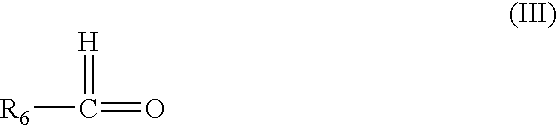
in which:
R6 is chosen from groups having formula (III A): 
in which:
R7 and R8, which may be identical or different, are each chosen from hydrogen; alkyl. groups; monohydroxyalkyl groups; polyhydroxyalkyl groups; alkylhydroxyalkyl groups; alkoxy groups;
—CF3 groups; and —OCF3 groups;
R7 and R8, which may be identical or different, may also form, together with the atoms to which they are attached, at least one, ring, optionally substituted, chosen from aryl rings; 5-membered heterocyclic rings; and 6-membered heterocyclic rings;
m is an integer ranging from 0 to 3; and
R9 is chosen from hydrogen; alkyl groups; monohydroxyalkyl groups; polyhydroxyalkyl groups; alkylhydroxyalkyl groups; alkoxy groups; —CF3 groups; —OCF3 groups; aryl groups, optionally substituted; alkylaryl groups, optionally substituted; 5-membered heterocyclic groups, optionally substituted; and 6-membered heterocyclic groups, optionally substituted;
(2) ketones chosen from ketones having formula (IV), ketones having formula (V), and the cosmetically acceptable salts thereof: 
in which:
R10 is chosen from groups having formula (III A): 
in which:
R7 and R8, which may be identical or different, are each chosen from hydrogen; alkyl groups; monohydroxyalkyl groups; polyhydroxyalkyl groups; alkylhydroxyalkyl groups; alkoxy groups;
—CF3 groups; and —OCF3 groups;
R7 and R8, which may be identical or different, may also form, together with the atoms to which they are attached, at least one ring, optionally substituted, chosen from aryl rings; 5-membered heterocyclic rings; and 6-membered heterocyclic rings;
m is an integer ranging from 0 to 3;
R9 is chosen from hydrogen; alkyl groups; monohydroxyalkyl groups; polyhydroxyalkyl groups; alkylhydroxyalkyl groups; alkoxy groups; —CF3 groups; —OCF3 groups; aryl groups, optionally substituted; alkylaryl groups, optionally substituted; 5-membered heterocyclic groups, optionally substituted; and 6-membered heterocyclic groups, optionally substituted;
R11 is chosen from alkyl groups; monohydroxyalkyl groups; polyhydroxyalkyl groups; alkylhydroxyalkyl groups; aryl groups, optionally substituted; alkylaryl groups, optionally substituted; 5-membered heterocyclic groups, optionally substituted; and 6-membered heterocyclic groups, optionally substituted; and
R10 and R11 may also form, together with the atoms to which they are attached, at least one ring, optionally substituted, chosen from 5-membered aryl rings; 6-membered aryl rings; and heterocyclic rings; it being possible for said at least one ring itself to be attached to at least one additional ring, optionally substituted, chosen from 5-membered aryl rings, 6-membered aryl rings and heterocyclic rings comprising at least one heteroatom;
(3) quinones and the cosmetically acceptable salts thereof;
(4) diiminoisoindoline derivatives and the cosmetically acceptable salts thereof; and
(5) 3-aminoisoindolone derivatives and the cosmetically acceptable salts thereof;
with the proviso that said composition does not comprise an oxidizing agent.
23. A composition according to claim 22 , wherein, in said compounds and having formula (I), A and the nitrogen atom, N, together form at least one hydrocarbon-based ring substituted with at least one group chosen from —NO2 groups; —NH2 groups; acetylamino groups; —OH groups; —SO3H groups; halogens; —CH3SO2 groups; —CF3 groups; C1-C4 alkyl groups; (C1-C4)alkoxy groups; (C1-C4)alkylthio groups; and (C1-C4)alkoxycarbonyl groups.
24. A composition according to claim 22 , wherein, in said compounds and salts having formula (II), at least one of R1 and R2, R2 and R3, R3 and R4, R5 and R1, R5and B, and R4 and B form, together with the atoms to which they are attached, at least one hydrocarbon-based ring substituted with at least one group chosen from —NO2 groups; —NH2 groups; acetylamino groups; —OH groups; —SO3H groups; halogens; —CH3SO2 groups; —CF3 groups; —OCF3 groups; C1-C4 alkyl groups; C1-C4 alkoxy groups; C1-C4 alkylthio groups; and (C1-C4)alkoxycarbonyl groups.
25. A composition according to claims 22, wherein said at least one keratin fiber is a human keratin fiber.
26. A composition according to claim 25 , wherein said human keratin fiber is hair.
27. A composition according to claim 22 , wherein at least one of said heterocyclic rings comprises at least one heteroatom chosen from sulphur and nitrogen.
28. A composition according to claim 22 , further comprising at least one medium suitable for dyeing.
29. A composition according to claim 22 , wherein said at least one compound is chosen from quinones having formula (VI), quinones having formula (VII), and the cosmetically acceptable salts thereof: 
in which:
R12 is chosen from hydrogen; halogens; sulphonic groups; and alkoxy groups;
R13, R14 and R15, which may be identical or different, are each chosen from hydrogen; halogens; hydroxyl groups; alkyl groups; monohydroxyalkyl groups; polyhydroxyalkyl groups; alkylhydroxyalkyl groups; alkylsulphonyl groups; carboxyalkyl groups; aminoalkyl groups; alkylaminoalkyl groups; (dihydroxy)alkylaminoalkyl groups; alkyl-NR′R″ groups, wherein R′ and R″, which may be identical or different, are each chosen from alkyl groups, and R′ and R″ may also form, together with the nitrogen atom to which they are attached, at least one ring chosen from aryl rings, 5-membered heterocycles, and 6-membered heterocycles; aryl groups; amino groups, optionally substituted with at least one group chosen from alkyl groups and hydroxyalkyl groups; and
at least one of R12 and R13, R13 and R14, and R14 and R15 may also form, together with the atoms to which they are attached, at least one ring, optionally substituted, chosen from aryl rings; 5-membered heterocycles; and 6-membered heterocycles.
30. A composition according to claim 22 , wherein said at least one compound is chosen from diaminoisoindolines derivatives having formula (VIII), 3-aminoisoindolone derivatives having formula (VIII), and the cosmetically acceptable salts thereof: 
in which:
R16 and R17, which may be identical or different, are each chosen from hydrogen; alkyl groups; monohydroxyalkyl groups; polyhydroxyalkyl groups; alkylhydroxyalkyl groups; aminoalkyl groups; alkylaminoalkyl groups; (dihydroxy)alkylaminoalkyl groups; and alkyl-NR′R″ groups, wherein R′ and R″ which may be identical or different, are each chosen from alkyl groups, and R′ and R″ may also form, together with the nitrogen atom to which they are attached, at least one ring chosen from aryl rings, 5-membered heterocycles, and 6-membered heterocycles;
A is chosen from oxygen and NH; and
X and Z form, together with the atoms to which they are attached, at least one ring, optionally substituted, chosen from aryl rings; 5-membered heterocycles; and 6-membered heterocycles.
31. A composition according to claim 22 , composition having a pH ranging from 2 to 11.
32. A composition according to claim 31 , wherein said pH ranges from 5 to 10.
33. A composition according to claim 22 , wherein said at least one cationic compound is chosen from:
1,2,3-trimethyl-3H-imidazol-1-ium iodide;
2,3,4-trimethylthiazol-3-ium iodide;
3-ethylmethylbenzothiazolium iodide;
3-methylmethylbenzothiazolium methosulphate;
1,2,3,3-tetramethyl-3H-indolium iodide;
3-ethylmethylbenzoxazolium iodide;
1,2,3-trimethyl-3H-imidazol-1-ium methosulphate;
3-(2-carboxyethyl)-2,5-dimethylbenzoxazol-3-ium bromide;
3-ethylmethylbenzothiazolium toluene-4-sulphonate;
5-chloro-3-ethyl-2-methylbenzothiazol-3-ium toluene-4-sulphonate;
1-ethyl-2-methylnaphtho[1,2-d]thiazol-1-ium toluene-4-sulphonate;
1,2,3-trimethyl-3H-benzoimidazol-1-ium tetrafluoroborate;
2-ethyl-3-methylbenzo[d]isothiazol-2-ium tetrafluoroborate;
2-methyl-3-(3-sulphonatopropyl)benzothiazol-3-ium;
3-tertbutyl-2-methylbenzothiazol-3-ium bromide;
3-(2-carboxyethyl)-2,5-dimethylbenzoxazol-3-ium bromide;
5-methoxy-2-methyl-3-(3-sulphonatopropyl)benzothiazol-3-ium;
2-methyl-1-(3-sulphonatopropyl)naphtho[1,2-d]oxazol-1-ium;
2-methyl-3-(3-sulphonatopropyl)naphtho[2,3-d]oxazol-3-ium;
2,5,6-trimethyl-3-(3-sulphonatopropyl)thieno[2,3-d]thiazol-3-ium;
1-ethyl-2-methylnaphtho[1,2-d]oxazol-1-ium perchlorate;
1,2-dimethyinaphtho[1,2-d]thiazol-1-ium methosulphate;
3-ethyl-2,5,6-trimethylbenzoxazol-3-ium iodide;
2-methyl-1-(3-sulphonatopropyl)naphtho[1,2-d]thiazol-1-ium;
1-ethyl-2-methylnaphtho[1,2-d]thiazol-1-ium perchlorate;
2-methyl-5-phenyl-3-(3-sulphonatopropyl)benzoxazol-3-ium;
3-ethyl-6-methoxy-2-methylbenzothiazol-3-ium iodide;
5-methoxy-1,2-dimethylnaphtho[1,2-d]thiazol-1-ium iodide;
5-chloro-3-ethyl-2-methylbenzothiazol-3-ium toluene-4-sulphonate;
5,6-dimethoxy-2,3-dimethylbenzothiazol-3-ium toluene-4-sulphonate;
3-ethyl-2-methylbenzo[4,5]thieno[2,3-d]thiazol-3-ium toluene-4-sulphonate;
1-ethyl-2-methylnaphtho[1,2-d]thiazol-1-ium toluene4-sulphonate;
5,6-dichloro-3-ethyl-2-methyl-1-(3-sulphonatobutyl)-3H-benzoimidazol-1-ium;
2,3-dimethyl-5-phenylbenzoxazol-3-ium methosulphate;
5-methoxy-1,2-dimethylbenzo[cd]indolium perchlorate;
1-butyl-2,3,3-trimethyl-3H-indolium iodide;
1,1,2,3-tetramethyl-1H-benz[e]indolium iodide;
and the acid addition salts thereof.
34. A composition according to claim 22 , wherein said at least one cationic compound is chosen from:
1,2-dimethylquinolinium iodide;
1,2-dimethylquinolinium chloride;
1,4-dimethylquinolinium iodide;
1-ethyl-2-methylquinolinium tetrafluoroborate;
2-methyl-1-(3-sulphonatopropyl)quinolinium;
2,3-dimethylisoquinolinium iodide;
4-chloro-1,2-dimethylquinolinium methosulphate;
7-chloro-1,4-dimethylquinolinium;
1-ethyl-2,6-dimethylquinolinium iodide;
4-methoxy-1,2-dimethylquinolinium iodide;
1-ethyl-4-methylquinolinium iodide;
1,2,3,4-tetrahydropyrido[1,2-a]quinolinylium toluene-4-sulphonate;
1,1′-trimethylenebis(2,4-dimethylpyridinium)bromide;
1,1′-tetramethylenebis(2,5-dimethylpyridinium)perchlorate;
1,1′-(oxydiethylene)bis(2-methylquinolinium)perchlorate;
1,2-dimethylpyridinium methosulphate;
1,2,4-trimethylpyridinium chloride;
1,2,4,6-tetramethylpyridinium chloride;
4-methoxy-1,2,6-trimethylpyridinium perchlorate;
1-(2-hydroxyethyl)-3-methylpyridinium chloride; and the acid addition salts thereof.
35. A composition according to claim 22 , wherein said at least one compound is chosen from benzaldehyde; 2-monohydroxybenzaldehyde; 3-monohydroxybenzaldehyde; 4-monohydroxybenzaldehyde; 2-monomethoxybenzaldehyde; 3-monomethoxybenzaldehyde; 4-monomethoxybenzaldehyde; 2-monomethylbenzaldehyde; 3-monomethylbenzaldehyde; 4-monomethylbenzaldehyde; (2,3)-dihydroxybenzaldehyde; (2,4)-dihydroxybenzaldehyde; (2,5)-dihydroxybenzaldehyde; (2,6)-dihydroxybenzaldehyde; (3,5)-dihydroxybenzaldehyde; (2,3)-dimethoxybenzaldehyde; (2,4)-dimethoxybenzaldehyde; (2,5)-dimethoxybenzaldehyde; (2,6)-dimethoxybenzaldehyde; (3,5)-dimethoxybenzaldehyde; vanillin; isovanillin; syringaldehyde; (2,3)-dimethylbenzaldehyde; (2,4)-dimethylbenzaldehyde; (2,5)-dimethylbenzaldehyde; (2,6)-dimethylbenzaldehyde; (3,5)-dimethylbenzaldehyde; 4-isopropylbenzaldehyde; 4-dimethylaminobenzaldehyde; 4-diethylaminobenzaldehyde; piperonal; (2,6)-dimethyl-4-hydroxybenzaldehyde; (3,5)-dimethyl-4-hydroxybenzaldehyde; 2-mononitrobenzaldehyde; 3-mononitrobenzaldehyde; 4-mononitrobenzaldehyde; 2-hydroxy-3-methoxybenzaldehyde; 2-hydroxy-4-methoxybenzaldehyde; 2-hydroxy-5-methoxybenzaldehyde; 2-hydroxy-6-methoxybenzaldehyde; 4-methylthiobenzaldehyde; (2,3,4)-trihydroxybenzaldehyde; (2,4,6)-trihydroxybenzaldehyde; (3,4,5)-trihydroxybenzaldehyde; (2,4,5)-trihydroxybenzaldehyde; methyl 2-formylbenzoate; methyl 3-formylbenzoate; methyl 4-formylbenzoate; 2-mono(2-hydroxyethoxy)benzaldehyde; 3-mono(2-hydroxyethoxy)benzaldehyde; 4-mono(2-hydroxyethoxy)benzaldehyde; 4-nitro-3-hydroxybenzaldehyde; 3-nitro-4-hydroxybenzaldehyde; 2-nitro-4-hydroxybenzaldehyde; 3-nitro-2-hydroxybenzaldehyde; 2-monotrifluorobenzaldehyde; 3-monotrifluorobenzaldehyde; 4-monotrifluorobenzaldehyde; 2,3-dihydroxy-4-methoxybenzaldehyde; 3,4-dihydroxy-5-methoxybenzaldehyde; 3,5-dihydroxy-4-methoxybenzaldehyde; 3-methoxy-2-nitrobenzaldehyde; 4-methoxy-2-nitrobenzaldehyde; 2-methoxy-3-nitrobenzaldehyde; 4-methoxy-3-nitrobenzaldehyde; (2,3,4)-trimethoxybenzaldehyde; (2,4,6)-trimethoxybenzaldehyde; (3,4,5)-trimethoxybenzaldehyde; (2,4,5)-trimethoxybenzaidehyde; 5-nitrovanillin; (2,4)-dinitrobenzaldehyde; (2,6)-dinitrobenzaldehyde; pentamethylbenzaldehyde; 4-methylsulphonylbenzaldehyde; 2-monoformylphenoxyacetic acid; 3-monoformylphenoxyacetic acid; 4-monoformylphenoxyacetic acid; 4-diethylaminosalicylaldehyde; 4-(3-dimethylaminopropoxy)benzaldehyde; 2,3-dihydrobenzo(b)furan-5-carboxaldehyde; 1-naphthaldehyde; 2-naphthaldehyde; 6-carboxaldehyde-1,4-benzodioxane; 5-carboxaldehyde-1,4-benzodioxane; 2-monohydroxy-1-naphthaldehyde; 4-monohydroxy-1-naphthaldehyde; 1-monohydroxy-2-naphthaldehyde; 1-(4-formylphenyl)imidazole; 4-pyrrolidino-benzaldehyde; 2-monomethoxy-1-naphthaldehyde; 4-monomethoxy-1-naphthaldehyde; 2,3-dimethylchroman-6-carboxaldehyde; 2,3,6,7-tetrahydro-1H,5H-pyrido(3,2,1-IJ)quinoline-9-carbaldehyde; 4-dimethylamino-1-naphthaldehyde; 9-anthraldehyde; 3-nitro-4-pyrrolidinobenzaldehyde; 3-nitro-4-piperidinobenzaldehyde; 3-nitro-4-morpholinobenzaldehyde; pyridine-2-monocarboxaldehyde; pyridine-3-monocarboxaldehyde; pyridine-4-monocarboxaldehyde; 5-formyl-6-methyluracil; pyridoxal; quinoline-2-monocarboxaldehyde; quinoline-3-monocarboxaldehyde; quinoline4-monocarboxaldehyde; 8-hydroxyquinoline-2-carboxaldehyde; 2-furaldehyde; 3-furaldehyde; 2-thienylcarboxaldehyde; 3-thienylcarboxaldehyde; 2-imidazocarboxaldehyde; 3-imidazocarboxaldehyde; 2-pyrrolecarboxaldehyde; 5-nitro-2-furaldehyde; 5-(dimethylamino)-2-furaldehyde; pyrazole-3-carbaldehyde; 5-nitro-2-thiophenecarboxaldehyde; 5-nitro-3-thiophenecarboxaldehyde; indole-3-carboxaldehyde; N-methylindole-3-carboxaldehyde; 2-methylindole-3-carboxaldehyde; 4-monomethylindolecarboxaldehyde; 5-monomethylindolecarboxaldehyde; 6-monomethylindolecarboxaldehyde; 7-monomethylindolecarboxaldehyde; and 5-formyl-2-furansulphonic acid.
36. A composition according to claim 22 , wherein said at least one compound is chosen from 2,3-indolinedione; 2,3-butanedione; 2,3-pentanedione; (2,3)-hexanedione; (3,4)-hexanedione; 1-phenyl-1,2-propanedione; benzil; furil; 2,2′-pyridil; nitrobenzil; anisil; 3,3′-dimethoxybenzil; 4,4′-bis(dimethylamino)benzil; camphoroquinone; cyclohexane-1,2-dione; isatin; N-methylisatin; 4-monomethylisatin; 5-monomethylisatin; 6-monomethylisatin; 7-monomethylisatin; (4,5)-dimethylisatin; (4,7)-dimethylisatin; (5,7)-dimethylisatin; (6,7)-dimethylisatin; N-ethylisatin; N-hydroxymethylisatin; 5-monomethoxyisatin; 6-monomethoxyisatin; 7-monomethoxyisatin; 4-monochloroisatin; 5-monochloroisatin; 6-monochloroisatin; 7-monochloroisatin; 4-monobromoisatin; 5-monobromoisatin; 6-monobromoisatin; 7-monobromoisatin; N-isopropylisatin; N-butylisatin; N-propylisatin; 5-nitroisatin; isatin-5-sulphonic acid; 2,4,5-trihydroxypyrimidine; alloxan; 1,3-dimethylhexahydro-2,4,5,6-pyrimidihetetraone; ninhydrin; chinisatin; 1,3-indenedione; squaric acid; croconic acid; 3,4-dimethoxy-3-cyclobutene-1,2-dione; 3-ethoxy-3-cyclobutene-1,2-dione; 4-ethoxy-3-cyclobutene-1,2-dione; 3-isopropoxy-3-cyclobutene-1,2-dione; 4-isopropoxy-3-cyclobutene-1,2-dione; 3,4-di-N-butoxy-3-cyclobutene-1,2-dione; rhodizonic acid; oxindole; N-methyl-2-indolinone; N-methylnitro-2-indolinone; 6-methoxyoxindole; 5,6-dimethoxy-oxindole; 5-monochlorooxindole; and 6-monochlorooxindole.
37. A composition according to claim 22 , wherein said at least one compound is chosen from 1,4-naphthoquinone; spinulosin; atromentin; aurentioglycociadin; 2,5-dihydroxy-6-methylbenzoquinone; 2-hydroxy-3-methyl-6-methoxybenzoquinone; 2,5-dihydroxy-3,6-diphenylbenzoquinone; 2,3-dimethyl-5-hydroxy-6-methoxybenzoquinone; 2,5-dihydroxy-6-isopropylbenzoquinone; lawsone; juglone; fafioline; naphthazarine; naphthopurpurine; lapachol; plumbagin; chloroplumbagin; droserone; shikonine; 2-hydroxy-3-methyl-1,4-naphthoquinone; 3,5-dihydroxy-1,4-naphthoquinone; 2,5-dihydroxy-1,4-naphthoquinone; 2-methoxy-5-hydroxy-1,4-naphthoquinone; 3-methoxy-5-hydroxy-1,4-naphthoquinone; (1,4)-naphthoquinone; (1,2)-naphthoquinone; 4,5-dimethoxy-1,2-benzoquinone; phenanthrenequinone; and (1,2)-naphthoquinone-4-sulphonic acid.
38. A composition according to claim 22 , wherein said at least one compound is chosen from 3-imino-3H-isoindolylamine; 3-imino4-methyl-3H-isoindol-1-ylamine; 3-imino-4-tert-butyl-3H-isoindol-1-ylamine; 3-imino-7-nitro-3H-isoindol-1-ylamine; 3-amino-1-imino-1H-isoindol-4-ol; 3-imino-7-isopropoxy-3H-isoindol-1-ylamine; 3-imino-7-(2,2,2-trifluoroethoxy)-3H-isoindol-1-ylamine; 3-imino-7-ethoxy-3H-isoindol-1-ylamine; 3-imino-7-butoxy-3H-isoindol-1-ylamine; 3-amino-1-imino-1H-isoindol-4-sulphonic acid; 3-imino-7-chloro-3H-isoindol-1-ylamine; 3-imino-5-methyl-3H-isoindol-1-ylamine; 3-imino-5-ethyl-3H-isoindol-1-ylamine; 3-imino-5-tert-butyl-3H-isoindol-1-ylamine; 3-imino-5-amino-3H-isoindol-1-ylamine; N-(1-amino-3-imino-3H-isoindol-5-yl)acetamide; 3-imino-5-nitro-3H-isoindol-1-ylamine; 3-imino-5-fluoro-3H-isoindol-1-ylamine; 3-imino-5-chloro-3H-isoindol-1-ylamine; 3-imino-5-methylsulphanyl-3H-isoindol-1-ylamine; 3-imino-5-methoxy-3H-isoindol-1-ylamine; 3-imino-5-ethoxy-3H-isoindol-1-ylamine; 3-imino-5-propoxy-3H-isoindol-1-ylamine; 3-imino-5-isopropoxy-3H-isoindol-1-ylamine; 3-imino-5-butoxy-3H-isoindol-1-ylamine; 3-imino-5-isobutoxy-3H-isoindol-1-ylamine; 3-imino-5-tert-butoxy-3H-isoindol-1-ylamine; 3-imino-5-(2,2,2-trifluoromethyl)-3H-isoindol-1-ylamine; 3-imino-5-(2,2,2-trifluoroethoxy)-3H-isoindol-1-ylamine; 3-imino-5-methanesulphonyl-3H-isoindol-1-ylamine; 3-imino-5,6-dimethyl-3H-isoindol-1-ylamine; 3-imino-5,6-diethyl-3H-isoindol-1-ylamine; 3-imino-5,6-dimethoxy-3H-isoindol-1-ylamine; 3-imino-5,6-diethoxy-3H-isoindol-1-ylamine; 3-imino-5,6-dibutoxy-3H-isoindol-1-ylamine; 3-imino-5,6-bis(trifluoromethyl)-3H-isoindol-1-ylamine; 3-imino-5,6-di-chloro-3H-isoindol-1-ylamine; 5,6-bis(ethoxymethyl)3-imino-3H-isoindol-1-ylamine; 3-amino-1-imino-1H-isoindol4,7-diol; 4,7-dichloro-3-imino-3H-isoindol-1-ylamine; 4,5,7-trichloro-3-imino-N6,N6-dimethyl-3H-isoindol-1,6-diamine; 4,5,6,7-tetrachloro-3-imino-3H-isoindol-1-ylamine; 4,5,6,7-tetrafluoro-3-imino-3H-isoindol-1-ylamine; 3-butylimino-3H-isoindol-1-ylamine; 2-(3-aminoisoindol-1-ylideneamino)ethanol; 3-(3-aminoisoindol-1-ylideneamino)-3-methylpentane-1,5-diol; N-(3-aminoisoindol-1-ylidene)guanidine; 7-imino-7H-pyrrolo[3,4-b]pyrid-5-ylamine; 7-imino-7H-pyrrolo[3,4-b]pyrazin-5-ylamine; 7-imino-2,3-dimethyl-7H-pyrrolo[3,4-b]pyrazin-5-ylamine; 7-imino-7H-[1,4]dithiino[2,3-c]pyrrol-5-ylamine; 7-imino-2,3-dimethyl-7H-[1,4]dithiino[2,3-c]pyrrol-5-ylamine; 7-imino-2,3-dihydro-7H-[1,4]dithiino[2,3-c]pyrrol-5-ylamine; 7-imino-2-methyl-2,3-dihydro-7H-[1,4]dithiino[2,3-c]pyrrol-5-ylamine; 3-aminoisoindol-1-one; 3-amino-7-methylisoindol-1-one; 3-amino-7-hydroxymethylisoindol-1-one; 3-amino-7-chloroisoindol-1-one; 3-amino-4-chloroisoindol-1-one; 3-amino-1-oxo-1H-isoindol-4-sulphonic acid; 3-amino-4-nitroisoindol-1-one; 3-amino-6-nitroisoindol-1-one; 3-amino-6-methylisoindol-1-one; 3-amino-6-chloroisoindol-1-one; 3-amino-6-bromoisoindol-1-one; 3-amino-6-methylsulphanylisoindol-1-one; 3-amino-6-methoxyisoindol-1-one; 3-amino-5-chloroisoindol-1-one; 3-amino-5-fluoroisoindol-1-one; 3-amino-5-methoxyisoindol-1-one; 3-amino-5-nitroisoindol-1-one; ethyl 3-amino-1-oxo-1H-isoindole-5-carboxylate; 3-amino-5,6-dichloroisoindol-1-one; 3-amino-5,6-dibromoisoindol-1-one; 3-amino-4,7-dichloroisoindol-1-one; 3-amino-4,5,7-trichloroisoindol-1-one; 3-amino-4,5,6,7-tetrachloroisoindol-1-one; 3-amino-4,5,7-trichloro-6-methylsulphanylisoindol-1-one; 3-amino-4,5,6,7-tetrabromoisoindol-1-one; 3-amino-4,5,6,7-tetrafluoroisoindol-1-one; 3-methylaminoisoindol-1-one; 3-ethylaminoisoindol-1-one; 3-propylaminoisoindol-1-one; 3-dimethylaminoisoindol-1-one; 7-ethylaminopyrrolo[3,4-b]pyrid-5-one; 7-aminopyrrolo[3,4-b]pyrid-5-one; 3-aminopyrrolo[3,4-c]pyrid-5-one; 3-amino-6-methylpyrrolo[3,4-c]pyrid-1-one; 5-aminopyrrolo[3,4-b]pyrid-7-one; 7-aminopyrrolo[3,4-b]pyrazin-5-one; 7-amino-2-methylpyrrolo[3,4-b]pyrazin-5-one; 7-amino-2,3-dimethylpyrrolo[3,4-b]pyrazin-5-one; 7-amino-2,3-dihydro[1,4]dithiino[2,3-c]pyrrol-5-one; 3-imino-2-methyl-2,3-dihydroisoindol-1-one; 3-imino-2-ethyl-2,3-dihydroisoindol-1-one; 3-imino-2-propyl-2,3-dihydroisoindol-1-one; 2-hydroxymethyl-3-imino-2,3-dihydroisoindol-1-one; 2-(2-hydroxyethyl)-3-imino-2,3-dihydroisoindol-1-one; 2-(1-imino-3-oxo-1,3-dihydroisoindol-2-yl)ethane sulphonic acid; 3-(1-imino-3-oxo-1,3-dihydroisoindol-2-yl)propionic acid; 2-(3-hydroxypropyl)-3-imino-2,3-dihydroisoindol-1 one; and 5-imino-6-methyl-5,6-dihydropyrrolo[3,4-b]pyridin-7-one.
39. A composition according to claim 22 , wherein said cosmetically acceptable salts are chosen from hydrochlorides; sulphates; hydrobromides; and tartrates.
40. A composition according to claim 22 , wherein said at least one cationic compound is chosen from 3-ethylmethylbenzothiazolium iodide; 1,2,3,3-tetramethyl-3H-indolium iodide; 3-ethylmethylbenzoxazolium iodide; 1,2-dimethylquinolinium iodide; 5-chloro-3-ethyl-2-methylbenzothiazolium iodide; and 2-methyl-1-(3-sulphopropyl)naphtho[1,2-d]thiazolium betaine.
41. A composition according to claim 22 , wherein said at least one compound is chosen from naphthoquinone; isatin; N-methylisatin; 3-imino-3H-isoindol-1-ylamine; 4-dimethylaminobenzadehyde; and 4-dimethylaminobenzaldehyde.
42. A composition according to claim 22 , wherein said at least one cationic compound is present in said composition in a concentration ranging from 0.01% to 10% by weight relative to the total weight of said composition.
43. A composition according to claim 42 , wherein said at least one cationic compound is present in said composition in a concentration ranging from 0.05% to 5% by weight relative to the total weight of said composition.
44. A composition according to claim 22 , wherein said at least one compound is present in said composition in a concentration ranging from 0.01% to 10% by weight relative to the total weight of said composition.
45. A composition according to claim 44 , wherein said at least one compound is present in said composition in a concentration ranging from 0.05% to 5% by weight relative to the total weight of said composition.
46. A composition according to claim 22 , further comprising at least one fatty amide.
47. A composition according to claim 46 , wherein said at least one fatty amide is chosen from monoethanolamides of acids derived from copra; monoethanolamides of lauric acid; monoethanolamides of oleic acid; diethanolamides of acids derived from copra; diethanolamides of lauric acid; and diethanolamides of oleic acid.
48. A composition according to claim 46 , wherein said at least one fatty amide is present in a concentration ranging from 0.05% to 10%. by weight relative to the total weight of said composition.
49. A composition according to claim 22 , further comprising at least one surfactant.
50. A composition according to claim 49 , wherein said at least one surfactant is chosen from anionic surfactants; cationic surfactants; nonionic surfactants; amphoteric surfactants; and zwitterionic surfactants.
51. A composition according to claim 49 , wherein said at least one surfactant is present in a concentration ranging from about 0.1% to about 50% by weight relative to the total weight of said composition.
52. A composition according to claim 51 , wherein said at least one surfactant is present in a concentration ranging from about 1% to about 20% by weight relative to the total weight of said composition.
53. A composition according to claim 22 , further comprising at least one thickener.
54. A composition according to claim 53 , wherein said at least one thickener is present in a concentration ranging from about 0.2% to about 20% by weight relative to the total weight of said composition.
55. A composition according to claim 22 , further comprising at least one cosmetically acceptable adjuvant chosen from antioxidants; fragrances; sequestering agents; dispersants; hair conditioners; preserving agents; and opacifiers.
56. A composition according to claim 22 , wherein said composition is in the form of a liquid, a cream or a gel.
57. A composition according to claim 28 , wherein said at least one medium suitable for dyeing is an aqueous medium chosen from water and organic solvents.
58. A composition according to claim 52 , wherein said organic solvents are chosen from alcohols; glycols; glycol ethers; and mixtures thereof.
59. A composition according to claim 28 , wherein said at least one medium suitable for dyeing is present in a concentration ranging from 0.5% to 20% by weight relative to the total weight of said composition.
60. A multi-compartment device or dyeing kit, wherein said device or dyeing kit comprises at least two compartments, wherein:
(a) a first compartment comprises a component (A); and
(b) a second compartment comprises a component (B);
wherein said component (A) comprises a composition which comprises at least one cationic compound chosen from:
(1) compounds having formula (I) and the cosmetically acceptable salts thereof: 
in which:
n is an integer ranging from 1 to 4;
R1 is chosen from alkyl groups; hydroxyalkyl groups; polyhydroxyalkyl groups; alkylhydroxyalkyl groups; alkylsulfonyl groups; carboxyalkyl groups; aminoalkyl groups; (dihydroxy)alkylaminoalkyl groups; alkyl-NR′R″ groups, wherein R′ and R″, which may be identical or different, are each chosen from linear alkyl groups comprising from 1 to 4 carbon atoms and branched alkyl groups comprising from 1 to 4 carbon atoms, and R′ and R″ may also form, together with the nitrogen atom to which they attached, at least one ring chosen from 5-membered aliphatic rings, 6-membered aliphatic rings, 5-membered heterocyclic rings, and 6-membered heterocyclic rings; and aryl rings;
A and the nitrogen atom, N, together form at least one hydrocarbon-based ring, optionally substituted, chosen from unsaturated rings comprising 5 atoms; unsaturated rings comprising 6 atoms; aromatic rings comprising 5 atoms; and aromatic rings comprising 6 atoms; wherein said at least one hydrocarbon-based ring may be interrupted by at least one atom chosen from nitrogen, oxygen and sulfur; it being possible for said at least one hydrocarbon-based ring to be fused with at least one ring chosen from unsubstituted aromatic rings and substituted aromatic rings; and
A is chosen from carbon, optionally substituted; nitrogen, optionally substituted; oxygen; and sulfur; and
(2) compounds having formula (II) and the cosmetically acceptable salts thereof: 
wherein:
R1, R2, R3, R4, and R5, which may be identical or different, are each chosen from alkyl groups; hydroxyalkyl groups; polyhydroxyalkyl groups; alkylhydroxyalkyl groups; alkylsulfonyl groups; carboxyalkyl groups; aminoalkyl groups; (dihydroxy)alkylaminoalkyl groups; alkyl-NR′R″ groups, wherein R′ and R″, which may be identical or different, are each chosen from linear alkyl groups comprising from 1 to 4 carbon atoms and branched alkyl groups comprising from 1 to 4 carbon atoms, and R′ and R″ may also form, together with the nitrogen atom to which they attached, at least one ring chosen from 5-membered aliphatic rings, 6-membered aliphatic rings, 5-membered heterocyclic rings, and 6-membered heterocyclic rings; and aryl rings;
B is chosen from —CH— groups and nitrogen;
at least one of R1 and R2, R2 and R3, R3 and R4, R5 and R1, R5 and B, and R4 and B may also form, together with the atoms to which they are attached, at least one hydrocarbon-based ring, optionally substituted, chosen from 5-membered unsaturated rings; 6-membered unsaturated rings; 5-membered aryl rings; 6-membered aryl rings; 5-membered heterocycles; and 6-membered heterocycles; wherein said at least one hydrocarbon-based ring may be interrupted by at least one atom chosen from nitrogen and sulfur; and
wherein said component (B) comprises a composition which comprises at least one compound chosen from:
(1) aldehydes having formula (III) and the cosmetically acceptable salts thereof: 
in which:
R6 is chosen from groups having formula (III A): 
in which:
R7 and R8, which may be identical or different, are each chosen from hydrogen; alkyl groups; monohydroxyalkyl groups; polyhydroxyalkyl groups; alkylhydroxyalkyl groups; alkoxy groups; —CF3 groups; and —OCF3 groups;
R7 and R8, which may be identical or different, may also form, together with the atoms to which they are attached, at least one ring, optionally substituted, chosen from aryl rings; 5-membered heterocyclic rings; and 6-membered heterocyclic rings;
m is an integer ranging from 0 to 3; and
R9 is chosen from hydrogen; alkyl groups; monohydroxyalkyl groups; polyhydroxyalkyl groups; alkylhydroxyalkyl groups; alkoxy groups; —CF3 groups; —OCF3 groups; aryl groups, optionally substituted; alkylaryl groups, optionally substituted; 5-membered heterocyclic groups, optionally substituted; and 6-membered hetero-cyclic groups, optionally substituted;
(2) ketones chosen from ketones having formula (IV), ketones having formula (V), and the cosmetically acceptable salts thereof: 
in which:
R10 is chosen from groups having formula (III A): 
in which:
R7 and R8, which may be identical or different, are each chosen from hydrogen; alkyl groups; monohydroxyalkyl groups; polyhydroxyalkyl groups; alkylhydroxyalkyl groups; alkoxy groups; —CF3 groups; and —OCF3 groups;
R7 and R8, which may be identical or different, may also form, together with the atoms to which they are attached, at least one ring, optionally substituted, chosen from aryl rings; 5-membered heterocyclic rings; and 6-membered heterocyclic rings;
m is an integer ranging from 0 to 3;
R9 is chosen from hydrogen; alkyl groups; monohydroxyalkyl groups; polyhydroxyalkyl groups; alkylhydroxyalkyl groups; alkoxy groups; —CF3 groups; —OCF3 groups; aryl groups, optionally substituted; alkylaryl groups, optionally substituted; 5-membered heterocyclic groups, optionally substituted; and 6-membered heterocyclic groups, optionally substituted;
R11 is chosen from alkyl groups; monohydroxyalkyl groups; polyhydroxyalkyl groups; alkylhydroxyalkyl groups; aryl groups, optionally substituted; alkylaryl groups, optionally substituted; 5-membered heterocyclic groups, optionally substituted; and 6-membered heterocyclic groups, optionally substituted; and
R10 and R11 may also form, together with the atoms to which they are attached, at least one ring, optionally substituted, chosen from 5-membered aryl rings; 6-membered aryl rings; and heterocyclic rings it being possible for said at least one ring itself to be attached to at least one additional ring, optionally substituted, chosen from 5-membered aryl rings, 6-membered aryl rings and heterocyclic rings comprising at least one heteroatom;
(3) quinones and the cosmetically acceptable salts thereof;
(4) diiminoisoindoline derivatives and the cosmetically acceptable salts thereof; and
(5) 3-aminoisoindolone derivatives and the cosmetically acceptable salts thereof;
with the proviso that a coloration of said at least one keratin fiber is achieved without an oxidizing agent.
61. A multi-compartment device or dyeing kit according to claim 60 , wherein, in said compounds and salts having formula (I), A and the nitrogen atom, N, together form at least one hydrocarbon-based ring substituted with at least one group chosen from —NO2 groups; —NH2 groups; acetylamino groups; —OH groups; —SO3H groups; halogens; —CH3SO2 groups; —CF3 groups; C1-C4 alkyl groups; (C1-C4)alkoxy groups; (C1-C4)alkylthio groups; and (C1-C4)alkoxycarbonyl groups.
62. A multi-compartment device or dyeing kit according to claim 60 , wherein, in said compounds and salts having formula (II), at least one of R1 and R2, R2 and R3, R3and R4, R5and R1, R5 and B, and R4 and B form, together with the atoms to which they are attached, at least one hydrocarbon-based ring substituted with at least one group chosen from —NO2 groups; —NH2 groups; acetylamino groups; —OH groups; —SO3H groups; halogens; —CH3SO2 groups; —CF3 groups; —OCF3 groups; C1-C4 alkyl groups; C1-C4 alkoxy groups; C1-C4 alkylthio groups; and (C1-C4)alkoxycarbonyl groups.
63. A multi-compartment device or dyeing kit according to claim 60 , wherein said cosmetically acceptable salts are chosen from hydrochlorides; sulphates; hydrobromides; and tartrates.
64. A multi-compartment device or dyeing kit according to claim 60 , wherein at least one component chosen from said component (A) and said component (B) is in the form of an anhydrous composition; and
wherein said device or dyeing kit comprises a third compartment comprising a cosmetically acceptable aqueous medium which is suitable for dyeing and which is intended to be mixed, before use, into at least one compartment chosen from said first compartment comprising said component (A) and said second compartment comprising said component (B).
Applications Claiming Priority (3)
| Application Number | Priority Date | Filing Date | Title |
|---|---|---|---|
| FR9816378 | 1998-12-23 | ||
| FR9816378A FR2787707B1 (en) | 1998-12-23 | 1998-12-23 | DYEING PROCESS USING A CATIONIC DERIVATIVE AND A SELECTED COMPOUND AMONG AN ALDEHYDE, A KETONE, A QUINONE AND A DERIVATIVE OF DI-IMINO-ISOINDOLINE OR 3-AMINO-ISOINDOLONE |
| PCT/FR1999/003246 WO2000038639A1 (en) | 1998-12-23 | 1999-12-22 | Dyeing method using a specific cationic derivative and a compound selected among a specific aldehyde, a specific ketone, a quinone and a di-imino-isoindoline or 3-amino-isoindolone derivative |
Publications (1)
| Publication Number | Publication Date |
|---|---|
| US6635090B1 true US6635090B1 (en) | 2003-10-21 |
Family
ID=9534446
Family Applications (1)
| Application Number | Title | Priority Date | Filing Date |
|---|---|---|---|
| US09/622,710 Expired - Fee Related US6635090B1 (en) | 1998-12-23 | 1999-12-22 | Dyeing method using a specific cationic derivative and a compound selected among a specific aldehyde, a specific ketone, a quinone and a di-imino-isoindoline or 3-amino-isoindolone derivative |
Country Status (6)
| Country | Link |
|---|---|
| US (1) | US6635090B1 (en) |
| EP (1) | EP1056434A1 (en) |
| JP (1) | JP2002533371A (en) |
| CA (1) | CA2320925A1 (en) |
| FR (1) | FR2787707B1 (en) |
| WO (1) | WO2000038639A1 (en) |
Cited By (9)
| Publication number | Priority date | Publication date | Assignee | Title |
|---|---|---|---|---|
| US20040180809A1 (en) * | 2000-10-16 | 2004-09-16 | Mallinckrodt Inc. | Tissue-specific exogenous optical agents |
| US20050144740A1 (en) * | 2002-09-05 | 2005-07-07 | Wibke Gross | Agents used for dyeing keratinous fibers |
| WO2005063178A1 (en) * | 2003-12-19 | 2005-07-14 | Henkel Kommanditgesellschaft Auf Aktien | Agents for colouring fibres containing keratin, comprising heterocyclic enamines and reactive carbonyl compounds and/or reaction products thereof |
| US20050262647A1 (en) * | 2002-12-23 | 2005-12-01 | Horst Hoeffkes | Agent for dyeing fibers containing keratin |
| US7193105B2 (en) | 2002-05-22 | 2007-03-20 | Errant Gene Therapeutics, Llc | Histone deacetylase inhibitors based on trihalomethylcarbonyl compounds |
| US20070092450A1 (en) * | 2000-10-16 | 2007-04-26 | Mallinckrodt Inc. | Tissue-specific exogenous optical agents |
| US20070287686A1 (en) * | 2004-09-14 | 2007-12-13 | Henkel Kgaa | Substance for Dyeing Keratinic Fibers |
| US20100306929A1 (en) * | 2006-10-17 | 2010-12-09 | Maxime De Boni | Use of natural dyes for coloring human hair |
| US8138225B2 (en) | 2002-05-22 | 2012-03-20 | Errant Gene Therapeutics, Llc | Histone deacetylase inhibitors based on alpha-ketoepoxide compounds |
Families Citing this family (7)
| Publication number | Priority date | Publication date | Assignee | Title |
|---|---|---|---|---|
| DE19933187A1 (en) * | 1999-07-15 | 2001-01-18 | Henkel Kgaa | Agent for dyeing keratin fibers |
| DE19936911A1 (en) | 1999-08-05 | 2001-02-08 | Henkel Kgaa | Colorant for keratinous fibers, especially human hair, contains coloring component combination of amino-substituted aromatic aldehyde or ketone and methyne-active compounds |
| DE19951134A1 (en) | 1999-10-23 | 2001-04-26 | Henkel Kgaa | Composition for dyeing keratin-containing fibers, especially human hair, contains aromatic aldehyde or ketone and active CH compound |
| DE10007948A1 (en) * | 2000-02-22 | 2001-09-06 | Wella Ag | Agent for dyeing fibers |
| DE10022743A1 (en) * | 2000-05-10 | 2001-11-22 | Wella Ag | Colorant for fibers, especially temporary colorant for human hair, comprises acidic component containing (hetero)aryl enamine or salt and alkaline component containing carbonyl compound and primary amine, e.g. in kit |
| US6716413B1 (en) * | 2000-10-16 | 2004-04-06 | Mallinckrodt, Inc. | Indole compounds as tissue-specific exogenous optical agents |
| DE10119204A1 (en) | 2001-04-19 | 2002-10-24 | Wella Ag | Production of new or known 5-aryl-1,3,3-trimethyl-2-methylene-indoline derivatives useful in compositions for dyeing keratin and other fibers, especially human hair |
Citations (25)
| Publication number | Priority date | Publication date | Assignee | Title |
|---|---|---|---|---|
| US4661114A (en) * | 1984-11-17 | 1987-04-28 | Wella Aktiengesellschaft | 3-Amino-5-hydroxypyridine derivatives and hair coloring compositions containing the same |
| GB2181750A (en) * | 1985-10-16 | 1987-04-29 | Oreal | Dyeing keratinous fibres |
| US4695285A (en) * | 1986-10-15 | 1987-09-22 | Clairol Incorporated | Process for coloring keratinaceous materials |
| US4931066A (en) * | 1984-08-13 | 1990-06-05 | L'oreal | Dyeing composition for keratinous fibres containing at least one co-solubilized n-substituted 2-nitro-para-phenylenediamine and process for dyeing keratinous fibres therewith |
| US5034014A (en) * | 1990-06-18 | 1991-07-23 | Clairol, Inc. | Hair dye composition and method |
| US5131911A (en) * | 1988-09-12 | 1992-07-21 | L'oreal | Use of indole derivative for dyeing keratin materials, tinctorial compositions, new compounds and dyeing process |
| US5145482A (en) * | 1987-08-17 | 1992-09-08 | Wella Aktiengesellschaft | Hair dye compositions based on 2,5-diamino-6-nitropyridine derivatives |
| EP0502783A1 (en) | 1991-03-05 | 1992-09-09 | L'oreal | Keratinous fibres dyeing process with isatin or derivatives thereof associated with an aminopyridine or an aminopyrimidine and dyeing agents |
| US5516916A (en) * | 1985-08-02 | 1996-05-14 | Clairol Incorporated | Process for preparing dye compositions containing 5,6-dihydroxyindole |
| US5518505A (en) * | 1991-01-21 | 1996-05-21 | L'oreal | Compositions and methods for the dyeing of keratinous fibers with oxidation dye precursors, indole derivative couplers and oxidizing agents |
| US5578087A (en) * | 1992-12-30 | 1996-11-26 | L'oreal | Dyeing compositions for keratinous fibres based on para-phenylene-diamines, meta-phenylenediamine and benzimidazole derivatives, and dyeing process employing them |
| US5616150A (en) * | 1993-04-30 | 1997-04-01 | Henkel Kommanditgesellschaft Auf Aktien | Isatin-containing formulations for coloring keratin-containing fibers |
| US5628799A (en) * | 1991-09-26 | 1997-05-13 | Clairol Incorporated | Hair dying methods and kits which contain a dopa species, reactive direct dye, and a ferricyanide oxidant |
| US5752982A (en) * | 1991-03-28 | 1998-05-19 | L'oreal | Methods for dyeing keratinous fibers with compositions which contain aminoindole couplers, oxidation dye precursors, and oxidizing agents at acid pHs |
| EP0847749A1 (en) | 1996-12-12 | 1998-06-17 | L'oreal | Use of diiminoisoindoline or 3-aminoisoindolone derivatives for the dyeing of keratinic fibers and compositions containing them |
| US5769903A (en) * | 1995-02-27 | 1998-06-23 | L'oreal | Composition for the oxidation dyeing of keratin fibers, comprising an oxidation base, an indole coupler and an additional heterocyclic coupler, and dyeing process |
| EP0873745A2 (en) | 1997-04-24 | 1998-10-28 | Henkel Kommanditgesellschaft auf Aktien | Dyestuff for keratinous fibers |
| EP0873744A2 (en) * | 1997-04-24 | 1998-10-28 | Henkel Kommanditgesellschaft auf Aktien | Use of heterocyclic carbonyl compounds for dying keratinous fibers |
| US5874091A (en) * | 1990-09-27 | 1999-02-23 | L'oreal | Cosmetic composition comprising a dispersion of lipid vesicles as well as melanin pigments |
| US5919273A (en) * | 1996-12-23 | 1999-07-06 | L'oreal | Compositions and processes for dyeing keratin fibers with an oxidation base, a coupler, a cationic direct dye, and an oxidizing agent |
| US6001135A (en) * | 1996-12-23 | 1999-12-14 | L'oreal | Compositions and processes for dyeing keratin fibers with cationic direct dyes, oxidation bases, and oxidizing agents |
| US6063136A (en) * | 1996-08-26 | 2000-05-16 | L'oreal S.A. | Compositions containing pyrrolo-oxazole couplers for dyeing keratin fibers and dyeing methods |
| WO2000033799A1 (en) * | 1998-12-07 | 2000-06-15 | Wella Aktiengesellschaft | Agent for coloring fibers |
| US6201125B1 (en) * | 1999-12-28 | 2001-03-13 | Eastman Kodak Company | Compounds and synthesis process |
| US6306181B1 (en) * | 1998-09-21 | 2001-10-23 | L'oreal | Cationic 4-hydroxyindoles, their use for the oxidation dyeing of keratinous fibers, dyeing compositions, and methods of dyeing |
Family Cites Families (9)
| Publication number | Priority date | Publication date | Assignee | Title |
|---|---|---|---|---|
| DE1078081B (en) * | 1958-02-25 | 1960-03-24 | Thera Chemie Chemisch Therapeu | Preparations for coloring hair or fur |
| NL124133C (en) * | 1962-10-29 | |||
| DE2932489B1 (en) * | 1979-08-10 | 1980-06-04 | Schwarzkopf Gmbh Hans | Process for dyeing human hair and means for carrying it out |
| FR2480599A1 (en) * | 1980-04-17 | 1981-10-23 | Oreal | USE OF HYDROXYL DERIVATIVES OF BENZALDEHYDE FOR THE COLORING OF KERATIN FIBERS, PROCESS AND COMPOSITION IMPLEMENTING THEM |
| LU83900A1 (en) * | 1982-01-26 | 1983-09-02 | Oreal | NOVEL COMPOUNDS FOR HAIR DYEING, PROCESS FOR THEIR PREPARATION, DYEING COMPOSITION CONTAINING THEM, AND CORRESPONDING HAIR DYEING METHOD |
| JPH04112820A (en) * | 1990-09-04 | 1992-04-14 | Lion Corp | Hair-dye |
| FR2713925B1 (en) * | 1993-12-22 | 1996-01-19 | Oreal | Process for the direct coloring of human keratin fibers using natural dyes and water vapor. |
| DE19717224A1 (en) * | 1997-04-24 | 1998-10-29 | Henkel Kgaa | Use of unsaturated aldehydes for dyeing keratin fibers |
| DE19717282A1 (en) * | 1997-04-24 | 1998-10-29 | Henkel Kgaa | Use of 1-substituted isatins for dyeing keratin fibers |
-
1998
- 1998-12-23 FR FR9816378A patent/FR2787707B1/en not_active Expired - Fee Related
-
1999
- 1999-12-22 EP EP99961140A patent/EP1056434A1/en not_active Ceased
- 1999-12-22 WO PCT/FR1999/003246 patent/WO2000038639A1/en not_active Ceased
- 1999-12-22 CA CA002320925A patent/CA2320925A1/en not_active Abandoned
- 1999-12-22 JP JP2000590593A patent/JP2002533371A/en active Pending
- 1999-12-22 US US09/622,710 patent/US6635090B1/en not_active Expired - Fee Related
Patent Citations (27)
| Publication number | Priority date | Publication date | Assignee | Title |
|---|---|---|---|---|
| US4931066A (en) * | 1984-08-13 | 1990-06-05 | L'oreal | Dyeing composition for keratinous fibres containing at least one co-solubilized n-substituted 2-nitro-para-phenylenediamine and process for dyeing keratinous fibres therewith |
| US4661114A (en) * | 1984-11-17 | 1987-04-28 | Wella Aktiengesellschaft | 3-Amino-5-hydroxypyridine derivatives and hair coloring compositions containing the same |
| US5516916A (en) * | 1985-08-02 | 1996-05-14 | Clairol Incorporated | Process for preparing dye compositions containing 5,6-dihydroxyindole |
| GB2181750A (en) * | 1985-10-16 | 1987-04-29 | Oreal | Dyeing keratinous fibres |
| US4695285A (en) * | 1986-10-15 | 1987-09-22 | Clairol Incorporated | Process for coloring keratinaceous materials |
| US5145482A (en) * | 1987-08-17 | 1992-09-08 | Wella Aktiengesellschaft | Hair dye compositions based on 2,5-diamino-6-nitropyridine derivatives |
| US5131911A (en) * | 1988-09-12 | 1992-07-21 | L'oreal | Use of indole derivative for dyeing keratin materials, tinctorial compositions, new compounds and dyeing process |
| US5034014A (en) * | 1990-06-18 | 1991-07-23 | Clairol, Inc. | Hair dye composition and method |
| US5874091A (en) * | 1990-09-27 | 1999-02-23 | L'oreal | Cosmetic composition comprising a dispersion of lipid vesicles as well as melanin pigments |
| US5518505A (en) * | 1991-01-21 | 1996-05-21 | L'oreal | Compositions and methods for the dyeing of keratinous fibers with oxidation dye precursors, indole derivative couplers and oxidizing agents |
| EP0502783A1 (en) | 1991-03-05 | 1992-09-09 | L'oreal | Keratinous fibres dyeing process with isatin or derivatives thereof associated with an aminopyridine or an aminopyrimidine and dyeing agents |
| US5279616A (en) * | 1991-03-05 | 1994-01-18 | L'oreal | Hair dye compositions and process comprising and utilizing a combination of isatin and aminopyridine derivatives |
| US5340366A (en) | 1991-03-05 | 1994-08-23 | L'oreal | Hair dye compositions and process comprising and utilizing a combination of isatin and aminopyrimidine derivatives |
| US5752982A (en) * | 1991-03-28 | 1998-05-19 | L'oreal | Methods for dyeing keratinous fibers with compositions which contain aminoindole couplers, oxidation dye precursors, and oxidizing agents at acid pHs |
| US5628799A (en) * | 1991-09-26 | 1997-05-13 | Clairol Incorporated | Hair dying methods and kits which contain a dopa species, reactive direct dye, and a ferricyanide oxidant |
| US5578087A (en) * | 1992-12-30 | 1996-11-26 | L'oreal | Dyeing compositions for keratinous fibres based on para-phenylene-diamines, meta-phenylenediamine and benzimidazole derivatives, and dyeing process employing them |
| US5616150A (en) * | 1993-04-30 | 1997-04-01 | Henkel Kommanditgesellschaft Auf Aktien | Isatin-containing formulations for coloring keratin-containing fibers |
| US5769903A (en) * | 1995-02-27 | 1998-06-23 | L'oreal | Composition for the oxidation dyeing of keratin fibers, comprising an oxidation base, an indole coupler and an additional heterocyclic coupler, and dyeing process |
| US6063136A (en) * | 1996-08-26 | 2000-05-16 | L'oreal S.A. | Compositions containing pyrrolo-oxazole couplers for dyeing keratin fibers and dyeing methods |
| EP0847749A1 (en) | 1996-12-12 | 1998-06-17 | L'oreal | Use of diiminoisoindoline or 3-aminoisoindolone derivatives for the dyeing of keratinic fibers and compositions containing them |
| US5919273A (en) * | 1996-12-23 | 1999-07-06 | L'oreal | Compositions and processes for dyeing keratin fibers with an oxidation base, a coupler, a cationic direct dye, and an oxidizing agent |
| US6001135A (en) * | 1996-12-23 | 1999-12-14 | L'oreal | Compositions and processes for dyeing keratin fibers with cationic direct dyes, oxidation bases, and oxidizing agents |
| EP0873745A2 (en) | 1997-04-24 | 1998-10-28 | Henkel Kommanditgesellschaft auf Aktien | Dyestuff for keratinous fibers |
| EP0873744A2 (en) * | 1997-04-24 | 1998-10-28 | Henkel Kommanditgesellschaft auf Aktien | Use of heterocyclic carbonyl compounds for dying keratinous fibers |
| US6306181B1 (en) * | 1998-09-21 | 2001-10-23 | L'oreal | Cationic 4-hydroxyindoles, their use for the oxidation dyeing of keratinous fibers, dyeing compositions, and methods of dyeing |
| WO2000033799A1 (en) * | 1998-12-07 | 2000-06-15 | Wella Aktiengesellschaft | Agent for coloring fibers |
| US6201125B1 (en) * | 1999-12-28 | 2001-03-13 | Eastman Kodak Company | Compounds and synthesis process |
Non-Patent Citations (1)
| Title |
|---|
| English language Derwent Abstract of EP 0 502 783. |
Cited By (14)
| Publication number | Priority date | Publication date | Assignee | Title |
|---|---|---|---|---|
| US20040180809A1 (en) * | 2000-10-16 | 2004-09-16 | Mallinckrodt Inc. | Tissue-specific exogenous optical agents |
| US20070092450A1 (en) * | 2000-10-16 | 2007-04-26 | Mallinckrodt Inc. | Tissue-specific exogenous optical agents |
| US7193105B2 (en) | 2002-05-22 | 2007-03-20 | Errant Gene Therapeutics, Llc | Histone deacetylase inhibitors based on trihalomethylcarbonyl compounds |
| US8138225B2 (en) | 2002-05-22 | 2012-03-20 | Errant Gene Therapeutics, Llc | Histone deacetylase inhibitors based on alpha-ketoepoxide compounds |
| US20050144740A1 (en) * | 2002-09-05 | 2005-07-07 | Wibke Gross | Agents used for dyeing keratinous fibers |
| US7105032B2 (en) | 2002-09-05 | 2006-09-12 | Henkel Kommanditgesellschaft Auf Aktien (Henkel Kgaa) | Agents used for dyeing keratinous fibers |
| US20050262647A1 (en) * | 2002-12-23 | 2005-12-01 | Horst Hoeffkes | Agent for dyeing fibers containing keratin |
| US20070000074A1 (en) * | 2003-12-19 | 2007-01-04 | Wibke Gross | Agents for coloring fibers containing keratin |
| US7300472B2 (en) | 2003-12-19 | 2007-11-27 | Henkel Kommanditgesellschaft Auf Aktien | Agents for coloring fibers containing keratin |
| WO2005063178A1 (en) * | 2003-12-19 | 2005-07-14 | Henkel Kommanditgesellschaft Auf Aktien | Agents for colouring fibres containing keratin, comprising heterocyclic enamines and reactive carbonyl compounds and/or reaction products thereof |
| US20070287686A1 (en) * | 2004-09-14 | 2007-12-13 | Henkel Kgaa | Substance for Dyeing Keratinic Fibers |
| US7678156B2 (en) | 2004-09-14 | 2010-03-16 | Henkel Ag & Co. Kgaa | Compositions for treating keratinic fibers, methods of treating such fibers therewith and compounds contained therein |
| US20100306929A1 (en) * | 2006-10-17 | 2010-12-09 | Maxime De Boni | Use of natural dyes for coloring human hair |
| US8025701B2 (en) * | 2006-10-17 | 2011-09-27 | L'oreal S.A. | Use of natural dyes for coloring human hair |
Also Published As
| Publication number | Publication date |
|---|---|
| EP1056434A1 (en) | 2000-12-06 |
| FR2787707B1 (en) | 2002-09-20 |
| FR2787707A1 (en) | 2000-06-30 |
| CA2320925A1 (en) | 2000-07-06 |
| WO2000038639A1 (en) | 2000-07-06 |
| JP2002533371A (en) | 2002-10-08 |
Similar Documents
| Publication | Publication Date | Title |
|---|---|---|
| EP1056433B1 (en) | Dyeing method using a specific active methylene compound and a compound selected among a specific aldehyde, a specific ketone, a quinone and a di-imino-isoindoline or 3-amino-isoindolone derivative | |
| US6635090B1 (en) | Dyeing method using a specific cationic derivative and a compound selected among a specific aldehyde, a specific ketone, a quinone and a di-imino-isoindoline or 3-amino-isoindolone derivative | |
| US5785717A (en) | Composition for the oxidation dyeing of keratin fibers, comprising a diaminopyrazole derivative and a heterocyclic coupler, and dyeing process | |
| KR100360517B1 (en) | Use of a combination of two cationic dyes for the direct dyeing of keratin fibres | |
| US6458168B1 (en) | Hair dyeing method using an aliphatic cationic amine and compound chosen from an aldehyde, a ketone, a quinone, a di-imino-isoindoline, and a 3-aminoisoindolone derivative | |
| FR2772267A1 (en) | Oxidation hair dye compositions | |
| AU5827499A (en) | Composition for the oxidation dyeing of keratin fibres and dyeing process using this composition | |
| US6451067B1 (en) | Dyeing method using a heterocyclic cationic amine and a compound chosen from an aldehyde, a ketone, a quinone, a di-iminoisoindoline derivative and a 3-amino-isoindolone derivative | |
| AU654994B2 (en) | Use of indole derivatives as couplers in dyeing keratinous fibres | |
| EP0847749B1 (en) | Use of diiminoisoindoline or 3-aminoisoindolone derivatives for the dyeing of keratinic fibers and compositions containing them | |
| AU2003299307A1 (en) | Agent for dyeing fibres containing keratin | |
| JPH0840857A (en) | Keratin fiber dyeing set, dyeing method, dyeing unit and dyeing composition | |
| US20030167579A1 (en) | Oxidation dyeing composition for keratinous fibres and dyeing method using same | |
| JP4002883B2 (en) | Composition for dyeing keratin fibers containing diheteroylarylmethane direct dye or leuco precursor of this dye and dyeing method using the same | |
| US20030009835A1 (en) | Oxidation dyeing composition for keratinous fibres and dyeing method using same | |
| KR20210104103A (en) | Method for dyeing keratin materials using direct dyes and unsaturated heterocyclic salts, and compositions comprising the same | |
| US7204857B1 (en) | Dyeing method using a specific active methylene compound and a compound selected among a specific aldehyde, a specific ketone, a quinone and a di-imino-isoindoline or 3-amino-isoindolone derivative | |
| JP2005247845A (en) | Composition, dyeing method and mixed dye containing at least one mixed dye based on at least one methine and / or carbonyl type chromophore | |
| JP2005139184A (en) | Composition containing heptafulvene or tropolone compound, derivative and / or mixture, and dyeing method using the same |
Legal Events
| Date | Code | Title | Description |
|---|---|---|---|
| AS | Assignment |
Owner name: L'OREAL S.A., FRANCE Free format text: ASSIGNMENT OF ASSIGNORS INTEREST;ASSIGNORS:ANDREAN, HERVE;LAGRANGE, ALAIN;REEL/FRAME:011166/0836 Effective date: 20000904 |
|
| FEPP | Fee payment procedure |
Free format text: PAYOR NUMBER ASSIGNED (ORIGINAL EVENT CODE: ASPN); ENTITY STATUS OF PATENT OWNER: LARGE ENTITY |
|
| CC | Certificate of correction | ||
| FPAY | Fee payment |
Year of fee payment: 4 |
|
| REMI | Maintenance fee reminder mailed | ||
| LAPS | Lapse for failure to pay maintenance fees | ||
| STCH | Information on status: patent discontinuation |
Free format text: PATENT EXPIRED DUE TO NONPAYMENT OF MAINTENANCE FEES UNDER 37 CFR 1.362 |
|
| FP | Lapsed due to failure to pay maintenance fee |
Effective date: 20111021 |