US6630508B1 - Substituted benzopyrans as selective estrogen receptor β agonists - Google Patents
Substituted benzopyrans as selective estrogen receptor β agonists Download PDFInfo
- Publication number
- US6630508B1 US6630508B1 US10/349,521 US34952103A US6630508B1 US 6630508 B1 US6630508 B1 US 6630508B1 US 34952103 A US34952103 A US 34952103A US 6630508 B1 US6630508 B1 US 6630508B1
- Authority
- US
- United States
- Prior art keywords
- mmol
- formula
- reaction
- solution
- add
- Prior art date
- Legal status (The legal status is an assumption and is not a legal conclusion. Google has not performed a legal analysis and makes no representation as to the accuracy of the status listed.)
- Expired - Lifetime
Links
- 150000001562 benzopyrans Chemical class 0.000 title abstract description 3
- 239000000900 selective estrogen receptor beta agonist Substances 0.000 title description 2
- 150000001875 compounds Chemical class 0.000 claims abstract description 125
- 238000000034 method Methods 0.000 claims abstract description 32
- 150000003839 salts Chemical class 0.000 claims abstract description 25
- 108010041356 Estrogen Receptor beta Proteins 0.000 claims abstract description 22
- 201000010099 disease Diseases 0.000 claims abstract description 22
- 208000037265 diseases, disorders, signs and symptoms Diseases 0.000 claims abstract description 22
- 208000000236 Prostatic Neoplasms Diseases 0.000 claims abstract description 12
- 206010060862 Prostate cancer Diseases 0.000 claims abstract description 11
- 102000000509 Estrogen Receptor beta Human genes 0.000 claims abstract description 10
- 230000001404 mediated effect Effects 0.000 claims abstract description 6
- VZWXIQHBIQLMPN-UHFFFAOYSA-N chromane Chemical compound C1=CC=C2CCCOC2=C1 VZWXIQHBIQLMPN-UHFFFAOYSA-N 0.000 claims description 18
- 239000008194 pharmaceutical composition Substances 0.000 claims description 6
- 238000009739 binding Methods 0.000 claims description 5
- 230000027455 binding Effects 0.000 claims description 4
- 239000003937 drug carrier Substances 0.000 claims description 4
- 238000002360 preparation method Methods 0.000 abstract description 61
- 239000000556 agonist Substances 0.000 abstract description 4
- 229940125388 beta agonist Drugs 0.000 abstract description 2
- 230000008569 process Effects 0.000 abstract description 2
- XEKOWRVHYACXOJ-UHFFFAOYSA-N Ethyl acetate Chemical compound CCOC(C)=O XEKOWRVHYACXOJ-UHFFFAOYSA-N 0.000 description 168
- VLKZOEOYAKHREP-UHFFFAOYSA-N n-Hexane Chemical compound CCCCCC VLKZOEOYAKHREP-UHFFFAOYSA-N 0.000 description 115
- 239000000243 solution Substances 0.000 description 81
- WYURNTSHIVDZCO-UHFFFAOYSA-N Tetrahydrofuran Chemical compound C1CCOC1 WYURNTSHIVDZCO-UHFFFAOYSA-N 0.000 description 80
- RTZKZFJDLAIYFH-UHFFFAOYSA-N ether Substances CCOCC RTZKZFJDLAIYFH-UHFFFAOYSA-N 0.000 description 77
- OKKJLVBELUTLKV-UHFFFAOYSA-N Methanol Chemical compound OC OKKJLVBELUTLKV-UHFFFAOYSA-N 0.000 description 69
- 238000006243 chemical reaction Methods 0.000 description 64
- HEDRZPFGACZZDS-MICDWDOJSA-N Trichloro(2H)methane Chemical compound [2H]C(Cl)(Cl)Cl HEDRZPFGACZZDS-MICDWDOJSA-N 0.000 description 56
- 229940093499 ethyl acetate Drugs 0.000 description 56
- 235000019439 ethyl acetate Nutrition 0.000 description 56
- 239000012044 organic layer Substances 0.000 description 53
- 239000000203 mixture Substances 0.000 description 45
- YLQBMQCUIZJEEH-UHFFFAOYSA-N tetrahydrofuran Natural products C=1C=COC=1 YLQBMQCUIZJEEH-UHFFFAOYSA-N 0.000 description 40
- 238000003756 stirring Methods 0.000 description 34
- XLYOFNOQVPJJNP-UHFFFAOYSA-N water Substances O XLYOFNOQVPJJNP-UHFFFAOYSA-N 0.000 description 34
- 235000008504 concentrate Nutrition 0.000 description 33
- 239000012141 concentrate Substances 0.000 description 33
- HPALAKNZSZLMCH-UHFFFAOYSA-M sodium;chloride;hydrate Chemical compound O.[Na+].[Cl-] HPALAKNZSZLMCH-UHFFFAOYSA-M 0.000 description 33
- 238000005160 1H NMR spectroscopy Methods 0.000 description 31
- PMZURENOXWZQFD-UHFFFAOYSA-L Sodium Sulfate Chemical compound [Na+].[Na+].[O-]S([O-])(=O)=O PMZURENOXWZQFD-UHFFFAOYSA-L 0.000 description 31
- ZMXDDKWLCZADIW-UHFFFAOYSA-N N,N-Dimethylformamide Chemical compound CN(C)C=O ZMXDDKWLCZADIW-UHFFFAOYSA-N 0.000 description 30
- KDLHZDBZIXYQEI-UHFFFAOYSA-N palladium Substances [Pd] KDLHZDBZIXYQEI-UHFFFAOYSA-N 0.000 description 29
- 239000000725 suspension Substances 0.000 description 29
- 239000012267 brine Substances 0.000 description 28
- ZMANZCXQSJIPKH-UHFFFAOYSA-N Triethylamine Chemical compound CCN(CC)CC ZMANZCXQSJIPKH-UHFFFAOYSA-N 0.000 description 27
- 238000010791 quenching Methods 0.000 description 26
- 239000003921 oil Substances 0.000 description 25
- CSCPPACGZOOCGX-UHFFFAOYSA-N Acetone Chemical compound CC(C)=O CSCPPACGZOOCGX-UHFFFAOYSA-N 0.000 description 24
- YMWUJEATGCHHMB-UHFFFAOYSA-N Dichloromethane Chemical compound ClCCl YMWUJEATGCHHMB-UHFFFAOYSA-N 0.000 description 24
- 229960004132 diethyl ether Drugs 0.000 description 24
- 229910052938 sodium sulfate Inorganic materials 0.000 description 23
- 235000011152 sodium sulphate Nutrition 0.000 description 23
- 102100029951 Estrogen receptor beta Human genes 0.000 description 21
- 125000001424 substituent group Chemical group 0.000 description 20
- UIIMBOGNXHQVGW-UHFFFAOYSA-M Sodium bicarbonate Chemical compound [Na+].OC([O-])=O UIIMBOGNXHQVGW-UHFFFAOYSA-M 0.000 description 19
- VYPSYNLAJGMNEJ-UHFFFAOYSA-N Silicium dioxide Chemical compound O=[Si]=O VYPSYNLAJGMNEJ-UHFFFAOYSA-N 0.000 description 18
- JIAARYAFYJHUJI-UHFFFAOYSA-L zinc dichloride Chemical compound [Cl-].[Cl-].[Zn+2] JIAARYAFYJHUJI-UHFFFAOYSA-L 0.000 description 18
- IJGRMHOSHXDMSA-UHFFFAOYSA-N Atomic nitrogen Chemical compound N#N IJGRMHOSHXDMSA-UHFFFAOYSA-N 0.000 description 17
- ISWSIDIOOBJBQZ-UHFFFAOYSA-N Phenol Chemical compound OC1=CC=CC=C1 ISWSIDIOOBJBQZ-UHFFFAOYSA-N 0.000 description 16
- IUYHWZFSGMZEOG-UHFFFAOYSA-M magnesium;propane;chloride Chemical compound [Mg+2].[Cl-].C[CH-]C IUYHWZFSGMZEOG-UHFFFAOYSA-M 0.000 description 16
- RIOQSEWOXXDEQQ-UHFFFAOYSA-N triphenylphosphine Chemical compound C1=CC=CC=C1P(C=1C=CC=CC=1)C1=CC=CC=C1 RIOQSEWOXXDEQQ-UHFFFAOYSA-N 0.000 description 16
- HEMHJVSKTPXQMS-UHFFFAOYSA-M Sodium hydroxide Chemical compound [OH-].[Na+] HEMHJVSKTPXQMS-UHFFFAOYSA-M 0.000 description 15
- 239000000047 product Substances 0.000 description 14
- -1 —OH Chemical group 0.000 description 13
- 101001010910 Homo sapiens Estrogen receptor beta Proteins 0.000 description 12
- 206010004446 Benign prostatic hyperplasia Diseases 0.000 description 11
- 206010028980 Neoplasm Diseases 0.000 description 11
- 208000004403 Prostatic Hyperplasia Diseases 0.000 description 11
- 102000015694 estrogen receptors Human genes 0.000 description 11
- 108010038795 estrogen receptors Proteins 0.000 description 11
- 241001465754 Metazoa Species 0.000 description 10
- OFBQJSOFQDEBGM-UHFFFAOYSA-N Pentane Chemical compound CCCCC OFBQJSOFQDEBGM-UHFFFAOYSA-N 0.000 description 10
- 0 [1*]C.[2*]C.[3*]C1=CC=C(C2OC3=CC=C(OC)C=C3C3C2CCC3(C)C)C=C1 Chemical compound [1*]C.[2*]C.[3*]C1=CC=C(C2OC3=CC=C(OC)C=C3C3C2CCC3(C)C)C=C1 0.000 description 10
- UBJFKNSINUCEAL-UHFFFAOYSA-N lithium;2-methylpropane Chemical compound [Li+].C[C-](C)C UBJFKNSINUCEAL-UHFFFAOYSA-N 0.000 description 10
- 238000010926 purge Methods 0.000 description 10
- 239000000741 silica gel Substances 0.000 description 10
- 229910002027 silica gel Inorganic materials 0.000 description 10
- JOXIMZWYDAKGHI-UHFFFAOYSA-N toluene-4-sulfonic acid Chemical compound CC1=CC=C(S(O)(=O)=O)C=C1 JOXIMZWYDAKGHI-UHFFFAOYSA-N 0.000 description 10
- 239000002585 base Substances 0.000 description 9
- KRKNYBCHXYNGOX-UHFFFAOYSA-N citric acid Chemical compound OC(=O)CC(O)(C(O)=O)CC(O)=O KRKNYBCHXYNGOX-UHFFFAOYSA-N 0.000 description 9
- 239000002904 solvent Substances 0.000 description 9
- 239000011592 zinc chloride Substances 0.000 description 9
- 235000005074 zinc chloride Nutrition 0.000 description 9
- NLXLAEXVIDQMFP-UHFFFAOYSA-N Ammonia chloride Chemical class [NH4+].[Cl-] NLXLAEXVIDQMFP-UHFFFAOYSA-N 0.000 description 8
- 102100038595 Estrogen receptor Human genes 0.000 description 8
- 101710196141 Estrogen receptor Proteins 0.000 description 8
- JGFZNNIVVJXRND-UHFFFAOYSA-N N,N-Diisopropylethylamine (DIPEA) Chemical compound CCN(C(C)C)C(C)C JGFZNNIVVJXRND-UHFFFAOYSA-N 0.000 description 8
- 238000004587 chromatography analysis Methods 0.000 description 8
- USZLCYNVCCDPLQ-UHFFFAOYSA-N hydron;n-methoxymethanamine;chloride Chemical compound Cl.CNOC USZLCYNVCCDPLQ-UHFFFAOYSA-N 0.000 description 8
- NFHFRUOZVGFOOS-UHFFFAOYSA-N palladium;triphenylphosphane Chemical compound [Pd].C1=CC=CC=C1P(C=1C=CC=CC=1)C1=CC=CC=C1.C1=CC=CC=C1P(C=1C=CC=CC=1)C1=CC=CC=C1.C1=CC=CC=C1P(C=1C=CC=CC=1)C1=CC=CC=C1.C1=CC=CC=C1P(C=1C=CC=CC=1)C1=CC=CC=C1 NFHFRUOZVGFOOS-UHFFFAOYSA-N 0.000 description 8
- WJKHJLXJJJATHN-UHFFFAOYSA-N triflic anhydride Chemical compound FC(F)(F)S(=O)(=O)OS(=O)(=O)C(F)(F)F WJKHJLXJJJATHN-UHFFFAOYSA-N 0.000 description 8
- UFHFLCQGNIYNRP-UHFFFAOYSA-N Hydrogen Chemical compound [H][H] UFHFLCQGNIYNRP-UHFFFAOYSA-N 0.000 description 7
- FAPWRFPIFSIZLT-UHFFFAOYSA-M Sodium chloride Chemical compound [Na+].[Cl-] FAPWRFPIFSIZLT-UHFFFAOYSA-M 0.000 description 7
- 238000012512 characterization method Methods 0.000 description 7
- 238000001704 evaporation Methods 0.000 description 7
- 230000008020 evaporation Effects 0.000 description 7
- 238000000605 extraction Methods 0.000 description 7
- 239000000706 filtrate Substances 0.000 description 7
- 239000007789 gas Substances 0.000 description 7
- 239000001257 hydrogen Substances 0.000 description 7
- 229910052739 hydrogen Inorganic materials 0.000 description 7
- 229910052757 nitrogen Inorganic materials 0.000 description 7
- 239000012299 nitrogen atmosphere Substances 0.000 description 7
- 238000001953 recrystallisation Methods 0.000 description 7
- 238000011282 treatment Methods 0.000 description 7
- 238000001665 trituration Methods 0.000 description 7
- HBAQYPYDRFILMT-UHFFFAOYSA-N 8-[3-(1-cyclopropylpyrazol-4-yl)-1H-pyrazolo[4,3-d]pyrimidin-5-yl]-3-methyl-3,8-diazabicyclo[3.2.1]octan-2-one Chemical class C1(CC1)N1N=CC(=C1)C1=NNC2=C1N=C(N=C2)N1C2C(N(CC1CC2)C)=O HBAQYPYDRFILMT-UHFFFAOYSA-N 0.000 description 6
- 208000024172 Cardiovascular disease Diseases 0.000 description 6
- VEXZGXHMUGYJMC-UHFFFAOYSA-N Hydrochloric acid Chemical compound Cl VEXZGXHMUGYJMC-UHFFFAOYSA-N 0.000 description 6
- MHAJPDPJQMAIIY-UHFFFAOYSA-N Hydrogen peroxide Chemical compound OO MHAJPDPJQMAIIY-UHFFFAOYSA-N 0.000 description 6
- 241000699670 Mus sp. Species 0.000 description 6
- 208000001132 Osteoporosis Diseases 0.000 description 6
- 239000002253 acid Substances 0.000 description 6
- 210000003169 central nervous system Anatomy 0.000 description 6
- 239000012230 colorless oil Substances 0.000 description 6
- 125000002887 hydroxy group Chemical group [H]O* 0.000 description 6
- 239000000546 pharmaceutical excipient Substances 0.000 description 6
- 210000001519 tissue Anatomy 0.000 description 6
- AQRLNPVMDITEJU-UHFFFAOYSA-N triethylsilane Chemical compound CC[SiH](CC)CC AQRLNPVMDITEJU-UHFFFAOYSA-N 0.000 description 6
- 210000004291 uterus Anatomy 0.000 description 6
- DYSWDOWIPUGLBE-FRQCXROJSA-N CC1=CC=C([C@H]2OC3=C(C=C(O)C=C3)[C@H]3CCC[C@H]32)C=C1 Chemical compound CC1=CC=C([C@H]2OC3=C(C=C(O)C=C3)[C@H]3CCC[C@H]32)C=C1 DYSWDOWIPUGLBE-FRQCXROJSA-N 0.000 description 5
- PEDCQBHIVMGVHV-UHFFFAOYSA-N Glycerine Chemical compound OCC(O)CO PEDCQBHIVMGVHV-UHFFFAOYSA-N 0.000 description 5
- 241000700159 Rattus Species 0.000 description 5
- KEAYESYHFKHZAL-UHFFFAOYSA-N Sodium Chemical compound [Na] KEAYESYHFKHZAL-UHFFFAOYSA-N 0.000 description 5
- 208000024313 Testicular Neoplasms Diseases 0.000 description 5
- 206010057644 Testis cancer Diseases 0.000 description 5
- 206010046543 Urinary incontinence Diseases 0.000 description 5
- 239000000443 aerosol Substances 0.000 description 5
- 230000037396 body weight Effects 0.000 description 5
- HVYWMOMLDIMFJA-DPAQBDIFSA-N cholesterol Chemical compound C1C=C2C[C@@H](O)CC[C@]2(C)[C@@H]2[C@@H]1[C@@H]1CC[C@H]([C@H](C)CCCC(C)C)[C@@]1(C)CC2 HVYWMOMLDIMFJA-DPAQBDIFSA-N 0.000 description 5
- 238000009472 formulation Methods 0.000 description 5
- 210000001035 gastrointestinal tract Anatomy 0.000 description 5
- 238000003760 magnetic stirring Methods 0.000 description 5
- 125000002496 methyl group Chemical group [H]C([H])([H])* 0.000 description 5
- 239000002480 mineral oil Substances 0.000 description 5
- 235000010446 mineral oil Nutrition 0.000 description 5
- 208000015122 neurodegenerative disease Diseases 0.000 description 5
- 210000002307 prostate Anatomy 0.000 description 5
- 229920006395 saturated elastomer Polymers 0.000 description 5
- 239000012312 sodium hydride Substances 0.000 description 5
- 229910000104 sodium hydride Inorganic materials 0.000 description 5
- 239000007787 solid Substances 0.000 description 5
- 201000003120 testicular cancer Diseases 0.000 description 5
- NAWXUBYGYWOOIX-SFHVURJKSA-N (2s)-2-[[4-[2-(2,4-diaminoquinazolin-6-yl)ethyl]benzoyl]amino]-4-methylidenepentanedioic acid Chemical compound C1=CC2=NC(N)=NC(N)=C2C=C1CCC1=CC=C(C(=O)N[C@@H](CC(=C)C(O)=O)C(O)=O)C=C1 NAWXUBYGYWOOIX-SFHVURJKSA-N 0.000 description 4
- 125000004169 (C1-C6) alkyl group Chemical group 0.000 description 4
- XYKPSXBBQXXVAC-UHFFFAOYSA-N 2-(bromomethoxy)-4-methylphenol Chemical compound CC1=CC=C(O)C(OCBr)=C1 XYKPSXBBQXXVAC-UHFFFAOYSA-N 0.000 description 4
- XJUZRXYOEPSWMB-UHFFFAOYSA-N Chloromethyl methyl ether Chemical compound COCCl XJUZRXYOEPSWMB-UHFFFAOYSA-N 0.000 description 4
- XDTMQSROBMDMFD-UHFFFAOYSA-N Cyclohexane Chemical compound C1CCCCC1 XDTMQSROBMDMFD-UHFFFAOYSA-N 0.000 description 4
- IAZDPXIOMUYVGZ-WFGJKAKNSA-N Dimethyl sulfoxide Chemical compound [2H]C([2H])([2H])S(=O)C([2H])([2H])[2H] IAZDPXIOMUYVGZ-WFGJKAKNSA-N 0.000 description 4
- BFPYWIDHMRZLRN-SLHNCBLASA-N Ethinyl estradiol Chemical compound OC1=CC=C2[C@H]3CC[C@](C)([C@](CC4)(O)C#C)[C@@H]4[C@@H]3CCC2=C1 BFPYWIDHMRZLRN-SLHNCBLASA-N 0.000 description 4
- MZRVEZGGRBJDDB-UHFFFAOYSA-N N-Butyllithium Chemical compound [Li]CCCC MZRVEZGGRBJDDB-UHFFFAOYSA-N 0.000 description 4
- 238000003556 assay Methods 0.000 description 4
- 210000004369 blood Anatomy 0.000 description 4
- 239000008280 blood Substances 0.000 description 4
- 239000000872 buffer Substances 0.000 description 4
- 239000002775 capsule Substances 0.000 description 4
- 230000008859 change Effects 0.000 description 4
- 239000003795 chemical substances by application Substances 0.000 description 4
- 150000002576 ketones Chemical class 0.000 description 4
- 239000000843 powder Substances 0.000 description 4
- BEOOHQFXGBMRKU-UHFFFAOYSA-N sodium cyanoborohydride Chemical compound [Na+].[B-]C#N BEOOHQFXGBMRKU-UHFFFAOYSA-N 0.000 description 4
- 241000894007 species Species 0.000 description 4
- 230000001225 therapeutic effect Effects 0.000 description 4
- VOXZDWNPVJITMN-ZBRFXRBCSA-N 17β-estradiol Chemical compound OC1=CC=C2[C@H]3CC[C@](C)([C@H](CC4)O)[C@@H]4[C@@H]3CCC2=C1 VOXZDWNPVJITMN-ZBRFXRBCSA-N 0.000 description 3
- VADKRMSMGWJZCF-UHFFFAOYSA-N 2-bromophenol Chemical compound OC1=CC=CC=C1Br VADKRMSMGWJZCF-UHFFFAOYSA-N 0.000 description 3
- WEVYAHXRMPXWCK-UHFFFAOYSA-N Acetonitrile Chemical compound CC#N WEVYAHXRMPXWCK-UHFFFAOYSA-N 0.000 description 3
- WVDDGKGOMKODPV-UHFFFAOYSA-N Benzyl alcohol Chemical compound OCC1=CC=CC=C1 WVDDGKGOMKODPV-UHFFFAOYSA-N 0.000 description 3
- AWVZSAXMPHVGOV-SQGPQFPESA-N CCC1=CC=C([C@H]2OC3=C(C=C(O)C=C3)[C@H]3CCC[C@H]32)C=C1 Chemical compound CCC1=CC=C([C@H]2OC3=C(C=C(O)C=C3)[C@H]3CCC[C@H]32)C=C1 AWVZSAXMPHVGOV-SQGPQFPESA-N 0.000 description 3
- CURLTUGMZLYLDI-UHFFFAOYSA-N Carbon dioxide Chemical compound O=C=O CURLTUGMZLYLDI-UHFFFAOYSA-N 0.000 description 3
- SJRJJKPEHAURKC-UHFFFAOYSA-N N-Methylmorpholine Chemical compound CN1CCOCC1 SJRJJKPEHAURKC-UHFFFAOYSA-N 0.000 description 3
- XJXOQXSHVJMJAL-HDMKZQKVSA-N OC1=CC2=C(C=C1)O[C@H](C1=CC=CC=C1)[C@@H]1CCC[C@H]21 Chemical compound OC1=CC2=C(C=C1)O[C@H](C1=CC=CC=C1)[C@@H]1CCC[C@H]21 XJXOQXSHVJMJAL-HDMKZQKVSA-N 0.000 description 3
- DNIAPMSPPWPWGF-UHFFFAOYSA-N Propylene glycol Chemical compound CC(O)CO DNIAPMSPPWPWGF-UHFFFAOYSA-N 0.000 description 3
- YXFVVABEGXRONW-UHFFFAOYSA-N Toluene Chemical compound CC1=CC=CC=C1 YXFVVABEGXRONW-UHFFFAOYSA-N 0.000 description 3
- 238000004458 analytical method Methods 0.000 description 3
- QVGXLLKOCUKJST-UHFFFAOYSA-N atomic oxygen Chemical compound [O] QVGXLLKOCUKJST-UHFFFAOYSA-N 0.000 description 3
- 230000005587 bubbling Effects 0.000 description 3
- 210000004027 cell Anatomy 0.000 description 3
- 239000003638 chemical reducing agent Substances 0.000 description 3
- 229910001873 dinitrogen Inorganic materials 0.000 description 3
- 229960005309 estradiol Drugs 0.000 description 3
- 238000004128 high performance liquid chromatography Methods 0.000 description 3
- WGOPGODQLGJZGL-UHFFFAOYSA-N lithium;butane Chemical compound [Li+].CC[CH-]C WGOPGODQLGJZGL-UHFFFAOYSA-N 0.000 description 3
- 239000000463 material Substances 0.000 description 3
- 238000005259 measurement Methods 0.000 description 3
- 231100000252 nontoxic Toxicity 0.000 description 3
- 230000003000 nontoxic effect Effects 0.000 description 3
- 239000001301 oxygen Substances 0.000 description 3
- 229910052760 oxygen Inorganic materials 0.000 description 3
- 229910052763 palladium Inorganic materials 0.000 description 3
- 229920001223 polyethylene glycol Polymers 0.000 description 3
- LJCNRYVRMXRIQR-OLXYHTOASA-L potassium sodium L-tartrate Chemical class [Na+].[K+].[O-]C(=O)[C@H](O)[C@@H](O)C([O-])=O LJCNRYVRMXRIQR-OLXYHTOASA-L 0.000 description 3
- 238000000159 protein binding assay Methods 0.000 description 3
- 238000000746 purification Methods 0.000 description 3
- 230000004044 response Effects 0.000 description 3
- 239000011780 sodium chloride Substances 0.000 description 3
- 230000002269 spontaneous effect Effects 0.000 description 3
- 238000012360 testing method Methods 0.000 description 3
- 125000002023 trifluoromethyl group Chemical group FC(F)(F)* 0.000 description 3
- 210000003932 urinary bladder Anatomy 0.000 description 3
- 230000003442 weekly effect Effects 0.000 description 3
- 125000004191 (C1-C6) alkoxy group Chemical group 0.000 description 2
- WSLDOOZREJYCGB-UHFFFAOYSA-N 1,2-Dichloroethane Chemical compound ClCCCl WSLDOOZREJYCGB-UHFFFAOYSA-N 0.000 description 2
- BFPYWIDHMRZLRN-UHFFFAOYSA-N 17alpha-ethynyl estradiol Natural products OC1=CC=C2C3CCC(C)(C(CC4)(O)C#C)C4C3CCC2=C1 BFPYWIDHMRZLRN-UHFFFAOYSA-N 0.000 description 2
- IELUPRVYGHTVHQ-UHFFFAOYSA-N 2,6-dibromohydroquinone Chemical compound OC1=CC(Br)=C(O)C(Br)=C1 IELUPRVYGHTVHQ-UHFFFAOYSA-N 0.000 description 2
- LAQYHRQFABOIFD-UHFFFAOYSA-N 2-methoxyhydroquinone Chemical compound COC1=CC(O)=CC=C1O LAQYHRQFABOIFD-UHFFFAOYSA-N 0.000 description 2
- RLFWWDJHLFCNIJ-UHFFFAOYSA-N 4-aminoantipyrine Chemical compound CN1C(C)=C(N)C(=O)N1C1=CC=CC=C1 RLFWWDJHLFCNIJ-UHFFFAOYSA-N 0.000 description 2
- CBMYJHIOYJEBSB-YSZCXEEOSA-N 5alpha-androstane-3beta,17beta-diol Chemical compound C1[C@@H](O)CC[C@]2(C)[C@H]3CC[C@](C)([C@H](CC4)O)[C@@H]4[C@@H]3CC[C@H]21 CBMYJHIOYJEBSB-YSZCXEEOSA-N 0.000 description 2
- QGZKDVFQNNGYKY-UHFFFAOYSA-N Ammonia Chemical compound N QGZKDVFQNNGYKY-UHFFFAOYSA-N 0.000 description 2
- 206010003497 Asphyxia Diseases 0.000 description 2
- NRKQBJITVMKPHF-UHFFFAOYSA-N CCC1(CC)CCC(C(=O)OC)=C1OS(=O)(=O)C(F)(F)F Chemical compound CCC1(CC)CCC(C(=O)OC)=C1OS(=O)(=O)C(F)(F)F NRKQBJITVMKPHF-UHFFFAOYSA-N 0.000 description 2
- LAYYAGLOFNBLQI-KGLIPLIRSA-N COCOC1=CC(OC)=C(OCOC)C([C@@H]2CCC[C@@H]2C(=O)OC)=C1 Chemical compound COCOC1=CC(OC)=C(OCOC)C([C@@H]2CCC[C@@H]2C(=O)OC)=C1 LAYYAGLOFNBLQI-KGLIPLIRSA-N 0.000 description 2
- VLRQDXPJNSNPPZ-UXHICEINSA-N COCOC1=CC([C@@H]2CCC[C@@H]2C(=O)C2=CC=C(C)C=C2)=C(OCOC)C=C1 Chemical compound COCOC1=CC([C@@H]2CCC[C@@H]2C(=O)C2=CC=C(C)C=C2)=C(OCOC)C=C1 VLRQDXPJNSNPPZ-UXHICEINSA-N 0.000 description 2
- WCGOLRWLNWIPCQ-UHFFFAOYSA-N COCOC1=CC=C(OCOC)C(OC)=C1 Chemical compound COCOC1=CC=C(OCOC)C(OC)=C1 WCGOLRWLNWIPCQ-UHFFFAOYSA-N 0.000 description 2
- OYPRJOBELJOOCE-UHFFFAOYSA-N Calcium Chemical compound [Ca] OYPRJOBELJOOCE-UHFFFAOYSA-N 0.000 description 2
- 229920002134 Carboxymethyl cellulose Polymers 0.000 description 2
- 229920002307 Dextran Polymers 0.000 description 2
- ROSDSFDQCJNGOL-UHFFFAOYSA-N Dimethylamine Chemical compound CNC ROSDSFDQCJNGOL-UHFFFAOYSA-N 0.000 description 2
- KCXVZYZYPLLWCC-UHFFFAOYSA-N EDTA Chemical compound OC(=O)CN(CC(O)=O)CCN(CC(O)=O)CC(O)=O KCXVZYZYPLLWCC-UHFFFAOYSA-N 0.000 description 2
- 108010092408 Eosinophil Peroxidase Proteins 0.000 description 2
- 102000044708 Eosinophil peroxidases Human genes 0.000 description 2
- LFQSCWFLJHTTHZ-UHFFFAOYSA-N Ethanol Chemical compound CCO LFQSCWFLJHTTHZ-UHFFFAOYSA-N 0.000 description 2
- WSFSSNUMVMOOMR-UHFFFAOYSA-N Formaldehyde Chemical compound O=C WSFSSNUMVMOOMR-UHFFFAOYSA-N 0.000 description 2
- QIGBRXMKCJKVMJ-UHFFFAOYSA-N Hydroquinone Chemical compound OC1=CC=C(O)C=C1 QIGBRXMKCJKVMJ-UHFFFAOYSA-N 0.000 description 2
- DGAQECJNVWCQMB-PUAWFVPOSA-M Ilexoside XXIX Chemical compound C[C@@H]1CC[C@@]2(CC[C@@]3(C(=CC[C@H]4[C@]3(CC[C@@H]5[C@@]4(CC[C@@H](C5(C)C)OS(=O)(=O)[O-])C)C)[C@@H]2[C@]1(C)O)C)C(=O)O[C@H]6[C@@H]([C@H]([C@@H]([C@H](O6)CO)O)O)O.[Na+] DGAQECJNVWCQMB-PUAWFVPOSA-M 0.000 description 2
- GUBGYTABKSRVRQ-QKKXKWKRSA-N Lactose Natural products OC[C@H]1O[C@@H](O[C@H]2[C@H](O)[C@@H](O)C(O)O[C@@H]2CO)[C@H](O)[C@@H](O)[C@H]1O GUBGYTABKSRVRQ-QKKXKWKRSA-N 0.000 description 2
- 206010058467 Lung neoplasm malignant Diseases 0.000 description 2
- 241000124008 Mammalia Species 0.000 description 2
- AFVFQIVMOAPDHO-UHFFFAOYSA-N Methanesulfonic acid Chemical compound CS(O)(=O)=O AFVFQIVMOAPDHO-UHFFFAOYSA-N 0.000 description 2
- BAVYZALUXZFZLV-UHFFFAOYSA-N Methylamine Chemical compound NC BAVYZALUXZFZLV-UHFFFAOYSA-N 0.000 description 2
- 206010033128 Ovarian cancer Diseases 0.000 description 2
- 206010061535 Ovarian neoplasm Diseases 0.000 description 2
- NBIIXXVUZAFLBC-UHFFFAOYSA-N Phosphoric acid Chemical compound OP(O)(O)=O NBIIXXVUZAFLBC-UHFFFAOYSA-N 0.000 description 2
- CDBYLPFSWZWCQE-UHFFFAOYSA-L Sodium Carbonate Chemical compound [Na+].[Na+].[O-]C([O-])=O CDBYLPFSWZWCQE-UHFFFAOYSA-L 0.000 description 2
- 229930006000 Sucrose Natural products 0.000 description 2
- CZMRCDWAGMRECN-UGDNZRGBSA-N Sucrose Chemical compound O[C@H]1[C@H](O)[C@@H](CO)O[C@@]1(CO)O[C@@H]1[C@H](O)[C@@H](O)[C@H](O)[C@@H](CO)O1 CZMRCDWAGMRECN-UGDNZRGBSA-N 0.000 description 2
- 239000007983 Tris buffer Substances 0.000 description 2
- 230000004913 activation Effects 0.000 description 2
- 239000004480 active ingredient Substances 0.000 description 2
- 239000002671 adjuvant Substances 0.000 description 2
- 239000003098 androgen Substances 0.000 description 2
- 239000005557 antagonist Substances 0.000 description 2
- 238000013459 approach Methods 0.000 description 2
- 239000000010 aprotic solvent Substances 0.000 description 2
- 230000008901 benefit Effects 0.000 description 2
- 229910052791 calcium Inorganic materials 0.000 description 2
- 239000011575 calcium Substances 0.000 description 2
- 125000004432 carbon atom Chemical group C* 0.000 description 2
- 229910002092 carbon dioxide Inorganic materials 0.000 description 2
- 238000012754 cardiac puncture Methods 0.000 description 2
- 239000003610 charcoal Substances 0.000 description 2
- 239000003153 chemical reaction reagent Substances 0.000 description 2
- 235000012000 cholesterol Nutrition 0.000 description 2
- 230000001276 controlling effect Effects 0.000 description 2
- 238000011161 development Methods 0.000 description 2
- 230000018109 developmental process Effects 0.000 description 2
- 239000003085 diluting agent Substances 0.000 description 2
- 125000001495 ethyl group Chemical group [H]C([H])([H])C([H])([H])* 0.000 description 2
- 239000000796 flavoring agent Substances 0.000 description 2
- 239000012530 fluid Substances 0.000 description 2
- 125000001153 fluoro group Chemical group F* 0.000 description 2
- 235000003599 food sweetener Nutrition 0.000 description 2
- 235000011187 glycerol Nutrition 0.000 description 2
- 125000005843 halogen group Chemical group 0.000 description 2
- 238000011534 incubation Methods 0.000 description 2
- 230000005764 inhibitory process Effects 0.000 description 2
- 239000000543 intermediate Substances 0.000 description 2
- SUMDYPCJJOFFON-UHFFFAOYSA-N isethionic acid Chemical compound OCCS(O)(=O)=O SUMDYPCJJOFFON-UHFFFAOYSA-N 0.000 description 2
- 239000008101 lactose Substances 0.000 description 2
- 229910052744 lithium Inorganic materials 0.000 description 2
- 201000005202 lung cancer Diseases 0.000 description 2
- 208000020816 lung neoplasm Diseases 0.000 description 2
- HQKMJHAJHXVSDF-UHFFFAOYSA-L magnesium stearate Chemical compound [Mg+2].CCCCCCCCCCCCCCCCCC([O-])=O.CCCCCCCCCCCCCCCCCC([O-])=O HQKMJHAJHXVSDF-UHFFFAOYSA-L 0.000 description 2
- 230000008018 melting Effects 0.000 description 2
- 238000002844 melting Methods 0.000 description 2
- 229910052751 metal Inorganic materials 0.000 description 2
- 239000002184 metal Substances 0.000 description 2
- OSWPMRLSEDHDFF-UHFFFAOYSA-N methyl salicylate Chemical compound COC(=O)C1=CC=CC=C1O OSWPMRLSEDHDFF-UHFFFAOYSA-N 0.000 description 2
- LXCFILQKKLGQFO-UHFFFAOYSA-N methylparaben Chemical compound COC(=O)C1=CC=C(O)C=C1 LXCFILQKKLGQFO-UHFFFAOYSA-N 0.000 description 2
- 150000007522 mineralic acids Chemical class 0.000 description 2
- 238000009806 oophorectomy Methods 0.000 description 2
- 150000007524 organic acids Chemical class 0.000 description 2
- NWVVVBRKAWDGAB-UHFFFAOYSA-N p-methoxyphenol Chemical compound COC1=CC=C(O)C=C1 NWVVVBRKAWDGAB-UHFFFAOYSA-N 0.000 description 2
- 125000001997 phenyl group Chemical group [H]C1=C([H])C([H])=C(*)C([H])=C1[H] 0.000 description 2
- 239000006187 pill Substances 0.000 description 2
- 229940068917 polyethylene glycols Drugs 0.000 description 2
- BWHMMNNQKKPAPP-UHFFFAOYSA-L potassium carbonate Chemical compound [K+].[K+].[O-]C([O-])=O BWHMMNNQKKPAPP-UHFFFAOYSA-L 0.000 description 2
- 125000006239 protecting group Chemical group 0.000 description 2
- 239000011541 reaction mixture Substances 0.000 description 2
- 102000005962 receptors Human genes 0.000 description 2
- 108020003175 receptors Proteins 0.000 description 2
- 230000009467 reduction Effects 0.000 description 2
- 238000010992 reflux Methods 0.000 description 2
- 210000002955 secretory cell Anatomy 0.000 description 2
- 210000002966 serum Anatomy 0.000 description 2
- 230000011664 signaling Effects 0.000 description 2
- 229910052708 sodium Inorganic materials 0.000 description 2
- 239000011734 sodium Substances 0.000 description 2
- 239000007858 starting material Substances 0.000 description 2
- 238000007920 subcutaneous administration Methods 0.000 description 2
- 239000005720 sucrose Substances 0.000 description 2
- 239000003765 sweetening agent Substances 0.000 description 2
- 235000020357 syrup Nutrition 0.000 description 2
- 239000006188 syrup Substances 0.000 description 2
- 239000003826 tablet Substances 0.000 description 2
- 238000010998 test method Methods 0.000 description 2
- GETQZCLCWQTVFV-UHFFFAOYSA-N trimethylamine Chemical compound CN(C)C GETQZCLCWQTVFV-UHFFFAOYSA-N 0.000 description 2
- LENZDBCJOHFCAS-UHFFFAOYSA-N tris Chemical compound OCC(N)(CO)CO LENZDBCJOHFCAS-UHFFFAOYSA-N 0.000 description 2
- 210000002700 urine Anatomy 0.000 description 2
- 239000003981 vehicle Substances 0.000 description 2
- GEYOCULIXLDCMW-UHFFFAOYSA-N 1,2-phenylenediamine Chemical compound NC1=CC=CC=C1N GEYOCULIXLDCMW-UHFFFAOYSA-N 0.000 description 1
- AZQWKYJCGOJGHM-UHFFFAOYSA-N 1,4-benzoquinone Chemical compound O=C1C=CC(=O)C=C1 AZQWKYJCGOJGHM-UHFFFAOYSA-N 0.000 description 1
- XLQSXGGDTHANLN-UHFFFAOYSA-N 1-bromo-4-(trifluoromethyl)benzene Chemical compound FC(F)(F)C1=CC=C(Br)C=C1 XLQSXGGDTHANLN-UHFFFAOYSA-N 0.000 description 1
- AITNMTXHTIIIBB-UHFFFAOYSA-N 1-bromo-4-fluorobenzene Chemical compound FC1=CC=C(Br)C=C1 AITNMTXHTIIIBB-UHFFFAOYSA-N 0.000 description 1
- ZBTMRBYMKUEVEU-UHFFFAOYSA-N 1-bromo-4-methylbenzene Chemical compound CC1=CC=C(Br)C=C1 ZBTMRBYMKUEVEU-UHFFFAOYSA-N 0.000 description 1
- NVKAWKQGWWIWPM-ABEVXSGRSA-N 17-β-hydroxy-5-α-Androstan-3-one Chemical class C1C(=O)CC[C@]2(C)[C@H]3CC[C@](C)([C@H](CC4)O)[C@@H]4[C@@H]3CC[C@H]21 NVKAWKQGWWIWPM-ABEVXSGRSA-N 0.000 description 1
- IHPYMWDTONKSCO-UHFFFAOYSA-N 2,2'-piperazine-1,4-diylbisethanesulfonic acid Chemical compound OS(=O)(=O)CCN1CCN(CCS(O)(=O)=O)CC1 IHPYMWDTONKSCO-UHFFFAOYSA-N 0.000 description 1
- JKMHFZQWWAIEOD-UHFFFAOYSA-N 2-[4-(2-hydroxyethyl)piperazin-1-yl]ethanesulfonic acid Chemical compound OCC[NH+]1CCN(CCS([O-])(=O)=O)CC1 JKMHFZQWWAIEOD-UHFFFAOYSA-N 0.000 description 1
- 125000000954 2-hydroxyethyl group Chemical group [H]C([*])([H])C([H])([H])O[H] 0.000 description 1
- BSKHPKMHTQYZBB-UHFFFAOYSA-N 2-methylpyridine Chemical compound CC1=CC=CC=N1 BSKHPKMHTQYZBB-UHFFFAOYSA-N 0.000 description 1
- BMYNFMYTOJXKLE-UHFFFAOYSA-N 3-azaniumyl-2-hydroxypropanoate Chemical compound NCC(O)C(O)=O BMYNFMYTOJXKLE-UHFFFAOYSA-N 0.000 description 1
- 239000002677 5-alpha reductase inhibitor Substances 0.000 description 1
- QZLYKIGBANMMBK-UGCZWRCOSA-N 5α-Androstane Chemical compound C([C@@H]1CC2)CCC[C@]1(C)[C@@H]1[C@@H]2[C@@H]2CCC[C@@]2(C)CC1 QZLYKIGBANMMBK-UGCZWRCOSA-N 0.000 description 1
- ZCYVEMRRCGMTRW-UHFFFAOYSA-N 7553-56-2 Chemical group [I] ZCYVEMRRCGMTRW-UHFFFAOYSA-N 0.000 description 1
- CIWBSHSKHKDKBQ-JLAZNSOCSA-N Ascorbic acid Natural products OC[C@H](O)[C@H]1OC(=O)C(O)=C1O CIWBSHSKHKDKBQ-JLAZNSOCSA-N 0.000 description 1
- 241000416162 Astragalus gummifer Species 0.000 description 1
- 206010065687 Bone loss Diseases 0.000 description 1
- 241000283690 Bos taurus Species 0.000 description 1
- WKBOTKDWSSQWDR-UHFFFAOYSA-N Bromine atom Chemical group [Br] WKBOTKDWSSQWDR-UHFFFAOYSA-N 0.000 description 1
- BPYSWYYWTOLYQP-GFQURLHCSA-N C.C.CC1=CC([C@H]2OC3=C(C=C(O)C=C3)[C@H]3CCC[C@H]32)=CC=C1.CC1=CC=C([C@H]2OC3=CC=C(O)C=C3[C@H]3CCC[C@H]32)C=C1.CC1=CC=C([C@H]2OC3=CC=C(O)C=C3[C@H]3CCC[C@H]32)C=C1.CC1=CC=C([C@H]2OC3=CC=C(O)C=C3[C@H]3CCC[C@H]32)C=C1.CCC1=CC=C([C@H]2OC3=CC=C(O)C=C3[C@H]3CCC[C@H]32)C=C1.OC1=CC=C2O[C@H](C3=CC=CC=C3)[C@@H]3CCC[C@@H]3C2=C1 Chemical compound C.C.CC1=CC([C@H]2OC3=C(C=C(O)C=C3)[C@H]3CCC[C@H]32)=CC=C1.CC1=CC=C([C@H]2OC3=CC=C(O)C=C3[C@H]3CCC[C@H]32)C=C1.CC1=CC=C([C@H]2OC3=CC=C(O)C=C3[C@H]3CCC[C@H]32)C=C1.CC1=CC=C([C@H]2OC3=CC=C(O)C=C3[C@H]3CCC[C@H]32)C=C1.CCC1=CC=C([C@H]2OC3=CC=C(O)C=C3[C@H]3CCC[C@H]32)C=C1.OC1=CC=C2O[C@H](C3=CC=CC=C3)[C@@H]3CCC[C@@H]3C2=C1 BPYSWYYWTOLYQP-GFQURLHCSA-N 0.000 description 1
- KDNRNSWVDGOSGD-UHFFFAOYSA-N C1=CC=C2C(=C1)OCC1CCCC21 Chemical compound C1=CC=C2C(=C1)OCC1CCCC21 KDNRNSWVDGOSGD-UHFFFAOYSA-N 0.000 description 1
- DWZZSIPYQQFGLL-UHFFFAOYSA-N C1=CC=C2C(=C1)OCC1CCCCC21 Chemical compound C1=CC=C2C(=C1)OCC1CCCCC21 DWZZSIPYQQFGLL-UHFFFAOYSA-N 0.000 description 1
- KKKUYWLPNCRMNF-UHFFFAOYSA-N C1=CC=C2C(=C1)OCC1CCCCCC21 Chemical compound C1=CC=C2C(=C1)OCC1CCCCCC21 KKKUYWLPNCRMNF-UHFFFAOYSA-N 0.000 description 1
- MBCCJKQSTFPEBF-FRQCXROJSA-N CC1=CC([C@H]2OC3=C(C=C(O)C=C3)[C@H]3CCC[C@H]32)=CC=C1 Chemical compound CC1=CC([C@H]2OC3=C(C=C(O)C=C3)[C@H]3CCC[C@H]32)=CC=C1 MBCCJKQSTFPEBF-FRQCXROJSA-N 0.000 description 1
- GHHWJGSDMJLDCD-UHFFFAOYSA-N CCC1(CC)CCC(C(=O)OC)=C1C1=C(OCOC)C=CC(OCOC)=C1 Chemical compound CCC1(CC)CCC(C(=O)OC)=C1C1=C(OCOC)C=CC(OCOC)=C1 GHHWJGSDMJLDCD-UHFFFAOYSA-N 0.000 description 1
- KFSGALUCQJOMQF-FXAWDEMLSA-N CCC1(CC)CC[C@H](C(=O)N(C)OC)[C@@H]1C1=C(OCOC)C=CC(OCOC)=C1 Chemical compound CCC1(CC)CC[C@H](C(=O)N(C)OC)[C@@H]1C1=C(OCOC)C=CC(OCOC)=C1 KFSGALUCQJOMQF-FXAWDEMLSA-N 0.000 description 1
- JUMHSWPLTGHNSU-QFBILLFUSA-N CCC1(CC)CC[C@H](C(=O)OC)[C@@H]1C1=C(OCOC)C=CC(OCOC)=C1 Chemical compound CCC1(CC)CC[C@H](C(=O)OC)[C@@H]1C1=C(OCOC)C=CC(OCOC)=C1 JUMHSWPLTGHNSU-QFBILLFUSA-N 0.000 description 1
- DSSRREXISFYKNJ-RTWAWAEBSA-N CCC1=CC=C(C(=O)[C@H]2CCC[C@H]2C2=C(OCOC)C=CC(OCOC)=C2)C=C1 Chemical compound CCC1=CC=C(C(=O)[C@H]2CCC[C@H]2C2=C(OCOC)C=CC(OCOC)=C2)C=C1 DSSRREXISFYKNJ-RTWAWAEBSA-N 0.000 description 1
- YXSARWFSYZHULU-UHFFFAOYSA-N COC(=O)C1=C(OS(=O)(=O)C(F)(F)F)CCC1 Chemical compound COC(=O)C1=C(OS(=O)(=O)C(F)(F)F)CCC1 YXSARWFSYZHULU-UHFFFAOYSA-N 0.000 description 1
- QOMQLXKAQVCVFQ-UHFFFAOYSA-N COC(=O)C1=C(OS(=O)(=O)C(F)(F)F)CCCCC1 Chemical compound COC(=O)C1=C(OS(=O)(=O)C(F)(F)F)CCCCC1 QOMQLXKAQVCVFQ-UHFFFAOYSA-N 0.000 description 1
- YPPSXYOXGRTSBS-UHFFFAOYSA-N COC(O)C1=C(OS(=O)(=O)C(F)(F)F)C(C)(C)CC1 Chemical compound COC(O)C1=C(OS(=O)(=O)C(F)(F)F)C(C)(C)CC1 YPPSXYOXGRTSBS-UHFFFAOYSA-N 0.000 description 1
- HWNVRURNIOPJKP-UHFFFAOYSA-N COCOC1=C(C2=C(C(=O)OC)CCC2)C=C(OC)C=C1 Chemical compound COCOC1=C(C2=C(C(=O)OC)CCC2)C=C(OC)C=C1 HWNVRURNIOPJKP-UHFFFAOYSA-N 0.000 description 1
- JGEPVWFPVDMZIT-KGLIPLIRSA-N COCOC1=C([C@@H]2CCC[C@@H]2C(=O)N(C)OC)C=C(OC)C=C1 Chemical compound COCOC1=C([C@@H]2CCC[C@@H]2C(=O)N(C)OC)C=C(OC)C=C1 JGEPVWFPVDMZIT-KGLIPLIRSA-N 0.000 description 1
- OZLAOEOXNXMBTA-OLZOCXBDSA-N COCOC1=C([C@@H]2CCC[C@@H]2C(=O)OC)C=C(OC)C=C1 Chemical compound COCOC1=C([C@@H]2CCC[C@@H]2C(=O)OC)C=C(OC)C=C1 OZLAOEOXNXMBTA-OLZOCXBDSA-N 0.000 description 1
- KBRHJEZBGGPUKL-UHFFFAOYSA-N COCOC1=CC(Br)=C(OCOC)C(Br)=C1 Chemical compound COCOC1=CC(Br)=C(OCOC)C(Br)=C1 KBRHJEZBGGPUKL-UHFFFAOYSA-N 0.000 description 1
- PPWCFAUHVMYHRG-UHFFFAOYSA-N COCOC1=CC(Br)=C(OCOC)C(C)=C1 Chemical compound COCOC1=CC(Br)=C(OCOC)C(C)=C1 PPWCFAUHVMYHRG-UHFFFAOYSA-N 0.000 description 1
- OHRQBXGJUUTMQG-UHFFFAOYSA-N COCOC1=CC(C2=C(C(=O)OC)CCC2(C)C)=C(OCOC)C=C1 Chemical compound COCOC1=CC(C2=C(C(=O)OC)CCC2(C)C)=C(OCOC)C=C1 OHRQBXGJUUTMQG-UHFFFAOYSA-N 0.000 description 1
- MRLRIIRAZOPYDA-UHFFFAOYSA-N COCOC1=CC(C2=C(C(=O)OC)CCC2)=C(OCOC)C(C)=C1 Chemical compound COCOC1=CC(C2=C(C(=O)OC)CCC2)=C(OCOC)C(C)=C1 MRLRIIRAZOPYDA-UHFFFAOYSA-N 0.000 description 1
- LAABSERFYRKLHL-UHFFFAOYSA-N COCOC1=CC(C2=C(C(=O)OC)CCC2)=C(OCOC)C(OC)=C1 Chemical compound COCOC1=CC(C2=C(C(=O)OC)CCC2)=C(OCOC)C(OC)=C1 LAABSERFYRKLHL-UHFFFAOYSA-N 0.000 description 1
- QNJCFDVGGFLEKD-UHFFFAOYSA-N COCOC1=CC(C2=C(C(=O)OC)CCC2)=C(OCOC)C=C1 Chemical compound COCOC1=CC(C2=C(C(=O)OC)CCC2)=C(OCOC)C=C1 QNJCFDVGGFLEKD-UHFFFAOYSA-N 0.000 description 1
- ZYGOAKKRLRDYGA-MOPGFXCFSA-N COCOC1=CC([C@@H]2CCC[C@@H]2C(=O)C2=CC=C(F)C=C2)=C(OCOC)C=C1 Chemical compound COCOC1=CC([C@@H]2CCC[C@@H]2C(=O)C2=CC=C(F)C=C2)=C(OCOC)C=C1 ZYGOAKKRLRDYGA-MOPGFXCFSA-N 0.000 description 1
- VWSOTSOMPMOEJH-MOPGFXCFSA-N COCOC1=CC([C@@H]2CCC[C@@H]2C(=O)C2=CC=CC=C2)=C(OCOC)C=C1 Chemical compound COCOC1=CC([C@@H]2CCC[C@@H]2C(=O)C2=CC=CC=C2)=C(OCOC)C=C1 VWSOTSOMPMOEJH-MOPGFXCFSA-N 0.000 description 1
- DZQKCRZPBFODQY-CABCVRRESA-N COCOC1=CC([C@@H]2CCC[C@@H]2C(=O)N(C)OC)=C(OCOC)C=C1 Chemical compound COCOC1=CC([C@@H]2CCC[C@@H]2C(=O)N(C)OC)=C(OCOC)C=C1 DZQKCRZPBFODQY-CABCVRRESA-N 0.000 description 1
- VKUFRGSXPPWVII-KGLIPLIRSA-N COCOC1=CC([C@@H]2CCC[C@@H]2C(=O)OC)=C(OCOC)C=C1 Chemical compound COCOC1=CC([C@@H]2CCC[C@@H]2C(=O)OC)=C(OCOC)C=C1 VKUFRGSXPPWVII-KGLIPLIRSA-N 0.000 description 1
- GQAYKNIZUUGMPO-JKSUJKDBSA-N COCOC1=CC([C@H]2CCC[C@H]2C(=O)N(C)OC)=C(OCOC)C(C)=C1 Chemical compound COCOC1=CC([C@H]2CCC[C@H]2C(=O)N(C)OC)=C(OCOC)C(C)=C1 GQAYKNIZUUGMPO-JKSUJKDBSA-N 0.000 description 1
- JUSKKPALVKQPHF-LSDHHAIUSA-N COCOC1=CC([C@H]2CCC[C@H]2C(=O)N(C)OC)=C(OCOC)C(OC)=C1 Chemical compound COCOC1=CC([C@H]2CCC[C@H]2C(=O)N(C)OC)=C(OCOC)C(OC)=C1 JUSKKPALVKQPHF-LSDHHAIUSA-N 0.000 description 1
- VBJXKBNGNNSUSA-LSDHHAIUSA-N COCOC1=CC([C@H]2CCC[C@H]2C(=O)OC)=C(OCOC)C(C)=C1 Chemical compound COCOC1=CC([C@H]2CCC[C@H]2C(=O)OC)=C(OCOC)C(C)=C1 VBJXKBNGNNSUSA-LSDHHAIUSA-N 0.000 description 1
- ARODZFUMZAVTMI-MAUKXSAKSA-N COCOC1=CC([C@H]2[C@@H](C(=O)N(C)OC)CCC2(C)C)=C(OCOC)C=C1 Chemical compound COCOC1=CC([C@H]2[C@@H](C(=O)N(C)OC)CCC2(C)C)=C(OCOC)C=C1 ARODZFUMZAVTMI-MAUKXSAKSA-N 0.000 description 1
- ODCGUAOFMMVEII-WMLDXEAASA-N COCOC1=CC([C@H]2[C@@H](C(=O)OC)CCC2(C)C)=C(OCOC)C=C1 Chemical compound COCOC1=CC([C@H]2[C@@H](C(=O)OC)CCC2(C)C)=C(OCOC)C=C1 ODCGUAOFMMVEII-WMLDXEAASA-N 0.000 description 1
- SXAGDDZDKOILKR-UHFFFAOYSA-N COCOC1=CC=C(OC)C=C1 Chemical compound COCOC1=CC=C(OC)C=C1 SXAGDDZDKOILKR-UHFFFAOYSA-N 0.000 description 1
- KFDZBHPCXJXHPI-UHFFFAOYSA-N COCOC1=CC=C(OCOC)C(C2=C(C(=O)OC)CCCCC2)=C1 Chemical compound COCOC1=CC=C(OCOC)C(C2=C(C(=O)OC)CCCCC2)=C1 KFDZBHPCXJXHPI-UHFFFAOYSA-N 0.000 description 1
- BWLLMVQDTGBVQG-SJORKVTESA-N COCOC1=CC=C(OCOC)C([C@@H]2CCCCC[C@@H]2C(=O)N(C)OC)=C1 Chemical compound COCOC1=CC=C(OCOC)C([C@@H]2CCCCC[C@@H]2C(=O)N(C)OC)=C1 BWLLMVQDTGBVQG-SJORKVTESA-N 0.000 description 1
- IYRTUBZEGWZSGL-CVEARBPZSA-N COCOC1=CC=C(OCOC)C([C@@H]2CCCCC[C@@H]2C(=O)OC)=C1 Chemical compound COCOC1=CC=C(OCOC)C([C@@H]2CCCCC[C@@H]2C(=O)OC)=C1 IYRTUBZEGWZSGL-CVEARBPZSA-N 0.000 description 1
- FWLPGESRIHBBJV-UHFFFAOYSA-N COCOC1=CC=C(OCOC)C=C1 Chemical compound COCOC1=CC=C(OCOC)C=C1 FWLPGESRIHBBJV-UHFFFAOYSA-N 0.000 description 1
- QCHSDGXSZZZXFY-RTWAWAEBSA-N COCOC1=CC=CC(C(=O)[C@H]2CCC[C@H]2C2=C(OCOC)C=CC(OCOC)=C2)=C1 Chemical compound COCOC1=CC=CC(C(=O)[C@H]2CCC[C@H]2C2=C(OCOC)C=CC(OCOC)=C2)=C1 QCHSDGXSZZZXFY-RTWAWAEBSA-N 0.000 description 1
- QZZPPLVOLGCEEY-MOPGFXCFSA-N COCOc(cc1)cc([C@H](CCC2)[C@H]2C(c2ccc(C(F)(F)F)cc2)=O)c1OCOC Chemical compound COCOc(cc1)cc([C@H](CCC2)[C@H]2C(c2ccc(C(F)(F)F)cc2)=O)c1OCOC QZZPPLVOLGCEEY-MOPGFXCFSA-N 0.000 description 1
- 241000282472 Canis lupus familiaris Species 0.000 description 1
- OKTJSMMVPCPJKN-UHFFFAOYSA-N Carbon Chemical compound [C] OKTJSMMVPCPJKN-UHFFFAOYSA-N 0.000 description 1
- 241000700198 Cavia Species 0.000 description 1
- 238000008620 Cholesterol Assay Methods 0.000 description 1
- 229920002261 Corn starch Polymers 0.000 description 1
- 229920000858 Cyclodextrin Polymers 0.000 description 1
- 206010061818 Disease progression Diseases 0.000 description 1
- 102000004190 Enzymes Human genes 0.000 description 1
- 108090000790 Enzymes Proteins 0.000 description 1
- 241000283086 Equidae Species 0.000 description 1
- 241000282326 Felis catus Species 0.000 description 1
- 108010010803 Gelatin Proteins 0.000 description 1
- WQZGKKKJIJFFOK-GASJEMHNSA-N Glucose Natural products OC[C@H]1OC(O)[C@H](O)[C@@H](O)[C@@H]1O WQZGKKKJIJFFOK-GASJEMHNSA-N 0.000 description 1
- 102000005720 Glutathione transferase Human genes 0.000 description 1
- 108010070675 Glutathione transferase Proteins 0.000 description 1
- 239000007818 Grignard reagent Substances 0.000 description 1
- 241000282412 Homo Species 0.000 description 1
- 208000031226 Hyperlipidaemia Diseases 0.000 description 1
- 206010020880 Hypertrophy Diseases 0.000 description 1
- YQEZLKZALYSWHR-UHFFFAOYSA-N Ketamine Chemical compound C=1C=CC=C(Cl)C=1C1(NC)CCCCC1=O YQEZLKZALYSWHR-UHFFFAOYSA-N 0.000 description 1
- 239000004166 Lanolin Substances 0.000 description 1
- FYYHWMGAXLPEAU-UHFFFAOYSA-N Magnesium Chemical compound [Mg] FYYHWMGAXLPEAU-UHFFFAOYSA-N 0.000 description 1
- 244000246386 Mentha pulegium Species 0.000 description 1
- 235000016257 Mentha pulegium Nutrition 0.000 description 1
- 235000004357 Mentha x piperita Nutrition 0.000 description 1
- 229920000168 Microcrystalline cellulose Polymers 0.000 description 1
- 241001529936 Murinae Species 0.000 description 1
- 102000004960 NAD(P)H dehydrogenase (quinone) Human genes 0.000 description 1
- 108020000284 NAD(P)H dehydrogenase (quinone) Proteins 0.000 description 1
- 238000011887 Necropsy Methods 0.000 description 1
- 108020005497 Nuclear hormone receptor Proteins 0.000 description 1
- LMFHDCLCGCICJP-HDMKZQKVSA-N OC1=CC([C@H]2OC3=C(C=C(O)C=C3)[C@H]3CCC[C@H]32)=CC=C1 Chemical compound OC1=CC([C@H]2OC3=C(C=C(O)C=C3)[C@H]3CCC[C@H]32)=CC=C1 LMFHDCLCGCICJP-HDMKZQKVSA-N 0.000 description 1
- FYUTTXHIAHKRGD-HDMKZQKVSA-N OC1=CC2=C(C=C1)O[C@H](C1=CC=C(C(F)(F)F)C=C1)[C@@H]1CCC[C@H]21 Chemical compound OC1=CC2=C(C=C1)O[C@H](C1=CC=C(C(F)(F)F)C=C1)[C@@H]1CCC[C@H]21 FYUTTXHIAHKRGD-HDMKZQKVSA-N 0.000 description 1
- KNURQYCDDNSENG-HDMKZQKVSA-N OC1=CC2=C(C=C1)O[C@H](C1=CC=C(F)C=C1)[C@@H]1CCC[C@H]21 Chemical compound OC1=CC2=C(C=C1)O[C@H](C1=CC=C(F)C=C1)[C@@H]1CCC[C@H]21 KNURQYCDDNSENG-HDMKZQKVSA-N 0.000 description 1
- 206010030247 Oestrogen deficiency Diseases 0.000 description 1
- 108010058846 Ovalbumin Proteins 0.000 description 1
- 229910019142 PO4 Inorganic materials 0.000 description 1
- 241001494479 Pecora Species 0.000 description 1
- 239000004264 Petrolatum Substances 0.000 description 1
- 239000002202 Polyethylene glycol Substances 0.000 description 1
- ZLMJMSJWJFRBEC-UHFFFAOYSA-N Potassium Chemical compound [K] ZLMJMSJWJFRBEC-UHFFFAOYSA-N 0.000 description 1
- 229920001800 Shellac Polymers 0.000 description 1
- DWAQJAXMDSEUJJ-UHFFFAOYSA-M Sodium bisulfite Chemical compound [Na+].OS([O-])=O DWAQJAXMDSEUJJ-UHFFFAOYSA-M 0.000 description 1
- 229920002472 Starch Polymers 0.000 description 1
- QAOWNCQODCNURD-UHFFFAOYSA-N Sulfuric acid Chemical compound OS(O)(=O)=O QAOWNCQODCNURD-UHFFFAOYSA-N 0.000 description 1
- 229920001615 Tragacanth Polymers 0.000 description 1
- 206010066901 Treatment failure Diseases 0.000 description 1
- 229920004890 Triton X-100 Polymers 0.000 description 1
- 239000013504 Triton X-100 Substances 0.000 description 1
- GTPFGYKJUFYJFK-UHFFFAOYSA-N [3-hydroxy-2-(methoxymethyl)phenyl] hypobromite Chemical compound BrOC=1C(=C(C=CC=1)O)COC GTPFGYKJUFYJFK-UHFFFAOYSA-N 0.000 description 1
- 238000002835 absorbance Methods 0.000 description 1
- 150000001242 acetic acid derivatives Chemical class 0.000 description 1
- 150000007513 acids Chemical class 0.000 description 1
- 230000003213 activating effect Effects 0.000 description 1
- 239000012190 activator Substances 0.000 description 1
- 230000032683 aging Effects 0.000 description 1
- 239000000783 alginic acid Substances 0.000 description 1
- 235000010443 alginic acid Nutrition 0.000 description 1
- 229920000615 alginic acid Polymers 0.000 description 1
- 229960001126 alginic acid Drugs 0.000 description 1
- 150000004781 alginic acids Chemical class 0.000 description 1
- 125000002723 alicyclic group Chemical group 0.000 description 1
- 125000001931 aliphatic group Chemical group 0.000 description 1
- 229910000272 alkali metal oxide Inorganic materials 0.000 description 1
- 150000001340 alkali metals Chemical class 0.000 description 1
- 229910001860 alkaline earth metal hydroxide Inorganic materials 0.000 description 1
- 125000003545 alkoxy group Chemical group 0.000 description 1
- 229910000147 aluminium phosphate Inorganic materials 0.000 description 1
- 150000001412 amines Chemical class 0.000 description 1
- 150000001413 amino acids Chemical class 0.000 description 1
- 229910021529 ammonia Inorganic materials 0.000 description 1
- 239000003708 ampul Substances 0.000 description 1
- 239000003242 anti bacterial agent Substances 0.000 description 1
- 239000003963 antioxidant agent Substances 0.000 description 1
- 235000006708 antioxidants Nutrition 0.000 description 1
- 239000007864 aqueous solution Substances 0.000 description 1
- 125000003118 aryl group Chemical group 0.000 description 1
- 235000010323 ascorbic acid Nutrition 0.000 description 1
- 229960005070 ascorbic acid Drugs 0.000 description 1
- 239000011668 ascorbic acid Substances 0.000 description 1
- 239000012131 assay buffer Substances 0.000 description 1
- 208000006673 asthma Diseases 0.000 description 1
- RQPZNWPYLFFXCP-UHFFFAOYSA-L barium dihydroxide Chemical class [OH-].[OH-].[Ba+2] RQPZNWPYLFFXCP-UHFFFAOYSA-L 0.000 description 1
- 210000000270 basal cell Anatomy 0.000 description 1
- 235000013871 bee wax Nutrition 0.000 description 1
- 230000009286 beneficial effect Effects 0.000 description 1
- SRSXLGNVWSONIS-UHFFFAOYSA-N benzenesulfonic acid Chemical compound OS(=O)(=O)C1=CC=CC=C1 SRSXLGNVWSONIS-UHFFFAOYSA-N 0.000 description 1
- 229940092714 benzenesulfonic acid Drugs 0.000 description 1
- WPYMKLBDIGXBTP-UHFFFAOYSA-N benzoic acid group Chemical group C(C1=CC=CC=C1)(=O)O WPYMKLBDIGXBTP-UHFFFAOYSA-N 0.000 description 1
- 235000019445 benzyl alcohol Nutrition 0.000 description 1
- WQZGKKKJIJFFOK-VFUOTHLCSA-N beta-D-glucose Chemical compound OC[C@H]1O[C@@H](O)[C@H](O)[C@@H](O)[C@@H]1O WQZGKKKJIJFFOK-VFUOTHLCSA-N 0.000 description 1
- 239000011230 binding agent Substances 0.000 description 1
- 239000000090 biomarker Substances 0.000 description 1
- 238000009835 boiling Methods 0.000 description 1
- 230000037182 bone density Effects 0.000 description 1
- 210000004556 brain Anatomy 0.000 description 1
- 229910052799 carbon Inorganic materials 0.000 description 1
- 239000001569 carbon dioxide Substances 0.000 description 1
- 239000001768 carboxy methyl cellulose Substances 0.000 description 1
- 235000010948 carboxy methyl cellulose Nutrition 0.000 description 1
- 239000008112 carboxymethyl-cellulose Substances 0.000 description 1
- 210000000748 cardiovascular system Anatomy 0.000 description 1
- 239000000969 carrier Substances 0.000 description 1
- 239000012876 carrier material Substances 0.000 description 1
- 230000004663 cell proliferation Effects 0.000 description 1
- 208000015114 central nervous system disease Diseases 0.000 description 1
- 238000005119 centrifugation Methods 0.000 description 1
- 239000002738 chelating agent Substances 0.000 description 1
- 230000001767 chemoprotection Effects 0.000 description 1
- 235000015218 chewing gum Nutrition 0.000 description 1
- 229910052801 chlorine Inorganic materials 0.000 description 1
- 125000001309 chloro group Chemical group Cl* 0.000 description 1
- NYOXRYYXRWJDKP-GYKMGIIDSA-N cholest-4-en-3-one Chemical compound C1CC2=CC(=O)CC[C@]2(C)[C@@H]2[C@@H]1[C@@H]1CC[C@H]([C@H](C)CCCC(C)C)[C@@]1(C)CC2 NYOXRYYXRWJDKP-GYKMGIIDSA-N 0.000 description 1
- NYOXRYYXRWJDKP-UHFFFAOYSA-N cholestenone Natural products C1CC2=CC(=O)CCC2(C)C2C1C1CCC(C(C)CCCC(C)C)C1(C)CC2 NYOXRYYXRWJDKP-UHFFFAOYSA-N 0.000 description 1
- 150000001860 citric acid derivatives Chemical class 0.000 description 1
- 238000000576 coating method Methods 0.000 description 1
- 229940075614 colloidal silicon dioxide Drugs 0.000 description 1
- 238000004040 coloring Methods 0.000 description 1
- 239000002299 complementary DNA Substances 0.000 description 1
- 238000002591 computed tomography Methods 0.000 description 1
- 229940124301 concurrent medication Drugs 0.000 description 1
- 238000007796 conventional method Methods 0.000 description 1
- 239000008120 corn starch Substances 0.000 description 1
- 238000005859 coupling reaction Methods 0.000 description 1
- 238000002425 crystallisation Methods 0.000 description 1
- 230000008025 crystallization Effects 0.000 description 1
- 238000009109 curative therapy Methods 0.000 description 1
- 125000004122 cyclic group Chemical group 0.000 description 1
- JJCFRYNCJDLXIK-UHFFFAOYSA-N cyproheptadine Chemical compound C1CN(C)CCC1=C1C2=CC=CC=C2C=CC2=CC=CC=C21 JJCFRYNCJDLXIK-UHFFFAOYSA-N 0.000 description 1
- 238000000354 decomposition reaction Methods 0.000 description 1
- 238000001784 detoxification Methods 0.000 description 1
- 239000008121 dextrose Substances 0.000 description 1
- 230000005750 disease progression Effects 0.000 description 1
- BNIILDVGGAEEIG-UHFFFAOYSA-L disodium hydrogen phosphate Chemical compound [Na+].[Na+].OP([O-])([O-])=O BNIILDVGGAEEIG-UHFFFAOYSA-L 0.000 description 1
- 238000010494 dissociation reaction Methods 0.000 description 1
- 230000005593 dissociations Effects 0.000 description 1
- 229940079593 drug Drugs 0.000 description 1
- 239000003814 drug Substances 0.000 description 1
- 238000001035 drying Methods 0.000 description 1
- 239000000975 dye Substances 0.000 description 1
- 229960001484 edetic acid Drugs 0.000 description 1
- 230000001700 effect on tissue Effects 0.000 description 1
- 230000000694 effects Effects 0.000 description 1
- 230000008030 elimination Effects 0.000 description 1
- 238000003379 elimination reaction Methods 0.000 description 1
- 239000003995 emulsifying agent Substances 0.000 description 1
- 239000006274 endogenous ligand Substances 0.000 description 1
- 210000003989 endothelium vascular Anatomy 0.000 description 1
- 239000002702 enteric coating Substances 0.000 description 1
- 238000009505 enteric coating Methods 0.000 description 1
- 230000002255 enzymatic effect Effects 0.000 description 1
- 210000003979 eosinophil Anatomy 0.000 description 1
- 210000000981 epithelium Anatomy 0.000 description 1
- 239000000262 estrogen Substances 0.000 description 1
- 229940011871 estrogen Drugs 0.000 description 1
- 230000001076 estrogenic effect Effects 0.000 description 1
- CCIVGXIOQKPBKL-UHFFFAOYSA-N ethanesulfonic acid Chemical compound CCS(O)(=O)=O CCIVGXIOQKPBKL-UHFFFAOYSA-N 0.000 description 1
- 229960002568 ethinylestradiol Drugs 0.000 description 1
- FCZCIXQGZOUIDN-UHFFFAOYSA-N ethyl 2-diethoxyphosphinothioyloxyacetate Chemical compound CCOC(=O)COP(=S)(OCC)OCC FCZCIXQGZOUIDN-UHFFFAOYSA-N 0.000 description 1
- 229940035423 ethyl ether Drugs 0.000 description 1
- 238000013213 extrapolation Methods 0.000 description 1
- 239000010685 fatty oil Substances 0.000 description 1
- 235000019634 flavors Nutrition 0.000 description 1
- 229910052731 fluorine Inorganic materials 0.000 description 1
- 235000013305 food Nutrition 0.000 description 1
- 235000013355 food flavoring agent Nutrition 0.000 description 1
- 239000012458 free base Substances 0.000 description 1
- 238000004108 freeze drying Methods 0.000 description 1
- 238000003304 gavage Methods 0.000 description 1
- 239000000499 gel Substances 0.000 description 1
- 239000008273 gelatin Substances 0.000 description 1
- 229920000159 gelatin Polymers 0.000 description 1
- 239000007903 gelatin capsule Substances 0.000 description 1
- 235000019322 gelatine Nutrition 0.000 description 1
- 235000011852 gelatine desserts Nutrition 0.000 description 1
- 210000004392 genitalia Anatomy 0.000 description 1
- 239000011521 glass Substances 0.000 description 1
- 150000004795 grignard reagents Chemical class 0.000 description 1
- 229940093915 gynecological organic acid Drugs 0.000 description 1
- 229910052736 halogen Inorganic materials 0.000 description 1
- 150000002367 halogens Chemical class 0.000 description 1
- 230000036541 health Effects 0.000 description 1
- 125000004051 hexyl group Chemical group [H]C([H])([H])C([H])([H])C([H])([H])C([H])([H])C([H])([H])C([H])([H])* 0.000 description 1
- 230000013632 homeostatic process Effects 0.000 description 1
- 235000001050 hortel pimenta Nutrition 0.000 description 1
- UWYVPFMHMJIBHE-OWOJBTEDSA-N hydroxymaleic acid group Chemical group O/C(/C(=O)O)=C/C(=O)O UWYVPFMHMJIBHE-OWOJBTEDSA-N 0.000 description 1
- 206010020718 hyperplasia Diseases 0.000 description 1
- 230000002390 hyperplastic effect Effects 0.000 description 1
- 239000003701 inert diluent Substances 0.000 description 1
- 208000027866 inflammatory disease Diseases 0.000 description 1
- 238000002347 injection Methods 0.000 description 1
- 239000007924 injection Substances 0.000 description 1
- 230000003834 intracellular effect Effects 0.000 description 1
- 229910052740 iodine Inorganic materials 0.000 description 1
- INQOMBQAUSQDDS-UHFFFAOYSA-N iodomethane Chemical compound IC INQOMBQAUSQDDS-UHFFFAOYSA-N 0.000 description 1
- 125000000959 isobutyl group Chemical group [H]C([H])([H])C([H])(C([H])([H])[H])C([H])([H])* 0.000 description 1
- 125000001449 isopropyl group Chemical group [H]C([H])([H])C([H])(*)C([H])([H])[H] 0.000 description 1
- 229960003299 ketamine Drugs 0.000 description 1
- TYQCGQRIZGCHNB-JLAZNSOCSA-N l-ascorbic acid Chemical compound OC[C@H](O)[C@H]1OC(O)=C(O)C1=O TYQCGQRIZGCHNB-JLAZNSOCSA-N 0.000 description 1
- 229940039717 lanolin Drugs 0.000 description 1
- 235000019388 lanolin Nutrition 0.000 description 1
- 230000003902 lesion Effects 0.000 description 1
- 239000007788 liquid Substances 0.000 description 1
- 239000011344 liquid material Substances 0.000 description 1
- 239000000314 lubricant Substances 0.000 description 1
- 210000004072 lung Anatomy 0.000 description 1
- 229910052749 magnesium Inorganic materials 0.000 description 1
- 239000011777 magnesium Substances 0.000 description 1
- 235000019359 magnesium stearate Nutrition 0.000 description 1
- 230000014759 maintenance of location Effects 0.000 description 1
- 238000001819 mass spectrum Methods 0.000 description 1
- 238000000968 medical method and process Methods 0.000 description 1
- QSHDDOUJBYECFT-UHFFFAOYSA-N mercury Chemical compound [Hg] QSHDDOUJBYECFT-UHFFFAOYSA-N 0.000 description 1
- 229910052753 mercury Inorganic materials 0.000 description 1
- 229910052987 metal hydride Inorganic materials 0.000 description 1
- 150000004681 metal hydrides Chemical class 0.000 description 1
- 229940098779 methanesulfonic acid Drugs 0.000 description 1
- 125000004184 methoxymethyl group Chemical group [H]C([H])([H])OC([H])([H])* 0.000 description 1
- VAIVFZUPGNYRNR-UHFFFAOYSA-N methyl 2,2-diethyl-5-oxocyclopentane-1-carboxylate Chemical compound CCC1(CC)CCC(=O)C1C(=O)OC VAIVFZUPGNYRNR-UHFFFAOYSA-N 0.000 description 1
- WQGQHPFTZARJCT-UHFFFAOYSA-N methyl 2,2-dimethyl-5-oxocyclopentane-1-carboxylate Chemical compound COC(=O)C1C(=O)CCC1(C)C WQGQHPFTZARJCT-UHFFFAOYSA-N 0.000 description 1
- STZCRXQWRGQSJD-GEEYTBSJSA-M methyl orange Chemical compound [Na+].C1=CC(N(C)C)=CC=C1\N=N\C1=CC=C(S([O-])(=O)=O)C=C1 STZCRXQWRGQSJD-GEEYTBSJSA-M 0.000 description 1
- 229940012189 methyl orange Drugs 0.000 description 1
- 239000004292 methyl p-hydroxybenzoate Substances 0.000 description 1
- 235000010270 methyl p-hydroxybenzoate Nutrition 0.000 description 1
- 229960001047 methyl salicylate Drugs 0.000 description 1
- 229960002216 methylparaben Drugs 0.000 description 1
- 238000004452 microanalysis Methods 0.000 description 1
- 229940016286 microcrystalline cellulose Drugs 0.000 description 1
- 235000019813 microcrystalline cellulose Nutrition 0.000 description 1
- 239000008108 microcrystalline cellulose Substances 0.000 description 1
- 230000027939 micturition Effects 0.000 description 1
- 238000003801 milling Methods 0.000 description 1
- 125000004108 n-butyl group Chemical group [H]C([H])([H])C([H])([H])C([H])([H])C([H])([H])* 0.000 description 1
- 125000004123 n-propyl group Chemical group [H]C([H])([H])C([H])([H])C([H])([H])* 0.000 description 1
- 230000007935 neutral effect Effects 0.000 description 1
- 230000001254 nonsecretory effect Effects 0.000 description 1
- 230000009871 nonspecific binding Effects 0.000 description 1
- 239000000346 nonvolatile oil Substances 0.000 description 1
- 102000006255 nuclear receptors Human genes 0.000 description 1
- 108020004017 nuclear receptors Proteins 0.000 description 1
- 239000002674 ointment Substances 0.000 description 1
- 230000003287 optical effect Effects 0.000 description 1
- 235000005985 organic acids Nutrition 0.000 description 1
- 239000003960 organic solvent Substances 0.000 description 1
- 229940092253 ovalbumin Drugs 0.000 description 1
- 210000001672 ovary Anatomy 0.000 description 1
- 239000002245 particle Substances 0.000 description 1
- 238000005453 pelletization Methods 0.000 description 1
- LKOBTUTURSPCEE-UHFFFAOYSA-N pent-1-en-4-yne Chemical compound C=CCC#C LKOBTUTURSPCEE-UHFFFAOYSA-N 0.000 description 1
- 125000001147 pentyl group Chemical group C(CCCC)* 0.000 description 1
- 102000013415 peroxidase activity proteins Human genes 0.000 description 1
- 108040007629 peroxidase activity proteins Proteins 0.000 description 1
- 229940066842 petrolatum Drugs 0.000 description 1
- 235000019271 petrolatum Nutrition 0.000 description 1
- WLJVXDMOQOGPHL-UHFFFAOYSA-N phenylacetic acid Chemical compound OC(=O)CC1=CC=CC=C1 WLJVXDMOQOGPHL-UHFFFAOYSA-N 0.000 description 1
- NHKJPPKXDNZFBJ-UHFFFAOYSA-N phenyllithium Chemical compound [Li]C1=CC=CC=C1 NHKJPPKXDNZFBJ-UHFFFAOYSA-N 0.000 description 1
- 235000021317 phosphate Nutrition 0.000 description 1
- 150000003013 phosphoric acid derivatives Chemical class 0.000 description 1
- 239000004033 plastic Substances 0.000 description 1
- 229920003023 plastic Polymers 0.000 description 1
- 235000010482 polyoxyethylene sorbitan monooleate Nutrition 0.000 description 1
- 229920000053 polysorbate 80 Polymers 0.000 description 1
- 239000013641 positive control Substances 0.000 description 1
- 229910052700 potassium Inorganic materials 0.000 description 1
- 239000011591 potassium Substances 0.000 description 1
- CHKVPAROMQMJNQ-UHFFFAOYSA-M potassium bisulfate Chemical compound [K+].OS([O-])(=O)=O CHKVPAROMQMJNQ-UHFFFAOYSA-M 0.000 description 1
- 229910000343 potassium bisulfate Inorganic materials 0.000 description 1
- 229910000027 potassium carbonate Inorganic materials 0.000 description 1
- 239000003755 preservative agent Substances 0.000 description 1
- 108090000765 processed proteins & peptides Proteins 0.000 description 1
- 102000004196 processed proteins & peptides Human genes 0.000 description 1
- 230000000750 progressive effect Effects 0.000 description 1
- 230000035755 proliferation Effects 0.000 description 1
- 238000011321 prophylaxis Methods 0.000 description 1
- 208000017497 prostate disease Diseases 0.000 description 1
- 239000001008 quinone-imine dye Substances 0.000 description 1
- 230000001105 regulatory effect Effects 0.000 description 1
- 230000001850 reproductive effect Effects 0.000 description 1
- 208000023504 respiratory system disease Diseases 0.000 description 1
- 230000002441 reversible effect Effects 0.000 description 1
- 238000007363 ring formation reaction Methods 0.000 description 1
- CVHZOJJKTDOEJC-UHFFFAOYSA-N saccharin Chemical compound C1=CC=C2C(=O)NS(=O)(=O)C2=C1 CVHZOJJKTDOEJC-UHFFFAOYSA-N 0.000 description 1
- 229940081974 saccharin Drugs 0.000 description 1
- 235000019204 saccharin Nutrition 0.000 description 1
- 239000000901 saccharin and its Na,K and Ca salt Substances 0.000 description 1
- HFHDHCJBZVLPGP-UHFFFAOYSA-N schardinger α-dextrin Chemical compound O1C(C(C2O)O)C(CO)OC2OC(C(C2O)O)C(CO)OC2OC(C(C2O)O)C(CO)OC2OC(C(O)C2O)C(CO)OC2OC(C(C2O)O)C(CO)OC2OC2C(O)C(O)C1OC2CO HFHDHCJBZVLPGP-UHFFFAOYSA-N 0.000 description 1
- 125000002914 sec-butyl group Chemical group [H]C([H])([H])C([H])([H])C([H])(*)C([H])([H])[H] 0.000 description 1
- 210000000582 semen Anatomy 0.000 description 1
- 239000012056 semi-solid material Substances 0.000 description 1
- 238000000926 separation method Methods 0.000 description 1
- 239000004208 shellac Substances 0.000 description 1
- 229940113147 shellac Drugs 0.000 description 1
- ZLGIYFNHBLSMPS-ATJNOEHPSA-N shellac Chemical compound OCCCCCC(O)C(O)CCCCCCCC(O)=O.C1C23[C@H](C(O)=O)CCC2[C@](C)(CO)[C@@H]1C(C(O)=O)=C[C@@H]3O ZLGIYFNHBLSMPS-ATJNOEHPSA-N 0.000 description 1
- 235000013874 shellac Nutrition 0.000 description 1
- 210000000813 small intestine Anatomy 0.000 description 1
- 210000002460 smooth muscle Anatomy 0.000 description 1
- 229910000030 sodium bicarbonate Inorganic materials 0.000 description 1
- 235000017557 sodium bicarbonate Nutrition 0.000 description 1
- 229910000029 sodium carbonate Inorganic materials 0.000 description 1
- 235000010267 sodium hydrogen sulphite Nutrition 0.000 description 1
- KUJFKFWQVGCSAR-UHFFFAOYSA-M sodium;ethyl acetate;hydrogen carbonate Chemical compound [Na+].OC([O-])=O.CCOC(C)=O KUJFKFWQVGCSAR-UHFFFAOYSA-M 0.000 description 1
- 239000011343 solid material Substances 0.000 description 1
- 239000011877 solvent mixture Substances 0.000 description 1
- 238000013223 sprague-dawley female rat Methods 0.000 description 1
- 239000003381 stabilizer Substances 0.000 description 1
- 239000008107 starch Substances 0.000 description 1
- 235000019698 starch Nutrition 0.000 description 1
- 150000003431 steroids Chemical class 0.000 description 1
- 239000000126 substance Substances 0.000 description 1
- 150000003460 sulfonic acids Chemical class 0.000 description 1
- 239000001117 sulphuric acid Substances 0.000 description 1
- 235000011149 sulphuric acid Nutrition 0.000 description 1
- 239000000829 suppository Substances 0.000 description 1
- 238000001356 surgical procedure Methods 0.000 description 1
- 208000024891 symptom Diseases 0.000 description 1
- 125000000999 tert-butyl group Chemical group [H]C([H])([H])C(*)(C([H])([H])[H])C([H])([H])[H] 0.000 description 1
- 230000002381 testicular Effects 0.000 description 1
- 210000001550 testis Anatomy 0.000 description 1
- 238000002560 therapeutic procedure Methods 0.000 description 1
- 210000002303 tibia Anatomy 0.000 description 1
- 230000000699 topical effect Effects 0.000 description 1
- 239000012049 topical pharmaceutical composition Substances 0.000 description 1
- 238000013518 transcription Methods 0.000 description 1
- 230000035897 transcription Effects 0.000 description 1
- ODLHGICHYURWBS-LKONHMLTSA-N trappsol cyclo Chemical compound CC(O)COC[C@H]([C@H]([C@@H]([C@H]1O)O)O[C@H]2O[C@@H]([C@@H](O[C@H]3O[C@H](COCC(C)O)[C@H]([C@@H]([C@H]3O)O)O[C@H]3O[C@H](COCC(C)O)[C@H]([C@@H]([C@H]3O)O)O[C@H]3O[C@H](COCC(C)O)[C@H]([C@@H]([C@H]3O)O)O[C@H]3O[C@H](COCC(C)O)[C@H]([C@@H]([C@H]3O)O)O3)[C@H](O)[C@H]2O)COCC(O)C)O[C@@H]1O[C@H]1[C@H](O)[C@@H](O)[C@@H]3O[C@@H]1COCC(C)O ODLHGICHYURWBS-LKONHMLTSA-N 0.000 description 1
- 125000005270 trialkylamine group Chemical group 0.000 description 1
- 150000003628 tricarboxylic acids Chemical class 0.000 description 1
- ITMCEJHCFYSIIV-UHFFFAOYSA-M triflate Chemical compound [O-]S(=O)(=O)C(F)(F)F ITMCEJHCFYSIIV-UHFFFAOYSA-M 0.000 description 1
- 239000008243 triphasic system Substances 0.000 description 1
- 210000004881 tumor cell Anatomy 0.000 description 1
- 210000000689 upper leg Anatomy 0.000 description 1
- 210000003708 urethra Anatomy 0.000 description 1
- 208000019206 urinary tract infection Diseases 0.000 description 1
- 235000012431 wafers Nutrition 0.000 description 1
- 239000008215 water for injection Substances 0.000 description 1
- BPICBUSOMSTKRF-UHFFFAOYSA-N xylazine Chemical compound CC1=CC=CC(C)=C1NC1=NCCCS1 BPICBUSOMSTKRF-UHFFFAOYSA-N 0.000 description 1
- 229960001600 xylazine Drugs 0.000 description 1
Classifications
-
- C—CHEMISTRY; METALLURGY
- C07—ORGANIC CHEMISTRY
- C07D—HETEROCYCLIC COMPOUNDS
- C07D311/00—Heterocyclic compounds containing six-membered rings having one oxygen atom as the only hetero atom, condensed with other rings
- C07D311/02—Heterocyclic compounds containing six-membered rings having one oxygen atom as the only hetero atom, condensed with other rings ortho- or peri-condensed with carbocyclic rings or ring systems
- C07D311/94—Heterocyclic compounds containing six-membered rings having one oxygen atom as the only hetero atom, condensed with other rings ortho- or peri-condensed with carbocyclic rings or ring systems condensed with rings other than six-membered or with ring systems containing such rings
Definitions
- the present invention relates to novel cycloalkyl-benzopyrans and derivatives thereof, compositions containing those compounds, their use as selective estrogen receptor-beta agonists, and their use in the treatment of estrogen receptor-beta mediated diseases such as prostate cancer, benign prostatic hyperplasia, testicular cancer, ovarian cancer, lung cancer, cardiovascular diseases, neurodegenerative disorders, urinary incontinence, central nervous system (CNS) conditions, gastrointestinal (GI) tract conditions, and osteoporosis.
- estrogen receptor-beta mediated diseases such as prostate cancer, benign prostatic hyperplasia, testicular cancer, ovarian cancer, lung cancer, cardiovascular diseases, neurodegenerative disorders, urinary incontinence, central nervous system (CNS) conditions, gastrointestinal (GI) tract conditions, and osteoporosis.
- the estrogen receptor (ER) is currently the only member of the steroid subfamily of nuclear receptors that has different subtypes.
- ER-beta also known as ER-betal
- ER-alpha was cloned from a rat prostatic cDNA library and is present in murine and human prostates. Consequently, the previous ER is now designated as ER-alpha.
- ER-alpha and ER-beta share high amino acid homology, have similar 17- ⁇ Estradiol (E2) binding affinities, and can hetero- or homodimerize to form a signaling complex; Kuiper G G, et al., Endocrinol. 138: 863-70 (1997); Kuiper G G et al., Proc. Natl. Acad. Sci. USA 93: 5925-30 (1996).
- E2 activates both ER-alpha and ER-beta
- ER-alpha stimulates transcription and cellular proliferation, while ER-beta suppresses ER-alpha activation.
- 3-beta, 17-beta-androstanediol and 5-alpha-androstane have been proposed to be endogenous ligands for ER-beta; Weihua Z. et al. PNAS 98:6330-5 (2001).
- 3-Beta, 17-beta-androstanediol is a major metabolite of dihydrotestosterone (DHT), the 5-alpha-reduced active intracellular androgen in male accessory sex organs.
- DHT dihydrotestosterone
- ER-beta activation also stimulates increased glutathione S-transferase and quinone reductase expression.
- ER-selective modulators would similarly possess significant clinical utility. Since ER-beta is strongly expressed in a number of tissues including prostate, bladder, ovary, testis, lung, small intestine, vascular endothelium, and various parts of the brain, compounds that selectively modulate ER-beta would be of clinical importance in the treatment of a variety of disease conditions, such as prostate cancer, testicular cancer, ovarian cancer, lung cancer, cardiovascular diseases, neurodegenerative disorders, urinary incontinence, CNS disorders, GI tract conditions, and osteoporosis.
- ER-beta agonists will display different therapeutic profiles compared to ER-alpha antagonists or agonists, and would be preferentially beneficial in tissues relying on ER-beta signaling.
- the prostate gland produces components that are found in the semen and blood. Some of these are regulatory peptides.
- the prostate gland comprises stroma and epithelium cells, the latter group consisting of columnar secretory cells and basal non-secretory cells.
- the proliferation of these basal cells, as well as stroma cells gives rise to benign prostatic hyperplasia (BPH), which is one common prostate disease.
- BPH benign prostatic hyperplasia
- Consequences of BPH can include hypertrophy of bladder smooth muscle, decompensated bladder, and increased incidence of urinary tract infection.
- the development of BPH is considered to be an inescapable phenomenon for the aging male population. BPH is observed in approximately 70% of males over the age of 70.
- Drug treatment for BPH currently employs alpha andrenergic antagonists for symptomatic relief or steroid 5-alpha reductase inhibitors to reduce hyperplastic tissue bulk. These approaches are of limited therapeutic benefit.
- the present invention relates to novel benzopyran derivatives of formula (I):
- R 1 and R 2 are each independently —H, C 1 -C 6 alkyl, —OH, C 1 -C 6 alkoxy, halo, or —CF 3 ;
- R 3 is —H, C 1 -C 6 alkyl, halo, or —CF 3 ;
- Y 1 , Y 2 , and Y 3 are each independently —H or C 1 -C 6 alkyl; and G is —CH 2 —, —CH 2 —CH 2 —, or —CH 2 —CH 2 —CH 2 —;
- the present invention provides a pharmaceutical composition
- a pharmaceutical composition comprising a therapeutically effective amount of a compound of formula (I) and a pharmaceutically acceptable carrier.
- the present invention provides medical methods of employing compounds of formula (I) as agonists of estrogen receptor ER beta, further utilized for the treatment of estrogen receptor ER beta-mediated diseases such as prostate cancer, benign prostatic hyperplasia, testicular cancer, cardiovascular diseases, neurodegenerative disorders, urinary incontinence, central nervous system (CNS) conditions, gastrointestinal (GI) tract conditions, and osteoporosis.
- estrogen receptor ER beta-mediated diseases such as prostate cancer, benign prostatic hyperplasia, testicular cancer, cardiovascular diseases, neurodegenerative disorders, urinary incontinence, central nervous system (CNS) conditions, gastrointestinal (GI) tract conditions, and osteoporosis.
- halogen refers to a fluorine atom, chlorine atom, bromine atom, or iodine atom
- C 1 -C 6 alkyl refers to a branched or straight chained alkyl radical containing from 1 to 6 carbon atoms, such as methyl, ethyl, n-propyl, isopropyl, n-butyl, isobutyl, sec butyl, t-butyl, pentyl, hexyl, etc.;
- C 1 -C 6 alkoxy refers to a straight or branched alkoxy group containing from 1 to 6 carbon atoms, such as methoxy, ethoxy, n-propoxy, isopropoxy, n-butoxy, isobutoxy, sec-butoxy, t-butoxy, pentoxy, hexoxy, etc;
- ng refers to nanograms
- ⁇ g refers to micrograms
- mg refers to milligrams
- g refers to grams
- kg refers to kilograms
- nmole refers to nanomoles
- mmol refers to millimoles
- mol refers to moles
- ⁇ L refers to microliters
- mL refers to milliliters
- L refers to liters
- R f refers to retention factor
- ° C.” refers to degrees Celsius
- bp refers to boiling point
- mm of Hg refers to pressure in millimeters of mercury
- mp refers to melting point
- dec refers to decomposition
- [ ⁇ ] 2 D 0 refer to specific rotation of the D line of sodium at 20° C.
- the compounds used in the method of the present invention may have one or more asymmetric centers.
- the compounds of the present invention occur as racemates and as individual enantiomers, as well as diastereomers and mixtures of diastereomers. All asymmetric forms, individual isomers and combinations thereof, are within the scope of the present invention.
- the three main chiral centers, signified as 2, 3, and 4, are illustrated in formula (I).
- a compound designated “IB racemic” or “IC racemic”, or their structure indicates a racemic structure of compounds IB and IC.
- a compound designated “ID racemic” or “IE racemic”, or their structure as shown below indicates a racemic structure of compounds ID and IE.
- a number of routes are available.
- a mixture of enantiomers may be prepared, and then the two enantiomers may be separated.
- a commonly employed method for the separation of a racemic mixture is the use of chiral high pressure liquid chromatography. Further details regarding resolution of enantiomeric mixtures may be found in J. Jacques, et al., Enantiomers, Racemates, and Resolutions, (1991).
- pharmaceutically acceptable salts thereof refers to either an acid addition salt or a basic addition salt.
- pharmaceutically acceptable acid addition salts is intended to apply to any non-toxic organic or inorganic acid addition salt of the base compounds represented by formula (I).
- Illustrative inorganic acids that form suitable salts include hydrochloric, hydrobromic, sulphuric, and phosphoric acid and acid metal salts such as sodium monohydrogen orthophosphate, and potassium hydrogen sulfate.
- Illustrative organic acids that form suitable salts include the mono-, di-, and tricarboxylic acids.
- Such acids are for example, acetic, glycolic, lactic, pyruvic, malonic, succinic, glutaric, fumaric, malic, tartaric, citric, ascorbic, maleic, hydroxymaleic, benzoic, hydroxy-benzoic, phenylacetic, cinnamic, salicyclic, 2-phenoxy-benzoic, p-toluenesulfonic acid, and sulfonic acids such as benzenesulfonic acid, methanesulfonic acid, and 2-hydroxyethanesulfonic acid.
- Such salts can exist in either a hydrated or substantially anhydrous form.
- the acid addition salts of these compounds are soluble in water and various hydrophilic organic solvents, and which in comparison to their free base forms, generally demonstrate higher melting points.
- compositions represented by formula (I) are intended to apply to any non-toxic organic or inorganic basic addition salts of the compounds represented by formula (I).
- Illustrative bases which form suitable salts include alkali metal or alkaline-earth metal hydroxides such as sodium, potassium, calcium, magnesium, or barium hydroxides; ammonia, and aliphatic, alicyclic, or aromatic organic amines such as methylamine, dimethylamine, trimethylamine, and picoline. Either the mono- or di- basic salts can be formed with those compounds.
- R 3 is —H, methyl, ethyl, fluoro, or —CF 3 are preferred.
- R 1′ , R 2′ , and Y 1′ correspond to the substituents R 1 , R 2 , and Y 1 , respectively, except for when the R 1 and R 2 substituents would be hydroxy and the Y 1 substituent would be —H (making the —O—Y 1 group a hydroxy).
- the corresponding hydroxy group is protected with an alkoxymethylether, such as methoxymethyl (“MOM”) or methoxyethoxymethyl (“MEM”).
- step 1a the hydroxy groups on the phenol of formula (2) are protected with a suitable protecting group to provide the protected phenol of formula (4) utilizing techniques and procedures well know to one of ordinary skill in the art.
- the phenol of formula (2) is combined with a suspension comprising a suitable anhydrous solvent such as anhydrous dimethylform-amide (DMF) and a suitable strong base such as a metal hydride, most preferably sodium hydride.
- a suitable anhydrous solvent such as anhydrous dimethylform-amide (DMF)
- a suitable strong base such as a metal hydride, most preferably sodium hydride.
- MOM alkoxymethyl ether
- the reaction may be conducted at room temperature for a time ranging from about 30 minutes to about 2 days.
- the reaction is then quenched with water and an appropriate ether, such as diethyl ether, and the organic layer is washed with an appropriate base, such as sodium hydroxide, and brine.
- an appropriate ether such as diethyl ether
- an appropriate base such as sodium hydroxide, and brine.
- the protected phenol of formula (4) may be isolated and purified by techniques well known in the art, such as extraction, evaporation, trituration, chromatography, and recrystallization.
- step 1b a 2-oxocycloalkanecarboxylate of formula (3) is activated via the triflate to provide the activated cycloalkane carboxylate of formula (5) utilizing procedures and techniques well known in the art; G. T. Crisp et al., J. Org. Chem . 57, 6972-6975 (1992).
- a methyl-2-oxocycloalkanecarboxylate of formula (3) is dissolved under anhydrous conditions in a suitable solvent, such as tetrahydrofuran, dichloromethane, acetone, ethyl acetate, toluene, or diethyl ether and contacted with a suitable activating agent such as triflic anhydride.
- a suitable solvent such as tetrahydrofuran, dichloromethane, acetone, ethyl acetate, toluene, or diethyl ether
- a suitable activating agent such as triflic anhydride.
- the reaction is carried out in the presence of a base, such as N-methylmorpholine, sodium carbonate, triethylamine, N,N-diisopropylethylamine, potassium carbonate or sodium bicarbonate.
- the reaction is generally carried out at temperatures of from ⁇ 78° C. to ambient temperature. Generally, the reactions require 1 to 24
- step 2 the protected phenol of formula (4) is coupled with the activated cycloalkane carboxylate of formula (5) to provide the coupled product of formula (6).
- the coupling reaction is conducted in the presence of butyllithium, zinc chloride and a Pd species.
- the reaction is preferably carried out in a suitable solvent such as tetrahydrofuran (THF), and may initially be carried out under anhydrous conditions.
- THF tetrahydrofuran
- the protected phenol of formula (4) is dissolved in a suitable solvent such as THF, treated with butyllithium at reduced temperature, zinc chloride in solvent is then added and the temperature allowed to rise to ambient.
- the palladium species such as tetrakis(triphenylphosphine)Pd(0), is added together with the activated cycloalkane carboxylate of formula (5) and the temperature is preferably raised to the reflux temperature of the solvent for a period of time ranging from about 6 to 24 hours.
- the coupled product of formula (6) can be isolated and purified by techniques well known in the art, such as extraction, evaporation, trituration, chromatography, and recrystallization.
- step 3 the coupled product of formula (6) is reduced with a suitable reducing agent to provide the reduced product of formula (7) utilizing techniques and procedures well known in the art.
- a suitable reducing agent such as a palladium species, preferably 5% carbon on palladium
- a suitable solvent or solvent mixture such as methanol.
- the reaction is preferably carried out in the presence of a suitable base, such as a trialkylamine, more preferably, triethylamine.
- the reaction mixture is then heated to a temperature ranging from about 30° C. to about reflux for a period of time ranging from about 2 to 24 hours.
- the reduced product of formula (7) can be isolated and purified by techniques well known in the art, such as extraction, evaporation, trituration, chromatography, and recrystallization.
- step 4 the reduced product of formula (7) can be converted to the Weinreb-amide of formula (8).
- This reaction can be performed utilizing a reactin of the type described by J. M. Williams, et al., Tetrahedron Letters 36, 5461-5464 (1995).
- the reduced product of formula (7) is combined with N,O-dimethylhydroxylamine hydrochloride in a suitable aprotic solvent, such as tetrahydrofuran, preferably under anhydrous conditions and cooled to a temperature ranging from about 0° C. to about ⁇ 30° C., more preferably about ⁇ 10° C.
- a suitable Grignard reagent preferably isopropyl magnesium chloride, is then added in a molar ratio of about 1.5 and reaction mixture is stirred for about 15 minutes to 2 hours. The reaction is then quenched with a proton source such as, for example, saturated ammonium chloride.
- a proton source such as, for example, saturated ammonium chloride.
- the Weinreb-amide of formula (8) can be isolated and purified by techniques well known in the art, such as extraction, evaporation, trituration, chromatography, and recrystallization.
- step 5 the Weinreb-amide of formula (8) is combined with the aryl lithium of formula (9) to form the ketone of formula (10).
- the aryl lithium of formula (9) is added to a solution of Weinreb-amide of formula (8) in a suitable aprotic solvent, such as anhydrous THF, cooled to a temperature ranging from about ⁇ 20° C. to about 5° C., preferably 0° C., and stirred for a period of time ranging from about 15 minutes to 3 hours.
- the reaction is then quenched with a proton source, such as, for example, saturated sodium bicarbonate.
- the ketone of formula (10) can be isolated and purified by techniques well known in the art, such as extraction, evaporation, trituration, chromatography, and recrystallization.
- step 6a or 6b the ketone of formula (10) is subjected to an acid-catalyzed cyclization followed by reduction of the resulting hemiketal to provide a compound of formula (IA or IA′), which represents the racemic mixture of a compound of formula (I).
- a suitable alcohol solvent such as anhydrous methanol.
- the mixture is then heated at temperature ranging from 40° C. to 60° C., preferably 50° C., for a period of time ranging from 12 to 24 hours, preferably 18 hours.
- reaction is then cooled to ambient temperature and a suitable reducing agent, such as sodium cyanoborohydride, is added along with a suitable indicator such as bromocreosol green in a procedure similar to that described by A. Srikrishna, et. Al., Tetrahedron, vol. 51, no. 11, pp. 3339-3344, 1995.
- a suitable reducing agent such as sodium cyanoborohydride
- a suitable indicator such as bromocreosol green in a procedure similar to that described by A. Srikrishna, et. Al., Tetrahedron, vol. 51, no. 11, pp. 3339-3344, 1995.
- Methanol saturated with hydrochloric acid is then slowly added until a yellow color is maintained.
- the reaction is stirred for about 1 to 2 hours past the point of final color change.
- the reaction is then quenched with a suitable proton acceptor, such as saturated sodium bicarbonate.
- step 6a This set of reaction conditions for step 6a will result in a cis-configuration of the chiral centers (e.g., those compounds in IB or IC).
- the R3SiH/TFA conditions of step 6b will result in a trans-configuration of the chiral centers (e.g., those compounds in ID or IE).
- the product of formula (IA) or (IA′) can then be isolated and purified by techniques well known in the art, such as extraction, evaporation, trituration, chromatography, and recrystallization.
- the coupled product of formula (6) may be synthesized as described in reaction Scheme B. All substituents, unless otherwise indicated, are previously defined. The reagents and starting materials are readily available to one of ordinary skill in the art.
- step 1 the hydroxy groups on the bromophenol of formula (11) are protected with a suitable protecting group to provide the protected bromophenol of formula (12) utilizing techniques and procedures as set forth in Scheme A, step 1a.
- step 2 the protected bromophenol of formula (12) is coupled with the activated cycloalkane carboxylate of formula (5) to provide the coupled product of formula (6) according the techniques and procedures set forth in Scheme A, step 2.
- the competition ER binding assay was run in a buffer containing 50 mM N-[2-hydroxyethyl]piperazine-N′-[2-ethanesulfonic acid (Hepes) pH 7.5, 1.5 mM EDTA, 150 mM NaCl, 10% glycerol, 1 mg/mL ovalbumin, 5 mM DTT, 0.025 ⁇ Ci per well of 3 H-Estradiol(NEN #NET517 at 118 Ci/mmol, 1 mCi/mL), and 10 ng/well ERAlpha or ERbeta Receptor (PanVera). Competing compounds were added at 10 different concentrations.
- Non-specific binding was determined in the presence of 1 ⁇ M of E2 (17- ⁇ Estradiol, Sigma, St. Louis, Mo.).
- the binding reaction 140 ⁇ L was incubated for 4 hours at room temperature, then 70 ⁇ L of cold dextran coated charcoal (DCC) buffer was added to each reaction (DCC buffer was prepared by adding 0.75 g of charcoal[Sigma] and 0.25 g of dextran [Pharmacia] per 50 mL of assay buffer).
- DCC buffer was prepared by adding 0.75 g of charcoal[Sigma] and 0.25 g of dextran [Pharmacia] per 50 mL of assay buffer).
- the incubation plates were mixed for 8 minutes on an orbital shaker at 4° C. and then centrifuged at 3,000 rpm for 10 minutes at 4° C.
- Compounds of Examples 1-6 are active in the assay as described.
- the compounds of Examples 1-6 bind to the ER beta receptor with a K i of less than 100 nM.
- Preferred compounds bind to the ER beta receptor with a K i of less than 50 nM. More preferred compounds bind to the ER beta receptor with a K i of less than 20 nM.
- Compounds that are selective to binding to the ER beta receptor compared to the ER alpha receptor bind to the ER beta receptor with a lower K i compared to the K i for the ER alpha receptor.
- Preferred selective ER beta compounds bind to ER beta receptor with a K i (ER alpha)/K i (ER beta) ratio of greater than 4 as shown in Table 1.
- ERbeta agonist are evaluated for their effects on the growth of androgen-sensitive LNCaP human prostatic cancer (PCa) xenografts grown in intact sexually mature (5-6 weeks old) Hsd: Athymic Nude-nu (Athymic Nude) male mice. 2.0 ⁇ 10 6 LNCaP tumor cells are injected bilaterally by the subcutaneous route into the pre-tracheal region of testicular intact male mice. Mice are castrated via the scrotal route to serve as the positive control group. Test compounds are administered once per day by subcutaneous or gavage administration at multiple dose levels in a volume of 0.2 ml to xenograft-bearing mice starting on the day following tumor injection.
- PCa human prostatic cancer
- Test compounds are reformulated weekly based on average group mean body weights.
- the vehicle for these studies is 1% carboxymethyl cellulose (CMC) with 0.25% Tween 80.
- CMC carboxymethyl cellulose
- Tween 80 1% Tween 80.
- Body weights and tumor measurements are recorded on a weekly basis and entered directly into a JMPTM (SAS; Cary, N.C.) spreadsheet from electronic caliper measurement.
- Tumor volumes in mm 3 are calculated in JMP using the following formula: L ⁇ W ⁇ H ⁇ 0.5236.
- Tumor and body weight responses for individual mice are recorded on a weekly basis. When LNCaP tumor volumes enter log-phase expansion, lesions are measured every 3-4 days.
- SAS linear extrapolation model
- mice Seventy-five day old (unless otherwise indicated) female Sprague Dawley rats (weight range of 200 to 225 g) are obtained from Charles River Laboratories (Portage, Mich.). The animals are either bilaterally ovariectomized (OVX) or exposed to a Sham surgical procedure at Charles River Laboratories, and then shipped after one week. Upon arrival, they are housed in metal hanging cages in groups of 3 or 4 per cage and have ad libitum access to food (calcium content approximately 0.5%) and water for one week. Room temperature is maintained at 22.2° ⁇ 1.7° C. with a minimum relative humidity of 40%. The photoperiod in the room was 12 hours light and 12 hours dark.
- OVX bilaterally ovariectomized
- Dosing Regimen Tissue Collection After a one week acclimation period (therefore, two weeks post-OVX) daily dosing with a compound of formula (I) (“F-I”) is initiated. 17 ⁇ -ethynyl estradiol or F-I is given orally, unless otherwise stated, as a suspension in 1% carboxymethylcellulose or dissolved in 20% cyclodextrin. Animals are dosed daily for 4 days. Following the dosing regimen, animals are weighed and anesthetized with a ketamine: Xylazine (2:1, v:v) mixture and a blood sample is collected by cardiac puncture.
- Serum cholesterol is determined using a Boehringer Mannheim Diagnostics high performance cholesterol assay. Briefly the cholesterol is oxidized to cholest-4-en-3-one and hydrogen peroxide. The hydrogen peroxide is then reacted with phenol and 4-aminophenazone in the presence of peroxidase to produce a p-quinone imine dye, which is read spectrophotemetrically at 500 nm. Cholesterol concentration is then calculated against a standard curve. The entire assay is automated using a Biomek Automated Workstation.
- EPO Eosinophil Peroxidase
- the uteri from above are kept at 4° C. until time of enzymatic analysis.
- the uteri are then homogenized in 50 volumes of 50 mM Tris buffer (pH 8.0) containing 0.005% Triton X-100.
- Tris buffer pH 8.0
- the presence of eosinophils in the uterus is an indication of estrogenic activity of a compound.
- the maximal velocity of a 15 second interval is determined over the initial, linear portion of the reaction curve.
- the rats are treated daily for thirty-five days (6 rats per treatment group) and sacrificed by carbon dioxide asphyxiation on the 36th day.
- the thirty-five day time period is sufficient to allow maximal reduction in bone density, measured as described herein.
- the uteri are removed, dissected free of extraneous tissue, and the fluid contents are expelled before determination of wet weight in order to confirm estrogen deficiency associated with complete ovariectomy.
- Uterine weight is routinely reduced about 75% in response to ovariectomy.
- the uteri are then placed in 10% neutral buffered formalin to allow for subsequent histological analysis.
- the right femurs are excised and digitilized X-rays generated and analyzed by an image analysis program (NIH image) at the distal metaphysis.
- NASH image image analysis program
- the proximal aspect of the tibiae from these animals are also scanned by quantitative computed tomography.
- F-I or ethynyl estradiol (EE 2 ) in 20% hydroxypropyl ⁇ -cyclodextrin are orally administered to test animals.
- the term “patient” refers to a warm blooded animal such as a mammal that is afflicted with a particular inflammatory disease state. It is understood that guinea pigs, dogs, cats, rats, mice, horses, cattle, sheep, and humans are examples of animals within the scope of the meaning of the term.
- a therapeutically effective amount of a compound of formula (I) refers to an amount which is effective in controlling diseases and conditions associated with estrogen receptor-beta mediated diseases such as prostate cancer, benign prostatic hyperplasia, testicular cancer, cardiovascular diseases, neurodegenerative disorders, urinary incontinence, CNS conditions, GI tract conditions, and osteoporosis.
- controlling is intended to refer to all processes wherein there may be a slowing, interrupting, arresting, or stopping of the progression of the diseases and conditions described herein, but does not necessarily indicate a total elimination of all disease and condition symptoms, but does include prophylactic treatment of the diseases and conditions associated with estrogen receptor-beta mediated diseases such as prostate cancer, benign prostatic hyperplasia, testicular cancer, cardiovascular diseases, neurodegenerative disorders, urinary incontinence, CNS, GI tract conditions, and osteoporosis.
- a therapeutically effective amount can be readily determined by the attending diagnostician, as one skilled in the art, by the use of conventional techniques and by observing results obtained under analogous circumstances.
- the dose a number of factors are considered by the attending diagnostician, including, but not limited to: the species of mammal; its size, age, and general health; the specific disease involved; the degree of or involvement or the severity of the disease; the response of the individual patient; the particular compound administered; the mode of administration; the bioavailability characteristic of the preparation administered; the dose regimen selected; the use of concomitant medication; and other relevant circumstances.
- a therapeutically effective amount of a compound of formula (I) is expected to vary from about 0.001 milligram per kilogram of body weight per day (mg/kg/day) to about 100 mg/kg/day. Preferred amounts can be determined by one skilled in the art.
- a compound of formula (I) can be administered in any form or mode which makes the compound bioavailable in a therapcutically effective amount, including oral, inhalation, and parenteral routes.
- compounds of formula (I) can be administered orally, by inhalation of an aerosol or dry powder, subcutaneously, intramuscularly, intravenously, transderrnally, intranasally, rectally, topically, and the like.
- Oral or inhalation administration is generally preferred for treatment of respiratory diseases, e.g. asthma.
- the compounds of the present invention can be administered alone or in the form of a pharmaceutical composition in combination with pharmaceutically acceptable carriers or excipients, the proportion and nature of which are determined by the solubility and chemical properties of the compound selected, the chosen route of administration, and standard pharmaceutical practice.
- the compounds of the present invention while effective themselves, may be formulated and administered in the form of their pharmaceutically acceptable salts, such as acid addition salts or base addition salts, for purposes of stability, convenience of crystallization, increased solubility and the like.
- the present invention provides pharmaceutical compositions comprising a therapeutically effective amount of a compound of formula (I) in admixture or otherwise in association with one or more pharmaceutically acceptable carriers or excipients.
- the pharmaceutical compositions are prepared in a manner well known in the pharmaceutical art.
- the carrier or excipient may be a solid, semi-solid, or liquid material, which can serve as a vehicle or medium for the active ingredient. Suitable carriers or excipients are well known in the art.
- the pharmaceutical composition may be adapted for oral, inhalation, parenteral, or topical use and may be administered to the patient in the form of tablets, capsules, aerosols, inhalants, suppositories, solution, suspensions, or the like.
- the compounds of the present invention may be administered orally, for example, with an inert diluent or with an edible carrier. They may be enclosed in gelatin capsules or compressed into tablets.
- the compounds may be incorporated with excipients and used in the form of tablets, troches, capsules, elixirs, suspensions, syrups, wafers, chewing gums and the like.
- These preparations should contain at least 4% of the compound of the present invention, the active ingredient, but may be varied depending upon the particular form and may conveniently be between 4% to about 70% of the weight of the unit.
- the amount of the compound present in compositions is such that a suitable dosage will be obtained.
- Preferred compositions and preparations according to the present invention may be determined by someone skilled in the art.
- the tablets, pills, capsules, troches and the like may also contain one or more of the following adjuvants: binders such as microcrystalline cellulose, gum tragacanth or gelatin; excipients such as starch or lactose, disintegrating agents such as alginic acid, Primogel, corn starch and the like; lubricants such as magnesium stearate or Sterotex; glidants such as colloidal silicon dioxide; and sweetening agents such as sucrose or saccharin may be added or a flavoring agent such as peppermint, methyl salicylate or orange flavoring.
- a liquid carrier such as polyethylene glycol or a fatty oil.
- dosage unit forms may contain other various materials that modify the physical form of the dosage unit, for example, as coatings.
- tablets or pills may be coated with sugar, shellac, or other enteric coating agents.
- a syrup may contain, in addition to the present compounds, sucrose as a sweetening agent and certain preservatives, dyes and colorings and flavors. Materials used in preparing these various compositions should be pharmaceutically pure and non-toxic in the amounts used.
- the compounds of the present invention may be incorporated into a solution or suspension. These preparations should contain at least 0.1% of a compound of the invention, but may be varied to be between 0.1 and about 50% of the weight thereof. The amount of the compound of formula (I) present in such compositions is such that a suitable dosage will be obtained. Preferred compositions and preparations are able to be determined by one skilled in the art.
- the compounds of the present invention may also be administered by inhalation, such as by aerosol or dry powder. Delivery may be by a liquefied or compressed gas or by a suitable pump system that dispenses the compounds of the present invention or a formulation thereof. Formulations for administration by inhalation of compounds of formula (I) may be delivered in single phase, bi-phasic, or tri-phasic systems. A variety of systems are available for the administration by aerosols of the compounds of formula (I). Dry powder formulations are prepared by either pelletizing or milling the compound of formula (I) to a suitable particle size or by admixing the pelletized or milled compound of formula (I) with a suitable carrier material, such as lactose and the like. Delivery by inhalation includes the necessary container, activators, valves, subcontainers, and the like. Preferred aerosols and dry powder formulations for administration by inhalation are able to be determined by one skilled in the art.
- the compounds of the present invention may also be administered topically, and when done so the carrier may suitably comprise a solution, ointment or gel base.
- the base for example, may comprise one or more of the following: petrolatum, lanolin, polyethylene glycols, bee wax, mineral oil, diluents such as water and alcohol, and emulsifiers and stabilizers.
- Topical formulations may contain a concentration of the formula (I) or its pharmaceutical salt from about 0.1 to about 10% w/v (weight per unit volume).
- the solutions or suspensions may also include one or more of the following adjuvants: sterile diluents such as water for injection, saline solution, fixed oils, polyethylene glycols, glycerin, propylene glycol or other synthetic solvents; antibacterial agents such as benzyl alcohol or methyl paraben; antioxidants such as ascorbic acid or sodium bisulfite; chelating agents such as ethylene diaminetetraacetic acid; buffers such as acetates, citrates or phosphates and agents for the adjustment of tonicity such as sodium chloride or dextrose.
- the parenteral preparation can be enclosed in ampules, disposable syringes or multiple dose vials made of glass or plastic.
Landscapes
- Chemical & Material Sciences (AREA)
- Organic Chemistry (AREA)
- Pharmaceuticals Containing Other Organic And Inorganic Compounds (AREA)
Abstract
The present invention relates to substituted benzopyran derivatives, stereoisomers, and pharmaceutical acceptable salts thereof and processes for the preparation of the same. The compounds of the present invention are useful as Estrogen Receptor β agonists. Such agonists are useful for treating Estrogen Receptor β mediated diseases such as prostate cancer.
Description
This application claims benefit of 60/355,891 filed Feb. 11, 2002.
The present invention relates to novel cycloalkyl-benzopyrans and derivatives thereof, compositions containing those compounds, their use as selective estrogen receptor-beta agonists, and their use in the treatment of estrogen receptor-beta mediated diseases such as prostate cancer, benign prostatic hyperplasia, testicular cancer, ovarian cancer, lung cancer, cardiovascular diseases, neurodegenerative disorders, urinary incontinence, central nervous system (CNS) conditions, gastrointestinal (GI) tract conditions, and osteoporosis.
Estrogens play important roles in the development and homeostasis of the reproductive, central nervous, skeletal, and cardiovascular systems of both males and females. The estrogen receptor (ER) is currently the only member of the steroid subfamily of nuclear receptors that has different subtypes. Recently, a new ER isoform, ER-beta (also known as ER-betal) was cloned from a rat prostatic cDNA library and is present in murine and human prostates. Consequently, the previous ER is now designated as ER-alpha. ER-alpha and ER-beta share high amino acid homology, have similar 17-β Estradiol (E2) binding affinities, and can hetero- or homodimerize to form a signaling complex; Kuiper G G, et al., Endocrinol. 138: 863-70 (1997); Kuiper G G et al., Proc. Natl. Acad. Sci. USA 93: 5925-30 (1996). Although E2 activates both ER-alpha and ER-beta, ER-alpha stimulates transcription and cellular proliferation, while ER-beta suppresses ER-alpha activation. Interestingly, 3-beta, 17-beta-androstanediol and 5-alpha-androstane have been proposed to be endogenous ligands for ER-beta; Weihua Z. et al. PNAS 98:6330-5 (2001). 3-Beta, 17-beta-androstanediol is a major metabolite of dihydrotestosterone (DHT), the 5-alpha-reduced active intracellular androgen in male accessory sex organs. ER-beta activation also stimulates increased glutathione S-transferase and quinone reductase expression. These two enzymes have been shown to possess chemoprotective detoxification properties; Chang W Y et al., Prostate 40: 115-24 (1999); Montano M M et al., J. Biol. Chem. 273: 25443-9 (1998).
With the recent identification of ER-beta, and the recognition that ER-alpha and ER-beta have different biological roles, ER-selective modulators would similarly possess significant clinical utility. Since ER-beta is strongly expressed in a number of tissues including prostate, bladder, ovary, testis, lung, small intestine, vascular endothelium, and various parts of the brain, compounds that selectively modulate ER-beta would be of clinical importance in the treatment of a variety of disease conditions, such as prostate cancer, testicular cancer, ovarian cancer, lung cancer, cardiovascular diseases, neurodegenerative disorders, urinary incontinence, CNS disorders, GI tract conditions, and osteoporosis. Such compounds would have minimal effect on tissues that contain ER-alpha, and thus exhibit different side-effect profiles. Thus, ER-beta agonists will display different therapeutic profiles compared to ER-alpha antagonists or agonists, and would be preferentially beneficial in tissues relying on ER-beta signaling.
The prostate gland produces components that are found in the semen and blood. Some of these are regulatory peptides. The prostate gland comprises stroma and epithelium cells, the latter group consisting of columnar secretory cells and basal non-secretory cells. The proliferation of these basal cells, as well as stroma cells gives rise to benign prostatic hyperplasia (BPH), which is one common prostate disease. BPH is a progressive condition that is characterized by the nodular enlargement of the prostatic tissue resulting in obstruction of the urethra. This results in increased frequency of urination, noncuria, poor urine stream, and hesitation or delay in starting the urine flow. Consequences of BPH can include hypertrophy of bladder smooth muscle, decompensated bladder, and increased incidence of urinary tract infection. The development of BPH is considered to be an inescapable phenomenon for the aging male population. BPH is observed in approximately 70% of males over the age of 70. Drug treatment for BPH currently employs alpha andrenergic antagonists for symptomatic relief or steroid 5-alpha reductase inhibitors to reduce hyperplastic tissue bulk. These approaches are of limited therapeutic benefit.
Mortality due to prostatic cancer when the strategem of watchful waiting is adopted is generally low (9%-15%) in men who have localized tumors. However, these rates pertain to patients with localized disease; they do not necessarily apply to younger men at higher risk. Younger men with stage T1a tumors have a longer projected period of risk than older men with the same stage of the disease and are therefore candidates for a potentially curative treatment. In studies of watchful waiting, the high rates of disease progression (34%-80%) indicate that few clinically evident prostate cancers are dormant.
The present invention relates to novel benzopyran derivatives of formula (I): 
wherein
R1 and R2 are each independently —H, C1-C6 alkyl, —OH, C1-C6 alkoxy, halo, or —CF3;
R3 is —H, C1-C6 alkyl, halo, or —CF3;
Y1, Y2, and Y3 are each independently —H or C1-C6 alkyl; and G is —CH2—, —CH2—CH2—, or —CH2—CH2—CH2—;
with the proviso that when G is —CH2— and R1, R2, R3, Y2, and Y3 are all —H, then Y1 cannot be methyl;
or a pharmaceutically acceptable salt thereof.
Compounds of the invention are the following:
a) (±)-2-phenyl-6-hydroxy-cyclopentyl[c]3,4-dihydro-2H-1-benzopyran
b) (±)-2-(4-fluorophenyl)-6-hydroxy-cyclopentyl[c]3,4-dihydro-2H-1-benzopyran
c) (±)-2-(4-ethylphenyl)-6-hydroxy-cyclopentyl[c]3,4-dihydro-2H-1-benzopyran
d) (±)-2-(4-trifluoromethylphenyl)-6-hydroxy-cyclopentyl[c]3,4-dihydro-2H-1-benzopyran
e) (±)-2-(3-hydroxyphenyl)-6-hydroxy-cyclopentyl[c]3,4-dihydro-2H-1-benzopyran
f) (±)-2-(4-methylphenyl)-6-hydroxy-cyclopentyl[c]3,4-dihydro-2H-1-benzopyran
In a second embodiment, the present invention provides a pharmaceutical composition comprising a therapeutically effective amount of a compound of formula (I) and a pharmaceutically acceptable carrier.
In a further embodiment, the present invention provides medical methods of employing compounds of formula (I) as agonists of estrogen receptor ER beta, further utilized for the treatment of estrogen receptor ER beta-mediated diseases such as prostate cancer, benign prostatic hyperplasia, testicular cancer, cardiovascular diseases, neurodegenerative disorders, urinary incontinence, central nervous system (CNS) conditions, gastrointestinal (GI) tract conditions, and osteoporosis.
As used in this application:
a) the term “halogen” refers to a fluorine atom, chlorine atom, bromine atom, or iodine atom;
b) the term “C1-C6 alkyl” refers to a branched or straight chained alkyl radical containing from 1 to 6 carbon atoms, such as methyl, ethyl, n-propyl, isopropyl, n-butyl, isobutyl, sec butyl, t-butyl, pentyl, hexyl, etc.;
c) the term “C1-C6 alkoxy” refers to a straight or branched alkoxy group containing from 1 to 6 carbon atoms, such as methoxy, ethoxy, n-propoxy, isopropoxy, n-butoxy, isobutoxy, sec-butoxy, t-butoxy, pentoxy, hexoxy, etc;
d) the designation “” refers to a bond for which the stereochemistry is not designated;
e) the designation “” refers to a bond that protrudes forward out of the plane of the page;
f) the designation “” refers to a bond that protrudes backward out of the plane of the page;
g) as used in the preparations and examples the following terms have the indicated meanings; “ng” refers to nanograms; “μg” refers to micrograms; “mg” refers to milligrams; “g” refers to grams; “kg” refers to kilograms; “nmole” refers to nanomoles; “mmol” refers to millimoles; “mol” refers to moles; “μL” refers to microliters; “mL” refers to milliliters; “L” refers to liters; “Rf” refers to retention factor; “° C.” refers to degrees Celsius; “bp” refers to boiling point; “mm of Hg” refers to pressure in millimeters of mercury; “mp” refers to melting point; “dec” refers to decomposition; “[α]2 D 0” refer to specific rotation of the D line of sodium at 20° C. obtained in a 1 decimeter cell; “c” refers to concentration in g/mL; “nM” refers to nanomolar; “μM” refers to micromolar; “mM” refers to millimolar; “M” refers to molar; “Ki” refers to inhibiton constant; “Kd” refers to dissociation constant; “psi” refers to pounds per square inch; “rpm” refers to revolutions per minute; “HPLC” refers to high performance liquid chromatography; “HRMS” refers to high resolution mass spectrum; “THF” refers to tetrahydrofuran; “brine” refers to a saturated aqueous solution of sodium chloride; “L.O.D.” refers to loss on drying; “μCi” refers to microcuries; “i.p.” refers to intraperitoneally; “i.v.” refers to intravenously; and “DPM” refers to disintegrations per minute;
h) by the designation 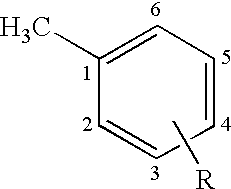
it is understood that the methyl is attached at the 1-position and the substituent or substituents represented by R can be attached in any of the 2, 3, 4, 5, or 6 positions;
i) the designation 
refers to a phenyl or substituted phenyl and it is understood that either substituent can be attached at any one of positions 1, 2, 3, 4, 5, or 6. It is further understood that when one of the substituents is attached at the 1-position the other substituent represented by R can be attached in any of the 2, 3, 4, 5, or 6 positions, that when one of the substituents is attached at the 2-position the other substituent represented by R can be attached in any of the 1, 3, 4, 5, or 6 positions, that when one of the substituents is attached at the 3-position the other substituent represented by R can be attached in any of the 1, 2, 4, 5, or 6 positions, that when one of the substituents is attached at the 4-position the other substituent represented by R can be attached in any of the 1, 2, 3, 5, or 6 positions, that when one of the substituents is attached at the 5-position the other substituent represented by R can be attached in any of the 1, 2, 3, 4, or 6 positions, and that when one of the substituents is attached at the 6-position the other substituent represented by R can be attached in any of the 1, 2, 3, 4, or 5 positions;
j) the numbering system and naming of the tricyclic ring system of formula (I) is as follows:
where G is —CH2— 
where G is —CH2—CH2— 
where G is —CH2—CH2—CH2— 
j) the term “enantiomeric excess” or “ee” refers to the percent by which one enantiomer, E1, is in excess in a mixture of the two enantiomers, E1 plus E2, such that {(E1−E2)÷(E1+E2)}×100=ee;
The compounds used in the method of the present invention may have one or more asymmetric centers. As a consequence of these chiral centers, the compounds of the present invention occur as racemates and as individual enantiomers, as well as diastereomers and mixtures of diastereomers. All asymmetric forms, individual isomers and combinations thereof, are within the scope of the present invention. The three main chiral centers, signified as 2, 3, and 4, are illustrated in formula (I).
The preferred relative stereochemistry of compounds of formula (I) is when chiral centers 2, 3, and 4 are all in the cis-configuration, as demonstrated by formulae IB and IC below: 
For the purpose of this invention, a compound designated “IB racemic” or “IC racemic”, or their structure, indicates a racemic structure of compounds IB and IC. Also, for the purpose of this invention, a compound designated “ID racemic” or “IE racemic”, or their structure as shown below, indicates a racemic structure of compounds ID and IE. 
In order to preferentially prepare one optical isomer over its enantiomer, a number of routes are available. As an example, a mixture of enantiomers may be prepared, and then the two enantiomers may be separated. A commonly employed method for the separation of a racemic mixture is the use of chiral high pressure liquid chromatography. Further details regarding resolution of enantiomeric mixtures may be found in J. Jacques, et al., Enantiomers, Racemates, and Resolutions, (1991). “The term “pharmaceutically acceptable salts thereof” refers to either an acid addition salt or a basic addition salt.
The expression “pharmaceutically acceptable acid addition salts” is intended to apply to any non-toxic organic or inorganic acid addition salt of the base compounds represented by formula (I). Illustrative inorganic acids that form suitable salts include hydrochloric, hydrobromic, sulphuric, and phosphoric acid and acid metal salts such as sodium monohydrogen orthophosphate, and potassium hydrogen sulfate. Illustrative organic acids that form suitable salts include the mono-, di-, and tricarboxylic acids. Illustrative of such acids are for example, acetic, glycolic, lactic, pyruvic, malonic, succinic, glutaric, fumaric, malic, tartaric, citric, ascorbic, maleic, hydroxymaleic, benzoic, hydroxy-benzoic, phenylacetic, cinnamic, salicyclic, 2-phenoxy-benzoic, p-toluenesulfonic acid, and sulfonic acids such as benzenesulfonic acid, methanesulfonic acid, and 2-hydroxyethanesulfonic acid. Such salts can exist in either a hydrated or substantially anhydrous form. In general, the acid addition salts of these compounds are soluble in water and various hydrophilic organic solvents, and which in comparison to their free base forms, generally demonstrate higher melting points.
The expression “pharmaceutically acceptable basic addition salts” is intended to apply to any non-toxic organic or inorganic basic addition salts of the compounds represented by formula (I). Illustrative bases which form suitable salts include alkali metal or alkaline-earth metal hydroxides such as sodium, potassium, calcium, magnesium, or barium hydroxides; ammonia, and aliphatic, alicyclic, or aromatic organic amines such as methylamine, dimethylamine, trimethylamine, and picoline. Either the mono- or di- basic salts can be formed with those compounds.
Preferred embodiments of formula (I) are provided below:
(1) Compounds in which the chiral centers designated as 2, 3, and 4 are all in the cis-position;
(2) Compounds in which G is —CH2— are preferred;
(3) Compounds in which Y2 and Y3 are both —H are preferred;
(4) Compounds in which R2 is —H or —OH are preferred;
(5) Compounds in which R1 is —H are preferred;
(6) Compounds in which Y1 is —H are preferred;
(7) Compounds in which R3 is —H, methyl, ethyl, fluoro, or —CF3 are preferred.
It is understood that further preferred embodiments of formula (I) can be selected by requiring one or more of the preferred embodiments above. For example, the limitations of (1) can be combined with the limitations of (2); the limitations of (3) can be combined with the limitations of (4); the limitations of (1), (2), (3), (5), (6), and (7) can be combined; and the like.
Illustrative examples of the compounds encompassed by the present invention include the racemic mixtures and specific enantiomers of the following compounds: 
Reaction Schemes
Compounds of formula (I) and intermediates thereof can be prepared as described in Reaction Schemes A through D below. All substituents, unless otherwise indicated, are previously defined. The reagents and starting materials are readily available to one of ordinary skill in the art. 
As used herein, R1′, R2′, and Y1′ correspond to the substituents R1, R2, and Y1, respectively, except for when the R1 and R2 substituents would be hydroxy and the Y1 substituent would be —H (making the —O—Y1 group a hydroxy). In these cases, the corresponding hydroxy group is protected with an alkoxymethylether, such as methoxymethyl (“MOM”) or methoxyethoxymethyl (“MEM”).
In reaction Scheme A, step 1a, the hydroxy groups on the phenol of formula (2) are protected with a suitable protecting group to provide the protected phenol of formula (4) utilizing techniques and procedures well know to one of ordinary skill in the art. For example, the phenol of formula (2) is combined with a suspension comprising a suitable anhydrous solvent such as anhydrous dimethylform-amide (DMF) and a suitable strong base such as a metal hydride, most preferably sodium hydride. To this suspension is added an amount of alkoxymethyl ether, preferably MOM, which corresponds to a roughly equimolar amount depending on the number of hydroxy groups to be protected on the phenol of formula (2). The reaction may be conducted at room temperature for a time ranging from about 30 minutes to about 2 days. The reaction is then quenched with water and an appropriate ether, such as diethyl ether, and the organic layer is washed with an appropriate base, such as sodium hydroxide, and brine. The protected phenol of formula (4) may be isolated and purified by techniques well known in the art, such as extraction, evaporation, trituration, chromatography, and recrystallization.
In Scheme A, step 1b, a 2-oxocycloalkanecarboxylate of formula (3) is activated via the triflate to provide the activated cycloalkane carboxylate of formula (5) utilizing procedures and techniques well known in the art; G. T. Crisp et al., J. Org. Chem. 57, 6972-6975 (1992). For example, a methyl-2-oxocycloalkanecarboxylate of formula (3) is dissolved under anhydrous conditions in a suitable solvent, such as tetrahydrofuran, dichloromethane, acetone, ethyl acetate, toluene, or diethyl ether and contacted with a suitable activating agent such as triflic anhydride. The reaction is carried out in the presence of a base, such as N-methylmorpholine, sodium carbonate, triethylamine, N,N-diisopropylethylamine, potassium carbonate or sodium bicarbonate. The reaction is generally carried out at temperatures of from −78° C. to ambient temperature. Generally, the reactions require 1 to 24 hours. The reaction may then be quenched. The product of formula (5) can be isolated and purified by techniques well known in the art, such as extraction, evaporation, trituration, chromatography, and recrystallization.
In Scheme A, step 2, the protected phenol of formula (4) is coupled with the activated cycloalkane carboxylate of formula (5) to provide the coupled product of formula (6). For example, the coupling reaction is conducted in the presence of butyllithium, zinc chloride and a Pd species. The reaction is preferably carried out in a suitable solvent such as tetrahydrofuran (THF), and may initially be carried out under anhydrous conditions. Preferably, the protected phenol of formula (4) is dissolved in a suitable solvent such as THF, treated with butyllithium at reduced temperature, zinc chloride in solvent is then added and the temperature allowed to rise to ambient. The palladium species, such as tetrakis(triphenylphosphine)Pd(0), is added together with the activated cycloalkane carboxylate of formula (5) and the temperature is preferably raised to the reflux temperature of the solvent for a period of time ranging from about 6 to 24 hours. The coupled product of formula (6) can be isolated and purified by techniques well known in the art, such as extraction, evaporation, trituration, chromatography, and recrystallization.
In Scheme A, step 3, the coupled product of formula (6) is reduced with a suitable reducing agent to provide the reduced product of formula (7) utilizing techniques and procedures well known in the art. For example, the coupled product of formula (6) is contacted with a suitable reducing agent, such as a palladium species, preferably 5% carbon on palladium, in a suitable solvent or solvent mixture, such as methanol. The reaction is preferably carried out in the presence of a suitable base, such as a trialkylamine, more preferably, triethylamine. The reaction mixture is then heated to a temperature ranging from about 30° C. to about reflux for a period of time ranging from about 2 to 24 hours. The reduced product of formula (7) can be isolated and purified by techniques well known in the art, such as extraction, evaporation, trituration, chromatography, and recrystallization.
In Scheme A, step 4, the reduced product of formula (7) can be converted to the Weinreb-amide of formula (8). This reaction can be performed utilizing a reactin of the type described by J. M. Williams, et al., Tetrahedron Letters 36, 5461-5464 (1995). For example, the reduced product of formula (7) is combined with N,O-dimethylhydroxylamine hydrochloride in a suitable aprotic solvent, such as tetrahydrofuran, preferably under anhydrous conditions and cooled to a temperature ranging from about 0° C. to about −30° C., more preferably about −10° C. A suitable Grignard reagent, preferably isopropyl magnesium chloride, is then added in a molar ratio of about 1.5 and reaction mixture is stirred for about 15 minutes to 2 hours. The reaction is then quenched with a proton source such as, for example, saturated ammonium chloride. The Weinreb-amide of formula (8) can be isolated and purified by techniques well known in the art, such as extraction, evaporation, trituration, chromatography, and recrystallization.
In Scheme A, step 5, the Weinreb-amide of formula (8) is combined with the aryl lithium of formula (9) to form the ketone of formula (10). For example, the aryl lithium of formula (9) is added to a solution of Weinreb-amide of formula (8) in a suitable aprotic solvent, such as anhydrous THF, cooled to a temperature ranging from about −20° C. to about 5° C., preferably 0° C., and stirred for a period of time ranging from about 15 minutes to 3 hours. The reaction is then quenched with a proton source, such as, for example, saturated sodium bicarbonate. The ketone of formula (10) can be isolated and purified by techniques well known in the art, such as extraction, evaporation, trituration, chromatography, and recrystallization.
In Scheme A, step 6a or 6b, the ketone of formula (10) is subjected to an acid-catalyzed cyclization followed by reduction of the resulting hemiketal to provide a compound of formula (IA or IA′), which represents the racemic mixture of a compound of formula (I). For example, in step 6a, p-toluenesulfonic acid is added in roughly equimolar proportions to the ketone of formula (10) in a suitable alcohol solvent, such as anhydrous methanol. The mixture is then heated at temperature ranging from 40° C. to 60° C., preferably 50° C., for a period of time ranging from 12 to 24 hours, preferably 18 hours. The reaction is then cooled to ambient temperature and a suitable reducing agent, such as sodium cyanoborohydride, is added along with a suitable indicator such as bromocreosol green in a procedure similar to that described by A. Srikrishna, et. Al., Tetrahedron, vol. 51, no. 11, pp. 3339-3344, 1995. Methanol saturated with hydrochloric acid is then slowly added until a yellow color is maintained. The reaction is stirred for about 1 to 2 hours past the point of final color change. The reaction is then quenched with a suitable proton acceptor, such as saturated sodium bicarbonate. This set of reaction conditions for step 6a will result in a cis-configuration of the chiral centers (e.g., those compounds in IB or IC). The R3SiH/TFA conditions of step 6b will result in a trans-configuration of the chiral centers (e.g., those compounds in ID or IE). The product of formula (IA) or (IA′) can then be isolated and purified by techniques well known in the art, such as extraction, evaporation, trituration, chromatography, and recrystallization.
Alternatively, the coupled product of formula (6) may be synthesized as described in reaction Scheme B. All substituents, unless otherwise indicated, are previously defined. The reagents and starting materials are readily available to one of ordinary skill in the art. 
In Scheme B, step 1, the hydroxy groups on the bromophenol of formula (11) are protected with a suitable protecting group to provide the protected bromophenol of formula (12) utilizing techniques and procedures as set forth in Scheme A, step 1a.
In Scheme B, step 2, the protected bromophenol of formula (12) is coupled with the activated cycloalkane carboxylate of formula (5) to provide the coupled product of formula (6) according the techniques and procedures set forth in Scheme A, step 2.
An alternative method for providing specific bromo-substituted intermediates are provided in Scheme C. 
The following examples are presented to further illustrate the preparation of compounds of the present invention. It is not intended that the invention be limited in scope by reason of any of the following examples. 
Stir a suspension of sodium hydride (60% in mineral oil, 3.81 g, 95.45 mmol) in anhydrous DMF (50 mL) under nitrogen atmosphere at 0° C. and add a solution of hydroquinone (5.00 g, 45.45 mmol) in anhydrous DMF (50 mL) dropwise. Add to this suspension methoxymethyl chloride (7.2 mL, 95.45 mmol) dropwise with additional gas evolution noted. Allow the reaction to warm to ambient temperature and stir for one hour. Quench the reaction with water and add diethyl ether. Wash the organic layer with 1N sodium hydroxide and brine. Dry the organic layer over sodium sulfate, concentrate in vacuo, and flash chromatograph with 20% ethyl acetate/hexane to yield the title compound (5.64 g, 63%) as a clear oil. 1H NMR (CDCl3): 6.97 (s, 4H), 5.11 (s, 4H), 3.47 (s, 6H). 
Stir a suspension of sodium hydride (60% in mineral oil, 1.58 g, 39.21 mmol) in anhydrous DMF (50 mL) under nitrogen atmosphere at 0° C. and add a solution of 2,6-dibromohydroquinone (5.00 g, 18.67 mmol) in anhydrous DMF (50 mL) dropwise. Add to this suspension methoxymethyl chloride (3.0 mL, 39.21 mmol) dropwise with additional gas evolution noted. Allow the reaction to warm to ambient temperature and stir for one hour. Quench the reaction with water and add diethyl ether. Wash the organic layer with 1N sodium hydroxide and brine. Dry the organic layer over sodium sulfate, concentrate in vacuo, and flash chromatograph with 20% ethyl acetate/hexane to yield the title compound (3.49 g, 53%) as a clear oil. 1H NMR (CDCl3): 7.23 (s,2H), 5.10 (s, 4H), 3.46 (s, 6H). 
Stir a suspension of sodium hydride (60% in mineral oil, 3.00 g, 74.92 mmol) in anhydrous DMF (50 mL) under nitrogen atmosphere at 0° C. and add a solution of methoxyhydroquinone (5.00 g, 35.67 mmol) in anhydrous DMF (50 mL) dropwise. Add to this suspension methoxymethyl chloride (5.2 mL, 74.92 mmol) dropwise with additional gas evolution noted. Allow the reaction to warm to ambient temperature and stir for one hour. Quench the reaction with water and add diethyl ether. Wash the organic layer with 1N sodium hydroxide and brine. Dry the organic layer over sodium sulfate, concentrate in vacuo, and flash chromatograph with 20% ethyl acetate/hexane to yield the title compound (5.84 g, 72%) as a clear oil. 1H NMR (CDCl3): 7.05 (d, J=8.6, 1H), 6.63 (d, J=2.7, 1H), 6.55 (dd, J=9.0, 2.7, 1H), 5.14 (s, 2H), 5.12 (s, 2H), 3.86 (s, 3H), 3.51 (s, 3H), 3.47 (s, 3H). 
Stir a suspension of sodium hydride (60% in mineral oil, 3.54 g, 88.61 mmol) in anhydrous DMF (100 mL) under nitrogen atmosphere at 0° C. and add a solution of 4-methoxyphenol (10.00 g, 80.55 mmol) in anhydrous DMF (50 mL) dropwise. Add to this suspension methoxymethyl chloride (6.7 mL, 88.61 mmol) dropwise. Allow the reaction to warm to ambient temperature and stir for one hour. Quench the reaction with water and add diethyl ether. Wash the organic layer with 1 N sodium hydroxide and brine. Dry the organic layer over sodium sulfate, concentrate in vacuo, and flash chromatograph with 20% ethyl acetate/hexane to yield the title compound (11.55 g, 85%) as a clear oil. 
Cool a solution of Preparation 2 (1.00 g, 2.81 mmol) to −78° C. and add s-BuLi (1.3 M in cylcohexane, 2.10 mL, 2.81 mmol) dropwise. Stir the solution for 15 minutes, then add methyl iodide (0.18 mL, 2.81 mmol) and stir overnight, allowing to warm to ambient temperature. Quench with saturated sodium bicarbonate and add ethyl acetate. Wash with brine, dry the organic layer over sodium sulfate, concentrate in vacuo, and flash chromatograph with 10% ethyl acetate/hexane to yield the title compound (0.66 g, 81%) as a clear oil. 1H NMR (CDCl3): 7.12 (d, J=2.9, 1H), 6.83 (d, J=2.9, 1H), 5.10 (s, 2H), 5.04 (s, 2H), 3.63 (s, 3H), 3.48 (s, 3H), 2.30 (s, 3H). MS calcd 291.1; MS (M+1) 291.2, 293.2. 
This preparation was followed according to J. Org. Chem. 57, 1992, 6972-6975. Stir a solution of methyl 2-oxocylcopentanecarboxylate (10.0 g, 70.42 mmol) in anhydrous dichloromethane (300 mL) cooled to −78° C. and add diisopropylethylamine (61.5 mL, 352.1 mmol) and triflic anhydride (14.2 mL, 84.51 mmol). Stir the reaction was stir for 16 hours, allowing it to warm to ambient temperature. Quench the reaction with water and wash with 10% citric acid followed by brine. Dry the organic layer over sodium sulfate, concentrate in vacuo, and flash chromatograph with 15% ethyl acetate/hexane to yield the title compound (12.0 g, 63%) as a dark oil which is used without further purification. 1H NMR (CDCl3): 3.79 (s, 3H), 2.75-2.68 (m, 4H), 2.03-15 1.98 (m, 2H). 
Using a method similar to the preparation of Preparation 6, with an exception of using methyl 2-oxo-1-cycloheptanecarboxylate (5.00 g, 29.37 mmol) to yield the title compound (4.34 g, 49%) as a dark oil. 
Stir a solution of methyl 2-oxo-5,5-dimethyl-cyclopentanecarboxylate (J. Chem. Soc., 1996, 1539-1540) (0.85 g, 5.00 mmol) in anhydrous dichloromethane (15 mL) cooled to −78° C. and add diisopropylethylamine (4.4 mL, 25.00 mmol) and triflic anhydride (1.0 mL, 6.00 mmol). Stir the reaction was stir for 16 hours, allowing it to warm to ambient temperature. Quench the reaction with water and wash with 10% citric acid followed by brine. Dry the organic layer over sodium sulfate, concentrate in vacuo, and flash chromatograph with 15% ethyl acetate/hexane to yield the title compound (1.16 g, 77%) as a dark oil which is used without further purification. 1H NMR (CDCl3): 3.78 (s, 3H), 2.64 (t, J=7.1, 2H), 1.83 (t, J=7.1, 2H), 1.18 (s, 6H). 
Stir a solution of methyl 2-oxo-5,5-diethyl-cyclopentanecarboxylate (J. Chem. Soc., 1996, 1539-1540) (2.94 g, 14.85 mmol) in anhydrous dichloromethane (100 mL) cooled to −78° C. and add diisopropylethylamine (13.0 mL, 74.25 mmol) and triflic anhydride (3.0 mL, 17.82 mmol). Stir the reaction was stir for 16 hours, allowing it to warm to ambient temperature. Quench the reaction with water and wash with 10% citric acid followed by brine. Dry the organic layer over sodium sulfate, concentrate in vacuo, and flash chromatograph with 15% ethyl acetate/hexane to yield the title compound (3.96 g, 82%) as a dark oil which is used without further purification. 1H NMR (CDCl3): 3.78 (s, 3H), 2.60 (t, J=7.4, 7.8, 2H), 1.83 (t, J=7.8, 7.1, 2H), 1.46 (q, J=7.4, 7.4, 7.4, 4H), 0.91 (t, J=7.4, 7.4, 6H). 
Cool a solution of Preparation 1 (0.95 g, 4.81 mmol) in anhydrous THF (25 mL) to −78° C. and add t-BuLi (1.7M in pentane, 2.8 mL, 4.81 mmol). Stir the solution 15 minutes, then warm to 0° C. Add a solution of zinc chloride (1.0 M in diethyl ether, 4.8 mL, 4.81 mmol) dropwise and allow the resulting solution to warm to ambient temperature. Cannulate this solution into a solution of Preparation 6 (0.88 g, 3.21 mmol) and tetrakis(triphenylphosphine)Pd(0) (0.37 g, 0.32 mmol) in anhydrous THF (25 mL) and heat the resulting solution to 50° C. for 16 hours. Cool the reaction to ambient temperature and quench with water. Add ethyl acetate and wash the resulting organic layer with saturated sodium bicarbonate and brine. Dry the organic layer over sodium sulfate, concentrate in vacuo, and flash chromatograph with 30% ethyl acetate/hexane to yield the title compound (0.56 g, 55%) as a clear oil. 1H NMR (CDCl3): 7.04 (d, J=9.0, 1H), 6.90 (dd, J=3.1, 9.0, 1H), 6.81 (d, J=3.1, 1H), 5.10 (s, 2H), 5.02 (s, 2H), 3.56 (s, 3H), 3.46 (s, 3H), 3.42 (s, 3H), 2.80 (t, J=8.6, 8.2, 4H), 2.05-1.95 (m, 2H). MS calcd 322.2; MS (M+1) 323.1. 
Cool a solution of Preparation 1 (2.00 g, 10.13 mmol) in anhydrous THF (25 mL) to −78° C. and add t-BuLi (1.7M in pentane, 5.9 mL, 10.13 mmol). Stir the solution 15 minutes, then warm to 0° C. Add a solution of zinc chloride (1.0 M in diethyl ether, 10.1 mL, 10.13 mmol) dropwise and allow the resulting solution to warm to ambient temperature. Cannulate this solution into a solution Preparation 7 (2.04 g, 6.75 mmol) and tetrakis(triphenylphosphine)Pd(0) (0.40 g, 0.34 mmol) in anhydrous THF (25 mL) and heat the resulting solution to 50° C. for 16 hours. Cool the reaction to ambient temperature and quench with water. Add ethyl acetate and wash the resulting organic layer with saturated sodium bicarbonate and brine. Dry the organic layer over sodium sulfate, concentrate in vacuo, and flash chromatograph with 20% ethyl acetate/hexane to yield the title compound (2.13 g, 90%) as a colorless oil. 1H NMR (CDCl3): 6.98 (d, J=9.0, 1H, 6.85 (dd, J=3.1, 9.0, 1H), 6.65 (d, J=3.1, 1H), 5.10 (s, 4H), 3.45 (s, 3H), 3.44 (s, 3H), 3.38 (s, 3H), 2.56-2.50 (m, 4H), 1.84-1.80 (m, 2H), 1.65-1.60 (m, 4H). MS calcd 350.1; MS (M+1) 351.1. 
Cool a solution of Preparation 3 (2.18 g, 9.56 mmol) in anhydrous THF (40 mL) to −78° C. and add t-BuLi (1.7M in pentane, 6.2 mL, 10.52 mmol). Stir the solution 15 minutes, then warm to 0° C. Add a solution of zinc chloride (1.0 M in diethyl ether, 9.6 mL, 9.56 mmol) dropwise and allow the resulting solution to warm to ambient temperature. Cannulate this solution into a solution of Preparation 6 (2.62 g, 9.56 mmol) and tetrakis(triphenylphosphine)Pd(0) (0.55 g, 0.48 mmol) in anhydrous THF (40 mL) and heat the resulting solution to 50° C. for 16 hours. Cool the reaction to ambient temperature and quench with water. Add ethyl acetate and wash the resulting organic layer with saturated sodium bicarbonate and brine. Dry the organic layer over sodium sulfate, concentrate in vacuo, and flash chromatograph with 20% ethyl acetate/hexane to yield the title compound (0.62 g, 18%) as a colorless oil. 1H NMR (CDCl3): 6.57 (d, J=2.7, 1H), 6.40 (d, J=2.7, 1H), 5.11 (s, 2H), 4.89 (s, 2H), 3.81 (s, 3H), 3.58 (S, 3H), 3.47, (s, 3H), 3.44 (s, 3H), 2.83-2.77 (m, 4H), 2.03-1.96 (m, 2H). MS calcd 352.1; MS (M+1) 353.1. 
Cool a solution of Preparation 1 (1.13 g, 5.71 mmol) in anhydrous THF (40 mL) to −78° C. and add t-BuLi (1.7M in pentane, 3.4 mL, 5.71 mmol). Stir the solution 15 minutes, then warm to 0° C. Add a solution of zinc chloride (1.0 M in diethyl ether, 5.7 mL, 5.71 mmol) dropwise and allow the resulting solution to warm to ambient temperature. Cannulate this solution into a solution of Preparation 8 (1.15 g, 3.80 mmol) and tetrakis(triphenylphosphine)Pd(0) (0.55 g, 0.48 mmol) in anhydrous THF (40 mL) and heat the resulting solution to 50° C. for 16 hours. Cool the reaction to ambient temperature and quench with water. Add ethyl acetate and wash the resulting organic layer with saturated sodium bicarbonate and brine. Dry the organic layer over sodium sulfate, concentrate in vacuo, and flash chromatograph with 15% ethyl acetate/hexane to yield the title compound (0.42 g, 32%) as a colorless oil. 1H NMR (CDCl3): 7.05 (d, J=9.0, 1H), 6.92 (dd, J=3.1, 9.0, 1H), 6.62 (d, J=3.1, 1H), 5.11 (S, 2H), 5.01 (s, 2H), 3.49 (s, 3H), 3.46 (s, 3H), 3.40 (s, 3H), 2.70 (t, J=7.0, 7.4, 2H), 1.86 (t, J=7.4, 7.0, 2H), 1.59 (bs, 6H). MS calcd 350.1; MS (M+1) 351.1. 
Cool a solution of Preparation 1 (3.64 g, 18.38 mmol) in anhydrous THF (50 mL) to −78° C. and add t-BuLi (1.7M in pentane, 3.4 mL, 5.71 mmol). Stir the solution 15 minutes, then warm to 0° C. Add a solution of zinc chloride (1.0 M in diethyl ether, 10.8 mL, 18.38 mmol) dropwise and allow the resulting solution to warm to ambient temperature. Cannulate this solution into a solution of Preparation 9 (3.96 g, 12.25 mmol) and tetrakis(triphenylphosphine)Pd(0) (0.71 g, 0.61 mmol) in anhydrous THF (50 mL) and heat the resulting solution to 50 C for 16 hours. Cool the reaction to ambient temperature and quench with water. Add ethyl acetate and wash the resulting organic layer with saturated sodium bicarbonate and brine. Dry the organic layer over sodium sulfate, concentrate in vacuo, and flash chromatograph with 15% ethyl acetate/hexane to yield the title compound (3.30 g, 84%) as a colorless oil. 1H NMR (CDCl3): 7.05 (d, J=9.0, 1H), 6.89 (dd, J=3.1, 9.0, 1H), 6.62 (d, J=2.7, 1H), 5.11 (s, 2H), 5.00 (s, 2H), 3.49 (s, 3H), 3.46 (s, 3H), 3.40 (s, 3H), 2.65 (bt, J=7.8, 7.0, 2H), 1.87 (t, J=7.8, 7.4, 2H), 1.45-1.38 (m, 4H), 0.90-0.82 (m, 6H). MS calcd 378.1; MS (M+1) 379.1. 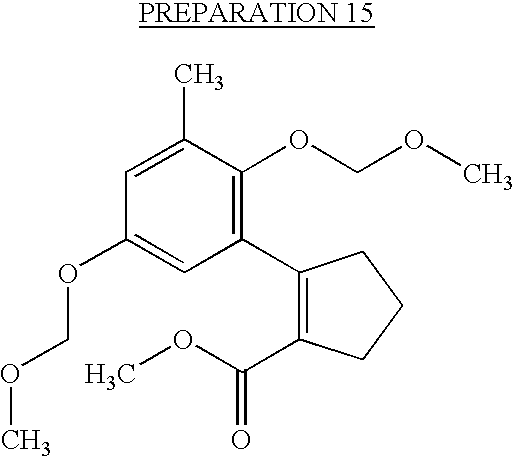
Cool a solution of Preparation 5 (1.24 g, 4.26 mmol) in anhydrous THF (20 mL) to −78° C. and add s-BuLi (1.3M in cyclohexane, 3.3 mL, 4.26 mmol). Stir the solution 15 minutes, then warm to 0° C. Add a solution of zinc chloride (1.0 M in diethyl ether, 4.3 mL, 4.26 mmol) dropwise and allow the resulting solution to warm to ambient temperature. Cannulate this solution into a solution of Preparation 6 (1.17 g, 4.26 mmol) and tetrakis(triphenylphosphine)Pd(0) (0.24 g, 0.21 mmol) in THF (20 mL) and heat the resulting solution to 50° C. for 16 hours. Cool the reaction to ambient temperature and quench with water. Add ethyl acetate and wash the resulting organic layer with saturated sodium bicarbonate and brine. Dry the organic layer over sodium sulfate, concentrate in vacuo, and flash chromatograph with 20% ethyl acetate/hexane to yield the title compound (0.54 g, 38%) as a colorless oil. 1H NMR (CDCl3): 6.80 (d, J=2.4, 1H), 6.61 (d, J=2.3, 1H), 5.09 (s, 2H), 4.79 (s, 2H), 3.57 (s, 3H), 3.48 (s, 3H), 3.46 (s, 3H), 2.83-2.76 (m, 4H), 2.29 (s, 3H), 2.02-1.96 (m, 2H). MS calcd 336.2; MS (M+1) 337.2. 
Cool a solution of Preparation 4 (2.00 g, 11.90 mmol) in anhydrous THF (20 mL) to −78° C. and add s-BuLi (1.3M in cyclohexane, 7.7 mL, 13.09 mmol). Stir the solution 15 minutes, then warm to 0° C. Add a solution of zinc chloride (1.0 M in diethyl ether, 11.9 mL, 11.90 mmol) dropwise and allow the resulting solution to warm to ambient temperature. Cannulate this solution into a solution of Preparation 6 (3.26 g, 11.90 mmol) and tetrakis(triphenylphosphine)Pd(0) (0.69 g, 0.58 mmol) in THF (20 mL) and heat the resulting solution to 50° C. for 16 hours. Cool the reaction to ambient temperature and quench with water. Add ethyl acetate and wash the resulting organic layer with saturated sodium bicarbonate and brine. Dry the organic layer over sodium sulfate, concentrate in vacuo, and flash chromatograph with 20% ethyl acetate/hexane to yield the title compound (1.28 g, 38%) as a colorless oil which is a mixture of regioisomers by 1H NMR. MS calcd 292.1; MS (M+1) 293.1. 
To a suspension of 5% palladium on carbon (0.27 g) in methanol (15 mL) add a solution of Preparation 10 (0.27 g, 0.84 mmol) in methanol (10 mL). Place the mixture on a Parr shaker under hydrogen (60 psi) at 40° C. for twelve hours. Purge the reaction with nitrogen and filter with celite. Concentrate the filtrate in vacuo and flash chromatograph with 30% ethyl acetate/hexane to yield the title compound (0.20 g, 75%) as a clear oil. 1H NMR (CDCl3): 6.98 (d, J=8.6, 1H), 6.86 (d, J=3.1, 1H), 6.81 (dd, J=3.1, 9.0, 1H), 5.1 (s, 2H), 5.08 (s, 2H), 3.64-3.59 (m, 1H), 3.50 (s, 3H), 3.45 (s, 3H), 3.39-3.30 (m, 1H), 3.19 (s, 3H), 2.12-1.98 (m, 4H), 1.93-1.82 (m, 1H), 1.72-1.63 (m, 1H), MS calcd 324.2; MS (M+1) 325.2. 
To a suspension of 5% palladium on carbon (0.25 g) in methanol (25 mL) add a solution Preparation 15 (0.54 g, 1.61 mmol) in methanol (10 mL). Place the mixture on a Parr shaker under hydrogen (60 psi) at 40° C. for twelve hours. Purge the reaction with nitrogen and filter with celite. Concentrate the filtrate in vacuo and flash chromatograph with 20% ethyl acetate/hexane to yield the title compound (0.49 g, 89%) as a clear oil. 1H NMR (CDCl3): 6.69 (d, J=2.8, 1H), 6.65 (d, J=3.1, 1H), 5.04 (m, 2H), 4.93 (dd, J=5.9, 16.0, 2H), 3.73-3.67 (m, 1H), 3.57 (s, 3H), 3.42 (s, 3H), 3.25-3.19 (m, 4H), 2.25 (s, 3), 2.17-2.12 (m, 1H), 2.05-1.85 (m, 4H), 1.70-1.60 (m, 1H). MS calcd 338.2; MS (M+1) 339.2. 
To a suspension of 5% palladium on carbon (0.38 g) in methanol (35 mL) add a solution of Preparation 11 (0.75 g, 2.14 mmol) in methanol (10 mL). Place the mixture on a Parr shaker under hydrogen (60 psi) at 40° C. for twelve hours. Purge the reaction with nitrogen and filter with celite. Concentrate the filtrate in vacuo and flash chromatograph with 20% ethyl acetate/hexane to yield the title compound (0.63 g, 84%) as a clear oil. 1H NMR (CDCl3): 6.95 (d, J=9.0, 1H), 6.85 (d, J=3.1, 1H), 6.79 (dd, J=3.1, 9.0, 1H), 5.15 (s, 2H), 5.13-5.05 (m, 2H), 3.56-3.51 (m, 1H), 3.50 (s, 3H), 3.45 (s, 3H), 3.30 (s, 3H), 3.08-3.04 (m, 1H), 2.23-2.17 (m, 1H), 2.04-1.80 (m, 6H), 1.55-1.40 (m, 3H). MS calcd 352.2; MS (M+1) 353.2. 
To a suspension of 5% palladium on carbon (0.08 g) in methanol (50 mL)/triethylamine (1.0 mL) add a solution of Preparation 12 (0.62 g, 1.76 mmol) in methanol (10 mL). Place the mixture on a Parr shaker under hydrogen (60 psi) at 40° C. for twelve hours. Purge the reaction with nitrogen and filter with celite. Concentrate the filtrate in vacuo and flash chromatograph with 20% ethyl acetate/hexane to yield the title compound (0.50 g, 81%) as a clear oil. 1H NMR (CDCl3): 6.50 (d, J=2.7, 1H), 6.44 (d, J=2.7, 1H), 5.14-5.05 (m, 4H), 3.80 (m, 4H), 3.58 (s, 3H), 3.46 (s, 3H), 3.25 (m, 4H), 2.15-2.09 (m, 1H), 2.07-1.90 (m, 4H), 1.72-1.64 (m, 1H). MS calcd 354.1; MS (M+1) 355.1. 
To a suspension of 5% palladium on carbon (0.05 g) in methanol (50 mL)/triethylamine (1.0 mL) add a solution of Preparation 13 (0.42 g, 1.19 mmol) in methanol (10 mL). Place the mixture on a Parr shaker under hydrogen (60 psi) at 40° C. for twelve hours. Purge the reaction with nitrogen and filter with celite. Concentrate the filtrate in vacuo and flash chromatograph with 20% ethyl acetate/hexane to yield the title compound (0.16 g, 38%) as a clear oil. 1H NMR (CDCl3): 7.00 (d, J=8.2, 0.5H), 6.94 (d, J=7.8, 0.5H), 6.84-6.75 (m, 1.5H), 6.67 (d, J=3.1, 0.5H), 5.12-5.01 (m, 4H), 3.77 (d, J=9.0, 0.5H), 3.64 (d, J=11.3, 0.5H), 3.52 (s, 1.5H), 3.49 (s, 1.5H), 3.48-3.43 (s, 4.5H), 3.35 (s, 1.5H), 2.55-2.42 (m, 0.5H), 2.17-2.02 (m, 1H), 1.95-1.88 (m, 0.5H), 1.81-1.75 (m, 1H), 1.69-1.60 (m, 0.5H), 1.55-1.50 (m, 0.5H), 1.15 (s, 1.5H), 1.01 (s, 1.5H), 0.78 (s, 3H). MS calcd 352.2; MS (M+1) 353.2. 
To a suspension of 5% palladium on carbon (0.58g) in methanol (50 mL)/triethylamine (1.0 mL) add a solution of Preparation 14 (1.25 g, 3.89 mmol)in methanol (10 mL). Place the mixture on a Parr shaker under hydrogen (60 psi) at 40° C. for twelve hours. Purge the reaction with nitrogen and filter with celite. Concentrate the filtrate in vacuo and flash chromatograph with 15% ethyl acetate/hexane to yield the title compound (0.89 g, 72%) as a clear oil. MS calcd 380.2; MS (M+1) 381.2. 
To a suspension of 5% palladium on carbon (0.15 g) in methanol (50 mL)/triethylamine (1.0 mL) add a solution of Preparation 14 (0.58 g, 1.80 mmol)in methanol (10 mL). Place the mixture on a Parr shaker under hydrogen (60 psi) at 40° C. for twelve hours. Purge the reaction with nitrogen and filter with celite. Concentrate the filtrate in vacuo and flash chromatograph with 15% ethyl acetate/hexane to yield the title compound (0.25 g, 43%) as a clear oil. MS calcd 294.1; MS (M+1) 295.1. 
This preparation follows that in Tet Letters 36, 31, 1995, 5461-5464. Cool a suspension of Preparation 17 (0.50 g, 1.54 mmol) and N,O-dimethylhydroxylamine hydrochloride (0.23 g, 2.31 mmol) in anhydrous THF (25 mL) to −10° C. in an ice/acetone bath, add isopropyl magnesium chloride (2.0M, 2.3 mL, 4.62 mmol), and stir the reaction for 30 minutes. Quench the reaction with saturated ammonium chloride. Add ethyl acetate and wash the organic layer washed with brine. Dry the organic layer over sodium sulfate, concentrate in vacuo, and flash chromatograph with 50% ethyl acetate/hexane to yield the title compound (0.49 g, 90%) as a clear oil which is used without further characterization. 
Cool a suspension of Preparation 18 (0.48 g, 1.42 mmol) and N,O-dimethylhydroxylamine hydrochloride (0.21 g, 2.13 mmol) in anhydrous THF (20 mL) to −10° C. in an ice/acetone bath, add isopropyl magnesium chloride (2.0M, 2.1 mL, 4.20 mmol), and stir the reaction for 30 minutes. Quench the reaction with saturated ammonium chloride. Add ethyl acetate and wash the organic layer washed with brine. Dry the organic layer over sodium sulfate, concentrate in vacuo, and flash chromatograph with 50% ethyl acetate/hexane to yield the title compound (0.46 g, 88%) as a clear oil which is used without further characterization. 
Cool a suspension of Preparation 19 (0.63 g, 2.53 mmol) and N,O-dimethylhydroxylamine hydrochloride (0.26 g, 2.68 mmol) in anhydrous THF (30 mL) to −10° C. in an ice/acetone bath, add isopropyl magnesium chloride (2.0M, 2.7 mL, 5.40 mmol), and stir the reaction for 30 minutes. Quench the reaction with saturated ammonium chloride. Add ethyl acetate and wash the organic layer washed with brine. Dry the organic layer over sodium sulfate, concentrate in vacuo, and flash chromatograph with 50% ethyl acetate/hexane to yield the title compound (0.54 g, 76%) as a clear oil which is used without further characterization. 
Cool a suspension of Preparation 20 (0.50 g, 1.41 mmol) and N,O-dimethylhydroxylamine hydrochloride (0.24 g, 2.12 mmol) in anhydrous THF (30 mL) to −10° C. in an ice/acetone bath, add isopropyl magnesium chloride (2.0M, 2.1 mL, 4.20 mmol), and stir the reaction for 30 minutes. Quench the reaction with saturated ammonium chloride. Add ethyl acetate and wash the organic layer washed with brine. Dry the organic layer over sodium sulfate, concentrate in vacuo, and flash chromatograph with 50% ethyl acetate/hexane to yield the title compound (0.31 g, 57%) as a clear oil which is used without further characterization. 
Cool a suspension of Preparation 21 (0.16 g, 0.45 mmol) and N,O-dimethylhydroxylamine hydrochloride (0.07 g, 0.68 mmol) in anhydrous THF (10 mL) to −10° C. in an ice/acetone bath, add isopropyl magnesium chloride (2.0M, 0.7 mL, 1.40 mmol), and stir the reaction for 30 minutes. Quench the reaction with saturated ammonium chloride. Add ethyl acetate and wash the organic layer washed with brine. Dry the organic layer over sodium sulfate, concentrate in vacuo, and flash chromatograph with 50% ethyl acetate/hexane to yield the title compound (0.15 g, 87%) as a clear oil which is used without further characterization. 
Cool a suspension of Preparation 22 (0.25 g, 0.77 mmol)and N,O-dimethylhydroxylamine hydrochloride (0.11 g, 1.16 mmol) in anhydrous THF (20 mL) to −10° C. in an ice/acetone bath, add isopropyl magnesium chloride (2.0M, 1.2 mL, 2.40 mmol), and stir the reaction for 30 minutes. Quench the reaction with saturated ammonium chloride. Add ethyl acetate and wash the organic layer washed with brine. Dry the organic layer over sodium sulfate, concentrate in vacuo, and flash chromatograph with 50% ethyl acetate/hexane to yield the title compound (0.20 g, 74%) as a clear oil which is used without further characterization. 
Cool a suspension of Preparation 23 (0.91 g, 3.07 mmol)and N,O-dimethylhydroxylamine hydrochloride (0.45 g, 4.64 mmol) in anhydrous THF (20 mL) to −10° C. in an ice/acetone bath, add isopropyl magnesium chloride (2.0M, 3.1 mL, 6.20 mmol), and stir the reaction for 30 minutes. Quench the reaction with saturated ammonium chloride. Add ethyl acetate and wash the organic layer washed with brine. Dry the organic layer over sodium sulfate, concentrate in vacuo, and flash chromatograph with 50% ethyl acetate/hexane to yield the title compound (0.36 g, 36%) as a clear oil which is used without further characterization. 
Add phenyl lithium (1.0 M in cyclohexane, 1.3 mL, 1.34 mmol) into a solution of Preparation 24 (0.43 g, 1.22 mmol) in anhydrous THF 30 mL) at 0° C. and stir the resulting solution for 30 minutes at 0° C. Quench the reaction with saturated sodium bicarbonate. Add ethyl acetate and wash with brine. Dry the organic layer over sodium sulfate, concentrate in vacuo, and flash chromatograph with 60% ethyl acetate/hexane to yield the title compound (0.28 g, 85%) as a clear oil. 1H NMR (CDCl3): 7.61 (d, J=7.4, 2H), 7.37-7.33 (m, 1H), 7.24-7.19 (m, 2H), 6.77 (d, J=2.7, 1H), 6.66 (d, J=9.0, 1H), 6.60 (dd, J=3.1, 9., 1H), 5.00 (dd, J=6.6, 17.8, 2H), 4.84 (s, 2H), 4.32-4.29 (m, 1H), 3.84-379 (m, 1H), 3.42 (s, 3H), 3.38 (s, 3H), 2.32-1.95 (m, 5H), 1.80-1.72 (m, 1H). 
To 0.31 mL (2.8 mmol) of p-bromofluorobenzene in 10 mL of THF at −78° C. was added 3.4 mL (5.6 mmol) of 1.7 M tert-butyllithium. The mixture was cannulated into 0.7 g (2.0 mmol) of Preparation 24 in 10 mL of anhydrous THF at −78° C. with magnetic stirring, and all was allowed to come to room temperature. After 5 hours, the mixture was partitioned between diethylether and saturated sodium bicarbonate aqueous. The organic layer was washed with water, saturated brine, dried over anhydrous sodium sulfate, concentrated in vacuo, and flash chromatographed on silica gel with 10% ethylacetate/hexanes to give the title compound (0.41 g, 53%). 1H NMR (CDCl3): 7.62 (m, 2H), 6.86 (m, 2H), 6.66 (m, 2H), 6.58 (m, 1H), 4.98 (dd, J=8.0, 17.0, 2H), 4.91 (s, 2H), 4.25 (m, 1H), 3.80 (m, 1H), 3.41 (s, 3H), 3.40 (s, 3H), 2.28-1.90 (m, 5H), 1.75 (m, 1H). 
To 0.33 mL (2.4 mmol) of 4-bromo-ethylbenezene in 10 mL of THF at −78° C. was added 3.0 mL (5.0 mmol) of 1.7 M tert-butyllithium. The mixture was cannulated into 0.7 g (2.0 mmol) of Preparation 24 in 10 mL of anhydrous THF at −78° C. with magnetic stirring, and all was allowed to come to room temperature. After 5 hours, the mixture was partitioned between diethylether and saturated sodium bicarbonate aqueous. The organic layer was washed with water, saturated brine, dried over anhydrous sodium sulfate, concentrated in vacuo, and flash chromatographed on silica gel with 10% ethylacetate/hexanes/0.4% triethylamine to give the title compound (0.46 g, 58%). 1H NMR (CDCl3): 7.54 (d, J=8.4, 2H), 7.03 (d, J=8.4, 2H), 6.76 (d, J=2.4, 1H), 6.67 (d, J=8.0, 1H), 6.58 (dd, J=8.0, 2.4, 1H), 5.00 (d, J=7.5, 1H), 4.96 (d, J=7.5, 1H), 4.85 (s, 2H), 4.26 (m, 1H), 3.80 (m, 1H), 3.40 (s, 3H), 3.38 (s, 3H), 2.58 (q, J=7.2, 2H), 2.26-1.92 (m, 5H), 1.65 (m, 1H), 1.17 (t, J=7.2, 3H). 
To 0.26 mL (1.8 mmol) of 4-bromo-α,α,α-trifluorotoluene in 10 mL of THF at −78° C. was added 2.15 mL (3.66 mmol) of 1.7 M tert-butyllithium. The mixture was cannulated into 0.59 g (1.67 mmol) of Preparation 24 in 10 mL of anhydrous THF at −78° C. with magnetic stirring, and all was allowed to come to room temperature. After 18 hours, the mixture was partitioned between diethylether and saturated sodium bicarbonate aqueous. The organic layer was washed with water, saturated brine, dried over anhydrous sodium sulfate, concentrated in vacuo, and flash chromatographed on silica gel with 10% ethylacetate/hexanes/0.4% triethylamine to give the title compound (0.24 g, 33%). 1H NMR (CDCl3): 7.65 (d, J=8.8, 2H), 7.45 (d, J=8.8, 2H), 6.70 (s, 1H), 6.60 (m, 2H), 5.00 (d, J=7.5, 1H), 4.96 (d, J=7.5, 1H), 4.87 (s, 2H), 4.28 (m, 1H), 3.82 (m, 1H), 3.41 (s, 3H), 3.38 (s, 3H), 2.28 (m, 1H), 2.16-1.92 (m, 4H), 1.75 (m, 1H). 
To 0.63 g (2.8 mmol) of 3-bromo-O-methoxymethylphenol 10 mL of THF at −78° C. was added 3.6 mL (6.1 mmol) of 1.7 M tert-butyllithium. The mixture was cannulated into 0.98 g (2.77 mmol) of Preparation 24 in 10 mL of anhydrous THF at −78° C. with magnetic stirring, and all was allowed to come to room temperature. After 18 hours, the mixture was partitioned between diethylether and saturated sodium bicarbonate aqueous. The organic layer was washed with water, saturated brine, dried over anhydrous sodium sulfate, concentrated in vacuo, and flash chromatographed on silica gel with 10% ethylacetate/hexanes/0.1% tricthylamine to give the title compound (0.68 g, 57%). 1H NMR (CDCl3): 7.27 (d, J=7.8, 1H), 7.20 (d, J=1.6, 1H), 7.13 (m, 1H), 7.02 (dd, J=7.8, 1.6, 1H), 6.75 (d, J=3.2, 1H), 6.68 (d, J=7.8, 1H), 6.60 (dd, J=7.8, 3.2, 1H), 5.09 (s, 2H), 5.01 (d, J=6.4, 1H), 4.97 (d, J=6.6, 1H), 4.87 (s, 2H), 4.25 (m, 1H), 3.78 (m, 1H), 3.47 (m, 1H), 3.43 (s, 3H), 3.41 (s, 3H), 3.38 (s, 3H), 2.25-1.92 (m, 4H), 1.72 (m, 1H). 
To 0.31 mL (3.0 mmol) of 4-bromotoluene in 10 mL of THF at −78° C. was added 3.6 mL (6.1 mmol) of 1.7 M tert-butyllithium. The mixture was cannulated into 0.98 g (2.77 mmol) of Preparation 24 in 10 mL of anhydrous THF at −78° C. with magnetic stirring, and all was allowed to come to room temperature. After 5 hours, the mixture was partitioned between diethylether and saturated sodium bicarbonate aqueous. The organic layer was washed with water, saturated brine, dried over anhydrous sodium sulfate, concentrated in vacuo, and flash chromatographed on silica gel with 10% ethylacetate/hexanes to give the title compound (0.38 g, 36%). 1H NMR (CDCl3): 7.52 (d, J=7.6, 2H), 7.01 (d, J=8.0, 2H), 6.76 (d, J=3.0, 1H), 6.69 (d, J=8.8, 1H), 6.60 (dd, J=8.8, 3.0, 1H), 5.01 (d, J=6.8, 1H), 4.96 (d, J=6.6, 1H), 4.86 (s, 2H), 4.24 (m, 1H), 3.79 (m, 1H), 3.47 (m, 1H), 3.40 (s, 3H), 3.38 (s, 3H), 2.29 (s, 3H), 2.28-1.92 (m, 4H), 1.74(m, 1H).
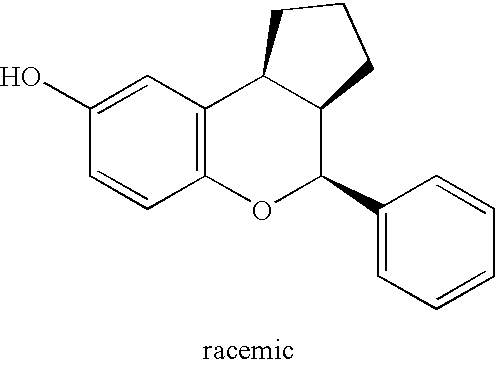
Heat a solution of Preparation 31 (0.14 g, 0.38 mmol), triethylsilane (2 mL), and TFA (1 mL) in dichloromethane (5 mL) to 60° C. for 18 hours. Cool to ambient temperature and quench with saturated sodium bicarbonate. Add ethyl acetate, wash with brine, dry organic layer, and concentrate in vacuo. Chromatograph with 95% dichloromethane/hexane to yield the title compound (0.10 g, 98%) as an off white solid. 1H NMR (CDCl3): 7.47 (d, J=2.4, 2H), 7.40-7.36 9m, 2H), 7.30-7.27 (m, 1H), 6.80 (d, J=8.6, 1H), 6.67 (d, J=3.1, 1H), 6.60 (dd, J=3.1, 8.6, 1H), 5.11 (d, J=1.0, 1H), 4.70 (s, 1H), 3.47-3.45 (m, 1H), 2.64-2.57 (m, 1H), 2.16-2.10 (m, 1H), 1.83-1.76 (m, 1H), 1.70-1.13 (m, 4H). MS calcd. 266.1; MS (M−1) 265.2.

Heat a solution of Preparation 32 (0.41 g, 1.05 mmol), triethylsilane (0.75 mL), and TFA (0.75 mL) in 1,2-dichloroethane (20 mL) to 60° C. for 18 hours. Cool to ambient temperature and quench with saturated potassium sodium tartrate aqueous. Add diethyl ether, wash with brine, dry organic layer, and concentrate in vacuo. Chromatograph on silica gel with 10% ethylacetate/0.4% triethylamine/hexane. The product containing band was evaporated and the residue slurried in hexanes with a little diethylether. The solids were filtered under vacuum and air dried to yield the title compound (0.072 g, 24%) as a solid. 1H NMR (DMSO-d6): 8.88 (s, 1H), 7.48 (dd, J=8.8, 6.0, 2H), 7.20 (dd, J=8.8, 8.8, 2H), 6.67 (d, J=8.6, 1H), 6.57 (d, J=2.8, 1H), 6.49 (dd, J=2.8, 8.6, 1H), 5.06 (s, 1H), 3.40 (m, 1H), 2.60 (m, 1H), 2.08 (m, 1H), 1.65 (m, 1H), 1.40 (m, 3H), 1.22 (m, 1H). MS calcd. 284.3; MS (M−1) 283.1.

To a solution of Preparation 33 (0.46 g, 1.10 mmol) in anhydrous methanol (15 mL) under nitrogen gas bubbling to purge of oxygen was added p-toluenesulfonic acid (0.17 g, 0.86 mmol). The bubbler was removed, and the resulting solution was heated to 50° C. for 18 hours under a nitrogen atmosphere. To the mixture at ambient temperature was added bromocreosol green (˜1 mg) and sodium cyanoborohydride (0.35 g, 5.50 mmol). Methanol saturated with HCl (gas) was added portionwise over time to maintain the yellow color. After no more spontaneous color change to blue was observed, the mixture was partitioned between diethylether and saturated potassium sodium tartrate aqueous. The organic layer was dried over anhydrous sodium sulfate, concentrated in vacuo, and flash chromatographed on silica gel with 3% diethylether/methylene chloride to give 0.17 g (52%) of the title compound. 1H NMR (DMSO-d6): 8.85 (s, 1H), 7.35 (d, J=8.0, 2H), 7.19 (d, J=8.0, 2H), 6.78 (d, J=8.4, 1H), 6.65 (d, J=2.4, 1H), 6.48 (dd, J=2.4, 8.4, 1H), 5.02 (s, 1H), 3.44 (m, 1H), 2.60 (q, J=7.2, 2H), 2.46 (m, 1H), 2.08 (m, 1H), 1.66 (m, 1H), 1.48-1.11 (m, 4H), 1.21 (t, J=7.2, 3H). MS calcd. 294.4; MS (M−1) 293.2 (M+1) 295.1.

Heat a solution of Preparation 34 (0.14 g, 0.38 mmol), triethylsilane (0.5 mL), and TFA (0.5 mL) in 1,2-dichloroethane (20 mL) to 60° C. for 5 hours. Cool to ambient temperature and quench with saturated potassium sodium tartrate aqueous. Add diethyl ether, wash with brine, dry organic layer, and concentrate in vacuo. Chromatograph on silica gel with 5% ethylacetate/hexane. The product containing band was evaporated and the residue slurried in hexanes. The solids were filtered under vacuum and air dried to yield the title compound (0.070 g, 55%) as a solid. 1H NMR (CDCl3): 7.62 (d, J=8.4, 2H), 7.56 (d, J=8.4, 2H), 6.79 (d, J=8.8, 1H), 6.66 (d, J=2.7, 1H), 6.59 (dd, J=2.7, 8.8, 1H), 5.13 (s, 1H), 4.43 (s, 1H), 3.48 (m, 1H), 2.61 (m, 1H), 2.13 (m, 1H), 1.78 (m, 1H), 1.723-1.62 (m, 3H), 1.28 (m, 1H). MS calcd. 334.3; MS (M−1) 333.0.

To a solution of Preparation 35 (0.34 g, 0.79 mmol) in anhydrous methanol (15 mL) under nitrogen gas bubbling to purge of oxygen was added p-toluenesulfonic acid (0.112 g, 0.59 mmol). The bubbler was removed, and the resulting solution was heated to 50° C. for 18 hours under a nitrogen atmosphere. To the mixture at ambient temperature was added bromocreosol green (˜1 mg) and sodium cyanoborohydride (0.25 g, 4.0 mmol). Methanol saturated with HCl (gas) was added portionwise over time to maintain the yellow color. After no more spontaneous color change to blue was observed, the mixture was partitioned between ethylacetate sodium bicarbonate aqueous. The organic layer was dried over anhydrous sodium sulfate, concentrated in vacuo, and flash chromatographed on silica gel with 5% diethylether/methylene chloride to give 0.14 g (63%) of the title compound. 1H NMR (CDCl3): 7.14 (t, J=8.6, 1H), 6.88 (s, 1H), 6.83 (d, J=8.6, 1H), 6.65 (d, J=8.8, 2H), 6.55 (d, J=2.8, 1H), 6.47 (dd, J=8.8, 2.8, 1H), 4.45 (s, 1H), 3.42 (m, 1H), 2.58 (m, 1H), 2.06 (m, 1H), 1.64 (m, 1H), 1.48-1.16 (m, 4H). MS calcd. 282.3; MS (M−1) 281.2. Fore and aft bands from normal phase chromatography were isolated and chromatographed on a C18 reverse phase column with acetonitrile/water (50:50) to give another 56 mg (78% total yield) after lyophilization of 541525.

To a solution of Preparation 36 (0.38 g, 0.99 mmol) in anhydrous methanol (15 mL) under nitrogen gas bubbling to purge of oxygen was added p-toluenesulfonic acid (0.14 g, 0.73 mmol). The bubbler was removed, and the resulting solution was heated to 50° C. for 18 hours under a nitrogen atmosphere. To the mixture at ambient temperature was added bromocreosol green (˜1 mg) and sodium cyanoborohydride (0.31 g, 5.0 mmol). Methanol saturated with HCl (gas) was added portionwise over time to maintain the yellow color. After no more spontaneous color change to blue was observed, the mixture was partitioned between ethylether and water. The organic layer was dried over anhydrous sodium sulfate, concentrated in vacuo, and flash chromatographed on silica gel with 5% ethylacetate/hexanes to give 0.20 g (72%) of the title compound. 1H NMR (CDCl3): 7.33 (d, J=7.2, 2H), 7.17 (d, J=7.2, 2H), 6.78 (d, J=8.8, 1H), 6.64 (s, 1H), 6.58 (d, J=8.4, 1H), 5.06 (s, 1H), 4.40 (s, 1H), 3.45 (m, 1H), 2.58 (m, 1H), 2.35 (s, 3H), 2.12 (m, 1H), 1.78 (m, 1H), 1.62 (m, 1H), 1.57-1.22 (m, 3H). Microanalysis calcd for C19H20-02: C, 81.40, H, 7.19; found C, 81.18, H 7.25.
ER Binding Assay
The competition ER binding assay was run in a buffer containing 50 mM N-[2-hydroxyethyl]piperazine-N′-[2-ethanesulfonic acid (Hepes) pH 7.5, 1.5 mM EDTA, 150 mM NaCl, 10% glycerol, 1 mg/mL ovalbumin, 5 mM DTT, 0.025 μCi per well of 3H-Estradiol(NEN #NET517 at 118 Ci/mmol, 1 mCi/mL), and 10 ng/well ERAlpha or ERbeta Receptor (PanVera). Competing compounds were added at 10 different concentrations. Non-specific binding was determined in the presence of 1 μM of E2 (17-β Estradiol, Sigma, St. Louis, Mo.). The binding reaction (140 μL) was incubated for 4 hours at room temperature, then 70 μL of cold dextran coated charcoal (DCC) buffer was added to each reaction (DCC buffer was prepared by adding 0.75 g of charcoal[Sigma] and 0.25 g of dextran [Pharmacia] per 50 mL of assay buffer). The incubation plates were mixed for 8 minutes on an orbital shaker at 4° C. and then centrifuged at 3,000 rpm for 10 minutes at 4° C. An aliquot of 120 μl of the mix was transferred to another 96-well, white flat bottom plate (Costar) and 175 μl of Wallac Optiphase Hisafe 3 scintillation fluid was added to each well. The plates were sealed and then shaken vigorously on an orbital shaker. After an incubation of 2.5 hrs, the radioactivity was counted in a Wallac Microbeta counter. The IC50 and percent inhibition at 10 μM were calculated. The Kd for 3H-Estradiol was determined by saturation binding to ERα and ERβ receptors. The IC50 values for compounds were converted to Ki values using the Cheng-Prusoff equation and the Kd values were determined by saturation binding assay. Compounds of Examples 1-6 are active in the assay as described. The compounds of Examples 1-6 bind to the ER beta receptor with a Ki of less than 100 nM. Preferred compounds bind to the ER beta receptor with a Ki of less than 50 nM. More preferred compounds bind to the ER beta receptor with a Ki of less than 20 nM. Compounds that are selective to binding to the ER beta receptor compared to the ER alpha receptor bind to the ER beta receptor with a lower Ki compared to the Ki for the ER alpha receptor. Preferred selective ER beta compounds bind to ER beta receptor with a Ki(ER alpha)/Ki(ER beta) ratio of greater than 4 as shown in Table 1.
| TABLE 1 |
| Ratio of Ki(nM)ER alpha/Ki(nM) ER beta |
| Ki(nM)ER alpha/ | |||
| Example | Ki(nM) ER beta | ||
| 1 | 5.5 | ||
| 2 | 5.0 | ||
| 3 | 2.6 | ||
| 4 | 6.9 | ||
| 5 | 3.5 | ||
| 6 | 12.6 | ||
LNCaP Human PCa Xenograft Assay
ERbeta agonist are evaluated for their effects on the growth of androgen-sensitive LNCaP human prostatic cancer (PCa) xenografts grown in intact sexually mature (5-6 weeks old) Hsd: Athymic Nude-nu (Athymic Nude) male mice. 2.0×10⁶ LNCaP tumor cells are injected bilaterally by the subcutaneous route into the pre-tracheal region of testicular intact male mice. Mice are castrated via the scrotal route to serve as the positive control group. Test compounds are administered once per day by subcutaneous or gavage administration at multiple dose levels in a volume of 0.2 ml to xenograft-bearing mice starting on the day following tumor injection. Test compounds are reformulated weekly based on average group mean body weights. The vehicle for these studies is 1% carboxymethyl cellulose (CMC) with 0.25% Tween 80. Body weights and tumor measurements are recorded on a weekly basis and entered directly into a JMP™ (SAS; Cary, N.C.) spreadsheet from electronic caliper measurement. Tumor volumes in mm3 are calculated in JMP using the following formula: L×W×H×0.5236. Tumor and body weight responses for individual mice are recorded on a weekly basis. When LNCaP tumor volumes enter log-phase expansion, lesions are measured every 3-4 days. Growth rates are determined using linear modeling of the log tumor values and time to treatment failure (tumor vol=1300-1500 mm3) are determined using a linear extrapolation model (SAS; Cary, N.C.). Because of humane animal use considerations, animals are sacrificed when their tumor volumes approach 1200-1400 mm3. At necropsy, final tumor measurement and body weights are recorded and whole blood is obtained via cardiac puncture and allowed to clot on ice. Serum is transferred to appropriately labeled 0.5 ml Eppendorf micro tubes, and samples are stored at −80° C. for biomarker analysis.
General Rat Preparation Procedure
Seventy-five day old (unless otherwise indicated) female Sprague Dawley rats (weight range of 200 to 225 g) are obtained from Charles River Laboratories (Portage, Mich.). The animals are either bilaterally ovariectomized (OVX) or exposed to a Sham surgical procedure at Charles River Laboratories, and then shipped after one week. Upon arrival, they are housed in metal hanging cages in groups of 3 or 4 per cage and have ad libitum access to food (calcium content approximately 0.5%) and water for one week. Room temperature is maintained at 22.2°±1.7° C. with a minimum relative humidity of 40%. The photoperiod in the room was 12 hours light and 12 hours dark.
Dosing Regimen Tissue Collection: After a one week acclimation period (therefore, two weeks post-OVX) daily dosing with a compound of formula (I) (“F-I”) is initiated. 17α-ethynyl estradiol or F-I is given orally, unless otherwise stated, as a suspension in 1% carboxymethylcellulose or dissolved in 20% cyclodextrin. Animals are dosed daily for 4 days. Following the dosing regimen, animals are weighed and anesthetized with a ketamine: Xylazine (2:1, v:v) mixture and a blood sample is collected by cardiac puncture. The animals are then sacrificed by asphyxiation with CO2, the uterus is removed through a midline incision, and a wet uterine weight is determined. 17α-ethynyl estradiol is obtained from Sigma Chemical Co., St. Louis, Mo.
Cardiovascular Disease/Hyperlipidemia
The blood samples from above are allowed to clot at room temperature for 2 hours, and serum is obtained following centrifugation for 10 minutes at 3000 rpm. Serum cholesterol is determined using a Boehringer Mannheim Diagnostics high performance cholesterol assay. Briefly the cholesterol is oxidized to cholest-4-en-3-one and hydrogen peroxide. The hydrogen peroxide is then reacted with phenol and 4-aminophenazone in the presence of peroxidase to produce a p-quinone imine dye, which is read spectrophotemetrically at 500 nm. Cholesterol concentration is then calculated against a standard curve. The entire assay is automated using a Biomek Automated Workstation.
Uterine Eosinophil Peroxidase (EPO) Assay
The uteri from above are kept at 4° C. until time of enzymatic analysis. The uteri are then homogenized in 50 volumes of 50 mM Tris buffer (pH 8.0) containing 0.005% Triton X-100. Upon addition of 0.01% hydrogen peroxide and 10 mM O-phenylenediamine (final concentrations) in Tris buffer, increase in absorbance is monitored for one minute at 450 nm. The presence of eosinophils in the uterus is an indication of estrogenic activity of a compound. The maximal velocity of a 15 second interval is determined over the initial, linear portion of the reaction curve.
Inhibition of Bone Loss (Osteoporosis) Test Procedure
Following the general preparation procedure described above, the rats are treated daily for thirty-five days (6 rats per treatment group) and sacrificed by carbon dioxide asphyxiation on the 36th day. The thirty-five day time period is sufficient to allow maximal reduction in bone density, measured as described herein. At the time of sacrifice, the uteri are removed, dissected free of extraneous tissue, and the fluid contents are expelled before determination of wet weight in order to confirm estrogen deficiency associated with complete ovariectomy. Uterine weight is routinely reduced about 75% in response to ovariectomy. The uteri are then placed in 10% neutral buffered formalin to allow for subsequent histological analysis.
The right femurs are excised and digitilized X-rays generated and analyzed by an image analysis program (NIH image) at the distal metaphysis. The proximal aspect of the tibiae from these animals are also scanned by quantitative computed tomography. In accordance with the above procedures, F-I or ethynyl estradiol (EE2) in 20% hydroxypropyl β-cyclodextrin are orally administered to test animals.
Therapeutic Methods of Use and Dosages
Various diseases and conditions described to be treated herein, are well known and appreciated by those skilled in the art. It is also recognized that one skilled in the art may affect the associated diseases and conditions by treating a patient presently afflicted with the diseases or conditions or by prophylactically treating a patient afflicted with the diseases or conditions with a therapeutically effective amount of the compounds of formula (I).
As used herein, the term “patient” refers to a warm blooded animal such as a mammal that is afflicted with a particular inflammatory disease state. It is understood that guinea pigs, dogs, cats, rats, mice, horses, cattle, sheep, and humans are examples of animals within the scope of the meaning of the term.
As used herein, the term “therapeutically effective amount” of a compound of formula (I) refers to an amount which is effective in controlling diseases and conditions associated with estrogen receptor-beta mediated diseases such as prostate cancer, benign prostatic hyperplasia, testicular cancer, cardiovascular diseases, neurodegenerative disorders, urinary incontinence, CNS conditions, GI tract conditions, and osteoporosis. The term “controlling” is intended to refer to all processes wherein there may be a slowing, interrupting, arresting, or stopping of the progression of the diseases and conditions described herein, but does not necessarily indicate a total elimination of all disease and condition symptoms, but does include prophylactic treatment of the diseases and conditions associated with estrogen receptor-beta mediated diseases such as prostate cancer, benign prostatic hyperplasia, testicular cancer, cardiovascular diseases, neurodegenerative disorders, urinary incontinence, CNS, GI tract conditions, and osteoporosis.
A therapeutically effective amount can be readily determined by the attending diagnostician, as one skilled in the art, by the use of conventional techniques and by observing results obtained under analogous circumstances. In determining the therapeutically effective amount, the dose, a number of factors are considered by the attending diagnostician, including, but not limited to: the species of mammal; its size, age, and general health; the specific disease involved; the degree of or involvement or the severity of the disease; the response of the individual patient; the particular compound administered; the mode of administration; the bioavailability characteristic of the preparation administered; the dose regimen selected; the use of concomitant medication; and other relevant circumstances.
A therapeutically effective amount of a compound of formula (I) is expected to vary from about 0.001 milligram per kilogram of body weight per day (mg/kg/day) to about 100 mg/kg/day. Preferred amounts can be determined by one skilled in the art.
In effecting treatment of a patient afflicted with the diseases and conditions described above, a compound of formula (I) can be administered in any form or mode which makes the compound bioavailable in a therapcutically effective amount, including oral, inhalation, and parenteral routes. For example, compounds of formula (I) can be administered orally, by inhalation of an aerosol or dry powder, subcutaneously, intramuscularly, intravenously, transderrnally, intranasally, rectally, topically, and the like. Oral or inhalation administration is generally preferred for treatment of respiratory diseases, e.g. asthma. One skilled in the art of preparing formulations can readily select the proper form and mode of administration depending upon the particular characteristics of the compound selected, the disease or condition state to be treated, the stage of the disease or condition, and other relevant circumstances. (Remington's Pharmaceutical Sciences, 18th Edition, Mack Publishing Co. (1990)).
The compounds of the present invention can be administered alone or in the form of a pharmaceutical composition in combination with pharmaceutically acceptable carriers or excipients, the proportion and nature of which are determined by the solubility and chemical properties of the compound selected, the chosen route of administration, and standard pharmaceutical practice. The compounds of the present invention, while effective themselves, may be formulated and administered in the form of their pharmaceutically acceptable salts, such as acid addition salts or base addition salts, for purposes of stability, convenience of crystallization, increased solubility and the like.
In another embodiment, the present invention provides pharmaceutical compositions comprising a therapeutically effective amount of a compound of formula (I) in admixture or otherwise in association with one or more pharmaceutically acceptable carriers or excipients.
The pharmaceutical compositions are prepared in a manner well known in the pharmaceutical art. The carrier or excipient may be a solid, semi-solid, or liquid material, which can serve as a vehicle or medium for the active ingredient. Suitable carriers or excipients are well known in the art. The pharmaceutical composition may be adapted for oral, inhalation, parenteral, or topical use and may be administered to the patient in the form of tablets, capsules, aerosols, inhalants, suppositories, solution, suspensions, or the like.
The compounds of the present invention may be administered orally, for example, with an inert diluent or with an edible carrier. They may be enclosed in gelatin capsules or compressed into tablets. For the purpose of oral therapeutic administration, the compounds may be incorporated with excipients and used in the form of tablets, troches, capsules, elixirs, suspensions, syrups, wafers, chewing gums and the like. These preparations should contain at least 4% of the compound of the present invention, the active ingredient, but may be varied depending upon the particular form and may conveniently be between 4% to about 70% of the weight of the unit. The amount of the compound present in compositions is such that a suitable dosage will be obtained. Preferred compositions and preparations according to the present invention may be determined by someone skilled in the art.
The tablets, pills, capsules, troches and the like may also contain one or more of the following adjuvants: binders such as microcrystalline cellulose, gum tragacanth or gelatin; excipients such as starch or lactose, disintegrating agents such as alginic acid, Primogel, corn starch and the like; lubricants such as magnesium stearate or Sterotex; glidants such as colloidal silicon dioxide; and sweetening agents such as sucrose or saccharin may be added or a flavoring agent such as peppermint, methyl salicylate or orange flavoring. When the dosage unit form is a capsule, it may contain, in addition to materials of the above type, a liquid carrier such as polyethylene glycol or a fatty oil. Other dosage unit forms may contain other various materials that modify the physical form of the dosage unit, for example, as coatings. Thus, tablets or pills may be coated with sugar, shellac, or other enteric coating agents. A syrup may contain, in addition to the present compounds, sucrose as a sweetening agent and certain preservatives, dyes and colorings and flavors. Materials used in preparing these various compositions should be pharmaceutically pure and non-toxic in the amounts used.
For the purpose of parenteral therapeutic administration, the compounds of the present invention may be incorporated into a solution or suspension. These preparations should contain at least 0.1% of a compound of the invention, but may be varied to be between 0.1 and about 50% of the weight thereof. The amount of the compound of formula (I) present in such compositions is such that a suitable dosage will be obtained. Preferred compositions and preparations are able to be determined by one skilled in the art.
The compounds of the present invention may also be administered by inhalation, such as by aerosol or dry powder. Delivery may be by a liquefied or compressed gas or by a suitable pump system that dispenses the compounds of the present invention or a formulation thereof. Formulations for administration by inhalation of compounds of formula (I) may be delivered in single phase, bi-phasic, or tri-phasic systems. A variety of systems are available for the administration by aerosols of the compounds of formula (I). Dry powder formulations are prepared by either pelletizing or milling the compound of formula (I) to a suitable particle size or by admixing the pelletized or milled compound of formula (I) with a suitable carrier material, such as lactose and the like. Delivery by inhalation includes the necessary container, activators, valves, subcontainers, and the like. Preferred aerosols and dry powder formulations for administration by inhalation are able to be determined by one skilled in the art.
The compounds of the present invention may also be administered topically, and when done so the carrier may suitably comprise a solution, ointment or gel base. The base, for example, may comprise one or more of the following: petrolatum, lanolin, polyethylene glycols, bee wax, mineral oil, diluents such as water and alcohol, and emulsifiers and stabilizers. Topical formulations may contain a concentration of the formula (I) or its pharmaceutical salt from about 0.1 to about 10% w/v (weight per unit volume).
The solutions or suspensions may also include one or more of the following adjuvants: sterile diluents such as water for injection, saline solution, fixed oils, polyethylene glycols, glycerin, propylene glycol or other synthetic solvents; antibacterial agents such as benzyl alcohol or methyl paraben; antioxidants such as ascorbic acid or sodium bisulfite; chelating agents such as ethylene diaminetetraacetic acid; buffers such as acetates, citrates or phosphates and agents for the adjustment of tonicity such as sodium chloride or dextrose. The parenteral preparation can be enclosed in ampules, disposable syringes or multiple dose vials made of glass or plastic.
Claims (13)
1. A compound of according to the formula: 
or a pharmaceutically acceptable salt or enantiomer thereof.
2. A compound according to the formula: 
or a pharmaceutically acceptable salt or enantiomer thereof.
3. A compound according to the formula: 
or a pharmaceutically acceptable salt or enantiomer thereof.
4. A compound according to the formula: 
or a pharmaceutically acceptable salt or enantiomer thereof.
5. A compound according to the formula: 
or a pharmaceutically acceptable salt or enantiomer thereof.
6. A compound according to the formula: 
or a pharmaceutically acceptable salt or enantiomer thereof.
7. A compound selected from the group consisting of:
a) (±)-2-phenyl-6-hydroxy-cyclopentyl[c]3,4-dihydro-2H-1-benzopyran,
b) (±)-2-(4-fluorophenyl)-6-hydroxy-cyclopentyl[c]3,4-dihydro-2H-1-benzopyran,
c) (±)-2-(4-ethylphenyl)-6-hydroxy-cyclopentyl[c]3,4-dihydro-2H-1-benzopyran,
d) (±)-2-(4-trifluoromethylphenyl)-6-hydroxy-cyclopentyl[c]3,4-dihydro-2H-1-benzopyran,
e) (±)-2-(3-hydroxyphenyl)-6-hydroxy-cyclopentyl[c]3,4-dihydro-2H-1-benzopyran,
f) (±)-2-(4-methylphenyl)-6-hydroxy-cyclopentyl[c]3,4-dihydro-2H-1-benzopyran.
8. A pharmaceutical composition comprising a compound according to claim 7 and a pharmaceutically acceptable carrier.
9. A method of selectively binding to estrogen receptor beta in a patient in need thereof comprising administering to said patient a therapeutically effective amount of a compound according to claim 7 .
10. A method of treating a patient afflicted with an estrogen receptor beta mediated disease condition comprising administering to said patient a therapeutically effective amount of a compound according to claim 7 .
11. A method of treating prostate cancer in a patient in need thereof comprising administering to said patient a therapeutically effective amount of a compound according to claim 7 .
12. A method according to claim 10 wherein said patient is a human.
13. A method according to claim 11 wherein said patient is a human.
Priority Applications (1)
| Application Number | Priority Date | Filing Date | Title |
|---|---|---|---|
| US10/349,521 US6630508B1 (en) | 2002-02-11 | 2003-01-22 | Substituted benzopyrans as selective estrogen receptor β agonists |
Applications Claiming Priority (2)
| Application Number | Priority Date | Filing Date | Title |
|---|---|---|---|
| US35589102P | 2002-02-11 | 2002-02-11 | |
| US10/349,521 US6630508B1 (en) | 2002-02-11 | 2003-01-22 | Substituted benzopyrans as selective estrogen receptor β agonists |
Publications (1)
| Publication Number | Publication Date |
|---|---|
| US6630508B1 true US6630508B1 (en) | 2003-10-07 |
Family
ID=28678137
Family Applications (1)
| Application Number | Title | Priority Date | Filing Date |
|---|---|---|---|
| US10/349,521 Expired - Lifetime US6630508B1 (en) | 2002-02-11 | 2003-01-22 | Substituted benzopyrans as selective estrogen receptor β agonists |
Country Status (1)
| Country | Link |
|---|---|
| US (1) | US6630508B1 (en) |
Cited By (8)
| Publication number | Priority date | Publication date | Assignee | Title |
|---|---|---|---|---|
| US20040249167A1 (en) * | 2001-11-19 | 2004-12-09 | Dodge Jeffrey Alan | Substituted benzopyrans as selective estrogen receptor-beta agonists |
| WO2004094400A3 (en) * | 2003-04-21 | 2005-02-24 | Lilly Co Eli | Substituted benzopyrans as selective estrogen receptor-beta agonists |
| WO2006044176A1 (en) * | 2004-10-18 | 2006-04-27 | Eli Lilly And Company | Substituted benzopyrans as selective estrogen receptor-beta agonists |
| US7279499B2 (en) | 2003-04-21 | 2007-10-09 | Eli Lilly And Company | Substituted benzopyrans as selective estrogen receptor-beta agonists |
| US20100249075A1 (en) * | 2005-02-15 | 2010-09-30 | Eli Lilly And Company | Substituted tetralins as selective estrogen receptor-beta agonists |
| US20100267767A1 (en) * | 2007-01-22 | 2010-10-21 | Ramesh Narayanan | Nuclear receptor binding agents |
| US9078888B2 (en) | 2007-01-22 | 2015-07-14 | Gtx, Inc. | Nuclear receptor binding agents |
| US9604931B2 (en) | 2007-01-22 | 2017-03-28 | Gtx, Inc. | Nuclear receptor binding agents |
Citations (2)
| Publication number | Priority date | Publication date | Assignee | Title |
|---|---|---|---|---|
| WO1999002512A1 (en) | 1997-07-09 | 1999-01-21 | Novo Nordisk A/S | Dl-2,3-diaryl-2h-1-benzopyrans |
| WO2001064665A1 (en) | 2000-03-01 | 2001-09-07 | Akzo Nobel N.V. | Chroman derivatives as estrogenic compounds |
-
2003
- 2003-01-22 US US10/349,521 patent/US6630508B1/en not_active Expired - Lifetime
Patent Citations (2)
| Publication number | Priority date | Publication date | Assignee | Title |
|---|---|---|---|---|
| WO1999002512A1 (en) | 1997-07-09 | 1999-01-21 | Novo Nordisk A/S | Dl-2,3-diaryl-2h-1-benzopyrans |
| WO2001064665A1 (en) | 2000-03-01 | 2001-09-07 | Akzo Nobel N.V. | Chroman derivatives as estrogenic compounds |
Non-Patent Citations (3)
| Title |
|---|
| B. A. M. Oude-Alink, et al.: "Photolysis of 2-keto-2,3-dihydrobenzofurans, o-hydroxyphenyl)-1,5-hexadienes"; Journal of Organic Chemistry, vol. 38, No. 11, 1973, pp. 1993-2001. |
| K. W. Anderson, et al.: "Synthesis of 6,9-bisnormethyl-8-methoxy-12, 13-epoxy-6,8,10-trichothecatrine"; Journal of Organic Chemistry, vol. 42, No. 6, 1977, pp. 1045-1050. |
| Kedar Shanker Shrestha, et al.: "Facile Synthesis of the Fused 6,6,5 Ring System Containing Chroman Ring From 2-(1-Hydroxy-5-alkenyl)pheno Derivitatives via Intramolecular Inverse-Electron-Demand Diels-Alder Reaction"; Bull. Chem. Soc. Japan, vol. 72, No. 1, 1999, pp. 73-83. |
Cited By (17)
| Publication number | Priority date | Publication date | Assignee | Title |
|---|---|---|---|---|
| US7217734B2 (en) | 2001-11-19 | 2007-05-15 | Eli Lilly And Company | Substituted benzopyrans as selective estrogen receptor-beta agonists |
| US20040249167A1 (en) * | 2001-11-19 | 2004-12-09 | Dodge Jeffrey Alan | Substituted benzopyrans as selective estrogen receptor-beta agonists |
| US20080312312A1 (en) * | 2003-04-21 | 2008-12-18 | Gregory Lee Durst | Substituted benzopyrans as selective estrogen receptor-beta agonists |
| US7842822B2 (en) | 2003-04-21 | 2010-11-30 | Eli Lilly And Company | Substituted benzopyrans as selective estrogen receptor-beta agonists |
| US20070106082A1 (en) * | 2003-04-21 | 2007-05-10 | Durst Gregory L | Substituted benzopyrans as selective estrogen receptor-beta agonists |
| US7279499B2 (en) | 2003-04-21 | 2007-10-09 | Eli Lilly And Company | Substituted benzopyrans as selective estrogen receptor-beta agonists |
| US7585985B2 (en) | 2003-04-21 | 2009-09-08 | Eli Lilly And Company | Substituted benzopyrans as selective estrogen receptor-beta agonists |
| US7442812B2 (en) * | 2003-04-21 | 2008-10-28 | Eli Lilly And Company | Substituted benzopyrans as selective estrogen receptor-beta agonists |
| WO2004094400A3 (en) * | 2003-04-21 | 2005-02-24 | Lilly Co Eli | Substituted benzopyrans as selective estrogen receptor-beta agonists |
| US7354951B2 (en) | 2004-10-18 | 2008-04-08 | Eli Lilly And Company | Substituted benzopyrans as selective estrogen receptor-beta agonists |
| WO2006044176A1 (en) * | 2004-10-18 | 2006-04-27 | Eli Lilly And Company | Substituted benzopyrans as selective estrogen receptor-beta agonists |
| US20100249075A1 (en) * | 2005-02-15 | 2010-09-30 | Eli Lilly And Company | Substituted tetralins as selective estrogen receptor-beta agonists |
| US8093302B2 (en) | 2005-02-15 | 2012-01-10 | Eli Lilly And Company | Substituted tetralins as selective estrogen receptor-β agonists |
| US20100267767A1 (en) * | 2007-01-22 | 2010-10-21 | Ramesh Narayanan | Nuclear receptor binding agents |
| US9078888B2 (en) | 2007-01-22 | 2015-07-14 | Gtx, Inc. | Nuclear receptor binding agents |
| US9604931B2 (en) | 2007-01-22 | 2017-03-28 | Gtx, Inc. | Nuclear receptor binding agents |
| US9623021B2 (en) | 2007-01-22 | 2017-04-18 | Gtx, Inc. | Nuclear receptor binding agents |
Similar Documents
| Publication | Publication Date | Title |
|---|---|---|
| EP1618102B1 (en) | Substituted benzopyrans as selective estrogen receptor-beta agonists | |
| IL185867A (en) | Substituted benzopyrans as selective estrogen receptor-beta agonists | |
| US7842822B2 (en) | Substituted benzopyrans as selective estrogen receptor-beta agonists | |
| US6630508B1 (en) | Substituted benzopyrans as selective estrogen receptor β agonists | |
| EP1805160B1 (en) | Substituted benzopyrans as selective estrogen receptor-beta agonists | |
| WO2003074044A1 (en) | Substituted benzopyrans as selective estrogen receptor-beta agonists | |
| WO2004031125A1 (en) | Spiro compounds, medicinal compositions containing the same and intermediates of the compounds | |
| EP1790644A1 (en) | Substituted benzopyrans as selective estrogen receptor-beta agonists | |
| HK1068349B (en) | Substituted benzopyrans as selective estrogen receptor-beta agonists |
Legal Events
| Date | Code | Title | Description |
|---|---|---|---|
| STCF | Information on status: patent grant |
Free format text: PATENTED CASE |
|
| FPAY | Fee payment |
Year of fee payment: 4 |
|
| FPAY | Fee payment |
Year of fee payment: 8 |
|
| FPAY | Fee payment |
Year of fee payment: 12 |