US6624159B2 - Heterocycle carboxamides as antiviral agents - Google Patents
Heterocycle carboxamides as antiviral agents Download PDFInfo
- Publication number
- US6624159B2 US6624159B2 US09/887,578 US88757801A US6624159B2 US 6624159 B2 US6624159 B2 US 6624159B2 US 88757801 A US88757801 A US 88757801A US 6624159 B2 US6624159 B2 US 6624159B2
- Authority
- US
- United States
- Prior art keywords
- chlorobenzyl
- carboxamide
- oxo
- dihydro
- quinoline
- Prior art date
- Legal status (The legal status is an assumption and is not a legal conclusion. Google has not performed a legal analysis and makes no representation as to the accuracy of the status listed.)
- Expired - Fee Related
Links
- -1 Heterocycle carboxamides Chemical class 0.000 title claims description 93
- 239000003443 antiviral agent Substances 0.000 title abstract description 5
- 150000001875 compounds Chemical class 0.000 claims abstract description 199
- IJGRMHOSHXDMSA-UHFFFAOYSA-N nitrogen Substances N#N IJGRMHOSHXDMSA-UHFFFAOYSA-N 0.000 claims description 61
- YNAVUWVOSKDBBP-UHFFFAOYSA-N Morpholine Chemical compound C1COCCN1 YNAVUWVOSKDBBP-UHFFFAOYSA-N 0.000 claims description 46
- 125000000623 heterocyclic group Chemical group 0.000 claims description 39
- 125000003118 aryl group Chemical group 0.000 claims description 35
- 125000000217 alkyl group Chemical group 0.000 claims description 32
- 229910052757 nitrogen Inorganic materials 0.000 claims description 32
- 238000000034 method Methods 0.000 claims description 30
- 125000001424 substituent group Chemical group 0.000 claims description 26
- 150000003839 salts Chemical class 0.000 claims description 22
- 229910052739 hydrogen Inorganic materials 0.000 claims description 20
- 125000005843 halogen group Chemical group 0.000 claims description 19
- 239000001257 hydrogen Substances 0.000 claims description 19
- QOXOZONBQWIKDA-UHFFFAOYSA-N 3-hydroxypropyl Chemical group [CH2]CCO QOXOZONBQWIKDA-UHFFFAOYSA-N 0.000 claims description 18
- 229910052736 halogen Inorganic materials 0.000 claims description 18
- 150000002367 halogens Chemical class 0.000 claims description 18
- 125000006552 (C3-C8) cycloalkyl group Chemical group 0.000 claims description 13
- 241000701024 Human betaherpesvirus 5 Species 0.000 claims description 13
- 125000004435 hydrogen atom Chemical group [H]* 0.000 claims description 12
- 125000004178 (C1-C4) alkyl group Chemical group 0.000 claims description 11
- 241000282414 Homo sapiens Species 0.000 claims description 10
- 229920006395 saturated elastomer Polymers 0.000 claims description 10
- 229910052799 carbon Inorganic materials 0.000 claims description 9
- 229910052760 oxygen Inorganic materials 0.000 claims description 9
- 241000124008 Mammalia Species 0.000 claims description 8
- 241001465754 Metazoa Species 0.000 claims description 8
- NIQVOYNYTBUQGC-UHFFFAOYSA-N ac1mhsz5 Chemical compound C1=CC(Cl)=CC=C1CNC(=O)C(C1=O)=CN2C3=C1C=C(CN1CCOCC1)C=C3NC(=O)C2 NIQVOYNYTBUQGC-UHFFFAOYSA-N 0.000 claims description 8
- QVGXLLKOCUKJST-UHFFFAOYSA-N atomic oxygen Chemical group [O] QVGXLLKOCUKJST-UHFFFAOYSA-N 0.000 claims description 8
- 239000001301 oxygen Substances 0.000 claims description 8
- 241001529453 unidentified herpesvirus Species 0.000 claims description 8
- 241000701085 Human alphaherpesvirus 3 Species 0.000 claims description 7
- 125000001997 phenyl group Chemical group [H]C1=C([H])C([H])=C(*)C([H])=C1[H] 0.000 claims description 7
- UUFBZDXJXUYUDL-UHFFFAOYSA-N 2-(benzylamino)-n-(4-chlorobenzyl)-9-(4-morpholinylmethyl)-7-oxo-3h,7h-pyrido-[1,2,3-de]quinoxaline-6-carboxamide Chemical compound C1=CC(Cl)=CC=C1CNC(=O)C(C1=O)=CN2C3=C1C=C(CN1CCOCC1)C=C3N=C(NCC=1C=CC=CC=1)C2 UUFBZDXJXUYUDL-UHFFFAOYSA-N 0.000 claims description 6
- 241000701044 Human gammaherpesvirus 4 Species 0.000 claims description 6
- UFHFLCQGNIYNRP-UHFFFAOYSA-N Hydrogen Chemical compound [H][H] UFHFLCQGNIYNRP-UHFFFAOYSA-N 0.000 claims description 6
- DTKRHHJSTZMMKL-UHFFFAOYSA-N N-[(4-chlorophenyl)methyl]-7-(morpholin-4-ylmethyl)-4-oxo-10-oxa-1-azatricyclo[7.4.1.05,14]tetradeca-2,5(14),6,8-tetraene-3-carboxamide Chemical compound C1=CC(Cl)=CC=C1CNC(=O)C(C1=O)=CN2C3=C1C=C(CN1CCOCC1)C=C3OCCC2 DTKRHHJSTZMMKL-UHFFFAOYSA-N 0.000 claims description 6
- 229910052794 bromium Inorganic materials 0.000 claims description 6
- 125000004093 cyano group Chemical group *C#N 0.000 claims description 6
- NLEATIPPRIRDBC-UHFFFAOYSA-N n-[(4-chlorophenyl)methyl]-1,2,3,4-tetrahydro-10-(4-morpholinylmethyl)-2,8-dioxo-8h-[1,4]diazepino[3,2,1-ij]quinoline-7-carboxamide Chemical compound C1=CC(Cl)=CC=C1CNC(=O)C(C1=O)=CN2C3=C1C=C(CN1CCOCC1)C=C3NC(=O)CC2 NLEATIPPRIRDBC-UHFFFAOYSA-N 0.000 claims description 6
- CSTGKWPPCXHRMU-UHFFFAOYSA-N n-[(4-chlorophenyl)methyl]-1,2-dihydro-2-(hydroxymethyl)-8-(3-hydroxy-1-propynyl)-6-oxo-6h-pyrrolo[3,2,1-ij]quinoline-5-carboxamide Chemical compound O=C1C(C=23)=CC(C#CCO)=CC=2CC(CO)N3C=C1C(=O)NCC1=CC=C(Cl)C=C1 CSTGKWPPCXHRMU-UHFFFAOYSA-N 0.000 claims description 6
- CYXOUDVMUFCOJP-UHFFFAOYSA-N n-[(4-chlorophenyl)methyl]-2,3-dihydro-9-(3-hydroxy-1-propynyl)-1-methyl-2,7-dioxo-1h,7h-pyrido[1,2,3-de]quinoxaline-6-carboxamide Chemical compound O=C1C(C2=3)=CC(C#CCO)=CC=3N(C)C(=O)CN2C=C1C(=O)NCC1=CC=C(Cl)C=C1 CYXOUDVMUFCOJP-UHFFFAOYSA-N 0.000 claims description 6
- 229910052717 sulfur Inorganic materials 0.000 claims description 6
- VQWYZFADGYCMDI-UHFFFAOYSA-N 2-benzyl-n-(4-chlorobenzyl)-10-(4-morpholinylmethyl)-3,8-dioxo-1,2,3,4-tetrahydro-8h-[1,4]diazepino[6,7,1-ij]quinoline-7-carboxamide Chemical compound C1=CC(Cl)=CC=C1CNC(=O)C(C1=O)=CN2C3=C1C=C(CN1CCOCC1)C=C3CN(CC=1C=CC=CC=1)C(=O)C2 VQWYZFADGYCMDI-UHFFFAOYSA-N 0.000 claims description 5
- 241000700588 Human alphaherpesvirus 1 Species 0.000 claims description 5
- NINIDFKCEFEMDL-UHFFFAOYSA-N Sulfur Chemical group [S] NINIDFKCEFEMDL-UHFFFAOYSA-N 0.000 claims description 5
- 150000001721 carbon Chemical group 0.000 claims description 5
- 125000001072 heteroaryl group Chemical group 0.000 claims description 5
- 230000002401 inhibitory effect Effects 0.000 claims description 5
- 125000002757 morpholinyl group Chemical group 0.000 claims description 5
- DDVQYZSYLYMIQF-UHFFFAOYSA-N n-[(4-chlorophenyl)methyl]-1,2-dihydro-8-(3-hydroxy-1-propynyl)-2,2-dimethyl-6-oxo-6h-pyrrolo[3,2,1-ij]quinoline-5-carboxamide Chemical compound CC1(C)CC2=CC(C#CCO)=CC(C3=O)=C2N1C=C3C(=O)NCC1=CC=C(Cl)C=C1 DDVQYZSYLYMIQF-UHFFFAOYSA-N 0.000 claims description 5
- NRCUYJGQTVXZKV-UHFFFAOYSA-N n-[(4-chlorophenyl)methyl]-1,2-dihydro-8-(4-morpholinylmethyl)-2,6-dioxo-6h-imidazo[4,5,1-ij]quinoline-5-carboxamide Chemical compound C1=CC(Cl)=CC=C1CNC(=O)C(C1=O)=CN2C(=O)NC3=C2C1=CC(CN1CCOCC1)=C3 NRCUYJGQTVXZKV-UHFFFAOYSA-N 0.000 claims description 5
- FOCJLKXBDDPVPK-UHFFFAOYSA-N n-[(4-chlorophenyl)methyl]-2,3-dihydro-5-(3-hydroxy-1-propynyl)-1-methyl-7-oxo-1h,7h-pyrido[3,2,1-ij]cinnoline-8-carboxamide Chemical compound CN1CCC2=CC(C#CCO)=CC(C3=O)=C2N1C=C3C(=O)NCC1=CC=C(Cl)C=C1 FOCJLKXBDDPVPK-UHFFFAOYSA-N 0.000 claims description 5
- ITLOFQRDAJTDAT-UHFFFAOYSA-N n-[(4-chlorophenyl)methyl]-2,3-dihydro-9-(3-hydroxy-1-propynyl)-3-methyl-7-oxo-7h-1,3,4-oxadiazino[6,5,4-ij]quinoline-6-carboxamide Chemical compound CN1COC2=CC(C#CCO)=CC(C3=O)=C2N1C=C3C(=O)NCC1=CC=C(Cl)C=C1 ITLOFQRDAJTDAT-UHFFFAOYSA-N 0.000 claims description 5
- VWUCANKYTQFGLX-UHFFFAOYSA-N n-[(4-chlorophenyl)methyl]-2,3-dihydro-9-(4-morpholinylmethyl)-3,7-dioxo-2-(phenylmethyl)-1h,7h-pyrido[3,2,1-ij]quinazoline-6-carboxamide Chemical compound C1=CC(Cl)=CC=C1CNC(=O)C(C1=O)=CN2C3=C1C=C(CN1CCOCC1)C=C3CN(CC=1C=CC=CC=1)C2=O VWUCANKYTQFGLX-UHFFFAOYSA-N 0.000 claims description 5
- XWDJUGNBSJCWPP-UHFFFAOYSA-N n-[(4-chlorophenyl)methyl]-2,3-dihydro-9-(4-morpholinylmethyl)-7-oxo-2-(phenylmethyl)-1h,7h-pyrido[3,2,1-ij]quinazoline-6-carboxamide Chemical compound C1=CC(Cl)=CC=C1CNC(=O)C(C1=O)=CN2C3=C1C=C(CN1CCOCC1)C=C3CN(CC=1C=CC=CC=1)C2 XWDJUGNBSJCWPP-UHFFFAOYSA-N 0.000 claims description 5
- WDSBNGVNLOQOGO-UHFFFAOYSA-N n-[(4-chlorophenyl)methyl]-2-[[(4-chlorophenyl)methyl]amino]-9-(4-morpholinylmethyl)-7-oxo-3h,7h-pyrido[1,2,3-de]quinoxaline-6-carboxamide Chemical compound C1=CC(Cl)=CC=C1CNC(=O)C(C1=O)=CN2C3=C1C=C(CN1CCOCC1)C=C3N=C(NCC=1C=CC(Cl)=CC=1)C2 WDSBNGVNLOQOGO-UHFFFAOYSA-N 0.000 claims description 5
- 125000000449 nitro group Chemical group [O-][N+](*)=O 0.000 claims description 5
- 239000008194 pharmaceutical composition Substances 0.000 claims description 5
- 239000011593 sulfur Chemical group 0.000 claims description 5
- 125000004191 (C1-C6) alkoxy group Chemical group 0.000 claims description 4
- 125000004169 (C1-C6) alkyl group Chemical group 0.000 claims description 4
- OKTJSMMVPCPJKN-UHFFFAOYSA-N Carbon Chemical group [C] OKTJSMMVPCPJKN-UHFFFAOYSA-N 0.000 claims description 4
- 241000701074 Human alphaherpesvirus 2 Species 0.000 claims description 4
- 229910052801 chlorine Inorganic materials 0.000 claims description 4
- 229910052731 fluorine Inorganic materials 0.000 claims description 4
- 125000005842 heteroatom Chemical group 0.000 claims description 4
- QJGQUHMNIGDVPM-UHFFFAOYSA-N nitrogen group Chemical group [N] QJGQUHMNIGDVPM-UHFFFAOYSA-N 0.000 claims description 4
- 125000002023 trifluoromethyl group Chemical group FC(F)(F)* 0.000 claims description 4
- 102000016928 DNA-directed DNA polymerase Human genes 0.000 claims description 3
- 208000029433 Herpesviridae infectious disease Diseases 0.000 claims description 3
- 108020005202 Viral DNA Proteins 0.000 claims description 3
- CIUQDSCDWFSTQR-UHFFFAOYSA-N [C]1=CC=CC=C1 Chemical compound [C]1=CC=CC=C1 CIUQDSCDWFSTQR-UHFFFAOYSA-N 0.000 claims description 3
- 125000002618 bicyclic heterocycle group Chemical group 0.000 claims description 3
- 230000037396 body weight Effects 0.000 claims description 3
- 238000000338 in vitro Methods 0.000 claims description 3
- 238000001727 in vivo Methods 0.000 claims description 3
- 208000015181 infectious disease Diseases 0.000 claims description 3
- 125000000229 (C1-C4)alkoxy group Chemical group 0.000 claims description 2
- BELHVDMEZDJLDR-UHFFFAOYSA-N 2-benzyl-N-[(4-chlorophenyl)methyl]-4-methyl-7-(morpholin-4-ylmethyl)-10-oxo-1,2,4-triazatricyclo[7.3.1.05,13]trideca-5,7,9(13),11-tetraene-11-carboxamide Chemical compound C=12N3C=C(C(=O)NCC=4C=CC(Cl)=CC=4)C(=O)C2=CC(CN2CCOCC2)=CC=1N(C)CN3CC1=CC=CC=C1 BELHVDMEZDJLDR-UHFFFAOYSA-N 0.000 claims description 2
- WYWNCWDMKRAIOX-UHFFFAOYSA-N 2-benzyl-N-[(4-chlorophenyl)methyl]-4-methyl-7-(oxan-4-ylmethyl)-10-oxo-1,2,4-triazatricyclo[7.3.1.05,13]trideca-5,7,9(13),11-tetraene-11-carboxamide Chemical compound C=12N3C=C(C(=O)NCC=4C=CC(Cl)=CC=4)C(=O)C2=CC(CC2CCOCC2)=CC=1N(C)CN3CC1=CC=CC=C1 WYWNCWDMKRAIOX-UHFFFAOYSA-N 0.000 claims description 2
- WSCTZQUTDFIUHF-UHFFFAOYSA-N 2-benzyl-N-[(4-chlorophenyl)methyl]-7-(3-hydroxyprop-1-ynyl)-3,10-dioxo-1,2-diazatricyclo[7.3.1.05,13]trideca-5(13),6,8,11-tetraene-11-carboxamide Chemical compound C1=2N3C=C(C(=O)NCC=4C=CC(Cl)=CC=4)C(=O)C1=CC(C#CCO)=CC=2CC(=O)N3CC1=CC=CC=C1 WSCTZQUTDFIUHF-UHFFFAOYSA-N 0.000 claims description 2
- HFZHJIKPWNCUGC-UHFFFAOYSA-N 2-benzyl-N-[(4-chlorophenyl)methyl]-7-(3-hydroxyprop-1-ynyl)-4-methyl-10-oxo-1,2,4-triazatricyclo[7.3.1.05,13]trideca-5,7,9(13),11-tetraene-11-carboxamide Chemical compound C=12N3C=C(C(=O)NCC=4C=CC(Cl)=CC=4)C(=O)C2=CC(C#CCO)=CC=1N(C)CN3CC1=CC=CC=C1 HFZHJIKPWNCUGC-UHFFFAOYSA-N 0.000 claims description 2
- OESFYDRXUKUEGE-UHFFFAOYSA-N 2-benzyl-N-[(4-chlorophenyl)methyl]-7-(3-hydroxypropyl)-10-oxo-4-oxa-1,2-diazatricyclo[7.3.1.05,13]trideca-5,7,9(13),11-tetraene-11-carboxamide Chemical compound C1=2N3C=C(C(=O)NCC=4C=CC(Cl)=CC=4)C(=O)C1=CC(CCCO)=CC=2OCN3CC1=CC=CC=C1 OESFYDRXUKUEGE-UHFFFAOYSA-N 0.000 claims description 2
- XWNFEGUBOQXYMQ-UHFFFAOYSA-N 2-benzyl-N-[(4-chlorophenyl)methyl]-7-(3-hydroxypropyl)-3,10-dioxo-1,2-diazatricyclo[7.3.1.05,13]trideca-5(13),6,8,11-tetraene-11-carboxamide Chemical compound C1=2N3C=C(C(=O)NCC=4C=CC(Cl)=CC=4)C(=O)C1=CC(CCCO)=CC=2CC(=O)N3CC1=CC=CC=C1 XWNFEGUBOQXYMQ-UHFFFAOYSA-N 0.000 claims description 2
- VVTGFQCFWCUXGW-UHFFFAOYSA-N 2-benzyl-N-[(4-chlorophenyl)methyl]-7-(3-hydroxypropyl)-4-methyl-10-oxo-1,2,4-triazatricyclo[7.3.1.05,13]trideca-5,7,9(13),11-tetraene-11-carboxamide Chemical compound C=12N3C=C(C(=O)NCC=4C=CC(Cl)=CC=4)C(=O)C2=CC(CCCO)=CC=1N(C)CN3CC1=CC=CC=C1 VVTGFQCFWCUXGW-UHFFFAOYSA-N 0.000 claims description 2
- ZHYAPEVJWYHYPP-UHFFFAOYSA-N 2-benzyl-N-[(4-chlorophenyl)methyl]-7-(morpholin-4-ylmethyl)-10-oxo-4-oxa-1,2-diazatricyclo[7.3.1.05,13]trideca-5,7,9(13),11-tetraene-11-carboxamide Chemical compound C1=CC(Cl)=CC=C1CNC(=O)C(C1=O)=CN2C3=C1C=C(CN1CCOCC1)C=C3OCN2CC1=CC=CC=C1 ZHYAPEVJWYHYPP-UHFFFAOYSA-N 0.000 claims description 2
- MZZCXWWWDTYZAH-UHFFFAOYSA-N 2-benzyl-N-[(4-chlorophenyl)methyl]-7-(morpholin-4-ylmethyl)-10-oxo-4-thia-1,2-diazatricyclo[7.3.1.05,13]trideca-5,7,9(13),11-tetraene-11-carboxamide Chemical compound C1=CC(Cl)=CC=C1CNC(=O)C(C1=O)=CN2C3=C1C=C(CN1CCOCC1)C=C3SCN2CC1=CC=CC=C1 MZZCXWWWDTYZAH-UHFFFAOYSA-N 0.000 claims description 2
- FZJOLGOAJVVBRZ-UHFFFAOYSA-N 2-benzyl-N-[(4-chlorophenyl)methyl]-7-(oxan-4-ylmethyl)-10-oxo-4-thia-1,2-diazatricyclo[7.3.1.05,13]trideca-5,7,9(13),11-tetraene-11-carboxamide Chemical compound C1=CC(Cl)=CC=C1CNC(=O)C(C1=O)=CN2C3=C1C=C(CC1CCOCC1)C=C3SCN2CC1=CC=CC=C1 FZJOLGOAJVVBRZ-UHFFFAOYSA-N 0.000 claims description 2
- IDAROTVTTQHXBT-UHFFFAOYSA-N 2-benzyl-N-[(4-chlorophenyl)methyl]-7-(oxan-4-ylmethyl)-3,10-dioxo-1,2-diazatricyclo[7.3.1.05,13]trideca-5(13),6,8,11-tetraene-11-carboxamide Chemical compound C1=CC(Cl)=CC=C1CNC(=O)C(C1=O)=CN2C3=C1C=C(CC1CCOCC1)C=C3CC(=O)N2CC1=CC=CC=C1 IDAROTVTTQHXBT-UHFFFAOYSA-N 0.000 claims description 2
- NPMVQOAPAKWRCH-UHFFFAOYSA-N 3-amino-N-[(4-chlorophenyl)methyl]-6-(morpholin-4-ylmethyl)-9-oxo-1-azatricyclo[6.3.1.04,12]dodeca-4,6,8(12),10-tetraene-10-carboxamide Chemical compound O=C1C(C2=3)=CC(CN4CCOCC4)=CC=3C(N)CN2C=C1C(=O)NCC1=CC=C(Cl)C=C1 NPMVQOAPAKWRCH-UHFFFAOYSA-N 0.000 claims description 2
- GUHCEJBOYYKUMN-UHFFFAOYSA-N C1=2N3C=C(C(=O)NCC=4C=CC(Cl)=CC=4)C(=O)C1=CC(C#CCO)=CC=2COC3C1=CC=CC=C1 Chemical compound C1=2N3C=C(C(=O)NCC=4C=CC(Cl)=CC=4)C(=O)C1=CC(C#CCO)=CC=2COC3C1=CC=CC=C1 GUHCEJBOYYKUMN-UHFFFAOYSA-N 0.000 claims description 2
- BMZXVCPNMHTOCI-UHFFFAOYSA-N C1=2N3C=C(C(=O)NCC=4C=CC(Cl)=CC=4)C(=O)C1=CC(C#CCO)=CC=2OCN3CC1=CC=CC=C1 Chemical compound C1=2N3C=C(C(=O)NCC=4C=CC(Cl)=CC=4)C(=O)C1=CC(C#CCO)=CC=2OCN3CC1=CC=CC=C1 BMZXVCPNMHTOCI-UHFFFAOYSA-N 0.000 claims description 2
- JXKOSOIJFCTMTJ-UHFFFAOYSA-N C1=2N3C=C(C(=O)NCC=4C=CC(Cl)=CC=4)C(=O)C1=CC(C#CCO)=CC=2SCN3CC1=CC=CC=C1 Chemical compound C1=2N3C=C(C(=O)NCC=4C=CC(Cl)=CC=4)C(=O)C1=CC(C#CCO)=CC=2SCN3CC1=CC=CC=C1 JXKOSOIJFCTMTJ-UHFFFAOYSA-N 0.000 claims description 2
- RIZVQDGHFHGIJS-UHFFFAOYSA-N C1=2N3C=C(C(=O)NCC=4C=CC(Cl)=CC=4)C(=O)C1=CC(CCCO)=CC=2SCN3CC1=CC=CC=C1 Chemical compound C1=2N3C=C(C(=O)NCC=4C=CC(Cl)=CC=4)C(=O)C1=CC(CCCO)=CC=2SCN3CC1=CC=CC=C1 RIZVQDGHFHGIJS-UHFFFAOYSA-N 0.000 claims description 2
- PSSNJPPTARYJEB-UHFFFAOYSA-N C1=CC(Cl)=CC=C1CNC(=O)C(C1=O)=CN2C(=O)C(=O)NC3=C2C1=CC(CN1CCOCC1)=C3 Chemical compound C1=CC(Cl)=CC=C1CNC(=O)C(C1=O)=CN2C(=O)C(=O)NC3=C2C1=CC(CN1CCOCC1)=C3 PSSNJPPTARYJEB-UHFFFAOYSA-N 0.000 claims description 2
- NICBUJZEQJWUPM-UHFFFAOYSA-N C1=CC(Cl)=CC=C1CNC(=O)C(C1=O)=CN2C(=O)C=NC3=C2C1=CC(CN1CCOCC1)=C3 Chemical compound C1=CC(Cl)=CC=C1CNC(=O)C(C1=O)=CN2C(=O)C=NC3=C2C1=CC(CN1CCOCC1)=C3 NICBUJZEQJWUPM-UHFFFAOYSA-N 0.000 claims description 2
- UPTQUGUYUQFMAI-UHFFFAOYSA-N C1=CC(Cl)=CC=C1CNC(=O)C(C1=O)=CN2C(=O)N(CCN3CCCCC3)C3=C2C1=CC(CN1CCOCC1)=C3 Chemical compound C1=CC(Cl)=CC=C1CNC(=O)C(C1=O)=CN2C(=O)N(CCN3CCCCC3)C3=C2C1=CC(CN1CCOCC1)=C3 UPTQUGUYUQFMAI-UHFFFAOYSA-N 0.000 claims description 2
- ONEIGDARDHAAQL-UHFFFAOYSA-N C1=CC(Cl)=CC=C1CNC(=O)C(C1=O)=CN2C3=C1C=C(CC1CCOCC1)C=C3OCN2CC1=CC=CC=C1 Chemical compound C1=CC(Cl)=CC=C1CNC(=O)C(C1=O)=CN2C3=C1C=C(CC1CCOCC1)C=C3OCN2CC1=CC=CC=C1 ONEIGDARDHAAQL-UHFFFAOYSA-N 0.000 claims description 2
- PCTSSYYBTKNYCF-UHFFFAOYSA-N C1=CC(Cl)=CC=C1CNC(=O)C(C1=O)=CN2C3=C1C=C(CN1CCOCC1)C=C3CSC2C1=CC=CC=C1 Chemical compound C1=CC(Cl)=CC=C1CNC(=O)C(C1=O)=CN2C3=C1C=C(CN1CCOCC1)C=C3CSC2C1=CC=CC=C1 PCTSSYYBTKNYCF-UHFFFAOYSA-N 0.000 claims description 2
- RRGFBTQCNGKWPH-UHFFFAOYSA-N C1CN(C)CCN1CCN1C(=O)N(C=C(C(=O)NCC=2C=CC(Cl)=CC=2)C2=O)C3=C2C=C(CN2CCOCC2)C=C31 Chemical compound C1CN(C)CCN1CCN1C(=O)N(C=C(C(=O)NCC=2C=CC(Cl)=CC=2)C2=O)C3=C2C=C(CN2CCOCC2)C=C31 RRGFBTQCNGKWPH-UHFFFAOYSA-N 0.000 claims description 2
- HUWIWFMKZFOBGN-UHFFFAOYSA-N C=12N3C=C(C(=O)NCC=4C=CC(Cl)=CC=4)C(=O)C2=CC(CC2CCOCC2)=CC=1N(C)CC3C1=CC=CC=C1 Chemical compound C=12N3C=C(C(=O)NCC=4C=CC(Cl)=CC=4)C(=O)C2=CC(CC2CCOCC2)=CC=1N(C)CC3C1=CC=CC=C1 HUWIWFMKZFOBGN-UHFFFAOYSA-N 0.000 claims description 2
- PTVWIELNGITNQB-UHFFFAOYSA-N C=1C(C(C(C(=O)NCC=2C=CC(Cl)=CC=2)=C2)=O)=C3N2C(C=2C=CC=CC=2)N(C)CC3=CC=1CN1CCOCC1 Chemical compound C=1C(C(C(C(=O)NCC=2C=CC(Cl)=CC=2)=C2)=O)=C3N2C(C=2C=CC=CC=2)N(C)CC3=CC=1CN1CCOCC1 PTVWIELNGITNQB-UHFFFAOYSA-N 0.000 claims description 2
- VAGRNEPMFNOPSH-UHFFFAOYSA-N C=1C=CC=CC=1C1N(C)CC2=CC(C#CCO)=CC(C3=O)=C2N1C=C3C(=O)NCC1=CC=C(Cl)C=C1 Chemical compound C=1C=CC=CC=1C1N(C)CC2=CC(C#CCO)=CC(C3=O)=C2N1C=C3C(=O)NCC1=CC=C(Cl)C=C1 VAGRNEPMFNOPSH-UHFFFAOYSA-N 0.000 claims description 2
- YPZNDEOWTWLURK-UHFFFAOYSA-N N-[(4-chlorophenyl)methyl]-2-methyl-7-(morpholin-4-ylmethyl)-10-oxo-4-oxa-1-azatricyclo[7.3.1.05,13]trideca-2,5,7,9(13),11-pentaene-11-carboxamide Chemical compound C=1C(C(C(C(=O)NCC=2C=CC(Cl)=CC=2)=C2)=O)=C3N2C(C)=COC3=CC=1CN1CCOCC1 YPZNDEOWTWLURK-UHFFFAOYSA-N 0.000 claims description 2
- NITLTEKCMDUXDU-UHFFFAOYSA-N N-[(4-chlorophenyl)methyl]-2-methyl-7-(morpholin-4-ylmethyl)-10-oxo-4-thia-1-azatricyclo[7.3.1.05,13]trideca-2,5,7,9(13),11-pentaene-11-carboxamide Chemical compound C=1C(C(C(C(=O)NCC=2C=CC(Cl)=CC=2)=C2)=O)=C3N2C(C)=CSC3=CC=1CN1CCOCC1 NITLTEKCMDUXDU-UHFFFAOYSA-N 0.000 claims description 2
- NIGDWZUVCCWJJA-UHFFFAOYSA-N N-[(4-chlorophenyl)methyl]-2-methyl-7-(oxan-4-ylmethyl)-10-oxo-4-oxa-1-azatricyclo[7.3.1.05,13]trideca-2,5,7,9(13),11-pentaene-11-carboxamide Chemical compound C=1C(C(C(C(=O)NCC=2C=CC(Cl)=CC=2)=C2)=O)=C3N2C(C)=COC3=CC=1CC1CCOCC1 NIGDWZUVCCWJJA-UHFFFAOYSA-N 0.000 claims description 2
- DPIJFTJJGHLGKK-UHFFFAOYSA-N N-[(4-chlorophenyl)methyl]-2-methyl-7-(oxan-4-ylmethyl)-10-oxo-4-thia-1-azatricyclo[7.3.1.05,13]trideca-2,5,7,9(13),11-pentaene-11-carboxamide Chemical compound C=1C(C(C(C(=O)NCC=2C=CC(Cl)=CC=2)=C2)=O)=C3N2C(C)=CSC3=CC=1CC1CCOCC1 DPIJFTJJGHLGKK-UHFFFAOYSA-N 0.000 claims description 2
- FJQUBAHTZCGTBL-UHFFFAOYSA-N N-[(4-chlorophenyl)methyl]-3-methyl-7-(oxan-4-ylmethyl)-10-oxo-2-phenyl-1,3-diazatricyclo[7.3.1.05,13]trideca-5(13),6,8,11-tetraene-11-carboxamide Chemical compound C=1C(C(C(C(=O)NCC=2C=CC(Cl)=CC=2)=C2)=O)=C3N2C(C=2C=CC=CC=2)N(C)CC3=CC=1CC1CCOCC1 FJQUBAHTZCGTBL-UHFFFAOYSA-N 0.000 claims description 2
- MHFAVJIHNRAPSS-UHFFFAOYSA-N N-[(4-chlorophenyl)methyl]-3-morpholin-4-yl-7-(morpholin-4-ylmethyl)-10-oxo-4-thia-1,2-diazatricyclo[7.3.1.05,13]trideca-2,5,7,9(13),11-pentaene-11-carboxamide Chemical compound C1=CC(Cl)=CC=C1CNC(=O)C(C1=O)=CN2C3=C1C=C(CN1CCOCC1)C=C3SC(N1CCOCC1)=N2 MHFAVJIHNRAPSS-UHFFFAOYSA-N 0.000 claims description 2
- SWVVJYNUNYIUPD-UHFFFAOYSA-N N-[(4-chlorophenyl)methyl]-4-methyl-7-(morpholin-4-ylmethyl)-10-oxo-2-phenyl-1,4-diazatricyclo[7.3.1.05,13]trideca-5,7,9(13),11-tetraene-11-carboxamide Chemical compound C=12N3C=C(C(=O)NCC=4C=CC(Cl)=CC=4)C(=O)C2=CC(CN2CCOCC2)=CC=1N(C)CC3C1=CC=CC=C1 SWVVJYNUNYIUPD-UHFFFAOYSA-N 0.000 claims description 2
- NCTRKRXRVCJVCY-UHFFFAOYSA-N N-[(4-chlorophenyl)methyl]-6-(3-hydroxyprop-1-ynyl)-2,9-dioxo-1,3-diazatricyclo[6.3.1.04,12]dodeca-4,6,8(12),10-tetraene-10-carboxamide Chemical compound O=C1C(C=23)=CC(C#CCO)=CC=2NC(=O)N3C=C1C(=O)NCC1=CC=C(Cl)C=C1 NCTRKRXRVCJVCY-UHFFFAOYSA-N 0.000 claims description 2
- ZFVZVFZNSTZSJI-UHFFFAOYSA-N N-[(4-chlorophenyl)methyl]-6-(3-hydroxypropyl)-2,9-dioxo-1,3-diazatricyclo[6.3.1.04,12]dodeca-4,6,8(12),10-tetraene-10-carboxamide Chemical compound O=C1C(C=23)=CC(CCCO)=CC=2NC(=O)N3C=C1C(=O)NCC1=CC=C(Cl)C=C1 ZFVZVFZNSTZSJI-UHFFFAOYSA-N 0.000 claims description 2
- OGNPRQUAECXRGL-UHFFFAOYSA-N N-[(4-chlorophenyl)methyl]-6-(morpholin-4-ylmethyl)-9-oxo-1,3-diazatricyclo[6.3.1.04,12]dodeca-2,4,6,8(12),10-pentaene-10-carboxamide Chemical compound C1=CC(Cl)=CC=C1CNC(=O)C(C1=O)=CN2C3=C1C=C(CN1CCOCC1)C=C3N=C2 OGNPRQUAECXRGL-UHFFFAOYSA-N 0.000 claims description 2
- ZFDRLVUEULBUEG-UHFFFAOYSA-N N-[(4-chlorophenyl)methyl]-7-(3-hydroxyprop-1-ynyl)-10-oxo-1,4,6-triazatricyclo[7.3.1.05,13]trideca-5,7,9(13),11-tetraene-11-carboxamide Chemical compound N=1C(C#CCO)=CC(C2=O)=C3C=1NCCN3C=C2C(=O)NCC1=CC=C(Cl)C=C1 ZFDRLVUEULBUEG-UHFFFAOYSA-N 0.000 claims description 2
- SRFIENPLYABJKY-UHFFFAOYSA-N N-[(4-chlorophenyl)methyl]-7-(3-hydroxyprop-1-ynyl)-10-oxo-2-phenyl-3-thia-1-azatricyclo[7.3.1.05,13]trideca-5(13),6,8,11-tetraene-11-carboxamide Chemical compound C1=2N3C=C(C(=O)NCC=4C=CC(Cl)=CC=4)C(=O)C1=CC(C#CCO)=CC=2CSC3C1=CC=CC=C1 SRFIENPLYABJKY-UHFFFAOYSA-N 0.000 claims description 2
- KKMHAAPCBXBNCQ-UHFFFAOYSA-N N-[(4-chlorophenyl)methyl]-7-(3-hydroxyprop-1-ynyl)-10-oxo-4-oxa-1,6-diazatricyclo[7.3.1.05,13]trideca-5,7,9(13),11-tetraene-11-carboxamide Chemical compound N=1C(C#CCO)=CC(C2=O)=C3C=1OCCN3C=C2C(=O)NCC1=CC=C(Cl)C=C1 KKMHAAPCBXBNCQ-UHFFFAOYSA-N 0.000 claims description 2
- NJLPVJNUQSBETD-UHFFFAOYSA-N N-[(4-chlorophenyl)methyl]-7-(3-hydroxyprop-1-ynyl)-10-oxo-4-thia-1,6-diazatricyclo[7.3.1.05,13]trideca-5,7,9(13),11-tetraene-11-carboxamide Chemical compound N=1C(C#CCO)=CC(C2=O)=C3C=1SCCN3C=C2C(=O)NCC1=CC=C(Cl)C=C1 NJLPVJNUQSBETD-UHFFFAOYSA-N 0.000 claims description 2
- AAOCQAGEYVQMFE-UHFFFAOYSA-N N-[(4-chlorophenyl)methyl]-7-(3-hydroxyprop-1-ynyl)-2-methyl-10-oxo-4-oxa-1-azatricyclo[7.3.1.05,13]trideca-2,5,7,9(13),11-pentaene-11-carboxamide Chemical compound CC1=COC2=CC(C#CCO)=CC(C3=O)=C2N1C=C3C(=O)NCC1=CC=C(Cl)C=C1 AAOCQAGEYVQMFE-UHFFFAOYSA-N 0.000 claims description 2
- FBJTUQAXZXRQTJ-UHFFFAOYSA-N N-[(4-chlorophenyl)methyl]-7-(3-hydroxyprop-1-ynyl)-2-methyl-10-oxo-4-thia-1-azatricyclo[7.3.1.05,13]trideca-2,5,7,9(13),11-pentaene-11-carboxamide Chemical compound CC1=CSC2=CC(C#CCO)=CC(C3=O)=C2N1C=C3C(=O)NCC1=CC=C(Cl)C=C1 FBJTUQAXZXRQTJ-UHFFFAOYSA-N 0.000 claims description 2
- KVWNXTYKQUMROH-UHFFFAOYSA-N N-[(4-chlorophenyl)methyl]-7-(3-hydroxyprop-1-ynyl)-3-morpholin-4-yl-10-oxo-4-thia-1,2-diazatricyclo[7.3.1.05,13]trideca-2,5,7,9(13),11-pentaene-11-carboxamide Chemical compound O=C1C(C=23)=CC(C#CCO)=CC=2SC(N2CCOCC2)=NN3C=C1C(=O)NCC1=CC=C(Cl)C=C1 KVWNXTYKQUMROH-UHFFFAOYSA-N 0.000 claims description 2
- DOTODYUYTADYGR-UHFFFAOYSA-N N-[(4-chlorophenyl)methyl]-7-(3-hydroxyprop-1-ynyl)-4,11,13-trioxo-1,10-diazatricyclo[7.4.1.05,14]tetradeca-2,5(14),6,8-tetraene-3-carboxamide Chemical compound O=C1C(C=23)=CC(C#CCO)=CC=2NC(=O)CC(=O)N3C=C1C(=O)NCC1=CC=C(Cl)C=C1 DOTODYUYTADYGR-UHFFFAOYSA-N 0.000 claims description 2
- JQXGEDMZBDMZCK-UHFFFAOYSA-N N-[(4-chlorophenyl)methyl]-7-(3-hydroxyprop-1-ynyl)-4-methyl-10-oxo-2-phenyl-1,4-diazatricyclo[7.3.1.05,13]trideca-5,7,9(13),11-tetraene-11-carboxamide Chemical compound C=12N3C=C(C(=O)NCC=4C=CC(Cl)=CC=4)C(=O)C2=CC(C#CCO)=CC=1N(C)CC3C1=CC=CC=C1 JQXGEDMZBDMZCK-UHFFFAOYSA-N 0.000 claims description 2
- LVJQFSNKKKJRCO-UHFFFAOYSA-N N-[(4-chlorophenyl)methyl]-7-(3-hydroxypropyl)-10-oxo-2-phenyl-3-oxa-1-azatricyclo[7.3.1.05,13]trideca-5(13),6,8,11-tetraene-11-carboxamide Chemical compound C1=2N3C=C(C(=O)NCC=4C=CC(Cl)=CC=4)C(=O)C1=CC(CCCO)=CC=2COC3C1=CC=CC=C1 LVJQFSNKKKJRCO-UHFFFAOYSA-N 0.000 claims description 2
- REDMSXUPHDKQLG-UHFFFAOYSA-N N-[(4-chlorophenyl)methyl]-7-(3-hydroxypropyl)-10-oxo-2-phenyl-3-thia-1-azatricyclo[7.3.1.05,13]trideca-5(13),6,8,11-tetraene-11-carboxamide Chemical compound C1=2N3C=C(C(=O)NCC=4C=CC(Cl)=CC=4)C(=O)C1=CC(CCCO)=CC=2CSC3C1=CC=CC=C1 REDMSXUPHDKQLG-UHFFFAOYSA-N 0.000 claims description 2
- VMGQXNOAXAUCCP-UHFFFAOYSA-N N-[(4-chlorophenyl)methyl]-7-(3-hydroxypropyl)-10-oxo-4-oxa-1,6-diazatricyclo[7.3.1.05,13]trideca-5,7,9(13),11-tetraene-11-carboxamide Chemical compound N=1C(CCCO)=CC(C2=O)=C3C=1OCCN3C=C2C(=O)NCC1=CC=C(Cl)C=C1 VMGQXNOAXAUCCP-UHFFFAOYSA-N 0.000 claims description 2
- IODVPWHHKWBJFI-UHFFFAOYSA-N N-[(4-chlorophenyl)methyl]-7-(3-hydroxypropyl)-10-oxo-4-thia-1,6-diazatricyclo[7.3.1.05,13]trideca-5,7,9(13),11-tetraene-11-carboxamide Chemical compound N=1C(CCCO)=CC(C2=O)=C3C=1SCCN3C=C2C(=O)NCC1=CC=C(Cl)C=C1 IODVPWHHKWBJFI-UHFFFAOYSA-N 0.000 claims description 2
- XYWKAGLGRCGQNO-UHFFFAOYSA-N N-[(4-chlorophenyl)methyl]-7-(3-hydroxypropyl)-2,10-dioxo-1,4-diazatricyclo[7.3.1.05,13]trideca-5,7,9(13),11-tetraene-11-carboxamide Chemical compound O=C1C(C=23)=CC(CCCO)=CC=2NCC(=O)N3C=C1C(=O)NCC1=CC=C(Cl)C=C1 XYWKAGLGRCGQNO-UHFFFAOYSA-N 0.000 claims description 2
- GMDVRQYYJQSJOD-UHFFFAOYSA-N N-[(4-chlorophenyl)methyl]-7-(3-hydroxypropyl)-2,3,10-trioxo-1,4-diazatricyclo[7.3.1.05,13]trideca-5,7,9(13),11-tetraene-11-carboxamide Chemical compound O=C1C(C=23)=CC(CCCO)=CC=2NC(=O)C(=O)N3C=C1C(=O)NCC1=CC=C(Cl)C=C1 GMDVRQYYJQSJOD-UHFFFAOYSA-N 0.000 claims description 2
- ZIHVOIJLAXEKHQ-UHFFFAOYSA-N N-[(4-chlorophenyl)methyl]-7-(3-hydroxypropyl)-2-methyl-10-oxo-4-oxa-1-azatricyclo[7.3.1.05,13]trideca-2,5,7,9(13),11-pentaene-11-carboxamide Chemical compound CC1=COC2=CC(CCCO)=CC(C3=O)=C2N1C=C3C(=O)NCC1=CC=C(Cl)C=C1 ZIHVOIJLAXEKHQ-UHFFFAOYSA-N 0.000 claims description 2
- MKUNGOOCTOULKV-UHFFFAOYSA-N N-[(4-chlorophenyl)methyl]-7-(3-hydroxypropyl)-2-methyl-10-oxo-4-thia-1-azatricyclo[7.3.1.05,13]trideca-2,5,7,9(13),11-pentaene-11-carboxamide Chemical compound CC1=CSC2=CC(CCCO)=CC(C3=O)=C2N1C=C3C(=O)NCC1=CC=C(Cl)C=C1 MKUNGOOCTOULKV-UHFFFAOYSA-N 0.000 claims description 2
- PWXMHGSXTXZQQQ-UHFFFAOYSA-N N-[(4-chlorophenyl)methyl]-7-(3-hydroxypropyl)-3-methyl-10-oxo-2-phenyl-1,3-diazatricyclo[7.3.1.05,13]trideca-5(13),6,8,11-tetraene-11-carboxamide Chemical compound C=1C=CC=CC=1C1N(C)CC2=CC(CCCO)=CC(C3=O)=C2N1C=C3C(=O)NCC1=CC=C(Cl)C=C1 PWXMHGSXTXZQQQ-UHFFFAOYSA-N 0.000 claims description 2
- MFAKJEAPZNTWLR-UHFFFAOYSA-N N-[(4-chlorophenyl)methyl]-7-(3-hydroxypropyl)-4-methyl-10-oxo-2-phenyl-1,4-diazatricyclo[7.3.1.05,13]trideca-5,7,9(13),11-tetraene-11-carboxamide Chemical compound C=12N3C=C(C(=O)NCC=4C=CC(Cl)=CC=4)C(=O)C2=CC(CCCO)=CC=1N(C)CC3C1=CC=CC=C1 MFAKJEAPZNTWLR-UHFFFAOYSA-N 0.000 claims description 2
- CJTHAFSOOJDQPC-UHFFFAOYSA-N N-[(4-chlorophenyl)methyl]-7-(morpholin-4-ylmethyl)-10-oxo-1,4,6-triazatricyclo[7.3.1.05,13]trideca-5,7,9(13),11-tetraene-11-carboxamide Chemical compound C1=CC(Cl)=CC=C1CNC(=O)C(C1=O)=CN2C3=C1C=C(CN1CCOCC1)N=C3NCC2 CJTHAFSOOJDQPC-UHFFFAOYSA-N 0.000 claims description 2
- NPHJHVPMVJPYFO-UHFFFAOYSA-N N-[(4-chlorophenyl)methyl]-7-(morpholin-4-ylmethyl)-10-oxo-2-phenyl-3-oxa-1-azatricyclo[7.3.1.05,13]trideca-5(13),6,8,11-tetraene-11-carboxamide Chemical compound C1=CC(Cl)=CC=C1CNC(=O)C(C1=O)=CN2C3=C1C=C(CN1CCOCC1)C=C3COC2C1=CC=CC=C1 NPHJHVPMVJPYFO-UHFFFAOYSA-N 0.000 claims description 2
- JFGPRDYRXNVPGB-UHFFFAOYSA-N N-[(4-chlorophenyl)methyl]-7-(morpholin-4-ylmethyl)-10-oxo-3-pyridin-3-yl-4-oxa-1-azatricyclo[7.3.1.05,13]trideca-2,5,7,9(13),11-pentaene-11-carboxamide Chemical compound C1=CC(Cl)=CC=C1CNC(=O)C(C1=O)=CN2C3=C1C=C(CN1CCOCC1)C=C3OC(C=1C=NC=CC=1)=C2 JFGPRDYRXNVPGB-UHFFFAOYSA-N 0.000 claims description 2
- CXVNNSUEAMBXNW-UHFFFAOYSA-N N-[(4-chlorophenyl)methyl]-7-(morpholin-4-ylmethyl)-10-oxo-3-pyridin-3-yl-4-thia-1-azatricyclo[7.3.1.05,13]trideca-2,5,7,9(13),11-pentaene-11-carboxamide Chemical compound C1=CC(Cl)=CC=C1CNC(=O)C(C1=O)=CN2C3=C1C=C(CN1CCOCC1)C=C3SC(C=1C=NC=CC=1)=C2 CXVNNSUEAMBXNW-UHFFFAOYSA-N 0.000 claims description 2
- BBJINROVQHXXQW-UHFFFAOYSA-N N-[(4-chlorophenyl)methyl]-7-(morpholin-4-ylmethyl)-10-oxo-4-oxa-1,6-diazatricyclo[7.3.1.05,13]trideca-5,7,9(13),11-tetraene-11-carboxamide Chemical compound C1=CC(Cl)=CC=C1CNC(=O)C(C1=O)=CN2C3=C1C=C(CN1CCOCC1)N=C3OCC2 BBJINROVQHXXQW-UHFFFAOYSA-N 0.000 claims description 2
- PTVOYTIWSGQAJK-UHFFFAOYSA-N N-[(4-chlorophenyl)methyl]-7-(morpholin-4-ylmethyl)-10-oxo-4-thia-1,6-diazatricyclo[7.3.1.05,13]trideca-5,7,9(13),11-tetraene-11-carboxamide Chemical compound C1=CC(Cl)=CC=C1CNC(=O)C(C1=O)=CN2C3=C1C=C(CN1CCOCC1)N=C3SCC2 PTVOYTIWSGQAJK-UHFFFAOYSA-N 0.000 claims description 2
- BGYMJTDOBXJDPW-UHFFFAOYSA-N N-[(4-chlorophenyl)methyl]-7-(morpholin-4-ylmethyl)-2,10-dioxo-1,4-diazatricyclo[7.3.1.05,13]trideca-5,7,9(13),11-tetraene-11-carboxamide Chemical compound C1=CC(Cl)=CC=C1CNC(=O)C(C1=O)=CN2C3=C1C=C(CN1CCOCC1)C=C3NCC2=O BGYMJTDOBXJDPW-UHFFFAOYSA-N 0.000 claims description 2
- PAPMWFOSQXOIBB-UHFFFAOYSA-N N-[(4-chlorophenyl)methyl]-7-(morpholin-4-ylmethyl)-4,11,13-trioxo-1,10-diazatricyclo[7.4.1.05,14]tetradeca-2,5(14),6,8-tetraene-3-carboxamide Chemical compound C1=CC(Cl)=CC=C1CNC(=O)C(C1=O)=CN2C3=C1C=C(CN1CCOCC1)C=C3NC(=O)CC2=O PAPMWFOSQXOIBB-UHFFFAOYSA-N 0.000 claims description 2
- PYPREVBUGJGCKU-UHFFFAOYSA-N N-[(4-chlorophenyl)methyl]-7-(oxan-4-ylmethyl)-10-oxo-2-phenyl-3-oxa-1-azatricyclo[7.3.1.05,13]trideca-5(13),6,8,11-tetraene-11-carboxamide Chemical compound C1=CC(Cl)=CC=C1CNC(=O)C(C1=O)=CN2C3=C1C=C(CC1CCOCC1)C=C3COC2C1=CC=CC=C1 PYPREVBUGJGCKU-UHFFFAOYSA-N 0.000 claims description 2
- PABITIUBPVRWPY-UHFFFAOYSA-N N-[(4-chlorophenyl)methyl]-7-(oxan-4-ylmethyl)-10-oxo-2-phenyl-3-thia-1-azatricyclo[7.3.1.05,13]trideca-5(13),6,8,11-tetraene-11-carboxamide Chemical compound C1=CC(Cl)=CC=C1CNC(=O)C(C1=O)=CN2C3=C1C=C(CC1CCOCC1)C=C3CSC2C1=CC=CC=C1 PABITIUBPVRWPY-UHFFFAOYSA-N 0.000 claims description 2
- YBIYVBOOYRFHPU-UHFFFAOYSA-N O=C1C(C2=3)=CC(C#CCO)=CC=3C(N)CN2C=C1C(=O)NCC1=CC=C(Cl)C=C1 Chemical compound O=C1C(C2=3)=CC(C#CCO)=CC=3C(N)CN2C=C1C(=O)NCC1=CC=C(Cl)C=C1 YBIYVBOOYRFHPU-UHFFFAOYSA-N 0.000 claims description 2
- JXJUUHGCGXMKNI-UHFFFAOYSA-N O=C1C(C2=3)=CC(CCCO)=CC=3C(N)CN2C=C1C(=O)NCC1=CC=C(Cl)C=C1 Chemical compound O=C1C(C2=3)=CC(CCCO)=CC=3C(N)CN2C=C1C(=O)NCC1=CC=C(Cl)C=C1 JXJUUHGCGXMKNI-UHFFFAOYSA-N 0.000 claims description 2
- UIEULPNFQDJLGJ-UHFFFAOYSA-N O=C1C(C=23)=CC(C#CCO)=CC=2N=CN3C=C1C(=O)NCC1=CC=C(Cl)C=C1 Chemical compound O=C1C(C=23)=CC(C#CCO)=CC=2N=CN3C=C1C(=O)NCC1=CC=C(Cl)C=C1 UIEULPNFQDJLGJ-UHFFFAOYSA-N 0.000 claims description 2
- KOSMGXMNMBQRTK-UHFFFAOYSA-N O=C1C(C=23)=CC(C#CCO)=CC=2NC(=O)C(=O)N3C=C1C(=O)NCC1=CC=C(Cl)C=C1 Chemical compound O=C1C(C=23)=CC(C#CCO)=CC=2NC(=O)C(=O)N3C=C1C(=O)NCC1=CC=C(Cl)C=C1 KOSMGXMNMBQRTK-UHFFFAOYSA-N 0.000 claims description 2
- GWDQUVSIWVNCDX-UHFFFAOYSA-N O=C1C(C=23)=CC(C#CCO)=CC=2NCC(=O)N3C=C1C(=O)NCC1=CC=C(Cl)C=C1 Chemical compound O=C1C(C=23)=CC(C#CCO)=CC=2NCC(=O)N3C=C1C(=O)NCC1=CC=C(Cl)C=C1 GWDQUVSIWVNCDX-UHFFFAOYSA-N 0.000 claims description 2
- XKNPVGVRZHHWNE-UHFFFAOYSA-N O=C1C(C=23)=CC(CCCO)=CC=2N=CC(=O)N3C=C1C(=O)NCC1=CC=C(Cl)C=C1 Chemical compound O=C1C(C=23)=CC(CCCO)=CC=2N=CC(=O)N3C=C1C(=O)NCC1=CC=C(Cl)C=C1 XKNPVGVRZHHWNE-UHFFFAOYSA-N 0.000 claims description 2
- JFJVIKFCEKODJA-UHFFFAOYSA-N O=C1C(C=23)=CC(CCCO)=CC=2NC(=O)CC(=O)N3C=C1C(=O)NCC1=CC=C(Cl)C=C1 Chemical compound O=C1C(C=23)=CC(CCCO)=CC=2NC(=O)CC(=O)N3C=C1C(=O)NCC1=CC=C(Cl)C=C1 JFJVIKFCEKODJA-UHFFFAOYSA-N 0.000 claims description 2
- HLICZNYBHJSPFN-UHFFFAOYSA-N O=C1C(C=23)=CC(CCCO)=CC=2NC(=O)CN3C=C1C(=O)NCC1=CC=C(Cl)C=C1 Chemical compound O=C1C(C=23)=CC(CCCO)=CC=2NC(=O)CN3C=C1C(=O)NCC1=CC=C(Cl)C=C1 HLICZNYBHJSPFN-UHFFFAOYSA-N 0.000 claims description 2
- YMQRNZJJKCWTSI-UHFFFAOYSA-N O=C1C(C=23)=CC(CCCO)=CC=2SC(N2CCOCC2)=NN3C=C1C(=O)NCC1=CC=C(Cl)C=C1 Chemical compound O=C1C(C=23)=CC(CCCO)=CC=2SC(N2CCOCC2)=NN3C=C1C(=O)NCC1=CC=C(Cl)C=C1 YMQRNZJJKCWTSI-UHFFFAOYSA-N 0.000 claims description 2
- RWRDLPDLKQPQOW-UHFFFAOYSA-N Pyrrolidine Chemical group C1CCNC1 RWRDLPDLKQPQOW-UHFFFAOYSA-N 0.000 claims description 2
- 125000002915 carbonyl group Chemical group [*:2]C([*:1])=O 0.000 claims description 2
- 239000003937 drug carrier Substances 0.000 claims description 2
- 229910052740 iodine Inorganic materials 0.000 claims description 2
- 244000144972 livestock Species 0.000 claims description 2
- 150000002923 oximes Chemical class 0.000 claims description 2
- 125000004043 oxo group Chemical group O=* 0.000 claims description 2
- 125000004356 hydroxy functional group Chemical group O* 0.000 claims 4
- UAOUIVVJBYDFKD-XKCDOFEDSA-N (1R,9R,10S,11R,12R,15S,18S,21R)-10,11,21-trihydroxy-8,8-dimethyl-14-methylidene-4-(prop-2-enylamino)-20-oxa-5-thia-3-azahexacyclo[9.7.2.112,15.01,9.02,6.012,18]henicosa-2(6),3-dien-13-one Chemical compound C([C@@H]1[C@@H](O)[C@@]23C(C1=C)=O)C[C@H]2[C@]12C(N=C(NCC=C)S4)=C4CC(C)(C)[C@H]1[C@H](O)[C@]3(O)OC2 UAOUIVVJBYDFKD-XKCDOFEDSA-N 0.000 claims 1
- IUULNBLYKZHHCQ-UHFFFAOYSA-N C1=CC(Cl)=CC=C1CNC(=O)C(C1=O)=CN2C3=C1C=C(CN1CCOCC1)C=C3CC(=O)N2CC1=CC=CC=C1 Chemical compound C1=CC(Cl)=CC=C1CNC(=O)C(C1=O)=CN2C3=C1C=C(CN1CCOCC1)C=C3CC(=O)N2CC1=CC=CC=C1 IUULNBLYKZHHCQ-UHFFFAOYSA-N 0.000 claims 1
- 241000175212 Herpesvirales Species 0.000 claims 1
- GSLPPDZKCPBYJB-UHFFFAOYSA-N N-[(4-chlorophenyl)methyl]-3-morpholin-4-yl-7-(oxan-4-ylmethyl)-10-oxo-4-thia-1,2-diazatricyclo[7.3.1.05,13]trideca-2,5,7,9(13),11-pentaene-11-carboxamide Chemical compound C1=CC(Cl)=CC=C1CNC(=O)C(C1=O)=CN2C3=C1C=C(CC1CCOCC1)C=C3SC(N1CCOCC1)=N2 GSLPPDZKCPBYJB-UHFFFAOYSA-N 0.000 claims 1
- RYRWRMKSGHRKTG-UHFFFAOYSA-N N-[(4-chlorophenyl)methyl]-7-(3-hydroxyprop-1-ynyl)-2,10-dioxo-1,4-diazatricyclo[7.3.1.05,13]trideca-3,5,7,9(13),11-pentaene-11-carboxamide Chemical compound O=C1C(C=23)=CC(C#CCO)=CC=2N=CC(=O)N3C=C1C(=O)NCC1=CC=C(Cl)C=C1 RYRWRMKSGHRKTG-UHFFFAOYSA-N 0.000 claims 1
- LZHJFZLHEGJWAU-UHFFFAOYSA-N quinoline-5-carboxamide Chemical compound C1=CC=C2C(C(=O)N)=CC=CC2=N1 LZHJFZLHEGJWAU-UHFFFAOYSA-N 0.000 claims 1
- 239000003795 chemical substances by application Substances 0.000 abstract description 15
- XQFRJNBWHJMXHO-RRKCRQDMSA-N IDUR Chemical compound C1[C@H](O)[C@@H](CO)O[C@H]1N1C(=O)NC(=O)C(I)=C1 XQFRJNBWHJMXHO-RRKCRQDMSA-N 0.000 abstract description 2
- 241000700605 Viruses Species 0.000 abstract description 2
- OKKJLVBELUTLKV-UHFFFAOYSA-N Methanol Chemical compound OC OKKJLVBELUTLKV-UHFFFAOYSA-N 0.000 description 126
- 238000002360 preparation method Methods 0.000 description 115
- YMWUJEATGCHHMB-UHFFFAOYSA-N Dichloromethane Chemical compound ClCCl YMWUJEATGCHHMB-UHFFFAOYSA-N 0.000 description 111
- 0 *[W]C(=O)NCc1ccc(*)cc1 Chemical compound *[W]C(=O)NCc1ccc(*)cc1 0.000 description 106
- XEKOWRVHYACXOJ-UHFFFAOYSA-N Ethyl acetate Chemical compound CCOC(C)=O XEKOWRVHYACXOJ-UHFFFAOYSA-N 0.000 description 104
- 239000000203 mixture Substances 0.000 description 99
- 239000000243 solution Substances 0.000 description 88
- KDLHZDBZIXYQEI-UHFFFAOYSA-N Palladium Chemical compound [Pd] KDLHZDBZIXYQEI-UHFFFAOYSA-N 0.000 description 79
- ZMANZCXQSJIPKH-UHFFFAOYSA-N Triethylamine Chemical compound CCN(CC)CC ZMANZCXQSJIPKH-UHFFFAOYSA-N 0.000 description 75
- ZMXDDKWLCZADIW-UHFFFAOYSA-N N,N-Dimethylformamide Chemical compound CN(C)C=O ZMXDDKWLCZADIW-UHFFFAOYSA-N 0.000 description 68
- QTBSBXVTEAMEQO-UHFFFAOYSA-N Acetic acid Chemical compound CC(O)=O QTBSBXVTEAMEQO-UHFFFAOYSA-N 0.000 description 67
- CBOIHMRHGLHBPB-UHFFFAOYSA-N hydroxymethyl Chemical compound O[CH2] CBOIHMRHGLHBPB-UHFFFAOYSA-N 0.000 description 61
- XLYOFNOQVPJJNP-UHFFFAOYSA-N water Substances O XLYOFNOQVPJJNP-UHFFFAOYSA-N 0.000 description 53
- HEDRZPFGACZZDS-UHFFFAOYSA-N Chloroform Chemical compound ClC(Cl)Cl HEDRZPFGACZZDS-UHFFFAOYSA-N 0.000 description 50
- HEDRZPFGACZZDS-MICDWDOJSA-N Trichloro(2H)methane Chemical compound [2H]C(Cl)(Cl)Cl HEDRZPFGACZZDS-MICDWDOJSA-N 0.000 description 48
- WGQKYBSKWIADBV-UHFFFAOYSA-N aminomethyl benzene Natural products NCC1=CC=CC=C1 WGQKYBSKWIADBV-UHFFFAOYSA-N 0.000 description 47
- 125000002346 iodo group Chemical group I* 0.000 description 45
- 229910001868 water Inorganic materials 0.000 description 45
- IAZDPXIOMUYVGZ-WFGJKAKNSA-N Dimethyl sulfoxide Chemical compound [2H]C([2H])([2H])S(=O)C([2H])([2H])[2H] IAZDPXIOMUYVGZ-WFGJKAKNSA-N 0.000 description 44
- CSCPPACGZOOCGX-UHFFFAOYSA-N Acetone Chemical compound CC(C)=O CSCPPACGZOOCGX-UHFFFAOYSA-N 0.000 description 42
- WYURNTSHIVDZCO-UHFFFAOYSA-N Tetrahydrofuran Chemical compound C1CCOC1 WYURNTSHIVDZCO-UHFFFAOYSA-N 0.000 description 42
- 238000005160 1H NMR spectroscopy Methods 0.000 description 40
- 235000019439 ethyl acetate Nutrition 0.000 description 40
- VYPSYNLAJGMNEJ-UHFFFAOYSA-N Silicium dioxide Chemical compound O=[Si]=O VYPSYNLAJGMNEJ-UHFFFAOYSA-N 0.000 description 39
- RTZKZFJDLAIYFH-UHFFFAOYSA-N Diethyl ether Chemical compound CCOCC RTZKZFJDLAIYFH-UHFFFAOYSA-N 0.000 description 37
- 238000006243 chemical reaction Methods 0.000 description 37
- YMVFJGSXZNNUDW-UHFFFAOYSA-N (4-chlorophenyl)methanamine Chemical compound NCC1=CC=C(Cl)C=C1 YMVFJGSXZNNUDW-UHFFFAOYSA-N 0.000 description 36
- 239000000741 silica gel Substances 0.000 description 36
- 229910002027 silica gel Inorganic materials 0.000 description 36
- PFKFTWBEEFSNDU-UHFFFAOYSA-N carbonyldiimidazole Chemical compound C1=CN=CN1C(=O)N1C=CN=C1 PFKFTWBEEFSNDU-UHFFFAOYSA-N 0.000 description 34
- 239000007787 solid Substances 0.000 description 34
- 239000002904 solvent Substances 0.000 description 34
- 239000000543 intermediate Substances 0.000 description 31
- TVDSBUOJIPERQY-UHFFFAOYSA-N prop-2-yn-1-ol Chemical compound OCC#C TVDSBUOJIPERQY-UHFFFAOYSA-N 0.000 description 28
- WFDIJRYMOXRFFG-UHFFFAOYSA-N Acetic anhydride Chemical compound CC(=O)OC(C)=O WFDIJRYMOXRFFG-UHFFFAOYSA-N 0.000 description 27
- 150000001345 alkine derivatives Chemical class 0.000 description 27
- 238000005984 hydrogenation reaction Methods 0.000 description 27
- 230000002829 reductive effect Effects 0.000 description 27
- 150000002148 esters Chemical class 0.000 description 26
- 239000011541 reaction mixture Substances 0.000 description 26
- 230000001476 alcoholic effect Effects 0.000 description 24
- 239000003921 oil Substances 0.000 description 24
- 235000019198 oils Nutrition 0.000 description 24
- IAZDPXIOMUYVGZ-UHFFFAOYSA-N Dimethylsulphoxide Chemical compound CS(C)=O IAZDPXIOMUYVGZ-UHFFFAOYSA-N 0.000 description 22
- IMNFDUFMRHMDMM-UHFFFAOYSA-N N-Heptane Chemical compound CCCCCCC IMNFDUFMRHMDMM-UHFFFAOYSA-N 0.000 description 22
- HSFWRNGVRCDJHI-UHFFFAOYSA-N alpha-acetylene Natural products C#C HSFWRNGVRCDJHI-UHFFFAOYSA-N 0.000 description 22
- 150000001408 amides Chemical class 0.000 description 22
- 125000002534 ethynyl group Chemical group [H]C#C* 0.000 description 22
- LFQSCWFLJHTTHZ-UHFFFAOYSA-N Ethanol Chemical compound CCO LFQSCWFLJHTTHZ-UHFFFAOYSA-N 0.000 description 21
- YXFVVABEGXRONW-UHFFFAOYSA-N Toluene Chemical compound CC1=CC=CC=C1 YXFVVABEGXRONW-UHFFFAOYSA-N 0.000 description 21
- VLKZOEOYAKHREP-UHFFFAOYSA-N n-Hexane Chemical compound CCCCCC VLKZOEOYAKHREP-UHFFFAOYSA-N 0.000 description 20
- PMZURENOXWZQFD-UHFFFAOYSA-L Sodium Sulfate Chemical compound [Na+].[Na+].[O-]S([O-])(=O)=O PMZURENOXWZQFD-UHFFFAOYSA-L 0.000 description 19
- 229910021595 Copper(I) iodide Inorganic materials 0.000 description 18
- WSFSSNUMVMOOMR-UHFFFAOYSA-N Formaldehyde Chemical compound O=C WSFSSNUMVMOOMR-UHFFFAOYSA-N 0.000 description 18
- SECXISVLQFMRJM-UHFFFAOYSA-N N-Methylpyrrolidone Chemical compound CN1CCCC1=O SECXISVLQFMRJM-UHFFFAOYSA-N 0.000 description 18
- 238000003477 Sonogashira cross-coupling reaction Methods 0.000 description 18
- LSXDOTMGLUJQCM-UHFFFAOYSA-M copper(i) iodide Chemical compound I[Cu] LSXDOTMGLUJQCM-UHFFFAOYSA-M 0.000 description 18
- 239000012044 organic layer Substances 0.000 description 18
- 229910052938 sodium sulfate Inorganic materials 0.000 description 18
- 239000012043 crude product Substances 0.000 description 17
- HPNMFZURTQLUMO-UHFFFAOYSA-N diethylamine Chemical compound CCNCC HPNMFZURTQLUMO-UHFFFAOYSA-N 0.000 description 17
- YNHIGQDRGKUECZ-UHFFFAOYSA-L PdCl2(PPh3)2 Substances [Cl-].[Cl-].[Pd+2].C1=CC=CC=C1P(C=1C=CC=CC=1)C1=CC=CC=C1.C1=CC=CC=C1P(C=1C=CC=CC=1)C1=CC=CC=C1 YNHIGQDRGKUECZ-UHFFFAOYSA-L 0.000 description 16
- LTMHNWPUDSTBKD-UHFFFAOYSA-N diethyl 2-(ethoxymethylidene)propanedioate Chemical compound CCOC=C(C(=O)OCC)C(=O)OCC LTMHNWPUDSTBKD-UHFFFAOYSA-N 0.000 description 15
- 239000002244 precipitate Substances 0.000 description 15
- 125000006173 tetrahydropyranylmethyl group Chemical group 0.000 description 15
- 239000007832 Na2SO4 Substances 0.000 description 14
- 125000000304 alkynyl group Chemical group 0.000 description 14
- 238000010438 heat treatment Methods 0.000 description 14
- SMWDFEZZVXVKRB-UHFFFAOYSA-N Quinoline Chemical compound N1=CC=CC2=CC=CC=C21 SMWDFEZZVXVKRB-UHFFFAOYSA-N 0.000 description 13
- 238000007363 ring formation reaction Methods 0.000 description 13
- HPALAKNZSZLMCH-UHFFFAOYSA-M sodium;chloride;hydrate Chemical compound O.[Na+].[Cl-] HPALAKNZSZLMCH-UHFFFAOYSA-M 0.000 description 13
- PEDCQBHIVMGVHV-UHFFFAOYSA-N Glycerine Chemical compound OCC(O)CO PEDCQBHIVMGVHV-UHFFFAOYSA-N 0.000 description 12
- KEAYESYHFKHZAL-UHFFFAOYSA-N Sodium Chemical compound [Na] KEAYESYHFKHZAL-UHFFFAOYSA-N 0.000 description 12
- UIIMBOGNXHQVGW-UHFFFAOYSA-M Sodium bicarbonate Chemical compound [Na+].OC([O-])=O UIIMBOGNXHQVGW-UHFFFAOYSA-M 0.000 description 12
- HEMHJVSKTPXQMS-UHFFFAOYSA-M Sodium hydroxide Chemical compound [OH-].[Na+] HEMHJVSKTPXQMS-UHFFFAOYSA-M 0.000 description 12
- WQDUMFSSJAZKTM-UHFFFAOYSA-N Sodium methoxide Chemical compound [Na+].[O-]C WQDUMFSSJAZKTM-UHFFFAOYSA-N 0.000 description 12
- 150000001299 aldehydes Chemical class 0.000 description 12
- 239000002585 base Substances 0.000 description 12
- 229910052763 palladium Inorganic materials 0.000 description 12
- 239000012312 sodium hydride Substances 0.000 description 12
- 229910000104 sodium hydride Inorganic materials 0.000 description 12
- RIOQSEWOXXDEQQ-UHFFFAOYSA-N triphenylphosphine Chemical compound C1=CC=CC=C1P(C=1C=CC=CC=1)C1=CC=CC=C1 RIOQSEWOXXDEQQ-UHFFFAOYSA-N 0.000 description 12
- XRNVSPDQTPVECU-UHFFFAOYSA-N (4-bromophenyl)methanamine Chemical compound NCC1=CC=C(Br)C=C1 XRNVSPDQTPVECU-UHFFFAOYSA-N 0.000 description 11
- IIFVWLUQBAIPMJ-UHFFFAOYSA-N (4-fluorophenyl)methanamine Chemical compound NCC1=CC=C(F)C=C1 IIFVWLUQBAIPMJ-UHFFFAOYSA-N 0.000 description 11
- 150000003939 benzylamines Chemical class 0.000 description 11
- 150000003857 carboxamides Chemical class 0.000 description 11
- 150000001732 carboxylic acid derivatives Chemical class 0.000 description 11
- 238000009833 condensation Methods 0.000 description 11
- 230000005494 condensation Effects 0.000 description 11
- 239000007788 liquid Substances 0.000 description 11
- PAYRUJLWNCNPSJ-UHFFFAOYSA-N Aniline Chemical compound NC1=CC=CC=C1 PAYRUJLWNCNPSJ-UHFFFAOYSA-N 0.000 description 10
- VEXZGXHMUGYJMC-UHFFFAOYSA-N Hydrochloric acid Chemical compound Cl VEXZGXHMUGYJMC-UHFFFAOYSA-N 0.000 description 10
- PCLIMKBDDGJMGD-UHFFFAOYSA-N N-bromosuccinimide Chemical compound BrN1C(=O)CCC1=O PCLIMKBDDGJMGD-UHFFFAOYSA-N 0.000 description 10
- CDBYLPFSWZWCQE-UHFFFAOYSA-L Sodium Carbonate Chemical compound [Na+].[Na+].[O-]C([O-])=O CDBYLPFSWZWCQE-UHFFFAOYSA-L 0.000 description 10
- 239000002253 acid Substances 0.000 description 10
- 239000012267 brine Substances 0.000 description 10
- 239000000463 material Substances 0.000 description 10
- 239000000047 product Substances 0.000 description 10
- FYSNRJHAOHDILO-UHFFFAOYSA-N thionyl chloride Chemical compound ClS(Cl)=O FYSNRJHAOHDILO-UHFFFAOYSA-N 0.000 description 10
- WEVYAHXRMPXWCK-UHFFFAOYSA-N Acetonitrile Chemical compound CC#N WEVYAHXRMPXWCK-UHFFFAOYSA-N 0.000 description 9
- KWYUFKZDYYNOTN-UHFFFAOYSA-M Potassium hydroxide Chemical compound [OH-].[K+] KWYUFKZDYYNOTN-UHFFFAOYSA-M 0.000 description 9
- 150000001412 amines Chemical class 0.000 description 9
- 150000002081 enamines Chemical class 0.000 description 9
- 239000010410 layer Substances 0.000 description 9
- 238000006268 reductive amination reaction Methods 0.000 description 9
- 238000010992 reflux Methods 0.000 description 9
- 230000015572 biosynthetic process Effects 0.000 description 8
- 239000003054 catalyst Substances 0.000 description 8
- 239000002552 dosage form Substances 0.000 description 8
- 238000003818 flash chromatography Methods 0.000 description 8
- 125000002887 hydroxy group Chemical group [H]O* 0.000 description 8
- NUJOXMJBOLGQSY-UHFFFAOYSA-N manganese dioxide Chemical compound O=[Mn]=O NUJOXMJBOLGQSY-UHFFFAOYSA-N 0.000 description 8
- 230000001404 mediated effect Effects 0.000 description 8
- 125000002496 methyl group Chemical group [H]C([H])([H])* 0.000 description 8
- 230000009467 reduction Effects 0.000 description 8
- 238000006722 reduction reaction Methods 0.000 description 8
- 150000003335 secondary amines Chemical class 0.000 description 8
- JHNLZOVBAQWGQU-UHFFFAOYSA-N 380814_sial Chemical compound CS(O)(=O)=O.O=P(=O)OP(=O)=O JHNLZOVBAQWGQU-UHFFFAOYSA-N 0.000 description 7
- FJDQFPXHSGXQBY-UHFFFAOYSA-L caesium carbonate Chemical compound [Cs+].[Cs+].[O-]C([O-])=O FJDQFPXHSGXQBY-UHFFFAOYSA-L 0.000 description 7
- 238000004587 chromatography analysis Methods 0.000 description 7
- 230000000694 effects Effects 0.000 description 7
- 239000000706 filtrate Substances 0.000 description 7
- 125000002924 primary amino group Chemical group [H]N([H])* 0.000 description 7
- 239000011734 sodium Substances 0.000 description 7
- BEOOHQFXGBMRKU-UHFFFAOYSA-N sodium cyanoborohydride Chemical compound [Na+].[B-]C#N BEOOHQFXGBMRKU-UHFFFAOYSA-N 0.000 description 7
- 238000003786 synthesis reaction Methods 0.000 description 7
- GKASDNZWUGIAMG-UHFFFAOYSA-N triethyl orthoformate Chemical compound CCOC(OCC)OCC GKASDNZWUGIAMG-UHFFFAOYSA-N 0.000 description 7
- FUKOTTQGWQVMQB-UHFFFAOYSA-N (2-bromoacetyl) 2-bromoacetate Chemical compound BrCC(=O)OC(=O)CBr FUKOTTQGWQVMQB-UHFFFAOYSA-N 0.000 description 6
- 238000001644 13C nuclear magnetic resonance spectroscopy Methods 0.000 description 6
- MBVFRSJFKMJRHA-UHFFFAOYSA-N 4-fluoro-1-benzofuran-7-carbaldehyde Chemical compound FC1=CC=C(C=O)C2=C1C=CO2 MBVFRSJFKMJRHA-UHFFFAOYSA-N 0.000 description 6
- 208000036142 Viral infection Diseases 0.000 description 6
- 230000003213 activating effect Effects 0.000 description 6
- 238000003556 assay Methods 0.000 description 6
- 150000001540 azides Chemical class 0.000 description 6
- 229910000024 caesium carbonate Inorganic materials 0.000 description 6
- USIUVYZYUHIAEV-UHFFFAOYSA-N diphenyl ether Chemical compound C=1C=CC=CC=1OC1=CC=CC=C1 USIUVYZYUHIAEV-UHFFFAOYSA-N 0.000 description 6
- 208000037265 diseases, disorders, signs and symptoms Diseases 0.000 description 6
- 239000006185 dispersion Substances 0.000 description 6
- 150000002084 enol ethers Chemical class 0.000 description 6
- 230000007062 hydrolysis Effects 0.000 description 6
- 238000006460 hydrolysis reaction Methods 0.000 description 6
- 150000003141 primary amines Chemical class 0.000 description 6
- 150000003254 radicals Chemical class 0.000 description 6
- 229910052708 sodium Inorganic materials 0.000 description 6
- FVAUCKIRQBBSSJ-UHFFFAOYSA-M sodium iodide Chemical compound [Na+].[I-] FVAUCKIRQBBSSJ-UHFFFAOYSA-M 0.000 description 6
- 238000003756 stirring Methods 0.000 description 6
- 125000000547 substituted alkyl group Chemical group 0.000 description 6
- YLQBMQCUIZJEEH-UHFFFAOYSA-N tetrahydrofuran Natural products C=1C=COC=1 YLQBMQCUIZJEEH-UHFFFAOYSA-N 0.000 description 6
- 230000009385 viral infection Effects 0.000 description 6
- CPELXLSAUQHCOX-UHFFFAOYSA-M Bromide Chemical compound [Br-] CPELXLSAUQHCOX-UHFFFAOYSA-M 0.000 description 5
- DGAQECJNVWCQMB-PUAWFVPOSA-M Ilexoside XXIX Chemical compound C[C@@H]1CC[C@@]2(CC[C@@]3(C(=CC[C@H]4[C@]3(CC[C@@H]5[C@@]4(CC[C@@H](C5(C)C)OS(=O)(=O)[O-])C)C)[C@@H]2[C@]1(C)O)C)C(=O)O[C@H]6[C@@H]([C@H]([C@@H]([C@H](O6)CO)O)O)O.[Na+] DGAQECJNVWCQMB-PUAWFVPOSA-M 0.000 description 5
- LQZMLBORDGWNPD-UHFFFAOYSA-N N-iodosuccinimide Substances IN1C(=O)CCC1=O LQZMLBORDGWNPD-UHFFFAOYSA-N 0.000 description 5
- DTQVDTLACAAQTR-UHFFFAOYSA-N Trifluoroacetic acid Chemical compound OC(=O)C(F)(F)F DTQVDTLACAAQTR-UHFFFAOYSA-N 0.000 description 5
- 150000001450 anions Chemical class 0.000 description 5
- 230000000840 anti-viral effect Effects 0.000 description 5
- 239000007864 aqueous solution Substances 0.000 description 5
- 244000309464 bull Species 0.000 description 5
- 238000001816 cooling Methods 0.000 description 5
- 201000010099 disease Diseases 0.000 description 5
- 238000002330 electrospray ionisation mass spectrometry Methods 0.000 description 5
- 231100000252 nontoxic Toxicity 0.000 description 5
- 230000003000 nontoxic effect Effects 0.000 description 5
- NFHFRUOZVGFOOS-UHFFFAOYSA-N palladium;triphenylphosphane Chemical compound [Pd].C1=CC=CC=C1P(C=1C=CC=CC=1)C1=CC=CC=C1.C1=CC=CC=C1P(C=1C=CC=CC=1)C1=CC=CC=C1.C1=CC=CC=C1P(C=1C=CC=CC=1)C1=CC=CC=C1.C1=CC=CC=C1P(C=1C=CC=CC=1)C1=CC=CC=C1 NFHFRUOZVGFOOS-UHFFFAOYSA-N 0.000 description 5
- 150000003248 quinolines Chemical class 0.000 description 5
- 229910000030 sodium bicarbonate Inorganic materials 0.000 description 5
- 229910000029 sodium carbonate Inorganic materials 0.000 description 5
- 239000000725 suspension Substances 0.000 description 5
- 238000012360 testing method Methods 0.000 description 5
- JOXIMZWYDAKGHI-UHFFFAOYSA-N toluene-4-sulfonic acid Chemical compound CC1=CC=C(S(O)(=O)=O)C=C1 JOXIMZWYDAKGHI-UHFFFAOYSA-N 0.000 description 5
- AHZIAOLLOYFMDT-UHFFFAOYSA-N 8-[(benzylamino)methyl]-n-[(4-chlorophenyl)methyl]-6-(morpholin-4-ylmethyl)-4-oxo-1h-quinoline-3-carboxamide Chemical compound C1=C(CN2CCOCC2)C=C2C(O)=C(C(=O)NCC=3C=CC(Cl)=CC=3)C=NC2=C1CNCC1=CC=CC=C1 AHZIAOLLOYFMDT-UHFFFAOYSA-N 0.000 description 4
- UGFAIRIUMAVXCW-UHFFFAOYSA-N Carbon monoxide Chemical compound [O+]#[C-] UGFAIRIUMAVXCW-UHFFFAOYSA-N 0.000 description 4
- CSNNHWWHGAXBCP-UHFFFAOYSA-L Magnesium sulfate Chemical compound [Mg+2].[O-][S+2]([O-])([O-])[O-] CSNNHWWHGAXBCP-UHFFFAOYSA-L 0.000 description 4
- 150000001204 N-oxides Chemical class 0.000 description 4
- 238000006411 Negishi coupling reaction Methods 0.000 description 4
- ISWSIDIOOBJBQZ-UHFFFAOYSA-N Phenol Chemical compound OC1=CC=CC=C1 ISWSIDIOOBJBQZ-UHFFFAOYSA-N 0.000 description 4
- FAPWRFPIFSIZLT-UHFFFAOYSA-M Sodium chloride Chemical compound [Na+].[Cl-] FAPWRFPIFSIZLT-UHFFFAOYSA-M 0.000 description 4
- QAOWNCQODCNURD-UHFFFAOYSA-N Sulfuric acid Chemical compound OS(O)(=O)=O QAOWNCQODCNURD-UHFFFAOYSA-N 0.000 description 4
- DKGAVHZHDRPRBM-UHFFFAOYSA-N Tert-Butanol Chemical compound CC(C)(C)O DKGAVHZHDRPRBM-UHFFFAOYSA-N 0.000 description 4
- BOAFHDFCBONIDC-UHFFFAOYSA-N [Zn]C=C Chemical compound [Zn]C=C BOAFHDFCBONIDC-UHFFFAOYSA-N 0.000 description 4
- 229940027991 antiseptic and disinfectant quinoline derivative Drugs 0.000 description 4
- 125000001797 benzyl group Chemical group [H]C1=C([H])C([H])=C(C([H])=C1[H])C([H])([H])* 0.000 description 4
- SIPUZPBQZHNSDW-UHFFFAOYSA-N bis(2-methylpropyl)aluminum Chemical compound CC(C)C[Al]CC(C)C SIPUZPBQZHNSDW-UHFFFAOYSA-N 0.000 description 4
- 230000031709 bromination Effects 0.000 description 4
- 238000005893 bromination reaction Methods 0.000 description 4
- 239000000872 buffer Substances 0.000 description 4
- 239000002775 capsule Substances 0.000 description 4
- 229910002091 carbon monoxide Inorganic materials 0.000 description 4
- 125000001309 chloro group Chemical group Cl* 0.000 description 4
- 230000008878 coupling Effects 0.000 description 4
- 238000010168 coupling process Methods 0.000 description 4
- 238000005859 coupling reaction Methods 0.000 description 4
- 239000013078 crystal Substances 0.000 description 4
- ARSCARTYSBIZIE-UHFFFAOYSA-N ethyl 2-(2,3-difluoro-5-iodobenzoyl)-3-ethoxyprop-2-enoate Chemical compound CCOC=C(C(=O)OCC)C(=O)C1=CC(I)=CC(F)=C1F ARSCARTYSBIZIE-UHFFFAOYSA-N 0.000 description 4
- 239000000284 extract Substances 0.000 description 4
- 125000000524 functional group Chemical group 0.000 description 4
- 239000005457 ice water Substances 0.000 description 4
- 239000004615 ingredient Substances 0.000 description 4
- BDAGIHXWWSANSR-UHFFFAOYSA-N methanoic acid Natural products OC=O BDAGIHXWWSANSR-UHFFFAOYSA-N 0.000 description 4
- 239000012299 nitrogen atmosphere Substances 0.000 description 4
- 239000012285 osmium tetroxide Substances 0.000 description 4
- 229910000489 osmium tetroxide Inorganic materials 0.000 description 4
- 230000003647 oxidation Effects 0.000 description 4
- 238000007254 oxidation reaction Methods 0.000 description 4
- 238000007248 oxidative elimination reaction Methods 0.000 description 4
- 239000000546 pharmaceutical excipient Substances 0.000 description 4
- 229920000137 polyphosphoric acid Polymers 0.000 description 4
- BWHMMNNQKKPAPP-UHFFFAOYSA-L potassium carbonate Chemical compound [K+].[K+].[O-]C([O-])=O BWHMMNNQKKPAPP-UHFFFAOYSA-L 0.000 description 4
- 239000000843 powder Substances 0.000 description 4
- 235000017557 sodium bicarbonate Nutrition 0.000 description 4
- 235000011152 sodium sulphate Nutrition 0.000 description 4
- 239000012321 sodium triacetoxyborohydride Substances 0.000 description 4
- DBGVGMSCBYYSLD-UHFFFAOYSA-N tributylstannane Chemical compound CCCC[SnH](CCCC)CCCC DBGVGMSCBYYSLD-UHFFFAOYSA-N 0.000 description 4
- WSLDOOZREJYCGB-UHFFFAOYSA-N 1,2-Dichloroethane Chemical compound ClCCCl WSLDOOZREJYCGB-UHFFFAOYSA-N 0.000 description 3
- ZCXLTWVZYXBHJS-UHFFFAOYSA-N 1,2-benzoxazepine Chemical compound O1N=CC=CC2=CC=CC=C12 ZCXLTWVZYXBHJS-UHFFFAOYSA-N 0.000 description 3
- HMKVHQOVPZBEQU-UHFFFAOYSA-N 2,3-difluoro-5-iodobenzoic acid Chemical compound OC(=O)C1=CC(I)=CC(F)=C1F HMKVHQOVPZBEQU-UHFFFAOYSA-N 0.000 description 3
- CBJNCDAZEWOMSQ-UHFFFAOYSA-N 8-amino-n-[(4-chlorophenyl)methyl]-6-(morpholin-4-ylmethyl)-4-oxo-1h-quinoline-3-carboxamide Chemical compound C=1C2=C(O)C(C(=O)NCC=3C=CC(Cl)=CC=3)=CN=C2C(N)=CC=1CN1CCOCC1 CBJNCDAZEWOMSQ-UHFFFAOYSA-N 0.000 description 3
- UHOVQNZJYSORNB-UHFFFAOYSA-N Benzene Chemical compound C1=CC=CC=C1 UHOVQNZJYSORNB-UHFFFAOYSA-N 0.000 description 3
- 108090000790 Enzymes Proteins 0.000 description 3
- 102000004190 Enzymes Human genes 0.000 description 3
- 108010010803 Gelatin Proteins 0.000 description 3
- 241000701027 Human herpesvirus 6 Species 0.000 description 3
- CPELXLSAUQHCOX-UHFFFAOYSA-N Hydrogen bromide Chemical compound Br CPELXLSAUQHCOX-UHFFFAOYSA-N 0.000 description 3
- OFOBLEOULBTSOW-UHFFFAOYSA-L Malonate Chemical compound [O-]C(=O)CC([O-])=O OFOBLEOULBTSOW-UHFFFAOYSA-L 0.000 description 3
- CKRZKMFTZCFYGB-UHFFFAOYSA-N N-phenylhydroxylamine Chemical class ONC1=CC=CC=C1 CKRZKMFTZCFYGB-UHFFFAOYSA-N 0.000 description 3
- DNIAPMSPPWPWGF-UHFFFAOYSA-N Propylene glycol Chemical compound CC(O)CO DNIAPMSPPWPWGF-UHFFFAOYSA-N 0.000 description 3
- PXIPVTKHYLBLMZ-UHFFFAOYSA-N Sodium azide Chemical group [Na+].[N-]=[N+]=[N-] PXIPVTKHYLBLMZ-UHFFFAOYSA-N 0.000 description 3
- 229910021626 Tin(II) chloride Inorganic materials 0.000 description 3
- 239000004480 active ingredient Substances 0.000 description 3
- 150000001336 alkenes Chemical class 0.000 description 3
- 230000002051 biphasic effect Effects 0.000 description 3
- 125000004432 carbon atom Chemical group C* 0.000 description 3
- 230000006315 carbonylation Effects 0.000 description 3
- 238000005810 carbonylation reaction Methods 0.000 description 3
- 239000000969 carrier Substances 0.000 description 3
- 230000003197 catalytic effect Effects 0.000 description 3
- 239000003638 chemical reducing agent Substances 0.000 description 3
- 238000002425 crystallisation Methods 0.000 description 3
- 230000008025 crystallization Effects 0.000 description 3
- 238000006114 decarboxylation reaction Methods 0.000 description 3
- 238000006073 displacement reaction Methods 0.000 description 3
- VVVGULMMUQBOHG-UHFFFAOYSA-N ethyl 8-amino-6-(morpholin-4-ylmethyl)-4-oxo-1h-quinoline-3-carboxylate Chemical compound C=1C2=C(O)C(C(=O)OCC)=CN=C2C(N)=CC=1CN1CCOCC1 VVVGULMMUQBOHG-UHFFFAOYSA-N 0.000 description 3
- QCBKKXFBZRTMPJ-UHFFFAOYSA-N ethyl 8-fluoro-6-iodo-1-[methyl-[(2-methylpropan-2-yl)oxycarbonyl]amino]-4-oxoquinoline-3-carboxylate Chemical compound C1=C(I)C=C2C(=O)C(C(=O)OCC)=CN(N(C)C(=O)OC(C)(C)C)C2=C1F QCBKKXFBZRTMPJ-UHFFFAOYSA-N 0.000 description 3
- 239000006260 foam Substances 0.000 description 3
- 229920000159 gelatin Polymers 0.000 description 3
- 239000008273 gelatin Substances 0.000 description 3
- 235000019322 gelatine Nutrition 0.000 description 3
- 235000011852 gelatine desserts Nutrition 0.000 description 3
- 150000002576 ketones Chemical class 0.000 description 3
- 239000012280 lithium aluminium hydride Substances 0.000 description 3
- MZOPSIDIXDGIPG-UHFFFAOYSA-N n-[(4-chlorophenyl)methyl]-9,10-dihydro-6-(4-morpholinylmethyl)-3-oxo-3h,8h-benzo[ij]quinolizine-2-carboxamide Chemical compound C1=CC(Cl)=CC=C1CNC(=O)C(C1=O)=CC2=C3N1C=C(CN1CCOCC1)C=C3CCC2 MZOPSIDIXDGIPG-UHFFFAOYSA-N 0.000 description 3
- JRZJOMJEPLMPRA-UHFFFAOYSA-N olefin Natural products CCCCCCCC=C JRZJOMJEPLMPRA-UHFFFAOYSA-N 0.000 description 3
- ANRQGKOBLBYXFM-UHFFFAOYSA-M phenylmagnesium bromide Chemical compound Br[Mg]C1=CC=CC=C1 ANRQGKOBLBYXFM-UHFFFAOYSA-M 0.000 description 3
- 229920001223 polyethylene glycol Polymers 0.000 description 3
- 125000001567 quinoxalinyl group Chemical group N1=C(C=NC2=CC=CC=C12)* 0.000 description 3
- 238000002821 scintillation proximity assay Methods 0.000 description 3
- 239000002002 slurry Substances 0.000 description 3
- 235000011150 stannous chloride Nutrition 0.000 description 3
- 239000007858 starting material Substances 0.000 description 3
- 239000004094 surface-active agent Substances 0.000 description 3
- 239000003826 tablet Substances 0.000 description 3
- DYHSDKLCOJIUFX-UHFFFAOYSA-N tert-butoxycarbonyl anhydride Chemical compound CC(C)(C)OC(=O)OC(=O)OC(C)(C)C DYHSDKLCOJIUFX-UHFFFAOYSA-N 0.000 description 3
- ITMCEJHCFYSIIV-UHFFFAOYSA-N triflic acid Chemical compound OS(=O)(=O)C(F)(F)F ITMCEJHCFYSIIV-UHFFFAOYSA-N 0.000 description 3
- TXUICONDJPYNPY-UHFFFAOYSA-N (1,10,13-trimethyl-3-oxo-4,5,6,7,8,9,11,12,14,15,16,17-dodecahydrocyclopenta[a]phenanthren-17-yl) heptanoate Chemical compound C1CC2CC(=O)C=C(C)C2(C)C2C1C1CCC(OC(=O)CCCCCC)C1(C)CC2 TXUICONDJPYNPY-UHFFFAOYSA-N 0.000 description 2
- STWNJQOCTNSGLJ-UHFFFAOYSA-N (2-amino-5-methylphenyl)methanol Chemical compound CC1=CC=C(N)C(CO)=C1 STWNJQOCTNSGLJ-UHFFFAOYSA-N 0.000 description 2
- VPMYIZOMENLZOA-UHFFFAOYSA-N (5-iodo-2,3-dihydro-1h-indol-2-yl)methyl acetate Chemical compound IC1=CC=C2NC(COC(=O)C)CC2=C1 VPMYIZOMENLZOA-UHFFFAOYSA-N 0.000 description 2
- MHCVCKDNQYMGEX-UHFFFAOYSA-N 1,1'-biphenyl;phenoxybenzene Chemical compound C1=CC=CC=C1C1=CC=CC=C1.C=1C=CC=CC=1OC1=CC=CC=C1 MHCVCKDNQYMGEX-UHFFFAOYSA-N 0.000 description 2
- FLBAYUMRQUHISI-UHFFFAOYSA-N 1,8-naphthyridine Chemical compound N1=CC=CC2=CC=CN=C21 FLBAYUMRQUHISI-UHFFFAOYSA-N 0.000 description 2
- SFOYQZYQTQDRIY-UHFFFAOYSA-N 1-chloro-3-iodopropane Chemical compound ClCCCI SFOYQZYQTQDRIY-UHFFFAOYSA-N 0.000 description 2
- RXCOLBXGORCBMP-UHFFFAOYSA-N 2,2-dimethyl-1,3-dihydroindole Chemical compound C1=CC=C2NC(C)(C)CC2=C1 RXCOLBXGORCBMP-UHFFFAOYSA-N 0.000 description 2
- JLZVIWSFUPLSOR-UHFFFAOYSA-N 2,3-difluorobenzoic acid Chemical compound OC(=O)C1=CC=CC(F)=C1F JLZVIWSFUPLSOR-UHFFFAOYSA-N 0.000 description 2
- GRPOFAKYHPAXNP-UHFFFAOYSA-N 2,3-dihydro-1h-indol-2-ylmethanol Chemical compound C1=CC=C2NC(CO)CC2=C1 GRPOFAKYHPAXNP-UHFFFAOYSA-N 0.000 description 2
- LRIXWDVKIYHLAF-UHFFFAOYSA-N 2,9-dioxo-1,3-diazatricyclo[6.3.1.04,12]dodeca-4,6,8(12),10-tetraene-10-carboxamide Chemical class C1=CC=C2C(=O)C(C(=O)N)=CN3C(=O)NC1=C23 LRIXWDVKIYHLAF-UHFFFAOYSA-N 0.000 description 2
- JKMHFZQWWAIEOD-UHFFFAOYSA-N 2-[4-(2-hydroxyethyl)piperazin-1-yl]ethanesulfonic acid Chemical compound OCC[NH+]1CCN(CCS([O-])(=O)=O)CC1 JKMHFZQWWAIEOD-UHFFFAOYSA-N 0.000 description 2
- UUYDPHCMCYSNAY-UHFFFAOYSA-N 2-amino-n-methylacetamide Chemical compound CNC(=O)CN UUYDPHCMCYSNAY-UHFFFAOYSA-N 0.000 description 2
- ILLHORFDXDLILE-UHFFFAOYSA-N 2-bromopropanoyl bromide Chemical compound CC(Br)C(Br)=O ILLHORFDXDLILE-UHFFFAOYSA-N 0.000 description 2
- YOETUEMZNOLGDB-UHFFFAOYSA-N 2-methylpropyl carbonochloridate Chemical compound CC(C)COC(Cl)=O YOETUEMZNOLGDB-UHFFFAOYSA-N 0.000 description 2
- 125000003903 2-propenyl group Chemical group [H]C([*])([H])C([H])=C([H])[H] 0.000 description 2
- HCBRQYFJWLEAQL-UHFFFAOYSA-N 3,3-di(tert-butyl) 8-ethyl 5-iodo-1-methyl-7-oxo-1,2-dihydro-3h,7h-pyrido[3,2,1-ij]-cinnoline-3,3,8-tricarboxylate Chemical compound CN1CC(C(=O)OC(C)(C)C)(C(=O)OC(C)(C)C)C2=CC(I)=CC3=C2N1C=C(C(=O)OCC)C3=O HCBRQYFJWLEAQL-UHFFFAOYSA-N 0.000 description 2
- UMCMPZBLKLEWAF-BCTGSCMUSA-N 3-[(3-cholamidopropyl)dimethylammonio]propane-1-sulfonate Chemical compound C([C@H]1C[C@H]2O)[C@H](O)CC[C@]1(C)[C@@H]1[C@@H]2[C@@H]2CC[C@H]([C@@H](CCC(=O)NCCC[N+](C)(C)CCCS([O-])(=O)=O)C)[C@@]2(C)[C@@H](O)C1 UMCMPZBLKLEWAF-BCTGSCMUSA-N 0.000 description 2
- NHQDETIJWKXCTC-UHFFFAOYSA-N 3-chloroperbenzoic acid Chemical compound OOC(=O)C1=CC=CC(Cl)=C1 NHQDETIJWKXCTC-UHFFFAOYSA-N 0.000 description 2
- XLDLRRGZWIEEHT-UHFFFAOYSA-N 3-hydroxy-4-nitrobenzoic acid Chemical compound OC(=O)C1=CC=C([N+]([O-])=O)C(O)=C1 XLDLRRGZWIEEHT-UHFFFAOYSA-N 0.000 description 2
- MHAFZRKPRCPUKF-UHFFFAOYSA-N 3-o-ethyl 1-o-(2-methylpropyl) 8-(acetyloxymethyl)-6-methyl-4-oxoquinoline-1,3-dicarboxylate Chemical compound C1=C(C)C=C2C(=O)C(C(=O)OCC)=CN(C(=O)OCC(C)C)C2=C1COC(C)=O MHAFZRKPRCPUKF-UHFFFAOYSA-N 0.000 description 2
- OSWFIVFLDKOXQC-UHFFFAOYSA-N 4-(3-methoxyphenyl)aniline Chemical compound COC1=CC=CC(C=2C=CC(N)=CC=2)=C1 OSWFIVFLDKOXQC-UHFFFAOYSA-N 0.000 description 2
- DTYUAGVTAJLAOA-UHFFFAOYSA-N 4-(5,6,7,8-tetrahydroquinolin-3-ylmethyl)morpholine Chemical compound C=1N=C2CCCCC2=CC=1CN1CCOCC1 DTYUAGVTAJLAOA-UHFFFAOYSA-N 0.000 description 2
- 125000006283 4-chlorobenzyl group Chemical group [H]C1=C([H])C(=C([H])C([H])=C1Cl)C([H])([H])* 0.000 description 2
- FZKSVGAJWHNIQO-UHFFFAOYSA-N 5,6,7,8-tetrahydroquinoline-3-carbaldehyde Chemical compound C1CCCC2=CC(C=O)=CN=C21 FZKSVGAJWHNIQO-UHFFFAOYSA-N 0.000 description 2
- ZXYCBOPLSGUKHV-UHFFFAOYSA-N 5,6,7,8-tetrahydroquinoline-3-carbonitrile Chemical compound C1CCCC2=CC(C#N)=CN=C21 ZXYCBOPLSGUKHV-UHFFFAOYSA-N 0.000 description 2
- GHKWHXPTWZXQNL-UHFFFAOYSA-N 5-iodo-1-methyl-7-oxo-2,3-dihydro-1h,7h-pyrido[3,2,1-ij]cinnoline-8-carboxylic acid Chemical compound C1CN(C)N2C=C(C(O)=O)C(=O)C3=C2C1=CC(I)=C3 GHKWHXPTWZXQNL-UHFFFAOYSA-N 0.000 description 2
- QZKQOCVFIFUJQB-UHFFFAOYSA-N 9-iodo-3-methyl-7-oxo-2,3-dihydro-7h-[1,3,4]oxadiazino[6,5,4-ij]quinoline-6-carboxylic acid Chemical compound O1CN(C)N2C=C(C(O)=O)C(=O)C3=C2C1=CC(I)=C3 QZKQOCVFIFUJQB-UHFFFAOYSA-N 0.000 description 2
- QTBSBXVTEAMEQO-UHFFFAOYSA-M Acetate Chemical compound CC([O-])=O QTBSBXVTEAMEQO-UHFFFAOYSA-M 0.000 description 2
- CIWBSHSKHKDKBQ-JLAZNSOCSA-N Ascorbic acid Chemical compound OC[C@H](O)[C@H]1OC(=O)C(O)=C1O CIWBSHSKHKDKBQ-JLAZNSOCSA-N 0.000 description 2
- 241000167854 Bourreria succulenta Species 0.000 description 2
- WKBOTKDWSSQWDR-UHFFFAOYSA-N Bromine atom Chemical compound [Br] WKBOTKDWSSQWDR-UHFFFAOYSA-N 0.000 description 2
- 229920002261 Corn starch Polymers 0.000 description 2
- LYCAIKOWRPUZTN-UHFFFAOYSA-N Ethylene glycol Chemical compound OCCO LYCAIKOWRPUZTN-UHFFFAOYSA-N 0.000 description 2
- 201000005866 Exanthema Subitum Diseases 0.000 description 2
- 229930091371 Fructose Natural products 0.000 description 2
- RFSUNEUAIZKAJO-ARQDHWQXSA-N Fructose Chemical compound OC[C@H]1O[C@](O)(CO)[C@@H](O)[C@@H]1O RFSUNEUAIZKAJO-ARQDHWQXSA-N 0.000 description 2
- 239000005715 Fructose Substances 0.000 description 2
- 239000007995 HEPES buffer Substances 0.000 description 2
- 206010019972 Herpes viral infections Diseases 0.000 description 2
- 241000282412 Homo Species 0.000 description 2
- 241000701041 Human betaherpesvirus 7 Species 0.000 description 2
- 241001502974 Human gammaherpesvirus 8 Species 0.000 description 2
- 206010061598 Immunodeficiency Diseases 0.000 description 2
- TWRXJAOTZQYOKJ-UHFFFAOYSA-L Magnesium chloride Chemical compound [Mg+2].[Cl-].[Cl-] TWRXJAOTZQYOKJ-UHFFFAOYSA-L 0.000 description 2
- BAVYZALUXZFZLV-UHFFFAOYSA-N Methylamine Chemical compound NC BAVYZALUXZFZLV-UHFFFAOYSA-N 0.000 description 2
- JGFZNNIVVJXRND-UHFFFAOYSA-N N,N-Diisopropylethylamine (DIPEA) Chemical compound CCN(C(C)C)C(C)C JGFZNNIVVJXRND-UHFFFAOYSA-N 0.000 description 2
- MZRVEZGGRBJDDB-UHFFFAOYSA-N N-Butyllithium Chemical compound [Li]CCCC MZRVEZGGRBJDDB-UHFFFAOYSA-N 0.000 description 2
- ZSSFDZCFCVGTQO-UHFFFAOYSA-N N-[(4-chlorophenyl)methyl]-2-methyl-7-(morpholin-4-ylmethyl)-3,10-dioxo-1,4-diazatricyclo[7.3.1.05,13]trideca-5,7,9(13),11-tetraene-11-carboxamide hydrobromide Chemical compound Br.C=1C(C(C(C(=O)NCC=2C=CC(Cl)=CC=2)=C2)=O)=C3N2C(C)C(=O)NC3=CC=1CN1CCOCC1 ZSSFDZCFCVGTQO-UHFFFAOYSA-N 0.000 description 2
- OZBWYEXZQLTQOJ-UHFFFAOYSA-N N1=CC=CC2=C3NC=CC=C3C=CC2=N1 Chemical class N1=CC=CC2=C3NC=CC=C3C=CC2=N1 OZBWYEXZQLTQOJ-UHFFFAOYSA-N 0.000 description 2
- JUJWROOIHBZHMG-UHFFFAOYSA-N Pyridine Chemical compound C1=CC=NC=C1 JUJWROOIHBZHMG-UHFFFAOYSA-N 0.000 description 2
- 208000036485 Roseola Diseases 0.000 description 2
- 241000700584 Simplexvirus Species 0.000 description 2
- CZMRCDWAGMRECN-UGDNZRGBSA-N Sucrose Chemical compound O[C@H]1[C@H](O)[C@@H](CO)O[C@@]1(CO)O[C@@H]1[C@H](O)[C@@H](O)[C@H](O)[C@@H](CO)O1 CZMRCDWAGMRECN-UGDNZRGBSA-N 0.000 description 2
- 229930006000 Sucrose Natural products 0.000 description 2
- 238000007295 Wittig olefination reaction Methods 0.000 description 2
- 238000010521 absorption reaction Methods 0.000 description 2
- DHKHKXVYLBGOIT-UHFFFAOYSA-N acetaldehyde Diethyl Acetal Natural products CCOC(C)OCC DHKHKXVYLBGOIT-UHFFFAOYSA-N 0.000 description 2
- 150000001241 acetals Chemical class 0.000 description 2
- 230000002378 acidificating effect Effects 0.000 description 2
- HFBMWMNUJJDEQZ-UHFFFAOYSA-N acryloyl chloride Chemical compound ClC(=O)C=C HFBMWMNUJJDEQZ-UHFFFAOYSA-N 0.000 description 2
- 230000009471 action Effects 0.000 description 2
- 150000001347 alkyl bromides Chemical class 0.000 description 2
- 230000029936 alkylation Effects 0.000 description 2
- 238000005804 alkylation reaction Methods 0.000 description 2
- 230000009435 amidation Effects 0.000 description 2
- 238000007112 amidation reaction Methods 0.000 description 2
- 238000007098 aminolysis reaction Methods 0.000 description 2
- 229940053202 antiepileptics carboxamide derivative Drugs 0.000 description 2
- HUMNYLRZRPPJDN-UHFFFAOYSA-N benzaldehyde Chemical compound O=CC1=CC=CC=C1 HUMNYLRZRPPJDN-UHFFFAOYSA-N 0.000 description 2
- QSMOQTIGILELKY-UHFFFAOYSA-N benzyl 2-(hydroxymethyl)-2,3-dihydroindole-1-carboxylate Chemical compound OCC1CC2=CC=CC=C2N1C(=O)OCC1=CC=CC=C1 QSMOQTIGILELKY-UHFFFAOYSA-N 0.000 description 2
- WYDSHTNTVHNFDX-UHFFFAOYSA-N benzyl 2-(hydroxymethyl)-5-iodo-2,3-dihydroindole-1-carboxylate Chemical compound OCC1CC2=CC(I)=CC=C2N1C(=O)OCC1=CC=CC=C1 WYDSHTNTVHNFDX-UHFFFAOYSA-N 0.000 description 2
- HSDAJNMJOMSNEV-UHFFFAOYSA-N benzyl chloroformate Chemical compound ClC(=O)OCC1=CC=CC=C1 HSDAJNMJOMSNEV-UHFFFAOYSA-N 0.000 description 2
- 125000001743 benzylic group Chemical group 0.000 description 2
- UORVGPXVDQYIDP-UHFFFAOYSA-N borane Chemical compound B UORVGPXVDQYIDP-UHFFFAOYSA-N 0.000 description 2
- GDTBXPJZTBHREO-UHFFFAOYSA-N bromine Substances BrBr GDTBXPJZTBHREO-UHFFFAOYSA-N 0.000 description 2
- 235000019693 cherries Nutrition 0.000 description 2
- OSASVXMJTNOKOY-UHFFFAOYSA-N chlorobutanol Chemical compound CC(C)(O)C(Cl)(Cl)Cl OSASVXMJTNOKOY-UHFFFAOYSA-N 0.000 description 2
- 239000008120 corn starch Substances 0.000 description 2
- 238000010511 deprotection reaction Methods 0.000 description 2
- 235000014113 dietary fatty acids Nutrition 0.000 description 2
- WJUVSXRGPMNCBK-UHFFFAOYSA-N diethyl 2-[(2,2-dimethyl-3h-indol-1-yl)methylidene]propanedioate Chemical compound C1=CC=C2CC(C)(C)N(C=C(C(=O)OCC)C(=O)OCC)C2=C1 WJUVSXRGPMNCBK-UHFFFAOYSA-N 0.000 description 2
- MVNXORHFCAVQHJ-UHFFFAOYSA-N diethyl 2-[[2-(hydroxymethyl)-4-methylanilino]methylidene]propanedioate Chemical compound CCOC(=O)C(C(=O)OCC)=CNC1=CC=C(C)C=C1CO MVNXORHFCAVQHJ-UHFFFAOYSA-N 0.000 description 2
- BULKWJDLCVMTQL-UHFFFAOYSA-N diethyl 2-[ethoxy-[3-(morpholin-4-ylmethyl)-5,6,7,8-tetrahydroquinolin-8-yl]methyl]propanedioate Chemical compound C=1N=C2C(C(C(C(=O)OCC)C(=O)OCC)OCC)CCCC2=CC=1CN1CCOCC1 BULKWJDLCVMTQL-UHFFFAOYSA-N 0.000 description 2
- ZUOUZKKEUPVFJK-UHFFFAOYSA-N diphenyl Chemical compound C1=CC=CC=C1C1=CC=CC=C1 ZUOUZKKEUPVFJK-UHFFFAOYSA-N 0.000 description 2
- 231100000676 disease causative agent Toxicity 0.000 description 2
- KJPJCGUQRHVMTB-UHFFFAOYSA-N ditert-butyl 2-[[(3-ethoxycarbonyl-8-fluoro-6-iodo-4-oxoquinolin-1-yl)-methylamino]methyl]propanedioate Chemical compound C1=C(I)C=C2C(=O)C(C(=O)OCC)=CN(N(C)CC(C(=O)OC(C)(C)C)C(=O)OC(C)(C)C)C2=C1F KJPJCGUQRHVMTB-UHFFFAOYSA-N 0.000 description 2
- CLPHAYNBNTVRDI-UHFFFAOYSA-N ditert-butyl propanedioate Chemical compound CC(C)(C)OC(=O)CC(=O)OC(C)(C)C CLPHAYNBNTVRDI-UHFFFAOYSA-N 0.000 description 2
- VHJLVAABSRFDPM-QWWZWVQMSA-N dithiothreitol Chemical compound SC[C@@H](O)[C@H](O)CS VHJLVAABSRFDPM-QWWZWVQMSA-N 0.000 description 2
- 230000008030 elimination Effects 0.000 description 2
- 238000003379 elimination reaction Methods 0.000 description 2
- FZYIIXROHLSMJP-UHFFFAOYSA-N ethyl 2,2-dimethyl-6-oxo-1,2-dihydro-6h-pyrrolo[3,2,1-ij]quinoline-5-carboxylate Chemical compound C1=CC=C2C(=O)C(C(=O)OCC)=CN3C(C)(C)CC1=C23 FZYIIXROHLSMJP-UHFFFAOYSA-N 0.000 description 2
- UPGCMEZXRUZVFB-UHFFFAOYSA-N ethyl 2-((acetyloxy)methyl)-8-iodo-6-oxo-1,2-dihydro-6h-pyrrolo[3,2,1-ij]quinoline-5-carboxylate Chemical compound CC(=O)OCC1CC2=CC(I)=CC3=C2N1C=C(C(=O)OCC)C3=O UPGCMEZXRUZVFB-UHFFFAOYSA-N 0.000 description 2
- DJGCIPOPNARZJC-UHFFFAOYSA-N ethyl 2-(2,3-difluoro-5-iodobenzoyl)-3-(2-formyl-2-methylhydrazinyl)prop-2-enoate Chemical compound O=CN(C)NC=C(C(=O)OCC)C(=O)C1=CC(I)=CC(F)=C1F DJGCIPOPNARZJC-UHFFFAOYSA-N 0.000 description 2
- SQSONUKDTNSQCP-UHFFFAOYSA-N ethyl 2-(2,3-difluoro-5-iodobenzoyl)-3-[2-methyl-2-[(2-methylpropan-2-yl)oxycarbonyl]hydrazinyl]prop-2-enoate Chemical compound CC(C)(C)OC(=O)N(C)NC=C(C(=O)OCC)C(=O)C1=CC(I)=CC(F)=C1F SQSONUKDTNSQCP-UHFFFAOYSA-N 0.000 description 2
- FCZCIXQGZOUIDN-UHFFFAOYSA-N ethyl 2-diethoxyphosphinothioyloxyacetate Chemical compound CCOC(=O)COP(=S)(OCC)OCC FCZCIXQGZOUIDN-UHFFFAOYSA-N 0.000 description 2
- RWYDSVFXWPPIQD-UHFFFAOYSA-N ethyl 3-(2,3-difluoro-5-iodophenyl)-3-oxopropanoate Chemical compound CCOC(=O)CC(=O)C1=CC(I)=CC(F)=C1F RWYDSVFXWPPIQD-UHFFFAOYSA-N 0.000 description 2
- CAWJYHZJJFZVSN-UHFFFAOYSA-N ethyl 6-(morpholin-4-ylmethyl)-3-oxo-9,10-dihydro-3h,8h-pyrido[3,2,1-ij]-quinoline-2-carboxylate Chemical compound C=1N(C=23)C(=O)C(C(=O)OCC)=CC=2CCCC3=CC=1CN1CCOCC1 CAWJYHZJJFZVSN-UHFFFAOYSA-N 0.000 description 2
- XFTWLFUYVIJLML-UHFFFAOYSA-N ethyl 6-(morpholin-4-ylmethyl)-8-nitro-4-oxo-1h-quinoline-3-carboxylate Chemical compound C=1C2=C(O)C(C(=O)OCC)=CN=C2C([N+]([O-])=O)=CC=1CN1CCOCC1 XFTWLFUYVIJLML-UHFFFAOYSA-N 0.000 description 2
- MIGDIHUMGAEWLD-UHFFFAOYSA-N ethyl 8-(3-hydroxyprop-1-ynyl)-2,2-dimethyl-6-oxo-1,2-dihydro-6h-pyrrolo[3,2,1-ij]quinoline-5-carboxylate Chemical compound C1=C(C#CCO)C=C2C(=O)C(C(=O)OCC)=CN3C(C)(C)CC1=C23 MIGDIHUMGAEWLD-UHFFFAOYSA-N 0.000 description 2
- AOYKWSJUXMSEQM-UHFFFAOYSA-N ethyl 8-(acetyloxymethyl)-6-methyl-4-oxo-1h-quinoline-3-carboxylate Chemical compound CC(=O)OCC1=CC(C)=CC2=C(O)C(C(=O)OCC)=CN=C21 AOYKWSJUXMSEQM-UHFFFAOYSA-N 0.000 description 2
- YQXXPKUWIDYVDK-UHFFFAOYSA-N ethyl 8-[(benzylamino)methyl]-6-(morpholin-4-ylmethyl)-4-oxo-1h-quinoline-3-carboxylate Chemical compound C=1C(CN2CCOCC2)=CC2=C(O)C(C(=O)OCC)=CN=C2C=1CNCC1=CC=CC=C1 YQXXPKUWIDYVDK-UHFFFAOYSA-N 0.000 description 2
- MBDFNXVGSARKHO-UHFFFAOYSA-N ethyl 8-bromo-2,2-dimethyl-6-oxo-1,2-dihydro-6h-pyrrolo[3,2,1-ij]quinoline-5-carboxylate Chemical compound C1=C(Br)C=C2C(=O)C(C(=O)OCC)=CN3C(C)(C)CC1=C23 MBDFNXVGSARKHO-UHFFFAOYSA-N 0.000 description 2
- MYTCUVFMICUIOM-UHFFFAOYSA-N ethyl 8-fluoro-1-[hydroxymethyl(methyl)amino]-6-iodo-4-oxoquinoline-3-carboxylate Chemical compound C1=C(I)C=C2C(=O)C(C(=O)OCC)=CN(N(C)CO)C2=C1F MYTCUVFMICUIOM-UHFFFAOYSA-N 0.000 description 2
- ZZLXBNCJBLOYQK-UHFFFAOYSA-N ethyl 8-formyl-6-(morpholin-4-ylmethyl)-4-oxo-1h-quinoline-3-carboxylate Chemical compound C=1C2=C(O)C(C(=O)OCC)=CN=C2C(C=O)=CC=1CN1CCOCC1 ZZLXBNCJBLOYQK-UHFFFAOYSA-N 0.000 description 2
- TVLZHFKYFJSGQA-UHFFFAOYSA-N ethyl 9-(4-morpholinylmethyl)-2,7-dioxo-2,3-dihydro-1h,7h-pyrido-[1,2,3-de]quinoxaline-6-carboxylate Chemical compound C=1C(=C23)C(=O)C(C(=O)OCC)=CN2CC(=O)NC3=CC=1CN1CCOCC1 TVLZHFKYFJSGQA-UHFFFAOYSA-N 0.000 description 2
- MBTYWPXEJADCHT-UHFFFAOYSA-N ethyl 9-iodo-1-methyl-2,7-dioxo-2,3-dihydro-1h,7h-pyrido[1,2,3-de]quinoxaline-6-carboxylate Chemical compound C1C(=O)N(C)C2=CC(I)=CC3=C2N1C=C(C(=O)OCC)C3=O MBTYWPXEJADCHT-UHFFFAOYSA-N 0.000 description 2
- 125000004494 ethyl ester group Chemical group 0.000 description 2
- 125000001495 ethyl group Chemical group [H]C([H])([H])C([H])([H])* 0.000 description 2
- 238000001704 evaporation Methods 0.000 description 2
- 230000008020 evaporation Effects 0.000 description 2
- 239000000194 fatty acid Substances 0.000 description 2
- 229930195729 fatty acid Natural products 0.000 description 2
- 238000001914 filtration Methods 0.000 description 2
- 235000003599 food sweetener Nutrition 0.000 description 2
- 235000019253 formic acid Nutrition 0.000 description 2
- 239000000499 gel Substances 0.000 description 2
- 150000004795 grignard reagents Chemical class 0.000 description 2
- 150000002431 hydrogen Chemical class 0.000 description 2
- XMBWDFGMSWQBCA-UHFFFAOYSA-N hydrogen iodide Chemical compound I XMBWDFGMSWQBCA-UHFFFAOYSA-N 0.000 description 2
- JBFYUZGYRGXSFL-UHFFFAOYSA-N imidazolide Chemical compound C1=C[N-]C=N1 JBFYUZGYRGXSFL-UHFFFAOYSA-N 0.000 description 2
- QNRXNRGSOJZINA-UHFFFAOYSA-N indoline-2-carboxylic acid Chemical compound C1=CC=C2NC(C(=O)O)CC2=C1 QNRXNRGSOJZINA-UHFFFAOYSA-N 0.000 description 2
- 238000001802 infusion Methods 0.000 description 2
- 230000005764 inhibitory process Effects 0.000 description 2
- 239000007924 injection Substances 0.000 description 2
- 238000002347 injection Methods 0.000 description 2
- 230000026045 iodination Effects 0.000 description 2
- 238000006192 iodination reaction Methods 0.000 description 2
- 125000001449 isopropyl group Chemical group [H]C([H])([H])C([H])(*)C([H])([H])[H] 0.000 description 2
- 239000002502 liposome Substances 0.000 description 2
- KWGKDLIKAYFUFQ-UHFFFAOYSA-M lithium chloride Chemical compound [Li+].[Cl-] KWGKDLIKAYFUFQ-UHFFFAOYSA-M 0.000 description 2
- UBJFKNSINUCEAL-UHFFFAOYSA-N lithium;2-methylpropane Chemical compound [Li+].C[C-](C)C UBJFKNSINUCEAL-UHFFFAOYSA-N 0.000 description 2
- HQKMJHAJHXVSDF-UHFFFAOYSA-L magnesium stearate Chemical compound [Mg+2].CCCCCCCCCCCCCCCCCC([O-])=O.CCCCCCCCCCCCCCCCCC([O-])=O HQKMJHAJHXVSDF-UHFFFAOYSA-L 0.000 description 2
- 229910052943 magnesium sulfate Inorganic materials 0.000 description 2
- 150000002690 malonic acid derivatives Chemical class 0.000 description 2
- 238000004519 manufacturing process Methods 0.000 description 2
- LULAYUGMBFYYEX-UHFFFAOYSA-N metachloroperbenzoic acid Natural products OC(=O)C1=CC=CC(Cl)=C1 LULAYUGMBFYYEX-UHFFFAOYSA-N 0.000 description 2
- QHFNCTLFSALUOX-UHFFFAOYSA-N methyl 2-[(4-chlorophenyl)methylcarbamoyl]-3-methoxyprop-2-enoate Chemical compound COC=C(C(=O)OC)C(=O)NCC1=CC=C(Cl)C=C1 QHFNCTLFSALUOX-UHFFFAOYSA-N 0.000 description 2
- 244000005700 microbiome Species 0.000 description 2
- PKQCXPRUXUQSST-UHFFFAOYSA-N n-(4-chlorobenzyl)-2-(hydroxymethyl)-8-iodo-6-oxo-1,2-dihydro-6h-pyrrolo[3,2,1-ij]quinoline-5-carboxamide Chemical compound OCC1CC2=CC(I)=CC(C3=O)=C2N1C=C3C(=O)NCC1=CC=C(Cl)C=C1 PKQCXPRUXUQSST-UHFFFAOYSA-N 0.000 description 2
- PKGNZFXNCBSGAR-UHFFFAOYSA-N n-(4-chlorobenzyl)-5-iodo-1-methyl-7-oxo-2,3-dihydro-1h,7h-pyrido[3,2,1-ij]-cinnoline-8-carboxamide Chemical compound CN1CCC2=CC(I)=CC(C3=O)=C2N1C=C3C(=O)NCC1=CC=C(Cl)C=C1 PKGNZFXNCBSGAR-UHFFFAOYSA-N 0.000 description 2
- NQFKHQGDNOUKGS-UHFFFAOYSA-N n-(4-chlorobenzyl)-9-iodo-1-methyl-2,7-dioxo-2,3-dihydro-1h,7h-pyrido[1,2,3-de]-quinoxaline-6-carboxamide Chemical compound O=C1C(C2=3)=CC(I)=CC=3N(C)C(=O)CN2C=C1C(=O)NCC1=CC=C(Cl)C=C1 NQFKHQGDNOUKGS-UHFFFAOYSA-N 0.000 description 2
- HNGOOYMMQVDNTB-UHFFFAOYSA-N n-(4-chlorobenzyl)-9-iodo-3-methyl-7-oxo-2,3-dihydro-7h-[1,3,4]oxadiazino[6,5,4-ij]quinoline-6-carboxamide Chemical compound CN1COC2=CC(I)=CC(C3=O)=C2N1C=C3C(=O)NCC1=CC=C(Cl)C=C1 HNGOOYMMQVDNTB-UHFFFAOYSA-N 0.000 description 2
- RSFOTOSOKJMMCB-UHFFFAOYSA-N n-amino-n-methylformamide Chemical compound CN(N)C=O RSFOTOSOKJMMCB-UHFFFAOYSA-N 0.000 description 2
- 239000004533 oil dispersion Substances 0.000 description 2
- 239000012074 organic phase Substances 0.000 description 2
- CTSLXHKWHWQRSH-UHFFFAOYSA-N oxalyl chloride Chemical compound ClC(=O)C(Cl)=O CTSLXHKWHWQRSH-UHFFFAOYSA-N 0.000 description 2
- CTPSCGAJBFOQMU-UHFFFAOYSA-N oxan-4-ylphosphanium;bromide Chemical compound [Br-].[PH3+]C1CCOCC1 CTPSCGAJBFOQMU-UHFFFAOYSA-N 0.000 description 2
- 150000002978 peroxides Chemical class 0.000 description 2
- 239000008363 phosphate buffer Substances 0.000 description 2
- 239000006187 pill Substances 0.000 description 2
- 229910000027 potassium carbonate Inorganic materials 0.000 description 2
- 239000003755 preservative agent Substances 0.000 description 2
- 125000001436 propyl group Chemical group [H]C([*])([H])C([H])([H])C([H])([H])[H] 0.000 description 2
- 125000004076 pyridyl group Chemical group 0.000 description 2
- 238000010791 quenching Methods 0.000 description 2
- 150000007660 quinolones Chemical class 0.000 description 2
- WRIKHQLVHPKCJU-UHFFFAOYSA-N sodium bis(trimethylsilyl)amide Chemical compound C[Si](C)(C)N([Na])[Si](C)(C)C WRIKHQLVHPKCJU-UHFFFAOYSA-N 0.000 description 2
- 239000011780 sodium chloride Substances 0.000 description 2
- HYHCSLBZRBJJCH-UHFFFAOYSA-M sodium hydrosulfide Chemical compound [Na+].[SH-] HYHCSLBZRBJJCH-UHFFFAOYSA-M 0.000 description 2
- 235000009518 sodium iodide Nutrition 0.000 description 2
- GEHJYWRUCIMESM-UHFFFAOYSA-L sodium sulfite Chemical compound [Na+].[Na+].[O-]S([O-])=O GEHJYWRUCIMESM-UHFFFAOYSA-L 0.000 description 2
- 239000001119 stannous chloride Substances 0.000 description 2
- 238000003860 storage Methods 0.000 description 2
- 239000000758 substrate Substances 0.000 description 2
- 239000005720 sucrose Substances 0.000 description 2
- 235000000346 sugar Nutrition 0.000 description 2
- 150000003457 sulfones Chemical class 0.000 description 2
- 150000003462 sulfoxides Chemical class 0.000 description 2
- 239000003765 sweetening agent Substances 0.000 description 2
- 239000006188 syrup Substances 0.000 description 2
- 235000020357 syrup Nutrition 0.000 description 2
- IHMQNZFRFVYNDS-UHFFFAOYSA-N tert-butyl n-amino-n-methylcarbamate Chemical compound CN(N)C(=O)OC(C)(C)C IHMQNZFRFVYNDS-UHFFFAOYSA-N 0.000 description 2
- HJUGFYREWKUQJT-UHFFFAOYSA-N tetrabromomethane Chemical compound BrC(Br)(Br)Br HJUGFYREWKUQJT-UHFFFAOYSA-N 0.000 description 2
- VZGDMQKNWNREIO-UHFFFAOYSA-N tetrachloromethane Chemical compound ClC(Cl)(Cl)Cl VZGDMQKNWNREIO-UHFFFAOYSA-N 0.000 description 2
- 230000001225 therapeutic effect Effects 0.000 description 2
- URAYPUMNDPQOKB-UHFFFAOYSA-N triacetin Chemical compound CC(=O)OCC(OC(C)=O)COC(C)=O URAYPUMNDPQOKB-UHFFFAOYSA-N 0.000 description 2
- JLTRXTDYQLMHGR-UHFFFAOYSA-N trimethylaluminium Chemical compound C[Al](C)C JLTRXTDYQLMHGR-UHFFFAOYSA-N 0.000 description 2
- 235000015112 vegetable and seed oil Nutrition 0.000 description 2
- 239000008158 vegetable oil Substances 0.000 description 2
- 239000003039 volatile agent Substances 0.000 description 2
- QSHYKMOLPBKEKQ-UHFFFAOYSA-N (2-amino-5-iodophenyl)methanol Chemical compound NC1=CC=C(I)C=C1CO QSHYKMOLPBKEKQ-UHFFFAOYSA-N 0.000 description 1
- KZIPCMQIGBQYAS-UHFFFAOYSA-N (morpholin-4-ylamino)thiourea Chemical compound NC(=S)NNN1CCOCC1 KZIPCMQIGBQYAS-UHFFFAOYSA-N 0.000 description 1
- PKORYTIUMAOPED-UHFFFAOYSA-N 1,2,3,4-tetrahydroquinazoline Chemical class C1=CC=C2NCNCC2=C1 PKORYTIUMAOPED-UHFFFAOYSA-N 0.000 description 1
- MASDFXZJIDNRTR-UHFFFAOYSA-N 1,3-bis(trimethylsilyl)urea Chemical compound C[Si](C)(C)NC(=O)N[Si](C)(C)C MASDFXZJIDNRTR-UHFFFAOYSA-N 0.000 description 1
- RYHBNJHYFVUHQT-UHFFFAOYSA-N 1,4-Dioxane Chemical compound C1COCCO1 RYHBNJHYFVUHQT-UHFFFAOYSA-N 0.000 description 1
- FHDYRFNCTJFNQX-UHFFFAOYSA-N 1-(2-chloroethyl)-4-methylpiperazine Chemical compound CN1CCN(CCCl)CC1 FHDYRFNCTJFNQX-UHFFFAOYSA-N 0.000 description 1
- RMGFLMXDCGQKPS-UHFFFAOYSA-N 1-(2-chloroethyl)pyrrolidine Chemical compound ClCCN1CCCC1 RMGFLMXDCGQKPS-UHFFFAOYSA-N 0.000 description 1
- IBYHHJPAARCAIE-UHFFFAOYSA-N 1-bromo-2-chloroethane Chemical compound ClCCBr IBYHHJPAARCAIE-UHFFFAOYSA-N 0.000 description 1
- 125000004973 1-butenyl group Chemical group C(=CCC)* 0.000 description 1
- 125000004972 1-butynyl group Chemical group [H]C([H])([H])C([H])([H])C#C* 0.000 description 1
- 125000006039 1-hexenyl group Chemical group 0.000 description 1
- 125000006023 1-pentenyl group Chemical group 0.000 description 1
- 125000006017 1-propenyl group Chemical group 0.000 description 1
- 125000000530 1-propynyl group Chemical group [H]C([H])([H])C#C* 0.000 description 1
- CZYYZUSSFXNHLT-UHFFFAOYSA-N 10-oxo-1,2,4-triazatricyclo[7.3.1.05,13]trideca-5,7,9(13),11-tetraene-11-carboxamide Chemical class N1CNC2=CC=CC3=C2N1C=C(C(=O)N)C3=O CZYYZUSSFXNHLT-UHFFFAOYSA-N 0.000 description 1
- DPNOOHZECINQJW-UHFFFAOYSA-N 10-oxo-1,3-diazatricyclo[7.3.1.05,13]trideca-5(13),6,8,11-tetraene-11-carboxamide Chemical class C1NCC2=CC=CC3=C2N1C=C(C(=O)N)C3=O DPNOOHZECINQJW-UHFFFAOYSA-N 0.000 description 1
- KTLHRUVSESJPPY-UHFFFAOYSA-N 10-oxo-1,4,6-triazatricyclo[7.3.1.05,13]trideca-5,7,9(13),11-tetraene-11-carboxamide Chemical compound C1CNC2=NC=CC3=C2N1C=C(C(=O)N)C3=O KTLHRUVSESJPPY-UHFFFAOYSA-N 0.000 description 1
- WCQRJWKRSOYWOV-UHFFFAOYSA-N 10-oxo-1,4-diazatricyclo[7.3.1.05,13]trideca-5,7,9(13),11-tetraene-11-carboxamide Chemical class C1CNC2=CC=CC3=C2N1C=C(C(=O)N)C3=O WCQRJWKRSOYWOV-UHFFFAOYSA-N 0.000 description 1
- YWAJOUBFQGVFKY-UHFFFAOYSA-N 10-oxo-3-oxa-1-azatricyclo[7.3.1.05,13]trideca-5(13),6,8,11-tetraene-11-carboxamide Chemical class C1OCC2=CC=CC3=C2N1C=C(C(=O)N)C3=O YWAJOUBFQGVFKY-UHFFFAOYSA-N 0.000 description 1
- BQEONBSNPYKFOX-UHFFFAOYSA-N 10-oxo-3-thia-1-azatricyclo[7.3.1.05,13]trideca-5(13),6,8,11-tetraene-11-carboxamide Chemical class C1SCC2=CC=CC3=C2N1C=C(C(=O)N)C3=O BQEONBSNPYKFOX-UHFFFAOYSA-N 0.000 description 1
- XBJFUKJMUJZCBA-UHFFFAOYSA-N 10-oxo-4-oxa-1,2-diazatricyclo[7.3.1.05,13]trideca-5,7,9(13),11-tetraene-11-carboxamide Chemical class N1COC2=CC=CC3=C2N1C=C(C(=O)N)C3=O XBJFUKJMUJZCBA-UHFFFAOYSA-N 0.000 description 1
- PBPZOEVBUFVLCH-UHFFFAOYSA-N 10-oxo-4-oxa-1,6-diazatricyclo[7.3.1.05,13]trideca-5,7,9(13),11-tetraene-11-carboxamide Chemical class C1COC2=NC=CC3=C2N1C=C(C(=O)N)C3=O PBPZOEVBUFVLCH-UHFFFAOYSA-N 0.000 description 1
- QEPYFFJNRWOTTI-UHFFFAOYSA-N 10-oxo-4-oxa-1-azatricyclo[7.3.1.05,13]trideca-2,5,7,9(13),11-pentaene-11-carboxamide Chemical compound C1=COC2=CC=CC3=C2N1C=C(C(=O)N)C3=O QEPYFFJNRWOTTI-UHFFFAOYSA-N 0.000 description 1
- GDZTYELGUUXNLQ-UHFFFAOYSA-N 10-oxo-4-thia-1,2-diazatricyclo[7.3.1.05,13]trideca-2,5,7,9(13),11-pentaene-11-carboxamide Chemical compound N1=CSC2=CC=CC3=C2N1C=C(C(=O)N)C3=O GDZTYELGUUXNLQ-UHFFFAOYSA-N 0.000 description 1
- CGSKQGSURWMPLE-UHFFFAOYSA-N 10-oxo-4-thia-1,2-diazatricyclo[7.3.1.05,13]trideca-5,7,9(13),11-tetraene-11-carboxamide Chemical class N1CSC2=CC=CC3=C2N1C=C(C(=O)N)C3=O CGSKQGSURWMPLE-UHFFFAOYSA-N 0.000 description 1
- BQVKHJRSBKGKNT-UHFFFAOYSA-N 10-oxo-4-thia-1,6-diazatricyclo[7.3.1.05,13]trideca-5,7,9(13),11-tetraene-11-carboxamide Chemical class C1CSC2=NC=CC3=C2N1C=C(C(=O)N)C3=O BQVKHJRSBKGKNT-UHFFFAOYSA-N 0.000 description 1
- IHUINMXPUYXAOG-UHFFFAOYSA-N 10-oxo-4-thia-1-azatricyclo[7.3.1.05,13]trideca-2,5,7,9(13),11-pentaene-11-carboxamide Chemical compound C1=CSC2=CC=CC3=C2N1C=C(C(=O)N)C3=O IHUINMXPUYXAOG-UHFFFAOYSA-N 0.000 description 1
- IAJMILSTYYQYGC-UHFFFAOYSA-N 10-oxo-4-thia-1-azatricyclo[7.3.1.05,13]trideca-5,7,9(13),11-tetraene-11-carboxamide Chemical class C1CSC2=CC=CC3=C2N1C=C(C(=O)N)C3=O IAJMILSTYYQYGC-UHFFFAOYSA-N 0.000 description 1
- CVNIHRCPHAKDOT-UHFFFAOYSA-N 2,10-dioxo-1,4-diazatricyclo[7.3.1.05,13]trideca-3,5,7,9(13),11-pentaene-11-carboxamide Chemical class C1=CC=C2C(=O)C(C(=O)N)=CN3C(=O)C=NC1=C23 CVNIHRCPHAKDOT-UHFFFAOYSA-N 0.000 description 1
- CFTVCFGMVPXOBS-UHFFFAOYSA-N 2,10-dioxo-1,4-diazatricyclo[7.3.1.05,13]trideca-5,7,9(13),11-tetraene-11-carboxamide Chemical class O=C1CNC2=CC=CC3=C2N1C=C(C(=O)N)C3=O CFTVCFGMVPXOBS-UHFFFAOYSA-N 0.000 description 1
- RSGMKUZJTKRCGW-UHFFFAOYSA-N 2,3,10-trioxo-1,4-diazatricyclo[7.3.1.05,13]trideca-5,7,9(13),11-tetraene-11-carboxamide Chemical class C1=CC=C2C(=O)C(C(=O)N)=CN3C(=O)C(=O)NC1=C23 RSGMKUZJTKRCGW-UHFFFAOYSA-N 0.000 description 1
- JYWKEVKEKOTYEX-UHFFFAOYSA-N 2,6-dibromo-4-chloroiminocyclohexa-2,5-dien-1-one Chemical compound ClN=C1C=C(Br)C(=O)C(Br)=C1 JYWKEVKEKOTYEX-UHFFFAOYSA-N 0.000 description 1
- ILDXSRFKXABMHH-UHFFFAOYSA-N 2-(2-aminophenyl)ethanol Chemical compound NC1=CC=CC=C1CCO ILDXSRFKXABMHH-UHFFFAOYSA-N 0.000 description 1
- HIXDQWDOVZUNNA-UHFFFAOYSA-N 2-(3,4-dimethoxyphenyl)-5-hydroxy-7-methoxychromen-4-one Chemical compound C=1C(OC)=CC(O)=C(C(C=2)=O)C=1OC=2C1=CC=C(OC)C(OC)=C1 HIXDQWDOVZUNNA-UHFFFAOYSA-N 0.000 description 1
- QKSJDOOUAJHQRY-UHFFFAOYSA-N 2-bromoethoxy(trimethyl)silane Chemical compound C[Si](C)(C)OCCBr QKSJDOOUAJHQRY-UHFFFAOYSA-N 0.000 description 1
- 125000004974 2-butenyl group Chemical group C(C=CC)* 0.000 description 1
- 125000000069 2-butynyl group Chemical group [H]C([H])([H])C#CC([H])([H])* 0.000 description 1
- IPOVOSHRRIJKBR-UHFFFAOYSA-N 2-ethylpropanedioyl dichloride Chemical compound CCC(C(Cl)=O)C(Cl)=O IPOVOSHRRIJKBR-UHFFFAOYSA-N 0.000 description 1
- CUMTUBVTKOYYOU-UHFFFAOYSA-N 2-fluoro-4-iodoaniline Chemical compound NC1=CC=C(I)C=C1F CUMTUBVTKOYYOU-UHFFFAOYSA-N 0.000 description 1
- 125000006040 2-hexenyl group Chemical group 0.000 description 1
- DLURHXYXQYMPLT-UHFFFAOYSA-N 2-nitro-p-toluidine Chemical compound CC1=CC=C(N)C([N+]([O-])=O)=C1 DLURHXYXQYMPLT-UHFFFAOYSA-N 0.000 description 1
- DPJCXCZTLWNFOH-UHFFFAOYSA-N 2-nitroaniline Chemical compound NC1=CC=CC=C1[N+]([O-])=O DPJCXCZTLWNFOH-UHFFFAOYSA-N 0.000 description 1
- GCHNEVLKWYRJNL-UHFFFAOYSA-N 2-oxo-1-azatricyclo[7.3.1.05,13]trideca-3,5(13),9,11-tetraene-3-carboxamide Chemical class C1=CN2C(=O)C(C(=O)N)=CC(CCC3)=C2C3=C1 GCHNEVLKWYRJNL-UHFFFAOYSA-N 0.000 description 1
- 125000006024 2-pentenyl group Chemical group 0.000 description 1
- GYGYLGPQOCOYHH-UHFFFAOYSA-N 2-propan-2-ylxanthen-9-one Chemical compound C1=CC=C2C(=O)C3=CC(C(C)C)=CC=C3OC2=C1 GYGYLGPQOCOYHH-UHFFFAOYSA-N 0.000 description 1
- 125000001494 2-propynyl group Chemical group [H]C#CC([H])([H])* 0.000 description 1
- UJVBZCCNLAAMOV-UHFFFAOYSA-N 2h-1,2-benzothiazine Chemical compound C1=CC=C2C=CNSC2=C1 UJVBZCCNLAAMOV-UHFFFAOYSA-N 0.000 description 1
- OWNHXCMWHHQPCP-UHFFFAOYSA-N 3,10-dioxo-1,2-diazatricyclo[7.3.1.05,13]trideca-5(13),6,8,11-tetraene-11-carboxamide Chemical class N1C(=O)CC2=CC=CC3=C2N1C=C(C(=O)N)C3=O OWNHXCMWHHQPCP-UHFFFAOYSA-N 0.000 description 1
- FPQQSJJWHUJYPU-UHFFFAOYSA-N 3-(dimethylamino)propyliminomethylidene-ethylazanium;chloride Chemical compound Cl.CCN=C=NCCCN(C)C FPQQSJJWHUJYPU-UHFFFAOYSA-N 0.000 description 1
- 125000004975 3-butenyl group Chemical group C(CC=C)* 0.000 description 1
- 125000000474 3-butynyl group Chemical group [H]C#CC([H])([H])C([H])([H])* 0.000 description 1
- 125000006041 3-hexenyl group Chemical group 0.000 description 1
- NGYATQIHYIKDHI-UHFFFAOYSA-N 3-oxa-1-azatricyclo[7.3.1.05,13]trideca-5(13),6,8,11-tetraene-2,10-dione Chemical class C1OC(=O)N2C=CC(=O)C3=C2C1=CC=C3 NGYATQIHYIKDHI-UHFFFAOYSA-N 0.000 description 1
- BGRPJUVNDWAVEG-UHFFFAOYSA-N 4,11,13-trioxo-1,10-diazatricyclo[7.4.1.05,14]tetradeca-2,5(14),6,8-tetraene-3-carboxamide Chemical class O=C1CC(=O)NC2=CC=CC3=C2N1C=C(C(=O)N)C3=O BGRPJUVNDWAVEG-UHFFFAOYSA-N 0.000 description 1
- OGJKSPHAKNJWGU-UHFFFAOYSA-N 4,7-dioxo-1,8-dihydro-1,8-naphthyridine-3-carboxamide Chemical class N1C(=O)C=CC2=C1NC=C(C(=O)N)C2=O OGJKSPHAKNJWGU-UHFFFAOYSA-N 0.000 description 1
- SBBDHANTMHIRGW-UHFFFAOYSA-N 4-[(2,4-dihydroxy-3,3-dimethylbutanoyl)amino]butanoic acid Chemical compound OCC(C)(C)C(O)C(=O)NCCCC(O)=O SBBDHANTMHIRGW-UHFFFAOYSA-N 0.000 description 1
- GVWBJJLCTWNTRU-UHFFFAOYSA-N 4-benzylmorpholine Chemical compound C=1C=CC=CC=1CN1CCOCC1 GVWBJJLCTWNTRU-UHFFFAOYSA-N 0.000 description 1
- BAQKUNMKVAPWGU-UHFFFAOYSA-N 4-bromopyridin-2-amine Chemical compound NC1=CC(Br)=CC=N1 BAQKUNMKVAPWGU-UHFFFAOYSA-N 0.000 description 1
- 125000006042 4-hexenyl group Chemical group 0.000 description 1
- BFJIYQUANGHTER-UHFFFAOYSA-N 4-oxo-1,11-diazatricyclo[7.4.1.05,14]tetradeca-2,5,7,9(14)-tetraene-3-carboxamide Chemical compound C1CNCC2=CC=CC3=C2N1C=C(C(=O)N)C3=O BFJIYQUANGHTER-UHFFFAOYSA-N 0.000 description 1
- NRRYDBYRTYVWDI-UHFFFAOYSA-N 4-oxo-10-oxa-1-azatricyclo[7.4.1.05,14]tetradeca-2,5(14),6,8-tetraene-3-carboxamide Chemical class C1CCOC2=CC=CC3=C2N1C=C(C(=O)N)C3=O NRRYDBYRTYVWDI-UHFFFAOYSA-N 0.000 description 1
- 125000006043 5-hexenyl group Chemical group 0.000 description 1
- YCECOMBEVDPUJG-UHFFFAOYSA-N 6-bromo-2-chloropyridin-3-amine Chemical compound NC1=CC=C(Br)N=C1Cl YCECOMBEVDPUJG-UHFFFAOYSA-N 0.000 description 1
- AJEYVJSXDSFUAL-UHFFFAOYSA-N 8-amino-n-[(4-chlorophenyl)methyl]-6-iodo-4-oxo-1h-quinoline-3-carboxamide Chemical compound C=1N=C2C(N)=CC(I)=CC2=C(O)C=1C(=O)NCC1=CC=C(Cl)C=C1 AJEYVJSXDSFUAL-UHFFFAOYSA-N 0.000 description 1
- FYEQVPFHIYZRRT-UHFFFAOYSA-N 9-oxo-1,3-diazatricyclo[6.3.1.04,12]dodeca-2,4,6,8(12),10-pentaene-10-carboxamide Chemical class C1=NC2=CC=CC3=C2N1C=C(C(=O)N)C3=O FYEQVPFHIYZRRT-UHFFFAOYSA-N 0.000 description 1
- GUBGYTABKSRVRQ-XLOQQCSPSA-N Alpha-Lactose Chemical compound O[C@@H]1[C@@H](O)[C@@H](O)[C@@H](CO)O[C@H]1O[C@@H]1[C@@H](CO)O[C@H](O)[C@H](O)[C@H]1O GUBGYTABKSRVRQ-XLOQQCSPSA-N 0.000 description 1
- VHUUQVKOLVNVRT-UHFFFAOYSA-N Ammonium hydroxide Chemical compound [NH4+].[OH-] VHUUQVKOLVNVRT-UHFFFAOYSA-N 0.000 description 1
- 244000144730 Amygdalus persica Species 0.000 description 1
- 108010011485 Aspartame Proteins 0.000 description 1
- 241000416162 Astragalus gummifer Species 0.000 description 1
- 239000004342 Benzoyl peroxide Substances 0.000 description 1
- OMPJBNCRMGITSC-UHFFFAOYSA-N Benzoylperoxide Chemical compound C=1C=CC=CC=1C(=O)OOC(=O)C1=CC=CC=C1 OMPJBNCRMGITSC-UHFFFAOYSA-N 0.000 description 1
- BVKZGUZCCUSVTD-UHFFFAOYSA-M Bicarbonate Chemical compound OC([O-])=O BVKZGUZCCUSVTD-UHFFFAOYSA-M 0.000 description 1
- JNNCIDPQDROGBJ-UHFFFAOYSA-N Br.CC1C(=O)NC2=CC(CN3CCOCC3)=CC3=C2N1C=C(C(=O)NCC1=CC=C(Cl)C=C1)C3=O Chemical compound Br.CC1C(=O)NC2=CC(CN3CCOCC3)=CC3=C2N1C=C(C(=O)NCC1=CC=C(Cl)C=C1)C3=O JNNCIDPQDROGBJ-UHFFFAOYSA-N 0.000 description 1
- AJGPXNXEBRWDOC-MNYXATJNSA-M BrC1=CC=C(N[Y])N=C1.CB(O)NC1=CC=C(Br)C(=O)=N1.O=C(NCC1=CC=C(Cl)C=C1)C1=CN2CCN3C(=O)/C(CN4CCOCC4)=C\C(=C23)C1=O.O=C(NCC1=CC=C(Cl)C=C1)C1=CN2CCN3C(=O)/C([Y])=C\C(=C23)C1=O.O=C(NCC1=CC=C(Cl)C=C1)C1=CNC2=C(C=C(Br)C(=O)N2CCO[Y])C1=O.[3H]SCOCCN1C(=O)C(Br)=CC=C1N[Y] Chemical compound BrC1=CC=C(N[Y])N=C1.CB(O)NC1=CC=C(Br)C(=O)=N1.O=C(NCC1=CC=C(Cl)C=C1)C1=CN2CCN3C(=O)/C(CN4CCOCC4)=C\C(=C23)C1=O.O=C(NCC1=CC=C(Cl)C=C1)C1=CN2CCN3C(=O)/C([Y])=C\C(=C23)C1=O.O=C(NCC1=CC=C(Cl)C=C1)C1=CNC2=C(C=C(Br)C(=O)N2CCO[Y])C1=O.[3H]SCOCCN1C(=O)C(Br)=CC=C1N[Y] AJGPXNXEBRWDOC-MNYXATJNSA-M 0.000 description 1
- 208000011691 Burkitt lymphomas Diseases 0.000 description 1
- FERIUCNNQQJTOY-UHFFFAOYSA-N Butyric acid Natural products CCCC(O)=O FERIUCNNQQJTOY-UHFFFAOYSA-N 0.000 description 1
- JRXZCJLSSTUMTJ-UHFFFAOYSA-N C1=CC(Cl)=CC=C1CNC(=O)C(C1=O)=CN(CCN2C3=O)C2=C1C=C3CN1CCOCC1 Chemical compound C1=CC(Cl)=CC=C1CNC(=O)C(C1=O)=CN(CCN2C3=O)C2=C1C=C3CN1CCOCC1 JRXZCJLSSTUMTJ-UHFFFAOYSA-N 0.000 description 1
- JBNHJTLPDDAOLO-UHFFFAOYSA-N C1CN2C(=O)C(C#CCO)=CC(C3=O)=C2N1C=C3C(=O)NCC1=CC=C(Cl)C=C1 Chemical compound C1CN2C(=O)C(C#CCO)=CC(C3=O)=C2N1C=C3C(=O)NCC1=CC=C(Cl)C=C1 JBNHJTLPDDAOLO-UHFFFAOYSA-N 0.000 description 1
- ABGJVANZPHKNGO-UHFFFAOYSA-N CC#C/C1=C/C2=C3N(C=C(C(=O)NCC4=CC=C(Cl)C=C4)C2=O)CCN3C1=O.CCC/C1=C/C2=C3N(C=C(C(=O)NCC4=CC=C(Cl)C=C4)C2=O)CCN3C1=O Chemical compound CC#C/C1=C/C2=C3N(C=C(C(=O)NCC4=CC=C(Cl)C=C4)C2=O)CCN3C1=O.CCC/C1=C/C2=C3N(C=C(C(=O)NCC4=CC=C(Cl)C=C4)C2=O)CCN3C1=O ABGJVANZPHKNGO-UHFFFAOYSA-N 0.000 description 1
- ONNUFSJYCVANAJ-UHFFFAOYSA-N CC(=O)C1=C(N)C=CC([Y])=C1.CC(O)C1=C(N)C=CC([Y])=C1.CNC(C)C1=C(N)C=CC([Y])=C1.CNCC1=C(N)C=CC([Y])=C1.NC1=CC=C([Y])C=C1 Chemical compound CC(=O)C1=C(N)C=CC([Y])=C1.CC(O)C1=C(N)C=CC([Y])=C1.CNC(C)C1=C(N)C=CC([Y])=C1.CNCC1=C(N)C=CC([Y])=C1.NC1=CC=C([Y])C=C1 ONNUFSJYCVANAJ-UHFFFAOYSA-N 0.000 description 1
- WNOBFJMGBOYBLV-UHFFFAOYSA-N CC(O)C1=C(N)C=CC(I)=C1.NC1=C(C=O)C=C(I)C=C1.NC1=C(CO)C=C(I)C=C1 Chemical compound CC(O)C1=C(N)C=CC(I)=C1.NC1=C(C=O)C=C(I)C=C1.NC1=C(CO)C=C(I)C=C1 WNOBFJMGBOYBLV-UHFFFAOYSA-N 0.000 description 1
- LSVFSMFDHXQNNW-UHFFFAOYSA-N CC1=C(C)/C2=C(C)/C(C)=C3/N=C(/C)C(=O)C(=C1C)N23.CC1=C(C)/C2=C(C)/C(C)=C3/N=C(/C)C(=O)C(=N1)N32.CC1=C(C)/C2=C(C)/C(C)=C3C(/C)=C(/C)C(=O)C(=C1C)N2/3.CC1=C(C)/C2=C(C)/C(C)=C3C(/C)=C(/C)C(=O)C(=N1)N2/3.CC1=N/C2=C(C)/C(C)=C3/N=C(/C)C(=O)C(=C1C)N23.CC1=N/C2=C(C)/C(C)=C3C(/C)=C(/C)C(=O)C(=C1C)N/32.CC1=N/C2=C(C)/C(C)=C3C(/C)=C(/C)C(=O)C(=N1)N/32 Chemical compound CC1=C(C)/C2=C(C)/C(C)=C3/N=C(/C)C(=O)C(=C1C)N23.CC1=C(C)/C2=C(C)/C(C)=C3/N=C(/C)C(=O)C(=N1)N32.CC1=C(C)/C2=C(C)/C(C)=C3C(/C)=C(/C)C(=O)C(=C1C)N2/3.CC1=C(C)/C2=C(C)/C(C)=C3C(/C)=C(/C)C(=O)C(=N1)N2/3.CC1=N/C2=C(C)/C(C)=C3/N=C(/C)C(=O)C(=C1C)N23.CC1=N/C2=C(C)/C(C)=C3C(/C)=C(/C)C(=O)C(=C1C)N/32.CC1=N/C2=C(C)/C(C)=C3C(/C)=C(/C)C(=O)C(=N1)N/32 LSVFSMFDHXQNNW-UHFFFAOYSA-N 0.000 description 1
- ORJIJCUGFVFCSH-UHFFFAOYSA-N CC1=C(C)/C2=C(O)/C(C)=C(C)\C3=C(C)\C(C)=C(\C)C(=C1C)N32.CC1=N/C2=C(O)/C(C)=C(C)\C3=N\C(C)=C(\C)C(=N1)N32 Chemical compound CC1=C(C)/C2=C(O)/C(C)=C(C)\C3=C(C)\C(C)=C(\C)C(=C1C)N32.CC1=N/C2=C(O)/C(C)=C(C)\C3=N\C(C)=C(\C)C(=N1)N32 ORJIJCUGFVFCSH-UHFFFAOYSA-N 0.000 description 1
- UHGLYIGWWDOMMD-UHFFFAOYSA-N CC1=C(C)/C2=C(\C)C(C)(C)/C3=C(C)/C(C)=C(/O)C(=C1C)N23.CC1=C(C)/C2=C(\C)C(C)(C)/C3=C(C)/C(C)=C(/O)C(=N1)N23.CC1=C(C)/C2=C(\C)C(C)(C)/C3=N/C(C)=C(/O)C(=C1C)N32.CC1=C(C)/C2=C(\C)C(C)(C)/C3=N/C(C)=C(/O)C(=N1)N32.CC1=N/C2=C(\C)C(C)(C)/C3=C(C)/C(C)=C(/O)C(=C1C)N32.CC1=N/C2=C(\C)C(C)(C)/C3=C(C)/C(C)=C(/O)C(=N1)N32.CC1=N/C2=C(\C)C(C)(C)/C3=N/C(C)=C(/O)C(=C1C)N32 Chemical compound CC1=C(C)/C2=C(\C)C(C)(C)/C3=C(C)/C(C)=C(/O)C(=C1C)N23.CC1=C(C)/C2=C(\C)C(C)(C)/C3=C(C)/C(C)=C(/O)C(=N1)N23.CC1=C(C)/C2=C(\C)C(C)(C)/C3=N/C(C)=C(/O)C(=C1C)N32.CC1=C(C)/C2=C(\C)C(C)(C)/C3=N/C(C)=C(/O)C(=N1)N32.CC1=N/C2=C(\C)C(C)(C)/C3=C(C)/C(C)=C(/O)C(=C1C)N32.CC1=N/C2=C(\C)C(C)(C)/C3=C(C)/C(C)=C(/O)C(=N1)N32.CC1=N/C2=C(\C)C(C)(C)/C3=N/C(C)=C(/O)C(=C1C)N32 UHGLYIGWWDOMMD-UHFFFAOYSA-N 0.000 description 1
- NKLMPIKBNRVKJT-UHFFFAOYSA-N CC1=C(C)C2=C(O)/C(C)=C(C)\C3=C\2C(=C1C)C(C)(C)C(C)(C)N3C.CC1=C(C)C2=C(O)/C(C)=C(C)\C3=C\2C(=C1C)C(C)(C)C(C)(C)O3.CC1=C(C)C2=C(O)/C(C)=C(C)\C3=C\2C(=C1C)C(C)(C)\N=C/3C.CC1=C(C)C2=C(O)/C(C)=C(C)\C3=C\2C(=C1C)N(C)C(C)(C)C3(C)C.CC1=C(C)C2=C3C(=C1C)/N=N\S/C3=C(C)/C(C)=C\2O.CC1=C(C)C2=C3C(=C1C)S/N=N\C3=C(C)\C(C)=C/2O.CC1=C2/C(C)=N\C(C)(C)C3=C2\C(=C(O)\C(C)=C/3C)C(C)=C1C Chemical compound CC1=C(C)C2=C(O)/C(C)=C(C)\C3=C\2C(=C1C)C(C)(C)C(C)(C)N3C.CC1=C(C)C2=C(O)/C(C)=C(C)\C3=C\2C(=C1C)C(C)(C)C(C)(C)O3.CC1=C(C)C2=C(O)/C(C)=C(C)\C3=C\2C(=C1C)C(C)(C)\N=C/3C.CC1=C(C)C2=C(O)/C(C)=C(C)\C3=C\2C(=C1C)N(C)C(C)(C)C3(C)C.CC1=C(C)C2=C3C(=C1C)/N=N\S/C3=C(C)/C(C)=C\2O.CC1=C(C)C2=C3C(=C1C)S/N=N\C3=C(C)\C(C)=C/2O.CC1=C2/C(C)=N\C(C)(C)C3=C2\C(=C(O)\C(C)=C/3C)C(C)=C1C NKLMPIKBNRVKJT-UHFFFAOYSA-N 0.000 description 1
- OMKNVBMWHLQLGL-UHFFFAOYSA-N CC1=C(C)C2=C(O)/C(C)=C(C)\C3=C\2C(=C1C)C(C)(C)N(C)C3(C)C.CC1=C(C)C2=C(O)/C(C)=C(C)\C3=C\2C(=C1C)OC(C)(C)C3(C)C.CC1=C(C)C2=C3C(=C1C)/N=N\C3=C(C)\C(C)=C/2O.CC1=C(C)C2=C3C(=C1C)C(C)(C)OC(C)(C)/C3=C(C)/C(C)=C\2O.CC1=C(C)C2=C3C(=C1C)C(C)(C)SC(C)(C)/C3=C(C)/C(C)=C\2O.CC1=C2/C(C)=C(/C)OC3=C2\C(=C(O)\C(C)=C/3C)C(C)=C1C.CC1=C2O/C(C)=C(C)\C3=C2\C(=C(O)\C(C)=C\3C)C(C)=C1C Chemical compound CC1=C(C)C2=C(O)/C(C)=C(C)\C3=C\2C(=C1C)C(C)(C)N(C)C3(C)C.CC1=C(C)C2=C(O)/C(C)=C(C)\C3=C\2C(=C1C)OC(C)(C)C3(C)C.CC1=C(C)C2=C3C(=C1C)/N=N\C3=C(C)\C(C)=C/2O.CC1=C(C)C2=C3C(=C1C)C(C)(C)OC(C)(C)/C3=C(C)/C(C)=C\2O.CC1=C(C)C2=C3C(=C1C)C(C)(C)SC(C)(C)/C3=C(C)/C(C)=C\2O.CC1=C2/C(C)=C(/C)OC3=C2\C(=C(O)\C(C)=C/3C)C(C)=C1C.CC1=C2O/C(C)=C(C)\C3=C2\C(=C(O)\C(C)=C\3C)C(C)=C1C OMKNVBMWHLQLGL-UHFFFAOYSA-N 0.000 description 1
- NDSYJVUSSMQUOG-UHFFFAOYSA-N CC1=C(C)C2=C3C(=C(C)C(C)=C(C)N3C1=O)C(C)(C)C(C)(C)C2(C)C.CC1=C(C)C2=C3C(=C(C)C(C)=C(C)N3C1=O)NC(C)(C)C2(C)C.CC1=C(C)C2=C3C(=C(C)C(C)=C(C)N3C1=O)OC(C)(C)C2(C)C.CC1=C(C)C2=C3C(=C(C)C(C)=C(C)N3C1=O)S(=O)(=O)C(C)(C)C2(C)C.CC1=C(C)C2=C3C(=C(C)C(C)=C(C)N3C1=O)S(=O)C(C)(C)C2(C)C.CC1=C(C)C2=C3C(=C(C)C(C)=C(C)N3C1=O)SC(C)(C)C2(C)C Chemical compound CC1=C(C)C2=C3C(=C(C)C(C)=C(C)N3C1=O)C(C)(C)C(C)(C)C2(C)C.CC1=C(C)C2=C3C(=C(C)C(C)=C(C)N3C1=O)NC(C)(C)C2(C)C.CC1=C(C)C2=C3C(=C(C)C(C)=C(C)N3C1=O)OC(C)(C)C2(C)C.CC1=C(C)C2=C3C(=C(C)C(C)=C(C)N3C1=O)S(=O)(=O)C(C)(C)C2(C)C.CC1=C(C)C2=C3C(=C(C)C(C)=C(C)N3C1=O)S(=O)C(C)(C)C2(C)C.CC1=C(C)C2=C3C(=C(C)C(C)=C(C)N3C1=O)SC(C)(C)C2(C)C NDSYJVUSSMQUOG-UHFFFAOYSA-N 0.000 description 1
- BOFGACMBPJCIOM-UHFFFAOYSA-N CC1=C(C)C2=C3C(=C(C)C(C)=C(C)N3C1=O)C(C)(C)C2(C)C Chemical compound CC1=C(C)C2=C3C(=C(C)C(C)=C(C)N3C1=O)C(C)(C)C2(C)C BOFGACMBPJCIOM-UHFFFAOYSA-N 0.000 description 1
- OJZAMVQZIKUCGV-UHFFFAOYSA-N CC1=C(C)C2=C3C(=C1C)/C(C)=C(C)\C(C)=C/3C(C)=C(C)C2=O.CC1=C(C)C2=C3C(=C1C)/C(C)=C(C)\N=C/3C(C)=C(C)C2=O.CC1=C(C)C2=C3C(=C1C)/N=C(C)\C(C)=C/3C(C)=C(C)C2=O.CC1=C(C)C2=C3C(=N1)/C(C)=C(C)\C(C)=C/3C(C)=C(C)C2=O.CC1=C(C)C2=C3C(=N1)/C(C)=C(C)\N=C/3C(C)=C(C)C2=O.CC1=NC2=C3C(=C1C)/C(C)=C(C)\C(C)=C/3C(C)=C(C)C2=O Chemical compound CC1=C(C)C2=C3C(=C1C)/C(C)=C(C)\C(C)=C/3C(C)=C(C)C2=O.CC1=C(C)C2=C3C(=C1C)/C(C)=C(C)\N=C/3C(C)=C(C)C2=O.CC1=C(C)C2=C3C(=C1C)/N=C(C)\C(C)=C/3C(C)=C(C)C2=O.CC1=C(C)C2=C3C(=N1)/C(C)=C(C)\C(C)=C/3C(C)=C(C)C2=O.CC1=C(C)C2=C3C(=N1)/C(C)=C(C)\N=C/3C(C)=C(C)C2=O.CC1=NC2=C3C(=C1C)/C(C)=C(C)\C(C)=C/3C(C)=C(C)C2=O OJZAMVQZIKUCGV-UHFFFAOYSA-N 0.000 description 1
- ZACAJHVJEFJYIX-UHFFFAOYSA-N CC1=C(C)C2=C3N(C1=O)/C(C)=C(/C)N3C(C)=C(C)C2=O.CC1=C(C)C2=C3N(C1=O)C(C)(C)C(C)(C)C(C)(C)N3C(C)=C(C)C2=O.CC1=C(C)C2=C3N(C1=O)C(C)(C)C(C)(C)N3C(C)=C(C)C2=O Chemical compound CC1=C(C)C2=C3N(C1=O)/C(C)=C(/C)N3C(C)=C(C)C2=O.CC1=C(C)C2=C3N(C1=O)C(C)(C)C(C)(C)C(C)(C)N3C(C)=C(C)C2=O.CC1=C(C)C2=C3N(C1=O)C(C)(C)C(C)(C)N3C(C)=C(C)C2=O ZACAJHVJEFJYIX-UHFFFAOYSA-N 0.000 description 1
- WDPXISGMFNFTEB-UHFFFAOYSA-N CC1=C(O)C2=C(N=C1)C([Y])=CC(I)=C2.NC1=CC(I)=CC2=C1N=CC(C(=O)NCC1=CC=C(Cl)C=C1)=C2O.NC1=CC=C(I)C=C1[N+](=O)[O-].O=C(NCC1=CC=C(Cl)C=C1)C1=CN2/C=N\C3=CC(CN4CCOCC4)=CC(=C32)C1=O.O=C(NCC1=CC=C(Cl)C=C1)C1=CN2/C=N\C3=CC([Y])=CC(=C32)C1=O Chemical compound CC1=C(O)C2=C(N=C1)C([Y])=CC(I)=C2.NC1=CC(I)=CC2=C1N=CC(C(=O)NCC1=CC=C(Cl)C=C1)=C2O.NC1=CC=C(I)C=C1[N+](=O)[O-].O=C(NCC1=CC=C(Cl)C=C1)C1=CN2/C=N\C3=CC(CN4CCOCC4)=CC(=C32)C1=O.O=C(NCC1=CC=C(Cl)C=C1)C1=CN2/C=N\C3=CC([Y])=CC(=C32)C1=O WDPXISGMFNFTEB-UHFFFAOYSA-N 0.000 description 1
- KFYRXXCLIZCHSN-UHFFFAOYSA-N CC1=N/C2=C(C)/C(C)=C3/N=C(/C)C(=O)C(=N1)N32 Chemical compound CC1=N/C2=C(C)/C(C)=C3/N=C(/C)C(=O)C(=N1)N32 KFYRXXCLIZCHSN-UHFFFAOYSA-N 0.000 description 1
- LNDDHNGEZAZFAI-UHFFFAOYSA-N CC1=N/C2=C(O)/C(C)=C(C)\C3=C(C)\C(C)=C(\C)C(=C1C)N23.CC1=N/C2=C(O)/C(C)=C(C)\C3=C(C)\C(C)=N/C(=C1)N23.CC1=N/C2=C(O)/C(C)=C(C)\C3=N\C(C)=C(\C)C(=C1C)N32.CC1=N/C2=C(O)/C(C)=C(C)\C3=N\C(C)=N/C(=N1)N32.CC1=N/C2=C(O)/C(C)=N\C3=C(C)\C(C)=N/C(=N1)N32.CC1=N/C2=C(O)/C(C)=N\C3=N\C(C)=N/C(=N1)N32 Chemical compound CC1=N/C2=C(O)/C(C)=C(C)\C3=C(C)\C(C)=C(\C)C(=C1C)N23.CC1=N/C2=C(O)/C(C)=C(C)\C3=C(C)\C(C)=N/C(=C1)N23.CC1=N/C2=C(O)/C(C)=C(C)\C3=N\C(C)=C(\C)C(=C1C)N32.CC1=N/C2=C(O)/C(C)=C(C)\C3=N\C(C)=N/C(=N1)N32.CC1=N/C2=C(O)/C(C)=N\C3=C(C)\C(C)=N/C(=N1)N32.CC1=N/C2=C(O)/C(C)=N\C3=N\C(C)=N/C(=N1)N32 LNDDHNGEZAZFAI-UHFFFAOYSA-N 0.000 description 1
- CVOOATVBNJRDMH-UHFFFAOYSA-N CC1=N/C2=C(\C)C(C)(C)/C3=N/C(C)=C(/O)C(=N1)N32 Chemical compound CC1=N/C2=C(\C)C(C)(C)/C3=N/C(C)=C(/O)C(=N1)N32 CVOOATVBNJRDMH-UHFFFAOYSA-N 0.000 description 1
- WCGJRTIOBNZVGD-UHFFFAOYSA-N CCC(=O)C1=C(F)C(F)=CC(CC2CCOCC2)=C1.FC1=CC(C=C2CCOCC2)=CC(C(F)(F)F)=C1F.FC1=CC(CC2CCOCC2)=CC([Y])=C1F Chemical compound CCC(=O)C1=C(F)C(F)=CC(CC2CCOCC2)=C1.FC1=CC(C=C2CCOCC2)=CC(C(F)(F)F)=C1F.FC1=CC(CC2CCOCC2)=CC([Y])=C1F WCGJRTIOBNZVGD-UHFFFAOYSA-N 0.000 description 1
- NUJDLUFQCVNKEG-UHFFFAOYSA-N CCC(=O)C1=C(F)C(F)=CC(CN2CCOCC2)=C1.FC1=CC(CN2CCOCC2)=CC([Y])=C1F.OCC1=CC(C(F)(F)F)=C(F)C(F)=C1 Chemical compound CCC(=O)C1=C(F)C(F)=CC(CN2CCOCC2)=C1.FC1=CC(CN2CCOCC2)=CC([Y])=C1F.OCC1=CC(C(F)(F)F)=C(F)C(F)=C1 NUJDLUFQCVNKEG-UHFFFAOYSA-N 0.000 description 1
- GTDBLKMJWKPOPO-UHFFFAOYSA-N CCC(=O)C1=C(F)C(F)=CC(I)=C1.O=C(O)C1=C(F)C(F)=CC([Y])=C1 Chemical compound CCC(=O)C1=C(F)C(F)=CC(I)=C1.O=C(O)C1=C(F)C(F)=CC([Y])=C1 GTDBLKMJWKPOPO-UHFFFAOYSA-N 0.000 description 1
- LXGOQACPVBHDMA-UHFFFAOYSA-N CN1C(=O)N2/C=C(/C(=O)NCC3=CC=C(Cl)C=C3)C(=O)C3=C2C1=CC([Y])=C3.O=C(NCC1=CC=C(Cl)C=C1)/C1=C/N2C(=O)NC3=CC([Y])=CC(=C32)C1=O Chemical compound CN1C(=O)N2/C=C(/C(=O)NCC3=CC=C(Cl)C=C3)C(=O)C3=C2C1=CC([Y])=C3.O=C(NCC1=CC=C(Cl)C=C1)/C1=C/N2C(=O)NC3=CC([Y])=CC(=C32)C1=O LXGOQACPVBHDMA-UHFFFAOYSA-N 0.000 description 1
- KXDHJXZQYSOELW-UHFFFAOYSA-M Carbamate Chemical compound NC([O-])=O KXDHJXZQYSOELW-UHFFFAOYSA-M 0.000 description 1
- 239000004215 Carbon black (E152) Substances 0.000 description 1
- CURLTUGMZLYLDI-UHFFFAOYSA-N Carbon dioxide Chemical compound O=C=O CURLTUGMZLYLDI-UHFFFAOYSA-N 0.000 description 1
- 201000006082 Chickenpox Diseases 0.000 description 1
- VEXZGXHMUGYJMC-UHFFFAOYSA-M Chloride anion Chemical compound [Cl-] VEXZGXHMUGYJMC-UHFFFAOYSA-M 0.000 description 1
- 206010008874 Chronic Fatigue Syndrome Diseases 0.000 description 1
- KRKNYBCHXYNGOX-UHFFFAOYSA-K Citrate Chemical compound [O-]C(=O)CC(O)(CC([O-])=O)C([O-])=O KRKNYBCHXYNGOX-UHFFFAOYSA-K 0.000 description 1
- 208000032170 Congenital Abnormalities Diseases 0.000 description 1
- 206010010356 Congenital anomaly Diseases 0.000 description 1
- 241000701022 Cytomegalovirus Species 0.000 description 1
- 108020004414 DNA Proteins 0.000 description 1
- 102000053602 DNA Human genes 0.000 description 1
- 241000450599 DNA viruses Species 0.000 description 1
- FEWJPZIEWOKRBE-JCYAYHJZSA-N Dextrotartaric acid Chemical compound OC(=O)[C@H](O)[C@@H](O)C(O)=O FEWJPZIEWOKRBE-JCYAYHJZSA-N 0.000 description 1
- 235000019739 Dicalciumphosphate Nutrition 0.000 description 1
- KCXVZYZYPLLWCC-UHFFFAOYSA-N EDTA Chemical compound OC(=O)CN(CC(O)=O)CCN(CC(O)=O)CC(O)=O KCXVZYZYPLLWCC-UHFFFAOYSA-N 0.000 description 1
- PIICEJLVQHRZGT-UHFFFAOYSA-N Ethylenediamine Chemical compound NCCN PIICEJLVQHRZGT-UHFFFAOYSA-N 0.000 description 1
- 208000001860 Eye Infections Diseases 0.000 description 1
- AULVUQUFHWQMTA-UHFFFAOYSA-N FC1C=C(C=O)C=CC1(F)C(F)(F)F Chemical compound FC1C=C(C=O)C=CC1(F)C(F)(F)F AULVUQUFHWQMTA-UHFFFAOYSA-N 0.000 description 1
- 230000005526 G1 to G0 transition Effects 0.000 description 1
- 208000018522 Gastrointestinal disease Diseases 0.000 description 1
- 208000007514 Herpes zoster Diseases 0.000 description 1
- 208000017604 Hodgkin disease Diseases 0.000 description 1
- 208000010747 Hodgkins lymphoma Diseases 0.000 description 1
- SIKJAQJRHWYJAI-UHFFFAOYSA-N Indole Chemical compound C1=CC=C2NC=CC2=C1 SIKJAQJRHWYJAI-UHFFFAOYSA-N 0.000 description 1
- QZRGKCOWNLSUDK-UHFFFAOYSA-N Iodochlorine Chemical compound ICl QZRGKCOWNLSUDK-UHFFFAOYSA-N 0.000 description 1
- GUBGYTABKSRVRQ-QKKXKWKRSA-N Lactose Natural products OC[C@H]1O[C@@H](O[C@H]2[C@H](O)[C@@H](O)C(O)O[C@@H]2CO)[C@H](O)[C@@H](O)[C@H]1O GUBGYTABKSRVRQ-QKKXKWKRSA-N 0.000 description 1
- 235000010643 Leucaena leucocephala Nutrition 0.000 description 1
- 240000007472 Leucaena leucocephala Species 0.000 description 1
- 238000005684 Liebig rearrangement reaction Methods 0.000 description 1
- WHXSMMKQMYFTQS-UHFFFAOYSA-N Lithium Chemical compound [Li] WHXSMMKQMYFTQS-UHFFFAOYSA-N 0.000 description 1
- 206010025323 Lymphomas Diseases 0.000 description 1
- 244000246386 Mentha pulegium Species 0.000 description 1
- 235000016257 Mentha pulegium Nutrition 0.000 description 1
- 235000004357 Mentha x piperita Nutrition 0.000 description 1
- AFVFQIVMOAPDHO-UHFFFAOYSA-N Methanesulfonic acid Chemical compound CS(O)(=O)=O AFVFQIVMOAPDHO-UHFFFAOYSA-N 0.000 description 1
- 239000012359 Methanesulfonyl chloride Substances 0.000 description 1
- BZLVMXJERCGZMT-UHFFFAOYSA-N Methyl tert-butyl ether Chemical compound COC(C)(C)C BZLVMXJERCGZMT-UHFFFAOYSA-N 0.000 description 1
- 229920000168 Microcrystalline cellulose Polymers 0.000 description 1
- HGINADPHJQTSKN-UHFFFAOYSA-N Monoethyl malonic acid Chemical compound CCOC(=O)CC(O)=O HGINADPHJQTSKN-UHFFFAOYSA-N 0.000 description 1
- 208000034578 Multiple myelomas Diseases 0.000 description 1
- 241000699670 Mus sp. Species 0.000 description 1
- SHEXGPFZUMOBQL-UHFFFAOYSA-N N-[(4-chlorophenyl)methyl]-10-(3-hydroxypropyl)-7,11-dioxo-1,4-diazatricyclo[6.3.1.04,12]dodeca-5,8(12),9-triene-6-carboxamide Chemical compound C1CN2C(=O)C(CCCO)=CC(C3=O)=C2N1C=C3C(=O)NCC1=CC=C(Cl)C=C1 SHEXGPFZUMOBQL-UHFFFAOYSA-N 0.000 description 1
- ZJYPMCWWULQGDP-UHFFFAOYSA-N N-[(4-chlorophenyl)methyl]-6-iodo-9-oxo-1,3-diazatricyclo[6.3.1.04,12]dodeca-2,4,6,8(12),10-pentaene-10-carboxamide Chemical compound C1=CC(Cl)=CC=C1CNC(=O)C(C1=O)=CN2C3=C1C=C(I)C=C3N=C2 ZJYPMCWWULQGDP-UHFFFAOYSA-N 0.000 description 1
- UUJZYOBVKRORMR-UHFFFAOYSA-N N-[(4-chlorophenyl)methyl]-7-(3-hydroxypropyl)-10-oxo-1,4,6-triazatricyclo[7.3.1.05,13]trideca-5,7,9(13),11-tetraene-11-carboxamide Chemical compound N=1C(CCCO)=CC(C2=O)=C3C=1NCCN3C=C2C(=O)NCC1=CC=C(Cl)C=C1 UUJZYOBVKRORMR-UHFFFAOYSA-N 0.000 description 1
- VVBXKASDRZXWON-UHFFFAOYSA-N N=[PH3] Chemical compound N=[PH3] VVBXKASDRZXWON-UHFFFAOYSA-N 0.000 description 1
- NPYVJOUCOZPHAP-UHFFFAOYSA-N NC1=C(Cl)N=C(Br)C=C1.O=C(NCC1=CC=C(Cl)C=C1)C1=C(O)C2=C(N=C1)C(Cl)=NC(Br)=C2.O=C(NCC1=CC=C(Cl)C=C1)C1=CN(CC[Y])C2=C(C=C(Br)N=C2Cl)C1=O.O=C(NCC1=CC=C(Cl)C=C1)C1=CN2CCNC3=NC(Br)=CC(=C32)C1=O.O=C(NCC1=CC=C(Cl)C=C1)C1=CN2CCNC3=NC(CN4CCOCC4)=CC(=C32)C1=O Chemical compound NC1=C(Cl)N=C(Br)C=C1.O=C(NCC1=CC=C(Cl)C=C1)C1=C(O)C2=C(N=C1)C(Cl)=NC(Br)=C2.O=C(NCC1=CC=C(Cl)C=C1)C1=CN(CC[Y])C2=C(C=C(Br)N=C2Cl)C1=O.O=C(NCC1=CC=C(Cl)C=C1)C1=CN2CCNC3=NC(Br)=CC(=C32)C1=O.O=C(NCC1=CC=C(Cl)C=C1)C1=CN2CCNC3=NC(CN4CCOCC4)=CC(=C32)C1=O NPYVJOUCOZPHAP-UHFFFAOYSA-N 0.000 description 1
- COJIIUGGZJBIAT-UHFFFAOYSA-N NC1=CC([Y])=CC2=C1N=CC(C(=O)NCC1=CC=C(Cl)C=C1)=C2O.O=C1NC2=CC([Y])=CC3=C2N(C=C(C(=O)NCC2=CC=C(Cl)C=C2)C3=O)C1=O Chemical compound NC1=CC([Y])=CC2=C1N=CC(C(=O)NCC1=CC=C(Cl)C=C1)=C2O.O=C1NC2=CC([Y])=CC3=C2N(C=C(C(=O)NCC2=CC=C(Cl)C=C2)C3=O)C1=O COJIIUGGZJBIAT-UHFFFAOYSA-N 0.000 description 1
- 229910002651 NO3 Inorganic materials 0.000 description 1
- 208000002454 Nasopharyngeal Carcinoma Diseases 0.000 description 1
- 206010061306 Nasopharyngeal cancer Diseases 0.000 description 1
- NHNBFGGVMKEFGY-UHFFFAOYSA-N Nitrate Chemical compound [O-][N+]([O-])=O NHNBFGGVMKEFGY-UHFFFAOYSA-N 0.000 description 1
- SPHNCVZHDXOHQM-UHFFFAOYSA-N O=C(NCC1=CC=C(Cl)C=C1)C1=CN2C(=O)/C=N\C3=NC([Y])=CC(=C32)C1=O Chemical compound O=C(NCC1=CC=C(Cl)C=C1)C1=CN2C(=O)/C=N\C3=NC([Y])=CC(=C32)C1=O SPHNCVZHDXOHQM-UHFFFAOYSA-N 0.000 description 1
- XKBRXESNLJOPMD-UHFFFAOYSA-N O=C1C(C=23)=CC(C#CCO)=CC=2NC(=O)CN3C=C1C(=O)NCC1=CC=C(Cl)C=C1 Chemical compound O=C1C(C=23)=CC(C#CCO)=CC=2NC(=O)CN3C=C1C(=O)NCC1=CC=C(Cl)C=C1 XKBRXESNLJOPMD-UHFFFAOYSA-N 0.000 description 1
- ZSMPAIKEEZADTH-UHFFFAOYSA-N O=C1C(C=23)=CC(CCCO)=CC=2N=CN3C=C1C(=O)NCC1=CC=C(Cl)C=C1 Chemical compound O=C1C(C=23)=CC(CCCO)=CC=2N=CN3C=C1C(=O)NCC1=CC=C(Cl)C=C1 ZSMPAIKEEZADTH-UHFFFAOYSA-N 0.000 description 1
- OUHKULCKQSXWKA-UHFFFAOYSA-N O=C1CC(=O)N2/C=C(/C(=O)NCC3=CC=C(Cl)C=C3)C(=O)C3=C2/C(=C\C([Y])=C/3)N1.O=C1CCN2/C=C(/C(=O)NCC3=CC=C(Cl)C=C3)C(=O)C3=C2/C(=C\C([Y])=C/3)N1 Chemical compound O=C1CC(=O)N2/C=C(/C(=O)NCC3=CC=C(Cl)C=C3)C(=O)C3=C2/C(=C\C([Y])=C/3)N1.O=C1CCN2/C=C(/C(=O)NCC3=CC=C(Cl)C=C3)C(=O)C3=C2/C(=C\C([Y])=C/3)N1 OUHKULCKQSXWKA-UHFFFAOYSA-N 0.000 description 1
- PCNDJXKNXGMECE-UHFFFAOYSA-N Phenazine Natural products C1=CC=CC2=NC3=CC=CC=C3N=C21 PCNDJXKNXGMECE-UHFFFAOYSA-N 0.000 description 1
- 206010035226 Plasma cell myeloma Diseases 0.000 description 1
- 206010035664 Pneumonia Diseases 0.000 description 1
- 239000002202 Polyethylene glycol Substances 0.000 description 1
- ZLMJMSJWJFRBEC-UHFFFAOYSA-N Potassium Chemical compound [K] ZLMJMSJWJFRBEC-UHFFFAOYSA-N 0.000 description 1
- 206010065857 Primary Effusion Lymphoma Diseases 0.000 description 1
- 235000006040 Prunus persica var persica Nutrition 0.000 description 1
- KYQCOXFCLRTKLS-UHFFFAOYSA-N Pyrazine Natural products C1=CN=CC=N1 KYQCOXFCLRTKLS-UHFFFAOYSA-N 0.000 description 1
- 206010038910 Retinitis Diseases 0.000 description 1
- 206010039491 Sarcoma Diseases 0.000 description 1
- 241000287219 Serinus canaria Species 0.000 description 1
- 229920001800 Shellac Polymers 0.000 description 1
- QAOWNCQODCNURD-UHFFFAOYSA-L Sulfate Chemical compound [O-]S([O-])(=O)=O QAOWNCQODCNURD-UHFFFAOYSA-L 0.000 description 1
- 229920001615 Tragacanth Polymers 0.000 description 1
- 108060008682 Tumor Necrosis Factor Proteins 0.000 description 1
- 108010037584 Type 4 Cyclic Nucleotide Phosphodiesterases Proteins 0.000 description 1
- 206010046980 Varicella Diseases 0.000 description 1
- XJBVYIAKLPYQNF-UHFFFAOYSA-N [H]N(C)/C1=N/C2=CC([Y])=CC3=C2N(C=C(C(=O)NCC2=CC=C(Cl)C=C2)C3=O)C1 Chemical compound [H]N(C)/C1=N/C2=CC([Y])=CC3=C2N(C=C(C(=O)NCC2=CC=C(Cl)C=C2)C3=O)C1 XJBVYIAKLPYQNF-UHFFFAOYSA-N 0.000 description 1
- IGUGLOQBLCMITB-UHFFFAOYSA-N [N].C1=CC=C2NCCC2=C1 Chemical compound [N].C1=CC=C2NCCC2=C1 IGUGLOQBLCMITB-UHFFFAOYSA-N 0.000 description 1
- 239000002250 absorbent Substances 0.000 description 1
- 230000002745 absorbent Effects 0.000 description 1
- HYWVELCSGZINQW-ZWKOTPCHSA-N ac1l4j9n Chemical compound CN([C@@H]1[C@H](O)C2=C(C3=C11)C=CC=C2OC)CCC1=CC1=C3OCO1 HYWVELCSGZINQW-ZWKOTPCHSA-N 0.000 description 1
- 150000007513 acids Chemical class 0.000 description 1
- 230000004913 activation Effects 0.000 description 1
- 230000010933 acylation Effects 0.000 description 1
- 238000005917 acylation reaction Methods 0.000 description 1
- 239000002671 adjuvant Substances 0.000 description 1
- 239000000443 aerosol Substances 0.000 description 1
- 150000001298 alcohols Chemical class 0.000 description 1
- 239000000783 alginic acid Substances 0.000 description 1
- 235000010443 alginic acid Nutrition 0.000 description 1
- 229920000615 alginic acid Polymers 0.000 description 1
- 229960001126 alginic acid Drugs 0.000 description 1
- 150000004781 alginic acids Chemical class 0.000 description 1
- 229910052783 alkali metal Inorganic materials 0.000 description 1
- 150000001340 alkali metals Chemical class 0.000 description 1
- 229910052784 alkaline earth metal Inorganic materials 0.000 description 1
- 150000001342 alkaline earth metals Chemical class 0.000 description 1
- 150000004703 alkoxides Chemical class 0.000 description 1
- 125000003545 alkoxy group Chemical group 0.000 description 1
- AWUCVROLDVIAJX-UHFFFAOYSA-N alpha-glycerophosphate Natural products OCC(O)COP(O)(O)=O AWUCVROLDVIAJX-UHFFFAOYSA-N 0.000 description 1
- PNEYBMLMFCGWSK-UHFFFAOYSA-N aluminium oxide Inorganic materials [O-2].[O-2].[O-2].[Al+3].[Al+3] PNEYBMLMFCGWSK-UHFFFAOYSA-N 0.000 description 1
- 150000005010 aminoquinolines Chemical class 0.000 description 1
- 239000000908 ammonium hydroxide Substances 0.000 description 1
- 238000004458 analytical method Methods 0.000 description 1
- HOPRXXXSABQWAV-UHFFFAOYSA-N anhydrous collidine Natural products CC1=CC=NC(C)=C1C HOPRXXXSABQWAV-UHFFFAOYSA-N 0.000 description 1
- 150000001448 anilines Chemical class 0.000 description 1
- 238000010171 animal model Methods 0.000 description 1
- 239000003242 anti bacterial agent Substances 0.000 description 1
- 230000000844 anti-bacterial effect Effects 0.000 description 1
- 239000003429 antifungal agent Substances 0.000 description 1
- 229940121375 antifungal agent Drugs 0.000 description 1
- 239000004599 antimicrobial Substances 0.000 description 1
- 239000003963 antioxidant agent Substances 0.000 description 1
- 235000006708 antioxidants Nutrition 0.000 description 1
- 239000006286 aqueous extract Substances 0.000 description 1
- 239000008346 aqueous phase Substances 0.000 description 1
- 150000001503 aryl iodides Chemical class 0.000 description 1
- 229940072107 ascorbate Drugs 0.000 description 1
- 235000010323 ascorbic acid Nutrition 0.000 description 1
- 239000011668 ascorbic acid Substances 0.000 description 1
- IAOZJIPTCAWIRG-QWRGUYRKSA-N aspartame Chemical compound OC(=O)C[C@H](N)C(=O)N[C@H](C(=O)OC)CC1=CC=CC=C1 IAOZJIPTCAWIRG-QWRGUYRKSA-N 0.000 description 1
- 239000000605 aspartame Substances 0.000 description 1
- 229960003438 aspartame Drugs 0.000 description 1
- 235000010357 aspartame Nutrition 0.000 description 1
- 239000012131 assay buffer Substances 0.000 description 1
- 239000012298 atmosphere Substances 0.000 description 1
- 125000002393 azetidinyl group Chemical group 0.000 description 1
- 150000007514 bases Chemical class 0.000 description 1
- 239000011324 bead Substances 0.000 description 1
- 230000008901 benefit Effects 0.000 description 1
- WPYMKLBDIGXBTP-UHFFFAOYSA-N benzoic acid Chemical compound OC(=O)C1=CC=CC=C1 WPYMKLBDIGXBTP-UHFFFAOYSA-N 0.000 description 1
- 235000019400 benzoyl peroxide Nutrition 0.000 description 1
- PUJDIJCNWFYVJX-UHFFFAOYSA-N benzyl carbamate Chemical compound NC(=O)OCC1=CC=CC=C1 PUJDIJCNWFYVJX-UHFFFAOYSA-N 0.000 description 1
- 239000011230 binding agent Substances 0.000 description 1
- 230000004071 biological effect Effects 0.000 description 1
- 235000010290 biphenyl Nutrition 0.000 description 1
- 239000004305 biphenyl Substances 0.000 description 1
- 230000007698 birth defect Effects 0.000 description 1
- 229910000085 borane Inorganic materials 0.000 description 1
- UWTDFICHZKXYAC-UHFFFAOYSA-N boron;oxolane Chemical compound [B].C1CCOC1 UWTDFICHZKXYAC-UHFFFAOYSA-N 0.000 description 1
- 150000001649 bromium compounds Chemical class 0.000 description 1
- 125000001246 bromo group Chemical group Br* 0.000 description 1
- 239000006189 buccal tablet Substances 0.000 description 1
- JDCBWJCUHSVVMN-UHFFFAOYSA-N but-3-en-2-amine Chemical compound CC(N)C=C JDCBWJCUHSVVMN-UHFFFAOYSA-N 0.000 description 1
- 125000000484 butyl group Chemical group [H]C([*])([H])C([H])([H])C([H])([H])C([H])([H])[H] 0.000 description 1
- XQPRBTXUXXVTKB-UHFFFAOYSA-M caesium iodide Chemical compound [I-].[Cs+] XQPRBTXUXXVTKB-UHFFFAOYSA-M 0.000 description 1
- 150000001669 calcium Chemical class 0.000 description 1
- 239000001506 calcium phosphate Substances 0.000 description 1
- 235000011089 carbon dioxide Nutrition 0.000 description 1
- 150000005323 carbonate salts Chemical class 0.000 description 1
- 150000001735 carboxylic acids Chemical class 0.000 description 1
- 238000006555 catalytic reaction Methods 0.000 description 1
- 238000010531 catalytic reduction reaction Methods 0.000 description 1
- 235000010980 cellulose Nutrition 0.000 description 1
- 229920002678 cellulose Polymers 0.000 description 1
- 238000012512 characterization method Methods 0.000 description 1
- 239000003610 charcoal Substances 0.000 description 1
- 239000007795 chemical reaction product Substances 0.000 description 1
- 239000003153 chemical reaction reagent Substances 0.000 description 1
- 239000007958 cherry flavor Substances 0.000 description 1
- 229960004926 chlorobutanol Drugs 0.000 description 1
- WORJEOGGNQDSOE-UHFFFAOYSA-N chloroform;methanol Chemical compound OC.ClC(Cl)Cl WORJEOGGNQDSOE-UHFFFAOYSA-N 0.000 description 1
- 238000013375 chromatographic separation Methods 0.000 description 1
- VXOASANYSIWPAP-UHFFFAOYSA-N cinnoline-8-carboxamide Chemical compound C1=NN=C2C(C(=O)N)=CC=CC2=C1 VXOASANYSIWPAP-UHFFFAOYSA-N 0.000 description 1
- 239000004927 clay Substances 0.000 description 1
- 238000000576 coating method Methods 0.000 description 1
- UTBIMNXEDGNJFE-UHFFFAOYSA-N collidine Natural products CC1=CC=C(C)C(C)=N1 UTBIMNXEDGNJFE-UHFFFAOYSA-N 0.000 description 1
- 238000004440 column chromatography Methods 0.000 description 1
- GBRBMTNGQBKBQE-UHFFFAOYSA-L copper;diiodide Chemical compound I[Cu]I GBRBMTNGQBKBQE-UHFFFAOYSA-L 0.000 description 1
- 125000000753 cycloalkyl group Chemical group 0.000 description 1
- 125000001995 cyclobutyl group Chemical group [H]C1([H])C([H])([H])C([H])(*)C1([H])[H] 0.000 description 1
- 125000000582 cycloheptyl group Chemical group [H]C1([H])C([H])([H])C([H])([H])C([H])([H])C([H])(*)C([H])([H])C1([H])[H] 0.000 description 1
- 125000000113 cyclohexyl group Chemical group [H]C1([H])C([H])([H])C([H])([H])C([H])(*)C([H])([H])C1([H])[H] 0.000 description 1
- 125000000640 cyclooctyl group Chemical group [H]C1([H])C([H])([H])C([H])([H])C([H])([H])C([H])(*)C([H])([H])C([H])([H])C1([H])[H] 0.000 description 1
- 125000001511 cyclopentyl group Chemical group [H]C1([H])C([H])([H])C([H])([H])C([H])(*)C1([H])[H] 0.000 description 1
- 125000001559 cyclopropyl group Chemical group [H]C1([H])C([H])([H])C1([H])* 0.000 description 1
- UFULAYFCSOUIOV-UHFFFAOYSA-N cysteamine Chemical class NCCS UFULAYFCSOUIOV-UHFFFAOYSA-N 0.000 description 1
- 239000003405 delayed action preparation Substances 0.000 description 1
- 230000001419 dependent effect Effects 0.000 description 1
- NEFBYIFKOOEVPA-UHFFFAOYSA-K dicalcium phosphate Chemical compound [Ca+2].[Ca+2].[O-]P([O-])([O-])=O NEFBYIFKOOEVPA-UHFFFAOYSA-K 0.000 description 1
- 229940038472 dicalcium phosphate Drugs 0.000 description 1
- 229910000390 dicalcium phosphate Inorganic materials 0.000 description 1
- KOXHNTAECHSRBL-UHFFFAOYSA-N diethyl 2-[(2-amino-4-iodoanilino)methylidene]propanedioate Chemical compound CCOC(=O)C(C(=O)OCC)=CNC1=CC=C(I)C=C1N KOXHNTAECHSRBL-UHFFFAOYSA-N 0.000 description 1
- 208000010643 digestive system disease Diseases 0.000 description 1
- UGMCXQCYOVCMTB-UHFFFAOYSA-K dihydroxy(stearato)aluminium Chemical compound CCCCCCCCCCCCCCCCCC(=O)O[Al](O)O UGMCXQCYOVCMTB-UHFFFAOYSA-K 0.000 description 1
- 238000010790 dilution Methods 0.000 description 1
- 239000012895 dilution Substances 0.000 description 1
- 239000013024 dilution buffer Substances 0.000 description 1
- 229910001873 dinitrogen Inorganic materials 0.000 description 1
- 208000035475 disorder Diseases 0.000 description 1
- 239000002612 dispersion medium Substances 0.000 description 1
- 238000004090 dissolution Methods 0.000 description 1
- 239000003814 drug Substances 0.000 description 1
- 229920001971 elastomer Polymers 0.000 description 1
- 238000010828 elution Methods 0.000 description 1
- 239000003995 emulsifying agent Substances 0.000 description 1
- 206010014599 encephalitis Diseases 0.000 description 1
- 238000005516 engineering process Methods 0.000 description 1
- DUYAAUVXQSMXQP-UHFFFAOYSA-N ethanethioic S-acid Chemical compound CC(S)=O DUYAAUVXQSMXQP-UHFFFAOYSA-N 0.000 description 1
- BEFDCLMNVWHSGT-UHFFFAOYSA-N ethenylcyclopentane Chemical compound C=CC1CCCC1 BEFDCLMNVWHSGT-UHFFFAOYSA-N 0.000 description 1
- 150000002170 ethers Chemical class 0.000 description 1
- TXTDYNQLVVDZQS-UHFFFAOYSA-N ethyl 6-(bromomethyl)-8-nitro-4-oxo-1h-quinoline-3-carboxylate Chemical compound [O-][N+](=O)C1=CC(CBr)=CC2=C(O)C(C(=O)OCC)=CN=C21 TXTDYNQLVVDZQS-UHFFFAOYSA-N 0.000 description 1
- XIYDYHNPHACUTP-UHFFFAOYSA-N ethyl 6-iodo-8-nitro-4-oxo-1h-quinoline-3-carboxylate Chemical compound [O-][N+](=O)C1=CC(I)=CC2=C(O)C(C(=O)OCC)=CN=C21 XIYDYHNPHACUTP-UHFFFAOYSA-N 0.000 description 1
- AXEVDGVJEIOLKL-UHFFFAOYSA-N ethyl 6-methyl-8-nitro-4-oxo-1h-quinoline-3-carboxylate Chemical compound [O-][N+](=O)C1=CC(C)=CC2=C(O)C(C(=O)OCC)=CN=C21 AXEVDGVJEIOLKL-UHFFFAOYSA-N 0.000 description 1
- TUPSLARZSRKMFF-UHFFFAOYSA-N ethyl 8-amino-6-iodo-4-oxo-1h-quinoline-3-carboxylate Chemical compound NC1=CC(I)=CC2=C(O)C(C(=O)OCC)=CN=C21 TUPSLARZSRKMFF-UHFFFAOYSA-N 0.000 description 1
- WRZXRRWKVPDKLN-UHFFFAOYSA-N ethyl 8-fluoro-6-iodo-1-(methylamino)-4-oxoquinoline-3-carboxylate Chemical compound C1=C(I)C=C2C(=O)C(C(=O)OCC)=CN(NC)C2=C1F WRZXRRWKVPDKLN-UHFFFAOYSA-N 0.000 description 1
- PQJJJMRNHATNKG-UHFFFAOYSA-N ethyl bromoacetate Chemical compound CCOC(=O)CBr PQJJJMRNHATNKG-UHFFFAOYSA-N 0.000 description 1
- 238000013213 extrapolation Methods 0.000 description 1
- 208000011323 eye infectious disease Diseases 0.000 description 1
- 150000004665 fatty acids Chemical class 0.000 description 1
- 150000002191 fatty alcohols Chemical class 0.000 description 1
- 239000012065 filter cake Substances 0.000 description 1
- 239000000796 flavoring agent Substances 0.000 description 1
- 239000012530 fluid Substances 0.000 description 1
- 125000001153 fluoro group Chemical group F* 0.000 description 1
- 235000013305 food Nutrition 0.000 description 1
- 235000013355 food flavoring agent Nutrition 0.000 description 1
- WBJINCZRORDGAQ-UHFFFAOYSA-N formic acid ethyl ester Natural products CCOC=O WBJINCZRORDGAQ-UHFFFAOYSA-N 0.000 description 1
- 238000009472 formulation Methods 0.000 description 1
- 239000003205 fragrance Substances 0.000 description 1
- 239000012458 free base Substances 0.000 description 1
- 238000004108 freeze drying Methods 0.000 description 1
- 125000002541 furyl group Chemical group 0.000 description 1
- 239000007789 gas Substances 0.000 description 1
- 208000018685 gastrointestinal system disease Diseases 0.000 description 1
- 210000004392 genitalia Anatomy 0.000 description 1
- 239000011521 glass Substances 0.000 description 1
- JFCQEDHGNNZCLN-UHFFFAOYSA-N glutaric acid Chemical compound OC(=O)CCCC(O)=O JFCQEDHGNNZCLN-UHFFFAOYSA-N 0.000 description 1
- 125000005908 glyceryl ester group Chemical group 0.000 description 1
- 239000001087 glyceryl triacetate Substances 0.000 description 1
- 235000013773 glyceryl triacetate Nutrition 0.000 description 1
- 150000002334 glycols Chemical class 0.000 description 1
- 230000026030 halogenation Effects 0.000 description 1
- 238000005658 halogenation reaction Methods 0.000 description 1
- 125000003187 heptyl group Chemical group [H]C([*])([H])C([H])([H])C([H])([H])C([H])([H])C([H])([H])C([H])([H])C([H])([H])[H] 0.000 description 1
- 125000005446 heptyloxy group Chemical group [H]C([H])([H])C([H])([H])C([H])([H])C([H])([H])C([H])([H])C([H])([H])C([H])([H])O* 0.000 description 1
- UQEAIHBTYFGYIE-UHFFFAOYSA-N hexamethyldisiloxane Chemical compound C[Si](C)(C)O[Si](C)(C)C UQEAIHBTYFGYIE-UHFFFAOYSA-N 0.000 description 1
- 125000004051 hexyl group Chemical group [H]C([H])([H])C([H])([H])C([H])([H])C([H])([H])C([H])([H])C([H])([H])* 0.000 description 1
- 235000001050 hortel pimenta Nutrition 0.000 description 1
- 229930195733 hydrocarbon Natural products 0.000 description 1
- 150000002430 hydrocarbons Chemical class 0.000 description 1
- WGCNASOHLSPBMP-UHFFFAOYSA-N hydroxyacetaldehyde Natural products OCC=O WGCNASOHLSPBMP-UHFFFAOYSA-N 0.000 description 1
- 125000002883 imidazolyl group Chemical group 0.000 description 1
- 150000002466 imines Chemical class 0.000 description 1
- 238000010348 incorporation Methods 0.000 description 1
- 125000001041 indolyl group Chemical group 0.000 description 1
- 201000006747 infectious mononucleosis Diseases 0.000 description 1
- 239000007972 injectable composition Substances 0.000 description 1
- 150000007529 inorganic bases Chemical class 0.000 description 1
- 229910052500 inorganic mineral Inorganic materials 0.000 description 1
- 239000007927 intramuscular injection Substances 0.000 description 1
- 238000010255 intramuscular injection Methods 0.000 description 1
- 238000007912 intraperitoneal administration Methods 0.000 description 1
- 239000007928 intraperitoneal injection Substances 0.000 description 1
- 238000001990 intravenous administration Methods 0.000 description 1
- 125000000959 isobutyl group Chemical group [H]C([H])([H])C([H])(C([H])([H])[H])C([H])([H])* 0.000 description 1
- 125000005956 isoquinolyl group Chemical group 0.000 description 1
- 125000001786 isothiazolyl group Chemical group 0.000 description 1
- 239000007951 isotonicity adjuster Substances 0.000 description 1
- 125000000842 isoxazolyl group Chemical group 0.000 description 1
- 239000008101 lactose Substances 0.000 description 1
- 230000003902 lesion Effects 0.000 description 1
- 230000000670 limiting effect Effects 0.000 description 1
- XMGQYMWWDOXHJM-UHFFFAOYSA-N limonene Chemical compound CC(=C)C1CCC(C)=CC1 XMGQYMWWDOXHJM-UHFFFAOYSA-N 0.000 description 1
- 238000012417 linear regression Methods 0.000 description 1
- 229910052744 lithium Inorganic materials 0.000 description 1
- 239000006210 lotion Substances 0.000 description 1
- 239000000314 lubricant Substances 0.000 description 1
- 229910001629 magnesium chloride Inorganic materials 0.000 description 1
- 235000019359 magnesium stearate Nutrition 0.000 description 1
- 238000012423 maintenance Methods 0.000 description 1
- 230000007246 mechanism Effects 0.000 description 1
- 230000010534 mechanism of action Effects 0.000 description 1
- QARBMVPHQWIHKH-UHFFFAOYSA-N methanesulfonyl chloride Chemical compound CS(Cl)(=O)=O QARBMVPHQWIHKH-UHFFFAOYSA-N 0.000 description 1
- 229940087646 methanolamine Drugs 0.000 description 1
- WSFSSNUMVMOOMR-NJFSPNSNSA-N methanone Chemical compound O=[14CH2] WSFSSNUMVMOOMR-NJFSPNSNSA-N 0.000 description 1
- AJAFGSCUXQKJRK-UHFFFAOYSA-N methyl 5-(bromomethyl)-2-nitrobenzoate Chemical compound COC(=O)C1=CC(CBr)=CC=C1[N+]([O-])=O AJAFGSCUXQKJRK-UHFFFAOYSA-N 0.000 description 1
- 235000010270 methyl p-hydroxybenzoate Nutrition 0.000 description 1
- OSWPMRLSEDHDFF-UHFFFAOYSA-N methyl salicylate Chemical compound COC(=O)C1=CC=CC=C1O OSWPMRLSEDHDFF-UHFFFAOYSA-N 0.000 description 1
- 235000019813 microcrystalline cellulose Nutrition 0.000 description 1
- 239000008108 microcrystalline cellulose Substances 0.000 description 1
- 229940016286 microcrystalline cellulose Drugs 0.000 description 1
- 235000010755 mineral Nutrition 0.000 description 1
- 239000011707 mineral Substances 0.000 description 1
- 239000002480 mineral oil Substances 0.000 description 1
- 235000010446 mineral oil Nutrition 0.000 description 1
- 230000004048 modification Effects 0.000 description 1
- 238000012986 modification Methods 0.000 description 1
- DLRBQZNTHUKTSJ-UHFFFAOYSA-N molport-007-899-829 Chemical class C1CC2=CC=CC3=C2N1C=C(C(=O)N)C3=O DLRBQZNTHUKTSJ-UHFFFAOYSA-N 0.000 description 1
- 125000002950 monocyclic group Chemical group 0.000 description 1
- 125000001064 morpholinomethyl group Chemical group [H]C([H])(*)N1C([H])([H])C([H])([H])OC([H])([H])C1([H])[H] 0.000 description 1
- 201000006417 multiple sclerosis Diseases 0.000 description 1
- 208000029766 myalgic encephalomeyelitis/chronic fatigue syndrome Diseases 0.000 description 1
- OFGQTVRIUZJPPL-UHFFFAOYSA-N n-[(4-chlorophenyl)methyl]-6-(morpholin-4-ylmethyl)-4-oxo-8-(prop-2-enoylamino)-1h-quinoline-3-carboxamide Chemical compound C1=C2C(O)=C(C(=O)NCC=3C=CC(Cl)=CC=3)C=NC2=C(NC(=O)C=C)C=C1CN1CCOCC1 OFGQTVRIUZJPPL-UHFFFAOYSA-N 0.000 description 1
- 201000011216 nasopharynx carcinoma Diseases 0.000 description 1
- 239000002674 ointment Substances 0.000 description 1
- 239000007968 orange flavor Substances 0.000 description 1
- 150000007524 organic acids Chemical class 0.000 description 1
- 230000003204 osmotic effect Effects 0.000 description 1
- 125000002971 oxazolyl group Chemical group 0.000 description 1
- 239000007800 oxidant agent Substances 0.000 description 1
- 238000005949 ozonolysis reaction Methods 0.000 description 1
- YJVFFLUZDVXJQI-UHFFFAOYSA-L palladium(ii) acetate Chemical compound [Pd+2].CC([O-])=O.CC([O-])=O YJVFFLUZDVXJQI-UHFFFAOYSA-L 0.000 description 1
- QNGNSVIICDLXHT-UHFFFAOYSA-N para-ethylbenzaldehyde Natural products CCC1=CC=C(C=O)C=C1 QNGNSVIICDLXHT-UHFFFAOYSA-N 0.000 description 1
- 238000007911 parenteral administration Methods 0.000 description 1
- 239000002245 particle Substances 0.000 description 1
- 239000006072 paste Substances 0.000 description 1
- 239000008188 pellet Substances 0.000 description 1
- 125000003538 pentan-3-yl group Chemical group [H]C([H])([H])C([H])([H])C([H])(*)C([H])([H])C([H])([H])[H] 0.000 description 1
- 125000001147 pentyl group Chemical group C(CCCC)* 0.000 description 1
- XCRBXWCUXJNEFX-UHFFFAOYSA-N peroxybenzoic acid Chemical compound OOC(=O)C1=CC=CC=C1 XCRBXWCUXJNEFX-UHFFFAOYSA-N 0.000 description 1
- 230000000144 pharmacologic effect Effects 0.000 description 1
- 239000012071 phase Substances 0.000 description 1
- 229960003742 phenol Drugs 0.000 description 1
- BASFCYQUMIYNBI-UHFFFAOYSA-N platinum Chemical compound [Pt] BASFCYQUMIYNBI-UHFFFAOYSA-N 0.000 description 1
- 229920005862 polyol Polymers 0.000 description 1
- 150000003077 polyols Chemical class 0.000 description 1
- 229910052700 potassium Inorganic materials 0.000 description 1
- 239000011591 potassium Substances 0.000 description 1
- LJCNRYVRMXRIQR-OLXYHTOASA-L potassium sodium L-tartrate Chemical compound [Na+].[K+].[O-]C(=O)[C@H](O)[C@@H](O)C([O-])=O LJCNRYVRMXRIQR-OLXYHTOASA-L 0.000 description 1
- 229920001592 potato starch Polymers 0.000 description 1
- 230000002335 preservative effect Effects 0.000 description 1
- 230000002265 prevention Effects 0.000 description 1
- 230000002035 prolonged effect Effects 0.000 description 1
- VVWRJUBEIPHGQF-UHFFFAOYSA-N propan-2-yl n-propan-2-yloxycarbonyliminocarbamate Chemical compound CC(C)OC(=O)N=NC(=O)OC(C)C VVWRJUBEIPHGQF-UHFFFAOYSA-N 0.000 description 1
- SXYFKXOFMCIXQW-UHFFFAOYSA-N propanedioyl dichloride Chemical compound ClC(=O)CC(Cl)=O SXYFKXOFMCIXQW-UHFFFAOYSA-N 0.000 description 1
- 235000010232 propyl p-hydroxybenzoate Nutrition 0.000 description 1
- 125000006239 protecting group Chemical group 0.000 description 1
- LVTJOONKWUXEFR-FZRMHRINSA-N protoneodioscin Natural products O(C[C@@H](CC[C@]1(O)[C@H](C)[C@@H]2[C@]3(C)[C@H]([C@H]4[C@@H]([C@]5(C)C(=CC4)C[C@@H](O[C@@H]4[C@H](O[C@H]6[C@@H](O)[C@@H](O)[C@@H](O)[C@H](C)O6)[C@@H](O)[C@H](O[C@H]6[C@@H](O)[C@@H](O)[C@@H](O)[C@H](C)O6)[C@H](CO)O4)CC5)CC3)C[C@@H]2O1)C)[C@H]1[C@H](O)[C@H](O)[C@H](O)[C@@H](CO)O1 LVTJOONKWUXEFR-FZRMHRINSA-N 0.000 description 1
- 125000003373 pyrazinyl group Chemical group 0.000 description 1
- 125000003226 pyrazolyl group Chemical group 0.000 description 1
- UMJSCPRVCHMLSP-UHFFFAOYSA-N pyridine Natural products COC1=CC=CN=C1 UMJSCPRVCHMLSP-UHFFFAOYSA-N 0.000 description 1
- ISSDMHOCTGFZNH-UHFFFAOYSA-N pyrido[2,3-h]cinnoline Chemical compound C1=NN=C2C3=CC=CN=C3C=CC2=C1 ISSDMHOCTGFZNH-UHFFFAOYSA-N 0.000 description 1
- VTGOHKSTWXHQJK-UHFFFAOYSA-N pyrimidin-2-ol Chemical compound OC1=NC=CC=N1 VTGOHKSTWXHQJK-UHFFFAOYSA-N 0.000 description 1
- 125000000714 pyrimidinyl group Chemical group 0.000 description 1
- 125000000168 pyrrolyl group Chemical group 0.000 description 1
- 230000000171 quenching effect Effects 0.000 description 1
- PMZDQRJGMBOQBF-UHFFFAOYSA-N quinolin-4-ol Chemical compound C1=CC=C2C(O)=CC=NC2=C1 PMZDQRJGMBOQBF-UHFFFAOYSA-N 0.000 description 1
- DJXNJVFEFSWHLY-UHFFFAOYSA-N quinoline-3-carboxylic acid Chemical compound C1=CC=CC2=CC(C(=O)O)=CN=C21 DJXNJVFEFSWHLY-UHFFFAOYSA-N 0.000 description 1
- YMNAJWHTELQUJU-UHFFFAOYSA-N quinoline-6-carboxamide Chemical compound N1=CC=CC2=CC(C(=O)N)=CC=C21 YMNAJWHTELQUJU-UHFFFAOYSA-N 0.000 description 1
- 125000005493 quinolyl group Chemical group 0.000 description 1
- PPPQPLAZICCCNM-UHFFFAOYSA-N quinoxaline-6-carboxamide Chemical compound N1=CC=NC2=CC(C(=O)N)=CC=C21 PPPQPLAZICCCNM-UHFFFAOYSA-N 0.000 description 1
- 238000001953 recrystallisation Methods 0.000 description 1
- 125000006413 ring segment Chemical group 0.000 description 1
- 238000007127 saponification reaction Methods 0.000 description 1
- 125000002914 sec-butyl group Chemical group [H]C([H])([H])C([H])([H])C([H])(*)C([H])([H])[H] 0.000 description 1
- 125000000467 secondary amino group Chemical group [H]N([*:1])[*:2] 0.000 description 1
- 239000004208 shellac Substances 0.000 description 1
- ZLGIYFNHBLSMPS-ATJNOEHPSA-N shellac Chemical compound OCCCCCC(O)C(O)CCCCCCCC(O)=O.C1C23[C@H](C(O)=O)CCC2[C@](C)(CO)[C@@H]1C(C(O)=O)=C[C@@H]3O ZLGIYFNHBLSMPS-ATJNOEHPSA-N 0.000 description 1
- 229940113147 shellac Drugs 0.000 description 1
- 235000013874 shellac Nutrition 0.000 description 1
- 239000000377 silicon dioxide Substances 0.000 description 1
- AWUCVROLDVIAJX-GSVOUGTGSA-N sn-glycerol 3-phosphate Chemical compound OC[C@@H](O)COP(O)(O)=O AWUCVROLDVIAJX-GSVOUGTGSA-N 0.000 description 1
- 239000000344 soap Substances 0.000 description 1
- 235000011006 sodium potassium tartrate Nutrition 0.000 description 1
- 235000010265 sodium sulphite Nutrition 0.000 description 1
- FNXKBSAUKFCXIK-UHFFFAOYSA-M sodium;hydrogen carbonate;8-hydroxy-7-iodoquinoline-5-sulfonic acid Chemical class [Na+].OC([O-])=O.C1=CN=C2C(O)=C(I)C=C(S(O)(=O)=O)C2=C1 FNXKBSAUKFCXIK-UHFFFAOYSA-M 0.000 description 1
- 239000008247 solid mixture Substances 0.000 description 1
- 239000007892 solid unit dosage form Substances 0.000 description 1
- 239000012453 solvate Substances 0.000 description 1
- 235000010199 sorbic acid Nutrition 0.000 description 1
- 239000004334 sorbic acid Substances 0.000 description 1
- 229940075582 sorbic acid Drugs 0.000 description 1
- 230000002269 spontaneous effect Effects 0.000 description 1
- 238000010561 standard procedure Methods 0.000 description 1
- 230000001954 sterilising effect Effects 0.000 description 1
- 238000004659 sterilization and disinfection Methods 0.000 description 1
- 125000005346 substituted cycloalkyl group Chemical group 0.000 description 1
- KDYFGRWQOYBRFD-UHFFFAOYSA-L succinate(2-) Chemical compound [O-]C(=O)CCC([O-])=O KDYFGRWQOYBRFD-UHFFFAOYSA-L 0.000 description 1
- 150000008163 sugars Chemical class 0.000 description 1
- 125000004434 sulfur atom Chemical group 0.000 description 1
- 238000004381 surface treatment Methods 0.000 description 1
- GFYHSKONPJXCDE-UHFFFAOYSA-N sym-collidine Natural products CC1=CN=C(C)C(C)=C1 GFYHSKONPJXCDE-UHFFFAOYSA-N 0.000 description 1
- 238000010189 synthetic method Methods 0.000 description 1
- 229920001059 synthetic polymer Polymers 0.000 description 1
- 239000000454 talc Substances 0.000 description 1
- 229910052623 talc Inorganic materials 0.000 description 1
- 150000003512 tertiary amines Chemical class 0.000 description 1
- 125000003831 tetrazolyl group Chemical group 0.000 description 1
- 125000000335 thiazolyl group Chemical group 0.000 description 1
- 239000002562 thickening agent Substances 0.000 description 1
- SMJRBWINMFUUDS-UHFFFAOYSA-M thien-2-ylacetate Chemical compound [O-]C(=O)CC1=CC=CS1 SMJRBWINMFUUDS-UHFFFAOYSA-M 0.000 description 1
- 125000001544 thienyl group Chemical group 0.000 description 1
- RTKIYNMVFMVABJ-UHFFFAOYSA-L thimerosal Chemical compound [Na+].CC[Hg]SC1=CC=CC=C1C([O-])=O RTKIYNMVFMVABJ-UHFFFAOYSA-L 0.000 description 1
- 229940033663 thimerosal Drugs 0.000 description 1
- 150000003583 thiosemicarbazides Chemical class 0.000 description 1
- AXZWODMDQAVCJE-UHFFFAOYSA-L tin(II) chloride (anhydrous) Chemical compound [Cl-].[Cl-].[Sn+2] AXZWODMDQAVCJE-UHFFFAOYSA-L 0.000 description 1
- XJDNKRIXUMDJCW-UHFFFAOYSA-J titanium tetrachloride Chemical compound Cl[Ti](Cl)(Cl)Cl XJDNKRIXUMDJCW-UHFFFAOYSA-J 0.000 description 1
- 238000011200 topical administration Methods 0.000 description 1
- 229960002622 triacetin Drugs 0.000 description 1
- 125000004306 triazinyl group Chemical group 0.000 description 1
- 125000001425 triazolyl group Chemical group 0.000 description 1
- MKBQBFPNTLPOIV-UHFFFAOYSA-N tributylstannylmethanol Chemical compound CCCC[Sn](CO)(CCCC)CCCC MKBQBFPNTLPOIV-UHFFFAOYSA-N 0.000 description 1
- NRTLTGGGUQIRRT-UHFFFAOYSA-N triethylazanium;bromide Chemical compound [Br-].CC[NH+](CC)CC NRTLTGGGUQIRRT-UHFFFAOYSA-N 0.000 description 1
- QTKHQYWRGFZFHG-UHFFFAOYSA-N trioctylsilicon Chemical compound CCCCCCCC[Si](CCCCCCCC)CCCCCCCC QTKHQYWRGFZFHG-UHFFFAOYSA-N 0.000 description 1
- 102000003390 tumor necrosis factor Human genes 0.000 description 1
- 238000001291 vacuum drying Methods 0.000 description 1
- 239000003981 vehicle Substances 0.000 description 1
- 125000000391 vinyl group Chemical group [H]C([*])=C([H])[H] 0.000 description 1
- 229920002554 vinyl polymer Polymers 0.000 description 1
- 230000003612 virological effect Effects 0.000 description 1
- 235000012431 wafers Nutrition 0.000 description 1
- 239000001993 wax Substances 0.000 description 1
- 239000009637 wintergreen oil Substances 0.000 description 1
Classifications
-
- C—CHEMISTRY; METALLURGY
- C07—ORGANIC CHEMISTRY
- C07D—HETEROCYCLIC COMPOUNDS
- C07D471/00—Heterocyclic compounds containing nitrogen atoms as the only ring hetero atoms in the condensed system, at least one ring being a six-membered ring with one nitrogen atom, not provided for by groups C07D451/00 - C07D463/00
- C07D471/02—Heterocyclic compounds containing nitrogen atoms as the only ring hetero atoms in the condensed system, at least one ring being a six-membered ring with one nitrogen atom, not provided for by groups C07D451/00 - C07D463/00 in which the condensed system contains two hetero rings
- C07D471/06—Peri-condensed systems
-
- A—HUMAN NECESSITIES
- A61—MEDICAL OR VETERINARY SCIENCE; HYGIENE
- A61P—SPECIFIC THERAPEUTIC ACTIVITY OF CHEMICAL COMPOUNDS OR MEDICINAL PREPARATIONS
- A61P31/00—Antiinfectives, i.e. antibiotics, antiseptics, chemotherapeutics
- A61P31/12—Antivirals
-
- A—HUMAN NECESSITIES
- A61—MEDICAL OR VETERINARY SCIENCE; HYGIENE
- A61P—SPECIFIC THERAPEUTIC ACTIVITY OF CHEMICAL COMPOUNDS OR MEDICINAL PREPARATIONS
- A61P31/00—Antiinfectives, i.e. antibiotics, antiseptics, chemotherapeutics
- A61P31/12—Antivirals
- A61P31/20—Antivirals for DNA viruses
- A61P31/22—Antivirals for DNA viruses for herpes viruses
-
- A—HUMAN NECESSITIES
- A61—MEDICAL OR VETERINARY SCIENCE; HYGIENE
- A61P—SPECIFIC THERAPEUTIC ACTIVITY OF CHEMICAL COMPOUNDS OR MEDICINAL PREPARATIONS
- A61P43/00—Drugs for specific purposes, not provided for in groups A61P1/00-A61P41/00
Definitions
- the present invention provides heterocycle carboxamide derivatives. These compounds are useful as antiviral agents, in particular, as agents against viruses of the herpes family.
- the herpesviruses comprise a large family of double stranded DNA viruses. They are also a source of the most common viral illnesses in man. Eight of the herpes viruses, herpes simplex virus types 1 and 2 (HSV-1 and HSV-2), varicella zoster virus (VZV), human cytomegalovirus (HCMV), Epstein-Barr virus (EBV), and human herpes viruses 6, 7, and 8 (HHV-6, HHV-7, and HHV-8), have been shown to infect humans.
- HSV-1 and HSV-2 herpes simplex virus types 1 and 2
- VZV varicella zoster virus
- HCMV human cytomegalovirus
- EBV Epstein-Barr virus
- HHV-6, HHV-7, and HHV-8 human herpes viruses 6, 7, and 8
- HSV-1 and HSV-2 cause herpetic lesions on the lips and genitals, respectively. They also occasionally cause infections of the eye and encephalitis.
- HCMV causes birth defects in infants and a variety of diseases in immunocompromised patients such as retinitis, pneumonia, and gastrointestinal disease.
- VZV is the causative agent of chicken pox and shingles.
- EBV causes infectious mononucleosis. It can also cause lymphomas in immunocompromised patients and has been associated with Burkitt's lymphoma, nasopharyngeal carcinoma, and Hodgkins disease.
- HHV-6 is the causative agent of roseola and may be associated with multiple sclerosis and chronic fatigue syndrome.
- HHV-7 disease association is unclear, but it may be involved in some cases of roseola.
- HHV-8 has been associated with Karposi's sarcoma, body cavity based lymphomas, and multiple myeloma.
- U.S. Pat. No. 5,792,774 discloses specific quinoline derivatives that are alleged to have therapeutic utility via inhibition of Phosphodiesterase IV esterase and/or Tumor Necrosis factor activity.
- novel compounds which demonstrate antiviral activity are provided. More specifically, the compounds are specific heterocycle carboxamide derivatives which are useful as antiviral agents, particularly against herpes viruses.
- X is Cl, Br, F, CN or NO 2 ;
- R 1 is C 2-7 alkyl substituted by hydroxy, C 1-4 alkoxy, aryl, or heteroaryl;
- R 2 is hydrogen or C 1-7 alkyl
- R 1 and R 2 together with the nitrogen to which they are attached form (a) a morpholine which may be optionally substituted by aryl or C 1-7 alkyl; or (b) a pyrrolidine ring substituted by hydroxy;
- W is a heterocycle of formula W1, W2, W3, W4, W5, W6, W7 or W8
- A is CR 4 or nitrogen
- B is CR 5 or nitrogen
- E is CR 8 or nitrogen
- J is CR 15 or nitrogen
- Y is oxygen, S(O) m , or NR 7 ;
- W is of formula W1;
- G is C 1-4 alkyl which is fully saturated and is substituted by hydroxy or morpholinyl, in which morpholinyl is attached through nitrogen;
- A is CR 4 ;
- B is CR 5 ; and
- R 8 is hydrogen then at least one of R 13 , R 14 , or R 7 is not hydrogen or C 1-7 alkyl;
- W is of formula W1
- A is CR 4
- B is CR 5
- D is —Y—CR 13 R 14 —CR 13 R 14 —
- R 8 is hydrogen then Y is not oxygen
- W is of formula W1
- A is CR 4
- B is CR 5 then D is not —CR 15 ⁇ CR 15 —;
- R 4 is H, halogen, or C 1-4 alkyl optionally substituted by one to three halogens;
- R 10 and R 11 are independently
- R 12 is
- R 13 , R 14 , R 15 , and R 16 are independently
- each m is independently 0, 1 or 2;
- each n is independently 1 or 3;
- aryl is a phenyl radical or an ortho-fused bicyclic carbocyclic radical wherein at least one ring is aromatic, and aryl may be optionally substituted with one or more substituents selected from halo, OH, cyano, NR 2 R 2 , CO 2 R 2 , CF 3 , C 1-6 alkoxy, and C 1-6 alkyl which maybe further substituted by one to three SR 2 , NR 2 R 2 , OR 2 , or CO 2 R 2 groups;
- het is a four- (4), five- (5), six- (6), or seven- (7) membered saturated or unsaturated heterocyclic ring having 1, 2, or 3 heteroatoms selected from oxygen, sulfur, or nitrogen, which is optionally fused to a benzene ring, or any bicyclic heterocycle group, and het may be optionally substituted with one or more substituents selected from halo, OH, cyano, phenyl, CO 2 R 2 , CF 3 , C 1-6 alkoxy, oxo, oxime, and C 1-6 alkyl which may be further substituted by one to three SR 2 , NR 2 R 2 , OR 2 , or CO 2 R 2 groups;
- halo or halogen is F, Cl, Br, I;
- X is Cl and G is 4-morpholinylmethyl.
- compositions comprising a compound of formula (I) as defined above, or a pharmaceutically acceptable salt thereof, and a pharmaceutically acceptable carrier.
- the composition preferably comprises a therapeutically effective amount of the compound or salt.
- Still another embodiment of the present invention provides a method for treating a disease or condition in a mammal caused by a viral infection, particularly a herpes viral infection, comprising administering to the mammal a therapeutically effective amount of a compound of formula (I) or a pharmaceutically acceptable salt thereof.
- a further embodiment of the present invention comprises the use of a compound of formula (I) or a pharmaceutically acceptable salt thereof to prepare a medicament for treating or preventing diseases or disorders caused by a viral infection, and particularly a herpes viral infection.
- a final embodiment of the present invention comprises a method for inhibiting a viral DNA polymerase, comprising contacting (in vitro or in vivo) the polymerase with an effective inhibitory amount of a compound of formula (I) or a pharmaceutically acceptable salt thereof.
- An object of the present invention is to provide novel compounds having biological activity.
- a further object of the present invention is to provide novel pharmaceutical compositions.
- Still another object of the present invention is to provide a method for treating a disease or condition in a mammal caused by a viral infection, particularly a herpes virus infection.
- Another object of the present invention is to provide a method for inhibiting a viral DNA polymerase.
- alkyl denotes both straight and branched groups; but reference to an individual radical such as “propyl” embraces only the straight chain radical, a branched chain isomer such as “isopropyl” being specifically referred to.
- the alkyl chain may comprise one or more (e.g., 1, 2, 3, or 4) double or triple bonds in the chain.
- Aryl denotes a phenyl radical or an ortho-fused bicyclic carbocyclic radical wherein at least one ring is aromatic. Het is a four- (4), five- (5), six- (6), or seven- (7) membered saturated or unsaturated ring containing 1, 2 or 3 heteroatoms selected from the group consisting of non-peroxide oxygen, sulfur, and nitrogen, which is optionally fused to a benzene ring, or any bicyclic heterocyclic group.
- Het includes “heteroaryl”, which encompasses a radical attached via a ring carbon of a monocyclic aromatic ring containing five or six ring atoms consisting of carbon and 1, 2, 3, or 4 heteroatoms each selected from the group consisting of non-peroxide oxygen, sulfur, and N(X) wherein X is absent or is H, O, C 1-4 alkyl, phenyl or benzyl.
- C i-j indicates a moiety of the integer “i” to the integer “j” carbon atoms, inclusive.
- C 1-7 alkyl refers to alkyl of one to seven carbon atoms, inclusive.
- the compounds of the present invention are generally named according to the IUPAC or CAS nomenclature system. Abbreviations which are well known to one of ordinary skill in the art may be used (e.g. “Ph” for phenyl, “Me” for methyl, “Et” for ethyl, “h” for hour or hours and “rt” for room temperature).
- radicals, substituents, and ranges are for illustration only; they do not exclude other defined values or other values within defined ranges for the radicals and substituents.
- the compounds of the invention include compounds of formula (I) having any combination of the values, specific values, more specific values, and preferred values described herein.
- Mammal denotes human and animals, specifically including food animals and companion animals.
- the present invention comprises compounds of formula (I) as defined above, and their pharmaceutically acceptable salts.
- alkyl can be methyl, ethyl, propyl, isopropyl, butyl, iso-butyl, sec-butyl, pentyl, 3-pentyl, hexyl, heptyl, etc.;
- C 3-8 cycloalkyl can be cyclopropyl, cyclobutyl, cyclopentyl, cyclohexyl, cycloheptyl, or cyclooctyl;
- alkoxy can be methoxy, ethoxy, propoxy, isopropoxy, butoxy, iso-butoxy, sec-butoxy, pentoxy, 3-pentoxy, hexyloxy, 1-methylhexyloxy, or heptyloxy;
- het can be azetidinyl, 3,3-dihydroxy-1-azetinyl, pyrrolidino, piperidino, morpholino, thiomorpholino, or
- alkyl When alkyl is partially unsaturated, it can be vinyl, allyl, 1-propenyl, 2-propenyl, 1-butenyl, 2-butenyl, 3-butenyl, 1,3-butadienyl, 1-pentenyl, 2-pentenyl, 3-pentenyl, 4-pentenyl, 1-hexenyl, 2-hexenyl, 3-hexenyl, 4-hexenyl, 5-hexenyl, ethynyl, 1-propynyl, 2-propynyl, 1-butynyl, 2-butynyl, 3-butynyl, 1-pentynyl, 2-pentynyl, 3-pentynyl, 4-pentynyl, 5-hexene-1-ynyl, 2-hexynyl, 3-hexynyl, 4-hexynyl, or 5-hexynyl.
- W1 include,
- W2 include,
- W3 include:
- W4 include,
- W5 include:
- W6 include:
- W7 include,
- W8 include:
- Particularly preferred compounds are those where X is Cl and G is 4-morpholinylmethyl.
- Examples of the present invention include, but are not limited to the following:
- Charts A-BQ describe the preparation of the compounds of the present invention. All of the starting materials are prepared by procedures described in these charts or by procedures analogous thereto, which would be well known to one of ordinary skill in organic chemistry. All of the final compounds of the present invention are prepared by procedures described in these charts or by procedures analogous thereto, which would be well known to one of ordinary skill in organic chemistry. All of the variables used in the charts are as defined below or as in the claims.
- W1.1 6-Oxo-6H-imidazo[4,5,1-ij]quinoline-5-carboxamides
- the preparation of specific examples of heterocycle W1.1 is described in Chart A.
- 2-Nitroaniline is iodinated with iodine monochloride to afford A.1 (Wilson, et.al., Aust. J. Chem., 1983, 36, 2317-2326) which is heated with diethyl ethoxymethylenemalonate in a mixture of diphenyl ether/biphenyl, initially at 150° C. to generate diethyl 2-[(2-amino-4-iodoanilino)methylene]malonate and then at 240° C.
- the resulting ester is reacted with a substituted benzylamine (e.g. 4-chlorobenzylamine, 4-fluorobenzylamine, or 4-bromobenzylamine) in the presence of sodium methoxide or other appropriate amidation catalyst to afford amides of the formula C.6.
- a substituted benzylamine e.g. 4-chlorobenzylamine, 4-fluorobenzylamine, or 4-bromobenzylamine
- intermediates of the formula C.4 are derivatized as shown in Chart D.
- the resulting ester is reacted with a substituted benzylamine (e.g. 4-chlorobenzylamine, 4-fluorobenzylamine, or 4-bromobenzylamine) in the presence of sodium methoxide or other appropriate amidation catalyst to afford amides of the formula D.1.
- a substituted benzylamine e.g. 4-chlorobenzylamine, 4-fluorobenzylamine, or 4-bromobenzylamine
- Coupling of compounds of the formula D.1 with hydroxymethyl(tributyl)stannane (Danheiser, R. L.; Romines, K. R.; Koyama, H. Org. Syn. 1992, 71, 133-139) and a palladium catalyst (e.g.
- the amine can then be alkylated or acylated via conditions well known to those skilled in the art to give analogs defined by NR 10 R 11 .
- intermediate C.3 (R ⁇ H) can be subjected to the same benzylic bromination conditions to give bromide F.1, followed by displacement of the bromide to give the azide F.2.
- the azide can then be reduced to the amine F.3 as described above and elaborated to the Boc-protected derivative F.4 by treating with di-t-butyldicarbonate and an appropriate base (triethylamine, NaHCO 3 ). Conversion of the ethyl ester to the carboxamide F.6 can be achieved as described in prior examples.
- heterocycle W1.3 More specifically examples of heterocycle W1.3 are prepared as described in Chart G. Reduction of indoline-2-carboxylic acid (G.1) with borane in THF affords alcohol G.2. Protection of the indoline nitrogen as the benzyl carbamate can be achieved using benzyl chloroformate, THF, and aqueous sodium bicarbonate to give G.3. Iodination using NIS in DMF at elevated temperatures (40-80° C.) provides compound G.4. The carbamate is removed using HBr in acetic acid to give acetate G.5, which is cyclized via a two-step protocol using diethyl ethoxymethylenemalonate and Eaton's Reagent (or polyphosphoric acid) to give G.6.
- H.3 Treatment of H.2 with potassium hydroxide followed by formic acid and formaldehyde affords cyclized compounds of the general formula H.3.
- the resulting carboxylic acid H.3 is then coupled with a benzylamine (e.g. 4-chlorobenzylamine, 4-fluorobenzylamine, or 4-bromobenzylamine) mediated by 1,1′-carbonyldiimidazole (or other suitable carboxylic acid activating agent) to provide amides of the general formula H.4.
- benzylamine e.g. 4-chlorobenzylamine, 4-fluorobenzylamine, or 4-bromobenzylamine
- W1.6 7-Oxo-2,3-dihydro-7H-[1,3,4]thiadiazino[6,5,4-ij]quinoline-6-carboxamides.
- the preparation of specific examples of heterocycle W1.6 is described in Chart M following an established literature precedent ( Bull. Chem. Soc. Jpn. 1996, 69, 1371-1376.).
- the resulting ester is then treated with a benzylamine (e.g.
- W1.7 7-Oxo-7H-[1,4]thiazino[2,3,4-ij]quinoline-6-carboxamide.
- Representative examples of heterocycle W1.7 are prepared as described in Chart O in analogy to reported pyridobenzthiazino ring synthesis (Okada, T. et. al. J. Heterocyclic Chem. 1991, 28, 1067).
- the reaction of intermediate H.1 (Y iodo, morpholinylmethyl, or tetrahydropyranylmethyl) with acetic anhydride and triethylorthoformate followed by condensation of the resulting enol ether with an allylic amine (e.g. 3-amino-1-butene, Roberts, J.
- heterocycle W1.7 is prepared as described in Chart Q.
- 4-Iodo-2-fluoroaniline (Q.1) is condensed with diethyl ethoxymethylenemalonate under thermal conditions to provide 4-hydroxyquinoline Q.2.
- the resulting ester is converted to the corresponding amide of the formula Q.3 by either heating with a substituted benzylamine (e.g. 4-chlorobenzylamine), or by saponification of the ester to the acid, activation of the acid using a suitable agent (e.g. 1,1′-carbonyldiimidazole), and condensation with the above substituted benzylamine.
- a substituted benzylamine e.g. 4-chlorobenzylamine
- a suitable agent e.g. 1,1′-carbonyldiimidazole
- Q.5 is formylated employing carbon monoxide, a palladium catalyst, and an appropriate reducing agent to provide carboxaldehydes of the formula Q.6.
- Subsequent reductive amination between Q.6 and a primary or secondary amine (e.g. morpholine) affords compounds of the formula Q.7.
- W1.8 7-Oxo-1H,7H-[1,3]oxazino[5,4,3-ij]quinoline-6-carboxamides.
- the reaction of U.4 with alkyl- or aryl-Grignard reagents e.g. phenyl magnesium bromide
- 2-Nitro-4-methylaniline (AA.1) is heated with diethyl ethoxymethylenemalonate to afford enamine AA.2 which is cyclized by refluxing in Dowtherm A to give 3-quinolinecarboxylate AA.3 (Peet, N. P. J. Med. Chem. 1985, 28, 298-302).
- Ester AA.3 is reacted with N-bromosuccinimide in 1,2-dichloroethane to give alkyl bromide AA.4.
- the crude reaction product is treated with morpholine to give AA.5 which is reduced by hydrogenation over palladium on carbon catalyst to provide AA.6.
- a substituted benzylamine e.g. 4-chlorobenzylamine, 4-fluorobenzylamine, or 4-bromobenzylamine
- a substituted benzylamine e.g. 4-chlorobenzylamine, 4-fluorobenzylamine, or 4-bromobenzylamine
- heterocycle W1.9. are prepared as described in Chart AE.
- the previously described ⁇ -ketoester H.1 is reacted with triethyl orthoformate in refluxing acetic anhydride to provide enol ether AE.1, which is further reacted with a mono-tert-butyloxycarbonyl protected ethylenediamine derivitive (where R is defined according to R 13 ) to afford compounds of the formula AE.2.
- Treatment of AE.2 with cesium carbonate in DMF effects cyclization to afford tricycles of the formula AE.3.
- esters of the formula AE.3 are reacted with a substituted benzylamine (e.g. 4-chlorobenzylamine, 4-fluorobenzylamine, or 4-bromobenzylamine) in methanol employing catalytic sodium methoxide to provide amides of the structure AF.1, which is converted to AF.2 on exposure to trifluoromethanesulfonic acid.
- a substituted benzylamine e.g. 4-chlorobenzylamine, 4-fluorobenzylamine, or 4-bromobenzylamine
- methanol employing catalytic sodium methoxide to provide amides of the structure AF.1, which is converted to AF.2 on exposure to trifluoromethanesulfonic acid.
- the nitrogen of the quinoxaline ring in AF.2 may be alkylated, acylated, sulfonylated, etc. (R N as defined according to R 7 ) giving compounds of formula
- PdCl 2 (PPh 3 ) 2 and copper(I) iodide in a mixture of D
- heterocycle W1.11 is prepared as described in Chart AM.
- Hydrolysis and decarboxylation of AM.6 is accomplished by initially heating in the presence of an acid (e.g. acetic acid or trifluoroacetic acid) followed by further decarboxylation by heating a DMSO solution to 135-165° C. resulting in compounds of the formula AM.7.
- the resulting carboxylic acid is then coupled with a benzylamine (e.g. 4-chlorobenzylamine) mediated by an appropriate acid activating reagent (e.g. 1,1′-carbonyldiimidazole) to afford carboxamides of the formula AM.8.
- an acid e.g. acetic acid or trifluoroacetic acid
- an appropriate acid activating reagent e.g. 1,1′-carbonyldiimidazole
- 4-chlorobenzylamine, 4-fluorobenzylamine, or 4-bromobenzylamine) provides amides of the formula AO.3, which are reacted with carbon monoxide and tri-n-butylstannane under palladium catalysis to afford aldehydes of the formula AO.4.
- Reductive amination of the aldehyde using morpholine and sodium triacetoxyborohydride provides AO.5.
- AS.1 is prepared as described in Chart AU.
- Compounds AU.1 are then converted to the amine derivatives AS.1 by a one step reductive amination employing a primary amine and sodium cyanoborohydride or in a two step sequence involving first formation of the imine by treatment with a primary amine and titanium tetrachloride and then reduction with lithium aluminum hydride ( Chem. Pharm. Bull.
- heterocycle W1.15 is prepared as described in Chart AV.
- 2-(Hydroxymethyl)-4-methylaniline (AV.1) is condensed with diethyl ethoxymethylenemalonate to afford the enamine AV.2 which is acylated by heating in acetic anhydride to provide enamine AV.3.
- Cyclization of AV.3 by heating at high temperature in diphenyl ether affords quinoline AV.4.
- the resulting quinoline was acylated on nitrogen by reaction with isobutyl chloroformate and a base (e.g.
- the resulting ester is then treated with a benzylamine (e.g. 4-chlorobenzylamine, 4-bromobenzylamine, or 4-fluorobenzylamine) at high temperature to afford the corresponding amides of the general formula AX.3.
- a benzylamine e.g. 4-chlorobenzylamine, 4-bromobenzylamine, or 4-fluorobenzylamine
- W1.18 7-Oxo-2,3-dihydro-1H,7H-pyrazino[3,2,1-ij][1,7]naphthyridine-6-carboxamide.
- Preparation of specific examples of heterocycles W1.18 follows an established literature precedent ( Collect. Czech. Chem. Commun. 1991, 56, 2420) as shown in Chart AZ. 6-Bromo-2-chloro-3-pyridinylamine (AZ.1, J. Med. Chem. 1995, 38, 4830.) is thermally cyclized with methyl 2-(((4-chlorobenzyl)amino)carbonyl)-3-methoxy-2-propenoate to afford AZ.2.
- the nitrogen is then alkylated in the presence of potassium carbonate and 2-bromo-1-chloroethane in acetone to afford AZ.3.
- Reaction of AZ.3 with sodium iodide in acetone and treatment of the resulting iodide with sodium azide forms the alkyl azide AZ.4.
- Reduction of the azide with triphenylphosphine affords the amine AZ.5.
- the amine is then cyclized thermally to the pyrazine compound AZ.6.
- the pyrazino compound AZ.6 is then coupled under modified Negishi coupling with vinylzinc in the presence of Pd(PPh 3 ) 4 (Palmgren, A.; et.al J. Org. Chem.
- an electron-rich alkyne e.g. propargyl alcohol
- W1.19 7-Oxo-2,3-dihydro-7H-[1,4]thiazino[2,3,4-ij][1,7]naphthyridine-6-carboxamides.
- the preparation of specific examples of heterocycle W1.19 is described in Chart BB.
- Naphthyridine AZ.3 is reacted with potassium thioacetate in refluxing methanol in the presence of catalytic amount of sodium methoxide to afford BB.1.
- the thiazino compound BB.1 is then coupled under modified Negishi coupling conditions with vinylzinc in the presence of Pd(PPh 3 ) 4 (Palmgren, A.; et.al J. Org. Chem.
- an electron-rich alkyne e.g. propargyl alcohol
- W1.20 7-Oxo-2,3-dihydro-7H-[1,4]oxazino[2,3,4-ij][1,7]naphthyridine-6-carboxamides.
- the preparation of specific examples of heterocycle W1.20 is described in Chart BD.
- Treatment of AZ.3 with sodium iodide in acetone followed by reaction of the resulting intermediate iodide with sodium hydroxide to form the alkoxide which is then cyclized thermally to the oxazine compound BD.1.
- the oxazino compound BD.1 is then coupled under modified Negishi coupling with vinylzinc in the presence of Pd(PPh 3 ) 4 (Palmgren, A.; et.al J.
- W1.26 8-Oxo-3,4-dihydro-2H,8H-[1,4]oxazepino[2,3,4-ij]quinoline-7-carboxamides.
- the preparation of specific examples of heterocycle W1.26 is shown in Chart BJ.
- 3-Hydroxy-4-nitrobenzoic acid (BJ.1) is coupled with morpholine to afford amide BJ.2.
- Alkylation of the phenol with 1-chloro-3-iodopropane yields BJ.3.
- Catalytic reduction of the nitro group gives aniline BJ.4.
- Cyclization affords the benzoxazepine BJ.5.
- Reduction of the amide with lithium aluminum hydride yields BJ.6.
- the resulting ester is saponified under dilute acid conditions and coupled with a substituted benzylamine (e.g. 4-chlorobenzylamine) mediated by 1,1′-carbonyldiimidazole (or other suitable carboxylic acid activating agent) to provide amides of the general formula BK.3.
- a substituted benzylamine e.g. 4-chlorobenzylamine
- 1,1′-carbonyldiimidazole or other suitable carboxylic acid activating agent
- intermediates of the formula Q.4 cyclize in the presence of a base to afford tricycles of the formula BM.1.
- intermediate BM.1 is transformed to the corresponding derivatives where G is optionally unsaturated C 1-4 alkyl substituted by hydroxy (BL.1, BL.2).
- BM.1 is formylated employing carbon monoxide, a palladium catalyst, and an appropriate reducing agent to provide carboxaldehydes of the formula BM.2.
- Subsequent reductive amination between BM.2 and a primary or secondary amine (e.g. morpholine) affords compounds of the formula BM.3.
- W1.57 8-Oxo-1,2,3,4-tetrahydro-8H-[1,4]diazepino[6,7,1-ij]quinoline-7-carboxamide.
- Representative examples of heterocycle W1.57 are prepared as described in Chart BN.
- Intermediate AV.8 R is as defined by R 7 above for optionally substituted alkyl, optionally substituted cycloalkyl, aryl, or het
- bromoacetic anhydride and a tertiary amine base e.g. triethylamine
- W3.1 4,7-dioxo-1,4,7,8-tetrahydro[1,8]naphthyridine-3-carboxamides.
- the preparation of specific examples of heterocycle W3.1 follows established precedent as shown in Chart BO.
- 2-Amino-4-bromopyridine (BO.1) is reacted with Boc-anhydride in dichloromethane to afford the Boc-protected amine BO.2 which is then oxidized with peroxybenzoic acid ( Justus Liebigs Ann. Chem. 1972, 758, 111) to provide BO.3.
- the nitrogen is then alkylated with 2-bromoethyl trimethylsilyl ether in the presence of potassium carbonate in acetone to provide BO.4.
- BO.5 The Boc group is then removed under standard deprotection conditions to afford BO.5.
- the pyrimidone BO.5 is then cyclized with methyl 2-(((4-chlorobenzyl)amino)carbonyl)-3-methoxy-2-propenoate to give BO.6.
- Deprotection of the TMS ether followed by alkylation under Mitsunobu conditions (triphenyl phosphine and DEAD) affords BO.7.
- Naphthyridine BO.7 is then coupled under modified Negishi coupling with vinylzinc in the presence of Pd(PPh 3 ) 4 (Palmgren, A.; et.al J. Org. Chem.
- W4.1 3-Oxo-9,10-dihydro-3H,8H-pyrido[3,2,1-ij]quinoline-2-carboxamides.
- the preparation of specific examples of heterocycle W4.1 is described in Chart BQ.
- Reduction of 5,6,7,8-tetrahydroquinoline-3-carbonitrile (BQ.1) with DIBAL affords the corresponding carboxaldehyde BQ.2.
- Reductive amination between BQ.2 and a secondary amine (e.g. morpholine) affords a pyridyl derivative such as BQ.3.
- inventive compounds may be used in their native form or as salts. In cases where compounds are sufficiently basic or acidic to form stable nontoxic acid or base salts, administration of the compounds as salts may be appropriate.
- pharmaceutically acceptable salts are organic acid addition salts formed with acids which form a physiological acceptable anion, for example, tosylate, methanesulfonate, acetate, citrate, malonate, tartarate, succinate, benzoate, ascorbate, glutarate, and glycerophosphate.
- Suitable inorganic salts may also be formed, including hydrochloride, sulfate, nitrate, bicarbonate, and carbonate salts.
- salts may be obtained using standard procedures well known in the art, for example by reacting a sufficiently basic compound such as an amine with a suitable acid affording a physiologically acceptable anion.
- a sufficiently basic compound such as an amine
- a suitable acid affording a physiologically acceptable anion.
- Alkali metal (for example, sodium, potassium or lithium) or alkaline earth metal (for example calcium) salts of carboxylic acids can also be made.
- compositions containing the compound in combination with a suitable excipient can conveniently be administered in a pharmaceutical composition containing the compound in combination with a suitable excipient, the composition being useful in combating viral infections.
- Pharmaceutical compositions containing a compound appropriate for antiviral use are prepared by methods and contain excipients which are well known in the art. A generally recognized compendium of such methods and ingredients is Remington's Pharmaceutical Sciences by E. W. Martin (Mark Publ. Co., 15th Ed., 1975).
- the compounds and compositions of the present invention can be administered parenterally (for example, by intravenous, intraperitoneal or intramuscular injection), topically (including but not limited to surface treatment, transdermal application, and nasal application), intravaginally, orally, or rectally, depending on whether the preparation is used to treat internal or external viral infections.
- the active compound may be combined with one or more excipients and used in the form of ingestible tablets, buccal tablets, troches, capsules, elixirs, suspensions, syrups, wafers, and the like.
- Such compositions and preparations should contain at least 0.1% of active compound.
- the percentage of the compositions and preparations may, of course, be varied and may conveniently be between about 2 to about 60% of the weight of a given unit dosage form.
- the amount of active compound in such therapeutically useful compositions is such that an effective dosage level will be obtained.
- the tablets, troches, pills, capsules, and the like may also contain the following: binders such as gum tragacanth, acacia, corn starch or gelatin; excipients such as dicalcium phosphate; a disintegrating agent such as corn starch, potato starch, alginic acid and the like; a lubricant such as magnesium stearate; and a sweetening agent such as sucrose, fructose, lactose or aspartame or a flavoring agent such as peppermint, oil of wintergreen, or cherry flavoring may be added.
- a liquid carrier such as a vegetable oil or a polyethylene glycol.
- any material used in preparing any unit dosage form should be pharmaceutically acceptable and substantially nontoxic in the amounts employed.
- the active compound may be incorporated into sustained-release preparations and devices such as the osmotic release type devices developed by the Alza Corporation under the OROS trademark.
- the compounds or compositions can also be administered intravenously or intraperitoneally by infusion or injection.
- Solutions of the active compound or its salts can be prepared in water, optionally mixed with a nontoxic surfactant.
- Dispersions can also be prepared in glycerol, liquid polyethylene glycols, triacetin, and mixtures thereof and in oils. Under ordinary conditions of storage and use, these preparations contain a preservative to prevent the growth of microorganisms.
- compositions suitable for injection or infusion can include sterile aqueous solutions or dispersions or sterile powders comprising the active ingredient which are adapted for the extemporaneous preparation of sterile injectable or infusible solutions or dispersions, optionally encapsulated in liposomes.
- the liquid carrier or vehicle can be a solvent or liquid dispersion medium comprising, for example, water, ethanol, a polyol (for example, glycerol, propylene glycol, liquid polyethylene glycols, and the like), vegetable oils, nontoxic glyceryl esters, and suitable mixtures thereof.
- the proper fluidity can be maintained, for example, by the formation of liposomes, by the maintenance of the required particle size in the case of dispersions or by the use of surfactants.
- the prevention of the action of microorganisms can be brought about by various antibacterial and antifungal agents, for example, parabens, chlorobutanol, phenol, sorbic acid, thimerosal, and the like. In many cases, it will be preferable to include isotonic agents, for example, sugars, buffers or sodium chloride. Prolonged absorption of the injectable compositions can be brought about by the use in the compositions of agents delaying absorption, for example, aluminum monostearate and gelatin.
- Sterile injectable solutions can be prepared by incorporating the active compound in the required amount in the appropriate solvent with various of the other ingredients enumerated above, as required, followed by filter sterilization.
- the preferred methods of preparation are vacuum drying and the freeze drying techniques, which yield a powder of the active ingredient plus any additional desired ingredient present in the previously sterile-filtered solutions.
- the present compounds may be applied in pure form, i.e., when they are liquids. However, it will generally be desirable to administer them to the skin as compositions or formulations, in combination with a dermatologically acceptable carrier, which may be a solid or a liquid.
- Useful solid carriers include finely divided solids such as talc, clay, microcrystalline cellulose, silica, alumina and the like.
- Useful liquid carriers include water, alcohols or glycols or water-alcohol/glycol blends, in which the present compounds can be dissolved or dispersed at effective levels, optionally with the aid of non-toxic surfactants.
- Adjuvants such as fragrances and additional antimicrobial agents can be added to optimize the properties for a given use.
- the resultant liquid compositions can be applied from absorbent pads, used to impregnate bandages and other dressings, or sprayed onto the affected area using pump-type or aerosol sprayers.
- Thickeners such as synthetic polymers, fatty acids, fatty acid salts and esters, fatty alcohols, modified celluloses or modified mineral materials can also be employed with liquid carriers to form spreadable pastes, gels, ointments, soaps, and the like, for application directly to the skin of the user.
- Examples of useful dermatological compositions which can be used to deliver the compounds of formula I to the skin are known to the art; for example, see Jacquet et al. (U.S. Pat. No. 4,608,392), Geria (U.S. Pat. No. 4,992,478), Smith et al. (U.S. Pat. No. 4,559,157) and Wortzman (U.S. Pat. No. 4,820,508).
- Useful dosages of the compounds of formula I can be determined by comparing their in vitro activity, and in vivo activity in animal models. Methods for the extrapolation of effective dosages in mice, and other animals, to humans are known to the art; for example, see U.S. Pat. No. 4,938,949.
- the compound is conveniently administered in unit dosage form; for example, containing 5 to 1000 mg, conveniently 10 to 750 mg, most conveniently, 50 to 500 mg of active ingredient per unit dosage form.
- the desired dose may conveniently be presented in a single dose or as divided doses administered at appropriate intervals, for example, as two, three, four or more sub-doses per day.
- the sub-dose itself may be further divided, e.g., into a number of discrete loosely spaced administrations; such as multiple inhalations from an insufflator or by application of a plurality of drops into the eye.
- compositions can be administered orally or parenterally at dose levels, calculated as the free base, of about 0.1 to 300 mg/kg, preferably 1.0 to 30 mg/kg of mammal body weight, and can be used in man in a unit dosage form, administered one to four times daily in the amount of 1 to 1000 mg per unit dose.
- the compounds are presented in aqueous solution in a concentration of from about 0.1 to about 10%, more preferably about 0.1 to about 7%.
- the solution may contain other ingredients, such as emulsifiers, antioxidants or buffers.
- the concentration of the compound(s) of formula I in a liquid composition will be from about 0.1-25 wt-%, preferably from about 0.5-10 wt-%.
- concentration in a semi-solid or solid composition such as a gel or a powder will be about 0.1-5 wt-%, preferably about 0.5-2.5 wt-%.
- the compounds of formula (I) and pharmaceutically acceptable salts thereof are useful as antiviral agents. Thus, they are useful to combat viral infections in animals, including man.
- the compounds are generally active against herpes viruses, and are particularly useful against the varicella zoster virus, the Epstein-Barr Virus, the herpes simplex virus types 1 and 2 (HSV-1 and 2), the human herpes virus types 6, 7 and 8 (HHV-6, 7 and 8) and the human cytomegalovirus (HCMV).
- the resulting solid is crystallized from ethyl acetate in hexane to yield 21.1 g of the intermediate amide (BJ.2).
- a solution of this amide (2.52 g) in dry DMF (25 mL) is treated with cesium carbonate (6.51 g) followed by 1-chloro-3-iodopropane (1.89 mL).
- the resulting suspension is heated to 65° C. After 2 days, the resulting mixture is cooled to room temperature and then partitioned between ethyl acetate (150 mL) and water (100 mL). The organic layer is washed with saturated aqueous sodium carbonate.
- the filtrate is concentrated under reduced pressure to yield 1.68 g of the crude intermediate aniline (BJ.4).
- a mixture of this crude aniline (1.7 g) in toluene (25 mL) is treated with cesium iodide (0.08 g) and diisopropylethylamine (0.55 mL).
- the mixture is heated to 100° C. for 3 days and then cooled to room temperature.
- the mixture is concentrated under reduced pressure then partitioned between dichloromethane and aqueous sodium bicarbonate. The organic layer is washed with brine, dried over sodium sulfate, filtered and concentrated under reduced pressure.
- the reaction mixture is purified by flash column chromatography on silica gel eluting with 1% to 4% methanol in dichloromethane to yield 0.10 g of the intermediate enamine (BJ.7).
- a solution of this enamine (0.10 g) in toluene (2 mL) is treated with polyphosphoric acid (0.6 g) and heated to 130° C. under a flow of nitrogen gas. After 1.5 hrs, the mixture is cooled to room temperature.
- the reaction mixture is quenched with saturated aqueous sodium bicarbonate and partitioned with dichloromethane. The basic aqueous layer is extracted with additional portions of dichloromethane.
- N-Bromosuccinimide (3.52 g) is added to a solution of ethyl 4-hydroxy-6-methyl-8-nitro-3-quinolinecarboxylate (2.76 g) in 1,2 dichloroethane (250 mL).
- the refluxing solution is irradiated with a sun lamp (625 watt) for 20 min.
- the crude ethyl 6-bromomethyl-4-hydroxy-8-nitro-3-quinolinecarboxylate thus formed is reacted with morpholine (5 mL). After evaporation, the product is partitioned between ethyl acetate and water.
- a mixture of 4-chlorobenzylamine (2 mL) and ethyl 2-((acetyloxy)methyl)-8-iodo-6-oxo-1,2-dihydro-6H-pyrrolo[3,2,1-ij]quinoline-5-carboxylate (Preparation 9, 0.70 g) is heated to 120° C. under a stream of nitrogen for 7 h, to 100° C. for 18 h, and then to 130° C. for 8 hours. Upon cooling, the mixture is diluted with a mixture of CH 2 Cl 2 , EtOAc, and methanol (2/2/1) and absorbed onto silica gel.
- diethyl ethoxymethylenemalonate (1.53 g) is added drop-wise, and the contents of the flask are allowed to slowly warm to room temperature overnight (dry ice/acetone bath is not removed).
- the reaction mixture is quenched with 1N HCl and stirred. After the reaction mixture is stirred at room temperature for 30 min, the pH is adjusted to ca. 12 with 1 N NaOH (litmus), and the aqueous layer is extracted with MTBE (2 ⁇ 100 mL) and CH 2 Cl 2 (1 ⁇ 100 mL). The combined organic layers are dried over Na 2 SO 4 , filtered, and concentrated.
- the crude product is flashed through a short plug of silica gel (2.5% methanol/CH 2 Cl 2 ) to provide 1.8 g (80%) of the title compound as a yellow oil which is carried on into the next reaction without further characterization.
- 2-Bromopropionyl bromide (320 mg) is slowly added to a solution of 8-amino-N-(4-chlorobenzyl)-4-hydroxy-6-(4-morpholinomethyl)-3-quinolinecarboxamide (Preparation 3, 130 mg) and pyridine (50 mg) in NMP (1 mL). After 30 min, methanol (1 mL) and triethylamine (500 mg) are added. Water (2 mL) is added and the precipitate (103 mg) of the title compound is filtered off and washed with water and ether and dried under vacuum.
- N-(4-Chlorobenzyl)-9-(4-morpholinylmethyl)-2,7-dioxo-2,3-dihydro-1H,7H-pyrido[1,2,3-de]quinoxaline-6-carboxamide (Example 3, 30 mg) is heated under reflux with benzylamine (0.5 mL) for 18 h. The benzylamine is evaporated and the product is triturated with ether to give the title compound (18 mg), which is crystallized from ethyl acetate. Physical characteristics: M.p.
- this solution is cannulated into the ice cooled imidazolide solution over a 7 minute period with vigorous stirring.
- the mixture is allowed to slowly warm to room temperature overnight.
- the reaction mixture is poured into 600 mL of ice/water containing 41 mL of 6N HCl.
- the mixture is extracted 3 times with ethyl acetate.
- the combined organic extracts are dried (Na 2 SO 4 ) and concentrated in vacuo.
- the crude product is purified by chromatography, using 600 g of silica gel, packed and eluted with methylene chloride/heptane/ethyl acetate/acetic acid (3/7/0.5%/0.5%), to afford the title compound in 65% yield as an orange oily solid.
- Glycine methylamide (1.0 g) is added at room temperature to a solution of ethyl 2-(2,3-difluoro-5-iodobenzoyl)-3-ethoxy-2-propenoate (Preparation 21, 2.0 g) in NMP (20 mL).
- Sodium hydride 400 mg, 60% dispersion in mineral oil
- the product is partitioned between chloroform and water, the chloroform phase is concentrated and applied to a silica gel column with 1-2% methanol chloroform as the eluant.
- the purified fractions are triturated with ether to give 1.22 g of the title compound. Physical characteristics: M.p.
- Aqueous formaldehyde (0.25 ml, 37% solution) is added to a solution of 8-((benzylamino)methyl)-N-(4-chlorobenzyl)-4-hydroxy-6-(4-morpholinylmethyl)-3-quinolinecarboxamide (Preparation 29, 60 mg) in methanol (2.5 mL) at 50° C.
- the solution is allowed to cool and the resulting precipitate is filtered and washed with methanol to give 38 mg of the title compound.
- Physical characteristics M.p. 203-205° C.; 1 H NMR (DMSO-d 6 ) ⁇ 2.38, 3.57, 3.73, 4.20, 4.57, 5.29, 7.2-7.4, 7.51, 8.08, 8.74, 10.4.
- the mixture is cooled to room temperature, treated with formic acid (1.68 g), and is warmed to 45-50° C.
- a 37% aqueous formaldehyde (0.396 g) is added and the mixture is heated at 70° C. for 30 minutes.
- the resulting slurry is cooled in an ice bath at 0-5° C., reacted with 29% aqueous ammonium hydroxide (1.46 mL), and allowed to warm to room temperature where it is stirred for 35-40 minutes.
- Charcoal 44 mg is added to the mixture which is stirred for 30 minutes and filtered through a pad of solka-floc rinsing with water.
- reaction mixture is treated with a separately prepared mixture of the anion of di-tert-butylmalonate by treating di-tert-butylmalonate (0.116 g) with sodium hydride (0.021 g) at 0-5° C. for a period of 1 h.
- the combined intermediates are stirred at 0-5° C. for 1.5 h.
- the mixture is diluted with 20 mL of pH 7 buffer, treated with 6N HCl to bring the pH to 7, and extracted once with ethyl acetate.
- Cesium carbonate (0.367 g) is added to a solution of di(tert-butyl) 2-(((3-(ethoxycarbonyl)-8-fluoro-6-iodo-4-oxoquinolin-1(4H)-yl)(methyl)amino)methyl)malonate (Preparation 37, 0.517 g) in dimethylsulfoxide (5 mL) and the mixture is heated at 85° C. in an oil bath under a nitrogen atmosphere for 2 h.
- Dimethylsulfoxide (2 mL) is then added and the temperature raised to 150° C. for 1 h.
- the mixture is allowed to cool slowly overnight.
- the mixture is diluted with chloroform, treated with 2 g of silica gel, and concentrated at reduced pressure.
- the residue is chromatographed using 35 g of silica gel, packed and eluted with acetone/chloroform/methanol/acetic acid (3/6.6/0.4/0.5%), to obtain 53 mg (52%) of the title compound as a tan colored solid.
- the antiviral activity of a compound of the invention can be determined using pharmacological models which are well known to the art, or using the test described below.
- the HCMV polymerase assay is performed using a scintillation proximity assay (SPA) as described in several references, such as N. D. Cook, et al., Pharmaceutical Manufacturing International, pages 49-53 (1992); K. Takeuchi, Laboratory Practice, September issue (1992); U.S. Pat. No. 4,568,649 (1986); which are incorporated by reference herein. Reactions are performed in 96-well plates. The assay is conducted in 100 ⁇ l volume with 5.4 mM HEPES (pH 7.5), 11.7 mM KCl, 4.5 mM MgCl 2 , 0.36 mg/ml BSA, and 90 nM 3 H-dTTP.
- SPA scintillation proximity assay
- HCMV polymerase is diluted in enzyme dilution buffer containing 50% glycerol, 250 mM NaCl, 10 mM HEPES (pH 7.5), 100 ⁇ g/ml BSA, and 0.01% sodium azide.
- the HCMV polymerase which is expressed in recombinant baculovirus-infected SF-9 cells and purified according to literature procedures, is added at 10% (or 10 ⁇ l) of the final reaction volume, i.e., 100 ⁇ l.
- a modified version of the above HCMV polymerase assay is performed as described above, but with the following changes: Compounds are diluted in 100% DMSO until final dilution into assay buffer. In the previous assay, compounds are diluted in 50% DMSO. 4.5 mM dithiothreitol (DTT) is added to the polymerase buffer. Also, a different lot of CMV polymerase is used, which appears to be more active resulting in a more rapid polymerase reaction. Results of the testing of representative compounds of formula I in this assay are shown in Table 1 below.
Landscapes
- Health & Medical Sciences (AREA)
- Organic Chemistry (AREA)
- Chemical & Material Sciences (AREA)
- Life Sciences & Earth Sciences (AREA)
- Virology (AREA)
- Animal Behavior & Ethology (AREA)
- Public Health (AREA)
- General Chemical & Material Sciences (AREA)
- Medicinal Chemistry (AREA)
- Nuclear Medicine, Radiotherapy & Molecular Imaging (AREA)
- General Health & Medical Sciences (AREA)
- Veterinary Medicine (AREA)
- Pharmacology & Pharmacy (AREA)
- Chemical Kinetics & Catalysis (AREA)
- Communicable Diseases (AREA)
- Oncology (AREA)
- Engineering & Computer Science (AREA)
- Biotechnology (AREA)
- Molecular Biology (AREA)
- Bioinformatics & Cheminformatics (AREA)
- Pharmaceuticals Containing Other Organic And Inorganic Compounds (AREA)
- Nitrogen Condensed Heterocyclic Rings (AREA)
- Nitrogen And Oxygen Or Sulfur-Condensed Heterocyclic Ring Systems (AREA)
Abstract
The present invention provides a compound of formula Iwhich is useful as antiviral agents, in particular, as agents against viruses of the herpes family.
Description
This application claims the benefit of the following provisional applications: U.S. Ser. No: 60/217,559, filed Jul. 12, 2000, and U.S. Ser. No: 60/272,143, filed Feb. 28, 2001, under 35 USC 119(e)(i).
1. Field of the Invention
The present invention provides heterocycle carboxamide derivatives. These compounds are useful as antiviral agents, in particular, as agents against viruses of the herpes family.
2. Technology Description
The herpesviruses comprise a large family of double stranded DNA viruses. They are also a source of the most common viral illnesses in man. Eight of the herpes viruses, herpes simplex virus types 1 and 2 (HSV-1 and HSV-2), varicella zoster virus (VZV), human cytomegalovirus (HCMV), Epstein-Barr virus (EBV), and human herpes viruses 6, 7, and 8 (HHV-6, HHV-7, and HHV-8), have been shown to infect humans.
HSV-1 and HSV-2 cause herpetic lesions on the lips and genitals, respectively. They also occasionally cause infections of the eye and encephalitis. HCMV causes birth defects in infants and a variety of diseases in immunocompromised patients such as retinitis, pneumonia, and gastrointestinal disease. VZV is the causative agent of chicken pox and shingles. EBV causes infectious mononucleosis. It can also cause lymphomas in immunocompromised patients and has been associated with Burkitt's lymphoma, nasopharyngeal carcinoma, and Hodgkins disease. HHV-6 is the causative agent of roseola and may be associated with multiple sclerosis and chronic fatigue syndrome. HHV-7 disease association is unclear, but it may be involved in some cases of roseola. HHV-8 has been associated with Karposi's sarcoma, body cavity based lymphomas, and multiple myeloma.
U.S. Pat. No. 5,792,774 discloses specific quinoline derivatives that are alleged to have therapeutic utility via inhibition of Phosphodiesterase IV esterase and/or Tumor Necrosis factor activity.
Despite the above teachings, there still exists a need in the art for novel compounds that demonstrate desirable antiviral activity.
In accordance with the present invention, novel compounds which demonstrate antiviral activity are provided. More specifically, the compounds are specific heterocycle carboxamide derivatives which are useful as antiviral agents, particularly against herpes viruses.
Even more specifically, the present invention provides a compound of formula I, 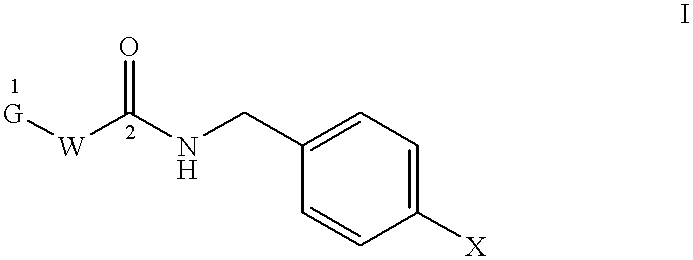
wherein,
X is Cl, Br, F, CN or NO2;
G is
(a) C1-4alkyl which is fully saturated or partially unsaturated and is substituted by hydroxy, or
(b) C1-4alkyl substituted by NR1R2 or 4-tetrahydropyran;
R1 is C2-7alkyl substituted by hydroxy, C1-4alkoxy, aryl, or heteroaryl;
R2 is hydrogen or C1-7alkyl;
or R1 and R2 together with the nitrogen to which they are attached form (a) a morpholine which may be optionally substituted by aryl or C1-7alkyl; or (b) a pyrrolidine ring substituted by hydroxy;
W is a heterocycle of formula W1, W2, W3, W4, W5, W6, W7 or W8 

A is CR4 or nitrogen;
B is CR5 or nitrogen;
D is
(a) —(CR13R14)a—, where a is 2 or 3
(b) —(CR15R16)4—,
(c) —Y—CR13R14—CR13R14—,
(d) —CR13R14—Y—CR13R14—,
(e) —Y—CR13R14—Y—,
(f) —CR13R14—CR13R14—Y—,
(g) —Y—(CR15R16)n—,
(h) —Y—CR15═CR15—,
(i) —Y—CR15═N—,
(j) —CR15═CR15—Y—,
(k) —N═CR15—Y—,
(l) —(CR15R16)b—N═CR15—, where b is 0 or 1
(m) —CR15═N—(CR15R16)b—, where b is 0 or 1
(n) —N═N—,
(o) —N═CR15—(CR15R16)b—, where b is 0 or 1
(p) —CR15═CR15—,
(q) —N═N—Y—,
(r) —Y—N═N—,
(s) —Y—N═CR15—, or
(t) —CR5R16—Y—CR15R16—CR15R16—;
E is CR8 or nitrogen;
J is CR15 or nitrogen;
K is
(a) —(CR15R16)a—, where a is 2 or 3, or
(b) —CR15═CR15—,
L is
(a) —(CR15R16)a—, where a is 2 or 3, or
(b) —Y—(CR15R16)—(CR15R16)—;
Y is oxygen, S(O)m, or NR7;
with the provisos that:
when W is of formula W1; G is C1-4alkyl which is fully saturated and is substituted by hydroxy or morpholinyl, in which morpholinyl is attached through nitrogen; A is CR4; B is CR5; and R8 is hydrogen then at least one of R13, R14, or R7 is not hydrogen or C1-7alkyl;
when W is of formula W1, A is CR4, B is CR5, D is —Y—CR13R14—CR13R14 —, and R8 is hydrogen then Y is not oxygen;
when W is of formula W1, A is CR4, and B is CR5 then D is not —CR15═CR15—;
R4 is H, halogen, or C1-4alkyl optionally substituted by one to three halogens;
R5 is
(a) H,
(b) halo,
(c) OR12,
(d) SR12,
(e) C1-7alkyl which may be partially unsaturated and optionally substituted by one or more substituents selected from OR12, SR12, NR10R11, or halo,
(f) C3-8cycloalkyl which may be partially unsaturated and is optionally substituted by one or more substituents selected from halogen, OR12, SR12, or NR10R11,
(g) (C═O)R9,
(h) S(O)mR9,
(i) (C═O)OR2,
(j) NHSO2R9,
(k) nitro, or
(l) cyano;
R7 is
(a) H,
(b) C1-7alkyl which may be partially unsaturated and optionally substituted by one or more substituents selected from OR12, SR12, NR10R11, or halo,
(c) C3-8cycloalkyl which may be partially unsaturated and is optionally substituted by one or more substituents selected from halogen, OR12, SR12, or NR10R11,
(d) aryl,
(e) het,
(f) (C═O)R9, or
(g) S(O)mR9;
R8 is
(a) H,
(b) C1-7alkyl which may be partially unsaturated and optionally substituted by one or more substituents selected from OR12, SR12, NR10R11, or halo,
(c) OR12, or
(d) SR12;
R9 is
(a) C1-7alkyl optionally substituted by OR12 or NR2R2,
(b) C3-8cycloalkyl optionally substituted by OR12 or NR2R2,
(c) NR10R11,
(d) aryl, or
(e) het, wherein said het is bound through a carbon atom;
R10 and R11 are independently
(a) H,
(b) aryl,
(c) C1-7alkyl which may be partially unsaturated and is optionally substituted by one or more substituents selected from CONR2R2, CO2R2, het, aryl, cyano, or halo,
(d) C2-7alkyl which may be partially unsaturated and is substituted by one or more substituents selected from NR2R2, OR2, or SR2,
(e) C3-8cycloalkyl which may be partially unsaturated and is optionally substituted by one or more substituents selected from halogen, OR2, SR2, or NR2R2, or
(f) R10 and R11 together with the nitrogen to which they are attached form a het;
R12 is
(a) H,
(b) aryl,
(c) het
(d) C1-7alkyl optionally substituted by aryl, or halogen,
(e) C2-7alkyl substituted by OR2, SR2, or NR2R2, or
(f) C3-8cycloalkyl which may be partially unsaturated and is optionally substituted by one or more substituents selected from halogen, OR2, SR2, or NR2R2;
R13, R14, R15, and R16 are independently
(a) H
(b) C1-7alkyl which may be partially unsaturated and optionally substituted by one or more OR12, SR12, NR10R11, or halo groups,
(c) C3-8cycloalkyl which may be partially unsaturated and is optionally substituted by one or more substituents selected from halogen, OR12, SR12, or NR10R11,
(d) aryl,
(e) het, wherein said het is bound through a carbon atom,
(f) OR12,
(g) SR12,
(h) NR10R11;
(i) (C═O)OR2, or
(j) R13 and R14 or R15 and R16 together with the carbon to which they are attached form (C═O);
each m is independently 0, 1 or 2;
each n is independently 1 or 3;
aryl is a phenyl radical or an ortho-fused bicyclic carbocyclic radical wherein at least one ring is aromatic, and aryl may be optionally substituted with one or more substituents selected from halo, OH, cyano, NR2R2, CO2R2, CF3, C1-6alkoxy, and C1-6alkyl which maybe further substituted by one to three SR2, NR2R2, OR2, or CO2R2 groups;
het is a four- (4), five- (5), six- (6), or seven- (7) membered saturated or unsaturated heterocyclic ring having 1, 2, or 3 heteroatoms selected from oxygen, sulfur, or nitrogen, which is optionally fused to a benzene ring, or any bicyclic heterocycle group, and het may be optionally substituted with one or more substituents selected from halo, OH, cyano, phenyl, CO2R2, CF3, C1-6alkoxy, oxo, oxime, and C1-6 alkyl which may be further substituted by one to three SR2, NR2R2, OR2, or CO2R2 groups;
halo or halogen is F, Cl, Br, I;
1 represents the point of attachment between W and G;
2 represents the point of attachment between W and the carbonyl group of Formula (I);
and pharmaceutically acceptable salts thereof.
In particularly preferred embodiments, X is Cl and G is 4-morpholinylmethyl.
Another embodiment of the present invention provides a pharmaceutical composition comprising a compound of formula (I) as defined above, or a pharmaceutically acceptable salt thereof, and a pharmaceutically acceptable carrier. In preferred embodiments, the composition preferably comprises a therapeutically effective amount of the compound or salt.
Still another embodiment of the present invention provides a method for treating a disease or condition in a mammal caused by a viral infection, particularly a herpes viral infection, comprising administering to the mammal a therapeutically effective amount of a compound of formula (I) or a pharmaceutically acceptable salt thereof.
A further embodiment of the present invention comprises the use of a compound of formula (I) or a pharmaceutically acceptable salt thereof to prepare a medicament for treating or preventing diseases or disorders caused by a viral infection, and particularly a herpes viral infection.
A final embodiment of the present invention comprises a method for inhibiting a viral DNA polymerase, comprising contacting (in vitro or in vivo) the polymerase with an effective inhibitory amount of a compound of formula (I) or a pharmaceutically acceptable salt thereof.
An object of the present invention is to provide novel compounds having biological activity.
A further object of the present invention is to provide novel pharmaceutical compositions.
Still another object of the present invention is to provide a method for treating a disease or condition in a mammal caused by a viral infection, particularly a herpes virus infection.
Another object of the present invention is to provide a method for inhibiting a viral DNA polymerase.
These, and other objects, will readily be apparent to those skilled in the art as reference is made to the detailed description of the preferred embodiment.
In describing the preferred embodiment, certain terminology will be utilized for the sake of clarity. Such terminology is intended to encompass the recited embodiment, as well as all technical equivalents which operate in a similar manner for a similar purpose to achieve a similar result.
1. Terminology Definitions
The following definitions are used, unless otherwise described: halo is fluoro, chloro, bromo, or iodo. Alkyl denotes both straight and branched groups; but reference to an individual radical such as “propyl” embraces only the straight chain radical, a branched chain isomer such as “isopropyl” being specifically referred to. When alkyl can be partially unsaturated, the alkyl chain may comprise one or more (e.g., 1, 2, 3, or 4) double or triple bonds in the chain.
Aryl denotes a phenyl radical or an ortho-fused bicyclic carbocyclic radical wherein at least one ring is aromatic. Het is a four- (4), five- (5), six- (6), or seven- (7) membered saturated or unsaturated ring containing 1, 2 or 3 heteroatoms selected from the group consisting of non-peroxide oxygen, sulfur, and nitrogen, which is optionally fused to a benzene ring, or any bicyclic heterocyclic group. Het includes “heteroaryl”, which encompasses a radical attached via a ring carbon of a monocyclic aromatic ring containing five or six ring atoms consisting of carbon and 1, 2, 3, or 4 heteroatoms each selected from the group consisting of non-peroxide oxygen, sulfur, and N(X) wherein X is absent or is H, O, C1-4alkyl, phenyl or benzyl.
It will be appreciated by those skilled in the art that compounds of the invention having a chiral center may exist in and be isolated in optically active and racemic forms. Some compounds may exhibit polymorphism. It is to be understood that the present invention encompasses any racemic, optically-active, polymorphic, tautomeric, or stereoisomeric form, or mixture thereof, of a compound of the invention, which possesses the useful properties described herein, it being well known in the art how to prepare optically active forms (for example, by resolution of the racemic form by recrystallization techniques, by synthesis from optically-active starting materials, by chiral synthesis, or by chromatographic separation using a chiral stationary phase) and how to determine antiviral activity using the standard tests described herein, or using other similar tests which are well known in the art.
The carbon atom content of various hydrocarbon-containing moieties is indicated by a prefix designating a lower and upper number of carbon atoms in the moiety, i.e., the prefix Ci-j indicates a moiety of the integer “i” to the integer “j” carbon atoms, inclusive. Thus, for example, C1-7alkyl refers to alkyl of one to seven carbon atoms, inclusive.
The compounds of the present invention are generally named according to the IUPAC or CAS nomenclature system. Abbreviations which are well known to one of ordinary skill in the art may be used (e.g. “Ph” for phenyl, “Me” for methyl, “Et” for ethyl, “h” for hour or hours and “rt” for room temperature).
Specific and preferred values listed below for radicals, substituents, and ranges, are for illustration only; they do not exclude other defined values or other values within defined ranges for the radicals and substituents. The compounds of the invention include compounds of formula (I) having any combination of the values, specific values, more specific values, and preferred values described herein.
Mammal denotes human and animals, specifically including food animals and companion animals.
2. The Invention
The present invention comprises compounds of formula (I) as defined above, and their pharmaceutically acceptable salts.
For the compounds of formula (I), alkyl can be methyl, ethyl, propyl, isopropyl, butyl, iso-butyl, sec-butyl, pentyl, 3-pentyl, hexyl, heptyl, etc.; C3-8cycloalkyl can be cyclopropyl, cyclobutyl, cyclopentyl, cyclohexyl, cycloheptyl, or cyclooctyl; alkoxy can be methoxy, ethoxy, propoxy, isopropoxy, butoxy, iso-butoxy, sec-butoxy, pentoxy, 3-pentoxy, hexyloxy, 1-methylhexyloxy, or heptyloxy; het can be azetidinyl, 3,3-dihydroxy-1-azetinyl, pyrrolidino, piperidino, morpholino, thiomorpholino, or heteroaryl; and heteroaryl can be furyl, imidazolyl, triazolyl, triazinyl, oxazolyl, isoxazolyl, thiazolyl, isothiazolyl, pyrazolyl, pyrrolyl, pyrazinyl, tetrazolyl, pyridyl, (or its N-oxide), thienyl, pyrimidinyl (or its N-oxide), indolyl, isoquinolyl (or its N-oxide) or quinolyl (or its N-oxide).
When alkyl is partially unsaturated, it can be vinyl, allyl, 1-propenyl, 2-propenyl, 1-butenyl, 2-butenyl, 3-butenyl, 1,3-butadienyl, 1-pentenyl, 2-pentenyl, 3-pentenyl, 4-pentenyl, 1-hexenyl, 2-hexenyl, 3-hexenyl, 4-hexenyl, 5-hexenyl, ethynyl, 1-propynyl, 2-propynyl, 1-butynyl, 2-butynyl, 3-butynyl, 1-pentynyl, 2-pentynyl, 3-pentynyl, 4-pentynyl, 5-hexene-1-ynyl, 2-hexynyl, 3-hexynyl, 4-hexynyl, or 5-hexynyl.
Specific examples of W1 include, 


Specific examples of W2 include, 

Specific examples of W3 include: 
Specific examples of W4 include, 

Specific examples of W5 include: 

Specific examples of W6 include: 

Specific examples of W7 include, 

Specific examples of W8 include: 
Particularly preferred compounds are those where X is Cl and G is 4-morpholinylmethyl.
Examples of the present invention include, but are not limited to the following:
N-(4-chlorobenzyl)-8-(4-morpholinylmethyl)-6-oxo-6H-imidazo[4,5,1-ij]quinoline-5-carboxamide;
N-(4-chlorobenzyl)-8-(3-hydroxy-1-propynyl)-6-oxo-6H-imidazo[4,5,1-ij]quinoline-5-carboxamide;
N-(4-chlorobenzyl)-8-(3-hydroxypropyl)-6-oxo-6H-imidazo[4,5,1-ij]quinoline-5-carboxamide;
1-amino-N-(4-chlorobenzyl)-8-(3-hydroxy-1-propynyl)-6-oxo-1,2-dihydro-6H-pyrrolo[3,2,1-ij]quinoline-5- carboxamide;
1-amino-N-(4-chlorobenzyl)-8-(3-hydroxypropyl)-6-oxo-1,2-dihydro-6H-pyrrolo-[3,2,1-ij]quinoline-5-carboxamide;
1-amino-N-(4-chlorobenzyl)-8-(4-morpholinylmethyl)-6-oxo-1,2-dihydro-6H-pyrrolo[3,2,1-ij]quinoline-5-carboxamide;
N-(4-chlorobenzyl)-2-(hydroxymethyl)-8-(3-hydroxy-1-propynyl)-6-oxo-1,2-dihydro-6H-pyrrolo[3,2,1-ij]quinoline-5-carboxamide;
N-(4-chlorobenzyl)-8-(3-hydroxyprop-1-ynyl)-2,2-dimethyl-6-oxo-1,2-dihydro-6H-pyrrolo[3,2,1-ij]quinoline-5-carboxamide;
3-benzyl-N-(4-chlorobenzyl)-9-(3-hydroxy-1-propynyl)-7-oxo-2,3-dihydro-7H-[1,3,4]oxadiazino[6,5,4-ij]quinoline-6-carboxamide;
3-benzyl-N-(4-chlorobenzyl)-9-(3-hydroxypropyl)-7-oxo-2,3-dihydro-7H-[1,3,4]oxadiazino[6,5,4-ij]quinoline-6-carboxamide;
3-benzyl-N-(4-chlorobenzyl)-9-(4-morpholinylmethyl)-7-oxo-2,3-dihydro-7H-[1,3,4]oxadiazino[6,5,4-ij]quinoline-6-carboxamide;
3-benzyl-N-(4-chlorobenzyl)-9-(tetrahydro-2H-pyran-4-ylmethyl)-7-oxo-2,3-dihydro-7H-[1,3,4]oxadiazino[6,5,4-ij]quinoline-6-carboxamide;
N-(4-chlorobenzyl)-9-(3-hydroxyprop-1-ynyl)-3-methyl-7-oxo-2,3-dihydro-7H-[1,3,4]oxadiazino[6,5,4-ij]quinoline-6-carboxamide;
3-benzyl-N-(4-chlorobenzyl)-9-(3-hydroxy-1-propynyl)-7-oxo-2,3-dihydro-7H-[1,3,4]thiadiazino[6,5,4-ij]quinoline-6-carboxamide;
3-benzyl-N-(4-chlorobenzyl)-9-(3-hydroxypropyl)-7-oxo-2,3-dihydro-7H-[1,3,4]thiadiazino[6,5,4-ij]quinoline-6-carboxamide;
3-benzyl-N-(4-chlorobenzyl)-9-(4-morpholinylmethyl)-7-oxo-2,3-dihydro-7H-[1,3,4]thiadiazino[6,5,4-ij]quinoline-6-carboxamide;
3-benzyl-N-(4-chlorobenzyl)-9-(tetrahydro-2H-pyran-4-ylmethyl)-7-oxo-2,3-dihydro-7H-[1,3,4]thiadiazino[6,5,4-ij]quinoline-6-carboxamide;
N-(4-chlorobenzyl)-3-methyl-9-(morpholin-4-ylmethyl)-7-oxo-7H-[1,4]thiazino[2,3,4-ij]quinoline-6-carboxamide;
N-(4-chlorobenzyl)-3-methyl-7-oxo-9-(tetrahydro-2H-pyran-4-ylmethyl)-7H-[1,4]thiazino[2,3,4-ij]quinoline-6-carboxamide;
N-(4-chlorobenzyl)-9-(3-hydroxypropyl)-3-methyl-7-oxo-7H-[1,4]thiazino[2,3,4-ij]quinoline-6-carboxamide;
N-(4-chlorobenzyl)-9-(3-hydroxyprop-1-ynyl)-3-methyl-7-oxo-7H-[1,4]thiazino [2,3,4-ij]quinoline-6-carboxamide;
N-(4-chlorobenzyl)-9-(morpholin-4-ylmethyl)-7-oxo-2-pyridin-3-yl-7H-[1,4]thiazino[2,3,4-ij]quinoline-6-carboxamide;
N-(4-chlorobenzyl)-9-(3-hydroxy-1-propynyl)-7-oxo-3-phenyl-1H,7H-[1,3]oxazino[5,4,3-ij]quinoline-6-carboxamide;
N-(4-chlorobenzyl)-9-(3-hydroxypropyl)-7-oxo-3-phenyl-1H,7H-[1,3]oxazino[5,4,3-ij]quinoline-6-carboxamide;
N-(4-chlorobenzyl)-7-oxo-3-phenyl-9-(tetrahydro-2H-pyran-4-ylmethyl)-1H,7H-[1,3]oxazino [5,4,3-ij]quinoline-6-carboxamide;
N-(4-chlorobenzyl)-9-(4-morpholinylmethyl)-7-oxo-3-phenyl-1H,7H-[1,3]oxazino[5,4,3-ij]quinoline-6-carboxamide;
N-(4-chlorobenzyl)-9-(3-hydroxy-1-propynyl)-1-methyl-7-oxo-3-phenyl-2,3-dihydro-1H,7H-pyrido[1,2,3-de]quinoxaline-6-carboxamide;
N-(4-chlorobenzyl)-9-(3-hydroxypropyl)-1-methyl-7-oxo-3-phenyl-2,3-dihydro-1H,7H-pyrido[1,2,3-de]quinoxaline-6-carboxamide;
N-(4-chlorobenzyl)-9-(tetrahydro-2H-pyran-4-ylmethyl)-1-methyl-7-oxo-3-phenyl-2,3-dihydro-1H,7H-pyrido[1,2,3-de]quinoxaline-6-carboxamide;
N-(4-chlorobenzyl)-9-(4-morpholinylmethyl)-1-methyl-7-oxo-3-phenyl-2,3-dihydro-1H,7H-pyrido[1,2,3-de]quinoxaline-6-carboxamide;
N-(4-chlorobenzyl)-9-(3-hydroxy-1-propynyl)-2,3,7-trioxo-2,3-dihydro-1H,7H-pyrido[1,2,3-de]quinoxaline-6-carboxamide;
N-(4-chlorobenzyl)-9-(3-hydroxypropyl)-2,3,7-trioxo-2,3-dihydro-1H,7H-pyrido[1,2,3-de]quinoxaline-6-carboxamide;
N-(4-chlorobenzyl)-9-(4-morpholinylmethyl)-2,3,7-trioxo-2,3-dihydro-1H,7H-pyrido[1,2,3-de]quinoxaline-6-carboxamide;
N-(4-chlorobenzyl)-9-(3-hydroxy-1-propynyl)-2,7-dioxo-2,3-dihydro-1H,7H-pyrido[1,2,3-de]quinoxaline-6-carboxamide;
N-(4-chlorobenzyl)-9-(3-hydroxypropyl)-2,7-dioxo-2,3-dihydro-1H,7H-pyrido[1,2,3-de]quinoxaline-6-carboxamide;
N-(4-chlorobenzyl)-9-(3-hydroxy-1-propynyl)-3,7-dioxo-2,3-dihydro-1H,7H-pyrido[1,2,3-de]quinoxaline-6-carboxamide;
N-(4-chlorobenzyl)-9-(3-hydroxypropyl)-3,7-dioxo-2,3-dihydro-1H,7H-pyrido[1,2,3-de]quinoxaline-6-carboxamide;
N-(4-chlorobenzyl)-9-(4-morpholinylmethyl)-3,7-dioxo-2,3-dihydro-1H,7H-pyrido[1,2,3-de]quinoxaline-6-carboxamide;
N-(4-chlorobenzyl)-9-(4-morpholinylmethyl)-2,7-dioxo-2,3-dihydro-1H,7H-pyrido[1,2,3-de]quinoxaline-6-carboxamide;
N-(4-chlorobenzyl)-9-(3-hydroxy-1-propynyl)-1-methyl-2,7-dioxo-2,3-dihydro-1H,7H-pyrido[1,2,3-de]quinoxaline-6-carboxamide;
3-benzyl-N-(4-chlorobenzyl)-9-(3-hydroxy-1-propynyl)-1-methyl-7-oxo-2,3-dihydro-1H,7H-[1,2,4]triazino[5,6,1-ij]quinoline-6-carboxamide;
3-benzyl-N-(4-chlorobenzyl)-9-(3-hydroxypropyl)-1-methyl-7-oxo-2,3-dihydro-1H,7H-[1,2,4]triazino[5,6,1-ij]quinoline-6-carboxamide;
3-benzyl-N-(4-chlorobenzyl)-9-(4-morpholinylmethyl)-1-methyl-7-oxo-2,3-dihydro-1H,7H-[1,2,4]triazino[5,6,1-ij]quinoline-6-carboxamide;
3-benzyl-N-(4-chlorobenzyl)-9-(tetrahydro-2H-pyran-4-ylmethyl)-1-methyl-7-oxo-2,3-dihydro-1H,7H-[1,2,4]triazino[5,6,1-ij]quinoline-6-carboxamide;
1-benzyl-N-(4-chlorobenzyl)-5-(3-hydroxy-1-propynyl)-2,7-dioxo-2,3-dihydro-1H,7H-pyrido[3,2,1-ij]cinnoline-8-carboxamide;
1-benzyl-N-(4-chlorobenzyl)-5-(3-hydroxypropyl)-2,7-dioxo-2,3-dihydro-1H,7H-pyrido[3,2,1-ij]cinnoline-8-carboxamide;
1-benzyl-N-(4-chorobenzyl)-5-(4-morpholinylmethyl)-2,7-dioxo-2,3-dihydro-1H,7H-pyrido[3,2,1-ij]cinnoline-8-carboxamide;
1-benzyl-N-(4-chlorobenzyl)-5-(tetrahydro-2H-pyran-4-ylmethyl)-2,7-dioxo-2,3-dihydro-1H,7H-pyrido[3,2,1-ij]cinnoline-8-carboxamide;
N-(4-Chlorobenzyl)-5-(3-hydroxyprop-1-ynyl)-1-methyl-7-oxo-2,3-dihydro-1H,7H-pyrido[3,2,1-ij]cinnoline-8-carboxamide;
N-(4-chlorobenzyl)-9-(3-hydroxy-1-propynyl)-7-oxo-3-phenyl-1H,7H-[1,3]thiazino[5,4,3-ij]quinoline-6-carboxamide;
N-(4-chlorobenzyl)-9-(3-hydroxypropyl)-7-oxo-3-phenyl-1H,7H-[1,3]thiazino[5,4,3-ij]quinoline-6-carboxamide;
N-(4-chlorobenzyl)-9-(tetrahydro-2H-pyran-4-ylmethyl)-7-oxo-3-phenyl-1H,7H-[1,3]thiazino[5,4,3-ij]quinoline-6-carboxamide;
N-(4-chlorobenzyl)-9-(4-morpholinylmethyl)-7-oxo-3-phenyl-1H,7H-[1,3]thiazino[5,4,3-ij]quinoline-6-carboxamide;
N-(4-chlorobenzyl)-9-(3-hydroxypropyl)-2-methyl-7-oxo-3-phenyl-2,3-dihydro-1H,7H-pyrido[3,2,1-ij]quinazoline-6-carboxamide;
N-(4-chlorobenzyl)-9-(3-hydroxy-1-propynyl)-2-methyl-7-oxo-3-phenyl-2,3-dihydro-1H,7H-pyrido[3,2,1-ij]quinazoline-6-carboxamide;
N-(4-chlorobenzyl)-9-(4-morpholinylmethyl)-2-methyl-7-oxo-3-phenyl-2,3-dihydro-1H,7H-pyrido[3,2,1-ij]quinazoline-6-carboxamide;
N-(4-chlorobenzyl)-9-(tetrahydro-2H-pyran-4-ylmethyl)-2-methyl-7-oxo-3-phenyl-2,3-dihydro-1H,7H-pyrido[3,2,1-ij]quinazoline-6-carboxamide;
2-benzyl-N-(4-chlorobenzyl)-9-(4-morpholinylmethyl)-7-oxo-2,3-dihydro-1H,7H-pyrido[3,2,1-ij]quinazoline-6-carboxamide;
2-benzyl-N-(4-chlorobenzyl)-9-(4-morpholinylmethyl)-3,7-dioxo-2,3-dihydro-1H,7H-pyrido[3,2,1-ij]quinazoline-6-carboxamide;
N-(4-chlorobenzyl)-9-(3-hydroxy-1-propynyl)-2-(4-morpholinyl)-7-oxo-7H-[1,3,4]thiadiazino[6,5,4-ij]quinoline-6-carboxamide;
N-(4-chlorobenzyl)-9-(3-hydroxypropyl)-2-(4-morpholinyl)-7-oxo-7H-[1,3,4]thiadiazino[6,5,4-ij]quinoline-6-carboxamide;
N-(4-chlorobenzyl)-2-(4-morpholinyl)-9-(4-morpholinylmethyl)-7-oxo-7H-[1,3,4]thiadiazino[6,5,4-ij]quinoline-6-carboxamide;
N-(4-chlorobenzyl)-2-(4-morpholinyl)-7-oxo-9-(tetrahydro-2H-pyran-4-methyl)-7H-[1,3,4]thiadiazino[6,5,4-ij]quinoline-6-carboxamide;
N-(4-chlorobenzyl)-9-(3-hydroxypropyl)-7-oxo-2,3-dihydro-1H,7H-pyrazino[3,2,1-ij][1,7]naphthyridine-6-carboxamide;
N-(4-chlorobenzyl)-9-(4-morpholinylmethyl)-7-oxo-2,3-dihydro-1H,7H-pyrazino[3,2,1-ij][1,7]naphthyridine-6-carboxamide;
N-(4-chlorobenzyl)-9-(3-hydroxy-1-propynyl)-7-oxo-2,3-dihydro-1H,7H-pyrazino[3,2,1-ij][1,7]naphthyridine-6-carboxamide;
N-(4-chlorobenzyl)-9-(3-hydroxypropyl)-7-oxo-2,3-dihydro-7H-[1,4]thiazino[2,3,4-ij][1,7]naphthyridine-6-carboxamide;
N-(4-chlorobenzyl)-9-(4-morpholinylmethyl)-7-oxo-2,3-dihydro-7H-[1,4]thiazino[2,3,4-ij][1,7]naphthyridine-6-carboxamide;
N-(4-chlorobenzyl)-9-(3-hydroxy-1-propynyl)-7-oxo-2,3-dihydro-7H-[1,4]thiazino[2,3,4-ij][1,7]naphthyridine-6-carboxamide;
N-(4-chlorobenzyl)-9-(3-hydroxy-1-propynyl)-7-oxo-2,3-dihydro-7H-[1,4]oxazino[2,3,4-ij][1,7]naphthyridine-6-carboxamide;
N-(4-chlorobenzyl)-9-(4-morpholinylmethyl)-7-oxo-2,3-dihydro-7H-[1,4]oxazino[2,3,4-ij][1,7]naphthyridine-6-carboxamide;
N-(4-chlorobenzyl)-9-(3-hydroxypropyl)-7-oxo-2,3-dihydro-7H-[1,4]oxazino[2,3,4-ij][1,7]naphthyridine-6-carboxamide;
N-(4-chlorobenzyl)-9-(3-hydroxypropyl)-3,7-dioxo-3H,7H-pyrido[1,2,3-de]quinoxaline-6carboxamide;
N-(4-chlorobenzyl)-9-(3-hydroxy-1-propynyl)-3,7-dioxo-3H,7H-pyrido[1,2,3-de)quinoxaline-6-carboxamide;
N-(4-chlorobenzyl)-9-(4-morpholinylmethyl)-3,7-dioxo-3H,7H-pyrido[1,2,3-de]quinoxaline-6-carboxamide;
N-(4-chlorobenzyl)-2-[(4-chlorobenzyl)amino]-9-(4-morpholinylmethyl)-7-oxo-3H,7H-pyrido[1,2,3-de]quinoxaline-6-carboxamide;
2-(benzylamino)-N-(4-chlorobenzyl)-9-(4-morpholinylmethyl)-7-oxo-3H,7H-pyrido[1,2,3-de]quinoxaline-6-carboxamide;
N-(4-chlorobenzyl)-10-(3-hydroxypropyl)-2,4,8-trioxo-1,2,3,4-tetrahydro-8H-[1,4]diazepino[3,2,1-ij]quinoline-7-carboxamide;
N-(4-chlorobenzyl)-10-(3-hydroxy-1-propynyl)-2,4,8-trioxo-1,2,3,4-tetrahydro-8H-[1,4]diazepino[3,2,1-ij]quinoline-7-carboxamide;
N-(4-chlorobenzyl)-10-(4-morpholinylmethyl)-2,4,8-trioxo-1,2,3,4-tetrahydro-8H-[1,4]diazepino[3,2,1-ij]quinoline-7-carboxamide;
N-(4-chlorobenzyl)-10-(4-morpholinylmethyl)-2,8-dioxo-1,2,3,4-tetrahydro-8H-[1,4]diazepino[3,2,1-ij]quinoline-7-carboxamide;
N-(4-chlorobenzyl)-8-(4-morpholinylmethyl)-2,6-dioxo-1,2-dihydro-6H-imidazo[4,5,1-ij]quinoline-5-carboxamide;
N-(4-chlorobenzyl)-8-(3-hydroxy-1-propynyl)-2,6-dioxo-1,2-dihydro-6H-imidazo[4,5,1-ij]quinoline-5carboxamide;
N-(4-chlorobenzyl)-8-(3-hydroxypropyl)-2,6-dioxo-1,2-dihydro-6H-imidazo[4,5,1-ij]quinoline-5-carboxamide;
N-(4-chlorobenzyl)-8-(4-morpholinylmethyl)-2,6-dioxo-1-[2-(1-piperidinyl)ethyl]-1,2-dihydro-6H-imidazo[4,5,1-ij]quinoline-5-carboxamide;
N-(4-chlorobenzyl)-1-[2-(4-methyl-1-piperazinyl)ethyl]-8-(4-morpholinylmethyl)-2,6-dioxo-1,2-dihydro-6H-imidazo[4,5,1-ij]quinoline-5-carboxamide;
N-(4-chlorobenzyl)-10-(4-morpholinylmethyl)-8-oxo-3,4-dihydro-2H,8H-[1,4]oxazepino[2,3,4-ij]quinoline-7-carboxamide;
N-(4-chlorobenzyl)-3-methyl-9-(morpholin-4-ylmethyl)-7-oxo-7H-[1,4]oxazino[2,3,4-ij]quinoline-6-carboxamide;
N-(4-chlorobenzyl)-3-methyl-7-oxo-9-(tetrahydro-2H-pyran-4-ylmethyl)-7H-[1,4]oxazino[2,3,4-ij]quinoline-6-carboxamide;
N-(4-chlorobenzyl)-9-(3-hydroxypropyl)-3-methyl-7-oxo-7H-[1,4]oxazino[2,3,4-ij]quinoline-6-carboxamide;
N-(4-chlorobenzyl)-9-(3-hydroxyprop-1-ynyl)-3-methyl-7-oxo-7H-[1,4]oxazino [2,3,4-ij]quinoline-6-carboxamide;
N-(4-chlorobenzyl)-9-(morpholin-4-ylmethyl)-7-oxo-2-pyridin-3-yl-7H-[1,4]oxazino[2,3,4-ij]quinoline-6-carboxamide;
2-benzyl-N-(4-chlorobenzyl)-10-(4-morpholinylmethyl)-3,8-dioxo-1,2,3,4-tetrahydro-8H-[1,4]diazepino[6,7,1-ij]quinoline-7-carboxamide;
N-(4-chlorobenzyl)-5-(3-hydroxypropyl)-4,7-dioxo-1,2-dihydro-4H,7H-imidazo[1,2,3-ij][1,8]naphthyridine-8-carboxamide;
N-(4-chlorobenzyl)-5-(4-morpholinylmethyl)-4,7-dioxo-1,2-dihydro-4H,7H-imidazo[1,2,3-ij][1,8]naphthyridine-8-carboxamide;
N-(4-chlorobenzyl)-5-(3-hydroxy-1-propynyl)-4,7-dioxo-1,2-dihydro-4H,7H-imidazo[1,2,3-ij][1,8]naphthyridine-8-carboxamide;
N-(4-chlorobenzyl)-6-(4-morpholinylmethyl)-3-oxo-9,10-dihydro-3H,8H-pyrido [3,2,1-ij]quinoline-2-carboxamide;
N-(4-chlorobenzyl)-3-methyl-9-(4-morpholinylmethyl)-2,7-dioxo-2,3-dihydro-1H,7H-pyrido[1,2,3-de]quinoxaline-6-carboxamide hydrobromide;
and pharmaceutically acceptable salts thereof.
Representative examples of the synthesis of compounds falling within the scope of formulas W1-W8 are as follows.
The following Charts A-BQ describe the preparation of the compounds of the present invention. All of the starting materials are prepared by procedures described in these charts or by procedures analogous thereto, which would be well known to one of ordinary skill in organic chemistry. All of the final compounds of the present invention are prepared by procedures described in these charts or by procedures analogous thereto, which would be well known to one of ordinary skill in organic chemistry. All of the variables used in the charts are as defined below or as in the claims.
W1.1. 6-Oxo-6H-imidazo[4,5,1-ij]quinoline-5-carboxamides The preparation of specific examples of heterocycle W1.1 is described in Chart A. 2-Nitroaniline is iodinated with iodine monochloride to afford A.1 (Wilson, et.al., Aust. J. Chem., 1983, 36, 2317-2326) which is heated with diethyl ethoxymethylenemalonate in a mixture of diphenyl ether/biphenyl, initially at 150° C. to generate diethyl 2-[(2-amino-4-iodoanilino)methylene]malonate and then at 240° C. to cyclize this intermediate to ethyl 4-hydroxy-6-iodo-8-nitro-3-quinolinecarboxylate (A.2). Stannous chloride reduction of A.2 affords ethyl 8-amino-4-hydroxy-6-iodo-3-quinolinecarboxylate A.3 which reacts with 4-chlorobenzylamine to give 8-amino-N-(4-chlorobenzyl)-4-hydroxy-6-iodo-3-quinolinecarboxamide A.4. Intermediate A.4 reacts with ethyl orthoformate to give N-(4-chlorobenzyl)-8-iodo-6-oxo-6H-imidazo[4,5,1-ij]quinoline-5-carboxamide (A.5). Palladium mediated carbonylation of A.5 in presence of tributyl tin hydride or trioctylsilane (Kotsuki et. al., Synthesis 1996, 470) affords A.6 which is reductively aminated with morpholine and sodium cyanoborohydride to give A.7. Specific examples in which G=3-hydroxypropyl or 3-hydroxy-1-propynyl are prepared as described in Chart B. Palladium catalyzed coupling of A.5 with an electron-rich acetylene (e.g. propargyl alcohol, Z=CH2OH) gives B.1 (Sonogashira, K.; Tohada, Y.; Hagihara, N. Tetrahedron Lett. 1975, 50, 4467. or Fisher, M. J. et. al. J. Med. Chem. 1997, 40, 2085.). Saturation of the alkyne by hydrogenation catalyzed by palladium on carbon in alcoholic solvents affords alkyl derivatives of formula B.2 (Z=CH2OH). 

W1.3. 6-Oxo-1,2-dihydro-6H-pyrrolo[3,2,1-ij]quinoline-5-carboxamides. The preparation of specific examples of heterocycle W1.3 is described in Chart C. Condensation of an indoline C.1 (e.g. 2,2-dimethylindoline, R13=2,2-dimethyl) with diethyl ethoxymethylenemalonate followed by cyclization of the resulting enamine C.2 in a mixture of polyphosphoric acid or Eaton's Reagent affords esters of the formula C.3. Halogenation such as bromination employing bromine in acetic acid provides compounds of the general formula C.4. The resulting product is then coupled with an electron-rich acetylene (e.g. propargyl alcohol, Z=CH2OH) catalyzed by PdCl2(PPh3)2 and copper(I) iodide either in diethylamine (Sonogashira, K.; Tohada, Y.; Hagihara, N. Tetrahedron Lett. 1975, 50, 4467.) or in a mixture of DMF and triethylamine (Fisher, M. J. et. al. J. Med. Chem. 1997, 40, 2085.) to provide the corresponding alkynyl derivative C.5. The resulting ester is reacted with a substituted benzylamine (e.g. 4-chlorobenzylamine, 4-fluorobenzylamine, or 4-bromobenzylamine) in the presence of sodium methoxide or other appropriate amidation catalyst to afford amides of the formula C.6. Saturation of the alkyne by hydrogenation catalyzed by palladium on carbon in alcoholic solvents affords alkyl derivatives of formula C.7 (e.g. Z=CH2OH). 
Alternatively, intermediates of the formula C.4 are derivatized as shown in Chart D. The resulting ester is reacted with a substituted benzylamine (e.g. 4-chlorobenzylamine, 4-fluorobenzylamine, or 4-bromobenzylamine) in the presence of sodium methoxide or other appropriate amidation catalyst to afford amides of the formula D.1. Coupling of compounds of the formula D.1 with hydroxymethyl(tributyl)stannane (Danheiser, R. L.; Romines, K. R.; Koyama, H. Org. Syn. 1992, 71, 133-139) and a palladium catalyst (e.g. tetrakistriphenylphosphine palladium) affords compounds of the formula D.2. Treatment of the resulting alcohol with methanesulfonyl chloride in the presence of an amine base (e.g. collidine) followed by a primary or secondary amine (HNR1R2, e.g. morpholine) provides compounds of the formula D.3. 
As shown in Chart E, radical bromination of compound C.5 (R═H) with N-bromosuccinimide, benzoyl peroxide, and carbon tetrachloride affords the benzylic bromide E.1. Displacement of the bromide with excess azide in an appropriate solvent such as DMF or THF at temperatures from 0-100° C. provides E.2. Elaboration of the ester to the carboxamide as described in previous examples gives intermediates of the formula E.3. This azide is reduced to give the amine E.4 by treating the azide with triphenylphosphine in THF followed by water hydrolysis of the iminophosphorane intermediate at temperatures from 10-65° C. Saturation of the alkyne by hydrogenation catalyzed by palladium on carbon in alcoholic solvents affords alkyl derivatives of formula E.5 (e.g. Z=CH2OH). The amine can then be alkylated or acylated via conditions well known to those skilled in the art to give analogs defined by NR10R11. 
Alternatively as described in Chart F, intermediate C.3 (R═H) can be subjected to the same benzylic bromination conditions to give bromide F.1, followed by displacement of the bromide to give the azide F.2. The azide can then be reduced to the amine F.3 as described above and elaborated to the Boc-protected derivative F.4 by treating with di-t-butyldicarbonate and an appropriate base (triethylamine, NaHCO3). Conversion of the ethyl ester to the carboxamide F.6 can be achieved as described in prior examples. Palladium catalyzed carbonylation of the aryl iodide in the presence of tributyltin hydride provides the aryl aldehyde F.7. Reductive amination of F.7 with a primary or secondary amine (e.g. morpholine) and sodium cyanoborohydride affords F.8. Removal of the Boc-group with HCl in dioxane or trifluoroacetic acid results in analog F.9, which can be alkylated or acylated to give a variety of analogs. 
More specifically examples of heterocycle W1.3 are prepared as described in Chart G. Reduction of indoline-2-carboxylic acid (G.1) with borane in THF affords alcohol G.2. Protection of the indoline nitrogen as the benzyl carbamate can be achieved using benzyl chloroformate, THF, and aqueous sodium bicarbonate to give G.3. Iodination using NIS in DMF at elevated temperatures (40-80° C.) provides compound G.4. The carbamate is removed using HBr in acetic acid to give acetate G.5, which is cyclized via a two-step protocol using diethyl ethoxymethylenemalonate and Eaton's Reagent (or polyphosphoric acid) to give G.6. Condensation of this ester with a benzylamine (e.g. 4-chlorobenzylamine, 4-bromobenzylamine, or 4-fluorobenzylamine) at high temperatures affords amides of the formula G.7. This material is then coupled with an electron-rich acetylene (e.g. propargyl alcohol) catalyzed by PdCl2(PPh3)2 and copper(I) iodide either in diethylamine or in a mixture of DMF and triethylamine to provide the corresponding alkynyl derivative G.8. Saturation of the alkyne by hydrogenation catalyzed by palladium on carbon in alcoholic solvents affords alkyl derivatives of formula G.9. 
W1.5. 7-Oxo-2,3-dihydro-7H-[1,3,4]oxadiazino[6,5,4-ij]quinoline-6-carboxamides. The preparation of specific examples of heterocycle W1.5 is described in Chart H following an established literature precedent (J. Med. Chem. 1988, 31, 991-1001.). Reaction of β-ketoesters of the formula H.1 (prepared as described in Chart J, where Y=iodo; Chart K, where Y=morpholinylmethyl; and Chart L, where Y=4-tetrahydropyranylmethyl) with acetic anhydride and triethylorthoformate followed by treatment of the resulting enol ether with a formyl-substituted hydrazine (e.g. 1-formyl-1-methylhydrazine, R7=methyl, U.S. Pat. No. 5,985,874) affords derivatives of the general formula H.2. Treatment of H.2 with potassium hydroxide followed by formic acid and formaldehyde affords cyclized compounds of the general formula H.3. The resulting carboxylic acid H.3 is then coupled with a benzylamine (e.g. 4-chlorobenzylamine, 4-fluorobenzylamine, or 4-bromobenzylamine) mediated by 1,1′-carbonyldiimidazole (or other suitable carboxylic acid activating agent) to provide amides of the general formula H.4. 
As described in Chart I, to prepare derivatives where G=3-hydroxypropyl or 3-hydroxy-1-propynyl, intermediate H.4 (Y=iodo) is further derivatized by Sonogashira coupling with an electron-rich acetylene (e.g. propargyl alcohol, Z=CH2OH) catalyzed by PdCl2(PPh3)2 and copper(I) iodide either in diethylamine (Sonogashira, K.; Tohada, Y.; Hagihara, N. Tetrahedron Lett. 1975, 50, 4467.) or in a mixture of DMF and triethylamine (Fisher, M. J. et. al. J. Med. Chem. 1997, 40, 2085.) provides the corresponding alkynyl derivatives of formula I.1 (Z=CH2OH). Saturation of the alkyne by hydrogenation catalyzed by palladium on carbon in alcoholic solvents affords alkyl derivatives of formula I.2 (Z=CH2OH). 
H.1 (Y=iodo) is prepared as described in Chart J. Iodination of 2,3-difluorobenzoic acid J.1 affords 2,3-difluoro-5-iodobenzoic acid J.2. Conversion of J.2 to its corresponding imidazolide with 1,1′-carbonyldiimidazole followed by treatment with the trimethylsilyl ester of ethyl hydrogen malonate in the presence of DBU (Wang, X.; William, T. M.; Napier, J. J.; Ghannam, A. Tetrahedron Lett. 1994, 35, 9323-9326.) provides β-ketoester H.1 (Y=iodo) which may be employed as in Chart H. 
H.1 (Y=morpholinylmethyl) is prepared as described in Chart K. Reductive amination of 3,4-difluoro-4-trifluoromethylbenzaldehyde K.1 with morpholine in the presence of triacetoxyborohydride and acetic acid affords K.2. Hydrolysis of K.2 in sulfuric acid provides carboxylic acid K.3. Conversion of K.3 according to methods analogous to those described in Chart J affords β-ketoester H.1 (Y=morpholinylmethyl) which may be employed as in Chart H. 
H.1 (Y=4-tetrahydropyranylmethyl) is prepared as described in Chart L. Wittig olefination between K.1 and 4-tetrahydropyranylphosphonium bromide (Bestmann, H. J.; Stransky, W.; Vostrowsky, O. Chem. Ber. 1979, 109, 1694-1700.) employing sodium hexamethyldisilazide as base provides the olefin L.1. Saturation of the olefin by hydrogenation of L.1 employing palladium on carbon as catalyst affords L.2. Hydrolysis of L.2 in sulfuric acid provides carboxylic acid L.3. Conversion of L.3 according to methods analogous to those described in Chart J affords β-ketoester H.1 (Y=4-tetrahydropyranylmethyl) which may be employed as in Chart H. 
W1.6. 7-Oxo-2,3-dihydro-7H-[1,3,4]thiadiazino[6,5,4-ij]quinoline-6-carboxamides. The preparation of specific examples of heterocycle W1.6 is described in Chart M following an established literature precedent (Bull. Chem. Soc. Jpn. 1996, 69, 1371-1376.). Alcohol AM.4 (Y=morpholinylmethyl, tetrahydropyranylmethyl, or iodo) is treated with thionyl chloride followed by sodium thiol and then sodium hydride to afford the quinoline M.1. The resulting ester is then treated with a benzylamine (e.g. 4-chlorobenzylamine, 4-bromobenzylamine, or 4-fluorobenzylamine) at high temperature to afford the corresponding amides of the general formula M.2. Specific examples where G=3-hydroxypropyl or 3-hydroxy-1-propynyl are prepared as described in Chart N from intermediate M.2 (Y=iodo) by Sonogashira coupling with an electron-rich acetylene (e.g. propargyl alcohol, Z=CH2OH) catalyzed by PdCl2(PPh3)2 and copper(I) iodide either in diethylamine (Sonogashira, K.; Tohada, Y.; Hagihara, N. Tetrahedron Lett. 1975, 50, 4467.) or in a mixture of DMF and triethylamine (Fisher, M. J. et. al. J. Med. Chem. 1997, 40, 2085.) provides the corresponding alkynyl derivatives of formula N.1 (Z=CH2OH). Saturation of the alkyne by hydrogenation catalyzed by palladium on carbon in alcoholic solvents affords alkyl derivatives of formula N.2 (Z=CH2OH). 
W1.7. 7-Oxo-7H-[1,4]thiazino[2,3,4-ij]quinoline-6-carboxamide. Representative examples of heterocycle W1.7 are prepared as described in Chart O in analogy to reported pyridobenzthiazino ring synthesis (Okada, T. et. al. J. Heterocyclic Chem. 1991, 28, 1067). The reaction of intermediate H.1 (Y=iodo, morpholinylmethyl, or tetrahydropyranylmethyl) with acetic anhydride and triethylorthoformate followed by condensation of the resulting enol ether with an allylic amine (e.g. 3-amino-1-butene, Roberts, J. D.; Mazur, R. H. J. Am. Chem. Soc. 1951, 73, 2509) affords the enamine of formula O.1. Cyclization of O.1 in the presence of a base (e.g. sodium hydride) provides quinolones of the formula O.2. Subsequent ozonolysis affords the carboxaldehyde O.3 which upon treatment with sodium hydrosulfide in DMF provides the tricycle O.4. Treatment of O.4 with thionylchloride followed by lithium chloride promoted elimination at elevated temperatures affords O.5. The resulting ester is saponified under dilute acid conditions and coupled with a benzylamine (e.g. 4-chlorobenzylamine) mediated by 1,1′-carbonyldiimidazole (or other suitable carboxylic acid activating agent) to provide amides of the general formula O.7. In the case where Y=iodo, compounds of the general formula O.7 are further derivatized as described in Chart P. Sonogashira coupling between O.7 (Y=iodo) and an electron-rich acetylene (e.g. propargyl alcohol, Z=CH2OH) catalyzed by PdCl2(PPh3)2 and copper(I) iodide either in diethylamine (Sonogashira, K.; Tohada, Y.; Hagihara, N. Tetrahedron Lett. 1975, 50, 4467.) or in a mixture of DMF and triethylamine (Fisher, M. J. et. al. J. Med. Chem. 1997, 40, 2085.) provides the corresponding alkynyl derivatives of formula P.1 (Z=CH2OH). Saturation of the alkyne by hydrogenation catalyzed by palladium on carbon in alcoholic solvents affords alkyl derivatives of formula P.2 (Z=CH2OH). 

Additional examples of heterocycle W1.7 are prepared as described in Chart Q. 4-Iodo-2-fluoroaniline (Q.1) is condensed with diethyl ethoxymethylenemalonate under thermal conditions to provide 4-hydroxyquinoline Q.2. The resulting ester is converted to the corresponding amide of the formula Q.3 by either heating with a substituted benzylamine (e.g. 4-chlorobenzylamine), or by saponification of the ester to the acid, activation of the acid using a suitable agent (e.g. 1,1′-carbonyldiimidazole), and condensation with the above substituted benzylamine. The hydroxyquinolines are then reacted with an α-bromo ketones to afford compounds of the formula Q.4 (R is a subset of R15 including optionally substituted alkyl or cycloalkyl, aryl, or het). The resulting ketones are treated with sodium hydrosulfide in DMF to afford compounds of the formula Q.5 directly, or in cases where elimination is not spontaneous, the intermediate alcohol is transformed as described above in Chart O. Intermediate Q.5 is transformed to the corresponding derivatives where G is optionally unsaturated C1-4alkyl substituted by hydroxy in a manner analogous to that previously described in Chart P (P.1, P.2). Alternatively, Q.5 is formylated employing carbon monoxide, a palladium catalyst, and an appropriate reducing agent to provide carboxaldehydes of the formula Q.6. Subsequent reductive amination between Q.6 and a primary or secondary amine (e.g. morpholine) affords compounds of the formula Q.7. 
W1.8. 7-Oxo-1H,7H-[1,3]oxazino[5,4,3-ij]quinoline-6-carboxamides. The preparation of specific examples of heterocycle W1.8 is described in Chart R. Hydroxyalkylanilines of the formula R.1 (prepared as described in Chart T when Y=morpholinylmethyl; Chart U when Y=tetrahydropyranylmethyl; Chart U when Y=iodo and R13 is not hydrogen; or according to literature methods when Y=iodo and R13 is hydrogen as described by Cambell, S. F. J. Med. Chem. 1988, 31, 2048-2056.) are condensed with diethyl ethoxymethylenemalonate to provide the corresponding enamine R.2. Acylation of the hydroxyl group employing the conditions of Tani, J. et.al. Chem. Pharm. Bull. 1982, 30, 3517. affords malonate R.3. Cyclization of R.3 under thermal conditions or in a mixture of Eaton's reagent affords quinoline derivatives of the formula R.4. The resulting ester is then heated with a benzylamine (e.g. 4-chlorobenzylamine) to afford a corresponding carboxamide such as R.5. Treatment of R.5 with an acetal or ketal and p-toluenesulfonic acid in N-methylpyrrolidinone as solvent (EP 373,531) affords tricycles of the formula R.6. Compounds of formula R.5 react with 1,1′-carbonyldiimidazole in DMF to give the 3,7-dioxo-1H,7H-[1,3]oxazino[5,4,3-ij]quinolines of structure R.6 (R13 and R14=O). 
In the case where Y=iodo, the intermediate R.6 is further elaborated as described in Chart S by Sonogashira coupling with an electron-rich acetylene (e.g. propargyl alcohol, Z=CH2OH) catalyzed by PdCl2(PPh3)2 and copper(I) iodide either in diethylamine (Sonogashira, K.; Tohada, Y.; Hagihara, N. Tetrahedron Lett. 1975, 50, 4467.) or in a mixture of DMF and triethylamine (Fisher, M. J. et. al. J. Med. Chem. 1997, 40, 2085.) to provide the corresponding alkynyl derivatives of formula S.1 (Z=CH2OH). Saturation of the alkyne by hydrogenation catalyzed by palladium on carbon in alcoholic solvents affords alkyl derivatives of formula S.2 (Z=CH2OH). 
R.1 (Y=morpholinylmethyl) is prepared as described in Chart T. Methyl 3-bromomethyl-6-nitrobenzoate T.1 (Bioorg. Med. Chem. Lett. 1997, 7, 1921.) is treated with morpholine to afford the N-benzylmorpholine T.2. Reduction of the nitro functionality with tin(II) chloride provides the aniline T.3 which is further reduced with diisobutyl aluminum hydride to afford R.1 (Y=morpholinylmethyl, R13=hydrogen). To prepare compounds in which R13 is other than hydrogen, this material can be further elaborated by manganese dioxide oxidation (J. Heterocyclic Chem. 1993, 30, 1533; J. Med. Chem. 1988, 31, 2048) to afford the corresponding carboxaldehyde T.4. The reaction of T.4 with alkyl- or aryllithium and Grignard reagents (e.g. phenyl magnesium bromide) (Aust. J. Chem. 1992, 45, 21.) provides hydroxyanilines R.1 (Y=morpholinylmethyl, R13=optionally substituted alkyl, aryl, or het). 
R.1 (Y=tetrahydropyranylmethyl) is prepared as described in Chart U. Wittig olefination between 3-methylcarboxylate4-nitrobenzaldehyde U.1 (J. Med. Chem. 1988, 41, 1476.) and 4-tetrahydropyranylphosphonium bromide (Bestmann, H. J.; Stransky, W.; Vostrowsky, O. Chem. Ber. 1979, 109, 1694-1700.) employing sodium hexamethyldisilazide as base provides the olefin U.2. Hydrogenation of U.2 catalyzed by palladium on carbon provides the aniline U.3 which is further reduced with diisobutyl aluminum hydride to afford R.1 (Y=tetrahydropyranylmethyl, R13=hydrogen). To prepare compounds in which R13 is other than hydrogen, this material can be further elaborated as above by manganese dioxide oxidation to afford the corresponding carboxaldehyde U.4. The reaction of U.4 with alkyl- or aryllithium and Grignard reagents (e.g. phenyl magnesium bromide) provides hydroxyanilines R.1 (Y=tetrahydropyranylmethyl, R13=optionally substituted alkyl, aryl, or het). 
R.1 (Y=iodo, R13=optionally substituted alkyl, aryl, or het) is prepared as described in Chart V. 2-Hydroxymethyl-4-iodoaniline (R.1, Y=iodo, R13=hydrogen) (Cambell, S. F. J. Med. Chem. 1988, 31, 2048-2056.) is oxidized with manganese dioxide to afford the corresponding carboxaldehyde V.1. The reaction of U.4 with alkyl- or aryl-Grignard reagents (e.g. phenyl magnesium bromide) provides hydroxyanilines R.1 (Y=iodo, R13=optionally substituted alkyl, aryl, or het). 
W1.9. 7-Oxo-2,3-dihydro-1H,7H-pyrido[1,2,3-de]quinoxaline-6-carboxamides. The preparation of specific examples of heterocycle W1.9 is described in Chart X following an established literature precedent (Chem. Pharm. Bull. 1994, 42, 2569.). Reaction of β-ketoesters of the formula H.1 (prepared as described in Chart I, where Y=iodo; Chart J, where Y=morpholinylmethyl; and Chart K, where Y=4-tetrahydropyranylmethyl) with acetic anhydride and triethylorthoformate followed by treatment of the resulting enol ether with an β-aminoalcohol (e.g. 2-aminophenylethanol, Y=phenyl) affords derivatives of the general formula X.1. Cyclization of X.1 in the presence of a sodium carbonate employing N,N-dimethylformamide as solvent provides quinoline X.2. Bromination of the resulting alcohol employing carbon tetrabromide and triphenylphosphine provides alkyl bromide X.3. Hydrolysis of the ester under acidic conditions followed by treatment of the resulting acid X.4 with a primary amine (e.g. methylamine) affords the quinoline X.5. The carboxylic acid is then coupled with a benzylamine (e.g. 4-chlorobenzylamine) mediated by 1,1′-carbonyldiimidazole (or other suitable carboxylic acid activating agent) to provide amides of the general formula X.6. 
To prepare derivatives where G=3-hydroxypropyl or 3-hydroxy-1-propynyl, intermediate X.6 is further derivatized as in Chart Y by Sonogashira coupling with an electron-rich acetylene (e.g. propargyl alcohol, Z=CH2OH) catalyzed by PdCl2(PPh3)2 and copper(I) iodide either in diethylamine (Sonogashira, K.; Tohada, Y.; Hagihara, N. Tetrahedron Lett. 1975, 50, 4467.) or in a mixture of DMF and triethylamine (Fisher, M. J. et. al. J. Med. Chem. 1997, 40, 2085.) to provide the corresponding alkynyl derivatives of formula Y.1 (Z=CH2OH). Saturation of the alkyne by hydrogenation catalyzed by palladium on carbon in alcoholic solvents affords alkyl derivatives of formula Y.2 (Z=CH2OH). 
The preparation of other specific examples of heterocycles W1.9 are shown in Charts Y-AD. Compounds of the formula Z.1 (prepared as in Chart AA where Y=morpholinylmethyl; Chart AB where Y=3-hydroxypropyl or 3-hydroxy-1-propynyl) react with oxalyl chloride to afford 2,3,7-trioxo-2,3-dihydro-1H,7H-pyrido[1,2,3-de]quinoxaline-6-carboxamides of the general formula Z.2. 
Z.1 (Y=morpholinylmethyl) is prepared as described in Chart AA. 2-Nitro-4-methylaniline (AA.1) is heated with diethyl ethoxymethylenemalonate to afford enamine AA.2 which is cyclized by refluxing in Dowtherm A to give 3-quinolinecarboxylate AA.3 (Peet, N. P. J. Med. Chem. 1985, 28, 298-302). Ester AA.3 is reacted with N-bromosuccinimide in 1,2-dichloroethane to give alkyl bromide AA.4. The crude reaction product is treated with morpholine to give AA.5 which is reduced by hydrogenation over palladium on carbon catalyst to provide AA.6. The resulting ester is reacted with a substituted benzylamine (e.g. 4-chlorobenzylamine, 4-fluorobenzylamine, or 4-bromobenzylamine) to give amides of the formula Z.1 (Y=morpholinylmethyl) which may be employed as described in Chart Z.
Z.1 (Y=3-hydroxypropyl and 3-hydroxy-1-propynyl) is prepared as described in Chart AB. Sonogashira coupling of A.2 with an electron-rich acetylene (e.g. propargyl alcohol, Z=CH2OH) provides the alkynyl-substituted quinoline AB.1. Stannous chloride reduction of the nitro group provides the aminoquinoline Z.1. (Y=3-hydroxy-1-propynyl, Z=CH2OH). Saturation of the alkyne by hydrogenation catalyzed by palladium on carbon in alcoholic solvents affords alkyl derivatives of formula Z.1 (Y=3-hydroxypropyl, Z=CH2OH). 

Alternatively, compounds of the formula Z.1 (Y=morpholinylmethyl, 3-hydroxypropyl, and 3-hydroxy-1-propynyl) react with bromoacetic anhydride (R═H) or 2-bromoalkanoyl bromides (e.g. 2-bromopropionyl bromide, R=methyl) to give tricyclic compounds of the formula AC.1, Chart AC. Likewise, compounds of the formula Z.1 (Y=morpholinylmethyl, 3-hydroxypropyl, and 3-hydroxy-1-propynyl) react with ethyl bromoacetate to afford 3,7-dioxo-2,3-dihydro-1H,7H-pyrido[1,2,3-de]quinoxaline-6-carboxamides according to the general formula AD.1, Chart AD. 
Additional examples of heterocycle W1.9. are prepared as described in Chart AE. The previously described β-ketoester H.1 is reacted with triethyl orthoformate in refluxing acetic anhydride to provide enol ether AE.1, which is further reacted with a mono-tert-butyloxycarbonyl protected ethylenediamine derivitive (where R is defined according to R13) to afford compounds of the formula AE.2. Treatment of AE.2 with cesium carbonate in DMF effects cyclization to afford tricycles of the formula AE.3. Palladium catalyzed carbonylation using carbon monoxide gas and tri-n-butylstannane provides carboxaldehyde AE.4, and subsequent reductive amination with morpholine and sodium triacetoxyborohydride affords compounds of the formula AE.5. Aminolysis of the resulting ester using a substituted benzylamine (e.g. 4-chlorobenzylamine, 4-fluorobenzylamine, or 4-bromobenzylamine) in methanol with catalytic sodium methoxide provides AE.6, which is converted to AE.7 on exposure to trifluoromethanesulfonic acid. The nitrogen of the quinoxaline ring in AE.7 may be alkylated, acylated, sulfonylated, etc. giving compounds of formula AE.8. 
Alternatively, esters of the formula AE.3 are reacted with a substituted benzylamine (e.g. 4-chlorobenzylamine, 4-fluorobenzylamine, or 4-bromobenzylamine) in methanol employing catalytic sodium methoxide to provide amides of the structure AF.1, which is converted to AF.2 on exposure to trifluoromethanesulfonic acid. The nitrogen of the quinoxaline ring in AF.2 may be alkylated, acylated, sulfonylated, etc. (RN as defined according to R7) giving compounds of formula AF.3. Palladium catalyzed coupling of AF.3 with an electron-rich acetylene (e.g. propargyl alcohol, Z=CH2OH) gives AF.4 (Sonogashira, K.; Tohada, Y.; Hagihara, N. Tetrahedron Lett. 1975, 50, 4467. or Fisher, M. J. et. al. J. Med. Chem. 1997, 40, 2085.). Saturation of the alkyne by hydrogenation catalyzed by palladium on carbon in alcoholic solvents affords alkyl derivatives of formula AF.5 (Z=CH2OH). 
As described in Chart AG, condensation of AE.1 (Y=iodo, morpholinylmethyl, or tetrahydropyranylmethyl) with a 2-aminoalkanoic amide (e.g. glycine methylamide) followed by treatment with a base such as sodium hydride provides compounds illustrated by formula AG.1. The resulting ester is treated with a benzylamine (e.g. 4-chlorobenzylamine) at high temperature to afford the corresponding carboxamides of the general formula AG.2. In the case where Y=iodo, AG.2 is further derivatived as in Chart AH employing a Sonogashira coupling with an electron-rich acetylene (e.g. propargyl alcohol, Z=CH2OH) gives AH.1. Saturation of the alkyne by hydrogenation catalyzed by palladium on carbon in alcoholic solvents affords alkyl derivatives of formula AF.5 (Z=CH2OH). 

W1.10. 7-Oxo-2,3-dihydro-1H,7H-[1,2,4]triazino[5,6,1-ij]quinoline-6-carboxamides. The preparation of specific examples of heterocycle W1.10 is described in Chart AI following an established literature precedent (Bull Chem. Soc. Jpn. 1996, 69, 1371-1376.). Alcohol AM.4 (Y=morpholinylmethyl, tetrahydropyranylmethyl, or iodo) is treated with thionyl chloride followed by a primary amine to afford quinoline AI.1. The resulting ester is then treated with a benzylamine (e.g. 4-chlorobenzylamine, 4-bromobenzylamine, or 4-fluorobenzylamine) at high temperature to afford the corresponding amides of the general formula AI.2 Specific examples where G=3-hydroxypropyl or 3-hydroxy-1-propynyl are prepared as described in Chart AJ from intermediate AI.2 (Y=iodo) by Sonogashira coupling with an electron-rich acetylene (e.g. propargyl alcohol, Z=CH2OH) catalyzed by PdCl2(PPh3)2 and copper(I) iodide either in diethylamine (Sonogashira, K.; Tohada, Y.; Hagihara, N. Tetrahedron Lett. 1975, 50, 4467.) or in a mixture of DMF and triethylamine (Fisher, M. J. et. al. J. Med. Chem. 1997, 40, 2085.) provides the corresponding alkynyl derivatives of formula AJ.1 (Z=CH2OH). Saturation of the alkyne by hydrogenation catalyzed by palladium on carbon in alcoholic solvents affords alkyl derivatives of formula AJ.2 (Z=CH2OH). 

W1.11. 2,7-Dioxo-2,3-dihydro-1H,7H-pyrido[3,2,1-ij]cinnoline-8-carboxamides. The preparation of specific examples of heterocycle W1.11 is described in Chart AK following an established literature precedent (Tetrahedron 1995, 51, 11125-11140). Intermediates of the formula AM.3 (Y=iodo, morpholinylmethyl, or tetrahydropyranylmethyl) are saponified under basic conditions and the resulting carboxylic acid is coupled with a substituted benzylamine (e.g. 4-chlorobenzylamine) promoted by 1,1′-carbonyldiimidazole (or another appropriate carboxylic acid activating agent) to provide carboxamides of the general formula AK.1. The resulting carboxamides are treated with 1,3-bis(trimethylsilyl)urea and ethyl malonyl chloride to afford AK.2. Subsequent heating of a DMSO solution of AK.2 in the presence of Cs2CO3 affords the pyridocinnoline AK.3. Hydrolysis and decarboxylation of AK.3 is accomplished by heating AK.2 in a mixture of hydrochloric and acetic acid to afford compounds of the formula AK.4. In the case where Y=iodo, the intermediate AK.4 is further elaborated as described in Chart AL by Sonogashira coupling with an electron-rich acetylene (e.g. propargyl alcohol, Z=CH2OH) catalyzed by PdCl2(PPh3)2 and copper(I) iodide in a mixture of DMF and triethylamine (Fisher, M. J. et. al. J. Med. Chem. 1997, 40, 2085.) to provide the corresponding alkynyl derivatives of formula AL.1 (Z=CH2OH). Saturation of the alkyne by hydrogenation catalyzed by palladium on carbon in alcoholic solvents affords alkyl derivatives of formula AL.2 (Z=CH2OH). 
Other representative examples of heterocycle W1.11 are prepared as described in Chart AM. Ketoester H.1 (Y=iodo, morpholinylmethyl, or tetrahydropyranylmethyl) is condensed with a Boc-protected hydrazine (e.g. tert-butyl 1-methylhydrazinecarboxylate, R7=methyl, prepared as described by Oliva, G. A. et. al. J. Heterocyclic Chem. 2000, 37, 47) to provide derivatives of the formula AM.1. Cyclization of AM.1 in the presence of a base (e.g. sodium hydride) affords quinolones of the general formula AM.2 which are subsequently deprotected using common synthetic methods (Green, T. W.; Wuts, P. G. M. Protective Groups in Organic Synthesis, 1999) to provide AM.3. Condensation of AM.3 with formaldehyde provides AM.4. Conversion of the hydroxyl group to an appropriate leaving group such as the chloride upon treatment with thionyl chloride and then subsequent displacement with a malonate diester anion affords quinolone malonates of the formula AM.5. Cyclization of AM.5 by heating in the presence of an inorganic base (e.g. cesium carbonate) provides AM.6. Hydrolysis and decarboxylation of AM.6 is accomplished by initially heating in the presence of an acid (e.g. acetic acid or trifluoroacetic acid) followed by further decarboxylation by heating a DMSO solution to 135-165° C. resulting in compounds of the formula AM.7. The resulting carboxylic acid is then coupled with a benzylamine (e.g. 4-chlorobenzylamine) mediated by an appropriate acid activating reagent (e.g. 1,1′-carbonyldiimidazole) to afford carboxamides of the formula AM.8. In the case where Y=iodo, the intermediate AM.8 is further elaborated as described in Chart AN by Sonogashira coupling with an electron-rich acetylene (e.g. propargyl alcohol, Z=CH2OH) catalyzed by PdCl2(PPh3)2 and copper(I) iodide either in diethylamine (Sonogashira, K.; Tohada, Y.; Hagihara, N. Tetrahedron Lett. 1975, 50, 4467.) or in a mixture of DMF and triethylamine (Fisher, M. J. et. al. J. Med. Chem. 1997, 40, 2085.) to provide the corresponding alkynyl derivatives of formula AN.1 (Z=CH2OH). Saturation of the alkyne by hydrogenation catalyzed by palladium on carbon in alcoholic solvents affords alkyl derivatives of formula AN.2 (Z=CH2OH). 

W1.13. 7-Oxo-2,3-dihydro-7H-[1,4]thiazino[2,3,4-ij]quinoline-6-carboxamides. Enol ether AE.1 is reacted with a 2-mercaptoethylamine derivative (where in R is defined according to R13) to afford compounds of the formula AO.1 as a mixture of E/Z isomers. Treatment of AO.1 with cesium carbonate in DMF effects cyclization to benzthiazine AO.2. Aminolysis of the ethyl ester with a substituted benzylamine (e.g. 4-chlorobenzylamine, 4-fluorobenzylamine, or 4-bromobenzylamine) provides amides of the formula AO.3, which are reacted with carbon monoxide and tri-n-butylstannane under palladium catalysis to afford aldehydes of the formula AO.4. Reductive amination of the aldehyde using morpholine and sodium triacetoxyborohydride provides AO.5. Oxidation of the sulfur with meta-chloroperbenzoic acid affords derivatives of the formula AO.6 where n=1 (sulfoxide) or n=2 (sulfone). 
Alternatively, amides of the formula AO.3 are reacted through palladium catalyzed coupling with of an electron-rich acetylene (e.g. propargyl alcohol, Z=CH2OH) to give alkynes of the formula AP.1. Saturation of the alkyne by hydrogenation catalyzed by palladium on carbon in alcoholic solvents affords alkyl derivatives of formula AP.2 (Z=CH2OH). Oxidation of the sulfur atom found in compounds AP.1 or AP.2 with meta-chloroperbenzoic acid affords sulfoxide (n=1) or sulfone (n=2) derivatives of the formulas AP.3 and AP.4, respectively. 
W1.14. 7-Oxo-1H,7H-[1,3]thiazino[5,4,3-ij]quinoline-6-carboxamides. The preparation of specific examples of heterocycle W1.14 is described in Chart AQ. Malonates of the formula R.2 (Y=morpholinylmethyl, tetrahydropyranylmethyl, or iodo) are converted to their corresponding thiolacetate AQ.1 by treatment with triphenylphosphine and diisopropyl azodicarboxylate in the presence of thiolacetic acid (Volante, R. P. Tetrahedron Let. 1981, 22, 3119-3122.). Cyclization of AQ.1 under thermal conditions or in a mixture of Eaton's reagent affords quinoline derivatives of the formula AQ.2. The resulting ester is then heated with a benzylamine (e.g. 4-chlorobenzylamine) to afford a corresponding carboxamide such as AQ.3. Treatment of AQ.3 with an acetal or ketal and p-toluenesulfonic acid in N-methylpyrrolidinone as solvent (EP 373,531) affords tricycles of the formula AQ.4. 
In the case where Y=iodo, the intermediate AQ.4 is further elaborated as described in Chart AR by Sonogashira coupling with an electron-rich acetylene (e.g. propargyl alcohol, Z=CH2OH) catalyzed by PdCl2(PPh3)2 and copper(I) iodide either in diethylamine (Sonogashira, K.; Tohada, Y.; Hagihara, N. Tetrahedron Lett. 1975, 50, 4467.) or in a mixture of DMF and triethylamine (Fisher, M. J. et. al. J. Med. Chem. 1997, 40, 2085.) to provide the corresponding alkynyl derivatives of formula AR.1 (Z=CH2OH). Saturation of the alkyne by hydrogenation catalyzed by palladium on carbon in alcoholic solvents affords alkyl derivatives of formula AR.2 (Z=CH2OH). 
W1.15. 7-Oxo-2,3-dihydro-1H,7H-pyrido[3,2,1-ij]quinazoline-6-carboxamides. The preparation of specific examples of heterocycle W1.15 is described in Chart AS. Alkylaminoanilines of the formula AS.1 (prepared as described in Chart AU when Y=morpholinylmethyl, tetrahydropyranylmethyl, or Y=iodo) are condensed with a variety of aldehydes and ketones (e.g. formaldehyde, Rx=Ry=H; benzaldehyde, Rx=phenyl, Ry=H) employing literature methods (Wagner, E. C.; Eisner, A. J. Am. Chem. Soc. 1937, 59, 879-883.; Kempter, G. et.al. J. Prakt. Chem. 1982, 324, 832-840.) to afford tetrahydroquinazolines of the formula AS.2. Condensation of AS.2 with diethyl ethoxymethylenemalonate provides the malonate derivatives AS.3 which are cyclized by heating in a mixture of Eaton's reagent to afford the substituted quinoline derivatives of the formula AS.4. The resulting ester is then heated with a benzylamine (e.g. 4-chlorobenzylamine) to afford a corresponding carboxamide such as AS.5. 
In the case where Y=iodo, the intermediate AS.5 is further elaborated as described in Chart AT by Sonogashira coupling with an electron-rich acetylene (e.g. propargyl alcohol, Z=CH2OH) catalyzed by PdCl2(PPh3)2 and copper(I) iodide either in diethylamine (Sonogashira, K.; Tohada, Y.; Hagihara, N. Tetrahedron Lett. 1975, 50, 4467.) or in a mixture of DMF and triethylamine (Fisher, M. J. et. al. J. Med. Chem. 1997, 40, 2085.) to provide the corresponding alkynyl derivatives of formula AT.1 (Z=CH2OH). Saturation of the alkyne by hydrogenation catalyzed by palladium on carbon in alcoholic solvents affords alkyl derivatives of formula AT.2 (Z=CH2OH). 
AS.1 is prepared as described in Chart AU. Hydroxyalkylamines R.1 where Y=morpholinylmethyl, tetrahydropyranylmethyl, or iodo (prepared as described previously in Charts N-P) are oxidized with manganese dioxide or other suitable oxidizing agent to afford the corresponding aldehyde or ketone AU.1. Compounds AU.1 are then converted to the amine derivatives AS.1 by a one step reductive amination employing a primary amine and sodium cyanoborohydride or in a two step sequence involving first formation of the imine by treatment with a primary amine and titanium tetrachloride and then reduction with lithium aluminum hydride (Chem. Pharm. Bull. 1981, 29, 2135.). Alternatively when R7=aryl, compounds of the formula AS.1 (Rz=aryl) are prepared by a Mannich condensation with anilines AU.2 (Y=morpholinylmethyl, tetrahydropyranylmethyl, or iodo) employing procedures described in the literature (Wagner, E. C.; Eisner, A. J. Am. Chem. Soc. 1937, 59, 879-883.). 
Additional representative examples of heterocycle W1.15 are prepared as described in Chart AV. 2-(Hydroxymethyl)-4-methylaniline (AV.1) is condensed with diethyl ethoxymethylenemalonate to afford the enamine AV.2 which is acylated by heating in acetic anhydride to provide enamine AV.3. Cyclization of AV.3 by heating at high temperature in diphenyl ether affords quinoline AV.4. The resulting quinoline was acylated on nitrogen by reaction with isobutyl chloroformate and a base (e.g. sodium hydride) to provide AV.5 which upon irradiation by light in the presence of N-bromosuccinimide and subsequent treatment with a primary or secondary amine (e.g. morpholine) affords compounds illustrated by AV.6. Reductive amination between AV.6 and a primary amine (e.g. benzylamine, R=benzyl) employing a reducing agent such as sodium triacetoxyborohydride affords AV.7. The resulting ester is then heated with a benzylamine (e.g. 4-chlorobenzylamine) to afford a corresponding carboxamide of the formula AV.8. Condensation of AV.8 with formaldehyde affords compounds of the formula AV.9. Alternatively, compounds of the formula AV.8 are condensed with 1,1′-carbonyldiimidazole to provide derivatives of the formula AW.1, Chart AW. 


W1.17. 7-Oxo-7H-[1,3,4]thiadiazino[6,5,4-ij]quinoline-6-carboxamide. The preparation of specific examples of heterocycle W1.17 is described in Chart AX following an established literature precedent (Russ. J. Org. Chem. 1999, 35, 1698-1705). Reaction of β-ketoesters of the formula H.1 (prepared as described in Chart J, where Y=iodo; Chart K, where Y=morpholinylmethyl; and Chart L, where Y=4-tetrahydropyranylmethyl) with acetic anhydride and triethylorthoformate followed by treatment of the resulting enol ether with a substituted thiosemicarbazide (e.g. morpholinothiosemicarbazide, R15=morpholinyl) affords compounds of the formula AX.1. Upon heating AX.1 in benzene, thiadiazinoquinoline AX.2 is provided. The resulting ester is then treated with a benzylamine (e.g. 4-chlorobenzylamine, 4-bromobenzylamine, or 4-fluorobenzylamine) at high temperature to afford the corresponding amides of the general formula AX.3. 
To prepare derivatives where G=3-hydroxypropyl or 3-hydroxy-1-propynyl, intermediate AX.3 (Y=iodo) is further elaborated as in Chart AY by Sonogashira coupling with an electron-rich acetylene (e.g. propargyl alcohol, Z=CH2OH) catalyzed by PdCl2(PPh3)2 and copper(I) iodide either in diethylamine (Sonogashira, K.; Tohada, Y.; Hagihara, N. Tetrahedron Lett. 1975, 50, 4467.) or in a mixture of DMF and triethylamine (Fisher, M. J. et. al. J. Med. Chem. 1997, 40, 2085.) to provide the corresponding alkynyl derivatives of formula AY.1 (Z=CH2OH). Saturation of the alkyne by hydrogenation catalyzed by palladium on carbon in alcoholic solvents affords alkyl derivatives of formula AY.2 (Z=CH2OH). 
W1.18. 7-Oxo-2,3-dihydro-1H,7H-pyrazino[3,2,1-ij][1,7]naphthyridine-6-carboxamide. Preparation of specific examples of heterocycles W1.18 follows an established literature precedent (Collect. Czech. Chem. Commun. 1991, 56, 2420) as shown in Chart AZ. 6-Bromo-2-chloro-3-pyridinylamine (AZ.1, J. Med. Chem. 1995, 38, 4830.) is thermally cyclized with methyl 2-(((4-chlorobenzyl)amino)carbonyl)-3-methoxy-2-propenoate to afford AZ.2. The nitrogen is then alkylated in the presence of potassium carbonate and 2-bromo-1-chloroethane in acetone to afford AZ.3. Reaction of AZ.3 with sodium iodide in acetone and treatment of the resulting iodide with sodium azide forms the alkyl azide AZ.4. Reduction of the azide with triphenylphosphine affords the amine AZ.5. The amine is then cyclized thermally to the pyrazine compound AZ.6. The pyrazino compound AZ.6 is then coupled under modified Negishi coupling with vinylzinc in the presence of Pd(PPh3)4 (Palmgren, A.; et.al J. Org. Chem. 1998, 63, 3764), followed by standard functional group manipulation involving oxidative cleavage with osmium tetroxide and sodium periodiate to give the aldehyde AZ.7. This aldehyde is then reacted with morpholine in the presence of acetic acid and sodium cyanoborohydride to afford AZ.8. Alternatively as described in Chart BA, AZ.6 is coupled to an electron-rich alkyne (e.g. propargyl alcohol) through a modified Sonogashira coupling (Linstrumelle, G.; et.al, Tetrahedron Lett, 1993, 34, 6403) to afford BA.1 (Z=CH2OH). Saturation of the alkyne by hydrogenation catalyzed by palladium on carbon in alcoholic solvents affords alkyl derivatives of formula BA.2 (Z=CH2OH). 

W1.19 7-Oxo-2,3-dihydro-7H-[1,4]thiazino[2,3,4-ij][1,7]naphthyridine-6-carboxamides. The preparation of specific examples of heterocycle W1.19 is described in Chart BB. Naphthyridine AZ.3 is reacted with potassium thioacetate in refluxing methanol in the presence of catalytic amount of sodium methoxide to afford BB.1. The thiazino compound BB.1 is then coupled under modified Negishi coupling conditions with vinylzinc in the presence of Pd(PPh3)4 (Palmgren, A.; et.al J. Org. Chem. 1998, 63, 3764), followed by standard functional group manipulation involving oxidative cleavage with osmium tetroxide and sodium periodiate to give the aldehyde BB.2. This aldehyde is then reacted with morpholine in the presence of acetic acid and sodium cyanoborohydride to afford BB.3. Alternatively as described in Chart BC, BB.2 is coupled to an electron-rich alkyne (e.g. propargyl alcohol) through a modified Sonogashira coupling (Linstrumelle, G.; et.al, Tetrahedron Lett, 1993, 34 6403) to afford BC.1 (Z=CH2OH). Saturation of the alkyne by hydrogenation catalyzed by palladium on carbon in alcoholic solvents affords alkyl derivatives of formula BC.2 (Z=CH2OH). 

W1.20. 7-Oxo-2,3-dihydro-7H-[1,4]oxazino[2,3,4-ij][1,7]naphthyridine-6-carboxamides. The preparation of specific examples of heterocycle W1.20 is described in Chart BD. Treatment of AZ.3 with sodium iodide in acetone followed by reaction of the resulting intermediate iodide with sodium hydroxide to form the alkoxide which is then cyclized thermally to the oxazine compound BD.1. The oxazino compound BD.1 is then coupled under modified Negishi coupling with vinylzinc in the presence of Pd(PPh3)4 (Palmgren, A.; et.al J. Org. Chem. 1998, 63, 3764), followed by standard functional group manipulation involving oxidative cleavage with osmium tetroxide and sodium periodiate to give the aldehyde BD.2. This aldehyde is then reacted with a primary or secondary amine (e.g. morpholine) in the presence of acetic acid and sodium cyanoborohydride to afford BD.3. Alternatively as described in Chart BE, compound BD.1 is coupled to an electron-rich acetylene (e.g. propargyl alcohol) through a modified Sonogashira coupling (Linstrumelle, G.; et.al, Tetrahedron Lett, 1993, 34 6403) to afford BE.1 (Z=CH2OH). Saturation of the alkyne by hydrogenation catalyzed by palladium on carbon in alcoholic solvents affords alkyl derivatives of formula BE.2 (Z=CH2OH). 

W1.23. 3,7-Dioxo-3H,7H-pyrido[1,2,3-de] quinoxaline-6-carboxamides. The preparation of specific examples of heterocycle W1.23 is described in Chart BF and Chart BG. Compounds of the formula Z.1 (Y=morpholinylmethyl, 3-hydroxypropyl, or 3-hydroxy-1-propynyl) react with butyl glyoxylate to give pyrido[1,2,3-de]quinoxalines BF.1 (Y=morpholinylmethyl, 3-hydroxy-1-propynyl, or 3-hydroxypropyl). Alternatively, as described in Chart BG compounds of the formula AC.1 react with a primary amine (e.g. 4-chlorobenzylamine, R10=4-chlorobenzyl; benzylamine, R10=benzyl) at high temperature to afford derivatives of the formula BG.1. 

W1.24. 2,4,8-Trioxo-1,2,3,4-tetrahydro-8H-[1,4]diazepino[3,2,1-ij]quinoline-7-carboxamides. The preparation of specific examples of heterocycle W1.24 is described in Chart BH. Compounds of the formula Z.1 (Y=morpholinylmethyl, 3-hydroxypropyl, or 3-hydroxy-1-propynyl) react with malonyl chloride to give diazepinoquinolines BH.1 (Y=morpholinylmethyl, 3-hydroxy-1-propynyl, or 3-hydroxypropyl). Alternatively, compounds of formula Z.1 react with acryloyl chloride to give diazepinoquinolines of the formula BH.2. 
W1.25. 2,6-dioxo-1,2-dihydro-6H-imidazo[4,5,1-ij]quinoline-5-carboxamides. The preparation of specific examples of heterocycle W1.25 is described in Chart BI. Compounds of the formula Z.1 react with 1,1′-carbonyl diimidazole in DMF to give 2,6-dioxo-1,2-dihydro-6H-imidazo[4,5,1-ij]quinoline-5-carboxamides BI.1 (Y=morpholinomethyl, 3-hydroxypropyl or 3-hydroxypropynyl) which are converted to the anion with sodium hydride and alkylated with 1-(2-chloroethyl)pyrrolidine or 1-(2-chloroethyl)-4-methylpiperazine to give the products BI.2. 
W1.26. 8-Oxo-3,4-dihydro-2H,8H-[1,4]oxazepino[2,3,4-ij]quinoline-7-carboxamides. The preparation of specific examples of heterocycle W1.26 is shown in Chart BJ. 3-Hydroxy-4-nitrobenzoic acid (BJ.1) is coupled with morpholine to afford amide BJ.2. Alkylation of the phenol with 1-chloro-3-iodopropane yields BJ.3. Catalytic reduction of the nitro group gives aniline BJ.4. Cyclization affords the benzoxazepine BJ.5. Reduction of the amide with lithium aluminum hydride yields BJ.6. Condensation of BJ.6 with diethyl ethoxymethylenemalonate provides BJ.7. Cyclization employing polyphosphoric acid affords ester BJ.8 which is converted to amide BJ.9 by treatment with 4-chlorobenzylamine at elevated temperature. 
W1.52. 7-Oxo-7H-[1,4]oxazino[2,3,4-ij]quinoline-6-carboxamide. Representative examples of heterocycle W1.52 are prepared as described in Chart BK in analogy to reported pyridobenzoxazino ring synthesis (Augeri, D. J.; Fray, A. H.; Kleinman, E. F. J. Heterocyclic Chem. 1990, 27, 1509). Intermediates of the formula O.3 (Y=iodo, morpholinylmethyl, or tetrahydropyranylmethyl) are treated with a base (e.g. sodium hydride) to afford tricycles of the formula BK.1. The resulting ester is saponified under dilute acid conditions and coupled with a substituted benzylamine (e.g. 4-chlorobenzylamine) mediated by 1,1′-carbonyldiimidazole (or other suitable carboxylic acid activating agent) to provide amides of the general formula BK.3. In the case where Y=iodo, compounds of the general formula BK.3 are further derivatized as described in Chart BL. Sonogashira coupling between BK.3 (Y=iodo) and an electron-rich acetylene (e.g. propargyl alcohol, Z=CH2OH) catalyzed by PdCl2(PPh3)2 and copper(I) iodide either in diethylamine (Sonogashira, K.; Tohada, Y.; Hagihara, N. Tetrahedron Lett. 1975, 50, 4467.) or in a mixture of DMF and triethylamine (Fisher, M. J. et. al. J. Med. Chem. 1997, 40, 2085.) provides the corresponding alkynyl derivatives of formula BL.1 (Z=CH2OH). Saturation of the alkyne by hydrogenation catalyzed by palladium on carbon in alcoholic solvents affords alkyl derivatives of formula BL.2 (Z=CH2OH). 

Alternatively, intermediates of the formula Q.4, cyclize in the presence of a base to afford tricycles of the formula BM.1. Employing conditions analogous to that previously described in Chart BL, intermediate BM.1 is transformed to the corresponding derivatives where G is optionally unsaturated C1-4alkyl substituted by hydroxy (BL.1, BL.2). Alternatively, BM.1 is formylated employing carbon monoxide, a palladium catalyst, and an appropriate reducing agent to provide carboxaldehydes of the formula BM.2. Subsequent reductive amination between BM.2 and a primary or secondary amine (e.g. morpholine) affords compounds of the formula BM.3. 
W1.57. 8-Oxo-1,2,3,4-tetrahydro-8H-[1,4]diazepino[6,7,1-ij]quinoline-7-carboxamide. Representative examples of heterocycle W1.57 are prepared as described in Chart BN. Intermediate AV.8 (R is as defined by R7 above for optionally substituted alkyl, optionally substituted cycloalkyl, aryl, or het) is reacted with bromoacetic anhydride and a tertiary amine base (e.g. triethylamine) in N-methylpyrrolidinone to afford compounds of the general formula BN.1. 
W3.1. 4,7-dioxo-1,4,7,8-tetrahydro[1,8]naphthyridine-3-carboxamides. The preparation of specific examples of heterocycle W3.1 follows established precedent as shown in Chart BO. 2-Amino-4-bromopyridine (BO.1) is reacted with Boc-anhydride in dichloromethane to afford the Boc-protected amine BO.2 which is then oxidized with peroxybenzoic acid (Justus Liebigs Ann. Chem. 1972, 758, 111) to provide BO.3. The nitrogen is then alkylated with 2-bromoethyl trimethylsilyl ether in the presence of potassium carbonate in acetone to provide BO.4. The Boc group is then removed under standard deprotection conditions to afford BO.5. The pyrimidone BO.5 is then cyclized with methyl 2-(((4-chlorobenzyl)amino)carbonyl)-3-methoxy-2-propenoate to give BO.6. Deprotection of the TMS ether followed by alkylation under Mitsunobu conditions (triphenyl phosphine and DEAD) affords BO.7. Naphthyridine BO.7 is then coupled under modified Negishi coupling with vinylzinc in the presence of Pd(PPh3)4 (Palmgren, A.; et.al J. Org. Chem. 1998, 63, 3764), followed by standard functional group manipulation involving oxidative cleavage with osmium tetroxide and sodium periodiate to give the aldehyde BO.8. This aldehyde is then reacted with a primary or secondary amine (e.g. morpholine) in the presence of acetic acid and sodium cyanoborohydride to afford BO.9. 
Specific examples in which G=3-hydroxypropyl or 3-hydroxy-1-propynyl are prepared as described in Chart BP. Bromide BO.8 is coupled with an electron-rich acetylene (e.g. propargyl alcohol) through a modified Sonogashira coupling (Linstrumelle, G.; et.al, Tetrahedron Lett, 1993, 34 6403) to afford BP.1 (Z=CH2OH). Saturation of the alkyne by hydrogenation catalyzed by palladium on carbon in alcoholic solvents affords alkyl derivatives of the formula BP.2 (Z=CH2OH). 
W4.1. 3-Oxo-9,10-dihydro-3H,8H-pyrido[3,2,1-ij]quinoline-2-carboxamides. The preparation of specific examples of heterocycle W4.1 is described in Chart BQ. Reduction of 5,6,7,8-tetrahydroquinoline-3-carbonitrile (BQ.1) with DIBAL affords the corresponding carboxaldehyde BQ.2. Reductive amination between BQ.2 and a secondary amine (e.g. morpholine) affords a pyridyl derivative such as BQ.3. Treatment of BQ.3 with tert-butyl lithium followed by condensation of the resulting anion with diethyl ethoxymethylenemalonate provides the malonate BQ.4. Subsequent cyclization mediated by triethylamine affords BQ.5, and the resulting ester is condensed with a substituted benzylamine (e.g. 4-chlorobenzylamine) mediated by trimethylaluminum to afford a corresponding carboxamide of the formula BQ.6. 
The inventive compounds may be used in their native form or as salts. In cases where compounds are sufficiently basic or acidic to form stable nontoxic acid or base salts, administration of the compounds as salts may be appropriate. Examples of pharmaceutically acceptable salts are organic acid addition salts formed with acids which form a physiological acceptable anion, for example, tosylate, methanesulfonate, acetate, citrate, malonate, tartarate, succinate, benzoate, ascorbate, glutarate, and glycerophosphate. Suitable inorganic salts may also be formed, including hydrochloride, sulfate, nitrate, bicarbonate, and carbonate salts.
Pharmaceutically acceptable salts may be obtained using standard procedures well known in the art, for example by reacting a sufficiently basic compound such as an amine with a suitable acid affording a physiologically acceptable anion. Alkali metal (for example, sodium, potassium or lithium) or alkaline earth metal (for example calcium) salts of carboxylic acids can also be made.
Compounds of the present invention can conveniently be administered in a pharmaceutical composition containing the compound in combination with a suitable excipient, the composition being useful in combating viral infections. Pharmaceutical compositions containing a compound appropriate for antiviral use are prepared by methods and contain excipients which are well known in the art. A generally recognized compendium of such methods and ingredients is Remington's Pharmaceutical Sciences by E. W. Martin (Mark Publ. Co., 15th Ed., 1975). The compounds and compositions of the present invention can be administered parenterally (for example, by intravenous, intraperitoneal or intramuscular injection), topically (including but not limited to surface treatment, transdermal application, and nasal application), intravaginally, orally, or rectally, depending on whether the preparation is used to treat internal or external viral infections.
For oral therapeutic administration, the active compound may be combined with one or more excipients and used in the form of ingestible tablets, buccal tablets, troches, capsules, elixirs, suspensions, syrups, wafers, and the like. Such compositions and preparations should contain at least 0.1% of active compound. The percentage of the compositions and preparations may, of course, be varied and may conveniently be between about 2 to about 60% of the weight of a given unit dosage form. The amount of active compound in such therapeutically useful compositions is such that an effective dosage level will be obtained.
The tablets, troches, pills, capsules, and the like may also contain the following: binders such as gum tragacanth, acacia, corn starch or gelatin; excipients such as dicalcium phosphate; a disintegrating agent such as corn starch, potato starch, alginic acid and the like; a lubricant such as magnesium stearate; and a sweetening agent such as sucrose, fructose, lactose or aspartame or a flavoring agent such as peppermint, oil of wintergreen, or cherry flavoring may be added. When the unit dosage form is a capsule, it may contain, in addition to materials of the above type, a liquid carrier, such as a vegetable oil or a polyethylene glycol. Various other materials may be present as coatings or to otherwise modify the physical form of the solid unit dosage form. For instance, tablets, pills, or capsules may be coated with gelatin, wax, shellac or sugar and the like. A syrup or elixir may contain the active compound, sucrose or fructose as a sweetening agent, methyl and propylparabens as preservatives, a dye and flavoring such as cherry or orange flavor. Of course, any material used in preparing any unit dosage form should be pharmaceutically acceptable and substantially nontoxic in the amounts employed. In addition, the active compound may be incorporated into sustained-release preparations and devices such as the osmotic release type devices developed by the Alza Corporation under the OROS trademark.
The compounds or compositions can also be administered intravenously or intraperitoneally by infusion or injection. Solutions of the active compound or its salts can be prepared in water, optionally mixed with a nontoxic surfactant. Dispersions can also be prepared in glycerol, liquid polyethylene glycols, triacetin, and mixtures thereof and in oils. Under ordinary conditions of storage and use, these preparations contain a preservative to prevent the growth of microorganisms.
Pharmaceutical dosage forms suitable for injection or infusion can include sterile aqueous solutions or dispersions or sterile powders comprising the active ingredient which are adapted for the extemporaneous preparation of sterile injectable or infusible solutions or dispersions, optionally encapsulated in liposomes. In all cases, the ultimate dosage form should be sterile, fluid and stable under the conditions of manufacture and storage. The liquid carrier or vehicle can be a solvent or liquid dispersion medium comprising, for example, water, ethanol, a polyol (for example, glycerol, propylene glycol, liquid polyethylene glycols, and the like), vegetable oils, nontoxic glyceryl esters, and suitable mixtures thereof. The proper fluidity can be maintained, for example, by the formation of liposomes, by the maintenance of the required particle size in the case of dispersions or by the use of surfactants. The prevention of the action of microorganisms can be brought about by various antibacterial and antifungal agents, for example, parabens, chlorobutanol, phenol, sorbic acid, thimerosal, and the like. In many cases, it will be preferable to include isotonic agents, for example, sugars, buffers or sodium chloride. Prolonged absorption of the injectable compositions can be brought about by the use in the compositions of agents delaying absorption, for example, aluminum monostearate and gelatin.
Sterile injectable solutions can be prepared by incorporating the active compound in the required amount in the appropriate solvent with various of the other ingredients enumerated above, as required, followed by filter sterilization. In the case of sterile powders for the preparation of sterile injectable solutions, the preferred methods of preparation are vacuum drying and the freeze drying techniques, which yield a powder of the active ingredient plus any additional desired ingredient present in the previously sterile-filtered solutions.
For topical administration, the present compounds may be applied in pure form, i.e., when they are liquids. However, it will generally be desirable to administer them to the skin as compositions or formulations, in combination with a dermatologically acceptable carrier, which may be a solid or a liquid.
Useful solid carriers include finely divided solids such as talc, clay, microcrystalline cellulose, silica, alumina and the like. Useful liquid carriers include water, alcohols or glycols or water-alcohol/glycol blends, in which the present compounds can be dissolved or dispersed at effective levels, optionally with the aid of non-toxic surfactants. Adjuvants such as fragrances and additional antimicrobial agents can be added to optimize the properties for a given use. The resultant liquid compositions can be applied from absorbent pads, used to impregnate bandages and other dressings, or sprayed onto the affected area using pump-type or aerosol sprayers. Thickeners such as synthetic polymers, fatty acids, fatty acid salts and esters, fatty alcohols, modified celluloses or modified mineral materials can also be employed with liquid carriers to form spreadable pastes, gels, ointments, soaps, and the like, for application directly to the skin of the user.
Examples of useful dermatological compositions which can be used to deliver the compounds of formula I to the skin are known to the art; for example, see Jacquet et al. (U.S. Pat. No. 4,608,392), Geria (U.S. Pat. No. 4,992,478), Smith et al. (U.S. Pat. No. 4,559,157) and Wortzman (U.S. Pat. No. 4,820,508).
Useful dosages of the compounds of formula I can be determined by comparing their in vitro activity, and in vivo activity in animal models. Methods for the extrapolation of effective dosages in mice, and other animals, to humans are known to the art; for example, see U.S. Pat. No. 4,938,949.
The compound is conveniently administered in unit dosage form; for example, containing 5 to 1000 mg, conveniently 10 to 750 mg, most conveniently, 50 to 500 mg of active ingredient per unit dosage form. The desired dose may conveniently be presented in a single dose or as divided doses administered at appropriate intervals, for example, as two, three, four or more sub-doses per day. The sub-dose itself may be further divided, e.g., into a number of discrete loosely spaced administrations; such as multiple inhalations from an insufflator or by application of a plurality of drops into the eye.
For internal infections, the compositions can be administered orally or parenterally at dose levels, calculated as the free base, of about 0.1 to 300 mg/kg, preferably 1.0 to 30 mg/kg of mammal body weight, and can be used in man in a unit dosage form, administered one to four times daily in the amount of 1 to 1000 mg per unit dose.
For parenteral administration or for administration as drops, as for eye infections, the compounds are presented in aqueous solution in a concentration of from about 0.1 to about 10%, more preferably about 0.1 to about 7%. The solution may contain other ingredients, such as emulsifiers, antioxidants or buffers.
Generally, the concentration of the compound(s) of formula I in a liquid composition, such as a lotion, will be from about 0.1-25 wt-%, preferably from about 0.5-10 wt-%. The concentration in a semi-solid or solid composition such as a gel or a powder will be about 0.1-5 wt-%, preferably about 0.5-2.5 wt-%.
The exact regimen for administration of the compounds and compositions disclosed herein will necessarily be dependent upon the needs of the individual subject being treated, the type of treatment and, of course, the judgment of the attending practitioner. The compounds of the present invention can be administered to an animal in need of treatment. In most instances, this will be a human being, but the treatment of livestock and companion animals is also specifically contemplated as falling within the scope of the instant invention.
The compounds of formula (I) and pharmaceutically acceptable salts thereof are useful as antiviral agents. Thus, they are useful to combat viral infections in animals, including man. The compounds are generally active against herpes viruses, and are particularly useful against the varicella zoster virus, the Epstein-Barr Virus, the herpes simplex virus types 1 and 2 (HSV-1 and 2), the human herpes virus types 6, 7 and 8 (HHV-6, 7 and 8) and the human cytomegalovirus (HCMV).
The invention will be further described by the following non-limiting examples.

A suspension of 3-hydroxy-4-nitrobenzoic acid (18.3 g) and EDC hydrochloride (23.0 g) in 250 mL of dichloromethane at 0° C. is treated with morpholine (15.0 mL). The reaction is allowed to warm to room temperature. After 2 days, the resulting solution is washed with phosphate buffer (pH˜6). The aqueous layer is extracted with two portions of dichloromethane. The combined organic layer is washed with phosphate buffer (pH˜7), brine, dried over sodium sulfate, filtered and concentrated under reduced pressure. The resulting solid is crystallized from ethyl acetate in hexane to yield 21.1 g of the intermediate amide (BJ.2). A solution of this amide (2.52 g) in dry DMF (25 mL) is treated with cesium carbonate (6.51 g) followed by 1-chloro-3-iodopropane (1.89 mL). The resulting suspension is heated to 65° C. After 2 days, the resulting mixture is cooled to room temperature and then partitioned between ethyl acetate (150 mL) and water (100 mL). The organic layer is washed with saturated aqueous sodium carbonate. The combined aqueous layer is back-extracted with ethyl acetate (50 mL). The combined organic layer is washed with brine, dried over sodium sulfate, filtered and concentrated under reduced pressure. The resulting residue is purified by flash column chromatography on silica gel eluting with ethyl acetate to yield 1.80 g of the intermediate ether (BJ.3). A solution of this ether (1.8 g) in THF (50 mL) is treated with 5% platinum on carbon (0.35 g) and placed under 40 psi of hydrogen gas. The resulting suspension is shaken overnight and then filtered through Celite with THF washes of the filter cake. The filtrate is concentrated under reduced pressure to yield 1.68 g of the crude intermediate aniline (BJ.4). A mixture of this crude aniline (1.7 g) in toluene (25 mL) is treated with cesium iodide (0.08 g) and diisopropylethylamine (0.55 mL). The mixture is heated to 100° C. for 3 days and then cooled to room temperature. The mixture is concentrated under reduced pressure then partitioned between dichloromethane and aqueous sodium bicarbonate. The organic layer is washed with brine, dried over sodium sulfate, filtered and concentrated under reduced pressure. The resulting residue is purified by flash column chromatography on silica gel eluting with ethyl acetate to yield 0.17 g of the intermediate benzoxazepine (BJ.5). A solution of this benzoxazepine (0.17 g) in THF (5 mL) is cooled to 0° C. and treated with lithium aluminum hydride (LAH (0.06 g)). After 0.5 hrs, the mixture is allowed to warm to room temperature. After 1 hr, the reaction is quenched with water (0.07 mL), 15% aqueous sodium hydroxide (0.07 mL), and finally water (0.21 mL). The mixture is vigorously stirred for 0.5 hrs, filtered, and the resulting precipitate is washed with THF and dichloromethane. The filtrate is concentrated under reduced pressure and the resulting residue is purified by flash column chromatography on silica gel eluting with 1% to 3% methanol in ethyl acetate to yield 0.08 g of the reduced amide (BJ.6). A portion of this material (0.08 g) is treated with diethyl ethoxymethylenemalonate (0.45 mL) and heated to 160° C. in a tightly capped flask. After 2 hrs, the mixture is cooled to room temperature. The reaction mixture is purified by flash column chromatography on silica gel eluting with 1% to 4% methanol in dichloromethane to yield 0.10 g of the intermediate enamine (BJ.7). A solution of this enamine (0.10 g) in toluene (2 mL) is treated with polyphosphoric acid (0.6 g) and heated to 130° C. under a flow of nitrogen gas. After 1.5 hrs, the mixture is cooled to room temperature. The reaction mixture is quenched with saturated aqueous sodium bicarbonate and partitioned with dichloromethane. The basic aqueous layer is extracted with additional portions of dichloromethane. The combined organic layer is washed with brine, dried over sodium sulfate, filtered, and concentrated under reduced pressure to yield 0.09 g of the crude ester (BJ.8). A solution of this crude ester (0.09 g) in 4-chlorobenzylamine (0.5 mL) is heated to 180° C. After 2 hrs, the mixture is cooled to room temperature and concentrated under reduced pressure. The residue is purified by flash column chromatography on silica gel eluting with 2% to 5% methanol in dichloromethane and then by crystallization from acetonitrile to yield 0.08 g of the title compound as a white solid. Physical characteristics: M.p. 195-197° C.; 1H NMR (DMSO-d6) δ10.3, 8.8, 7.9, 7.4-7.3, 4.6, 4.5, 4.3, 3.6, 3.5, 2.3; MS (ESI+) m/z 468 (M+H)+; Anal. Found: C, 64.05; H, 5.61; N, 8.97.
N-Bromosuccinimide (3.52 g) is added to a solution of ethyl 4-hydroxy-6-methyl-8-nitro-3-quinolinecarboxylate (2.76 g) in 1,2 dichloroethane (250 mL). The refluxing solution is irradiated with a sun lamp (625 watt) for 20 min. The crude ethyl 6-bromomethyl-4-hydroxy-8-nitro-3-quinolinecarboxylate thus formed is reacted with morpholine (5 mL). After evaporation, the product is partitioned between ethyl acetate and water. Evaporation of the ethyl acetate gives a solid, which is dissolved in chloroform and is chromatographed on silica gel with 1% methanol/chloroform as the initial eluant. Elution of the column with 10% methanol/chloroform gives the title compound, which is crystallized from methanol. Physical characteristics: M.p. 214-216° C. 1H NMR (CDCl3) δ1.41, 2.50, 3.68, 3.74, 4.42, 8.69, 8.73, 8.78, 11.6. Anal. Found: C, 56.30; H, 5.32; N, 11.56.
A solution of ethyl 4-hydroxy-6-(4-morpholinylmethyl)-8-nitro-3-quinolinecarboxylate (Preparation 1, 1.36 g) in DMF (50 mL) is hydrogenated at 50 psi hydrogen pressure in the presence of 10% Pd/C (400 mg) for 15 min. The catalyst is filtered off and the filtrate is evaporated. The residual solid is triturated with methanol to afford 1.12 g of the title compound. Physical characteristics. 1H NMR (DMSO-d6) δ1.28, 2.35, 3.44, 3.57, 4.21, 5.59, 6.98, 7.33, 8.41.
A mixture of ethyl 8-amino-4-hydroxy-6-(4-morpholinylmethyl)-3-quinolinecarboxylate (Preparation 2, 1.0 g) and 4-chlorobenzylamine (4 mL) is heated at 180° C. The solution is cooled and stirred with ether (6 mL) and water (6 mL). The resulting precipitate is removed by filtration, washed with water followed by ether and dried to afford 1.05 g of the title compound. Physical characteristics: 1H NMR (DMSO-d6) δ2.35, 3.45, 3.57, 4.54, 5.65, 7.02, 7.39, 8.62, 10.6, 11.1.

A mixture of 8-amino-N-(4-chlorobenzyl)-4-hydroxy-6-(4-morpholinylmethyl)-3-quinolinecarboxamide (Preparation 3, 331 mg) and 1,1′-carbonyl diimidazole (215 mg) in DMF (2.5 mL) is heated at 80° C. for 1 h. A second portion of 1,1′-carbonyl diimidazole (167 mg) is added and heating is continued for an additional 1 h. After cooling, water (8 mL) is added and the resulting precipitate is filtered off, washed with water and dried to afford 261 mg of the title compound. Physical characteristics: M.p. 286° C. (dec); 1H NMR (300 MHz, DMSO-d6) δ2.39, 3.57, 3.62, 4.57, 7.39, 7.61, 8.88, 10.0, 12.0. Anal. Found: C, 60.37; H, 4.78; N, 12.49.

Bromoacetic anhydride (290 mg) is added to a stirred solution of 8-amino-N-(4-chlorobenzyl)-4-hydroxy-6-(4-morpholinylmethyl)-3-quinolinecarboxamide (Preparation 3, 426 mg) in anhydrous DMF (5.0 mL). After 30 min, triethylamine (100 mg) and additional bromoacetic anhydride (100 mg) are added. After 1 h, triethylamine (300 mg) is added and the solution is heated briefly at 80° C. Methanol (8 mL) is added and the resulting precipitate is filtered off, washed with water and dried to afford 262 mg of the title compound as a DMF solvate. Physical characteristics: 1H NMR (DMSO-d6) δ2.37, 2.73, 2.89, 3.53, 3.57, 4.56, 5.11, 7.23, 7.35, 7.40, 7.72, 7.95, 8.72, 10.35, 11.2.
Bromoacetic anhydride (280 mg) is added to ethyl 8-amino-4-hydroxy-6-(4-morpholinylmethyl)-3-quinolinecarboxylate (Preparation 2, 330 mg) in DMF (4.0 mL). Triethylamine (400 mg) is added and the reaction is heated for 10 min at 60° C. After 1 h, the DMF is removed and the product is chromatographed on silica gel with 10% methanol as the eluant to give 310 mg of the title compound as a mixture with triethylamine hydrobromide. Physical characteristics: 1H NMR (DMSO-d6) δ1.40, 2.45, 3.56, 3.69, 4.39, 4.88, 7.49, 7.97, 8.34.

A mixture of ethyl 9-(4-morpholinylmethyl)-2,7-dioxo-2,3-dihydro-1H,7H-pyrido[1,2,3-de]quinoxaline-6-carboxylate (Preparation 4, 280 mg) and 4-chlorobenzylamine (1 mL) is heated at 180° C. The solution is cooled, diluted with methanol (2 mL), and the precipitate is filtered off. The resulting solid is washed with methanol followed by ether and dried to give 117 mg of the title compound. Physical characteristics: 1H NMR (DMSO-d6) δ2.35, 3.49, 3.57, 4.56, 4.60, 5.08, 7.20, 7.34-7.40, 7.64, 8.21, 8.62, 10.6. Anal. Found: C, 62.90; H, 4.99; N, 11.81; Cl, 12.03.
A slurry of racemic indoline-2-carboxylic acid (5.00 g) and anhydrous THF (60 mL) is cooled to 0° C. under an atmosphere of nitrogen. To this slurry is added 1.0 M borane-THF complex (100 mL) via syringe over 40 minutes. The resulting solution is allowed to warm to room temperature while stirring overnight. Water (ca. 400 mL) is slowly added to quench the reaction. The mixture is extracted with diethyl ether (400 mL). The combined organic layers are washed with saturated sodium bicarbonate solution followed by brine, dried (Na2SO4), filtered, and concentrated to afford 4.31 g (94%) of the title compound as a colorless foam. Physical characteristics: MS (ESI+) m/z 150 (M+H)+.
A solution containing 2,3-dihydro-1H-indol-2-ylmethanol (Preparation 5, 4.31 g) and THF (60 mL) is added to a flask containing sodium bicarbonate (24.27 g) and water (15 mL). Benzylchloroformate (4.5 mL) is slowly added. Once addition is complete, the mixture is stirred overnight. The crude mixture is filtered and washed with a large amount of CH2Cl2. The filtrate is poured into water and the separated organic phase is washed with 5% HCl and brine. The organic layer is dried (Na2SO4), filtering, and concentrated to give a yellow oil. The crude product is chromatographed eluting with EtOAc/heptane (1/1) to give 8.11 g (99%) of the title compound as a pale colored oil. Physical characteristics: MS (ESI+) m/z 284 (M+H)+.
A solution containing benzyl 2-(hydroxymethyl)-1-indolinecarboxylate (Preparation 6, 1.78 g), N-iodosuccinimide (2.83 g), and anhydrous DMF (12 mL) is stirred overnight at 60° C. in a foil-covered flask. This solution is cooled and concentrated to half volume with a stream of nitrogen. The resulting brown solution is partitioned between water (50 mL) and CH2Cl2 (150 mL). The organic phase is washed with brine, dried (Na2SO4), filtered, and concentrated to give a brown oil. The crude product is chromatographed eluting with 0-40% EtOAc in heptane (300 mL each 10%) to give 2.03 g (79%) of the title compound as a peach solid. Physical characteristics: M.p. 110-111° C.; HRMS (FAB) m/z 410.0270 (C17H16INO3+H). Anal. Found: C, 49.83; H, 3.95; N, 3.37.
A 30% wt solution containing HBr in acetic acid (25 mL) is added to a flask containing benzyl 2-(hydroxymethyl)-5-iodo-1-indolinecarboxylate (Preparation 8, 6.03 g). All of the solids are dissolved and the solution is concentrated to give a brown solid. The crude product is taken into CH2Cl2 with a small amount of methanol and triethylamine and purified by column chromatography eluting with heptane (250 mL), 20% EtOAc in heptane (500 mL), and 40% EtOAc in heptane to give 3.92 g (84%) of the title compound as a red solid. Physical characteristics: M.p. 64-66° C.; HRMS (FAB) m/z 318.0006 (C11H12INO2+H). Anal. Found: C, 41.91; H, 3.85; N, 4.35.
A mixture of diethyl ethoxymethylenemalonate (2.73 mL) and (5-iodo-2,3-dihydro-1H-indol-2-yl)methyl acetate (Preparation 8, 3.90 g) is heated to 120° C. under a stream of nitrogen. After starting material is consumed, the mixture is cooled and diluted with EtOAc. The crude product is chromatographed eluting with 20, 40, and 60% EtOAc in heptane (500 mL each) to give 5.28 g (88%) of the corresponding enamine as a brown oil. A portion of this material (4.61 g) is dissolved in Eaton's Reagent (10 mL) and heated to 80° C. for 1 h. Upon cooling, the crude mixture is poured into a cold beaker and a 50% NaOH solution is slowly added until pH=7. The cloudy solution is then poured into CH2Cl2. The organic layer is separated and washed with brine, dried (Na2SO4), filtered, and concentrated to give a brown solid. The crude product is chromatographed eluting with 0-4% methanol in CH2Cl2 to give 880 mg (21%) of the title compound as a brown solid. Physical characteristics: MS (ESI+) m/z 442 (M+H)+, 464 (M+Na)+.
A mixture of 4-chlorobenzylamine (2 mL) and ethyl 2-((acetyloxy)methyl)-8-iodo-6-oxo-1,2-dihydro-6H-pyrrolo[3,2,1-ij]quinoline-5-carboxylate (Preparation 9, 0.70 g) is heated to 120° C. under a stream of nitrogen for 7 h, to 100° C. for 18 h, and then to 130° C. for 8 hours. Upon cooling, the mixture is diluted with a mixture of CH2Cl2, EtOAc, and methanol (2/2/1) and absorbed onto silica gel. This material is chromatographed eluting with 0-4% methanol in CH2Cl2 to give a wet brown solid. The crude product is recrystallized by dissolving in hot acetic acid and slowly adding water until cloudiness persisted. Upon standing, crystals form which are collected to provide 340 mg (43%) of the title compound as a tan solid. Physical characteristics: M.p. 222-223° C.; MS (ESI+) m/z 495 (M+H)+.

A solution containing N-(4-chlorobenzyl)-2-(hydroxymethyl)-8-iodo-6-oxo-1,2-dihydro-6H-pyrrolo[3,2,1-ij]quinoline-5-carboxamide (Preparation 10, 0.15 g), anhydrous DMF (6 mL), and triethylamine (0.8 mL) is purged with nitrogen three times before adding propargyl alcohol (19 μL), copper(I)iodide (14 mg), and PdCl2(PPh3)2 (8 mg). The solution is heated to 65° C. and then is cooled, diluted with CH2Cl2 (25 mL), and poured into water (30 mL). The organic layer is washed with brine, dried (Na2SO4), filtered, and concentrated to give a brown residue. The crude product is chromatographed eluting with 0-6% methanol in CH2Cl2 (250 mL each) to give 90 mg (70%) of the title compound as a white solid. Physical characteristics: M.p. 224-225° C.; MS (ESI+) m/z 423 (M+H)+.
A mixture of 2,2-dimethylindoline (1.47 g) and diethyl ethoxymethylenemalonate (2.0 ml) is heated to 105° C. for 17 hours to afford the title compound as a pale yellow oil. Physical characteristics: 1H NMR (CDCl3) δ7.76, 7.18, 7.12, 6.97, 6.74, 4.24, 3.16, 1.50, 1.34.
Diethyl 2-((2,2-dimethyl-2,3-dihydro-1H-indol-1-yl)methylene)malonate (Preparation 11, 3.14 g) is dissolved in Eaton's Reagent (3.5 mL) and slowly heated to 100° C. The reaction is cooled and poured into EtOAc (350 mL). The separated organic layer is washed with water (2×200 mL). The aqueous extracts are extracted further with CH2Cl2 (2×100 mL). The organic extracts are washed with brine and dried over MgSO4, filtered and concentrated to a brown oil which is purified by chromatography over silica gel, eluting with 5% methanol in CH2Cl2 to give 2.3 g (85%) of the title compound as a pale yellow oil that slowly crystallizes. Physical characteristics: M.p. 117-119° C.; 1H NMR (DMSO-d6) δ8.73, 7.83, 7.61, 7.41, 4.22, 3.41, 1.63, 1.29; IR (diffuse reflectance) 1933, 1677, 1640, 1624, 1601, 1544, 1459, 1367, 1310, 1213, 1176, 1144, 1032, 773, 757 cm−1; MS (EI) m/z 271 (M+). Anal. Found: C, 70.48; H, 6.36; N, 5.12.
Ethyl 2,2-dimethyl-6-oxo-1,2-dihydro-6H-pyrrolo[3,2,1-ij]quinoline-5-carboxylate (Preparation 12, 1.03 g) is dissolved in acetic acid (10 mL) and bromine (213 μL) is added dropwise. The reaction is stirred an additional 30 min and then poured into water (50 mL). The resulting precipitate is filtered and then washed with ether to give 506 mg (38%) of the title compound as white crystals. Physical characteristics: M.p. 227-228° C.; 1H NMR (DMSO-d6) δ8.76, 7.90, 7.79, 4.23, 3.41, 1.63, 1.29; IR (diffuse reflectance) 1727, 1636, 1612, 1592, 1547, 1505, 1393, 1373, 1327, 1303, 1217, 1171, 1167, 1128, 804 cm−1; HRMS (FAB) 350.0386 (C16H16BrNO3+H).
A solution of palladium acetate (73 mg) and triphenyl phosphine (191 mg) in dry THF (6.0 mL) under nitrogen is cooled to 0° C. A solution of n-butyllithium (1.6 M in hexanes, 444 μL) is added dropwise and after 15 min, the solution is warmed to 22° C. for 15 min. The solution is then canulated into a mixture of ethyl 8-bromo-2,2-dimethyl-6-oxo-1,2-dihydro-6H-pyrrolo[3,2,1-ij]quinoline-5-carboxylate (Preparation 13, 350 mg), copper iodide (84 mg) and propargyl alcohol (75 μL) in diethylamine (6.0 mL). The reaction is warmed to 45° C. for 2 hours. The reaction is filtered, diluted with CH2Cl2 (100 mL), and washed with water. The organic layer is dried (MgSO4), filtered, and concentrated. The crude product is chromatographed over silica gel, eluting with 5% MeOH in CHCl3 and recrystallized from EtOAc to afford 229 mg of the title compound as white crystals. Physical characteristics: M.p. 237° C. (dec); 1H NMR (DMSO-d6) δ8.74, 7.81, 7.60, 5.37, 4.33, 4.23, 3.39, 1.63 (s, 6 H), 1.29 (t, J=7 Hz, 3 H); IR (diffuse reflectance) 2391, 2222, 2058, 1921, 1680, 1637, 1595, 1542, 1510, 1317, 1216, 1186, 1040, 1031, 808 cm−1; MS (EI) m/z 325 (M+). HRMS (FAB) m/z 326.1385 (C19H19NO4+H).

4-Chlorobenzylamine (110 μL) and sodium methoxide (25 mg) are added to a solution of ethyl 8-(3-hydroxyprop-1-ynyl)-2,2-dimethyl-6-oxo-1,2-dihydro-6H-pyrrolo[3,2,1-ij]quinoline-5-carboxylate (Preparation 14, 153 mg) in methanol (12 mL). The reaction is warmed to 50° C. for 48 hours. The reaction mixture is cooled in a freezer and the resulting white precipitate is filtered and washed with cold methanol, hexane, and ether to give 150 mg of the title compound as white crystals. Physical characteristics: M.p. 228° C. (dec); 1H NMR (DMSO-d6) δ10.43, 8.98, 7.90, 7.66, 7.40, 5.39, 4.54, 4.34, 3.44, 1.66; IR (diffuse reflectance) 2226, 1907, 1646, 1618, 1568, 1538, 1510, 1493, 1434, 1318, 1307, 1223, 1033, 1012, 808 cm−1; MS (EI) m/z 420 (M+); HRMS (FAB) 421.1332 (C24H21ClN2O3+H).
A 350 mL three neck rounded bottom flask equipped with a nitrogen inlet, bubbler, magnetic stir bar, and rubber septum is charged with 5,6,7,8-tetrahydroquinoline-3-carbonitrile (5.03 g) and 100 mL anhydrous toluene. The resulting solution is cooled to 5° C. with a water/ice bath, and a solution of DIBAL (35 mL of a 1M methylene chloride solution) is delivered over a 30 min period. After 3.5 hours at 0-5° C., the reaction mixture is quenched with 60 mL Na2CO3 solution, and the resulting biphasic solution is stirred for two hours before extracting with CH2Cl2 (100 mL). The organic layers are dried with Na2SO4 and concentrated in vacuo. The crude product is purified by flash chromatography (4% MeOH/CH2Cl2) to afford 3.02 g (60%) of the title compound as a light yellow oil. Physical characteristics: 1H NMR (CDCl3) δ9.99, 8.75, 7.78, 2.96, 2.81, 1.90, 1.82; 13C NMR (CDCl3) δ190.8, 164.2, 149.2, 136.0, 133.0, 129.4, 33.1, 28.6, 22.6, 22.8.
A 100 mL three-neck round bottom flask equipped with a nitrogen inlet, bubbler, and glass stopper is charged with 1,2-dichloroethane (45 mL), 5,6,7,8-tetrahydroquinoline-3-carbaldehyde (Preparation 15, 2.39 g) and morpholine (1.42 mL). To the above solution is added NaBH(OAc)3 (5.01 g) in one portion. After 1 hour at room temperature, the reaction is quenched via slow addition of Na2CO3 (50 mL of a saturated aqueous solution). The resulting biphasic solution is stirred for two hours at room temperature then poured into methylene chloride (100 mL). The resulting layers are separated, and the organic layer is dried with Na2SO4, filtered, and concentrated in vacuo. The crude product is purified by flash chromatography (10% methanol/CH2Cl2) to give 2.60 g (76%) of the title compound as an oil which crystallizes on standing. Physical characteristics: M.p. 40.9° C.; 1H NMR (CDCl3): δ8.24, 7.31, 3.68, 3.41, 2.88, 2.74, 2.41, 1.87, 1.78; 13C NMR (CDCl3) δ156.4, 147.5, 137.6, 131.9, 130.1, 66.9, 60.4, 53.5, 32.2, 28.7, 23.1, 22.7.
A 500 mL round bottom flask equipped with stir bar, nitrogen inlet and bubbler is evacuated with nitrogen three times prior to being charged with 3-(morpholin-4-ylmethyl)-5,6,7,8-tetrahydroquinoline (Preparation 16, 1.53 g) and anhydrous THF (35 mL). Upon dissolution, the reaction is cooled to −78° C. (external temp). Tert-butyllithium (4.50 mL of a 1.7 M THF solution) is added dropwise to the solution over a ten minute period. The solution is stirred at −78° C. for one hour, diethyl ethoxymethylenemalonate (1.53 g) is added drop-wise, and the contents of the flask are allowed to slowly warm to room temperature overnight (dry ice/acetone bath is not removed). The reaction mixture is quenched with 1N HCl and stirred. After the reaction mixture is stirred at room temperature for 30 min, the pH is adjusted to ca. 12 with 1 N NaOH (litmus), and the aqueous layer is extracted with MTBE (2×100 mL) and CH2Cl2 (1×100 mL). The combined organic layers are dried over Na2SO4, filtered, and concentrated. The crude product is flashed through a short plug of silica gel (2.5% methanol/CH2Cl2) to provide 1.8 g (80%) of the title compound as a yellow oil which is carried on into the next reaction without further characterization.
A 250 mL round bottom flask equipped with a condenser is charged with ethanol (150 mL), triethylamine (0.93 mL) and diethyl 2-(ethoxy(3-(morpholin-4-ylmethyl)-5,6,7,8-tetrahydroquinolin-8-yl)methyl)malonate (Preparation 17, 750 mg). The solution is heated to reflux. After 12 h, the mixture is concentrated to give a yellow solid, which is purified by flash chromatography (silica gel, 6% MeOH: methylene chloride) to give 603 mg of the title compound. Physical characteristics: 1H NMR (DMSO-d6): δ9.02, 8.04, 7.58, 4.24, 3.59, 3.57, 3.01, 2.88, 2.42, 1.89, 1.30; 13C NMR (DMSO-d6): δ165.3, 154.1, 141.6, 138.3, 134.4, 132.8, 126.9, 125.3, 110.0, 104.3, 66.1, 59.7, 59.1, 52.9, 29.2, 27.8, 20.7, 14.3; IR (KBr) 3079, 3037, 2958, 2931, 2913, 2850, 2828, 1731, 1679, 1647, 1628, 1600, 1509, 1462, 1450, 1297, 1270, 1251, 1227, 1206, 1114, 1097, 1079; HRMS m/z 357.1818.

To a solution of 4-chlorobenzylamine (142 mg, delivered as a 1M methylene chloride solution) in anhydrous CH2Cl2 (3 mL), is added trimethylaluminum (482 μL, 2 M solution in heptane). After two hours at room temperature, ethyl 6-(morpholin-4-ylmethyl)-3-oxo-9,10-dihydro-3H,8H-pyrido[3,2,1-ij]quinoline-2-carboxylate (Preparation 18, 327 mg) is added as a solid in one portion. Stirring is continued for 2.5 hours before quenching with 10 mL of a 35% aqueous solution of Rochelle's salt. This biphasic, gelatinous mixture is stirred for two hours before separating the layers and extracting the aqueous layer five times with CH2Cl2. The resulting solution is concentrated in vacuo to give a bright yellow solid which is recrystallized from acetone (reflux, 62 mL/g) to afford 251 mg (73%) of the title compound as a canary yellow solid. Physical characteristics: M.p. 200-201° C.; 1H NMR (CDCl3); δ10.2, 9.07, 8.54, 7.41, 7.33, 7.28, 4.67, 3.71, 3.53, 3.02, 2.48, 2.02; 13C NMR (CDCl3): δ165.5, 157.5, 140.6, 138.6, 137.7, 134.7, 132.7, 130.9, 129.0, 128.6, 127.1, 125.2, 113.1, 109.2, 66.8, 60.4, 53.6, 42.9, 30.4, 28.7, 21.3; HRMS m/z 452.1747 (C25H26ClN3O3+H).

2-Bromopropionyl bromide (320 mg) is slowly added to a solution of 8-amino-N-(4-chlorobenzyl)-4-hydroxy-6-(4-morpholinomethyl)-3-quinolinecarboxamide (Preparation 3, 130 mg) and pyridine (50 mg) in NMP (1 mL). After 30 min, methanol (1 mL) and triethylamine (500 mg) are added. Water (2 mL) is added and the precipitate (103 mg) of the title compound is filtered off and washed with water and ether and dried under vacuum. Physical characteristics: 1H NMR (DMSO-d6) δ1.59, 3.18, 3.36, 3.65, 3.95, 4.52, 4.57, 5.39, 7.3-7.45, 8.03, 8.94, 10.0, 10.2,11.5. Anal. Found (C31H29ClN4O6.HBr.H2O): C, 52.03; H, 4.95; N, 9.64; Cl, 6.09.

Acryloyl chloride (600 mg) is slowly added to a solution of 8-amino-N-(4-chlorobenzyl)-4-hydroxy-6-(4-morpholinomethyl)-3-quinolinecarboxamide (Preparation 3, 142 mg). After 30 min, the product is partitioned between ethyl acetate and water. The aqueous phase is extracted repeatedly with chloroform, and the organic extracts are evaporated to give 123 mg of 8-(acryloylamino)-N-(4-chlorobenzyl)-4-hydroxy-6-(4-morpholinylmethyl)-3-quinolinecarboxamide. A portion of this product (90 mg) is heated in Dowtherm A (0.8 mL) at 220° C. for 90 min. The reaction mixture is applied to a silica gel column, which is eluted with 1 to 6% methanol/chloroform to give 45 mg of the title compound, which is crystallized from ethyl acetate. Physical characteristics: M.p. 235-240° C.; 1H NMR (CDCl3) δ2.51, 3.16, 3.63, 3.72, 4.61, 4.66, 7.34, 7.51, 8.27, 8.48, 8.79, 10.3.

N-(4-Chlorobenzyl)-9-(4-morpholinylmethyl)-2,7-dioxo-2,3-dihydro-1H,7H-pyrido[1,2,3-de]quinoxaline-6-carboxamide (Example 3, 30 mg) is heated under reflux with benzylamine (0.5 mL) for 18 h. The benzylamine is evaporated and the product is triturated with ether to give the title compound (18 mg), which is crystallized from ethyl acetate. Physical characteristics: M.p. 235-240° C.; 1H NMR (CDCl3) δ2.36, 3.51, 3.57, 4.55, 4.63, 7.2-7.5, 7.64, 8.20, 8.62, 10.5; HRMS m/z 555.2128 (C31H30ClN5O3).
A 500 mL, 3 neck round bottom flask, equipped with an overhead stirrer is charged with trifluoromethanesulfonic acid (100 g), cooled to 0-5° C. in an ice bath, and treated with 2,3-difluorobenzoic acid (18.96 g). To this mixture is added N-iodosuccinimide (32.4 g) portion-wise over a 10 min period. After an additional 3 min, the cooling bath is removed and the reaction mixture is allowed to warm to room temperature. After a total of 5 h, the reaction mixture is poured into 600 mL of vigorously stirred crushed ice/water containing 100 mL of 10% sodium sulfite solution. The beige colored precipitate is collected, washed with ice water and dried at 50° C. in a vacuum oven overnight to produce 28.2 g (83%) of the title compound. Physical characteristics: 1H NMR (CDCl3) δ10.35, 8.12, 7.76; MS (ESI−) m/z 283 (M−H)−.
2,3-Difluoro-5-iodobenzoic acid (Preparation 19, 18.2 g) in tetrahydrofuran (100 mL) at room temperature is treated with 1,1′-carbonyldiimidazole (12.46 g) portion-wise over a one minute period under a nitrogen atmosphere and the mixture is stirred for 6 h. In a separate flask, ethyltrimethylsilyl malonate (14.38 g) in tetrahydrofuran (40 mL) is cooled to 0-5° C. and DBU (11.20 g) is added dropwise over a period of 15 minutes. After 5.5 h, this solution is cannulated into the ice cooled imidazolide solution over a 7 minute period with vigorous stirring. The mixture is allowed to slowly warm to room temperature overnight. The reaction mixture is poured into 600 mL of ice/water containing 41 mL of 6N HCl. The mixture is extracted 3 times with ethyl acetate. The combined organic extracts are dried (Na2SO4) and concentrated in vacuo. The crude product is purified by chromatography, using 600 g of silica gel, packed and eluted with methylene chloride/heptane/ethyl acetate/acetic acid (3/7/0.5%/0.5%), to afford the title compound in 65% yield as an orange oily solid. Physical characteristics: 1H NMR (CDCl3) δ12.65, 8.00, 7.94, 7.73, 7.58, 5.81, 4.35-4.19, 3.96, 1.35, 1.28; IR (diffuse reflectance) 2986, 1647, 1622, 1573, 1489, 1420, 1383, 1293, 1275, 1240, 1215, 1037, 958, 882, 801 cm−1; MS (EI) m/z 354 (M+); HRMS (FAB) m/z 354.9648 (C11H9F2IO3+H). Anal. Found: C, 37.34; H, 2.50; N, 0.15.
A flask equipped with a Dean-Stark trap and cold water condenser, is charged with ethyl 3-(2,3-difluoro-5-iodophenyl)-3-oxopropanoate (Preparation 20, 14.8 g), triethylorthoformate (12.4 g), and acetic anhydride (14.92 g). The contents are placed in an oil bath initially at 115° C. and the temperature quickly raised to 150° C. where it is maintained until the volume of ethyl acetate and ethanol distillate collected remained constant (ca. 1.25 h). The reaction mixture is cooled and concentrated at reduced pressure to obtain 16.86 g (98.5%) of the title compound as a dark golden oil. Physical characteristics: 1H NMR (CDCl3) δ8.98, 7.87-7.75, 7.71, 7.69-7.51, 4.36, 4.29-4.08, 3.75, 1.48, 1.35, 1.26, 1.21-1.02; MS (ESI+) m/z 411 (M+H)+.
Glycine methylamide (1.0 g) is added at room temperature to a solution of ethyl 2-(2,3-difluoro-5-iodobenzoyl)-3-ethoxy-2-propenoate (Preparation 21, 2.0 g) in NMP (20 mL). Sodium hydride (400 mg, 60% dispersion in mineral oil) is added in two portions to the solution, and the solution is heated at 100° C. for 30 min. The product is partitioned between chloroform and water, the chloroform phase is concentrated and applied to a silica gel column with 1-2% methanol chloroform as the eluant. The purified fractions are triturated with ether to give 1.22 g of the title compound. Physical characteristics: M.p. 278-283° C.; 1H NMR (DMSO-d6) δ1.29, 3.63, 4.23, 5.10, 7.65, 8.09, 8.55. Anal. Found: C, 43.49; H, 3.18; N, 6.75.
A mixture of ethyl 9-iodo-1-methyl-2,7-dioxo-2,3-dihydro-1H,7H-pyrido[1,2,3-de]quinoxaline-6-carboxylate (Preparation 22, 400 mg) is stirred at 180° C. in 4-chlorobenzylamine (2.0 mL) for 1 h. The mixture is cooled and diluted with acetonitrile to give 412 mg of the title compound. Physical characteristics: M.p. 278-283° C.; 1H NMR (DMSO-d6) δ3.38, 4.55, 5.21, 7.35, 7.39, 7.69, 8.18, 8.76, 10.12. Anal. Found: C, 47.43; H, 3.01; N, 8.32; Cl, 7.14.

Propargyl alcohol (50 mg), cuprous iodide (50 mg) and a solution of PdCl2(PPh3)2 (1 mL, 0.15 M in THF) are added to a suspension of N-(4-chlorobenzyl)-9-iodo-1-methyl-2,7-dioxo-2,3-dihydro-1H,7H-pyrido[1,2,3-de]quinoxaline-6-carboxamide (Preparation 23, 250 mg) in diethylamine (2.0 mL). The reaction is stirred for 90 min and the product is then extracted into chloroform and is chromatographed on silica gel. The desired product is eluted with 20% methanol/chloroform. Physical characteristics: 1H NMR (DMSO-d6) δ3.40, 4.36, 4.56, 5.22, 5.42, 7.36, 7.40, 7.44, 7.88, 8.76, 10.2. HRMS m/z 436.1064 (C23H18ClN3O4).
A mixture of 2-(hydroxymethyl)-4-methylaniline (10.0 g) and diethyl ethoxymethylenemalonate (18.5 g) is heated at 110° C. for 1 h. Crystallization from ether/hexane afforded 19.5 g of the title compound. Physical characteristics: M.p. 92-95° C.; Anal. Found: C, 62.49; H, 6.88; N, 4.60.
A mixture of diethyl 2-((2-(hydroxymethyl)-4-methylanilino)methylene)malonate (Preparation 24, 5.0 g) and acetic anhydride (5.0 mL) is heated at 130° C. for 1 h. The acetic anhydride is evaporated, and the residual solid is heated at reflux in diphenyl ether (20 ml) for 1 h. The solution is cooled and diluted with acetonitrile (5 mL) and ether (15 mL). The resulting precipitate is filtered to afford 1.8 g of the title compound.
Sodium hydride (3.1 g, 60% dispersion) is added at 0° C. to a stirred solution of ethyl 8-((acetyloxy)methyl)-4-hydroxy-6-methyl-3-quinolinecarboxylate (Preparation 25, 29.6 g) in N-methylpyrrolidinone (250 ml). The solution is allowed to warm to room temperature over 10 min and isobutyl chloroformate (25.5 g) is then added. After 30 min, acetic acid (3.6 g) is added. The solvent is evaporated under reduced pressure, and the residual oil is partitioned between ethyl acetate and water. The ethyl acetate layer is concentrated to give an oil. The crude product is dissolved in ethyl acetate (50 ml) and is chromatographed on silica gel with 10% ethyl acetate/hexane as the initial eluant to give 19.5 g of the title compound. A sample is recrystallized from ethyl acetate/hexane for analysis. Physical characteristics: M.p. 101-103° C.; 1H NMR (CDCl3) δ1.05, 1.44, 2.12, 2.18, 2.59, 4.15, 4.45, 5.82, 7.74, 7.88, 9.40. Anal. Found: C, 62.42; H, 6.34; N, 3.45.
A stirred solution of 3-ethyl 1-isobutyl 8-((acetyloxy)methyl)-6-methyl-4-oxo-1,3-(4H)-quinolinedicarboxylate (Preparation 26, 3.0 g) and N-bromosuccinimide (3.0 g) in dichloromethane (300 mL) is irradiated with a 650 watt sun lamp for 20 min. Morpholine (15 mL) is added to the solution. After 10 min, ethanol (20 mL) is added, and the solvents are removed at 50° C./20 mm. The reaction is repeated on the same scale. The reaction mixtures are combined and partitioned between chloroform (250 mL) and water (150 mL). The chloroform layer is washed twice with water, and the chloroform is evaporated. The residual oil is chromatographed on silica gel (1% methanol/chloroform) to give 2.15 g of the title compound. Physical characteristics: M.p. 202-204° C.; 1H NMR (CDCl3) δ1.43, 2.50, 3.69, 3.74, 4.42, 8.19, 8.59, 8.67, 10.18, 11.8. Anal. Found: C, 62.42; H, 5.92; N, 8.03.
Sodium triacetoxyborohydride (1.0 g) is added to a stirred solution of ethyl 8-formyl-4-hydroxy-6-(4-morpholinylmethyl)-3-quinolinecarboxylate (Preparation 27, 515 mg), benzylamine (340 mg) and acetic acid (360 mg) in a mixture of ethanol/THF (10 mL, 1/1). The solution is stirred for 90 min. The solvents are evaporated. The residue is taken up in chloroform and is applied to a silica gel column which is eluted with 1-3% methanol/chloroform followed by 4% methanol/chloroform to afford 697 mg of the title compound which is crystallized from methanol/ether. Physical characteristics: 1H NMR (CDCl3) δ1.43, 2.47, 3.59, 3.72, 3.90, 4.26, 4.42, 7.34, 7.51, 8.23, 8.59. Anal. Found: C, 68.59; H, 6.65; N, 9.64.
A mixture of ethyl 8-((benzylamino)methyl)-4-hydroxy-6-(4-morpholinylmethyl)-3-quinolinecarboxylate (Preparation 28, 513 mg) and 4-chlorobenzylamine (2.5 mL) is heated at 200° C. for 20 min. The mixture is concentrated, and the remaining oil is taken up in chloroform and applied to a silica gel column. The column is eluted with 1% methanol/chloroform followed by 2-4% methanol/chloroform to afford 483 mg of the title compound after crystallization from ethyl acetate/ether. Physical characteristics: M.p. 214-216° C.; 1H NMR (CDCl3) δ2.46, 3.59, 3.71, 3.86, 4.28, 4.67, 7.28-7.43, 7.53, 8.25, 8.84, 10.5. Anal. Found: C, 67.68; H, 5.89; N, 10.52; Cl, 6.64.

Aqueous formaldehyde (0.25 ml, 37% solution) is added to a solution of 8-((benzylamino)methyl)-N-(4-chlorobenzyl)-4-hydroxy-6-(4-morpholinylmethyl)-3-quinolinecarboxamide (Preparation 29, 60 mg) in methanol (2.5 mL) at 50° C. The solution is allowed to cool and the resulting precipitate is filtered and washed with methanol to give 38 mg of the title compound. Physical characteristics: M.p. 203-205° C.; 1H NMR (DMSO-d6) δ2.38, 3.57, 3.73, 4.20, 4.57, 5.29, 7.2-7.4, 7.51, 8.08, 8.74, 10.4. Anal. Found: C, 68.50; H, 5.72; N, 10.29.

A solution of 1,1′-carbonyldiimidazole (82 mg) in NMP (2.0 mL) is added over 15 min to a solution of 8-((benzylamino)methyl)-N-(4-chlorobenzyl)-4-hydroxy-6-(4-morpholinylmethyl)-3-quinolinecarboxamide (Preparation 29, 106 mg) in NMP (6 mL). After an additional 15 min, the solvent is removed under reduced pressure and the residual solid is triturated with methanol to afford 93 mg of the title compound. Physical characteristics: M.p. 201-204° C.; 1H NMR (CDCl3) δ2.44, 3.58, 3.70, 4.67, 4.73, 4.87, 7.3-7.45, 7.51, 8.19, 9.90, 10.1; Anal. Found: C, 66.67; H, 5.31; N, 9.99; Cl, 6.35.
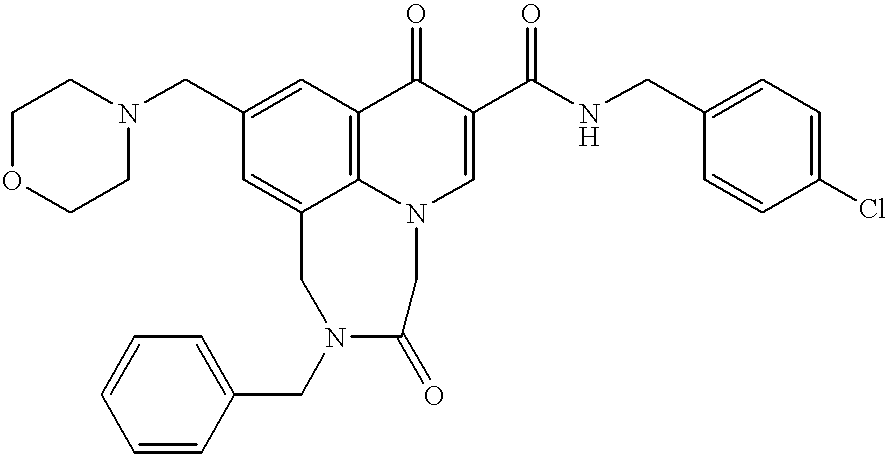
Bromoacetic anhydride (40 mg) is added to a stirred solution of 8-((benzylamino)methyl)-N-(4-chlorobenzyl)-4-hydroxy-6-(4-morpholinylmethyl)-3-quinolinecarboxamide (Preparation 29, 53 mg) in NMP (0.3 mL). After 30 min, triethylamine (50 mg) is added. The solution is diluted with water and the resulting precipitate is filtered and dried under vacuum to give 44 mg of the title compound. Physical characteristics: HRMS m/z 571.2104 (C32H31ClN4O4).
A solution of 1-formyl-1-methylhydrazine (0.217 g) in toluene (0.5 mL) is added to a solution of ethyl 2-(2,3-difluoro-5-iodobenzoyl)-3-ethoxy-2-propenoate (Preparation 21, 1.00 g) in toluene (2.5 mL) at 33° C. After stirring at ambient temperature for 20 minutes, a precipitate formed and an additional 1.5 mL of toluene is added. After an additional 1.75 h, solid anhydrous Na2CO3 (0.285 g) is added and the reaction mixture is heated to reflux. After 1 h, the reaction mixture is concentrated at reduced pressure and the residue suspended in 8 mL of water which is used as is in the following step. Physical characteristics: MS (ESI+) m/z 419 (M+H)+.
Ethyl 2-(2,3-difluoro-5-iodobenzoyl)-3-(2-formyl-2-methylhydrazino)prop-2-enoate (Preparation 30, 1.02 g) in 8 mL of water is treated with KOH pellets (0.410 g) and the reaction mixture is heated in an oil bath, under a nitrogen atmosphere, at 105° C. for 1.75 h while volatiles were condensed into a Dean-Stark trap. At this time, the Dean-Stark trap was removed, 1 mL of an aqueous solution of KOH (0.956 g) is added to the mixture, and heating is continued at 105° C. for 4 days. The mixture is cooled to room temperature, treated with formic acid (1.68 g), and is warmed to 45-50° C. A 37% aqueous formaldehyde (0.396 g) is added and the mixture is heated at 70° C. for 30 minutes. The resulting slurry is cooled in an ice bath at 0-5° C., reacted with 29% aqueous ammonium hydroxide (1.46 mL), and allowed to warm to room temperature where it is stirred for 35-40 minutes. Charcoal (44 mg) is added to the mixture which is stirred for 30 minutes and filtered through a pad of solka-floc rinsing with water. The filtrate is diluted with saturated brine and a mixture of chloroform/methanol (95/5) and filtered through a pad of solka-floc. The organic layer is separated, dried with anhydrous sodium sulfate, and concentrated at reduced pressure to obtain 252 mg (28%) of the title compound. Physical characteristics: MS (ESI+) m/z 373 (M+H)+.
A solution of 9-iodo-3-methyl-7-oxo-2,3-dihydro-7H-[1,3,4]oxadiazino[6,5,4-ij]quinoline-6-carboxylic acid (Preparation 31, 0.900 g) in tetrahydrofuran (25 mL) is refluxed with 1,1′-carbonyldiimidazole (0.631 g) for 5 h. The reaction mixture is cooled to room temperature and treated with 4-chlorobenzylamine (0.828 g). The reaction mixture is diluted with ether (75 mL), filtered, and the filtrate is concentrated at reduced pressure. The crude product is purified by chromatography, using 75 g of silica gel packed and eluted with EtOAc/CH2Cl2/heptane (1/4/5), to afford a 57% yield of the title compound. Physical characteristics: 1H NMR (DMSO-d6) δ10.15, 8.67, 8.12, 7.75, 7.37, 5.29, 4.54, 2.98; MS (EI) m/z 495 (M+); HRMS (FAB) m/z 495.9935 (C19H15ClIN3O3+H). Anal. Found: C, 45.97; H, 3.14; N, 8.39.

A dry flask is charged with N-(4-chlorobenzyl)-9-iodo-3-methyl-7-oxo-2,3-dihydro-7H-[1,3,4]oxadiazino[6,5,4-ij]quinoline-6-carboxamide (Preparation 32, 0.100 g), cuprous iodide (0.012 g), dichlorobistriphenylphosphine palladium (0.0072 g), propargyl alcohol (0.022 g), and diethylamine (4 mL). The reaction mixture is stirred at room temperature for 5 h and concentrated at reduced pressure. The residue is chromatographed, using 20 g of silica gel packed and eluted with EtOAc/CH2Cl2 (1/1), to obtain the title compound in 80% yield. Physical characteristics: M.p. 231-233° C.; MS (ESI+) m/z 424.0 (M+H+); HRMS (FAB) m/z 424.1078 (C22H18ClN3O4+H).
A solution of ethyl 2-(2,3-difluoro-5-iodobenzoyl)-3-ethoxy-2-propenoate (Preparation 21, 7.80 g) in tert-butanol (40 mL) is cooled with a cold water bath and a solution of tert-butyl 1-methylhydrazinecarboxylate (2.92 g) in tert-butanol (4 mL) is added. The cooling bath is removed, the mixture is stirred for 5 min at ambient temperature, and then is heated in an oil bath at 45° C. for 40 min. The reaction mixture is poured into 100 mL of crushed ice/water and extracted two times with ethyl acetate. The combined organic layers are dried (Na2SO4) and concentrated in vacuo. The crude product is purified by chromatography, using 300 g of silica gel, packed and eluted with EtOAc/heptane (1/3), to afford 8.95 g (92%) of the title compound as a yellow oily foam. Physical characteristics: 1H NMR (CDCl3) δ8.14, 8.07, 7.59-7.49, 7.46-7.41, 4.07, 3.30, 3.26, 1.50, 1.09, 0.97; MS (ESI+) m/z 511 (M+H)+.
Sodium hydride (0.256 g, 60% oil dispersion) is added to a solution of tert-butyl 2-(2-(2,3-difluoro-5-iodobenzoyl)-3-ethoxy-3-oxoprop-1-enyl)-1-methylhydrazinecarboxylate (Preparation 33, 3.20 g) in N,N-dimethylformamide (18 mL) at room temperature, and the mixture is stirred for 2 h. The reaction mixture is poured into a mixture of 100 mL of ice water and 100 mL of saturated brine. The mixture is extracted 3 times with ethyl acetate. The combined organic layers are dried (Na2SO4) and concentrated under a nitrogen stream overnight. The crude product is purified by chromatography, using 200 g of silica gel packed and eluted with acetone/CH2Cl2/heptane (1/3/6), provided 2.76 g (90%) of the title compound as a white foam. Physical characteristics: 1H NMR (CDCl3) δ8.50, 8.31, 7.67, 4.32, 3.37, 1.49, 1.34, 1.25; 13C NMR (CDCl3) δ168.87, 163.97, 160.01, 155.50, 141.76, 131.84, 131.37, 128.46, 127.24, 110.98, 86.73, 78.64, 61.47, 36.09, 28.00, 14.64; MS (ESI+) m/z 491 (M+H)+; TLC (silica gel GF): Rf=0.44 acetone/CH2Cl2/hexane (1/1/3).
A solution of trifluroacetic acid (6.40 g) in methylene chloride (5 mL) is added dropwise over a 4 minute period to a solution of ethyl 1-((tert-butoxycarbonyl)(methyl)amino)-8-fluoro-6-iodo-4-oxo-1,4-dihydroquinoline-3-carboxylate (Preparation 34, 1.10 g) in methylene chloride (20 mL) at room temperature. After 3.5 h, the mixture is poured into a mixture of saturated sodium bicarbonate solution (125 mL) and water (50 mL), and extracted two times with ethyl acetate. The combined organic extracts are dried (Na2SO4) and concentrated at reduced pressure. The resulting gummy solid is stirred with diethyl ether at room temperature to afford 0.857 g (98%) of the title compound as a white solid.
A mixture of ethyl 1-((tert-butoxycarbonyl)(methyl)amino)-8-fluoro-6-iodo-4-oxo-1,4-dihydroquinoline-3-carboxylate (Preparation 35, 0.200 g), 37% aqueous formaldehyde (4.0 mL), and water (2.0 mL) is heated in an oil bath for 2.5 h at 85° C. The mixture is cooled, diluted with ice water (30 mL), and the resulting precipitate is collected, rinsed with ice water and partially air dried. The solid is dissolved in a mixture of acetone and CH2Cl2, dried (Na2SO4), and concentrated at reduced pressure to yield 0.194 g (90%) of the title compound as a white solid. Physical characteristics: MS (ESI+) m/z 421 (M+H)+; TLC (silica gel GF): Rf=0.32 acetone/CH2Cl2 (1/4).
Thionyl chloride (0.122 g) is added to a solution of ethyl 8-fluoro-1-((hydroxymethyl) (methyl)amino)-6-iodo-4-oxo-1,4-dihydroquinoline-3-carboxylate (Preparation 36, 0.194 g) suspended in tetrahydrofuran (4 mL) at room temperature, and the mixture is stirred for 4.5 h. The reaction mixture is twice suspended in toluene and concentrated on a rotary evaporator, and the remaining volatiles removed at high vacuum. The resulting white solid is suspended in tetrahydrofuran (3 mL), cooled to 0-5° C. in an ice bath, and treated with sodium hydride (0.040 g, 60% oil dispersion) under a nitrogen atmosphere. After 30 min, the reaction mixture is treated with a separately prepared mixture of the anion of di-tert-butylmalonate by treating di-tert-butylmalonate (0.116 g) with sodium hydride (0.021 g) at 0-5° C. for a period of 1 h. The combined intermediates are stirred at 0-5° C. for 1.5 h. The mixture is diluted with 20 mL of pH 7 buffer, treated with 6N HCl to bring the pH to 7, and extracted once with ethyl acetate. The organic layer is washed with saturated brine, dried (Na2SO4), and concentrated at reduced pressure. Chromatography with 30 g of silica gel, packed and eluted with EtOAc/CH2Cl2 (1/5), gives 0.227 g (80%) of the title compound. Physical characteristics: 1H NMR (CDCl3) δ8.60, 7.68, 4.41, 3.60, 3.28, 3.00, 1.42, 1.42; MS (ESI+) m/z 619 (M+H)+; TLC (silica gel GF): Rf=0.46 EtOAc/CH2Cl2 (1/4).
Cesium carbonate (0.367 g) is added to a solution of di(tert-butyl) 2-(((3-(ethoxycarbonyl)-8-fluoro-6-iodo-4-oxoquinolin-1(4H)-yl)(methyl)amino)methyl)malonate (Preparation 37, 0.517 g) in dimethylsulfoxide (5 mL) and the mixture is heated at 85° C. in an oil bath under a nitrogen atmosphere for 2 h. The mixture is cooled in an ice bath, diluted with 65 mL of water containing 2.5 mL of acetic acid, stirred, and the resultant yellow precipitate collected and dried in a vacuum oven to provide the title compound in 75% yield as a golden oil. Physical characteristics: 1H NMR (CDCl3) δ8.79, 8.54, 8.29, 4.40, 4.16, 2.78, 1.51, 1.41; MS (ESI+) m/z 599 (M+H)+; TLC (silica gel GF): Rf=0.59 acetone/CH2Cl2 (1/4).
A mixture of acetic acid (1 mL), 6N HCl (1 mL), and 3,3-di(tert-butyl) 8-ethyl 5-iodo-1-methyl-7-oxo-1,2-dihydro-3H,7H-pyrido[3,2,1-ij]cinnoline-3,3,8-tricarboxylate (Preparation 38, 0.165 g) is heated in an oil bath at 110° C. for 1.5 h. Additional acetic acid (1 mL) and 6N HCl (1 mL) is added and heating continued for 2 h. The reaction vessel is purged with a strong nitrogen stream while heating in the oil bath at 115° C. until dry solid remains. Dimethylsulfoxide (2 mL) is then added and the temperature raised to 150° C. for 1 h. The mixture is allowed to cool slowly overnight. The mixture is diluted with chloroform, treated with 2 g of silica gel, and concentrated at reduced pressure. The residue is chromatographed using 35 g of silica gel, packed and eluted with acetone/chloroform/methanol/acetic acid (3/6.6/0.4/0.5%), to obtain 53 mg (52%) of the title compound as a tan colored solid. Physical characteristics: 1H NMR (DMSO-d6) δ14.88, 8.80, 8.49, 8.18, 3.50, 3.15, 2.88; MS (ESI+) m/z 371 (M+H)+; TLC (silica gel GF): Rf=0.46 acetone/chloroform/methanol/acetic acid (3/6.5/0.5/0.5%).
A solution of 5-Iodo-1-methyl-7-oxo-2,3-dihydro-1H,7H-pyrido[3,2,1-ij]cinnoline-8-carboxylic acid (Preparation 39, 0.900 g) in tetrahydrofuran (25 mL) is refluxed with 1,1′-carbonyldiimidazole (0.631 g) for 5 h. The reaction mixture is cooled to room temperature and treated with 4-chlorobenzylamine (0.828 g). The reaction mixture is diluted with ether (75 mL), filtered, and the filtrate is concentrated at reduced pressure. The crude product is purified by chromatography, using 75 g of silica gel packed and eluted with EtOAc-CH2Cl2-heptane (1:4:5), to afford the title compound. Physical characteristics: 1H NMR (CDCl3) δ8.91, 8.70, 7.87, 7.32, 4.65, 3.51, 3.13, 2.90; MS (ESI+) m/z 494.0; HRMS (FAB) m/z 494.0142 (C20H17ClIN3O2+H); TLC (silica gel GF): Rf=0.27 EtOAc/CH2Cl2 (1/6).

A dry flask is charged with N-(4-chlorobenzyl)-5-iodo-1-methyl-7-oxo-2,3-dihydro-1H,7H-pyrido[3,2,1-ij]cinnoline-8-carboxamide (Preparation 40, 0.100 g), cuprous iodide (0.012 g), dichlorobistriphenylphosphine palladium (0.0072 g), propargyl alcohol (0.022 g), and diethylamine (4 mL). The reaction mixture is stirred at room temperature for 5 h and concentrated at reduced pressure. The residue is chromatographed, using 20 g of silica gel packed and eluted with EtOAc/CH2Cl2 (1/1), to obtain the title compound in 74% yield as a tan colored solid. Physical characteristics: M.p. 165-167° C.; 1H NMR (DMSO-d6) δ10.21, 8.67, 8.13, 7.74, 7.38, 5.41, 4.55, 4.35, 3.49, 3.12, 2.85; 13C NMR (DMSO-d6) δ173.69, 162.80, 144.92, 137.79, 133.56, 132.88, 130.54, 128.44, 127.97, 127.49, 126.10, 124.99, 117.98, 109.97, 90.12, 81.73, 48.60, 47.63, 43.24, 40.64, 17.64; MS (ESI+) m/z 422 (M+H)+; HRMS (FAB) m/z 422.1282 (C23H20ClN3O3+H); TLC (silica gel GF): Rf=0.22 acetone/chloroform (1/4).
The antiviral activity of a compound of the invention can be determined using pharmacological models which are well known to the art, or using the test described below.
While many of the compounds of the present invention can demonstrate activity against the CMV polymerase, these compounds may be active against the cytomegalovirus by this or other mechanisms of action. Thus, the description below of these compounds' activity against the CMV polymerase is not meant to limit the present invention to a specific mechanism of action.
The HCMV polymerase assay is performed using a scintillation proximity assay (SPA) as described in several references, such as N. D. Cook, et al., Pharmaceutical Manufacturing International, pages 49-53 (1992); K. Takeuchi, Laboratory Practice, September issue (1992); U.S. Pat. No. 4,568,649 (1986); which are incorporated by reference herein. Reactions are performed in 96-well plates. The assay is conducted in 100 μl volume with 5.4 mM HEPES (pH 7.5), 11.7 mM KCl, 4.5 mM MgCl2, 0.36 mg/ml BSA, and 90 nM 3H-dTTP. Assays are run with and without CHAPS, (3-[(3-Cholamidopropyl)-dimethylammonio]-1-propane-sulfonate) at a final concentration of 2 mM. HCMV polymerase is diluted in enzyme dilution buffer containing 50% glycerol, 250 mM NaCl, 10 mM HEPES (pH 7.5), 100 μg/ml BSA, and 0.01% sodium azide. The HCMV polymerase, which is expressed in recombinant baculovirus-infected SF-9 cells and purified according to literature procedures, is added at 10% (or 10 μl) of the final reaction volume, i.e., 100 μl. Compounds are diluted in 50% DMSO and 10 μl are added to each well. Control wells contain an equivalent concentration of DMSO. Unless noted otherwise, reactions are initiated via the addition of 6 nM biotinylated poly(dA)-oligo(dT) template/primer to reaction mixtures containing the enzyme, substrate, and compounds of interest. Plates are incubated in a 25° C. or 37° C. H2O bath and terminated via the addition of 40 μl/reaction of 0.5 M EDTA (pH 8) per well. Reactions are terminated within the time-frame during which substrate incorporation is linear and varied depending upon the enzyme and conditions used, i.e., 30 min. for HCMV polymerase. Ten μl of streptavidin-SPA beads (20 mg/ml in PBS/10% glycerol) are added following termination of the reaction. Plates are incubated 10 min. at 37° C., then equilibrated to room temperature, and counted on a Packard Topcount. Linear regressions are performed and IC50's are calculated using computer software.
A modified version of the above HCMV polymerase assay is performed as described above, but with the following changes: Compounds are diluted in 100% DMSO until final dilution into assay buffer. In the previous assay, compounds are diluted in 50% DMSO. 4.5 mM dithiothreitol (DTT) is added to the polymerase buffer. Also, a different lot of CMV polymerase is used, which appears to be more active resulting in a more rapid polymerase reaction. Results of the testing of representative compounds of formula I in this assay are shown in Table 1 below.
| TABLE 1 | ||
| Polymerase IC50 (μM) | ||
| Example | HCMV | HSV | VZV | ||
| 1 | 0.65 | nd | nd | ||
| 2 | 0.77 | 0.74 | 0.52 | ||
| 3 | 0.14 | <0.51 | 0.06 | ||
| 4 | 0.16 | nd | 0.18 | ||
| 5 | 3.2 | nd | nd | ||
| 6 | 4.0 | nd | nd | ||
| 7 | 4.0 | nd | nd | ||
| 8 | 0.43 | 0.2 | 0.09 | ||
| 9 | 0.67 | 0.28 | 0.17 | ||
| 10 | 0.31 | 0.31 | 0.12 | ||
| 11 | 1.16 | nd | nd | ||
| 12 | 1.67 | nd | nd | ||
| 13 | 39% @ 20 μM† | nd | nd | ||
| 14 | 6.0 | nd | nd | ||
| 15 | 4.19 | nd | nd | ||
| 16 | 7.95 | nd | nd | ||
| nd not determined. | |||||
| †Percent inhibition at the given concentration. | |||||
Having described the invention in detail and by reference to the preferred embodiments thereof, it will be apparent that modifications and variations are possible without departing from the scope of the appended claims.
Claims (46)
1. A compound of formula I, 
or a pharmaceutically acceptable salt thereof wherein,
X is Cl, Br, F, CN or NO2;
G is
(a) C1-4alkyl which is fully saturated or partially unsaturated and is substituted by hydroxy, or
(b) C1-4alkyl substituted by NR1R2 or 4-tetrahydropyran;
R1 is C2-7alkyl substituted by hydroxy, C1-4alkoxy, aryl, or heteroaryl;
R2 is hydrogen or C1-7alkyl; or
R1 and R2 together with the nitrogen to which they are attached form (a) a morpholine which may be optionally substituted by aryl or C1-7alkyl, or (b) a pyrrolidine ring substituted by hydroxy;
W is a heterocycle of formula W1 
A is CR4 or nitrogen;
B is CR5 or nitrogen;
D is
(a) —(CR13R14)a—, where a is 2 or 3
(b) —(CR15R16)4—,
(c) —Y—CR13R14—CR13R14—,
(d) —CR13R14—Y—CR13R14—,
(e) —Y—CR13R14—Y—,
(f)—CR13R14—CR13R14—Y—,
(g) —Y—(CR15R16)n—,
(h) —Y—CR15═CR15—,
(i) —Y—CR15═N—,
(j) —CR15═CR15—Y—,
(k) —N═CR15—Y—,
(l) —(CR15R16)b—N═CR15—, where b is 0 or 1
(m) —CR15═N—(CR15R16)b—, where b is 0 or 1
(n) —N═N—,
(o) —N═CR15—(CR15R16)b—, where b is 0 or 1
(p) —CR15═CR15—,
(q) —N═N—Y—,
(r) —Y—N═N—,
(s) —Y—N═CR15—, or
(t) —CR15R16—Y—CR15R16—CR15R16—;
Y is oxygen, S(O)m, or NR7;
with the provisos that:
when G is C1-4 alkyl which is fully saturated and is substituted by hydroxy or morpholinyl, in which morpholinyl is attached through nitrogen; A is CR4; B is CR5; and R8 is hydrogen then at least one of R13, R14, or R7 is not hydrogen or C1-7alkyl;
when A is CR4, B is CR5, D is —Y—CR13R14—CR13R14—, and R8 is hydrogen or C1-7 alkyl then Y is not oxygen;
when A is CR4, and B is CR5 then D is not —CR15l═CR15—;
R4 is H, halogen, or C1-4alkyl optionally substituted by one to three halogens;
R5 is
(a) H,
(b) halo,
(c) OR12,
(d) SR12,
(e) C1-7alkyl which may be partially unsaturated and optionally substituted by one or more substituents selected from OR12, SR12, NR10R11, or halo,
(f) C3-8cycloalkyl which may be partially unsaturated and is optionally substituted by one or more substituents selected from halogen, OR12, SR12, or NR10R11,
(g) (C═O)R9,
(h) S(O)mR9,
(i) (C═O)OR2,
(j) NHSO2R9,
(k) nitro, or
(l) cyano;
R7 is
(a) H,
(b) C1-7alkyl which may be partially unsaturated and optionally substituted by one or more substituents selected from OR12, SR12,NR10R11, or halo,
(c) C3-8cycloalkyl which may be partially unsaturated and is optionally substituted by one or more substituents selected from halogen, OR12, SR12, or NR10R11,
(d) aryl,
(e) het,
(f) (C═O)R9, or
(g) S(O)mR9;
R8 is
(a) H,
(b) C1-7 alkyl which may be partially unsaturated and optionally substituted by one or more substituents selected from OR12, SR12, NR10R11, or halo,
(c) OR12, or
(d) SR12;
R9 is
(a) C1-7alkyl optionally substituted by OR12 or NR2R2,
(b) C3-8cycloalkyl optionally substituted by OR12 or NR2R2,
(c) NR10R11,
(d) aryl, or
(e) het, wherein said het is bound through a carbon atom;
R10 and R11 are independently
(a) H,
(b) aryl,
(c) C1-7alkyl which may be partially unsaturated and is optionally substituted by one or more substituents selected from CONR2R2, CO2R2, het, aryl, cyano, or halo,
(d) C2-7alkyl which may be partially unsaturated and is substituted by one or more substituents selected from NR2R2, OR2, or SR2,
(e) C3-8cycloalkyl which may be partially unsaturated and is optionally substituted by one or more substituents selected from halogen, OR2, SR2, or NR2R2, or
(f) R10 and R11 together with the nitrogen to which they are attached form a het;
R12 is
(a) H,
(b) aryl,
(c) het
(d) C1-7alkyl optionally substituted by aryl, or halogen,
(e) C2-7alkyl substituted by OR2, SR2, or NR2R2, or
(f) C3-8cycloalkyl which may be partially unsaturated and is optionally substituted by one or more substituents selected from halogen, OR2, SR2, or NR2R2;
R13, R14, R15, and R16 are independently
(a) H
(b) C1-7alkyl which may be partially unsaturated and optionally substituted by one or more OR12, SR12, NR10R11, or halo groups,
(c) C3-8cycloalkyl which may be partially unsaturated and is optionally substituted by one or more substituents selected from halogen, OR12, SR12, or NR10R11,
(d) aryl,
(e) het, wherein said het is bound through a carbon atom,
(f) OR12,
(g) SR12,
(h) NR10R11;
(i) (C═O)OR2, or
(j) R13 and R14 or R15 and R16 together with the carbon to which they are attached form (C═O);
each m is independently 0, 1 or 2;
each n is independently 1 or 3;
aryl is a phenyl radical or an ortho-fused bicyclic carbocyclic radical wherein at least one ring is aromatic, and aryl may be optionally substituted with one or more substituents selected from halo, OH, cyano, NR2R2, CO2R2, CF3, C1-6alkoxy, and C1-6 alkyl which maybe further substituted by one to three SR2, NR2R2, OR2, or CO2R2 groups;
het is a four- (4), five- (5), six- (6), or seven- (7) membered saturated or unsaturated heterocyclic ring having 1, 2, or 3 heteroatoms selected from oxygen, sulfur, or nitrogen, which is optionally fused to a benzene ring, or any bicyclic heterocycle group, and het may be optionally substituted with one or more substituents selected from halo, OH, cyano, phenyl, CO2R2, CF3, C1-6alkoxy, oxo, oxime, and C1-6 alkyl which may be further substituted by one to three SR2, NR2R2, OR2, or CO2R2 groups;
halo or halogen is F, Cl, Br, I;
1 represents the point of attachment between W and G;
2 represents the point of attachment between W and the carbonyl group of Formula (I).
2. A compound of claim 1 wherein W1 is of the formula W1.1 
3. A compound of claim 1 wherein W1 is of the formula W1.3 
4. A compound of claim 1 wherein W1 is of the formula W1.5 
5. A compound of claim 1 wherein W1 is of the formula W1.6 
6. A compound of claim 1 wherein W1 is of the formula W1.7 
7. A compound of claim 1 wherein W1 is of the formula W1.8 
8. A compound of claim 1 wherein W1 is of the formula W1.9 
9. A compound of claim 1 wherein W1 is of the formula W1.10 
10. A compound of claim 1 wherein W1 is of the formula W1.11 
11. A compound of claim 1 wherein W1 is of the formula W1.14 
12. A compound of claim 1 wherein W1 is of the formula W1.15 
13. A compound of claim 1 wherein W1 is of the formula W1.17 
14. A compound of claim 1 wherein W1 is of the formula W1.18 
15. A compound of claim 1 wherein W1 is of the formula W1.19 
16. A compound of claim 1 wherein W1 is of the formula W1.20 
17. A compound of claim 1 wherein W is of the formula W1.23 
18. A compound of claim 1 wherein W is of the formula W1.24 
19. A compound of claim 1 wherein W is of the formula W1.25 
20. A compound of claim 1 wherein W is of the formula W1.26 
21. A compound of claim 1 wherein W is of the formula W1.52 
22. A compound according to claim 1 wherein X is Cl.
23. A compound according to claim 1 wherein G is 4-morpholinylmethyl.
24. A compound according to claim 1 wherein G is 3-hydroxypropyl.
25. A compound according to claim 1 wherein G is 3-hydroxy-1-propynyl.
26. A compound according to claim 1 wherein G is tetrahydro-2H-pyran-4-ymethyl.
27. A compound of claim 1 wherein R8 hydrogen.
28. A compound of claim 27 where A is CR4 and B is CR5.
29. A compound 28 where R4 is hydrogen and R5 is hydrogen.
30. A compound of formula I according to claim 1 wherein W is selected from W1.2, W1.4, W1.12, W1.13, W1.16, W1.21, W1.22, W1.27, W1.30, W1.31, W1.32, W1.33, W1.34, W1.35, W1.36, W1.37, W1.38, W1.39, W1.40, W1.41, W1.42, W1.43, W1.44, W1.45, W1.46, W1.47, W1.48, W1.49, W1.50, W1.51, W1.52, W1.53, W1.54, W1.55, W1.56, W1.57, W1.58, W1.59, W1.60, W1.61, W1.62, W1.63, W1.64, or W1.65 


31. A compound according to claim 1 which is
N-(4-chlorobenzyl)-8-(4-morpholinylmethyl)-6-oxo-6H-imidazo[4,5,1-ij]quinoline-5-carboxamide,
N-(4-chlorobenzyl)-8-(3-hydroxy-1-propynyl)-6-oxo-6H-imidazo[4,5,1-ij]quinoline-5-carboxamide;
N-(4-chlorobenzyl)-8-(3-hydroxypropyl)-6-oxo-6H-imidazol[4,5,1-ij]quinoline-5-carboxamide;
1-amino-N-(4-chlorobenzyl)-8-(3-hydroxy-1-propynyl)-6-oxo-1,2-dihydro-6H-pyrrolo[3,2,1-ij]quinoline-5-carboxamide;
1-amino-N-(4-chlorobenzyl)-8-(3-hydroxypropyl)-6-oxo-1,2-dihydro-6H-pyrrolo[3,2,1-ij]quinoline-5-carboxamide;
1-amino-N-(4-chlorobenzyl)-8-(4-morpholinylmethyl)-6-oxo-1,2-dihydro-6H-pyrrolo[3,2,1-ij]quinoline-5-carboxamide;
N-(4-chlorobenzyl)-2-(hydroxymethyl)-8-(3-hydroxy-1-propynyl)-6-oxo-1,2-dihydro-6H-pyrrolo[3,2,1-ij]quinoline-5-carboxamide;
N-(4-chlorobenzyl)-8-(3-hydroxyprop-1-ynyl)-2,2-dimethyl-6-oxo-1,2-dihydro-6H-pyrrolo[3,2,1-ij]quinoline-5-carboxamide;
3-benzyl-N-(4-chlorobenzyl)-9-(3-hydroxy-1-propynyl)-7-oxo-2,3-dihydro-7H-[1,3,4]oxadiazino[6,5,4-ij]quinoline-6-carboxamide;
3-benzyl-N-(4-chlorobenzyl)-9-(3-hydroxypropyl)-7-oxo-2,3-dihydro-7H-[1,3,4]-oxadiazino[6,5,4-ij]quinoline-6-carboxamide;
3-benzyl-N-(4-chlorobenzyl)-9-(4-morpholinylmethyl)-7-oxo-2,3-dihydro-7H-[1,3,4]oxadiazino[6,5,4-ij]quinoline-6-carboxamide;
3-benzyl-N-(4-chlorobenzyl)-9-(tetrahydro-2H-pyran-4-ylmethyl)-7-oxo-2,3-dihydro-7H-[1,3,4]oxadiazino[6,5,4-ij]quinoline-6-carboxamide;
N-(4-chlorobenzyl)-9-(3-hydroxyprop-1-ynyl)-3-methyl-7-oxo-2,3-dihydro-7H-[1,3,4]oxadiazino[6,5,4-ij]quinoline-6-carboxamide;
3-benzyl-N-(4-chlorobenzyl)-9-(3-hydroxy-1-propynyl)-7-oxo-2,3-dihydro-7H-[1,3,4]thiadiazino[6,5,4-ij]quinoline-6-carboxamide;
3-benzyl-N-(4-chlorobenzyl)-9-(3-hydroxypropyl)-7-oxo-2,3-dihydro-7H-[1,3,4]-thiadiazino[6,5,4-ij]quinoline-6-carboxamide;
3-benzyl-N-(4-chlorobenzyl)-9-(4-morpholinylmethyl)-7-oxo-2,3-dihydro-7H-[1,3,4]thiadiazino[6,5,4-ij]quinoline-6-carboxamide;
3-benzyl-N-(4-chlorobenzyl)-9-(tetrahydro-2H-pyran-4-ylmethyl)-7-oxo-2,3-dihydro-7H-[1,3,4]thiadiazino[6,5,4-ij]quinoline-6-carboxamide;
N-(4-chlorobenzyl)-3-methyl-9-(morpholin-4-ylmethyl)-7-oxo-7H-[1,4]thiazino[2,3,4-ij]quinoline-6-carboxamide;
N-(4-chlorobenzyl)-3-methyl-7-oxo-9-(tetrahydro-2H-pyran-4-ylmethyl)-7H-[1,4]thiazino[2,3,4-ij]quinoline-6-carboxamide;
N-(4-chlorobenzyl)-9-(3-hydroxypropyl)-3-methyl-7-oxo-7H-[1,4]thiazino[2,3,4-ij]quinoline-6-carboxamide;
N-(4-chlorobenzyl)-9-(3-hydroxyprop-1-ynyl)-3-methyl-7-oxo-7H-[1,4]thiazino[2,3,4-ij]quinoline-6-carboxamide;
N-(4-chlorobenzyl)-9-(morpholin-4-ylmethyl)-7-oxo-2-pyridin-3-yl-7H-[1,4]thiazino[2,3,4-ij]quinoline-6-carboxamide;
N-(4-chlorobenzyl)-9-(3-hydroxy-1-propynyl)-7-oxo-3-phenyl-1H,7H-[1,3]oxazino[5,4,3-ij]quinoline-6-carboxamide;
N-(4-chlorobenzyl)-9-(3-hydroxypropyl)-7-oxo-3-phenyl-1H,7H-[1,3]oxazino[5,4,3-ij]quinoline-6-carboxamide;
N-(4-chlorobenzyl)-7-oxo-3-phenyl-9-(tetrahydro-2H-pyran-4-ylmethyl)-1H,7H-[1,3]oxazino [5,4,3-ij]quinoline-6-carboxamide;
N-(4-chlorobenzyl)-9-(4-morpholinylmethyl)-7-oxo-3-phenyl-1H,7H-[1,3]oxazino[5,4,3-ij]quinoline-6-carboxamide;
N-(4-chlorobenzyl)-9-(3-hydroxy-1-propynyl)-1-methyl-7-oxo-3-phenyl-2,3-dihydro-1H,7H-pyrido[1,2,3-de]quinoxaline-6-carboxamide;
N-(4-chlorobenzyl)-9-(3-hydroxypropyl)-1-methyl-7-oxo-3-phenyl-2,3-dihydro-1H,7H-pyrido[1,2,3-de]quinoxaline-6-carboxamide;
N-(4-chlorobenzyl)-9-(tetrahydro-2H-pyran-4-ylmethyl)-1-methyl-7-oxo-3-phenyl-2,3-dihydro-1H,7H-pyrido[1,2,3-de]quinoxaline-6-carboxamide;
N-(4-chlorobenzyl)-9-(4-morpholinylmethyl)-1-methyl-7-oxo-3-phenyl-2,3-dihydro-1H,7H-pyrido[1,2,3-de]quinoxaline-6-carboxamide;
N-(4-chlorobenzyl)-9-(3-hydroxy-1-propynyl)-2,3,7-trioxo-2,3-dihydro-1H,7H-pyrido[1,2,3-de]quinoxaline-6-carboxamide;
N-(4-chlorobenzyl)-9-(3-hydroxypropyl)-2,3,7-trioxo-2,3-dihydro-1H,7H-pyrido[1,2,3-de]quinoxaline-6-carboxamide;
N-(4-chlorobenzyl)-9-(4-morpholinylmethyl)-2,3,7-trioxo-2,3-dihydro-1H,7H-pyrido[1,2,3-de]quinoxaline-6-carboxamide;
N-(4-chlorobenzyl)-9-(3-hydroxy-1-propynyl)-2,7-dioxo-2,3-dihydro-1H,7H-pyrido[1,2,3-de]quinoxahne-6-carboxamide;
N-(4-chlorobenzyl)-9-(3-hydroxypropyl)-2,7-dioxo-2,3-dihydro-1H,7H-pyrido[1,2,3-de]quinoxaline-6-carboxamide;
N-(4-chlorobenzyl)-9-(3-hydroxy-1-propynyl)-3,7-dioxo-2,3-dihydro-1H,7H-pyrido[1,2,3-de]quinoxaline-6-carboxamide;
N-(4-chlorobenzyl)-9-(3-hydroxypropyl)-3,7-dioxo-2,3-dihydro-1H,7H-pyrido[1,2,3-de]quinoxaline-6-carboxamide;
N-(4-chlorobenzyl)-9-(4-morpholinylmethyl)-3,7-dioxo-2,3-dihydro-1H,7H-pyrido[1,2,3-de]quinoxaline-6-carboxamide;
N-(4-chlorobenzyl)-9-(4-morpholinylmethyl)-2,7-dioxo-2,3-dihydro-1H,7H-pyrido[1,2,3-de]quinoxaline-6-carboxamide;
N-(4-chlorobenzyl)-9-(3-hydroxy-1-propynyl)-1-methyl-2,7-dioxo-2,3-dihydro-1H,7H-pyrido[1,2,3-de]quinoxaline-6-carboxamide;
3-benzyl-N-(4-chlorobenzyl)-9-(3-hydroxy-1-propynyl)-1-methyl-7-oxo-2,3-dihydro-1H,7H-[1,2,4]triazino[5,6,1-ij]quinoline-6-carboxamide;
3-benzyl-N-(4-chlorobenzyl)-9-(3-hydroxypropyl)-1-methyl-7-oxo-2,3-dihydro-1H,7H-[1,2,4]triazino[5,6,1-ij]quinoline-6-carboxamide;
3-benzyl-N-(4-chlorobenzyl)-9-(4-morpholinylmethyl)-1-methyl-7-oxo-2,3-dihydro-1H,7H-[1,2,4]triazino[5,6,1-ij]quinoline-6-carboxamide;
3-benzyl-N-(4-chlorobenzyl)-9-(tetrahydro-2H-pyran-4-ylmethyl)-1-methyl-7-oxo-2,3-dihydro-1H,7H-[1,2,4]triazino[5,6,1-ij]quinoline-6-carboxamide;
1-benzyl-N-(4-chlorobenzyl)-5-(3-hydroxy-1-propynyl)-2,7-dioxo-2,3-dihydro-1H,7H-pyrido[3,2,1-ij]cinnoline-8-carboxamide;
1-benzyl-N-(4-chlorobenzyl)-5-(3-hydroxypropyl)-2,7-dioxo-2,3-dihydro-1H,7H-pyrido[3,2,1-ij]cinnoline-8-carboxamide;
1-benzyl-N-(4-chlorobenzyl)-5-(4-morpholinylmethyl)-2,7-dioxo-2,3-dihydro-1H,7H-pyrido[3,2,1-ij]cinnoline-8-carboxamide;
1-benzyl-N-(4-chlorobenzyl)-5-(tetrahydro-2H-pyran-4-ylmethyl)-2,7-dioxo-2,3-dihydro-1H,7H-pyrido[3,2,1-ij]cinnoline-8-carboxamide;
N-(4-Chlorobenzyl)-5-(3-hydroxyprop-1-ynyl)-1-methyl-7-oxo-2,3-dihydro-1H,7H-pyrido[3,2,1-ij]cinnoline-8-carboxamide;
N-(4-chlorobenzyl)-9-(3-hydroxy-1-propynyl)-7-oxo-3-phenyl-1H,7H-[1,3]thiazino[5,4,3-ij]quinoline-6-carboxamide;
N-(4-chlorobenzyl)-9-(3-hydroxypropyl)-7-oxo-3-phenyl-1H,7H-[1,3]thiazino[5,4,3-ij]quinoline-6-carboxamide;
N-(4-chlorobenzyl)-9-(tetrahydro-2H-pyran-4-ylmethyl)-7-oxo-3-phenyl-1H,7H-[1,3]thiazino[5,4,3-ij]quinoline-6-carboxamide;
N-(4-chlorobenzyl)-9-(4-morpholinylmethyl)-7-oxo-3-phenyl-1H,7H-[1,3]thiazino[5,4,3-ij]quinoline-6-carboxamide;
N-(4-chlorobenzyl)-9-(3-hydroxypropyl)-2-methyl-7-oxo-3-phenyl-2,3-dihydro-1H,7H-pyrido[3,2,1-ij]quinazoline-6-carboxamide;
N-(4-chlorobenzyl)-9-(3-hydroxy-1-propynyl)-2-methyl-7-oxo-3-phenyl-2,3-dihydro-1H,7H-pyrido[3,2,1-ij]quinazoline-6-carboxamide;
N-(4-chlorobenzyl)-9-(4-morpholinylmethyl)-2-methyl-7-oxo-3-phenyl-2,3-dihydro-1H,7H-pyrido[3,2,1-ij]quinazoline-6-carboxamide;
N-(4-chlorobenzyl)-9-(tetrahydro-2H-pyran-4-ylmethyl)-2-methyl-7-oxo-3-phenyl-2,3-dihydro-1H,7H-pyrido[3,2,1-ij]quinazoline-6-carboxamide;
2-benzyl-N-(4-chlorobenzyl)-9-(4-morpholinylmethyl)-7-oxo-2,3-dihydro-1H,7H-pyrido[3,2,1-ij]quinazoline-6-carboxamide;
2-benzyl-N-(4-chlorobenzyl)-9-(4-morpholinylmethyl)-3,7-dioxo-2,3-dihydro-1H,7H-pyrido[3,2,1-ij]quinazoline-6-carboxamide;
N-(4-chlorobenzyl)-9-(3-hydroxy-1-propynyl)-2-(4-morpholinyl)-7-oxo-7H-[1,3,4]-thiadiazino[6,5,4-ij]quinoline-6-carboxamide,
N-(4-chlorobenzyl)-9-(3-hydroxypropyl)-2-(4-morpholinyl)-7-oxo-7H-[1,3,4]thiadiazino[6,5,4-ij]quinoline-6-carboxamide;
N-(4-chlorobenzyl)-2-(4-morpholinyl)-9-(4-morpholinylmethyl)-7-oxo-7H-[1,3,4]-thiadiazino[6,5,4-ij]quinoline-6-carboxamide;
N-(4-chlorobenzyl)-2-(4-morpholinyl)-7-oxo-9-(tetrahydro-2H-pyran-4-ylmethyl)-7H-[1,3,4]thiadiazino[6,5,4-ij]quinoline-6-carboxamide;
N-(4-chlorobenzyl)-9-(3-hydroxypropyl)-7-oxo-2,3-dihydro-1H,7H-pyrazino[3,2,1-ij][1,7]naphthyridine-6-carbaxmide;
N-(4-chlorobenzyl)-9-(4-morpholinylmethyl)-7-oxo-2,3-dihydro-1H,7H-pyrazino[3,2,1-ij][1,7]naphthyridine-6-carboxamide;
N-(4-chlorobenzyl)-9-(3-hydroxy-1-propynyl)-7-oxo-2,3-dihydro-1H,7H-pyrazino[3,2,1-ij][1,7]naphthyridine-6-carboxamide;
N-(4-chlorobenzyl)-9-(3-hydroxypropyl)-7-oxo-2,3-dihydro-7H-[1,4]thiazino[2,3,4-ij][1,7]naphthyridine-6-carboxamide;
N-(4-chlorobenzyl)-9-(4-morpholinylmethyl)-7-oxo-2,3-dihydro-7H-[1,4]thiazino[2,3,4-ij][1,7]naphthyridine-6-carboxamide;
N-(4-chlorobenzyl)-9-(3-hydroxy-1-propynyl)-7-oxo-2,3-dihydro-7H-[1,4]thiazino[2,3,4-ij][1,7]naphthyridine-6-carboxamide;
N-(4-chlorobenzyl)-9-(3-hydroxy-1-propynyl)-7-oxo-2,3-dihydro-7H-[1,4]oxazino[2,3,4-ij][1,7]naphthyridine-6-carboxamide; N-(4-chlorobenzyl)-9-(4-morpholinylmethyl)-7-oxo-2,3-dihydro-7H-[1,4]oxazino[2,3,4-ij][1,7]naphthyridine-6-carboxamide;
N-(4-chlorobenzyl)-9-(3-hydroxypropyl)-7-oxo-2,3-dihydro-7H-[1,4]oxazino[2,3,4-ij][1,7]naphthyridine-6-carboxamide;
N-(4-chlorobenzyl)-9-(3-hydroxypropyl)-3,7-dioxo-3H,7H-pyrido[1,2,3-de]quinoxaline-6-carboxamide;
N-(4-chlorobenzyl)-9-(3-hydroxy-1-propynyl)-3,7-dioxo-3H,7H-pyrido[1,2,3-de]quinoxaline-6-carboxamide;
N-(4-chlorobenzyl)-9-(4-morpholinylmethyl)-3,7-dioxo-3H,7H-pyrido[1,2,3-de]quinoxaline-6-carboxamide;
N-(4-chlorobenzyl)-2-[(4-chlorobenzyl)amino]-9-(4-morpholinylmethyl)-7-oxo-3H,7H-pyrido[1,2,3-de]quinoxaline-6-carboxamide;
2-(benzylamino)-N-(4-chlorobenzyl)-9-(4-morpholinylmethyl)-7-oxo-3H,7H-pyrido[1,2,3-de]quinoxaline-6-carboxamide;
N-(4-chlorobenzyl)-10-(3-hydroxypropyl)-2,4,8-trioxo-1,2,3,4-tetrahydro-8H-[1,4]-diazepino [3,2,1-ij]quinoline-7-carboxamide;
N-(4-chlorobenzyl)-10-(3-hydroxy-1-propynyl)-2,4,8-trioxo-1,2,3,4-tetrahydro-8H-[1,4]diazepino[3,2,1-ij]quinoline-7-carboxamide;
N-(4-chlorobenzyl)-10-(4-morpholinylmethyl)-2,4,8-trioxo-1,2,3,4-tetrahydro-8H-[1,4]diazepino[3,2,1-ij]quinoline-7-carboxamide;
N-(4-chlorobenzyl)-10-(4-morpholinylmethyl)-2,8-dioxo-1,2,3,4-tetrahydro-8H-[1,4]diazepino[3,2,1-ij]quinoline-7-carboxamide;
N-(4-chlorobenzyl)-8-(4-morpholinylmethyl)-2,6-dioxo-1,2-dihydro-6H-imidazo[4,5,1-ij]quinoline-5-carboxamide;
N-(4-chlorobenzyl)-8-(3-hydroxy-1-propynyl)-2,6-dioxo-1,2-dihydro-6H-imidazo[4,5,1-ij]quinoline-5-carboxamide;
N-(4-chlorobenzyl)-8-(3-hydroxypropyl)-2,6-dioxo-1,2-dihydro-6H-imidazo[4,5,1-ij]quinoline-5-carboxamide;
N-(4-chlorobenzyl)-8-(4-morpholinylmethyl)-2,6-dioxo-1-[2-(1-piperidinyl)ethyl]-1,2-dihydro-6H-imidazo[4,5,1-ij]quinoline-5-carboxamide;
N-(4-chlorobenzyl)-1-[2-(4-methyl-1-piperazinyl)ethyl]-8-(4-morpholinylmethyl)-2,6-dioxo-1,2-dihydro-6H-imidazo[4,5,1-ij]quinoline-5-carboxamide;
N-(4-chlorobenzyl)-10-(4-morpholinylmethyl)-8-oxo-3,4-dihydro-2H,8H-[1,4]oxazepino[2,3,4-ij]quinoline-7-carboxamide;
N-(4-chlorobenzyl)-3-methyl-9-(morpholin-4-ylmethyl)-7-oxo-7H-[1,4]oxazino[2,3,4-ij]quinoline-6-carboxamide;
N-(4-chlorobenzyl)-3-methyl-7-oxo-9-(tetrahydro-2H-pyran-4-ylmethyl)-7H-[1,4]oxazino[2,3,4-ij]quinoline-6-carboxamide;
N-(4-chlorobenzyl)-9-(3-hydroxypropyl)-3-methyl-7-oxo-7H-[1,4]oxazino[2,3,4-ij]quinoline-6-carboxamide;
N-(4-chlorobenzyl)-9-(3-hydroxyprop-1-ynyl)-3-methyl-7-oxo-7H-[1,4]oxazino[2,3,4-ij]quinoline-6-carboxamide;
N-(4-chlorobenzyl)-9-(morpholin-4-ylmethyl)-7-oxo-2-pyridin-3-yl-7H-[1,4]oxazino[2,3,4-ij]quinoline-6-carboxamide;
2-benzyl-N-(4-chlorobenzyl)-10-(4-morpholinylmethyl)-3,8-dioxo-1,2,3,4-tetrahydro-8H-[1,4]diazepino[6,7,1-ij]quinoline-7-carboxamide; or a pharmaceutically acceptable salt thereof.
32. A compound according to claim 1 which is
N-(4-chlorobenzyl)-10-(4-morpholinylmethyl)-8-oxo3,4-dihydro-2H,8H-[1,4]oxazepino [2,3,4-ij]quinoline-7-carboxamide;
N-(4-chlorobenzyl)-8-(4-morpholinylmethyl)-2,6-dioxo-1,2-dihydro-6H-imidazo[4,5,1-ij]quinoline-5-carboxamide;
N-(4-chlorobenzyl)-9-(4-morpholinylmethyl)-2,7-dioxo-2,3-dihydro-1H,7H-pyrido[1,2,3-de]quinoxaline-6-carboxamide;
N-(4-chlorobenzyl)-2-[(4-chlorobenzyl)amino]-9-(4-morpholinylmethyl)-7-oxo-3H,7H-pyrido[1,2,3-de]quinoxaline-6-carboxamide;
N-(4-chlorobenzyl)-2-(hydroxymethyl)-8-(3-hydroxy-1-propynyl)-6-oxo-1,2-dihydro-6H-pyrrolo[3,2,1-ij]quinoline-5-carboxamide;
N-(4-chlorobenzyl)-8-(3-hydroxyprop-1-ynyl)-2,2-dimethyl-6-oxo-1,2-dihydro-6H-pyrrolo[3,2,1-ij]quinoline-5-carboxamide;
N-(4-chlorobenzyl)-10-(4-morpholinylmethyl)-2,8-dioxo-1,2,3,4-tetrahydro-8H-[1,4]diazepino[3,2,1-ij]quinoline-7-carboxamide;
2-(benzylamino)-N-(4-chlorobenzyl)-9-(4-morpholinylmethyl)-7-oxo-3H,7H-pyrido[1,2,3-de]quinoxaline-6-carboxamide;
N-(4-chlorobenzyl)-9-(3-hydroxy-1-propynyl)-1-methyl-2,7-dioxo-2,3-dihydro-1H,7H-pyrido[1,2,3-de]quinoxaline-6-carboxamide;
2-benzyl-N-(4-chlorobenzyl)-9-(4-morpholinylmethyl)-7-oxo-2,3-dihydro-1H,7H-pyrido[3,2,1-ij]quinazoline-6-carboxamide;
2-benzyl-N-(4-chlorobenzyl)-9-(4-morpholinylmethyl)-3,7-dioxo-2,3-dihydro-1H,7H-pyrido[3,2,1-ij]quinazoline-6-carboxamide;
2-benzyl-N-(4-chlorobenzyl)-10-(4-morpholinylmethyl)-3,8-dioxo-1,2,3,4-tetrahydro-8H-[1,4]diazepino[6,7,1-ij]quinoline-7-carboxamide;
N-(4-chlorobenzyl)-9-(3-hydroxyprop-1-ynyl)-3-methyl-7-oxo-2,3-dihydro-7H-[1,3,4]oxadiazino[6,5,4-ij]quinoline-6-carboxamide;
N-(4-chlorobenzyl)-5-(3-hydroxyprop-1-ynyl)-1-methyl-7-oxo-2,3-dihydro-1H,7H-pyrido[3,2,1-ij]cinnoline-8-carboxamide; or a pharmaceutically acceptable salt thereof.
33. A compound according to claim 1 which is
N-(4-chlorobenzyl)-10-(4-morpholinylmethyl)-8-oxo-3,4-dihydro-2H,8H-[1,4]oxazepino [2,3,4-ij]quinoline-7-carboxamide;
N-(4-chlorobenzyl)-9-(4-morpholinylmethyl)-2,7-dioxo-2,3-dihydro-1H,7H-pyrido[1,2,3-de]quinoxaline-6-carboxamide;
N-(4-chlorobenzyl)-10-(4-morpholinylmethyl)-2,8-dioxo-1,2,3,4-tetrahydro-8H-[1,4]diazepino[3,2,1-ij]quinoline-7-carboxamide;
2-(benzylamino)-N-(4-chlorobenzyl)-9-(4-morpholinylmethyl)-7-oxo-3H,7H-pyrido[1,2,3-de]quinoxaline-6-carboxamide;
N-(4-chlorobenzyl)-9-(3-hydroxy-1-propynyl)-1-methyl-2,7-dioxo-2,3-dihydro-1H,7H-pyrido[1,2,3-de]quinoxaline-6-carboxamide; or a pharmaceutically acceptable salt thereof.
34. A compound according to claim 1 which is N-(4-chlorobenzyl)-9-(4-morpholinylmethyl)-2,7-dioxo-2,3-dihydro-1H,7H-pyrido[1,2,3-de]quinoxaline-6-carboxamide; or a pharmaceutically acceptable salt thereof.
35. A pharmaceutical composition comprising a compound of claim 1 and a pharmaceutically acceptable carrier.
36. A method of treating herpes virus infections comprising administering to a mammal in need of such treatment a compound of claim 1 .
37. The method according to claim 36 wherein said mammal is a human.
38. The method according to claim 36 wherein said mammal is a livestock or companion animal.
39. The method according to claim 36 wherein the herpes virus infection is herpes simplex virus type 1 or 2, human herpes virus type, 6, 7, or 8, varicella zoster virus, human cytomegalovirus, or Epstein-Barr virus.
40. The method according to claim 36 wherein the infection is herpes simplex virus type 1 or 2, human herpes virus type 8, varicella zoster virus, human cytomegalovirus, or Epstein-Barr virus.
41. The method according to claim 36 wherein a compound of formula I is administered from about 0.1 to about 300 mg/kg of body weight.
42. The method according to claim 41 wherein a compound of formula I is administered from about 1 to about 30 mg/kg of body weight.
43. The method according to claim 36 wherein the compound is administered parenterally, topically, intravaginally, orally, or rectally.
44. A method for inhibiting a herpes viral DNA polymerase, comprising contacting the polymerase with an effective inhibitory amount of a compound of claim 1 .
45. The method of claim 44 wherein the polymerase and the compound are contacted in vitro.
46. The method of claim 44 wherein the polymerase and the compound are contacted in vivo.
Priority Applications (2)
| Application Number | Priority Date | Filing Date | Title |
|---|---|---|---|
| US09/887,578 US6624159B2 (en) | 2000-07-12 | 2001-06-22 | Heterocycle carboxamides as antiviral agents |
| US10/631,577 US20040029879A1 (en) | 2000-07-12 | 2003-07-31 | Heterocycle carboxamides as antiviral agents |
Applications Claiming Priority (3)
| Application Number | Priority Date | Filing Date | Title |
|---|---|---|---|
| US21755900P | 2000-07-12 | 2000-07-12 | |
| US27214301P | 2001-02-28 | 2001-02-28 | |
| US09/887,578 US6624159B2 (en) | 2000-07-12 | 2001-06-22 | Heterocycle carboxamides as antiviral agents |
Related Child Applications (1)
| Application Number | Title | Priority Date | Filing Date |
|---|---|---|---|
| US10/631,577 Division US20040029879A1 (en) | 2000-07-12 | 2003-07-31 | Heterocycle carboxamides as antiviral agents |
Publications (2)
| Publication Number | Publication Date |
|---|---|
| US20020025959A1 US20020025959A1 (en) | 2002-02-28 |
| US6624159B2 true US6624159B2 (en) | 2003-09-23 |
Family
ID=26912046
Family Applications (2)
| Application Number | Title | Priority Date | Filing Date |
|---|---|---|---|
| US09/887,578 Expired - Fee Related US6624159B2 (en) | 2000-07-12 | 2001-06-22 | Heterocycle carboxamides as antiviral agents |
| US10/631,577 Abandoned US20040029879A1 (en) | 2000-07-12 | 2003-07-31 | Heterocycle carboxamides as antiviral agents |
Family Applications After (1)
| Application Number | Title | Priority Date | Filing Date |
|---|---|---|---|
| US10/631,577 Abandoned US20040029879A1 (en) | 2000-07-12 | 2003-07-31 | Heterocycle carboxamides as antiviral agents |
Country Status (7)
| Country | Link |
|---|---|
| US (2) | US6624159B2 (en) |
| EP (1) | EP1299387A1 (en) |
| JP (1) | JP2004502771A (en) |
| AR (1) | AR035188A1 (en) |
| AU (1) | AU2001269699A1 (en) |
| PE (1) | PE20020174A1 (en) |
| WO (1) | WO2002004445A1 (en) |
Cited By (17)
| Publication number | Priority date | Publication date | Assignee | Title |
|---|---|---|---|---|
| US20020143013A1 (en) * | 2001-02-13 | 2002-10-03 | Atli Thorarensen | Thioxazinoquinolones as antiviral agents |
| US20030207877A1 (en) * | 2001-12-20 | 2003-11-06 | Strohbach Joseph Walter | Pyridoquinoxaline antivirals |
| US20060084665A1 (en) * | 2004-09-21 | 2006-04-20 | Motohide Satoh | Quinolizinone compound and use thereof as HIV integrase inhibitor |
| WO2006083612A1 (en) * | 2005-01-28 | 2006-08-10 | Merck & Co., Inc. | Antidiabetic bicyclic compounds |
| US20060258600A1 (en) * | 2005-05-10 | 2006-11-16 | Pliva-Istrazivacki Institut D.O.O. | Ether linked macrolides useful for the treatment of microbial infections |
| US20100137282A1 (en) * | 2007-04-20 | 2010-06-03 | David Evan Davies | Tricyclic nitrogen containing compounds as antibacterial agents |
| US20150111870A1 (en) * | 2013-10-15 | 2015-04-23 | Johnson & Johnson | QUINOLINYL MODULATORS OF RORyt |
| US9221804B2 (en) | 2013-10-15 | 2015-12-29 | Janssen Pharmaceutica Nv | Secondary alcohol quinolinyl modulators of RORγt |
| US9284308B2 (en) | 2013-10-15 | 2016-03-15 | Janssen Pharmaceutica Nv | Methylene linked quinolinyl modulators of RORγt |
| US9290476B2 (en) | 2012-10-16 | 2016-03-22 | Janssen Pharmaceutica Nv | Methylene linked quinolinyl modulators of RORγt |
| WO2016049099A1 (en) * | 2014-09-28 | 2016-03-31 | Merck Sharp & Dohme Corp. | Inhibitors of hif prolyl hydroxylase |
| US9303015B2 (en) | 2012-10-16 | 2016-04-05 | Janssen Pharmaceutica Nv | Heteroaryl linked quinolinyl modulators of RORγt |
| US9309222B2 (en) | 2012-10-16 | 2016-04-12 | Janssen Pharmaceutica Nv | Phenyl linked quinolinyl modulators of RORγt |
| US9328095B2 (en) | 2013-10-15 | 2016-05-03 | Janssen Pharmaceutica Nv | Heteroaryl linked quinolinyl modulators of RORgammat |
| US9346782B2 (en) | 2013-10-15 | 2016-05-24 | Janssen Pharmaceutica Nv | Alkyl linked quinolinyl modulators of RORγt |
| US9403816B2 (en) | 2013-10-15 | 2016-08-02 | Janssen Pharmaceutica Nv | Phenyl linked quinolinyl modulators of RORγt |
| US10555941B2 (en) | 2013-10-15 | 2020-02-11 | Janssen Pharmaceutica Nv | Alkyl linked quinolinyl modulators of RORγt |
Families Citing this family (11)
| Publication number | Priority date | Publication date | Assignee | Title |
|---|---|---|---|---|
| AU2002352882A1 (en) | 2001-12-20 | 2003-07-09 | Pharmacia And Upjohn Company | Pyridoquinoxaline antivirals |
| EP2352734A1 (en) * | 2008-10-17 | 2011-08-10 | Glaxo Group Limited | Tricyclic nitrogen compounds used as antibacterials |
| US8975443B2 (en) | 2010-07-16 | 2015-03-10 | Abbvie Inc. | Phosphine ligands for catalytic reactions |
| BR112013001138A2 (en) | 2010-07-16 | 2016-07-05 | Abbvie Inc | phosphine binders for catalytic reactions |
| WO2012009699A2 (en) | 2010-07-16 | 2012-01-19 | Abbott Laboratories | Process for preparing antiviral compounds |
| US9255074B2 (en) | 2010-07-16 | 2016-02-09 | Abbvie Inc. | Process for preparing antiviral compounds |
| JP6983661B2 (en) | 2015-12-24 | 2021-12-17 | 協和キリン株式会社 | α, β unsaturated amide compound |
| EP3490987B1 (en) | 2016-07-29 | 2022-09-21 | Guangzhou Lupeng Pharmaceutical Company Ltd. | Novel therapeutic agents for the treatment of hbv infection |
| AU2019339777B2 (en) | 2018-09-12 | 2022-09-01 | Novartis Ag | Antiviral pyridopyrazinedione compounds |
| US11667613B2 (en) | 2019-09-26 | 2023-06-06 | Novartis Ag | Antiviral pyrazolopyridinone compounds |
| JP2025507378A (en) * | 2022-02-14 | 2025-03-18 | ギリアード サイエンシーズ, インコーポレイテッド | Antiviral naphthyridinone compounds |
Citations (3)
| Publication number | Priority date | Publication date | Assignee | Title |
|---|---|---|---|---|
| US5792774A (en) | 1996-02-21 | 1998-08-11 | Chiroscience Limited | Quinolones and their therapeutic use |
| WO2000040561A1 (en) | 1999-01-08 | 2000-07-13 | Pharmacia & Upjohn Company | Quinolinecarboxamides as antiviral agents |
| WO2001025239A2 (en) | 1999-10-05 | 2001-04-12 | Pharmacia & Upjohn Company | Oxazinoquinolones useful for the treatment of viral infections |
-
2001
- 2001-06-22 US US09/887,578 patent/US6624159B2/en not_active Expired - Fee Related
- 2001-06-25 EP EP01948226A patent/EP1299387A1/en not_active Withdrawn
- 2001-06-25 AU AU2001269699A patent/AU2001269699A1/en not_active Abandoned
- 2001-06-25 JP JP2002509310A patent/JP2004502771A/en active Pending
- 2001-06-25 WO PCT/US2001/016494 patent/WO2002004445A1/en not_active Ceased
- 2001-07-11 PE PE2001000690A patent/PE20020174A1/en not_active Application Discontinuation
- 2001-07-12 AR ARP010103312A patent/AR035188A1/en not_active Application Discontinuation
-
2003
- 2003-07-31 US US10/631,577 patent/US20040029879A1/en not_active Abandoned
Patent Citations (4)
| Publication number | Priority date | Publication date | Assignee | Title |
|---|---|---|---|---|
| US5792774A (en) | 1996-02-21 | 1998-08-11 | Chiroscience Limited | Quinolones and their therapeutic use |
| WO2000040561A1 (en) | 1999-01-08 | 2000-07-13 | Pharmacia & Upjohn Company | Quinolinecarboxamides as antiviral agents |
| WO2001025239A2 (en) | 1999-10-05 | 2001-04-12 | Pharmacia & Upjohn Company | Oxazinoquinolones useful for the treatment of viral infections |
| US6340680B1 (en) * | 1999-10-05 | 2002-01-22 | Pharmacia And Upjohn Company | Oxazinoquinolones useful for the treatment of viral infections |
Non-Patent Citations (4)
| Title |
|---|
| Boppana et al., PubMed Abstract (J. Infect. Dis. 171(1): 182-5), Jan. 1995* * |
| Douglas, Jr. Introduction to Viral Diseases, Cecil Textbook of Medicine, 20th Edition, vol. 2, pp. 1739-1747, 1996.* * |
| Raftery et al., PubMed Abstract (J. Exp. Med. 190(8): 1103-14) Oct. 1999.* * |
| Wood, Viral Infections in neutropenia-current problems and chemotherapeutic control, J. Antimicrobial Chemotherapy, 41 (Suppl. D) pp. 81-93, 1998. * |
Cited By (26)
| Publication number | Priority date | Publication date | Assignee | Title |
|---|---|---|---|---|
| US20020143013A1 (en) * | 2001-02-13 | 2002-10-03 | Atli Thorarensen | Thioxazinoquinolones as antiviral agents |
| US6821969B2 (en) * | 2001-02-13 | 2004-11-23 | Pharmacia & Upjohn Company | Thioxazinoquinolones as antiviral agents |
| US20030207877A1 (en) * | 2001-12-20 | 2003-11-06 | Strohbach Joseph Walter | Pyridoquinoxaline antivirals |
| US7745459B2 (en) | 2004-09-21 | 2010-06-29 | Japan Tobacco Inc. | Quinolizinone compound and use thereof as HIV integrase inhibitor |
| US20060084665A1 (en) * | 2004-09-21 | 2006-04-20 | Motohide Satoh | Quinolizinone compound and use thereof as HIV integrase inhibitor |
| WO2006083612A1 (en) * | 2005-01-28 | 2006-08-10 | Merck & Co., Inc. | Antidiabetic bicyclic compounds |
| US20080090865A1 (en) * | 2005-01-28 | 2008-04-17 | Min Ge | Antidiabetic Bicyclic Compounds |
| US20060258600A1 (en) * | 2005-05-10 | 2006-11-16 | Pliva-Istrazivacki Institut D.O.O. | Ether linked macrolides useful for the treatment of microbial infections |
| US7547679B2 (en) | 2005-05-10 | 2009-06-16 | Glaxosmithkline Istrazivacki Center Zagreb D.O.O | Ether linked macrolides useful for the treatment of microbial infections |
| US20100137282A1 (en) * | 2007-04-20 | 2010-06-03 | David Evan Davies | Tricyclic nitrogen containing compounds as antibacterial agents |
| US8389524B2 (en) | 2007-04-20 | 2013-03-05 | Glaxo Group Limited | Tricyclic nitrogen containing compounds as antibacterial agents |
| US9290476B2 (en) | 2012-10-16 | 2016-03-22 | Janssen Pharmaceutica Nv | Methylene linked quinolinyl modulators of RORγt |
| US9309222B2 (en) | 2012-10-16 | 2016-04-12 | Janssen Pharmaceutica Nv | Phenyl linked quinolinyl modulators of RORγt |
| US9303015B2 (en) | 2012-10-16 | 2016-04-05 | Janssen Pharmaceutica Nv | Heteroaryl linked quinolinyl modulators of RORγt |
| US9221804B2 (en) | 2013-10-15 | 2015-12-29 | Janssen Pharmaceutica Nv | Secondary alcohol quinolinyl modulators of RORγt |
| US9284308B2 (en) | 2013-10-15 | 2016-03-15 | Janssen Pharmaceutica Nv | Methylene linked quinolinyl modulators of RORγt |
| US20150111870A1 (en) * | 2013-10-15 | 2015-04-23 | Johnson & Johnson | QUINOLINYL MODULATORS OF RORyt |
| US9328095B2 (en) | 2013-10-15 | 2016-05-03 | Janssen Pharmaceutica Nv | Heteroaryl linked quinolinyl modulators of RORgammat |
| US9346782B2 (en) | 2013-10-15 | 2016-05-24 | Janssen Pharmaceutica Nv | Alkyl linked quinolinyl modulators of RORγt |
| US9403816B2 (en) | 2013-10-15 | 2016-08-02 | Janssen Pharmaceutica Nv | Phenyl linked quinolinyl modulators of RORγt |
| US9624225B2 (en) * | 2013-10-15 | 2017-04-18 | Janssen Pharmaceutica Nv | Quinolinyl modulators of RORγt |
| US10201546B2 (en) | 2013-10-15 | 2019-02-12 | Janssen Pharmaceutica Nv | Quinolinyl modulators of RORγt |
| US10369146B2 (en) | 2013-10-15 | 2019-08-06 | Janssen Pharmaceutica Nv | Phenyl linked quinolinyl modulators of RORγt |
| US10555941B2 (en) | 2013-10-15 | 2020-02-11 | Janssen Pharmaceutica Nv | Alkyl linked quinolinyl modulators of RORγt |
| WO2016049099A1 (en) * | 2014-09-28 | 2016-03-31 | Merck Sharp & Dohme Corp. | Inhibitors of hif prolyl hydroxylase |
| US9969752B2 (en) | 2014-09-28 | 2018-05-15 | Merck Sharp & Dohme Corp. | Inhibitors of HIF prolyl hydroxylase |
Also Published As
| Publication number | Publication date |
|---|---|
| AR035188A1 (en) | 2004-05-05 |
| US20020025959A1 (en) | 2002-02-28 |
| WO2002004445A1 (en) | 2002-01-17 |
| EP1299387A1 (en) | 2003-04-09 |
| AU2001269699A1 (en) | 2002-01-21 |
| US20040029879A1 (en) | 2004-02-12 |
| PE20020174A1 (en) | 2002-02-23 |
| JP2004502771A (en) | 2004-01-29 |
Similar Documents
| Publication | Publication Date | Title |
|---|---|---|
| US20020025959A1 (en) | Heterocycle carboxamides as antiviral agents | |
| US6559145B2 (en) | Heterocycle carboxamides as antiviral agents | |
| US6730682B2 (en) | Heterocycle carboxamides as antiviral agents | |
| US6248739B1 (en) | Quinolinecarboxamides as antiviral agents | |
| US6525049B2 (en) | Pyrroloquinolones as antiviral agents | |
| JP2004501138A (en) | 1-aryl-4-oxo-1,4-dihydro-3-quinolinecarboxamide as an antiviral agent | |
| EP1456208A1 (en) | Pyridoquinoxaline antivirals | |
| US6413958B2 (en) | 4-hydroxy-1,8-naphthyridine-3-carboxamides as antiviral agents | |
| US6451811B2 (en) | 4-oxo-1,4-dihydro[1,8]naphthyridine-3-carboxamides as antiviral agents |
Legal Events
| Date | Code | Title | Description |
|---|---|---|---|
| AS | Assignment |
Owner name: PHARMACIA & UPJOHN COMPANY, MICHIGAN Free format text: ASSIGNMENT OF ASSIGNORS INTEREST;ASSIGNORS:ANDERSON, DAVID J.;BEAUCHAMP, THOMAS J.;BUNDY, GORDON L.;AND OTHERS;REEL/FRAME:014022/0954;SIGNING DATES FROM 20010724 TO 20010810 |
|
| FEPP | Fee payment procedure |
Free format text: PAYOR NUMBER ASSIGNED (ORIGINAL EVENT CODE: ASPN); ENTITY STATUS OF PATENT OWNER: LARGE ENTITY |
|
| REMI | Maintenance fee reminder mailed | ||
| LAPS | Lapse for failure to pay maintenance fees | ||
| STCH | Information on status: patent discontinuation |
Free format text: PATENT EXPIRED DUE TO NONPAYMENT OF MAINTENANCE FEES UNDER 37 CFR 1.362 |
|
| FP | Lapsed due to failure to pay maintenance fee |
Effective date: 20070923 |