US6596419B1 - Medium with a seed layer and a B2-structured underlayer - Google Patents
Medium with a seed layer and a B2-structured underlayer Download PDFInfo
- Publication number
- US6596419B1 US6596419B1 US09/960,538 US96053801A US6596419B1 US 6596419 B1 US6596419 B1 US 6596419B1 US 96053801 A US96053801 A US 96053801A US 6596419 B1 US6596419 B1 US 6596419B1
- Authority
- US
- United States
- Prior art keywords
- underlayer
- layer
- magnetic
- magnetic recording
- recording medium
- Prior art date
- Legal status (The legal status is an assumption and is not a legal conclusion. Google has not performed a legal analysis and makes no representation as to the accuracy of the status listed.)
- Expired - Fee Related
Links
Images




Classifications
-
- G—PHYSICS
- G11—INFORMATION STORAGE
- G11B—INFORMATION STORAGE BASED ON RELATIVE MOVEMENT BETWEEN RECORD CARRIER AND TRANSDUCER
- G11B5/00—Recording by magnetisation or demagnetisation of a record carrier; Reproducing by magnetic means; Record carriers therefor
- G11B5/62—Record carriers characterised by the selection of the material
- G11B5/73—Base layers, i.e. all non-magnetic layers lying under a lowermost magnetic recording layer, e.g. including any non-magnetic layer in between a first magnetic recording layer and either an underlying substrate or a soft magnetic underlayer
- G11B5/7368—Non-polymeric layer under the lowermost magnetic recording layer
- G11B5/7379—Seed layer, e.g. at least one non-magnetic layer is specifically adapted as a seed or seeding layer
-
- G—PHYSICS
- G11—INFORMATION STORAGE
- G11B—INFORMATION STORAGE BASED ON RELATIVE MOVEMENT BETWEEN RECORD CARRIER AND TRANSDUCER
- G11B5/00—Recording by magnetisation or demagnetisation of a record carrier; Reproducing by magnetic means; Record carriers therefor
- G11B5/62—Record carriers characterised by the selection of the material
- G11B5/73—Base layers, i.e. all non-magnetic layers lying under a lowermost magnetic recording layer, e.g. including any non-magnetic layer in between a first magnetic recording layer and either an underlying substrate or a soft magnetic underlayer
- G11B5/7368—Non-polymeric layer under the lowermost magnetic recording layer
- G11B5/7369—Two or more non-magnetic underlayers, e.g. seed layers or barrier layers
- G11B5/737—Physical structure of underlayer, e.g. texture
-
- Y—GENERAL TAGGING OF NEW TECHNOLOGICAL DEVELOPMENTS; GENERAL TAGGING OF CROSS-SECTIONAL TECHNOLOGIES SPANNING OVER SEVERAL SECTIONS OF THE IPC; TECHNICAL SUBJECTS COVERED BY FORMER USPC CROSS-REFERENCE ART COLLECTIONS [XRACs] AND DIGESTS
- Y10—TECHNICAL SUBJECTS COVERED BY FORMER USPC
- Y10S—TECHNICAL SUBJECTS COVERED BY FORMER USPC CROSS-REFERENCE ART COLLECTIONS [XRACs] AND DIGESTS
- Y10S428/00—Stock material or miscellaneous articles
- Y10S428/90—Magnetic feature
-
- Y—GENERAL TAGGING OF NEW TECHNOLOGICAL DEVELOPMENTS; GENERAL TAGGING OF CROSS-SECTIONAL TECHNOLOGIES SPANNING OVER SEVERAL SECTIONS OF THE IPC; TECHNICAL SUBJECTS COVERED BY FORMER USPC CROSS-REFERENCE ART COLLECTIONS [XRACs] AND DIGESTS
- Y10—TECHNICAL SUBJECTS COVERED BY FORMER USPC
- Y10T—TECHNICAL SUBJECTS COVERED BY FORMER US CLASSIFICATION
- Y10T428/00—Stock material or miscellaneous articles
- Y10T428/12—All metal or with adjacent metals
- Y10T428/12465—All metal or with adjacent metals having magnetic properties, or preformed fiber orientation coordinate with shape
-
- Y—GENERAL TAGGING OF NEW TECHNOLOGICAL DEVELOPMENTS; GENERAL TAGGING OF CROSS-SECTIONAL TECHNOLOGIES SPANNING OVER SEVERAL SECTIONS OF THE IPC; TECHNICAL SUBJECTS COVERED BY FORMER USPC CROSS-REFERENCE ART COLLECTIONS [XRACs] AND DIGESTS
- Y10—TECHNICAL SUBJECTS COVERED BY FORMER USPC
- Y10T—TECHNICAL SUBJECTS COVERED BY FORMER US CLASSIFICATION
- Y10T428/00—Stock material or miscellaneous articles
- Y10T428/12—All metal or with adjacent metals
- Y10T428/12493—Composite; i.e., plural, adjacent, spatially distinct metal components [e.g., layers, joint, etc.]
- Y10T428/12771—Transition metal-base component
- Y10T428/12806—Refractory [Group IVB, VB, or VIB] metal-base component
- Y10T428/12826—Group VIB metal-base component
- Y10T428/12847—Cr-base component
- Y10T428/12854—Next to Co-, Fe-, or Ni-base component
-
- Y—GENERAL TAGGING OF NEW TECHNOLOGICAL DEVELOPMENTS; GENERAL TAGGING OF CROSS-SECTIONAL TECHNOLOGIES SPANNING OVER SEVERAL SECTIONS OF THE IPC; TECHNICAL SUBJECTS COVERED BY FORMER USPC CROSS-REFERENCE ART COLLECTIONS [XRACs] AND DIGESTS
- Y10—TECHNICAL SUBJECTS COVERED BY FORMER USPC
- Y10T—TECHNICAL SUBJECTS COVERED BY FORMER US CLASSIFICATION
- Y10T428/00—Stock material or miscellaneous articles
- Y10T428/26—Web or sheet containing structurally defined element or component, the element or component having a specified physical dimension
- Y10T428/263—Coating layer not in excess of 5 mils thick or equivalent
- Y10T428/264—Up to 3 mils
- Y10T428/265—1 mil or less
Definitions
- This invention relates to magnetic recording media, such as thin film magnetic recording disks, and to a method of manufacturing the media.
- the invention has particular applicability to high areal density longitudinal magnetic recording media having very low medium noise, and more particularly, to a bi-crystal media.
- Magnetic discs and disc drives provide quick access to vast amounts of stored information. Both flexible and rigid discs are available. Data on the discs is stored in circular tracks and divided into segments within the tracks. Disc drives typically employ one or more discs rotated on a central axis. A magnetic head is positioned over the disc surface to either access or add to the stored information. The heads for disc drives are mounted on a movable arm that carries the head in very close proximity to the disc over the various tracks and segments.
- FIG. 1 shows the schematic arrangement of a magnetic disk drive 10 using a rotary actuator.
- a disk or medium 11 is mounted on a spindle 12 and rotated at a predetermined speed.
- the rotary actuator comprises an arm 15 to which is coupled a suspension 14 .
- a magnetic head 13 is mounted at the distal end of the suspension 14 .
- the magnetic head 13 is brought into contact with the recording/reproduction surface of the disk 11 .
- a voice coil motor 19 as a kind of linear motor is provided to the other end of the arm 15 .
- the arm 15 is swingably supported by ball bearings (not shown) provided at the upper and lower portions of a pivot portion 17 .
- a longitudinal recording medium typically comprises a non-magnetic substrate 20 having sequentially deposited on each side thereof an underlayer 21 , 21 ′, such as chromium (Cr) or Cr-containing, a magnetic layer 22 , 22 ′, typically comprising a cobalt (Co)-base alloy, and a protective overcoat 23 , 23 ′, typically containing carbon. Conventional practices also comprise bonding a lubricant topcoat (not shown) to the protective overcoat. Underlayer 21 , 21 ′, magnetic layer 22 , 22 ′, and protective overcoat 23 , 23 ′, are typically deposited by sputtering techniques.
- the Co-base alloy magnetic layer deposited by conventional techniques normally comprises polycrystallites epitaxially grown on the polycrystal Cr or Cr-containing underlayer.
- a conventional longitudinal recording disk medium is prepared by depositing multiple layers of films to make a composite film.
- the multiple layers typically comprise a non-magnetic substrate, one or more underlayers, one or more magnetic layers, and a protective carbon layer.
- a polycrystalline epitaxially grown cobalt-chromium (CoCr) alloy magnetic layer is deposited on a chromium or chromium-alloy underlayer.
- Conventional methods for manufacturing a longitudinal magnetic recording medium with a glass, glass-ceramic, Al or Al—NiP substrate may also comprise applying a seed layer between the substrate and underlayer.
- a conventional seed layer seeds the nucleation of a particular crystallographic texture of the underlayer.
- a seed layer is the first deposited layer on the non-magnetic substrate. The role of this layer is to texture (alignment) the crystallographic orientation of the subsequent Cr-containing underlayer.
- the seed layer, underlayer, and magnetic layer are conventionally sequentially sputter deposited on the substrate in an inert gas atmosphere, such as an atmosphere of argon.
- a conventional carbon overcoat is typically deposited in argon with nitrogen, hydrogen or ethylene.
- Conventional lubricant topcoats are typically about 20 ⁇ thick.
- a substrate material conventionally employed in producing magnetic recording rigid disks comprises an aluminum-magnesium (Al—Mg) alloy.
- Al—Mg alloys are typically electrolessly plated with a layer of NiP at a thickness of about 15 microns to increase the hardness of the substrates, thereby providing a suitable surface for polishing to provide the requisite surface roughness or texture.
- substrate materials have been employed, such as glass, e.g., an amorphous glass, glass-ceramic material that comprises a mixture of amorphous and crystalline materials, and ceramic materials.
- glass-ceramic materials do not normally exhibit a crystalline surface. Glasses and glass-ceramics generally exhibit high resistance to shocks.
- bi-crystal media Longitudinal magnetic recording media having Cr(200) and Co(11.0) preferred orientations are usually referred as bi-crystal media.
- Cr(200) refers to BCC (body centered cubic) structured Cr-alloy underlayer or B2-structured underlayer with (200) preferred orientation.
- BCC body centered cubic
- bi-crystal media have narrower c-axis dispersion than that of uni-crystal media. Therefore, bi-crystal media are more desirable than uni-crystal media, which have Co(10.0) preferred orientations.
- Typical bi-crystal media comprise Cr-containing alloy underlayers and Co-alloy magnetic layers. Cr-containing alloy has body centered cubic crystalline structure.
- Mn is not preferred because Mn-containing layer has a significant problem of corrosion.
- the invention discloses bi-crystal magnetic recording media with B2-structured underlayers and NiPOx or CrTi seed layers. Applicants found that media according to the invention show much better magnetic properties than media with CoTi underlayers directly deposited on substrates such as media reported by Hong et al.
- An embodiment of this invention is a magnetic recording medium, comprising a non-metallic substrate, an amorphous seed layer, a B2-structured first underlayer, a Cr-containing second underlayer and a magnetic layer, wherein the magnetic recording medium is a bi-crystal medium and does not have a Mn-containing layer disposed between the substrate and the magnetic layer.
- the following variations are possible.
- the magnetic recording medium further comprises an intermediate layer between the second underlayer and the magnetic layer.
- the seed layer comprises a material selected from the group consisting of oxidized NiP and CrTi.
- the B2-structured first underlayer comprises CoTi.
- the second underlayer comprises CrW.
- the magnetic layer comprises CoCrPtB.
- the seed layer comprises a material selected from the group consisting of oxidized NiP and CrTi, the B2-structured first underlayer comprises CoTi, the second underlayer comprises CrW, the intermediate layer comprises CoCrPt or CoCr, and the magnetic layer comprises CoCrPtB.
- a thickness of the seed layer is about 4 nm to about 16 nm.
- a thickness of the first underlayer is about 4 nm to about 60 nm.
- a thickness of the second underlayer is about 2.5 nm to about 5 nm and the second underlayer is located directly on the first underlayer.
- Another embodiment relates to a method of manufacturing a magnetic recording medium comprising depositing an amorphous seed layer on a non-metallic substrate, depositing a B2-structured first underlayer on the seed layer, depositing a Cr-containing second underlayer on the first underlayer and depositing a magnetic layer on the second underlayer, wherein the magnetic recording medium is a bi-crystal medium and does not have a Mn-containing layer disposed between the substrate and the magnetic layer.
- the method of manufacturing a magnetic recording medium could further comprise depositing an intermediate layer between the second underlayer and the magnetic layer.
- Yet another embodiment is a magnetic recording medium, comprising an amorphous seed layer and means for obtaining a bi-crystal crystallographic orientation, wherein the seed layer comprises a material selected from the group consisting of oxidized NiP and CrTi.
- “means for obtaining a bi-crystal crystallographic orientation” refers to a non-metallic substrate, an amorphous seed layer, a B2-structured first underlayer, a Cr-containing second underlayer and a Co-alloy magnetic layer or equivalents thereof.
- FIG. 1 is a view of a magnetic disk drive.
- FIG. 2 is a schematic representation of the film structure in accordance with a magnetic recording medium of the prior art.
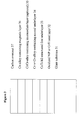
- FIG. 3 shows an embodiment of the film structure according to the current invention.
- FIG. 4 shows X-ray diffraction (XRD) patterns of NiP 20 O x /CoTi 50 /CrW 15 /CoCr 37 Pt 5 /CoCr 15 Pt 10 B 12 films deposited on a glass substrate with 40 ⁇ and 600 ⁇ of CoTi respectively.
- XRD X-ray diffraction
- FIG. 5 shows a comparison of Hr and SMNR of the media with NiPOx seed layers deposited under first heater power of 2.5 and 4 kW respectively, and the media directly deposited on glass without seed layers and under first heater power of 3.5 and 4.5 kW respectively.
- FIG. 6 shows a comparison of Hr and SMNR of the media with CrTi seed layers deposited under first heater power of 2.5 and 4 kW respectively, and the media directly deposited on glass without seed layers and under first heater power of 3.5 and 4.5 kW respectively.
- FIG. 7 shows CrTi thickness effect on Hr and SMNR of CrTi 43 /CoTi 50 /CrW 15 /CoCr 37 Pt 5 /CoCr 15 Pt 10 B 12 films, deposited on glass substrates.
- the recording media of the invention may be a rigid magnetic disc rotatable about an axis that is incorporated into a disc drive shown in FIG. 1 .
- Disc drives such as this are standard equipment in the industry. See, Mee, C. D. and Daniel, E. D., MAGNETIC RECORDING, Vols. I-III (McGraw-Hill pub. 1987); F. Jorgenson, The Complete Handbook of Magnetic Recording, Chapter 16 (3rd. ed. 1988), and U.S. Pat. No. 5,062,021, the relevant disclosures of which are incorporated herein by reference.
- the magnetic recording media of the present invention may also be used with flexible magnetic discs or tapes using known flexible substrates.
- This invention provides magnetic recording media suitable for high areal recording density exhibiting high thermal stability and high SMNR.
- This invention achieves such technological advantages by using bi-crystal magnetic recording media, i.e., media with Cr(200) and Co(11.0) orientations, comprising non-metallic substrates, CrTi or NiPOx seed layers, B2-structured CoTi first underlayers, Cr-alloy second underlayers, and Co-alloy magnetic layers.
- NiPOx denotes oxidized NiP.
- FIG. 3 shows an embodiment of the film structure according to the current invention.
- a seed layer 32 such as surface-oxidized NiP, NiP oxidized from bottom to top, and CrTi, is deposited on a non-metallic substrate 31 , such as glass, and glass-ceramic.
- the seed layer is selected such that CoTi and Cr-alloy underlayers 33 and 34 have preferred (200) crystallographic orientations.
- An optional CoCr-alloy intermediate layer 35 such as CoCr 37
- a Co-alloy magnetic layer 36 are epitaxially grown on the Cr-alloy underlayer and have (11.0) preferred orientations.
- CoCr 37 denotes that the atomic content of Cr in the CoCr films is 37%.
- On the magnetic layer is a carbon overcoat 37 .
- the CoTi-containing first underlayer in FIG. 3 forms a B2 structured layer.
- the Cr or Cr-alloy containing second underlayer has a Cr(200) preferred crystallographic orientation.
- a magnetic layer having a substantially Co(11.0) preferred crystallographic orientation is deposited on the second underlayer.
- B2-structured layer means that the layer has a B2 structure.
- word “containing,” for example in Cr-containing means that the layer comprises the elements or compounds before the word “containing” but the layer could still include other elements and compounds.
- the Co-containing recording layer can comprise any Co-based alloy such as CoCrPt, CoCrPtTa, CoCrPtTaNb, CoCrPtB.
- Each recording layer can be single magnetic layer or dual magnetic layers immediately adjacent to each other.
- the NiP layer could contain P in the range of about 12-50 at. %, more preferably in the range of about 17-42 at. %, and most preferably in the range of about 18-25 at. %;
- the CoTi layer could contain Co in the range of about 40-60 at. %, more preferably in the range of about 45-58 at. %, and most preferably in the range of about 49-55 at. %;
- the CrTi layer could contain Ti in the range of about 20-80 at. %, more preferably in the range of about 25-70 at. %, and most preferably in the range of about 35-50 at. %;
- the CrW layer could contain W in the range of about 5-62 at. %, more preferably in the range of about 8-60 at.
- the CoCrPtB layer could contain Cr in the range of about: 8-22 at. %, more preferably in the range of about 9-20 at. %, and most preferably in the range of about 10-16 at. %, Pt in the range of about 5-20 at. %, more preferably in the range of about 8-19 at. %, and most preferably in the range of about 10-16 at. %, and B in the range of about 5-25 at. %, more preferably in the range of about 6-20 at. %, and most preferably in the range of about 10-18 at. %; the CoCr intermediate layer could contain Cr in the range of about 30-45 at.
- the CoCrPt intermediate layer could contain Cr in the range of about 30-45 at. %, more preferably in the range of about 31-44 at. %, and most preferably in the range of about 35-43 at. % and Pt in the range of about 3-12 at. %, more preferably in the range of about 4-9 at. % and most preferably in the range of about 5-6 at. %.
- a portion of the subseed layer, the seed layer and/or the underlayer(s) could be oxidized by being sputter deposited with Ar and oxygen to promote a decrease in grain size.
- the term “a portion of” is defined herein to include all or part of a layer. Therefore, the entire layer, i.e., extending from one end of the layer to the opposite end of the layer may be in the oxidized form.
- the carbon overcoat in FIG. 3 could be further coated with a lubricant layer generally 1 nm to 3 nm thick.
- the lubricant is preferably a fluoro-chlorocarbon or a perfluoroether. Examples include CCl 2 FCClF 2 , CF 3 (CF 2 ) 4 CF 3 , CF 3 (CF 2 ) 5 CF 3 , CF 3 (CF 2 ) 10 CF 3 , and CF 3 (CF 2 ) 16 CF 3 .
- the substrates that may be used in the invention include glass, glass-ceramic, plastic/polymer material, ceramic, glass-polymer, composite materials or other non-magnetic and non-metallic materials.
- the lattice constant and the crystal plane of the subseed layer should closely match that of the seed layer.
- matching between other layers, except with carbon overcoat is also desirable.
- the magnetic layer in turn, will grow in a close-packed hexagonal structure with a Co(11.0) crystallographic orientations predominantly parallel to the film plane with the magnetic easy axis, c-axis, lying predominantly in the film plane.
- the thickness of the seed layer could be about 30 ⁇ to about 1600 ⁇ , preferably between about 40 ⁇ and about 1200 ⁇ , and most preferably between about 40 ⁇ and about 160 ⁇ .
- the thickness of the first underlayer could be about 20 ⁇ to about 1,000 ⁇ , preferably between about 25 ⁇ and about 800 ⁇ , and most preferably between about 40 ⁇ and about 600 ⁇ .
- the thickness of the second underlayer could be about 5 ⁇ to about 100 ⁇ , preferably between about 15 ⁇ and about 60 ⁇ , and most preferably between about 25 ⁇ and about 50 ⁇ .
- the thickness of the recording layer could be about 60 ⁇ to about 300 ⁇ , preferably between about 80 ⁇ and about 200 ⁇ , and most preferably about 100-190 ⁇ .
- the thickness of the intermediate layer of FIG. 3, if used, could be about 10 ⁇ to about 60 ⁇ , preferably between about 15 ⁇ and about 50 ⁇ , and most preferably about 20-25 ⁇ .
- the thickness of the protective layer could be about 20 ⁇ to about 300 ⁇ , preferably between about 25 ⁇ and 100 ⁇ , and most preferably about 40 ⁇ .
- the protective layer could be made of hydrogenated carbon (CH x ).
- an adhesion enhancement layer such as 35 ⁇ of Cr films, can be deposited between the seed layers and the substrates.
- the thickness of the adhesion layer could be about 15 ⁇ to about 200 ⁇ , preferably between about 20 ⁇ and about 60 ⁇ , and most preferably about 40 ⁇ .
- the magnetic recording medium has a remanent coercivity of about 3000 to about 10,000 Oersted, and an Mrt (product of remanance, Mr, and magnetic layer thickness, t) of about 0.2 to about 2.0 memu/cm 2 .
- the coercivity is about 3500 to about 7000 Oersted, more preferably in a range of about 4000 to about 6000 Oersted, and most preferably in a range of about 4000 to about 5000 Oersted.
- the Mrt is about 0.25 to about 1 memu/cm 2 , more preferably in a range of about 0.3 to about 0.6 memu/cm 2 , and most preferably in a range of about 0.3 to about 0.5 memu/cm 2 .
- the CrTi and NiPOx seed layers enhance the development of CoTi/Cr(200) and Co(11.0) crystallographic orientation, and help to reduce grain size of CoTi/Cr-alloy underlayers.
- the seed layers also reduce thermal emissivity of glass and glass ceramic substrates, hence reduce the cooling rate of the glass discs after heating.
- SMNR was measured using a Guzik 1701 spinstand. It analyzes the noise spectrum from the output of a read head you attach to it. The background noise and dc-noise were subtracted to leave only the noise coming from the media themselves.
- FIG. 4 shows X-ray diffraction (XRD) patterns of NiP 20 Ox/CoTi 50 /CrW 15 /CoCr 37 Pt 5 /CoCr 15 Pt 10 B 12 films with 40 ⁇ and 600 ⁇ of CoTi respectively.
- NiP 20 O x denotes oxidized NiP 20 film.
- the XRD patterns demonstrate that the films have bi-crystal crystallographic orientations.
- NiP films are amorphous.
- the oxidized NiP films can be formed by surface oxidization in the atmosphere of air or gas mixture of 20% oxygen and 80% argon in volume.
- the films also can be formed by reactive sputtering of NiP in the gas mixture, for instance, of 1% oxygen in volume and argon in balance.
- FIGS. 5 and 6 show a comparison of magnetic properties and recording performances of media with and without seed layers deposited on glass disc substrates of 84 mm diameter and 0.8 mm thick.
- a commercial Intevac 250-B sputter system was used for fabricating the media.
- the discs were heated using two heaters.
- the first heater was located between the NiP or CrTi seed layer deposition station and the CoTi first underlayer deposition station.
- the second heater was located between the CoCr 37 Pt 5 second intermediate layer station and the CoCr 15 Pt 10 B 12 magnetic layer deposition station.
- the first heater power was 2.5 or 3.5 kW
- the second heater power was 1 kW.
- the first heater power was 4 or 5.5 kW
- the second heater power was 0 kW.
- Heater power duration was 4.5 seconds.
- the media without seed layers were directly deposited on glass substrates.
- Direct current (DC) magnetron sputtering was used for the deposition of all the films.
- the thickness of each layer of three (3) kinds of media is listed in Table I.
- Remanent coercivity Hr of the disc samples was measured with a rotating disc magnetometer (RDM).
- RDM rotating disc magnetometer
- the media signal-to-noise ration (SMNR) was measured with a Guzik read-write analyzer with a giant magnetoresistive (GMR) head at 500 thousand flux reversal per inch (kfci).
- GMR giant magnetoresistive
- FIGS. 5 and 6 demonstrate that media with NiPOx or CrTi seed layers have much higher coercivity than the media without seed layers and having the CoTi underlayers directly deposited on glass substrates.
- the media with seed layers and deposited with 40 ⁇ CoTi have much higher SMNR than the media without seed layers.
- FIG. 7 shows CrTi thickness effect on Hr and SMNR of CrTi 43 /CoTi 50 /CrW 15 /CoCr 37 Pt 5 /CoCr 15 Pt 10 B 12 films deposited with the first heater only.
- CoTi thickness is 40 ⁇ .
- CrW, CoCrPt and CoCrPtB thickness is the same as listed in Table I.
- SMNR decreases significantly.
- CrTi 43 films are amorphous.
Landscapes
- Manufacturing Of Magnetic Record Carriers (AREA)
- Magnetic Record Carriers (AREA)
Abstract
Description
| TABLE I |
| Thickness of each layer of the films shown in FIGS. 5 and 6 |
| Seed layer | CoTi50 | CrW15 | CoCr37Pt5 | CoCr15Pt10B12 |
| 160 Å NiP20Ox | varied | 50 Å | 44 Å | 190 Å |
| 160 Å CrTi43 | varied | 50 Å | 44 Å | 190 Å |
| none (glass) | varied | 50 Å | 44 Å | 190 Å |
| TABLE II |
| Magnetic properties of media with and without CrW underlayers |
| Samples | CrW15 thickness (Å) | Hr (Oe) | Sr* | ||
| A | 50 | 4250 | 0.85 | ||
| |
0 | 1445 | 0.70 | ||
Claims (19)
Priority Applications (1)
| Application Number | Priority Date | Filing Date | Title |
|---|---|---|---|
| US09/960,538 US6596419B1 (en) | 2000-09-27 | 2001-09-24 | Medium with a seed layer and a B2-structured underlayer |
Applications Claiming Priority (2)
| Application Number | Priority Date | Filing Date | Title |
|---|---|---|---|
| US23601100P | 2000-09-27 | 2000-09-27 | |
| US09/960,538 US6596419B1 (en) | 2000-09-27 | 2001-09-24 | Medium with a seed layer and a B2-structured underlayer |
Publications (1)
| Publication Number | Publication Date |
|---|---|
| US6596419B1 true US6596419B1 (en) | 2003-07-22 |
Family
ID=26929382
Family Applications (1)
| Application Number | Title | Priority Date | Filing Date |
|---|---|---|---|
| US09/960,538 Expired - Fee Related US6596419B1 (en) | 2000-09-27 | 2001-09-24 | Medium with a seed layer and a B2-structured underlayer |
Country Status (1)
| Country | Link |
|---|---|
| US (1) | US6596419B1 (en) |
Cited By (15)
| Publication number | Priority date | Publication date | Assignee | Title |
|---|---|---|---|---|
| US20020127435A1 (en) * | 2001-01-05 | 2002-09-12 | Hiroyuki Uwazumi | Magnetic recording medium, method for manufacturing a magnetic recording medium and magnetic recording device |
| US20030134153A1 (en) * | 2002-01-14 | 2003-07-17 | Li-Lien Lee | System and method for recording media on textured glass |
| US6858331B1 (en) * | 2003-08-29 | 2005-02-22 | Hitachi Global Storage Technologies Netherlands, B.V. | Magnetic thin film media with a bi-layer structure of CrTi/Nip |
| US6908689B1 (en) * | 2001-12-20 | 2005-06-21 | Seagate Technology Llc | Ruthenium-aluminum underlayer for magnetic recording media |
| US20060077148A1 (en) * | 2004-09-27 | 2006-04-13 | Gally Brian J | Method and device for manipulating color in a display |
| US20070128471A1 (en) * | 2005-11-21 | 2007-06-07 | Hoya Corporation Hoya Magnetics Singapore Pte. Ltd | Magnetic disk and magnetic disk manufacturing method |
| CN100343903C (en) * | 2004-03-25 | 2007-10-17 | 株式会社东芝 | Perpendicular magnetic recording medium and magnetic recording/reproducing apparatus |
| CN100411017C (en) * | 2004-04-01 | 2008-08-13 | 富士电机电子设备技术株式会社 | Substrate for perpendicular magnetic recording medium and perpendicular magnetic recording medium using the same |
| US8848294B2 (en) | 2010-05-20 | 2014-09-30 | Qualcomm Mems Technologies, Inc. | Method and structure capable of changing color saturation |
| US9780300B2 (en) | 2011-02-16 | 2017-10-03 | Avalanche Technology, Inc. | Magnetic memory element with composite perpendicular enhancement layer |
| US10032979B2 (en) | 2010-09-14 | 2018-07-24 | Avalanche Technology, Inc. | Magnetic memory element with iridium anti-ferromagnetic coupling layer |
| US10079338B2 (en) | 2010-09-14 | 2018-09-18 | Avalanche Technology, Inc. | Magnetic memory element with perpendicular enhancement layer |
| US10910555B2 (en) | 2010-09-14 | 2021-02-02 | Avalanche Technology, Inc. | Magnetic memory element incorporating perpendicular enhancement layer |
| US11417836B2 (en) | 2010-09-14 | 2022-08-16 | Avalanche Technology, Inc. | Magnetic memory element incorporating dual perpendicular enhancement layers |
| US11758822B2 (en) | 2010-09-14 | 2023-09-12 | Avalanche Technology, Inc. | Magnetic memory element incorporating dual perpendicular enhancement layers |
Citations (8)
| Publication number | Priority date | Publication date | Assignee | Title |
|---|---|---|---|---|
| US5693426A (en) | 1994-09-29 | 1997-12-02 | Carnegie Mellon University | Magnetic recording medium with B2 structured underlayer and a cobalt-based magnetic layer |
| US5993956A (en) | 1997-04-22 | 1999-11-30 | Carnegie Mellon University | Manganese containing layer for magnetic recording media |
| US6010795A (en) * | 1997-02-26 | 2000-01-04 | Seagate Technology, Inc. | Magnetic recording medium comprising a nickel aluminum or iron aluminum underlayer and chromium containing intermediate layer each having (200) dominant crystalographic orientation |
| US6077586A (en) | 1997-07-15 | 2000-06-20 | International Business Machines Corporation | Laminated thin film disk for longitudinal recording |
| US6110582A (en) | 1997-09-08 | 2000-08-29 | Seagate Technology, Inc. | Substantially two dimensional isotropic magnetic recording medium comprising a NiAl underlayer |
| US6143388A (en) | 1997-11-24 | 2000-11-07 | International Business Machines Corporation | Thin film disk with onset layer |
| US6146754A (en) | 1997-09-08 | 2000-11-14 | Seagate Technology, Inc. | Substantially isotropic magnetic recording medium comprising a seedlayer |
| US6432563B1 (en) * | 2000-04-03 | 2002-08-13 | Carnegie Mellon University | Zinc enhanced hard disk media |
-
2001
- 2001-09-24 US US09/960,538 patent/US6596419B1/en not_active Expired - Fee Related
Patent Citations (8)
| Publication number | Priority date | Publication date | Assignee | Title |
|---|---|---|---|---|
| US5693426A (en) | 1994-09-29 | 1997-12-02 | Carnegie Mellon University | Magnetic recording medium with B2 structured underlayer and a cobalt-based magnetic layer |
| US6010795A (en) * | 1997-02-26 | 2000-01-04 | Seagate Technology, Inc. | Magnetic recording medium comprising a nickel aluminum or iron aluminum underlayer and chromium containing intermediate layer each having (200) dominant crystalographic orientation |
| US5993956A (en) | 1997-04-22 | 1999-11-30 | Carnegie Mellon University | Manganese containing layer for magnetic recording media |
| US6077586A (en) | 1997-07-15 | 2000-06-20 | International Business Machines Corporation | Laminated thin film disk for longitudinal recording |
| US6110582A (en) | 1997-09-08 | 2000-08-29 | Seagate Technology, Inc. | Substantially two dimensional isotropic magnetic recording medium comprising a NiAl underlayer |
| US6146754A (en) | 1997-09-08 | 2000-11-14 | Seagate Technology, Inc. | Substantially isotropic magnetic recording medium comprising a seedlayer |
| US6143388A (en) | 1997-11-24 | 2000-11-07 | International Business Machines Corporation | Thin film disk with onset layer |
| US6432563B1 (en) * | 2000-04-03 | 2002-08-13 | Carnegie Mellon University | Zinc enhanced hard disk media |
Non-Patent Citations (1)
| Title |
|---|
| Li-Lien Lee et al., "Seed Layer Induced (002) Crystallographic Texture in NiA1 Underlayers", Jrnl. of Appl. Phys., 79(8), Apr. 15, 1996. |
Cited By (21)
| Publication number | Priority date | Publication date | Assignee | Title |
|---|---|---|---|---|
| US20020127435A1 (en) * | 2001-01-05 | 2002-09-12 | Hiroyuki Uwazumi | Magnetic recording medium, method for manufacturing a magnetic recording medium and magnetic recording device |
| US6908689B1 (en) * | 2001-12-20 | 2005-06-21 | Seagate Technology Llc | Ruthenium-aluminum underlayer for magnetic recording media |
| US20030134153A1 (en) * | 2002-01-14 | 2003-07-17 | Li-Lien Lee | System and method for recording media on textured glass |
| US6824896B2 (en) * | 2002-01-14 | 2004-11-30 | Seagate Technology Llc | System and method for recording media on textured glass |
| US6858331B1 (en) * | 2003-08-29 | 2005-02-22 | Hitachi Global Storage Technologies Netherlands, B.V. | Magnetic thin film media with a bi-layer structure of CrTi/Nip |
| US20050048328A1 (en) * | 2003-08-29 | 2005-03-03 | Xiaoping Bian | Magnetic thin film media with a bi-layer structure of crti/nip |
| CN100343903C (en) * | 2004-03-25 | 2007-10-17 | 株式会社东芝 | Perpendicular magnetic recording medium and magnetic recording/reproducing apparatus |
| CN100411017C (en) * | 2004-04-01 | 2008-08-13 | 富士电机电子设备技术株式会社 | Substrate for perpendicular magnetic recording medium and perpendicular magnetic recording medium using the same |
| US20060077148A1 (en) * | 2004-09-27 | 2006-04-13 | Gally Brian J | Method and device for manipulating color in a display |
| US7993497B2 (en) * | 2005-11-21 | 2011-08-09 | Wd Media (Singapore) Pte. Ltd. | Magnetic disk and magnetic disk manufacturing method |
| US20070128471A1 (en) * | 2005-11-21 | 2007-06-07 | Hoya Corporation Hoya Magnetics Singapore Pte. Ltd | Magnetic disk and magnetic disk manufacturing method |
| US8848294B2 (en) | 2010-05-20 | 2014-09-30 | Qualcomm Mems Technologies, Inc. | Method and structure capable of changing color saturation |
| US10032979B2 (en) | 2010-09-14 | 2018-07-24 | Avalanche Technology, Inc. | Magnetic memory element with iridium anti-ferromagnetic coupling layer |
| US10079338B2 (en) | 2010-09-14 | 2018-09-18 | Avalanche Technology, Inc. | Magnetic memory element with perpendicular enhancement layer |
| US10490737B2 (en) | 2010-09-14 | 2019-11-26 | Avalanche Technology, Inc. | Magnetic memory element including magnesium perpendicular enhancement layer |
| US10727400B2 (en) | 2010-09-14 | 2020-07-28 | Avalanche Technology, Inc. | Magnetic random access memory with perpendicular enhancement layer |
| US10910555B2 (en) | 2010-09-14 | 2021-02-02 | Avalanche Technology, Inc. | Magnetic memory element incorporating perpendicular enhancement layer |
| US11417836B2 (en) | 2010-09-14 | 2022-08-16 | Avalanche Technology, Inc. | Magnetic memory element incorporating dual perpendicular enhancement layers |
| US11758822B2 (en) | 2010-09-14 | 2023-09-12 | Avalanche Technology, Inc. | Magnetic memory element incorporating dual perpendicular enhancement layers |
| US12133471B2 (en) | 2010-09-14 | 2024-10-29 | Avalanche Technology, Inc. | Magnetic memory element including perpendicular enhancement layers and dual oxide cap layers |
| US9780300B2 (en) | 2011-02-16 | 2017-10-03 | Avalanche Technology, Inc. | Magnetic memory element with composite perpendicular enhancement layer |
Similar Documents
| Publication | Publication Date | Title |
|---|---|---|
| US7851014B2 (en) | Tilted recording media with L10 magnetic layer | |
| US5605733A (en) | Magnetic recording medium, method for its production, and system for its use | |
| US6210819B1 (en) | Magnetic recording media having a CrTi underlayer deposited under a substrate bias | |
| US8685547B2 (en) | Magnetic recording media with enhanced writability and thermal stability | |
| US6607842B2 (en) | Containing an AITa or AITi pre-seed layer, a CoCr onset layer and a CoCrPtB magnetic layer | |
| US5879783A (en) | Low noise magnetic recording medium and method of manufacturing | |
| US6596419B1 (en) | Medium with a seed layer and a B2-structured underlayer | |
| JPH10188278A (en) | Production of high-performance low-noise isotropic magnetic medium having chromium lower layer | |
| US6010795A (en) | Magnetic recording medium comprising a nickel aluminum or iron aluminum underlayer and chromium containing intermediate layer each having (200) dominant crystalographic orientation | |
| JP3988117B2 (en) | Perpendicular magnetic recording medium and method of manufacturing perpendicular magnetic recording medium | |
| US6403241B1 (en) | CoCrPtB medium with a 1010 crystallographic orientation | |
| US6524730B1 (en) | NiFe-containing soft magnetic layer design for multilayer media | |
| US5866227A (en) | Magnetic recording medium with partially oxidized seed layer | |
| US20030008177A1 (en) | Thin film magnetic recording disk with a chromium-nickel pre-seed layer | |
| US6759149B1 (en) | Laminated medium with antiferromagnetic stabilization layers | |
| JP2001344740A (en) | Magnetic recording medium and magnetic storage device | |
| US6593009B2 (en) | Magnetic thin film media with a pre-seed layer of CrTi | |
| US6613460B1 (en) | Magnetic recording medium and magnetic storage apparatus | |
| US6936353B1 (en) | Tilted recording medium design with (101-2) orientation | |
| US6475611B1 (en) | Si-containing seedlayer design for multilayer media | |
| US6858331B1 (en) | Magnetic thin film media with a bi-layer structure of CrTi/Nip | |
| US6872478B2 (en) | Magnetic thin film media with a pre-seed layer of CrTiAl | |
| US6787251B1 (en) | Recording medium with a varying composition underlayer | |
| US7314675B1 (en) | Magnetic media with high Ms magnetic layer | |
| US7521136B1 (en) | Coupling enhancement for medium with anti-ferromagnetic coupling |
Legal Events
| Date | Code | Title | Description |
|---|---|---|---|
| AS | Assignment |
Owner name: SEAGATE TECHNOLOGY LLC, CALIFORNIA Free format text: ASSIGNMENT OF ASSIGNORS INTEREST;ASSIGNORS:CHEN, QIXU;LEE, LI-LIEN;RANJAN, RAJIV;REEL/FRAME:012224/0720 Effective date: 20010806 |
|
| AS | Assignment |
Owner name: JPMORGAN CHASE BANK, AS COLLATERAL AGENT, NEW YORK Free format text: SECURITY AGREEMENT;ASSIGNOR:SEAGATE TECHNOLOGY LLC;REEL/FRAME:013177/0001 Effective date: 20020513 Owner name: JPMORGAN CHASE BANK, AS COLLATERAL AGENT,NEW YORK Free format text: SECURITY AGREEMENT;ASSIGNOR:SEAGATE TECHNOLOGY LLC;REEL/FRAME:013177/0001 Effective date: 20020513 |
|
| FEPP | Fee payment procedure |
Free format text: PAYOR NUMBER ASSIGNED (ORIGINAL EVENT CODE: ASPN); ENTITY STATUS OF PATENT OWNER: LARGE ENTITY |
|
| AS | Assignment |
Owner name: SEAGATE TECHNOLOGY LLC, CALIFORNIA Free format text: RELEASE OF SECURITY INTERESTS IN PATENT RIGHTS;ASSIGNOR:JPMORGAN CHASE BANK, N.A. (FORMERLY KNOWN AS THE CHASE MANHATTAN BANK AND JPMORGAN CHASE BANK), AS ADMINISTRATIVE AGENT;REEL/FRAME:016958/0340 Effective date: 20051130 |
|
| FPAY | Fee payment |
Year of fee payment: 4 |
|
| AS | Assignment |
Owner name: WELLS FARGO BANK, NATIONAL ASSOCIATION, AS COLLATERAL AGENT AND SECOND PRIORITY REPRESENTATIVE, CALIFORNIA Free format text: SECURITY AGREEMENT;ASSIGNORS:MAXTOR CORPORATION;SEAGATE TECHNOLOGY LLC;SEAGATE TECHNOLOGY INTERNATIONAL;REEL/FRAME:022757/0017 Effective date: 20090507 Owner name: JPMORGAN CHASE BANK, N.A., AS ADMINISTRATIVE AGENT AND FIRST PRIORITY REPRESENTATIVE, NEW YORK Free format text: SECURITY AGREEMENT;ASSIGNORS:MAXTOR CORPORATION;SEAGATE TECHNOLOGY LLC;SEAGATE TECHNOLOGY INTERNATIONAL;REEL/FRAME:022757/0017 Effective date: 20090507 Owner name: JPMORGAN CHASE BANK, N.A., AS ADMINISTRATIVE AGENT Free format text: SECURITY AGREEMENT;ASSIGNORS:MAXTOR CORPORATION;SEAGATE TECHNOLOGY LLC;SEAGATE TECHNOLOGY INTERNATIONAL;REEL/FRAME:022757/0017 Effective date: 20090507 Owner name: WELLS FARGO BANK, NATIONAL ASSOCIATION, AS COLLATE Free format text: SECURITY AGREEMENT;ASSIGNORS:MAXTOR CORPORATION;SEAGATE TECHNOLOGY LLC;SEAGATE TECHNOLOGY INTERNATIONAL;REEL/FRAME:022757/0017 Effective date: 20090507 |
|
| AS | Assignment |
Owner name: SEAGATE TECHNOLOGY LLC, CALIFORNIA Free format text: RELEASE;ASSIGNOR:JPMORGAN CHASE BANK, N.A., AS ADMINISTRATIVE AGENT;REEL/FRAME:025662/0001 Effective date: 20110114 Owner name: SEAGATE TECHNOLOGY HDD HOLDINGS, CALIFORNIA Free format text: RELEASE;ASSIGNOR:JPMORGAN CHASE BANK, N.A., AS ADMINISTRATIVE AGENT;REEL/FRAME:025662/0001 Effective date: 20110114 Owner name: MAXTOR CORPORATION, CALIFORNIA Free format text: RELEASE;ASSIGNOR:JPMORGAN CHASE BANK, N.A., AS ADMINISTRATIVE AGENT;REEL/FRAME:025662/0001 Effective date: 20110114 Owner name: SEAGATE TECHNOLOGY INTERNATIONAL, CALIFORNIA Free format text: RELEASE;ASSIGNOR:JPMORGAN CHASE BANK, N.A., AS ADMINISTRATIVE AGENT;REEL/FRAME:025662/0001 Effective date: 20110114 |
|
| REMI | Maintenance fee reminder mailed | ||
| AS | Assignment |
Owner name: THE BANK OF NOVA SCOTIA, AS ADMINISTRATIVE AGENT, CANADA Free format text: SECURITY AGREEMENT;ASSIGNOR:SEAGATE TECHNOLOGY LLC;REEL/FRAME:026010/0350 Effective date: 20110118 Owner name: THE BANK OF NOVA SCOTIA, AS ADMINISTRATIVE AGENT, Free format text: SECURITY AGREEMENT;ASSIGNOR:SEAGATE TECHNOLOGY LLC;REEL/FRAME:026010/0350 Effective date: 20110118 |
|
| LAPS | Lapse for failure to pay maintenance fees | ||
| STCH | Information on status: patent discontinuation |
Free format text: PATENT EXPIRED DUE TO NONPAYMENT OF MAINTENANCE FEES UNDER 37 CFR 1.362 |
|
| FP | Lapsed due to failure to pay maintenance fee |
Effective date: 20110722 |
|
| AS | Assignment |
Owner name: EVAULT INC. (F/K/A I365 INC.), CALIFORNIA Free format text: TERMINATION AND RELEASE OF SECURITY INTEREST IN PATENT RIGHTS;ASSIGNOR:WELLS FARGO BANK, NATIONAL ASSOCIATION, AS COLLATERAL AGENT AND SECOND PRIORITY REPRESENTATIVE;REEL/FRAME:030833/0001 Effective date: 20130312 Owner name: SEAGATE TECHNOLOGY INTERNATIONAL, CAYMAN ISLANDS Free format text: TERMINATION AND RELEASE OF SECURITY INTEREST IN PATENT RIGHTS;ASSIGNOR:WELLS FARGO BANK, NATIONAL ASSOCIATION, AS COLLATERAL AGENT AND SECOND PRIORITY REPRESENTATIVE;REEL/FRAME:030833/0001 Effective date: 20130312 Owner name: SEAGATE TECHNOLOGY LLC, CALIFORNIA Free format text: TERMINATION AND RELEASE OF SECURITY INTEREST IN PATENT RIGHTS;ASSIGNOR:WELLS FARGO BANK, NATIONAL ASSOCIATION, AS COLLATERAL AGENT AND SECOND PRIORITY REPRESENTATIVE;REEL/FRAME:030833/0001 Effective date: 20130312 Owner name: SEAGATE TECHNOLOGY US HOLDINGS, INC., CALIFORNIA Free format text: TERMINATION AND RELEASE OF SECURITY INTEREST IN PATENT RIGHTS;ASSIGNOR:WELLS FARGO BANK, NATIONAL ASSOCIATION, AS COLLATERAL AGENT AND SECOND PRIORITY REPRESENTATIVE;REEL/FRAME:030833/0001 Effective date: 20130312 |
|
| AS | Assignment |
Owner name: SEAGATE TECHNOLOGY PUBLIC LIMITED COMPANY, CALIFORNIA Free format text: RELEASE BY SECURED PARTY;ASSIGNOR:THE BANK OF NOVA SCOTIA;REEL/FRAME:072193/0001 Effective date: 20250303 Owner name: SEAGATE TECHNOLOGY, CALIFORNIA Free format text: RELEASE BY SECURED PARTY;ASSIGNOR:THE BANK OF NOVA SCOTIA;REEL/FRAME:072193/0001 Effective date: 20250303 Owner name: SEAGATE TECHNOLOGY HDD HOLDINGS, CALIFORNIA Free format text: RELEASE BY SECURED PARTY;ASSIGNOR:THE BANK OF NOVA SCOTIA;REEL/FRAME:072193/0001 Effective date: 20250303 Owner name: I365 INC., CALIFORNIA Free format text: RELEASE BY SECURED PARTY;ASSIGNOR:THE BANK OF NOVA SCOTIA;REEL/FRAME:072193/0001 Effective date: 20250303 Owner name: SEAGATE TECHNOLOGY LLC, CALIFORNIA Free format text: RELEASE BY SECURED PARTY;ASSIGNOR:THE BANK OF NOVA SCOTIA;REEL/FRAME:072193/0001 Effective date: 20250303 Owner name: SEAGATE TECHNOLOGY INTERNATIONAL, CAYMAN ISLANDS Free format text: RELEASE BY SECURED PARTY;ASSIGNOR:THE BANK OF NOVA SCOTIA;REEL/FRAME:072193/0001 Effective date: 20250303 Owner name: SEAGATE HDD CAYMAN, CAYMAN ISLANDS Free format text: RELEASE BY SECURED PARTY;ASSIGNOR:THE BANK OF NOVA SCOTIA;REEL/FRAME:072193/0001 Effective date: 20250303 Owner name: SEAGATE TECHNOLOGY (US) HOLDINGS, INC., CALIFORNIA Free format text: RELEASE BY SECURED PARTY;ASSIGNOR:THE BANK OF NOVA SCOTIA;REEL/FRAME:072193/0001 Effective date: 20250303 Owner name: SEAGATE TECHNOLOGY PUBLIC LIMITED COMPANY, CALIFORNIA Free format text: RELEASE OF SECURITY INTEREST;ASSIGNOR:THE BANK OF NOVA SCOTIA;REEL/FRAME:072193/0001 Effective date: 20250303 Owner name: SEAGATE TECHNOLOGY, CALIFORNIA Free format text: RELEASE OF SECURITY INTEREST;ASSIGNOR:THE BANK OF NOVA SCOTIA;REEL/FRAME:072193/0001 Effective date: 20250303 Owner name: SEAGATE TECHNOLOGY HDD HOLDINGS, CALIFORNIA Free format text: RELEASE OF SECURITY INTEREST;ASSIGNOR:THE BANK OF NOVA SCOTIA;REEL/FRAME:072193/0001 Effective date: 20250303 Owner name: I365 INC., CALIFORNIA Free format text: RELEASE OF SECURITY INTEREST;ASSIGNOR:THE BANK OF NOVA SCOTIA;REEL/FRAME:072193/0001 Effective date: 20250303 Owner name: SEAGATE TECHNOLOGY LLC, CALIFORNIA Free format text: RELEASE OF SECURITY INTEREST;ASSIGNOR:THE BANK OF NOVA SCOTIA;REEL/FRAME:072193/0001 Effective date: 20250303 Owner name: SEAGATE TECHNOLOGY INTERNATIONAL, CAYMAN ISLANDS Free format text: RELEASE OF SECURITY INTEREST;ASSIGNOR:THE BANK OF NOVA SCOTIA;REEL/FRAME:072193/0001 Effective date: 20250303 Owner name: SEAGATE HDD CAYMAN, CAYMAN ISLANDS Free format text: RELEASE OF SECURITY INTEREST;ASSIGNOR:THE BANK OF NOVA SCOTIA;REEL/FRAME:072193/0001 Effective date: 20250303 Owner name: SEAGATE TECHNOLOGY (US) HOLDINGS, INC., CALIFORNIA Free format text: RELEASE OF SECURITY INTEREST;ASSIGNOR:THE BANK OF NOVA SCOTIA;REEL/FRAME:072193/0001 Effective date: 20250303 |