US6594048B1 - Technique to obtain channel plans for WDM systems with reduced four-wave mixing effect - Google Patents
Technique to obtain channel plans for WDM systems with reduced four-wave mixing effect Download PDFInfo
- Publication number
- US6594048B1 US6594048B1 US09/551,142 US55114200A US6594048B1 US 6594048 B1 US6594048 B1 US 6594048B1 US 55114200 A US55114200 A US 55114200A US 6594048 B1 US6594048 B1 US 6594048B1
- Authority
- US
- United States
- Prior art keywords
- channel plan
- fwm
- channel
- channels
- crosstalk
- Prior art date
- Legal status (The legal status is an assumption and is not a legal conclusion. Google has not performed a legal analysis and makes no representation as to the accuracy of the status listed.)
- Expired - Lifetime
Links
Images


Classifications
-
- H—ELECTRICITY
- H04—ELECTRIC COMMUNICATION TECHNIQUE
- H04B—TRANSMISSION
- H04B10/00—Transmission systems employing electromagnetic waves other than radio-waves, e.g. infrared, visible or ultraviolet light, or employing corpuscular radiation, e.g. quantum communication
- H04B10/25—Arrangements specific to fibre transmission
- H04B10/2507—Arrangements specific to fibre transmission for the reduction or elimination of distortion or dispersion
- H04B10/2543—Arrangements specific to fibre transmission for the reduction or elimination of distortion or dispersion due to fibre non-linearities, e.g. Kerr effect
- H04B10/2563—Four-wave mixing [FWM]
-
- H—ELECTRICITY
- H04—ELECTRIC COMMUNICATION TECHNIQUE
- H04J—MULTIPLEX COMMUNICATION
- H04J14/00—Optical multiplex systems
- H04J14/02—Wavelength-division multiplex systems
- H04J14/0224—Irregular wavelength spacing, e.g. to accommodate interference to all wavelengths
Definitions
- a new technique for acquiring channel plans in wavelength-division multiplexing (WDM) systems is disclosed. This technique allocates channels from available channel slots by minimizing four-wave mixing (FWM) crosstalk and taking into account fiber characteristics. It can provide channel plans for WDM systems in single-mode fiber with a non-uniform dispersion profile along the transmission path.
- WDM wavelength-division multiplexing
- the non-zero-FWM plans allow some FWM products to fall onto the signal channels, but with maximum level of FWM crosstalk is less than the required limit. These channel plans obviously have clear advantage over the zero-FWM plans in realizing that it is not necessary to achieve zero FWM in an actual WDM systems as long as the FWM crosstalk level does not limit the system performance.
- the bandwidth efficiency is dramatically increased in non-zero FWM channel plans.
- due to the large number of channels and the complex relation between channels and FWM products obtaining an optimum unequally spaced non-zero-FWM channel plan is not an easy task. If the fiber characteristics are considered in the procedure, the problem becomes even more complex.
- a periodic allocation method has been proposed to obtain the non-zero-FWM channel plans.
- the entire available optical bandwidth (usually limited by the optical amplifiers) is divided into multiple sub-bands.
- a zero-FWM channel plan is obtained.
- a guard band is allocated between adjacent sub-bands to reduce FWM produced by channels in different sub-bands.
- the FWM crosstalk is significantly reduced in channel plans obtained using this method compared to the equally spaced channels, because no FWM crosstalk is produced inside each sub-band and also a large separation exists between channels in different sub-bands.
- this method is far from optimum since it does not consider fiber dispersion at different channel wavelengths.
- the periodic allocation method is counter-intuitive since a larger dispersion region should have more channels and a zero-dispersion region should have less channels.
- An exhaustive computer search may be another choice for selecting a channel plan.
- the possible combinations of the channels in forming a channel plan is so large that it is prohibitive to use this approach. For example, if a 40-channel plan is selected from a 96-channel WDM system, the number of possible choices is 1.3 ⁇ 10 27 . Clearly, it is impossible to try every combination to find the optimum channel plan.
- Upgrading an existing WDM system presents additional challenges for channel allocation.
- the channel counts of WDM systems have correspondingly increased.
- Transmission systems have thus evolved from normal WDM systems to dense WDM systems, and to current ultra-dense WDM systems.
- increasing capacity does not mean simply replacing the old system with a new one.
- the capacity is increased through upgrading, i.e., adding more channels to the system without changing the old channels.
- Network operators prefer upgrading because it is less expensive than purchasing a new system and does not require network rearrangement.
- upgrading channel plans does not mean merely adding channels arbitrarily in the remaining available channel slots.
- a desirable upgrade channel plan should include as many channels as possible while minimizing FWM crosstalk.
- Another method to obtain unequally spaced channel plans proposes to minimize the FWM products that fall onto signal channels.
- This method uses a sequence as the channel spacings between channels in the desired channel plans. This method obviously is difficult to perform when upgrading, since manipulating the channel-spacing sequence is not compatible with the old channel plan that has fixed channel spacings between channels.
- an exhaustive computer search may be used to obtain a channel plan.
- This approach tries all the channel combinations for the desired channel number, of which the old channel plan is a subset. Again, performing this process is extremely difficult for WDM systems with large numbers of channels, because the number of possible combinations is so large for the given number of channels. For example, to upgrade from 11 channels 32 in a WDM system capable of carrying 96 channel total, 4.34 ⁇ 10 19 possible channel plans must be analyzed in order to determine the one with the least FWM crosstalk. This task is clearly prohibitive.
- a technique in accordance with the present invention provides a systematic approach to find a sub-optimum channel plan with reasonable computational time. In each step, this technique allocates channels to minimize the FWM crosstalk in terms of fiber characteristics, while selecting as many channels as possible to increase the bandwidth efficiency. Since FWM crosstalk depends on fiber dispersion, channel spacing, channel power and number of FWM products, if FWM crosstalk is minimized, it means that the channel plan selected is optimal on all these parameters.
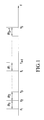
- FIG. 1 illustrates exemplary channel slots available in a WDM system
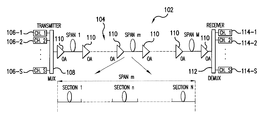
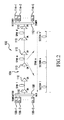
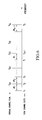
- FIG. 2 is a schematic diagram of a WDM system
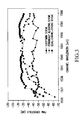
- FIG. 3 illustrates plots of FWM crosstalk vs. wavelength for different channel plans
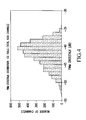
- FIG. 4 is a histogram plot of FWM crosstalk for a channel plan consistent with the present invention for a 100 fiber link system
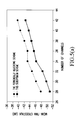
- FIG. 5 ( a ) illustrates plots of mean FWM crosstalk vs. wavelength for two different channel plans on a 100 fiber link system
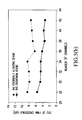
- FIG. 5 ( b ) illustrates plots of standard deviation (STD) of FWM crosstalk vs. wavelength for two different channel plans on a 100 fiber link system;
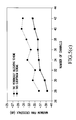
- FIG. 5 ( c ) illustrates maximum FWM crosstalk as a function of wavelength for two different channel plans on a 100 fiber link system
- FIG. 6 illustrates an orignal channel plan and the total number of channel slots in a WDM system
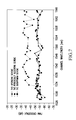
- FIG. 7 illustrates plots of FWM crosstalk vs. wavelength for different channel plans
- FIG. 8 is a histogram plot of FWM crosstalk for a channel plan consistent with a furher aspect of the present invention for a 100 fiber link system;
- FIG. 9 ( a ) illustrates plots of mean FWM crosstalk vs. wavelength for three different channel plans on a 100 fiber link system
- FIG. 9 ( b ) illustrates plots of standard deviation (STD) of FWM crosstalk vs. wavelength for three different channel plans on a 100 fiber link system;
- FIG. 9 ( c ) illustrates maximum FWM crosstalk as a function of wavelength for two different channel plans on a 100 fiber link system
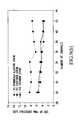
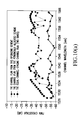
- FIG. 10 ( a ) illustrates plots of FWM crosstalk vs. wavelength for three different upgraded 32 channel plans
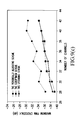
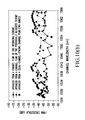
- FIG. 10 ( b ) illustrates plots of FWM crosstalk vs. wavelength for three different upgraded 32 channel plans.
- the channel slots for a given WDM system are shown in FIG. 1 . It has S channel slots with ⁇ f i as the frequency separation between the i-th and the (i+1)-th slot.
- the available channel slots are not necessarily equally spaced.
- the first channel frequency is f 1 .
- the goal of the channel plan allocating technique consistent with the present invention is to maximize the number of channels, while keeping the maximum FWM among the channels at a minimum.
- the transmission system is given in FIG. 2, which is a multiple span wavelength division multipelxed (WDM) system 102 , where the fiber link 104 is composed of M spans with each span having N fiber sections. Each fiber can have different dispersion, i.e., non-uniform dispersion. This is usually the case for the installed fiber.
- the total number of channels in this system is S as given above.
- Each channel is supplied by a respective one of transmitters 106 - 1 to 106 -S, and combined ont fiber link 104 by a multiplexer 108 .
- a series of optical amplifiers 110 are interspersed along fiber line 104 to amplify the transmitted optical signals.
- a demultipliexer 112 separates the individual channels, and supplies them to respective receivers 114 - 1 to 114 -S.
- n 0 The fiber core refractive index.
- P p The input channel power at frequency f p .
- P r The input channel power at frequency f r .
- ⁇ The nonlinear coefficient of the fiber.
- N The number of fiber sections in one span.
- ⁇ (mj) The phase match factor at the j-th fiber section of the m-th span.
- ⁇ (k) ⁇ p (k) + ⁇ q (k) ⁇ r (k) ⁇ F (k) (3)
- D c (mn) is the local fiber dispersion and dD c (mn) /d ⁇ is the local dispersion slope in the n-th fiber section of the m-th span.
- the channel separations, ⁇ f pr , ⁇ f qr are defined as
- the power terms, p p (mn) , P q (mn) and P r (mn) are the input power to the section n in span m for the three pump signals, respectively.
- An objective of a channel allocation technique consistent with the present invention is to minimize this crosstalk while selecting as many channels as possible.
- the final goal is to find a channel plan with S c channels or with a maximum FWM crosstalk less than C c .
- the allocating process are given as following:
- Step 1 Calculate the FWM power matrix by using formula (2).
- the FWM power matrix is defined as
- This matrix has three dimensions and includes all possible combinations between any three channels in the system.
- Step 2 Use the FWM power matrix to calculate the FWM crosstalk for all the channels and form a FWM crosstalk vector: C (1) , C (2) , . . . , C (S) . Since the FWM crosstalk is calculated by table look-up method form the FWM power matrix, the computation time is dramatically decreased compared with calculation directly from formula (2).
- Step 3 Select the channel with the maximum FWM crosstalk level in the crosstalk vector and drop that channel to form a new channel plan. If
- Step 4 The same as step 2, use the FWM power matrix to calculate the FWM crosstalk for all the channels in the new channel plans obtained in step 3 and form a FWM crosstalk vector: C (1) , C (2) , . . . , C (S ⁇ 1) .
- Step 5 Check the maximum FWM crosstalk and the number of remaining channels. If the maximum FWM crosstalk falls below a predetermined acceptable limit, or the number of remaining channels is exceeds the required number of channels, then go to next step. Otherwise, go back to step 3. That is, if
- Step 6 The remaining channels are the final channel plan:
- This channel plan can be evaluated for different fiber characteristics.
- the obtained channel plan is optimal in each step, though it may not be totally optimal as all steps combined. Therefore, the obtained channel plan can be referred to as sub-optimum.
- the calculation time required for this technique is dramatically reduced compared to the conventional exhaustive computer search. For example, selecting a 40-channel plan from 96 channels only requires 338 FWM-crosstalk calculations (normalized to the amount of calculation for 40 channels) by using this technique while the number of calculations is 1.3 ⁇ 10 27 when the exhaustive search method is used. Significant reduction in calculation is obtained.
- the channel allocating technique will be applied, by way of example, to assign 40 channels in a DWDM system with 96 channel slots.
- the system parameters are as follows:
- Span power budget 6 ⁇ 20 dB (six spans with 20 dB each span, ⁇ 8.5 dB/ch)
- DSF dispersion-shifted fiber
- Fiber effective core area 50 ⁇ m 2
- Fiber nonlinear index 2.6 ⁇ 10 ⁇ 20 m 2 /W
- a random zero-dispersion wavelength and a random dispersion slope are used for each fiber section.
- the distribution function follows Gaussian distribution.
- the standard deviation of the zero-dispersion wavelength is 2 nm.
- the standard deviation of dispersion slopes is ten percent of the average dispersion slope. Given the zero-dispersion wavelength and the dispersion slope in each fiber section, the dispersion at each channel can be calculated by using
- the other system and fiber parameters can also be non-uniform along the link and the channel allocating techniques has no limitation on these parameters. But here, for simplicity, it is assumed that the remaining parameters are uniform.
- FIG. 3 gives the channel plan with 40 channels plus the FWM crosstalk levels for each channel.
- FWM crosstalk for the channel plan associated with the conventional periodically allocating technique and the two-band equal-channel-spacing scheme (in which the minimum channel separation is doubled and the channels close to the zero-dispersion wavelength are dropped) are also plotted. It is clearly seen that the channel plan from this technique has the lowest maximum FWM crosstalk. The advantage of this channel plan over the other two on FWM crosstalk can be as large as 10 dB. Also, by comparing the FWM crosstalk levels among channels in the channel plan, it can be seen that the FWM crosstalk in the channel plan consistent with the present invention is more flat than the other two channel plans. This may be due to the mechanism in this technique to optimize the FWM crosstalk and explain the better performance of this technique compared to other channel allocating techniques.
- an exemplary channel was determiend for 100 different DSF links, each with the same system parameters as above except for the fiber zero-dispersion wavelength and dispersion slope, which are set randomly in Gaussian distributions.
- the mean is 1550 nm and standard deviation is 2 nm.
- dispersion slope the mean is 0.07 ps/km-nm and the standard deviation is ten percent of the mean.
- the FWM crosstalk for all the fiber links (trials) is plotted as a histogram, shown in FIG. 4 .
- the maximum FWM crosstalk is increased for some fibers though the average value for all the fibers is close to the optimized maximum FWM crosstalk level. It means that the channel plan obtained by using this technique is sensitive to fiber characteristics. This is reasonable since the optimization was performed on the given fiber characteristics.
- FIG. 5 shows the FWM crosstalk for 100 fiber links with random dispersion profiles and system parameters given above. Results corresponding to channel plans for 42, 40, 38, 36, 34, 32, 30 and 28 channels are obtained by using this technique and the periodically allocating techniques in and they are plotted together to make a comparison.
- FIG. 5 ( a ) shows the mean FWM crosstalk and FIG. 5 ( b ) gives the standard deviations. The maximum FWM crosstalk is plotted in FIG. 5 ( c ). They all clearly show that the present technique still outperforms the periodically allocating method by several dB on FWM crosstalk. Of course, this gain will be increased if more accurate information is known on the fiber link.
- a new technique for selecting channel plans for WDM systems with given channel slots.
- the technique includes multiple steps with each step minimizing the maximum FWM crosstalk among the channels. Compared with the computer exhaustive search method, this technique dramatically reduced the calculation time. Compared with other channel allocating techniques, it provides better channel plans with several dB advantage on FWM crosstalk depending on the knowledge of the fiber. The advantage can be as large as 10 dB if the fiber parameters can be measured accurately. This technique provides a systematic approach to acquire a channel plan for WDM systems in low dispersion fiber.
- FIG. 6 shows the channel slots in a WDM system with the used and unused slots.
- the total number of channel slot in the system is S and S u channel slots are used.
- the number of remaining channels is S-S u .
- ⁇ f i is the frequency separation between the i-th and the (i+1)-th slot.
- the first channel frequency is f 1 and the channel slots are not necessarily equal spaced.
- the goal of the channel plan allocating technique is to add as more as possible channels from the available slots with the maximum FWM among these channels is minimized.
- the channel allocation scheme consistent with the second embodiment of the present invention can be used in conjunction with a WDM system similar to that shown in FIG. 2 above.
- Each fiber in this system can have a different dispersion for the non-uniform dispersion case, which is common found in installed fiber.
- the total number of channels in this system is S as illustrated above, with S u being the number of existing channel prior to the upgrade.
- S u being the number of existing channel prior to the upgrade.
- FWM is a nonlinear process in which three optical signals mix together and produce a new frequency product.
- three optical signals have frequencies, f p , f q , and f r , then the new FWM product from these three signals has a frequency f F ,
- n 0 The fiber core refractive index.
- P p The input channel power at frequency f p .
- P r The input channel power at frequency f r .
- ⁇ The nonlinear coefficient of the fiber.
- N The number of fiber sections in one span.
- ⁇ (mj) The phase match factor at the j-th fiber section of the m-th span.
- ⁇ ′ (mn) The intensity dependent phase match factor at the n-th fiber section of the m-th span.
- ⁇ ⁇ ⁇ ′ ⁇ ( mn ) ⁇ ⁇ ⁇ ⁇ ( mn ) - ⁇ ⁇ ( P p ( mn ) + P q ( mn ) - P r ( mn ) ) ⁇ 1 - exp ⁇ ( - ⁇ ⁇ ⁇ L eff ) ⁇ ⁇ ⁇ L eff ( 17 )
- ⁇ (mn) 2 ⁇ ⁇ ⁇ ⁇ ⁇ ⁇ r 2 c ⁇ ⁇ ⁇ ⁇ ⁇ f pr ⁇ ⁇ ⁇ ⁇ f qr ⁇ [ D c ( mn ) + ⁇ r 2 2 ⁇ c ⁇ ( ⁇ ⁇ ⁇ f pr + ⁇ ⁇ ⁇ f qr ) ⁇ ⁇ ⁇ D c ( mn ) ⁇ ( ⁇ r ) ⁇ ] ( 18 )
- D c (mn) is the local fiber dispersion and dD c (mn) /d ⁇ is the local dispersion slope in the n-th fiber section of the m-th span.
- the channel separations, ⁇ f pr , ⁇ f qr are defined as
- P p (mn) , P q (mn) and P r (mn) are the input power to the section n in span m for the three pump signals, respectively.
- n 2 is the nonlinear refractive index of the fiber core
- a ff is the effective fiber core area
- ⁇ is the angle frequency of the FWM product
- c is the light speed at free space.
- power to one channel is the sum of the power from all the FWM products falling onto that channel, i.e.,
- An objective of the channel plan upgrading technique consistent with the present invention is to minimize this crosstalk while selecting as many additional channels as possible.
- the channel upgrading objectives are: (a) including the original channels; (b) selecting channels from given channel slots; (c) meeting the final goal: a channel plan with a specified number of channels, Sc, or with a specified maximum FWM crosstalk, C c .
- the process of channel allocation is given as follows:
- Step 1 Calculate the FWM power matrix using formula (14).
- the FWM power matrix is defined as
- Step 2 Add one channel from the available channel slot to the existing channel plan to form a new channel plan.
- S-S u channel plans can be formed since there are S-S u channel slots available.
- Step 3 Select the channel plan with the minimum FWM crosstalk value in the crosstalk vector C (1) , C (2) , . . . , C (S-Su) and take the channel plan corresponding to this FWM crosstalk as the new channel plan. That is, if
- f a is the newly added channel between the existing channels n and n+1.
- Step 4 Check the maximum FWM crosstalk and the number of channels in the new channel plan. If the maximum FWM crosstalk exceeds the given limit, or the number of channels in the new channel plan exceeds the specified number of channels, then go to next step. Otherwise, go back to step 3. The process is given as:
- Step 5 The new channel plan channels are the final channel plan:
- This channel plan can be evaluated for different fiber characteristics.
- the obtained channel plan is further optimized in each step, though it may not be completely optimized as all steps combined. Accordingly, the obtained channel plan is sub-optimal. In this technique, however, the calculation time is dramatically reduced compared with the exhaustive computer search. Using the example given above can make a simple comparison. Upgrading from an 11 channel plan to a 32 channel plan in a 96-channel WDM system requires about 1120 FWM crosstalk calculations using the technique consistent with the present invention, while the number of calculations is 4.35 ⁇ 10 19 when the exhaustive search method is used. This difference is significant.
- the first-channel frequency 191.5 THz
- the existing 11 channels [1, 2, 5, 11, 22, 39, 67, 81, 89, 94, 96]
- Span power budget 6 ⁇ 20 dB (six span with 20 dB each span, ⁇ 8.5 dBm/ch)
- DSF dispersion-shifted fiber
- Fiber effective core area 50 ⁇ m 2
- Fiber nonlinear index 2.6 ⁇ 10 ⁇ 20 m 2 /W
- a random zeros-dispersion wavelength and a random dispersion slope are assumed for each fiber section.
- the distribution function is Gaussian distribution.
- the standard deviation of the zero-dispersion wavelength is 2 nm.
- the standard deviation of dispersion slopes is ten percent of the average dispersion slope. Given the zero-dispersion wavelength and the dispersion slope in each fiber section, the dispersion at each channel can be calculated by using
- D 0 is the fiber dispersion at wavelength ⁇ 0 and D slope is the dispersion slope ⁇ .
- Other system and fiber parameters can also be non-uniform along the link and the channel allocating techniques has no limitation on these parameters. But here, for simplicity, it is assumed the remaining parameters are uniform.
- FIG. 7 gives the channel plan with 32 channels plus the FWM crosstalk levels for each channel.
- the other two curves corresponds to the channel plans obtained by using the periodically allocating scheme and the sub-optimum scheme, respectively, where the channel plans are directly selected from all 96-channel slots assuming no upgrading needed.
- FIG. 7 shows that the performance of this channel-plan upgrading technique is close to the sub-optimum non-upgrading scheme and almost 10 dB better than the periodically allocating technique. Comparing the FWM crosstalk levels among channels in the channel plan, the FWM crosstalk among channels is substantially flat. This is similar to the sub-optimum channel-allocating algorithm presented and is superior to the periodically allocating scheme from the optimization prospective.
- This channel plan is applied to a system having 100 DSF links, each with the same system parameters as above except the fiber zero-dispersion wavelength and dispersion slope, which are set randomly in a Gaussian distribution.
- the mean is 1550 nm and standard deviation is 2 nm.
- dispersion slope the mean is 0.07 ps/km-nm and standard deviation is ten percent of the mean.
- the FWM crosstalk for all the fiber links (trials) is plot as a histogram, given in FIG. 8 . As expected, the maximum FWM crosstalk is increased for some fibers though the average value for the entire fiber is close to the optimized maximum FWM crosstalk level. It means that the channel plan obtained by using this technique is sensitive to fiber characteristics.
- FIG. 9 show shows the comparison for selecting different channel plans from 96 available channel slots.
- This upgrading scheme obtained the channels plans by upgrading from a zero-FWM channel plan.
- the other two schemes obtained their channel plans from all available 96-channel slots.
- FIG. 9 ( a ) and FIG. 9 ( b ) show the mean and standard deviation of FWM crosstalk, respectively, for all 100 fibers.
- FIG. 9 ( c ) shows the maximum FWM crosstalk vs. the number of channels. The results show that this upgrading scheme has a similar performance with the sub-optimum scheme, but better than the periodically allocating scheme.
- FIG. 10 shows the FWM crosstalk for upgrading to three 40-channel plans from three 32-channel plans obtained from three different schemes. All three-channel plans are obtained from 96 channel slots. The system and fiber parameters are the same as above.
- the first 32-channel plan is an equally spaced channel plan. This channel plan is located in two bands to avoid the zero-dispersion region. The channel spacing is two times the channel slot separation.
- the second 32-channel plan is obtained from the periodically allocating scheme.
- the third 32-channel plan was obtained from this upgrading scheme presented above.
- the FWM crosstalk for the 32-channel plans before upgrading is shown in FIG. 10 ( a ).
- FIG. 10 shows the FWM crosstalk for the 32-channel plans before upgrading.
- a new technique for upgrading channel plans for WDM systems by including the original channel plan as a subset.
- the technique is composed of multiple steps with each step minimizing the maximum FWM crosstalk among the channels by including the fiber characteristics.
- this technique dramatically reduces calculation time. It provides a systematic approach to upgrade a channel plan with reasonable calculation effort for WDM systems in low dispersion fiber.
Landscapes
- Physics & Mathematics (AREA)
- Engineering & Computer Science (AREA)
- Computer Networks & Wireless Communication (AREA)
- Signal Processing (AREA)
- Nonlinear Science (AREA)
- Electromagnetism (AREA)
- Optical Communication System (AREA)
Abstract
Description


Claims (8)
Priority Applications (1)
| Application Number | Priority Date | Filing Date | Title |
|---|---|---|---|
| US09/551,142 US6594048B1 (en) | 1999-04-23 | 2000-04-17 | Technique to obtain channel plans for WDM systems with reduced four-wave mixing effect |
Applications Claiming Priority (2)
| Application Number | Priority Date | Filing Date | Title |
|---|---|---|---|
| US13088499P | 1999-04-23 | 1999-04-23 | |
| US09/551,142 US6594048B1 (en) | 1999-04-23 | 2000-04-17 | Technique to obtain channel plans for WDM systems with reduced four-wave mixing effect |
Publications (1)
| Publication Number | Publication Date |
|---|---|
| US6594048B1 true US6594048B1 (en) | 2003-07-15 |
Family
ID=22446802
Family Applications (1)
| Application Number | Title | Priority Date | Filing Date |
|---|---|---|---|
| US09/551,142 Expired - Lifetime US6594048B1 (en) | 1999-04-23 | 2000-04-17 | Technique to obtain channel plans for WDM systems with reduced four-wave mixing effect |
Country Status (4)
| Country | Link |
|---|---|
| US (1) | US6594048B1 (en) |
| EP (1) | EP1224760A1 (en) |
| CA (1) | CA2371233A1 (en) |
| WO (1) | WO2000065760A1 (en) |
Cited By (5)
| Publication number | Priority date | Publication date | Assignee | Title |
|---|---|---|---|---|
| US20030095308A1 (en) * | 2001-11-16 | 2003-05-22 | Alcatel | Method and apparatus of determining loss characteristics in DWDM links |
| US6771904B1 (en) * | 2000-03-02 | 2004-08-03 | Oki Electric Industry Co., Ltd. | Optical transmission system and optical channel available quality measuring method |
| US20050128568A1 (en) * | 2001-09-19 | 2005-06-16 | Stephens Marc F.C. | Signal transmission in an optical system |
| WO2008147672A1 (en) * | 2007-05-22 | 2008-12-04 | General Instrument Corporation | Method and apparatus for reducing crosstalk in a dwdm transmission system |
| US20140050480A1 (en) * | 2011-04-13 | 2014-02-20 | Kuang-Yi Wu | System and Method for Mitigating Four-Wave-Mixing Effects |
Families Citing this family (2)
| Publication number | Priority date | Publication date | Assignee | Title |
|---|---|---|---|---|
| US20030058494A1 (en) | 2001-06-27 | 2003-03-27 | Roberts Kim B. | Control of parameters in a global optical controller |
| US6614586B2 (en) * | 2001-07-30 | 2003-09-02 | Dorsal Networks, Inc. | Methods and systems for high performance, wide bandwidth optical communication systems using Raman amplification |
Citations (4)
| Publication number | Priority date | Publication date | Assignee | Title |
|---|---|---|---|---|
| EP0668675A2 (en) | 1994-02-18 | 1995-08-23 | AT&T Corp. | Multi-channel optical fiber communication system |
| US5696614A (en) * | 1993-08-10 | 1997-12-09 | Fujitsu Limited | Optical wavelength multiplex transmission method and optical dispersion compensation method |
| US6118563A (en) * | 1998-03-25 | 2000-09-12 | Corning Incorporated | Methods and apparatus for reducing four-wave mixing |
| US6407842B1 (en) * | 1998-10-28 | 2002-06-18 | Tycom (Us) Inc. | Method and apparatus for transmitting a WDM optical signal having nonuniform channel spacings |
-
2000
- 2000-04-17 CA CA002371233A patent/CA2371233A1/en not_active Abandoned
- 2000-04-17 WO PCT/US2000/010234 patent/WO2000065760A1/en not_active Ceased
- 2000-04-17 US US09/551,142 patent/US6594048B1/en not_active Expired - Lifetime
- 2000-04-17 EP EP00926030A patent/EP1224760A1/en not_active Withdrawn
Patent Citations (4)
| Publication number | Priority date | Publication date | Assignee | Title |
|---|---|---|---|---|
| US5696614A (en) * | 1993-08-10 | 1997-12-09 | Fujitsu Limited | Optical wavelength multiplex transmission method and optical dispersion compensation method |
| EP0668675A2 (en) | 1994-02-18 | 1995-08-23 | AT&T Corp. | Multi-channel optical fiber communication system |
| US6118563A (en) * | 1998-03-25 | 2000-09-12 | Corning Incorporated | Methods and apparatus for reducing four-wave mixing |
| US6407842B1 (en) * | 1998-10-28 | 2002-06-18 | Tycom (Us) Inc. | Method and apparatus for transmitting a WDM optical signal having nonuniform channel spacings |
Non-Patent Citations (2)
| Title |
|---|
| Hwang, B., et al., "A Generalized Suboptimum Unequally Spaced Channel Allocation Technique-Part I: INIM/DD WDM Systems", IEEE Transactions on Communications, US, IEEE Inc., New York, vol. 46, p. 1027-1037. |
| Kwong, W. C., et al., "Allocation of Unequal-Spaced Channels in WDM Lightwave Systems", Electronics Letters, GB, IEE Stevenage, vol. 31, p. 898-899. |
Cited By (7)
| Publication number | Priority date | Publication date | Assignee | Title |
|---|---|---|---|---|
| US6771904B1 (en) * | 2000-03-02 | 2004-08-03 | Oki Electric Industry Co., Ltd. | Optical transmission system and optical channel available quality measuring method |
| US20050128568A1 (en) * | 2001-09-19 | 2005-06-16 | Stephens Marc F.C. | Signal transmission in an optical system |
| US7734186B2 (en) * | 2001-09-19 | 2010-06-08 | Ericsson Ab | Signal transmission in an optical system |
| US20030095308A1 (en) * | 2001-11-16 | 2003-05-22 | Alcatel | Method and apparatus of determining loss characteristics in DWDM links |
| WO2008147672A1 (en) * | 2007-05-22 | 2008-12-04 | General Instrument Corporation | Method and apparatus for reducing crosstalk in a dwdm transmission system |
| US20140050480A1 (en) * | 2011-04-13 | 2014-02-20 | Kuang-Yi Wu | System and Method for Mitigating Four-Wave-Mixing Effects |
| US9479261B2 (en) * | 2011-04-13 | 2016-10-25 | Cisco Technology, Inc. | System and method for mitigating four-wave-mixing effects |
Also Published As
| Publication number | Publication date |
|---|---|
| CA2371233A1 (en) | 2000-11-02 |
| EP1224760A1 (en) | 2002-07-24 |
| WO2000065760A1 (en) | 2000-11-02 |
Similar Documents
| Publication | Publication Date | Title |
|---|---|---|
| Tkach et al. | Four-photon mixing and high-speed WDM systems | |
| US6118563A (en) | Methods and apparatus for reducing four-wave mixing | |
| EP0444348B1 (en) | Optimized wavelength-division-multiplexed lightwave communication system | |
| EP0668675A2 (en) | Multi-channel optical fiber communication system | |
| Cantono et al. | Modelling the impact of SRS on NLI generation in commercial equipment: an experimental investigation | |
| Numai et al. | Analysis of repeated unequally spaced channels for FDM lightwave systems | |
| US7295584B2 (en) | System and method for generating multi-wavelength laser source using highly nonlinear fiber | |
| US6594048B1 (en) | Technique to obtain channel plans for WDM systems with reduced four-wave mixing effect | |
| Souza et al. | Cost analysis of ultrawideband transmission in optical networks | |
| US6603585B2 (en) | Multiple-wavelength optical communication system with optical amplifiers | |
| Lakshmijayasimha et al. | Characterization of a multifunctional active demultiplexer for optical frequency combs | |
| JP4861960B2 (en) | Nonlinear penalty optical transmission availability determination apparatus and method, program, and computer-readable recording medium | |
| Forghieri et al. | Repeaterless transmission of eight channels at 10 Gb/s over 137 km (11 Tb/s-km) of dispersion-shifted fiber using unequal channel spacing | |
| Perelló et al. | Evaluation of probabilistic constellation shaping performance in Flex Grid over multicore fiber dynamic optical backbone networks | |
| Bouteiller et al. | Pump-pump four-wave mixing in distributed Raman amplified systems | |
| Sugumaran et al. | Effect of four-wave mixing on WDM system and its suppression using optimum algorithms | |
| WO2003107497A1 (en) | Raman amplification system utilizing bi-directional pumping | |
| Lin et al. | A distributed impairment aware QoS framework for all-optical networks | |
| Song | The number of four-wave mixing (FWM) waves in WDM systems and its applications | |
| JP7722584B2 (en) | Calculation device, calculation method, and program | |
| JP7722585B2 (en) | Calculation device, network device, calculation method and program | |
| JP2000013361A (en) | Wavelength arrangement method, transmitting apparatus and receiving apparatus using the method, and wavelength division multiplexing transmission system | |
| Malhotra et al. | Decreasing base units-unequally spaced channel allocation algorithm for dense wavelength division multiplexed transmission systems | |
| US7493050B2 (en) | Optical communication system having an antiresonant dispersion map suppressing four wave mixing and cross phase modulation | |
| Gorbashova et al. | Optimization of Equalizer Spacing Period in Multispan Fiber-Optic Lines |
Legal Events
| Date | Code | Title | Description |
|---|---|---|---|
| AS | Assignment |
Owner name: CIENA CORPORATION, MARYLAND Free format text: ASSIGNMENT OF ASSIGNORS INTEREST;ASSIGNORS:SONG, SHUXIAN;TAYLOR, MICHAEL G.;REEL/FRAME:010755/0833;SIGNING DATES FROM 20000410 TO 20000413 |
|
| STCF | Information on status: patent grant |
Free format text: PATENTED CASE |
|
| FEPP | Fee payment procedure |
Free format text: PAYOR NUMBER ASSIGNED (ORIGINAL EVENT CODE: ASPN); ENTITY STATUS OF PATENT OWNER: LARGE ENTITY |
|
| FPAY | Fee payment |
Year of fee payment: 4 |
|
| FPAY | Fee payment |
Year of fee payment: 8 |
|
| AS | Assignment |
Owner name: DEUTSCHE BANK AG NEW YORK BRANCH, NEW YORK Free format text: SECURITY INTEREST;ASSIGNOR:CIENA CORPORATION;REEL/FRAME:033329/0417 Effective date: 20140715 |
|
| AS | Assignment |
Owner name: BANK OF AMERICA, N.A., AS ADMINISTRATIVE AGENT, NORTH CAROLINA Free format text: PATENT SECURITY AGREEMENT;ASSIGNOR:CIENA CORPORATION;REEL/FRAME:033347/0260 Effective date: 20140715 Owner name: BANK OF AMERICA, N.A., AS ADMINISTRATIVE AGENT, NO Free format text: PATENT SECURITY AGREEMENT;ASSIGNOR:CIENA CORPORATION;REEL/FRAME:033347/0260 Effective date: 20140715 |
|
| FPAY | Fee payment |
Year of fee payment: 12 |
|
| AS | Assignment |
Owner name: CIENA CORPORATION, MARYLAND Free format text: RELEASE BY SECURED PARTY;ASSIGNOR:DEUTSCHE BANK AG NEW YORK BRANCH;REEL/FRAME:050938/0389 Effective date: 20191028 |
|
| AS | Assignment |
Owner name: BANK OF AMERICA, N.A., AS COLLATERAL AGENT, ILLINO Free format text: PATENT SECURITY AGREEMENT;ASSIGNOR:CIENA CORPORATION;REEL/FRAME:050969/0001 Effective date: 20191028 Owner name: BANK OF AMERICA, N.A., AS COLLATERAL AGENT, ILLINOIS Free format text: PATENT SECURITY AGREEMENT;ASSIGNOR:CIENA CORPORATION;REEL/FRAME:050969/0001 Effective date: 20191028 |
|
| AS | Assignment |
Owner name: CIENA CORPORATION, MARYLAND Free format text: RELEASE BY SECURED PARTY;ASSIGNOR:BANK OF AMERICA, N.A.;REEL/FRAME:065630/0232 Effective date: 20231024 |