US6558700B1 - Multiple-unit sustained release tablets - Google Patents
Multiple-unit sustained release tablets Download PDFInfo
- Publication number
- US6558700B1 US6558700B1 US09/673,398 US67339800A US6558700B1 US 6558700 B1 US6558700 B1 US 6558700B1 US 67339800 A US67339800 A US 67339800A US 6558700 B1 US6558700 B1 US 6558700B1
- Authority
- US
- United States
- Prior art keywords
- granule
- sustained release
- water
- active ingredient
- prepared
- Prior art date
- Legal status (The legal status is an assumption and is not a legal conclusion. Google has not performed a legal analysis and makes no representation as to the accuracy of the status listed.)
- Expired - Fee Related
Links
Images


Classifications
-
- A—HUMAN NECESSITIES
- A61—MEDICAL OR VETERINARY SCIENCE; HYGIENE
- A61K—PREPARATIONS FOR MEDICAL, DENTAL OR TOILETRY PURPOSES
- A61K9/00—Medicinal preparations characterised by special physical form
- A61K9/20—Pills, tablets, discs, rods
-
- A—HUMAN NECESSITIES
- A61—MEDICAL OR VETERINARY SCIENCE; HYGIENE
- A61K—PREPARATIONS FOR MEDICAL, DENTAL OR TOILETRY PURPOSES
- A61K9/00—Medicinal preparations characterised by special physical form
- A61K9/20—Pills, tablets, discs, rods
- A61K9/2072—Pills, tablets, discs, rods characterised by shape, structure or size; Tablets with holes, special break lines or identification marks; Partially coated tablets; Disintegrating flat shaped forms
- A61K9/2077—Tablets comprising drug-containing microparticles in a substantial amount of supporting matrix; Multiparticulate tablets
-
- A—HUMAN NECESSITIES
- A61—MEDICAL OR VETERINARY SCIENCE; HYGIENE
- A61K—PREPARATIONS FOR MEDICAL, DENTAL OR TOILETRY PURPOSES
- A61K9/00—Medicinal preparations characterised by special physical form
- A61K9/20—Pills, tablets, discs, rods
- A61K9/2072—Pills, tablets, discs, rods characterised by shape, structure or size; Tablets with holes, special break lines or identification marks; Partially coated tablets; Disintegrating flat shaped forms
- A61K9/2077—Tablets comprising drug-containing microparticles in a substantial amount of supporting matrix; Multiparticulate tablets
- A61K9/2081—Tablets comprising drug-containing microparticles in a substantial amount of supporting matrix; Multiparticulate tablets with microcapsules or coated microparticles according to A61K9/50
Definitions
- This invention relates to a multiple-unit sustained release tablet comprising a granular part and a powdery part.
- compositions for controlling a dissolution rate of an active ingredient may be classified into a single-unit pharmaceutical preparation and a multiple-unit pharmaceutical preparation.
- the single-unit pharmaceutical preparation is mainly in the form of tablets, while the multiple-unit one is mainly in the form of capsules or granules.
- the multiple-unit pharmaceutical preparation is superior to the single-unit one in the following characteristics: (1) less change in absorption of an active ingredient, (2) easier reproducibility of dissolution, and (3) being applicable to two or more active ingredients. Due to these excellent features, the multiple-unit pharmaceutical preparation is desirable as a sustained release preparation.
- the multiple-unit pharmaceutical preparation is desirably in the form of tablets rather than capsules or granules so that it may be taken more easily.
- the conventional multiple-unit sustained release tablet is prepared by coating core particles with a drug layer, coating the surface of said coated particles with a release-controlling agent to form sustained release granules, blending said granules with a powdery part and then compressing to tablets.
- a sustained release film of the granules may often be broken during compression to tablets, resulting in difficulty in controlling dissolution of the drug.
- multiple-unit tablets which comprises a granule of an indefinite form and a powdery part, said granule being composed of an uncoated granule containing low-melting fats and oils and an active ingredient, and a release-controlling film (JP-A-7-316042), or sustained release compression tablets prepared by compressing numerous microcapsules composed of fine particles of an active ingredient, said active ingredient being coated with a sustained release polymer composition, wherein said microcapsules have non-uniform particle diameters within the range of from about 5 ⁇ to about 400 ⁇ and can be immediately disintegrated in an aqueous solution to disperse into individual microcapsules (Japanese Patent No. 2601660).
- sustained release granules according to the prior art having an indefinite and unequal shape would make it difficult to apply a uniform coating film and to prepare sustained release tablets with a stable dissolution rate.
- the object of the invention is to provide multiple-unit sustained release tablets with little change in dissolution rate caused by compression during tableting step.
- a granule comprising a matrix composed of a water-insoluble polymer and an active ingredient (hereinafter referred to as a matrix granule) or said matrix granule further coated with a release-controlling film (hereinafter referred to as a coated granule), upon which the present invention has been completed.
- a matrix granule a matrix composed of a water-insoluble polymer and an active ingredient
- a coated granule a release-controlling film
- the present invention includes the following inventions:
- a multiple-unit sustained release tablet characterized by consisting of a granular part and a powdery part, each granule in the granular part comprising a matrix composed of a water-insoluble polymer and an active ingredient.
- the water-insoluble polymer as used herein means a water-insoluble polymer used in the pharmaceutical field as a sustained release coating agent, an enteric coating agent, a gastric coating agent, etc., which may include, for example, ethyl cellulose, purified shellac, white shellac, aminoalkyl methacrylate copolymer RS, hydroxypropyl methylcellulose phthalate, hydroxypropyl methylcellulose acetate succinate, carboxymethylethyl-cellulose, cellulose acetate phthalate, methacrylic acid copolymer L, methacrylic acid copolymer LD, methacrylic acid copolymer S, aminoalkyl methacrylate copolymer E, polyvinyl acetal diethylaminoacetate, etc. Of these polymers, ethyl cellulose may be most preferable.
- the type, degree of substitution and molecular weight of the water-insoluble polymers should be chosen for their proper use, depending on solubility of the active ingredient in water or an alcohol, the desired sustained release level and the like.
- These water-insoluble polymers may be used either alone or in combination.
- ethyl cellulose used herein preferably has an ethoxyl content of 43-50% (substitution degree of 2.2-2.6).
- ethyl cellulose has a viscosity of not less than 15 cps, preferably not less than 20 cps, more preferably 20-50 cps, at 25° C. when dissolved at 5% by weight in a mixed solution of toluene and ethanol (8:2 w/w).
- a solvent for the water-insoluble polymer may vary depending on the type of the polymer. In general, a mixture of water and a lower alcohol or a lower alcohol is preferable. In case of ethyl cellulose, a 60% or more aqueous ethanol solution is preferable. It is essential that the water-insoluble polymer be dissolved in such a solvent and that an active ingredient be dissolved or uniformly dispersed in the water-insoluble polymer solution. Where the active ingredient is of a dispersed form, it is effective to maintain an average particle diameter below 20 ⁇ m for improving adhesion to a core particle and securing uniformity, and to perform a sufficient stirring for establishing uniformity.
- the present invention may be applied to various active ingredients including water-soluble drugs by varying the type of water-insoluble polymers or blending ratio thereof or by additional coating of the matrix granule with a release-controlling film. Accordingly, the kind of the active ingredient to be used in this invention is not particularly restricted.
- the active ingredients which may be used in this invention are exemplified as follows: Diprophylline, dextromethorphan hydrobromide, phenylpropanolamine hydrochloride, belladonna (total) alkaloids, acetaminophen, theophylline, sodium salicylate, aspirin, ibuprofen, noscapine, dl-methylephedrine hydrochloride, dihydrocodeine phosphate, ethenzamide, bromhexine hydrochloride, d-chloropheniramine maleate, aminophylline, proxyphylline, caffeine, etc.
- These active ingredients may be used in admixture with two or more thereof.
- Blending ratio of the water-insoluble polymer to the active ingredient, both forming the matrix granule, may be properly selected in such a range that may control dissolution of the active ingredient, and is usually 0.7:1-3:1, preferably 0.75:1-1.25:1 in terms of weight ratio.
- an amount of the water-insoluble polymer to be incorporated in the matrix granule may be preferably three times or less that of the active ingredient.
- a granule strength of the matrix granule is kept preferably not less than 3,000 g/mm 2 , more preferably not less than 3,500 g/mm 2 . This will make the coated granule hardly broken during mixing with the powdery part and compressing to tablets. Thus, it becomes feasible to lessen a change in the dissolution rate of the coated granules.
- Granule strength may be controlled by choosing the type, degree of substitution and molecular weight of the water-insoluble polymer for intended use and adequately selecting a blending ratio of the water-insoluble polymer to the active ingredient.
- the matrix granule may be used as such because desired dissolution control is easily accomplished without coating it with a release-controlling film.
- the release-controlling film which may be used herein may include water-insoluble polymers as exemplified above, ethyl cellulose being preferable.
- a core particle which may be optionally used for the matrix granule, may be a spherical granule of a crystalline cellulose or a spherical granule of a lactose crystalline cellulose (For example, Celphere; manufactured by Asahi Chemical Industry Co., Ltd., Nonpareil; manufactured by Freund Industrial Co., Ltd.).
- An average particle diameter of the core particle ranges preferably between 100-1000 ⁇ m.
- the method of granulating the matrix granule using the core particle includes those using a compound coater, a rolling fluidized coater, a fluidized bed coater, etc.
- the granulation method without using the core granule includes wet cylindrical granulation using a kneader or a granulator, and heat-molten, agitating granulation using LEADEGE Mixer, High Speed Mixer, etc.
- an ordinary fluidized bed coater or a ventilation pan coater, etc. can be used for coating the matrix granule with a release-controlling film.
- Subsequent curing procedure if necessary, may also be effective.
- the curing procedure is preferably carried out at 70° C. or higher.
- the powdery part as used herein means the part, which comprises other components than the active ingredient (drug) and, if necessary, the active ingredients that are the same as and/or different from the active ingredient contained in the matrix granule, and which may disintegrate immediately after administration to release the granular part and simultaneously to initiate dissolution of the active ingredient (drug), if contained.
- the other components than the active ingredient (drug) as mentioned above may be excipients, disintegrating agents, lubricants, etc.
- microcrystalline cellulose for example, microcrystalline cellulose, light silicic anhydride, low substututed hydroxypropyl cellulose, hydroxypropyl cellulose, lactose, corn starch, magnesium stearate and the like, which are used in admixture therewith.
- the tablet according to the invention preferably has a blending ratio by weight of the granular part to the powdery part of 1:0.5 or more. If the ratio of the powdery part is less than 0.5, a rapid disintegration into sub-units may be prevented or a poor moldability to tablet may be caused owing to mutual contact of the granular parts.
- An amount of the powdery part to be used has no upper limit set. No particular limitation is set on mixing of the granular part with the powdery part and compressing to tablets, which may be carried out according to a conventional method using any ordinary mixer or tablet machine.
- the present invention can provide sustained release tablets with little change in dissolution rate, even if a higher compression pressure has been applied. Compression pressure is usually not less than 0.6 t, preferably 1.0-2.5 t.
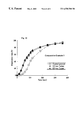
- FIG. 1 shows the results from dissolution test of sustained release granules and tablets prepared in Example 1.
- FIG. 2 shows the results from dissolution test of sustained release granules and tablets prepared in Example 2.
- FIG. 3 shows the results from dissolution test of sustained release granules and tablets prepared in Example 3.
- FIG. 4 shows the results from dissolution test of sustained release granules and tablets prepared in Example 4.
- FIG. 5 shows the results from dissolution test of sustained release granules and tablets prepared in Example 5.
- FIG. 6 shows the results from dissolution test of sustained release granules and tablets prepared in Comparative Example 1.
- FIG. 7 shows the results from dissolution test of sustained release granules and tablets prepared in Comparative Example 2.
- FIG. 8 shows the results from dissolution test of sustained release granules and tablets prepared by Comparative Example 3.
- FIG. 9 shows the results from dissolution test of sustained release granules and tablets prepared in Comparative Example 4.
- FIG. 10 shows the results from dissolution test of sustained release granules and tablets prepared in Comparative Example 5.
- One part of the matrix granule thus prepared was mixed with one part of the molding granule, which had been granulated by spraying 571.4 g of 7% hydroxypropyl cellulose/purified water onto 800 g of the powdery part obtained by mixing lactose and corn starch at 7:3 by means of a fluidized bed granulator (Freund Industrial Co., Ltd., type FLO-1).
- Magnesium stearate was added to the mixture at 0.2% and then the resulting mixture was compressed to tablets by means of a rotary tablet machine (under compression pressures of 1.5 t and 2.5 t) to prepare tablets, each tablet weighing 290 g.
- One part of the matrix granule thus prepared was mixed with one part of the molding granules as granulated in the same manner as described in Example 1, magnesium stearate was added to the mixture at 0.2% and then the resulting mixture was compressed to As, tablets by means of a rotary tablet machine (under compression pressures of 1.5 t and 2.5 t) to prepare tablets, each tablet weighing 290 g.
- the matrix granule prepared in Example 2 was coated with the coating solution prepared by dissolving 300 g of Ethyl Cellulose-20 cps and 15 g of triethyl citrate in 7185 g of 76% ethanol by means of a bottom-spray type fluidized bed coater (manufactured by Powrex Co., Ltd., GPCG-1) to prepare a coated granule.
- One part of the coated granule thus prepared was admixed with one part of the molding granule as granulated in the same manner as described in Example 1, magnesium stearate was added to the mixture at 0.2% and then the resulting mixture was compressed to tablets by means of a rotary tablet machine (under compression pressures of 1.5 t and 2.5 t) to prepare tablets, each tablet weighing 290 g.
- a matrix solution was prepared by dissolving 600 g of phenylpropanolamine hydrochloride and 600 g of Ethyl Cellulose-20 cps in 8800 g of 76% ethanol.
- the coating solution was prepared by dissolving 440 g of Ethyl Cellulose-20 cps and 22 g of triethyl citrate in 10537 g of 76% ethanol.
- the coating solution thus prepared was coated onto the matrix granule by means of a bottom-spray type fluidized bed coater (manufactured by Powrex Co., Ltd., GPCG-1) to prepare a coated granule.
- One part of the coated granule thus prepared was admixed with one part of the molding granule as granulated in the same manner as described in Example 1, magnesium stearate was added to the mixture at 0.2% and then the resulting mixture was compressed to tablets by means of a rotary tablet machine (under compression pressures of 1.5 t and 2.5 t) to prepare tablets, each tablet weighing 290 g.
- the coated granule having the composition as shown in Table 1 was prepared in the same manner as described in Example 4.
- One part of the coated granule thus prepared was admixed with one part of the molding granule as granulated in the same manner as described in Example 1, magnesium stearate was added to the mixture at 0.2% and then the resulting mixture was compressed to tablets by means of a rotary tablet machine (under compression pressures of 1.5 t and 2.5 t) to prepare tablets, each tablet weighing 290 g.
- the matrix granule having the composition as shown in Table 2 was prepared in the same manner as described in Example 1.
- One part of the matrix granule thus prepared was admixed with one part of the molding granules as granulated in the same manner as described in Example 1, magnesium stearate was added to the mixture at 0.2% and then the resulting mixture was compressed to tablets by means of a rotary tablet machine (under compression pressures of 1.5 t and 2.5 t) to prepare tablets, each tablet weighing 290 g.
- the matrix granule having the composition as shown in Table 2 was prepared in the same manner as described in Example 2.
- One part of the matrix granule thus prepared was admixed with one part of the molding granule as granulated in the same manner as described in Example 1, magnesium stearate was added to the mixture at 0.2% and then the resulting mixture was compressed to tablets by means of a rotary tablet machine (under compression pressures of 1.5 t and 2.5 t) to prepare tablets, each tablet weighing 290 g.
- the coated granule having the composition as shown in Table 2 was prepared in the same manner as described in Example 3.
- One part of the coated granule thus prepared was admixed with one part of the molding granule as granulated in the same manner as described in Example 1, magnesium stearate was added to the mixture at 0.2% and then the resulting mixture was compressed to tablets by means of a rotary tablet machine (under compression pressures of 1.5 t and 2.5 t) to prepare tablets, each tablet weighing 290 g.
- the coated granule having the composition as shown in Table 2 was prepared in the same manner as described in Example 3.
- One part of the coated granule thus prepared was admixed with one part of the molding granule as granulated in the same manner as described in Example 1, magnesium stearate was added to the mixture at 0.2% and then the resulting mixture was compressed to tablets by means of a rotary tablet machine (under compression pressures of 1.5 t and 2.5 t) to prepare tablets, each tablet weighing 290 g.
- the granules and tablets as prepared by Examples 1-5 and Comparative Examples 1-5 were subjected to dissolution test.
- the dissolution test was carried out in accordance with the Dissolution Test, Method 2 of the General Test and Assay as prescribed in the Pharmacopoeia of Japan.
- the matrix granules (uncoated granules) prepared according to Examples 1-5 and Comparative Examples 1-5 were subjected to granule strength test.
- the test was carried out with a load cell of 2 kg and a compression speed of 0.10 ⁇ m/sec using GURANO granule strength tester (Okada Seiko Co., Ltd.).
- Granule strength was calculated according to the following equation, wherein the loaded weight at which granule was broken is defined as p (peak value):
- the matrix granule prepared using diprophylline as a model drug and Ethyl Cellulose-20 cps at a blending ratio of 1:1 could achieve 50% dissolution of the active ingredient in 100 minutes and showed little change in dissolution rate due to tableting (Example 1).
- the matrix granule prepared using diprophylline and Ethyl Cellulose-7 cps at a blending ratio of 1:1 provided 50% dissolution of the active ingredient in 30 minutes and showed increased dissolution rate due to tableting (Comparative Example 1).
- the shorter 50% dissolution time of the matrix granule of Comparative Example 1 compared with that of Example 1 is attributed to a lowered viscosity level 1% of ethyl cellulose from 20 cps to 7 cps.
- the increased dissolution rate due to tableting is attributed to the fact that granule strength of the matrix granule of Example 1 is 3,500 g/mm 2 , while that of Comparative Example 1 is as low as 2,700 g/mm 2 .
- the matrix granule prepared using dextromethorphan hydrobromide as a model drug and Ethyl Cellulose-45 cps at a blending ratio of 1:1 could achieve 50% dissolution of the active ingredient in 60 minutes and showed little change in dissolution rate due to tableting (Example 2). Also, the 20 coated granule prepared by coating the above matrix granule with 15% Ethyl Cellulose-20 cps could achieve 50% dissolution of the active ingredient in 180 minutes and showed little change in dissolution rate due to tableting (Example 3).
- the matrix granule prepared using phenylpropanolamine hydrochloride as a model drug and Ethyl Cellulose-45 cps at a blending ratio of 3:1 achieved 50% dissolution of the active ingredient in 20 minutes and a satisfactory sustained release could hardly be provided (Comparative Example 2).
- the coated granule prepared by coating the matrix granule, which had been prepared from Ethyl Cellulose-45 cps and the drug at a blending ratio of 1:1, with 20% Ethyl Cellulose-20 cps could achieve 50% dissolution of the active ingredient in 100 minutes and also showed little change in dissolution rate due to tableting (Example 4).
- the uncoated granule was prepared using an ordinary binding agent (HPC-L) without using ethyl cellulose and then coated with Ethyl Cellulose-20 cps to form a coated granule.
- the coated granule showed 50% dissolution in 100 minutes, but showed considerably increased change in dissolution rate due to tableting (Comparative Example 3).
- the coated granules of Examples 3 and 4 showed little change Fin dissolution rate due to tableting, whereas the granule of Comparative Example 3 showed increased change.
- Example 4 In the coated granule (Comparative Example 4), which was prepared in the same manner as described in Example 4 except that the ethyl cellulose used for the uncoated granule (matrix granule) was replaced by Ethyl Cellulose-7 cps, 50% dissolution time of the coated granule was almost the same with that of the coated granule of Example 4, but the more increased change in a dissolution rate due to tableting was shown as compared with that in Example 4. The reason for this may be that the granule strength of the sustained release granule of Comparative Example 4 is as low as 2,600 g/mm 2 .
- Example 5 In the coated granule, which was prepared in the same manner as described in Example 3 except that a blending ratio of Ethyl Cellulose-45 cps to the drug for the uncoated granule (matrix granule) was changed to 0.75:1, little change in dissolution rate due to tableting was shown (Example 5). However, in the coated granule, which was prepared in the same manner as described in Example 3 except that a blending ratio of Ethyl Cellulose-45 cps to the drug for the uncoated granule (matrix granule) was changed to 0.5:1, somewhat increased change in dissolution rate due to tableting was shown (Comparative Example 5).
- the reason for this may be that the granule strength of the uncoated granule of Example 5 is relatively higher as 3,300 g/mm 2 , while that of the uncoated granule of Comparative Example 5 is as low as 2,800 g/mm 2 .
- the multiple-unit sustained release tablet of the invention is different from the conventional granule in which the surface of an active ingredient is coated with a sustained release base, in that each granule comprises a matrix composed of a water-insoluble polymer and an active ingredient in admixture.
- each granule comprises a matrix composed of a water-insoluble polymer and an active ingredient in admixture.
- dissolution rate changes little.
- the coated granule prepared by coating the uncoated granule with a water-insoluble polymer, in which the uncoated granule has been made up as a hard matrix can avoid the breakdown of the coating when compressed to tablets. Accordingly, the tablet of the present invention can provide a stable dissolution rate.
Landscapes
- Health & Medical Sciences (AREA)
- Epidemiology (AREA)
- Chemical & Material Sciences (AREA)
- Medicinal Chemistry (AREA)
- Pharmacology & Pharmacy (AREA)
- Life Sciences & Earth Sciences (AREA)
- Animal Behavior & Ethology (AREA)
- General Health & Medical Sciences (AREA)
- Public Health (AREA)
- Veterinary Medicine (AREA)
- Bioinformatics & Cheminformatics (AREA)
- Engineering & Computer Science (AREA)
- Medicinal Preparation (AREA)
Abstract
A multiple-unit sustained release tablet characterized by consisiting of a granular part and a powdery part, each granule comprising a matrix composed of a water-insoluble polymer and an active ingredient.Another tablet characterized in that each granule is coated with a release-controlling film.The object of the present invention is to provide a multiple-unit sustained release tablet showing little change in dissolution speed caused by the compression in the tableting step.
Description
This invention relates to a multiple-unit sustained release tablet comprising a granular part and a powdery part.
Pharmaceutical preparations for controlling a dissolution rate of an active ingredient may be classified into a single-unit pharmaceutical preparation and a multiple-unit pharmaceutical preparation. The single-unit pharmaceutical preparation is mainly in the form of tablets, while the multiple-unit one is mainly in the form of capsules or granules. The multiple-unit pharmaceutical preparation is superior to the single-unit one in the following characteristics: (1) less change in absorption of an active ingredient, (2) easier reproducibility of dissolution, and (3) being applicable to two or more active ingredients. Due to these excellent features, the multiple-unit pharmaceutical preparation is desirable as a sustained release preparation. The multiple-unit pharmaceutical preparation is desirably in the form of tablets rather than capsules or granules so that it may be taken more easily.
However, the conventional multiple-unit sustained release tablet is prepared by coating core particles with a drug layer, coating the surface of said coated particles with a release-controlling agent to form sustained release granules, blending said granules with a powdery part and then compressing to tablets. A sustained release film of the granules may often be broken during compression to tablets, resulting in difficulty in controlling dissolution of the drug. For coping with these problems, there have been proposed multiple-unit tablets, which comprises a granule of an indefinite form and a powdery part, said granule being composed of an uncoated granule containing low-melting fats and oils and an active ingredient, and a release-controlling film (JP-A-7-316042), or sustained release compression tablets prepared by compressing numerous microcapsules composed of fine particles of an active ingredient, said active ingredient being coated with a sustained release polymer composition, wherein said microcapsules have non-uniform particle diameters within the range of from about 5 μ to about 400 μ and can be immediately disintegrated in an aqueous solution to disperse into individual microcapsules (Japanese Patent No. 2601660). However, sustained release granules according to the prior art having an indefinite and unequal shape would make it difficult to apply a uniform coating film and to prepare sustained release tablets with a stable dissolution rate.
The object of the invention is to provide multiple-unit sustained release tablets with little change in dissolution rate caused by compression during tableting step.
We have found that the above problems can be dissolved by using a granule comprising a matrix composed of a water-insoluble polymer and an active ingredient (hereinafter referred to as a matrix granule) or said matrix granule further coated with a release-controlling film (hereinafter referred to as a coated granule), upon which the present invention has been completed.
More specifically, the present invention includes the following inventions:
(1) A multiple-unit sustained release tablet characterized by consisting of a granular part and a powdery part, each granule in the granular part comprising a matrix composed of a water-insoluble polymer and an active ingredient.
(2) The multiple-unit sustained release tablet as described in the item (1), wherein said granule comprises a core particle and a matrix layer composed of a water-insoluble polymer and an active ingredient for coating said core particle.
(3) The multiple-unit sustained release tablet as described in the item (1) or (2), wherein a weight ratio of said water-insoluble polymer to said active ingredient is 0.7:1-3:1.
(4) The multiple-unit sustained release tablet as described in any of the items (1)-(3), wherein said water-insoluble polymer is ethyl cellulose.
(5) The multiple-unit sustained release tablet as described in the item (4), wherein said ethyl cellulose has a viscosity of not less than 15 cps at 25° C. when dissolved at 5% by weight in a mixed solution of toluene and ethanol (8:2 w/w).
(6) The multiple-unit sustained release tablet as described in any of the items (1)-(5), wherein said granule is coated with a release-controlling film.
(7) The multiple-unit sustained release tablet as described in the item (6), wherein said release-controlling film is a water-insoluble polymer.
(8) The multiple-unit sustained release tablet as described in the item (6) or (7), wherein said water-insoluble polymer is ethyl cellulose.
(9) The multiple-unit sustained release tablet as described in any of the items (6)-(8), wherein said granule has a granule strength of not less than 3,000 g/mm2 in the state not coated with said release-controlling film.
The water-insoluble polymer as used herein means a water-insoluble polymer used in the pharmaceutical field as a sustained release coating agent, an enteric coating agent, a gastric coating agent, etc., which may include, for example, ethyl cellulose, purified shellac, white shellac, aminoalkyl methacrylate copolymer RS, hydroxypropyl methylcellulose phthalate, hydroxypropyl methylcellulose acetate succinate, carboxymethylethyl-cellulose, cellulose acetate phthalate, methacrylic acid copolymer L, methacrylic acid copolymer LD, methacrylic acid copolymer S, aminoalkyl methacrylate copolymer E, polyvinyl acetal diethylaminoacetate, etc. Of these polymers, ethyl cellulose may be most preferable.
Preferably, the type, degree of substitution and molecular weight of the water-insoluble polymers should be chosen for their proper use, depending on solubility of the active ingredient in water or an alcohol, the desired sustained release level and the like. These water-insoluble polymers may be used either alone or in combination. There may be further incorporated a hydrogenated oil, stearic acid, cetanol, etc. as a coating auxiliary agent, and a middle-chain triglyceride, triacetin, triethyl citrate, cetanol, etc. as a plasticizer.
The ethyl cellulose used herein preferably has an ethoxyl content of 43-50% (substitution degree of 2.2-2.6). In order to carry out the invention, ethyl cellulose has a viscosity of not less than 15 cps, preferably not less than 20 cps, more preferably 20-50 cps, at 25° C. when dissolved at 5% by weight in a mixed solution of toluene and ethanol (8:2 w/w).
A solvent for the water-insoluble polymer may vary depending on the type of the polymer. In general, a mixture of water and a lower alcohol or a lower alcohol is preferable. In case of ethyl cellulose, a 60% or more aqueous ethanol solution is preferable. It is essential that the water-insoluble polymer be dissolved in such a solvent and that an active ingredient be dissolved or uniformly dispersed in the water-insoluble polymer solution. Where the active ingredient is of a dispersed form, it is effective to maintain an average particle diameter below 20 μm for improving adhesion to a core particle and securing uniformity, and to perform a sufficient stirring for establishing uniformity.
The present invention may be applied to various active ingredients including water-soluble drugs by varying the type of water-insoluble polymers or blending ratio thereof or by additional coating of the matrix granule with a release-controlling film. Accordingly, the kind of the active ingredient to be used in this invention is not particularly restricted. The active ingredients which may be used in this invention are exemplified as follows: Diprophylline, dextromethorphan hydrobromide, phenylpropanolamine hydrochloride, belladonna (total) alkaloids, acetaminophen, theophylline, sodium salicylate, aspirin, ibuprofen, noscapine, dl-methylephedrine hydrochloride, dihydrocodeine phosphate, ethenzamide, bromhexine hydrochloride, d-chloropheniramine maleate, aminophylline, proxyphylline, caffeine, etc. These active ingredients may be used in admixture with two or more thereof.
According to the invention, it is feasible to freely control dissolution rate of the active ingredient, considering its solubility in water, according to the type of the water-insoluble polymer forming the matrix granule, the blending ratio of the water-insoluble polymer to the active ingredient and others. It is also feasible to control the dissolution rate, changing the composition of the solvent for dissolving the water-insoluble polymer. Blending ratio of the water-insoluble polymer to the active ingredient, both forming the matrix granule, may be properly selected in such a range that may control dissolution of the active ingredient, and is usually 0.7:1-3:1, preferably 0.75:1-1.25:1 in terms of weight ratio. In the production according to the invention, an amount of the water-insoluble polymer to be incorporated in the matrix granule may be preferably three times or less that of the active ingredient. However, if it is difficult to ensure the desired dissolution rate of the active ingredient by using said amount, it will be more efficient to control dissolution rate of the active ingredient by coating the matrix granule with a release-controlling film. In that case, a granule strength of the matrix granule is kept preferably not less than 3,000 g/mm2, more preferably not less than 3,500 g/mm2. This will make the coated granule hardly broken during mixing with the powdery part and compressing to tablets. Thus, it becomes feasible to lessen a change in the dissolution rate of the coated granules.
Granule strength may be controlled by choosing the type, degree of substitution and molecular weight of the water-insoluble polymer for intended use and adequately selecting a blending ratio of the water-insoluble polymer to the active ingredient.
Embodiments of the present invention are illustrated below, but the invention is not limited thereto.
If dissolution of an active ingredient contained in the matrix granule is to be controlled for a short period of time, or if dissolution of an active ingredient which is slightly soluble in water or an alcohol is to be controlled, the matrix granule may be used as such because desired dissolution control is easily accomplished without coating it with a release-controlling film. On the other hand, if dissolution of the active ingredient contained in the matrix granule is to be controlled over a long period of time, it is required to coat the granule with a release-controlling film in an amount suitable for the desired dissolution rate. The release-controlling film which may be used herein may include water-insoluble polymers as exemplified above, ethyl cellulose being preferable.
A core particle, which may be optionally used for the matrix granule, may be a spherical granule of a crystalline cellulose or a spherical granule of a lactose crystalline cellulose (For example, Celphere; manufactured by Asahi Chemical Industry Co., Ltd., Nonpareil; manufactured by Freund Industrial Co., Ltd.). An average particle diameter of the core particle ranges preferably between 100-1000 μm.
The method of granulating the matrix granule using the core particle includes those using a compound coater, a rolling fluidized coater, a fluidized bed coater, etc. The granulation method without using the core granule includes wet cylindrical granulation using a kneader or a granulator, and heat-molten, agitating granulation using LEADEGE Mixer, High Speed Mixer, etc. For coating the matrix granule with a release-controlling film, an ordinary fluidized bed coater or a ventilation pan coater, etc. can be used. Subsequent curing procedure, if necessary, may also be effective. The curing procedure is preferably carried out at 70° C. or higher.
The powdery part as used herein means the part, which comprises other components than the active ingredient (drug) and, if necessary, the active ingredients that are the same as and/or different from the active ingredient contained in the matrix granule, and which may disintegrate immediately after administration to release the granular part and simultaneously to initiate dissolution of the active ingredient (drug), if contained. The other components than the active ingredient (drug) as mentioned above may be excipients, disintegrating agents, lubricants, etc. conventionally used in tablets, for example, microcrystalline cellulose, light silicic anhydride, low substututed hydroxypropyl cellulose, hydroxypropyl cellulose, lactose, corn starch, magnesium stearate and the like, which are used in admixture therewith.
The tablet according to the invention preferably has a blending ratio by weight of the granular part to the powdery part of 1:0.5 or more. If the ratio of the powdery part is less than 0.5, a rapid disintegration into sub-units may be prevented or a poor moldability to tablet may be caused owing to mutual contact of the granular parts. An amount of the powdery part to be used has no upper limit set. No particular limitation is set on mixing of the granular part with the powdery part and compressing to tablets, which may be carried out according to a conventional method using any ordinary mixer or tablet machine. The present invention can provide sustained release tablets with little change in dissolution rate, even if a higher compression pressure has been applied. Compression pressure is usually not less than 0.6 t, preferably 1.0-2.5 t.
FIG. 1 shows the results from dissolution test of sustained release granules and tablets prepared in Example 1.
FIG. 2 shows the results from dissolution test of sustained release granules and tablets prepared in Example 2.
FIG. 3 shows the results from dissolution test of sustained release granules and tablets prepared in Example 3.
FIG. 4 shows the results from dissolution test of sustained release granules and tablets prepared in Example 4.
FIG. 5 shows the results from dissolution test of sustained release granules and tablets prepared in Example 5.
FIG. 6 shows the results from dissolution test of sustained release granules and tablets prepared in Comparative Example 1.
FIG. 7 shows the results from dissolution test of sustained release granules and tablets prepared in Comparative Example 2.
FIG. 8 shows the results from dissolution test of sustained release granules and tablets prepared by Comparative Example 3.
FIG. 9 shows the results from dissolution test of sustained release granules and tablets prepared in Comparative Example 4.
FIG. 10 shows the results from dissolution test of sustained release granules and tablets prepared in Comparative Example 5.
The present invention will be illustrated in more detail by way of the following Examples and Test Examples.
In 4000 g of 95% ethanol was dispersed 500 g of diprophylline and the dispersion was ground by means of a colloid mill to regulate an average diameter to not more than 20 μm. Then, dissolved therein was 500 g of ethyl cellulose (having a viscosity of 20 cps at 25° C. when dissolved at 5% by weight in a toluene—ethanol mixed solvent (8:2 w/w); an ethoxyl content of 48.0-49.5% (degree of substitution of 2.41-2.51))(hereinafter referred to as “Ethyl Cellulose-20 cps”). The dispersion thus prepared was coated onto 1000 g of core particles (Celphere CP-305) by means of a bottom-spray type fluidized bed coater (manufactured by Powrex Co., Ltd., GPCG-1) to prepare a matrix granule (ethyl cellulose:diprophylline=1:1 (w/w)). One part of the matrix granule thus prepared was mixed with one part of the molding granule, which had been granulated by spraying 571.4 g of 7% hydroxypropyl cellulose/purified water onto 800 g of the powdery part obtained by mixing lactose and corn starch at 7:3 by means of a fluidized bed granulator (Freund Industrial Co., Ltd., type FLO-1). Magnesium stearate was added to the mixture at 0.2% and then the resulting mixture was compressed to tablets by means of a rotary tablet machine (under compression pressures of 1.5 t and 2.5 t) to prepare tablets, each tablet weighing 290 g.
In 9000 g of 95% ethanol were dissolved 500 g of dextromethorphan hydrobromide and 500 g of ethyl cellulose (having a viscosity of 45 cps at 25° C. when dissolved at 5% by weight in a toluene—ethanol mixed solvent (8:2 w/w); an ethoxyl content of 48.0-49.5% (degree of substitution of 2.41-2.51))(hereinafter referred to as “Ethyl Cellulose-45 cps”). The solution thus prepared was coated onto 1000 g of core particles (Celphere CP-305) by means of a bottom-spray type fluidized bed coater (manufactured by Powrex Co., Ltd., GPCG-1) to prepare a matrix granule (ethyl cellulose: dextromethorphan=1:1 (w/w)). One part of the matrix granule thus prepared was mixed with one part of the molding granules as granulated in the same manner as described in Example 1, magnesium stearate was added to the mixture at 0.2% and then the resulting mixture was compressed to As, tablets by means of a rotary tablet machine (under compression pressures of 1.5 t and 2.5 t) to prepare tablets, each tablet weighing 290 g.
The matrix granule prepared in Example 2 was coated with the coating solution prepared by dissolving 300 g of Ethyl Cellulose-20 cps and 15 g of triethyl citrate in 7185 g of 76% ethanol by means of a bottom-spray type fluidized bed coater (manufactured by Powrex Co., Ltd., GPCG-1) to prepare a coated granule. One part of the coated granule thus prepared was admixed with one part of the molding granule as granulated in the same manner as described in Example 1, magnesium stearate was added to the mixture at 0.2% and then the resulting mixture was compressed to tablets by means of a rotary tablet machine (under compression pressures of 1.5 t and 2.5 t) to prepare tablets, each tablet weighing 290 g.
A matrix solution was prepared by dissolving 600 g of phenylpropanolamine hydrochloride and 600 g of Ethyl Cellulose-20 cps in 8800 g of 76% ethanol. The matrix solution thus prepared was coated onto 1000 g of core particles (Celphere CP-305) by means of a bottom-spray type fluidized bed coater (manufactured by Powrex Co., Ltd., GPCG-1) to prepare a matrix granule (ethyl cellulose:phenyl-propanolamine hydrochloride=1:1 (w/w)).
The coating solution was prepared by dissolving 440 g of Ethyl Cellulose-20 cps and 22 g of triethyl citrate in 10537 g of 76% ethanol. The coating solution thus prepared was coated onto the matrix granule by means of a bottom-spray type fluidized bed coater (manufactured by Powrex Co., Ltd., GPCG-1) to prepare a coated granule. One part of the coated granule thus prepared was admixed with one part of the molding granule as granulated in the same manner as described in Example 1, magnesium stearate was added to the mixture at 0.2% and then the resulting mixture was compressed to tablets by means of a rotary tablet machine (under compression pressures of 1.5 t and 2.5 t) to prepare tablets, each tablet weighing 290 g.
The coated granule having the composition as shown in Table 1 was prepared in the same manner as described in Example 4. One part of the coated granule thus prepared was admixed with one part of the molding granule as granulated in the same manner as described in Example 1, magnesium stearate was added to the mixture at 0.2% and then the resulting mixture was compressed to tablets by means of a rotary tablet machine (under compression pressures of 1.5 t and 2.5 t) to prepare tablets, each tablet weighing 290 g.
The matrix granule having the composition as shown in Table 2 was prepared in the same manner as described in Example 1. One part of the matrix granule thus prepared was admixed with one part of the molding granules as granulated in the same manner as described in Example 1, magnesium stearate was added to the mixture at 0.2% and then the resulting mixture was compressed to tablets by means of a rotary tablet machine (under compression pressures of 1.5 t and 2.5 t) to prepare tablets, each tablet weighing 290 g.
The matrix granule having the composition as shown in Table 2 was prepared in the same manner as described in Example 2. One part of the matrix granule thus prepared was admixed with one part of the molding granule as granulated in the same manner as described in Example 1, magnesium stearate was added to the mixture at 0.2% and then the resulting mixture was compressed to tablets by means of a rotary tablet machine (under compression pressures of 1.5 t and 2.5 t) to prepare tablets, each tablet weighing 290 g.
In 2188 g of purified water were dissolved 1129 g of phenylpropanolamine hydrochloride and 71 g of hydroxypropyl cellulose (having a hydroxypropoxyl content of 53.4-77.5%). The solution thus prepared was coated onto 1000 g of core particles (Celphere CP-305) by means of a bottom-spray type fluidized bed coater (manufactured by Powrex Co., Ltd., GPCG-1) to prepare an uncoated granule. Then, 440 g of Ethyl Cellulose-20 cps and 22 g of triethyl citrate were dissolved in 10531 g of 76% ethanol and the solution was coated onto the uncoated granule to prepare a coated granule. One part of the coated granule thus prepared was admixed with one part of the molding granule as granulated in the same manner as described in Example 1, magnesium stearate was added to the mixture at 0.2% and then the resulting mixture was compressed to tablets by means of a rotary tablet machine (under compression pressures of 1.5 t and 2.5 t) to prepare tablets, each tablet weighing 290 g.
The coated granule having the composition as shown in Table 2 was prepared in the same manner as described in Example 3. One part of the coated granule thus prepared was admixed with one part of the molding granule as granulated in the same manner as described in Example 1, magnesium stearate was added to the mixture at 0.2% and then the resulting mixture was compressed to tablets by means of a rotary tablet machine (under compression pressures of 1.5 t and 2.5 t) to prepare tablets, each tablet weighing 290 g.
The coated granule having the composition as shown in Table 2 was prepared in the same manner as described in Example 3. One part of the coated granule thus prepared was admixed with one part of the molding granule as granulated in the same manner as described in Example 1, magnesium stearate was added to the mixture at 0.2% and then the resulting mixture was compressed to tablets by means of a rotary tablet machine (under compression pressures of 1.5 t and 2.5 t) to prepare tablets, each tablet weighing 290 g.
The formulation according to Examples and Comparative Examples is summarized in Tables 1 and 2.
| TABLE 1 | ||
| Example | ||
| (Unit: gram) | 1 | 2 | 3 | 4 | 5 |
| MATRIX GRANULE | |||||
| Celphere CP-305 | 1000 | 1000 | 1000 | 1000 | 1000 |
| Dipropylline | 500 | — | — | — | — |
| Dextromethorphan | — | 500 | 500 | — | — |
| hydrobromide | |||||
| Phenypropanolamine | — | — | — | 600 | 600 |
| hydrochloride | |||||
| Ethyl Cellulose - 20 cps | 500 | — | — | 600 | 450 |
| Ethyl Cellulose - 45 cps | — | 500 | 500 | — | — |
| 95% Ethanol | 4000 | 9000 | 9000 | 7040 | 6000 |
| Purified water | — | — | — | 1760 | 1500 |
| COATING FILM | |||||
| Ethyl Cellulose - 20 cps | — | — | 300 | 440 | 410 |
| Triethyl citrate | — | — | 15 | 22 | 20 |
| 95% Ethanol | — | — | 5748 | 8430 | 7856 |
| Purified water | — | — | 1437 | 2107 | 1964 |
| TABLE 2 | ||
| Comparative Example | ||
| (Unit: gram) | 1 | 2 | 3 | 4 | 5 |
| MATRIX GRANULE | |||||
| Celphere CP-305 | 1000 | 1000 | 1000 | 1000 | 1000 |
| Dipropylline | 500 | — | — | — | — |
| Phenylpropanolamine | — | 600 | 1129 | 600 | 600 |
| hydrochloride | |||||
| Hydroxypropyl cellulose | — | — | 71 | — | — |
| Ethyl Cellulose - 7 cps | 500 | — | — | 600 | — |
| Ethyl Cellulose - 45 cps | — | 1800 | — | — | 300 |
| 95% Ethanol | 4000 | 33600 | — | 4800 | 5100 |
| Purified water | — | — | 2188 | — | — |
| COATING FILM | |||||
| Ethyl Cellulose - 20 cps | — | — | 440 | 440 | 380 |
| Triethyl citrate | — | — | 22 | 22 | 19 |
| 95% Ethanol | — | — | 8425 | 8425 | 7281 |
| Purified water | — | — | 2106 | 2106 | 1820 |
The granules and tablets as prepared by Examples 1-5 and Comparative Examples 1-5 were subjected to dissolution test. The dissolution test was carried out in accordance with the Dissolution Test, Method 2 of the General Test and Assay as prescribed in the Pharmacopoeia of Japan.
The test results are shown in FIGS. 1-10.
The matrix granules (uncoated granules) prepared according to Examples 1-5 and Comparative Examples 1-5 were subjected to granule strength test. The test was carried out with a load cell of 2 kg and a compression speed of 0.10 μm/sec using GURANO granule strength tester (Okada Seiko Co., Ltd.). Granule strength was calculated according to the following equation, wherein the loaded weight at which granule was broken is defined as p (peak value):
The results are shown in Tables 3 and 4.
| TABLE 3 |
| [Results of strength test on granules of |
| Examples 1-5 (uncoated granules)] |
| Example |
| 1 | 2 | 3 | 4 | 5 | |
| Granule strength (g/mm2) | 3,500 | 3,800 | 3,800 | 3,650 | 3,300 |
| TABLE 4 |
| [Results of strength test on granules of |
| Comparative Examples 1-5 (uncoated granules)] |
| Comparative Example |
| 1 | 2 | 3 | 4 | 5 | |
| Granule strength (g/mm2) | 2,700 | 4,800 | 1,600 | 2,600 | 2,800 |
The above results reveal the following facts.
The matrix granule prepared using diprophylline as a model drug and Ethyl Cellulose-20 cps at a blending ratio of 1:1 could achieve 50% dissolution of the active ingredient in 100 minutes and showed little change in dissolution rate due to tableting (Example 1). On the other hand, the matrix granule prepared using diprophylline and Ethyl Cellulose-7 cps at a blending ratio of 1:1 provided 50% dissolution of the active ingredient in 30 minutes and showed increased dissolution rate due to tableting (Comparative Example 1). The shorter 50% dissolution time of the matrix granule of Comparative Example 1 compared with that of Example 1 is attributed to a lowered viscosity level 1% of ethyl cellulose from 20 cps to 7 cps. The increased dissolution rate due to tableting is attributed to the fact that granule strength of the matrix granule of Example 1 is 3,500 g/mm2, while that of Comparative Example 1 is as low as 2,700 g/mm2.
The matrix granule prepared using dextromethorphan hydrobromide as a model drug and Ethyl Cellulose-45 cps at a blending ratio of 1:1 could achieve 50% dissolution of the active ingredient in 60 minutes and showed little change in dissolution rate due to tableting (Example 2). Also, the 20 coated granule prepared by coating the above matrix granule with 15% Ethyl Cellulose-20 cps could achieve 50% dissolution of the active ingredient in 180 minutes and showed little change in dissolution rate due to tableting (Example 3).
The matrix granule prepared using phenylpropanolamine hydrochloride as a model drug and Ethyl Cellulose-45 cps at a blending ratio of 3:1 achieved 50% dissolution of the active ingredient in 20 minutes and a satisfactory sustained release could hardly be provided (Comparative Example 2). The coated granule prepared by coating the matrix granule, which had been prepared from Ethyl Cellulose-45 cps and the drug at a blending ratio of 1:1, with 20% Ethyl Cellulose-20 cps could achieve 50% dissolution of the active ingredient in 100 minutes and also showed little change in dissolution rate due to tableting (Example 4).
The uncoated granule was prepared using an ordinary binding agent (HPC-L) without using ethyl cellulose and then coated with Ethyl Cellulose-20 cps to form a coated granule. The coated granule showed 50% dissolution in 100 minutes, but showed considerably increased change in dissolution rate due to tableting (Comparative Example 3). The coated granules of Examples 3 and 4 showed little change Fin dissolution rate due to tableting, whereas the granule of Comparative Example 3 showed increased change. This is attributed to the facts that the granule strength of the former uncoated granules (matrix granules) is 3,800 g/mm2 and 3,650 g/mm2, respectively , while that of the latter is as low as 1,600 g/mm2.
In the coated granule (Comparative Example 4), which was prepared in the same manner as described in Example 4 except that the ethyl cellulose used for the uncoated granule (matrix granule) was replaced by Ethyl Cellulose-7 cps, 50% dissolution time of the coated granule was almost the same with that of the coated granule of Example 4, but the more increased change in a dissolution rate due to tableting was shown as compared with that in Example 4. The reason for this may be that the granule strength of the sustained release granule of Comparative Example 4 is as low as 2,600 g/mm2.
In the coated granule, which was prepared in the same manner as described in Example 3 except that a blending ratio of Ethyl Cellulose-45 cps to the drug for the uncoated granule (matrix granule) was changed to 0.75:1, little change in dissolution rate due to tableting was shown (Example 5). However, in the coated granule, which was prepared in the same manner as described in Example 3 except that a blending ratio of Ethyl Cellulose-45 cps to the drug for the uncoated granule (matrix granule) was changed to 0.5:1, somewhat increased change in dissolution rate due to tableting was shown (Comparative Example 5). The reason for this may be that the granule strength of the uncoated granule of Example 5 is relatively higher as 3,300 g/mm2, while that of the uncoated granule of Comparative Example 5 is as low as 2,800 g/mm2.
The multiple-unit sustained release tablet of the invention is different from the conventional granule in which the surface of an active ingredient is coated with a sustained release base, in that each granule comprises a matrix composed of a water-insoluble polymer and an active ingredient in admixture. This makes the granule of the invention hardly broken during mixing with the powdery part and compressing to tablets. Thus, dissolution rate changes little. Moreover, the coated granule prepared by coating the uncoated granule with a water-insoluble polymer, in which the uncoated granule has been made up as a hard matrix, can avoid the breakdown of the coating when compressed to tablets. Accordingly, the tablet of the present invention can provide a stable dissolution rate.
Claims (8)
1. A multiple-unit sustained release tablet comprising a granular part and a powdery part, wherein each granule in the granular part comprises a matrix composed of a water-insoluble polymer and an active ingredient and wherein said granule has a granule strength of not less than 3,000 g/mm2.
2. The multiple-unit sustained release tablet as claimed in claim 1 , wherein said granule comprises a core particle and a matrix layer composed of a water-insoluble polymer and an active ingredient for coating said core particle.
3. The multiple-unit sustained release tablet as claimed in claim 1 , wherein a weight ratio of said water-insoluble polymer to said active ingredient is 0.7:1-3:1.
4. The multiple-unit sustained release tablet as claimed claim 1 , wherein said water-insoluble polymer is ethyl cellulose.
5. The multiple-unit sustained release tablet as claimed in claim 4 , wherein said ethyl cellulose has a viscosity of not less than 15 cps at 25° C. when dissolved at 5% by weight in a mixed solution of toluene and ethanol (8:2 w/w).
6. The multiple-unit sustained release tablet as claimed claim 1 , wherein said granule is coated with a release-controlling film.
7. The multiple-unit sustained release tablet as claimed in claim 6 , wherein said release-controlling film is a water-insoluble polymer.
8. The multiple-unit sustained release tablet as claimed in claim 6 , wherein said water-insoluble polymer is ethyl cellulose.
Applications Claiming Priority (3)
| Application Number | Priority Date | Filing Date | Title |
|---|---|---|---|
| JP10-107349 | 1998-04-17 | ||
| JP10734998 | 1998-04-17 | ||
| PCT/JP1998/003537 WO1999053905A1 (en) | 1998-04-17 | 1998-08-07 | Multiple-unit sustained release tablets |
Publications (1)
| Publication Number | Publication Date |
|---|---|
| US6558700B1 true US6558700B1 (en) | 2003-05-06 |
Family
ID=14456811
Family Applications (1)
| Application Number | Title | Priority Date | Filing Date |
|---|---|---|---|
| US09/673,398 Expired - Fee Related US6558700B1 (en) | 1998-04-17 | 1998-08-07 | Multiple-unit sustained release tablets |
Country Status (7)
| Country | Link |
|---|---|
| US (1) | US6558700B1 (en) |
| EP (1) | EP1072257A1 (en) |
| KR (1) | KR20010034770A (en) |
| CN (1) | CN1148171C (en) |
| AU (1) | AU746084B2 (en) |
| CA (1) | CA2328154A1 (en) |
| WO (1) | WO1999053905A1 (en) |
Cited By (6)
| Publication number | Priority date | Publication date | Assignee | Title |
|---|---|---|---|---|
| US20070048385A1 (en) * | 2003-05-30 | 2007-03-01 | Roberto Golzi | Microcapsules by coacervation containing a pharmaceutical incorporated in the coating polymer |
| US20070082051A1 (en) * | 2005-05-31 | 2007-04-12 | Capricorn Pharma, Inc. | Modified Release Formulations of Antihypertensive Drugs |
| US20090068263A1 (en) * | 2006-04-20 | 2009-03-12 | Themis Laboratories Private Limited | Multiple unit compositions |
| US20090196934A1 (en) * | 2006-07-26 | 2009-08-06 | Asahi Kasei Chemicals Corporation | Spherical elementary granule and method for production thereof |
| WO2011127235A1 (en) | 2010-04-07 | 2011-10-13 | Eisai Inc. | Combination therapy for the treatment of dementia |
| US20130183434A1 (en) * | 2010-09-01 | 2013-07-18 | Disphar International B.V. | Mesalazine tablet having improved dissolution |
Families Citing this family (14)
| Publication number | Priority date | Publication date | Assignee | Title |
|---|---|---|---|---|
| US8071128B2 (en) | 1996-06-14 | 2011-12-06 | Kyowa Hakko Kirin Co., Ltd. | Intrabuccally rapidly disintegrating tablet and a production method of the tablets |
| US9358214B2 (en) | 2001-10-04 | 2016-06-07 | Adare Pharmaceuticals, Inc. | Timed, sustained release systems for propranolol |
| US8367111B2 (en) | 2002-12-31 | 2013-02-05 | Aptalis Pharmatech, Inc. | Extended release dosage forms of propranolol hydrochloride |
| US8747895B2 (en) | 2004-09-13 | 2014-06-10 | Aptalis Pharmatech, Inc. | Orally disintegrating tablets of atomoxetine |
| US9884014B2 (en) | 2004-10-12 | 2018-02-06 | Adare Pharmaceuticals, Inc. | Taste-masked pharmaceutical compositions |
| NZ728442A (en) | 2004-10-21 | 2018-05-25 | Adare Pharmaceuticals Inc | Taste-masked pharmaceutical compositions with gastrosoluble pore-formers |
| US20060105038A1 (en) * | 2004-11-12 | 2006-05-18 | Eurand Pharmaceuticals Limited | Taste-masked pharmaceutical compositions prepared by coacervation |
| US20070015782A1 (en) | 2005-04-15 | 2007-01-18 | Eisai Co., Ltd. | Benzimidazole compound |
| US9040564B2 (en) | 2005-04-28 | 2015-05-26 | Eisai R&D Management Co., Ltd. | Stabilized composition |
| WO2006118017A1 (en) * | 2005-04-28 | 2006-11-09 | Eisai R & D Management Co., Ltd. | Stabilized composition |
| US9161918B2 (en) | 2005-05-02 | 2015-10-20 | Adare Pharmaceuticals, Inc. | Timed, pulsatile release systems |
| AU2010325746B2 (en) | 2009-12-02 | 2016-02-25 | Adare Pharmaceuticals S.R.L. | Fexofenadine microcapsules and compositions containing them |
| CN102091053B (en) * | 2009-12-14 | 2017-02-08 | 常州善美药物研究开发中心有限公司 | Particle composite controlled-release tablets |
| CN101716155B (en) * | 2010-01-21 | 2011-10-05 | 中山大学 | Method for preparing pellet tablet |
Citations (11)
| Publication number | Priority date | Publication date | Assignee | Title |
|---|---|---|---|---|
| US4710384A (en) | 1986-07-28 | 1987-12-01 | Avner Rotman | Sustained release tablets made from microcapsules |
| US5246714A (en) * | 1985-10-11 | 1993-09-21 | Aktiebolaget Hassle | Drug preparation |
| JPH0753365A (en) | 1993-07-22 | 1995-02-28 | Lab Farmaceut Ct Srl | Medicinal composition having controlled release ability by γ-hydroxybutyrate |
| JPH0753361A (en) | 1993-05-10 | 1995-02-28 | Euro Celtique Sa | Controlled release formulations, oral dosage forms and methods of making the same |
| WO1995010264A1 (en) | 1993-10-12 | 1995-04-20 | Tokyo Tanabe Company Limited | Tablet containing enteric granules |
| JPH07316042A (en) | 1994-05-24 | 1995-12-05 | Shionogi & Co Ltd | Multiple unit type tablets |
| JPH0817983A (en) | 1994-06-29 | 1996-01-19 | Nec Kansai Ltd | Solder plating device |
| JPH0840905A (en) | 1994-03-14 | 1996-02-13 | Euro Celtique Sa | Pharmaceutical formulation |
| US5624683A (en) * | 1986-08-06 | 1997-04-29 | Eisai Co., Ltd. | Sustained-release multi-granule tablet |
| JPH09169645A (en) | 1995-12-20 | 1997-06-30 | Taisho Yakuhin Kogyo Kk | Sustained release preparation containing ibudilast and its production |
| JPH10218761A (en) | 1997-02-07 | 1998-08-18 | Taisho Pharmaceut Co Ltd | Multiple unit type sustained release tablet |
Family Cites Families (1)
| Publication number | Priority date | Publication date | Assignee | Title |
|---|---|---|---|---|
| JP2849047B2 (en) * | 1994-12-19 | 1999-01-20 | 大正薬品工業株式会社 | Diclofenac sodium sustained-release preparation and its production method |
-
1998
- 1998-08-07 WO PCT/JP1998/003537 patent/WO1999053905A1/en not_active Ceased
- 1998-08-07 KR KR1020007011272A patent/KR20010034770A/en not_active Ceased
- 1998-08-07 US US09/673,398 patent/US6558700B1/en not_active Expired - Fee Related
- 1998-08-07 EP EP98936707A patent/EP1072257A1/en not_active Withdrawn
- 1998-08-07 AU AU85617/98A patent/AU746084B2/en not_active Ceased
- 1998-08-07 CA CA002328154A patent/CA2328154A1/en not_active Abandoned
- 1998-08-07 CN CNB988140594A patent/CN1148171C/en not_active Expired - Fee Related
Patent Citations (11)
| Publication number | Priority date | Publication date | Assignee | Title |
|---|---|---|---|---|
| US5246714A (en) * | 1985-10-11 | 1993-09-21 | Aktiebolaget Hassle | Drug preparation |
| US4710384A (en) | 1986-07-28 | 1987-12-01 | Avner Rotman | Sustained release tablets made from microcapsules |
| US5624683A (en) * | 1986-08-06 | 1997-04-29 | Eisai Co., Ltd. | Sustained-release multi-granule tablet |
| JPH0753361A (en) | 1993-05-10 | 1995-02-28 | Euro Celtique Sa | Controlled release formulations, oral dosage forms and methods of making the same |
| JPH0753365A (en) | 1993-07-22 | 1995-02-28 | Lab Farmaceut Ct Srl | Medicinal composition having controlled release ability by γ-hydroxybutyrate |
| WO1995010264A1 (en) | 1993-10-12 | 1995-04-20 | Tokyo Tanabe Company Limited | Tablet containing enteric granules |
| JPH0840905A (en) | 1994-03-14 | 1996-02-13 | Euro Celtique Sa | Pharmaceutical formulation |
| JPH07316042A (en) | 1994-05-24 | 1995-12-05 | Shionogi & Co Ltd | Multiple unit type tablets |
| JPH0817983A (en) | 1994-06-29 | 1996-01-19 | Nec Kansai Ltd | Solder plating device |
| JPH09169645A (en) | 1995-12-20 | 1997-06-30 | Taisho Yakuhin Kogyo Kk | Sustained release preparation containing ibudilast and its production |
| JPH10218761A (en) | 1997-02-07 | 1998-08-18 | Taisho Pharmaceut Co Ltd | Multiple unit type sustained release tablet |
Non-Patent Citations (1)
| Title |
|---|
| International Search Report. |
Cited By (6)
| Publication number | Priority date | Publication date | Assignee | Title |
|---|---|---|---|---|
| US20070048385A1 (en) * | 2003-05-30 | 2007-03-01 | Roberto Golzi | Microcapsules by coacervation containing a pharmaceutical incorporated in the coating polymer |
| US20070082051A1 (en) * | 2005-05-31 | 2007-04-12 | Capricorn Pharma, Inc. | Modified Release Formulations of Antihypertensive Drugs |
| US20090068263A1 (en) * | 2006-04-20 | 2009-03-12 | Themis Laboratories Private Limited | Multiple unit compositions |
| US20090196934A1 (en) * | 2006-07-26 | 2009-08-06 | Asahi Kasei Chemicals Corporation | Spherical elementary granule and method for production thereof |
| WO2011127235A1 (en) | 2010-04-07 | 2011-10-13 | Eisai Inc. | Combination therapy for the treatment of dementia |
| US20130183434A1 (en) * | 2010-09-01 | 2013-07-18 | Disphar International B.V. | Mesalazine tablet having improved dissolution |
Also Published As
| Publication number | Publication date |
|---|---|
| AU746084B2 (en) | 2002-04-11 |
| CN1148171C (en) | 2004-05-05 |
| KR20010034770A (en) | 2001-04-25 |
| HK1036220A1 (en) | 2001-12-28 |
| CA2328154A1 (en) | 1999-10-28 |
| AU8561798A (en) | 1999-11-08 |
| CN1294510A (en) | 2001-05-09 |
| EP1072257A1 (en) | 2001-01-31 |
| WO1999053905A1 (en) | 1999-10-28 |
Similar Documents
| Publication | Publication Date | Title |
|---|---|---|
| US6558700B1 (en) | Multiple-unit sustained release tablets | |
| KR100384215B1 (en) | Release Persistence Polydisperse Hardogel System-Amorphous Drug | |
| KR950005864B1 (en) | Sustained release formulations and preparation methods thereof | |
| JP3350559B2 (en) | Mechanically stable and easily disintegrable tablets made from preformed microparticles containing the active ingredient | |
| KR100236326B1 (en) | Directly compressible high load acetaminophen formulations | |
| US7718194B2 (en) | Coated particles with prolonged release and tablets containing same | |
| US6210716B1 (en) | Controlled release bupropion formulation | |
| US20060062856A1 (en) | Controlled release galantamine composition | |
| US6468560B2 (en) | Controlled release dosage form of [R-(Z)]-α-(methoxyimino)-α-(1-azabicyclo[2.2.2]oct-3yl) acetonitrile monohydrochloride | |
| JP2005516020A (en) | Zero-order sustained release dosage form and process for its production | |
| JP2007070363A (en) | Immediate release tablet core of insoluble medicine having sustained-release coating | |
| JP2003508428A (en) | Oral pharmaceutical dosage form for sustained release | |
| JPH07252140A (en) | Immediate release tablet core of insoluble pharmaceutical with persistent release coating | |
| US7138143B1 (en) | Coated preparation soluble in the lower digestive tract | |
| HRP20010198A2 (en) | Multiple unit controlled food effect-independent release pharmaceutical preparations and method for preparing the same | |
| KR102419638B1 (en) | A pharmaceutical formulation for oral administration with improved content uniformity comprising sustained-release pellets containing tamsulosin hydrochloride | |
| JP2007520547A (en) | Venlafaxine hydrochloride sustained release coated mini tablets | |
| CN1713896B (en) | Spheroids, preparation method thereof and pharmaceutical compositions | |
| EP2374460A1 (en) | Pulsed-release sildenafil composition and method for preparing said composition | |
| JPWO2002087549A1 (en) | Multiple unit type sustained release tablet | |
| CA2647765A1 (en) | Coated formulations | |
| JP3870470B2 (en) | Multiple unit type sustained release tablets | |
| US7060293B1 (en) | Powder-layered oral dosage forms | |
| JP4367722B2 (en) | Multiple unit type sustained release tablets | |
| EP3892263A1 (en) | Oral dosage form |
Legal Events
| Date | Code | Title | Description |
|---|---|---|---|
| AS | Assignment |
Owner name: TAISHO PHARMACEUTICAL CO., LTD., JAPAN Free format text: ASSIGNMENT OF ASSIGNORS INTEREST;ASSIGNORS:TSUCHIDA, KAZUTAKA;AOKI, SHINJI;REEL/FRAME:011218/0117 Effective date: 20000918 |
|
| REMI | Maintenance fee reminder mailed | ||
| LAPS | Lapse for failure to pay maintenance fees | ||
| STCH | Information on status: patent discontinuation |
Free format text: PATENT EXPIRED DUE TO NONPAYMENT OF MAINTENANCE FEES UNDER 37 CFR 1.362 |
|
| FP | Lapsed due to failure to pay maintenance fee |
Effective date: 20070506 |