US6545159B2 - Vinyl-phenyl pyridine monomers and polymers prepared therefrom - Google Patents

Vinyl-phenyl pyridine monomers and polymers prepared therefrom Download PDF

Info

Publication number
US6545159B2
US6545159B2 US09/925,685 US92568501A US6545159B2 US 6545159 B2 US6545159 B2 US 6545159B2 US 92568501 A US92568501 A US 92568501A US 6545159 B2 US6545159 B2 US 6545159B2
Authority
US
United States
Prior art keywords
vinyl
phenyl
pyridine
polymerization
formula
Prior art date
Legal status (The legal status is an assumption and is not a legal conclusion. Google has not performed a legal analysis and makes no representation as to the accuracy of the status listed.)
Expired - Fee Related
Application number
US09/925,685
Other versions
US20020198346A1 (en
Inventor
Jae-Suk Lee
Jun-hwan Ahn
Young-Sun Cho
Nam-Goo Kang
Hye-Kyong Lee
Current Assignee (The listed assignees may be inaccurate. Google has not performed a legal analysis and makes no representation or warranty as to the accuracy of the list.)
Gwangju Institute of Science and Technology
Original Assignee
Gwangju Institute of Science and Technology
Priority date (The priority date is an assumption and is not a legal conclusion. Google has not performed a legal analysis and makes no representation as to the accuracy of the date listed.)
Filing date
Publication date
Application filed by Gwangju Institute of Science and Technology filed Critical Gwangju Institute of Science and Technology
Assigned to KWANGJU INSTITUTE OF SCIENCE AND TECHNOLOGY reassignment KWANGJU INSTITUTE OF SCIENCE AND TECHNOLOGY ASSIGNMENT OF ASSIGNORS INTEREST (SEE DOCUMENT FOR DETAILS). Assignors: AHN, JUN-HWAN, CHO, YOUNG-SUN, KANG, NAM-GOO, LEE, HYE-KYONG, LEE, JAE-SUK
Publication of US20020198346A1 publication Critical patent/US20020198346A1/en
Priority to US10/366,395 priority Critical patent/US6660821B2/en
Application granted granted Critical
Publication of US6545159B2 publication Critical patent/US6545159B2/en
Anticipated expiration legal-status Critical
Expired - Fee Related legal-status Critical Current

Links

Images

Classifications

    • CCHEMISTRY; METALLURGY
    • C07ORGANIC CHEMISTRY
    • C07DHETEROCYCLIC COMPOUNDS
    • C07D213/00Heterocyclic compounds containing six-membered rings, not condensed with other rings, with one nitrogen atom as the only ring hetero atom and three or more double bonds between ring members or between ring members and non-ring members
    • C07D213/02Heterocyclic compounds containing six-membered rings, not condensed with other rings, with one nitrogen atom as the only ring hetero atom and three or more double bonds between ring members or between ring members and non-ring members having three double bonds between ring members or between ring members and non-ring members
    • C07D213/04Heterocyclic compounds containing six-membered rings, not condensed with other rings, with one nitrogen atom as the only ring hetero atom and three or more double bonds between ring members or between ring members and non-ring members having three double bonds between ring members or between ring members and non-ring members having no bond between the ring nitrogen atom and a non-ring member or having only hydrogen or carbon atoms directly attached to the ring nitrogen atom
    • C07D213/06Heterocyclic compounds containing six-membered rings, not condensed with other rings, with one nitrogen atom as the only ring hetero atom and three or more double bonds between ring members or between ring members and non-ring members having three double bonds between ring members or between ring members and non-ring members having no bond between the ring nitrogen atom and a non-ring member or having only hydrogen or carbon atoms directly attached to the ring nitrogen atom containing only hydrogen and carbon atoms in addition to the ring nitrogen atom
    • CCHEMISTRY; METALLURGY
    • C08ORGANIC MACROMOLECULAR COMPOUNDS; THEIR PREPARATION OR CHEMICAL WORKING-UP; COMPOSITIONS BASED THEREON
    • C08FMACROMOLECULAR COMPOUNDS OBTAINED BY REACTIONS ONLY INVOLVING CARBON-TO-CARBON UNSATURATED BONDS
    • C08F12/00Homopolymers and copolymers of compounds having one or more unsaturated aliphatic radicals, each having only one carbon-to-carbon double bond, and at least one being terminated by an aromatic carbocyclic ring
    • C08F12/02Monomers containing only one unsaturated aliphatic radical
    • C08F12/32Monomers containing only one unsaturated aliphatic radical containing two or more rings

Definitions

  • the present invention relates to vinyl-phenyl monomers and polymers prepared therefrom. More particularly, the present invention is to provide the vinyl-phenyl monomers expressed by formula (1) which are capable of various polymerization such as radical polymerization, cationic polymerization, anion polymerization and metallocene catalyzed polymerization due to the resonance effect of phenyl group and changing characteristics variously and thus, suitable in the synthesis of polymers which can be used in photo-functional materials by forming a polymer complex with a metal component having an optical characteristic.
  • formula (1) are capable of various polymerization such as radical polymerization, cationic polymerization, anion polymerization and metallocene catalyzed polymerization due to the resonance effect of phenyl group and changing characteristics variously and thus, suitable in the synthesis of polymers which can be used in photo-functional materials by forming a polymer complex with a metal component having an optical characteristic.
  • Continuous polymerization can be divided to ionic polymerization and radical polymerization depending on an initiator. It is difficult to do a controlled polymerization due to side reaction with the radical chain ends in radical polymerization, and reaction termination for the repulsion between the functional groups chain ends in ionic polymerization. Reactivity of radical polymerization varies with resonance stability of vinyl group and that of ionic polymerization varies with the polarity.
  • Monomers used in continuous polymerization can be polymerized by means of radical, cationic or anionic polymerization depending on Q-e value shown in the following table. Especially, either cationic or anionic polymerization can be expected with e value representing the degree of polarity.
  • the polarity of a monomer is important in anionic polymerization because reactivity is highly dependent on the polarity of the monomer. That is, a selection of monomers plays an essential role in the synthesis of block copolymers.
  • a monomer having an electron-withdrawing character in vinyl group is preferable for anionic polymerization.
  • Representative anionic monomers are styrene, ⁇ -methylstyrene, butadiene and isoprene which undergo the polymerization with a carbanion having strong reactivity because they have ⁇ e values.
  • the order of polymerization is ⁇ -methylstyrene, isoprene and styrene.
  • Polymers having functional groups can be widely used for photo-functional materials.
  • it is required to protect the functional groups during the polymerization to prevent from the termination reaction between carbanion and the functional groups.
  • S. Nakahama et. al have reported that styrene monomer having amine, hydroxy, carbonyl, carboxyl, or mercapto group can be protected with an appropriate protecting group such as trimethyl silyl, t-butyldimethyl silyl, oxazoline and ester groups during the polymerization and the protected functionality is then deprotected to regenerate the original functional group after the polymerization [S.
  • the present invention is to provide 2-(4-vinyl-phenyl)pyridine monomers and polymers with controllable molecular weight and molecular structure which can be widely useful for photo-functional materials since said polymers of such monomers is reliable to form a complex of a metal component (iridium, ruthenium and the like).
  • a metal component iridium, ruthenium and the like.
  • Vinyl-phenyl monomers of formula (1) of the present invention are capable of various polymerization such as radical polymerization, cation polymerization, anion polymerization and metallocene catalyzed polymerization due to the resonance effect of the phenyl group.
  • the molecular weight and molecular structure of polymers can be controlled during the polymerization and the prepared polymers can further form a complex with various metal components such as iridium, ruthenium and the like to be useful for photo-functional materials.
  • an object of the present invention is to provide vinyl-phenyl pyridine monomers and the preparation method thereof which can be easily introduced to synthesize polymers with the controlled functional groups and thus, such polymers can be applied in the preparation of thin film or fiber depending on the purpose.
  • Another object of the present invention is to provide the polymers prepared by using the monomers of formula (1).
  • FIG. 1 represents 1 H-NMR spectrum of 2-(4-vinyl-phenyl)pyridine.
  • FIG. 2 represents 13 C-NMR spectrum of 2-(4-vinyl-phenyl)pyridine.
  • FIG. 3 represents FT-IR spectrum of 2-(4-vinyl-phenyl)pyridine.
  • FIG. 4 represents GC spectrum of 2-(4-vinyl-phenyl)pyridine.
  • FIG. 5 represents Mass spectrum of 2-(4-vinyl-phenyl)pyridine.
  • FIG. 6 represents 1 H-NMR spectrum of poly[2-(4-vinyl-phenyl)pyridine].
  • FIG. 7 represents FT-IR spectrum of poly[2-(4-vinyl-phenyl)pyridine].
  • FIG. 8 represents DSC spectrum of poly[2-(4-vinyl-phenyl)pyridine].
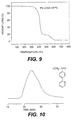
  • FIG. 9 represents TGA spectrum of poly[2-(4-vinyl-phenyl)pyridine].
  • FIG. 10 represents GPC spectrum of poly[2-(4-vinyl-phenyl)pyridine].
  • FIG. 11 represents 1 H-NMR spectrum of poly[2-(4-vinyl-phenyl)pyridine-co-9-vinylcarbazole].
  • FIG. 12 represents FT-IR spectrum of poly[2-(4-vinyl-phenyl)pyridine-co-9-vinylcarbazole].
  • FIG. 13 represents GPC spectrum of poly[2-(4-vinyl-phenyl)pyridine-co-9-vinylcarbazole].
  • FIG. 14 represents 1 H-NMR spectrum of poly( ⁇ [2-(4-vinyl-phenyl)pyridine](phenylpyridine) 2 iridium ⁇ -co-9-vinylcarbazole).
  • FIG. 15 represents FT-IR spectrum of poly( ⁇ [2-(4-vinyl-phenyl)pyridine](phenylpyridine) 2 iridium ⁇ -co-9 -vinylcarbazole).
  • FIG. 16 represents UV and PL spectrum of poly( ⁇ [2-(4-vinyl-phenyl)pyridine](phenylpyridine) 2 iridium ⁇ -co-9-vinylcarbazole).
  • the present invention is characterized by vinyl-phenyl pyridine monomers expressed by the following formula (1).
  • vinyl-phenyl pyridine monomers of the present invention are 2-(2-vinyl-phenyl)pyridine, 2-(3-vinyl-phenyl)pyridine, and 2-(4-vinyl-phenyl)pyridine.
  • the vinyl-phenyl pyridine monomers of formula (1) are prepared by the following methods.
  • the first is Suzuki coupling reaction as shown in Scheme 1.
  • the vinyl-phenyl pyridine of formula (1) is prepared by Suzuki coupling reaction of vinyl-phenylboronic acid of formula (2) and 2-bromopyridine of formula (3) in the presence of alkali metallic base and palladium catalyst.
  • alkali metallic base used are sodium carbonate, potassium carbonate, sodium hydroxide and potassium hydroxide.
  • palladium catalyst are tetrakis(triphenylphosphine)palladium (Pd(PPh 3 ) 4 ) and palladium acetate.
  • reaction solvent are tetrahydrofuran (THF), N,N-dimethylformamide (DMF), dimethyl sulfoxide (DMSO), and toluene.
  • the Suzuki coupling reaction is performed it a temperature of from 80 to 120° C.
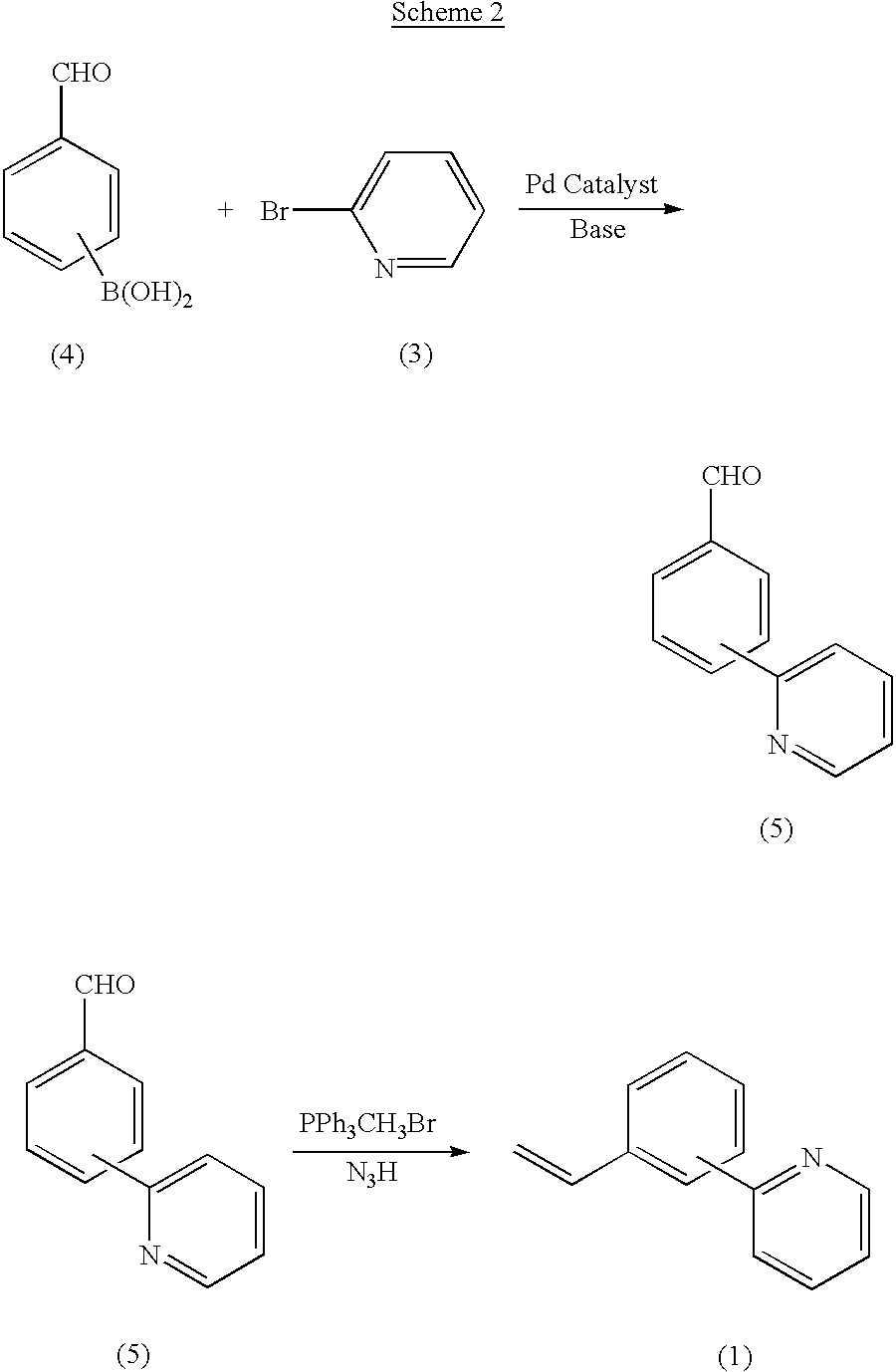
  • the second is Suzuki coupling reaction and Wittig reaction as shown in Scheme 2.
  • formylphenyl pyridine of formula (5) is prepared by Suzuki coupling reaction of formylphenylboronic acid of formula (4) and 2-bromopyridine of formula (3) in the presence of alkali metallic base and palladium catalyst and further, Wittig reaction of the prepared formylphenyl pyridine of formula (5) is performed in the presence of methyltriphenylphosphonium bromide (PPh 3 CH 3 Br) and sodium hydride to to yield vinyl-phenyl pyridine of formula (1).
  • methyltriphenylphosphonium bromide PPh 3 CH 3 Br
  • alkali metallic base used in Suzuki coupling reaction examples include sodium carbonate, potassium carbonate, sodium hydroxide and potassium hydroxide and examples of palladium catalyst are tetrakis(triphenylphosphine)palladium (Pd(PPh 3 ) 4 ) and palladium acetate.
  • Examples of reaction solvent are tetrahydrofuran (THF), N,N-dimethylformamide (DMF), dimethyl sulfoxide (DMSO), and toluene.
  • the Suzuki coupling reaction is performed at a temperature of from 80 to 120° C. and Wittig reaction is from 90 to 130° C.
  • the present invention is also characterized by polymers prepared with the vinyl-phenyl pyridine monomers of formula (1) which can be homopolymers or copolymers.
  • Particular monomers used in the polymerization are 4-(9-carbazoylcarbozoyl)methyl styrene, 2-(N-carbazoyl)ethyl methacrylate, and 3-(vinyl-9-ethyl)carbazole.
  • Polymerization methods are not limited and can be any one of bulk polymerization, solution polymerization, and suspension polymerization.
  • Polymerization system can be radical polymerization, cationic polymerization or anionic polymerization.
  • a polymerization initiator can be any conventional initiator which is generally used in the polymerization of styrene-based monomers. Particular examples of polymerization initiator include azobisisobutyronitrile (AIBN), benzoyl peroxide, hydrogen peroxide, cumyl peroxide, tert-butyl peroxide, tert-butyl hydroperoxide, lauroyl peroxide and the like.
  • AIBN azobisisobutyronitrile
  • benzoyl peroxide hydrogen peroxide
  • cumyl peroxide cumyl peroxide
  • tert-butyl peroxide tert-butyl hydroperoxide
  • lauroyl peroxide and the like The content of 2-(4-vinyl-
  • Number average molecular weight, weight average molecular weight, and molecular weight distribution (M w /M n ) of the prepared polymers are analyzed by GPC and the content of the vinyl-phenyl pyridine is analyzed by FT-NMR and FT-IR.
  • polymers of the present invention are the following formulas 6-8,
  • n+m 100 and n is an integer of 0.01 to 99.99.
  • the present invention is further characterized by a complex of the prepared polymers and a metal such as iridium, ruthenium and platinum which is useful for photo-functional materials.
  • a metal such as iridium, ruthenium and platinum which is useful for photo-functional materials.
  • Representative example of the complex is the following formula 9,
  • reaction mixture was extracted with ether (3 ⁇ 150 ml) and the ether layer was then dried over magnesium sulfate (10 g) by stirring for 30 min.
  • the dried ether layer was evaporated in vacuo to dryness and purified further by column chromatography on silica gel with eluting hexane/ethylacetate (1/9) to yield 2-(4-vinyl-phenyl)pyridine (90%).
  • reaction mixture was extracted with ether (3 ⁇ 150 ml) and the ether layer was then dried over magnesium sulfate (10 g) by stirring for 30 min.
  • the dried ether layer was evaporated in vacuo to dryness and purified further by column chromatography on silica gel with eluting hexane/ethylacetate (1/5) to yield 2-(4-vinyl-phenyl)pyridine (80%).
  • Methyltriphenylphophonium bromide 25 g, 0.07 mol
  • sodium hydride NaH, 3.36 g, 0.14 mol
  • toluene 100 ml
  • the reaction mixture was refluxed at 110° C. for 3 hr while changing the reaction solution to orange color.
  • 2-(4-formyl-phenyl)pyridine 10 g, 0.0545 mol was added and further refluxed at 110° C. for 12 hr.
  • the reaction mixture was poured in 300 ml of water in beaker and extracted then with ether (3 ⁇ 150 ml).
  • the ether layer was then dried over magnesium sulfate (10 g) by stirring for 30 min.
  • the dried ether layer was evaporated in vacuo to dryness and purified further by column chromatography on silica gel with eluting hexane/ethylacetate (1/10) to yield 2-(4-vinyl-phenyl)pyridine (85%).
  • the polymer was analyzed to have 54,000 g/mole of number average molecular weight, 230,000 g/mole of weight average molecular weight and 4.32 of molecular weight distribution (M w /M n ).
  • M w /M n molecular weight distribution
  • the prepared poly[2-(4-vinyl-phenyl)pyridine-co-9-vinylcarbozole] copolymer having 20% content of 2-(4-vinyl-phenyl)pyridine was analyzed to have 43,000 g/mole of number average molecular weight, 71,000 g/mole of weight average molecular weight and 1.65 of molecular weight distribution (M w /M n ).
  • M w /M n molecular weight distribution
  • poly[2-(4-vinyl-phenyl)pyridine-co-4-(9-carbozoyl)methyl styrene] copolymer having 20% content of 2-(4-vinyl-phenyl)pyridine was prepared except using 4-(9-carbazolyl)methyl styrene instead of 9-vinylcarbazole in 80%.
  • poly[2-(4-vinyl-phenyl)pyridine-co-3-(vinyl-9 -ethyl)carbozole] copolymer having 20% content of 2-(4-vinyl-phenyl)pyridine was prepared except using 2-(N-carbazoyl)ethyl methacrylate instead of 9-vinylcarbazole in 87%.
  • poly[2-(4-vinyl-phenyl)pyridine-co-2-(vinyl-9 -ethyl)carbozole] copolymer having 20% content of 2-(4-vinyl-phenyl)pyridine was prepared except using 3-(vinyl-9-ethyl)carbazole instead of 9-vinylcarbazole in 90%.
  • poly[2-(4-vinyl-phenyl)pyridine-co-9-vinylcarbozole] copolymer having 12% content of 2-(4-vinyl-phenyl)pyridine was prepared using 2-(4-vinyl-phenyl)pyridine (0.4 g, 2.2 mmol), 9-carbazole (2 g, 10.3 mmol) and azobisisobutyronitrile (0.021 g, 1 mol %).
  • the copolymer has 22,000 g/mole of number average molecular weight, 57,000 g/mole of weight average molecular weight and 2.56 of molecular weight distribution (M w /M n ).
  • the reaction mixture was poured into 200 ml of 1N hydrogen chloride aqueous solution and extracted with chloroform.
  • the chloroform layer was evaporated to dryness.
  • the residue was dissolved in chloroform (10 ml) and precipitated out from 200 ml of 99.9% methanol.
  • the precipitate was filtered through glass filter to collect the polymer complex which was further dried on vacuum oven at 60° C. for 24 hr. The yield was 95%.
  • the polymer was analyzed to have 43,000 g/mole of number average molecular weight, 71,000 g/mole of weight average molecular weight and 1.65 of molecular weight distribution (M w /M n ).
  • 1 H-NMR, FT-IR, UV and PL spectra were shown in FIGS. 14-16.
  • Vinyl-phenyl monomers of the present invention are capable of various polymerization such as radical polymerization, cation polymerization, anion polymerization and metallocene catalyzed polymerization due to resonance effect of phenyl group unlike other monomers.
  • Such vinyl-phenyl monomers can be polymerized to homopolymers or copolymers.
  • Molecular weight and molecular structure of polymers can be controlled during the polymerization and the polymers with the controlled weight and structure can further incorporate with a metal such as iridium, ruthenium and platinum to form a polymer-metal complex which is useful in a variety of fields using photo-functional materials.

Landscapes

  • Chemical & Material Sciences (AREA)
  • Organic Chemistry (AREA)
  • Health & Medical Sciences (AREA)
  • Chemical Kinetics & Catalysis (AREA)
  • Medicinal Chemistry (AREA)
  • Polymers & Plastics (AREA)
  • Addition Polymer Or Copolymer, Post-Treatments, Or Chemical Modifications (AREA)
  • Pyridine Compounds (AREA)
  • Low-Molecular Organic Synthesis Reactions Using Catalysts (AREA)
  • Electroluminescent Light Sources (AREA)

Abstract

The present invention relates to vinyl-phenyl monomers and polymers prepared therefrom. More particularly, the present invention is to provide the vinyl-phenyl monomers expressed by formula (1) which are capable of various polymerization such as radical polymerization, cation polymerization, anion polymerization and metallocene catalyzed polymerization due to resonance effect of phenyl group and changing characteristics variously and thus, suitable in the synthesis of general-purpose polymers which can be used in photo-functional materials by forming a complex with a metal component having an optical characteristic:
Figure US06545159-20030408-C00001

Description

BACKGROUND OF THE INVENTION
The present invention relates to vinyl-phenyl monomers and polymers prepared therefrom. More particularly, the present invention is to provide the vinyl-phenyl monomers expressed by formula (1) which are capable of various polymerization such as radical polymerization, cationic polymerization, anion polymerization and metallocene catalyzed polymerization due to the resonance effect of phenyl group and changing characteristics variously and thus, suitable in the synthesis of polymers which can be used in photo-functional materials by forming a polymer complex with a metal component having an optical characteristic.
Figure US06545159-20030408-C00002
Continuous polymerization can be divided to ionic polymerization and radical polymerization depending on an initiator. It is difficult to do a controlled polymerization due to side reaction with the radical chain ends in radical polymerization, and reaction termination for the repulsion between the functional groups chain ends in ionic polymerization. Reactivity of radical polymerization varies with resonance stability of vinyl group and that of ionic polymerization varies with the polarity.
Figure US06545159-20030408-C00003
Monomers used in continuous polymerization can be polymerized by means of radical, cationic or anionic polymerization depending on Q-e value shown in the following table. Especially, either cationic or anionic polymerization can be expected with e value representing the degree of polarity.
Cationic Anionic
Monomer e Polymerization Polymerization
Figure US06545159-20030408-C00004
0.02 −1.8 X
Figure US06545159-20030408-C00005
0.98 −1.27
Figure US06545159-20030408-C00006
1.00 −0.80
Figure US06545159-20030408-C00007
0.42 0.62 X
Figure US06545159-20030408-C00008
0.60 1.20 X
The polarity of a monomer is important in anionic polymerization because reactivity is highly dependent on the polarity of the monomer. That is, a selection of monomers plays an essential role in the synthesis of block copolymers. A monomer having an electron-withdrawing character in vinyl group is preferable for anionic polymerization. Representative anionic monomers are styrene, α-methylstyrene, butadiene and isoprene which undergo the polymerization with a carbanion having strong reactivity because they have −e values. The order of polymerization is α-methylstyrene, isoprene and styrene.
Polymers having functional groups can be widely used for photo-functional materials. In order to polymerize styrene, butadiene and methacrylate having a variety of functional groups through anionic polymerization, it is required to protect the functional groups during the polymerization to prevent from the termination reaction between carbanion and the functional groups. S. Nakahama et. al have reported that styrene monomer having amine, hydroxy, carbonyl, carboxyl, or mercapto group can be protected with an appropriate protecting group such as trimethyl silyl, t-butyldimethyl silyl, oxazoline and ester groups during the polymerization and the protected functionality is then deprotected to regenerate the original functional group after the polymerization [S. Nakahama, Prog. Polym. Sci., 15, 299 (1990); Makromol, Chem., 186, 1157 (1985); Polymer, 28, 303(1987); Macromolecules, 19, 2307 (1986); ibid. 26, 4995 (1993); ibid. 26, 35 (1993); Macromolecules, 20, 2968 (1987); ibid. 24, 1449 (1991); ibid. 26, 6976 (1993); Macromolecules, 19, 2307 (1986); ibid. 21, 561 (1988); ibid. 22, 2602 (1989)]. And further, the research and development of photo conductive and organic light emitting devices using phenylpyridines have been actively studied and some examples have been reported [Alistair J. Lee, Chem. Rev. 1987, 87, 711˜743; M. A. Baldo, S. Lamansky, P. E. Burrows, M. E. Thompson, S. R. Forrest, Appl. Phys. Lett., 75, 4, (1999); Raymond C. Kwong, Sergey Lamansky, and Mark E. Thompson, Adv. Mater., 2000, 12, No. 15, 1134; Catherine E. Housecroft, Coordination Chemistry Reviews, 152, (1996), 141˜156; K. Dedeian, P. I. Djurovich, F. O. Garces, G. Carlson, R. J. Watts, Inorg. Chem., 1991, 30, 1687˜1688; King, K. A, Spellane, P. J., Watts, R. J., J. Am. Chem. Soc., 1985, 107, 1431].
However, the study of phenylpyridines is limited to only organic molecule and there is no report in the synthesis of the corresponding polymers using phenylpyridine monomers.
The present invention is to provide 2-(4-vinyl-phenyl)pyridine monomers and polymers with controllable molecular weight and molecular structure which can be widely useful for photo-functional materials since said polymers of such monomers is reliable to form a complex of a metal component (iridium, ruthenium and the like).
SUMMARY OF THE INVENTION
Vinyl-phenyl monomers of formula (1) of the present invention are capable of various polymerization such as radical polymerization, cation polymerization, anion polymerization and metallocene catalyzed polymerization due to the resonance effect of the phenyl group.
Figure US06545159-20030408-C00009
The molecular weight and molecular structure of polymers can be controlled during the polymerization and the prepared polymers can further form a complex with various metal components such as iridium, ruthenium and the like to be useful for photo-functional materials.
Therefore, an object of the present invention is to provide vinyl-phenyl pyridine monomers and the preparation method thereof which can be easily introduced to synthesize polymers with the controlled functional groups and thus, such polymers can be applied in the preparation of thin film or fiber depending on the purpose.
Another object of the present invention is to provide the polymers prepared by using the monomers of formula (1).
Further objection of the present invention is to provide a complex of the polymers and iridium, ruthenium or platinum having optical character.
BRIEF DESCRIPTION OF THE INVENTION
FIG. 1 represents 1H-NMR spectrum of 2-(4-vinyl-phenyl)pyridine.
FIG. 2 represents 13C-NMR spectrum of 2-(4-vinyl-phenyl)pyridine.
FIG. 3 represents FT-IR spectrum of 2-(4-vinyl-phenyl)pyridine.
FIG. 4 represents GC spectrum of 2-(4-vinyl-phenyl)pyridine.
FIG. 5 represents Mass spectrum of 2-(4-vinyl-phenyl)pyridine.
FIG. 6 represents 1H-NMR spectrum of poly[2-(4-vinyl-phenyl)pyridine].
FIG. 7 represents FT-IR spectrum of poly[2-(4-vinyl-phenyl)pyridine].
FIG. 8 represents DSC spectrum of poly[2-(4-vinyl-phenyl)pyridine].
FIG. 9 represents TGA spectrum of poly[2-(4-vinyl-phenyl)pyridine].
FIG. 10 represents GPC spectrum of poly[2-(4-vinyl-phenyl)pyridine].
FIG. 11 represents 1H-NMR spectrum of poly[2-(4-vinyl-phenyl)pyridine-co-9-vinylcarbazole].
FIG. 12 represents FT-IR spectrum of poly[2-(4-vinyl-phenyl)pyridine-co-9-vinylcarbazole].
FIG. 13 represents GPC spectrum of poly[2-(4-vinyl-phenyl)pyridine-co-9-vinylcarbazole].
FIG. 14 represents 1H-NMR spectrum of poly({[2-(4-vinyl-phenyl)pyridine](phenylpyridine)2iridium}-co-9-vinylcarbazole).
FIG. 15 represents FT-IR spectrum of poly({[2-(4-vinyl-phenyl)pyridine](phenylpyridine)2iridium}-co-9 -vinylcarbazole).
FIG. 16 represents UV and PL spectrum of poly({[2-(4-vinyl-phenyl)pyridine](phenylpyridine)2iridium}-co-9-vinylcarbazole).
DETAILED DESCRIPTION OF THE INVENTION
The present invention is characterized by vinyl-phenyl pyridine monomers expressed by the following formula (1).
Figure US06545159-20030408-C00010
The present invention is described in detail as set forth hereunder.
Examples of vinyl-phenyl pyridine monomers of the present invention are 2-(2-vinyl-phenyl)pyridine, 2-(3-vinyl-phenyl)pyridine, and 2-(4-vinyl-phenyl)pyridine.
The vinyl-phenyl pyridine monomers of formula (1) are prepared by the following methods.
The first is Suzuki coupling reaction as shown in Scheme 1.
Figure US06545159-20030408-C00011
In Scheme 1, the vinyl-phenyl pyridine of formula (1) is prepared by Suzuki coupling reaction of vinyl-phenylboronic acid of formula (2) and 2-bromopyridine of formula (3) in the presence of alkali metallic base and palladium catalyst. Examples of alkali metallic base used are sodium carbonate, potassium carbonate, sodium hydroxide and potassium hydroxide. Examples of palladium catalyst are tetrakis(triphenylphosphine)palladium (Pd(PPh3)4) and palladium acetate. Examples of reaction solvent are tetrahydrofuran (THF), N,N-dimethylformamide (DMF), dimethyl sulfoxide (DMSO), and toluene. The Suzuki coupling reaction is performed it a temperature of from 80 to 120° C.
The second is Suzuki coupling reaction and Wittig reaction as shown in Scheme 2.
Figure US06545159-20030408-C00012
In Scheme 2, formylphenyl pyridine of formula (5) is prepared by Suzuki coupling reaction of formylphenylboronic acid of formula (4) and 2-bromopyridine of formula (3) in the presence of alkali metallic base and palladium catalyst and further, Wittig reaction of the prepared formylphenyl pyridine of formula (5) is performed in the presence of methyltriphenylphosphonium bromide (PPh3CH3Br) and sodium hydride to to yield vinyl-phenyl pyridine of formula (1).
Examples of alkali metallic base used in Suzuki coupling reaction are sodium carbonate, potassium carbonate, sodium hydroxide and potassium hydroxide and examples of palladium catalyst are tetrakis(triphenylphosphine)palladium (Pd(PPh3)4) and palladium acetate. Examples of reaction solvent are tetrahydrofuran (THF), N,N-dimethylformamide (DMF), dimethyl sulfoxide (DMSO), and toluene. The Suzuki coupling reaction is performed at a temperature of from 80 to 120° C. and Wittig reaction is from 90 to 130° C.
Besides Suzuki coupling and Wittig reactions, there are other reactions such as Stille coupling reaction using trimethyltin chloride or tributyltin chloride, Grignard reaction using magnesium and nickel catalyst and coupling reaction using zinc, bipyridine, triphenylphosphine and nickel chloride to prepare vinyl-phenyl pyridine monomers.
The present invention is also characterized by polymers prepared with the vinyl-phenyl pyridine monomers of formula (1) which can be homopolymers or copolymers. Particular monomers used in the polymerization are 4-(9-carbazoylcarbozoyl)methyl styrene, 2-(N-carbazoyl)ethyl methacrylate, and 3-(vinyl-9-ethyl)carbazole.
Conventional polymerizations of such monomers are performed. Polymerization methods are not limited and can be any one of bulk polymerization, solution polymerization, and suspension polymerization. Polymerization system can be radical polymerization, cationic polymerization or anionic polymerization. A polymerization initiator can be any conventional initiator which is generally used in the polymerization of styrene-based monomers. Particular examples of polymerization initiator include azobisisobutyronitrile (AIBN), benzoyl peroxide, hydrogen peroxide, cumyl peroxide, tert-butyl peroxide, tert-butyl hydroperoxide, lauroyl peroxide and the like. The content of 2-(4-vinyl-phenyl)pyridine can be controlled depending on the purpose in the range of from 0.01 to 99.9%.
Number average molecular weight, weight average molecular weight, and molecular weight distribution (Mw/Mn) of the prepared polymers are analyzed by GPC and the content of the vinyl-phenyl pyridine is analyzed by FT-NMR and FT-IR.
Examples of polymers of the present invention are the following formulas 6-8,
Figure US06545159-20030408-C00013
wherein n+m=100 and n is an integer of 0.01 to 99.99.
The present invention is further characterized by a complex of the prepared polymers and a metal such as iridium, ruthenium and platinum which is useful for photo-functional materials. Representative example of the complex is the following formula 9,
Figure US06545159-20030408-C00014
wherein M represents iridium, ruthenium or platinum; and n+m=100 and n is an integer of 0.01 to 99.99.
Example of preparation method of the polymer complex is shown in the following Scheme 3.
Figure US06545159-20030408-C00015
In Scheme 3, iridium (III) acetylacetonate (Iracac) and 2 equivalents of 2-phenylpyridine are reacted in glycerol and then 1 equivalent of the polymer having 2-(4-vinyl-phenyl)pyridine is added and heated at reflux. After the reaction is completed, the reaction mixture is poured into aqueous hydrogen chloride solution and then extracted with chloroform. The residue is precipitated out from chloroform/methanol solution. The crude product is purified by column chromatography and dried to obtain the desired polymer complex. Such polymer complex is very useful for photo-functional materials.
The following examples are intended to be illustrative of the present invention and should not be construed as limiting the scope of this invention defined by the appended claims.
EXAMPLE 1 Preparation of 2-(4-vinyl-phenyl)pyridine
4-Vinyl-phenylboronic acid (10 g, 0.0676 mol), 2-bromopyridine (12.64 g, 0.08 mol), tetrahydrofuran (100 ml), 2M potassium carbonate aqueous solution (26 ml), and tetrakis(triphenylphosphine) palladium (Pd(Ph3)4, 0.06 g, 1 mol %) were placed into 250 ml of 2-necked round-bottomed flask under N2. The reaction mixture was refluxed at 80° C. for 24 hr and then poured in 200 ml of water in beaker. The reaction mixture was extracted with ether (3×150 ml) and the ether layer was then dried over magnesium sulfate (10 g) by stirring for 30 min. The dried ether layer was evaporated in vacuo to dryness and purified further by column chromatography on silica gel with eluting hexane/ethylacetate (1/9) to yield 2-(4-vinyl-phenyl)pyridine (90%).
mp: 19.3° C.; bp: 115° C./1 mmHg; 1H-NMR, 13C-NMR, FT-IR, GC and Mass spectra were shown in FIGS. 1-5.
EXAMPLE 2 Preparation of 2-(3-vinyl-phenyl)pyridine
The reaction was performed with 3-vinyl-phenylboronic acid (10 g, 0.0676 mol), 2-bromopyridine (12.64 g, 0.08 mol), tetrahydrofuran (100 ml), 2M potassium carbonate aqueous solution (26 ml), and tetrakis(triphenylphosphine) palladium (Pd(Ph3)4, 0.06 g, 1 mol %) according to Example 1. The yield was 80%.
EXAMPLE 3 Preparation of 2-(2-vinyl-phenyl)pyridine
The reaction was performed with 2-vinyl-phenylboronic acid (10 g, 0.0676 mol), 2-bromopyridine (12.64 g, 0.08 mol), tetrahydrofuran (100 ml), 2M potassium carbonate aqueous solution (26 ml), and tetrakis(triphenylphosphine) palladium (Pd(Ph3)4, 0.06 g, 1 mol %) according to Example 1. The yield was 75%.
EXAMPLE 4 Preparation of 2-(4-vinyl-phenyl)pyridine
4-Formylphenylboronic acid (10.14 g, 0.0676 mol), 2-bromopyridine (12.64 g, 0.08 mol), tetrahydrofuran (100 ml), 2M potassium carbonate aqueous solution (26 ml), and palladium acetate (Pd(OAc)2, 0.04 g, 1 mol %) were placed into 250 ml of 2-necked round-bottomed flask under N2. The reaction mixture was refluxed at 90° C. for 24 hr and then poured in 200 ml of water in beaker. The reaction mixture was extracted with ether (3×150 ml) and the ether layer was then dried over magnesium sulfate (10 g) by stirring for 30 min. The dried ether layer was evaporated in vacuo to dryness and purified further by column chromatography on silica gel with eluting hexane/ethylacetate (1/5) to yield 2-(4-vinyl-phenyl)pyridine (80%).
EXAMPLE 5 Preparation of 2-(4-vinyl-phenyl)pyridine
Methyltriphenylphophonium bromide (25 g, 0.07 mol), sodium hydride (NaH, 3.36 g, 0.14 mol), and toluene (100 ml) were placed into 250 ml of 2-necked round-bottomed flask under N2. The reaction mixture was refluxed at 110° C. for 3 hr while changing the reaction solution to orange color. After cooling the reaction mixture, 2-(4-formyl-phenyl)pyridine (10 g, 0.0545 mol) was added and further refluxed at 110° C. for 12 hr. The reaction mixture was poured in 300 ml of water in beaker and extracted then with ether (3×150 ml). The ether layer was then dried over magnesium sulfate (10 g) by stirring for 30 min. The dried ether layer was evaporated in vacuo to dryness and purified further by column chromatography on silica gel with eluting hexane/ethylacetate (1/10) to yield 2-(4-vinyl-phenyl)pyridine (85%).
EXAMPLE 6 Preparation of poly[2-(4-vinyl-phenyl)pyridine] homopolymer
2-(4-Vinyl-phenyl)pyridine (0.5 g, 2.761 mmol) and azobisisobutyronitrile (AIBN, 0.0045 g, 2.761 mmol) were placed into 10 ml of round-bottomed flask under N2. The reaction mixture was bulk polymerized at 75° C. for 30 min, dissolved in chloroform (15 ml), and filtered through 0.2 μm Teflon filter. The filtrate was dropped into 200 ml of methanol to precipitate out while stirring. The precipitate was filtered through glass filter to collect the polymer product which was further dried in vacuum oven at 60° C. for 24 hr. The yield was 95%. The polymer was analyzed to have 54,000 g/mole of number average molecular weight, 230,000 g/mole of weight average molecular weight and 4.32 of molecular weight distribution (Mw/Mn). 1H-NMR, 13C-NMR, FT-IR, GC and Mass spectra were shown in FIGS. 6-10.
EXAMPLE 7 Preparation of poly[2-(4-vinyl-phenyl)pyridine-co-9-vinylcarbozole] copolymer
2-(4-Vinyl-phenyl)pyridine (0.5 g, 2.76 mmol), 9-vinylcarbazole (2.22 g, 10.9 mmol) and azobisisobutyronitrile (0.015 g, 1 mol %) were bulk-polymerized at 75° C. for 30 min, dissolved in chloroform (20 ml), and filtered through 0.2 μm Teflon filter. The filtrate was dropped into 250 ml of methanol to precipitate out while stirring. The precipitate was filtered through glass filter to collect the polymer product which was further dried on vacuum oven at 60° C. for 24 hr. The yield was 87%. The prepared poly[2-(4-vinyl-phenyl)pyridine-co-9-vinylcarbozole] copolymer having 20% content of 2-(4-vinyl-phenyl)pyridine was analyzed to have 43,000 g/mole of number average molecular weight, 71,000 g/mole of weight average molecular weight and 1.65 of molecular weight distribution (Mw/Mn). 1H-NMR, 13C-NMR, FT-IR, GC and Mass spectra were shown in FIGS. 11-16.
EXAMPLE 8 Preparation of poly[2-(4-vinyl-phenyl)pyridine-co-4-(9-carbozoyl)methyl styrene] copolymer
By the same procedure as described in Example 7, poly[2-(4-vinyl-phenyl)pyridine-co-4-(9-carbozoyl)methyl styrene] copolymer having 20% content of 2-(4-vinyl-phenyl)pyridine was prepared except using 4-(9-carbazolyl)methyl styrene instead of 9-vinylcarbazole in 80%.
EXAMPLE 9 Preparation of poly[2-(4-vinyl-phenyl)pyridine-co-2-(vinyl-9-ethyl)carbozole] copolymer
By the same procedure as described in Example 7, poly[2-(4-vinyl-phenyl)pyridine-co-3-(vinyl-9 -ethyl)carbozole] copolymer having 20% content of 2-(4-vinyl-phenyl)pyridine was prepared except using 2-(N-carbazoyl)ethyl methacrylate instead of 9-vinylcarbazole in 87%.
EXAMPLE 10 Preparation of poly[2-(4-vinyl-phenyl)pyridine-co-3-(vinyl-9-ethyl)carbozole] copolymer
By the same procedure as described in Example 7, poly[2-(4-vinyl-phenyl)pyridine-co-2-(vinyl-9 -ethyl)carbozole] copolymer having 20% content of 2-(4-vinyl-phenyl)pyridine was prepared except using 3-(vinyl-9-ethyl)carbazole instead of 9-vinylcarbazole in 90%.
EXAMPLE 11 Preparation of poly[2-(4-vinyl-phenyl)pyridine-co-9-vinylcarbozole] copolymer
By the same procedure as described in Example 6, poly[2-(4-vinyl-phenyl)pyridine-co-9-vinylcarbozole] copolymer having 12% content of 2-(4-vinyl-phenyl)pyridine was prepared using 2-(4-vinyl-phenyl)pyridine (0.4 g, 2.2 mmol), 9-carbazole (2 g, 10.3 mmol) and azobisisobutyronitrile (0.021 g, 1 mol %). The copolymer has 22,000 g/mole of number average molecular weight, 57,000 g/mole of weight average molecular weight and 2.56 of molecular weight distribution (Mw/Mn).
EXAMPLE 12 Preparation of poly{[(2-(4-vinyl-phenyl)pyridine)(phenylpyridine)2iridium]-co-9-vinyl carbazole}
Iridium(III) acetylacetonate (0.5 g, 1.02 mmol), 2-phenylpyridine (0.32 g, 2.04 mmol), and glycerol (50 ml) were placed into 250 ml of 2-necked round-bottomed next flak. The reaction mixture was refluxed at 170° C. for 3 hr. Poly[2-(4-vinyl-phenyl)pyridine-co-9-vinylcarbozole] copolymer (0.32 g, 2.04 mmol) prepared in Example 11 and chloroform (50 ml) were added and further refluxed for 24 hr. The reaction mixture was poured into 200 ml of 1N hydrogen chloride aqueous solution and extracted with chloroform. The chloroform layer was evaporated to dryness. The residue was dissolved in chloroform (10 ml) and precipitated out from 200 ml of 99.9% methanol. The precipitate was filtered through glass filter to collect the polymer complex which was further dried on vacuum oven at 60° C. for 24 hr. The yield was 95%. The polymer was analyzed to have 43,000 g/mole of number average molecular weight, 71,000 g/mole of weight average molecular weight and 1.65 of molecular weight distribution (Mw/Mn). 1H-NMR, FT-IR, UV and PL spectra were shown in FIGS. 14-16.
Vinyl-phenyl monomers of the present invention are capable of various polymerization such as radical polymerization, cation polymerization, anion polymerization and metallocene catalyzed polymerization due to resonance effect of phenyl group unlike other monomers. Such vinyl-phenyl monomers can be polymerized to homopolymers or copolymers. Molecular weight and molecular structure of polymers can be controlled during the polymerization and the polymers with the controlled weight and structure can further incorporate with a metal such as iridium, ruthenium and platinum to form a polymer-metal complex which is useful in a variety of fields using photo-functional materials.

Claims (2)

What is claimed is:
1. A preparing method of vinyl-phenyl monomers of formula (1) by Suzuki coupling reaction of vinyl-phenylboronic acid of formula (2) and 2-bromopyridine of formula (3) in the presence of alkali metallic base and tetrakis(triphenylphosphine) palladium
Figure US06545159-20030408-C00016
2. A preparing method of vinyl-phenyl monomers of formula (1) by Suzuki coupling reaction of formylphenylboronic acid of formula (4) and 2-bromopyridine of formula (3) in the presence of alkali metallic base and palladium catalyst to generate formylphenyl pyridine of formula (5) and further Wittig reaction of the prepared formylphenyl pyridine of formula (5) in the presence methyltriphenylphosphonium bromide (PPh3CH3Br) and sodium hydride.
Figure US06545159-20030408-C00017
US09/925,685 2001-03-29 2001-08-10 Vinyl-phenyl pyridine monomers and polymers prepared therefrom Expired - Fee Related US6545159B2 (en)

Priority Applications (1)

Application Number Priority Date Filing Date Title
US10/366,395 US6660821B2 (en) 2001-03-29 2003-02-14 Vinyl-phenyl pyridine monomers and polymers prepared thereform

Applications Claiming Priority (2)

Application Number Priority Date Filing Date Title
KR10-2001-0016487A KR100376286B1 (en) 2001-03-29 2001-03-29 Vinyl-phenyl pyridine monomers and polymer
KR2001-16487 2001-03-29

Related Child Applications (1)

Application Number Title Priority Date Filing Date
US10/366,395 Division US6660821B2 (en) 2001-03-29 2003-02-14 Vinyl-phenyl pyridine monomers and polymers prepared thereform

Publications (2)

Publication Number Publication Date
US20020198346A1 US20020198346A1 (en) 2002-12-26
US6545159B2 true US6545159B2 (en) 2003-04-08

Family

ID=19707573

Family Applications (2)

Application Number Title Priority Date Filing Date
US09/925,685 Expired - Fee Related US6545159B2 (en) 2001-03-29 2001-08-10 Vinyl-phenyl pyridine monomers and polymers prepared therefrom
US10/366,395 Expired - Lifetime US6660821B2 (en) 2001-03-29 2003-02-14 Vinyl-phenyl pyridine monomers and polymers prepared thereform

Family Applications After (1)

Application Number Title Priority Date Filing Date
US10/366,395 Expired - Lifetime US6660821B2 (en) 2001-03-29 2003-02-14 Vinyl-phenyl pyridine monomers and polymers prepared thereform

Country Status (3)

Country Link
US (2) US6545159B2 (en)
JP (1) JP2002293830A (en)
KR (1) KR100376286B1 (en)

Cited By (7)

* Cited by examiner, † Cited by third party
Publication number Priority date Publication date Assignee Title
US20040247934A1 (en) * 2001-06-20 2004-12-09 Masataka Takeuchi Light emitting material and organic light-emitting device
US6869693B2 (en) * 2000-10-10 2005-03-22 E. I. Du Pont De Nemours And Company Polymers having attached luminescent metal complexes and devices made with such polymers
US20080050604A1 (en) * 2004-05-21 2008-02-28 Yoshiaki Takahashi Polymer Light-Emitting Material and Organic Light Emitting Element
US20090203861A1 (en) * 2007-12-17 2009-08-13 Gwangju Institute Of Science And Technology Anionic polymerization method for styrene derivative containing pyridine as functional group
US20100276639A1 (en) * 2007-12-25 2010-11-04 Qing Ye Polymer comprising phenyl pyridine units
US8441003B2 (en) 2007-06-28 2013-05-14 Showa Denko K.K. Phosphorescent polymer compound based on iridium polymer complex and organic electroluminescent device utilizing the same
US9290692B2 (en) 2009-02-27 2016-03-22 Nippon Steel & Sumikin Chemical Co., Ltd. Polymer light-emitting material, method for producing the same, and organic electroluminescent device

Families Citing this family (12)

* Cited by examiner, † Cited by third party
Publication number Priority date Publication date Assignee Title
US7250226B2 (en) 2001-08-31 2007-07-31 Nippon Hoso Kyokai Phosphorescent compound, a phosphorescent composition and an organic light-emitting device
JP4574936B2 (en) * 2001-08-31 2010-11-04 日本放送協会 Phosphorescent compound and phosphorescent composition
DE112004000350T5 (en) * 2003-03-07 2006-02-02 Dai Nippon Printing Co., Ltd. Organic compound and organic electroluminescent element
CN1293084C (en) * 2004-06-25 2007-01-03 大连理工大学 Process for synthesizing liquid crystal compound by catalytic cross-coupling of diphenyl-phosphino- palladium acetate
DE102004040005A1 (en) * 2004-08-18 2006-02-23 Basf Ag Transition metal carbene complexes embedded in polymer matrices for use in OLEDs
JP4994688B2 (en) 2006-03-27 2012-08-08 昭和電工株式会社 Organic light emitting device using compound having carrier transport property and phosphorescent property
KR100779009B1 (en) 2006-11-20 2007-11-28 광주과학기술원 Iridium complexes, carbazole derivatives and copolymers having them
US20080262184A1 (en) * 2007-04-17 2008-10-23 General Electric Company Polycarbazolyl(meth)acrylate light emissive compositions
CN101889031B (en) * 2007-12-05 2012-10-24 国立大学法人长冈技术科学大学 Terpolymer composed of isobutylene, isoprene, and styrylisoprene, method for producing them, and sealing material for electrolytic capacitor
CN101469038B (en) * 2007-12-25 2012-03-28 通用电气公司 Polymer containing benzene pyridine unit
US8466094B2 (en) * 2009-05-13 2013-06-18 Clearwater International, Llc Aggregating compositions, modified particulate metal-oxides, modified formation surfaces, and methods for making and using same
EP3405479A4 (en) * 2016-01-21 2019-08-21 T2 Biosystems, Inc. METHODS AND SYSTEMS FOR RAPID DETECTION OF BACTERIA

Family Cites Families (6)

* Cited by examiner, † Cited by third party
Publication number Priority date Publication date Assignee Title
US4355167A (en) * 1981-05-01 1982-10-19 Xerox Corporation Telomeric quaternary salt compositions
US4640831A (en) * 1984-12-18 1987-02-03 The Dow Chemical Company Method for recovering protic acids using reversible bases
JPH0193571A (en) * 1987-10-05 1989-04-12 Wako Pure Chem Ind Ltd Long-chain alkenylpyridine derivative and production thereof
JPH0334382A (en) * 1989-06-29 1991-02-14 Furukawa Electric Co Ltd:The Organic thin film el element
JP3550741B2 (en) * 1994-08-05 2004-08-04 チッソ株式会社 Electroluminescent device using copolymer of carbazole derivative and anthracene derivative
JP3131644B2 (en) * 1997-09-08 2001-02-05 スタンレー電気株式会社 Polymer and method for producing the same

Non-Patent Citations (18)

* Cited by examiner, † Cited by third party
Title
A. Hirao et al., Polymerization of monomers containing functional groups protected by trialklsilyl groups , 4a; Studies on anionic living polymerization of 4-(tert-butyl-dimenthylsilyloxy) styrene; Makromol. Chem. 186, pp. 1157-1166 (1985).
A. Hirao et al., Protection and Polymerization of Functional Monomers. 11. Syntheses of Well-Defined Poly (4-vinylbenzoic acid) by Means of Anionic Living Polymerization of 2-(4-Vinylphenyl)-4, 4-dimethyl-2-oxazoline, Macromolecules, vol. 21, pp. 561-565, (1988).
A. Hirao et al., Protection and Polymerization of Functional Monomers. 18. Synthesis of Well-Defined Poly(vinylphenol), Poly[vinylphenyl) methanol], and Poly [2-(vinlyphenyl) ethanol] by Means of Anionic Living Polymerization of Styrene Derivatives Containing tert-Butyldimethylsily Ethers, Macromolecules, vol. 26, pp. 4995-5003, (1993).
A. Hirao et al., Protection and Polymerization of Functional Monomers: 8.Anionic living polymerization of 4-[2-(trialkyl)silyloxyethyl] styrene as protected 4-(2-hydroxyethyl) styrene, Polymer, 1987, vol. 28, Feb. pp. 303-310.
A. Hirao., Protection and Polymerization of Functional Monomers. 103. Syntheses of Well-Defined Poly(4-vinlybenzaldehyde) by the Anionic Living Polymerization of N-[4-Ethenylphenyl) methylene] cyclohexamine, Macromolecules, vol. 20, No. 12, pp 2968-2972 (1977).
A. J. Lees, Luminescence Properties of Organometallic Complexes, Chem. Rev., vol. 87, pp. 711-743 (1987).
C. E. Housecroft, Iridium 1993, Coordination Chemistry Reviews 152, pp. 141-156, (1996).
C. Landry, et al., Novel Miscible Blends of Etheric Polyphosphazense with Acidic Polymers, Macromolecules, vol. 26, pp. 35-46 (1993).
English Abstract, Polymeric Copper Complexes in oxidative coupling reactions, Challa G. et al 1978, vol. 183, pp. 185-193.* *
J. Lee, et al., Polymerization of Monomers Containing Functional Silyl Groups. 7. Porous Membranes with Controlled Microstructures, Macromolecules, vol. 22, No. 6, pp. 2602-2606 (1989).
K. A. King et al., Excited-State Properties of a Triply Ortho-Metalated Iridium (III) Complex., J. American Chemical Society, vol. 107, pp. 1431-1432, (1985).
K. Dedeian et al., Sulfur Bridged Incomplete Cubane-Type Mixed-Metal Cluster Compounds of Molybdenum (IV) and Tungsten (IV), Inorganic Chemistry, vol. 30, pp. 1687-1688, (1991).
M.A. Baldo et al., Very high-efficiency green organic light-emitting devices based on electrophosphorescence.
R. Kwong et al., Organic Light-Emitting Devices Based on Phosphorescent Hosts & Dyes, Advanced Materials, vol. 12, No. 15, pp. 1134-1138(2000.
S. Nakahama et al., Protection and Polymerization of Functional Monomers: Anionic Living Polymerization of Protected Monomers, Program of Polymer Science, vol. 15, pp. 299-335, (1990).
T. Ishizone et al., Anionic Polymerization of Monomers Containing Functional Groups. 7. Anionic Polymerizations of N-Alkyl-N-(4-vinylbenzylidene) amines, Macromolecules, vol. 26, No. 25, pp. 6976-6984. (1993).
T. Ishizone et la., Protection and Polymerization of Functional Monomers. 15. Anionic Living Polymerization of 2-(3-Vinylpheny)-1,3-dioxolane and Related Monomers, Macromolecules, vol. 24, pp. 1449-1454 (1991).
Y. Ishino et al., Protection and Polymerization of Functional Monomers. 7. Anionic Living Polymerization of 2-(4-vinylphenyl)-4,4-dimethyl-2-oxazoline; Macromolecules, vol. 19, pp. 2307-2309 (1986).

Cited By (18)

* Cited by examiner, † Cited by third party
Publication number Priority date Publication date Assignee Title
US7060372B2 (en) 2000-10-10 2006-06-13 E.I. Du Pont De Nemours And Company Polymers having attached luminescent metal complexes and devices made with such polymers
US6869693B2 (en) * 2000-10-10 2005-03-22 E. I. Du Pont De Nemours And Company Polymers having attached luminescent metal complexes and devices made with such polymers
US20050158581A1 (en) * 2000-10-10 2005-07-21 Michael Fryd Polymers having attached luminescent metal complexes and devices made with such polymers
US7763365B2 (en) 2001-06-20 2010-07-27 Showa Denko K.K. Light emitting material and organic light-emitting device
US7635527B2 (en) 2001-06-20 2009-12-22 Showa Denko K.K. Light emitting material and organic light-emitting device
US20080152947A1 (en) * 2001-06-20 2008-06-26 Showa Denko K.K. Light emitting material and organic light-emitting device
US7396598B2 (en) * 2001-06-20 2008-07-08 Showa Denko K.K. Light emitting material and organic light-emitting device
US20080290792A1 (en) * 2001-06-20 2008-11-27 Showa Denko K.K. Light emitting material and organic light-emitting device
US20080290793A1 (en) * 2001-06-20 2008-11-27 Showa Denko K.K. Light emitting material and organic light-emitting device
US20040247934A1 (en) * 2001-06-20 2004-12-09 Masataka Takeuchi Light emitting material and organic light-emitting device
US7736757B2 (en) 2001-06-20 2010-06-15 Showa Denko K.K. Light emitting material and organic light-emitting device
US20080050604A1 (en) * 2004-05-21 2008-02-28 Yoshiaki Takahashi Polymer Light-Emitting Material and Organic Light Emitting Element
US8441003B2 (en) 2007-06-28 2013-05-14 Showa Denko K.K. Phosphorescent polymer compound based on iridium polymer complex and organic electroluminescent device utilizing the same
US20090203861A1 (en) * 2007-12-17 2009-08-13 Gwangju Institute Of Science And Technology Anionic polymerization method for styrene derivative containing pyridine as functional group
US8110641B2 (en) * 2007-12-17 2012-02-07 Gwangju Institute Of Science And Technology Anionic polymerization method for styrene derivative containing pyridine as functional group
US20100276639A1 (en) * 2007-12-25 2010-11-04 Qing Ye Polymer comprising phenyl pyridine units
US7955720B2 (en) * 2007-12-25 2011-06-07 General Electric Company Polymer comprising phenyl pyridine units
US9290692B2 (en) 2009-02-27 2016-03-22 Nippon Steel & Sumikin Chemical Co., Ltd. Polymer light-emitting material, method for producing the same, and organic electroluminescent device

Also Published As

Publication number Publication date
US6660821B2 (en) 2003-12-09
US20020198346A1 (en) 2002-12-26
KR100376286B1 (en) 2003-03-17
US20030176709A1 (en) 2003-09-18
KR20020076554A (en) 2002-10-11
JP2002293830A (en) 2002-10-09

Similar Documents

Publication Publication Date Title
US6545159B2 (en) Vinyl-phenyl pyridine monomers and polymers prepared therefrom
JP4986004B2 (en) Polymerizable iridium complex, polymer thereof and production method thereof
EP1923385B1 (en) Iridium complex, carbazole derivatives and copolymer having the same
JP4623690B2 (en) Star block copolymer
Hu et al. Synthesis of well‐defined glycoconjugate polyacrylamides via preactivated polymers prepared by ATRP
Sweat et al. Synthesis of poly (4‐hydroxystyrene)‐based block copolymers containing acid‐sensitive blocks by living anionic polymerization
CN114989216B (en) A strong electron donating nickel phosphine sulfonate compound and its application
Zhang et al. Substituent effects of pyridyl-methylene cyclopentadienyl rare-earth metal complexes on styrene polymerization
KR101997692B1 (en) N-Heterocyclic carbene metallocene compounds and method for preparing the same
KR101180002B1 (en) Preparation and application of bispyrazolyl containing cobalt complexes as catalyst for polymerization of polar vinyl monomers
O'Donnell et al. Graft copolymers by acyclic diene metathesis and atom transfer radical polymerization techniques
CN108218901A (en) A kind of indeno[1,2-b]indolyl rare earth metal complex and its preparation method
Natori et al. Synthesis of fac‐Ir (ppy) 3 end‐functionalized poly (1, 3‐cyclohexadiene): single monomer addition of fac‐Ir (ppy) 2 (vppy) for well‐controlled polymer synthesis
KR100415986B1 (en) Manufacturing method of block copolymers of ruthenium complex-comprising methacrylate
Chen et al. Novel W (II) complexes for reversible addition-fragmentation chain transfer (RAFT) polymerizations
US8110642B2 (en) Synthesis of vinylphenylpyridine and living anionic polymerization
CN108383862B (en) A kind of indeno[2,1-b]indolyl rare earth metal complex and preparation method thereof
CN105504232B (en) The new method of copolymer is prepared based on two kinds of different carbon radicals co-coupling reactions
JP2021147518A (en) Olefin polymerization catalyst, transition metal complex, and olefin copolymer production method
CN105601812A (en) Application of multifunctional Salen type Schiff base polymer-metal complex
CN111269273A (en) Complex for catalyzing polymerization of 4-methyl-1-pentene and preparation method thereof
TWI540126B (en) Compound, and polymer prepared thererfrom
Börner et al. Anionic block copolymerization of vinyl functionalized triphenylphosphines with styrene
JP5761817B2 (en) Star polymer and production method thereof
KR101084762B1 (en) Anionic polymerization method of styrene derivatives containing triphenylamine directly as functional group

Legal Events

Date Code Title Description
AS Assignment

Owner name: KWANGJU INSTITUTE OF SCIENCE AND TECHNOLOGY, KOREA

Free format text: ASSIGNMENT OF ASSIGNORS INTEREST;ASSIGNORS:LEE, JAE-SUK;AHN, JUN-HWAN;CHO, YOUNG-SUN;AND OTHERS;REEL/FRAME:012070/0424

Effective date: 20010511

CC Certificate of correction
FEPP Fee payment procedure

Free format text: PAT HOLDER CLAIMS SMALL ENTITY STATUS, ENTITY STATUS SET TO SMALL (ORIGINAL EVENT CODE: LTOS); ENTITY STATUS OF PATENT OWNER: SMALL ENTITY

REFU Refund

Free format text: REFUND - PAYMENT OF MAINTENANCE FEE, 4TH YEAR, LARGE ENTITY (ORIGINAL EVENT CODE: R1551); ENTITY STATUS OF PATENT OWNER: SMALL ENTITY

FPAY Fee payment

Year of fee payment: 4

FEPP Fee payment procedure

Free format text: PAYOR NUMBER ASSIGNED (ORIGINAL EVENT CODE: ASPN); ENTITY STATUS OF PATENT OWNER: SMALL ENTITY

FPAY Fee payment

Year of fee payment: 8

REMI Maintenance fee reminder mailed
LAPS Lapse for failure to pay maintenance fees
STCH Information on status: patent discontinuation

Free format text: PATENT EXPIRED DUE TO NONPAYMENT OF MAINTENANCE FEES UNDER 37 CFR 1.362

STCH Information on status: patent discontinuation

Free format text: PATENT EXPIRED DUE TO NONPAYMENT OF MAINTENANCE FEES UNDER 37 CFR 1.362

FP Lapsed due to failure to pay maintenance fee

Effective date: 20150408