US6509428B1 - Radical polymerization in the presence of several stable free radicals - Google Patents
Radical polymerization in the presence of several stable free radicals Download PDFInfo
- Publication number
- US6509428B1 US6509428B1 US09/413,755 US41375599A US6509428B1 US 6509428 B1 US6509428 B1 US 6509428B1 US 41375599 A US41375599 A US 41375599A US 6509428 B1 US6509428 B1 US 6509428B1
- Authority
- US
- United States
- Prior art keywords
- stable free
- sfr
- process according
- monomer
- polymerization
- Prior art date
- Legal status (The legal status is an assumption and is not a legal conclusion. Google has not performed a legal analysis and makes no representation as to the accuracy of the status listed.)
- Expired - Fee Related
Links
- 238000010526 radical polymerization reaction Methods 0.000 title abstract description 10
- 239000000178 monomer Substances 0.000 claims abstract description 81
- 238000000034 method Methods 0.000 claims abstract description 43
- 150000003254 radicals Chemical class 0.000 claims description 143
- -1 4-oxo-2,2,6,6-tetramethyl-1-piperidinyloxy Chemical group 0.000 claims description 71
- 238000006116 polymerization reaction Methods 0.000 claims description 61
- 229920000642 polymer Polymers 0.000 claims description 37
- 238000006243 chemical reaction Methods 0.000 claims description 31
- 239000003999 initiator Substances 0.000 claims description 22
- PPBRXRYQALVLMV-UHFFFAOYSA-N Styrene Natural products C=CC1=CC=CC=C1 PPBRXRYQALVLMV-UHFFFAOYSA-N 0.000 claims description 18
- UZFMOKQJFYMBGY-UHFFFAOYSA-N 4-hydroxy-TEMPO Chemical group CC1(C)CC(O)CC(C)(C)N1[O] UZFMOKQJFYMBGY-UHFFFAOYSA-N 0.000 claims description 8
- 239000007870 radical polymerization initiator Substances 0.000 claims description 7
- SFXHWRCRQNGVLJ-UHFFFAOYSA-N 4-methoxy-TEMPO Chemical group COC1CC(C)(C)N([O])C(C)(C)C1 SFXHWRCRQNGVLJ-UHFFFAOYSA-N 0.000 claims description 5
- QYTDEUPAUMOIOP-UHFFFAOYSA-N TEMPO Chemical group CC1(C)CCCC(C)(C)N1[O] QYTDEUPAUMOIOP-UHFFFAOYSA-N 0.000 claims description 5
- 125000000391 vinyl group Chemical group [H]C([*])=C([H])[H] 0.000 claims description 5
- 150000001993 dienes Chemical class 0.000 claims description 4
- NLHHRLWOUZZQLW-UHFFFAOYSA-N Acrylonitrile Chemical compound C=CC#N NLHHRLWOUZZQLW-UHFFFAOYSA-N 0.000 claims description 3
- NIXOWILDQLNWCW-UHFFFAOYSA-M acrylate group Chemical group C(C=C)(=O)[O-] NIXOWILDQLNWCW-UHFFFAOYSA-M 0.000 claims description 3
- SXPLGYBFGPYAHS-UHFFFAOYSA-N bis(1-hydroxy-2,2,6,6-tetramethylpiperidin-4-yl) decanedioate Chemical compound C1C(C)(C)N(O)C(C)(C)CC1OC(=O)CCCCCCCCC(=O)OC1CC(C)(C)N(O)C(C)(C)C1 SXPLGYBFGPYAHS-UHFFFAOYSA-N 0.000 claims description 3
- 229920001400 block copolymer Polymers 0.000 claims description 3
- 229920001971 elastomer Polymers 0.000 claims description 3
- 125000002573 ethenylidene group Chemical group [*]=C=C([H])[H] 0.000 claims description 3
- 125000004435 hydrogen atom Chemical group [H]* 0.000 claims description 3
- 239000005060 rubber Substances 0.000 claims description 3
- 229920002554 vinyl polymer Polymers 0.000 claims description 3
- SMZOUWXMTYCWNB-UHFFFAOYSA-N 2-(2-methoxy-5-methylphenyl)ethanamine Chemical compound COC1=CC=C(C)C=C1CCN SMZOUWXMTYCWNB-UHFFFAOYSA-N 0.000 claims description 2
- NIXOWILDQLNWCW-UHFFFAOYSA-N 2-Propenoic acid Natural products OC(=O)C=C NIXOWILDQLNWCW-UHFFFAOYSA-N 0.000 claims description 2
- CERQOIWHTDAKMF-UHFFFAOYSA-N Methacrylic acid Chemical compound CC(=C)C(O)=O CERQOIWHTDAKMF-UHFFFAOYSA-N 0.000 claims description 2
- 125000005396 acrylic acid ester group Chemical group 0.000 claims description 2
- 125000000746 allylic group Chemical group 0.000 claims description 2
- 239000011159 matrix material Substances 0.000 claims description 2
- 125000005397 methacrylic acid ester group Chemical group 0.000 claims description 2
- WCYWZMWISLQXQU-UHFFFAOYSA-N methyl Chemical compound [CH3] WCYWZMWISLQXQU-UHFFFAOYSA-N 0.000 claims description 2
- 125000003011 styrenyl group Chemical group [H]\C(*)=C(/[H])C1=C([H])C([H])=C([H])C([H])=C1[H] 0.000 claims 2
- CERQOIWHTDAKMF-UHFFFAOYSA-M Methacrylate Chemical compound CC(=C)C([O-])=O CERQOIWHTDAKMF-UHFFFAOYSA-M 0.000 claims 1
- 239000004793 Polystyrene Substances 0.000 description 10
- 230000001747 exhibiting effect Effects 0.000 description 10
- 238000002360 preparation method Methods 0.000 description 10
- 229920001577 copolymer Polymers 0.000 description 9
- 239000004926 polymethyl methacrylate Substances 0.000 description 8
- 229920002223 polystyrene Polymers 0.000 description 8
- 125000004432 carbon atom Chemical group C* 0.000 description 7
- 239000000203 mixture Substances 0.000 description 7
- 125000000217 alkyl group Chemical group 0.000 description 6
- 229920003229 poly(methyl methacrylate) Polymers 0.000 description 6
- 150000001252 acrylic acid derivatives Chemical class 0.000 description 5
- CQEYYJKEWSMYFG-UHFFFAOYSA-N butyl acrylate Chemical compound CCCCOC(=O)C=C CQEYYJKEWSMYFG-UHFFFAOYSA-N 0.000 description 5
- 0 [1*]C1([2*])N(C)C([3*])([4*])C([7*])([8*])C1([5*])[6*] Chemical compound [1*]C1([2*])N(C)C([3*])([4*])C([7*])([8*])C1([5*])[6*] 0.000 description 4
- 230000000052 comparative effect Effects 0.000 description 4
- 239000003505 polymerization initiator Substances 0.000 description 4
- OZAIFHULBGXAKX-UHFFFAOYSA-N 2-(2-cyanopropan-2-yldiazenyl)-2-methylpropanenitrile Chemical compound N#CC(C)(C)N=NC(C)(C)C#N OZAIFHULBGXAKX-UHFFFAOYSA-N 0.000 description 3
- 229920002857 polybutadiene Polymers 0.000 description 3
- 241000894007 species Species 0.000 description 3
- 239000000126 substance Substances 0.000 description 3
- 125000000999 tert-butyl group Chemical group [H]C([H])([H])C(*)(C([H])([H])[H])C([H])([H])[H] 0.000 description 3
- DTGKSKDOIYIVQL-WEDXCCLWSA-N (+)-borneol Chemical group C1C[C@@]2(C)[C@@H](O)C[C@@H]1C2(C)C DTGKSKDOIYIVQL-WEDXCCLWSA-N 0.000 description 2
- KWKAKUADMBZCLK-UHFFFAOYSA-N 1-octene Chemical compound CCCCCCC=C KWKAKUADMBZCLK-UHFFFAOYSA-N 0.000 description 2
- SDJHPPZKZZWAKF-UHFFFAOYSA-N 2,3-dimethylbuta-1,3-diene Chemical compound CC(=C)C(C)=C SDJHPPZKZZWAKF-UHFFFAOYSA-N 0.000 description 2
- XMNIXWIUMCBBBL-UHFFFAOYSA-N 2-(2-phenylpropan-2-ylperoxy)propan-2-ylbenzene Chemical compound C=1C=CC=CC=1C(C)(C)OOC(C)(C)C1=CC=CC=C1 XMNIXWIUMCBBBL-UHFFFAOYSA-N 0.000 description 2
- GEPIUTWNBHBHIO-UHFFFAOYSA-N 3-carboxy-PROXYL Chemical group CC1(C)CC(C(O)=O)C(C)(C)N1[O] GEPIUTWNBHBHIO-UHFFFAOYSA-N 0.000 description 2
- WSGDRFHJFJRSFY-UHFFFAOYSA-N 4-oxo-TEMPO Chemical compound CC1(C)CC(=O)CC(C)(C)N1[O] WSGDRFHJFJRSFY-UHFFFAOYSA-N 0.000 description 2
- OZAIFHULBGXAKX-VAWYXSNFSA-N AIBN Substances N#CC(C)(C)\N=N\C(C)(C)C#N OZAIFHULBGXAKX-VAWYXSNFSA-N 0.000 description 2
- IJGRMHOSHXDMSA-UHFFFAOYSA-N Atomic nitrogen Chemical compound N#N IJGRMHOSHXDMSA-UHFFFAOYSA-N 0.000 description 2
- KAKZBPTYRLMSJV-UHFFFAOYSA-N Butadiene Chemical compound C=CC=C KAKZBPTYRLMSJV-UHFFFAOYSA-N 0.000 description 2
- WFUIWANGDSLQJO-UHFFFAOYSA-N CN(C(C)(C)C)C(C)([Rb])[RaH] Chemical compound CN(C(C)(C)C)C(C)([Rb])[RaH] WFUIWANGDSLQJO-UHFFFAOYSA-N 0.000 description 2
- OXQMIXBVXHWDPX-UHFFFAOYSA-N CN(C)C(C)(C)C Chemical compound CN(C)C(C)(C)C OXQMIXBVXHWDPX-UHFFFAOYSA-N 0.000 description 2
- VGGSQFUCUMXWEO-UHFFFAOYSA-N Ethene Chemical compound C=C VGGSQFUCUMXWEO-UHFFFAOYSA-N 0.000 description 2
- 239000005977 Ethylene Substances 0.000 description 2
- RRHGJUQNOFWUDK-UHFFFAOYSA-N Isoprene Chemical compound CC(=C)C=C RRHGJUQNOFWUDK-UHFFFAOYSA-N 0.000 description 2
- RPDUDBYMNGAHEM-UHFFFAOYSA-N PROXYL Chemical group CC1(C)CCC(C)(C)N1[O] RPDUDBYMNGAHEM-UHFFFAOYSA-N 0.000 description 2
- 239000005062 Polybutadiene Substances 0.000 description 2
- 125000003545 alkoxy group Chemical group 0.000 description 2
- 230000001588 bifunctional effect Effects 0.000 description 2
- 125000000113 cyclohexyl group Chemical group [H]C1([H])C([H])([H])C([H])([H])C([H])(*)C([H])([H])C1([H])[H] 0.000 description 2
- ZSWFCLXCOIISFI-UHFFFAOYSA-N cyclopentadiene Chemical compound C1C=CC=C1 ZSWFCLXCOIISFI-UHFFFAOYSA-N 0.000 description 2
- 230000007423 decrease Effects 0.000 description 2
- 125000003438 dodecyl group Chemical group [H]C([H])([H])C([H])([H])C([H])([H])C([H])([H])C([H])([H])C([H])([H])C([H])([H])C([H])([H])C([H])([H])C([H])([H])C([H])([H])C([H])([H])* 0.000 description 2
- 230000000694 effects Effects 0.000 description 2
- NICWAKGKDIAMOD-UHFFFAOYSA-N ethyl 3,3-bis(2-methylbutan-2-ylperoxy)butanoate Chemical compound CCOC(=O)CC(C)(OOC(C)(C)CC)OOC(C)(C)CC NICWAKGKDIAMOD-UHFFFAOYSA-N 0.000 description 2
- 125000001495 ethyl group Chemical group [H]C([H])([H])C([H])([H])* 0.000 description 2
- 238000000892 gravimetry Methods 0.000 description 2
- 125000005843 halogen group Chemical group 0.000 description 2
- 125000002887 hydroxy group Chemical group [H]O* 0.000 description 2
- 230000000977 initiatory effect Effects 0.000 description 2
- 238000003780 insertion Methods 0.000 description 2
- 230000037431 insertion Effects 0.000 description 2
- 125000001449 isopropyl group Chemical group [H]C([H])([H])C([H])(*)C([H])([H])[H] 0.000 description 2
- 238000010550 living polymerization reaction Methods 0.000 description 2
- 150000002734 metacrylic acid derivatives Chemical class 0.000 description 2
- 125000002496 methyl group Chemical group [H]C([H])([H])* 0.000 description 2
- 125000004108 n-butyl group Chemical group [H]C([H])([H])C([H])([H])C([H])([H])C([H])([H])* 0.000 description 2
- 125000004123 n-propyl group Chemical group [H]C([H])([H])C([H])([H])C([H])([H])* 0.000 description 2
- 238000004172 nitrogen cycle Methods 0.000 description 2
- 125000001400 nonyl group Chemical group [H]C([*])([H])C([H])([H])C([H])([H])C([H])([H])C([H])([H])C([H])([H])C([H])([H])C([H])([H])C([H])([H])[H] 0.000 description 2
- 150000002978 peroxides Chemical class 0.000 description 2
- 125000001997 phenyl group Chemical group [H]C1=C([H])C([H])=C(*)C([H])=C1[H] 0.000 description 2
- 229920002285 poly(styrene-co-acrylonitrile) Polymers 0.000 description 2
- 230000000379 polymerizing effect Effects 0.000 description 2
- 125000002914 sec-butyl group Chemical group [H]C([H])([H])C([H])([H])C([H])(*)C([H])([H])[H] 0.000 description 2
- 125000004079 stearyl group Chemical group [H]C([*])([H])C([H])([H])C([H])([H])C([H])([H])C([H])([H])C([H])([H])C([H])([H])C([H])([H])C([H])([H])C([H])([H])C([H])([H])C([H])([H])C([H])([H])C([H])([H])C([H])([H])C([H])([H])C([H])([H])C([H])([H])[H] 0.000 description 2
- 229920001567 vinyl ester resin Polymers 0.000 description 2
- UXOFRFPVWFJROK-UHFFFAOYSA-N (2-ethenylphenyl)methanol Chemical compound OCC1=CC=CC=C1C=C UXOFRFPVWFJROK-UHFFFAOYSA-N 0.000 description 1
- KDGNCLDCOVTOCS-UHFFFAOYSA-N (2-methylpropan-2-yl)oxy propan-2-yl carbonate Chemical compound CC(C)OC(=O)OOC(C)(C)C KDGNCLDCOVTOCS-UHFFFAOYSA-N 0.000 description 1
- PRBHEGAFLDMLAL-GQCTYLIASA-N (4e)-hexa-1,4-diene Chemical compound C\C=C\CC=C PRBHEGAFLDMLAL-GQCTYLIASA-N 0.000 description 1
- PMJHHCWVYXUKFD-SNAWJCMRSA-N (E)-1,3-pentadiene Chemical compound C\C=C\C=C PMJHHCWVYXUKFD-SNAWJCMRSA-N 0.000 description 1
- BQCIDUSAKPWEOX-UHFFFAOYSA-N 1,1-Difluoroethene Chemical compound FC(F)=C BQCIDUSAKPWEOX-UHFFFAOYSA-N 0.000 description 1
- NALFRYPTRXKZPN-UHFFFAOYSA-N 1,1-bis(tert-butylperoxy)-3,3,5-trimethylcyclohexane Chemical compound CC1CC(C)(C)CC(OOC(C)(C)C)(OOC(C)(C)C)C1 NALFRYPTRXKZPN-UHFFFAOYSA-N 0.000 description 1
- HSLFISVKRDQEBY-UHFFFAOYSA-N 1,1-bis(tert-butylperoxy)cyclohexane Chemical compound CC(C)(C)OOC1(OOC(C)(C)C)CCCCC1 HSLFISVKRDQEBY-UHFFFAOYSA-N 0.000 description 1
- YJCVRMIJBXTMNR-UHFFFAOYSA-N 1,3-dichloro-2-ethenylbenzene Chemical compound ClC1=CC=CC(Cl)=C1C=C YJCVRMIJBXTMNR-UHFFFAOYSA-N 0.000 description 1
- PRBHEGAFLDMLAL-UHFFFAOYSA-N 1,5-Hexadiene Natural products CC=CCC=C PRBHEGAFLDMLAL-UHFFFAOYSA-N 0.000 description 1
- VYXHVRARDIDEHS-UHFFFAOYSA-N 1,5-cyclooctadiene Chemical compound C1CC=CCCC=C1 VYXHVRARDIDEHS-UHFFFAOYSA-N 0.000 description 1
- 239000004912 1,5-cyclooctadiene Substances 0.000 description 1
- VXNZUUAINFGPBY-UHFFFAOYSA-N 1-Butene Chemical compound CCC=C VXNZUUAINFGPBY-UHFFFAOYSA-N 0.000 description 1
- BOVQCIDBZXNFEJ-UHFFFAOYSA-N 1-chloro-3-ethenylbenzene Chemical compound ClC1=CC=CC(C=C)=C1 BOVQCIDBZXNFEJ-UHFFFAOYSA-N 0.000 description 1
- ATJIMRYXCPNUGW-UHFFFAOYSA-N 1-chloro-4-ethenyl-2-methylbenzene Chemical compound CC1=CC(C=C)=CC=C1Cl ATJIMRYXCPNUGW-UHFFFAOYSA-N 0.000 description 1
- JZHGRUMIRATHIU-UHFFFAOYSA-N 1-ethenyl-3-methylbenzene Chemical compound CC1=CC=CC(C=C)=C1 JZHGRUMIRATHIU-UHFFFAOYSA-N 0.000 description 1
- OBRYRJYZWVLVLF-UHFFFAOYSA-N 1-ethenyl-4-ethoxybenzene Chemical compound CCOC1=CC=C(C=C)C=C1 OBRYRJYZWVLVLF-UHFFFAOYSA-N 0.000 description 1
- WHFHDVDXYKOSKI-UHFFFAOYSA-N 1-ethenyl-4-ethylbenzene Chemical compound CCC1=CC=C(C=C)C=C1 WHFHDVDXYKOSKI-UHFFFAOYSA-N 0.000 description 1
- UAJRSHJHFRVGMG-UHFFFAOYSA-N 1-ethenyl-4-methoxybenzene Chemical compound COC1=CC=C(C=C)C=C1 UAJRSHJHFRVGMG-UHFFFAOYSA-N 0.000 description 1
- LIKMAJRDDDTEIG-UHFFFAOYSA-N 1-hexene Chemical compound CCCCC=C LIKMAJRDDDTEIG-UHFFFAOYSA-N 0.000 description 1
- SMSKIVCCLIQXFD-UHFFFAOYSA-N 1-tert-butyl-3-ethenylbenzene Chemical compound CC(C)(C)C1=CC=CC(C=C)=C1 SMSKIVCCLIQXFD-UHFFFAOYSA-N 0.000 description 1
- IGGDKDTUCAWDAN-UHFFFAOYSA-N 1-vinylnaphthalene Chemical compound C1=CC=C2C(C=C)=CC=CC2=C1 IGGDKDTUCAWDAN-UHFFFAOYSA-N 0.000 description 1
- 125000004206 2,2,2-trifluoroethyl group Chemical group [H]C([H])(*)C(F)(F)F 0.000 description 1
- HQOVXPHOJANJBR-UHFFFAOYSA-N 2,2-bis(tert-butylperoxy)butane Chemical compound CC(C)(C)OOC(C)(CC)OOC(C)(C)C HQOVXPHOJANJBR-UHFFFAOYSA-N 0.000 description 1
- OMNYXCUDBQKCMU-UHFFFAOYSA-N 2,4-dichloro-1-ethenylbenzene Chemical compound ClC1=CC=C(C=C)C(Cl)=C1 OMNYXCUDBQKCMU-UHFFFAOYSA-N 0.000 description 1
- OBETXYAYXDNJHR-UHFFFAOYSA-N 2-Ethylhexanoic acid Chemical compound CCCCC(CC)C(O)=O OBETXYAYXDNJHR-UHFFFAOYSA-N 0.000 description 1
- FIYMNUNPPYABMU-UHFFFAOYSA-N 2-benzyl-5-chloro-1h-indole Chemical compound C=1C2=CC(Cl)=CC=C2NC=1CC1=CC=CC=C1 FIYMNUNPPYABMU-UHFFFAOYSA-N 0.000 description 1
- ISRGONDNXBCDBM-UHFFFAOYSA-N 2-chlorostyrene Chemical compound ClC1=CC=CC=C1C=C ISRGONDNXBCDBM-UHFFFAOYSA-N 0.000 description 1
- KRDXTHSSNCTAGY-UHFFFAOYSA-N 2-cyclohexylpyrrolidine Chemical compound C1CCNC1C1CCCCC1 KRDXTHSSNCTAGY-UHFFFAOYSA-N 0.000 description 1
- XYFRHHAYSXIKGH-UHFFFAOYSA-N 3-(5-methoxy-2-methoxycarbonyl-1h-indol-3-yl)prop-2-enoic acid Chemical compound C1=C(OC)C=C2C(C=CC(O)=O)=C(C(=O)OC)NC2=C1 XYFRHHAYSXIKGH-UHFFFAOYSA-N 0.000 description 1
- MVKNKYUEMVWBOK-UHFFFAOYSA-N 3-propan-2-ylidene-1,2,7,7a-tetrahydroindene Chemical compound C1C=CC=C2C(=C(C)C)CCC21 MVKNKYUEMVWBOK-UHFFFAOYSA-N 0.000 description 1
- UFERIGCCDYCZLN-UHFFFAOYSA-N 3a,4,7,7a-tetrahydro-1h-indene Chemical compound C1C=CCC2CC=CC21 UFERIGCCDYCZLN-UHFFFAOYSA-N 0.000 description 1
- JLBJTVDPSNHSKJ-UHFFFAOYSA-N 4-Methylstyrene Chemical compound CC1=CC=C(C=C)C=C1 JLBJTVDPSNHSKJ-UHFFFAOYSA-N 0.000 description 1
- ZHKCHSNXUCRFSM-UHFFFAOYSA-N 4-[2-[4,4-bis(tert-butylperoxy)cyclohexyl]propan-2-yl]-1,1-bis(tert-butylperoxy)cyclohexane Chemical compound C1CC(OOC(C)(C)C)(OOC(C)(C)C)CCC1C(C)(C)C1CCC(OOC(C)(C)C)(OOC(C)(C)C)CC1 ZHKCHSNXUCRFSM-UHFFFAOYSA-N 0.000 description 1
- PMZXJPLGCUVUDN-UHFFFAOYSA-N 4-ethenyl-1,2-dimethylbenzene Chemical compound CC1=CC=C(C=C)C=C1C PMZXJPLGCUVUDN-UHFFFAOYSA-N 0.000 description 1
- YKXAYLPDMSGWEV-UHFFFAOYSA-N 4-hydroxybutyl 2-methylprop-2-enoate Chemical class CC(=C)C(=O)OCCCCO YKXAYLPDMSGWEV-UHFFFAOYSA-N 0.000 description 1
- INYHZQLKOKTDAI-UHFFFAOYSA-N 5-ethenylbicyclo[2.2.1]hept-2-ene Chemical compound C1C2C(C=C)CC1C=C2 INYHZQLKOKTDAI-UHFFFAOYSA-N 0.000 description 1
- UWAQOKCAUJGLQO-UHFFFAOYSA-N 5-hex-5-enylbicyclo[2.2.1]hept-2-ene Chemical compound C1C2C(CCCCC=C)CC1C=C2 UWAQOKCAUJGLQO-UHFFFAOYSA-N 0.000 description 1
- WTQBISBWKRKLIJ-UHFFFAOYSA-N 5-methylidenebicyclo[2.2.1]hept-2-ene Chemical compound C1C2C(=C)CC1C=C2 WTQBISBWKRKLIJ-UHFFFAOYSA-N 0.000 description 1
- HRPVXLWXLXDGHG-UHFFFAOYSA-N Acrylamide Chemical compound NC(=O)C=C HRPVXLWXLXDGHG-UHFFFAOYSA-N 0.000 description 1
- 241000234282 Allium Species 0.000 description 1
- 235000002732 Allium cepa var. cepa Nutrition 0.000 description 1
- WKBOTKDWSSQWDR-UHFFFAOYSA-N Bromine atom Chemical compound [Br] WKBOTKDWSSQWDR-UHFFFAOYSA-N 0.000 description 1
- DBCSHASAPIQBNL-UHFFFAOYSA-N CN1C(C)(C)CC(OC(=O)CCCCCCCCC(=O)C2CC(C)(C)N(C)C(C)(C)C2)CC1(C)C Chemical compound CN1C(C)(C)CC(OC(=O)CCCCCCCCC(=O)C2CC(C)(C)N(C)C(C)(C)C2)CC1(C)C DBCSHASAPIQBNL-UHFFFAOYSA-N 0.000 description 1
- ZAMOUSCENKQFHK-UHFFFAOYSA-N Chlorine atom Chemical compound [Cl] ZAMOUSCENKQFHK-UHFFFAOYSA-N 0.000 description 1
- PXGOKWXKJXAPGV-UHFFFAOYSA-N Fluorine Chemical compound FF PXGOKWXKJXAPGV-UHFFFAOYSA-N 0.000 description 1
- ABLZXFCXXLZCGV-UHFFFAOYSA-N Phosphorous acid Chemical group OP(O)=O ABLZXFCXXLZCGV-UHFFFAOYSA-N 0.000 description 1
- 239000004698 Polyethylene Substances 0.000 description 1
- 239000004743 Polypropylene Substances 0.000 description 1
- OFOBLEOULBTSOW-UHFFFAOYSA-N Propanedioic acid Natural products OC(=O)CC(O)=O OFOBLEOULBTSOW-UHFFFAOYSA-N 0.000 description 1
- 229910006069 SO3H Inorganic materials 0.000 description 1
- 241001237745 Salamis Species 0.000 description 1
- XTXRWKRVRITETP-UHFFFAOYSA-N Vinyl acetate Chemical compound CC(=O)OC=C XTXRWKRVRITETP-UHFFFAOYSA-N 0.000 description 1
- BZHJMEDXRYGGRV-UHFFFAOYSA-N Vinyl chloride Chemical compound ClC=C BZHJMEDXRYGGRV-UHFFFAOYSA-N 0.000 description 1
- CIUQDSCDWFSTQR-UHFFFAOYSA-N [C]1=CC=CC=C1 Chemical compound [C]1=CC=CC=C1 CIUQDSCDWFSTQR-UHFFFAOYSA-N 0.000 description 1
- DFQOQUUIDSVNAI-UHFFFAOYSA-N [H]C(N(C)C(C)(C)C)(C(C)(C)C)P(=O)(OCC)OCC Chemical compound [H]C(N(C)C(C)(C)C)(C(C)(C)C)P(=O)(OCC)OCC DFQOQUUIDSVNAI-UHFFFAOYSA-N 0.000 description 1
- 239000002253 acid Chemical group 0.000 description 1
- 150000003926 acrylamides Chemical class 0.000 description 1
- 125000004414 alkyl thio group Chemical group 0.000 description 1
- XYLMUPLGERFSHI-UHFFFAOYSA-N alpha-Methylstyrene Chemical compound CC(=C)C1=CC=CC=C1 XYLMUPLGERFSHI-UHFFFAOYSA-N 0.000 description 1
- 238000013459 approach Methods 0.000 description 1
- 125000003118 aryl group Chemical group 0.000 description 1
- 150000005840 aryl radicals Chemical class 0.000 description 1
- 125000001797 benzyl group Chemical group [H]C1=C([H])C([H])=C(C([H])=C1[H])C([H])([H])* 0.000 description 1
- PPABCIZFQNHUIH-UHFFFAOYSA-N bicyclo[2.2.2]octa-2,5-diene Chemical compound C1=CC2CCC1C=C2 PPABCIZFQNHUIH-UHFFFAOYSA-N 0.000 description 1
- GDTBXPJZTBHREO-UHFFFAOYSA-N bromine Substances BrBr GDTBXPJZTBHREO-UHFFFAOYSA-N 0.000 description 1
- 229910052794 bromium Inorganic materials 0.000 description 1
- IAQRGUVFOMOMEM-UHFFFAOYSA-N butene Natural products CC=CC IAQRGUVFOMOMEM-UHFFFAOYSA-N 0.000 description 1
- BXIQXYOPGBXIEM-UHFFFAOYSA-N butyl 4,4-bis(tert-butylperoxy)pentanoate Chemical compound CCCCOC(=O)CCC(C)(OOC(C)(C)C)OOC(C)(C)C BXIQXYOPGBXIEM-UHFFFAOYSA-N 0.000 description 1
- SHZIWNPUGXLXDT-UHFFFAOYSA-N caproic acid ethyl ester Natural products CCCCCC(=O)OCC SHZIWNPUGXLXDT-UHFFFAOYSA-N 0.000 description 1
- 239000002775 capsule Substances 0.000 description 1
- 125000003178 carboxy group Chemical group [H]OC(*)=O 0.000 description 1
- 229910052801 chlorine Inorganic materials 0.000 description 1
- 239000000460 chlorine Substances 0.000 description 1
- 150000001875 compounds Chemical class 0.000 description 1
- 238000001816 cooling Methods 0.000 description 1
- 125000004122 cyclic group Chemical group 0.000 description 1
- NLDGJRWPPOSWLC-UHFFFAOYSA-N deca-1,9-diene Chemical compound C=CCCCCCCC=C NLDGJRWPPOSWLC-UHFFFAOYSA-N 0.000 description 1
- 238000000354 decomposition reaction Methods 0.000 description 1
- 125000002704 decyl group Chemical group [H]C([H])([H])C([H])([H])C([H])([H])C([H])([H])C([H])([H])C([H])([H])C([H])([H])C([H])([H])C([H])([H])C([H])([H])* 0.000 description 1
- LSXWFXONGKSEMY-UHFFFAOYSA-N di-tert-butyl peroxide Chemical compound CC(C)(C)OOC(C)(C)C LSXWFXONGKSEMY-UHFFFAOYSA-N 0.000 description 1
- 239000012933 diacyl peroxide Substances 0.000 description 1
- 150000005690 diesters Chemical class 0.000 description 1
- KHAYCTOSKLIHEP-UHFFFAOYSA-N docosyl prop-2-enoate Chemical class CCCCCCCCCCCCCCCCCCCCCCOC(=O)C=C KHAYCTOSKLIHEP-UHFFFAOYSA-N 0.000 description 1
- 239000000839 emulsion Substances 0.000 description 1
- 125000004185 ester group Chemical group 0.000 description 1
- UIWXSTHGICQLQT-UHFFFAOYSA-N ethenyl propanoate Chemical compound CCC(=O)OC=C UIWXSTHGICQLQT-UHFFFAOYSA-N 0.000 description 1
- 125000005448 ethoxyethyl group Chemical group [H]C([H])([H])C([H])([H])OC([H])([H])C([H])([H])* 0.000 description 1
- 125000005745 ethoxymethyl group Chemical group [H]C([H])([H])C([H])([H])OC([H])([H])* 0.000 description 1
- HARQWLDROVMFJE-UHFFFAOYSA-N ethyl 3,3-bis(tert-butylperoxy)butanoate Chemical compound CCOC(=O)CC(C)(OOC(C)(C)C)OOC(C)(C)C HARQWLDROVMFJE-UHFFFAOYSA-N 0.000 description 1
- 238000001704 evaporation Methods 0.000 description 1
- 230000008020 evaporation Effects 0.000 description 1
- 238000002270 exclusion chromatography Methods 0.000 description 1
- 229910052731 fluorine Inorganic materials 0.000 description 1
- 239000011737 fluorine Substances 0.000 description 1
- XUCNUKMRBVNAPB-UHFFFAOYSA-N fluoroethene Chemical compound FC=C XUCNUKMRBVNAPB-UHFFFAOYSA-N 0.000 description 1
- 125000003055 glycidyl group Chemical group C(C1CO1)* 0.000 description 1
- PYGSKMBEVAICCR-UHFFFAOYSA-N hexa-1,5-diene Chemical compound C=CCCC=C PYGSKMBEVAICCR-UHFFFAOYSA-N 0.000 description 1
- 125000004051 hexyl group Chemical group [H]C([H])([H])C([H])([H])C([H])([H])C([H])([H])C([H])([H])C([H])([H])* 0.000 description 1
- 229920005669 high impact polystyrene Polymers 0.000 description 1
- 239000004797 high-impact polystyrene Substances 0.000 description 1
- 150000002432 hydroperoxides Chemical class 0.000 description 1
- 238000011065 in-situ storage Methods 0.000 description 1
- 239000003112 inhibitor Substances 0.000 description 1
- PNDPGZBMCMUPRI-UHFFFAOYSA-N iodine Chemical compound II PNDPGZBMCMUPRI-UHFFFAOYSA-N 0.000 description 1
- 229920002521 macromolecule Polymers 0.000 description 1
- VZCYOOQTPOCHFL-UPHRSURJSA-N maleic acid Chemical compound OC(=O)\C=C/C(O)=O VZCYOOQTPOCHFL-UPHRSURJSA-N 0.000 description 1
- 239000011976 maleic acid Substances 0.000 description 1
- FPYJFEHAWHCUMM-UHFFFAOYSA-N maleic anhydride Chemical compound O=C1OC(=O)C=C1 FPYJFEHAWHCUMM-UHFFFAOYSA-N 0.000 description 1
- 229940044600 maleic anhydride Drugs 0.000 description 1
- 125000004184 methoxymethyl group Chemical group [H]C([H])([H])OC([H])([H])* 0.000 description 1
- 238000012986 modification Methods 0.000 description 1
- 230000004048 modification Effects 0.000 description 1
- TVMXDCGIABBOFY-UHFFFAOYSA-N n-Octanol Natural products CCCCCCCC TVMXDCGIABBOFY-UHFFFAOYSA-N 0.000 description 1
- 125000001280 n-hexyl group Chemical group C(CCCCC)* 0.000 description 1
- 229910052757 nitrogen Inorganic materials 0.000 description 1
- 239000012299 nitrogen atmosphere Substances 0.000 description 1
- 125000002868 norbornyl group Chemical group C12(CCC(CC1)C2)* 0.000 description 1
- 125000002347 octyl group Chemical group [H]C([*])([H])C([H])([H])C([H])([H])C([H])([H])C([H])([H])C([H])([H])C([H])([H])C([H])([H])[H] 0.000 description 1
- QYZLKGVUSQXAMU-UHFFFAOYSA-N penta-1,4-diene Chemical compound C=CCC=C QYZLKGVUSQXAMU-UHFFFAOYSA-N 0.000 description 1
- 125000005007 perfluorooctyl group Chemical group FC(C(C(C(C(C(C(C(F)(F)F)(F)F)(F)F)(F)F)(F)F)(F)F)(F)F)(F)* 0.000 description 1
- 230000002085 persistent effect Effects 0.000 description 1
- PMJHHCWVYXUKFD-UHFFFAOYSA-N piperylene Natural products CC=CC=C PMJHHCWVYXUKFD-UHFFFAOYSA-N 0.000 description 1
- 229920001485 poly(butyl acrylate) polymer Polymers 0.000 description 1
- 229920002401 polyacrylamide Polymers 0.000 description 1
- 229920000573 polyethylene Polymers 0.000 description 1
- 229920000098 polyolefin Polymers 0.000 description 1
- 229920001155 polypropylene Polymers 0.000 description 1
- 229920002689 polyvinyl acetate Polymers 0.000 description 1
- 239000011118 polyvinyl acetate Substances 0.000 description 1
- HJWLCRVIBGQPNF-UHFFFAOYSA-N prop-2-enylbenzene Chemical compound C=CCC1=CC=CC=C1 HJWLCRVIBGQPNF-UHFFFAOYSA-N 0.000 description 1
- 239000000376 reactant Substances 0.000 description 1
- 238000011160 research Methods 0.000 description 1
- 230000002441 reversible effect Effects 0.000 description 1
- 235000015175 salami Nutrition 0.000 description 1
- 229920006395 saturated elastomer Polymers 0.000 description 1
- 238000003756 stirring Methods 0.000 description 1
- 238000003860 storage Methods 0.000 description 1
- 239000000725 suspension Substances 0.000 description 1
- GJBRNHKUVLOCEB-UHFFFAOYSA-N tert-butyl benzenecarboperoxoate Chemical compound CC(C)(C)OOC(=O)C1=CC=CC=C1 GJBRNHKUVLOCEB-UHFFFAOYSA-N 0.000 description 1
- 238000012360 testing method Methods 0.000 description 1
- VZCYOOQTPOCHFL-UHFFFAOYSA-N trans-butenedioic acid Natural products OC(=O)C=CC(O)=O VZCYOOQTPOCHFL-UHFFFAOYSA-N 0.000 description 1
- XLYOFNOQVPJJNP-UHFFFAOYSA-N water Chemical group O XLYOFNOQVPJJNP-UHFFFAOYSA-N 0.000 description 1
Classifications
-
- C—CHEMISTRY; METALLURGY
- C08—ORGANIC MACROMOLECULAR COMPOUNDS; THEIR PREPARATION OR CHEMICAL WORKING-UP; COMPOSITIONS BASED THEREON
- C08F—MACROMOLECULAR COMPOUNDS OBTAINED BY REACTIONS ONLY INVOLVING CARBON-TO-CARBON UNSATURATED BONDS
- C08F2/00—Processes of polymerisation
-
- C—CHEMISTRY; METALLURGY
- C08—ORGANIC MACROMOLECULAR COMPOUNDS; THEIR PREPARATION OR CHEMICAL WORKING-UP; COMPOSITIONS BASED THEREON
- C08F—MACROMOLECULAR COMPOUNDS OBTAINED BY REACTIONS ONLY INVOLVING CARBON-TO-CARBON UNSATURATED BONDS
- C08F293/00—Macromolecular compounds obtained by polymerisation on to a macromolecule having groups capable of inducing the formation of new polymer chains bound exclusively at one or both ends of the starting macromolecule
- C08F293/005—Macromolecular compounds obtained by polymerisation on to a macromolecule having groups capable of inducing the formation of new polymer chains bound exclusively at one or both ends of the starting macromolecule using free radical "living" or "controlled" polymerisation, e.g. using a complexing agent
-
- C—CHEMISTRY; METALLURGY
- C08—ORGANIC MACROMOLECULAR COMPOUNDS; THEIR PREPARATION OR CHEMICAL WORKING-UP; COMPOSITIONS BASED THEREON
- C08F—MACROMOLECULAR COMPOUNDS OBTAINED BY REACTIONS ONLY INVOLVING CARBON-TO-CARBON UNSATURATED BONDS
- C08F10/00—Homopolymers and copolymers of unsaturated aliphatic hydrocarbons having only one carbon-to-carbon double bond
- C08F10/02—Ethene
-
- C—CHEMISTRY; METALLURGY
- C08—ORGANIC MACROMOLECULAR COMPOUNDS; THEIR PREPARATION OR CHEMICAL WORKING-UP; COMPOSITIONS BASED THEREON
- C08F—MACROMOLECULAR COMPOUNDS OBTAINED BY REACTIONS ONLY INVOLVING CARBON-TO-CARBON UNSATURATED BONDS
- C08F293/00—Macromolecular compounds obtained by polymerisation on to a macromolecule having groups capable of inducing the formation of new polymer chains bound exclusively at one or both ends of the starting macromolecule
-
- C—CHEMISTRY; METALLURGY
- C08—ORGANIC MACROMOLECULAR COMPOUNDS; THEIR PREPARATION OR CHEMICAL WORKING-UP; COMPOSITIONS BASED THEREON
- C08F—MACROMOLECULAR COMPOUNDS OBTAINED BY REACTIONS ONLY INVOLVING CARBON-TO-CARBON UNSATURATED BONDS
- C08F4/00—Polymerisation catalysts
-
- C—CHEMISTRY; METALLURGY
- C08—ORGANIC MACROMOLECULAR COMPOUNDS; THEIR PREPARATION OR CHEMICAL WORKING-UP; COMPOSITIONS BASED THEREON
- C08F—MACROMOLECULAR COMPOUNDS OBTAINED BY REACTIONS ONLY INVOLVING CARBON-TO-CARBON UNSATURATED BONDS
- C08F4/00—Polymerisation catalysts
- C08F4/28—Oxygen or compounds releasing free oxygen
- C08F4/32—Organic compounds
- C08F4/38—Mixtures of peroxy-compounds
-
- C—CHEMISTRY; METALLURGY
- C08—ORGANIC MACROMOLECULAR COMPOUNDS; THEIR PREPARATION OR CHEMICAL WORKING-UP; COMPOSITIONS BASED THEREON
- C08F—MACROMOLECULAR COMPOUNDS OBTAINED BY REACTIONS ONLY INVOLVING CARBON-TO-CARBON UNSATURATED BONDS
- C08F110/00—Homopolymers of unsaturated aliphatic hydrocarbons having only one carbon-to-carbon double bond
- C08F110/02—Ethene
-
- C—CHEMISTRY; METALLURGY
- C08—ORGANIC MACROMOLECULAR COMPOUNDS; THEIR PREPARATION OR CHEMICAL WORKING-UP; COMPOSITIONS BASED THEREON
- C08F—MACROMOLECULAR COMPOUNDS OBTAINED BY REACTIONS ONLY INVOLVING CARBON-TO-CARBON UNSATURATED BONDS
- C08F2438/00—Living radical polymerisation
- C08F2438/02—Stable Free Radical Polymerisation [SFRP]; Nitroxide Mediated Polymerisation [NMP] for, e.g. using 2,2,6,6-tetramethylpiperidine-1-oxyl [TEMPO]
Definitions
- the invention relates to a process for radical polymerization in the presence of several stable free radicals.
- Radical polymerization in the presence of a stable free radical results in a polymer of narrow polydispersity and makes possible the preparation of block polymers by a living polymerization mechanism.
- Some stable free radicals have a lesser effect in slowing down the polymerization but, on the other hand, provide poorer control of the said polymerization and/or are expensive and/or decompose during the polymerization. It is therefore useful to have access to systems for controlled radical polymerization which is simultaneously fast, inexpensive and well-controlled by the stable free radical for as long as possible during the polymerization.
- a radical polymerization becomes better controlled by virtue of the presence of a stable free radical in proportion as the curve representing the change in the number-average molecular mass as a function of the conversion of monomer to polymer approaches linearity. It is by virtue of the fact that a radical polymerization process is controlled by a stable free radical that the said process makes possible the preparation of sequential (that is to say, block) polymers by successive introduction of different monomers into the polymerization medium.
- a stable free radical must not be confused with free radicals with a transitory life time (a few milliseconds), such as the free radicals resulting from the usual polymerization initiators, such as peroxides, hydroperoxides and initiators of azo type.
- Polymerization initiator free radicals tend to accelerate the polymerization.
- stable free radicals generally tend to slow down the polymerization. It can generally be said that a free radical is stable within the meaning of the present invention if it is not a polymerization initiator and if, under the conditions of use of the present invention, the mean lifetime of the radical is at least five minutes.
- a stable free radical c an generally be isolated in the radical state at room temperature.
- a stable free radical is sufficiently stable for its free radical state to be able to be characterized by spectoscopic methods.
- the stable free radical forms, during the polymerization, a reversible bond with the growing polymer chain.
- the stable free radical continuously alternates, at the end of the polymer chain, the state of a group bonded via a covalent bond to the said chain and the state of a stable free radical detached from the said chain in order to allow the insertion of a monomer unit, according to the following process,
- —M represents a monomer unit of the growing chain
- M represents a monomer unit
- Y • represents the stable free radical, for the case where the latter is monofunctional, that is to say that its molecule only carries a single site exhibiting the radical state.
- (M) represents the number of moles of monomer
- C represents the conversion of the monomer to polymer (which can range from 0 for no conversion to 1 for total conversion) equal to the ratio: mass ⁇ ⁇ of ⁇ ⁇ polymer ⁇ ⁇ formed remaining ⁇ ⁇ mass ⁇ ⁇ of ⁇ ⁇ monomer + mass ⁇ ⁇ of ⁇ ⁇ polymer ⁇ ⁇ formed
- F INI represents the functionality of the initiator, that is to say the number of sites exhibiting the free radical state which each initiator molecule is capable of generating
- M • represents a monomer unit in radical form
- C 2 represents the conversion of monomer to polymer in the case of the use of the second stable free radical alone, when it is at a concentration equal to the sum of the concentrations of the two stable free radicals.
- the second is chosen from
- F SFR i representing the functionality of the ith stable free radical SFR i , that is to say the number of sites on the same stable free radical molecule exhibiting the radical state
- t representing the number of stable free radicals in the polymerization medium
- (SFR i ) representing the number of moles of the ith stable free radical
- the amount (SFR i ) takes into account all the species acting as the ith stable radical, that is to say the said stable free radical in the free form but also in the form bonded via a covalent bond within a molecule, the said molecule being capable of generating it under the conditions of use.
- a molecule is said to be the carrier of a group which generates a stable free radical. This is because each stable free radical can be introduced in the free form and/or in the form bonded via a covalent bond in a molecule, so that, during its use, the molecule releases the stable free radical.
- a monofunctional stable free radical for the case of a monofunctional stable free radical, the latter can be introduced in the form of a molecule comprising a group which generates a stable free radical which can be represented by —A ⁇ Y, so that, during the polymerization , this group cleaves to form —A • +Y • , Y • representing the monofunctional stable free radical.
- —A ⁇ Y group does not itself exhibit the radical nature but it generates in situ a molecule exhibiting this nature.
- F SRF 1 represents the functionality of a first stable free radical SFR 1 ,
- F SFR 2 represents the functionality of a second stable free radical SFR 2 ,
- (SFR 2 ) represents the number of moles of the said second stable free radical.
- At least one radical polymerization initiator can be used to initiate the polymerization.
- Such an initiator can be introduced in an amount such that F INI +(INI) ranges from 1 ⁇ 10 ⁇ 5 to 0.1 and preferably from 1 ⁇ 10 ⁇ 4 to 0.1 mol per mole of monomer, F INI and (INI) having the meanings given above.
- INI j representing the functionality of the jth initiator INI j
- INI j representing the number of moles of the jth initiator per mole of monomer
- the initiator can be chosen from the radical polymerization initiators known for initiating the polymerization of the monomer which has to be polymerized.
- the process according to the invention makes possible the preparation of block polymers. This is because the polymerization of a first monomer by the process according to the invention leads to a living polymer block. It is then possible to connect a block of another polymer to this first block by placing the first living polymer block in a medium for the polymerization of a second monomer. It is thus possible to prepare block copolymers, for example copolymers comprising one or more polystyrene blocks and one or more polybutadiene blocks or copolymers comprising one or more polystyrene blocks and one or more blocks of the (meth)acrylate type.
- the invention also relates to a process for the preparation of a block polymer comprising at least one stage according to the invention leading to a first living block, the said living block subsequently being placed in the presence of at least one other monomer from which it is desired to constitute a block joined to the first block, so as to form a living diblock, and so on, according to the number of blocks which it is desired to prepare.
- the present application also relates to a process for the preparation of a diblock polymer, comprising a stage of polymerization of a first monomer in accordance with the invention, so as to obtain a first living block, followed by a stage during which the first living block is placed in the presence of a second monomer which is polymerized, so as to form a second block joined to the first block.
- the present application therefore also relates to a process for the preparation of a triblock polymer comprising a stage of polymerization of a third monomer in the presence of the diblock polymer prepared in accordance with what has just been said, so as to form a third block joined to the diblock polymer.
- block polymers can be prepared:
- the term “monomer” is understood to mean any monomer which can be polymerized or copolymerized by the radical route.
- the term “monomer” covers the mixtures of several monomers.
- the monomer can be chosen from vinyl, vinylidene, diene, olefinic and allylic monomers.
- vinyl monomers is understood to mean (meth)acrylates, vinylaromatic monomers, vinyl esters, (meth)acrylonitrile, (meth)acrylamide and mono- and di(alkyl comprising 1 to 18 carbon atoms)(meth)acrylamides, and monoesters and diesters of maleicanhydride and of maleic acid.
- the (meth)acrylates are in particular those of the formulae respectively:
- R 0 is chosen from linear or branched, primary, secondary or tertiary alkyl radicals comprising from 1 to 18 carbon atoms, cycloalkyl radicals comprising from 5 to 18 carbon atoms, alkoxyalkyl radicals in which the alkoxy part comprises 1 to 18 carbon atoms and the alkyl part comprises 1 to 18 carbon atoms, alkylthioalkyl radicals in which the alkylthio part comprises 1 to 18 carbon atoms and the alkyl part comprises 1 to 18 carbon atoms, aryl radicals and arylalkyl radicals, these radicals optionally being substituted by at least one halogen atom (such as fluorine) and/or at least one hydroxyl group, after protection of this hydroxyl group, the above alkyl groups being linear or branched; and glycidyl, norbornyl or isobornyl (meth)acrylates.
- R 0 is chosen from linear or branched, primary, secondary or tert
- vinyllaromatic monomer is understood to mean, within the meaning of the present invention, an aromatic monomer possessing ethylenic unsaturation, such as styrene, vinyltoluene, ⁇ -methylstyrene, 4-methylstyrene, 3-methylstyrene, 4-methoxystyrene, 2-(hydroxymethyl)styrene, 4-ethylstyrene, 4-ethoxystyrene, 3,4-dimethylstyrene, 2-chlorostyrene, 3-chlorostyrene, 4-chloro-3-methylstyrene, 3-(tert-butyl)styrene, 2,4-dichlorostyrene, 2,6-dichlorostyrene and 1-vinylnaphthalene.
- an aromatic monomer possessing ethylenic unsaturation such as styrene, vinyltoluene, ⁇ -methylstyrene, 4-methylst
- diene monomer is understood to mean a diene chosen from conjugated or non-conjugated, linear or cyclic dienes, such as, for example, butadiene, 2,3-dimethylbutadiene, isoprene, 1,3-pentadiene, 1,4-pentadiene, 1,4-hexadiene, 1,5-hexadiene, 1,9-decadiene, 5-methylene-2-norbornene, 5-vinyl-2-norbornene, the 2-alkyl-2,5-norbornadienes, 5-ethylene-2-norbornene, S-(2-propenyl)-2-norbornene, 5-(5-hexenyl)-2-norbornene, 1,5-cyclooctadiene, bicyclo[2.2.2]octa-2,5-diene, cyclopentadiene, 4,7,8,9-tetrahydroindene and isopropylidenetetrahydro
- olefinic monomers of ethylene, butene, hexene and 1-octene. Fluorinated olefinic monomers may also be mentioned.
- the process according to the invention can be carried out between 50 and 200° C. and preferably between 100 and 150° C.
- the monomer can be different from those of the following group: acrylic acid, methacrylic acid, acrylic acid esters, methacrylic acid esters and acrylonitrile.
- the radical polymerization can be thermally initiated, that is to say under the effect of the temperature and in the absence of radical polymerization initiator.
- the polymerization can also be initiated by a radical polymerization initiator.
- Some monomers require the use of an initiator, such as acrylates or methacrylates.
- the monomers requiring the use of an initiator are those commonly regarded by a person skilled in the art as requiring the use of an initiator.
- This question regarding the presence or not of an initiator is essentially posed for the beginning of the polymerization.
- this question is posed for the initiation of the polymerization of the first block. This is because, for the preparation of the second block and, if appropriate, of the following one or ones, the polymerization will be carried out by a living polymerization mechanism, without it being necessary to add initiator. However, it is not ruled out to add initiator at the time of addition of a new monomer for the preparation of a new block, if it is desired to accelerate the rate of polymerization.
- the polymerization can be carried out under a pressure ranging from 0.1 bar to 3000 bar and preferably from 0.8 to 100 bar.
- the use of high pressures, for example from 500 to 3000 bar, is recommended in the polymerization of monomers which are gaseous under standard conditions of temperature and of pressure, such as ethylene, alone or in the presence of other monomers.
- the polymerization can be carried out in solution, in bulk, in emulsion, in suspension or in a supercritical medium.
- AIBN azobis(isobutyronitrile)
- DEPN exhibits an equilibrium constant of 7.4 ⁇ 10 ⁇ 9 mol per liter with respect to styrene in 125° C. This equilibrium constant was measured by the technique described in the doctoral thesis of Didier Benoit, University of Bordeaux I, France, the viva for which was held Oct. 16 , 1997.
- Tempo exhibits an equilibrium constant of 1 ⁇ 10 ⁇ 11 mol per liter with respect to styrene at 125° C.
- AIBN (9 ⁇ 10 ⁇ 5 mol), styrene (3.45 ⁇ 10 ⁇ 2 mol) and DEPN (1.8 ⁇ 10 ⁇ 4 mol) are introduced into a Schlenk tube under nitrogen.
- the mixture is degassed several times under cold conditions by a vacuum/nitrogen cycle and then brought to 125° C. in an oil bath for several hours.
- the conversion to polymer is determined by gravimetry: approximately 50 mg of mixture is accurately weighed and then the monomer is evaporated under vacuum, the conversion being determined from the difference in weight due to the evaporation.
- the samples withdrawn are analysed by Steric Exclusion Chromatography (SEC) with polystyrene standards. The results are combined in the table below.
- SEC Steric Exclusion Chromatography
- Example 2 0.6 g of the polystyrene obtained on conclusion of Example 1 is mixed with 2.4 g of n-butyl acrylate in a Schlenk tube and the solution obtained is degassed via a vacuum/nitrogen cycle. After returning the pressure to a nitrogen atmosphere, the Schlenk tube is placed in an oil bath at 125° C. The conversion of the n-butyl acrylate is monitored by gravimetry. The results are collated in the table below.
- Example 4 The procedure is the same as in Example 4, except that use is made, at the start, of 0.53 g of the polystyrene of Example 2 and 2.6 g of n-butyl acrylate. The results are combined in the table below.
- Example 4 The procedure is the same as in Example 4, that use is made, at the start, of 1 g of the polystryene of Example 3 and 5.1 g of n-butyl acrylate. The results are combined in the table below.
Landscapes
- Chemical & Material Sciences (AREA)
- Health & Medical Sciences (AREA)
- Chemical Kinetics & Catalysis (AREA)
- Medicinal Chemistry (AREA)
- Polymers & Plastics (AREA)
- Organic Chemistry (AREA)
- Engineering & Computer Science (AREA)
- Materials Engineering (AREA)
- Polymerisation Methods In General (AREA)
- Addition Polymer Or Copolymer, Post-Treatments, Or Chemical Modifications (AREA)
- Graft Or Block Polymers (AREA)
- Polymerization Catalysts (AREA)
Abstract
The invention relates to a process for the radical polymerization of at least one monomer in the presence of at least two stable free radicals of different natures. The use of two different stable free radicals is reflected by a higher productivity than that which would be expected on calculating the arithmetic mean of the productivities obtained with each of the stable free radicals when they are used individually.
Description
The invention relates to a process for radical polymerization in the presence of several stable free radicals.
Radical polymerization in the presence of a stable free radical results in a polymer of narrow polydispersity and makes possible the preparation of block polymers by a living polymerization mechanism.
The presence of a stable free radical during a polymerization is generally reflected, however, by a slowing down of the rate of polymerization.
The scale of this slowing down depends on the nature of the stable free radical.
Some stable free radicals have a lesser effect in slowing down the polymerization but, on the other hand, provide poorer control of the said polymerization and/or are expensive and/or decompose during the polymerization. It is therefore useful to have access to systems for controlled radical polymerization which is simultaneously fast, inexpensive and well-controlled by the stable free radical for as long as possible during the polymerization.
A radical polymerization becomes better controlled by virtue of the presence of a stable free radical in proportion as the curve representing the change in the number-average molecular mass as a function of the conversion of monomer to polymer approaches linearity. It is by virtue of the fact that a radical polymerization process is controlled by a stable free radical that the said process makes possible the preparation of sequential (that is to say, block) polymers by successive introduction of different monomers into the polymerization medium.
It will be recalled that the notion of a stable free radical is known to a person skilled in the art to denote a radical which is so persistent and unreactive with respect to air and moisture in the surrounding air that the pure radical can be handled and stored without more precautions at room temperature than are the majority of commercial chemicals (see, in this respect, D. Griller and K. Ingold, Accounts of Chemical Research, 1976, 9, 13-19, or Organic Chemistry of Stable Free Radicals, A. Forrester et al., Academic Press, 1968).
A stable free radical must not be confused with free radicals with a transitory life time (a few milliseconds), such as the free radicals resulting from the usual polymerization initiators, such as peroxides, hydroperoxides and initiators of azo type. Polymerization initiator free radicals tend to accelerate the polymerization. In contrast, stable free radicals generally tend to slow down the polymerization. It can generally be said that a free radical is stable within the meaning of the present invention if it is not a polymerization initiator and if, under the conditions of use of the present invention, the mean lifetime of the radical is at least five minutes. During this mean lifetime, the molecules of the stable free radical continuously alternate the radical state and the state of a group bonded via a covalent bond to a polymer chain. Of course, it is preferable for the stable free radical to exhibit good stability throughout the duration of its use in the context of the present invention. A stable free radical c an generally be isolated in the radical state at room temperature. A stable free radical is sufficiently stable for its free radical state to be able to be characterized by spectoscopic methods.
The stable free radical forms, during the polymerization, a reversible bond with the growing polymer chain. The stable free radical continuously alternates, at the end of the polymer chain, the state of a group bonded via a covalent bond to the said chain and the state of a stable free radical detached from the said chain in order to allow the insertion of a monomer unit, according to the following process,
in which —M represents a monomer unit of the growing chain, M represents a monomer unit and Y• represents the stable free radical, for the case where the latter is monofunctional, that is to say that its molecule only carries a single site exhibiting the radical state. This process is repeated in order for the polymer chain to grow by insertion of monomer between the growing chain and the stable free radical.
In the case where a radical polymerization initiator has been introduced into the polymerization medium, another means for describing the degree of control of the polymerization is to compare the number-average molecular mass observed (experimental Mn) with the theoretical number-average molecular mass (theoretical Mn), such as is calculated by the equation: 
in which
(M) represents the number of moles of monomer,
C represents the conversion of the monomer to polymer (which can range from 0 for no conversion to 1 for total conversion) equal to the ratio: 
FINI represents the functionality of the initiator, that is to say the number of sites exhibiting the free radical state which each initiator molecule is capable of generating,
(INI) represents the number of moles of initiator,
Mo represents the molar mass of the monomer.
The control of the polymerization becomes better in proportion as experimental Mn becomes closer to theoretical Mn.
Mention may be made, as an example of an initiator for which the functionality FIN, is 2, of dicumyl peroxide.
Mention may be made, as an example of an initiator for which the functionality FINI is 4, of ethyl 3,3-di(tert-amylperoxy)butyrate, which can be represented by: 
as it comprises two —O—O— linkages each capable of generating two sites exhibiting the free radical state, namely —O•.
The invention responds to the abovementioned problems. The invention relates to a process for the radical polymerization of at least one monomer in the presence of at least two stable free radicals of different natures. The two stable free radicals are chosen so that they exhibit different equilibrium constants, taking into account the polymer to be polymerized and the polymerization temperature.
This equilibrium constant of a stable free radical with respect to a monomer characterizes the equilibrium of the reaction:
in which
M represents a monomer unit, which is bonded to another monomer unit or to an initiator residue,
M• represents a monomer unit in radical form,
YF Y • represents the stable free radical for which the functionality is equal to FY, which means that the stable free radical molecule exhibits a number of sites exhibiting the radical state equal to FY,
Y represents the group resulting from the stable free radical when the latter is connected to as many monomer units as its functionality, for this reason making it lose its radical state.
For a given monomer and a given polymerization temperature, at least two of the stable free radicals preferably exhibit equilibrium constants such that their ratio is greater than 5, more preferably greater than 10 and more preferably greater than 100.
Mention may be made, as an example of a stable free radical for which the functionality is equal to 1, of a molecule represented by: 
the R1, R2, R3, R4, R5, R6, R7 and R8 groups of which represent alkyl radicals.
Mention may be made, as an example of a stable free radical for which the functionality is equal to 2, of a molecule represented by: 
the R1, R2, R3, R4, R5, R6, R7 and R8 groups of which represent alkyl radicals and n of which represents a non-zero integer, for example ranging from 1 to 20.
The equilibrium constant K is such that 
in which:
[—M•] represents the concentration of species carrying at least one monomer unit in radical form,
[YF Y •] represents the concentration of stable free radical,
[(—M)F Y −Y] represents the concentration of species carrying the (—M)F Y −Y linkage in which the stable free radical is carried in a form bonded by as many covalent bonds as its functionality to as many monomer units as its functionality.
Thus, when the stable free radical is monofunctional (FY=1), the equilibrium constant 
characterizes the equilibrium
Y• representing the monofunctional stable free radical. Thus, when the stable free radical is bifunctional (FY=2), the equilibrium constant 
characterizes the equilibrium
Y2 • representing the bifunctional stable free radical.
The rate of polymerization decreases as the equilibrium constants of the monomer/stable free radical pair decreases, for a given monomer.
It has been found that the use of a mixture of stable free radicals exhibiting different equilibrium constants is reflected by a higher productivity than that which would be expected on calculating the arithmetic mean of the productivies obtained with each of the stable free radicals when they are used individually, under polymerization conditions, furthermore, which are identical.
The term “productivity” is understood to mean the amount of polymer obtained per hour of polymerization when the conversion of monomer to polymer is 0.95.
Thus, in the case of the use of two stable free radicals, the following relationship is observed:
in which
P represents the productivity in the case of the use of two stable free radicals respectively present with the molar fractions x and 1−x,
P1 represents the productivity in the case of the use of the first stable free radical alone, when it is at a concentration equal to the sum of the concentrations of the two stable free radicals,
P2 represents the productivity in the case of the use of the second stable free radical alone, when it is at a concentration equal to the sum of the concentrations of the two stable free radicals.
It has been found that the use of a mixture of stable free radicals exhibiting different equilibrium constants is reflected by a higher rate of polymerization than that which would be expected on calculating the arithmetic mean of the rates of polymerization obtained with each of the stable free radicals when they are used individually. Thus, in the case of the use of two stable free radicals, the following relationship is observed during the polymerization corresponding to a conversion of greater than 0.5:
in which
C represents the conversion of monomer to polymer in the case of the use of a mixture of two stable free radicals respectively present with molar fractions x and 1−x, the said conversion C being greater than 0.5,
C1 represents the conversion of monomer to polymer in the case of the use of the first stable free radical alone, when it is at a concentration equal to the sum of the concentrations of the two stable free radicals,
C2 represents the conversion of monomer to polymer in the case of the use of the second stable free radical alone, when it is at a concentration equal to the sum of the concentrations of the two stable free radicals.
The observation of the synergy resulting from the presence of two stable free radicals during the polymerization, the said observation being made on the basis of the conversions, involves the comparison of three polymerizations with the same duration of polymerization, under comparable polymerization conditions,
a first polymerization being carried out in the presence of two stable free radicals with a conversion of monomer to polymer of greater than 0.5, the sum of the number of moles of the two stable free radicals being equal to n,
a second polymerization being carried out in the presence of one of the two stable free radicals, the said stable free radical being present in the proportion of a number of moles n, the said second polymerization not necessarily exhibiting a conversion of greater than 0.5,
a third polymerization being carried out in the presence of the other of the two stable free radicals, the said stable free radical being present in the proportion of a number of moles n, the said third polymerization not necessarily exhibiting a conversion of greater than 0.5.
For the implementation of the present invention, the combination of at least two stable free radicals can, for example, be such that:
the first stable free radical greatly slows down the polymerization, is very stable thermally (slight decomposition during depolymerization) and is inexpensive,
a second stable free radical slows down the polymerization to a lesser extent, is less stable thermally and is more expensive.
The combination of two such stable free radicals results in a high rate of polymerization, despite the use of the stable free radical which theoretically has to greatly slow it down (on the basis of the calculation of the arithmetic mean of the conversions obtained with each of the stable free radicals when they are used individually), and provides good control of the polymerization, for a sufficient duration and a moderate cost.
The family of the stable free radicals includes in particular the compounds acting as radical polymerization inhibitors for the storage of monomers, stable nitroxyl radicals, that is to say comprising the ═N—O• group. Use may be made, as stable free radical, of, for example, the radicals represented by the following formulae: 
in which n represents a non-zero integer and R1, R2, R3, R4, R′1 and R′2, which can be identical or different, represent a hydrogen atom, a halogen atom, such as chlorine, bromine or iodine, a saturated or unsaturated, linear, branched or cyclic hydrocarbon-comprising group, such as an alkyl or phenyl radical, or a —COOR ester group or an —OR alkoxy group, or a —PO(OR)2 phosphonate group, or a polymer chain which can, for example, be a poly(alkyl (meth)acrylate) chain, such as poly(methyl methacrylate), a polydiene chain, such as polybutadiene, or a polyolefin chain, such as polyethylene or polypropylene, but preferably being a polystyrene chain, and in which R5, R6, R7, R8, R9 and R10, which can be identical or different, can be chosen from the same family of groups as that which has just been envisaged for R1, R2, R3, R4, R′1 and R′2 and furthermore can represent an —OH hydroxide group or an acid group, such as —COOH or —PO(OH)2 or —SO3H.
In particular, use may be made, as stable free radical, of 2,2,5,5-tetramethyl-1-pyrrolidinyloxy, sold under the trade name Proxyl, 2,2,6,6-tetramethyl-1-piperidinyloxy, generally sold under the name Tempo, 4-hydroxy-2,2,6,6-tetramethyl-1-piperidinyloxy, sold under the name 4-hydroxy-Tempo, 4-methoxy-2,2,6,6-tetramethyl-1-piperidinyloxy, commonly known as 4-methoxy-Tempo, 4-oxo-2,2,6,6-tetramethyl-1-piperidinyloxy, commonly known as 4-oxo-Tempo, bis(1-oxyl-2,2,6,6-tetramethylpiperidin-4-yl) sebacate, sold under the trade name CXA 5415 by the company Ciba Speciality Chemicals, 2,2,6,6-tetramethyl-4-hydroxypiperidin-1-oxyl monophosphonate or 3-carboxy-2,2,5,5-tetramethyl-pyrrolidinyloxy (commonly known as 3-carboxy-Proxyl).
Use may also be made, as stable free radical, of those from the following list:
N-tert-butyl-1-phenyl-2-methylpropyl nitroxide
N-tert-butyl-1-(2-naphthyl)-2-methylpropyl nitroxide,
N-tert-butyl-1-diethylphosphono-2,2-dimethylpropyl nitroxide,
N-tert-butyl-1-dibenzylphosphono-2,2-dimethylpropyl nitroxide,
N-phenyl-1-diethylphosphono-2,2-dimethylpropyl nitroxide,
N-phenyl-1-diethylphosphono-1-methylethyl nitroxide,
N-(1-phenyl-2-methylpropyl)-1-diethylphosphono-1-methylethyl nitroxide,
N-tert-butyl-1-di(2,2,2-trifluoroethyl)phosphono-2,2-dimethylpropyl nitroxide,
N-tert-butyl-l-diethylphosphono-2-methylpropyl nitroxide,
N-(1-methylethyl)-1-(diethylphosphono)cyclohexyl nitroxide,
N-(1-phenylbenzyl)-1-diethylphosphono-1-methylethyl nitroxide,
2,4,6-tri(tert-butyl)phenoxy.
In the context of the present invention, at least two of the stable free radicals can, for example, be such that:
the first exhibits, in its structure, the linkage 
in which the Ra, Rb, Rc and Rd radicals, which can be identical or different, are either a hydrogen atom or a methyl radical,
the second exhibits, in its structure, the linkage 
in which RL represents a monovalent radical with a molar mass of greater than 15. The RL radical can, for example, be chosen from the list provided for the choice of the R1R2, R3, R4, R′1 and R′2 radicals seen above, provided that they exhibit a molar mass of greater than 15.
In this combination of stable free radicals, RL preferably has a molar mass of greater than 30, for example ranging from 40 to 400.
At least two of the stable free radicals can therefore be such that:
the first is chosen from
2,2,6,6-tetramethyl-1-piperidinyloxy (commonly known as Tempo),
4-hydroxy-2,2,6,6-tetramethyl-1-piperidinyloxy (commonly known as 4-hydroxy-Tempo),
4-methoxy-2,2,6,6-tetramethyl-1-piperidinyloxy (commonly known as 4-methoxy-Tempo),
4-oxo-2,2,6,6-tetramethyl-1-piperidinyloxy (commonly known as 4-oxo-Tempo),
bis(1-oxyl-2,2,6,6-tetramethylpiperidin-4-yl) sebacate, which can be represented by the formula 
2,2,6,6-tetramethyl-4-hydroxypiperidin-1-oxyl monophosphonate,
3-carboxy-2,2,5,5-tetramethylpyrrolidinyloxy (commonly known as 3-carboxy-Proxyl), and,
the second is chosen from
N-tert-butyl-1-diethylphosphono-2,2-dimethylpropyl nitroxide,
N-tert-butyl-1-dibenzylphosphono-2,2-dimethylpropyl nitroxide,
N-tert-butyl-1-di(2,2,2-trifluoroethyl)phosphono-2,2-dimethylpropyl nitroxide,
N-tert-butyl-1-diethylphosphono-2-methylpropyl nitroxide,
N-(1-methylethyl)-1-(diethylphosphono)cyclohexyl nitroxide,
N-(1-phenylbenzyl)-1-diethylphosphono-1-methylethyl nitroxide.
The stable free radicals can be present so that, at the polymerization temperature: 
ranges from 5×10⁻⁷ to 0.5 mol per mole of monomer and preferably from 5×10⁻⁶ to 0.5 mol per mole of monomer, FSFR i representing the functionality of the ith stable free radical SFRi, that is to say the number of sites on the same stable free radical molecule exhibiting the radical state, t representing the number of stable free radicals in the polymerization medium, and (SFRi) representing the number of moles of the ith stable free radical.
The amount (SFRi) takes into account all the species acting as the ith stable radical, that is to say the said stable free radical in the free form but also in the form bonded via a covalent bond within a molecule, the said molecule being capable of generating it under the conditions of use. Such a molecule is said to be the carrier of a group which generates a stable free radical. This is because each stable free radical can be introduced in the free form and/or in the form bonded via a covalent bond in a molecule, so that, during its use, the molecule releases the stable free radical. For example, for the case of a monofunctional stable free radical, the latter can be introduced in the form of a molecule comprising a group which generates a stable free radical which can be represented by —A−Y, so that, during the polymerization , this group cleaves to form —A•+Y•, Y• representing the monofunctional stable free radical. Of course, the —A−Y group does not itself exhibit the radical nature but it generates in situ a molecule exhibiting this nature.
At least two stable free radicals can be present in amounts such that the ratio 
ranges from 0.001 to 1000, and more preferably from 0.01 to 100,
in which
FSRF 1 represents the functionality of a first stable free radical SFR1,
(SFR1) represents the number of moles of the said first stable free radical,
FSFR 2 represents the functionality of a second stable free radical SFR2,
(SFR2) represents the number of moles of the said second stable free radical.
At least one radical polymerization initiator can be used to initiate the polymerization. Such an initiator can be introduced in an amount such that FINI+(INI) ranges from 1×10⁻⁵ to 0.1 and preferably from 1×10⁻⁴ to 0.1 mol per mole of monomer, FINI and (INI) having the meanings given above.
The amounts of stable free radical and of initiator can be such that the ratio: 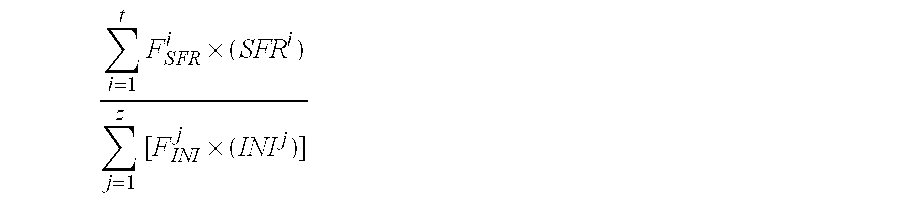
ranges from 0.05 to 5 and preferably from 0.5 to 2.5, FINI j representing the functionality of the jth initiator INIj and (INIj) representing the number of moles of the jth initiator per mole of monomer, for the case where t stable free radicals should be involved and for the case where z polymerization initiators should be involved, i, j, t and z being non-zero integers.
The initiator can be chosen from the radical polymerization initiators known for initiating the polymerization of the monomer which has to be polymerized.
The initiator is a radical polymerization initiator which can be chosen from diacyl peroxides, peroxyesters, dialkyl peroxides or peroxyacetals. The following are particularly suitable initiators:
tert-butylperoxy isopropyl carbonate,
tert-butylperoxy 2-ethylhexyl carbonate,
dicumyl peroxide,
di-tert-butyl peroxide,
1,1-bis(tert-butylperoxy)cyclohexane,
1,1-bis(tert-butylperoxy)-3,3,5-trimethyl-cyclohexane,
tert-butyl peroxyacetate,
tert-butyl cumyl peroxide,
tert-butyl perbenzoate,
tert-butyl per(2-ethylhexanoate),
2,2-bis(tert-butylperoxy)butane,
butyl 4,4-bis(tert-butylperoxy)valerate,
ethyl 3,3-bis(tert-butylperoxy)butyrate,
2,2-bis[4,4-di(tert-butylperoxy)cyclo-hexyl]propane.
The process according to the invention makes possible the preparation of block polymers. This is because the polymerization of a first monomer by the process according to the invention leads to a living polymer block. It is then possible to connect a block of another polymer to this first block by placing the first living polymer block in a medium for the polymerization of a second monomer. It is thus possible to prepare block copolymers, for example copolymers comprising one or more polystyrene blocks and one or more polybutadiene blocks or copolymers comprising one or more polystyrene blocks and one or more blocks of the (meth)acrylate type.
In practice, the blocks can be prepared following one another, in the same equipment. When the first monomer is consumed, so as to prepare the first block, it is sufficient to introduce the second monomer intended for the preparation of the second block, without stopping the stirring and without cooling or other interruption. Of course, the conditions for forming each of the blocks, such as the temperature of the polymerization medium, can be adjusted according to the nature of the monomers.
Of course, it is possible to join as many blocks to the living polymer as desired by placing the latter in a medium for the polymerization of a monomer from which it is desired to constitute a block.
Thus, the invention also relates to a process for the preparation of a block polymer comprising at least one stage according to the invention leading to a first living block, the said living block subsequently being placed in the presence of at least one other monomer from which it is desired to constitute a block joined to the first block, so as to form a living diblock, and so on, according to the number of blocks which it is desired to prepare.
Thus, the present application also relates to a process for the preparation of a diblock polymer, comprising a stage of polymerization of a first monomer in accordance with the invention, so as to obtain a first living block, followed by a stage during which the first living block is placed in the presence of a second monomer which is polymerized, so as to form a second block joined to the first block.
The present application therefore also relates to a process for the preparation of a triblock polymer comprising a stage of polymerization of a third monomer in the presence of the diblock polymer prepared in accordance with what has just been said, so as to form a third block joined to the diblock polymer.
By way of examples, the following block polymers can be prepared:
polystyrene-b-poly(methyl methacrylate),
polystyrene-b-polystyrenesulphonate,
polystyrene-b-polyacrylamide,
polystyrene-b-polymethacrylamide,
poly(methyl methacrylate)-b-poly(ethyl acrylate),
polystyrene-b-poly(butyl acrylate),
polybutadiene-b-poly(methyl methacrylate),
polyisoprene-b-poly(styrene-co-acrylonitrile),
polybutadiene-b-poly(styrene-co-acrylonitrile),
poly(styrene-co-butyl acrylate)-b-poly(methyl methacrylate),
polystyrene-b-poly(vinyl acetate),
polystyrene-b-poly(2-ethylhexyl acrylate),
polystyrene-b-poly(methyl methacrylate-co-hydroxyethyl acrylate),
polystyrene-b-polybutadiene-b-poly(methyl methacrylate),
polybutadiene-b-polystyrene-b-poly(methyl methacrylate),
polystyrene-b-poly(butyl acrylate)-b-polystyrene,
polystyrene-b-polybutadiene-b-polystyrene,
polystyrene-b-polyisoprene-b-polystyrene,
poly(perfluorooctyl acrylate)-b-poly(methyl methacrylate),
poly(perfluorooctyl acrylate)-b-polystyrene,
poly(perfluorooctyl acrylate)-b-poly(behenyl acrylate),
poly(perfluorooctyl acrylate)-b-poly(stearyl methacrylate),
poly(n-octyl acrylate)-b-poly(methyl methacrylate).
The term “monomer” is understood to mean any monomer which can be polymerized or copolymerized by the radical route. The term “monomer” covers the mixtures of several monomers.
The monomer can be chosen from vinyl, vinylidene, diene, olefinic and allylic monomers.
The term “vinyl monomers” is understood to mean (meth)acrylates, vinylaromatic monomers, vinyl esters, (meth)acrylonitrile, (meth)acrylamide and mono- and di(alkyl comprising 1 to 18 carbon atoms)(meth)acrylamides, and monoesters and diesters of maleicanhydride and of maleic acid.
The (meth)acrylates are in particular those of the formulae respectively: 
in which R0 is chosen from linear or branched, primary, secondary or tertiary alkyl radicals comprising from 1 to 18 carbon atoms, cycloalkyl radicals comprising from 5 to 18 carbon atoms, alkoxyalkyl radicals in which the alkoxy part comprises 1 to 18 carbon atoms and the alkyl part comprises 1 to 18 carbon atoms, alkylthioalkyl radicals in which the alkylthio part comprises 1 to 18 carbon atoms and the alkyl part comprises 1 to 18 carbon atoms, aryl radicals and arylalkyl radicals, these radicals optionally being substituted by at least one halogen atom (such as fluorine) and/or at least one hydroxyl group, after protection of this hydroxyl group, the above alkyl groups being linear or branched; and glycidyl, norbornyl or isobornyl (meth)acrylates.
Mention may be made, as examples of useful methacrylates, of methyl, ethyl, 2,2,2-trifluoroethyl, n-propyl, isopropyl, n-butyl, sec-butyl, tert-butyl, n-amyl, i-amyl, n-hexyl, 2-ethylhexyl, cyclohexyl, octyl, i-octyl, nonyl, decyl, lauryl, stearyl, phenyl, benzyl, β-hydroxyethyl, isobornyl, hydroxypropyl or hydroxybutyl methacrylates.
Mention may be made, as examples of acrylates of the above formula, of methyl, ethyl, n-propyl, isopropyl, n-butyl, sec-butyl, tert-butyl, hexyl, 2-ethylhexyl, isooctyl, 3,3,5-trimethylhexyl, nonyl, isodecyl, lauryl, octadecyl, cyclohexyl, phenyl, methoxymethyl, methoxyethyl, ethoxymethyl, ethoxyethyl, perfluorooctyl or behenyl acrylates.
The term “vinylaromatic monomer” is understood to mean, within the meaning of the present invention, an aromatic monomer possessing ethylenic unsaturation, such as styrene, vinyltoluene, α-methylstyrene, 4-methylstyrene, 3-methylstyrene, 4-methoxystyrene, 2-(hydroxymethyl)styrene, 4-ethylstyrene, 4-ethoxystyrene, 3,4-dimethylstyrene, 2-chlorostyrene, 3-chlorostyrene, 4-chloro-3-methylstyrene, 3-(tert-butyl)styrene, 2,4-dichlorostyrene, 2,6-dichlorostyrene and 1-vinylnaphthalene.
Mention may be made, as vinyl esters, of vinyl acetate, vinyl propionate, vinyl chloride and vinyl fluoride.
Mention is made, as vinylidene monomer, of vinylidene fluoride.
The term “diene monomer” is understood to mean a diene chosen from conjugated or non-conjugated, linear or cyclic dienes, such as, for example, butadiene, 2,3-dimethylbutadiene, isoprene, 1,3-pentadiene, 1,4-pentadiene, 1,4-hexadiene, 1,5-hexadiene, 1,9-decadiene, 5-methylene-2-norbornene, 5-vinyl-2-norbornene, the 2-alkyl-2,5-norbornadienes, 5-ethylene-2-norbornene, S-(2-propenyl)-2-norbornene, 5-(5-hexenyl)-2-norbornene, 1,5-cyclooctadiene, bicyclo[2.2.2]octa-2,5-diene, cyclopentadiene, 4,7,8,9-tetrahydroindene and isopropylidenetetrahydroindene.
Mention may be made, as olefinic monomers, of ethylene, butene, hexene and 1-octene. Fluorinated olefinic monomers may also be mentioned.
The process according to the invention can be carried out between 50 and 200° C. and preferably between 100 and 150° C.
The monomer can be different from those of the following group: acrylic acid, methacrylic acid, acrylic acid esters, methacrylic acid esters and acrylonitrile.
The radical polymerization can be thermally initiated, that is to say under the effect of the temperature and in the absence of radical polymerization initiator. The polymerization can also be initiated by a radical polymerization initiator. Some monomers require the use of an initiator, such as acrylates or methacrylates. The monomers requiring the use of an initiator are those commonly regarded by a person skilled in the art as requiring the use of an initiator.
This question regarding the presence or not of an initiator is essentially posed for the beginning of the polymerization. Thus, in the case of the preparation of a block copolymer, this question is posed for the initiation of the polymerization of the first block. This is because, for the preparation of the second block and, if appropriate, of the following one or ones, the polymerization will be carried out by a living polymerization mechanism, without it being necessary to add initiator. However, it is not ruled out to add initiator at the time of addition of a new monomer for the preparation of a new block, if it is desired to accelerate the rate of polymerization.
The polymerization can be carried out under a pressure ranging from 0.1 bar to 3000 bar and preferably from 0.8 to 100 bar. The use of high pressures, for example from 500 to 3000 bar, is recommended in the polymerization of monomers which are gaseous under standard conditions of temperature and of pressure, such as ethylene, alone or in the presence of other monomers.
The polymerization can be carried out in solution, in bulk, in emulsion, in suspension or in a supercritical medium.
The polymerization medium can be intended to result in a high-impact vinylaromatic polymer, such as high-impact polystyrene, in which case the said medium comprises at least one vinylaromatic monomer, which can be styrene, and one rubber, the latter generally being a conjugated polydiene, such as one or more polybutadienes. A high-impact vinylaromatic polymer comprises a vinylaromatic polymer matrix surrounding rubber nodules, it being possible for the said nodules to exhibit varied morphologies, such as droplet, capsule, onion, labyrinth or salami morphologies.
In the examples which follow, the following abbreviations are used:
DEPN: N-tert-butyl-1-diethylphosphono-2,2-dimethylpropyl nitroxide, the expanded formula of which is: 
Tempo: 2,2,6,6-tetramethyl-1-piperidinyl-oxy
AIBN: azobis(isobutyronitrile)
DEPN exhibits an equilibrium constant of 7.4×10⁻⁹ mol per liter with respect to styrene in 125° C. This equilibrium constant was measured by the technique described in the doctoral thesis of Didier Benoit, University of Bordeaux I, France, the viva for which was held Oct. 16 , 1997.
Tempo exhibits an equilibrium constant of 1×10⁻¹¹ mol per liter with respect to styrene at 125° C.
This equilibrium constant was measured by Fukuda, Macromolecules, 1996, 29, 6393.
Polymerization of styrene in the presence of DEPN,
AIBN (9×10⁻⁵ mol), styrene (3.45×10⁻² mol) and DEPN (1.8×10⁻⁴ mol) are introduced into a Schlenk tube under nitrogen. The mixture is degassed several times under cold conditions by a vacuum/nitrogen cycle and then brought to 125° C. in an oil bath for several hours. The conversion to polymer is determined by gravimetry: approximately 50 mg of mixture is accurately weighed and then the monomer is evaporated under vacuum, the conversion being determined from the difference in weight due to the evaporation. The samples withdrawn are analysed by Steric Exclusion Chromatography (SEC) with polystyrene standards. The results are combined in the table below.
| Time | Experimental | Theoretical | ||
| (h) | Conversation | Mn (g/mol) | Mn (g/mol) | Mw/Mn |
| 0 | 0 | 0 | 0 | |
| 0.5 | 0.28 | |||
| 2.5 | 0.76 | 19,200 | 15,200 | 1.1 |
| 5 | 0.95 | |||
| 6 | 0.98 | 25,000 | 19,600 | 1.2 |
Polymerization of styrene in the presence of Tempo,
The procedure is the same as in Example 1, that DEPN is replaced by the same number of of Tempo. The results are combined in the table below.
| Experimental | Theoretical | |||
| Time (h) | Conversion | Mn (g/mol) | Mn (g/mol) | Mw/Mn |
| 0 | 0 | 0 | 0 | — |
| 0.5 | 0.01 | — | — | |
| 2.5 | 0.02 | — | — | |
| 5 | 0.05 | |||
| 7 | 0.16 | — | — | |
| 9 | 0.31 | |||
| 11 | 0.42 | |||
| 13 | 0.61 | |||
| 14 | 0.66 | |||
| 15.5 | 0.75 | |||
| 18 | 0.81 | |||
| 20 | 0.80 |
| 23 | 0.86 | 15,900 | 17,200 | 1.2 |
| 26.5 | 0.96 | |||
The procedure is the same as in Example 1, except that DEPN is replaced by the same number of moles of a mixture comprising 50 mol % of DEPN and 50 mol % of Tempo. The results are combined in the table below.
| Time | Experimental | Theoretical | ||
| (h) | Conversion | Mn (g/mol) | Mn (g/mol) | Mw/Mn |
| 0 | 0 | — | — | — |
| 5 | 0.70 | — | — | — |
| 5.25 | 0.75 | — | — | — |
| 7.25 | 0.98 | 18,300 | 19,600 | 1.2 |
| 9.5 | 0.99 | |||
The synergy between the two stable free radicals can be confirmed by comparing the experimental conversion after 5 hours with that theoretically expected, taking into account the conversions obtained after 5 hours with each stable free radical taken individually (see Examples 1 and 2).
This synergy can also be observed by measuring the difference in % between the theoretical molecular mass and the experimental molecular mass after polymerizing for 5 hours by the formula: 
These comparisons are made in the table below.
| Difference | |||
| Experimental | between | ||
| conversion | experimental | ||
| Stable | after | 1 Mn and | |
| radicals | polymerizing | Conversion calculated | theoretical |
| used | for 5 h | by arithmetic mean | Mn (%) |
| DEPN alone | 0.95 | — | 27 |
| (Example 1) | |||
| Tempo alone | 0.05 | — | 7.5 |
| (Example 2) | |||
| 50% DEPN | 0.70 | 0.50 | 7 |
| + | [(0.5 × 0.95) + (0.5 × 0.05)] | ||
| 50% Tempo | |||
| (Example 3) | |||
This synergy can also be observed by comparing the productivities (conversion=0.95) obtained in Examples 1 to 3:
| Experimental | Productivity | |||
| Stable radicals | productivity | calculated by | ||
| used | (mg/h) | arithmetic mean | ||
| DEPN alone | 684 | — | ||
| (Example 1) | ||||
| Tempo alone | 130 | — | ||
| (Example 2) | ||||
| 50% DEPN + 50% | 487 | 407 | ||
| Tempo (Example 3) | [(0.5 × 684) + (0.5 × 130)] | |||
0.6 g of the polystyrene obtained on conclusion of Example 1 is mixed with 2.4 g of n-butyl acrylate in a Schlenk tube and the solution obtained is degassed via a vacuum/nitrogen cycle. After returning the pressure to a nitrogen atmosphere, the Schlenk tube is placed in an oil bath at 125° C. The conversion of the n-butyl acrylate is monitored by gravimetry. The results are collated in the table below.
| Time | Experimental | Theoretical | ||
| (h) | Conversion | Mn (g/mol) | Mn (g/mol) | Mw/Mn |
| 0 | 0 | 25,000 | 25,000 | |
| 3 | 0.22 | |||
| 5 | 0.30 | |||
| 5.25 | 0.34 | |||
| 7.25 | 0.42 | 50,700 | 67,000 | 1.4 |
| 9.25 | 0.54 | |||
The procedure is the same as in Example 4, except that use is made, at the start, of 0.53 g of the polystyrene of Example 2 and 2.6 g of n-butyl acrylate. The results are combined in the table below.
| Time (h) | Conversion | Experimental Mn (g/mol) | Mw/Mn | ||
| 0 | 0 | 17,800 | — | ||
| 1.13 | 0.08 | — | — | ||
| 3 | 0.10 | — | — | ||
| 5 | 0.12 | — | — | ||
| 7 | 0.19 | — | — | ||
| 11.5 | 0.20 | — | — | ||
| 14.5 | 0.26 | — | — | ||
| 20.75 | 0.23 | — | — | ||
| 37.6 | 0.32 | 20,500 | 1.3 | ||
The procedure is the same as in Example 4, that use is made, at the start, of 1 g of the polystryene of Example 3 and 5.1 g of n-butyl acrylate. The results are combined in the table below.
| Experimental | |||||
| Time (h) | Conversion | Mn (g/mol) | Mw/Mn | ||
| 0 | 0 | 20,000 | |||
| 3 | 0.39 | ||||
| 5 | 0.44 | 31,600 | 1.6 | ||
| 7 | 0.51 | ||||
| 9 | 0.53 | ||||
| 11.5 | 0.56 | ||||
| 14 | 0.60 | ||||
| 17 | 0.62 | 36,800 | 1.4 | ||
| 19 | 0.65 | ||||
| 21 | 0.65 | ||||
| 23 | 0.69 | ||||
It is found that, after 5 hours, the conversion of the n-butyl acrylate is greater than that observed for the same test time in the case of Examples 4 and 5.
The preceding examples can be repeated with similar success by substituting the generically or specifically described reactants and/or operating conditions of this invention for those used in the preceding examples. Also, the preceding specific embodiments are to be construed as merely illustrative, and not limitative of the remainder of the disclosure in any way whatsoever.
The entire disclosure of all applications, patents and publications, cited above and below, and of corresponding French application 98/12477, are hereby incorporated by reference.
From the foregoing description, one skilled in the art can easily ascertain the essential characteristics of this invention, and without departing from the spirit and scope thereof, can make various changes and modifications of the invention to adapt it to various usages and conditions.
Claims (25)
1. A process for the polymerization of at least one monomer which can be polymerized by the radical route in the presence of at least two different stable free radicals having different equilibrium constants whereby a synergism of productivity is realized and wherein the equilibrium constants of the stable free radicals with respect to the monomer exhibit a ratio of greater than 5.
2. A process according to claim 1 , characterized in that the ratio is greater than 10.
3. A process according to claim 2 , characterized in that the ratio is greater than 100.
4. A process according to claim 1 , characterized in that at least two of the stable free radicals are such that:
the first exhibits, in its structure, the linkage 
in which the Ra, Rb, Rc and Rd radicals, which can be identical or different, are either a hydrogen atom or a methyl radical,
the second exhibits, in its structure, the linkage 
in which RL represents a monovalent radical with a molar mass of greater than 15.
5. A process according to claim 4 , characterized in that RL exhibits a molar mass of greater than 30.
6. A process according to claim 5 , characterized in that RL exhibits a molar mass ranging from 40 to 400.
7. A process according to claim 1 , characterized in that
one of the two stable free radicals is
2,2,6,6-tetramethyl-1-piperidinyloxy,
4-hydroxy-2,2,6,6-tetramethyl-1-piperidinyloxy,
4-methoxy-2,2,6,6-tetramethyl-1-piperidinyloxy,
4-oxo-2,2,6,6-tetramethyl-1-piperidinyloxy,
bis(1-oxyl-2,2,6,6-tetramethylpiperidin-4-yl)sebacate,
2,2,6,6-tetramethyl-4-hydroxypiperidin-1-oxyl monophosphonate, or
3-carboxy-2,2,5,5-tetramethylpyrrolidinyloxy, and
the other of the two stable free radicals is
N-tert-butyl-1-diethylphosphono-2,2-dimethylpropyl nitroxide,
N-tert-butyl-1-dibenzylphosphono-2,2-dimethylpropyl nitroxide,
N-tert-butyl-1-di(2,2,2-trifluoroethyl)phosphono-2,2-dimethylpropyl nitroxide,
N-tert-butyl-1-diethylphosphono-2-methylpropyl nitroxide,
N-(1-methylethyl)-1-(diethylphosphono)cyclohexyl nitroxide, or
N-(1-phenylbenzyl)-1-diethylphosphono-1-methylethyl nitroxide.
8. A process according to claim 1 , characterized in that 
ranges from 5×10⁻⁷ to 0.5 mol per mole of monomer, FSFR i representing the functionality of the ith stable free radical SFRi, t representing the number of stable free radicals in the polymerization medium and (SFRi) representing the number of moles of the ith stable free radical.
9. A process according to claim 8 , characterized in that 
ranges from 5×10⁻⁶ to 0.5 mol per mole of monomer.
10. A process according to claim 1 , characterized in that at least two stable free radicals are present in amounts such that the ratio 
ranges from 0.001 to 1000,
in which
FSFR 1 represents the functionality of a first stable free radical SFR1,
(SFR1) represents the number of moles of the said first stable free radical,
FSFR 2 represents the functionality of a second stable free radical SFR2,
(SFR2) represents the number of moles of the said second stable free radical.
11. A process according to claim 10 , characterized in that 
ranges from 0.01 to 100.
12. A process according to claim 1 , characterized in that at least one radical polymerization initiator is introduced into the polymerization medium in an amount such that FINI×(INI) ranges from 1×10⁻⁵ to 0.1 mol per mole of monomer, FINI representing the functionality of the initiator and (INI) representing the number of moles of initiator.
13. A process according to claim 12 , characterized in that FINI×(INI) ranges from 1×10⁻⁴ to 0.1 mol per mole of monomer.
14. A process according to claim 1 , characterized in that it is carried out between 100 and 150° C.
15. A process according to claim 1 , characterized in that several monomers are introduced successively, so as to result in a block copolymer.
16. A process according to claim 1 , characterized in that the conversion of monomer to polymer is greater than 0.5.
17. A process according to claim 1 , characterized in that the presence of the two stable free radicals results in a synergy during the polymerization.
18. A process according to claim 1 , characterized in that at least one monomer is chosen from the group consisting of vinyl, vinylidene, diene, olefinic and allylic monomers.
19. A process according to claim 13 , characterized in that at least one monomer is a vinylaromatic monomer.
20. A process according to claim 19 , characterized in that at least one monomer is styrene.
21. A process according to claim 19 , characterized in that it results in a high-impact vinylaromatic polymer comprising a vinylaromatic polymer matrix and rubber nodules.
22. A process according to claim 21 , characterized in that at least one monomer is acrylate or methacrylate.
23. A process according to claim 1 , characterized in that the monomer is different from those of the following group: acrylic acid, methacrylic acid, acrylic acid esters, methacrylic acid esters and acrylonitrile.
24. A process according to claim 1 , wherein the at least two different stable free radicals having different equilibrium constants are: N-tert-butyl-1-diethylphosphono-2,2-dimethylpropyl nitroxide and 2,2,6,6-tetramethyl-1-piperidinyl-oxy.
25. A process according to claim 24 , wherein said at least one monomer is styrene.
Applications Claiming Priority (2)
| Application Number | Priority Date | Filing Date | Title |
|---|---|---|---|
| FR9812477 | 1998-10-06 | ||
| FR9812477A FR2784111B1 (en) | 1998-10-06 | 1998-10-06 | RADICAL POLYMERISATIN IN THE PRESENCE OF MULTIPLE FREE STABLE RADICALS |
Publications (1)
| Publication Number | Publication Date |
|---|---|
| US6509428B1 true US6509428B1 (en) | 2003-01-21 |
Family
ID=9531227
Family Applications (1)
| Application Number | Title | Priority Date | Filing Date |
|---|---|---|---|
| US09/413,755 Expired - Fee Related US6509428B1 (en) | 1998-10-06 | 1999-10-06 | Radical polymerization in the presence of several stable free radicals |
Country Status (10)
| Country | Link |
|---|---|
| US (1) | US6509428B1 (en) |
| EP (1) | EP0992514B1 (en) |
| JP (1) | JP2000109512A (en) |
| KR (1) | KR20000028845A (en) |
| CN (1) | CN1175001C (en) |
| AT (1) | ATE271069T1 (en) |
| CA (1) | CA2284388C (en) |
| DE (1) | DE69918629T2 (en) |
| ES (1) | ES2226256T3 (en) |
| FR (1) | FR2784111B1 (en) |
Cited By (9)
| Publication number | Priority date | Publication date | Assignee | Title |
|---|---|---|---|---|
| US6762263B2 (en) * | 2002-02-01 | 2004-07-13 | Atofina Chemicals, Inc. | High-solids coatings resins via controlled radical polymerization |
| US20060079624A1 (en) * | 2004-10-08 | 2006-04-13 | Hildeberto Nava | Crosslinkable polymer systems |
| US20060173142A1 (en) * | 2005-02-01 | 2006-08-03 | Hildeberto Nava | Functionalized thermosetting resin systems |
| US20070132949A1 (en) * | 2005-12-14 | 2007-06-14 | Phelan John C | Method for preparing silicone hydrogels |
| US20070225470A1 (en) * | 2006-03-21 | 2007-09-27 | Jianbo Di | Thermoplastic composition, method of making, and articles formed therefrom |
| US20080295404A1 (en) * | 2005-10-11 | 2008-12-04 | Arkema France | Odorant Mixture for Odorless Gas Fuel |
| US20140275399A1 (en) * | 2011-10-11 | 2014-09-18 | Henkel US IP LLC | Preparation of novel fluorocompounds, methods of preparation and compositions made therefrom |
| WO2017053803A1 (en) * | 2015-09-23 | 2017-03-30 | Northwestern University | Reprocessable cross-linked network polymers with alkoxyamine dynamic covalent bonds |
| WO2018237236A1 (en) | 2017-06-23 | 2018-12-27 | Austin Smith | ANAEROBICALLY STABLE HOMOGENEOUS QUANTUM POINT CONCENTRATES |
Families Citing this family (8)
| Publication number | Priority date | Publication date | Assignee | Title |
|---|---|---|---|---|
| DE19939328A1 (en) * | 1999-08-19 | 2001-02-22 | Basf Ag | Radically initiated polymerization of ethylenically unsaturated monomers, useful for the production of molded articles, film and foam is carried out in the presence of dinitroxyl radicals. |
| FR2807439B1 (en) * | 2000-04-07 | 2003-06-13 | Atofina | MULTIMODAL POLYMERS BY CONTROLLED RADICAL POLYMERIZATION IN THE PRESENCE OF ALCOXYAMINES |
| US6653409B2 (en) | 2001-02-26 | 2003-11-25 | The Yokohama Rubber Co., Ltd. | Radical-modified polymer and polymer composition containing the same |
| WO2003027159A2 (en) * | 2001-09-27 | 2003-04-03 | Ppg Industries Ohio, Inc. | Compositions containing a low surface tension (meth)acrylate containing block copolymer |
| FR2832720B1 (en) * | 2001-11-29 | 2004-02-13 | Oreal | ETHYLENE COPOLYMERS SEQUENCES, COSMETIC COMPOSITIONS CONTAINING THEM, AND USE OF THESE COPOLYMERS IN COSMETICS |
| FR2843394B1 (en) * | 2002-08-07 | 2005-12-30 | Atofina | ALCOXYAMINES FROM NITROXIDES B-PHOSPHORUS, THEIR USE IN RADICAL POLYMERIZATION |
| FR3008413B1 (en) * | 2013-07-11 | 2015-08-07 | Arkema France | PROCESS FOR PERPENDICULAR ORIENTATION OF NANODOMAINES OF BLOCK COPOLYMERS USING STATISTICAL OR GRADIENT COPOLYMERS WHERE THE MONOMERS ARE AT LEAST DIFFERENT FROM THOSE PRESENT SPECIFICALLY IN EACH BLOCK OF BLOCK COPOLYMER |
| DE102013217785A1 (en) * | 2013-09-05 | 2015-03-05 | Tesa Se | Use of pressure-sensitive adhesive tapes for optical applications |
Citations (14)
| Publication number | Priority date | Publication date | Assignee | Title |
|---|---|---|---|---|
| CA217666A (en) | 1922-04-11 | Zukowski Tony | Wrench | |
| US4581429A (en) | 1983-07-11 | 1986-04-08 | Commonwealth Scientific And Industrial Research Organization | Polymerization process and polymers produced thereby |
| EP0467850A1 (en) | 1990-07-20 | 1992-01-22 | Ciba-Geigy Ag | Stabilized monomer compositions |
| CA2168820A1 (en) | 1995-02-07 | 1996-08-08 | Pascal Nicol | Process for producing a composition containing a vinylaromatic polymer and a rubber by polymerization with a free and stable radical |
| EP0735052A2 (en) | 1995-03-30 | 1996-10-02 | Xerox Corporation | Rate enhanced polymerization processes for producing polymers having narrow polydispersitylydispersität |
| US5616638A (en) | 1995-03-20 | 1997-04-01 | Rohm And Haas Company | Cured composite and process therefor |
| EP0814097A2 (en) | 1996-06-17 | 1997-12-29 | Xerox Corporation | Processes for preparing telechelic, branched and star thermoplastic resin polymers |
| US5721320A (en) | 1996-03-29 | 1998-02-24 | The Dow Chemical Company | In situ block copolymer formation during polymerization of a vinyl aromatic monomer |
| EP0826697A2 (en) | 1996-08-26 | 1998-03-04 | Xerox Corporation | Polymerization processes and resin particles formed thereby |
| EP0832902A2 (en) | 1995-02-07 | 1998-04-01 | Elf Atochem S.A. | Polymerization in the presence of a beta-substituted nitroxide radical |
| US5744560A (en) | 1997-01-21 | 1998-04-28 | Xerox Corporation | Metal accelerated polymerization processes |
| CA2219729A1 (en) | 1996-11-20 | 1998-05-20 | Elf Atochem S.A. | Polymerization in the presence of a stable free radical and an iniferter |
| WO1998030601A2 (en) | 1997-01-10 | 1998-07-16 | E.I. Du Pont De Nemours And Company | Method of controlling polymer molecular weight and structure |
| EP0906937A1 (en) | 1997-10-03 | 1999-04-07 | Elf Atochem S.A. | Graft copolymer obtained by free-radical polymerisation with stable free-radicals, its preparation and uses |
-
1998
- 1998-10-06 FR FR9812477A patent/FR2784111B1/en not_active Expired - Fee Related
-
1999
- 1999-09-20 DE DE69918629T patent/DE69918629T2/en not_active Expired - Fee Related
- 1999-09-20 ES ES99118539T patent/ES2226256T3/en not_active Expired - Lifetime
- 1999-09-20 EP EP99118539A patent/EP0992514B1/en not_active Expired - Lifetime
- 1999-09-20 AT AT99118539T patent/ATE271069T1/en not_active IP Right Cessation
- 1999-09-30 CA CA002284388A patent/CA2284388C/en not_active Expired - Fee Related
- 1999-10-05 KR KR1019990042819A patent/KR20000028845A/en not_active Ceased
- 1999-10-06 US US09/413,755 patent/US6509428B1/en not_active Expired - Fee Related
- 1999-10-06 JP JP11285329A patent/JP2000109512A/en not_active Abandoned
- 1999-10-06 CN CNB991239083A patent/CN1175001C/en not_active Expired - Fee Related
Patent Citations (16)
| Publication number | Priority date | Publication date | Assignee | Title |
|---|---|---|---|---|
| CA217666A (en) | 1922-04-11 | Zukowski Tony | Wrench | |
| US4581429A (en) | 1983-07-11 | 1986-04-08 | Commonwealth Scientific And Industrial Research Organization | Polymerization process and polymers produced thereby |
| EP0467850A1 (en) | 1990-07-20 | 1992-01-22 | Ciba-Geigy Ag | Stabilized monomer compositions |
| CA2168820A1 (en) | 1995-02-07 | 1996-08-08 | Pascal Nicol | Process for producing a composition containing a vinylaromatic polymer and a rubber by polymerization with a free and stable radical |
| EP0832902A2 (en) | 1995-02-07 | 1998-04-01 | Elf Atochem S.A. | Polymerization in the presence of a beta-substituted nitroxide radical |
| US5616638A (en) | 1995-03-20 | 1997-04-01 | Rohm And Haas Company | Cured composite and process therefor |
| EP0735052A2 (en) | 1995-03-30 | 1996-10-02 | Xerox Corporation | Rate enhanced polymerization processes for producing polymers having narrow polydispersitylydispersität |
| US5721320A (en) | 1996-03-29 | 1998-02-24 | The Dow Chemical Company | In situ block copolymer formation during polymerization of a vinyl aromatic monomer |
| US5723511A (en) | 1996-06-17 | 1998-03-03 | Xerox Corporation | Processes for preparing telechelic, branched and star thermoplastic resin polymers |
| EP0814097A2 (en) | 1996-06-17 | 1997-12-29 | Xerox Corporation | Processes for preparing telechelic, branched and star thermoplastic resin polymers |
| EP0826697A2 (en) | 1996-08-26 | 1998-03-04 | Xerox Corporation | Polymerization processes and resin particles formed thereby |
| CA2219729A1 (en) | 1996-11-20 | 1998-05-20 | Elf Atochem S.A. | Polymerization in the presence of a stable free radical and an iniferter |
| EP0844256A1 (en) | 1996-11-20 | 1998-05-27 | Elf Atochem S.A. | Polymerization in the presence of a stable free radical and an iniferter |
| WO1998030601A2 (en) | 1997-01-10 | 1998-07-16 | E.I. Du Pont De Nemours And Company | Method of controlling polymer molecular weight and structure |
| US5744560A (en) | 1997-01-21 | 1998-04-28 | Xerox Corporation | Metal accelerated polymerization processes |
| EP0906937A1 (en) | 1997-10-03 | 1999-04-07 | Elf Atochem S.A. | Graft copolymer obtained by free-radical polymerisation with stable free-radicals, its preparation and uses |
Non-Patent Citations (11)
| Title |
|---|
| Alkoxyamine-Initiated Living Radical Polymerization: Factors Affecting Alkoxyamine Homolysis Rates, Graeme Moad et al., Macromolecules 1995, vol. 28, No. 26, pp. 8722-8728. |
| Characteristics of the Stable Free Radical Polymerization of Styrene in the Presence of 2-Fluoro-1-methylpyridinium rho-Toluenesulfonate, Peter G. Odell et al., Macromolecules 1997, vol. 30, pp. 2232-2237. |
| Characteristics of the Stable Free Radical Polymerization of Styrene in the Presence of 2-Fluoro-1-methylpyridinium ρ-Toluenesulfonate, Peter G. Odell et al., Macromolecules 1997, vol. 30, pp. 2232-2237. |
| Development of a New Class of Rate-Accelerating Additives for Nitroxide-Mediated "Living'Free Radical Polymerization, Eva Malmström et al., Tetrahedron, vol. 53, No. 45, pp. 15225-15236, 1997. |
| English Text of Ser. No. 08/687,543. |
| English Text of Ser. No. 08/974,097. |
| English Text of Ser. No. 09/164,717. |
| English Text of Ser. No. 09/275,367. |
| French Search Report dated May 10, 1999. |
| Narrow Polydispersity Polystyrene by a Free-Radical Polymerization Process-Rate Enhancement, Michael K. Georges et al., Macromolecules 1994, vol. 27, pp. 7228-7229. |
| Radical Crossover in Nitroxide Mediated "Living" Free Radical Polymerizations, Craig J. Hawker et al., J. Am. Chem. Soc. 1996, vol. 118, pp. 11467-11471. |
Cited By (18)
| Publication number | Priority date | Publication date | Assignee | Title |
|---|---|---|---|---|
| US6762263B2 (en) * | 2002-02-01 | 2004-07-13 | Atofina Chemicals, Inc. | High-solids coatings resins via controlled radical polymerization |
| US20060079624A1 (en) * | 2004-10-08 | 2006-04-13 | Hildeberto Nava | Crosslinkable polymer systems |
| US20070270542A1 (en) * | 2004-10-08 | 2007-11-22 | Reichhold, Inc. | Crosslinkable Polymer Systems |
| US20060173142A1 (en) * | 2005-02-01 | 2006-08-03 | Hildeberto Nava | Functionalized thermosetting resin systems |
| US8137419B2 (en) | 2005-10-11 | 2012-03-20 | Arkema France | Odorant mixture for odorless gas fuel |
| US20080295404A1 (en) * | 2005-10-11 | 2008-12-04 | Arkema France | Odorant Mixture for Odorless Gas Fuel |
| US20070132949A1 (en) * | 2005-12-14 | 2007-06-14 | Phelan John C | Method for preparing silicone hydrogels |
| US8501833B2 (en) | 2005-12-14 | 2013-08-06 | Novartis Ag | Method for preparing silicone hydrogels |
| US7744785B2 (en) | 2005-12-14 | 2010-06-29 | Novartis Ag | Method for preparing silicone hydrogels |
| US20100227944A1 (en) * | 2005-12-14 | 2010-09-09 | John Christopher Phelan | Method for preparing silicone hydrogels |
| US20070225470A1 (en) * | 2006-03-21 | 2007-09-27 | Jianbo Di | Thermoplastic composition, method of making, and articles formed therefrom |
| US7498398B2 (en) | 2006-03-21 | 2009-03-03 | Sabic Innovative Plastics Ip B.V. | Thermoplastic composition, method of making, and articles formed therefrom |
| US20140275399A1 (en) * | 2011-10-11 | 2014-09-18 | Henkel US IP LLC | Preparation of novel fluorocompounds, methods of preparation and compositions made therefrom |
| WO2017053803A1 (en) * | 2015-09-23 | 2017-03-30 | Northwestern University | Reprocessable cross-linked network polymers with alkoxyamine dynamic covalent bonds |
| US10618991B2 (en) | 2015-09-23 | 2020-04-14 | Northwestern University | Reprocessable cross-linked network polymers with alkoxyamine dynamic covalent bonds |
| WO2018237236A1 (en) | 2017-06-23 | 2018-12-27 | Austin Smith | ANAEROBICALLY STABLE HOMOGENEOUS QUANTUM POINT CONCENTRATES |
| US10919770B2 (en) | 2017-06-23 | 2021-02-16 | Nanosys, Inc. | Homogeneous anaerobically stable quantum dot concentrates |
| US11584646B2 (en) | 2017-06-23 | 2023-02-21 | Nanosys, Inc. | Homogeneous anaerobically stable quantum dot concentrates |
Also Published As
| Publication number | Publication date |
|---|---|
| ES2226256T3 (en) | 2005-03-16 |
| DE69918629D1 (en) | 2004-08-19 |
| KR20000028845A (en) | 2000-05-25 |
| CN1251841A (en) | 2000-05-03 |
| CA2284388A1 (en) | 2000-04-06 |
| EP0992514B1 (en) | 2004-07-14 |
| CA2284388C (en) | 2006-07-11 |
| EP0992514A1 (en) | 2000-04-12 |
| CN1175001C (en) | 2004-11-10 |
| JP2000109512A (en) | 2000-04-18 |
| FR2784111B1 (en) | 2003-08-01 |
| DE69918629T2 (en) | 2005-07-21 |
| ATE271069T1 (en) | 2004-07-15 |
| FR2784111A1 (en) | 2000-04-07 |
Similar Documents
| Publication | Publication Date | Title |
|---|---|---|
| US6353065B1 (en) | Emulsion polymerization in the presence of a stable free radical | |
| US6646079B2 (en) | Multimodal polymers by controlled radical polymerization in the presence of alkoxyamines | |
| US6911511B1 (en) | Controlled radical polymerization process using a small amount of stable free radical | |
| KR20000028845A (en) | Radical polymerization in the presence of several stable free radicals | |
| Farcet et al. | Structural characterization of nitroxide-terminated poly (n-butyl acrylate) prepared in bulk and miniemulsion polymerizations | |
| US6255402B1 (en) | High-impact vinylaromatic polymer obtained from a rubber bearing a group which generates a stable free radical | |
| Matyjaszewski et al. | Controlled radical polymerizations: the use of alkyl iodides in degenerative transfer | |
| Matyjaszewski | Overview: fundamentals of controlled/living radical polymerization | |
| US6255448B1 (en) | Polymerization in the presence of a β-substituted nitroxide radical | |
| Goto et al. | Reversible chain transfer catalyzed polymerization (RTCP): A new class of living radical polymerization | |
| US6420502B1 (en) | Living free radical initiators based on alkylperoxydiarylborane derivatives and living free radical polymerization process | |
| JPS6368608A (en) | Living polymer and its production | |
| Aksakal et al. | Poly (thioacrylate) s: expanding the monomer toolbox of functional polymers | |
| US6335401B1 (en) | Copolymer grafted via radical polymerization in the presence of stable radicals, its preparation and its uses | |
| Zhu et al. | Atom transfer radical polymerization and copolymerization of isoprene catalyzed by copper bromide/2, 2′-bipyridine | |
| US6255422B1 (en) | Polymerization in the presence of a stable free radical and of an iniferter | |
| JPH10182705A (en) | Polymerization in presence of stable free radical and iniferter | |
| US6346589B1 (en) | Polymerization in the presence of a stable free radical and of a free radical initiator | |
| US20010000256A1 (en) | Polymerization in the presence of a stable free radical and of an iniferter | |
| Grishin et al. | Mechanisms of Polymer Polymerization | |
| Luk | Comprehensive study on the synthesis and characterization of bio-based poly (farnesene) using controlled/radical polymerization | |
| Shegiwal | Exploiting catalytic chain transfer polymerisation and applications for the synthesis of diblock and multi block co-polymers via sulphur free RAFT polymerisation | |
| KR19990040336A (en) | Device isolation method of semiconductor device | |
| 高田健司 | Synthesis of Well-Defined Acrylate Polymer Architectures by Organocatalyzed Group Transfer Polymerization | |
| JP2004323743A (en) | Method for producing block copolymer |
Legal Events
| Date | Code | Title | Description |
|---|---|---|---|
| AS | Assignment |
Owner name: ELF ATOCHEM S.A., FRANCE Free format text: ASSIGNMENT OF ASSIGNORS INTEREST;ASSIGNORS:SENNINGER, THIERRY;ROBIN, SOPHIE;GNANOU, YVES;REEL/FRAME:010460/0703;SIGNING DATES FROM 19991129 TO 19991202 |
|
| CC | Certificate of correction | ||
| FPAY | Fee payment |
Year of fee payment: 4 |
|
| REMI | Maintenance fee reminder mailed | ||
| LAPS | Lapse for failure to pay maintenance fees | ||
| STCH | Information on status: patent discontinuation |
Free format text: PATENT EXPIRED DUE TO NONPAYMENT OF MAINTENANCE FEES UNDER 37 CFR 1.362 |
|
| FP | Lapsed due to failure to pay maintenance fee |
Effective date: 20110121 |