US6506322B1 - Naphthopyrans annelated in C5-C6 with an indene- or dihydronaphthalene-type carbocycle, and compositions and (co)polymer matrices containing them - Google Patents
Naphthopyrans annelated in C5-C6 with an indene- or dihydronaphthalene-type carbocycle, and compositions and (co)polymer matrices containing them Download PDFInfo
- Publication number
- US6506322B1 US6506322B1 US09/712,058 US71205800A US6506322B1 US 6506322 B1 US6506322 B1 US 6506322B1 US 71205800 A US71205800 A US 71205800A US 6506322 B1 US6506322 B1 US 6506322B1
- Authority
- US
- United States
- Prior art keywords
- group
- carbon atoms
- linear
- branched alkyl
- alkyl group
- Prior art date
- Legal status (The legal status is an assumption and is not a legal conclusion. Google has not performed a legal analysis and makes no representation as to the accuracy of the status listed.)
- Expired - Lifetime, expires
Links
- 229920001577 copolymer Polymers 0.000 title claims abstract description 35
- 239000000203 mixture Substances 0.000 title claims abstract description 26
- 150000001875 compounds Chemical class 0.000 claims abstract description 98
- 125000004432 carbon atom Chemical group C* 0.000 claims description 103
- 125000000217 alkyl group Chemical group 0.000 claims description 88
- IJGRMHOSHXDMSA-UHFFFAOYSA-N Atomic nitrogen Chemical group N#N IJGRMHOSHXDMSA-UHFFFAOYSA-N 0.000 claims description 44
- 125000003545 alkoxy group Chemical group 0.000 claims description 33
- 125000003118 aryl group Chemical group 0.000 claims description 32
- 229910052757 nitrogen Chemical group 0.000 claims description 31
- 125000001997 phenyl group Chemical group [H]C1=C([H])C([H])=C(*)C([H])=C1[H] 0.000 claims description 25
- -1 naphthoxy group Chemical group 0.000 claims description 21
- 239000000178 monomer Substances 0.000 claims description 19
- 125000001072 heteroaryl group Chemical group 0.000 claims description 18
- 239000011159 matrix material Substances 0.000 claims description 18
- 125000000753 cycloalkyl group Chemical group 0.000 claims description 17
- 125000001424 substituent group Chemical group 0.000 claims description 16
- 229910052736 halogen Inorganic materials 0.000 claims description 15
- 150000002367 halogens Chemical class 0.000 claims description 15
- LYCAIKOWRPUZTN-UHFFFAOYSA-N Ethylene glycol Chemical compound OCCO LYCAIKOWRPUZTN-UHFFFAOYSA-N 0.000 claims description 14
- 125000002887 hydroxy group Chemical group [H]O* 0.000 claims description 14
- 229920000642 polymer Polymers 0.000 claims description 14
- NINIDFKCEFEMDL-UHFFFAOYSA-N Sulfur Chemical group [S] NINIDFKCEFEMDL-UHFFFAOYSA-N 0.000 claims description 13
- 239000005864 Sulphur Substances 0.000 claims description 13
- QVGXLLKOCUKJST-UHFFFAOYSA-N atomic oxygen Chemical group [O] QVGXLLKOCUKJST-UHFFFAOYSA-N 0.000 claims description 13
- 125000005842 heteroatom Chemical group 0.000 claims description 13
- 229910052760 oxygen Inorganic materials 0.000 claims description 13
- 239000001301 oxygen Chemical group 0.000 claims description 13
- 239000001257 hydrogen Substances 0.000 claims description 12
- 229910052739 hydrogen Inorganic materials 0.000 claims description 12
- 238000000034 method Methods 0.000 claims description 12
- 230000003287 optical effect Effects 0.000 claims description 11
- 125000004433 nitrogen atom Chemical group N* 0.000 claims description 9
- RTZKZFJDLAIYFH-UHFFFAOYSA-N Diethyl ether Chemical compound CCOCC RTZKZFJDLAIYFH-UHFFFAOYSA-N 0.000 claims description 8
- UFHFLCQGNIYNRP-UHFFFAOYSA-N Hydrogen Chemical compound [H][H] UFHFLCQGNIYNRP-UHFFFAOYSA-N 0.000 claims description 8
- 125000003710 aryl alkyl group Chemical group 0.000 claims description 8
- 125000004438 haloalkoxy group Chemical group 0.000 claims description 8
- 125000001188 haloalkyl group Chemical group 0.000 claims description 8
- 125000005843 halogen group Chemical group 0.000 claims description 8
- 125000000951 phenoxy group Chemical group [H]C1=C([H])C([H])=C(O*)C([H])=C1[H] 0.000 claims description 8
- 229920000728 polyester Polymers 0.000 claims description 8
- 229920002635 polyurethane Polymers 0.000 claims description 8
- 125000003342 alkenyl group Chemical group 0.000 claims description 7
- 125000004400 (C1-C12) alkyl group Chemical group 0.000 claims description 6
- 125000003647 acryloyl group Chemical group O=C([*])C([H])=C([H])[H] 0.000 claims description 6
- 125000003368 amide group Chemical group 0.000 claims description 6
- 238000009833 condensation Methods 0.000 claims description 6
- 230000005494 condensation Effects 0.000 claims description 6
- ZUOUZKKEUPVFJK-UHFFFAOYSA-N diphenyl Chemical compound C1=CC=CC=C1C1=CC=CC=C1 ZUOUZKKEUPVFJK-UHFFFAOYSA-N 0.000 claims description 6
- JOXIMZWYDAKGHI-UHFFFAOYSA-N toluene-4-sulfonic acid Chemical compound CC1=CC=C(S(O)(=O)=O)C=C1 JOXIMZWYDAKGHI-UHFFFAOYSA-N 0.000 claims description 6
- LFQSCWFLJHTTHZ-UHFFFAOYSA-N Ethanol Chemical compound CCO LFQSCWFLJHTTHZ-UHFFFAOYSA-N 0.000 claims description 5
- 125000002868 norbornyl group Chemical group C12(CCC(CC1)C2)* 0.000 claims description 5
- 229920000515 polycarbonate Polymers 0.000 claims description 5
- 239000004417 polycarbonate Substances 0.000 claims description 5
- 125000002348 vinylic group Chemical group 0.000 claims description 5
- KXDHJXZQYSOELW-UHFFFAOYSA-M Carbamate Chemical compound NC([O-])=O KXDHJXZQYSOELW-UHFFFAOYSA-M 0.000 claims description 4
- BVKZGUZCCUSVTD-UHFFFAOYSA-L Carbonate Chemical compound [O-]C([O-])=O BVKZGUZCCUSVTD-UHFFFAOYSA-L 0.000 claims description 4
- 229920008347 Cellulose acetate propionate Polymers 0.000 claims description 4
- 229920002284 Cellulose triacetate Polymers 0.000 claims description 4
- 239000004952 Polyamide Substances 0.000 claims description 4
- 239000004721 Polyphenylene oxide Substances 0.000 claims description 4
- 239000004793 Polystyrene Substances 0.000 claims description 4
- 229920002396 Polyurea Polymers 0.000 claims description 4
- GNVMUORYQLCPJZ-UHFFFAOYSA-M Thiocarbamate Chemical compound NC([S-])=O GNVMUORYQLCPJZ-UHFFFAOYSA-M 0.000 claims description 4
- XSQUKJJJFZCRTK-UHFFFAOYSA-N Urea Chemical compound NC(N)=O XSQUKJJJFZCRTK-UHFFFAOYSA-N 0.000 claims description 4
- NNLVGZFZQQXQNW-ADJNRHBOSA-N [(2r,3r,4s,5r,6s)-4,5-diacetyloxy-3-[(2s,3r,4s,5r,6r)-3,4,5-triacetyloxy-6-(acetyloxymethyl)oxan-2-yl]oxy-6-[(2r,3r,4s,5r,6s)-4,5,6-triacetyloxy-2-(acetyloxymethyl)oxan-3-yl]oxyoxan-2-yl]methyl acetate Chemical compound O([C@@H]1O[C@@H]([C@H]([C@H](OC(C)=O)[C@H]1OC(C)=O)O[C@H]1[C@@H]([C@@H](OC(C)=O)[C@H](OC(C)=O)[C@@H](COC(C)=O)O1)OC(C)=O)COC(=O)C)[C@@H]1[C@@H](COC(C)=O)O[C@@H](OC(C)=O)[C@H](OC(C)=O)[C@H]1OC(C)=O NNLVGZFZQQXQNW-ADJNRHBOSA-N 0.000 claims description 4
- 125000005073 adamantyl group Chemical group C12(CC3CC(CC(C1)C3)C2)* 0.000 claims description 4
- 125000001931 aliphatic group Chemical group 0.000 claims description 4
- 239000004202 carbamide Substances 0.000 claims description 4
- 239000003054 catalyst Substances 0.000 claims description 4
- 229920002301 cellulose acetate Polymers 0.000 claims description 4
- HKQOBOMRSSHSTC-UHFFFAOYSA-N cellulose acetate Chemical compound OC1C(O)C(O)C(CO)OC1OC1C(CO)OC(O)C(O)C1O.CC(=O)OCC1OC(OC(C)=O)C(OC(C)=O)C(OC(C)=O)C1OC1C(OC(C)=O)C(OC(C)=O)C(OC(C)=O)C(COC(C)=O)O1.CCC(=O)OCC1OC(OC(=O)CC)C(OC(=O)CC)C(OC(=O)CC)C1OC1C(OC(=O)CC)C(OC(=O)CC)C(OC(=O)CC)C(COC(=O)CC)O1 HKQOBOMRSSHSTC-UHFFFAOYSA-N 0.000 claims description 4
- 150000002148 esters Chemical class 0.000 claims description 4
- 125000004475 heteroaralkyl group Chemical group 0.000 claims description 4
- 125000002496 methyl group Chemical group [H]C([H])([H])* 0.000 claims description 4
- 229920002037 poly(vinyl butyral) polymer Polymers 0.000 claims description 4
- 229920002239 polyacrylonitrile Polymers 0.000 claims description 4
- 229920002647 polyamide Polymers 0.000 claims description 4
- 229920000570 polyether Polymers 0.000 claims description 4
- 229920001296 polysiloxane Polymers 0.000 claims description 4
- 229920002223 polystyrene Polymers 0.000 claims description 4
- 229920002578 polythiourethane polymer Polymers 0.000 claims description 4
- 239000004814 polyurethane Substances 0.000 claims description 4
- 239000002243 precursor Substances 0.000 claims description 4
- 239000003381 stabilizer Substances 0.000 claims description 4
- 150000001412 amines Chemical class 0.000 claims description 3
- 125000004618 benzofuryl group Chemical group O1C(=CC2=C1C=CC=C2)* 0.000 claims description 3
- 125000004196 benzothienyl group Chemical group S1C(=CC2=C1C=CC=C2)* 0.000 claims description 3
- 235000010290 biphenyl Nutrition 0.000 claims description 3
- 239000004305 biphenyl Substances 0.000 claims description 3
- 239000003086 colorant Substances 0.000 claims description 3
- 125000004987 dibenzofuryl group Chemical group C1(=CC=CC=2OC3=C(C21)C=CC=C3)* 0.000 claims description 3
- 125000004988 dibenzothienyl group Chemical group C1(=CC=CC=2SC3=C(C21)C=CC=C3)* 0.000 claims description 3
- 125000002485 formyl group Chemical class [H]C(*)=O 0.000 claims description 3
- 125000002541 furyl group Chemical group 0.000 claims description 3
- 125000004435 hydrogen atom Chemical group [H]* 0.000 claims description 3
- 125000001624 naphthyl group Chemical group 0.000 claims description 3
- 125000004076 pyridyl group Chemical group 0.000 claims description 3
- 125000003107 substituted aryl group Chemical group 0.000 claims description 3
- 125000001544 thienyl group Chemical group 0.000 claims description 3
- LDMOEFOXLIZJOW-UHFFFAOYSA-N 1-dodecanesulfonic acid Chemical compound CCCCCCCCCCCCS(O)(=O)=O LDMOEFOXLIZJOW-UHFFFAOYSA-N 0.000 claims description 2
- RTAQQCXQSZGOHL-UHFFFAOYSA-N Titanium Chemical compound [Ti] RTAQQCXQSZGOHL-UHFFFAOYSA-N 0.000 claims description 2
- 238000004132 cross linking Methods 0.000 claims description 2
- 125000004122 cyclic group Chemical group 0.000 claims description 2
- WBJINCZRORDGAQ-UHFFFAOYSA-N ethyl formate Chemical compound CCOC=O WBJINCZRORDGAQ-UHFFFAOYSA-N 0.000 claims description 2
- LJJQENSFXLXPIV-UHFFFAOYSA-N fluorenylidene Chemical group C1=CC=C2[C]C3=CC=CC=C3C2=C1 LJJQENSFXLXPIV-UHFFFAOYSA-N 0.000 claims description 2
- 125000005347 halocycloalkyl group Chemical group 0.000 claims description 2
- 125000004043 oxo group Chemical group O=* 0.000 claims description 2
- 125000003186 propargylic group Chemical group 0.000 claims description 2
- 125000003003 spiro group Chemical group 0.000 claims description 2
- 229910052719 titanium Inorganic materials 0.000 claims description 2
- 239000010936 titanium Substances 0.000 claims description 2
- OKTJSMMVPCPJKN-UHFFFAOYSA-N Carbon Chemical compound [C] OKTJSMMVPCPJKN-UHFFFAOYSA-N 0.000 claims 5
- 229910052799 carbon Inorganic materials 0.000 claims 5
- 229920000647 polyepoxide Polymers 0.000 claims 3
- 150000002431 hydrogen Chemical class 0.000 claims 1
- 125000006574 non-aromatic ring group Chemical group 0.000 claims 1
- 230000000379 polymerizing effect Effects 0.000 claims 1
- 238000002360 preparation method Methods 0.000 abstract description 4
- 239000000243 solution Substances 0.000 description 19
- 0 CC.CC.CC.CC.CC.[1*]C1([2*])C=CC2=C(O1)C1=C(C3=CC=C([3*])C=C32)C([7*])([8*])C2=C1C=CC=C2.[1*]C1([2*])C=CC2=C(O1)C1=C(CCC3=C1C=CC=C3)C1=CC=C([3*])C=C12 Chemical compound CC.CC.CC.CC.CC.[1*]C1([2*])C=CC2=C(O1)C1=C(C3=CC=C([3*])C=C32)C([7*])([8*])C2=C1C=CC=C2.[1*]C1([2*])C=CC2=C(O1)C1=C(CCC3=C1C=CC=C3)C1=CC=C([3*])C=C12 0.000 description 18
- WYURNTSHIVDZCO-UHFFFAOYSA-N Tetrahydrofuran Chemical compound C1CCOC1 WYURNTSHIVDZCO-UHFFFAOYSA-N 0.000 description 12
- VYPSYNLAJGMNEJ-UHFFFAOYSA-N Silicium dioxide Chemical compound O=[Si]=O VYPSYNLAJGMNEJ-UHFFFAOYSA-N 0.000 description 10
- YXFVVABEGXRONW-UHFFFAOYSA-N Toluene Chemical compound CC1=CC=CC=C1 YXFVVABEGXRONW-UHFFFAOYSA-N 0.000 description 9
- 239000000047 product Substances 0.000 description 9
- GETQZCLCWQTVFV-UHFFFAOYSA-N CN(C)C Chemical compound CN(C)C GETQZCLCWQTVFV-UHFFFAOYSA-N 0.000 description 8
- 238000003756 stirring Methods 0.000 description 8
- 230000015572 biosynthetic process Effects 0.000 description 7
- 238000003786 synthesis reaction Methods 0.000 description 7
- HEDRZPFGACZZDS-UHFFFAOYSA-N Chloroform Chemical compound ClC(Cl)Cl HEDRZPFGACZZDS-UHFFFAOYSA-N 0.000 description 6
- YMWUJEATGCHHMB-UHFFFAOYSA-N Dichloromethane Chemical compound ClCCl YMWUJEATGCHHMB-UHFFFAOYSA-N 0.000 description 6
- 239000013078 crystal Substances 0.000 description 6
- 238000010992 reflux Methods 0.000 description 6
- 239000007787 solid Substances 0.000 description 6
- 239000000377 silicon dioxide Substances 0.000 description 5
- 238000005160 1H NMR spectroscopy Methods 0.000 description 4
- WKBOTKDWSSQWDR-UHFFFAOYSA-N Bromine atom Chemical compound [Br] WKBOTKDWSSQWDR-UHFFFAOYSA-N 0.000 description 4
- ZAMOUSCENKQFHK-UHFFFAOYSA-N Chlorine atom Chemical compound [Cl] ZAMOUSCENKQFHK-UHFFFAOYSA-N 0.000 description 4
- NBIIXXVUZAFLBC-UHFFFAOYSA-N Phosphoric acid Chemical compound OP(O)(O)=O NBIIXXVUZAFLBC-UHFFFAOYSA-N 0.000 description 4
- GDTBXPJZTBHREO-UHFFFAOYSA-N bromine Substances BrBr GDTBXPJZTBHREO-UHFFFAOYSA-N 0.000 description 4
- 229910052794 bromium Inorganic materials 0.000 description 4
- 239000000460 chlorine Substances 0.000 description 4
- 229910052801 chlorine Inorganic materials 0.000 description 4
- 238000002845 discoloration Methods 0.000 description 4
- WUAXWQRULBZETB-UHFFFAOYSA-N homoveratric acid Chemical compound COC1=CC=C(CC(O)=O)C=C1OC WUAXWQRULBZETB-UHFFFAOYSA-N 0.000 description 4
- 229910000104 sodium hydride Inorganic materials 0.000 description 4
- 239000002904 solvent Substances 0.000 description 4
- FYSNRJHAOHDILO-UHFFFAOYSA-N thionyl chloride Chemical compound ClS(Cl)=O FYSNRJHAOHDILO-UHFFFAOYSA-N 0.000 description 4
- KCKZIWSINLBROE-UHFFFAOYSA-N 3,4-dihydro-1h-naphthalen-2-one Chemical compound C1=CC=C2CC(=O)CCC2=C1 KCKZIWSINLBROE-UHFFFAOYSA-N 0.000 description 3
- XEKOWRVHYACXOJ-UHFFFAOYSA-N Ethyl acetate Chemical compound CCOC(C)=O XEKOWRVHYACXOJ-UHFFFAOYSA-N 0.000 description 3
- PXGOKWXKJXAPGV-UHFFFAOYSA-N Fluorine Chemical compound FF PXGOKWXKJXAPGV-UHFFFAOYSA-N 0.000 description 3
- VEXZGXHMUGYJMC-UHFFFAOYSA-N Hydrochloric acid Chemical compound Cl VEXZGXHMUGYJMC-UHFFFAOYSA-N 0.000 description 3
- 230000009102 absorption Effects 0.000 description 3
- 238000010521 absorption reaction Methods 0.000 description 3
- 239000002253 acid Substances 0.000 description 3
- 230000005540 biological transmission Effects 0.000 description 3
- 238000006243 chemical reaction Methods 0.000 description 3
- 239000003795 chemical substances by application Substances 0.000 description 3
- 238000001914 filtration Methods 0.000 description 3
- 229910052731 fluorine Inorganic materials 0.000 description 3
- 239000011737 fluorine Substances 0.000 description 3
- DVSDBMFJEQPWNO-UHFFFAOYSA-N methyllithium Chemical compound C[Li] DVSDBMFJEQPWNO-UHFFFAOYSA-N 0.000 description 3
- 239000011541 reaction mixture Substances 0.000 description 3
- SMCLTAARQYTXLW-UHFFFAOYSA-N 1,1-diphenylprop-2-yn-1-ol Chemical compound C=1C=CC=CC=1C(C#C)(O)C1=CC=CC=C1 SMCLTAARQYTXLW-UHFFFAOYSA-N 0.000 description 2
- KJCVRFUGPWSIIH-UHFFFAOYSA-N 1-naphthol Chemical compound C1=CC=C2C(O)=CC=CC2=C1 KJCVRFUGPWSIIH-UHFFFAOYSA-N 0.000 description 2
- NGNBDVOYPDDBFK-UHFFFAOYSA-N 2-[2,4-di(pentan-2-yl)phenoxy]acetyl chloride Chemical compound CCCC(C)C1=CC=C(OCC(Cl)=O)C(C(C)CCC)=C1 NGNBDVOYPDDBFK-UHFFFAOYSA-N 0.000 description 2
- UFPPHMKNJKHZBM-UHFFFAOYSA-N CC(=O)N(C)C.CN(C)C Chemical compound CC(=O)N(C)C.CN(C)C UFPPHMKNJKHZBM-UHFFFAOYSA-N 0.000 description 2
- 239000004150 EU approved colour Substances 0.000 description 2
- MZRVEZGGRBJDDB-UHFFFAOYSA-N N-Butyllithium Chemical compound [Li]CCCC MZRVEZGGRBJDDB-UHFFFAOYSA-N 0.000 description 2
- 229910000147 aluminium phosphate Inorganic materials 0.000 description 2
- MTHSVFCYNBDYFN-UHFFFAOYSA-N anhydrous diethylene glycol Natural products OCCOCCO MTHSVFCYNBDYFN-UHFFFAOYSA-N 0.000 description 2
- NDKBVBUGCNGSJJ-UHFFFAOYSA-M benzyltrimethylammonium hydroxide Chemical compound [OH-].C[N+](C)(C)CC1=CC=CC=C1 NDKBVBUGCNGSJJ-UHFFFAOYSA-M 0.000 description 2
- 238000004040 coloring Methods 0.000 description 2
- 238000009792 diffusion process Methods 0.000 description 2
- 238000001704 evaporation Methods 0.000 description 2
- 230000008020 evaporation Effects 0.000 description 2
- 229910010272 inorganic material Inorganic materials 0.000 description 2
- 239000011147 inorganic material Substances 0.000 description 2
- 239000000543 intermediate Substances 0.000 description 2
- 239000013067 intermediate product Substances 0.000 description 2
- 150000002576 ketones Chemical class 0.000 description 2
- 238000012423 maintenance Methods 0.000 description 2
- 238000004519 manufacturing process Methods 0.000 description 2
- 239000000463 material Substances 0.000 description 2
- 239000003921 oil Substances 0.000 description 2
- 229940006093 opthalmologic coloring agent diagnostic Drugs 0.000 description 2
- 229920000620 organic polymer Polymers 0.000 description 2
- 239000002861 polymer material Substances 0.000 description 2
- 239000002244 precipitate Substances 0.000 description 2
- 229920005989 resin Polymers 0.000 description 2
- 239000011347 resin Substances 0.000 description 2
- 238000003860 storage Methods 0.000 description 2
- 239000000725 suspension Substances 0.000 description 2
- YLQBMQCUIZJEEH-UHFFFAOYSA-N tetrahydrofuran Natural products C=1C=COC=1 YLQBMQCUIZJEEH-UHFFFAOYSA-N 0.000 description 2
- JMXKSZRRTHPKDL-UHFFFAOYSA-N titanium ethoxide Chemical compound [Ti+4].CC[O-].CC[O-].CC[O-].CC[O-] JMXKSZRRTHPKDL-UHFFFAOYSA-N 0.000 description 2
- XLYOFNOQVPJJNP-UHFFFAOYSA-N water Substances O XLYOFNOQVPJJNP-UHFFFAOYSA-N 0.000 description 2
- QFLWZFQWSBQYPS-AWRAUJHKSA-N (3S)-3-[[(2S)-2-[[(2S)-2-[5-[(3aS,6aR)-2-oxo-1,3,3a,4,6,6a-hexahydrothieno[3,4-d]imidazol-4-yl]pentanoylamino]-3-methylbutanoyl]amino]-3-(4-hydroxyphenyl)propanoyl]amino]-4-[1-bis(4-chlorophenoxy)phosphorylbutylamino]-4-oxobutanoic acid Chemical compound CCCC(NC(=O)[C@H](CC(O)=O)NC(=O)[C@H](Cc1ccc(O)cc1)NC(=O)[C@@H](NC(=O)CCCCC1SC[C@@H]2NC(=O)N[C@H]12)C(C)C)P(=O)(Oc1ccc(Cl)cc1)Oc1ccc(Cl)cc1 QFLWZFQWSBQYPS-AWRAUJHKSA-N 0.000 description 1
- RFNDMLXNYMQMGN-UHFFFAOYSA-N 1,1-bis(4-methoxyphenyl)prop-2-yn-1-ol Chemical compound C1=CC(OC)=CC=C1C(O)(C#C)C1=CC=C(OC)C=C1 RFNDMLXNYMQMGN-UHFFFAOYSA-N 0.000 description 1
- 125000003903 2-propenyl group Chemical group [H]C([*])([H])C([H])=C([H])[H] 0.000 description 1
- VCMLCMCXCRBSQO-UHFFFAOYSA-N 3h-benzo[f]chromene Chemical class C1=CC=CC2=C(C=CCO3)C3=CC=C21 VCMLCMCXCRBSQO-UHFFFAOYSA-N 0.000 description 1
- NYXVAXHKZJECBS-UHFFFAOYSA-N C#CC.C#CC(O)(C1=CC=CC=C1)C1=CC=CC=C1.C1CCOC1.COC1=C(OC)C=C(CC(=O)C2=C(O)CCC3=C2C=CC=C3)C=C1.COC1=C(OC)C=C(CC(=O)Cl)C=C1.COC1=C(OC)C=C2C(=C1)C1=C(OC(C3=CC=CC=C3)(C3=CC=CC=C3)C=C1)C1=C2CCC2=C1C=CC=C2.COC1=C(OC)C=C2C(=C1)C=C(O)C1=C2CCC2=C1C=CC=C2.ClC(Cl)Cl.O=C1CCC2=CC=CC=C2C1.O=P(=O)OO.[HH].[NaH] Chemical compound C#CC.C#CC(O)(C1=CC=CC=C1)C1=CC=CC=C1.C1CCOC1.COC1=C(OC)C=C(CC(=O)C2=C(O)CCC3=C2C=CC=C3)C=C1.COC1=C(OC)C=C(CC(=O)Cl)C=C1.COC1=C(OC)C=C2C(=C1)C1=C(OC(C3=CC=CC=C3)(C3=CC=CC=C3)C=C1)C1=C2CCC2=C1C=CC=C2.COC1=C(OC)C=C2C(=C1)C=C(O)C1=C2CCC2=C1C=CC=C2.ClC(Cl)Cl.O=C1CCC2=CC=CC=C2C1.O=P(=O)OO.[HH].[NaH] NYXVAXHKZJECBS-UHFFFAOYSA-N 0.000 description 1
- OHYMKXWPONESKA-UHFFFAOYSA-N C.C#CC(O)(C1=CC=CC=C1)C1=CC=CC=C1.C1CCOC1.COC1=C(OC)C=C(CC(=O)C2=C(O)CC3=C2C=CC=C3)C=C1.COC1=C(OC)C=C(CC(=O)Cl)C=C1.COC1=C(OC)C=C(CC(=O)O)C=C1.COC1=C(OC)C=C2C(=C1)C1=C(OC(C3=CC=CC=C3)(C3=CC=CC=C3)C=C1)C1=C2CC2=C1C=CC=C2.COC1=C(OC)C=C2C(=C1)C=C(O)C1=C2CC2=C1C=CC=C2.ClC(Cl)Cl.O=C1CC2=CC=CC=C2C1.O=P(=O)OO.O=S(Cl)Cl.[HH].[NaH] Chemical compound C.C#CC(O)(C1=CC=CC=C1)C1=CC=CC=C1.C1CCOC1.COC1=C(OC)C=C(CC(=O)C2=C(O)CC3=C2C=CC=C3)C=C1.COC1=C(OC)C=C(CC(=O)Cl)C=C1.COC1=C(OC)C=C(CC(=O)O)C=C1.COC1=C(OC)C=C2C(=C1)C1=C(OC(C3=CC=CC=C3)(C3=CC=CC=C3)C=C1)C1=C2CC2=C1C=CC=C2.COC1=C(OC)C=C2C(=C1)C=C(O)C1=C2CC2=C1C=CC=C2.ClC(Cl)Cl.O=C1CC2=CC=CC=C2C1.O=P(=O)OO.O=S(Cl)Cl.[HH].[NaH] OHYMKXWPONESKA-UHFFFAOYSA-N 0.000 description 1
- UBNNJVRNPJVYBU-UHFFFAOYSA-N C1=CC=C(C2(C3=CC=CC=C3)C=CC3=C(C=CC4=CC=CC=C43)O2)C=C1 Chemical compound C1=CC=C(C2(C3=CC=CC=C3)C=CC3=C(C=CC4=CC=CC=C43)O2)C=C1 UBNNJVRNPJVYBU-UHFFFAOYSA-N 0.000 description 1
- YAAATSVFIQNNIA-UHFFFAOYSA-N COC1=C(OC)C=C2C(=C1)C1=C(OC(C3=CC=CC=C3)(C3=CC=CC=C3)C=C1)C1=C2C(C)(O)C2=C1C=CC=C2 Chemical compound COC1=C(OC)C=C2C(=C1)C1=C(OC(C3=CC=CC=C3)(C3=CC=CC=C3)C=C1)C1=C2C(C)(O)C2=C1C=CC=C2 YAAATSVFIQNNIA-UHFFFAOYSA-N 0.000 description 1
- WLBVCWKEVRLSPV-UHFFFAOYSA-N COC1=C(OC)C=C2C(=C1)C1=C(OC(C3=CC=CC=C3)(C3=CC=CC=C3)C=C1)C1=C2CC2=C1C=CC=C2 Chemical compound COC1=C(OC)C=C2C(=C1)C1=C(OC(C3=CC=CC=C3)(C3=CC=CC=C3)C=C1)C1=C2CC2=C1C=CC=C2 WLBVCWKEVRLSPV-UHFFFAOYSA-N 0.000 description 1
- FBBHWPQTBHBKDU-UHFFFAOYSA-N COC1=C(OC)C=C2C(=C1)C1=C(OC(C3=CC=CC=C3)(C3=CC=CC=C3)C=C1)C1=C2CCC2=C1C=CC=C2 Chemical compound COC1=C(OC)C=C2C(=C1)C1=C(OC(C3=CC=CC=C3)(C3=CC=CC=C3)C=C1)C1=C2CCC2=C1C=CC=C2 FBBHWPQTBHBKDU-UHFFFAOYSA-N 0.000 description 1
- INYNMPADSAKGCW-UHFFFAOYSA-N COC1=CC=C(C2(C3=CC=C(OC)C=C3)C=CC3=C(O2)C2=C(CCC4=C2C=CC=C4)C2=CC(OC)=C(OC)C=C23)C=C1 Chemical compound COC1=CC=C(C2(C3=CC=C(OC)C=C3)C=CC3=C(O2)C2=C(CCC4=C2C=CC=C4)C2=CC(OC)=C(OC)C=C23)C=C1 INYNMPADSAKGCW-UHFFFAOYSA-N 0.000 description 1
- VEXZGXHMUGYJMC-UHFFFAOYSA-M Chloride anion Chemical compound [Cl-] VEXZGXHMUGYJMC-UHFFFAOYSA-M 0.000 description 1
- CTQNGGLPUBDAKN-UHFFFAOYSA-N O-Xylene Chemical compound CC1=CC=CC=C1C CTQNGGLPUBDAKN-UHFFFAOYSA-N 0.000 description 1
- KEAYESYHFKHZAL-UHFFFAOYSA-N Sodium Chemical compound [Na] KEAYESYHFKHZAL-UHFFFAOYSA-N 0.000 description 1
- NIXOWILDQLNWCW-UHFFFAOYSA-N acrylic acid group Chemical group C(C=C)(=O)O NIXOWILDQLNWCW-UHFFFAOYSA-N 0.000 description 1
- 230000006978 adaptation Effects 0.000 description 1
- 239000000654 additive Substances 0.000 description 1
- 150000001338 aliphatic hydrocarbons Chemical class 0.000 description 1
- 150000001351 alkyl iodides Chemical class 0.000 description 1
- 125000000746 allylic group Chemical group 0.000 description 1
- 230000003064 anti-oxidating effect Effects 0.000 description 1
- 230000002225 anti-radical effect Effects 0.000 description 1
- 239000007864 aqueous solution Substances 0.000 description 1
- 150000004945 aromatic hydrocarbons Chemical class 0.000 description 1
- 150000001562 benzopyrans Chemical class 0.000 description 1
- 229920000402 bisphenol A polycarbonate polymer Polymers 0.000 description 1
- 230000003197 catalytic effect Effects 0.000 description 1
- 239000003153 chemical reaction reagent Substances 0.000 description 1
- 150000008371 chromenes Chemical class 0.000 description 1
- 239000011248 coating agent Substances 0.000 description 1
- 238000000576 coating method Methods 0.000 description 1
- 238000004440 column chromatography Methods 0.000 description 1
- 238000006482 condensation reaction Methods 0.000 description 1
- 238000000151 deposition Methods 0.000 description 1
- 230000005281 excited state Effects 0.000 description 1
- 238000000605 extraction Methods 0.000 description 1
- 125000003709 fluoroalkyl group Chemical group 0.000 description 1
- 238000009472 formulation Methods 0.000 description 1
- 239000011521 glass Substances 0.000 description 1
- 238000010438 heat treatment Methods 0.000 description 1
- WGCNASOHLSPBMP-UHFFFAOYSA-N hydroxyacetaldehyde Natural products OCC=O WGCNASOHLSPBMP-UHFFFAOYSA-N 0.000 description 1
- UMJJFEIKYGFCAT-UHFFFAOYSA-N indan-2-one Chemical compound C1=CC=C2CC(=O)CC2=C1 UMJJFEIKYGFCAT-UHFFFAOYSA-N 0.000 description 1
- INQOMBQAUSQDDS-UHFFFAOYSA-N iodomethane Chemical compound IC INQOMBQAUSQDDS-UHFFFAOYSA-N 0.000 description 1
- 230000033001 locomotion Effects 0.000 description 1
- 238000006263 metalation reaction Methods 0.000 description 1
- 239000002480 mineral oil Substances 0.000 description 1
- 235000010446 mineral oil Nutrition 0.000 description 1
- 238000002156 mixing Methods 0.000 description 1
- 238000010534 nucleophilic substitution reaction Methods 0.000 description 1
- 239000011368 organic material Substances 0.000 description 1
- 239000003960 organic solvent Substances 0.000 description 1
- 125000002524 organometallic group Chemical group 0.000 description 1
- 239000007800 oxidant agent Substances 0.000 description 1
- 230000003647 oxidation Effects 0.000 description 1
- 238000007254 oxidation reaction Methods 0.000 description 1
- 239000004033 plastic Substances 0.000 description 1
- 229920003023 plastic Polymers 0.000 description 1
- 239000000843 powder Substances 0.000 description 1
- 230000008707 rearrangement Effects 0.000 description 1
- 229920002545 silicone oil Polymers 0.000 description 1
- 239000012312 sodium hydride Substances 0.000 description 1
- 238000010200 validation analysis Methods 0.000 description 1
- 125000000391 vinyl group Chemical group [H]C([*])=C([H])[H] 0.000 description 1
- 238000001429 visible spectrum Methods 0.000 description 1
- 239000008096 xylene Substances 0.000 description 1
Classifications
-
- C—CHEMISTRY; METALLURGY
- C07—ORGANIC CHEMISTRY
- C07D—HETEROCYCLIC COMPOUNDS
- C07D311/00—Heterocyclic compounds containing six-membered rings having one oxygen atom as the only hetero atom, condensed with other rings
- C07D311/02—Heterocyclic compounds containing six-membered rings having one oxygen atom as the only hetero atom, condensed with other rings ortho- or peri-condensed with carbocyclic rings or ring systems
- C07D311/78—Ring systems having three or more relevant rings
- C07D311/92—Naphthopyrans; Hydrogenated naphthopyrans
-
- C—CHEMISTRY; METALLURGY
- C07—ORGANIC CHEMISTRY
- C07D—HETEROCYCLIC COMPOUNDS
- C07D311/00—Heterocyclic compounds containing six-membered rings having one oxygen atom as the only hetero atom, condensed with other rings
- C07D311/02—Heterocyclic compounds containing six-membered rings having one oxygen atom as the only hetero atom, condensed with other rings ortho- or peri-condensed with carbocyclic rings or ring systems
- C07D311/78—Ring systems having three or more relevant rings
-
- C—CHEMISTRY; METALLURGY
- C07—ORGANIC CHEMISTRY
- C07D—HETEROCYCLIC COMPOUNDS
- C07D311/00—Heterocyclic compounds containing six-membered rings having one oxygen atom as the only hetero atom, condensed with other rings
- C07D311/02—Heterocyclic compounds containing six-membered rings having one oxygen atom as the only hetero atom, condensed with other rings ortho- or peri-condensed with carbocyclic rings or ring systems
- C07D311/94—Heterocyclic compounds containing six-membered rings having one oxygen atom as the only hetero atom, condensed with other rings ortho- or peri-condensed with carbocyclic rings or ring systems condensed with rings other than six-membered or with ring systems containing such rings
Definitions
- the present invention relates to novel naphthopyran-type compounds which are annelated in C 5 -C 6 with an indene- or dihydronaphthalene-type carbocycle, and which have, in particular, photochromic properties.
- the invention also relates to photochromic compositions and photochromic ophthalmic articles (lenses for example) which contain said naphthopyrans.
- the invention also covers the preparation of these novel compounds.
- the photochromic compounds are capable of changing colour under the influence of a poly- or mono-chromatic light (UV for example) and of returning to their initial colour when the luminous irradiation ceases, or under the influence of temperature and/or a poly- or mono-chromatic light different from the first.
- a poly- or mono-chromatic light UV for example
- the photochromic compounds find applications in various fields, e.g. for the manufacture of ophthalmic lenses, contact lenses, solar protection glasses, filters, camera optics or photographic apparatus optics or other optical devices and observation devices, glazing, decorative objects, bill elements or even for information storage by optical inscription (coding).
- a photochromic lens which comprises one or more photochromic compounds must have:
- tint acceptable to the consumer grey or brown preferably
- maintenance of the chosen tint during the coloration and the discoloration of the lens preferably a maintenance of the chosen tint during the coloration and the discoloration of the lens
- obtaining a grey or brown tint may necessitate the use of at least two photochromes of different colours, i.e. having distinct maximal absorption wavelengths in the visible.
- This combination further imposes other requirements of the photochromic compounds.
- the coloration and discoloration kinetics of the (two or more) combined active photochromic compounds must be essentially identical. The same applies for their stability with time and also for their compatibility with a plastic, inorganic or organic-inorganic hybrid support.
- patent documents WO-A-99 31082 and U.S. Pat. No. 5,869,658 claim 3H-naphthopyran-type structures in which there exists an aryl group in R 4 :
- the present invention relates to compounds of formulae (I) and (II):
- R 1 and R 2 which are identical or different, independently represent:
- a cycloalkyl group comprising 3 to 12 carbon atoms
- an aryl or heteroaryl group comprising in its basic structure 6 to 24 carbon atoms or 4 to 24 carbon atoms respectively and at least one heteroatom selected from sulphur, oxygen and nitrogen; said basic structure being optionally substituted with at least one substituent selected from the whole of the substituents given below:
- halogen notably fluorine, chlorine and bromine
- haloalkyl or haloalkoxy group corresponding to the (C 1 -C 12 ) alkyl or alkoxy groups above respectively which are substituted with at least one halogen atom, and notably a fluoroalkyl group of this type,
- a phenoxy or naphthoxy group optionally substituted with at least one linear or branched alkyl or alkoxy group comprising 1 to 12 carbon atoms,
- a linear or branched alkenyl group comprising 2 to 12 carbon atoms, and notably a vinyl group or an allyl group,
- R representing a linear or branched alkyl group comprising 1 to 6 carbon atoms, or a phenyl group optionally substituted with at least one linear or branched alkyl group comprising 1 to 6 carbon atoms,
- R′ and R′′ which are identical or different, representing independently a linear or branched alkyl group comprising 1 to 6 carbon atoms, or a phenyl group optionally substituted with at least one linear or branched alkyl group comprising 1 to 6 carbon atoms, or representing together with the nitrogen atom to which they are bound a 5- to 7-membered ring which can comprise at least one other heteroatom selected from oxygen, sulphur and nitrogen, said nitrogen being optionally substituted with an R′′′ group, which is a linear or branched alkyl group comprising 1 to 6 carbon atoms,
- an aralkyl or heteroaralkyl group the alkyl group of which, which is linear or branched, comprises 1 to 4 carbon atoms and the aryl part of which has the same definition as that given supra for the aryl and heteroaryl group;
- said two substituents R 1 and R 2 together form an adamantyl, norbornyl, fluorenylidene, di(C 1 -C 6 )alkylanthracenylidene or spiro(C 5 -C 6 )cycloalkylanthracenylidene group; said group being optionally substituted with at least one of the substituents listed above for R 1 , R 2 : an aryl or heteroaryl group;
- R 3 represents:
- R′ and R′′ which are identical or different, representing independently a linear or branched alkyl group comprising 1 to 6 carbon atoms, a phenyl group optionally substituted with at least one linear or branched alkyl group comprising 1 to 6 carbon atoms, or representing together with the nitrogen atom to which they are bound a 5- to 7-membered ring which can comprise at least one other heteroatom selected from oxygen, sulphur and nitrogen, said nitrogen being optionally substituted with an R′′′ group, which is a linear or branched alkyl group comprising 1 to 6 carbon atoms,
- R 4 which are identical or different, independently represent:
- halogen notably fluorine, chlorine or bromine
- a cycloalkyl group comprising 3 to 12 carbon atoms
- an aralkyl or heteroaralkyl group the alkyl group, which is linear or branched, comprises 1 to 4 carbon atoms, and the aryl and heteroaryl groups having the same definitions as those given supra for R 1 , R 2 ,
- a phenoxy or naphthoxy group optionally substituted with at least one linear or branched alkyl or alkoxy group comprising 1 to 12 carbon atoms,
- an amine or amide group —NH 2 , —NHR, —CONH 2 , —CONHR,
- R, R′, R′′ having their respective definitions given supra for the amine substituents of the values R 1 , R 2 : aryl or heteroaryl,
- R 9 representing a linear or branched alkyl group comprising 1 to 6 carbon atoms, or a cycloalkyl group comprising 3 to 6 carbon atoms, or a phenyl group, optionally substituted with at least one of the substituents listed above for the values of R 1 , R 2 : aryl or heteroaryl;
- R 5 which are identical or different, represent the substituents listed above for the values of R 4 ,
- At least two of the adjacent R 5 groups together form an aromatic or non-aromatic cyclic group having one or two annelated rings which can comprise at least one heteroatom selected from the group consisting of: oxygen, sulphur or nitrogen; this or these rings, independently 5- to 7-membered aromatic or non-aromatic, being able to comprise at least one substituent selected from a group as defined above, as a substituent, of the basic structure of the aryl or heteroaryl group representing R 1 or R 2 ;
- R 6 which are identical or different, independently represent a linear or branched alkyl group comprising 1 to 6 carbon atoms;
- R 7 and R 8 which are identical or different, independently represent a hydrogen or a linear or branched alkyl group comprising 1 to 6 carbon atoms,
- R 5 representing a linear or branched alkyl group comprising 1 to 6 carbon atoms or a cycloalkyl group comprising 3 to 6 carbon atoms or a phenyl group, optionally substituted with at least one of the substituents listed above for the values of R 1 , R 2 : aryl or heteroaryl,
- R 7 and R 8 together form an oxo group or a cycloalkyl group comprising 3 to 6 carbon atoms;
- n is an integer from 0 to 3 and n and o are integers from 0 to 4.
- branched alkyl, alkoxy and alkenyl groups as defined above, comprise a sufficient number of carbons in order to be branched (i.e. more than 3, more than 3, and more than 4 carbon atoms respectively).
- the compounds of the invention annelated naphthopyrans of formulae (I) and (II)—have very fast discoloration kinetics combined with a high colourability.
- R 1 , R 2 are identical or different and represent independently optionally substituted aryl or heteroaryl groups the basic structure of which is selected from the group comprising phenyl, naphthyl, biphenyl, pyridyl, furyl, benzofuryl, dibenzofuryl, N—(C 1 -C 6 )alkylcarbazole, thienyl, benzothienyl, dibenzothienyl and julolidinyl groups; R 1 and/or R 2 representing, advantageously, a para-substituted phenyl group;
- R 1 and R 2 together form an adarnantyl or norbornyl group
- R 4 and R 5 represent a halogen, an alkyl group or an alkoxy group
- R 7 represents a hydroxy or an alkyl group and R 8 represents a hydrogen or an alkyl group;
- the present invention relates to a method of preparation of the compounds (I) and (II), characterised in that it comprises condensing:
- R 1 and R 2 are as defined supra with reference to formulae (I) and (II);
- condensation (III) or (IV)/(V) being carried out advantageously in the presence of a catalyst, this catalyst being preferably selected from the group comprising para-toluenesulphonic acid, dodecylsulphonic acid or bromoacetic acid;
- R 1 and R 2 are as defined supra with reference to formulae (I) and (II);
- condensation (III) or (IV)/(V′) being carried out, advantageously, in the presence of a metallic complex, preferably a complex of titanium, titanium (IV) ethoxide being particularly preferred.
- condensation reaction between compounds (III) or (IV) and (V) or (V′) can take place in solvents such as toluene, xylene or tetrahydrofuran, to which appropriate catalysts are optionally added.
- solvents such as toluene, xylene or tetrahydrofuran, to which appropriate catalysts are optionally added.
- the compounds of formula (V) are known to the person skilled in the art and are obtained from the corresponding ketone according to a method described notably in the WO-A-96 14596 patent application.
- the ketone is itself commercial or is prepared according to the known methods such as the Friedel Crafts method (cf WO-A-96 14596 and cited references).
- V′ Aldehydes (V′), which are derivatives of (V), are obtained by rearrangement in an acid medium (cf J. Org. Chem ., 1977, 42, 3403).
- compounds (IIa) can be alkylated by metallation with a base such as butyllithium, and then reaction with an alkyl iodide such as CH 3 I in order to provide compounds (IId) and then compounds (IIe).
- a base such as butyllithium
- an alkyl iodide such as CH 3 I
- acid VI (commercial or prepared according to known methods) is converted into acid chloride VII.
- the latter chloride is then allowed to condense with a ⁇ -tetralone VIII or a ⁇ -indanone X in the presence of a large excess of NaH in order to lead to intermediates IX and XI which are cyclised to give III and IV, respectively, by heating in the presence of an acid such as phosphoric acid.
- the invention also relates to the novel intermediate products of formulae (III) and (IV), recalled below:
- the object of the invention is (co)polymer(s) and/or reticulate(s) obtained by polymerising and/or cross-linking and/or grafting at least one compound (I) or (II) as defined above.
- the compounds (I) and (II) according to the invention can be per se (co)monomers and/or be comprised in (co)polymerisable and/or cross-linkable (co)monomers.
- the (co)polymers and/or reticulates thus obtained can constitute photochromic matrices such as those presented infra.
- the present invention relates to the use of said compounds of formula (I) or (II) of the invention as photochromic agents.
- Another object of the invention is, therefore:
- novel photochromic compounds which are constituted by the C 5 -C 6 -annelated naphthopyran derivatives such as defined above, taken alone or in a mixture of themselves and/or with at least one other photochromic compound of another type and/or with at least one non-photochromic colouring agent;
- novel photochromic compositions which comprise at least one compound (I) or (II) as defined above, and/or at least one linear or cross-linked (co)polymer containing at least one compound (I) or (II) according to the invention in its structure.
- Such photochromic compositions can contain at least one other photochromic compound, of another type and/or at least one non-photochromic colouring agent and/or at least one stabilising agent.
- These photochromic compounds of another type, non-photochromic colouring agents, and stabilising agents are prior art products known to the person skilled in the art.
- photochromic compounds of the invention and/or combinations of photochromic compounds of the invention and photochromic compounds of another type according to the prior art are particularly recommended; such combinations being interesting in that they are suitable for generating grey or brown tints, which are desired by the public in applications such as ophthalmic spectacles or solar spectacles.
- additional photochromic compounds can be those known to the person skilled in the art and described in the literature, e.g. chromenes (U.S. Pat. No. 3,567,605, U.S. Pat. No. 5,238,981, WO-A-94 22850, EP-A-0 562 915), spiropyrans or naphthospiropyrans (U.S. Pat. No. 5,238,981) and spiroxazines (Crano et al., “Applied Photochromic Polymer Systems”, Ed. Blackie & Son Ltd, 1992, chapter 2).
- compositions according to the invention can also comprise:
- non-photochromic colouring agents which enable adjusting the tint
- stabilising agents such as an anti-oxidising agent for example
- additives can notably enable improving the durability of said compositions.
- a photochromic solution can be obtained by dissolving at least one of said compounds in an organic solvent such as toluene, dichloromethane, tetrahydrofuran or ethanol.
- the solutions obtained are in general colourless and transparent. When exposed to sunlight, they develop a strong coloration and regain the colourless state when they are placed in an area of less exposure to the sun's rays or, in other words, when they are no longer submitted to UV.
- a very low concentration of product (of the order of 0.01 to 5% by weight) is sufficient to obtain an intense coloration.
- the compounds according to the invention are furthermore compatible with support matrices of organic polymer or of inorganic material (even of an inorganic-organic hybrid material), in a form included in said matrices as well as in the form of a coating of said matrices.
- the object of the invention is a matrix which comprises:
- the most interesting applications of the compounds of the invention are in fact those in which the photochrome is dispersed uniformly within or on the surface of a matrix formed by a polymer and/or copolymer and/or mixture of (co)polymers.
- the compounds (I) or (II), included in a polymer matrix are colourless or slightly coloured in the initial state and rapidly develop an intense coloration under a UV light (365 nm) or under a light source of the solar type. Finally, they regain their initial coloration once the irradiation ceases.
- polystyrene polyether, polyester, polycarbonate (e.g. bisphenol-A polycarbonate, diallyl diethylene glycol polycarbonate), polycarbamate, polyepoxy, polyurea, polyurethane, polythiourethane, polysiloxane, polyacrylonitrile, polyamide, aliphatic or aromatic polyester, vinylic polymers, cellulose acetate, cellulose triacetate, cellulose acetate-propionate or polyvinylbutyral,
- polycarbonate e.g. bisphenol-A polycarbonate, diallyl diethylene glycol polycarbonate
- polycarbamate polyepoxy
- polyurea polyurethane
- polythiourethane polysiloxane
- polyacrylonitrile polyamide
- aliphatic or aromatic polyester vinylic polymers
- cellulose acetate cellulose triacetate
- cellulose acetate-propionate or polyvinylbutyral polyvinylbutyral
- R 10 , R′ 10 , R 11 , and R′ 11 are identical or different and represent independently a hydrogen or a methyl group
- n 1 and n 1 are, independently, integers between 0 and 4 (inclusive); and are advantageously independently equal to 1 or 2;
- X and X′ which are identical or different, are a halogen and represent, preferably, a chlorine and/or a bromine;
- p 1 and q 1 are, independently, integers between 0 and 4 (inclusive);
- copolymers of at least two types of copolymerisable monomers selected from the precursor monomers of the polymers listed supra, and preferably those belonging to the groups comprising (meth)acrylic monomers, vinylic monomers, allylic monomers, and mixtures thereof.
- the photochromes of the invention are used with resins which have a nanobiphasic structure and which are obtained by copolymerising at least two different, specific difunctional monomers.
- resins have been described by the Applicant in the French patent Application FR-A-2,762,845.
- the amount of photochrome used in the (co)polymer matrix depends upon the degree of darkening desired. Usually, between 0.001 and 20% by weight of it is used.
- another object of the present invention is ophthalmic articles, such as ophthalmic or solar spectacle articles, comprising:
- At least one matrix (as defined supra), of an organic polymer material or of an inorganic material, or even of a hybrid inorganic-organic material, said matrix initially comprising at least one compound of the invention.
- the articles which are more particularly covered by the present invention are ophthalmic lenses or photochromic solar lenses, glazing (windows for buildings, for locomotion engines, automobile vehicles), optical devices, decorative articles, solar protection articles, information storage,
- the present invention is illustrated by the Examples which follow, of synthesis and of photochromic validation, of compounds of the invention. This compound of the invention is compared to prior art compound C5.
- This step is analogous to step 1 of Example 1.
- 18.5 g of a yellow oil are obtained from 16.1 g of homoveratric acid 6 and 4.1 ml of thionyl chloride.
- Said compounds are dissolved at the rate of 5 mg in 50 ml of THF.
- the UV-visible absorptions (optical path of 1 cm) are then measured before and after exposure to a 365 nm UV source.
- the observation of the tints and intensities developed is made by placing the solutions in the sun or before a solar simulator.
- the properties of these compounds are given in the Table below.
Landscapes
- Chemical & Material Sciences (AREA)
- Organic Chemistry (AREA)
- Heterocyclic Carbon Compounds Containing A Hetero Ring Having Oxygen Or Sulfur (AREA)
- Pyrane Compounds (AREA)
- Compositions Of Macromolecular Compounds (AREA)
- Non-Silver Salt Photosensitive Materials And Non-Silver Salt Photography (AREA)
- Eyeglasses (AREA)
- Nitrogen Condensed Heterocyclic Rings (AREA)
Abstract
The present invention relates to novel naphthopyran-type compounds, annelated in position C5-C6 by an indene- or dihydronaphthalene-type carbocycle, which are of the formulae (I) and (II) given below: 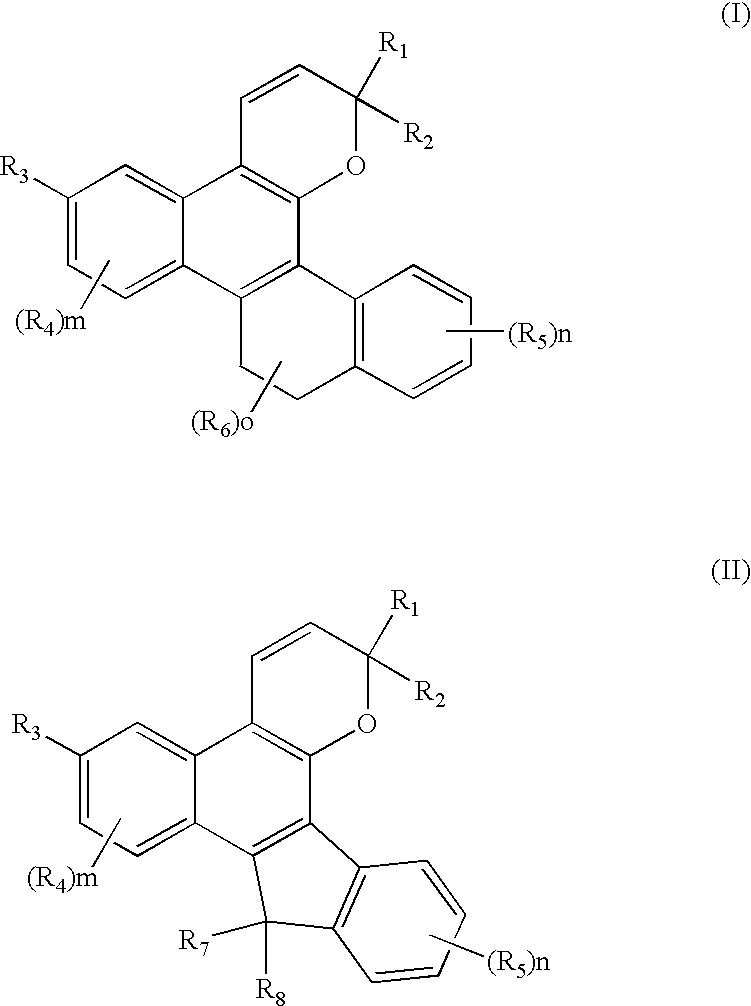
These compounds (I) and (II) have interesting photochromic properties. The invention also relates to their preparation, to their applications as photochromes, as well as to the compositions and (co)polymer matrices containing them.
Description
This application claims the benefit of priority of FR Application No. 99 14425, filed Nov. 17, 1999, entitled Naphthopyrans Annelated In C5-C6 With An Indene- Or Dihydronaphthalene-Type Carbocycle, And Compositions And (Co)Polymer Matrices Containing Them, of Breyne et al.
The present invention relates to novel naphthopyran-type compounds which are annelated in C5-C6 with an indene- or dihydronaphthalene-type carbocycle, and which have, in particular, photochromic properties. The invention also relates to photochromic compositions and photochromic ophthalmic articles (lenses for example) which contain said naphthopyrans. The invention also covers the preparation of these novel compounds.
The photochromic compounds are capable of changing colour under the influence of a poly- or mono-chromatic light (UV for example) and of returning to their initial colour when the luminous irradiation ceases, or under the influence of temperature and/or a poly- or mono-chromatic light different from the first.
The photochromic compounds find applications in various fields, e.g. for the manufacture of ophthalmic lenses, contact lenses, solar protection glasses, filters, camera optics or photographic apparatus optics or other optical devices and observation devices, glazing, decorative objects, bill elements or even for information storage by optical inscription (coding).
In the field of ophthalmic optics, and in particular the spectacles trade, a photochromic lens which comprises one or more photochromic compounds must have:
a high transmission in the absence of ultraviolets,
a low transmission (high colourability) under solar irradiation,
adapted coloration and discoloration kinetics,
a tint acceptable to the consumer (grey or brown preferably) with preferably a maintenance of the chosen tint during the coloration and the discoloration of the lens,
a maintenance of the performances, the properties, within a temperature range of 0-40° C.,
a significant durability, since these objectives sought after are sophisticated corrective lenses and therefore expensive.
These lens characteristics are in fact determined by the active photochromic compounds which they contain; compounds which must furthermore be perfectly compatible with the organic or inorganic, even hybrid support which constitutes the lens.
Moreover, it is to be noted that obtaining a grey or brown tint may necessitate the use of at least two photochromes of different colours, i.e. having distinct maximal absorption wavelengths in the visible. This combination further imposes other requirements of the photochromic compounds. In particular, the coloration and discoloration kinetics of the (two or more) combined active photochromic compounds must be essentially identical. The same applies for their stability with time and also for their compatibility with a plastic, inorganic or organic-inorganic hybrid support.
Amongst the numerous photochromic compounds described in the prior art, benzopyrans and naphthopyrans may be cited which are described in patents or patent applications: U.S. Pat. No. 3,567,605, U.S. Pat. No. 3,627,690, U.S. Pat. No. 4,826,977, U.S. Pat. No. 5,200,116, U.S. Pat. No. 5,238,981, U.S. Pat. No. 5,411,679, U.S. Pat. No. 5,429,744, U.S. Pat. No. 5,451,344, U.S. Pat. No. 5,458,814, U.S. Pat. No. 5,651,923, U.S. Pat. No. 5,645,767, U.S. Pat. No. 5,698,141, U.S. Pat. No. 5,783,116, WO-A-95 05382, FR-A-2,718,447, WO-A-96 14596, WO-A-97 21698, which are of the reduced formulae below: 
In particular, patent documents WO-A-99 31082 and U.S. Pat. No. 5,869,658 claim 3H-naphthopyran-type structures in which there exists an aryl group in R4: 
These compounds claim to satisfy the specifications defined above. In reality, if these compounds really do have one or more of the basic properties sought after, such as a high transmission in the absence of ultraviolets and a high colourability under solar irradiation, none of the compounds described hitherto have the complete combination of the properties sought after which are necessary for the production of satisfactory articles. In particular, none of these compounds is intrinsically grey or brown and the necessity of using an additional photochrome in order to obtain one of these two tints does subsist.
In this context, it is to the credit of the inventors for having been interested in this type of derivative as a base for developing novel photochromes, and for having proposed a novel family of molecules which have particularly advantageous photochromic properties.
Thus, according to a first of its aspects, the present invention relates to compounds of formulae (I) and (II): 
in which:
R1 and R2, which are identical or different, independently represent:
hydrogen,
a linear or branched alkyl group comprising 1 to 12 carbon atoms,
a cycloalkyl group comprising 3 to 12 carbon atoms,
an aryl or heteroaryl group comprising in its basic structure 6 to 24 carbon atoms or 4 to 24 carbon atoms respectively and at least one heteroatom selected from sulphur, oxygen and nitrogen; said basic structure being optionally substituted with at least one substituent selected from the whole of the substituents given below:
a halogen, and notably fluorine, chlorine and bromine,
a hydroxy,
a linear or branched alkyl group comprising 1 to 12 carbon atoms,
a linear or branched alkoxy group comprising 1 to 12 carbon atoms,
a haloalkyl or haloalkoxy group corresponding to the (C1-C12) alkyl or alkoxy groups above respectively which are substituted with at least one halogen atom, and notably a fluoroalkyl group of this type,
a phenoxy or naphthoxy group optionally substituted with at least one linear or branched alkyl or alkoxy group comprising 1 to 12 carbon atoms,
a linear or branched alkenyl group comprising 2 to 12 carbon atoms, and notably a vinyl group or an allyl group,
an —NH2 group,
an —NHR group, R representing a linear or branched alkyl group comprising 1 to 6 carbon atoms, or a phenyl group optionally substituted with at least one linear or branched alkyl group comprising 1 to 6 carbon atoms,
a 
group, R′ and R″, which are identical or different, representing independently a linear or branched alkyl group comprising 1 to 6 carbon atoms, or a phenyl group optionally substituted with at least one linear or branched alkyl group comprising 1 to 6 carbon atoms, or representing together with the nitrogen atom to which they are bound a 5- to 7-membered ring which can comprise at least one other heteroatom selected from oxygen, sulphur and nitrogen, said nitrogen being optionally substituted with an R″′ group, which is a linear or branched alkyl group comprising 1 to 6 carbon atoms,
a methacryloyl group or an acryloyl group,
an aralkyl or heteroaralkyl group, the alkyl group of which, which is linear or branched, comprises 1 to 4 carbon atoms and the aryl part of which has the same definition as that given supra for the aryl and heteroaryl group;
or
said two substituents R1 and R2 together form an adamantyl, norbornyl, fluorenylidene, di(C1-C6)alkylanthracenylidene or spiro(C5-C6)cycloalkylanthracenylidene group; said group being optionally substituted with at least one of the substituents listed above for R1, R2: an aryl or heteroaryl group;
R3 represents:
a hydroxy;
a linear or branched alkoxy group comprising 1 to 6 carbon atoms;
a 
group, R′ and R″, which are identical or different, representing independently a linear or branched alkyl group comprising 1 to 6 carbon atoms, a phenyl group optionally substituted with at least one linear or branched alkyl group comprising 1 to 6 carbon atoms, or representing together with the nitrogen atom to which they are bound a 5- to 7-membered ring which can comprise at least one other heteroatom selected from oxygen, sulphur and nitrogen, said nitrogen being optionally substituted with an R′″ group, which is a linear or branched alkyl group comprising 1 to 6 carbon atoms,
R4, which are identical or different, independently represent:
a halogen, and notably fluorine, chlorine or bromine,
a hydroxy,
a linear or branched alkyl group comprising 1 to 12 carbon atoms (advantageously 1 to 6 carbon atoms),
a cycloalkyl group comprising 3 to 12 carbon atoms,
a linear or branched alkoxy group comprising 1 to 12 carbon atoms (advantageously 1 to 6 carbon atoms),
a haloalkyl, halocycloalkyl, or haloalkoxy group corresponding to the alkyl, cycloalkyl, alkoxy groups above respectively, which are substituted with at least one halogen atom, notably selected from fluorine, chlorine and bromine,
an aryl or heteroaryl group having the same definition as that given supra for R1, R2,
an aralkyl or heteroaralkyl group, the alkyl group, which is linear or branched, comprises 1 to 4 carbon atoms, and the aryl and heteroaryl groups having the same definitions as those given supra for R1, R2,
a phenoxy or naphthoxy group optionally substituted with at least one linear or branched alkyl or alkoxy group comprising 1 to 12 carbon atoms,
an amine or amide group: —NH2, —NHR, —CONH2, —CONHR, 
R, R′, R″ having their respective definitions given supra for the amine substituents of the values R1, R2: aryl or heteroaryl,
an —OCOR9 or —OCOOR9 group, R9 representing a linear or branched alkyl group comprising 1 to 6 carbon atoms, or a cycloalkyl group comprising 3 to 6 carbon atoms, or a phenyl group, optionally substituted with at least one of the substituents listed above for the values of R1, R2: aryl or heteroaryl;
R5, which are identical or different, represent the substituents listed above for the values of R4,
or
at least two of the adjacent R5 groups together form an aromatic or non-aromatic cyclic group having one or two annelated rings which can comprise at least one heteroatom selected from the group consisting of: oxygen, sulphur or nitrogen; this or these rings, independently 5- to 7-membered aromatic or non-aromatic, being able to comprise at least one substituent selected from a group as defined above, as a substituent, of the basic structure of the aryl or heteroaryl group representing R1 or R2;
R6, which are identical or different, independently represent a linear or branched alkyl group comprising 1 to 6 carbon atoms;
R7 and R8, which are identical or different, independently represent a hydrogen or a linear or branched alkyl group comprising 1 to 6 carbon atoms,
or
one of them represents a hydrogen or a linear or branched alkyl group comprising 1 to 6 carbon atoms whereas the other is selected from a hydroxy group, a linear or branched alkoxy group comprising 1 to 6 carbon atoms, a —OCOR9 or a —OCOOR9 group, R5 representing a linear or branched alkyl group comprising 1 to 6 carbon atoms or a cycloalkyl group comprising 3 to 6 carbon atoms or a phenyl group, optionally substituted with at least one of the substituents listed above for the values of R1, R2: aryl or heteroaryl,
or
R7 and R8 together form an oxo group or a cycloalkyl group comprising 3 to 6 carbon atoms;
m is an integer from 0 to 3 and n and o are integers from 0 to 4.
The person skilled in the art will obviously have understood that the branched alkyl, alkoxy and alkenyl groups, as defined above, comprise a sufficient number of carbons in order to be branched (i.e. more than 3, more than 3, and more than 4 carbon atoms respectively).
The compounds of the invention—annelated naphthopyrans of formulae (I) and (II)—have very fast discoloration kinetics combined with a high colourability.
Amongst said compounds of the invention, preferred are those which have the formulae (I) and/or (II) in which:
R1, R2 are identical or different and represent independently optionally substituted aryl or heteroaryl groups the basic structure of which is selected from the group comprising phenyl, naphthyl, biphenyl, pyridyl, furyl, benzofuryl, dibenzofuryl, N—(C1-C6)alkylcarbazole, thienyl, benzothienyl, dibenzothienyl and julolidinyl groups; R1 and/or R2 representing, advantageously, a para-substituted phenyl group;
or
R1 and R2 together form an adarnantyl or norbornyl group;
R4 and R5 represent a halogen, an alkyl group or an alkoxy group;
R7 represents a hydroxy or an alkyl group and R8 represents a hydrogen or an alkyl group;
m and n=1 and o=0.
According to a second of its aspects, the present invention relates to a method of preparation of the compounds (I) and (II), characterised in that it comprises condensing:
an intermediate product of formula (III) or (IV) which are given below: 
in which R3, R4, R5, R6, m, n and o are as defined supra with reference to formulae (I) and (II);
with a derivative of propargylic alcohol, having formula (V) below: 
in which R1 and R2 are as defined supra with reference to formulae (I) and (II);
the condensation (III) or (IV)/(V) being carried out advantageously in the presence of a catalyst, this catalyst being preferably selected from the group comprising para-toluenesulphonic acid, dodecylsulphonic acid or bromoacetic acid;
or
with an aldehyde derivative, having formula (V′) below: 
in which R1 and R2 are as defined supra with reference to formulae (I) and (II);
the condensation (III) or (IV)/(V′) being carried out, advantageously, in the presence of a metallic complex, preferably a complex of titanium, titanium (IV) ethoxide being particularly preferred.
In practice, the condensation reaction between compounds (III) or (IV) and (V) or (V′) can take place in solvents such as toluene, xylene or tetrahydrofuran, to which appropriate catalysts are optionally added. For more details on the condensation of compounds (III) or (IV)/(V′), reference may be made to the EP-A-0 562 915 patent application.
The compounds of formula (V) are known to the person skilled in the art and are obtained from the corresponding ketone according to a method described notably in the WO-A-96 14596 patent application. The ketone is itself commercial or is prepared according to the known methods such as the Friedel Crafts method (cf WO-A-96 14596 and cited references).
Aldehydes (V′), which are derivatives of (V), are obtained by rearrangement in an acid medium (cf J. Org. Chem., 1977, 42, 3403).
In the case of the compounds of formula II, the condensation of the compounds of formula IV with compounds of formula V or V′ leads to the intermediate IIa (compound of formula (II) in which R7=R8=H) which can be derivatised, notably in the following manner: 
The oxidation in the air of the compounds (IIa) in the presence of a basic PTC such as benzyltrimethylammonium hydroxide leads to compounds (IIb) which are hydroxyalkylated by organometallic reagents such as methyllithium in order to provide compounds (IIc).
Alternatively, compounds (IIa) can be alkylated by metallation with a base such as butyllithium, and then reaction with an alkyl iodide such as CH3I in order to provide compounds (IId) and then compounds (IIe).
The preparation of the other compounds of formula (II) is within reach of the person skilled in the art. For all intents and purposes, it may still be indicated in a non-limiting way:
that the compounds of formula (II) in which R7+R8=cycloalkyl can be prepared from the corresponding compounds of formula (IId) above in which “R7” is an alkyl functionalised with a leaving group. Said “compounds of formula (IId)” are subjected to an intramolecular nucleophilic substitution of said leaving group; and
that compounds of formula (II) in which R7 or R8=alkoxy, —OCOR9 —OCOOR9 can be obtained in a classical manner from the corresponding compounds of formula (II) in which R7 or R8=OH.
Compounds of formula (III) and (IV) are obtained according to a synthesis scheme, the various steps of which are adaptations of known methods. The preferred general synthesis scheme is given below: 
In a first step, acid VI (commercial or prepared according to known methods) is converted into acid chloride VII. The latter chloride is then allowed to condense with a β-tetralone VIII or a β-indanone X in the presence of a large excess of NaH in order to lead to intermediates IX and XI which are cyclised to give III and IV, respectively, by heating in the presence of an acid such as phosphoric acid.
According to a third of its aspects, the invention also relates to the novel intermediate products of formulae (III) and (IV), recalled below: 
in which R3, R4, R5, R6, m, n and o are as defined above with reference to formulae (I) and (II).
According to a fourth of its aspects, the object of the invention is (co)polymer(s) and/or reticulate(s) obtained by polymerising and/or cross-linking and/or grafting at least one compound (I) or (II) as defined above. The compounds (I) and (II) according to the invention can be per se (co)monomers and/or be comprised in (co)polymerisable and/or cross-linkable (co)monomers. The (co)polymers and/or reticulates thus obtained can constitute photochromic matrices such as those presented infra.
According to a fifth of its aspects, the present invention relates to the use of said compounds of formula (I) or (II) of the invention as photochromic agents. Another object of the invention is, therefore:
firstly, novel photochromic compounds which are constituted by the C5-C6-annelated naphthopyran derivatives such as defined above, taken alone or in a mixture of themselves and/or with at least one other photochromic compound of another type and/or with at least one non-photochromic colouring agent;
secondly, novel photochromic compositions which comprise at least one compound (I) or (II) as defined above, and/or at least one linear or cross-linked (co)polymer containing at least one compound (I) or (II) according to the invention in its structure. Such photochromic compositions can contain at least one other photochromic compound, of another type and/or at least one non-photochromic colouring agent and/or at least one stabilising agent. These photochromic compounds of another type, non-photochromic colouring agents, and stabilising agents are prior art products known to the person skilled in the art.
Within the context of the present invention, combinations of photochromic compounds of the invention and/or combinations of photochromic compounds of the invention and photochromic compounds of another type according to the prior art are particularly recommended; such combinations being interesting in that they are suitable for generating grey or brown tints, which are desired by the public in applications such as ophthalmic spectacles or solar spectacles. These additional photochromic compounds can be those known to the person skilled in the art and described in the literature, e.g. chromenes (U.S. Pat. No. 3,567,605, U.S. Pat. No. 5,238,981, WO-A-94 22850, EP-A-0 562 915), spiropyrans or naphthospiropyrans (U.S. Pat. No. 5,238,981) and spiroxazines (Crano et al., “Applied Photochromic Polymer Systems”, Ed. Blackie & Son Ltd, 1992, chapter 2).
Said compositions according to the invention can also comprise:
non-photochromic colouring agents which enable adjusting the tint,
and/or one or more stabilising agents, such as an anti-oxidising agent for example,
and/or one or more anti-UV,
and/or one or more anti-radicals,
and/or one or more photochimic excited state deactivators.
These additives can notably enable improving the durability of said compositions.
The compounds of the invention envisaged within the context of their photochromic applications can be used in solution. Thus, a photochromic solution can be obtained by dissolving at least one of said compounds in an organic solvent such as toluene, dichloromethane, tetrahydrofuran or ethanol. The solutions obtained are in general colourless and transparent. When exposed to sunlight, they develop a strong coloration and regain the colourless state when they are placed in an area of less exposure to the sun's rays or, in other words, when they are no longer submitted to UV. In general, a very low concentration of product (of the order of 0.01 to 5% by weight) is sufficient to obtain an intense coloration.
The compounds according to the invention are furthermore compatible with support matrices of organic polymer or of inorganic material (even of an inorganic-organic hybrid material), in a form included in said matrices as well as in the form of a coating of said matrices.
Also, within the context of the fifth aspect of the invention in relation to the photochromic applications, the object of the invention is a matrix which comprises:
at least one compound (I) or (II), as defined supra;
and/or at least one (co)polymer and/or reticulate, as defined supra;
and/or at least one composition, as presented above.
The most interesting applications of the compounds of the invention are in fact those in which the photochrome is dispersed uniformly within or on the surface of a matrix formed by a polymer and/or copolymer and/or mixture of (co)polymers.
Following the example of their behaviour in solution, the compounds (I) or (II), included in a polymer matrix are colourless or slightly coloured in the initial state and rapidly develop an intense coloration under a UV light (365 nm) or under a light source of the solar type. Finally, they regain their initial coloration once the irradiation ceases.
The methods of implementation which can be envisaged in order to obtain such a matrix are very varied. Amongst those known to the person skilled in the art, the diffusion in the (co)polymer, from a suspension or solution of the photochrome, in a silicone oil, in an aliphatic or aromatic hydrocarbon, or in a glycol, or from another polymer matrix, can be cited for example. The diffusion is commonly carried out at a temperature of 50 to 200° C. for a period of time of 15 minutes to several hours, according to the nature of the polymer matrix. Another implementation technique consists in mixing the photochrome in a formulation of polymerisable materials, depositing this mixture on a surface or in a mould, and then carrying out the copolymerisation. These implementation techniques, and others, are described in the article by Crano et al. “Spiroxazines and their use in photochromic lenses” published in Applied Photochromic Polymer Systems, Ed. Blackie and Son Ltd—1992.
The following products may be mentioned as examples of preferred polymer materials for forming matrices which are useful in optical applications of the photochromic compounds according to the invention:
alkyl, cycloalkyl, (poly or oligo)ethylene glycol, aryl or arylalkyl mono-, di- tri- or tetraacrylate or mono-, di-, tri- or tetramethacrylate, which is optionally halogenated or which comprises at least one ether and/or ester and/or carbonate and/or carbamate and/or thiocarbamate and/or urea and/or amide group,
polystyrene, polyether, polyester, polycarbonate (e.g. bisphenol-A polycarbonate, diallyl diethylene glycol polycarbonate), polycarbamate, polyepoxy, polyurea, polyurethane, polythiourethane, polysiloxane, polyacrylonitrile, polyamide, aliphatic or aromatic polyester, vinylic polymers, cellulose acetate, cellulose triacetate, cellulose acetate-propionate or polyvinylbutyral,
those obtained from difunctional monomers having the formula below: 
in which:
R10, R′10, R11, and R′11 are identical or different and represent independently a hydrogen or a methyl group;
m1 and n1 are, independently, integers between 0 and 4 (inclusive); and are advantageously independently equal to 1 or 2;
X and X′, which are identical or different, are a halogen and represent, preferably, a chlorine and/or a bromine;
p1 and q1 are, independently, integers between 0 and 4 (inclusive);
copolymers of at least two types of copolymerisable monomers selected from the precursor monomers of the polymers listed supra, and preferably those belonging to the groups comprising (meth)acrylic monomers, vinylic monomers, allylic monomers, and mixtures thereof.
In a particularly preferred manner, the photochromes of the invention are used with resins which have a nanobiphasic structure and which are obtained by copolymerising at least two different, specific difunctional monomers. Such resins have been described by the Applicant in the French patent Application FR-A-2,762,845.
The amount of photochrome used in the (co)polymer matrix depends upon the degree of darkening desired. Usually, between 0.001 and 20% by weight of it is used.
Still according to the fifth of its aspects in relation to the applications of the compounds (I) or (II) as photochromes, another object of the present invention is ophthalmic articles, such as ophthalmic or solar spectacle articles, comprising:
at least one compound (I) or (II) according to the invention,
and/or at least one (co)polymer and/or reticulate formed, at least in part, from compound(s) of the invention,
and/or at least one photochromic composition as defined above,
and/or at least one matrix (as defined supra), of an organic polymer material or of an inorganic material, or even of a hybrid inorganic-organic material, said matrix initially comprising at least one compound of the invention.
In practice, the articles which are more particularly covered by the present invention are ophthalmic lenses or photochromic solar lenses, glazing (windows for buildings, for locomotion engines, automobile vehicles), optical devices, decorative articles, solar protection articles, information storage,
The present invention is illustrated by the Examples which follow, of synthesis and of photochromic validation, of compounds of the invention. This compound of the invention is compared to prior art compound C5.

Step 1:
Thionyl chloride (16 ml) is allowed to react with homoveratric acid 6 (19.6 g) in dichloromethane (100 ml) in the presence of a catalytic amount of DMF (0.5 ml). Stirring is effected under reflux for 4 h. The solvent is then evaporated off to provide 22.7 g of acid chloride 7 (yellow oil).
Step 2:
NaH (800 mg of a 60% suspension in mineral oil) is cautiously added in portions to a solution of 7 (2.14 g) and 2-indanone 10 (1.32 g) in THF (15 ml). Stirring is effected under reflux for 1 h, and then 0.4 g of sodium hydride are added. Stirring is continued for 1 h, and the mixture is then hydrolysed with a 1N solution of HCl. After extraction and evaporation of the solvents, the reaction mixture is purified by silica column chromatography to provide compound 11 (1.04 g, yellow powder).
Step 3:
15 ml of an 85% aqueous solution of phosphoric acid are added to a solution of 11 (2.5 g) in toluene (30 ml). The water present in the medium is distilled off with the aid of a Dean-Stark apparatus. Stirring is effected under reflux for 5 h. The mixture is cooled, water is added, and the precipitate of naphthol 4 (800 mg dry, beige solid) is filtered off.
Step 4:
A few crystals of pTSA (para-toluenesulphonic acid) are added to a solution of 400 mg of naphthol 4 and 370 mg of 1,1-diphenylpropyn-1-ol in 10 ml of chloroform. Stirring under reflux is effected for 1 h. The reaction mixture is then purified by filtration over silica. The solid obtained is recrystallised to provide 160 mg of slightly pink crystals which are pure by 1H NMR.
Step 1:
0.5 ml of a 40% by weight solution of benzyltrimethylammonium hydroxide is added to a solution of compound C1 (160 mg) in 15 ml of THF. Reaction is allowed with air for 2 h, and the mixture is poured into H2O and is acidified with 1N HCl solution. The precipitate is filtered off and recrystallised to provide 110 mg of orange crystals.
Step 2
1 ml of a 1M solution of methyllithium are added at 0° C. to a solution of 190 mg of the product of step 1 in 10 ml of THF. Reaction is allowed for 10 min, and 0.5 ml of methyllithium are then added. After stirring for 10 min at 0° C., the mixture is hydrolysed with a 1N HCl solution and is extracted with ethyl acetate. After evaporation of the solvent, the reaction mixture is purified over silica, and the recrystallised to provide 110 mg of yellow crystals, correct by 1H NMR.

Step 1:
This step is analogous to step 1 of Example 1. 18.5 g of a yellow oil are obtained from 16.1 g of homoveratric acid 6 and 4.1 ml of thionyl chloride.
Step 2:
5.47 g of a white solid, which is in accordance with the desired product 9 by 1H RMN, are obtained according to a method which is analogous to that of step 2 of Example 1, from 7.67 g of 2-tetralone 8, 8.21 g of NaH and the product of step 1,
Step 3:
2.05 g of a slightly yellow solid are obtained according to a method which is analogous to that of step 3 of Example 1, from 3 g of the product of step 2.
Step 4:
A few crystals of pTSA are added to a solution of 1 g of the product of step 3 and 889 mg of 1,1-diphenylpropyn-1-ol in 100 ml of chloroform. Stirring is effected under reflux for 4 h. The mixture is cooled, and purified by filtration over silica to provide 513 mg of an orange solid, correct by 1H NMR.
A few crystals of pTSA are added to a solution of 470 mg of the product of step 3 of Example 3 and 554 mg of 1,1-bis(p-methoxyphenyl)-propyn-1-ol in 50 ml of chloroform. Stirring under reflux is effected for 4 h. The mixture is cooled, and purified by filtration over silica to provide 509 mg of a pink solid, correct by 1H NMR.
The photochromic properties of said compounds (C1), (C2), (C3), (C4) and (C5) were evaluated.
Said compounds are dissolved at the rate of 5 mg in 50 ml of THF. The UV-visible absorptions (optical path of 1 cm) are then measured before and after exposure to a 365 nm UV source. The observation of the tints and intensities developed is made by placing the solutions in the sun or before a solar simulator. The properties of these compounds are given in the Table below.
| COMPOUND | STRUCTURE | λ VIS* | T1/2** |
| (C1) |
 |
434 nm | 10 s |
| (C2) |
 |
442 nm | 5 s |
| (C3) |
 |
428 nm | 63 s |
| (C4) |
 |
458 nm | 12 s |
| (C5) |
 |
428 nm | 11 s |
| *λvis of the band of the highest intensity in the range of the visible spectrum of the compound after exposure. | |||
| **decoloration time corresponding to 50% decrease of absorption at the λvis at ambient temperature. | |||
The observation of the solutions in the presence of sun's rays or UV rays shows that the compounds of the invention have a high colourability, notably in comparison with compound (C5).
Claims (26)
1. A compound having one of the following formulae (I) and (II): 
in which:
R1, and R2, which are identical or different, independently represent:
hydrogen,
a linear or branched alkyl group comprising 1 to 12 carbon atoms,
a cycloalkyl group comprising 3 to 12 carbon atoms,
an aryl group comprising in its basic structure 6 to 24 carbon atoms or a heteroaryl group comprising in its basic structure 4 to 24 carbon atoms and at least one heteroatom selected from sulphur, oxygen and nitrogen, said aryl or heteroaryl group's basic structure being optionally substituted with at least one substituent selected from the group consisting of:
a halogen,
a hydroxy,
a linear or branched alkyl group comprising 1 to 12 carbon atoms,
a linear or branched alkoxy group comprising 1 to 12 carbon atoms,
a haloalkyl or haloalkoxy group corresponding to the (C1-C12) alkyl or alkoxy groups above respectively which are substituted with at least one halogen atom,
a phenoxy or naphthoxy group optionally substituted with at least one linear or branched alkyl or alkoxy group comprising 1 to 12 carbon atoms,
a linear or branched alkenyl group comprising 2 to 12 carbon atoms,
an —NH2 group,
an —NHR group, R representing a linear or branched alkyl group comprising 1 to 6 carbon atoms, or a phenyl group optionally substituted with at least one linear or branched alkyl group comprising 1 to 6 carbon atoms,
a 
group, wherein R′ and R″, which are identical or different, independently represent a linear or branched alkyl group comprising 1 to 6 carbon atoms or a phenyl group optionally substituted with at least one linear or branched alkyl group comprising 1 to 6 carbon atoms or wherein R′ and R′ represent together with the nitrogen atom to which they are bound a 5- to 7-membered ring which optionally comprises at least one other heteroatom selected from oxygen, sulphur, and nitrogen, said nitrogen being optionally substituted with an R″′ group, which is a linear or branched alkyl group comprising 1 to 6 carbon atoms, and
a methacryloyl group or an acryloyl group, or
an aralkyl or heteroaralkyl group, the alkyl part of which is linear or branched, comprises 1 to 4 carbon atoms and the aryl part or heteroaryl part of which has the same definition as that given above for the aryl and heteroaryl group;
or
said two substituents R1 and R2 together form an adamantyl, norbornyl, fluorenylidene, di(C1-C6)alkylanthracenylidene, or spiro (C5-C6)cycloalkylanthracenylidene group, said group being optionally substituted with at least one substituent selected from the group consisting of:
a halogen,
a hydroxy,
a linear or branched alkyl group comprising 1 to 12 carbon atoms,
a linear or branched alkoxy group comprising 1 to 12 carbon atoms,
a haloalkyl or haloalkoxy group corresponding to the (C1-C12) alkyl or alkoxy groups above respectively which are substituted with at least one halogen atom,
a phenoxy or naphthoxy group optionally substituted with at least one linear or branched alkyl or alkoxy group comprising 1 to 12 carbon atoms,
a linear or branched alkenyl group comprising 2 to 12 carbon atoms,
an —NH2 group,
an —NHR group, R representing a linear or branched alkyl group comprising 1 to 6 carbon atoms, or a phenyl group optionally substituted with at least one linear or branched alkyl group comprising 1 to 6 carbon atoms,
a 
group, wherein R′ and R″, which are identical or different, independently represent a linear or branched alkyl group comprising 1 to 6 carbon atoms or a phenyl group optionally substituted with at least one linear or branched alkyl group comprising 1 to 6 carbon or wherein R′ and R″ represent together with the nitrogen atom to which they are bound a 5- to 7-membered ring which optionally comprises at least one other heteroatom selected from oxygen, sulphur, and nitrogen, said nitrogen being optionally substituted with an R″′ group, which is a linear or branched alkyl group comprising 1 to 6 carbon atoms, and
a methacryloyl group or an acryloyl group;
R3 represents:
a hydroxy;
a linear or branched alkoxy group comprising 1 to 6 carbon atoms;
a 
group, wherein R′ and R″, which are identical or different, independently represent a linear or branched alkyl group comprising 1 to 6 carbon atoms or a phenyl group optionally substituted with at least one linear or branched alkyl group comprising 1 to 6 carbon or wherein R′ and R″ represent together with the nitrogen atom to which they are bound a 5- to 7-membered ring which optionally comprises at least one other heteroatom selected from oxygen, sulphur, and nitrogen, said nitrogen being optionally substituted with an R″′ group, which is a linear or branched alkyl group comprising 1 to 6 carbon atoms;
R4, which are identical or different, independently represent:
a halogen,
a hydroxy,
a linear or branched alkyl group comprising 1 to 12 carbon atoms,
a cycloalkyl group comprising 3 to 12 carbon atoms,
a linear or branched alkoxy group comprising 1 to 12 carbon atoms,
a haloalkyl, halocycloalkyl, or haloalkoxy group corresponding respectively to the alkyl, cycloalkyl, and alkoxy groups above, which are substituted with at least one halogen atom,
an aryl or heteroaryl group having the same definition as that given above for R1, R2,
an aralkyl or heteroaralkyl group, the alkyl pary of which is linear or branched and comprises 1 to 4 carbon atoms and the aryl or heteroaryl part of which has the same definitions as those given above for R1, R2,
a phenoxy or naphthoxy group optionally substituted with at least one linear or branched alkyl or alkoxy group comprising 1 to 12 carbon atoms,
an amine or amide group: —NH2, —NHR, —CONH2, —CONHR, 
wherein R represents a linear or branched alkyl group comprising 1 to 6 carbon atoms or a phenyl group optionally substituted with at least one linear or branched alkyl group comprising 1 to 6 carbon atoms and wherein R′ and R″, which are identical or different, independently represent a linear or branched alkyl group comprising 1 to 6 carbon atoms or a phenyl group optionally substituted with at least one linear or branched alkyl group comprising 1 to 6 carbon atoms or wherein R′ and R″ represent together with the nitrogen atom to which they are bound a 5- to 7-membered ring which optionally comprises at least one other heteroatom selected from oxygen, sulphur, and nitrogen, said nitrogen being optionally substituted with an R″′ group, which is a linear or branched alkyl group comprising 1 to 6 carbon atoms, or
an —OCOR9 or —OCOOR9 group, R9 representing a linear or branched alkyl group comprising 1 to 6 carbon atoms, a cycloalkyl group comprising 3 to 6 carbon atoms, or a phenyl group optionally substituted with at least one substituent selected from the group consisting of:
a halogen,
a hydroxy,
a linear or branched alkyl group comprising 1 to 12 carbon atoms,
a linear or branched alkoxy group comprising 1 to 12 carbon atoms,
a haloalkyl or haloalkoxy group corresponding to the (C1-C12) alkyl or alkoxy groups above respectively which are substituted with at least one halogen atom,
a phenoxy or naphthoxy group optionally substituted with at least one linear or branched alkyl or alkoxy group comprising 1 to 12 carbon atoms,
a linear or branched alkenyl group comprising 2 to 12 carbon atoms,
an —NH2 group,
an —NHR group, R representing a linear or branched alkyl group comprising 1 to 6 carbon atoms, or a phenyl group optionally substituted with at least one linear or branched alkyl group comprising 1 to 6 carbon atoms,
a 
group, wherein R′ and R″, which are identical or different, independently represent a linear or branched alkyl group comprising 1 to 6 carbon atoms or a phenyl group optionally substituted with at least one linear or branched alkyl group comprising 1 to 6 carbon or wherein R′and R″ represent together with the nitrogen atom to which they are bound a 5- to 7-membered ring which optionally comprises at least one other heteroatom selected from oxygen, sulphur, and nitrogen, said nitrogen being optionally substituted with an R″′ group, which is a linear or branched alkyl group comprising 1 to 6 carbon atoms, and
a methacryloyl group or an acryloyl group;
R5, which are identical or different, represent, independently, the substituents listed above for the values of R4 or at least two of the adjacent R5 groups together form an aromatic or non-aromatic cyclic group having one or two annelated rings, optionally comprising at least one heteroatom selected from the group consisting of oxygen, sulphur, and nitrogen, this or these annelated rings being independently 5- to 7-membered aromatic or non-aromatic rings and being optionally substituted with at least one substituent selected from the group consisting of:
a halogen,
a hydroxy,
a linear or branched alkyl group comprising 1 to 12 carbon atoms,
a linear or branched alkoxy group comprising 1 to 12 carbon atoms,
a haloalkyl or haloalkoxy group corresponding to the (C1-C12) alkyl or alkoxy groups above respectively which are substituted with at least one halogen atom,
a phenoxy or naphthoxy group optionally substituted with at least one linear or branched alkyl or alkoxy group comprising 1 to 12 carbon atoms,
a linear or branched alkenyl group comprising 2 to 12 carbon atoms,
an —NH2 group,
an —NHR group, R representing a linear or branched alkyl group comprising 1 to 6 carbon atoms, or a phenyl group optionally substituted with at least one linear or branched alkyl group comprising 1 to 6 carbon atoms,
a 
group, wherein R′ and R″, which are identical or different, independently represent a linear or branched alkyl group comprising 1 to 6 carbon atoms or a phenyl group optionally substituted with at least one linear or branched alkyl group comprising 1 to 6 carbon or wherein R′ and R″ represent together with the nitrogen atom to which they are bound a 5- to 7-membered ring which optionally comprises at least one other heteroatom selected from oxygen, sulphur, and nitrogen, said nitrogen being optionally substituted with an R′″ group, which is a linear or branched alkyl group comprising 1 to 6 carbon atoms, and
a methacryloyl group or an acryloyl group;
R6, which are identical or different, represent, independently, a linear or branched alkyl group comprising 1 to 6 carbon atoms;
R7 and R8, which are identical or different, represent, independently,
a hydrogen or a linear or branched alkyl group comprising 1 to 6 carbon atoms, or
one of R7 and R8 represents a hydrogen or a linear or branched alkyl group comprising 1 to 6 carbon atoms and the other of R7 and R8 is selected from a hydroxy group, a linear or branched alkoxy group comprising 1 to 6 carbon atoms, and a —OCOR9 or a —OCOOR9 group, R9 representing a linear or branched alkyl group comprising 1 to 6 carbon atoms or a cycloalkyl group comprising 3 to 6 carbon atoms or a phenyl group, optionally substituted with at least one substituent selected from the group consisting of:
a halogen,
a hydroxy,
a linear or branched alkyl group comprising 1 to 12 carbon atoms,
a linear or branched alkoxy group comprising 1 to 12 carbon atoms,
a haloalkyl or haloalkoxy group corresponding to the (C1-C12) alkyl or alkoxy groups above respectively which are substituted with at least one halogen atom,
a phenoxy or naphthoxy group optionally substituted with at least one linear or branched alkyl or alkoxy group comprising 1 to 12 carbon atoms,
a linear or branched alkenyl group comprising 2 to 12 carbon atoms,
an —NH2 group,
an —NHR group, R representing a linear or branched alkyl group comprising 1 to 6 carbon atoms, or a phenyl group optionally substituted with at least one linear or branched alkyl group comprising 1 to 6 carbon atoms,
a 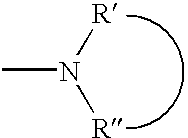
group, wherein R′ and R″, which are identical or different, independently represent a linear or branched alkyl group comprising 1 to 6 carbon atoms or a phenyl group optionally substituted with at least one linear or branched alkyl group comprising 1 to 6 carbon or wherein R′ and R″ represent together with the nitrogen atom to which they are bound a 5- to 7-membered ring which optionally comprises at least one other heteroatom selected from oxygen, sulphur, and nitrogen, said nitrogen being optionally substituted with an R′″ group, which is a linear or branched alkyl group comprising 1 to 6 carbon atoms, and
a methacryloyl group or an acryloyl group, or
R7 and R8 together form an oxo group or a cycloalkyl group comprising 3 to 6 carbon atoms; and
m is an integer from 0 to 3 and n and o are integers from 0 to 4.
2. A compound according to claim 1 , wherein said compound is of formula (I) and wherein:
R1 and R2 are identical or different and independently represent optionally substituted aryl or heteroaryl groups, the basic structure of which is selected from the group consisting of phenyl, naphthyl, biphenyl, pyridyl, furyl, benzofuryl, dibenzofuryl, N—(C1-C6)alkyl-carbazole, thienyl, benzothienyl, dibenzothienyl, and julolidinyl groups; or R1 and R2 together form an adamantyl or norbornyl group;
R4 and R5 represent a halogen, an alkyl group, or an alkoxy group; and
m and n=1 and o=0.
3. A compound according to claim 1 , wherein said compound is of formula (II) and wherein:
R1 and R2 are identical or different and independently represent optionally substituted aryl or heteroaryl groups, the basic structure of which is selected from the group consisting of phenyl, naphthyl, biphenyl, pyridyl, furyl, benzofuryl, dibenzofuryl, N—(C1-C6)alkyl-carbazole, thienyl, benzothienyl, dibenzothienyl, and julolidinyl groups; or R1 and R2 together form an adamantyl or norbornyl group;
R4 and R5 represent a halogen, an alkyl group or an alkoxy group;
R7 represents a hydroxy or an alkyl group, and R8 represents a hydrogen or an alkyl group; and
m and n=1.
4. A compound according to claim 1 , wherein at least one of R1 and R2 represents a para-substituted phenyl group.
5. A method of preparing a compound according to claim 1 , said comprising:
condensing an intermediate of formula (III) or (IV): 
in which R3, R4, R5, R6, m, n, and o are as defined in claim 1 ,
with a derivative of propargylic alcohol of formula (V): 
in which R1 and R2 are as defined in claim 1 , the (III)/(V) or (IV)/(V) condensation being optionally carried out in the presence of a catalyst selected from the group consisting of para-toluenesulfonic acid, dodecylsulfonic acid, and bromoacetic acid; or
with an aldehyde derivative of formula (V′): 
in which R1 and R2 are as defined in claim 1 , the (III)/(V′) or (IV)/(V′) condensation being optionally carried out in the presence of a metallic complex of titanium.
6. A (co)polymer and/or reticulate obtained by polymerizing and/or cross-linking and/or grafting at least one monomer comprising at least one compound according to claim 1 .
7. A photochromic compound which is constituted by a compound according to claim 1 , or by a mixture of at least two compounds according to claim 1 , or by a mixture of at least one compound according to claim 1 and at least one other photochromic compound of a different type and/or at least one non-photochromic coloring agent.
8. A photochromic composition which comprises:
at least one compound according to claim 1 , and/or
at least one linear or crosslinked (co)polymer which contains, in its structure, at least one compound according to claim 1 , and
optionally, at least one other photochromic compound of a different type and/or at least one non-photochromic coloring agent and/or at least one stabilizing agent.
9. A (co)polymer matrix, characterized in that it comprises:
at least one compound according to claim 1 .
10. A (co)polymer matrix according to claim 9 , wherein the (co)polymer is selected from the group consisting of:
a (co)polymer obtained from an alkyl, cycloalkyl, (poly or oligo)ethylene glycol, aryl or arylalkyl mono-, di-, tri-, or tetra-acrylate or mono-, di-, tri-, or tetra-methacrylate which is optionally halogenated or which optionally comprises at least one ether and/or ester and/or carbonate and/or carbamate and/or thiocarbamate and/or urea and/or amide group,
a polystyrene, polyether, polyester, polycarbonate, polycarbamate, polyepoxide, polyurea, polyurethane, polythiourethane, polysiloxane, polyacrylonitrile, polyamide, aliphatic or aromatic polyester, vinylic polymers, cellulose acetate, cellulose triacetate, cellulose acetate-propionate, or polyvinylbutyral,
a (co)polymer obtained from a difunctional monomer of the following formula: 
in which:
R10, R′10, R11, and R′11 are identical or different and independently are a hydrogen or a methyl group,
m1 and n1 independently are integers between 0 and 4 inclusive,
X and X′, which are identical or different, are a halogen, and
p1 and q1 independently are integers between 0 and 4 inclusive;
a copolymer of at least two types of copolymerizable monomers selected from the monomers which are precursors of the polymers listed above; and
combinations thereof.
11. A (co)polymer matrix which comprises:
at least one photochromic composition according to claim 8 .
12. A (co)polymer matrix according to claim 11 , wherein the (co)polymer is selected from the group consisting of:
a (co)polymer obtained from an alkyl, cycloalkyl, (poly or oligo)ethylene glycol, aryl or arylalkyl mono-, di-, tri-, or tetra-acrylate or mono-, di-, tri-, or tetra-methacrylate which is optionally halogenated or which optionally comprises at least one ether and/or ester and/or carbonate and/or carbamate and/or thiocarbamate and/or urea and/or amide group,
a polystyrene, polyether, polyester, polycarbonate, polycarbamate, polyepoxide, polyurea, polyurethane, polythiourethane, polysiloxane, polyacrylonitrile, polyamide, aliphatic or aromatic polyester, vinylic polymers, cellulose acetate, cellulose triacetate, cellulose acetate-propionate, or polyvinylbutyral,
a (co)polymer obtained from a difunctional monomer of the following formula: 
in which:
R10, R′10, R11 and R′11 are identical or different and independently are a hydrogen or a methyl group,
m1 and n1 independently are integers between 0 and 4 inclusive,
X and X′, which are identical or different, are a halogen, and
p1 and q1 independently are integers between 0 and 4 inclusive;
a copolymer of at least two types of copolymerizable monomers selected from the monomers which are precursors of the polymers listed above; and
combinations thereof.
13. A (co)polymer matrix which comprises:
at least one (co)polymer and/or reticulate according to claim 6 .
14. A (co)polymer matrix according to claim 13 , wherein the (co)polymer is selected from the group consisting of:
a (co)polymer obtained from an alkyl, cycloalkyl, (poly or oligo)ethylene glycol, aryl or arylalkyl mono-, di-, tri-, or tetra-acrylate or mono-, di-, tri-, or tetra-methacrylate which is optionally halogenated or which optionally comprises at least one ether and/or ester and/or carbonate and/or carbamate and/or thiocarbamate and/or urea and/or amide group,
a polystyrene, polyether, polyester, polycarbonate, polycarbamate, polyepoxide, polyurea, polyurethane, polythiourethane, polysiloxane, polyacrylonitrile, polyamide, aliphatic or aromatic polyester, vinylic polymers, cellulose acetate, cellulose triacetate, cellulose acetate-propionate, or polyvinylbutyral,
a (co)polymer obtained from a difunctional monomer of the following formula: 
in which:
R10, R′10, R11, and R′11 are identical or different and independently are a hydrogen or a methyl group,
m1 and n1 independently are integers between 0 and 4 inclusive,
X and X′, which are identical or different, are a halogen, and
p1 and q1 independently are integers between 0 and 4 inclusive;
a copolymer of at least two types of copolymerizable monomers selected from the monomers which are precursors of the polymers listed above; and
combinations thereof.
15. An ophthalmic or solar article comprising:
at least one compound according to claim 1 .
16. An article according to claim 15 , wherein said article is selected from the group consisting of a lens, a glazing, and an optical device.
17. An ophthalmic or solar article comprising:
at least one at least one photochromic composition according to claim 8 .
18. An article according to claim 17 , wherein said article is selected from the group consisting of a lens, a glazing, and an optical device.
19. An ophthalmic or solar article comprising:
at least one (co)polymer and/or reticulate according to claim 6 .
20. An article according to claim 19 , wherein said article is selected from the group consisting of a lens, glazing, and an optical device.
21. An ophthalmic or solar article comprising:
at least one matrix according to claim 9 .
22. An article according to claim 21 , wherein said article is selected from the group consisting of a lens, a glazing, and an optical device.
23. An ophthalmic or solar article comprising:
at least one matrix according to claim 11 .
24. An article according to claim 23 , wherein said article is selected from the group consisting of a lens, glazing, and an optical device.
25. An ophthalmic or solar article comprising:
at least one matrix according to claim 13 .
26. An article according to claim 25 , wherein said article is selected from the group consisting of a lens, a glazing, and an optical device.
Applications Claiming Priority (2)
| Application Number | Priority Date | Filing Date | Title |
|---|---|---|---|
| FR9914425A FR2801052B1 (en) | 1999-11-17 | 1999-11-17 | C5-C6 ANNELLED NAPHTHOPYRANS BY AN INDENE OR DIHYDRONAPHTHALENE CARBOCYCLE AND THE POLYMERIC COMPOSITIONS AND MATRICES (CO) |
| FR9914425 | 1999-11-17 |
Publications (1)
| Publication Number | Publication Date |
|---|---|
| US6506322B1 true US6506322B1 (en) | 2003-01-14 |
Family
ID=9552196
Family Applications (1)
| Application Number | Title | Priority Date | Filing Date |
|---|---|---|---|
| US09/712,058 Expired - Lifetime US6506322B1 (en) | 1999-11-17 | 2000-11-14 | Naphthopyrans annelated in C5-C6 with an indene- or dihydronaphthalene-type carbocycle, and compositions and (co)polymer matrices containing them |
Country Status (15)
| Country | Link |
|---|---|
| US (1) | US6506322B1 (en) |
| EP (1) | EP1230234B1 (en) |
| JP (1) | JP4860866B2 (en) |
| KR (1) | KR20020068539A (en) |
| CN (1) | CN1391568A (en) |
| AR (1) | AR026486A1 (en) |
| AT (1) | ATE273967T1 (en) |
| AU (1) | AU773145B2 (en) |
| BR (1) | BR0015166A (en) |
| CA (1) | CA2392053A1 (en) |
| DE (1) | DE60013163T2 (en) |
| ES (1) | ES2226948T3 (en) |
| FR (1) | FR2801052B1 (en) |
| MX (1) | MXPA02004917A (en) |
| WO (1) | WO2001036406A1 (en) |
Cited By (13)
| Publication number | Priority date | Publication date | Assignee | Title |
|---|---|---|---|---|
| US20020197562A1 (en) * | 1998-09-11 | 2002-12-26 | Olivier Breyne | Naphthopyrans annelated in C5-C6, their preparation and compositions and (CO)polymer matrices containing them |
| US6736998B2 (en) * | 2000-12-29 | 2004-05-18 | Transitions Optical, Inc. | Indeno-fused photochromic naphthopyrans |
| US20050196626A1 (en) * | 2004-03-04 | 2005-09-08 | Knox Carol L. | Photochromic optical article |
| US20050196616A1 (en) * | 2004-03-04 | 2005-09-08 | Stewart Kevin J. | Photochromic optical article |
| US20050196618A1 (en) * | 2004-03-04 | 2005-09-08 | Knox Carol L. | Photochromic optical article |
| US20050196617A1 (en) * | 2004-03-04 | 2005-09-08 | King Eric M. | Photochromic optical article |
| US20050196696A1 (en) * | 2004-03-04 | 2005-09-08 | King Eric M. | Photochromic optical article |
| US20090032782A1 (en) * | 2005-04-08 | 2009-02-05 | Transitions Optical, Inc. | Photochromic materials having extended pi-conjugated systems and compositions and articles including the same |
| US7556750B2 (en) | 2005-04-08 | 2009-07-07 | Transitions Optical, Inc. | Photochromic materials with reactive substituents |
| US20110135850A1 (en) * | 2009-12-08 | 2011-06-09 | Transitions Optical, Inc. | Photoalignment materials having improved adhesion |
| US8647538B2 (en) | 2005-04-08 | 2014-02-11 | Transitions Optical, Inc. | Photochromic compounds having at least two photochromic moieties |
| US9028728B2 (en) | 2005-04-08 | 2015-05-12 | Transitions Optical, Inc. | Photochromic materials that include indeno-fused naphthopyrans |
| US9139552B2 (en) | 2005-04-08 | 2015-09-22 | Transitions Optical, Inc. | Indeno-fused naphthopyrans having ethylenically unsaturated groups |
Families Citing this family (9)
| Publication number | Priority date | Publication date | Assignee | Title |
|---|---|---|---|---|
| JP2004509109A (en) | 2000-09-14 | 2004-03-25 | オプティッシュ.ウエルケ.ゲー.ローデンストック | h-Fused benzo [f] chromene |
| FR2837200B1 (en) * | 2002-03-14 | 2004-08-20 | Corning Inc | 3H-NAPHTOPYRANS ANNALED IN C5 -C6 BY A CARBOCYCLE OF THE DIHYDRONAPHTHALENE TYPE AND THE COMPOSITIONS AND (CO) POLYMERIC MATERIALS CONTAINING THEM |
| JP2005289812A (en) * | 2002-04-01 | 2005-10-20 | Tokuyama Corp | Chromene compounds |
| EP1529780B1 (en) * | 2003-11-05 | 2009-04-22 | Corning Incorporated | Photochromic fused pyrans substitued with phenyl carrying a carbamyl or urea group |
| WO2005047277A1 (en) * | 2003-11-05 | 2005-05-26 | Corning Incorporated | Photochromic fused pyrans substituted with phenyl carrying a carbamyl or urea group |
| ES2338579T3 (en) * | 2004-10-21 | 2010-05-10 | Rodenstock Gmbh | PHOTOCROMIC DERIVATIVES OF BENZO (F) CHROMENE H-RINGS. |
| US9052438B2 (en) | 2005-04-08 | 2015-06-09 | Johnson & Johnson Vision Care, Inc. | Ophthalmic devices comprising photochromic materials with reactive substituents |
| US7556751B2 (en) * | 2005-12-21 | 2009-07-07 | Transitions Optical, Inc. | Photochromic materials having electron-withdrawing substituents |
| CN116239561B (en) * | 2022-12-08 | 2025-02-28 | 上海甘田光学材料有限公司 | A benzofluorene photochromic compound and its application |
Citations (26)
| Publication number | Priority date | Publication date | Assignee | Title |
|---|---|---|---|---|
| US3567605A (en) | 1966-03-30 | 1971-03-02 | Ralph S Becker | Photochemical process |
| US3627690A (en) | 1969-10-01 | 1971-12-14 | Itek Corp | Photochromic naphthopyran compositions |
| US4826977A (en) | 1986-05-15 | 1989-05-02 | The Plessey Company Plc | Photochromic spiropyran compounds |
| US5200116A (en) | 1990-07-23 | 1993-04-06 | Ppg Industries, Inc. | Photochromic chromene compounds |
| US5238981A (en) | 1992-02-24 | 1993-08-24 | Transitions Optical, Inc. | Photochromic naphthopyrans |
| EP0562915A1 (en) | 1992-03-19 | 1993-09-29 | ESSILOR INTERNATIONAL Compagnie Générale d'Optique | Heterocyclic chromenes and their use in ophthalmic optics |
| WO1994022850A1 (en) | 1993-03-30 | 1994-10-13 | Pilkington Plc | Photochromic naphthopyran compounds |
| WO1995005382A1 (en) | 1993-08-13 | 1995-02-23 | Pilkington Plc | Photochromic heterocyclochromenes |
| US5411679A (en) | 1993-03-12 | 1995-05-02 | Transitions Optical, Inc. | Benzopyrans |
| US5451344A (en) | 1994-04-08 | 1995-09-19 | Transitions Optical, Inc. | Photochromic naphthopyran compounds |
| WO1995027716A1 (en) | 1994-04-06 | 1995-10-19 | Essilor International Compagnie Generale D'optique | 6,7-heteroannealed 2,2-diphenyl chromenes and use thereof in ophthalmic optics |
| WO1996014596A1 (en) | 1994-11-03 | 1996-05-17 | Ppg Industries, Inc. | Novel photochromic indeno-fused naphthopyrans |
| US5548814A (en) | 1991-02-25 | 1996-08-20 | Motorola, Inc. | Personal information management system with paging link |
| WO1997021698A1 (en) | 1995-12-12 | 1997-06-19 | Ppg Industries, Inc. | Novel substituted naphthopyrans |
| US5645767A (en) | 1994-11-03 | 1997-07-08 | Transitions Optical, Inc. | Photochromic indeno-fused naphthopyrans |
| US5698141A (en) | 1996-06-17 | 1997-12-16 | Ppg Industries, Inc. | Photochromic heterocyclic fused indenonaphthopyrans |
| US5783116A (en) | 1997-10-16 | 1998-07-21 | Ppg Industries, Inc. | Derivatives of carbocyclic fused naphthopyrans |
| FR2762845A1 (en) | 1997-05-02 | 1998-11-06 | Corning Sa | Radically polymerisable composition |
| US5869658A (en) | 1997-12-15 | 1999-02-09 | Ppg Industries, Inc. | Photochromic indeno-fused naptho 2,1-b!pyrans |
| WO1999031082A1 (en) | 1997-12-15 | 1999-06-24 | Transitions Optical, Inc. | PHOTOCHROMIC 6-ARYL SUBSTITUTED 3H-NAPHTHO[2,1-b]PYRANS |
| US6146554A (en) * | 1997-09-22 | 2000-11-14 | Optische Werke G. Rodenstock | Photochromic naphtopyrane colorants, method for the production and use thereof, photochromic object |
| US6149841A (en) * | 1998-07-10 | 2000-11-21 | Ppg Industries Ohio, Inc. | Photochromic benzopyrano-fused naphthopyrans |
| US6296785B1 (en) * | 1999-09-17 | 2001-10-02 | Ppg Industries Ohio, Inc. | Indeno-fused photochromic naphthopyrans |
| US20010025948A1 (en) * | 1998-09-11 | 2001-10-04 | Walters Robert W. | Polymeric matrix compatibilized naphthopyrans |
| US6315928B1 (en) * | 1999-07-02 | 2001-11-13 | Optische Werke G. Rodenstock | Spirofluorenopyrans |
| US6340765B1 (en) * | 1999-05-20 | 2002-01-22 | Tokuyama Corporation | Chromene compound |
Family Cites Families (1)
| Publication number | Priority date | Publication date | Assignee | Title |
|---|---|---|---|---|
| GB9706203D0 (en) * | 1997-03-25 | 1997-05-14 | James Robinson Ltd | Intense colouring photochromic 2H-naphthol[1,2-b]pyrans and heterocyclic pyrans |
-
1999
- 1999-11-17 FR FR9914425A patent/FR2801052B1/en not_active Expired - Fee Related
-
2000
- 2000-11-14 AT AT00979579T patent/ATE273967T1/en not_active IP Right Cessation
- 2000-11-14 MX MXPA02004917A patent/MXPA02004917A/en unknown
- 2000-11-14 CN CN00815904A patent/CN1391568A/en active Pending
- 2000-11-14 KR KR1020027006292A patent/KR20020068539A/en not_active Withdrawn
- 2000-11-14 ES ES00979579T patent/ES2226948T3/en not_active Expired - Lifetime
- 2000-11-14 BR BR0015166-1A patent/BR0015166A/en not_active IP Right Cessation
- 2000-11-14 US US09/712,058 patent/US6506322B1/en not_active Expired - Lifetime
- 2000-11-14 CA CA002392053A patent/CA2392053A1/en not_active Abandoned
- 2000-11-14 AU AU17019/01A patent/AU773145B2/en not_active Ceased
- 2000-11-14 DE DE60013163T patent/DE60013163T2/en not_active Expired - Lifetime
- 2000-11-14 EP EP00979579A patent/EP1230234B1/en not_active Expired - Lifetime
- 2000-11-14 JP JP2001538895A patent/JP4860866B2/en not_active Expired - Fee Related
- 2000-11-14 WO PCT/EP2000/011365 patent/WO2001036406A1/en not_active Ceased
- 2000-11-16 AR ARP000106033A patent/AR026486A1/en unknown
Patent Citations (28)
| Publication number | Priority date | Publication date | Assignee | Title |
|---|---|---|---|---|
| US3567605A (en) | 1966-03-30 | 1971-03-02 | Ralph S Becker | Photochemical process |
| US3627690A (en) | 1969-10-01 | 1971-12-14 | Itek Corp | Photochromic naphthopyran compositions |
| US4826977A (en) | 1986-05-15 | 1989-05-02 | The Plessey Company Plc | Photochromic spiropyran compounds |
| US5200116A (en) | 1990-07-23 | 1993-04-06 | Ppg Industries, Inc. | Photochromic chromene compounds |
| US5548814A (en) | 1991-02-25 | 1996-08-20 | Motorola, Inc. | Personal information management system with paging link |
| US5238981A (en) | 1992-02-24 | 1993-08-24 | Transitions Optical, Inc. | Photochromic naphthopyrans |
| EP0562915A1 (en) | 1992-03-19 | 1993-09-29 | ESSILOR INTERNATIONAL Compagnie Générale d'Optique | Heterocyclic chromenes and their use in ophthalmic optics |
| US5411679A (en) | 1993-03-12 | 1995-05-02 | Transitions Optical, Inc. | Benzopyrans |
| US5429774A (en) | 1993-03-12 | 1995-07-04 | Transitions Optical, Inc. | Benzopyran compounds |
| WO1994022850A1 (en) | 1993-03-30 | 1994-10-13 | Pilkington Plc | Photochromic naphthopyran compounds |
| WO1995005382A1 (en) | 1993-08-13 | 1995-02-23 | Pilkington Plc | Photochromic heterocyclochromenes |
| US5651923A (en) | 1993-12-09 | 1997-07-29 | Transitions Optical, Inc. | Substituted naphthopyrans |
| WO1995027716A1 (en) | 1994-04-06 | 1995-10-19 | Essilor International Compagnie Generale D'optique | 6,7-heteroannealed 2,2-diphenyl chromenes and use thereof in ophthalmic optics |
| US5451344A (en) | 1994-04-08 | 1995-09-19 | Transitions Optical, Inc. | Photochromic naphthopyran compounds |
| WO1996014596A1 (en) | 1994-11-03 | 1996-05-17 | Ppg Industries, Inc. | Novel photochromic indeno-fused naphthopyrans |
| US5645767A (en) | 1994-11-03 | 1997-07-08 | Transitions Optical, Inc. | Photochromic indeno-fused naphthopyrans |
| WO1997021698A1 (en) | 1995-12-12 | 1997-06-19 | Ppg Industries, Inc. | Novel substituted naphthopyrans |
| US5698141A (en) | 1996-06-17 | 1997-12-16 | Ppg Industries, Inc. | Photochromic heterocyclic fused indenonaphthopyrans |
| FR2762845A1 (en) | 1997-05-02 | 1998-11-06 | Corning Sa | Radically polymerisable composition |
| US6146554A (en) * | 1997-09-22 | 2000-11-14 | Optische Werke G. Rodenstock | Photochromic naphtopyrane colorants, method for the production and use thereof, photochromic object |
| US5783116A (en) | 1997-10-16 | 1998-07-21 | Ppg Industries, Inc. | Derivatives of carbocyclic fused naphthopyrans |
| US5869658A (en) | 1997-12-15 | 1999-02-09 | Ppg Industries, Inc. | Photochromic indeno-fused naptho 2,1-b!pyrans |
| WO1999031082A1 (en) | 1997-12-15 | 1999-06-24 | Transitions Optical, Inc. | PHOTOCHROMIC 6-ARYL SUBSTITUTED 3H-NAPHTHO[2,1-b]PYRANS |
| US6149841A (en) * | 1998-07-10 | 2000-11-21 | Ppg Industries Ohio, Inc. | Photochromic benzopyrano-fused naphthopyrans |
| US20010025948A1 (en) * | 1998-09-11 | 2001-10-04 | Walters Robert W. | Polymeric matrix compatibilized naphthopyrans |
| US6340765B1 (en) * | 1999-05-20 | 2002-01-22 | Tokuyama Corporation | Chromene compound |
| US6315928B1 (en) * | 1999-07-02 | 2001-11-13 | Optische Werke G. Rodenstock | Spirofluorenopyrans |
| US6296785B1 (en) * | 1999-09-17 | 2001-10-02 | Ppg Industries Ohio, Inc. | Indeno-fused photochromic naphthopyrans |
Non-Patent Citations (2)
| Title |
|---|
| Crano et al., Spiroxazines and their use in photochromic lenses, Applied Photochromic Polymer Systems, Chapter 2, 1992, pp. 30-79. |
| Edens et al., Mechanism of the Meyer-Schuster Rearrangement, J. Org. Chem., vol. 42, No. 21, 1977, pp. 3403-3408. |
Cited By (21)
| Publication number | Priority date | Publication date | Assignee | Title |
|---|---|---|---|---|
| US20020197562A1 (en) * | 1998-09-11 | 2002-12-26 | Olivier Breyne | Naphthopyrans annelated in C5-C6, their preparation and compositions and (CO)polymer matrices containing them |
| US7332260B2 (en) * | 1998-09-11 | 2008-02-19 | Corning Incorporated | Naphthopyrans annelated in C5-C6, their preparation and compositions and (CO)polymer matrices containing them |
| US6736998B2 (en) * | 2000-12-29 | 2004-05-18 | Transitions Optical, Inc. | Indeno-fused photochromic naphthopyrans |
| US7261843B2 (en) | 2004-03-04 | 2007-08-28 | Transitions Optical, Inc. | Photochromic optical article |
| US7811480B2 (en) | 2004-03-04 | 2010-10-12 | Transitions Optical, Inc. | Photochromic optical article |
| US20050196617A1 (en) * | 2004-03-04 | 2005-09-08 | King Eric M. | Photochromic optical article |
| US20050196696A1 (en) * | 2004-03-04 | 2005-09-08 | King Eric M. | Photochromic optical article |
| WO2005095540A1 (en) * | 2004-03-04 | 2005-10-13 | Transitions Optical, Inc. | Photochromic optical article |
| US20060228560A1 (en) * | 2004-03-04 | 2006-10-12 | Stewart Kevin J | Photochromic optical article |
| US7189456B2 (en) | 2004-03-04 | 2007-03-13 | Transitions Optical, Inc. | Photochromic optical article |
| US20050196616A1 (en) * | 2004-03-04 | 2005-09-08 | Stewart Kevin J. | Photochromic optical article |
| US20050196626A1 (en) * | 2004-03-04 | 2005-09-08 | Knox Carol L. | Photochromic optical article |
| US20050196618A1 (en) * | 2004-03-04 | 2005-09-08 | Knox Carol L. | Photochromic optical article |
| US20090032782A1 (en) * | 2005-04-08 | 2009-02-05 | Transitions Optical, Inc. | Photochromic materials having extended pi-conjugated systems and compositions and articles including the same |
| US7556750B2 (en) | 2005-04-08 | 2009-07-07 | Transitions Optical, Inc. | Photochromic materials with reactive substituents |
| US8647538B2 (en) | 2005-04-08 | 2014-02-11 | Transitions Optical, Inc. | Photochromic compounds having at least two photochromic moieties |
| US9028728B2 (en) | 2005-04-08 | 2015-05-12 | Transitions Optical, Inc. | Photochromic materials that include indeno-fused naphthopyrans |
| US9139552B2 (en) | 2005-04-08 | 2015-09-22 | Transitions Optical, Inc. | Indeno-fused naphthopyrans having ethylenically unsaturated groups |
| US20110135850A1 (en) * | 2009-12-08 | 2011-06-09 | Transitions Optical, Inc. | Photoalignment materials having improved adhesion |
| US9475901B2 (en) | 2009-12-08 | 2016-10-25 | Transitions Optical, Inc. | Photoalignment materials having improved adhesion |
| US10590220B2 (en) | 2009-12-08 | 2020-03-17 | Transitions Optical, Inc. | Photoalignment materials having improved adhesion |
Also Published As
| Publication number | Publication date |
|---|---|
| AU1701901A (en) | 2001-05-30 |
| WO2001036406A1 (en) | 2001-05-25 |
| DE60013163T2 (en) | 2005-08-18 |
| JP2003514810A (en) | 2003-04-22 |
| FR2801052B1 (en) | 2004-04-02 |
| KR20020068539A (en) | 2002-08-27 |
| ATE273967T1 (en) | 2004-09-15 |
| DE60013163D1 (en) | 2004-09-23 |
| CA2392053A1 (en) | 2001-05-25 |
| ES2226948T3 (en) | 2005-04-01 |
| AR026486A1 (en) | 2003-02-12 |
| EP1230234B1 (en) | 2004-08-18 |
| EP1230234A1 (en) | 2002-08-14 |
| BR0015166A (en) | 2002-07-09 |
| JP4860866B2 (en) | 2012-01-25 |
| AU773145B2 (en) | 2004-05-20 |
| CN1391568A (en) | 2003-01-15 |
| MXPA02004917A (en) | 2002-09-18 |
| FR2801052A1 (en) | 2001-05-18 |
Similar Documents
| Publication | Publication Date | Title |
|---|---|---|
| EP1230234B1 (en) | Naphthopyrans annelated in c5-c6 with an indene-or dihydronaphthalene-type ring and compositions and matrices containing them | |
| US6210608B1 (en) | Naphthopyrans and phenanthropyrans annelated in C5-C6 with a bicycle group and compositions and (co) polymer matrices containing them | |
| US6558583B2 (en) | Naphthopyrans annelated in C5-C6 with a dihydrobenzo-cycloheptatriene-type carbocycle and compositions and matrices containing them | |
| US6426023B1 (en) | Benzopyrans annelated in C7-C8 with an aromatic heterocycle and compositions and (CO)polymer matrices containing them | |
| US6379591B1 (en) | Naphthopyrans annelated in C5-C6 with a lactam-type C6 ring and compositions and (co)polymer matrices containing them | |
| US6398987B1 (en) | Naphthopyrans having a perfluoroalkyl substituent in position 5, preparation and compositions and matrices containing them | |
| US6207084B1 (en) | Naphthopyrans annelated in C6-C7, their preparation and compositions and (CO)polymer matrices containing them | |
| US6963003B2 (en) | Oxygen-containing heterocyclic fused naphthopyrans | |
| EP1622888B1 (en) | Benzo-, naphtho- and phenanthrochromenes substituted with an arylamine group with photochromic properties | |
| EP1131325B1 (en) | [pyrrole]naphthopyranes, their preparation, compositions and (co)polymer matrices containing them |
Legal Events
| Date | Code | Title | Description |
|---|---|---|---|
| AS | Assignment |
Owner name: CORNING INCORPORATED, NEW YORK Free format text: ASSIGNMENT OF ASSIGNORS INTEREST;ASSIGNORS:BREYNE, OLIVIER;CHAN, YOU-PING;JEAN, PATRICK;REEL/FRAME:011725/0962 Effective date: 20010209 |
|
| STCF | Information on status: patent grant |
Free format text: PATENTED CASE |
|
| FPAY | Fee payment |
Year of fee payment: 4 |
|
| FPAY | Fee payment |
Year of fee payment: 8 |
|
| SULP | Surcharge for late payment |
Year of fee payment: 7 |
|
| FPAY | Fee payment |
Year of fee payment: 12 |