US6492409B1 - Kinase inhibitors - Google Patents
Kinase inhibitors Download PDFInfo
- Publication number
- US6492409B1 US6492409B1 US09/743,618 US74361801A US6492409B1 US 6492409 B1 US6492409 B1 US 6492409B1 US 74361801 A US74361801 A US 74361801A US 6492409 B1 US6492409 B1 US 6492409B1
- Authority
- US
- United States
- Prior art keywords
- alkyl
- indolyl
- aminoc
- compound
- formula
- Prior art date
- Legal status (The legal status is an assumption and is not a legal conclusion. Google has not performed a legal analysis and makes no representation as to the accuracy of the status listed.)
- Expired - Fee Related
Links
- 229940043355 kinase inhibitor Drugs 0.000 title description 5
- 239000003757 phosphotransferase inhibitor Substances 0.000 title description 5
- 150000001875 compounds Chemical class 0.000 claims abstract description 122
- 125000004169 (C1-C6) alkyl group Chemical group 0.000 claims abstract description 35
- 150000003839 salts Chemical class 0.000 claims abstract description 35
- 239000012453 solvate Substances 0.000 claims abstract description 17
- 125000001797 benzyl group Chemical group [H]C1=C([H])C([H])=C(C([H])=C1[H])C([H])([H])* 0.000 claims abstract description 11
- 125000002496 methyl group Chemical group [H]C([H])([H])* 0.000 claims abstract description 10
- 125000001153 fluoro group Chemical group F* 0.000 claims abstract description 7
- 229910052760 oxygen Inorganic materials 0.000 claims abstract description 6
- 229910052717 sulfur Inorganic materials 0.000 claims abstract description 6
- 125000003917 carbamoyl group Chemical group [H]N([H])C(*)=O 0.000 claims abstract description 5
- 125000001997 phenyl group Chemical group [H]C1=C([H])C([H])=C(*)C([H])=C1[H] 0.000 claims abstract description 5
- 238000000034 method Methods 0.000 claims description 59
- -1 carboC1-6alkoxy Chemical group 0.000 claims description 22
- 125000002924 primary amino group Chemical group [H]N([H])* 0.000 claims description 19
- 125000006273 (C1-C3) alkyl group Chemical group 0.000 claims description 13
- 125000000217 alkyl group Chemical group 0.000 claims description 11
- 125000002887 hydroxy group Chemical group [H]O* 0.000 claims description 11
- 238000011282 treatment Methods 0.000 claims description 11
- 238000003786 synthesis reaction Methods 0.000 claims description 7
- 239000002168 alkylating agent Substances 0.000 claims description 6
- 229940100198 alkylating agent Drugs 0.000 claims description 6
- 230000015572 biosynthetic process Effects 0.000 claims description 6
- 238000009833 condensation Methods 0.000 claims description 6
- 230000005494 condensation Effects 0.000 claims description 6
- 230000002757 inflammatory effect Effects 0.000 claims description 5
- 239000002671 adjuvant Substances 0.000 claims description 4
- 150000001350 alkyl halides Chemical class 0.000 claims description 4
- 150000002825 nitriles Chemical class 0.000 claims description 4
- 239000008194 pharmaceutical composition Substances 0.000 claims description 4
- 125000006274 (C1-C3)alkoxy group Chemical group 0.000 claims description 3
- 125000004191 (C1-C6) alkoxy group Chemical group 0.000 claims description 3
- GDILPIGYZOSTGG-UHFFFAOYSA-N 3-[3-[3-(1h-indol-3-yl)-2-oxo-1h-imidazol-4-yl]indol-1-yl]propyl carbamimidothioate Chemical compound C12=CC=CC=C2N(CCCSC(=N)N)C=C1C1=CNC(=O)N1C1=CNC2=CC=CC=C12 GDILPIGYZOSTGG-UHFFFAOYSA-N 0.000 claims description 3
- 239000003085 diluting agent Substances 0.000 claims description 3
- 229910052736 halogen Inorganic materials 0.000 claims description 3
- 150000002367 halogens Chemical class 0.000 claims description 3
- 125000001041 indolyl group Chemical group 0.000 claims description 3
- 125000000449 nitro group Chemical group [O-][N+](*)=O 0.000 claims description 3
- XWLLPPBINARRDO-UHFFFAOYSA-N 4-[1-(3-aminopropyl)indol-3-yl]-3-(1h-indol-3-yl)-1h-imidazol-2-one Chemical compound C12=CC=CC=C2N(CCCN)C=C1C1=CNC(=O)N1C1=CNC2=CC=CC=C12 XWLLPPBINARRDO-UHFFFAOYSA-N 0.000 claims description 2
- UYKPZWRSPYPAIA-UHFFFAOYSA-N 4-[1-(3-aminopropyl)indol-3-yl]-3-(1h-indol-3-yl)-5-methyl-1h-imidazol-2-one Chemical compound C1=CC=C2C(C=3N(C=4C5=CC=CC=C5NC=4)C(=O)NC=3C)=CN(CCCN)C2=C1 UYKPZWRSPYPAIA-UHFFFAOYSA-N 0.000 claims description 2
- SMBAGYQKICNWGC-UHFFFAOYSA-N 4-[1-(3-aminopropyl)indol-3-yl]-3-(1h-indol-3-yl)-5-phenyl-1h-imidazol-2-one Chemical compound C12=CC=CC=C2N(CCCN)C=C1C(N(C(=O)N1)C=2C3=CC=CC=C3NC=2)=C1C1=CC=CC=C1 SMBAGYQKICNWGC-UHFFFAOYSA-N 0.000 claims description 2
- AIULHNASPXYEFU-UHFFFAOYSA-N 4-[1-[3-(dimethylamino)propyl]indol-3-yl]-3-(1h-indol-3-yl)-1h-imidazol-2-one Chemical compound C12=CC=CC=C2N(CCCN(C)C)C=C1C1=CNC(=O)N1C1=CNC2=CC=CC=C12 AIULHNASPXYEFU-UHFFFAOYSA-N 0.000 claims description 2
- ZQVBJNIBPDHDBO-UHFFFAOYSA-N 4-[1-[[3-(aminomethyl)phenyl]methyl]indol-3-yl]-3-(1h-indol-3-yl)-1h-imidazol-2-one Chemical compound NCC1=CC=CC(CN2C3=CC=CC=C3C(C=3N(C(=O)NC=3)C=3C4=CC=CC=C4NC=3)=C2)=C1 ZQVBJNIBPDHDBO-UHFFFAOYSA-N 0.000 claims description 2
- 230000002378 acidificating effect Effects 0.000 claims description 2
- 239000004480 active ingredient Substances 0.000 claims description 2
- DCBDOYDVQJVXOH-UHFFFAOYSA-N azane;1h-indole Chemical compound N.C1=CC=C2NC=CC2=C1 DCBDOYDVQJVXOH-UHFFFAOYSA-N 0.000 claims description 2
- 125000004663 dialkyl amino group Chemical group 0.000 claims description 2
- 125000000956 methoxy group Chemical group [H]C([H])([H])O* 0.000 claims description 2
- 125000006513 pyridinyl methyl group Chemical group 0.000 claims description 2
- 125000005931 tert-butyloxycarbonyl group Chemical group [H]C([H])([H])C(OC(*)=O)(C([H])([H])[H])C([H])([H])[H] 0.000 claims description 2
- 230000002152 alkylating effect Effects 0.000 claims 1
- 125000001584 benzyloxycarbonyl group Chemical group C(=O)(OCC1=CC=CC=C1)* 0.000 claims 1
- 230000002194 synthesizing effect Effects 0.000 claims 1
- SIKJAQJRHWYJAI-UHFFFAOYSA-N benzopyrrole Natural products C1=CC=C2NC=CC2=C1 SIKJAQJRHWYJAI-UHFFFAOYSA-N 0.000 abstract description 25
- PZOUSPYUWWUPPK-UHFFFAOYSA-N indole Natural products CC1=CC=CC2=C1C=CN2 PZOUSPYUWWUPPK-UHFFFAOYSA-N 0.000 abstract description 15
- RKJUIXBNRJVNHR-UHFFFAOYSA-N indolenine Natural products C1=CC=C2CC=NC2=C1 RKJUIXBNRJVNHR-UHFFFAOYSA-N 0.000 abstract description 15
- 238000013160 medical therapy Methods 0.000 abstract description 5
- 125000003118 aryl group Chemical group 0.000 abstract description 4
- 125000001072 heteroaryl group Chemical group 0.000 abstract description 4
- 150000002475 indoles Chemical class 0.000 abstract description 4
- 239000000047 product Substances 0.000 description 71
- IAZDPXIOMUYVGZ-WFGJKAKNSA-N Dimethyl sulfoxide Chemical compound [2H]C([2H])([2H])S(=O)C([2H])([2H])[2H] IAZDPXIOMUYVGZ-WFGJKAKNSA-N 0.000 description 62
- 238000005160 1H NMR spectroscopy Methods 0.000 description 50
- 238000004992 fast atom bombardment mass spectroscopy Methods 0.000 description 44
- 239000007787 solid Substances 0.000 description 35
- WYURNTSHIVDZCO-UHFFFAOYSA-N Tetrahydrofuran Chemical compound C1CCOC1 WYURNTSHIVDZCO-UHFFFAOYSA-N 0.000 description 32
- QTBSBXVTEAMEQO-UHFFFAOYSA-N Acetic acid Chemical compound CC(O)=O QTBSBXVTEAMEQO-UHFFFAOYSA-N 0.000 description 30
- VYPSYNLAJGMNEJ-UHFFFAOYSA-N Silicium dioxide Chemical compound O=[Si]=O VYPSYNLAJGMNEJ-UHFFFAOYSA-N 0.000 description 21
- HEDRZPFGACZZDS-MICDWDOJSA-N Trichloro(2H)methane Chemical compound [2H]C(Cl)(Cl)Cl HEDRZPFGACZZDS-MICDWDOJSA-N 0.000 description 21
- ZMXDDKWLCZADIW-UHFFFAOYSA-N N,N-Dimethylformamide Chemical compound CN(C)C=O ZMXDDKWLCZADIW-UHFFFAOYSA-N 0.000 description 18
- OKKJLVBELUTLKV-MZCSYVLQSA-N Deuterated methanol Chemical compound [2H]OC([2H])([2H])[2H] OKKJLVBELUTLKV-MZCSYVLQSA-N 0.000 description 17
- XEKOWRVHYACXOJ-UHFFFAOYSA-N Ethyl acetate Chemical compound CCOC(C)=O XEKOWRVHYACXOJ-UHFFFAOYSA-N 0.000 description 17
- 0 *N1C(=*)N([Ar])C([Ar])=C1[1*].[Ar] Chemical compound *N1C(=*)N([Ar])C([Ar])=C1[1*].[Ar] 0.000 description 16
- 239000002904 solvent Substances 0.000 description 16
- YLQBMQCUIZJEEH-UHFFFAOYSA-N tetrahydrofuran Natural products C=1C=COC=1 YLQBMQCUIZJEEH-UHFFFAOYSA-N 0.000 description 16
- RTZKZFJDLAIYFH-UHFFFAOYSA-N Diethyl ether Chemical compound CCOCC RTZKZFJDLAIYFH-UHFFFAOYSA-N 0.000 description 15
- 238000006243 chemical reaction Methods 0.000 description 12
- BAVYZALUXZFZLV-UHFFFAOYSA-N Methylamine Chemical compound NC BAVYZALUXZFZLV-UHFFFAOYSA-N 0.000 description 10
- 102000003923 Protein Kinase C Human genes 0.000 description 10
- 108090000315 Protein Kinase C Proteins 0.000 description 10
- 239000000377 silicon dioxide Substances 0.000 description 10
- XLYOFNOQVPJJNP-UHFFFAOYSA-N water Substances O XLYOFNOQVPJJNP-UHFFFAOYSA-N 0.000 description 10
- OKKJLVBELUTLKV-UHFFFAOYSA-N Methanol Chemical compound OC OKKJLVBELUTLKV-UHFFFAOYSA-N 0.000 description 9
- 239000000203 mixture Substances 0.000 description 9
- 238000002360 preparation method Methods 0.000 description 9
- 125000006239 protecting group Chemical group 0.000 description 8
- 239000000843 powder Substances 0.000 description 7
- 125000005037 alkyl phenyl group Chemical group 0.000 description 6
- 238000004587 chromatography analysis Methods 0.000 description 6
- 238000010511 deprotection reaction Methods 0.000 description 6
- 235000019439 ethyl acetate Nutrition 0.000 description 6
- 239000003112 inhibitor Substances 0.000 description 6
- 239000012071 phase Substances 0.000 description 6
- LJCZNYWLQZZIOS-UHFFFAOYSA-N 2,2,2-trichlorethoxycarbonyl chloride Chemical group ClC(=O)OCC(Cl)(Cl)Cl LJCZNYWLQZZIOS-UHFFFAOYSA-N 0.000 description 5
- 125000003739 carbamimidoyl group Chemical group C(N)(=N)* 0.000 description 5
- 125000000753 cycloalkyl group Chemical group 0.000 description 5
- 239000000543 intermediate Substances 0.000 description 5
- 239000012074 organic phase Substances 0.000 description 5
- 239000000243 solution Substances 0.000 description 5
- 239000007858 starting material Substances 0.000 description 5
- 238000003756 stirring Methods 0.000 description 5
- 239000003826 tablet Substances 0.000 description 5
- NLXLAEXVIDQMFP-UHFFFAOYSA-N Ammonium chloride Substances [NH4+].[Cl-] NLXLAEXVIDQMFP-UHFFFAOYSA-N 0.000 description 4
- LFQSCWFLJHTTHZ-UHFFFAOYSA-N Ethanol Chemical compound CCO LFQSCWFLJHTTHZ-UHFFFAOYSA-N 0.000 description 4
- CELPHAGZKFMOMR-UHFFFAOYSA-N azanium;dichloromethane;methanol;hydroxide Chemical compound [NH4+].[OH-].OC.ClCCl CELPHAGZKFMOMR-UHFFFAOYSA-N 0.000 description 4
- 208000037265 diseases, disorders, signs and symptoms Diseases 0.000 description 4
- 239000003814 drug Substances 0.000 description 4
- 238000001035 drying Methods 0.000 description 4
- 238000009472 formulation Methods 0.000 description 4
- 125000000524 functional group Chemical group 0.000 description 4
- 239000007903 gelatin capsule Substances 0.000 description 4
- 229910052739 hydrogen Inorganic materials 0.000 description 4
- 125000004356 hydroxy functional group Chemical group O* 0.000 description 4
- 239000000651 prodrug Substances 0.000 description 4
- 229940002612 prodrug Drugs 0.000 description 4
- 239000000725 suspension Substances 0.000 description 4
- VKJCJJYNVIYVQR-UHFFFAOYSA-N 2-(3-bromopropyl)isoindole-1,3-dione Chemical compound C1=CC=C2C(=O)N(CCCBr)C(=O)C2=C1 VKJCJJYNVIYVQR-UHFFFAOYSA-N 0.000 description 3
- UHOVQNZJYSORNB-UHFFFAOYSA-N Benzene Chemical compound C1=CC=CC=C1 UHOVQNZJYSORNB-UHFFFAOYSA-N 0.000 description 3
- YMWUJEATGCHHMB-UHFFFAOYSA-N Dichloromethane Chemical compound ClCCl YMWUJEATGCHHMB-UHFFFAOYSA-N 0.000 description 3
- PEDCQBHIVMGVHV-UHFFFAOYSA-N Glycerine Chemical compound OCC(O)CO PEDCQBHIVMGVHV-UHFFFAOYSA-N 0.000 description 3
- DNIAPMSPPWPWGF-UHFFFAOYSA-N Propylene glycol Chemical compound CC(O)CO DNIAPMSPPWPWGF-UHFFFAOYSA-N 0.000 description 3
- DTQVDTLACAAQTR-UHFFFAOYSA-N Trifluoroacetic acid Chemical class OC(=O)C(F)(F)F DTQVDTLACAAQTR-UHFFFAOYSA-N 0.000 description 3
- 238000000668 atmospheric pressure chemical ionisation mass spectrometry Methods 0.000 description 3
- 125000002915 carbonyl group Chemical group [*:2]C([*:1])=O 0.000 description 3
- 238000011097 chromatography purification Methods 0.000 description 3
- 238000004128 high performance liquid chromatography Methods 0.000 description 3
- 239000012948 isocyanate Substances 0.000 description 3
- 150000002513 isocyanates Chemical class 0.000 description 3
- 239000007788 liquid Substances 0.000 description 3
- 239000002244 precipitate Substances 0.000 description 3
- 239000000126 substance Substances 0.000 description 3
- 235000000346 sugar Nutrition 0.000 description 3
- FCEHBMOGCRZNNI-UHFFFAOYSA-N 1-benzothiophene Chemical group C1=CC=C2SC=CC2=C1 FCEHBMOGCRZNNI-UHFFFAOYSA-N 0.000 description 2
- GQNXDXRNNCSCGA-UHFFFAOYSA-N 1-benzothiophene-3-carbonyl azide Chemical compound C1=CC=C2C(C(=O)N=[N+]=[N-])=CSC2=C1 GQNXDXRNNCSCGA-UHFFFAOYSA-N 0.000 description 2
- IEHNPHDNIQHXLO-UHFFFAOYSA-N 2,2,2-trichloroethyl 3-carbonazidoylindole-1-carboxylate Chemical compound C1=CC=C2N(C(=O)OCC(Cl)(Cl)Cl)C=C(C(=O)N=[N+]=[N-])C2=C1 IEHNPHDNIQHXLO-UHFFFAOYSA-N 0.000 description 2
- SGIKHNDGGGZRQK-UHFFFAOYSA-N 2-[[3-(bromomethyl)phenyl]methyl]isoindole-1,3-dione Chemical compound BrCC1=CC=CC(CN2C(C3=CC=CC=C3C2=O)=O)=C1 SGIKHNDGGGZRQK-UHFFFAOYSA-N 0.000 description 2
- SDJWNTPCIIDTOD-UHFFFAOYSA-N 2-amino-1-(1h-indol-3-yl)-2-phenylethanone;hydrochloride Chemical compound Cl.C=1NC2=CC=CC=C2C=1C(=O)C(N)C1=CC=CC=C1 SDJWNTPCIIDTOD-UHFFFAOYSA-N 0.000 description 2
- 125000002373 5 membered heterocyclic group Chemical group 0.000 description 2
- 125000004070 6 membered heterocyclic group Chemical group 0.000 description 2
- GUBGYTABKSRVRQ-XLOQQCSPSA-N Alpha-Lactose Chemical compound O[C@@H]1[C@@H](O)[C@@H](O)[C@@H](CO)O[C@H]1O[C@@H]1[C@@H](CO)O[C@H](O)[C@H](O)[C@H]1O GUBGYTABKSRVRQ-XLOQQCSPSA-N 0.000 description 2
- 208000011231 Crohn disease Diseases 0.000 description 2
- FBPFZTCFMRRESA-KVTDHHQDSA-N D-Mannitol Chemical compound OC[C@@H](O)[C@@H](O)[C@H](O)[C@H](O)CO FBPFZTCFMRRESA-KVTDHHQDSA-N 0.000 description 2
- ZHNUHDYFZUAESO-UHFFFAOYSA-N Formamide Chemical compound NC=O ZHNUHDYFZUAESO-UHFFFAOYSA-N 0.000 description 2
- 108010010803 Gelatin Proteins 0.000 description 2
- VEXZGXHMUGYJMC-UHFFFAOYSA-N Hydrochloric acid Chemical compound Cl VEXZGXHMUGYJMC-UHFFFAOYSA-N 0.000 description 2
- GUBGYTABKSRVRQ-QKKXKWKRSA-N Lactose Natural products OC[C@H]1O[C@@H](O[C@H]2[C@H](O)[C@@H](O)C(O)O[C@@H]2CO)[C@H](O)[C@@H](O)[C@H]1O GUBGYTABKSRVRQ-QKKXKWKRSA-N 0.000 description 2
- 229930195725 Mannitol Natural products 0.000 description 2
- AFVFQIVMOAPDHO-UHFFFAOYSA-M Methanesulfonate Chemical compound CS([O-])(=O)=O AFVFQIVMOAPDHO-UHFFFAOYSA-M 0.000 description 2
- JGFZNNIVVJXRND-UHFFFAOYSA-N N,N-Diisopropylethylamine (DIPEA) Chemical compound CCN(C(C)C)C(C)C JGFZNNIVVJXRND-UHFFFAOYSA-N 0.000 description 2
- 239000007832 Na2SO4 Substances 0.000 description 2
- 239000002202 Polyethylene glycol Substances 0.000 description 2
- JUJWROOIHBZHMG-UHFFFAOYSA-N Pyridine Chemical compound C1=CC=NC=C1 JUJWROOIHBZHMG-UHFFFAOYSA-N 0.000 description 2
- PMZURENOXWZQFD-UHFFFAOYSA-L Sodium Sulfate Chemical compound [Na+].[Na+].[O-]S([O-])(=O)=O PMZURENOXWZQFD-UHFFFAOYSA-L 0.000 description 2
- 229920002472 Starch Polymers 0.000 description 2
- CZMRCDWAGMRECN-UGDNZRGBSA-N Sucrose Chemical compound O[C@H]1[C@H](O)[C@@H](CO)O[C@@]1(CO)O[C@@H]1[C@H](O)[C@@H](O)[C@H](O)[C@@H](CO)O1 CZMRCDWAGMRECN-UGDNZRGBSA-N 0.000 description 2
- 229930006000 Sucrose Natural products 0.000 description 2
- QAOWNCQODCNURD-UHFFFAOYSA-N Sulfuric acid Chemical compound OS(O)(=O)=O QAOWNCQODCNURD-UHFFFAOYSA-N 0.000 description 2
- GWEVSGVZZGPLCZ-UHFFFAOYSA-N Titan oxide Chemical compound O=[Ti]=O GWEVSGVZZGPLCZ-UHFFFAOYSA-N 0.000 description 2
- XKBXVAQJUQBJOR-UHFFFAOYSA-N [2-(1h-indol-3-yl)-2-oxoethyl]azanium;bromide Chemical compound [Br-].C1=CC=C2C(C(=O)C[NH3+])=CNC2=C1 XKBXVAQJUQBJOR-UHFFFAOYSA-N 0.000 description 2
- GLRAHDCHUZLKKC-UHFFFAOYSA-N acetonitrile;2,2,2-trifluoroacetic acid;hydrate Chemical compound O.CC#N.OC(=O)C(F)(F)F GLRAHDCHUZLKKC-UHFFFAOYSA-N 0.000 description 2
- 239000002253 acid Substances 0.000 description 2
- 239000000443 aerosol Substances 0.000 description 2
- 230000029936 alkylation Effects 0.000 description 2
- 238000005804 alkylation reaction Methods 0.000 description 2
- 125000004202 aminomethyl group Chemical group [H]N([H])C([H])([H])* 0.000 description 2
- 239000012491 analyte Substances 0.000 description 2
- 150000003924 bisindolylmaleimides Chemical class 0.000 description 2
- YKYOUMDCQGMQQO-UHFFFAOYSA-L cadmium dichloride Chemical compound Cl[Cd]Cl YKYOUMDCQGMQQO-UHFFFAOYSA-L 0.000 description 2
- 125000001951 carbamoylamino group Chemical group C(N)(=O)N* 0.000 description 2
- 238000001816 cooling Methods 0.000 description 2
- 239000012351 deprotecting agent Substances 0.000 description 2
- 206010012601 diabetes mellitus Diseases 0.000 description 2
- WGLUMOCWFMKWIL-UHFFFAOYSA-N dichloromethane;methanol Chemical compound OC.ClCCl WGLUMOCWFMKWIL-UHFFFAOYSA-N 0.000 description 2
- 201000010099 disease Diseases 0.000 description 2
- 208000035475 disorder Diseases 0.000 description 2
- 239000002270 dispersing agent Substances 0.000 description 2
- 229940079593 drug Drugs 0.000 description 2
- 229940112141 dry powder inhaler Drugs 0.000 description 2
- 230000002526 effect on cardiovascular system Effects 0.000 description 2
- 230000000694 effects Effects 0.000 description 2
- DEQYTNZJHKPYEZ-UHFFFAOYSA-N ethyl acetate;heptane Chemical compound CCOC(C)=O.CCCCCCC DEQYTNZJHKPYEZ-UHFFFAOYSA-N 0.000 description 2
- 238000001914 filtration Methods 0.000 description 2
- 238000004108 freeze drying Methods 0.000 description 2
- 239000008273 gelatin Substances 0.000 description 2
- 229920000159 gelatin Polymers 0.000 description 2
- 235000019322 gelatine Nutrition 0.000 description 2
- 235000011852 gelatine desserts Nutrition 0.000 description 2
- 238000007429 general method Methods 0.000 description 2
- 239000008187 granular material Substances 0.000 description 2
- 230000001900 immune effect Effects 0.000 description 2
- 208000026278 immune system disease Diseases 0.000 description 2
- VVVPGLRKXQSQSZ-UHFFFAOYSA-N indolo[3,2-c]carbazole Chemical class C1=CC=CC2=NC3=C4C5=CC=CC=C5N=C4C=CC3=C21 VVVPGLRKXQSQSZ-UHFFFAOYSA-N 0.000 description 2
- 229960005544 indolocarbazole Drugs 0.000 description 2
- 208000027866 inflammatory disease Diseases 0.000 description 2
- 239000008101 lactose Substances 0.000 description 2
- HQKMJHAJHXVSDF-UHFFFAOYSA-L magnesium stearate Chemical compound [Mg+2].CCCCCCCCCCCCCCCCCC([O-])=O.CCCCCCCCCCCCCCCCCC([O-])=O HQKMJHAJHXVSDF-UHFFFAOYSA-L 0.000 description 2
- 239000000594 mannitol Substances 0.000 description 2
- 235000010355 mannitol Nutrition 0.000 description 2
- 238000004519 manufacturing process Methods 0.000 description 2
- 238000001819 mass spectrum Methods 0.000 description 2
- 125000000325 methylidene group Chemical group [H]C([H])=* 0.000 description 2
- 229910052757 nitrogen Inorganic materials 0.000 description 2
- 230000000771 oncological effect Effects 0.000 description 2
- 239000003960 organic solvent Substances 0.000 description 2
- 239000000546 pharmaceutical excipient Substances 0.000 description 2
- 230000000144 pharmacologic effect Effects 0.000 description 2
- 150000003904 phospholipids Chemical class 0.000 description 2
- 229920001223 polyethylene glycol Polymers 0.000 description 2
- BWHMMNNQKKPAPP-UHFFFAOYSA-L potassium carbonate Chemical compound [K+].[K+].[O-]C([O-])=O BWHMMNNQKKPAPP-UHFFFAOYSA-L 0.000 description 2
- 238000002953 preparative HPLC Methods 0.000 description 2
- 238000000746 purification Methods 0.000 description 2
- 238000010992 reflux Methods 0.000 description 2
- HZXJVDYQRYYYOR-UHFFFAOYSA-K scandium(iii) trifluoromethanesulfonate Chemical compound [Sc+3].[O-]S(=O)(=O)C(F)(F)F.[O-]S(=O)(=O)C(F)(F)F.[O-]S(=O)(=O)C(F)(F)F HZXJVDYQRYYYOR-UHFFFAOYSA-K 0.000 description 2
- 229910052938 sodium sulfate Inorganic materials 0.000 description 2
- 238000010561 standard procedure Methods 0.000 description 2
- 239000008107 starch Substances 0.000 description 2
- 235000019698 starch Nutrition 0.000 description 2
- 229960004793 sucrose Drugs 0.000 description 2
- 239000006188 syrup Substances 0.000 description 2
- 235000020357 syrup Nutrition 0.000 description 2
- DYHSDKLCOJIUFX-UHFFFAOYSA-N tert-butoxycarbonyl anhydride Chemical compound CC(C)(C)OC(=O)OC(=O)OC(C)(C)C DYHSDKLCOJIUFX-UHFFFAOYSA-N 0.000 description 2
- QGALEHRMMVWMRI-UHFFFAOYSA-N tert-butyl n-[2-[1-[3-(1,3-dioxoisoindol-2-yl)propyl]indol-3-yl]-2-oxoethyl]carbamate Chemical compound C12=CC=CC=C2C(C(=O)CNC(=O)OC(C)(C)C)=CN1CCCN1C(=O)C2=CC=CC=C2C1=O QGALEHRMMVWMRI-UHFFFAOYSA-N 0.000 description 2
- 230000001225 therapeutic effect Effects 0.000 description 2
- UMGDCJDMYOKAJW-UHFFFAOYSA-N thiourea Chemical compound NC(N)=S UMGDCJDMYOKAJW-UHFFFAOYSA-N 0.000 description 2
- 230000000699 topical effect Effects 0.000 description 2
- ITMCEJHCFYSIIV-UHFFFAOYSA-M triflate Chemical compound [O-]S(=O)(=O)C(F)(F)F ITMCEJHCFYSIIV-UHFFFAOYSA-M 0.000 description 2
- HDTRYLNUVZCQOY-UHFFFAOYSA-N α-D-glucopyranosyl-α-D-glucopyranoside Natural products OC1C(O)C(O)C(CO)OC1OC1C(O)C(O)C(O)C(CO)O1 HDTRYLNUVZCQOY-UHFFFAOYSA-N 0.000 description 1
- WWUZIQQURGPMPG-UHFFFAOYSA-N (-)-D-erythro-Sphingosine Natural products CCCCCCCCCCCCCC=CC(O)C(N)CO WWUZIQQURGPMPG-UHFFFAOYSA-N 0.000 description 1
- WRIDQFICGBMAFQ-UHFFFAOYSA-N (E)-8-Octadecenoic acid Natural products CCCCCCCCCC=CCCCCCCC(O)=O WRIDQFICGBMAFQ-UHFFFAOYSA-N 0.000 description 1
- GAAWDOQTJLZDHE-UHFFFAOYSA-N 1,5-bis(1h-indol-3-yl)-5-(trifluoromethyl)imidazolidin-2-one Chemical compound C1=CC=C2C(C3(N(C(=O)NC3)C=3C4=CC=CC=C4NC=3)C(F)(F)F)=CNC2=C1 GAAWDOQTJLZDHE-UHFFFAOYSA-N 0.000 description 1
- UYDSNSGYTLVKOC-UHFFFAOYSA-N 1-(1-benzothiophen-3-yl)-3-[2-(1h-indol-3-yl)-2-oxoethyl]urea Chemical compound C1=CC=C2C(NC(NCC(=O)C=3C4=CC=CC=C4NC=3)=O)=CSC2=C1 UYDSNSGYTLVKOC-UHFFFAOYSA-N 0.000 description 1
- ISAOCKOFOHKNPZ-UHFFFAOYSA-N 1-(1-benzothiophen-3-yl)-3-[2-[1-[3-(1,3-dioxoisoindol-2-yl)propyl]indol-3-yl]-2-oxoethyl]urea Chemical compound C1=CC=C2C(NC(NCC(=O)C=3C4=CC=CC=C4N(CCCN4C(C5=CC=CC=C5C4=O)=O)C=3)=O)=CSC2=C1 ISAOCKOFOHKNPZ-UHFFFAOYSA-N 0.000 description 1
- KJPILIVHZYBFGZ-UHFFFAOYSA-N 1-[2-(1h-indol-3-yl)-2-oxoethyl]-3-naphthalen-1-ylurea Chemical compound C1=CC=C2C(NC(NCC(=O)C=3C4=CC=CC=C4NC=3)=O)=CC=CC2=C1 KJPILIVHZYBFGZ-UHFFFAOYSA-N 0.000 description 1
- VBZCSBYRLJZARB-UHFFFAOYSA-N 1-[2-[1-[3-(1,3-dioxoisoindol-2-yl)propyl]indol-3-yl]-2-oxoethyl]-3-naphthalen-1-ylurea Chemical compound C1=CC=C2C(NC(NCC(=O)C=3C4=CC=CC=C4N(CCCN4C(C5=CC=CC=C5C4=O)=O)C=3)=O)=CC=CC2=C1 VBZCSBYRLJZARB-UHFFFAOYSA-N 0.000 description 1
- PNBUGOFIKAHZRW-UHFFFAOYSA-N 1-isocyanato-4-phenoxybenzene Chemical compound C1=CC(N=C=O)=CC=C1OC1=CC=CC=C1 PNBUGOFIKAHZRW-UHFFFAOYSA-N 0.000 description 1
- BDQNKCYCTYYMAA-UHFFFAOYSA-N 1-isocyanatonaphthalene Chemical compound C1=CC=C2C(N=C=O)=CC=CC2=C1 BDQNKCYCTYYMAA-UHFFFAOYSA-N 0.000 description 1
- GEURIVWHABLMLH-UHFFFAOYSA-N 2,2,2-trichloroethyl 3-[4-(1-methylindol-3-yl)-2-oxo-1h-imidazol-3-yl]indole-1-carboxylate Chemical compound C12=CC=CC=C2N(C)C=C1C1=CNC(=O)N1C1=CN(C(=O)OCC(Cl)(Cl)Cl)C2=CC=CC=C12 GEURIVWHABLMLH-UHFFFAOYSA-N 0.000 description 1
- QQLOPSPQLWVQIH-UHFFFAOYSA-N 2,2,2-trichloroethyl 3-[5-(1-methylindol-3-yl)-3-[(2-methylpropan-2-yl)oxycarbonyl]-2-oxoimidazol-1-yl]indole-1-carboxylate Chemical compound C12=CC=CC=C2N(C)C=C1C1=CN(C(=O)OC(C)(C)C)C(=O)N1C1=CN(C(=O)OCC(Cl)(Cl)Cl)C2=CC=CC=C12 QQLOPSPQLWVQIH-UHFFFAOYSA-N 0.000 description 1
- LMCYTPDVOPYDKE-UHFFFAOYSA-N 2,2,2-trichloroethyl 3-[[2-(1-methylindol-3-yl)-2-oxoethyl]carbamoylamino]indole-1-carboxylate Chemical compound C12=CC=CC=C2N(C)C=C1C(=O)CNC(=O)NC1=CN(C(=O)OCC(Cl)(Cl)Cl)C2=CC=CC=C12 LMCYTPDVOPYDKE-UHFFFAOYSA-N 0.000 description 1
- OEGXFNJNOJOACU-UHFFFAOYSA-N 2,2,2-trichloroethyl 3-[[2-(1h-indol-3-yl)-2-oxoethyl]carbamoylamino]indole-1-carboxylate Chemical compound C12=CC=CC=C2N(C(=O)OCC(Cl)(Cl)Cl)C=C1NC(=O)NCC(=O)C1=CNC2=CC=CC=C12 OEGXFNJNOJOACU-UHFFFAOYSA-N 0.000 description 1
- UXFWTIGUWHJKDD-UHFFFAOYSA-N 2-(4-bromobutyl)isoindole-1,3-dione Chemical compound C1=CC=C2C(=O)N(CCCCBr)C(=O)C2=C1 UXFWTIGUWHJKDD-UHFFFAOYSA-N 0.000 description 1
- FVPTWAJEPDJGSV-UHFFFAOYSA-N 2-amino-3,3,3-trifluoro-1-(1h-indol-3-yl)propan-1-one Chemical compound C1=CC=C2C(C(=O)C(N)C(F)(F)F)=CNC2=C1 FVPTWAJEPDJGSV-UHFFFAOYSA-N 0.000 description 1
- PMNNTTWJZLEEPL-UHFFFAOYSA-N 2-amino-3-(1-methylindol-3-yl)-3-oxopropanamide;hydrochloride Chemical compound Cl.C1=CC=C2N(C)C=C(C(=O)C(N)C(N)=O)C2=C1 PMNNTTWJZLEEPL-UHFFFAOYSA-N 0.000 description 1
- LQJBNNIYVWPHFW-UHFFFAOYSA-N 20:1omega9c fatty acid Natural products CCCCCCCCCCC=CCCCCCCCC(O)=O LQJBNNIYVWPHFW-UHFFFAOYSA-N 0.000 description 1
- AFXSJHJUXGEPQL-UHFFFAOYSA-N 3,4-bis(1h-indol-3-yl)-1h-imidazol-2-one Chemical compound C1=CC=C2C(N3C(C=4C5=CC=CC=C5NC=4)=CNC3=O)=CNC2=C1 AFXSJHJUXGEPQL-UHFFFAOYSA-N 0.000 description 1
- XALLZLRCCATOKA-UHFFFAOYSA-N 3,4-bis(1h-indol-3-yl)-5-methyl-1h-imidazol-2-one Chemical compound C1=CC=C2C(C=3N(C=4C5=CC=CC=C5NC=4)C(=O)NC=3C)=CNC2=C1 XALLZLRCCATOKA-UHFFFAOYSA-N 0.000 description 1
- FNBKKKQAFNCAOB-UHFFFAOYSA-N 3,4-bis(1h-indol-3-yl)-5-phenyl-1h-imidazol-2-one Chemical compound C=1NC2=CC=CC=C2C=1C=1N(C=2C3=CC=CC=C3NC=2)C(=O)NC=1C1=CC=CC=C1 FNBKKKQAFNCAOB-UHFFFAOYSA-N 0.000 description 1
- MIXDCRJOXRSCTF-UHFFFAOYSA-N 3-(1-benzothiophen-3-yl)-4-(1h-indol-3-yl)-1h-imidazol-2-one Chemical compound C1=CC=C2C(N3C(C=4C5=CC=CC=C5NC=4)=CNC3=O)=CSC2=C1 MIXDCRJOXRSCTF-UHFFFAOYSA-N 0.000 description 1
- DFQKXBSYKZTWMF-UHFFFAOYSA-N 3-(1h-indol-3-yl)-4-(1-methylindol-3-yl)-1h-imidazol-2-one Chemical compound C12=CC=CC=C2N(C)C=C1C1=CNC(=O)N1C1=CNC2=CC=CC=C12 DFQKXBSYKZTWMF-UHFFFAOYSA-N 0.000 description 1
- VSSIFMTVGWUDRC-UHFFFAOYSA-N 3-[1-(4-aminobutyl)indol-3-yl]-4-(1-methylindol-3-yl)-1h-imidazol-2-one;2,2,2-trifluoroacetic acid Chemical compound OC(=O)C(F)(F)F.C12=CC=CC=C2N(C)C=C1C1=CNC(=O)N1C1=CN(CCCCN)C2=CC=CC=C12 VSSIFMTVGWUDRC-UHFFFAOYSA-N 0.000 description 1
- OQCDPFUVJUOTNX-UHFFFAOYSA-N 3-bromopropyl acetate Chemical compound CC(=O)OCCCBr OQCDPFUVJUOTNX-UHFFFAOYSA-N 0.000 description 1
- NYYRRBOMNHUCLB-UHFFFAOYSA-N 3-chloro-n,n-dimethylpropan-1-amine Chemical compound CN(C)CCCCl NYYRRBOMNHUCLB-UHFFFAOYSA-N 0.000 description 1
- OTLLZASEKLGFMH-UHFFFAOYSA-N 4,5-diphenylimidazol-2-one Chemical class N=1C(=O)N=C(C=2C=CC=CC=2)C=1C1=CC=CC=C1 OTLLZASEKLGFMH-UHFFFAOYSA-N 0.000 description 1
- QSDLKHSBTCMORL-UHFFFAOYSA-N 4-(1h-indol-3-yl)-3-naphthalen-1-yl-1h-imidazol-2-one Chemical compound C1=CC=C2C(N3C(C=4C5=CC=CC=C5NC=4)=CNC3=O)=CC=CC2=C1 QSDLKHSBTCMORL-UHFFFAOYSA-N 0.000 description 1
- CSDQQAQKBAQLLE-UHFFFAOYSA-N 4-(4-chlorophenyl)-4,5,6,7-tetrahydrothieno[3,2-c]pyridine Chemical compound C1=CC(Cl)=CC=C1C1C(C=CS2)=C2CCN1 CSDQQAQKBAQLLE-UHFFFAOYSA-N 0.000 description 1
- KZROBERYZQDTGQ-UHFFFAOYSA-N 4-[1-(3-aminopropyl)indol-3-yl]-3-(1h-indol-3-yl)-1h-imidazol-2-one;2,2,2-trifluoroacetic acid Chemical compound OC(=O)C(F)(F)F.C12=CC=CC=C2N(CCCN)C=C1C1=CNC(=O)N1C1=CNC2=CC=CC=C12 KZROBERYZQDTGQ-UHFFFAOYSA-N 0.000 description 1
- VSSCAJSLMZMIGA-UHFFFAOYSA-N 4-[1-(3-aminopropyl)indol-3-yl]-3-(1h-indol-3-yl)-5-phenyl-1h-imidazol-2-one;2,2,2-trifluoroacetic acid Chemical compound OC(=O)C(F)(F)F.C12=CC=CC=C2N(CCCN)C=C1C(N(C(=O)N1)C=2C3=CC=CC=C3NC=2)=C1C1=CC=CC=C1 VSSCAJSLMZMIGA-UHFFFAOYSA-N 0.000 description 1
- MXJAYPZSDFVSEV-UHFFFAOYSA-N 4-[1-(3-aminopropyl)indol-3-yl]-3-naphthalen-1-yl-1h-imidazol-2-one Chemical compound C12=CC=CC=C2N(CCCN)C=C1C1=CNC(=O)N1C1=CC=CC2=CC=CC=C12 MXJAYPZSDFVSEV-UHFFFAOYSA-N 0.000 description 1
- PPJHDGAXBCIPFG-UHFFFAOYSA-N 4-[1-(3-aminopropyl)indol-3-yl]-3-naphthalen-1-yl-1h-imidazol-2-one;2,2,2-trifluoroacetic acid Chemical compound OC(=O)C(F)(F)F.C12=CC=CC=C2N(CCCN)C=C1C1=CNC(=O)N1C1=CC=CC2=CC=CC=C12 PPJHDGAXBCIPFG-UHFFFAOYSA-N 0.000 description 1
- ICPFHNQIJHAJSH-UHFFFAOYSA-N 4-[1-(3-hydroxypropyl)indol-3-yl]-3-(1h-indol-3-yl)-1h-imidazol-2-one Chemical compound C12=CC=CC=C2N(CCCO)C=C1C1=CNC(=O)N1C1=CNC2=CC=CC=C12 ICPFHNQIJHAJSH-UHFFFAOYSA-N 0.000 description 1
- JYGHJAWQUMROEL-UHFFFAOYSA-N 4-[1-[[3-(aminomethyl)phenyl]methyl]indol-3-yl]-3-(1h-indol-3-yl)-1h-imidazol-2-one;2,2,2-trifluoroacetic acid Chemical compound OC(=O)C(F)(F)F.NCC1=CC=CC(CN2C3=CC=CC=C3C(C=3N(C(=O)NC=3)C=3C4=CC=CC=C4NC=3)=C2)=C1 JYGHJAWQUMROEL-UHFFFAOYSA-N 0.000 description 1
- SZWFKJOSVYKCQL-UHFFFAOYSA-N 5-[1-(3-aminopropyl)indol-3-yl]-1-(1h-indol-3-yl)-5-methylimidazolidin-2-one Chemical compound C1=CC=C2C(C3(N(C(=O)NC3)C=3C4=CC=CC=C4NC=3)C)=CN(CCCN)C2=C1 SZWFKJOSVYKCQL-UHFFFAOYSA-N 0.000 description 1
- QSBYPNXLFMSGKH-UHFFFAOYSA-N 9-Heptadecensaeure Natural products CCCCCCCC=CCCCCCCCC(O)=O QSBYPNXLFMSGKH-UHFFFAOYSA-N 0.000 description 1
- 208000030507 AIDS Diseases 0.000 description 1
- 229920000945 Amylopectin Polymers 0.000 description 1
- 201000001320 Atherosclerosis Diseases 0.000 description 1
- 208000012657 Atopic disease Diseases 0.000 description 1
- 208000023275 Autoimmune disease Diseases 0.000 description 1
- FGUUSXIOTUKUDN-IBGZPJMESA-N C1(=CC=CC=C1)N1C2=C(NC([C@H](C1)NC=1OC(=NN=1)C1=CC=CC=C1)=O)C=CC=C2 Chemical compound C1(=CC=CC=C1)N1C2=C(NC([C@H](C1)NC=1OC(=NN=1)C1=CC=CC=C1)=O)C=CC=C2 FGUUSXIOTUKUDN-IBGZPJMESA-N 0.000 description 1
- 229920002134 Carboxymethyl cellulose Polymers 0.000 description 1
- 229920002261 Corn starch Polymers 0.000 description 1
- 208000014997 Crohn colitis Diseases 0.000 description 1
- 206010011416 Croup infectious Diseases 0.000 description 1
- FBPFZTCFMRRESA-FSIIMWSLSA-N D-Glucitol Natural products OC[C@H](O)[C@H](O)[C@@H](O)[C@H](O)CO FBPFZTCFMRRESA-FSIIMWSLSA-N 0.000 description 1
- FBPFZTCFMRRESA-JGWLITMVSA-N D-glucitol Chemical compound OC[C@H](O)[C@@H](O)[C@H](O)[C@H](O)CO FBPFZTCFMRRESA-JGWLITMVSA-N 0.000 description 1
- QWIZNVHXZXRPDR-UHFFFAOYSA-N D-melezitose Natural products O1C(CO)C(O)C(O)C(O)C1OC1C(O)C(CO)OC1(CO)OC1OC(CO)C(O)C(O)C1O QWIZNVHXZXRPDR-UHFFFAOYSA-N 0.000 description 1
- 206010012438 Dermatitis atopic Diseases 0.000 description 1
- 206010012689 Diabetic retinopathy Diseases 0.000 description 1
- 244000165918 Eucalyptus papuana Species 0.000 description 1
- PNKUSGQVOMIXLU-UHFFFAOYSA-N Formamidine Chemical compound NC=N PNKUSGQVOMIXLU-UHFFFAOYSA-N 0.000 description 1
- WQZGKKKJIJFFOK-GASJEMHNSA-N Glucose Natural products OC[C@H]1OC(O)[C@H](O)[C@@H](O)[C@@H]1O WQZGKKKJIJFFOK-GASJEMHNSA-N 0.000 description 1
- 229920000084 Gum arabic Polymers 0.000 description 1
- 208000031886 HIV Infections Diseases 0.000 description 1
- 206010019280 Heart failures Diseases 0.000 description 1
- 208000022559 Inflammatory bowel disease Diseases 0.000 description 1
- 206010058467 Lung neoplasm malignant Diseases 0.000 description 1
- 208000001344 Macular Edema Diseases 0.000 description 1
- 206010025415 Macular oedema Diseases 0.000 description 1
- 241000124008 Mammalia Species 0.000 description 1
- ATHHXGZTWNVVOU-UHFFFAOYSA-N N-methylformamide Chemical compound CNC=O ATHHXGZTWNVVOU-UHFFFAOYSA-N 0.000 description 1
- 206010028980 Neoplasm Diseases 0.000 description 1
- 208000012902 Nervous system disease Diseases 0.000 description 1
- 208000025966 Neurological disease Diseases 0.000 description 1
- 239000005642 Oleic acid Substances 0.000 description 1
- ZQPPMHVWECSIRJ-UHFFFAOYSA-N Oleic acid Natural products CCCCCCCCC=CCCCCCCCC(O)=O ZQPPMHVWECSIRJ-UHFFFAOYSA-N 0.000 description 1
- 102000001253 Protein Kinase Human genes 0.000 description 1
- 229940123924 Protein kinase C inhibitor Drugs 0.000 description 1
- 201000004681 Psoriasis Diseases 0.000 description 1
- MUPFEKGTMRGPLJ-RMMQSMQOSA-N Raffinose Natural products O(C[C@H]1[C@@H](O)[C@H](O)[C@@H](O)[C@@H](O[C@@]2(CO)[C@H](O)[C@@H](O)[C@@H](CO)O2)O1)[C@@H]1[C@H](O)[C@@H](O)[C@@H](O)[C@@H](CO)O1 MUPFEKGTMRGPLJ-RMMQSMQOSA-N 0.000 description 1
- MTCFGRXMJLQNBG-UHFFFAOYSA-N Serine Natural products OCC(N)C(O)=O MTCFGRXMJLQNBG-UHFFFAOYSA-N 0.000 description 1
- 208000000453 Skin Neoplasms Diseases 0.000 description 1
- KEAYESYHFKHZAL-UHFFFAOYSA-N Sodium Chemical compound [Na] KEAYESYHFKHZAL-UHFFFAOYSA-N 0.000 description 1
- AYFVYJQAPQTCCC-UHFFFAOYSA-N Threonine Natural products CC(O)C(N)C(O)=O AYFVYJQAPQTCCC-UHFFFAOYSA-N 0.000 description 1
- 239000004473 Threonine Substances 0.000 description 1
- HDTRYLNUVZCQOY-WSWWMNSNSA-N Trehalose Natural products O[C@@H]1[C@@H](O)[C@@H](O)[C@@H](CO)O[C@@H]1O[C@@H]1[C@H](O)[C@@H](O)[C@@H](O)[C@@H](CO)O1 HDTRYLNUVZCQOY-WSWWMNSNSA-N 0.000 description 1
- MUPFEKGTMRGPLJ-UHFFFAOYSA-N UNPD196149 Natural products OC1C(O)C(CO)OC1(CO)OC1C(O)C(O)C(O)C(COC2C(C(O)C(O)C(CO)O2)O)O1 MUPFEKGTMRGPLJ-UHFFFAOYSA-N 0.000 description 1
- XSQUKJJJFZCRTK-UHFFFAOYSA-N Urea Natural products NC(N)=O XSQUKJJJFZCRTK-UHFFFAOYSA-N 0.000 description 1
- HCHKCACWOHOZIP-UHFFFAOYSA-N Zinc Chemical compound [Zn] HCHKCACWOHOZIP-UHFFFAOYSA-N 0.000 description 1
- ITCXEJUAMIALQH-UHFFFAOYSA-N [2-(5-methoxy-1h-indol-3-yl)-2-oxoethyl]azanium;chloride Chemical compound [Cl-].COC1=CC=C2NC=C(C(=O)C[NH3+])C2=C1 ITCXEJUAMIALQH-UHFFFAOYSA-N 0.000 description 1
- GTSSDAWZAQMCRU-UHFFFAOYSA-N [2-[8-(acetyloxymethyl)-6,7,8,9-tetrahydropyrido[1,2-a]indol-10-yl]-2-oxoethyl]azanium;chloride Chemical compound [Cl-].C1=CC=C2N3CCC(COC(=O)C)CC3=C(C(=O)C[NH3+])C2=C1 GTSSDAWZAQMCRU-UHFFFAOYSA-N 0.000 description 1
- 239000000205 acacia gum Substances 0.000 description 1
- 235000010489 acacia gum Nutrition 0.000 description 1
- 159000000021 acetate salts Chemical class 0.000 description 1
- MOUBCCRIFHZWMH-UHFFFAOYSA-N acetic acid;3-[1-[[3-(aminomethyl)phenyl]methyl]indol-3-yl]-4-(1-methylindol-3-yl)-1h-imidazol-2-one Chemical compound CC(O)=O.C12=CC=CC=C2N(C)C=C1C1=CNC(=O)N1C(C1=CC=CC=C11)=CN1CC1=CC=CC(CN)=C1 MOUBCCRIFHZWMH-UHFFFAOYSA-N 0.000 description 1
- LVARHDQRHBKYLF-UHFFFAOYSA-N acetic acid;3-[3-[3-(1h-indol-3-yl)-2-oxo-1h-imidazol-4-yl]indol-1-yl]propyl carbamimidothioate Chemical compound CC(O)=O.C12=CC=CC=C2N(CCCSC(=N)N)C=C1C1=CNC(=O)N1C1=CNC2=CC=CC=C12 LVARHDQRHBKYLF-UHFFFAOYSA-N 0.000 description 1
- AFSVSIXDLDKFME-UHFFFAOYSA-N acetic acid;4-[1-(3-aminopropyl)indol-3-yl]-3-(1-benzothiophen-3-yl)-1h-imidazol-2-one Chemical compound CC(O)=O.C12=CC=CC=C2N(CCCN)C=C1C1=CNC(=O)N1C1=CSC2=CC=CC=C12 AFSVSIXDLDKFME-UHFFFAOYSA-N 0.000 description 1
- XDUWKJFZLBXKGL-UHFFFAOYSA-N acetic acid;4-[1-(3-aminopropyl)indol-3-yl]-3-(1-benzothiophen-3-yl)-2-oxo-1h-imidazole-5-carboxamide Chemical compound CC(O)=O.C12=CC=CC=C2N(CCCN)C=C1C1=C(C(N)=O)NC(=O)N1C1=CSC2=CC=CC=C12 XDUWKJFZLBXKGL-UHFFFAOYSA-N 0.000 description 1
- MOZKKQFMUNYBGR-UHFFFAOYSA-N acetic acid;4-[1-(3-aminopropyl)indol-3-yl]-3-(4-phenoxyphenyl)-1h-imidazol-2-one Chemical compound CC(O)=O.C12=CC=CC=C2N(CCCN)C=C1C1=CNC(=O)N1C(C=C1)=CC=C1OC1=CC=CC=C1 MOZKKQFMUNYBGR-UHFFFAOYSA-N 0.000 description 1
- XHFLQBLCQLTVRE-UHFFFAOYSA-N acetic acid;4-[1-[3-(dimethylamino)propyl]indol-3-yl]-3-(1h-indol-3-yl)-1h-imidazol-2-one Chemical compound CC(O)=O.C12=CC=CC=C2N(CCCN(C)C)C=C1C1=CNC(=O)N1C1=CNC2=CC=CC=C12 XHFLQBLCQLTVRE-UHFFFAOYSA-N 0.000 description 1
- FVNFRHDIYKDPAP-UHFFFAOYSA-N acetic acid;4-[3-(3-aminopropyl)indol-3-yl]-5-benzyl-3-(1h-indol-3-yl)-1h-imidazol-2-one Chemical compound CC(O)=O.C1=NC2=CC=CC=C2C1(CCCN)C(N(C(=O)N1)C=2C3=CC=CC=C3NC=2)=C1CC1=CC=CC=C1 FVNFRHDIYKDPAP-UHFFFAOYSA-N 0.000 description 1
- GPLVTJQDDUGKJP-UHFFFAOYSA-N acetic acid;[10-[3-(1h-indol-3-yl)-2-oxo-1h-imidazol-4-yl]-6,7,8,9-tetrahydropyrido[1,2-a]indol-8-yl]methyl carbamimidothioate Chemical compound CC(O)=O.C12=CC=CC=C2N2CCC(CSC(=N)N)CC2=C1C1=CNC(=O)N1C1=CNC2=CC=CC=C12 GPLVTJQDDUGKJP-UHFFFAOYSA-N 0.000 description 1
- UJQPMLCCDRTDFT-UHFFFAOYSA-N acetic acid;ethyl 3-[1-(4-aminobutyl)indol-3-yl]-4-(1-methylindol-3-yl)-2-oxo-1h-imidazole-5-carboxylate Chemical compound CC(O)=O.C1=CC=C2C(N3C(=O)NC(=C3C=3C4=CC=CC=C4N(C)C=3)C(=O)OCC)=CN(CCCCN)C2=C1 UJQPMLCCDRTDFT-UHFFFAOYSA-N 0.000 description 1
- GLSWHLWGSUECJV-UHFFFAOYSA-N acetic acid;ethyl 4-[1-[[3-(aminomethyl)phenyl]methyl]indol-3-yl]-3-(1-benzothiophen-3-yl)-2-oxo-1h-imidazole-5-carboxylate Chemical compound CC(O)=O.CCOC(=O)C=1NC(=O)N(C=2C3=CC=CC=C3SC=2)C=1C(C1=CC=CC=C11)=CN1CC1=CC=CC(CN)=C1 GLSWHLWGSUECJV-UHFFFAOYSA-N 0.000 description 1
- 125000003668 acetyloxy group Chemical group [H]C([H])([H])C(=O)O[*] 0.000 description 1
- 230000004913 activation Effects 0.000 description 1
- 230000002411 adverse Effects 0.000 description 1
- 125000003545 alkoxy group Chemical group 0.000 description 1
- 230000000172 allergic effect Effects 0.000 description 1
- HDTRYLNUVZCQOY-LIZSDCNHSA-N alpha,alpha-trehalose Chemical compound O[C@@H]1[C@@H](O)[C@H](O)[C@@H](CO)O[C@@H]1O[C@@H]1[C@H](O)[C@@H](O)[C@H](O)[C@@H](CO)O1 HDTRYLNUVZCQOY-LIZSDCNHSA-N 0.000 description 1
- 150000001412 amines Chemical class 0.000 description 1
- 125000003277 amino group Chemical group 0.000 description 1
- 235000019270 ammonium chloride Nutrition 0.000 description 1
- 230000000947 anti-immunosuppressive effect Effects 0.000 description 1
- 230000003110 anti-inflammatory effect Effects 0.000 description 1
- 239000008346 aqueous phase Substances 0.000 description 1
- 239000012300 argon atmosphere Substances 0.000 description 1
- 208000006673 asthma Diseases 0.000 description 1
- 201000008937 atopic dermatitis Diseases 0.000 description 1
- 208000010668 atopic eczema Diseases 0.000 description 1
- 125000000852 azido group Chemical group *N=[N+]=[N-] 0.000 description 1
- AGEZXYOZHKGVCM-UHFFFAOYSA-N benzyl bromide Chemical compound BrCC1=CC=CC=C1 AGEZXYOZHKGVCM-UHFFFAOYSA-N 0.000 description 1
- 125000000440 benzylamino group Chemical group [H]N(*)C([H])([H])C1=C([H])C([H])=C([H])C([H])=C1[H] 0.000 description 1
- WQZGKKKJIJFFOK-VFUOTHLCSA-N beta-D-glucose Chemical compound OC[C@H]1O[C@@H](O)[C@H](O)[C@@H](O)[C@@H]1O WQZGKKKJIJFFOK-VFUOTHLCSA-N 0.000 description 1
- 239000003833 bile salt Substances 0.000 description 1
- 239000011230 binding agent Substances 0.000 description 1
- 230000033228 biological regulation Effects 0.000 description 1
- 239000012267 brine Substances 0.000 description 1
- 206010006451 bronchitis Diseases 0.000 description 1
- 125000004744 butyloxycarbonyl group Chemical group 0.000 description 1
- 229910052793 cadmium Inorganic materials 0.000 description 1
- BDOSMKKIYDKNTQ-UHFFFAOYSA-N cadmium atom Chemical compound [Cd] BDOSMKKIYDKNTQ-UHFFFAOYSA-N 0.000 description 1
- CJZGTCYPCWQAJB-UHFFFAOYSA-L calcium stearate Chemical compound [Ca+2].CCCCCCCCCCCCCCCCCC([O-])=O.CCCCCCCCCCCCCCCCCC([O-])=O CJZGTCYPCWQAJB-UHFFFAOYSA-L 0.000 description 1
- 235000013539 calcium stearate Nutrition 0.000 description 1
- 239000008116 calcium stearate Substances 0.000 description 1
- 201000011510 cancer Diseases 0.000 description 1
- 239000002775 capsule Substances 0.000 description 1
- 125000003178 carboxy group Chemical group [H]OC(*)=O 0.000 description 1
- 239000001768 carboxy methyl cellulose Substances 0.000 description 1
- 235000010948 carboxy methyl cellulose Nutrition 0.000 description 1
- 125000002057 carboxymethyl group Chemical group [H]OC(=O)C([H])([H])[*] 0.000 description 1
- 239000008112 carboxymethyl-cellulose Substances 0.000 description 1
- 239000000969 carrier Substances 0.000 description 1
- 230000003197 catalytic effect Effects 0.000 description 1
- 230000010261 cell growth Effects 0.000 description 1
- 239000001913 cellulose Substances 0.000 description 1
- 229920002678 cellulose Polymers 0.000 description 1
- 239000003153 chemical reaction reagent Substances 0.000 description 1
- 229910052681 coesite Inorganic materials 0.000 description 1
- 239000003086 colorant Substances 0.000 description 1
- 238000007796 conventional method Methods 0.000 description 1
- 239000008120 corn starch Substances 0.000 description 1
- 229910052906 cristobalite Inorganic materials 0.000 description 1
- 201000010549 croup Diseases 0.000 description 1
- 125000000392 cycloalkenyl group Chemical group 0.000 description 1
- 230000001419 dependent effect Effects 0.000 description 1
- LZPVNFLWFSSMJC-UHFFFAOYSA-N dichloromethane;n,n-diethylethanamine;methanol Chemical compound OC.ClCCl.CCN(CC)CC LZPVNFLWFSSMJC-UHFFFAOYSA-N 0.000 description 1
- 235000014113 dietary fatty acids Nutrition 0.000 description 1
- 235000013681 dietary sucrose Nutrition 0.000 description 1
- 230000004069 differentiation Effects 0.000 description 1
- 150000004683 dihydrates Chemical class 0.000 description 1
- AASUFOVSZUIILF-UHFFFAOYSA-N diphenylmethanone;sodium Chemical compound [Na].C=1C=CC=CC=1C(=O)C1=CC=CC=C1 AASUFOVSZUIILF-UHFFFAOYSA-N 0.000 description 1
- 150000002148 esters Chemical class 0.000 description 1
- PXAQOERWHWFTEI-UHFFFAOYSA-N ethyl 2-amino-3-(1-methylindol-3-yl)-3-oxopropanoate;hydrochloride Chemical compound Cl.C1=CC=C2C(C(=O)C(N)C(=O)OCC)=CN(C)C2=C1 PXAQOERWHWFTEI-UHFFFAOYSA-N 0.000 description 1
- WUJDACWGZYHKRK-UHFFFAOYSA-N ethyl 2-amino-3-(1h-indol-3-yl)-3-oxopropanoate;hydrochloride Chemical compound Cl.C1=CC=C2C(C(=O)C(N)C(=O)OCC)=CNC2=C1 WUJDACWGZYHKRK-UHFFFAOYSA-N 0.000 description 1
- YRSKFLVMHYECLB-UHFFFAOYSA-N ethyl 3-[4-(1-methylindol-3-yl)-2-oxo-1h-imidazol-3-yl]indole-1-carboxylate Chemical compound C12=CC=CC=C2N(C(=O)OCC)C=C1N1C(=O)NC=C1C1=CN(C)C2=CC=CC=C12 YRSKFLVMHYECLB-UHFFFAOYSA-N 0.000 description 1
- NCXABAOQEXTNKH-UHFFFAOYSA-N ethyl 3-[4-(1h-indol-3-yl)-2-oxo-1h-imidazol-3-yl]indole-1-carboxylate Chemical compound C12=CC=CC=C2N(C(=O)OCC)C=C1N1C(=O)NC=C1C1=CNC2=CC=CC=C12 NCXABAOQEXTNKH-UHFFFAOYSA-N 0.000 description 1
- RLJSTHIWAXFASQ-UHFFFAOYSA-N ethyl 3-[4-(1h-indol-3-yl)-5-methyl-2-oxo-1h-imidazol-3-yl]indole-1-carboxylate Chemical compound C12=CC=CC=C2N(C(=O)OCC)C=C1N1C(=O)NC(C)=C1C1=CNC2=CC=CC=C12 RLJSTHIWAXFASQ-UHFFFAOYSA-N 0.000 description 1
- DHLFFEGXVHOZSJ-UHFFFAOYSA-N ethyl 3-[4-(5-methoxy-1h-indol-3-yl)-2-oxo-1h-imidazol-3-yl]indole-1-carboxylate Chemical compound C12=CC=CC=C2N(C(=O)OCC)C=C1N1C(=O)NC=C1C1=CNC2=CC=C(OC)C=C12 DHLFFEGXVHOZSJ-UHFFFAOYSA-N 0.000 description 1
- BOZXFKWRMPCSFA-UHFFFAOYSA-N ethyl 3-[4-[1-[3-(1,3-dioxoisoindol-2-yl)propyl]indol-3-yl]-2-oxo-1h-imidazol-3-yl]indole-1-carboxylate Chemical compound C12=CC=CC=C2N(C(=O)OCC)C=C1N1C(=O)NC=C1C(C1=CC=CC=C11)=CN1CCCN1C(=O)C2=CC=CC=C2C1=O BOZXFKWRMPCSFA-UHFFFAOYSA-N 0.000 description 1
- YVAQDHQNXSWXPK-UHFFFAOYSA-N ethyl 3-[5-benzyl-4-[1-[3-(1,3-dioxoisoindol-2-yl)propyl]indol-3-yl]-2-oxo-1h-imidazol-3-yl]indole-1-carboxylate Chemical compound C12=CC=CC=C2N(C(=O)OCC)C=C1N(C(N1)=O)C(C=2C3=CC=CC=C3N(CCCN3C(C4=CC=CC=C4C3=O)=O)C=2)=C1CC1=CC=CC=C1 YVAQDHQNXSWXPK-UHFFFAOYSA-N 0.000 description 1
- IGINTRUCICXVAY-UHFFFAOYSA-N ethyl 3-[[2-(1-methylindol-3-yl)-2-oxoethyl]carbamoylamino]indole-1-carboxylate Chemical compound C12=CC=CC=C2N(C(=O)OCC)C=C1NC(=O)NCC(=O)C1=CN(C)C2=CC=CC=C12 IGINTRUCICXVAY-UHFFFAOYSA-N 0.000 description 1
- VYOTUDJGHNQNOT-UHFFFAOYSA-N ethyl 3-[[2-(1h-indol-3-yl)-2-oxoethyl]carbamoylamino]indole-1-carboxylate Chemical compound C12=CC=CC=C2N(C(=O)OCC)C=C1NC(=O)NCC(=O)C1=CNC2=CC=CC=C12 VYOTUDJGHNQNOT-UHFFFAOYSA-N 0.000 description 1
- CWRJSZFNLYLHKM-UHFFFAOYSA-N ethyl 3-[[2-[1-[3-(1,3-dioxoisoindol-2-yl)propyl]indol-3-yl]-2-oxoethyl]carbamoylamino]indole-1-carboxylate Chemical compound C12=CC=CC=C2N(C(=O)OCC)C=C1NC(=O)NCC(=O)C(C1=CC=CC=C11)=CN1CCCN1C(=O)C2=CC=CC=C2C1=O CWRJSZFNLYLHKM-UHFFFAOYSA-N 0.000 description 1
- AELBCGKJTWQJON-UHFFFAOYSA-N ethyl 3-carbonazidoylindole-1-carboxylate Chemical compound C1=CC=C2N(C(=O)OCC)C=C(C(=O)N=[N+]=[N-])C2=C1 AELBCGKJTWQJON-UHFFFAOYSA-N 0.000 description 1
- OVFWLOBCQRJYHZ-UHFFFAOYSA-N ethyl 4-(1-methylindol-3-yl)-3-naphthalen-1-yl-2-oxo-1h-imidazole-5-carboxylate Chemical compound C1=CC=C2C(N3C(=O)NC(=C3C=3C4=CC=CC=C4N(C)C=3)C(=O)OCC)=CC=CC2=C1 OVFWLOBCQRJYHZ-UHFFFAOYSA-N 0.000 description 1
- PQJJJMRNHATNKG-UHFFFAOYSA-N ethyl bromoacetate Chemical compound CCOC(=O)CBr PQJJJMRNHATNKG-UHFFFAOYSA-N 0.000 description 1
- 239000000194 fatty acid Substances 0.000 description 1
- 229930195729 fatty acid Natural products 0.000 description 1
- 239000000796 flavoring agent Substances 0.000 description 1
- 235000013355 food flavoring agent Nutrition 0.000 description 1
- 239000012458 free base Substances 0.000 description 1
- 239000008103 glucose Substances 0.000 description 1
- 150000004676 glycans Chemical class 0.000 description 1
- 125000002795 guanidino group Chemical group C(N)(=N)N* 0.000 description 1
- 239000010440 gypsum Substances 0.000 description 1
- 229910052602 gypsum Inorganic materials 0.000 description 1
- 125000005842 heteroatom Chemical group 0.000 description 1
- 125000000623 heterocyclic group Chemical group 0.000 description 1
- 150000004677 hydrates Chemical class 0.000 description 1
- 125000001841 imino group Chemical group [H]N=* 0.000 description 1
- 238000000099 in vitro assay Methods 0.000 description 1
- 238000001727 in vivo Methods 0.000 description 1
- 230000004968 inflammatory condition Effects 0.000 description 1
- 230000002401 inhibitory effect Effects 0.000 description 1
- 230000005764 inhibitory process Effects 0.000 description 1
- INQOMBQAUSQDDS-UHFFFAOYSA-N iodomethane Chemical compound IC INQOMBQAUSQDDS-UHFFFAOYSA-N 0.000 description 1
- QXJSBBXBKPUZAA-UHFFFAOYSA-N isooleic acid Natural products CCCCCCCC=CCCCCCCCCC(O)=O QXJSBBXBKPUZAA-UHFFFAOYSA-N 0.000 description 1
- 150000003925 isoquinoline sulfonamides Chemical class 0.000 description 1
- 239000000832 lactitol Substances 0.000 description 1
- VQHSOMBJVWLPSR-JVCRWLNRSA-N lactitol Chemical compound OC[C@H](O)[C@@H](O)[C@@H]([C@H](O)CO)O[C@@H]1O[C@H](CO)[C@H](O)[C@H](O)[C@H]1O VQHSOMBJVWLPSR-JVCRWLNRSA-N 0.000 description 1
- 235000010448 lactitol Nutrition 0.000 description 1
- 229960003451 lactitol Drugs 0.000 description 1
- 238000004895 liquid chromatography mass spectrometry Methods 0.000 description 1
- 239000000314 lubricant Substances 0.000 description 1
- 210000004072 lung Anatomy 0.000 description 1
- 201000005202 lung cancer Diseases 0.000 description 1
- 208000020816 lung neoplasm Diseases 0.000 description 1
- 201000010230 macular retinal edema Diseases 0.000 description 1
- 235000019359 magnesium stearate Nutrition 0.000 description 1
- 230000003211 malignant effect Effects 0.000 description 1
- VQHSOMBJVWLPSR-WUJBLJFYSA-N maltitol Chemical compound OC[C@H](O)[C@@H](O)[C@@H]([C@H](O)CO)O[C@H]1O[C@H](CO)[C@@H](O)[C@H](O)[C@H]1O VQHSOMBJVWLPSR-WUJBLJFYSA-N 0.000 description 1
- 239000000845 maltitol Substances 0.000 description 1
- 235000010449 maltitol Nutrition 0.000 description 1
- 229940035436 maltitol Drugs 0.000 description 1
- 239000000463 material Substances 0.000 description 1
- QWIZNVHXZXRPDR-WSCXOGSTSA-N melezitose Chemical compound O([C@@]1(O[C@@H]([C@H]([C@@H]1O[C@@H]1[C@@H]([C@@H](O)[C@H](O)[C@@H](CO)O1)O)O)CO)CO)[C@H]1O[C@H](CO)[C@@H](O)[C@H](O)[C@H]1O QWIZNVHXZXRPDR-WSCXOGSTSA-N 0.000 description 1
- IZDROVVXIHRYMH-UHFFFAOYSA-N methanesulfonic anhydride Chemical compound CS(=O)(=O)OS(C)(=O)=O IZDROVVXIHRYMH-UHFFFAOYSA-N 0.000 description 1
- WHZBAQTWSHJXHI-UHFFFAOYSA-N methyl 2-amino-3-(1h-indol-3-yl)-3-oxopropanoate;hydrochloride Chemical compound Cl.C1=CC=C2C(C(=O)C(N)C(=O)OC)=CNC2=C1 WHZBAQTWSHJXHI-UHFFFAOYSA-N 0.000 description 1
- 150000004702 methyl esters Chemical class 0.000 description 1
- 239000002808 molecular sieve Substances 0.000 description 1
- 150000004682 monohydrates Chemical class 0.000 description 1
- 125000004573 morpholin-4-yl group Chemical group N1(CCOCC1)* 0.000 description 1
- 201000006417 multiple sclerosis Diseases 0.000 description 1
- 125000001624 naphthyl group Chemical group 0.000 description 1
- ZQPPMHVWECSIRJ-KTKRTIGZSA-N oleic acid Chemical compound CCCCCCCC\C=C/CCCCCCCC(O)=O ZQPPMHVWECSIRJ-KTKRTIGZSA-N 0.000 description 1
- 210000000056 organ Anatomy 0.000 description 1
- 239000012188 paraffin wax Substances 0.000 description 1
- 238000007911 parenteral administration Methods 0.000 description 1
- 239000003182 parenteral nutrition solution Substances 0.000 description 1
- 239000000825 pharmaceutical preparation Substances 0.000 description 1
- 125000000612 phthaloyl group Chemical group C(C=1C(C(=O)*)=CC=CC1)(=O)* 0.000 description 1
- 239000006187 pill Substances 0.000 description 1
- 229920000642 polymer Polymers 0.000 description 1
- 229920005862 polyol Polymers 0.000 description 1
- 150000003077 polyols Chemical class 0.000 description 1
- 229920001282 polysaccharide Polymers 0.000 description 1
- 239000005017 polysaccharide Substances 0.000 description 1
- 239000001267 polyvinylpyrrolidone Substances 0.000 description 1
- 229920000036 polyvinylpyrrolidone Polymers 0.000 description 1
- 235000013855 polyvinylpyrrolidone Nutrition 0.000 description 1
- 229910000027 potassium carbonate Inorganic materials 0.000 description 1
- 229920001592 potato starch Polymers 0.000 description 1
- 239000003380 propellant Substances 0.000 description 1
- 230000000069 prophylactic effect Effects 0.000 description 1
- 108060006633 protein kinase Proteins 0.000 description 1
- 239000003881 protein kinase C inhibitor Substances 0.000 description 1
- 238000000425 proton nuclear magnetic resonance spectrum Methods 0.000 description 1
- UMJSCPRVCHMLSP-UHFFFAOYSA-N pyridine Natural products COC1=CC=CN=C1 UMJSCPRVCHMLSP-UHFFFAOYSA-N 0.000 description 1
- MUPFEKGTMRGPLJ-ZQSKZDJDSA-N raffinose Chemical compound O[C@H]1[C@H](O)[C@@H](CO)O[C@@]1(CO)O[C@@H]1[C@H](O)[C@@H](O)[C@H](O)[C@@H](CO[C@@H]2[C@@H]([C@@H](O)[C@@H](O)[C@@H](CO)O2)O)O1 MUPFEKGTMRGPLJ-ZQSKZDJDSA-N 0.000 description 1
- 239000011541 reaction mixture Substances 0.000 description 1
- 208000023504 respiratory system disease Diseases 0.000 description 1
- 206010039073 rheumatoid arthritis Diseases 0.000 description 1
- 206010039083 rhinitis Diseases 0.000 description 1
- CVHZOJJKTDOEJC-UHFFFAOYSA-N saccharin Chemical compound C1=CC=C2C(=O)NS(=O)(=O)C2=C1 CVHZOJJKTDOEJC-UHFFFAOYSA-N 0.000 description 1
- 229910052706 scandium Inorganic materials 0.000 description 1
- SIXSYDAISGFNSX-UHFFFAOYSA-N scandium atom Chemical compound [Sc] SIXSYDAISGFNSX-UHFFFAOYSA-N 0.000 description 1
- 239000000741 silica gel Substances 0.000 description 1
- 229910002027 silica gel Inorganic materials 0.000 description 1
- 201000000849 skin cancer Diseases 0.000 description 1
- URGAHOPLAPQHLN-UHFFFAOYSA-N sodium aluminosilicate Chemical compound [Na+].[Al+3].[O-][Si]([O-])=O.[O-][Si]([O-])=O URGAHOPLAPQHLN-UHFFFAOYSA-N 0.000 description 1
- WRIKHQLVHPKCJU-UHFFFAOYSA-N sodium bis(trimethylsilyl)amide Chemical compound C[Si](C)(C)N([Na])[Si](C)(C)C WRIKHQLVHPKCJU-UHFFFAOYSA-N 0.000 description 1
- 239000012312 sodium hydride Substances 0.000 description 1
- 229910000104 sodium hydride Inorganic materials 0.000 description 1
- HPALAKNZSZLMCH-UHFFFAOYSA-M sodium;chloride;hydrate Chemical compound O.[Na+].[Cl-] HPALAKNZSZLMCH-UHFFFAOYSA-M 0.000 description 1
- 239000000600 sorbitol Substances 0.000 description 1
- 235000010356 sorbitol Nutrition 0.000 description 1
- 150000003408 sphingolipids Chemical class 0.000 description 1
- WWUZIQQURGPMPG-KRWOKUGFSA-N sphingosine Chemical compound CCCCCCCCCCCCC\C=C\[C@@H](O)[C@@H](N)CO WWUZIQQURGPMPG-KRWOKUGFSA-N 0.000 description 1
- 229910052682 stishovite Inorganic materials 0.000 description 1
- 239000000758 substrate Substances 0.000 description 1
- 239000005720 sucrose Substances 0.000 description 1
- 150000005846 sugar alcohols Chemical class 0.000 description 1
- 150000008163 sugars Chemical class 0.000 description 1
- 239000000829 suppository Substances 0.000 description 1
- 239000004094 surface-active agent Substances 0.000 description 1
- 201000000596 systemic lupus erythematosus Diseases 0.000 description 1
- 239000000454 talc Substances 0.000 description 1
- 235000012222 talc Nutrition 0.000 description 1
- 229910052623 talc Inorganic materials 0.000 description 1
- WYZUUYVXGJLTBS-UHFFFAOYSA-N tert-butyl 3-(1h-indol-3-yl)-4-(1-methylindol-3-yl)-2-oxoimidazole-1-carboxylate Chemical compound C12=CC=CC=C2N(C)C=C1C1=CN(C(=O)OC(C)(C)C)C(=O)N1C1=CNC2=CC=CC=C12 WYZUUYVXGJLTBS-UHFFFAOYSA-N 0.000 description 1
- BMGJOCYMFLFKFE-UHFFFAOYSA-N tert-butyl 3-[1-[4-(1,3-dioxoisoindol-2-yl)butyl]indol-3-yl]-4-(1-methylindol-3-yl)-2-oxoimidazole-1-carboxylate Chemical compound C12=CC=CC=C2N(C)C=C1C1=CN(C(=O)OC(C)(C)C)C(=O)N1C(C1=CC=CC=C11)=CN1CCCCN1C(=O)C2=CC=CC=C2C1=O BMGJOCYMFLFKFE-UHFFFAOYSA-N 0.000 description 1
- LOWMVHKHIHSHCQ-UHFFFAOYSA-N tert-butyl n-[1-[1-[3-(1,3-dioxoisoindol-2-yl)propyl]indol-3-yl]-1-oxo-3-phenylpropan-2-yl]carbamate Chemical compound C=1N(CCCN2C(C3=CC=CC=C3C2=O)=O)C2=CC=CC=C2C=1C(=O)C(NC(=O)OC(C)(C)C)CC1=CC=CC=C1 LOWMVHKHIHSHCQ-UHFFFAOYSA-N 0.000 description 1
- 238000002560 therapeutic procedure Methods 0.000 description 1
- 238000011285 therapeutic regimen Methods 0.000 description 1
- 239000002562 thickening agent Substances 0.000 description 1
- 239000004408 titanium dioxide Substances 0.000 description 1
- 235000010215 titanium dioxide Nutrition 0.000 description 1
- 229940074410 trehalose Drugs 0.000 description 1
- 125000006007 trichloroethoxy group Chemical group 0.000 description 1
- 229910052905 tridymite Inorganic materials 0.000 description 1
- 235000015112 vegetable and seed oil Nutrition 0.000 description 1
- 239000008158 vegetable oil Substances 0.000 description 1
- 239000001993 wax Substances 0.000 description 1
Classifications
-
- C—CHEMISTRY; METALLURGY
- C07—ORGANIC CHEMISTRY
- C07D—HETEROCYCLIC COMPOUNDS
- C07D403/00—Heterocyclic compounds containing two or more hetero rings, having nitrogen atoms as the only ring hetero atoms, not provided for by group C07D401/00
- C07D403/02—Heterocyclic compounds containing two or more hetero rings, having nitrogen atoms as the only ring hetero atoms, not provided for by group C07D401/00 containing two hetero rings
- C07D403/04—Heterocyclic compounds containing two or more hetero rings, having nitrogen atoms as the only ring hetero atoms, not provided for by group C07D401/00 containing two hetero rings directly linked by a ring-member-to-ring-member bond
-
- A—HUMAN NECESSITIES
- A61—MEDICAL OR VETERINARY SCIENCE; HYGIENE
- A61P—SPECIFIC THERAPEUTIC ACTIVITY OF CHEMICAL COMPOUNDS OR MEDICINAL PREPARATIONS
- A61P11/00—Drugs for disorders of the respiratory system
-
- A—HUMAN NECESSITIES
- A61—MEDICAL OR VETERINARY SCIENCE; HYGIENE
- A61P—SPECIFIC THERAPEUTIC ACTIVITY OF CHEMICAL COMPOUNDS OR MEDICINAL PREPARATIONS
- A61P25/00—Drugs for disorders of the nervous system
- A61P25/28—Drugs for disorders of the nervous system for treating neurodegenerative disorders of the central nervous system, e.g. nootropic agents, cognition enhancers, drugs for treating Alzheimer's disease or other forms of dementia
-
- A—HUMAN NECESSITIES
- A61—MEDICAL OR VETERINARY SCIENCE; HYGIENE
- A61P—SPECIFIC THERAPEUTIC ACTIVITY OF CHEMICAL COMPOUNDS OR MEDICINAL PREPARATIONS
- A61P29/00—Non-central analgesic, antipyretic or antiinflammatory agents, e.g. antirheumatic agents; Non-steroidal antiinflammatory drugs [NSAID]
-
- A—HUMAN NECESSITIES
- A61—MEDICAL OR VETERINARY SCIENCE; HYGIENE
- A61P—SPECIFIC THERAPEUTIC ACTIVITY OF CHEMICAL COMPOUNDS OR MEDICINAL PREPARATIONS
- A61P35/00—Antineoplastic agents
-
- A—HUMAN NECESSITIES
- A61—MEDICAL OR VETERINARY SCIENCE; HYGIENE
- A61P—SPECIFIC THERAPEUTIC ACTIVITY OF CHEMICAL COMPOUNDS OR MEDICINAL PREPARATIONS
- A61P37/00—Drugs for immunological or allergic disorders
-
- A—HUMAN NECESSITIES
- A61—MEDICAL OR VETERINARY SCIENCE; HYGIENE
- A61P—SPECIFIC THERAPEUTIC ACTIVITY OF CHEMICAL COMPOUNDS OR MEDICINAL PREPARATIONS
- A61P43/00—Drugs for specific purposes, not provided for in groups A61P1/00-A61P41/00
-
- A—HUMAN NECESSITIES
- A61—MEDICAL OR VETERINARY SCIENCE; HYGIENE
- A61P—SPECIFIC THERAPEUTIC ACTIVITY OF CHEMICAL COMPOUNDS OR MEDICINAL PREPARATIONS
- A61P5/00—Drugs for disorders of the endocrine system
- A61P5/48—Drugs for disorders of the endocrine system of the pancreatic hormones
-
- A—HUMAN NECESSITIES
- A61—MEDICAL OR VETERINARY SCIENCE; HYGIENE
- A61P—SPECIFIC THERAPEUTIC ACTIVITY OF CHEMICAL COMPOUNDS OR MEDICINAL PREPARATIONS
- A61P9/00—Drugs for disorders of the cardiovascular system
-
- C—CHEMISTRY; METALLURGY
- C07—ORGANIC CHEMISTRY
- C07D—HETEROCYCLIC COMPOUNDS
- C07D403/00—Heterocyclic compounds containing two or more hetero rings, having nitrogen atoms as the only ring hetero atoms, not provided for by group C07D401/00
- C07D403/14—Heterocyclic compounds containing two or more hetero rings, having nitrogen atoms as the only ring hetero atoms, not provided for by group C07D401/00 containing three or more hetero rings
-
- C—CHEMISTRY; METALLURGY
- C07—ORGANIC CHEMISTRY
- C07D—HETEROCYCLIC COMPOUNDS
- C07D409/00—Heterocyclic compounds containing two or more hetero rings, at least one ring having sulfur atoms as the only ring hetero atoms
- C07D409/14—Heterocyclic compounds containing two or more hetero rings, at least one ring having sulfur atoms as the only ring hetero atoms containing three or more hetero rings
-
- C—CHEMISTRY; METALLURGY
- C07—ORGANIC CHEMISTRY
- C07D—HETEROCYCLIC COMPOUNDS
- C07D471/00—Heterocyclic compounds containing nitrogen atoms as the only ring hetero atoms in the condensed system, at least one ring being a six-membered ring with one nitrogen atom, not provided for by groups C07D451/00 - C07D463/00
- C07D471/02—Heterocyclic compounds containing nitrogen atoms as the only ring hetero atoms in the condensed system, at least one ring being a six-membered ring with one nitrogen atom, not provided for by groups C07D451/00 - C07D463/00 in which the condensed system contains two hetero rings
- C07D471/04—Ortho-condensed systems
Definitions
- the present invention relates to novel compounds which are protein kinase C inhibitors. methods for their preparation, intermediates therefor and pharmaceutical compositions comprising them.
- PLC Protein kinase C
- PKC inhibitors e.g. isoquinoline sulphonamides, sphingosine and related sphingolipids, indolocarbazoles and bisindolyl-maleimides.
- EP 0 328 026 describes the use of certain bisindolylmaleimides, a class of compounds related to the indolocarbazoles, in medicaments for the treatment of various conditions.
- PKC inhibitors are described in the prior art, there is a need for specific anti-inflammatory and immuno suppressive compounds, which are suitable for oral administration, and for inhalation. Furthermore. there is a need for such compounds, which are more soluble and less colored than the presently known PKC inhibitors.
- the present invention provides kinase inhibitors that are particularly PKC inhibitors. methods for their preparation and intermediates used for their preparation.
- the kinase inhibitors of the present invention are surprisingly more soluble and less colored than the kinase inhibitors, especially the PKC inhibitors, known in the prior art.
- the present invention also provides the use of the compounds of the present invention for the treatment of inflammatory, immunological, bronchopulmonary, cardiovascular, oncological or CNS-degenerative disorders.
- compositions comprising a compound according to the present invention, as active ingredient, together with a pharmaceutically acceptable adjuvant, diluent or carrier.
- the present invention provides compounds of formula (I):
- Ar 1 or Ar 2 is an optionally substituted indole, and the other group is an optionally substituted aromatic or heteroaromatic group, suitably an optionally substituted bicyclic heteroaromatic group, preferably an optionally substituted indole.
- X is O or S
- R is H, OH, NH 2 , C 1-6 alkyl, hydroxyC 1-6 alkyl, aminoC 1-6 alkyl, and
- R1 is H, C 1-6 alkyl, fluoro substituted C 1-6 alkyl, phenyl, benzyl, carboC 1-6 alkoxy, carbobensyloxy, carbohydroxy, carbamoyl, or methyl(N-C 1-6 alkylcarbamoyl)
- Preferred embodiments of formula (I) are compounds of formula (II), and (III)
- Ar is an optionally substituted aromatic or heteroaromatic group
- X is O or S
- R is H, OH, NH 2 , C 1-6 alkyl, hydroxyC 1-6 alkyl, aminoC 1-6 alkyl,
- R1 is H, C 1-6 alkyl, fluoro substituted C 1-6 alkyl, phenyl, benzyl, carboC 1-6 alkoxy, carbobensyloxy, carbohydroxy, carbamoyl, or methyl(N-C 1-6 alkylcarbamoyl),
- R2 is H, C 1-6 alkyl, benzyl, C 1-3 alkoxy substituted benzyl, hydroxy(C 1-6 )alkyl, hydroxy(C 3-7 )cycloalkyl, nitrile(C 1-6 )alkyl, azido(C 1-6 )alkyl, amino(C 1-6 )alkyl, amino(C 3-7 )cycloalkyl, aminomethyl(C 3-7 )cycloalkyl, amino(C 5-7 )cycloalkenyl, (mono- or di-C 1-6 alkyl) amino(C 1-6 )alkyl, benzylamino(C 1-6 )alkyl, (mono- or di-C 1-6 alkyl) amino(C 3-7 )cycloalkyl, (mono- or di-C 1-6 alkyl) aminomethyl(C 3-7 )cycloalkyl, (amino(C 1-3 )alkylphenyl)(C 1-3 )
- n is an integer of 0-6;
- Z is carbonyl or methylene
- Het is an optionally substituted 5- or 6-membered heterocyclic group
- R3 and R5 are each independently H, halogen, C 1-6 alkyl, haloC 1-6 alkyl, hydroxyC 1-6 alkyl, C 1-6 alkoxy, hydroxy, amino, nitro, nitrile, and
- R4 is H, C 1-3 alkyl or together with R2, forms an annulated ring which may be substituted by hydroxyC 1-3 alkyl, amidinothioC 1-3 alkyl, or aminoC 1-3 alkyl,
- Ar is an optionally substituted aromatic or heteroaromatic group
- X is O or S
- R is H, OH, NH 2 , C 1-6 alkyl, hydroxyC 1-6 alkyl, aminoC 1-6 alkyl,
- R1 is H, C 1-6 alkyl, fluoro substituted C 1-6 alkyl, phenyl, benzyl, carboC 1-6 alkoxy, carbobensyloxy, carbohydroxy, carbamoyl, or methyl(N-C 1-6 alkylcarbamoyl),
- R2 is H, C 1-6 alkyl, haloC 1-6 alkyl, bensyl, C 1-3 alkoxy substituted bensyl, nitrileC 1-6 alkyl, hydroxyC 1-6 alkyl, aminoC 1-6 alkyl, (pyridinylmethyl)aminoC 1-6 alkyl, (mono- or di-C 1-6 alkyl)aminoC 1-6 alkyl, (mono- or di-C 1-3 haloalkyl)aminoC 1-6 alkyl, aminoC 3-7 cycloalkyl, (mono- or di-C 1-6 alkyl)aminoC 3-7 cycloalkyl, (aminoC 3-7 cycloalkyl)C 1-3 alkyl, (hydroxyC 1-6 alkyl)aminoC 1-6 alkyl, (aminoC 1-6 alkyl)aminoC 1-6 alkyl, (C 1-6 alkynyl)aminoC 1-6
- Z is carbonyl or methylene
- n is an integer of 0-5, and
- Het is an optionally substituted 5- or 6-membered heterocyclic group
- R3 and R5 are each independently H, halogen, C 1-6 alkyl, haloC 1-6 alkyl, hydroxyC 1-6 alkyl, C 1-6 alkoxy, hydroxy, amino, nitro, nitrile, and
- R4 is H, C 1-3 alkyl or together with R2, forms an annulated ring which may be substituted by hydroxyC 1-3 alkyl, amidinothioC 1-3 alkyl, or aminoC 1-3 alkyl,
- Ar is an optionally substituted bicyclic aromatic or an optionally substituted bicyclic heteroaromatic group
- R is H
- R1 is H or methyl; or if a fluoro substituted C 1-6 alkyl, is preferably CF 3,
- R4 when R4 is H, R2 is H, methyl, hydroxyC 1-6 alkyl, aminoC 1-6 alkyl, (mono- or di-C 1-6 alkyl)aminoC 1-6 alkyl, aminoC 3-7 cycloalkyl, (mono- or di-C 1-6 alkyl)aminoC 3-7 cycloalkyl, guanidino C 1-6 alkyl, amidinoC 1-6 alkyl or amidinothioC 1-6 alkyl,
- R2 and R4 together form an annulated ring they together comprise 4 or 5 carbons
- R3 and R5 are independently H or methoxy.
- Ar comprises a single heteroatom selected from N, O and S.
- Ar is selected from benzothiophene, naphthyl, phenoxyphenyl, or an optionally substituted indolyl which if substituted is preferably substituted with aminopropyl, dimethylaminopropyl, aminobutyl, aminocyclopentyl, aminomethylbensyl, or amidinothiopropyl.
- Preferred compounds according to the present invention include:
- Salts of the compounds of formula (I) according to the invention are preferably pharmaceutically acceptable salts. Other salts may however be useful in the preparation of the compounds or in the preparation of pharmaceutically acceptable salts.
- salts of compounds of the present invention are preferably those well known in the art as being suitable and are preferably acid addition salts and more preferably acetate salts or trifluoroacetate salts.
- Solvates of the compounds or salts of the present invention are conveniently hydrates, such as monohydrates or dihydrates.
- Compounds of the present invention include all pure stereoisomers and all mixtures thereof.
- Compounds of formula (I) may be synthesised by converting a compound of formula (I) to a salt, especially a pharmaceutically acceptable salt, thereof, or vice versa; or converting a salt, especially a pharmaceutically acceptable salt, of a compound of formula (I) into a different salt, especially a pharmaceutically acceptable salt.
- the condensation may be performed under acidic conditions, preferably using acetic acid or scandium(III)trifluoromethanesufonate, at a temperature in the range of from about 90° C. to about 130° C., suitably from 100° C. to 120° C. and preferably at about 100° C., for a period of time in the range of from about 5 min to about 6 h, suitably from 15 min to 3 h, preferably for about 1 h.
- Suitable protecting groups for amino groups are e.g. phthaloyl groups and the deprotecting agent may be methylamine in e.g. water.
- the deprotecting step may be carried out in a suitable solvent, e.g. tetrahydrofuran at about 10-30° C., e.g. for about 5 hours.
- the hydroxy groups may be protected as their corresponding acetoxy groups and the deprotecting agent may be methylamine in e.g. water.
- the deprotecting step may be carried out in a suitable solvent, e.g. tetrahydrofuran at about 10-30° C., e.g. for about 16 hours.
- the starting materials for the above processes (A) and (B) may be made by the methods described herein and particularly by those methods set out in the Examples or by methods analogous thereto. Other conventional methods for making the starting materials will be evident to those skilled in the art.
- Compounds of formula (V) and (VI) in which R2 is not H may be synthesised by alkylation with an optionally substituted alkylating agent, of compounds of formula (VII) and (VIII), respectively.
- the alkylating agent may be an alkyl halide, or an alkyl halide carrying a dialkyl amino group, or an alkylating agent carrying a protected amino or hydroxy group.
- R6 is an alkyl carrying a protected amino or hydroxy group
- R1, R3, R4 and R5 are as defined for formula (II).
- R2 is alkyl and R1, R3, R4 and R5 are as defined for formula (II),
- Compounds of formula (X) may be prepared by introducing a Boc group, under standard conditions, to a compound of formula (II) but in which R is H and the Ar group is a Troc protected indole.
- a compound of formula (V) is prepared from a compound of formula (V), but in which R is H and the Ar group is a Troc protected indole.
- Novel intermediates as described hereinbefore and their use in the manufacture of other compounds of the present invention also form part of the invention.
- compounds of formulae (V) to (X) as defined hereinbefore, or protected derivatives of any of these compounds are provided.
- Also provided according to the present invention are compounds of the present invention for use in medical therapy; the use of compounds of the present invention in the manufacture of medicaments for use in medical therapy, and more particularly in the treatment of the conditions described herein; and methods of medical therapy comprising the administration of a therapeutically effective amount of a compound of the present invention to an individual requiring such therapy.
- medical therapy as used herein is intended to include prophylactic, diagnostic and therapeutic regimens carried out in vivo or ex vivo on humans or other mammals.
- the compounds of formula (I), (II) and (III) and salts, especially pharmaceutically acceptable salts, and solvates thereof, and solvates of such salts are useful because they demonstrate pharmacological activity.
- they demonstrate activity as kinase inhibitors, especially PKC inhibitors, e.g. as is shown by their activity in the in vitro assays described in Granet, R. A. et al, Analyt. Biochem. 1987; 163, 458-463; Olsson, H. et al. Cell Signal 1989, 1, 405-410: and Chakravarthy, B. R. et al, Analyt. Biochem. 1991, 196, 144-150.
- the compounds of the invention are indicated for use in the treatment of inflammatory, immunological, bronchopulmonary, cardiovascular, oncological or CNS-degenerative disorders; preferably for oral or topical treatment of inflammatory and/or immunological disorders, such as the oral or topical treatment of airway diseases involving inflammatory conditions, e.g. asthma, bronchitis; or atopic diseases, e.g. rhinitis or atopic dermatitis; inflammatory bowel diseases. e.g. Crohn's disease or colitis; autoimmune diseases e.g. multiple sclerosis, diabetes, atherosclerosis, psoriasis, systemic lupus erythematosus or rheumatoid arthritis; malignant diseases, e.g. skin or lung cancer; HIV infections or AIDS; or for inhibiting rejection of organs/transplants.
- the compounds of the invention are also indicated for use in treatment of heart failure, and in treatment of diabetic patients with macular edema or diabetic retin
- the dose of the compound to be administered will depend on the relevant indication, the age, weight and sex of the patient and may be determined by a physician.
- the dosage will preferably be in the range of from 0.01 mg/kg to 10 mg/kg.
- the compounds may be administered topically, e.g. to the lung and/or the airways, in the form of solutions, suspensions, HFA aerosols or dry powder formulations, e.g. formulations in the inhaler device known as the Turbuhaler®; or systemically, e.g. by oral administration in the form of tablets, pills, capsules, syrups, powders or granules, or by parenteral administration, e.g. in the form of sterile parenteral solutions or suspensions, or by rectal administration, e.g. in the form of suppositories.
- the compounds of the invention may be administered on their own or as a pharmaceutical composition comprising the compound of the invention in combination with a pharmaceutically acceptable diluent, adjuvant and/or carrier.
- a pharmaceutically acceptable diluent, adjuvant and/or carrier particularly preferred are compositions not containing material capable of causing an adverse, e.g. an allergic, reaction.
- Dry powder formulations and pressurized HFA aerosols of the compounds of the invention may be administered by oral or nasal inhalation.
- the compound is desirably finely divided.
- the finely divided compound preferably has a mass median diameter of less than 10 ⁇ m, and may be suspended in a propellant mixture with the assistance of a dispersant, such as a C 8 -C 20 fatty acid or salt thereof, (e.g. oleic acid), a bile salt, a phospholipid, an alkyl saccharide, a perfluorinated or polyethoxylated surfactant, or other pharmaceutically acceptable dispersant.
- a dispersant such as a C 8 -C 20 fatty acid or salt thereof, (e.g. oleic acid), a bile salt, a phospholipid, an alkyl saccharide, a perfluorinated or polyethoxylated surfactant, or other pharmaceutically acceptable dispersant.
- the compounds of the invention may also be administered by means of a dry powder inhaler.
- the inhaler may be a single or a multi dose inhaler, and may be a breath actuated dry powder inhaler.
- a carrier substance e.g. a mono-, di- or polysaccharide, a sugar alcohol, or another polyol.
- Suitable carriers are sugars, e.g. lactose, glucose, raffinose, melezitose, lactitol, maltitol, trehalose, sucrose. mannitol; and starch.
- the finely divided compound may be coated by another substance.
- the powder mixture may also be dispensed into hard gelatin capsules, each containing the desired dose of the active compound.
- This spheronized powder may be filled into the drug reservoir of a multidose inhaler, e.g. that known as the Turbuhaler® in which a dosing unit meters the desired dose which is then inhaled by the patient.
- a multidose inhaler e.g. that known as the Turbuhaler®
- a dosing unit meters the desired dose which is then inhaled by the patient.
- the active compound may be admixed with an adjuvant or a carrier, e.g. lactose, saccharose, sorbitol, mannitol; a starch, e.g. potato starch, corn starch or amylopectin; a cellulose derivative; a binder, e.g. gelatin or polyvinylpyrrolidone, and/or a lubricant, e.g. magnesium stearate, calcium stearate, polyethylene glycol, a wax, paraffin, and the like, and then compressed into tablets.
- the cores, prepared as described above may be coated with a concentrated sugar solution which may contain e.g. gum arabic, gelatin, talcum, titanium dioxide, and the like.
- the tablet may be coated with a suitable polymer dissolved in a readily volatile organic solvent.
- the compound may be admixed with e.g. a vegetable oil or polyethylene glycol.
- Hard gelatin capsules may contain granules of the compound using either the above mentioned excipients for tablets. Also liquid or semisolid formulations of the drug may be filled into hard gelatin capsules.
- Liquid preparations for oral application may be in the form of syrups or suspensions, for example solutions containing the compound, the balance being sugar and a mixture of ethanol, water, glycerol and propylene glycol.
- Such liquid preparations may contain coloring agents, flavoring agents, saccharine and/or carboxymethylcellulose as a thickening agent or other excipients known to those skilled in art.
- the compounds of the invention may also be administered in conjunction with other compounds used for the treatment of the above conditions.
- Tetrahydrofuran THF was distilled from sodium benzophenone ketyl under N 2 prior to use.
- N,N-Dimethyl formamide DMF was distilled from calcium hydride and stored over molecular sieves. All other solvents and reagents were used as received.
- Chromatography unless otherwise stated, was carried out using a Chromatotron® (a centrifugally accelerated, radial preparative chromatograph), the plates used were prepared using Merck Silica Gel PF 254 containing gypsum.
- step a) The product of step a) (1.50 g, 3.71 mmol) and K 2 CO 3 (2.05 g, 14.8 mmol) were mixed in dry DMF (25 ml). Methyl iodide (0.25 ml, 4.08 mmol) was added and the reaction allowed to proceed until HPLC showed that the starting material had been consumed, generally after about 3 hours. Aqueous acetic acid (1M, 50 ml) and ethyl acetate (50 ml) were added and the phases separated whereupon the sub-title product precipitated. The organic phase containing the precipitate was washed with water (2 ⁇ 25 ml), filtered off and washed with water to give the sub-title product (0.96 g, 62%) as a white solid after drying.
- step b) The product of step b) (2.63 g, 6.29 mmol) was suspended in acetic acid (30.0 ml) and heated to 110° C. until all the starting material has been consumed after about 3 hours. The solvent was removed and the residue titurated with diethyl ether to give the sub-title compound (1.84 g, 74%) as an off-white solid.
- step c) The sub-title product of step c) (0.17 g, 0.44 mmol) was dissolved in THF (3 ml) and aqueous methyl amine (40%, 3 ml) and stirred for 30 minutes. The solvent was removed and the product precipitated from diethyl ether to give the title compound (0.14 g, 94%) as a slightly brown solid.
- Example 1 a The product of Example 1 a) (0.90 g, 2.23 mmol) was suspended in acetic acid (20.0 ml) and heated to 110° C. until all the starting material had been consumed after about 3.5 hours. The solvent was removed and the residue chromatographed, eluting with CH 2 Cl 2 -MeOH (100:10) to give the title compound (0.69 g, 80%) obtained as an off-white solid.
- step a) The product of step a) (0.055 g, 0.143 mmol) was dissolved in THF (1 ml) and aqueous methylamine (40%, 1 ml). The reaction was complete after 1 hour. Solvent removal followed by chromatography on silica eluting with dichloromethane—methanol (100:10), save the title compound (0.028 g, 63%) as a slightly brown solid.
- the sub-title product was prepared in 71% yield as a white solid following the procedure of Example 1 a) starting from 3-(azidocarbonyl)-1-(2,2,2-trichloroethoxycarbonyl)indole (see General Methods).
- the sub-title product obtained as an off-white solid, was prepared in 86% yield following the procedure in Example 1 c) starting from the product of step b). The product was precipitated from diethyl ether.
- step c) The product of step c) (0.10 g, 0.20 mmol), di-tert-butyl dicarbonate (0.054 g, 0.25 mmol) and a catalytic amount of 4-N,N-dimethylaminopyridine in dry THF (3 ml) was stirred for 5 minutes at room temperature. Removal of the solvent and chromatographic purification on silica, eluting with heptane—ethyl acetate (60:40), gave the sub-title product (0.11 g, 94%) as a slightly brown solid.
- step d) (0.21 g, 0.34 mmol), zink powder (0.23 g, 3.44 mmol) and cadmium(II) chloride (0.020 g, 0.086 mmol) was suspended in DMF (4 ml) and acetic acid (4 ml). The suspension was stirred for 1 hour at room temperature, ethyl acetate (10 ml) and water (20 ml) were added and the phases separated. The organic phase was washed with water (3 ⁇ 5 ml), dried over Na 2 SO 4 . Solvent removal followed by chromatographic purification on silica, eluting with ethyl acetate, gave the sub-title product (0.12 g, 81%) as a colourless solid.
- step e The product of step e) (0.034 g, 0.080 mmol), N-(4-bromobutyl)phthalimide (0.028 g, 0.10 mmol) and sodium hydride (95%, 0.0024 g, 0.10 mmol) was dissolved in dry DMF (0.5 ml). After stirring at room temperature for 1.5 hour HPLC shows complete reaction. The reaction was quenched by addition of aqueous acetic acid (1 M, 2 ml) and ethyl acetate (2 ml). The phases were separated and the organic phase washed with water (1 ⁇ 2 ml). Solvent removal followed by chromatographic purification on silica, eluting with heptane—ethyl acetate (20:80), furnished the sub-title product (0.019 g, 38%) as a slightly brown solid.
- step f) The product of step f) (0.018 g, 0.029 mmol) was dissolved in THF (0.25 ml) and aqueous methyl amine (40%, 0.25 ml) and stirred for 1 hour. HPLC showed complete deprotection. Solvent removal and purification by preparative HPLC, (C18-reversed phase, acetonitrile—water—trifluoroacetic acid (30:70:0.1) gave the title product (0.0082 g, 54%) as pale yellow solid after freez drying.
- the sub-title product, obtained as a white solid, was prepared in 63% yield following the procedure of Example 1 b) starting from the product of Example 1 a) and N-(3-bromopropyl)phthalimide.
- the sub-title product obtained as an off-white solid, was prepared in 99% yield following the procedure of Example 1 c) starting from the product of step a). The product was precipitated from diethyl ether.
- the sub-title product, obtained as a white solid, was prepared in 85% yield following the procedure of Example 1 b) starting from the product of step a) and N-(3-bromopropyl)-phthalimide.
- the sub-title compound was prepared in 85% yield as a white solid following the procedure of Example 1 a) starting from 3-azidocarbonyl-benzo[b]thiophene [Galvez. C. et al. Synthesis (1983) 932-933].
- the sub-title product obtained as a white solid, was prepared in quantitative yield following the procedure of Example 1 b) starting from the product of step a) and N-(3-bromopropyl)phthalimide.
- the sub-title compound was prepared in 50% yield as a white solid following the procedure of Example 1 a) starting from 2S-[1-(3-indolyl)-1-oxopropyl]-2-ammonium chloride.
- Example 2 The title compound, obtained as a off-white solid, was prepared following the procedure of Example 2 starting from 2-(8-acetoxymethyl-6,7,8,9-tetrahydropyrido[1,2-a]indol-10-yl)-2-oxoethylammonium chloride, which latter compound was prepared according to the procedure described by Bergman et al. Tetrahedron 29 (1973) 971-976, starting from acetic acid 6,7,8,9-tetrahydropyridol[1,2-a]indol-8-ylmethyl ester.
- Example 3 The title compound was prepared following the procedure outlined in Example 3 starting from the product of Example 3 e) and N-[3-(bromomethyl)benzyl]phthalimide.
- the product was converted to the title compound by dissolving it in acetic acid (1 M) followed by lyophilization.
- Example 14 The title product was prepared following the procedure of Example 2 starting from the product of Example 14. The product was precipitated from diethyl ether.
- Example 9 The title product was prepared as described in Example 9 starting from 2-amino-3-(3-indolyl)-3-oxo-propionic acid methyl ester hydrochloride and 3-azidocarbonyl-benzo-[b]thiophene.
- Example 16 The title compound was prepared as described in Example 16 starting from 2-amino-3-(3-indolyl)-3-oxo-propionic acid ethyl ester hydrochloride.
- Example 2 The title compound was prepared following the procedure of Example 2 starting from 3-(N,N-dimethylamino)propyl chloride hydrocloride and the product of Example 1 a).
- step a) The product of step a) (0.15 g, 0.27 mmol) was dissolved in HCl(EtOAc) (3 ml, 3 M) and stirred for 15 minutes. The solvent was removed furnishing the sub-title product (0.13 g, quant) as a white solid.
- the sub-title product was prepared in 58% yield as a yellow solid following the procedure of Example 1 a) starting from the product of step b).
- step c) (0.11 g, 0.16 mmol) and scandium(III)triflate (0.06 g, 0.012 mmol) was dissolved in methanol (6 ml). The reaction mixture was heated to 110° C. in a sealed tube for 3.5 hours. The methanol was removed and the residue dissolved in ethyl acetate and filtered through SiO 2 , the sub title product (0.080 g, 78%) was obtained after removal of solvent.
- the title product obtained as an off-white solid, was prepared following the procedure of Example 28, with the exception that acetic acid was used instead of scandiumtriflate/methanol, starting from 2-(N-tert-butoxycarbonylamino)-1- ⁇ 1-[3-(1,3-dioxo-1,3-dihydroisoindol-2-yl)-propyl]-3-indolyl ⁇ -1-ethanone and ethyl bromacetate.
Landscapes
- Chemical & Material Sciences (AREA)
- Organic Chemistry (AREA)
- Health & Medical Sciences (AREA)
- Veterinary Medicine (AREA)
- Chemical Kinetics & Catalysis (AREA)
- General Chemical & Material Sciences (AREA)
- Medicinal Chemistry (AREA)
- Nuclear Medicine, Radiotherapy & Molecular Imaging (AREA)
- Pharmacology & Pharmacy (AREA)
- Life Sciences & Earth Sciences (AREA)
- Animal Behavior & Ethology (AREA)
- General Health & Medical Sciences (AREA)
- Public Health (AREA)
- Bioinformatics & Cheminformatics (AREA)
- Engineering & Computer Science (AREA)
- Biomedical Technology (AREA)
- Neurology (AREA)
- Neurosurgery (AREA)
- Endocrinology (AREA)
- Cardiology (AREA)
- Pain & Pain Management (AREA)
- Rheumatology (AREA)
- Immunology (AREA)
- Hospice & Palliative Care (AREA)
- Diabetes (AREA)
- Heart & Thoracic Surgery (AREA)
- Psychiatry (AREA)
- Pulmonology (AREA)
- Pharmaceuticals Containing Other Organic And Inorganic Compounds (AREA)
- Plural Heterocyclic Compounds (AREA)
- Nitrogen Condensed Heterocyclic Rings (AREA)
Abstract
The present invention relates to compounds of formula (I) 
wherein:
Ar1 or Ar2 is an optionally substituted indole, and the other group is an optionally substituted aromatic or heteroaromatic group, suitably an optionally substituted bicyclic heteroaromatic group, preferably an optionally substituted indole,
X is O or S,
R is H, OH, NH2, C1-6alkyl, hydroxyC1-6alkyl, aminoC1-6alkyl, and
R1 is H, C1-6alkyl, fluoro substituted C1-6alkyl, phenyl, benzyl, carboC1-6alkoxy, carbobensyloxy, carbohydroxy, carbamoyl, or methyl(N-C1-6alkylcarbamoyl)
and salts and solvates thereof and solvates of such salts,
and the use of such compounds in medical therapies.
Description
This application is a 371 of PCT/SE00/01336 filed Jun. 22, 2000.
The present invention relates to novel compounds which are protein kinase C inhibitors. methods for their preparation, intermediates therefor and pharmaceutical compositions comprising them.
Protein kinase C (PKC) is a family of phospholipid-dependent serine/threonine-specific protein kinases which play an important role in cellular growth control, regulation and differentiation.
Since the activation of PKC has been implicated in several human disease processes, including various forms of cancer, different forms of inflammatory and/or immunological disorders as well as some neurological disorders, inhibition of PKC could be of therapeutic value in treating these conditions.
Several classes of compounds have been identified as PKC inhibitors, e.g. isoquinoline sulphonamides, sphingosine and related sphingolipids, indolocarbazoles and bisindolyl-maleimides.
EP 0 328 026 describes the use of certain bisindolylmaleimides, a class of compounds related to the indolocarbazoles, in medicaments for the treatment of various conditions.
Baskakow et al.; SU 389096; 1973 describes 1,5 substituted diphenyl imidazolones although these are not suggested to be of any therapeutic potential.
Although PKC inhibitors are described in the prior art, there is a need for specific anti-inflammatory and immuno suppressive compounds, which are suitable for oral administration, and for inhalation. Furthermore. there is a need for such compounds, which are more soluble and less colored than the presently known PKC inhibitors.
The present invention provides kinase inhibitors that are particularly PKC inhibitors. methods for their preparation and intermediates used for their preparation.
The kinase inhibitors of the present invention are surprisingly more soluble and less colored than the kinase inhibitors, especially the PKC inhibitors, known in the prior art.
The present invention also provides the use of the compounds of the present invention for the treatment of inflammatory, immunological, bronchopulmonary, cardiovascular, oncological or CNS-degenerative disorders.
Also provided by the present invention are pharmaceutical compositions comprising a compound according to the present invention, as active ingredient, together with a pharmaceutically acceptable adjuvant, diluent or carrier.
The present invention provides compounds of formula (I): 
wherein:
Ar1 or Ar2 is an optionally substituted indole, and the other group is an optionally substituted aromatic or heteroaromatic group, suitably an optionally substituted bicyclic heteroaromatic group, preferably an optionally substituted indole.
X is O or S,
R is H, OH, NH2, C1-6alkyl, hydroxyC1-6alkyl, aminoC1-6alkyl, and
R1 is H, C1-6alkyl, fluoro substituted C1-6alkyl, phenyl, benzyl, carboC1-6alkoxy, carbobensyloxy, carbohydroxy, carbamoyl, or methyl(N-C1-6alkylcarbamoyl)
and salts and solvates thereof and solvates of such salts.
Preferred embodiments of formula (I) are compounds of formula (II), and (III) 
wherein:
Ar is an optionally substituted aromatic or heteroaromatic group,
X is O or S,
R is H, OH, NH2, C1-6alkyl, hydroxyC1-6alkyl, aminoC1-6alkyl,
R1 is H, C1-6alkyl, fluoro substituted C1-6alkyl, phenyl, benzyl, carboC1-6alkoxy, carbobensyloxy, carbohydroxy, carbamoyl, or methyl(N-C1-6alkylcarbamoyl),
R2 is H, C1-6alkyl, benzyl, C1-3alkoxy substituted benzyl, hydroxy(C1-6)alkyl, hydroxy(C3-7)cycloalkyl, nitrile(C1-6)alkyl, azido(C1-6)alkyl, amino(C1-6)alkyl, amino(C3-7)cycloalkyl, aminomethyl(C3-7)cycloalkyl, amino(C5-7)cycloalkenyl, (mono- or di-C1-6alkyl) amino(C1-6)alkyl, benzylamino(C1-6)alkyl, (mono- or di-C1-6alkyl) amino(C3-7)cycloalkyl, (mono- or di-C1-6alkyl) aminomethyl(C3-7)cycloalkyl, (amino(C1-3)alkylphenyl)(C1-3)alkyl, amino(C1-3)alkylphenyl, guanidino(C1-6)alkyl, amidino(C1-6)alkyl, amidinothio(C1-6)alkyl, [N,N-di-(C1-6)alkyl]amidino(C1-6)alkyl, amidino(C1-3)alkylphenyl, [N,N-mono- or di-(C1-6)alkyl]amidino(C1-3)alkylphenyl, (N-benzyl)amidino(C1-3)alkylphenyl, (4-morpholinyl)imino(C1-3)alkylphenyl, benzimic acid methyl ester(C1-3)alkyl, hydroxy(C1-3)alkylamino (C1-6)alkyl, carboxy(C1-3)alkylamino (C1-6)alkyl, carboxymethyl(C1-3)alkylamino (C1-6)alkyl, amino(C1-3)alkyloxy (C2-6)alkyl, formamide(C1-6)alkyl, (N,N-dimethyl)imidoformamide(C1-6)alkyl, or a group of the formula
in which
n is an integer of 0-6;
Z is carbonyl or methylene;
Het is an optionally substituted 5- or 6-membered heterocyclic group,
R3 and R5 are each independently H, halogen, C1-6alkyl, haloC1-6alkyl, hydroxyC1-6alkyl, C1-6alkoxy, hydroxy, amino, nitro, nitrile, and
R4 is H, C1-3alkyl or together with R2, forms an annulated ring which may be substituted by hydroxyC1-3alkyl, amidinothioC1-3alkyl, or aminoC1-3alkyl,
or a salt or solvate thereof or a solvate of a salt thereof.
Preferred embodiments of compounds of formula (II), and (III) are 
wherein:
Ar is an optionally substituted aromatic or heteroaromatic group,
X is O or S,
R is H, OH, NH2, C1-6alkyl, hydroxyC1-6alkyl, aminoC1-6alkyl,
R1 is H, C1-6alkyl, fluoro substituted C1-6alkyl, phenyl, benzyl, carboC1-6alkoxy, carbobensyloxy, carbohydroxy, carbamoyl, or methyl(N-C1-6alkylcarbamoyl),
R2 is H, C1-6alkyl, haloC1-6alkyl, bensyl, C1-3alkoxy substituted bensyl, nitrileC1-6alkyl, hydroxyC1-6alkyl, aminoC1-6alkyl, (pyridinylmethyl)aminoC1-6alkyl, (mono- or di-C1-6alkyl)aminoC1-6alkyl, (mono- or di-C1-3haloalkyl)aminoC1-6alkyl, aminoC3-7cycloalkyl, (mono- or di-C1-6alkyl)aminoC3-7cycloalkyl, (aminoC3-7cycloalkyl)C1-3alkyl, (hydroxyC1-6alkyl)aminoC1-6alkyl, (aminoC1-6alkyl)aminoC1-6alkyl, (C1-6alkynyl)aminoC1-6alkyl, (bensyl)aminoC1-6alkyl, (mono- or di-C1-3alkoxy substituted bensyl)aminoC1-6alkyl, (aminoC1-3alkylphenyl)C1-3alkyl, (aminoC1-3alkylthiophenyl)C1-3alkyl, (aminoC1-3alkylpyridinyl)C1-3alkyl, guanidino C1-6alkyl, (guanidinoC1-3alkylphenyl)C1-3alkyl, amidinoC1-6alkyl or amidinothioC1-6alkyl or a group of the formula
in which
Z is carbonyl or methylene
n is an integer of 0-5, and
Het is an optionally substituted 5- or 6-membered heterocyclic group,
R3 and R5 are each independently H, halogen, C1-6alkyl, haloC1-6alkyl, hydroxyC1-6alkyl, C1-6alkoxy, hydroxy, amino, nitro, nitrile, and
R4 is H, C1-3alkyl or together with R2, forms an annulated ring which may be substituted by hydroxyC1-3alkyl, amidinothioC1-3alkyl, or aminoC1-3alkyl,
and salts and solvates thereof and solvates of such salts.
For compounds of formula (II) and (III), the following independent preferences apply:
Ar is an optionally substituted bicyclic aromatic or an optionally substituted bicyclic heteroaromatic group,
R is H
X is O
R1 is H or methyl; or if a fluoro substituted C1-6alkyl, is preferably CF3,
when R4 is H, R2 is H, methyl, hydroxyC1-6alkyl, aminoC1-6alkyl, (mono- or di-C1-6alkyl)aminoC1-6alkyl, aminoC3-7cycloalkyl, (mono- or di-C1-6alkyl)aminoC3-7cycloalkyl, guanidino C1-6alkyl, amidinoC1-6alkyl or amidinothioC1-6alkyl,
when R2 and R4 together form an annulated ring, they together comprise 4 or 5 carbons,
R3 and R5 are independently H or methoxy.
In more preferred embodiments of formula (II) and (III), Ar comprises a single heteroatom selected from N, O and S.
In yet more preferred embodiments of formula (II) and (III), Ar is selected from benzothiophene, naphthyl, phenoxyphenyl, or an optionally substituted indolyl which if substituted is preferably substituted with aminopropyl, dimethylaminopropyl, aminobutyl, aminocyclopentyl, aminomethylbensyl, or amidinothiopropyl.
Preferred compounds according to the present invention include:
5-[1-(3-Aminopropyl)-3-indolyl]-1-(3-indolyl)-1,3-dihydroimidazol-2-one,
5-[1-(3-Aminopropyl)-3-indolyl]-1-(3-benzo[b]thoiphenyl-1,3-dihydroimidazol-2-one,
5-[1-(3-Aminopropyl)-3-indolyl]-1-(1-naphthyl)-1,3-dihydroimidazol-2-one,
5-[1-{3-(Aminomethyl)benzyl}-3-indolyl]-1-(3-indolyl)-1,3-dihydroimidazol-2-one,
5-[-1-(3-Aminopropyl)-3-indolyl]-1-(3-indolyl)-4-methyl-1,3-dihydroimidazol-2-one,
5-[1-(3-Amidinothiopropyl)-3-indolyl]-1-(3-indolyl)-1,3-dihydroimidazol-2-one,
5-{1-[3-(N,N-Dimethylamino)propyl]-3-indolyl}-1-(3-indolyl)-1,3-dihydroimidazol-2-one; and
5-[1-(3-Aminopropyl)-3-indolyl]-1-(3-indolyl)-4-phenyl-1,3-dihydroimidazol-2-one;
and salts and solvates thereof and solvates of such salts.
Salts of the compounds of formula (I) according to the invention are preferably pharmaceutically acceptable salts. Other salts may however be useful in the preparation of the compounds or in the preparation of pharmaceutically acceptable salts.
Pharmaceutically acceptable salts of compounds of the present invention are preferably those well known in the art as being suitable and are preferably acid addition salts and more preferably acetate salts or trifluoroacetate salts.
Solvates of the compounds or salts of the present invention are conveniently hydrates, such as monohydrates or dihydrates.
Compounds of the present invention include all pure stereoisomers and all mixtures thereof.
Preparation of the Compounds of the Invention
Compounds of formula (I) may be synthesised in the following ways:
(A) Compounds of formula (I) may be synthesised by converting a compound of formula (I) to a salt, especially a pharmaceutically acceptable salt, thereof, or vice versa; or converting a salt, especially a pharmaceutically acceptable salt, of a compound of formula (I) into a different salt, especially a pharmaceutically acceptable salt.
(B) Compounds of formula (I) may be synthesised by intramolecular condensation of a compound of formula (IV): 
in which X, R, R1, Ar1 and Ar2 are as defined for formula (I).
The condensation may be performed under acidic conditions, preferably using acetic acid or scandium(III)trifluoromethanesufonate, at a temperature in the range of from about 90° C. to about 130° C., suitably from 100° C. to 120° C. and preferably at about 100° C., for a period of time in the range of from about 5 min to about 6 h, suitably from 15 min to 3 h, preferably for about 1 h.
Compounds of formula (II) and (III) in which X is O may be synthesised by intramolecular condensation of a compound of formula (V) or (VI) respectively: 
in which Ar, R and R1-R5 are as defined for formula (II) and (III).
Compounds of formula (I), (II) or (III) carrying one or more functional groups which might be sensitive to or interfere with the reaction conditions in process (B), can be prepared using a corresponding compound of formula (I), (II) or (III) respectively, but in which the functional groups are suitably protected, followed by subsequent deprotection.
Functional groups that might be sensitive for or interfere with the reaction conditions in process (B), as well as suitable protecting groups and deprotecting methods, are evident to those skilled in the art.
Compounds of formula (II) or (III), in which at least one of R2 or Ar carries an amino, or hydroxy group; and pharmaceutically acceptable salts thereof, may be prepared by deprotecting a compound of formula (II) or (III), respectively, but in which at least one of R2 or Ar carries a protected amino or hydroxy group.
In the processes described above, the protecting groups and conditions for deprotection are well known to those skilled in the art. Suitable protecting groups for amino groups are e.g. phthaloyl groups and the deprotecting agent may be methylamine in e.g. water. The deprotecting step may be carried out in a suitable solvent, e.g. tetrahydrofuran at about 10-30° C., e.g. for about 5 hours. The hydroxy groups may be protected as their corresponding acetoxy groups and the deprotecting agent may be methylamine in e.g. water. The deprotecting step may be carried out in a suitable solvent, e.g. tetrahydrofuran at about 10-30° C., e.g. for about 16 hours.
The use of protecting groups is fully described in “Protective Groups in Organic Chemistry”, edited by J. W. F. McOmie, Plenum Press (1973) and “Protective Groups in Organic Synthesis”, 2nd edition, T. W. Greene & P. G. M. Wutz, Wiley-Interscience (1991).
The starting materials for the above processes (A) and (B) may be made by the methods described herein and particularly by those methods set out in the Examples or by methods analogous thereto. Other conventional methods for making the starting materials will be evident to those skilled in the art.
Compounds of formula (V) and (VI) in which R2 is not H may be synthesised by alkylation with an optionally substituted alkylating agent, of compounds of formula (VII) and (VIII), respectively. The alkylating agent may be an alkyl halide, or an alkyl halide carrying a dialkyl amino group, or an alkylating agent carrying a protected amino or hydroxy group. 
in which Ar, R, R1-R5 are as defined for formula (II) and (III).
Compounds of formula (V) and (VI), in which Ar, R, R1-R5 are as defined for formula (II) and (III), provided that R2 is not H, may also be prepared by reaction of the appropriate isocyanate with a relevant alpha-ketoamine, wherein either the isocyanate or the alpha-ketoamine carries the R2 group, using standard techniques.
Compounds of formula (VII) and (VIII) may be prepared by reaction of the appropriate isocyanate with a relevant alpha-ketoamine using standard techniques.
Compounds of formula (II) in which X is O, R2 is alkyl and Ar is an indole, substituted on the indole nitrogen with an alkyl carrying an amino or hydroxy group, may be prepared by deprotecting a compound of formula (IX) 
in which R6 is an alkyl carrying a protected amino or hydroxy group, and R1, R3, R4 and R5 are as defined for formula (II).
The protecting groups and conditions for the deprotection are the same as mentioned earlier.
Compounds of formula (IX) may be prepared by selective removal of a Troc group from a compound of formula (X) 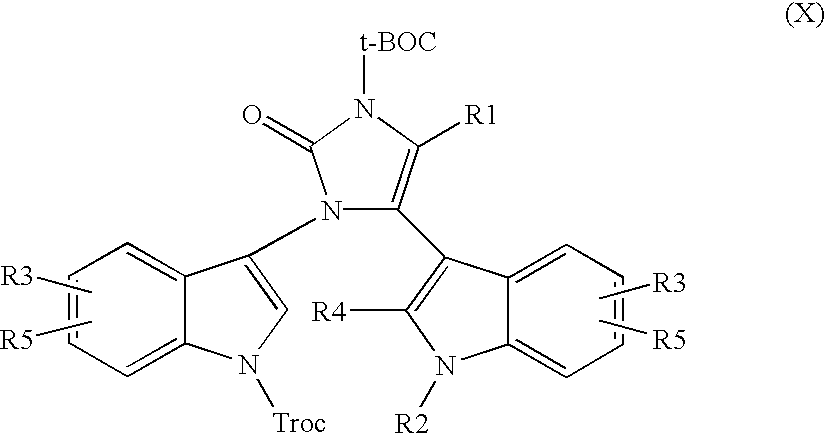
in which R2 is alkyl and R1, R3, R4 and R5 are as defined for formula (II),
followed by subsequent alkylation under standard conditions, with an alkyl carrying a protected amino or hydroxy croup. Selective deprotection of the Troc group may be carried out with cadmium in acetic acid and DMF.
Compounds of formula (X) may be prepared by introducing a Boc group, under standard conditions, to a compound of formula (II) but in which R is H and the Ar group is a Troc protected indole. Such a compound is prepared from a compound of formula (V), but in which R is H and the Ar group is a Troc protected indole.
Persons skilled in the art will appreciate that, in order to obtain compounds of the invention in an alternative, and, on some occasions, more convenient, manner, the individual process steps mentioned herein may be performed in a different order, and/or the individual reactions may be performed at a different stage in the overall route. This will e.g. on factors such as the nature of other functional groups present in a particular substrate, the availability of key intermediates and the protecting group strategy (if any) to be adopted.
Prodrugs and Intermediates
It will also be appreciated by those skilled in the art that, although certain protected derivatives of compounds of formula (I), (II) and (III) which may be made prior to a final deprotection stage, may not possess pharmacological activity as such, they may be administered parenterally or orally and thereafter metabolized in the body to form compounds of the invention which are pharmacologically active. Such derivatives may therefore be described as “prodrugs”. Moreover, certain compounds of formula (I), (II) and (III) may act as prodrugs of other compounds of formula (I), (II) and (III).
All prodrugs of compounds of formula (I) are included within the scope of the present invention.
Novel intermediates as described hereinbefore and their use in the manufacture of other compounds of the present invention also form part of the invention. Thus, according to a further aspect of the invention there is provided compounds of formulae (V) to (X) as defined hereinbefore, or protected derivatives of any of these compounds.
Medical and Pharmaceutical Use
Also provided according to the present invention are compounds of the present invention for use in medical therapy; the use of compounds of the present invention in the manufacture of medicaments for use in medical therapy, and more particularly in the treatment of the conditions described herein; and methods of medical therapy comprising the administration of a therapeutically effective amount of a compound of the present invention to an individual requiring such therapy.
The term ‘medical therapy’ as used herein is intended to include prophylactic, diagnostic and therapeutic regimens carried out in vivo or ex vivo on humans or other mammals.
The compounds of formula (I), (II) and (III) and salts, especially pharmaceutically acceptable salts, and solvates thereof, and solvates of such salts are useful because they demonstrate pharmacological activity. In particular they demonstrate activity as kinase inhibitors, especially PKC inhibitors, e.g. as is shown by their activity in the in vitro assays described in Granet, R. A. et al, Analyt. Biochem. 1987; 163, 458-463; Olsson, H. et al. Cell Signal 1989, 1, 405-410: and Chakravarthy, B. R. et al, Analyt. Biochem. 1991, 196, 144-150.
The compounds of the invention are indicated for use in the treatment of inflammatory, immunological, bronchopulmonary, cardiovascular, oncological or CNS-degenerative disorders; preferably for oral or topical treatment of inflammatory and/or immunological disorders, such as the oral or topical treatment of airway diseases involving inflammatory conditions, e.g. asthma, bronchitis; or atopic diseases, e.g. rhinitis or atopic dermatitis; inflammatory bowel diseases. e.g. Crohn's disease or colitis; autoimmune diseases e.g. multiple sclerosis, diabetes, atherosclerosis, psoriasis, systemic lupus erythematosus or rheumatoid arthritis; malignant diseases, e.g. skin or lung cancer; HIV infections or AIDS; or for inhibiting rejection of organs/transplants. The compounds of the invention are also indicated for use in treatment of heart failure, and in treatment of diabetic patients with macular edema or diabetic retinopathy.
Pharmaceutical Preparations
The dose of the compound to be administered will depend on the relevant indication, the age, weight and sex of the patient and may be determined by a physician. The dosage will preferably be in the range of from 0.01 mg/kg to 10 mg/kg.
The compounds may be administered topically, e.g. to the lung and/or the airways, in the form of solutions, suspensions, HFA aerosols or dry powder formulations, e.g. formulations in the inhaler device known as the Turbuhaler®; or systemically, e.g. by oral administration in the form of tablets, pills, capsules, syrups, powders or granules, or by parenteral administration, e.g. in the form of sterile parenteral solutions or suspensions, or by rectal administration, e.g. in the form of suppositories.
The compounds of the invention may be administered on their own or as a pharmaceutical composition comprising the compound of the invention in combination with a pharmaceutically acceptable diluent, adjuvant and/or carrier. Particularly preferred are compositions not containing material capable of causing an adverse, e.g. an allergic, reaction.
Dry powder formulations and pressurized HFA aerosols of the compounds of the invention may be administered by oral or nasal inhalation. For inhalation the compound is desirably finely divided. The finely divided compound preferably has a mass median diameter of less than 10 μm, and may be suspended in a propellant mixture with the assistance of a dispersant, such as a C8-C20 fatty acid or salt thereof, (e.g. oleic acid), a bile salt, a phospholipid, an alkyl saccharide, a perfluorinated or polyethoxylated surfactant, or other pharmaceutically acceptable dispersant.
The compounds of the invention may also be administered by means of a dry powder inhaler. The inhaler may be a single or a multi dose inhaler, and may be a breath actuated dry powder inhaler.
One possibility is to mix the finely divided compound with a carrier substance, e.g. a mono-, di- or polysaccharide, a sugar alcohol, or another polyol. Suitable carriers are sugars, e.g. lactose, glucose, raffinose, melezitose, lactitol, maltitol, trehalose, sucrose. mannitol; and starch. Alternatively the finely divided compound may be coated by another substance. The powder mixture may also be dispensed into hard gelatin capsules, each containing the desired dose of the active compound.
Another possibility is to process the finely divided powder into spheres which break up during the inhalation procedure. This spheronized powder may be filled into the drug reservoir of a multidose inhaler, e.g. that known as the Turbuhaler® in which a dosing unit meters the desired dose which is then inhaled by the patient. With this system the active compound, with or without a carrier substance, is delivered to the patient.
For oral administration the active compound may be admixed with an adjuvant or a carrier, e.g. lactose, saccharose, sorbitol, mannitol; a starch, e.g. potato starch, corn starch or amylopectin; a cellulose derivative; a binder, e.g. gelatin or polyvinylpyrrolidone, and/or a lubricant, e.g. magnesium stearate, calcium stearate, polyethylene glycol, a wax, paraffin, and the like, and then compressed into tablets. If coated tablets are required, the cores, prepared as described above, may be coated with a concentrated sugar solution which may contain e.g. gum arabic, gelatin, talcum, titanium dioxide, and the like. Alternatively, the tablet may be coated with a suitable polymer dissolved in a readily volatile organic solvent.
For the preparation of soft gelatin capsules, the compound may be admixed with e.g. a vegetable oil or polyethylene glycol. Hard gelatin capsules may contain granules of the compound using either the above mentioned excipients for tablets. Also liquid or semisolid formulations of the drug may be filled into hard gelatin capsules.
Liquid preparations for oral application may be in the form of syrups or suspensions, for example solutions containing the compound, the balance being sugar and a mixture of ethanol, water, glycerol and propylene glycol. Optionally such liquid preparations may contain coloring agents, flavoring agents, saccharine and/or carboxymethylcellulose as a thickening agent or other excipients known to those skilled in art.
The compounds of the invention may also be administered in conjunction with other compounds used for the treatment of the above conditions.
The following Examples are intended to illustrate, but in no way limit the scope of the invention.
All reactions were performed in dried glassware in an argon atmosphere at room temperature, unless otherwise noted. Tetrahydrofuran (THF) was distilled from sodium benzophenone ketyl under N2 prior to use. N,N-Dimethyl formamide (DMF) was distilled from calcium hydride and stored over molecular sieves. All other solvents and reagents were used as received.
Chromatography, unless otherwise stated, was carried out using a Chromatotron® (a centrifugally accelerated, radial preparative chromatograph), the plates used were prepared using Merck Silica Gel PF254 containing gypsum.
1H-NMR spectra were recorded on a Varian Inova-400 or Unity-500+ instrument. The central solvent peak of chloroform-d (δH 7.27 ppm), dimethylsulfoxide-d6 (δH 2.50 ppm) or methanol-d4 (δH 3.35 ppm) were used as internal references. Low-resolution mass spectra were recorded on an Autospec-Q, Fisons Analytical, double focusing sector instrument equipped with a LSIMS interface. Low resolution mass spectra were also obtained on a Hewlett Packard 1 100 LC-MS system equipped with an APCI ionization chamber.
3-(Azidocarbonyl)-1-(2,2,2-trichloroethoxycarbonyl)indole was prepared in 52% yield following the procedure outlined by Suvorov et al. Khimiya Gereotsiklicheskikh Soedinenii, 8 (1975) 1099-1105.
1H-NMR (400 MHz, DMSO-d6): δ 5.27 (2H, s), 7.43 (1H, t, J 7.4 Hz), 7.49 (1H, t, J 7.6 Hz), 8.12 (1H, d, J 7.8 Hz), 8.16 (1H, d, J 8.0 Hz), 8.26 (1H, s).
a) 3-{3-[2-(3-Indolyl)-2-oxoethyl]ureido}-1-(ethoxycarbonyl)indole
A solution of 3-(azidocarbonyl)-1-(ethoxycarbonyl)indole prepared according to Suvorov (ibid) (1.32 g, 5.12 mmol) in benzene (25 ml) was heated to reflux for 7 hours. After cooling to room temperature. THF (25 ml) and [2-(3-indolyl)-2-oxoethyl]ammonium bromide [Oikawa,Y. et al. Heterocycles 12 (1979) 1457-1462] (1.31 g, 5.12 mmol) were added immediately followed by ethyldiisopropylamine (0.89 ml, 5.12 mmol). After stirring for 1.5 hours the formed precipitate was removed by filtration and washed with THF followed by water. The sub-title compound (1.65 g, 79%) was obtained as a white solid after drying.
1H-NMR (500 MHz, DMSO-d6): δ 1.38 (3H, t, J 7.3 Hz), 4.41 (2H, q, J 7.3 Hz), 4.60 (2H, d, J 5.0 Hz), 6.71 (1H, t, J 5.0 Hz), 7.18-7.27 (2H, m), 7.33 (1H, t, J 7.7 Hz), 7.39 (1H, t, J 7.7 Hz), 7.50(1H, d, J 6.6 Hz), 7.72 (1H, d, J 7.5 Hz), 7.83 (1H, s), 8.11 (1H, d, J 8.2 Hz), 8.19 (1H, d, J 6.7 Hz), 8.47 (1H, d, J 3.1 Hz), 9.12 (1H, s), 12.05 (1H, br s, indole NH).
FAB-MS: m/z 429 [MNa+], 405 [MH+].
b) 3-{3-[2-(1-Methyl-3-indolyl)-2-oxoethyl]ureido}-1-(ethoxy-carbonyl)indole
The product of step a) (1.50 g, 3.71 mmol) and K2CO3 (2.05 g, 14.8 mmol) were mixed in dry DMF (25 ml). Methyl iodide (0.25 ml, 4.08 mmol) was added and the reaction allowed to proceed until HPLC showed that the starting material had been consumed, generally after about 3 hours. Aqueous acetic acid (1M, 50 ml) and ethyl acetate (50 ml) were added and the phases separated whereupon the sub-title product precipitated. The organic phase containing the precipitate was washed with water (2×25 ml), filtered off and washed with water to give the sub-title product (0.96 g, 62%) as a white solid after drying.
1H-NMR (500 MHz, DMSO-d6): δ 1.37 (3H, t, J 7.2 Hz), 3.90 (3H, s), 4.41 (2H, q, J 7.1 Hz), 4.57 (2H, d, J 5.2 Hz), 6.73 (1H, br t, J 5.0 Hz), 7.26 (1H, t, J 7.2 Hz), 7.28-7.34 (3H, m), 7.39 (1H, t, J 7.6 Hz), 7.57 (1H, d, J 7.9 Hz), 7.72 (1H, d, J 7.9 Hz), 7.82 (1H, s), 8.10 (1H, br d, J 8.6 Hz), 8.19 (1H, d, J 7.8 Hz), 8.50 (1H, s), 9.13 (1H, s).
c) 1-[1-(Ethoxycarbonyl)-3-indolyl]-5-(1-methyl-3-indolyl)-1,3-dihydroimidazol-2-one
The product of step b) (2.63 g, 6.29 mmol) was suspended in acetic acid (30.0 ml) and heated to 110° C. until all the starting material has been consumed after about 3 hours. The solvent was removed and the residue titurated with diethyl ether to give the sub-title compound (1.84 g, 74%) as an off-white solid.
1H-NMR (400 MHz, DMSO-d6): δ 1.38 (3H, t, J 7.0 Hz), 3.57 (3H, s), 4.44 (2H, q, J 7.0 Hz), 6.77 (1H, br d, J 2.1 Hz), 6.94 (1H, s), 7.00 (1H, t, J 7.3 Hz), 7.10-7.17 (2H, m), 7.21 (1H, d, J 7.6 Hz), 7.30-7.36 (2H, m), 7.57 (1H, d, J 8.0 Hz), 7.78 (1H, s), 8.09 (1H, d, J 8.1 Hz), 10.44 (1H, s).
FAB-MS: 401 [MH+], 801 [MH2+].
d) The sub-title product of step c) (0.17 g, 0.44 mmol) was dissolved in THF (3 ml) and aqueous methyl amine (40%, 3 ml) and stirred for 30 minutes. The solvent was removed and the product precipitated from diethyl ether to give the title compound (0.14 g, 94%) as a slightly brown solid.
1H-NMR (400 MHz, DMSO-d6): δ 3.53 (3H, s), 6.68 (1H, s), 6.71 (1H, s), 6.93 (1H, t, J 7.6 Hz), 6.98 (1H, t, J 7.6 Hz), 7.08 (1H, t, J 7.0 Hz), 7.11 (1H, t, J 7.0 Hz), 7.18 (1H, d, J 7.8 Hz), 7.32 (1H, d, J 8.1 Hz), 7.35-7.39 (2H, m), 7.56 (1H, d, J 7.9 Hz), 10.24 (1H, s), 11.17(1H, br s).
FAB-MS: m/z 329 [MH+], 657 [MH2+].
a) 1-(1-Ethoxycarbonyl-3-indolyl)-5-(3-indolyl)-1,3-dihydroimidazol-2-one
The product of Example 1 a) (0.90 g, 2.23 mmol) was suspended in acetic acid (20.0 ml) and heated to 110° C. until all the starting material had been consumed after about 3.5 hours. The solvent was removed and the residue chromatographed, eluting with CH2Cl2-MeOH (100:10) to give the title compound (0.69 g, 80%) obtained as an off-white solid.
1H-NMR (500 MHz, DMSO-d6): δ 1.37 (3H, t, J 7.1 Hz), 4.44 (2H, q, J 7.1 Hz), 6.80 (1H, d, J 2.4 Hz), 6.82 (1H, d, J 2.6 Hz), 6.99 (1H, t, J 7.6 Hz), 7.07 (1H, t, J 7.6 Hz), 7.14 (1H, t, J 7.4 Hz), 7.19 (1H, d, J 7.8 Hz), 7.29 (1H, d, J 7.9 Hz), 7.32 (1H, d, J 7.7 Hz), 7.60 (1H, d, J 7.9 Hz), 7.80 (1H, s), 8.10 (1H, d, J 8.4 Hz), 10.42 (1H, br d, J 2.2 Hz), 10.94 (1H, br s).
FAB-MS: m/z 387 [MH+].
The product of step a) (0.055 g, 0.143 mmol) was dissolved in THF (1 ml) and aqueous methylamine (40%, 1 ml). The reaction was complete after 1 hour. Solvent removal followed by chromatography on silica eluting with dichloromethane—methanol (100:10), save the title compound (0.028 g, 63%) as a slightly brown solid.
1H-NMR (400 MHz, DMSO-d6): δ 6.53 (1H, d, J 2.7 Hz), 6.76 (1H, d, J 2.5 Hz), 6.93 (1H, t, J 7.3 Hz), 6.98 (1H, t, J 7.2 Hz), 7.06 (1H, t, J 7.6 Hz), 7.09 (1H, t, J 7.7 Hz), 7.17 (1H, d, J 8.1 Hz), 7.26 (1H, d, J 7.3 Hz), 7.39 (1H, d, J 8.3 Hz), 7.41 (1H, d, J 2.9 Hz), 7.62 (1H, d, J 7.9 Hz), 10.23 (1H, br d, J 2.1 Hz), 10.86 (1H, br s), 11.23 (1H, br s).
FAB-MS: m/z 315 [MH+].
a) 3-{3-[2-(3-Indolyl)-2-oxoethyl]ureido}-1-(2,2,2-trichloroethoxycarbonyl)indole
The sub-title product was prepared in 71% yield as a white solid following the procedure of Example 1 a) starting from 3-(azidocarbonyl)-1-(2,2,2-trichloroethoxycarbonyl)indole (see General Methods).
1H-NMR (400 MHz, DMSO-d6): δ 4.58 (2H, d, J 5.2 Hz), 5.18 (2H, s), 6.70 (1H, t, J 5.0 Hz), 7.14-7.21 (2H, m), 7.34 (1H, t, J 7.4 Hz), 7.39 (1H, t, J 8.1 Hz), 7.43-7.48 (1H, m), 7.72 (1H, d, J 7.6 Hz), 7.89 (1H, s), 8.09-8.17 (2H, m), 8.43 (1H, br d, J 2.6 Hz), 9.19 (1H, s), 12.01 (1H, br s, indole NH).
b) 3-{3-[2-(1-Methyl-3-indolyl)-2-oxoethyl]ureido}-1-(2,2,2-trichloroethoxycarbonyl)indole
The sub-title compound, obtained as a white solid, was prepared in 63% yield following the procedure of Example I b) starting from the product of step a).
1H-NMR (400 MHz, DMSO-d6): δ 3.89 (3H, s), 4.59 (2H, d, J 5.0 Hz), 5.23 (2H, s), 6.84 (1H, t, J 5.0 Hz, NH), 7.26 (1H, t, J 7.2 Hz), 7.33 (1H, t, J 6.9 Hz), 7.39 (1H, t, J 7.1 Hz), 7.44 (1H, t, J 7.7 Hz), 7.57 (1H, d, J 8.1 Hz), 7.79 (1H, d, J 7.6 Hz), 7.93 (1H, s), 8.16 (1H, d, J 8.2 Hz), 8.20 (1H, d, J 7.7 Hz), 8.51 (1H, s), 9.30 (1H, s).
c) 5-(1-Methyl-3-indolyl)-1-[1-(2,2,2-trichloroethoxycarbonyl)-3-indolyl]-1,3-dihydroimidazol-2-one
The sub-title product, obtained as an off-white solid, was prepared in 86% yield following the procedure in Example 1 c) starting from the product of step b). The product was precipitated from diethyl ether.
1H-NMR (400 MHz, DMSO-d6): δ 3.60 (3H, s), 5.24 (2H, s), 6.77 (1H, s), 6.97 (1H, t, J 7.8 Hz), 7.03 (1H, s), 7.11 (1H, t, J 7.8 Hz), 7.21 (1H, t, J 7.4 Hz), 7.30-7.41 (3H, m), 7.49 (1H, d, J 8.0 Hz), 7.70 (1H, s), 8.13 (1H, d, J 8.3 Hz), 10.48 (1H, s).
FAB-MS: mi/z 503 [MH+].
d) 1-(tert-Butoxycarbonyl)-4-(1-methyl-3-indolyl)-3-[1(2,2,2-trichloroethoxycarbonyl)-3-indolyl]-1,3-dihydroimidazol-2-one
The product of step c) (0.10 g, 0.20 mmol), di-tert-butyl dicarbonate (0.054 g, 0.25 mmol) and a catalytic amount of 4-N,N-dimethylaminopyridine in dry THF (3 ml) was stirred for 5 minutes at room temperature. Removal of the solvent and chromatographic purification on silica, eluting with heptane—ethyl acetate (60:40), gave the sub-title product (0.11 g, 94%) as a slightly brown solid.
1H-NMR (500 MHz, CDCl3): δ 1.66 (9H, s), 3.59 (3H, s), 5.01 (2H, s), 6.66 (1H, s), 7.04 (1H, s), 7.16 (1H, dt, J 2.5, 6.0 Hz), 7.21 (1H, t, J 7.6 Hz), 7.25-7.27 (2H, m), 7.33-7.42 (2H, m), 7.67 (1H, d, J 7.9 Hz), 7.71 (1H, s), 8.23 (1H, br d, J 8.2 Hz).
FAB-MS: m/z 602 [MH+], 625 [MNa+].
e) 1-(tert-Butoxycarbonyl)-4-(1-methyl-3-indolyl)-3-(3-indolyl)-1,3-dihydroimidazol-2-one
The product of step d) (0.21 g, 0.34 mmol), zink powder (0.23 g, 3.44 mmol) and cadmium(II) chloride (0.020 g, 0.086 mmol) was suspended in DMF (4 ml) and acetic acid (4 ml). The suspension was stirred for 1 hour at room temperature, ethyl acetate (10 ml) and water (20 ml) were added and the phases separated. The organic phase was washed with water (3×5 ml), dried over Na2SO4. Solvent removal followed by chromatographic purification on silica, eluting with ethyl acetate, gave the sub-title product (0.12 g, 81%) as a colourless solid.
1H-NMR (500 MHz, CDCl3): δ 1.69 (9H, s), 3.40 (3H, s), 6.32 (1H, s), 6.84 (1H, br t, J 2.3 Hz), 6.92-7.00 (2H, m), 7.04-7.09 (2H, m), 7.16-7.26 (3H, m), 7.29-7.33 (1H, m), 7.75 (1H, dt, J 1.4, 2.3 Hz), 9.43 (1H, br s).
FAB-MS: m/z 428 [MH+], 451 [MNa+].
f) 1-(tert-Butoxycarbonyl)-3-{1-[4-(1,3-Dioxo-1,3-dihydro-isoindol-2-yl)-butyl]-3-indolyl}-4-(1-methyl-3-indolyl)-2,3-dihydroimidazole-2-one
The product of step e) (0.034 g, 0.080 mmol), N-(4-bromobutyl)phthalimide (0.028 g, 0.10 mmol) and sodium hydride (95%, 0.0024 g, 0.10 mmol) was dissolved in dry DMF (0.5 ml). After stirring at room temperature for 1.5 hour HPLC shows complete reaction. The reaction was quenched by addition of aqueous acetic acid (1 M, 2 ml) and ethyl acetate (2 ml). The phases were separated and the organic phase washed with water (1×2 ml). Solvent removal followed by chromatographic purification on silica, eluting with heptane—ethyl acetate (20:80), furnished the sub-title product (0.019 g, 38%) as a slightly brown solid.
1H-NMR (500 MHz, CDCl3): δ 1.61 (9H, s), 1.64-1.79 (4H, m), 3.56 (3H, s), 3.67 (2H, t, J 6.5 Hz), 3.71 (2H, t, J 6.7 Hz), 6.87 (1H, s), 6.97 (1H, s), 7.02 (1H, t, J 7.6 Hz), 7.10-7.18 (2H, m), 7.31 (1H, t, J 7.1 Hz), 7.35 (1H, d, J 8.2 Hz), 7.60 (1H, d, J 8.1 Hz), 7.77 (1H, s), 7.80-7.88 (4H, m), 8.06 (1H, d, J 8.3 Hz).
FAB-MS: m/z 629 [MH+].
g) The product of step f) (0.018 g, 0.029 mmol) was dissolved in THF (0.25 ml) and aqueous methyl amine (40%, 0.25 ml) and stirred for 1 hour. HPLC showed complete deprotection. Solvent removal and purification by preparative HPLC, (C18-reversed phase, acetonitrile—water—trifluoroacetic acid (30:70:0.1) gave the title product (0.0082 g, 54%) as pale yellow solid after freez drying.
1H-NMR (400 MHz, CD3OD): δ 1.79 (2H, p, J 7.8 Hz), 1.95 (2H, p, J 7.8 Hz), 3.04 (2H, t, J 7.8 Hz), 3.50 (3H, s), 3.89 (2H, t, J 6.8 Hz), 6.48 (1H, s), 7.00 (1H, t, J 7.9 Hz), 7.05 (1H, t, J 7.0 Hz), 7.13-7.19 (2H, m), 7.24 (1H, d, J 8.0 Hz), 7.26-7.30 (2H, m), 7.42 (1H, d, J 8.2 Hz), 7.62 (1H, d, J 8.0 Hz).
FAB-MS: m/z 400 [MH+].
a) 3-[3-(2-{1-[3-(1,3-Dioxo-1,3-dihydroisoindol-2-yl)-propyl]-3-indolyl}-2-oxo-ethyl)ureido]-1-(ethoxycarbonyl)indole
The sub-title product, obtained as a white solid, was prepared in 63% yield following the procedure of Example 1 b) starting from the product of Example 1 a) and N-(3-bromopropyl)phthalimide.
1H-NMR (400 MHz, DMSO-d6): δ 1.37 (3H, t, J 7.1 Hz), 2.18 (2H, p, J 7.1 Hz), 3.66 (2H, t, J 6.7 Hz), 4.34-4.44 (4H, m), 4.57 (2H, d, J 5.0 Hz), 6.71 (1H, br t, J 5.0 Hz), 7.22-7.40 (4H, m), 7.66 (1H, d, J 8.0 Hz), 7.71 (1H, d, J 7.7 Hz), 7.80-7.89 (5H, m), 8.09 (1H, br d, J 8.2 Hz), 8.17 (1H, d, J 8.0 Hz), 8.57 (1H, s), 9.12 (1H, s).
FAB-MS: m/z 592 [MH+].
b) 5-(1-[3-{1,3-Dioxo-1,3-dihydroisoindol-2-yl}-propyl]-3-indolyl)-1-[1-(ethoxycarbonyl)-3-indolyl]-1,3-dihydroimidazol-2-one
The sub-title product, obtained as an off-white solid, was prepared in 99% yield following the procedure of Example 1 c) starting from the product of step a). The product was precipitated from diethyl ether.
1H-NMR (500 MHz, DMSO-d6): δ 1.30 (3H, t, J 7.1 Hz), 1.69 (2H, p, J 6.6 Hz), 2.91 (2H, t, J 6.8 Hz), 4.01 (2H, t, J 6.5 Hz), 4.35 (2H, q J 7.1 Hz), 6.83 (1 H, d, J 2.4 Hz), 7.02 (1H, t, J 7.1 Hz), 7.03-7.09 (2H, m), 7.10 (1H, s), 7.13 (2H, t, J 7.5 Hz), 7.40 (1H, d, J 8.2 Hz), 7.66 (1H, d, J 8.0 Hz), 7.80 (1H, s), 7.85 (4H, s), 7.90 (1H, d, J 8.4 Hz), 10.46 (1H, s).
FAB-MS: 574 [MH+], 1147 [MH2+].
c) The title product, obtained as an off-white solid, was prepared in 66% yield following the procedure of Example 3 f) starting from the product of step b). The product was purified by chromatography on silica, eluting with dichloromethane—methanol—ammonium hydroxide (80:20:2), the free base was treated with diluted trifluoroacetic acid before lyophilisation.
1H-NMR (500 MHz, DMSO-d6): δ 1.76 (2H, p, J 7.3 Hz), 2.47 (2H, p, J 6.7 Hz), 4.00 (2H, t, J 6.8 Hz), 6.71 (1H, s), 6.73 (1H, d, J 2.5 Hz), 6.90 (1H, t, J 7.1 Hz), 7.0 (1H, t, J 7.4 Hz), 7.06 (1H, t, J 7.4 Hz), 7.10-7.14 (2H, m), 7.36-7.39 (2H, m), 7.41 (1H, d, J 8.3 Hz), 7.58 (1H, d, J 8.1 Hz), 7.64 (3H, br s, NH 3), 10.29 (1H, s), 11.17 (1H, s).
FAB-MS: m/z 372 [MH+].
a) 1-[2-(3-Indolyl)-2-oxoethyl]-3-(1-naphthyl)urea
[2-(3-indolyl)-2-oxoethyl]ammonium bromide (2.00 g, 7.84) was suspended in dry THF (20 ml). Ethyldiisopropylamine (1.40 ml, 7.84 mmol) was added followed by 1-naphthyl-isocyanate (1.13 ml, 7.84 ml). After stirring for 1 hour the formed precipitate was removed by filtration and washed with THF followed by water to give the sub-title product (2.33 g, 87%) as a white solid after drying.
1H-NMR (400 MHz, DMSO-d6): δ 4.63 (2H, s), 7.11 (1H, br t, J 4.8 Hz), 7.19-7.27 (2H, m), 7.43 (1 H, t, J 8.0 Hz), 7.48-7.60 (4H, m), 7.90 (1 H, d, J 7.7 Hz), 8.05 (1H, d, J 7.7 Hz), 8.18-8.25 (2H, m), 8.49 (1H, br d, J 2.9 Hz), 8.94 (1H, s), 12.06 (1H, br s).
FAB-MS: m/z 344 [MH+].
b) 1-[2-(1-[3-(1,3-Dioxo-1,3-dihydroisoindol-2-yl)-propyl]-3-indolyl)-2-oxoethyl]-3-(1-naphthyl)urea
The sub-title product, obtained as a white solid, was prepared in 85% yield following the procedure of Example 1 b) starting from the product of step a) and N-(3-bromopropyl)-phthalimide.
1H-NMR (400 MHz, DMSO-d6): δ 2.19 (2H, p, J 6.9 Hz), 3.67 (2H, t, J 6.7 Hz), 4.37 (2H, t, J 7.3 Hz), 4.61 (2H, d, J 4.8 Hz), 7.11 (1H, br t, J 4.8 Hz), 7.22-7.32 (2H, m), 7.42 (1H, t, J 8.0 Hz), 7.49-7.59 (3H, m), 7.66 (1H, d), 7.80-7.91 (5H, m), 8.04 (1H, d), 8.18-8.22 (2H, m), 8.58 (1H, s), 8.93 (1H, s).
FAB-MS: m/z 531 [MH+].
c) 5-[1-(1,3-Dioxo-1,3-dihydro-isoindol-2-yl)-propyl]-3-indolyl]-1-(1-naphthyl)-1,3-dihydroimidazol-2-one
The sub-title product, obtained as an off-white solid, was prepared in 60% yield following the procedure of Example 1 c) starting from the product of step b).
1H-NMR (400 MHz, DMSO-d6): δ 1.68 (2H, p, J 6.7 Hz), 3.10 (2H, dp, J 7.1, 38.8 Hz), 3.91 (2H, t, J 6.7 Hz), 6.47 (1H, s), 6.68 (1H, d, J 2.4 Hz), 6.98 (1H, t, J 7.4 Hz), 7.08 (1H, t, J 7.8 Hz), 7.31-7.45 (3H, m), 7.46-7.62 (4H, m), 7.81-7.91 (6H, m), 10.46 (1H, br s).
FAB-MS: m/z 513 [MH+].
d) The title compound, obtained as an off-white solid, was prepared in 77% yield following the product of Example 3 f) starting from the product of step c). The product was purified by chromatography on silica, eluting with dichloromethane—methanol—ammonium hydroxide (80:20:2).
1H-NMR (400 MHz, CD3OD): δ 1.77 (2H, p, J 7.4 Hz), 2.29-2.44 (2H, m), 3.88 (2H, t, J 6.7 Hz), 6.26 (1H, s), 6.87 (1H, s), 7.05 (1H, t, J 7.2 Hz), 7.14 (1H, t, J 7.2 Hz), 7.26 (1H, d, J 8.3 Hz), 7.37-7.54 (4H, m), 7.62 (2H, d, J 8.1 Hz), 7.90 (1H, d, J 8.1 Hz), 7.93 (1H, d, J 8.1 Hz).
FAB-MS: m/z 383 [MH+].
a) 1-[2-(3-Indolyl)-2-oxoethyl]-3-(3-benzo[b]thiophenyl)urea
The sub-title compound was prepared in 85% yield as a white solid following the procedure of Example 1 a) starting from 3-azidocarbonyl-benzo[b]thiophene [Galvez. C. et al. Synthesis (1983) 932-933].
1H-NMR (400 MHz, DMSO-d6): δ 4.63 (2H, d, J 4.9 Hz), 6.88 (1H, t, J 4.9 Hz), 7.19-7.22 (2H, m), 7.34-7.54 (4H, m), 7.95 (2H, t, J 8.0 Hz), 8.17-8.22 (1H, m), 8.49 (1H, d, J 2.9 Hz), 9.24 (1H, s), 12.06 (1H, s).
b) 3-[3-(2-{1-[3-(1,3-Dioxo-1,3-dihydroisoindol-2-yl)-propyl]-3-indolyl}-2-oxo-ethyl)ureido]-benzo[b]thiophene
The sub-title product, obtained as a white solid, was prepared in quantitative yield following the procedure of Example 1 b) starting from the product of step a) and N-(3-bromopropyl)phthalimide.
1H-NMR (500 MHz, DMSO-d6): δ 2.19 (2H, p, J 7.1 Hz), 3.66 (2H, t, J 6.9 Hz), 4.37 (2H, t, J 7.1 Hz), 4.60 (2H, d, J 5.1 Hz), 6.87 (1H, t, J 5.1 Hz), 7.26 (2H, dt, J 7.6, 20.4 Hz), 7.39 (1H, t, J 7.5 Hz), 7.46 (1H, t, J 7.9 Hz), 7.62 (1H, s)7.66 (1H, d, J 7.9 Hz), 7.81-7.89 (4H, m) 7.94 (2H, t, J 7.7 Hz), 8.18 (1H, d, J 7.1 Hz), 8.58 (1H, s), 9.23 (1H, s).
FAB-MS: m/z 537.1 [MH+].
c) 5-[1-(1,3-Dioxo-1,3-dihydroisoindol-2-yl)-propyl]-3-indolyl]-1-(3-benzo[b]thiophenyl)-1,3-dihydroimidazol-2-one
The sub-title product, obtained as an off-white solid, was prepared in 30% yield following the procedure of Example 1 c) starting from the product of step b).
1H-NMR (500 MHz, CDCl3): δ 1.89 (2H, p, J 6.7 Hz), 3.29 (2H, t, J 6.7 Hz), 3.94 (2H, t, J 6.7 Hz), 6.53 (1H, s), 6.66 (H, s), 7.12 (1H, t, J 7.5 Hz), 7.15-7.32 (4H, m), 7.55 (1H, s), 7.61 (2H, dd, J 8.1, 12.2 Hz), 7.70-7.78 (3H, m), 7.82-7.90 (2H, m), 10.93 (1H, s).
FAB-MS: m/z 519.1 [MH+].
d) The title compound, obtained as an off-white solid, was prepared in 50% yield following the procedure of Example 3 f) starting from the product of step c). The product was purified by chromatography on silica, eluting with dichloromethane—methanol—ammonium hydroxide (80:20:2).
1H-NMR (500 MHz, DMSO-d6): δ 1.50 (2H, p, J 6.7 Hz), 1.86 (3H, s), 2.10 (2H, t, J 6.7 Hz), 3.97 (2H, t, J 6.7 Hz), 6.63 (1H, s), 6.83 (1H, s), 6.99 (1H, t, J 7.1 Hz), 7.10 (1H, t, J 7.1 Hz), 7.28 (1H, t, J 7.6 Hz), 7.32-7.40 (3H, m), 7.57 (1H, d, J 7.9 Hz), 7.82 (1H, s), 7.98 (1H, s, J 7.9 Hz), 10.44 (br s, 1H).
FAB-MS: m/z 389.1 [MH+].
The title product, obtained as an off-white solid, was prepared following the procedure of Example 4 starting from N-[3-(bromomethyl)benzyl]phthalimide.
1H-NMR (400 MHz, CD3OD): δ 3.90 (2H, s), 5.05 (2H, s), 6.51 (1H, d, J 7.3 Hz), 6.60 (1H, s), 6.77 (1H, s), 6.84-6.97 (2H, m), 6.99-7.18 (5H, m), 7.18-7.26 (2H, m), 7,31 (1H, s), 7.34 (1H, d, J 8.5 Hz), 7.64 (1H, br d, J 8.0 Hz).
FAB-MS: m/z 434 [MH+].
a) 3-{3-[(2S)-1-(3-Indolyl)-1-oxo-2-proyl]ureido}-1-(ethoxycarbonyl)indole
The sub-title compound was prepared in 50% yield as a white solid following the procedure of Example 1 a) starting from 2S-[1-(3-indolyl)-1-oxopropyl]-2-ammonium chloride.
1H-NMR (400 MHz, DMSO-d6): δ 1.37 (3H, t, J 6.7 Hz), 1.41 (3H, d, J 7.0 Hz), 4.40 (2H, q, J 7.0 Hz), 5.21 (1H, p, J 7.3 Hz), 6.86 (1H, d, J 7.6 Hz), 7.19-7.27 (2H, m), 7.32 (1H, t, J 7.4 Hz), 7.38 (1H, t, J 7.5 Hz), 7.50 (1H, d, J 6.8 Hz), 7.67 (1H, d, J 7.7 Hz), 7.81 (1H, s), 8.10 (1H, br d, J 7.8 Hz), 8.21 (1H, d, J 7.3 Hz), 8.53 (1H, d, J 3.2 Hz), 8.99(1H, s), 12.11 (1H, br s, indole NH).
FAB-MS: m/z 419 [MH+].
b) The title compound, obtained as a yellow solid, was prepared following the procedure of Example 4 starting from the product of step a). The product was purified by chromatography on silica, eluting with dichloromethane—methanol—ammonium hydroxide (80:20:2), followed by purification by preparative HPLC, C18-reversed phase, acetonitrile—water—trifluoroacetic acid (30:70:0.1).
1H-NMR (500 MHz, CD3OD): δ 1.89 (2H, dt, J 6.8, 15.7 Hz), 2.12 (3H, s), 2.38 (2H, br t, J 8.2 Hz), 4.08 (2H, t, J 6.6 Hz), 6.86 (1H, t, J 7.6 Hz), 6.88 (1H, s), 7.01 (1H, t, J 7.3 Hz), 7.03 (1H, t, J 7.7 Hz), 7.13 (1H, t, J 7.9 Hz), 7.17 (1H, s), 7.19 (1H, d, J 7.9 Hz), 7.28 (1H, d, J 8.2 Hz), 7.31 (1H, d, J 8.2 Hz), 7.39 (1H, d, J 8.0 Hz).
The title compound, obtained as an off-white solid, was prepared following the procedure of Example 4 starting from O-acetyl-3-brompropanol.
1H-NMR (400 MHz, CDCl3): δ 1.61 (2H, p, J 6.2 Hz), 2.77 (2H, t, J 5.7 Hz), 3.95 (2H, t, J 6.4 Hz), 6.41 (1H, s), 6.68 (1H, d, J 2.2 Hz), 7.00 (1H, t, J 7.3 Hz), 7.12-7.37 (7H, m), 7.73 (1H, d, J 7.7 Hz), 8.57 (1H, br s), 8.74 (1H, br s).
FAB-MS: m/z 473.1 [MH+].
The title compound, obtained as a off-white solid, was prepared following the procedure of Example 2 starting from 2-(8-acetoxymethyl-6,7,8,9-tetrahydropyrido[1,2-a]indol-10-yl)-2-oxoethylammonium chloride, which latter compound was prepared according to the procedure described by Bergman et al. Tetrahedron 29 (1973) 971-976, starting from acetic acid 6,7,8,9-tetrahydropyridol[1,2-a]indol-8-ylmethyl ester.
1H-NMR (500 MHz, CDO3D): δ 1.55-1.66 (1H, m), 1.70-1.79 (1H, m), 2.05-2.21 (2H, m), 2.91 (1H, dd, J 3.9, 16.4 Hz), 3.33-3.40 (2H, m), 3.72 (1H, dt, J 5.0, 11.6 Hz), 4.13-4.19 (1H, m), 5.50 (1H, s), 6.56 (1H, s), 6.89-6.96 (2H, m), 6.97-7.07 (3H, m), 7.18 (1H, d, J 8.1 Hz), 7.23-7.35 (3H, m).
FAB-MS: m/z 399 [MH+].
The title compound was prepared following the procedure outlined in Example 3 starting from the product of Example 3 e) and N-[3-(bromomethyl)benzyl]phthalimide.
FAB-MS: m/z 448 [MH+].
The product from Example 9 (0.062 g, 0.16 mmol), pyridine (0.4 mol) and methanesulphonic anhydride (0.037 g, 0.21 mmol) was dissolved in dichloromethane (30 ml) and stirred for 4 hours at room temperature. The reaction was quenched by treatment of the organic phase with sulfuric acid (1 M, 40 ml). The phases were separated and the organic phase washed with brine (1×40 ml) and dried over Na2SO4. After removal of the solvent in vacuu the crude methanesulphonate was used directly.
The crude methanesulphonate was treated with thiourea (0.025 g, 0.33 mmol) in refluxing absolute ethanol (40 ml) for 18 hours. The solvent was removed and the residue purified by chromatograph on silica. eluting with dichlormethane—methanol—triethylamine (first 90:10:1 then 80:20:1), to give the 5-[1-(3-Amidinothiopropyl)-3-indolyl]-1-(3-indolyl)-1,3-dihydroimidazol-2-one (0.018 g, 25%).
The product was converted to the title compound by dissolving it in acetic acid (1 M) followed by lyophilization.
1H-NMR (400 MHz, DMSO-d6): δ 1.69 (2H, p, J 7.1 Hz), 2.46 (2H, t, J 7.3 Hz), 3.97 (2H, t, J 7.0 Hz), 6.64 (1H, s), 6.75 (1H, s), 6.86 (1H, t, J 7.4 Hz), 6.97-7.15 (4H, m), 7.37 (2H, dd, J 8.2 Hz), 7.41 (1H, s), 7.59 (1H, d, J 8.1 Hz), 10.26 (1H, s), 11.21 (1H, s).
FAB-MS: m/z 431 [MH+].
The title compound was prepared following the procedure of Example 12 starting from the product of Example 10.
1H-NMR (500 MHz, CDO3D): δ 1.66-1.78 (1H, m), 1.84-1.94 (1H, m), 2.15-2.28 (2H, m), 2.91 (1H, dd, J 7.6, 13.4 Hz), 3.00-3.07 (1H, m), 3.12 (1H, dd, J 7.0, 13.2 Hz), 3.76 (1H, dt, J 5.1, 11.5 Hz), 4.16-4.23 (1H, m), 6.59 (1H, s), 6.93 (1H, t, J 7.8 Hz), 6.98 (1H, t, J 7.8 Hz), 7.03-7.08 (3H, m), 7.21 (1H, d, J 8.0 Hz), 7.28 (2H, d, J 8.4 Hz), 7.38 (1H, d, J 8.0 Hz).
FAB-MS: m/z 457 [MH+].
The title compound was prepared in 88% yield following the procedure of Example 2 a) starting from the product of Example 8 a).
1H-NMR (400 MHz, DMSO-d6): δ 1.33 (3H, t, J 7.1 Hz), 1.98 (3H, s), 4.39 (2H, q, J 7.1 Hz), 6.90 (1H, t, J 7.3 Hz), 7.01 (1H, t, J 7.9 Hz), 7.09 (1H, t, J 7.4 Hz), 7.18 (1H, d, J 2.6 Hz), 7.23-7.32 (4H, m), 7.58 (1H, s), 7.98 (1H, d, J 8.7 Hz), 10.38 (1H, s, NH), 11.10 (1H, br s, indole NH).
FAB-MS: m/z 401 [MH+].
The title product was prepared following the procedure of Example 2 starting from the product of Example 14. The product was precipitated from diethyl ether.
1H-NMR (400 MHz, DMSO-d6): δ 1.97 (3H, s), 6.87 (2H, t, J 7.6 Hz), 6.96-77.03 (2H, m), 7.17-7.21 (2H, m), 7.25 (2H, t, J 6.8 Hz), 7.28 (1H, d, J 8.4 Hz), 10.16 (1H, s, NH), 10.95 (1H, s, indole NH), 11.02 (1H, s, indole NH).
FAB-MS: m/z 329 [MH+].
The title compound, obtained as an off-white solid, was prepared in 57% yield following the procedure of Example 2 a) starting from the product of Example 5 a).
1H-NMR (400 MHz, DMSO-d6): δ 6.21 (1H, d, J 2.8 Hz), 6.92 (1H, d, J 2.4 Hz), 6.98 (1H, t, J 6.9 Hz), 7.05 (1H, t, J 6.9 Hz), 7.23 (1H, d., J 8.0 Hz), 7.46-7.59 (5H, m), 7.65 (1H, d, J 7.9 Hz), 8.00 (2H, d, J 7.5 Hz), 10.45 (1H, br s), 10.79 (1H, br s).
FAB-MS: m/z 325 [MH+].
The title compound, obtained as a off-white solid, was prepared in 80% yield following the procedure of Example 2 a) starting from the product of Example 6 a).
1H-NMR (400 MHz, CDCl3): δ 6.41 (1H, s), 6.72 (1H, s), 7.11-7.23 (2H, m), 7.27-7.39 (3H, m), 7.43 (1H, s), 7.62 (2H, t, J 7.7 Hz), 7.82 (1H, d J 7.8 Hz), 8.04 (1H, s), 10.42 (1H,
FAB-MS: m/z 332.0 [MH+].
The title compound was prepared following the procedure of Example 2 a) starting from [2-(5-methoxy-3-indolyl)-2-oxoethyl]ammonium chloride.
1H-NMR (500 MHz, DMSO-d6): δ 1.35 (3H, t, J 7.2 Hz), 3.55 (3H, s), 4.41 (2H, q, J 7.3 Hz), 6.65 (1H, d, J 9.2 Hz), 6.75 (1H, s), 6.85 (1H, s), 6.92 (1H, s), 7.15-7.18 (2H, m), 7.27 (1H, d, J 7.8 Hz), 7.33 (1H t, J 7.1 Hz), 7.73 (1H, s), 8.08 (1H, d, J 9.0 Hz), 10.40 (1H,s), 10.84 (1H, s).
FAB-MS: m/z 417 [MH+].
The title product was prepared as described in Example 9 starting from 2-amino-3-(3-indolyl)-3-oxo-propionic acid methyl ester hydrochloride and 3-azidocarbonyl-benzo-[b]thiophene.
1H-NMR (400 MHz, CD3OD): δ 3.68 (3H, s), 3.88 (2H, s), 5.21 (2H, s), 6.48 (1H, d J 7.2), 6.93 (1H, t J 8.0), 6.98-7.06 (2H, m) 7.09-7.25 (6H, m), 7.26-7.34 (2H, m), 7.45 (1H, d J 7.8), 7.57 (1H, s), 7.78 (1H, d J 8.8).
FAB-MS: m/z: 509.1 [MH+].
The title compound was prepared as described in Example 16 starting from 2-amino-3-(3-indolyl)-3-oxo-propionic acid ethyl ester hydrochloride.
1H-NMR (500 MHz, CDCl3): δ 0.98 (3H, t J 7.1 Hz), 3.49 (3H, s), 4.11-4.20 (2H, m), 6.60 (1H, s), 7.02-7.07 (1H, m), 7.15 (2H, d, J 4.2), 7.30-7.39 (3H, m), 7.46-7.53 (2H, m), 7.74-7.87 (3H, m), 8.87 (1H, br s).
FAB-MS: m/z: 412.2 [MH+], 823.2 [MH2+], 845.1 [MNa2+].
The title product was prepared following the procedure of Example 2 starting from 2-amino-3,3,3-trifluoro-1-(3-indolyl)-propan-1-one.
1H-NMR (500 MHz, DMSO-d6): δ 6.87-6.93 (2H, m), 7.01 (2H, q, J 7.2 Hz), 7.21-7.27 (3H, m), 7.30-7.36 (3H, m), 11.09 (1H, s), 11.25 (1H, s), 11.45 (1H, s).
FAB-MS: m/z 383 [MH+].
The title product was prepared following the procedure of Example 2 starting from 2-amino-1-(3-indolyl)-2-phenylethanone hydrochloride.
1H-NMR (400 MHz, DMSO-d6): δ 6.82 (1H, t, J 7.3 Hz), 6.90 (1H, t, J 7.3 Hz), 6.96-7.05 (2H, m), 7.05-7.18 (4H, m), 7.20 (1H, s), 7.22-7.31 (6H, m), 10.87 (1H, s), 11.01 (1H, br s), 11.11 (1H, br s).
FAB-MS: m/z 391 [MH+].
The title product was prepared following the procedure of Example 4 starting from 2-amino-1-(3-indolyl)-2-phenylethanone hydrochloride.
1H-NMR (400 MHz, CD3OD): δ 1.87 (2H, dt, J 6.7, 15.4 Hz), 2.33 (2H, t, J 8.3 Hz), 4.10 (2H, t, J 8.3 Hz), 6.87-6.95 (2H, m), 6.97 (1H, s), 7.06 (1H, t, J 7.6 Hz), 7.11 (1H, t, J 7.6 Hz), 7.14-7.25 (6H, m), 7.28-7.37 (4H, m).
FAB-MS: m/z 448 [MH+].
The title compound was prepared following the procedure of Example 2 starting from 3-(N,N-dimethylamino)propyl chloride hydrocloride and the product of Example 1 a).
1H-NMR (500 MHz, CD3OD): δ 1.81 (2H, p, J 7.6 Hz), 1.94 (3H, s), 2.45 (6H, s), 3.98 (2H, t, J 6.6 Hz), 6.58 (1H, s), 6.78 (1H, s), 6.95 (1H, t, J 7.6 Hz), 7.08-7.13 (2H, 7.16-7.22 (2H, m), 7.34 (1H, d, J 8.1 Hz), 7.35 (1H, s), 7.40 (1H, d, J 8.7 Hz), 7.67 (1H, d, J 8.3 Hz).
FAB-MS: m/z 400 [MH+].
The title compound was prepared following the procedure of Example 5 starting from 4-phenoxyphenyl isocyanate.
1H-NMR (500 MHz, CDCl3): δ 1.93 (3H, s), 2.09 (2H, p, J 7.8 Hz), 2.79 (2H, t, J 8.1 Hz), 4.21 (2H, t, J 6.7 Hz), 6.65 (1H, s), 6.89 (4H, d, J 8.7 Hz), 6.92 (1H, s), 7.02 (1H, t, J 6.7 Hz), 7.09 (1H, t, J 6.7 Hz), 7.17-7.22 (3H, m), 7.31 (2H, t, J 8.0 Hz), 7.37 (1H, d, J 8.0 Hz), 7.41 (1H, d, J 8.0 Hz).
FAB-MS: m/z 425 [MH+].
The title compound was prepared following the procedure outlined in Example 3 starting from 2-amino-3-(1-methyl-3-indolyl)-3-oxopropionic acid ethyl ester hydrochloride (von Geldern et al, J. Med. Chem. 39 (1996) 957-967).
1H-NMR (400 MHz, CDCl3): 0.70 (3H, t, J 7.1 Hz), 1.57 (2H, p, J 7.6 Hz), 1.84 (2H, p, J 7.6 Hz), 2.71 (2H, t, J 7.4 Hz), 3.50 (3H, s), 4.00 (2H, q, J 6.9 Hz), 4.23 (2H, t, J 7.1 Hz), 6.72 (1H, s), 6.73 (1H, s), 6.96 (1H, t, J 7.8 Hz), 7.01-7.09 (2H, m), 7.11-7.19 (3H, m), 7.26 (1H, d, J 8.1 Hz), 7.37 (1H, d, J 7.8 Hz), 9.46 (1H, bs). (obtained for the free amine)
FAB-MS m/z: 472.2 [MH+].
The title compound was prepared following the procedure outlined in Example 4 starting from 2-amino-3-(1-methyl-3-indolyl)-3-oxopropionic amide hydrochloride prepared in analogy with von Geldern et al. (ibid).
1H-NMR (400 MHz, DMSO-d6): δ 0.95-1.08 (2H, m), 1.48-1.58 (2H, m), 2.43-2.47 (2H, m), 4.03 (2H, t, J 6.3 Hz), 6.95 (1H, t, J 8.2 Hz), 7.10 (1H, t, J 8.2 Hz), 7.21-7.33 (3H, m), 7.35-7.45 (3H, m), 7.86-7.94 (2H, m).
FAB-MS m/z: 428.0 [MH+].
a) 2-(N-tert-Butoxycarbonylamino)-1-{1-[3-(1,3-dioxo-1,3-dihydroisoindol-2-yl)-propyl]-3-indolyl}-3-phenyl-1-propanone
2-(N-tert-butoxycarbonylamino)-1-{1-[3-(1,3-dioxo-1,3-dihydroisoindol-2-yl)-propyl]-3-indolyl}-1-ethanone (0.30 g, 0.65 mmol) was dissolved in dry THF (7.5 ml) and cooled to −10° C. Sodium bis(trimethylsilyl)amide (0.65 ml, 1 M in THF, 0.65 mmol) was added and the resulting yellow solution stirred for 15 minutes. Benzylbromide (0.16 ml, 1.30 mmol) was added and the stirring continued for 15 minutes at −10° C., the cooling bath was removed and stirring continued for 4 hours. Saturated NH4Cl(aq) was added followed by removal of the aqueous phase. The organic solvent was evaporated in vacuum and the residue chromatographed furnishing the sub-title product (0.28 g, 79%).
1H-NMR (400 MHz, CDCl3): δ 1.42 (9H, s), 2.21 (2H, p, J 6.9 Hz), 3.13-3.25 (1H, dd, J 6.0, 13.6), 3.21 (1H, dd, J 7.3, 13.5), 3.73 (2H, t, J 6.4 Hz), 4.07-4.20 (2H, m), 5.17-5.24 (1H, m), 5.58 (1H, br d, J 7.8 Hz, NH), 7.10-7.23 (5H, m), 7.29-7.35 (3H, m), 7.73 (1H, s), 7.75-7.80 (2H, m), 7.85-7.92 (2H, m), 8.34-8.40 (1H, m).
APCI-MS: M/z 452.2 [MH-CO2 tBu]
b) (2-{1-[3-(1,3-dioxo-1,3-dihydroisoindol-2-yl)-propyl]-3-indolyl}-2-oxo-3-phenylpropyl)ammonium chloride
The product of step a) (0.15 g, 0.27 mmol) was dissolved in HCl(EtOAc) (3 ml, 3 M) and stirred for 15 minutes. The solvent was removed furnishing the sub-title product (0.13 g, quant) as a white solid.
1H-NMR (400 MHz, CD3OD): δ 2.23 (2H, p, J 6.6 Hz), 3.22 (1H, dd, J 7.31. 13.8 Hz), 3.39 (1H, dd, J 7.11, 13.8 Hz), 3.68 (2H, t, J 6.7 Hz), 4.25 (2H, t, J 6.9 Hz), 4.96 (1H, t, J 7.3 Hz), 7.19-7.35 (7H, m), 7.52 (1H, d, J 8.1 Hz), 7.80-7.89 (4H, m), 8.07 (1H, s), 8.25 (1H, d, J 7.72 Hz).
c) 3-[3-(2-{1-[3-(1,3-dioxo-1,3-dihydroisoindol-2-yl)-propyl]-3-indolyl}-2-oxo-3-phenylpropyl)ureido]-1-(ethoxycarbonyl)indole
The sub-title product was prepared in 58% yield as a yellow solid following the procedure of Example 1 a) starting from the product of step b).
APCI-MS: m/z 682.1 [MH+]
d) 4-benzyl-5-{-1-[3-(1,3-dioxo-1,3-dihydroisoindol-2-yl)-propyl]-3-indolyl}-1-[1-(ethoxycarbonyl)-3-indolyl]-1,3-dihydroimidazol-2-one
The product of step c) (0.11 g, 0.16 mmol) and scandium(III)triflate (0.06 g, 0.012 mmol) was dissolved in methanol (6 ml). The reaction mixture was heated to 110° C. in a sealed tube for 3.5 hours. The methanol was removed and the residue dissolved in ethyl acetate and filtered through SiO2, the sub title product (0.080 g, 78%) was obtained after removal of solvent.
1H-NMR (400 MHz, DMSO-d6): δ 1.25 (3H, t, J 7.1 Hz), 1.85 (2H, p, J 6.7 Hz), 3.14 (2H, t, J 7.0 Hz), 3.71 (2H, s), 4.15 (2H, t, J 6.5 Hz), 4.27 (2H, q, J 7.2 Hz), 6.92 (1H, t, J 7.5 Hz), 7.03-7.09 (2H, m), 7.12-7.24 (4H, m), 7.26-7.37 (4H, m), 7.40 (1H, d, J 8.2 Hz), 7.45 (1H, s), 7.62 (1H, s), 7.82-7.89 (5H, m).
APCI-MS: m/z 664.1 [MH+]
e) The title product, obtained as an off-white solid, was prepared in 57% yield following the procedure of Example 4 b) starting from the product of step d).
1H-NMR (400 MHz, DMSO-d6): δ 1.64 (2H, p, J 6.6 Hz), 1.86 (3H, s), 2.21 (1H, t, J 6.7 Hz), 3.66 (2H, s), 4.10 (2H, t, J 6.7 Hz), 6.82-6.91 (2H, m), 6.96-7.05 (2H, m), 7.16-7.32 (10H, m), 7.35 (1H, d, J 8.3 Hz), 10.29 (1H, br s, NH), 11.01 (1H, br s, NH).
FAB-MS: m/z 462.2 [MH+]
The title product, obtained as an off-white solid, was prepared following the procedure of Example 28, with the exception that acetic acid was used instead of scandiumtriflate/methanol, starting from 2-(N-tert-butoxycarbonylamino)-1-{1-[3-(1,3-dioxo-1,3-dihydroisoindol-2-yl)-propyl]-3-indolyl}-1-ethanone and ethyl bromacetate.
FAB-MS: m/z 443.3 [MH+]
Boc=butoxycarbonyl group
DMF=N,N-Dimethyl formamide
t-Boc=t-butoxycarbonyl group
THF=tetrahydrofuran
triflate=trifluoromethane sulfonate
Troc=trichloroethoxy carbonyl group
Claims (16)
1. A compound of formula (II′): 
wherein:
X is O or S,
R is H, OH, NH2, C1-6alkyl, hydroxyC1-6alkyl, aminoC1-6alkyl,
R1 is H, C1-6alkyl, fluoro substituted C1-6alkyl, phenyl, benzyl, carboC1-6alkoxy, carbobenzyloxy, carbohydroxy, carbamoyl, or methyl(N-C1-6alkylcarbamoyl),
R2 and R21 are, independently, H, C1-6alkyl, haloC1-6alkyl, benzyl, C1-3alkoxy substituted benzyl, nitrileC1-6alkyl, hydroxyC1-6alkyl, aminoC1-6alkyl, (pyridinylmethyl)aminoC1-6alkyl, (mono- or di-C1-6alkyl)aminoC1-6alkyl, (mono- or di-C1-3haloalkyl)aminoC1-6alkyl, aminoC3-7cycloalkyl, (mono- or di-C1-6alkyl)aminoC3-7cycloalkyl, (aminoC3-7cycloalkyl)C1-3alkyl, (hydroxyC1-6alkyl)aminoC1-6alkyl, (aminoC1-6alkyl)aminoC1-6alkyl, (C1-6alkynyl)aminoC1-6alkyl, (benzyl)aminoC1-6alkyl, (mono- or di-C1-3alkoxy substituted benzyl)aminoC1-6alkyl, (aminoC1-3alkylphenyl)C1-3alkyl, (aminoC1-3alkylthiophenyl)C1-3alkyl, (aminoC1-3alkylpyridinyl)C1-3alkyl, guanidino C1-6alkyl, (guanidinoC1-3alkylphenyl)C1-3alkyl, amidinoC1-6alkyl or amidinothioC1-6alkyl;
R3, R31, R5 and R51 are each independently H, halogen, C1-6alkyl, haloC1-6alkyl, hydroxyC1-6alkyl, C1-6alkoxy, hydroxy, amino, nitro or nitrile, and R4 and R41 are, independently, H, C1-3alkyl or together with R2 or R21, form an annulated ring which may be substituted by hydroxyC1-3alkyl, amidinothioC1-3alkyl, or aminoC1-3alkyl,
or a salt thereof, a solvate thereof, or a solvate of a salt thereof.
2. A compound according to claim 1 , wherein each indolyl, independently, is substituted with a group selected from the group consisting of aminopropyl, dimethylaminopropyl, aminobutyl, aminocyclopentyl, aminomethylbenzyl and amidinothiopropyl.
3. A compound according to claim 1 , in which X is O and R is H.
4. A compound according to claim 1 , in which
R1 is H, methyl or a fluoro substituted C1-6alkyl, and
R3, R31, R5 and R51 are independently H or methoxy.
5. A compound according to claim 1 , in which when R4 or R41 is H, R2 or R21 is H, methyl, hydroxyC1-6alkyl, aminoC1-6alkyl, (mono- or di-C1-6alkyl)aminoC1-6alkyl, aminoC3-7cycloalkyl, (mono- or di-C1-6alkyl)aminoC3-7cycloalkyl, guanidino C1-6alkyl, amidinoC1-6alkyl or amidinothioC1-6alkyl, or when R2 and R4 or R21 and R41 together form an annulated ring, they together comprise 4 or 5 carbons.
6. The compounds:
5-[1-(3-Aminopropyl)-3-indolyl]-1-(3-indolyl)-1,3-dihydroimidazol-2-one,
5-[1-{3-(Aminomethyl)benzyl}-3-indolyl]-1-(3-indolyl)-1,3-dihydroimidazol-2-one,
5-[1-(3-Aminopropyl)-3-indolyl]-1-(3-indolyl)-4-methyl-1,3-dihydroimidazol-2-one,
5-[1-(3-Amidinothiopropyl)-3-indolyl]-1-(3-indolyl)-1,3-dihydroimidazol-2-one,
5-{1-[3-(N,N-Dimethylamino)propyl]-3-indolyl}-1-(3-indolyl)-1,3-dihydroimidazol-2-one, and
5-[1-(3-Aminopropyl)-3-indolyl]-1-(3-indolyl)-4-phenyl-1,3-dihydroimidazol-2-one,
or a salt or solvate thereof or a solvate of a salt thereof.
7. A pharmaceutically acceptable salt of a compound as claimed in claim 1 .
8. A pharmaceutical formulation comprising a compound as claimed in claim 1 or a pharmaceutically acceptable salt thereof as active ingredient, and a pharmaceutically acceptable adjuvant, diluent and/or carrier therefor.
9. A process for the synthesis of a compound of formula (II′) as defined in claim 1 , comprising intramolecular condensation of a compound of formula (IV′) 
in which X, R, R1, R2, R3, R4, R5, R21, R31, R41 and R51 are as defined in claim 1 .
10. A process according to claim 9 , wherein the condensation is performed under acidic conditions, at a temperature in the range of from about 90° C. to about 130° C., for a period of time in the range of from about 5 min to about 6 h.
11. A process for the synthesis of a compound of formula (II′) as defined in claim 1 , in which X is O, comprising synthesizing by intramolecular condensation of a compound of formula (V′) 
in which R, R1, R2, R3, R4, R5, R21, R31, R41 and R51 are as defined in claim 1 .
12. A process for the synthesis of a compound of formula (V′) as defined in claim 11 , in which R2 and R21 are not H, comprising alkylating, with an optionally substituted alkylating agent, a compound of formula (VII′) 
in which R, R1, R3, R4, R5, R31, R41 and R51 are as defined in claim 11 .
13. A process according to claim 12 , wherein the alkylating agent is selected from the group consisting of alkyl halides, alkyl halides carrying a dialkyl amino group and alkylating agents carrying a protected amino or hydroxy group.
14. A process for the synthesis of a compound of formula (II′) as defined in claim 1 , in which at least one of R2, R21 or an indoyl carries an amino or hydroxy group, and pharmaceutically acceptable salts thereof, comprising deprotecting a compound of formula (II′), in which at least one of R2, R21 or an indoyl carries a protected amino or hydroxy group.
15. A process for the synthesis of a compound of formula (II′) as defined in claim 1 , in which X is O, R2 is alkyl and each indoyl, independently, is substituted on the indole nitrogen with an alkyl carrying an amino or hydroxy group, comprising deprotecting a compound of formula (IX′) 
in which R6 is an alkyl carrying a protected amino or hydroxy group, t-Boc is a t-butoxycarbonyl group and R1, R21, R3, R31, R4, R41, R5 and R51 are as defined in claim 1 .
16. A method of treating an inflammatory or bronchopulmonary disorder comprising administering to an individual requiring such treatment, a therapeutically effective amount of a compound of claim 1 .
Priority Applications (1)
| Application Number | Priority Date | Filing Date | Title |
|---|---|---|---|
| US10/288,329 US20030134886A1 (en) | 1999-06-22 | 2002-11-06 | Pharmaceutically active compounds |
Applications Claiming Priority (3)
| Application Number | Priority Date | Filing Date | Title |
|---|---|---|---|
| SE9902387 | 1999-06-22 | ||
| SE9902387A SE9902387D0 (en) | 1999-06-22 | 1999-06-22 | New pharmaceutically active compounds |
| PCT/SE2000/001336 WO2000078750A1 (en) | 1999-06-22 | 2000-06-22 | New pharmaceutically active compounds |
Related Child Applications (1)
| Application Number | Title | Priority Date | Filing Date |
|---|---|---|---|
| US10/288,329 Division US20030134886A1 (en) | 1999-06-22 | 2002-11-06 | Pharmaceutically active compounds |
Publications (1)
| Publication Number | Publication Date |
|---|---|
| US6492409B1 true US6492409B1 (en) | 2002-12-10 |
Family
ID=20416210
Family Applications (2)
| Application Number | Title | Priority Date | Filing Date |
|---|---|---|---|
| US09/743,618 Expired - Fee Related US6492409B1 (en) | 1999-06-22 | 2000-06-22 | Kinase inhibitors |
| US10/288,329 Abandoned US20030134886A1 (en) | 1999-06-22 | 2002-11-06 | Pharmaceutically active compounds |
Family Applications After (1)
| Application Number | Title | Priority Date | Filing Date |
|---|---|---|---|
| US10/288,329 Abandoned US20030134886A1 (en) | 1999-06-22 | 2002-11-06 | Pharmaceutically active compounds |
Country Status (6)
| Country | Link |
|---|---|
| US (2) | US6492409B1 (en) |
| EP (1) | EP1192150A1 (en) |
| JP (1) | JP2003502420A (en) |
| AU (1) | AU6036100A (en) |
| SE (1) | SE9902387D0 (en) |
| WO (1) | WO2000078750A1 (en) |
Cited By (7)
| Publication number | Priority date | Publication date | Assignee | Title |
|---|---|---|---|---|
| US20050164323A1 (en) * | 2003-12-24 | 2005-07-28 | Wyeth | Methods of treating asthma |
| US20070087998A1 (en) * | 2005-08-18 | 2007-04-19 | Weiwen Ying | Imidazole compounds that modulate HSP90 activity |
| US20080004266A1 (en) * | 2006-05-25 | 2008-01-03 | Zhenjian Du | Method for treating proliferative disorders associated with protooncogene products |
| US9205086B2 (en) | 2010-04-19 | 2015-12-08 | Synta Pharmaceuticals Corp. | Cancer therapy using a combination of a Hsp90 inhibitory compounds and a EGFR inhibitor |
| US9402831B2 (en) | 2011-11-14 | 2016-08-02 | Synta Pharmaceutical Corp. | Combination therapy of HSP90 inhibitors with BRAF inhibitors |
| US9439899B2 (en) | 2011-11-02 | 2016-09-13 | Synta Pharmaceuticals Corp. | Cancer therapy using a combination of HSP90 inhibitors with topoisomerase I inhibitors |
| US10500193B2 (en) | 2011-11-02 | 2019-12-10 | Synta Pharmaceuticals Corporation | Combination therapy of HSP90 inhibitors with platinum-containing agents |
Families Citing this family (2)
| Publication number | Priority date | Publication date | Assignee | Title |
|---|---|---|---|---|
| TWI339206B (en) * | 2003-09-04 | 2011-03-21 | Vertex Pharma | Compositions useful as inhibitors of protein kinases |
| RU2720490C1 (en) * | 2019-11-05 | 2020-04-30 | Федеральное государственное бюджетное учреждение науки Институт элементоорганических соединений им. А.Н. Несмеянова Российской академии наук (ИНЭОС РАН) | 3-(2-oxoimidazolidinyl-5)indoles and a method for production thereof |
Citations (3)
| Publication number | Priority date | Publication date | Assignee | Title |
|---|---|---|---|---|
| DE3141063A1 (en) | 1981-10-13 | 1983-04-28 | Schering Ag, 1000 Berlin Und 4619 Bergkamen | NEW IMIDAZOLE DERIVATIVES, METHOD FOR THE PRODUCTION THEREOF AND PHARMACEUTICAL PREPARATIONS CONTAINING THEM |
| JPS647365A (en) | 1987-06-30 | 1989-01-11 | Toshiba Corp | Magnetic head device for floppy disk device |
| WO1999032483A1 (en) | 1997-12-23 | 1999-07-01 | Astrazeneca Ab | New pharmaceutically active compounds |
Family Cites Families (1)
| Publication number | Priority date | Publication date | Assignee | Title |
|---|---|---|---|---|
| JP2722586B2 (en) * | 1989-01-13 | 1998-03-04 | 大正製薬株式会社 | Indolyl imidazole derivatives |
-
1999
- 1999-06-22 SE SE9902387A patent/SE9902387D0/en unknown
-
2000
- 2000-06-22 WO PCT/SE2000/001336 patent/WO2000078750A1/en not_active Ceased
- 2000-06-22 EP EP00946631A patent/EP1192150A1/en not_active Withdrawn
- 2000-06-22 US US09/743,618 patent/US6492409B1/en not_active Expired - Fee Related
- 2000-06-22 JP JP2001504916A patent/JP2003502420A/en active Pending
- 2000-06-22 AU AU60361/00A patent/AU6036100A/en not_active Abandoned
-
2002
- 2002-11-06 US US10/288,329 patent/US20030134886A1/en not_active Abandoned
Patent Citations (5)
| Publication number | Priority date | Publication date | Assignee | Title |
|---|---|---|---|---|
| DE3141063A1 (en) | 1981-10-13 | 1983-04-28 | Schering Ag, 1000 Berlin Und 4619 Bergkamen | NEW IMIDAZOLE DERIVATIVES, METHOD FOR THE PRODUCTION THEREOF AND PHARMACEUTICAL PREPARATIONS CONTAINING THEM |
| US4466976A (en) | 1981-10-13 | 1984-08-21 | Schering Aktiengesellschaft | Antiinflammatory and antiallergic imidazole derivatives |
| JPS647365A (en) | 1987-06-30 | 1989-01-11 | Toshiba Corp | Magnetic head device for floppy disk device |
| WO1999032483A1 (en) | 1997-12-23 | 1999-07-01 | Astrazeneca Ab | New pharmaceutically active compounds |
| US6337342B1 (en) * | 1997-12-23 | 2002-01-08 | Astrazeneca Ab | Bis-aryl or heteroaryl indoles |
Non-Patent Citations (2)
| Title |
|---|
| Pereira, et al., "Synthesis and Biological Evaluation of Monoindolyl and Indolocarbazolyl Oxazolones and Imidazolones", Chem. Pharm. Bull., vol. 45, No. 4, pp. 733-736, (1997). |
| Suvorov, et al., "Synthesis of 4(5)-(3-indoyl)imidazole", Chem. Abstract, 1970: 132619. |
Cited By (11)
| Publication number | Priority date | Publication date | Assignee | Title |
|---|---|---|---|---|
| US20050164323A1 (en) * | 2003-12-24 | 2005-07-28 | Wyeth | Methods of treating asthma |
| US20070087998A1 (en) * | 2005-08-18 | 2007-04-19 | Weiwen Ying | Imidazole compounds that modulate HSP90 activity |
| US8629285B2 (en) | 2005-08-18 | 2014-01-14 | Synta Pharmaceuticals Corp. | Imidazole compounds that modulate HSP90 activity |
| US9156794B2 (en) | 2005-08-18 | 2015-10-13 | Synta Pharmaceuticals Corp. | Imidazole compounds that modulate HSP90 activity |
| US20080004266A1 (en) * | 2006-05-25 | 2008-01-03 | Zhenjian Du | Method for treating proliferative disorders associated with protooncogene products |
| US8034834B2 (en) | 2006-05-25 | 2011-10-11 | Synta Pharmaceuticals Corp. | Method for treating proliferative disorders with HSP90 inhibitors |
| US8969396B2 (en) | 2006-05-25 | 2015-03-03 | Synta Pharmaceuticals Corp. | Method for treating a B-raf associated cancer with an Hsp90 inhibitor |
| US9205086B2 (en) | 2010-04-19 | 2015-12-08 | Synta Pharmaceuticals Corp. | Cancer therapy using a combination of a Hsp90 inhibitory compounds and a EGFR inhibitor |
| US9439899B2 (en) | 2011-11-02 | 2016-09-13 | Synta Pharmaceuticals Corp. | Cancer therapy using a combination of HSP90 inhibitors with topoisomerase I inhibitors |
| US10500193B2 (en) | 2011-11-02 | 2019-12-10 | Synta Pharmaceuticals Corporation | Combination therapy of HSP90 inhibitors with platinum-containing agents |
| US9402831B2 (en) | 2011-11-14 | 2016-08-02 | Synta Pharmaceutical Corp. | Combination therapy of HSP90 inhibitors with BRAF inhibitors |
Also Published As
| Publication number | Publication date |
|---|---|
| AU6036100A (en) | 2001-01-09 |
| US20030134886A1 (en) | 2003-07-17 |
| JP2003502420A (en) | 2003-01-21 |
| WO2000078750A1 (en) | 2000-12-28 |
| EP1192150A1 (en) | 2002-04-03 |
| SE9902387D0 (en) | 1999-06-22 |
Similar Documents
| Publication | Publication Date | Title |
|---|---|---|
| US6492406B1 (en) | Pharmaceutically active compounds | |
| US6271231B1 (en) | Pharmaceutically active compounds | |
| US6337342B1 (en) | Bis-aryl or heteroaryl indoles | |
| SG184700A1 (en) | Viral polymerase inhibitors | |
| CN102399220A (en) | Tricyclic dual PI3K and mTOR inhibitors | |
| AU2016372048A1 (en) | Heteroarylhydroxypyrimidinones as agonists of the APJ receptor | |
| KR20030045187A (en) | Tetrahydrobenzazepine Derivatives Useful as Modulators of Dopamine D3 Receptors(Antipsychotic Agents) | |
| JP2009528389A (en) | A2A adenosine receptor antagonist | |
| CN1964944A (en) | Indole derivatives as antiviral agents | |
| EP0613894A1 (en) | N-Heteroaryl-N'-phenylurea derivatives, their production and use | |
| CN112292374B (en) | Novel phosphoinositide 3-kinase inhibitor and preparation method and application thereof | |
| EP2776426A1 (en) | New cyclohexylamine derivatives having beta 2 adrenergic agonist and m3 muscarinic antagonist activities | |
| EP1556382B1 (en) | 3-phenyl substituted pyridoindolone, preparation and therapeutic use thereof | |
| US20030134886A1 (en) | Pharmaceutically active compounds | |
| US6346625B1 (en) | Protein kinase inhibitors | |
| EP1095039B1 (en) | New pharmaceutically active compounds | |
| US6613903B2 (en) | Modulators of protein tyrosine phosphatases (PTPases) | |
| US6458792B1 (en) | Compounds | |
| EP1742947B1 (en) | 6-substituted pyridoindolone derivatives production and therapeutic use thereof | |
| US20220402925A1 (en) | Compounds and methods for the treatment of cystic fibrosis | |
| US20090124682A1 (en) | Indan-Amide Derivatives with Glycogen Phosphorylase Inhibitory Activity |
Legal Events
| Date | Code | Title | Description |
|---|---|---|---|
| AS | Assignment |
Owner name: ASTRAZENECA AB, SWEDEN Free format text: ASSIGNMENT OF ASSIGNORS INTEREST;ASSIGNORS:KARABELAS, KOSTAS;LEPISTO, MATTI;SJO, PETER;REEL/FRAME:011519/0750 Effective date: 20000825 |
|
| CC | Certificate of correction | ||
| FPAY | Fee payment |
Year of fee payment: 4 |
|
| REMI | Maintenance fee reminder mailed | ||
| LAPS | Lapse for failure to pay maintenance fees | ||
| STCH | Information on status: patent discontinuation |
Free format text: PATENT EXPIRED DUE TO NONPAYMENT OF MAINTENANCE FEES UNDER 37 CFR 1.362 |
|
| FP | Lapsed due to failure to pay maintenance fee |
Effective date: 20101210 |