US6479668B1 - Method of producing pyrrolidine derivatives - Google Patents
Method of producing pyrrolidine derivatives Download PDFInfo
- Publication number
- US6479668B1 US6479668B1 US09/558,798 US55879800A US6479668B1 US 6479668 B1 US6479668 B1 US 6479668B1 US 55879800 A US55879800 A US 55879800A US 6479668 B1 US6479668 B1 US 6479668B1
- Authority
- US
- United States
- Prior art keywords
- group
- formula
- substituted
- cis
- unsubstituted
- Prior art date
- Legal status (The legal status is an assumption and is not a legal conclusion. Google has not performed a legal analysis and makes no representation as to the accuracy of the status listed.)
- Expired - Lifetime
Links
- 238000000034 method Methods 0.000 title claims abstract description 38
- 150000003235 pyrrolidines Chemical class 0.000 title abstract description 11
- 150000004066 3-pyrrolines Chemical class 0.000 claims abstract description 33
- 239000002253 acid Substances 0.000 claims abstract description 28
- 150000002978 peroxides Chemical class 0.000 claims abstract description 14
- 238000007363 ring formation reaction Methods 0.000 claims abstract description 8
- 230000001590 oxidative effect Effects 0.000 claims abstract description 5
- 238000004519 manufacturing process Methods 0.000 claims abstract description 4
- 125000002924 primary amino group Chemical class [H]N([H])* 0.000 claims abstract 2
- XLYOFNOQVPJJNP-UHFFFAOYSA-N water Substances O XLYOFNOQVPJJNP-UHFFFAOYSA-N 0.000 claims description 47
- -1 pyrrolidine compound Chemical class 0.000 claims description 46
- 125000003710 aryl alkyl group Chemical group 0.000 claims description 31
- 125000003118 aryl group Chemical group 0.000 claims description 30
- 125000000753 cycloalkyl group Chemical group 0.000 claims description 29
- 125000000008 (C1-C10) alkyl group Chemical group 0.000 claims description 24
- 229910052736 halogen Inorganic materials 0.000 claims description 16
- 150000002367 halogens Chemical class 0.000 claims description 16
- 229910052739 hydrogen Inorganic materials 0.000 claims description 14
- 239000001257 hydrogen Substances 0.000 claims description 14
- 239000002585 base Substances 0.000 claims description 12
- 125000003178 carboxy group Chemical group [H]OC(*)=O 0.000 claims description 12
- 125000004093 cyano group Chemical group *C#N 0.000 claims description 12
- 125000000449 nitro group Chemical group [O-][N+](*)=O 0.000 claims description 12
- 150000003141 primary amines Chemical class 0.000 claims description 12
- 125000003545 alkoxy group Chemical group 0.000 claims description 11
- 125000002887 hydroxy group Chemical group [H]O* 0.000 claims description 11
- RWRDLPDLKQPQOW-UHFFFAOYSA-N tetrahydropyrrole Natural products C1CCNC1 RWRDLPDLKQPQOW-UHFFFAOYSA-N 0.000 claims description 11
- ORTVZLZNOYNASJ-UPHRSURJSA-N (z)-but-2-ene-1,4-diol Chemical compound OC\C=C/CO ORTVZLZNOYNASJ-UPHRSURJSA-N 0.000 claims description 10
- LFQSCWFLJHTTHZ-UHFFFAOYSA-N Ethanol Chemical compound CCO LFQSCWFLJHTTHZ-UHFFFAOYSA-N 0.000 claims description 10
- 150000001875 compounds Chemical class 0.000 claims description 10
- 125000000472 sulfonyl group Chemical group *S(*)(=O)=O 0.000 claims description 10
- 150000001412 amines Chemical class 0.000 claims description 8
- 239000003153 chemical reaction reagent Substances 0.000 claims description 8
- 150000002431 hydrogen Chemical group 0.000 claims description 8
- 230000000737 periodic effect Effects 0.000 claims description 8
- 125000002252 acyl group Chemical group 0.000 claims description 7
- 125000004453 alkoxycarbonyl group Chemical group 0.000 claims description 7
- NVBFHJWHLNUMCV-UHFFFAOYSA-N sulfamide Chemical group NS(N)(=O)=O NVBFHJWHLNUMCV-UHFFFAOYSA-N 0.000 claims description 7
- QGZKDVFQNNGYKY-UHFFFAOYSA-O ammonium group Chemical group [NH4+] QGZKDVFQNNGYKY-UHFFFAOYSA-O 0.000 claims description 6
- 230000026030 halogenation Effects 0.000 claims description 6
- 238000005658 halogenation reaction Methods 0.000 claims description 6
- 125000004435 hydrogen atom Chemical group [H]* 0.000 claims description 6
- 125000000475 sulfinyl group Chemical group [*:2]S([*:1])=O 0.000 claims description 6
- 125000000101 thioether group Chemical group 0.000 claims description 6
- NAWXUBYGYWOOIX-SFHVURJKSA-N (2s)-2-[[4-[2-(2,4-diaminoquinazolin-6-yl)ethyl]benzoyl]amino]-4-methylidenepentanedioic acid Chemical compound C1=CC2=NC(N)=NC(N)=C2C=C1CCC1=CC=C(C(=O)N[C@@H](CC(=C)C(O)=O)C(O)=O)C=C1 NAWXUBYGYWOOIX-SFHVURJKSA-N 0.000 claims description 5
- 125000000217 alkyl group Chemical group 0.000 claims description 5
- 125000003917 carbamoyl group Chemical group [H]N([H])C(*)=O 0.000 claims description 5
- ZCZJKVCIYONNJR-UHFFFAOYSA-N 4-aminopyrrolidin-3-ol Chemical compound NC1CNCC1O ZCZJKVCIYONNJR-UHFFFAOYSA-N 0.000 claims description 4
- 229910015955 MxHy Inorganic materials 0.000 claims description 4
- 229910052783 alkali metal Inorganic materials 0.000 claims description 4
- 150000001340 alkali metals Chemical class 0.000 claims description 4
- 229910052784 alkaline earth metal Inorganic materials 0.000 claims description 4
- 150000001342 alkaline earth metals Chemical class 0.000 claims description 4
- 125000003342 alkenyl group Chemical group 0.000 claims description 4
- 125000003277 amino group Chemical group 0.000 claims description 4
- JCZPOYAMKJFOLA-UHFFFAOYSA-N pyrrolidine-3,4-diol Chemical compound OC1CNCC1O JCZPOYAMKJFOLA-UHFFFAOYSA-N 0.000 claims description 4
- 150000003512 tertiary amines Chemical class 0.000 claims description 4
- FHHJDRFHHWUPDG-UHFFFAOYSA-L peroxysulfate(2-) Chemical compound [O-]OS([O-])(=O)=O FHHJDRFHHWUPDG-UHFFFAOYSA-L 0.000 claims description 3
- 125000003837 (C1-C20) alkyl group Chemical group 0.000 claims description 2
- JRKICGRDRMAZLK-UHFFFAOYSA-L peroxydisulfate Chemical compound [O-]S(=O)(=O)OOS([O-])(=O)=O JRKICGRDRMAZLK-UHFFFAOYSA-L 0.000 claims description 2
- JRKICGRDRMAZLK-UHFFFAOYSA-N peroxydisulfuric acid Chemical compound OS(=O)(=O)OOS(O)(=O)=O JRKICGRDRMAZLK-UHFFFAOYSA-N 0.000 claims description 2
- FHHJDRFHHWUPDG-UHFFFAOYSA-N peroxysulfuric acid Chemical compound OOS(O)(=O)=O FHHJDRFHHWUPDG-UHFFFAOYSA-N 0.000 claims description 2
- 125000002128 sulfonyl halide group Chemical group 0.000 claims 2
- 230000002194 synthesizing effect Effects 0.000 claims 1
- IAQRGUVFOMOMEM-ARJAWSKDSA-N cis-but-2-ene Chemical class C\C=C/C IAQRGUVFOMOMEM-ARJAWSKDSA-N 0.000 abstract description 20
- 238000006243 chemical reaction Methods 0.000 abstract description 15
- 238000005580 one pot reaction Methods 0.000 abstract description 14
- JHHZLHWJQPUNKB-UHFFFAOYSA-N pyrrolidin-3-ol Chemical class OC1CCNC1 JHHZLHWJQPUNKB-UHFFFAOYSA-N 0.000 abstract description 14
- CSCPPACGZOOCGX-UHFFFAOYSA-N Acetone Chemical compound CC(C)=O CSCPPACGZOOCGX-UHFFFAOYSA-N 0.000 description 109
- YXFVVABEGXRONW-UHFFFAOYSA-N Toluene Chemical compound CC1=CC=CC=C1 YXFVVABEGXRONW-UHFFFAOYSA-N 0.000 description 81
- QAOWNCQODCNURD-UHFFFAOYSA-N Sulfuric acid Chemical compound OS(O)(=O)=O QAOWNCQODCNURD-UHFFFAOYSA-N 0.000 description 52
- HEMHJVSKTPXQMS-UHFFFAOYSA-M Sodium hydroxide Chemical compound [OH-].[Na+] HEMHJVSKTPXQMS-UHFFFAOYSA-M 0.000 description 42
- 239000002904 solvent Substances 0.000 description 40
- 238000003756 stirring Methods 0.000 description 40
- LRFHKHHUKGZIGE-UHFFFAOYSA-N 1-benzyl-2,5-dihydropyrrole Chemical compound C=1C=CC=CC=1CN1CC=CC1 LRFHKHHUKGZIGE-UHFFFAOYSA-N 0.000 description 38
- 229910001870 ammonium persulfate Inorganic materials 0.000 description 36
- OKKJLVBELUTLKV-UHFFFAOYSA-N Methanol Chemical compound OC OKKJLVBELUTLKV-UHFFFAOYSA-N 0.000 description 30
- NHQDETIJWKXCTC-UHFFFAOYSA-N 3-chloroperbenzoic acid Chemical compound OOC(=O)C1=CC=CC(Cl)=C1 NHQDETIJWKXCTC-UHFFFAOYSA-N 0.000 description 29
- 239000000126 substance Substances 0.000 description 28
- ROOXNKNUYICQNP-UHFFFAOYSA-N ammonium persulfate Chemical class [NH4+].[NH4+].[O-]S(=O)(=O)OOS([O-])(=O)=O ROOXNKNUYICQNP-UHFFFAOYSA-N 0.000 description 27
- SOOHWZBGWRAMJJ-UHFFFAOYSA-N 3-benzyl-6-oxa-3-azabicyclo[3.1.0]hexane Chemical compound C1C2OC2CN1CC1=CC=CC=C1 SOOHWZBGWRAMJJ-UHFFFAOYSA-N 0.000 description 21
- WGQKYBSKWIADBV-UHFFFAOYSA-N benzylamine Chemical compound NCC1=CC=CC=C1 WGQKYBSKWIADBV-UHFFFAOYSA-N 0.000 description 21
- RTZKZFJDLAIYFH-UHFFFAOYSA-N Diethyl ether Chemical compound CCOCC RTZKZFJDLAIYFH-UHFFFAOYSA-N 0.000 description 17
- XEKOWRVHYACXOJ-UHFFFAOYSA-N Ethyl acetate Chemical compound CCOC(C)=O XEKOWRVHYACXOJ-UHFFFAOYSA-N 0.000 description 15
- 0 [1*]N1CC([2*])(C)C([3*])(O)C1 Chemical compound [1*]N1CC([2*])(C)C([3*])(O)C1 0.000 description 15
- 238000001914 filtration Methods 0.000 description 15
- 235000019395 ammonium persulphate Nutrition 0.000 description 14
- 229910052724 xenon Inorganic materials 0.000 description 14
- FHNFHKCVQCLJFQ-UHFFFAOYSA-N xenon atom Chemical compound [Xe] FHNFHKCVQCLJFQ-UHFFFAOYSA-N 0.000 description 14
- QJRIUWQPJVPYSO-UHFFFAOYSA-N 1-benzylpyrrolidine-3,4-diol Chemical compound C1C(O)C(O)CN1CC1=CC=CC=C1 QJRIUWQPJVPYSO-UHFFFAOYSA-N 0.000 description 13
- 150000007513 acids Chemical class 0.000 description 13
- 239000007789 gas Substances 0.000 description 13
- 239000010453 quartz Substances 0.000 description 13
- VYPSYNLAJGMNEJ-UHFFFAOYSA-N silicon dioxide Inorganic materials O=[Si]=O VYPSYNLAJGMNEJ-UHFFFAOYSA-N 0.000 description 13
- KIWWEIOFOPULSX-UHFFFAOYSA-N 6-oxa-3-azabicyclo[3.1.0]hexane Chemical class C1NCC2OC12 KIWWEIOFOPULSX-UHFFFAOYSA-N 0.000 description 12
- AFVFQIVMOAPDHO-UHFFFAOYSA-N Methanesulfonic acid Chemical class CS(O)(=O)=O AFVFQIVMOAPDHO-UHFFFAOYSA-N 0.000 description 12
- ZMANZCXQSJIPKH-UHFFFAOYSA-N Triethylamine Chemical compound CCN(CC)CC ZMANZCXQSJIPKH-UHFFFAOYSA-N 0.000 description 12
- 238000007254 oxidation reaction Methods 0.000 description 12
- 230000003647 oxidation Effects 0.000 description 11
- QGZKDVFQNNGYKY-UHFFFAOYSA-N Ammonia Chemical compound N QGZKDVFQNNGYKY-UHFFFAOYSA-N 0.000 description 10
- PAYRUJLWNCNPSJ-UHFFFAOYSA-N Aniline Chemical compound NC1=CC=CC=C1 PAYRUJLWNCNPSJ-UHFFFAOYSA-N 0.000 description 10
- 239000011541 reaction mixture Substances 0.000 description 10
- CHQMHPLRPQMAMX-UHFFFAOYSA-L sodium persulfate Chemical compound [Na+].[Na+].[O-]S(=O)(=O)OOS([O-])(=O)=O CHQMHPLRPQMAMX-UHFFFAOYSA-L 0.000 description 10
- RJWBTWIBUIGANW-UHFFFAOYSA-N 4-chlorobenzenesulfonic acid Chemical class OS(=O)(=O)C1=CC=C(Cl)C=C1 RJWBTWIBUIGANW-UHFFFAOYSA-N 0.000 description 9
- VVJKKWFAADXIJK-UHFFFAOYSA-N Allylamine Chemical compound NCC=C VVJKKWFAADXIJK-UHFFFAOYSA-N 0.000 description 8
- WYURNTSHIVDZCO-UHFFFAOYSA-N Tetrahydrofuran Chemical compound C1CCOC1 WYURNTSHIVDZCO-UHFFFAOYSA-N 0.000 description 8
- PAFZNILMFXTMIY-UHFFFAOYSA-N cyclohexylamine Chemical compound NC1CCCCC1 PAFZNILMFXTMIY-UHFFFAOYSA-N 0.000 description 8
- 238000000605 extraction Methods 0.000 description 8
- 239000000203 mixture Substances 0.000 description 8
- 150000003461 sulfonyl halides Chemical class 0.000 description 8
- 239000000543 intermediate Substances 0.000 description 7
- 239000007787 solid Substances 0.000 description 7
- UHOVQNZJYSORNB-UHFFFAOYSA-N Benzene Chemical compound C1=CC=CC=C1 UHOVQNZJYSORNB-UHFFFAOYSA-N 0.000 description 6
- YMWUJEATGCHHMB-UHFFFAOYSA-N Dichloromethane Chemical compound ClCCl YMWUJEATGCHHMB-UHFFFAOYSA-N 0.000 description 6
- LYCAIKOWRPUZTN-UHFFFAOYSA-N Ethylene glycol Chemical compound OCCO LYCAIKOWRPUZTN-UHFFFAOYSA-N 0.000 description 6
- XKXHCNPAFAXVRZ-UHFFFAOYSA-N benzylazanium;chloride Chemical compound [Cl-].[NH3+]CC1=CC=CC=C1 XKXHCNPAFAXVRZ-UHFFFAOYSA-N 0.000 description 6
- 230000015572 biosynthetic process Effects 0.000 description 6
- HQABUPZFAYXKJW-UHFFFAOYSA-N butan-1-amine Chemical compound CCCCN HQABUPZFAYXKJW-UHFFFAOYSA-N 0.000 description 6
- HPNMFZURTQLUMO-UHFFFAOYSA-N diethylamine Chemical compound CCNCC HPNMFZURTQLUMO-UHFFFAOYSA-N 0.000 description 6
- MTHSVFCYNBDYFN-UHFFFAOYSA-N diethylene glycol Chemical compound OCCOCCO MTHSVFCYNBDYFN-UHFFFAOYSA-N 0.000 description 6
- 239000000706 filtrate Substances 0.000 description 6
- VLKZOEOYAKHREP-UHFFFAOYSA-N n-Hexane Chemical compound CCCCCC VLKZOEOYAKHREP-UHFFFAOYSA-N 0.000 description 6
- 229910052757 nitrogen Inorganic materials 0.000 description 6
- 239000012038 nucleophile Substances 0.000 description 6
- 239000000047 product Substances 0.000 description 6
- 125000001424 substituent group Chemical group 0.000 description 6
- QUSNBJAOOMFDIB-UHFFFAOYSA-N Ethylamine Chemical compound CCN QUSNBJAOOMFDIB-UHFFFAOYSA-N 0.000 description 5
- 239000012359 Methanesulfonyl chloride Substances 0.000 description 5
- BAVYZALUXZFZLV-UHFFFAOYSA-N Methylamine Chemical compound NC BAVYZALUXZFZLV-UHFFFAOYSA-N 0.000 description 5
- 229910052751 metal Inorganic materials 0.000 description 5
- 239000002184 metal Substances 0.000 description 5
- QARBMVPHQWIHKH-UHFFFAOYSA-N methanesulfonyl chloride Chemical compound CS(Cl)(=O)=O QARBMVPHQWIHKH-UHFFFAOYSA-N 0.000 description 5
- RMVRSNDYEFQCLF-UHFFFAOYSA-N thiophenol Chemical compound SC1=CC=CC=C1 RMVRSNDYEFQCLF-UHFFFAOYSA-N 0.000 description 5
- MYCAMTFGWHEUMX-UHFFFAOYSA-N 1-phenyl-2,5-dihydropyrrole Chemical compound C1C=CCN1C1=CC=CC=C1 MYCAMTFGWHEUMX-UHFFFAOYSA-N 0.000 description 4
- LIKWMDGAWXCECN-UHFFFAOYSA-N 2,4,6-trimethylbenzenesulfonic acid;dihydrate Chemical compound O.O.CC1=CC(C)=C(S(O)(=O)=O)C(C)=C1 LIKWMDGAWXCECN-UHFFFAOYSA-N 0.000 description 4
- RZVAJINKPMORJF-UHFFFAOYSA-N Acetaminophen Chemical compound CC(=O)NC1=CC=C(O)C=C1 RZVAJINKPMORJF-UHFFFAOYSA-N 0.000 description 4
- HEDRZPFGACZZDS-UHFFFAOYSA-N Chloroform Chemical compound ClC(Cl)Cl HEDRZPFGACZZDS-UHFFFAOYSA-N 0.000 description 4
- 229910004882 Na2S2O8 Inorganic materials 0.000 description 4
- WQDUMFSSJAZKTM-UHFFFAOYSA-N Sodium methoxide Chemical compound [Na+].[O-]C WQDUMFSSJAZKTM-UHFFFAOYSA-N 0.000 description 4
- 239000006227 byproduct Substances 0.000 description 4
- 239000007810 chemical reaction solvent Substances 0.000 description 4
- 238000006735 epoxidation reaction Methods 0.000 description 4
- QSHDDOUJBYECFT-UHFFFAOYSA-N mercury Chemical compound [Hg] QSHDDOUJBYECFT-UHFFFAOYSA-N 0.000 description 4
- 229910052753 mercury Inorganic materials 0.000 description 4
- 229940098779 methanesulfonic acid Drugs 0.000 description 4
- DVSDBMFJEQPWNO-UHFFFAOYSA-N methyllithium Chemical compound C[Li] DVSDBMFJEQPWNO-UHFFFAOYSA-N 0.000 description 4
- 239000012285 osmium tetroxide Substances 0.000 description 4
- 229910000489 osmium tetroxide Inorganic materials 0.000 description 4
- 150000004976 peroxydisulfates Chemical class 0.000 description 4
- 125000001997 phenyl group Chemical group [H]C1=C([H])C([H])=C(*)C([H])=C1[H] 0.000 description 4
- NHKJPPKXDNZFBJ-UHFFFAOYSA-N phenyllithium Chemical compound [Li]C1=CC=CC=C1 NHKJPPKXDNZFBJ-UHFFFAOYSA-N 0.000 description 4
- 239000012286 potassium permanganate Substances 0.000 description 4
- OKBMCNHOEMXPTM-UHFFFAOYSA-M potassium peroxymonosulfate Chemical compound [K+].OOS([O-])(=O)=O OKBMCNHOEMXPTM-UHFFFAOYSA-M 0.000 description 4
- 239000005297 pyrex Substances 0.000 description 4
- CJIVCSBYIRBJSG-UHFFFAOYSA-N pyrrolidine-3,3-diol Chemical compound OC1(O)CCNC1 CJIVCSBYIRBJSG-UHFFFAOYSA-N 0.000 description 4
- 150000003839 salts Chemical class 0.000 description 4
- 238000003786 synthesis reaction Methods 0.000 description 4
- FQDIANVAWVHZIR-UPHRSURJSA-N (z)-1,4-dichlorobut-2-ene Chemical compound ClC\C=C/CCl FQDIANVAWVHZIR-UPHRSURJSA-N 0.000 description 3
- MSKCJNTXRKUESN-UHFFFAOYSA-N 1-(2-methylphenyl)-2,5-dihydropyrrole Chemical compound CC1=CC=CC=C1N1CC=CC1 MSKCJNTXRKUESN-UHFFFAOYSA-N 0.000 description 3
- FHPJYVGGEACEGE-UHFFFAOYSA-N 1-benzyl-3-methyl-2,5-dihydropyrrole Chemical compound C1C(C)=CCN1CC1=CC=CC=C1 FHPJYVGGEACEGE-UHFFFAOYSA-N 0.000 description 3
- ARVLMMHZCLLMKZ-UHFFFAOYSA-N 1-benzyl-4-(benzylamino)pyrrolidin-3-ol Chemical compound C1C(NCC=2C=CC=CC=2)C(O)CN1CC1=CC=CC=C1 ARVLMMHZCLLMKZ-UHFFFAOYSA-N 0.000 description 3
- ZZBLMCUYQQVQEW-UHFFFAOYSA-N 1-benzyl-4-methoxypyrrolidin-3-ol Chemical compound C1C(O)C(OC)CN1CC1=CC=CC=C1 ZZBLMCUYQQVQEW-UHFFFAOYSA-N 0.000 description 3
- KQWGEEGZUJGVJZ-UHFFFAOYSA-N 1-butyl-2,5-dihydropyrrole Chemical compound CCCCN1CC=CC1 KQWGEEGZUJGVJZ-UHFFFAOYSA-N 0.000 description 3
- MKLOLLWXCNJJKG-UHFFFAOYSA-N 1-cyclohexyl-2,5-dihydropyrrole Chemical compound C1C=CCN1C1CCCCC1 MKLOLLWXCNJJKG-UHFFFAOYSA-N 0.000 description 3
- LXFQSRIDYRFTJW-UHFFFAOYSA-N 2,4,6-trimethylbenzenesulfonic acid Chemical class CC1=CC(C)=C(S(O)(=O)=O)C(C)=C1 LXFQSRIDYRFTJW-UHFFFAOYSA-N 0.000 description 3
- ZWEHNKRNPOVVGH-UHFFFAOYSA-N 2-Butanone Chemical compound CCC(C)=O ZWEHNKRNPOVVGH-UHFFFAOYSA-N 0.000 description 3
- ROSDSFDQCJNGOL-UHFFFAOYSA-N Dimethylamine Chemical compound CNC ROSDSFDQCJNGOL-UHFFFAOYSA-N 0.000 description 3
- LSDPWZHWYPCBBB-UHFFFAOYSA-N Methanethiol Chemical compound SC LSDPWZHWYPCBBB-UHFFFAOYSA-N 0.000 description 3
- LRHPLDYGYMQRHN-UHFFFAOYSA-N N-Butanol Chemical compound CCCCO LRHPLDYGYMQRHN-UHFFFAOYSA-N 0.000 description 3
- AFBPFSWMIHJQDM-UHFFFAOYSA-N N-methyl-N-phenylamine Natural products CNC1=CC=CC=C1 AFBPFSWMIHJQDM-UHFFFAOYSA-N 0.000 description 3
- 125000000524 functional group Chemical group 0.000 description 3
- 125000002496 methyl group Chemical group [H]C([H])([H])* 0.000 description 3
- 125000004433 nitrogen atom Chemical group N* 0.000 description 3
- 239000007800 oxidant agent Substances 0.000 description 3
- YYROPELSRYBVMQ-UHFFFAOYSA-N p-toluenesulfonyl chloride Substances CC1=CC=C(S(Cl)(=O)=O)C=C1 YYROPELSRYBVMQ-UHFFFAOYSA-N 0.000 description 3
- RZXMPPFPUUCRFN-UHFFFAOYSA-N p-toluidine Chemical compound CC1=CC=C(N)C=C1 RZXMPPFPUUCRFN-UHFFFAOYSA-N 0.000 description 3
- BDERNNFJNOPAEC-UHFFFAOYSA-N propan-1-ol Chemical compound CCCO BDERNNFJNOPAEC-UHFFFAOYSA-N 0.000 description 3
- WGYKZJWCGVVSQN-UHFFFAOYSA-N propylamine Chemical compound CCCN WGYKZJWCGVVSQN-UHFFFAOYSA-N 0.000 description 3
- 238000010992 reflux Methods 0.000 description 3
- 239000007858 starting material Substances 0.000 description 3
- 150000003460 sulfonic acids Chemical class 0.000 description 3
- YBBRCQOCSYXUOC-UHFFFAOYSA-N sulfuryl dichloride Chemical class ClS(Cl)(=O)=O YBBRCQOCSYXUOC-UHFFFAOYSA-N 0.000 description 3
- SCYULBFZEHDVBN-UHFFFAOYSA-N 1,1-Dichloroethane Chemical compound CC(Cl)Cl SCYULBFZEHDVBN-UHFFFAOYSA-N 0.000 description 2
- BVLXDLJWNDAFTD-UHFFFAOYSA-N 1-benzyl-4-(diethylamino)pyrrolidin-3-ol Chemical compound C1C(O)C(N(CC)CC)CN1CC1=CC=CC=C1 BVLXDLJWNDAFTD-UHFFFAOYSA-N 0.000 description 2
- NTDFIGIMQABQLD-UHFFFAOYSA-N 1-benzyl-4-methylpyrrolidin-3-ol Chemical compound C1C(O)C(C)CN1CC1=CC=CC=C1 NTDFIGIMQABQLD-UHFFFAOYSA-N 0.000 description 2
- FMWDUHCZUFOGIQ-UHFFFAOYSA-N 1-benzyl-4-methylsulfanylpyrrolidin-3-ol Chemical compound C1C(O)C(SC)CN1CC1=CC=CC=C1 FMWDUHCZUFOGIQ-UHFFFAOYSA-N 0.000 description 2
- UIWLXOCYASIRRA-UHFFFAOYSA-N 1-benzyl-4-phenylpyrrolidin-3-ol Chemical compound C1C(C=2C=CC=CC=2)C(O)CN1CC1=CC=CC=C1 UIWLXOCYASIRRA-UHFFFAOYSA-N 0.000 description 2
- ISMZSSJQUUXTEI-UHFFFAOYSA-N 1-benzyl-4-phenylsulfanylpyrrolidin-3-ol Chemical compound C1C(SC=2C=CC=CC=2)C(O)CN1CC1=CC=CC=C1 ISMZSSJQUUXTEI-UHFFFAOYSA-N 0.000 description 2
- YQMXOIAIYXXXEE-UHFFFAOYSA-N 1-benzylpyrrolidin-3-ol Chemical class C1C(O)CCN1CC1=CC=CC=C1 YQMXOIAIYXXXEE-UHFFFAOYSA-N 0.000 description 2
- 125000001894 2,4,6-trinitrophenyl group Chemical group [H]C1=C(C(*)=C(C([H])=C1[N+]([O-])=O)[N+]([O-])=O)[N+]([O-])=O 0.000 description 2
- 125000000094 2-phenylethyl group Chemical group [H]C1=C([H])C([H])=C(C([H])=C1[H])C([H])([H])C([H])([H])* 0.000 description 2
- 125000003903 2-propenyl group Chemical group [H]C([*])([H])C([H])=C([H])[H] 0.000 description 2
- ASVKKRLMJCWVQF-UHFFFAOYSA-N 3-buten-1-amine Chemical compound NCCC=C ASVKKRLMJCWVQF-UHFFFAOYSA-N 0.000 description 2
- JVQIKJMSUIMUDI-UHFFFAOYSA-N 3-pyrroline Chemical compound C1NCC=C1 JVQIKJMSUIMUDI-UHFFFAOYSA-N 0.000 description 2
- FZSRJTMTNBARDY-UHFFFAOYSA-N 4-(benzylamino)pyrrolidin-3-ol Chemical class OC1CNCC1NCC1=CC=CC=C1 FZSRJTMTNBARDY-UHFFFAOYSA-N 0.000 description 2
- XKRFYHLGVUSROY-UHFFFAOYSA-N Argon Chemical compound [Ar] XKRFYHLGVUSROY-UHFFFAOYSA-N 0.000 description 2
- IJGRMHOSHXDMSA-UHFFFAOYSA-N Atomic nitrogen Chemical compound N#N IJGRMHOSHXDMSA-UHFFFAOYSA-N 0.000 description 2
- XDTMQSROBMDMFD-UHFFFAOYSA-N Cyclohexane Chemical compound C1CCCCC1 XDTMQSROBMDMFD-UHFFFAOYSA-N 0.000 description 2
- BWLUMTFWVZZZND-UHFFFAOYSA-N Dibenzylamine Chemical compound C=1C=CC=CC=1CNCC1=CC=CC=C1 BWLUMTFWVZZZND-UHFFFAOYSA-N 0.000 description 2
- ZAFNJMIOTHYJRJ-UHFFFAOYSA-N Diisopropyl ether Chemical compound CC(C)OC(C)C ZAFNJMIOTHYJRJ-UHFFFAOYSA-N 0.000 description 2
- NTIZESTWPVYFNL-UHFFFAOYSA-N Methyl isobutyl ketone Chemical compound CC(C)CC(C)=O NTIZESTWPVYFNL-UHFFFAOYSA-N 0.000 description 2
- UIHCLUNTQKBZGK-UHFFFAOYSA-N Methyl isobutyl ketone Natural products CCC(C)C(C)=O UIHCLUNTQKBZGK-UHFFFAOYSA-N 0.000 description 2
- RJUFJBKOKNCXHH-UHFFFAOYSA-N Methyl propionate Chemical compound CCC(=O)OC RJUFJBKOKNCXHH-UHFFFAOYSA-N 0.000 description 2
- AHVYPIQETPWLSZ-UHFFFAOYSA-N N-methyl-pyrrolidine Natural products CN1CC=CC1 AHVYPIQETPWLSZ-UHFFFAOYSA-N 0.000 description 2
- ISWSIDIOOBJBQZ-UHFFFAOYSA-N Phenol Chemical compound OC1=CC=CC=C1 ISWSIDIOOBJBQZ-UHFFFAOYSA-N 0.000 description 2
- ZLMJMSJWJFRBEC-UHFFFAOYSA-N Potassium Chemical compound [K] ZLMJMSJWJFRBEC-UHFFFAOYSA-N 0.000 description 2
- JUJWROOIHBZHMG-UHFFFAOYSA-N Pyridine Chemical compound C1=CC=NC=C1 JUJWROOIHBZHMG-UHFFFAOYSA-N 0.000 description 2
- KAESVJOAVNADME-UHFFFAOYSA-N Pyrrole Chemical compound C=1C=CNC=1 KAESVJOAVNADME-UHFFFAOYSA-N 0.000 description 2
- 150000001298 alcohols Chemical class 0.000 description 2
- 229910021529 ammonia Inorganic materials 0.000 description 2
- SBFSEMVZXZCBEC-UHFFFAOYSA-N azane;sulfooxy hydrogen sulfate Chemical class [NH4+].OS(=O)(=O)OOS([O-])(=O)=O SBFSEMVZXZCBEC-UHFFFAOYSA-N 0.000 description 2
- 150000008107 benzenesulfonic acids Chemical class 0.000 description 2
- CSKNSYBAZOQPLR-UHFFFAOYSA-N benzenesulfonyl chloride Chemical compound ClS(=O)(=O)C1=CC=CC=C1 CSKNSYBAZOQPLR-UHFFFAOYSA-N 0.000 description 2
- 125000001797 benzyl group Chemical group [H]C1=C([H])C([H])=C(C([H])=C1[H])C([H])([H])* 0.000 description 2
- 125000001584 benzyloxycarbonyl group Chemical group C(=O)(OCC1=CC=CC=C1)* 0.000 description 2
- 125000004799 bromophenyl group Chemical group 0.000 description 2
- YCIMNLLNPGFGHC-UHFFFAOYSA-N catechol Chemical compound OC1=CC=CC=C1O YCIMNLLNPGFGHC-UHFFFAOYSA-N 0.000 description 2
- 125000000068 chlorophenyl group Chemical group 0.000 description 2
- 125000004802 cyanophenyl group Chemical group 0.000 description 2
- 125000000113 cyclohexyl group Chemical group [H]C1([H])C([H])([H])C([H])([H])C([H])(*)C([H])([H])C1([H])[H] 0.000 description 2
- LFINSDKRYHNMRB-UHFFFAOYSA-N diazanium;oxido sulfate Chemical class [NH4+].[NH4+].[O-]OS([O-])(=O)=O LFINSDKRYHNMRB-UHFFFAOYSA-N 0.000 description 2
- JQVDAXLFBXTEQA-UHFFFAOYSA-N dibutylamine Chemical compound CCCCNCCCC JQVDAXLFBXTEQA-UHFFFAOYSA-N 0.000 description 2
- 125000004188 dichlorophenyl group Chemical group 0.000 description 2
- 125000004212 difluorophenyl group Chemical group 0.000 description 2
- XBDQKXXYIPTUBI-UHFFFAOYSA-N dimethylselenoniopropionate Natural products CCC(O)=O XBDQKXXYIPTUBI-UHFFFAOYSA-N 0.000 description 2
- 150000004844 dioxiranes Chemical class 0.000 description 2
- 238000004821 distillation Methods 0.000 description 2
- 239000003814 drug Substances 0.000 description 2
- 125000001495 ethyl group Chemical group [H]C([H])([H])C([H])([H])* 0.000 description 2
- 238000001704 evaporation Methods 0.000 description 2
- 230000008020 evaporation Effects 0.000 description 2
- 125000001207 fluorophenyl group Chemical group 0.000 description 2
- ZSIAUFGUXNUGDI-UHFFFAOYSA-N hexan-1-ol Chemical compound CCCCCCO ZSIAUFGUXNUGDI-UHFFFAOYSA-N 0.000 description 2
- 238000002955 isolation Methods 0.000 description 2
- 125000001449 isopropyl group Chemical group [H]C([H])([H])C([H])(*)C([H])([H])[H] 0.000 description 2
- 125000005394 methallyl group Chemical group 0.000 description 2
- 229940043265 methyl isobutyl ketone Drugs 0.000 description 2
- 229940017219 methyl propionate Drugs 0.000 description 2
- ILCQYORZHHFLNL-UHFFFAOYSA-N n-bromoaniline Chemical compound BrNC1=CC=CC=C1 ILCQYORZHHFLNL-UHFFFAOYSA-N 0.000 description 2
- KUDPGZONDFORKU-UHFFFAOYSA-N n-chloroaniline Chemical compound ClNC1=CC=CC=C1 KUDPGZONDFORKU-UHFFFAOYSA-N 0.000 description 2
- 125000001624 naphthyl group Chemical group 0.000 description 2
- 125000004923 naphthylmethyl group Chemical group C1(=CC=CC2=CC=CC=C12)C* 0.000 description 2
- 125000006501 nitrophenyl group Chemical group 0.000 description 2
- XSXHWVKGUXMUQE-UHFFFAOYSA-N osmium dioxide Inorganic materials O=[Os]=O XSXHWVKGUXMUQE-UHFFFAOYSA-N 0.000 description 2
- 125000000286 phenylethyl group Chemical group [H]C1=C([H])C([H])=C(C([H])=C1[H])C([H])([H])C([H])([H])* 0.000 description 2
- 229910052700 potassium Inorganic materials 0.000 description 2
- 239000011591 potassium Substances 0.000 description 2
- 238000002360 preparation method Methods 0.000 description 2
- 125000003808 silyl group Chemical group [H][Si]([H])([H])[*] 0.000 description 2
- 239000011734 sodium Substances 0.000 description 2
- 125000000999 tert-butyl group Chemical group [H]C([H])([H])C(*)(C([H])([H])[H])C([H])([H])[H] 0.000 description 2
- VZGDMQKNWNREIO-UHFFFAOYSA-N tetrachloromethane Chemical compound ClC(Cl)(Cl)Cl VZGDMQKNWNREIO-UHFFFAOYSA-N 0.000 description 2
- YLQBMQCUIZJEEH-UHFFFAOYSA-N tetrahydrofuran Natural products C=1C=COC=1 YLQBMQCUIZJEEH-UHFFFAOYSA-N 0.000 description 2
- 150000004992 toluidines Chemical class 0.000 description 2
- 125000003944 tolyl group Chemical group 0.000 description 2
- 125000002023 trifluoromethyl group Chemical group FC(F)(F)* 0.000 description 2
- 125000004360 trifluorophenyl group Chemical group 0.000 description 2
- 125000000391 vinyl group Chemical group [H]C([*])=C([H])[H] 0.000 description 2
- 229920002554 vinyl polymer Polymers 0.000 description 2
- VYOCAQNWUMDGNH-UHFFFAOYSA-N (4-chlorophenyl)methanesulfonic acid Chemical class OS(=O)(=O)CC1=CC=C(Cl)C=C1 VYOCAQNWUMDGNH-UHFFFAOYSA-N 0.000 description 1
- IDDKVMKHEDIBGR-UHFFFAOYSA-N (4-cyanophenyl)methanesulfonic acid Chemical class OS(=O)(=O)CC1=CC=C(C#N)C=C1 IDDKVMKHEDIBGR-UHFFFAOYSA-N 0.000 description 1
- ZJNWHALUTJHTAM-UHFFFAOYSA-N (4-fluorophenyl)methanesulfonic acid Chemical class OS(=O)(=O)CC1=CC=C(F)C=C1 ZJNWHALUTJHTAM-UHFFFAOYSA-N 0.000 description 1
- FLXLJBCLEUWWCG-GORDUTHDSA-N (e)-2-methylbut-2-ene-1,4-diol Chemical compound OCC(/C)=C/CO FLXLJBCLEUWWCG-GORDUTHDSA-N 0.000 description 1
- 150000000190 1,4-diols Chemical class 0.000 description 1
- OMYJJEIYOMWJEL-UHFFFAOYSA-N 1-(benzylamino)pyrrolidin-3-ol Chemical compound C1C(O)CCN1NCC1=CC=CC=C1 OMYJJEIYOMWJEL-UHFFFAOYSA-N 0.000 description 1
- OSBPGFOSGFZBOV-UHFFFAOYSA-N 1-(trichloromethyl)-2,5-dihydropyrrole Chemical compound ClC(Cl)(Cl)N1CC=CC1 OSBPGFOSGFZBOV-UHFFFAOYSA-N 0.000 description 1
- CFPCZSCSBAQDFS-UHFFFAOYSA-N 1-cyclohexyl-4-methoxypyrrolidin-3-ol Chemical compound C1C(O)C(OC)CN1C1CCCCC1 CFPCZSCSBAQDFS-UHFFFAOYSA-N 0.000 description 1
- RYXDWPSIUJOFHU-UHFFFAOYSA-N 1-ethyl-2,5-dihydropyrrole Chemical compound CCN1CC=CC1 RYXDWPSIUJOFHU-UHFFFAOYSA-N 0.000 description 1
- QTOLCOOQDJPNDK-UHFFFAOYSA-N 1-hydroxy-2,5-dihydropyrrole Chemical class ON1CC=CC1 QTOLCOOQDJPNDK-UHFFFAOYSA-N 0.000 description 1
- SXDXUPKVDBZOPR-UHFFFAOYSA-N 1-hydroxypyrrolidin-2-ol Chemical compound OC1CCCN1O SXDXUPKVDBZOPR-UHFFFAOYSA-N 0.000 description 1
- CWLUFVAFWWNXJZ-UHFFFAOYSA-N 1-hydroxypyrrolidine Chemical class ON1CCCC1 CWLUFVAFWWNXJZ-UHFFFAOYSA-N 0.000 description 1
- FLVFPAIGVBQGET-UHFFFAOYSA-N 1-methylpyrrolidin-3-ol Chemical compound CN1CCC(O)C1 FLVFPAIGVBQGET-UHFFFAOYSA-N 0.000 description 1
- SIBFKSGKFBARCW-UHFFFAOYSA-N 1-methylsulfanylpyrrolidin-3-ol Chemical compound CSN1CCC(O)C1 SIBFKSGKFBARCW-UHFFFAOYSA-N 0.000 description 1
- CFOXGLLEGVOLKT-UHFFFAOYSA-N 1-phenylpyrrolidin-3-ol Chemical compound C1C(O)CCN1C1=CC=CC=C1 CFOXGLLEGVOLKT-UHFFFAOYSA-N 0.000 description 1
- AIBXCMOZSVZVJS-UHFFFAOYSA-N 1-propyl-2,5-dihydropyrrole Chemical compound CCCN1CC=CC1 AIBXCMOZSVZVJS-UHFFFAOYSA-N 0.000 description 1
- XYPISWUKQGWYGX-UHFFFAOYSA-N 2,2,2-trifluoroethaneperoxoic acid Chemical compound OOC(=O)C(F)(F)F XYPISWUKQGWYGX-UHFFFAOYSA-N 0.000 description 1
- HSQFVBWFPBKHEB-UHFFFAOYSA-N 2,3,4-trichlorophenol Chemical compound OC1=CC=C(Cl)C(Cl)=C1Cl HSQFVBWFPBKHEB-UHFFFAOYSA-N 0.000 description 1
- UMPSXRYVXUPCOS-UHFFFAOYSA-N 2,3-dichlorophenol Chemical compound OC1=CC=CC(Cl)=C1Cl UMPSXRYVXUPCOS-UHFFFAOYSA-N 0.000 description 1
- UEHJJJPUDVRKEX-UHFFFAOYSA-N 2-[3-chloro-4-(3-hydroxy-4-methoxypyrrolidin-1-yl)phenyl]propanoic acid Chemical compound C1C(O)C(OC)CN1C1=CC=C(C(C)C(O)=O)C=C1Cl UEHJJJPUDVRKEX-UHFFFAOYSA-N 0.000 description 1
- QZWLCDRLOCOXCL-UHFFFAOYSA-N 2-[3-chloro-4-(6-oxa-3-azabicyclo[3.1.0]hexan-3-yl)phenyl]propanoic acid Chemical compound ClC1=CC(C(C(O)=O)C)=CC=C1N1CC2OC2C1 QZWLCDRLOCOXCL-UHFFFAOYSA-N 0.000 description 1
- IAOREURONSWCCS-UHFFFAOYSA-N 2-[4-(3-amino-4-hydroxypyrrolidin-1-yl)-3-chlorophenyl]propanoic acid Chemical compound ClC1=CC(C(C(O)=O)C)=CC=C1N1CC(O)C(N)C1 IAOREURONSWCCS-UHFFFAOYSA-N 0.000 description 1
- FBLNNNKVCQZJOE-UHFFFAOYSA-N 2-[4-[3-(benzylamino)-4-hydroxypyrrolidin-1-yl]-3-chlorophenyl]propanoic acid Chemical compound ClC1=CC(C(C(O)=O)C)=CC=C1N1CC(NCC=2C=CC=CC=2)C(O)C1 FBLNNNKVCQZJOE-UHFFFAOYSA-N 0.000 description 1
- ISPYQTSUDJAMAB-UHFFFAOYSA-N 2-chlorophenol Chemical compound OC1=CC=CC=C1Cl ISPYQTSUDJAMAB-UHFFFAOYSA-N 0.000 description 1
- WFBUQJSXXDVYFZ-UHFFFAOYSA-N 2-methylpropane-2-sulfonyl chloride Chemical compound CC(C)(C)S(Cl)(=O)=O WFBUQJSXXDVYFZ-UHFFFAOYSA-N 0.000 description 1
- LCAAMWNMHMBXIC-UHFFFAOYSA-N 3,4-dichloropyrrolidine Chemical compound ClC1CNCC1Cl LCAAMWNMHMBXIC-UHFFFAOYSA-N 0.000 description 1
- OEGDUWBEOFYQMF-UHFFFAOYSA-N 3-cyclohexyl-6-oxa-3-azabicyclo[3.1.0]hexane Chemical compound C1C2OC2CN1C1CCCCC1 OEGDUWBEOFYQMF-UHFFFAOYSA-N 0.000 description 1
- CFWCYAXDRVDXRI-UHFFFAOYSA-N 3-methyl-6-oxa-3-azabicyclo[3.1.0]hexane Chemical compound C1N(C)CC2OC21 CFWCYAXDRVDXRI-UHFFFAOYSA-N 0.000 description 1
- TVVNGXYTYKLAHQ-UHFFFAOYSA-N 3-phenyl-6-oxa-3-azabicyclo[3.1.0]hexane Chemical compound C1C2OC2CN1C1=CC=CC=C1 TVVNGXYTYKLAHQ-UHFFFAOYSA-N 0.000 description 1
- YCISFVSDMUBSCH-UHFFFAOYSA-N 4-(benzylamino)-1-cyclohexylpyrrolidin-3-ol Chemical compound OC1CN(C2CCCCC2)CC1NCC1=CC=CC=C1 YCISFVSDMUBSCH-UHFFFAOYSA-N 0.000 description 1
- ANINSMMIDUBPAC-UHFFFAOYSA-N 4-(benzylamino)-1-methylpyrrolidin-3-ol Chemical compound C1N(C)CC(O)C1NCC1=CC=CC=C1 ANINSMMIDUBPAC-UHFFFAOYSA-N 0.000 description 1
- ZLYWKWODTQWPJJ-UHFFFAOYSA-N 4-(benzylamino)-1-phenylpyrrolidin-3-ol Chemical compound OC1CN(C=2C=CC=CC=2)CC1NCC1=CC=CC=C1 ZLYWKWODTQWPJJ-UHFFFAOYSA-N 0.000 description 1
- VHYFNPMBLIVWCW-UHFFFAOYSA-N 4-Dimethylaminopyridine Chemical compound CN(C)C1=CC=NC=C1 VHYFNPMBLIVWCW-UHFFFAOYSA-N 0.000 description 1
- ZANDUPWJZBUGCQ-UHFFFAOYSA-N 4-amino-1-benzylpyrrolidin-3-ol Chemical compound C1C(O)C(N)CN1CC1=CC=CC=C1 ZANDUPWJZBUGCQ-UHFFFAOYSA-N 0.000 description 1
- RQSKRJYCVHMDIH-UHFFFAOYSA-N 4-amino-1-cyclohexylpyrrolidin-3-ol Chemical compound C1C(O)C(N)CN1C1CCCCC1 RQSKRJYCVHMDIH-UHFFFAOYSA-N 0.000 description 1
- CIQOTANLSZEILP-UHFFFAOYSA-N 4-amino-1-methylpyrrolidin-3-ol Chemical compound CN1CC(N)C(O)C1 CIQOTANLSZEILP-UHFFFAOYSA-N 0.000 description 1
- FEPQQVUZBGRHAN-UHFFFAOYSA-N 4-amino-1-phenylpyrrolidin-3-ol Chemical compound C1C(O)C(N)CN1C1=CC=CC=C1 FEPQQVUZBGRHAN-UHFFFAOYSA-N 0.000 description 1
- ZLYBFBAHAQEEQQ-UHFFFAOYSA-N 4-chlorobenzenesulfonyl chloride Chemical compound ClC1=CC=C(S(Cl)(=O)=O)C=C1 ZLYBFBAHAQEEQQ-UHFFFAOYSA-N 0.000 description 1
- SLBRSTXWIBNAOM-UHFFFAOYSA-N 4-cyanobenzenesulfonic acid Chemical class OS(=O)(=O)C1=CC=C(C#N)C=C1 SLBRSTXWIBNAOM-UHFFFAOYSA-N 0.000 description 1
- WVSYONICNIDYBE-UHFFFAOYSA-N 4-fluorobenzenesulfonic acid Chemical class OS(=O)(=O)C1=CC=C(F)C=C1 WVSYONICNIDYBE-UHFFFAOYSA-N 0.000 description 1
- WVGMGFKCXPENCY-UHFFFAOYSA-N 4-methoxy-1-methylpyrrolidin-3-ol Chemical compound COC1CN(C)CC1O WVGMGFKCXPENCY-UHFFFAOYSA-N 0.000 description 1
- QKQBATFOWCRZEM-UHFFFAOYSA-N 4-methoxy-1-phenylpyrrolidin-3-ol Chemical compound C1C(O)C(OC)CN1C1=CC=CC=C1 QKQBATFOWCRZEM-UHFFFAOYSA-N 0.000 description 1
- NLVZYRDCKUFONR-UHFFFAOYSA-N 4-methoxypyrrolidin-3-ol Chemical compound COC1CNCC1O NLVZYRDCKUFONR-UHFFFAOYSA-N 0.000 description 1
- VWLGQKLHWIVCCZ-UHFFFAOYSA-N 53992-33-9 Chemical class OS(=O)(=O)CC1=CC=C([N+]([O-])=O)C=C1 VWLGQKLHWIVCCZ-UHFFFAOYSA-N 0.000 description 1
- WEVYAHXRMPXWCK-UHFFFAOYSA-N Acetonitrile Chemical compound CC#N WEVYAHXRMPXWCK-UHFFFAOYSA-N 0.000 description 1
- FLXLJBCLEUWWCG-DJWKRKHSSA-N C/C(=C/CO)CO Chemical compound C/C(=C/CO)CO FLXLJBCLEUWWCG-DJWKRKHSSA-N 0.000 description 1
- KIITUZZYCWZRQM-UHFFFAOYSA-N CC1=CC=C(N2CC=CC2)C=C1 Chemical compound CC1=CC=C(N2CC=CC2)C=C1 KIITUZZYCWZRQM-UHFFFAOYSA-N 0.000 description 1
- YZCKVEUIGOORGS-OUBTZVSYSA-N Deuterium Chemical compound [2H] YZCKVEUIGOORGS-OUBTZVSYSA-N 0.000 description 1
- XBPCUCUWBYBCDP-UHFFFAOYSA-N Dicyclohexylamine Chemical compound C1CCCCC1NC1CCCCC1 XBPCUCUWBYBCDP-UHFFFAOYSA-N 0.000 description 1
- DGAQECJNVWCQMB-PUAWFVPOSA-M Ilexoside XXIX Chemical compound C[C@@H]1CC[C@@]2(CC[C@@]3(C(=CC[C@H]4[C@]3(CC[C@@H]5[C@@]4(CC[C@@H](C5(C)C)OS(=O)(=O)[O-])C)C)[C@@H]2[C@]1(C)O)C)C(=O)O[C@H]6[C@@H]([C@H]([C@@H]([C@H](O6)CO)O)O)O.[Na+] DGAQECJNVWCQMB-PUAWFVPOSA-M 0.000 description 1
- 229910002567 K2S2O8 Inorganic materials 0.000 description 1
- LFTLOKWAGJYHHR-UHFFFAOYSA-N N-methylmorpholine N-oxide Chemical class CN1(=O)CCOCC1 LFTLOKWAGJYHHR-UHFFFAOYSA-N 0.000 description 1
- AVKNGPAMCBSNSO-UHFFFAOYSA-N NCC1CCCCC1 Chemical compound NCC1CCCCC1 AVKNGPAMCBSNSO-UHFFFAOYSA-N 0.000 description 1
- 239000012425 OXONE® Substances 0.000 description 1
- XBDQKXXYIPTUBI-UHFFFAOYSA-M Propionate Chemical compound CCC([O-])=O XBDQKXXYIPTUBI-UHFFFAOYSA-M 0.000 description 1
- XTASZRNZIREBRK-UHFFFAOYSA-L S(=O)(=O)(O[O-])[O-].[Ba+2] Chemical compound S(=O)(=O)(O[O-])[O-].[Ba+2] XTASZRNZIREBRK-UHFFFAOYSA-L 0.000 description 1
- HWZKYGQKYFFYAZ-UHFFFAOYSA-L S(=O)(=O)(O[O-])[O-].[Rb+].[Rb+] Chemical compound S(=O)(=O)(O[O-])[O-].[Rb+].[Rb+] HWZKYGQKYFFYAZ-UHFFFAOYSA-L 0.000 description 1
- 229910006069 SO3H Inorganic materials 0.000 description 1
- PLZVEHJLHYMBBY-UHFFFAOYSA-N Tetradecylamine Chemical compound CCCCCCCCCCCCCCN PLZVEHJLHYMBBY-UHFFFAOYSA-N 0.000 description 1
- MDARCKRSNKXOPH-UHFFFAOYSA-L [Rb+].[Rb+].[O-]S(=O)(=O)OOS([O-])(=O)=O Chemical compound [Rb+].[Rb+].[O-]S(=O)(=O)OOS([O-])(=O)=O MDARCKRSNKXOPH-UHFFFAOYSA-L 0.000 description 1
- 238000006136 alcoholysis reaction Methods 0.000 description 1
- 150000001408 amides Chemical class 0.000 description 1
- 238000007098 aminolysis reaction Methods 0.000 description 1
- 229910052786 argon Inorganic materials 0.000 description 1
- ZCHPOKZMTJTNHI-UHFFFAOYSA-L barium(2+);sulfonatooxy sulfate Chemical compound [Ba+2].[O-]S(=O)(=O)OOS([O-])(=O)=O ZCHPOKZMTJTNHI-UHFFFAOYSA-L 0.000 description 1
- 150000007514 bases Chemical class 0.000 description 1
- 125000003236 benzoyl group Chemical group [H]C1=C([H])C([H])=C(C([H])=C1[H])C(*)=O 0.000 description 1
- QSRFYFHZPSGRQX-UHFFFAOYSA-N benzyl(tributyl)azanium Chemical compound CCCC[N+](CCCC)(CCCC)CC1=CC=CC=C1 QSRFYFHZPSGRQX-UHFFFAOYSA-N 0.000 description 1
- QYXCCSPTSVLBFX-UHFFFAOYSA-L benzyl(tributyl)azanium oxido sulfate Chemical compound CCCC[N+](CCCC)(CCCC)CC1=CC=CC=C1.CCCC[N+](CCCC)(CCCC)CC1=CC=CC=C1.[O-]OS(=O)(=O)[O-] QYXCCSPTSVLBFX-UHFFFAOYSA-L 0.000 description 1
- MZLKJIWYDVPTTG-UHFFFAOYSA-L benzyl(tributyl)azanium;sulfonatooxy sulfate Chemical compound [O-]S(=O)(=O)OOS([O-])(=O)=O.CCCC[N+](CCCC)(CCCC)CC1=CC=CC=C1.CCCC[N+](CCCC)(CCCC)CC1=CC=CC=C1 MZLKJIWYDVPTTG-UHFFFAOYSA-L 0.000 description 1
- GVKUTWIOSPVJTC-UHFFFAOYSA-M benzyl(tributyl)azanium;sulfooxy sulfate Chemical compound OS(=O)(=O)OOS([O-])(=O)=O.CCCC[N+](CCCC)(CCCC)CC1=CC=CC=C1 GVKUTWIOSPVJTC-UHFFFAOYSA-M 0.000 description 1
- VBQDSLGFSUGBBE-UHFFFAOYSA-N benzyl(triethyl)azanium Chemical compound CC[N+](CC)(CC)CC1=CC=CC=C1 VBQDSLGFSUGBBE-UHFFFAOYSA-N 0.000 description 1
- QKDHACIBEASYOZ-UHFFFAOYSA-L benzyl(triethyl)azanium oxido sulfate Chemical compound CC[N+](CC)(CC)CC1=CC=CC=C1.CC[N+](CC)(CC)CC1=CC=CC=C1.[O-]OS(=O)(=O)[O-] QKDHACIBEASYOZ-UHFFFAOYSA-L 0.000 description 1
- URQDKTAOCJHZEC-UHFFFAOYSA-L benzyl(triethyl)azanium;sulfonatooxy sulfate Chemical compound [O-]S(=O)(=O)OOS([O-])(=O)=O.CC[N+](CC)(CC)CC1=CC=CC=C1.CC[N+](CC)(CC)CC1=CC=CC=C1 URQDKTAOCJHZEC-UHFFFAOYSA-L 0.000 description 1
- QTKHMSDCZMJYLU-UHFFFAOYSA-M benzyl(triethyl)azanium;sulfooxy sulfate Chemical compound OS(=O)(=O)OOS([O-])(=O)=O.CC[N+](CC)(CC)CC1=CC=CC=C1 QTKHMSDCZMJYLU-UHFFFAOYSA-M 0.000 description 1
- YOUGRGFIHBUKRS-UHFFFAOYSA-N benzyl(trimethyl)azanium Chemical compound C[N+](C)(C)CC1=CC=CC=C1 YOUGRGFIHBUKRS-UHFFFAOYSA-N 0.000 description 1
- ATUVPJCUOBRWNU-UHFFFAOYSA-L benzyl(trimethyl)azanium oxido sulfate Chemical compound C[N+](C)(C)CC1=CC=CC=C1.C[N+](C)(C)CC1=CC=CC=C1.[O-]OS(=O)(=O)[O-] ATUVPJCUOBRWNU-UHFFFAOYSA-L 0.000 description 1
- UBHRYMIXXZDOOU-UHFFFAOYSA-L benzyl(trimethyl)azanium;sulfonatooxy sulfate Chemical compound [O-]S(=O)(=O)OOS([O-])(=O)=O.C[N+](C)(C)CC1=CC=CC=C1.C[N+](C)(C)CC1=CC=CC=C1 UBHRYMIXXZDOOU-UHFFFAOYSA-L 0.000 description 1
- JIPYGDNGVBVBHU-UHFFFAOYSA-M benzyl(trimethyl)azanium;sulfooxy sulfate Chemical compound OS(=O)(=O)OOS([O-])(=O)=O.C[N+](C)(C)CC1=CC=CC=C1 JIPYGDNGVBVBHU-UHFFFAOYSA-M 0.000 description 1
- 229910052794 bromium Inorganic materials 0.000 description 1
- 230000000711 cancerogenic effect Effects 0.000 description 1
- 150000004657 carbamic acid derivatives Chemical class 0.000 description 1
- 231100000357 carcinogen Toxicity 0.000 description 1
- 239000003183 carcinogenic agent Substances 0.000 description 1
- 229910052801 chlorine Inorganic materials 0.000 description 1
- 150000003945 chlorohydrins Chemical class 0.000 description 1
- 238000010924 continuous production Methods 0.000 description 1
- 238000002425 crystallisation Methods 0.000 description 1
- 230000008025 crystallization Effects 0.000 description 1
- WJYHCYBNUJVCEH-UHFFFAOYSA-N cyclohexane;ethoxyethane Chemical compound CCOCC.C1CCCCC1 WJYHCYBNUJVCEH-UHFFFAOYSA-N 0.000 description 1
- ZHGASCUQXLPSDT-UHFFFAOYSA-N cyclohexanesulfonic acid Chemical class OS(=O)(=O)C1CCCCC1 ZHGASCUQXLPSDT-UHFFFAOYSA-N 0.000 description 1
- MJWVCJUSRGLHFO-UHFFFAOYSA-N cyclohexanesulfonyl chloride Chemical compound ClS(=O)(=O)C1CCCCC1 MJWVCJUSRGLHFO-UHFFFAOYSA-N 0.000 description 1
- HPXRVTGHNJAIIH-UHFFFAOYSA-N cyclohexanol Chemical compound OC1CCCCC1 HPXRVTGHNJAIIH-UHFFFAOYSA-N 0.000 description 1
- DLTBAYKGXREKMW-UHFFFAOYSA-N cyclopropanesulfonic acid Chemical class OS(=O)(=O)C1CC1 DLTBAYKGXREKMW-UHFFFAOYSA-N 0.000 description 1
- 238000009795 derivation Methods 0.000 description 1
- 229910052805 deuterium Inorganic materials 0.000 description 1
- WEHWNAOGRSTTBQ-UHFFFAOYSA-N dipropylamine Chemical compound CCCNCCC WEHWNAOGRSTTBQ-UHFFFAOYSA-N 0.000 description 1
- YMGGAHMANIOXGP-UHFFFAOYSA-L disodium;oxido sulfate Chemical compound [Na+].[Na+].[O-]OS([O-])(=O)=O YMGGAHMANIOXGP-UHFFFAOYSA-L 0.000 description 1
- DGJUONISEWDPFO-UHFFFAOYSA-N dodecyl(triethyl)azanium Chemical compound CCCCCCCCCCCC[N+](CC)(CC)CC DGJUONISEWDPFO-UHFFFAOYSA-N 0.000 description 1
- PEBGVDAZNZXAMG-UHFFFAOYSA-L dodecyl(triethyl)azanium oxido sulfate Chemical compound CCCCCCCCCCCC[N+](CC)(CC)CC.CCCCCCCCCCCC[N+](CC)(CC)CC.[O-]OS(=O)(=O)[O-] PEBGVDAZNZXAMG-UHFFFAOYSA-L 0.000 description 1
- KEYLCARHACQDPU-UHFFFAOYSA-L dodecyl(triethyl)azanium;sulfonatooxy sulfate Chemical compound [O-]S(=O)(=O)OOS([O-])(=O)=O.CCCCCCCCCCCC[N+](CC)(CC)CC.CCCCCCCCCCCC[N+](CC)(CC)CC KEYLCARHACQDPU-UHFFFAOYSA-L 0.000 description 1
- QEGHUQLHHXKKJW-UHFFFAOYSA-M dodecyl(triethyl)azanium;sulfooxy sulfate Chemical compound OS(=O)(=O)OOS([O-])(=O)=O.CCCCCCCCCCCC[N+](CC)(CC)CC QEGHUQLHHXKKJW-UHFFFAOYSA-M 0.000 description 1
- LSMBCIUIICRQHJ-UHFFFAOYSA-L dodecyl(trimethyl)azanium oxido sulfate Chemical compound CCCCCCCCCCCC[N+](C)(C)C.CCCCCCCCCCCC[N+](C)(C)C.[O-]OS(=O)(=O)[O-] LSMBCIUIICRQHJ-UHFFFAOYSA-L 0.000 description 1
- RQZKPSZFEWAGNG-UHFFFAOYSA-L dodecyl(trimethyl)azanium;sulfonatooxy sulfate Chemical compound [O-]S(=O)(=O)OOS([O-])(=O)=O.CCCCCCCCCCCC[N+](C)(C)C.CCCCCCCCCCCC[N+](C)(C)C RQZKPSZFEWAGNG-UHFFFAOYSA-L 0.000 description 1
- QLRBALZXXZNZIM-UHFFFAOYSA-M dodecyl(trimethyl)azanium;sulfooxy sulfate Chemical compound OS(=O)(=O)OOS([O-])(=O)=O.CCCCCCCCCCCC[N+](C)(C)C QLRBALZXXZNZIM-UHFFFAOYSA-M 0.000 description 1
- VICYBMUVWHJEFT-UHFFFAOYSA-N dodecyltrimethylammonium ion Chemical compound CCCCCCCCCCCC[N+](C)(C)C VICYBMUVWHJEFT-UHFFFAOYSA-N 0.000 description 1
- CCIVGXIOQKPBKL-UHFFFAOYSA-N ethanesulfonic acid Chemical class CCS(O)(=O)=O CCIVGXIOQKPBKL-UHFFFAOYSA-N 0.000 description 1
- FRYHCSODNHYDPU-UHFFFAOYSA-N ethanesulfonyl chloride Chemical compound CCS(Cl)(=O)=O FRYHCSODNHYDPU-UHFFFAOYSA-N 0.000 description 1
- 229940093499 ethyl acetate Drugs 0.000 description 1
- 238000004880 explosion Methods 0.000 description 1
- 230000007062 hydrolysis Effects 0.000 description 1
- 238000006460 hydrolysis reaction Methods 0.000 description 1
- 238000009776 industrial production Methods 0.000 description 1
- 150000002484 inorganic compounds Chemical class 0.000 description 1
- 229910010272 inorganic material Inorganic materials 0.000 description 1
- 229910052740 iodine Inorganic materials 0.000 description 1
- JJWLVOIRVHMVIS-UHFFFAOYSA-N isopropylamine Chemical compound CC(C)N JJWLVOIRVHMVIS-UHFFFAOYSA-N 0.000 description 1
- 239000007788 liquid Substances 0.000 description 1
- 229910001507 metal halide Inorganic materials 0.000 description 1
- 150000005309 metal halides Chemical class 0.000 description 1
- 150000002739 metals Chemical class 0.000 description 1
- SMPKCRWIYOLZDO-UHFFFAOYSA-N methyl 2-[3-chloro-4-(2,5-dihydropyrrol-1-yl)phenyl]propanoate Chemical compound ClC1=CC(C(C)C(=O)OC)=CC=C1N1CC=CC1 SMPKCRWIYOLZDO-UHFFFAOYSA-N 0.000 description 1
- HMQIVOSMKKQAJS-UHFFFAOYSA-N methyl 2-[3-chloro-4-(3-hydroxy-4-methoxypyrrolidin-1-yl)phenyl]propanoate Chemical compound C1C(O)C(OC)CN1C1=CC=C(C(C)C(=O)OC)C=C1Cl HMQIVOSMKKQAJS-UHFFFAOYSA-N 0.000 description 1
- XGLKNPVIJSGFPX-UHFFFAOYSA-N methyl 2-[3-chloro-4-(6-oxa-3-azabicyclo[3.1.0]hexan-3-yl)phenyl]propanoate Chemical compound ClC1=CC(C(C)C(=O)OC)=CC=C1N1CC2OC2C1 XGLKNPVIJSGFPX-UHFFFAOYSA-N 0.000 description 1
- JLSKMCVAXKTDNN-UHFFFAOYSA-N methyl 2-[4-(3-amino-4-hydroxypyrrolidin-1-yl)-3-chlorophenyl]propanoate Chemical compound ClC1=CC(C(C)C(=O)OC)=CC=C1N1CC(O)C(N)C1 JLSKMCVAXKTDNN-UHFFFAOYSA-N 0.000 description 1
- BCBSNLSQUZKCJH-UHFFFAOYSA-N methyl 2-[4-[3-(benzylamino)-4-hydroxypyrrolidin-1-yl]-3-chlorophenyl]propanoate Chemical compound ClC1=CC(C(C)C(=O)OC)=CC=C1N1CC(NCC=2C=CC=CC=2)C(O)C1 BCBSNLSQUZKCJH-UHFFFAOYSA-N 0.000 description 1
- 238000002156 mixing Methods 0.000 description 1
- GUAWMXYQZKVRCW-UHFFFAOYSA-N n,2-dimethylaniline Chemical compound CNC1=CC=CC=C1C GUAWMXYQZKVRCW-UHFFFAOYSA-N 0.000 description 1
- MXHTZQSKTCCMFG-UHFFFAOYSA-N n,n-dibenzyl-1-phenylmethanamine Chemical compound C=1C=CC=CC=1CN(CC=1C=CC=CC=1)CC1=CC=CC=C1 MXHTZQSKTCCMFG-UHFFFAOYSA-N 0.000 description 1
- XWEDAOHUHOHFPJ-UHFFFAOYSA-N n-bromo-n-methylaniline Chemical compound CN(Br)C1=CC=CC=C1 XWEDAOHUHOHFPJ-UHFFFAOYSA-N 0.000 description 1
- JBCRGRUAARPEFD-UHFFFAOYSA-N n-chloro-n-methylaniline Chemical compound CN(Cl)C1=CC=CC=C1 JBCRGRUAARPEFD-UHFFFAOYSA-N 0.000 description 1
- RIWRFSMVIUAEBX-UHFFFAOYSA-N n-methyl-1-phenylmethanamine Chemical compound CNCC1=CC=CC=C1 RIWRFSMVIUAEBX-UHFFFAOYSA-N 0.000 description 1
- DYUWTXWIYMHBQS-UHFFFAOYSA-N n-prop-2-enylprop-2-en-1-amine Chemical compound C=CCNCC=C DYUWTXWIYMHBQS-UHFFFAOYSA-N 0.000 description 1
- PSZYNBSKGUBXEH-UHFFFAOYSA-N naphthalene-1-sulfonic acid Chemical class C1=CC=C2C(S(=O)(=O)O)=CC=CC2=C1 PSZYNBSKGUBXEH-UHFFFAOYSA-N 0.000 description 1
- DASJFYAPNPUBGG-UHFFFAOYSA-N naphthalene-1-sulfonyl chloride Chemical compound C1=CC=C2C(S(=O)(=O)Cl)=CC=CC2=C1 DASJFYAPNPUBGG-UHFFFAOYSA-N 0.000 description 1
- 229910000069 nitrogen hydride Inorganic materials 0.000 description 1
- LPBCIMBVKXCOII-UHFFFAOYSA-L oxido sulfate tetrabenzylazanium Chemical compound C1=CC=C(C=C1)C[N+](CC2=CC=CC=C2)(CC3=CC=CC=C3)CC4=CC=CC=C4.C1=CC=C(C=C1)C[N+](CC2=CC=CC=C2)(CC3=CC=CC=C3)CC4=CC=CC=C4.[O-]OS(=O)(=O)[O-] LPBCIMBVKXCOII-UHFFFAOYSA-L 0.000 description 1
- FPTZMIKJHGLEHJ-UHFFFAOYSA-N oxido sulfate tetradecylazanium Chemical compound CCCCCCCCCCCCCC[NH3+].CCCCCCCCCCCCCC[NH3+].[O-]OS(=O)(=O)[O-] FPTZMIKJHGLEHJ-UHFFFAOYSA-N 0.000 description 1
- QVCYIXBMWVWTIV-UHFFFAOYSA-L oxido sulfate tetradodecylazanium Chemical compound CCCCCCCCCCCC[N+](CCCCCCCCCCCC)(CCCCCCCCCCCC)CCCCCCCCCCCC.CCCCCCCCCCCC[N+](CCCCCCCCCCCC)(CCCCCCCCCCCC)CCCCCCCCCCCC.[O-]OS(=O)(=O)[O-] QVCYIXBMWVWTIV-UHFFFAOYSA-L 0.000 description 1
- OUTJBZOLVNVOCN-UHFFFAOYSA-L oxido sulfate tetraethylazanium Chemical compound S(=O)(=O)(O[O-])[O-].C(C)[N+](CC)(CC)CC.C(C)[N+](CC)(CC)CC OUTJBZOLVNVOCN-UHFFFAOYSA-L 0.000 description 1
- RSOMMXOWQGGXKX-UHFFFAOYSA-L oxido sulfate tetrahexylazanium Chemical compound CCCCCC[N+](CCCCCC)(CCCCCC)CCCCCC.CCCCCC[N+](CCCCCC)(CCCCCC)CCCCCC.[O-]OS(=O)(=O)[O-] RSOMMXOWQGGXKX-UHFFFAOYSA-L 0.000 description 1
- LNUCWBOJGXCWJI-UHFFFAOYSA-L oxido sulfate tetrapropylazanium Chemical compound CCC[N+](CCC)(CCC)CCC.CCC[N+](CCC)(CCC)CCC.[O-]OS(=O)(=O)[O-] LNUCWBOJGXCWJI-UHFFFAOYSA-L 0.000 description 1
- AENSXLNDMRQIEX-UHFFFAOYSA-L oxido sulfate;tetrabutylazanium Chemical compound [O-]OS([O-])(=O)=O.CCCC[N+](CCCC)(CCCC)CCCC.CCCC[N+](CCCC)(CCCC)CCCC AENSXLNDMRQIEX-UHFFFAOYSA-L 0.000 description 1
- WZSHRZJERDUBFD-UHFFFAOYSA-L oxido sulfate;tetramethylazanium Chemical compound C[N+](C)(C)C.C[N+](C)(C)C.[O-]OS([O-])(=O)=O WZSHRZJERDUBFD-UHFFFAOYSA-L 0.000 description 1
- 125000005491 p-nitrobenzenesulfonic acid group Chemical class 0.000 description 1
- 125000005489 p-toluenesulfonic acid group Chemical class 0.000 description 1
- 150000004968 peroxymonosulfuric acids Chemical class 0.000 description 1
- NIXKBAZVOQAHGC-UHFFFAOYSA-N phenylmethanesulfonic acid Chemical class OS(=O)(=O)CC1=CC=CC=C1 NIXKBAZVOQAHGC-UHFFFAOYSA-N 0.000 description 1
- OAHKWDDSKCRNFE-UHFFFAOYSA-N phenylmethanesulfonyl chloride Chemical compound ClS(=O)(=O)CC1=CC=CC=C1 OAHKWDDSKCRNFE-UHFFFAOYSA-N 0.000 description 1
- UYWQUFXKFGHYNT-UHFFFAOYSA-N phenylmethyl ester of formic acid Natural products O=COCC1=CC=CC=C1 UYWQUFXKFGHYNT-UHFFFAOYSA-N 0.000 description 1
- PIDSZXPFGCURGN-UHFFFAOYSA-N pirprofen Chemical compound ClC1=CC(C(C(O)=O)C)=CC=C1N1CC=CC1 PIDSZXPFGCURGN-UHFFFAOYSA-N 0.000 description 1
- CHKVPAROMQMJNQ-UHFFFAOYSA-M potassium bisulfate Chemical compound [K+].OS([O-])(=O)=O CHKVPAROMQMJNQ-UHFFFAOYSA-M 0.000 description 1
- 229910000343 potassium bisulfate Inorganic materials 0.000 description 1
- USHAGKDGDHPEEY-UHFFFAOYSA-L potassium persulfate Chemical compound [K+].[K+].[O-]S(=O)(=O)OOS([O-])(=O)=O USHAGKDGDHPEEY-UHFFFAOYSA-L 0.000 description 1
- 235000019394 potassium persulphate Nutrition 0.000 description 1
- 229910052939 potassium sulfate Inorganic materials 0.000 description 1
- OTYBMLCTZGSZBG-UHFFFAOYSA-L potassium sulfate Chemical compound [K+].[K+].[O-]S([O-])(=O)=O OTYBMLCTZGSZBG-UHFFFAOYSA-L 0.000 description 1
- HDMGAZBPFLDBCX-UHFFFAOYSA-M potassium;sulfooxy sulfate Chemical compound [K+].OS(=O)(=O)OOS([O-])(=O)=O HDMGAZBPFLDBCX-UHFFFAOYSA-M 0.000 description 1
- DRINJBFRTLBHNF-UHFFFAOYSA-N propane-2-sulfonyl chloride Chemical compound CC(C)S(Cl)(=O)=O DRINJBFRTLBHNF-UHFFFAOYSA-N 0.000 description 1
- 235000019260 propionic acid Nutrition 0.000 description 1
- UMJSCPRVCHMLSP-UHFFFAOYSA-N pyridine Natural products COC1=CC=CN=C1 UMJSCPRVCHMLSP-UHFFFAOYSA-N 0.000 description 1
- IUVKMZGDUIUOCP-BTNSXGMBSA-N quinbolone Chemical compound O([C@H]1CC[C@H]2[C@H]3[C@@H]([C@]4(C=CC(=O)C=C4CC3)C)CC[C@@]21C)C1=CCCC1 IUVKMZGDUIUOCP-BTNSXGMBSA-N 0.000 description 1
- 230000009257 reactivity Effects 0.000 description 1
- 238000007086 side reaction Methods 0.000 description 1
- 229910052708 sodium Inorganic materials 0.000 description 1
- NVNCDKRLZXDLMP-UHFFFAOYSA-M sodium;sulfooxy sulfate Chemical compound [Na+].OS(=O)(=O)OOS([O-])(=O)=O NVNCDKRLZXDLMP-UHFFFAOYSA-M 0.000 description 1
- JCZLPCCEHFSWOT-UHFFFAOYSA-L sulfonatooxy sulfate;tetrabenzylazanium Chemical compound [O-]S(=O)(=O)OOS([O-])(=O)=O.C=1C=CC=CC=1C[N+](CC=1C=CC=CC=1)(CC=1C=CC=CC=1)CC1=CC=CC=C1.C=1C=CC=CC=1C[N+](CC=1C=CC=CC=1)(CC=1C=CC=CC=1)CC1=CC=CC=C1 JCZLPCCEHFSWOT-UHFFFAOYSA-L 0.000 description 1
- WTEHZLSBCPFRHB-UHFFFAOYSA-L sulfonatooxy sulfate;tetrabutylazanium Chemical compound [O-]S(=O)(=O)OOS([O-])(=O)=O.CCCC[N+](CCCC)(CCCC)CCCC.CCCC[N+](CCCC)(CCCC)CCCC WTEHZLSBCPFRHB-UHFFFAOYSA-L 0.000 description 1
- VSMHXCXEBAAPAG-UHFFFAOYSA-N sulfonatooxy sulfate;tetradecylazanium Chemical compound [O-]S(=O)(=O)OOS([O-])(=O)=O.CCCCCCCCCCCCCC[NH3+].CCCCCCCCCCCCCC[NH3+] VSMHXCXEBAAPAG-UHFFFAOYSA-N 0.000 description 1
- JUFZNBVJEWKVJC-UHFFFAOYSA-L sulfonatooxy sulfate;tetradodecylazanium Chemical compound [O-]S(=O)(=O)OOS([O-])(=O)=O.CCCCCCCCCCCC[N+](CCCCCCCCCCCC)(CCCCCCCCCCCC)CCCCCCCCCCCC.CCCCCCCCCCCC[N+](CCCCCCCCCCCC)(CCCCCCCCCCCC)CCCCCCCCCCCC JUFZNBVJEWKVJC-UHFFFAOYSA-L 0.000 description 1
- ZIMANNVVVKGGMB-UHFFFAOYSA-L sulfonatooxy sulfate;tetraethylazanium Chemical compound CC[N+](CC)(CC)CC.CC[N+](CC)(CC)CC.[O-]S(=O)(=O)OOS([O-])(=O)=O ZIMANNVVVKGGMB-UHFFFAOYSA-L 0.000 description 1
- NZZPQQNNRDFFLA-UHFFFAOYSA-L sulfonatooxy sulfate;tetrahexylazanium Chemical compound [O-]S(=O)(=O)OOS([O-])(=O)=O.CCCCCC[N+](CCCCCC)(CCCCCC)CCCCCC.CCCCCC[N+](CCCCCC)(CCCCCC)CCCCCC NZZPQQNNRDFFLA-UHFFFAOYSA-L 0.000 description 1
- HWMYZPJHPLBSHZ-UHFFFAOYSA-L sulfonatooxy sulfate;tetramethylazanium Chemical compound C[N+](C)(C)C.C[N+](C)(C)C.[O-]S(=O)(=O)OOS([O-])(=O)=O HWMYZPJHPLBSHZ-UHFFFAOYSA-L 0.000 description 1
- LWCNTZHZSNISEK-UHFFFAOYSA-L sulfonatooxy sulfate;tetrapropylazanium Chemical compound [O-]S(=O)(=O)OOS([O-])(=O)=O.CCC[N+](CCC)(CCC)CCC.CCC[N+](CCC)(CCC)CCC LWCNTZHZSNISEK-UHFFFAOYSA-L 0.000 description 1
- GHVXKLWQKRZTAS-UHFFFAOYSA-M sulfooxy sulfate;tetrabenzylazanium Chemical compound OS(=O)(=O)OOS([O-])(=O)=O.C=1C=CC=CC=1C[N+](CC=1C=CC=CC=1)(CC=1C=CC=CC=1)CC1=CC=CC=C1 GHVXKLWQKRZTAS-UHFFFAOYSA-M 0.000 description 1
- PRHOWEGOQDNHGE-UHFFFAOYSA-M sulfooxy sulfate;tetrabutylazanium Chemical compound OS(=O)(=O)OOS([O-])(=O)=O.CCCC[N+](CCCC)(CCCC)CCCC PRHOWEGOQDNHGE-UHFFFAOYSA-M 0.000 description 1
- CNIRFJYXRJHDGY-UHFFFAOYSA-N sulfooxy sulfate;tetradecylazanium Chemical compound OS(=O)(=O)OOS([O-])(=O)=O.CCCCCCCCCCCCCC[NH3+] CNIRFJYXRJHDGY-UHFFFAOYSA-N 0.000 description 1
- MXNJDICZXQVQAB-UHFFFAOYSA-M sulfooxy sulfate;tetradodecylazanium Chemical compound OS(=O)(=O)OOS([O-])(=O)=O.CCCCCCCCCCCC[N+](CCCCCCCCCCCC)(CCCCCCCCCCCC)CCCCCCCCCCCC MXNJDICZXQVQAB-UHFFFAOYSA-M 0.000 description 1
- RRGQKINGJFNMQB-UHFFFAOYSA-M sulfooxy sulfate;tetraethylazanium Chemical compound CC[N+](CC)(CC)CC.OS(=O)(=O)OOS([O-])(=O)=O RRGQKINGJFNMQB-UHFFFAOYSA-M 0.000 description 1
- MEPBFPWDABJEEJ-UHFFFAOYSA-M sulfooxy sulfate;tetrahexylazanium Chemical compound OS(=O)(=O)OOS([O-])(=O)=O.CCCCCC[N+](CCCCCC)(CCCCCC)CCCCCC MEPBFPWDABJEEJ-UHFFFAOYSA-M 0.000 description 1
- BRPPTSXBOFPBPT-UHFFFAOYSA-M sulfooxy sulfate;tetramethylazanium Chemical compound C[N+](C)(C)C.OS(=O)(=O)OOS([O-])(=O)=O BRPPTSXBOFPBPT-UHFFFAOYSA-M 0.000 description 1
- FYOWCWIRKVIKOJ-UHFFFAOYSA-M sulfooxy sulfate;tetrapropylazanium Chemical compound OS(=O)(=O)OOS([O-])(=O)=O.CCC[N+](CCC)(CCC)CCC FYOWCWIRKVIKOJ-UHFFFAOYSA-M 0.000 description 1
- 229910052717 sulfur Inorganic materials 0.000 description 1
- 125000004434 sulfur atom Chemical group 0.000 description 1
- YBRBMKDOPFTVDT-UHFFFAOYSA-N tert-butylamine Chemical compound CC(C)(C)N YBRBMKDOPFTVDT-UHFFFAOYSA-N 0.000 description 1
- OSWMMVUHYHQYCV-UHFFFAOYSA-N tetrabenzylazanium Chemical compound C=1C=CC=CC=1C[N+](CC=1C=CC=CC=1)(CC=1C=CC=CC=1)CC1=CC=CC=C1 OSWMMVUHYHQYCV-UHFFFAOYSA-N 0.000 description 1
- DZLFLBLQUQXARW-UHFFFAOYSA-N tetrabutylammonium Chemical compound CCCC[N+](CCCC)(CCCC)CCCC DZLFLBLQUQXARW-UHFFFAOYSA-N 0.000 description 1
- UOBBAWATEUXIQF-UHFFFAOYSA-N tetradodecylazanium Chemical compound CCCCCCCCCCCC[N+](CCCCCCCCCCCC)(CCCCCCCCCCCC)CCCCCCCCCCCC UOBBAWATEUXIQF-UHFFFAOYSA-N 0.000 description 1
- CBXCPBUEXACCNR-UHFFFAOYSA-N tetraethylammonium Chemical compound CC[N+](CC)(CC)CC CBXCPBUEXACCNR-UHFFFAOYSA-N 0.000 description 1
- DTIFFPXSSXFQCJ-UHFFFAOYSA-N tetrahexylazanium Chemical compound CCCCCC[N+](CCCCCC)(CCCCCC)CCCCCC DTIFFPXSSXFQCJ-UHFFFAOYSA-N 0.000 description 1
- QEMXHQIAXOOASZ-UHFFFAOYSA-N tetramethylammonium Chemical compound C[N+](C)(C)C QEMXHQIAXOOASZ-UHFFFAOYSA-N 0.000 description 1
- OSBSFAARYOCBHB-UHFFFAOYSA-N tetrapropylammonium Chemical compound CCC[N+](CCC)(CCC)CCC OSBSFAARYOCBHB-UHFFFAOYSA-N 0.000 description 1
- IMFACGCPASFAPR-UHFFFAOYSA-N tributylamine Chemical compound CCCCN(CCCC)CCCC IMFACGCPASFAPR-UHFFFAOYSA-N 0.000 description 1
- VYGSFTVYZHNGBU-UHFFFAOYSA-N trichloromethanesulfonic acid Chemical class OS(=O)(=O)C(Cl)(Cl)Cl VYGSFTVYZHNGBU-UHFFFAOYSA-N 0.000 description 1
- ITMCEJHCFYSIIV-UHFFFAOYSA-N triflic acid Chemical class OS(=O)(=O)C(F)(F)F ITMCEJHCFYSIIV-UHFFFAOYSA-N 0.000 description 1
- GRGCWBWNLSTIEN-UHFFFAOYSA-N trifluoromethanesulfonyl chloride Chemical compound FC(F)(F)S(Cl)(=O)=O GRGCWBWNLSTIEN-UHFFFAOYSA-N 0.000 description 1
- YFTHZRPMJXBUME-UHFFFAOYSA-N tripropylamine Chemical compound CCCN(CCC)CCC YFTHZRPMJXBUME-UHFFFAOYSA-N 0.000 description 1
- WFKWXMTUELFFGS-UHFFFAOYSA-N tungsten Chemical compound [W] WFKWXMTUELFFGS-UHFFFAOYSA-N 0.000 description 1
- 229910052721 tungsten Inorganic materials 0.000 description 1
- 239000010937 tungsten Substances 0.000 description 1
- 239000002699 waste material Substances 0.000 description 1
Classifications
-
- C—CHEMISTRY; METALLURGY
- C07—ORGANIC CHEMISTRY
- C07D—HETEROCYCLIC COMPOUNDS
- C07D491/00—Heterocyclic compounds containing in the condensed ring system both one or more rings having oxygen atoms as the only ring hetero atoms and one or more rings having nitrogen atoms as the only ring hetero atoms, not provided for by groups C07D451/00 - C07D459/00, C07D463/00, C07D477/00 or C07D489/00
- C07D491/02—Heterocyclic compounds containing in the condensed ring system both one or more rings having oxygen atoms as the only ring hetero atoms and one or more rings having nitrogen atoms as the only ring hetero atoms, not provided for by groups C07D451/00 - C07D459/00, C07D463/00, C07D477/00 or C07D489/00 in which the condensed system contains two hetero rings
- C07D491/04—Ortho-condensed systems
-
- C—CHEMISTRY; METALLURGY
- C07—ORGANIC CHEMISTRY
- C07D—HETEROCYCLIC COMPOUNDS
- C07D207/00—Heterocyclic compounds containing five-membered rings not condensed with other rings, with one nitrogen atom as the only ring hetero atom
- C07D207/02—Heterocyclic compounds containing five-membered rings not condensed with other rings, with one nitrogen atom as the only ring hetero atom with only hydrogen or carbon atoms directly attached to the ring nitrogen atom
- C07D207/04—Heterocyclic compounds containing five-membered rings not condensed with other rings, with one nitrogen atom as the only ring hetero atom with only hydrogen or carbon atoms directly attached to the ring nitrogen atom having no double bonds between ring members or between ring members and non-ring members
- C07D207/10—Heterocyclic compounds containing five-membered rings not condensed with other rings, with one nitrogen atom as the only ring hetero atom with only hydrogen or carbon atoms directly attached to the ring nitrogen atom having no double bonds between ring members or between ring members and non-ring members with hetero atoms or with carbon atoms having three bonds to hetero atoms with at the most one bond to halogen, e.g. ester or nitrile radicals, directly attached to ring carbon atoms
- C07D207/12—Oxygen or sulfur atoms
-
- C—CHEMISTRY; METALLURGY
- C07—ORGANIC CHEMISTRY
- C07D—HETEROCYCLIC COMPOUNDS
- C07D207/00—Heterocyclic compounds containing five-membered rings not condensed with other rings, with one nitrogen atom as the only ring hetero atom
- C07D207/02—Heterocyclic compounds containing five-membered rings not condensed with other rings, with one nitrogen atom as the only ring hetero atom with only hydrogen or carbon atoms directly attached to the ring nitrogen atom
- C07D207/04—Heterocyclic compounds containing five-membered rings not condensed with other rings, with one nitrogen atom as the only ring hetero atom with only hydrogen or carbon atoms directly attached to the ring nitrogen atom having no double bonds between ring members or between ring members and non-ring members
- C07D207/10—Heterocyclic compounds containing five-membered rings not condensed with other rings, with one nitrogen atom as the only ring hetero atom with only hydrogen or carbon atoms directly attached to the ring nitrogen atom having no double bonds between ring members or between ring members and non-ring members with hetero atoms or with carbon atoms having three bonds to hetero atoms with at the most one bond to halogen, e.g. ester or nitrile radicals, directly attached to ring carbon atoms
- C07D207/14—Nitrogen atoms not forming part of a nitro radical
Definitions
- the present invention relates to methods of producing pyrrolidine derivatives.
- the purpose of the invention is to provide simple and efficient industrial production of pyrrolidine derivatives such as epoxypyrrolidines, pyrrolidinols, and the like. These pyrrolidine derivatives are important and useful synthetic intermediates for pharmaceuticals, and can be transformed to several kinds of pyrrolidine derivatives.
- the present invention provides a novel method of preparing pyrrolidine derivatives such as 3,4-epoxypyrrolidines, 3-pyrrolidinols, and the like, in a novel, simple and efficient procedure.
- the invention provides a method for preparing pyrrolidine derivatives such as 3,4-epoxypyrrolidines, 3-pyrrolidinols and the like, by reacting 3-pyrrolines with at least one peroxide in the presence of at least one acid. Oxidation of the 3-pyrrolines having formula (3) may be accelerated using ultraviolet irradiation, if desired.
- the 3-pyrrolidinols are of formula (1):
- the 3-pyrrolidinols include, but are not limited to, 3,4-dihydroxypyrrolidines, such as 3,4-dihydroxypyrrolidine, 1-methyl-3,4-dihydroxypyrrolidine, 1-cyclohexyl-3,4-dihydroxypyrrolidine, 1-benzyl-3,4-dihydroxypyrrolidine, 1-phenyl-3,4-dihydroxypyrrolidine, 2-[3-chloro-4-(3,4-dihydroxypyrrolidin-1-yl)phenyl]propionic acid, methyl 2-[3-chloro-4-dihydroxypyrrolidin-1-yl)phenyl]propionate, and the like.
- 3,4-dihydroxypyrrolidines such as 3,4-dihydroxypyrrolidine, 1-methyl-3,4-dihydroxypyrrolidine, 1-cyclohexyl-3,4-dihydroxypyrrolidine, 1-benzyl-3,4-dihydroxypyrrolidine, 1-phenyl-3,4-dihydroxypyrrolidine
- the 3,4-epoxypyrrolidines are of the formula (2):
- the 3-pyrrolines include, but are not limited to 3-pyrroline, 1-methyl-3-pyrroline, 1-ethyl-3-pyrroline, 1-propyl-3-pyrroline, 1-cyclohexyl-3-pyrroline, 1-trichloromethyl-3-pyrroline, 1-phenyl-3-pyrroline, 1-tolyl-3-pyrroline, 1-benzyl-3-pyrroline, 2-[3-chloro-4-(3-pyrrolin-1-yl)phenyl]propionic acid, methyl 2-[3-chloro-4-(3-pyrrolin-1-yl)phenyl]propionate, and the like.
- 3-pyrroline, 1-benzyl-3-pyrroline, 1-cyclohexyl-3-pyrroline are preferred. Most preferred are 1-benzyl-3-pyrroline and 1-cyclohexyl-3-pyrroline.
- Preferable acids in the oxidation process of 3-pyrrolines are compounds whose formula contains a sulfur atom (S), such as sulfuric acid or sulfonic acids having formula (11).
- S sulfur atom
- Formula (11) is represented by:
- R 14 represents a C 1 -C 10 alkyl group, cycloalkyl group, aryl group, aralkyl group which can be optionally substituted by a halogen, a cyano group (CN), a nitro group (NO 2 ), a hydroxyl group (OH), an alkoxyl group (OR), a silyl group (SiR 3 ), a carboxyl group (CO 2 H), an alkoxycarbonyl group (CO 2 R), and/or an acyl group (COR).
- a halogen a cyano group (CN), a nitro group (NO 2 ), a hydroxyl group (OH), an alkoxyl group (OR), a silyl group (SiR 3 ), a carboxyl group (CO 2 H), an alkoxycarbonyl group (CO 2 R), and/or an acyl group (COR).
- sulfonic acids having formula (11) can be classified under four sulfonic acids: alkylsulfonic acids, cycloalkylsulfonic acids, arylsulfonic acids, and aralkylsulfonic acids.
- alkylsulfonic acids include, but are not limited to methanesulfonic acids, trifluoromethanesulfonic acids, trichloromethanesulfonic acids, ethanesulfonic acids, and the like.
- Suitable cycloalkylsulfonic acids include, but are not limited to, cyclopropanesulfonic acids, cyclohexanesulfonic acids, and the like.
- Suitable arylsulfonic acids include, but are not limited to, benzenesulfonic acids, o-, m-, p-fluorobenzenesulfonic acids, o-, m-, p-chlorobenzenesulfonic acids, o-, m-, p-nitrobenzenesulfonic acids, o-, m-, p-cyanobenzenesulfonic acids, o-, m-, p-toluenesulfonic acids, mesitylenesulfonic acids, naphthalenesulfonic acids, and the like.
- Suitable aralkylsulfonic acids include, but are not limited to, benzylsulfonic acids, o-, m-, p-fluorobenzylsulfonic acids, o-, m-, p-chlorobenzylsulfonic acids, o-, m-, p-nitrobenzylsulfonic acids, o-, m-, p-cyanobenzylsulfonic acids, and the like.
- sulfuric acid methanesulfonic acids, benzenesulfonic acids, p-chlorobenzenesulfonic acids are preferred.
- sulfuric acid is most preferably used.
- the preferable amount of acid used is in the range of about 1.0-3.0 mole acid to about 1.0 moles 3-pyrrolines having formula (3) can be used efficiently and economically.
- Peroxides used in the oxidation of the 3-pyrrolines of formula (3) may be peroxymonosulfuric acids, or their salts (peroxymonosulfates) having formula (4), peroxydisulfuric acids, or their salts (peroxydisulfates) having formula (5).
- Formula (4) is represented by:
- Formula (5) is represented by:
- R 4 -R 7 represent hydrogen, a C 1 -C 20 alkyl group, a cycloalkyl group, an aryl group, or an aralkyl group.
- Peroxymonosulfuric acid, salts (peroxymonosulfates) or peroxydisulfuric acid, salts (peroxydisulfates) are preferable.
- Metal peroxyhydrogenmonosulfates include, but are not limited to, sodium peroxyhydrogenmonosulfate (NaHSO 5 ), potassium peroxyhydrogenmonosulfate (KHSO 5 ), and the like.
- Ammonium peroxymonosulfates include, but are not limited to, ammonium peroxymonosulfate ((NH 4 ) 2 SO 5 ), tetramethylammonium peroxymonosulfate ((Me 4 N) 2 SO 5 ), tetraethylammonium peroxymonosulfate ((Et4N) 2 SO 5 ), tetrapropylammonium peroxymonosulfate ((Pr 4 N) 2 SO 5 ), tetrabutylammonium peroxymonosulfate ((Bu 4 N) 2 SO 5 ), tetrahexylammonium peroxymonosulfate, tetradecylammonium peroxymonosulfate, tetralaurylammonium peroxymonosulfate, tetrabenzylammonium peroxymonosulfate ((Bn 4 N 2 SO 5 ), benzyltrimethylammonium
- Ammonium peroxyhydrogenmonosulfates include, but are not limited to, ammonium peroxyhydrogenmonosulfate ((NH 4 )HSO 5 ), tetramethylammonium peroxyhydrogenmonosulfate ((Me 4 N)HSO 5 ), tetraethylammonium peroxyhydrogenmonosulfate ((Et 4 N)HSO 5 ), tetrapropylammonium peroxyhydrogenmonosulfate ((Pr 4 N)HSO 5 ), tetrabutylammonium peroxyhydrogenmonosulfate ((Bu 4 N)HSO 5 ), tetrahexylammonium peroxyhydrogenmonosulfate, tetradecylammonium peroxyhydrogenmonosulfate, tetralaurylammonium peroxyhydrogenmonosulfate, tetrabenzylammonium peroxyhydrogenmonosulfate
- Metal peroxydisulfates include, but are not limited to, sodium peroxydisulfate (Na 2 S 2 O 8 ), potassium peroxydisulfate (K 2 S 2 O 8 ), barium peroxydisulfate (BaS 2 O 8 ), rubidium peroxydisulfate (RbS 2 O 8 ), and the like.
- Metal peroxyhydrogendisulfates include, but are not limited to, sodium peroxyhydrogendisulfate (NaHS 2 O 8 ), potassium peroxyhydrogendisulfate (KHS 2 O 8 ), and the like.
- Ammonium peroxyhydrogendisulfates include, but are not limited to, ammonium peroxyhydrogendisulfate ((NH 4 )HS 2 O 8 ), tetramethylammonium peroxyhydrogendisulfate ((Me 4 N)HS 2 O 8 ), tetraethylammonium peroxyhydrogendisulfate ((Et 4 N)HS 2 O 8 ), tetrapropylammonium peroxyhydrogendisulfate ((Pr 4 N)HS 2 O 8 ), tetrabutylammonium peroxyhydrogendisulfate ((Bu 4 N)HS 2 O 8 ), tetrahexylammonium peroxyhydrogendisulfate, tetradecylammonium peroxyhydrogendisulfate, tetralaurylammonium peroxyhydrogendisulfate, tetrabenzylammonium peroxyhydrogendisulfate ((Bn 4
- the preferable peroxymonosulfate is potassium peroxyhydrogenmonosulfate (KHSO 5 )
- KHSO 5 potassium peroxyhydrogenmonosulfate
- Na 2 S 2 O 8 sodium peroxydisulfate
- ammonium peroxydisulfate (NH 4 ) 2 S 2 O 8 ) are the preferred peroxydisulfates.
- the oxidation can be performed either with peroxysulfates alone or with a peroxysulfate mixture.
- Suitable amounts of peroxides are in the range of about 1.0-2.0 moles of peroxides to 1.0 mole of 3-pyrrolines having formula (3) and can be preferably used efficiently and economically.
- the substituent group Nu in formula (1) derives from nucleophiles of water, alcohols, amines, and the like.
- Alcohols include, but are not limited to, methanol (MeOH), ethanol (EtOH), propanol (PrOH), butanol (BuOH), hexanol, cyclohexanol, phenol (PhOH), chlorophenol, dichlorophenol, trichlorophenol, catechol, ethylene glycol, diethylene glycol, and the like.
- Amines include, but are not limited to, ammonia (NH 3 ), methylamine (MeNH 2 ), ethylamine (EtNH 2 ), propylamine (PrNH 2 ), butylamine (BuNH 2 ), cyclohexylamine, allylamine, homoallylamine, benzylamine (BnNH 2 ), aniline (PhNH 2 ), chloroaniline, bromoaniline, o-, m-, p-toluidine, dimethylamine (Me 2 NH), diethylamine (Et 2 NH), dipropylamine (Pr 2 NH), dibutylamine (Bu 2 NH), dicyclohexylamine, diallylamine, bis(homoallyl)amine, dibenzylamine (Bn 2 NH), N-methylaniline, N-methylchloroaniline, N-methylbromoaniline, benzylmethylamine (BnMeNH), and the like.
- the oxidation of 3-pyrrolines having formula (3) may be accelerated using ultraviolet light.
- Lamps with wave length from the ultraviolet to the visible light range (200 nm-400 nm) can be selected for the irradiation of 3-pyrrolines.
- such lamps include an Argon Resonance Lamp, a Flash UV (Ultra Violet) Lamp, an Ultra High Pressure Hg (mercury) Lamp, a High Pressure Hg (mercury) Lamp, a Low Pressure Hg (mercury) Lamp, a Deuterium Lamp, a Xe (xenon) Lamp, a W (tungsten) Lamp, a Metal Halide Lamp, and the like.
- a High Pressure Hg (mercury) Lamp and a Xe (xenon) Lamp are preferable.
- the reaction system can be changed freely by changing the irradiation time, the irradiation strength or by omitting the irradiation.
- reaction solvents may be freely selected in the oxidation process.
- suitable reaction solvents include, but are not limited to, water, methanol, ethanol, propanol, acetone, methylethylketone, methylisobutylketone, ethyl acetate, methyl propionate, hexane, cyclohexane, benzene, toluene, chloroform, dichloromethane, dichloroethane, tetrahydrofuran, diethyl ether, diisopropyl ether, ethylene glycol, diethylene glycol, and the like. Either only one kind of solvent may be used, or mixtures of solvents may be used. Alternatively, the solvents can be omitted. With regard to combining the above solvents with the nucleophiles from which substituent group Nu in formula (1) derives, they can be made active and/or inactive by controlling the reaction temperature.
- the reaction temperature will depend on the time required for completing the oxidation. In general, the reaction may be conducted at about 0-100° C. In particular, the reaction temperature is about 0-30° C. for obtaining 3,4-epoxypyrrolidines and is about 30-100° C. for obtaining 3-pyrrolidinols.
- 3-pyrrolines having formula (3) may be produced by reacting cis-2-butene derivatives having formula (7) with at least one primary amine having formula (8). This reaction allows cyclization of cis-2-butene derivatives of formula (7) and the formation of 3-pyrrolines of formula (3).
- Cis-2-butene derivatives of formula (7) may be produced from cis-2-butene-1,4-diols of formula (9) by reacting the cis-2-butene-1,4-diols of formula (9) with a halogenation reagent in the presence of at least one base.
- alkyl groups such as methyl, ethyl, n-, iso-propyl, n-, i-, t-butyl, trifluoromethyl, and the like
- cycloalkyl groups such as cyclohexyl and the like
- alkenyl groups such as vinyl, allyl, methallyl, homoallyl, and the like
- aryl groups such as phenyl, fluorophenyl, difluorophenyl, trifluorophenyl, chlorophenyl, dichlorophenyl, trichlorophenyl, bromophenyl, dibromophenyl, tribromophenyl, nitrophenyl, dinitrophenyl, trinitrophenyl, cyanophenyl, dicyanophenyl, tricyanophenyl, tolyl, dimethylphenyl, trimethylphenyl,
- Primary amines include, but are not limited to, methylamine, ethylamine, n-, i-propylamine, n-, i-, t-butylamine, cyclohexylamine, allylamine, allylamine, homoallylamine, benzylamine, aniline, chloroaniline, bromoaniline, toluidine and the like.
- cyclohexylamine, benzylamine, and aniline are preferable.
- Suitable amounts of amines are in the range of about 3.0-5.0 moles amines to 1.0 mole of cis-2-butene derivatives having formula (7) and can be preferably used efficiently and economically.
- R 8 and R 9 are independently hydrogen (H) or a C 1 -C 10 alkyl group, a cycloalkyl group, an aryl group, or an aralkyl group which can be optionally substituted, A 1 and A 2 are independently halogens or sulfonyloxy groups.
- Formula (9) is represented by:
- R 11 and R 12 are independently hydrogen (H) or a C 1 -C 10 alkyl group, a cycloalkyl group, an aryl group, an aralkyl group which can be optionally substituted.
- Tertiary amines are the preferred bases. Tertiary amines include, but are not limited to, triethylamine, tripropylamine, tributylamine, tribenzylamine, N, N′-dimethylaniline, N, N′-dimethyltoluidine, pyridine, 4-(N, N′-dimethylamino)pyridine, and the like.
- the amount of bases used is in the range of about 2.0-3.0 moles of base to 1.0 mole of cis-2-butene-1,4-diols of formula (9). More preferably the amount of base used is in the range of about 2.0-2.2 moles of base and can be used efficiently and economically.
- the substituent group, A 3 , in the sulfonyl halides of formula (10) which are used as halogenation reagents in the first process include halogens such as Cl, Br, and I.
- Formula (10) is represented by:
- R 13 represents a C 1 -C 10 alkyl group, a cycloalkyl group, an aryl group, or an aralkyl group optionally substituted; and A 3 is a halogen.
- sulfonyl chlorides are preferable.
- the substituent groups R 13 in the sulfonyl halides, which are used for preparing cis-2-butene derivatives of formula (7) or 3-pyrrolines of formula (3) include, but are not limited to alkyl groups, such as methyl, ethyl, n-, iso-propyl, n-, i-, t-butyl, trifluoromethyl, and the like; cycloalkyl groups, such as cyclohexyl and the like; alkenyl groups, such as vinyl, allyl, methallyl, homoallyl, and the like; aryl groups, such as phenyl, fluorophenyl, difluorophenyl, trifluorophenyl, chlorophenyl, dichlorophenyl, trichlorophenyl, bromophenyl, dibromophenyl, tribromophenyl, nitrophenyl, dinitrophenyl, trinitrophenyl,
- the sulfonyl chlorides include, but are not limited to, methanesulfonyl chloride, ethanesulfonyl chloride, n-, i-propanesulfonyl chloride, n-, i-, t-butanesulfonyl chloride, cyclohexanesulfonyl chloride, trifluoromethanesulfonyl chloride, benzenesulfonyl chloride, o-, m-, p-chlorobenzenesulfonyl chloride, o-, m- p-toluenesulfonyl chloride, naphthalenesulfonyl chloride, benzylsulfonyl chloride, and the like.
- the amount of sulfonyl halides used is in the range of about 2.0-3.0 moles of base to 1.0 mole cis-2-butene-1,4-diols of formula (9).
- the amount is about 2.0-2.2 moles of sulfonyl halides is used for efficiency and economy.
- Reaction solvents may be selected freely in the preparation process of cis-2-butene derivatives or 3-pyrrolines.
- acetone, methylethylkotone, methylisobutylketone, ethyl acetate, methyl propionate, hexane, cyclohexane, benzene, toluene, chloroform, dichloromethane, dichloroethane, carbon tetrachloride, tetrahydrofuran, diethyl ether, diisopropyl ether, and the like are suitable reaction solvents. Either one kind of solvent, mixtures thereof, or no solvents can be used.
- the temperature depends on the time for completing this cyclization reaction. Generally, the temperature is about 0 to 15° C. when sulfonyl halides of formula (10) are added to the reaction mixture. Following addition of the sulfonyl halides, the reaction may be performed at about ambient temperature to 60° C. with stirring of the solution. Although the temperature in the second stage depends on the reactivity of primary amines of formula (8), the temperature range may be about room temperature to about 100° C.
- the two processes of the previous stage can be conducted to the next stage continuously without isolating intermediates. If one needs to isolate the products (intermediates), one has only to conduct simple operations such as filtration, extraction, and so on. “Conducting the two processes of the previous stage to the next stage continuously without isolating intermediates” refers to a one-pot reaction, advancing to the next reaction without transferring the solution to the another reactor. For example, if the cis-2-butene derivative solution contains the following compounds,
- R 8 and R 9 are independently hydrogen (H) or a C 1 -C 10 alkyl group, a cycloalkyl group, an aryl group, or an aralkyl group which can be optionally substituted;
- R 13 represents a C 1 -C 10 alkyl group, a cycloalkyl group, an aryl group, an aralkyl group optionally substituted;
- a 3 is a halogen, or if the oxidation solution contains the following two compounds:
- R 1 is hydrogen (H), a halogen, a cyano group (CN), a nitro group (NO 2 ), a hydroxyl group (OH), an alkoxyl group (OR), a carboxyl group (CO 2 H), an alkoxycarbonyl group (CO 2 R), an acyl group (COR), a carbomyl group (H 2 NCO), a sulfide group (SH, or SR), a sulfinyl group (SOR), a sulfonyl group (SO 2 R), a sulfamide group (SO 2 NRR′, or a C 1 -C 10 alkyl group, cycloalkyl group, aryl group, aralkyl group, optionally substituted; R 2 and R 3 each independently represent a C 1 -C 10 alkyl group, cycloalkyl group, aryl group, or aralkyl group, optionally substituted, and Nu is a hydroxyl group (OH),
- Processing after continuous reaction only involves simple operations such as filtration, extraction, and so on.
- the following methods may be freely selected: (1) after direct addition and reaction of primary amines to the solution Process (A), both tertiary amine salts and primary amine salts are removed; (2) after removing tertiary amine salts from the solution Process (A), the addition and reaction of primary amines is performed followed by removal of primary amine salts.
Landscapes
- Chemical & Material Sciences (AREA)
- Organic Chemistry (AREA)
- Pyrrole Compounds (AREA)
- Catalysts (AREA)
- Low-Molecular Organic Synthesis Reactions Using Catalysts (AREA)
- Pharmaceuticals Containing Other Organic And Inorganic Compounds (AREA)
Abstract
A method for producing pyrrolidine derivatives such as 3,4-epoxypyrrolodines, 3-pyrrolidols and the like, by oxidizing 3-pyrrolines with at least one peroxide in the presence of at least one acid is disclosed. The 3-pyrrolines are produced by deriving cis-2-butene compounds from cis-2-butene-1,4-diols and performing a cyclization between the cis-2-butene derivatives and at least one primary amine. The method may be performed as a one-pot synthesis and may be performed as a continuous reaction.
Description
This application is a divisional of application Ser. No. 09/390,160, filed Sep. 3, 1999, now U.S. Pat. No. 6,130,338.
1. Field of the Invention
The present invention relates to methods of producing pyrrolidine derivatives. The purpose of the invention is to provide simple and efficient industrial production of pyrrolidine derivatives such as epoxypyrrolidines, pyrrolidinols, and the like. These pyrrolidine derivatives are important and useful synthetic intermediates for pharmaceuticals, and can be transformed to several kinds of pyrrolidine derivatives.
2. Description of the Prior Art
There are a few examples of forming 3,4-epoxypyrrolidines having formula (2) by epoxidizing the C═C double bond in 3-pyrrolines having formula (3). U.S. Pat. No. 3,657,274 discloses the use of trifluoroperacetic acid; Tetrahedron Letters 36, 1621 (1995) and Tetrahedron Letters 39, 8885 (1998), J. Org. Chem. 60, 398 (1995) disclose the use of m-CPBA (m-chloroperbenzoic acid) and Tetrahedron Letters 37, 3255 (1996) discloses the use of dioxiranes. All of these methods have the following problems: (1) highly dangerous peroxides are used in the reaction, (2) the processes of producing these peroxides are very complex and involve reagents which are hard to use in the industrial methods (e.g. 90% H2O2), (3) in the group at the 1-position of 3-pyrrolines having formula (3), R1, is limited to the less basic compounds (such as amides, carbamates, and sulfamides) than ordinary cyclic amines (such as t-butoxycarbonyl (Boc), benzyloxycarbonyl (Cbz), p-toluenesulfonyl (Ts), and benzoyl (Bz) groups). This is why by-products of 3-pyrroline N-oxides are obtained selectively from ordinary cyclic amines with alkyl, aryl, and/or aralkyl groups at the 1-position of 3-pyrrolines.
On the other hand, there are a few examples in which epoxidation of basic 3-pyrrolines is disclosed. U.S. Pat. No. 4,230,718 discloses the formation of 3,4-epoxypyrrolidines via chlorohydrins, from 3-pyrrolines using aqueous HCl and Cl2 gas. Epoxidation of 3-pyrrolines using CH3CN and H2O2 is disclosed in J. Org. Chem. 47, 5196 (1982), and J. Chem. Soc., Chem. Commun. 293 (1995) discloses the use of BF3/OEt2. Unfortunately, 3,4-dichloropyrrolidine by-products are formed in U.S. Pat. No. 4,230,718, and pyrrole by-products are formed in J. Org. Chem. 47, 5196 (1982). In the case of J. Chem. Soc., Chem. Commun. 293 (1995), both BF3/OEt2 and dioxiranes are expensive and are difficult to use from the point of industrialization.
Therefore, these kinds of the oxidation reactions without limitation of substituents on nitrogen, and without production of by-products are unknown. Needless to say, nothing in the above reactions is useful for persulfates to be accelerated by irradiation.
Examples of the synthesis of 3-pyrrolidinols having formula (1) from 3,4-epoxypyrrolidines having formula (2) are found in Tetrahedron Letters 35, 7099 (1994), Tetrahedron Letters 39, 8885 (1998), J. Org. Chem 47, 5196 (1982), J. Org. Chem 60, 398 (1995) (by hydrolysis), and in U.S. Pat. No. 4,254,135 and German Patent No. 3,906,365 (by alcoholysis and aminolysis). These methods have the following disadvantages: (1) the synthesized 3,4-epoxypyrrolidines must be subjected to several isolation processes including distillation, crystallization, etc. to derivatize 3-pyrrolidinols, (2) total yields are low, (3) operation is inconvenient and costs are high.
(4) There is no known one-pot synthesis of 3-pyrrolidinols having formula (1) from 3-pyrrolines having formula (3).
One-pot synthesis of 3,4-dihydroxypyrrolidines from 3-pyrroline compounds is disclosed by J. Org. Chem. 60, 398 (1995), Tetrahedron Letters 35, 7099 (1998), and Tetrahedron Letters 28, 535 (1987) in which N-methylmorpholine N-oxides are used in the presence of osmium tetroxide (OsO4) or potassium permanganate (KMnO4). However, these methods have the following problems: (1) they are only available for the synthesis of cis-3,4-dihydroxypyrrolidines, (2) waste liquid, including oxidizing reagents of osmium tetroxide (OsO4) and potassium permanganate (KMnO4) can cause problems under certain circumstances.
There are a few examples of the synthesis of 3-pyrrolines having formula (3) with cyclization between cis-2-butene derivatives having formula (7) and primary amines having formula (8). In U.S. Pat. No. 3,657,274 cis-1,4-dichloro-2-butene (R8═R9=H; A1═A2=Cl) is used as a starting material. In Syn. Commun. 20, 227 (1990), cis-2-butene-1,4-diol dimethanesulfonylate (R8═R9=H, A1═A2=OSO2CH3) is used as starting material. These methods have the following problems: (1) cis-1,4-dichloro-2-butene (R8═R9=H; A1═A2=Cl) is not only hard to produce industrially at low cost, but it is also a carcinogen, (2) cis-2-butene-1,4-diol dimethanesulfonylate (R8═R9=H; A1═A2=OSO2CH3) is unstable in the air and decomposes metals.
The present invention provides a novel method of preparing pyrrolidine derivatives such as 3,4-epoxypyrrolidines, 3-pyrrolidinols, and the like, in a novel, simple and efficient procedure.
The invention provides a one-pot synthesis of pyrrolidine derivatives such as 3,4-epoxypyrrolidines, 3-pyrrolidinols from 3-pyrrolines by oxidation with a peroxide in the presence of an acid. These pyrrolidine compounds are important and useful synthetic intermediates for synthesis of pharmaceuticals, and can be transformed into several kinds of pyrrolidine derivatives.
The invention provides a method for preparing pyrrolidine derivatives such as 3,4-epoxypyrrolidines, 3-pyrrolidinols and the like, by reacting 3-pyrrolines with at least one peroxide in the presence of at least one acid. Oxidation of the 3-pyrrolines having formula (3) may be accelerated using ultraviolet irradiation, if desired.
The 3-pyrrolidinols are of formula (1): 
wherein R1 is hydrogen (H), a halogen, a cyano group (CN), a nitro group (NO2), a hydroxyl group (OH), an alkoxyl group (OR), a carboxyl group (CO2H), an alkoxycarbonyl group (CO2R), an acyl group (COR), a carbamoyl group (H2NCO), a sulfide group (SH, or SR), a sulfinyl group (SOR), a sulfonyl group (SO2R), a sulfamide group (SO2NRR′), or a C1-C10 alkyl group, cycloalkyl group, aryl group, aralkyl group which can be optionally substituted, R2 and R3 represent a C1-C10 alkyl group, cycloalkyl group, aryl group, aralkyl group which can be optionally substituted, and Nu is a hydroxyl group (OH), an alkoxyl group (OR), or an amino group (NRR′) which can be optionally substituted. Optionally, there may be functional groups on the nitrogen atom and/or pyrrolidine ring.
The 3-pyrrolidinols include, but are not limited to, 3,4-dihydroxypyrrolidines, such as 3,4-dihydroxypyrrolidine, 1-methyl-3,4-dihydroxypyrrolidine, 1-cyclohexyl-3,4-dihydroxypyrrolidine, 1-benzyl-3,4-dihydroxypyrrolidine, 1-phenyl-3,4-dihydroxypyrrolidine, 2-[3-chloro-4-(3,4-dihydroxypyrrolidin-1-yl)phenyl]propionic acid, methyl 2-[3-chloro-4-dihydroxypyrrolidin-1-yl)phenyl]propionate, and the like.
Specific examples of 3-pyrrolidinols include, but are not limited to, 4-amino-3-pyrrolidinols such as 4-amino-3-pyrrolidinol, 1-methyl-4-amino-3-pyrrolidinol, 1-cyclohexyl-4-amino-3-pyrrolidinol, 1-benzyl-4-amino-3-pyrrolidinol, 1-phenyl-4-amino-3-pyrrolidinol, 2-[3-chloro-4-(4-amino-3-hydroxypyrrolidin-1-yl)phenyl]propionic acid, methyl 2-[3-chloro-4-(4-amino-3-hydroxypyrrolidin-1-yl)phenyl]propionate; 4-benzylamino-3-pyrrolidinols such as 4-benzylamino-3-pyrrolidinol, 1-methyl-4-benzylamino-3-pyrrolidinol, 1-cyclohexyl-4-benzylamino-3-pyrrolidinol, 1-benzyl-4-benzylamino-3-pyrrolidinol, 1-phenyl-4-benzylamino-3-pyrrolidinol, 2-[3-chloro-4-(4-benzylamino-3-hydroxypyrrolidin-1-yl)phenyl]propionic acid, methyl 2-[3-chloro-4-(4-benzylamino-3-hydroxypyrrolidin-1-yl)phenyl]propionate, and the like; 4-alkoxy-3-pyrrolidinols such as 4-methoxy-3-pyrrolidinol, 1-methyl-4-methoxy-3-pyrrolidinol, 1-cyclohexyl-4-methoxy-3-pyrrolidinol, 1-benzyl-4-methoxy-3-pyrrolidinol, 1-phenyl-4-methoxy-3-pyrrolidinol, 2-[3-chloro-4-(4-methoxy-3-hydroxypyrrolidin-1-yl)phenyl]propionic acid, methyl 2-[3-chloro-4-(4-methoxy-3-hydroxypyrrolidin-1-yl)phenyl]propionate, and the like.
The 3,4-epoxypyrrolidines are of the formula (2): 
wherein R1 is hydrogen (H), a halogen, a cyano group (CN), a nitro group (NO2), a hydroxyl group (OH), an alkoxyl group (OR), a carboxyl group (CO2H), an alkoxycarbonyl group (CO2R), an acyl group (COR), a carbamoyl group (H2NCO), a sulfide group (SH, or SR), a sulfinyl group (SOR), a sulfonyl group (SO2R), a sulfamide group (SO2NRR′), or a C1-C10 alkyl group, cycloalkyl group, aryl group, aralkyl group which can be optionally substituted; R2 and R3 each represent a C1-C10 alkyl group, cycloalkyl group, aryl group, aralkyl group which can be optionally substituted. Optionally, there may be functional groups on the nitrogen atom and/or pyrrolidine ring.
The 3,4-epoxypyrrolidines include, but are not limited to 3,4-epoxypyrrolidine, 1-methyl-3,4-epoxypyrrolidine, 1-cyclohexyl-3,4-epoxypyrrolidine, 1-benzyl-3,4-epoxypyrrolidine, 1-phenyl-3,4-epoxypyrrolidine, 2-[3-chloro-4-(3,4-epoxypyrrolidin-1-yl)phenyl]propionic acid, methyl 2-[3-chloro-4-(3,4-epoxypyrrolidin-1-yl)phenyl]propionate, and the like.
The 3-pyrrolines are of formula (3): 
wherein R1 is hydrogen (H), a halogen, a cyano group (CN), a nitro group (NO2), a hydroxyl group (OH), an alkoxyl group (OR), a carboxyl group (CO2H), an alkoxycarbonyl group (CO2R), an acyl group (COR), a carbamoyl group (H2NCO), a sulfide group (SH, or SR), a sulfinyl group (SOR), a sulfonyl group (SO2R), a sulfamide group (SO2NRR′), or a C1-C10 alkyl group, cycloalkyl group, aryl group, aralkyl group which can be optionally substituted; R2 and R3 each represent a C1-C10 alkyl group, cycloalkyl group, aryl group, aralkyl group which can be optionally substituted. Optionally, there may be functional groups on the nitrogen atom and/or pyrrolidine ring. The 3-pyrrolines include, but are not limited to 3-pyrroline, 1-methyl-3-pyrroline, 1-ethyl-3-pyrroline, 1-propyl-3-pyrroline, 1-cyclohexyl-3-pyrroline, 1-trichloromethyl-3-pyrroline, 1-phenyl-3-pyrroline, 1-tolyl-3-pyrroline, 1-benzyl-3-pyrroline, 2-[3-chloro-4-(3-pyrrolin-1-yl)phenyl]propionic acid, methyl 2-[3-chloro-4-(3-pyrrolin-1-yl)phenyl]propionate, and the like. Of these compounds, 3-pyrroline, 1-benzyl-3-pyrroline, 1-cyclohexyl-3-pyrroline are preferred. Most preferred are 1-benzyl-3-pyrroline and 1-cyclohexyl-3-pyrroline.
Preferable acids in the oxidation process of 3-pyrrolines are compounds whose formula contains a sulfur atom (S), such as sulfuric acid or sulfonic acids having formula (11). Formula (11) is represented by:
wherein R14 represents a C1-C10 alkyl group, cycloalkyl group, aryl group, aralkyl group which can be optionally substituted by a halogen, a cyano group (CN), a nitro group (NO2), a hydroxyl group (OH), an alkoxyl group (OR), a silyl group (SiR3), a carboxyl group (CO2H), an alkoxycarbonyl group (CO2R), and/or an acyl group (COR).
These sulfonic acids having formula (11) can be classified under four sulfonic acids: alkylsulfonic acids, cycloalkylsulfonic acids, arylsulfonic acids, and aralkylsulfonic acids. Suitable alkylsulfonic acids include, but are not limited to methanesulfonic acids, trifluoromethanesulfonic acids, trichloromethanesulfonic acids, ethanesulfonic acids, and the like. Suitable cycloalkylsulfonic acids include, but are not limited to, cyclopropanesulfonic acids, cyclohexanesulfonic acids, and the like. Suitable arylsulfonic acids include, but are not limited to, benzenesulfonic acids, o-, m-, p-fluorobenzenesulfonic acids, o-, m-, p-chlorobenzenesulfonic acids, o-, m-, p-nitrobenzenesulfonic acids, o-, m-, p-cyanobenzenesulfonic acids, o-, m-, p-toluenesulfonic acids, mesitylenesulfonic acids, naphthalenesulfonic acids, and the like. Suitable aralkylsulfonic acids include, but are not limited to, benzylsulfonic acids, o-, m-, p-fluorobenzylsulfonic acids, o-, m-, p-chlorobenzylsulfonic acids, o-, m-, p-nitrobenzylsulfonic acids, o-, m-, p-cyanobenzylsulfonic acids, and the like.
Of these compounds, sulfuric acid, methanesulfonic acids, benzenesulfonic acids, p-chlorobenzenesulfonic acids are preferred. In particular, sulfuric acid is most preferably used.
The preferable amount of acid used is in the range of about 1.0-3.0 mole acid to about 1.0 moles 3-pyrrolines having formula (3) can be used efficiently and economically. Peroxides used in the oxidation of the 3-pyrrolines of formula (3) may be peroxymonosulfuric acids, or their salts (peroxymonosulfates) having formula (4), peroxydisulfuric acids, or their salts (peroxydisulfates) having formula (5). Formula (4) is represented by:
wherein M is an alkali metal (1A in the periodic table), an alkaline earth metal (2A in the periodic table), an element from 3A in the periodic table, or an ammonium group having formula (6), and each of x, y, and z can be represented numerically (0-3) provided the relation x+y=2z is satisfied. Formula (5) is represented by:
where M is an alkali metal (1A in the periodic table), an alkaline earth metal (2A in the periodic table), an element from 3A in the periodic table, or an ammonium group having formula (6), and each of x, y, and z can be represented numerically (0-3) provided the relation x+y=2z is satisfied. Formula (6) is represented by: 
wherein R4-R7 represent hydrogen, a C1-C20 alkyl group, a cycloalkyl group, an aryl group, or an aralkyl group. Peroxymonosulfuric acid, salts (peroxymonosulfates) or peroxydisulfuric acid, salts (peroxydisulfates) are preferable.
Metal peroxymonosulfates include, but are not limited to, sodium peroxymonosulfate (Na2SO5), potassium peroxymonosulfate (K2SO5), barium peroxymonosulfate (BaSO5), rubidium peroxymonosulfate (RbSO5), and the like.
Metal peroxyhydrogenmonosulfates include, but are not limited to, sodium peroxyhydrogenmonosulfate (NaHSO5), potassium peroxyhydrogenmonosulfate (KHSO5), and the like.
Ammonium peroxymonosulfates include, but are not limited to, ammonium peroxymonosulfate ((NH4)2SO5), tetramethylammonium peroxymonosulfate ((Me4N)2SO5), tetraethylammonium peroxymonosulfate ((Et4N)2SO5), tetrapropylammonium peroxymonosulfate ((Pr4N)2SO5), tetrabutylammonium peroxymonosulfate ((Bu4N)2SO5), tetrahexylammonium peroxymonosulfate, tetradecylammonium peroxymonosulfate, tetralaurylammonium peroxymonosulfate, tetrabenzylammonium peroxymonosulfate ((Bn4N2SO5), benzyltrimethylammonium peroxymonosulfate ((BnMe3N)2SO5), benzyltriethylammonium peroxymonosulfate ((BnEt3N)2SO5), benzyltributylammonium peroxymonosulfate ((BnBu3N)2SO5), lauryltrimethylammonium peroxymonosulfate, lauryltriethylammonium peroxymonosulfate, and the like.
Ammonium peroxyhydrogenmonosulfates include, but are not limited to, ammonium peroxyhydrogenmonosulfate ((NH4)HSO5), tetramethylammonium peroxyhydrogenmonosulfate ((Me4N)HSO5), tetraethylammonium peroxyhydrogenmonosulfate ((Et4N)HSO5), tetrapropylammonium peroxyhydrogenmonosulfate ((Pr4N)HSO5), tetrabutylammonium peroxyhydrogenmonosulfate ((Bu4N)HSO5), tetrahexylammonium peroxyhydrogenmonosulfate, tetradecylammonium peroxyhydrogenmonosulfate, tetralaurylammonium peroxyhydrogenmonosulfate, tetrabenzylammonium peroxyhydrogenmonosulfate (Bn4N)HSO5), benzyltrimethylammonium peroxyhydrogenmonosulfate ((BnMe3N)HSO5), benzyltriethylammonium peroxyhydrogenmonosulfate ((BnEt3N)HSO5), benzyltributylammonium peroxyhydrogenmonosulfate ((BnBu3N)HSO5), lauryltrimethylammonium peroxyhydrogenmonosulfate, lauryltriethylammonium peroxyhydrogenmonosulfate, and the like.
Metal peroxydisulfates include, but are not limited to, sodium peroxydisulfate (Na2S2O8), potassium peroxydisulfate (K2S2O8), barium peroxydisulfate (BaS2O8), rubidium peroxydisulfate (RbS2O8), and the like.
Metal peroxyhydrogendisulfates include, but are not limited to, sodium peroxyhydrogendisulfate (NaHS2O8), potassium peroxyhydrogendisulfate (KHS2O8), and the like.
Ammonium peroxydisulfates include, but are not limited to, ammonium peroxydisulfate ((NH4)2S2O8), tetramethylammonium peroxydisulfate ((Me4N)2S2O8), tetraethylammonium peroxydisulfate ((Et4N)2S2O8), tetrapropylammonium peroxydisulfate ((Pr4N)2S2O8), tetrabutylammonium peroxydisulfate ((Bu4N)2S2O8), tetrahexylammonium peroxydisulfate, tetradecylammonium peroxydisulfate, tetralaurylammonium peroxydisulfate, tetrabenzylammonium peroxydisulfate ((Bn4N2S2O8), benzyltrimethylammonium peroxydisulfate ((BnMe3N2SO5), benzyltriethylammonium peroxydisulfate ((BnEt3N)2S2O8), benzyltributylammonium peroxydisulfate ((BnBu3N)2S2O8), lauryltrimethylammonium peroxydisulfate, lauryltriethylammonium peroxydisulfate, and the like.
Ammonium peroxyhydrogendisulfates include, but are not limited to, ammonium peroxyhydrogendisulfate ((NH4)HS2O8), tetramethylammonium peroxyhydrogendisulfate ((Me4N)HS2O8), tetraethylammonium peroxyhydrogendisulfate ((Et4N)HS2O8), tetrapropylammonium peroxyhydrogendisulfate ((Pr4N)HS2O8), tetrabutylammonium peroxyhydrogendisulfate ((Bu4N)HS2O8), tetrahexylammonium peroxyhydrogendisulfate, tetradecylammonium peroxyhydrogendisulfate, tetralaurylammonium peroxyhydrogendisulfate, tetrabenzylammonium peroxyhydrogendisulfate ((Bn4N)HS2O8), benzyltrimethylammonium peroxyhydrogendisulfate ((BnMe3N)HS2O8), benzyltriethylammonium peroxyhydrogendisulfate ((BnEt3N)HS2O8), benzyltributylammonium peroxyhydrogendisulfate ((BnBu3N)HS2O8), lauryltrimethylammonium peroxyhydrogendisulfate, lauryltriethylammonium peroxyhydrogendisulfate, and the like.
The preferable peroxymonosulfate is potassium peroxyhydrogenmonosulfate (KHSO5) Sodium peroxydisulfate (Na2S2O8) and/or ammonium peroxydisulfate ((NH4)2S2O8) are the preferred peroxydisulfates. The oxidation can be performed either with peroxysulfates alone or with a peroxysulfate mixture. For example, suitable peroxides include OXONE (produced by DuPont), which is a mixture of KHSO5/KHSO4/K2SO4=2/1/1, stabilized by mixing inorganic compounds deactivated for explosion. Suitable amounts of peroxides are in the range of about 1.0-2.0 moles of peroxides to 1.0 mole of 3-pyrrolines having formula (3) and can be preferably used efficiently and economically.
The substituent group Nu in formula (1) derives from nucleophiles of water, alcohols, amines, and the like. Alcohols include, but are not limited to, methanol (MeOH), ethanol (EtOH), propanol (PrOH), butanol (BuOH), hexanol, cyclohexanol, phenol (PhOH), chlorophenol, dichlorophenol, trichlorophenol, catechol, ethylene glycol, diethylene glycol, and the like.
Amines include, but are not limited to, ammonia (NH3), methylamine (MeNH2), ethylamine (EtNH2), propylamine (PrNH2), butylamine (BuNH2), cyclohexylamine, allylamine, homoallylamine, benzylamine (BnNH2), aniline (PhNH2), chloroaniline, bromoaniline, o-, m-, p-toluidine, dimethylamine (Me2NH), diethylamine (Et2NH), dipropylamine (Pr2NH), dibutylamine (Bu2NH), dicyclohexylamine, diallylamine, bis(homoallyl)amine, dibenzylamine (Bn2NH), N-methylaniline, N-methylchloroaniline, N-methylbromoaniline, benzylmethylamine (BnMeNH), and the like. Preferable nucleophiles include water, methanol, ethanol, ammonia, allylamine, cyclohexylamine, and benzylamine.
These nucleophiles can be added to the solution either before or after oxidation, so that the one-pot procedure may proceed continuously without isolating the intermediates to obtain the corresponding products, 3-pyrrolidinols. In the case of preparing 3,4-epoxypyrrolidines having formula (2), these nucleophiles are not necessary, and can be used as inactive solvents by controlling the reaction temperature.
If desired, the oxidation of 3-pyrrolines having formula (3) may be accelerated using ultraviolet light. Lamps with wave length from the ultraviolet to the visible light range (200 nm-400 nm) can be selected for the irradiation of 3-pyrrolines. For example, such lamps include an Argon Resonance Lamp, a Flash UV (Ultra Violet) Lamp, an Ultra High Pressure Hg (mercury) Lamp, a High Pressure Hg (mercury) Lamp, a Low Pressure Hg (mercury) Lamp, a Deuterium Lamp, a Xe (xenon) Lamp, a W (tungsten) Lamp, a Metal Halide Lamp, and the like. In particular, a High Pressure Hg (mercury) Lamp and a Xe (xenon) Lamp are preferable.
Although the use of these lamps is able to accelerate oxidation of 3-pyrrolines having formula (3), the reaction system can be changed freely by changing the irradiation time, the irradiation strength or by omitting the irradiation.
The reaction solvents may be freely selected in the oxidation process. For example, suitable reaction solvents include, but are not limited to, water, methanol, ethanol, propanol, acetone, methylethylketone, methylisobutylketone, ethyl acetate, methyl propionate, hexane, cyclohexane, benzene, toluene, chloroform, dichloromethane, dichloroethane, tetrahydrofuran, diethyl ether, diisopropyl ether, ethylene glycol, diethylene glycol, and the like. Either only one kind of solvent may be used, or mixtures of solvents may be used. Alternatively, the solvents can be omitted. With regard to combining the above solvents with the nucleophiles from which substituent group Nu in formula (1) derives, they can be made active and/or inactive by controlling the reaction temperature.
The reaction temperature will depend on the time required for completing the oxidation. In general, the reaction may be conducted at about 0-100° C. In particular, the reaction temperature is about 0-30° C. for obtaining 3,4-epoxypyrrolidines and is about 30-100° C. for obtaining 3-pyrrolidinols.
3-pyrrolines having formula (3) may be produced by reacting cis-2-butene derivatives having formula (7) with at least one primary amine having formula (8). This reaction allows cyclization of cis-2-butene derivatives of formula (7) and the formation of 3-pyrrolines of formula (3). Cis-2-butene derivatives of formula (7) may be produced from cis-2-butene-1,4-diols of formula (9) by reacting the cis-2-butene-1,4-diols of formula (9) with a halogenation reagent in the presence of at least one base.
The substituent groups R10 in the primary amines of formula (8):
which are used for preparing 3-pyrrolines, include, but are not limited to, alkyl groups, such as methyl, ethyl, n-, iso-propyl, n-, i-, t-butyl, trifluoromethyl, and the like; cycloalkyl groups, such as cyclohexyl and the like; alkenyl groups, such as vinyl, allyl, methallyl, homoallyl, and the like; aryl groups, such as phenyl, fluorophenyl, difluorophenyl, trifluorophenyl, chlorophenyl, dichlorophenyl, trichlorophenyl, bromophenyl, dibromophenyl, tribromophenyl, nitrophenyl, dinitrophenyl, trinitrophenyl, cyanophenyl, dicyanophenyl, tricyanophenyl, tolyl, dimethylphenyl, trimethylphenyl, trifluoromethylphenyl, naphthyl, and the like; and aralkyl groups, such as benzyl, phenylethyl, phenethyl, naphthylmethyl, 1-, 2-phenylvinyl, and the like.
Primary amines include, but are not limited to, methylamine, ethylamine, n-, i-propylamine, n-, i-, t-butylamine, cyclohexylamine, allylamine, allylamine, homoallylamine, benzylamine, aniline, chloroaniline, bromoaniline, toluidine and the like. Of the suitable primary amines, cyclohexylamine, benzylamine, and aniline are preferable. Suitable amounts of amines are in the range of about 3.0-5.0 moles amines to 1.0 mole of cis-2-butene derivatives having formula (7) and can be preferably used efficiently and economically.
Bases used for preparing cis-2-butene derivatives of formula (7) from cis-2-butene-1,4-diols of formula (9), can be selected freely unless these would react with the starting materials. Formula (7) is represented by: 
wherein R8 and R9 are independently hydrogen (H) or a C1-C10 alkyl group, a cycloalkyl group, an aryl group, or an aralkyl group which can be optionally substituted, A1 and A2 are independently halogens or sulfonyloxy groups. Formula (9) is represented by: 
wherein R11 and R12 are independently hydrogen (H) or a C1-C10 alkyl group, a cycloalkyl group, an aryl group, an aralkyl group which can be optionally substituted. Tertiary amines are the preferred bases. Tertiary amines include, but are not limited to, triethylamine, tripropylamine, tributylamine, tribenzylamine, N, N′-dimethylaniline, N, N′-dimethyltoluidine, pyridine, 4-(N, N′-dimethylamino)pyridine, and the like. Preferably, the amount of bases used is in the range of about 2.0-3.0 moles of base to 1.0 mole of cis-2-butene-1,4-diols of formula (9). More preferably the amount of base used is in the range of about 2.0-2.2 moles of base and can be used efficiently and economically.
The substituent group, A3, in the sulfonyl halides of formula (10) which are used as halogenation reagents in the first process include halogens such as Cl, Br, and I. Formula (10) is represented by:
wherein R13 represents a C1-C10 alkyl group, a cycloalkyl group, an aryl group, or an aralkyl group optionally substituted; and A3 is a halogen. In particular, sulfonyl chlorides are preferable.
The substituent groups R13 in the sulfonyl halides, which are used for preparing cis-2-butene derivatives of formula (7) or 3-pyrrolines of formula (3), include, but are not limited to alkyl groups, such as methyl, ethyl, n-, iso-propyl, n-, i-, t-butyl, trifluoromethyl, and the like; cycloalkyl groups, such as cyclohexyl and the like; alkenyl groups, such as vinyl, allyl, methallyl, homoallyl, and the like; aryl groups, such as phenyl, fluorophenyl, difluorophenyl, trifluorophenyl, chlorophenyl, dichlorophenyl, trichlorophenyl, bromophenyl, dibromophenyl, tribromophenyl, nitrophenyl, dinitrophenyl, trinitrophenyl, cyanophenyl, dicyanophenyl, tricyanophenyl, tolyl, dimethylphenyl, trimethylphenyl, trifluoromethylphenyl, naphthyl, and the like; and aralkyl groups, such as benzyl, phenylethyl, phenethyl, naphthylmethyl, 1-, 2-phenylvinyl, and the like.
The sulfonyl chlorides include, but are not limited to, methanesulfonyl chloride, ethanesulfonyl chloride, n-, i-propanesulfonyl chloride, n-, i-, t-butanesulfonyl chloride, cyclohexanesulfonyl chloride, trifluoromethanesulfonyl chloride, benzenesulfonyl chloride, o-, m-, p-chlorobenzenesulfonyl chloride, o-, m- p-toluenesulfonyl chloride, naphthalenesulfonyl chloride, benzylsulfonyl chloride, and the like. Of the suitable sulfonyl chlorides, methanesulfonyl chloride, benzenesulfonyl chloride, and p-toluenesulfonyl chloride are preferable.
The amount of sulfonyl halides used is in the range of about 2.0-3.0 moles of base to 1.0 mole cis-2-butene-1,4-diols of formula (9). Preferably, the amount is about 2.0-2.2 moles of sulfonyl halides is used for efficiency and economy.
In the case where the following two processes:
(A) derivation of cis-2-butene compounds from cis-2-butene-1,4-diols having formula (9) and
(B) cyclization between cis-2-butene derivatives of formula (7) and primary amines of formula (8)
are performed in a continuous process, without isolating cis-2-butene derivatives about 2.0 moles of sulfonyl halides is preferably used to prevent side reactions between excess sulfonyl halides and primary amines.
Reaction solvents may be selected freely in the preparation process of cis-2-butene derivatives or 3-pyrrolines. For example, acetone, methylethylkotone, methylisobutylketone, ethyl acetate, methyl propionate, hexane, cyclohexane, benzene, toluene, chloroform, dichloromethane, dichloroethane, carbon tetrachloride, tetrahydrofuran, diethyl ether, diisopropyl ether, and the like are suitable reaction solvents. Either one kind of solvent, mixtures thereof, or no solvents can be used.
In the case where the two processes (A) and (B) are continuously conducted without isolating cis-2-butene derivatives of formula (7), the same solvent can be used through several processes.
The temperature depends on the time for completing this cyclization reaction. Generally, the temperature is about 0 to 15° C. when sulfonyl halides of formula (10) are added to the reaction mixture. Following addition of the sulfonyl halides, the reaction may be performed at about ambient temperature to 60° C. with stirring of the solution. Although the temperature in the second stage depends on the reactivity of primary amines of formula (8), the temperature range may be about room temperature to about 100° C.
With regard to the operation of reaction mixture after completion and the isolation of products, the two processes of the previous stage can be conducted to the next stage continuously without isolating intermediates. If one needs to isolate the products (intermediates), one has only to conduct simple operations such as filtration, extraction, and so on. “Conducting the two processes of the previous stage to the next stage continuously without isolating intermediates” refers to a one-pot reaction, advancing to the next reaction without transferring the solution to the another reactor. For example, if the cis-2-butene derivative solution contains the following compounds, 
wherein R8 and R9 are independently hydrogen (H) or a C1-C10 alkyl group, a cycloalkyl group, an aryl group, or an aralkyl group which can be optionally substituted; R13 represents a C1-C10 alkyl group, a cycloalkyl group, an aryl group, an aralkyl group optionally substituted; and A3 is a halogen, or if the oxidation solution contains the following two compounds: 
wherein R1 is hydrogen (H), a halogen, a cyano group (CN), a nitro group (NO2), a hydroxyl group (OH), an alkoxyl group (OR), a carboxyl group (CO2H), an alkoxycarbonyl group (CO2R), an acyl group (COR), a carbomyl group (H2NCO), a sulfide group (SH, or SR), a sulfinyl group (SOR), a sulfonyl group (SO2R), a sulfamide group (SO2NRR′, or a C1-C10 alkyl group, cycloalkyl group, aryl group, aralkyl group, optionally substituted; R2 and R3 each independently represent a C1-C10 alkyl group, cycloalkyl group, aryl group, or aralkyl group, optionally substituted, and Nu is a hydroxyl group (OH), alkoxyl group (OR), or amino group (NRR′) optionally substituted, we can conduct the solution to the next stage continuously without isolating intermediates.
Processing after continuous reaction only involves simple operations such as filtration, extraction, and so on. For example, the following methods may be freely selected: (1) after direct addition and reaction of primary amines to the solution Process (A), both tertiary amine salts and primary amine salts are removed; (2) after removing tertiary amine salts from the solution Process (A), the addition and reaction of primary amines is performed followed by removal of primary amine salts.
The following examples are illustrative of the invention and are not to be construed in any way to limit the scope of the invention, which is defined in the appended claims.
In a round-flask reactor containing a solution of 35.4 g (0.4mol) of cis-2-butene-1,4-diol, 83.8 g (0.8 mol) of triethylamine, and 416.6 g of ethyl acetate, methanesulfonyl chloride was added dropwise with stirring for 30 min. at about 5° C. using an ice-bath. After 2 hours of stirring, the crystallized solid was removed by filtration, and the solvent was evaporated under reduced pressure. 60.0 g of residue was obtained, of which the ratio of cis-1,4-dichloro-2-butene:cis-4-chloro-2-butene-1-ol methanesulfonylate:cis-2-butene-1,4-diol dimethanesulfonylate was 5:4:1.
To a solution of 60.0 g of the cis-2-butene derivative solution prepared in Example 1 and 250 g of toluene in a round flask reactor, 171.7 g (1.6 mol) of benzylamine was added dropwise with stirring for 30 min. at ambient temperature. After 2 hours of stirring, the crystallized solid was removed by filtration; 42.0 g of 35% HCl (aq) was added to the filtrate, and then excess benzylamine hydrochloride was removed by filtration or extraction. After the solvent was evaporated under reduced pressure, 57.0 g of 1-benzyl-3-pyrroline (yield 89.5%) was obtained.
To a solution of 60.0 g of the cis-2-butene derivative solution prepared in Example 1 and 250 g of toluene in a round flask reactor, 117.0 g (1.6 mol) of butylamine was added dropwise with stirring for 30 min. at about 5° C. using an ice-bath. After 2 hours of stirring, the crystallized solid was removed by filtration; 42.0 g of 35% HCl (aq) was added to the filtrate, and then excess benzylamine hydrochloride was removed by filtration or extraction. After the solvent was evaporated under reduced pressure, 46.1 g of 1-butyl-3-pyrroline (yield 92.0%) was obtained.
To a solution of 60.0 g of the cis-2-butene derivative solution prepared in Example 1 and 250 g of toluene in a round flask reactor, 149.0 g (1.6 mol) of aniline was added dropwise with stirring for 30 min. at 50° C. After 2 hours of stirring, the crystallized solid was removed by filtration; 42.0 g of 35% HCl (aq) was added to the filtrate, and then excess benzylamine hydrochloride was removed by filtration or extraction. After the solvent was evaporated under reduced pressure, 52.2 g of 1-phenyl-3-pyrroline (yield 90.0%) was obtained.
To a solution of 60.0 g of the cis-2-butene derivative solution prepared in Example 1 and 250 g of toluene in a round flask reactor, 171.7 g (1.6 mol) of toluidine was added dropwise with stirring for 30 min. at 50° C. After 2 hours of stirring, the crystallized solid was removed by filtration; 42.0 g of 35% HCl (aq) was added to the filtrate, and then excess benzylamine hydrochloride was removed by filtration or extraction. After the solvent was evaporated under reduced pressure, 56.8 g of 1-tolyl-3-pyrroline (yield 89.2%) was obtained.
The results in the cyclization to 3-pyrrolines from Examples 2 to 5 are summarized in Table 1.
| TABLE 1 |
| Cyclization to 3-pyrrolines. |
| No. | amines | products | yields |
| 2 |
 |
 |
89.5% |
| 3 |
 |
 |
92.0% |
| 4 |
 |
 |
90.0% |
| 5 |
 |
 |
89.2% |
To a solution containing 35.4 g (0.4 mol) of cis-2-butene-1,4-diol, 83.8 g (0.8 mol) of triethylamine, and 416.6 g of ethyl acetate in a round flask reactor, methanesulfonyl chloride was added dropwise with stirring for 30 min. at about 5° C. using an ice-bath. After addition, the mixture was allowed to react with stirring for 2 hours at room temperature. To the mixture, 171.7 g (1.6 mol) of benzylamine was added continuously dropwise with stirring for 30 min. at ambient temperature. After 2 hours of stirring, the crystallized solid was removed by filtration; 42.0 g of 35% HCl (aq) was added to the filtrate, and then excess benzylamine hydrochloride was removed by filtration or extraction. After the solvent was evaporated under reduced pressure, 52.2 g of 1-benzyl-3-pyrroline (yield 82.0%) was obtained.
To a solution containing 40.8 g (0.4 mol) of E-2-methyl-2-butene-1,4-diol, 83.8 g (0.8 mol) of triethylamine, and 416.6 g of ethyl acetate in a round flask reactor, methanesulfonyl chloride was added dropwise with stirring for 30 min. at about 5° C. using an ice-bath. After addition, the mixture was allowed to react with stirring for 2 hours at room temperature. To the mixture, 171.7 g (1.6 mol) of benzylamine was added continuously dropwise with stirring for 30 min. at ambient temperature. After 2 hours of stirring, the crystallized solid was removed by filtration; 42.0 g of 35% HCl (aq) was added to the filtrate, and then excess benzylamine hydrochloride was removed by filtration or extraction. After the solvent was evaporated under reduced pressure, 54.2 g of 1-benzyl-3-methyl-3-pyrroline (yield 78.2%) was obtained.
The results in the one-pot reaction to 3-pyrrolines from Examples 6 to 7 are summarized in Table 2.
| TABLE 2 |
| One-pot reaction from cis-2-butene-1,4-diol to 3-pyrrolines. |
| No. | 1,4-diols | amines | products | yields |
| 6 |
 |
 |
 |
89.5% |
| 7 |
 |
 |
 |
92.0% |
To a solution of 15.9 g (0.1 mol) of 1-benzyl-3-pyrroline, 12.0 g (0.12 mol) of 98% sulfuric acid, 15.0 g of water, and 60.0 g of acetone in a round flask reactor, 31.1 g (0.13 mol) of 70% m-CPBA (m-chloroperbenzoic acid produced by Tokyo Chemical Industry Co., Ltd.) was added with stirring and allowed to react for 10 hours at room temperature without irradiation by lamps. After completion, acetone was evaporated under reduced pressure, neutralized by NaOH (aq), and extracted with toluene and water. After the solvent was evaporated under reduced pressure, 17.0 g of 1-benzyl-3,4-epoxypyrrolidine (yield 97.0%) was obtained.
To a solution of 15.9 g (0.1 mol) of 1-benzyl-3-pyrroline, 12.0 g (0.12 mol) of 98% sulfuric acid, 15.0 g of water, and 60.0 g of methanol in a round flask reactor, 31.1 g (0.13 mol) of 70% m-CPBA (m-chloroperbenzoic acid produced by Tokyo Chemical Industry Co., Ltd.) was added with stirring and allowed to react for 10 hours at room temperature without irradiation by lamps. After completion, methanol was evaporated under reduced pressure, neutralized by NaOH (aq), and extracted with toluene and water. After the solvent was evaporated under reduced pressure, 16.9 g of 1-benzyl-3,4-epoxypyrrolidine (yield 96.7%) was obtained.
To a solution of 15.9 g (0.1 mol) of 1-benzyl-3-pyrroline, 13.1 g (0.24 mol) of methanesulfonic acid (produced by Tokyo Chemical Industry Co., Ltd), 15.0 g of water, and 60.0 g of acetone in a round flask reactor, 31.1 g (0.13 mol) of 70% m-CPBA (m-chloroperbenzoic acid produced by Tokyo Chemical Industry Co., Ltd.) was added with stirring and allowed to react for 10 hours at room temperature without irradiation by lamps. After completion, acetone was evaporated under reduced pressure, neutralized by NaOH (aq), and extracted with toluene and water. After the solvent was evaporated under reduced pressure, 16.6 g of 1-benzyl-3,4-epoxypyrrolidine (yield 94.7%) was obtained.
To a solution of 15.9 g (0.1 mol) of 1-benzyl-3-pyrroline, 46.2 g (0.24 mol) of p-chlorobenzenesulfonic acid (produced by Tokyo Chemical Industry Co., Ltd.), 15.0 g of water, and 60.0 g of acetone in a round flask reactor, 31.1 g (0.13 mol) of 70% m-CPBA (m-chloroperbenzoic acid produced by Tokyo Chemical Industry Co., Ltd.) was added with stirring and allowed to react for 10 hours at room temperature without irradiation by lamps. After completion, acetone was evaporated under reduced pressure, neutralized by NaOH (aq), and extracted with toluene and water. After the solvent was evaporated under reduced pressure, 16.8 g of 1-benzyl-3,4-epoxypyrrolidine (yield 95.9%) was obtained.
To a solution of 15.9 g (0.1 mol) of 1-benzyl-3-pyrroline, 56.7 g (0.24 mol) of 2-mesitylenesulfonic acid dihydrate (produced by Aldrich Chemical Co., Inc.), 15.0 g of water, and 60.0 g of acetone in a round flask reactor, 31.1 g (0.13 mol) of 70% m-CPBA (m-chloroperbenzoic acid produced by Tokyo Chemical Industry Co., Ltd.) was added with stirring and allowed to react for 10 hours at room temperature without irradiation by lamps. After completion, acetone was evaporated under reduced pressure, neutralized by NaOH (aq), and extracted with toluene and water. After the solvent was evaporated under reduced pressure, 16.6 g of 1-benzyl-3,4-epoxypyrrolidine (yield 94.7%) was obtained.
To a solution of 15.9 g (0.1 mol) of 1-benzyl-3-pyrroline, 12.0 g (0.12 mol) of 98% sulfuric acid, 15.0 g of water, and 60.0 g of acetone in a Pyrex round flask reactor, 45.6 g (0.20 mol) of (NH4)2S2O8 (ammonium peroxydisulfate produced by Mitsubishi Gas Chemical Industry Co., Ltd.) was added with stirring and allowed to react for 10 hours at room temperature with irradiation by 500W Xe lamps (UXL-500D xenon lamp produced by Ushio). After completion, acetone was evaporated under reduced pressure, neutralized by NaOH (aq), and extracted with toluene and water. After the solvent was evaporated under reduced pressure, 4.9 g of 1-benzyl-3,4-epoxypyrrolidine (yield 28.0%) was obtained and 11.9 g (yield 75.0%) of 1-benzyl-3-pyrroline was recovered.
To a solution of 15.9 g (0.1 mol) of 1-benzyl-3-pyrroline, 12.0 g (0.12 mol) of 98% sulfuric acid, 15.0 g of water, and 60.0 g of acetone in a Pyrex round flask reactor, 47.6 g (0.20 mol) of Na2S2O8 (sodium peroxydisulfate produced by Mitsubishi Gas Chemical Industry Co., Ltd.) was added with stirring and allowed to react for 10 hours at room temperature with irradiation by 500W Xe lamps (UXL-500D xenon lamp produced by Ushio). After completion, acetone was evaporated under reduced pressure, neutralized by NaOH (aq), and extracted with toluene and water. After the solvent was evaporated under reduced pressure, 4.5 g of 1-benzyl-3,4-epoxypyrrolidine (yield 23.3%) was obtained and 11.9 g (yield 75.0%) of 1-benzyl-3-pyrroline was recovered.
To a solution of 15.9 g (0.1 mol) of 1-benzyl-3-pyrroline, 12.0 g (0.12 mol) of 98% sulfuric acid, 15.0 g of water, and 60.0 g of acetone in a quartz round flask reactor, 45.6 g (0.20 mol) of (NH4)2S2O8 (ammonium peroxydisulfate produced by Mitsubishi Gas Chemical Industry Co., Ltd.) was added with stirring and allowed to react for 10 hours at room temperature with irradiation by 500W Xe lamps (UXL-500D xenon lamp produced by Ushio). After completion, acetone was evaporated under reduced pressure, neutralized by NaOH (aq), and extracted with toluene and water. After the solvent was evaporated under reduced pressure, 10.5 g of 1-benzyl-3,4-epoxypyrrolidine (yield 54.4%) was obtained and 6.4 g (yield 40.0%) of 1-benzyl-3-pyrroline was recovered.
To a solution of 15.9 g (0.1 mol) of 1-benzyl-3-pyrroline, 12.0 g (0.12 mol) of 98% sulfuric acid, 15.0 g of water, and 60.0 g of acetone in a quartz round flask reactor, 45.6 g (0.20 mol) of (NH4)2S2O8 (ammonium peroxydisulfate produced by Mitsubishi Gas Chemical Industry Co., Ltd.) was added with stirring and allowed to react for 5 days at room temperature with irradiation by 500W Xe lamps (UXL-500D xenon lamp produced by Ushio). After completion, acetone was evaporated under reduced pressure, neutralized by NaOH (aq), extracted with toluene and water. After the solvent was evaporated under reduced pressure, 16.6 g of 1-benzyl-3,4-epoxypyrrolidine (yield 94.7%) was obtained and 1-benzyl-3-pyrroline was not recovered.
The results in the epoxidation to 1-benzyl-3,4-epoxypyrrolidine from Examples 8 to 16 are summarized in Table 3.
| TABLE 3 |
| Epoxidation of 1-benzyl-3-pyrroline to 1-benzyl-3,4-epoxypyrrolidine. |
| time, | irradiation | yields | ||||
| No. | acids | oxidants | solvents | temp. | condition | (recovered) |
| 8 | 98% H2SO4 | m-CPBA | acetone | 10 h, | none | 97.0% |
| r. t. | ||||||
| 9 | 98% H2SO4 | m-CPBA | MeOH | 10 h, | none | 96.7% |
| r. t. | ||||||
| 10 | CH3SO3H | m-CPBA | acetone | 10 h, | none | 94.7% |
| r. t. | ||||||
| 11 |
 |
m-CPBA | acetone | 10 h, r. t. | none | 95.9% |
| 12 |
 |
m-CPBA | acetone | 10 h, r. t. | none | 94.7% |
| 13 | 98% H2SO4 | (NH4)2S2O8 | acetone | 10 h, | Pyrex | 28.0% |
| r. t. | 500 W Xe | (75.0%) | ||||
| 14 | 98% H2SO4 | Na2S2O8 | acetone | 10 h, | Pyrex | 23.3% |
| r. t. | 500 W Xe | (75.0%) | ||||
| 15 | 98% H2SO4 | (NH4)2S2O8 | acetone | 10 h, | quartz | 54.4% |
| r. t. | 500 W Xe | (40.0%) | ||||
| 16 | 98% H2SO4 | (NH4)2S2O8 | acetone | 5 d, | quartz | 94.7% |
| r. t. | 500 W Xe | |||||
To a solution of 15.9 g (0.1 mol) of 1-benzyl-3-pyrroline, 12.0 g (0.12 mol) of 98% sulfuric acid, 15.0 g of water, and 60.0 g of acetone in a round flask reactor, 31.1 g (0.13 mol) of 70% m-CPBA (m-chloroperbenzoic acid produced by Tokyo Chemical Industry Co., Ltd.) was added with stirring and allowed to react for 10 hours at 40° C. without irradiation by lamps. After completion, acetone was evaporated under reduced pressure, neutralized by NaOH (aq), and extracted with toluene and water. After the solvent was evaporated under reduced pressure, 17.4 g of 1-benzyl-3,4-dihydroxypyrrolidine (yield 90.0%) was obtained.
To a solution of 15.9 g (0.1 mol) of 1-benzyl-3-pyrroline, 13.1 g (0.24 mol) of methanesulfonic acid (produced by Tokyo Chemical Industry Co., Ltd.), 15.0 g of water, and 60.0 g of acetone in a round flask reactor, 31.1 g (0.13 mol) of 70% m-CPBA (m-chloroperbenzoic acid produced by Tokyo Chemical Industry Co., Ltd.) was added with stirring and allowed to react for 10 hours at 40° C. without irradiation by lamps. After completion, acetone was evaporated under reduced pressure, neutralized by NaOH (aq), and extracted with toluene and water. And then after the solvent was evaporated under reduced pressure, 16.6 g of 1-benzyl-3,4-dihydroxypyrrolidine (yield 85.9%) was obtained.
To a solution of 15.9 g (0.1 mol) of 1-benzyl-3-pyrroline, 46.2 g (0.24 mol) of p-chlorobenzenesulfonic acid (produced by Tokyo Chemical Industry Co., Ltd.), 15.0 g of water, and 60.0 g of acetone in a round flask reactor, 31.1 g (0.13 mol) of 70% m-CPBA (m-chloroperbenzoic acid produced by Tokyo Chemical Industry Co., Ltd.) was added with stirring and allowed to react for 10 hours at 40° C. without irradiation by lamps. After completion, acetone was evaporated under reduced pressure, neutralized by NaOH (aq), and extracted with toluene and water. After the solvent was evaporated under reduced pressure, 16.8 g of 1-benzyl-3,4-dihydroxypyrrolidine (yield 86.9%) was obtained.
To a solution of 15.9 g (0.1 mol) of l-benzyl-3-pyrroline, 56.7 g (0.24 mol) of 2-mesitylenesulfonic acid dihydrate (produced by Aldrich Chemical Co., Inc.), 15.0 g of water, and 60.0 g of acetone in a round flask reactor, 31.1 g (0.13 mol) of 70% m-CPBA (m-chloroperbenzoic acid produced by Tokyo Chemical Industry Co., Ltd.) was added with stirring and allowed to react for 10 hours at 40° C. without irradiation by lamps. After completion, acetone was evaporated under reduced pressure, neutralized by NaOH (aq), and extracted with toluene and water. After the solvent was evaporated under reduced pressure, 16.6 g of 1-benzyl-3,4-dihydroxypyrrolidine (yield 85.9%) was obtained.
To the solution of 15.9 g (0.1 mol) of 1-benzyl-3-pyrroline, 12.0 g (0.12 mol) of 98% sulfuric acid, 15.0 g of water, and 60.0 g of acetone in a quartz round flask reactor, 45.6 g (0.20 mol) of (NH4)2S2O8 (ammonium peroxydisulfate produced by Mitsubishi Gas Chemical Industry Co., Ltd.) was added with stirring and allowed to react for 5 days at ambient temperature with irradiation by 500W Xe lamps (UXL-500D xenon lamp produced by Ushio). After completion, acetone was evaporated under reduced pressure, neutralized by NaOH (aq), and extracted with toluene and water. After the solvent was evaporated under reduced pressure, 17.4 g of 1-benzyl-3,4-dihydroxypyrrolidine (yield 90.0%) was obtained and 1-benzyl-3-pyrroline was not recovered.
The results in the one-pot reaction to 1-benzyl-3,4-dihydroxypyrrolidine from Examples 17 to 21 are summarized in Table 4.
| TABLE 4 |
| One-pot reaction from 1-benzyl-3-pyrroline to 1-benzyl-3,4-dihydroxypyrrolidine. |
| time, | irradiation | |||||
| No. | acids | oxidants | solvents | temp. | condition | yields |
| 17 | 98% H2SO4 | m-CPBA | acetone | 10 h, | none | 90.0% |
| 40° C. | ||||||
| 18 | CH3SO3H | m-CPBA | acetone | 10 h, | none | 85.9% |
| 40° C. | ||||||
| 19 |
 |
m-CPBA | acetone | 10 h, 40° C. | none | 86.9% |
| 20 |
 |
m-CPBA | acetone | 10 h, 40° C. | none | 85.9% |
| 21 | 98% H2SO4 | (NH4)2S2O8 | acetone | 5 d, | quartz | 90.0% |
| 40° C. | 500 W Xe | |||||
To a solution of 15.9 g (0.1 mol) of 1-benzyl-3-pyrroline, 12.0 g (0.12 mol) of 98% sulfuric acid, and 60.0 g of acetone in a quartz round flask reactor, 45.6 g (0.20 mol) of (NH4)2S2O8 (ammonium peroxydisulfate produced by Mitsubishi Gas Chemical Industry Co., Ltd.) was added with stirring and allowed to react for 5 days at room temperature with irradiation by 500W Xe lamps (UXL-500D xenon lamp produced by Ushio). 57.9 g (0.3 mol) of 28 wt % NaOMe in methanol solution (produced by Katayama Chemical Industry Co., Ltd.) was continuously added to the reaction mixture and stirred for 5 hours under reflux. After completion, acetone and methanol were evaporated under reduced pressure, and extracted with toluene and water. After the solvent was evaporated under reduced pressure, 15.8 g of 1-benzyl-4-methoxy-3-pyrrolidinol (yield 76.0%) was obtained.
To a solution of 15.9 g (0.1 mol) of 1-benzyl-3-pyrroline, 12.0 g (0.12 mol) of 98% sulfuric acid, 15.0 g of water, and 60.0 g of acetone in a quartz round flask reactor, 45.6 g (0.20 mol) of (NH4 2S2O8 (ammonium peroxydisulfate produced by Mitsubishi Gas Chemical Industry Co., Ltd.) was added with stirring and allowed to react for 5 days at room temperature with irradiation by 500W Xe lamps (UXL-500D xenon lamp produced by Ushio). After evaporation of acetone under reduced pressure, continuously 32.1 g (0.3 mol) of benzylamine (produced by Katayama Chemical Industry Co., Ltd.) was added to the reaction mixture and stirred for 5 hours at 100° C. After completion, excess benzylamine was removed by distillation under reduced pressure, and extracted with toluene and water. After the solvent was evaporated under reduced pressure, 20.9 g of 1-benzyl-4-benzylamino-3-pyrrolidinol (yield 74.0%) was obtained.
To a solution of 15.9 g (0.1 mol) of 1-benzyl-3-pyrroline, 12.0 g (0.12 mol) of 98% sulfuric acid, 15.0 g of water, and 60.0 g of acetone in a quartz round flask reactor, 45.6 g (0.20 mol) of (NH4 2S2O8 (ammonium peroxydisulfate produced by Mitsubishi Gas Chemical Industry Co., Ltd.) was added with stirring and allowed to react for 5 days at room temperature with irradiation by 500W Xe lamps (UXL-500D xenon lamp produced by Ushio). 21.9 g (0.3 mol) of diethylamine (produced by Katayama Chemical Industry Co., Ltd.) was continuously added to the reaction mixture and stirred for 5 hours under reflux. After completion, acetone and excess diethylamine were evaporated under reduced pressure, and extracted with toluene and water. After the solvent was evaporated under reduced pressure, 18.4 g of 1-benzyl-4-diethylamino-3-pyrrolidinol (yield 73.9%) was obtained.
To a solution of 15.9 g (0.1 mol) of 1-benzyl-3-pyrroline, 12.0 g (0.12 mol) of 98% sulfuric acid, 15.0 g of water, and 60.0 g of acetone in a quartz round flask reactor, 45.6 g (0.20 mol) of (NH4)2S2O8 (ammonium peroxydisulfate produced by Mitsubishi Gas Chemical Industry Co., Ltd.) was added with stirring and allowed to react for 5 days at room temperature with irradiation by 500W Xe lamps (UXL-500D xenon lamp produced by Ushio). After evaporation of acetone under reduced pressure, continuously, 13.2 g (0.12 mol) of benzenethiol (produced by produced by Aldrich Chemical Co., Inc.) was added to the reaction mixture and stirred for 5 hours at 100° C. After completion, the reaction mixture was extracted with toluene and water. After the solvent was evaporated under reduced pressure, 20.2 g of 1-benzyl-4-phenylthio-3-pyrrolidinol (yield 70.9%) was obtained.
To a solution of 15.9 g (0.1 mol) of 1-benzyl-3-pyrroline, 12.0 g (0.12 mol) of 98% sulfuric acid, 15.0 g of water, and 60.0 g of acetone in a quartz round flask reactor, 45.6 g (0.20 mol) of (NH4)2S2O8 (ammonium peroxydisulfate produced by Mitsubishi Gas Chemical Industry Co., Ltd.) was added with stirring and allowed to react for 5 days at room temperature with irradiation by 500W Xe lamps (UXL-500D xenon lamp produced by Ushio). 14.4 g (0.3 mol) of methanethiol (produced by produced by Aldrich Chemical Co., Inc.) was continuously added to the reaction mixture and stirred for 5 hours under reflux. After completion, acetone and excess diethylamine were evaporated under reduced pressure, and extracted with toluene and water. After the solvent was evaporated under reduced pressure, 14.3 g of 1-benzyl-4-methylthio-3-pyrrolidinol (yield 63.9%) was obtained.
To a solution of 15.9 g (0.1 mol) of 1-benzyl-3-pyrroline, 12.0 g (0.12 mol) of 98% sulfuric acid, and 60.0 g of THF in a quartz round flask reactor, 45.6 g (0.20 mol) of (NH4)2S2O8 (ammonium peroxydisulfate produced by Mitsubishi Gas Chemical Industry Co., Ltd.) was added with stirring and allowed to react for 5 days at room temperature with irradiation by 500W Xe lamps (UXL-500D xenon lamp produced by Ushio). 300 mL (0.30 mol) of 1 mol/L methyllithium (MeLi) in diethyl ether solution (produced by Kanto Chemical Co., Inc.) was continuously added to the reaction mixture and stirred for 5 hours at about 5° C. using an ice-bath. After completion, water was added to destroy excess MeLi at about 5° C. using an ice-bath. Acetone and diethyl ether were evaporated under reduced pressure, and extracted with toluene and water. After the solvent was evaporated under reduced pressure, 14.5 g of 1-benzyl-4-methyl-3-pyrrolidinol (yield 76.0%) was obtained.
To a solution of 15.9 g (0.1 mol) of 1-benzyl-3-pyrroline, 12.0 g (0.12 mol) of 98% sulfuric acid, and 60.0 g of THF in a quartz round flask reactor, 45.6 g (0.20 mol) of (NH4)2S2O8 (ammonium peroxydisulfate produced by Mitsubishi Gas Chemical Industry Co., Ltd.) was added with stirring and allowed to react for 5 days at room temperature with irradiation by 500W Xe lamps (UXL-500D xenon lamp produced by Ushio). 300 mL (0.30 mol) of 1 mol/L phenyllithium (PhLi) in cyclohexane-diethyl ether solution (produced by Kanto Chemical Co., Inc.) was continuously added to the reaction mixture and stirred for 5 hours at about 5° C. using an ice-bath. After completion, water was added to destroy excess PhLi at about 5° C. using an ice-bath. Acetone and diethyl ether were evaporated under reduced pressure, and extracted with toluene and water. After the solvent was evaporated under reduced pressure, 19.3 g of 1-benzyl-4-phenyl-3-pyrrolidinol (yield 76.3%) was obtained.
The results in the one-pot reaction to 1-benzyl-3-pyrrolidinols from Examples 21 to 28 are summarized in Table 5.
| TABLE 5 |
| One-pot reaction from 1-benzyl-3-pyrroline to 1-benzyl-3-pyrrolidinols |
| No. | acids | oxidants | nucleophiles | products | yields |
| 21 | 98% H2SO4 | (NH4)2S2O8 | H2O | 1-benzyl-3,4- | 90.0% |
| dihydroxy- | |||||
| pyrrolidine | |||||
| 22 | 98% H2SO4 | (NH4)2S2O8 | NaOMe | 1-benzyl-4- | 76.0% |
| methoxy-3- | |||||
| pyrrolidinol | |||||
| 23 | 98% H2SO4 | (NH4)2S2O8 | PhCH2NH2 | 1-benzyl-4- | 74.0% |
| benzylamino-3- | |||||
| pyrrolidinol | |||||
| 24 | 98% H2SO4 | (NH4)2S2O8 | Et2NH | 1-benzyl-4- | 73.9% |
| diethylamino-3- | |||||
| pyrrolidinol | |||||
| 25 | 98% H2SO4 | (NH4)2S2O8 | PhSH | 1-benzyl-4- | 70.9% |
| phenylthio-3- | |||||
| pyrrolidinol | |||||
| 26 | 98% H2SO4 | (NH4)2S2O8 | MeSH | 1-benzyl-4- | 63.9% |
| methylthio-3- | |||||
| pyrrolidinol | |||||
| 27 | 98% H2SO4 | (NH4)2S2O8 | MeLi | 1-benzyl-4- | 76.0% |
| methyl-3- | |||||
| pyrrolidinol | |||||
| 28 | 98% H2SO4 | (NH4)2S2O8 | PhLi | 1-benzyl-4- | 76.3% |
| phenyl-3- | |||||
| pyrrolidinol | |||||
Claims (15)
1. A method for producing a pyrrolidine compound of formula (1) 
wherein R1 is hydrogen, a halogen, a cyano group, a nitro group, a hydroxyl group, an alkoxyl group, a carboxyl group, an alkoxycarbonyl group, an acyl group, a carbamoyl group, a sulfide group, a sulfinyl group, a sulfonyl group, a sulfamide group, or a C1-C10 alkyl group, cycloalkyl group, aryl group, or aralkyl group, unsubstituted or substituted; R2 and R3 each independently represent a C1-C10 alkyl group, cycloalkyl group, aryl group, or aralkyl group unsubstituted or substituted; and Nu is selected from the group consisting of a hydroxyl, alkoxyl and amino, unsubstituted or substituted; comprising oxidizing a compound of formula (3) 
wherein R1 is hydrogen, a halogen, a cyano group, a nitro group, a hydroxyl group, an alkoxyl group, a carboxyl group, an alkoxycarbonyl group, an acyl group, a carbamoyl group, a sulfide group, a sulfinyl group, a sulfonyl group, a sulfamide group, or a C1-C10 alkyl group, cycloalkyl group, aryl group, aralkyl group unsubstituted or substituted; R2 and R3 each independently represent a C1-C10 alkyl group, cycloalkyl group, aryl group, aralkyl group, unsubstituted or substituted;
with at least one peroxide in the presence of at least one acid.
2. The method of claim 1 wherein said pyrrolidine compound is a 3,4-dihydroxypyrrolidine, wherein Nu is a hydroxy group, and wherein said 3,4-dihydroxypyrrolidine is produced at a temperature of about 30 to 100° C. in the presence of water.
3. The method of claim 1 , wherein said pyrrolidine compound is a 4-amino-3-pyrrolidinol, wherein Nu is an amino group wherein said amino group is —NH2 or substituted, and wherein said 4-amino-3-pyrrolidinol is obtained by oxidizing said compound of formula (3) with at least one peroxide in the presence of at least one acid at about 0 to 30° C., and thereafter reacting with at least one corresponding amine in the presence of water at about 30 to 100° C.
4. The method of claim 1 , wherein said pyrrolidine compound is a 4-alkoxy-3-pyrrolidinol, wherein Nu is an alkoxy group, and wherein said 4-alkoxy-3-pyrrolidinol is obtained by oxidizing said compound of formula (3) with at least one peroxide in the presence of at least one acid at about 0 to 30° C., and thereafter reacting with at least one alcohol at about 30 to 100° C.
5. The method of claim 1 wherein said peroxide is selected from the group consisting of a peroxymonosulfuric acid, peroxymonosulfate of formula (4):
wherein M is an alkali metal, an alkaline earth metal, an element of 3A in the periodic table, or an ammonium group of formula (6); and each of x, y, and z are integers from 0-3 provided the relation x+y=2z is satisfied,
a peroxydisulfuric acid, and a peroxydisulfate of formula (5):
wherein M is an alkali metal, an alkaline earth metal, an element of 3A in the periodic table, or an ammonium group having formula (6): 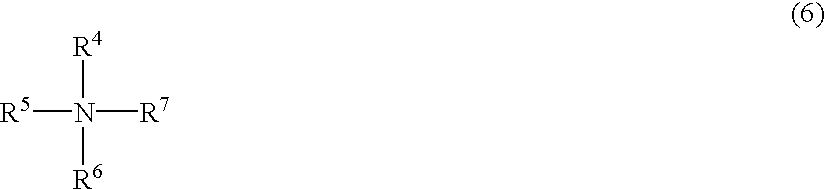
wherein R4, R5, R6 and R7 each independently represent hydrogen, a C1-C20 alkyl group, cycloalkyl group, aryl group, or aralkyl group,
and each of x, y and z are integers from 0-3 provided the relation x+y=2z is satisfied.
6. The method of claim 1 wherein said compound of formula (3) is oxidized with at least one peroxide in the presence of at least one acid and ultraviolet light.
7. The method of claim 1 wherein said compound of formula (3) is synthesized by cyclization between at least one cis-2-butene compound of formula (7): 
wherein R8 and R9 are each independently hydrogen or a C1-C10 alkyl group, cycloalkyl group, aryl group, aralkyl group, unsubstituted or substituted; and A1 and A2 are each independently halogen or a sulfonyloxy group; and
at least one primary amine of formula (8):
wherein R10 is an alkyl group, a cycloalkyl group, an alkenyl group, an aryl group, or an aralkyl group unsubstituted or substituted.
8. The method of claim 7 wherein said cis-2-butene compound of formula (7) is synthesized from a cis-2-butene-1,4-diol of formula (9): 
wherein R11 and R12 are each independently hydrogen or a C1-C10 alkyl group, cycloalkyl group, aryl group, aralkyl group unsubstituted or substituted.
9. The method of claim 8 , wherein said cis-2-butene compound of formula (7) is synthesized by reacting said cis-2-butene-1,4-diol of formula (9) with at least one halogenation reagent of formula 10:
wherein R13 is a C1-C10 alkyl group, an aryl group, or an aralkyl group substituted or unsubstituted and A3 is a halogen,
in the presence of at least one base.
10. A method of synthesizing 3-pyrrolines comprising the steps of:
(a) reacting a cis-2-butene-1,4-diol of formula (9) with at least one halogenation reagent in the presence of at least one base to form at least one cis-2-butene compound of formula (7): 
wherein R8, R9, R11 and R12 are each independently a hydrogen, a C1-C10 alkyl group, a cycloalkyl group, an aryl group, or an aralkyl group, unsubstituted or substituted and wherein A1 and A2 are each independently a halogen or a sulfonyloxy group
and
(b) cyclizing said cis-2-butene compound of formula (7) 
with at least one primary amine of formula (8):
wherein R10 is an alkyl group, a cycloalkyl group, an alkenyl group, or an aralkyl group unsubstituted or substituted.
11. The method of claim 10 , wherein said base is a tertiary amine.
12. The method of claim 10 , wherein said halogenation reagent is a sulfonyl halide of formula (10):
wherein R13 represents a C1-C10 alkyl group, cycloalkyl group, aryl group, aralkyl group unsubstituted or substituted; and A3 is a halogen.
13. The method of claim 10 wherein said steps are performed continuously.
14. The method of claim 13 , wherein said base is a tertiary amine.
15. The method of claim 13 , wherein said halogenation reagent is a sulfonyl halide of formula (10):
wherein R13 represents a C1-C10 alkyl group, cycloalkyl group, aryl group, aralkyl group unsubstituted or substituted; and A3 is a halogen.
Priority Applications (1)
| Application Number | Priority Date | Filing Date | Title |
|---|---|---|---|
| US09/558,798 US6479668B1 (en) | 1998-09-08 | 2000-04-26 | Method of producing pyrrolidine derivatives |
Applications Claiming Priority (6)
| Application Number | Priority Date | Filing Date | Title |
|---|---|---|---|
| JP10-254304 | 1998-09-08 | ||
| JP25430498A JP4314597B2 (en) | 1998-09-08 | 1998-09-08 | Method for producing N-substituted-3-pyrroline compound |
| JP10-339893 | 1998-11-30 | ||
| JP33989398 | 1998-11-30 | ||
| US09/390,160 US6130338A (en) | 1998-09-08 | 1999-09-03 | Method of producing pyrrolidine derivatives |
| US09/558,798 US6479668B1 (en) | 1998-09-08 | 2000-04-26 | Method of producing pyrrolidine derivatives |
Related Parent Applications (1)
| Application Number | Title | Priority Date | Filing Date |
|---|---|---|---|
| US09/390,160 Division US6130338A (en) | 1998-09-08 | 1999-09-03 | Method of producing pyrrolidine derivatives |
Publications (1)
| Publication Number | Publication Date |
|---|---|
| US6479668B1 true US6479668B1 (en) | 2002-11-12 |
Family
ID=26541624
Family Applications (2)
| Application Number | Title | Priority Date | Filing Date |
|---|---|---|---|
| US09/390,160 Expired - Fee Related US6130338A (en) | 1998-09-08 | 1999-09-03 | Method of producing pyrrolidine derivatives |
| US09/558,798 Expired - Lifetime US6479668B1 (en) | 1998-09-08 | 2000-04-26 | Method of producing pyrrolidine derivatives |
Family Applications Before (1)
| Application Number | Title | Priority Date | Filing Date |
|---|---|---|---|
| US09/390,160 Expired - Fee Related US6130338A (en) | 1998-09-08 | 1999-09-03 | Method of producing pyrrolidine derivatives |
Country Status (6)
| Country | Link |
|---|---|
| US (2) | US6130338A (en) |
| EP (1) | EP0985664B1 (en) |
| AT (1) | ATE263149T1 (en) |
| CA (1) | CA2281393A1 (en) |
| DE (1) | DE69915951T2 (en) |
| ES (1) | ES2218955T3 (en) |
Families Citing this family (5)
| Publication number | Priority date | Publication date | Assignee | Title |
|---|---|---|---|---|
| US6130338A (en) | 1998-09-08 | 2000-10-10 | Toray Industries, Inc. | Method of producing pyrrolidine derivatives |
| DE10201458A1 (en) | 2001-04-11 | 2002-10-17 | Adelbert Bacher | New proteins involved in isoprenoid biosynthesis, useful in screening for inhibitors, also new intermediates, potential therapeutic agents, nucleic acids and antibodies |
| JP2005206526A (en) * | 2004-01-23 | 2005-08-04 | Toray Fine Chemicals Co Ltd | Method for producing 1-benzyl-3,4-epoxypyrrolidine derivative |
| US10383894B2 (en) * | 2010-03-17 | 2019-08-20 | Lutran Industries, Inc. | Human medicinal treatment using salt of peroxymonosulfuric acid |
| CN113307757B (en) * | 2021-05-26 | 2022-04-29 | 南京德克瑞医药化工有限公司 | A kind of preparation method of pharmaceutical intermediate N-benzyl-3-pyrroline |
Citations (10)
| Publication number | Priority date | Publication date | Assignee | Title |
|---|---|---|---|---|
| US3657274A (en) | 1968-06-12 | 1972-04-18 | Sankyo Co | Process for producing n-acyl 3 4-epoxypyrrolidine derivatives |
| US3691198A (en) | 1970-12-21 | 1972-09-12 | Cpc International Inc | Synthesis of 1-substituted-3-halopyrrolidines |
| JPS49102624A (en) | 1973-02-12 | 1974-09-27 | ||
| US4175099A (en) | 1975-03-07 | 1979-11-20 | Exxon Research & Engineering Co. | Separation and recovery of ethylbenzene from C8 aromatic mixtures using rubidium-X sieves |
| US4230718A (en) | 1979-01-09 | 1980-10-28 | A. H. Robins Company, Inc. | 1-Substituted-3,4-epoxypyrrolidines |
| EP0046068A1 (en) | 1980-08-13 | 1982-02-17 | Toray Industries, Inc. | Process for separating a mononuclear halogenated toluene isomer |
| EP0125077A1 (en) | 1983-04-28 | 1984-11-14 | Toray Industries, Inc. | Adsorptive separation process |
| JPH06239808A (en) | 1993-02-15 | 1994-08-30 | Toray Ind Inc | Method for separating 2-methyl-3-nitrobenzotrifluoride |
| US5453560A (en) | 1994-05-20 | 1995-09-26 | Uop | Process for adsorptive separation of ethylbenzene from aromatic hydrocarbons |
| US6130338A (en) | 1998-09-08 | 2000-10-10 | Toray Industries, Inc. | Method of producing pyrrolidine derivatives |
-
1999
- 1999-09-03 US US09/390,160 patent/US6130338A/en not_active Expired - Fee Related
- 1999-09-07 DE DE69915951T patent/DE69915951T2/en not_active Expired - Lifetime
- 1999-09-07 ES ES99307113T patent/ES2218955T3/en not_active Expired - Lifetime
- 1999-09-07 CA CA002281393A patent/CA2281393A1/en not_active Abandoned
- 1999-09-07 AT AT99307113T patent/ATE263149T1/en not_active IP Right Cessation
- 1999-09-07 EP EP99307113A patent/EP0985664B1/en not_active Expired - Lifetime
-
2000
- 2000-04-26 US US09/558,798 patent/US6479668B1/en not_active Expired - Lifetime
Patent Citations (10)
| Publication number | Priority date | Publication date | Assignee | Title |
|---|---|---|---|---|
| US3657274A (en) | 1968-06-12 | 1972-04-18 | Sankyo Co | Process for producing n-acyl 3 4-epoxypyrrolidine derivatives |
| US3691198A (en) | 1970-12-21 | 1972-09-12 | Cpc International Inc | Synthesis of 1-substituted-3-halopyrrolidines |
| JPS49102624A (en) | 1973-02-12 | 1974-09-27 | ||
| US4175099A (en) | 1975-03-07 | 1979-11-20 | Exxon Research & Engineering Co. | Separation and recovery of ethylbenzene from C8 aromatic mixtures using rubidium-X sieves |
| US4230718A (en) | 1979-01-09 | 1980-10-28 | A. H. Robins Company, Inc. | 1-Substituted-3,4-epoxypyrrolidines |
| EP0046068A1 (en) | 1980-08-13 | 1982-02-17 | Toray Industries, Inc. | Process for separating a mononuclear halogenated toluene isomer |
| EP0125077A1 (en) | 1983-04-28 | 1984-11-14 | Toray Industries, Inc. | Adsorptive separation process |
| JPH06239808A (en) | 1993-02-15 | 1994-08-30 | Toray Ind Inc | Method for separating 2-methyl-3-nitrobenzotrifluoride |
| US5453560A (en) | 1994-05-20 | 1995-09-26 | Uop | Process for adsorptive separation of ethylbenzene from aromatic hydrocarbons |
| US6130338A (en) | 1998-09-08 | 2000-10-10 | Toray Industries, Inc. | Method of producing pyrrolidine derivatives |
Non-Patent Citations (5)
| Title |
|---|
| A Facile Synthesis of 3-Pyrrolines, Zhaozhong Ding and Joseph J. Tufariello, Synthetic Communications, 20(2), 227-230 (1990). |
| Burley, I. and Hewson, A., "Enantiospecific Synthesis of 3-Pyrrolines: A Route to Novel Polyhydroxylated Pyrrolidines", Teirahedron Letters, vol. 35, No. 38, pp. 7099-7102, 1994. |
| Epoxidation of an Unsaturated Tertiary Amine. Application to the Synthesis of Two Pirprofen Metabolites, Naba K. Chaudhuri and Thomas J. Ball, J. Org. Chem., 1982, 47, 5196-5198. |
| Regio-and Stereoslective Functionalization of an Optically Active Tetrahydroindolizine Derivative. Catalytic Asymmetric Syntheses of Lentiginosine, 1,2-Diepilentiginosine, and Gephyrotoxin 209D, Seiji Nukui, Mikiko Sodeoka, Hiroaki Sasai and Masakatsu Shibasaki, J. Org. Chem., 1995, 60, 398-404. |
| Use of Dioxiranes for the Chemoselective Oxidation of Tertiary Amines Bearing Alkene Moieties, Marta Ferrer, Francisco Sánchez-Baeza, Angel Messeguer, Anna Diez and Mario Rubiralta, J. Chem. Soc., Chem. Commun., 1995. |
Also Published As
| Publication number | Publication date |
|---|---|
| EP0985664B1 (en) | 2004-03-31 |
| DE69915951D1 (en) | 2004-05-06 |
| EP0985664A2 (en) | 2000-03-15 |
| CA2281393A1 (en) | 2000-03-08 |
| ATE263149T1 (en) | 2004-04-15 |
| EP0985664A3 (en) | 2000-05-10 |
| ES2218955T3 (en) | 2004-11-16 |
| US6130338A (en) | 2000-10-10 |
| DE69915951T2 (en) | 2005-01-20 |
Similar Documents
| Publication | Publication Date | Title |
|---|---|---|
| US5705702A (en) | Method for preparing triarylsulfonium salts | |
| IE852296L (en) | Oxiranes and 2-acylamido-2-fluoro-1-arylpropanols. | |
| US6130338A (en) | Method of producing pyrrolidine derivatives | |
| Mao et al. | Synthesis of 1-deoxymannojirimycin analogues using N-tosyl and N-nosyl activated aziridines derived from 1-amino-1-deoxyglucitol | |
| SU622399A3 (en) | Method of producing salts of arylsulphonylamidoalkylamines | |
| US20050033082A1 (en) | Method for producing bicalutamide | |
| Chanet-Ray et al. | Synthesis and Reactions of β-Sultams. A Review | |
| JP3221084B2 (en) | Lactam production method | |
| US6008376A (en) | Aminohydroxylation of olefins with tert-alkyl sulfonamides | |
| US11535595B2 (en) | Isoquinoline sulfonyl chloride acid addition salts and method of manufacture thereof | |
| US3948915A (en) | 2-Halopyrimidine derivatives and a method for their preparation | |
| JP2771257B2 (en) | Preparation of imidazole derivatives | |
| JP3040265B2 (en) | Method for producing dialkyl dicarbonate | |
| Larsen et al. | Improved Oxidation of the Sulfenamide Functionality: Efficient Synthesis of 6-Ethoxy-2-Benzothiazolesulfonamide | |
| JPH0597823A (en) | Preparation of trans-(5r)-2,4,5-trisubsti- tuted-2-oxazoline | |
| JP2001072659A (en) | Method for producing pyrrolidine derivative | |
| RU2144915C1 (en) | Method of preparing arylsulfonyl urea | |
| US5132461A (en) | Process for the production of 4-[ethyl-(2'-hydroxyethyl)-amino]-1-[(2'-hydroxyethyl)-amino]-2-nitro-benzene | |
| JP4373031B2 (en) | Process for producing 3-amino-4-substituted-5-pyrazolones | |
| KR100566896B1 (en) | Method for preparing optically active 5,6-dioxopiperazine-2-carboxylic acid derivative | |
| JP4242937B2 (en) | Method for producing 1H-1,2,4-triazole derivative | |
| JPH0327353A (en) | Preparation of sulfonium compound | |
| KR790001647B1 (en) | Method for preparing N-substituted trimethoxy benzyl piperazine derivatives | |
| Lucas | Approaches to the study of the geometry and mechanisms of nucleophilic substitution at oxygen, sulfur (II), and chlorine: Applications of the endocyclic restriction test | |
| HK40048107A (en) | Isoquinolinesulfonyl chloride acid addition salt and method for producing same |
Legal Events
| Date | Code | Title | Description |
|---|---|---|---|
| STCF | Information on status: patent grant |
Free format text: PATENTED CASE |
|
| CC | Certificate of correction | ||
| FPAY | Fee payment |
Year of fee payment: 4 |
|
| FPAY | Fee payment |
Year of fee payment: 8 |
|
| FPAY | Fee payment |
Year of fee payment: 12 |