US6445853B1 - Arrayed waveguide grating - Google Patents

Arrayed waveguide grating Download PDF

Info

Publication number
US6445853B1
US6445853B1 US09/661,091 US66109100A US6445853B1 US 6445853 B1 US6445853 B1 US 6445853B1 US 66109100 A US66109100 A US 66109100A US 6445853 B1 US6445853 B1 US 6445853B1
Authority
US
United States
Prior art keywords
arrayed
waveguides
wavelength
arrayed waveguide
arrayed waveguides
Prior art date
Legal status (The legal status is an assumption and is not a legal conclusion. Google has not performed a legal analysis and makes no representation as to the accuracy of the status listed.)
Expired - Fee Related, expires
Application number
US09/661,091
Inventor
Kazuhisa Kashihara
Takeshi Nakajima
Tsunetoshi Saito
Current Assignee (The listed assignees may be inaccurate. Google has not performed a legal analysis and makes no representation or warranty as to the accuracy of the list.)
Furukawa Electric Co Ltd
Original Assignee
Furukawa Electric Co Ltd
Priority date (The priority date is an assumption and is not a legal conclusion. Google has not performed a legal analysis and makes no representation as to the accuracy of the date listed.)
Filing date
Publication date
Application filed by Furukawa Electric Co Ltd filed Critical Furukawa Electric Co Ltd
Assigned to FURUKAWA ELECTRIC CO., LTD., THE reassignment FURUKAWA ELECTRIC CO., LTD., THE ASSIGNMENT OF ASSIGNORS INTEREST (SEE DOCUMENT FOR DETAILS). Assignors: KASHIHARA, KAZUHISA, NAKAJIMA, TAKESHI, SAITO, TSUNETOSHI
Application granted granted Critical
Publication of US6445853B1 publication Critical patent/US6445853B1/en
Adjusted expiration legal-status Critical
Expired - Fee Related legal-status Critical Current

Links

Images

Classifications

    • GPHYSICS
    • G02OPTICS
    • G02BOPTICAL ELEMENTS, SYSTEMS OR APPARATUS
    • G02B6/00Light guides; Structural details of arrangements comprising light guides and other optical elements, e.g. couplings
    • G02B6/10Light guides; Structural details of arrangements comprising light guides and other optical elements, e.g. couplings of the optical waveguide type
    • G02B6/12Light guides; Structural details of arrangements comprising light guides and other optical elements, e.g. couplings of the optical waveguide type of the integrated circuit kind
    • G02B6/12007Light guides; Structural details of arrangements comprising light guides and other optical elements, e.g. couplings of the optical waveguide type of the integrated circuit kind forming wavelength selective elements, e.g. multiplexer, demultiplexer
    • G02B6/12009Light guides; Structural details of arrangements comprising light guides and other optical elements, e.g. couplings of the optical waveguide type of the integrated circuit kind forming wavelength selective elements, e.g. multiplexer, demultiplexer comprising arrayed waveguide grating [AWG] devices, i.e. with a phased array of waveguides
    • G02B6/12011Light guides; Structural details of arrangements comprising light guides and other optical elements, e.g. couplings of the optical waveguide type of the integrated circuit kind forming wavelength selective elements, e.g. multiplexer, demultiplexer comprising arrayed waveguide grating [AWG] devices, i.e. with a phased array of waveguides characterised by the arrayed waveguides, e.g. comprising a filled groove in the array section
    • GPHYSICS
    • G02OPTICS
    • G02BOPTICAL ELEMENTS, SYSTEMS OR APPARATUS
    • G02B6/00Light guides; Structural details of arrangements comprising light guides and other optical elements, e.g. couplings
    • G02B6/10Light guides; Structural details of arrangements comprising light guides and other optical elements, e.g. couplings of the optical waveguide type
    • G02B6/12Light guides; Structural details of arrangements comprising light guides and other optical elements, e.g. couplings of the optical waveguide type of the integrated circuit kind
    • G02B6/12007Light guides; Structural details of arrangements comprising light guides and other optical elements, e.g. couplings of the optical waveguide type of the integrated circuit kind forming wavelength selective elements, e.g. multiplexer, demultiplexer
    • G02B6/12009Light guides; Structural details of arrangements comprising light guides and other optical elements, e.g. couplings of the optical waveguide type of the integrated circuit kind forming wavelength selective elements, e.g. multiplexer, demultiplexer comprising arrayed waveguide grating [AWG] devices, i.e. with a phased array of waveguides
    • G02B6/12023Light guides; Structural details of arrangements comprising light guides and other optical elements, e.g. couplings of the optical waveguide type of the integrated circuit kind forming wavelength selective elements, e.g. multiplexer, demultiplexer comprising arrayed waveguide grating [AWG] devices, i.e. with a phased array of waveguides characterised by means for reducing the polarisation dependence, e.g. reduced birefringence

Definitions

  • the present invention relates to an arrayed waveguide grating to be used for optical communications.
  • dense wavelength division multiplexing system As a method for significantly increasing the transmission capacity, dense wavelength division multiplexing system have been successfully researched and developed, and made practicable.
  • dense wavelength division multiplexing systems a plurality of optical beams having wavelengths which are different from each other are multiplied for transmission.
  • a optical transmission element which transmits only a predetermined wavelength is required. This optical transmission element is used to extract optical beams by each wavelength from transmitted multiplexing optical beams at a light receiver side.
  • the optical transmission element there is an AWG (Arrayed Waveguide Grating) as shown in FIG. 4, for example.
  • AWG Arrayed Waveguide Grating
  • a waveguide structure is formed on substrate 1 as shown in the figure. That is, to the exit side of one or more optical input waveguides 2 , first slab waveguide 3 is connected. To the exit side of the first slab waveguide 3 , a plurality of arrayed waveguides 4 are connected, and to the exit side of the arrayed waveguides 4 , second slab waveguide 5 is connected. To the exit side of the second slab waveguide 5 , one or more optical output waveguides 6 are connected.
  • the arrayed waveguides 4 transmit optical signal led out from the first slab waveguide 3 , and are formed so as to be different in length from each other.
  • the lengths of the adjacent arrayed waveguides 4 are different by ⁇ L, and by these arrayed waveguides 4 , diffraction grating 14 is formed.
  • the optical input waveguides 2 and the optical output waveguides 6 are provided so as to correspond to the number of signal beams which are divided or synthesized by the arrayed waveguide grating and are different in wavelength from each other.
  • the arrayed waveguides 4 are normally provided in a large number, for example, 100. However, in the figure, for simplification, the numbers of the optical input waveguides 2 , arrayed waveguides 4 , and optical output waveguides 6 are roughly shown. In the same figure, although the arrayed waveguides 4 are shown as arc shapes, however, in actuality, the center part in the length direction of the arrayed waveguides 4 is formed to be more linear than in the figure.
  • an optical fiber (not illustrated) at the transmission side is connected, whereby wavelength multiplexing signal beams are led-in.
  • Signal beams led-into the first slab waveguide 3 through the optical input waveguides 2 are spread by the diffraction effect, made incident onto the arrayed waveguides 4 , and transmitted through the arrayed waveguides 4 .
  • the signal beams transmitted through the arrayed waveguides 4 reach the second slab waveguide 5 , and furthermore, converged onto the optical output waveguides 6 and outputted.
  • all lengths of the arrayed waveguides 4 are different from each other, phase differences between individual signal beams transmitted through the arrayed waveguides 4 occur, the phasefront of the optical signal inclines in accordance with the amount of phase differences, and due to the inclination angle, the light focus position is determined. Therefore, the light focus positions of light beams with varying wavelengths are different from each other, and by forming optical output waveguides 6 at the positions, signal beams which are different in wavelength can be outputted from the individual optical output waveguides 6 by each wavelength.
  • the grating since the arrayed waveguide grating uses the principle of optical reversibility, the grating has a function as a spectral synthesizer as well as a function as a spectral divider. That is, if a plurality of signal beams having different wavelengths are made incident from the optical output waveguides 6 , respectively, these signal beams pass through the transmission path opposite to the above path, and are synthesized by the arrayed waveguides 4 , and then exit from the optical input waveguides 2 .
  • the wavelength resolution of the diffraction grating is in proportion to the difference ( ⁇ L) in length between the arrayed waveguides 4 comprising the diffraction grating. Therefore, by designing ⁇ L to be large, spectral synthesis and division of wavelength multiplexing signal beams with narrow wavelength intervals become possible although they are impossible in a prior-art diffraction grating. That is, the arrayed waveguide grating can show spectral synthesis and division functions for a plurality of signal beams (a function to divide or synthesize a plurality of optical signals with wavelength intervals of 1 nm or less) required to realize high density dense wavelength multiplexing systems.
  • some arrayed waveguide gratings divide or synthesize optical signals of 16 wavelengths which are different from each other and have wavelength intervals of, for example, 100 GHz.
  • a design example of such an arrayed waveguide grating shall be described.
  • the FSR Free Spectral Range
  • the focal lengths of the first and second slab waveguides 3 and 5 are 11.9 mm, respectively
  • the diffraction order is 61
  • ⁇ L 65.2 ⁇ m.
  • the aligning pitch of the arrayed waveguides 4 at the center in the length direction thereof is 25 ⁇ m
  • the aligning pitch of the arrayed waveguides 4 at each connection point to the first and second slab waveguides 3 and 5 is 20 ⁇ m.
  • a half-wavelength plate 8 ( 8 a ) is provided so as to be across the center in the length direction of all arrayed waveguides 4 .
  • the half-wavelength plate 8 ( 8 a ) is inserted into slit 7 which is formed so as to be orthogonal to the arrayed waveguides 4 at the center in the length direction of the waveguides.
  • the half-wavelength plate 8 ( 8 a ) functions as a polarization mode conversion part which converts the TE mode and TM mode of light beams to be transmitted through the arrayed waveguides 4 . If the half-wavelength plate 8 ( 8 a ) is provided at the center in the length direction of the arrayed waveguides 4 , before and after the half-wavelength plate 8 ( 8 a ), the TE mode is converted to the TM mode, or the TM mode is converted to the TE mode.
  • the half-wavelength plate 8 ( 8 a ) is provided so that the vertical length (B in the same figure) corresponds to the width of the arrayed waveguide forming range (A in the same figure) at the center in the length direction of the arrayed waveguides 4 .
  • the width A of the arrayed waveguide forming range at the center in the length direction of the arrayed waveguides 4 is approximately 5 mm. Therefore, in the arrayed waveguide diffraction grating of the abovementioned design example, the half-wavelength plate 8 ( 8 a ) whose length shown by B in the figure is 7 mm is inserted, adhered, and fixed.
  • the number of multiplexing wavelengths increases in dense wavelength division multiplexing systems, it is required to increase the number of wavelengths to be divided and the number of wavelengths to be synthesized by the arrayed waveguide grating to be used as a optical transmission element in accordance with the increase.
  • the number of wavelengths to be divided or synthesized by the arrayed waveguide grating is increased, in terms of designing, the number of arrayed waveguides 4 increases.
  • the width of the arrayed waveguide forming range (A in FIG. 4) at the center in the length direction of the arrayed waveguides 4 becomes wider. Therefore, although the length of the half-wavelength plate 8 provided in accordance with the width of the arrayed waveguide forming range must also be increased, at present, the length of the half-wavelength plate 8 which has been generally used is approximately 5 through 10 mm. And, a half-wavelength plate 8 whose length is longer than that of the general plate is an article specially made to order, which is expensive, and therefore, an arrayed waveguide grating with a longer half-wavelength plate provided also becomes expensive.
  • the half-wavelength plate 8 ( 8 t ) with a length of approximately 12 mm is an article specially made to order, which is expensive. Furthermore, it is extremely difficult to precisely insert the half-wavelength plate 8 ( 8 t ) with a length of 12 mm into the arrayed waveguides 4 , and when inserting the half-wavelength plate, it may bend or take-in bubbles in an adhesive, and therefore, crosstalk becomes worse such as approximately ⁇ 23 dB by roughly 10 dB.
  • the present invention is made in order to solve the abovementioned problems.
  • an arrayed waveguide grating which is arranged so that a waveguide structure is provided in which a first slab waveguide is connected to the exit side of one or more optical input waveguides, a plurality of arrayed waveguides which have varying lengths to transmit optical signal led out from the first slab waveguide are connected to the exit side of the first slab waveguide, a second slab waveguide is connected to the exit side of the plurality of arrayed waveguides, and a plurality of optical output waveguides are connected to the exit side of the second slab waveguide, a plurality of optical signals which are inputted from the optical input waveguides and are different in wavelength from each other are transmitted by being provided with phase differences for each wavelength by the arrayed waveguides, and made incident onto individual optical output waveguides for each wavelength, whereby light beams with varying wavelengths are outputted from the light output waveguides, wherein a polarization mode conversion part to converts the TE mode and TM mode of light to be transmitted through the arrayed waveguides is provided so
  • FIG. 1 is a constructional view of the main part schematically showing an embodiment, of the arrayed waveguide grating relating to the invention.
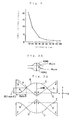
  • FIG. 2 is a graph showing the relationship between the interval between arrayed waveguide groups and the operation time for insertion of the half-wavelength plates when the arrayed waveguides provided in the arrayed waveguide grating is divided into two arrayed waveguide groups.
  • FIG. 3 A and FIG. 3B are explanatory views of the shape at the center in the length direction and length in the X direction of the arrayed waveguides in a second embodiment.
  • FIG. 4 is an explanatory view schematically showing the construction of the prior-art arrayed waveguide grating.
  • FIG. 5 is an explanatory view schematically showing the arrayed waveguide grating which is arranged so that the number of disposed arrayed waveguides is increased, and accordingly, a long half-wavelength plate is provided.
  • the abovementioned construction may be characterized in that the polarization mode conversion part to convert the TE mode and TM mode of light to be transmitted through the arrayed waveguides is provided so as to cross the middle portion in the length direction of all arrayed waveguides. Therefore, by the invention, polarization dependence loss caused due to a difference in transmission speed between the TE mode and TM mode of light to be transmitted through the arrayed waveguides can be eliminated.
  • the abovementioned polarization mode conversion part is formed of one half-wavelength plate, in the case where the number of alignments of the arrayed waveguides is large and the width of the arrayed waveguide forming range is wide, a long half-wavelength plate having a length corresponding to the width must be provided.
  • the long half-wavelength plate is expensive and it is difficult to insert it into the arrayed waveguide diffraction grating.
  • the invention can reduce the cost of the half-wavelength plates forming the polarization mode conversion part.
  • a plurality of arrayed waveguides crossed by one half-wavelength plate is defined as one arrayed waveguide group, and based on this, arrayed waveguide groups are formed by a number corresponding to the number of the disposed half-wavelength plates, and the interval between adjacent arrayed waveguide groups at the disposed portion of the half-wavelength plates is set to 50 ⁇ m or more. Therefore, in the invention, by properly setting the interval between the adjacent arrayed waveguide groups, the operation to insert the half-wavelength plates can be easily carried out. Accordingly, by the invention, an arrayed waveguide grating is realized which can be easily manufactured, in which the half-wavelength plates can be prevented from bending and taking-in bubbles when being inserted, and an increase in crosswalk can be suppressed.
  • FIG. 1 is a plane view schematically showing an embodiment of the arrayed waveguide grating.
  • This embodiment is, as the arrayed waveguide grating shown in FIG. 5, an arrayed waveguide grating which divides or synthesizes optical signals of 32 wavelengths which are different from each other and have wavelength intervals of 100 GHz.
  • the waveguide structure and designed dimensions of the arrayed waveguide grating of this embodiment are roughly the same as those of the arrayed waveguide grating shown in FIG. 5 .
  • the first aspect of this embodiment differing from the arrayed waveguide grating shown in FIG. 5 is that two half-wavelength plates 8 ( 8 a 1 , 8 a 2 ) crossing the plurality (here, 406 ) of arrayed waveguides 4 are aligned in series in the disposed direction of the arrayed waveguides 4 , whereby the polarization mode conversion part is formed.
  • the half-wavelength plate 8 ( 8 a 1 ) and half-wavelength plate 8 ( 8 a 2 ) are arranged in the same manner as the half-wavelength plate 8 ( 8 a ) provided in the prior-art arrayed waveguide grating, and the lengths thereof are 7 mm.
  • the second aspect of this embodiment is that a plurality of arrayed waveguides crossed by each half-wavelength plate 8 a 1 or 8 a 2 is defined as one arrayed waveguide group, and the interval between adjacent arrayed waveguide groups at the disposed portion of the half-wavelength plates is set to 80 ⁇ m. Furthermore, as in this embodiment, by defining the plurality of arrayed waveguides crossed by each half-wavelength plate 8 a 1 or 8 a 2 as one arrayed waveguide group, arrayed waveguide groups of a number corresponding to the number (2 in this embodiment) of disposed half-wavelength plates 8 a 1 and 8 a 2 are formed.
  • 406 arrayed waveguides 4 are divided into 203 arrayed waveguides 4 crossed by the half-wavelength plate 8 a 1 and 203 arrayed waveguides 4 crossed by the half-wavelength plate 8 a 2 .
  • the interval between the arrayed waveguide groups thus formed is set to 80 ⁇ m.
  • FIG. 1 schematically shows the arrayed waveguide grating of the present embodiment.
  • the arrayed waveguides 4 crossed by the half-wavelength plate 8 a 1 are shown by symbols 4 a through 4 d
  • the arrayed waveguides 4 crossed by the half-wavelength plate 8 a 2 are shown by symbols 4 e through 4 h .
  • the interval of the arrayed waveguides at the disposed portion of the half-wavelength plate 8 a 1 and 8 a 2 is shown by the interval L between the arrayed waveguide 4 d and arrayed waveguide 4 e.
  • the inventor variously changed the intervals L between the arrayed waveguide groups, and measured the relationship between the interval L and the operation time to insert the half-wavelength plates 8 a 1 and 8 a 2 .
  • the results of these measurements are shown in FIG. 2 .
  • the operation time becomes approximately 2 through 3 minutes or less. This operation time to insert the half-wavelength plates 8 a 1 and 8 a 2 is remarkably shorter than the operation time to insert the half-wavelength plates 8 a 1 and 8 a 2 in the case of the interval L of 10 ⁇ m.
  • the interval L between the arrayed waveguide groups at the disposed portion of the half-wavelength plates 8 a 1 and 8 a 2 is set to 80 ⁇ m.
  • the forms of the arrayed waveguides 4 are made different from those of the prior-art arrayed waveguides 4 . That is, in the prior-art arrayed waveguide grating, all intervals between the arrayed waveguides 4 aligned in series at the center in the length direction thereof are set to be equal, for example, 25 ⁇ m.
  • the present embodiment as shown in FIG.
  • the interval between the lowest arrayed waveguide 4 (arrayed waveguide 4 d in the figure) among the arrayed waveguides 4 crossed by the half-wavelength plate 8 a 1 and the highest arrayed waveguide 4 (arrayed waveguide 4 e in the figure) among the arrayed waveguides 4 crossed by the half-wavelength plate 8 a 2 is set to 80 ⁇ m.
  • the center part in the length direction of the arrayed waveguides 4 is linear in the prior-art arrayed waveguide grating, in the present embodiment, by changing pitches, the forms of the arrayed waveguides 4 are changed as shown in FIG. 3 B. That is, when the length of the transformed portion is divided into quarters, and the respective portions are defined as A, B, C, and D, these respective portions A, B, C, and D are set to be arcs with center angles ⁇ and radiuses R, and the lengths in the X direction of the respective arrayed waveguides 4 are lengthened by 4R sin ⁇ .
  • the shift 2R (1 ⁇ cos ⁇ )
  • cos ⁇ 1 ⁇ (shift/2R)
  • cos ⁇ 1 (1 ⁇ shift/2R).
  • the unit for the R and shift is ⁇ m.
  • the arrayed waveguide grating of the second embodiment of the invention is arranged so that the lengths of the arrayed waveguides in the X direction of the figure are lengthened to be approximately 1.5 mm longer than those of the arrayed waveguides 4 in the prior-art arrayed waveguide grating.
  • the present embodiment is thus arranged, and two half-wavelength plates 8 ( 8 a 1 , 8 a 2 ) to be inserted into the center in the length direction of the arrayed waveguides 4 have a length of 7 mm, which have been priorly used. Therefore, the insertion of these half-wavelength plates 8 ( 8 a 1 , 8 a 2 ) is easier than the insertion of the long half-wavelength plate 8 ( 8 t ) shown in FIG. 5 .
  • the operation to insert the half-wavelength plates 8 a 1 and 8 a 2 takes a longer time, and therefore, operation performance of half-wavelength plates 8 a 1 and 8 a 2 is insufficient.
  • the interval between the arrayed waveguide groups is set to 80 ⁇ m more than 50 ⁇ m, the operation time to insert the half-wavelength plates 8 a 1 and 8 a 2 can be significantly shortened in comparison with the operation time to insert half-wavelength plates 8 a 1 and 8 a 2 in the case of the interval L of 10 ⁇ m.
  • the two half-wavelength plates 8 ( 8 a 1 , 8 a 2 ) to be inserted into the center in the length direction of the arrayed waveguides 4 are the half-wavelength plates 8 which have been priorly used. Therefore, the cost of the half-wavelength plates 8 ( 8 a 1 , 8 a 2 ) is reasonable and lower than that of the one long half-wavelength plate 8 ( 8 t ) shown in FIG. 5 . Therefore, the arrayed waveguide grating of the present embodiment can be made inexpensive.
  • the present invention is not limited to the abovementioned embodiment, but can employ various embodiments.
  • the arrayed waveguide grating of the abovementioned embodiment is arranged so as to divide or synthesize optical signals of 32 wavelengths which are different from each other and has wavelength intervals of 100 GHz.
  • the wavelength intervals and the number of wavelengths of the optical signals to be divided or synthesized by the arrayed waveguide grating of the invention are not especially limited, but are properly set.
  • the plurality of arrayed waveguides 4 are divided into two groups to form the arrayed waveguide grating, however, in accordance with the total number of disposed arrayed waveguides 4 , 3 or more arrayed waveguide groups can be formed.
  • the interval L between the arrayed waveguide groups is set to 80 ⁇ m, however, the. interval L between the adjacent arrayed waveguide groups is not always set to 80 ⁇ m.
  • the interval L between the adjacent arrayed waveguide groups is set to be a proper interval of 50 ⁇ m or more, the operation to insert the half-wavelength plates 8 can be efficiently carried out.
  • an arrayed waveguide grating has been manufactured by cutting-out a plurality of substrates for an arrayed waveguide grating from one silicon wafer, for example.
  • the abovementioned interval L is set to 1 mm or less.
  • the interval L can be set to be more than 1 mm.

Landscapes

  • Physics & Mathematics (AREA)
  • Engineering & Computer Science (AREA)
  • Microelectronics & Electronic Packaging (AREA)
  • General Physics & Mathematics (AREA)
  • Optics & Photonics (AREA)
  • Optical Integrated Circuits (AREA)

Abstract

An arrayed waveguide grating comprise at least two half-wavelength plates 8 a 1 and 8 a 2 crossing the center in the length direction of the plurality of arrayed waveguides 4 disposed in series in the vertical direction of the arrayed waveguides 4. By these half-wavelength plates 8 a 1 and 8 a 2, a polarization mode conversion part to convert the TE mode and TM mode of signal beams to be transmitted through the arrayed waveguides 4 is formed. The arrayed waveguides 4 are divided into a group of arrayed waveguides 4 crossed by the half-wavelength plate 8 a 1 and a group of arrayed waveguides 4 crossed by the half-wavelength plate 8 a 2.

Description

BACKGROUND OF THE INVENTION
1. Field of the Invention
The present invention relates to an arrayed waveguide grating to be used for optical communications.
2. Description of the Related Art
Recently, in optical communications, as a method for significantly increasing the transmission capacity, dense wavelength division multiplexing system have been successfully researched and developed, and made practicable. In dense wavelength division multiplexing systems, a plurality of optical beams having wavelengths which are different from each other are multiplied for transmission. In such a dense wavelength division multiplexing system, a optical transmission element which transmits only a predetermined wavelength is required. This optical transmission element is used to extract optical beams by each wavelength from transmitted multiplexing optical beams at a light receiver side.
As an example of the optical transmission element, there is an AWG (Arrayed Waveguide Grating) as shown in FIG. 4, for example. In the arrayed waveguide grating, a waveguide structure is formed on substrate 1 as shown in the figure. That is, to the exit side of one or more optical input waveguides 2 , first slab waveguide 3 is connected. To the exit side of the first slab waveguide 3, a plurality of arrayed waveguides 4 are connected, and to the exit side of the arrayed waveguides 4, second slab waveguide 5 is connected. To the exit side of the second slab waveguide 5, one or more optical output waveguides 6 are connected.
The arrayed waveguides 4 transmit optical signal led out from the first slab waveguide 3, and are formed so as to be different in length from each other. The lengths of the adjacent arrayed waveguides 4 are different by ΔL, and by these arrayed waveguides 4, diffraction grating 14 is formed.
Also, the optical input waveguides 2 and the optical output waveguides 6 are provided so as to correspond to the number of signal beams which are divided or synthesized by the arrayed waveguide grating and are different in wavelength from each other. The arrayed waveguides 4 are normally provided in a large number, for example, 100. However, in the figure, for simplification, the numbers of the optical input waveguides 2, arrayed waveguides 4, and optical output waveguides 6 are roughly shown. In the same figure, although the arrayed waveguides 4 are shown as arc shapes, however, in actuality, the center part in the length direction of the arrayed waveguides 4 is formed to be more linear than in the figure.
To the optical input waveguides 2, for example, an optical fiber (not illustrated) at the transmission side is connected, whereby wavelength multiplexing signal beams are led-in. Signal beams led-into the first slab waveguide 3 through the optical input waveguides 2 are spread by the diffraction effect, made incident onto the arrayed waveguides 4, and transmitted through the arrayed waveguides 4.
The signal beams transmitted through the arrayed waveguides 4 reach the second slab waveguide 5, and furthermore, converged onto the optical output waveguides 6 and outputted. However, since all lengths of the arrayed waveguides 4 are different from each other, phase differences between individual signal beams transmitted through the arrayed waveguides 4 occur, the phasefront of the optical signal inclines in accordance with the amount of phase differences, and due to the inclination angle, the light focus position is determined. Therefore, the light focus positions of light beams with varying wavelengths are different from each other, and by forming optical output waveguides 6 at the positions, signal beams which are different in wavelength can be outputted from the individual optical output waveguides 6 by each wavelength.
Furthermore, since the arrayed waveguide grating uses the principle of optical reversibility, the grating has a function as a spectral synthesizer as well as a function as a spectral divider. That is, if a plurality of signal beams having different wavelengths are made incident from the optical output waveguides 6, respectively, these signal beams pass through the transmission path opposite to the above path, and are synthesized by the arrayed waveguides 4, and then exit from the optical input waveguides 2.
In such an arrayed waveguide grating, as mentioned above, the wavelength resolution of the diffraction grating is in proportion to the difference (ΔL) in length between the arrayed waveguides 4 comprising the diffraction grating. Therefore, by designing ΔL to be large, spectral synthesis and division of wavelength multiplexing signal beams with narrow wavelength intervals become possible although they are impossible in a prior-art diffraction grating. That is, the arrayed waveguide grating can show spectral synthesis and division functions for a plurality of signal beams (a function to divide or synthesize a plurality of optical signals with wavelength intervals of 1 nm or less) required to realize high density dense wavelength multiplexing systems.
Among prior-art arrayed waveguide gratings, some arrayed waveguide gratings divide or synthesize optical signals of 16 wavelengths which are different from each other and have wavelength intervals of, for example, 100 GHz. A design example of such an arrayed waveguide grating shall be described. In this arrayed waveguide grating, the FSR (Free Spectral Range) is 25 nm, the focal lengths of the first and second slab waveguides 3 and 5 are 11.9 mm, respectively, the diffraction order is 61, and ΔL=65.2 μm. Also, in this arrayed waveguide grating, the aligning pitch of the arrayed waveguides 4 at the center in the length direction thereof is 25 μm, and the aligning pitch of the arrayed waveguides 4 at each connection point to the first and second slab waveguides 3 and 5 is 20 μm.
In this design example, since the number of the arrayed waveguides 4 is set to 200, and the aligning pitch of the arrayed waveguides 4 is 25 μm at the center in the length direction thereof, the width of the arrayed waveguide forming range (A in FIG. 4) at the center in the length direction of the arrayed waveguides 4 is approximately 5 mm (19×25 μm=4.975 mm).
In the above arrayed waveguide grating, it is generally known that, since the TE mode transmission speed and TM mode transmission speed for light beams being transmitted through the arrayed waveguides 4 are different from each other, polarization dependence loss occurs.
Therefore, in order to eliminate this polarization dependence loss, as shown in FIG. 4, in the prior-art arrayed waveguide grating, a half-wavelength plate 8 (8 a) is provided so as to be across the center in the length direction of all arrayed waveguides 4. The half-wavelength plate 8 (8 a) is inserted into slit 7 which is formed so as to be orthogonal to the arrayed waveguides 4 at the center in the length direction of the waveguides.
The half-wavelength plate 8 (8 a) functions as a polarization mode conversion part which converts the TE mode and TM mode of light beams to be transmitted through the arrayed waveguides 4. If the half-wavelength plate 8 (8 a) is provided at the center in the length direction of the arrayed waveguides 4, before and after the half-wavelength plate 8 (8 a), the TE mode is converted to the TM mode, or the TM mode is converted to the TE mode. By this conversion, the difference in transmission speed between the TE mode and TM mode occurring before optical beams transmitted through the arrayed waveguides 4 are made incident onto the half-wavelength plate 8 (8 a) is canceled until the optical beams are transmitted to the exit side of the arrayed waveguides 4, whereby polarization dependence loss is eliminated.
The half-wavelength plate 8 (8 a) is provided so that the vertical length (B in the same figure) corresponds to the width of the arrayed waveguide forming range (A in the same figure) at the center in the length direction of the arrayed waveguides 4. In the arrayed waveguide grating of the abovementioned design example, as mentioned above, the width A of the arrayed waveguide forming range at the center in the length direction of the arrayed waveguides 4 is approximately 5 mm. Therefore, in the arrayed waveguide diffraction grating of the abovementioned design example, the half-wavelength plate 8 (8 a) whose length shown by B in the figure is 7 mm is inserted, adhered, and fixed.
If the number of multiplexing wavelengths increases in dense wavelength division multiplexing systems, it is required to increase the number of wavelengths to be divided and the number of wavelengths to be synthesized by the arrayed waveguide grating to be used as a optical transmission element in accordance with the increase. In the case where the number of wavelengths to be divided or synthesized by the arrayed waveguide grating is increased, in terms of designing, the number of arrayed waveguides 4 increases.
However, in the arrayed waveguide grating in which the number of arrayed waveguides 4 is large, the width of the arrayed waveguide forming range (A in FIG. 4) at the center in the length direction of the arrayed waveguides 4 becomes wider. Therefore, although the length of the half-wavelength plate 8 provided in accordance with the width of the arrayed waveguide forming range must also be increased, at present, the length of the half-wavelength plate 8 which has been generally used is approximately 5 through 10 mm. And, a half-wavelength plate 8 whose length is longer than that of the general plate is an article specially made to order, which is expensive, and therefore, an arrayed waveguide grating with a longer half-wavelength plate provided also becomes expensive.
For example, the designed values of specifications of the arrayed waveguide grating for dividing or synthesizing optical signals of 32 wavelengths which are different from each other and have wavelength intervals of 100 GHz are as follows. That is, the FSR is 51 nm, the focal lengths of the first and second slab waveguides 3 and 5 are 24.3 mm, respectively, diffraction order m is 30, ΔL=32.1 μm, and the number of alignments of the arrayed waveguides 4 are 406. The aligning pitch of the arrayed waveguides 4 at the center in the length direction thereof is 25 μm, and the aligning pitch of the arrayed waveguides 4 at each connection point to the first and second slab waveguides 3 and 5 is 20 μm. Therefore, as shown in FIG. 5, the width of the arrayed waveguide forming range (A in FIG. 5) at the center in the length direction of the arrayed waveguides 4 is increased to be 10.1 mm (405×25 μm=10.1 mm).
If so, approximately 12 mm is required as the length B of the half-wavelength plate 8 (8 t) to be inserted into the center in the length direction of the arrayed waveguides 4, however, the half-wavelength plate 8 (8 t) with a length of approximately 12 mm is an article specially made to order, which is expensive. Furthermore, it is extremely difficult to precisely insert the half-wavelength plate 8 (8 t) with a length of 12 mm into the arrayed waveguides 4, and when inserting the half-wavelength plate, it may bend or take-in bubbles in an adhesive, and therefore, crosstalk becomes worse such as approximately −23 dB by roughly 10 dB.
The present invention is made in order to solve the abovementioned problems.
SUMMARY OF THE INVENTION
In an arrayed waveguide grating which is arranged so that a waveguide structure is provided in which a first slab waveguide is connected to the exit side of one or more optical input waveguides, a plurality of arrayed waveguides which have varying lengths to transmit optical signal led out from the first slab waveguide are connected to the exit side of the first slab waveguide, a second slab waveguide is connected to the exit side of the plurality of arrayed waveguides, and a plurality of optical output waveguides are connected to the exit side of the second slab waveguide, a plurality of optical signals which are inputted from the optical input waveguides and are different in wavelength from each other are transmitted by being provided with phase differences for each wavelength by the arrayed waveguides, and made incident onto individual optical output waveguides for each wavelength, whereby light beams with varying wavelengths are outputted from the light output waveguides, wherein a polarization mode conversion part to converts the TE mode and TM mode of light to be transmitted through the arrayed waveguides is provided so as to cross the middle portion in the length direction of all arrayed waveguides, and said mode conversion part is formed by providing a plurality of half-wavelength plates in series in the vertical direction of the arrayed waveguides so as to cross the plurality of arrayed wave guides, and a plurality of arrayed waveguides crossed by one of the half-wavelength plates is defined as one arrayed waveguide group, and based on this, arrayed waveguide groups of a number corresponding to the number of disposed half-wavelength plates are formed. Advantageously, the interval between adjacent arrayed waveguide groups at the disposed portion of the half-wavelength plates is set to 50 μm or more.
BRIEF DESCRIPTION OF THE DRAWINGS
These and other objects and advantages of the present invention will be come more apparent and more readily appreciated from the following detailed description of the exemplary embodiments of the invention taken in conjunction with the accompanying drawings, in which:
FIG. 1 is a constructional view of the main part schematically showing an embodiment, of the arrayed waveguide grating relating to the invention.
FIG. 2 is a graph showing the relationship between the interval between arrayed waveguide groups and the operation time for insertion of the half-wavelength plates when the arrayed waveguides provided in the arrayed waveguide grating is divided into two arrayed waveguide groups.
FIG. 3A and FIG. 3B are explanatory views of the shape at the center in the length direction and length in the X direction of the arrayed waveguides in a second embodiment.
FIG. 4 is an explanatory view schematically showing the construction of the prior-art arrayed waveguide grating.
FIG. 5 is an explanatory view schematically showing the arrayed waveguide grating which is arranged so that the number of disposed arrayed waveguides is increased, and accordingly, a long half-wavelength plate is provided.
DETAILED DESCRIPTION OF THE INVENTION
The abovementioned construction may be characterized in that the polarization mode conversion part to convert the TE mode and TM mode of light to be transmitted through the arrayed waveguides is provided so as to cross the middle portion in the length direction of all arrayed waveguides. Therefore, by the invention, polarization dependence loss caused due to a difference in transmission speed between the TE mode and TM mode of light to be transmitted through the arrayed waveguides can be eliminated.
Furthermore, in the prior-art arrayed waveguide diffraction grating, since the abovementioned polarization mode conversion part is formed of one half-wavelength plate, in the case where the number of alignments of the arrayed waveguides is large and the width of the arrayed waveguide forming range is wide, a long half-wavelength plate having a length corresponding to the width must be provided. The long half-wavelength plate is expensive and it is difficult to insert it into the arrayed waveguide diffraction grating. On the other hand, in the arrayed waveguide diffraction grating of the invention, since a plurality of half-wavelength plates are aligned in series in the vertical direction of the plurality of arrayed waveguides so as to cross them, the length of each of the half-wavelength plates can be made short. Therefore, the invention can reduce the cost of the half-wavelength plates forming the polarization mode conversion part.
Furthermore, in the invention, a plurality of arrayed waveguides crossed by one half-wavelength plate is defined as one arrayed waveguide group, and based on this, arrayed waveguide groups are formed by a number corresponding to the number of the disposed half-wavelength plates, and the interval between adjacent arrayed waveguide groups at the disposed portion of the half-wavelength plates is set to 50 μm or more. Therefore, in the invention, by properly setting the interval between the adjacent arrayed waveguide groups, the operation to insert the half-wavelength plates can be easily carried out. Accordingly, by the invention, an arrayed waveguide grating is realized which can be easily manufactured, in which the half-wavelength plates can be prevented from bending and taking-in bubbles when being inserted, and an increase in crosswalk can be suppressed.
Hereinafter, the embodiment of the invention shall be described with reference to the drawings. In the description of the embodiment, the same parts as in the prior-art example are attached with the same symbols, and overlapping description thereof is omitted. FIG. 1 is a plane view schematically showing an embodiment of the arrayed waveguide grating. This embodiment is, as the arrayed waveguide grating shown in FIG. 5, an arrayed waveguide grating which divides or synthesizes optical signals of 32 wavelengths which are different from each other and have wavelength intervals of 100 GHz. The waveguide structure and designed dimensions of the arrayed waveguide grating of this embodiment are roughly the same as those of the arrayed waveguide grating shown in FIG. 5.
The first aspect of this embodiment differing from the arrayed waveguide grating shown in FIG. 5 is that two half-wavelength plates 8 (8 a 1, 8 a 2) crossing the plurality (here, 406) of arrayed waveguides 4 are aligned in series in the disposed direction of the arrayed waveguides 4, whereby the polarization mode conversion part is formed. The half-wavelength plate 8 (8 a 1) and half-wavelength plate 8 (8 a 2) are arranged in the same manner as the half-wavelength plate 8 (8 a) provided in the prior-art arrayed waveguide grating, and the lengths thereof are 7 mm.
The second aspect of this embodiment is that a plurality of arrayed waveguides crossed by each half-wavelength plate 8 a 1 or 8 a 2 is defined as one arrayed waveguide group, and the interval between adjacent arrayed waveguide groups at the disposed portion of the half-wavelength plates is set to 80 μm. Furthermore, as in this embodiment, by defining the plurality of arrayed waveguides crossed by each half-wavelength plate 8 a 1 or 8 a 2 as one arrayed waveguide group, arrayed waveguide groups of a number corresponding to the number (2 in this embodiment) of disposed half-wavelength plates 8 a 1 and 8 a 2 are formed.
In other words, in the present embodiment, 406 arrayed waveguides 4 are divided into 203 arrayed waveguides 4 crossed by the half-wavelength plate 8 a 1 and 203 arrayed waveguides 4 crossed by the half-wavelength plate 8 a 2. And, in the present embodiment, the interval between the arrayed waveguide groups thus formed is set to 80 μm.
FIG. 1 schematically shows the arrayed waveguide grating of the present embodiment. In FIG. 1, the arrayed waveguides 4 crossed by the half-wavelength plate 8 a 1 are shown by symbols 4 a through 4 d, and the arrayed waveguides 4 crossed by the half-wavelength plate 8 a 2 are shown by symbols 4 e through 4 h. Furthermore, in FIG. 1, the interval of the arrayed waveguides at the disposed portion of the half-wavelength plate 8 a 1 and 8 a 2 is shown by the interval L between the arrayed waveguide 4 d and arrayed waveguide 4 e.
In order to determine the arrangement of the embodiment, the inventor variously changed the intervals L between the arrayed waveguide groups, and measured the relationship between the interval L and the operation time to insert the half-wavelength plates 8 a 1 and 8 a 2. The results of these measurements are shown in FIG. 2. As is clearly understood from this figure, in the case where the arrayed waveguides 4 in the arrayed waveguide grating are divided into two or more groups, if the interval between the arrayed waveguide groups is 50 μm or more, the operation time becomes approximately 2 through 3 minutes or less. This operation time to insert the half-wavelength plates 8 a 1 and 8 a 2 is remarkably shorter than the operation time to insert the half-wavelength plates 8 a 1 and 8 a 2 in the case of the interval L of 10 μm.
Therefore, in the present embodiment, the interval L between the arrayed waveguide groups at the disposed portion of the half-wavelength plates 8 a 1 and 8 a 2 is set to 80 μm.
Furthermore, in this embodiment, by setting the interval L to 80 μm, the forms of the arrayed waveguides 4 are made different from those of the prior-art arrayed waveguides 4. That is, in the prior-art arrayed waveguide grating, all intervals between the arrayed waveguides 4 aligned in series at the center in the length direction thereof are set to be equal, for example, 25 μm. On the other hand, in the present embodiment, as shown in FIG. 3A, the interval between the lowest arrayed waveguide 4 (arrayed waveguide 4 d in the figure) among the arrayed waveguides 4 crossed by the half-wavelength plate 8 a 1 and the highest arrayed waveguide 4 (arrayed waveguide 4 e in the figure) among the arrayed waveguides 4 crossed by the half-wavelength plate 8 a 2 is set to 80 μm.
Therefore, although the center part in the length direction of the arrayed waveguides 4 is linear in the prior-art arrayed waveguide grating, in the present embodiment, by changing pitches, the forms of the arrayed waveguides 4 are changed as shown in FIG. 3B. That is, when the length of the transformed portion is divided into quarters, and the respective portions are defined as A, B, C, and D, these respective portions A, B, C, and D are set to be arcs with center angles θ and radiuses R, and the lengths in the X direction of the respective arrayed waveguides 4 are lengthened by 4R sin θ. Herein, since the shift=2R (1−cos θ), cos θ=1−(shift/2R), and θ=cos−1 (1−shift/2R). The unit for the R and shift is μm.
In the present embodiment, since R=5000 μm, and the interval L is set to 80 μm, the shift is (80-25)/2=27.5 μm, and 4R sin θ=1482 μm, which is approximately 1.5 mm. Therefore, the arrayed waveguide grating of the second embodiment of the invention is arranged so that the lengths of the arrayed waveguides in the X direction of the figure are lengthened to be approximately 1.5 mm longer than those of the arrayed waveguides 4 in the prior-art arrayed waveguide grating.
The present embodiment is thus arranged, and two half-wavelength plates 8 (8 a 1, 8 a 2) to be inserted into the center in the length direction of the arrayed waveguides 4 have a length of 7 mm, which have been priorly used. Therefore, the insertion of these half-wavelength plates 8 (8 a 1, 8 a 2) is easier than the insertion of the long half-wavelength plate 8 (8 t) shown in FIG. 5.
Furthermore, as shown in FIG. 2, in the case where the interval L between the arrayed waveguide groups is small, the operation to insert the half-wavelength plates 8 a 1 and 8 a 2 takes a longer time, and therefore, operation performance of half-wavelength plates 8 a 1 and 8 a 2 is insufficient. On the other hand, in the present embodiment, since the interval between the arrayed waveguide groups is set to 80 μm more than 50 μm, the operation time to insert the half-wavelength plates 8 a 1 and 8 a 2 can be significantly shortened in comparison with the operation time to insert half-wavelength plates 8 a 1 and 8 a 2 in the case of the interval L of 10 μm.
Therefore, in the present embodiment, as shown in FIG. 5, problems (bending of half-wavelength plate 8 and taking of bubbles included in an adhesive into the plate) occurring when the one long half-wavelength plate 8 (8 t) is inserted for manufacturing an arrayed waveguide grating can be suppressed, whereby an arrayed waveguide grating can be manufactured with excellent operation performance in a short time. In the arrayed waveguide grating of the present embodiment, the crosstalk becomes approximately −36 dB, and therefore, the crosstalk property can be prevented from becoming worse.
Furthermore, according to the present embodiment, the two half-wavelength plates 8 (8 a 1, 8 a 2) to be inserted into the center in the length direction of the arrayed waveguides 4 are the half-wavelength plates 8 which have been priorly used. Therefore, the cost of the half-wavelength plates 8 (8 a 1, 8 a 2) is reasonable and lower than that of the one long half-wavelength plate 8 (8 t) shown in FIG. 5. Therefore, the arrayed waveguide grating of the present embodiment can be made inexpensive.
Moreover, the present invention is not limited to the abovementioned embodiment, but can employ various embodiments. For example, the arrayed waveguide grating of the abovementioned embodiment is arranged so as to divide or synthesize optical signals of 32 wavelengths which are different from each other and has wavelength intervals of 100 GHz. However, the wavelength intervals and the number of wavelengths of the optical signals to be divided or synthesized by the arrayed waveguide grating of the invention are not especially limited, but are properly set.
In addition, in the abovementioned embodiment, the plurality of arrayed waveguides 4 are divided into two groups to form the arrayed waveguide grating, however, in accordance with the total number of disposed arrayed waveguides 4, 3 or more arrayed waveguide groups can be formed.
Furthermore, in the abovementioned embodiment, the interval L between the arrayed waveguide groups is set to 80 μm, however, the. interval L between the adjacent arrayed waveguide groups is not always set to 80 μm. By setting the interval L between the adjacent arrayed waveguide groups to be a proper interval of 50 μm or more, the operation to insert the half-wavelength plates 8 can be efficiently carried out. Also, currently, an arrayed waveguide grating has been manufactured by cutting-out a plurality of substrates for an arrayed waveguide grating from one silicon wafer, for example. Therefore, when the same size of the arrayed waveguide grating as that of the wafer size is taken into consideration, in the present state, it is appropriate that the abovementioned interval L is set to 1 mm or less. However, depending on the wafer size and arrayed waveguide grating size, the interval L can be set to be more than 1 mm.

Claims (4)

What is claimed is:
1. An arrayed waveguide grating comprising:
a first slab waveguide connected to the exit side of one or more optical input waveguides;
a plurality of arrayed waveguides with different length led out from the first slab waveguide and connected to the exit side of the first slab waveguide;
a second slab waveguide connected to the exit side of the plurality of arrayed waveguides;
a plurality of optical output waveguides connected to the exit side of the second slab waveguide; and
a plurality of half-wavelength plates crossing the plurality of arrayed waveguides in series in the vertical direction of the arrayed waveguides, wherein each half wavelength plate is coupled to a plurality of said arrayed waveguides forming separated groups thereof.
2. The arrayed waveguide grating of claim 1, wherein the spacing between adjacent arrayed waveguide groups at the half-wavelength plates is approximately 50 μm or more.
3. A method of making an arrayed waveguide grating comprising:
forming a plurality of arrayed waveguides;
separating said plurality of arrayed waveguides into two or more groups, wherein each group comprises a plurality of waveguides having different lengths; and
coupling each group to a different half-wavelength plate.
4. The method of claim 3, wherein said separating comprises separating by at least about 50 μm.
US09/661,091 1999-09-13 2000-09-13 Arrayed waveguide grating Expired - Fee Related US6445853B1 (en)

Applications Claiming Priority (2)

Application Number Priority Date Filing Date Title
JP11-258693 1999-09-13
JP25869399A JP2001083341A (en) 1999-09-13 1999-09-13 Arrayed waveguide grating

Publications (1)

Publication Number Publication Date
US6445853B1 true US6445853B1 (en) 2002-09-03

Family

ID=17323796

Family Applications (1)

Application Number Title Priority Date Filing Date
US09/661,091 Expired - Fee Related US6445853B1 (en) 1999-09-13 2000-09-13 Arrayed waveguide grating

Country Status (2)

Country Link
US (1) US6445853B1 (en)
JP (1) JP2001083341A (en)

Cited By (5)

* Cited by examiner, † Cited by third party
Publication number Priority date Publication date Assignee Title
US20020114560A1 (en) * 2000-12-18 2002-08-22 Vincent Delisle Periodic arrayed waveguide grating multiplexer/demultiplexer
US20080131053A1 (en) * 2006-08-31 2008-06-05 The Furukawa Electric Co., Ltd. Arrayed waveguide grating optical multiplexer/demultiplexer
US20090274458A1 (en) * 2008-02-22 2009-11-05 Infinera Corporation Compact optical multiplexer and demultiplexer
US20110110624A1 (en) * 2008-07-14 2011-05-12 Nippon Telegraph And Telephone Corporation Arraye waveguide diffraction grating
US20220244457A1 (en) * 2021-01-29 2022-08-04 Globalfoundries U.S. Inc. Grating couplers with segments having sections of inverted curvature

Families Citing this family (1)

* Cited by examiner, † Cited by third party
Publication number Priority date Publication date Assignee Title
WO2016045087A1 (en) * 2014-09-26 2016-03-31 华为技术有限公司 Array waveguide grating and tunable laser having same

Citations (3)

* Cited by examiner, † Cited by third party
Publication number Priority date Publication date Assignee Title
US5838844A (en) * 1995-09-20 1998-11-17 U.S. Philips Corporation Integrated optical circuit comprising a polarization convertor
US5901259A (en) * 1993-05-07 1999-05-04 Nippon Telegraph And Telephone Corporation Optical waveplate, method of manufacturing the same, and waveguide device using the same
US6304687B1 (en) * 1997-02-14 2001-10-16 Nippon Telegraph And Telephone Corporation Optical waveguide circuit, its manufacturing method and optical waveguide module having the optical waveguide circuit

Patent Citations (3)

* Cited by examiner, † Cited by third party
Publication number Priority date Publication date Assignee Title
US5901259A (en) * 1993-05-07 1999-05-04 Nippon Telegraph And Telephone Corporation Optical waveplate, method of manufacturing the same, and waveguide device using the same
US5838844A (en) * 1995-09-20 1998-11-17 U.S. Philips Corporation Integrated optical circuit comprising a polarization convertor
US6304687B1 (en) * 1997-02-14 2001-10-16 Nippon Telegraph And Telephone Corporation Optical waveguide circuit, its manufacturing method and optical waveguide module having the optical waveguide circuit

Cited By (10)

* Cited by examiner, † Cited by third party
Publication number Priority date Publication date Assignee Title
US20020114560A1 (en) * 2000-12-18 2002-08-22 Vincent Delisle Periodic arrayed waveguide grating multiplexer/demultiplexer
US6608948B2 (en) * 2000-12-18 2003-08-19 Jds Fitel Inc. Periodic arrayed waveguide grating multiplexer/demultiplexer
US20080131053A1 (en) * 2006-08-31 2008-06-05 The Furukawa Electric Co., Ltd. Arrayed waveguide grating optical multiplexer/demultiplexer
US7555175B2 (en) 2006-08-31 2009-06-30 The Furukawa Electric Co., Ltd Arrayed waveguide grating optical multiplexer/demultiplexer
US20090274458A1 (en) * 2008-02-22 2009-11-05 Infinera Corporation Compact optical multiplexer and demultiplexer
US8111996B2 (en) * 2008-02-22 2012-02-07 Infinera Corporation Compact optical multiplexer and demultiplexer
US20110110624A1 (en) * 2008-07-14 2011-05-12 Nippon Telegraph And Telephone Corporation Arraye waveguide diffraction grating
US8867873B2 (en) * 2008-07-14 2014-10-21 Nippon Telegraph And Telephone Corporation Arrayed waveguide grating
US20220244457A1 (en) * 2021-01-29 2022-08-04 Globalfoundries U.S. Inc. Grating couplers with segments having sections of inverted curvature
US11474294B2 (en) * 2021-01-29 2022-10-18 Globalfoundries U.S. Inc. Grating couplers with segments having sections of inverted curvature

Also Published As

Publication number Publication date
JP2001083341A (en) 2001-03-30

Similar Documents

Publication Publication Date Title
US6263127B1 (en) Free-space/arrayed-waveguide router
US5212758A (en) Planar lens and low order array multiplexer
EP0922973B1 (en) Temperature compensated optical multiplexer/demultiplexer
JP2002050778A (en) Light receiving element array and optical communication monitor module using the same
US6816651B2 (en) Arrayed waveguide grating optical multiplexer/demultiplexer and method for manufacturing the same
US7079728B2 (en) Wavelength multiplexing processing apparatus
US6404946B1 (en) Arrayed waveguide grating type optical multiplexer/demultiplexer
CN114384495A (en) High-precision on-chip optical beam forming network
JP2001356225A (en) Array waveguide type diffraction grating
US6445853B1 (en) Arrayed waveguide grating
US7056037B2 (en) Optical bidirectional module
US6272270B1 (en) Optical wave combining/splitting device
US20040247243A1 (en) Array waveguide diffraction grating type optical multiplexer/branching filter
US6741772B2 (en) Optical multiplexer/demultiplexer and waveguide type optical coupler
US6798952B2 (en) Optical multiplexer/demultiplexer
US7304797B2 (en) Inputs and outputs for an optical multiplexer/demultiplexer utilizing the grating facet diffraction envelope
US20020081062A1 (en) Optical grating based multi-input demultiplexer for multiple sets of interleaved wavelength channels
EP1045264A1 (en) Optical multiplexer/demultiplexer
EP1223444A2 (en) Arrayed waveguide grating and method for manufacturing the same
US6888980B2 (en) Methods and techniques for achieving flattened and broadened pass band spectrum for free-space grating-based dense wavelength division multiplexers/demultiplexers
US20050249458A1 (en) Wavelength selection device
US6415072B1 (en) Optical wavelength multiplexing and dividing device
US6424760B1 (en) Optical multiplexer/demultiplexer
JP4456065B2 (en) Arrayed waveguide grating circuit
US6591036B2 (en) Optical multiplexing/demultiplexing device

Legal Events

Date Code Title Description
AS Assignment

Owner name: FURUKAWA ELECTRIC CO., LTD., THE, JAPAN

Free format text: ASSIGNMENT OF ASSIGNORS INTEREST;ASSIGNORS:KASHIHARA, KAZUHISA;NAKAJIMA, TAKESHI;SAITO, TSUNETOSHI;REEL/FRAME:011536/0387

Effective date: 20010118

FEPP Fee payment procedure

Free format text: PAYOR NUMBER ASSIGNED (ORIGINAL EVENT CODE: ASPN); ENTITY STATUS OF PATENT OWNER: LARGE ENTITY

FPAY Fee payment

Year of fee payment: 4

FPAY Fee payment

Year of fee payment: 8

REMI Maintenance fee reminder mailed
LAPS Lapse for failure to pay maintenance fees
STCH Information on status: patent discontinuation

Free format text: PATENT EXPIRED DUE TO NONPAYMENT OF MAINTENANCE FEES UNDER 37 CFR 1.362

FP Lapsed due to failure to pay maintenance fee

Effective date: 20140903