US6420403B1 - Inhibitors of IMPDH enzyme - Google Patents
Inhibitors of IMPDH enzyme Download PDFInfo
- Publication number
- US6420403B1 US6420403B1 US09/428,609 US42860999A US6420403B1 US 6420403 B1 US6420403 B1 US 6420403B1 US 42860999 A US42860999 A US 42860999A US 6420403 B1 US6420403 B1 US 6420403B1
- Authority
- US
- United States
- Prior art keywords
- alkyl
- phenyl
- oxazolyl
- group
- methoxy
- Prior art date
- Legal status (The legal status is an assumption and is not a legal conclusion. Google has not performed a legal analysis and makes no representation as to the accuracy of the status listed.)
- Expired - Lifetime
Links
- 239000003112 inhibitor Substances 0.000 title abstract description 21
- 102000004190 Enzymes Human genes 0.000 title description 17
- 108090000790 Enzymes Proteins 0.000 title description 17
- 101710200424 Inosine-5'-monophosphate dehydrogenase Proteins 0.000 title 1
- 150000001875 compounds Chemical class 0.000 claims abstract description 112
- 239000008194 pharmaceutical composition Substances 0.000 claims abstract description 11
- 206010052779 Transplant rejections Diseases 0.000 claims abstract description 7
- 125000000217 alkyl group Chemical group 0.000 claims description 219
- 125000000623 heterocyclic group Chemical group 0.000 claims description 118
- 125000004178 (C1-C4) alkyl group Chemical group 0.000 claims description 90
- 125000001424 substituent group Chemical group 0.000 claims description 85
- 125000003118 aryl group Chemical group 0.000 claims description 75
- -1 1-aziridinyl Chemical group 0.000 claims description 69
- 125000000753 cycloalkyl group Chemical group 0.000 claims description 68
- 229910052760 oxygen Inorganic materials 0.000 claims description 67
- 238000000034 method Methods 0.000 claims description 66
- 125000005842 heteroatom Chemical group 0.000 claims description 61
- 229910052739 hydrogen Inorganic materials 0.000 claims description 60
- 150000003839 salts Chemical class 0.000 claims description 57
- 229910052757 nitrogen Inorganic materials 0.000 claims description 55
- IJGRMHOSHXDMSA-UHFFFAOYSA-N nitrogen Substances N#N IJGRMHOSHXDMSA-UHFFFAOYSA-N 0.000 claims description 45
- 229910052717 sulfur Inorganic materials 0.000 claims description 38
- QJGQUHMNIGDVPM-UHFFFAOYSA-N nitrogen group Chemical group [N] QJGQUHMNIGDVPM-UHFFFAOYSA-N 0.000 claims description 37
- NINIDFKCEFEMDL-UHFFFAOYSA-N Sulfur Chemical group [S] NINIDFKCEFEMDL-UHFFFAOYSA-N 0.000 claims description 36
- QVGXLLKOCUKJST-UHFFFAOYSA-N atomic oxygen Chemical group [O] QVGXLLKOCUKJST-UHFFFAOYSA-N 0.000 claims description 35
- 239000001301 oxygen Chemical group 0.000 claims description 35
- 229910052736 halogen Inorganic materials 0.000 claims description 31
- 150000002367 halogens Chemical group 0.000 claims description 31
- 239000001257 hydrogen Substances 0.000 claims description 31
- 125000004435 hydrogen atom Chemical group [H]* 0.000 claims description 31
- 125000004453 alkoxycarbonyl group Chemical group 0.000 claims description 29
- 125000005843 halogen group Chemical group 0.000 claims description 28
- 125000004399 C1-C4 alkenyl group Chemical group 0.000 claims description 27
- 125000000882 C2-C6 alkenyl group Chemical group 0.000 claims description 27
- 239000011593 sulfur Chemical group 0.000 claims description 27
- 125000004448 alkyl carbonyl group Chemical group 0.000 claims description 26
- 125000003601 C2-C6 alkynyl group Chemical group 0.000 claims description 25
- 125000004299 tetrazol-5-yl group Chemical group [H]N1N=NC(*)=N1 0.000 claims description 23
- 125000006650 (C2-C4) alkynyl group Chemical group 0.000 claims description 22
- 229910052799 carbon Inorganic materials 0.000 claims description 22
- 125000001997 phenyl group Chemical group [H]C1=C([H])C([H])=C(*)C([H])=C1[H] 0.000 claims description 21
- 125000002915 carbonyl group Chemical group [*:2]C([*:1])=O 0.000 claims description 20
- 125000006273 (C1-C3) alkyl group Chemical group 0.000 claims description 18
- 125000003545 alkoxy group Chemical group 0.000 claims description 18
- 125000002950 monocyclic group Chemical group 0.000 claims description 16
- 125000000229 (C1-C4)alkoxy group Chemical group 0.000 claims description 15
- 125000005913 (C3-C6) cycloalkyl group Chemical group 0.000 claims description 15
- 125000004433 nitrogen atom Chemical group N* 0.000 claims description 14
- 125000004169 (C1-C6) alkyl group Chemical group 0.000 claims description 12
- 125000000876 trifluoromethoxy group Chemical group FC(F)(F)O* 0.000 claims description 12
- 125000004769 (C1-C4) alkylsulfonyl group Chemical group 0.000 claims description 11
- WYURNTSHIVDZCO-UHFFFAOYSA-N Tetrahydrofuran Chemical compound C1CCOC1 WYURNTSHIVDZCO-UHFFFAOYSA-N 0.000 claims description 11
- 150000007942 carboxylates Chemical class 0.000 claims description 11
- 125000004438 haloalkoxy group Chemical group 0.000 claims description 11
- 125000001188 haloalkyl group Chemical group 0.000 claims description 11
- 125000000304 alkynyl group Chemical group 0.000 claims description 10
- 125000004471 alkyl aminosulfonyl group Chemical group 0.000 claims description 9
- 239000013256 coordination polymer Substances 0.000 claims description 8
- 125000005322 morpholin-1-yl group Chemical group 0.000 claims description 8
- 125000001984 thiazolidinyl group Chemical group 0.000 claims description 8
- 125000004568 thiomorpholinyl group Chemical group 0.000 claims description 8
- 239000003981 vehicle Substances 0.000 claims description 8
- 125000004214 1-pyrrolidinyl group Chemical group [H]C1([H])N(*)C([H])([H])C([H])([H])C1([H])[H] 0.000 claims description 7
- 125000000587 piperidin-1-yl group Chemical group [H]C1([H])N(*)C([H])([H])C([H])([H])C([H])([H])C1([H])[H] 0.000 claims description 7
- JUJWROOIHBZHMG-UHFFFAOYSA-N Pyridine Chemical compound C1=CC=NC=C1 JUJWROOIHBZHMG-UHFFFAOYSA-N 0.000 claims description 6
- 239000002671 adjuvant Substances 0.000 claims description 6
- 206010039073 rheumatoid arthritis Diseases 0.000 claims description 6
- 125000004454 (C1-C6) alkoxycarbonyl group Chemical group 0.000 claims description 5
- 125000004916 (C1-C6) alkylcarbonyl group Chemical group 0.000 claims description 5
- 125000004739 (C1-C6) alkylsulfonyl group Chemical group 0.000 claims description 5
- 125000004391 aryl sulfonyl group Chemical group 0.000 claims description 5
- 239000003937 drug carrier Substances 0.000 claims description 5
- 125000004356 hydroxy functional group Chemical group O* 0.000 claims description 5
- JCXJVPUVTGWSNB-UHFFFAOYSA-N nitrogen dioxide Inorganic materials O=[N]=O JCXJVPUVTGWSNB-UHFFFAOYSA-N 0.000 claims description 5
- YLQBMQCUIZJEEH-UHFFFAOYSA-N tetrahydrofuran Natural products C=1C=COC=1 YLQBMQCUIZJEEH-UHFFFAOYSA-N 0.000 claims description 5
- OOLNEXLGSPAFDR-UHFFFAOYSA-N 1-cyano-2-[3-methoxy-4-(1,3-oxazol-5-yl)phenyl]-3-(3-propan-2-ylphenyl)guanidine Chemical compound C=1C=C(C=2OC=NC=2)C(OC)=CC=1NC(NC#N)=NC1=CC=CC(C(C)C)=C1 OOLNEXLGSPAFDR-UHFFFAOYSA-N 0.000 claims description 4
- SUXSCQHAOBWPIT-UHFFFAOYSA-N 1-cyano-2-cyclohexyl-3-[3-methoxy-4-(1,3-oxazol-5-yl)phenyl]guanidine Chemical compound COC1=CC(N=C(NC#N)NC2CCCCC2)=CC=C1C1=CN=CO1 SUXSCQHAOBWPIT-UHFFFAOYSA-N 0.000 claims description 4
- IWHBVVTWXLBVHX-UHFFFAOYSA-N 1-cyano-3-[3-methoxy-4-(1,3-oxazol-5-yl)phenyl]-2-(4-methylphenyl)guanidine Chemical compound C=1C=C(C=2OC=NC=2)C(OC)=CC=1NC(NC#N)=NC1=CC=C(C)C=C1 IWHBVVTWXLBVHX-UHFFFAOYSA-N 0.000 claims description 4
- CLJFOEANBGBVDR-UHFFFAOYSA-N 1-cyano-3-[3-methoxy-4-(1,3-oxazol-5-yl)phenyl]-2-(thiophen-2-ylmethyl)guanidine Chemical compound C=1C=C(C=2OC=NC=2)C(OC)=CC=1NC(NC#N)=NCC1=CC=CS1 CLJFOEANBGBVDR-UHFFFAOYSA-N 0.000 claims description 4
- ONZWYUPOGBYVJM-UHFFFAOYSA-N 1-cyano-3-[3-methoxy-4-(1,3-oxazol-5-yl)phenyl]-2-phenylguanidine Chemical compound C=1C=C(C=2OC=NC=2)C(OC)=CC=1NC(NC#N)=NC1=CC=CC=C1 ONZWYUPOGBYVJM-UHFFFAOYSA-N 0.000 claims description 4
- ASJORVCIISQMLU-UHFFFAOYSA-N 2-[(4-chlorophenyl)methyl]-1-cyano-3-[3-methoxy-4-(1,3-oxazol-5-yl)phenyl]guanidine Chemical compound COC1=CC(N=C(NCC=2C=CC(Cl)=CC=2)NC#N)=CC=C1C1=CN=CO1 ASJORVCIISQMLU-UHFFFAOYSA-N 0.000 claims description 4
- UFHFLCQGNIYNRP-UHFFFAOYSA-N Hydrogen Chemical compound [H][H] UFHFLCQGNIYNRP-UHFFFAOYSA-N 0.000 claims description 4
- 208000022559 Inflammatory bowel disease Diseases 0.000 claims description 4
- 208000006673 asthma Diseases 0.000 claims description 4
- 125000002971 oxazolyl group Chemical group 0.000 claims description 4
- KIZOTBBFIJQWND-UHFFFAOYSA-N 1-(3-tert-butylphenyl)-3-cyano-2-[3-methoxy-4-(1,3-oxazol-5-yl)phenyl]guanidine Chemical compound COC1=CC(N=C(NC#N)NC=2C=C(C=CC=2)C(C)(C)C)=CC=C1C1=CN=CO1 KIZOTBBFIJQWND-UHFFFAOYSA-N 0.000 claims description 3
- CJHKCBKLDSXCDS-UHFFFAOYSA-N 1-cyano-2-(2,3-dihydro-1h-inden-2-yl)-3-[3-methoxy-4-(1,3-oxazol-5-yl)phenyl]guanidine Chemical compound COC1=CC(N=C(NC#N)NC2CC3=CC=CC=C3C2)=CC=C1C1=CN=CO1 CJHKCBKLDSXCDS-UHFFFAOYSA-N 0.000 claims description 3
- MCUNSJFYPVPGIZ-UHFFFAOYSA-N 1-cyano-2-(cyclopropylmethyl)-3-[3-methoxy-4-(1,3-oxazol-5-yl)phenyl]guanidine Chemical compound COC1=CC(N=C(NCC2CC2)NC#N)=CC=C1C1=CN=CO1 MCUNSJFYPVPGIZ-UHFFFAOYSA-N 0.000 claims description 3
- KRSNGCZNJKNWJD-UHFFFAOYSA-N 1-cyano-2-[3-methoxy-4-(1,3-oxazol-5-yl)phenyl]-3-[3-(2-phenoxyethoxy)phenyl]guanidine Chemical compound C=1C=C(C=2OC=NC=2)C(OC)=CC=1NC(NC#N)=NC(C=1)=CC=CC=1OCCOC1=CC=CC=C1 KRSNGCZNJKNWJD-UHFFFAOYSA-N 0.000 claims description 3
- XOWIRXCBNQNLSG-UHFFFAOYSA-N 1-cyano-2-[3-methoxy-4-(1,3-oxazol-5-yl)phenyl]-3-[3-(trifluoromethoxy)phenyl]guanidine Chemical compound C=1C=C(C=2OC=NC=2)C(OC)=CC=1NC(NC#N)=NC1=CC=CC(OC(F)(F)F)=C1 XOWIRXCBNQNLSG-UHFFFAOYSA-N 0.000 claims description 3
- XBUMIYPTGRFOGA-UHFFFAOYSA-N 1-cyano-2-[3-methoxy-4-(1,3-oxazol-5-yl)phenyl]-3-pyridin-3-ylguanidine Chemical compound C=1C=C(C=2OC=NC=2)C(OC)=CC=1NC(NC#N)=NC1=CC=CN=C1 XBUMIYPTGRFOGA-UHFFFAOYSA-N 0.000 claims description 3
- UDMQKBCBMLTHHC-UHFFFAOYSA-N 1-cyano-2-cyclopentyl-3-[3-methoxy-4-(1,3-oxazol-5-yl)phenyl]guanidine Chemical compound COC1=CC(N=C(NC#N)NC2CCCC2)=CC=C1C1=CN=CO1 UDMQKBCBMLTHHC-UHFFFAOYSA-N 0.000 claims description 3
- KNKXCJNHNCVVTQ-UHFFFAOYSA-N 1-cyano-3-[3-(hydroxymethyl)phenyl]-2-[3-methoxy-4-(1,3-oxazol-5-yl)phenyl]guanidine Chemical compound COC1=CC(N=C(NC#N)NC=2C=C(CO)C=CC=2)=CC=C1C1=CN=CO1 KNKXCJNHNCVVTQ-UHFFFAOYSA-N 0.000 claims description 3
- FYXRBRDTFCZVNK-UHFFFAOYSA-N 1-cyano-3-[3-methoxy-4-(1,3-oxazol-5-yl)phenyl]-2-(2-methylphenyl)guanidine Chemical compound C=1C=C(C=2OC=NC=2)C(OC)=CC=1NC(NC#N)=NC1=CC=CC=C1C FYXRBRDTFCZVNK-UHFFFAOYSA-N 0.000 claims description 3
- DTMRPNRVYRLCJQ-UHFFFAOYSA-N 1-cyano-3-[3-methoxy-4-(1,3-oxazol-5-yl)phenyl]-2-(3-methylbutyl)guanidine Chemical compound COC1=CC(NC(NC#N)=NCCC(C)C)=CC=C1C1=CN=CO1 DTMRPNRVYRLCJQ-UHFFFAOYSA-N 0.000 claims description 3
- WDVKOTOMUTUIBI-UHFFFAOYSA-N 1-cyano-3-[3-methoxy-4-(1,3-oxazol-5-yl)phenyl]-2-(4-methylcyclohexyl)guanidine Chemical compound C=1C=C(C=2OC=NC=2)C(OC)=CC=1NC(NC#N)=NC1CCC(C)CC1 WDVKOTOMUTUIBI-UHFFFAOYSA-N 0.000 claims description 3
- RDQOIHWXPLDQOQ-UHFFFAOYSA-N 1-cyano-3-[3-methoxy-4-(1,3-oxazol-5-yl)phenyl]-2-[(2-methylphenyl)methyl]guanidine Chemical compound C=1C=C(C=2OC=NC=2)C(OC)=CC=1NC(NC#N)=NCC1=CC=CC=C1C RDQOIHWXPLDQOQ-UHFFFAOYSA-N 0.000 claims description 3
- CNUOFYDPSBGQMR-UHFFFAOYSA-N 1-cyano-3-[3-methoxy-4-(1,3-oxazol-5-yl)phenyl]-2-[(5-methylfuran-2-yl)methyl]guanidine Chemical compound C=1C=C(C=2OC=NC=2)C(OC)=CC=1NC(NC#N)=NCC1=CC=C(C)O1 CNUOFYDPSBGQMR-UHFFFAOYSA-N 0.000 claims description 3
- ALKWXUIPLPAPLJ-UHFFFAOYSA-N 1-cyano-3-[3-methoxy-4-(1,3-oxazol-5-yl)phenyl]-2-propylguanidine Chemical compound COC1=CC(NC(NC#N)=NCCC)=CC=C1C1=CN=CO1 ALKWXUIPLPAPLJ-UHFFFAOYSA-N 0.000 claims description 3
- KELBORVDHGLKJK-UHFFFAOYSA-N 2-(3-bicyclo[2.2.1]heptanyl)-1-cyano-3-[3-methoxy-4-(1,3-oxazol-5-yl)phenyl]guanidine Chemical compound COC1=CC(N=C(NC#N)NC2C3CCC(C3)C2)=CC=C1C1=CN=CO1 KELBORVDHGLKJK-UHFFFAOYSA-N 0.000 claims description 3
- KYPZWSRKJSNOAY-UHFFFAOYSA-N 2-[(2-bromophenyl)methyl]-1-cyano-3-[3-methoxy-4-(1,3-oxazol-5-yl)phenyl]guanidine Chemical compound COC1=CC(N=C(NCC=2C(=CC=CC=2)Br)NC#N)=CC=C1C1=CN=CO1 KYPZWSRKJSNOAY-UHFFFAOYSA-N 0.000 claims description 3
- RWCKBEIGFWPOFB-UHFFFAOYSA-N 2-[(3-chlorophenyl)methyl]-1-cyano-3-[3-methoxy-4-(1,3-oxazol-5-yl)phenyl]guanidine Chemical compound COC1=CC(N=C(NCC=2C=C(Cl)C=CC=2)NC#N)=CC=C1C1=CN=CO1 RWCKBEIGFWPOFB-UHFFFAOYSA-N 0.000 claims description 3
- XHWZGFRKXIUAFJ-UHFFFAOYSA-N 2-butyl-1-cyano-3-[3-methoxy-4-(1,3-oxazol-5-yl)phenyl]guanidine Chemical compound COC1=CC(N=C(NC#N)NCCCC)=CC=C1C1=CN=CO1 XHWZGFRKXIUAFJ-UHFFFAOYSA-N 0.000 claims description 3
- 208000005176 Hepatitis C Diseases 0.000 claims description 3
- 206010067584 Type 1 diabetes mellitus Diseases 0.000 claims description 3
- 208000002672 hepatitis B Diseases 0.000 claims description 3
- 201000006417 multiple sclerosis Diseases 0.000 claims description 3
- AMZWJMVHRUVIEY-UHFFFAOYSA-N oxolan-3-yl n-[[3-[[n-cyano-n'-[3-methoxy-4-(1,3-oxazol-5-yl)phenyl]carbamimidoyl]amino]phenyl]methyl]carbamate Chemical compound C=1C=C(C=2OC=NC=2)C(OC)=CC=1NC(NC#N)=NC(C=1)=CC=CC=1CNC(=O)OC1CCOC1 AMZWJMVHRUVIEY-UHFFFAOYSA-N 0.000 claims description 3
- KOIJTRCYYCDKPK-UHFFFAOYSA-N oxolan-3-ylmethyl n-[[3-[[n-cyano-n'-[3-methoxy-4-(1,3-oxazol-5-yl)phenyl]carbamimidoyl]amino]phenyl]methyl]carbamate Chemical compound C=1C=C(C=2OC=NC=2)C(OC)=CC=1NC(NC#N)=NC(C=1)=CC=CC=1CNC(=O)OCC1CCOC1 KOIJTRCYYCDKPK-UHFFFAOYSA-N 0.000 claims description 3
- UMJSCPRVCHMLSP-UHFFFAOYSA-N pyridine Natural products COC1=CC=CN=C1 UMJSCPRVCHMLSP-UHFFFAOYSA-N 0.000 claims description 3
- 125000003718 tetrahydrofuranyl group Chemical group 0.000 claims description 3
- CNXPTQRQVLTOQX-UHFFFAOYSA-N 1-cyano-3-[3-methoxy-4-(1,3-oxazol-5-yl)phenyl]-2-[(3-methylphenyl)methyl]guanidine Chemical compound C=1C=C(C=2OC=NC=2)C(OC)=CC=1NC(NC#N)=NCC1=CC=CC(C)=C1 CNXPTQRQVLTOQX-UHFFFAOYSA-N 0.000 claims description 2
- HVWFCMPBTIXXEQ-UHFFFAOYSA-N 2-[(4-aminophenyl)methyl]-1-cyano-1-[3-methoxy-4-(1,3-oxazol-5-yl)phenyl]guanidine Chemical compound COC1=CC(N(C#N)C(=N)NCC=2C=CC(N)=CC=2)=CC=C1C1=CN=CO1 HVWFCMPBTIXXEQ-UHFFFAOYSA-N 0.000 claims description 2
- 125000000113 cyclohexyl group Chemical group [H]C1([H])C([H])([H])C([H])([H])C([H])(*)C([H])([H])C1([H])[H] 0.000 claims description 2
- 125000002541 furyl group Chemical group 0.000 claims description 2
- 125000004076 pyridyl group Chemical group 0.000 claims description 2
- 125000001544 thienyl group Chemical group 0.000 claims description 2
- MDFFNEOEWAXZRQ-UHFFFAOYSA-N aminyl Chemical compound [NH2] MDFFNEOEWAXZRQ-UHFFFAOYSA-N 0.000 claims 4
- 125000004070 6 membered heterocyclic group Chemical group 0.000 claims 2
- 208000009889 Herpes Simplex Diseases 0.000 claims 2
- GLUUGHFHXGJENI-UHFFFAOYSA-N Piperazine Chemical compound C1CNCCN1 GLUUGHFHXGJENI-UHFFFAOYSA-N 0.000 claims 2
- NQRYJNQNLNOLGT-UHFFFAOYSA-N Piperidine Chemical compound C1CCNCC1 NQRYJNQNLNOLGT-UHFFFAOYSA-N 0.000 claims 2
- 125000000951 phenoxy group Chemical group [H]C1=C([H])C([H])=C(O*)C([H])=C1[H] 0.000 claims 2
- ZKOPFOBEJUQDJH-UHFFFAOYSA-N 1-(4-tert-butylcyclohexyl)-2-cyano-1-[3-methoxy-4-(1,3-oxazol-5-yl)phenyl]guanidine Chemical compound COC1=CC(N(C2CCC(CC2)C(C)(C)C)C(=N)NC#N)=CC=C1C1=CN=CO1 ZKOPFOBEJUQDJH-UHFFFAOYSA-N 0.000 claims 1
- PRDVMRHTLYAAAT-UHFFFAOYSA-N 1-cyano-2-(1-cyclohexylethyl)-3-[3-methoxy-4-(1,3-oxazol-5-yl)phenyl]guanidine Chemical compound COC1=CC(N=C(NC#N)NC(C)C2CCCCC2)=CC=C1C1=CN=CO1 PRDVMRHTLYAAAT-UHFFFAOYSA-N 0.000 claims 1
- PCIABCFZOFLDNZ-UHFFFAOYSA-N 1-cyano-3-[3-methoxy-4-(1,3-oxazol-5-yl)phenyl]-2-(2-phenylcyclopropyl)guanidine Chemical compound C=1C=C(C=2OC=NC=2)C(OC)=CC=1NC(NC#N)=NC1CC1C1=CC=CC=C1 PCIABCFZOFLDNZ-UHFFFAOYSA-N 0.000 claims 1
- 125000001995 cyclobutyl group Chemical group [H]C1([H])C([H])([H])C([H])(*)C1([H])[H] 0.000 claims 1
- 125000001511 cyclopentyl group Chemical group [H]C1([H])C([H])([H])C([H])([H])C([H])(*)C1([H])[H] 0.000 claims 1
- 125000001559 cyclopropyl group Chemical group [H]C1([H])C([H])([H])C1([H])* 0.000 claims 1
- 125000001301 ethoxy group Chemical group [H]C([H])([H])C([H])([H])O* 0.000 claims 1
- RAXXELZNTBOGNW-UHFFFAOYSA-N imidazole Substances C1=CNC=N1 RAXXELZNTBOGNW-UHFFFAOYSA-N 0.000 claims 1
- 208000037265 diseases, disorders, signs and symptoms Diseases 0.000 abstract description 28
- 208000035475 disorder Diseases 0.000 abstract description 21
- 208000023275 Autoimmune disease Diseases 0.000 abstract description 5
- 102000016600 Inosine-5'-monophosphate dehydrogenases Human genes 0.000 abstract 3
- 108050006182 Inosine-5'-monophosphate dehydrogenases Proteins 0.000 abstract 3
- OKKJLVBELUTLKV-UHFFFAOYSA-N Methanol Chemical compound OC OKKJLVBELUTLKV-UHFFFAOYSA-N 0.000 description 381
- 239000002904 solvent Substances 0.000 description 144
- XLYOFNOQVPJJNP-UHFFFAOYSA-N water Substances O XLYOFNOQVPJJNP-UHFFFAOYSA-N 0.000 description 131
- DTQVDTLACAAQTR-UHFFFAOYSA-N trifluoroacetic acid Substances OC(=O)C(F)(F)F DTQVDTLACAAQTR-UHFFFAOYSA-N 0.000 description 107
- 238000002360 preparation method Methods 0.000 description 97
- WEVYAHXRMPXWCK-UHFFFAOYSA-N Acetonitrile Chemical compound CC#N WEVYAHXRMPXWCK-UHFFFAOYSA-N 0.000 description 96
- YMWUJEATGCHHMB-UHFFFAOYSA-N Dichloromethane Chemical compound ClCCl YMWUJEATGCHHMB-UHFFFAOYSA-N 0.000 description 90
- 239000000203 mixture Substances 0.000 description 77
- 239000007787 solid Substances 0.000 description 69
- 230000014759 maintenance of location Effects 0.000 description 57
- 238000004895 liquid chromatography mass spectrometry Methods 0.000 description 52
- 239000000243 solution Substances 0.000 description 37
- RTZKZFJDLAIYFH-UHFFFAOYSA-N Diethyl ether Chemical compound CCOCC RTZKZFJDLAIYFH-UHFFFAOYSA-N 0.000 description 36
- 238000006243 chemical reaction Methods 0.000 description 34
- 230000002829 reductive effect Effects 0.000 description 32
- 235000002639 sodium chloride Nutrition 0.000 description 32
- 239000000047 product Substances 0.000 description 29
- ZMANZCXQSJIPKH-UHFFFAOYSA-N Triethylamine Chemical compound CCN(CC)CC ZMANZCXQSJIPKH-UHFFFAOYSA-N 0.000 description 27
- 150000001412 amines Chemical class 0.000 description 21
- 238000002953 preparative HPLC Methods 0.000 description 19
- 0 *N*NB Chemical compound *N*NB 0.000 description 18
- LFQSCWFLJHTTHZ-UHFFFAOYSA-N Ethanol Chemical compound CCO LFQSCWFLJHTTHZ-UHFFFAOYSA-N 0.000 description 18
- XEKOWRVHYACXOJ-UHFFFAOYSA-N Ethyl acetate Natural products CCOC(C)=O XEKOWRVHYACXOJ-UHFFFAOYSA-N 0.000 description 18
- KDLHZDBZIXYQEI-UHFFFAOYSA-N Palladium Chemical compound [Pd] KDLHZDBZIXYQEI-UHFFFAOYSA-N 0.000 description 17
- 125000000325 methylidene group Chemical group [H]C([H])=* 0.000 description 16
- 239000011541 reaction mixture Substances 0.000 description 16
- 239000003814 drug Substances 0.000 description 15
- 230000000694 effects Effects 0.000 description 15
- LMDZBCPBFSXMTL-UHFFFAOYSA-N 1-Ethyl-3-(3-dimethylaminopropyl)carbodiimide Substances CCN=C=NCCCN(C)C LMDZBCPBFSXMTL-UHFFFAOYSA-N 0.000 description 14
- FPQQSJJWHUJYPU-UHFFFAOYSA-N 3-(dimethylamino)propyliminomethylidene-ethylazanium;chloride Chemical compound Cl.CCN=C=NCCCN(C)C FPQQSJJWHUJYPU-UHFFFAOYSA-N 0.000 description 14
- XSQUKJJJFZCRTK-UHFFFAOYSA-N urea group Chemical group NC(=O)N XSQUKJJJFZCRTK-UHFFFAOYSA-N 0.000 description 14
- 125000004429 atom Chemical group 0.000 description 13
- 238000001914 filtration Methods 0.000 description 13
- OKTJSMMVPCPJKN-UHFFFAOYSA-N Carbon Chemical compound [C] OKTJSMMVPCPJKN-UHFFFAOYSA-N 0.000 description 12
- 239000002585 base Substances 0.000 description 12
- 238000000746 purification Methods 0.000 description 12
- 238000003786 synthesis reaction Methods 0.000 description 12
- 230000015572 biosynthetic process Effects 0.000 description 11
- 210000004027 cell Anatomy 0.000 description 11
- 125000004122 cyclic group Chemical group 0.000 description 11
- 238000004128 high performance liquid chromatography Methods 0.000 description 11
- PAYRUJLWNCNPSJ-UHFFFAOYSA-N Aniline Chemical compound NC1=CC=CC=C1 PAYRUJLWNCNPSJ-UHFFFAOYSA-N 0.000 description 10
- 239000003795 chemical substances by application Substances 0.000 description 10
- 239000000543 intermediate Substances 0.000 description 10
- HPNSFSBZBAHARI-UHFFFAOYSA-N micophenolic acid Natural products OC1=C(CC=C(C)CCC(O)=O)C(OC)=C(C)C2=C1C(=O)OC2 HPNSFSBZBAHARI-UHFFFAOYSA-N 0.000 description 10
- 229940002612 prodrug Drugs 0.000 description 10
- 239000000651 prodrug Substances 0.000 description 10
- VEXZGXHMUGYJMC-UHFFFAOYSA-N Hydrochloric acid Chemical compound Cl VEXZGXHMUGYJMC-UHFFFAOYSA-N 0.000 description 9
- YXFVVABEGXRONW-UHFFFAOYSA-N Toluene Chemical compound CC1=CC=CC=C1 YXFVVABEGXRONW-UHFFFAOYSA-N 0.000 description 9
- 238000010992 reflux Methods 0.000 description 9
- 238000010898 silica gel chromatography Methods 0.000 description 9
- 239000002002 slurry Substances 0.000 description 9
- 229940124597 therapeutic agent Drugs 0.000 description 9
- 239000005864 Sulphur Chemical group 0.000 description 8
- HEDRZPFGACZZDS-MICDWDOJSA-N Trichloro(2H)methane Chemical compound [2H]C(Cl)(Cl)Cl HEDRZPFGACZZDS-MICDWDOJSA-N 0.000 description 8
- 125000003282 alkyl amino group Chemical group 0.000 description 8
- 125000004414 alkyl thio group Chemical group 0.000 description 8
- 230000002401 inhibitory effect Effects 0.000 description 8
- 238000004519 manufacturing process Methods 0.000 description 8
- 239000003921 oil Substances 0.000 description 8
- 230000009467 reduction Effects 0.000 description 8
- 230000001225 therapeutic effect Effects 0.000 description 8
- 150000001336 alkenes Chemical class 0.000 description 7
- 125000004390 alkyl sulfonyl group Chemical group 0.000 description 7
- 238000003556 assay Methods 0.000 description 7
- 125000000449 nitro group Chemical group [O-][N+](*)=O 0.000 description 7
- 239000012038 nucleophile Substances 0.000 description 7
- 239000012044 organic layer Substances 0.000 description 7
- IAZDPXIOMUYVGZ-UHFFFAOYSA-N Dimethylsulphoxide Chemical compound CS(C)=O IAZDPXIOMUYVGZ-UHFFFAOYSA-N 0.000 description 6
- CSNNHWWHGAXBCP-UHFFFAOYSA-L Magnesium sulfate Chemical compound [Mg+2].[O-][S+2]([O-])([O-])[O-] CSNNHWWHGAXBCP-UHFFFAOYSA-L 0.000 description 6
- IMNFDUFMRHMDMM-UHFFFAOYSA-N N-Heptane Chemical compound CCCCCCC IMNFDUFMRHMDMM-UHFFFAOYSA-N 0.000 description 6
- 206010028980 Neoplasm Diseases 0.000 description 6
- NBIIXXVUZAFLBC-UHFFFAOYSA-N Phosphoric acid Chemical compound OP(O)(O)=O NBIIXXVUZAFLBC-UHFFFAOYSA-N 0.000 description 6
- FAPWRFPIFSIZLT-UHFFFAOYSA-M Sodium chloride Chemical compound [Na+].[Cl-] FAPWRFPIFSIZLT-UHFFFAOYSA-M 0.000 description 6
- 239000012267 brine Substances 0.000 description 6
- 229910052794 bromium Inorganic materials 0.000 description 6
- 150000001718 carbodiimides Chemical class 0.000 description 6
- 150000001721 carbon Chemical group 0.000 description 6
- 125000004432 carbon atom Chemical group C* 0.000 description 6
- 239000003054 catalyst Substances 0.000 description 6
- 239000003153 chemical reaction reagent Substances 0.000 description 6
- 239000000470 constituent Substances 0.000 description 6
- QGBSISYHAICWAH-UHFFFAOYSA-N dicyandiamide Chemical class NC(N)=NC#N QGBSISYHAICWAH-UHFFFAOYSA-N 0.000 description 6
- 125000006575 electron-withdrawing group Chemical group 0.000 description 6
- 125000002496 methyl group Chemical group [H]C([H])([H])* 0.000 description 6
- 230000037361 pathway Effects 0.000 description 6
- 239000000546 pharmaceutical excipient Substances 0.000 description 6
- 229920006395 saturated elastomer Polymers 0.000 description 6
- HPALAKNZSZLMCH-UHFFFAOYSA-M sodium;chloride;hydrate Chemical compound O.[Na+].[Cl-] HPALAKNZSZLMCH-UHFFFAOYSA-M 0.000 description 6
- 238000003756 stirring Methods 0.000 description 6
- UMGDCJDMYOKAJW-UHFFFAOYSA-N thiourea Chemical compound NC(N)=S UMGDCJDMYOKAJW-UHFFFAOYSA-N 0.000 description 6
- KYCMMXMEXWSPCV-UHFFFAOYSA-N 3-methoxy-4-(1,3-oxazol-5-yl)aniline Chemical compound COC1=CC(N)=CC=C1C1=CN=CO1 KYCMMXMEXWSPCV-UHFFFAOYSA-N 0.000 description 5
- HDXHJVAQGUGEDJ-UHFFFAOYSA-N C.CC(C)=C(C)CC(C)(C)C Chemical compound C.CC(C)=C(C)CC(C)(C)C HDXHJVAQGUGEDJ-UHFFFAOYSA-N 0.000 description 5
- ADWZYUSYIXKTKA-UHFFFAOYSA-N C.CN(C)C(C)(C)C Chemical compound C.CN(C)C(C)(C)C ADWZYUSYIXKTKA-UHFFFAOYSA-N 0.000 description 5
- KOPLWSOMNZUADT-VQHVLOKHSA-N C/N=C(\C)CC(C)(C)C Chemical compound C/N=C(\C)CC(C)(C)C KOPLWSOMNZUADT-VQHVLOKHSA-N 0.000 description 5
- GWESVXSMPKAFAS-UHFFFAOYSA-N CC(C)C1CCCCC1 Chemical compound CC(C)C1CCCCC1 GWESVXSMPKAFAS-UHFFFAOYSA-N 0.000 description 5
- 102100032937 CD40 ligand Human genes 0.000 description 5
- 229920000858 Cyclodextrin Polymers 0.000 description 5
- 101000868215 Homo sapiens CD40 ligand Proteins 0.000 description 5
- VYPSYNLAJGMNEJ-UHFFFAOYSA-N Silicium dioxide Chemical compound O=[Si]=O VYPSYNLAJGMNEJ-UHFFFAOYSA-N 0.000 description 5
- 210000001744 T-lymphocyte Anatomy 0.000 description 5
- 150000001543 aryl boronic acids Chemical class 0.000 description 5
- 239000004202 carbamide Substances 0.000 description 5
- 239000000460 chlorine Substances 0.000 description 5
- 229910052801 chlorine Inorganic materials 0.000 description 5
- 239000003085 diluting agent Substances 0.000 description 5
- 201000010099 disease Diseases 0.000 description 5
- 229940079593 drug Drugs 0.000 description 5
- 150000002148 esters Chemical class 0.000 description 5
- 235000019439 ethyl acetate Nutrition 0.000 description 5
- 239000000706 filtrate Substances 0.000 description 5
- 229910052731 fluorine Inorganic materials 0.000 description 5
- 235000013902 inosinic acid Nutrition 0.000 description 5
- 229920001223 polyethylene glycol Polymers 0.000 description 5
- 239000002244 precipitate Substances 0.000 description 5
- 125000002924 primary amino group Chemical group [H]N([H])* 0.000 description 5
- 239000000126 substance Substances 0.000 description 5
- 239000000725 suspension Substances 0.000 description 5
- ILWRPSCZWQJDMK-UHFFFAOYSA-N triethylazanium;chloride Chemical compound Cl.CCN(CC)CC ILWRPSCZWQJDMK-UHFFFAOYSA-N 0.000 description 5
- 229940045136 urea Drugs 0.000 description 5
- 238000005160 1H NMR spectroscopy Methods 0.000 description 4
- NLXLAEXVIDQMFP-UHFFFAOYSA-N Ammonia chloride Chemical compound [NH4+].[Cl-] NLXLAEXVIDQMFP-UHFFFAOYSA-N 0.000 description 4
- HEDRZPFGACZZDS-UHFFFAOYSA-N Chloroform Chemical compound ClC(Cl)Cl HEDRZPFGACZZDS-UHFFFAOYSA-N 0.000 description 4
- 238000006736 Huisgen cycloaddition reaction Methods 0.000 description 4
- 241000124008 Mammalia Species 0.000 description 4
- YGYAWVDWMABLBF-UHFFFAOYSA-N Phosgene Chemical compound ClC(Cl)=O YGYAWVDWMABLBF-UHFFFAOYSA-N 0.000 description 4
- IWUCXVSUMQZMFG-AFCXAGJDSA-N Ribavirin Chemical compound N1=C(C(=O)N)N=CN1[C@H]1[C@H](O)[C@H](O)[C@@H](CO)O1 IWUCXVSUMQZMFG-AFCXAGJDSA-N 0.000 description 4
- PMZURENOXWZQFD-UHFFFAOYSA-L Sodium Sulfate Chemical compound [Na+].[Na+].[O-]S([O-])(=O)=O PMZURENOXWZQFD-UHFFFAOYSA-L 0.000 description 4
- QJJXYPPXXYFBGM-LFZNUXCKSA-N Tacrolimus Chemical compound C1C[C@@H](O)[C@H](OC)C[C@@H]1\C=C(/C)[C@@H]1[C@H](C)[C@@H](O)CC(=O)[C@H](CC=C)/C=C(C)/C[C@H](C)C[C@H](OC)[C@H]([C@H](C[C@H]2C)OC)O[C@@]2(O)C(=O)C(=O)N2CCCC[C@H]2C(=O)O1 QJJXYPPXXYFBGM-LFZNUXCKSA-N 0.000 description 4
- WGLPBDUCMAPZCE-UHFFFAOYSA-N Trioxochromium Chemical compound O=[Cr](=O)=O WGLPBDUCMAPZCE-UHFFFAOYSA-N 0.000 description 4
- QTBSBXVTEAMEQO-UHFFFAOYSA-N acetic acid Substances CC(O)=O QTBSBXVTEAMEQO-UHFFFAOYSA-N 0.000 description 4
- 239000003443 antiviral agent Substances 0.000 description 4
- 238000006880 cross-coupling reaction Methods 0.000 description 4
- PAFZNILMFXTMIY-UHFFFAOYSA-N cyclohexylamine Chemical compound NC1CCCCC1 PAFZNILMFXTMIY-UHFFFAOYSA-N 0.000 description 4
- 229930182480 glucuronide Natural products 0.000 description 4
- 150000008134 glucuronides Chemical class 0.000 description 4
- 229960003444 immunosuppressant agent Drugs 0.000 description 4
- 239000003018 immunosuppressive agent Substances 0.000 description 4
- 230000005764 inhibitory process Effects 0.000 description 4
- 150000002540 isothiocyanates Chemical class 0.000 description 4
- 150000002825 nitriles Chemical class 0.000 description 4
- NFHFRUOZVGFOOS-UHFFFAOYSA-N palladium;triphenylphosphane Chemical compound [Pd].C1=CC=CC=C1P(C=1C=CC=CC=1)C1=CC=CC=C1.C1=CC=CC=C1P(C=1C=CC=CC=1)C1=CC=CC=C1.C1=CC=CC=C1P(C=1C=CC=CC=1)C1=CC=CC=C1.C1=CC=CC=C1P(C=1C=CC=CC=1)C1=CC=CC=C1 NFHFRUOZVGFOOS-UHFFFAOYSA-N 0.000 description 4
- ZLXCXYYKOIUGCR-UHFFFAOYSA-N phenyl n-cyano-n'-[[3-[[3-methoxy-4-(1,3-oxazol-5-yl)phenyl]carbamoylamino]phenyl]methyl]carbamimidate Chemical compound C=1C=C(C=2OC=NC=2)C(OC)=CC=1NC(=O)NC(C=1)=CC=CC=1CN=C(NC#N)OC1=CC=CC=C1 ZLXCXYYKOIUGCR-UHFFFAOYSA-N 0.000 description 4
- 125000006239 protecting group Chemical group 0.000 description 4
- 229960000329 ribavirin Drugs 0.000 description 4
- HZCAHMRRMINHDJ-DBRKOABJSA-N ribavirin Natural products O[C@@H]1[C@H](O)[C@@H](CO)O[C@H]1N1N=CN=C1 HZCAHMRRMINHDJ-DBRKOABJSA-N 0.000 description 4
- QFJCIRLUMZQUOT-HPLJOQBZSA-N sirolimus Chemical compound C1C[C@@H](O)[C@H](OC)C[C@@H]1C[C@@H](C)[C@H]1OC(=O)[C@@H]2CCCCN2C(=O)C(=O)[C@](O)(O2)[C@H](C)CC[C@H]2C[C@H](OC)/C(C)=C/C=C/C=C/[C@@H](C)C[C@@H](C)C(=O)[C@H](OC)[C@H](O)/C(C)=C/[C@@H](C)C(=O)C1 QFJCIRLUMZQUOT-HPLJOQBZSA-N 0.000 description 4
- 229910000104 sodium hydride Inorganic materials 0.000 description 4
- CFOAUYCPAUGDFF-UHFFFAOYSA-N tosmic Chemical compound CC1=CC=C(S(=O)(=O)C[N+]#[C-])C=C1 CFOAUYCPAUGDFF-UHFFFAOYSA-N 0.000 description 4
- PCPJIDFJVZWDOX-LURJTMIESA-N (2s)-2-(isocyanatomethyl)oxolane Chemical compound O=C=NC[C@@H]1CCCO1 PCPJIDFJVZWDOX-LURJTMIESA-N 0.000 description 3
- VNDREJWLRXCJAU-UHFFFAOYSA-N 1-(3-aminophenyl)-3-[3-methoxy-4-(1,3-oxazol-5-yl)phenyl]urea Chemical compound C=1C=C(C=2OC=NC=2)C(OC)=CC=1NC(=O)NC1=CC=CC(N)=C1 VNDREJWLRXCJAU-UHFFFAOYSA-N 0.000 description 3
- MXMNEBGWGLDPEM-UHFFFAOYSA-N 1-[3-[[[(cyanoamino)-[2-(1h-imidazol-5-yl)ethylamino]methylidene]amino]methyl]phenyl]-3-[3-methoxy-4-(1,3-oxazol-5-yl)phenyl]urea Chemical compound C=1C=C(C=2OC=NC=2)C(OC)=CC=1NC(=O)NC(C=1)=CC=CC=1CN=C(NC#N)NCCC1=CNC=N1 MXMNEBGWGLDPEM-UHFFFAOYSA-N 0.000 description 3
- WCDLUPVEYHUHRF-UHFFFAOYSA-N 1-[3-[[[(cyanoamino)-[4-(2-hydroxyethyl)piperazin-1-yl]methylidene]amino]methyl]phenyl]-3-[3-methoxy-4-(1,3-oxazol-5-yl)phenyl]urea Chemical compound C=1C=C(C=2OC=NC=2)C(OC)=CC=1NC(=O)NC(C=1)=CC=CC=1CN=C(NC#N)N1CCN(CCO)CC1 WCDLUPVEYHUHRF-UHFFFAOYSA-N 0.000 description 3
- GPALSZPBAYKALU-FQEVSTJZSA-N 1-[3-[[[(cyanoamino)-[[(2s)-oxolan-2-yl]methylamino]methylidene]amino]methyl]phenyl]-3-[3-methoxy-4-(1,3-oxazol-5-yl)phenyl]urea Chemical compound C=1C=C(C=2OC=NC=2)C(OC)=CC=1NC(=O)NC(C=1)=CC=CC=1CN=C(NC#N)NC[C@@H]1CCCO1 GPALSZPBAYKALU-FQEVSTJZSA-N 0.000 description 3
- LEBUUZXTHMCZQZ-UHFFFAOYSA-N 2-methoxy-4-nitrobenzaldehyde Chemical compound COC1=CC([N+]([O-])=O)=CC=C1C=O LEBUUZXTHMCZQZ-UHFFFAOYSA-N 0.000 description 3
- ZDBWYUOUYNQZBM-UHFFFAOYSA-N 3-(aminomethyl)aniline Chemical compound NCC1=CC=CC(N)=C1 ZDBWYUOUYNQZBM-UHFFFAOYSA-N 0.000 description 3
- JVVRCYWZTJLJSG-UHFFFAOYSA-N 4-dimethylaminophenol Chemical compound CN(C)C1=CC=C(O)C=C1 JVVRCYWZTJLJSG-UHFFFAOYSA-N 0.000 description 3
- 229960000549 4-dimethylaminophenol Drugs 0.000 description 3
- VHYFNPMBLIVWCW-UHFFFAOYSA-N 4-dimethylaminopyridine Substances CN(C)C1=CC=NC=C1 VHYFNPMBLIVWCW-UHFFFAOYSA-N 0.000 description 3
- DCTLYFZHFGENCW-UUOKFMHZSA-N 5'-xanthylic acid Chemical compound O[C@@H]1[C@H](O)[C@@H](COP(O)(O)=O)O[C@H]1N1C(NC(=O)NC2=O)=C2N=C1 DCTLYFZHFGENCW-UUOKFMHZSA-N 0.000 description 3
- AOIXGUQZJVAHKJ-UHFFFAOYSA-N 5-(2-methoxy-4-nitrophenyl)-1,3-oxazole Chemical compound COC1=CC([N+]([O-])=O)=CC=C1C1=CN=CO1 AOIXGUQZJVAHKJ-UHFFFAOYSA-N 0.000 description 3
- CSCPPACGZOOCGX-UHFFFAOYSA-N Acetone Chemical compound CC(C)=O CSCPPACGZOOCGX-UHFFFAOYSA-N 0.000 description 3
- WVDDGKGOMKODPV-UHFFFAOYSA-N Benzyl alcohol Chemical compound OCC1=CC=CC=C1 WVDDGKGOMKODPV-UHFFFAOYSA-N 0.000 description 3
- RWGFKTVRMDUZSP-UHFFFAOYSA-N CC(C)C1=CC=CC=C1 Chemical compound CC(C)C1=CC=CC=C1 RWGFKTVRMDUZSP-UHFFFAOYSA-N 0.000 description 3
- 101150013553 CD40 gene Proteins 0.000 description 3
- 201000004624 Dermatitis Diseases 0.000 description 3
- 229910004373 HOAc Inorganic materials 0.000 description 3
- 241000282412 Homo Species 0.000 description 3
- GRSZFWQUAKGDAV-KQYNXXCUSA-N IMP Chemical compound O[C@@H]1[C@H](O)[C@@H](COP(O)(O)=O)O[C@H]1N1C(NC=NC2=O)=C2N=C1 GRSZFWQUAKGDAV-KQYNXXCUSA-N 0.000 description 3
- KWYUFKZDYYNOTN-UHFFFAOYSA-M Potassium hydroxide Chemical compound [OH-].[K+] KWYUFKZDYYNOTN-UHFFFAOYSA-M 0.000 description 3
- 206010063837 Reperfusion injury Diseases 0.000 description 3
- KEAYESYHFKHZAL-UHFFFAOYSA-N Sodium Chemical compound [Na] KEAYESYHFKHZAL-UHFFFAOYSA-N 0.000 description 3
- 102100040245 Tumor necrosis factor receptor superfamily member 5 Human genes 0.000 description 3
- GMHRDXGOIVQOSW-UHFFFAOYSA-N [acetyloxy-(2-methoxy-4-nitrophenyl)methyl] acetate Chemical compound COC1=CC([N+]([O-])=O)=CC=C1C(OC(C)=O)OC(C)=O GMHRDXGOIVQOSW-UHFFFAOYSA-N 0.000 description 3
- DPXJVFZANSGRMM-UHFFFAOYSA-N acetic acid;2,3,4,5,6-pentahydroxyhexanal;sodium Chemical compound [Na].CC(O)=O.OCC(O)C(O)C(O)C(O)C=O DPXJVFZANSGRMM-UHFFFAOYSA-N 0.000 description 3
- 239000002253 acid Substances 0.000 description 3
- 125000003342 alkenyl group Chemical group 0.000 description 3
- 239000002260 anti-inflammatory agent Substances 0.000 description 3
- 229940121363 anti-inflammatory agent Drugs 0.000 description 3
- 230000002137 anti-vascular effect Effects 0.000 description 3
- 239000003429 antifungal agent Substances 0.000 description 3
- 229940121375 antifungal agent Drugs 0.000 description 3
- 239000002246 antineoplastic agent Substances 0.000 description 3
- 230000001363 autoimmune Effects 0.000 description 3
- 210000003719 b-lymphocyte Anatomy 0.000 description 3
- 230000008901 benefit Effects 0.000 description 3
- 125000002619 bicyclic group Chemical group 0.000 description 3
- 239000001768 carboxy methyl cellulose Substances 0.000 description 3
- 230000003197 catalytic effect Effects 0.000 description 3
- JWEKFMCYIRVOQZ-UHFFFAOYSA-N cyanamide;sodium Chemical compound [Na].NC#N JWEKFMCYIRVOQZ-UHFFFAOYSA-N 0.000 description 3
- 230000001419 dependent effect Effects 0.000 description 3
- SLIKWVTWIGHFJE-UHFFFAOYSA-N diphenoxymethylidenecyanamide Chemical compound C=1C=CC=CC=1OC(=NC#N)OC1=CC=CC=C1 SLIKWVTWIGHFJE-UHFFFAOYSA-N 0.000 description 3
- ZUOUZKKEUPVFJK-UHFFFAOYSA-N diphenyl Chemical compound C1=CC=CC=C1C1=CC=CC=C1 ZUOUZKKEUPVFJK-UHFFFAOYSA-N 0.000 description 3
- 238000013265 extended release Methods 0.000 description 3
- 239000000796 flavoring agent Substances 0.000 description 3
- 238000009472 formulation Methods 0.000 description 3
- 229960002706 gusperimus Drugs 0.000 description 3
- 239000012729 immediate-release (IR) formulation Substances 0.000 description 3
- 238000001727 in vivo Methods 0.000 description 3
- 208000027866 inflammatory disease Diseases 0.000 description 3
- 238000002347 injection Methods 0.000 description 3
- 239000007924 injection Substances 0.000 description 3
- 208000037906 ischaemic injury Diseases 0.000 description 3
- 230000000302 ischemic effect Effects 0.000 description 3
- 229910052943 magnesium sulfate Inorganic materials 0.000 description 3
- 230000001404 mediated effect Effects 0.000 description 3
- VLKZOEOYAKHREP-UHFFFAOYSA-N n-Hexane Chemical compound CCCCCC VLKZOEOYAKHREP-UHFFFAOYSA-N 0.000 description 3
- IDINUJSAMVOPCM-INIZCTEOSA-N n-[(1s)-2-[4-(3-aminopropylamino)butylamino]-1-hydroxy-2-oxoethyl]-7-(diaminomethylideneamino)heptanamide Chemical compound NCCCNCCCCNC(=O)[C@H](O)NC(=O)CCCCCCN=C(N)N IDINUJSAMVOPCM-INIZCTEOSA-N 0.000 description 3
- BOPGDPNILDQYTO-NNYOXOHSSA-N nicotinamide-adenine dinucleotide Chemical compound C1=CCC(C(=O)N)=CN1[C@H]1[C@H](O)[C@H](O)[C@@H](COP(O)(=O)OP(O)(=O)OC[C@@H]2[C@H]([C@@H](O)[C@@H](O2)N2C3=NC=NC(N)=C3N=C2)O)O1 BOPGDPNILDQYTO-NNYOXOHSSA-N 0.000 description 3
- 229930027945 nicotinamide-adenine dinucleotide Natural products 0.000 description 3
- 150000002828 nitro derivatives Chemical class 0.000 description 3
- 239000002773 nucleotide Substances 0.000 description 3
- 125000003729 nucleotide group Chemical group 0.000 description 3
- 230000003647 oxidation Effects 0.000 description 3
- 238000007254 oxidation reaction Methods 0.000 description 3
- 230000000144 pharmacologic effect Effects 0.000 description 3
- 239000000843 powder Substances 0.000 description 3
- 230000002265 prevention Effects 0.000 description 3
- ZAHRKKWIAAJSAO-UHFFFAOYSA-N rapamycin Natural products COCC(O)C(=C/C(C)C(=O)CC(OC(=O)C1CCCCN1C(=O)C(=O)C2(O)OC(CC(OC)C(=CC=CC=CC(C)CC(C)C(=O)C)C)CCC2C)C(C)CC3CCC(O)C(C3)OC)C ZAHRKKWIAAJSAO-UHFFFAOYSA-N 0.000 description 3
- 229960002930 sirolimus Drugs 0.000 description 3
- 235000019812 sodium carboxymethyl cellulose Nutrition 0.000 description 3
- 229920001027 sodium carboxymethylcellulose Polymers 0.000 description 3
- 241000894007 species Species 0.000 description 3
- 238000007920 subcutaneous administration Methods 0.000 description 3
- 239000003826 tablet Substances 0.000 description 3
- QJJXYPPXXYFBGM-SHYZHZOCSA-N tacrolimus Natural products CO[C@H]1C[C@H](CC[C@@H]1O)C=C(C)[C@H]2OC(=O)[C@H]3CCCCN3C(=O)C(=O)[C@@]4(O)O[C@@H]([C@H](C[C@H]4C)OC)[C@@H](C[C@H](C)CC(=C[C@@H](CC=C)C(=O)C[C@H](O)[C@H]2C)C)OC QJJXYPPXXYFBGM-SHYZHZOCSA-N 0.000 description 3
- 208000019553 vascular disease Diseases 0.000 description 3
- 230000029812 viral genome replication Effects 0.000 description 3
- PUPZLCDOIYMWBV-UHFFFAOYSA-N (+/-)-1,3-Butanediol Chemical compound CC(O)CCO PUPZLCDOIYMWBV-UHFFFAOYSA-N 0.000 description 2
- NXGHEDHQXXXTTP-UHFFFAOYSA-N 1,1-bis(methylsulfanyl)-2-nitroethene Chemical group CSC(SC)=C[N+]([O-])=O NXGHEDHQXXXTTP-UHFFFAOYSA-N 0.000 description 2
- RYHBNJHYFVUHQT-UHFFFAOYSA-N 1,4-Dioxane Chemical compound C1COCCO1 RYHBNJHYFVUHQT-UHFFFAOYSA-N 0.000 description 2
- XEJFOCAUWUBOIP-UHFFFAOYSA-N 1-(3-cyanophenyl)-3-[3-methoxy-4-(1,3-oxazol-5-yl)phenyl]urea Chemical compound C=1C=C(C=2OC=NC=2)C(OC)=CC=1NC(=O)NC1=CC=CC(C#N)=C1 XEJFOCAUWUBOIP-UHFFFAOYSA-N 0.000 description 2
- JPVIYMPRCRIXDT-UHFFFAOYSA-N 1-[3-[[(n-cyano-n'-methylcarbamimidoyl)amino]methyl]phenyl]-3-[3-methoxy-4-(1,3-oxazol-5-yl)phenyl]urea Chemical compound N#CNC(NC)=NCC1=CC=CC(NC(=O)NC=2C=C(OC)C(C=3OC=NC=3)=CC=2)=C1 JPVIYMPRCRIXDT-UHFFFAOYSA-N 0.000 description 2
- OAWDSGMPBXWRBX-UHFFFAOYSA-N 1-[3-[[[(cyanoamino)-(3-hydroxypiperidin-1-yl)methylidene]amino]methyl]phenyl]-3-[3-methoxy-4-(1,3-oxazol-5-yl)phenyl]urea Chemical compound C=1C=C(C=2OC=NC=2)C(OC)=CC=1NC(=O)NC(C=1)=CC=CC=1CN=C(NC#N)N1CCCC(O)C1 OAWDSGMPBXWRBX-UHFFFAOYSA-N 0.000 description 2
- FJUVUYZPXGFQNB-UHFFFAOYSA-N 1-[3-[[[(cyanoamino)-(cyclohexylamino)methylidene]amino]methyl]phenyl]-3-[3-methoxy-4-(1,3-oxazol-5-yl)phenyl]urea Chemical compound C=1C=C(C=2OC=NC=2)C(OC)=CC=1NC(=O)NC(C=1)=CC=CC=1CN=C(NC#N)NC1CCCCC1 FJUVUYZPXGFQNB-UHFFFAOYSA-N 0.000 description 2
- QMJNNAVDBQQGSO-UHFFFAOYSA-N 1-[3-[[[(cyanoamino)-(pyridin-4-ylmethylamino)methylidene]amino]methyl]phenyl]-3-[3-methoxy-4-(1,3-oxazol-5-yl)phenyl]urea Chemical compound C=1C=C(C=2OC=NC=2)C(OC)=CC=1NC(=O)NC(C=1)=CC=CC=1CN=C(NC#N)NCC1=CC=NC=C1 QMJNNAVDBQQGSO-UHFFFAOYSA-N 0.000 description 2
- GPALSZPBAYKALU-HXUWFJFHSA-N 1-[3-[[[(cyanoamino)-[[(2r)-oxolan-2-yl]methylamino]methylidene]amino]methyl]phenyl]-3-[3-methoxy-4-(1,3-oxazol-5-yl)phenyl]urea Chemical compound C=1C=C(C=2OC=NC=2)C(OC)=CC=1NC(=O)NC(C=1)=CC=CC=1CN=C(NC#N)NC[C@H]1CCCO1 GPALSZPBAYKALU-HXUWFJFHSA-N 0.000 description 2
- BKHGCQZLQOSZAF-UHFFFAOYSA-N 1-[3-[[[(cyanoamino)-morpholin-4-ylmethylidene]amino]methyl]phenyl]-3-[3-methoxy-4-(1,3-oxazol-5-yl)phenyl]urea Chemical compound C=1C=C(C=2OC=NC=2)C(OC)=CC=1NC(=O)NC(C=1)=CC=CC=1CN=C(NC#N)N1CCOCC1 BKHGCQZLQOSZAF-UHFFFAOYSA-N 0.000 description 2
- PYDROLRUCJOBNF-UHFFFAOYSA-N 1-[3-[[[amino-(cyanoamino)methylidene]amino]methyl]phenyl]-3-[3-methoxy-4-(1,3-oxazol-5-yl)phenyl]urea Chemical compound C=1C=C(C=2OC=NC=2)C(OC)=CC=1NC(=O)NC1=CC=CC(CN=C(N)NC#N)=C1 PYDROLRUCJOBNF-UHFFFAOYSA-N 0.000 description 2
- VXCAHUVBEJALLP-UHFFFAOYSA-N 1-[3-[[amino-(cyanoamino)methylidene]amino]phenyl]-3-[3-methoxy-4-(1,3-oxazol-5-yl)phenyl]urea Chemical compound C=1C=C(C=2OC=NC=2)C(OC)=CC=1NC(=O)NC1=CC=CC(N=C(N)NC#N)=C1 VXCAHUVBEJALLP-UHFFFAOYSA-N 0.000 description 2
- FGAYAWLIBNRWIX-UHFFFAOYSA-N 2-(4-tert-butylcyclohexyl)-1-cyano-3-[3-methoxy-4-(1,3-oxazol-5-yl)phenyl]guanidine Chemical compound COC1=CC(N=C(NC#N)NC2CCC(CC2)C(C)(C)C)=CC=C1C1=CN=CO1 FGAYAWLIBNRWIX-UHFFFAOYSA-N 0.000 description 2
- CUYKNJBYIJFRCU-UHFFFAOYSA-N 3-aminopyridine Chemical compound NC1=CC=CN=C1 CUYKNJBYIJFRCU-UHFFFAOYSA-N 0.000 description 2
- DGUUXVIJLOYLJO-UHFFFAOYSA-N 5-(4-isothiocyanato-2-methoxyphenyl)-1,3-oxazole Chemical compound COC1=CC(N=C=S)=CC=C1C1=CN=CO1 DGUUXVIJLOYLJO-UHFFFAOYSA-N 0.000 description 2
- HBAQYPYDRFILMT-UHFFFAOYSA-N 8-[3-(1-cyclopropylpyrazol-4-yl)-1H-pyrazolo[4,3-d]pyrimidin-5-yl]-3-methyl-3,8-diazabicyclo[3.2.1]octan-2-one Chemical class C1(CC1)N1N=CC(=C1)C1=NNC2=C1N=C(N=C2)N1C2C(N(CC1CC2)C)=O HBAQYPYDRFILMT-UHFFFAOYSA-N 0.000 description 2
- WFDIJRYMOXRFFG-UHFFFAOYSA-N Acetic anhydride Chemical compound CC(=O)OC(C)=O WFDIJRYMOXRFFG-UHFFFAOYSA-N 0.000 description 2
- QGZKDVFQNNGYKY-UHFFFAOYSA-N Ammonia Chemical compound N QGZKDVFQNNGYKY-UHFFFAOYSA-N 0.000 description 2
- 241000894006 Bacteria Species 0.000 description 2
- WJXFIHSPGTZRRX-UHFFFAOYSA-N C/C(=N\C#N)NC(C)C Chemical compound C/C(=N\C#N)NC(C)C WJXFIHSPGTZRRX-UHFFFAOYSA-N 0.000 description 2
- QTTLSXIQYXLMEM-VQHVLOKHSA-N C/C(CC(C)C)=N\C#N Chemical compound C/C(CC(C)C)=N\C#N QTTLSXIQYXLMEM-VQHVLOKHSA-N 0.000 description 2
- 208000015943 Coeliac disease Diseases 0.000 description 2
- XZMCDFZZKTWFGF-UHFFFAOYSA-N Cyanamide Chemical compound NC#N XZMCDFZZKTWFGF-UHFFFAOYSA-N 0.000 description 2
- PMATZTZNYRCHOR-CGLBZJNRSA-N Cyclosporin A Chemical compound CC[C@@H]1NC(=O)[C@H]([C@H](O)[C@H](C)C\C=C\C)N(C)C(=O)[C@H](C(C)C)N(C)C(=O)[C@H](CC(C)C)N(C)C(=O)[C@H](CC(C)C)N(C)C(=O)[C@@H](C)NC(=O)[C@H](C)NC(=O)[C@H](CC(C)C)N(C)C(=O)[C@H](C(C)C)NC(=O)[C@H](CC(C)C)N(C)C(=O)CN(C)C1=O PMATZTZNYRCHOR-CGLBZJNRSA-N 0.000 description 2
- 229930105110 Cyclosporin A Natural products 0.000 description 2
- 108010036949 Cyclosporine Proteins 0.000 description 2
- FBPFZTCFMRRESA-KVTDHHQDSA-N D-Mannitol Chemical compound OC[C@@H](O)[C@@H](O)[C@H](O)[C@H](O)CO FBPFZTCFMRRESA-KVTDHHQDSA-N 0.000 description 2
- 101710088194 Dehydrogenase Proteins 0.000 description 2
- 108010052167 Dihydroorotate Dehydrogenase Proteins 0.000 description 2
- 102100032823 Dihydroorotate dehydrogenase (quinone), mitochondrial Human genes 0.000 description 2
- 101000759376 Escherichia phage Mu Tail sheath protein Proteins 0.000 description 2
- 206010017533 Fungal infection Diseases 0.000 description 2
- DHMQDGOQFOQNFH-UHFFFAOYSA-N Glycine Chemical compound NCC(O)=O DHMQDGOQFOQNFH-UHFFFAOYSA-N 0.000 description 2
- 208000030836 Hashimoto thyroiditis Diseases 0.000 description 2
- NTYJJOPFIAHURM-UHFFFAOYSA-N Histamine Chemical compound NCCC1=CN=CN1 NTYJJOPFIAHURM-UHFFFAOYSA-N 0.000 description 2
- 241000700588 Human alphaherpesvirus 1 Species 0.000 description 2
- 241000701074 Human alphaherpesvirus 2 Species 0.000 description 2
- 241000725303 Human immunodeficiency virus Species 0.000 description 2
- OAKJQQAXSVQMHS-UHFFFAOYSA-N Hydrazine Chemical compound NN OAKJQQAXSVQMHS-UHFFFAOYSA-N 0.000 description 2
- 229920002153 Hydroxypropyl cellulose Polymers 0.000 description 2
- 206010020751 Hypersensitivity Diseases 0.000 description 2
- 108010087227 IMP Dehydrogenase Proteins 0.000 description 2
- 102000006674 IMP dehydrogenase Human genes 0.000 description 2
- GUBGYTABKSRVRQ-QKKXKWKRSA-N Lactose Natural products OC[C@H]1O[C@@H](O[C@H]2[C@H](O)[C@@H](O)C(O)O[C@@H]2CO)[C@H](O)[C@@H](O)[C@H]1O GUBGYTABKSRVRQ-QKKXKWKRSA-N 0.000 description 2
- 229930195725 Mannitol Natural products 0.000 description 2
- 241001465754 Metazoa Species 0.000 description 2
- BAVYZALUXZFZLV-UHFFFAOYSA-N Methylamine Chemical compound NC BAVYZALUXZFZLV-UHFFFAOYSA-N 0.000 description 2
- 229920000168 Microcrystalline cellulose Polymers 0.000 description 2
- HZQDCMWJEBCWBR-UUOKFMHZSA-N Mizoribine Chemical compound OC1=C(C(=O)N)N=CN1[C@H]1[C@H](O)[C@H](O)[C@@H](CO)O1 HZQDCMWJEBCWBR-UUOKFMHZSA-N 0.000 description 2
- YNAVUWVOSKDBBP-UHFFFAOYSA-N Morpholine Chemical compound C1COCCN1 YNAVUWVOSKDBBP-UHFFFAOYSA-N 0.000 description 2
- 229910019142 PO4 Inorganic materials 0.000 description 2
- 239000002202 Polyethylene glycol Substances 0.000 description 2
- 201000004681 Psoriasis Diseases 0.000 description 2
- WQDUMFSSJAZKTM-UHFFFAOYSA-N Sodium methoxide Chemical compound [Na+].[O-]C WQDUMFSSJAZKTM-UHFFFAOYSA-N 0.000 description 2
- YNOGYQAEJGADFJ-YFKPBYRVSA-N [(2s)-oxolan-2-yl]methanamine Chemical compound NC[C@@H]1CCCO1 YNOGYQAEJGADFJ-YFKPBYRVSA-N 0.000 description 2
- AMZWJMVHRUVIEY-IBGZPJMESA-N [(3s)-oxolan-3-yl] n-[[3-[[n-cyano-n'-[3-methoxy-4-(1,3-oxazol-5-yl)phenyl]carbamimidoyl]amino]phenyl]methyl]carbamate Chemical compound C=1C=C(C=2OC=NC=2)C(OC)=CC=1NC(NC#N)=NC(C=1)=CC=CC=1CNC(=O)O[C@H]1CCOC1 AMZWJMVHRUVIEY-IBGZPJMESA-N 0.000 description 2
- 125000002777 acetyl group Chemical group [H]C([H])([H])C(*)=O 0.000 description 2
- 230000009471 action Effects 0.000 description 2
- 150000001299 aldehydes Chemical class 0.000 description 2
- 235000010443 alginic acid Nutrition 0.000 description 2
- 229920000615 alginic acid Polymers 0.000 description 2
- 208000026935 allergic disease Diseases 0.000 description 2
- 235000019270 ammonium chloride Nutrition 0.000 description 2
- 239000003242 anti bacterial agent Substances 0.000 description 2
- 239000000427 antigen Substances 0.000 description 2
- 102000036639 antigens Human genes 0.000 description 2
- 108091007433 antigens Proteins 0.000 description 2
- 150000001499 aryl bromides Chemical class 0.000 description 2
- 239000011230 binding agent Substances 0.000 description 2
- 230000003115 biocidal effect Effects 0.000 description 2
- 239000004305 biphenyl Substances 0.000 description 2
- 235000010290 biphenyl Nutrition 0.000 description 2
- 125000006267 biphenyl group Chemical group 0.000 description 2
- 210000004369 blood Anatomy 0.000 description 2
- 239000008280 blood Substances 0.000 description 2
- 230000037396 body weight Effects 0.000 description 2
- ZADPBFCGQRWHPN-UHFFFAOYSA-N boronic acid Chemical compound OBO ZADPBFCGQRWHPN-UHFFFAOYSA-N 0.000 description 2
- 201000011510 cancer Diseases 0.000 description 2
- 125000002837 carbocyclic group Chemical group 0.000 description 2
- PFKFTWBEEFSNDU-UHFFFAOYSA-N carbonyldiimidazole Chemical compound C1=CN=CN1C(=O)N1C=CN=C1 PFKFTWBEEFSNDU-UHFFFAOYSA-N 0.000 description 2
- 229920002678 cellulose Polymers 0.000 description 2
- 235000010980 cellulose Nutrition 0.000 description 2
- 229960001265 ciclosporin Drugs 0.000 description 2
- 208000010247 contact dermatitis Diseases 0.000 description 2
- 238000001816 cooling Methods 0.000 description 2
- 229920001577 copolymer Polymers 0.000 description 2
- OPQARKPSCNTWTJ-UHFFFAOYSA-L copper(ii) acetate Chemical compound [Cu+2].CC([O-])=O.CC([O-])=O OPQARKPSCNTWTJ-UHFFFAOYSA-L 0.000 description 2
- 229940097362 cyclodextrins Drugs 0.000 description 2
- NXQGGXCHGDYOHB-UHFFFAOYSA-L cyclopenta-1,4-dien-1-yl(diphenyl)phosphane;dichloropalladium;iron(2+) Chemical compound [Fe+2].Cl[Pd]Cl.[CH-]1C=CC(P(C=2C=CC=CC=2)C=2C=CC=CC=2)=C1.[CH-]1C=CC(P(C=2C=CC=CC=2)C=2C=CC=CC=2)=C1 NXQGGXCHGDYOHB-UHFFFAOYSA-L 0.000 description 2
- 229930182912 cyclosporin Natural products 0.000 description 2
- 235000014113 dietary fatty acids Nutrition 0.000 description 2
- 238000006073 displacement reaction Methods 0.000 description 2
- 230000002255 enzymatic effect Effects 0.000 description 2
- CEIPQQODRKXDSB-UHFFFAOYSA-N ethyl 3-(6-hydroxynaphthalen-2-yl)-1H-indazole-5-carboximidate dihydrochloride Chemical compound Cl.Cl.C1=C(O)C=CC2=CC(C3=NNC4=CC=C(C=C43)C(=N)OCC)=CC=C21 CEIPQQODRKXDSB-UHFFFAOYSA-N 0.000 description 2
- 238000001704 evaporation Methods 0.000 description 2
- 230000008020 evaporation Effects 0.000 description 2
- 230000029142 excretion Effects 0.000 description 2
- 239000000194 fatty acid Substances 0.000 description 2
- 229930195729 fatty acid Natural products 0.000 description 2
- 150000004665 fatty acids Chemical class 0.000 description 2
- 235000019634 flavors Nutrition 0.000 description 2
- 239000012634 fragment Substances 0.000 description 2
- 210000001035 gastrointestinal tract Anatomy 0.000 description 2
- 238000007429 general method Methods 0.000 description 2
- 125000005456 glyceride group Chemical group 0.000 description 2
- 208000006454 hepatitis Diseases 0.000 description 2
- 231100000283 hepatitis Toxicity 0.000 description 2
- 239000001863 hydroxypropyl cellulose Substances 0.000 description 2
- 235000010977 hydroxypropyl cellulose Nutrition 0.000 description 2
- 239000001866 hydroxypropyl methyl cellulose Substances 0.000 description 2
- 235000010979 hydroxypropyl methyl cellulose Nutrition 0.000 description 2
- 229920003088 hydroxypropyl methyl cellulose Polymers 0.000 description 2
- UFVKGYZPFZQRLF-UHFFFAOYSA-N hydroxypropyl methyl cellulose Chemical compound OC1C(O)C(OC)OC(CO)C1OC1C(O)C(O)C(OC2C(C(O)C(OC3C(C(O)C(O)C(CO)O3)O)C(CO)O2)O)C(CO)O1 UFVKGYZPFZQRLF-UHFFFAOYSA-N 0.000 description 2
- 229940071676 hydroxypropylcellulose Drugs 0.000 description 2
- 230000003463 hyperproliferative effect Effects 0.000 description 2
- 230000009610 hypersensitivity Effects 0.000 description 2
- 230000006872 improvement Effects 0.000 description 2
- 238000001802 infusion Methods 0.000 description 2
- 238000007918 intramuscular administration Methods 0.000 description 2
- 238000001990 intravenous administration Methods 0.000 description 2
- 229910052740 iodine Chemical group 0.000 description 2
- BMFVGAAISNGQNM-UHFFFAOYSA-N isopentylamine Chemical compound CC(C)CCN BMFVGAAISNGQNM-UHFFFAOYSA-N 0.000 description 2
- 125000004628 isothiazolidinyl group Chemical group S1N(CCC1)* 0.000 description 2
- 210000003734 kidney Anatomy 0.000 description 2
- 239000008101 lactose Substances 0.000 description 2
- VHOGYURTWQBHIL-UHFFFAOYSA-N leflunomide Chemical compound O1N=CC(C(=O)NC=2C=CC(=CC=2)C(F)(F)F)=C1C VHOGYURTWQBHIL-UHFFFAOYSA-N 0.000 description 2
- 229960000681 leflunomide Drugs 0.000 description 2
- 239000000314 lubricant Substances 0.000 description 2
- 210000004324 lymphatic system Anatomy 0.000 description 2
- HQKMJHAJHXVSDF-UHFFFAOYSA-L magnesium stearate Chemical compound [Mg+2].CCCCCCCCCCCCCCCCCC([O-])=O.CCCCCCCCCCCCCCCCCC([O-])=O HQKMJHAJHXVSDF-UHFFFAOYSA-L 0.000 description 2
- NUJOXMJBOLGQSY-UHFFFAOYSA-N manganese dioxide Chemical compound O=[Mn]=O NUJOXMJBOLGQSY-UHFFFAOYSA-N 0.000 description 2
- 239000000594 mannitol Substances 0.000 description 2
- 235000010355 mannitol Nutrition 0.000 description 2
- 239000000463 material Substances 0.000 description 2
- 108020004999 messenger RNA Proteins 0.000 description 2
- 229910052751 metal Inorganic materials 0.000 description 2
- 239000002184 metal Substances 0.000 description 2
- LVWZTYCIRDMTEY-UHFFFAOYSA-N metamizole Chemical compound O=C1C(N(CS(O)(=O)=O)C)=C(C)N(C)N1C1=CC=CC=C1 LVWZTYCIRDMTEY-UHFFFAOYSA-N 0.000 description 2
- 239000008108 microcrystalline cellulose Substances 0.000 description 2
- 229940016286 microcrystalline cellulose Drugs 0.000 description 2
- 235000019813 microcrystalline cellulose Nutrition 0.000 description 2
- 239000003226 mitogen Substances 0.000 description 2
- 229950000844 mizoribine Drugs 0.000 description 2
- 230000004048 modification Effects 0.000 description 2
- 238000012986 modification Methods 0.000 description 2
- 210000000214 mouth Anatomy 0.000 description 2
- 125000001624 naphthyl group Chemical group 0.000 description 2
- 229940021182 non-steroidal anti-inflammatory drug Drugs 0.000 description 2
- 231100000252 nontoxic Toxicity 0.000 description 2
- 230000003000 nontoxic effect Effects 0.000 description 2
- 230000000269 nucleophilic effect Effects 0.000 description 2
- 239000002777 nucleoside Substances 0.000 description 2
- 150000003833 nucleoside derivatives Chemical class 0.000 description 2
- RNVCVTLRINQCPJ-UHFFFAOYSA-N o-toluidine Chemical compound CC1=CC=CC=C1N RNVCVTLRINQCPJ-UHFFFAOYSA-N 0.000 description 2
- FWBKEOFNIDOIFO-UHFFFAOYSA-N oxolan-2-ylmethyl n-cyano-n'-[[3-[[3-methoxy-4-(1,3-oxazol-5-yl)phenyl]carbamoylamino]phenyl]methyl]carbamimidate Chemical compound C=1C=C(C=2OC=NC=2)C(OC)=CC=1NC(=O)NC(C=1)=CC=CC=1CN=C(NC#N)OCC1CCCO1 FWBKEOFNIDOIFO-UHFFFAOYSA-N 0.000 description 2
- PCPUMGYALMOCHF-UHFFFAOYSA-N oxolan-3-ylmethanol Chemical compound OCC1CCOC1 PCPUMGYALMOCHF-UHFFFAOYSA-N 0.000 description 2
- GVJACKWTBPHGCP-UHFFFAOYSA-N oxolan-3-ylmethyl n-cyano-n'-[[3-[[3-methoxy-4-(1,3-oxazol-5-yl)phenyl]carbamoylamino]phenyl]methyl]carbamimidate Chemical compound C=1C=C(C=2OC=NC=2)C(OC)=CC=1NC(=O)NC(C=1)=CC=CC=1CN=C(NC#N)OCC1CCOC1 GVJACKWTBPHGCP-UHFFFAOYSA-N 0.000 description 2
- RZXMPPFPUUCRFN-UHFFFAOYSA-N p-toluidine Chemical compound CC1=CC=C(N)C=C1 RZXMPPFPUUCRFN-UHFFFAOYSA-N 0.000 description 2
- BKFJBNHDRUIFDV-UHFFFAOYSA-N phenyl n-cyano-n'-[3-methoxy-4-(1,3-oxazol-5-yl)phenyl]carbamimidate Chemical compound COC1=CC(N=C(NC#N)OC=2C=CC=CC=2)=CC=C1C1=CN=CO1 BKFJBNHDRUIFDV-UHFFFAOYSA-N 0.000 description 2
- 235000021317 phosphate Nutrition 0.000 description 2
- BWHMMNNQKKPAPP-UHFFFAOYSA-L potassium carbonate Chemical compound [K+].[K+].[O-]C([O-])=O BWHMMNNQKKPAPP-UHFFFAOYSA-L 0.000 description 2
- 230000003389 potentiating effect Effects 0.000 description 2
- 239000003755 preservative agent Substances 0.000 description 2
- 230000035755 proliferation Effects 0.000 description 2
- WGYKZJWCGVVSQN-UHFFFAOYSA-N propylamine Chemical compound CCCN WGYKZJWCGVVSQN-UHFFFAOYSA-N 0.000 description 2
- 230000004044 response Effects 0.000 description 2
- 208000037803 restenosis Diseases 0.000 description 2
- 239000000741 silica gel Substances 0.000 description 2
- 229910002027 silica gel Inorganic materials 0.000 description 2
- 239000011780 sodium chloride Substances 0.000 description 2
- 239000003381 stabilizer Substances 0.000 description 2
- KDYFGRWQOYBRFD-UHFFFAOYSA-L succinate(2-) Chemical compound [O-]C(=O)CCC([O-])=O KDYFGRWQOYBRFD-UHFFFAOYSA-L 0.000 description 2
- 229940124530 sulfonamide Drugs 0.000 description 2
- 150000003456 sulfonamides Chemical class 0.000 description 2
- 239000000829 suppository Substances 0.000 description 2
- 239000000375 suspending agent Substances 0.000 description 2
- 208000024891 symptom Diseases 0.000 description 2
- 229960001967 tacrolimus Drugs 0.000 description 2
- 229960003723 tiazofurine Drugs 0.000 description 2
- FVRDYQYEVDDKCR-DBRKOABJSA-N tiazofurine Chemical compound NC(=O)C1=CSC([C@H]2[C@@H]([C@H](O)[C@@H](CO)O2)O)=N1 FVRDYQYEVDDKCR-DBRKOABJSA-N 0.000 description 2
- VZCYOOQTPOCHFL-UHFFFAOYSA-N trans-butenedioic acid Natural products OC(=O)C=CC(O)=O VZCYOOQTPOCHFL-UHFFFAOYSA-N 0.000 description 2
- 238000002054 transplantation Methods 0.000 description 2
- 238000005406 washing Methods 0.000 description 2
- LSPHULWDVZXLIL-UHFFFAOYSA-N (+/-)-Camphoric acid Chemical compound CC1(C)C(C(O)=O)CCC1(C)C(O)=O LSPHULWDVZXLIL-UHFFFAOYSA-N 0.000 description 1
- ZPEFMSTTZXJOTM-OULXEKPRSA-N (1R,2S)-tranylcypromine hydrochloride Chemical compound Cl.N[C@@H]1C[C@H]1C1=CC=CC=C1 ZPEFMSTTZXJOTM-OULXEKPRSA-N 0.000 description 1
- XBWOPGDJMAJJDG-SSDOTTSWSA-N (1r)-1-cyclohexylethanamine Chemical compound C[C@@H](N)C1CCCCC1 XBWOPGDJMAJJDG-SSDOTTSWSA-N 0.000 description 1
- NOYASZMZIBFFNZ-UHFFFAOYSA-N (2-bromophenyl)methanamine Chemical compound NCC1=CC=CC=C1Br NOYASZMZIBFFNZ-UHFFFAOYSA-N 0.000 description 1
- CJAAPVQEZPAQNI-UHFFFAOYSA-N (2-methylphenyl)methanamine Chemical compound CC1=CC=CC=C1CN CJAAPVQEZPAQNI-UHFFFAOYSA-N 0.000 description 1
- JNODDICFTDYODH-BYPYZUCNSA-N (2s)-oxolan-2-ol Chemical compound O[C@@H]1CCCO1 JNODDICFTDYODH-BYPYZUCNSA-N 0.000 description 1
- OJZQOQNSUZLSMV-UHFFFAOYSA-N (3-aminophenyl)methanol Chemical compound NC1=CC=CC(CO)=C1 OJZQOQNSUZLSMV-UHFFFAOYSA-N 0.000 description 1
- BJFPYGGTDAYECS-UHFFFAOYSA-N (3-chlorophenyl)methanamine Chemical compound NCC1=CC=CC(Cl)=C1 BJFPYGGTDAYECS-UHFFFAOYSA-N 0.000 description 1
- RGXUCUWVGKLACF-UHFFFAOYSA-N (3-methylphenyl)methanamine Chemical compound CC1=CC=CC(CN)=C1 RGXUCUWVGKLACF-UHFFFAOYSA-N 0.000 description 1
- YMVFJGSXZNNUDW-UHFFFAOYSA-N (4-chlorophenyl)methanamine Chemical compound NCC1=CC=C(Cl)C=C1 YMVFJGSXZNNUDW-UHFFFAOYSA-N 0.000 description 1
- SJHPCNCNNSSLPL-CSKARUKUSA-N (4e)-4-(ethoxymethylidene)-2-phenyl-1,3-oxazol-5-one Chemical compound O1C(=O)C(=C/OCC)\N=C1C1=CC=CC=C1 SJHPCNCNNSSLPL-CSKARUKUSA-N 0.000 description 1
- YSEAGSCGERFGBL-UHFFFAOYSA-N (5-methylfuran-2-yl)methanamine Chemical compound CC1=CC=C(CN)O1 YSEAGSCGERFGBL-UHFFFAOYSA-N 0.000 description 1
- 125000006727 (C1-C6) alkenyl group Chemical group 0.000 description 1
- 125000006728 (C1-C6) alkynyl group Chemical group 0.000 description 1
- WRIDQFICGBMAFQ-UHFFFAOYSA-N (E)-8-Octadecenoic acid Natural products CCCCCCCCCC=CCCCCCCC(O)=O WRIDQFICGBMAFQ-UHFFFAOYSA-N 0.000 description 1
- BPJVVMSHCGSMBV-UHFFFAOYSA-N (cyanoamino)methyl n-[[3-[[3-methoxy-4-(1,3-oxazol-5-yl)phenyl]carbamoylamino]phenyl]methyl]methanimidate Chemical compound C=1C=C(C=2OC=NC=2)C(OC)=CC=1NC(=O)NC1=CC=CC(CN=COCNC#N)=C1 BPJVVMSHCGSMBV-UHFFFAOYSA-N 0.000 description 1
- 108091032973 (ribonucleotides)n+m Proteins 0.000 description 1
- QACMXJJLQXUOPQ-UHFFFAOYSA-N 1,2-dichloroethane;3-(ethyliminomethylideneamino)-n,n-dimethylpropan-1-amine Chemical compound ClCCCl.CCN=C=NCCCN(C)C QACMXJJLQXUOPQ-UHFFFAOYSA-N 0.000 description 1
- WNXJIVFYUVYPPR-UHFFFAOYSA-N 1,3-dioxolane Chemical compound C1COCO1 WNXJIVFYUVYPPR-UHFFFAOYSA-N 0.000 description 1
- CMEPUAROFJSGJN-UHFFFAOYSA-N 1,4-dioxan-2-ylmethanol Chemical compound OCC1COCCO1 CMEPUAROFJSGJN-UHFFFAOYSA-N 0.000 description 1
- KXMMNJQMGILZDB-UHFFFAOYSA-N 1-(2-oxopyridine-1-carbothioyl)pyridin-2-one Chemical compound O=C1C=CC=CN1C(=S)N1C(=O)C=CC=C1 KXMMNJQMGILZDB-UHFFFAOYSA-N 0.000 description 1
- IAYSDKUKIIYRRA-UHFFFAOYSA-N 1-(isocyanatomethylsulfonyl)-4-methylbenzene Chemical compound CC1=CC=C(S(=O)(=O)CN=C=O)C=C1 IAYSDKUKIIYRRA-UHFFFAOYSA-N 0.000 description 1
- ZUGSBPZNHPPVAB-UHFFFAOYSA-N 1-[(3-aminophenyl)methyl]-3-(oxolan-3-ylmethyl)urea Chemical compound NC1=CC=CC(CNC(=O)NCC2COCC2)=C1 ZUGSBPZNHPPVAB-UHFFFAOYSA-N 0.000 description 1
- XGZMLSVHJXACRY-UHFFFAOYSA-N 1-[3-(aminomethyl)phenyl]-3-[3-methoxy-4-(1,3-oxazol-5-yl)phenyl]urea Chemical compound C=1C=C(C=2OC=NC=2)C(OC)=CC=1NC(=O)NC1=CC=CC(CN)=C1 XGZMLSVHJXACRY-UHFFFAOYSA-N 0.000 description 1
- JBJYXQAJIQSNMP-UHFFFAOYSA-N 1-[3-methoxy-4-(1,3-oxazol-5-yl)phenyl]-3-(3-nitrophenyl)urea Chemical compound C=1C=C(C=2OC=NC=2)C(OC)=CC=1NC(=O)NC1=CC=CC([N+]([O-])=O)=C1 JBJYXQAJIQSNMP-UHFFFAOYSA-N 0.000 description 1
- VBVZVFONMGQJHY-UHFFFAOYSA-N 1-[[3-[[n-cyano-n'-[3-methoxy-4-(1,3-oxazol-5-yl)phenyl]carbamimidoyl]amino]phenyl]methyl]-3-(oxolan-3-ylmethyl)urea Chemical compound C=1C=C(C=2OC=NC=2)C(OC)=CC=1NC(NC#N)=NC(C=1)=CC=CC=1CNC(=O)NCC1CCOC1 VBVZVFONMGQJHY-UHFFFAOYSA-N 0.000 description 1
- PRDVMRHTLYAAAT-CQSZACIVSA-N 1-cyano-2-[(1r)-1-cyclohexylethyl]-3-[3-methoxy-4-(1,3-oxazol-5-yl)phenyl]guanidine Chemical compound COC1=CC(N=C(NC#N)N[C@H](C)C2CCCCC2)=CC=C1C1=CN=CO1 PRDVMRHTLYAAAT-CQSZACIVSA-N 0.000 description 1
- PCIABCFZOFLDNZ-ZWKOTPCHSA-N 1-cyano-3-[3-methoxy-4-(1,3-oxazol-5-yl)phenyl]-2-[(1r,2s)-2-phenylcyclopropyl]guanidine Chemical compound C1([C@@H]2C[C@H]2N=C(NC#N)NC=2C=C(C(=CC=2)C=2OC=NC=2)OC)=CC=CC=C1 PCIABCFZOFLDNZ-ZWKOTPCHSA-N 0.000 description 1
- CVJAFYVFKCDONM-UHFFFAOYSA-N 1-cyano-3-[3-methoxy-4-(1,3-oxazol-5-yl)phenyl]thiourea Chemical compound COC1=CC(NC(=S)NC#N)=CC=C1C1=CN=CO1 CVJAFYVFKCDONM-UHFFFAOYSA-N 0.000 description 1
- GFFGYTMCNVMFAJ-UHFFFAOYSA-N 1-isocyanato-3-nitrobenzene Chemical compound [O-][N+](=O)C1=CC=CC(N=C=O)=C1 GFFGYTMCNVMFAJ-UHFFFAOYSA-N 0.000 description 1
- IXPNQXFRVYWDDI-UHFFFAOYSA-N 1-methyl-2,4-dioxo-1,3-diazinane-5-carboximidamide Chemical compound CN1CC(C(N)=N)C(=O)NC1=O IXPNQXFRVYWDDI-UHFFFAOYSA-N 0.000 description 1
- IIZPXYDJLKNOIY-JXPKJXOSSA-N 1-palmitoyl-2-arachidonoyl-sn-glycero-3-phosphocholine Chemical compound CCCCCCCCCCCCCCCC(=O)OC[C@H](COP([O-])(=O)OCC[N+](C)(C)C)OC(=O)CCC\C=C/C\C=C/C\C=C/C\C=C/CCCCC IIZPXYDJLKNOIY-JXPKJXOSSA-N 0.000 description 1
- CHHHXKFHOYLYRE-UHFFFAOYSA-M 2,4-Hexadienoic acid, potassium salt (1:1), (2E,4E)- Chemical compound [K+].CC=CC=CC([O-])=O CHHHXKFHOYLYRE-UHFFFAOYSA-M 0.000 description 1
- KFXDYZXVIHNBFD-UHFFFAOYSA-N 2-(thian-2-ylsulfonyl)thiane Chemical compound C1CCCSC1S(=O)(=O)C1CCCCS1 KFXDYZXVIHNBFD-UHFFFAOYSA-N 0.000 description 1
- LMHHFZAXSANGGM-UHFFFAOYSA-N 2-aminoindane Chemical compound C1=CC=C2CC(N)CC2=C1 LMHHFZAXSANGGM-UHFFFAOYSA-N 0.000 description 1
- VJHVHDCSZKZULZ-UHFFFAOYSA-N 2-cyano-1-[3-methoxy-4-(1,3-oxazol-5-yl)phenyl]-1-[(3-methylphenyl)methyl]guanidine Chemical compound COC1=CC(N(CC=2C=C(C)C=CC=2)C(=N)NC#N)=CC=C1C1=CN=CO1 VJHVHDCSZKZULZ-UHFFFAOYSA-N 0.000 description 1
- WVQGZNRUEVFXKR-UHFFFAOYSA-N 2-methoxy-1-methyl-4-nitrobenzene Chemical compound COC1=CC([N+]([O-])=O)=CC=C1C WVQGZNRUEVFXKR-UHFFFAOYSA-N 0.000 description 1
- WLAMNBDJUVNPJU-UHFFFAOYSA-N 2-methylbutyric acid Chemical compound CCC(C)C(O)=O WLAMNBDJUVNPJU-UHFFFAOYSA-N 0.000 description 1
- 229940080296 2-naphthalenesulfonate Drugs 0.000 description 1
- 125000004635 2-oxazepinyl group Chemical group O1N(CC=CC=C1)* 0.000 description 1
- 125000004638 2-oxopiperazinyl group Chemical group O=C1N(CCNC1)* 0.000 description 1
- 125000004637 2-oxopiperidinyl group Chemical group O=C1N(CCCC1)* 0.000 description 1
- WFCSWCVEJLETKA-UHFFFAOYSA-N 2-piperazin-1-ylethanol Chemical compound OCCN1CCNCC1 WFCSWCVEJLETKA-UHFFFAOYSA-N 0.000 description 1
- LQJBNNIYVWPHFW-UHFFFAOYSA-N 20:1omega9c fatty acid Natural products CCCCCCCCCCC=CCCCCCCCC(O)=O LQJBNNIYVWPHFW-UHFFFAOYSA-N 0.000 description 1
- 125000004610 3,4-dihydro-4-oxo-quinazolinyl group Chemical group O=C1NC(=NC2=CC=CC=C12)* 0.000 description 1
- CNHROMZTZVDFGK-UHFFFAOYSA-N 3-(2-phenoxyethoxy)aniline Chemical compound NC1=CC=CC(OCCOC=2C=CC=CC=2)=C1 CNHROMZTZVDFGK-UHFFFAOYSA-N 0.000 description 1
- SADHVOSOZBAAGL-UHFFFAOYSA-N 3-(trifluoromethoxy)aniline Chemical compound NC1=CC=CC(OC(F)(F)F)=C1 SADHVOSOZBAAGL-UHFFFAOYSA-N 0.000 description 1
- NJXPYZHXZZCTNI-UHFFFAOYSA-N 3-aminobenzonitrile Chemical compound NC1=CC=CC(C#N)=C1 NJXPYZHXZZCTNI-UHFFFAOYSA-N 0.000 description 1
- ZRPLANDPDWYOMZ-UHFFFAOYSA-N 3-cyclopentylpropionic acid Chemical compound OC(=O)CCC1CCCC1 ZRPLANDPDWYOMZ-UHFFFAOYSA-N 0.000 description 1
- NZHPVPMRNASEQK-UHFFFAOYSA-N 3-isocyanatobenzonitrile Chemical compound O=C=NC1=CC=CC(C#N)=C1 NZHPVPMRNASEQK-UHFFFAOYSA-N 0.000 description 1
- XMIIGOLPHOKFCH-UHFFFAOYSA-M 3-phenylpropionate Chemical compound [O-]C(=O)CCC1=CC=CC=C1 XMIIGOLPHOKFCH-UHFFFAOYSA-M 0.000 description 1
- XCCNRBCNYGWTQX-UHFFFAOYSA-N 3-propan-2-ylaniline Chemical compound CC(C)C1=CC=CC(N)=C1 XCCNRBCNYGWTQX-UHFFFAOYSA-N 0.000 description 1
- DPKTVUKEPNBABS-UHFFFAOYSA-N 3-tert-butylaniline Chemical compound CC(C)(C)C1=CC=CC(N)=C1 DPKTVUKEPNBABS-UHFFFAOYSA-N 0.000 description 1
- BFWYZZPDZZGSLJ-UHFFFAOYSA-N 4-(aminomethyl)aniline Chemical compound NCC1=CC=C(N)C=C1 BFWYZZPDZZGSLJ-UHFFFAOYSA-N 0.000 description 1
- KSMVBYPXNKCPAJ-UHFFFAOYSA-N 4-Methylcyclohexylamine Chemical compound CC1CCC(N)CC1 KSMVBYPXNKCPAJ-UHFFFAOYSA-N 0.000 description 1
- 125000005986 4-piperidonyl group Chemical group 0.000 description 1
- BGNLXETYTAAURD-UHFFFAOYSA-N 4-tert-butylcyclohexan-1-amine Chemical compound CC(C)(C)C1CCC(N)CC1 BGNLXETYTAAURD-UHFFFAOYSA-N 0.000 description 1
- DWUPYMSVAPQXMS-UHFFFAOYSA-N 5-bromo-1,3-thiazole Chemical compound BrC1=CN=CS1 DWUPYMSVAPQXMS-UHFFFAOYSA-N 0.000 description 1
- FHVDTGUDJYJELY-UHFFFAOYSA-N 6-{[2-carboxy-4,5-dihydroxy-6-(phosphanyloxy)oxan-3-yl]oxy}-4,5-dihydroxy-3-phosphanyloxane-2-carboxylic acid Chemical compound O1C(C(O)=O)C(P)C(O)C(O)C1OC1C(C(O)=O)OC(OP)C(O)C1O FHVDTGUDJYJELY-UHFFFAOYSA-N 0.000 description 1
- ZCYVEMRRCGMTRW-UHFFFAOYSA-N 7553-56-2 Chemical group [I] ZCYVEMRRCGMTRW-UHFFFAOYSA-N 0.000 description 1
- QSBYPNXLFMSGKH-UHFFFAOYSA-N 9-Heptadecensaeure Natural products CCCCCCCC=CCCCCCCCC(O)=O QSBYPNXLFMSGKH-UHFFFAOYSA-N 0.000 description 1
- QTBSBXVTEAMEQO-UHFFFAOYSA-M Acetate Chemical compound CC([O-])=O QTBSBXVTEAMEQO-UHFFFAOYSA-M 0.000 description 1
- 206010001052 Acute respiratory distress syndrome Diseases 0.000 description 1
- 208000026872 Addison Disease Diseases 0.000 description 1
- 206010001367 Adrenal insufficiency Diseases 0.000 description 1
- 208000035285 Allergic Seasonal Rhinitis Diseases 0.000 description 1
- 201000004384 Alopecia Diseases 0.000 description 1
- 229920001450 Alpha-Cyclodextrin Polymers 0.000 description 1
- GUBGYTABKSRVRQ-XLOQQCSPSA-N Alpha-Lactose Chemical compound O[C@@H]1[C@@H](O)[C@@H](O)[C@@H](CO)O[C@H]1O[C@@H]1[C@@H](CO)O[C@H](O)[C@H](O)[C@H]1O GUBGYTABKSRVRQ-XLOQQCSPSA-N 0.000 description 1
- 206010001889 Alveolitis Diseases 0.000 description 1
- QGZKDVFQNNGYKY-UHFFFAOYSA-O Ammonium Chemical compound [NH4+] QGZKDVFQNNGYKY-UHFFFAOYSA-O 0.000 description 1
- 208000031212 Autoimmune polyendocrinopathy Diseases 0.000 description 1
- 208000035143 Bacterial infection Diseases 0.000 description 1
- 108010017384 Blood Proteins Proteins 0.000 description 1
- 102000004506 Blood Proteins Human genes 0.000 description 1
- WKBOTKDWSSQWDR-UHFFFAOYSA-N Bromine atom Chemical group [Br] WKBOTKDWSSQWDR-UHFFFAOYSA-N 0.000 description 1
- FERIUCNNQQJTOY-UHFFFAOYSA-M Butyrate Chemical compound CCCC([O-])=O FERIUCNNQQJTOY-UHFFFAOYSA-M 0.000 description 1
- FERIUCNNQQJTOY-UHFFFAOYSA-N Butyric acid Natural products CCCC(O)=O FERIUCNNQQJTOY-UHFFFAOYSA-N 0.000 description 1
- ZTQQTMRZVYOSPB-UHFFFAOYSA-N CC(C)(C)C1=CN=CO1 Chemical compound CC(C)(C)C1=CN=CO1 ZTQQTMRZVYOSPB-UHFFFAOYSA-N 0.000 description 1
- WSXCETSOEYUHPP-UHFFFAOYSA-N CC(C)=C(C)CC(C)(C)C.CC(C)=C(C)CC(C)(C)C Chemical compound CC(C)=C(C)CC(C)(C)C.CC(C)=C(C)CC(C)(C)C WSXCETSOEYUHPP-UHFFFAOYSA-N 0.000 description 1
- OQHHJGQFSCVKSR-NIWUFYNWSA-N CC.CC.CC.CC#N.CN/C(=C\[N+](=O)[O-])NC1=CC=CC=C1.CS/C(=C\[N+](=O)[O-])NC1=CC=CC=C1.CSC(=C[N+](=O)[O-])SC.C[Re].C[Re].C[Re].C[Rf].C[Rf].C[Rf].NC1=CC=CC=C1 Chemical compound CC.CC.CC.CC#N.CN/C(=C\[N+](=O)[O-])NC1=CC=CC=C1.CS/C(=C\[N+](=O)[O-])NC1=CC=CC=C1.CSC(=C[N+](=O)[O-])SC.C[Re].C[Re].C[Re].C[Rf].C[Rf].C[Rf].NC1=CC=CC=C1 OQHHJGQFSCVKSR-NIWUFYNWSA-N 0.000 description 1
- LIDSWCPRINDCHE-UHFFFAOYSA-N CC.CC.CC.CC#N.CN/C(=N\C#N)NC1=CC=CC=C1.C[Re].C[Re].C[Re].C[Rf].C[Rf].C[Rf].N#C/N=C(/NC1=CC=CC=C1)OC1=CC=CC=C1.N#CN=C(OC1=CC=CC=C1)OC1=CC=CC=C1.NC1=CC=CC=C1 Chemical compound CC.CC.CC.CC#N.CN/C(=N\C#N)NC1=CC=CC=C1.C[Re].C[Re].C[Re].C[Rf].C[Rf].C[Rf].N#C/N=C(/NC1=CC=CC=C1)OC1=CC=CC=C1.N#CN=C(OC1=CC=CC=C1)OC1=CC=CC=C1.NC1=CC=CC=C1 LIDSWCPRINDCHE-UHFFFAOYSA-N 0.000 description 1
- JDXUESCPWCAZMQ-XRDCLGFISA-N CC.CC.CC.CC.CC.CC.CN/C(NC1=CC=CC=C1)=C(\C)[Rn].CN=C=NC1=CC=CC=C1.CNC(=S)NC1=CC=CC=C1.CNC(NC1=CC=CC=C1)=C(C)C.C[Re].C[Re].C[Re].C[Re].C[Re].C[Re].C[Rf].C[Rf].C[Rf].C[Rf].C[Rf].C[Rf].NC1=CC=CC=C1.S=C(OC1=NC=CC=C1)OC1=NC=CC=C1.S=C(OC1=NC=CC=C1)OC1=NC=CC=C1.S=C=NC1=CC=CC=C1.[H]C([H])(C)C.[H]C([H])(C)[Rn] Chemical compound CC.CC.CC.CC.CC.CC.CN/C(NC1=CC=CC=C1)=C(\C)[Rn].CN=C=NC1=CC=CC=C1.CNC(=S)NC1=CC=CC=C1.CNC(NC1=CC=CC=C1)=C(C)C.C[Re].C[Re].C[Re].C[Re].C[Re].C[Re].C[Rf].C[Rf].C[Rf].C[Rf].C[Rf].C[Rf].NC1=CC=CC=C1.S=C(OC1=NC=CC=C1)OC1=NC=CC=C1.S=C(OC1=NC=CC=C1)OC1=NC=CC=C1.S=C=NC1=CC=CC=C1.[H]C([H])(C)C.[H]C([H])(C)[Rn] JDXUESCPWCAZMQ-XRDCLGFISA-N 0.000 description 1
- PFHRCNWPKOSDOG-UHFFFAOYSA-M CC.CC.CC.CN/C(=N\C#N)NC1=CC=CC=C1.C[Re].C[Re].C[Re].C[Rf].C[Rf].C[Rf].N#C/N=C(\[S-])NC1=CC=CC=C1.S=C=NC1=CC=CC=C1.[Na+] Chemical compound CC.CC.CC.CN/C(=N\C#N)NC1=CC=CC=C1.C[Re].C[Re].C[Re].C[Rf].C[Rf].C[Rf].N#C/N=C(\[S-])NC1=CC=CC=C1.S=C=NC1=CC=CC=C1.[Na+] PFHRCNWPKOSDOG-UHFFFAOYSA-M 0.000 description 1
- RQGKMSMHKKTYCW-UHFFFAOYSA-N CN/C(=N\C#N)NC1=CC(OC)=C(C2=CN=CO2)C=C1 Chemical compound CN/C(=N\C#N)NC1=CC(OC)=C(C2=CN=CO2)C=C1 RQGKMSMHKKTYCW-UHFFFAOYSA-N 0.000 description 1
- JCUXFUJEDDHQRU-UHFFFAOYSA-N CN/C(=N\C#N)NC1=CC([W])=C(C2=CN=CO2)C=C1 Chemical compound CN/C(=N\C#N)NC1=CC([W])=C(C2=CN=CO2)C=C1 JCUXFUJEDDHQRU-UHFFFAOYSA-N 0.000 description 1
- 102000004631 Calcineurin Human genes 0.000 description 1
- 108010042955 Calcineurin Proteins 0.000 description 1
- UXVMQQNJUSDDNG-UHFFFAOYSA-L Calcium chloride Chemical compound [Cl-].[Cl-].[Ca+2] UXVMQQNJUSDDNG-UHFFFAOYSA-L 0.000 description 1
- 241000282472 Canis lupus familiaris Species 0.000 description 1
- ZAMOUSCENKQFHK-UHFFFAOYSA-N Chlorine atom Chemical group [Cl] ZAMOUSCENKQFHK-UHFFFAOYSA-N 0.000 description 1
- 208000000668 Chronic Pancreatitis Diseases 0.000 description 1
- KRKNYBCHXYNGOX-UHFFFAOYSA-K Citrate Chemical compound [O-]C(=O)CC(O)(CC([O-])=O)C([O-])=O KRKNYBCHXYNGOX-UHFFFAOYSA-K 0.000 description 1
- RYGMFSIKBFXOCR-UHFFFAOYSA-N Copper Chemical compound [Cu] RYGMFSIKBFXOCR-UHFFFAOYSA-N 0.000 description 1
- 208000011231 Crohn disease Diseases 0.000 description 1
- XFXPMWWXUTWYJX-UHFFFAOYSA-N Cyanide Chemical compound N#[C-] XFXPMWWXUTWYJX-UHFFFAOYSA-N 0.000 description 1
- CMSMOCZEIVJLDB-UHFFFAOYSA-N Cyclophosphamide Chemical compound ClCCN(CCCl)P1(=O)NCCCO1 CMSMOCZEIVJLDB-UHFFFAOYSA-N 0.000 description 1
- 108010036941 Cyclosporins Proteins 0.000 description 1
- 241000701022 Cytomegalovirus Species 0.000 description 1
- 108020004414 DNA Proteins 0.000 description 1
- 206010012442 Dermatitis contact Diseases 0.000 description 1
- FEWJPZIEWOKRBE-JCYAYHJZSA-N Dextrotartaric acid Chemical compound OC(=O)[C@H](O)[C@@H](O)C(O)=O FEWJPZIEWOKRBE-JCYAYHJZSA-N 0.000 description 1
- 235000019739 Dicalciumphosphate Nutrition 0.000 description 1
- 101100125027 Dictyostelium discoideum mhsp70 gene Proteins 0.000 description 1
- 208000003556 Dry Eye Syndromes Diseases 0.000 description 1
- 206010013774 Dry eye Diseases 0.000 description 1
- KCXVZYZYPLLWCC-UHFFFAOYSA-N EDTA Chemical compound OC(=O)CN(CC(O)=O)CCN(CC(O)=O)CC(O)=O KCXVZYZYPLLWCC-UHFFFAOYSA-N 0.000 description 1
- 241000206602 Eukaryota Species 0.000 description 1
- 241000282326 Felis catus Species 0.000 description 1
- 239000004606 Fillers/Extenders Substances 0.000 description 1
- BDAGIHXWWSANSR-UHFFFAOYSA-M Formate Chemical compound [O-]C=O BDAGIHXWWSANSR-UHFFFAOYSA-M 0.000 description 1
- VZCYOOQTPOCHFL-OWOJBTEDSA-N Fumaric acid Chemical compound OC(=O)\C=C\C(O)=O VZCYOOQTPOCHFL-OWOJBTEDSA-N 0.000 description 1
- 206010059024 Gastrointestinal toxicity Diseases 0.000 description 1
- 206010018364 Glomerulonephritis Diseases 0.000 description 1
- 239000004471 Glycine Substances 0.000 description 1
- AEMRFAOFKBGASW-UHFFFAOYSA-M Glycolate Chemical compound OCC([O-])=O AEMRFAOFKBGASW-UHFFFAOYSA-M 0.000 description 1
- 208000003807 Graves Disease Diseases 0.000 description 1
- 208000015023 Graves' disease Diseases 0.000 description 1
- NYHBQMYGNKIUIF-UUOKFMHZSA-N Guanosine Chemical class C1=NC=2C(=O)NC(N)=NC=2N1[C@@H]1O[C@H](CO)[C@@H](O)[C@H]1O NYHBQMYGNKIUIF-UUOKFMHZSA-N 0.000 description 1
- 208000035895 Guillain-Barré syndrome Diseases 0.000 description 1
- 238000010268 HPLC based assay Methods 0.000 description 1
- 101150031823 HSP70 gene Proteins 0.000 description 1
- 102000002812 Heat-Shock Proteins Human genes 0.000 description 1
- 108010004889 Heat-Shock Proteins Proteins 0.000 description 1
- 241000711549 Hepacivirus C Species 0.000 description 1
- 102000008100 Human Serum Albumin Human genes 0.000 description 1
- 108091006905 Human Serum Albumin Proteins 0.000 description 1
- 241000701044 Human gammaherpesvirus 4 Species 0.000 description 1
- CPELXLSAUQHCOX-UHFFFAOYSA-N Hydrogen bromide Chemical compound Br CPELXLSAUQHCOX-UHFFFAOYSA-N 0.000 description 1
- HEFNNWSXXWATRW-UHFFFAOYSA-N Ibuprofen Chemical compound CC(C)CC1=CC=C(C(C)C(O)=O)C=C1 HEFNNWSXXWATRW-UHFFFAOYSA-N 0.000 description 1
- DGAQECJNVWCQMB-PUAWFVPOSA-M Ilexoside XXIX Chemical compound C[C@@H]1CC[C@@]2(CC[C@@]3(C(=CC[C@H]4[C@]3(CC[C@@H]5[C@@]4(CC[C@@H](C5(C)C)OS(=O)(=O)[O-])C)C)[C@@H]2[C@]1(C)O)C)C(=O)O[C@H]6[C@@H]([C@H]([C@@H]([C@H](O6)CO)O)O)O.[Na+] DGAQECJNVWCQMB-PUAWFVPOSA-M 0.000 description 1
- 206010062016 Immunosuppression Diseases 0.000 description 1
- 102000014150 Interferons Human genes 0.000 description 1
- 108010050904 Interferons Proteins 0.000 description 1
- 108010044467 Isoenzymes Proteins 0.000 description 1
- CKLJMWTZIZZHCS-REOHCLBHSA-N L-aspartic acid Chemical compound OC(=O)[C@@H](N)CC(O)=O CKLJMWTZIZZHCS-REOHCLBHSA-N 0.000 description 1
- FBOZXECLQNJBKD-ZDUSSCGKSA-N L-methotrexate Chemical compound C=1N=C2N=C(N)N=C(N)C2=NC=1CN(C)C1=CC=C(C(=O)N[C@@H](CCC(O)=O)C(O)=O)C=C1 FBOZXECLQNJBKD-ZDUSSCGKSA-N 0.000 description 1
- JVTAAEKCZFNVCJ-UHFFFAOYSA-M Lactate Chemical compound CC(O)C([O-])=O JVTAAEKCZFNVCJ-UHFFFAOYSA-M 0.000 description 1
- 208000000185 Localized scleroderma Diseases 0.000 description 1
- 206010025323 Lymphomas Diseases 0.000 description 1
- FYYHWMGAXLPEAU-UHFFFAOYSA-N Magnesium Chemical compound [Mg] FYYHWMGAXLPEAU-UHFFFAOYSA-N 0.000 description 1
- OFOBLEOULBTSOW-UHFFFAOYSA-L Malonate Chemical compound [O-]C(=O)CC([O-])=O OFOBLEOULBTSOW-UHFFFAOYSA-L 0.000 description 1
- AFVFQIVMOAPDHO-UHFFFAOYSA-N Methanesulfonic acid Chemical compound CS(O)(=O)=O AFVFQIVMOAPDHO-UHFFFAOYSA-N 0.000 description 1
- 239000012359 Methanesulfonyl chloride Substances 0.000 description 1
- 206010049567 Miller Fisher syndrome Diseases 0.000 description 1
- 206010027982 Morphoea Diseases 0.000 description 1
- 208000031888 Mycoses Diseases 0.000 description 1
- 208000033761 Myelogenous Chronic BCR-ABL Positive Leukemia Diseases 0.000 description 1
- 208000033776 Myeloid Acute Leukemia Diseases 0.000 description 1
- MHOBIQYMHSDCOU-UHFFFAOYSA-N N#C/N=C(\NC1=CC=CC=C1)NC1=CC([W])=C(C2=CN=CO2)C=C1 Chemical compound N#C/N=C(\NC1=CC=CC=C1)NC1=CC([W])=C(C2=CN=CO2)C=C1 MHOBIQYMHSDCOU-UHFFFAOYSA-N 0.000 description 1
- AFBPFSWMIHJQDM-UHFFFAOYSA-N N-methyl-N-phenylamine Natural products CNC1=CC=CC=C1 AFBPFSWMIHJQDM-UHFFFAOYSA-N 0.000 description 1
- 125000004633 N-oxo-pyridyl group Chemical group 0.000 description 1
- 108010057466 NF-kappa B Proteins 0.000 description 1
- 102000003945 NF-kappa B Human genes 0.000 description 1
- 229910002651 NO3 Inorganic materials 0.000 description 1
- PVNIIMVLHYAWGP-UHFFFAOYSA-N Niacin Chemical compound OC(=O)C1=CC=CN=C1 PVNIIMVLHYAWGP-UHFFFAOYSA-N 0.000 description 1
- NHNBFGGVMKEFGY-UHFFFAOYSA-N Nitrate Chemical compound [O-][N+]([O-])=O NHNBFGGVMKEFGY-UHFFFAOYSA-N 0.000 description 1
- PHQKIUPPNNKRHG-UHFFFAOYSA-N O=C(Cl)OCC1CCOC1 Chemical compound O=C(Cl)OCC1CCOC1 PHQKIUPPNNKRHG-UHFFFAOYSA-N 0.000 description 1
- BULSKJQNVXVGHX-BYPYZUCNSA-N O=C(Cl)O[C@H]1CCOC1 Chemical compound O=C(Cl)O[C@H]1CCOC1 BULSKJQNVXVGHX-BYPYZUCNSA-N 0.000 description 1
- 239000005642 Oleic acid Substances 0.000 description 1
- ZQPPMHVWECSIRJ-UHFFFAOYSA-N Oleic acid Natural products CCCCCCCCC=CCCCCCCCC(O)=O ZQPPMHVWECSIRJ-UHFFFAOYSA-N 0.000 description 1
- 206010061535 Ovarian neoplasm Diseases 0.000 description 1
- MUBZPKHOEPUJKR-UHFFFAOYSA-N Oxalic acid Chemical compound OC(=O)C(O)=O MUBZPKHOEPUJKR-UHFFFAOYSA-N 0.000 description 1
- 206010033645 Pancreatitis Diseases 0.000 description 1
- 206010033647 Pancreatitis acute Diseases 0.000 description 1
- 206010033649 Pancreatitis chronic Diseases 0.000 description 1
- 208000031481 Pathologic Constriction Diseases 0.000 description 1
- 206010035664 Pneumonia Diseases 0.000 description 1
- 239000004698 Polyethylene Substances 0.000 description 1
- 208000020424 Polyglandular disease Diseases 0.000 description 1
- XBDQKXXYIPTUBI-UHFFFAOYSA-M Propionate Chemical compound CCC([O-])=O XBDQKXXYIPTUBI-UHFFFAOYSA-M 0.000 description 1
- 102000007327 Protamines Human genes 0.000 description 1
- 108010007568 Protamines Proteins 0.000 description 1
- 108010029485 Protein Isoforms Proteins 0.000 description 1
- 102000001708 Protein Isoforms Human genes 0.000 description 1
- 201000001263 Psoriatic Arthritis Diseases 0.000 description 1
- 208000036824 Psoriatic arthropathy Diseases 0.000 description 1
- 208000006311 Pyoderma Diseases 0.000 description 1
- 208000013616 Respiratory Distress Syndrome Diseases 0.000 description 1
- 206010039085 Rhinitis allergic Diseases 0.000 description 1
- 206010039710 Scleroderma Diseases 0.000 description 1
- 206010039792 Seborrhoea Diseases 0.000 description 1
- 229940124639 Selective inhibitor Drugs 0.000 description 1
- 229920002472 Starch Polymers 0.000 description 1
- 229930006000 Sucrose Natural products 0.000 description 1
- CZMRCDWAGMRECN-UGDNZRGBSA-N Sucrose Chemical compound O[C@H]1[C@H](O)[C@@H](CO)O[C@@]1(CO)O[C@@H]1[C@H](O)[C@@H](O)[C@H](O)[C@@H](CO)O1 CZMRCDWAGMRECN-UGDNZRGBSA-N 0.000 description 1
- QAOWNCQODCNURD-UHFFFAOYSA-L Sulfate Chemical compound [O-]S([O-])(=O)=O QAOWNCQODCNURD-UHFFFAOYSA-L 0.000 description 1
- QAOWNCQODCNURD-UHFFFAOYSA-N Sulfuric acid Chemical compound OS(O)(=O)=O QAOWNCQODCNURD-UHFFFAOYSA-N 0.000 description 1
- ZMZDMBWJUHKJPS-UHFFFAOYSA-M Thiocyanate anion Chemical compound [S-]C#N ZMZDMBWJUHKJPS-UHFFFAOYSA-M 0.000 description 1
- 241000159243 Toxicodendron radicans Species 0.000 description 1
- 239000007983 Tris buffer Substances 0.000 description 1
- 108060008683 Tumor Necrosis Factor Receptor Proteins 0.000 description 1
- 206010053613 Type IV hypersensitivity reaction Diseases 0.000 description 1
- 208000025865 Ulcer Diseases 0.000 description 1
- 229910052770 Uranium Inorganic materials 0.000 description 1
- 206010046851 Uveitis Diseases 0.000 description 1
- 208000036142 Viral infection Diseases 0.000 description 1
- 241000700605 Viruses Species 0.000 description 1
- HCHKCACWOHOZIP-UHFFFAOYSA-N Zinc Chemical compound [Zn] HCHKCACWOHOZIP-UHFFFAOYSA-N 0.000 description 1
- 239000001089 [(2R)-oxolan-2-yl]methanol Substances 0.000 description 1
- YNOGYQAEJGADFJ-RXMQYKEDSA-N [(2r)-oxolan-2-yl]methanamine Chemical compound NC[C@H]1CCCO1 YNOGYQAEJGADFJ-RXMQYKEDSA-N 0.000 description 1
- PEWCVRYAGMEDSQ-UHFFFAOYSA-N [2-(3-aminophenyl)oxolan-2-yl]-methylcarbamic acid Chemical compound C=1C=CC(N)=CC=1C1(N(C(O)=O)C)CCCO1 PEWCVRYAGMEDSQ-UHFFFAOYSA-N 0.000 description 1
- GPALSZPBAYKALU-UHFFFAOYSA-N [H]N(C(=O)N([H])C1=CC(OC)=C(C2=CN=CO2)C=C1)C1=CC=CC(CN([H])/C(=N/C#N)N([H])CC2([H])CCCO2)=C1 Chemical compound [H]N(C(=O)N([H])C1=CC(OC)=C(C2=CN=CO2)C=C1)C1=CC=CC(CN([H])/C(=N/C#N)N([H])CC2([H])CCCO2)=C1 GPALSZPBAYKALU-UHFFFAOYSA-N 0.000 description 1
- GZZZPALOIXLKSR-UHFFFAOYSA-N [H]N(C(=O)N([H])C1=CC(OC)=C(C2=CN=CO2)C=C1)C1=CC=CC(CN([H])/C(=N/C#N)N2CCC(O)CC2)=C1 Chemical compound [H]N(C(=O)N([H])C1=CC(OC)=C(C2=CN=CO2)C=C1)C1=CC=CC(CN([H])/C(=N/C#N)N2CCC(O)CC2)=C1 GZZZPALOIXLKSR-UHFFFAOYSA-N 0.000 description 1
- UFPKWWQHKFVXRE-UHFFFAOYSA-N [H]N(C(=O)N([H])C1=CC(OC)=C(C2=CN=CO2)C=C1)C1=CC=CC(CN([H])/C(=N/C#N)OC)=C1 Chemical compound [H]N(C(=O)N([H])C1=CC(OC)=C(C2=CN=CO2)C=C1)C1=CC=CC(CN([H])/C(=N/C#N)OC)=C1 UFPKWWQHKFVXRE-UHFFFAOYSA-N 0.000 description 1
- DMZHRTZNNJFMDW-UHFFFAOYSA-N [H]N(C(=O)N([H])C1=CC(OC)=C(C2=CN=CO2)C=C1)C1=CC=CC(CNC(=O)C(F)(F)F)=C1 Chemical compound [H]N(C(=O)N([H])C1=CC(OC)=C(C2=CN=CO2)C=C1)C1=CC=CC(CNC(=O)C(F)(F)F)=C1 DMZHRTZNNJFMDW-UHFFFAOYSA-N 0.000 description 1
- PCIABCFZOFLDNZ-ZENAZSQFSA-N [H]N(C1=CC(OC)=C(C2=CN=CO2)C=C1)/C(=N/C#N)N([H])C1C[C@H]1C1=CC=CC=C1 Chemical compound [H]N(C1=CC(OC)=C(C2=CN=CO2)C=C1)/C(=N/C#N)N([H])C1C[C@H]1C1=CC=CC=C1 PCIABCFZOFLDNZ-ZENAZSQFSA-N 0.000 description 1
- ZGIJNZAKOLBONT-UHFFFAOYSA-M [H]N(C1=CC(OC)=C(C2=CN=CO2)C=C1)/C(=N/C#N)S[Na] Chemical compound [H]N(C1=CC(OC)=C(C2=CN=CO2)C=C1)/C(=N/C#N)S[Na] ZGIJNZAKOLBONT-UHFFFAOYSA-M 0.000 description 1
- IONDQCDXEHOPKD-FQEVSTJZSA-N [H]N(CC1=CC(N([H])/C(=N\C#N)N([H])C2=CC(OC)=C(C3=CN=CO3)C=C2)=CC=C1)C(=O)N([H])C[C@@H]1CCCO1 Chemical compound [H]N(CC1=CC(N([H])/C(=N\C#N)N([H])C2=CC(OC)=C(C3=CN=CO3)C=C2)=CC=C1)C(=O)N([H])C[C@@H]1CCCO1 IONDQCDXEHOPKD-FQEVSTJZSA-N 0.000 description 1
- OCTWTOOTGLWEPF-LBPRGKRZSA-N [H]N(CC1=CC(N)=CC=C1)C(=O)N([H])C[C@@H]1CCCO1 Chemical compound [H]N(CC1=CC(N)=CC=C1)C(=O)N([H])C[C@@H]1CCCO1 OCTWTOOTGLWEPF-LBPRGKRZSA-N 0.000 description 1
- MPSLFWKMQMLNIF-UHFFFAOYSA-N [H]N(CC1=CC(N)=CC=C1)C(=O)OCC1CCOC1 Chemical compound [H]N(CC1=CC(N)=CC=C1)C(=O)OCC1CCOC1 MPSLFWKMQMLNIF-UHFFFAOYSA-N 0.000 description 1
- IFWYTYQAUPOOCM-NSHDSACASA-N [H]N(CC1=CC(N)=CC=C1)C(=O)O[C@H]1CCOC1 Chemical compound [H]N(CC1=CC(N)=CC=C1)C(=O)O[C@H]1CCOC1 IFWYTYQAUPOOCM-NSHDSACASA-N 0.000 description 1
- LESNJEJPZDUVQD-UHFFFAOYSA-N [H]N(CC1=CC=C(N)C=C1)/C(=N\C#N)N([H])C1=CC(OC)=C(C2=CN=CO2)C=C1 Chemical compound [H]N(CC1=CC=C(N)C=C1)/C(=N\C#N)N([H])C1=CC(OC)=C(C2=CN=CO2)C=C1 LESNJEJPZDUVQD-UHFFFAOYSA-N 0.000 description 1
- MCGSCOLBFJQGHM-SCZZXKLOSA-N abacavir Chemical compound C=12N=CN([C@H]3C=C[C@@H](CO)C3)C2=NC(N)=NC=1NC1CC1 MCGSCOLBFJQGHM-SCZZXKLOSA-N 0.000 description 1
- 229960004748 abacavir Drugs 0.000 description 1
- 230000005856 abnormality Effects 0.000 description 1
- 238000002835 absorbance Methods 0.000 description 1
- 229940124532 absorption promoter Drugs 0.000 description 1
- YLEIFZAVNWDOBM-ZTNXSLBXSA-N ac1l9hc7 Chemical compound C([C@H]12)C[C@@H](C([C@@H](O)CC3)(C)C)[C@@]43C[C@@]14CC[C@@]1(C)[C@@]2(C)C[C@@H]2O[C@]3(O)[C@H](O)C(C)(C)O[C@@H]3[C@@H](C)[C@H]12 YLEIFZAVNWDOBM-ZTNXSLBXSA-N 0.000 description 1
- 238000009825 accumulation Methods 0.000 description 1
- JXYRIQRQKAUQIY-UHFFFAOYSA-N acetic acid;oxolane Chemical compound CC(O)=O.C1CCOC1 JXYRIQRQKAUQIY-UHFFFAOYSA-N 0.000 description 1
- 150000007513 acids Chemical class 0.000 description 1
- YBCVMFKXIKNREZ-UHFFFAOYSA-N acoh acetic acid Chemical compound CC(O)=O.CC(O)=O YBCVMFKXIKNREZ-UHFFFAOYSA-N 0.000 description 1
- 230000009056 active transport Effects 0.000 description 1
- 230000001154 acute effect Effects 0.000 description 1
- 201000003229 acute pancreatitis Diseases 0.000 description 1
- 230000006978 adaptation Effects 0.000 description 1
- WNLRTRBMVRJNCN-UHFFFAOYSA-L adipate(2-) Chemical compound [O-]C(=O)CCCCC([O-])=O WNLRTRBMVRJNCN-UHFFFAOYSA-L 0.000 description 1
- 210000004100 adrenal gland Anatomy 0.000 description 1
- 208000017515 adrenocortical insufficiency Diseases 0.000 description 1
- 201000000028 adult respiratory distress syndrome Diseases 0.000 description 1
- 229940072056 alginate Drugs 0.000 description 1
- 239000000783 alginic acid Substances 0.000 description 1
- 229960001126 alginic acid Drugs 0.000 description 1
- 150000004781 alginic acids Chemical class 0.000 description 1
- 229910052783 alkali metal Inorganic materials 0.000 description 1
- 150000001340 alkali metals Chemical class 0.000 description 1
- 229910052784 alkaline earth metal Inorganic materials 0.000 description 1
- 150000001342 alkaline earth metals Chemical class 0.000 description 1
- 125000005189 alkyl hydroxy group Chemical group 0.000 description 1
- 208000028004 allergic respiratory disease Diseases 0.000 description 1
- 201000010105 allergic rhinitis Diseases 0.000 description 1
- 231100000360 alopecia Toxicity 0.000 description 1
- 208000004631 alopecia areata Diseases 0.000 description 1
- HFHDHCJBZVLPGP-RWMJIURBSA-N alpha-cyclodextrin Chemical compound OC[C@H]([C@H]([C@@H]([C@H]1O)O)O[C@H]2O[C@@H]([C@@H](O[C@H]3O[C@H](CO)[C@H]([C@@H]([C@H]3O)O)O[C@H]3O[C@H](CO)[C@H]([C@@H]([C@H]3O)O)O[C@H]3O[C@H](CO)[C@H]([C@@H]([C@H]3O)O)O3)[C@H](O)[C@H]2O)CO)O[C@@H]1O[C@H]1[C@H](O)[C@@H](O)[C@@H]3O[C@@H]1CO HFHDHCJBZVLPGP-RWMJIURBSA-N 0.000 description 1
- 229940043377 alpha-cyclodextrin Drugs 0.000 description 1
- AWUCVROLDVIAJX-UHFFFAOYSA-N alpha-glycerophosphate Natural products OCC(O)COP(O)(O)=O AWUCVROLDVIAJX-UHFFFAOYSA-N 0.000 description 1
- PNEYBMLMFCGWSK-UHFFFAOYSA-N aluminium oxide Inorganic materials [O-2].[O-2].[O-2].[Al+3].[Al+3] PNEYBMLMFCGWSK-UHFFFAOYSA-N 0.000 description 1
- CEGOLXSVJUTHNZ-UHFFFAOYSA-K aluminium tristearate Chemical compound [Al+3].CCCCCCCCCCCCCCCCCC([O-])=O.CCCCCCCCCCCCCCCCCC([O-])=O.CCCCCCCCCCCCCCCCCC([O-])=O CEGOLXSVJUTHNZ-UHFFFAOYSA-K 0.000 description 1
- 229940063655 aluminum stearate Drugs 0.000 description 1
- 229940024606 amino acid Drugs 0.000 description 1
- 150000001413 amino acids Chemical class 0.000 description 1
- 229910021529 ammonia Inorganic materials 0.000 description 1
- 238000004458 analytical method Methods 0.000 description 1
- 208000007502 anemia Diseases 0.000 description 1
- 150000001448 anilines Chemical class 0.000 description 1
- 150000001450 anions Chemical class 0.000 description 1
- 125000002178 anthracenyl group Chemical group C1(=CC=CC2=CC3=CC=CC=C3C=C12)* 0.000 description 1
- 230000001028 anti-proliverative effect Effects 0.000 description 1
- 230000002682 anti-psoriatic effect Effects 0.000 description 1
- 229940088710 antibiotic agent Drugs 0.000 description 1
- 239000007864 aqueous solution Substances 0.000 description 1
- 229940009098 aspartate Drugs 0.000 description 1
- 239000012298 atmosphere Substances 0.000 description 1
- 208000010668 atopic eczema Diseases 0.000 description 1
- PCCNIENXBRUYFK-UHFFFAOYSA-O azanium;cerium(4+);pentanitrate Chemical compound [NH4+].[Ce+4].[O-][N+]([O-])=O.[O-][N+]([O-])=O.[O-][N+]([O-])=O.[O-][N+]([O-])=O.[O-][N+]([O-])=O PCCNIENXBRUYFK-UHFFFAOYSA-O 0.000 description 1
- 125000002785 azepinyl group Chemical group 0.000 description 1
- 150000001540 azides Chemical class 0.000 description 1
- 230000001580 bacterial effect Effects 0.000 description 1
- 208000022362 bacterial infectious disease Diseases 0.000 description 1
- 229940077388 benzenesulfonate Drugs 0.000 description 1
- SRSXLGNVWSONIS-UHFFFAOYSA-M benzenesulfonate Chemical compound [O-]S(=O)(=O)C1=CC=CC=C1 SRSXLGNVWSONIS-UHFFFAOYSA-M 0.000 description 1
- 125000003785 benzimidazolyl group Chemical group N1=C(NC2=C1C=CC=C2)* 0.000 description 1
- 125000004604 benzisothiazolyl group Chemical group S1N=C(C2=C1C=CC=C2)* 0.000 description 1
- 125000004603 benzisoxazolyl group Chemical group O1N=C(C2=C1C=CC=C2)* 0.000 description 1
- 229940050390 benzoate Drugs 0.000 description 1
- 125000004602 benzodiazinyl group Chemical group N1=NC(=CC2=C1C=CC=C2)* 0.000 description 1
- 125000000499 benzofuranyl group Chemical group O1C(=CC2=C1C=CC=C2)* 0.000 description 1
- WPYMKLBDIGXBTP-UHFFFAOYSA-N benzoic acid Chemical compound OC(=O)C1=CC=CC=C1 WPYMKLBDIGXBTP-UHFFFAOYSA-N 0.000 description 1
- 125000004619 benzopyranyl group Chemical group O1C(C=CC2=C1C=CC=C2)* 0.000 description 1
- 125000001164 benzothiazolyl group Chemical group S1C(=NC2=C1C=CC=C2)* 0.000 description 1
- 125000004196 benzothienyl group Chemical group S1C(=CC2=C1C=CC=C2)* 0.000 description 1
- 125000004600 benzothiopyranyl group Chemical group S1C(C=CC2=C1C=CC=C2)* 0.000 description 1
- 125000003354 benzotriazolyl group Chemical group N1N=NC2=C1C=CC=C2* 0.000 description 1
- 125000004541 benzoxazolyl group Chemical group O1C(=NC2=C1C=CC=C2)* 0.000 description 1
- 125000004599 benzpyrazolyl group Chemical group N1N=C(C2=C1C=CC=C2)* 0.000 description 1
- 235000019445 benzyl alcohol Nutrition 0.000 description 1
- WHGYBXFWUBPSRW-FOUAGVGXSA-N beta-cyclodextrin Chemical compound OC[C@H]([C@H]([C@@H]([C@H]1O)O)O[C@H]2O[C@@H]([C@@H](O[C@H]3O[C@H](CO)[C@H]([C@@H]([C@H]3O)O)O[C@H]3O[C@H](CO)[C@H]([C@@H]([C@H]3O)O)O[C@H]3O[C@H](CO)[C@H]([C@@H]([C@H]3O)O)O[C@H]3O[C@H](CO)[C@H]([C@@H]([C@H]3O)O)O3)[C@H](O)[C@H]2O)CO)O[C@@H]1O[C@H]1[C@H](O)[C@@H](O)[C@@H]3O[C@@H]1CO WHGYBXFWUBPSRW-FOUAGVGXSA-N 0.000 description 1
- XMIIGOLPHOKFCH-UHFFFAOYSA-N beta-phenylpropanoic acid Natural products OC(=O)CCC1=CC=CC=C1 XMIIGOLPHOKFCH-UHFFFAOYSA-N 0.000 description 1
- 229960004853 betadex Drugs 0.000 description 1
- 125000002618 bicyclic heterocycle group Chemical group 0.000 description 1
- 210000000941 bile Anatomy 0.000 description 1
- 230000004071 biological effect Effects 0.000 description 1
- IPWKHHSGDUIRAH-UHFFFAOYSA-N bis(pinacolato)diboron Chemical compound O1C(C)(C)C(C)(C)OB1B1OC(C)(C)C(C)(C)O1 IPWKHHSGDUIRAH-UHFFFAOYSA-N 0.000 description 1
- 230000000903 blocking effect Effects 0.000 description 1
- 230000036765 blood level Effects 0.000 description 1
- 210000001185 bone marrow Anatomy 0.000 description 1
- 210000000133 brain stem Anatomy 0.000 description 1
- 229950010231 brequinar Drugs 0.000 description 1
- PHEZJEYUWHETKO-UHFFFAOYSA-N brequinar Chemical compound N1=C2C=CC(F)=CC2=C(C(O)=O)C(C)=C1C(C=C1)=CC=C1C1=CC=CC=C1F PHEZJEYUWHETKO-UHFFFAOYSA-N 0.000 description 1
- GDTBXPJZTBHREO-UHFFFAOYSA-N bromine Chemical group BrBr GDTBXPJZTBHREO-UHFFFAOYSA-N 0.000 description 1
- 239000000872 buffer Substances 0.000 description 1
- HQABUPZFAYXKJW-UHFFFAOYSA-N butan-1-amine Chemical compound CCCCN HQABUPZFAYXKJW-UHFFFAOYSA-N 0.000 description 1
- 239000001110 calcium chloride Substances 0.000 description 1
- 229910001628 calcium chloride Inorganic materials 0.000 description 1
- 239000001506 calcium phosphate Substances 0.000 description 1
- MIOPJNTWMNEORI-UHFFFAOYSA-N camphorsulfonic acid Chemical compound C1CC2(CS(O)(=O)=O)C(=O)CC1C2(C)C MIOPJNTWMNEORI-UHFFFAOYSA-N 0.000 description 1
- 239000002775 capsule Substances 0.000 description 1
- 238000009903 catalytic hydrogenation reaction Methods 0.000 description 1
- RZEKVGVHFLEQIL-UHFFFAOYSA-N celecoxib Chemical compound C1=CC(C)=CC=C1C1=CC(C(F)(F)F)=NN1C1=CC=C(S(N)(=O)=O)C=C1 RZEKVGVHFLEQIL-UHFFFAOYSA-N 0.000 description 1
- 229960000590 celecoxib Drugs 0.000 description 1
- 229940107810 cellcept Drugs 0.000 description 1
- 230000007541 cellular toxicity Effects 0.000 description 1
- 239000001913 cellulose Substances 0.000 description 1
- 210000003169 central nervous system Anatomy 0.000 description 1
- 125000004617 chromonyl group Chemical group O1C(=CC(C2=CC=CC=C12)=O)* 0.000 description 1
- 208000025302 chronic primary adrenal insufficiency Diseases 0.000 description 1
- 125000000259 cinnolinyl group Chemical group N1=NC(=CC2=CC=CC=C12)* 0.000 description 1
- 229940110456 cocoa butter Drugs 0.000 description 1
- 235000019868 cocoa butter Nutrition 0.000 description 1
- 239000008119 colloidal silica Substances 0.000 description 1
- 239000003086 colorant Substances 0.000 description 1
- 238000004440 column chromatography Methods 0.000 description 1
- 230000002860 competitive effect Effects 0.000 description 1
- 239000002299 complementary DNA Substances 0.000 description 1
- 229940125782 compound 2 Drugs 0.000 description 1
- 239000007891 compressed tablet Substances 0.000 description 1
- 238000007796 conventional method Methods 0.000 description 1
- 229910052802 copper Inorganic materials 0.000 description 1
- 239000010949 copper Substances 0.000 description 1
- 210000004087 cornea Anatomy 0.000 description 1
- 125000000332 coumarinyl group Chemical group O1C(=O)C(=CC2=CC=CC=C12)* 0.000 description 1
- 239000007822 coupling agent Substances 0.000 description 1
- 239000006071 cream Substances 0.000 description 1
- 239000012043 crude product Substances 0.000 description 1
- 125000000596 cyclohexenyl group Chemical group C1(=CCCCC1)* 0.000 description 1
- NISGSNTVMOOSJQ-UHFFFAOYSA-N cyclopentanamine Chemical compound NC1CCCC1 NISGSNTVMOOSJQ-UHFFFAOYSA-N 0.000 description 1
- 229960004397 cyclophosphamide Drugs 0.000 description 1
- IGSKHXTUVXSOMB-UHFFFAOYSA-N cyclopropylmethanamine Chemical compound NCC1CC1 IGSKHXTUVXSOMB-UHFFFAOYSA-N 0.000 description 1
- 231100000433 cytotoxic Toxicity 0.000 description 1
- 230000001472 cytotoxic effect Effects 0.000 description 1
- 230000002950 deficient Effects 0.000 description 1
- 230000035614 depigmentation Effects 0.000 description 1
- 201000001981 dermatomyositis Diseases 0.000 description 1
- 238000006477 desulfuration reaction Methods 0.000 description 1
- 230000023556 desulfurization Effects 0.000 description 1
- 229960003957 dexamethasone Drugs 0.000 description 1
- UREBDLICKHMUKA-CXSFZGCWSA-N dexamethasone Chemical compound C1CC2=CC(=O)C=C[C@]2(C)[C@]2(F)[C@@H]1[C@@H]1C[C@@H](C)[C@@](C(=O)CO)(O)[C@@]1(C)C[C@@H]2O UREBDLICKHMUKA-CXSFZGCWSA-N 0.000 description 1
- 239000000032 diagnostic agent Substances 0.000 description 1
- 229940039227 diagnostic agent Drugs 0.000 description 1
- NEFBYIFKOOEVPA-UHFFFAOYSA-K dicalcium phosphate Chemical compound [Ca+2].[Ca+2].[O-]P([O-])([O-])=O NEFBYIFKOOEVPA-UHFFFAOYSA-K 0.000 description 1
- 229940038472 dicalcium phosphate Drugs 0.000 description 1
- 229910000390 dicalcium phosphate Inorganic materials 0.000 description 1
- 235000005911 diet Nutrition 0.000 description 1
- 230000037213 diet Effects 0.000 description 1
- 125000000723 dihydrobenzofuranyl group Chemical group O1C(CC2=C1C=CC=C2)* 0.000 description 1
- 125000004586 dihydrobenzopyranyl group Chemical group O1C(CCC2=C1C=CC=C2)* 0.000 description 1
- 125000004582 dihydrobenzothienyl group Chemical group S1C(CC2=C1C=CC=C2)* 0.000 description 1
- 125000004597 dihydrobenzothiopyranyl group Chemical group S1C(CCC2=C1C=CC=C2)* 0.000 description 1
- WOKPSXJEBSRSAT-UHFFFAOYSA-N dihydrobenzothiopyranyl sulfone group Chemical group S1C(CCC2=C1C=CC=C2)S(=O)(=O)C2SC1=C(CC2)C=CC=C1 WOKPSXJEBSRSAT-UHFFFAOYSA-N 0.000 description 1
- 125000004611 dihydroisoindolyl group Chemical group C1(NCC2=CC=CC=C12)* 0.000 description 1
- 125000004609 dihydroquinazolinyl group Chemical group N1(CN=CC2=CC=CC=C12)* 0.000 description 1
- GXGAKHNRMVGRPK-UHFFFAOYSA-N dimagnesium;dioxido-bis[[oxido(oxo)silyl]oxy]silane Chemical compound [Mg+2].[Mg+2].[O-][Si](=O)O[Si]([O-])([O-])O[Si]([O-])=O GXGAKHNRMVGRPK-UHFFFAOYSA-N 0.000 description 1
- UXGNZZKBCMGWAZ-UHFFFAOYSA-N dimethylformamide dmf Chemical compound CN(C)C=O.CN(C)C=O UXGNZZKBCMGWAZ-UHFFFAOYSA-N 0.000 description 1
- 125000000532 dioxanyl group Chemical group 0.000 description 1
- ZPWVASYFFYYZEW-UHFFFAOYSA-L dipotassium hydrogen phosphate Chemical compound [K+].[K+].OP([O-])([O-])=O ZPWVASYFFYYZEW-UHFFFAOYSA-L 0.000 description 1
- 229910000396 dipotassium phosphate Inorganic materials 0.000 description 1
- 235000019797 dipotassium phosphate Nutrition 0.000 description 1
- 239000007884 disintegrant Substances 0.000 description 1
- BNIILDVGGAEEIG-UHFFFAOYSA-L disodium hydrogen phosphate Chemical compound [Na+].[Na+].OP([O-])([O-])=O BNIILDVGGAEEIG-UHFFFAOYSA-L 0.000 description 1
- 239000002270 dispersing agent Substances 0.000 description 1
- CETRZFQIITUQQL-UHFFFAOYSA-N dmso dimethylsulfoxide Chemical compound CS(C)=O.CS(C)=O CETRZFQIITUQQL-UHFFFAOYSA-N 0.000 description 1
- 101150052825 dnaK gene Proteins 0.000 description 1
- MOTZDAYCYVMXPC-UHFFFAOYSA-N dodecyl hydrogen sulfate Chemical compound CCCCCCCCCCCCOS(O)(=O)=O MOTZDAYCYVMXPC-UHFFFAOYSA-N 0.000 description 1
- 229940043264 dodecyl sulfate Drugs 0.000 description 1
- 239000002552 dosage form Substances 0.000 description 1
- 239000000890 drug combination Substances 0.000 description 1
- 238000012377 drug delivery Methods 0.000 description 1
- 239000003792 electrolyte Substances 0.000 description 1
- 238000010828 elution Methods 0.000 description 1
- 239000003623 enhancer Substances 0.000 description 1
- 238000006911 enzymatic reaction Methods 0.000 description 1
- CCIVGXIOQKPBKL-UHFFFAOYSA-M ethanesulfonate Chemical compound CCS([O-])(=O)=O CCIVGXIOQKPBKL-UHFFFAOYSA-M 0.000 description 1
- OCLXJTCGWSSVOE-UHFFFAOYSA-N ethanol etoh Chemical compound CCO.CCO OCLXJTCGWSSVOE-UHFFFAOYSA-N 0.000 description 1
- BEFDCLMNVWHSGT-UHFFFAOYSA-N ethenylcyclopentane Chemical compound C=CC1CCCC1 BEFDCLMNVWHSGT-UHFFFAOYSA-N 0.000 description 1
- LBAQSKZHMLAFHH-UHFFFAOYSA-N ethoxyethane;hydron;chloride Chemical compound Cl.CCOCC LBAQSKZHMLAFHH-UHFFFAOYSA-N 0.000 description 1
- MVEAAGBEUOMFRX-UHFFFAOYSA-N ethyl acetate;hydrochloride Chemical compound Cl.CCOC(C)=O MVEAAGBEUOMFRX-UHFFFAOYSA-N 0.000 description 1
- UREBWPXBXRYXRJ-UHFFFAOYSA-N ethyl acetate;methanol Chemical compound OC.CCOC(C)=O UREBWPXBXRYXRJ-UHFFFAOYSA-N 0.000 description 1
- 125000001495 ethyl group Chemical group [H]C([H])([H])C([H])([H])* 0.000 description 1
- 201000001155 extrinsic allergic alveolitis Diseases 0.000 description 1
- 235000019197 fats Nutrition 0.000 description 1
- 239000012065 filter cake Substances 0.000 description 1
- 238000003818 flash chromatography Methods 0.000 description 1
- 239000011737 fluorine Substances 0.000 description 1
- 125000001153 fluoro group Chemical group F* 0.000 description 1
- 235000013355 food flavoring agent Nutrition 0.000 description 1
- 235000003599 food sweetener Nutrition 0.000 description 1
- 125000000524 functional group Chemical group 0.000 description 1
- 208000024386 fungal infectious disease Diseases 0.000 description 1
- UPBDXRPQPOWRKR-UHFFFAOYSA-N furan-2,5-dione;methoxyethene Chemical compound COC=C.O=C1OC(=O)C=C1 UPBDXRPQPOWRKR-UHFFFAOYSA-N 0.000 description 1
- 125000004615 furo[2,3-b]pyridinyl group Chemical group O1C(=CC=2C1=NC=CC2)* 0.000 description 1
- 125000004613 furo[2,3-c]pyridinyl group Chemical group O1C(=CC=2C1=CN=CC2)* 0.000 description 1
- 125000004614 furo[3,1-b]pyridinyl group Chemical group 0.000 description 1
- 125000004612 furopyridinyl group Chemical group O1C(=CC2=C1C=CC=N2)* 0.000 description 1
- 102000037865 fusion proteins Human genes 0.000 description 1
- 108020001507 fusion proteins Proteins 0.000 description 1
- 229940080345 gamma-cyclodextrin Drugs 0.000 description 1
- GDSRMADSINPKSL-HSEONFRVSA-N gamma-cyclodextrin Chemical compound OC[C@H]([C@H]([C@@H]([C@H]1O)O)O[C@H]2O[C@@H]([C@@H](O[C@H]3O[C@H](CO)[C@H]([C@@H]([C@H]3O)O)O[C@H]3O[C@H](CO)[C@H]([C@@H]([C@H]3O)O)O[C@H]3O[C@H](CO)[C@H]([C@@H]([C@H]3O)O)O[C@H]3O[C@H](CO)[C@H]([C@@H]([C@H]3O)O)O[C@H]3O[C@H](CO)[C@H]([C@@H]([C@H]3O)O)O3)[C@H](O)[C@H]2O)CO)O[C@@H]1O[C@H]1[C@H](O)[C@@H](O)[C@@H]3O[C@@H]1CO GDSRMADSINPKSL-HSEONFRVSA-N 0.000 description 1
- 230000002496 gastric effect Effects 0.000 description 1
- 231100000414 gastrointestinal toxicity Toxicity 0.000 description 1
- 229960002449 glycine Drugs 0.000 description 1
- 150000002344 gold compounds Chemical class 0.000 description 1
- 208000024908 graft versus host disease Diseases 0.000 description 1
- 239000008187 granular material Substances 0.000 description 1
- 150000004820 halides Chemical class 0.000 description 1
- 230000036541 health Effects 0.000 description 1
- 210000002216 heart Anatomy 0.000 description 1
- 210000003709 heart valve Anatomy 0.000 description 1
- 238000010438 heat treatment Methods 0.000 description 1
- MNWFXJYAOYHMED-UHFFFAOYSA-N heptanoic acid Chemical compound CCCCCCC(O)=O MNWFXJYAOYHMED-UHFFFAOYSA-N 0.000 description 1
- FUZZWVXGSFPDMH-UHFFFAOYSA-N hexanoic acid Chemical compound CCCCCC(O)=O FUZZWVXGSFPDMH-UHFFFAOYSA-N 0.000 description 1
- 229960001340 histamine Drugs 0.000 description 1
- 150000004678 hydrides Chemical class 0.000 description 1
- XMBWDFGMSWQBCA-UHFFFAOYSA-N hydrogen iodide Chemical compound I XMBWDFGMSWQBCA-UHFFFAOYSA-N 0.000 description 1
- ZMZDMBWJUHKJPS-UHFFFAOYSA-N hydrogen thiocyanate Natural products SC#N ZMZDMBWJUHKJPS-UHFFFAOYSA-N 0.000 description 1
- 238000005984 hydrogenation reaction Methods 0.000 description 1
- QAOWNCQODCNURD-UHFFFAOYSA-M hydrogensulfate Chemical compound OS([O-])(=O)=O QAOWNCQODCNURD-UHFFFAOYSA-M 0.000 description 1
- 208000022098 hypersensitivity pneumonitis Diseases 0.000 description 1
- 229960001680 ibuprofen Drugs 0.000 description 1
- 239000005457 ice water Substances 0.000 description 1
- 125000002632 imidazolidinyl group Chemical group 0.000 description 1
- 125000002636 imidazolinyl group Chemical group 0.000 description 1
- 125000002883 imidazolyl group Chemical group 0.000 description 1
- 230000028993 immune response Effects 0.000 description 1
- 210000000987 immune system Anatomy 0.000 description 1
- 230000001506 immunosuppresive effect Effects 0.000 description 1
- 230000001861 immunosuppressant effect Effects 0.000 description 1
- 239000007943 implant Substances 0.000 description 1
- 125000003392 indanyl group Chemical group C1(CCC2=CC=CC=C12)* 0.000 description 1
- 125000003453 indazolyl group Chemical group N1N=C(C2=C1C=CC=C2)* 0.000 description 1
- 125000003387 indolinyl group Chemical group N1(CCC2=CC=CC=C12)* 0.000 description 1
- 125000003406 indolizinyl group Chemical group C=1(C=CN2C=CC=CC12)* 0.000 description 1
- 125000001041 indolyl group Chemical group 0.000 description 1
- 230000002757 inflammatory effect Effects 0.000 description 1
- 230000003993 interaction Effects 0.000 description 1
- 229940079322 interferon Drugs 0.000 description 1
- 238000001361 intraarterial administration Methods 0.000 description 1
- 238000007917 intracranial administration Methods 0.000 description 1
- 238000007919 intrasynovial administration Methods 0.000 description 1
- 238000007913 intrathecal administration Methods 0.000 description 1
- 239000011630 iodine Chemical group 0.000 description 1
- 150000002500 ions Chemical class 0.000 description 1
- 230000002427 irreversible effect Effects 0.000 description 1
- SUMDYPCJJOFFON-UHFFFAOYSA-N isethionic acid Chemical compound OCCS(O)(=O)=O SUMDYPCJJOFFON-UHFFFAOYSA-N 0.000 description 1
- 210000004153 islets of langerhan Anatomy 0.000 description 1
- 125000003384 isochromanyl group Chemical group C1(OCCC2=CC=CC=C12)* 0.000 description 1
- 239000012948 isocyanate Substances 0.000 description 1
- 150000002513 isocyanates Chemical class 0.000 description 1
- BYXYCUABYHCYLY-UHFFFAOYSA-N isoindole-1,3-dione;potassium Chemical compound [K].C1=CC=C2C(=O)NC(=O)C2=C1 BYXYCUABYHCYLY-UHFFFAOYSA-N 0.000 description 1
- 125000004594 isoindolinyl group Chemical group C1(NCC2=CC=CC=C12)* 0.000 description 1
- QXJSBBXBKPUZAA-UHFFFAOYSA-N isooleic acid Natural products CCCCCCCC=CCCCCCCCCC(O)=O QXJSBBXBKPUZAA-UHFFFAOYSA-N 0.000 description 1
- 125000002183 isoquinolinyl group Chemical group C1(=NC=CC2=CC=CC=C12)* 0.000 description 1
- 125000001786 isothiazolyl group Chemical group 0.000 description 1
- 125000003971 isoxazolinyl group Chemical group 0.000 description 1
- 125000000842 isoxazolyl group Chemical group 0.000 description 1
- CFHGBZLNZZVTAY-UHFFFAOYSA-N lawesson's reagent Chemical compound C1=CC(OC)=CC=C1P1(=S)SP(=S)(C=2C=CC(OC)=CC=2)S1 CFHGBZLNZZVTAY-UHFFFAOYSA-N 0.000 description 1
- 235000010445 lecithin Nutrition 0.000 description 1
- 239000000787 lecithin Substances 0.000 description 1
- 229940067606 lecithin Drugs 0.000 description 1
- 208000032839 leukemia Diseases 0.000 description 1
- 201000011486 lichen planus Diseases 0.000 description 1
- 239000007788 liquid Substances 0.000 description 1
- 238000004811 liquid chromatography Methods 0.000 description 1
- 210000004185 liver Anatomy 0.000 description 1
- 210000004072 lung Anatomy 0.000 description 1
- 206010025135 lupus erythematosus Diseases 0.000 description 1
- 210000004698 lymphocyte Anatomy 0.000 description 1
- 230000000527 lymphocytic effect Effects 0.000 description 1
- 208000003747 lymphoid leukemia Diseases 0.000 description 1
- 239000011777 magnesium Substances 0.000 description 1
- 229910052749 magnesium Inorganic materials 0.000 description 1
- 239000000391 magnesium silicate Substances 0.000 description 1
- 235000019359 magnesium stearate Nutrition 0.000 description 1
- 229940057948 magnesium stearate Drugs 0.000 description 1
- 229910000386 magnesium trisilicate Inorganic materials 0.000 description 1
- 235000019793 magnesium trisilicate Nutrition 0.000 description 1
- 229940099273 magnesium trisilicate Drugs 0.000 description 1
- VZCYOOQTPOCHFL-UPHRSURJSA-N maleic acid Chemical compound OC(=O)\C=C/C(O)=O VZCYOOQTPOCHFL-UPHRSURJSA-N 0.000 description 1
- 230000003211 malignant effect Effects 0.000 description 1
- 238000004949 mass spectrometry Methods 0.000 description 1
- 238000005259 measurement Methods 0.000 description 1
- 239000012528 membrane Substances 0.000 description 1
- COTNUBDHGSIOTA-UHFFFAOYSA-N meoh methanol Chemical compound OC.OC COTNUBDHGSIOTA-UHFFFAOYSA-N 0.000 description 1
- 230000002503 metabolic effect Effects 0.000 description 1
- 230000004060 metabolic process Effects 0.000 description 1
- VNWKTOKETHGBQD-UHFFFAOYSA-N methane Natural products C VNWKTOKETHGBQD-UHFFFAOYSA-N 0.000 description 1
- QARBMVPHQWIHKH-UHFFFAOYSA-N methanesulfonyl chloride Chemical compound CS(Cl)(=O)=O QARBMVPHQWIHKH-UHFFFAOYSA-N 0.000 description 1
- 229960000485 methotrexate Drugs 0.000 description 1
- 229920000609 methyl cellulose Polymers 0.000 description 1
- 239000001923 methylcellulose Substances 0.000 description 1
- 235000010981 methylcellulose Nutrition 0.000 description 1
- 239000002480 mineral oil Substances 0.000 description 1
- 235000010446 mineral oil Nutrition 0.000 description 1
- 150000007522 mineralic acids Chemical class 0.000 description 1
- 239000007932 molded tablet Substances 0.000 description 1
- 125000002911 monocyclic heterocycle group Chemical group 0.000 description 1
- 125000002757 morpholinyl group Chemical group 0.000 description 1
- 239000012452 mother liquor Substances 0.000 description 1
- 206010028417 myasthenia gravis Diseases 0.000 description 1
- RTGDFNSFWBGLEC-SYZQJQIISA-N mycophenolate mofetil Chemical compound COC1=C(C)C=2COC(=O)C=2C(O)=C1C\C=C(/C)CCC(=O)OCCN1CCOCC1 RTGDFNSFWBGLEC-SYZQJQIISA-N 0.000 description 1
- 229960004866 mycophenolate mofetil Drugs 0.000 description 1
- 229960000951 mycophenolic acid Drugs 0.000 description 1
- HPNSFSBZBAHARI-RUDMXATFSA-N mycophenolic acid Chemical compound OC1=C(C\C=C(/C)CCC(O)=O)C(OC)=C(C)C2=C1C(=O)OC2 HPNSFSBZBAHARI-RUDMXATFSA-N 0.000 description 1
- 201000005962 mycosis fungoides Diseases 0.000 description 1
- 208000010125 myocardial infarction Diseases 0.000 description 1
- PSHKMPUSSFXUIA-UHFFFAOYSA-N n,n-dimethylpyridin-2-amine Chemical compound CN(C)C1=CC=CC=N1 PSHKMPUSSFXUIA-UHFFFAOYSA-N 0.000 description 1
- LLYKPZOWCPVRPD-UHFFFAOYSA-N n,n-dimethylpyridin-2-amine;n,n-dimethylpyridin-4-amine Chemical compound CN(C)C1=CC=NC=C1.CN(C)C1=CC=CC=N1 LLYKPZOWCPVRPD-UHFFFAOYSA-N 0.000 description 1
- KVBGVZZKJNLNJU-UHFFFAOYSA-M naphthalene-2-sulfonate Chemical compound C1=CC=CC2=CC(S(=O)(=O)[O-])=CC=C21 KVBGVZZKJNLNJU-UHFFFAOYSA-M 0.000 description 1
- 125000004593 naphthyridinyl group Chemical group N1=C(C=CC2=CC=CN=C12)* 0.000 description 1
- 239000007922 nasal spray Substances 0.000 description 1
- 235000001968 nicotinic acid Nutrition 0.000 description 1
- 239000011664 nicotinic acid Substances 0.000 description 1
- 125000004971 nitroalkyl group Chemical group 0.000 description 1
- 150000002829 nitrogen Chemical class 0.000 description 1
- 231100000344 non-irritating Toxicity 0.000 description 1
- 239000012457 nonaqueous media Substances 0.000 description 1
- 230000005937 nuclear translocation Effects 0.000 description 1
- 239000002674 ointment Substances 0.000 description 1
- ZQPPMHVWECSIRJ-KTKRTIGZSA-N oleic acid Chemical compound CCCCCCCC\C=C/CCCCCCCC(O)=O ZQPPMHVWECSIRJ-KTKRTIGZSA-N 0.000 description 1
- 210000000056 organ Anatomy 0.000 description 1
- 150000007524 organic acids Chemical class 0.000 description 1
- 235000005985 organic acids Nutrition 0.000 description 1
- 230000003204 osmotic effect Effects 0.000 description 1
- 201000008482 osteoarthritis Diseases 0.000 description 1
- 125000001715 oxadiazolyl group Chemical group 0.000 description 1
- 150000002916 oxazoles Chemical class 0.000 description 1
- 125000000160 oxazolidinyl group Chemical group 0.000 description 1
- 125000003566 oxetanyl group Chemical group 0.000 description 1
- YNOGYQAEJGADFJ-UHFFFAOYSA-N oxolan-2-ylmethanamine Chemical compound NCC1CCCO1 YNOGYQAEJGADFJ-UHFFFAOYSA-N 0.000 description 1
- 125000005476 oxopyrrolidinyl group Chemical group 0.000 description 1
- 229910052763 palladium Inorganic materials 0.000 description 1
- 210000000496 pancreas Anatomy 0.000 description 1
- 238000007911 parenteral administration Methods 0.000 description 1
- 230000036961 partial effect Effects 0.000 description 1
- 230000035515 penetration Effects 0.000 description 1
- 230000000505 pernicious effect Effects 0.000 description 1
- JRKICGRDRMAZLK-UHFFFAOYSA-L peroxydisulfate Chemical compound [O-]S(=O)(=O)OOS([O-])(=O)=O JRKICGRDRMAZLK-UHFFFAOYSA-L 0.000 description 1
- 239000010452 phosphate Substances 0.000 description 1
- NBIIXXVUZAFLBC-UHFFFAOYSA-K phosphate Chemical compound [O-]P([O-])([O-])=O NBIIXXVUZAFLBC-UHFFFAOYSA-K 0.000 description 1
- 150000003013 phosphoric acid derivatives Chemical class 0.000 description 1
- 125000004592 phthalazinyl group Chemical group C1(=NN=CC2=CC=CC=C12)* 0.000 description 1
- 230000000704 physical effect Effects 0.000 description 1
- 229940075930 picrate Drugs 0.000 description 1
- OXNIZHLAWKMVMX-UHFFFAOYSA-M picrate anion Chemical compound [O-]C1=C([N+]([O-])=O)C=C([N+]([O-])=O)C=C1[N+]([O-])=O OXNIZHLAWKMVMX-UHFFFAOYSA-M 0.000 description 1
- 125000004193 piperazinyl group Chemical group 0.000 description 1
- BIWOSRSKDCZIFM-UHFFFAOYSA-N piperidin-3-ol Chemical compound OC1CCCNC1 BIWOSRSKDCZIFM-UHFFFAOYSA-N 0.000 description 1
- HDOWRFHMPULYOA-UHFFFAOYSA-N piperidin-4-ol Chemical compound OC1CCNCC1 HDOWRFHMPULYOA-UHFFFAOYSA-N 0.000 description 1
- 125000003386 piperidinyl group Chemical group 0.000 description 1
- 229960005235 piperonyl butoxide Drugs 0.000 description 1
- 125000004591 piperonyl group Chemical group C(C1=CC=2OCOC2C=C1)* 0.000 description 1
- 229950010765 pivalate Drugs 0.000 description 1
- IUGYQRQAERSCNH-UHFFFAOYSA-N pivalic acid Chemical compound CC(C)(C)C(O)=O IUGYQRQAERSCNH-UHFFFAOYSA-N 0.000 description 1
- 229920000058 polyacrylate Polymers 0.000 description 1
- 229920000573 polyethylene Polymers 0.000 description 1
- 229940113116 polyethylene glycol 1000 Drugs 0.000 description 1
- 229920000642 polymer Polymers 0.000 description 1
- 229920000136 polysorbate Polymers 0.000 description 1
- 239000001267 polyvinylpyrrolidone Substances 0.000 description 1
- 229920000036 polyvinylpyrrolidone Polymers 0.000 description 1
- 235000013855 polyvinylpyrrolidone Nutrition 0.000 description 1
- 229910000027 potassium carbonate Inorganic materials 0.000 description 1
- 239000004302 potassium sorbate Substances 0.000 description 1
- 235000010241 potassium sorbate Nutrition 0.000 description 1
- 229940069338 potassium sorbate Drugs 0.000 description 1
- 229960004618 prednisone Drugs 0.000 description 1
- XOFYZVNMUHMLCC-ZPOLXVRWSA-N prednisone Chemical compound O=C1C=C[C@]2(C)[C@H]3C(=O)C[C@](C)([C@@](CC4)(O)C(=O)CO)[C@@H]4[C@@H]3CCC2=C1 XOFYZVNMUHMLCC-ZPOLXVRWSA-N 0.000 description 1
- 229940072288 prograf Drugs 0.000 description 1
- 230000002062 proliferating effect Effects 0.000 description 1
- 230000009696 proliferative response Effects 0.000 description 1
- 230000000069 prophylactic effect Effects 0.000 description 1
- 125000001436 propyl group Chemical group [H]C([*])([H])C([H])([H])C([H])([H])[H] 0.000 description 1
- 229950008679 protamine sulfate Drugs 0.000 description 1
- 125000000561 purinyl group Chemical group N1=C(N=C2N=CNC2=C1)* 0.000 description 1
- 125000003373 pyrazinyl group Chemical group 0.000 description 1
- 125000002755 pyrazolinyl group Chemical group 0.000 description 1
- 125000003226 pyrazolyl group Chemical group 0.000 description 1
- 125000002098 pyridazinyl group Chemical group 0.000 description 1
- TXQWFIVRZNOPCK-UHFFFAOYSA-N pyridin-4-ylmethanamine Chemical compound NCC1=CC=NC=C1 TXQWFIVRZNOPCK-UHFFFAOYSA-N 0.000 description 1
- 125000004590 pyridopyridyl group Chemical group N1=C(C=CC2=C1C=CC=N2)* 0.000 description 1
- 150000003230 pyrimidines Chemical class 0.000 description 1
- 125000000714 pyrimidinyl group Chemical group 0.000 description 1
- 125000000719 pyrrolidinyl group Chemical group 0.000 description 1
- 125000006085 pyrrolopyridyl group Chemical group 0.000 description 1
- 125000000168 pyrrolyl group Chemical group 0.000 description 1
- 238000005956 quaternization reaction Methods 0.000 description 1
- 125000002294 quinazolinyl group Chemical group N1=C(N=CC2=CC=CC=C12)* 0.000 description 1
- 125000002943 quinolinyl group Chemical group N1=C(C=CC2=CC=CC=C12)* 0.000 description 1
- 125000004620 quinolinyl-N-oxide group Chemical group 0.000 description 1
- 125000001567 quinoxalinyl group Chemical group N1=C(C=NC2=CC=CC=C12)* 0.000 description 1
- 125000004621 quinuclidinyl group Chemical group N12C(CC(CC1)CC2)* 0.000 description 1
- 229940099538 rapamune Drugs 0.000 description 1
- 108020003175 receptors Proteins 0.000 description 1
- 102000005962 receptors Human genes 0.000 description 1
- 238000004064 recycling Methods 0.000 description 1
- 230000009703 regulation of cell differentiation Effects 0.000 description 1
- 230000025053 regulation of cell proliferation Effects 0.000 description 1
- 201000004335 respiratory allergy Diseases 0.000 description 1
- 230000002441 reversible effect Effects 0.000 description 1
- RZJQGNCSTQAWON-UHFFFAOYSA-N rofecoxib Chemical compound C1=CC(S(=O)(=O)C)=CC=C1C1=C(C=2C=CC=CC=2)C(=O)OC1 RZJQGNCSTQAWON-UHFFFAOYSA-N 0.000 description 1
- 229960000371 rofecoxib Drugs 0.000 description 1
- YGSDEFSMJLZEOE-UHFFFAOYSA-M salicylate Chemical compound OC1=CC=CC=C1C([O-])=O YGSDEFSMJLZEOE-UHFFFAOYSA-M 0.000 description 1
- 229960001860 salicylate Drugs 0.000 description 1
- 206010040400 serum sickness Diseases 0.000 description 1
- 238000009097 single-agent therapy Methods 0.000 description 1
- 210000000329 smooth muscle myocyte Anatomy 0.000 description 1
- AWUCVROLDVIAJX-GSVOUGTGSA-N sn-glycerol 3-phosphate Chemical compound OC[C@@H](O)COP(O)(O)=O AWUCVROLDVIAJX-GSVOUGTGSA-N 0.000 description 1
- 239000011734 sodium Substances 0.000 description 1
- 229910052708 sodium Inorganic materials 0.000 description 1
- 235000010413 sodium alginate Nutrition 0.000 description 1
- 239000000661 sodium alginate Substances 0.000 description 1
- 229940005550 sodium alginate Drugs 0.000 description 1
- 239000012312 sodium hydride Substances 0.000 description 1
- 159000000000 sodium salts Chemical class 0.000 description 1
- IXBPPZBJIFNGJJ-UHFFFAOYSA-N sodium;cyanoiminomethylideneazanide Chemical compound [Na+].N#C[N-]C#N IXBPPZBJIFNGJJ-UHFFFAOYSA-N 0.000 description 1
- 230000003381 solubilizing effect Effects 0.000 description 1
- 239000012453 solvate Substances 0.000 description 1
- 239000004334 sorbic acid Substances 0.000 description 1
- 235000010199 sorbic acid Nutrition 0.000 description 1
- 229940075582 sorbic acid Drugs 0.000 description 1
- 125000003003 spiro group Chemical group 0.000 description 1
- 239000007921 spray Substances 0.000 description 1
- 239000008107 starch Substances 0.000 description 1
- 235000019698 starch Nutrition 0.000 description 1
- 229940032147 starch Drugs 0.000 description 1
- 239000007858 starting material Substances 0.000 description 1
- 230000036262 stenosis Effects 0.000 description 1
- 208000037804 stenosis Diseases 0.000 description 1
- 150000003431 steroids Chemical class 0.000 description 1
- 239000005720 sucrose Substances 0.000 description 1
- 150000003457 sulfones Chemical class 0.000 description 1
- 239000004094 surface-active agent Substances 0.000 description 1
- 230000002459 sustained effect Effects 0.000 description 1
- 239000003765 sweetening agent Substances 0.000 description 1
- 208000011580 syndromic disease Diseases 0.000 description 1
- 201000000596 systemic lupus erythematosus Diseases 0.000 description 1
- 230000008685 targeting Effects 0.000 description 1
- 229940095064 tartrate Drugs 0.000 description 1
- LXIKEPCNDFVJKC-QXMHVHEDSA-N tenidap Chemical compound C12=CC(Cl)=CC=C2N(C(=O)N)C(=O)\C1=C(/O)C1=CC=CS1 LXIKEPCNDFVJKC-QXMHVHEDSA-N 0.000 description 1
- 229960003676 tenidap Drugs 0.000 description 1
- 238000012360 testing method Methods 0.000 description 1
- 125000006092 tetrahydro-1,1-dioxothienyl group Chemical group 0.000 description 1
- WHRNULOCNSKMGB-UHFFFAOYSA-N tetrahydrofuran thf Chemical compound C1CCOC1.C1CCOC1 WHRNULOCNSKMGB-UHFFFAOYSA-N 0.000 description 1
- BSYVTEYKTMYBMK-UHFFFAOYSA-N tetrahydrofurfuryl alcohol Chemical compound OCC1CCCO1 BSYVTEYKTMYBMK-UHFFFAOYSA-N 0.000 description 1
- 125000003039 tetrahydroisoquinolinyl group Chemical group C1(NCCC2=CC=CC=C12)* 0.000 description 1
- 125000001412 tetrahydropyranyl group Chemical group 0.000 description 1
- 125000000147 tetrahydroquinolinyl group Chemical group N1(CCCC2=CC=CC=C12)* 0.000 description 1
- 125000004632 tetrahydrothiopyranyl group Chemical group S1C(CCCC1)* 0.000 description 1
- WROMPOXWARCANT-UHFFFAOYSA-N tfa trifluoroacetic acid Chemical class OC(=O)C(F)(F)F.OC(=O)C(F)(F)F WROMPOXWARCANT-UHFFFAOYSA-N 0.000 description 1
- 238000002560 therapeutic procedure Methods 0.000 description 1
- 125000001113 thiadiazolyl group Chemical group 0.000 description 1
- 125000006090 thiamorpholinyl sulfone group Chemical group 0.000 description 1
- 125000006089 thiamorpholinyl sulfoxide group Chemical group 0.000 description 1
- 125000000335 thiazolyl group Chemical group 0.000 description 1
- 125000004588 thienopyridyl group Chemical group S1C(=CC2=C1C=CC=N2)* 0.000 description 1
- 125000004587 thienothienyl group Chemical group S1C(=CC2=C1C=CS2)* 0.000 description 1
- 125000002053 thietanyl group Chemical group 0.000 description 1
- 125000001730 thiiranyl group Chemical group 0.000 description 1
- FKKJJPMGAWGYPN-UHFFFAOYSA-N thiophen-2-ylmethanamine Chemical compound NCC1=CC=CS1 FKKJJPMGAWGYPN-UHFFFAOYSA-N 0.000 description 1
- 150000003585 thioureas Chemical class 0.000 description 1
- HPGGPRDJHPYFRM-UHFFFAOYSA-J tin(iv) chloride Chemical compound Cl[Sn](Cl)(Cl)Cl HPGGPRDJHPYFRM-UHFFFAOYSA-J 0.000 description 1
- 229960001295 tocopherol Drugs 0.000 description 1
- 239000011732 tocopherol Substances 0.000 description 1
- JOXIMZWYDAKGHI-UHFFFAOYSA-N toluene-4-sulfonic acid Chemical compound CC1=CC=C(S(O)(=O)=O)C=C1 JOXIMZWYDAKGHI-UHFFFAOYSA-N 0.000 description 1
- 238000011200 topical administration Methods 0.000 description 1
- 230000000699 topical effect Effects 0.000 description 1
- 230000009466 transformation Effects 0.000 description 1
- 238000000844 transformation Methods 0.000 description 1
- 125000004306 triazinyl group Chemical group 0.000 description 1
- 150000003852 triazoles Chemical class 0.000 description 1
- 125000001425 triazolyl group Chemical group 0.000 description 1
- UCPYLLCMEDAXFR-UHFFFAOYSA-N triphosgene Chemical compound ClC(Cl)(Cl)OC(=O)OC(Cl)(Cl)Cl UCPYLLCMEDAXFR-UHFFFAOYSA-N 0.000 description 1
- LENZDBCJOHFCAS-UHFFFAOYSA-N tris Chemical compound OCC(N)(CO)CO LENZDBCJOHFCAS-UHFFFAOYSA-N 0.000 description 1
- 229940046728 tumor necrosis factor alpha inhibitor Drugs 0.000 description 1
- 239000002452 tumor necrosis factor alpha inhibitor Substances 0.000 description 1
- 102000003298 tumor necrosis factor receptor Human genes 0.000 description 1
- 230000005951 type IV hypersensitivity Effects 0.000 description 1
- 208000027930 type IV hypersensitivity disease Diseases 0.000 description 1
- 230000036967 uncompetitive effect Effects 0.000 description 1
- ZDPHROOEEOARMN-UHFFFAOYSA-N undecanoic acid Chemical compound CCCCCCCCCCC(O)=O ZDPHROOEEOARMN-UHFFFAOYSA-N 0.000 description 1
- 230000003827 upregulation Effects 0.000 description 1
- 150000003672 ureas Chemical class 0.000 description 1
- 238000003828 vacuum filtration Methods 0.000 description 1
- 235000013311 vegetables Nutrition 0.000 description 1
- 230000009385 viral infection Effects 0.000 description 1
- 230000003612 virological effect Effects 0.000 description 1
- 239000001993 wax Substances 0.000 description 1
- 238000009736 wetting Methods 0.000 description 1
- 239000000080 wetting agent Substances 0.000 description 1
- 210000002268 wool Anatomy 0.000 description 1
- 229910052727 yttrium Inorganic materials 0.000 description 1
- 150000003751 zinc Chemical class 0.000 description 1
- 229910052725 zinc Inorganic materials 0.000 description 1
- 239000011701 zinc Substances 0.000 description 1
Classifications
-
- C—CHEMISTRY; METALLURGY
- C07—ORGANIC CHEMISTRY
- C07D—HETEROCYCLIC COMPOUNDS
- C07D413/00—Heterocyclic compounds containing two or more hetero rings, at least one ring having nitrogen and oxygen atoms as the only ring hetero atoms
- C07D413/02—Heterocyclic compounds containing two or more hetero rings, at least one ring having nitrogen and oxygen atoms as the only ring hetero atoms containing two hetero rings
- C07D413/12—Heterocyclic compounds containing two or more hetero rings, at least one ring having nitrogen and oxygen atoms as the only ring hetero atoms containing two hetero rings linked by a chain containing hetero atoms as chain links
-
- C—CHEMISTRY; METALLURGY
- C07—ORGANIC CHEMISTRY
- C07D—HETEROCYCLIC COMPOUNDS
- C07D263/00—Heterocyclic compounds containing 1,3-oxazole or hydrogenated 1,3-oxazole rings
- C07D263/02—Heterocyclic compounds containing 1,3-oxazole or hydrogenated 1,3-oxazole rings not condensed with other rings
- C07D263/30—Heterocyclic compounds containing 1,3-oxazole or hydrogenated 1,3-oxazole rings not condensed with other rings having two or three double bonds between ring members or between ring members and non-ring members
- C07D263/32—Heterocyclic compounds containing 1,3-oxazole or hydrogenated 1,3-oxazole rings not condensed with other rings having two or three double bonds between ring members or between ring members and non-ring members with only hydrogen atoms, hydrocarbon or substituted hydrocarbon radicals, directly attached to ring carbon atoms
Definitions
- the present invention relates to novel compounds which inhibit IMPDH.
- the invention also encompasses pharmaceutical compositions comprising these compounds.
- the compounds and pharmaceutical compositions of the invention are particularly well suited for inhibiting IMPDH enzyme activity and, consequently, may be advantageously used as therapeutic agents for IMPDH-associated dissorders.
- This invention also relates to methods for inhibiting the activity of IMPDH using the compounds of this invention and related compounds.
- Inosine monophosphate dehydrogenase has been shown to be a key enzyme in the regulation of cell proliferation and differentiation. Nucleotides are required for cells to divide and replicate. In mammals, nucleotides may be synthesized through one of two pathways: the de novo synthesis pathway or the salvage pathway. The extent of utilization of each pathway is dependent on the cell type. This selectivity has ramifications with regard to therapeutic utility as described below.
- IMPDH is involved in the de novo synthesis of guanosine nucleotides. IMPDH catalyzes the irreversible NAD-dependent oxidation of inosine-5′-monophosphate (“IMP”) to xanthosine-5′-monophosphate (“XMP”), Jackson et al., Nature 256:331-333 (1975).
- IMP inosine-5′-monophosphate
- XMP xanthosine-5′-monophosphate
- IMPDH is ubiquitous in eukaryotes, bacteria and protozoa.
- the prokaryotic forms share 30-40% sequence identity with the human enzyme.
- IMPDH type I and type II Two distinct cDNA's encoding IMPDH have been identified and isolated. These transcripts are labeled type I and type II and are of identical size (514 amino acids). Collart et al., J. Biol. Chem . 263:15769-15772 (1988); Natsumeda et al., J. Biol. Chem . 265:5292-5295 (1990); and U.S. Pat. NO. 5,665,583 to Collart et al. These isoforms share 84% sequence identity. IMPDH type I and type II form tetramers in solution, the enzymatically active unit.
- B and T-lymphocytes depend on the de novo, rather than salvage pathway, to generate sufficient levels of nucleotides necessary to initiate a proliferative response to mitogen or antigen. Due to the B and T cell's unique reliance on the de novo pathway, IMPDH is an attractive target for selectively inhibiting the immune system without also inhibiting the proliferation of other cells.
- Immunosuppression has been achieved by inhibiting a variety of enzymes. Examples include: phosphatase calcineurin (inhibited by cyclosporin and FK-506); dihydroorotate dehydrogenase (DHODase), an enzyme involved in the biosynthesis of pyrimidines (inhibited by leflunomide and brequinar); the kinase FRAP (inhibited by rapamycin); and the heat shock protein hsp70 (inhibited by deoxyspergualin).
- phosphatase calcineurin inhibited by cyclosporin and FK-506
- DHODase dihydroorotate dehydrogenase
- pyrimidines inhibited by leflunomide and brequinar
- kinase FRAP inhibited by rapamycin
- heat shock protein hsp70 inhibited by deoxyspergualin.
- Inhibitors of IMPDH have also been described in the art.
- WO 97/40028 and U.S. Pat. No. 5,807,876 describe a class of urea derivatives that possess a common urea backbone.
- a large number of compounds are described in WO 97/40028 and U.S. Pat. No. 5,807,876, but several of the compounds suffer from drawbacks such as inferior solubility.
- a recent publication, WO 98/40381 describes a series of heterocyclic substituted anilines as inhibitors of IMPDH.
- MPA mycophenolic acid
- WO 94/01105 and WO 94/12184 describe mycophenolic acid (“MPA”) and some of its derivatives as potent, uncompetitive, reversible inhibitors of human IMPDH type I and type II. MPA has been demonstrated to block the response of B and T-cells to mitogen or antigen.
- Immunosuppressants such as MPA and derivatives of MPA, are useful drugs in the treatment of transplant rejection, autoimmune disorders, psoriasis, inflammatory diseases including rheumatoid arthritis, tumors, and allograft rejection. These are described in U.S. Pat. Nos.
- Tiazofurin, ribavirin and mizoribine also inhibit IMPDH. These nucleoside analogs are competitive inhibitors of IMPDH, however these agents inhibit other NAD dependent enzymes. This low level of selectivity for IMPDH limits the therapeutic application of tiazofurin, ribavirin and mizoribine. Thus, new agents which have improved selectivity for IMPDH would represent a significant improvement over the nucleoside analogs.
- Mycophenolate mofetil sold under the trade name CELLCEPT, is a prodrug which liberates MPA in vivo. It is approved for use in preventing acute renal allograft rejection following kidney transplantation. The side effect profile limits the therapeutic potential of this drug.
- MPA is rapidly metabolized to the inactive glucuronide in vivo. In humans, the blood levels of glucuronide exceed that of MPA. The glucuronide undergoes enterohepatic recycling causing accumulation of MPA in the bile and subsequently in the gastrointestinal tract. This together with the production of the inactive glucuronide effectively lowers the drug's in vivo potency, while increasing its undesirable gastrointestinal side effects.
- type II mRNA is preferentially upregulated in human leukemic cell lines K562 and HL-60. Weber, J. Biol. Chem . 266: 506-509 (1991).
- cells from human ovarian tumors and leukemic cells from patients with chronic granulocytic, lymphocytic and acute myeloid leukemias also display an up regulation type II mRNA. This disproportionate increase in IMPDH activity in malignant cells may be addressed through the use of an appropriate IMPDH inhibitor.
- IMPDH has also been shown to play a role in the proliferation of smooth muscle cells, indicating that inhibitors of IMPDH may be useful in preventing restenosis or other hyperproliferative vascular diseases.
- IMPDH has been shown to play a role in viral replication in some viral cell lines. Carr, J. Biol. Chem . 268:27286-27290 (1993).
- the IMPDH inhibitor VX-497 is currently being evaluated for the treatment of hepatitis C virus in humans. Ribavirin has also been used in the treatment of hepatitis C and B viruses and when used in combination with interferon an enhancement in activity was observed.
- the IMPDH inhibitor ribavirin is limited by its lack of a sustained response in monotherapy and broad cellular toxicity.
- inhibitors of IMPDH with improved pharmacological properties, physical properties and fewer side effects.
- Such inhibitors would have therapeutic potential as immunosuppressants, anti-cancer agents, anti-vascular hyperproliferative agents, antiinflammatory agents, antifungal agents, antipsoriatic and anti-viral agents.
- the compounds of the present invention differ from those taught by the prior art and are effective inhibitors of IMPDH.
- the present invention provides compounds of the following Formula I, and salts thereof, for use as inhibitors of IMPDH enzyme:
- X is selected from the group consisting of —C(O)—, —C(S)—, and —S(O) 2 —;
- A is a monocyclic or bicyclic ring system optionally comprising up to 4 heteroatoms selected from N, O, or S, and wherein a CH 2 adjacent to any of said N, O, or S, heteroatoms is optionally substituted with oxo ( ⁇ O); and each ring is optionally substituted with up to 3 substituents, wherein:
- the first of said substituents is selected from the group consisting of R 1 , R 2 , and R 3 ;
- the second of said substituents is selected from the group consisting of R 1 and R 2 ;
- the third of said substituents is selected from the group consisting of R 1 and R 2 ;
- R 1 is selected from a monocyclic ring system comprising 4 to 6 members per ring, wherein said ring system optionally comprises up to 4 heteroatoms selected from N, O, or S, and wherein a CH 2 adjacent to any of said N, O, or S heteroatoms is optionally substituted with oxo ( ⁇ O); and each R 1 optionally comprises up to 3 substituents selected from R 2 or R 3 ;
- R 2 is selected from halogen, CN, NO 2 , CF 3 , (C 0 -C 4 alkyl)OR 3 , OCF 3 , OC(O)R 3 , OC(O)OR 3 , O(C)NR 3 R 4 , (C 0 -C 4 alkyl)C(O)R 3 , (C 0 -C 4 alkyl)C(O)OR 3 , (C 0 -C 4 alkyl)C(O)OR 3 , (C 0 -C 4 alkyl)C(O)NR 3 R 4 , (C 0 -C 4 alkyl)CONR 3 S(O) 2 R 5 , (C 0 -C 4 alkyl)C(O)N(OR 3 )R 3 , (C 0 -C 4 alkyl)SR 3 , (C 0 -C 4 alkyl)SR 3 , (C 0 -C 4 alkyl)SR 3 , (C 0
- R 3 is selected from hydrogen, (C 1 -C 4 ) alkyl, (C 2 -C 4 )alkenyl or (C 2 -C 4 )alkynyl, aryl(C 0 -C 4 ) alkyl-, heterocyclic(C 0 -C 4 ) alkyl- and cycloalkyl(C 0 -C 4 ) alkyl-, wherein said groups are substituted with 0-2 substituents independently selected from R 6 ;
- R 4 is selected from hydrogen, (C 1 -C 4 ) alkyl, (C 2 -C 4 )-alkenyl, (C 2 -C 4 )alkynyl, aryl(C 0 -C 4 )alkyl-, heterocyclic(C 0 -C 4 )alkyl-, cycloalkyl(C 0 -C 4 ) alkyl-, (C 0 -C 4 )alkylcarbonyl, aryl(C 0 -C 4 )alkylcarbonyl, heterocyclic(C 0 -C 4 )alkylcarbonyl, (C 1 -C 4 )alkyloxycarbonyl, aryl(C 1 -C 4 )alkyloxycarbonyl, and heterocyclic(C 1 -C 4 )alkyloxycarbonyl, wherein said groups are substituted with 0-2 substituents independently selected from R 6 ;
- R 3 and R 4 when both substituents are on the same nitrogen atom, as in (—NR 3 R 4 ), can be taken together with the nitrogen atom to which they are attached to form a heterocycle selected from the group consisting of 1-aziridinyl, 1-azetidinyl, 1-piperidinyl, 1-morpholinyl, 1-pyrrolidinyl, thiamorpholinyl, thiazolidinyl, and 1-piperazinyl, said heterocycle being optionally substituted with 0-3 groups selected from the group consisting of oxo, R 6 , C 1 -C 6 alkyl, C 3 -C 7 cycloalkyl(C 0 -C 4 alkyl)-, C 1 -C 6 alkylcarbonyl, C 3 -C 7 cycloalkyl(C 0 -C 5 alkyl)carbonyl, C 1 -C 6 alkoxycarbonyl, C 3 -C 7 cycloalkyl(C
- aryl or heterocyclic groups are substituted with 0-2 substituents independently selected from the group consisting of C 1 -C 4 alkyl, C 1 -C 4 alkoxy, F, Cl, Br, CF 3 , CN, and NO 2 ;
- R 5 is selected from (C 1 -C 4 ) alkyl, (C 2 -C 4 ) alkenyl, (C 2 -C 4 )alkynyl, aryl(C 0 -C 4 ) alkyl-, heterocyclic(C 0 -C 4 ) alkyl-, and cycloalkyl(C 0 -C 4 ) alkyl-, and each R 3 optionally comprises up to 2 different or identical substituents selected from R 6 ;
- R 6 is selected from H, halogen, NO 2 , CN, C 1 -C 4 alkyl, C 3 -C 10 cycloalkyl, C 2 -C 6 alkenyl, C 2 -C 6 alkynyl, haloalkyl, haloalkoxy, OH, hydroxy C 1 -C 4 alkyl, C 1 -C 4 alkoxy, C 1 -C 4 alkylcarbonyl, NH 2 , (C 0 -C 4 alkyl) 0-2 alkylamino, C 0 -C 4 alkylthio, C 1 -C 4 alkylsulfonyl, aryl C 0 -C 4 alkylsulfonyl, (C 0 -C 4 alkyl) 0 , alkylaminosulfonyl-, (C 0 -C 4 alkylcarbonylaminosulfonyl-, arylC 0 -C 4 alky
- B is a monocyclic or bicyclic ring system optionally comprising up to 4 heteroatoms selected from N, O, or S, and wherein a CH 2 adjacent to any of said N, O, or S heteroatoms is optionally substituted with oxo ( ⁇ O); wherein each ring system is substituted with one substituent selected from R 7 , R 8 or R 9 , and is optionally substituted with a second and/or a third substituent, wherein:
- the second of said substituents is selected from R 7 , R 8 , R 9 , R 10 , R 11 , R 12 ;
- R 7 is selected from (C 0 -C 6 ) alkyl, (C 2 -C 6 ) alkenyl or (C 2 -C 6 ) alkynyl and R 7 is substituted with:
- R 8 is selected from (C 0 -C 6 ) alkyl, (C 2 -C 6 ) alkenyl or (C 2 -C 6 )alkynyl and R 8 is substituted with:
- R 9 is selected from (C 0 -C 6 )-alkyl or (C 2 -C 6 )-alkenyl or (C 2 -C 6 )alkynyl and R 9 is substituted with:
- Z 1 is selected from the group consisting of O, S, and NR 3 ;
- Z 2 is selected from the group consisting of H, C 1 -C 4 alkyl, C 3 -C 6 cycloalkyl, CN, CF 3 , OR 3 , heterocycle, NO 2 , C(O)R 3 , C(O) 2 R 3 , C(O)NR 3 R 4 , S(O) 2 NR 3 R 4 , and S(O) 2 R 5 ;
- Z 3 is selected from the group consisting of OR 3 , SR 3 , and NR 3 R 4 ;
- Z 4 is selected from the group consisting of H, halo, C 1 -C 4 alkyl, C 3 -C 6 cycloalkyl, CN, CF 3 , heterocycle, NO 2 , C(O)R 3 , C(O) 2 R 3 , C(O)NR 3 R 4 , S(O) 2 NR 3 R 4 , and S(O) 2 R 5 ;
- Z 5 is selected from the group consisting of halo, CN, CF 3 , heterocycle, NO 2 , C(O)R 3 , C(O) 2 R 3 , C(O)NR 3 R 4 , S(O) 2 NR 3 R 4 , and S(O) 2 R 5 ;
- Z 6 is selected from the group consisting of H, C(O)H, C(O)R 3 , C(O)OR 5 , C(O)NR 3 R 4 , S(O)R 5 and S(O) 2 R 5 ;
- Z 7 is selected from the group consisting of OH, OR 3 and NR 3 R 4 ,
- R 10 is selected from hydrogen, (C 1 -C 4 ) alkyl, (C 2 -C 4 )alkenyl or alkynyl, aryl, heterocyclic, and cycloalkyl, and each R 10 optionally comprises up to 3 substituents selected from R 11 or R 12 ;
- R 11 is selected from the group consisting of H, halogen, NO 2 , CN, C 1 -C 4 alkyl, C 3 -C 10 cycloalkyl, C 2 -C 6 alkenyl, C 2 -C 6 alkynyl, haloalkyl, haloalkoxy, OH, C 1 -C 4 alkoxy, C 1 -C 4 alkylcarbonyl, NH 2 , (C 0 -C 4 alkyl) 0-2 alkylamino, C 0 -C 4 alkylthio, C 1 -C 4 alkylsulfonyl, aryl C 0 -C 4 alkylsulfonyl, (C 0 -C 4 alkyl) 0-2 alkylaminosulfonyl-, (C 0 -C 4 alkylcarbonylaminosulfonyl-, arylC 0 -C 4 alkylsulfonylamin
- R 12 is selected from H, alkyl, (C 1 -C 6 ) alkyloxy, C 3 -C 6 cycloalkyl, heterocycle and aryl.
- V is —C(NZ 2 )—or —C(CZ 9 Z 10 )—;
- Z 2 is selected from the group consisting of lower alkyl, cycloalkyl, CN, CF 3 , heterocycle, NO 2 , C(O)R 3 , C(O) 2 R 3 , C(O)NR 3 R 4 , S(O) 2 NR 3 R 4 , and S(O) 2 R 5 ;
- Z 9 is selected the group consisting of H, lower alkyl, cycloalkyl, CN, CF 3 , heterocycle, NO 2 , C(O)R 3 , C(O) 2 R 4 , C(O)NR 3 R 4 , S(O) 2 NR 3 R 4 , and S(O) 2 R 5 ;
- Z 10 is selected the group consisting of CN, CF 3 , heterocycle, NO 2 , C(O)R 3 , C(O) 2 R 3 , C(O)NR 3 R 4 , S(O) 2 NR 3 R 4 , and S(O) 2 R 5 ;
- a 1 is C or CS 1 ;
- a 2 is selected from the group consisting of
- a 3 is selected from the group consisting of
- a 4 is selected from the group consisting of
- a 5 is selected from the group consisting of
- a 6 is selected from the group consisting of
- a 4 , A 6 and the atoms to which they are attached together may form a bicyclic ring system containing 0-2 additional heteroatoms selected from nitrogen, oxygen and sulphur;
- a 5 , A 6 and the atoms to which they are attached together may form a bicyclic ring system containing 0-2 additional heteroatoms selected from nitrogen, oxygen and sulphur;
- a 2 , A 3 , A 4 , A 5 , and A 6 are chosen such that the total number of heteroatoms in the monocyclic or bicyclic ring system does not exceed four, and the attached substituents S 1 , S 2 , S 3 , S 4 , S 5 , S 6 , and S 7 are chosen such that the total number of non-hydrogen substituents does not exceed four;
- S 1 is selected from H, C 1 -C 3 alkyl and halo
- S 2 is selected from H, C 1 -C 3 alkyl and halo
- S 3 is selected from H, C 1 -C 3 alkyl and halo
- S 4 is selected from H, R 1 , R 2 or R 3 ;
- S 5 is selected from H, R 1 , R 2 or R 3 ;
- S 6 is selected from R 1 , R 2 or R 5 ;
- S 7 is selected from R 3 , or R 4 ;
- R 1 is a monocyclic ring system comprising 4 to 6 members per ring, wherein said ring system optionally comprises up to 4 heteroatoms selected from N, O, or S, and wherein a CH 2 adjacent to any of said N, O, or S heteroatoms is optionally substituted with oxo ( ⁇ O); and each R 1 optionally comprises up to 3 substituents selected from R 2 or R 3 ;
- R 2 is selected from halogen, CN, NO 2 , CF 3 , (C 0 -C 4 alkyl)OR 3 , OCF 3 , OC(O)R 3 , OC(O)OR 3 , O(C)NR 3 R 4 , (C 0 -C 4 alkyl)C(O)R 3 , (C 0 -C 4 alkyl)C(O)OR 3 , C 0 -C 4 alkyl)C(O)OR 3 , (C 4 -C 4 alkyl)C(O)NR 3 R 4 , (C 0 -C 4 alkyl)CONR 3 S(O) 2 R 5 , (C 0 -C 4 alkyl)C(O)N(OR 3 )R 3 , (C 0 -C 4 alkyl)SR 3 , (C 0 -C 4 alkyl)SR 3 , (C 0 -C 4 alkyl)SR 3 , (C 0 -
- R 3 is selected from hydrogen, (C 1 -C 4 ) alkyl, (C 2 -C 4 )alkenyl, (C 2 -C 4 )alkynyl, aryl(C 0 -C 4 ) alkyl-, heterocyclic(C 0 -C 4 ) alkyl-, and cycloalkyl(C 0 -C 4 ) alkyl-, wherein said groups are substituted with 0-2 substituents independently selected from R 6 ;
- R 4 is selected from hydrogen, (C 1 -C 4 ) alkyl, (C 2 -C 4 )-alkenyl, (C 2 -C 4 )alkynyl, aryl(C 0 -C 4 )alkyl-, heterocyclic(C 0 -C 4 )alkyl-, cycloalkyl, (C 0 -C 4 )alkylcarbonyl, aryl(C 0 -C 4 )alkylcarbonyl, heterocyclic(C 0 -C 4 )alkylcarbonyl, (C 1 -C 4 )alkyloxycarbonyl, aryl(C 1 -C 4 )alkyloxycarbonyl, and heterocyclic(C 1 -C 4 )alkyloxycarbonyl, wherein said groups are substituted with 0-2 substituents independently selected from R 6 ;
- R 3 and R 4 when both substituents are on the same nitrogen atom, as in (—NR 3 R 4 ), can be taken together with the nitrogen atom to which they are attached to form a heterocycle selected from the group consisting of 1-aziridinyl, 1-azetidinyl, 1-piperidinyl, 1-morpholinyl, 1-pyrrolidinyl, thiamorpholinyl, thiazolidinyl, and 1-piperazinyl, said heterocycle being optionally substituted with 0-3 groups selected from the group consisting of oxo, R 6 ,C 1 -C 6 alkyl, C 3 -C 7 cycloalkyl(C 0 -C 4 alkyl)-, C 1 -C 6 alkylcarbonyl, C 3 -C 7 cycloalkyl(C 0 -C 5 alkyl)carbonyl, C 1 -C 6 alkoxycarbonyl, C 3 -C 7 cycloalkyl(C
- aryl or heterocyclic groups are substituted with 0-2 substituents independently selected from the group consisting of C 1 -C 4 alkyl, C 1 -C 4 alkoxy, F, Cl, Br, CF 3 , CN, and NO 2 ;
- R 5 is selected from (C 1 -C 4 )alkyl, (C 2 -C 4 )alkenyl, (C 2 -C 4 )alkynyl, aryl(C 0 -C 4 ) alkyl-, heterocyclic(C 0 -C 4 ) alkyl-, or cycloalkyl(C 0 -C 4 ) alkyl-, and each R 3 optionally comprises up to 2 different or identical substituents selected from R 6 ;
- R 5a is selected from (C 1 -C 4 )alkyl, (C 2 -C 4 )alkenyl, (C 2 -C 4 )alkynyl, aryl(C 1 -C 4 ) alkyl-, heterocyclic(C 1 -C 4 ) alkyl-, or cycloalkyl(C 1 -C 4 ) alkyl-, and each R 3 optionally comprises up to 2 different or identical substituents selected from R 6 ;
- R 6 is selected from H, halogen, NO 2 , CN, C 1 -C 4 alkyl, C 3 -C 10 cycloalkyl, C 2 -C 6 alkenyl, C 2 -C 6 alkynyl, haloalkyl, haloalkoxy, OH, hydroxy C 1 -C 4 alkyl, C 1 -C 4 alkoxy, C 1 -C 4 alkylcarbonyl, NH 2 , (C 0 -C 4 alkyl) 0-2 alkylamino, C 0 - 4 alkylthio, C 1 -C 4 alkylsulfonyl, aryl C 0 -C 4 alkylsulfonyl, (C 0 - 4 alkyl) 0-2 alkylaminosulfonyl-, (C 0 -C 4 alkylcarbonylaminosulfonyl-, arylC 0 -C 4 alkylsul
- M is selected from the group consisting of:
- M 1 is C or CP 1 ;
- M 2 is selected from the group consisting of
- M 3 is selected from the group consisting of
- M 4 is selected from the group consisting of
- M 5 is selected from the group consisting of
- M 6 is selected from the group consisting of
- M 4 , M 6 and the atoms to which they are attached together may form a bicyclic ring system containing 0-2 additional heteroatoms selected from nitrogen, oxygen and sulphur;
- M 5 , M 6 and the atoms to which they are attached together may form a bicyclic ring system containing 0-2 additional heteroatoms selected from nitrogen, oxygen and sulphur;
- M 2 , M 3 , M 4 , M 5 , and M 6 are chosen such that the total number of heteroatoms in the monocyclic or bicyclic ring system does not exceed four, and the attached substituents P 1 , P 2 , P 3 , P 4 , P 5 , P 6 , and P 7 are chosen such that the total number of non-hydrogen substituents does not exceed four;
- P 1 is selected from H, C 1 -C 3 alkyl or halo
- P 2 is selected from H, C 1 -C 3 alkyl or halo
- P 3 is selected from H, C 1 -C 3 alkyl or halo
- P 4 is selected from R 2 , R 5 , R 7 , R 8 or R 9 ;
- P 5 is selected from H, R 2 or R 3 ;
- P 6 is selected from H, R 2 , R 3 , R 4 , R 7 , R 8 or R 9 ;
- P 7 is selected from R 3 or R 4 ;
- R 7 is selected from (C 0 -C 6 ) alkyl, (C 2 -C 6 ) alkenyl or (C 2 -C 6 )alkynyl and R 7 is substituted with:
- R 8 is elected from (C 0 -C 6 ) alkyl, (C 2 -C 6 ) alkenyl or (C 2 -C 6 )alkynyl and R 8 is substituted with:
- R 9 is selected from (C 0 -C 6 ) alkyl or (C 2 -C 6 ) alkenyl or alkynyl and R 9 is substituted with:
- Z 1 is selected from the group consisting of O, S, and NR 3 ;
- Z 2 is selected from the group consisting of H, C 1 -C 4 alkyl, C 3 -C 6 cycloalkyl, CN, CF 3 , OR 3 , heterocycle, NO 2 , C(O)R 3 , C(O) 2 R 3 , C(O)NR 3 R 4 , S(O) 2 NR 3 R 4 , and S(O) 2 R 5 ;
- Z 3 is selected from the group consisting of OR 3 , SR 3 , and NR 3 R 4 ;
- Z 4 is selected from the group consisting of H, halo, C 1 -C 4 alkyl, C 3 -C 6 cycloalkyl, CN, CF 3 , heterocycle, NO 2 , C(O)R 3 , C(O) 2 R 3 , C(O)NR 3 R 4 , S(O) 2 NR 3 R 4 , and S(O) 2 R 5 ;
- Z 5 is selected from the group consisting of halo, CN, CF 3 , heterocycle, NO 2 , C(O)R 3 , C(O) 2 R 3 , C(O)NR 3 R 4 , S(O) 2 NR 3 R 4 , and S(O) 2 R 5 ;
- Z 6 is selected from the group consisting of H, C(O)H, C(O)R 3 , C(O)OR 4 , C(O)NR 3 R 4 , S(O)R 5 and S(O) 2 R 5 ;
- Z 7 is selected from the group consisting of OH, OR 3 and NR 3 R 4 ,
- R 10 is selected from hydrogen, (C 1 -C 4 ) alkyl, (C 2 -C 4 )alkenyl or alkynyl, aryl, heterocyclic, and cycloalkyl, wherein said groups are substituted with 0-2 substituents independently selected from R 11 or R 12 ;
- R 11 is selected from the group consisting of H, halogen, NO 2 , CN, C 1 -C 4 alkyl, C 3 -C 10 cycloalkyl, C 2 -C 6 alkenyl, C 2 -C 6 alkynyl, haloalkyl, haloalkoxy, OH, C 1 -C 4 alkoxy, C 1 -C 4 alkylcarbonyl, NH 2 , (C 0 -C 4 alkyl) 0-2 alkylamino, C 0 -C 4 alkylthio, C 1 -C 4 alkylsulfonyl, aryl C 0 -C 4 alkylsulfonyl, (C 0 -C 4 alkyl) 0-2 alkylaminosulfonyl-, (C 0 -C 4 alkylcarbonylaminosulfonyl-, arylC 0 -C 4 alkylsulfonylamin
- R 12 is selected from H, alkyl, (C 1 -C 6 ) alkyloxy, C 3 -C 6 cycloalkyl, heterocyclic and aryl.
- the present invention also provides pharmaceutical compositions comprisingthe compounds of formulas I and II and methods of treating IMPDH-associated disorders using the compounds of formulas I and II.
- the compounds of the present invention offer therapeutic advantages over known prior art compounds and are useful in treating IMPDH-associated disorders. These advantages include increased solubility (which in turn increases overall therapeutic benefit) and reduced negative side effects.
- X is selected from the group consisting of —C(O)—, —C(S)—, and —S(O) 2 —;
- A is a monocyclic or bicyclic ring system optionally comprising up to 4 heteroatoms selected from N, O, or S, and wherein a CH 2 adjacent to any of said N, O, or S, heteroatoms is optionally substituted with oxo ( ⁇ O); and each ring is optionally substituted with up to 3 substituents, wherein:
- the first of said substituents is selected from the group consisting of R 1 , R 2 , and R 3 ;
- the second of said substituents is selected from the group consisting of R 1 and R 2 ;
- the third of said substituents is selected from the group consisting of R 1 and R 2 ;
- R 1 is selected from a monocyclic ring system comprising 4 to 6 members per ring, wherein said ring system optionally comprises up to 4 heteroatoms selected from N, O, or S, and wherein a CH 2 adjacent to any of said N, O, or S heteroatoms is optionally substituted with oxo ( ⁇ O); and each R 1 optionally comprises up to 3 substituents selected from R 2 or R 3 ;
- R 2 is selected from halogen, CN, NO 2 , CF 3 , (C 0 -C 4 alkyl)OR 3 , OCF 3 , OC(O)R 3 , OC(O)OR 3 , O(C)NR 3 R 4 , (C 0 -C 4 alkyl)C(O)R 3 , (C 0 -C 4 alkyl)C(O)OR 3 , (C 0 -C 4 alkyl)C(O)OR 3 , (C 0 -C 4 alkyl)C(O)NR 3 R 4 , (C 0 -C 4 alkyl)CONR 3 S(O) 2 R 5 , (C 0 -C 4 alkyl)C(O)N(OR 3 )R 3 , (C 0 -C 4 alkyl)SR 3 , (C 0 -C 4 alkyl)SR 3 , (C 0 -C 4 alkyl)SR 3 , (C 0
- R 3 is selected from hydrogen, (C 1 -C 4 ) alkyl, (C 2 -C 4 )alkenyl or (C 2 -C 4 )alkynyl, aryl(C 0 -C 4 ) alkyl-, heterocyclic(C 0 -C 4 ) alkyl- and cycloalkyl(C 0 -C 4 ) alkyl-, wherein said groups are substituted with 0-2 substituents independently selected from R 6 ;
- R 4 is selected from hydrogen, (C 1 -C 4 ) alkyl, (C 2 -C 4 )-alkenyl, (C 2 -C 4 )alkynyl, aryl(C 0 -C 4 )alkyl-, heterocyclic(C 0 -C 4 )alkyl-, cycloalkyl(C 0 -C 4 ) alkyl-, (C 0 -C 4 )alkylcarbonyl, aryl(C 0 -C 4 )alkylcarbonyl, heterocyclic(C 0 -C 4 )alkylcarbonyl, (C 1 -C 4 )alkyloxycarbonyl, aryl(C 1 -C 4 )alkyloxycarbonyl, and heterocyclic(C 1 -C 4 )alkyloxycarbonyl, wherein said groups are substituted with 0-2 substituents independently selected from R 6 ;
- R 3 and R 4 when both substituents are on the same nitrogen atom, as in (—NR 3 R 4 ), can be taken together with the nitrogen atom to which they are attached to form a heterocycle selected from the group consisting of 1-aziridinyl, 1-azetidinyl, 1-piperidinyl, 1-morpholinyl, 1-pyrrolidinyl, thiamorpholinyl, thiazolidinyl, and 1-piperazinyl, said heterocycle being optionally substituted with 0-3 groups selected from the group consisting of oxo, R 6 , C 1 -C 6 alkyl, C 3 -C 7 cycloalkyl(C 0 -C 4 alkyl)-, C 1 -C 6 alkylcarbonyl, C 3 -C 7 cycloalkyl(C 0 -C 5 alkyl)carbonyl, C 1 -C 6 alkoxycarbonyl, C 3 -C 7 cycloalkyl(C
- aryl or heterocyclic groups are substituted with 0-2 substituents independently selected from the group consisting of C 1 -C 4 alkyl, C 1 -C 4 alkoxy, F, Cl, Br, CF 3 , CN, and NO 2 ;
- R 5 is selected from (C 1 -C 4 ) alkyl, (C 2 -C 4 ) alkenyl, (C 2 -C 4 )alkynyl, aryl(C 0 -C 4 ) alkyl-, heterocyclic(C 0 -C 4 ) alkyl-, and cycloalkyl(C 0 -C 4 ) alkyl-, and each R 3 optionally comprises up to 2 different or identical substituents selected from R 6 ;
- R 6 is selected from H, halogen, NO 2 , CN, C 1 -C 4 alkyl, C 3 -C 10 cycloalkyl, C 2 -C 6 alkenyl, C 2 -C 6 alkynyl, haloalkyl, haloalkoxy, OH, hydroxy C 1 -C 4 alkyl, C 1 -C 4 alkoxy, C 1 -C 4 alkylcarbonyl, NH 2 , (C 0 -C 4 alkyl) 0-2 alkylamino, C 0 -C 4 alkylthio, C 1 -C 4 alkylsulfonyl, aryl C 0 -C 4 alkylsulfonyl, (C 0 -C 4 alkyl) 0-2 alkylaminosulfonyl-, (C 0 -C 4 alkylcarbonylarninosulfonyl-, arylC 0 -C 4 alkyl
- B is a monocyclic or bicyclic ring system optionally comprising up to 4 heteroatoms selected from N, O, or S, and wherein a CH 2 adjacent to any of said N, O, or S heteroatoms is optionally substituted with oxo ( ⁇ O); wherein each ring system is substituted with one substituent selected from R 7 , R 8 or R 9 , and is optionally substituted with a second and/or a third substituent, wherein:
- the second of said substituents is selected from R 7 , R 8 , R 9 , R 10 , R 11 , R 12 ;
- R 7 is selected from (C 0 -C 6 ) alkyl, (C 2 -C 6 ) alkenyl or (C 2 -C 6 ) alkynyl and R 7 is substituted with:
- R 8 is selected from (C 0 -C 6 ) alkyl, (C 2 -C 6 ) alkenyl or (C 2 -C 6 )alkynyl and R 8 is substituted with:
- R 9 is selected from (C 0 -C 6 )-alkyl or (C 2 -C 6 )-alkenyl or (C 2 -C 6 )alkynyl and R 9 is substituted with:
- Z 1 is selected from the group consisting of O, S, and NR 3 ;
- Z 2 is selected from the group consisting of H, C 1 -C 4 alkyl, C 3 -C 6 cycloalkyl, CN, CF 3 , OR 3 , heterocycle, NO 2 , C(O)R 3 , C(O) 2 R 3 , C(O)NR 3 R 4 , S(O) 2 NR 3 R 4 , and S(O) 2 R 5 ;
- Z 3 is selected from the group consisting of OR 3 , SR 3 , and NR 3 R 4 ;
- Z 4 is selected from the group consisting of H, halo, C 1 -C 4 alkyl, C 3 -C 6 cycloalkyl, CN, CF 3 , heterocycle, NO 2 , C(O)R 3 , C(O) 2 R 3 , C(O)NR 3 R 4 , S(O) 2 NR 3 R 4 , and S(O) 2 R 5 ;
- Z 5 is selected from the group consisting of halo, CN, CF 3 , heterocycle, NO 2 , C(O)R 3 , C(O) 2 R 3 , C(O)NR 3 R 4 , S(O) 2 NR 3 R 4 , and S(O) 2 R 5 ;
- Z 6 is selected from the group consisting of H, C(O)H, C(O)R 3 , C(O)OR 5 , C(O)NR 3 R 4 , S(O)R 5 and S(O) 2 R 5 ;
- Z 7 is selected from the group consisting of OH, OR 3 and NR 3 R 4 ,
- R 10 is selected from hydrogen, (C 1 -C 4 ) alkyl, (C 2 -C 4 )alkenyl or alkynyl, aryl, heterocyclic, and cycloalkyl, and each R 10 optionally comprises up to 3 substituents selected from R 11 or R 12 ;
- R 11 is selected from the group consisting of H, halogen, NO 2 , CN, C 1 -C 4 alkyl, C 3 -C 10 cycloalkyl, C 2 -C 6 alkenyl, C 2 -C 6 alkynyl, haloalkyl, haloalkoxy, OH, C 1 -C 4 alkoxy, C 1 -C 4 alkylcarbonyl, NH 2 , (C 0 -C 4 alkyl) 0-2 alkylamino, C 0 -C 4 alkylthio, C 1 -C 4 alkylsulfonyl, aryl C 0 -C 4 alkylsulfonyl, (C 0 -C 4 alkyl) 0-2 alkylaminosulfonyl-, (C 0 -C 4 alkylcarbonylaminosulfonyl-, arylC 0 -C 4 alkylsulfonylamin
- R 12 is selected from H, alkyl, (C 1 -C 6 ) alkyloxy, C 3 -C 6 cycloalkyl, heterocycle and aryl.
- A is a monocyclic ring system optionally comprising up to 3 heteroatoms selected from N, O, or S, and wherein a CH 2 adjacent to any of said N, O, or S, heteroatoms is optionally substituted with oxo ( ⁇ O); and is substituted with 1 to 3 substituents, wherein:
- the first of said substituents is selected from the group consisting of R 1 , R 2 , and R 3 ;
- the second of said substituents is selected from the group consisting of R 1 and R 2 ;
- the third of said substituents is selected from the group consisting of R 1 and R 2 ;
- B is a monocyclic or bicyclic ring system optionally comprising up to 4 heteroatoms selected from N, O, or S, and wherein a CH 2 adjacent to any of said N, O, or S heteroatoms is optionally substituted with oxo ( ⁇ O); wherein each ring system is substituted with one substituent selected from R 7 , R 8 or R 9 , and is optionally substituted with a second and/or a third substituent, wherein:
- the second of said substituents is selected from R 10 , R 11 , R 12 ;
- Z 2 is selected from the group consisting of CN, CF 3 , OR 3 , heterocycle, C(O)R 3 , C(O) 2 R 3 , C(O)NR 3 R 4 , S(O) 2 NR 3 R 4 , and S(O) 2 R 5 ;
- Z 4 is selected from the group consisting of halo, CN, CF 3 , heterocycle, NO 2 , C(O)R 3 , C(O) 2 R 3 , C(O)NR 3 R 4 , S(O) 2 NR 3 R 4 , and S(O) 2 R 5 ;
- Q is selected from the group consisting of R 7 , R 8 , and R 9 and
- P is selected from the group consisting of R 1 or R 2 and
- W and U 1 are selected from the group consisting of R 2 or R 3 and wherein U 2 is selected from R 10 or R 11 ;
- Z 2 is selected from the group consisting of CN, CF 3 , OR 3 , heterocycle, C(O)R 3 , C(O) 2 R 3 , C(O)NR 3 R 4 , S(O) 2 NR 3 R 4 , and S(O) 2 R 5 ;
- Z 4 is selected from the group consisting of halo, CN, CF 3 , heterocycle, NO 2 , C(O)R 3 , C(O) 2 R 3 , C(O)NR 3 R 4 , S(O) 2 NR 3 R 4 , and S(O) 2 R 5 .
- V is —C(NZ 2 )— or —C(CZ 9 Z 10 )—;
- Z 2 is selected from the group consisting of lower alkyl, cycloalkyl, CN, CF 3 , heterocycle, NO 2 , C(O)R 3 , C(O) 2 R 3 , C(O)NR 3 R 4 , S(O) 2 NR 3 R 4 , and S(O) 2 R 5 ;
- Z 9 is selected the group consisting of H, lower alkyl, cycloalkyl, CN, CF 3 , heterocycle, NO 2 , C(O)R 3 , C(O) 2 R 4 , C(O)NR 3 R 4 , S(O) 2 NR 3 R 4 , and S(O) 2 R 5 ;
- Z 10 is selected the group consisting of CN, CF 3 , heterocycle, NO 2 , C(O)R 3 , C(O) 2 R 3 , C(O)NR 3 R 4 , S(O) 2 NR 3 R 4 , and S(O) 2 R 5 ;
- a 1 is C or CS 1 ;
- a 2 is selected from the group consisting of
- a 3 is selected from the group consisting of
- a 4 is selected from the group consisting of
- a 5 is selected from the group consisting of
- a 6 is selected from the group consisting of
- a 4 , A 6 and the atoms to which they are attached together may form a bicyclic ring system containing 0-2 additional heteroatoms selected from nitrogen, oxygen and sulphur;
- a 5 , A 6 and the atoms to which they are attached together may form a bicyclic ring system containing 0-2 additional heteroatoms selected from nitrogen, oxygen and sulphur;
- a 2 , A 3 , A 4 , A 5 , and A 6 are chosen such that the total number of heteroatoms in the monocyclic or bicyclic ring system does not exceed four, and the attached substituents S 1 , S 2 , S 3 , S 4 , S 5 , S 6 , and S 7 are chosen such that the total number of non-hydrogen substituents does not exceed four;
- S 1 is selected from H, C 1 -C 3 alkyl and halo
- S 2 is selected from H, C 1 -C 3 alkyl and halo
- S 3 is selected from H, C 1 -C 3 alkyl and halo
- S 4 is selected from H, R 1 , R 2 or R 3 ;
- S 5 is selected from H, R 1 , R 2 or R 3 ;
- S 6 is selected from R 1 , R 2 or R 5 ;
- S 7 is selected from R 3 , or R 4 ;
- R 1 is a monocyclic ring system comprising 4 to 6 members per ring, wherein said ring system optionally comprises up to 4 heteroatoms selected from N, O, or S, and wherein a CH 2 adjacent to any of said N, O, or S heteroatoms is optionally substituted with oxo ( ⁇ O); and each R 1 optionally comprises up to 3 substituents selected from R 2 or R 3 ;
- R 2 is selected from halogen, CN, NO 2 , CF 3 , (C 0 -C 4 alkyl)OR 3 , OCF 3 , OC(O)R 3 , OC(O)OR 3 , O(C)NR 3 R 4 , (C 0 -C 4 alkyl)C(O)R 3 , (C 0 -C 4 alkyl)C(O)OR 3 , (C 0 -C 4 alkyl)C(O)OR 3 , (C 0 -C 4 alkyl)C(O)NR 3 R 4 , (C 0 -C 4 alkyl)CONR 3 S(O) 2 R 5 , (C 0 -C 4 alkyl)C(O)N(OR 3 )R 3 , (C 0 -C 4 alkyl)SR 3 , (C 0 -C 4 alkyl)SR 3 , (C 0 -C 4 alkyl)SR 3 , (C 0
- R 3 is selected from hydrogen, (C 1 -C 4 ) alkyl, (C 2 -C 4 )alkenyl, (C 2 -C 4 )alkynyl, aryl(C 0 -C 4 ) alkyl-, heterocyclic(C 0 -C 4 ) alkyl-, and cycloalkyl(C 0 -C 4 ) alkyl-, wherein said groups are substituted with 0-2 substituents independently selected from R 6 ;
- R 4 is selected from hydrogen, (C 1 -C 4 ) alkyl, (C 2 -C 4 )-alkenyl, (C 2 -C 4 )alkynyl, aryl(C 0 -C 4 )alkyl-, heterocyclic(C 0 -C 4 )alkyl-, cycloalkyl, (C 0 -C 4 )alkylcarbonyl, aryl(C 0 -C 4 )alkylcarbonyl, heterocyclic(C 0 -C 4 )alkylcarbonyl, (C 1 -C 4 )alkyloxycarbonyl, aryl(C 1 -C 4 )alkyloxycarbonyl, and heterocyclic(C 1 -C 4 )alkyloxycarbonyl, wherein said groups are substituted with 0-2 substituents independently selected from R 6 ;
- R 3 and R 4 when both substituents are on the same nitrogen atom, as in (—NR 3 R 4 ), can be taken together with the nitrogen atom to which they are attached to form a heterocycle selected from the group consisting of 1-aziridinyl, 1-azetidinyl, 1-piperidinyl, 1-morpholinyl, 1-pyrrolidinyl, thiamorpholinyl, thiazolidinyl, and 1-piperazinyl, said heterocycle being optionally substituted with 0-3 groups selected from the group consisting of oxo, R 6 ,C 1 -C 6 alkyl, C 3 -C 7 cycloalkyl(C 0 -C 4 alkyl)-, C 1 -C 6 alkylcarbonyl, C 3 -C 7 cycloalkyl(C 0 -C 5 alkyl)carbonyl, C 1 -C 6 alkoxycarbonyl, C 3 -C 7 cycloalkyl(C
- aryl or heterocyclic groups are substituted with 0-2 substituents independently selected from the group consisting of C 1 -C 4 alkyl, C 1 -C 4 alkoxy, F, Cl, Br, CF 3 , CN, and NO 2 ;
- R 5 is selected from (C 1 -C 4 )alkyl, (C 2 -C 4 )alkenyl, (C 2 -C 4 )alkynyl, aryl(C 0 -C 4 ) alkyl-, heterocyclic(C 0 -C 4 ) alkyl-, or cycloalkyl(C 0 -C 4 ) alkyl-, and each R 3 optionally comprises up to 2 different or identical substituents selected from R 6 ;
- R 5a is selected from (C 1 -C 4 )alkyl, (C 2 -C 4 )alkenyl, (C 2 -C 4 )alkynyl, aryl(C 1 -C 4 ) alkyl-, heterocyclic(C 1 -C 4 ) alkyl-, or cycloalkyl(C 1 -C 4 ) alkyl-, and each R 3 optionally comprises up to 2 different or identical substituents selected from R 6 ;
- R 6 is selected from H, halogen, NO 2 , CN, C 1 -C 4 alkyl, C 3 -C 10 cycloalkyl, C 2 -C 6 alkenyl, C 1 -C 6 alkynyl, haloalkyl, haloalkoxy, OH, hydroxy C 1 -C 4 alkyl, C 1 -C 4 alkoxy, C 1 -C 4 alkylcarbonyl, NH 2 , (C 0 -C 4 alkyl) 0-2 alkylamino, C 1 -C 4 alkylthio, C 1 -C 4 alkylsulfonyl, aryl C 1 -C 4 alkylsulfonyl, (C 1 -C 4 alkyl), 2 alkylaminosulfonyl-, (C 1 -C 4 alkylcarbonylaminosulfonyl-, arylC 0 -C 4 alkylsulfonyla
- M is selected from the group consisting of:
- M 1 is C or CP 1 ;
- M 2 is selected from the group consisting of
- M 3 is selected from the group consisting of
- M 4 is selected from the group consisting of
- M 5 is selected from the group consisting of
- M 6 is selected from the group consisting of
- M 4 , M 6 and the atoms to which they are attached together may form a bicyclic ring system containing 0-2 additional heteroatoms selected from nitrogen, oxygen and sulphur;
- M 4 , M 6 and the atoms to which they are attached together may form a bicyclic ring system containing 0-2 additional heteroatoms selected from nitrogen, oxygen and sulphur;
- M 2 , M 3 , M 4 , M 5 , and M 6 are chosen such that the total number of heteroatoms in the monocyclic or bicyclic ring system does not exceed four, and the attached substituents P 1 , P 2 , P 3 , P 4 , P 5 , P 6 , and P 7 are chosen such that the total number of non-hydrogen substituents does not exceed four;
- P 1 is selected from H, C 1 -C 3 alkyl or halo
- P 2 is selected from H, C 1 -C 3 alkyl or halo
- P 3 is selected from H, C 1 -C 3 alkyl or halo
- P 4 is selected from R 2 , R 5 , R 7 , R 8 or R 9 ;
- P 5 is selected from H, R 2 or R 3 ;
- P 6 is selected from H, R 2 , R 3 , R 4 , R 7 , R 8 or R 9 ;
- P 7 is selected from R 3 or R 4 ;
- R 7 is selected from (C 1 -C,) alkyl, (C 2 -C,) alkenyl or (C 2 -C 6 )alkynyl and R 7 is substituted with:
- R 8 is elected from (C 0 -C 6 ) alkyl, (C 2 -C 6 ) alkenyl or (C 2 -C 6 )alkynyl and R 8 is substituted with:
- R 9 is selected from (C 1 -C 6 ) alkyl or (C 1 -C 6 ) alkenyl or alkynyl and R 1 is substituted with:
- Z 1 is selected from the group consisting of O, S, and NR 3 ;
- Z 2 is selected from the group consisting of H, C 1 -C 4 alkyl, C 3 -C 6 cycloalkyl, CN, CF 3 , OR 3 , heterocycle, NO 2 , C(O)R 3 , C(O) 2 R 3 , C(O)NR 3 R 4 , S(O) 2 NR 3 R 4 , and S(O) 2 R 5 ;
- Z 3 is selected from the group consisting of OR 3 , SR 3 , and NR 3 R 4 ;
- Z 4 is selected from the group consisting of H, halo, C 1 -C 4 alkyl, C 3 -C 6 cycloalkyl, CN, CF 3 , heterocycle, NO 2 , C(O)R 3 , C(O) 2 R 3 , C(O)NR 3 R 4 , S(O) 2 NR 3 R 4 , and S(O) 2 R 5 ;
- Z 5 is selected from the group consisting of halo, CN, CF 3 , heterocycle, NO 2 , C(O)R 3 , C(O) 2 R 3 , C(O)NR 3 R 4 , S(O) 2 NR 3 R 4 , and S(O) 2 R 5 ;
- Z 6 is selected from the group consisting of H, C(O)H, C(O)R 3 , C(O)OR 4 , C(O)NR 3 R 4 , S(O)R 5 and S(O) 2 R 5 ;
- Z 7 is selected from the group consisting of OH, OR 3 and NR 3 R 4 ,
- R 10 is selected from hydrogen, (C 1 -C 4 ) alkyl, (C 2 -C 4 )alkenyl or alkynyl, aryl, heterocyclic, and cycloalkyl, wherein said groups are substituted with 0-2 substituents independently selected from R 11 or R 12 ;
- R 11 is selected from the group consisting of H, halogen, NO 2 , CN, C 1 -C 4 alkyl, C 3 -C 10 cycloalkyl, C 2 -C 6 alkenyl, C 2 -C 6 alkynyl, haloalkyl, haloalkoxy, OH, C 1 -C 4 alkoxy, C 1 -C 4 alkylcarbonyl, NH 2 , (C 0 -C 4 alkyl) 0-2 alkylamino, C 1 -C 4 alkylthio, C 1 -C 4 alkylsulfonyl, aryl C 0 -C 4 alkylsulfonyl, (C 0 -C 4 alkyl) 0-2 alkylaminosulfonyl-, (C 0 -C 4 alkylcarbonylaminosulfonyl-, arylC 0 -C 4 alkylsulfonylamino
- R 12 is selected from H, alkyl, (C 1 -C 6 ) alkyloxy, C 3 -C 6 cycloalkyl, heterocyclic and aryl.
- Z 2 is selected from the group consisting of CN, CF 3 , heterocycle, C(O)R 3 , C(O) 2 R 3 , C(O)NR 3 R 4 , S(O) 2 NR 3 R 4 , and S(O) 2 R 5 ;
- Z 9 is selected the group consisting of H, lower alkyl, cycloalkyl, CN, CF 3 , heterocycle, C(O)R 3 , C(O) 2 R 3 , C(O)NR 3 R 4 , S(O) 2 NR 3 R 4 , and S(O) 2 R 5 ;
- Z 10 is selected the group consisting of CN, CF 3 , heterocycle, C(O)R 3 , C(O) 2 R 3 , C(O)NR 3 R 4 S(O) 2 NR 3 R 4 , and S(O) 2 R 5 ;
- a 1 is C
- M 4 is selected from the group consisting of
- Q is selected from the group consisting of R 2 , R 7 , R 8 , and R 9 ;
- P is selected from the group consisting of R 1 and R 2 ;
- W and Y 1 are independently selected from the group consisting of R 2 and R 3 ;
- Y 2 is selected from R 10 and R 11 ;
- Z 2 is selected from the group consisting of CN, CF 3 , heterocycle, C(O)R 3 , C(O) 2 R 3 , C(O)NR 3 R 4 , S(O) 2 NR 3 R 4 , and S(O) 2 R 5 ;
- Z 9 is selected the group consisting of H, lower alkyl, cycloalkyl, CN, CF 3 , heterocycle, C(O)R 3 , C(O) 2 R 3 , C(O)NR 3 R 4 , S(O) 2 NR 3 R 4 , and S(O) 2
- Z 10 is selected the group consisting of CN, CF 3 , heterocycle, C(O)R 3 , C(O) 2 R 3 , C(O)NR 3 R 4 , S(O) 2 NR 3 R 4 , and S(O) 2 R 5 ;
- the invention provides pharmaceutical compositions comprising a compound of formula I, IA, II, or IIA, as described above.
- the invention provides methods of inhibiting IMPDH activity in mammals by administering a compound of formula I, IA, II, or IIA, as described above.
- the invention provides methods of treating IMPDH-associated disorders in a mammal comprising administering at least one compound of formula I, IA, II, or IIA as described above.
- each occurrence of a particular constituent is independent of each other occurrence of that same constituent.
- alkyl refers to straight or branched chain alkyl.
- C integer -C integer refers to a variable number of carbon atoms in a group depending on the integer values, as in C 0 -C 4 alkyl, which is meant to indicate a straight or branched alkyl group containing 0-4 carbon atoms. A group with 0 (zero) carbon atoms indicates that the carbon atom is absent i.e. there is a direct bond connecting adjacent terms.
- C 0 -C 4 alkylhydroxy in the case “C 0 ” is meant to indicate the group hydroxy.
- halogen refers to fluorine, chlorine, bromine or iodine.
- aryl refers to monocyclic or bicyclic aromatic hydrocarbons having 6 to 12 carbon atoms in the ring portion, such as phenyl, naphthyl, biphenyl and diphenyl groups which may be optionally substituted.
- alkenyl refers to straight or branched chain alkenyl groups.
- alkynyl refers to straight or branched chain alkynyl .
- cycloalkyl refers to an optionally substituted, saturated cyclic hydrocarbon ring system.
- monocyclic and bicyclic may be used with reference to either a “carbocyclic” or a “heterocyclic” ring system and mean, respectively, a single ring and two rings that are fused, bridged, or attached in a spiro fashion.
- Carbocyclic refers to an optionally substituted, fully saturated or unsaturated, aromatic or nonaromatic cyclic group, which is a 3 to 7 membered monocyclic, or a 7 to 11 membered bicyclic group, and all the atoms in the ring(s) are carbon atoms.
- exemplary groups include phenyl, naphthyl, anthracenyl, cyclohexyl, cyclohexenyl, indanyl, bicyclo[2,21]heptane, and the like.
- heterocycle and “heterocyclic” refer to an optionally substituted, fully saturated or unsaturated, aromatic or nonaromatic cyclic group, which is a 3 to 7 membered monocyclic, or a 7 to 11 membered bicyclic, which have at least one heteroatom and at least one carbon atom in the ring.
- Each heterocyclic ring may contain 1, 2, 3, or 4 heteroatoms selected from nitrogen, oxygen and sulfur, where the nitrogen and sulfur heteroatoms may also optionally be oxidized and the nitrogen heteroatoms may also optionally be quaternized.
- the heterocyclic group may be attached via a nitrogen or carbon atom.
- Exemplary monocyclic heterocyclic groups include pyrrolidinyl, pyrrolyl, pyrazolyl, oxetanyl, pyrazolinyl, imidazolyl, imidazolinyl, imidazolidinyl, oxazolyl, oxazolidinyl, isoxazolinyl, isoxazolyl, thiazolyl, thiadiazolyl, thiazolidinyl, isothiazolyl, isothiazolidinyl, furanyl, tetrahydrofuranyl, thienyl, oxadiazolyl, piperidinyl, piperazinyl, 2-oxopiperazinyl, 2-oxopiperidinyl, 2-oxopyrrolidinyl, 2-oxazepinyl, azepinyl, 4-piperidonyl, pyridyl, N-oxo-pyridyl, pyraziny
- bicyclic heterocyclic groups include benzothiazolyl, benzoxazolyl, benzothienyl, quinuclidinyl, quinolinyl, quinolinyl-N-oxide, tetrahydroisoquinolinyl, isoquinolinyl, benzimidazolyl, benzopyranyl, indolizinyl, benzofuranyl, chromonyl, coumarinyl, cinnolinyl, quinoxalinyl, indazolyl, pyrrolopyridyl, furopyridinyl (such as furo[2,3-c]pyridinyl, furo[3,1-b]pyridinyl] or furo[2,3-b]pyridinyl), pyrrolo[1,2-a]pyridinyl, 1,3-dioxindanyl, dihydroisoindolyl, dihydroquinazolinyl (such as 3,4-dihydr
- IMPDH-associated disorders refers to any disorder or disease state in which inhibition of the enzyme IMPDH (inosine monophosphate dehydrogenase, EC1.1.1.205, of which there are presently two known isozymes referred to as IMPDH type 1 and IMPDH type 2) would modulate the activity of cells (such as lymphocytes or other cells) and thereby ameliorate or reduce the symptoms or modify the underlying cause(s) of that disorder or disease. There may or may not be present in the disorder or disease an abnormality associated directly with the IMPDH enzyme.
- IMPDH inosine monophosphate dehydrogenase
- IMPDH-associated disorders include transplant rejection and autoimmune disorders, such as rheumatoid arthritis, multiple sclerosis, juvenile diabetes, asthma, and inflammatory bowel disease, as well as inflammatory disorders, cancer and tumor disorders, T-cell mediated hypersensitivity diseases, ischemic or reperfusion injury, viral replication diseases, proliferative disorders and vascular diseases.
- treating includes prophylactic and therapeutic uses, and refers to the alleviation of symptoms of a particular disorder in a patient, the improvement of an ascertainable measurement associated with a particular disorder, or the prevention of a particular immune response (such as transplant rejection).
- patient refers to a mammal, preferably a human.
- the compounds of this invention may contain one or more asymmetric carbon atoms and thus may occur as racemates and racemic mixtures, single enantiomers, diastereomeric mixtures and individual diastereomers. All such isomers of the compounds disclosed herein are expressly included within the scope of the present invention.
- Each stereogenic carbon may be of the R or S configuration.
- fragment AA also implies fragment AB as shown below.
- Selection of an atom such as carbon or “C” for a variable such as A 1 requires there to be four bonds to this carbon atom.
- a 1 is C
- a 2 and A 3 are selected to accommodate the single bond attachment to A 1 .
- a 1 through A 6 may be interpreted in a similar fashion.
- Selection of an atom such as nitrogen for a variable such as A 2 requires there to be three bonds to this nitrogen atom. This can be accomplished by providing a double bond to the adjacent atoms, in this case, either A 1 or A 3 with the appropriate selection of A 1 or A 3 to accommodate said double bond.
- a 2 through A 6 may be interpreted in a similar fashion.
- M 1 through M 6 may be interpreted in this fashion, i.e., as described for A 1 through A 6 .
- Substituents may be attached to the ring such as when the variable M 2 is taken to be C(P 2 ) 1-2 .
- C(P 2 ) 1-2 is intended to indicate that the carbon to which the substituents P 2 are attached i) may be saturated, in which case the carbon atom may accommodate two substituents independently chosen from P 2 , or ii) may be unsaturated, in which case the carbon atom may only accommodate one substituent.
- stable refers to compounds which possess stability sufficient to allow for their manufacture and which maintain their integrity for a sufficient period of time to be useful as therapeutic or diagnostic agents.
- the compounds of this invention are defined to include pharmaceutically acceptable derivatives and prodrugs thereof.
- a “pharmaceutically acceptable derivative or prodrug” includes any pharmaceutically acceptable salt, ester, salt of an ester, or other derivative of a compound of the present invention which, upon administration to a subject, is capable of providing (directly or indirectly) a compound of the invention.
- Particularly favored derivatives and prodrugs are those that increase the bioavailability of the compounds of the present invention when such compound is administered to a subject (e.g., by allowing an orally administered compound to be more readily absorbed into the blood) or which enhance delivery of the parent compound to a biological compartment (e.g., the brain or lymphatic system) relative to the parent species.
- Preferred prodrugs include derivatives where a group that enhances aqueous solubility or active transport through the gut membrane is appended to a compound of the present invention.
- Pharmaceutically acceptable salts of the compounds disclosed herein include those derived from pharmaceutically acceptable inorganic and organic acids and bases known to those skilled in the art.
- Suitable acid salts include, but are not limited to, the following: acetate, adipate, alginate, aspartate, benzoate, benzenesulfonate, bisulfate, butyrate, citrate, camphorate, camphorsulfonate, cyclopentanepropionate, digluconate, dodecylsulfate, ethanesulfonate, formate, fumarate, glucoheptanoate, glycerophosphate, glycolate, hemisulfate, heptanoate, hexanoate, hydrochloride, hydrobromide, hydroiodide, 2-hydroxyethanesulfonate, lactate, maleate, malonate, methanesulfonate, 2-naphthalenesulfonate, nicotinate, nitrate, oxalate, palmoate, pectinate, persulfate, 3-phenylpropionate, phosphat
- Salts derived from appropriate bases include, but are not limited to, the following: alkali metal (e.g., sodium), alkaline earth metal (e.g., magnesium), ammonium and N-(C 1-4 alkyl) 4 + salts.
- alkali metal e.g., sodium
- alkaline earth metal e.g., magnesium
- ammonium e.g., ammonium
- N-(C 1-4 alkyl) 4 + salts e.g., sodium
- alkaline earth metal e.g., magnesium
- ammonium e.g., sodium
- N-(C 1-4 alkyl) 4 + salts e.g., sodium
- alkaline earth metal e.g., magnesium
- ammonium e.g., sodium
- N-(C 1-4 alkyl) 4 + salts e.g., sodium
- alkaline earth metal e.g., magnesium
- ammonium e.g., sodium
- the compounds of the present invention may be synthesized using conventional techniques known in the art. Advantageously, these compounds are conveniently synthesized from readily available starting materials. Following are general synthetic schemes for manufacturing compounds of the present invention. These schemes are illustrative and are not meant to limit the possible techniques one skilled in the art may use to manufacture compounds disclosed herein. Different methods will be evident to those skilled in the art. Additionally, the various steps in the synthesis may be performed in an alternate sequence or order to give the desired compound(s).
- cyanoguanidines useful to this invention are described in Scheme 1 a.
- An aniline or heterocyclic amine can react with a variety of isocyanates which are either commercially available or readily prepared by several methods such as reaction of an amine with phosgene and a base such as triethylamine, or reaction with triphosgene, to form a urea such as 1a.1.
- Amines may be prepared by many methods such as displacement of a halide by potassium pthalimide, and liberation of the amine by the action of hydrazine, or reduction of a nitro group or a nitrile.
- Nitriles may be reduced to amines (such as 1a.2) by many methods including those detailed in Hudlicky, M., “Reductions in Organic Chemistry”, 2nd Ed., ACS Monograph 188, 1996, pp 239-245 American Chemical Society, Washington, D.C.
- Cyanoguanidines are conveniently prepared by reaction with the commercially available reagent diphenyl cyanocarbonimidate to initially provide an intermidiate imidate such as 1a.3, which is then reacted with an amine either neat or in a solvent at elevated temperatures in a sealed reaction vessel to provide a cyanoguanidine such as 1a.4
- Cyanoimidates useful to this invention are also convenientlyly prepared from the intermediate cyanoimidate 1 a.3 by reaction with an alcohol in the presence of either sodium metal, or a hydride base such as sodium hydride to provide 1b.1.
- Alkenes useful to this invention may be prepared by several methods including that depicted in scheme 1c.
- the preparation of nitroalkenes from amines has been describe in many references including Schulze, F. R, et. Al., Arch Pharm (1994) 327 (7) 455-462, and from sulfonamides by Masereel, B., et. Al., Eur J Med. Chem (1997) 32(5) 453-456.
- the reaction of an amine such as 1a.2 with the commercially available reagent 1,1-bis(methylthio)-2-nitroethylene provides the thioalkene 1c.1.
- thioalkene 1c.1 can react with a sulfonamide in the presence of base to provide bis-aminoalkene 1c.3.
- Cyanoguanidines of type 2a.2 are also useful to this invention and may be prepared from an aniline such as 3, or heterocyclic amine by reaction with diphenyl cyanocarbonimidate in a manner similar to that described for scheme 1a, to provide 2a.1. In this case the intermediate imidate 2a.1 is reacted with an monosubstituted amine to provide compound 2a.2.
- Alkenes of type 2b.2 are also useful to this invention, and may be prepared from an aniline such as 3, or heterocyclic amine by reaction with 1,1-bis(methylthio)-2-nitroethylene in a similar manner to that described for scheme 1b to provide 2b. 1.
- the intermediate thioalkene 2b.1 is reacted with a monosubstituted amine to provide alkene 2b.2
- alkenes useful to this invention are also described in scheme 2c, by the reaction of a carbon nucleophile with a carbodiimide.
- Carbodiimides may be prepared by several methods including desulfurization of a thiourea with reagents such as methanesulfonyl chloride int the presence a base and catalytic N,N-dimethylaminopyridine (DMAP) or by the use of 1,1′thiocarbonyldi-2,2′-pyridone and catalytic DMAP as described by Kim S., and Yi, K. Y., in J. Org. Chem . 1986, 51, 2613-2615.
- DMAP N,N-dimethylaminopyridine
- Thioureas are readily prepared by several methods including reaction of a urea with Lawesson's reagent, or by reaction of an amine with an isothiocyanate.
- Isothiocyanates are either commercially available or readily prepared by reaction of an amine with 1,1′thiocarbonyldi-2,2′-pyridone.
- an aniline or heterocyclic amine such as 3
- Reaction of the isothiocyante with a monosubstituted amine provides thiourea 2c.3.
- the thiourea is converted to the carbodiimide by reaction with 1,1′thiocarbonyldi-2,2′pyridone (2c.1) in the presence of a catalytic amount of DMAP to provide 2c.4.
- the intermediate carbodiimide may react with a variety of activated carbon nucleophiles in the presence of a suitable base capable of preparing the corresponding anion of the carbon nucleophile of interest.
- EWG electron withdrawing group
- activated carbon nucleophiles with two electron withdrawing groups of type 2c.7 are also useful to this invention and are either commercially available or readily prepared by one skilled in the art of organic chemistry. Reaction of carbodiimide 2c.4 with active methylene compounds of type 2c.7 in the presence of a base provide alkenes of type 2c.7 (for example see: Stephen, A., Montsh Chem (1966) p 97.).
- Cyanoguanidines may also be prepared from thiouronium salts as illustrated in scheme 2d.
- An isothiocyanate (such as 2c.2) is reacted with sodium cyanamide, which is prepared by reaction of sodium metal with cyanamide in a solvent such as methanol or ethanol, to produce thiouronium salt 2d.1.
- a coupling agent such as 1-(3-dimethylaminopropyl)-3-ethylcarbodiimide hydrochloride (EDC) provides the desired cyanoguanidine 2a.2
- Amines of type 3a.4 are useful for the preparation of compounds useful to this invention may be commercially available or readily prepared by many methods known to one skilled in the art of organic chemistry, and are described in “Comprehensive Organic Transformations. A Guide to Functional Group Preparation.” pp-385-439. Richard C. Larock 1989 VCH Publishers, Inc. Examples include but are not limited to, reduction of a nitro group, reduction of an azide and reduction of a nitrile and are detailed in schemes 3a to 3d.
- a general method for the synthesis of an amine useful in this invention can be performed by metal catalyzed cross coupling methods known in the literature.
- the simplest case is a Suzuki type cross coupling (Miyaura, N., Yanagi, T. Suzuki, A., Synth. Comm . 11(7):513-519 (1981); A. Suzuki et. al., J. Am. Chem. Soc . 111:513 (1989); and V. N. Kalinin, Russ. Chem. Rev .
- the product may be deprotected by treatment with aqueous potassium hydroxide at a concentration of 0.5N to 5 N at room temperature to 100° C. for a period between 0.5 h and 24 h.
- aryl boronic acid (3a.5) may react with the known 5-bromothiazole (3a.6) in the presence of tetrakis(triphenylphosphine) palladium (0), to provide (3a.7) which may be deprotected by an appropriate method.
- aryl boronic acids and esters 3b.3, where X is not Br or I, may be prepared as shown in Scheme 3b, from the corresponding arylbromide (3b.1) by treatment with a palladium catalyst such as [1,1 ′-Bis(diphenylphosphino)-ferrocene] dichloropalladium (II) and bis(pinacolato)diboron, (3b.2), as reported by Ishayama et al., J. Org. Chem ., (1995) 7508-7510.
- Aryl boronic esters may be converted to the corresponding boronic acid by several methods including treatment with aqueous HCl.
- the nitrogen may be masked as a nitro group and later reduced by several means including metal reductions, such as by treatment with tin chloride in HCl or by refluxing the nitro compound with zinc in the presence of CaCl 2 in a solvent such as ethanol, or in certain cases the nitro group may be reduced by catalytic hydrogenation in the presence of catalysts such as palladium on carbon.
- metal reductions such as by treatment with tin chloride in HCl or by refluxing the nitro compound with zinc in the presence of CaCl 2 in a solvent such as ethanol
- the nitro group may be reduced by catalytic hydrogenation in the presence of catalysts such as palladium on carbon.
- the conditions for the reduction of nitro groups are detailed in several references including Hudlicky, M., “Reductions in Organic Chemistry”, 2nd Ed., ACS Monograph 188, 1996, pp 91-101 America Chemical Society, Washington, D.C.
- a second variation of the synthesis allows the aryl bromide to remain through the
- a general method for the synthesis of 5-membered heterocycles includes the 1,3-dipolar cycloaddition reaction, which is well known to one skilled in the art of organic chemistry and is described by Padwa, Albert (Editor) in “1,3-Dipolar Cycloaddition Chemistry, Vol. 2” (John Wiley and Sons, New York, N.Y. [1984]); and Padwa, Albert (Editor) in “1,3-Dipolar Cycloaddition Chemistry, Vol. 1” (John Wiley and Sons, New York, N.Y. [1984]).
- oxazoles may be prepared by 1,3 dipolar cycloaddition of the corresponding aldehyde (3c.1) and (p-tolylsulfonyl)methyl isocyanate (TOSMIC) (3c.2) as shown in scheme 3c.
- the aldehyde may be commercially available or prepared from the corresponding methyl group by oxidation with reagents such as CrO 3 , MnO 2 , and ammonium cerium (IV) nitrate by methods well known to one skilled in the art of organic chemistry and described in Hudlicky, M., “Oxidations in Organic Chemistry”, ACS Monograph 186 (1990), American Chemical Society, Washington, D.C.
- the nitro group in intermediate (3c.3) is reduced to an amine (3c.4), as discussed above.
- An alternative method of producing amines useful to this invention is by nucleophilic attack of an electron deficient ring system as outlined in scheme 3d.
- Halonitrobenzenes (3d.1) are either commercially available or readily prepared by methods known to one skilled in the art of organic synthesis. Displacement with a variety of nucleophiles produces compounds of structure (3d.2). In one example, heating (3d.3) with a nucleophilic heterocycle such as triazole with or without the addition of a base provides the intermediate nitro compound which may be reduced as previously describe to provide amines (3d.4).
- simple organic nucleophiles such as cyanide can be reacted with halonitrobenzene (3d.5) to provide an intermediate nitrocompound which can be reduced by many methods to amine (3d.6).
- the compounds of the present invention may be modified by appending appropriate functionalities to enhance selective biological properties.
- modifications are known in the art and include those which increase biological penetration into a given biological compartment (e.g., blood, lymphatic system, central nervous system), increase oral availability, increase solubility to allow administration by injection, alter metabolism and alter rate of excretion.
- the compounds of the present invention inhibit IMPDH enzyme, and are thus useful in the treatment, including prevention and therapy, of disorders which are mediated or effected by cells which are sensitive to IMPDH inhibition, as described previously.
- the present invention thus provides methods for the treatment of IMPDH-associated disorders, comprising the step of administering to a subject in need thereof at least one compound of the Formula I, IA, II or IIA in an amount effective therefor.
- Other therapeutic agents such as those described below, may be employed with the inventive compounds in the present methods. In the methods of the present invention, such other therapeutic agent(s) may be administered prior to, simultaneously with or following the administration of the compound(s) of the present invention.
- Use of the compounds of the present invention in treating IMPDH-associated conditions is exemplified by, but is not limited to, treating a range of disorders such as: treatment of transplant rejection, such as kidney, liver, heart, lung, pancreas (e.g., islet cells), bone marrow, cornea, small bowel, skin allografts, skin homografts (such as employed in burn treatment), heart valve xenografts, serum sickness, and graft vs.
- transplant rejection such as kidney, liver, heart, lung, pancreas (e.g., islet cells), bone marrow, cornea, small bowel, skin allografts, skin homografts (such as employed in burn treatment), heart valve xenografts, serum sickness, and graft vs.
- autoimmune diseases such as rheumatoid arthritis, psoriatic arthritis, multiple sclerosis, juvenile diabetes, asthma, inflammatory bowel disease (such as Crohn's disease and ulcerative colitus), pyoderma gangrenum, lupus (systemic lupus erythematosis), myasthenia gravis, psoriasis, dermatitis, dermatomyositis, eczema, seborrhoea, pulmonary inflammation, eye uveitis, hepatitis, Grave's disease, Hashimoto's thyroiditis, autoimmune thyroiditis, Behcet's or Sjorgen's syndrome (dry eyes/mouth), pernicious or immunohaemolytic anaemia, Addison's disease (autoimmune disease of the adrenal glands), idiopathic adrenal insufficiency, autoimmune polyglandular disease (also known as autoimmune polyglandular syndrome), glomerulone
- autoimmune diseases such as
- IMPDH is also known to be present in bacteria and thus may regulate bacterial growth.
- the IMPDH-inhibitor compounds of the present invention may be useful in treatment or prevention of bacterial infection, alone or in combination with other antibiotic agents.
- the compounds of the present invention are useful for the treatment of the aforementioned exemplary disorders irrespective of their etiology, for example, for the treatment of transplant rejection, rheumatoid arthritis, inflammatory bowel disease, and viral infections.
- compositions comprising at least one of the compounds of Formula I, IA, II or IIA or a salt thereof, capable of treating an IMPDH-associated disorder in an amount effective therefor, alone or in combination with at least one additional therapeutic agent, and any pharmaceutically acceptable carrier, adjuvant or vehicle.
- additional therapeutic agents encompasses, but is not limited to, an agent or agents selected from the group consisting of an immunosuppressant, an anti-cancer agent, an anti-viral agent, an anti-inflammatory agent, an anti-fungal agent, an antibiotic, or an anti-vascular hyperproliferation compound.
- pharmaceutically acceptable carrier, adjuvant or vehicle refers to a carrier, adjuvant or vehicle that may be administered to a subject, together with a compound of the present invention, and which does not destroy the pharmacological activity thereof.
- Pharmaceutically acceptable carriers, adjuvants and vehicles that may be used in the pharmaceutical compositions of the present invention include, but are not limited to, the following: ion exchangers, alumina, aluminum stearate, lecithin, self-emulsifying drug delivery systems (“SEDDS”) such as d(-tocopherol polyethyleneglycol 1000 succinate), surfactants used in pharmaceutical dosage forms such as Tweens or other similar polymeric delivery matrices, serum proteins such as human serum albumin, buffer substances such as phosphates, glycine, sorbic acid, potassium sorbate, partial glyceride mixtures of saturated vegetable fatty acids, water, salts or electrolytes such as protamine sulfate, disodium hydrogen phosphate, potassium hydrogen phosphate
- Cyclodextrins such as ⁇ -, ⁇ - and ⁇ -cyclodextrin, or chemically modified derivatives such as hydroxyalkylcyclodextrins, including 2- and 3-hydroxypropyl- ⁇ -cyclodextrins, or other solubilized derivatives may also be used to enhance delivery of the compounds of the present invention.
- compositions of the present invention may contain other therapeutic agents as described below, and may be formulated, for example, by employing conventional solid or liquid vehicles or diluents, as well as pharmaceutical additives of a type appropriate to the mode of desired administration (for example, excipients, binders, preservatives, stabilizers, flavors, etc.) according to techniques such as those well known in the art of pharmaceutical formulation.
- the compounds of the Formula I, IA, II or IIA may be administered by any suitable means, for example, orally, such as in the form of tablets, capsules, granules or powders; sublingually; buccally; parenterally, such as by subcutaneous, intravenous, intramuscular, or intrastemal injection or infusion techniques (e.g., as sterile injectable aqueous or non-aqueous solutions or suspensions); nasally such as by inhalation spray; topically, such as in the form of a cream or ointment; or rectally such as in the form of suppositories; in dosage unit formulations containing non-toxic, pharmaceutically acceptable vehicles or diluents.
- suitable means for example, orally, such as in the form of tablets, capsules, granules or powders; sublingually; buccally; parenterally, such as by subcutaneous, intravenous, intramuscular, or intrastemal injection or infusion techniques (e.g., as sterile
- the present compounds may, for example, be administered in a form suitable for immediate release or extended release. Immediate release or extended release may be achieved by the use of suitable pharmaceutical compositions comprising the present compounds, or, particularly in the case of extended release, by the use of devices such as subcutaneous implants or osmotic pumps.
- the present compounds may also be administered liposomally.
- compositions for oral administration include suspensions which may contain, for example, microcrystalline cellulose for imparting bulk, alginic acid or sodium alginate as a suspending agent, methylcellulose as a viscosity enhancer, and sweeteners or flavoring agents such as those known in the art; and immediate release tablets which may contain, for example, microcrystalline cellulose, dicalcium phosphate, starch, magnesium stearate and/or lactose and/or other excipients, binders, extenders, disintegrants, diluents and lubricants such as those known in the art.
- the present compounds may also be delivered through the oral cavity by sublingual and/or buccal administration. Molded tablets, compressed tablets or freeze-dried tablets are exemplary forms which may be used.
- compositions include those formulating the present compound(s) with fast dissolving diluents such as mannitol, lactose, sucrose and/or cyclodextrins. Also included in such formulations may be high molecular weight excipients such as celluloses (avicel) or polyethylene glycols (PEG). Such formulations may also include an excipient to aid mucosal adhesion such as hydroxy propyl cellulose (HPC), hydroxy propyl methyl cellulose (HPMC), sodium carboxy methyl cellulose (SCMC), maleic anhydride copolymer (e.g., Gantrez), and agents to control release such as polyacrylic copolymer (e.g., Carbopol 934). Lubricants, glidants, flavors, coloring agents and stabilizers may also be added for ease of fabrication and use.
- fast dissolving diluents such as mannitol, lactose, sucrose and/or cyclodextrins
- compositions for nasal aerosol or inhalation administration include solutions in saline which may contain, for example, benzyl alcohol or other suitable preservatives, absorption promoters to enhance bioavailability, and/or other solubilizing or dispersing agents such as those known in the art.
- compositions for parenteral administration include injectable solutions or suspensions which may contain, for example, suitable non-toxic, parenterally acceptable diluents or solvents, such as mannitol, 1,3-butanediol, water, Ringer's solution, an isotonic sodium chloride solution, or other suitable dispersing or wetting and suspending agents, including synthetic mono- or diglycerides, and fatty acids, including oleic acid.
- suitable non-toxic, parenterally acceptable diluents or solvents such as mannitol, 1,3-butanediol, water, Ringer's solution, an isotonic sodium chloride solution, or other suitable dispersing or wetting and suspending agents, including synthetic mono- or diglycerides, and fatty acids, including oleic acid.
- parenteral as used herein includes subcutaneous, intracutaneous, intravenous, intramuscular, intraarticular, intraarterial, intrasynovial, intrastemal, intrathecal,
- compositions for rectal administration include suppositories which may contain, for example, a suitable non-irritating excipient, such as cocoa butter, synthetic glyceride esters or polyethylene glycols, which are solid at ordinary temperatures, but liquify and/or dissolve in the rectal cavity to release the drug.
- a suitable non-irritating excipient such as cocoa butter, synthetic glyceride esters or polyethylene glycols, which are solid at ordinary temperatures, but liquify and/or dissolve in the rectal cavity to release the drug.
- compositions for topical administration include a topical carrier such as Plastibase (mineral oil gelled with polyethylene).
- a topical carrier such as Plastibase (mineral oil gelled with polyethylene).
- the effective amount of a compound of the present invention may be determined by one of ordinary skill in the art, and includes exemplary dosage amounts for an adult human of from about 0.1 to 500 mg/kg of body weight of active compound per day, which may be administered in a single dose or in the form of individual divided doses, such as from 1 to 5 times per day. It will be understood that the specific dose level and frequency of dosage for any particular subject may be varied and will depend upon a variety of factors including the activity of the specific compound employed, the metabolic stability and length of action of that compound, the species, age, body weight, general health, sex and diet of the subject, the mode and time of administration, rate of excretion, drug combination, and severity of the particular condition.
- Preferred subjects for treatment include animals, most preferably mammalian species such as humans, and domestic animals such as dogs, cats and the like, subject to IMPDH-associated disorders.
- the compounds of the present invention may be employed alone or in combination with each other and/or other suitable therapeutic agents useful in the treatment of IMPDH-associated disorders, such as IMPDH inhibitors other than those of the present invention, immunosuppressants, anti-cancer agents, anti-viral agents, anti-inflammatory agents, anti-fungal agents, antibiotics, or anti-vascular hyperproliferation agents.
- suitable therapeutic agents useful in the treatment of IMPDH-associated disorders such as IMPDH inhibitors other than those of the present invention, immunosuppressants, anti-cancer agents, anti-viral agents, anti-inflammatory agents, anti-fungal agents, antibiotics, or anti-vascular hyperproliferation agents.
- Exemplary such other therapeutic agents include the following: cyclosporins (e.g., cyclosporin A), CTLA4-Ig, antibodies such as anti-ICAM-3, anti-IL-2 receptor (Anti-Tac), anti-CD45RB, anti-CD2, anti-CD3 (OKT-3), anti-CD4, anti-CD80, anti-CD86, monoclonal antibody OKT3, agents blocking the interaction between CD40 and CD154 (a.k.a.
- cyclosporins e.g., cyclosporin A
- CTLA4-Ig antibodies such as anti-ICAM-3, anti-IL-2 receptor (Anti-Tac), anti-CD45RB, anti-CD2, anti-CD3 (OKT-3), anti-CD4, anti-CD80, anti-CD86, monoclonal antibody OKT3, agents blocking the interaction between CD40 and CD154 (a.k.a.
- gp39 such as antibodies specific for CD40 and/or CD154, fusion proteins constructed from CD40 and/or CD154/gp39 (e.g., CD40Ig and CD8gp39), inhibitors, such as nuclear translocation inhibitors, of NF-kappa B function, such as deoxyspergualin (DSG), non-steroidal antiinflammatory drugs (NSAIDs) such as ibuprofen, celecoxib and rofecoxib, steroids such as prednisone or dexamethasone, gold compounds, antiviral agents such as abacavir, antiproliferative agents such as methotrexate, leflunomide, FK506 (tacrolimus, Prograf), cytotoxic drugs such as azathiaprine and cyclophosphamide, TNF- ⁇ inhibitors such as tenidap, anti-TNF antibodies or soluble TNF receptor, and rapamycin (sirolimus or Rapamune) or derivatives thereof.
- IMP dehydrogenase HPLC assays measuring enzymatic production of XMP and NADH from IMP and NAD
- IMP dehydrogenase spectrophotometric assays measuring enzymatic production of NADH from NAD. See, e.g., Montero et al., Clinica Chimica Acta 238:169-178 (1995). Additional assays known in the art can be used in ascertaining the degree of activity of a compound (“test compound”) as an IMPDH inhibitor. The inventors used the following assay to determine the degree of activity of the compounds disclosed herein as IMPDH inhibitors:
- IMPDH I and IMPDH II Activity of IMPDH I and IMPDH II was measured following an adaptation of the method described in WO 97/40028.
- the reaction mixture was prepared containing 0.1M Tris pH 8.0, 0.1 M KCl, 3 mM EDTA, 2 mM DTT, 0.4 mM IMP and 40 nM enzyme (IMPDH I or IMPDH II).
- the reaction was started by the addition of NAD to a final concentration of 0.4 mM.
- the enzymatic reaction was followed by measuring the increase in absorbance at 340 nM that results from the formation of NADH.
- compounds were dissolved in DMSO to a final concentration of 10 mM and added to the assay mixture such that the final concentration of DMSO was 2.5%.
- the assay was carried out in a 96-well plate format, with a final reaction volume of 200 ⁇ 1.
- Compounds disclosed herein are capable of inhibiting the enzyme IMPDH at a measurable level, under the above-described assay or an assay which can determine an effect of inhibition of the enzyme IMPDH.
Landscapes
- Chemical & Material Sciences (AREA)
- Organic Chemistry (AREA)
- Pharmaceuticals Containing Other Organic And Inorganic Compounds (AREA)
Abstract
The present invention discloses the identification of the novel inhibitors of IMPDH (inosine-5′-monophosphate dehydrogenase). The compounds and pharmaceutical compositions disclosed herein are useful in treating or preventing IMPDH-associated disorders, such as transplant rejection and autoimmune diseases.
Description
This invention claims priority from provisional U.S. application Ser. No. 60/106,184, filed Oct. 29, 1998, which is incorporated herein by reference in its entirety.
The present invention relates to novel compounds which inhibit IMPDH. The invention also encompasses pharmaceutical compositions comprising these compounds. The compounds and pharmaceutical compositions of the invention are particularly well suited for inhibiting IMPDH enzyme activity and, consequently, may be advantageously used as therapeutic agents for IMPDH-associated dissorders. This invention also relates to methods for inhibiting the activity of IMPDH using the compounds of this invention and related compounds.
Inosine monophosphate dehydrogenase (IMPDH) has been shown to be a key enzyme in the regulation of cell proliferation and differentiation. Nucleotides are required for cells to divide and replicate. In mammals, nucleotides may be synthesized through one of two pathways: the de novo synthesis pathway or the salvage pathway. The extent of utilization of each pathway is dependent on the cell type. This selectivity has ramifications with regard to therapeutic utility as described below.
IMPDH is involved in the de novo synthesis of guanosine nucleotides. IMPDH catalyzes the irreversible NAD-dependent oxidation of inosine-5′-monophosphate (“IMP”) to xanthosine-5′-monophosphate (“XMP”), Jackson et al., Nature 256:331-333 (1975).
IMPDH is ubiquitous in eukaryotes, bacteria and protozoa. The prokaryotic forms share 30-40% sequence identity with the human enzyme.
Two distinct cDNA's encoding IMPDH have been identified and isolated. These transcripts are labeled type I and type II and are of identical size (514 amino acids). Collart et al., J. Biol. Chem. 263:15769-15772 (1988); Natsumeda et al., J. Biol. Chem. 265:5292-5295 (1990); and U.S. Pat. NO. 5,665,583 to Collart et al. These isoforms share 84% sequence identity. IMPDH type I and type II form tetramers in solution, the enzymatically active unit.
B and T-lymphocytes depend on the de novo, rather than salvage pathway, to generate sufficient levels of nucleotides necessary to initiate a proliferative response to mitogen or antigen. Due to the B and T cell's unique reliance on the de novo pathway, IMPDH is an attractive target for selectively inhibiting the immune system without also inhibiting the proliferation of other cells.
Immunosuppression has been achieved by inhibiting a variety of enzymes. Examples include: phosphatase calcineurin (inhibited by cyclosporin and FK-506); dihydroorotate dehydrogenase (DHODase), an enzyme involved in the biosynthesis of pyrimidines (inhibited by leflunomide and brequinar); the kinase FRAP (inhibited by rapamycin); and the heat shock protein hsp70 (inhibited by deoxyspergualin).
Inhibitors of IMPDH have also been described in the art. WO 97/40028 and U.S. Pat. No. 5,807,876 describe a class of urea derivatives that possess a common urea backbone. A large number of compounds are described in WO 97/40028 and U.S. Pat. No. 5,807,876, but several of the compounds suffer from drawbacks such as inferior solubility. A recent publication, WO 98/40381, describes a series of heterocyclic substituted anilines as inhibitors of IMPDH.
U.S. Pat. Nos. 5,380,879 and 5,444,072 and PCT publications WO 94/01105 and WO 94/12184 describe mycophenolic acid (“MPA”) and some of its derivatives as potent, uncompetitive, reversible inhibitors of human IMPDH type I and type II. MPA has been demonstrated to block the response of B and T-cells to mitogen or antigen. Immunosuppressants, such as MPA and derivatives of MPA, are useful drugs in the treatment of transplant rejection, autoimmune disorders, psoriasis, inflammatory diseases including rheumatoid arthritis, tumors, and allograft rejection. These are described in U.S. Pat. Nos. 4,686234, 4,725622, 4,727,069, 4,753,935, 4,786,637, 4,808,592, 4,861,776, 4,868,153, 4,948,793, 4,952,579, 4,959,387, 4,992,467, 5.247,083; and U.S. patent application Ser. No. 07/927,260, filed Aug. 7, 1992. However, MPA displays undesirable pharmacological properties, such as gastrointestinal toxicity and poor bioavailability.
Tiazofurin, ribavirin and mizoribine also inhibit IMPDH. These nucleoside analogs are competitive inhibitors of IMPDH, however these agents inhibit other NAD dependent enzymes. This low level of selectivity for IMPDH limits the therapeutic application of tiazofurin, ribavirin and mizoribine. Thus, new agents which have improved selectivity for IMPDH would represent a significant improvement over the nucleoside analogs.
Mycophenolate mofetil, sold under the trade name CELLCEPT, is a prodrug which liberates MPA in vivo. It is approved for use in preventing acute renal allograft rejection following kidney transplantation. The side effect profile limits the therapeutic potential of this drug. MPA is rapidly metabolized to the inactive glucuronide in vivo. In humans, the blood levels of glucuronide exceed that of MPA. The glucuronide undergoes enterohepatic recycling causing accumulation of MPA in the bile and subsequently in the gastrointestinal tract. This together with the production of the inactive glucuronide effectively lowers the drug's in vivo potency, while increasing its undesirable gastrointestinal side effects.
Unlike type I, type II mRNA is preferentially upregulated in human leukemic cell lines K562 and HL-60. Weber, J. Biol. Chem. 266: 506-509 (1991). In addition, cells from human ovarian tumors and leukemic cells from patients with chronic granulocytic, lymphocytic and acute myeloid leukemias also display an up regulation type II mRNA. This disproportionate increase in IMPDH activity in malignant cells may be addressed through the use of an appropriate IMPDH inhibitor. IMPDH has also been shown to play a role in the proliferation of smooth muscle cells, indicating that inhibitors of IMPDH may be useful in preventing restenosis or other hyperproliferative vascular diseases.
IMPDH has been shown to play a role in viral replication in some viral cell lines. Carr, J. Biol. Chem. 268:27286-27290 (1993). The IMPDH inhibitor VX-497, is currently being evaluated for the treatment of hepatitis C virus in humans. Ribavirin has also been used in the treatment of hepatitis C and B viruses and when used in combination with interferon an enhancement in activity was observed. The IMPDH inhibitor ribavirin is limited by its lack of a sustained response in monotherapy and broad cellular toxicity.
There remains a need for potent selective inhibitors of IMPDH with improved pharmacological properties, physical properties and fewer side effects. Such inhibitors would have therapeutic potential as immunosuppressants, anti-cancer agents, anti-vascular hyperproliferative agents, antiinflammatory agents, antifungal agents, antipsoriatic and anti-viral agents. The compounds of the present invention differ from those taught by the prior art and are effective inhibitors of IMPDH.
The present invention provides compounds of the following Formula I, and salts thereof, for use as inhibitors of IMPDH enzyme: 
wherein:
X is selected from the group consisting of —C(O)—, —C(S)—, and —S(O)2—;
A is a monocyclic or bicyclic ring system optionally comprising up to 4 heteroatoms selected from N, O, or S, and wherein a CH2 adjacent to any of said N, O, or S, heteroatoms is optionally substituted with oxo (═O); and each ring is optionally substituted with up to 3 substituents, wherein:
the first of said substituents, if present, is selected from the group consisting of R1, R2, and R3;
the second of said substituents, if present, is selected from the group consisting of R1 and R2; and
the third of said substituents, if present, is selected from the group consisting of R1 and R2;
R1 is selected from a monocyclic ring system comprising 4 to 6 members per ring, wherein said ring system optionally comprises up to 4 heteroatoms selected from N, O, or S, and wherein a CH2 adjacent to any of said N, O, or S heteroatoms is optionally substituted with oxo (═O); and each R1 optionally comprises up to 3 substituents selected from R2 or R3;
R2 is selected from halogen, CN, NO2, CF3, (C0-C4 alkyl)OR3, OCF3, OC(O)R3, OC(O)OR3, O(C)NR3R4, (C0-C4 alkyl)C(O)R3, (C0-C4 alkyl)C(O)OR3, (C0-C4 alkyl)C(O)OR3, (C0-C4 alkyl)C(O)NR3R4, (C0-C4 alkyl)CONR3S(O)2R5, (C0-C4 alkyl)C(O)N(OR3)R3, (C0-C4 alkyl)SR3, (C0-C4 alkyl)SR3, (C0-C4 alkyl)S(O)R5, (C0-C4 alkyl)S(O)2R5, (C0-C4 alkyl)S(O)R5, (C0-C4 alkyl)S(O)2R5, (C0-C4 alkyl)S(O)2NR3R4, (C0-C4 alkyl)S(O)2NR3C(O)R4, (C0-C4 alkyl)NR3R4, (C0-C4 alkyl)NR3C(O)NR4, (C0-C4 alkyl)NR3C(O)R4, (C0-C4 alkyl)NR3C(O)OR5, (C0-C4 alkyl)NR3S(O)2R5, (C0-C4 alkyl)S(O)2OR3, (C0-C4 alkyl)P(O)(OH)OR3, —J—(C0-C4 alkyl)OR3, —J—(C1-C4 alkyl)C(O)OR3, —J—(C1-C4 alkyl)CONR3S(O)2R5, —J—(C1-C4 alkyl)S(O)2NR3R4, —J—(C1-C4 alkyl)S(O)2NR3C(O)R4, (C0-C4 alkyl)tetrazol-5-yl, and —J—(C1-C4 alkyl)tetrazol-5-yl, wherein J is chosen from O, S, and NR3;
R3 is selected from hydrogen, (C1-C4) alkyl, (C2-C4)alkenyl or (C2-C4)alkynyl, aryl(C0-C4) alkyl-, heterocyclic(C0-C4) alkyl- and cycloalkyl(C0-C4) alkyl-, wherein said groups are substituted with 0-2 substituents independently selected from R6;
R4 is selected from hydrogen, (C1-C4) alkyl, (C2-C4)-alkenyl, (C2-C4)alkynyl, aryl(C0-C4)alkyl-, heterocyclic(C0-C4)alkyl-, cycloalkyl(C0-C4) alkyl-, (C0-C4)alkylcarbonyl, aryl(C0-C4)alkylcarbonyl, heterocyclic(C0-C4)alkylcarbonyl, (C1-C4)alkyloxycarbonyl, aryl(C1-C4)alkyloxycarbonyl, and heterocyclic(C1-C4)alkyloxycarbonyl, wherein said groups are substituted with 0-2 substituents independently selected from R6;
alternatively, R3 and R4, when both substituents are on the same nitrogen atom, as in (—NR3R4), can be taken together with the nitrogen atom to which they are attached to form a heterocycle selected from the group consisting of 1-aziridinyl, 1-azetidinyl, 1-piperidinyl, 1-morpholinyl, 1-pyrrolidinyl, thiamorpholinyl, thiazolidinyl, and 1-piperazinyl, said heterocycle being optionally substituted with 0-3 groups selected from the group consisting of oxo, R6, C1-C6 alkyl, C3-C7 cycloalkyl(C0-C4 alkyl)-, C1-C6 alkylcarbonyl, C3-C7 cycloalkyl(C0-C5 alkyl)carbonyl, C1-C6 alkoxycarbonyl, C3-C7 cycloalkyl(C0-C5 alkoxy)carbonyl, aryl(C0-C5 alkyl), heterocyclic(C0-C5 alkyl), aryl(C1-C5 alkoxy)carbonyl, heterocyclic(C1-C5 alkoxy)carbonyl, C1-C6 alkylsulfonyl, arylsulfonyl, and heterocyclicsulfonyl,
wherein said aryl or heterocyclic groups are substituted with 0-2 substituents independently selected from the group consisting of C1-C4 alkyl, C1-C4 alkoxy, F, Cl, Br, CF3, CN, and NO2;
R5 is selected from (C1-C4) alkyl, (C2-C4) alkenyl, (C2-C4)alkynyl, aryl(C0-C4) alkyl-, heterocyclic(C0-C4) alkyl-, and cycloalkyl(C0-C4) alkyl-, and each R3 optionally comprises up to 2 different or identical substituents selected from R6;
R6 is selected from H, halogen, NO2, CN, C1-C4alkyl, C3-C10 cycloalkyl, C2-C6 alkenyl, C2-C6alkynyl, haloalkyl, haloalkoxy, OH, hydroxy C1-C4 alkyl, C1-C4 alkoxy, C1-C4 alkylcarbonyl, NH2, (C0-C4 alkyl)0-2 alkylamino, C0-C4 alkylthio, C1-C4 alkylsulfonyl, aryl C0-C4 alkylsulfonyl, (C0-C4 alkyl)0, alkylaminosulfonyl-, (C0-C4 alkylcarbonylaminosulfonyl-, arylC0-C4 alkylsulfonylaminocarbonyl, C1-C4 alkylsulfonylaminocarbonyl carboxylate, C1-C4 alkyloxycarbonyl, (C0-C4 alkyl)0 2 aminocarbonyl-, and (C0-C4 alkyl)tetrazol-5-yl;
B is a monocyclic or bicyclic ring system optionally comprising up to 4 heteroatoms selected from N, O, or S, and wherein a CH2 adjacent to any of said N, O, or S heteroatoms is optionally substituted with oxo (═O); wherein each ring system is substituted with one substituent selected from R7, R8 or R9, and is optionally substituted with a second and/or a third substituent, wherein:
the second of said substituents, if present, is selected from R7, R8, R9, R10, R11, R12; and
the third of said substituents, if present is selected from R10, R11, and R12;
R7 is selected from (C0-C6) alkyl, (C2-C6) alkenyl or (C2-C6) alkynyl and R7 is substituted with: 
R8 is selected from (C0-C6) alkyl, (C2-C6) alkenyl or (C2-C6)alkynyl and R8 is substituted with: 
R9 is selected from (C0-C6)-alkyl or (C2-C6)-alkenyl or (C2-C6)alkynyl and R9 is substituted with: 
Z1 is selected from the group consisting of O, S, and NR3;
Z2 is selected from the group consisting of H, C1-C4 alkyl, C3-C6 cycloalkyl, CN, CF3, OR3, heterocycle, NO2, C(O)R3, C(O)2R3, C(O)NR3R4, S(O)2NR3R4, and S(O)2R5;
Z3 is selected from the group consisting of OR3, SR3, and NR3R4;
Z4 is selected from the group consisting of H, halo, C1-C4 alkyl, C3-C6 cycloalkyl, CN, CF3, heterocycle, NO2, C(O)R3, C(O)2R3, C(O)NR3R4, S(O)2NR3R4, and S(O)2R5;
Z5 is selected from the group consisting of halo, CN, CF3, heterocycle, NO2, C(O)R3, C(O)2R3, C(O)NR3R4, S(O)2NR3R4, and S(O)2R5;
Z6 is selected from the group consisting of H, C(O)H, C(O)R3, C(O)OR5, C(O)NR3R4, S(O)R5 and S(O)2R5;
Z7 is selected from the group consisting of OH, OR3 and NR3R4,
R10 is selected from hydrogen, (C1-C4) alkyl, (C2-C4)alkenyl or alkynyl, aryl, heterocyclic, and cycloalkyl, and each R10 optionally comprises up to 3 substituents selected from R11 or R12;
R11 is selected from the group consisting of H, halogen, NO2, CN, C1-C4alkyl, C3-C10 cycloalkyl, C2-C6 alkenyl, C2-C6alkynyl, haloalkyl, haloalkoxy, OH, C1-C4 alkoxy, C1-C4 alkylcarbonyl, NH2, (C0-C4 alkyl)0-2 alkylamino, C0-C4 alkylthio, C1-C4 alkylsulfonyl, aryl C0-C4 alkylsulfonyl, (C0-C4 alkyl)0-2 alkylaminosulfonyl-, (C0-C4 alkylcarbonylaminosulfonyl-, arylC0-C4 alkylsulfonylaminocarbonyl, C1-C4 alkylsulfonylaminocarbonyl carboxylate, C1-C4 alkyloxycarbonyl, (C0-C4 alkyl)0-2 aminocarbonyl-, and (C0-C4 alkyl)tetrazol-5-yl;
R12 is selected from H, alkyl, (C1-C6) alkyloxy, C3-C6 cycloalkyl, heterocycle and aryl.
Also encompassed within the scope of the present invention are compounds of the following Formula II, or salts thereof, for use as inhibitors of IMPDH enzyme: 
wherein:
V is —C(NZ2)—or —C(CZ9Z10)—;
Z2 is selected from the group consisting of lower alkyl, cycloalkyl, CN, CF3, heterocycle, NO2, C(O)R3, C(O)2R3, C(O)NR3R4, S(O)2NR3R4, and S(O)2R5;
Z9 is selected the group consisting of H, lower alkyl, cycloalkyl, CN, CF3, heterocycle, NO2, C(O)R3, C(O)2R4, C(O)NR3R4, S(O)2NR3R4, and S(O)2R5;
Z10 is selected the group consisting of CN, CF3, heterocycle, NO2, C(O)R3, C(O)2R3, C(O)NR3R4, S(O)2NR3R4, and S(O)2R5; 
A1 is C or CS1;
A2 is selected from the group consisting of
1) a heteroatom selected from the group consisting of nitrogen, oxygen and sulfur,
2) CS2,
3) CO,
4) NS7,
5) S(O)2;
A3 is selected from the group consisting of
1) a heteroatom selected from the group consisting of nitrogen, oxygen and sulfur,
2) CS3,
3) CO,
4) NS7,
5) S(O)2;
A4 is selected from the group consisting of
1) a heteroatom selected from the group consisting of nitrogen, oxygen and sulfur,
2) CS4,
3) CO,
4) NS7,
5) S(O)2,
6) a bond;
A5 is selected from the group consisting of
1) a heteroatom selected from the group consisting of nitrogen, oxygen and sulfur,
2) CS5,
3) CO,
4) NS7,
5) S(O)2;
A6 is selected from the group consisting of
1) a heteroatom selected from the group consisting of nitrogen, oxygen and sulfur,
2) CS6,
3) CO,
4) NS7,
5) S(O)2;
A4, A6 and the atoms to which they are attached together may form a bicyclic ring system containing 0-2 additional heteroatoms selected from nitrogen, oxygen and sulphur;
A5, A6 and the atoms to which they are attached together may form a bicyclic ring system containing 0-2 additional heteroatoms selected from nitrogen, oxygen and sulphur;
Wherein ,A2, A3, A4, A5, and A6, are chosen such that the total number of heteroatoms in the monocyclic or bicyclic ring system does not exceed four, and the attached substituents S1, S2, S3, S4, S5, S6, and S7 are chosen such that the total number of non-hydrogen substituents does not exceed four;
S1 is selected from H, C1-C3 alkyl and halo;
S2 is selected from H, C1-C3 alkyl and halo;
S3 is selected from H, C1-C3 alkyl and halo;
S4 is selected from H, R1, R2 or R3;
S5 is selected from H, R1, R2 or R3;
S6 is selected from R1, R2 or R5;
S7 is selected from R3, or R4;
R1 is a monocyclic ring system comprising 4 to 6 members per ring, wherein said ring system optionally comprises up to 4 heteroatoms selected from N, O, or S, and wherein a CH2 adjacent to any of said N, O, or S heteroatoms is optionally substituted with oxo (═O); and each R1 optionally comprises up to 3 substituents selected from R2 or R3;
R2 is selected from halogen, CN, NO2, CF3, (C0-C4 alkyl)OR3, OCF3, OC(O)R3, OC(O)OR3, O(C)NR3R4, (C0-C4 alkyl)C(O)R3, (C0-C4 alkyl)C(O)OR3, C0-C4 alkyl)C(O)OR3, (C4-C4 alkyl)C(O)NR3R4, (C0-C4 alkyl)CONR3S(O)2R5, (C0-C4 alkyl)C(O)N(OR3)R3, (C0-C4 alkyl)SR3, (C0-C4 alkyl)SR3, (C0-C4 alkyl)S(O)R5, (C0 4 alkyl)S(O)2R5, (C0-C4 alkyl)S(O)R5, (C0-C4 alkyl)S(O)2R5, (C0-C4 alkyl)S(O)2NR3R4, (C0-C4 alkyl)S(O)2NR3C(O)R4, (C0-C4 alkyl)NR3R4, (C0-C4 alkyl)NR3C(O)NR4, (C0-C4 alkyl)NR3C(O)R4, (C0-C4 alkyl)NR3C(O)OR5, (C1-C4 alkyl)NR3C(O)NR3R5a, (C0-C4 alkyl)NR3S(O)2R5, (C0-C4 alkyl)S(O)2OR3, (C0-C4 alkyl)P(O)(OH)OR3, —J—(C0-C4 alkyl)OR3, —J—(C1-C4 alkyl)C(O)OR3, —J—(C1-C4 alkyl)CONR3S(O)2R5, —J—(C1-C4 alkyl)S(O)2NR3R4, —J—(C1-C4 alkyl)S(O)2NR3C(O)R4, (C0-C4 alkyl)tetrazol-5-yl, and —J—(C1-C4 alkyl)tetrazol-5-yl, wherein J is chosen from O, S, and NR3;
R3 is selected from hydrogen, (C1-C4) alkyl, (C2-C4)alkenyl, (C2-C4)alkynyl, aryl(C0-C4) alkyl-, heterocyclic(C0-C4) alkyl-, and cycloalkyl(C0-C4) alkyl-, wherein said groups are substituted with 0-2 substituents independently selected from R6;
R4 is selected from hydrogen, (C1-C4) alkyl, (C2-C4)-alkenyl, (C2-C4)alkynyl, aryl(C0-C4)alkyl-, heterocyclic(C0-C4)alkyl-, cycloalkyl, (C0-C4)alkylcarbonyl, aryl(C0-C4)alkylcarbonyl, heterocyclic(C0-C4)alkylcarbonyl, (C1-C4)alkyloxycarbonyl, aryl(C1-C4)alkyloxycarbonyl, and heterocyclic(C1-C4)alkyloxycarbonyl, wherein said groups are substituted with 0-2 substituents independently selected from R6;
alternatively, R3 and R4, when both substituents are on the same nitrogen atom, as in (—NR3R4), can be taken together with the nitrogen atom to which they are attached to form a heterocycle selected from the group consisting of 1-aziridinyl, 1-azetidinyl, 1-piperidinyl, 1-morpholinyl, 1-pyrrolidinyl, thiamorpholinyl, thiazolidinyl, and 1-piperazinyl, said heterocycle being optionally substituted with 0-3 groups selected from the group consisting of oxo, R6,C1-C6 alkyl, C3-C7 cycloalkyl(C0-C4 alkyl)-, C1-C6 alkylcarbonyl, C3-C7 cycloalkyl(C0-C5 alkyl)carbonyl, C1-C6 alkoxycarbonyl, C3-C7 cycloalkyl(C0-C5 alkoxy)carbonyl, aryl(C0-C5 alkyl), heterocyclic(C0-C5 alkyl), aryl(C1-C5 alkoxy)carbonyl, heterocyclic(C1-C5 alkoxy)carbonyl, C1-C6 alkylsulfonyl, arylsulfonyl, and heterocyclicsulfonyl,
wherein said aryl or heterocyclic groups are substituted with 0-2 substituents independently selected from the group consisting of C1-C4 alkyl, C1-C4 alkoxy, F, Cl, Br, CF3, CN, and NO2;
R5 is selected from (C1-C4)alkyl, (C2-C4)alkenyl, (C2-C4)alkynyl, aryl(C0-C4) alkyl-, heterocyclic(C0-C4) alkyl-, or cycloalkyl(C0-C4) alkyl-, and each R3 optionally comprises up to 2 different or identical substituents selected from R6;
R5a is selected from (C1-C4)alkyl, (C2-C4)alkenyl, (C2-C4)alkynyl, aryl(C1-C4) alkyl-, heterocyclic(C1-C4) alkyl-, or cycloalkyl(C1-C4) alkyl-, and each R3 optionally comprises up to 2 different or identical substituents selected from R6;
R6 is selected from H, halogen, NO2, CN, C1-C4alkyl, C3-C10 cycloalkyl, C2-C6 alkenyl, C2-C6alkynyl, haloalkyl, haloalkoxy, OH, hydroxy C1-C4 alkyl, C1-C4 alkoxy, C1-C4 alkylcarbonyl, NH2, (C0-C4 alkyl)0-2 alkylamino, C0-4 alkylthio, C1-C4 alkylsulfonyl, aryl C0-C4 alkylsulfonyl, (C0-4 alkyl)0-2 alkylaminosulfonyl-, (C0-C4 alkylcarbonylaminosulfonyl-, arylC0-C4 alkylsulfonylaminocarbonyl, C1-C4 alkylsulfonylaminocarbonyl carboxylate, C1-C4 alkyloxycarbonyl, (C0-C4 alkyl)0-2 aminocarbonyl-, and (C0-C4 alkyl)tetrazol-5-yl;
M is selected from the group consisting of:
(i) (C1-C6)alkyl, (C2-C6)alkenyl, (C2-C6)alkynyl, and cycloalkyl(C1-C4)alkyl, optionally comprising up to 3 substituents selected from the group consisting of R1, R2, or R4, wherein any CH2 is optionally substituted with oxo (═O); and
(ii) 
M1 is C or CP1;
M2 is selected from the group consisting of
1) a heteroatom selected from the group consisting of nitrogen, oxygen and sulfur,
2) C(P2)1-2,
3) CO,
4) NP7,
5) S(O)2;
M3 is selected from the group consisting of
1) a heteroatom selected from the group consisting of nitrogen, oxygen and sulfur,
2) C(P3)1-2,
3) CO,
4) NP7,
5) S(O)2;
M4 is selected from the group consisting of
1) a heteroatom selected from the group consisting of nitrogen, oxygen and sulfur,
2) CP4,
3) CP5,
4) C(P5)1-2,
5) CO,
6) NP7,
7) S(O)2;
M5 is selected from the group consisting of
1) a heteroatom selected from the group consisting of nitrogen, oxygen and sulfur,
2) C(P5)1-2,
3) CO,
4) NP7,
5) S(O)2;
M6 is selected from the group consisting of
1) a heteroatom selected from the group consisting of nitrogen, oxygen and sulfur,
2) C(P6)1-2,
3) CO,
4) NP7,
5) S(O)2,
6) a bond;
M4, M6 and the atoms to which they are attached together may form a bicyclic ring system containing 0-2 additional heteroatoms selected from nitrogen, oxygen and sulphur;
M5, M6 and the atoms to which they are attached together may form a bicyclic ring system containing 0-2 additional heteroatoms selected from nitrogen, oxygen and sulphur;
Wherein ,M2, M3, M4, M5, and M6, are chosen such that the total number of heteroatoms in the monocyclic or bicyclic ring system does not exceed four, and the attached substituents P1, P2, P3, P4, P5, P6, and P7 are chosen such that the total number of non-hydrogen substituents does not exceed four;
P1 is selected from H, C1-C3 alkyl or halo;
P2 is selected from H, C1-C3 alkyl or halo;
P3 is selected from H, C1-C3 alkyl or halo;
P4 is selected from R2, R5, R7, R8 or R9;
P5 is selected from H, R2 or R3;
P6 is selected from H, R2, R3, R4, R7, R8 or R9;
P7 is selected from R3 or R4;
R7 is selected from (C0-C6) alkyl, (C2-C6) alkenyl or (C2-C6)alkynyl and R7 is substituted with: 
R8 is elected from (C0-C6) alkyl, (C2-C6) alkenyl or (C2-C6)alkynyl and R8 is substituted with: 
R9 is selected from (C0-C6) alkyl or (C2-C6) alkenyl or alkynyl and R9 is substituted with: 
Z1 is selected from the group consisting of O, S, and NR3;
Z2 is selected from the group consisting of H, C1-C4 alkyl, C3-C6 cycloalkyl, CN, CF3, OR3, heterocycle, NO2, C(O)R3, C(O)2R3, C(O)NR3R4, S(O)2NR3R4, and S(O)2R5;
Z3 is selected from the group consisting of OR3, SR3, and NR3R4;
Z4 is selected from the group consisting of H, halo, C1-C4 alkyl, C3-C6 cycloalkyl, CN, CF3, heterocycle, NO2, C(O)R3, C(O)2R3, C(O)NR3R4, S(O)2NR3R4, and S(O)2R5;
Z5 is selected from the group consisting of halo, CN, CF3, heterocycle, NO2, C(O)R3, C(O)2R3, C(O)NR3R4, S(O)2NR3R4, and S(O)2R5;
Z6 is selected from the group consisting of H, C(O)H, C(O)R3, C(O)OR4, C(O)NR3R4, S(O)R5 and S(O)2R5;
Z7 is selected from the group consisting of OH, OR3 and NR3R4,
R10 is selected from hydrogen, (C1-C4) alkyl, (C2-C4)alkenyl or alkynyl, aryl, heterocyclic, and cycloalkyl, wherein said groups are substituted with 0-2 substituents independently selected from R11 or R12;
R11 is selected from the group consisting of H, halogen, NO2, CN, C1-C4alkyl, C3-C10 cycloalkyl, C2-C6 alkenyl, C2-C6alkynyl, haloalkyl, haloalkoxy, OH, C1-C4 alkoxy, C1-C4 alkylcarbonyl, NH2, (C0-C4 alkyl)0-2 alkylamino, C0-C4 alkylthio, C1-C4 alkylsulfonyl, aryl C0-C4 alkylsulfonyl, (C0-C4 alkyl)0-2 alkylaminosulfonyl-, (C0-C4 alkylcarbonylaminosulfonyl-, arylC0-C4 alkylsulfonylaminocarbonyl, C1-C4 alkylsulfonylaminocarbonyl carboxylate, C1-C4 alkyloxycarbonyl, (C0-4 alkyl)0-2 aminocarbonyl-, and (C0-C4 alkyl)tetrazol-5-yl;
R12 is selected from H, alkyl, (C1-C6) alkyloxy, C3-C6 cycloalkyl, heterocyclic and aryl.
Compounds of formulas I and II, their enantiomers, diasteromers, tautomers and pharmaceutically acceptable salts, prodrugs and solvates thereof, are encompassed by the present invention and are novel.
The present invention also provides pharmaceutical compositions comprisingthe compounds of formulas I and II and methods of treating IMPDH-associated disorders using the compounds of formulas I and II.
The compounds of the present invention offer therapeutic advantages over known prior art compounds and are useful in treating IMPDH-associated disorders. These advantages include increased solubility (which in turn increases overall therapeutic benefit) and reduced negative side effects.
According to a first embodiment of the present invention, compounds and pharmaceutically acceptable salts thereof are provided, said compounds represented by the following Formula I: 
wherein:
X is selected from the group consisting of —C(O)—, —C(S)—, and —S(O)2—;
A is a monocyclic or bicyclic ring system optionally comprising up to 4 heteroatoms selected from N, O, or S, and wherein a CH2 adjacent to any of said N, O, or S, heteroatoms is optionally substituted with oxo (═O); and each ring is optionally substituted with up to 3 substituents, wherein:
the first of said substituents, if present, is selected from the group consisting of R1, R2, and R3;
the second of said substituents, if present, is selected from the group consisting of R1 and R2; and
the third of said substituents, if present, is selected from the group consisting of R1 and R2;
R1 is selected from a monocyclic ring system comprising 4 to 6 members per ring, wherein said ring system optionally comprises up to 4 heteroatoms selected from N, O, or S, and wherein a CH2 adjacent to any of said N, O, or S heteroatoms is optionally substituted with oxo (═O); and each R1 optionally comprises up to 3 substituents selected from R2 or R3;
R2 is selected from halogen, CN, NO2, CF3, (C0-C4 alkyl)OR3, OCF3, OC(O)R3, OC(O)OR3, O(C)NR3R4, (C0-C4 alkyl)C(O)R3, (C0-C4 alkyl)C(O)OR3, (C0-C4 alkyl)C(O)OR3, (C0-C4 alkyl)C(O)NR3R4, (C0-C4 alkyl)CONR3S(O)2R5, (C0-C4 alkyl)C(O)N(OR3)R3, (C0-C4 alkyl)SR3, (C0-C4 alkyl)SR3, (C0-C4 alkyl)S(O)R5, (C0-C4 alkyl)S(O)2R5, (C0-C4 alkyl)S(O)R5, (C0-C4 alkyl)S(O)2R5, (C0-C4 alkyl)S(O)2NR3R4, (C0-C4 alkyl)S(O)2NR3C(O)R4, (C0-C4 alkyl)NR3R4, (C0-C4 alkyl)NR3C(O)NR4, (C0-C4 alkyl)NR3C(O)R4, (C0-C4 alkyl)NR3C(O)OR5, (C0-C4 alkyl)NR3S(O)2R5, (C0-C4 alkyl)S(O)2OR3, (C0-C4 alkyl)P(O)(OH)OR3, —J—(C0-C4 alkyl)OR3, —J—(C1-C4 alkyl)C(O)OR3, —J—(C1-C4 alkyl)CONR3S(O)2R5, —J—(C1-C4 alkyl)S(O)2NR3R4, —J—(C1-C4 alkyl)S(O)2NR3C(O)R4, (C0-C4 alkyl)tetrazol-5-yl, and —J—(C1-C4 alkyl)tetrazol-5-yl, wherein J is chosen from O, S, and NR3;
R3 is selected from hydrogen, (C1-C4) alkyl, (C2-C4)alkenyl or (C2-C4)alkynyl, aryl(C0-C4) alkyl-, heterocyclic(C0-C4) alkyl- and cycloalkyl(C0-C4) alkyl-, wherein said groups are substituted with 0-2 substituents independently selected from R6;
R4 is selected from hydrogen, (C1-C4) alkyl, (C2-C4)-alkenyl, (C2-C4)alkynyl, aryl(C0-C4)alkyl-, heterocyclic(C0-C4)alkyl-, cycloalkyl(C0-C4) alkyl-, (C0-C4)alkylcarbonyl, aryl(C0-C4)alkylcarbonyl, heterocyclic(C0-C4)alkylcarbonyl, (C1-C4)alkyloxycarbonyl, aryl(C1-C4)alkyloxycarbonyl, and heterocyclic(C1-C4)alkyloxycarbonyl, wherein said groups are substituted with 0-2 substituents independently selected from R6;
alternatively, R3 and R4, when both substituents are on the same nitrogen atom, as in (—NR3R4), can be taken together with the nitrogen atom to which they are attached to form a heterocycle selected from the group consisting of 1-aziridinyl, 1-azetidinyl, 1-piperidinyl, 1-morpholinyl, 1-pyrrolidinyl, thiamorpholinyl, thiazolidinyl, and 1-piperazinyl, said heterocycle being optionally substituted with 0-3 groups selected from the group consisting of oxo, R6, C1-C6 alkyl, C3-C7 cycloalkyl(C0-C4 alkyl)-, C1-C6 alkylcarbonyl, C3-C7 cycloalkyl(C0-C5 alkyl)carbonyl, C1-C6 alkoxycarbonyl, C3-C7 cycloalkyl(C0-C5 alkoxy)carbonyl, aryl(C0-C5 alkyl), heterocyclic(C0-C5 alkyl), aryl(C1-C5 alkoxy)carbonyl, heterocyclic(C1-C5 alkoxy)carbonyl, C1-C6 alkylsulfonyl, arylsulfonyl, and heterocyclicsulfonyl,
wherein said aryl or heterocyclic groups are substituted with 0-2 substituents independently selected from the group consisting of C1-C4 alkyl, C1-C4 alkoxy, F, Cl, Br, CF3, CN, and NO2;
R5 is selected from (C1-C4) alkyl, (C2-C4) alkenyl, (C2-C4)alkynyl, aryl(C0-C4) alkyl-, heterocyclic(C0-C4) alkyl-, and cycloalkyl(C0-C4) alkyl-, and each R3 optionally comprises up to 2 different or identical substituents selected from R6;
R6 is selected from H, halogen, NO2, CN, C1-C4alkyl, C3-C10 cycloalkyl, C2-C6 alkenyl, C2-C6alkynyl, haloalkyl, haloalkoxy, OH, hydroxy C1-C4 alkyl, C1-C4 alkoxy, C1-C4 alkylcarbonyl, NH2, (C0-C4 alkyl)0-2 alkylamino, C0-C4 alkylthio, C1-C4 alkylsulfonyl, aryl C0-C4 alkylsulfonyl, (C0-C4 alkyl)0-2 alkylaminosulfonyl-, (C0-C4 alkylcarbonylarninosulfonyl-, arylC0-C4 alkylsulfonylaminocarbonyl, C1-C4 alkylsulfonylaminocarbonyl carboxylate, C1-C4 alkyloxycarbonyl, (C0-C4 alkyl)0-2 aminocarbonyl-, and (C0-C4 alkyl)tetrazol-5-yl;
B is a monocyclic or bicyclic ring system optionally comprising up to 4 heteroatoms selected from N, O, or S, and wherein a CH2 adjacent to any of said N, O, or S heteroatoms is optionally substituted with oxo (═O); wherein each ring system is substituted with one substituent selected from R7, R8 or R9, and is optionally substituted with a second and/or a third substituent, wherein:
the second of said substituents, if present, is selected from R7, R8, R9, R10, R11, R12; and
the third of said substituents, if present is selected from R10, R11, and R12; R7 is selected from (C0-C6) alkyl, (C2-C6) alkenyl or (C2-C6) alkynyl and R7 is substituted with: 
R8 is selected from (C0-C6) alkyl, (C2-C6) alkenyl or (C2-C6)alkynyl and R8 is substituted with: 
R9 is selected from (C0-C6)-alkyl or (C2-C6)-alkenyl or (C2-C6)alkynyl and R9 is substituted with: 
Z1 is selected from the group consisting of O, S, and NR3;
Z2 is selected from the group consisting of H, C1-C4 alkyl, C3-C6 cycloalkyl, CN, CF3, OR3, heterocycle, NO2, C(O)R3, C(O)2R3, C(O)NR3R4, S(O)2NR3R4, and S(O)2R5;
Z3 is selected from the group consisting of OR3, SR3, and NR3R4;
Z4 is selected from the group consisting of H, halo, C1-C4 alkyl, C3-C6 cycloalkyl, CN, CF3, heterocycle, NO2, C(O)R3, C(O)2R3, C(O)NR3R4, S(O)2NR3R4, and S(O)2R5;
Z5 is selected from the group consisting of halo, CN, CF3, heterocycle, NO2, C(O)R3, C(O)2R3, C(O)NR3R4, S(O)2NR3R4, and S(O)2R5;
Z6 is selected from the group consisting of H, C(O)H, C(O)R3, C(O)OR5, C(O)NR3R4, S(O)R5 and S(O)2R5;
Z7 is selected from the group consisting of OH, OR3 and NR3R4,
R10 is selected from hydrogen, (C1-C4) alkyl, (C2-C4)alkenyl or alkynyl, aryl, heterocyclic, and cycloalkyl, and each R10 optionally comprises up to 3 substituents selected from R11 or R12;
R11 is selected from the group consisting of H, halogen, NO2, CN, C1-C4alkyl, C3-C10 cycloalkyl, C2-C6 alkenyl, C2-C6alkynyl, haloalkyl, haloalkoxy, OH, C1-C4 alkoxy, C1-C4 alkylcarbonyl, NH2, (C0-C4 alkyl)0-2 alkylamino, C0-C4 alkylthio, C1-C4 alkylsulfonyl, aryl C0-C4 alkylsulfonyl, (C0-C4 alkyl)0-2 alkylaminosulfonyl-, (C0-C4 alkylcarbonylaminosulfonyl-, arylC0-C4 alkylsulfonylaminocarbonyl, C1-C4 alkylsulfonylaminocarbonyl carboxylate, C1-C4 alkyloxycarbonyl, (C0-C4 alkyl)0-2 aminocarbonyl-, and (C0-C4 alkyl)tetrazol-5-yl;
R12 is selected from H, alkyl, (C1-C6) alkyloxy, C3-C6 cycloalkyl, heterocycle and aryl.
Preferred are compounds of Formula I, including stereoisomeric forms thereof, tautomeric forms thereof, pharmaceutically acceptable salt forms thereof, or prodrug forms thereof, wherein:
A is a monocyclic ring system optionally comprising up to 3 heteroatoms selected from N, O, or S, and wherein a CH2 adjacent to any of said N, O, or S, heteroatoms is optionally substituted with oxo (═O); and is substituted with 1 to 3 substituents, wherein:
the first of said substituents is selected from the group consisting of R1, R2, and R3;
the second of said substituents, if present, is selected from the group consisting of R1 and R2; and
the third of said substituents, if present, is selected from the group consisting of R1 and R2;
B is a monocyclic or bicyclic ring system optionally comprising up to 4 heteroatoms selected from N, O, or S, and wherein a CH2 adjacent to any of said N, O, or S heteroatoms is optionally substituted with oxo (═O); wherein each ring system is substituted with one substituent selected from R7, R8 or R9, and is optionally substituted with a second and/or a third substituent, wherein:
the second of said substituents, if present, is selected from R10, R11, R12; and
the third of said substituents, if present is selected from R10, R11, and R12;
Z2 is selected from the group consisting of CN, CF3, OR3, heterocycle, C(O)R3, C(O)2R3, C(O)NR3R4, S(O)2NR3R4, and S(O)2R5;
Z4 is selected from the group consisting of halo, CN, CF3, heterocycle, NO2, C(O)R3, C(O)2R3, C(O)NR3R4, S(O)2NR3R4, and S(O)2R5;
and all other constituents are as previously described for compounds for Formula I.
Particularly preferred are compounds of the Formula I represented by the following Formula IA, including stereoisomeric forms thereof, tautomeric forms thereof, pharmaceutically acceptable salt forms thereof ,or prodrug forms thereof: 
wherein Q is selected from the group consisting of R7, R8, and R9 and
wherein P is selected from the group consisting of R1 or R2 and
wherein W and U1 are selected from the group consisting of R2 or R3 and wherein U2 is selected from R10 or R11;
Z2 is selected from the group consisting of CN, CF3, OR3, heterocycle, C(O)R3, C(O)2R3, C(O)NR3R4, S(O)2NR3R4, and S(O)2R5;
Z4 is selected from the group consisting of halo, CN, CF3, heterocycle, NO2, C(O)R3, C(O)2R3, C(O)NR3R4, S(O)2NR3R4, and S(O)2R5.
and all other constituents are as previously described for compounds of Formula I.
A second embodiment of the present invention encompasses compounds and pharmaceutically acceptable salts thereof represented by the following Formula II: 
wherein:
V is —C(NZ2)— or —C(CZ9Z10)—;
Z2 is selected from the group consisting of lower alkyl, cycloalkyl, CN, CF3, heterocycle, NO2, C(O)R3, C(O)2R3, C(O)NR3R4, S(O)2NR3R4, and S(O)2R5;
Z9 is selected the group consisting of H, lower alkyl, cycloalkyl, CN, CF3, heterocycle, NO2, C(O)R3, C(O)2R4, C(O)NR3R4, S(O)2NR3R4, and S(O)2R5;
Z10 is selected the group consisting of CN, CF3, heterocycle, NO2, C(O)R3, C(O)2R3, C(O)NR3R4, S(O)2NR3R4, and S(O)2R5; 
A1 is C or CS1;
A2 is selected from the group consisting of
1) a heteroatom selected from the group consisting of nitrogen, oxygen and sulfur,
2) CS2,
3) CO,
4) NS7,
5) S(O)2;
A3 is selected from the group consisting of
1) a heteroatom selected from the group consisting of nitrogen, oxygen and sulfur,
2) CS3,
3) CO,
4) NS7,
5) S(O)2;
A4 is selected from the group consisting of
1) a heteroatom selected from the group consisting of nitrogen, oxygen and sulfur,
2) CS4,
3) CO,
4) NS7,
5) S(O)2,
6) a bond;
A5 is selected from the group consisting of
1) a heteroatom selected from the group consisting of nitrogen, oxygen and sulfur,
2) CS5,
3) CO,
4) NS7,
5) S(O)2;
A6 is selected from the group consisting of
1) a heteroatom selected from the group consisting of nitrogen, oxygen and sulfur,
2) CS6,
3) CO,
4) NS7,
5) S(O)2;
A4, A6 and the atoms to which they are attached together may form a bicyclic ring system containing 0-2 additional heteroatoms selected from nitrogen, oxygen and sulphur;
A5, A6 and the atoms to which they are attached together may form a bicyclic ring system containing 0-2 additional heteroatoms selected from nitrogen, oxygen and sulphur;
Wherein, A2, A3, A4, A5, and A6, are chosen such that the total number of heteroatoms in the monocyclic or bicyclic ring system does not exceed four, and the attached substituents S1, S2, S3, S4, S5, S6, and S7 are chosen such that the total number of non-hydrogen substituents does not exceed four;
S1 is selected from H, C1-C3 alkyl and halo;
S2 is selected from H, C1-C3 alkyl and halo;
S3 is selected from H, C1-C3 alkyl and halo;
S4 is selected from H, R1, R2 or R3;
S5 is selected from H, R1, R2 or R3;
S6 is selected from R1, R2 or R5;
S7 is selected from R3, or R4;
R1 is a monocyclic ring system comprising 4 to 6 members per ring, wherein said ring system optionally comprises up to 4 heteroatoms selected from N, O, or S, and wherein a CH2 adjacent to any of said N, O, or S heteroatoms is optionally substituted with oxo (═O); and each R1 optionally comprises up to 3 substituents selected from R2 or R3;
R2 is selected from halogen, CN, NO2, CF3, (C0-C4 alkyl)OR3, OCF3, OC(O)R3, OC(O)OR3, O(C)NR3R4, (C0-C4 alkyl)C(O)R3, (C0-C4 alkyl)C(O)OR3, (C0-C4 alkyl)C(O)OR3, (C0-C4 alkyl)C(O)NR3R4, (C0-C4 alkyl)CONR3S(O)2R5, (C0-C4 alkyl)C(O)N(OR3)R3, (C0-C4 alkyl)SR3, (C0-C4 alkyl)SR3, (C0-C4 alkyl)S(O)R5, (C0-C4 alkyl)S(O)2R5, (C0-C4 alkyl)S(O)R5, (C0-C4 alkyl)S(O)2R5, (C0-C4 alkyl)S(O)2NR3R4, (C0-C4 alkyl)S(O)2NR3C(O)R4, (C0-C4 alkyl)NR3R4, (C0-C4 alkyl)NR3C(O)NR4, (C0-C4 alkyl)NR3C(O)R4, (C0-C4 alkyl)NR3C(O)OR5, (C1-C4 alkyl)NR3C(O)NR3R5a, (C0-C4 alkyl)NR3S(O)2R5, (C0-C4 alkyl)S(O)2OR3, (C0-C4 alkyl)P(O)(OH)OR3, —J—(C0-C4 alkyl)OR3, —J—(C1-C4 alkyl)C(O)OR3, —J—(C1-C4 alkyl)CONR3S(O)2R5, —J—(C1-C4 alkyl)S(O)2NR3R4, —J—(C1-C4 alkyl)S(O)2NR3C(O)R4, (C0-C4 alkyl)tetrazol-5-yl, and —J—(C1-C4 alkyl)tetrazol-5-yl, wherein J is chosen from O, S, and NR3;
R3 is selected from hydrogen, (C1-C4) alkyl, (C2-C4)alkenyl, (C2-C4)alkynyl, aryl(C0-C4) alkyl-, heterocyclic(C0-C4) alkyl-, and cycloalkyl(C0-C4) alkyl-, wherein said groups are substituted with 0-2 substituents independently selected from R6;
R4 is selected from hydrogen, (C1-C4) alkyl, (C2-C4)-alkenyl, (C2-C4)alkynyl, aryl(C0-C4)alkyl-, heterocyclic(C0-C4)alkyl-, cycloalkyl, (C0-C4)alkylcarbonyl, aryl(C0-C4)alkylcarbonyl, heterocyclic(C0-C4)alkylcarbonyl, (C1-C4)alkyloxycarbonyl, aryl(C1-C4)alkyloxycarbonyl, and heterocyclic(C1-C4)alkyloxycarbonyl, wherein said groups are substituted with 0-2 substituents independently selected from R6;
alternatively, R3 and R4, when both substituents are on the same nitrogen atom, as in (—NR3R4), can be taken together with the nitrogen atom to which they are attached to form a heterocycle selected from the group consisting of 1-aziridinyl, 1-azetidinyl, 1-piperidinyl, 1-morpholinyl, 1-pyrrolidinyl, thiamorpholinyl, thiazolidinyl, and 1-piperazinyl, said heterocycle being optionally substituted with 0-3 groups selected from the group consisting of oxo, R6,C1-C6 alkyl, C3-C7 cycloalkyl(C0-C4 alkyl)-, C1-C6 alkylcarbonyl, C3-C7 cycloalkyl(C0-C5 alkyl)carbonyl, C1-C6 alkoxycarbonyl, C3-C7 cycloalkyl(C0-C5 alkoxy)carbonyl, aryl(C0-C5 alkyl), heterocyclic(C0-C5 alkyl), aryl(C1-C5 alkoxy)carbonyl, heterocyclic(C1-C5 alkoxy)carbonyl, C1-C6 alkylsulfonyl, arylsulfonyl, and heterocyclicsulfonyl,
wherein said aryl or heterocyclic groups are substituted with 0-2 substituents independently selected from the group consisting of C1-C4 alkyl, C1-C4 alkoxy, F, Cl, Br, CF3, CN, and NO2;
R5 is selected from (C1-C4)alkyl, (C2-C4)alkenyl, (C2-C4)alkynyl, aryl(C0-C4) alkyl-, heterocyclic(C0-C4) alkyl-, or cycloalkyl(C0-C4) alkyl-, and each R3 optionally comprises up to 2 different or identical substituents selected from R6;
R5a is selected from (C1-C4)alkyl, (C2-C4)alkenyl, (C2-C4)alkynyl, aryl(C1-C4) alkyl-, heterocyclic(C1-C4) alkyl-, or cycloalkyl(C1-C4) alkyl-, and each R3 optionally comprises up to 2 different or identical substituents selected from R6;
R6 is selected from H, halogen, NO2, CN, C1-C4alkyl, C3-C10 cycloalkyl, C2-C6 alkenyl, C1-C6alkynyl, haloalkyl, haloalkoxy, OH, hydroxy C1-C4 alkyl, C1-C4 alkoxy, C1-C4 alkylcarbonyl, NH2, (C0-C4 alkyl)0-2 alkylamino, C1-C4 alkylthio, C1-C4 alkylsulfonyl, aryl C1-C4 alkylsulfonyl, (C1-C4 alkyl),2 alkylaminosulfonyl-, (C1-C4 alkylcarbonylaminosulfonyl-, arylC0-C4 alkylsulfonylaminocarbonyl, C1-C4 alkylsulfonylaminocarbonyl carboxylate, C1-C4 alkyloxycarbonyl, (C1-C4 alkyl)0-2 aminocarbonyl-, and (C0-C4 alkyl)tetrazol-5-yl;
M is selected from the group consisting of:
(i) (C1-C6)alkyl, (C2-C6)alkenyl, (C2-C6)alkynyl, and cycloalkyl(C1-C4)alkyl, optionally comprising up to 3 substituents selected from the group consisting of R1, R2, or R4, wherein any CH2 is optionally substituted with oxo (═O); and
(ii) 
M1 is C or CP1;
M2 is selected from the group consisting of
1) a heteroatom selected from the group consisting of nitrogen, oxygen and sulfur,
2) C(P2)1-2,
3) CO,
4) NP7,
5) S(O)2;
M3 is selected from the group consisting of
1) a heteroatom selected from the group consisting of nitrogen, oxygen and sulfur,
2) C(P3)1-2,
3) CO,
4) NP7,
5) S(O)2;
M4 is selected from the group consisting of
1) a heteroatom selected from the group consisting of nitrogen, oxygen and sulfur,
2) CP4,
3) CP5,
4) C(P5)1-2,
5) CO,
6) NP7,
7) S(O)2;
M5 is selected from the group consisting of
1) a heteroatom selected from the group consisting of nitrogen, oxygen and sulfur,
2) C(P5)1-2,
3) CO,
4) NP7,
5) S(O)2;
M6 is selected from the group consisting of
1) a heteroatom selected from the group consisting of nitrogen, oxygen and sulfur,
2) C(P6)1-2,
3) CO,
4) NP7,
5) S(O)2,
6) a bond;
M4, M6and the atoms to which they are attached together may form a bicyclic ring system containing 0-2 additional heteroatoms selected from nitrogen, oxygen and sulphur;
M4, M6 and the atoms to which they are attached together may form a bicyclic ring system containing 0-2 additional heteroatoms selected from nitrogen, oxygen and sulphur;
Wherein, M2, M3, M4, M5, and M6, are chosen such that the total number of heteroatoms in the monocyclic or bicyclic ring system does not exceed four, and the attached substituents P1, P2, P3, P4, P5, P6, and P7 are chosen such that the total number of non-hydrogen substituents does not exceed four;
P1 is selected from H, C1-C3 alkyl or halo;
P2 is selected from H, C1-C3 alkyl or halo;
P3 is selected from H, C1-C3 alkyl or halo;
P4 is selected from R2, R5, R7, R8 or R9;
P5 is selected from H, R2 or R3;
P6 is selected from H, R2, R3, R4, R7, R8or R9;
P7 is selected from R3 or R4;
R7 is selected from (C1-C,) alkyl, (C2-C,) alkenyl or (C2-C6)alkynyl and R7 is substituted with: 
R8 is elected from (C0-C6) alkyl, (C2-C6) alkenyl or (C2-C6)alkynyl and R8 is substituted with: 
R9 is selected from (C1-C6) alkyl or (C1-C6) alkenyl or alkynyl and R1 is substituted with: 
Z1 is selected from the group consisting of O, S, and NR3;
Z2 is selected from the group consisting of H, C1-C4 alkyl, C3-C6 cycloalkyl, CN, CF3, OR3, heterocycle, NO2, C(O)R3, C(O)2R3, C(O)NR3R4, S(O)2NR3R4, and S(O)2R5;
Z3 is selected from the group consisting of OR3, SR3, and NR3R4;
Z4 is selected from the group consisting of H, halo, C1-C4 alkyl, C3-C6 cycloalkyl, CN, CF3, heterocycle, NO2, C(O)R3, C(O)2R3, C(O)NR3R4, S(O)2NR3R4, and S(O)2R5;
Z5 is selected from the group consisting of halo, CN, CF3, heterocycle, NO2, C(O)R3, C(O)2R3, C(O)NR3R4, S(O)2NR3R4, and S(O)2R5;
Z6 is selected from the group consisting of H, C(O)H, C(O)R3, C(O)OR4, C(O)NR3R4, S(O)R5 and S(O)2R5;
Z7 is selected from the group consisting of OH, OR3 and NR3R4,
R10 is selected from hydrogen, (C1-C4) alkyl, (C2-C4)alkenyl or alkynyl, aryl, heterocyclic, and cycloalkyl, wherein said groups are substituted with 0-2 substituents independently selected from R11 or R12;
R11 is selected from the group consisting of H, halogen, NO2, CN, C1-C4alkyl, C3-C10 cycloalkyl, C2-C6 alkenyl, C2-C6alkynyl, haloalkyl, haloalkoxy, OH, C1-C4 alkoxy, C1-C4 alkylcarbonyl, NH2, (C0-C4 alkyl)0-2 alkylamino, C1-C4 alkylthio, C1-C4 alkylsulfonyl, aryl C0-C4 alkylsulfonyl, (C0-C4 alkyl)0-2 alkylaminosulfonyl-, (C0-C4 alkylcarbonylaminosulfonyl-, arylC0-C4 alkylsulfonylaminocarbonyl, C1-C4 alkylsulfonylaminocarbonyl carboxylate, C1-C4 alkyloxycarbonyl, (C0-C4 alkyl)0-2 aminocarbonyl-, and (C1-C4 alkyl)tetrazol-5-yl;
R12 is selected from H, alkyl, (C1-C6) alkyloxy, C3-C6 cycloalkyl, heterocyclic and aryl.
Preferred are compounds of Formula II, including stereoisomeric forms thereof, tautomeric forms thereof, pharmaceutically acceptable salt forms thereof, or prodrug forms thereof, wherein:
Z2 is selected from the group consisting of CN, CF3, heterocycle, C(O)R3, C(O)2R3, C(O)NR3R4, S(O)2NR3R4, and S(O)2R5;
Z9 is selected the group consisting of H, lower alkyl, cycloalkyl, CN, CF3, heterocycle, C(O)R3, C(O)2R3, C(O)NR3R4, S(O)2NR3R4, and S(O)2R5;
Z10 is selected the group consisting of CN, CF3, heterocycle, C(O)R3, C(O)2R3, C(O)NR3R4 S(O)2NR3R4, and S(O)2R5;
A1 is C;
M4 is selected from the group consisting of
1) a heteroatom selected from the group consisting of nitrogen, oxygen and sulfur,
2) CP4,
3) C(P5)1-2,
4) CO,
5) NP7,
6) S(O)2;
and all other constituents are as previously described for compounds of Formula II.
Particularly preferred are compounds of Formula II represented by the following Formula IIA, including stereoisomeric forms thereof, tautomeric forms thereof, pharmaceutically acceptable salt forms thereof ,or prodrug forms thereof, 
wherein Q is selected from the group consisting of R2, R7, R8, and R9;
P is selected from the group consisting of R1 and R2;
W and Y1 are independently selected from the group consisting of R2 and R3;
Y2 is selected from R10 and R11;
Z2 is selected from the group consisting of CN, CF3, heterocycle, C(O)R3, C(O)2R3, C(O)NR3R4, S(O)2NR3R4, and S(O)2R5;
Z9 is selected the group consisting of H, lower alkyl, cycloalkyl, CN, CF3, heterocycle, C(O)R3, C(O)2R3, C(O)NR3R4, S(O)2NR3R4, and S(O)2
Z10 is selected the group consisting of CN, CF3, heterocycle, C(O)R3, C(O)2R3, C(O)NR3R4, S(O)2NR3R4, and S(O)2R5;
and all other constituents are as previously described for compounds of Formula II.
According to another embodiment, the invention provides pharmaceutical compositions comprising a compound of formula I, IA, II, or IIA, as described above.
According to another embodiment, the invention provides methods of inhibiting IMPDH activity in mammals by administering a compound of formula I, IA, II, or IIA, as described above.
According to another embodiment, the invention provides methods of treating IMPDH-associated disorders in a mammal comprising administering at least one compound of formula I, IA, II, or IIA as described above.
All references cited herein are incorporated by reference in their entirety.
In the description above and elsewhere in the specification, including the claims, each occurrence of a particular constituent is independent of each other occurrence of that same constituent.
Listed below are definitions of various terms used in the specification and claims to describe the present invention.
The term “alkyl” refers to straight or branched chain alkyl.
The term “Cinteger-Cinteger” refers to a variable number of carbon atoms in a group depending on the integer values, as in C0-C4alkyl, which is meant to indicate a straight or branched alkyl group containing 0-4 carbon atoms. A group with 0 (zero) carbon atoms indicates that the carbon atom is absent i.e. there is a direct bond connecting adjacent terms. For example the term “C0-C4 alkylhydroxy” in the case “C0” is meant to indicate the group hydroxy.
The term “halogen” or “halo” refers to fluorine, chlorine, bromine or iodine.
The term “aryl” refers to monocyclic or bicyclic aromatic hydrocarbons having 6 to 12 carbon atoms in the ring portion, such as phenyl, naphthyl, biphenyl and diphenyl groups which may be optionally substituted.
The term “alkenyl” refers to straight or branched chain alkenyl groups.
The term “alkynyl” refers to straight or branched chain alkynyl .
The term “cycloalkyl” refers to an optionally substituted, saturated cyclic hydrocarbon ring system.
The terms “monocyclic” and “bicyclic” may be used with reference to either a “carbocyclic” or a “heterocyclic” ring system and mean, respectively, a single ring and two rings that are fused, bridged, or attached in a spiro fashion.
The term “carbocyclic” refers to an optionally substituted, fully saturated or unsaturated, aromatic or nonaromatic cyclic group, which is a 3 to 7 membered monocyclic, or a 7 to 11 membered bicyclic group, and all the atoms in the ring(s) are carbon atoms. Exemplary groups include phenyl, naphthyl, anthracenyl, cyclohexyl, cyclohexenyl, indanyl, bicyclo[2,21]heptane, and the like.
The terms “heterocycle” and “heterocyclic” refer to an optionally substituted, fully saturated or unsaturated, aromatic or nonaromatic cyclic group, which is a 3 to 7 membered monocyclic, or a 7 to 11 membered bicyclic, which have at least one heteroatom and at least one carbon atom in the ring. Each heterocyclic ring may contain 1, 2, 3, or 4 heteroatoms selected from nitrogen, oxygen and sulfur, where the nitrogen and sulfur heteroatoms may also optionally be oxidized and the nitrogen heteroatoms may also optionally be quaternized. The heterocyclic group may be attached via a nitrogen or carbon atom.
Exemplary monocyclic heterocyclic groups include pyrrolidinyl, pyrrolyl, pyrazolyl, oxetanyl, pyrazolinyl, imidazolyl, imidazolinyl, imidazolidinyl, oxazolyl, oxazolidinyl, isoxazolinyl, isoxazolyl, thiazolyl, thiadiazolyl, thiazolidinyl, isothiazolyl, isothiazolidinyl, furanyl, tetrahydrofuranyl, thienyl, oxadiazolyl, piperidinyl, piperazinyl, 2-oxopiperazinyl, 2-oxopiperidinyl, 2-oxopyrrolidinyl, 2-oxazepinyl, azepinyl, 4-piperidonyl, pyridyl, N-oxo-pyridyl, pyrazinyl, pyrimidinyl, pyridazinyl, tetrahydrothiopyranyl, tetrahydropyranyl, morpholinyl, thiamorpholinyl, thiamorpholinyl sulfoxide, tetrahydrothiopyranylsulfone, thiamorpholinyl sulfone, 1,3-dioxolane, tetrahydro-1,1-dioxothienyl, dioxanyl, isothiazolidinyl, thietanyl, thiiranyl, triazinyl, triazolyl, and the like.
Exemplary bicyclic heterocyclic groups include benzothiazolyl, benzoxazolyl, benzothienyl, quinuclidinyl, quinolinyl, quinolinyl-N-oxide, tetrahydroisoquinolinyl, isoquinolinyl, benzimidazolyl, benzopyranyl, indolizinyl, benzofuranyl, chromonyl, coumarinyl, cinnolinyl, quinoxalinyl, indazolyl, pyrrolopyridyl, furopyridinyl (such as furo[2,3-c]pyridinyl, furo[3,1-b]pyridinyl] or furo[2,3-b]pyridinyl), pyrrolo[1,2-a]pyridinyl, 1,3-dioxindanyl, dihydroisoindolyl, dihydroquinazolinyl (such as 3,4-dihydro-4-oxo-quinazolinyl), benzisothiazolyl, benzisoxazolyl, benzodiazinyl, benzothiopyranyl, benzotriazolyl, benzpyrazolyl, dihydrobenzofuranyl, dihydrobenzothienyl, dihydrobenzothiopyranyl, dihydrobenzothiopyranyl sulfone, dihydrobenzopyranyl, indolinyl, indolyl, isochromanyl, isoindolinyl, naphthyridinyl, phthalazinyl, piperonyl, purinyl, pyridopyridyl, quinazolinyl, tetrahydroquinolinyl, thienofuiryl, thienopyridyl, thienothienyl, and the like.
“IMPDH-associated disorders” refers to any disorder or disease state in which inhibition of the enzyme IMPDH (inosine monophosphate dehydrogenase, EC1.1.1.205, of which there are presently two known isozymes referred to as IMPDH type 1 and IMPDH type 2) would modulate the activity of cells (such as lymphocytes or other cells) and thereby ameliorate or reduce the symptoms or modify the underlying cause(s) of that disorder or disease. There may or may not be present in the disorder or disease an abnormality associated directly with the IMPDH enzyme.
Examples of IMPDH-associated disorders include transplant rejection and autoimmune disorders, such as rheumatoid arthritis, multiple sclerosis, juvenile diabetes, asthma, and inflammatory bowel disease, as well as inflammatory disorders, cancer and tumor disorders, T-cell mediated hypersensitivity diseases, ischemic or reperfusion injury, viral replication diseases, proliferative disorders and vascular diseases.
As used herein the term “treating” includes prophylactic and therapeutic uses, and refers to the alleviation of symptoms of a particular disorder in a patient, the improvement of an ascertainable measurement associated with a particular disorder, or the prevention of a particular immune response (such as transplant rejection). The term “patient” refers to a mammal, preferably a human.
The compounds of this invention may contain one or more asymmetric carbon atoms and thus may occur as racemates and racemic mixtures, single enantiomers, diastereomeric mixtures and individual diastereomers. All such isomers of the compounds disclosed herein are expressly included within the scope of the present invention. Each stereogenic carbon may be of the R or S configuration.
Some of the compounds described herein contain olefinic double bonds, and unless specified otherwise, are meant to include both E and Z geometric isomers. For example, fragment AA also implies fragment AB as shown below. 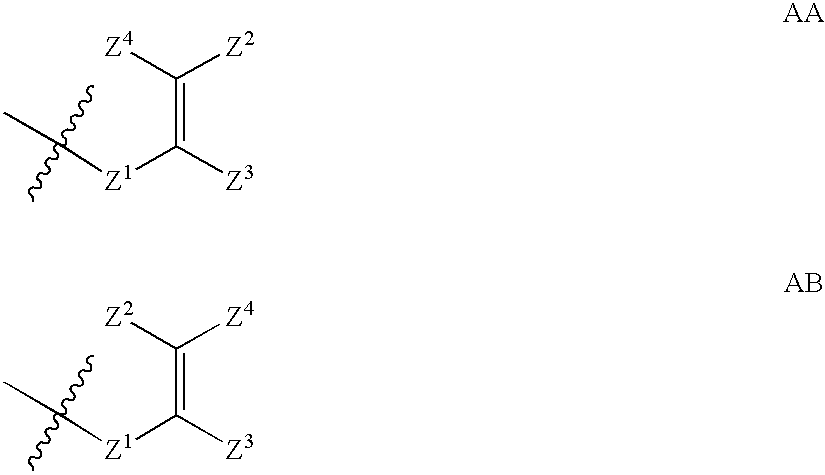
Selection of an atom such as carbon or “C” for a variable such as A1 requires there to be four bonds to this carbon atom. When A1 is C, that would require a double bond to an adjacent atom, in this case, to either A2 or A3 with the appropriate selection of A2 or A3 to accommodate said double bond. When A1 is CS1, then A2 and A3 are selected to accommodate the single bond attachment to A1. A1 through A6 may be interpreted in a similar fashion. Selection of an atom such as nitrogen for a variable such as A2 requires there to be three bonds to this nitrogen atom. This can be accomplished by providing a double bond to the adjacent atoms, in this case, either A1 or A3 with the appropriate selection of A1 or A3 to accommodate said double bond. A2 through A6 may be interpreted in a similar fashion. In addition, M1 through M6 may be interpreted in this fashion, i.e., as described for A1 through A6. Substituents may be attached to the ring such as when the variable M2 is taken to be C(P2)1-2. C(P2)1-2 is intended to indicate that the carbon to which the substituents P2 are attached i) may be saturated, in which case the carbon atom may accommodate two substituents independently chosen from P2, or ii) may be unsaturated, in which case the carbon atom may only accommodate one substituent.
Combinations of substituents and variables thereof that result in stable compounds are also contemplated within the present invention. The term “stable” as used herein refers to compounds which possess stability sufficient to allow for their manufacture and which maintain their integrity for a sufficient period of time to be useful as therapeutic or diagnostic agents.
As used herein, the compounds of this invention are defined to include pharmaceutically acceptable derivatives and prodrugs thereof. A “pharmaceutically acceptable derivative or prodrug” includes any pharmaceutically acceptable salt, ester, salt of an ester, or other derivative of a compound of the present invention which, upon administration to a subject, is capable of providing (directly or indirectly) a compound of the invention. Particularly favored derivatives and prodrugs are those that increase the bioavailability of the compounds of the present invention when such compound is administered to a subject (e.g., by allowing an orally administered compound to be more readily absorbed into the blood) or which enhance delivery of the parent compound to a biological compartment (e.g., the brain or lymphatic system) relative to the parent species. Preferred prodrugs include derivatives where a group that enhances aqueous solubility or active transport through the gut membrane is appended to a compound of the present invention. Pharmaceutically acceptable salts of the compounds disclosed herein include those derived from pharmaceutically acceptable inorganic and organic acids and bases known to those skilled in the art. Examples of suitable acid salts include, but are not limited to, the following: acetate, adipate, alginate, aspartate, benzoate, benzenesulfonate, bisulfate, butyrate, citrate, camphorate, camphorsulfonate, cyclopentanepropionate, digluconate, dodecylsulfate, ethanesulfonate, formate, fumarate, glucoheptanoate, glycerophosphate, glycolate, hemisulfate, heptanoate, hexanoate, hydrochloride, hydrobromide, hydroiodide, 2-hydroxyethanesulfonate, lactate, maleate, malonate, methanesulfonate, 2-naphthalenesulfonate, nicotinate, nitrate, oxalate, palmoate, pectinate, persulfate, 3-phenylpropionate, phosphate, picrate, pivalate, propionate, salicylate, succinate, sulfate, tartrate, thiocyanate, trifluoroacetic, tosylate and undecanoate. Other acids, for example oxalic, while not in themselves pharmaceutically acceptable, may be employed in the preparation of salts useful as intermediates in obtaining the compounds of the present invention and their pharmaceutically acceptable acid additional salts.
Salts derived from appropriate bases include, but are not limited to, the following: alkali metal (e.g., sodium), alkaline earth metal (e.g., magnesium), ammonium and N-(C1-4 alkyl)4 +salts. The present invention also envisions the quatemization of any basic nitrogen-containing groups of the compounds disclosed herein. Water- or oil-soluble or dispersible products may be obtained by such quaternization.
The compounds of the present invention may be synthesized using conventional techniques known in the art. Advantageously, these compounds are conveniently synthesized from readily available starting materials. Following are general synthetic schemes for manufacturing compounds of the present invention. These schemes are illustrative and are not meant to limit the possible techniques one skilled in the art may use to manufacture compounds disclosed herein. Different methods will be evident to those skilled in the art. Additionally, the various steps in the synthesis may be performed in an alternate sequence or order to give the desired compound(s).
The preparation of cyanoguanidines useful to this invention are described in Scheme 1 a. An aniline or heterocyclic amine can react with a variety of isocyanates which are either commercially available or readily prepared by several methods such as reaction of an amine with phosgene and a base such as triethylamine, or reaction with triphosgene, to form a urea such as 1a.1. Amines may be prepared by many methods such as displacement of a halide by potassium pthalimide, and liberation of the amine by the action of hydrazine, or reduction of a nitro group or a nitrile. Nitriles may be reduced to amines (such as 1a.2) by many methods including those detailed in Hudlicky, M., “Reductions in Organic Chemistry”, 2nd Ed., ACS Monograph 188, 1996, pp 239-245 American Chemical Society, Washington, D.C. Cyanoguanidines are conveniently prepared by reaction with the commercially available reagent diphenyl cyanocarbonimidate to initially provide an intermidiate imidate such as 1a.3, which is then reacted with an amine either neat or in a solvent at elevated temperatures in a sealed reaction vessel to provide a cyanoguanidine such as 1a.4 
Cyanoimidates useful to this invention are also conviently prepared from the intermediate cyanoimidate 1 a.3 by reaction with an alcohol in the presence of either sodium metal, or a hydride base such as sodium hydride to provide 1b.1. 
Alkenes useful to this invention may be prepared by several methods including that depicted in scheme 1c. The preparation of nitroalkenes from amines has been describe in many references including Schulze, F. R, et. Al., Arch Pharm (1994) 327 (7) 455-462, and from sulfonamides by Masereel, B., et. Al., Eur J Med. Chem (1997) 32(5) 453-456. In this case the reaction of an amine such as 1a.2, with the commercially available reagent 1,1-bis(methylthio)-2-nitroethylene provides the thioalkene 1c.1. This may also be a useful intermediate, since it can further react with an amine to provide the bis-aminoalkene 1c.2. Alternatively thioalkene 1c.1 can react with a sulfonamide in the presence of base to provide bis-aminoalkene 1c.3. 
Cyanoguanidines of type 2a.2 are also useful to this invention and may be prepared from an aniline such as 3, or heterocyclic amine by reaction with diphenyl cyanocarbonimidate in a manner similar to that described for scheme 1a, to provide 2a.1. In this case the intermediate imidate 2a.1 is reacted with an monosubstituted amine to provide compound 2a.2. 
Alkenes of type 2b.2 are also useful to this invention, and may be prepared from an aniline such as 3, or heterocyclic amine by reaction with 1,1-bis(methylthio)-2-nitroethylene in a similar manner to that described for scheme 1b to provide 2b. 1. In this case the intermediate thioalkene 2b.1 is reacted with a monosubstituted amine to provide alkene 2b.2 
The preparation of alkenes useful to this invention are also described in scheme 2c, by the reaction of a carbon nucleophile with a carbodiimide. Carbodiimides may be prepared by several methods including desulfurization of a thiourea with reagents such as methanesulfonyl chloride int the presence a base and catalytic N,N-dimethylaminopyridine (DMAP) or by the use of 1,1′thiocarbonyldi-2,2′-pyridone and catalytic DMAP as described by Kim S., and Yi, K. Y., in J. Org. Chem. 1986, 51, 2613-2615. Thioureas are readily prepared by several methods including reaction of a urea with Lawesson's reagent, or by reaction of an amine with an isothiocyanate. Isothiocyanates are either commercially available or readily prepared by reaction of an amine with 1,1′thiocarbonyldi-2,2′-pyridone. In this case an aniline or heterocyclic amine such as 3, may be reacted with the commercially available reagent 1,1′thiocarbonyldi-2,2′pyridone (2c.1) to provide isothiocyante 2c.2. Reaction of the isothiocyante with a monosubstituted amine provides thiourea 2c.3. The thiourea is converted to the carbodiimide by reaction with 1,1′thiocarbonyldi-2,2′pyridone (2c.1) in the presence of a catalytic amount of DMAP to provide 2c.4. The intermediate carbodiimide may react with a variety of activated carbon nucleophiles in the presence of a suitable base capable of preparing the corresponding anion of the carbon nucleophile of interest. For example a variety of substitued alkenes of type 2c.6 where the electron withdrawing group (EWG) is a nitro group may be prepared by reaction of a nitroalkane (2c.5, EWG=NO2) which is either commercially available, or readily prepared by one skilled in the art of organic synthesis, with carbodiimide 2c.4, in the presence of a base (for example see: Moimas, F.; Angeli, C.; Comisso, G.; Zanori, P.; et al.; Synthesis 1985, 509). Sulfones (2c.5, EWG=SO2R) or nitriles (2c.5, EWG=CN) may also be used as activated carbon nucleophiles of type 2c.5 in the presence of a suitable base to provide alkenes of type 2c.6. Alternatively activated carbon nucleophiles with two electron withdrawing groups of type 2c.7 are also useful to this invention and are either commercially available or readily prepared by one skilled in the art of organic chemistry. Reaction of carbodiimide 2c.4 with active methylene compounds of type 2c.7 in the presence of a base provide alkenes of type 2c.7 (for example see: Stephen, A., Montsh Chem (1966) p 97.). 
Cyanoguanidines may also be prepared from thiouronium salts as illustrated in scheme 2d. An isothiocyanate (such as 2c.2) is reacted with sodium cyanamide, which is prepared by reaction of sodium metal with cyanamide in a solvent such as methanol or ethanol, to produce thiouronium salt 2d.1. Addition of an amine in the presence of a coupling agent such as 1-(3-dimethylaminopropyl)-3-ethylcarbodiimide hydrochloride (EDC) provides the desired cyanoguanidine 2a.2 
Amines of type 3a.4 are useful for the preparation of compounds useful to this invention may be commercially available or readily prepared by many methods known to one skilled in the art of organic chemistry, and are described in “Comprehensive Organic Transformations. A Guide to Functional Group Preparation.” pp-385-439. Richard C. Larock 1989 VCH Publishers, Inc. Examples include but are not limited to, reduction of a nitro group, reduction of an azide and reduction of a nitrile and are detailed in schemes 3a to 3d.
A general method for the synthesis of an amine useful in this invention can be performed by metal catalyzed cross coupling methods known in the literature. The simplest case is a Suzuki type cross coupling (Miyaura, N., Yanagi, T. Suzuki, A., Synth. Comm. 11(7):513-519 (1981); A. Suzuki et. al., J. Am. Chem. Soc. 111:513 (1989); and V. N. Kalinin, Russ. Chem. Rev. 60:173 (1991)) of an aryl boronic acid or ester (3a.1) (as shown below) with an appropriate bromoheterocycle in the presence of a suitable catalyst such as tetrakis(triphenylphosphine) palladium. After the cross coupling has been performed the product may be deprotected. The choice of protecting group and its method of removal will be readily apparent to one skilled in the art of organic chemistry. Such considerations and methods are, for example, described by Greene, Theodora W. and Wuts, Peter G. M. in “Protective Groups in Organic Synthesis.” 2nd Ed. (1991) Publisher: (John Wiley and Sons, Inc., New York, N.Y. For example, if the protecting group is acetyl the product may be deprotected by treatment with aqueous potassium hydroxide at a concentration of 0.5N to 5 N at room temperature to 100° C. for a period between 0.5 h and 24 h.
For example aryl boronic acid (3a.5) may react with the known 5-bromothiazole (3a.6) in the presence of tetrakis(triphenylphosphine) palladium (0), to provide (3a.7) which may be deprotected by an appropriate method. 

Copper has been recently been shown to be an effective catalyst for cross coupling of aryl boronic acids to N-unsubstituted heterocycles as described by Chan. et al., Tetrahed. Lett. 39:2933-2936 (1998); and Lam et al., Tetrahed. Lett. 39:2941-2944 (1998). This results in compounds in which the heterocycle is attached to the aryl ring through nitrogen rather than carbon. For example aryl boronic acid (3a.5) may react with oxazolone (3a.8) in the presence of copper (II) acetate in the presence of an amine base such as pyridine to provide intermediate (3a.9) which may be deprotected by an appropriate method.
In general, aryl boronic acids and esters, 3b.3, where X is not Br or I, may be prepared as shown in Scheme 3b, from the corresponding arylbromide (3b.1) by treatment with a palladium catalyst such as [1,1 ′-Bis(diphenylphosphino)-ferrocene] dichloropalladium (II) and bis(pinacolato)diboron, (3b.2), as reported by Ishayama et al., J. Org. Chem., (1995) 7508-7510. Aryl boronic esters may be converted to the corresponding boronic acid by several methods including treatment with aqueous HCl. In a variation of the synthesis, the nitrogen may be masked as a nitro group and later reduced by several means including metal reductions, such as by treatment with tin chloride in HCl or by refluxing the nitro compound with zinc in the presence of CaCl2 in a solvent such as ethanol, or in certain cases the nitro group may be reduced by catalytic hydrogenation in the presence of catalysts such as palladium on carbon. The conditions for the reduction of nitro groups are detailed in several references including Hudlicky, M., “Reductions in Organic Chemistry”, 2nd Ed., ACS Monograph 188, 1996, pp 91-101 America Chemical Society, Washington, D.C. A second variation of the synthesis allows the aryl bromide to remain through the entire synthesis and elaborated to the boronic acid at the end. This may eliminate the need for a protecting group. 
In certain cases, it may be more expedient to construct the heterocyclic ring by other methods. A general method for the synthesis of 5-membered heterocycles includes the 1,3-dipolar cycloaddition reaction, which is well known to one skilled in the art of organic chemistry and is described by Padwa, Albert (Editor) in “1,3-Dipolar Cycloaddition Chemistry, Vol. 2” (John Wiley and Sons, New York, N.Y. [1984]); and Padwa, Albert (Editor) in “1,3-Dipolar Cycloaddition Chemistry, Vol. 1” (John Wiley and Sons, New York, N.Y. [1984]). For example, oxazoles may be prepared by 1,3 dipolar cycloaddition of the corresponding aldehyde (3c.1) and (p-tolylsulfonyl)methyl isocyanate (TOSMIC) (3c.2) as shown in scheme 3c. The aldehyde may be commercially available or prepared from the corresponding methyl group by oxidation with reagents such as CrO3, MnO2, and ammonium cerium (IV) nitrate by methods well known to one skilled in the art of organic chemistry and described in Hudlicky, M., “Oxidations in Organic Chemistry”, ACS Monograph 186 (1990), American Chemical Society, Washington, D.C. The nitro group in intermediate (3c.3), is reduced to an amine (3c.4), as discussed above. 
An alternative method of producing amines useful to this invention is by nucleophilic attack of an electron deficient ring system as outlined in scheme 3d. Halonitrobenzenes (3d.1), are either commercially available or readily prepared by methods known to one skilled in the art of organic synthesis. Displacement with a variety of nucleophiles produces compounds of structure (3d.2). In one example, heating (3d.3) with a nucleophilic heterocycle such as triazole with or without the addition of a base provides the intermediate nitro compound which may be reduced as previously describe to provide amines (3d.4). Alternatively, simple organic nucleophiles such as cyanide can be reacted with halonitrobenzene (3d.5) to provide an intermediate nitrocompound which can be reduced by many methods to amine (3d.6). 
The compounds of the present invention may be modified by appending appropriate functionalities to enhance selective biological properties. Such modifications are known in the art and include those which increase biological penetration into a given biological compartment (e.g., blood, lymphatic system, central nervous system), increase oral availability, increase solubility to allow administration by injection, alter metabolism and alter rate of excretion.
The compounds of the present invention inhibit IMPDH enzyme, and are thus useful in the treatment, including prevention and therapy, of disorders which are mediated or effected by cells which are sensitive to IMPDH inhibition, as described previously. The present invention thus provides methods for the treatment of IMPDH-associated disorders, comprising the step of administering to a subject in need thereof at least one compound of the Formula I, IA, II or IIA in an amount effective therefor. Other therapeutic agents, such as those described below, may be employed with the inventive compounds in the present methods. In the methods of the present invention, such other therapeutic agent(s) may be administered prior to, simultaneously with or following the administration of the compound(s) of the present invention.
Use of the compounds of the present invention in treating IMPDH-associated conditions is exemplified by, but is not limited to, treating a range of disorders such as: treatment of transplant rejection, such as kidney, liver, heart, lung, pancreas (e.g., islet cells), bone marrow, cornea, small bowel, skin allografts, skin homografts (such as employed in burn treatment), heart valve xenografts, serum sickness, and graft vs. host disease; in the treatment of autoimmune diseases, such as rheumatoid arthritis, psoriatic arthritis, multiple sclerosis, juvenile diabetes, asthma, inflammatory bowel disease (such as Crohn's disease and ulcerative colitus), pyoderma gangrenum, lupus (systemic lupus erythematosis), myasthenia gravis, psoriasis, dermatitis, dermatomyositis, eczema, seborrhoea, pulmonary inflammation, eye uveitis, hepatitis, Grave's disease, Hashimoto's thyroiditis, autoimmune thyroiditis, Behcet's or Sjorgen's syndrome (dry eyes/mouth), pernicious or immunohaemolytic anaemia, Addison's disease (autoimmune disease of the adrenal glands), idiopathic adrenal insufficiency, autoimmune polyglandular disease (also known as autoimmune polyglandular syndrome), glomerulonephritis, scleroderma, morphea, lichen planus, viteligo (depigmentation of the skin), alopecia areata, autoimmune alopecia, autoimmune hypopituatarism, Guillain-Barre syndrome, and alveolitis; in the treatment of T-cell mediated hypersensitivity diseases, including contact hypersensitivity, delayed-type hypersensitivity, contact dermatitis (including that due to poison ivy), uticaria, skin allergies, respiratory allergies (hayfever, allergic rhinitis) and gluten-sensitive enteropathy (Celiac disease); in the treatment of inflammatory diseases such as osteoarthritis, acute pancreatitis, chronic pancreatitis, asthma, acute respiratory distress syndrome, Sezary's syndrome and vascular diseases which have an inflammatory and or a proliferatory component such as restenosis, stenosis and artherosclerosis; in the treatment of cancer and tumor disorders, such as solid tumors, lymphomas and leukemia; in the treatment of fungal infections such as mycosis fingoides; in protection from ischemic or reperfusion injury such as ischemic or reperfusion injury that may have been incurred during organ transplantation, myocardial infarction, stroke or other causes; in the treatment of DNA or RNA viral replication diseases, such herpes simplex type 1 (HSV-1), herpes simplex type 2 (HSV-2), hepatitis (including hepatitis B and hepatitis C) cytomegalovirus, Epstein-Barr, and human immunodeficiency virus (HIV).
Additionally, IMPDH is also known to be present in bacteria and thus may regulate bacterial growth. As such, the IMPDH-inhibitor compounds of the present invention may be useful in treatment or prevention of bacterial infection, alone or in combination with other antibiotic agents.
In a particular embodiment, the compounds of the present invention are useful for the treatment of the aforementioned exemplary disorders irrespective of their etiology, for example, for the treatment of transplant rejection, rheumatoid arthritis, inflammatory bowel disease, and viral infections.
The present invention also provides pharmaceutical compositions comprising at least one of the compounds of Formula I, IA, II or IIA or a salt thereof, capable of treating an IMPDH-associated disorder in an amount effective therefor, alone or in combination with at least one additional therapeutic agent, and any pharmaceutically acceptable carrier, adjuvant or vehicle. “Additional therapeutic agents” encompasses, but is not limited to, an agent or agents selected from the group consisting of an immunosuppressant, an anti-cancer agent, an anti-viral agent, an anti-inflammatory agent, an anti-fungal agent, an antibiotic, or an anti-vascular hyperproliferation compound.
The term “pharmaceutically acceptable carrier, adjuvant or vehicle” refers to a carrier, adjuvant or vehicle that may be administered to a subject, together with a compound of the present invention, and which does not destroy the pharmacological activity thereof. Pharmaceutically acceptable carriers, adjuvants and vehicles that may be used in the pharmaceutical compositions of the present invention include, but are not limited to, the following: ion exchangers, alumina, aluminum stearate, lecithin, self-emulsifying drug delivery systems (“SEDDS”) such as d(-tocopherol polyethyleneglycol 1000 succinate), surfactants used in pharmaceutical dosage forms such as Tweens or other similar polymeric delivery matrices, serum proteins such as human serum albumin, buffer substances such as phosphates, glycine, sorbic acid, potassium sorbate, partial glyceride mixtures of saturated vegetable fatty acids, water, salts or electrolytes such as protamine sulfate, disodium hydrogen phosphate, potassium hydrogen phosphate, sodium chloride, zinc salts, colloidal silica, magnesium trisilicate, polyvinyl pyrrolidone, cellulose-based substances, polyethylene glycol, sodium carboxymethylcellulose, polyacrylates, waxes, polyethylene-polyoxypropylene-block polymers, polyethylene glycol and wool fat. Cyclodextrins such as α-, β- and γ-cyclodextrin, or chemically modified derivatives such as hydroxyalkylcyclodextrins, including 2- and 3-hydroxypropyl-β-cyclodextrins, or other solubilized derivatives may also be used to enhance delivery of the compounds of the present invention.
The compositions of the present invention may contain other therapeutic agents as described below, and may be formulated, for example, by employing conventional solid or liquid vehicles or diluents, as well as pharmaceutical additives of a type appropriate to the mode of desired administration (for example, excipients, binders, preservatives, stabilizers, flavors, etc.) according to techniques such as those well known in the art of pharmaceutical formulation.
The compounds of the Formula I, IA, II or IIA may be administered by any suitable means, for example, orally, such as in the form of tablets, capsules, granules or powders; sublingually; buccally; parenterally, such as by subcutaneous, intravenous, intramuscular, or intrastemal injection or infusion techniques (e.g., as sterile injectable aqueous or non-aqueous solutions or suspensions); nasally such as by inhalation spray; topically, such as in the form of a cream or ointment; or rectally such as in the form of suppositories; in dosage unit formulations containing non-toxic, pharmaceutically acceptable vehicles or diluents. The present compounds may, for example, be administered in a form suitable for immediate release or extended release. Immediate release or extended release may be achieved by the use of suitable pharmaceutical compositions comprising the present compounds, or, particularly in the case of extended release, by the use of devices such as subcutaneous implants or osmotic pumps. The present compounds may also be administered liposomally.
Exemplary compositions for oral administration include suspensions which may contain, for example, microcrystalline cellulose for imparting bulk, alginic acid or sodium alginate as a suspending agent, methylcellulose as a viscosity enhancer, and sweeteners or flavoring agents such as those known in the art; and immediate release tablets which may contain, for example, microcrystalline cellulose, dicalcium phosphate, starch, magnesium stearate and/or lactose and/or other excipients, binders, extenders, disintegrants, diluents and lubricants such as those known in the art. The present compounds may also be delivered through the oral cavity by sublingual and/or buccal administration. Molded tablets, compressed tablets or freeze-dried tablets are exemplary forms which may be used. Exemplary compositions include those formulating the present compound(s) with fast dissolving diluents such as mannitol, lactose, sucrose and/or cyclodextrins. Also included in such formulations may be high molecular weight excipients such as celluloses (avicel) or polyethylene glycols (PEG). Such formulations may also include an excipient to aid mucosal adhesion such as hydroxy propyl cellulose (HPC), hydroxy propyl methyl cellulose (HPMC), sodium carboxy methyl cellulose (SCMC), maleic anhydride copolymer (e.g., Gantrez), and agents to control release such as polyacrylic copolymer (e.g., Carbopol 934). Lubricants, glidants, flavors, coloring agents and stabilizers may also be added for ease of fabrication and use.
Exemplary compositions for nasal aerosol or inhalation administration include solutions in saline which may contain, for example, benzyl alcohol or other suitable preservatives, absorption promoters to enhance bioavailability, and/or other solubilizing or dispersing agents such as those known in the art.
Exemplary compositions for parenteral administration include injectable solutions or suspensions which may contain, for example, suitable non-toxic, parenterally acceptable diluents or solvents, such as mannitol, 1,3-butanediol, water, Ringer's solution, an isotonic sodium chloride solution, or other suitable dispersing or wetting and suspending agents, including synthetic mono- or diglycerides, and fatty acids, including oleic acid. The term “parenteral” as used herein includes subcutaneous, intracutaneous, intravenous, intramuscular, intraarticular, intraarterial, intrasynovial, intrastemal, intrathecal, intralesional and intracranial injection or infusion techniques.
Exemplary compositions for rectal administration include suppositories which may contain, for example, a suitable non-irritating excipient, such as cocoa butter, synthetic glyceride esters or polyethylene glycols, which are solid at ordinary temperatures, but liquify and/or dissolve in the rectal cavity to release the drug.
Exemplary compositions for topical administration include a topical carrier such as Plastibase (mineral oil gelled with polyethylene).
The effective amount of a compound of the present invention may be determined by one of ordinary skill in the art, and includes exemplary dosage amounts for an adult human of from about 0.1 to 500 mg/kg of body weight of active compound per day, which may be administered in a single dose or in the form of individual divided doses, such as from 1 to 5 times per day. It will be understood that the specific dose level and frequency of dosage for any particular subject may be varied and will depend upon a variety of factors including the activity of the specific compound employed, the metabolic stability and length of action of that compound, the species, age, body weight, general health, sex and diet of the subject, the mode and time of administration, rate of excretion, drug combination, and severity of the particular condition. Preferred subjects for treatment include animals, most preferably mammalian species such as humans, and domestic animals such as dogs, cats and the like, subject to IMPDH-associated disorders.
The compounds of the present invention may be employed alone or in combination with each other and/or other suitable therapeutic agents useful in the treatment of IMPDH-associated disorders, such as IMPDH inhibitors other than those of the present invention, immunosuppressants, anti-cancer agents, anti-viral agents, anti-inflammatory agents, anti-fungal agents, antibiotics, or anti-vascular hyperproliferation agents.
Exemplary such other therapeutic agents include the following: cyclosporins (e.g., cyclosporin A), CTLA4-Ig, antibodies such as anti-ICAM-3, anti-IL-2 receptor (Anti-Tac), anti-CD45RB, anti-CD2, anti-CD3 (OKT-3), anti-CD4, anti-CD80, anti-CD86, monoclonal antibody OKT3, agents blocking the interaction between CD40 and CD154 (a.k.a. “gp39”), such as antibodies specific for CD40 and/or CD154, fusion proteins constructed from CD40 and/or CD154/gp39 (e.g., CD40Ig and CD8gp39), inhibitors, such as nuclear translocation inhibitors, of NF-kappa B function, such as deoxyspergualin (DSG), non-steroidal antiinflammatory drugs (NSAIDs) such as ibuprofen, celecoxib and rofecoxib, steroids such as prednisone or dexamethasone, gold compounds, antiviral agents such as abacavir, antiproliferative agents such as methotrexate, leflunomide, FK506 (tacrolimus, Prograf), cytotoxic drugs such as azathiaprine and cyclophosphamide, TNF-α inhibitors such as tenidap, anti-TNF antibodies or soluble TNF receptor, and rapamycin (sirolimus or Rapamune) or derivatives thereof.
The above other therapeutic agents, when employed in combination with the compounds of the present invention, may be used, for example, in those amounts indicated in the Physicians' Desk Reference (PDR) or as otherwise determined by one of ordinary skill in the art.
Compounds disclosed herein are capable of targeting and inhibiting IMPDH enzyme. Inhibition can be measured by various methods, including, for example, IMP dehydrogenase HPLC assays (measuring enzymatic production of XMP and NADH from IMP and NAD) and IMP dehydrogenase spectrophotometric assays (measuring enzymatic production of NADH from NAD). See, e.g., Montero et al., Clinica Chimica Acta 238:169-178 (1995). Additional assays known in the art can be used in ascertaining the degree of activity of a compound (“test compound”) as an IMPDH inhibitor. The inventors used the following assay to determine the degree of activity of the compounds disclosed herein as IMPDH inhibitors:
Activity of IMPDH I and IMPDH II was measured following an adaptation of the method described in WO 97/40028. The reaction mixture was prepared containing 0.1M Tris pH 8.0, 0.1 M KCl, 3 mM EDTA, 2 mM DTT, 0.4 mM IMP and 40 nM enzyme (IMPDH I or IMPDH II). The reaction was started by the addition of NAD to a final concentration of 0.4 mM. The enzymatic reaction was followed by measuring the increase in absorbance at 340 nM that results from the formation of NADH. For the analysis of potential inhibitors of the enzyme, compounds were dissolved in DMSO to a final concentration of 10 mM and added to the assay mixture such that the final concentration of DMSO was 2.5%. The assay was carried out in a 96-well plate format, with a final reaction volume of 200 □1.
Compounds disclosed herein are capable of inhibiting the enzyme IMPDH at a measurable level, under the above-described assay or an assay which can determine an effect of inhibition of the enzyme IMPDH.
The following examples illustrate preferred embodiments of the present invention and do not limit the scope of the present invention which is defined in the claims. Abbreviations employed in the Examples are defined below. Compounds of the Examples are identified by the example and step in which they are prepared (e.g., “1A” denotes the title compound of step A of Example 1), or by the example only where the compound is the title compound of the example (for example, “2” denotes the title compound of Example 2).
| Abbreviations |
| Ac | Acetyl |
| AcOH | Acetic acid |
| aq. | Aqueous |
| CDI | Carbonyldiimidazole |
| Bn | Benzyl |
| Boc | tert-butoxycarbonyl |
| DMAP | Dimethylaminopyridine |
| DMF | dimethylformamide |
| DMSO | Dimethylsulfoxide |
| EDC | 1-(3-Dimethylaminopropyl)-3-ethylcarbodiimide |
| hydrochloride | |
| EtOAc | Ethyl acetate |
| Et | Ethyl |
| EtOH | Ethanol |
| h | Hours |
| i | iso |
| HPLC | High pressure liquid chromatography |
| HOAc | Acetic acid |
| THF | Tetrahydrofuran |
| Lawesson's | [2,4-bis(4-methoxyphenyl)-1,3-dithia-2,4-diphosphetane- |
| Reagent | 2-4-disufide |
| LC | liquid chromatography |
| Me | Methyl |
| MeOH | Methanol |
| min. | Minutes |
| M+ | (M + H)+ |
| M+1 | (M + H)+ |
| MS | Mass spectrometry |
| n | normal |
| Pd/C | Palladium on carbon |
| Ph | Phenyl |
| Pr | Propyl |
| Ret Time | Retention time |
| rt or RT | Room temperature |
| sat. | Saturated |
| TFA | Trifluoroacetic acid |
| THF | Tetrahydrofuran |
| TOSMIC | Tosylmethyl isocyanide |
| YMC | YMC Inc, Wilmington, NC 28403 |

1A. Preparation of 4-Nitro-2-methoxy-(a,a-bisacetoxy)toluene 
To a 5 L three necked round bottom flask equipped with a mechanical stirrer was added 4-nitro-2-methoxytoluene (150.0 g, 0.8973 mol), HOAc (900 mL) and Ac2O (900 mL). The mixture was stirred and cooled to 8° C. with an acetone/ice bath. Concentrated H2SO4 (136 mL) was carefully added while keeping the pot temperature<19° C. After cooling to 0° C., CrO3 (252.6 g, 2.526 mol, 2.815 equiv.) was added portion-wise over 1 hour while maintaining the reaction temperature between 0-10° C. After the addition, the mixture was stirred at 0° C. for 30 minutes at which time the reaction was complete. The reaction mixture was then carefully poured into ice (1.5 kg) with stirring to give a slurry. The remaining black gummy residue was rinsed with HOAc (3×100 mL), and the washes were added to the slurry. After stirring for 10 minutes, the slurry was filtered. The cake was washed with water (3×400 mL) and suction dried for 17 hours to give 4-nitro-2-methoxy-(a,a-bisacetoxy)toluene (1A, 129.0 g, 51%). 1H NMR (CDCl3) d 8.02 (s, 1H), 7.89 (d, J=8.4 Hz, 1H), 7.77 (s, 1H), (d, 8.4 Hz, 1H), 3.98 (s, 3H), 2.16 (s, 6H).
1B. Preparation of 4-Nitro-2-methoxybenzaldehyde 
To a 2 L rounded bottom flask equipped with a condenser and a mechanical stirrer was placed 1A (250.7 g, 0.8851 mol), dioxane (300 mL) and concentrated HCl (60 mL). The reaction mixture was heated to reflux and stirred under N2 for 20 hours. Water (250 mL) was added dropwise while maintaining the reaction mixture at reflux. After cooling to 0° C. with an ice/water bath, the resulting slurry was stirred for 30 minutes and then filtered. The cake was washed with water (4×200 mL) and suction dried for 17 hours to give 4-nitro-2-methoxybenzaldehyde (1B, 146.3 g, 91%) as yellow solid. 1H NMR (CDCl3) d 10.54 (s, 1H), 8.00 (d, J=8.3 Hz, 1H), 7.91 (s, 1H), 7.89 (d, J=8.3 Hz, 1H), 4.08 (s, 3H).
1C. Preparation of 5-(4-Nitro-2-methoxyphenyl)oxazole 
To a 5 L three necked round bottom flask equipped with a condenser and a mechanical stirrer was placed 1B (146.3 g, 0.8076 mol), TOSMIC (157.7 g, 0.8077 mol), K2CO3 (116.6 g, 0.8075 mol) and MeOH (2.5 L). The mixture was heated to reflux under N2 and stirred for 3 hours. Water (1.25 L) was added drop-wise while maintaining the pot temperature between 59-69° C. The resulting slurry was cooled to room temperature, and then to 5° C. with an ice-water bath. After stirring for 30 minutes at 5° C., the slurry was filtered. The resulting cake was washed with water (3×400 mL) and dried in a vacuum oven at 45° C. for 20 hours to give 5-(4-nitro-2-methoxyphenyl)oxazole (1C, 148.5 g, 84%) as a yellow-reddish solid. 1H NMR (CDCl3) d 8.02 (s, 1H), 7.97 (d, J=2 Hz, 1H), 7.95 (d, J=2 Hz, 1H), 7.86 (s, 1H), 7.78 (s, 1H), 4.11 (s, 3H).
1D. Preparation of 5-(4-Amino-2-methoxyphenyl)oxazole 
In a 2 L hydrogenation flask was placed 1C (130.0 g, 0.6131 mol), Pd/C (10%, 26.2 g) and absolute EtOH (1280 mL). The mixture was hydrogenated at 35-45 psi H2 until the reaction was complete. The mixture was filtered over a pad of celite (20 g) and the cake was washed with EtOH (3×100 mL). The filtrate was concentrated to a volume of 350 mnL. Heptane (500 mL) was added to the resulting slurry. After stirring for 2 hours at room temperature, the slurry was filtered. The cake was washed with heptane (3×100 mL) and air-dried to give 80.0 g of 5-(4-amino-2-methoxyphenyl)oxazole (1D). Another 30.2 g of product was recovered from the mother liquor affording a total yield of 95%. 1H NMR (CDCl3) d 7.88 (s, 1H), 7.60 (d, J=8.4 Hz, 1H), 7.41 (s, 1H), 6.41 (dd, J=8.4, 2.1 Hz, 1H), 3.34 (d, J=2.1 Hz, 1H), 3.98 (bs, 2H), 3.94 (s, 3H).
1E. Preparation of N-(3-Cyanophenyl)-N′-[3-methoxy-4-(5-oxazolyl)phenyl]urea 
3-Methoxy-4-(5-oxazolyl)aniline, 1D (1.00 g, 5.26 mmol) and 3-cyanophenyl isocyanate (1.17 g, 7.89 mmol) in dichloromethane (40 mL) were stirred at rt for 20 h. The precipitate formed was collected by filtration, followed by washing with dichlorometnane to provide 1E (1.57 g, 89% yield) as a yellow solid. (LC/MS retention time=3.67 min.; M+=335. Column: YMC S5 ODS 4.6×5.0 mm Ballistic. Solvent A=10% MeOH, 90% H2O, 0.1% TFA; Solvent B=90% MeOH, 10% H2O, 0.1% TFA).
1F. Preparation of the TFA salt of N-[3-(Aminomethyl)phenyl]-N′-[3-methoxy-4-(5-oxazolyl)phenyl]urea 
A suspension of 1E (421 mg, 1.26 mmol) and 10% Pd/C (80 mg) in 3:1 MeOH/TFA (100 mL) was stirred under a hydrogen environment provided by a balloon for 16 h. After the Pd/C and solvent were removed by filtration and evaporation, respectively, the residue was dissolved in water (50 mL) which resulted in a cloudy solution. To the solution was added methanol until the cloudiness disappeared. The solution was washed with dichloromethane (3×30 mL) and then concentrated to approximately 40 mL. The remaining solution was then lyophilized to provide 1F (477 mg, 84% yield) as a white powder. (LC/MS retention time=2.86 min.; M+=339. Column: YMC S5 ODS 4.6×5.0 mm Ballistic. Solvent A=10% MeOH, 90% H2O, 0.1% TFA; Solvent B=90% MeOH, 10% H2O, 0.1% TFA).

To a suspension of 1F (0.150 g, 0.220 mmol) in 50 ml of acetonitrile was added triethylamine (0.092 g, 0.660 mmol). The mixture was stirred until the solution became homogeneous. Diphenyl cyanocarbonimitate (0.109 g, 0.440 mmol) was added, and the reaction mixture was stirred at reflux for 14 h. The reaction was cooled, and the solvent was removed under reduced pressure to give a yellowish oil which was subjected to silica gel chromatography to give 0.079 g (75%) of 1 as a white solid. The product was determined to be 86% pure by HPLC (Retention time=3.94 min. Column: YMC S5 ODS 4.6×5.0 mm Ballistic. Solvent A=10% MeOH, 90% H2O, 0.2% H3PO4; Solvent B=90% MeOH, 10% H2O, 0.2% H3PO4).

A solution of 1 (35 mg, 0.072 mmol) and ammonia (2.0 M EtOH solution, 4.0 mL, 8.0 mmol) in ethanol (4 mL) was heated in a sealed tube at 80° C. for 15 h. After the solvent was evaporated under reduced pressure, the residue was subjected to column chromatography (10% MeOH/CHCl3) to afford compound 2 (19 mg, 66% yield) as a white solid. (LC/MS retention time=3.30 min.; M+=406. Column: YMC S5 ODS 4.6×5.0 mm Ballistic. Solvent A=10% MeOH, 90% H2O, 0.1% TFA; Solvent B=90% MeOH, 10% H2O, 0.1% TFA).

To 1 (0.029 g, 0.060 mmol) in 7 mL of acetonitrile was added excess morpholine (15.7 μL, 0.180 mmol). The mixture was heated at reflux for 48 h, cooled to room temperature, and the solvent was removed under reduced pressure. The residue was subjected to silica gel chromatography to give 14 mg of a residue which by HPLC contained 51% of 3. The residue was subjected to preparative HPLC to give 2.1 mg of 3 as a white solid which was 98% pure by LC/MS (retention time=3.32 min.; M+=476.27. Column: YMC S5 ODS 4.6×5.0 mm Ballistic. Solvent A=10% MeOH, 90% H2O, 0.1% TFA; Solvent B=90% MeOH, 10% H2O, 0.1% TFA).

To 1 (0.012 g, 0.025 mmol) in 4 mL of acetonitrile was added histamine (3.0 mg, 0.025 mmol). The mixture was heated at reflux for 16 h, cooled to room temperature, and the solvent was removed under reduced pressure. The resulting residue was washed with ether and methylene chloride to give a white solid. The mixture was subjected to preparative HPLC to give 2.8 mg of 4 as a yellow solid which was 100% pure by HPLC (retention time=3.01 min.; M+=500.30. Column: YMC S5 ODS 4.6×5.0 mm Ballistic. Solvent A=10% MeOH, 90% H2O, 0.1% TFA; Solvent B=90% MeOH, 10% H2O, 0.1% TFA).

A mixture of 1 (0.010 g, 0.021 mmol) and 4-hydroxypiperidine in 3 mL of acetonitrile in a sealed tube was heated at approximately 100° C. for 48 h. After the reaction had cooled, the solvent was removed under reduced pressure. The resulting residue was washed with ether and dichloromethane to give 10 mg of a yellow solid residue which was 71% pure by HPLC. The mixture was subjected to preparative HPLC to give 4.0 mg of 5 as a yellow oil, which was 96% pure by LC/MS (retention time=3.16) (M+H)+ 490.3+. Column: YMC S5 ODS 4.6×5.0 mm Ballistic. Solvent A=10% MeOH, 90% H2O, 0.1% TFA; Solvent B=90% MeOH, 10% H2O, 0.1% TFA).

A mixture of 1 (0.010 g, 0.021 mmol) and 3-hydroxypiperidine in 3 mL of acetonitrile in a sealed tube was heated at approximately 100° C. for 48 h. After the reaction had cooled, the solvent was removed under reduced pressure. The resulting residue was washed with ether and dichloromethane to give a yellow solid. The mixture was subjected to preparative HPLC to give 3.4 mg of 6 as a yellow solid which was 100% pure by LC/MS (retention time=3.17 min; (M+H)+490.3+. Column: YMC S5 ODS 4.6×5.0 mm Ballistic. Solvent A=10% MeOH, 90% H2O, 0.1% TFA; Solvent B=90% MeOH, 10% H2O, 0.1% TFA).

A mixture of 1 (0.015 g, 0.031 mmol) and cyclohexylamine (4.30 μL, 0.037 mmol) in 4 mL of acetonitrile in a sealed tube was heated at 110° C. for 48 h. After the reaction had cooled, the solvent was removed under reduced pressure. The resulting residue was washed with ether and dichloromethane to give a residue which contained 72% of 7 by HPLC. The mixture was subjected to preparative HPLC to give 5.30 mg (35%) of the product as a pale yellow solid which was 100% pure by LC/MS (retention time=4.18 min.; M+=488.25. Column: YMC S5 ODS 4.6×5.0 mm Ballistic. Solvent A=10% MeOH, 90% H2O, 0.1% TFA; Solvent B=90% MeOH, 10% H2O, 0.1% TFA).

A mixture of 1 (0.015 g, 0.031 mmol) and 4-(aminomethyl)pyridine (3.80 μL, 0.037 mmol) in 4 mL of acetonitrile in a sealed tube was heated at 110° C. for 48 h. After the reaction had cooled, the solvent was removed under reduced pressure. The resulting residue was washed with ether and subjected to preparative HPLC to give 5.00 mg (33%) of 8 as an orange solid which was 100% pure by LC/MS (retention time=3.05 min.; M+=497.26. Column: YMC 5ODS 4.6×5.0 mm Ballistic. Solvent A=10% MeOH, 90% H2O, 0.1% TFA; Solvent B=90% MeOH, 10% H2O, 0.1% TFA).

A mixture of 1 (0.015 g, 0.031 mmol) and tetrahydrofurfurylamine (3.90 μL, 0.037 mmol) in 4 mL of acetonitrile in a sealed tube was heated at 110° C. for 48 h. After the reaction had cooled, the solvent was removed under reduced pressure. The resulting residue was washed with ether, washed with dichloromethane, and subjected to preparative HPLC to give 4.3 mg (29%) of 9 as a yellow solid which was 98% pure by LC/MS (retention time=3.65 min.; M+=490.23. Column: YMC S5 ODS 4.6×5.0 mm Ballistic. Solvent A=10% MeOH, 90% H2O, 0.1% TFA; Solvent B=90% MeOH, 10% H2O, 0.1% TFA).

A mixture of 1 (0.031 g, 0.021 mmol) and 1-(2-hydroxyethyl)piperazine (4.60 μL, 0.037 mmol) in 4 mL of acetonitrile in a sealed tube was heated at 110° C. for 18 h. After the reaction had cooled, the solvent was removed under reduced pressure. The resulting residue was washed with ether and dichloromethane to give a residue which contained 78% of 10 by HPLC. The mixture was subjected to preparative HPLC to give 3.80 mg (24%) of the product as a pale yellow solid which was 96% pure by LC/MS (retention time=3.10 min.; M+=519.30. Column: YMC S5 ODS 4.6×5.0 mm Ballistic. Solvent A=10% MeOH, 90% H2O, 0.1% TFA; Solvent B=90% MeOH, 10% H2O, 0.1% TFA).

A mixture of 1 (0.020 g, 0.042 mmol) and methylamine (0.10 mL of a 2.0 M solution in THF, 0.21 mmol) in 4 mL of acetonitrile in a sealed tube was heated at 102° C. for 48 h. After the reaction had cooled, the solvent was removed under reduced pressure. The resulting residue was washed with ether, washed with dichloromethane, and subjected to preparative HPLC to give 4.8 mg (28%) of 11 as a white solid which was 99% pure by LC/MS (retention time=3.42 min.; M+=420.19. Column: Shimadzu S5 C18 4.6×50 mm Ballistic. Solvent A=10% MeOH, 90% H2O, 0.1% TFA; Solvent B=90% MeOH, 10% H2O, 0.1% TFA).

A mixture of 1 (0.020 g, 0.042 mmol) and (S)-(+)-tetrahydrofurfurylamine (5.1 μL, 0.050 mmol) in 4 mL of acetonitrile in a sealed tube was heated at 102° C. for 65 h. After the reaction had cooled, the solvent was removed under reduced pressure. The resulting residue was washed with ether, washed with dichloromethane, and subjected to preparative HPLC to give 1.44 mg of 12 as a white solid which was 98% pure by LC/MS (retention time=3.69 min.; M+=490.26. Column: Shimadzu S5 C18 4.6×50 mm Ballistic. Solvent A=10% MeOH, 90% H2O, 0.1% TFA; Solvent B=90% MeOH, 10% H2O, 0.1% TFA).

A mixture of 1 (0.020 g, 0.042 mmol) and (R)-(−)-tetrahydrofurfurylamine (5.1 μL, 0.050 mmol) in 4 mL of acetonitrile in a sealed tube was heated at 102° C. for 65 h. After the reaction had cooled, the solvent was removed under reduced pressure. The resulting residue was washed with ether, washed with dichloromethane, and subjected to preparative HPLC to give 4.7 mg (24%) of 13 as a white solid which was 98% pure by LC/MS (retention time=3.69 min.; M+=490.26. Column: Shimadzu S5 C18 4.6×50 mm Ballistic. Solvent A=10% MeOH, 90% H2O, 0.1% TFA; Solvent B=90% MeOH, 10% H2O, 0.1% TFA).

To a mixture of 1 (0.040 g, 0.042 mmol) and tetrahydrofurfuryl alcohol (16.1 μL, 0.166 mmol) in 7 mL of anhydrous tetrahydrofuran at room temperature was added 60% NaH (13.0 mg, 0.332 mmol). The mixture was heated overnight at reflux, and then quenched with a small amount of water. The organic layer was carefully collected, and the aqueous residue was extracted several times with ethyl acetate. The organic layer was dried over anhydrous sodium sulfate and concentrated under reduced pressure. Preparative HPLC of the residue provided 12.1 mg (30%) of 14 as a white solid which was 99% pure by LC/MS (retention time=3.84 min.; M+=491.19. Column: Shimadzu S5 C18 4.6×50 mm Ballistic. Solvent A=10% MeOH, 90% H2O, 0.1% TFA; Solvent B=90% MeOH, 10% H2O, 0.1% TFA).

15A. Preparation of N-Cyano-N′-[3-methoxy-4-(5-oxazolyl)phenyl]carbamimidic acid phenyl ester 
A mixture of 1D (0.200 g, 1.05 mmol) and diphenyl cyanocarbonimidate (0.258 g, 1.05 mmol) in 10 mL of acetonitrile was stirred at reflux for 40 h. As the reaction mixture cooled to room temperature, a yellow solid precipitated out of solution. The volume of solvent was reduced by half, and ether was added. Vacuum filtration afforded 0.330 g (94%) of 15A as a pale yellow solid which was 97% pure by LC/MS (retention time=3.48 min.; M+=335.15. Column: YMC S5 ODS 4.6×5.0 mm Ballistic. Solvent A=10% MeOH, 90% H2O, 0.1% TFA; Solvent B=90% MeOH, 10% H2O, 0.1% TFA).
15B. N-Cyano-N′-cyclohexyl-N″-[3-methoxy-4-(5-oxazolyl)phenyl]guanidine
A mixture of 15A (0.020 g; 0.060 mmol) and cyclohexylamine (7.00 μL, 0.060 mmol) in 4 mL of acetonitrile was heated in a sealed tube at approximately 100° C. for 16 h. The reaction mixture was cooled, and the solvent was removed under reduced pressure to give a yellow solid. Purification by silica gel chromatography afforded 18.4 mg (92%) of 15 as a pale yellow solid. The product was 95% pure by LC/MS (retention time=3.50 min.; M+=340.27. Column: YMC S5 ODS 4.6×5.0 mm Ballistic. Solvent A=10% MeOH, 90% H2O, 0.1% TFA; Solvent B=90% MeOH, 10% H2O, 0.1% TFA).

A mixture of 15A (0.015 g, 0.045 mmol) and R-(+)-1-cyclohexylethylamine (6.70 μL, 0.045 mmol) in 4 mL of acetonitrile was subjected to the same procedure used in the preparation of 15 to give 12.0 mg (73%) of 16 as a pale yellow solid. The product was 92% pure by LC/MS (retention time=3.83 min.; M+=368.35. Column: YMC S5 ODS 4.6×5.0 mm Ballistic. Solvent A=10% MeOH, 90% H2O, 0.1% TFA; Solvent B=90% MeOH, 10% H2O, 0.1% TFA).

A mixture of 15A (0.015 g, 0.045 mmol) and propylamine (18.5 μL, 0.225 mmol) in 4 mL of acetonitrile was subjected to the same procedure used in the preparation of 15 to give 12.1 mg (93%) of 17 as a yellow solid. The product was 94% pure by LC/MS (retention time=2.97 min.; M+=300.22. Column: YMC S5 ODS 4.6×5.0 mm Ballistic. Solvent A=10% MeOH, 90% H2O, 0.1% TFA; Solvent B=90% MeOH, 10% H2O, 0.1% TFA).

A mixture of 15A (0.015 g, 0.045 mmol) and 2-amino-indane (6.00 mg, 0.045 mmol) in 4 mL of acetonitrile was subjected to the same procedure used in the preparation of 15 to give 17.0 mg (100%) of 18 as a tan solid. The product was 95% pure by LC/MS (retention time=3.57 min.; M+=374.30. Column: YMC S5 ODS 4.6×5.0 mm Ballistic. Solvent A=10% MeOH, 90% H2O, 0.1% TFA; Solvent B=90% MeOH, 10% H2O, 0.1% TFA).

A mixture of 15A (0.015 g, 0.045 mmol) and cyclopentylamine (4.40 μL, 0.045 mmol) in 4 mL of acetonitrile was subjected to the same procedure used in the preparation of 15 to give 14.1 mg (97%) of 19 as a pale yellow solid. The product was 91.3% pure by LC/MS (retention time=3.28 min.; M+=326.26. Column: YMC S5 ODS 4.6×5.0 mm Ballistic. Solvent A=10% MeOH, 90% H2O, 0.1% TFA; Solvent B=90% MeOH, 10% H2O, 0.1% TFA).

A mixture of 15A (0.015 g, 0.045 mmol) and 5-methyl-2-furanmethanamine (5.00 mg, 0.045 mmol) in 4 mL of acetonitrile was subjected to the same procedure used in the preparation of 15 to give a mixture that contained 77% of 20 and 13% of 18 by HPLC. The mixture was subjected to preparative HPLC to give 8.3 mg (53%) of the product as a pale yellow solid which was 100% pure by LC/MS (retention time=3.24 min.; M+=352.18. Column: YMC S5 ODS 4.6×5.0 mm Ballistic. Solvent A=10% MeOH, 90% H2O, 0.1% TFA; Solvent B=90% MeOH, 10% H2O, 0.1% TFA).

A mixture of 15A (0.015 g, 0.045 mmol) and 2-aminomethylthiophene (5.10 mg, 0.045 mmol) in 4 mL of acetonitrile was subjected to the same procedure used in the preparation of 15 to give 13.5 mg (85%) of 21 as a pale yellow solid. The product was 88% pure by LC/MS (retention time=3.16 min.; M+=354.24. Column: YMC S5 ODS 4.6×5.0 mm Ballistic. Solvent A=10% MeOH, 90% H2O, 0.1% TFA; Solvent B=90% MeOH, 10% H2O, 0.1% TFA).

A mixture of 15A (0.015 g, 0.045 mmol) and 2-methylbenzylamine (5.60 μL, 0.045 mmol) in 4 mL of acetonitrile was subjected to the same procedure used in the preparation of 15 to give 13.9 mg (86%) of 22 as a pale yellow solid. The product was 86% pure by LC/MS (retention time=3.48 min.; M+=362.28. Column: YMC S5 ODS 4.6×5.0 mm Ballistic. Solvent A=10% MeOH, 90% H2O, 0.1% TFA; Solvent B=90% MeOH, 10% H2O, 0.1% TFA).

A mixture of 15A (0.015 g, 0.045 mmol) and 3-methylbenzylamine (5.60 μL, 0.045 mmol) in 4 mL of acetonitrile was subjected to the same procedure used in the preparation of 15 to give 14.6 mg (90%) of 23 as a pale yellow solid. The product was 84% pure by LC/MS (retention time=3.51 min.; M+=362.28. Column: YMC S5 ODS 4.6×5.0 mm Ballistic. Solvent A=10% MeOH, 90% H2O, 0.1% TFA; Solvent B=90% MeOH, 10% H2O, 0.1% TFA).

A mixture of 15A (0.015 g, 0.045 mmol) and 2-bromobenzylamine (8.40 mg, 0.045 mmol) in 4 mL of acetonitrile was subjected to the same procedure used in the preparation of 15 to give 17.8 mg (93%) of 24 as a pale yellow solid. The product was 94% pure by LC/MS (retention time=3.54 min.; M+=426.10 and 428.10. Column: YMC S5 ODS 4.6×5.0 mm Ballistic. Solvent A=10% MeOH, 90% H2O, 0.1% TFA; Solvent B=90% MeOH, 10% H2O, 0.1% TFA).

A mixture of 15A (0.015 g, 0.045 mmol) and 4-chlorobenzylamine (5.50 μL, 0.045 mmol) in 4 mL of acetonitrile was subjected to the same procedure used in the preparation of 15 to give 15.1 mg (88%) of 25 as a pale yellow solid. The product was 95% pure by LC/MS (retention time=3.54 min.; M+=382.12. Column: YMC S5 ODS 4.6×5.0 mm Ballistic. Solvent A=10% MeOH, 90% H2O, 0.1% TFA; Solvent B=90% MeOH, 10% H2O, 0.1% TFA).

A mixture of 15A (0.015 g, 0.045 mmol) and (+/−)-exo-2-aminoborane (5.00 mg, 0.045 mmol) in 4 mL of acetonitrile was subjected to the same procedure used in the preparation of 15 to give 14.7 mg (93%) of 26 as a pale yellow solid. The product was 91% pure by LC/MS (retention time=3.59 min.; M+=352.21. Column: YMC S5 ODS 4.6×5.0 mm Ballistic. Solvent A=10% MeOH, 90% H2O, 0.1% TFA; Solvent B=90% MeOH, 10% H2O, 0.1% TFA).

A mixture of 15A (0.015 g, 0.045 mmol) and 4-methylcyclohexylamine (5.90 μL, 0.045 mmol) in 4 mL of acetonitrile was subjected to the same procedure used in the preparation of 15 to give 15.3 mg (96%) of 27 as a pale yellow solid. The product was 96% pure by LC/MS (retention time=3.73 min.; M+=354.25. Column: YMC S5 ODS 4.6×5.0 mm Ballistic. Solvent A=10% MeOH, 90% H2O, 0.1% TFA; Solvent B=90% MeOH, 10% H2O, 0.1% TFA).

A miture of 15A (0.015 g, 0.045 mmol) and isoamylamine (5.20 μL, 0.045 mmol) in 4 mL of acetonitrile was subjected to the same procedure used in the preparation of 15 to give 12.0 mg (82%) of 28 as a pale yellow solid. The product was 94% pure by LC/MS (retention time=3.49 min.; M30 =328.19. Column: YMC S5 ODS 4.6×5.0 mm Ballistic. Solvent A=10% MeOH, 90% H2O, 0.1% TFA; Solvent B=90% MeOH, 10% H2O, 0.1% TFA).

A mixture of 15A (0.015 g, 0.045 mmol) and 4-aminobenzylamine (5.10 μL, 0.045 mmol) in 4 mL of acetonitrile was subjected to the same procedure used in the preparation of 15 to give 16.3 mg (100%) of 29 as a yellow solid. The product was 92% pure by LC/MS (retention time=2.27 min.; M+=363.21. Column: YMC S5 ODS 4.6×5.0 mm Ballistic. Solvent A=10% MeOH, 90% H2O, 0.1% TFA; Solvent B=90% MeOH, 10% H2O, 0.1% TFA).

A mixture of 15A (0.015 g, 0.045 mmol) and aminomethylcyclopropane (4.00 μL, 0.045 mmol) in 4 mL of acetonitrile was subjected to the same procedure used in the preparation of 15 to give 13.2 mg (94%) of 30 as a pale yellow solid. The product was 99% pure by LC/MS (retention time=3.06 min.; M+=312.17. Column: YMC S5 ODS 4.6×5.0 mm Ballistic. Solvent A=10% MeOH, 90% H2O, 0.1% TFA; Solvent B=90% MeOH, 10% H2O, 0.1% TFA).

A mixture of 15A (0.015 g, 0.045 mmol) and n-butylamine (4.40 μL, 0.045 mmol) in 4 mL of acetonitrile was subjected to the same procedure used in the preparation of 15 to give 14.1 mg (100%) of 31 as a pale yellow solid. The product was 96% pure by LC/MS (retention time=3.25 min.; M+=314.18. Column: YMC S5 ODS 4.6×5.0 mm Ballistic. Solvent A=10% MeOH, 90% H2O, 0.1% TFA; Solvent B=90% MeOH, 10% H2O, 0.1% TFA).

A mixture of 15A (0.015 g, 0.045 mmol) and 3-chlorobenzylamine (5.50 μL, 0.045 mmol) in 4 mL of acetonitrile was subjected to the same procedure used in the preparation of 15 to give 16.1 mg (94%) of 32 as a pale yellow solid. The product was 91% pure by LC/MS (retention time=3.55 min.; M+=382.14. Column: YMC S5 ODS 4.6×5.0 mm Ballistic. Solvent A=10% MeOH, 90% H2O, 0.1% TFA; Solvent B=90% MeOH, 10% H2O, 0.1% TFA).

A mixture of 15A (0.015 g, 0.045 mmol) and 4-tert-butylcyclohexylamine (8.40 μL, 0.045 mmol) in 4 mL of acetonitrile was subjected to the same procedure used in the preparation of 15 to give 15.0 mg (84%) of 33 as a pale yellow solid. The product was 96% pure by LC/MS (retention time=4.20 min.; M+=396.28. Column: YMC S5 ODS 4.6×5.0 mm Ballistic. Solvent A=10% MeOH, 90% H2O, 0.1% TFA; Solvent B=90% MeOH, 10% H2O, 0.1% TFA).

34A. Preparation of 3-Methoxy-4-(5-oxazolyl)phenyl Isothiocyanate 
3-Methoxy-4-(5-oxazolyl)aniline, 1D, (3.50 g, 18.4 mmol) and 1,1′-thiocarbonyldi-2(2H)-pyridone (4.41 g, 18.4 mmol) in dichloromethane (100 mL) were stirred at rt for 3 h. The solvent was evaporated under vacuum, and the residue was subjected to a short column (30% AcOEt/hexane) to afford 34A (4.02 g, 94% yield) as white flakes.
34B. Preparation of Sodium Cyanamide
To a solution of cyanamide (3.00 g, 71.4 mmol) in methanol (30 mL) was introduced sodium methoxide (0.5 M methanol solution, 142.8 mL, 71.4 mmol) at rt over 25 min, and the resulting solution was stirred at rt for 2 h. Evaporation of the solvent gave 34B (4.57 g, 100% yield) as a white solid.
34C. Preparation of the Sodium salt of N-cyano-N′-(3-Methoxy-4-(5-oxazolyl)phenyl)-thiourea 
To a solution of isothiocyanate 34A (2.50 g, 10.8 mmol) in absolute ethanol (150 mL) was added sodium cyanamide 34B (691 mg, 10.8 mmol) in absolute ethanol (100 mL) at rt over 30 min. The resulting solution was stirred at rt for 4 h. Most of the solvent was evaporated under vacuum, and to the remaining residue was added dichloromethane (60 mL). The precipitate was collected by filtration, followed by washing with dichloromethane (3 times) to provide 34C (2.15 g, 67% yield) as a white solid.
34D. Preparation of N-Cyano-N′-(3-methoxy-4-(5-oxazolyl)phenyl)-N″-phenylguanidine
A mixture of thiouronium salt 34C (80 mg, 0.270 mmol), 1-ethyl-3-(3-dimethylaminopropyl)carbodiimide hydrochloride (104 mg, 0.540 mmol), and aniline (49.2 μL, 0.540 mmol) in DMF (5 mL) was stirred at 50° C. for 15 h before it was cooled to rt, neutralized with 5% HCl (5 mL), and diluted with AcOEt (60 mL). The solution was then washed with water and brine and dried over anhydrous MgSO4. Purification by silica gel chromatography (4% MeOH/CHCl3) gave 34 (51 mg, 57% yield) as a slightly yellow solid (LC/MS retention time=3.14 min.; M+=334. Column: YMC S5 ODS 4.6×5.0 mm Ballistic. Solvent A=10% MeOH, 90% H2O, 0.1% TFA; Solvent B=90% MeOH, 10% H2O, 0.1% TFA).

A mixture of thiouronium salt 34C (60 mg, 0.202 mmol), 1-ethyl-3-(3-dimethylaminopropyl)carbodiimide hydrochloride (77.4 mg, 0.404 mmol), and o-toluidine (43.1 μL, 0.404 mmol) in DMF (4 mL) was subjected to the same procedure described in step 34D to afford 35 (35 mg, 50% yield) as a pale yellow solid (LC/MS retention time=3.17 min.; M+=348. Column: YMC S5 ODS 4.6×5.0 mm Ballistic. Solvent A=10% MeOH, 90% H2O, 0.1% TFA; Solvent B=90% MeOH, 10% H2O, 0.1% TFA).

A mixture of thiouronium salt 34C (60 mg, 0.202 mmol), 1-ethyl-3-(3-dimethylaminopropyl)carbodiimide hydrochloride (77.4 mg, 0.404 mmol), and p-toluidine (43.3 μL, 0.404 mmol) in DMF (4 mL) was subjected to the same procedure described in step 34D to afford 36 (45 mg, 64% yield) as a white (LC/MS retention time=3.60 min.; M+=348. Column: YMC S5 ODS 4.6×5.0 mm Ballistic. Solvent A=10% MeOH, 90% H2O, 0.1% TFA; Solvent B=90% MeOH, 10% H2O, 0.1% TFA).

A mixture of thiouronium salt 34C (60 mg, 0.202 mmol), 1-ethyl-3-(3-dimethylaminopropyl)carbodiimide hydrochloride (77.4 mg, 0.404 mmol), and 3-isopropylaniline (55.0 μL) in DMF (4 mL) was subjected to the same procedure described in step 34D to afford 37 (38 mg, 50% yield) as a white solid (LC/MS retention time=3.72 min.; M+=376. Column: YMC S5 ODS 4.6×5.0 mm Ballistic. Solvent A=10% MeOH, 90% H2O, 0.1% TFA; Solvent B=90% MeOH, 10% H2O, 0.1% TFA).

A mixture of thiouronium salt 34C (60 mg, 0.202 mmol), 1-ethyl-3-(3-dimethylaminopropyl)carbodiimide hydrochloride (77.4 mg, 0.404 mmol), and 3-trifluoromethoxyaniline (55.1 μL, 0.404 mmol) in DMF (4 mL) was subjected to the same procedure described in step 34D to afford 38 (16 mg, 19% yield) as a white solid. MS: 418 (M++1), RT: 3.72 min. (LC/MS retention time=3.72 min.; M+=418. Column: YMC S5 ODS 4.6×5.0 mm Ballistic. Solvent A=10% MeOH, 90% H2O, 0.1% TFA; Solvent B=90% MeOH, 10% H2O, 0.1% TFA).

A mixture of thiouronium salt 34C (30 mg, 0.101 mmol), 1-ethyl-3-(3-dimethylaminopropyl)carbodiimide hydrochloride (37.2 mg, 0.202 mmol), and 3-tert-butylaniline (30.1 mg, 0.208 mmol) in DMF (3 mL) was subjected to the same procedure described in step 34D. The resulting mixture was subjected to preparative HPLC to afford 39 (19 mg, 89% purity, 49% yield) as a white solid (LC/MS retention time=3.86 min.; M+=390. Column: YMC S5 ODS 4.6×5.0 mm Ballistic. Solvent A=10% MeOH, 90% H2O, 0.1% TFA; Solvent B=90% MeOH, 10% H2O, 0.1% TFA).

A mixture of thiouronium salt 34C (30 mg, 0.101 mmol), 1-ethyl-3-(3-dimethylaminopropyl)carbodiimide hydrochloride (37.2 mg, 0.202 mmol), and 3-(2-phenoxyethoxy)aniline (46.3 mg, 0.202 mmol) in DMF (3 mL) was subjected to the same procedure described in step 34D to afford 40 (6.0 mg, 82% purity, 10% yield) as a white solid (LC/MS retention time 3.77 min.; M+=470. Column: YMC S5 ODS 4.6×5.0 mm Ballistic. Solvent A=10% MeOH, 90% H2O, 0.1% TFA; Solvent B=90% MeOH, 10% H2O, 0.1% TFA).

A mixture of thiouronium salt 34C (30 mg, 0.101 mmol), 1-ethyl-3-(3-dimethylaminopropyl)carbodiimide hydrochloride (37.2 mg, 0.202 mmol), and m-aminobenzyl alcohol (25.0 mg, 0.203 mmol) in DMF (3 mL) was subjected to the same procedure described in step 34D to afford 41 (16.0 mg, 44 10% yield) as a white solid (LC/MS retention time=2.98 min.; M+=364. Column: YMC S5 ODS 4.6×5.0 mm Ballistic. Solvent A=10% MeOH, 90% H2O, 0.1% TFA; Solvent B=90% MeOH, 10% H2O, 0.1% TFA).

To a solution of trans-2-phenylcyclopropylamine hydrochloride (34.2 mg, 0.202 mmol) in DMF (3 mL) was added triethylamine (33.8 μL). The solution was stirred at rt for 10 min and then added to a mixture of thiouronium salt 34C (30 mg, 0.101 mmol) and 1-ethyl-3-(3-dimethylaminopropyl)carbodiimide hydrochloride (37.2 mg, 0.202 mmol). The resulting solution was heated at 50° C. for 15 h, cooled to rt, neutralized with 5% HCl, diluted with AcOEt, washed with brine, and dried over anhydrous MgSO4. After the solvent was evaporated, the residue was washed with methanol to give 42 (11.0 mg, 29% yield) as a white solid (LC/MS retention time=3.77 min.; M+=374. Column: YMC S5 ODS 4.6×5.0 mm Ballistic. Solvent A=10% MeOH, 90% H2O, 0.1% TFA; Solvent B=90% MeOH, 10% H2O, 0.1% TFA).

A mixture of thiouronium salt 34C (30 mg, 0.101 mmol), 1-ethyl-3-(3-dimethylaminopropyl)carbodiimide hydrochloride (37.2 mg, 0.202 mmol), and 3-aminopyridine (20.0 mg, 0.212 mmol) in DMF (3 mL) was stirred at 50° C. for 15 h and then at 80° C. for another 15 h. The solution was then diluted with AcOEt, washed with water and brine, and dried over anhydrous MgSO4. Purification by preparative HPLC gave 43 in the form of a TFA salt (4.0 mg, 13% yield) as a white solid (LC/MS retention time=2.15 min.; M+=335. Column: YMC S5 ODS 4.6×5.0 mm Ballistic. Solvent A=10% MeOH, 90% H2O, 0.1% TFA; Solvent B=90% MeOH, 10% H2O, 0.1% TFA).

44A. Preparation of 3-Aminobenzylamine 
3-Cyanoaniline (0.50 g, 4.23 mmol) in 100 mL of MeOH was stirred overnight at room temperature under a H2 environment in the presence of 10% Pd/C (100 mg). The Pd/C was removed by filtration through a pad of Celilte, and the resulting filtrate was concentrated under reduced pressure to give 0.516 g (˜100%) of 44A as a thick oil. The product was used without any further purification.
44B. Preparation of (S)-(+)-tetrahydrofuranylchloroformate 
To a solution of phosgene (8 mL of a ˜20% in toluene, 17.0 mmol) in 20 mL of dichloromethane at 0° C. was added a solution of (S)-(+)-hydroxytetrahydrofuran (0.50 g, 5.67 mmol) and triethylamine (1.58 mL, 11.3 mmol) in 15 mL of dichloromethane dropwise over 20 min. The reaction mixture was stirred for 15 h at room temperature. The solvent was removed under reduced pressure, and the resulting residue was dissolved in ether. The triethylamine hydrochloride salt was removed by filtration. Concentration followed by purification of the residue by silica gel chromatography afforded 0.509 g (60%) of 44B as a clear oil.
44C. Preparation of N-Methyl-(3-aminophenyl)-(+)-tetrahydrofuranylcarbamate 
To 44B (0.509 g, 3.38 mmol) in 15 mL of dichloromethane at 0° C. was added a solution of 44A (0.517 g, 4.23 mmol) and triethylamine (0.94 mL, 6.76 mmol) in 15 mL of dichloromethane dropwise over 10 min. The reaction mixture was stirred overnight at room temperature. The solvent was removed under reduced pressure, and the residue was dissolved in ether. The solid triethylamine hydrochloride salt was removed by filtration. Concentration followed by purification of the residue by silica gel chromatography afforded 0.508g (64%) of 44C as a clear oil (LC/MS retention time=1.07 min.; M+=237.19. Column: Shimadzu S5 C18 4.6×50 mm Ballistic. Solvent A=10% MeOH, 90% H2O, 0.1% TFA; Solvent B=90% MeOH, 10% H2O, 0.1% TFA).
44D. Preparation of (S)-[[3-[[(Cyanoamino)[[3-methoxy-4-(5-oxazolyl)phenyl]amino]-methylene]amino]phenyl]methyl]carbamic Acid Tetrahydro-3-furanyl Ester
A mixture of thiouronium salt 34C (30.0 mg, 0.101 mmol), 1-ethyl-3-(3-dimethylaminopropyl)carbodiimide hydrochloride (39.0 mg, 0.202 mmol), and 44C (53.0 mg, 0.202 mmol) in DMF (1.5 mL) was stirred at 50° C. for 15 h. The reaction mixture was quenched with 5% aqueous HCl (1.5 mL) and extracted with ethyl acetate. The organic layer was collected, washed with water, washed with brine, and dried over anhydrous sodium sulfate. Concentration followed by purification by preparative HPLC afforded 17.0 mg (35%) of 44D as a white solid (LC/MS retention time=3.16 min.; M+=477.23. Column: Shimadzu S5 C18 4.6×50 mm Ballistic. Solvent A=10% MeOH, 90% H2O, 0.1% TFA; Solvent B=90% MeOH, 10% H2O, 0.1% TFA).

45A. Preparation of tertahydro-3-furanmethylchloroformate 
To a solution of phosgene (8 mL of a ˜20% in toluene, 17.0 mmol) in 20 mL of dichloromethane at 0° C. was added a solution of tetrahydro-3-furanmethanol (0.55 mL, 5.67 mmol) and triethylamine (1.58 mL, 11.3 mmol) in 15 mL of dichloromethane dropwise over 20 min. The reaction mixture was stirred for 15 h at room temperature. The solvent was removed under reduced pressure, and the resulting residue was dissolved in ether. The triethylamine hydrochloride salt was removed by filtration. Concentration followed by purification of the residue by silica gel chromatography afforded 0.656 g (70%) of 45A as a clear oil.
45B. Preparation of N-Methyl-(3-aminophenyl)-tetrahydro-3-furanmethoxycarbamate 
To 45A (0.328 g, 1.99 mmol) in 8 mL of dichloromethane at 0° C. was added a solution of 44A (0.258 g, 2.12 mmol) and triethylamine (0.55 mL, 3.98 mmol) in 8 mL of dichloromethane dropwise over 10 min. The reaction mixture was stirred overnight at room temperature. The solvent was removed under reduced pressure, and the residue was dissolved in ether. The solid triethylamine hydrochloride salt was removed by filtration. Concentration followed by purification of the residue by silica gel chromatography afforded 0.314 g (63%) of 45B as a pale yellow oil (LC/MS retention time=1.06 min.; M+=251.20. Column: Shimadzu S5 C18 4.6×50 mm Ballistic. Solvent A=10% MeOH, 90% H2O, 0.1% TFA; Solvent B=90% MeOH, 10% H2O, 0.1% TFA).
45C. Preparation of [[3-[[(Cyanoamino)[[3-methoxy-4-(5-oxazolyl)phenyl]amino]methylene]amino]phenyl]methyl]carbamic Acid Tetrahydro-3-furanyl Ester
A mixture of thiouronium salt 34C (40.0 mg, 0.135 mmol), 1-ethyl-3-(3-dimethylaminopropyl)carbodiimide hydrochloride (52.0 mg, 0.270 mmol), and 45B (68.0 mg, 0.270 mmol) in DMF (2 mL) was stirred at 50° C. for 16 h. The reaction mixture was quenched with 5% aqueous HCl (2 mL) and extracted with ethyl acetate. The organic layer was collected, washed with water, washed with brine, and dried over anhydrous sodium sulfate. Concentration followed by purification by preparative HPLC afforded 14.0 mg of 45 as a white solid (LC/MS retention time=3.35 min.; M+=491.28 Column: Shimadzu S5 C18 4.6×50 mm Ballistic. Solvent A=10% MeOH, 90% H2O, 0.1% TFA; Solvent B=90% MeOH, 10% H2O, 0.1% TFA).

46A. Preparation of (S)-tetrahydrofurfurylisocyanate 
To a solution of phosgene (2 mL of a ˜20% in toluene, 4.44 mmol) in 5 mL of dichloromethane at 0° C. was added a solution of (S)-tetrahydrofurfurylamine (0.15 mL, 1.48 mmol) and triethylamine (0.45 mL, 3.26 mmol) in 4 mL of dichloromethane dropwise over 20 min. The reaction mixture was stirred for 2.5 h at room temperature. The solvent was removed under reduced pressure, and the resulting residue was dissolved in ether. The triethylamine hydrochloride salt was removed by filtration. Concentration afforded 46A as a clear oil in quantitative yield.
46B. Preparation of N-[[3-aminophenyl]methyl]-N′-[(tetrahydro-3-furanyl)methyl]urea 
To 46A (0.188 g, 1.48 mmol) in 5 mL of dichloromethane at 0° C. was added a solution of 44A (0.258 g, 2.12 mmol) and triethylamine (0.41 mL, 2.96 mmol) in 4 mL of dichloromethane dropwise over 10 min. The reaction mixture was stirred overnight at room temperature. The solvent was removed under reduced pressure, and the residue was purified by silica gel chromatography to give 46B as a pale yellow solid (LC/MS retention time=1.20 min.; M+=250.26. Column: Shimadzu S5 C18 4.6×50 mm Ballistic. Solvent A=10% MeOH, 90% H2O, 0.1% TFA; Solvent B=90% MeOH, 10% H2O, 0.1% TFA).
46C. Preparation of N-[[3-[[(Cyanoamino)[[3-methoxy-4-(5-oxazolyl)phenyl]amino]-methylene]amino]phenyl]methyl]-N′-[(tetrahydro-3-faranyl)methyl]urea
A mixture of thiouronium salt 35C (40.0 mg, 0.135 mmol), 1-ethyl-3-(3-dimethylaminopropyl)carbodiimide hydrochloride (52.0 mg, 0.270 mmol), and 46B (67.0 mg, 0.270 mmol) in DMF (2 mL) was stirred at 50° C. for 16 h. The reaction mixture was quenched with 5% aqueous HCl (2 mL) and extracted with ethyl acetate. The organic layer was collected, washed with water, washed with brine, and dried over anhydrous sodium sulfate. Concentration followed by purification by preparative HPLC afforded 8.0 mg of 46 as a white solid (LC/MS retention time=3.23 min.; M+=490.30 Column: Shimadzu S5 C18 4.6×50 mm Ballistic. Solvent A=10% MeOH, 90% H2O, 0.1% TFA; Solvent B=90% MeOH, 10% H2O, 0.1% TFA).

To a mixture of 1 (0.045 g, 0.093 mmol) and methanol (30 μL, 0.746 mmol) in 5 mL of anhydrous tetrahydrofuran at room temperature was added 60% NaH (14.0 mg, 0.373 mmol). The mixture was heated overnight at ˜50° C. and then quenched with a small amount of saturated aqueous ammonium chloride. The organic layer was removed under reduced pressure. The resulting solid was washed with ether several times and then diluted with methanol. The sodium chloride salt was removed by filtration, and the filtrate was concentrated to give a tan solid which was washed several times with dichloromethane to give 35.8 mg (92%) of 47 as an off-white solid. The product was 100% pure by analytical HPLC with a retention time of 3.66 min (Column: YMC S5 ODS 4.6×50 mm Ballistic; Solvent A=10% MeOH, 90% H2O, 0.2% H3PO4; Solvent B=90% MeOH, 10% H2O, 0.2% H3PO4) and a LC/MS M+1=421.21 (retention time=3.69 min.; Column: Shimadzu S5 C18 4.6×50 mm Ballistic. Solvent A=10% MeOH, 90% H2O, 0.1% TFA; Solvent B=90% MeOH, 10% H2O, 0.1% TFA).

To a mixture of 1 (0.050 g, 0.104 mmol) and tetrahydro-3-furanmethanol (80 μL, 0.829 mmol) in 6.5 mL of anhydrous tetrahydrofuran at room temperature was added 60% NaH (16.6 mg, 0.415 mmol). The mixture was heated overnight at ˜50° C. and then quenched with a small amount of saturated aqueous ammonium chloride. The organic layer was removed under reduced pressure. The resulting solid was washed with ether several times and then diluted with methanol. The sodium chloride salt was removed by filtration. Concentration followed by purification of the resulting residue by preparative HPLC afforded 2.9 mg of 48 as white solid. The product was 100% pure by analytical HPLC with a retention time of 3.70 min (Column: YMC S5 ODS 4.6×50 mm Ballistic; Solvent A=10% MeOH, 90% H2O, 0.2% H3PO4; Solvent B=90% MeOH, 10% H2O, 0.2% H3PO4) and a LC/MS M+1=491.24 (retention time=3.72 min.; Column: Shimadzu S5 C18 4.6×50 mm Ballistic. Solvent A=10% MeOH, 90% H2O, 0.1% TFA; Solvent B=90% MeOH, 10% H2O, 0.1% TFA).

49A. Preparation of N-(3-nitrophenyl)-N′-[3-methoxy-4-(5-oxazolyl)phenyl]urea 
To a solution of 600 mg (3.2 mmol) of 1D in 20 ml of methylene chloride was added, as a solid, 525 mg (3.2 mmol) of m-nitrophenylisocyanate. A voluminous precipitate was obtained. Stirring was continued overnight. The precipitate was filtered and washed with methylene chloride to afford 1.1 g (3.1 mmol, 97%) of 49A as a yellow solid.
49B. Preparation of N-(3-aminophenyl)-N′-[3-methoxy-4-(5-oxazolyl)phenyl]urea 
A solution of 0.7 g (2 mmol) of 49A in 60 ml of dioxane and 30 ml of methanol was hydrogenated at rt and one atmosphere pressure over 0.14 g of 10% Pd/C catalyst. The catalyst was removed by filtration through Celite. The filtrate was evaporated to dryness to yield 0.3 g of 49B as a tan solid. The filter cake was suspended in dioxane—methanol and stirred at 50° C. for 1 hr. The hot solution was again filtered, and the filtrate evaporated to dryness to yield an additional 0.6 g of material. The combined batches were triturated with methylene chloride and the insolubles filtered to give 645 mg (2 mmoles, 100%) of 49B as a light tan powder.
49C N-[3-[[Amino(cyanoamino)methylene]amino]phenyl]-N′-[3-methoxy-4-(5-oxazolyl)phenyl]urea
To a solution of 50 mg (0.15 mmol) of 49B in 1 ml of DMF was added excess HCl—ether. A precipitate was obtained. Stirring was continued for 0.5 hr and the slurry was then evaporated to dryness. The residue was diluted with 2 ml of DMF and 40 mg (0.45 mmol) of sodium dicyanamide added. The reaction was heated at 50° C. for 3 hr during which time a lightly cloudy, pale yellow solution was obtained. After removal of the solvent, the residue was diluted with 3 ml of water and stirred for 1 hr. The insolubles were removed by filtration to give 76 mg of the crude product. This material was dissolved into methanol and absorbed onto approx. 1 g of silica gel and subjected to flash chromatography on a 30 cc column of silica gel. Elution with 5% MeOH-EtOAc afforded 9 mg (0.023 mmol, 15%) of 49C as a pale yellow solid. (M+H)+ 392+.
Although the present invention has been described in some detail by way of illustration and example for purposes of clarity and understanding, it will be apparent that certain changes and modifications may be practiced within the scope of the appended claims.
Claims (23)
1. A compound represented by the following formula, or a salt thereof: 
wherein:
Y1 is selected from H, C1-C3alkyl, and halo;
W is selected from R1 and R3;
R1 is oxazolyl having 0 to 3 substituents selected from R2 and R3;
R2 is selected from halogen, CN, NO2, CF3, (C0-C4alkyl)OR3, OCF3, OC(O)R3, OC(O)OR3, O(C)NR3R4, (C0-C4alkyl)C(O)R3, (C0-C4alkyl)C(O)OR3, (C0-C4alkyl)C(O)NR3R4, (C0-C4 alkyl)CONR3S(O)2R5, (C0-C4alkyl)C(O)N(OR3)R3, (C0-C4alkyl)SR3, C0-C4 alkyl)S(O)R5, (C0-C4 alkyl)S(O)2R5, (C0-C4alkyl)S(O)2NR3R4, (C0-C4alkyl)S(O)2NR3C(O)R4, (C0-C4alkyl)NR3R4, (C0-C4alkyl)NR3C(O)NR3R4, (C0-C4alkyl)NR3C(O)R4, (C0-C4alkyl)NR3C(O)OR5, (C1-C4 alkyl)NR3C(O)NR3R5a, (C0-C4alkyl)NR3S(O)2R5, (C0-C4alkyl)S(O)2OR3, (C0-C4alkyl)P(O)(OH)OR3, —J—(C0-C4alkyl)OR3, —J—(C1-C4alkyl)C(O)OR3, —J—(C1-C4alkyl)CONR3S(O)2R5, —J—(C1-C4alkyl)S(O)2NR3R4, —J—(C1-C4alkyl)S(O)2NR 3C(O)R4, (C0-C4alkyl)tetrazol-5-yl, and —J—(C1-C4alkyl)tetrazol-5-yl, wherein J is chosen from O, S, and NR3;
R3 is selected from hydrogen, (C1-C4)alkyl, (C2-C4)alkenyl, (C2-C4)alkynyl, aryl(C0-C4)alkyl-, heterocyclic(C0-C4)alkyl-, and cycloalkyl(C0-C4)alkyl-, wherein said groups are substituted with 0-2 substituents independently selected from R6;
R4 is selected from hydrogen, (C1-C4)alkyl, (C2-C4)-alkenyl, (C2-C4)alkynyl, aryl(C0-C4)alkyl-, heterocyclic(C0-C4)alkyl-, cycloalkyl, (C0-C4)alkylcarbonyl, aryl(C0-C4)alkylcarbonyl, heterocyclic(C0-C4)alkylcarbonyl, (C1-C4)alkyloxycarbonyl, aryl(C1-C4)alkyloxycarbonyl, and heterocyclic(C1-C4)alkyloxycarbonyl, wherein said groups are substituted with 0-2 substituents independently selected from R6;
alternatively, R3 and R4, when both substituents are on the same nitrogen atom, as in (—NR3R4), can be taken together with the nitrogen atom to which they are attached to forn a heterocycle selected from the group consisting of 1-aziridinyl, 1-azetidinyl, 1-piperidinyl, 1-morpholinyl, 1-pyrrolidinyl, thiamorpholinyl, thiazolidinyl, and 1-piperazinyl, said heterocycle being optionally substituted with 0-3 groups selected from the group consisting of oxo, R6, C1-C6 alkyl, C3-C7 cycloalkyl(C0-C4alkyl)-, C1-C6alkylcarbonyl, C3-C7 cycloalkyl(C0 5alkyl)carbonyl, C1-C6alkoxycarbonyl, C3-C7 cycloalkyl(C0-C5alkoxy)carbonyl, aryl(C0-C5alkyl), heterocyclic(C0-C5alkyl), aryl(C1-C5alkoxy)carbonyl, heterocyclic(C1-C5alkoxy)carbonyl, C1-C6alkylsulfonyl, arylsulfonyl, and heterocyclicsulfonyl,
R5 is selected from (C1-C4)alkyl, (C2-C4)alkenyl, (C2-C4)alkynyl, aryl(C0-C4)alkyl-, heterocyclic(C0-C4)alkyl-, or cycloalkyl(C0-C4)alkyl-, and each R5 optionally comprises up to 2 different or identical substituents selected from R6;
R5ais selected from (C1-C4)alkyl, (C2-C4)alkynyl, (C2-C4)alkynyl, aryl(C1-C4)alkyl-, heterocyclic(C1-C4)alkyl-, or cycloalkyl(C1-C4) alkyl-, and each R5aoptionally comprises up to 2 different or identical substituents selected from R6;
R6 is selected from H, halogen, NO2, CN, C1-C4alkyl, C3-C10 cycloalkyl, C2-C6alkenyl, C2-C6alkynyl, haloalkyl, haloalkoxy, OH, hydroxy C1-C4alkyl, C1-C4alkoxy, C1-C4alkylcarbonyl, NH2, (C0-C4alkyl)0-2alkylamino, C0-C4alkylthio, C1-C4alkylsulfonyl, aryl C0-C4alkylsulfonyl, (C0-C4alkyl)0-2alkylaminosulfonyl-, (C0-C4alkylcarbonylaminosulfonyl-, arylC0-C4alkylsulfonylaminocarbonyl, C1-C4alkylsulfonylaminocarbonyl carboxylate, C1-C4alkyloxycarbonyl, (C0-C4alkyl)0-2aminocarbonyl-, and (C0-C4alkyl)tetrazol-5-yl;
M is selected from the group consisting of:
(i) (C1-C6)alkyl, (C2-C6)alkenyl, (C2-C6)alkynyl, and cycloalkyl(C1-C4)alkyl, optionally comprising up to 3 substituents selected from the group consisting of R1, R2, and R4, wherein any CH2 is optionally substituted with oxo (═O); and
(ii) 
wherein
M2 is a heteroatom selected from the group consisting of nitrogen, oxygen and sulfur, or is CP2;
M3 is a heteroatom selected from the group consisting of nitrogen, oxygen and sulfur, or is CP3;
M4 is a heteroatom selected from the group consisting of nitrogen, oxygen and sulfur, or is CP4,
M5 is a heteroatom selected from the group consisting of nitrogen, oxygen and sulfur, or is CP5;
M6 is heteroatom selected from the group consisting of nitrogen, oxygen and sulfur, or is CP6 or a bond;
wherein M2, M3, M4, M5, and M6, are chosen such that the total number of heteroatoms in the monocyclic ring does not exceed four, and wherein M2, M3, M4, M5, and M6 are selected such that the group M defines a five or six membered monocyclic carbocyclic or heterocyclic ring;
P2 is selected from H, C1-C3alkyl and halo;
P3 is selected from H, C1-C3alkyl and halo;
P4 is selected from R2, R5, R7, R8 and R9;
P5 is selected from R2 and R3;
P6 is selected from R2, R3, R4, R7, R8 and R9;
R7 is selected from (C0-C6)alkyl, (C2-C6)alkenyl and (C2-C6)alkynyl and R7 is substituted with: 
R8 is elected from (C0-C6)alkyl, (C2-C6)alkenyl and (C2-C6)alkynyl and R8 is substituted with: 
R9 is selected from (C0-C6)alkyl or (C2-C6) alkenyl and alkynyl and R9 is substituted with: 
Z1 is selected from the group consisting of O, S, and NR3;
Z2 is selected from the group consisting of H, C1-C4alkyl, C3-C6cycloalkyl, CN, CF3, OR3, heterocycle, NO2, C(O)R3, C(O)2R3, C(O)NR 3R4, S(O)2NR3R4, and S(O)2R5;
Z3 is selected from the group consisting of OR3, SR3, and NR3R4;
Z4 is selected from the group consisting of H, halo, C 1-C4alkyl, C3-C6cycloalkyl, CN, CF3, heterocycle, NO2, C(O)R3, C(O)2R3, C(O)NR3R4, S(O)2NR3R4, and S(O)2R5;
Z5 is selected from the group consisting of halo, CN, CF3, heterocycle, NO2, C(O)R3, C(O)2R3, C(O)NR3R4, S(O))2NR3R4, and S(O)2R5;
Z6 is selected from the group consisting of H, C(O)H, C(O)OR3, C(O)OR4, C(O)NR3R4, S(O)R5 and S(O) 2R5;
Z7 is selected from the group consisting of OH, OR3 and NR3R4,
R10 is selected from hydrogen, (C1-C4)alkyl, (C2-C4)alkenyl or alkynyl, aryl, heterocyclic, and cycloalkyl, wherein said groups are substituted with 0-2 substitutents independently selected from R11 or R12;
R11 is selected from the group consisting of H, halogen, NO2, CN, C1-C4alkyl, C3-C10 cycloalkyl, C2-C6alkenyl, C2-C6alkynyl, haloalkyl, haloalkoxy, OH, C1-C4alkoxy, C1-C4alkylcarbonyl, NH2, (C0-C4alkyl)0-2alkylamino, C0-C4alkylthio, C1-C4alkylsulfonyl, aryl C0-C4alkylsulfonyl, (C0-C4alkyl)0-2alkylaminosulfonyl-, (C0-C4alkylcarbonylaminosulfonyl-, arylC0-C4alkylsulfonylaminocarbonyl, C1-C4alkylsulfonylaminocarbonyl carboxylate, C1-C4alkyloxycarbonyl, (C0-C4alkyl)0-2aminocarbonyl-, and (C0-C4alkyl)tetrazol-5-yl;
R12 is selected from H, alkyl, (C1-C6)alkyloxy, C3-C6cycloalkyl, heterocyclic and aryl.
2. A compound selected from the group consisting of (i):
N-Cyano-N′-cyclohexyl-N″-[3-methoxy-4-(5-oxazolyl)phenyl]guanidine;
N-Cyano-N′-(1-cyclohexylethyl)-N″-[3-methoxy-4-(5-oxazolyl)-phenyl]guanidine;
N-Cyano-N′-[3-methoxy-4-(5-oxazolyl)phenyl]-N″-propylguanidine;
N-Cyano-N′-(2,3-dihydro-1H-inden-2-yl)-N″-[3-methoxy-4-(5-oxazolyl)-phenyl]guanidine;
N-Cyano-N′-cyclopentyl-N″-[3-methoxy-4-(5-oxazolyl)phenyl]guanidine;
N-Cyano-N′-[3-methoxy-4-(5-oxazolyl)phenyl]-N″-[(5-methyl-2-furanyl)methyl]guanidine;
N-Cyano-N′-[3-methoxy-4-(5-oxazolyl)phenyl]-N″-(2-thienylmethyl)-guanidine;
N-Cyano-N′-[3-methoxy-4-(5-oxazolyl)phenyl]-N″-[(2-methylphenyl)-methyl]guanidine;
N-Cyano-N′-[3-methoxy-4-(5-oxazolyl)phenyl]-N″-[(3-methylphenyl)-methyl]guanidine;
N-[(2-Bromophenyl)methyl]-N′-cyano-N″-[3-methoxy-4-(5-oxazolyl)-phenyl]guanidine ;
N-[(4-Chlorophenyl)methyl]-N′-cyano-N″-[3-methoxy-4-(5-oxazolyl)phenyl]guanidine;
N-(Bicyclo[2.2.1]heptan-2-yl)-N′-cyano-N″-[3-methoxy4-(5-oxazolyl)-phenyl]guanidine;
N-Cyano-N′-[3-methoxy-4-(5-oxazolyl)phenyl]-N″-(4-methylcyclohexyl)-guanidine ;
N-Cyano-N′-[3-methoxy-4-(5-oxazolyl)phenyl]-N″-(3-methylbutyl)-guanidine;
N-[(4-Aminophenyl)methyl]-N′-cyano-N′-[3-methoxy-4-(5-oxazolyl)-phenyl]guanidine;
N-Cyano-N′-(cyclopropylmethyl)-N″-[3-methoxy-4-(5-oxazolyl)phenyl]-guanidine;
N-Butyl-N′-cyano-N″-[3-methoxy-4-(5-oxazolyl)phenyl]guanidine;
N-[(3-Chlorophenyl)methyl]-N′-cyano-N″-[3-methoxy-4-(5-oxazolyl)-phenyl]guanidine;
N-Cyano-N′-[4-(1,1-dimethylethyl)cyclohexyl]-N′-[3-methoxy-4-(5-oxazolyl)phenyl]guanidine;
N-Cyano-N′-(3-methoxy4-(5-oxazolyl)phenyl)-N″-phenylguanidine;
N-Cyano-N′-(3-methoxy-4-(5-oxazolyl)phenyl)-N″-(2-methylphenyl)-guanidine;
N-Cyano-N′-(3-methoxy4-(5-oxazolyl)phenyl)-N″-(4-methylphenyl)-guanidine;
N-Cyano-N′-[3-methoxy-4-(5-oxazolyl)phenyl]-N″-[3-(1-methylethyl)phenyl]guanidine;
N-Cyano-N′-[3-methoxy-4-(5-oxazolyl)phenyl]-N″-[3-(trifluoromethoxy)-phenyl]guanidine;
N-Cyano-N′-[3-(1,1-dimethylethyl)phenyl]-N″-[3-methoxy-4-(5-oxazolyl)phenyl]guanidine;
N-Cyano-N′-[3-methoxy-4-(5-oxazolyl)phenyl]-N″-[3-(2-phenoxy-ethoxy)phenyl]guanidine;
N-Cyano-N′-[3-(hydroxymethyl)phenyl]-N″-[3-methoxy-4-(5-oxazolyl)phenyl]guanidine;
N-Cyano-N′-[3-methoxy-4-(5-oxazolyl)phenyl]-N″-(2-phenylcyclopropyl)guanidine;
N-Cyano-N′-[3-methoxy-4-(5-oxazolyl)phenyl]-N″-3-pyridinylguanidine;
[[3-[[(Cyanoamino)[[3-methoxy4-(5-oxazolyl)phenyl]amino]methylene]amino]phenyl]methyl]carbamic acid tetrahydro-3-furanyl ester;
[[3-[[(Cyanoamino)[[3-methoxy-4-(5-oxazolyl)phenyl]amino]methylene]amino]phenyl]methyl]carbamic acid tetrahydro-3-furanylmethyl ester;
and (ii) a pharmaceutically-acceptable salt thereof.
3. A pharmaceutical composition comprising a pharmaceutically acceptable carrier, adjuvant or vehicle and at least one compound of claim 1 , or a pharmaceutically acceptable salt thereof.
4. A compound having the formula: 
or a pharmaceutically-acceptable salt thereof, in which
Y1 at each occurrence is selected independently from hydrogen, C1-3alkyl, and halogen;
W is selected from hydrogen, halogen, C1-C4alkyl, C2-C4alkenyl, CN, NO2, CF3, (C0-C4alkyl)O(C1-C4)alkyl, (C0-C4alkyl)OH, and OCF3;
R1 is oxazolyl having 0 to 3 substituents selected from halogen, C1-C4alkyl, CN, NO2, CF3, (C0-C4alkyl)O(C1-C4)alkyl, (C0-C4alkyl)OH, and OCF3;
M is selected from
(i) (C1-C6)alkyl and cycloalkyl(C1-C4)alkyl optionally having up to 3 substituents selected from R1 , R2, and R4;
(ii) monocyclic or bicyclic cycloalkyl optionally substituted with C1-C4alkyl and/or phenyl; and
(iii) 
wherein
M2 is N or CP2;
M3 is N or CP3;
M4 is N or CP4;
M5 is N or CP5;
M6 is N or CP6;
P2, P3 , P5 and P6 are selected from hydrogen, C1-C3alkyl, and halogen; 
P4 is selected from hydrogen, R2, R5, and —(C0-C6)alkyl substituted with
Z3 is OR3 or NR3R4;
R2 is selected from halogen, CN, NO2, CF3, (C0-C4alkyl)OR3, OCF3, OC(O)R3, OC(O)OR3, O(C)NR3R4, (C0-C4alkyl)C(O)R3, (C0-C4alkyl)C(O)OR3, (C0-C4alkyl)C(O)NR3R4, (C0-C4alkyl)CONR3S(O)2R5, (C0-C4alkyl)C(O)N(OR3)R3, (C0-C4alkyl)SR3, C0-C4alkyl)S(O)R5, (C0-C4alkyl)S(O)2R5, (C0-C4alkyl)S(O)2NR3R4, (C0-C4alkyl)S(O)2NR3C(O)OR4, (C0-C4alkyl)NR3R4, (C0-C4alkyl)NR3C(O)NR3R4, (C0-C4alkyl)NR3C(O)R4, (C0-C4alkyl)NR3C(O)OR5, (C1-C4alkyl)NR3C(O)OR5, (C0-C4alkyl)NR3S(O)2R5, (C0-C4alkyl)S(O)2OR3, (C0-C4alkyl)P(O)(OH)OR3, —J—(C0-C4alkyl)OR3, —J—(C1-C4alkyl)C(O)OR3, —J—(C1-C4alkyl)CONR3S(O)2R5, —J—(C1-C4alkyl)S(O)2NR3R4, —J—(C1-C4alkyl)S(O)2NR3C(O)R4, (C0-C4alkyl)tetrazol-5-yl, and —J—(C1-C4alkyl)tetrazol-5-yl, wherein J is chosen from O, S, and NR3;
R3 at each occurrence is selected independently from hydrogen, (C1-C4)alkyl, (C2-C4)alkenyl, (C2-C4)alkynyl, aryl(C0-C4)alkyl-, heterocyclic(C0-C4)alkyl-, and cycloalkyl(C0-C4)alkyl-, wherein each R3 group has 0-2 substituents independently selected from R6;
R4at each occurrence is selected independently from hydrogen, (C1-C4)alkyl, (C2-C4)alkenyl, (C2-C4)alkynyl, aryl(C0-C4)alkyl-, heterocyclic(C0-C4)alkyl-, cycloalkyl, (C0-C4)alkylcarbonyl, aryl(C0-C4)alkylcarbonyl, heterocyclic(C0-C4)alkylcarbonyl, (C1-C4)alkyloxycarbonyl, aryl(C1-C4)alkyloxycarbonyl, and heterocyclic(C1-C4)alkyloxycarbonyl, wherein each R4 group has 0-2 substituents independently selected from R6;
alternatively, R3 and R4, when both substituents are on the same nitrogen atom, can be taken together with the nitrogen atom to which they are attached to form a heterocycle selected from the group consisting of 1-aziridinyl, 1-azetidinyl, 1-piperidinyl, 1-morpholinyl, 1-pyrrolidinyl, thiamorpholinyl, thiazolidinyl, and 1-piperazinyl, said heterocycle being optionally substituted with 0-3 groups selected from oxo and R6;
R5 is selected from (C1-C4)alkyl, (C2-C4)alkenyl, (C2-C4)alkynyl, aryl(C0-C4)alkyl-, heterocyclic(C0-C4)alkyl-, or cycloalkyl(C0-C4)alkyl-, and each R5 optionally comprises up to 2 different or identical substituents selected from R6; and
R6 at each occurrence is independently selected from halogen, NO2, CN, C1-C4alkyl, C3-C10cycloalkyl, C2-C6alkenyl, C2-C6alkynyl, haloalkyl, haloalkoxy, OH, hydroxy(C1-C4alkyl), C1-C4alkoxy, phenoxy, C1-C4alkylcarbonyl, NH2, (C0-C4alkyl)0-2alkylamino, C0-C4alkylthio, C1-C4alkylsulfonyl, aryl C0-C4alkylsulfonyl, (C0-C4alkyl)0-2 alkylaminosulfonyl-, (C0-C4alkylcarbonylaminosulfonyl-, arylC0-C4alkylsulfonylaminocarbonyl, C1-C4alkylsulfonylaminocarbonyl carboxylate, C1-C4alkyloxycarbonyl, (C0-C4alkyl)0-2aminocarbonyl-, and (C0-C4alkyl)tetrazol-5-yl.
5. A pharmaceutical composition comprising a pharmaceutically acceptable carrier, adjuvant or vehicle and at least one compound of claim 4 , or a pharmaceutically acceptable salt thereof.
6. A method for the treatment of rheumatoid arthritis, comprising the step of administering to a subject in need thereof an amount effective therefor of at least one compound of claim 1 or a pharmaceutically acceptable salt thereof.
7. A method for the treatment of rheumatoid arthritis, comprising the step of administering to a subject in need thereof an amount effective therefor of at least one compound of claim 4 or a pharmaceutically acceptable salt thereof.
8. The compound of claim 4 , or a pharmaceutically-acceptable salt thereof, in which W is hydroxy, methoxy, or ethoxy.
9. The compound of claim 4 , or a pharmaceutically-acceptable salt thereof, in which R1 
10. The compound of claim 4 , or a pharmaceutically-acceptable salt thereof, in which two of Y1 are hydrogen and the other of Y1 is selected from hydrogen, C1-3alkyl, and halogen.
11. The compound of claim 4 , or a pharmaceutically-acceptable salt thereof, in which 
M is
M4 is N or CP4; and
P4is independently selected from hydrogen, halogen, (C1-C4)alkyl, CN, NO2, CF3, (C0-C4alkyl)OR3,
OCF3, (C0-C4alkyl)NR3R4, (C0-C4alkyl)NHC(O)NR3R4, (C0-C4alkyl)NHC(O)R4, C0-C4alkyl)NHC(O)OR5, (C1-C4alkyl)NHC(O)NR3R5, —O—(C0-4alkyl)OR3, and —(C1-C3)alkyl substituted 
12. The compound of claim 4 , or a pharmaceutically-acceptable salt thereof, in which M is selected from:
(i) (C1-C6)alkyl optionally having one to two substituents selected from cycloalkyl, five to six membered heterocycle, or phenyl, wherein said cycloalkyl, heterocycle or phenyl is optionally substituted with one to two of halogen, C1-3alkyl and NH2; and
(ii) C3-C7monocyclic or C7bicyclic cycloalkyl optionally substituted with C1-C4alkyl and/or phenyl.
13. The compound of claim 4 , having the formula: 
or a pharmaceutically-acceptable salt thereof.
14. The compound of claim 4 , having the formula: 
or a pharmaceutically-acceptable salt thereof.
15. A compound having the formula: 
or a pharmaceutically-acceptable salt thereof, in which
W is selected from hydrogen, halogen, C1-C4alkyl, CN, NO2, CF3, (C0-C4alkyl)O(C1-C4)alkyl, (C0-C4alkyl)OH, and OCF3;
R1 is oxazolyl optionally substituted with 0 to 3 substituents selected from halogen, C1-C4alkyl, CN, NO2, CF3, (C0-C4alkyl)O(C1-C4)alkyl, (C0-C4alkyl)OH, and OCF3;
M is selected from
(i) (C1-C6)alkyl optionally having one to two substituents selected from cycloalkyl, five to six membered heterocycle, or phenyl, wherein said cycloalkyl, heterocycle or phenyl is optionally substituted with one to two of halogen, C1-3alkyl and NH2;
(ii) monocyclic or bicyclic cycloalkyl optionally substituted with C1-C4alkyl and/or phenyl; and
(iii) 
wherein
M2 is N or CP2; M3 is N or CP3; M4 is N or CP4; M5 is N or
CP5; and M6 is N or CP6;
P2, P3, P5, and P6 are independently selected from hydrogen, C1-C3alkyl, and halogen;
P4 is selected from
(i) hydrogen, halogen, CN, NO2, CF3, (C0-C4alkyl)OR3, OCF3, OC(O)R3, OC(O)OR3, O(C)NR3R4, (C0-C4alkyl)C(O)R3, (C0-C4alkyl)C(O)OR3, (C0-C4alkyl)C(O)NR3R4, (C0-C4alkyl)C(O)N(OR3)R3, (C0-C4alkyl)SR3, —(C0-C4alkyl)S(O)2NR3R4, (C0-C4alkyl)S(O)2NR3C(O)R4, (C0-C4alkyl)NR3R4, (C0-C4alkyl)NR3C(O)NR3R4, (C0-C4alkyl)NR3C(O)R4, —J—(C0-C4alkyl)OR3, —J—(C1-C4alkyl)C(O)OR3, wherein J is O or NH;
(ii) (C1-C4)alkyl, (C2-C4)alkenyl, aryl(C0-C4)alkyl-, heterocyclic(C0-C4)alkyl-, or cycloalkyl(C0-C4)alkyl-, and each R5 optionally has up to 2 substituents selected from R6; and 
(iii) —(C0-C4)alkyl substituted with
Z3 is OR3 or NR3R4;
R3 is hydrogen or C1-4alkyl and is optionally substituted with 1-2 R6;
R4 is hydrogen, C1-4alkyl, aryl(C0-4alkyl), (C1-C4)alkyloxycarbonyl, aryl(C1-C4)alkyloxycarbonyl, or heterocyclic(C1-C4)alkyloxycarbonyl, wherein each R4 group has 0-2 substituents independently selected from R6; or
alternatively, R3 and R4, when both substituents are on the same nitrogen atom, can be taken together with the nitrogen atom to which they are attached to form a heterocycle selected from the group consisting of 1-aziridinyl, 1-azetidinyl, 1-piperidinyl, 1-morpholinyl, 1-pyrrolidinyl, thiamorpholinyl, thiazolidinyl, and 1-piperazinyl; and
R6 is hydrogen, C1-4alkyl, phenyl, hydroxy, hydroxy(C1-C4)alkyl, alkoxy or phenyloxy.
16. The compound of claim 15 , or a pharmaceutically-acceptable salt thereof, having the formula: 
17. The compound of claim 15 , or a pharmaceutically-acceptable salt thereof, in which
M is selected from —C1-6alkyl, —C0-4alkyl(cyclopropyl), —C0-4alkyl(cyclobutyl), —C0-4alkyl(cyclopentyl), —C0-4alkyl(cyclohexyl), —C0-4alkyl(heptanyl), —C0-4alkyl(bicycloheptanyl), —C1-4alkyl(pyridinyl), —C1-4alkyl(furanyl), —C1-4alkyl(thienyl), and —C0-4alkyl(phenyl), where M has 0-2 substituents selected from C1-4alkyl, halogen, NH2, hydroxyC1-4alkyl, O—(CH2)2—O—phenyl, C0-4alkylNHCO2(tetrahydrofuranyl), —C0-4alkylNHCO2CH2(tetrahydrofuranyl); or where M is phenyl,
M is optionally substituted with —(C1-C3)alkyl substituted with 
and
Z3 is O(C1-3alkyl), OCH2(heterocycle), OPh, NH2, 1-morpholinyl, —NH—(CH2)2-imidazole, piperidine, NH-cyclohexyl, —NH—(CH2)pyridine, —NH—(CH2)tetrahydrofuran, piperazine, NH(C1-3alkyl, or pyridine, wherein Z3 is optionally substituted with hydroxy or hydroxyC1-3alkyl.
18. A method for the treatment of inflammatory bowel disease, comprising the step of administering to a subject in need thereof an amount effective therefor of at least one compound of claim 1 or a pharmaceutically acceptable salt thereof.
19. A method for the treatment of asthma, comprising the step of administering to a subject in need thereof an amount effective therefor of at least one compound of claim 1 or a pharmaceutically acceptable salt thereof.
20. A method for the treatment of transplant rejection, comprising the step of administering to a subject in need thereof an amount effective therefor of at least one compound of claim 1 or a pharmaceutically acceptable salt thereof.
21. A method for the treatment of multiple sclerosis, comprising the step of administering to a subject in need thereof an amount effective therefor of at least one compound of claim 1 or a pharmaceutically acceptable salt thereof.
22. A method for the treatment of juvenile diabetes, comprising the step of administering to a subject in need thereof an amount effective therefor of at least one compound of claim 1 or a pharmaceutically acceptable salt thereof.
23. A method for the treatment of hepatitis B, hepatitis C, herpes simplex I, and/or herpes simplex II, comprising the step of administering to a subject in need thereof an amount effective therefor of at least one compound of claim 1 or a pharmaceutically acceptable salt thereof.
Priority Applications (2)
| Application Number | Priority Date | Filing Date | Title |
|---|---|---|---|
| US09/428,609 US6420403B1 (en) | 1998-10-29 | 1999-10-27 | Inhibitors of IMPDH enzyme |
| US10/155,274 US6617323B2 (en) | 1998-10-29 | 2002-05-23 | Amino-substituted compounds useful as inhibitors of IMPDH enzyme |
Applications Claiming Priority (2)
| Application Number | Priority Date | Filing Date | Title |
|---|---|---|---|
| US10618498P | 1998-10-29 | 1998-10-29 | |
| US09/428,609 US6420403B1 (en) | 1998-10-29 | 1999-10-27 | Inhibitors of IMPDH enzyme |
Related Child Applications (1)
| Application Number | Title | Priority Date | Filing Date |
|---|---|---|---|
| US10/155,274 Division US6617323B2 (en) | 1998-10-29 | 2002-05-23 | Amino-substituted compounds useful as inhibitors of IMPDH enzyme |
Publications (1)
| Publication Number | Publication Date |
|---|---|
| US6420403B1 true US6420403B1 (en) | 2002-07-16 |
Family
ID=26803400
Family Applications (2)
| Application Number | Title | Priority Date | Filing Date |
|---|---|---|---|
| US09/428,609 Expired - Lifetime US6420403B1 (en) | 1998-10-29 | 1999-10-27 | Inhibitors of IMPDH enzyme |
| US10/155,274 Expired - Lifetime US6617323B2 (en) | 1998-10-29 | 2002-05-23 | Amino-substituted compounds useful as inhibitors of IMPDH enzyme |
Family Applications After (1)
| Application Number | Title | Priority Date | Filing Date |
|---|---|---|---|
| US10/155,274 Expired - Lifetime US6617323B2 (en) | 1998-10-29 | 2002-05-23 | Amino-substituted compounds useful as inhibitors of IMPDH enzyme |
Country Status (1)
| Country | Link |
|---|---|
| US (2) | US6420403B1 (en) |
Cited By (7)
| Publication number | Priority date | Publication date | Assignee | Title |
|---|---|---|---|---|
| WO2003045901A3 (en) * | 2002-04-10 | 2003-07-31 | Celltech R&D Ltd | Guanidine derivatives |
| US20030207431A1 (en) * | 1999-06-25 | 2003-11-06 | Mitali Ghoshal | Enzyme inhibition immunoassay |
| US20040082640A1 (en) * | 2000-07-20 | 2004-04-29 | Kjetil Tasken | Use of cox-2 inhibitors for preventing immunodeficiency |
| JP2008543742A (en) * | 2005-05-09 | 2008-12-04 | バーテックス ファーマシューティカルズ インコーポレイテッド | Process for the preparation of biarylureas and their analogs |
| EP2181704A2 (en) | 2002-12-30 | 2010-05-05 | Angiotech International Ag | Drug delivery from rapid gelling polymer composition |
| US10889548B2 (en) | 2018-03-26 | 2021-01-12 | Clear Creek Bio, Inc. | Compositions and methods for inhibiting dihydroorotate dehydrogenase |
| US12076315B2 (en) | 2020-03-20 | 2024-09-03 | Clear Creek Bio, Inc. | Stable polymorphic compositions of brequinar sodium and methods of use and manufacture thereof |
Families Citing this family (2)
| Publication number | Priority date | Publication date | Assignee | Title |
|---|---|---|---|---|
| CA2639913A1 (en) * | 2006-01-25 | 2007-08-02 | Synta Pharmaceutical Corp. | Phenyl and pyridyl compounds for inflammation and immune-related uses |
| WO2014043715A1 (en) * | 2012-09-17 | 2014-03-20 | Calcimedica, Inc. | Compounds that modulate intracellular calcium |
Citations (19)
| Publication number | Priority date | Publication date | Assignee | Title |
|---|---|---|---|---|
| US4686234A (en) | 1985-11-27 | 1987-08-11 | Syntex (U.S.A) Inc. | Mycophenolic acid derivatives in the treatment of inflammatory diseases, in particular rheumatoid arthritis |
| US4725622A (en) | 1986-01-23 | 1988-02-16 | Syntex (U.S.A.) Inc. | Mycophenolic acid derivatives in the treatment of rheumatoid arthritis |
| US4727069A (en) | 1987-01-30 | 1988-02-23 | Syntex (U.S.A.) Inc. | Heterocyclic aminoalkyl esters of mycophenolic acid, derivatives thereof and pharmaceutical compositions |
| US4753935A (en) | 1987-01-30 | 1988-06-28 | Syntex (U.S.A.) Inc. | Morpholinoethylesters of mycophenolic acid and pharmaceutical compositions |
| US4861776A (en) | 1987-01-30 | 1989-08-29 | Syntex (U.S.A) Inc. | Heterocyclic aminoalkyl esters of mycophenolic acid and derivatives thereof, compositions and use |
| US4959387A (en) | 1986-01-23 | 1990-09-25 | Syntex (U.S.A.) Inc. | Mycophenolic acid derivatives in the treatment of rheumatoid arthritis |
| US5247083A (en) | 1992-07-10 | 1993-09-21 | Syntex (U.S.A.) Inc. | Direct esterification of mycophenolic acid |
| WO1994001105A1 (en) | 1992-07-10 | 1994-01-20 | The Board Of Trustees Of The Leland Stanford Junior University | Method of treating hyperproliferative vascular disease |
| WO1994012184A1 (en) | 1992-11-24 | 1994-06-09 | Syntex (U.S.A.) Inc. | Use of mycophenolic acid, mycophenolate mofetil or derivate thereof to inhibit stenosis |
| US5374643A (en) * | 1992-09-11 | 1994-12-20 | E. R. Squibb & Sons, Inc. | Aryl urea (thiourea) and cyanoguanidine derivatives |
| US5380879A (en) | 1994-02-18 | 1995-01-10 | Syntex (U.S.A.) Inc. | Derivatives of mycophenolic acid |
| US5444072A (en) | 1994-02-18 | 1995-08-22 | Syntex (U.S.A.) Inc. | 6-substituted mycophenolic acid and derivatives |
| US5665583A (en) | 1988-08-12 | 1997-09-09 | Arch Dev Corp | Methods and materials relating to IMPDH and GMP production |
| WO1997040028A1 (en) | 1996-04-23 | 1997-10-30 | Vertex Pharmaceuticals Incorporated | Urea derivatives as inhibitors of impdh enzyme |
| US5807876A (en) | 1996-04-23 | 1998-09-15 | Vertex Pharmaceuticals Incorporated | Inhibitors of IMPDH enzyme |
| WO1998040381A1 (en) | 1997-03-14 | 1998-09-17 | Vertex Pharmaceuticals Incorporated | Inhibitors of impdh enzyme |
| WO1999055663A1 (en) | 1998-04-29 | 1999-11-04 | Vertex Pharmaceuticals Incorporated | Inhibitors of impdh enzyme |
| US6054472A (en) | 1996-04-23 | 2000-04-25 | Vertex Pharmaceuticals, Incorporated | Inhibitors of IMPDH enzyme |
| WO2000056331A1 (en) | 1999-03-19 | 2000-09-28 | Vertex Pharmaceuticals Incorporated | Inhibitors of impdh enzyme |
Family Cites Families (4)
| Publication number | Priority date | Publication date | Assignee | Title |
|---|---|---|---|---|
| US4763935A (en) | 1987-03-25 | 1988-08-16 | Southco, Inc. | Door or panel fastener |
| DE4309867A1 (en) * | 1993-03-26 | 1994-09-29 | Cassella Ag | New urea derivatives, their production and use |
| DE69706407T2 (en) * | 1996-03-29 | 2002-05-29 | G.D. Searle & Co., Chicago | META-SUBSTITUTED PHENYLENE DERIVATIVES AND THEIR USE AS ALPHAvBETA3 INTERGRIN ANTAGONISTS OR INHIBITORS |
| WO2000061561A1 (en) * | 1999-04-09 | 2000-10-19 | Shionogi Bioresearch Corp. | Cyanoguanidine compounds |
-
1999
- 1999-10-27 US US09/428,609 patent/US6420403B1/en not_active Expired - Lifetime
-
2002
- 2002-05-23 US US10/155,274 patent/US6617323B2/en not_active Expired - Lifetime
Patent Citations (25)
| Publication number | Priority date | Publication date | Assignee | Title |
|---|---|---|---|---|
| US4686234A (en) | 1985-11-27 | 1987-08-11 | Syntex (U.S.A) Inc. | Mycophenolic acid derivatives in the treatment of inflammatory diseases, in particular rheumatoid arthritis |
| US4725622A (en) | 1986-01-23 | 1988-02-16 | Syntex (U.S.A.) Inc. | Mycophenolic acid derivatives in the treatment of rheumatoid arthritis |
| US4959387A (en) | 1986-01-23 | 1990-09-25 | Syntex (U.S.A.) Inc. | Mycophenolic acid derivatives in the treatment of rheumatoid arthritis |
| US4727069A (en) | 1987-01-30 | 1988-02-23 | Syntex (U.S.A.) Inc. | Heterocyclic aminoalkyl esters of mycophenolic acid, derivatives thereof and pharmaceutical compositions |
| US4753935A (en) | 1987-01-30 | 1988-06-28 | Syntex (U.S.A.) Inc. | Morpholinoethylesters of mycophenolic acid and pharmaceutical compositions |
| US4786637A (en) | 1987-01-30 | 1988-11-22 | Syntex (U.S.A.) Inc. | Treatment of allograft rejection with mycophenolic acid morpholinoethylester and derivatives thereof |
| US4808592A (en) | 1987-01-30 | 1989-02-28 | Syntex (U.S.A.) Inc. | Method of treating diseases by administering morpholinoethylester of mycophenolic acid and derivatives thereof |
| US4861776A (en) | 1987-01-30 | 1989-08-29 | Syntex (U.S.A) Inc. | Heterocyclic aminoalkyl esters of mycophenolic acid and derivatives thereof, compositions and use |
| US4868153A (en) | 1987-01-30 | 1989-09-19 | Syntex (U.S.A.) Inc. | Treatment of allograft rejection with mycophenolic acid, its morpholinoethylester and derivatives thereof |
| US4948793A (en) | 1987-01-30 | 1990-08-14 | Syntex (U.S.A.) Inc. | Treatment of autoimmune diseases with the morpholinoethyl ester of mycophenolic acid, and derivatives thereof |
| US4952579A (en) | 1987-01-30 | 1990-08-28 | Syntex (U.S.A.) Inc. | Method of treating diseases by administering morpholino-ethylester of mycophenolic acid or derivatives thereof |
| US4992467A (en) | 1987-01-30 | 1991-02-12 | Syntex (U.S.A.) Inc. | Treatment of autoimmune diseases with mycophenolic acid, and derivatives and formulations thereof |
| US5665583A (en) | 1988-08-12 | 1997-09-09 | Arch Dev Corp | Methods and materials relating to IMPDH and GMP production |
| WO1994001105A1 (en) | 1992-07-10 | 1994-01-20 | The Board Of Trustees Of The Leland Stanford Junior University | Method of treating hyperproliferative vascular disease |
| US5247083A (en) | 1992-07-10 | 1993-09-21 | Syntex (U.S.A.) Inc. | Direct esterification of mycophenolic acid |
| US5374643A (en) * | 1992-09-11 | 1994-12-20 | E. R. Squibb & Sons, Inc. | Aryl urea (thiourea) and cyanoguanidine derivatives |
| WO1994012184A1 (en) | 1992-11-24 | 1994-06-09 | Syntex (U.S.A.) Inc. | Use of mycophenolic acid, mycophenolate mofetil or derivate thereof to inhibit stenosis |
| US5380879A (en) | 1994-02-18 | 1995-01-10 | Syntex (U.S.A.) Inc. | Derivatives of mycophenolic acid |
| US5444072A (en) | 1994-02-18 | 1995-08-22 | Syntex (U.S.A.) Inc. | 6-substituted mycophenolic acid and derivatives |
| WO1997040028A1 (en) | 1996-04-23 | 1997-10-30 | Vertex Pharmaceuticals Incorporated | Urea derivatives as inhibitors of impdh enzyme |
| US5807876A (en) | 1996-04-23 | 1998-09-15 | Vertex Pharmaceuticals Incorporated | Inhibitors of IMPDH enzyme |
| US6054472A (en) | 1996-04-23 | 2000-04-25 | Vertex Pharmaceuticals, Incorporated | Inhibitors of IMPDH enzyme |
| WO1998040381A1 (en) | 1997-03-14 | 1998-09-17 | Vertex Pharmaceuticals Incorporated | Inhibitors of impdh enzyme |
| WO1999055663A1 (en) | 1998-04-29 | 1999-11-04 | Vertex Pharmaceuticals Incorporated | Inhibitors of impdh enzyme |
| WO2000056331A1 (en) | 1999-03-19 | 2000-09-28 | Vertex Pharmaceuticals Incorporated | Inhibitors of impdh enzyme |
Non-Patent Citations (5)
| Title |
|---|
| J. Biol.Chem. 263:15769-15662 (1988) Collart et al. |
| J. Biol.Chem. 265:5292-5295 (1990) Natsumeda et al. |
| J. Biol.Chem. 266:506-509 (1991) Weber. |
| J. Biol.Chem. 268:27286-27290 (1993) Carr. |
| Nature 256:331-333 (1975) Jackson et al. |
Cited By (11)
| Publication number | Priority date | Publication date | Assignee | Title |
|---|---|---|---|---|
| US20030207431A1 (en) * | 1999-06-25 | 2003-11-06 | Mitali Ghoshal | Enzyme inhibition immunoassay |
| US6811998B2 (en) * | 1999-06-25 | 2004-11-02 | Roche Diagnostics Operations, Inc. | Conjugates of uncompetitive inhibitors of inosine monophosphate dehydrogenase |
| US20040082640A1 (en) * | 2000-07-20 | 2004-04-29 | Kjetil Tasken | Use of cox-2 inhibitors for preventing immunodeficiency |
| US7790738B2 (en) * | 2000-07-20 | 2010-09-07 | Lauras As | Methods of treating and preventing AIDS using of COX-2 inhibitors |
| WO2003045901A3 (en) * | 2002-04-10 | 2003-07-31 | Celltech R&D Ltd | Guanidine derivatives |
| EP2181704A2 (en) | 2002-12-30 | 2010-05-05 | Angiotech International Ag | Drug delivery from rapid gelling polymer composition |
| JP2008543742A (en) * | 2005-05-09 | 2008-12-04 | バーテックス ファーマシューティカルズ インコーポレイテッド | Process for the preparation of biarylureas and their analogs |
| US10889548B2 (en) | 2018-03-26 | 2021-01-12 | Clear Creek Bio, Inc. | Compositions and methods for inhibiting dihydroorotate dehydrogenase |
| US11230528B2 (en) | 2018-03-26 | 2022-01-25 | Clear Creek Bio, Inc. | Compositions and methods for inhibiting dihydroorotate dehydrogenase |
| US12012383B2 (en) | 2018-03-26 | 2024-06-18 | Clear Creek Bio, Inc. | Compositions and methods for inhibiting dihydroorotate dehydrogenase |
| US12076315B2 (en) | 2020-03-20 | 2024-09-03 | Clear Creek Bio, Inc. | Stable polymorphic compositions of brequinar sodium and methods of use and manufacture thereof |
Also Published As
| Publication number | Publication date |
|---|---|
| US20020183315A1 (en) | 2002-12-05 |
| US6617323B2 (en) | 2003-09-09 |
Similar Documents
| Publication | Publication Date | Title |
|---|---|---|
| US6624184B1 (en) | Amide and diamide inhibitors of IMPDH enzyme for use in treating IMPDH-associated disorders | |
| US6399773B1 (en) | Compounds derived from an amine nucleus that are inhibitors of IMPDH enzyme | |
| US6596747B2 (en) | Compounds derived from an amine nucleus and pharmaceutical compositions comprising same | |
| US6919335B2 (en) | Heterocycles that are inhibitors of IMPDH enzyme | |
| EP1037632B1 (en) | Benzothiazole protein tyrosine kinase inhibitors | |
| US7312209B2 (en) | Acridone inhibitors of IMPDH enzyme | |
| AU2001255538A1 (en) | Heterocycles that are inhibitors of IMPDH enzyme | |
| US7998954B2 (en) | Pyrimidodiazepinone derivative | |
| US12006294B2 (en) | Therapeutic compounds | |
| US6617323B2 (en) | Amino-substituted compounds useful as inhibitors of IMPDH enzyme | |
| WO2003045901A2 (en) | Guanidine derivatives | |
| WO2024178004A2 (en) | Therapeutic compounds | |
| JP2008535904A (en) | New heterocyclic derivatives |
Legal Events
| Date | Code | Title | Description |
|---|---|---|---|
| AS | Assignment |
Owner name: BRISTOL-MYERS SQUIBB COMPANY, NEW JERSEY Free format text: ASSIGNMENT OF ASSIGNORS INTEREST;ASSIGNORS:IWANOWICZ EDWIN J.;DHAR, T.G. MURALI;LEFTHERIS, KATERINA;AND OTHERS;REEL/FRAME:010353/0466 Effective date: 19991026 |
|
| STCF | Information on status: patent grant |
Free format text: PATENTED CASE |
|
| FPAY | Fee payment |
Year of fee payment: 4 |
|
| FPAY | Fee payment |
Year of fee payment: 8 |
|
| FPAY | Fee payment |
Year of fee payment: 12 |