US6417243B1 - Monomers, oligomers and polymers comprising terminal oxirane groups, their process of preparation and their cationic polymerization under irradiation - Google Patents
Monomers, oligomers and polymers comprising terminal oxirane groups, their process of preparation and their cationic polymerization under irradiation Download PDFInfo
- Publication number
- US6417243B1 US6417243B1 US09/628,691 US62869100A US6417243B1 US 6417243 B1 US6417243 B1 US 6417243B1 US 62869100 A US62869100 A US 62869100A US 6417243 B1 US6417243 B1 US 6417243B1
- Authority
- US
- United States
- Prior art keywords
- formula
- group
- monomer
- oligomer
- polymer
- Prior art date
- Legal status (The legal status is an assumption and is not a legal conclusion. Google has not performed a legal analysis and makes no representation as to the accuracy of the status listed.)
- Expired - Fee Related
Links
- 239000000178 monomer Substances 0.000 title claims abstract description 50
- 229920000642 polymer Polymers 0.000 title claims abstract description 44
- 125000000466 oxiranyl group Chemical group 0.000 title claims abstract description 7
- 238000010538 cationic polymerization reaction Methods 0.000 title claims abstract description 6
- 238000000034 method Methods 0.000 title claims description 44
- 230000008569 process Effects 0.000 title claims description 29
- 238000002360 preparation method Methods 0.000 title claims description 7
- 239000000203 mixture Substances 0.000 claims abstract description 46
- 229920000728 polyester Polymers 0.000 claims abstract description 30
- 239000002253 acid Substances 0.000 claims abstract description 29
- 239000002904 solvent Substances 0.000 claims abstract description 14
- 239000004814 polyurethane Substances 0.000 claims abstract description 11
- 229920002635 polyurethane Polymers 0.000 claims abstract description 11
- 125000004430 oxygen atom Chemical group O* 0.000 claims abstract description 8
- 125000004122 cyclic group Chemical group 0.000 claims abstract description 5
- 125000002887 hydroxy group Chemical group [H]O* 0.000 claims abstract description 5
- -1 alkyl radicals Chemical class 0.000 claims description 115
- 150000001875 compounds Chemical class 0.000 claims description 61
- 125000004432 carbon atom Chemical group C* 0.000 claims description 36
- 238000006116 polymerization reaction Methods 0.000 claims description 27
- 239000004593 Epoxy Substances 0.000 claims description 25
- 238000006243 chemical reaction Methods 0.000 claims description 25
- 125000003118 aryl group Chemical group 0.000 claims description 21
- 125000001931 aliphatic group Chemical group 0.000 claims description 19
- 230000005855 radiation Effects 0.000 claims description 19
- 150000003254 radicals Chemical class 0.000 claims description 16
- 239000012952 cationic photoinitiator Substances 0.000 claims description 15
- 125000001424 substituent group Chemical group 0.000 claims description 13
- 150000003839 salts Chemical class 0.000 claims description 12
- 239000003999 initiator Substances 0.000 claims description 11
- 125000002496 methyl group Chemical group [H]C([H])([H])* 0.000 claims description 9
- 229920005989 resin Polymers 0.000 claims description 9
- 239000011347 resin Substances 0.000 claims description 9
- NIXOWILDQLNWCW-UHFFFAOYSA-N acrylic acid group Chemical group C(C=C)(=O)O NIXOWILDQLNWCW-UHFFFAOYSA-N 0.000 claims description 7
- NINIDFKCEFEMDL-UHFFFAOYSA-N Sulfur Chemical group [S] NINIDFKCEFEMDL-UHFFFAOYSA-N 0.000 claims description 6
- 230000003197 catalytic effect Effects 0.000 claims description 6
- 229920001577 copolymer Polymers 0.000 claims description 6
- VYZAMTAEIAYCRO-UHFFFAOYSA-N Chromium Chemical compound [Cr] VYZAMTAEIAYCRO-UHFFFAOYSA-N 0.000 claims description 5
- 229910052804 chromium Inorganic materials 0.000 claims description 5
- 239000011651 chromium Substances 0.000 claims description 5
- 125000001997 phenyl group Chemical group [H]C1=C([H])C([H])=C(*)C([H])=C1[H] 0.000 claims description 5
- 229910052723 transition metal Inorganic materials 0.000 claims description 5
- 150000003624 transition metals Chemical class 0.000 claims description 5
- 125000000391 vinyl group Chemical group [H]C([*])=C([H])[H] 0.000 claims description 5
- 229920002554 vinyl polymer Polymers 0.000 claims description 5
- 150000001298 alcohols Chemical class 0.000 claims description 4
- 150000005840 aryl radicals Chemical class 0.000 claims description 4
- QVGXLLKOCUKJST-UHFFFAOYSA-N atomic oxygen Chemical compound [O] QVGXLLKOCUKJST-UHFFFAOYSA-N 0.000 claims description 4
- 239000003795 chemical substances by application Substances 0.000 claims description 4
- 125000005395 methacrylic acid group Chemical group 0.000 claims description 4
- 229910052760 oxygen Inorganic materials 0.000 claims description 4
- 239000001301 oxygen Substances 0.000 claims description 4
- XUIMIQQOPSSXEZ-UHFFFAOYSA-N Silicon Chemical group [Si] XUIMIQQOPSSXEZ-UHFFFAOYSA-N 0.000 claims description 3
- 239000005864 Sulphur Substances 0.000 claims description 3
- 239000000654 additive Substances 0.000 claims description 3
- 150000004820 halides Chemical class 0.000 claims description 3
- 125000000623 heterocyclic group Chemical group 0.000 claims description 3
- 229920001519 homopolymer Polymers 0.000 claims description 3
- 239000011368 organic material Substances 0.000 claims description 3
- 150000002921 oxetanes Chemical class 0.000 claims description 3
- 239000003211 polymerization photoinitiator Substances 0.000 claims description 3
- 229920006395 saturated elastomer Polymers 0.000 claims description 3
- RWSOTUBLDIXVET-UHFFFAOYSA-O sulfonium Chemical compound [SH3+] RWSOTUBLDIXVET-UHFFFAOYSA-O 0.000 claims description 3
- JYEUMXHLPRZUAT-UHFFFAOYSA-N 1,2,3-triazine Chemical compound C1=CN=NN=C1 JYEUMXHLPRZUAT-UHFFFAOYSA-N 0.000 claims description 2
- ZKJNETINGMOHJG-UHFFFAOYSA-N 1-prop-1-enoxyprop-1-ene Chemical class CC=COC=CC ZKJNETINGMOHJG-UHFFFAOYSA-N 0.000 claims description 2
- CXXSQMDHHYTRKY-UHFFFAOYSA-N 4-amino-2,3,5-tris(oxiran-2-ylmethyl)phenol Chemical compound C1=C(O)C(CC2OC2)=C(CC2OC2)C(N)=C1CC1CO1 CXXSQMDHHYTRKY-UHFFFAOYSA-N 0.000 claims description 2
- 229910021578 Iron(III) chloride Inorganic materials 0.000 claims description 2
- 239000002318 adhesion promoter Substances 0.000 claims description 2
- 125000002723 alicyclic group Chemical group 0.000 claims description 2
- 229920003180 amino resin Polymers 0.000 claims description 2
- 239000002518 antifoaming agent Substances 0.000 claims description 2
- 239000002216 antistatic agent Substances 0.000 claims description 2
- QSWDMMVNRMROPK-UHFFFAOYSA-K chromium(3+) trichloride Chemical class [Cl-].[Cl-].[Cl-].[Cr+3] QSWDMMVNRMROPK-UHFFFAOYSA-K 0.000 claims description 2
- 239000003086 colorant Substances 0.000 claims description 2
- 239000012954 diazonium Substances 0.000 claims description 2
- 238000010894 electron beam technology Methods 0.000 claims description 2
- 150000002170 ethers Chemical class 0.000 claims description 2
- 229940091173 hydantoin Drugs 0.000 claims description 2
- 239000011256 inorganic filler Substances 0.000 claims description 2
- 239000001023 inorganic pigment Substances 0.000 claims description 2
- MGFYSGNNHQQTJW-UHFFFAOYSA-N iodonium Chemical compound [IH2+] MGFYSGNNHQQTJW-UHFFFAOYSA-N 0.000 claims description 2
- RBTARNINKXHZNM-UHFFFAOYSA-K iron trichloride Chemical compound Cl[Fe](Cl)Cl RBTARNINKXHZNM-UHFFFAOYSA-K 0.000 claims description 2
- 229930014626 natural product Natural products 0.000 claims description 2
- 239000012766 organic filler Substances 0.000 claims description 2
- 150000002989 phenols Chemical class 0.000 claims description 2
- 229920001059 synthetic polymer Polymers 0.000 claims description 2
- 239000002562 thickening agent Substances 0.000 claims description 2
- 150000003628 tricarboxylic acids Chemical class 0.000 claims description 2
- 238000009736 wetting Methods 0.000 claims description 2
- 150000002924 oxiranes Chemical group 0.000 claims 4
- 230000001678 irradiating effect Effects 0.000 claims 2
- 230000000996 additive effect Effects 0.000 claims 1
- 125000002843 carboxylic acid group Chemical group 0.000 claims 1
- 150000001735 carboxylic acids Chemical class 0.000 claims 1
- 239000012948 isocyanate Substances 0.000 claims 1
- 239000000376 reactant Substances 0.000 claims 1
- 238000000576 coating method Methods 0.000 abstract description 15
- 101100379080 Emericella variicolor andB gene Proteins 0.000 abstract 1
- YXFVVABEGXRONW-UHFFFAOYSA-N Toluene Chemical compound CC1=CC=CC=C1 YXFVVABEGXRONW-UHFFFAOYSA-N 0.000 description 52
- 0 [2*]B[1*]OC(C)=O Chemical compound [2*]B[1*]OC(C)=O 0.000 description 26
- WNLRTRBMVRJNCN-UHFFFAOYSA-N adipic acid Chemical compound OC(=O)CCCCC(O)=O WNLRTRBMVRJNCN-UHFFFAOYSA-N 0.000 description 23
- 239000012467 final product Substances 0.000 description 14
- 239000001361 adipic acid Substances 0.000 description 12
- 235000011037 adipic acid Nutrition 0.000 description 12
- MTHSVFCYNBDYFN-UHFFFAOYSA-N diethylene glycol Chemical compound OCCOCCO MTHSVFCYNBDYFN-UHFFFAOYSA-N 0.000 description 12
- 125000003178 carboxy group Chemical group [H]OC(*)=O 0.000 description 10
- 239000003054 catalyst Substances 0.000 description 10
- 125000005843 halogen group Chemical group 0.000 description 9
- 239000000047 product Substances 0.000 description 9
- RTZKZFJDLAIYFH-UHFFFAOYSA-N Diethyl ether Chemical compound CCOCC RTZKZFJDLAIYFH-UHFFFAOYSA-N 0.000 description 8
- 239000011248 coating agent Substances 0.000 description 8
- 238000004132 cross linking Methods 0.000 description 8
- 125000000524 functional group Chemical group 0.000 description 8
- XEEYBQQBJWHFJM-UHFFFAOYSA-N iron Substances [Fe] XEEYBQQBJWHFJM-UHFFFAOYSA-N 0.000 description 8
- 239000000243 solution Substances 0.000 description 8
- 150000002148 esters Chemical class 0.000 description 7
- 238000003756 stirring Methods 0.000 description 7
- 239000000126 substance Substances 0.000 description 7
- CSCPPACGZOOCGX-UHFFFAOYSA-N Acetone Chemical compound CC(C)=O CSCPPACGZOOCGX-UHFFFAOYSA-N 0.000 description 6
- LYCAIKOWRPUZTN-UHFFFAOYSA-N Ethylene glycol Chemical compound OCCO LYCAIKOWRPUZTN-UHFFFAOYSA-N 0.000 description 6
- KKEYFWRCBNTPAC-UHFFFAOYSA-N Terephthalic acid Chemical compound OC(=O)C1=CC=C(C(O)=O)C=C1 KKEYFWRCBNTPAC-UHFFFAOYSA-N 0.000 description 6
- IISBACLAFKSPIT-UHFFFAOYSA-N bisphenol A Chemical class C=1C=C(O)C=CC=1C(C)(C)C1=CC=C(O)C=C1 IISBACLAFKSPIT-UHFFFAOYSA-N 0.000 description 6
- WCYWZMWISLQXQU-UHFFFAOYSA-N methyl Chemical compound [CH3] WCYWZMWISLQXQU-UHFFFAOYSA-N 0.000 description 6
- UFHFLCQGNIYNRP-UHFFFAOYSA-N Hydrogen Chemical compound [H][H] UFHFLCQGNIYNRP-UHFFFAOYSA-N 0.000 description 5
- 150000001252 acrylic acid derivatives Chemical class 0.000 description 5
- 239000004411 aluminium Substances 0.000 description 5
- 229910052782 aluminium Inorganic materials 0.000 description 5
- XAGFODPZIPBFFR-UHFFFAOYSA-N aluminium Chemical compound [Al] XAGFODPZIPBFFR-UHFFFAOYSA-N 0.000 description 5
- 239000001257 hydrogen Substances 0.000 description 5
- 229910052739 hydrogen Inorganic materials 0.000 description 5
- 230000005865 ionizing radiation Effects 0.000 description 5
- 239000000463 material Substances 0.000 description 5
- 239000005056 polyisocyanate Substances 0.000 description 5
- 229920001228 polyisocyanate Polymers 0.000 description 5
- OFOBLEOULBTSOW-UHFFFAOYSA-N Malonic acid Chemical compound OC(=O)CC(O)=O OFOBLEOULBTSOW-UHFFFAOYSA-N 0.000 description 4
- KDYFGRWQOYBRFD-UHFFFAOYSA-N Succinic acid Natural products OC(=O)CCC(O)=O KDYFGRWQOYBRFD-UHFFFAOYSA-N 0.000 description 4
- ZJCCRDAZUWHFQH-UHFFFAOYSA-N Trimethylolpropane Chemical compound CCC(CO)(CO)CO ZJCCRDAZUWHFQH-UHFFFAOYSA-N 0.000 description 4
- 125000000217 alkyl group Chemical group 0.000 description 4
- 150000001450 anions Chemical class 0.000 description 4
- HUMNYLRZRPPJDN-UHFFFAOYSA-N benzaldehyde Chemical compound O=CC1=CC=CC=C1 HUMNYLRZRPPJDN-UHFFFAOYSA-N 0.000 description 4
- WERYXYBDKMZEQL-UHFFFAOYSA-N butane-1,4-diol Chemical compound OCCCCO WERYXYBDKMZEQL-UHFFFAOYSA-N 0.000 description 4
- 150000001732 carboxylic acid derivatives Chemical class 0.000 description 4
- 125000002091 cationic group Chemical group 0.000 description 4
- 239000007795 chemical reaction product Substances 0.000 description 4
- 238000001816 cooling Methods 0.000 description 4
- POULHZVOKOAJMA-UHFFFAOYSA-N dodecanoic acid Chemical compound CCCCCCCCCCCC(O)=O POULHZVOKOAJMA-UHFFFAOYSA-N 0.000 description 4
- 238000009472 formulation Methods 0.000 description 4
- QQVIHTHCMHWDBS-UHFFFAOYSA-N isophthalic acid Chemical compound OC(=O)C1=CC=CC(C(O)=O)=C1 QQVIHTHCMHWDBS-UHFFFAOYSA-N 0.000 description 4
- 230000007246 mechanism Effects 0.000 description 4
- BDJRBEYXGGNYIS-UHFFFAOYSA-N nonanedioic acid Chemical compound OC(=O)CCCCCCCC(O)=O BDJRBEYXGGNYIS-UHFFFAOYSA-N 0.000 description 4
- 229920003986 novolac Polymers 0.000 description 4
- 229920000570 polyether Polymers 0.000 description 4
- 229920005862 polyol Polymers 0.000 description 4
- 150000003077 polyols Chemical class 0.000 description 4
- 229920000915 polyvinyl chloride Polymers 0.000 description 4
- 239000000758 substrate Substances 0.000 description 4
- SEFYJVFBMNOLBK-UHFFFAOYSA-N 2-[2-[2-(oxiran-2-ylmethoxy)ethoxy]ethoxymethyl]oxirane Chemical compound C1OC1COCCOCCOCC1CO1 SEFYJVFBMNOLBK-UHFFFAOYSA-N 0.000 description 3
- YXALYBMHAYZKAP-UHFFFAOYSA-N 7-oxabicyclo[4.1.0]heptan-4-ylmethyl 7-oxabicyclo[4.1.0]heptane-4-carboxylate Chemical class C1CC2OC2CC1C(=O)OCC1CC2OC2CC1 YXALYBMHAYZKAP-UHFFFAOYSA-N 0.000 description 3
- ADAHGVUHKDNLEB-UHFFFAOYSA-N Bis(2,3-epoxycyclopentyl)ether Chemical compound C1CC2OC2C1OC1CCC2OC21 ADAHGVUHKDNLEB-UHFFFAOYSA-N 0.000 description 3
- RPMUDXVQHUECRE-UHFFFAOYSA-N CC1COC(C)OC1 Chemical compound CC1COC(C)OC1 RPMUDXVQHUECRE-UHFFFAOYSA-N 0.000 description 3
- LFQSCWFLJHTTHZ-UHFFFAOYSA-N Ethanol Chemical compound CCO LFQSCWFLJHTTHZ-UHFFFAOYSA-N 0.000 description 3
- WSFSSNUMVMOOMR-UHFFFAOYSA-N Formaldehyde Chemical compound O=C WSFSSNUMVMOOMR-UHFFFAOYSA-N 0.000 description 3
- 239000004698 Polyethylene Substances 0.000 description 3
- 239000004743 Polypropylene Substances 0.000 description 3
- DNIAPMSPPWPWGF-UHFFFAOYSA-N Propylene glycol Chemical compound CC(O)CO DNIAPMSPPWPWGF-UHFFFAOYSA-N 0.000 description 3
- WYURNTSHIVDZCO-UHFFFAOYSA-N Tetrahydrofuran Chemical class C1CCOC1 WYURNTSHIVDZCO-UHFFFAOYSA-N 0.000 description 3
- CIUQDSCDWFSTQR-UHFFFAOYSA-N [C]1=CC=CC=C1 Chemical compound [C]1=CC=CC=C1 CIUQDSCDWFSTQR-UHFFFAOYSA-N 0.000 description 3
- 150000007513 acids Chemical class 0.000 description 3
- WATWJIUSRGPENY-UHFFFAOYSA-N antimony atom Chemical compound [Sb] WATWJIUSRGPENY-UHFFFAOYSA-N 0.000 description 3
- 230000015572 biosynthetic process Effects 0.000 description 3
- 239000012986 chain transfer agent Substances 0.000 description 3
- KRKNYBCHXYNGOX-UHFFFAOYSA-N citric acid Chemical compound OC(=O)CC(O)(C(O)=O)CC(O)=O KRKNYBCHXYNGOX-UHFFFAOYSA-N 0.000 description 3
- 239000008199 coating composition Substances 0.000 description 3
- 238000001723 curing Methods 0.000 description 3
- 125000006575 electron-withdrawing group Chemical group 0.000 description 3
- 150000002118 epoxides Chemical class 0.000 description 3
- 229910052736 halogen Inorganic materials 0.000 description 3
- NIMLQBUJDJZYEJ-UHFFFAOYSA-N isophorone diisocyanate Chemical compound CC1(C)CC(N=C=O)CC(C)(CN=C=O)C1 NIMLQBUJDJZYEJ-UHFFFAOYSA-N 0.000 description 3
- 238000005259 measurement Methods 0.000 description 3
- 150000002734 metacrylic acid derivatives Chemical class 0.000 description 3
- 229910052751 metal Inorganic materials 0.000 description 3
- 239000002184 metal Substances 0.000 description 3
- 229920000058 polyacrylate Polymers 0.000 description 3
- 229920001610 polycaprolactone Polymers 0.000 description 3
- 239000004632 polycaprolactone Substances 0.000 description 3
- 238000006068 polycondensation reaction Methods 0.000 description 3
- 239000004800 polyvinyl chloride Substances 0.000 description 3
- 238000010992 reflux Methods 0.000 description 3
- 238000001228 spectrum Methods 0.000 description 3
- WLOQLWBIJZDHET-UHFFFAOYSA-N triphenylsulfonium Chemical compound C1=CC=CC=C1[S+](C=1C=CC=CC=1)C1=CC=CC=C1 WLOQLWBIJZDHET-UHFFFAOYSA-N 0.000 description 3
- BPXVHIRIPLPOPT-UHFFFAOYSA-N 1,3,5-tris(2-hydroxyethyl)-1,3,5-triazinane-2,4,6-trione Chemical compound OCCN1C(=O)N(CCO)C(=O)N(CCO)C1=O BPXVHIRIPLPOPT-UHFFFAOYSA-N 0.000 description 2
- RTBFRGCFXZNCOE-UHFFFAOYSA-N 1-methylsulfonylpiperidin-4-one Chemical compound CS(=O)(=O)N1CCC(=O)CC1 RTBFRGCFXZNCOE-UHFFFAOYSA-N 0.000 description 2
- SVDAJTZKOJZQFC-UHFFFAOYSA-N 2,4-dichlorobenzenediazonium Chemical compound ClC1=CC=C([N+]#N)C(Cl)=C1 SVDAJTZKOJZQFC-UHFFFAOYSA-N 0.000 description 2
- AVTLBBWTUPQRAY-UHFFFAOYSA-N 2-(2-cyanobutan-2-yldiazenyl)-2-methylbutanenitrile Chemical compound CCC(C)(C#N)N=NC(C)(CC)C#N AVTLBBWTUPQRAY-UHFFFAOYSA-N 0.000 description 2
- UDVRROYKHLBOPZ-UHFFFAOYSA-N 3,3-dihydroxy-2-methylpropanoic acid Chemical compound OC(O)C(C)C(O)=O UDVRROYKHLBOPZ-UHFFFAOYSA-N 0.000 description 2
- DKIDEFUBRARXTE-UHFFFAOYSA-N 3-mercaptopropanoic acid Chemical class OC(=O)CCS DKIDEFUBRARXTE-UHFFFAOYSA-N 0.000 description 2
- VFXXTYGQYWRHJP-UHFFFAOYSA-N 4,4'-azobis(4-cyanopentanoic acid) Chemical compound OC(=O)CCC(C)(C#N)N=NC(C)(CCC(O)=O)C#N VFXXTYGQYWRHJP-UHFFFAOYSA-N 0.000 description 2
- HYYPKCMPDGCDHE-UHFFFAOYSA-N 4-(7-oxabicyclo[4.1.0]heptan-4-ylmethyl)-7-oxabicyclo[4.1.0]heptane Chemical compound C1CC2OC2CC1CC1CC2OC2CC1 HYYPKCMPDGCDHE-UHFFFAOYSA-N 0.000 description 2
- YEJRWHAVMIAJKC-UHFFFAOYSA-N 4-Butyrolactone Chemical compound O=C1CCCO1 YEJRWHAVMIAJKC-UHFFFAOYSA-N 0.000 description 2
- ICMFHHGKLRTCBM-UHFFFAOYSA-N 4-nitrobenzenediazonium Chemical compound [O-][N+](=O)C1=CC=C([N+]#N)C=C1 ICMFHHGKLRTCBM-UHFFFAOYSA-N 0.000 description 2
- RBHIUNHSNSQJNG-UHFFFAOYSA-N 6-methyl-3-(2-methyloxiran-2-yl)-7-oxabicyclo[4.1.0]heptane Chemical compound C1CC2(C)OC2CC1C1(C)CO1 RBHIUNHSNSQJNG-UHFFFAOYSA-N 0.000 description 2
- HGINCPLSRVDWNT-UHFFFAOYSA-N Acrolein Chemical compound C=CC=O HGINCPLSRVDWNT-UHFFFAOYSA-N 0.000 description 2
- HRPVXLWXLXDGHG-UHFFFAOYSA-N Acrylamide Chemical compound NC(=O)C=C HRPVXLWXLXDGHG-UHFFFAOYSA-N 0.000 description 2
- PAYRUJLWNCNPSJ-UHFFFAOYSA-N Aniline Chemical compound NC1=CC=CC=C1 PAYRUJLWNCNPSJ-UHFFFAOYSA-N 0.000 description 2
- 229910017050 AsF3 Inorganic materials 0.000 description 2
- ZOXJGFHDIHLPTG-UHFFFAOYSA-N Boron Chemical compound [B] ZOXJGFHDIHLPTG-UHFFFAOYSA-N 0.000 description 2
- SOGAXMICEFXMKE-UHFFFAOYSA-N Butylmethacrylate Chemical compound CCCCOC(=O)C(C)=C SOGAXMICEFXMKE-UHFFFAOYSA-N 0.000 description 2
- QHOMCUUGNPEUCT-UHFFFAOYSA-N C1CC2OC2CC1C1OCC2(CCC3OC3C2)CO1 Chemical compound C1CC2OC2CC1C1OCC2(CCC3OC3C2)CO1 QHOMCUUGNPEUCT-UHFFFAOYSA-N 0.000 description 2
- IYXGSMUGOJNHAZ-UHFFFAOYSA-N CCOC(=O)CC(=O)OCC Chemical compound CCOC(=O)CC(=O)OCC IYXGSMUGOJNHAZ-UHFFFAOYSA-N 0.000 description 2
- XEKOWRVHYACXOJ-UHFFFAOYSA-N CCOC(C)=O Chemical compound CCOC(C)=O XEKOWRVHYACXOJ-UHFFFAOYSA-N 0.000 description 2
- LZDKZFUFMNSQCJ-UHFFFAOYSA-N CCOCCOCC Chemical compound CCOCCOCC LZDKZFUFMNSQCJ-UHFFFAOYSA-N 0.000 description 2
- IVJPGWMOEMEYMK-UHFFFAOYSA-N C[Y]CC(=O)O Chemical compound C[Y]CC(=O)O IVJPGWMOEMEYMK-UHFFFAOYSA-N 0.000 description 2
- VTYYLEPIZMXCLO-UHFFFAOYSA-L Calcium carbonate Chemical compound [Ca+2].[O-]C([O-])=O VTYYLEPIZMXCLO-UHFFFAOYSA-L 0.000 description 2
- IAYPIBMASNFSPL-UHFFFAOYSA-N Ethylene oxide Chemical group C1CO1 IAYPIBMASNFSPL-UHFFFAOYSA-N 0.000 description 2
- VZCYOOQTPOCHFL-OWOJBTEDSA-N Fumaric acid Chemical compound OC(=O)\C=C\C(O)=O VZCYOOQTPOCHFL-OWOJBTEDSA-N 0.000 description 2
- 239000005058 Isophorone diisocyanate Substances 0.000 description 2
- 239000005639 Lauric acid Substances 0.000 description 2
- PWHULOQIROXLJO-UHFFFAOYSA-N Manganese Chemical compound [Mn] PWHULOQIROXLJO-UHFFFAOYSA-N 0.000 description 2
- BAPJBEWLBFYGME-UHFFFAOYSA-N Methyl acrylate Chemical compound COC(=O)C=C BAPJBEWLBFYGME-UHFFFAOYSA-N 0.000 description 2
- ISWSIDIOOBJBQZ-UHFFFAOYSA-N Phenol Chemical compound OC1=CC=CC=C1 ISWSIDIOOBJBQZ-UHFFFAOYSA-N 0.000 description 2
- OAICVXFJPJFONN-UHFFFAOYSA-N Phosphorus Chemical compound [P] OAICVXFJPJFONN-UHFFFAOYSA-N 0.000 description 2
- 239000004721 Polyphenylene oxide Substances 0.000 description 2
- VYPSYNLAJGMNEJ-UHFFFAOYSA-N Silicium dioxide Chemical compound O=[Si]=O VYPSYNLAJGMNEJ-UHFFFAOYSA-N 0.000 description 2
- PPBRXRYQALVLMV-UHFFFAOYSA-N Styrene Chemical compound C=CC1=CC=CC=C1 PPBRXRYQALVLMV-UHFFFAOYSA-N 0.000 description 2
- ATJFFYVFTNAWJD-UHFFFAOYSA-N Tin Chemical compound [Sn] ATJFFYVFTNAWJD-UHFFFAOYSA-N 0.000 description 2
- RTAQQCXQSZGOHL-UHFFFAOYSA-N Titanium Chemical compound [Ti] RTAQQCXQSZGOHL-UHFFFAOYSA-N 0.000 description 2
- HEDRZPFGACZZDS-MICDWDOJSA-N Trichloro(2H)methane Chemical compound [2H]C(Cl)(Cl)Cl HEDRZPFGACZZDS-MICDWDOJSA-N 0.000 description 2
- QCWXUUIWCKQGHC-UHFFFAOYSA-N Zirconium Chemical compound [Zr] QCWXUUIWCKQGHC-UHFFFAOYSA-N 0.000 description 2
- GVKORIDPEBYOFR-UHFFFAOYSA-K [butyl-bis(2-ethylhexanoyloxy)stannyl] 2-ethylhexanoate Chemical compound CCCCC(CC)C(=O)O[Sn](CCCC)(OC(=O)C(CC)CCCC)OC(=O)C(CC)CCCC GVKORIDPEBYOFR-UHFFFAOYSA-K 0.000 description 2
- 125000003545 alkoxy group Chemical group 0.000 description 2
- 150000008064 anhydrides Chemical class 0.000 description 2
- JFCQEDHGNNZCLN-UHFFFAOYSA-N anhydrous glutaric acid Natural products OC(=O)CCCC(O)=O JFCQEDHGNNZCLN-UHFFFAOYSA-N 0.000 description 2
- 229910052787 antimony Inorganic materials 0.000 description 2
- 229910052785 arsenic Inorganic materials 0.000 description 2
- RQNWIZPPADIBDY-UHFFFAOYSA-N arsenic atom Chemical compound [As] RQNWIZPPADIBDY-UHFFFAOYSA-N 0.000 description 2
- JCMGUODNZMETBM-UHFFFAOYSA-N arsenic trifluoride Chemical compound F[As](F)F JCMGUODNZMETBM-UHFFFAOYSA-N 0.000 description 2
- TZCXTZWJZNENPQ-UHFFFAOYSA-L barium sulfate Chemical compound [Ba+2].[O-]S([O-])(=O)=O TZCXTZWJZNENPQ-UHFFFAOYSA-L 0.000 description 2
- ISAOCJYIOMOJEB-UHFFFAOYSA-N benzoin Chemical compound C=1C=CC=CC=1C(O)C(=O)C1=CC=CC=C1 ISAOCJYIOMOJEB-UHFFFAOYSA-N 0.000 description 2
- RWCCWEUUXYIKHB-UHFFFAOYSA-N benzophenone Chemical compound C=1C=CC=CC=1C(=O)C1=CC=CC=C1 RWCCWEUUXYIKHB-UHFFFAOYSA-N 0.000 description 2
- 239000012965 benzophenone Substances 0.000 description 2
- 229910052797 bismuth Inorganic materials 0.000 description 2
- JCXGWMGPZLAOME-UHFFFAOYSA-N bismuth atom Chemical compound [Bi] JCXGWMGPZLAOME-UHFFFAOYSA-N 0.000 description 2
- PXKLMJQFEQBVLD-UHFFFAOYSA-N bisphenol F Chemical compound C1=CC(O)=CC=C1CC1=CC=C(O)C=C1 PXKLMJQFEQBVLD-UHFFFAOYSA-N 0.000 description 2
- 229910052796 boron Inorganic materials 0.000 description 2
- 150000001642 boronic acid derivatives Chemical class 0.000 description 2
- KDYFGRWQOYBRFD-NUQCWPJISA-N butanedioic acid Chemical compound O[14C](=O)CC[14C](O)=O KDYFGRWQOYBRFD-NUQCWPJISA-N 0.000 description 2
- 229910052792 caesium Inorganic materials 0.000 description 2
- TVFDJXOCXUVLDH-UHFFFAOYSA-N caesium atom Chemical compound [Cs] TVFDJXOCXUVLDH-UHFFFAOYSA-N 0.000 description 2
- BFGKITSFLPAWGI-UHFFFAOYSA-N chromium(3+) Chemical compound [Cr+3] BFGKITSFLPAWGI-UHFFFAOYSA-N 0.000 description 2
- 239000003599 detergent Substances 0.000 description 2
- XYWUBXNONJKKSD-UHFFFAOYSA-N dimethyl(naphthalen-1-yl)sulfanium Chemical compound C1=CC=C2C([S+](C)C)=CC=CC2=C1 XYWUBXNONJKKSD-UHFFFAOYSA-N 0.000 description 2
- ZUOUZKKEUPVFJK-UHFFFAOYSA-N diphenyl Chemical compound C1=CC=CC=C1C1=CC=CC=C1 ZUOUZKKEUPVFJK-UHFFFAOYSA-N 0.000 description 2
- OZLBDYMWFAHSOQ-UHFFFAOYSA-N diphenyliodanium Chemical compound C=1C=CC=CC=1[I+]C1=CC=CC=C1 OZLBDYMWFAHSOQ-UHFFFAOYSA-N 0.000 description 2
- 125000001495 ethyl group Chemical group [H]C([H])([H])C([H])([H])* 0.000 description 2
- 230000001747 exhibiting effect Effects 0.000 description 2
- 239000000834 fixative Substances 0.000 description 2
- 238000005227 gel permeation chromatography Methods 0.000 description 2
- 238000010438 heat treatment Methods 0.000 description 2
- RRAMGCGOFNQTLD-UHFFFAOYSA-N hexamethylene diisocyanate Chemical compound O=C=NCCCCCCN=C=O RRAMGCGOFNQTLD-UHFFFAOYSA-N 0.000 description 2
- 229910052742 iron Inorganic materials 0.000 description 2
- IQPQWNKOIGAROB-UHFFFAOYSA-N isocyanate group Chemical group [N-]=C=O IQPQWNKOIGAROB-UHFFFAOYSA-N 0.000 description 2
- XMGQYMWWDOXHJM-UHFFFAOYSA-N limonene Chemical compound CC(=C)C1CCC(C)=CC1 XMGQYMWWDOXHJM-UHFFFAOYSA-N 0.000 description 2
- 229910052748 manganese Inorganic materials 0.000 description 2
- 239000011572 manganese Substances 0.000 description 2
- 238000004519 manufacturing process Methods 0.000 description 2
- 125000004108 n-butyl group Chemical group [H]C([H])([H])C([H])([H])C([H])([H])C([H])([H])* 0.000 description 2
- 125000001280 n-hexyl group Chemical group C(CCCCC)* 0.000 description 2
- 125000004123 n-propyl group Chemical group [H]C([H])([H])C([H])([H])C([H])([H])* 0.000 description 2
- 125000001624 naphthyl group Chemical group 0.000 description 2
- QIQXTHQIDYTFRH-UHFFFAOYSA-N octadecanoic acid Chemical compound CCCCCCCCCCCCCCCCCC(O)=O QIQXTHQIDYTFRH-UHFFFAOYSA-N 0.000 description 2
- ZQPPMHVWECSIRJ-KTKRTIGZSA-N oleic acid Chemical compound CCCCCCCC\C=C/CCCCCCCC(O)=O ZQPPMHVWECSIRJ-KTKRTIGZSA-N 0.000 description 2
- 125000002524 organometallic group Chemical group 0.000 description 2
- QNGNSVIICDLXHT-UHFFFAOYSA-N para-ethylbenzaldehyde Natural products CCC1=CC=C(C=O)C=C1 QNGNSVIICDLXHT-UHFFFAOYSA-N 0.000 description 2
- WXZMFSXDPGVJKK-UHFFFAOYSA-N pentaerythritol Chemical compound OCC(CO)(CO)CO WXZMFSXDPGVJKK-UHFFFAOYSA-N 0.000 description 2
- TZMFJUDUGYTVRY-UHFFFAOYSA-N pentane-2,3-dione Chemical compound CCC(=O)C(C)=O TZMFJUDUGYTVRY-UHFFFAOYSA-N 0.000 description 2
- 230000000737 periodic effect Effects 0.000 description 2
- DGTNSSLYPYDJGL-UHFFFAOYSA-N phenyl isocyanate Chemical compound O=C=NC1=CC=CC=C1 DGTNSSLYPYDJGL-UHFFFAOYSA-N 0.000 description 2
- 229910052698 phosphorus Inorganic materials 0.000 description 2
- 239000011574 phosphorus Substances 0.000 description 2
- XNGIFLGASWRNHJ-UHFFFAOYSA-N phthalic acid Chemical compound OC(=O)C1=CC=CC=C1C(O)=O XNGIFLGASWRNHJ-UHFFFAOYSA-N 0.000 description 2
- WLJVNTCWHIRURA-UHFFFAOYSA-N pimelic acid Chemical compound OC(=O)CCCCCC(O)=O WLJVNTCWHIRURA-UHFFFAOYSA-N 0.000 description 2
- 229920002857 polybutadiene Polymers 0.000 description 2
- 229920000573 polyethylene Polymers 0.000 description 2
- 230000000379 polymerizing effect Effects 0.000 description 2
- 229920001155 polypropylene Polymers 0.000 description 2
- 229920001451 polypropylene glycol Polymers 0.000 description 2
- YOSXAXYCARLZTR-UHFFFAOYSA-N prop-2-enoyl isocyanate Chemical compound C=CC(=O)N=C=O YOSXAXYCARLZTR-UHFFFAOYSA-N 0.000 description 2
- 238000010526 radical polymerization reaction Methods 0.000 description 2
- 239000011541 reaction mixture Substances 0.000 description 2
- CXMXRPHRNRROMY-UHFFFAOYSA-N sebacic acid Chemical compound OC(=O)CCCCCCCCC(O)=O CXMXRPHRNRROMY-UHFFFAOYSA-N 0.000 description 2
- 239000000454 talc Substances 0.000 description 2
- 229910052623 talc Inorganic materials 0.000 description 2
- CWERGRDVMFNCDR-UHFFFAOYSA-N thioglycolic acid Chemical compound OC(=O)CS CWERGRDVMFNCDR-UHFFFAOYSA-N 0.000 description 2
- 229910052718 tin Inorganic materials 0.000 description 2
- 229910052719 titanium Inorganic materials 0.000 description 2
- 239000010936 titanium Substances 0.000 description 2
- VZCYOOQTPOCHFL-UHFFFAOYSA-N trans-butenedioic acid Natural products OC(=O)C=CC(O)=O VZCYOOQTPOCHFL-UHFFFAOYSA-N 0.000 description 2
- 238000012546 transfer Methods 0.000 description 2
- 239000013638 trimer Substances 0.000 description 2
- 229910052720 vanadium Inorganic materials 0.000 description 2
- GPPXJZIENCGNKB-UHFFFAOYSA-N vanadium Chemical compound [V]#[V] GPPXJZIENCGNKB-UHFFFAOYSA-N 0.000 description 2
- 229910052726 zirconium Inorganic materials 0.000 description 2
- DTGKSKDOIYIVQL-WEDXCCLWSA-N (+)-borneol Chemical group C1C[C@@]2(C)[C@@H](O)C[C@@H]1C2(C)C DTGKSKDOIYIVQL-WEDXCCLWSA-N 0.000 description 1
- JHPBZFOKBAGZBL-UHFFFAOYSA-N (3-hydroxy-2,2,4-trimethylpentyl) 2-methylprop-2-enoate Chemical compound CC(C)C(O)C(C)(C)COC(=O)C(C)=C JHPBZFOKBAGZBL-UHFFFAOYSA-N 0.000 description 1
- DHJLNRNHBNCJIA-UHFFFAOYSA-O (4-acetamidophenyl)-diphenylsulfanium Chemical compound C1=CC(NC(=O)C)=CC=C1[S+](C=1C=CC=CC=1)C1=CC=CC=C1 DHJLNRNHBNCJIA-UHFFFAOYSA-O 0.000 description 1
- WGCBDSQNMXFESM-UHFFFAOYSA-N (4-acetyloxyphenyl)-diphenylsulfanium Chemical compound C1=CC(OC(=O)C)=CC=C1[S+](C=1C=CC=CC=1)C1=CC=CC=C1 WGCBDSQNMXFESM-UHFFFAOYSA-N 0.000 description 1
- LPMQDDUSPGKHOR-UHFFFAOYSA-N (4-butoxyphenyl)-diphenylsulfanium Chemical compound C1=CC(OCCCC)=CC=C1[S+](C=1C=CC=CC=1)C1=CC=CC=C1 LPMQDDUSPGKHOR-UHFFFAOYSA-N 0.000 description 1
- KFSJVNNERGJJEB-UHFFFAOYSA-N (4-chlorophenyl)-diphenylsulfanium Chemical compound C1=CC(Cl)=CC=C1[S+](C=1C=CC=CC=1)C1=CC=CC=C1 KFSJVNNERGJJEB-UHFFFAOYSA-N 0.000 description 1
- AHUUIUSNLISEGR-UHFFFAOYSA-N (4-methylphenyl)-phenyliodanium Chemical compound C1=CC(C)=CC=C1[I+]C1=CC=CC=C1 AHUUIUSNLISEGR-UHFFFAOYSA-N 0.000 description 1
- VQVGJEIVVJBMCV-UHFFFAOYSA-N (4-octoxyphenyl)-phenyliodanium Chemical compound C1=CC(OCCCCCCCC)=CC=C1[I+]C1=CC=CC=C1 VQVGJEIVVJBMCV-UHFFFAOYSA-N 0.000 description 1
- WRIDQFICGBMAFQ-UHFFFAOYSA-N (E)-8-Octadecenoic acid Natural products CCCCCCCCCC=CCCCCCCC(O)=O WRIDQFICGBMAFQ-UHFFFAOYSA-N 0.000 description 1
- ZKJNETINGMOHJG-GGWOSOGESA-N (e)-1-[(e)-prop-1-enoxy]prop-1-ene Chemical compound C\C=C\O\C=C\C ZKJNETINGMOHJG-GGWOSOGESA-N 0.000 description 1
- CJXNBFHWEVYVID-UHFFFAOYSA-N 1,1,2,2,3,3-hexafluoro-1,3-bis(prop-1-enoxy)propane Chemical compound CC=COC(F)(F)C(F)(F)C(F)(F)OC=CC CJXNBFHWEVYVID-UHFFFAOYSA-N 0.000 description 1
- RKHXKNKPYLRWER-UHFFFAOYSA-N 1,10-bis(prop-1-enoxy)decane Chemical compound CC=COCCCCCCCCCCOC=CC RKHXKNKPYLRWER-UHFFFAOYSA-N 0.000 description 1
- GFNDFCFPJQPVQL-UHFFFAOYSA-N 1,12-diisocyanatododecane Chemical compound O=C=NCCCCCCCCCCCCN=C=O GFNDFCFPJQPVQL-UHFFFAOYSA-N 0.000 description 1
- YPAQDGMKYTWVPK-UHFFFAOYSA-N 1,2,3,4-tetrakis(prop-1-enoxy)butane Chemical compound CC=COCC(OC=CC)C(OC=CC)COC=CC YPAQDGMKYTWVPK-UHFFFAOYSA-N 0.000 description 1
- NEYXXFXSMKYFGJ-UHFFFAOYSA-N 1,2,3-trifluoro-4-phenylsulfanylbenzene Chemical compound Fc1ccc(Sc2ccccc2)c(F)c1F NEYXXFXSMKYFGJ-UHFFFAOYSA-N 0.000 description 1
- CGNGSILLCOCEJH-UHFFFAOYSA-N 1,2,3-tris(prop-1-enoxy)propane Chemical compound CC=COCC(OC=CC)COC=CC CGNGSILLCOCEJH-UHFFFAOYSA-N 0.000 description 1
- CYIGRWUIQAVBFG-UHFFFAOYSA-N 1,2-bis(2-ethenoxyethoxy)ethane Chemical compound C=COCCOCCOCCOC=C CYIGRWUIQAVBFG-UHFFFAOYSA-N 0.000 description 1
- TYLGAXKJTCOTKQ-UHFFFAOYSA-N 1,2-bis(prop-1-enoxy)cyclopentane Chemical compound CC=COC1CCCC1OC=CC TYLGAXKJTCOTKQ-UHFFFAOYSA-N 0.000 description 1
- JPKBHFXCKNSLIH-UHFFFAOYSA-N 1,2-bis(prop-1-enoxy)propane Chemical compound CC=COCC(C)OC=CC JPKBHFXCKNSLIH-UHFFFAOYSA-N 0.000 description 1
- KATAXDCYPGGJNJ-UHFFFAOYSA-N 1,3-bis(oxiran-2-ylmethoxy)propan-2-ol Chemical compound C1OC1COCC(O)COCC1CO1 KATAXDCYPGGJNJ-UHFFFAOYSA-N 0.000 description 1
- MQKAFVDBLOUCRC-UHFFFAOYSA-N 1,3-bis(prop-1-enoxy)-2,2-bis(prop-1-enoxymethyl)propane Chemical compound CC=COCC(COC=CC)(COC=CC)COC=CC MQKAFVDBLOUCRC-UHFFFAOYSA-N 0.000 description 1
- GAGCRCZTBFCKEF-UHFFFAOYSA-N 1,3-bis(prop-1-enoxy)propane Chemical compound CC=COCCCOC=CC GAGCRCZTBFCKEF-UHFFFAOYSA-N 0.000 description 1
- OHTRJOZKRSVAOX-UHFFFAOYSA-N 1,3-diisocyanato-2-methylcyclohexane Chemical compound CC1C(N=C=O)CCCC1N=C=O OHTRJOZKRSVAOX-UHFFFAOYSA-N 0.000 description 1
- GNQKHBSIBXSFFD-UHFFFAOYSA-N 1,3-diisocyanatocyclohexane Chemical compound O=C=NC1CCCC(N=C=O)C1 GNQKHBSIBXSFFD-UHFFFAOYSA-N 0.000 description 1
- NYLCCBLDCDRPRW-UHFFFAOYSA-N 1,3-dimethyl-2-(1-methyl-7-oxabicyclo[4.1.0]heptan-3-yl)-7-oxabicyclo[4.1.0]heptane-3-carboxylic acid Chemical compound C1CC(O2)C2(C)CC1C1C2(C)OC2CCC1(C)C(O)=O NYLCCBLDCDRPRW-UHFFFAOYSA-N 0.000 description 1
- AGJCSCSSMFRMFQ-UHFFFAOYSA-N 1,4-bis(2-isocyanatopropan-2-yl)benzene Chemical compound O=C=NC(C)(C)C1=CC=C(C(C)(C)N=C=O)C=C1 AGJCSCSSMFRMFQ-UHFFFAOYSA-N 0.000 description 1
- ROHUXHMNZLHBSF-UHFFFAOYSA-N 1,4-bis(isocyanatomethyl)cyclohexane Chemical compound O=C=NCC1CCC(CN=C=O)CC1 ROHUXHMNZLHBSF-UHFFFAOYSA-N 0.000 description 1
- YFHHXQIZUPLLTO-UHFFFAOYSA-N 1,4-bis(prop-1-enoxy)butane Chemical compound CC=COCCCCOC=CC YFHHXQIZUPLLTO-UHFFFAOYSA-N 0.000 description 1
- SGMNXBRPNHPMGX-UHFFFAOYSA-N 1,4-bis(prop-1-enoxymethyl)cyclohexane Chemical compound CC=COCC1CCC(COC=CC)CC1 SGMNXBRPNHPMGX-UHFFFAOYSA-N 0.000 description 1
- PXGZQGDTEZPERC-UHFFFAOYSA-N 1,4-cyclohexanedicarboxylic acid Chemical compound OC(=O)C1CCC(C(O)=O)CC1 PXGZQGDTEZPERC-UHFFFAOYSA-N 0.000 description 1
- ALQLPWJFHRMHIU-UHFFFAOYSA-N 1,4-diisocyanatobenzene Chemical compound O=C=NC1=CC=C(N=C=O)C=C1 ALQLPWJFHRMHIU-UHFFFAOYSA-N 0.000 description 1
- OVBFMUAFNIIQAL-UHFFFAOYSA-N 1,4-diisocyanatobutane Chemical compound O=C=NCCCCN=C=O OVBFMUAFNIIQAL-UHFFFAOYSA-N 0.000 description 1
- CDMDQYCEEKCBGR-UHFFFAOYSA-N 1,4-diisocyanatocyclohexane Chemical compound O=C=NC1CCC(N=C=O)CC1 CDMDQYCEEKCBGR-UHFFFAOYSA-N 0.000 description 1
- SBJCUZQNHOLYMD-UHFFFAOYSA-N 1,5-Naphthalene diisocyanate Chemical compound C1=CC=C2C(N=C=O)=CC=CC2=C1N=C=O SBJCUZQNHOLYMD-UHFFFAOYSA-N 0.000 description 1
- ATOUXIOKEJWULN-UHFFFAOYSA-N 1,6-diisocyanato-2,2,4-trimethylhexane Chemical compound O=C=NCCC(C)CC(C)(C)CN=C=O ATOUXIOKEJWULN-UHFFFAOYSA-N 0.000 description 1
- USVVNOBZHQKDLS-UHFFFAOYSA-N 1,8-bis(prop-1-enoxy)octane Chemical compound CC=COCCCCCCCCOC=CC USVVNOBZHQKDLS-UHFFFAOYSA-N 0.000 description 1
- ZVEMLYIXBCTVOF-UHFFFAOYSA-N 1-(2-isocyanatopropan-2-yl)-3-prop-1-en-2-ylbenzene Chemical compound CC(=C)C1=CC=CC(C(C)(C)N=C=O)=C1 ZVEMLYIXBCTVOF-UHFFFAOYSA-N 0.000 description 1
- ISZMFJWFEISZKG-UHFFFAOYSA-N 1-(2-prop-1-enoxyethoxy)prop-1-ene Chemical compound CC=COCCOC=CC ISZMFJWFEISZKG-UHFFFAOYSA-N 0.000 description 1
- JYAQYXOVOHJRCS-UHFFFAOYSA-N 1-(3-bromophenyl)ethanone Chemical compound CC(=O)C1=CC=CC(Br)=C1 JYAQYXOVOHJRCS-UHFFFAOYSA-N 0.000 description 1
- WYECURVXVYPVAT-UHFFFAOYSA-N 1-(4-bromophenyl)ethanone Chemical compound CC(=O)C1=CC=C(Br)C=C1 WYECURVXVYPVAT-UHFFFAOYSA-N 0.000 description 1
- BKLMVYWIOATXTK-UHFFFAOYSA-N 1-[2-(2-prop-1-enoxyethoxy)ethoxy]prop-1-ene Chemical compound CC=COCCOCCOC=CC BKLMVYWIOATXTK-UHFFFAOYSA-N 0.000 description 1
- NBXXGOKWCVYBIK-UHFFFAOYSA-N 1-[2-[2-[2-(2-prop-1-enoxyethoxy)ethoxy]ethoxy]ethoxy]prop-1-ene Chemical compound CC=COCCOCCOCCOCCOC=CC NBXXGOKWCVYBIK-UHFFFAOYSA-N 0.000 description 1
- PAWXNABRTCGGRV-UHFFFAOYSA-N 1-dodecyl-2-iodobenzene Chemical compound CCCCCCCCCCCCC1=CC=CC=C1I PAWXNABRTCGGRV-UHFFFAOYSA-N 0.000 description 1
- AFVMPODRAIDZQC-UHFFFAOYSA-N 1-isocyanato-2-(isocyanatomethyl)cyclopentane Chemical compound O=C=NCC1CCCC1N=C=O AFVMPODRAIDZQC-UHFFFAOYSA-N 0.000 description 1
- VLNDSAWYJSNKOU-UHFFFAOYSA-N 1-isocyanato-4-[(4-isocyanato-3-methylcyclohexyl)methyl]-2-methylcyclohexane Chemical compound C1CC(N=C=O)C(C)CC1CC1CC(C)C(N=C=O)CC1 VLNDSAWYJSNKOU-UHFFFAOYSA-N 0.000 description 1
- LYDHLGJJJAWBDY-UHFFFAOYSA-N 1-isocyanato-4-[2-(4-isocyanatocyclohexyl)propan-2-yl]cyclohexane Chemical compound C1CC(N=C=O)CCC1C(C)(C)C1CCC(N=C=O)CC1 LYDHLGJJJAWBDY-UHFFFAOYSA-N 0.000 description 1
- NDSVGYSBWGHCLZ-UHFFFAOYSA-N 10-methylphenoxathiin-10-ium Chemical compound C1=CC=C2[S+](C)C3=CC=CC=C3OC2=C1 NDSVGYSBWGHCLZ-UHFFFAOYSA-N 0.000 description 1
- PAWXAWIFAJUYLR-UHFFFAOYSA-N 10-phenyl-9h-thioxanthen-10-ium Chemical compound C12=CC=CC=C2CC2=CC=CC=C2[S+]1C1=CC=CC=C1 PAWXAWIFAJUYLR-UHFFFAOYSA-N 0.000 description 1
- NZZATTKZXCPGIL-UHFFFAOYSA-N 10-phenylthioxanthen-10-ium-9-one Chemical compound C12=CC=CC=C2C(=O)C2=CC=CC=C2[S+]1C1=CC=CC=C1 NZZATTKZXCPGIL-UHFFFAOYSA-N 0.000 description 1
- FQXGHZNSUOHCLO-UHFFFAOYSA-N 2,2,4,4-tetramethyl-1,3-cyclobutanediol Chemical compound CC1(C)C(O)C(C)(C)C1O FQXGHZNSUOHCLO-UHFFFAOYSA-N 0.000 description 1
- PIZHFBODNLEQBL-UHFFFAOYSA-N 2,2-diethoxy-1-phenylethanone Chemical compound CCOC(OCC)C(=O)C1=CC=CC=C1 PIZHFBODNLEQBL-UHFFFAOYSA-N 0.000 description 1
- IVIDDMGBRCPGLJ-UHFFFAOYSA-N 2,3-bis(oxiran-2-ylmethoxy)propan-1-ol Chemical compound C1OC1COC(CO)COCC1CO1 IVIDDMGBRCPGLJ-UHFFFAOYSA-N 0.000 description 1
- VZDIRINETBAVAV-UHFFFAOYSA-N 2,4-diisocyanato-1-methylcyclohexane Chemical compound CC1CCC(N=C=O)CC1N=C=O VZDIRINETBAVAV-UHFFFAOYSA-N 0.000 description 1
- OZAIFHULBGXAKX-UHFFFAOYSA-N 2-(2-cyanopropan-2-yldiazenyl)-2-methylpropanenitrile Chemical group N#CC(C)(C)N=NC(C)(C)C#N OZAIFHULBGXAKX-UHFFFAOYSA-N 0.000 description 1
- WVXLLHWEQSZBLW-UHFFFAOYSA-N 2-(4-acetyl-2-methoxyphenoxy)acetic acid Chemical compound COC1=CC(C(C)=O)=CC=C1OCC(O)=O WVXLLHWEQSZBLW-UHFFFAOYSA-N 0.000 description 1
- FALRKNHUBBKYCC-UHFFFAOYSA-N 2-(chloromethyl)pyridine-3-carbonitrile Chemical compound ClCC1=NC=CC=C1C#N FALRKNHUBBKYCC-UHFFFAOYSA-N 0.000 description 1
- OBETXYAYXDNJHR-UHFFFAOYSA-N 2-Ethylhexanoic acid Chemical compound CCCCC(CC)C(O)=O OBETXYAYXDNJHR-UHFFFAOYSA-N 0.000 description 1
- WMYINDVYGQKYMI-UHFFFAOYSA-N 2-[2,2-bis(hydroxymethyl)butoxymethyl]-2-ethylpropane-1,3-diol Chemical compound CCC(CO)(CO)COCC(CC)(CO)CO WMYINDVYGQKYMI-UHFFFAOYSA-N 0.000 description 1
- TXBCBTDQIULDIA-UHFFFAOYSA-N 2-[[3-hydroxy-2,2-bis(hydroxymethyl)propoxy]methyl]-2-(hydroxymethyl)propane-1,3-diol Chemical compound OCC(CO)(CO)COCC(CO)(CO)CO TXBCBTDQIULDIA-UHFFFAOYSA-N 0.000 description 1
- QIMMUPPBPVKWKM-UHFFFAOYSA-N 2-methylnaphthalene Chemical compound C1=CC=CC2=CC(C)=CC=C21 QIMMUPPBPVKWKM-UHFFFAOYSA-N 0.000 description 1
- QRKINFKUIIOUTP-UHFFFAOYSA-N 2-sulfanylbenzene-1,3-dicarboxylic acid Chemical compound OC(=O)C1=CC=CC(C(O)=O)=C1S QRKINFKUIIOUTP-UHFFFAOYSA-N 0.000 description 1
- LQJBNNIYVWPHFW-UHFFFAOYSA-N 20:1omega9c fatty acid Natural products CCCCCCCCCCC=CCCCCCCCC(O)=O LQJBNNIYVWPHFW-UHFFFAOYSA-N 0.000 description 1
- ZSLUVFAKFWKJRC-IGMARMGPSA-N 232Th Chemical compound [232Th] ZSLUVFAKFWKJRC-IGMARMGPSA-N 0.000 description 1
- ZFZDWMXUMXACHS-UHFFFAOYSA-N 28132-01-6 Chemical compound C1C2CC(CO)C1C1C2CC(CO)C1 ZFZDWMXUMXACHS-UHFFFAOYSA-N 0.000 description 1
- CXURGFRDGROIKG-UHFFFAOYSA-N 3,3-bis(chloromethyl)oxetane Chemical compound ClCC1(CCl)COC1 CXURGFRDGROIKG-UHFFFAOYSA-N 0.000 description 1
- GRWFFFOEIHGUBG-UHFFFAOYSA-N 3,4-Epoxy-6-methylcyclohexylmethyl-3,4-epoxy-6-methylcyclo-hexanecarboxylate Chemical compound C1C2OC2CC(C)C1C(=O)OCC1CC2OC2CC1C GRWFFFOEIHGUBG-UHFFFAOYSA-N 0.000 description 1
- VMAXZUCRDLEGFC-UHFFFAOYSA-N 3,4-bis(prop-1-enoxy)oxolane Chemical compound CC=COC1COCC1OC=CC VMAXZUCRDLEGFC-UHFFFAOYSA-N 0.000 description 1
- XMICBFRKICBBKD-UHFFFAOYSA-N 3,4-dihydro-2h-pyran-2-ylmethanol Chemical class OCC1CCC=CO1 XMICBFRKICBBKD-UHFFFAOYSA-N 0.000 description 1
- BHXPPJKKWUKLDS-UHFFFAOYSA-N 3,5-dimethyl-2-(5-methyl-7-oxabicyclo[4.1.0]heptan-3-yl)-7-oxabicyclo[4.1.0]heptane-3-carboxylic acid Chemical compound C1C2OC2C(C)CC1C1C2OC2C(C)CC1(C)C(O)=O BHXPPJKKWUKLDS-UHFFFAOYSA-N 0.000 description 1
- UPMLOUAZCHDJJD-UHFFFAOYSA-N 4,4'-Diphenylmethane Diisocyanate Chemical compound C1=CC(N=C=O)=CC=C1CC1=CC=C(N=C=O)C=C1 UPMLOUAZCHDJJD-UHFFFAOYSA-N 0.000 description 1
- OKISUZLXOYGIFP-UHFFFAOYSA-N 4,4'-dichlorobenzophenone Chemical compound C1=CC(Cl)=CC=C1C(=O)C1=CC=C(Cl)C=C1 OKISUZLXOYGIFP-UHFFFAOYSA-N 0.000 description 1
- VPWNQTHUCYMVMZ-UHFFFAOYSA-N 4,4'-sulfonyldiphenol Chemical compound C1=CC(O)=CC=C1S(=O)(=O)C1=CC=C(O)C=C1 VPWNQTHUCYMVMZ-UHFFFAOYSA-N 0.000 description 1
- BBDKZWKEPDTENS-UHFFFAOYSA-N 4-Vinylcyclohexene Chemical compound C=CC1CCC=CC1 BBDKZWKEPDTENS-UHFFFAOYSA-N 0.000 description 1
- CDBAMNGURPMUTG-UHFFFAOYSA-N 4-[2-(4-hydroxycyclohexyl)propan-2-yl]cyclohexan-1-ol Chemical compound C1CC(O)CCC1C(C)(C)C1CCC(O)CC1 CDBAMNGURPMUTG-UHFFFAOYSA-N 0.000 description 1
- FAUAZXVRLVIARB-UHFFFAOYSA-N 4-[[4-[bis(oxiran-2-ylmethyl)amino]phenyl]methyl]-n,n-bis(oxiran-2-ylmethyl)aniline Chemical compound C1OC1CN(C=1C=CC(CC=2C=CC(=CC=2)N(CC2OC2)CC2OC2)=CC=1)CC1CO1 FAUAZXVRLVIARB-UHFFFAOYSA-N 0.000 description 1
- HMBNQNDUEFFFNZ-UHFFFAOYSA-N 4-ethenoxybutan-1-ol Chemical compound OCCCCOC=C HMBNQNDUEFFFNZ-UHFFFAOYSA-N 0.000 description 1
- AQLGQCKMZPKPBC-UHFFFAOYSA-N 4-methyl-3,4-dihydro-2h-pyran Chemical compound CC1CCOC=C1 AQLGQCKMZPKPBC-UHFFFAOYSA-N 0.000 description 1
- YXSMNOHOLATKLF-UHFFFAOYSA-N 4-methyl-5-[(4-methyl-7-oxabicyclo[4.1.0]heptan-4-yl)methyl]-7-oxabicyclo[4.1.0]heptane-4-carboxylic acid Chemical compound C1CC2OC2CC1(C)CC1C2OC2CCC1(C)C(O)=O YXSMNOHOLATKLF-UHFFFAOYSA-N 0.000 description 1
- ULPDSNLBZMHGPI-UHFFFAOYSA-N 4-methyl-7-oxabicyclo[4.1.0]heptane Chemical compound C1C(C)CCC2OC21 ULPDSNLBZMHGPI-UHFFFAOYSA-N 0.000 description 1
- NJYDJNRTEZIUBS-UHFFFAOYSA-N 4-morpholin-4-ylbenzenediazonium Chemical compound C1=CC([N+]#N)=CC=C1N1CCOCC1 NJYDJNRTEZIUBS-UHFFFAOYSA-N 0.000 description 1
- INYHZQLKOKTDAI-UHFFFAOYSA-N 5-ethenylbicyclo[2.2.1]hept-2-ene Chemical compound C1C2C(C=C)CC1C=C2 INYHZQLKOKTDAI-UHFFFAOYSA-N 0.000 description 1
- XDGQAZDDYFYVCJ-UHFFFAOYSA-N 5-methylthianthren-5-ium Chemical compound C1=CC=C2[S+](C)C3=CC=CC=C3SC2=C1 XDGQAZDDYFYVCJ-UHFFFAOYSA-N 0.000 description 1
- NHJIDZUQMHKGRE-UHFFFAOYSA-N 7-oxabicyclo[4.1.0]heptan-4-yl 2-(7-oxabicyclo[4.1.0]heptan-4-yl)acetate Chemical compound C1CC2OC2CC1OC(=O)CC1CC2OC2CC1 NHJIDZUQMHKGRE-UHFFFAOYSA-N 0.000 description 1
- BRUOAURMAFDGLP-UHFFFAOYSA-N 9,10-dibromoanthracene Chemical compound C1=CC=C2C(Br)=C(C=CC=C3)C3=C(Br)C2=C1 BRUOAURMAFDGLP-UHFFFAOYSA-N 0.000 description 1
- PQNNMYWZZATYDY-UHFFFAOYSA-N 9,9-dimethyl-10-phenylthioxanthen-10-ium Chemical compound C12=CC=CC=C2C(C)(C)C2=CC=CC=C2[S+]1C1=CC=CC=C1 PQNNMYWZZATYDY-UHFFFAOYSA-N 0.000 description 1
- QSBYPNXLFMSGKH-UHFFFAOYSA-N 9-Heptadecensaeure Natural products CCCCCCCC=CCCCCCCCC(O)=O QSBYPNXLFMSGKH-UHFFFAOYSA-N 0.000 description 1
- NIXOWILDQLNWCW-UHFFFAOYSA-M Acrylate Chemical compound [O-]C(=O)C=C NIXOWILDQLNWCW-UHFFFAOYSA-M 0.000 description 1
- 239000005995 Aluminium silicate Substances 0.000 description 1
- 239000004342 Benzoyl peroxide Substances 0.000 description 1
- OMPJBNCRMGITSC-UHFFFAOYSA-N Benzoylperoxide Chemical compound C=1C=CC=CC=1C(=O)OOC(=O)C1=CC=CC=C1 OMPJBNCRMGITSC-UHFFFAOYSA-N 0.000 description 1
- FERIUCNNQQJTOY-UHFFFAOYSA-M Butyrate Chemical compound CCCC([O-])=O FERIUCNNQQJTOY-UHFFFAOYSA-M 0.000 description 1
- FERIUCNNQQJTOY-UHFFFAOYSA-N Butyric acid Natural products CCCC(O)=O FERIUCNNQQJTOY-UHFFFAOYSA-N 0.000 description 1
- SJYIOMFTFLGUSR-UAIGNFCESA-N C(=C\C1CCC2OC2C1)\C1CCC2OC2C1.C1CC2OC2CC1C1CCC2OC2C1.C1CC2OC2CC1CC1CCC2OC2C1 Chemical compound C(=C\C1CCC2OC2C1)\C1CCC2OC2C1.C1CC2OC2CC1C1CCC2OC2C1.C1CC2OC2CC1CC1CCC2OC2C1 SJYIOMFTFLGUSR-UAIGNFCESA-N 0.000 description 1
- YPSGKADCZAJNCL-UHFFFAOYSA-N C(CCOCC1CO1)COCC1CO1.C(CCOCC1CO1)COCC1CO1 Chemical compound C(CCOCC1CO1)COCC1CO1.C(CCOCC1CO1)COCC1CO1 YPSGKADCZAJNCL-UHFFFAOYSA-N 0.000 description 1
- YFLRTUOBKDGQDO-UHFFFAOYSA-N C(COCC1CCC2OC2C1)OCC1CCC2OC2C1 Chemical compound C(COCC1CCC2OC2C1)OCC1CCC2OC2C1 YFLRTUOBKDGQDO-UHFFFAOYSA-N 0.000 description 1
- DFZBVAIXDVWAOM-UHFFFAOYSA-N C(OCC1CO1)OCC1CO1 Chemical compound C(OCC1CO1)OCC1CO1 DFZBVAIXDVWAOM-UHFFFAOYSA-N 0.000 description 1
- GXXWWNYGXJIIAC-UHFFFAOYSA-N C.C.C.C.CCOC(=O)COC(=O)C1CC2OC2CC1C(=O)OCC(=O)OCC Chemical compound C.C.C.C.CCOC(=O)COC(=O)C1CC2OC2CC1C(=O)OCC(=O)OCC GXXWWNYGXJIIAC-UHFFFAOYSA-N 0.000 description 1
- NWTAECUCBDIRAI-UHFFFAOYSA-N C.C.[Ar].[Ar].[Ar] Chemical compound C.C.[Ar].[Ar].[Ar] NWTAECUCBDIRAI-UHFFFAOYSA-N 0.000 description 1
- NRJHLDLCYHGZCU-UHFFFAOYSA-N C.C1C[IH]C1 Chemical compound C.C1C[IH]C1 NRJHLDLCYHGZCU-UHFFFAOYSA-N 0.000 description 1
- CKJRQPWAXMFUCK-UHFFFAOYSA-N C.CC(C)=O Chemical compound C.CC(C)=O CKJRQPWAXMFUCK-UHFFFAOYSA-N 0.000 description 1
- GCMHVWRNGYZMLU-UHFFFAOYSA-N C1=CC=C2C(C(S)C3=C4C=CC=CC4=CC=C3OC)=C(OC)C=CC2=C1 Chemical compound C1=CC=C2C(C(S)C3=C4C=CC=CC4=CC=C3OC)=C(OC)C=CC2=C1 GCMHVWRNGYZMLU-UHFFFAOYSA-N 0.000 description 1
- IHWVBOWDZMIMOR-UHFFFAOYSA-N C1=CCC=C1.CC(C)C1=CC=CC=C1.C[Fe+]C.F[P-](F)(F)(F)(F)F Chemical compound C1=CCC=C1.CC(C)C1=CC=CC=C1.C[Fe+]C.F[P-](F)(F)(F)(F)F IHWVBOWDZMIMOR-UHFFFAOYSA-N 0.000 description 1
- BQQUFAMSJAKLNB-UHFFFAOYSA-N C1C2OC2C2C1C1CC2C2OC12 Chemical compound C1C2OC2C2C1C1CC2C2OC12 BQQUFAMSJAKLNB-UHFFFAOYSA-N 0.000 description 1
- CCEFMUBVSUDRLG-UHFFFAOYSA-N C=C(C)C1CCC2(C)OC2C1 Chemical compound C=C(C)C1CCC2(C)OC2C1 CCEFMUBVSUDRLG-UHFFFAOYSA-N 0.000 description 1
- QTBSBXVTEAMEQO-UHFFFAOYSA-N CC(=O)O Chemical compound CC(=O)O QTBSBXVTEAMEQO-UHFFFAOYSA-N 0.000 description 1
- GEQJSZWODFGLFU-UHFFFAOYSA-N CC(C)(C1=CC=C(OCC2CO2)C=C1)C1=CC=CC(OCC(O)COC2=CC(C(C)(C)C3=CC=C(OCC4CO4)C=C3)=CC=C2)=C1 Chemical compound CC(C)(C1=CC=C(OCC2CO2)C=C1)C1=CC=CC(OCC(O)COC2=CC(C(C)(C)C3=CC=C(OCC4CO4)C=C3)=CC=C2)=C1 GEQJSZWODFGLFU-UHFFFAOYSA-N 0.000 description 1
- RZJKZTPKSRPUFJ-UHFFFAOYSA-N CC1(C)C(=O)N(CC2CO2)C(=O)N1CC1CO1 Chemical compound CC1(C)C(=O)N(CC2CO2)C(=O)N1CC1CO1 RZJKZTPKSRPUFJ-UHFFFAOYSA-N 0.000 description 1
- PDQSECNNUHPEMI-UHFFFAOYSA-N CC1C(O)CC2C3CC(C4OC34)C12.CC1C(O)CCC1OC1CCC2OC12.CC1CC(C2CCC3OC3C2)CCC1O Chemical compound CC1C(O)CC2C3CC(C4OC34)C12.CC1C(O)CCC1OC1CCC2OC12.CC1CC(C2CCC3OC3C2)CCC1O PDQSECNNUHPEMI-UHFFFAOYSA-N 0.000 description 1
- HEYJVFBHJPAVSE-UHFFFAOYSA-N CC1COC(C)OC1.CC1COC(C)OC1 Chemical compound CC1COC(C)OC1.CC1COC(C)OC1 HEYJVFBHJPAVSE-UHFFFAOYSA-N 0.000 description 1
- NKMVKVRYOGIXKH-UHFFFAOYSA-N CCC1=CC=C(NCC2CO2)C=C1 Chemical compound CCC1=CC=C(NCC2CO2)C=C1 NKMVKVRYOGIXKH-UHFFFAOYSA-N 0.000 description 1
- RFRKODXRXLQEMF-UHFFFAOYSA-N CCCC[SiH2]CCC1CCC2OC2C1.C[Si](C)(CCC1CCC2OC2C1)O[Si](C)(C)O[Si](C)(C)CCC1CCC2OC2C1.C[Si](CCC1CCC2OC2C1)(CCC1CCC2OC2C1)C1=CC=CC=C1 Chemical compound CCCC[SiH2]CCC1CCC2OC2C1.C[Si](C)(CCC1CCC2OC2C1)O[Si](C)(C)O[Si](C)(C)CCC1CCC2OC2C1.C[Si](CCC1CCC2OC2C1)(CCC1CCC2OC2C1)C1=CC=CC=C1 RFRKODXRXLQEMF-UHFFFAOYSA-N 0.000 description 1
- NGGHMFRNTYLYDB-UHFFFAOYSA-N CCOC(=O)COC(=O)C1CC2OC2CC1C(=O)OCC(=O)OCC Chemical compound CCOC(=O)COC(=O)C1CC2OC2CC1C(=O)OCC(=O)OCC NGGHMFRNTYLYDB-UHFFFAOYSA-N 0.000 description 1
- OJCSPXHYDFONPU-UHFFFAOYSA-N CCOC(C)=O.CCOC(C)=O Chemical compound CCOC(C)=O.CCOC(C)=O OJCSPXHYDFONPU-UHFFFAOYSA-N 0.000 description 1
- AYHUBFIVCAULTI-UHFFFAOYSA-N COC(=O)C1=CC=CC=C1C(S)C1=CC=CC=C1C(=O)OC Chemical compound COC(=O)C1=CC=CC=C1C(S)C1=CC=CC=C1C(=O)OC AYHUBFIVCAULTI-UHFFFAOYSA-N 0.000 description 1
- MRBUHDKZYLTTAL-UHFFFAOYSA-N COS(=O)(=O)C1=CC=CC=C1C(S)C1=CC=CC=C1S(=O)(=O)OC Chemical compound COS(=O)(=O)C1=CC=CC=C1C(S)C1=CC=CC=C1S(=O)(=O)OC MRBUHDKZYLTTAL-UHFFFAOYSA-N 0.000 description 1
- GAWIXWVDTYZWAW-UHFFFAOYSA-N C[CH]O Chemical group C[CH]O GAWIXWVDTYZWAW-UHFFFAOYSA-N 0.000 description 1
- CNPGPQPKOZPIHW-UHFFFAOYSA-N C[Si]1(CCC2CCC3OC3C2)O[Si](C)(CCC2CCC3OC3C2)O[Si](C)(CCC2CCC3OC3C2)O[Si](C)(CCC2CCC3OC3C2)O1 Chemical compound C[Si]1(CCC2CCC3OC3C2)O[Si](C)(CCC2CCC3OC3C2)O[Si](C)(CCC2CCC3OC3C2)O[Si](C)(CCC2CCC3OC3C2)O1 CNPGPQPKOZPIHW-UHFFFAOYSA-N 0.000 description 1
- OKTJSMMVPCPJKN-UHFFFAOYSA-N Carbon Chemical compound [C] OKTJSMMVPCPJKN-UHFFFAOYSA-N 0.000 description 1
- 229910052684 Cerium Inorganic materials 0.000 description 1
- 229910021555 Chromium Chloride Inorganic materials 0.000 description 1
- GUTLYIVDDKVIGB-OUBTZVSYSA-N Cobalt-60 Chemical compound [60Co] GUTLYIVDDKVIGB-OUBTZVSYSA-N 0.000 description 1
- FBPFZTCFMRRESA-FSIIMWSLSA-N D-Glucitol Natural products OC[C@H](O)[C@H](O)[C@@H](O)[C@H](O)CO FBPFZTCFMRRESA-FSIIMWSLSA-N 0.000 description 1
- FBPFZTCFMRRESA-JGWLITMVSA-N D-glucitol Chemical compound OC[C@H](O)[C@@H](O)[C@H](O)[C@H](O)CO FBPFZTCFMRRESA-JGWLITMVSA-N 0.000 description 1
- BRLQWZUYTZBJKN-UHFFFAOYSA-N Epichlorohydrin Chemical compound ClCC1CO1 BRLQWZUYTZBJKN-UHFFFAOYSA-N 0.000 description 1
- VGGSQFUCUMXWEO-UHFFFAOYSA-N Ethene Chemical compound C=C VGGSQFUCUMXWEO-UHFFFAOYSA-N 0.000 description 1
- 239000005977 Ethylene Substances 0.000 description 1
- 206010073306 Exposure to radiation Diseases 0.000 description 1
- 238000005033 Fourier transform infrared spectroscopy Methods 0.000 description 1
- GYHNNYVSQQEPJS-UHFFFAOYSA-N Gallium Chemical compound [Ga] GYHNNYVSQQEPJS-UHFFFAOYSA-N 0.000 description 1
- 239000005057 Hexamethylene diisocyanate Substances 0.000 description 1
- 238000005481 NMR spectroscopy Methods 0.000 description 1
- CTQNGGLPUBDAKN-UHFFFAOYSA-N O-Xylene Chemical compound CC1=CC=CC=C1C CTQNGGLPUBDAKN-UHFFFAOYSA-N 0.000 description 1
- NIEBPKDPDJRVEW-UHFFFAOYSA-N O1C2CC(C(CC21)C)COC(CCCCC(=O)OCC2CC1C(CC2C)O1)=O.O1C2CC(CCC21)COC(CCCCC(=O)OCC2CC1C(CC2)O1)=O Chemical compound O1C2CC(C(CC21)C)COC(CCCCC(=O)OCC2CC1C(CC2C)O1)=O.O1C2CC(CCC21)COC(CCCCC(=O)OCC2CC1C(CC2)O1)=O NIEBPKDPDJRVEW-UHFFFAOYSA-N 0.000 description 1
- MNSDZUWXZXLMIM-UHFFFAOYSA-N O=C(CC(=O)OCC1CCC2OC2C1)OCC1CCC2OC2C1 Chemical compound O=C(CC(=O)OCC1CCC2OC2C1)OCC1CCC2OC2C1 MNSDZUWXZXLMIM-UHFFFAOYSA-N 0.000 description 1
- 239000005642 Oleic acid Substances 0.000 description 1
- ZQPPMHVWECSIRJ-UHFFFAOYSA-N Oleic acid Natural products CCCCCCCCC=CCCCCCCCC(O)=O ZQPPMHVWECSIRJ-UHFFFAOYSA-N 0.000 description 1
- ATTZFSUZZUNHBP-UHFFFAOYSA-N Piperonyl sulfoxide Chemical compound CCCCCCCCS(=O)C(C)CC1=CC=C2OCOC2=C1 ATTZFSUZZUNHBP-UHFFFAOYSA-N 0.000 description 1
- 239000004952 Polyamide Substances 0.000 description 1
- 239000005062 Polybutadiene Substances 0.000 description 1
- 239000004793 Polystyrene Substances 0.000 description 1
- 239000004820 Pressure-sensitive adhesive Substances 0.000 description 1
- GOOHAUXETOMSMM-UHFFFAOYSA-N Propylene oxide Chemical compound CC1CO1 GOOHAUXETOMSMM-UHFFFAOYSA-N 0.000 description 1
- BUGBHKTXTAQXES-UHFFFAOYSA-N Selenium Chemical compound [Se] BUGBHKTXTAQXES-UHFFFAOYSA-N 0.000 description 1
- 235000021355 Stearic acid Nutrition 0.000 description 1
- 229910000831 Steel Inorganic materials 0.000 description 1
- CIOAGBVUUVVLOB-NJFSPNSNSA-N Strontium-90 Chemical compound [90Sr] CIOAGBVUUVVLOB-NJFSPNSNSA-N 0.000 description 1
- 244000028419 Styrax benzoin Species 0.000 description 1
- 235000000126 Styrax benzoin Nutrition 0.000 description 1
- 235000008411 Sumatra benzointree Nutrition 0.000 description 1
- 229910052776 Thorium Inorganic materials 0.000 description 1
- 239000007983 Tris buffer Substances 0.000 description 1
- 229910052770 Uranium Inorganic materials 0.000 description 1
- XTXRWKRVRITETP-UHFFFAOYSA-N Vinyl acetate Chemical compound CC(=O)OC=C XTXRWKRVRITETP-UHFFFAOYSA-N 0.000 description 1
- BZHJMEDXRYGGRV-UHFFFAOYSA-N Vinyl chloride Chemical compound ClC=C BZHJMEDXRYGGRV-UHFFFAOYSA-N 0.000 description 1
- YIMQCDZDWXUDCA-UHFFFAOYSA-N [4-(hydroxymethyl)cyclohexyl]methanol Chemical compound OCC1CCC(CO)CC1 YIMQCDZDWXUDCA-UHFFFAOYSA-N 0.000 description 1
- FSTQYCKZORHMKL-UHFFFAOYSA-N [H]C(=C)C1CC2CC1C1OC21 Chemical compound [H]C(=C)C1CC2CC1C1OC21 FSTQYCKZORHMKL-UHFFFAOYSA-N 0.000 description 1
- SLJFKNONPLNAPF-UHFFFAOYSA-N [H]C(=C)C1CCC2OC2C1 Chemical compound [H]C(=C)C1CCC2OC2C1 SLJFKNONPLNAPF-UHFFFAOYSA-N 0.000 description 1
- CNSNSKYRRVETLB-UHFFFAOYSA-N [O-]C(C1=CC=CC([I+]C2=CC=CC(C(O)=O)=C2)=C1)=O Chemical compound [O-]C(C1=CC=CC([I+]C2=CC=CC(C(O)=O)=C2)=C1)=O CNSNSKYRRVETLB-UHFFFAOYSA-N 0.000 description 1
- UKLDJPRMSDWDSL-UHFFFAOYSA-L [dibutyl(dodecanoyloxy)stannyl] dodecanoate Chemical compound CCCCCCCCCCCC(=O)O[Sn](CCCC)(CCCC)OC(=O)CCCCCCCCCCC UKLDJPRMSDWDSL-UHFFFAOYSA-L 0.000 description 1
- 230000009102 absorption Effects 0.000 description 1
- 238000010521 absorption reaction Methods 0.000 description 1
- SPEUIVXLLWOEMJ-UHFFFAOYSA-N acetaldehyde dimethyl acetal Natural products COC(C)OC SPEUIVXLLWOEMJ-UHFFFAOYSA-N 0.000 description 1
- 230000002378 acidificating effect Effects 0.000 description 1
- 150000003926 acrylamides Chemical class 0.000 description 1
- 229920006243 acrylic copolymer Polymers 0.000 description 1
- 229910052768 actinide Inorganic materials 0.000 description 1
- 150000001255 actinides Chemical class 0.000 description 1
- 239000000853 adhesive Substances 0.000 description 1
- 230000001070 adhesive effect Effects 0.000 description 1
- 239000002313 adhesive film Substances 0.000 description 1
- 150000001299 aldehydes Chemical class 0.000 description 1
- 125000004414 alkyl thio group Chemical group 0.000 description 1
- 125000002947 alkylene group Chemical group 0.000 description 1
- XYLMUPLGERFSHI-UHFFFAOYSA-N alpha-Methylstyrene Chemical compound CC(=C)C1=CC=CC=C1 XYLMUPLGERFSHI-UHFFFAOYSA-N 0.000 description 1
- 235000012211 aluminium silicate Nutrition 0.000 description 1
- 125000003368 amide group Chemical group 0.000 description 1
- 125000003277 amino group Chemical group 0.000 description 1
- 238000004458 analytical method Methods 0.000 description 1
- 125000002490 anilino group Chemical group [H]N(*)C1=C([H])C([H])=C([H])C([H])=C1[H] 0.000 description 1
- 150000004945 aromatic hydrocarbons Chemical class 0.000 description 1
- 125000004391 aryl sulfonyl group Chemical group 0.000 description 1
- 125000000732 arylene group Chemical group 0.000 description 1
- 125000004104 aryloxy group Chemical group 0.000 description 1
- 239000011668 ascorbic acid Substances 0.000 description 1
- 229920005601 base polymer Polymers 0.000 description 1
- 125000005605 benzo group Chemical group 0.000 description 1
- 125000000499 benzofuranyl group Chemical group O1C(=CC2=C1C=CC=C2)* 0.000 description 1
- WPYMKLBDIGXBTP-UHFFFAOYSA-N benzoic acid Chemical compound OC(=O)C1=CC=CC=C1 WPYMKLBDIGXBTP-UHFFFAOYSA-N 0.000 description 1
- 229960002130 benzoin Drugs 0.000 description 1
- 125000004196 benzothienyl group Chemical group S1C(=CC2=C1C=CC=C2)* 0.000 description 1
- 235000019400 benzoyl peroxide Nutrition 0.000 description 1
- KXHPPCXNWTUNSB-UHFFFAOYSA-M benzyl(trimethyl)azanium;chloride Chemical compound [Cl-].C[N+](C)(C)CC1=CC=CC=C1 KXHPPCXNWTUNSB-UHFFFAOYSA-M 0.000 description 1
- LUFPJJNWMYZRQE-UHFFFAOYSA-N benzylsulfanylmethylbenzene Chemical compound C=1C=CC=CC=1CSCC1=CC=CC=C1 LUFPJJNWMYZRQE-UHFFFAOYSA-N 0.000 description 1
- 239000004305 biphenyl Substances 0.000 description 1
- 235000010290 biphenyl Nutrition 0.000 description 1
- YIQHETKPLWWHBD-UHFFFAOYSA-N bis(2,4-dichlorophenyl)iodanium Chemical compound ClC1=CC(Cl)=CC=C1[I+]C1=CC=C(Cl)C=C1Cl YIQHETKPLWWHBD-UHFFFAOYSA-N 0.000 description 1
- ZNAAXKXXDQLJIX-UHFFFAOYSA-N bis(2-cyclohexyl-3-hydroxyphenyl)methanone Chemical compound C1CCCCC1C=1C(O)=CC=CC=1C(=O)C1=CC=CC(O)=C1C1CCCCC1 ZNAAXKXXDQLJIX-UHFFFAOYSA-N 0.000 description 1
- VGPQYWHPIAFYRY-UHFFFAOYSA-N bis(3-methoxycarbonylphenyl)iodanium Chemical compound COC(=O)C1=CC=CC([I+]C=2C=C(C=CC=2)C(=O)OC)=C1 VGPQYWHPIAFYRY-UHFFFAOYSA-N 0.000 description 1
- QINJTTKCPKYTNV-UHFFFAOYSA-N bis(3-methoxysulfonylphenyl)iodanium Chemical compound COS(=O)(=O)C1=CC=CC([I+]C=2C=C(C=CC=2)S(=O)(=O)OC)=C1 QINJTTKCPKYTNV-UHFFFAOYSA-N 0.000 description 1
- MWPUSWNISCYUNR-UHFFFAOYSA-N bis(3-nitrophenyl)iodanium Chemical compound [O-][N+](=O)C1=CC=CC([I+]C=2C=C(C=CC=2)[N+]([O-])=O)=C1 MWPUSWNISCYUNR-UHFFFAOYSA-N 0.000 description 1
- XVMXWJBAJDJTRN-UHFFFAOYSA-O bis(4-acetamidophenyl)iodanium Chemical compound C1=CC(NC(=O)C)=CC=C1[I+]C1=CC=C(NC(C)=O)C=C1 XVMXWJBAJDJTRN-UHFFFAOYSA-O 0.000 description 1
- RKJMYAKRQZRZCW-UHFFFAOYSA-N bis(4-bromophenyl)iodanium Chemical compound C1=CC(Br)=CC=C1[I+]C1=CC=C(Br)C=C1 RKJMYAKRQZRZCW-UHFFFAOYSA-N 0.000 description 1
- QRMFGEKERJAYSQ-UHFFFAOYSA-N bis(4-chlorophenyl)iodanium Chemical compound C1=CC(Cl)=CC=C1[I+]C1=CC=C(Cl)C=C1 QRMFGEKERJAYSQ-UHFFFAOYSA-N 0.000 description 1
- AMOIIGKEMUQPPZ-UHFFFAOYSA-N bis(4-heptylphenyl)iodanium Chemical compound C1=CC(CCCCCCC)=CC=C1[I+]C1=CC=C(CCCCCCC)C=C1 AMOIIGKEMUQPPZ-UHFFFAOYSA-N 0.000 description 1
- DWBJZABVMXQFPV-UHFFFAOYSA-N bis(4-methoxyphenyl)iodanium Chemical compound C1=CC(OC)=CC=C1[I+]C1=CC=C(OC)C=C1 DWBJZABVMXQFPV-UHFFFAOYSA-N 0.000 description 1
- HKWWDSQUZURFQR-UHFFFAOYSA-N bis(4-methylphenyl)iodanium Chemical compound C1=CC(C)=CC=C1[I+]C1=CC=C(C)C=C1 HKWWDSQUZURFQR-UHFFFAOYSA-N 0.000 description 1
- WAQJWJHUIZCDFA-UHFFFAOYSA-N bis(7-oxabicyclo[4.1.0]heptan-4-ylmethyl) heptanedioate Chemical compound C1CC2OC2CC1COC(=O)CCCCCC(=O)OCC1CC2OC2CC1 WAQJWJHUIZCDFA-UHFFFAOYSA-N 0.000 description 1
- LHQZPSHKKVHDTB-UHFFFAOYSA-N bis(7-oxabicyclo[4.1.0]heptan-4-ylmethyl) oxalate Chemical compound C1CC2OC2CC1COC(=O)C(=O)OCC1CC2OC2CC1 LHQZPSHKKVHDTB-UHFFFAOYSA-N 0.000 description 1
- 238000009835 boiling Methods 0.000 description 1
- CDQSJQSWAWPGKG-UHFFFAOYSA-N butane-1,1-diol Chemical compound CCCC(O)O CDQSJQSWAWPGKG-UHFFFAOYSA-N 0.000 description 1
- 229910000019 calcium carbonate Inorganic materials 0.000 description 1
- SHZIWNPUGXLXDT-UHFFFAOYSA-N caproic acid ethyl ester Natural products CCCCCC(=O)OCC SHZIWNPUGXLXDT-UHFFFAOYSA-N 0.000 description 1
- 125000003917 carbamoyl group Chemical group [H]N([H])C(*)=O 0.000 description 1
- 229910052799 carbon Inorganic materials 0.000 description 1
- 239000011203 carbon fibre reinforced carbon Substances 0.000 description 1
- HDFRDWFLWVCOGP-UHFFFAOYSA-N carbonothioic O,S-acid Chemical class OC(S)=O HDFRDWFLWVCOGP-UHFFFAOYSA-N 0.000 description 1
- 150000001768 cations Chemical class 0.000 description 1
- ZMIGMASIKSOYAM-UHFFFAOYSA-N cerium Chemical compound [Ce][Ce][Ce][Ce][Ce][Ce][Ce][Ce][Ce][Ce][Ce][Ce][Ce][Ce][Ce][Ce][Ce][Ce][Ce][Ce][Ce][Ce][Ce][Ce][Ce][Ce][Ce][Ce][Ce][Ce][Ce][Ce][Ce][Ce][Ce][Ce][Ce][Ce] ZMIGMASIKSOYAM-UHFFFAOYSA-N 0.000 description 1
- DJKGDNKYTKCJKD-UHFFFAOYSA-N chlorendic acid Chemical compound ClC1=C(Cl)C2(Cl)C(C(=O)O)C(C(O)=O)C1(Cl)C2(Cl)Cl DJKGDNKYTKCJKD-UHFFFAOYSA-N 0.000 description 1
- NPCUWXDZFXSRLT-UHFFFAOYSA-N chromium;2-ethylhexanoic acid Chemical compound [Cr].CCCCC(CC)C(O)=O NPCUWXDZFXSRLT-UHFFFAOYSA-N 0.000 description 1
- PMMYEEVYMWASQN-IMJSIDKUSA-N cis-4-Hydroxy-L-proline Chemical compound O[C@@H]1CN[C@H](C(O)=O)C1 PMMYEEVYMWASQN-IMJSIDKUSA-N 0.000 description 1
- 238000007334 copolymerization reaction Methods 0.000 description 1
- 229940051043 cresylate Drugs 0.000 description 1
- 239000013078 crystal Substances 0.000 description 1
- 238000007766 curtain coating Methods 0.000 description 1
- 150000004292 cyclic ethers Chemical class 0.000 description 1
- 150000001924 cycloalkanes Chemical class 0.000 description 1
- 125000000753 cycloalkyl group Chemical group 0.000 description 1
- BMFYCFSWWDXEPB-UHFFFAOYSA-N cyclohexyl(phenyl)methanone Chemical compound C=1C=CC=CC=1C(=O)C1CCCCC1 BMFYCFSWWDXEPB-UHFFFAOYSA-N 0.000 description 1
- GHVNFZFCNZKVNT-UHFFFAOYSA-N decanoic acid Chemical compound CCCCCCCCCC(O)=O GHVNFZFCNZKVNT-UHFFFAOYSA-N 0.000 description 1
- 238000000354 decomposition reaction Methods 0.000 description 1
- 230000003247 decreasing effect Effects 0.000 description 1
- 230000001419 dependent effect Effects 0.000 description 1
- 150000008049 diazo compounds Chemical class 0.000 description 1
- 125000000664 diazo group Chemical group [N-]=[N+]=[*] 0.000 description 1
- 125000004988 dibenzothienyl group Chemical group C1(=CC=CC=2SC3=C(C21)C=CC=C3)* 0.000 description 1
- 239000012975 dibutyltin dilaurate Substances 0.000 description 1
- 150000001991 dicarboxylic acids Chemical class 0.000 description 1
- KORSJDCBLAPZEQ-UHFFFAOYSA-N dicyclohexylmethane-4,4'-diisocyanate Chemical compound C1CC(N=C=O)CCC1CC1CCC(N=C=O)CC1 KORSJDCBLAPZEQ-UHFFFAOYSA-N 0.000 description 1
- GYZLOYUZLJXAJU-UHFFFAOYSA-N diglycidyl ether Chemical class C1OC1COCC1CO1 GYZLOYUZLJXAJU-UHFFFAOYSA-N 0.000 description 1
- 125000005442 diisocyanate group Chemical group 0.000 description 1
- 239000000539 dimer Substances 0.000 description 1
- GMEXDATVSHAMEP-UHFFFAOYSA-N dimethyl(phenyl)sulfanium Chemical compound C[S+](C)C1=CC=CC=C1 GMEXDATVSHAMEP-UHFFFAOYSA-N 0.000 description 1
- UBBLLAWOTYUCQO-UHFFFAOYSA-N dinaphthalen-1-yliodanium Chemical compound C1=CC=C2C([I+]C=3C4=CC=CC=C4C=CC=3)=CC=CC2=C1 UBBLLAWOTYUCQO-UHFFFAOYSA-N 0.000 description 1
- 150000002009 diols Chemical class 0.000 description 1
- 230000000694 effects Effects 0.000 description 1
- 239000003480 eluent Substances 0.000 description 1
- 239000000839 emulsion Substances 0.000 description 1
- 239000003822 epoxy resin Substances 0.000 description 1
- 229940052303 ethers for general anesthesia Drugs 0.000 description 1
- SUPCQIBBMFXVTL-UHFFFAOYSA-N ethyl 2-methylprop-2-enoate Chemical class CCOC(=O)C(C)=C SUPCQIBBMFXVTL-UHFFFAOYSA-N 0.000 description 1
- UHESRSKEBRADOO-UHFFFAOYSA-N ethyl carbamate;prop-2-enoic acid Chemical compound OC(=O)C=C.CCOC(N)=O UHESRSKEBRADOO-UHFFFAOYSA-N 0.000 description 1
- 125000000219 ethylidene group Chemical group [H]C(=[*])C([H])([H])[H] 0.000 description 1
- 238000011156 evaluation Methods 0.000 description 1
- 239000006260 foam Substances 0.000 description 1
- 239000001530 fumaric acid Substances 0.000 description 1
- 125000002541 furyl group Chemical group 0.000 description 1
- 229910052733 gallium Inorganic materials 0.000 description 1
- 239000011521 glass Substances 0.000 description 1
- 125000003055 glycidyl group Chemical group C(C1CO1)* 0.000 description 1
- 150000002334 glycols Chemical class 0.000 description 1
- 235000019382 gum benzoic Nutrition 0.000 description 1
- 150000002367 halogens Chemical class 0.000 description 1
- LNEPOXFFQSENCJ-UHFFFAOYSA-N haloperidol Chemical compound C1CC(O)(C=2C=CC(Cl)=CC=2)CCN1CCCC(=O)C1=CC=C(F)C=C1 LNEPOXFFQSENCJ-UHFFFAOYSA-N 0.000 description 1
- XXMIOPMDWAUFGU-UHFFFAOYSA-N hexane-1,6-diol Chemical compound OCCCCCCO XXMIOPMDWAUFGU-UHFFFAOYSA-N 0.000 description 1
- FUZZWVXGSFPDMH-UHFFFAOYSA-N hexanoic acid Chemical compound CCCCCC(O)=O FUZZWVXGSFPDMH-UHFFFAOYSA-N 0.000 description 1
- 125000004435 hydrogen atom Chemical group [H]* 0.000 description 1
- XMBWDFGMSWQBCA-UHFFFAOYSA-N hydrogen iodide Chemical class I XMBWDFGMSWQBCA-UHFFFAOYSA-N 0.000 description 1
- 230000006872 improvement Effects 0.000 description 1
- 229910052738 indium Inorganic materials 0.000 description 1
- APFVFJFRJDLVQX-UHFFFAOYSA-N indium atom Chemical compound [In] APFVFJFRJDLVQX-UHFFFAOYSA-N 0.000 description 1
- 239000000976 ink Substances 0.000 description 1
- 229910003475 inorganic filler Inorganic materials 0.000 description 1
- CBEQRNSPHCCXSH-UHFFFAOYSA-N iodine monobromide Chemical compound IBr CBEQRNSPHCCXSH-UHFFFAOYSA-N 0.000 description 1
- 125000000959 isobutyl group Chemical group [H]C([H])([H])C([H])(C([H])([H])[H])C([H])([H])* 0.000 description 1
- QXJSBBXBKPUZAA-UHFFFAOYSA-N isooleic acid Natural products CCCCCCCC=CCCCCCCCCC(O)=O QXJSBBXBKPUZAA-UHFFFAOYSA-N 0.000 description 1
- 125000001449 isopropyl group Chemical group [H]C([H])([H])C([H])(*)C([H])([H])[H] 0.000 description 1
- NLYAJNPCOHFWQQ-UHFFFAOYSA-N kaolin Chemical compound O.O.O=[Al]O[Si](=O)O[Si](=O)O[Al]=O NLYAJNPCOHFWQQ-UHFFFAOYSA-N 0.000 description 1
- 229910052743 krypton Inorganic materials 0.000 description 1
- DNNSSWSSYDEUBZ-UHFFFAOYSA-N krypton atom Chemical compound [Kr] DNNSSWSSYDEUBZ-UHFFFAOYSA-N 0.000 description 1
- 238000010030 laminating Methods 0.000 description 1
- 239000012939 laminating adhesive Substances 0.000 description 1
- 229910052747 lanthanoid Inorganic materials 0.000 description 1
- 150000002602 lanthanoids Chemical class 0.000 description 1
- 229940087305 limonene Drugs 0.000 description 1
- 235000001510 limonene Nutrition 0.000 description 1
- VZCYOOQTPOCHFL-UPHRSURJSA-N maleic acid Chemical compound OC(=O)\C=C/C(O)=O VZCYOOQTPOCHFL-UPHRSURJSA-N 0.000 description 1
- 239000011976 maleic acid Substances 0.000 description 1
- FPYJFEHAWHCUMM-UHFFFAOYSA-N maleic anhydride Chemical compound O=C1OC(=O)C=C1 FPYJFEHAWHCUMM-UHFFFAOYSA-N 0.000 description 1
- 239000011159 matrix material Substances 0.000 description 1
- QSHDDOUJBYECFT-UHFFFAOYSA-N mercury Chemical compound [Hg] QSHDDOUJBYECFT-UHFFFAOYSA-N 0.000 description 1
- 229910052753 mercury Inorganic materials 0.000 description 1
- 150000002739 metals Chemical class 0.000 description 1
- BJMDYNHSWAKAMX-UHFFFAOYSA-N methyl(diphenyl)sulfanium Chemical compound C=1C=CC=CC=1[S+](C)C1=CC=CC=C1 BJMDYNHSWAKAMX-UHFFFAOYSA-N 0.000 description 1
- 238000005065 mining Methods 0.000 description 1
- 125000000740 n-pentyl group Chemical group [H]C([H])([H])C([H])([H])C([H])([H])C([H])([H])C([H])([H])* 0.000 description 1
- 125000005609 naphthenate group Chemical group 0.000 description 1
- 230000007935 neutral effect Effects 0.000 description 1
- 125000000449 nitro group Chemical group [O-][N+](*)=O 0.000 description 1
- 239000012299 nitrogen atmosphere Substances 0.000 description 1
- OQCDKBAXFALNLD-UHFFFAOYSA-N octadecanoic acid Natural products CCCCCCCC(C)CCCCCCCCC(O)=O OQCDKBAXFALNLD-UHFFFAOYSA-N 0.000 description 1
- OTLDLKLSNZMTTA-UHFFFAOYSA-N octahydro-1h-4,7-methanoindene-1,5-diyldimethanol Chemical compound C1C2C3C(CO)CCC3C1C(CO)C2 OTLDLKLSNZMTTA-UHFFFAOYSA-N 0.000 description 1
- ANISOHQJBAQUQP-UHFFFAOYSA-N octyl prop-2-enoate Chemical class CCCCCCCCOC(=O)C=C ANISOHQJBAQUQP-UHFFFAOYSA-N 0.000 description 1
- 229940049964 oleate Drugs 0.000 description 1
- 125000000962 organic group Chemical group 0.000 description 1
- 150000001451 organic peroxides Chemical class 0.000 description 1
- 229920000620 organic polymer Polymers 0.000 description 1
- 125000005740 oxycarbonyl group Chemical group [*:1]OC([*:2])=O 0.000 description 1
- NFHFRUOZVGFOOS-UHFFFAOYSA-N palladium;triphenylphosphane Chemical compound [Pd].C1=CC=CC=C1P(C=1C=CC=CC=1)C1=CC=CC=C1.C1=CC=CC=C1P(C=1C=CC=CC=1)C1=CC=CC=C1.C1=CC=CC=C1P(C=1C=CC=CC=1)C1=CC=CC=C1.C1=CC=CC=C1P(C=1C=CC=CC=1)C1=CC=CC=C1 NFHFRUOZVGFOOS-UHFFFAOYSA-N 0.000 description 1
- 239000002245 particle Substances 0.000 description 1
- 125000005010 perfluoroalkyl group Chemical group 0.000 description 1
- LIGACIXOYTUXAW-UHFFFAOYSA-N phenacyl bromide Chemical compound BrCC(=O)C1=CC=CC=C1 LIGACIXOYTUXAW-UHFFFAOYSA-N 0.000 description 1
- 229920001568 phenolic resin Polymers 0.000 description 1
- 125000000951 phenoxy group Chemical group [H]C1=C([H])C([H])=C(O*)C([H])=C1[H] 0.000 description 1
- 125000000843 phenylene group Chemical group C1(=C(C=CC=C1)*)* 0.000 description 1
- 229920003023 plastic Polymers 0.000 description 1
- 239000004033 plastic Substances 0.000 description 1
- 229920002647 polyamide Polymers 0.000 description 1
- 239000004417 polycarbonate Substances 0.000 description 1
- 229920000515 polycarbonate Polymers 0.000 description 1
- 229920000647 polyepoxide Polymers 0.000 description 1
- 229920005906 polyester polyol Polymers 0.000 description 1
- 229920000139 polyethylene terephthalate Polymers 0.000 description 1
- 239000005020 polyethylene terephthalate Substances 0.000 description 1
- 239000002491 polymer binding agent Substances 0.000 description 1
- 229920006254 polymer film Polymers 0.000 description 1
- 229920000193 polymethacrylate Polymers 0.000 description 1
- 229920000098 polyolefin Polymers 0.000 description 1
- 229920001296 polysiloxane Polymers 0.000 description 1
- 229920002223 polystyrene Polymers 0.000 description 1
- 239000011148 porous material Substances 0.000 description 1
- 238000012545 processing Methods 0.000 description 1
- KCTAWXVAICEBSD-UHFFFAOYSA-N prop-2-enoyloxy prop-2-eneperoxoate Chemical compound C=CC(=O)OOOC(=O)C=C KCTAWXVAICEBSD-UHFFFAOYSA-N 0.000 description 1
- HJWLCRVIBGQPNF-UHFFFAOYSA-N prop-2-enylbenzene Chemical compound C=CCC1=CC=CC=C1 HJWLCRVIBGQPNF-UHFFFAOYSA-N 0.000 description 1
- RUOJZAUFBMNUDX-UHFFFAOYSA-N propylene carbonate Chemical compound CC1COC(=O)O1 RUOJZAUFBMNUDX-UHFFFAOYSA-N 0.000 description 1
- 125000003226 pyrazolyl group Chemical group 0.000 description 1
- 230000002285 radioactive effect Effects 0.000 description 1
- 229920005604 random copolymer Polymers 0.000 description 1
- 229910052761 rare earth metal Inorganic materials 0.000 description 1
- 150000002910 rare earth metals Chemical class 0.000 description 1
- 230000009257 reactivity Effects 0.000 description 1
- 238000009877 rendering Methods 0.000 description 1
- 239000011342 resin composition Substances 0.000 description 1
- 229910052706 scandium Inorganic materials 0.000 description 1
- SIXSYDAISGFNSX-UHFFFAOYSA-N scandium atom Chemical compound [Sc] SIXSYDAISGFNSX-UHFFFAOYSA-N 0.000 description 1
- 229910052711 selenium Inorganic materials 0.000 description 1
- 239000011669 selenium Substances 0.000 description 1
- 239000000377 silicon dioxide Substances 0.000 description 1
- 239000007787 solid Substances 0.000 description 1
- 239000000600 sorbitol Substances 0.000 description 1
- 235000012424 soybean oil Nutrition 0.000 description 1
- 239000003549 soybean oil Substances 0.000 description 1
- 238000005507 spraying Methods 0.000 description 1
- 230000007480 spreading Effects 0.000 description 1
- 238000003892 spreading Methods 0.000 description 1
- 239000007858 starting material Substances 0.000 description 1
- 239000008117 stearic acid Substances 0.000 description 1
- 239000010959 steel Substances 0.000 description 1
- 150000003440 styrenes Chemical class 0.000 description 1
- 125000000547 substituted alkyl group Chemical group 0.000 description 1
- 239000001384 succinic acid Substances 0.000 description 1
- 229940014800 succinic anhydride Drugs 0.000 description 1
- 150000005846 sugar alcohols Polymers 0.000 description 1
- 125000000446 sulfanediyl group Chemical group *S* 0.000 description 1
- 125000001174 sulfone group Chemical group 0.000 description 1
- 229910052714 tellurium Inorganic materials 0.000 description 1
- PORWMNRCUJJQNO-UHFFFAOYSA-N tellurium atom Chemical compound [Te] PORWMNRCUJJQNO-UHFFFAOYSA-N 0.000 description 1
- 125000000999 tert-butyl group Chemical group [H]C([H])([H])C(*)(C([H])([H])[H])C([H])([H])[H] 0.000 description 1
- 238000012360 testing method Methods 0.000 description 1
- AUHHYELHRWCWEZ-UHFFFAOYSA-N tetrachlorophthalic anhydride Chemical class ClC1=C(Cl)C(Cl)=C2C(=O)OC(=O)C2=C1Cl AUHHYELHRWCWEZ-UHFFFAOYSA-N 0.000 description 1
- YLQBMQCUIZJEEH-UHFFFAOYSA-N tetrahydrofuran Natural products C=1C=COC=1 YLQBMQCUIZJEEH-UHFFFAOYSA-N 0.000 description 1
- CZDYPVPMEAXLPK-UHFFFAOYSA-N tetramethylsilane Chemical compound C[Si](C)(C)C CZDYPVPMEAXLPK-UHFFFAOYSA-N 0.000 description 1
- 229910052716 thallium Inorganic materials 0.000 description 1
- BKVIYDNLLOSFOA-UHFFFAOYSA-N thallium Chemical compound [Tl] BKVIYDNLLOSFOA-UHFFFAOYSA-N 0.000 description 1
- PGAPATLGJSQQBU-UHFFFAOYSA-M thallium(i) bromide Chemical compound [Tl]Br PGAPATLGJSQQBU-UHFFFAOYSA-M 0.000 description 1
- 238000001029 thermal curing Methods 0.000 description 1
- 125000001544 thienyl group Chemical group 0.000 description 1
- NJRXVEJTAYWCQJ-UHFFFAOYSA-N thiomalic acid Chemical compound OC(=O)CC(S)C(O)=O NJRXVEJTAYWCQJ-UHFFFAOYSA-N 0.000 description 1
- NBOMNTLFRHMDEZ-UHFFFAOYSA-N thiosalicylic acid Chemical class OC(=O)C1=CC=CC=C1S NBOMNTLFRHMDEZ-UHFFFAOYSA-N 0.000 description 1
- DVKJHBMWWAPEIU-UHFFFAOYSA-N toluene 2,4-diisocyanate Chemical compound CC1=CC=C(N=C=O)C=C1N=C=O DVKJHBMWWAPEIU-UHFFFAOYSA-N 0.000 description 1
- RUELTTOHQODFPA-UHFFFAOYSA-N toluene 2,6-diisocyanate Chemical compound CC1=C(N=C=O)C=CC=C1N=C=O RUELTTOHQODFPA-UHFFFAOYSA-N 0.000 description 1
- QXJQHYBHAIHNGG-UHFFFAOYSA-N trimethylolethane Chemical compound OCC(C)(CO)CO QXJQHYBHAIHNGG-UHFFFAOYSA-N 0.000 description 1
- ISJCSCLGELKMCR-UHFFFAOYSA-N tris(4-phenoxyphenyl)sulfanium Chemical compound C=1C=C([S+](C=2C=CC(OC=3C=CC=CC=3)=CC=2)C=2C=CC(OC=3C=CC=CC=3)=CC=2)C=CC=1OC1=CC=CC=C1 ISJCSCLGELKMCR-UHFFFAOYSA-N 0.000 description 1
- WFKWXMTUELFFGS-UHFFFAOYSA-N tungsten Chemical compound [W] WFKWXMTUELFFGS-UHFFFAOYSA-N 0.000 description 1
- 229910052721 tungsten Inorganic materials 0.000 description 1
- 239000010937 tungsten Substances 0.000 description 1
- 229920006305 unsaturated polyester Polymers 0.000 description 1
- DNYWZCXLKNTFFI-UHFFFAOYSA-N uranium Chemical compound [U][U][U][U][U][U][U][U][U][U][U][U][U][U][U][U][U][U][U][U][U][U][U][U][U][U][U][U][U][U][U][U][U][U][U][U][U][U][U][U][U][U][U][U][U][U][U][U][U][U][U][U][U][U][U][U][U][U][U][U][U][U][U][U][U][U][U][U][U][U][U][U][U][U][U][U][U][U][U][U][U][U][U][U][U][U][U][U][U][U][U][U][U][U][U][U][U][U][U][U][U][U][U][U][U][U][U][U][U][U][U][U][U][U] DNYWZCXLKNTFFI-UHFFFAOYSA-N 0.000 description 1
- NQPDZGIKBAWPEJ-UHFFFAOYSA-N valeric acid Chemical compound CCCCC(O)=O NQPDZGIKBAWPEJ-UHFFFAOYSA-N 0.000 description 1
- 239000002966 varnish Substances 0.000 description 1
- XLYOFNOQVPJJNP-UHFFFAOYSA-N water Substances O XLYOFNOQVPJJNP-UHFFFAOYSA-N 0.000 description 1
- 239000003643 water by type Substances 0.000 description 1
- 239000000080 wetting agent Substances 0.000 description 1
- 239000002023 wood Substances 0.000 description 1
- 150000007964 xanthones Chemical class 0.000 description 1
- 229910052724 xenon Inorganic materials 0.000 description 1
- FHNFHKCVQCLJFQ-UHFFFAOYSA-N xenon atom Chemical compound [Xe] FHNFHKCVQCLJFQ-UHFFFAOYSA-N 0.000 description 1
- 239000008096 xylene Substances 0.000 description 1
Classifications
-
- G—PHYSICS
- G03—PHOTOGRAPHY; CINEMATOGRAPHY; ANALOGOUS TECHNIQUES USING WAVES OTHER THAN OPTICAL WAVES; ELECTROGRAPHY; HOLOGRAPHY
- G03F—PHOTOMECHANICAL PRODUCTION OF TEXTURED OR PATTERNED SURFACES, e.g. FOR PRINTING, FOR PROCESSING OF SEMICONDUCTOR DEVICES; MATERIALS THEREFOR; ORIGINALS THEREFOR; APPARATUS SPECIALLY ADAPTED THEREFOR
- G03F7/00—Photomechanical, e.g. photolithographic, production of textured or patterned surfaces, e.g. printing surfaces; Materials therefor, e.g. comprising photoresists; Apparatus specially adapted therefor
- G03F7/004—Photosensitive materials
- G03F7/075—Silicon-containing compounds
- G03F7/0757—Macromolecular compounds containing Si-O, Si-C or Si-N bonds
-
- C—CHEMISTRY; METALLURGY
- C08—ORGANIC MACROMOLECULAR COMPOUNDS; THEIR PREPARATION OR CHEMICAL WORKING-UP; COMPOSITIONS BASED THEREON
- C08G—MACROMOLECULAR COMPOUNDS OBTAINED OTHERWISE THAN BY REACTIONS ONLY INVOLVING UNSATURATED CARBON-TO-CARBON BONDS
- C08G18/00—Polymeric products of isocyanates or isothiocyanates
- C08G18/06—Polymeric products of isocyanates or isothiocyanates with compounds having active hydrogen
- C08G18/08—Processes
- C08G18/0804—Manufacture of polymers containing ionic or ionogenic groups
- C08G18/0819—Manufacture of polymers containing ionic or ionogenic groups containing anionic or anionogenic groups
- C08G18/0823—Manufacture of polymers containing ionic or ionogenic groups containing anionic or anionogenic groups containing carboxylate salt groups or groups forming them
-
- C—CHEMISTRY; METALLURGY
- C08—ORGANIC MACROMOLECULAR COMPOUNDS; THEIR PREPARATION OR CHEMICAL WORKING-UP; COMPOSITIONS BASED THEREON
- C08G—MACROMOLECULAR COMPOUNDS OBTAINED OTHERWISE THAN BY REACTIONS ONLY INVOLVING UNSATURATED CARBON-TO-CARBON BONDS
- C08G18/00—Polymeric products of isocyanates or isothiocyanates
- C08G18/06—Polymeric products of isocyanates or isothiocyanates with compounds having active hydrogen
- C08G18/08—Processes
- C08G18/10—Prepolymer processes involving reaction of isocyanates or isothiocyanates with compounds having active hydrogen in a first reaction step
-
- C—CHEMISTRY; METALLURGY
- C08—ORGANIC MACROMOLECULAR COMPOUNDS; THEIR PREPARATION OR CHEMICAL WORKING-UP; COMPOSITIONS BASED THEREON
- C08G—MACROMOLECULAR COMPOUNDS OBTAINED OTHERWISE THAN BY REACTIONS ONLY INVOLVING UNSATURATED CARBON-TO-CARBON BONDS
- C08G18/00—Polymeric products of isocyanates or isothiocyanates
- C08G18/06—Polymeric products of isocyanates or isothiocyanates with compounds having active hydrogen
- C08G18/28—Polymeric products of isocyanates or isothiocyanates with compounds having active hydrogen characterised by the compounds used containing active hydrogen
- C08G18/40—High-molecular-weight compounds
- C08G18/42—Polycondensates having carboxylic or carbonic ester groups in the main chain
- C08G18/4294—Polycondensates having carboxylic or carbonic ester groups in the main chain prepared from polyester forming components containing polyepoxy compounds
-
- C—CHEMISTRY; METALLURGY
- C08—ORGANIC MACROMOLECULAR COMPOUNDS; THEIR PREPARATION OR CHEMICAL WORKING-UP; COMPOSITIONS BASED THEREON
- C08G—MACROMOLECULAR COMPOUNDS OBTAINED OTHERWISE THAN BY REACTIONS ONLY INVOLVING UNSATURATED CARBON-TO-CARBON BONDS
- C08G59/00—Polycondensates containing more than one epoxy group per molecule; Macromolecules obtained by polymerising compounds containing more than one epoxy group per molecule using curing agents or catalysts which react with the epoxy groups
- C08G59/02—Polycondensates containing more than one epoxy group per molecule
-
- C—CHEMISTRY; METALLURGY
- C08—ORGANIC MACROMOLECULAR COMPOUNDS; THEIR PREPARATION OR CHEMICAL WORKING-UP; COMPOSITIONS BASED THEREON
- C08G—MACROMOLECULAR COMPOUNDS OBTAINED OTHERWISE THAN BY REACTIONS ONLY INVOLVING UNSATURATED CARBON-TO-CARBON BONDS
- C08G59/00—Polycondensates containing more than one epoxy group per molecule; Macromolecules obtained by polymerising compounds containing more than one epoxy group per molecule using curing agents or catalysts which react with the epoxy groups
- C08G59/02—Polycondensates containing more than one epoxy group per molecule
- C08G59/12—Polycondensates containing more than one epoxy group per molecule of polycarboxylic acids with epihalohydrins or precursors thereof
-
- C—CHEMISTRY; METALLURGY
- C08—ORGANIC MACROMOLECULAR COMPOUNDS; THEIR PREPARATION OR CHEMICAL WORKING-UP; COMPOSITIONS BASED THEREON
- C08G—MACROMOLECULAR COMPOUNDS OBTAINED OTHERWISE THAN BY REACTIONS ONLY INVOLVING UNSATURATED CARBON-TO-CARBON BONDS
- C08G59/00—Polycondensates containing more than one epoxy group per molecule; Macromolecules obtained by polymerising compounds containing more than one epoxy group per molecule using curing agents or catalysts which react with the epoxy groups
- C08G59/18—Macromolecules obtained by polymerising compounds containing more than one epoxy group per molecule using curing agents or catalysts which react with the epoxy groups ; e.g. general methods of curing
- C08G59/20—Macromolecules obtained by polymerising compounds containing more than one epoxy group per molecule using curing agents or catalysts which react with the epoxy groups ; e.g. general methods of curing characterised by the epoxy compounds used
- C08G59/22—Di-epoxy compounds
-
- C—CHEMISTRY; METALLURGY
- C08—ORGANIC MACROMOLECULAR COMPOUNDS; THEIR PREPARATION OR CHEMICAL WORKING-UP; COMPOSITIONS BASED THEREON
- C08G—MACROMOLECULAR COMPOUNDS OBTAINED OTHERWISE THAN BY REACTIONS ONLY INVOLVING UNSATURATED CARBON-TO-CARBON BONDS
- C08G59/00—Polycondensates containing more than one epoxy group per molecule; Macromolecules obtained by polymerising compounds containing more than one epoxy group per molecule using curing agents or catalysts which react with the epoxy groups
- C08G59/18—Macromolecules obtained by polymerising compounds containing more than one epoxy group per molecule using curing agents or catalysts which react with the epoxy groups ; e.g. general methods of curing
- C08G59/20—Macromolecules obtained by polymerising compounds containing more than one epoxy group per molecule using curing agents or catalysts which react with the epoxy groups ; e.g. general methods of curing characterised by the epoxy compounds used
- C08G59/22—Di-epoxy compounds
- C08G59/24—Di-epoxy compounds carbocyclic
- C08G59/245—Di-epoxy compounds carbocyclic aromatic
-
- C—CHEMISTRY; METALLURGY
- C08—ORGANIC MACROMOLECULAR COMPOUNDS; THEIR PREPARATION OR CHEMICAL WORKING-UP; COMPOSITIONS BASED THEREON
- C08G—MACROMOLECULAR COMPOUNDS OBTAINED OTHERWISE THAN BY REACTIONS ONLY INVOLVING UNSATURATED CARBON-TO-CARBON BONDS
- C08G59/00—Polycondensates containing more than one epoxy group per molecule; Macromolecules obtained by polymerising compounds containing more than one epoxy group per molecule using curing agents or catalysts which react with the epoxy groups
- C08G59/18—Macromolecules obtained by polymerising compounds containing more than one epoxy group per molecule using curing agents or catalysts which react with the epoxy groups ; e.g. general methods of curing
- C08G59/20—Macromolecules obtained by polymerising compounds containing more than one epoxy group per molecule using curing agents or catalysts which react with the epoxy groups ; e.g. general methods of curing characterised by the epoxy compounds used
- C08G59/32—Epoxy compounds containing three or more epoxy groups
-
- C—CHEMISTRY; METALLURGY
- C08—ORGANIC MACROMOLECULAR COMPOUNDS; THEIR PREPARATION OR CHEMICAL WORKING-UP; COMPOSITIONS BASED THEREON
- C08G—MACROMOLECULAR COMPOUNDS OBTAINED OTHERWISE THAN BY REACTIONS ONLY INVOLVING UNSATURATED CARBON-TO-CARBON BONDS
- C08G63/00—Macromolecular compounds obtained by reactions forming a carboxylic ester link in the main chain of the macromolecule
- C08G63/91—Polymers modified by chemical after-treatment
-
- C—CHEMISTRY; METALLURGY
- C09—DYES; PAINTS; POLISHES; NATURAL RESINS; ADHESIVES; COMPOSITIONS NOT OTHERWISE PROVIDED FOR; APPLICATIONS OF MATERIALS NOT OTHERWISE PROVIDED FOR
- C09D—COATING COMPOSITIONS, e.g. PAINTS, VARNISHES OR LACQUERS; FILLING PASTES; CHEMICAL PAINT OR INK REMOVERS; INKS; CORRECTING FLUIDS; WOODSTAINS; PASTES OR SOLIDS FOR COLOURING OR PRINTING; USE OF MATERIALS THEREFOR
- C09D163/00—Coating compositions based on epoxy resins; Coating compositions based on derivatives of epoxy resins
-
- G—PHYSICS
- G03—PHOTOGRAPHY; CINEMATOGRAPHY; ANALOGOUS TECHNIQUES USING WAVES OTHER THAN OPTICAL WAVES; ELECTROGRAPHY; HOLOGRAPHY
- G03F—PHOTOMECHANICAL PRODUCTION OF TEXTURED OR PATTERNED SURFACES, e.g. FOR PRINTING, FOR PROCESSING OF SEMICONDUCTOR DEVICES; MATERIALS THEREFOR; ORIGINALS THEREFOR; APPARATUS SPECIALLY ADAPTED THEREFOR
- G03F7/00—Photomechanical, e.g. photolithographic, production of textured or patterned surfaces, e.g. printing surfaces; Materials therefor, e.g. comprising photoresists; Apparatus specially adapted therefor
- G03F7/004—Photosensitive materials
- G03F7/038—Macromolecular compounds which are rendered insoluble or differentially wettable
-
- G—PHYSICS
- G03—PHOTOGRAPHY; CINEMATOGRAPHY; ANALOGOUS TECHNIQUES USING WAVES OTHER THAN OPTICAL WAVES; ELECTROGRAPHY; HOLOGRAPHY
- G03F—PHOTOMECHANICAL PRODUCTION OF TEXTURED OR PATTERNED SURFACES, e.g. FOR PRINTING, FOR PROCESSING OF SEMICONDUCTOR DEVICES; MATERIALS THEREFOR; ORIGINALS THEREFOR; APPARATUS SPECIALLY ADAPTED THEREFOR
- G03F7/00—Photomechanical, e.g. photolithographic, production of textured or patterned surfaces, e.g. printing surfaces; Materials therefor, e.g. comprising photoresists; Apparatus specially adapted therefor
- G03F7/004—Photosensitive materials
- G03F7/075—Silicon-containing compounds
- G03F7/0755—Non-macromolecular compounds containing Si-O, Si-C or Si-N bonds
Definitions
- the present invention relates to novel monomers, oligomers and polymers carrying cycloaliphatic epoxy functional groups capable of being polymerized under irradiation and to coatings exhibiting, by comparison with cationically polymerizable systems known to date, an improved resistance to solvents which are obtained by cationic polymerization of compositions comprising the said monomers, oligomers and polymers carrying cycloaliphatic epoxy functional groups.
- the coatings industry is continually on the lookout for materials exhibiting an improved resistance to chemical attacks and in particular to solvents, detergents, cleaners, pickling agents and other substances capable of attacking the surfaces and of modifying the essential qualities thereof of colour, of durability, of porosity, and the like. Furthermore, this same industry is also on the lookout for materials which, while possessing the improved resistance expressed above, are polymerizable in the form of a coating, as a thin or thick layer, while having recourse either to thermal curing or to one of the irradiation techniques, such as ultraviolet radiation or ionizing radiation, such as gamma rays, X-rays or an electron beam. This is because these techniques have acquired, in the industry, a well-established reputation for reliability and productivity by virtue of the high rates of polymerization which they make it possible to achieve and of the consistency of the coating characteristics thus obtained.
- the epoxide can be epoxidized dicyclohexenecarboxylate and that the polyfunctional acid can be a polyester or polyether comprising carboxyl endings.
- the molar ratio between the compounds to be reacted is such that all the acidic functional groups available lead to the immediate and complete crosslinking of the material obtained.
- the examples in this document more specifically describe triepoxide/diacid and triacid/diepoxide systems capable of crosslinking at 75° C. in only 15 minutes. These systems can be used, in the form of solutions or of emulsions, as coating compositions. No mention is made in this document of a cationic photoinitiator.
- the present invention provides a novel category of monomers, oligomers and polymers chosen from those of general formula (I):
- a 1 is chosen from polyester blocks having a molecular weight of between 250 and 10,000 approximately, polyurethane blocks having a molecular weight of between 500 and 5000 approximately, hydrocarbon-comprising backbones of a mono- or polycarboxylic acid and addition products of a polycarboxylic acid and of a cycloaliphatic diepoxide, the said addition products preferably being obtained by reaction of x mol of cycloaliphatic diepoxide with x+2 mol of dicarboxylic acid,
- n is a number from 1 to 6
- R 1 is a cycloaliphatic group carrying a hydroxyl group situated in the ⁇ position with respect to the oxygen atom to which R 1 is bonded which, if appropriate, carries substituent(s),
- R 2 is a second cycloaliphatic group carrying an oxirane group situated at the chain end which, if appropriate, carries substituent(s), and
- B is chosen from one or more covalent bonds, an oxygen atom and linear, branched or cyclic hydrocarbon-comprising radicals carrying, if appropriate, oxygen and/or silicon atoms,
- a 2 is a block chosen from homopolymers and copolymers of at least one vinyl monomer
- n is an integer from 0 to 15 approximately, with the condition that n is at least equal to 1 when Y is sulphur, and
- Y is chosen from a sulphur atom, —CR′R′′ radicals, in which R′ and R′′ are each an aliphatic group having from 1 to 4 carbon atoms, and their mixtures,
- q is an integer or non-integer ranging from 1 to 2
- R 1 , B and R 2 are defined as in the above formula (I).
- R 1 and R 2 are cycloaliphatic groups with a ring preferably having 5 to 6 members which can carry one or more substituents, preferably hydrocarbon-comprising substituents, which are preferably not very sterically hindered.
- substituents comprise alkyl radicals having from 1 to 9 carbon atoms, such as methyl, ethyl, n-propyl, n-butyl, n-hexyl, 2-ethylhexyl, n-octyl and n-nonyl.
- cycloaliphatic groups R 1 and R 2 necessarily carry, in addition, one (R 1 ) a hydroxyl group at the a position with respect to the oxygen atom to which R 1 is bonded and the other (R 2 ) an oxirane group situated at the end of the cyclic chain.
- cycloaliphatic groups R 1 and R 2 are connected to one another by a component B which can be an oxygen atom or else one or more, preferably one or two, covalent bonds, for example as in the following formulae:
- the component B can also consist of a linear, branched or cyclic hydrocarbon-comprising radical which can comprise one or more oxygen and/or silicon atoms in the carbon-comprising chain. Mention may be made, as examples of such B radicals, of:
- n is an integer from 1 to 12 approximately
- n is an integer from 0 to 20 approximately, preferably from 1 to 6,
- R 3 is a cycloaliphatic radical, such as 1,4-cyclohexane, 1,3-cyclohexane, 1,2-cyclohexane and the like, it being possible for the said cyclic radical, if appropriate, to carry an oxirane group
- n 1 and n 2 are each an integer from 0 to 2
- R 4 , R 5 , R 6 and R 7 are each chosen independently from alkyl radicals having from 1 to 4 carbon atoms, preferably the methyl radical,
- R 4 , R 5 , R 7 , R 8 , R 9 and R 10 are each chosen independently from alkyl radicals having from 1 to 4 carbon atoms, preferably the methyl radical
- R 6 is chosen from alkyl radicals having from 1 to 4 carbon atoms, preferably the methyl radical
- R 2 has the same meaning as in the above formula (I)
- R 4 , R 5 , R 6 and R 7 are each chosen independently from alkyl radicals having from 1 to 4 carbon atoms, preferably the methyl radical, p is an integer from 1 to 20 approximately, preferably from 1 to 6, and R 2 has the same meaning as in the above formula (I).
- a 1 can be the hydrocarbon-comprising backbone of a mono- or polycarboxylic acid preferably chosen from saturated aliphatic monoacids, such as lauric acid or stearic acid, or unsaturated aliphatic monoacids, such as oleic acid, saturated or unsaturated aliphatic diacids having from 4 to 40 carbon atoms approximately, such as maleic acid, fumaric acid, succinic acid, adipic acid, glutaric acid, azelaic acid, decanedicarboxylic acid and 1,4-cyclohexanedicarboxylic acid, and dimer acids, aromatic diacids, such as terephthalic acid and isophthalic acid, and tricarboxylic acids, such as citric acid and trimer acids which can comprise up to 60 carbon atoms.
- saturated aliphatic monoacids such as lauric acid or stearic acid
- unsaturated aliphatic monoacids such as ole
- a 1 can alternatively be a polyester block with a molecular weight of between 250 and 10,000 approximately, preferably between 1000 and 5000, resulting from the polycondensation of at least one aliphatic or aromatic dicarboxylic acid or the corresponding anhydride and of at least one polyol.
- This polyol can be a tri-, tetra-, penta- or hexahydroxylated glycol or polyol, such as ethylene glycol, diethylene glycol, propylene glycol, 1,4-butanediol, 1,6-hexanediol, trimethylolpropane, ditrimethylolpropane, trimethylolethane, pentaerythritol, dipentaerythritol and 1,3,5-tris(2-hydroxyethyl)-1,3,5-triazine-2,4,6(1H, 3H, 5H)-trione (or tris(2-hydroxyethyl)-isocyanuric acid).
- ethylene glycol diethylene glycol, propylene glycol, 1,4-butanediol, 1,6-hexanediol, trimethylolpropane, ditrimethylolpropane, trimethylolethane
- It can also be a cycloaliphatic diol, such as 2,2-bis(4-hydroxycyclohexyl)propane (or hydrogenated bisphenol A), 1,4-cyclohexanedimethanol, 1,4-cyclohexanediol, 2,2,4,4-tetramethyl-1,3-cyclobutanediol or 4,8-bis(hydroxymethyl)tricyclo[5.2.1.0 2,6 ]decane (or tricyclodecanedimethanol).
- cycloaliphatic diol such as 2,2-bis(4-hydroxycyclohexyl)propane (or hydrogenated bisphenol A), 1,4-cyclohexanedimethanol, 1,4-cyclohexanediol, 2,2,4,4-tetramethyl-1,3-cyclobutanediol or 4,8-bis(hydroxymethyl)tricyclo[5.2.1.0 2,6 ]decane (or tricyclodecanedimethanol).
- dicarboxylic acid or corresponding anhydride which can be used in the formation of this polyester, of succinic acid, glutaric acid, adipic acid, pimelic acid, isophthalic acid, terephthalic acid and 1,4,5,6,7,7-hexachloro-5-norbornene-2,3-dicarboxylic acid, succinic anhydride, maleic anhydride and trimellitic and tetrachlorophthalic anhydrides.
- a 1 can be a polyurethane block with a molecular weight of between 500 and 5000 approximately, preferably between 1500 and 4000, resulting from the polycondensation of at least one organic polyisocyanate and of at least one polyhydroxylated acid. Mention may be made, as example of such an acid, of dihydroxymethyl-propionic acid. In addition, it is possible to employ, for this polycondensation, a polyol such as that used for the formation of the polyester described above.
- Cycloaliphatic diisocyanates which are particularly appropriate comprise 1,3-diisocyanatocyclohexane, 1,4-diisocyanatocyclohexane, 2,4-diisocyanato-1-methylcyclohexane, 1,3-diisocyanato-2-methylcyclohexane, 1-isocyanato-2-(isocyanatomethyl)cyclopentane, 1,1′-methylenebis[4-isocyanatocyclohexane], 1,1′-(1-methylethylidene)bis[4-isocyanatocyclohexane], 5-isocyanato-1-isocyanatomethyl-1,3,3-trimethylcyclohexane(isophorone diisocyanate), 1,3- and 1,4-bis(isocyanatomethyl)cyclohexane, 1,1′-methylenebis[4-isocyanato-3-methylcyclohexane] and 1-iso
- Aromatic diisocyanates which are particularly appropriate comprise 1,4-diisocyanatobenzene, 1,1′-methylenebis[4-isocyanatobenzene], 2,4-diisocyanato-1-methylbenzene, 1,3-diisocyanato-2-methylbenzene, 1,5-diisocyanatonaphthalene, 1,1′-(1-methylethylidene)bis[4-isocyanatobenzene) and 1,3- and 1,4-bis(1-isocyanato-1-methylethyl)benzene.
- Aromatic or aliphatic polyisocyanates comprising 3 or more isocyanate groups can also be used, such as, for example, 1,1′, 1′-methylidynetris[4-isocyanatobenzene], the trimer of hexamethylene diisocyanate and the polyphenylpolymethylene polyisocyanates obtained by phosgenation of aniline/formaldehyde condensates.
- the total amount of organic polyisocyanate can be from 10 to 60% by weight of the polyurethane in the A 1 block.
- a 2 is a polymer block comprising at least repeat units originating from at least one vinyl monomer, in particular from acrylic or methacrylic esters.
- This block can be a homopolymer of such an ester or else a copolymer, generally a random copolymer, of several such esters or alternatively a copolymer of at least one (meth)acrylic ester and of one (or more) vinylaromatic monomer(s) copolymerizable with the said (meth)acrylic ester.
- acrylic and methacrylic esters which can take part in the composition of the A 2 block, of acrylates and methacrylates having from 1 to 20 carbon atoms approximately in the ester radical, such as methyl, ethyl, isopropyl, n-propyl, isobutyl, n-butyl, tert-butyl, 2-ethylhexyl and n-octyl acrylates, as well as n-pentyl, n-hexyl, n-octyl, n-dodecyl, n-tetradecyl, isobornyl, methyl and ethyl methacrylates and hydroxylated (meth)acrylates, such as hydroxyethyl or hydroxypropyl (meth)acrylates.
- ester radical such as methyl, ethyl, isopropyl, n-propyl, isobutyl, n-butyl,
- vinyl monomers which can take part in the composition of the A 2 block, mainly of (meth)acrylamides, vinylaromatic monomers, such as styrene, vinyltoluene, a-methylstyrene and similar substituted styrenes (in particular substituted. by one or more halogen atoms), and, moreover, vinyl acetate.
- the present invention also relates to a process for the preparation of the monomers, oligomers and polymers of formulae (I) and (II) comprising the reaction of a monomer or polymer compound of general formula (XVII)
- the molar ratio of the diepoxide (XIX) to the monomer or polymer of formula (XVII) or (XVIII) being such that at least one epoxide functional group of the compound (XIX) remains available for another possible subsequent reaction.
- the distinctive feature of the process according to the invention lies in the fact that, in contrast in particular to the teaching of U.S. Pat. No. 3,968,135, the reaction conditions are chosen so that the reaction with the carboxylic acid functional group(s) present in the monomer or polymer (XVII) or (XVIII) results in products being obtained which comprise at least one cycloaliphatic epoxy functional group. More particularly, it is preferable to use at least 2 epoxy equivalents per 1 carboxylic acid equivalent.
- a 1 mono- or polycarboxylic acids for which A 1 constitutes the hydrocarbon-comprising backbone and several examples of which have been mentioned above on the occasion of the definition of A 1 .
- polyesters comprising carboxyl endings for which A 1 constitutes the polyester block and several examples of which have been mentioned above on the occasion of the definition of A 1 .
- Their preparation is well known to a person skilled in the art and their acid number generally varies from 5 to 450 mg KOH/g approximately.
- polyurethanes comprising a carboxyl functional group for which A 1 constitutes the.central block, several examples of which have been mentioned above on the occasion of the definition of A 1 and the preparation of which is well known to a person skilled in the art.
- the compounds of formula (XVIII) are, in a way well known to a person skilled in the art, obtained by radical homopolymerization or copolymerization of at least one acrylic. or methacrylic ester and, if appropriate, of at least one vinylaromatic monomer in the presence of at least one free radical initiator of organic peroxide type (such as benzoyl peroxide) or diazo compound type, such as 2,2′-azobis(2-methylbutyronitrile), and of at least one chain-transfer agent comprising a carboxylic acid functional group or else in the presence of an initiator of diazo type comprising a carboxylic acid functional group, such as 4,4′-azobis(4-cyanovaleric acid) or else these two compounds used in combination.
- organic peroxide type such as benzoyl peroxide
- diazo compound type such as 2,2′-azobis(2-methylbutyronitrile
- chain-transfer agent comprising a carboxylic acid functional group or else in the presence of an initiator
- chain-transfer agents of mercaptocarboxylic acids having from 2 to 16 carbon atoms, such as mercaptoacetic acid, 2-mercapto and 3-mercaptopropionic acids, 2-mercaptobenzoic acids, mercaptosuccinic acid, mercaptoisophthalic acid and the like.
- a person skilled in the art is fully aware of how to adjust the molecular weight of the polymers of formula (XVIII) by the choice, in nature and in amount, of the free radical initiator and of the chain-transfer agent as well as of the polymerization conditions, in particular the polymerization temperature.
- it. is preferable generally to choose polymers (XVIII) with a molecular weight ranging from 5000 to 20,000 approximately.
- m is an integer from 0 to 20 approximately, preferably from 1 to 6, and each of the carbon atoms of the aliphatic rings can carry one or two substituents, preferably hydrocarbon-comprising substituents, which are preferably not very sterically hindered, such as linear alkyl radicals having from 1 to 9 carbon atoms approximately.
- substituents preferably hydrocarbon-comprising substituents, which are preferably not very sterically hindered, such as linear alkyl radicals having from 1 to 9 carbon atoms approximately.
- diepoxides of formula (XX) are bis(3,4-epoxycyclohexylmethyl)oxalate, bis(3,4-epoxycyclohexylmethyl)adipate bis(3,4-epoxy-6-methylcyclohexylmethyl)adipate and bis(3,4-epoxycyclohexylmethyl)pimelate.
- each of the carbon atoms of the aliphatic rings can carry one or two substituents, preferably hydrocarbon-comprising substituents, which are preferably not very sterically hindered, such as linear alkyl radicals having from 1 to 9 carbon atoms.
- diepoxides of formula (XXI) are 3,4-epoxycyclohexylmethyl 3,4-epoxycyclohexane carboxylate, 3,4-epoxy-1-methyl-cyclohexylmethyl-3,4-epoxy-1-methylcyclohexane carboxylate, 6-methyl-3,4-epoxycyclohexylmethyl 6-methyl-3,4-epoxycyclohexane carboxylate, 3,4-epoxy-3-methylcyclohexyl-methyl-3,4-epoxy-3-methylcyclohexane carboxylate and 3,4-epoxy-5-methylcyclohexyl-methyl-3,4-epoxy-5-methyl-cyclohexane carboxylate.
- each of the carbon atoms of the aliphatic rings can carry one or two substituents which are preferably not very sterically hindered, such as linear alkyl radicals having from 1 to 9 carbon atoms approximately or halogen atoms.
- n is an integer from 0 to 10 approximately
- R 11 is chosen from alkyl radicals having from 1 to 8 carbon atoms (in particular the methyl group) and aryl radicals having from 6 to 9 carbon atoms (in particular the phenyl group), and
- the reaction of the process according to the invention for the preparation of the compounds of formulae (I) and (II) is preferably carried out in the presence of at least one solvent and with application of heat.
- the choice will preferably be made as solvent of a compound capable of providing good salvation of the carboxyl group present in the compounds of formulae (XVII) and (XVIII). Mention will be made, by way of example, of aromatic hydrocarbons, such as toluene and xylene.
- the reaction temperature will naturally be chosen as a function of the boiling temperature of the solvent used and will generally be within a range from 100° C. to 150° C. approximately.
- the degree of progression of the reaction can be monitored by any known means, such as, in particular, the measurement of the acid number of the reaction mixture.
- the reaction is generally regarded as complete when this number becomes less than or equal to 5 mg KOH/g.
- the reaction of the process according to the invention can, if desired, be accelerated by the presence of a catalytic amount of a compound known to facilitate and promote the reaction between the epoxide functional group and the carboxylic acid functional group.
- a catalytic amount of a compound known to facilitate and promote the reaction between the epoxide functional group and the carboxylic acid functional group Mention may be made, as such compounds, on the one hand, of catalysts based on a transition metal, such as chromium, for example trivalent chromium chloride or a trivalent chromium tricarboxylate, if appropriate diluted in one or more esters of phthalic acid and of alcohols having from 6 to 20 carbon atoms approximately.
- Catalytic amount is generally understood to mean the use of a proportion ranging up to approximately 0.2% by weight of this promoter with respect to the sum of the monomer or polymer of formula (XVII) or (XVIII) and of the cycloaliphatic diepoxide of formula (XIX).
- the present invention relates to the polymerization under irradiation of a monomer, oligomer or polymer of formula (I) or of formula (II). This is because, on account of the existence of free epoxy functional groups in the R 2 group of these compounds, the latter lend themselves well to polymerization under irradiation, for which polymerization they show a particular aptitude at high rates, and to providing coatings with superior performances as regards in particular durability, porosity, resistance to chemical attacks (such as due to solvents, detergents, cleaners and pickling agents) and surface appearance.
- composition comprising at least one monomer, oligomer or polymer of formula (I) or of formula (II) in the presence of at least one cationic polymerization photoinitiator and, if appropriate, in the presence of another compound which is cationically polymerizable in the presence of this photoinitiator.
- aromatic diazonium salts of complex halides such as, in particular, 2,4-dichlorobenzenediazonium tetrachloroferrate(III), p-nitrobenzenediazonium tetrachloroferrate(III), p-morpholinobenzenediazonium tetrachloroferrate(III), 2,4-dichlorobenzenediazonium hexachlorostannate(IV), p-nitrobenzenediazonium hexachlorostannate(IV), 2,4-dichlorobenzenediazonium tetrafluoroborate, p-chlorobenzenediazonium hexafluorophosphate, 2,4-dichlorobenzenediazonium hexafluorophosphate, 2,4,6-trichlorobenzenediazonium hexa
- Ar, and Ar 2 are different or identical aromatic groups having from 4 to 20 carbon atoms, such as phenyl, thienyl, furanyl and pyrazolyl.
- the Ar, and Ar 2 groups can, if appropriate, possess one or more fused benzo nuclei, for example naphthyl, benzothienyl, dibenzothienyl, benzofuranyl or dibenzofuranyl, and/or one or more substituents, such as halogen, nitro, hydroxyl, carboxyl, anilino, N-alkylanilino, ester, sulphoester, amido, carbamoyl, sulphanyl, alkoxy, alkyl, aryl, aryloxy, arylsulphonyl or perfluoroalkyl,
- Z is chosen from oxygen and sulphur atoms, the carbon-carbon bond, sulphone, carboxyl, sulphoxide and amine groups, and groups of formula (XXXVI)
- R 12 and R 13 are chosen from the hydrogen atom, alkyl radicals comprising from 1 to 4 carbon atoms and alkenyl radicals comprising from 2 to 4 carbon atoms,
- n 0 or 1
- X ⁇ is a halogenated complex anion chosen from tetrafluoroborate, hexafluoroborate, hexafluoroarsenate, hexachloroantimonate and hexafluoroantimonate.
- iodonium salts are in particular diphenyliodonium, di(4-methylphenyl)iodonium, phenyl-(4-methylphenyl)iodonium, di(4-heptylphenyl)iodonium, di(naphthyl)iodonium, di(4-phenoxyphenyl)iodonium tetrafluoroborate phenyl-(2-thienyl)iodonium, and 2,2′-diphenyliodonium tetrafluoroborates; di(3-nitrophenyl)iodonium, di(4-chlorophenyl)iodonium, di(4-trifluoromethyl-phenyl)iodonium tetrafluoroborate diphenyliodonium, di(2,4-dichlorophenyl)iodonium, di(4-bromophenyl)iodonium, di(4-methoxyphen
- cationic part comprises an onium salt, as disclosed in Patents U.S. Pat. Nos. 4,026,705, 4,032,673, 4,069,056, 4,136,102 and 4,173,476, or else an oxoisothiochromanium salt, as disclosed in Patent Application WO-A-90/11303, or alternatively an organometallic salt, as disclosed in Patents U.S. Pat. No. 4,973,722 and 4,992,572 and in Patent Applications EP-A-203,829, EP-A-323,584 and EP-A-354,181, in which the anionic borate part has the formula
- an aryl radical comprising at least two aromatic rings, if appropriate substituted by at least one electron-withdrawing group or one halogen atom, whatever the cationic part.
- R 14 , R 15 and R 16 are identical or different and are chosen from aromatic groups having from 4 to 20 carbon atoms (as defined above for Ar 1 and Ar 2 ) and alkyl groups having from 1 to 20 carbon atoms, provided that at least one of R 14 , R 15 and R 16 is aromatic,
- n has the value 0 or 1
- X ⁇ is a halogenated complex anion chosen from tetrafluoroborate, hexafluorophosphate, hexafluoroarsenate, hexachloroantimonate and hexafluoroantimonate.
- triphenylsulphonium methyldiphenylsulphonium, 4-butoxyphenyldiphenylsulphonium, 4-acetoxyphenyldiphenylsulphonium, di(methoxynaphthyl)methylsulphonium, 4-acetamidophenyldiphenylsulphonium, trifluorodiphenylsulphonium, 10-phenyl-9-oxothioxanthenium and 5-methyl-10-oxothianthrenium tetrafluoroborates; dimethylphenylsulphonium, triphenylsulphonium, tritolylsulphonium, tris(4-phenoxyphenyl)sulphonium, tris(4-thiomethoxyphenyl)sulphonium, di(carbomethoxyphenyl)methylsulphonium, dimethylnaphthylsulphonium, phenylmethylbenzyls
- R 17 is a monovalent aromatic group having from 6 to 13 carbon atoms, if appropriate substituted,
- R 18 is a monovalent aliphatic group having from 1 to 8 carbon atoms chosen from alkyl, cycloalkyl and substituted alkyl groups,
- R 19 is a polyvalent organic group forming a structure which is heterocyclic or comprising condensed rings, which structure is chosen from aliphatic or aromatic groups,
- X is chosen from sulphur, selenium and tellurium
- M is a metal or semimetal
- a is an integer ranging from 0 to 3
- b has a value of between 0 and 2
- c has the value 0 or 1
- f has the value of a valency of M and is an integer ranging from 2 to 7,
- e is greater than f and is an integer ranging up to 8.
- M can be a transition metal, such as antimony, iron, tin, bismuth, aluminium, gallium, indium, titanium, zirconium, scandium, vanadium, chromium, manganese and caesium, a rare earth metal, such as a lanthanide (for example cerium) or an actinide (such as thorium or uranium), or a semimetal, such as boron, phosphorus and arsenic.
- a transition metal such as antimony, iron, tin, bismuth, aluminium, gallium, indium, titanium, zirconium, scandium, vanadium, chromium, manganese and caesium
- a rare earth metal such as a lanthanide (for example cerium) or an actinide (such as thorium or uranium)
- a semimetal such as boron, phosphorus and arsenic.
- the complex anions [MQ e ] (e ⁇ f) ⁇ are, for example, BF 4 + , PF 6 ⁇ , AsF 3 ⁇ , SbF 6 ⁇ , FeCl 4 ⁇ , SnCl 6 ⁇ , SbCl 6 ⁇ , BiCl 5 ⁇ , AlF 6 3 ⁇ , TiF 6 ⁇ and ZrF 6 ⁇ .
- Another family of usable cationic photoinitiators is composed of aromatic complex salts of transition metals of general formula (XL):
- M is a transition metal chosen from antimony, iron, tin, bismuth, aluminium, titanium, zirconium, vanadium, chromium, manganese and caesium,
- Ar 1 and Ar 2 are groups defined as in the formula (XXXV), and
- X is a halogenated complex anion chosen from BF 4 ⁇ , PF 6 ⁇ , AsF 3 ⁇ , SbF 6 ⁇ , FeCl 4 ⁇ , SnCl 6 ⁇ , SbCl 6 ⁇ , BiCl 5 ⁇ , AlF 6 3 ⁇ , TiF 6 ⁇ and ZrF 6 ⁇ .
- Ar is an aromatic group, such as phenyl, biphenyl or naphthyl, if appropriate substituted,
- X is a bisphenylsulphonio group of formula
- R 20 to R 29 is each independently chosen from hydrogen and halogen atoms or nitro, alkoxy, alkyl, phenyl, phenoxy, alkylthio, phenylthio, benzyloxy and hydroalkyl groups,
- a is a number from 1 to 4
- b is a number from 0 to 3
- a+b is a number from 1 to 4
- n is a number from 1 to 4, and
- Z is a halide of formula
- M is chosen from boron, phosphorus, arsenic and antimony atoms
- Q is a halogen
- m is a number from 3 to 6.
- l is 0 or 1 and m+l is a number from 4 to 6.
- the polymerization under irradiation of the compound of formula (I) or (II) can be carried out in the presence of another compound cationically polymerizable by means of the same photoinitiator; that is to say, in this case, the process according to the invention consists in polymerizing under irradiation a mixture comprising, on the one hand, (A) a compound of formula (I) or (II) and, on the other hand, (B) such another compound.
- a mixture In order to retain the outstanding advantages introduced with respect to the rate of polymerization and the performances of the polymerized products obtained, it is preferable for such a mixture to comprise at least 20% by weight of the compound (A) and thus at most 80% by weight of the compound (B).
- Various categories of compounds (B) may be suitable for the polymerization under irradiation of such a composition. Their determination depends essentially, on the one hand, on their ability to be polymerized under irradiation in the presence of the chosen cationic photo-initiator and, on the other hand, on their miscibility with the compound (A) of formula (I) or (II) used. Mention may thus be made, as non-exhaustive examples of such compounds (B), of:
- non-cycloaliphatic monoepoxides for example mono- or multifunctional aliphatic monoepoxides, such as, in particular, glycidyl, 2-(norborn-2-yloxy)ethyl, 2-(dimethanodecahydronaphth-2-yloxy) ethyl, 4,5-epoxypentyl, 5,6-epoxyhexyl, 6,7-epoxyheptyl, 7,8-epoxyoctyl, 8,9-epoxynonyl, 9,10-epoxydecyl, 11,12-epoxydodecyl, 2,3-epoxybutyl, 3-phenyl-2,3-epoxypropyl and octahydro-2,5-methano-2H-undeno-[1,2-b]oxyrenyl acrylates and methacrylates,
- mono- or multifunctional aliphatic monoepoxides such as, in particular,
- cycloaliphatic monoepoxides such as 5(6)-hydroxy-2-[2,1′-epoxyethyl]-bicyclo[2.2.1]heptane, 3,4-epoxycyclohexylmethyl, 2-(1,2-epoxy-4,7-methanoperhydroinden-5(6)-yloxy)-ethyl, 5,6-epoxy-4,7-methanoperhydroinden-2-yl, 1,2-epoxy-4,7-methanoperhydroinden-5-yl, 2,3-epoxycyclopentenylmethyl and 3,4-epoxycyclohexylmethylated polycaprolactone acrylates and methacrylates, the 3,4-epoxycyclohexylmethylated polycaprolactone having the formula:
- R 30 is chosen from hydrogen and a methyl radical and n is an integer ranging from 1 to 10 approximately,
- aliphatic diepoxides such as diglycidyl ethers of polyhydric alcohols of general formula
- m is an integer ranging from 2 to 12, in particular 1,4-butanediol diglycidyl ether (1,4-bis-2,3-epoxypropoxy)butane) or diethylene glycol diglycidyl ether (bis[2-(2,3-epoxypropoxy)ethyl]ether) of formula
- polyglycidyl ethers of polyhydric phenols possessing at least one aromatic nucleus and their adducts with an alkylene oxide for example those produced by the reaction of bisphenol compounds, such as bisphenol A, bisphenol F and bisphenol S or their ethylene oxide, propylene oxide or butylene oxide adducts, with epichlorohydrin, epoxy resins of novolak, cresol-novolak or bromophenol-novolak type, and the triglycidyl ether of triphenolmethane.
- bisphenol compounds such as bisphenol A, bisphenol F and bisphenol S or their ethylene oxide, propylene oxide or butylene oxide adducts
- epichlorohydrin epoxy resins of novolak, cresol-novolak or bromophenol-novolak type
- triglycidyl ether of triphenolmethane General structures of these polyepoxidized resins are represented in particular by the formulae
- R 31 is chosen from hydrogen and a methyl group (for novolac epoxy-phenol and epoxy-cresol resins),
- aromatic and heterocyclic glycidylated amino resins such as resins derived from the tetraglycidyl-methylenedianiline of formula
- adducts of alicyclic epoxy alcohols and of (meth)acryloyl isocyanate or of isocyanatoethyl (meth)acrylate or of m-isopropenyl- ⁇ , ⁇ -dimethylbenzyl isocyanate such as N-(3,4-epoxycyclohexyl)-methoxycarbonyl(meth)acrylamide, N-(5,6-epoxy-4,7-methanoperhydroinden-2-yl)oxycarbonyl(meth)acrylamide and the adduct of 3,4-epoxycyclohexylmethylated polycaprolactone and of (meth)acryloyl isocyanate of formula
- R 30 is chosen from hydrogen and the methyl radical and n is. an integer ranging from 1 to 10,
- epoxidized derivatives of unsaturated natural compounds such as, for example, epoxidized soybean oils
- unsaturated synthetic polymers such as epoxidized polybutadiene
- aliphatic vinyl ethers such as triethylene glycol divinyl ether and hydroxybutyl vinyl ether
- cyclic vinyl ethers such as 1,4-cyclohexanedimethanol divinyl ether, acrolein oligomers, 4-methyldihydropyran and derivatives of 3,4-dihydropyran-2-methanol, and alkyl vinyl ethers,
- propenyl ethers such as the propenyl ether of propylene carbonate and compounds of formula
- n is an integer ranging from 1 to 6 and A is chosen from cyclic ethers, polyethers and linear, branched or cyclic alkanes possessing from 2 to 20 carbon atoms.
- examples of such compounds comprise: 1,2-dipropenoxyethane, 1,4-dipropenoxybutane, 1,6-propenoxyhexane, 1,3-dipropenoxypropane, 1,4-cyclohexanedimethanol dipropenyl ether, 1,4-cyclohexane dipropenyl ether, 1,2-dipropenoxypropane, 1,10-dipropenoxydecane, 1,8-dipropenoxyoctane, 1,2,3-tripropenoxypropane, 1,2,3,4-tetrapropenoxybutane, sorbitol hexapropenyl ether, trimethylolpropane tripropenyl ether, pentaerythritol tetrapropenyl
- oxetanes such as 3,3-bis(chloromethyl)oxetane, 4,4-dialkyl-2-alkoxyoxetanes, compounds of formula
- R is an arylene group (for example a phenylene group)
- R 32 is chosen from hydrogen and methyl and ethyl radicals, and n is an integer at least equal to 2, and substituted oxetanes, such as those disclosed in Patent U.S. Pat. No. 5,463,084.
- the amount of cationic photoinitiator to be used for the implementation of the process for polymerization by irradiation is to be related to the amount of polymerizable organic material, that is to say to the combined weight of the compound (A) of formula (I) or (II) and of the compound (2) optionally mixed with the latter.
- a conventional proportion of photoinitiator(s) is between approximately 0.1% and approximately 10% by weight of the polymerizable organic material, preferably from approximately 1% to 5% by weight of the said material.
- the composition subjected to polymerization under irradiation can additionally comprise at least one monomer or oligomer compound, such as a urethane-acrylate, a polyester-acrylate or an epoxy-acrylate, capable of curing under irradiation by a duel or hybrid crosslinking mechanism.
- a monomer or oligomer compound such as a urethane-acrylate, a polyester-acrylate or an epoxy-acrylate, capable of curing under irradiation by a duel or hybrid crosslinking mechanism.
- two different crosslinking mechanisms take place either simultaneously or successively: by way of example, mention may be made of compounds capable of curing by radical polymerization.
- the cationic photoinitiator is an aromatic sulphonium salt
- a radical initiator is unnecessary because the photoinitiator at the same time supplies cations and free radicals during its decomposition.
- a cationic photoinitiator as described above and of a radical initiator, such as, for example, benzophenone, benzyl dimethyl acetal, cyclohexyl phenyl ketone, thioxanthones and any other initiator used to cause radical polymerization.
- a radical initiator such as, for example, benzophenone, benzyl dimethyl acetal, cyclohexyl phenyl ketone, thioxanthones and any other initiator used to cause radical polymerization.
- the respective proportions of the two initiators to be used and their total amount will vary as a function of the formulation of the composition and of the application envisaged.
- the polymerizable composition comprising the compounds (A) and (B), at least one hydroxylated compound capable of lowering the viscosity of the composition (for example ethanol) and/or at least one polyhydroxylated compound or one aldehyde capable of acting as chain-transfer agent or capable of rendering the polymerizable composition flexible.
- at least one hydroxylated compound capable of lowering the viscosity of the composition for example ethanol
- at least one polyhydroxylated compound or one aldehyde capable of acting as chain-transfer agent or capable of rendering the polymerizable composition flexible.
- any normal method for curing by actinic radiation can be resorted to.
- the radiation can be ionizing (corpuscular or non-corpuscular) or non-ionizing radiation.
- Any source which emits electrons or charged nuclei can be employed as appropriate source of corpuscular radiation.
- Corpuscular radiation can be generated, for example, by electron accelerators (under voltage conditions of 50 to 500 KeV approximately and irradiation conditions of 1 to 10 megarads), such as a Van der Graff accelerator, and radioactive elements, such as cobalt-60, strontium-90 and the like.
- any source which emits radiation in the region from 10 ⁇ 3 to 2000 angstroms can be employed as appropriate source of non-ionizing non-corpuscular radiation.
- the appropriate sources include ultraviolet radiation vacuum lamps, such as xenon or krypton arcs. Any source which emits radiation from approximately 150 nm to approximately 500 nm can be employed as appropriate source of non-ionizing radiation.
- the appropriate sources include mercury arcs, carbon arcs, tungsten filament lamps, ultraviolet radiation lamps, excimer lamps and lasers providing an energy preferably from 100 to 1000 mJ/cm 2 approximately.
- a photoinitiator or photoactivator other than the cationic photoinitiator described above can be added to the composition.
- Photoinitiators are generally added in amounts ranging from 0.1% to 10% approximately by weight and preferably from 1% to 5% by weight on the basis of the weight of the polymerizable composition.
- the composition can also polymerize according to the so-called “crosslinking in darkness” mechanism.
- the polymerization continues after exposure to radiation has ceased.
- This mechanism can be of use in certain cases, for example for improving the crosslinking in the pores of porous substrates, for adhesives, coatings for electronics, and the like.
- composition subjected to the irradiation process according to the invention can, in addition to the compound (A) and, if appropriate, the compound (B), the chain-transfer or flexibilization agent, the additional photoinitiator (in the case of ultraviolet radiation) and the photoactivator, comprise:
- At least one wetting or surface-modifying agent capable of improving the spreading properties of the polymer film such as a silicone or fluorinated product or a polyether or any other compound known for contributing this specific property
- inorganic filler such as, in particular, kaolin, silica, barium sulphate, calcium carbonate or talc
- organic filler commonly used in coating compositions which can be crosslinked under radiation
- At least one inorganic pigment which is or is not in the form of paste in an organic polymer binder, or organic colorant, and
- one or more additives chosen from the categories of antistatic agents, antifoaming agents, wetting agents and thickening agents.
- the resin compositions used in the irradiation polymerization process according to the invention can be applied in the form of a coating on a support by any method, such as coating with a brush, coating by spraying, coating by the curtain-coating technique, and the like.
- the support can be subjected to a treatment stage prior or subsequent to the irradiation, such as a heat treatment intended to accelerate or to complete the polymerization reaction of the composition.
- a treatment stage prior or subsequent to the irradiation such as a heat treatment intended to accelerate or to complete the polymerization reaction of the composition.
- the temperature and the duration of the heat post-treatment will be chosen in a way dependent on the nature of the support under consideration: the post-treatment temperature will generally be between approximately 50° C. and approximately 300° C., preferably between 70° C. and 150° C. approximately, the duration of post-treatment generally being between a few seconds and 24 hours approximately.
- the present invention also relates to a support coated with at least one layer of polymerized composition obtained by the irradiation process described above.
- This support can be highly varied in nature, in particular wood, metals, such as steel and aluminium, plastics, such as polyolefins, polycarbonates, saturated and unsaturated polyesters, phenol and phenol-formaldehyde resins, polyamides, poly(vinyl chloride), copolymers of ethylene and of acrylic monomers, polymethacrylates, and the like.
- pressure-sensitive adhesives in particular for the manufacture of self-adhesive films, in particular based on plasticized poly(vinyl chloride), on polyethylene, on polypropylene, on poly(ethylene terephthalate) or on paper; in this application, it will be preferable to resort-to a monomer, oligomer or polymer of formula (II) for which the A 2 block derives essentially from an acrylic monomer,
- a polyester comprising carboxyl endings is prepared by heating a mixture of diethylene glycol and of an excess of adipic acid at 220° C. under a nitrogen atmosphere in the presence of 0.2% of butyltin tris(2-ethylhexanoate) (sold by the company M&T Chemicals Inc. under the name Fascat 4102) while distilling off water until a molecular weight of 1000 and an acid number, measured according to ASTM Standard D 974-64, of 118 mg KOH/g are obtained.
- a mixture of 262 g of 3,4-epoxycyclohexylmethyl-3,4-epoxycyclohexane (sold by Daicel Chemical Industries under the name Celloxide 2021 P) and of 231 g of toluene is heated to reflux (120° C.) in a reactor, to which is slowly added, over one hour, a mixture of 200 g of polyester comprising carboxyl endings prepared above, as well as 65 g of toluene and 0.1% of a catalyst, sold by the company Aerojet Solid Propulsion Company under the name AMC-2, composed of 5.1% of chromium 2-ethylhexanoate in a matrix of orthophthalic esters of C 7 -C 11 alcohols. Stirring is continued in the reactor at 120° C. until the acid number falls to 4 mg KOH/g. The mixture is then cooled to 80° C. and the toluene is distilled off under high vacuum.
- reaction product is subsequently analysed by gel permeation chromatography by using:
- reaction product is composed of 28% unreacted Celloxide 2021 P and 72%; polyester comprising epoxycycloaliphatic endings according to the invention. Furthermore, the epoxy equivalent, determined according to the method of M. Chakrabarty, Analyst, 95, page 85, (1970), of the reaction product is 309 g.
- a polyester comprising carboxyl endings is prepared as in Example 1 but by continuing the reaction up to a molecular weight of 2000 and an acid number of 57 mg KOH/g.
- This polyester is then reacted with the diepoxide Celloxide 2021 P as in the preceding example, with the exception of the amounts of polyester (412 g) and of toluene (338 g to dissolve the diepoxide, 112 g to dissolve the catalyst and the polyester).
- the final product analysed as in the preceding example, has an epoxy equivalent of 438 g and is composed of 78% polyester comprising epoxycycloaliphatic endings according to the invention and 22% unreacted Celloxide 2021 P.
- reaction product is analysed by:
- a mixture of 262 g (1 mol) of 3,4-epoxycyclohexylmethyl-3,4-epoxycyclohexane Celloxide 2021 P, 0.1% of the AMC-2 catalyst and 195 g of toluene is heated to 115° C. in a reactor. 30.7 g (0.21 mol) of adipic acid are added portionwise to this solution over one hour. Stirring is continued at 115° C. until the acid number has fallen to 1 mg KOH/g. After cooling to 80° C. and distilling off the toluene under high vacuum, the final product is collected and analysed as in the preceding example. It has an epoxy equivalent of 189 g and proves to be composed of 51% diacid comprising epoxycycloaliphatic endings according to the invention and of 49% unreacted Celloxide 2021 P.
- 262 g of Celloxide 2021 P, 0.1% of the AMC-2 catalyst and 667 g of toluene are heated to 105° C. in a reactor.
- a solution of 1606 g of the polyurethane obtained above (having an acid number of 17 mg KOH/g) and of 0.1% of the catalyst in 260 g of toluene is slowly added to this mixture over one hour. Stirring is continued at 115° C. until the acid number has fallen to 4 mg KOH/g and then, after cooling to 80° C., the toluene is distilled off under high vacuum.
- the final product, analysed as in the preceding example has an epoxy equivalent of 1136 g and is composed of 93% polyurethane comprising epoxycycloaliphatic endings according to the invention and 7% unreacted Celloxide 2021 P.
- a solution of a mixture of 500 g of methyl acrylate, of 500 g of n-butyl methacrylate, of 25 g of mercaptopropionic acid and of 2 g of 2,2′-azobis-(2-methylbutyronitrile) initiator in 666 g of toluene is first of all prepared.
- a mixture of 158 g of Celloxide 2021 P and of 352 g of toluene is heated to reflux in another reactor.
- a 0.1% solution of the AMC-2 catalyst in the acrylic copolymer solution prepared above is subsequently added slowly to the mixture over one hour. Stirring is continued at 115° C. until the acid number has decreased to 2 mg KOH/g.
- Its epoxy equivalent is 1225 g and it proves to be composed of 92% polyacrylate comprising epoxycycloaliphatic endings according to the invention and of 8% unreacted Celloxide 2021 P.
- Example 1 The procedure of Example 1 is repeated, with the exception of the preparation of the polyester, for which polyester the diethylene glycol is replaced in a proportion of 16% by trimethylolpropane, and continuing the reaction to a molecular weight of 2000 and an acid number of 87.4 mg KOH/g.
- the final product analysed as in Example 1, has an epoxy equivalent of 380 g and is composed of 79% polyester comprising epoxycycloaliphatic endings according to the invention and 21% unreacted Celloxide 2021 P.
- a polyester comprising carboxyl endings is prepared as in Example 2 but continuing the reaction to a molecular weight of 3000 and an acid number of 39.2 mg KOH/g.
- This polyester is subsequently reacted with the diepoxide Celloxide 2021 P as in the preceding example, with the exception of the amounts of polyester (627 g) and of toluene (444 g to dissolve the diepoxide, 148 g to dissolve the catalyst and the polyester).
- the final product analysed as in Example 1, has an epoxy equivalent of 568 g and is composed of 83% polyester comprising epoxycycloaliphatic endings according to the invention and of 17% unreacted Celloxide 2021 P.
- Example 2 The procedure of Example 2 is repeated, with the exception of the complete replacement of the diethylene glycol by an equivalent molar amount of butanediol and continuing the reaction to a molecular weight of 2000 and an acid number of 70.1 mg KOH/g.
- the final product analysed as in Example 1, has an epoxy equivalent of 405 g and is composed of 78% polyester comprising epoxycycloaliphatic endings according to the invention and of 22% unreacted Celloxide 2021 P.
- Example 3 The procedure of Example 3 is repeated, with the exception of the complete replacement of the adipic acid by an equivalent molar amount of azelaic acid.
- the final product analysed as in Example 1, has an epoxy equivalent of 198 g and is composed of 54% diacid comprising epoxycycloaliphatic endings according to the invention and of 46% unreacted Celloxide 2021 P.
- Example 3 The procedure of Example 3 is repeated, with the exception of the complete replacement of the adipic acid by an equivalent molar amount of decanedicarboxylic acid.
- the final product analysed as in Example 1, has an epoxy equivalent of 201 g and is composed of 54% diacid comprising epoxycycloaliphatic endings according to the invention and of 46% unreacted Celloxide 2021 P.
- Example 3 The procedure of Example 3 is repeated, with the exception of the complete replacement of the adipic acid by an equivalent molar amount of succinic acid.
- the final product analysed as in Example 1, has an epoxy equivalent of 187 g and is composed of 52% polyester comprising epoxycycloaliphatic endings according to the invention and of 48% unreacted Celloxide 2021 P.
- Example 3 The procedure of Example 3 is repeated, with the exception of the complete replacement of the adipic acid by an equivalent molar amount of lauric acid.
- the final product analysed as in Example 1, has an epoxy equivalent of 232 g and is composed of 63% monoacid comprising an epoxycycloaliphatic ending according to the invention and of 37% unreacted Celloxide 2021 P.
- Example 3 The procedure of Example 3 is repeated, with the exception of the complete replacement of the adipic acid by an equivalent molar amount of terephthalic acid.
- the final product analysed as in Example 1, has an epoxy equivalent of 196 g and is composed of 55% diacid comprising epoxycycloaliphatic endings according to the invention and of 45% unreacted Celloxide 2021 P.
- the initiator used is 4,4′-azobis(4-cyanovaleric acid), sold by the company Wako Pure Chemical Industries under the name Vazo 501.
- the final product analysed as in Example 1, has an epoxy equivalent of 1067 g and proves to be composed of 91% polyacrylate comprising epoxycycloaliphatic endings according to the invention and of 9% unreacted Celloxide 2021 P.
- a mixture of 262 g of Celloxide 2021 P, 292 g (2 mol) of adipic acid, 0.1% of AMC-2 catalyst and 892 g of toluene is heated at 115° C. in a reactor. Stirring is continued until the acid number has fallen to 78 mg KOH/g. 786 g (3 mol) of Celloxide 2021 P are then added in a single step and stirring is continued until the acid number has fallen to 1 mg KOH/g. After cooling to 80° C. and distilling off the toluene under high vacuum, the final product is collected and analysed as in the preceding examples. It has an epoxy equivalent of 341 g and proves to be composed of 80% diacid comprising epoxycycloaliphatic endings according to the invention and of 20% unreacted Celloxide 2021 P.
- Each formulation tested comprises 70 parts of Celloxide 2021 P, 30 parts of the product comprising epoxycycloaliphatic endings (according to the invention) from a preceding example and 3 parts by weight of a cationic photoinitiator sold by the company Minnesota Mining and Manufacturing under the name FX-512 composed of 60% triphenylsulphonium hexafluorophosphate and of 40% ⁇ -butyrolactone.
- reactivities of the formulation measured by its rate of crosslinking RC (expressed in meters per minute and defined as the rate of forward progression under an ultraviolet radiation lamp with a power of 80 W/cm allowing a film to be obtained which is finger dry (evaluation to the touch by an operator) and the rate at which particles of talc no longer adhere to the surface of the coating TR (expressed in meters per minute),
- adhesion at 23° C. expressed in % and determined by the test of adhesion according to ASTM Standard D-3002 for various substrates: ALU (aluminium), PET (polyester), PVC (poly(vinyl chloride)), glass, PE (polyethylene) and PP (polypropylene).
- ALU aluminium
- PET polyyester
- PVC poly(vinyl chloride)
- glass glass
- PE polyethylene
- PE polyethylene
- PP polypropylene
Landscapes
- Chemical & Material Sciences (AREA)
- Organic Chemistry (AREA)
- Health & Medical Sciences (AREA)
- Chemical Kinetics & Catalysis (AREA)
- Medicinal Chemistry (AREA)
- Polymers & Plastics (AREA)
- Physics & Mathematics (AREA)
- Spectroscopy & Molecular Physics (AREA)
- General Physics & Mathematics (AREA)
- Engineering & Computer Science (AREA)
- Materials Engineering (AREA)
- Life Sciences & Earth Sciences (AREA)
- Manufacturing & Machinery (AREA)
- Wood Science & Technology (AREA)
- General Chemical & Material Sciences (AREA)
- Epoxy Resins (AREA)
- Other Resins Obtained By Reactions Not Involving Carbon-To-Carbon Unsaturated Bonds (AREA)
- Epoxy Compounds (AREA)
- Organic Low-Molecular-Weight Compounds And Preparation Thereof (AREA)
- Polymers With Sulfur, Phosphorus Or Metals In The Main Chain (AREA)
- Macromolecular Compounds Obtained By Forming Nitrogen-Containing Linkages In General (AREA)
- Polyethers (AREA)
- Polyesters Or Polycarbonates (AREA)
- Paints Or Removers (AREA)
- Physical Or Chemical Processes And Apparatus (AREA)
Abstract
In order to offer coatings with improved resistance to solvents which can be prepared by cationic polymerization under irradiation, the choice is made of a composition comprising at least one monomer, oligomer or polymer of general formula (I):in which:A1 is chosen from polyester blocks, polyurethane blocks, hydrocarbon-comprising backbones of mono- or polycarboxylic acid and addition products of a polycarboxylic acid and of a cycloaliphatic diepoxide,m is a number from 1 to 6,R1 is a cycloaliphatic group carrying a hydroxyl group situated in the a position with respect to the oxygen atom to which R1 is bonded,R2 is a second cycloaliphatic group carrying an oxirane group situated at the chain end, andB is chosen from one or more covalent bonds, an oxygen atom and linear, branched or cyclic hydrocarbon-comprising radicals.
Description
This is a continuation of application Ser. No. 09/269,480, filed Mar. 29, 1999, which is a 371 of PCT/EP97/05303 filed Sep. 27, 1997 which is incorporated herein by reference.
The present invention relates to novel monomers, oligomers and polymers carrying cycloaliphatic epoxy functional groups capable of being polymerized under irradiation and to coatings exhibiting, by comparison with cationically polymerizable systems known to date, an improved resistance to solvents which are obtained by cationic polymerization of compositions comprising the said monomers, oligomers and polymers carrying cycloaliphatic epoxy functional groups.
The coatings industry is continually on the lookout for materials exhibiting an improved resistance to chemical attacks and in particular to solvents, detergents, cleaners, pickling agents and other substances capable of attacking the surfaces and of modifying the essential qualities thereof of colour, of durability, of porosity, and the like. Furthermore, this same industry is also on the lookout for materials which, while possessing the improved resistance expressed above, are polymerizable in the form of a coating, as a thin or thick layer, while having recourse either to thermal curing or to one of the irradiation techniques, such as ultraviolet radiation or ionizing radiation, such as gamma rays, X-rays or an electron beam. This is because these techniques have acquired, in the industry, a well-established reputation for reliability and productivity by virtue of the high rates of polymerization which they make it possible to achieve and of the consistency of the coating characteristics thus obtained.
Coatings have already been obtained by polymerization of compositions comprising oligomers and polymers, in particular polyesters and polyethers, carrying cycloaliphatic epoxy functional groups. Thus, U.S. Pat. No. 3,968,135 discloses the catalytic promotion of the reaction of compounds comprising oxirane groups with organic carboxylic compounds by means of a chromium(III) tricarboxylate compound possessing available coordination sites in the presence of a solvent system comprising a neutral solvent and a coordinating solvent. This process is applied to the reaction either of a monoepoxy compound with a di- or polycarboxylic acid or of a diepoxide with a monoacid. In particular, this document discloses that the epoxide can be epoxidized dicyclohexenecarboxylate and that the polyfunctional acid can be a polyester or polyether comprising carboxyl endings. However, the molar ratio between the compounds to be reacted is such that all the acidic functional groups available lead to the immediate and complete crosslinking of the material obtained. Thus, the examples in this document more specifically describe triepoxide/diacid and triacid/diepoxide systems capable of crosslinking at 75° C. in only 15 minutes. These systems can be used, in the form of solutions or of emulsions, as coating compositions. No mention is made in this document of a cationic photoinitiator.
However, for a number of applicational niches, these polymers do not offer the complete compromise of desired properties. For these applications, moreover, it would be desired to have available compositions based on polyacrylates, on polyurethanes or on one or other of the monomers forming part of these polymers. Finally, for all these compositions starting from different base polymers, a satisfactory ability to polymerize under irradiation, in particular by the effect of ultraviolet radiation or of ionizing radiation, under current industrial conditions would be desired.
In order to solve the problems set out above, the present invention provides a novel category of monomers, oligomers and polymers chosen from those of general formula (I): 
in which:
A1 is chosen from polyester blocks having a molecular weight of between 250 and 10,000 approximately, polyurethane blocks having a molecular weight of between 500 and 5000 approximately, hydrocarbon-comprising backbones of a mono- or polycarboxylic acid and addition products of a polycarboxylic acid and of a cycloaliphatic diepoxide, the said addition products preferably being obtained by reaction of x mol of cycloaliphatic diepoxide with x+2 mol of dicarboxylic acid,
m is a number from 1 to 6,
R1 is a cycloaliphatic group carrying a hydroxyl group situated in the α position with respect to the oxygen atom to which R1 is bonded which, if appropriate, carries substituent(s),
R2 is a second cycloaliphatic group carrying an oxirane group situated at the chain end which, if appropriate, carries substituent(s), and
B is chosen from one or more covalent bonds, an oxygen atom and linear, branched or cyclic hydrocarbon-comprising radicals carrying, if appropriate, oxygen and/or silicon atoms,
and those of general formula (II): 
in which:
A2 is a block chosen from homopolymers and copolymers of at least one vinyl monomer,
n is an integer from 0 to 15 approximately, with the condition that n is at least equal to 1 when Y is sulphur, and
Y is chosen from a sulphur atom, —CR′R″ radicals, in which R′ and R″ are each an aliphatic group having from 1 to 4 carbon atoms, and their mixtures,
q is an integer or non-integer ranging from 1 to 2,
R1, B and R2 are defined as in the above formula (I).
In order for the invention to be fully understood, each of the terms R1, R2, A1, A2 and B will now be defined in more detail.
R1 and R2 are cycloaliphatic groups with a ring preferably having 5 to 6 members which can carry one or more substituents, preferably hydrocarbon-comprising substituents, which are preferably not very sterically hindered. Examples of such substituents comprise alkyl radicals having from 1 to 9 carbon atoms, such as methyl, ethyl, n-propyl, n-butyl, n-hexyl, 2-ethylhexyl, n-octyl and n-nonyl. These cycloaliphatic groups R1 and R2 necessarily carry, in addition, one (R1) a hydroxyl group at the a position with respect to the oxygen atom to which R1 is bonded and the other (R2) an oxirane group situated at the end of the cyclic chain.
The cycloaliphatic groups R1 and R2 are connected to one another by a component B which can be an oxygen atom or else one or more, preferably one or two, covalent bonds, for example as in the following formulae: 
The component B can also consist of a linear, branched or cyclic hydrocarbon-comprising radical which can comprise one or more oxygen and/or silicon atoms in the carbon-comprising chain. Mention may be made, as examples of such B radicals, of:
—(CH2)n— alkylene groups in which n is an integer from 1 to 12 approximately,
a —CH═CH— group
a group of formula 
a group of formula 
a group of formula (X) 
a group of formula (XI) 
in which m is an integer from 0 to 20 approximately, preferably from 1 to 6,
a group of formula (XII) 
in which R3 is a cycloaliphatic radical, such as 1,4-cyclohexane, 1,3-cyclohexane, 1,2-cyclohexane and the like, it being possible for the said cyclic radical, if appropriate, to carry an oxirane group
a group of formula (XIII) 
in which m1 and m2 are each an integer from 1 to 6 approximately and n1 and n2 are each an integer from 0 to 2
a group of formula (XIV) 
in which p is an integer from 1 to 10 approximately, preferably from 1 to 3, and R4, R5, R6 and R7 are each chosen independently from alkyl radicals having from 1 to 4 carbon atoms, preferably the methyl radical,
a group of formula (XV) 
in which p is an integer from 1 to 10 approximately, preferably from 1 to 3, R4, R5, R7, R8, R9 and R10 are each chosen independently from alkyl radicals having from 1 to 4 carbon atoms, preferably the methyl radical, R6 is chosen from alkyl radicals having from 1 to 4 carbon atoms, preferably the methyl radical, and aryl radicals having from 6 to 9 carbon atoms, preferably the phenyl radical, and R2 has the same meaning as in the above formula (I)
a group of formula (XVI) 
in which R4, R5, R6 and R7 are each chosen independently from alkyl radicals having from 1 to 4 carbon atoms, preferably the methyl radical, p is an integer from 1 to 20 approximately, preferably from 1 to 6, and R2 has the same meaning as in the above formula (I).
As indicated above, A1 can be the hydrocarbon-comprising backbone of a mono- or polycarboxylic acid preferably chosen from saturated aliphatic monoacids, such as lauric acid or stearic acid, or unsaturated aliphatic monoacids, such as oleic acid, saturated or unsaturated aliphatic diacids having from 4 to 40 carbon atoms approximately, such as maleic acid, fumaric acid, succinic acid, adipic acid, glutaric acid, azelaic acid, decanedicarboxylic acid and 1,4-cyclohexanedicarboxylic acid, and dimer acids, aromatic diacids, such as terephthalic acid and isophthalic acid, and tricarboxylic acids, such as citric acid and trimer acids which can comprise up to 60 carbon atoms.
A1 can alternatively be a polyester block with a molecular weight of between 250 and 10,000 approximately, preferably between 1000 and 5000, resulting from the polycondensation of at least one aliphatic or aromatic dicarboxylic acid or the corresponding anhydride and of at least one polyol. This polyol can be a tri-, tetra-, penta- or hexahydroxylated glycol or polyol, such as ethylene glycol, diethylene glycol, propylene glycol, 1,4-butanediol, 1,6-hexanediol, trimethylolpropane, ditrimethylolpropane, trimethylolethane, pentaerythritol, dipentaerythritol and 1,3,5-tris(2-hydroxyethyl)-1,3,5-triazine-2,4,6(1H, 3H, 5H)-trione (or tris(2-hydroxyethyl)-isocyanuric acid). It can also be a cycloaliphatic diol, such as 2,2-bis(4-hydroxycyclohexyl)propane (or hydrogenated bisphenol A), 1,4-cyclohexanedimethanol, 1,4-cyclohexanediol, 2,2,4,4-tetramethyl-1,3-cyclobutanediol or 4,8-bis(hydroxymethyl)tricyclo[5.2.1.02,6]decane (or tricyclodecanedimethanol). Mention may be made, as dicarboxylic acid (or corresponding anhydride) which can be used in the formation of this polyester, of succinic acid, glutaric acid, adipic acid, pimelic acid, isophthalic acid, terephthalic acid and 1,4,5,6,7,7-hexachloro-5-norbornene-2,3-dicarboxylic acid, succinic anhydride, maleic anhydride and trimellitic and tetrachlorophthalic anhydrides.
Finally, A1 can be a polyurethane block with a molecular weight of between 500 and 5000 approximately, preferably between 1500 and 4000, resulting from the polycondensation of at least one organic polyisocyanate and of at least one polyhydroxylated acid. Mention may be made, as example of such an acid, of dihydroxymethyl-propionic acid. In addition, it is possible to employ, for this polycondensation, a polyol such as that used for the formation of the polyester described above.
Mention may be made, as organic polyisocyanates which can be used in the formation of this polyurethane, of compounds comprising at least two isocyanate functional groups per molecule, such as an aliphatic, cycloaliphatic or aromatic diisocyanate. Mention may be made, as examples of appropriate aliphatic diisocyanates, of 1,4-diisocyanatobutane, 1,6-diisocyanatohexane, 1,6-diisocyanato-2,2,4-trimethylhexane and 1,12-diisocyanatododecane. Cycloaliphatic diisocyanates which are particularly appropriate comprise 1,3-diisocyanatocyclohexane, 1,4-diisocyanatocyclohexane, 2,4-diisocyanato-1-methylcyclohexane, 1,3-diisocyanato-2-methylcyclohexane, 1-isocyanato-2-(isocyanatomethyl)cyclopentane, 1,1′-methylenebis[4-isocyanatocyclohexane], 1,1′-(1-methylethylidene)bis[4-isocyanatocyclohexane], 5-isocyanato-1-isocyanatomethyl-1,3,3-trimethylcyclohexane(isophorone diisocyanate), 1,3- and 1,4-bis(isocyanatomethyl)cyclohexane, 1,1′-methylenebis[4-isocyanato-3-methylcyclohexane] and 1-isocyanato-4(or 3)-isocyanatomethyl-1-methylcyclohexane. Aromatic diisocyanates which are particularly appropriate comprise 1,4-diisocyanatobenzene, 1,1′-methylenebis[4-isocyanatobenzene], 2,4-diisocyanato-1-methylbenzene, 1,3-diisocyanato-2-methylbenzene, 1,5-diisocyanatonaphthalene, 1,1′-(1-methylethylidene)bis[4-isocyanatobenzene) and 1,3- and 1,4-bis(1-isocyanato-1-methylethyl)benzene. Aromatic or aliphatic polyisocyanates comprising 3 or more isocyanate groups can also be used, such as, for example, 1,1′, 1′-methylidynetris[4-isocyanatobenzene], the trimer of hexamethylene diisocyanate and the polyphenylpolymethylene polyisocyanates obtained by phosgenation of aniline/formaldehyde condensates. The total amount of organic polyisocyanate can be from 10 to 60% by weight of the polyurethane in the A1 block.
As indicated above, A2 is a polymer block comprising at least repeat units originating from at least one vinyl monomer, in particular from acrylic or methacrylic esters. This block can be a homopolymer of such an ester or else a copolymer, generally a random copolymer, of several such esters or alternatively a copolymer of at least one (meth)acrylic ester and of one (or more) vinylaromatic monomer(s) copolymerizable with the said (meth)acrylic ester. Mention may be made, as acrylic and methacrylic esters which can take part in the composition of the A2 block, of acrylates and methacrylates having from 1 to 20 carbon atoms approximately in the ester radical, such as methyl, ethyl, isopropyl, n-propyl, isobutyl, n-butyl, tert-butyl, 2-ethylhexyl and n-octyl acrylates, as well as n-pentyl, n-hexyl, n-octyl, n-dodecyl, n-tetradecyl, isobornyl, methyl and ethyl methacrylates and hydroxylated (meth)acrylates, such as hydroxyethyl or hydroxypropyl (meth)acrylates. Mention may be made, as other vinyl monomers which can take part in the composition of the A2 block, mainly of (meth)acrylamides, vinylaromatic monomers, such as styrene, vinyltoluene, a-methylstyrene and similar substituted styrenes (in particular substituted. by one or more halogen atoms), and, moreover, vinyl acetate.
According to another aspect, the present invention also relates to a process for the preparation of the monomers, oligomers and polymers of formulae (I) and (II) comprising the reaction of a monomer or polymer compound of general formula (XVII) 
in which A1 and m are as defined in the formula (I) (for the purpose of obtaining the compounds of formula I), or also of general formula (XVIII) 
in which A2, Y, q and n are as defined in the formula (II) (for the purpose of obtaining the compounds of formula II), with a cycloaliphatic diepoxide of general formula (XIX) 
in which B and R2 are as defined in the formulae (I) and (II), the molar ratio of the diepoxide (XIX) to the monomer or polymer of formula (XVII) or (XVIII) being such that at least one epoxide functional group of the compound (XIX) remains available for another possible subsequent reaction.
The distinctive feature of the process according to the invention lies in the fact that, in contrast in particular to the teaching of U.S. Pat. No. 3,968,135, the reaction conditions are chosen so that the reaction with the carboxylic acid functional group(s) present in the monomer or polymer (XVII) or (XVIII) results in products being obtained which comprise at least one cycloaliphatic epoxy functional group. More particularly, it is preferable to use at least 2 epoxy equivalents per 1 carboxylic acid equivalent.
The compounds of formula (XVII) are chosen from:
mono- or polycarboxylic acids for which A1 constitutes the hydrocarbon-comprising backbone and several examples of which have been mentioned above on the occasion of the definition of A1.
polyesters comprising carboxyl endings for which A1 constitutes the polyester block and several examples of which have been mentioned above on the occasion of the definition of A1. Their preparation is well known to a person skilled in the art and their acid number generally varies from 5 to 450 mg KOH/g approximately.
polyurethanes comprising a carboxyl functional group for which A1 constitutes the.central block, several examples of which have been mentioned above on the occasion of the definition of A1 and the preparation of which is well known to a person skilled in the art.
The compounds of formula (XVIII) are, in a way well known to a person skilled in the art, obtained by radical homopolymerization or copolymerization of at least one acrylic. or methacrylic ester and, if appropriate, of at least one vinylaromatic monomer in the presence of at least one free radical initiator of organic peroxide type (such as benzoyl peroxide) or diazo compound type, such as 2,2′-azobis(2-methylbutyronitrile), and of at least one chain-transfer agent comprising a carboxylic acid functional group or else in the presence of an initiator of diazo type comprising a carboxylic acid functional group, such as 4,4′-azobis(4-cyanovaleric acid) or else these two compounds used in combination. Mention may be made, as examples of chain-transfer agents, of mercaptocarboxylic acids having from 2 to 16 carbon atoms, such as mercaptoacetic acid, 2-mercapto and 3-mercaptopropionic acids, 2-mercaptobenzoic acids, mercaptosuccinic acid, mercaptoisophthalic acid and the like. A person skilled in the art is fully aware of how to adjust the molecular weight of the polymers of formula (XVIII) by the choice, in nature and in amount, of the free radical initiator and of the chain-transfer agent as well as of the polymerization conditions, in particular the polymerization temperature. For the implementation of the present invention, it. is preferable generally to choose polymers (XVIII) with a molecular weight ranging from 5000 to 20,000 approximately.
The compounds of formula (XIX) employed in the process according to the invention are well known to a person skilled in the art and can be chosen in particular from:
diepoxides of cycloaliphatic esters of dicarboxylic acids, such as those of formula (XX) 
in which m is an integer from 0 to 20 approximately, preferably from 1 to 6, and each of the carbon atoms of the aliphatic rings can carry one or two substituents, preferably hydrocarbon-comprising substituents, which are preferably not very sterically hindered, such as linear alkyl radicals having from 1 to 9 carbon atoms approximately. Specific examples of such diepoxides of formula (XX) are bis(3,4-epoxycyclohexylmethyl)oxalate, bis(3,4-epoxycyclohexylmethyl)adipate bis(3,4-epoxy-6-methylcyclohexylmethyl)adipate and bis(3,4-epoxycyclohexylmethyl)pimelate.
3,4-epoxycyclohexylmethyl 3,4-epoxycyclohexanecarboxylates of formula (XXI) 
in which each of the carbon atoms of the aliphatic rings can carry one or two substituents, preferably hydrocarbon-comprising substituents, which are preferably not very sterically hindered, such as linear alkyl radicals having from 1 to 9 carbon atoms. Specific examples of such diepoxides of formula (XXI) are 3,4-epoxycyclohexylmethyl 3,4-epoxycyclohexane carboxylate, 3,4-epoxy-1-methyl-cyclohexylmethyl-3,4-epoxy-1-methylcyclohexane carboxylate, 6-methyl-3,4-epoxycyclohexylmethyl 6-methyl-3,4-epoxycyclohexane carboxylate, 3,4-epoxy-3-methylcyclohexyl-methyl-3,4-epoxy-3-methylcyclohexane carboxylate and 3,4-epoxy-5-methylcyclohexyl-methyl-3,4-epoxy-5-methyl-cyclohexane carboxylate.
diepoxides of formula (XXII) 
in which each of the carbon atoms of the aliphatic rings can carry one or two substituents which are preferably not very sterically hindered, such as linear alkyl radicals having from 1 to 9 carbon atoms approximately or halogen atoms.
1,2,5,6-diepoxy-4,7-methanoperhydroindene of formula (XXIII) 
2-(3,4-epoxycyclohexyl)-3′,4′-epoxy-1,3-dioxane-5-spirocyclohexane of formula 
1,2-ethylenedioxybis(3,4-epoxycyclohexylmethane) of formula 
di(2,3-epoxycyclopentyl) ether of formula (XXVI) 
the diepoxycyclohexanes of formulae 
the silicon-carrying diepoxycyclohexanes of formulae 
in which n is an integer from 0 to 10 approximately 
in which R11 is chosen from alkyl radicals having from 1 to 8 carbon atoms (in particular the methyl group) and aryl radicals having from 6 to 9 carbon atoms (in particular the phenyl group), and 
The compounds of formulae (XXX) to (XXXIV) can be prepared in particular according to the teaching of J. V. Crivello and J. L. Lee, J. Polym. Sci., Poly. Chem., 1990, Vol. 28, 479-503 and J. V. Crivello, Adv. in Polym. Sci., 1984, 62, 1.
The reaction of the process according to the invention for the preparation of the compounds of formulae (I) and (II) is preferably carried out in the presence of at least one solvent and with application of heat. The choice will preferably be made as solvent of a compound capable of providing good salvation of the carboxyl group present in the compounds of formulae (XVII) and (XVIII). Mention will be made, by way of example, of aromatic hydrocarbons, such as toluene and xylene. The reaction temperature will naturally be chosen as a function of the boiling temperature of the solvent used and will generally be within a range from 100° C. to 150° C. approximately. The degree of progression of the reaction can be monitored by any known means, such as, in particular, the measurement of the acid number of the reaction mixture. The reaction is generally regarded as complete when this number becomes less than or equal to 5 mg KOH/g.
The reaction of the process according to the invention can, if desired, be accelerated by the presence of a catalytic amount of a compound known to facilitate and promote the reaction between the epoxide functional group and the carboxylic acid functional group. Mention may be made, as such compounds, on the one hand, of catalysts based on a transition metal, such as chromium, for example trivalent chromium chloride or a trivalent chromium tricarboxylate, if appropriate diluted in one or more esters of phthalic acid and of alcohols having from 6 to 20 carbon atoms approximately. Mention may particularly be made, as chromium(III) tricarboxylate, of the butyrate, pentanoate, hexanoate, 2-ethylhexanoate, decanoate, oleate, stearate, tolerate, cresylate, benzoate, alkylbenzoates, alkoxybenzoates and naphthenates. Mention may also be made, as catalyst, of quaternary ammonium halides, such as benzyltrimethylammonium chloride, or ferric chloride. Catalytic amount is generally understood to mean the use of a proportion ranging up to approximately 0.2% by weight of this promoter with respect to the sum of the monomer or polymer of formula (XVII) or (XVIII) and of the cycloaliphatic diepoxide of formula (XIX).
According to yet another aspect, the present invention relates to the polymerization under irradiation of a monomer, oligomer or polymer of formula (I) or of formula (II). This is because, on account of the existence of free epoxy functional groups in the R2 group of these compounds, the latter lend themselves well to polymerization under irradiation, for which polymerization they show a particular aptitude at high rates, and to providing coatings with superior performances as regards in particular durability, porosity, resistance to chemical attacks (such as due to solvents, detergents, cleaners and pickling agents) and surface appearance.
These surprising results are obtained by polymerizing under irradiation a composition comprising at least one monomer, oligomer or polymer of formula (I) or of formula (II) in the presence of at least one cationic polymerization photoinitiator and, if appropriate, in the presence of another compound which is cationically polymerizable in the presence of this photoinitiator.
Numerous families of compounds which are known as cationic photoinitiators can be used for the polymerization process according to the invention. Mention may be made, among these compounds, of aromatic diazonium salts of complex halides, such as, in particular, 2,4-dichlorobenzenediazonium tetrachloroferrate(III), p-nitrobenzenediazonium tetrachloroferrate(III), p-morpholinobenzenediazonium tetrachloroferrate(III), 2,4-dichlorobenzenediazonium hexachlorostannate(IV), p-nitrobenzenediazonium hexachlorostannate(IV), 2,4-dichlorobenzenediazonium tetrafluoroborate, p-chlorobenzenediazonium hexafluorophosphate, 2,4-dichlorobenzenediazonium hexafluorophosphate, 2,4,6-trichlorobenzenediazonium hexafluorophosphate, 2,4,6-tribromobenzenediazonium hexafluorophosphate, p-nitrobenzenediazonium hexafluorophosphate, o-nitrobenzenediazonium hexafluorophosphate, 4-nitro-o-toluenediazonium hexafluorophosphate, 2-nitro-p-toluenediazonium hexafluorophosphate and 6-nitro-2,4-xylenediazonium hexafluorophosphate.
Mention may also be made of complex salts of aromatic iodonium of formula 
in which
Ar, and Ar2 are different or identical aromatic groups having from 4 to 20 carbon atoms, such as phenyl, thienyl, furanyl and pyrazolyl. The Ar, and Ar2 groups can, if appropriate, possess one or more fused benzo nuclei, for example naphthyl, benzothienyl, dibenzothienyl, benzofuranyl or dibenzofuranyl, and/or one or more substituents, such as halogen, nitro, hydroxyl, carboxyl, anilino, N-alkylanilino, ester, sulphoester, amido, carbamoyl, sulphanyl, alkoxy, alkyl, aryl, aryloxy, arylsulphonyl or perfluoroalkyl,
Z is chosen from oxygen and sulphur atoms, the carbon-carbon bond, sulphone, carboxyl, sulphoxide and amine groups, and groups of formula (XXXVI) 
in which
R12 and R13 are chosen from the hydrogen atom, alkyl radicals comprising from 1 to 4 carbon atoms and alkenyl radicals comprising from 2 to 4 carbon atoms,
n is equal to 0 or 1,
X− is a halogenated complex anion chosen from tetrafluoroborate, hexafluoroborate, hexafluoroarsenate, hexachloroantimonate and hexafluoroantimonate.
Examples of such iodonium salts are in particular diphenyliodonium, di(4-methylphenyl)iodonium, phenyl-(4-methylphenyl)iodonium, di(4-heptylphenyl)iodonium, di(naphthyl)iodonium, di(4-phenoxyphenyl)iodonium tetrafluoroborate phenyl-(2-thienyl)iodonium, and 2,2′-diphenyliodonium tetrafluoroborates; di(3-nitrophenyl)iodonium, di(4-chlorophenyl)iodonium, di(4-trifluoromethyl-phenyl)iodonium tetrafluoroborate diphenyliodonium, di(2,4-dichlorophenyl)iodonium, di(4-bromophenyl)iodonium, di(4-methoxyphenyl)iodonium, di(3-carboxyphenyl)iodonium, di(3-methoxycarbonylphenyl)iodonium, di(3-methoxysulphonylphenyl)iodonium, di(4-acetamidophenyl)iodonium and di(2-benzothienyl)iodonium hexafluorophosphates; di(4-methylphenyl)iodoniuim hexafluorophosphate diphenyliodonium hexafluoroarsenate; and 3,5dimethyliodonium hexafluoroantimonate.
Mention may also be made, as usable cationic photoinitiators, of onium borates in which the cationic part comprises an onium salt, as disclosed in Patents U.S. Pat. Nos. 4,026,705, 4,032,673, 4,069,056, 4,136,102 and 4,173,476, or else an oxoisothiochromanium salt, as disclosed in Patent Application WO-A-90/11303, or alternatively an organometallic salt, as disclosed in Patents U.S. Pat. No. 4,973,722 and 4,992,572 and in Patent Applications EP-A-203,829, EP-A-323,584 and EP-A-354,181, in which the anionic borate part has the formula 
in which a and b are integers ranging from 0 to 4 with a+b=4; each X is a halogen atom with a=0 to 3 or an OH functional group with a=0 to 2; and the R symbols, which can be identical or different, are each:
a phenyl radical substituted by at least one electron-withdrawing group or by at least two halogen atoms when the cationic part is an onium salt of an element from groups 15 to 17 of the Periodic Table (Chem. & Eng. News, vol. 63, No. 5, 26), or else
a phenyl radical substituted by at least one electron-withdrawing group or one halogen atom when the cationic part is an organometallic salt of a metal from groups 4 to 10 of the Periodic Table, or else
an aryl radical comprising at least two aromatic rings, if appropriate substituted by at least one electron-withdrawing group or one halogen atom, whatever the cationic part.
Mention may particularly be made, as examples of such compounds, of tetrakis(penta fluoropheny)) borates of diphenyliodonium, (4-octyloxyphenyl)-phenyliodonium, (dodecylphenyl)iodonium, (η5-cyclopentadienyl) (η6-cumene)Fe+, (η5-cyclopentadienyl)(η6-toluene)-Fe+ and (η5-cyclopentadienyl)(η6-methylnaphthalene)Fe+.
Mention may also be made, as usable cationic photoinitiators, of complex salts of aromatic sulphonium, such as those of formula (XXXVIII) 
in which
R14, R15 and R16 are identical or different and are chosen from aromatic groups having from 4 to 20 carbon atoms (as defined above for Ar1 and Ar2) and alkyl groups having from 1 to 20 carbon atoms, provided that at least one of R14, R15 and R16 is aromatic,
Z is defined as in the formula (XXXVI)
n has the value 0 or 1, and
X− is a halogenated complex anion chosen from tetrafluoroborate, hexafluorophosphate, hexafluoroarsenate, hexachloroantimonate and hexafluoroantimonate.
Mention may in particular be made, as examples of these salts, triphenylsulphonium, methyldiphenylsulphonium, 4-butoxyphenyldiphenylsulphonium, 4-acetoxyphenyldiphenylsulphonium, di(methoxynaphthyl)methylsulphonium, 4-acetamidophenyldiphenylsulphonium, trifluorodiphenylsulphonium, 10-phenyl-9-oxothioxanthenium and 5-methyl-10-oxothianthrenium tetrafluoroborates; dimethylphenylsulphonium, triphenylsulphonium, tritolylsulphonium, tris(4-phenoxyphenyl)sulphonium, tris(4-thiomethoxyphenyl)sulphonium, di(carbomethoxyphenyl)methylsulphonium, dimethylnaphthylsulphonium, phenylmethylbenzylsulphonium, 10-methylphenoxathiinium, 10-phenyl-9,9-dimethylthioxanthenium, 10-phenylthioxanthenium, 5-methylthianthrenium and 5-methyl-10, 10-dioxothianthrenium hexafluorophosphates; triphenylsulphonium, anisyldiphenylsulphonium, 4-chlorophenyldiphenylsulphonium, di(methoxysulphonylphenyl)methylsulphonium and methy-N-methylphenothiazinium hexafluoroantimonates; and dimethylnaphthylsulphonium and di(4-ethoxyphenyl) methylsulphonium hexafluoroarsenates.
Mention may also be made, as usable cationic photoinitiators, of onium salts from group VIa of general formula (XXXIX): 
in which:
R17 is a monovalent aromatic group having from 6 to 13 carbon atoms, if appropriate substituted,
R18 is a monovalent aliphatic group having from 1 to 8 carbon atoms chosen from alkyl, cycloalkyl and substituted alkyl groups,
R19 is a polyvalent organic group forming a structure which is heterocyclic or comprising condensed rings, which structure is chosen from aliphatic or aromatic groups,
X is chosen from sulphur, selenium and tellurium,
M is a metal or semimetal,
Q is a halogen,
a is an integer ranging from 0 to 3,
b has a value of between 0 and 2,
c has the value 0 or 1,
the sum of a+b+c is equal to 3 or else to the valency of X
d=e−f
f has the value of a valency of M and is an integer ranging from 2 to 7,
e is greater than f and is an integer ranging up to 8.
M can be a transition metal, such as antimony, iron, tin, bismuth, aluminium, gallium, indium, titanium, zirconium, scandium, vanadium, chromium, manganese and caesium, a rare earth metal, such as a lanthanide (for example cerium) or an actinide (such as thorium or uranium), or a semimetal, such as boron, phosphorus and arsenic. The complex anions [MQe](e−f)− are, for example, BF4 +, PF6 −, AsF3 −, SbF6 −, FeCl4 −, SnCl6 −, SbCl6 −, BiCl5 −−, AlF6 3−, TiF6 −− and ZrF6 −.
Another family of usable cationic photoinitiators is composed of aromatic complex salts of transition metals of general formula (XL): 
in which:
M is a transition metal chosen from antimony, iron, tin, bismuth, aluminium, titanium, zirconium, vanadium, chromium, manganese and caesium,
Ar1 and Ar2 are groups defined as in the formula (XXXV), and
X is a halogenated complex anion chosen from BF4 −, PF6 −, AsF3 −, SbF6 −, FeCl4 −, SnCl6 −, SbCl6 −, BiCl5 −−, AlF6 3−, TiF6 −− and ZrF6 −.
Mention may in particular be made, as examples of such compounds, of (η5-2,4-cyclopentadien-1-yl)-[(1,2,3,4,5,6-η)-(1-methylethyl)benzene]iron(1+) hexafluorophosphate(1−) of formula (XLI): 
Another family of usable cationic photoinitiators is composed of the compounds of formula (XLII): 
in which
Ar is an aromatic group, such as phenyl, biphenyl or naphthyl, if appropriate substituted,
X is a bisphenylsulphonio group of formula 
in which R20 to R29 is each independently chosen from hydrogen and halogen atoms or nitro, alkoxy, alkyl, phenyl, phenoxy, alkylthio, phenylthio, benzyloxy and hydroalkyl groups,
a is a number from 1 to 4, b is a number from 0 to 3, a+b is a number from 1 to 4 and n is a number from 1 to 4, and
Z is a halide of formula
in which M is chosen from boron, phosphorus, arsenic and antimony atoms, Q is a halogen, m is a number from 3 to 6. l is 0 or 1 and m+l is a number from 4 to 6.
As indicated above, the polymerization under irradiation of the compound of formula (I) or (II) can be carried out in the presence of another compound cationically polymerizable by means of the same photoinitiator; that is to say, in this case, the process according to the invention consists in polymerizing under irradiation a mixture comprising, on the one hand, (A) a compound of formula (I) or (II) and, on the other hand, (B) such another compound. In order to retain the outstanding advantages introduced with respect to the rate of polymerization and the performances of the polymerized products obtained, it is preferable for such a mixture to comprise at least 20% by weight of the compound (A) and thus at most 80% by weight of the compound (B).
Various categories of compounds (B) may be suitable for the polymerization under irradiation of such a composition. Their determination depends essentially, on the one hand, on their ability to be polymerized under irradiation in the presence of the chosen cationic photo-initiator and, on the other hand, on their miscibility with the compound (A) of formula (I) or (II) used. Mention may thus be made, as non-exhaustive examples of such compounds (B), of:
non-cycloaliphatic monoepoxides, for example mono- or multifunctional aliphatic monoepoxides, such as, in particular, glycidyl, 2-(norborn-2-yloxy)ethyl, 2-(dimethanodecahydronaphth-2-yloxy) ethyl, 4,5-epoxypentyl, 5,6-epoxyhexyl, 6,7-epoxyheptyl, 7,8-epoxyoctyl, 8,9-epoxynonyl, 9,10-epoxydecyl, 11,12-epoxydodecyl, 2,3-epoxybutyl, 3-phenyl-2,3-epoxypropyl and octahydro-2,5-methano-2H-undeno-[1,2-b]oxyrenyl acrylates and methacrylates,
mono- or multifunctional cycloaliphatic monoepoxides, such as 5(6)-hydroxy-2-[2,1′-epoxyethyl]-bicyclo[2.2.1]heptane, 3,4-epoxycyclohexylmethyl, 2-(1,2-epoxy-4,7-methanoperhydroinden-5(6)-yloxy)-ethyl, 5,6-epoxy-4,7-methanoperhydroinden-2-yl, 1,2-epoxy-4,7-methanoperhydroinden-5-yl, 2,3-epoxycyclopentenylmethyl and 3,4-epoxycyclohexylmethylated polycaprolactone acrylates and methacrylates, the 3,4-epoxycyclohexylmethylated polycaprolactone having the formula: 
in which R30 is chosen from hydrogen and a methyl radical and n is an integer ranging from 1 to 10 approximately,
the 4-vinylcyclohexene monoepoxide of formula 
the vinylnorbornene monoepoxide of formula 
the limonene monoepoxide of formula 
and limonene diepoxide of formula 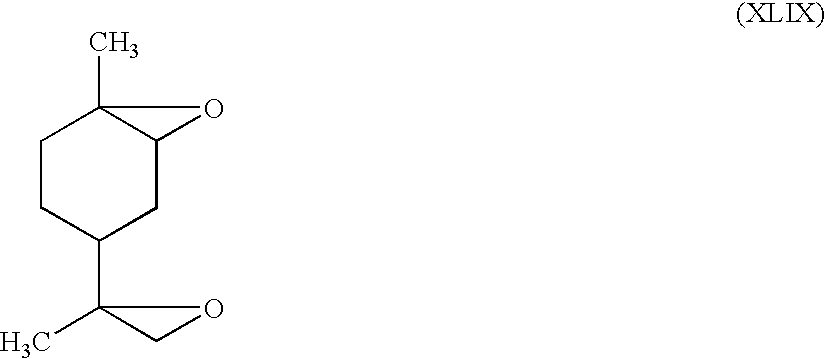
aliphatic diepoxides, such as diglycidyl ethers of polyhydric alcohols of general formula 
in which m is an integer ranging from 2 to 12, in particular 1,4-butanediol diglycidyl ether (1,4-bis-2,3-epoxypropoxy)butane) or diethylene glycol diglycidyl ether (bis[2-(2,3-epoxypropoxy)ethyl]ether) of formula 
as well as 2,3-bis(2,3-epoxypropoxy)-1-propanol and 1,3-bis(2,3-epoxypropoxy)-2-propanol,
polyglycidyl ethers of polyhydric phenols possessing at least one aromatic nucleus and their adducts with an alkylene oxide, for example those produced by the reaction of bisphenol compounds, such as bisphenol A, bisphenol F and bisphenol S or their ethylene oxide, propylene oxide or butylene oxide adducts, with epichlorohydrin, epoxy resins of novolak, cresol-novolak or bromophenol-novolak type, and the triglycidyl ether of triphenolmethane. General structures of these polyepoxidized resins are represented in particular by the formulae 
(for bisphenol A derivatives), and 
in which R31 is chosen from hydrogen and a methyl group (for novolac epoxy-phenol and epoxy-cresol resins),
aromatic and heterocyclic glycidylated amino resins, such as resins derived from the tetraglycidyl-methylenedianiline of formula 
resins derived from triglycidyl-p-aminophenol, triazine-based resins and epoxy-hydantoin resins of formula 
adducts of alicyclic epoxy alcohols and of (meth)acryloyl isocyanate or of isocyanatoethyl (meth)acrylate or of m-isopropenyl-α,α-dimethylbenzyl isocyanate, such as N-(3,4-epoxycyclohexyl)-methoxycarbonyl(meth)acrylamide, N-(5,6-epoxy-4,7-methanoperhydroinden-2-yl)oxycarbonyl(meth)acrylamide and the adduct of 3,4-epoxycyclohexylmethylated polycaprolactone and of (meth)acryloyl isocyanate of formula 
in which R30 is chosen from hydrogen and the methyl radical and n is. an integer ranging from 1 to 10,
epoxidized derivatives of unsaturated natural compounds, such as, for example, epoxidized soybean oils, and of unsaturated synthetic polymers, such as epoxidized polybutadiene,
aliphatic vinyl ethers, such as triethylene glycol divinyl ether and hydroxybutyl vinyl ether, cyclic vinyl ethers, such as 1,4-cyclohexanedimethanol divinyl ether, acrolein oligomers, 4-methyldihydropyran and derivatives of 3,4-dihydropyran-2-methanol, and alkyl vinyl ethers,
propenyl ethers, such as the propenyl ether of propylene carbonate and compounds of formula
in which n is an integer ranging from 1 to 6 and A is chosen from cyclic ethers, polyethers and linear, branched or cyclic alkanes possessing from 2 to 20 carbon atoms. Examples of such compounds comprise: 1,2-dipropenoxyethane, 1,4-dipropenoxybutane, 1,6-propenoxyhexane, 1,3-dipropenoxypropane, 1,4-cyclohexanedimethanol dipropenyl ether, 1,4-cyclohexane dipropenyl ether, 1,2-dipropenoxypropane, 1,10-dipropenoxydecane, 1,8-dipropenoxyoctane, 1,2,3-tripropenoxypropane, 1,2,3,4-tetrapropenoxybutane, sorbitol hexapropenyl ether, trimethylolpropane tripropenyl ether, pentaerythritol tetrapropenyl ether, 1,2-dipropenoxycyclopentane, 1,3-dipropenoxyperfluoropropane, diethylene glycol dipropenyl ether, tetraethylene glycol dipropenyl ether and 3,4-dipropenoxytetrahydrofuran,
oxetanes, such as 3,3-bis(chloromethyl)oxetane, 4,4-dialkyl-2-alkoxyoxetanes, compounds of formula 
in which R is an arylene group (for example a phenylene group), R32 is chosen from hydrogen and methyl and ethyl radicals, and n is an integer at least equal to 2, and substituted oxetanes, such as those disclosed in Patent U.S. Pat. No. 5,463,084.
The amount of cationic photoinitiator to be used for the implementation of the process for polymerization by irradiation is to be related to the amount of polymerizable organic material, that is to say to the combined weight of the compound (A) of formula (I) or (II) and of the compound (2) optionally mixed with the latter. A conventional proportion of photoinitiator(s) is between approximately 0.1% and approximately 10% by weight of the polymerizable organic material, preferably from approximately 1% to 5% by weight of the said material.
According to a specific aspect of the present invention, the composition subjected to polymerization under irradiation can additionally comprise at least one monomer or oligomer compound, such as a urethane-acrylate, a polyester-acrylate or an epoxy-acrylate, capable of curing under irradiation by a duel or hybrid crosslinking mechanism. In this case, two different crosslinking mechanisms take place either simultaneously or successively: by way of example, mention may be made of compounds capable of curing by radical polymerization. In the case where the cationic photoinitiator is an aromatic sulphonium salt, a radical initiator is unnecessary because the photoinitiator at the same time supplies cations and free radicals during its decomposition. Alternatively, it is possible to employ the combination of a cationic photoinitiator as described above and of a radical initiator, such as, for example, benzophenone, benzyl dimethyl acetal, cyclohexyl phenyl ketone, thioxanthones and any other initiator used to cause radical polymerization. The respective proportions of the two initiators to be used and their total amount will vary as a function of the formulation of the composition and of the application envisaged.
In addition, for certain specific uses of the polymerized products obtained by the irradiation process according to the invention, it can be useful to add, to the polymerizable composition comprising the compounds (A) and (B), at least one hydroxylated compound capable of lowering the viscosity of the composition (for example ethanol) and/or at least one polyhydroxylated compound or one aldehyde capable of acting as chain-transfer agent or capable of rendering the polymerizable composition flexible. Mention may in particular be made, among the latter compounds, of ethylene glycol, 1,4-butanediol, benzaldehyde, pentaerythritol, trimethylolpropane and oligomers comprising hydroxyl endings, such as polyesterpolyols, polyetherpolyols, hydroxylatedpolycaprolactones and hydroxylated polybutadienes.
For the implementation of the polymerization process according to the invention, any normal method for curing by actinic radiation can be resorted to. The radiation can be ionizing (corpuscular or non-corpuscular) or non-ionizing radiation. Any source which emits electrons or charged nuclei can be employed as appropriate source of corpuscular radiation. Corpuscular radiation can be generated, for example, by electron accelerators (under voltage conditions of 50 to 500 KeV approximately and irradiation conditions of 1 to 10 megarads), such as a Van der Graff accelerator, and radioactive elements, such as cobalt-60, strontium-90 and the like. Any source which emits radiation in the region from 10−3 to 2000 angstroms can be employed as appropriate source of non-ionizing non-corpuscular radiation. The appropriate sources include ultraviolet radiation vacuum lamps, such as xenon or krypton arcs. Any source which emits radiation from approximately 150 nm to approximately 500 nm can be employed as appropriate source of non-ionizing radiation. The appropriate sources include mercury arcs, carbon arcs, tungsten filament lamps, ultraviolet radiation lamps, excimer lamps and lasers providing an energy preferably from 100 to 1000 mJ/cm2 approximately.
When the radiation-curable coating compositions have to be cured by exposure to non-ionizing radiation, for example ultraviolet radiation, a photoinitiator or photoactivator other than the cationic photoinitiator described above can be added to the composition. Well-known examples include 2,2-diethoxyacetophenone, 2-, 3- or 4-bromoacetophenone, benzaldehyde, benzoin, benzophenone, 9,10-dibromoanthracene, 4,4′-dichlorobenzophenone, 2,3-pentanedione, hydroxycyclohexyl phenyl ketone and (thio)xanthones. Such photoinitiators are generally added in amounts ranging from 0.1% to 10% approximately by weight and preferably from 1% to 5% by weight on the basis of the weight of the polymerizable composition.
According to yet another specific aspect of the present invention, the composition can also polymerize according to the so-called “crosslinking in darkness” mechanism. In this case, in contrast to the polymerization initiated by free radicals, the polymerization continues after exposure to radiation has ceased. This mechanism can be of use in certain cases, for example for improving the crosslinking in the pores of porous substrates, for adhesives, coatings for electronics, and the like.
The composition subjected to the irradiation process according to the invention can, in addition to the compound (A) and, if appropriate, the compound (B), the chain-transfer or flexibilization agent, the additional photoinitiator (in the case of ultraviolet radiation) and the photoactivator, comprise:
at least one wetting or surface-modifying agent capable of improving the spreading properties of the polymer film, such as a silicone or fluorinated product or a polyether or any other compound known for contributing this specific property,
at least one adhesion promoter known per se,
at least one inorganic filler (such as, in particular, kaolin, silica, barium sulphate, calcium carbonate or talc) or organic filler commonly used in coating compositions which can be crosslinked under radiation,
at least one inorganic pigment, which is or is not in the form of paste in an organic polymer binder, or organic colorant, and
if appropriate, one or more additives chosen from the categories of antistatic agents, antifoaming agents, wetting agents and thickening agents.
The various optional additives listed above will be used in the context of the present invention in proportions already well known in irradiation coating techniques.
The resin compositions used in the irradiation polymerization process according to the invention can be applied in the form of a coating on a support by any method, such as coating with a brush, coating by spraying, coating by the curtain-coating technique, and the like. If appropriate and depending on the requirements of the specific application envisaged, the support can be subjected to a treatment stage prior or subsequent to the irradiation, such as a heat treatment intended to accelerate or to complete the polymerization reaction of the composition. In the latter case, the temperature and the duration of the heat post-treatment will be chosen in a way dependent on the nature of the support under consideration: the post-treatment temperature will generally be between approximately 50° C. and approximately 300° C., preferably between 70° C. and 150° C. approximately, the duration of post-treatment generally being between a few seconds and 24 hours approximately.
According to another aspect, the present invention also relates to a support coated with at least one layer of polymerized composition obtained by the irradiation process described above. This support can be highly varied in nature, in particular wood, metals, such as steel and aluminium, plastics, such as polyolefins, polycarbonates, saturated and unsaturated polyesters, phenol and phenol-formaldehyde resins, polyamides, poly(vinyl chloride), copolymers of ethylene and of acrylic monomers, polymethacrylates, and the like.
Due to their adhesion to highly varied supports, the polymerized compositions based on monomers, oligomers or polymers of formula (I) or of formula (II) can find a great many industrial applications, such as:
thin, thick or semi-thick coatings on all the above-mentioned supports,
pressure-sensitive adhesives, in particular for the manufacture of self-adhesive films, in particular based on plasticized poly(vinyl chloride), on polyethylene, on polypropylene, on poly(ethylene terephthalate) or on paper; in this application, it will be preferable to resort-to a monomer, oligomer or polymer of formula (II) for which the A2 block derives essentially from an acrylic monomer,
transparent varnishes,
foams for cars or films for labels made of vinyl chloride,
laminating adhesives for laminating two identical or different layers of material,
stereolithography, in particular for three-dimensional objects,
printing inks, in particular for the graphic arts.
The following examples illustrate the invention in more detail. The parts and the percentages are by weight, except when otherwise indicated.
A polyester comprising carboxyl endings is prepared by heating a mixture of diethylene glycol and of an excess of adipic acid at 220° C. under a nitrogen atmosphere in the presence of 0.2% of butyltin tris(2-ethylhexanoate) (sold by the company M&T Chemicals Inc. under the name Fascat 4102) while distilling off water until a molecular weight of 1000 and an acid number, measured according to ASTM Standard D 974-64, of 118 mg KOH/g are obtained.
A mixture of 262 g of 3,4-epoxycyclohexylmethyl-3,4-epoxycyclohexane (sold by Daicel Chemical Industries under the name Celloxide 2021 P) and of 231 g of toluene is heated to reflux (120° C.) in a reactor, to which is slowly added, over one hour, a mixture of 200 g of polyester comprising carboxyl endings prepared above, as well as 65 g of toluene and 0.1% of a catalyst, sold by the company Aerojet Solid Propulsion Company under the name AMC-2, composed of 5.1% of chromium 2-ethylhexanoate in a matrix of orthophthalic esters of C7-C11 alcohols. Stirring is continued in the reactor at 120° C. until the acid number falls to 4 mg KOH/g. The mixture is then cooled to 80° C. and the toluene is distilled off under high vacuum.
The reaction product is subsequently analysed by gel permeation chromatography by using:
instrument: Merck-Hitachi L 6000 high-pressure pump equipped with a Merck-Hitachi AS 2000 automatic injector;
column: 2×PL gel 3 μm Mixed E 300×7.5 mm at a temperature of 40° C.;
detecter: Waters RI 401 differential refractometer;
eluent: stabilized tetrahydrofuran;
flow rate: 1 ml/minute;
volume injected: 100 μl;
data processing: GPC/SEC grade PL software;
calibration: polystyrene standard and Celloxide 2021 P.
This analysis makes it possible to determine that the reaction product is composed of 28% unreacted Celloxide 2021 P and 72%; polyester comprising epoxycycloaliphatic endings according to the invention. Furthermore, the epoxy equivalent, determined according to the method of M. Chakrabarty, Analyst, 95, page 85, (1970), of the reaction product is 309 g.
A polyester comprising carboxyl endings is prepared as in Example 1 but by continuing the reaction up to a molecular weight of 2000 and an acid number of 57 mg KOH/g.
This polyester is then reacted with the diepoxide Celloxide 2021 P as in the preceding example, with the exception of the amounts of polyester (412 g) and of toluene (338 g to dissolve the diepoxide, 112 g to dissolve the catalyst and the polyester).
The final product, analysed as in the preceding example, has an epoxy equivalent of 438 g and is composed of 78% polyester comprising epoxycycloaliphatic endings according to the invention and 22% unreacted Celloxide 2021 P.
In addition, the reaction product is analysed by:
Fourier transform infra-red spectroscopy by means of a Perkin-Elmer 1760 instrument, the spectra being recorded in the form of films on a thallium bromoiodide crystal (KRS-5) at a resolution of 4 cm−1. These spectra are characterized by absorptions at 3512 cm−1 (OH band), 1734 cm−1 (C═O band of the ester functional group), 1255, 1176 and 1136 cm−1 (C—0 band of the ester functional group).
proton nuclear magnetic resonance at a frequency of 60 MHz, using CDCl3 as solvent and tetramethylsilane as reference. The resulting spectrum shows chemical shifts of 1.63 ppm (adipic acid and cycloaliphatic CH2), 2.32 ppm (adipic acid CH2), 3.0 ppm (epoxy), 3.6 ppm (ether CH2), 4.15 ppm (ester CH2) and 4.7 ppm (ester CH).
A mixture of 262 g (1 mol) of 3,4-epoxycyclohexylmethyl-3,4-epoxycyclohexane Celloxide 2021 P, 0.1% of the AMC-2 catalyst and 195 g of toluene is heated to 115° C. in a reactor. 30.7 g (0.21 mol) of adipic acid are added portionwise to this solution over one hour. Stirring is continued at 115° C. until the acid number has fallen to 1 mg KOH/g. After cooling to 80° C. and distilling off the toluene under high vacuum, the final product is collected and analysed as in the preceding example. It has an epoxy equivalent of 189 g and proves to be composed of 51% diacid comprising epoxycycloaliphatic endings according to the invention and of 49% unreacted Celloxide 2021 P.
A mixture of 0.75 mol of isophorone diisocyanate, 0.38 mol of dihydroxymethylpropionic acid and 200 ppm of trinonylphenylphosphine is slowly heated to 50° C. After the exothermic peak, this mixture is stirred at 75° C. for 3 hours. When the reaction is complete, a further addition of 0.75 mol of poly(propylene glycol), sold by Shell under the name PPG 1025, and 250 ppm of dibutyltin dilaurate is carried out, stirring is continued for 9 hours at 85° C. and the polyurethane obtained is then filtered off.
262 g of Celloxide 2021 P, 0.1% of the AMC-2 catalyst and 667 g of toluene are heated to 105° C. in a reactor. A solution of 1606 g of the polyurethane obtained above (having an acid number of 17 mg KOH/g) and of 0.1% of the catalyst in 260 g of toluene is slowly added to this mixture over one hour. Stirring is continued at 115° C. until the acid number has fallen to 4 mg KOH/g and then, after cooling to 80° C., the toluene is distilled off under high vacuum. The final product, analysed as in the preceding example, has an epoxy equivalent of 1136 g and is composed of 93% polyurethane comprising epoxycycloaliphatic endings according to the invention and 7% unreacted Celloxide 2021 P.
A solution of a mixture of 500 g of methyl acrylate, of 500 g of n-butyl methacrylate, of 25 g of mercaptopropionic acid and of 2 g of 2,2′-azobis-(2-methylbutyronitrile) initiator in 666 g of toluene is first of all prepared.
A quarter of this solution is introduced into a reactor and is heated to reflux and then, after the exothermic peak, the remaining three-quarters are slowly added over 90 minutes. The copolymer solution is then stirred at 120° C. for 4 hours and 2 g of initiator are added portionwise every 30 minutes. The reaction mixture is then cooled.
A mixture of 158 g of Celloxide 2021 P and of 352 g of toluene is heated to reflux in another reactor. A 0.1% solution of the AMC-2 catalyst in the acrylic copolymer solution prepared above is subsequently added slowly to the mixture over one hour. Stirring is continued at 115° C. until the acid number has decreased to 2 mg KOH/g. After cooling to 80° C. and distilling off the toluene under high vacuum, the final product is collected and then analysed as in the preceding example. Its epoxy equivalent is 1225 g and it proves to be composed of 92% polyacrylate comprising epoxycycloaliphatic endings according to the invention and of 8% unreacted Celloxide 2021 P.
The procedure of Example 1 is repeated, with the exception of the preparation of the polyester, for which polyester the diethylene glycol is replaced in a proportion of 16% by trimethylolpropane, and continuing the reaction to a molecular weight of 2000 and an acid number of 87.4 mg KOH/g.
The final product, analysed as in Example 1, has an epoxy equivalent of 380 g and is composed of 79% polyester comprising epoxycycloaliphatic endings according to the invention and 21% unreacted Celloxide 2021 P.
A polyester comprising carboxyl endings is prepared as in Example 2 but continuing the reaction to a molecular weight of 3000 and an acid number of 39.2 mg KOH/g.
This polyester is subsequently reacted with the diepoxide Celloxide 2021 P as in the preceding example, with the exception of the amounts of polyester (627 g) and of toluene (444 g to dissolve the diepoxide, 148 g to dissolve the catalyst and the polyester).
The final product, analysed as in Example 1, has an epoxy equivalent of 568 g and is composed of 83% polyester comprising epoxycycloaliphatic endings according to the invention and of 17% unreacted Celloxide 2021 P.
The procedure of Example 2 is repeated, with the exception of the complete replacement of the diethylene glycol by an equivalent molar amount of butanediol and continuing the reaction to a molecular weight of 2000 and an acid number of 70.1 mg KOH/g.
The final product, analysed as in Example 1, has an epoxy equivalent of 405 g and is composed of 78% polyester comprising epoxycycloaliphatic endings according to the invention and of 22% unreacted Celloxide 2021 P.
The procedure of Example 3 is repeated, with the exception of the complete replacement of the adipic acid by an equivalent molar amount of azelaic acid.
The final product, analysed as in Example 1, has an epoxy equivalent of 198 g and is composed of 54% diacid comprising epoxycycloaliphatic endings according to the invention and of 46% unreacted Celloxide 2021 P.
The procedure of Example 3 is repeated, with the exception of the complete replacement of the adipic acid by an equivalent molar amount of decanedicarboxylic acid.
The final product, analysed as in Example 1, has an epoxy equivalent of 201 g and is composed of 54% diacid comprising epoxycycloaliphatic endings according to the invention and of 46% unreacted Celloxide 2021 P.
The procedure of Example 3 is repeated, with the exception of the complete replacement of the adipic acid by an equivalent molar amount of succinic acid.
The final product, analysed as in Example 1, has an epoxy equivalent of 187 g and is composed of 52% polyester comprising epoxycycloaliphatic endings according to the invention and of 48% unreacted Celloxide 2021 P.
The procedure of Example 3 is repeated, with the exception of the complete replacement of the adipic acid by an equivalent molar amount of lauric acid.
The final product, analysed as in Example 1, has an epoxy equivalent of 232 g and is composed of 63% monoacid comprising an epoxycycloaliphatic ending according to the invention and of 37% unreacted Celloxide 2021 P.
The procedure of Example 3 is repeated, with the exception of the complete replacement of the adipic acid by an equivalent molar amount of terephthalic acid.
The final product, analysed as in Example 1, has an epoxy equivalent of 196 g and is composed of 55% diacid comprising epoxycycloaliphatic endings according to the invention and of 45% unreacted Celloxide 2021 P.
The procedure of Example 5 is repeated, apart from the following two exceptions:
in the first stage, the initiator used is 4,4′-azobis(4-cyanovaleric acid), sold by the company Wako Pure Chemical Industries under the name Vazo 501.
in the final stage (other reactor), 185 g of Celloxide 2021 P and 388 g of toluene are employed.
The final product, analysed as in Example 1, has an epoxy equivalent of 1067 g and proves to be composed of 91% polyacrylate comprising epoxycycloaliphatic endings according to the invention and of 9% unreacted Celloxide 2021 P.
A mixture of 262 g of Celloxide 2021 P, 292 g (2 mol) of adipic acid, 0.1% of AMC-2 catalyst and 892 g of toluene is heated at 115° C. in a reactor. Stirring is continued until the acid number has fallen to 78 mg KOH/g. 786 g (3 mol) of Celloxide 2021 P are then added in a single step and stirring is continued until the acid number has fallen to 1 mg KOH/g. After cooling to 80° C. and distilling off the toluene under high vacuum, the final product is collected and analysed as in the preceding examples. It has an epoxy equivalent of 341 g and proves to be composed of 80% diacid comprising epoxycycloaliphatic endings according to the invention and of 20% unreacted Celloxide 2021 P.
Various properties of crosslinked formulations, starting from products obtained in the preceding examples, were tested on films with a thickness of 10 μm, prepared manually by means of a spiral film drawer, on various substrates.
Each formulation tested comprises 70 parts of Celloxide 2021 P, 30 parts of the product comprising epoxycycloaliphatic endings (according to the invention) from a preceding example and 3 parts by weight of a cationic photoinitiator sold by the company Minnesota Mining and Manufacturing under the name FX-512 composed of 60% triphenylsulphonium hexafluorophosphate and of 40% γ-butyrolactone.
The properties determined are as follows:
reactivities of the formulation, measured by its rate of crosslinking RC (expressed in meters per minute and defined as the rate of forward progression under an ultraviolet radiation lamp with a power of 80 W/cm allowing a film to be obtained which is finger dry (evaluation to the touch by an operator) and the rate at which particles of talc no longer adhere to the surface of the coating TR (expressed in meters per minute),
resistances to solvents, measured after 24 hours by the resistance to acetone RA (expressed as number of two-fold rubbing movements by the acetone administered to the film until it detaches from the support),
König hardness KH after approximately 24 hours, expressed in seconds and determined according to ASTM Standard D 4366,
adhesion at 23° C., expressed in % and determined by the test of adhesion according to ASTM Standard D-3002 for various substrates: ALU (aluminium), PET (polyester), PVC (poly(vinyl chloride)), glass, PE (polyethylene) and PP (polypropylene).
The results of these various measurements are combined in the table below.
| TABLE | ||
| Product of | Adhesion | |
| Example | RC | TR | RA | KH | ALU | PET | PVC | PE | PP | Glass |
| 1 | >100 | >100 | 60 | 205 | 0 | 0 | 100 | 80 | nd | nd |
| 2 | >100 | >100 | >100 | 160 | 0 | 0 | 100 | 100 | 100 | nd |
| 3 | >100 | >100 | 20 | 226 | 100 | 100 | 100 | 90 | 100 | 100 |
| 5 | 30 | 20 | >100 | 191 | 100 | 0 | 100 | 100 | nd | nd |
| 6 | 80 | 75 | >100 | 185 | 100 | 100 | 100 | 50 | 100 | 100 |
| 7 | 80 | 70 | 65 | 175 | 100 | 100 | 100 | 100 | 90 | 100 |
| 8 | 60 | 55 | >100 | 180 | 0 | 100 | 100 | 100 | 100 | nd |
| 9 | 70 | 60 | 25 | 243 | 100 | 100 | 100 | 100 | 100 | 100 |
| 10 | 60 | 50 | 10 | 224 | 100 | 100 | 100 | 100 | 100 | 100 |
| 11 | >100 | >100 | 50 | 226 | 100 | 100 | 100 | 100 | 100 | 100 |
| 12 | 40 | 30 | 75 | 165 | 100 | 100 | 100 | 100 | 100 | 100 |
| 13 | 45 | 40 | 9 | 187 | 100 | 100 | 100 | 100 | 50 | 100 |
| 15 | 50 | 40 | >100 | nd | 100 | 100 | 100 | 100 | 100 | nd |
| Pure | 100 | 100 | 5 | 203 | 100 | 0 | 100 | 80 | 100 | 100 |
| Celloxide | ||||||||||
| nd = not determined | ||||||||||
The results of the corresponding measurements carried out on the Celloxide 2021 P starting material also appear in this table, by way of comparison. These results show, for crosslinked compositions comprising only 30% by weight of the polymer comprising epoxycycloaliphatic endings according to the invention, a very great improvement in the resistance to solvents (RA), which is obtained while maintaining a satisfactory rate of crosslinking and while maintaining or improving adhesion to various substrates.
Claims (32)
1. A monomer, oligomer or polymer of formula (I) or (II); where: formula (I) is denoted by 
in which:
A1 is selected from the group consisting of:
polyester blocks having a molecular weight of between 250 and 10,000;
polyurethane blocks having a molecular weight of between 500 and 5000;
hydrocarbon-comprising back-bones of a mono- or polycarboxylic acid; and
addition products of a polycarboxylic acid and of a cyclo-aliphatic diepoxide;
m is a number from 1 to 6,
R1 is a cycloaliphatic group carrying a hydroxyl group situated in the α position with respect to the oxygen atom to which R1 is bonded and where R1 may be further substituted or unsubstituted;
R2 is a second cycloaliphatic group carrying an oxirane group situated at the chain end and where R2 may be further substituted or unsubstituted; and
B is selected from the group consisting of:
one or more covalent bonds;
on oxygen atom;
linear, branched or cyclic hydrocarbon-comprising radicals which may be unsubstituted or substituted by one or more oxygen and/or silicon atoms; and
formula (II) is denoted by: 
in which:
A2 is a block selected from the group consisting of: homopolymers and copolymers of at least one vinyl monomer;
n is an integer from 0 to 15, with the condition that n is at least equal to 1 when Y is sulphur;
Y is selected from the group consisting of:
a sulphur atom;
—CR′R″ radicals, in which R′ and R″ are each an aliphatic group having from 1 to 4 carbon atoms; and
mixtures thereof;
q is an integer or non-integer ranging from about 1 to about 2; and
R1, B and R2 are defined as in the above formula (I).
2. A monomer, oligomer or polymer according to claim 1 , wherein R1 and R2 are cycloaliphatic groups with a ring having from 5 to 6 members which can carry one or more hydrocarbon-comprising substituents which are not very sterically hindered.
3. A monomer, oligomer or polymer according to claim 2 , wherein said ring carries one or more hydrocarbon-comprising substituents are not sterically hindered.
4. A monomer, oligomer or polymer according to claim 1 , wherein B is a radical selected from the group consisting of:
—(CH2)n— alkylene groups in which n is an integer from 1 to 12;
a —CH═CH— group;
a group of formula (VI) 
a group of formula (VII) 
a group of formula (VIII) 
a group of formula (IX) 
a group of formula (X) 
a group of formula (XI) 
in which m′ is an integer from 0 to about 20;
a group of formula (XII) 
in which R3 is a cycloaliphatic radical which may carry an oxirane group;
a group of formula (XIII) 
in which
m1 and m2 are each an integer from 1 to about 6; and
n1 and n2 are each an integer from 0 to 2;
a group of formula (XIV) 
in which
p is an integer from about 1 to about 10; and
R4, R5, R6 and R7 are each selected independently from the group consisting of alkyl radicals having from 1 to 4 carbon atoms;
a group of formula (XV) 
in which
p is an integer from about 1 to about 10;
R4, R5, R7, R8, R9 and R10 are each selected independently from the group consisting of alkyl radicals having from 1 to 4 carbon atoms,
R6 is selected from the group consisting of alkyl radicals having from 1 to 4 carbon atoms and aryl radicals having from 6 to 9 carbon atoms, and
R2 has the same meaning as in the above formula (I); and
a group of formula (XVI) 
in which
R4, R5, R6 and R7 are each selected independently from the group consisting of alkyl radicals having from 1 to 4 carbon atoms,
p is an integer from about 1 to about 20; and
R2 has the same meaning as in the above formula (I).
5. A monomer, oligomer or polymer according to claim 4 , wherein B is a group of formula (XI) and m′ in formula (XI) is from about 1 to 6.
6. A monomer, oligomer or polymer according to claim 4 , wherein B is a group of formula (XIV) and p in formula (XIV) is from about 1 to about 3.
7. A monomer, oligomer or polymer according to claim 4 , wherein B is a group of formula (XIV) and R4, R5, R6 and R7 in formula (XIV) are methyl.
8. A monomer, oligomer or polymer according to claim 4 , wherein B is a group of formula (XV) and p in formula (XV) is from about 1 to about 3.
9. A monomer, oligomer or polymer according to claim 4 , wherein B is a group of formula (XV) and R4, R5, R7, R8, R9 and R10 in formula (XV) are methyl.
10. A monomer, oligomer or polymer according to claim 4 , wherein B is a group of formula (XV) and R6 in formula (XV) is selected from the group consisting of methyl or phenyl.
11. A monomer, oligomer or polymer according to claim 4 , wherein B is a group of formula (XVI) and p in formula (XVI) is from about 1 to about 6.
12. A monomer, oligomer or polymer according to claim 4 , wherein B is a group of formula (XVI) and R4, R5, R6, and R7 in formula (XVI) are methyl radicals.
13. A monomer, oligomer or polymer according to claim 1 , wherein A1 is the hydrocarbon-comprising backbone of an acid selected from the group consisting of:
saturated aliphatic monoacids having from 4 to 40 carbon atoms;
saturated or unsaturated aliphatic diacids having from 4 to 40 carbon atoms;
aromatic diacids; and
tricarboxylic acids.
14. A monomer, oligomer or polymer according to claim 1 , wherein the vinyl monomer of the A2 block is selected from the group consisting of:
acrylic esters;
methacrylic esters; and
vinylaromatic monomers copolymerizable with acrylic or methacrylic esters.
15. Monomers, oligomers or polymers according to claim 1 , where said monomers, oligomers or polymers are curable by radiation.
16. A process for the preparation of a monomer, oligomer or polymer according to claim 1 , wherein it comprises the reaction of:
a cycloaliphatic diepoxide of general formula (XIX) 
in which B and R2 are as defined in the formulae (I) and (II),
with
(i) a monomer or polymer compound of formula (XVII) 
in which A1 and m are as defined in the formula (I); to obtain a compound of formula (I), or
(ii) a monomer or polymer compound of formula (XVIII) 
in which A2, Y, q and n are as defined in the formula (II); to obtain a compound of formula (II):
where
the molar ratio of the diepoxide (XIX) to the monomer or polymer of formula (XVII) or (XVIII) is selected to maintain at least one epoxide functional group of the epoxide (XIX) available for subsequent reaction.
17. The process according to claim 16 , wherein the amounts of each reactant are selected to maintain at least two epoxy equivalents per one carboxylic acid equivalent.
18. The process according to claim 16 , wherein the reaction is carried out in the presence of at least one solvent.
19. The process according to claim 16 , wherein the reaction is carried out at a temperature ranging from about 100° C. to about 150° C.
20. The process according to claim 16 , wherein the reaction is carried out in the presence of a catalytic amount of a compound that promotes the reaction between the epoxide functional group and the carboxylic acid functional group.
21. The process according to claim 20 , wherein the said catalytic compound is selected from the group consisting of:
trivalent chromium chlorides;
trivalent chromium tricarboxylates,
quaternary ammonium halides; and
ferric chloride.
22. The process according to claim 20 , wherein the catalytic compound is employed in a proportion ranging up to 0.2% by weight with respect to the sum of the monomer or polymer of formula (XVII) or (XVIII) and of the cycloaliphatic diepoxide of formula (XIX).
23. A process for the polymerization of a composition comprising at least one monomer, oligomer or polymer according to claim 1 comprising the step of: irradiating said at least one monomer, oligomer or polymer according to claim 1 with ionising radiation in the presence of at least one cationic polymerization photoinitiator and, optionally, in the presence of another compound which is cationically polymerizable in the presence of said photoinitiator.
24. The process for polymerization according to claim 23 , wherein said cationic polymerization photoinitiator is selected from the group consisting of:
aromatic diazonium salts of complex halides,
complex salts of aromatic iodonium,
complex salts of aromatic sulphonium, onium salts from group VIa; and
aromatic complex salts of transition metals.
25. The process for polymerization according to claim 23 , wherein the cationically polymerizable compound is selected from the group consisting of:
monoepoxides which are cycloaliphatic or non-cycloaliphatic;
mono- or multifunctional, aliphatic diepoxides;
polyglycidyl ethers of polyhydric phenols;
aromatic and heterocyclic glycidylated amino resins;
resins derived from triglycidyl-p-aminophenol;
triazine-based resins;
epoxy-hydantoin resins;
adducts of alicyclic epoxy alcohols and of (meth)acryloyl isocyanates;
epoxidized derivatives of unsaturated natural compounds and of unsaturated synthetic polymers;
aliphatic and cyclic vinyl ethers;
alkyl vinyl ethers;
propenyl ethers; and
oxetanes.
26. The process for polymerization according to claim 23 , wherein the second cationically polymerizable compound is present in an amount up to 80% by weight of the composition to be polymerized.
27. The process for polymerization according to claim 23 , wherein the cationic photoinitiator is present in a proportion of 0.1% to 10% by weight of the polymerizable organic material.
28. The process for polymerization according to claim 23 , wherein said ionising irradiation is ultraviolet radiation.
29. The process for polymerization according to claim 23 , wherein the composition additionally comprises a photoinitiator other than the cationic photoinitiator.
30. The process for polymerization according to claim 23 , wherein the composition additionally comprises at least one additive selected from the group consisting of:
photoactivators,
wetting or surface-modifying agents,
adhesion promoters,
inorganic or organic fillers,
inorganic pigments,
organic colorants,
antistatic agents,
antifoaming agents and
thickening agents.
31. The process for polymerization according to claim 23 , wherein the ionising radiation is an electron beam.
32. The process according to claim 23 , wherein said irradiating step is carried out in the presence of a second compound that is cationically polymerisable in the presence of said photo-initiator.
Applications Claiming Priority (2)
| Application Number | Priority Date | Filing Date | Title |
|---|---|---|---|
| BE9600821 | 1996-09-30 | ||
| BE9600821A BE1010656A4 (en) | 1996-09-30 | 1996-09-30 | MONOMERS, AND POLYMER GROUP OLIGOMERS oxiranes TERMINAL, METHOD OF PREPARATION AND CATIONIC POLYMERIZATION IN RADIATION. |
Related Parent Applications (2)
| Application Number | Title | Priority Date | Filing Date |
|---|---|---|---|
| PCT/EP1997/005303 Continuation WO1998014497A1 (en) | 1996-09-30 | 1997-09-27 | Monomers, oligomers and polymers with terminal oxirane groups, method of preparation and polymerisation under radiation exposure |
| US09269480 Continuation | 1999-05-04 |
Publications (1)
| Publication Number | Publication Date |
|---|---|
| US6417243B1 true US6417243B1 (en) | 2002-07-09 |
Family
ID=3890005
Family Applications (1)
| Application Number | Title | Priority Date | Filing Date |
|---|---|---|---|
| US09/628,691 Expired - Fee Related US6417243B1 (en) | 1996-09-30 | 2000-07-28 | Monomers, oligomers and polymers comprising terminal oxirane groups, their process of preparation and their cationic polymerization under irradiation |
Country Status (11)
| Country | Link |
|---|---|
| US (1) | US6417243B1 (en) |
| EP (1) | EP0931103B1 (en) |
| JP (1) | JP2001501240A (en) |
| AT (1) | ATE268791T1 (en) |
| AU (1) | AU5478898A (en) |
| BE (1) | BE1010656A4 (en) |
| BR (1) | BR9711427A (en) |
| CA (1) | CA2264690A1 (en) |
| DE (1) | DE69729463T2 (en) |
| ES (1) | ES2219785T3 (en) |
| WO (1) | WO1998014497A1 (en) |
Cited By (11)
| Publication number | Priority date | Publication date | Assignee | Title |
|---|---|---|---|---|
| US20030130551A1 (en) * | 2001-12-10 | 2003-07-10 | Institut Francais Du Petrole | Catalytic composition and process for oligomerizing ethylene, in particular to1-hexene |
| WO2005014682A1 (en) * | 2003-08-07 | 2005-02-17 | Huntsman Advanced Materials (Switzerland) Gmbh | Photocrosslinkable polyurethanes |
| US6867242B1 (en) * | 1999-06-11 | 2005-03-15 | Rhodia Chimie | Method for producing a sealed release coating applied on a cylinder-head gasket using a silicone material |
| US20060178444A1 (en) * | 1998-10-02 | 2006-08-10 | Jean-Marc Frances | Dental composition based on silicone crosslinkable by cation process |
| US20080125518A1 (en) * | 2006-11-28 | 2008-05-29 | Gaurav Mediratta | Polyester compositions with low gel content and method of making them |
| US20100113241A1 (en) * | 2004-06-11 | 2010-05-06 | Sonoco Development, Inc. | Method for making a flexible packaging structure with a built-in opening and reclose feature |
| US20100168268A1 (en) * | 2006-12-28 | 2010-07-01 | Kazuo Ishihara | Epoxy Resin, Epoxy Resin Composition Containing the Epoxy Resin as an Essential Component and a Cured Product Containing the Epoxy Resin as an Essential Component |
| US20110068565A1 (en) * | 2008-06-20 | 2011-03-24 | Ford Global Technologies, Llc | Inflatable seat belt system |
| US20140088269A1 (en) * | 2010-11-09 | 2014-03-27 | Institut National De La Recherche Argonomique | Novel oligomers, method for preparation thereof and use thereof for fluidifying and/or improving the stability of polymeric compositions |
| TWI557183B (en) * | 2015-12-16 | 2016-11-11 | 財團法人工業技術研究院 | Oxane composition, and photovoltaic device comprising the same |
| US11472904B2 (en) * | 2017-09-22 | 2022-10-18 | Carbon, Inc. | Production of light-transmissive objects by additive manufacturing |
Families Citing this family (2)
| Publication number | Priority date | Publication date | Assignee | Title |
|---|---|---|---|---|
| JP3806993B2 (en) * | 1996-10-28 | 2006-08-09 | 東洋インキ製造株式会社 | Cationic curable prepolymer and active energy ray-curable coating composition using the same |
| WO2006048708A2 (en) * | 2004-10-08 | 2006-05-11 | Basf Coatings Japan Ltd. | Resin composition having hydroxyl group for coatings, coating composition, method of finish coating and coated article |
Citations (7)
| Publication number | Priority date | Publication date | Assignee | Title |
|---|---|---|---|---|
| US3624180A (en) | 1968-08-07 | 1971-11-30 | Rolf Schmid | Heat-curable compositions of matter |
| US4038338A (en) | 1971-10-25 | 1977-07-26 | Ciba-Geigy Corporation | New polyepoxide-polysiloxane compounds |
| EP0139042A2 (en) | 1983-10-27 | 1985-05-02 | Union Carbide Corporation | Low viscosity adducts of a poly(active hydrogen) organic compound and a polyepoxide |
| EP0221559A2 (en) | 1985-11-07 | 1987-05-13 | Union Carbide Corporation | Photocopolymerizable compositions based on epoxy and hydroxyl-containing organic materials |
| EP0262414A2 (en) | 1986-08-29 | 1988-04-06 | Union Carbide Corporation | Photocurable blends of 2-Methoxytetrahydropyran and cycloaliphatic epoxides |
| EP0467258A2 (en) | 1990-07-20 | 1992-01-22 | THERA Patent GmbH & Co. KG Gesellschaft für industrielle Schutzrechte | Copolymerisable composition, curable resin composition containing this and their use |
| US5354791A (en) | 1993-10-19 | 1994-10-11 | General Electric Company | Epoxy-functional polyester, polycarbonate with metal phosphate |
-
1996
- 1996-09-30 BE BE9600821A patent/BE1010656A4/en not_active IP Right Cessation
-
1997
- 1997-09-27 ES ES97951126T patent/ES2219785T3/en not_active Expired - Lifetime
- 1997-09-27 WO PCT/EP1997/005303 patent/WO1998014497A1/en not_active Ceased
- 1997-09-27 AU AU54788/98A patent/AU5478898A/en not_active Abandoned
- 1997-09-27 CA CA002264690A patent/CA2264690A1/en not_active Abandoned
- 1997-09-27 EP EP97951126A patent/EP0931103B1/en not_active Expired - Lifetime
- 1997-09-27 JP JP10516025A patent/JP2001501240A/en not_active Ceased
- 1997-09-27 DE DE69729463T patent/DE69729463T2/en not_active Expired - Fee Related
- 1997-09-27 BR BR9711427A patent/BR9711427A/en not_active Application Discontinuation
- 1997-09-27 AT AT97951126T patent/ATE268791T1/en not_active IP Right Cessation
-
2000
- 2000-07-28 US US09/628,691 patent/US6417243B1/en not_active Expired - Fee Related
Patent Citations (7)
| Publication number | Priority date | Publication date | Assignee | Title |
|---|---|---|---|---|
| US3624180A (en) | 1968-08-07 | 1971-11-30 | Rolf Schmid | Heat-curable compositions of matter |
| US4038338A (en) | 1971-10-25 | 1977-07-26 | Ciba-Geigy Corporation | New polyepoxide-polysiloxane compounds |
| EP0139042A2 (en) | 1983-10-27 | 1985-05-02 | Union Carbide Corporation | Low viscosity adducts of a poly(active hydrogen) organic compound and a polyepoxide |
| EP0221559A2 (en) | 1985-11-07 | 1987-05-13 | Union Carbide Corporation | Photocopolymerizable compositions based on epoxy and hydroxyl-containing organic materials |
| EP0262414A2 (en) | 1986-08-29 | 1988-04-06 | Union Carbide Corporation | Photocurable blends of 2-Methoxytetrahydropyran and cycloaliphatic epoxides |
| EP0467258A2 (en) | 1990-07-20 | 1992-01-22 | THERA Patent GmbH & Co. KG Gesellschaft für industrielle Schutzrechte | Copolymerisable composition, curable resin composition containing this and their use |
| US5354791A (en) | 1993-10-19 | 1994-10-11 | General Electric Company | Epoxy-functional polyester, polycarbonate with metal phosphate |
Cited By (18)
| Publication number | Priority date | Publication date | Assignee | Title |
|---|---|---|---|---|
| US8262391B2 (en) | 1998-10-02 | 2012-09-11 | Bluestar Silicones France Sas | Dental composition based on silicone crosslinkable by cation process |
| US20060178444A1 (en) * | 1998-10-02 | 2006-08-10 | Jean-Marc Frances | Dental composition based on silicone crosslinkable by cation process |
| US6867242B1 (en) * | 1999-06-11 | 2005-03-15 | Rhodia Chimie | Method for producing a sealed release coating applied on a cylinder-head gasket using a silicone material |
| US20030130551A1 (en) * | 2001-12-10 | 2003-07-10 | Institut Francais Du Petrole | Catalytic composition and process for oligomerizing ethylene, in particular to1-hexene |
| US6903042B2 (en) * | 2001-12-10 | 2005-06-07 | Institut Francais Du Petrole | Catalytic composition and process for oligomerizing ethylene, in particular to 1-hexene |
| US20060204895A1 (en) * | 2003-08-07 | 2006-09-14 | Huntsman Advanced Materials America Inc. | Photocrosslinkable polyurethanes |
| US7476484B2 (en) | 2003-08-07 | 2009-01-13 | Huntsman Advanced Materials Americas Inc. | Photocrosslinkable polyurethanes |
| WO2005014682A1 (en) * | 2003-08-07 | 2005-02-17 | Huntsman Advanced Materials (Switzerland) Gmbh | Photocrosslinkable polyurethanes |
| US20100113241A1 (en) * | 2004-06-11 | 2010-05-06 | Sonoco Development, Inc. | Method for making a flexible packaging structure with a built-in opening and reclose feature |
| US20080125518A1 (en) * | 2006-11-28 | 2008-05-29 | Gaurav Mediratta | Polyester compositions with low gel content and method of making them |
| US7906562B2 (en) * | 2006-12-28 | 2011-03-15 | Nippon Steel Chemicals Co., Ltd. | Epoxy resin, epoxy resin composition containing the epoxy resin as an essential component and a cured product containing the epoxy resin as an essential component |
| US20100168268A1 (en) * | 2006-12-28 | 2010-07-01 | Kazuo Ishihara | Epoxy Resin, Epoxy Resin Composition Containing the Epoxy Resin as an Essential Component and a Cured Product Containing the Epoxy Resin as an Essential Component |
| US20110068565A1 (en) * | 2008-06-20 | 2011-03-24 | Ford Global Technologies, Llc | Inflatable seat belt system |
| US8317222B2 (en) | 2008-06-20 | 2012-11-27 | Ford Global Technologies, Llc | Inflatable seat belt system |
| US20140088269A1 (en) * | 2010-11-09 | 2014-03-27 | Institut National De La Recherche Argonomique | Novel oligomers, method for preparation thereof and use thereof for fluidifying and/or improving the stability of polymeric compositions |
| TWI557183B (en) * | 2015-12-16 | 2016-11-11 | 財團法人工業技術研究院 | Oxane composition, and photovoltaic device comprising the same |
| US9540488B1 (en) | 2015-12-16 | 2017-01-10 | Industrial Technology Research Institute | Siloxane resin composition, and photoelectric device employing the same |
| US11472904B2 (en) * | 2017-09-22 | 2022-10-18 | Carbon, Inc. | Production of light-transmissive objects by additive manufacturing |
Also Published As
| Publication number | Publication date |
|---|---|
| CA2264690A1 (en) | 1998-04-09 |
| EP0931103A1 (en) | 1999-07-28 |
| ES2219785T3 (en) | 2004-12-01 |
| BR9711427A (en) | 1999-08-24 |
| JP2001501240A (en) | 2001-01-30 |
| DE69729463D1 (en) | 2004-07-15 |
| DE69729463T2 (en) | 2004-11-04 |
| ATE268791T1 (en) | 2004-06-15 |
| BE1010656A4 (en) | 1998-11-03 |
| WO1998014497A1 (en) | 1998-04-09 |
| EP0931103B1 (en) | 2004-06-09 |
| AU5478898A (en) | 1998-04-24 |
Similar Documents
| Publication | Publication Date | Title |
|---|---|---|
| CA1305823C (en) | Photocurable blends of cyclic ethers and cycloaliphatic epoxides | |
| US4593051A (en) | Photocopolymerizable compositons based on epoxy and polymer/hydroxyl-containing organic materials | |
| US4239866A (en) | Curable coating composition | |
| EP0119425B1 (en) | Photocopolymerizable compositions based on epoxides,polyols containing organic materials and a substituted cycloaliphatic monoepoxide reactive diluent | |
| JPWO2005019299A1 (en) | Photosensitive composition and cured product thereof | |
| ES2219785T3 (en) | MONOMERS, OLIGOMERS AND POLYMERS WITH TERMINAL OXIRANE GROUPS, THEIR PREPARATION PROCEDURE AND THEIR CATIONIC POLYMERIZATION WITH RADIATION EXPOSURE. | |
| EP0139042A2 (en) | Low viscosity adducts of a poly(active hydrogen) organic compound and a polyepoxide | |
| DE4344125A1 (en) | Radiation-curable protective coating, especially for metallized surfaces | |
| US4818776A (en) | Photocopolymerizable compositions based on epoxy and hydroxyl-containing organic materials having primary hydroxyl content | |
| US6174967B1 (en) | Composition of epoxy resin and (cyclo)alkoxy-substituted organosilane | |
| JP4999393B2 (en) | Cationic photosensitive composition and cured product thereof | |
| JPS59147017A (en) | Photocopolymerizable composition based on primary hydroxyl group-containing epoxy and hydroxyl-containing organic substance | |
| KR100748149B1 (en) | Cationically photopolymerizable resin composition and optical disk surface protection material | |
| JPH10251378A (en) | Curable resin composition | |
| MXPA99002047A (en) | Monomers, oligomers and polymers with terminal oxirane groups, method of preparation and polymerisation under radiation exposure | |
| JPH1180118A (en) | New sulfonium salt, cation-polymerizable composition and its cured product | |
| JP2001031890A (en) | Active energy ray-curing type coating composition | |
| JPH0940708A (en) | Resin composition and cured product thereof | |
| CA1246785A (en) | Blends of cyclic vinyl ether containing compounds and a poly(active hydrogen) organic compound | |
| JPH0616731A (en) | Resin composition and its cured material | |
| JPH1060026A (en) | Energy beam-curable composition and cured product therefrom | |
| JP3060092B2 (en) | Photocurable coating composition | |
| JP4159628B2 (en) | Active energy ray-curable coating resin composition | |
| JP7719591B2 (en) | Active energy ray-curable resin composition | |
| JPH0987357A (en) | Resin composition and cured product thereof |
Legal Events
| Date | Code | Title | Description |
|---|---|---|---|
| CC | Certificate of correction | ||
| AS | Assignment |
Owner name: SURFACE SPECIALTIES, S.A., BELGIUM Free format text: ASSIGNMENT OF ASSIGNORS INTEREST;ASSIGNOR:UCB, S.A.;REEL/FRAME:015442/0917 Effective date: 20041202 |
|
| FPAY | Fee payment |
Year of fee payment: 4 |
|
| REMI | Maintenance fee reminder mailed | ||
| LAPS | Lapse for failure to pay maintenance fees | ||
| STCH | Information on status: patent discontinuation |
Free format text: PATENT EXPIRED DUE TO NONPAYMENT OF MAINTENANCE FEES UNDER 37 CFR 1.362 |
|
| FP | Lapsed due to failure to pay maintenance fee |
Effective date: 20100709 |