US6417228B1 - 13-Aza prostaglandins for the treatment of glaucoma and ocular hypertension - Google Patents
13-Aza prostaglandins for the treatment of glaucoma and ocular hypertension Download PDFInfo
- Publication number
- US6417228B1 US6417228B1 US09/430,513 US43051399A US6417228B1 US 6417228 B1 US6417228 B1 US 6417228B1 US 43051399 A US43051399 A US 43051399A US 6417228 B1 US6417228 B1 US 6417228B1
- Authority
- US
- United States
- Prior art keywords
- alkyl
- acyl
- compound
- alkoxy
- acyloxy
- Prior art date
- Legal status (The legal status is an assumption and is not a legal conclusion. Google has not performed a legal analysis and makes no representation as to the accuracy of the status listed.)
- Expired - Lifetime
Links
- 0 *OC(=O)CCC/C=C\C[C@H]1C(OC)CC(OC)C1NC(=O)C(*[Ar])O* Chemical compound *OC(=O)CCC/C=C\C[C@H]1C(OC)CC(OC)C1NC(=O)C(*[Ar])O* 0.000 description 16
- HOWRLXGUHZATCY-UHFFFAOYSA-N CC(C)C1CC2=CC=CC=C2C1 Chemical compound CC(C)C1CC2=CC=CC=C2C1 HOWRLXGUHZATCY-UHFFFAOYSA-N 0.000 description 5
- ALXXZQOMSHTHQZ-DIAMHNEUSA-N CCC/C=C\CC[C@H]1[C@@H](O)C[C@@H](O)[C@@H]1NC(=O)[C@H](O)COC1=CC=C(F)C=C1 Chemical compound CCC/C=C\CC[C@H]1[C@@H](O)C[C@@H](O)[C@@H]1NC(=O)[C@H](O)COC1=CC=C(F)C=C1 ALXXZQOMSHTHQZ-DIAMHNEUSA-N 0.000 description 4
- JMZAHTFCRJBFMD-IXVIYOPHSA-N CCCC/C=C\C[C@H]1[C@@H](O)C[C@@H](O)[C@@H]1NC[C@H](O)CCC1=CC=C(F)C=C1 Chemical compound CCCC/C=C\C[C@H]1[C@@H](O)C[C@@H](O)[C@@H]1NC[C@H](O)CCC1=CC=C(F)C=C1 JMZAHTFCRJBFMD-IXVIYOPHSA-N 0.000 description 4
- YSMXDNBEIDVCRE-YWQHHZGKSA-N CCCC/C=C\C[C@H]1[C@@H](O)C[C@@H](O)[C@@H]1NC(=O)[C@H](O)CCC1=CC=C(F)C=C1 Chemical compound CCCC/C=C\C[C@H]1[C@@H](O)C[C@@H](O)[C@@H]1NC(=O)[C@H](O)CCC1=CC=C(F)C=C1 YSMXDNBEIDVCRE-YWQHHZGKSA-N 0.000 description 2
- PQKRKTJUKIFSDJ-GDTSBACZSA-N CCCC/C=C\C[C@H]1[C@@H](O)C[C@@H](O)[C@@H]1NC(=O)[C@H](O)COC1=CC=C(F)C=C1 Chemical compound CCCC/C=C\C[C@H]1[C@@H](O)C[C@@H](O)[C@@H]1NC(=O)[C@H](O)COC1=CC=C(F)C=C1 PQKRKTJUKIFSDJ-GDTSBACZSA-N 0.000 description 2
- RDWCRANVROYODE-UMWJSSHBSA-N CCC/C=C\CC[C@H]1[C@@H](O)C[C@@H](O)[C@@H]1C.CCC/C=C\CC[C@H]1[C@@H](O)C[C@@H](O)[C@@H]1N.CCC/C=C\CC[C@H]1[C@@H](O)C[C@@H](O)[C@@H]1NC(=O)[C@H](O)COC1=CC=C(F)C=C1.COC=CC[C@H]1C(O)CC(OP)[C@@H]1C.C[C@H]1C(OP)CC2OC(O)C[C@@H]21.C[C@H]1[C@H](O)C[C@@H]2OC(O)CC[C@@H]21.[3HH].[3HH].[3H]=BSOC(COC1=CC=C(F)C=C1)C(=O)NC1C(O)CC(O)[C@@H]1CC/C=C\CCC Chemical compound CCC/C=C\CC[C@H]1[C@@H](O)C[C@@H](O)[C@@H]1C.CCC/C=C\CC[C@H]1[C@@H](O)C[C@@H](O)[C@@H]1N.CCC/C=C\CC[C@H]1[C@@H](O)C[C@@H](O)[C@@H]1NC(=O)[C@H](O)COC1=CC=C(F)C=C1.COC=CC[C@H]1C(O)CC(OP)[C@@H]1C.C[C@H]1C(OP)CC2OC(O)C[C@@H]21.C[C@H]1[C@H](O)C[C@@H]2OC(O)CC[C@@H]21.[3HH].[3HH].[3H]=BSOC(COC1=CC=C(F)C=C1)C(=O)NC1C(O)CC(O)[C@@H]1CC/C=C\CCC RDWCRANVROYODE-UMWJSSHBSA-N 0.000 description 1
- MVLIXEQKOWTLKJ-KMJKRKSKSA-N CCCC/C=C\C[C@H]1[C@@H](O)C[C@@H](O)[C@@H]1NC[C@H](O)CCC1=CC=C(F)C=C1.FC1=CC=C(CCC2CO2)C=C1.O=CCCC1=CC=C(F)C=C1.[3HH].[3HH].[3HH].[3H]=BSOC1CC(OP)C(N)[C@H]1C/C=C\CCCC.[3H]=BSOC1CC(OP)C(N)[C@H]1C/C=C\CCCC(=O)O.[3H]=BSOC1CC(OP)C(NCC(O)CCC2=CC=C(F)C=C2)[C@H]1C/C=C\CCCC(=O)O.[V] Chemical compound CCCC/C=C\C[C@H]1[C@@H](O)C[C@@H](O)[C@@H]1NC[C@H](O)CCC1=CC=C(F)C=C1.FC1=CC=C(CCC2CO2)C=C1.O=CCCC1=CC=C(F)C=C1.[3HH].[3HH].[3HH].[3H]=BSOC1CC(OP)C(N)[C@H]1C/C=C\CCCC.[3H]=BSOC1CC(OP)C(N)[C@H]1C/C=C\CCCC(=O)O.[3H]=BSOC1CC(OP)C(NCC(O)CCC2=CC=C(F)C=C2)[C@H]1C/C=C\CCCC(=O)O.[V] MVLIXEQKOWTLKJ-KMJKRKSKSA-N 0.000 description 1
- PXGPLTODNUVGFL-HHDBOTMESA-N CCCCCC(O)/C=C/[C@H]1C(O)CC(O)[C@@H]1C/C=C\CCCC(=O)O Chemical compound CCCCCC(O)/C=C/[C@H]1C(O)CC(O)[C@@H]1C/C=C\CCCC(=O)O PXGPLTODNUVGFL-HHDBOTMESA-N 0.000 description 1
Classifications
-
- A—HUMAN NECESSITIES
- A61—MEDICAL OR VETERINARY SCIENCE; HYGIENE
- A61K—PREPARATIONS FOR MEDICAL, DENTAL OR TOILETRY PURPOSES
- A61K31/00—Medicinal preparations containing organic active ingredients
- A61K31/557—Eicosanoids, e.g. leukotrienes or prostaglandins
- A61K31/5575—Eicosanoids, e.g. leukotrienes or prostaglandins having a cyclopentane, e.g. prostaglandin E2, prostaglandin F2-alpha
-
- C—CHEMISTRY; METALLURGY
- C07—ORGANIC CHEMISTRY
- C07C—ACYCLIC OR CARBOCYCLIC COMPOUNDS
- C07C215/00—Compounds containing amino and hydroxy groups bound to the same carbon skeleton
- C07C215/42—Compounds containing amino and hydroxy groups bound to the same carbon skeleton having amino groups or hydroxy groups bound to carbon atoms of rings other than six-membered aromatic rings of the same carbon skeleton
- C07C215/44—Compounds containing amino and hydroxy groups bound to the same carbon skeleton having amino groups or hydroxy groups bound to carbon atoms of rings other than six-membered aromatic rings of the same carbon skeleton bound to carbon atoms of the same ring or condensed ring system
-
- C—CHEMISTRY; METALLURGY
- C07—ORGANIC CHEMISTRY
- C07C—ACYCLIC OR CARBOCYCLIC COMPOUNDS
- C07C235/00—Carboxylic acid amides, the carbon skeleton of the acid part being further substituted by oxygen atoms
- C07C235/02—Carboxylic acid amides, the carbon skeleton of the acid part being further substituted by oxygen atoms having carbon atoms of carboxamide groups bound to acyclic carbon atoms and singly-bound oxygen atoms bound to the same carbon skeleton
- C07C235/04—Carboxylic acid amides, the carbon skeleton of the acid part being further substituted by oxygen atoms having carbon atoms of carboxamide groups bound to acyclic carbon atoms and singly-bound oxygen atoms bound to the same carbon skeleton the carbon skeleton being acyclic and saturated
- C07C235/18—Carboxylic acid amides, the carbon skeleton of the acid part being further substituted by oxygen atoms having carbon atoms of carboxamide groups bound to acyclic carbon atoms and singly-bound oxygen atoms bound to the same carbon skeleton the carbon skeleton being acyclic and saturated having at least one of the singly-bound oxygen atoms further bound to a carbon atom of a six-membered aromatic ring, e.g. phenoxyacetamides
- C07C235/22—Carboxylic acid amides, the carbon skeleton of the acid part being further substituted by oxygen atoms having carbon atoms of carboxamide groups bound to acyclic carbon atoms and singly-bound oxygen atoms bound to the same carbon skeleton the carbon skeleton being acyclic and saturated having at least one of the singly-bound oxygen atoms further bound to a carbon atom of a six-membered aromatic ring, e.g. phenoxyacetamides having the nitrogen atom of at least one of the carboxamide groups bound to a carbon atom of a ring other than a six-membered aromatic ring
-
- C—CHEMISTRY; METALLURGY
- C07—ORGANIC CHEMISTRY
- C07C—ACYCLIC OR CARBOCYCLIC COMPOUNDS
- C07C405/00—Compounds containing a five-membered ring having two side-chains in ortho position to each other, and having oxygen atoms directly attached to the ring in ortho position to one of the side-chains, one side-chain containing, not directly attached to the ring, a carbon atom having three bonds to hetero atoms with at the most one bond to halogen, and the other side-chain having oxygen atoms attached in gamma-position to the ring, e.g. prostaglandins ; Analogues or derivatives thereof
- C07C405/0008—Analogues having the carboxyl group in the side-chains replaced by other functional groups
- C07C405/0041—Analogues having the carboxyl group in the side-chains replaced by other functional groups containing nitrogen
-
- A—HUMAN NECESSITIES
- A61—MEDICAL OR VETERINARY SCIENCE; HYGIENE
- A61K—PREPARATIONS FOR MEDICAL, DENTAL OR TOILETRY PURPOSES
- A61K9/00—Medicinal preparations characterised by special physical form
- A61K9/0012—Galenical forms characterised by the site of application
- A61K9/0048—Eye, e.g. artificial tears
-
- C—CHEMISTRY; METALLURGY
- C07—ORGANIC CHEMISTRY
- C07C—ACYCLIC OR CARBOCYCLIC COMPOUNDS
- C07C2601/00—Systems containing only non-condensed rings
- C07C2601/06—Systems containing only non-condensed rings with a five-membered ring
- C07C2601/08—Systems containing only non-condensed rings with a five-membered ring the ring being saturated
Definitions
- the present invention relates to novel compounds and methods for the treatment of glaucoma and ocular hypertension.
- the present invention relates to the use of certain 13-aza analogs of F series prostaglandins to treat glaucoma and ocular hypertension.
- Glaucoma is a progressive disease which leads to optic nerve damage and, ultimately, total loss of vision.
- the causes of this disease have been the subject of extensive studies for many years, but are still not fully understood.
- the principal symptom of and/or risk factor for the disease is elevated intraocular pressure or ocular hypertension due to excess aqueous humor in the anterior chamber of the eye.
- IOP intraocular pressure
- beta-blockers and carbonic anhydrase inhibitors can be at least partially controlled by administering drugs which either reduce the production of aqueous humor within the eye, such as beta-blockers and carbonic anhydrase inhibitors, or increase the outflow of aqueous humor from the eye, such as miotics and sympathomimetics.
- Miotics such as pilocarpine can cause blurring of vision and other visual side effects, which may lead either to decreased patient compliance or to termination of therapy.
- Systemically administered carbonic anhydrase inhibitors can also cause serious side effects such as nausea, dyspepsia, fatigue, and metabolic acidosis, which side effects can affect patient compliance and/or necessitate the termination of treatment.
- beta-blockers Another type of drug, beta-blockers, have increasingly become associated with serious pulmonary side effects attributable to their effects on beta-2 receptors in pulmonary tissue. Sympathomimetics, on the other hand, may cause tachycardia, arrhythmia and hypertension.
- prostaglandins and prostaglandin derivatives have been described in the art a being useful in reducing intraocular pressure.
- prostaglandin therapy for the treatment of elevated intraocular pressure is attended by undesirable side-effects, such as irritation and hyperemia of varying severity and duration.
- undesirable side-effects such as irritation and hyperemia of varying severity and duration.
- Prostaglandins are metabolite derivatives of arachidonic acid. Arachidonic acid in the body is converted to prostaglandin G 2 , which is subsequently converted to prostaglandin H 2 . Other naturally occurring prostaglandins are derivatives of prostaglandin H 2 .
- a number of different types of prostaglandins are known in the art including A, B, C, D, E, F, G, I and J-Series prostaglandins (EP 0 561 073 A1). Of interest in the present invention are compounds which are believed to exhibit IOP lowering mechanisms similar to those exhibited by PGF 2 ⁇ (an F-series prostaglandin);
- M H, alkyl, or cation
- R 1 acyl or H
- R H or alkyl
- Ar substituted or unsubstituted phenyl.
- the present invention is directed to novel compounds and compositions, and methods of their use, as well as the novel use of some known compounds, in treating glaucoma and ocular hypertension.
- the present invention provides 13-aza prostaglandins having functional PGF 2 ⁇ receptor agonist activity, and methods of their use in treating glaucoma and ocular hypertension.
- 13-aza prostaglandin analogs of the present invention exhibit an improved therapeutic profile in the treatment of glaucoma and ocular hypertension when compared to natural prostaglandins and many of their known analogs.
- the 13-aza prostaglandin analogs of the present invention may also be used to treat optic nerve disorder by retarding visual field loss or improving visual acuity in the manner described in U.S. Pat. No. 5,773,471, the disclosure of which is incorporated herein by this reference.
- the compounds of the present inventions can be used with other medicaments known to be useful in the treatment of glaucoma or ocular hypertension, either separately or in combination.
- the 13-aza prostaglandin analogs of the present invention can be combined with (i) beta-blockers, such as timolol, betaxolol, levobunolol and the like (see U.S. Pat. No. 4,952,581); (ii) carbonic anhydrase inhibitors, such as brinzolamide; (iii) adrenergic agonists including clonidine derivative;, such as apraclonidine or brimonidine (see U.S. Pat. No. 5,811,443); and (iv) cholinergic agonists, such as pilocarpine.
- beta-blockers such as timolol, betaxolol, levobunolol and the like
- carbonic anhydrase inhibitors such as brinzolamide
- the 13-aza prostaglandin analogs of the present invention have the following formula I:
- R 1 CO 2 R, CONR 4 R 5 , CH 2 OR 6 , or CH 2 NR 7 R 8 , where:
- R H, alkyl, cationic salt moiety, or CO 2 R forms a pharmaceutically acceptable ester moiety
- R 6 H, acyl, or alkyl
- n 0 or2;
- Y a phenyl ring optionally substituted with alkyl, halo, trihalomethyl, alkoxy, acyl, acyloxy, alkylamino, acylamino, or OH;
- Z H, alkyl, alkoxy, acyl, acyloxy, halo, trihalomethyl, amino, alkylamino, acylamino, or OH;
- the term “pharmaceutically acceptable ester” means any ester that would be suitable for therapeutic administration to a patient by any conventional means without significant deleterious health consequences; and “ophthalmically acceptable ester” means any pharmaceutically acceptable ester that would be suitable for ophthalmic application, i.e. non-toxic and non-irritating.
- Preferred compounds for use in the present invention are those of formula I above, wherein:
- n 0;
- Y phenyl, optionally substituted with halo or trihalomethyl
- R 1 CO 2 R, CONR 4 R 5 , CH 2 OR 6 , or CH 2 NR 7 R 8 , where:
- R H, alkyl, cationic salt moiety, or CO 2 R forms a pharmaceutically acceptable ester moiety
- R 6 H, acyl, or alkyl
- n 0 or 2;
- Y a phenyl ring optionally substituted with alkyl, halo, trihalomethyl, alkoxy, acyl, acyloxy, alkylamino, acylamino, or OH; or
- Z H, alkyl, alkoxy, acyl, acyloxy, halo, trihalomethyl, amino, alkylamino, acylamino, or OH;
- n 0;
- ——— a single bond between carbons 4 and 5, and a cis double bond between carbons 5 and 6;
- R 2 , R 3 H or acyl
- Y a phenyl ring optionally substituted with alkyl, halo, trihalomethyl, alkoxy, acyl, acyloxy, alkylamino, acylamino, or OH.
- Preferred novel compounds of the invention include those of formula I, wherein:
- n 0;
- ——— a single bond between carbons 5 and 6, and a cis double bond between carbons 4 and 5; or a single bond between carbons 4 and 5, and a cis double bond between carbons 5 and 6;
- X CH 2 O or CH 2 CH 2 ;
- Y phenyl, optionally substituted with halo or trihalomethyl
- n 0;
- ——— a single bond between carbons 4 and 5, and a cis double bond between carbons 5 and 6;
- X CH 2 O or CH 2 CH 2 ;
- Y phenyl, optionally substituted with halo or trihalomethyl.
- acyl represents a group that is linked by a carbon atom that has a double bond to an oxygen atom and single bond to another carbon atom.
- acylamino represents a group that is linked by an amino atom that is connected to a carbon atom has a double bond to an oxygen group and a single bond to a carbon atom or hydrogen atom.
- acyloxy represents a group that is linked by an oxygen atom that is connected to a carbon that has a double bond to an oxygen atom and single bond to another carbon atom.
- alkenyl includes straight or branched chain hydrocarbon groups having 1 to 15 carbon atoms with at least one carbon-carbon double bond.
- the chain hydrogens may be substituted with other groups, such as halogen.
- Preferred straight or branched alkeny groups include, allyl, 1-butenyl, 1 -methyl-2-propenyl and 4-pentenyl.
- alkoxy represents an alkyl group attached through an oxygen linkage.
- alkyl includes straight or branched chain aliphatic hydrocarbon groups that are saturated and have 1 to 15 carbon atoms.
- the alkyl groups may be substituted with other groups, such as halogen, hydroxyl or alkoxy.
- Preferred straight or branched alkyl groups include methyl, ethyl, propyl, isopropyl, butyl and t-butyl.
- alkylamino represents an alkyl group attached through a nitrogen linkage.
- alkynyl includes straight or branched chain hydrocarbon groups having 1 to 15 carbon atoms with at least one carbon-carbon triple bond.
- the chain hydrogens may be substituted with other groups, such as halogen.
- Preferred straight or branched alkynyl groups include, 2-propynyl, 2-butynyl, 3-butynyl, 1-methyl-2-propynyl and 2-pentynyl.
- aryl refers to carbon-based rings which are aromatic.
- the rings may be isolated, such as phenyl, or fused, such as naphthyl.
- the ring hydrogens may be substituted with other groups, such as lower alkyl, or halogen.
- carbonyl represents a group that has a carbon atom that has a double bond to an oxygen atom.
- carbonylalkoxy represents a group that is linked by a carbon atom that has a double bond to an oxygen atom and a single bond to an alkoxy group.
- cationic salt moiety includes alkali and alkaline earth metal salts as well as ammonium salts.
- carbonyloxyl represents a group that is linked by a carbon atom that has a double bond to an oxygen atom and a single bond to a second oxygen atom.
- cycloalkyl includes straight or branched chain, saturated or unsaturated aliphatic hydrocarbon groups which connect to form one or more rings, which can be fused or isolated.
- the rings may be substituted with other groups, such as halogen, hydroxyl or lower alkyl.
- Preferred cycloalkyl groups include cyclopropyl, cyclobutyl, cyclopentyl and cyclohexyl.
- dialkylamino represents two alkyl groups attached through a nitrogen linkage.
- halogen and “halo” represents fluoro, chloro, bromo, or iodo.
- heteroaryl refers to aromatic hydrocarbon rings which contain at least one heteroatom such as O, S, or N in the ring. Heteroaryl rings may be isolated, with 5 to 6 ring atoms, or fused, with 8 to 10 atoms.
- the heteroaryl ring(s) hydrogens or heteroatoms with open valency may be substituted with other groups, such as lower alkyl or halogen. Examples of heteroaryl groups include imidazole, pyridine, indole, quinoline, furan, thiophene, pyrrole, tetrahydroquinoline, dihydrobenzofuran, and dihydrobenzindole.
- lower alkyl represents alkyl groups containing one to six carbons (C 1 -C 6 ).
- wavy line attachments indicate that the configuration may be either alpha ( ⁇ ) or beta ( ⁇ ).
- Dashed lines on bonds indicate a single or double bond.
- Two solid lines between carbons specify the configuration of the relevant double bond.
- Hatched lines indicate the ⁇ configuration.
- a solid triangular line indicates the ⁇ configuration.
- Acid 1 [for the synthesis of 1, see Prostaglandins 1983, 25(3), 311] is treated with isopropyl iodide and 1,8-diazabicyclo[5.4.0]undec-7-ene (DBU) in acetone to afford isopropyl ester 2.
- DBU 1,8-diazabicyclo[5.4.0]undec-7-ene
- TBSOTf t-butyldimethylsilyl trifluoromethanesulfonate
- 2,6-lutidine in CH 2 Cl 2
- TBAF tetra-n-butylammonium fluoride
- THF tetrahydrofuran
- Lactol 8 [for the synthesis of 8, see Prostaglandins 1983, 25(3), 311] is condensed with Ph 3 P + CH 2 OCH 3 Cl ⁇ in THF in the presence of potassium t-butoxide to afford enol ether 9. Conversion of 9 to lactol 10 is effected using HCl in aqueous isopropanol. Reaction of 10 with Ph 3 P + (CH 2 ) 3 CO 2 H Br ⁇ in THF in the presence of potassium t-butoxide, followed by isolation of the product olefin acid and esterification with isopropyl iodide in the acetone in presence of DBU, provides ester 11.
- hydrocinnamic acid 15 Hydrogenation of p-fluorocinnamic acid (14) in methanol using palladium on charcoal catalyst affords hydrocinnamic acid 15.
- Reduction of 15 with BH 3 :dimethyl sulfide complex provides alcohol 16, which is oxidized using oxalyl chloride/dimethyl sulfoxide to afford aldehyde 17.
- Addition of trimethylsilyl cyanide to 17 gives silylated cyanohydrin 18, which is hydrolyzed using HCl to provide hydroxyacid 19.
- Condensation of 20 with amine 3 in the presence of DPA gives amide 21, which is deprotected using HCl in aqueous isopropanol to afford IV after chromatographic separation of the carbon 15 diastereomers.
- the 13-aza prostaglandin analogs of the present invention may be formulated in various pharmaceutical compositions for administering to humans and other mammals as a treatment of glaucoma or ocular hypertension.
- pharmaceutically effective amount refers to that amount of a compound of the present invention which lowers IOP when administered to a patient, especially a mammal.
- the preferred route of administration is topical.
- the compounds of the present invention can be administered as solutions, suspensions, or emulsions (dispersions) in an ophthalmically acceptable vehicle.
- ophthalmically acceptable vehicle refers to any substance or combination of substances which are non-reactive with the compounds and suitable for administration to a patient. Solubilizers and stabilizers are deemed to be non-reactive.
- Preferred are aqueous vehicles suitable for topical application to the patient's eyes.
- the compounds of the present invention are generally formulated as between about 0.00003 to about 0.5 percent by weight (wt %) solutions in water at a pH between 4.5 to 8.0, preferably between about 7.0 and 7.5.
- the compounds are preferably formulated as between about 0.0005 to about 0.03 wt % and, most preferably, between about 0.001 and about 0.01 wt %. While the precise regimen is left to the discretion of the clinician, it is recommended that the resulting is solution be topically applied by placing one drop in each eye one or two times a day.
- ingredients which may be desirable to use in the ophthalmic preparations of the present invention include preservatives, co-solvents, and viscosity building agents.
- Ophthalmic products are typically packaged in multidose form. Preservatives are thus required to prevent microbial contamination during use. Suitable preservatives include: benzalkonium chloride, thimerosal, chlorobutanol, methyl paraben, propyl paraben, phenylethyl alcohol, edetate disodium, sorbic acid, Onamer M, or other agents known to those skilled in the art. Such preservatives are typically employed at a level between about 0.001% and about 1.0% by weight.
- Prostaglandins, and particularly ester derivatives typically have limited solubility in water and therefore may require a surfactant or other appropriate co-solvent in the composition.
- co-solvents include: Polysorbate 20, 60 and 80; Pluronic F-68, F-84 and P-103; CREMOPHORE® EL (polyoxyl 35 castor oil) cyclodextrin; or other agents known to those skilled in the art.
- co-solvents are typically employed at a level between about 0.01% and about 2% by weight.
- Viscosity greater than that of simple aqueous solutions may be desirable to increase ocular absorption of the active compound, to decrease variability in dispensing the formulations, to decrease physical separation of components of a suspension or emulsion of formulation and/or otherwise to improve the ophthalmic formulation.
- Such viscosity building agents include, for example, polyvinyl alcohol, polyvinyl pyrrolidone, methyl cellulose, hydroxy propyl methyl cellulose, hydroxyethyl cellulose, carboxymethyl cellulose, hydroxy propyl cellulose, chondroitin sulfate and salts thereof, hyaluronic acid and salts thereof, and other agents known to those skilled in the art. Such agents are typically employed at a level between about 0.01% and about 2% by weight.
- Preferred formulations of the cyclohexyl prostaglandins of the present invention include the following Examples 5-7:
- the individual enantiomers can be enantioselectively synthesized from the appropriate enantiomerically pure or enriched starting material by means such as those described below. Alternatively, they may be enantioselectively synthesized from racemic/non-racemic or achiral starting materials.
- racemic and non-racemic mixtures may also be isolated from racemic and non-racemic mixtures by a number of known methods, e.g. by purification of a sample by chiral HPLC ( A Practical Guide to Chiral Separations by HPLC, G. Subramanian, Ed., VCH Publishers: New York, 1994; Chiral Separations by HPLC, A. M. Krstulovic, Ed., Ellis Horwood Ltd. Publishers, 1989), or by enantioselective hydrolysis of a carboxylic acid ester sample by an enzyme (Ohno, M. Otsuka, M. Organic Reactions, volume 37, page 1 (1989)).
- racemic and non-racemic mixtures may be obtained by several means, including without limitation, nonenantioselective synthesis, partial resolution or even mixing samples having different enantiomeric ratios.
Landscapes
- Chemical & Material Sciences (AREA)
- Organic Chemistry (AREA)
- Health & Medical Sciences (AREA)
- Medicinal Chemistry (AREA)
- Pharmacology & Pharmacy (AREA)
- Epidemiology (AREA)
- Life Sciences & Earth Sciences (AREA)
- Animal Behavior & Ethology (AREA)
- General Health & Medical Sciences (AREA)
- Public Health (AREA)
- Veterinary Medicine (AREA)
- Pharmaceuticals Containing Other Organic And Inorganic Compounds (AREA)
Abstract
Description


| Compound | ||
| Number | Compound Name | Compound Structure |
| II | (5Z)-(9S,11R,15R)-13-Aza-16-(4- fluorophenoxy)-14-oxo-9,11,15- trihydroxy-17,18,19,20-tetranor-5- prostenoic acid isopropyl ester |
 |
| III | (4Z)-(9S,11R,15R)-13-Aza-16-(4- fluorophenoxy)-14-oxo-9,11,15- trihydroxy-17,18,19,20-tetranor4- prostenoic acid isopropyl ester |
 |
| IV | (5Z)-(9S,11R,15R)-13-Aza-17-(4- fluorophenyl)-14-oxo-9,11,15- trihydroxy-18,19,20-trinor-5- prostenoic acid isopropyl ester |
 |
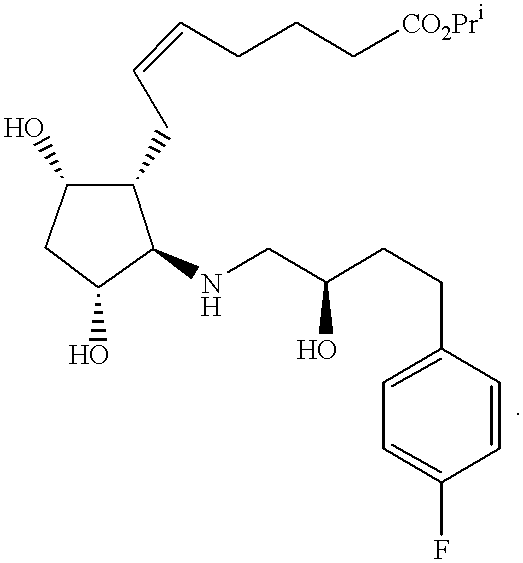
| V | (5Z)-(9S,11R,15R)-13-Aza-17-(4- fluorophenyl)-9,11,15-trihydroxy- 18,19,20-trinor-5-prostenoic acid isopropyl ester |
 |


| Ingredient | Amount (wt %) | ||
| Compound II | 0.01 | ||
| Phosphate Buffered Saline | 1.0 | ||
| Polysorbate 80 | 0.5 | ||
| Purified water | q.s. to 100% | ||
| Ingredient | Amount (wt %) | ||
| Compound III | 0.005 | ||
| Monobasic sodium phosphate | 0.05 | ||
| Dibasic sodium phosphate | 0.15 | ||
| (anhydrous) | |||
| Sodium chloride | 0.75 | ||
| Disodium EDTA (Edetate disodium) | 0.05 | ||
| CREMOPHOR ® EL | 0.1 | ||
| Benzalkonium chloride | 0.01 | ||
| HCl and/or NaOH | pH 7.3-7.4 | ||
| Purified water | q.s. to 100% | ||
| Ingredient | Amount (wt %) | ||
| Compound IV | 0.1 | ||
| Phosphate Buffered Saline | 1.0 | ||
| Hydroxypropy1-β-cyclodextrin | 4.0 | ||
| Purified water | q.s. to 100% | ||
Claims (19)




Priority Applications (1)
| Application Number | Priority Date | Filing Date | Title |
|---|---|---|---|
| US09/430,513 US6417228B1 (en) | 1998-11-02 | 1999-10-29 | 13-Aza prostaglandins for the treatment of glaucoma and ocular hypertension |
Applications Claiming Priority (2)
| Application Number | Priority Date | Filing Date | Title |
|---|---|---|---|
| US10673198P | 1998-11-02 | 1998-11-02 | |
| US09/430,513 US6417228B1 (en) | 1998-11-02 | 1999-10-29 | 13-Aza prostaglandins for the treatment of glaucoma and ocular hypertension |
Publications (1)
| Publication Number | Publication Date |
|---|---|
| US6417228B1 true US6417228B1 (en) | 2002-07-09 |
Family
ID=26803963
Family Applications (1)
| Application Number | Title | Priority Date | Filing Date |
|---|---|---|---|
| US09/430,513 Expired - Lifetime US6417228B1 (en) | 1998-11-02 | 1999-10-29 | 13-Aza prostaglandins for the treatment of glaucoma and ocular hypertension |
Country Status (1)
| Country | Link |
|---|---|
| US (1) | US6417228B1 (en) |
Cited By (6)
| Publication number | Priority date | Publication date | Assignee | Title |
|---|---|---|---|---|
| US20040225014A1 (en) * | 2003-02-14 | 2004-11-11 | Sucampo Ag | Method for treating ocular hypertension and glaucoma |
| US20050272743A1 (en) * | 2004-01-05 | 2005-12-08 | Nicox S.A. | Prostaglandin derivatives |
| WO2006078659A3 (en) * | 2005-01-20 | 2006-11-16 | Breath Ltd | Stable prostaglandin-containing compositions |
| EP1985298A1 (en) * | 2007-04-24 | 2008-10-29 | Azad Pharma AG | Ophtalmic oil-in-water emulsions containing prostaglandins |
| US20090062296A1 (en) * | 2005-06-29 | 2009-03-05 | Agouron Pharmaceuticals, Inc. | Prostaglandin derivatives |
| RU2712221C2 (en) * | 2014-10-15 | 2020-01-27 | Новартис Аг | Conjugates and prostaglandin derivatives for treating glaucoma and intraocular hypertension |
Citations (10)
| Publication number | Priority date | Publication date | Assignee | Title |
|---|---|---|---|---|
| US4182903A (en) | 1976-02-23 | 1980-01-08 | Gruppo Lepetit S.P.A. | 13-Azaprostaglandins |
| NL7905375A (en) * | 1978-07-11 | 1980-01-15 | Glaxo Group Ltd | PROSTANOIDS, METHOD FOR PREPARING THE SAME AND PHARMACEUTICAL PREPARATIONS BASED ON THAT |
| US4189606A (en) | 1976-02-23 | 1980-02-19 | Gruppo Lepetit S.P.A. | 13-Azaprostaglandins |
| US4599353A (en) | 1982-05-03 | 1986-07-08 | The Trustees Of Columbia University In The City Of New York | Use of eicosanoids and their derivatives for treatment of ocular hypertension and glaucoma |
| US4952581A (en) | 1987-04-03 | 1990-08-28 | The Trustees Of Columbia University In The City Of New York | Use of a prostaglandin in combination with an adrenergic blocking agent for reduction of intraocular pressure |
| EP0561073A1 (en) | 1992-03-19 | 1993-09-22 | R-Tech Ueno Ltd. | Treatment of ocular hypertension with beta-blockers and derivatives of protanoic acid |
| DE4229050A1 (en) | 1992-08-31 | 1994-03-03 | Schering Ag | New esters and amides of 9-chloro-prostaglandins - useful, e.g., in treatment of glaucoma and as diuretic agents |
| US5321128A (en) | 1988-09-06 | 1994-06-14 | Kabi Pharmacia Ab | Prostaglandin derivatives for the treatment of glaucoma or ocular hypertension |
| US5773471A (en) | 1995-03-10 | 1998-06-30 | R-Tech Ueno, Ltd. | Treatment of optic nerve disorder with prostanoic acid compounds |
| US5811443A (en) | 1992-10-13 | 1998-09-22 | Alcon Laboratories, Inc. | Combinations of prostaglandins and clonidine derivatives for the treatment of glaucoma |
-
1999
- 1999-10-29 US US09/430,513 patent/US6417228B1/en not_active Expired - Lifetime
Patent Citations (11)
| Publication number | Priority date | Publication date | Assignee | Title |
|---|---|---|---|---|
| US4182903A (en) | 1976-02-23 | 1980-01-08 | Gruppo Lepetit S.P.A. | 13-Azaprostaglandins |
| US4189606A (en) | 1976-02-23 | 1980-02-19 | Gruppo Lepetit S.P.A. | 13-Azaprostaglandins |
| NL7905375A (en) * | 1978-07-11 | 1980-01-15 | Glaxo Group Ltd | PROSTANOIDS, METHOD FOR PREPARING THE SAME AND PHARMACEUTICAL PREPARATIONS BASED ON THAT |
| US4265891A (en) * | 1978-07-11 | 1981-05-05 | Glaxo Group Limited | Prostanoid compounds and compositions |
| US4599353A (en) | 1982-05-03 | 1986-07-08 | The Trustees Of Columbia University In The City Of New York | Use of eicosanoids and their derivatives for treatment of ocular hypertension and glaucoma |
| US4952581A (en) | 1987-04-03 | 1990-08-28 | The Trustees Of Columbia University In The City Of New York | Use of a prostaglandin in combination with an adrenergic blocking agent for reduction of intraocular pressure |
| US5321128A (en) | 1988-09-06 | 1994-06-14 | Kabi Pharmacia Ab | Prostaglandin derivatives for the treatment of glaucoma or ocular hypertension |
| EP0561073A1 (en) | 1992-03-19 | 1993-09-22 | R-Tech Ueno Ltd. | Treatment of ocular hypertension with beta-blockers and derivatives of protanoic acid |
| DE4229050A1 (en) | 1992-08-31 | 1994-03-03 | Schering Ag | New esters and amides of 9-chloro-prostaglandins - useful, e.g., in treatment of glaucoma and as diuretic agents |
| US5811443A (en) | 1992-10-13 | 1998-09-22 | Alcon Laboratories, Inc. | Combinations of prostaglandins and clonidine derivatives for the treatment of glaucoma |
| US5773471A (en) | 1995-03-10 | 1998-06-30 | R-Tech Ueno, Ltd. | Treatment of optic nerve disorder with prostanoic acid compounds |
Non-Patent Citations (6)
| Title |
|---|
| Alm, The Potential of Prostaglandin Derivatives in Glaucoma Therapy, Current Opinion in Ophthalmology 4(11):44-50 (1993). |
| Favara, et al., Synthesis and Antifertility Activity of 13-Aza 14-Oxo-Prostaglandins Prostaglandins 25(3):311-320 (1983). |
| Giuffre, The Effects of Prostaglandin F2a in the Human Eye, Graefe's Arch Clin Exp Ophthalmol 222:139-141 (1985). |
| Glaxo Group. Dutch patent application NL 1979-5375 (abstract) CAPLUS (online) (retrieved May 16, 2000) Retrieved from STN International, Columbus OH USA. Accession No. 1980:494884, Jan. 1980.* * |
| Kerstetter et al., Prostaglandin F2a-1-Isopropylester Lowers Intraocular Pressure Without Decreasing Aqueous Humor Flow, American Journal of Ophthalmology 105:30-34 (1988). |
| Nakajima et al., Effects of Prostaglandin D2 and its analogue, BW245C, on Intraocular Pressure in Humans, Graefe's Arch Clin Exp Ophthalmol 229:411-413 (1991). |
Cited By (24)
| Publication number | Priority date | Publication date | Assignee | Title |
|---|---|---|---|---|
| US20040225014A1 (en) * | 2003-02-14 | 2004-11-11 | Sucampo Ag | Method for treating ocular hypertension and glaucoma |
| US7273946B2 (en) | 2004-01-05 | 2007-09-25 | Nicox S.A. | Prostaglandin derivatives |
| US7629345B2 (en) | 2004-01-05 | 2009-12-08 | Nicox S.A. | Prostaglandin derivatives |
| US8058467B2 (en) | 2004-01-05 | 2011-11-15 | Nicox S.A. | Prostaglandin derivatives |
| US20110136904A1 (en) * | 2004-01-05 | 2011-06-09 | Nicox S.A. | Prostaglandin derivatives |
| US20080058392A1 (en) * | 2004-01-05 | 2008-03-06 | Nicox S.A. | Prostaglandin derivatives |
| EP3643702A1 (en) | 2004-01-05 | 2020-04-29 | Nicox S.A. | Prostaglandin derivatives |
| US7910767B2 (en) | 2004-01-05 | 2011-03-22 | Nicox S.A. | Prostaglandin derivatives |
| US20050272743A1 (en) * | 2004-01-05 | 2005-12-08 | Nicox S.A. | Prostaglandin derivatives |
| US20090030076A1 (en) * | 2004-01-05 | 2009-01-29 | Nicox S.A. | Prostaglandin derivatives |
| US7449469B2 (en) | 2004-01-05 | 2008-11-11 | Nicox S.A. | Prostaglandin derivatives |
| EP3002277A1 (en) | 2004-01-05 | 2016-04-06 | Nicox S.A. | Prostaglandin derivatives |
| WO2006078659A3 (en) * | 2005-01-20 | 2006-11-16 | Breath Ltd | Stable prostaglandin-containing compositions |
| US8084501B2 (en) | 2005-01-20 | 2011-12-27 | Breath Limited | Stable prostaglandin-containing compositions |
| US20060270735A1 (en) * | 2005-01-20 | 2006-11-30 | Breath Limited | Stable prostaglandin-containing compositions |
| US20090062296A1 (en) * | 2005-06-29 | 2009-03-05 | Agouron Pharmaceuticals, Inc. | Prostaglandin derivatives |
| US7718656B2 (en) | 2005-06-29 | 2010-05-18 | Nicox S.A. | Prostaglandin derivatives |
| US20100112016A1 (en) * | 2007-04-24 | 2010-05-06 | Azad Pharma Ag | Ophthalmic oil-in-water emulsions containing prostaglandins |
| RU2460516C2 (en) * | 2007-04-24 | 2012-09-10 | Азад Фарма Аг | Oil-in-water ophthalmic emulsions containing prostaglandins |
| AU2008240964B2 (en) * | 2007-04-24 | 2013-03-07 | Azad Pharma Ag | Ophthalmic oil-in-water emulsions containing prostaglandins |
| US8414904B2 (en) | 2007-04-24 | 2013-04-09 | Azad Pharma Ag | Ophthalmic oil-in-water emulsions containing prostaglandins |
| WO2008128779A1 (en) * | 2007-04-24 | 2008-10-30 | Azad Pharma Ag | Ophthalmic oil-in-water emulsions containing prostaglandins |
| EP1985298A1 (en) * | 2007-04-24 | 2008-10-29 | Azad Pharma AG | Ophtalmic oil-in-water emulsions containing prostaglandins |
| RU2712221C2 (en) * | 2014-10-15 | 2020-01-27 | Новартис Аг | Conjugates and prostaglandin derivatives for treating glaucoma and intraocular hypertension |
Similar Documents
| Publication | Publication Date | Title |
|---|---|---|
| US6232344B1 (en) | 13-Oxa prostaglandins for the treatment of glaucoma and ocular hypertension | |
| US6344478B2 (en) | Use of cloprostenol and fluprostenol analogues to treat glaucoma and ocular hypertension | |
| CN1133434C (en) | Cyclopentaneheptane(enoic) acid, 2-heteroarylalkenyl derivatives as therapeutic agents | |
| US6169111B1 (en) | Conformationally rigid aryl prostaglandins for use in glaucoma therapy | |
| US5194429A (en) | Ocular hypotensive agents | |
| EP0455264B1 (en) | Ocular hypotensive agents | |
| US6353000B1 (en) | 11-halo prostaglandins for the treatment of glaucoma or ocular hypertension | |
| US6353014B1 (en) | 15-ketal postaglandins for the treatment of glaucoma or ocular hypertension | |
| US6649653B1 (en) | 15-fluoro prostaglandins as ocular hypotensives | |
| US6235779B1 (en) | Use of cis-Δ4 analogs of prostaglandins as ocular hypotensives | |
| EP0580268B1 (en) | Ocular hypotensive agents | |
| US6172109B1 (en) | 13-Thia prostaglandins for use in glaucoma therapy | |
| US5814660A (en) | 9-oxa prostaglandin analogs as ocular hypotensives | |
| US5866602A (en) | Keto-substituted tetrahydrofuran analogs of prostaglandins as ocular hypotensives | |
| US6545045B1 (en) | Prostaglandin E agonists for treatment of glaucoma | |
| US6160013A (en) | 14-aza prostaglandins for the treatment of glaucoma and ocular hypertension | |
| US5236907A (en) | Ocular hypotensive agents | |
| US6211226B1 (en) | 11-Aza prostaglandins for the treatment of glaucoma and ocular hypertension | |
| US6096783A (en) | Cyclobutane prostaglandin analogues as ocular hypotensive agents | |
| US6680339B2 (en) | 15-fluoro prostaglandins as ocular hypotensives | |
| MXPA99008203A (en) | 13-thia prostaglandins for use in glaucoma therapy |
Legal Events
| Date | Code | Title | Description |
|---|---|---|---|
| AS | Assignment |
Owner name: ALCON LABORATORIES, INC., TEXAS Free format text: ASSIGNMENT OF ASSIGNORS INTEREST;ASSIGNOR:KLIMKO, PETER G.;REEL/FRAME:010566/0900 Effective date: 20000113 |
|
| AS | Assignment |
Owner name: ALCON MANUFACTURING, LTD., TEXAS Free format text: ASSIGNMENT OF ASSIGNORS INTEREST;ASSIGNOR:ALCON LABORATORIES, INC.;REEL/FRAME:011667/0559 Effective date: 20010322 |
|
| STCF | Information on status: patent grant |
Free format text: PATENTED CASE |
|
| FPAY | Fee payment |
Year of fee payment: 4 |
|
| AS | Assignment |
Owner name: ALCON RESEARCH, LTD., TEXAS Free format text: MERGER;ASSIGNOR:ALCON MANUFACTURING, LTD.;REEL/FRAME:021266/0729 Effective date: 20080101 Owner name: ALCON RESEARCH, LTD.,TEXAS Free format text: MERGER;ASSIGNOR:ALCON MANUFACTURING, LTD.;REEL/FRAME:021266/0729 Effective date: 20080101 |
|
| FPAY | Fee payment |
Year of fee payment: 8 |
|
| FPAY | Fee payment |
Year of fee payment: 12 |
|
| AS | Assignment |
Owner name: ALCON RESEARCH, LLC, TEXAS Free format text: MERGER;ASSIGNOR:ALCON RESEARCH, LTD.;REEL/FRAME:050735/0465 Effective date: 20190228 |
|
| AS | Assignment |
Owner name: NOVARTIS AG, SWITZERLAND Free format text: CONFIRMATORY DEED OF ASSIGNMENT EFFECTIVE APRIL 8, 2019;ASSIGNOR:ALCON RESEARCH, LLC;REEL/FRAME:050746/0431 Effective date: 20191015 |
|
| AS | Assignment |
Owner name: NOVARTIS AG, SWITZERLAND Free format text: CORRECTIVE ASSIGNMENT TO CORRECT THE ASSIGNEE ADDRESS. PREVIOUSLY RECORDED AT REEL: 050746 FRAME: 0431. ASSIGNOR(S) HEREBY CONFIRMS THE ASSIGNMENT.;ASSIGNOR:ALCON RESEARCH, LLC;REEL/FRAME:050767/0001 Effective date: 20191015 |