US6417222B1 - [2-substituted-5-[3-thienyl)-benzyl]-2- ([2-isopropoxy-5-fluoro]-phenyoxy)-ethyl]-amine derivatives, method for the production and use thereof as medicaments - Google Patents
[2-substituted-5-[3-thienyl)-benzyl]-2- ([2-isopropoxy-5-fluoro]-phenyoxy)-ethyl]-amine derivatives, method for the production and use thereof as medicaments Download PDFInfo
- Publication number
- US6417222B1 US6417222B1 US09/937,737 US93773701A US6417222B1 US 6417222 B1 US6417222 B1 US 6417222B1 US 93773701 A US93773701 A US 93773701A US 6417222 B1 US6417222 B1 US 6417222B1
- Authority
- US
- United States
- Prior art keywords
- fluoro
- ethyl
- thienyl
- isopropoxy
- mmol
- Prior art date
- Legal status (The legal status is an assumption and is not a legal conclusion. Google has not performed a legal analysis and makes no representation as to the accuracy of the status listed.)
- Expired - Lifetime
Links
- 238000000034 method Methods 0.000 title claims description 15
- 239000003814 drug Substances 0.000 title abstract description 4
- 125000001541 3-thienyl group Chemical group S1C([H])=C([*])C([H])=C1[H] 0.000 title abstract 2
- 150000001875 compounds Chemical class 0.000 claims description 45
- LFQSCWFLJHTTHZ-UHFFFAOYSA-N Ethanol Chemical compound CCO LFQSCWFLJHTTHZ-UHFFFAOYSA-N 0.000 claims description 24
- 150000001412 amines Chemical class 0.000 claims description 20
- 150000003839 salts Chemical class 0.000 claims description 17
- 125000001797 benzyl group Chemical group [H]C1=C([H])C([H])=C(C([H])=C1[H])C([H])([H])* 0.000 claims description 9
- 125000001495 ethyl group Chemical group [H]C([H])([H])C([H])([H])* 0.000 claims description 9
- ZPUCINDJVBIVPJ-LJISPDSOSA-N cocaine Chemical compound O([C@H]1C[C@@H]2CC[C@@H](N2C)[C@H]1C(=O)OC)C(=O)C1=CC=CC=C1 ZPUCINDJVBIVPJ-LJISPDSOSA-N 0.000 claims description 6
- 125000000956 methoxy group Chemical group [H]C([H])([H])O* 0.000 claims description 6
- 125000000951 phenoxy group Chemical group [H]C1=C([H])C([H])=C(O*)C([H])=C1[H] 0.000 claims description 6
- 125000002887 hydroxy group Chemical group [H]O* 0.000 claims description 5
- 229910052739 hydrogen Inorganic materials 0.000 claims description 4
- 239000001257 hydrogen Substances 0.000 claims description 4
- 230000004770 neurodegeneration Effects 0.000 claims description 4
- 208000015122 neurodegenerative disease Diseases 0.000 claims description 4
- 239000008194 pharmaceutical composition Substances 0.000 claims description 4
- 229960003920 cocaine Drugs 0.000 claims description 3
- 229910052731 fluorine Inorganic materials 0.000 claims description 3
- 125000001153 fluoro group Chemical group F* 0.000 claims description 3
- 239000000546 pharmaceutical excipient Substances 0.000 claims description 3
- 201000000980 schizophrenia Diseases 0.000 claims description 3
- UFHFLCQGNIYNRP-UHFFFAOYSA-N Hydrogen Chemical compound [H][H] UFHFLCQGNIYNRP-UHFFFAOYSA-N 0.000 claims description 2
- 230000000561 anti-psychotic effect Effects 0.000 abstract 1
- XEKOWRVHYACXOJ-UHFFFAOYSA-N Ethyl acetate Chemical compound CCOC(C)=O XEKOWRVHYACXOJ-UHFFFAOYSA-N 0.000 description 45
- OKKJLVBELUTLKV-UHFFFAOYSA-N Methanol Chemical compound OC OKKJLVBELUTLKV-UHFFFAOYSA-N 0.000 description 30
- 239000000203 mixture Substances 0.000 description 30
- YMWUJEATGCHHMB-UHFFFAOYSA-N Dichloromethane Chemical compound ClCCl YMWUJEATGCHHMB-UHFFFAOYSA-N 0.000 description 27
- FAPWRFPIFSIZLT-UHFFFAOYSA-M Sodium chloride Chemical compound [Na+].[Cl-] FAPWRFPIFSIZLT-UHFFFAOYSA-M 0.000 description 26
- 239000000047 product Substances 0.000 description 23
- CSNNHWWHGAXBCP-UHFFFAOYSA-L Magnesium sulfate Chemical compound [Mg+2].[O-][S+2]([O-])([O-])[O-] CSNNHWWHGAXBCP-UHFFFAOYSA-L 0.000 description 22
- 239000002904 solvent Substances 0.000 description 20
- 239000012074 organic phase Substances 0.000 description 18
- VYPSYNLAJGMNEJ-UHFFFAOYSA-N Silicium dioxide Chemical compound O=[Si]=O VYPSYNLAJGMNEJ-UHFFFAOYSA-N 0.000 description 16
- HEDRZPFGACZZDS-MICDWDOJSA-N Trichloro(2H)methane Chemical compound [2H]C(Cl)(Cl)Cl HEDRZPFGACZZDS-MICDWDOJSA-N 0.000 description 16
- IAZDPXIOMUYVGZ-UHFFFAOYSA-N Dimethylsulphoxide Chemical compound CS(C)=O IAZDPXIOMUYVGZ-UHFFFAOYSA-N 0.000 description 15
- 230000002829 reductive effect Effects 0.000 description 15
- 238000005160 1H NMR spectroscopy Methods 0.000 description 13
- 229920006395 saturated elastomer Polymers 0.000 description 13
- 239000011780 sodium chloride Substances 0.000 description 13
- XLYOFNOQVPJJNP-UHFFFAOYSA-N water Substances O XLYOFNOQVPJJNP-UHFFFAOYSA-N 0.000 description 13
- MUBZPKHOEPUJKR-UHFFFAOYSA-N Oxalic acid Chemical compound OC(=O)C(O)=O MUBZPKHOEPUJKR-UHFFFAOYSA-N 0.000 description 12
- 0 *C1=CC=C(C2=CSC=C2)C=C1CN([H])CCOC1=CC(F)=CC=C1OC(C)C Chemical compound *C1=CC=C(C2=CSC=C2)C=C1CN([H])CCOC1=CC(F)=CC=C1OC(C)C 0.000 description 11
- 230000003291 dopaminomimetic effect Effects 0.000 description 11
- 229910052943 magnesium sulfate Inorganic materials 0.000 description 11
- 235000019341 magnesium sulphate Nutrition 0.000 description 11
- 239000007787 solid Substances 0.000 description 11
- 238000004587 chromatography analysis Methods 0.000 description 9
- XTHFKEDIFFGKHM-UHFFFAOYSA-N Dimethoxyethane Chemical compound COCCOC XTHFKEDIFFGKHM-UHFFFAOYSA-N 0.000 description 8
- VYFYYTLLBUKUHU-UHFFFAOYSA-N dopamine Chemical compound NCCC1=CC=C(O)C(O)=C1 VYFYYTLLBUKUHU-UHFFFAOYSA-N 0.000 description 8
- 230000000694 effects Effects 0.000 description 8
- 239000003480 eluent Substances 0.000 description 8
- NFHFRUOZVGFOOS-UHFFFAOYSA-N palladium;triphenylphosphane Chemical compound [Pd].C1=CC=CC=C1P(C=1C=CC=CC=1)C1=CC=CC=C1.C1=CC=CC=C1P(C=1C=CC=CC=1)C1=CC=CC=C1.C1=CC=CC=C1P(C=1C=CC=CC=1)C1=CC=CC=C1.C1=CC=CC=C1P(C=1C=CC=CC=1)C1=CC=CC=C1 NFHFRUOZVGFOOS-UHFFFAOYSA-N 0.000 description 8
- 239000000377 silicon dioxide Substances 0.000 description 8
- IQCZILUXNQHRGY-UHFFFAOYSA-N 2-[2-(2-acetyl-5-fluorophenoxy)ethyl]isoindole-1,3-dione Chemical compound CC(=O)C1=CC=C(F)C=C1OCCN1C(=O)C2=CC=CC=C2C1=O IQCZILUXNQHRGY-UHFFFAOYSA-N 0.000 description 7
- XDTMQSROBMDMFD-UHFFFAOYSA-N Cyclohexane Chemical compound C1CCCCC1 XDTMQSROBMDMFD-UHFFFAOYSA-N 0.000 description 7
- IMLAIXAZMVDRGA-UHFFFAOYSA-N 2-phenoxyethanamine Chemical class NCCOC1=CC=CC=C1 IMLAIXAZMVDRGA-UHFFFAOYSA-N 0.000 description 6
- CDBYLPFSWZWCQE-UHFFFAOYSA-L Sodium Carbonate Chemical compound [Na+].[Na+].[O-]C([O-])=O CDBYLPFSWZWCQE-UHFFFAOYSA-L 0.000 description 6
- YXFVVABEGXRONW-UHFFFAOYSA-N Toluene Chemical compound CC1=CC=CC=C1 YXFVVABEGXRONW-UHFFFAOYSA-N 0.000 description 6
- 238000006243 chemical reaction Methods 0.000 description 6
- BWHMMNNQKKPAPP-UHFFFAOYSA-L potassium carbonate Chemical compound [K+].[K+].[O-]C([O-])=O BWHMMNNQKKPAPP-UHFFFAOYSA-L 0.000 description 6
- 239000011541 reaction mixture Substances 0.000 description 6
- 125000004435 hydrogen atom Chemical group [H]* 0.000 description 5
- 239000012071 phase Substances 0.000 description 5
- 239000000843 powder Substances 0.000 description 5
- 229960001534 risperidone Drugs 0.000 description 5
- RAPZEAPATHNIPO-UHFFFAOYSA-N risperidone Chemical compound FC1=CC=C2C(C3CCN(CC3)CCC=3C(=O)N4CCCCC4=NC=3C)=NOC2=C1 RAPZEAPATHNIPO-UHFFFAOYSA-N 0.000 description 5
- 230000000698 schizophrenic effect Effects 0.000 description 5
- 238000003756 stirring Methods 0.000 description 5
- 239000000126 substance Substances 0.000 description 5
- 208000024891 symptom Diseases 0.000 description 5
- QNMBSXGYAQZCTN-UHFFFAOYSA-N thiophen-3-ylboronic acid Chemical compound OB(O)C=1C=CSC=1 QNMBSXGYAQZCTN-UHFFFAOYSA-N 0.000 description 5
- IBYHHJPAARCAIE-UHFFFAOYSA-N 1-bromo-2-chloroethane Chemical compound ClCCBr IBYHHJPAARCAIE-UHFFFAOYSA-N 0.000 description 4
- HZAXFHJVJLSVMW-UHFFFAOYSA-N 2-Aminoethan-1-ol Chemical compound NCCO HZAXFHJVJLSVMW-UHFFFAOYSA-N 0.000 description 4
- SOTYTYXGGFEZEI-UHFFFAOYSA-N 2-[2-(5-fluoro-2-hydroxyphenoxy)ethyl]isoindole-1,3-dione Chemical compound OC1=CC=C(F)C=C1OCCN1C(=O)C2=CC=CC=C2C1=O SOTYTYXGGFEZEI-UHFFFAOYSA-N 0.000 description 4
- QKBZYBXCEGGKDQ-UHFFFAOYSA-N 2-[2-(5-fluoro-2-propan-2-yloxyphenoxy)ethyl]isoindole-1,3-dione Chemical compound CC(C)OC1=CC=C(F)C=C1OCCN1C(=O)C2=CC=CC=C2C1=O QKBZYBXCEGGKDQ-UHFFFAOYSA-N 0.000 description 4
- HOQKGZHXQLZFBT-UHFFFAOYSA-N 3-thiophen-3-ylbenzaldehyde Chemical compound O=CC1=CC=CC(C2=CSC=C2)=C1 HOQKGZHXQLZFBT-UHFFFAOYSA-N 0.000 description 4
- ISWSIDIOOBJBQZ-UHFFFAOYSA-N Phenol Chemical compound OC1=CC=CC=C1 ISWSIDIOOBJBQZ-UHFFFAOYSA-N 0.000 description 4
- ZLMJMSJWJFRBEC-UHFFFAOYSA-N Potassium Chemical compound [K] ZLMJMSJWJFRBEC-UHFFFAOYSA-N 0.000 description 4
- PMZURENOXWZQFD-UHFFFAOYSA-L Sodium Sulfate Chemical compound [Na+].[Na+].[O-]S([O-])(=O)=O PMZURENOXWZQFD-UHFFFAOYSA-L 0.000 description 4
- 238000004458 analytical method Methods 0.000 description 4
- 239000005557 antagonist Substances 0.000 description 4
- 229960003638 dopamine Drugs 0.000 description 4
- 239000003921 oil Substances 0.000 description 4
- 150000003891 oxalate salts Chemical class 0.000 description 4
- 235000006408 oxalic acid Nutrition 0.000 description 4
- 239000011591 potassium Substances 0.000 description 4
- 229910052700 potassium Inorganic materials 0.000 description 4
- 239000002244 precipitate Substances 0.000 description 4
- 238000002360 preparation method Methods 0.000 description 4
- 150000003141 primary amines Chemical class 0.000 description 4
- 229910052938 sodium sulfate Inorganic materials 0.000 description 4
- 235000011152 sodium sulphate Nutrition 0.000 description 4
- RSMBRAMPKXPVCW-UHFFFAOYSA-N 2-fluoro-5-thiophen-3-ylbenzaldehyde Chemical compound C1=C(C=O)C(F)=CC=C1C1=CSC=C1 RSMBRAMPKXPVCW-UHFFFAOYSA-N 0.000 description 3
- RUICYUGGZYRQOG-UHFFFAOYSA-N 2-hydroxy-5-thiophen-3-ylbenzaldehyde Chemical compound C1=C(C=O)C(O)=CC=C1C1=CSC=C1 RUICYUGGZYRQOG-UHFFFAOYSA-N 0.000 description 3
- HNSLDZHNYAQVMZ-UHFFFAOYSA-N 2-methoxy-5-thiophen-3-ylbenzaldehyde Chemical compound C1=C(C=O)C(OC)=CC=C1C1=CSC=C1 HNSLDZHNYAQVMZ-UHFFFAOYSA-N 0.000 description 3
- WEVYAHXRMPXWCK-UHFFFAOYSA-N Acetonitrile Chemical compound CC#N WEVYAHXRMPXWCK-UHFFFAOYSA-N 0.000 description 3
- VHUUQVKOLVNVRT-UHFFFAOYSA-N Ammonium hydroxide Chemical compound [NH4+].[OH-] VHUUQVKOLVNVRT-UHFFFAOYSA-N 0.000 description 3
- RTZKZFJDLAIYFH-UHFFFAOYSA-N Diethyl ether Chemical compound CCOCC RTZKZFJDLAIYFH-UHFFFAOYSA-N 0.000 description 3
- ZMXDDKWLCZADIW-UHFFFAOYSA-N N,N-Dimethylformamide Chemical compound CN(C)C=O ZMXDDKWLCZADIW-UHFFFAOYSA-N 0.000 description 3
- 208000028017 Psychotic disease Diseases 0.000 description 3
- HEMHJVSKTPXQMS-UHFFFAOYSA-M Sodium hydroxide Chemical compound [OH-].[Na+] HEMHJVSKTPXQMS-UHFFFAOYSA-M 0.000 description 3
- QGZKDVFQNNGYKY-UHFFFAOYSA-N ammonia Natural products N QGZKDVFQNNGYKY-UHFFFAOYSA-N 0.000 description 3
- 230000001090 anti-dopaminergic effect Effects 0.000 description 3
- 230000001484 cataleptigenic effect Effects 0.000 description 3
- 230000003197 catalytic effect Effects 0.000 description 3
- 238000001727 in vivo Methods 0.000 description 3
- 238000002844 melting Methods 0.000 description 3
- 230000008018 melting Effects 0.000 description 3
- 229910000027 potassium carbonate Inorganic materials 0.000 description 3
- NLKNQRATVPKPDG-UHFFFAOYSA-M potassium iodide Chemical compound [K+].[I-] NLKNQRATVPKPDG-UHFFFAOYSA-M 0.000 description 3
- 230000008569 process Effects 0.000 description 3
- 238000006268 reductive amination reaction Methods 0.000 description 3
- 229910000029 sodium carbonate Inorganic materials 0.000 description 3
- 238000004809 thin layer chromatography Methods 0.000 description 3
- WSLDOOZREJYCGB-UHFFFAOYSA-N 1,2-Dichloroethane Chemical compound ClCCCl WSLDOOZREJYCGB-UHFFFAOYSA-N 0.000 description 2
- HLTBTUXAMVOKIH-UHFFFAOYSA-N 1-(4-fluoro-2-hydroxyphenyl)ethanone Chemical compound CC(=O)C1=CC=C(F)C=C1O HLTBTUXAMVOKIH-UHFFFAOYSA-N 0.000 description 2
- UPRPREKZYJBRNT-UHFFFAOYSA-N 1-[2-(2-chloroethoxy)-4-fluorophenyl]ethanone Chemical compound CC(=O)C1=CC=C(F)C=C1OCCCl UPRPREKZYJBRNT-UHFFFAOYSA-N 0.000 description 2
- 238000005481 NMR spectroscopy Methods 0.000 description 2
- KDLHZDBZIXYQEI-UHFFFAOYSA-N Palladium Chemical compound [Pd] KDLHZDBZIXYQEI-UHFFFAOYSA-N 0.000 description 2
- 241000700159 Rattus Species 0.000 description 2
- UIIMBOGNXHQVGW-UHFFFAOYSA-M Sodium bicarbonate Chemical compound [Na+].OC([O-])=O UIIMBOGNXHQVGW-UHFFFAOYSA-M 0.000 description 2
- XPXPSXZUMTZIPR-UHFFFAOYSA-N [H]OC1=C(CN([H])CCOC2=C(OC(C)C)C=CC(F)=C2)C=C(C2=CSC=C2)C=C1 Chemical compound [H]OC1=C(CN([H])CCOC2=C(OC(C)C)C=CC(F)=C2)C=C(C2=CSC=C2)C=C1 XPXPSXZUMTZIPR-UHFFFAOYSA-N 0.000 description 2
- 239000002253 acid Substances 0.000 description 2
- 239000002671 adjuvant Substances 0.000 description 2
- 230000002411 adverse Effects 0.000 description 2
- 239000000556 agonist Substances 0.000 description 2
- 150000001299 aldehydes Chemical class 0.000 description 2
- 239000002220 antihypertensive agent Substances 0.000 description 2
- 239000000164 antipsychotic agent Substances 0.000 description 2
- 239000008346 aqueous phase Substances 0.000 description 2
- 239000003693 atypical antipsychotic agent Substances 0.000 description 2
- 230000015572 biosynthetic process Effects 0.000 description 2
- XJHCXCQVJFPJIK-UHFFFAOYSA-M caesium fluoride Chemical compound [F-].[Cs+] XJHCXCQVJFPJIK-UHFFFAOYSA-M 0.000 description 2
- 239000003054 catalyst Substances 0.000 description 2
- 239000003795 chemical substances by application Substances 0.000 description 2
- 229910052801 chlorine Chemical group 0.000 description 2
- 125000001309 chloro group Chemical group Cl* 0.000 description 2
- 239000012230 colorless oil Substances 0.000 description 2
- 238000002425 crystallisation Methods 0.000 description 2
- 230000008025 crystallization Effects 0.000 description 2
- 230000006870 function Effects 0.000 description 2
- 125000005843 halogen group Chemical group 0.000 description 2
- 125000000623 heterocyclic group Chemical group 0.000 description 2
- 150000004677 hydrates Chemical class 0.000 description 2
- -1 hydroxy-carbonyl residue Chemical group 0.000 description 2
- 208000013403 hyperactivity Diseases 0.000 description 2
- FMKOJHQHASLBPH-UHFFFAOYSA-N isopropyl iodide Chemical compound CC(C)I FMKOJHQHASLBPH-UHFFFAOYSA-N 0.000 description 2
- 239000003446 ligand Substances 0.000 description 2
- 230000010534 mechanism of action Effects 0.000 description 2
- GVOISEJVFFIGQE-YCZSINBZSA-N n-[(1r,2s,5r)-5-[methyl(propan-2-yl)amino]-2-[(3s)-2-oxo-3-[[6-(trifluoromethyl)quinazolin-4-yl]amino]pyrrolidin-1-yl]cyclohexyl]acetamide Chemical compound CC(=O)N[C@@H]1C[C@H](N(C)C(C)C)CC[C@@H]1N1C(=O)[C@@H](NC=2C3=CC(=CC=C3N=CN=2)C(F)(F)F)CC1 GVOISEJVFFIGQE-YCZSINBZSA-N 0.000 description 2
- 230000000144 pharmacologic effect Effects 0.000 description 2
- FYRHIOVKTDQVFC-UHFFFAOYSA-M potassium phthalimide Chemical compound [K+].C1=CC=C2C(=O)[N-]C(=O)C2=C1 FYRHIOVKTDQVFC-UHFFFAOYSA-M 0.000 description 2
- 238000012360 testing method Methods 0.000 description 2
- 230000001225 therapeutic effect Effects 0.000 description 2
- 239000003981 vehicle Substances 0.000 description 2
- KRVOJOCLBAAKSJ-RDTXWAMCSA-N (2R,3R)-nemonapride Chemical compound C1=C(Cl)C(NC)=CC(OC)=C1C(=O)N[C@H]1[C@@H](C)N(CC=2C=CC=CC=2)CC1 KRVOJOCLBAAKSJ-RDTXWAMCSA-N 0.000 description 1
- 125000004178 (C1-C4) alkyl group Chemical group 0.000 description 1
- FZXIBIRCACCXGD-UHFFFAOYSA-N 2-(1h-indol-4-yloxy)ethanamine Chemical class NCCOC1=CC=CC2=C1C=CN2 FZXIBIRCACCXGD-UHFFFAOYSA-N 0.000 description 1
- ZWEHNKRNPOVVGH-UHFFFAOYSA-N 2-Butanone Chemical compound CCC(C)=O ZWEHNKRNPOVVGH-UHFFFAOYSA-N 0.000 description 1
- BXWBTVCWFWFSSL-UHFFFAOYSA-N 2-fluoro-3-thiophen-3-ylbenzaldehyde Chemical compound FC1=C(C=O)C=CC=C1C1=CSC=C1 BXWBTVCWFWFSSL-UHFFFAOYSA-N 0.000 description 1
- YJWPWIYPEYHBQB-UHFFFAOYSA-N 2-hydroxy-3-thiophen-3-ylbenzaldehyde Chemical compound OC1=C(C=O)C=CC=C1C1=CSC=C1 YJWPWIYPEYHBQB-UHFFFAOYSA-N 0.000 description 1
- QAJYGLSKWAOMDF-UHFFFAOYSA-N 2-methoxy-3-thiophen-3-ylbenzaldehyde Chemical compound COC1=C(C=O)C=CC=C1C1=CSC=C1 QAJYGLSKWAOMDF-UHFFFAOYSA-N 0.000 description 1
- 125000000175 2-thienyl group Chemical group S1C([*])=C([H])C([H])=C1[H] 0.000 description 1
- YENCPXZFZVHTBB-UHFFFAOYSA-N 3-[2-(benzylamino)ethoxy]-4-methoxyphenol Chemical compound COC1=CC=C(O)C=C1OCCNCC1=CC=CC=C1 YENCPXZFZVHTBB-UHFFFAOYSA-N 0.000 description 1
- SUISZCALMBHJQX-UHFFFAOYSA-N 3-bromobenzaldehyde Chemical compound BrC1=CC=CC(C=O)=C1 SUISZCALMBHJQX-UHFFFAOYSA-N 0.000 description 1
- NHQDETIJWKXCTC-UHFFFAOYSA-N 3-chloroperbenzoic acid Chemical compound OOC(=O)C1=CC=CC(Cl)=C1 NHQDETIJWKXCTC-UHFFFAOYSA-N 0.000 description 1
- LYHRMERCJMBWDE-UHFFFAOYSA-N 4-(2-aminoethoxy)indol-2-one Chemical class NCCOC1=CC=CC2=NC(=O)C=C12 LYHRMERCJMBWDE-UHFFFAOYSA-N 0.000 description 1
- MMFGGDVQLQQQRX-UHFFFAOYSA-N 5-bromo-2-fluorobenzaldehyde Chemical compound FC1=CC=C(Br)C=C1C=O MMFGGDVQLQQQRX-UHFFFAOYSA-N 0.000 description 1
- MKKSTJKBKNCMRV-UHFFFAOYSA-N 5-bromo-2-hydroxybenzaldehyde Chemical compound OC1=CC=C(Br)C=C1C=O MKKSTJKBKNCMRV-UHFFFAOYSA-N 0.000 description 1
- IJIBRSFAXRFPPN-UHFFFAOYSA-N 5-bromo-2-methoxybenzaldehyde Chemical compound COC1=CC=C(Br)C=C1C=O IJIBRSFAXRFPPN-UHFFFAOYSA-N 0.000 description 1
- QPJZNXRYWRXNNE-UHFFFAOYSA-N CC(=O)C1=CC=C(F)C=C1O.CC(=O)C1=CC=C(F)C=C1OCCN1C(=O)C2=C(C=CC=C2)C1=O.CC(C)OC1=CC=C(F)C=C1OCCN.CC(C)OC1=CC=C(F)C=C1OCCN1C(=O)C2=C(C=CC=C2)C1=O.O=C1C2=C(C=CC=C2)C(=O)N1CCOC1=CC(F)=CC=C1O Chemical compound CC(=O)C1=CC=C(F)C=C1O.CC(=O)C1=CC=C(F)C=C1OCCN1C(=O)C2=C(C=CC=C2)C1=O.CC(C)OC1=CC=C(F)C=C1OCCN.CC(C)OC1=CC=C(F)C=C1OCCN1C(=O)C2=C(C=CC=C2)C1=O.O=C1C2=C(C=CC=C2)C(=O)N1CCOC1=CC(F)=CC=C1O QPJZNXRYWRXNNE-UHFFFAOYSA-N 0.000 description 1
- 208000009132 Catalepsy Diseases 0.000 description 1
- 229920000858 Cyclodextrin Polymers 0.000 description 1
- 206010011953 Decreased activity Diseases 0.000 description 1
- MYMOFIZGZYHOMD-UHFFFAOYSA-N Dioxygen Chemical group O=O MYMOFIZGZYHOMD-UHFFFAOYSA-N 0.000 description 1
- 208000017701 Endocrine disease Diseases 0.000 description 1
- HKFMQJUJWSFOLY-OAQYLSRUSA-N Fc(cc1)ccc1-c1cc(CNC[C@@H]2Oc3ccccc3CC2)cnc1 Chemical compound Fc(cc1)ccc1-c1cc(CNC[C@@H]2Oc3ccccc3CC2)cnc1 HKFMQJUJWSFOLY-OAQYLSRUSA-N 0.000 description 1
- BDAGIHXWWSANSR-UHFFFAOYSA-M Formate Chemical compound [O-]C=O BDAGIHXWWSANSR-UHFFFAOYSA-M 0.000 description 1
- DUGOZIWVEXMGBE-UHFFFAOYSA-N Methylphenidate Chemical compound C=1C=CC=CC=1C(C(=O)OC)C1CCCCN1 DUGOZIWVEXMGBE-UHFFFAOYSA-N 0.000 description 1
- 241000208125 Nicotiana Species 0.000 description 1
- 235000002637 Nicotiana tabacum Nutrition 0.000 description 1
- 208000018737 Parkinson disease Diseases 0.000 description 1
- 102000001708 Protein Isoforms Human genes 0.000 description 1
- 108010029485 Protein Isoforms Proteins 0.000 description 1
- 206010047853 Waxy flexibility Diseases 0.000 description 1
- 238000006959 Williamson synthesis reaction Methods 0.000 description 1
- HKFMQJUJWSFOLY-UHFFFAOYSA-N [H]N(CC1=CC(C2=CC=C(F)C=C2)=CN=C1)CC1CCC2=CC=CC=C2O1 Chemical compound [H]N(CC1=CC(C2=CC=C(F)C=C2)=CN=C1)CC1CCC2=CC=CC=C2O1 HKFMQJUJWSFOLY-UHFFFAOYSA-N 0.000 description 1
- YYQOWSIDEUTWOE-UHFFFAOYSA-N [H]N(CCOC1=C(OC(C)C)C=CC(F)=C1)CC1=C(F)C=CC(C2=CSC=C2)=C1 Chemical compound [H]N(CCOC1=C(OC(C)C)C=CC(F)=C1)CC1=C(F)C=CC(C2=CSC=C2)=C1 YYQOWSIDEUTWOE-UHFFFAOYSA-N 0.000 description 1
- PPHJNDAEJMYOTK-UHFFFAOYSA-N [H]N(CCOC1=C(OC(C)C)C=CC(F)=C1)CC1=C(OC)C=CC(C2=CSC=C2)=C1 Chemical compound [H]N(CCOC1=C(OC(C)C)C=CC(F)=C1)CC1=C(OC)C=CC(C2=CSC=C2)=C1 PPHJNDAEJMYOTK-UHFFFAOYSA-N 0.000 description 1
- AJNCYJVDSOXTDW-UHFFFAOYSA-N [H]N(CCOC1=C(OC(C)C)C=CC(F)=C1)CC1=CC=CC(C2=CSC=C2)=C1 Chemical compound [H]N(CCOC1=C(OC(C)C)C=CC(F)=C1)CC1=CC=CC(C2=CSC=C2)=C1 AJNCYJVDSOXTDW-UHFFFAOYSA-N 0.000 description 1
- 150000007513 acids Chemical class 0.000 description 1
- 230000009471 action Effects 0.000 description 1
- 230000029936 alkylation Effects 0.000 description 1
- 238000005804 alkylation reaction Methods 0.000 description 1
- 125000003277 amino group Chemical group 0.000 description 1
- 238000007098 aminolysis reaction Methods 0.000 description 1
- 238000013459 approach Methods 0.000 description 1
- 150000004982 aromatic amines Chemical class 0.000 description 1
- 230000008901 benefit Effects 0.000 description 1
- 230000000903 blocking effect Effects 0.000 description 1
- 238000009835 boiling Methods 0.000 description 1
- 150000001649 bromium compounds Chemical class 0.000 description 1
- 239000002775 capsule Substances 0.000 description 1
- 210000000748 cardiovascular system Anatomy 0.000 description 1
- 210000004027 cell Anatomy 0.000 description 1
- 208000015114 central nervous system disease Diseases 0.000 description 1
- 230000002490 cerebral effect Effects 0.000 description 1
- 239000003153 chemical reaction reagent Substances 0.000 description 1
- 239000003638 chemical reducing agent Substances 0.000 description 1
- 230000003920 cognitive function Effects 0.000 description 1
- 230000008878 coupling Effects 0.000 description 1
- 238000010168 coupling process Methods 0.000 description 1
- 238000005859 coupling reaction Methods 0.000 description 1
- 229940097362 cyclodextrins Drugs 0.000 description 1
- 238000010511 deprotection reaction Methods 0.000 description 1
- RCJVRSBWZCNNQT-UHFFFAOYSA-N dichloridooxygen Chemical compound ClOCl RCJVRSBWZCNNQT-UHFFFAOYSA-N 0.000 description 1
- 208000037265 diseases, disorders, signs and symptoms Diseases 0.000 description 1
- 208000035475 disorder Diseases 0.000 description 1
- 238000006073 displacement reaction Methods 0.000 description 1
- 238000004821 distillation Methods 0.000 description 1
- 238000009826 distribution Methods 0.000 description 1
- 229940079593 drug Drugs 0.000 description 1
- 230000004064 dysfunction Effects 0.000 description 1
- 238000000921 elemental analysis Methods 0.000 description 1
- 238000011156 evaluation Methods 0.000 description 1
- 238000002474 experimental method Methods 0.000 description 1
- 238000009472 formulation Methods 0.000 description 1
- 239000008187 granular material Substances 0.000 description 1
- 238000010438 heat treatment Methods 0.000 description 1
- 238000006460 hydrolysis reaction Methods 0.000 description 1
- 125000004029 hydroxymethyl group Chemical group [H]OC([H])([H])* 0.000 description 1
- 239000003112 inhibitor Substances 0.000 description 1
- 230000005764 inhibitory process Effects 0.000 description 1
- 229910052500 inorganic mineral Inorganic materials 0.000 description 1
- 239000007791 liquid phase Substances 0.000 description 1
- 238000005259 measurement Methods 0.000 description 1
- LULAYUGMBFYYEX-UHFFFAOYSA-N metachloroperbenzoic acid Natural products OC(=O)C1=CC=CC(Cl)=C1 LULAYUGMBFYYEX-UHFFFAOYSA-N 0.000 description 1
- HNQIVZYLYMDVSB-UHFFFAOYSA-N methanesulfonimidic acid Chemical group CS(N)(=O)=O HNQIVZYLYMDVSB-UHFFFAOYSA-N 0.000 description 1
- 125000002496 methyl group Chemical group [H]C([H])([H])* 0.000 description 1
- 229960001344 methylphenidate Drugs 0.000 description 1
- 235000010755 mineral Nutrition 0.000 description 1
- 239000011707 mineral Substances 0.000 description 1
- 230000036651 mood Effects 0.000 description 1
- AAHQWBMKMOZNOR-UHFFFAOYSA-N n-(furan-2-ylmethyl)-2-(2-methoxyphenoxy)ethanamine Chemical compound COC1=CC=CC=C1OCCNCC1=CC=CO1 AAHQWBMKMOZNOR-UHFFFAOYSA-N 0.000 description 1
- SZDYRZVWNVIYGO-UHFFFAOYSA-N n-benzyl-2-(2-methoxyphenoxy)ethanamine Chemical compound COC1=CC=CC=C1OCCNCC1=CC=CC=C1 SZDYRZVWNVIYGO-UHFFFAOYSA-N 0.000 description 1
- 208000015706 neuroendocrine disease Diseases 0.000 description 1
- 210000002569 neuron Anatomy 0.000 description 1
- 125000000449 nitro group Chemical group [O-][N+](*)=O 0.000 description 1
- 238000010606 normalization Methods 0.000 description 1
- 238000000655 nuclear magnetic resonance spectrum Methods 0.000 description 1
- 150000007524 organic acids Chemical class 0.000 description 1
- 235000005985 organic acids Nutrition 0.000 description 1
- 229910052760 oxygen Inorganic materials 0.000 description 1
- 239000001301 oxygen Substances 0.000 description 1
- 125000004430 oxygen atom Chemical group O* 0.000 description 1
- 229910052763 palladium Inorganic materials 0.000 description 1
- 239000004031 partial agonist Substances 0.000 description 1
- 230000002093 peripheral effect Effects 0.000 description 1
- 238000001050 pharmacotherapy Methods 0.000 description 1
- 125000001997 phenyl group Chemical group [H]C1=C([H])C([H])=C(*)C([H])=C1[H] 0.000 description 1
- 125000005544 phthalimido group Chemical group 0.000 description 1
- 150000004885 piperazines Chemical class 0.000 description 1
- 125000003367 polycyclic group Chemical group 0.000 description 1
- 238000000746 purification Methods 0.000 description 1
- 230000035484 reaction time Effects 0.000 description 1
- 239000013558 reference substance Substances 0.000 description 1
- 229910000030 sodium bicarbonate Inorganic materials 0.000 description 1
- 235000017557 sodium bicarbonate Nutrition 0.000 description 1
- 238000001228 spectrum Methods 0.000 description 1
- 238000006467 substitution reaction Methods 0.000 description 1
- 229910052717 sulfur Chemical group 0.000 description 1
- 125000004434 sulfur atom Chemical group 0.000 description 1
- 239000000725 suspension Substances 0.000 description 1
- 230000015883 synaptic transmission, dopaminergic Effects 0.000 description 1
- 238000003786 synthesis reaction Methods 0.000 description 1
- CZDYPVPMEAXLPK-UHFFFAOYSA-N tetramethylsilane Chemical compound C[Si](C)(C)C CZDYPVPMEAXLPK-UHFFFAOYSA-N 0.000 description 1
- 239000003204 tranquilizing agent Substances 0.000 description 1
- 230000002936 tranquilizing effect Effects 0.000 description 1
- 230000001052 transient effect Effects 0.000 description 1
- 230000000304 vasodilatating effect Effects 0.000 description 1
Classifications
-
- C—CHEMISTRY; METALLURGY
- C07—ORGANIC CHEMISTRY
- C07D—HETEROCYCLIC COMPOUNDS
- C07D333/00—Heterocyclic compounds containing five-membered rings having one sulfur atom as the only ring hetero atom
- C07D333/02—Heterocyclic compounds containing five-membered rings having one sulfur atom as the only ring hetero atom not condensed with other rings
- C07D333/04—Heterocyclic compounds containing five-membered rings having one sulfur atom as the only ring hetero atom not condensed with other rings not substituted on the ring sulphur atom
- C07D333/06—Heterocyclic compounds containing five-membered rings having one sulfur atom as the only ring hetero atom not condensed with other rings not substituted on the ring sulphur atom with only hydrogen atoms, hydrocarbon or substituted hydrocarbon radicals, directly attached to the ring carbon atoms
- C07D333/14—Radicals substituted by singly bound hetero atoms other than halogen
- C07D333/20—Radicals substituted by singly bound hetero atoms other than halogen by nitrogen atoms
-
- A—HUMAN NECESSITIES
- A61—MEDICAL OR VETERINARY SCIENCE; HYGIENE
- A61P—SPECIFIC THERAPEUTIC ACTIVITY OF CHEMICAL COMPOUNDS OR MEDICINAL PREPARATIONS
- A61P25/00—Drugs for disorders of the nervous system
-
- A—HUMAN NECESSITIES
- A61—MEDICAL OR VETERINARY SCIENCE; HYGIENE
- A61P—SPECIFIC THERAPEUTIC ACTIVITY OF CHEMICAL COMPOUNDS OR MEDICINAL PREPARATIONS
- A61P25/00—Drugs for disorders of the nervous system
- A61P25/14—Drugs for disorders of the nervous system for treating abnormal movements, e.g. chorea, dyskinesia
- A61P25/16—Anti-Parkinson drugs
-
- A—HUMAN NECESSITIES
- A61—MEDICAL OR VETERINARY SCIENCE; HYGIENE
- A61P—SPECIFIC THERAPEUTIC ACTIVITY OF CHEMICAL COMPOUNDS OR MEDICINAL PREPARATIONS
- A61P25/00—Drugs for disorders of the nervous system
- A61P25/18—Antipsychotics, i.e. neuroleptics; Drugs for mania or schizophrenia
-
- A—HUMAN NECESSITIES
- A61—MEDICAL OR VETERINARY SCIENCE; HYGIENE
- A61P—SPECIFIC THERAPEUTIC ACTIVITY OF CHEMICAL COMPOUNDS OR MEDICINAL PREPARATIONS
- A61P25/00—Drugs for disorders of the nervous system
- A61P25/30—Drugs for disorders of the nervous system for treating abuse or dependence
Definitions
- Dopamine is a neuromediator which participates in controlling motricity, cognitive functions and mood, and is involved in the compensation circuit.
- Five types of dopaminergic receptors have been cloned (D 1 -D 5 ) and their levels of expression and cerebral distributions have been analyzed. Among these five types of receptor, at least two types have isoforms (Proc. Natl. Acad. Sci. USA 1998, 95, 7731). Although these five types of dopaminergic receptor are pharmacologically distinct, they have been grouped into 2 subfamilies: the D 1 subfamily, which comprises the D 1 and D 5 receptors, and the D 2 subfamily, which comprises the D 2 , D 3 and D 4 receptors. It is possible to differentiate the pharmacological action of the D 1 and D 2 subfamilies, but it is generally difficult to differentiate the function of the various types within each subfamily.
- a dysfunction of dopaminergic transmission is involved in the symptomatology of central nervous system disorders such as schizophrenic psychosis (Neuropsychopharmacol. 1988, 1, 179), certain neurodegenerative diseases such as, for example, Parkinson's disease (Neurodegenerative Diseases; Jolles, G.; Stutzmann, J. M.; Eds; Academic Press, 1994, Chap. 8), depression (J. Clin. Psychiatry, 1998, 59 (Suppl. 5), 60), the dependance on certain substances such as, for example, cocaine, tobacco or alcohol (Cell 1997, 90, 991; Nature 1997, 388, 586).
- antagonists of central dopaminergic receptors of the D 2 type constitute a conventional and clinically effective approach in the treatment of the positive symptoms of schizophrenic psychosis.
- most of the compounds having such a mechanism of action also induce adverse side effects such as symptoms of Parkinson type (Pharmacotherapy 1996, 16, 160) and/or neuroendocrine disorders (Acta Psychiatr. Scand. 1989, 352, 24).
- X represents a hydrogen atom, a hydroxyl group, an amino group or a methanesulfonamide group
- Y represents a hydrogen atom or a halogen atom
- Ar is a phenyl or 2-thienyl group, as being partial agonists of the receptor of the D 2 type.
- Patents WO 98/08817, U.S. Pat. No. 5,760,070, WO 98/08843 and WO 98/08819 describe, respectively, 4-aminoethoxyindoles and 4-aminoethoxyindolones as being agonists of dopaminergic receptors of the D 2 type or inhibitors of the synthesis and release of dopamine.
- X represents a n oxygen or sulfur atom or a CH 2 group
- R 1 is a hydrogen or chlorine atom, a hydroxyl or hydroxymethyl group, a nitro group or a hydroxy-carbonyl residue
- R 2 and R 3 represent a hydrogen atom, a halogen atom or a methyl group.
- Patent WO 97/23482 describes octahydropyrrolo[1,2-a]-pyrazines of formula:
- X represents, inter alia, an oxygen atom
- Patents FR 2 702 211, JP 51 048 627, JP 51 052 146, DE 2 450 616 and WO 96/31461 describe 2-[2-(alkoxy)phenoxy]ethylamine derivatives of formula:
- R is a C 1 -C 4 alkyl group and R 1 represents a 4-benzenebutyl, piperidine-4-methyl or 4-benzamidobutyl chain.
- R is a C 1 -C 4 alkyl group and R 1 represents a 4-benzenebutyl, piperidine-4-methyl or 4-benzamidobutyl chain.
- These compounds are claimed as being ligands of the receptors of the 5-HT 1A subtype (FR 2 702 211 and WO 96/31461) or hypotensive agents and tranquilizers (JP 51 048 627, JP 51 052 146 and DE 2 450 616).
- Patent EP 707 007 describes arylamines with twofold activity: both antagonist of the receptors of the D 2 type, and agonist of the 5-HT 1A subtype, and which are useful as antipsychotic agents.
- the compound EMD-12830 (Drug Data Report 1998, 21) of formula:
- an atypical antipsychotic agent i.e. an agent with a reduced propensity to cause side effects of Parkinson type than the conventional antipsychotic agents.
- Patent DE 2 364 685 describes phenoxyalkylamines, in particular N-[2-(2-methoxyphenoxy)ethyl]-3- or -4-pyridylmethanamine, are [sic] claimed as hypotensive agents.
- Angstein et al. J. Med. Chem. 196 5, 8, 356 have described aryloxyalkylamines that are active on the cardiovascular system. Among the compounds described is N-[2-(2-methoxyphenoxy)ethyl]benzenemethanamine.
- Patent WO 98/11068 describes 1-(2-pyrimidyl)-4-[(3-aryl)benzyl]piperazines as selective ligands of the receptors of the D 4 subtype.
- the present invention relates to a novel family of compounds which correspond to the general formula (1)
- the compounds of this invention have antidopaminergic activity, in particular on the receptors of the D 2 subfamily.
- the compounds of the invention are useful in the treatment of conditions resulting from dopaminergic hyperactivity, such as schizophrenic symptoms and dependency on certain substances.
- the antagonist activity of the products of the invention on the receptors of the D 2 type is exerted only during a transient dopaminergic hyperstimulation.
- dopaminergic hyperactivity that is to say when the dopamine concentration ranges within proportions that are acceptable for normal functioning of the neuron, the compounds of the invention do not induce dopaminergic hypoactivity.
- the compounds of the invention are thus useful in the treatment of schizophrenic symptoms and have the advantage of being potentially free of the adverse side effects caused by an excessive blocking of the receptors of the D 2 type, such as Parkinsonian symptoms and/or endocrine disorders, at doses that are therapeutically effective for treating schizophrenic psychosis.
- the compounds of the invention thus differ from the derivatives of the prior art in their chemical formula and their mechanism of action.
- the present invention relates to novel compounds corresponding to the general formula (1).
- X represents:
- hydroxyl (OH) group or a methoxy (OCH 3 ) group.
- the invention also relates to the addition salts and optionally the hydrates of the addition salts of the compounds of general formula (1) with pharmaceutically acceptable mineral acids or organic acids.
- a subject of the invention is also pharmaceutical compositions containing, as active principle, at least one of the derivatives of general formula (1) or one of the salts thereof or hydrates of the salts thereof in combination with one or more pharmaceutically acceptable excipients, adjuvants or vehicles.
- pharmaceutically acceptable excipients for example, mention may be made of inclusion complexes, in particular the inclusion complexes formed by the compounds of the invention with ⁇ -cyclodextrins.
- compositions according to the invention may be compositions which may be administered orally, nasally, sublingually, rectally or parenterally. It is generally advantageous to formulate such pharmaceutical compositions in unit dose form. Each dose then comprises a predetermined amount of the active principle, combined with the appropriate vehicle, excipients and/or adjuvants, calculated to obtain a given therapeutic effect.
- unit dose forms which may be administered orally, mention may be made of tablets, gel capsules, granules, powders and oral solutions or suspensions.
- the dosage varies from one individual to another, depending on the nature and intensity of the complaint, the chosen route of administration and the weight, age and sex of the patient; consequently, effective doses will have to be determined as a function of these parameters by the specialist in the art.
- the effective doses may range between 0.001 and 100 mg/kg/day.
- the compounds of general formula (1) may exist in several tautomeric forms. Such tautomeric forms, although not explicitly reported in the present application to simplify the graphic representation of the structural formulae, are nevertheless included in the field of application of the invention.
- the compound of formula (1) is prepared by a conventional reductive amination reaction between the compound of formula (2), in which X represents a hydrogen or fluorine atom, a hydroxyl (OH) group or a methoxy (OCH 3 ) group, and the primary amine of formula (3).
- a conventional reductive amination reaction means that the compound of formula (2) and the amine (3) are reacted together in the suitable solvent and that the mixture of the reagents (2) and (3) is then subjected to the reducing agent according to a method that is well known to those skilled in the art.
- the compounds of formula (1) are purified according to one or more methods chosen from crystallization and/or liquid phase chromatography techniques. They may then be, if so desired:
- the primary amine of formula (3) prepared from the compound of formula (7) by aminolysis of the phthalimido group, is used immediately in the following reductive amination step (Scheme A).
- the deprotection of the primary amine group of the compound of formula (7) is carried out by moderate heating (60° C.) in the presence of an excess of 2-aminoethanol.
- reaction progress is monitored by thin layer chromatography (TLC) and, consequently, the reaction times are mentioned merely as a guide.
- TLC thin layer chromatography
- the resulting mixture is extracted with ethyl acetate and the organic phase is washed with saturated aqueous sodium chloride solution.
- the organic phase is dried over magnesium sulfate and filtered, and the solvent is evaporated off under reduced pressure.
- the title product is isolated from the black oil obtained by bulb-to-bulb distillation at 150° C. under reduced pressure (4 10 ⁇ 2 mmbar). 1.36 g of a pale yellow oil which solidifies are isolated.
- tetrakis(triphenylphosphine)palladium catalyst 0.15 g of tetrakis(triphenylphosphine)palladium catalyst (1.3 10 ⁇ 4 mol) is added to a solution of 5-bromosalicylaldehyde (0.86 g, 0.0043 mol) and of 3-thiopheneboronic acid (0.6 g, 0.0047 mol) in 10 ml of 1,2-dimethoxyethane and 5 ml of methanol. 1.3 g of cesium fluoride are added and the mixture is heated at 80° C. for 20 hours. The reaction mixture is cooled to room temperature and poured into water. The resulting mixture is extracted with dichloromethane and the organic phase is washed with saturated aqueous sodium chloride solution.
- the resulting mixture is extracted with ethyl acetate and the organic phase is washed with saturated aqueous sodium chloride solution. The resulting phase is dried over magnesium sulfate and then filtered, and the solvent is evaporated off under reduced pressure.
- the title product is isolated by chromatography on a column of silica (eluent: 94/6 cyclohexane/ethyl acetate). 2 g of a beige-colored solid are isolated.
- the mixture is heated at 80° C. with vigorous stirring for 60 hours and is then cooled to room temperature and poured into ice-cold water.
- the resulting mixture is extracted with ethyl acetate and the organic phase is washed with saturated aqueous sodium chloride solution.
- the organic phase is then dried over magnesium sulfate and filtered, and the solvent is evaporated off.
- the product is crystallized from a cyclohexane/ethyl acetate mixture. 15.7 g of a white solid are recovered.
- Step 2 2-[2-(2-acetyl-5-fluorophenoxy)ethyl]isoindole-1,3-dione (5)
- the mixture is then concentrated under vacuum and 200 ml of methanol are added, followed by addition of 15.2 g of potassium carbonate (110 mmol).
- the mixture is stirred for 4 hours at room temperature and the solvent is then evaporated off, replaced with 200 ml of dichloromethane and the mixture is washed with water and with saturated aqueous sodium chloride solution.
- the aqueous phase is dried over sodium sulfate and filtered, and the solvent is evaporated off.
- the product is crystallized from dichloromethane. 14 g of the title product are obtained in the form of a white solid.
- the mixture is stirred for seven hours at room temperature and is then poured into ice-cold water and extracted with ethyl acetate, and the organic phase is washed with saturated aqueous sodium chloride solution. The resulting phase is dried over magnesium sulfate and filtered, and the solvent is evaporated off under reduced pressure.
- the title product is isolated by chromatography on a column of silica (eluent: 98/1.5/0.5 dichloromethane/methanol/aqueous ammonia) to give 436 mg of a yellow oil.
- the mixture is stirred for three hours at room temperature and is then poured into ice-cold water and extracted with dichloromethane, and the organic phase is washed with saturated aqueous sodium chloride solution. The resulting phase is dried over sodium sulfate and filtered, and the solvent is evaporated off under reduced pressure.
- the title product is isolated by chromatography on a column of silica (eluent: 98/1.5/0.5 dichloro-methane/methanol/aqueous ammonia) to give 526 mg of a yellow solid.
- the affinity of the compounds of the invention for the receptors of the D 2 type was determined by measuring the displacement of ( 3 H) YM-09151-2 (NET-1004 70-87 Ci/mmol), according to the method described in Naunyn-Schimiedeberg's Arch. Pharmacol. Methods, 1985, 329, 333.
- the pKi values ( ⁇ log Ki) are given in the form of a mean ⁇ SEM of at least 3 experiments.
- Table 1 gives, by way of example, the pKi values (D 2 ) for compound 1a and Risperidone.
- the test demonstrating the antidopaminergic activity in vivo of the compounds of the invention is based on the inhibition of the behavior induced by methylphenidate, measured in rats, according to the method described in J. Pharmacol. Exp. Ther. 1993, 267, 181.
- test for evaluating the propensity of the products of the invention to cause side effects of extrapyramidal order is based on their cataleptogenic power, measured in rats, according to the method described in Eur. J. Pharmacol. 1996, 313, 25.
- the compounds of the invention have high affinity for the receptors of the D 2 type and also powerful antidopaminergic activity in vivo.
- the compounds of the invention do not induce, or induce only at very high doses, cataleptogenic effects, when compared with Risperidone.
- Risperidone is an atypical antipsychotic agent used clinically (Inpharma® 1998, 1156, 5).
- the compounds of the invention which are capable of modifying the effects of endogenous dopamine are useful in the treatment of dopaminergic disorders such as schizophrenia, certain neurodegenerative diseases and dependancy on cocaine, alcohol or similar substances.
Landscapes
- Health & Medical Sciences (AREA)
- Chemical & Material Sciences (AREA)
- Organic Chemistry (AREA)
- Engineering & Computer Science (AREA)
- Bioinformatics & Cheminformatics (AREA)
- Biomedical Technology (AREA)
- Neurology (AREA)
- Neurosurgery (AREA)
- Pharmacology & Pharmacy (AREA)
- Veterinary Medicine (AREA)
- Medicinal Chemistry (AREA)
- Nuclear Medicine, Radiotherapy & Molecular Imaging (AREA)
- Chemical Kinetics & Catalysis (AREA)
- Life Sciences & Earth Sciences (AREA)
- Animal Behavior & Ethology (AREA)
- General Health & Medical Sciences (AREA)
- Public Health (AREA)
- General Chemical & Material Sciences (AREA)
- Psychiatry (AREA)
- Addiction (AREA)
- Psychology (AREA)
- Pharmaceuticals Containing Other Organic And Inorganic Compounds (AREA)
- Plural Heterocyclic Compounds (AREA)
- Organic Low-Molecular-Weight Compounds And Preparation Thereof (AREA)
- Heterocyclic Compounds Containing Sulfur Atoms (AREA)
- Hydrogenated Pyridines (AREA)
- Acyclic And Carbocyclic Compounds In Medicinal Compositions (AREA)
Abstract

The present invention relates to novel [(2-substituted-5-[3-thienyl])-benzyl]-[2-([2-isopropoxy-5-fluoro]-phenoxy)-ethyl]-amine derivatives having formula (1) and the use thereof as medicaments, especially anti-psychotic medicaments.
Description
This application is a 371 of PCT/FR00/00775 Mar. 29, 2000.
Dopamine is a neuromediator which participates in controlling motricity, cognitive functions and mood, and is involved in the compensation circuit. Five types of dopaminergic receptors have been cloned (D1-D5) and their levels of expression and cerebral distributions have been analyzed. Among these five types of receptor, at least two types have isoforms (Proc. Natl. Acad. Sci. USA 1998, 95, 7731). Although these five types of dopaminergic receptor are pharmacologically distinct, they have been grouped into 2 subfamilies: the D1 subfamily, which comprises the D1 and D5 receptors, and the D2 subfamily, which comprises the D2, D3 and D4 receptors. It is possible to differentiate the pharmacological action of the D1 and D2 subfamilies, but it is generally difficult to differentiate the function of the various types within each subfamily.
A dysfunction of dopaminergic transmission is involved in the symptomatology of central nervous system disorders such as schizophrenic psychosis (Neuropsychopharmacol. 1988, 1, 179), certain neurodegenerative diseases such as, for example, Parkinson's disease (Neurodegenerative Diseases; Jolles, G.; Stutzmann, J. M.; Eds; Academic Press, 1994, Chap. 8), depression (J. Clin. Psychiatry, 1998, 59 (Suppl. 5), 60), the dependance on certain substances such as, for example, cocaine, tobacco or alcohol (Cell 1997, 90, 991; Nature 1997, 388, 586). Thus, for example, antagonists of central dopaminergic receptors of the D2 type constitute a conventional and clinically effective approach in the treatment of the positive symptoms of schizophrenic psychosis. However, most of the compounds having such a mechanism of action also induce adverse side effects such as symptoms of Parkinson type (Pharmacotherapy 1996, 16, 160) and/or neuroendocrine disorders (Acta Psychiatr. Scand. 1989, 352, 24).
Mewshaw et al. (Bioorg. Med. Chem. Lett. 1998, 8, 295) have described phenoxyethylamines of formula: 
in which X represents a hydrogen atom, a hydroxyl group, an amino group or a methanesulfonamide group, Y represents a hydrogen atom or a halogen atom and Ar is a phenyl or 2-thienyl group, as being partial agonists of the receptor of the D2 type.
Patents WO 98/08817, U.S. Pat. No. 5,760,070, WO 98/08843 and WO 98/08819 describe, respectively, 4-aminoethoxyindoles and 4-aminoethoxyindolones as being agonists of dopaminergic receptors of the D2 type or inhibitors of the synthesis and release of dopamine.
Unangst et al. (J. Med. Chem. 1997, 40, 4026) have described aryloxyalkylamines of formula: 
in which X represents a n oxygen or sulfur atom or a CH2 group; R1 is a hydrogen or chlorine atom, a hydroxyl or hydroxymethyl group, a nitro group or a hydroxy-carbonyl residue; R2 and R3 represent a hydrogen atom, a halogen atom or a methyl group. These compounds are active on the dopaminergic system, in particular on the receptors of the D4 type, and are potentially useful in the treatment of schizophrenia.
Patent WO 97/23482 describes octahydropyrrolo[1,2-a]-pyrazines of formula: 
in which X represents, inter alia, an oxygen atom; m and n=0, 1, 2 and R1 is an unsubstituted, heterocyclic or non-heterocyclic, polycyclic or non-polycyclic aromatic group. These compounds have affinity for the dopaminergic receptors, in particular for the receptors of the D4 type.
Patents FR 2 702 211, JP 51 048 627, JP 51 052 146, DE 2 450 616 and WO 96/31461 describe 2-[2-(alkoxy)phenoxy]ethylamine derivatives of formula: 
in which R is a C1-C4 alkyl group and R1 represents a 4-benzenebutyl, piperidine-4-methyl or 4-benzamidobutyl chain. These compounds are claimed as being ligands of the receptors of the 5-HT1A subtype (FR 2 702 211 and WO 96/31461) or hypotensive agents and tranquilizers (JP 51 048 627, JP 51 052 146 and DE 2 450 616). Patent EP 707 007 describes arylamines with twofold activity: both antagonist of the receptors of the D2 type, and agonist of the 5-HT1A subtype, and which are useful as antipsychotic agents. The compound EMD-12830 (Drug Data Report 1998, 21) of formula: 
is claimed as an atypical antipsychotic agent (i.e. an agent with a reduced propensity to cause side effects of Parkinson type than the conventional antipsychotic agents).
Patent DE 2 364 685 describes phenoxyalkylamines, in particular N-[2-(2-methoxyphenoxy)ethyl]-3- or -4-pyridylmethanamine, are [sic] claimed as hypotensive agents.
Angstein et al. (J. Med. Chem. 196 5, 8, 356) have described aryloxyalkylamines that are active on the cardiovascular system. Among the compounds described is N-[2-(2-methoxyphenoxy)ethyl]benzenemethanamine.
Goldenberg et al. (Chim. Ther. 1973, 8, 259) have described, inter alia, N-[2-(2-methoxyphenoxy)ethyl-2-benzofuranmethanamines as agents with peripheral vasodilatory properties.
4-Methoxy-3-[2-[(phenylmethyl)amino]ethoxy]phenol is described in J. Labelled Compd. Radiopharm. 1993, 33, 1091 and N-[2-(2-methoxyphenoxy)ethyl]furfurylamine is described in FR 1 336 684.
Patent WO 98/11068 describes 1-(2-pyrimidyl)-4-[(3-aryl)benzyl]piperazines as selective ligands of the receptors of the D4 subtype.
The present invention relates to a novel family of compounds which correspond to the general formula (1) 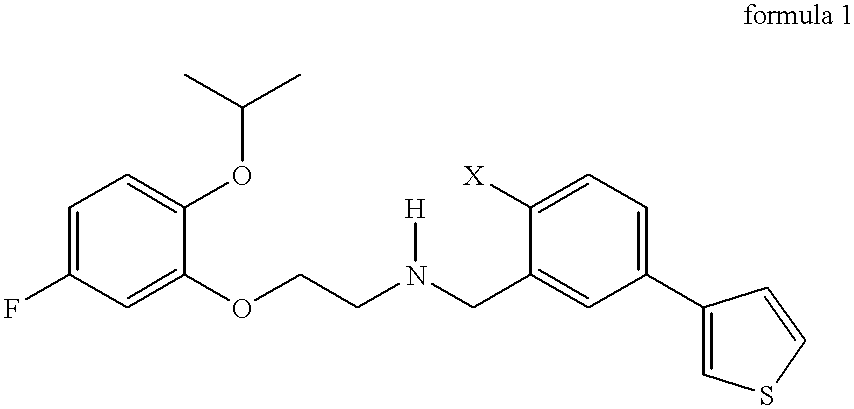
The compounds of this invention have antidopaminergic activity, in particular on the receptors of the D2 subfamily. In this respect, the compounds of the invention are useful in the treatment of conditions resulting from dopaminergic hyperactivity, such as schizophrenic symptoms and dependency on certain substances. However, the antagonist activity of the products of the invention on the receptors of the D2 type is exerted only during a transient dopaminergic hyperstimulation. In the absence of dopaminergic hyperactivity, that is to say when the dopamine concentration ranges within proportions that are acceptable for normal functioning of the neuron, the compounds of the invention do not induce dopaminergic hypoactivity. The compounds of the invention are thus useful in the treatment of schizophrenic symptoms and have the advantage of being potentially free of the adverse side effects caused by an excessive blocking of the receptors of the D2 type, such as Parkinsonian symptoms and/or endocrine disorders, at doses that are therapeutically effective for treating schizophrenic psychosis.
The compounds of the invention thus differ from the derivatives of the prior art in their chemical formula and their mechanism of action.
More specifically, the present invention relates to novel compounds corresponding to the general formula (1). 
in which:
X represents:
a hydrogen or fluorine atom;
a hydroxyl (OH) group or a methoxy (OCH3) group.
The invention also relates to the addition salts and optionally the hydrates of the addition salts of the compounds of general formula (1) with pharmaceutically acceptable mineral acids or organic acids.
A subject of the invention is also pharmaceutical compositions containing, as active principle, at least one of the derivatives of general formula (1) or one of the salts thereof or hydrates of the salts thereof in combination with one or more pharmaceutically acceptable excipients, adjuvants or vehicles. By way of example, mention may be made of inclusion complexes, in particular the inclusion complexes formed by the compounds of the invention with □-cyclodextrins.
The pharmaceutical compositions according to the invention may be compositions which may be administered orally, nasally, sublingually, rectally or parenterally. It is generally advantageous to formulate such pharmaceutical compositions in unit dose form. Each dose then comprises a predetermined amount of the active principle, combined with the appropriate vehicle, excipients and/or adjuvants, calculated to obtain a given therapeutic effect. By way of example of unit dose forms which may be administered orally, mention may be made of tablets, gel capsules, granules, powders and oral solutions or suspensions.
The formulations that are appropriate for the chosen administration form are known and described, for example, in: Remington, The Science and Practice of Pharmacy, 19th Edition, 1995, Mack Publishing Company, and may thus be readily prepared by a person skilled in the art.
It is known that the dosage varies from one individual to another, depending on the nature and intensity of the complaint, the chosen route of administration and the weight, age and sex of the patient; consequently, effective doses will have to be determined as a function of these parameters by the specialist in the art. As a guide, the effective doses may range between 0.001 and 100 mg/kg/day.
The compounds of general formula (1) may exist in several tautomeric forms. Such tautomeric forms, although not explicitly reported in the present application to simplify the graphic representation of the structural formulae, are nevertheless included in the field of application of the invention.
The compounds of general formula (1) in which X to [sic] the same meaning as above may be prepared according to the process described in Scheme A.
Scheme A
The compound of formula (1) is prepared by a conventional reductive amination reaction between the compound of formula (2), in which X represents a hydrogen or fluorine atom, a hydroxyl (OH) group or a methoxy (OCH3) group, and the primary amine of formula (3). The expression “a conventional reductive amination reaction” means that the compound of formula (2) and the amine (3) are reacted together in the suitable solvent and that the mixture of the reagents (2) and (3) is then subjected to the reducing agent according to a method that is well known to those skilled in the art.
The compounds of formula (1) are purified according to one or more methods chosen from crystallization and/or liquid phase chromatography techniques. They may then be, if so desired:
salified using a pharmaceutically acceptable acid;
employed in the formation of an inclusion complex.
The primary amine of formula (3) perhaps [sic] obtained by the process described in Scheme B.
Scheme B
4-Fluoro-2-hydroxyacetophenone of formula (4) is converted into the protected amine of formula (5) in two steps:
a Williamson reaction between the compound of formula (4) and 1-bromo-2-chloroethane, carried out in the corresponding chloro ether (J. Med. Chem. 1989, 32, 105);
substitution of the chlorine atom using potassium phthalimide to give the compound of formula (5). A Bayer-Villiger reaction, carried out on the compound of formula (5) according to Synth. Commun 1989, 11/12, 2001, followed by a basic hydrolysis reaction of the intermediate formate, gives the phenol of formula (6). Alkylation of the phenol of formula (6), using 2-iodopropane, gives the intermediate of formula (7).
The primary amine of formula (3), prepared from the compound of formula (7) by aminolysis of the phthalimido group, is used immediately in the following reductive amination step (Scheme A). The deprotection of the primary amine group of the compound of formula (7) is carried out by moderate heating (60° C.) in the presence of an excess of 2-aminoethanol.
The aldehydes of formula (2), in which in which [sic] X to [sic] the same meaning as above, are prepared by the process described in Scheme C.
Scheme C
Coupling of the bromo derivatives of formula (8), which are commercially available, with 3-thiopheneboronic acid, which is commercially available, in the presence of a suitable palladium catalyst according to the Suzuki method gives the aldehydes of formula (2) directly. 


The examples which follow illustrate the invention.
In the examples below:
(i) The reaction progress is monitored by thin layer chromatography (TLC) and, consequently, the reaction times are mentioned merely as a guide.
(ii) Different crystalline forms may give different melting points; the melting points given in the present application are those of the products prepared according to the method described, and are uncorrected.
(iii) The structure of the products obtained according to the invention is confirmed by the nuclear magnetic resonance (NMR) and infrared (IR) spectra and the elemental analysis, and the purity of the final products is checked by TLC.
(iv) The NMR spectra are recorded in the solvent indicated. The chemical shifts (δ) are expressed in parts per million (ppm) relative to tetramethylsilane. The multiplicity of the signals is indicated by: s, singlet; d, doublet; t, triplet; q, quartet; m, multiplet; b, broad.
(v) The various symbols for the units have their usual meaning: mg (milligram); g (gram); ml (milliliter); ° C. (degree Celsius); mmol (millimole); nmol (nanomole); cm (centimeter).
(vi) The abbreviations have the following meanings: m.p. (melting point); b.p. (boiling point).
(vii) In the present application, the pressures are given in millibar; the term “room temperature” means a temperature of between 20° C. and 25° C.
3.11 g of 3-thiopheneboronic acid (0.024 mol) are added to a solution of 3-bromobenzaldehyde (3 g, 0.016 mol) in 1,2-dimethoxyethane (80 ml), followed by addition of aqueous 2N sodium carbonate solution (5.15 g, 0.048 mol) and a catalytic amount of tetrakis(triphenylphosphine)palladium (0.56 g, 4.9 10−4 mol). The reaction mixture is heated at 80° C. for 16 hours and is then cooled to room temperature and poured into water. The resulting mixture is extracted with ethyl acetate and the organic phase is washed with saturated aqueous sodium chloride solution. The organic phase is dried over magnesium sulfate and filtered, and the solvent is evaporated off under reduced pressure. The title product is isolated by chromatography on a column of silica (eluent: 90/10 cyclohexane/ethyl acetate). 2.61 g of a pale yellow solid are recovered.
Yield: 86%
m.p.: 59° C.
1H NMR (CDCl3) δ: 7.46 (s, 2H); 7.53-7.59 (m, 2H); 7.79 (d, J=7.68 Hz, 1H); 7.86 (d, J=8.88 Hz, 1H).
1.89 g of 3-thiopheneboronic acid (0.015 mol) are added to a solution of 3-bromo-6-fluorobenzaldehyde (2 g, 0.016 mol) in 35 ml of 1,2-dimethoxyethane, followed by addition of aqueous 2N sodium carbonate solution (3.13 g, 0.030 mol) and a catalytic amount of tetrakis(triphenylphosphine)palladium (0.34 g, 2.96 10−4 mol). The reaction mixture is heated at 80° C. for 20 hours and is then cooled to room temperature and poured into water. The resulting mixture is extracted with ethyl acetate and the organic phase is washed with saturated aqueous sodium chloride solution. The organic phase is dried over magnesium sulfate and filtered, and the solvent is evaporated off under reduced pressure. The title product is isolated from the black oil obtained by bulb-to-bulb distillation at 150° C. under reduced pressure (4 10−2 mmbar). 1.36 g of a pale yellow oil which solidifies are isolated.
Yield: 67%
m.p.: 71° C.
1H NMR (CDCl3) δ: 7.21 (t, J=9.16 Hz, 1H); 7.36-7.43 (m, 2H); 7.47 (s, 1H); 7.80 (m, 1H); 8.06 (dd, J=6.48; 2.24 Hz, 1H); 10.37 (s, 1H)
0.15 g of tetrakis(triphenylphosphine)palladium catalyst (1.3 10−4 mol) is added to a solution of 5-bromosalicylaldehyde (0.86 g, 0.0043 mol) and of 3-thiopheneboronic acid (0.6 g, 0.0047 mol) in 10 ml of 1,2-dimethoxyethane and 5 ml of methanol. 1.3 g of cesium fluoride are added and the mixture is heated at 80° C. for 20 hours. The reaction mixture is cooled to room temperature and poured into water. The resulting mixture is extracted with dichloromethane and the organic phase is washed with saturated aqueous sodium chloride solution. The organic phase is dried over magnesium sulfate, filtered and concentrated under reduced pressure. The title product is isolated by chromatography on a column of silica (eluent: 88/12 cyclohexane/ethyl acetate. 0.62 g of a pale yellow solid is recovered.
Yield: 71%
m.p.: 120° C. 1H NMR (CDCl3) δ: 7.04 (d, J=8.32 Hz, 1H); 7.35 (m, 1H); 7.41 (m, 2H); 7.76 (m, 2H); 9.96 (S, 1H); 11.02 (s, 1H).
3 g of 5-bromo-2-anisaldehyde (0.014 mol) are dissolved in 45 ml of 1,2-dimethoxyethane and 2.68 g of 3-thiopheneboronic acid (0.021 mol) are added, followed by addition of aqueous 2N sodium carbonate solution (4.44 g, 0.042 mol) and a catalytic amount of tetrakis(triphenylphosphine)palladium (0.48 g, 4.19 10−4 mol). The reaction mixture is heated at 80° C. for 20 hours with stirring and is then cooled to room temperature and poured into water. The resulting mixture is extracted with ethyl acetate and the organic phase is washed with saturated aqueous sodium chloride solution. The resulting phase is dried over magnesium sulfate and then filtered, and the solvent is evaporated off under reduced pressure. The title product is isolated by chromatography on a column of silica (eluent: 94/6 cyclohexane/ethyl acetate). 2 g of a beige-colored solid are isolated.
Yield: 67%
m.p.: 79° C.
1H NMR (CDCl3) δ: 3.97 (s, 3H); 7.02 (d, J=8.80 Hz, 1H); 7.39 (m, 3H); 7.78 (dd, J=8.60; 2.24 Hz, 1H); 8.05 (d, J=2.24 Hz, 1H).
40.5 ml of 1-bromo-2-chloroethane (490 mmol) are added at room temperature to a solution of 25 g of 1-[2-hydroxy-4-fluorophenyl]ethanone (162 mmol) in 2-butanone (400 ml), followed by addition of 45 g of potassium carbonate (320 mmol) and 1.26 g of potassium iodide (7.59 mmol).
The mixture is heated at 80° C. with vigorous stirring for 60 hours and is then cooled to room temperature and poured into ice-cold water. The resulting mixture is extracted with ethyl acetate and the organic phase is washed with saturated aqueous sodium chloride solution. The organic phase is then dried over magnesium sulfate and filtered, and the solvent is evaporated off. The product is crystallized from a cyclohexane/ethyl acetate mixture. 15.7 g of a white solid are recovered.
Yield: 45%
m.p.: 67° C.
1H NMR (CDCl3) δ: 2.66 (s, 3H); 3.91 (t, 2H); 4.32 (t, 2H); 6.62 (dd, 1H); 6.76 (dt, 1H); 7.85 (dt, 1H).
A mixture of 14.6 g of potassium phthalimide (79 mmol) and 15 g of 1-[2-(2-chloroethoxy)-4-fluorophenyl]ethanone (69.2 mmol) in 150 ml of N,N-dimethyl-formamide is heated at 150° C. for 6 hours. The mixture is then cooled and the solvent is evaporated off under vacuum. The solid obtained is taken up in dichloromethane and the organic phase is washed with water and then with saturated aqueous sodium chloride solution. The organic phase is then dried over magnesium sulfate and filtered, and the solvent is evaporated off. The product obtained is purified by crystallization from a cyclohexane/ethyl acetate mixture. 18.2 g of a white solid are obtained.
Yield: 76%
m.p.: 140° C.
1H NMR (CDCl3) δ: 2.55 (s, 3H); 4.19 (t, 2H); 4.34 (t, 2H); 6.67 (m, 2H); 6.69 (m, 1H); 7.77 (m, 2H); 7.80 (m, 2H).
IR (KBr) □: 1774, 1716, 1679. 1605 and 1590.
A solution of 26 g of meta-chloroperbenzoic acid (at 55%, 82.9 mmol) in 220 ml of dichloromethane is stirred for one hour and then transferred into a separating funnel. The aqueous phase is separated out and the organic phase is placed in a round-bottomed flask and cooled to 0° C. 18 9 of 2-[2-(2-acetyl-5-fluoro-phenoxy)ethyl]isoindole-1,3-dione (5) (55 mmol) are added portionwise and the mixture is stirred at room temperature for 16 hours. 6.9 g of sodium bicarbonate (82 mmol) are then introduced portionwise and the mixture is stirred for one hour. The mixture is then concentrated under vacuum and 200 ml of methanol are added, followed by addition of 15.2 g of potassium carbonate (110 mmol). The mixture is stirred for 4 hours at room temperature and the solvent is then evaporated off, replaced with 200 ml of dichloromethane and the mixture is washed with water and with saturated aqueous sodium chloride solution. The aqueous phase is dried over sodium sulfate and filtered, and the solvent is evaporated off. The product is crystallized from dichloromethane. 14 g of the title product are obtained in the form of a white solid.
Yield: 84%
m.p.: 172° C.
1H NMR (DMSO d6) δ: 3.95 (t, 2H); 4.22 (t, 2H); 6.58 (dt, 1H); 6.75 (t, 1H); 6.85 (m, 1H); 7.64 (m, 4H); 8.77 (s, 1H (exchangeable)).
7.71 g of potassium carbonate (56 mmol) and 7 ml of 2-iodopropane (70 mmol) are added to a solution of 14 g of 2-[2-(5-fluoro-2-hydroxyphenoxy)ethyl]isoindole-1,3-dione (6) (47 mmol) in 250 ml of acetonitrile. The mixture is stirred for 16 hours at 80° C. and the solvent is then evaporated off under reduced pressure and the residue is taken up in diethyl ether. The organic phase is washed with normal aqueous sodium hydroxide solution and then with saturated aqueous sodium chloride solution. It is dried over magnesium sulfate and filtered, and the solvent is evaporated off under vacuum. The title product is isolated by chromatography on a column of silica (eluent: 82/18 cyclohexane/ethyl acetate). 12.2 g of a white solid are isolated.
Yield: 77%
m.p.: 68° C.
1H NMR (CDCl3) δ: 1.20 (s, 3H); 1.21 (s, 3H); 4.14 (t, J=5.20 Hz, 2H); 4.23 (t, J=5.20 Hz, 2H); 4.30 (sept, J=6.00 Hz; 1H); 6.56 (dt, 1H); 6.65 (dd, 1H); 6.79 (dd, 1H); 7.73 (m, 2H); 7.86 (m, 2H).
5 g of 2-[2-(5-fluoro-2-isopropoxyphenoxy)ethyl]isoindole-1,3-dione (7) (14.6 mmol) are added to 20 ml of ethanolamine and the solution is then maintained at 60° C. for 2 hours. The mixture is poured into ice-cold water and then extracted with ethyl acetate. The organic phase is washed with saturated aqueous sodium chloride solution, dried over sodium sulfate and filtered, and the solvent is evaporated off under vacuum. 2.54 g of the title product are obtained in the form of a pale yellow oil, which is used directly in the following step without further purification.
Yield: 81%
1H NMR (CDCl3) δ: 1.31 (s, 3H); 1.32 (s, 3H); 1.46 (brs, 2H); 3.09 (t, J=5.20 Hz, 2H); 3.99 (t, J=5.20 Hz, 2H); 4.35 (sept, J=6.00 Hz, 1H); 6.60 (dt, J=8.32; 3.00 Hz 1H); 6.64 (dd, J=10.16; 2.92 Hz, 1H); 6.84 (dd, J=8.80; 5.76 Hz, 1H).

2.5 g of magnesium sulfate are added to a solution of 3-(3-thienyl)benzaldehyde (2a) (700 mg, 3.72 mmol) and of 2-(5-fluoro-2-isopropoxy)phenoxyethylamine (3) (793 mg, 3.72 mmol) in 15 ml of 1,2-dichloroethane, and the mixture is heated at 60° C. for 17 hours with stirring. The reaction is then cooled to room temperature, the solid is filtered off and the solvent is evaporated off under reduced pressure. 15 ml of methanol are then added to the residue and the resulting mixture is cooled to 0° C. 400 mg of potassium borohydride (7.44 mmol) are introduced and the mixture is stirred for three hours at 0° C. The mixture is then poured into ice-cold water and extracted with ethyl acetate, and the organic phase is washed with saturated aqueous sodium chloride solution. The resulting phase is dried over magnesium sulfate and then filtered, and the solvent is evaporated off under reduced pressure. The title product is obtained by chromatography on a column of silica (eluent: 98/1.5/0.5 dichloromethane/methanol/aqueous ammonia). 970 mg of a colorless oil are isolated.
Yield: 68%
Preparation of the salt: 0.97 g of the title product (2.52 mmol) is dissolved in 10 ml of ethanol and 0.23 g of oxalic acid (2.52 mmol) in 10 ml of ethanol is then added. The solution is concentrated, the salt precipitates, and the concentrated solution is filtered. The salt is dried under vacuum at 50° C. 0.96 g of the title compound is obtained in the form of the oxalate salt, a white crystalline powder.
m.p.: 189° C.
Analysis C24H26FNO6S
Calc %: C, 60.62; H, 5.51; N, 2.95; S, 6.74.
Found: 60.59; 5.72; 2.99; 6.57.
1H NMR (DMSO d6) δ: 1.21 (s, 6H); 3.31 (t, J=4.80 Hz, 2H); 4.32 (m, 4H); 4.48 (sept, J=6.00 Hz, 1H); 6.73 (m, 1H); 6.99 (m, 2H); 7.28 (m, 2H); 7.55 (d, J=4.84 Hz, 1H); 7.66 (d, J=7.04 Hz, 1H); 7.75 (d, J=7.20 Hz, 1H); 7.88 (d, J=9.24 Hz, 2H).
IR (KBr) □: 3436; 2979; 1718 cm−1.

A solution of 2-fluoro-3-(3-thienyl)benzaldehyde (2b) (350 mg, 1.64 mmol) and of 2-(5-fluoro-2-isopropoxy)phenoxyethylamine (3) (338 mg, 1.64 mmol) in 15 ml of toluene is heated at 130° C. for 17 hours in a 50 ml round-bottomed flask equipped with Dean-Stark apparatus. The reaction is then cooled to room temperature, the solvent is evaporated off under reduced pressure and the residue is dissolved in 15 ml of methanol. The reaction mixture is cooled to 0° C. and 177 mg of potassium borohydride (3.28 mmol) are added. The mixture is stirred for seven hours at room temperature and is then poured into ice-cold water and extracted with ethyl acetate, and the organic phase is washed with saturated aqueous sodium chloride solution. The resulting phase is dried over magnesium sulfate and filtered, and the solvent is evaporated off under reduced pressure. The title product is isolated by chromatography on a column of silica (eluent: 98/1.5/0.5 dichloromethane/methanol/aqueous ammonia) to give 436 mg of a yellow oil.
Yield: 66%
Preparation of the salt: 427 mg of the title product (1.06 mmol) are dissolved in 10 ml of methanol, followed by addition of 95 mg of oxalic acid (1.06 mmol) in 5 ml of ethanol. The solution is concentrated, the salt precipitates and the concentrated solution is filtered. The salt is dried under vacuum at 50° C. 417 mg of the title compound are obtained in the form of the oxalate salt, a white crystalline powder.
m.p.: 173° C.
Analysis C24H25F2NO6S
Calc %: C, 58.41; H, 5.11; N, 2.84.
Found: 58.62 5.13 2.86.
1H NMR (DMSO d6) δ: 1.18 (s, 3H); 1.19 (s, 3H); 3.33 (t, J=4.80 Hz, 2H); 4.27 (t, J=4.80 Hz, 2H); 4.31 (s, 2H); 4.45 (sept, J=6.00 Hz, 1H); 6.74 (dt, J=8.50; 2.88 Hz, 1H); 7.00 (m, 2H); 7.32 (t, J=9.36 Hz, 1H); 7.52 (d, J=5.00 Hz, 1H); 7.66 (m, 1H); 7.77 (m, 1H); 7.83 (d, J=1.84 Hz, 1H); 7.85 (dd, J=7.00; 1.92 Hz, 1H).
IR (KBr) : 3045; 2848; 1719 cm−1.

A solution of 2-hydroxy-3-(3-thienyl)benzaldehyde (2c) (400 mg, 1.96 mmol) and of 2-(5-fluoro-2-isopropoxy)phenoxyethylamine (3) (418 mg, 1.96 mmol) in 20 ml of toluene is heated at 130° C. for 20 hours with stirring, with continuous removal of the water formed using Dean-Stark apparatus. The reaction is then cooled to room temperature, the orange-colored solution is concentrated under reduced pressure and the residue is dissolved in 10 ml of methanol. The reaction mixture is cooled to 0° C. and 211 mg of potassium borohydride (3.92 mmol) are introduced. The mixture is stirred for three hours at room temperature and is then poured into ice-cold water and extracted with dichloromethane, and the organic phase is washed with saturated aqueous sodium chloride solution. The resulting phase is dried over sodium sulfate and filtered, and the solvent is evaporated off under reduced pressure. The title product is isolated by chromatography on a column of silica (eluent: 98/1.5/0.5 dichloro-methane/methanol/aqueous ammonia) to give 526 mg of a yellow solid.
Yield: 67%
m.p.: 75° C.
Preparation of the salt: 468 mg of the title product (1.17 mmol) are dissolved in 10 ml of ethanol, followed by addition of 105 mg of oxalic acid (1.17 mmol) in 5 ml of ethanol. The solution is concentrated, the salt precipitates and the concentrated solution is filtered. The salt is dried under vacuum at 50° C. 496 mg of the title compound are obtained in the form of the oxalate salt, a white crystalline powder.
m.p.: 205° C.
Analysis C24H26FNO7S
Calc %: C, 58.65; H, 5.33; N, 2.85.
Found: 58.81; 5.50; 2.97.
1H NMR (DMSO d6) δ: 1.19 (s, 3H); 1.21 (s, 3H); 3.32 (t, J=4.80 Hz, 2H); 4.29 (m, 4H); 4.47 (sept, J=6.00 Hz, 1H); 6.75 (dt, J=8.48; 2.76 Hz, 1H); 6.95-7.02 (m, 3H); 7.44 (d, J=4.96 Hz, 1H); 7.57-7.72 (m, 3H); 7.83 (s, 1H).
IR (KBr) □: 3450, 3156, 2989, 1733 cm−1.

1.5 g of magnesium sulfate are added to a solution of 2-methoxy-3-(3-thienyl)benzaldehyde (2d) (510 mg, 2.34 mmol) and of 2-(5-fluoro-2-isopropoxy)phenoxy-ethylamine (3) (500 mg; 2.34 mmol) in 10 ml of 1,2-dichloroethane, and the mixture is heated at 60° C. for 20 hours with stirring. The reaction is cooled to room temperature, the solid is filtered off and the solvent is evaporated off under reduced pressure. The residue is dissolved in 11 ml of methanol and the resulting solution is cooled to 0° C. 252 mg of potassium borohydride (4.68 mmol) are added and the mixture is stirred for 16 hours at room temperature. The mixture is then poured into ice-cold water and extracted with ethyl acetate, and the organic phase is washed with saturated aqueous sodium chloride solution. The resulting phase is dried over sodium sulfate and then filtered, and the solvent is evaporated off under reduced pressure. The title product is obtained by chromatography on a column of silica (eluent: 80/20 cyclohexane/ethyl acetate). 307 mg of a colorless oil are isolated.
Yield: 32%
Preparation of the salt: 298 mg of the title product (7.17 mmol) are dissolved in 8 ml of ethanol followed by addition of 65 mg of oxalic acid (7.17 mmol) in 5 ml of ethanol. The solution is concentrated, the salt precipitates and the concentrated solution is filtered. The salt is dried under vacuum at 50° C. 245 mg of the title compound are obtained in the form of the oxalate salt, a white crystalline powder.
m.p.: 157° C.
Analysis C25H28FNO7S
Calc %: C, 59.39; H, 5.58; N, 2.77.
Found: 59.85; 5.79; 3.05.
1H NMR (DMSO d6) δ: 1.18 (s, 3H); 1.20 (s, 3H); 3.26 (t, J=4.80 Hz, 2H); 3.84 (s, 3H); 4.21 (s, 2H); 4.25 (t, J=4.80 Hz, 2H); 4.45 (sept, J=6.00 Hz, 1H); 6.75 (dt, J=8.52; 2.92 Hz, 1H); 6.99 (m, 2H); 7.11 (d, J=8.60 Hz, 1H); 7.49 (d, J=5.00 Hz, 1H); 7.63 (m, 1H); 7.71-7.94 (m, 3H).
IR (KBr) □: 2977, 1610 cm−1.
Pharmacological study of the compounds of the invention
1—Measurement of the affinity of the compounds of the invention for the D2 receptors.
The affinity of the compounds of the invention for the receptors of the D2 type was determined by measuring the displacement of (3H) YM-09151-2 (NET-1004 70-87 Ci/mmol), according to the method described in Naunyn-Schimiedeberg's Arch. Pharmacol. Methods, 1985, 329, 333. The pKi values (−log Ki) are given in the form of a mean ±SEM of at least 3 experiments.
Table 1 gives, by way of example, the pKi values (D2) for compound 1a and Risperidone.
2—Evaluation of the antagonist activity of the D2 receptors and of the cataleptogenic effects of the compounds of the invention in vivo
The test demonstrating the antidopaminergic activity in vivo of the compounds of the invention is based on the inhibition of the behavior induced by methylphenidate, measured in rats, according to the method described in J. Pharmacol. Exp. Ther. 1993, 267, 181.
The test for evaluating the propensity of the products of the invention to cause side effects of extrapyramidal order is based on their cataleptogenic power, measured in rats, according to the method described in Eur. J. Pharmacol. 1996, 313, 25.
By way of example, the values obtained after oral administration of compound 1a are indicated in Table 1 in comparison with the reference substance: Risperidone.
| TABLE 1 | ||||
| D2 | Normalization | Catalepsy | Therapeutic | |
| Compound | pKi | ED50 mg/kg | ED50 mg/kg | Index |
| la | 9.45 | 0.7 | >40 | >57 |
| Risperidone | 8.70 | 6.5 | 3.5 | 0.5 |
It emerges from this study that the compounds of the invention have high affinity for the receptors of the D2 type and also powerful antidopaminergic activity in vivo. However, surprisingly, the compounds of the invention do not induce, or induce only at very high doses, cataleptogenic effects, when compared with Risperidone. Risperidone is an atypical antipsychotic agent used clinically (Inpharma® 1998, 1156, 5).
In this respect, the compounds of the invention which are capable of modifying the effects of endogenous dopamine are useful in the treatment of dopaminergic disorders such as schizophrenia, certain neurodegenerative diseases and dependancy on cocaine, alcohol or similar substances.
Claims (6)
1. A compound of formula (1) 
in which:
X represents:
a hydrogen or fluorine atom;
a hydroxyl (OH) group or a methoxy (OCH3) group,
and the pharmaceutically acceptable addition salts thereof.
2. The compound of formula (1) as claimed in claim 1 , which is selected from:
[3-(3-thienyl)benzyl]-[2-([2-isopropoxy-5-fluoro]-phenoxy)ethyl]amine
[2-hydroxy-5-(3-thienyl)benzyl]-[2-([2-isopropoxy-5-fluoro]phenoxy)ethyl]amine
[2-methoxy-5-(3-thienyl)benzyl]-[2-([2-isopropoxy-5-fluoro]phenoxy)ethyl]amine, and
[2-fluoro-5-(3-thienyl)benzyl]-[2-([2-isopropoxy-5-fluoro]phenoxy)ethyl]amine.
3. A pharmaceutical composition, comprising at least one compound of claim 1 and one or more pharmaceutically acceptable excipient or vehicle.
4. A method for treating a living animal body afflicted with schizophrenia, comprising the step of administering to the body an amount of a compound of claim 1 effective to alleviate the condition.
5. A method for treating a living animal body afflicted with dependency on cocaine or alcohol, comprising the step of administering to the body an amount of a compound of claim 1 effective to alleviate the condition.
6. A method for treating a living animal body afflicted with neurodegenerative diseases, comprising the step of administering to the body an amount of a compound of claim 1 effective to alleviate the condition.
Applications Claiming Priority (3)
| Application Number | Priority Date | Filing Date | Title |
|---|---|---|---|
| FR9903875A FR2791676B1 (en) | 1999-03-29 | 1999-03-29 | NOVEL DERIVATIVES OF [(2-SUBSTITUTE-5- [THIENYL]) - BENZYL] - [2 - ([ISOPROPOXY-5-FLUORO] -PHENOXY) ETHYL] -AMINE, PROCESS FOR THEIR PREPARATION AND THEIR USE AS MEDICAMENTS |
| FR9903875 | 1999-03-29 | ||
| PCT/FR2000/000775 WO2000058282A2 (en) | 1999-03-29 | 2000-03-29 | Novel [(2-substituted-5 -[3-thienyl) -benzyl]-[2- ([2-isopropoxy-5-fluoro] -phenoxy) -ethyl] -amine derivatives, method for the production and use thereof as medicaments |
Publications (1)
| Publication Number | Publication Date |
|---|---|
| US6417222B1 true US6417222B1 (en) | 2002-07-09 |
Family
ID=9543736
Family Applications (1)
| Application Number | Title | Priority Date | Filing Date |
|---|---|---|---|
| US09/937,737 Expired - Lifetime US6417222B1 (en) | 1999-03-29 | 2000-03-29 | [2-substituted-5-[3-thienyl)-benzyl]-2- ([2-isopropoxy-5-fluoro]-phenyoxy)-ethyl]-amine derivatives, method for the production and use thereof as medicaments |
Country Status (11)
| Country | Link |
|---|---|
| US (1) | US6417222B1 (en) |
| EP (1) | EP1187824B1 (en) |
| AT (1) | ATE227714T1 (en) |
| AU (1) | AU3661400A (en) |
| CA (1) | CA2366820C (en) |
| DE (1) | DE60000790T2 (en) |
| DK (1) | DK1187824T3 (en) |
| ES (1) | ES2186639T3 (en) |
| FR (1) | FR2791676B1 (en) |
| PT (1) | PT1187824E (en) |
| WO (1) | WO2000058282A2 (en) |
Cited By (3)
| Publication number | Priority date | Publication date | Assignee | Title |
|---|---|---|---|---|
| US20060014827A1 (en) * | 2002-10-16 | 2006-01-19 | Pierre Fabre Medicament | 3-(Cyclopenten-1-yl)-benzyl-or 3-(cyclopenten-1-yl)-heteroarylmethyl-amine derivatives and use thereof as medicines for treating schizophrenia |
| US20090082582A1 (en) * | 2006-03-14 | 2009-03-26 | Pierre Fabre Medicament | Process For Preparing [2-(2,3- Dihydrobenzofuran - Or Benzofuran-7-Yloxy)Ethyl]-(3 -Cyclopent-1-Ylbenzyl)Amine Derivatives and Synthesis Intermediate |
| JP2010513361A (en) * | 2006-12-22 | 2010-04-30 | ラボラトリオス・デル・ドクトル・エステベ・ソシエダッド・アノニマ | Ethylaminophenyl derivatives substituted by heterocyclyl groups, methods for their preparation and methods of use as pharmaceuticals |
Families Citing this family (1)
| Publication number | Priority date | Publication date | Assignee | Title |
|---|---|---|---|---|
| EP2699569B1 (en) * | 2011-04-22 | 2017-08-30 | Jasco Pharmaceuticals, LLC | Aminopyrimidine kinase inhibitors |
Citations (3)
| Publication number | Priority date | Publication date | Assignee | Title |
|---|---|---|---|---|
| FR2248830A1 (en) * | 1973-10-25 | 1975-05-23 | Sumitomo Chemical Co | |
| WO1994020466A1 (en) * | 1993-03-04 | 1994-09-15 | Pierre Fabre Medicament | Novel 2-phenoxy ethylamine derivatives, their preparation and their therapeutical use |
| WO2000032557A1 (en) * | 1998-12-02 | 2000-06-08 | Pierre Fabre Medicament | Novel 3-alkoxybenzylamine derivatives and their use as medicines for treating schizophrenia |
-
1999
- 1999-03-29 FR FR9903875A patent/FR2791676B1/en not_active Expired - Fee Related
-
2000
- 2000-03-29 PT PT00915232T patent/PT1187824E/en unknown
- 2000-03-29 WO PCT/FR2000/000775 patent/WO2000058282A2/en not_active Ceased
- 2000-03-29 DK DK00915232T patent/DK1187824T3/en active
- 2000-03-29 AU AU36614/00A patent/AU3661400A/en not_active Abandoned
- 2000-03-29 US US09/937,737 patent/US6417222B1/en not_active Expired - Lifetime
- 2000-03-29 EP EP00915232A patent/EP1187824B1/en not_active Expired - Lifetime
- 2000-03-29 AT AT00915232T patent/ATE227714T1/en active
- 2000-03-29 ES ES00915232T patent/ES2186639T3/en not_active Expired - Lifetime
- 2000-03-29 DE DE60000790T patent/DE60000790T2/en not_active Expired - Lifetime
- 2000-03-29 CA CA002366820A patent/CA2366820C/en not_active Expired - Fee Related
Patent Citations (3)
| Publication number | Priority date | Publication date | Assignee | Title |
|---|---|---|---|---|
| FR2248830A1 (en) * | 1973-10-25 | 1975-05-23 | Sumitomo Chemical Co | |
| WO1994020466A1 (en) * | 1993-03-04 | 1994-09-15 | Pierre Fabre Medicament | Novel 2-phenoxy ethylamine derivatives, their preparation and their therapeutical use |
| WO2000032557A1 (en) * | 1998-12-02 | 2000-06-08 | Pierre Fabre Medicament | Novel 3-alkoxybenzylamine derivatives and their use as medicines for treating schizophrenia |
Non-Patent Citations (1)
| Title |
|---|
| Mewshaw, et al, 1997, Bioorg. Med. Chem. Lett., 8(3), 295-300. * |
Cited By (5)
| Publication number | Priority date | Publication date | Assignee | Title |
|---|---|---|---|---|
| US20060014827A1 (en) * | 2002-10-16 | 2006-01-19 | Pierre Fabre Medicament | 3-(Cyclopenten-1-yl)-benzyl-or 3-(cyclopenten-1-yl)-heteroarylmethyl-amine derivatives and use thereof as medicines for treating schizophrenia |
| US7163957B2 (en) | 2002-10-16 | 2007-01-16 | Pierre Fabre Medicament | 3-(Cyclopenten-1-yl)-benzyl-or 3-(cyclopenten-1-yl)-heteroarylmethyl-amine derivatives and use thereof as medicines for treating schizophrenia |
| US7235568B2 (en) | 2002-10-16 | 2007-06-26 | Pierre Fabre Medicament | 3-(cyclopenten-1-yl)-benzyl-or 3-(cyclopenten-1-yl)-heteroarylmethyl-amine derivatives and use thereof as medicines for treating schizophrenia |
| US20090082582A1 (en) * | 2006-03-14 | 2009-03-26 | Pierre Fabre Medicament | Process For Preparing [2-(2,3- Dihydrobenzofuran - Or Benzofuran-7-Yloxy)Ethyl]-(3 -Cyclopent-1-Ylbenzyl)Amine Derivatives and Synthesis Intermediate |
| JP2010513361A (en) * | 2006-12-22 | 2010-04-30 | ラボラトリオス・デル・ドクトル・エステベ・ソシエダッド・アノニマ | Ethylaminophenyl derivatives substituted by heterocyclyl groups, methods for their preparation and methods of use as pharmaceuticals |
Also Published As
| Publication number | Publication date |
|---|---|
| DE60000790T2 (en) | 2003-10-02 |
| CA2366820A1 (en) | 2000-10-05 |
| DE60000790D1 (en) | 2002-12-19 |
| WO2000058282A2 (en) | 2000-10-05 |
| EP1187824B1 (en) | 2002-11-13 |
| EP1187824A2 (en) | 2002-03-20 |
| FR2791676A1 (en) | 2000-10-06 |
| PT1187824E (en) | 2003-03-31 |
| ES2186639T3 (en) | 2003-05-16 |
| DK1187824T3 (en) | 2003-03-10 |
| AU3661400A (en) | 2000-10-16 |
| WO2000058282A3 (en) | 2002-01-03 |
| ATE227714T1 (en) | 2002-11-15 |
| CA2366820C (en) | 2009-09-08 |
| FR2791676B1 (en) | 2001-06-22 |
Similar Documents
| Publication | Publication Date | Title |
|---|---|---|
| US7411072B2 (en) | Tricyclic steroid hormone nuclear receptor modulators | |
| EP1337528B1 (en) | Benzothiophene derivative compounds, process of preparation and use thereof | |
| JP4492848B2 (en) | Bicyclic compound | |
| EP1131321B1 (en) | Indole derivatives and their use as serotonin receptor ligands | |
| KR20020069215A (en) | Novel Substituted Tricyclic Compounds | |
| US20090005436A1 (en) | Substituted Aminoalkyl- and Amidoalkyl-Benzopyran Derivatives | |
| US6417222B1 (en) | [2-substituted-5-[3-thienyl)-benzyl]-2- ([2-isopropoxy-5-fluoro]-phenyoxy)-ethyl]-amine derivatives, method for the production and use thereof as medicaments | |
| JP2008523030A (en) | Phenylpiperazine derivatives exhibiting a combination of partial dopamine-D2 receptor agonism and serotonin reuptake inhibition | |
| JPH0670031B2 (en) | Novel 3-aminochroman derivative, method for producing them and pharmaceutical composition containing them | |
| WO2001014384A1 (en) | Tricyclic dihydrobenzofuran derivatives, process for the preparation thereof and agents | |
| EP1960387B1 (en) | Isoquinoline et benzo[h]isoquinoline derivatives, preparation and therapeutic use thereof as antagonists of histamine h3 receptor | |
| US6350913B1 (en) | 3-alkoxybenzylamine derivatives and their use as medicines for treating schizophrenia | |
| US5109006A (en) | Certain pharmaceutically active 6H-imidazo[1,2-a]pyridine-5-ones | |
| US9533949B2 (en) | Processes for the preparation of 3-alkyl indoles | |
| KR20030036834A (en) | 5-phenylbenzylamine compounds, process for their production and intermediates for their synthesis | |
| JP3709203B2 (en) | Tricyclic compounds with affinity for 5-HT1A receptors | |
| CN102159564A (en) | Arylsulfonamide amine compounds and their use as 5-HT6 ligands | |
| MXPA01005608A (en) | Novel 3-alkoxybenzylamine derivatives and their useas medicines for treating schizophrenia | |
| WO2000076967A1 (en) | Benzylpiperazinyl-indolinylethanones | |
| EP0229467A1 (en) | 1,5-Benzoxathiepin derivatives, their production and use | |
| JPWO2001083453A1 (en) | Novel tricyclic compounds having substituents |
Legal Events
| Date | Code | Title | Description |
|---|---|---|---|
| AS | Assignment |
Owner name: PIERRE FABRE MEDICAMENT, FRANCE Free format text: ASSIGNMENT OF ASSIGNORS INTEREST;ASSIGNORS:VACHER, BERNARD;CUISIAT, STEPHANE;KOEK, WOUTER;REEL/FRAME:012444/0030 Effective date: 20010831 |
|
| STCF | Information on status: patent grant |
Free format text: PATENTED CASE |
|
| CC | Certificate of correction | ||
| FPAY | Fee payment |
Year of fee payment: 4 |
|
| FPAY | Fee payment |
Year of fee payment: 8 |
|
| FPAY | Fee payment |
Year of fee payment: 12 |