US6399644B1 - Aryl sulfonyls as factor XA inhibitors - Google Patents
Aryl sulfonyls as factor XA inhibitors Download PDFInfo
- Publication number
- US6399644B1 US6399644B1 US09/540,467 US54046700A US6399644B1 US 6399644 B1 US6399644 B1 US 6399644B1 US 54046700 A US54046700 A US 54046700A US 6399644 B1 US6399644 B1 US 6399644B1
- Authority
- US
- United States
- Prior art keywords
- phenyl
- alkyl
- dihydro
- occurrence
- benzisothiazol
- Prior art date
- Legal status (The legal status is an assumption and is not a legal conclusion. Google has not performed a legal analysis and makes no representation as to the accuracy of the status listed.)
- Expired - Lifetime
Links
- 229940123583 Factor Xa inhibitor Drugs 0.000 title abstract description 6
- 125000004391 aryl sulfonyl group Chemical group 0.000 title abstract description 6
- 150000003839 salts Chemical group 0.000 claims abstract description 39
- -1 SR3 Inorganic materials 0.000 claims description 169
- 150000001875 compounds Chemical class 0.000 claims description 147
- 125000001997 phenyl group Chemical group [H]C1=C([H])C([H])=C(*)C([H])=C1[H] 0.000 claims description 63
- 125000004178 (C1-C4) alkyl group Chemical group 0.000 claims description 46
- 229910052717 sulfur Inorganic materials 0.000 claims description 42
- 229910052757 nitrogen Inorganic materials 0.000 claims description 39
- 229910052760 oxygen Inorganic materials 0.000 claims description 37
- 125000005842 heteroatom Chemical group 0.000 claims description 36
- 238000000034 method Methods 0.000 claims description 35
- 125000002023 trifluoromethyl group Chemical group FC(F)(F)* 0.000 claims description 33
- 229910052801 chlorine Inorganic materials 0.000 claims description 32
- 229910052731 fluorine Inorganic materials 0.000 claims description 32
- 125000002837 carbocyclic group Chemical group 0.000 claims description 26
- 125000004169 (C1-C6) alkyl group Chemical group 0.000 claims description 24
- 229910052794 bromium Inorganic materials 0.000 claims description 22
- 125000001797 benzyl group Chemical group [H]C1=C([H])C([H])=C(C([H])=C1[H])C([H])([H])* 0.000 claims description 20
- 125000006569 (C5-C6) heterocyclic group Chemical group 0.000 claims description 19
- 125000000623 heterocyclic group Chemical group 0.000 claims description 19
- 229910052740 iodine Inorganic materials 0.000 claims description 19
- 125000004429 atom Chemical group 0.000 claims description 18
- 230000009424 thromboembolic effect Effects 0.000 claims description 15
- 125000000816 ethylene group Chemical group [H]C([H])([*:1])C([H])([H])[*:2] 0.000 claims description 13
- 229920006395 saturated elastomer Polymers 0.000 claims description 13
- 239000003937 drug carrier Substances 0.000 claims description 12
- 125000001495 ethyl group Chemical group [H]C([H])([H])C([H])([H])* 0.000 claims description 12
- 125000004076 pyridyl group Chemical group 0.000 claims description 12
- 125000006273 (C1-C3) alkyl group Chemical group 0.000 claims description 10
- 229910052799 carbon Inorganic materials 0.000 claims description 10
- 229910052739 hydrogen Inorganic materials 0.000 claims description 10
- 239000008194 pharmaceutical composition Substances 0.000 claims description 10
- 125000000229 (C1-C4)alkoxy group Chemical group 0.000 claims description 8
- 125000004453 alkoxycarbonyl group Chemical group 0.000 claims description 8
- 125000000876 trifluoromethoxy group Chemical group FC(F)(F)O* 0.000 claims description 8
- 125000004432 carbon atom Chemical group C* 0.000 claims description 7
- 125000006274 (C1-C3)alkoxy group Chemical group 0.000 claims description 6
- 125000000217 alkyl group Chemical group 0.000 claims description 6
- OUIXPZNFASMUTM-UHFFFAOYSA-N n-[4-(1,1-dioxo-2,3-dihydro-1,2-benzothiazol-7-yl)phenyl]-2-(4-methoxyphenyl)-5-(trifluoromethyl)pyrazole-3-carboxamide Chemical compound C1=CC(OC)=CC=C1N1C(C(=O)NC=2C=CC(=CC=2)C=2C=3S(=O)(=O)NCC=3C=CC=2)=CC(C(F)(F)F)=N1 OUIXPZNFASMUTM-UHFFFAOYSA-N 0.000 claims description 6
- 125000000714 pyrimidinyl group Chemical group 0.000 claims description 6
- 125000002947 alkylene group Chemical group 0.000 claims description 5
- 125000003373 pyrazinyl group Chemical group 0.000 claims description 5
- 125000002098 pyridazinyl group Chemical group 0.000 claims description 5
- VCVOXBBWEKUWMA-UHFFFAOYSA-N 2-(3-amino-1,2-benzoxazol-5-yl)-n-[4-(1,1-dioxo-2,3-dihydro-1,2-benzothiazol-7-yl)phenyl]-5-(trifluoromethyl)pyrazole-3-carboxamide Chemical compound C1=C2C(N)=NOC2=CC=C1N1N=C(C(F)(F)F)C=C1C(=O)NC(C=C1)=CC=C1C1=CC=CC2=C1S(=O)(=O)NC2 VCVOXBBWEKUWMA-UHFFFAOYSA-N 0.000 claims description 4
- GCCPJOOCVVQFOD-UHFFFAOYSA-N 2-[3-(aminomethyl)-4-fluorophenyl]-n-[4-(1,1-dioxo-2,3-dihydro-1,2-benzothiazol-7-yl)phenyl]-5-(trifluoromethyl)pyrazole-3-carboxamide Chemical compound C1=C(F)C(CN)=CC(N2C(=CC(=N2)C(F)(F)F)C(=O)NC=2C=CC(=CC=2)C=2C=3S(=O)(=O)NCC=3C=CC=2)=C1 GCCPJOOCVVQFOD-UHFFFAOYSA-N 0.000 claims description 4
- PUNUYDKRBXRSNS-UHFFFAOYSA-N 2-[3-(aminomethyl)phenyl]-n-[4-(2-methyl-1,1-dioxo-3h-1,2-benzothiazol-7-yl)phenyl]-5-(trifluoromethyl)pyrazole-3-carboxamide Chemical compound C=12S(=O)(=O)N(C)CC2=CC=CC=1C(C=C1)=CC=C1NC(=O)C1=CC(C(F)(F)F)=NN1C1=CC=CC(CN)=C1 PUNUYDKRBXRSNS-UHFFFAOYSA-N 0.000 claims description 4
- 125000000094 2-phenylethyl group Chemical group [H]C1=C([H])C([H])=C(C([H])=C1[H])C([H])([H])C([H])([H])* 0.000 claims description 4
- OKTJSMMVPCPJKN-UHFFFAOYSA-N Carbon Chemical compound [C] OKTJSMMVPCPJKN-UHFFFAOYSA-N 0.000 claims description 4
- UFHFLCQGNIYNRP-UHFFFAOYSA-N Hydrogen Chemical compound [H][H] UFHFLCQGNIYNRP-UHFFFAOYSA-N 0.000 claims description 4
- 239000001257 hydrogen Substances 0.000 claims description 4
- 125000000956 methoxy group Chemical group [H]C([H])([H])O* 0.000 claims description 4
- RHTPKZUPDKCFML-UHFFFAOYSA-N n-[4-(1,1-dioxo-2,3-dihydro-1,2-benzothiazol-7-yl)phenyl]-2-(3-methanehydrazonoylphenyl)-5-(trifluoromethyl)pyrazole-3-carboxamide Chemical compound NN=CC1=CC=CC(N2C(=CC(=N2)C(F)(F)F)C(=O)NC=2C=CC(=CC=2)C=2C=3S(=O)(=O)NCC=3C=CC=2)=C1 RHTPKZUPDKCFML-UHFFFAOYSA-N 0.000 claims description 4
- QDYHJCSJGVRQLS-UHFFFAOYSA-N n-[4-(3-hydroxy-1,1-dioxo-2,3-dihydro-1,2-benzothiazol-7-yl)phenyl]-2-(4-methoxyphenyl)-5-(trifluoromethyl)pyrazole-3-carboxamide Chemical compound C1=CC(OC)=CC=C1N1C(C(=O)NC=2C=CC(=CC=2)C=2C=3S(=O)(=O)NC(O)C=3C=CC=2)=CC(C(F)(F)F)=N1 QDYHJCSJGVRQLS-UHFFFAOYSA-N 0.000 claims description 4
- XXJGBENTLXFVFI-UHFFFAOYSA-N 1-amino-methylene Chemical compound N[CH2] XXJGBENTLXFVFI-UHFFFAOYSA-N 0.000 claims description 3
- GUOAOHOKARQJPD-UHFFFAOYSA-N 2-[3-(aminomethyl)phenyl]-n-[4-(1,1-dioxo-2,3-dihydro-1,2-benzothiazol-7-yl)phenyl]-5-(trifluoromethyl)pyrazole-3-carboxamide Chemical compound NCC1=CC=CC(N2C(=CC(=N2)C(F)(F)F)C(=O)NC=2C=CC(=CC=2)C=2C=3S(=O)(=O)NCC=3C=CC=2)=C1 GUOAOHOKARQJPD-UHFFFAOYSA-N 0.000 claims description 3
- 125000002883 imidazolyl group Chemical group 0.000 claims description 3
- NQIIQURNKRGOSV-UHFFFAOYSA-N n-[4-[2-[2-(diethylamino)ethyl]-1,1-dioxo-3h-1,2-benzothiazol-7-yl]phenyl]-2-(4-methoxyphenyl)-5-(trifluoromethyl)pyrazole-3-carboxamide Chemical compound C=12S(=O)(=O)N(CCN(CC)CC)CC2=CC=CC=1C(C=C1)=CC=C1NC(=O)C1=CC(C(F)(F)F)=NN1C1=CC=C(OC)C=C1 NQIIQURNKRGOSV-UHFFFAOYSA-N 0.000 claims description 3
- 125000000719 pyrrolidinyl group Chemical group 0.000 claims description 3
- 125000004191 (C1-C6) alkoxy group Chemical group 0.000 claims description 2
- 125000004916 (C1-C6) alkylcarbonyl group Chemical group 0.000 claims description 2
- CPKCEAMNJSVKPJ-UHFFFAOYSA-N 2-(1-aminoisoquinolin-7-yl)-n-[4-(1,1-dioxo-2,3-dihydro-1,2-benzothiazol-7-yl)phenyl]-5-(trifluoromethyl)pyrazole-3-carboxamide Chemical compound C1=C2C(N)=NC=CC2=CC=C1N1N=C(C(F)(F)F)C=C1C(=O)NC(C=C1)=CC=C1C1=CC=CC2=C1S(=O)(=O)NC2 CPKCEAMNJSVKPJ-UHFFFAOYSA-N 0.000 claims description 2
- RETQKWAMJBQFQB-UHFFFAOYSA-N 2-(1-aminoisoquinolin-7-yl)-n-[4-(2-methyl-1,1-dioxo-3h-1,2-benzothiazol-7-yl)phenyl]-5-(trifluoromethyl)pyrazole-3-carboxamide Chemical compound C1=CN=C(N)C2=CC(N3N=C(C=C3C(=O)NC3=CC=C(C=C3)C=3C=CC=C4CN(S(C4=3)(=O)=O)C)C(F)(F)F)=CC=C21 RETQKWAMJBQFQB-UHFFFAOYSA-N 0.000 claims description 2
- NXXSQXBUDCRRNC-UHFFFAOYSA-N 2-(1-aminoisoquinolin-7-yl)-n-[4-[2-[2-(diethylamino)ethyl]-1,1-dioxo-3h-1,2-benzothiazol-7-yl]phenyl]-5-(trifluoromethyl)pyrazole-3-carboxamide Chemical compound C1=CN=C(N)C2=CC(N3N=C(C=C3C(=O)NC3=CC=C(C=C3)C=3C=CC=C4CN(S(C4=3)(=O)=O)CCN(CC)CC)C(F)(F)F)=CC=C21 NXXSQXBUDCRRNC-UHFFFAOYSA-N 0.000 claims description 2
- MSJOPKBNXLCDAK-UHFFFAOYSA-N 2-(3-amino-4-chlorophenyl)-n-[4-(1,1-dioxo-2,3-dihydro-1,2-benzothiazol-7-yl)phenyl]-5-(trifluoromethyl)pyrazole-3-carboxamide Chemical compound C1=C(Cl)C(N)=CC(N2C(=CC(=N2)C(F)(F)F)C(=O)NC=2C=CC(=CC=2)C=2C=3S(=O)(=O)NCC=3C=CC=2)=C1 MSJOPKBNXLCDAK-UHFFFAOYSA-N 0.000 claims description 2
- VEHYMDNUMCGSPP-UHFFFAOYSA-N 2-(3-amino-4-chlorophenyl)-n-[4-(2-methyl-1,1-dioxo-3h-1,2-benzothiazol-7-yl)phenyl]-5-(trifluoromethyl)pyrazole-3-carboxamide Chemical compound C=12S(=O)(=O)N(C)CC2=CC=CC=1C(C=C1)=CC=C1NC(=O)C1=CC(C(F)(F)F)=NN1C1=CC=C(Cl)C(N)=C1 VEHYMDNUMCGSPP-UHFFFAOYSA-N 0.000 claims description 2
- VKKLUHZWIPQCFA-UHFFFAOYSA-N 2-(3-amino-4-chlorophenyl)-n-[4-[2-[2-(diethylamino)ethyl]-1,1-dioxo-3h-1,2-benzothiazol-7-yl]phenyl]-5-(trifluoromethyl)pyrazole-3-carboxamide Chemical compound C=12S(=O)(=O)N(CCN(CC)CC)CC2=CC=CC=1C(C=C1)=CC=C1NC(=O)C1=CC(C(F)(F)F)=NN1C1=CC=C(Cl)C(N)=C1 VKKLUHZWIPQCFA-UHFFFAOYSA-N 0.000 claims description 2
- NJTQTEBJXJNLKN-UHFFFAOYSA-N 2-(3-methanehydrazonoylphenyl)-n-[4-(2-methyl-1,1-dioxo-3h-1,2-benzothiazol-7-yl)phenyl]-5-(trifluoromethyl)pyrazole-3-carboxamide Chemical compound C=12S(=O)(=O)N(C)CC2=CC=CC=1C(C=C1)=CC=C1NC(=O)C1=CC(C(F)(F)F)=NN1C1=CC=CC(C=NN)=C1 NJTQTEBJXJNLKN-UHFFFAOYSA-N 0.000 claims description 2
- YLQFQBDDWYFEII-UHFFFAOYSA-N 2-[3-(aminomethyl)phenyl]-n-[4-[2-[2-(diethylamino)ethyl]-1,1-dioxo-3h-1,2-benzothiazol-7-yl]phenyl]-5-(trifluoromethyl)pyrazole-3-carboxamide Chemical compound C=12S(=O)(=O)N(CCN(CC)CC)CC2=CC=CC=1C(C=C1)=CC=C1NC(=O)C1=CC(C(F)(F)F)=NN1C1=CC=CC(CN)=C1 YLQFQBDDWYFEII-UHFFFAOYSA-N 0.000 claims description 2
- 125000004457 alkyl amino carbonyl group Chemical group 0.000 claims description 2
- 125000005196 alkyl carbonyloxy group Chemical group 0.000 claims description 2
- 150000001408 amides Chemical class 0.000 claims description 2
- 125000005199 aryl carbonyloxy group Chemical group 0.000 claims description 2
- 125000005161 aryl oxy carbonyl group Chemical group 0.000 claims description 2
- 125000004104 aryloxy group Chemical group 0.000 claims description 2
- AQIAIZBHFAKICS-UHFFFAOYSA-N methylaminomethyl Chemical compound [CH2]NC AQIAIZBHFAKICS-UHFFFAOYSA-N 0.000 claims description 2
- LQPBPKOVUPAZLV-UHFFFAOYSA-N n-[4-[2-[2-(diethylamino)ethyl]-1,1-dioxo-3h-1,2-benzothiazol-7-yl]phenyl]-2-(3-methanehydrazonoylphenyl)-5-(trifluoromethyl)pyrazole-3-carboxamide Chemical compound C=12S(=O)(=O)N(CCN(CC)CC)CC2=CC=CC=1C(C=C1)=CC=C1NC(=O)C1=CC(C(F)(F)F)=NN1C1=CC=CC(C=NN)=C1 LQPBPKOVUPAZLV-UHFFFAOYSA-N 0.000 claims description 2
- 239000000651 prodrug Chemical group 0.000 abstract description 19
- 229940002612 prodrug Drugs 0.000 abstract description 19
- 0 *.*c1ccccc1 Chemical compound *.*c1ccccc1 0.000 description 164
- XEKOWRVHYACXOJ-UHFFFAOYSA-N Ethyl acetate Chemical compound CCOC(C)=O XEKOWRVHYACXOJ-UHFFFAOYSA-N 0.000 description 60
- 230000015572 biosynthetic process Effects 0.000 description 36
- 238000003786 synthesis reaction Methods 0.000 description 36
- 239000000203 mixture Substances 0.000 description 32
- 235000002639 sodium chloride Nutrition 0.000 description 31
- VLKZOEOYAKHREP-UHFFFAOYSA-N n-Hexane Chemical class CCCCCC VLKZOEOYAKHREP-UHFFFAOYSA-N 0.000 description 29
- OKKJLVBELUTLKV-UHFFFAOYSA-N Methanol Chemical compound OC OKKJLVBELUTLKV-UHFFFAOYSA-N 0.000 description 24
- WYURNTSHIVDZCO-UHFFFAOYSA-N Tetrahydrofuran Chemical compound C1CCOC1 WYURNTSHIVDZCO-UHFFFAOYSA-N 0.000 description 22
- 239000003112 inhibitor Substances 0.000 description 22
- WEVYAHXRMPXWCK-UHFFFAOYSA-N Acetonitrile Chemical compound CC#N WEVYAHXRMPXWCK-UHFFFAOYSA-N 0.000 description 21
- 108010074860 Factor Xa Proteins 0.000 description 21
- 239000000243 solution Substances 0.000 description 20
- 239000004480 active ingredient Substances 0.000 description 19
- 239000003795 chemical substances by application Substances 0.000 description 19
- XLYOFNOQVPJJNP-UHFFFAOYSA-N water Substances O XLYOFNOQVPJJNP-UHFFFAOYSA-N 0.000 description 19
- YMWUJEATGCHHMB-UHFFFAOYSA-N Dichloromethane Chemical compound ClCCl YMWUJEATGCHHMB-UHFFFAOYSA-N 0.000 description 18
- 239000003814 drug Substances 0.000 description 18
- ZMXDDKWLCZADIW-UHFFFAOYSA-N N,N-Dimethylformamide Chemical compound CN(C)C=O ZMXDDKWLCZADIW-UHFFFAOYSA-N 0.000 description 16
- DTQVDTLACAAQTR-UHFFFAOYSA-N Trifluoroacetic acid Chemical compound OC(=O)C(F)(F)F DTQVDTLACAAQTR-UHFFFAOYSA-N 0.000 description 16
- 108090000190 Thrombin Proteins 0.000 description 15
- 239000011541 reaction mixture Substances 0.000 description 14
- 125000004182 2-chlorophenyl group Chemical group [H]C1=C([H])C(Cl)=C(*)C([H])=C1[H] 0.000 description 13
- 125000004198 2-fluorophenyl group Chemical group [H]C1=C([H])C(F)=C(*)C([H])=C1[H] 0.000 description 13
- 125000004105 2-pyridyl group Chemical group N1=C([*])C([H])=C([H])C([H])=C1[H] 0.000 description 13
- 208000037265 diseases, disorders, signs and symptoms Diseases 0.000 description 13
- 229960004072 thrombin Drugs 0.000 description 13
- 125000003349 3-pyridyl group Chemical group N1=C([H])C([*])=C([H])C([H])=C1[H] 0.000 description 12
- FAPWRFPIFSIZLT-UHFFFAOYSA-M Sodium chloride Chemical compound [Na+].[Cl-] FAPWRFPIFSIZLT-UHFFFAOYSA-M 0.000 description 12
- 230000005764 inhibitory process Effects 0.000 description 12
- 125000002496 methyl group Chemical group [H]C([H])([H])* 0.000 description 12
- 239000000047 product Substances 0.000 description 12
- 125000001424 substituent group Chemical group 0.000 description 12
- 238000006243 chemical reaction Methods 0.000 description 11
- 230000002829 reductive effect Effects 0.000 description 11
- IJGRMHOSHXDMSA-UHFFFAOYSA-N Atomic nitrogen Chemical compound N#N IJGRMHOSHXDMSA-UHFFFAOYSA-N 0.000 description 10
- OKKJLVBELUTLKV-MZCSYVLQSA-N Deuterated methanol Chemical compound [2H]OC([2H])([2H])[2H] OKKJLVBELUTLKV-MZCSYVLQSA-N 0.000 description 10
- PMZURENOXWZQFD-UHFFFAOYSA-L Sodium Sulfate Chemical compound [Na+].[Na+].[O-]S([O-])(=O)=O PMZURENOXWZQFD-UHFFFAOYSA-L 0.000 description 10
- 208000035475 disorder Diseases 0.000 description 10
- 230000002401 inhibitory effect Effects 0.000 description 10
- 239000000543 intermediate Substances 0.000 description 10
- HQKMJHAJHXVSDF-UHFFFAOYSA-L magnesium stearate Chemical compound [Mg+2].CCCCCCCCCCCCCCCCCC([O-])=O.CCCCCCCCCCCCCCCCCC([O-])=O HQKMJHAJHXVSDF-UHFFFAOYSA-L 0.000 description 10
- 229910052938 sodium sulfate Inorganic materials 0.000 description 10
- 235000011152 sodium sulphate Nutrition 0.000 description 10
- LFQSCWFLJHTTHZ-UHFFFAOYSA-N Ethanol Chemical compound CCO LFQSCWFLJHTTHZ-UHFFFAOYSA-N 0.000 description 9
- 239000003146 anticoagulant agent Substances 0.000 description 9
- 125000003118 aryl group Chemical group 0.000 description 9
- 238000003556 assay Methods 0.000 description 9
- 230000000694 effects Effects 0.000 description 9
- 239000000758 substrate Substances 0.000 description 9
- YLQBMQCUIZJEEH-UHFFFAOYSA-N tetrahydrofuran Natural products C=1C=COC=1 YLQBMQCUIZJEEH-UHFFFAOYSA-N 0.000 description 9
- 229940124597 therapeutic agent Drugs 0.000 description 9
- 239000002253 acid Substances 0.000 description 8
- 230000002378 acidificating effect Effects 0.000 description 8
- 239000002552 dosage form Substances 0.000 description 8
- 238000003818 flash chromatography Methods 0.000 description 8
- FYSNRJHAOHDILO-UHFFFAOYSA-N thionyl chloride Chemical compound ClS(Cl)=O FYSNRJHAOHDILO-UHFFFAOYSA-N 0.000 description 8
- 238000005160 1H NMR spectroscopy Methods 0.000 description 7
- 239000002775 capsule Substances 0.000 description 7
- 239000011780 sodium chloride Substances 0.000 description 7
- 239000003826 tablet Substances 0.000 description 7
- DSBBJVJIHRITIY-UHFFFAOYSA-N 2-(7-bromo-1,1-dioxo-3h-1,2-benzothiazol-2-yl)-n,n-diethylethanamine Chemical compound C1=CC(Br)=C2S(=O)(=O)N(CCN(CC)CC)CC2=C1 DSBBJVJIHRITIY-UHFFFAOYSA-N 0.000 description 6
- VHYFNPMBLIVWCW-UHFFFAOYSA-N 4-Dimethylaminopyridine Chemical compound CN(C)C1=CC=NC=C1 VHYFNPMBLIVWCW-UHFFFAOYSA-N 0.000 description 6
- AWARYUGWQDOOTQ-UHFFFAOYSA-N 7-(4-aminophenyl)-3-tert-butyl-1,1-dioxo-3H-1,2-benzothiazole-2-carboxylic acid Chemical compound CC(C)(C)C1N(C(O)=O)S(=O)(=O)C2=C1C=CC=C2C1=CC=C(N)C=C1 AWARYUGWQDOOTQ-UHFFFAOYSA-N 0.000 description 6
- 102000004190 Enzymes Human genes 0.000 description 6
- 108090000790 Enzymes Proteins 0.000 description 6
- WSFSSNUMVMOOMR-UHFFFAOYSA-N Formaldehyde Chemical compound O=C WSFSSNUMVMOOMR-UHFFFAOYSA-N 0.000 description 6
- DNIAPMSPPWPWGF-UHFFFAOYSA-N Propylene glycol Chemical compound CC(O)CO DNIAPMSPPWPWGF-UHFFFAOYSA-N 0.000 description 6
- VYPSYNLAJGMNEJ-UHFFFAOYSA-N Silicium dioxide Chemical compound O=[Si]=O VYPSYNLAJGMNEJ-UHFFFAOYSA-N 0.000 description 6
- 229940122388 Thrombin inhibitor Drugs 0.000 description 6
- 125000002619 bicyclic group Chemical group 0.000 description 6
- 229940079593 drug Drugs 0.000 description 6
- 229940088598 enzyme Drugs 0.000 description 6
- 230000009467 reduction Effects 0.000 description 6
- 239000011734 sodium Substances 0.000 description 6
- 238000012360 testing method Methods 0.000 description 6
- 239000003868 thrombin inhibitor Substances 0.000 description 6
- KDLHZDBZIXYQEI-UHFFFAOYSA-N Palladium Chemical compound [Pd] KDLHZDBZIXYQEI-UHFFFAOYSA-N 0.000 description 5
- KEAYESYHFKHZAL-UHFFFAOYSA-N Sodium Chemical compound [Na] KEAYESYHFKHZAL-UHFFFAOYSA-N 0.000 description 5
- 229920002472 Starch Polymers 0.000 description 5
- 208000007536 Thrombosis Diseases 0.000 description 5
- 238000002835 absorbance Methods 0.000 description 5
- 229940127219 anticoagulant drug Drugs 0.000 description 5
- 229940127218 antiplatelet drug Drugs 0.000 description 5
- 230000037396 body weight Effects 0.000 description 5
- 238000010511 deprotection reaction Methods 0.000 description 5
- 239000003527 fibrinolytic agent Substances 0.000 description 5
- 230000007062 hydrolysis Effects 0.000 description 5
- 238000006460 hydrolysis reaction Methods 0.000 description 5
- 235000019359 magnesium stearate Nutrition 0.000 description 5
- 239000000463 material Substances 0.000 description 5
- 229910052751 metal Inorganic materials 0.000 description 5
- 239000002184 metal Substances 0.000 description 5
- ROESBQHMGQZNAQ-UHFFFAOYSA-N n-[4-[2-(cyanomethyl)-1,1-dioxo-3h-1,2-benzothiazol-7-yl]phenyl]-2-(4-methoxyphenyl)-5-(trifluoromethyl)pyrazole-3-carboxamide Chemical compound C1=CC(OC)=CC=C1N1C(C(=O)NC=2C=CC(=CC=2)C=2C=3S(=O)(=O)N(CC#N)CC=3C=CC=2)=CC(C(F)(F)F)=N1 ROESBQHMGQZNAQ-UHFFFAOYSA-N 0.000 description 5
- 231100000252 nontoxic Toxicity 0.000 description 5
- 230000003000 nontoxic effect Effects 0.000 description 5
- 239000012044 organic layer Substances 0.000 description 5
- DMVOXQPQNTYEKQ-UHFFFAOYSA-N p-phenyl-aniline Natural products C1=CC(N)=CC=C1C1=CC=CC=C1 DMVOXQPQNTYEKQ-UHFFFAOYSA-N 0.000 description 5
- 229920000642 polymer Polymers 0.000 description 5
- 238000010791 quenching Methods 0.000 description 5
- 239000012312 sodium hydride Substances 0.000 description 5
- 229910000104 sodium hydride Inorganic materials 0.000 description 5
- 239000008107 starch Substances 0.000 description 5
- 235000019698 starch Nutrition 0.000 description 5
- 238000003756 stirring Methods 0.000 description 5
- JFNIGRXUBVKVQG-UHFFFAOYSA-N 2,6-dibromobenzenesulfonyl chloride Chemical compound ClS(=O)(=O)C1=C(Br)C=CC=C1Br JFNIGRXUBVKVQG-UHFFFAOYSA-N 0.000 description 4
- XAZYNIBOGYFZFV-UHFFFAOYSA-N 7-bromo-2,3-dihydro-1,2-benzothiazole 1,1-dioxide Chemical compound BrC1=CC=CC2=C1S(=O)(=O)NC2 XAZYNIBOGYFZFV-UHFFFAOYSA-N 0.000 description 4
- YXNIGHDHRBDSQO-UHFFFAOYSA-N 7-bromo-2-methyl-1,1-dioxo-1,2-benzothiazol-3-one Chemical compound C1=CC(Br)=C2S(=O)(=O)N(C)C(=O)C2=C1 YXNIGHDHRBDSQO-UHFFFAOYSA-N 0.000 description 4
- ABDLYMZFTKVXES-UHFFFAOYSA-N 7-bromo-2-methyl-3h-1,2-benzothiazole 1,1-dioxide Chemical compound C1=CC(Br)=C2S(=O)(=O)N(C)CC2=C1 ABDLYMZFTKVXES-UHFFFAOYSA-N 0.000 description 4
- SBQCRNLESPCQMD-UHFFFAOYSA-N 7-bromo-2-tert-butyl-1,1-dioxo-3h-1,2-benzothiazol-3-ol Chemical compound C1=CC(Br)=C2S(=O)(=O)N(C(C)(C)C)C(O)C2=C1 SBQCRNLESPCQMD-UHFFFAOYSA-N 0.000 description 4
- BSYNRYMUTXBXSQ-UHFFFAOYSA-N Aspirin Chemical compound CC(=O)OC1=CC=CC=C1C(O)=O BSYNRYMUTXBXSQ-UHFFFAOYSA-N 0.000 description 4
- WQZGKKKJIJFFOK-GASJEMHNSA-N Glucose Natural products OC[C@H]1OC(O)[C@H](O)[C@@H](O)[C@@H]1O WQZGKKKJIJFFOK-GASJEMHNSA-N 0.000 description 4
- VEXZGXHMUGYJMC-UHFFFAOYSA-N Hydrochloric acid Chemical compound Cl VEXZGXHMUGYJMC-UHFFFAOYSA-N 0.000 description 4
- GUBGYTABKSRVRQ-QKKXKWKRSA-N Lactose Natural products OC[C@H]1O[C@@H](O[C@H]2[C@H](O)[C@@H](O)C(O)O[C@@H]2CO)[C@H](O)[C@@H](O)[C@H]1O GUBGYTABKSRVRQ-QKKXKWKRSA-N 0.000 description 4
- 241000124008 Mammalia Species 0.000 description 4
- HEDRZPFGACZZDS-MICDWDOJSA-N Trichloro(2H)methane Chemical compound [2H]C(Cl)(Cl)Cl HEDRZPFGACZZDS-MICDWDOJSA-N 0.000 description 4
- 239000002585 base Substances 0.000 description 4
- WQZGKKKJIJFFOK-VFUOTHLCSA-N beta-D-glucose Chemical compound OC[C@H]1O[C@@H](O)[C@H](O)[C@@H](O)[C@@H]1O WQZGKKKJIJFFOK-VFUOTHLCSA-N 0.000 description 4
- 238000007068 beta-elimination reaction Methods 0.000 description 4
- 230000023555 blood coagulation Effects 0.000 description 4
- 238000010828 elution Methods 0.000 description 4
- 238000009472 formulation Methods 0.000 description 4
- 210000001035 gastrointestinal tract Anatomy 0.000 description 4
- 239000007903 gelatin capsule Substances 0.000 description 4
- 229910052736 halogen Inorganic materials 0.000 description 4
- 125000001072 heteroaryl group Chemical group 0.000 description 4
- 238000004128 high performance liquid chromatography Methods 0.000 description 4
- 125000004435 hydrogen atom Chemical group [H]* 0.000 description 4
- 239000008101 lactose Substances 0.000 description 4
- 238000004519 manufacturing process Methods 0.000 description 4
- 230000001404 mediated effect Effects 0.000 description 4
- BWHMMNNQKKPAPP-UHFFFAOYSA-L potassium carbonate Chemical compound [K+].[K+].[O-]C([O-])=O BWHMMNNQKKPAPP-UHFFFAOYSA-L 0.000 description 4
- 230000000171 quenching effect Effects 0.000 description 4
- 230000002441 reversible effect Effects 0.000 description 4
- 239000012279 sodium borohydride Substances 0.000 description 4
- 229910000033 sodium borohydride Inorganic materials 0.000 description 4
- 150000003457 sulfones Chemical class 0.000 description 4
- 229960000103 thrombolytic agent Drugs 0.000 description 4
- XXZVWMLHCONUTK-UHFFFAOYSA-N 2,6-dibromo-n-tert-butylbenzenesulfonamide Chemical compound CC(C)(C)NS(=O)(=O)C1=C(Br)C=CC=C1Br XXZVWMLHCONUTK-UHFFFAOYSA-N 0.000 description 3
- 229960000549 4-dimethylaminophenol Drugs 0.000 description 3
- PVVFYMCVSHPDCF-UHFFFAOYSA-N 7-[4-amino-2-(2,2,2-trifluoroacetyl)phenyl]-3-tert-butyl-1,1-dioxo-3H-1,2-benzothiazole-2-carboxylic acid Chemical compound CC(C)(C)C1N(C(O)=O)S(=O)(=O)C2=C1C=CC=C2C1=CC=C(N)C=C1C(=O)C(F)(F)F PVVFYMCVSHPDCF-UHFFFAOYSA-N 0.000 description 3
- VIHKTYPDEKMDFR-UHFFFAOYSA-N 7-bromo-3-tert-butyl-1,1-dioxo-3H-1,2-benzothiazole-2-carboxylic acid Chemical compound C1=CC=C(Br)C2=C1C(C(C)(C)C)N(C(O)=O)S2(=O)=O VIHKTYPDEKMDFR-UHFFFAOYSA-N 0.000 description 3
- QTBSBXVTEAMEQO-UHFFFAOYSA-N Acetic acid Chemical compound CC(O)=O QTBSBXVTEAMEQO-UHFFFAOYSA-N 0.000 description 3
- 108010058207 Anistreplase Proteins 0.000 description 3
- PEDCQBHIVMGVHV-UHFFFAOYSA-N Glycerine Chemical compound OCC(O)CO PEDCQBHIVMGVHV-UHFFFAOYSA-N 0.000 description 3
- 102000007625 Hirudins Human genes 0.000 description 3
- 108010007267 Hirudins Proteins 0.000 description 3
- 241000282414 Homo sapiens Species 0.000 description 3
- WMFOQBRAJBCJND-UHFFFAOYSA-M Lithium hydroxide Chemical compound [Li+].[OH-] WMFOQBRAJBCJND-UHFFFAOYSA-M 0.000 description 3
- 108090000435 Urokinase-type plasminogen activator Proteins 0.000 description 3
- 102000003990 Urokinase-type plasminogen activator Human genes 0.000 description 3
- 230000002776 aggregation Effects 0.000 description 3
- 238000004220 aggregation Methods 0.000 description 3
- 125000003545 alkoxy group Chemical group 0.000 description 3
- 125000000304 alkynyl group Chemical group 0.000 description 3
- 229940127090 anticoagulant agent Drugs 0.000 description 3
- 230000008901 benefit Effects 0.000 description 3
- 239000008280 blood Substances 0.000 description 3
- 210000004369 blood Anatomy 0.000 description 3
- 239000000969 carrier Substances 0.000 description 3
- KRKNYBCHXYNGOX-UHFFFAOYSA-N citric acid Chemical compound OC(=O)CC(O)(C(O)=O)CC(O)=O KRKNYBCHXYNGOX-UHFFFAOYSA-N 0.000 description 3
- 230000008878 coupling Effects 0.000 description 3
- 238000010168 coupling process Methods 0.000 description 3
- 238000005859 coupling reaction Methods 0.000 description 3
- 125000004122 cyclic group Chemical group 0.000 description 3
- 201000010099 disease Diseases 0.000 description 3
- 239000008103 glucose Substances 0.000 description 3
- 150000002367 halogens Chemical class 0.000 description 3
- WQPDUTSPKFMPDP-OUMQNGNKSA-N hirudin Chemical compound C([C@@H](C(=O)N[C@@H](CCC(O)=O)C(=O)N[C@@H](CCC(O)=O)C(=O)N[C@@H]([C@@H](C)CC)C(=O)N1[C@@H](CCC1)C(=O)N[C@@H](CCC(O)=O)C(=O)N[C@@H](CCC(O)=O)C(=O)N[C@@H](CC=1C=CC(OS(O)(=O)=O)=CC=1)C(=O)N[C@@H](CC(C)C)C(=O)N[C@@H](CCC(N)=O)C(O)=O)NC(=O)[C@H](CC(O)=O)NC(=O)CNC(=O)[C@H](CC(O)=O)NC(=O)[C@H](CC(N)=O)NC(=O)[C@H](CC=1NC=NC=1)NC(=O)[C@H](CO)NC(=O)[C@H](CCC(N)=O)NC(=O)[C@H]1N(CCC1)C(=O)[C@H](CCCCN)NC(=O)[C@H]1N(CCC1)C(=O)[C@@H](NC(=O)CNC(=O)[C@H](CCC(O)=O)NC(=O)CNC(=O)[C@@H](NC(=O)[C@@H](NC(=O)[C@H]1NC(=O)[C@H](CCC(N)=O)NC(=O)[C@H](CC(N)=O)NC(=O)[C@H](CCCCN)NC(=O)[C@H](CCC(O)=O)NC(=O)CNC(=O)[C@H](CC(O)=O)NC(=O)[C@H](CO)NC(=O)CNC(=O)[C@H](CC(C)C)NC(=O)[C@H]([C@@H](C)CC)NC(=O)[C@@H]2CSSC[C@@H](C(=O)N[C@@H](CCC(O)=O)C(=O)NCC(=O)N[C@@H](CO)C(=O)N[C@@H](CC(N)=O)C(=O)N[C@H](C(=O)N[C@H](C(NCC(=O)N[C@@H](CCC(N)=O)C(=O)NCC(=O)N[C@@H](CC(N)=O)C(=O)N[C@@H](CCCCN)C(=O)N2)=O)CSSC1)C(C)C)NC(=O)[C@H](CC(C)C)NC(=O)[C@H]1NC(=O)[C@H](CC(C)C)NC(=O)[C@H](CC(N)=O)NC(=O)[C@H](CCC(N)=O)NC(=O)CNC(=O)[C@H](CO)NC(=O)[C@H](CCC(O)=O)NC(=O)[C@H]([C@@H](C)O)NC(=O)[C@@H](NC(=O)[C@H](CC(O)=O)NC(=O)[C@@H](NC(=O)[C@H](CC=2C=CC(O)=CC=2)NC(=O)[C@@H](NC(=O)[C@@H](N)C(C)C)C(C)C)[C@@H](C)O)CSSC1)C(C)C)[C@@H](C)O)[C@@H](C)O)C1=CC=CC=C1 WQPDUTSPKFMPDP-OUMQNGNKSA-N 0.000 description 3
- 229940006607 hirudin Drugs 0.000 description 3
- 239000005457 ice water Substances 0.000 description 3
- 125000000468 ketone group Chemical group 0.000 description 3
- DLEDOFVPSDKWEF-UHFFFAOYSA-N lithium butane Chemical compound [Li+].CCC[CH2-] DLEDOFVPSDKWEF-UHFFFAOYSA-N 0.000 description 3
- 150000007522 mineralic acids Chemical class 0.000 description 3
- 125000002950 monocyclic group Chemical group 0.000 description 3
- MZRVEZGGRBJDDB-UHFFFAOYSA-N n-Butyllithium Substances [Li]CCCC MZRVEZGGRBJDDB-UHFFFAOYSA-N 0.000 description 3
- 229940021182 non-steroidal anti-inflammatory drug Drugs 0.000 description 3
- 239000003921 oil Substances 0.000 description 3
- 235000019198 oils Nutrition 0.000 description 3
- 125000004430 oxygen atom Chemical group O* 0.000 description 3
- 239000000106 platelet aggregation inhibitor Substances 0.000 description 3
- 230000002265 prevention Effects 0.000 description 3
- 125000002924 primary amino group Chemical group [H]N([H])* 0.000 description 3
- 230000008569 process Effects 0.000 description 3
- 238000011160 research Methods 0.000 description 3
- 239000002904 solvent Substances 0.000 description 3
- 239000000126 substance Substances 0.000 description 3
- 235000000346 sugar Nutrition 0.000 description 3
- BUUPQKDIAURBJP-UHFFFAOYSA-N sulfinic acid Chemical compound OS=O BUUPQKDIAURBJP-UHFFFAOYSA-N 0.000 description 3
- 125000004434 sulfur atom Chemical group 0.000 description 3
- 239000000725 suspension Substances 0.000 description 3
- 238000013268 sustained release Methods 0.000 description 3
- 239000012730 sustained-release form Substances 0.000 description 3
- 230000002537 thrombolytic effect Effects 0.000 description 3
- 229960005356 urokinase Drugs 0.000 description 3
- KQJTXYQXRHCWKW-PJSBSAQXSA-N (4s)-4-[[(2s,3s)-2-benzamido-3-methylpentanoyl]amino]-5-[[2-[[(2s)-5-(diaminomethylideneamino)-1-(4-nitroanilino)-1-oxopentan-2-yl]amino]-2-oxoethyl]amino]-5-oxopentanoic acid;hydrochloride Chemical compound Cl.N([C@@H]([C@@H](C)CC)C(=O)N[C@@H](CCC(O)=O)C(=O)NCC(=O)N[C@@H](CCCN=C(N)N)C(=O)NC=1C=CC(=CC=1)[N+]([O-])=O)C(=O)C1=CC=CC=C1 KQJTXYQXRHCWKW-PJSBSAQXSA-N 0.000 description 2
- APQIUTYORBAGEZ-UHFFFAOYSA-N 1,1-dibromoethane Chemical compound CC(Br)Br APQIUTYORBAGEZ-UHFFFAOYSA-N 0.000 description 2
- LOJXAPLNUNDZDU-UHFFFAOYSA-N 2,3-dibromobenzenesulfonyl chloride Chemical compound ClS(=O)(=O)C1=CC=CC(Br)=C1Br LOJXAPLNUNDZDU-UHFFFAOYSA-N 0.000 description 2
- VODKOOOHHCAWFR-UHFFFAOYSA-N 2-iodoacetonitrile Chemical compound ICC#N VODKOOOHHCAWFR-UHFFFAOYSA-N 0.000 description 2
- QTBSBXVTEAMEQO-UHFFFAOYSA-M Acetate Chemical compound CC([O-])=O QTBSBXVTEAMEQO-UHFFFAOYSA-M 0.000 description 2
- PAYRUJLWNCNPSJ-UHFFFAOYSA-N Aniline Chemical compound NC1=CC=CC=C1 PAYRUJLWNCNPSJ-UHFFFAOYSA-N 0.000 description 2
- CIWBSHSKHKDKBQ-JLAZNSOCSA-N Ascorbic acid Chemical compound OC[C@H](O)[C@H]1OC(=O)C(O)=C1O CIWBSHSKHKDKBQ-JLAZNSOCSA-N 0.000 description 2
- 239000005528 B01AC05 - Ticlopidine Substances 0.000 description 2
- FERIUCNNQQJTOY-UHFFFAOYSA-N Butyric acid Chemical compound CCCC(O)=O FERIUCNNQQJTOY-UHFFFAOYSA-N 0.000 description 2
- NAVQFGIIQDTWTR-UHFFFAOYSA-N CCN(CC)CCN1CC2=CC=CC(C3=CC=C(N)C=C3)=C2S1(=O)=O Chemical compound CCN(CC)CCN1CC2=CC=CC(C3=CC=C(N)C=C3)=C2S1(=O)=O NAVQFGIIQDTWTR-UHFFFAOYSA-N 0.000 description 2
- FBPFZTCFMRRESA-FSIIMWSLSA-N D-Glucitol Natural products OC[C@H](O)[C@H](O)[C@@H](O)[C@H](O)CO FBPFZTCFMRRESA-FSIIMWSLSA-N 0.000 description 2
- RTZKZFJDLAIYFH-UHFFFAOYSA-N Diethyl ether Chemical compound CCOCC RTZKZFJDLAIYFH-UHFFFAOYSA-N 0.000 description 2
- 102000009123 Fibrin Human genes 0.000 description 2
- 108010073385 Fibrin Proteins 0.000 description 2
- BWGVNKXGVNDBDI-UHFFFAOYSA-N Fibrin monomer Chemical compound CNC(=O)CNC(=O)CN BWGVNKXGVNDBDI-UHFFFAOYSA-N 0.000 description 2
- 108010010803 Gelatin Proteins 0.000 description 2
- KFZMGEQAYNKOFK-UHFFFAOYSA-N Isopropanol Chemical compound CC(C)O KFZMGEQAYNKOFK-UHFFFAOYSA-N 0.000 description 2
- 229930194542 Keto Natural products 0.000 description 2
- HSHXDCVZWHOWCS-UHFFFAOYSA-N N'-hexadecylthiophene-2-carbohydrazide Chemical compound CCCCCCCCCCCCCCCCNNC(=O)c1cccs1 HSHXDCVZWHOWCS-UHFFFAOYSA-N 0.000 description 2
- 241000283973 Oryctolagus cuniculus Species 0.000 description 2
- 229920000954 Polyglycolide Polymers 0.000 description 2
- 102000012479 Serine Proteases Human genes 0.000 description 2
- 108010022999 Serine Proteases Proteins 0.000 description 2
- 206010047249 Venous thrombosis Diseases 0.000 description 2
- 229960001138 acetylsalicylic acid Drugs 0.000 description 2
- 125000005073 adamantyl group Chemical group C12(CC3CC(CC(C1)C3)C2)* 0.000 description 2
- 230000000996 additive effect Effects 0.000 description 2
- 125000001931 aliphatic group Chemical group 0.000 description 2
- 125000003342 alkenyl group Chemical group 0.000 description 2
- 125000004450 alkenylene group Chemical group 0.000 description 2
- 125000004419 alkynylene group Chemical group 0.000 description 2
- 150000001412 amines Chemical class 0.000 description 2
- 229960000983 anistreplase Drugs 0.000 description 2
- 125000006615 aromatic heterocyclic group Chemical group 0.000 description 2
- 239000012298 atmosphere Substances 0.000 description 2
- 108010031969 benzoyl-Ile-Glu-Gly-Arg-p-nitroanilide Proteins 0.000 description 2
- 125000002618 bicyclic heterocycle group Chemical group 0.000 description 2
- 239000011230 binding agent Substances 0.000 description 2
- 125000001246 bromo group Chemical group Br* 0.000 description 2
- OSGAYBCDTDRGGQ-UHFFFAOYSA-L calcium sulfate Chemical compound [Ca+2].[O-]S([O-])(=O)=O OSGAYBCDTDRGGQ-UHFFFAOYSA-L 0.000 description 2
- 125000003739 carbamimidoyl group Chemical group C(N)(=N)* 0.000 description 2
- 125000002915 carbonyl group Chemical group [*:2]C([*:1])=O 0.000 description 2
- 239000001768 carboxy methyl cellulose Substances 0.000 description 2
- 239000001913 cellulose Substances 0.000 description 2
- 229920002678 cellulose Polymers 0.000 description 2
- 235000010980 cellulose Nutrition 0.000 description 2
- 230000008859 change Effects 0.000 description 2
- 239000003153 chemical reaction reagent Substances 0.000 description 2
- 239000003638 chemical reducing agent Substances 0.000 description 2
- 125000001309 chloro group Chemical group Cl* 0.000 description 2
- OSASVXMJTNOKOY-UHFFFAOYSA-N chlorobutanol Chemical compound CC(C)(O)C(Cl)(Cl)Cl OSASVXMJTNOKOY-UHFFFAOYSA-N 0.000 description 2
- HVYWMOMLDIMFJA-DPAQBDIFSA-N cholesterol Chemical compound C1C=C2C[C@@H](O)CC[C@]2(C)[C@@H]2[C@@H]1[C@@H]1CC[C@H]([C@H](C)CCCC(C)C)[C@@]1(C)CC2 HVYWMOMLDIMFJA-DPAQBDIFSA-N 0.000 description 2
- 238000004587 chromatography analysis Methods 0.000 description 2
- 230000015271 coagulation Effects 0.000 description 2
- 238000005345 coagulation Methods 0.000 description 2
- 238000000576 coating method Methods 0.000 description 2
- 239000007891 compressed tablet Substances 0.000 description 2
- 238000001816 cooling Methods 0.000 description 2
- 229920001577 copolymer Polymers 0.000 description 2
- ORTQZVOHEJQUHG-UHFFFAOYSA-L copper(II) chloride Chemical compound Cl[Cu]Cl ORTQZVOHEJQUHG-UHFFFAOYSA-L 0.000 description 2
- 239000013058 crude material Substances 0.000 description 2
- 239000012043 crude product Substances 0.000 description 2
- 125000000753 cycloalkyl group Chemical group 0.000 description 2
- 125000001995 cyclobutyl group Chemical group [H]C1([H])C([H])([H])C([H])(*)C1([H])[H] 0.000 description 2
- NLUNLVTVUDIHFE-UHFFFAOYSA-N cyclooctylcyclooctane Chemical compound C1CCCCCCC1C1CCCCCCC1 NLUNLVTVUDIHFE-UHFFFAOYSA-N 0.000 description 2
- 125000001511 cyclopentyl group Chemical group [H]C1([H])C([H])([H])C([H])([H])C([H])(*)C1([H])[H] 0.000 description 2
- 125000001559 cyclopropyl group Chemical group [H]C1([H])C([H])([H])C1([H])* 0.000 description 2
- 239000012895 dilution Substances 0.000 description 2
- 238000010790 dilution Methods 0.000 description 2
- 238000001035 drying Methods 0.000 description 2
- 238000000605 extraction Methods 0.000 description 2
- 229950003499 fibrin Drugs 0.000 description 2
- 239000002319 fibrinogen receptor antagonist Substances 0.000 description 2
- 230000003480 fibrinolytic effect Effects 0.000 description 2
- 230000006870 function Effects 0.000 description 2
- 125000000524 functional group Chemical group 0.000 description 2
- 239000008273 gelatin Substances 0.000 description 2
- 229920000159 gelatin Polymers 0.000 description 2
- 235000019322 gelatine Nutrition 0.000 description 2
- 235000011852 gelatine desserts Nutrition 0.000 description 2
- 229940093915 gynecological organic acid Drugs 0.000 description 2
- 125000001188 haloalkyl group Chemical group 0.000 description 2
- 238000010438 heat treatment Methods 0.000 description 2
- 229960002897 heparin Drugs 0.000 description 2
- 229920000669 heparin Polymers 0.000 description 2
- 150000002430 hydrocarbons Chemical group 0.000 description 2
- 239000001866 hydroxypropyl methyl cellulose Substances 0.000 description 2
- 235000010979 hydroxypropyl methyl cellulose Nutrition 0.000 description 2
- 229920003088 hydroxypropyl methyl cellulose Polymers 0.000 description 2
- 150000002460 imidazoles Chemical class 0.000 description 2
- 150000002466 imines Chemical class 0.000 description 2
- 238000001727 in vivo Methods 0.000 description 2
- CGIGDMFJXJATDK-UHFFFAOYSA-N indomethacin Chemical compound CC1=C(CC(O)=O)C2=CC(OC)=CC=C2N1C(=O)C1=CC=C(Cl)C=C1 CGIGDMFJXJATDK-UHFFFAOYSA-N 0.000 description 2
- 238000001802 infusion Methods 0.000 description 2
- 230000003993 interaction Effects 0.000 description 2
- 210000000936 intestine Anatomy 0.000 description 2
- 238000007912 intraperitoneal administration Methods 0.000 description 2
- CTAPFRYPJLPFDF-UHFFFAOYSA-N isoxazole Chemical compound C=1C=NOC=1 CTAPFRYPJLPFDF-UHFFFAOYSA-N 0.000 description 2
- 125000005647 linker group Chemical group 0.000 description 2
- 239000002502 liposome Substances 0.000 description 2
- 239000000314 lubricant Substances 0.000 description 2
- BDAGIHXWWSANSR-UHFFFAOYSA-N methanoic acid Natural products OC=O BDAGIHXWWSANSR-UHFFFAOYSA-N 0.000 description 2
- 238000012986 modification Methods 0.000 description 2
- 230000004048 modification Effects 0.000 description 2
- 208000010125 myocardial infarction Diseases 0.000 description 2
- 125000001624 naphthyl group Chemical group 0.000 description 2
- 150000007524 organic acids Chemical class 0.000 description 2
- 235000005985 organic acids Nutrition 0.000 description 2
- 150000002916 oxazoles Chemical class 0.000 description 2
- 125000000160 oxazolidinyl group Chemical group 0.000 description 2
- 239000001301 oxygen Substances 0.000 description 2
- LXCFILQKKLGQFO-UHFFFAOYSA-N p-hydroxybenzoic acid methyl ester Natural products COC(=O)C1=CC=C(O)C=C1 LXCFILQKKLGQFO-UHFFFAOYSA-N 0.000 description 2
- 239000003182 parenteral nutrition solution Substances 0.000 description 2
- 230000037361 pathway Effects 0.000 description 2
- 150000003904 phospholipids Chemical class 0.000 description 2
- 229960002702 piroxicam Drugs 0.000 description 2
- QYSPLQLAKJAUJT-UHFFFAOYSA-N piroxicam Chemical compound OC=1C2=CC=CC=C2S(=O)(=O)N(C)C=1C(=O)NC1=CC=CC=N1 QYSPLQLAKJAUJT-UHFFFAOYSA-N 0.000 description 2
- 229920000747 poly(lactic acid) Polymers 0.000 description 2
- 229920001223 polyethylene glycol Polymers 0.000 description 2
- 239000004633 polyglycolic acid Substances 0.000 description 2
- 239000004626 polylactic acid Substances 0.000 description 2
- 229910000027 potassium carbonate Inorganic materials 0.000 description 2
- 239000000843 powder Substances 0.000 description 2
- 239000002244 precipitate Substances 0.000 description 2
- QELSKZZBTMNZEB-UHFFFAOYSA-N propylparaben Chemical compound CCCOC(=O)C1=CC=C(O)C=C1 QELSKZZBTMNZEB-UHFFFAOYSA-N 0.000 description 2
- 125000006239 protecting group Chemical group 0.000 description 2
- 238000000746 purification Methods 0.000 description 2
- 230000028327 secretion Effects 0.000 description 2
- QZAYGJVTTNCVMB-UHFFFAOYSA-N serotonin Chemical compound C1=C(O)C=C2C(CCN)=CNC2=C1 QZAYGJVTTNCVMB-UHFFFAOYSA-N 0.000 description 2
- 239000000741 silica gel Substances 0.000 description 2
- 229910002027 silica gel Inorganic materials 0.000 description 2
- WXMKPNITSTVMEF-UHFFFAOYSA-M sodium benzoate Chemical compound [Na+].[O-]C(=O)C1=CC=CC=C1 WXMKPNITSTVMEF-UHFFFAOYSA-M 0.000 description 2
- 239000004299 sodium benzoate Substances 0.000 description 2
- 235000010234 sodium benzoate Nutrition 0.000 description 2
- VWDWKYIASSYTQR-UHFFFAOYSA-N sodium nitrate Chemical compound [Na+].[O-][N+]([O-])=O VWDWKYIASSYTQR-UHFFFAOYSA-N 0.000 description 2
- 239000012064 sodium phosphate buffer Substances 0.000 description 2
- GEHJYWRUCIMESM-UHFFFAOYSA-L sodium sulfite Chemical compound [Na+].[Na+].[O-]S([O-])=O GEHJYWRUCIMESM-UHFFFAOYSA-L 0.000 description 2
- MFRIHAYPQRLWNB-UHFFFAOYSA-N sodium tert-butoxide Chemical compound [Na+].CC(C)(C)[O-] MFRIHAYPQRLWNB-UHFFFAOYSA-N 0.000 description 2
- 239000000600 sorbitol Substances 0.000 description 2
- 235000010356 sorbitol Nutrition 0.000 description 2
- 239000003381 stabilizer Substances 0.000 description 2
- 238000010561 standard procedure Methods 0.000 description 2
- 239000007858 starting material Substances 0.000 description 2
- 238000007920 subcutaneous administration Methods 0.000 description 2
- 238000006467 substitution reaction Methods 0.000 description 2
- 230000002195 synergetic effect Effects 0.000 description 2
- 239000006188 syrup Substances 0.000 description 2
- 235000020357 syrup Nutrition 0.000 description 2
- DYHSDKLCOJIUFX-UHFFFAOYSA-N tert-butoxycarbonyl anhydride Chemical compound CC(C)(C)OC(=O)OC(=O)OC(C)(C)C DYHSDKLCOJIUFX-UHFFFAOYSA-N 0.000 description 2
- 125000000999 tert-butyl group Chemical group [H]C([H])([H])C(*)(C([H])([H])[H])C([H])([H])[H] 0.000 description 2
- YBRBMKDOPFTVDT-UHFFFAOYSA-N tert-butylamine Chemical compound CC(C)(C)N YBRBMKDOPFTVDT-UHFFFAOYSA-N 0.000 description 2
- 230000001225 therapeutic effect Effects 0.000 description 2
- 238000002560 therapeutic procedure Methods 0.000 description 2
- 150000003557 thiazoles Chemical class 0.000 description 2
- 125000001544 thienyl group Chemical group 0.000 description 2
- 125000003396 thiol group Chemical group [H]S* 0.000 description 2
- 229960003766 thrombin (human) Drugs 0.000 description 2
- PHWBOXQYWZNQIN-UHFFFAOYSA-N ticlopidine Chemical compound ClC1=CC=CC=C1CN1CC(C=CS2)=C2CC1 PHWBOXQYWZNQIN-UHFFFAOYSA-N 0.000 description 2
- 229960005001 ticlopidine Drugs 0.000 description 2
- 230000009466 transformation Effects 0.000 description 2
- 238000000844 transformation Methods 0.000 description 2
- LWIHDJKSTIGBAC-UHFFFAOYSA-K tripotassium phosphate Chemical compound [K+].[K+].[K+].[O-]P([O-])([O-])=O LWIHDJKSTIGBAC-UHFFFAOYSA-K 0.000 description 2
- 239000002691 unilamellar liposome Substances 0.000 description 2
- 239000003981 vehicle Substances 0.000 description 2
- 238000010626 work up procedure Methods 0.000 description 2
- YDMBNDUHUNWWRP-VJBWXMMDSA-N (2s)-1-[(2r)-2-amino-3-phenylpropanoyl]-n-[(2s)-5-(diaminomethylideneamino)-1-(4-nitroanilino)-1-oxopentan-2-yl]piperidine-2-carboxamide Chemical compound C([C@@H](N)C(=O)N1[C@@H](CCCC1)C(=O)N[C@@H](CCCN=C(N)N)C(=O)NC=1C=CC(=CC=1)[N+]([O-])=O)C1=CC=CC=C1 YDMBNDUHUNWWRP-VJBWXMMDSA-N 0.000 description 1
- 125000000027 (C1-C10) alkoxy group Chemical group 0.000 description 1
- 125000000008 (C1-C10) alkyl group Chemical group 0.000 description 1
- 125000006272 (C3-C7) cycloalkyl group Chemical group 0.000 description 1
- 125000004502 1,2,3-oxadiazolyl group Chemical group 0.000 description 1
- 125000004511 1,2,3-thiadiazolyl group Chemical group 0.000 description 1
- 125000001399 1,2,3-triazolyl group Chemical group N1N=NC(=C1)* 0.000 description 1
- 125000004504 1,2,4-oxadiazolyl group Chemical group 0.000 description 1
- 125000004514 1,2,4-thiadiazolyl group Chemical group 0.000 description 1
- 125000001376 1,2,4-triazolyl group Chemical group N1N=C(N=C1)* 0.000 description 1
- 125000004506 1,2,5-oxadiazolyl group Chemical group 0.000 description 1
- 125000004517 1,2,5-thiadiazolyl group Chemical group 0.000 description 1
- 125000001781 1,3,4-oxadiazolyl group Chemical group 0.000 description 1
- 125000004520 1,3,4-thiadiazolyl group Chemical group 0.000 description 1
- RYHBNJHYFVUHQT-UHFFFAOYSA-N 1,4-Dioxane Chemical compound C1COCCO1 RYHBNJHYFVUHQT-UHFFFAOYSA-N 0.000 description 1
- IXPNQXFRVYWDDI-UHFFFAOYSA-N 1-methyl-2,4-dioxo-1,3-diazinane-5-carboximidamide Chemical compound CN1CC(C(N)=N)C(=O)NC1=O IXPNQXFRVYWDDI-UHFFFAOYSA-N 0.000 description 1
- 125000005955 1H-indazolyl group Chemical group 0.000 description 1
- PTMNYMOCFTXMBN-UHFFFAOYSA-N 2,3-dibromobenzenesulfonamide Chemical compound NS(=O)(=O)C1=CC=CC(Br)=C1Br PTMNYMOCFTXMBN-UHFFFAOYSA-N 0.000 description 1
- XIRRDAWDNHRRLB-UHFFFAOYSA-N 2,6-dibromoaniline Chemical compound NC1=C(Br)C=CC=C1Br XIRRDAWDNHRRLB-UHFFFAOYSA-N 0.000 description 1
- QPIAITXSYMPODU-UHFFFAOYSA-N 2-(3-cyanophenyl)-5-(trifluoromethyl)-1h-pyrazole-5-carboxylic acid Chemical compound C1=CC(C(=O)O)(C(F)(F)F)NN1C1=CC=CC(C#N)=C1 QPIAITXSYMPODU-UHFFFAOYSA-N 0.000 description 1
- BROQYUXNTHYCPT-UHFFFAOYSA-N 2-(4-methoxyphenyl)-5-(trifluoromethyl)-1h-pyrazole-5-carboxylic acid Chemical compound C1=CC(OC)=CC=C1N1C=CC(C(F)(F)F)(C(O)=O)N1 BROQYUXNTHYCPT-UHFFFAOYSA-N 0.000 description 1
- 125000005273 2-acetoxybenzoic acid group Chemical group 0.000 description 1
- HLMHCDKXKXBKQK-UHFFFAOYSA-N 2-bromoethyl(diethyl)azanium;bromide Chemical compound Br.CCN(CC)CCBr HLMHCDKXKXBKQK-UHFFFAOYSA-N 0.000 description 1
- WEQPBCSPRXFQQS-UHFFFAOYSA-N 4,5-dihydro-1,2-oxazole Chemical compound C1CC=NO1 WEQPBCSPRXFQQS-UHFFFAOYSA-N 0.000 description 1
- OSWFIVFLDKOXQC-UHFFFAOYSA-N 4-(3-methoxyphenyl)aniline Chemical compound COC1=CC=CC(C=2C=CC(N)=CC=2)=C1 OSWFIVFLDKOXQC-UHFFFAOYSA-N 0.000 description 1
- GAMYYCRTACQSBR-UHFFFAOYSA-N 4-azabenzimidazole Chemical compound C1=CC=C2NC=NC2=N1 GAMYYCRTACQSBR-UHFFFAOYSA-N 0.000 description 1
- LVFUUWLMDUOBLC-UHFFFAOYSA-N 4-phenyl-1h-pyrazole-5-carboxylic acid Chemical class N1N=CC(C=2C=CC=CC=2)=C1C(=O)O LVFUUWLMDUOBLC-UHFFFAOYSA-N 0.000 description 1
- 125000005986 4-piperidonyl group Chemical group 0.000 description 1
- 125000002471 4H-quinolizinyl group Chemical group C=1(C=CCN2C=CC=CC12)* 0.000 description 1
- 125000006163 5-membered heteroaryl group Chemical group 0.000 description 1
- DLDWOIOYHPTMTD-UHFFFAOYSA-N 7-bromo-2-methyl-1,1-dioxo-3h-1,2-benzothiazol-3-ol Chemical compound C1=CC(Br)=C2S(=O)(=O)N(C)C(O)C2=C1 DLDWOIOYHPTMTD-UHFFFAOYSA-N 0.000 description 1
- PZASAAIJIFDWSB-CKPDSHCKSA-N 8-[(1S)-1-[8-(trifluoromethyl)-7-[4-(trifluoromethyl)cyclohexyl]oxynaphthalen-2-yl]ethyl]-8-azabicyclo[3.2.1]octane-3-carboxylic acid Chemical compound FC(F)(F)C=1C2=CC([C@@H](N3C4CCC3CC(C4)C(O)=O)C)=CC=C2C=CC=1OC1CCC(C(F)(F)F)CC1 PZASAAIJIFDWSB-CKPDSHCKSA-N 0.000 description 1
- CSCPPACGZOOCGX-UHFFFAOYSA-N Acetone Chemical class CC(C)=O CSCPPACGZOOCGX-UHFFFAOYSA-N 0.000 description 1
- 229920001817 Agar Polymers 0.000 description 1
- 206010002388 Angina unstable Diseases 0.000 description 1
- 239000004475 Arginine Substances 0.000 description 1
- 241000416162 Astragalus gummifer Species 0.000 description 1
- 201000001320 Atherosclerosis Diseases 0.000 description 1
- SYGIDAYCDYIBCS-UHFFFAOYSA-N BC1=CC(F)=C(NC)C(F)=C1.BC1=CC=C(NC)C(Cl)=C1.BC1=CC=C(NC)C(F)=C1.BC1=CC=C(NC)C=N1.BC1=CC=C(NC)N=C1.BC1=CN=C(NC)N=C1.BC1=NC=C(NC)C=N1 Chemical compound BC1=CC(F)=C(NC)C(F)=C1.BC1=CC=C(NC)C(Cl)=C1.BC1=CC=C(NC)C(F)=C1.BC1=CC=C(NC)C=N1.BC1=CC=C(NC)N=C1.BC1=CN=C(NC)N=C1.BC1=NC=C(NC)C=N1 SYGIDAYCDYIBCS-UHFFFAOYSA-N 0.000 description 1
- GUBGYTABKSRVRQ-DCSYEGIMSA-N Beta-Lactose Chemical compound OC[C@H]1O[C@@H](O[C@H]2[C@H](O)[C@@H](O)[C@H](O)O[C@@H]2CO)[C@H](O)[C@@H](O)[C@H]1O GUBGYTABKSRVRQ-DCSYEGIMSA-N 0.000 description 1
- XRUPFJWHUYAVBQ-UHFFFAOYSA-N BrN(Br)S(=O)=O Chemical compound BrN(Br)S(=O)=O XRUPFJWHUYAVBQ-UHFFFAOYSA-N 0.000 description 1
- CPELXLSAUQHCOX-UHFFFAOYSA-M Bromide Chemical compound [Br-] CPELXLSAUQHCOX-UHFFFAOYSA-M 0.000 description 1
- COVZYZSDYWQREU-UHFFFAOYSA-N Busulfan Chemical compound CS(=O)(=O)OCCCCOS(C)(=O)=O COVZYZSDYWQREU-UHFFFAOYSA-N 0.000 description 1
- LNIJQEQXYGTUOM-UHFFFAOYSA-N C#C(=N)=N.C#C(=N)=NCS(=O)(=O)C1=C(Br)C=CC=C1Br.C=O.CN1CS(=O)(=O)C2=C(Br)C=CC=C2N1C.O=[SH](=O)C1=C(Br)C=CC=C1Br.[NaH] Chemical compound C#C(=N)=N.C#C(=N)=NCS(=O)(=O)C1=C(Br)C=CC=C1Br.C=O.CN1CS(=O)(=O)C2=C(Br)C=CC=C2N1C.O=[SH](=O)C1=C(Br)C=CC=C1Br.[NaH] LNIJQEQXYGTUOM-UHFFFAOYSA-N 0.000 description 1
- YQOOSTXUHGLMHA-UHFFFAOYSA-N C#C(=N)=N.C#C(=N)=NS(=O)(=O)C1=C(Br)C=CC=C1Br.CN1C(O)C2=CC=CC(Br)=C2S(=O)(=O)N1C.CN1C2=CC=CC(Br)=C2S(=O)(=O)N1C.CN1CC2=CC=CC(Br)=C2S(=O)(=O)N1C.O=S(=O)(Cl)C1=C(Br)C=CC=C1Br.[NaH].[NaH] Chemical compound C#C(=N)=N.C#C(=N)=NS(=O)(=O)C1=C(Br)C=CC=C1Br.CN1C(O)C2=CC=CC(Br)=C2S(=O)(=O)N1C.CN1C2=CC=CC(Br)=C2S(=O)(=O)N1C.CN1CC2=CC=CC(Br)=C2S(=O)(=O)N1C.O=S(=O)(Cl)C1=C(Br)C=CC=C1Br.[NaH].[NaH] YQOOSTXUHGLMHA-UHFFFAOYSA-N 0.000 description 1
- RDLALMDMINKROD-UHFFFAOYSA-N C.C[U][V]CC(C)C(C)C Chemical compound C.C[U][V]CC(C)C(C)C RDLALMDMINKROD-UHFFFAOYSA-N 0.000 description 1
- RGSFGYAAUTVSQA-UHFFFAOYSA-N C1CCCC1 Chemical compound C1CCCC1 RGSFGYAAUTVSQA-UHFFFAOYSA-N 0.000 description 1
- 125000006374 C2-C10 alkenyl group Chemical group 0.000 description 1
- QICCWIYTJPBQER-UHFFFAOYSA-N C=O.CCS(=O)(=O)C1=C(Br)C=CC=C1Br.CN1CC2=CC=CC(Br)=C2S(=O)(=O)C1.CN1CS(=O)(=O)C2=C(Br)C=CC=C21.O=S(=O)(Cl)C1=C(Br)C=CC=C1Br.O=S(=O)(Cl)C1=C(Br)C=CC=C1Br.O=S1(=O)CCC(O)C2=CC=CC(Br)=C21.[NaH] Chemical compound C=O.CCS(=O)(=O)C1=C(Br)C=CC=C1Br.CN1CC2=CC=CC(Br)=C2S(=O)(=O)C1.CN1CS(=O)(=O)C2=C(Br)C=CC=C21.O=S(=O)(Cl)C1=C(Br)C=CC=C1Br.O=S(=O)(Cl)C1=C(Br)C=CC=C1Br.O=S1(=O)CCC(O)C2=CC=CC(Br)=C21.[NaH] QICCWIYTJPBQER-UHFFFAOYSA-N 0.000 description 1
- HIDIEHGIPVGNBG-UHFFFAOYSA-N CC(C)(C)C1N(C(O)=O)SC2=C1C=CC=C2Br Chemical compound CC(C)(C)C1N(C(O)=O)SC2=C1C=CC=C2Br HIDIEHGIPVGNBG-UHFFFAOYSA-N 0.000 description 1
- CXWDWDKDNMXUDL-UHFFFAOYSA-N CC(C)(C)OC(=O)N1CC2=CC=CC(Br)=C2S1(=O)=O Chemical compound CC(C)(C)OC(=O)N1CC2=CC=CC(Br)=C2S1(=O)=O CXWDWDKDNMXUDL-UHFFFAOYSA-N 0.000 description 1
- QPBSASBHLZJFTB-UHFFFAOYSA-N CC(C)(C)OC(=O)N1CC2=CC=CC(C3=CC=C(N)C=C3)=C2S1(=O)=O Chemical compound CC(C)(C)OC(=O)N1CC2=CC=CC(C3=CC=C(N)C=C3)=C2S1(=O)=O QPBSASBHLZJFTB-UHFFFAOYSA-N 0.000 description 1
- VRLJFWCNPHPNLB-UHFFFAOYSA-N CC(C)(C)OC(=O)N1CC2=CC=CC(C3=CC=C(NC(=O)C(F)(F)F)C=C3)=C2S1(=O)=O Chemical compound CC(C)(C)OC(=O)N1CC2=CC=CC(C3=CC=C(NC(=O)C(F)(F)F)C=C3)=C2S1(=O)=O VRLJFWCNPHPNLB-UHFFFAOYSA-N 0.000 description 1
- OCSKCBIGEMSDIS-UHFFFAOYSA-N CC1=C(Br)C=CC=C1Br Chemical compound CC1=C(Br)C=CC=C1Br OCSKCBIGEMSDIS-UHFFFAOYSA-N 0.000 description 1
- LDTJWADWRVRZJK-UHFFFAOYSA-N CC1=C(Br)C=CC=C1Br.CN1C(=O)C2=CC=CC(Br)=C2S1(=O)=O.CN1CC2=CC=CC(Br)=C2S1(=O)=O.NC1=C(Br)C=CC=C1Br.O=S(=O)(Cl)C1=C(Br)C=CC=C1Br.O=S1(=O)CC(O)C2=CC=CC(Br)=C21.O=S1(=O)NCC2=CC=CC(Br)=C21.O=[N+]([O-])[Na].[NH2+]=NC1=C(Br)C=CC=C1Br.[NaH] Chemical compound CC1=C(Br)C=CC=C1Br.CN1C(=O)C2=CC=CC(Br)=C2S1(=O)=O.CN1CC2=CC=CC(Br)=C2S1(=O)=O.NC1=C(Br)C=CC=C1Br.O=S(=O)(Cl)C1=C(Br)C=CC=C1Br.O=S1(=O)CC(O)C2=CC=CC(Br)=C21.O=S1(=O)NCC2=CC=CC(Br)=C21.O=[N+]([O-])[Na].[NH2+]=NC1=C(Br)C=CC=C1Br.[NaH] LDTJWADWRVRZJK-UHFFFAOYSA-N 0.000 description 1
- RDTIFYBSPQERAS-UHFFFAOYSA-N CC1=C(C)N(C)C=N1 Chemical compound CC1=C(C)N(C)C=N1 RDTIFYBSPQERAS-UHFFFAOYSA-N 0.000 description 1
- GBFZHYTXLKQBQC-UHFFFAOYSA-N CC1=CC2=C(C=C1)C(N)=CN=C2.CC1=CC2=C(C=C1)C(N)=NC(N)=C2.CC1=CC2=C(C=C1)C(N)=NC2.CC1=CC2=C(C=C1)C(N)=NC=C2.CC1=CC2=C(C=C1)C(N)=NC=N2.CC1=CC2=C(C=C1)C(N)=NN2.CC1=CC2=C(C=C1)C(N)=NN=C2.CC1=CC2=C(C=C1)C(N)=NN=C2N.CC1=CC2=C(C=C1)C(N)=NO2.CC1=CC2=C(C=C1)C(N)=NS2.CC1=CC2=C(C=C1)C=C(N)N=C2N.CC1=CC2=C(C=C1)C=CC(N)=N2.CC1=CC2=C(C=C1)C=NC=C2N.CC1=CC2=C(C=C1)C=NN=C2N.CC1=CC2=C(C=C1)CN=C2N.CC1=CC2=C(C=C1)N=C(N)C=C2.CC1=CC2=C(C=C1)N=CN=C2N.CC1=CC2=C(C=C1)NN=C2N.CC1=CC2=C(C=C1)ON=C2N.CC1=CC2=C(C=C1)SN=C2N.CC1=CC2=C(C=CN=C2N)C=C1.CC1=CC2=C(N)N=CC=C2C=N1.CC1=CC2=C(N)N=CC=C2N=C1.CC1=NC2=C(N)N=CC=C2C=C1 Chemical compound CC1=CC2=C(C=C1)C(N)=CN=C2.CC1=CC2=C(C=C1)C(N)=NC(N)=C2.CC1=CC2=C(C=C1)C(N)=NC2.CC1=CC2=C(C=C1)C(N)=NC=C2.CC1=CC2=C(C=C1)C(N)=NC=N2.CC1=CC2=C(C=C1)C(N)=NN2.CC1=CC2=C(C=C1)C(N)=NN=C2.CC1=CC2=C(C=C1)C(N)=NN=C2N.CC1=CC2=C(C=C1)C(N)=NO2.CC1=CC2=C(C=C1)C(N)=NS2.CC1=CC2=C(C=C1)C=C(N)N=C2N.CC1=CC2=C(C=C1)C=CC(N)=N2.CC1=CC2=C(C=C1)C=NC=C2N.CC1=CC2=C(C=C1)C=NN=C2N.CC1=CC2=C(C=C1)CN=C2N.CC1=CC2=C(C=C1)N=C(N)C=C2.CC1=CC2=C(C=C1)N=CN=C2N.CC1=CC2=C(C=C1)NN=C2N.CC1=CC2=C(C=C1)ON=C2N.CC1=CC2=C(C=C1)SN=C2N.CC1=CC2=C(C=CN=C2N)C=C1.CC1=CC2=C(N)N=CC=C2C=N1.CC1=CC2=C(N)N=CC=C2N=C1.CC1=NC2=C(N)N=CC=C2C=C1 GBFZHYTXLKQBQC-UHFFFAOYSA-N 0.000 description 1
- SKAOICWPZQHUKX-UHFFFAOYSA-N CC1=CC2=C(C=CN=C2N)C1.CC1=CC2=C(C=CN=C2N)N1.CC1=CC2=C(C=CN=C2N)O1.CC1=CC2=C(C=CN=C2N)S1.CC1=CC2=C(N1)C(N)=NC=C2.CC1=CC2=C(O1)C(N)=NC=C2.CC1=CC2=C(S1)C(N)=NC=C2.CC1=CCC2=C1C(N)=NC=C2.CC1=CNC2=C1C(N)=NC=C2.CC1=COC2=C1C(N)=NC=C2.CC1=CSC2=C1C(N)=NC=C2.CC1=NC2=C(C=CN=C2N)N1.CC1C=CC2=C1C=CN=C2N.CC1CC2=C(C1)C(N)=NC=C2.CC1CCC2=C1C(N)=NC=C2.CC1CCC2=C1C=CN=C2N.CN1C=CC2=C1C=CN=C2N.CN1C=NC2=C1C(N)=NC=C2 Chemical compound CC1=CC2=C(C=CN=C2N)C1.CC1=CC2=C(C=CN=C2N)N1.CC1=CC2=C(C=CN=C2N)O1.CC1=CC2=C(C=CN=C2N)S1.CC1=CC2=C(N1)C(N)=NC=C2.CC1=CC2=C(O1)C(N)=NC=C2.CC1=CC2=C(S1)C(N)=NC=C2.CC1=CCC2=C1C(N)=NC=C2.CC1=CNC2=C1C(N)=NC=C2.CC1=COC2=C1C(N)=NC=C2.CC1=CSC2=C1C(N)=NC=C2.CC1=NC2=C(C=CN=C2N)N1.CC1C=CC2=C1C=CN=C2N.CC1CC2=C(C1)C(N)=NC=C2.CC1CCC2=C1C(N)=NC=C2.CC1CCC2=C1C=CN=C2N.CN1C=CC2=C1C=CN=C2N.CN1C=NC2=C1C(N)=NC=C2 SKAOICWPZQHUKX-UHFFFAOYSA-N 0.000 description 1
- LRSRYFNRBGCZMY-UHFFFAOYSA-M CN.CN1C(=O)NC2=CC=CC(Br)=C2S1(=O)=O.CN1CNC2=CC=CC(Br)=C2S1(=O)=O.CNS(=O)(=O)C1=C(Br)C=CC=C1Br.CNS(=O)(=O)C1=C(Br)C=CC=C1N.Cl[Cu].N.O=C(Cl)Cl.O=S(=O)(Cl)C1=C(Br)C=CC=C1Br Chemical compound CN.CN1C(=O)NC2=CC=CC(Br)=C2S1(=O)=O.CN1CNC2=CC=CC(Br)=C2S1(=O)=O.CNS(=O)(=O)C1=C(Br)C=CC=C1Br.CNS(=O)(=O)C1=C(Br)C=CC=C1N.Cl[Cu].N.O=C(Cl)Cl.O=S(=O)(Cl)C1=C(Br)C=CC=C1Br LRSRYFNRBGCZMY-UHFFFAOYSA-M 0.000 description 1
- AWCVVIHQEVXMNI-UHFFFAOYSA-N CN.CN1CCC2=CC=CC(Br)=C2S1(=O)=O.CNS(=O)(=O)C1=C(Br)C=CC=C1Br.O=S(=O)(Cl)C1=C(Br)C=CC=C1Br.[NaH] Chemical compound CN.CN1CCC2=CC=CC(Br)=C2S1(=O)=O.CNS(=O)(=O)C1=C(Br)C=CC=C1Br.O=S(=O)(Cl)C1=C(Br)C=CC=C1Br.[NaH] AWCVVIHQEVXMNI-UHFFFAOYSA-N 0.000 description 1
- CYBMQUCALZYECR-UHFFFAOYSA-N CN1C(O)C2=CC=CC(C3=CC=C(N)C=C3)=C2S1(=O)=O Chemical compound CN1C(O)C2=CC=CC(C3=CC=C(N)C=C3)=C2S1(=O)=O CYBMQUCALZYECR-UHFFFAOYSA-N 0.000 description 1
- PARQAHKNSJUEJK-UHFFFAOYSA-N CN1CC2=CC=CC(C3=CC=C(N)C=C3)=C2S1(=O)=O Chemical compound CN1CC2=CC=CC(C3=CC=C(N)C=C3)=C2S1(=O)=O PARQAHKNSJUEJK-UHFFFAOYSA-N 0.000 description 1
- 229920002134 Carboxymethyl cellulose Polymers 0.000 description 1
- 206010008088 Cerebral artery embolism Diseases 0.000 description 1
- 206010008092 Cerebral artery thrombosis Diseases 0.000 description 1
- VEXZGXHMUGYJMC-UHFFFAOYSA-M Chloride anion Chemical compound [Cl-] VEXZGXHMUGYJMC-UHFFFAOYSA-M 0.000 description 1
- 229910021591 Copper(I) chloride Inorganic materials 0.000 description 1
- 229910021592 Copper(II) chloride Inorganic materials 0.000 description 1
- 206010011091 Coronary artery thrombosis Diseases 0.000 description 1
- 108090000695 Cytokines Proteins 0.000 description 1
- 102000004127 Cytokines Human genes 0.000 description 1
- FBPFZTCFMRRESA-KVTDHHQDSA-N D-Mannitol Chemical compound OC[C@@H](O)[C@@H](O)[C@H](O)[C@H](O)CO FBPFZTCFMRRESA-KVTDHHQDSA-N 0.000 description 1
- FBPFZTCFMRRESA-JGWLITMVSA-N D-glucitol Chemical compound OC[C@H](O)[C@@H](O)[C@H](O)[C@H](O)CO FBPFZTCFMRRESA-JGWLITMVSA-N 0.000 description 1
- 206010051055 Deep vein thrombosis Diseases 0.000 description 1
- YZCKVEUIGOORGS-OUBTZVSYSA-N Deuterium Chemical compound [2H] YZCKVEUIGOORGS-OUBTZVSYSA-N 0.000 description 1
- 235000019739 Dicalciumphosphate Nutrition 0.000 description 1
- 208000005189 Embolism Diseases 0.000 description 1
- 206010014513 Embolism arterial Diseases 0.000 description 1
- OTMSDBZUPAUEDD-UHFFFAOYSA-N Ethane Chemical compound CC OTMSDBZUPAUEDD-UHFFFAOYSA-N 0.000 description 1
- 108010014172 Factor V Proteins 0.000 description 1
- 108010088842 Fibrinolysin Proteins 0.000 description 1
- BDAGIHXWWSANSR-UHFFFAOYSA-M Formate Chemical compound [O-]C=O BDAGIHXWWSANSR-UHFFFAOYSA-M 0.000 description 1
- HTTJABKRGRZYRN-UHFFFAOYSA-N Heparin Chemical compound OC1C(NC(=O)C)C(O)OC(COS(O)(=O)=O)C1OC1C(OS(O)(=O)=O)C(O)C(OC2C(C(OS(O)(=O)=O)C(OC3C(C(O)C(O)C(O3)C(O)=O)OS(O)(=O)=O)C(CO)O2)NS(O)(=O)=O)C(C(O)=O)O1 HTTJABKRGRZYRN-UHFFFAOYSA-N 0.000 description 1
- HEFNNWSXXWATRW-UHFFFAOYSA-N Ibuprofen Chemical compound CC(C)CC1=CC=C(C(C)C(O)=O)C=C1 HEFNNWSXXWATRW-UHFFFAOYSA-N 0.000 description 1
- 206010061218 Inflammation Diseases 0.000 description 1
- YQEZLKZALYSWHR-UHFFFAOYSA-N Ketamine Chemical compound C=1C=CC=C(Cl)C=1C1(NC)CCCCC1=O YQEZLKZALYSWHR-UHFFFAOYSA-N 0.000 description 1
- QUOGESRFPZDMMT-UHFFFAOYSA-N L-Homoarginine Natural products OC(=O)C(N)CCCCNC(N)=N QUOGESRFPZDMMT-UHFFFAOYSA-N 0.000 description 1
- AHLPHDHHMVZTML-BYPYZUCNSA-N L-Ornithine Chemical compound NCCC[C@H](N)C(O)=O AHLPHDHHMVZTML-BYPYZUCNSA-N 0.000 description 1
- ODKSFYDXXFIFQN-BYPYZUCNSA-P L-argininium(2+) Chemical compound NC(=[NH2+])NCCC[C@H]([NH3+])C(O)=O ODKSFYDXXFIFQN-BYPYZUCNSA-P 0.000 description 1
- QUOGESRFPZDMMT-YFKPBYRVSA-N L-homoarginine Chemical compound OC(=O)[C@@H](N)CCCCNC(N)=N QUOGESRFPZDMMT-YFKPBYRVSA-N 0.000 description 1
- 235000010643 Leucaena leucocephala Nutrition 0.000 description 1
- 240000007472 Leucaena leucocephala Species 0.000 description 1
- KDXKERNSBIXSRK-UHFFFAOYSA-N Lysine Natural products NCCCCC(N)C(O)=O KDXKERNSBIXSRK-UHFFFAOYSA-N 0.000 description 1
- 239000004472 Lysine Substances 0.000 description 1
- 229930195725 Mannitol Natural products 0.000 description 1
- 241001465754 Metazoa Species 0.000 description 1
- 229920000168 Microcrystalline cellulose Polymers 0.000 description 1
- 125000003047 N-acetyl group Chemical class 0.000 description 1
- 229910003204 NH2 Inorganic materials 0.000 description 1
- CMWTZPSULFXXJA-UHFFFAOYSA-N Naproxen Natural products C1=C(C(C)C(O)=O)C=CC2=CC(OC)=CC=C21 CMWTZPSULFXXJA-UHFFFAOYSA-N 0.000 description 1
- REYJJPSVUYRZGE-UHFFFAOYSA-N Octadecylamine Chemical compound CCCCCCCCCCCCCCCCCCN REYJJPSVUYRZGE-UHFFFAOYSA-N 0.000 description 1
- AHLPHDHHMVZTML-UHFFFAOYSA-N Orn-delta-NH2 Natural products NCCCC(N)C(O)=O AHLPHDHHMVZTML-UHFFFAOYSA-N 0.000 description 1
- UTJLXEIPEHZYQJ-UHFFFAOYSA-N Ornithine Natural products OC(=O)C(C)CCCN UTJLXEIPEHZYQJ-UHFFFAOYSA-N 0.000 description 1
- 239000008118 PEG 6000 Substances 0.000 description 1
- YGYAWVDWMABLBF-UHFFFAOYSA-N Phosgene Chemical compound ClC(Cl)=O YGYAWVDWMABLBF-UHFFFAOYSA-N 0.000 description 1
- 108090000113 Plasma Kallikrein Proteins 0.000 description 1
- 102100034869 Plasma kallikrein Human genes 0.000 description 1
- 102000012335 Plasminogen Activator Inhibitor 1 Human genes 0.000 description 1
- 108010022233 Plasminogen Activator Inhibitor 1 Proteins 0.000 description 1
- 229920002584 Polyethylene Glycol 6000 Polymers 0.000 description 1
- 229920002594 Polyethylene Glycol 8000 Polymers 0.000 description 1
- 239000002202 Polyethylene glycol Substances 0.000 description 1
- 229920001710 Polyorthoester Polymers 0.000 description 1
- 108010094028 Prothrombin Proteins 0.000 description 1
- 102100027378 Prothrombin Human genes 0.000 description 1
- 208000010378 Pulmonary Embolism Diseases 0.000 description 1
- 108010039286 S 2238 Proteins 0.000 description 1
- 206010059054 Shunt thrombosis Diseases 0.000 description 1
- VMHLLURERBWHNL-UHFFFAOYSA-M Sodium acetate Chemical compound [Na+].CC([O-])=O VMHLLURERBWHNL-UHFFFAOYSA-M 0.000 description 1
- DWAQJAXMDSEUJJ-UHFFFAOYSA-M Sodium bisulfite Chemical compound [Na+].OS([O-])=O DWAQJAXMDSEUJJ-UHFFFAOYSA-M 0.000 description 1
- BCKXLBQYZLBQEK-KVVVOXFISA-M Sodium oleate Chemical compound [Na+].CCCCCCCC\C=C/CCCCCCCC([O-])=O BCKXLBQYZLBQEK-KVVVOXFISA-M 0.000 description 1
- 235000021355 Stearic acid Nutrition 0.000 description 1
- 108010023197 Streptokinase Proteins 0.000 description 1
- 208000006011 Stroke Diseases 0.000 description 1
- CZMRCDWAGMRECN-UGDNZRGBSA-N Sucrose Chemical compound O[C@H]1[C@H](O)[C@@H](CO)O[C@@]1(CO)O[C@@H]1[C@H](O)[C@@H](O)[C@H](O)[C@@H](CO)O1 CZMRCDWAGMRECN-UGDNZRGBSA-N 0.000 description 1
- 229930006000 Sucrose Natural products 0.000 description 1
- 206010042434 Sudden death Diseases 0.000 description 1
- QAOWNCQODCNURD-UHFFFAOYSA-L Sulfate Chemical compound [O-]S([O-])(=O)=O QAOWNCQODCNURD-UHFFFAOYSA-L 0.000 description 1
- NINIDFKCEFEMDL-UHFFFAOYSA-N Sulfur Chemical group [S] NINIDFKCEFEMDL-UHFFFAOYSA-N 0.000 description 1
- LSNNMFCWUKXFEE-UHFFFAOYSA-N Sulfurous acid Chemical compound OS(O)=O LSNNMFCWUKXFEE-UHFFFAOYSA-N 0.000 description 1
- 208000001435 Thromboembolism Diseases 0.000 description 1
- 102000003938 Thromboxane Receptors Human genes 0.000 description 1
- 108090000300 Thromboxane Receptors Proteins 0.000 description 1
- 108010069102 Thromboxane-A synthase Proteins 0.000 description 1
- 108090000373 Tissue Plasminogen Activator Proteins 0.000 description 1
- 102000003978 Tissue Plasminogen Activator Human genes 0.000 description 1
- 229920001615 Tragacanth Polymers 0.000 description 1
- 208000032109 Transient ischaemic attack Diseases 0.000 description 1
- YZCKVEUIGOORGS-NJFSPNSNSA-N Tritium Chemical compound [3H] YZCKVEUIGOORGS-NJFSPNSNSA-N 0.000 description 1
- 208000007814 Unstable Angina Diseases 0.000 description 1
- 240000008042 Zea mays Species 0.000 description 1
- 235000005824 Zea mays ssp. parviglumis Nutrition 0.000 description 1
- 235000002017 Zea mays subsp mays Nutrition 0.000 description 1
- BBAWTPDTGRXPDG-UHFFFAOYSA-N [1,3]thiazolo[4,5-b]pyridine Chemical compound C1=CC=C2SC=NC2=N1 BBAWTPDTGRXPDG-UHFFFAOYSA-N 0.000 description 1
- OEWUTUVIRXKQSI-UHFFFAOYSA-N [4-amino-2-(2,2,2-trifluoroacetyl)phenyl]boronic acid Chemical compound NC1=CC=C(B(O)O)C(C(=O)C(F)(F)F)=C1 OEWUTUVIRXKQSI-UHFFFAOYSA-N 0.000 description 1
- BAKXFCADWJEEJQ-UHFFFAOYSA-N [dibromo-[dibromo(phenyl)methyl]sulfonylmethyl]benzene Chemical compound C=1C=CC=CC=1C(Br)(Br)S(=O)(=O)C(Br)(Br)C1=CC=CC=C1 BAKXFCADWJEEJQ-UHFFFAOYSA-N 0.000 description 1
- 238000010521 absorption reaction Methods 0.000 description 1
- DPXJVFZANSGRMM-UHFFFAOYSA-N acetic acid;2,3,4,5,6-pentahydroxyhexanal;sodium Chemical compound [Na].CC(O)=O.OCC(O)C(O)C(O)C(O)C=O DPXJVFZANSGRMM-UHFFFAOYSA-N 0.000 description 1
- PXAJQJMDEXJWFB-UHFFFAOYSA-N acetone oxime Chemical compound CC(C)=NO PXAJQJMDEXJWFB-UHFFFAOYSA-N 0.000 description 1
- 125000000641 acridinyl group Chemical group C1(=CC=CC2=NC3=CC=CC=C3C=C12)* 0.000 description 1
- 230000004913 activation Effects 0.000 description 1
- 125000002252 acyl group Chemical group 0.000 description 1
- 239000000654 additive Substances 0.000 description 1
- 239000008272 agar Substances 0.000 description 1
- 235000010419 agar Nutrition 0.000 description 1
- 239000003513 alkali Substances 0.000 description 1
- 150000001336 alkenes Chemical class 0.000 description 1
- 208000026935 allergic disease Diseases 0.000 description 1
- HSFWRNGVRCDJHI-UHFFFAOYSA-N alpha-acetylene Natural products C#C HSFWRNGVRCDJHI-UHFFFAOYSA-N 0.000 description 1
- 238000010976 amide bond formation reaction Methods 0.000 description 1
- 238000005576 amination reaction Methods 0.000 description 1
- 125000003277 amino group Chemical group 0.000 description 1
- GSTYTIGXQAARAV-UHFFFAOYSA-N aminomethylsulfonylmethanamine Chemical compound NCS(=O)(=O)CN GSTYTIGXQAARAV-UHFFFAOYSA-N 0.000 description 1
- 230000003321 amplification Effects 0.000 description 1
- 230000033115 angiogenesis Effects 0.000 description 1
- 239000005557 antagonist Substances 0.000 description 1
- 230000002429 anti-coagulating effect Effects 0.000 description 1
- 230000003064 anti-oxidating effect Effects 0.000 description 1
- 230000000702 anti-platelet effect Effects 0.000 description 1
- 230000002785 anti-thrombosis Effects 0.000 description 1
- 239000004019 antithrombin Substances 0.000 description 1
- 238000013459 approach Methods 0.000 description 1
- 239000007900 aqueous suspension Substances 0.000 description 1
- KXNPVXPOPUZYGB-XYVMCAHJSA-N argatroban Chemical compound OC(=O)[C@H]1C[C@H](C)CCN1C(=O)[C@H](CCCN=C(N)N)NS(=O)(=O)C1=CC=CC2=C1NC[C@H](C)C2 KXNPVXPOPUZYGB-XYVMCAHJSA-N 0.000 description 1
- 229960003856 argatroban Drugs 0.000 description 1
- ODKSFYDXXFIFQN-UHFFFAOYSA-N arginine Natural products OC(=O)C(N)CCCNC(N)=N ODKSFYDXXFIFQN-UHFFFAOYSA-N 0.000 description 1
- 235000010323 ascorbic acid Nutrition 0.000 description 1
- 239000011668 ascorbic acid Substances 0.000 description 1
- 229960005070 ascorbic acid Drugs 0.000 description 1
- QVGXLLKOCUKJST-UHFFFAOYSA-N atomic oxygen Chemical compound [O] QVGXLLKOCUKJST-UHFFFAOYSA-N 0.000 description 1
- 125000004931 azocinyl group Chemical group N1=C(C=CC=CC=C1)* 0.000 description 1
- 230000004888 barrier function Effects 0.000 description 1
- 230000009286 beneficial effect Effects 0.000 description 1
- 239000000440 bentonite Substances 0.000 description 1
- 229910000278 bentonite Inorganic materials 0.000 description 1
- 235000012216 bentonite Nutrition 0.000 description 1
- SVPXDRXYRYOSEX-UHFFFAOYSA-N bentoquatam Chemical compound O.O=[Si]=O.O=[Al]O[Al]=O SVPXDRXYRYOSEX-UHFFFAOYSA-N 0.000 description 1
- 229960000686 benzalkonium chloride Drugs 0.000 description 1
- 125000003785 benzimidazolyl group Chemical group N1=C(NC2=C1C=CC=C2)* 0.000 description 1
- 125000004604 benzisothiazolyl group Chemical group S1N=C(C2=C1C=CC=C2)* 0.000 description 1
- 125000004603 benzisoxazolyl group Chemical group O1N=C(C2=C1C=CC=C2)* 0.000 description 1
- 125000000499 benzofuranyl group Chemical group O1C(=CC2=C1C=CC=C2)* 0.000 description 1
- 150000001558 benzoic acid derivatives Chemical class 0.000 description 1
- WPYMKLBDIGXBTP-UHFFFAOYSA-N benzoic acid group Chemical group C(C1=CC=CC=C1)(=O)O WPYMKLBDIGXBTP-UHFFFAOYSA-N 0.000 description 1
- 125000001164 benzothiazolyl group Chemical group S1C(=NC2=C1C=CC=C2)* 0.000 description 1
- 125000004196 benzothienyl group Chemical group S1C(=CC2=C1C=CC=C2)* 0.000 description 1
- 125000004541 benzoxazolyl group Chemical group O1C(=NC2=C1C=CC=C2)* 0.000 description 1
- 125000005512 benztetrazolyl group Chemical group 0.000 description 1
- CADWTSSKOVRVJC-UHFFFAOYSA-N benzyl(dimethyl)azanium;chloride Chemical compound [Cl-].C[NH+](C)CC1=CC=CC=C1 CADWTSSKOVRVJC-UHFFFAOYSA-N 0.000 description 1
- 229920002988 biodegradable polymer Polymers 0.000 description 1
- 239000004621 biodegradable polymer Substances 0.000 description 1
- 229920001400 block copolymer Polymers 0.000 description 1
- ZADPBFCGQRWHPN-UHFFFAOYSA-N boronic acid Chemical compound OBO ZADPBFCGQRWHPN-UHFFFAOYSA-N 0.000 description 1
- 150000001642 boronic acid derivatives Chemical class 0.000 description 1
- 239000012267 brine Substances 0.000 description 1
- 239000000872 buffer Substances 0.000 description 1
- 244000309464 bull Species 0.000 description 1
- 210000004899 c-terminal region Anatomy 0.000 description 1
- 239000001506 calcium phosphate Substances 0.000 description 1
- 235000011132 calcium sulphate Nutrition 0.000 description 1
- 125000000609 carbazolyl group Chemical group C1(=CC=CC=2C3=CC=CC=C3NC12)* 0.000 description 1
- 125000004623 carbolinyl group Chemical group 0.000 description 1
- 150000001721 carbon Chemical group 0.000 description 1
- 239000011203 carbon fibre reinforced carbon Substances 0.000 description 1
- 235000010948 carboxy methyl cellulose Nutrition 0.000 description 1
- 150000001735 carboxylic acids Chemical class 0.000 description 1
- 239000008112 carboxymethyl-cellulose Substances 0.000 description 1
- 229940105329 carboxymethylcellulose Drugs 0.000 description 1
- 239000003054 catalyst Substances 0.000 description 1
- 230000003197 catalytic effect Effects 0.000 description 1
- 210000004027 cell Anatomy 0.000 description 1
- 229960004926 chlorobutanol Drugs 0.000 description 1
- HGAZMNJKRQFZKS-UHFFFAOYSA-N chloroethene;ethenyl acetate Chemical compound ClC=C.CC(=O)OC=C HGAZMNJKRQFZKS-UHFFFAOYSA-N 0.000 description 1
- 235000012000 cholesterol Nutrition 0.000 description 1
- 125000003016 chromanyl group Chemical group O1C(CCC2=CC=CC=C12)* 0.000 description 1
- 125000004230 chromenyl group Chemical group O1C(C=CC2=CC=CC=C12)* 0.000 description 1
- 125000000259 cinnolinyl group Chemical group N1=NC(=CC2=CC=CC=C12)* 0.000 description 1
- 238000003776 cleavage reaction Methods 0.000 description 1
- 239000011248 coating agent Substances 0.000 description 1
- 229940075614 colloidal silicon dioxide Drugs 0.000 description 1
- 239000003086 colorant Substances 0.000 description 1
- 238000004040 coloring Methods 0.000 description 1
- 239000013066 combination product Substances 0.000 description 1
- 229940127555 combination product Drugs 0.000 description 1
- 238000002648 combination therapy Methods 0.000 description 1
- 238000009833 condensation Methods 0.000 description 1
- 230000005494 condensation Effects 0.000 description 1
- 239000000470 constituent Substances 0.000 description 1
- 238000013270 controlled release Methods 0.000 description 1
- OXBLHERUFWYNTN-UHFFFAOYSA-M copper(I) chloride Chemical compound [Cu]Cl OXBLHERUFWYNTN-UHFFFAOYSA-M 0.000 description 1
- 235000005822 corn Nutrition 0.000 description 1
- 208000002528 coronary thrombosis Diseases 0.000 description 1
- 235000012343 cottonseed oil Nutrition 0.000 description 1
- 239000002385 cottonseed oil Substances 0.000 description 1
- XSYZCZPCBXYQTE-UHFFFAOYSA-N cyclodecylcyclodecane Chemical compound C1CCCCCCCCC1C1CCCCCCCCC1 XSYZCZPCBXYQTE-UHFFFAOYSA-N 0.000 description 1
- 125000000582 cycloheptyl group Chemical group [H]C1([H])C([H])([H])C([H])([H])C([H])([H])C([H])(*)C([H])([H])C1([H])[H] 0.000 description 1
- 125000000113 cyclohexyl group Chemical group [H]C1([H])C([H])([H])C([H])([H])C([H])(*)C([H])([H])C1([H])[H] 0.000 description 1
- 125000000640 cyclooctyl group Chemical group [H]C1([H])C([H])([H])C([H])([H])C([H])([H])C([H])(*)C([H])([H])C([H])([H])C1([H])[H] 0.000 description 1
- 231100000135 cytotoxicity Toxicity 0.000 description 1
- 230000003013 cytotoxicity Effects 0.000 description 1
- 125000004856 decahydroquinolinyl group Chemical group N1(CCCC2CCCCC12)* 0.000 description 1
- 230000003247 decreasing effect Effects 0.000 description 1
- 125000002704 decyl group Chemical group [H]C([H])([H])C([H])([H])C([H])([H])C([H])([H])C([H])([H])C([H])([H])C([H])([H])C([H])([H])C([H])([H])C([H])([H])* 0.000 description 1
- 239000007933 dermal patch Substances 0.000 description 1
- 229910052805 deuterium Inorganic materials 0.000 description 1
- 239000008121 dextrose Substances 0.000 description 1
- NEFBYIFKOOEVPA-UHFFFAOYSA-K dicalcium phosphate Chemical compound [Ca+2].[Ca+2].[O-]P([O-])([O-])=O NEFBYIFKOOEVPA-UHFFFAOYSA-K 0.000 description 1
- 229940038472 dicalcium phosphate Drugs 0.000 description 1
- 229910000390 dicalcium phosphate Inorganic materials 0.000 description 1
- DCOPUUMXTXDBNB-UHFFFAOYSA-N diclofenac Chemical compound OC(=O)CC1=CC=CC=C1NC1=C(Cl)C=CC=C1Cl DCOPUUMXTXDBNB-UHFFFAOYSA-N 0.000 description 1
- 229960001259 diclofenac Drugs 0.000 description 1
- 239000003085 diluting agent Substances 0.000 description 1
- 229940042399 direct acting antivirals protease inhibitors Drugs 0.000 description 1
- 238000006073 displacement reaction Methods 0.000 description 1
- 238000010494 dissociation reaction Methods 0.000 description 1
- 230000005593 dissociations Effects 0.000 description 1
- OEHFRZLKGRKFAS-UHFFFAOYSA-N droxicam Chemical compound C12=CC=CC=C2S(=O)(=O)N(C)C(C2=O)=C1OC(=O)N2C1=CC=CC=N1 OEHFRZLKGRKFAS-UHFFFAOYSA-N 0.000 description 1
- 229960001850 droxicam Drugs 0.000 description 1
- 230000009977 dual effect Effects 0.000 description 1
- 230000002526 effect on cardiovascular system Effects 0.000 description 1
- 239000000839 emulsion Substances 0.000 description 1
- 239000002702 enteric coating Substances 0.000 description 1
- 238000009505 enteric coating Methods 0.000 description 1
- 239000002024 ethyl acetate extract Substances 0.000 description 1
- 125000002534 ethynyl group Chemical group [H]C#C* 0.000 description 1
- 229960000301 factor viii Drugs 0.000 description 1
- 210000001105 femoral artery Anatomy 0.000 description 1
- 210000003191 femoral vein Anatomy 0.000 description 1
- 238000011049 filling Methods 0.000 description 1
- 239000000706 filtrate Substances 0.000 description 1
- 238000001914 filtration Methods 0.000 description 1
- 125000003983 fluorenyl group Chemical group C1(=CC=CC=2C3=CC=CC=C3CC12)* 0.000 description 1
- 125000001153 fluoro group Chemical group F* 0.000 description 1
- 235000003599 food sweetener Nutrition 0.000 description 1
- 235000019253 formic acid Nutrition 0.000 description 1
- 125000004005 formimidoyl group Chemical group [H]\N=C(/[H])* 0.000 description 1
- 125000003838 furazanyl group Chemical group 0.000 description 1
- 125000002541 furyl group Chemical group 0.000 description 1
- 150000002334 glycols Chemical class 0.000 description 1
- 239000008187 granular material Substances 0.000 description 1
- 125000002795 guanidino group Chemical group C(N)(=N)N* 0.000 description 1
- 125000005843 halogen group Chemical group 0.000 description 1
- 230000036541 health Effects 0.000 description 1
- 125000003187 heptyl group Chemical group [H]C([*])([H])C([H])([H])C([H])([H])C([H])([H])C([H])([H])C([H])([H])C([H])([H])[H] 0.000 description 1
- 230000002363 herbicidal effect Effects 0.000 description 1
- 239000004009 herbicide Substances 0.000 description 1
- 125000004051 hexyl group Chemical group [H]C([H])([H])C([H])([H])C([H])([H])C([H])([H])C([H])([H])C([H])([H])* 0.000 description 1
- 150000002429 hydrazines Chemical class 0.000 description 1
- 239000000017 hydrogel Substances 0.000 description 1
- 150000002431 hydrogen Chemical group 0.000 description 1
- XLYOFNOQVPJJNP-UHFFFAOYSA-M hydroxide Chemical compound [OH-] XLYOFNOQVPJJNP-UHFFFAOYSA-M 0.000 description 1
- 125000002887 hydroxy group Chemical group [H]O* 0.000 description 1
- UWYVPFMHMJIBHE-OWOJBTEDSA-N hydroxymaleic acid group Chemical group O/C(/C(=O)O)=C/C(=O)O UWYVPFMHMJIBHE-OWOJBTEDSA-N 0.000 description 1
- 229960001680 ibuprofen Drugs 0.000 description 1
- 125000002632 imidazolidinyl group Chemical group 0.000 description 1
- 125000002636 imidazolinyl group Chemical group 0.000 description 1
- 229940125721 immunosuppressive agent Drugs 0.000 description 1
- 239000003018 immunosuppressive agent Substances 0.000 description 1
- 238000000338 in vitro Methods 0.000 description 1
- 230000002779 inactivation Effects 0.000 description 1
- 238000011534 incubation Methods 0.000 description 1
- 125000003392 indanyl group Chemical group C1(CCC2=CC=CC=C12)* 0.000 description 1
- 125000004926 indolenyl group Chemical group 0.000 description 1
- 125000003387 indolinyl group Chemical group N1(CCC2=CC=CC=C12)* 0.000 description 1
- 125000003406 indolizinyl group Chemical group C=1(C=CN2C=CC=CC12)* 0.000 description 1
- 125000001041 indolyl group Chemical group 0.000 description 1
- 229960000905 indomethacin Drugs 0.000 description 1
- 230000004054 inflammatory process Effects 0.000 description 1
- 239000007924 injection Substances 0.000 description 1
- 238000002347 injection Methods 0.000 description 1
- 229910052500 inorganic mineral Inorganic materials 0.000 description 1
- 201000004332 intermediate coronary syndrome Diseases 0.000 description 1
- 239000013067 intermediate product Substances 0.000 description 1
- 201000010849 intracranial embolism Diseases 0.000 description 1
- 238000007918 intramuscular administration Methods 0.000 description 1
- 238000001990 intravenous administration Methods 0.000 description 1
- 125000002346 iodo group Chemical group I* 0.000 description 1
- INQOMBQAUSQDDS-UHFFFAOYSA-N iodomethane Chemical compound IC INQOMBQAUSQDDS-UHFFFAOYSA-N 0.000 description 1
- 230000007794 irritation Effects 0.000 description 1
- 230000000302 ischemic effect Effects 0.000 description 1
- 125000001977 isobenzofuranyl group Chemical group C=1(OC=C2C=CC=CC12)* 0.000 description 1
- 125000003384 isochromanyl group Chemical group C1(OCCC2=CC=CC=C12)* 0.000 description 1
- 125000005438 isoindazolyl group Chemical group 0.000 description 1
- 125000004594 isoindolinyl group Chemical group C1(NCC2=CC=CC=C12)* 0.000 description 1
- 125000000904 isoindolyl group Chemical group C=1(NC=C2C=CC=CC12)* 0.000 description 1
- 238000002955 isolation Methods 0.000 description 1
- 125000001449 isopropyl group Chemical group [H]C([H])([H])C([H])(*)C([H])([H])[H] 0.000 description 1
- 125000002183 isoquinolinyl group Chemical group C1(=NC=CC2=CC=CC=C12)* 0.000 description 1
- 125000001786 isothiazolyl group Chemical group 0.000 description 1
- 125000000842 isoxazolyl group Chemical group 0.000 description 1
- 229960003299 ketamine Drugs 0.000 description 1
- 210000003734 kidney Anatomy 0.000 description 1
- 230000003907 kidney function Effects 0.000 description 1
- 230000000670 limiting effect Effects 0.000 description 1
- 238000012417 linear regression Methods 0.000 description 1
- 239000007788 liquid Substances 0.000 description 1
- 239000008297 liquid dosage form Substances 0.000 description 1
- 229910052744 lithium Inorganic materials 0.000 description 1
- 230000003908 liver function Effects 0.000 description 1
- 239000000594 mannitol Substances 0.000 description 1
- 235000010355 mannitol Nutrition 0.000 description 1
- 230000007246 mechanism Effects 0.000 description 1
- 229940103185 mefenamate Drugs 0.000 description 1
- HYYBABOKPJLUIN-UHFFFAOYSA-N mefenamic acid Chemical compound CC1=CC=CC(NC=2C(=CC=CC=2)C(O)=O)=C1C HYYBABOKPJLUIN-UHFFFAOYSA-N 0.000 description 1
- 229920000609 methyl cellulose Polymers 0.000 description 1
- 239000004292 methyl p-hydroxybenzoate Substances 0.000 description 1
- 235000010270 methyl p-hydroxybenzoate Nutrition 0.000 description 1
- 239000001923 methylcellulose Substances 0.000 description 1
- 235000010981 methylcellulose Nutrition 0.000 description 1
- 229960002216 methylparaben Drugs 0.000 description 1
- JCDWETOKTFWTHA-UHFFFAOYSA-N methylsulfonylbenzene Chemical compound CS(=O)(=O)C1=CC=CC=C1 JCDWETOKTFWTHA-UHFFFAOYSA-N 0.000 description 1
- 229940016286 microcrystalline cellulose Drugs 0.000 description 1
- 235000019813 microcrystalline cellulose Nutrition 0.000 description 1
- 239000008108 microcrystalline cellulose Substances 0.000 description 1
- 239000011707 mineral Substances 0.000 description 1
- 238000012544 monitoring process Methods 0.000 description 1
- 125000002757 morpholinyl group Chemical group 0.000 description 1
- ZDHOYZBANMCKGV-UHFFFAOYSA-N n,n-dibromoaniline Chemical compound BrN(Br)C1=CC=CC=C1 ZDHOYZBANMCKGV-UHFFFAOYSA-N 0.000 description 1
- SYSQUGFVNFXIIT-UHFFFAOYSA-N n-[4-(1,3-benzoxazol-2-yl)phenyl]-4-nitrobenzenesulfonamide Chemical class C1=CC([N+](=O)[O-])=CC=C1S(=O)(=O)NC1=CC=C(C=2OC3=CC=CC=C3N=2)C=C1 SYSQUGFVNFXIIT-UHFFFAOYSA-N 0.000 description 1
- BNVFPZMTBQVPQE-UHFFFAOYSA-N n-bromobenzenesulfonohydrazide Chemical compound NN(Br)S(=O)(=O)C1=CC=CC=C1 BNVFPZMTBQVPQE-UHFFFAOYSA-N 0.000 description 1
- 125000004108 n-butyl group Chemical group [H]C([H])([H])C([H])([H])C([H])([H])C([H])([H])* 0.000 description 1
- 125000000740 n-pentyl group Chemical group [H]C([H])([H])C([H])([H])C([H])([H])C([H])([H])C([H])([H])* 0.000 description 1
- 125000004123 n-propyl group Chemical group [H]C([H])([H])C([H])([H])C([H])([H])* 0.000 description 1
- 125000004593 naphthyridinyl group Chemical group N1=C(C=CC2=CC=CN=C12)* 0.000 description 1
- 229960002009 naproxen Drugs 0.000 description 1
- CMWTZPSULFXXJA-VIFPVBQESA-N naproxen Chemical compound C1=C([C@H](C)C(O)=O)C=CC2=CC(OC)=CC=C21 CMWTZPSULFXXJA-VIFPVBQESA-N 0.000 description 1
- 125000004433 nitrogen atom Chemical group N* 0.000 description 1
- 239000012457 nonaqueous media Substances 0.000 description 1
- 125000001400 nonyl group Chemical group [H]C([*])([H])C([H])([H])C([H])([H])C([H])([H])C([H])([H])C([H])([H])C([H])([H])C([H])([H])C([H])([H])[H] 0.000 description 1
- 238000003199 nucleic acid amplification method Methods 0.000 description 1
- QIQXTHQIDYTFRH-UHFFFAOYSA-N octadecanoic acid Chemical compound CCCCCCCCCCCCCCCCCC(O)=O QIQXTHQIDYTFRH-UHFFFAOYSA-N 0.000 description 1
- OQCDKBAXFALNLD-UHFFFAOYSA-N octadecanoic acid Natural products CCCCCCCC(C)CCCCCCCCC(O)=O OQCDKBAXFALNLD-UHFFFAOYSA-N 0.000 description 1
- 125000004930 octahydroisoquinolinyl group Chemical group C1(NCCC2CCCC=C12)* 0.000 description 1
- 125000002347 octyl group Chemical group [H]C([*])([H])C([H])([H])C([H])([H])C([H])([H])C([H])([H])C([H])([H])C([H])([H])C([H])([H])[H] 0.000 description 1
- 239000004006 olive oil Substances 0.000 description 1
- 235000008390 olive oil Nutrition 0.000 description 1
- 238000005457 optimization Methods 0.000 description 1
- 239000006186 oral dosage form Substances 0.000 description 1
- 229940126701 oral medication Drugs 0.000 description 1
- 239000007935 oral tablet Substances 0.000 description 1
- 239000003960 organic solvent Substances 0.000 description 1
- 229960003104 ornithine Drugs 0.000 description 1
- 125000001715 oxadiazolyl group Chemical group 0.000 description 1
- QNNHQVPFZIFNFK-UHFFFAOYSA-N oxazolo[4,5-b]pyridine Chemical compound C1=CC=C2OC=NC2=N1 QNNHQVPFZIFNFK-UHFFFAOYSA-N 0.000 description 1
- 125000002971 oxazolyl group Chemical group 0.000 description 1
- 239000007800 oxidant agent Substances 0.000 description 1
- 125000001820 oxy group Chemical group [*:1]O[*:2] 0.000 description 1
- 235000019629 palatability Nutrition 0.000 description 1
- 229910052763 palladium Inorganic materials 0.000 description 1
- 125000001312 palmitoyl group Chemical group O=C([*])C([H])([H])C([H])([H])C([H])([H])C([H])([H])C([H])([H])C([H])([H])C([H])([H])C([H])([H])C([H])([H])C([H])([H])C([H])([H])C([H])([H])C([H])([H])C([H])([H])C([H])([H])[H] 0.000 description 1
- 238000007911 parenteral administration Methods 0.000 description 1
- 125000006340 pentafluoro ethyl group Chemical group FC(F)(F)C(F)(F)* 0.000 description 1
- 239000000137 peptide hydrolase inhibitor Substances 0.000 description 1
- 239000008024 pharmaceutical diluent Substances 0.000 description 1
- 239000000546 pharmaceutical excipient Substances 0.000 description 1
- 230000003285 pharmacodynamic effect Effects 0.000 description 1
- 125000004934 phenanthridinyl group Chemical group C1(=CC=CC2=NC=C3C=CC=CC3=C12)* 0.000 description 1
- 125000004625 phenanthrolinyl group Chemical group N1=C(C=CC2=CC=C3C=CC=NC3=C12)* 0.000 description 1
- 125000001791 phenazinyl group Chemical group C1(=CC=CC2=NC3=CC=CC=C3N=C12)* 0.000 description 1
- 125000001484 phenothiazinyl group Chemical group C1(=CC=CC=2SC3=CC=CC=C3NC12)* 0.000 description 1
- 125000005954 phenoxathiinyl group Chemical group 0.000 description 1
- 125000001644 phenoxazinyl group Chemical group C1(=CC=CC=2OC3=CC=CC=C3NC12)* 0.000 description 1
- WLJVXDMOQOGPHL-UHFFFAOYSA-N phenylacetic acid Chemical compound OC(=O)CC1=CC=CC=C1 WLJVXDMOQOGPHL-UHFFFAOYSA-N 0.000 description 1
- 150000008105 phosphatidylcholines Chemical class 0.000 description 1
- 125000004592 phthalazinyl group Chemical group C1(=NN=CC2=CC=CC=C12)* 0.000 description 1
- 239000006187 pill Substances 0.000 description 1
- 125000004193 piperazinyl group Chemical group 0.000 description 1
- 125000003386 piperidinyl group Chemical group 0.000 description 1
- 125000004928 piperidonyl group Chemical group 0.000 description 1
- 229960005235 piperonyl butoxide Drugs 0.000 description 1
- 125000004591 piperonyl group Chemical group C(C1=CC=2OCOC2C=C1)* 0.000 description 1
- 230000008635 plant growth Effects 0.000 description 1
- 229940012957 plasmin Drugs 0.000 description 1
- 230000010118 platelet activation Effects 0.000 description 1
- 229920001610 polycaprolactone Polymers 0.000 description 1
- 229920000656 polylysine Polymers 0.000 description 1
- 229920006324 polyoxymethylene Polymers 0.000 description 1
- 239000001267 polyvinylpyrrolidone Substances 0.000 description 1
- 235000013855 polyvinylpyrrolidone Nutrition 0.000 description 1
- 229920000036 polyvinylpyrrolidone Polymers 0.000 description 1
- 229910000160 potassium phosphate Inorganic materials 0.000 description 1
- 235000011009 potassium phosphates Nutrition 0.000 description 1
- 239000002243 precursor Substances 0.000 description 1
- 238000002360 preparation method Methods 0.000 description 1
- 239000003755 preservative agent Substances 0.000 description 1
- 108090000765 processed proteins & peptides Chemical class 0.000 description 1
- 238000012545 processing Methods 0.000 description 1
- 125000004368 propenyl group Chemical group C(=CC)* 0.000 description 1
- 239000004405 propyl p-hydroxybenzoate Substances 0.000 description 1
- 235000010232 propyl p-hydroxybenzoate Nutrition 0.000 description 1
- 229960003415 propylparaben Drugs 0.000 description 1
- 125000002568 propynyl group Chemical group [*]C#CC([H])([H])[H] 0.000 description 1
- 230000017854 proteolysis Effects 0.000 description 1
- 229940039716 prothrombin Drugs 0.000 description 1
- 108010014806 prothrombinase complex Proteins 0.000 description 1
- 125000001042 pteridinyl group Chemical group N1=C(N=CC2=NC=CN=C12)* 0.000 description 1
- 125000000561 purinyl group Chemical group N1=C(N=C2N=CNC2=C1)* 0.000 description 1
- 125000004309 pyranyl group Chemical group O1C(C=CC=C1)* 0.000 description 1
- 125000003072 pyrazolidinyl group Chemical group 0.000 description 1
- 125000002755 pyrazolinyl group Chemical group 0.000 description 1
- 125000003226 pyrazolyl group Chemical group 0.000 description 1
- 125000001422 pyrrolinyl group Chemical group 0.000 description 1
- 125000000168 pyrrolyl group Chemical group 0.000 description 1
- 150000003242 quaternary ammonium salts Chemical class 0.000 description 1
- 125000002294 quinazolinyl group Chemical group N1=C(N=CC2=CC=CC=C12)* 0.000 description 1
- 125000002943 quinolinyl group Chemical group N1=C(C=CC2=CC=CC=C12)* 0.000 description 1
- 125000001567 quinoxalinyl group Chemical group N1=C(C=NC2=CC=CC=C12)* 0.000 description 1
- 125000004621 quinuclidinyl group Chemical group N12C(CC(CC1)CC2)* 0.000 description 1
- 239000012429 reaction media Substances 0.000 description 1
- 239000002464 receptor antagonist Substances 0.000 description 1
- 229940044551 receptor antagonist Drugs 0.000 description 1
- 230000000306 recurrent effect Effects 0.000 description 1
- 230000011514 reflex Effects 0.000 description 1
- 230000001105 regulatory effect Effects 0.000 description 1
- CVHZOJJKTDOEJC-UHFFFAOYSA-N saccharin Chemical class C1=CC=C2C(=O)NS(=O)(=O)C2=C1 CVHZOJJKTDOEJC-UHFFFAOYSA-N 0.000 description 1
- 108010073863 saruplase Proteins 0.000 description 1
- 230000007017 scission Effects 0.000 description 1
- 125000002914 sec-butyl group Chemical group [H]C([H])([H])C([H])([H])C([H])(*)C([H])([H])[H] 0.000 description 1
- 229940076279 serotonin Drugs 0.000 description 1
- 150000003384 small molecules Chemical class 0.000 description 1
- 239000001632 sodium acetate Substances 0.000 description 1
- 235000017281 sodium acetate Nutrition 0.000 description 1
- 235000010413 sodium alginate Nutrition 0.000 description 1
- 239000000661 sodium alginate Substances 0.000 description 1
- 229940005550 sodium alginate Drugs 0.000 description 1
- 235000019812 sodium carboxymethyl cellulose Nutrition 0.000 description 1
- 229920001027 sodium carboxymethylcellulose Polymers 0.000 description 1
- 235000010267 sodium hydrogen sulphite Nutrition 0.000 description 1
- 239000004317 sodium nitrate Substances 0.000 description 1
- 235000010344 sodium nitrate Nutrition 0.000 description 1
- RYYKJJJTJZKILX-UHFFFAOYSA-M sodium octadecanoate Chemical compound [Na+].CCCCCCCCCCCCCCCCCC([O-])=O RYYKJJJTJZKILX-UHFFFAOYSA-M 0.000 description 1
- 235000010265 sodium sulphite Nutrition 0.000 description 1
- HPALAKNZSZLMCH-UHFFFAOYSA-M sodium;chloride;hydrate Chemical compound O.[Na+].[Cl-] HPALAKNZSZLMCH-UHFFFAOYSA-M 0.000 description 1
- 239000007787 solid Substances 0.000 description 1
- 239000003549 soybean oil Substances 0.000 description 1
- 235000012424 soybean oil Nutrition 0.000 description 1
- 241000894007 species Species 0.000 description 1
- 150000003413 spiro compounds Chemical class 0.000 description 1
- 239000008117 stearic acid Substances 0.000 description 1
- 210000002784 stomach Anatomy 0.000 description 1
- 229960005202 streptokinase Drugs 0.000 description 1
- 125000003107 substituted aryl group Chemical group 0.000 description 1
- 125000005750 substituted cyclic group Chemical group 0.000 description 1
- 239000005720 sucrose Substances 0.000 description 1
- 150000008163 sugars Chemical class 0.000 description 1
- 229960003329 sulfinpyrazone Drugs 0.000 description 1
- MBGGBVCUIVRRBF-UHFFFAOYSA-N sulfinpyrazone Chemical compound O=C1N(C=2C=CC=CC=2)N(C=2C=CC=CC=2)C(=O)C1CCS(=O)C1=CC=CC=C1 MBGGBVCUIVRRBF-UHFFFAOYSA-N 0.000 description 1
- MLKXDPUZXIRXEP-MFOYZWKCSA-N sulindac Chemical compound CC1=C(CC(O)=O)C2=CC(F)=CC=C2\C1=C/C1=CC=C(S(C)=O)C=C1 MLKXDPUZXIRXEP-MFOYZWKCSA-N 0.000 description 1
- 229960000894 sulindac Drugs 0.000 description 1
- 230000002459 sustained effect Effects 0.000 description 1
- 239000003765 sweetening agent Substances 0.000 description 1
- 208000024891 symptom Diseases 0.000 description 1
- 239000011885 synergistic combination Substances 0.000 description 1
- 238000010189 synthetic method Methods 0.000 description 1
- VNBWLSJXUPZIGM-UHFFFAOYSA-N tert-butyl 7-[4-[[2-(3-cyano-4-fluorophenyl)-5-(trifluoromethyl)pyrazole-3-carbonyl]amino]phenyl]-1,1-dioxo-3h-1,2-benzothiazole-2-carboxylate Chemical compound C=12S(=O)(=O)N(C(=O)OC(C)(C)C)CC2=CC=CC=1C(C=C1)=CC=C1NC(=O)C1=CC(C(F)(F)F)=NN1C1=CC=C(F)C(C#N)=C1 VNBWLSJXUPZIGM-UHFFFAOYSA-N 0.000 description 1
- ROLAJTRQZPQOPJ-UHFFFAOYSA-N tert-butyl 7-[4-[[2-[3-(aminomethyl)phenyl]-5-(trifluoromethyl)pyrazole-3-carbonyl]amino]phenyl]-1,1-dioxo-3h-1,2-benzothiazole-2-carboxylate Chemical compound C=12S(=O)(=O)N(C(=O)OC(C)(C)C)CC2=CC=CC=1C(C=C1)=CC=C1NC(=O)C1=CC(C(F)(F)F)=NN1C1=CC=CC(CN)=C1 ROLAJTRQZPQOPJ-UHFFFAOYSA-N 0.000 description 1
- KKYXZRRLYSWOPC-UHFFFAOYSA-N tert-butyl 7-[4-[[2-[3-cyano-4-(propan-2-ylideneamino)oxyphenyl]-5-(trifluoromethyl)pyrazole-3-carbonyl]amino]phenyl]-1,1-dioxo-3h-1,2-benzothiazole-2-carboxylate Chemical compound C1=C(C#N)C(ON=C(C)C)=CC=C1N1C(C(=O)NC=2C=CC(=CC=2)C=2C=3S(=O)(=O)N(C(=O)OC(C)(C)C)CC=3C=CC=2)=CC(C(F)(F)F)=N1 KKYXZRRLYSWOPC-UHFFFAOYSA-N 0.000 description 1
- 125000003718 tetrahydrofuranyl group Chemical group 0.000 description 1
- 125000003039 tetrahydroisoquinolinyl group Chemical group C1(NCCC2=CC=CC=C12)* 0.000 description 1
- 125000001712 tetrahydronaphthyl group Chemical group C1(CCCC2=CC=CC=C12)* 0.000 description 1
- 125000000147 tetrahydroquinolinyl group Chemical group N1(CCCC2=CC=CC=C12)* 0.000 description 1
- UEUXEKPTXMALOB-UHFFFAOYSA-J tetrasodium;2-[2-[bis(carboxylatomethyl)amino]ethyl-(carboxylatomethyl)amino]acetate Chemical compound [Na+].[Na+].[Na+].[Na+].[O-]C(=O)CN(CC([O-])=O)CCN(CC([O-])=O)CC([O-])=O UEUXEKPTXMALOB-UHFFFAOYSA-J 0.000 description 1
- 125000003831 tetrazolyl group Chemical group 0.000 description 1
- 125000004627 thianthrenyl group Chemical group C1(=CC=CC=2SC3=CC=CC=C3SC12)* 0.000 description 1
- 125000000335 thiazolyl group Chemical group 0.000 description 1
- UMGDCJDMYOKAJW-UHFFFAOYSA-N thiourea Chemical class NC(N)=S UMGDCJDMYOKAJW-UHFFFAOYSA-N 0.000 description 1
- 201000005060 thrombophlebitis Diseases 0.000 description 1
- 229960000187 tissue plasminogen activator Drugs 0.000 description 1
- 230000000699 topical effect Effects 0.000 description 1
- 231100000419 toxicity Toxicity 0.000 description 1
- 230000001988 toxicity Effects 0.000 description 1
- 235000010487 tragacanth Nutrition 0.000 description 1
- 239000000196 tragacanth Substances 0.000 description 1
- 229940116362 tragacanth Drugs 0.000 description 1
- 230000037317 transdermal delivery Effects 0.000 description 1
- 201000010875 transient cerebral ischemia Diseases 0.000 description 1
- 125000004306 triazinyl group Chemical group 0.000 description 1
- 125000003866 trichloromethyl group Chemical group ClC(Cl)(Cl)* 0.000 description 1
- CWMFRHBXRUITQE-UHFFFAOYSA-N trimethylsilylacetylene Chemical group C[Si](C)(C)C#C CWMFRHBXRUITQE-UHFFFAOYSA-N 0.000 description 1
- 229910052722 tritium Inorganic materials 0.000 description 1
- 108010036927 trypsin-like serine protease Proteins 0.000 description 1
- 150000003672 ureas Chemical class 0.000 description 1
- MWOOGOJBHIARFG-UHFFFAOYSA-N vanillin Chemical compound COC1=CC(C=O)=CC=C1O MWOOGOJBHIARFG-UHFFFAOYSA-N 0.000 description 1
- 235000012141 vanillin Nutrition 0.000 description 1
- FGQOOHJZONJGDT-UHFFFAOYSA-N vanillin Natural products COC1=CC(O)=CC(C=O)=C1 FGQOOHJZONJGDT-UHFFFAOYSA-N 0.000 description 1
- 125000000391 vinyl group Chemical group [H]C([*])=C([H])[H] 0.000 description 1
- 229960005080 warfarin Drugs 0.000 description 1
- PJVWKTKQMONHTI-UHFFFAOYSA-N warfarin Chemical compound OC=1C2=CC=CC=C2OC(=O)C=1C(CC(=O)C)C1=CC=CC=C1 PJVWKTKQMONHTI-UHFFFAOYSA-N 0.000 description 1
- 238000010792 warming Methods 0.000 description 1
- 239000001993 wax Substances 0.000 description 1
- 238000005303 weighing Methods 0.000 description 1
- 239000000230 xanthan gum Substances 0.000 description 1
- 235000010493 xanthan gum Nutrition 0.000 description 1
- 229920001285 xanthan gum Polymers 0.000 description 1
- 229940082509 xanthan gum Drugs 0.000 description 1
- 125000001834 xanthenyl group Chemical group C1=CC=CC=2OC3=CC=CC=C3C(C12)* 0.000 description 1
- BPICBUSOMSTKRF-UHFFFAOYSA-N xylazine Chemical compound CC1=CC=CC(C)=C1NC1=NCCCS1 BPICBUSOMSTKRF-UHFFFAOYSA-N 0.000 description 1
- 229960001600 xylazine Drugs 0.000 description 1
- 229930195724 β-lactose Natural products 0.000 description 1
Classifications
-
- C—CHEMISTRY; METALLURGY
- C07—ORGANIC CHEMISTRY
- C07D—HETEROCYCLIC COMPOUNDS
- C07D409/00—Heterocyclic compounds containing two or more hetero rings, at least one ring having sulfur atoms as the only ring hetero atoms
- C07D409/02—Heterocyclic compounds containing two or more hetero rings, at least one ring having sulfur atoms as the only ring hetero atoms containing two hetero rings
- C07D409/12—Heterocyclic compounds containing two or more hetero rings, at least one ring having sulfur atoms as the only ring hetero atoms containing two hetero rings linked by a chain containing hetero atoms as chain links
-
- A—HUMAN NECESSITIES
- A61—MEDICAL OR VETERINARY SCIENCE; HYGIENE
- A61P—SPECIFIC THERAPEUTIC ACTIVITY OF CHEMICAL COMPOUNDS OR MEDICINAL PREPARATIONS
- A61P7/00—Drugs for disorders of the blood or the extracellular fluid
- A61P7/02—Antithrombotic agents; Anticoagulants; Platelet aggregation inhibitors
-
- C—CHEMISTRY; METALLURGY
- C07—ORGANIC CHEMISTRY
- C07D—HETEROCYCLIC COMPOUNDS
- C07D409/00—Heterocyclic compounds containing two or more hetero rings, at least one ring having sulfur atoms as the only ring hetero atoms
- C07D409/14—Heterocyclic compounds containing two or more hetero rings, at least one ring having sulfur atoms as the only ring hetero atoms containing three or more hetero rings
-
- C—CHEMISTRY; METALLURGY
- C07—ORGANIC CHEMISTRY
- C07D—HETEROCYCLIC COMPOUNDS
- C07D413/00—Heterocyclic compounds containing two or more hetero rings, at least one ring having nitrogen and oxygen atoms as the only ring hetero atoms
- C07D413/14—Heterocyclic compounds containing two or more hetero rings, at least one ring having nitrogen and oxygen atoms as the only ring hetero atoms containing three or more hetero rings
-
- C—CHEMISTRY; METALLURGY
- C07—ORGANIC CHEMISTRY
- C07D—HETEROCYCLIC COMPOUNDS
- C07D417/00—Heterocyclic compounds containing two or more hetero rings, at least one ring having nitrogen and sulfur atoms as the only ring hetero atoms, not provided for by group C07D415/00
- C07D417/02—Heterocyclic compounds containing two or more hetero rings, at least one ring having nitrogen and sulfur atoms as the only ring hetero atoms, not provided for by group C07D415/00 containing two hetero rings
- C07D417/12—Heterocyclic compounds containing two or more hetero rings, at least one ring having nitrogen and sulfur atoms as the only ring hetero atoms, not provided for by group C07D415/00 containing two hetero rings linked by a chain containing hetero atoms as chain links
-
- C—CHEMISTRY; METALLURGY
- C07—ORGANIC CHEMISTRY
- C07D—HETEROCYCLIC COMPOUNDS
- C07D417/00—Heterocyclic compounds containing two or more hetero rings, at least one ring having nitrogen and sulfur atoms as the only ring hetero atoms, not provided for by group C07D415/00
- C07D417/14—Heterocyclic compounds containing two or more hetero rings, at least one ring having nitrogen and sulfur atoms as the only ring hetero atoms, not provided for by group C07D415/00 containing three or more hetero rings
Definitions
- This invention relates generally to aryl sulfonyls, which are inhibitors of trypsin-like serine protease enzymes, especially factor Xa, pharmaceutical compositions containing the same, and methods of using the same as anticoagulant agents for treatment and prevention of thromboembolic disorders.
- WO 95/14683 and WO 96/38426 describe isoxazoline and isoxazole fibrinogen receptor antagonists of the formula:
- R 1 may be a basic group
- U—V may be a six-membered aromatic ring
- W—X may be a variety of linear or cyclic groups
- Y is an oxy group.
- these compounds all contain an acid functionality (i.e., W—X—C( ⁇ O)—Y).
- the presently claimed compounds do not contain such an acid functionality.
- WO 94/24095 describes isoxazole immunosuppressive agents of the formula:
- D may be a variety of groups including H, phenyl, alkyl, and acyl
- E and G may be a variety of groups including aryl and heterocycle.
- aryl sulfonyls are not exemplified or discussed.
- EP 0,513,387 depicts active oxygen inhibitors which are oxazoles or thiazoles of the formula:
- R 2 is preferably hydrogen, and both R 1 and R 3 are substituted cyclic groups, with at least one being phenyl.
- the presently claimed invention does not relate to these types of oxazoles or thiazoles.
- WO 95/18111 addresses fibrinogen receptor antagonists, containing basic and acidic termini, of the formula:
- R 1 represents the basic termini
- U is an alkylene or heteroatom linker
- V may be a heterocycle
- the right hand portion of the molecule represents the acidic termini.
- the presently claimed compounds do not contain the acidic termini of WO 95/18111.
- heterocycle may be aromatic and groups A—B—C— and F—E—D— are attached to the ring system.
- A—B—C— can be a wide variety of substituents including a basic group attached to an aromatic ring.
- the F—E—D— group would appear to be an acidic functionality which differs from the present invention. Furthermore, use of these compounds as inhibitors of factor Xa is not discussed.
- R 1 can be a substituted aryl group
- Z is a two carbon linker containing at least one heteroatome
- X is a heterocycle
- Y is an optional linker
- W is an amidino or guanidino containing group.
- cytokine inhibitors useful for inhibiting angiogenesis. These inhibitors include imidazoles of the formula:
- R 1 is a variety of heteroaryl groups
- R 4 is phenyl, naphthyl, or a heteroaryl group
- R 2 can be a wide variety of groups.
- Jackson et al do not teach inhibition of factor Xa. Furthermore, the imidazoles of Jackson et al are not considered part of the present invention.
- Y is a halogen
- X is an acid or acid derivative
- R is selected from a variety of substituents.
- These compounds are indicated to have plant-growth regulating properties and also to be herbicide safeners.
- aryl sulfonyls like those presently claimed, have not been described by Sohn et al, nor has the inhibition of factor Xa been described.
- Ar 1 can be a 5-membered heteroaryl substituted with an optionally substituted phenyl group
- Y and R 24 can each be H
- Z can be N or CH
- Ar 2 can be phenyl or one of three heteroaryls.
- Activated factor Xa whose major practical role is the generation of thrombin by the limited proteolysis of prothrombin, holds a central position that links the intrinsic and extrinsic activation mechanisms in the final common pathway of blood coagulation.
- the generation of thrombin, the final serine protease in the pathway to generate a fibrin clot, from its precursor is amplified by formation of prothrombinase complex (factor Xa, factor V, Ca 2 + and phospholipid).
- factor Xa Since it is calculated that one molecule of factor Xa can generate 138 molecules of thrombin (Elodi, S., Varadi, K.: Optimization of conditions for the catalytic effect of the factor IXa - factor VIII Complex: Probable role of the complex in the amplification of blood coagulation. Thromb. Res. 1979, 15, 617-629), inhibition of factor Xa may be more efficient than inactivation of thrombin in interrupting the blood coagulation system.
- one object of the present invention is to provide novel nitrogen containing aromatic heterocycles, with ortho-substituted P1 groups, which are useful as factor Xa inhibitors or pharmaceutically acceptable salts or prodrugs thereof.
- It is another object of the present invention to provide pharmaceutical compositions comprising a pharmaceutically acceptable carrier and a therapeutically effective amount of at least one of the compounds of the present invention or a pharmaceutically acceptable salt or prodrug form thereof.
- It is another object of the present invention to provide a method for treating thromboembolic disorders comprising administering to a host in need of such treatment a therapeutically effective amount of at least one of the compounds of the present invention or a pharmaceutically acceptable salt or prodrug form thereof.
- the present invention provides a novel compound of formula I:
- ring D is absent or selected from —CH 2 N ⁇ CH—, —CH ⁇ NCH 2 —, —CH ⁇ N—CH 2 CH 2 —, —CH 2 CH 2 CH 2 —, —CH ⁇ CHCH 2 —, —CH 2 CH ⁇ CH—, a 5-6 membered aromatic system containing from 0-2 heteroatoms selected from the group N, O, and S;
- ring D when present, is substituted with 0-2 R, provided that when ring D is unsubstituted, it contains at least one heteroatom;
- E is selected from phenyl, pyridyl, pyrimidyl, pyrazinyl, and pyridazinyl, substituted with 0-1 R;
- R is selected from Cl, F, Br, I, OH, C 1-3 alkoxy, NH 2 , NH(C 1-3 alkyl), N(C 1-3 alkyl) 2 , CH 2 NH 2 , CH 2 NH(C 1-3 alkyl), CH 2 N(C 1-3 alkyl) 2 , CH 2 CH 2 NH 2 , CH 2 CH 2 NH(C 1-3 alkyl), and CH 2 CH 2 N (C 1-3 alkyl) 2 ;
- ring E when ring D is absent, ring E is selected from phenyl, pyridyl, pyrimidyl, pyrazinyl, and pyridazinyl, and ring E is substituted with G and R′;
- G is selected from F, Cl, Br, I, OH, C 1-3 alkoxy, CN, C( ⁇ NR 8 )NR 7 R 9 , NHC( ⁇ NR 8 )NR 7 R 9 , NR 8 CH( ⁇ NR 7 ), C(O)NR 7 R 8 , (CR 8 R 9 ) t NR 7 R 8 , SH, C 1-3 alkyl-S, S(O)R 3b , S(O) 2 R 3a , S(O) 2 NR 2 R 2a , and OCF 3 ;
- R′ is selected from H, F, Cl, Br, I, SR 3 , CO 2 R 3 , NO 2 , (CH 2 ) t OR 3 , C 1-4 alkyl, OCF 3 , CF 3 , C(O)NR 7 R 8 , and (CR 8 R 9 ) t NR 7 R 8 ;
- G and R′ combine to form methylenedioxy or ethylenedioxy
- M is attached to ring E or ring D, when present, and is selected from the group:
- J is O or S
- J a is NH or NR 1a ;
- Z is selected from a bond, C 1-4 alkylene, (CH 2 ) r O(CH 2 ) r , (CH 2 ) r NR 3 (CH 2 ) r , (CH 2 ) r C(O)(CH 2 ) r , (CH 2 ) r C(O)O(CH 2 ) r , (CH 2 ) r OC(O)(CH 2 ) r , (CH 2 ) r C(O)NR 3 (CH 2 ) r , (CH 2 ) r NR 3 C(O)(CH 2 ) r , (CH 2 ) r OC(O)O(CH 2 ) r , (CH 2 ) r OC(O)NR 3 (CH 2 ) r , (CH 2 ) r NR 3 C(O)O(CH 2 ) r , (CH 2 ) r NR 3 C(O)O(CH 2 ) r , (CH 2
- R 1a and R 1b are independently absent or selected from —(CH 2 ) r —R 1′ , —CH ⁇ CH—R 1′ , NCH 2 R 1′′ , OCH 2 R 1′′ , SCH 2 R 1′′ , NH(CH 2 ) 2 (CH 2 ) t R 1′ , O(CH 2 ) 2 (CH 2 ) t R 1′ , and S(CH 2 ) 2 (CH 2 ) t R 1′ ;
- R 1a and R 1b when attached to adjacent carbon atoms, together with the atoms to which they are attached form a 5-8 membered saturated, partially saturated or unsaturated ring substituted with 0-2 R 4 and which contains from 0-2 heteroatoms selected from the group consisting of N, O, and S;
- R 1a is a C(O) bound to Z by replacing the amide hydrogen of Z to form a cyclic imide
- R 1′ is selected from H, C 1-3 alkyl, F, Cl, Br, I, —CN, —CHO, (CF 2 ) r CF 3 , (CH 2 ) r OR 2 , NR 2 R 2a , C(O)R 2c , OC(O)R 2 , (CF 2 ) r CO 2 R 2c , S(O) p R 2b , NR 2 (CH 2 ) r OR 2 , CH( ⁇ NR 2c )NR 2 R 2a , NR 2 C(O)R 2b , NR 2 C(O)NHR 2b , NR 2 C(O) 2 R 2a , OC(O)NR 2a R 2b , C(O)NR 2 R 2a , C(O)NR 2 (CH 2 ) r OR 2 , SO 2 NR 2 R 2a , NR 2 SO 2 R 2b , C 3-6 carbocyclic residue substituted with 0-2 R 4a , and 5
- R 1′′ is selected from H, CH(CH 2 OR 2 ) 2 , C(O)R 2c , C(O)NR 2 R 2a , S(O)R 2b , S(O) 2 R 2b , and SO 2 NR 2 R 2a ;
- R 2 is selected from H, CF 3 , C 1-6 alkyl, benzyl, C 3-6 carbocyclic residue substituted with 0-2 R 4b , and 5-6 membered heterocyclic system containing from 1-4 heteroatoms selected from the group consisting of N, O, and S substituted with 0-2 R 4b ;
- R 2a is selected from H, CF 3 , C 1-6 alkyl, benzyl, phenethyl, C 3-6 carbocyclic residue substituted with 0-2 R 4b , and 5-6 membered heterocyclic system containing from 1-4 heteroatoms selected from the group consisting of N, O, and S substituted with 0-2 R 4b ;
- R 2b is selected from CF 3 , C 1-4 alkoxy, C 1-6 alkyl, benzyl, C 3-6 carbocyclic residue substituted with 0-2 R 4b , and 5-6 membered heterocyclic system containing from 1-4 heteroatoms selected from the group consisting of N, O, and S substituted with 0-2 R 4b ;
- R 2c is selected from CF 3 , OH, C 1-4 alkoxy, C 1-6 alkyl, benzyl, C 3-6 carbocyclic residue substituted with 0-2 R 4b , and 5-6 membered heterocyclic system containing from 1-4 heteroatoms selected from the group consisting of N, O, and S substituted with 0-2 R 4b ;
- R 2 and R 2a together with the atom to which they are attached, combine to form a 5 or 6 membered saturated, partially saturated or unsaturated ring substituted with 0-2 R 4b and containing from 0-1 additional heteroatoms selected from the group consisting of N, O, and S;
- R 3 at each occurrence, is selected from H, C 1-4 alkyl, and phenyl;
- R 3a at each occurrence, is selected from H, C 1-4 alkyl, and phenyl;
- R 3b at each occurrence, is selected from H, C 1-4 alkyl, and phenyl;
- R 3c at each occurrence, is selected from C 1-4 alkyl, and phenyl;
- R 3d at each occurrence, is selected from H, OH, and C 1-3 alkyl;
- R 3e at each occurrence, is selected from H and CH 3 ;
- A is selected from:
- X—Y combine to form a group selected from:
- R 4 is selected from H, ⁇ O, (CH 2 ) r OR 2 , F, Cl, Br, I, C 1-4 alkyl, —CN, NO 2 , (CH 2 ) r NR 2 R 2a , (CH 2 ) r C(O)R 2c , NR 2 C(O)R 2b , C(O)NR 2 R 2a , NR 2 C(O)NR 2 R 2a , CH( ⁇ NR 2 )NR 2 R 2a , CH( ⁇ NS(O) 2 R 5 )NR 2 R 2a , NHC( ⁇ NR 2 )NR 2 R 2a , C(O)NHC( ⁇ NR 2 )NR 2 R 2a , SO 2 NR 2 R 2a , NR 2 SO 2 NR 2 R 2a , NR 2 SO 2 —C 1-4 alkyl, NR 2 SO 2 R 5 , S(O) p R 5 , (CF 2 ) r CF 3 ,
- one R 4 is a 5-6 membered aromatic heterocycle containing from 1-4 heteroatoms selected from the group consisting of N, O, and S;
- R 4a is selected from H, ⁇ O, (CH 2 ) r OR 2 , (CH 2 ) r —F, (CH 2 ) r —Br, (CH 2 ) r —Cl, I, C 1-4 alkyl, —CN, NO 2 , (CH 2 ) r NR 2 R 2a , (CH 2 ) r NR 2 R 2b , (CH 2 ) r C(O)R 2c , NR 2 C(O)R 2b , C(O)NR 2 R 2a , C(O)NH(CH 2 ) 2 NR 2 R 2a , NR 2 C(O)NR 2 R 2a , CH( ⁇ NR 2 )NR 2 R 2a , NHC( ⁇ NR 2 )NR 2 R 2a , SO 2 NR 2 R 2a , NR 2 SO 2 NR 2 R 2a , NR 2 SO 2 —C 1-4 alkyl, C(O)NHSO 2 —C
- R 4b is selected from H, ⁇ O, (CH 2 ) r OR 3 , F, Cl, Br, I, C 1-4 alkyl, —CN, NO 2 , (CH 2 ) r NR 3 R 3a , (CH 2 ) r C(O)R 3 , (CH 2 ) r C(O)OR 3c , NR 3 C(O)R 3a , C(O)NR 3 R 3a , NR 3 C(O)NR 3 R 3a , CH( ⁇ NR 3 )NR 3 R 3a , NH 3 C( ⁇ NR 3 )NR 3 R 3a , SO 2 NR 3 R 3a , NR 3 SO 2 NR 3 R 3a , NR 3 SO 2 —C 1-4 alkyl, NR 3 SO 2 CF 3 , NR 3 SO 2 -phenyl, S(O) p CF 3 , S(O) p —C 1-4 alkyl, S(O)
- R 4c is selected from H, C 1-4 alkyl, CH 2 —CN, (CH 2 ) 2 —CN, CH 2 —NR 2 R 2a , (CH 2 ) 2 NR 2 R 2a , CH 2 C(O)R 2c , (CH 2 ) 2 C(O)R 2c , CH 2 —C(O)NR 2 R 2a , (CH 2 ) 2 C(O)NR 2 R 2a , phenyl, and benzyl;
- R 5 at each occurrence, is selected from CF 3 , C 1-6 alkyl, phenyl substituted with 0-2 R 6 , and benzyl substituted with 0-2 R 6 ;
- R 6 is selected from H, OH, (CH 2 ) r OR 2 , F, Cl, Br, I, C 1-4 alkyl, CN, NO 2 , (CH 2 ) r NR 2 R 2a , (CH 2 ) r C(O)R 2b , NR 2 C(O)R 2b , NR 2 C(O)NR 2 R 2a , CH( ⁇ NH)NH 2 , NHC( ⁇ NH)NH 2 , SO 2 NR 2 R 2a , NR 2 SO 2 NR 2 R 2a , and NR 2 SO 2 C 1-4 alkyl;
- R 7 is selected from H, OH, C 1-6 alkyl, C 1-6 alkylcarbonyl, C 1-6 alkoxy, C 1-4 alkoxycarbonyl, (CH 2 ) n -phenyl, C 6-10 aryloxy, C 6-10 aryloxycarbonyl, C 6-10 arylmethylcarbonyl, C 1-4 alkylcarbonyloxy C 1-4 alkoxycarbonyl, C 6-10 arylcarbonyloxy C 1-4 alkoxycarbonyl, C 1-6 alkylaminocarbonyl, phenylaminocarbonyl, and phenyl C 1-4 alkoxycarbonyl;
- R 8 at each occurrence, is selected from H, C 1-6 alkyl and (CH 2 ) n -phenyl;
- R 7 and R 8 combine to form a 5 or 6 membered saturated, ring which contains from 0-1 additional heteroatoms selected from the group consisting of N, O, and S;
- R 9 at each occurrence, is selected from H, C 1-6 alkyl and (CH 2 ) n -phenyl;
- n is selected from 0, 1, 2, and 3;
- n 0, 1, and 2;
- p is selected from 0, 1, and 2;
- r is selected from 0, 1, 2, and 3;
- s is selected from 0, 1, and 2;
- t is selected from 0 and 1.
- the present invention provides a novel compound of formula Ia or Ib:
- rings D—E represent a bicycle selected from the group: 1-aminoisoquinolin-7-yl; 1,3-diaminoisoquinolin-7-yl; 1,4-diaminoisoquinolin-7-yl; 1,5-diaminoisoquinolin-7-yl; 1,6-diaminoisoquinolin-7-yl; 1-amino-3-hydroxy-isoquinolin-7-yl; 1-amino-4-hydroxy-isoquinolin-7-yl; 1-amino-5-hydroxy-isoquinolin-7-yl; 1-amino-6-hydroxy-isoquinolin-7-yl; 1-amino-3-methoxy-isoquinolin-7-yl; 1-amino-4-methoxy-isoquinolin-7-yl; 1-amino-5-methoxy-isoquinolin-7-yl; 1-amino-6-methoxy-isoquinolin-7-yl; 1-hydroxy-hydroxy-isoquinol
- ring D is absent and ring G is phenyl or pyridyl and ring G is substituted with G and R′:
- G is selected from F, Cl, Br, I, OH, C 1-3 alkoxy, CN, C( ⁇ NR 8 )NR 7 R 9 , NHC( ⁇ NR 8 )NR 7 R 9 , NR 8 CH( ⁇ NR 7 ), C(O)NR 7 R 8 , (CR 8 R 9 ) t NR 7 R 8 , SH, C 1-3 alkyl-S, S(O)R 3b , S(O) 2 R 3a , S(O) 2 NR 2 R 2a , and OCF 3 ;
- R′ is selected from H, Cl, F, Br, I, (CH 2 ) t OR 3 , C 1-4 alkyl, OCF 3 , CF 3 , C(O)NR 7 R 8 , and (CR 8 R 9 ) t NR 7 R 8 ;
- rings D—E are selected from the group: 4-amino-pyrido[4,3-b]furan-3-yl, 4-amino-pyrido[4,3-b]furan-2-yl, 7-amino-pyrido[3,4-b]furan-2-yl, 4-amino-pyrido[4,3-b]thien-3-yl, 4-amino-pyrido[4,3-b]thien-2-yl, 7-amino-pyrido[3,4-b]thien-2-yl, 4-amino-5-aza-indol-3-yl, 4-amino-5-aza-indol-2-yl, 7-amino-6-aza-indol-3-yl, 4-amino-5-aza-indol-1-yl, 7-amino-pyrido[4,3-d]imidazol-1-yl, 4-amino-pyrido
- M is selected from the group:
- Z is selected from (CH 2 ) r C(O)(CH 2 ) r , (CH 2 ) r C(O)O(CH 2 ) r , (CH 2 ) r C(O)NR 3 (CH 2 ) r , (CH 2 ) r S(O) p (CH 2 ) r , and (CH 2 ) r SO 2 NR 3 (CH 2 ) r ;
- R 3d at each occurrence, is selected from H and CH 3 ;
- A is selected from:
- X—Y combine to form a group selected from:
- R 4c is selected from H, C 1-4 alkyl, CH 2 —CN, (CH 2 ) 2 —CN, CH 2 —NR 2 R 2a , (CH 2 ) 2 NR 2 R 2a , CH 2 C(O)R 2c , and (CH 2 ) 2 C(O)R 2c .
- the present invention provides a novel compound of formula Ia, wherein;
- rings D—E represent a bicycle selected from the group: 1-aminoisoquinolin-7-yl, 1,3-diaminoisoquinolin-7-yl, 1,4-diaminoisoquinolin-7-yl, 1,5-diaminoisoquinolin-7-yl, 1,6-diaminoisoquinolin-7-yl, 1-hydroxy-isoquinolin-7-yl, 4-aminoquinazol-6-yl, 2,4-diaminoquinazol-6-yl, 4,7-diaminoquinazol-6-yl, 4,8-diaminoquinazol-6-yl, 1-aminophthalaz-7-yl, 1,4-diaminophthalaz-7-yl, 1,5-diaminophthalaz-7-yl, 1,6-diaminophthalaz-7-yl, 4-aminopterid-6-yl, 8-amino-1,7-naphth
- ring D is absent and ring G is phenyl or pyridyl and ring G is substituted with G and R′:
- G is selected from F, Cl, Br, and C 1-3 alkoxy
- R′ is selected from H, F, Cl, Br, OR 3 , and CH 2 OR 3 ;
- M is selected from the group:
- Z is selected from (CH 2 ) r C(O)(CH 2 ) r and (CH 2 ) r C(O)NR 3 (CH 2 ) r ;
- A is selected from:
- X—Y combine to form a group selected from: CH 2 CH 2 , NR 4c CH 2 , NR 4c C( ⁇ O), and CH 2 NR 4c ; and,
- R 4c at each occurrence, is selected from H, CH 2 —CN, (CH 2 ) 2 —CN, CH 2 —NR 2 R 2a , and (CH 2 ) 2 NR 2 R 2a .
- the present invention provides a novel compound of formula Ia, wherein;
- rings D—E represent a bicycle selected from the group: 1-aminoisoquinolin-7-yl, 1,5-diaminoisoquinolin-7-yl, 1,6-diaminoisoquinolin-7-yl, 1-aminophthalaz-7-yl, 1,4-diaminophthalaz-7-yl, 1,5-diaminophthalaz-7-yl, 1,6-diaminophthalaz-7-yl, 4-aminopterid-6-yl, 8-amino-1,7-naphthyrid-2-yl, 5-amino-1,6-naphthyrid-3-y, 5-amino-2,6-naphthyrid-3-yl, 3-aminobenzisoxazol-5-yl, 4-amino-5-azabenzothiophen-2-yl, and, 1-aminoisoindol-6-yl;
- ring D is absent and ring E is phenyl substituted with G and R′;
- G is selected from CH 2 NH 2 , CH 2 NHCH 3 , CH(CH 3 )NH 2 , C(CH 2 ) 2 NH 2 , F, Cl, Br, and OCH 3 ;
- R′ is selected from H, OCH 3 , Cl, and F.
- M is selected from the group:
- R 1a and R 1b are independently absent or are —(CH 2 ) r —R 1′ ;
- R 1′ is selected from H, C 1-3 alkyl, F, Cl, —CN, CF 3 , (CH 2 ) r OR 2 , NR 2 R 2a , C(O)R 2c , OC(O)R 2 , S(O) p R 2b , NR 2 C(O)R 2b , C(O)NR 2 R 2a , SO 2 NR 2 R 2a , C 3-6 carbocyclic residue substituted with 0-2 R 4a , and 5-6 membered heterocyclic system containing from 1-4 heteroatoms selected from the group consisting of N, O, and S substituted with 0-2 R 4a ;
- A is selected from phenyl, pyridyl, pyrimidyl, pyridazinyl, and pyrazinyl and is substituted with 0-2 R 4 ;
- X—Y combine to form NR 4c CH 2 ;
- R 2 is selected from H, CF 3 , C 1-6 alkyl, benzyl, C 5-6 carbocyclic residue substituted with 0-2 R 4b , and 5-6 membered heterocyclic system containing from 1-4 heteroatoms selected from the group consisting of N, O, and S substituted with 0-2 R 4b ;
- R 2a is selected from H, CF 3 , C 1-6 alkyl, benzyl, phenethyl, C 5-6 carbocyclic residue substituted with 0-2 R 4b , and 5-6 membered heterocyclic system containing from 1-4 heteroatoms selected from the group consisting of N, O, and S substituted with 0-2 R 4b ;
- R 2b is selected from CF 3 , C 1-4 alkoxy, C 1-6 alkyl, benzyl, C 5-6 carbocyclic residue substituted with 0-2 R 4b , and 5-6 membered heterocyclic system containing from 1-4 heteroatoms selected from the group consisting of N, O, and S substituted with 0-2 R 4b ;
- R 2c is selected from CF 3 , OH, C 1-4 alkoxy, C 1-6 alkyl, benzyl, C 5-6 carbocyclic residue substituted with 0-2 R 4b , and 5-6 membered heterocyclic system containing from 1-4 heteroatoms selected from the group consisting of N, O, and S substituted with 0-2 R 4 b;
- R 2 and R 2a together with the atom to which they are attached, combine to form a ring selected from imidazolyl, morpholino, piperazinyl, pyridyl, and pyrrolidinyl, substituted with 0-2 R 4b ;
- R 4 at each occurrence, is selected from H, ⁇ O, OR 2 , CH 2 OR 2 , F, Cl, C 1-4 alkyl, NR 2 R 2a , CH 2 NR 2 R 2a , C(O)R 2c , CH 2 C(O)R 2c , C(O)NR 2 R 2a , SO 2 NR 2 R 2a , NR 2 SO 2 —C 1-4 alkyl, S(O) 2 R 5 , and CF 3
- R 4a at each occurrence, is selected from H, (CH 2 ) r OR 2 , F, Cl, C 1-4 alkyl, NR 2 R 2a , CH 2 NR 2 R 2a , NR 2 R 2b , CH 2 NR 2 R 2b , (CH 2 ) r C(O)R 2c , NR 2 C(O)R 2b , C(O)NR 2 R 2a , NR 2 C(O)NR 2 R 2a , SO 2 NR 2 R 2a , S(O) 2 R 5 , and CF 3 ;
- R 4b at each occurrence, is selected from H, ⁇ O, (CH 2 ) r OR 3 , F, Cl, C 1-4 alkyl, NR 3 R 3a , CH 2 NR 3 R 3a , C(O)R 3 , CH 2 C(O)R 3 , C(O)OR 3c , C(O)NR 3 R 3a , SO 2 NR 3 R 3a , NR 3 SO 2 —C 1-4 alkyl, NR 3 SO 2 -phenyl, S(O) 2 —C 1-4 alkyl, S(O) 2 -phenyl, and CF 3 ; and,
- R 4c at each occurrence, is selected from H, CH 2 —CN, (CH 2 ) 2 —CN, CH 2 —NH 2 , and (CH 2 ) 2 NH 2 .
- the present invention provides a novel compound of formula Ia wherein:
- rings D—E represent a bicycle selected from the group: 1-aminoisoquinolin-7-yl, 1,5-diaminoisoquinolin-7-yl, 1,6-diaminoisoquinolin-7-yl, 8-amino-1,7-naphthyrid-2-yl, 5-amino-1,6-naphthyrid-3-y, 5-amino-2,6-naphthyrid-3-yl, 3-aminobenzisoxazol-5-yl, 1-aminophthalaz-7-yl, 4-amino-5-azabenzothiophen-2-yl, and, 1-aminoisoindol-6-yl; and,
- ring D is absent and R′, G, and ring E form a group selected from 3-aminomethylphenyl, 4-fluoro-3-aminomethylphenyl, 4-fluoro-3-(methylaminomethyl)phenyl, 4-chloro-3-aminophenyl, and 2-aminomethylphenyl.
- the present invention provides a novel compound selected from:
- rings D—E combine to form a bicyclic moiety selected from the group:
- the present invention provides novel pharmaceutical compositions, comprising: a pharmaceutically acceptable carrier and a therapeutically effective amount of a compound of formula (I) or a pharmaceutically acceptable salt form thereof.
- the present invention provides a novel method for treating or preventing a thromboembolic disorder, comprising: administering to a patient in need thereof a therapeutically effective amount of a compound of formula (I) or a pharmaceutically acceptable salt form thereof.
- the present invention provides novel compounds of formula (I) for use in therapy.
- the present invention provides the use of novel compounds of formula (I) for the manufacture of a medicament for the treatment of a thromboembolic disorder.
- the compounds herein described may have asymmetric centers.
- Compounds of the present invention containing an asymmetrically substituted atom may be isolated in optically active or racemic forms. It is well known in the art how to prepare optically active forms, such as by resolution of racemic forms or by synthesis from optically active starting materials. Many geometric isomers of olefins, C ⁇ N double bonds, and the like can also be present in the compounds described herein, and all such stable isomers are contemplated in the present invention. Cis and trans geometric isomers of the compounds of the present invention are described and may be isolated as a mixture of isomers or as separated isomeric forms.
- substituted means that any one or more hydrogens on the designated atom is replaced with a selection from the indicated group, provided that the designated atom-'s normal valency is not exceeded, and that the substitution results in a stable compound.
- a substituent is keto (i.e., ⁇ O)
- 2 hydrogens on the atom are replaced.
- Keto substituents are not present on aromatic moieties.
- the present invention is intended to include all isotopes of atoms occurring in the present compounds.
- Isotopes include those atoms having the same atomic number but different mass numbers.
- isotopes of hydrogen include tritium and deuterium.
- isotopes of carbon include C-13 and C-14.
- any variable e.g., R 6
- its definition at each occurrence is independent of its definition at every other occurrence.
- R 6 at each occurrence is selected independently from the definition of R 6 .
- combinations of substituents and/or variables are permissible only if such combinations result in stable compounds.
- alkyl or “alkylene” is intended to include both branched and straight-chain saturated aliphatic hydrocarbon groups having the specified number of carbon atoms.
- C 1-10 alkyl (or alkylene), is intended to include C 1 , C 2 , C 3 , C 4 , C 5 , C 6 , C 7 , C 8 , C 9 , and C 10 alkyl groups.
- alkyl include, but are not limited to, methyl, ethyl, n-propyl, i-propyl, n-butyl, s-butyl, t-butyl, n-pentyl, and s-pentyl.
- haloalkyl include, but are not limited to, trifluoromethyl, trichloromethyl, pentafluoroethyl, and pentachloroethyl.
- Alkoxy represents an alkyl group as defined above with the indicated number of carbon atoms attached through an oxygen bridge.
- C 1-10 alkoxy is intended to include C 1 , C 2 , C 3 , C 4 , C 5 , C 6 , C 7 , C 8 , C 9 , and C 10 alkoxy groups.
- alkoxy include, but are not limited to, methoxy, ethoxy, n-propoxy, i-propoxy, n-butoxy, s-butoxy, t-butoxy, n-pentoxy, and s-pentoxy.
- “Cycloalkyl” is intended to include saturated ring groups, such as cyclopropyl, cyclobutyl, or cyclopentyl.
- C 3-7 cycloalkyl is intended to include C 3 , C 4 , C 5 , C 6 , and C 7 cycloalkyl groups.
- Alkenyl or “alkenylene” is intended to include hydrocarbon chains of either a straight or branched configuration and one or more unsaturated carbon-carbon bonds which may occur in any stable point along the chain, such as ethenyl and propenyl.
- C 2-10 alkenyl (or alkenylene) is intended to include C 2 , C 3 , C 4 , C 5 , C 6 , C 7 , C 8 , C 9 , and C 10 alkenyl groups.
- Alkynyl or “alkynylene” is intended to include hydrocarbon chains of either a straight or branched configuration and one or more triple carbon-carbon bonds which may occur in any stable point along the chain, such as ethynyl and propynyl.
- C 2-10 alkynyl (or alkynylene) is intended to include C 2 , C 3 , C 4 , C 5 , C 6 , C 7 , C 8 , C 9 , and C 10 alkynyl groups.
- Halo or “halogen” as used herein refers to fluoro, chloro, bromo, and iodo; and “counterion” is used to represent a small, negatively charged species such as chloride, bromide, hydroxide, acetate, and sulfate.
- “carbocycle” or “carbocyclic residue” is intended to mean any stable 3, 4, 5, 6, or 7-membered monocyclic or bicyclic or 7, 8, 9, 10, 11, 12, or 13-membered bicyclic or tricyclic, any of which may be saturated, partially unsaturated, or aromatic.
- carbocycles include, but are not limited to, cyclopropyl, cyclobutyl, cyclopentyl, cyclohexyl, cycloheptyl, adamantyl, cyclooctyl, [3.3.0]bicyclooctane, [4.3.0]bicyclononane, [4.4.0]bicyclodecane, [2.2.2]bicyclooctane, fluorenyl, phenyl, naphthyl, indanyl, adamantyl, and tetrahydronaphthyl.
- heterocycle or “heterocyclic system” is intended to mean a stable 5, 6, or 7-membered monocyclic or bicyclic or 7, 8, 9, or 10-membered bicyclic heterocyclic ring which is saturated, partially unsaturated or unsaturated (aromatic), and which consists of carbon atoms and 1, 2, 3, or 4 heteroatoms independently selected from the group consisting of N, NH, O and S and including any bicyclic group in which any of the above-defined heterocyclic rings is fused to a benzene ring.
- the nitrogen and sulfur heteroatoms may optionally be oxidized.
- the heterocyclic ring may be attached to its pendant group at any heteroatom or carbon atom which results in a stable structure.
- heterocyclic rings described herein may be substituted on carbon or on a nitrogen atom if the resulting compound is stable.
- a nitrogen in the heterocycle may optionally be quaternized. It is preferred that when the total number of S and O atoms in the heterocycle exceeds 1, then these heteroatoms are not adjacent to one another. It is preferred that the total number of S and O atoms in the heterocycle is not more than 1.
- aromatic heterocyclic system or “heteroaryl” is intended to mean a stable 5, 6, or 7-membered monocyclic or bicyclic or 7, 8, 9, or 10-membered bicyclic heterocyclic aromatic ring which consists of carbon atoms and 1, 2, 3, or 4 heterotams independently selected from the group consisting of N, NH, O and S. It is to be noted that total number of S and O atoms in the aromatic heterocycle is not more than 1.
- heterocycles include, but are not limited to, acridinyl, azocinyl, benzimidazolyl, benzofuranyl, benzothiofuranyl, benzothiophenyl, benzoxazolyl, benzthiazolyl, benztriazolyl, benztetrazolyl, benzisoxazolyl, benzisothiazolyl, benzimidazolinyl, carbazolyl, 4aH-carbazolyl, carbolinyl, chromanyl, chromenyl, cinnolinyl, decahydroquinolinyl, 2H, 6H-1,5,2-dithiazinyl, dihydrofuro[2,3-b]tetrahydrofuran, furanyl, furazanyl, imidazolidinyl, imidazolinyl, imidazolyl, 1H-indazolyl, indolenyl, indolinyl,
- phrases “pharmaceutically acceptable” is employed herein to refer to those compounds, materials, compositions, and/or dosage forms which are, within the scope of sound medical judgment, suitable for use in contact with the tissues of human beings and animals without excessive toxicity, irritation, allergic response, or other problem or complication, commensurate with a reasonable benefit/risk ratio.
- pharmaceutically acceptable salts refer to derivatives of the disclosed compounds wherein the parent compound is modified by making acid or base salts thereof.
- examples of pharmaceutically acceptable salts include, but are not limited to, mineral or organic acid salts of basic residues such as amines; alkali or organic salts of acidic residues such as carboxylic acids; and the like.
- the pharmaceutically acceptable salts include the conventional non-toxic salts or the quaternary ammonium salts of the parent compound formed, for example, from non-toxic inorganic or organic acids.
- such conventional non-toxic salts include those derived from inorganic acids such as hydrochloric, hydrobromic, sulfuric, sulfamic, phosphoric, nitric and the like; and the salts prepared from organic acids such as acetic, propionic, succinic, glycolic, stearic, lactic, malic, tartaric, citric, ascorbic, pamoic, maleic, hydroxymaleic, phenylacetic, glutamic, benzoic, salicylic, sulfanilic, 2-acetoxybenzoic, fumaric, toluenesulfonic, methanesulfonic, ethane disulfonic, oxalic, isethionic, and the like.
- inorganic acids such as hydrochloric, hydrobromic, sulfuric, sulfamic, phosphoric, nitric and the like
- organic acids such as acetic, propionic, succinic, glycolic, stearic, lactic,
- the pharmaceutically acceptable salts of the present invention can be synthesized from the parent compound which contains a basic or acidic moiety by conventional chemical methods.
- such salts can be prepared by reacting the free acid or base forms of these compounds with a stoichiometric amount of the appropriate base or acid in water or in an organic solvent, or in a mixture of the two; generally, nonaqueous media like ether, ethyl acetate, ethanol, isopropanol, or acetonitrile are preferred.
- Lists of suitable salts are found in Remington's Pharmaceutical Sciences , 17th ed., Mack Publishing Company, Easton, Pa., 1985, p. 1418, the disclosure of which is hereby incorporated by reference.
- prodrugs are known to enhance numerous desirable qualities of pharmaceuticals (e.g., solubility, bioavailability, manufacturing, etc . . . ) the compounds of the present invention may be delivered in prodrug form.
- the present invention is intended to cover prodrugs of the presently claimed compounds, methods of delivering the same and compositions containing the same.
- “Prodrugs” are intended to include any covalently bonded carriers which release an active parent drug of the present invention in vivo when such prodrug is administered to a mammalian subject.
- Prodrugs the present invention are prepared by modifying functional groups present in the compound in such a way that the modifications are cleaved, either in routine manipulation or in vivo, to the parent compound.
- Prodrugs include compounds of the present invention wherein a hydroxy, amino, or sulfhydryl group is bonded to any group that, when the prodrug of the present invention is administered to a mammalian subject, it cleaves to form a free hydroxyl, free amino, or free sulfhydryl group, respectively.
- Examples of prodrugs include, but are not limited to, acetate, formate and benzoate derivatives of alcohol and amine functional groups in the compounds of the present invention.
- Solid compound and “stable structure” are meant to indicate a compound that is sufficiently robust to survive isolation to a useful degree of purity from a reaction mixture, and formulation into an efficacious therapeutic agent.
- Substituted is intended to indicate that one or more hydrogens on the atom indicated in the expression using “substituted” is replaced with a selection from the indicated group(s), provided that the indicated atom's normal valency is not exceeded, and that the substitution results in a stable compound.
- a substituent is keto (i.e., ⁇ O) group, then 2 hydrogens on the atom are replaced.
- “Therapeutically effective amount” is intended to include an amount of a compound of the present invention or an amount of the combination of compounds claimed effective to treat the desired disease.
- the combination of compounds is preferably a synergistic combination. Synergy, as described for example by Chou and Talalay, Adv. Enzyme Regul. 22: 27-55 (1984), occurs when the effect of the compounds when administered in combination is greater than the additive effect of the compounds when administered alone as a single agent. In general, a synergistic effect is most clearly demonstrated at suboptimal concentrations of the compounds. Synergy can be in terms of lower cytotoxicity, increased therapeutic effect, or some other beneficial effect of the combination compared with the individual components.
- the compounds of the present invention can be prepared in a number of ways known to one skilled in the art of organic synthesis.
- the compounds of the present invention can be synthesized using the methods described below, together with synthetic methods known in the art of synthetic organic chemistry, or by variations thereon as appreciated by those skilled in the art. Preferred methods include, but are not limited to, those described below.
- the reactions are performed in a solvent appropriate to the reagents and materials employed and suitable for the transformations being effected. It will be understood by those skilled in the art of organic synthesis that the functionality present on the molecule should be consistent with the transformations proposed. This will sometimes require a judgment to modify the order of the synthetic steps or to select one particular process scheme over another in order to obtain a desired compound of the invention.
- Scheme 1 presents how the A—B unit could be assembled, followed by the linker formation.
- Boronic acid is prepared according to the procedure by Pinto (WO 98/28269) and coupled with 5-bromo cyclic sulfone derivative (1) under Suzuki conditions.
- Deprotection of the aniline could be accomplished either with sodium borohydride in methanol or under standard basic conditions (lithium hydroxide in aqueous tetrahydrofuran).
- Coupling to the core ring structures (I) could be accomplished according to the standard procedures known to the practitioners of the art.
- Scheme 2 illustrates the preparation of 5-bromosultam derivatives.
- Conversion of the dibromoaniline to the dibromobenzenesulfonyl chloride can be accomplished according to the modified procedure by G. Wittig (Organic Synthesis, Coll. Vol.5, 60), followed by the coupling with the appropriately substituted amine in the basic media.
- the intermediate is treated with n-BuLi as shown by J. Wrobel (Heterocycles, Vol.38, 1823, 1994).
- the generated lithium anion could be quenched by the addition of N, N-dimethyl formamide.
- Deprotection and ⁇ -elimination can be achieved simultaneously under acidic conditions and is followed by the reduction of the imine bond with the appropriate reducing agent. Protection of the nitrogen of the final sultam derivative could be achieved with the number of the desired groups following the standard synthetic procedures commonly known in the art. Saccharine-like derivatives (3) could be obtained upon the treatment with an appropriate oxidizing agent, followed by the deprotection and introduction of the desired R 3 group.
- Scheme 3 describes the synthesis of the desired azasultam derivative (4) by warming of the intermediate dibromophenylsulfonyl hydrazide in a basic media. Synthesis of the 6-ring aza-sultam (5) could proceed under halogen-metal exchange conditions described in Scheme 2 followed by the ⁇ -elimination and reduction to afford the desired compound.
- dibromophenylsulfonyl chloride can be reduced to the corresponding sulfinic acid upon the treatment with sodium borohydride as described by A. Nose (Chem. Pharm. Bull. 35, 1770, 1987).
- the sulfinic acid undergoes Mannich condensation with formaldehyde and t-butyl amine as in A. Kanazawa (J. Org. Chem., 59, 1232, 1994) to afford an intermediate that undergoes halogen-metal exchange as was shown in Scheme 2 to give the 6-ring cyclic sulfone.
- Deprotection and ⁇ -elimination can be achieved simultaneously under acidic conditions and is followed by the reduction of the imine bond with the appropriate reducing agent as described in Scheme 2. Protection of the nitrogen of the final derivative (7) could be achieved with the number of the desired groups following the standard synthetic procedures commonly known in the art. Additionally, the intermediate aminomethyl sulfone can be cyclized to the desired 5-ring aza-sulfone (6) upon heating in the basic media.
- Scheme 6 describes the synthesis of the desired 6-ring saccharin derivative (9), where the dibromophenylsulfonylamide (Scheme 2) undergoes the palladium mediated coupling with TMS acetylene (Singh, J. Org. Chem. 54, 4453, 1989) to provide the intermediate that is converted to the acid upon deprotection and treatment with the base as described by V. Laishev (Zh. Org. Khim.17, 2064, 1981). Final amide bond formation could be accomplished using the standard conditions known in the art.
- Scheme 9 describes the synthesis of 6-ring heterocyclic sulfone derivatives (13 and 14).
- Synthesis of the dibromo sulfonamide is described in scheme 2. Amination is accomplished according to the procedure by A. Wisansky (Organic Synthesis, IV, 307, 1955). Treatment with phosgene can lead to the desired sulfonylcyclic urea derivative (13). Additionally, treatment of the intermediate aminobromophenyl sulfonamide with N, N-dimethylformamide in the basic media, followed by the reduction of the imine leads to the 6-ring azasultam (14).
- This material was reduced under an atmosphere of hydrogen gas (55 psi) in methanol (5 mL) and trifluoroacetic acid (5 mL) in the presence of 10% palladium on carbon catalyst (15 mg) over a period of 18 h at ambient temperature.
- the reaction mixture was filtered over a pad of Celite and washed with methanol (5 mL ⁇ 3).
- reaction was stirred at room temperature for 5 hours.
- the reaction mixture was then partitioned between ethyl acetate and HCl (5%), washed with HCl (5%), four times with water, brine, dried over sodium sulfate, filtered and concentrated.
- each entry in each table is intended to be paired with each formulae at the start of the table.
- example 1 is intended to be paired with each of formulae a-bbbb
- example 1 is intended to be paired with each of formulae a-bbbb.
- thromboembolic disorders as used herein includes arterial or venous cardiovascular or cerebrovascular thromboembolic disorders, including, for example, unstable angina, first or recurrent myocardial infarction, ischemic sudden death, transient ischemic attack, stroke, atherosclerosis, venous thrombosis, deep vein thrombosis, thrombophlebitis, arterial embolism, coronary and cerebral arterial thrombosis, cerebral embolism, kidney embolisms, and pulmonary embolisms.
- the anticoagulant effect of compounds of the present invention is believed to be due to inhibition of factor Xa or thrombin.
- the effectiveness of compounds of the present invention as inhibitors of factor Xa was determined using purified human factor Xa and synthetic substrate.
- the rate of factor Xa hydrolysis of chromogenic substrate S2222 was measured both in the absence and presence of compounds of the present invention. Hydrolysis of the substrate resulted in the release of pNA, which was monitored spectrophotometrically by measuring the increase in absorbance at 405 nM. A decrease in the rate of absorbance change at 405 nm in the presence of inhibitor is indicative of enzyme inhibition.
- the results of this assay are expressed as inhibitory constant, K i .
- K i Factor Xa determinations were made in 0.10 M sodium phosphate buffer, pH 7.5, containing 0.20 M NaCl, and 0.5% PEG 8000.
- the Michaelis constant, K m for substrate hydrolysis was determined at 25° C. using the method of Lineweaver and Burk. Values of K i were determined by allowing 0.2-0.5 nM human factor Xa (Enzyme Research Laboratories, South Bend, Ind.) to react with the substrate (0.20 mM-1 mM) in the presence of inhibitor. Reactions were allowed to go for 30 minutes and the velocities (rate of absorbance change vs time) were measured in the time frame of 25-30 minutes. The following relationship was used to calculate K i values:
- v o is the velocity of the control in the absence of inhibitor
- V s is the velocity in the presence of inhibitor
- I is the concentration of inhibitor
- K i is the dissociation constant of the enzyme: inhibitor complex
- S is the concentration of substrate
- K m is the Michaelis constant
- the antithrombotic effect of compounds of the present invention can be demonstrated in a rabbit arterio-venous (AV) shunt thrombosis model.
- AV arterio-venous
- rabbits weighing 2-3 kg anesthetized with a mixture of xylazine (10 mg/kg i.m.) and ketamine (50 mg/kg i.m.) are used.
- a saline-filled AV shunt device is connected between the femoral arterial and the femoral venous cannulae.
- the AV shunt device consists of a piece of 6-cm tygon tubing which contains a piece of silk thread. Blood will flow from the femoral artery via the AV-shunt into the femoral vein.
- the exposure of flowing blood to a silk thread will induce the formation of a significant thrombus.
- the shunt is disconnected and the silk thread covered with thrombus is weighed.
- Test agents or vehicle will be given (i.v., i.p., s.c., or orally) prior to the opening of the AV shunt.
- the percentage inhibition of thrombus formation is determined for each treatment group.
- the ID50 values dose which produces 50% inhibition of thrombus formation) are estimated by linear regression.
- the compounds of formula (I) may also be useful as inhibitors of serine proteases, notably human thrombin, plasma kallikrein and plasmin. Because of their inhibitory action, these compounds are indicated for use in the prevention or treatment of physiological reactions, blood coagulation and inflammation, catalyzed by the aforesaid class of enzymes. Specifically, the compounds have utility as drugs for the treatment of diseases arising from elevated thrombin activity such as myocardial infarction, and as reagents used as anticoagulants in the processing of blood to plasma for diagnostic and other commercial purposes.
- serine proteases notably human thrombin, plasma kallikrein and plasmin. Because of their inhibitory action, these compounds are indicated for use in the prevention or treatment of physiological reactions, blood coagulation and inflammation, catalyzed by the aforesaid class of enzymes.
- the compounds have utility as drugs for the treatment of diseases arising from elevated thrombin activity such as myocardial infarction, and as rea
- Some compounds of the present invention were shown to be direct acting inhibitors of the serine protease thrombin by their ability to inhibit the cleavage of small molecule substrates by thrombin in a purified system.
- In vitro inhibition constants were determined by the method described by Kettner et al. in J. Biol. Chem. 265, 18289-18297 (1990), herein incorporated by reference.
- thrombin-mediated hydrolysis of the chromogenic substrate S2238 Helena Laboratories, Beaumont, Tex.
- Addition of an inhibitor to the assay mixture results in decreased absorbance and is indicative of thrombin inhibition.
- Human thrombin (Enzyme Research Laboratories, Inc., South Bend, Ind.) at a concentration of 0.2 nM in 0.10 M sodium phosphate buffer, pH 7.5, 0.20 M NaCl, and 0.5% PEG 6000, was incubated with various substrate concentrations ranging from 0.20 to 0.02 mM. After 25 to 30 minutes of incubation, thrombin activity was assayed by monitoring the rate of increase in absorbance at 405 nm which arises owing to substrate hydrolysis. Inhibition constants were derived from reciprocal plots of the reaction velocity as a function of substrate concentration using the standard method of Lineweaver and Burk. Using the methodology described above, some compounds of this invention were evaluated and found to exhibit a K i of less than 10 ⁇ m, thereby confirming the utility of the compounds of the present invention as effective thrombin inhibitors.
- K i of ⁇ 10 ⁇ M Compounds tested in the above assay are considered to be active if they exhibit a K i of ⁇ 10 ⁇ M.
- Preferred compounds of the present invention have K i 's of ⁇ 1 ⁇ M. More preferred compounds of the present invention have K i 's of ⁇ 0.1 ⁇ M. Even more preferred compounds of the present invention have K i 's of ⁇ 0.01 ⁇ M. Still more preferred compounds of the present invention have K i 's of ⁇ 0.001 ⁇ M.
- the compounds of the present invention can be administered alone or in combination with one or more additional therapeutic agents. These include other anti-coagulant or coagulation inhibitory agents, anti-platelet or platelet inhibitory agents, thrombin inhibitors, or thrombolytic or fibrinolytic agents.
- the compounds are administered to a mammal in a therapeutically effective amount.
- therapeutically effective amount it is meant an amount of a compound of Formula I that, when administered alone or in combination with an additional therapeutic agent to a mammal, is effective to prevent or ameliorate the thromboembolic disease condition or the progression of the disease.
- administered in combination or “combination therapy” it is meant that the compound of Formula I and one or more additional therapeutic agents are administered concurrently to the mammal being treated.
- each component may be administered at the same time or sequentially in any order at different points in time.
- each component may be administered separately but sufficiently closely in time so as to provide the desired therapeutic effect.
- Other anticoagulant agents or coagulation inhibitory agents
- warfarin and heparin as well as other factor Xa inhibitors such as those described in the publications identified above under Background of the Invention.
- anti-platelet agents denotes agents that inhibit platelet function such as by inhibiting the aggregation, adhesion or granular secretion of platelets.
- agents include, but are not limited to, the various known non-steroidal anti-inflammatory drugs (NSAIDS) such as aspirin, ibuprofen, naproxen, sulindac, indomethacin, mefenamate, droxicam, diclofenac, sulfinpyrazone, and piroxicam, including pharmaceutically acceptable salts or prodrugs thereof.
- NSAIDS non-steroidal anti-inflammatory drugs
- aspirin acetylsalicyclic acid or ASA
- piroxicam are preferred.
- Suitable anti-platelet agents include ticlopidine, including pharmaceutically acceptable salts or prodrugs thereof. Ticlopidine is also a preferred compound since it is known to be gentle on the gastro-intestinal tract in use. Still other suitable platelet inhibitory agents include IIb/IIIa antagonists, thromboxane-A2-receptor antagonists and thromboxane-A2-synthetase inhibitors, as well as pharmaceutically acceptable salts or prodrugs thereof.
- thrombin inhibitors denotes inhibitors of the serine protease thrombin.
- various thrombin-mediated processes such as thrombin-mediated platelet activation (that is, for example, the aggregation of platelets, and/or the granular secretion of plasminogen activator inhibitor-1 and/or serotonin) and/or fibrin formation are disrupted.
- thrombin inhibitors are known to one of skill in the art and these inhibitors are contemplated to be used in combination with the present compounds.
- Such inhibitors include, but are not limited to, boroarginine derivatives, boropeptides, heparins, hirudin and argatroban, including pharmaceutically acceptable salts and prodrugs thereof.
- Boroarginine derivatives and boropeptides include N-acetyl and peptide derivatives of boronic acid, such as C-terminal a-aminoboronic acid derivatives of lysine, ornithine, arginine, homoarginine and corresponding isothiouronium analogs thereof.
- hirudin includes suitable derivatives or analogs of hirudin, referred to herein as hirulogs, such as disulfatohirudin.
- Boropeptide thrombin inhibitors include compounds described in Kettner et al., U.S. Pat. No. 5,187,157 and European Patent Application Publication Number 293 881 A2, the disclosures of which are hereby incorporated herein by reference.
- Other suitable boroarginine derivatives and boropeptide thrombin inhibitors include those disclosed in PCT Application Publication Number 92/07869 and European Patent Application Publication Number 471,651 A2, the disclosures of which are hereby incorporated herein by reference.
- thrombolytics or fibrinolytic agents (or thrombolytics or fibrinolytics), as used herein, denotes agents that lyse blood clots (thrombi).
- agents include tissue plasminogen activator, anistreplase, urokinase or streptokinase, including pharmaceutically acceptable salts or prodrugs thereof.
- anistreplase refers to anisoylated plasminogen streptokinase activator complex, as described, for example, in European Patent Application No. 028,489, the disclosure of which is hereby incorporated herein by reference herein.
- urokinase as used herein, is intended to denote both dual and single chain urokinase, the latter also being referred to herein as prourokinase.
- Administration of the compounds of Formula I of the invention in combination with such additional therapeutic agent may afford an efficacy advantage over the compounds and agents alone, and may do so while permitting the use of lower doses of each.
- a lower dosage minimizes the potential of side effects, thereby providing an increased margin of safety.
- the compounds of the present invention are also useful as standard or reference compounds, for example as a quality standard or control, in tests or assays involving the inhibition of factor Xa.
- Such compounds may be provided in a commercial kit, for example, for use in pharmaceutical research involving factor Xa.
- a compound of the present invention could be used as a reference in an assay to compare its known activity to a compound with an unknown activity. This would ensure the experimenter that the assay was being performed properly and provide a basis for comparison, especially if the test compound was a derivative of the reference compound.
- compounds according to the present invention could be used to test their effectiveness.
- the compounds of the present invention may also be used in diagnostic assays involving factor Xa.
- the presence of factor Xa in an unknown sample could be determined by addition of chromogenic substrate S2222 to a series of solutions containing test sample and optionally one of the compounds of the present invention. If production of pNA is observed in the solutions containing test sample, but not in the presence of a compound of the present invention, then one would conclude factor Xa was present.
- the compounds of this invention can be administered in such oral dosage forms as tablets, capsules (each of which includes sustained release or timed release formulations), pills, powders, granules, elixirs, tinctures, suspensions, syrups, and emulsions. They may also be administered in intravenous (bolus or infusion), intraperitoneal, subcutaneous, or intramuscular form, all using dosage forms well known to those of ordinary skill in the pharmaceutical arts. They can be administered alone, but generally will be administered with a pharmaceutical carrier selected on the basis of the chosen route of administration and standard pharmaceutical practice.
- the dosage regimen for the compounds of the present invention will, of course, vary depending upon known factors, such as the pharmacodynamic characteristics of the particular agent and its mode and route of administration; the species, age, sex, health, medical condition, and weight of the recipient; the nature and extent of the symptoms; the kind of concurrent treatment; the frequency of treatment; the route of administration, the renal and hepatic function of the patient, and the effect desired.
- a physician or veterinarian can determine and prescribe the effective amount of the drug required to prevent, counter, or arrest the progress of the thromboembolic disorder.
- the daily oral dosage of each active ingredient when used for the indicated effects, will range between about 0.001 to 1000 mg/kg of body weight, preferably between about 0.01 to 100 mg/kg of body weight per day, and most preferably between about 1.0 to 20 mg/kg/day.
- the most preferred doses will range from about 1 to about 10 mg/kg/minute during a constant rate infusion.
- Compounds of this invention may be administered in a single daily dose, or the total daily dosage may be administered in divided doses of two, three, or four times daily.
- Compounds of this invention can be administered in intranasal form via topical use of suitable intranasal vehicles, or via transdermal routes, using transdermal skin patches.
- suitable intranasal vehicles or via transdermal routes, using transdermal skin patches.
- the dosage administration will, of course, be continuous rather than intermittent throughout the dosage regimen.
- the compounds are typically administered in admixture with suitable pharmaceutical diluents, excipients, or carriers (collectively referred to herein as pharmaceutical carriers) suitably selected with respect to the intended form of administration, that is, oral tablets, capsules, elixirs, syrups and the like, and consistent with conventional pharmaceutical practices.
- suitable pharmaceutical diluents, excipients, or carriers suitably selected with respect to the intended form of administration, that is, oral tablets, capsules, elixirs, syrups and the like, and consistent with conventional pharmaceutical practices.
- the active drug component can be combined with an oral, non-toxic, pharmaceutically acceptable, inert carrier such as lactose, starch, sucrose, glucose, methyl callulose, magnesium stearate, dicalcium phosphate, calcium sulfate, mannitol, sorbitol and the like; for oral administration in liquid form, the oral drug components can be combined with any oral, non-toxic, pharmaceutically acceptable inert carrier such as ethanol, glycerol, water, and the like.
- suitable binders, lubricants, disintegrating agents, and coloring agents can also be incorporated into the mixture.
- Suitable binders include starch, gelatin, natural sugars such as glucose or beta-lactose, corn sweeteners, natural and synthetic gums such as acacia, tragacanth, or sodium alginate, carboxymethylcellulose, polyethylene glycol, waxes, and the like.
- Lubricants used in these dosage forms include sodium oleate, sodium stearate, magnesium stearate, sodium benzoate, sodium acetate, sodium chloride, and the like.
- Disintegrators include, without limitation, starch, methyl cellulose, agar, bentonite, xanthan gum, and the like.
- the compounds of the present invention can also be administered in the form of liposome delivery systems, such as small unilamellar vesicles, large unilamellar vesicles, and multilamellar vesicles.
- Liposomes can be formed from a variety of phospholipids, such as cholesterol, stearylamine, or phosphatidylcholines.
- Compounds of the present invention may also be coupled with soluble polymers as targetable drug carriers.
- soluble polymers can include polyvinylpyrrolidone, pyran copolymer, polyhydroxypropylmethacrylamide-phenol, polyhydroxyethylaspartamidephenol, or polyethyleneoxide-polylysine substituted with palmitoyl residues.
- the compounds of the present invention may be coupled to a class of biodegradable polymers useful in achieving controlled release of a drug, for example, polylactic acid, polyglycolic acid, copolymers of polylactic and polyglycolic acid, polyepsilon caprolactone, polyhydroxy butyric acid, polyorthoesters, polyacetals, polydihydropyrans, polycyanoacylates, and crosslinked or amphipathic block copolymers of hydrogels.
- a drug for example, polylactic acid, polyglycolic acid, copolymers of polylactic and polyglycolic acid, polyepsilon caprolactone, polyhydroxy butyric acid, polyorthoesters, polyacetals, polydihydropyrans, polycyanoacylates, and crosslinked or amphipathic block copolymers of hydrogels.
- Dosage forms suitable for administration may contain from about 1 milligram to about 100 milligrams of active ingredient per dosage unit.
- the active ingredient will ordinarily be present in an amount of about 0.5-95% by weight based on the total weight of the composition.
- Gelatin capsules may contain the active ingredient and powdered carriers, such as lactose, starch, cellulose derivatives, magnesium stearate, stearic acid, and the like. Similar diluents can be used to make compressed tablets. Both tablets and capsules can be manufactured as sustained release products to provide for continuous release of medication over a period of hours. Compressed tablets can be sugar coated or film coated to mask any unpleasant taste and protect the tablet from the atmosphere, or enteric coated for selective disintegration in the gastrointestinal tract.
- powdered carriers such as lactose, starch, cellulose derivatives, magnesium stearate, stearic acid, and the like. Similar diluents can be used to make compressed tablets. Both tablets and capsules can be manufactured as sustained release products to provide for continuous release of medication over a period of hours. Compressed tablets can be sugar coated or film coated to mask any unpleasant taste and protect the tablet from the atmosphere, or enteric coated for selective disintegration in the gastrointestinal tract.
- Liquid dosage forms for oral administration can contain coloring and flavoring to increase patient acceptance.
- parenteral solutions In general, water, a suitable oil, saline, aqueous dextrose (glucose), and related sugar solutions and glycols such as propylene glycol or polyethylene glycols are suitable carriers for parenteral solutions.
- Solutions for parenteral administration preferably contain a water soluble salt of the active ingredient, suitable stabilizing agents, and if necessary, buffer substances.
- Antioxidizing agents such as sodium bisulfite, sodium sulfite, or ascorbic acid, either alone or combined, are suitable stabilizing agents.
- citric acid and its salts and sodium EDTA are also used.
- parenteral solutions can contain preservatives, such as benzalkonium chloride, methyl- or propyl-paraben, and chlorobutanol.
- Suitable pharmaceutical carriers are described in Remington's Pharmaceutical Sciences, Mack Publishing Company, a standard reference text in this field.
- Representative useful pharmaceutical dosage-forms for administration of the compounds of this invention can be illustrated as follows:
- a large number of unit capsules can be prepared by filling standard two-piece hard gelatin capsules each with 100 milligrams of powdered active ingredient, 150 milligrams of lactose, 50 milligrams of cellulose, and 6 milligrams magnesium stearate.
- a mixture of active ingredient in a digestable oil such as soybean oil, cottonseed oil or olive oil may be prepared and injected by means of a positive displacement pump into gelatin to form soft gelatin capsules containing 100 milligrams of the active ingredient.
- the capsules should be washed and dried.
- Tablets may be prepared by conventional procedures so that the dosage unit is 100 milligrams of active ingredient, 0.2 milligrams of colloidal silicon dioxide, 5 milligrams of magnesium stearate, 275 milligrams of microcrystalline cellulose, 11 milligrams of starch and 98.8 milligrams of lactose. Appropriate coatings may be applied to increase palatability or delay absorption.
- a parenteral composition suitable for administration by injection may be prepared by stirring 1.5% by weight of active ingredient in 10% by volume propylene glycol and water. The solution should be made isotonic with sodium chloride and sterilized.
- An aqueous suspension can be prepared for oral administration so that each 5 mL contain 100 mg of finely divided active ingredient, 200 mg of sodium carboxymethyl cellulose, 5 mg of sodium benzoate, 1.0 g of sorbitol solution, U.S.P., and 0.025 mL of vanillin.
- a daily dosage may be about 0.1 to 100 milligrams of the compound of Formula I and about 1 to 7.5 milligrams of the second anticoagulant, per kilogram of patient body weight.
- the compounds of this invention generally may be present in an amount of about 5 to 10 milligrams per dosage unit, and the second anti-coagulant in an amount of about 1 to 5 milligrams per dosage unit.
- a daily dosage may be about 0.01 to 25 milligrams of the compound of Formula I and about 50 to 150 milligrams of the anti-platelet agent, preferably about 0.1 to 1 milligrams of the compound of Formula I and about 1 to 3 milligrams of antiplatelet agents, per kilogram of patient body weight.
- a daily dosage may be about 0.1 to 1 milligrams of the compound of Formula I, per kilogram of patient body weight and, in the case of the thrombolytic agents, the usual dosage of the thrombolyic agent when administered alone may be reduced by about 70-80% when administered with a compound of Formula I.
- the amount of each component in a typical daily dosage and typical dosage form may be reduced relative to the usual dosage of the agent when administered alone, in view of the additive or synergistic effect of the therapeutic agents when administered in combination.
- one active ingredient may be enteric coated.
- enteric coating one of the active ingredients it is possible not only to minimize the contact between the combined active ingredients, but also, it is possible to control the release of one of these components in the gastrointestinal tract such that one of these components is not released in the stomach but rather is released in the intestines.
- One of the active ingredients may also be coated with a material which effects a sustained-release throughout the gastrointestinal tract and also serves to minimize physical contact between the combined active ingredients.
- the sustained-released component can be additionally enteric coated such that the release of this component occurs only in the intestine.
- Still another approach would involve the formulation of a combination product in which the one component is coated with a sustained and/or enteric release polymer, and the other component is also coated with a polymer such as a low-viscosity grade of hydroxypropyl methylcellulose (HPMC) or other appropriate materials as known in the art, in order to further separate the active components.
- HPMC hydroxypropyl methylcellulose
- the polymer coating serves to form an additional barrier to interaction with the other component.
Landscapes
- Chemical & Material Sciences (AREA)
- Organic Chemistry (AREA)
- Health & Medical Sciences (AREA)
- Engineering & Computer Science (AREA)
- Bioinformatics & Cheminformatics (AREA)
- Diabetes (AREA)
- Hematology (AREA)
- Chemical Kinetics & Catalysis (AREA)
- General Chemical & Material Sciences (AREA)
- Medicinal Chemistry (AREA)
- Nuclear Medicine, Radiotherapy & Molecular Imaging (AREA)
- Pharmacology & Pharmacy (AREA)
- Life Sciences & Earth Sciences (AREA)
- Animal Behavior & Ethology (AREA)
- General Health & Medical Sciences (AREA)
- Public Health (AREA)
- Veterinary Medicine (AREA)
- Pharmaceuticals Containing Other Organic And Inorganic Compounds (AREA)
- Acyclic And Carbocyclic Compounds In Medicinal Compositions (AREA)
- Hydrogenated Pyridines (AREA)
- Organic Low-Molecular-Weight Compounds And Preparation Thereof (AREA)
Abstract
The present application describes aryl sulfonyls of formula I:or pharmaceutically acceptable salt or prodrug forms thereof, wherein D, E, and M are defined below, are effective factor Xa inhibitors.
Description
This application claims benefit of Provisional Application Ser. No. 60/127,634 filed Apr. 2, 1999.
This invention relates generally to aryl sulfonyls, which are inhibitors of trypsin-like serine protease enzymes, especially factor Xa, pharmaceutical compositions containing the same, and methods of using the same as anticoagulant agents for treatment and prevention of thromboembolic disorders.
WO 95/14683 and WO 96/38426 describe isoxazoline and isoxazole fibrinogen receptor antagonists of the formula: 
wherein R1 may be a basic group, U—V may be a six-membered aromatic ring, W—X may be a variety of linear or cyclic groups, and Y is an oxy group. Thus, these compounds all contain an acid functionality (i.e., W—X—C(═O)—Y). In contrast, the presently claimed compounds do not contain such an acid functionality.
WO 94/24095 describes isoxazole immunosuppressive agents of the formula: 
wherein D may be a variety of groups including H, phenyl, alkyl, and acyl, and E and G may be a variety of groups including aryl and heterocycle. However, the presently claimed aryl sulfonyls are not exemplified or discussed.
EP 0,513,387 depicts active oxygen inhibitors which are oxazoles or thiazoles of the formula: 
wherein X is O or S, R2 is preferably hydrogen, and both R1 and R3 are substituted cyclic groups, with at least one being phenyl. The presently claimed invention does not relate to these types of oxazoles or thiazoles.
WO 95/18111 addresses fibrinogen receptor antagonists, containing basic and acidic termini, of the formula: 
wherein R1 represents the basic termini, U is an alkylene or heteroatom linker, V may be a heterocycle, and the right hand portion of the molecule represents the acidic termini. The presently claimed compounds do not contain the acidic termini of WO 95/18111.
In U.S. Pat. No. 5,463,071, Himmelsbach et al depict cell aggregation inhibitors which are 5-membered heterocycles of the formula: 
wherein the heterocycle may be aromatic and groups A—B—C— and F—E—D— are attached to the ring system. A—B—C— can be a wide variety of substituents including a basic group attached to an aromatic ring. The F—E—D— group, however, would appear to be an acidic functionality which differs from the present invention. Furthermore, use of these compounds as inhibitors of factor Xa is not discussed.
Illig et al, in WO 97/47299, illustrate amidino and guanidino heterocycle protease inhibitors of the formula:
wherein R1 can be a substituted aryl group, Z is a two carbon linker containing at least one heteroatome, X is a heterocycle, Y is an optional linker and W is an amidino or guanidino containing group. Compounds of this sort are not considered part of the present invention.
Jackson et al, in WO 97/32583, describe cytokine inhibitors useful for inhibiting angiogenesis. These inhibitors include imidazoles of the formula: 
wherein R1 is a variety of heteroaryl groups, R4 is phenyl, naphthyl, or a heteroaryl group, and R2 can be a wide variety of groups. Jackson et al do not teach inhibition of factor Xa. Furthermore, the imidazoles of Jackson et al are not considered part of the present invention.
In U.S. Pat. No. 5,082,949, Sohn et al depict phenyl-pyrazole-carboxylic acids of the formula: 
wherein Y is a halogen, X is an acid or acid derivative, and R is selected from a variety of substituents. These compounds are indicated to have plant-growth regulating properties and also to be herbicide safeners. However, aryl sulfonyls, like those presently claimed, have not been described by Sohn et al, nor has the inhibition of factor Xa been described.
In U.S. Pat. No. 5,658,909, DeBernardis et al depict 1-aryl-3-piperazin-1′-yl propanones of the formula: 
wherein Ar1 can be a 5-membered heteroaryl substituted with an optionally substituted phenyl group, Y and R24 can each be H, Z can be N or CH and Ar2 can be phenyl or one of three heteroaryls. However, no aryl sulfonyls, like those presently claimed, have been described, nor has the inhibition of factor Xa been described.
Activated factor Xa, whose major practical role is the generation of thrombin by the limited proteolysis of prothrombin, holds a central position that links the intrinsic and extrinsic activation mechanisms in the final common pathway of blood coagulation. The generation of thrombin, the final serine protease in the pathway to generate a fibrin clot, from its precursor is amplified by formation of prothrombinase complex (factor Xa, factor V, Ca2+ and phospholipid). Since it is calculated that one molecule of factor Xa can generate 138 molecules of thrombin (Elodi, S., Varadi, K.: Optimization of conditions for the catalytic effect of the factor IXa-factor VIII Complex: Probable role of the complex in the amplification of blood coagulation. Thromb. Res. 1979, 15, 617-629), inhibition of factor Xa may be more efficient than inactivation of thrombin in interrupting the blood coagulation system.
Therefore, efficacious and specific inhibitors of factor Xa are needed as potentially valuable therapeutic agents for the treatment of thromboembolic disorders. It is thus desirable to discover new factor Xa inhibitors.
Accordingly, one object of the present invention is to provide novel nitrogen containing aromatic heterocycles, with ortho-substituted P1 groups, which are useful as factor Xa inhibitors or pharmaceutically acceptable salts or prodrugs thereof.
It is another object of the present invention to provide pharmaceutical compositions comprising a pharmaceutically acceptable carrier and a therapeutically effective amount of at least one of the compounds of the present invention or a pharmaceutically acceptable salt or prodrug form thereof.
It is another object of the present invention to provide a method for treating thromboembolic disorders comprising administering to a host in need of such treatment a therapeutically effective amount of at least one of the compounds of the present invention or a pharmaceutically acceptable salt or prodrug form thereof.
It is another object of the present invention to provide novel compounds of formula (I) for use in therapy.
It is another object of the present invention to provide the use of novel compounds of formula (I) for the manufacture of a medicament for the treatment of a thromboembolic disorder.
These and other objects, which will become apparent during the following detailed description, have been achieved by the inventors' discovery that compounds of formula (I): 
or pharmaceutically acceptable salt or prodrug forms thereof, wherein D, E, and M are defined below, are effective factor Xa inhibitors.
[1] Thus, in an embodiment, the present invention provides a novel compound of formula I: 
or a stereoisomer or pharmaceutically acceptable salt thereof, wherein;
ring D is absent or selected from —CH2N═CH—, —CH═NCH2—, —CH═N—CH2CH2—, —CH2CH2CH2—, —CH═CHCH2—, —CH2CH═CH—, a 5-6 membered aromatic system containing from 0-2 heteroatoms selected from the group N, O, and S;
ring D, when present, is substituted with 0-2 R, provided that when ring D is unsubstituted, it contains at least one heteroatom;
E is selected from phenyl, pyridyl, pyrimidyl, pyrazinyl, and pyridazinyl, substituted with 0-1 R;
R is selected from Cl, F, Br, I, OH, C1-3 alkoxy, NH2, NH(C1-3 alkyl), N(C1-3 alkyl)2, CH2NH2, CH2NH(C1-3 alkyl), CH2N(C1-3 alkyl)2, CH2CH2NH2, CH2CH2NH(C1-3 alkyl), and CH2CH2N (C1-3 alkyl)2;
when ring D is absent, ring E is selected from phenyl, pyridyl, pyrimidyl, pyrazinyl, and pyridazinyl, and ring E is substituted with G and R′;
G is selected from F, Cl, Br, I, OH, C1-3 alkoxy, CN, C(═NR8)NR7R9, NHC(═NR8)NR7R9, NR8CH(═NR7), C(O)NR7R8, (CR8R9)tNR7R8, SH, C1-3 alkyl-S, S(O)R3b, S(O)2R3a, S(O)2NR2R2a, and OCF3;
R′ is selected from H, F, Cl, Br, I, SR3, CO2R3, NO2, (CH2)tOR3, C1-4 alkyl, OCF3, CF3, C(O)NR7R8, and (CR8R9)tNR7R8;
alternatively, G and R′ combine to form methylenedioxy or ethylenedioxy;
M is attached to ring E or ring D, when present, and is selected from the group: 
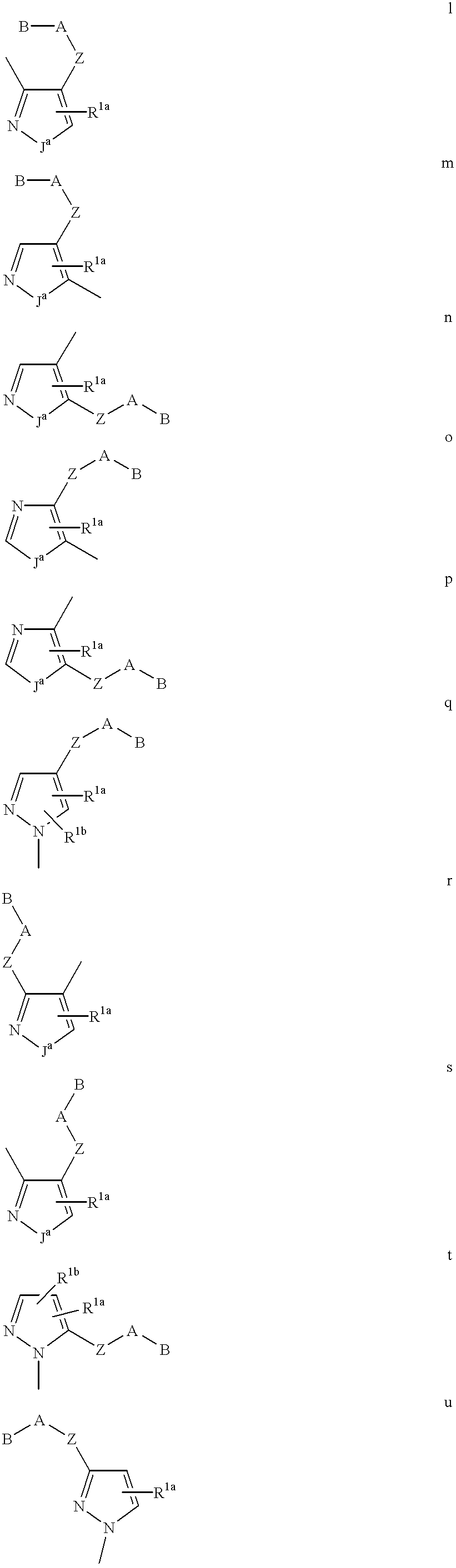


J is O or S;
Ja is NH or NR1a;
Z is selected from a bond, C1-4 alkylene, (CH2)rO(CH2)r, (CH2)rNR3(CH2)r, (CH2)rC(O)(CH2)r, (CH2)rC(O)O(CH2)r, (CH2)rOC(O)(CH2)r, (CH2)rC(O)NR3(CH2)r, (CH2)rNR3C(O)(CH2)r, (CH2)rOC(O)O(CH2)r, (CH2)rOC(O)NR3(CH2)r, (CH2)rNR3C(O)O(CH2)r, (CH2)rNR3C(O)NR3(CH2)r, (CH2)rS(O)p(CH2)r, (CH2)rSO2NR3(CH2)r, (CH2)rNR3SO2(CH2)r, and (CH2)rNR3SO2NR3(CH2)r, provided that Z does not form a N—N, N—O, N—S, NCH2N, NCH2O, or NCH2S bond with ring M or group A;
R1a and R1b are independently absent or selected from —(CH2)r—R1′, —CH═CH—R1′, NCH2R1″, OCH2R1″, SCH2R1″, NH(CH2)2(CH2)tR1′, O(CH2)2(CH2)tR1′, and S(CH2)2(CH2)tR1′;
alternatively, R1a and R1b, when attached to adjacent carbon atoms, together with the atoms to which they are attached form a 5-8 membered saturated, partially saturated or unsaturated ring substituted with 0-2 R4 and which contains from 0-2 heteroatoms selected from the group consisting of N, O, and S;
alternatively, when Z is C(O)NH and R1a is attached to a ring carbon adjacent to Z, then R1a is a C(O) bound to Z by replacing the amide hydrogen of Z to form a cyclic imide;
R1′ is selected from H, C1-3 alkyl, F, Cl, Br, I, —CN, —CHO, (CF2)rCF3, (CH2)rOR2, NR2R2a, C(O)R2c, OC(O)R2, (CF2)rCO2R2c, S(O)pR2b, NR2(CH2)rOR2, CH(═NR2c)NR2R2a, NR2C(O)R2b, NR2C(O)NHR2b, NR2C(O)2R2a, OC(O)NR2aR2b, C(O)NR2R2a, C(O)NR2(CH2)rOR2, SO2NR2R2a, NR2SO2R2b, C3-6 carbocyclic residue substituted with 0-2 R4a, and 5-10 membered heterocyclic system containing from 1-4 heteroatoms selected from the group consisting of N, O, and S substituted with 0-2 R4a;
R1″ is selected from H, CH(CH2OR2)2, C(O)R2c, C(O)NR2R2a, S(O)R2b, S(O)2R2b, and SO2NR2R2a;
R2, at each occurrence, is selected from H, CF3, C1-6 alkyl, benzyl, C3-6 carbocyclic residue substituted with 0-2 R4b, and 5-6 membered heterocyclic system containing from 1-4 heteroatoms selected from the group consisting of N, O, and S substituted with 0-2 R4b;
R2a, at each occurrence, is selected from H, CF3, C1-6 alkyl, benzyl, phenethyl, C3-6 carbocyclic residue substituted with 0-2 R4b, and 5-6 membered heterocyclic system containing from 1-4 heteroatoms selected from the group consisting of N, O, and S substituted with 0-2 R4b;
R2b, at each occurrence, is selected from CF3, C1-4 alkoxy, C1-6 alkyl, benzyl, C3-6 carbocyclic residue substituted with 0-2 R4b, and 5-6 membered heterocyclic system containing from 1-4 heteroatoms selected from the group consisting of N, O, and S substituted with 0-2 R4b;
R2c, at each occurrence, is selected from CF3, OH, C1-4 alkoxy, C1-6 alkyl, benzyl, C3-6 carbocyclic residue substituted with 0-2 R4b, and 5-6 membered heterocyclic system containing from 1-4 heteroatoms selected from the group consisting of N, O, and S substituted with 0-2 R4b;
alternatively, R2 and R2a, together with the atom to which they are attached, combine to form a 5 or 6 membered saturated, partially saturated or unsaturated ring substituted with 0-2 R4b and containing from 0-1 additional heteroatoms selected from the group consisting of N, O, and S;
R3, at each occurrence, is selected from H, C1-4 alkyl, and phenyl;
R3a, at each occurrence, is selected from H, C1-4 alkyl, and phenyl;
R3b, at each occurrence, is selected from H, C1-4 alkyl, and phenyl;
R3c, at each occurrence, is selected from C1-4 alkyl, and phenyl;
R3d, at each occurrence, is selected from H, OH, and C1-3 alkyl;
R3e, at each occurrence, is selected from H and CH3;
A is selected from:
C3-10 carbocyclic residue substituted with 0-2 R4, and
5-10 membered heterocyclic system containing from 1-4 heteroatoms selected from the group consisting of N, O, and S substituted with 0-2 R4; 
X—Y combine to form a group selected from:
C(R3dR3e)C(R3dR3e), C(R3dR3e)C(R3dR3e)C(R3dR3e), NR4cC(R3dR3e), NR4cC(═O), NR4cC(═NH), NR4cC(R3dR3e)C(R3dR3e), NR4cC(R3dR3e)NR4c, NR4cC(═O)NR4c, NR4cC(═O)C(R3dR3e), C(R3dR3e)NR4c, C(R3dR3e)NR4cC(R3dR3e), C(R3dR3e)C(R3dR3e)NR4c, NR4cNR4c, NR4cNR4cC(R3dR3e), and C(R3dR3e)NR4cNR4c;
R4, at each occurrence, is selected from H, ═O, (CH2)rOR2, F, Cl, Br, I, C1-4 alkyl, —CN, NO2, (CH2)rNR2R2a, (CH2)rC(O)R2c, NR2C(O)R2b, C(O)NR2R2a, NR2C(O)NR2R2a, CH(═NR2)NR2R2a, CH(═NS(O)2R5)NR2R2a, NHC(═NR2)NR2R2a, C(O)NHC(═NR2)NR2R2a, SO2NR2R2a, NR2SO2NR2R2a, NR2SO2—C1-4 alkyl, NR2SO2R5, S(O)pR5, (CF2)rCF3, NCH2R1″, OCH2R1″, SCH2R1″, N(CH2)2(CH2)tR1′, O(CH2)2(CH2)tR1′, and S(CH2)2(CH2)tR1′;
alternatively, one R4 is a 5-6 membered aromatic heterocycle containing from 1-4 heteroatoms selected from the group consisting of N, O, and S;
R4a is selected from H, ═O, (CH2)rOR2, (CH2)r—F, (CH2)r—Br, (CH2)r—Cl, I, C1-4 alkyl, —CN, NO2, (CH2)rNR2R2a, (CH2)rNR2R2b, (CH2)rC(O)R2c, NR2C(O)R2b, C(O)NR2R2a, C(O)NH(CH2)2NR2R2a, NR2C(O)NR2R2a, CH(═NR2)NR2R2a, NHC(═NR2)NR2R2a, SO2NR2R2a, NR2SO2NR2R2a, NR2SO2—C1-4 alkyl, C(O)NHSO2—C1-4 alkyl, NR2SO2R5, S(O)pR5, and (CF2)rCF3;
R4b, at each occurrence, is selected from H, ═O, (CH2)rOR3, F, Cl, Br, I, C1-4 alkyl, —CN, NO2, (CH2)rNR3R3a, (CH2)rC(O)R3, (CH2)rC(O)OR3c, NR3C(O)R3a, C(O)NR3R3a, NR3C(O)NR3R3a, CH(═NR3)NR3R3a, NH3C(═NR3)NR3R3a, SO2NR3R3a, NR3SO2NR3R3a, NR3SO2—C1-4 alkyl, NR3SO2CF3, NR3 SO2-phenyl, S(O)pCF3, S(O)p—C1-4 alkyl, S(O)p-phenyl, and (CF2)rCF3;
R4c, at each occurrence, is selected from H, C1-4 alkyl, CH2—CN, (CH2)2—CN, CH2—NR2R2a, (CH2)2NR2R2a, CH2C(O)R2c, (CH2)2C(O)R2c, CH2—C(O)NR2R2a, (CH2)2C(O)NR2R2a, phenyl, and benzyl;
R5, at each occurrence, is selected from CF3, C1-6 alkyl, phenyl substituted with 0-2 R6, and benzyl substituted with 0-2 R6;
R6, at each occurrence, is selected from H, OH, (CH2)rOR2, F, Cl, Br, I, C1-4 alkyl, CN, NO2, (CH2)rNR2R2a, (CH2)rC(O)R2b, NR2C(O)R2b, NR2C(O)NR2R2a, CH(═NH)NH2, NHC(═NH)NH2, SO2NR2R2a, NR2SO2NR2R2a, and NR2SO2C1-4 alkyl;
R7, at each occurrence, is selected from H, OH, C1-6 alkyl, C1-6 alkylcarbonyl, C1-6 alkoxy, C1-4 alkoxycarbonyl, (CH2)n-phenyl, C6-10 aryloxy, C6-10 aryloxycarbonyl, C6-10 arylmethylcarbonyl, C1-4 alkylcarbonyloxy C1-4 alkoxycarbonyl, C6-10 arylcarbonyloxy C1-4 alkoxycarbonyl, C1-6 alkylaminocarbonyl, phenylaminocarbonyl, and phenyl C1-4 alkoxycarbonyl;
R8, at each occurrence, is selected from H, C1-6 alkyl and (CH2)n-phenyl;
alternatively, R7 and R8 combine to form a 5 or 6 membered saturated, ring which contains from 0-1 additional heteroatoms selected from the group consisting of N, O, and S;
R9, at each occurrence, is selected from H, C1-6 alkyl and (CH2)n-phenyl;
n is selected from 0, 1, 2, and 3;
m is selected from 0, 1, and 2;
p is selected from 0, 1, and 2;
r is selected from 0, 1, 2, and 3;
s is selected from 0, 1, and 2; and,
t is selected from 0 and 1.
[2] In a preferred embodiment, the present invention provides a novel compound of formula Ia or Ib: 
wherein in formula Ia, rings D—E represent a bicycle selected from the group: 1-aminoisoquinolin-7-yl; 1,3-diaminoisoquinolin-7-yl; 1,4-diaminoisoquinolin-7-yl; 1,5-diaminoisoquinolin-7-yl; 1,6-diaminoisoquinolin-7-yl; 1-amino-3-hydroxy-isoquinolin-7-yl; 1-amino-4-hydroxy-isoquinolin-7-yl; 1-amino-5-hydroxy-isoquinolin-7-yl; 1-amino-6-hydroxy-isoquinolin-7-yl; 1-amino-3-methoxy-isoquinolin-7-yl; 1-amino-4-methoxy-isoquinolin-7-yl; 1-amino-5-methoxy-isoquinolin-7-yl; 1-amino-6-methoxy-isoquinolin-7-yl; 1-hydroxy-isoquinolin-7-yl; 4-aminoquinazol-6-yl; 2,4-diaminoquinazol-6-yl; 4,7-diaminoquinazol-6-yl 4,8-diaminoquinazol-6-yl; 1-aminophthalaz-7-yl; 1,4-diaminophthalaz-7-yl; 1,5-diaminophthalaz-7-yl; 1,6-diaminophthalaz-7-yl; 4-aminopterid-6-yl; 2,4-aminopterid-6-yl; 4,6-diaminopterid-6-yl; 8-amino-1,7-naphthyrid-2-yl; 6,8-diamino-1,7-naphthyrid-2-yl; 5,8-diamino-1,7-naphthyrid-2-yl; 4,8-diamino-1,7-naphthyrid-2-yl; 3,8-diamino-1,7-naphthyrid-2-yl; 5-amino-2,6-naphthyrid-3-yl; 5,7-diamino-2,6-naphthyrid-3-yl; 5,8-diamino-2,6-naphthyrid-3-yl; 1,5-diamino-2,6-naphthyrid-3-yl; 5-amino-1,6-naphthyrid-3-yl; 5,7-diamino-1,6-naphthyrid-3-y; 5,8-diamino-1,6-naphthyrid-3-yl; 2,5-diamino-1,6-naphthyrid-3-yl; 3-aminoindazol-5-yl; 3-hydroxyindazol-5-yl; 3-aminobenzisoxazol-5-yl; 3-hydroxybenzisoxazol-5-yl; 3-aminobenzisothiazol-5-yl; 3-hydroxybenzisothiazol-5-yl; 1-amino-3,4-dihydroisoquinolin-7-yl; and, 1-aminoisoindol-6-yl;
alternatively, in formula Ia ring D is absent and ring G is phenyl or pyridyl and ring G is substituted with G and R′:
G is selected from F, Cl, Br, I, OH, C1-3 alkoxy, CN, C(═NR8)NR7R9, NHC(═NR8)NR7R9, NR8CH(═NR7), C(O)NR7R8, (CR8R9)tNR7R8, SH, C1-3 alkyl-S, S(O)R3b, S(O)2R3a, S(O)2NR2R2a, and OCF3;
R′ is selected from H, Cl, F, Br, I, (CH2)tOR3, C1-4 alkyl, OCF3, CF3, C(O)NR7R8, and (CR8R9)tNR7R8;
alternatively, in formula Ib, rings D—E are selected from the group: 4-amino-pyrido[4,3-b]furan-3-yl, 4-amino-pyrido[4,3-b]furan-2-yl, 7-amino-pyrido[3,4-b]furan-2-yl, 4-amino-pyrido[4,3-b]thien-3-yl, 4-amino-pyrido[4,3-b]thien-2-yl, 7-amino-pyrido[3,4-b]thien-2-yl, 4-amino-5-aza-indol-3-yl, 4-amino-5-aza-indol-2-yl, 7-amino-6-aza-indol-3-yl, 4-amino-5-aza-indol-1-yl, 7-amino-pyrido[4,3-d]imidazol-1-yl, 4-amino-pyrido[3,4-d]imidazol-1-yl, 4-amino-5-aza-inden-3-yl, 4-amino-5-aza-inden-2-yl, 4-amino-5-aza-inden-1-yl, 4-amino-5-aza-dihydroinden-3-yl, 4-amino-5-aza-dihydroinden-2-yl, and 4-amino-5-aza-dihydroinden-1-yl;
M is selected from the group: 


Z is selected from (CH2)rC(O)(CH2)r, (CH2)rC(O)O(CH2)r, (CH2)rC(O)NR3(CH2)r, (CH2)rS(O)p(CH2)r, and (CH2)rSO2NR3(CH2)r;
R3d, at each occurrence, is selected from H and CH3;
A is selected from:
C5-6 carbocyclic residue substituted with 0-2 R4, and
5-6 membered heterocyclic system containing from 1-4 heteroatoms selected from the group consisting of N, O, and S substituted with 0-2 R4;
X—Y combine to form a group selected from:
C(R3dR3e)C(R3dR3e), C(R3dR3e)C(R3dR3e)C(R3dR3e), NR4cC(R3dR3e), NR4cC(═O), NR4cC(R3dR3e)C(R3dR3e), NR4cC(R3dR3e)NR4c, NR4cC(═O)NR4c, NR4cC(═O)C(R3dR3e), C(R3dR3e)NR4c, C(R3dR3e)NR4cC(R3dR3e), and C(R3dR3e)C(R3dR3e)NR4c; and,
R4c, at each occurrence, is selected from H, C1-4 alkyl, CH2—CN, (CH2)2—CN, CH2—NR2R2a, (CH2)2NR2R2a, CH2C(O)R2c, and (CH2)2C(O)R2c.
[3] In a more preferred embodiment, the present invention provides a novel compound of formula Ia, wherein;
rings D—E represent a bicycle selected from the group: 1-aminoisoquinolin-7-yl, 1,3-diaminoisoquinolin-7-yl, 1,4-diaminoisoquinolin-7-yl, 1,5-diaminoisoquinolin-7-yl, 1,6-diaminoisoquinolin-7-yl, 1-hydroxy-isoquinolin-7-yl, 4-aminoquinazol-6-yl, 2,4-diaminoquinazol-6-yl, 4,7-diaminoquinazol-6-yl, 4,8-diaminoquinazol-6-yl, 1-aminophthalaz-7-yl, 1,4-diaminophthalaz-7-yl, 1,5-diaminophthalaz-7-yl, 1,6-diaminophthalaz-7-yl, 4-aminopterid-6-yl, 8-amino-1,7-naphthyrid-2-yl, 5-amino-1,6-naphthyrid-3-y, 5-amino-2,6-naphthyrid-3-yl, 3-aminobenzisoxazol-5-yl, 3-aminobenzisothiazol-5-yl, 1-amino-3,4-dihydroisoquinolin-7-yl, and 1-aminoisoindol-6-yl;
alternatively, ring D is absent and ring G is phenyl or pyridyl and ring G is substituted with G and R′:
G is selected from F, Cl, Br, and C1-3 alkoxy;
R′ is selected from H, F, Cl, Br, OR3, and CH2OR3;
M is selected from the group: 

Z is selected from (CH2)rC(O)(CH2)r and (CH2)rC(O)NR3(CH2)r;
A is selected from:
C5-6 carbocyclic residue substituted with 0-2 R4, and
5-6 membered aromatic heterocyclic system containing from 1-4 heteroatoms selected from the group consisting of N, O, and S substituted with 0-2 R4;
X—Y combine to form a group selected from: CH2CH2, NR4cCH2, NR4cC(═O), and CH2NR4c; and,
R4c, at each occurrence, is selected from H, CH2—CN, (CH2)2—CN, CH2—NR2R2a, and (CH2)2NR2R2a.
[4] In an even more preferred embodiment, the present invention provides a novel compound of formula Ia, wherein;
rings D—E represent a bicycle selected from the group: 1-aminoisoquinolin-7-yl, 1,5-diaminoisoquinolin-7-yl, 1,6-diaminoisoquinolin-7-yl, 1-aminophthalaz-7-yl, 1,4-diaminophthalaz-7-yl, 1,5-diaminophthalaz-7-yl, 1,6-diaminophthalaz-7-yl, 4-aminopterid-6-yl, 8-amino-1,7-naphthyrid-2-yl, 5-amino-1,6-naphthyrid-3-y, 5-amino-2,6-naphthyrid-3-yl, 3-aminobenzisoxazol-5-yl, 4-amino-5-azabenzothiophen-2-yl, and, 1-aminoisoindol-6-yl;
alternatively, ring D is absent and ring E is phenyl substituted with G and R′;
G is selected from CH2NH2, CH2NHCH3, CH(CH3)NH2, C(CH2)2NH2, F, Cl, Br, and OCH3;
R′ is selected from H, OCH3, Cl, and F.
M is selected from the group: 
J is N;
R1a and R1b are independently absent or are —(CH2)r—R1′;
R1′ is selected from H, C1-3 alkyl, F, Cl, —CN, CF3, (CH2)rOR2, NR2R2a, C(O)R2c, OC(O)R2, S(O)pR2b, NR2C(O)R2b, C(O)NR2R2a, SO2NR2R2a, C3-6 carbocyclic residue substituted with 0-2 R4a, and 5-6 membered heterocyclic system containing from 1-4 heteroatoms selected from the group consisting of N, O, and S substituted with 0-2 R4a;
A is selected from phenyl, pyridyl, pyrimidyl, pyridazinyl, and pyrazinyl and is substituted with 0-2 R4;
X—Y combine to form NR4cCH2;
R2, at each occurrence, is selected from H, CF3, C1-6 alkyl, benzyl, C5-6 carbocyclic residue substituted with 0-2 R4b, and 5-6 membered heterocyclic system containing from 1-4 heteroatoms selected from the group consisting of N, O, and S substituted with 0-2 R4b;
R2a, at each occurrence, is selected from H, CF3, C1-6 alkyl, benzyl, phenethyl, C5-6 carbocyclic residue substituted with 0-2 R4b, and 5-6 membered heterocyclic system containing from 1-4 heteroatoms selected from the group consisting of N, O, and S substituted with 0-2 R4b;
R2b, at each occurrence, is selected from CF3, C1-4 alkoxy, C1-6 alkyl, benzyl, C5-6 carbocyclic residue substituted with 0-2 R4b, and 5-6 membered heterocyclic system containing from 1-4 heteroatoms selected from the group consisting of N, O, and S substituted with 0-2 R4b;
R2c, at each occurrence, is selected from CF3, OH, C1-4 alkoxy, C1-6 alkyl, benzyl, C5-6 carbocyclic residue substituted with 0-2 R4b, and 5-6 membered heterocyclic system containing from 1-4 heteroatoms selected from the group consisting of N, O, and S substituted with 0-2 R4b;
alternatively, R2 and R2a, together with the atom to which they are attached, combine to form a ring selected from imidazolyl, morpholino, piperazinyl, pyridyl, and pyrrolidinyl, substituted with 0-2 R4b;
R4, at each occurrence, is selected from H, ═O, OR2, CH2OR2, F, Cl, C1-4 alkyl, NR2R2a, CH2NR2R2a, C(O)R2c, CH2C(O)R2c, C(O)NR2R2a, SO2NR2R2a, NR2SO2—C1-4 alkyl, S(O)2R5, and CF3
R4a, at each occurrence, is selected from H, (CH2)rOR2, F, Cl, C1-4 alkyl, NR2R2a, CH2NR2R2a, NR2R2b, CH2NR2R2b, (CH2)rC(O)R2c, NR2C(O)R2b, C(O)NR2R2a, NR2C(O)NR2R2a, SO2NR2R2a, S(O)2R5, and CF3;
R4b, at each occurrence, is selected from H, ═O, (CH2)rOR3, F, Cl, C1-4 alkyl, NR3R3a, CH2NR3R3a, C(O)R3, CH2C(O)R3, C(O)OR3c, C(O)NR3R3a, SO2NR3R3a, NR3SO2—C1-4 alkyl, NR3SO2-phenyl, S(O)2—C1-4 alkyl, S(O)2-phenyl, and CF3; and,
R4c, at each occurrence, is selected from H, CH2—CN, (CH2)2—CN, CH2—NH2, and (CH2)2NH2.
[5] In a further preferred embodiment, the present invention provides a novel compound of formula Ia wherein:
rings D—E represent a bicycle selected from the group: 1-aminoisoquinolin-7-yl, 1,5-diaminoisoquinolin-7-yl, 1,6-diaminoisoquinolin-7-yl, 8-amino-1,7-naphthyrid-2-yl, 5-amino-1,6-naphthyrid-3-y, 5-amino-2,6-naphthyrid-3-yl, 3-aminobenzisoxazol-5-yl, 1-aminophthalaz-7-yl, 4-amino-5-azabenzothiophen-2-yl, and, 1-aminoisoindol-6-yl; and,
alternatively, ring D is absent and R′, G, and ring E form a group selected from 3-aminomethylphenyl, 4-fluoro-3-aminomethylphenyl, 4-fluoro-3-(methylaminomethyl)phenyl, 4-chloro-3-aminophenyl, and 2-aminomethylphenyl.
[6] In an even further preferred embodiment, the present invention provides a novel compound selected from:
N-[4-(1,1-dioxido-1,2-benzisothiazol-2-cyanomethyl-7-yl)phenyl]-1-(4-methoxyphenyl)-3-(trifluoromethyl)-1H-pyrazole-5-carboxamide;
N-[4-(2,3-dihydro-1,1-dioxido-1,2-benzisothiazol-7-yl)phenyl]-1-(4-methoxyphenyl)-3-(trifluoromethyl)-1H-pyrazole-5-carboxamide;
N-[4-(2,3-dihydro-3-hydroxy-1,1-dioxido-1,2-benzisothiazol-7-yl)phenyl]-1-(4-methoxyphenyl)-3-(trifluoromethyl)-1H-pyrazole-5-carboxamide;
N-[4-[2-[2-(diethylamino)ethyl]-2,3-dihydro-1,1-dioxido-1,2-benzisothiazol-7-yl]phenyl]-1-(4-methoxyphenyl)-3-(trifluoromethyl)-1H-pyrazole-5-carboxamide;
1-[3-(aminomethyl)phenyl]-N-[4-(2,3-dihydro-1,1-dioxido-1,2-benzisothiazol-7-yl)phenyl]-3-(trifluoromethyl)-1-H-pyrazole-5-carboxamide;
1-[3-(aminomethyl)phenyl]-N-[4-(2,3-dihydro-2-methyl-1,1-dioxido-1,2-benzisothiazol-7-yl)phenyl]-3-(trifluoromethyl)-1H-pyrazole-5-carboxamide;
1-[3-(aminomethyl)-4-fluorophenyl]-N-[4-(2,3-dihydro-1,1-dioxido-1,2-benzisothiazol-7-yl)phenyl]-3-(trifluoromethyl)-1H-pyrazole-5-carboxamide;
1-(3-amino-1,2-benzisoxazol-5-yl)-N-[4-(2,3-dihydro-1,1-dioxido-1,2-benzisothiazol-7-yl)phenyl]-3-(trifluoromethyl)-1H-pyrazole-5-carboxamide;
1-[3-(aminoiminomethyl)phenyl]-N-[4-(2,3-dihydro-1,1-dioxido-1,2-benzisothiazol-7-yl)phenyl]-3-(trifluoromethyl)-1H-pyrazole-5-carboxamide;
1-[3-(aminoiminomethyl)phenyl]-N-[4-(2,3-dihydro-2-methyl-1,1-dioxido-1,2-benzisothiazol-7-yl)phenyl]-3-(trifluoromethyl)-1H-pyrazole-5-carboxamide;
1-[3-(aminoiminomethyl)phenyl]-N-[4-[2-[2-(diethylamino)ethyl]-2,3-dihydro-1,1-dioxido-1,2-benzisothiazol-7-yl]phenyl]-3-(trifluoromethyl)-1H-pyrazole-5-carboxamide;
1-[3-(aminoiminomethyl)phenyl]-N-[4-(2,3-dihydro-1,1-dioxido-benzo[b]thiophen-7-yl))phenyl]-3-(trifluoromethyl)-1H-pyrazole-5-carboxamide;
1-[3-(aminomethyl)phenyl]-N-[4-(2,3-dihydro-1,1-dioxido-benzo[b]thiophen-7-yl))phenyl]-3-(trifluoromethyl)-1H-pyrazole-5-carboxamide;
1-(3-(amino-1,2-benzisoxazol-5-yl)-N-[4-(2,3-dihydro-2-methyl-1,1-dioxido-1,2-benzisothiazol-7-yl)phenyl]-3-(trifluoromethyl)-1H-pyrazole-5-carboxamide;
1-(3-(amino-1,2-benzisoxazol-5-yl)-N-[4-[2-[2-(diethylamino)ethyl]-2,3-dihydro-1,1-dioxido-1,2-benzisothiazol-7-yl)phenyl]-3-(trifluoromethyl)-1H-pyrazole-5-carboxamide;
1-(3-(amino-1,2-benzisoxazol-5-yl)-N-[4-(2,3-dihydro-1,1-dioxido-benzo[b]thiophen-7-yl))phenyl]-3-(trifluoromethyl)-1H-pyrazole-5-carboxamide;
1-[3-(aminomethyl)phenyl]-N-[4-[2-[2-(diethylamino)ethyl]-2,3-dihydro-1,1-dioxido-1,2-benzisothiazol-7-yl]phenyl]-3-(trifluoromethyl)-1H-pyrazole-5-carboxamide
1-(3-amino-4-chlorophenyl)-N-[4-(2,3-dihydro-1,1-dioxido-1,2-benzisothiazol-7-yl)phenyl]-3-(trifluoromethyl)-1H-pyrazole-5-carboxamide;
1-(3-amino-4-chlorophenyl)-N-[4-(2,3-dihydro-2-methyl-1,1-dioxido-1,2-benzisothiazol-7-yl)phenyl]-3-(trifluoromethyl)-1H-pyrazole-5-carboxamide;
1-(3-amino-4-chlorophenyl)-N-[4-[2-[2-(diethylamino)ethyl]-2,3-dihydro-1,1-dioxido-1,2-benzisothiazol-7-yl]phenyl]-3-(trifluoromethyl)-1H-pyrazole-5-carboxamide;
1-(3-amino-4-chlorophenyl)-N-[4-(2,3-dihydro-1,1-dioxido-benzo[b]thiophen-7-yl))phenyl]-3-(trifluoromethyl)-1H-pyrazole-5-carboxamide;
1-[3-(aminoiminomethyl)phenyl]-N-[4-(2,3-dihydro-1,1-dioxido-1,2-benzisothiazol-7-yl)phenyl]-3-(trifluoromethyl)-1H-pyrazole-5-carboxamide;
1-(1-amino-7-isoquinolinyl)-N-[4-(2,3-dihydro-1,1-dioxido-1,2-benzisothiazol-7-yl)phenyl]-3-(trifluoromethyl)-1H-pyrazole-5-carboxamide;
1-(1-amino-7-isoquinolinyl)-N-[4-(2,3-dihydro-2-methyl-1,1-dioxido-1,2-benzisothiazol-7-yl)phenyl]-3-(trifluoromethyl)-1H-pyrazole-5-carboxamide;
1-(1-amino-7-isoquinolinyl)-N-[4-[2-[2-(diethylamino)ethyl]-2,3-dihydro-1,1-dioxido-1,2-benzisothiazol-7-yl]phenyl]-3-(trifluoromethyl)-1H-pyrazole-5-carboxamide;
1-(1-amino-7-isoquinolinyl)-N-[4-(2,3-dihydro-1,1-dioxido-benzo[b]thiophen-7-yl))phenyl]-3-(trifluoromethyl)-1H-pyrazole-5-carboxamide;
1-(3-(amino-1,2-benzisoxazol-5-yl)-N-[4-(2,3-dihydro-1,1-dioxido-1,2-benzisothiazol-7-yl)phenyl]-1H-tetrazole-5-carboxamide;
1-(3-(amino-1,2-benzisoxazol-5-yl)-N-[4-(2,3-dihydro-1,1-dioxido-1,2-benzisothiazol-7-yl)phenyl]-3-(trifluoromethyl)-1H-1,2,4-triazole-5-carboxamide;
1-(3-(amino-1,2-benzisoxazol-5-yl)-N-[4-(2,3-dihydro-1,1-dioxido-1,2-benzisothiazol-7-yl)phenyl]-1H-1,2,3-triazole-5-carboxamide;
1-(3-(amino-1,2-benzisoxazol-5-yl)-N-[4-(2,3-dihydro-1,1-dioxido-1,2-benzisothiazol-7-yl)phenyl]-2-(trifluoromethyl)-5-thiazolecarboxamide; and,
1-(3-(amino-1,2-benzisoxazol-5-yl)-N-[4-(2,3-dihydro-1,1-dioxido-1,2-benzisothiazol-7-yl)phenyl]-4,5-dihydro-5-methyl-5-isoxazolecarboxamide;
or a pharmaceutically acceptable salt form thereof.
[7] In a prefered embodiment, rings D—E combine to form a bicyclic moiety selected from the group: 

In another embodiment, the present invention provides novel pharmaceutical compositions, comprising: a pharmaceutically acceptable carrier and a therapeutically effective amount of a compound of formula (I) or a pharmaceutically acceptable salt form thereof.
In another embodiment, the present invention provides a novel method for treating or preventing a thromboembolic disorder, comprising: administering to a patient in need thereof a therapeutically effective amount of a compound of formula (I) or a pharmaceutically acceptable salt form thereof.
In another embodiment, the present invention provides novel compounds of formula (I) for use in therapy.
In another embodiment, the present invention provides the use of novel compounds of formula (I) for the manufacture of a medicament for the treatment of a thromboembolic disorder.
The compounds herein described may have asymmetric centers. Compounds of the present invention containing an asymmetrically substituted atom may be isolated in optically active or racemic forms. It is well known in the art how to prepare optically active forms, such as by resolution of racemic forms or by synthesis from optically active starting materials. Many geometric isomers of olefins, C═N double bonds, and the like can also be present in the compounds described herein, and all such stable isomers are contemplated in the present invention. Cis and trans geometric isomers of the compounds of the present invention are described and may be isolated as a mixture of isomers or as separated isomeric forms. All chiral, diastereomeric, racemic forms and all geometric isomeric forms of a structure are intended, unless the specific stereochemistry or isomeric form is specifically indicated. All processes used to prepare compounds of the present invention and intermediates made therein are considered to be part of the present invention.
The term “substituted,” as used herein, means that any one or more hydrogens on the designated atom is replaced with a selection from the indicated group, provided that the designated atom-'s normal valency is not exceeded, and that the substitution results in a stable compound. When a substituent is keto (i.e., ═O), then 2 hydrogens on the atom are replaced. Keto substituents are not present on aromatic moieties.
The present invention is intended to include all isotopes of atoms occurring in the present compounds. Isotopes include those atoms having the same atomic number but different mass numbers. By way of general example and without limitation, isotopes of hydrogen include tritium and deuterium. Isotopes of carbon include C-13 and C-14.
When any variable (e.g., R6) occurs more than one time in any constituent or formula for a compound, its definition at each occurrence is independent of its definition at every other occurrence. Thus, for example, if a group is shown to be substituted with 0-2 R6, then said group may optionally be substituted with up to two R6 groups and R6 at each occurrence is selected independently from the definition of R6. Also, combinations of substituents and/or variables are permissible only if such combinations result in stable compounds.
When a bond to a substituent is shown to cross a bond connecting two atoms in a ring, then such substituent may be bonded to any atom on the ring. When a substituent is listed without indicating the atom via which such substituent is bonded to the rest of the compound of a given formula, then such substituent may be bonded via any atom in such substituent. Combinations of substituents and/or variables are permissible only if such combinations result in stable compounds.
As used herein, “alkyl” or “alkylene” is intended to include both branched and straight-chain saturated aliphatic hydrocarbon groups having the specified number of carbon atoms. C1-10 alkyl (or alkylene), is intended to include C1, C2, C3, C4, C5, C6, C7, C8, C9, and C10 alkyl groups. Examples of alkyl include, but are not limited to, methyl, ethyl, n-propyl, i-propyl, n-butyl, s-butyl, t-butyl, n-pentyl, and s-pentyl. “Haloalkyl” is intended to include both branched and straight-chain saturated aliphatic hydrocarbon groups having the specified number of carbon atoms, substituted with 1 or more halogen (for example —CvFw where v=1 to 3 and w=1 to (2v+1)). Examples of haloalkyl include, but are not limited to, trifluoromethyl, trichloromethyl, pentafluoroethyl, and pentachloroethyl. “Alkoxy” represents an alkyl group as defined above with the indicated number of carbon atoms attached through an oxygen bridge. C1-10 alkoxy, is intended to include C1, C2, C3, C4, C5, C6, C7, C8, C9, and C10 alkoxy groups. Examples of alkoxy include, but are not limited to, methoxy, ethoxy, n-propoxy, i-propoxy, n-butoxy, s-butoxy, t-butoxy, n-pentoxy, and s-pentoxy. “Cycloalkyl” is intended to include saturated ring groups, such as cyclopropyl, cyclobutyl, or cyclopentyl. C3-7 cycloalkyl, is intended to include C3, C4, C5, C6, and C7 cycloalkyl groups. “Alkenyl” or “alkenylene” is intended to include hydrocarbon chains of either a straight or branched configuration and one or more unsaturated carbon-carbon bonds which may occur in any stable point along the chain, such as ethenyl and propenyl. C2-10 alkenyl (or alkenylene), is intended to include C2, C3, C4, C5, C6, C7, C8, C9, and C10 alkenyl groups. “Alkynyl” or “alkynylene” is intended to include hydrocarbon chains of either a straight or branched configuration and one or more triple carbon-carbon bonds which may occur in any stable point along the chain, such as ethynyl and propynyl. C2-10 alkynyl (or alkynylene), is intended to include C2, C3, C4, C5, C6, C7, C8, C9, and C10 alkynyl groups. “Halo” or “halogen” as used herein refers to fluoro, chloro, bromo, and iodo; and “counterion” is used to represent a small, negatively charged species such as chloride, bromide, hydroxide, acetate, and sulfate.
As used herein, “carbocycle” or “carbocyclic residue” is intended to mean any stable 3, 4, 5, 6, or 7-membered monocyclic or bicyclic or 7, 8, 9, 10, 11, 12, or 13-membered bicyclic or tricyclic, any of which may be saturated, partially unsaturated, or aromatic. Examples of such carbocycles include, but are not limited to, cyclopropyl, cyclobutyl, cyclopentyl, cyclohexyl, cycloheptyl, adamantyl, cyclooctyl, [3.3.0]bicyclooctane, [4.3.0]bicyclononane, [4.4.0]bicyclodecane, [2.2.2]bicyclooctane, fluorenyl, phenyl, naphthyl, indanyl, adamantyl, and tetrahydronaphthyl.
As used herein, the term “heterocycle” or “heterocyclic system” is intended to mean a stable 5, 6, or 7-membered monocyclic or bicyclic or 7, 8, 9, or 10-membered bicyclic heterocyclic ring which is saturated, partially unsaturated or unsaturated (aromatic), and which consists of carbon atoms and 1, 2, 3, or 4 heteroatoms independently selected from the group consisting of N, NH, O and S and including any bicyclic group in which any of the above-defined heterocyclic rings is fused to a benzene ring. The nitrogen and sulfur heteroatoms may optionally be oxidized. The heterocyclic ring may be attached to its pendant group at any heteroatom or carbon atom which results in a stable structure. The heterocyclic rings described herein may be substituted on carbon or on a nitrogen atom if the resulting compound is stable. A nitrogen in the heterocycle may optionally be quaternized. It is preferred that when the total number of S and O atoms in the heterocycle exceeds 1, then these heteroatoms are not adjacent to one another. It is preferred that the total number of S and O atoms in the heterocycle is not more than 1. As used herein, the term “aromatic heterocyclic system” or “heteroaryl” is intended to mean a stable 5, 6, or 7-membered monocyclic or bicyclic or 7, 8, 9, or 10-membered bicyclic heterocyclic aromatic ring which consists of carbon atoms and 1, 2, 3, or 4 heterotams independently selected from the group consisting of N, NH, O and S. It is to be noted that total number of S and O atoms in the aromatic heterocycle is not more than 1.
Examples of heterocycles include, but are not limited to, acridinyl, azocinyl, benzimidazolyl, benzofuranyl, benzothiofuranyl, benzothiophenyl, benzoxazolyl, benzthiazolyl, benztriazolyl, benztetrazolyl, benzisoxazolyl, benzisothiazolyl, benzimidazolinyl, carbazolyl, 4aH-carbazolyl, carbolinyl, chromanyl, chromenyl, cinnolinyl, decahydroquinolinyl, 2H, 6H-1,5,2-dithiazinyl, dihydrofuro[2,3-b]tetrahydrofuran, furanyl, furazanyl, imidazolidinyl, imidazolinyl, imidazolyl, 1H-indazolyl, indolenyl, indolinyl, indolizinyl, indolyl, 3H-indolyl, isobenzofuranyl, isochromanyl, isoindazolyl, isoindolinyl, isoindolyl, isoquinolinyl, isothiazolyl, isoxazolyl, methylenedioxyphenyl, morpholinyl, naphthyridinyl, octahydroisoquinolinyl, oxadiazolyl, 1,2,3-oxadiazolyl, 1,2,4-oxadiazolyl, 1,2,5-oxadiazolyl, 1,3,4-oxadiazolyl, oxazolidinyl, oxazolyl, oxazolidinyl, pyrimidinyl, phenanthridinyl, phenanthrolinyl, phenazinyl, phenothiazinyl, phenoxathiinyl, phenoxazinyl, phthalazinyl, piperazinyl, piperidinyl, piperidonyl, 4-piperidonyl, piperonyl, pteridinyl, purinyl, pyranyl, pyrazinyl, pyrazolidinyl, pyrazolinyl, pyrazolyl, pyridazinyl, pyridooxazole, pyridoimidazole, pyridothiazole, pyridinyl, pyridyl, pyrimidinyl, pyrrolidinyl, pyrrolinyl, 2H-pyrrolyl, pyrrolyl, quinazolinyl, quinolinyl, 4H-quinolizinyl, quinoxalinyl, quinuclidinyl, tetrahydrofuranyl, tetrahydroisoquinolinyl, tetrahydroquinolinyl, tetrazolyl, 6H-1,2,5-thiadiazinyl, 1,2,3-thiadiazolyl, 1,2,4-thiadiazolyl, 1,2,5-thiadiazolyl, 1,3,4-thiadiazolyl, thianthrenyl, thiazolyl, thienyl, thienothiazolyl, thienooxazolyl, thienoimidazolyl, thiophenyl, triazinyl, 1,2,3-triazolyl, 1,2,4-triazolyl, 1,2,5-triazolyl, 1,3,4-triazolyl, and xanthenyl. Also included are fused ring and spiro compounds containing, for example, the above heterocycles.
The phrase “pharmaceutically acceptable” is employed herein to refer to those compounds, materials, compositions, and/or dosage forms which are, within the scope of sound medical judgment, suitable for use in contact with the tissues of human beings and animals without excessive toxicity, irritation, allergic response, or other problem or complication, commensurate with a reasonable benefit/risk ratio.
As used herein, “pharmaceutically acceptable salts” refer to derivatives of the disclosed compounds wherein the parent compound is modified by making acid or base salts thereof. Examples of pharmaceutically acceptable salts include, but are not limited to, mineral or organic acid salts of basic residues such as amines; alkali or organic salts of acidic residues such as carboxylic acids; and the like. The pharmaceutically acceptable salts include the conventional non-toxic salts or the quaternary ammonium salts of the parent compound formed, for example, from non-toxic inorganic or organic acids. For example, such conventional non-toxic salts include those derived from inorganic acids such as hydrochloric, hydrobromic, sulfuric, sulfamic, phosphoric, nitric and the like; and the salts prepared from organic acids such as acetic, propionic, succinic, glycolic, stearic, lactic, malic, tartaric, citric, ascorbic, pamoic, maleic, hydroxymaleic, phenylacetic, glutamic, benzoic, salicylic, sulfanilic, 2-acetoxybenzoic, fumaric, toluenesulfonic, methanesulfonic, ethane disulfonic, oxalic, isethionic, and the like.
The pharmaceutically acceptable salts of the present invention can be synthesized from the parent compound which contains a basic or acidic moiety by conventional chemical methods. Generally, such salts can be prepared by reacting the free acid or base forms of these compounds with a stoichiometric amount of the appropriate base or acid in water or in an organic solvent, or in a mixture of the two; generally, nonaqueous media like ether, ethyl acetate, ethanol, isopropanol, or acetonitrile are preferred. Lists of suitable salts are found in Remington's Pharmaceutical Sciences, 17th ed., Mack Publishing Company, Easton, Pa., 1985, p. 1418, the disclosure of which is hereby incorporated by reference.
Since prodrugs are known to enhance numerous desirable qualities of pharmaceuticals (e.g., solubility, bioavailability, manufacturing, etc . . . ) the compounds of the present invention may be delivered in prodrug form. Thus, the present invention is intended to cover prodrugs of the presently claimed compounds, methods of delivering the same and compositions containing the same. “Prodrugs” are intended to include any covalently bonded carriers which release an active parent drug of the present invention in vivo when such prodrug is administered to a mammalian subject. Prodrugs the present invention are prepared by modifying functional groups present in the compound in such a way that the modifications are cleaved, either in routine manipulation or in vivo, to the parent compound. Prodrugs include compounds of the present invention wherein a hydroxy, amino, or sulfhydryl group is bonded to any group that, when the prodrug of the present invention is administered to a mammalian subject, it cleaves to form a free hydroxyl, free amino, or free sulfhydryl group, respectively. Examples of prodrugs include, but are not limited to, acetate, formate and benzoate derivatives of alcohol and amine functional groups in the compounds of the present invention.
“Stable compound” and “stable structure” are meant to indicate a compound that is sufficiently robust to survive isolation to a useful degree of purity from a reaction mixture, and formulation into an efficacious therapeutic agent.
“Substituted” is intended to indicate that one or more hydrogens on the atom indicated in the expression using “substituted” is replaced with a selection from the indicated group(s), provided that the indicated atom's normal valency is not exceeded, and that the substitution results in a stable compound. When a substituent is keto (i.e., ═O) group, then 2 hydrogens on the atom are replaced.
“Therapeutically effective amount” is intended to include an amount of a compound of the present invention or an amount of the combination of compounds claimed effective to treat the desired disease. The combination of compounds is preferably a synergistic combination. Synergy, as described for example by Chou and Talalay, Adv. Enzyme Regul. 22: 27-55 (1984), occurs when the effect of the compounds when administered in combination is greater than the additive effect of the compounds when administered alone as a single agent. In general, a synergistic effect is most clearly demonstrated at suboptimal concentrations of the compounds. Synergy can be in terms of lower cytotoxicity, increased therapeutic effect, or some other beneficial effect of the combination compared with the individual components.
The compounds of the present invention can be prepared in a number of ways known to one skilled in the art of organic synthesis. The compounds of the present invention can be synthesized using the methods described below, together with synthetic methods known in the art of synthetic organic chemistry, or by variations thereon as appreciated by those skilled in the art. Preferred methods include, but are not limited to, those described below. The reactions are performed in a solvent appropriate to the reagents and materials employed and suitable for the transformations being effected. It will be understood by those skilled in the art of organic synthesis that the functionality present on the molecule should be consistent with the transformations proposed. This will sometimes require a judgment to modify the order of the synthetic steps or to select one particular process scheme over another in order to obtain a desired compound of the invention. It will also be recognized that another major consideration in the planning of any synthetic route in this field is the judicious choice of the protecting group used for protection of the reactive functional groups present in the compounds described in this invention. An authoritative account describing the many alternatives to the trained practitioner is Greene and Wuts (Protective Groups In Organic Synthesis, Wiley and Sons, 1991). All references cited herein are hereby incorporated in their entirety herein by reference. 
Scheme 1 presents how the A—B unit could be assembled, followed by the linker formation. Boronic acid is prepared according to the procedure by Pinto (WO 98/28269) and coupled with 5-bromo cyclic sulfone derivative (1) under Suzuki conditions. Deprotection of the aniline could be accomplished either with sodium borohydride in methanol or under standard basic conditions (lithium hydroxide in aqueous tetrahydrofuran). Coupling to the core ring structures (I) could be accomplished according to the standard procedures known to the practitioners of the art. 
Scheme 2 illustrates the preparation of 5-bromosultam derivatives. Conversion of the dibromoaniline to the dibromobenzenesulfonyl chloride can be accomplished according to the modified procedure by G. Wittig (Organic Synthesis, Coll. Vol.5, 60), followed by the coupling with the appropriately substituted amine in the basic media. To achieve a metal-halogen exchange, the intermediate is treated with n-BuLi as shown by J. Wrobel (Heterocycles, Vol.38, 1823, 1994). The generated lithium anion could be quenched by the addition of N, N-dimethyl formamide. Deprotection and β-elimination can be achieved simultaneously under acidic conditions and is followed by the reduction of the imine bond with the appropriate reducing agent. Protection of the nitrogen of the final sultam derivative could be achieved with the number of the desired groups following the standard synthetic procedures commonly known in the art. Saccharine-like derivatives (3) could be obtained upon the treatment with an appropriate oxidizing agent, followed by the deprotection and introduction of the desired R3 group. 
Scheme 3 describes the synthesis of the desired azasultam derivative (4) by warming of the intermediate dibromophenylsulfonyl hydrazide in a basic media. Synthesis of the 6-ring aza-sultam (5) could proceed under halogen-metal exchange conditions described in Scheme 2 followed by the β-elimination and reduction to afford the desired compound. 
In Scheme 4 dibromophenylsulfonyl chloride can be reduced to the corresponding sulfinic acid upon the treatment with sodium borohydride as described by A. Nose (Chem. Pharm. Bull. 35, 1770, 1987). The sulfinic acid undergoes Mannich condensation with formaldehyde and t-butyl amine as in A. Kanazawa (J. Org. Chem., 59, 1232, 1994) to afford an intermediate that undergoes halogen-metal exchange as was shown in Scheme 2 to give the 6-ring cyclic sulfone. Deprotection and β-elimination can be achieved simultaneously under acidic conditions and is followed by the reduction of the imine bond with the appropriate reducing agent as described in Scheme 2. Protection of the nitrogen of the final derivative (7) could be achieved with the number of the desired groups following the standard synthetic procedures commonly known in the art. Additionally, the intermediate aminomethyl sulfone can be cyclized to the desired 5-ring aza-sulfone (6) upon heating in the basic media. 
In Scheme 5 the sulfinic acid (Scheme 4) is treated with formaldehyde and disubstituted hydrazine to afford an intermediate that upon heating in the basic medium can cyclize to the final compound (8). 
Scheme 6 describes the synthesis of the desired 6-ring saccharin derivative (9), where the dibromophenylsulfonylamide (Scheme 2) undergoes the palladium mediated coupling with TMS acetylene (Singh, J. Org. Chem. 54, 4453, 1989) to provide the intermediate that is converted to the acid upon deprotection and treatment with the base as described by V. Laishev (Zh. Org. Khim.17, 2064, 1981). Final amide bond formation could be accomplished using the standard conditions known in the art. 
In Scheme 7 the treatment of the starting material under halogen-metal exchange conditions described in Scheme 2, followed by the quenching of the reaction medium with dibromoethane can affords the final 6-ring sultam derivative (10). 
In Scheme 8 the reduction to the dibromophenylmethyl sulfone can be done according to the procedure by L. Field (Organic Synthesis, Coll. Vol. 4, 674). Halogen-metal exchange of this sulfone upon the treatment with n-BuLi according to the modified procedure by A. Cabidu, (Synthesis, 1, 41, 1993) followed by the quench with N,N-dimethyl formamide affords the cyclic 5-ring sulfone (11) after β-elimination and reduction of the intermediate imine. The treatment of the phenyl methylsulfone under similar halogen-metal exchange conditions and quenching with dibromoethane can provide the desired 6-ring cyclic sulfone (12). 
Scheme 9 describes the synthesis of 6-ring heterocyclic sulfone derivatives (13 and 14). Synthesis of the dibromo sulfonamide is described in scheme 2. Amination is accomplished according to the procedure by A. Wisansky (Organic Synthesis, IV, 307, 1955). Treatment with phosgene can lead to the desired sulfonylcyclic urea derivative (13). Additionally, treatment of the intermediate aminobromophenyl sulfonamide with N, N-dimethylformamide in the basic media, followed by the reduction of the imine leads to the 6-ring azasultam (14).
Other features of the invention will become apparent in the course of the following descriptions of exemplary embodiments which are given for illustration of the invention and are not intended to be limiting thereof.

A solution of 2,6-dibromoaniline (10 g, 39.8 mmol) in trifluoroacetic acid (60 mL) and conc. HCl (12 mL) was cooled to 0° C. in an ice bath and treated dropwise with a solution of sodium nitrate (3.4 g, 39.8 mmol) in water (3 mL) over a period of 60 min. To the resulting mixture was added a suspension of copper(I) chloride (2.6 g) and copper(II) chloride (2.6 g) in sulfurous acid (70 mL) and acetic acid (70 mL) over a period of 90 min. After the addition was complete the resulting mixture was stirred at ambient temperature for 45 min. The resulting white precipitate was collected by filtration and dried under the reduced pressure to afford 2,6-dibromobenzenesulfonyl chloride as the white powder (5.2 g, 39%). The title compound was used without further purification. 1H NMR (CD3OD): δ7.45 (t, 1H), 8.01 (d, 2H).

A solution of 2,6-dibromobenzenesulfonyl chloride (4.7 g, 14.0 mmol) in tetrahydrofuran (20 mL) was treated with potassium carbonate (5.8 g, 42 mmol) and t-butyl amine (1.2 g, 16.8 mmol). The resulting mixture was stirred at ambient temperature over 18 h then poured into water and extracted with ethyl acetate. The organic layer was dried over sodium sulfate and concentrated in vacuo to afford 2,6-dibromo-N-(1,1-dimethylethyl)benzenesulfonamide (4.5 g, 87%) as the white solid, which was used without further purification. 1H NMR (CD3OD): δ1.22 (s, 9H), 7.22 (t, 1H), 7.85 (d, 2H).

To sodium hydride (0.52 g, 12.9 mmol) in tetrahydrofuran (20 mL) at 0° C. was added 2,6-dibromo-N-(1,1-dimethylethyl) benzenesulfonamide (4.0 g, 10.8 mmol). The resulting mixture was stirred at ambient temperature for 2-3 h, cooled to −780° C. and treated with n-BuLi (1.6 M in hexanes, 7.4 mL, 11.9 mmol) over a period of 20 min. The reaction was continued to stir for 40 min and treated with N,N-dimethyl formamide (0.9 mL, 11.9 mL). The cooling bath was removed and the mixture continued to stir over a period of 20 min. The work-up consisted of slowly quenching the reaction with 1N NaCl, dilution with water and extraction with ethyl acetate. Drying over sodium sulfate and concentrating under reduced pressure provided the crude product that was purified by the flash chromatography (ethyl acetate/hexane, 1:4) to afford the 7-bromo-2-(1,1-dimethylethyl)-2,3-dihydro-1,2-benzisothiazol-3-ol 1,1-dioxide (2.1 g, 55 %). 1H NMR (CD3OD): δ1.61 (s, 9H), 6.02 (s, 1H), 7.61 (m, 2H), 7.77 (m, 1H).

7-bromo-2-(1,1-dimethylethyl)-2,3-dihydro-1,2-benzisothiazol-3-ol 1,1-dioxide (1.4 g, 4.4 mmol) was treated with formic acid (10 mL). The reaction was stirred at ambient temperature over 18 h, concentrated in vacuo and dissolved in methanol (10 mL). The mixture was cooled to 0° C. and treated with sodium borohydride (0.17 g, 4.4 mmol) in small portions over 20 min. The cooling bath was removed and the resulting reaction mixture stirred at ambient temperature over 18 h. The work-up consisted of slowly quenching the reaction mixture with ice, dilution with water and extraction with ethyl acetate. Drying over sodium sulfate and concentrating under reduced pressure provided the crude product that was purified by a plug of silica gel (ethyl acetate/hexane, 1:4) to afford the desired 7-bromo-2,3-dihydro-1,2-benzisothiazole 1,1-dioxide (0.6 g, 60% over 2 steps). 1H NMR (CD3OD): δ4.40 (s, 2H), 7.53 (m, 2H), 7.70 (m, 1H).

A solution of 7-bromo-2,3-dihydro-1,2-benzisothiazole 1,1-dioxide (0.37 g, 1.5 mmol) in tetrahydrofuran (10 mL) was treated with DMAP (0.55 g, 4.5 mmol) and BOC anhydride (0.39 mg, 1.8 mmol). The resulting mixture was stirred at ambient temperature over 18 h, then poured into water and extracted with ethyl acetate. The organic layer was dried over sodium sulfate and concentrated in vacuo. The residue was purified by a plug of silica gel (ethyl acetate/hexane, 1:4) to afford 1,1-dimethylethyl-7-bromo-1,2-benzisothiazole-2(3H)-carboxylate 1,1-dioxide (0.5 g, 100%). 1H NMR (CDCl3): δ1.61 (s, 9H), 4.78 (s, 2H), 7.40 (d, 1H), 7.54 (t, 1H), 7.70 (d, 1H).

To sodium hydride (90 mg, 2.3 mmol) in tetrahydrofuran (10 mL) at 0°C. was added 1,1-dimethylethyl-7-bromo-1,2-benzisothiazole-2(3H)-carboxylate 1,1-dioxide (0.36 g, 1.5 mmol). The reaction was stirred for 20 min and treated with N,N-diethylaminoethyl bromide hydrobromide (0.39 g, 1.5 mmol) and potassium carbonate (0.62 g, 4.5 mmol). The resulting mixture was stirred at ambient temperature over 18 h, poured into ice water and extracted with ethyl acetate. The organic layer was dried over sodium sulfate and concentrated in vacuo. The crude material was purified by a flush chromatography (methanol/methylene chloride, 1:9) to afford 7-bromo-N,N-diethyl-1,2-benzisothiazole-2(3H)-ethanamine 1,1-dioxide (0.48 g, 93%). LRMS (ES+): 348.0 (M+H)+.

To a solution of 7-bromo-2-methyl-2,3-dihydro-1,2-benzisothiazol-3-ol 1,1-dioxide(0.34 g, 1.2 mmol) in methylene chloride (20 mL), prepared according to the method described in Example 3 was added PDC (1.4 g, 3.6 mmol). The reaction mixture is stirred at ambient temperature over 6 h, filtered through a pad of Celite and concentrated under the reduced pressure. The residue was purified by flash chromatography (ethyl acetate/hexane, 1:4) to afford the desired product 7-bromo-2-methyl-1,2-benzisothiazol-3-one 1,1-dioxide (0.24 g, 72%). 1H NMR (CDCl3): δ3.9 (s, 3H), 7.71 (t, 1H), 7.99 (d, 1H), 8.03 (d, 1H).

To sodium hydride (40 mg, 1.0 mmol) in tetrahydrofuran (10 mL) at 0° C. was added 7-bromo-N,N-diethyl-1,2-benzisothiazole-2(3H)-ethanamine 1,1-dioxide (0.26 g, 1.0 mmol). The reaction was stirred for 20 min and treated with methyl iodide (0.06 mL, 1.3 mmol). The resulting mixture was stirred at ambient temperature over 18 h, poured into ice water and extracted with ethyl acetate. The organic layer was dried over sodium sulfate and concentrated in vacuo. The crude material was purified by a flush chromatography ((ethyl acetate/hexane, 1:4) to afford 7-bromo-2,3-dihydro-2-methyl-1,2-benzisothiazole 1,1-dioxide (0.15 g, 56%). LRMS (ES−): 262.0 (M−H)+.

A solution of 1,1-dimethylethyl-7-(4-aminotrifluoroacetylphenyl)-1,2-benzisothiazole-2(3H)-carboxylate 1,1-dioxide (0.68 g, 1.5 mmol) in methanol (10 mL) at 0° C. was treated with sodium borohydride (57 mg, 1.5 mmol). The mixture was stirred over a period of 2 h, poured on ice and extracted with ethyl acetate, dried with sodium sulfate and concentrated. The residue was purified by flash chromatography (methanol/methylene chloride, 1:9) to afford the desired product 1,1-dimethylethyl-7-(4-aminophenyl)-1,2-benzisothiazole-2(3H)-carboxylate 1,1-dioxide (0.22 g, 40%). LRMS (ES+): 382.9 (M+Na)+.

A solution of 1,1-dimethylethyl-7-bromo-1,2-benzisothiazole-2(3H)-carboxylate 1,1-dioxide(0.58 g, 1.7 mmol) in dioxane (20 mL) was treated with potassium phosphate(0.71 g, 3.4 mmol) and 4-amino-trifluoroacetyl benzeneboronic acid (0.51 g, 2.2 mmol). The resulting mixture was deoxygenated by a rapid stream of nitrogen applied to the system over a period of 20 min., then treated with Pd(0) at once. The reaction was refluxed over a period of 18 h, cooled down, filtered through Celite and washed with tetrahydrofuran (20 mL). The filtrate evaporated to dryness, taken up in water and extracted with ethyl acetate (3×). Ethyl acetate extracts were dried over sodium sulfate and concentrated. The crude residue was purified by flash chromatography (methanol/methylene chloride, 1:9) to afford the desired product 1,1-dimethylethyl-7-(4-aminotrifluoroacetylphenyl)-1,2-benzisothiazole-2(3H)-carboxylate 1,1-dioxide (0.68 g, 67%). LRMS (ES+): 479.2 (M+Na)+.

This compound was prepared by the method described in Example 8/8a starting with 7-bromo-2-methyl-1,2-benzisothiazol-3-one 1,1-dioxide. LRMS (ES−): 289.1 (M−H)+.

This compound was prepared by the method described in Example 8/8a starting with 7-bromo-N,N-diethyl-1,2-benzisothiazole-2(3H)-ethanamine 1,1-dioxide. LRMS (ES+): 360.0 (M+H)+.

This compound was prepared by the method described in Example 8/8a starting with 7-bromo-2,3-dihydro-2-methyl-1,2-benzisothiazole 1,1-dioxide. LRMS (ES+) m/z 393.1 (M+Na)+.

To the solution of 3-(trifluoromethyl)-1-(4-methoxyphenyl)-1H-pyrazolecarboxylic acid (0.1 g, 0.3 mmol) in dry acetonitrile (10 mL) was added thionyl chloride (0.15 mL. 1.8 mmol). The reaction mixture was warmed up at 50° C. for 1 h. The solvent and excess of thionyl chloride were removed under reduced pressure and dried on a vacuum pump over 18 h. To this dried residue was added a mixture of 1,1-dimethylethyl-7-(4-aminophenyl)-1,2-benzisothiazole-2(3H)-carboxylate 1,1-dioxide (0.1 g, 0.3 mmol) and DMAP (0.13 g, 1.8 mmol) in dry methylene chloride (10 mL). The reaction mixture was allowed to stir at ambient temperature for 18 h, then concentrated and purified by flash chromatography (ethyl acetate/hexane, 1:1) to afford the desired product 1,1-dimethylethyl-7-[4-[[[1-(4-methoxyphenyl)-3-(trifluoromethyl)-1H-pyrazole-5-yl]carbonyl]amino]phenyl]-1,2-benzisothiazole-2(3H-carboxylate) 1,2-dioxide (96 mg, 45%) LRMS (ES−): 627.2 (M−H)+.
This product was treated with trifluoroacetic acid at ambient temperature over 2 h to give the product that was purified by HPLC utilizing gradient elution with a mixture of water: acetonitrile and 0.05% of trifluoroacetic acid on a reverse phase C18 (60 angstrom) column to give N-[4-(2,3-dihydro-1,1-dioxido-1,2-benzisothiazol-7-yl)phenyl]-1-(4-methoxyphenyl)-3-(trifluoromethyl)-1H-pyrazole-5-carboxamide. 1H NMR (CD3OD): δ3.81 (s, 3H), 4.41 (s, 2H), 7.02 (d, 2H, 7.29 (s, 1H), 7.43 (m, 4H), 7.67 (m, 5H).

To the solution of N-[4-(2,3-dihydro-1,1-dioxido-1,2-benzisothiazol-7-yl)phenyl]-1-(4-methoxyphenyl)-3-(trifluoromethyl)-1H-pyrazole-5-carboxamide (0.07 g, 0.13 mmol) in dry THF (10 mL) was added sodium hydride (0.011 g, 0.26 mmol) and iodoacetonitrile (0.01 mL, 0.13 mmol). The reaction mixture was stirred at ambient temperature over 18 hrs, then concentrated and purified by flash chromatography(ethyl acetate/hexane, 1:1) to afford the desired product N-[4-(1,1-dioxido-1,2-benzisothiazol-2-cyanomethyl-7-yl)phenyl]-1-(4-methoxyphenyl)-3-(trifluoromethyl)-1H-pyrazole-5-carboxamide LRMS (ES+): 568.55 (M+H)+.

This compound was prepared by the method described in Example 12 starting with 7-(4-aminobiphenyl)-2,3-dihydro-2-methyl-1,2-benzisothiazol-3-ol 1,1-dioxide. LRMS (ES−): 557.1 (M−H)+.

This compound was prepared by the method described in Example 12 starting with 1,1-dimethylethyl-7-(4-aminophenyl)-1,2-benzisothiazole-2(3H)-carboxylate 1,1-dioxide. LRMS (ES+): 628.2 (M+H)+.

To the solution of 3-(trifluoromethyl)-1-(3-cyanophenyl)-1H-pyrazolecarboxylic acid (0.1 g, 0.3 mmol) in dry acetonitrile (10 mL) was added thionyl chloride (0.15 mL, 1.8 mmol). The reaction mixture was warmed up at 50° C. for 1 h. The solvent and excess of thionyl chloride were removed under reduced pressure and dried on a vacuum pump over 18 h. To this dried resudue was added a mixture of 1,1-dimethylethyl-7-(4-aminophenyl)-1,2-benzisothiazole-2(3H)-carboxylate 1,1-dioxide (0.1 g, 0.3 mmol) and DMAP (0.13 g, 1.8 mmol) in dry methylene chloride (10 mL). The reaction mixture was allowed to stir at ambient temperature for 18 h, then concentrated and purified by flash chromatography (ethyl acetate/hexane, 1:1) to afford the intermediate product. This material was reduced under an atmosphere of hydrogen gas (55 psi) in methanol (5 mL) and trifluoroacetic acid (5 mL) in the presence of 10% palladium on carbon catalyst (15 mg) over a period of 18 h at ambient temperature. The reaction mixture was filtered over a pad of Celite and washed with methanol (5 mL×3). The residue was purified by HPLC utilizing gradient elution with a mixture of water: acetonitrile with 0.05% of trifluoroacetic acid on a reverse phase C18 (60 angstrom) column to give 1,1-dimethylethyl 7-[4-[[[1-[3-(aminomethyl)phenyl]-3-(trifluoromethyl)-1H-pyrazol-5-yl]carbonyl]amino]phenyl]-1,2-benzisothiazole-2(3H)-carboxylate 1,1-dioxide (32 mg, 15%). LRMS (ES+): 628.3 (M+H)+.
This product was treated with trifluoroacetic acid (5 mL) at ambient temperature over 2 h to give the title compound. LRMS (ES+): 528.2 (M+H)+.

This compound was prepared by the method described in Example 15 starting with 7-(4-aminobiphenyl)-2,3-dihydro-2-methyl-1,2-benzisothiazole 1,1-dioxide. LRMS (ES+): 542.3 (M+H)+.

This compound was prepared by the method described in Example 15 starting with 1,1-dimethylethyl-7-(4-aminophenyl)-1,2-benzisothiazole-2(3H)-carboxylate 1,1-dioxide. LRMS (ES+): 546.1 (M+Na)+.

To a solution of acetone oxime (74 mg, 1.0 mmol) in DMF (6 mL) was added sodium t-butoxide (1 M in THF, 1.0 mL). The mixture was stirred at room temperature for half hour followed by addition of a solution of 1,1-dimethylethyl 7-[4-[[[1-[4-fluoro-3-cyanophenyl]-3-(trifluoromethyl)-1H-pyrazol-5-yl]carbonyl]amino]phenyl]-1,2-benzisothiazole-2(3H)-carboxylate 1,1-dioxide (0.22 g, 0.34 mmol) prepared according to Example 15 in DMF (4 mL). The reaction was stirred at room temperature for 5 hours. The reaction mixture was then partitioned between ethyl acetate and HCl (5%), washed with HCl (5%), four times with water, brine, dried over sodium sulfate, filtered and concentrated. Flash chromatography (30% ethyl acetate/hexane) gave 100 mg of 1,1-dimethylethyl 7-[4-[[[1-[4-isopropylideneaminooxy-3-cyanophenyl]-3-(trifluoromethyl)-1H-pyrazol-5-yl]carbonyl]amino]phenyl]-1,2-benzisothiazole-2(3H)-carboxylate 1,1-dioxide. The intermediate (100 mg, 0.14 mmol) was dissolved in ethanol (4 mL) and to the solution was added HCl (20%, 4 mL). The reaction mixture was stirred at 80° C. for three hours. The reaction mixture was cooled to room temperature. The white precipitate was filtered to give the product that was purified by HPLC utilizing gradient elution with a mixture of water: acetonitrile with 0.05% of trifluoroacetic acid on a reverse phase C18(60 angstrom) column to give the title compound (37 mg, 19%). LRMS (ES+) 577.1 (M+Na)+.

To the solution of 1,1-dimethylethyl 7-[4-[[[1-(4-methoxyphenyl)-3-(trifluoromethyl)-1H-pyrazol-5-yl]carbonyl]amino]phenyl]-1,2-benzisothiazole-2(3H-carboxylate) 1,2-dioxide (0.07 g, 0.13 mmol) in dry tetrahydrofuran (10 mL) was added sodium hydride (60% in oil, 11 mg, 0.26 mmol) and iodoacetonitrile (0.001 mL, 0.13 mmol). The reaction mixture was stirred at ambient temperature for 18 h., poured into ice water and extracted with ethyl acetate. The organic layer was dried over sodium sulfate and concentrated in vacuo. This product was purified by HPLC utilizing gradient elution with a mixture of water: acetonitrile and 0.05% of trifluoroacetic acid on a reverse phase C18 (60 angstrom) column to give N-[4-(2,3-dihydro-2-cyanomethyl-1,1-dioxido-1,2-benzisothiazol-7-yl)phenyl]-1-(4-methoxyphenyl)-3-(trifluoromethyl)-1H-pyrazole-5-carboxamide. LRMS (ES+): 590.2 (M+Na)+.
The following tables contain representative examples of the present invention. Each entry in each table is intended to be paired with each formulae at the start of the table. For example, in Table 1, example 1 is intended to be paired with each of formulae a-bbbb and in Table 3, example 1 is intended to be paired with each of formulae a-bbbb.
The following groups are intended for group A in the following tables. 
| TABLE 1 |
 |
 |
 |
 |
 |
 |
 |
 |
 |
 |
 |
 |
 |
 |
 |
 |
 |
 |
 |
 |
 |
 |
 |
 |
 |
 |
 |
 |
 |
 |
 |
 |
 |
 |
 |
 |
 |
 |
 |
 |
 |
 |
 |
 |
 |
 |
 |
 |
 |
 |
 |
 |
 |
 |
 |
 |
 |
 |
 |
 |
| Ex # | A | R1a | ||
| 1 | phenyl | CH3 | ||
| 2 | phenyl | CH2CH3 | ||
| 3 | phenyl | CF3 | ||
| 4 | phenyl | SCH3 | ||
| 5 | phenyl | SOCH3 | ||
| 6 | phenyl | SO2CH3 | ||
| 7 | phenyl | CH2NHSO2CH3 | ||
| 8 | phenyl | Cl | ||
| 9 | phenyl | F | ||
| 10 | phenyl | CO2CH3 | ||
| 11 | phenyl | CH2OCH3 | ||
| 12 | phenyl | CO2NH2 | ||
| 13 | 2-pyridyl | CH3 | ||
| 14 | 2-pyridyl | CH2CH3 | ||
| 15 | 2-pyridyl | CF3 | ||
| 16 | 2-pyridyl | SCH3 | ||
| 17 | 2-pyridyl | SOCH3 | ||
| 18 | 2-pyridyl | SO2CH3 | ||
| 19 | 2-pyridyl | CH2NHSO2CH3 | ||
| 20 | 2-pyridyl | Cl | ||
| 21 | 2-pyridyl | F | ||
| 22 | 2-pyridyl | CO2CH3 | ||
| 23 | 2-pyridyl | CH2OCH3 | ||
| 24 | 2-pyridyl | CO2NH2 | ||
| 25 | 3-pyridyl | CH3 | ||
| 26 | 3-pyridyl | CH2CH3 | ||
| 27 | 3-pyridyl | CF3 | ||
| 28 | 3-pyridyl | SCH3 | ||
| 29 | 3-pyridyl | SOCH3 | ||
| 30 | 3-pyridyl | SO2CH3 | ||
| 31 | 3-pyridyl | CH2NHSO2CH3 | ||
| 32 | 3-pyridyl | Cl | ||
| 33 | 3-pyridyl | F | ||
| 34 | 3-pyridyl | CO2CH3 | ||
| 35 | 3-pyridyl | CH2OCH3 | ||
| 36 | 3-pyridyl | CO2NH2 | ||
| 37 | 2-pyrimidyl | CH3 | ||
| 38 | 2-pyrimidyl | CH2CH3 | ||
| 39 | 2-pyrimidyl | CF3 | ||
| 40 | 2-pyrimidyl | SCH3 | ||
| 41 | 2-pyrimidyl | SOCH3 | ||
| 42 | 2-pyrimidyl | SO2CH3 | ||
| 43 | 2-pyrimidyl | CH2NHSO2CH3 | ||
| 44 | 2-pyrimidyl | Cl | ||
| 45 | 2-pyrimidyl | F | ||
| 46 | 2-pyrimidyl | CO2CH3 | ||
| 47 | 2-pyrimidyl | CH2OCH3 | ||
| 48 | 2-pyrimidyl | CO2NH2 | ||
| 49 | 5-pyrimidyl | CH3 | ||
| 50 | 5-pyrimidyl | CH2CH3 | ||
| 51 | 5-pyrimidyl | CF3 | ||
| 52 | 5-pyrimidyl | SCH3 | ||
| 53 | 5-pyrimidyl | SOCH3 | ||
| 54 | 5-pyrimidyl | SO2CH3 | ||
| 55 | 5-pyrimidyl | CH2NHSO2CH3 | ||
| 56 | 5-pyrimidyl | Cl | ||
| 57 | 5-pyrimidyl | F | ||
| 58 | 5-pyrimidyl | CO2CH3 | ||
| 59 | 5-pyrimidyl | CH2OCH3 | ||
| 60 | 5-pyrimidyl | CO2NH2 | ||
| 61 | 2-Cl-phenyl | CH3 | ||
| 62 | 2-Cl-phenyl | CH2CH3 | ||
| 63 | 2-Cl-phenyl | CF3 | ||
| 64 | 2-Cl-phenyl | SCH3 | ||
| 65 | 2-Cl-phenyl | SOCH3 | ||
| 66 | 2-Cl-phenyl | SO2CH3 | ||
| 67 | 2-Cl-phenyl | CH2NHSO2CH3 | ||
| 68 | 2-Cl-phenyl | Cl | ||
| 69 | 2-Cl-phenyl | F | ||
| 70 | 2-Cl-phenyl | CO2CH3 | ||
| 71 | 2-Cl-phenyl | CH2OCH3 | ||
| 72 | 2-Cl-phenyl | CO2NH2 | ||
| 73 | 2-F-phenyl | CH3 | ||
| 74 | 2-F-phenyl | CH2CH3 | ||
| 75 | 2-F-phenyl | CF3 | ||
| 76 | 2-F-phenyl | SCH3 | ||
| 77 | 2-F-phenyl | SOCH3 | ||
| 78 | 2-F-phenyl | SO2CH3 | ||
| 79 | 2-F-phenyl | CH2NHSO2CH3 | ||
| 80 | 2-F-phenyl | Cl | ||
| 81 | 2-F-phenyl | F | ||
| 82 | 2-F-phenyl | CO2CH3 | ||
| 83 | 2-F-phenyl | CH2OCH3 | ||
| 84 | 2-F-phenyl | CO2NH2 | ||
| 85 | 2,6-diF-phenyl | CH3 | ||
| 86 | 2,6-diF-phenyl | CH2CH3 | ||
| 87 | 2,6-diF-phenyl | CF3 | ||
| 88 | 2,6-diF-phenyl | SCH3 | ||
| 89 | 2,6-diF-phenyl | SOCH3 | ||
| 90 | 2,6-diF-phenyl | SO2CH3 | ||
| 91 | 2,6-diF-phenyl | CH2NHSO2CH3 | ||
| 92 | 2,6-diF-phenyl | Cl | ||
| 93 | 2,6-diF-phenyl | F | ||
| 94 | 2,6-diF-phenyl | CO2CH3 | ||
| 95 | 2,6-diF-phenyl | CH2OCH3 | ||
| 96 | 2,6-diF-phenyl | CO2NH2 | ||
| TABLE 2 |
 |
 |
 |
 |
 |
 |
 |
 |
 |
 |
 |
 |
 |
 |
 |
 |
 |
 |
 |
 |
 |
 |
 |
 |
 |
 |
 |
 |
 |
 |
 |
 |
 |
 |
 |
 |
 |
 |
 |
 |
 |
 |
 |
 |
 |
 |
 |
 |
 |
 |
 |
 |
 |
 |
 |
 |
 |
 |
 |
 |
| Ex # | A | ||
| 1 | phenyl | ||
| 2 | 2-pyridyl | ||
| 3 | 2-pyrimidyl | ||
| 4 | 5-pyrimidyl | ||
| 5 | 2-Cl-phenyl | ||
| 6 | 2-F-phenyl | ||
| 7 | 2,6-diF-phenyl | ||
The compounds of this invention are useful as anticoagulants for the treatment or prevention of thromboembolic disorders in mammals. The term “thromboembolic disorders” as used herein includes arterial or venous cardiovascular or cerebrovascular thromboembolic disorders, including, for example, unstable angina, first or recurrent myocardial infarction, ischemic sudden death, transient ischemic attack, stroke, atherosclerosis, venous thrombosis, deep vein thrombosis, thrombophlebitis, arterial embolism, coronary and cerebral arterial thrombosis, cerebral embolism, kidney embolisms, and pulmonary embolisms. The anticoagulant effect of compounds of the present invention is believed to be due to inhibition of factor Xa or thrombin.
The effectiveness of compounds of the present invention as inhibitors of factor Xa was determined using purified human factor Xa and synthetic substrate. The rate of factor Xa hydrolysis of chromogenic substrate S2222 (Kabi Pharmacia, Franklin, Ohio) was measured both in the absence and presence of compounds of the present invention. Hydrolysis of the substrate resulted in the release of pNA, which was monitored spectrophotometrically by measuring the increase in absorbance at 405 nM. A decrease in the rate of absorbance change at 405 nm in the presence of inhibitor is indicative of enzyme inhibition. The results of this assay are expressed as inhibitory constant, Ki.
Factor Xa determinations were made in 0.10 M sodium phosphate buffer, pH 7.5, containing 0.20 M NaCl, and 0.5% PEG 8000. The Michaelis constant, Km, for substrate hydrolysis was determined at 25° C. using the method of Lineweaver and Burk. Values of Ki were determined by allowing 0.2-0.5 nM human factor Xa (Enzyme Research Laboratories, South Bend, Ind.) to react with the substrate (0.20 mM-1 mM) in the presence of inhibitor. Reactions were allowed to go for 30 minutes and the velocities (rate of absorbance change vs time) were measured in the time frame of 25-30 minutes. The following relationship was used to calculate Ki values:
where:
vo is the velocity of the control in the absence of inhibitor;
Vs is the velocity in the presence of inhibitor;
I is the concentration of inhibitor;
Ki is the dissociation constant of the enzyme: inhibitor complex;
S is the concentration of substrate;
Km is the Michaelis constant.
Using the methodology described above, a number of compounds of the present invention were found to exhibit a Ki of ≦10 μM, thereby confirming the utility of the compounds of the present invention as effective Xa inhibitors.
The antithrombotic effect of compounds of the present invention can be demonstrated in a rabbit arterio-venous (AV) shunt thrombosis model. In this model, rabbits weighing 2-3 kg anesthetized with a mixture of xylazine (10 mg/kg i.m.) and ketamine (50 mg/kg i.m.) are used. A saline-filled AV shunt device is connected between the femoral arterial and the femoral venous cannulae. The AV shunt device consists of a piece of 6-cm tygon tubing which contains a piece of silk thread. Blood will flow from the femoral artery via the AV-shunt into the femoral vein. The exposure of flowing blood to a silk thread will induce the formation of a significant thrombus. After forty minutes, the shunt is disconnected and the silk thread covered with thrombus is weighed. Test agents or vehicle will be given (i.v., i.p., s.c., or orally) prior to the opening of the AV shunt. The percentage inhibition of thrombus formation is determined for each treatment group. The ID50 values (dose which produces 50% inhibition of thrombus formation) are estimated by linear regression.
The compounds of formula (I) may also be useful as inhibitors of serine proteases, notably human thrombin, plasma kallikrein and plasmin. Because of their inhibitory action, these compounds are indicated for use in the prevention or treatment of physiological reactions, blood coagulation and inflammation, catalyzed by the aforesaid class of enzymes. Specifically, the compounds have utility as drugs for the treatment of diseases arising from elevated thrombin activity such as myocardial infarction, and as reagents used as anticoagulants in the processing of blood to plasma for diagnostic and other commercial purposes.
Some compounds of the present invention were shown to be direct acting inhibitors of the serine protease thrombin by their ability to inhibit the cleavage of small molecule substrates by thrombin in a purified system. In vitro inhibition constants were determined by the method described by Kettner et al. in J. Biol. Chem. 265, 18289-18297 (1990), herein incorporated by reference. In these assays, thrombin-mediated hydrolysis of the chromogenic substrate S2238 (Helena Laboratories, Beaumont, Tex.) was monitored spectrophotometrically. Addition of an inhibitor to the assay mixture results in decreased absorbance and is indicative of thrombin inhibition. Human thrombin (Enzyme Research Laboratories, Inc., South Bend, Ind.) at a concentration of 0.2 nM in 0.10 M sodium phosphate buffer, pH 7.5, 0.20 M NaCl, and 0.5% PEG 6000, was incubated with various substrate concentrations ranging from 0.20 to 0.02 mM. After 25 to 30 minutes of incubation, thrombin activity was assayed by monitoring the rate of increase in absorbance at 405 nm which arises owing to substrate hydrolysis. Inhibition constants were derived from reciprocal plots of the reaction velocity as a function of substrate concentration using the standard method of Lineweaver and Burk. Using the methodology described above, some compounds of this invention were evaluated and found to exhibit a Ki of less than 10 μm, thereby confirming the utility of the compounds of the present invention as effective thrombin inhibitors.
Compounds tested in the above assay are considered to be active if they exhibit a Ki of ≦10 μM. Preferred compounds of the present invention have Ki's of ≦1 μM. More preferred compounds of the present invention have Ki's of ≦0.1 μM. Even more preferred compounds of the present invention have Ki's of ≦0.01 μM. Still more preferred compounds of the present invention have Ki's of ≦0.001 μM.
The compounds of the present invention can be administered alone or in combination with one or more additional therapeutic agents. These include other anti-coagulant or coagulation inhibitory agents, anti-platelet or platelet inhibitory agents, thrombin inhibitors, or thrombolytic or fibrinolytic agents.
The compounds are administered to a mammal in a therapeutically effective amount. By “therapeutically effective amount” it is meant an amount of a compound of Formula I that, when administered alone or in combination with an additional therapeutic agent to a mammal, is effective to prevent or ameliorate the thromboembolic disease condition or the progression of the disease.
By “administered in combination” or “combination therapy” it is meant that the compound of Formula I and one or more additional therapeutic agents are administered concurrently to the mammal being treated. When administered in combination each component may be administered at the same time or sequentially in any order at different points in time. Thus, each component may be administered separately but sufficiently closely in time so as to provide the desired therapeutic effect. Other anticoagulant agents (or coagulation inhibitory agents) that may be used in combination with the compounds of this invention include warfarin and heparin, as well as other factor Xa inhibitors such as those described in the publications identified above under Background of the Invention.
The term anti-platelet agents (or platelet inhibitory agents), as used herein, denotes agents that inhibit platelet function such as by inhibiting the aggregation, adhesion or granular secretion of platelets. Such agents include, but are not limited to, the various known non-steroidal anti-inflammatory drugs (NSAIDS) such as aspirin, ibuprofen, naproxen, sulindac, indomethacin, mefenamate, droxicam, diclofenac, sulfinpyrazone, and piroxicam, including pharmaceutically acceptable salts or prodrugs thereof. Of the NSAIDS, aspirin (acetylsalicyclic acid or ASA), and piroxicam are preferred. Other suitable anti-platelet agents include ticlopidine, including pharmaceutically acceptable salts or prodrugs thereof. Ticlopidine is also a preferred compound since it is known to be gentle on the gastro-intestinal tract in use. Still other suitable platelet inhibitory agents include IIb/IIIa antagonists, thromboxane-A2-receptor antagonists and thromboxane-A2-synthetase inhibitors, as well as pharmaceutically acceptable salts or prodrugs thereof.
The term thrombin inhibitors (or anti-thrombin agents), as used herein, denotes inhibitors of the serine protease thrombin. By inhibiting thrombin, various thrombin-mediated processes, such as thrombin-mediated platelet activation (that is, for example, the aggregation of platelets, and/or the granular secretion of plasminogen activator inhibitor-1 and/or serotonin) and/or fibrin formation are disrupted. A number of thrombin inhibitors are known to one of skill in the art and these inhibitors are contemplated to be used in combination with the present compounds. Such inhibitors include, but are not limited to, boroarginine derivatives, boropeptides, heparins, hirudin and argatroban, including pharmaceutically acceptable salts and prodrugs thereof. Boroarginine derivatives and boropeptides include N-acetyl and peptide derivatives of boronic acid, such as C-terminal a-aminoboronic acid derivatives of lysine, ornithine, arginine, homoarginine and corresponding isothiouronium analogs thereof. The term hirudin, as used herein, includes suitable derivatives or analogs of hirudin, referred to herein as hirulogs, such as disulfatohirudin. Boropeptide thrombin inhibitors include compounds described in Kettner et al., U.S. Pat. No. 5,187,157 and European Patent Application Publication Number 293 881 A2, the disclosures of which are hereby incorporated herein by reference. Other suitable boroarginine derivatives and boropeptide thrombin inhibitors include those disclosed in PCT Application Publication Number 92/07869 and European Patent Application Publication Number 471,651 A2, the disclosures of which are hereby incorporated herein by reference.
The term thrombolytics (or fibrinolytic) agents (or thrombolytics or fibrinolytics), as used herein, denotes agents that lyse blood clots (thrombi). Such agents include tissue plasminogen activator, anistreplase, urokinase or streptokinase, including pharmaceutically acceptable salts or prodrugs thereof. The term anistreplase, as used herein, refers to anisoylated plasminogen streptokinase activator complex, as described, for example, in European Patent Application No. 028,489, the disclosure of which is hereby incorporated herein by reference herein. The term urokinase, as used herein, is intended to denote both dual and single chain urokinase, the latter also being referred to herein as prourokinase.
Administration of the compounds of Formula I of the invention in combination with such additional therapeutic agent, may afford an efficacy advantage over the compounds and agents alone, and may do so while permitting the use of lower doses of each. A lower dosage minimizes the potential of side effects, thereby providing an increased margin of safety.
The compounds of the present invention are also useful as standard or reference compounds, for example as a quality standard or control, in tests or assays involving the inhibition of factor Xa. Such compounds may be provided in a commercial kit, for example, for use in pharmaceutical research involving factor Xa. For example, a compound of the present invention could be used as a reference in an assay to compare its known activity to a compound with an unknown activity. This would ensure the experimenter that the assay was being performed properly and provide a basis for comparison, especially if the test compound was a derivative of the reference compound. When developing new assays or protocols, compounds according to the present invention could be used to test their effectiveness.
The compounds of the present invention may also be used in diagnostic assays involving factor Xa. For example, the presence of factor Xa in an unknown sample could be determined by addition of chromogenic substrate S2222 to a series of solutions containing test sample and optionally one of the compounds of the present invention. If production of pNA is observed in the solutions containing test sample, but not in the presence of a compound of the present invention, then one would conclude factor Xa was present.
The compounds of this invention can be administered in such oral dosage forms as tablets, capsules (each of which includes sustained release or timed release formulations), pills, powders, granules, elixirs, tinctures, suspensions, syrups, and emulsions. They may also be administered in intravenous (bolus or infusion), intraperitoneal, subcutaneous, or intramuscular form, all using dosage forms well known to those of ordinary skill in the pharmaceutical arts. They can be administered alone, but generally will be administered with a pharmaceutical carrier selected on the basis of the chosen route of administration and standard pharmaceutical practice.
The dosage regimen for the compounds of the present invention will, of course, vary depending upon known factors, such as the pharmacodynamic characteristics of the particular agent and its mode and route of administration; the species, age, sex, health, medical condition, and weight of the recipient; the nature and extent of the symptoms; the kind of concurrent treatment; the frequency of treatment; the route of administration, the renal and hepatic function of the patient, and the effect desired. A physician or veterinarian can determine and prescribe the effective amount of the drug required to prevent, counter, or arrest the progress of the thromboembolic disorder.
By way of general guidance, the daily oral dosage of each active ingredient, when used for the indicated effects, will range between about 0.001 to 1000 mg/kg of body weight, preferably between about 0.01 to 100 mg/kg of body weight per day, and most preferably between about 1.0 to 20 mg/kg/day. Intravenously, the most preferred doses will range from about 1 to about 10 mg/kg/minute during a constant rate infusion. Compounds of this invention may be administered in a single daily dose, or the total daily dosage may be administered in divided doses of two, three, or four times daily.
Compounds of this invention can be administered in intranasal form via topical use of suitable intranasal vehicles, or via transdermal routes, using transdermal skin patches. When administered in the form of a transdermal delivery system, the dosage administration will, of course, be continuous rather than intermittent throughout the dosage regimen.
The compounds are typically administered in admixture with suitable pharmaceutical diluents, excipients, or carriers (collectively referred to herein as pharmaceutical carriers) suitably selected with respect to the intended form of administration, that is, oral tablets, capsules, elixirs, syrups and the like, and consistent with conventional pharmaceutical practices.
For instance, for oral administration in the form of a tablet or capsule, the active drug component can be combined with an oral, non-toxic, pharmaceutically acceptable, inert carrier such as lactose, starch, sucrose, glucose, methyl callulose, magnesium stearate, dicalcium phosphate, calcium sulfate, mannitol, sorbitol and the like; for oral administration in liquid form, the oral drug components can be combined with any oral, non-toxic, pharmaceutically acceptable inert carrier such as ethanol, glycerol, water, and the like. Moreover, when desired or necessary, suitable binders, lubricants, disintegrating agents, and coloring agents can also be incorporated into the mixture. Suitable binders include starch, gelatin, natural sugars such as glucose or beta-lactose, corn sweeteners, natural and synthetic gums such as acacia, tragacanth, or sodium alginate, carboxymethylcellulose, polyethylene glycol, waxes, and the like. Lubricants used in these dosage forms include sodium oleate, sodium stearate, magnesium stearate, sodium benzoate, sodium acetate, sodium chloride, and the like. Disintegrators include, without limitation, starch, methyl cellulose, agar, bentonite, xanthan gum, and the like.
The compounds of the present invention can also be administered in the form of liposome delivery systems, such as small unilamellar vesicles, large unilamellar vesicles, and multilamellar vesicles. Liposomes can be formed from a variety of phospholipids, such as cholesterol, stearylamine, or phosphatidylcholines.
Compounds of the present invention may also be coupled with soluble polymers as targetable drug carriers. Such polymers can include polyvinylpyrrolidone, pyran copolymer, polyhydroxypropylmethacrylamide-phenol, polyhydroxyethylaspartamidephenol, or polyethyleneoxide-polylysine substituted with palmitoyl residues. Furthermore, the compounds of the present invention may be coupled to a class of biodegradable polymers useful in achieving controlled release of a drug, for example, polylactic acid, polyglycolic acid, copolymers of polylactic and polyglycolic acid, polyepsilon caprolactone, polyhydroxy butyric acid, polyorthoesters, polyacetals, polydihydropyrans, polycyanoacylates, and crosslinked or amphipathic block copolymers of hydrogels.
Dosage forms (pharmaceutical compositions) suitable for administration may contain from about 1 milligram to about 100 milligrams of active ingredient per dosage unit. In these pharmaceutical compositions the active ingredient will ordinarily be present in an amount of about 0.5-95% by weight based on the total weight of the composition.
Gelatin capsules may contain the active ingredient and powdered carriers, such as lactose, starch, cellulose derivatives, magnesium stearate, stearic acid, and the like. Similar diluents can be used to make compressed tablets. Both tablets and capsules can be manufactured as sustained release products to provide for continuous release of medication over a period of hours. Compressed tablets can be sugar coated or film coated to mask any unpleasant taste and protect the tablet from the atmosphere, or enteric coated for selective disintegration in the gastrointestinal tract.
Liquid dosage forms for oral administration can contain coloring and flavoring to increase patient acceptance.
In general, water, a suitable oil, saline, aqueous dextrose (glucose), and related sugar solutions and glycols such as propylene glycol or polyethylene glycols are suitable carriers for parenteral solutions. Solutions for parenteral administration preferably contain a water soluble salt of the active ingredient, suitable stabilizing agents, and if necessary, buffer substances. Antioxidizing agents such as sodium bisulfite, sodium sulfite, or ascorbic acid, either alone or combined, are suitable stabilizing agents. Also used are citric acid and its salts and sodium EDTA. In addition, parenteral solutions can contain preservatives, such as benzalkonium chloride, methyl- or propyl-paraben, and chlorobutanol.
Suitable pharmaceutical carriers are described in Remington's Pharmaceutical Sciences, Mack Publishing Company, a standard reference text in this field.
Representative useful pharmaceutical dosage-forms for administration of the compounds of this invention can be illustrated as follows:
Capsules
A large number of unit capsules can be prepared by filling standard two-piece hard gelatin capsules each with 100 milligrams of powdered active ingredient, 150 milligrams of lactose, 50 milligrams of cellulose, and 6 milligrams magnesium stearate.
Soft Gelatin Capsules
A mixture of active ingredient in a digestable oil such as soybean oil, cottonseed oil or olive oil may be prepared and injected by means of a positive displacement pump into gelatin to form soft gelatin capsules containing 100 milligrams of the active ingredient. The capsules should be washed and dried.
Tablets
Tablets may be prepared by conventional procedures so that the dosage unit is 100 milligrams of active ingredient, 0.2 milligrams of colloidal silicon dioxide, 5 milligrams of magnesium stearate, 275 milligrams of microcrystalline cellulose, 11 milligrams of starch and 98.8 milligrams of lactose. Appropriate coatings may be applied to increase palatability or delay absorption.
Injectable
A parenteral composition suitable for administration by injection may be prepared by stirring 1.5% by weight of active ingredient in 10% by volume propylene glycol and water. The solution should be made isotonic with sodium chloride and sterilized.
Suspension
An aqueous suspension can be prepared for oral administration so that each 5 mL contain 100 mg of finely divided active ingredient, 200 mg of sodium carboxymethyl cellulose, 5 mg of sodium benzoate, 1.0 g of sorbitol solution, U.S.P., and 0.025 mL of vanillin.
Where the compounds of this invention are combined with other anticoagulant agents, for example, a daily dosage may be about 0.1 to 100 milligrams of the compound of Formula I and about 1 to 7.5 milligrams of the second anticoagulant, per kilogram of patient body weight. For a tablet dosage form, the compounds of this invention generally may be present in an amount of about 5 to 10 milligrams per dosage unit, and the second anti-coagulant in an amount of about 1 to 5 milligrams per dosage unit.
Where the compounds of Formula I are administered in combination with an anti-platelet agent, by way of general guidance, typically a daily dosage may be about 0.01 to 25 milligrams of the compound of Formula I and about 50 to 150 milligrams of the anti-platelet agent, preferably about 0.1 to 1 milligrams of the compound of Formula I and about 1 to 3 milligrams of antiplatelet agents, per kilogram of patient body weight.
Where the compounds of Formula I are adminstered in combination with thrombolytic agent, typically a daily dosage may be about 0.1 to 1 milligrams of the compound of Formula I, per kilogram of patient body weight and, in the case of the thrombolytic agents, the usual dosage of the thrombolyic agent when administered alone may be reduced by about 70-80% when administered with a compound of Formula I.
Where two or more of the foregoing second therapeutic agents are administered with the compound of Formula I, generally the amount of each component in a typical daily dosage and typical dosage form may be reduced relative to the usual dosage of the agent when administered alone, in view of the additive or synergistic effect of the therapeutic agents when administered in combination.
Particularly when provided as a single dosage unit, the potential exists for a chemical interaction between the combined active ingredients. For this reason, when the compound of Formula I and a second therapeutic agent are combined in a single dosage unit they are formulated such that although the active ingredients are combined in a single dosage unit, the physical contact between the active ingredients is minimized (that is, reduced). For example, one active ingredient may be enteric coated. By enteric coating one of the active ingredients, it is possible not only to minimize the contact between the combined active ingredients, but also, it is possible to control the release of one of these components in the gastrointestinal tract such that one of these components is not released in the stomach but rather is released in the intestines. One of the active ingredients may also be coated with a material which effects a sustained-release throughout the gastrointestinal tract and also serves to minimize physical contact between the combined active ingredients. Furthermore, the sustained-released component can be additionally enteric coated such that the release of this component occurs only in the intestine. Still another approach would involve the formulation of a combination product in which the one component is coated with a sustained and/or enteric release polymer, and the other component is also coated with a polymer such as a low-viscosity grade of hydroxypropyl methylcellulose (HPMC) or other appropriate materials as known in the art, in order to further separate the active components. The polymer coating serves to form an additional barrier to interaction with the other component.
These as well as other ways of minimizing contact between the components of combination products of the present invention, whether administered in a single dosage form or administered in separate forms but at the same time by the same manner, will be readily apparent to those skilled in the art, once armed with the present disclosure.
Obviously, numerous modifications and variations of the present invention are possible in light of the above teachings. It is therefore to be understood that within the scope of the appended claims, the invention may be practiced otherwise that as specifically described herein.
Claims (15)
1. A compound of formula I: 
or a stereoisomer or pharmaceutically acceptable salt thereof, wherein;
ring D is absent;
ring E is selected from phenyl, pyridyl, pyrimidyl, pyrazinyl, and pyridazinyl, and ring E is substituted with G and R′;
G is selected from F, Cl, Br, I, OH, C1-3 alkoxy, CN, C(═NR8)NR7R9, NHC(═NR8)NR7R9, NR8CH(═NR7), C(O)NR7R8, (CR8R9)tNR7R8, SH, C1-3 alkyl-S, S(O)R3b, S(O)2R3a, S(O)2NR2R2a, and OCF3;
R′ is selected from H, F, Cl, Br, I, SR3, CO2R3, NO2, (CH2)tOR3, C1-4 alkyl, OCF3, CF3, C(O)NR7R8, and (CR8R9)tNR7R8;
M is attached to ring E and is selected from the group: 

Ja is NH or NR1a;
Z is selected from a bond, C1-4 alkylene, (CH2)rO(CH2)r, (CH2)rNR3(CH2)r, (CH2)rC(O)(CH2)r, (CH2)rC(O)O(CH2)r, (CH2)rOC(O)(CH2)r, (CH2)rC(O)NR3(CH2)r, (CH2)rNR3C(O)(CH2)r, (CH2)rOC(O)O(CH2)r, (CH2)rOC(O)NR3(CH2)r, (CH2)rNR3C(O)O(CH2)r, (CH2)rNR3C(O)NR3(CH2)r, (CH2)rS(O)p(CH2)r, (CH2)rSO2NR3(CH2)r, (CH2)rNR3SO2(CH2)r, and (CH2)rNR3SO2NR3(CH2)r, provided that Z does not form a N—N, N—O, N—S, NCH2N, NCH2O, or NCH2S bond with ring M or group A;
R1a and R1b are independently absent or selected from —(CH2)r—R1′, —CH═CH—R1′, NCH2R1″, OCH2R1″, SCH2R1″, NH(CH2)2(CH2)tR1′, O(CH2)2(CH2)tR1′, and S(CH2)2(CH2)tR1′;
alternatively, R1a and R1b, when attached to adjacent carbon atoms, together with the atoms to which they are attached form a 5-8 membered saturated, partially saturated or unsaturated ring substituted with 0-2 R4 and which contains from 0-2 heteroatoms selected from the group consisting of N, O, and S;
alternatively, when Z is C(O)NH and R1a is attached to a ring carbon adjacent to Z, then R1a is a C(O) bound to Z by replacing the amide hydrogen of Z to form a cyclic imide;
R1′ is selected from H, C1-3 alkyl, F, Cl, Br, I, —CN, —CHO, (CF2)rCF3, (CH2)rOR2, NR2R2a, C(O)R2c, OC(O)R2, (CF2)rCO2R2c, S(O)pR2b, NR2(CH2)rOR2, CH(═NR2c)NR2R2a, NR2C(O)R2b, NR2C(O)NHR2b, NR2C(O)2R2a, OC(O)NR2aR2b, C(O)NR2R2a, C(O)NR2(CH2)rOR2, SO2NR2R2a, NR2SO2R2b, C3-6 carbocyclic residue substituted with 0-2 R4a, and 5-10 membered heterocyclic system containing from 1-4 heteroatoms selected from the group consisting of N, O, and S substituted with 0-2 R4a;
R1″ is selected from H, CH(CH2OR2)2, C(O)R2c, C(O)NR2R2a, S(O)R2b, S(O)2R2b, and SO2NR2R2a;
R2, at each occurrence, is selected from H, CF3, C1-6 alkyl, benzyl, C3-6 carbocyclic residue substituted with 0-2 R4b, and 5-6 membered heterocyclic system containing from 1-4 heteroatoms selected from the group consisting of N, O, and S substituted with 0-2 R4b;
R2a, at each occurrence, is selected from H, CF3, C1-6 alkyl, benzyl, phenethyl, C3-6 carbocyclic residue substituted with 0-2 R4b, and 5-6 membered heterocyclic system containing from 1-4 heteroatoms selected from the group consisting of N, O, and S substituted with 0-2 R4b;
R2b, at each occurrence, is selected from CF3, C1-4 alkoxy, C1-6 alkyl, benzyl, C3-6 carbocyclic residue substituted with 0-2 R4b, and 5-6 membered heterocyclic system containing from 1-4 heteroatoms selected from the group consisting of N, O, and S substituted with 0-2 R4b;
R2c, at each occurrence, is selected from CF3, OH, C1-4 alkoxy, C1-6 alkyl, benzyl, C3-6 carbocyclic residue substituted with 0-2 R4b, and 5-6 membered heterocyclic system containing from 1-4 heteroatoms selected from the group consisting of N, O, and S substituted with 0-2 R4b;
alternatively, R2 and R2a, together with the atom to which they are attached, combine to form a 5 or 6 membered saturated, partially saturated or unsaturated ring substituted with 0-2 R4b and containing from 0-1 additional heteroatoms selected from the group consisting of N, O, and S;
R3, at each occurrence, is selected from H, C1-4 alkyl, and phenyl;
R3a, at each occurrence, is selected from H, C1-4 alkyl, and phenyl;
R3b, at each occurrence, is selected from H, C1-4 alkyl, and phenyl;
R3c, at each occurrence, is selected from C1-4 alkyl, and phenyl;
R3d, at each occurrence, is selected from H, OH, and C1-3 alkyl;
R3e, at each occurrence, is selected from H and CH3;
A is a C3-10 carbocyclic residue substituted with 0-2 R4; 
X—Y combine to form NR4cC(R3dR3e);
R4, at each occurrence, is selected from H, ═O, (CH2)rOR2, F, Cl, Br, I, C1-4 alkyl, —CN, NO2, (CH2)rNR2R2a, (CH2)rC(O)R2c, NR2C(O)R2b, C(O)NR2R2a, NR2C(O)NR2R2a, CH(═NR2)NR2R2a, CH(═NS(O)2R5)NR2R2a, NHC(═NR2)NR2R2a, C(O)NHC(═NR2)NR2R2a, SO2NR2R2a, NR2SO2NR2R2a, NR2SO2—C1-4 alkyl, NR2SO2R5, S(O)pR5, (CF2)rCF3, NCH2R1″, OCH2R1″, SCH2R1″, N(CH2)2(CH2)tR1′, O(CH2)2(CH2)tR′, and S(CH2)2(CH2)tR1′;
alternatively, one R4 is a 5-6 membered aromatic heterocycle containing from 1-4 heteroatoms selected from the group consisting of N, O, and S;
R4a is selected from H, ═O,(CH2)rOR2, (CH2)r—F, (CH2)r—Br, (CH2)r—Cl, I, C1-4 alkyl, —CN, NO2, (CH2)rNR2R2a, (CH2)rNR2R2b, (CH2)rC(O)R2c, NR2C(O)R2b, C(O)NR2R2a, C(O)NH(CH2)2NR2R2a, NR2C(O)NR2R2a, CH(═NR2)NR2R2a, NHC(═NR2)NR2R2a, SO2NR2R2a, NR2SO2NR2R2a, NR2SO2—C1-4 alkyl, C(O)NHSO2—C1-4 alkyl, NR2SO2R5, S(O)pR5, and (CF2)rCF3;
R4b, at each occurrence, is selected from H, ═O, (CH2)rOR3, F, Cl, Br, I, C1-4 alkyl, —CN, NO2, (CH2)rNR3R3a, (CH2)rC(O)R3, (CH2)rC(O)OR3c, NR3C(O)R3a, C(O)NR3R3a, NR3C(O)NR3R3a, CH(═NR3)NR3R3a, NH3C(═NR3)NR3R3a, SO2NR3R3a, NR3SO2NR3R3a, NR3SO2—C1-4 alkyl, NR3SO2CF3, NR3SO2-phenyl, S(O)pCF3, S(O)p—C1-4 alkyl, S(O)p-phenyl, and (CF2)rCF3;
R4c, at each occurrence, is selected from H, C1-4 alkyl, CH2—CN, (CH2)2—CN, CH2—NR2R2a, (CH2)2NR2R2a, CH2C(O)R2c, (CH2)2C(O)R2c, CH2—C(O)NR2R2a, (CH2)2C(O)NR2R2a, phenyl, and benzyl;
R5, at each occurrence, is selected from CF3, C1-6 alkyl, phenyl substituted with 0-2 R6, and benzyl substituted with 0-2 R6;
R6, at each occurrence, is selected from H, OH, (CH2)rOR2, F, Cl, Br, I, C1-4 alkyl, CN, NO2, (CH2)rNR2R2a, (CH2)rC(O)R2b, NR2C(O)R2b, NR2C(O)NR2R2a, CH(═NH)NH2, NHC(═NH)NH2, SO2NR2R2a, NR2SO2NR2R2a, and NR2SO2C1-4 alkyl;
R7, at each occurrence, is selected from H, OH, C1-6 alkyl, C1-6 alkylcarbonyl, C1-6 alkoxy, C1-4 alkoxycarbonyl, (CH2)n-phenyl, C6-10 aryloxy, C6-10 aryloxycarbonyl, C6-10 arylmethylcarbonyl, C1-4 alkylcarbonyloxy C1-4 alkoxycarbonyl, C6-10 arylcarbonyloxy C1-4 alkoxycarbonyl, C1-6 alkylaminocarbonyl, phenylaminocarbonyl, and phenyl C1-4 alkoxycarbonyl;
R8, at each occurrence, is selected from H, C1-6 alkyl and (CH2)n-phenyl;
alternatively, R7 and R8 combine to form a 5 or 6 membered saturated, ring which contains from 0-1 additional heteroatoms selected from the group consisting of N, O, and S;
R9, at each occurrence, is selected from H, C1-6 alkyl and (CH2)n-phenyl;
n is selected from 0, 1, 2, and 3;
m is selected from 0, 1, and 2;
p is selected from 0, 1, and 2;
r is selected from 0, 1, 2, and 3;
s is selected from 0, 1, and 2; and,
t is selected from 0 and 1.
2. A compound of claim 1 , wherein the compound is of formula Ia: 
wherein in formula Ia ring D is absent and ring G is phenyl or pyridyl and ring E is substituted with G and R′:
G is selected from F, Cl, Br, I, OH, C1-3 alkoxy, CN, C(═NR8)NR7R9, NHC(═NR8)NR7R9, NR8CH(═NR7), C(O)NR7R8, (CR8R9)tNR7R8, SH, C1-3 alkyl-S, S(O)R3b, S(O)2R3a, S(O)2NR2R2a, and OCF3;
R′ is selected from H, Cl, F, Br, I, (CH2)tOR3, C1-4 alkyl, OCF3, CF3, C(O)NR7R8, and (CR8R9)tNR7R8;
M is selected from the group: 
Z is selected from (CH2)rC(O)(CH2)r, (CH2)rC(O)O(CH2)r, (CH2)rC(O)NR3(CH2)r, (CH2)rS(O)p(CH2)r, and (CH2)rSO2NR3(CH2)r;
R3d, at each occurrence, is selected from H and CH3;
A is a C5-6 carbocyclic residue substituted with 0-2 R4; and,
R4c, at each occurrence, is selected from H, C1-4 alkyl, CH2—CN, (CH2)2—CN, CH2—NR2R2a, (CH2)2NR2R2a, CH2C(O)R2c, and (CH2)2C(O)R2c.
3. A compound of claim 2 , wherein the compound is of formula Ia, wherein;
ring D is absent and ring E is phenyl or pyridyl and ring E is substituted with G and R′:
R′ is selected from H, F, Cl, Br, OR3, and CH2OR3;
M is selected from the group: 
Z is selected from (CH2)rC(O)(CH2)r and (CH2)rC(O)NR3(CH2)r;
X—Y combine to form a group selected from: NR4cCH2 and NR4cC(═O); and,
R4c, at each occurrence, is selected from H, CH2—CN, (CH2)2—CN, CH2—NR2R2a, and (CH2)2NR2R2a.
4. A compound of claim 3 , wherein;
ring D is absent and ring E is phenyl substituted with G and R′;
G is selected from CH2NH2, CH2NHCH3, CH(CH3)NH2, C(CH2)2NH2, F, Cl, Br, and OCH3;
R′ is selected from H, OCH3, Cl, and F;
M is selected from the group: 
J is NH;
R1a and R1b are independently absent or are —(CH2)r—R1′;
R1′ is selected from H, C1-3 alkyl, F, Cl, —CN, CF3, (CH2)rOR2, NR2R2a, C(O)R2c, OC(O)R2, S(O)pR2b, NR2C(O)R2b, C(O)NR2R2a, SO2NR2R2a, C3-6 carbocyclic residue substituted with 0-2 R4a, and 5-6 membered heterocyclic system containing from 1-4 heteroatoms selected from the group consisting of N, O, and S substituted with 0-2 R4a;
A is phenyl and is substituted with 0-2 R4;
X—Y combine to form NR4cCH2;
R2, at each occurrence, is selected from H, CF3, C1-6 alkyl, benzyl, C5-6 carbocyclic residue substituted with 0-2 R4b, and 5-6 membered heterocyclic system containing from 1-4 heteroatoms selected from the group consisting of N, O, and S substituted with 0-2 R4b;
R2a, at each occurrence, is selected from H, CF3, C1-6 alkyl, benzyl, phenethyl, C5-6 carbocyclic residue substituted with 0-2 R4b, and 5-6 membered heterocyclic system containing from 1-4 heteroatoms selected from the group consisting of N, O, and S substituted with 0-2 R4b;
R2b, at each occurrence, is selected from CF3, C1-4 alkoxy, C1-6 alkyl, benzyl, C5-6 carbocyclic residue substituted with 0-2 R4b, and 5-6 membered heterocyclic system containing from 1-4 heteroatoms selected from the group consisting of N, O, and S substituted with 0-2 R4b;
R2c, at each occurrence, is selected from CF3, OH, C1-4 alkoxy, C1-6 alkyl, benzyl, C5-6 carbocyclic residue substituted with 0-2 R4b, and 5-6 membered heterocyclic system containing from 1-4 heteroatoms selected from the group consisting of N, O, and S substituted with 0-2 R4b;
alternatively, R2 and R2a, together with the atom to which they are attached, combine to form a ring selected from imidazolyl, morpholino, piperazinyl, pyridyl, and pyrrolidinyl, substituted with 0-2 R4b;
R4, at each occurrence, is selected from H, ═O, OR2, CH2OR2, F, Cl, C1-4 alkyl, NR2R2a, CH2NR2R2a, C(O)R2c, CH2C(O)R2c, C(O)NR2R2a, SO2NR2R2a, NR2SO2—C1-4 alkyl, S(O)2R5, and CF3;
R4a, at each occurrence, is selected from H, (CH2)rOR2, F, Cl, C1-4 alkyl, NR2R2a, CH2NR2R2a, NR2R2b, CH2NR2R2b, (CH2)rC(O)R2c, NR2C(O)R2b, C(O)NR2R2a, NR2C(O)NR2R2a, SO2NR2R2a, S(O)2R5, and CF3;
R4b, at each occurrence, is selected from H, ═O, (CH2)rOR3, F, Cl, C1-4 alkyl, NR3R3a, CH2NR3R3a, C(O)R3, CH2C(O)R3, C(O)OR3c, C(O)NR3R3a, SO2NR3R3a, NR3SO2—C1-4 alkyl, NR3SO2-phenyl, S(O)2—C1-4 alkyl, S(O)2-phenyl, and CF3; and,
R4c, at each occurrence, is selected from H, CH2—CN, (CH2)2—CN, CH2—NH2, and (CH2)2NH2.
5. A compound of claim 1 , wherein the compound is selected from:
N-[4-(1,1-dioxido-1,2-benzisothiazol-2-cyanomethyl-7-yl)phenyl]-1-(4-methoxyphenyl)-3-(trifluoromethyl)-1H-pyrazole-5-carboxamide;
N-[4-(2,3-dihydro-1,1-dioxido-1,2-benzisothiazol-7-yl)phenyl]-1-(4-methoxyphenyl)-3-(trifluoromethyl)-1H-pyrazole-5-carboxamide;
N-[4-(2,3-dihydro-3-hydroxy-1,1-dioxido-1,2-benzisothiazol-7-yl)phenyl]-1-(4-methoxyphenyl)-3-(trifluoromethyl)-1H-pyrazole-5-carboxamide;
N-[4-[2-[2-(diethylamino)ethyl]-2,3-dihydro-1,1-dioxido-1,2-benzisothiazol-7-yl]phenyl]-1-(4-methoxyphenyl)-3-(trifluoromethyl)-1H-pyrazol-5-carboxamide;
1-[3-(aminomethyl)phenyl]-N-[4-(2,3-dihydro-1,1-dioxido-1,2-benzisothiazol-7-yl)phenyl]-3-(trifluoromethyl)-1H-pyrazole-5-carboxamide;
1-[3-(aminomethyl)phenyl]-N-[4-(2,3-dihydro-2-methyl-1,1-dioxido-1,2-benzisothiazol-7-yl)phenyl]-3-(trifluoromethyl)-1H-pyrazole-5-carboxamide;
1-[3-(aminomethyl)-4-fluorophenyl]-N-[4-(2,3-dihydro-1,1-dioxido-1,2-benzisothiazol-7-yl)phenyl]-3-(trifluoromethyl)-1H-pyrazole-5-carboxamide;
1-(3-amino-1,2-benzisoxazol-5-yl)-N-[4-(2,3-dihydro-1,1-dioxido-1,2-benzisothiazol-7-yl)phenyl]-3-(trifluoromethyl)-1H-pyrazole-5-carboxamide;
1-[3-(aminoiminomethyl)phenyl]-N-[4-(2,3-dihydro-1,1-dioxido-1,2-benzisothiazol-7-yl)phenyl]-3-(trifluoromethyl)-1H-pyrazole-5-carboxamide;
1-[3-(aminoiminomethyl)phenyl]-N-[4-(2,3-dihydro-2-methyl-1,1-dioxido-1,2-benzisothiazol-7-yl)phenyl]-3-(trifluoromethyl)-1H-pyrazole-5-carboxamide;
1-[3-(aminoiminomethyl)phenyl]-N-[4-[2-[2-(diethylamino)ethyl]-2,3-dihydro-1,1-dioxido-1,2-benzisothiazol-7-yl]phenyl]-3-(trifluoromethyl)-1H-pyrazole-5-carboxamide;
1-(3-(amino-1,2-benzisoxazol-5-yl)-N-[4-(2,3-dihydro-2-methyl-1,1-dioxido-1,2-benzisothiazol-7-yl)phenyl]-3-(trifluoromethyl)-1H-pyrazole-5-carboxamide;
1-(3-(amino-1,2-benzisoxazol-5-yl)-N-[4-[2-[2-(diethylamino)ethyl]-2,3-dihydro-1,1-dioxido-1,2-benzisothiazol-7-yl)phenyl]-3-(trifluoromethyl)-1H-pyrazole-5-carboxamide;
1-[3-(aminomethyl)phenyl]-N-[4-[2-[2-(diethylamino)ethyl]-2,3-dihydro-1,1-dioxido-1,2-benzisothiazol-7-yl]phenyl]-3-(trifluoromethyl)-1H-pyrazole-5-carboxamide;
1-(3-amino-4-chlorophenyl)-N-[4-(2,3-dihydro-1,1-dioxido-1,2-benzisothiazol-7-yl)phenyl]-3-(trifluoromethyl)-1H-pyrazole-5-carboxamide;
1-(3-amino-4-chlorophenyl)-N-[4-(2,3-dihydro-2-methyl-1,1-dioxido-1,2-benzisothiazol-7-yl)phenyl]-3-(trifluoromethyl)-1H-pyrazole-5-carboxamide;
1-(3-amino-4-chlorophenyl)-N-[4-[2-[2-(diethylamino)ethyl]-2,3-dihydro-1,1-dioxido-1,2-benzisothiazol-7-yl]phenyl]-3-(trifluoromethyl)-1H-pyrazole-5-carboxamide;
1-[3-(aminoiminomethyl)phenyl]-N-[4-(2,3-dihydro-1,1-dioxido-1,2-benzisothiazol-7-yl)phenyl]-3-(trifluoromethyl)-1H-pyrazole-5-carboxamide;
1-(1-amino-7-isoquinolinyl)-N-[4-(2,3-dihydro-1,1-dioxido-1,2-benzisothiazol-7-yl)phenyl]-3-(trifluoromethyl)-1H-pyrazole-5-carboxamide;
1-(1-amino-7-isoquinolinyl)-N-[4-(2,3-dihydro-2-methyl-1,1-dioxido-1,2-benzisothiazol-7-yl)phenyl]-3-(trifluoromethyl)-1H-pyrazole-5-carboxamide;
1-(1-amino-7-isoquinolinyl)-N-[4-[2-[2-(diethylamino)ethyl]-2,3-dihydro-1,1-dioxido-1,2-benzisothiazol-7-yl]phenyl]-3-(trifluoromethyl)-1H-pyrazole-5-carboxamide;
1-(3-(amino-1,2-benzisoxazol-5-yl)-N-[4-(2,3-dihydro-1,1-dioxido-1,2-benzisothiazol-7-yl)phenyl]-1H-tetrazole-5-carboxamide;
1-(3-(amino-1,2-benzisoxazol-5-yl)-N-[4-(2,3-dihydro-1,1-dioxido-1,2-benzisothiazol-7-yl)phenyl]-3-(trifluoromethyl)-1H-1,2,4-triazole-5-carboxamide;
1-(3-(amino-1,2-benzisoxazol-5-yl)-N-[4-(2,3-dihydro-1,1-dioxido-1,2-benzisothiazol-7-yl)phenyl]-1H-1,2,3-triazole-5-carboxamide;
1-(3-(amino-1,2-benzisoxazol-5-yl)-N-[4-(2,3-dihydro-1,1-dioxido-1,2-benzisothiazol-7-yl)phenyl]-2-(trifluoromethyl)-5-thiazolecarboxamide; and,
1-(3-(amino-1,2-benzisoxazol-5-yl)-N-[4-(2,3-dihydro-1,1-dioxido-1,2-benzisothiazol-7-yl)phenyl]4,5-dihydro-5-methyl-5-isoxazolecarboxamide;
or a pharmaceutically acceptable salt form thereof.
6. A pharmaceutical composition, comprising: a pharmaceutically acceptable carrier and a therapeutically effective amount of a compound of claim 1 or a pharmaceutically acceptable salt form thereof.
7. A pharmaceutical composition, comprising: a pharmaceutically acceptable carrier and a therapeutically effective amount of a compound of claim 2 or a pharmaceutically acceptable salt form thereof.
8. pharmaceutical composition, comprising: a pharmaceutically acceptable carrier and a therapeutically effective amount of a compound of claim 3 or a pharmaceutically acceptable salt form thereof.
9. A pharmaceutical composition, comprising: a pharmaceutically acceptable carrier and a therapeutically effective amount of a compound of claim 4 or a pharmaceutically acceptable salt form thereof.
10. A pharmaceutical composition, comprising: a pharmaceutically acceptable carrier and a therapeutically effective amount of a compound of claim 5 or a pharmaceutically acceptable salt form thereof.
11. A method for treating a thromboembolic disorder, comprising: administering to a patient in need thereof a therapeutically effective amount of a compound of claim 1 or a pharmaceutically acceptable salt form thereof.
12. A method for treating a thromboembolic disorder, comprising: administering to a patient in need thereof a therapeutically effective amount of a compound of claim 2 or a pharmaceutically acceptable salt form thereof.
13. A method for treating a thromboembolic disorder, comprising: administering to a patient in need thereof a therapeutically effective amount of a compound of claim 3 or a pharmaceutically acceptable salt form thereof.
14. A method for treating a thromboembolic disorder, comprising: administering to a patient in need thereof a therapeutically effective amount of a compound of claim 4 or a pharmaceutically acceptable salt form thereof.
15. A method for treating a thromboembolic disorder, comprising: administering to a patient in need thereof a therapeutically effective amount of a compound of claim 5 or a pharmaceutically acceptable salt form thereof.
Priority Applications (2)
| Application Number | Priority Date | Filing Date | Title |
|---|---|---|---|
| US09/540,467 US6399644B1 (en) | 1999-04-02 | 2000-03-31 | Aryl sulfonyls as factor XA inhibitors |
| US10/074,301 US6689770B2 (en) | 1999-04-02 | 2002-02-12 | Aryl sulfonyls as factor Xa inhibitors |
Applications Claiming Priority (2)
| Application Number | Priority Date | Filing Date | Title |
|---|---|---|---|
| US12763499P | 1999-04-02 | 1999-04-02 | |
| US09/540,467 US6399644B1 (en) | 1999-04-02 | 2000-03-31 | Aryl sulfonyls as factor XA inhibitors |
Related Child Applications (1)
| Application Number | Title | Priority Date | Filing Date |
|---|---|---|---|
| US10/074,301 Division US6689770B2 (en) | 1999-04-02 | 2002-02-12 | Aryl sulfonyls as factor Xa inhibitors |
Publications (1)
| Publication Number | Publication Date |
|---|---|
| US6399644B1 true US6399644B1 (en) | 2002-06-04 |
Family
ID=22431091
Family Applications (2)
| Application Number | Title | Priority Date | Filing Date |
|---|---|---|---|
| US09/540,467 Expired - Lifetime US6399644B1 (en) | 1999-04-02 | 2000-03-31 | Aryl sulfonyls as factor XA inhibitors |
| US10/074,301 Expired - Lifetime US6689770B2 (en) | 1999-04-02 | 2002-02-12 | Aryl sulfonyls as factor Xa inhibitors |
Family Applications After (1)
| Application Number | Title | Priority Date | Filing Date |
|---|---|---|---|
| US10/074,301 Expired - Lifetime US6689770B2 (en) | 1999-04-02 | 2002-02-12 | Aryl sulfonyls as factor Xa inhibitors |
Country Status (8)
| Country | Link |
|---|---|
| US (2) | US6399644B1 (en) |
| EP (1) | EP1175419B1 (en) |
| AT (1) | ATE241621T1 (en) |
| AU (1) | AU4327600A (en) |
| CA (1) | CA2368630A1 (en) |
| DE (1) | DE60003025T2 (en) |
| ES (1) | ES2197092T3 (en) |
| WO (1) | WO2000059902A2 (en) |
Cited By (11)
| Publication number | Priority date | Publication date | Assignee | Title |
|---|---|---|---|---|
| US20030069258A1 (en) * | 1997-06-20 | 2003-04-10 | Lam Patrick Y. | Novel guanidine mimics factor Xa inhibitors |
| US20030191115A1 (en) * | 2001-09-21 | 2003-10-09 | Pinto Donald J.P. | Lactam-containing compounds and derivatives thereof as factor Xa inhibitors |
| US20040024190A1 (en) * | 2001-07-25 | 2004-02-05 | Boehringer Ingelheim (Canada) Ltd. | Viral polymerase inhibitors |
| US20050222236A1 (en) * | 2004-02-20 | 2005-10-06 | Boehringer Ingelheim International Gmbh | Viral polymerase inhibitors |
| US20050267097A1 (en) * | 2001-09-21 | 2005-12-01 | Pinto Donald J | Lactam-containing compounds and derivatives thereof as factor xa inhibitors |
| US20060063809A1 (en) * | 2002-04-04 | 2006-03-23 | Wen-Cherng Lee | Tri-substituted heteroaryls and methods of making and using the same |
| US20060106033A1 (en) * | 2002-09-06 | 2006-05-18 | Wen-Cherng Lee | Pyrazolopyridines and methods of making and using the same |
| US20070142380A1 (en) * | 2003-01-22 | 2007-06-21 | Boehringer Ingelheim International Gmbh | Viral Polymerase Inhibitors |
| US20070208064A1 (en) * | 2004-03-08 | 2007-09-06 | Wyeth | Ion channel modulators |
| US20080119490A1 (en) * | 2003-01-22 | 2008-05-22 | Boehringer Ingelheim International Gmbh | Viral Polymerase Inhibitors |
| US20100168098A1 (en) * | 2005-08-12 | 2010-07-01 | Tsantrizos Youla S | Viral Polymerase Inhibitors |
Families Citing this family (35)
| Publication number | Priority date | Publication date | Assignee | Title |
|---|---|---|---|---|
| JP2004501913A (en) * | 2000-06-23 | 2004-01-22 | ブリストル−マイヤーズ スクイブ ファーマ カンパニー | Heteroaryl-phenyl substituted factor Xa inhibitors |
| WO2003048081A2 (en) | 2001-12-04 | 2003-06-12 | Bristol-Myers Squibb Company | Glycinamides as factor xa inhibitors |
| TW200302225A (en) | 2001-12-04 | 2003-08-01 | Bristol Myers Squibb Co | Substituted amino methyl factor Xa inhibitors |
| MXPA04008384A (en) | 2002-04-26 | 2004-11-26 | Upjohn Co | Substituted pyrazine derivatives. |
| WO2003099276A1 (en) | 2002-05-10 | 2003-12-04 | Bristol-Myers Squibb Company | 1,1-disubstituted cycloalkyl derivatives as factor xa inhibitors |
| KR20050067383A (en) | 2002-08-06 | 2005-07-01 | 아스트라제네카 아베 | Condensed pyridines and pyrimidines with tie2(tek) activity |
| EP1562915A1 (en) | 2002-11-22 | 2005-08-17 | SmithKline Beecham Corporation | Farnesoid x receptor agonists |
| HUE025683T2 (en) | 2002-12-03 | 2016-04-28 | Pharmacyclics Llc | 2-(2-hydroxybiphenyl-3-yl)-1h-benzoimidazole-5-carboxamidine derivatives as factor viia inhibitors |
| US7122557B2 (en) | 2003-03-18 | 2006-10-17 | Bristol-Myers Squibb Company | Sulfonyl-amidino-containing and tetrahydropyrimidino-containing compounds as factor Xa inhibitors |
| US7592352B2 (en) | 2003-05-06 | 2009-09-22 | Smithkline Beecham Corporation | Substituted thieno and furo-pyridines |
| TWI372050B (en) | 2003-07-03 | 2012-09-11 | Astex Therapeutics Ltd | (morpholin-4-ylmethyl-1h-benzimidazol-2-yl)-1h-pyrazoles |
| JP4681548B2 (en) | 2003-07-22 | 2011-05-11 | アステックス・セラピューティクス・リミテッド | 3,4-disubstituted 1H-pyrazole compounds and their use as cyclin dependent kinase (CDK) and glycogen synthetase kinase-3 (GSK-3) modulators |
| CA2593993C (en) | 2004-12-30 | 2014-07-29 | Astex Therapeutics Limited | Pyrazole compounds that modulate the activity of cdk, gsk and aurora kinases |
| AR054425A1 (en) | 2005-01-21 | 2007-06-27 | Astex Therapeutics Ltd | PIPERIDIN ADDITION SALTS 4-IL-ACID AMID 4- (2,6-DICLORO-BENZOILAMINO) 1H-PIRAZOL-3-CARBOXILICO. |
| ES2552338T3 (en) | 2005-01-21 | 2015-11-27 | Astex Therapeutics Limited | Pharmaceutical compounds |
| US8404718B2 (en) | 2005-01-21 | 2013-03-26 | Astex Therapeutics Limited | Combinations of pyrazole kinase inhibitors |
| WO2007029077A1 (en) | 2005-09-05 | 2007-03-15 | Ranbaxy Laboratories Limited | Substituted indazoles as inhibitors of phosphodiesterase type-iv |
| US7915286B2 (en) | 2005-09-16 | 2011-03-29 | Ranbaxy Laboratories Limited | Substituted pyrazolo [3,4-b] pyridines as phosphodiesterase inhibitors |
| WO2007031977A2 (en) | 2005-09-16 | 2007-03-22 | Ranbaxy Laboratories Limited | Substituted pyrazolo [3,4-b]pyridines as phosphodiesterase inhibitors |
| WO2007077435A1 (en) | 2005-12-30 | 2007-07-12 | Astex Therapeutics Limited | Pharmaceutical compounds |
| WO2008001115A2 (en) | 2006-06-29 | 2008-01-03 | Astex Therapeutics Limited | Pharmaceutical combinations of 1-cyclopropyl-3- [3- (5-m0rphoolin-4-ylmethyl-1h-benzoimidazol-2-yl) -lh-1-pyrazol- 4-yl] -urea |
| HRP20120361T1 (en) | 2007-03-14 | 2012-05-31 | Ranbaxy Laboratories Limited | PYRAZOLO [3,4-b] PyRIDINE DERIVATIVES AS PHOSPHODIESTERASE INHIBITORS |
| SI2276732T1 (en) | 2008-04-16 | 2015-09-30 | Karo Bio Ab | Novel estrogen receptor ligands |
| AR072297A1 (en) | 2008-06-27 | 2010-08-18 | Novartis Ag | DERIVATIVES OF INDOL-2-IL-PIRIDIN-3-ILO, PHARMACEUTICAL COMPOSITION THAT INCLUDES THEM AND ITS USE IN MEDICINES FOR THE TREATMENT OF DISEASES MEDIATED BY THE SYNTHESIS ALDOSTERONE. |
| US8455499B2 (en) | 2008-12-11 | 2013-06-04 | Amira Pharmaceuticals, Inc. | Alkyne antagonists of lysophosphatidic acid receptors |
| GB2466121B (en) | 2008-12-15 | 2010-12-08 | Amira Pharmaceuticals Inc | Antagonists of lysophosphatidic acid receptors |
| GB2470833B (en) | 2009-06-03 | 2011-06-01 | Amira Pharmaceuticals Inc | Polycyclic antagonists of lysophosphatidic acid receptors |
| JP2013501064A (en) | 2009-08-04 | 2013-01-10 | アミラ ファーマシューティカルス,インコーポレーテッド | Compounds as lysophosphatidic acid receptor antagonists |
| GB2474748B (en) | 2009-10-01 | 2011-10-12 | Amira Pharmaceuticals Inc | Polycyclic compounds as lysophosphatidic acid receptor antagonists |
| GB2474120B (en) | 2009-10-01 | 2011-12-21 | Amira Pharmaceuticals Inc | Compounds as Lysophosphatidic acid receptor antagonists |
| WO2012138797A1 (en) | 2011-04-05 | 2012-10-11 | Amira Pharmaceuticals, Inc. | 3- or 5 - bi phenyl - 4 - ylisoxazole - based compounds useful for the treatment of fibrosis, pain, cancer and respiratory, allergic, nervous system or cardiovascular disorders |
| GB201113538D0 (en) | 2011-08-04 | 2011-09-21 | Karobio Ab | Novel estrogen receptor ligands |
| SMT202100031T1 (en) * | 2014-03-07 | 2021-03-15 | Biocryst Pharm Inc | Trifluoromethyl substituted pyrazoles as human plasma kallikrein inhibitors |
| EP3414238B1 (en) * | 2016-02-11 | 2021-03-24 | Bayer CropScience Aktiengesellschaft | Substituted imidazolyl-carboxamides as pesticides |
| JP7504088B2 (en) * | 2018-10-16 | 2024-06-21 | ジョージア ステイト ユニバーシティー リサーチ ファウンデーション インコーポレイテッド | Carbon monoxide prodrugs for the treatment of medical disorders |
Citations (11)
| Publication number | Priority date | Publication date | Assignee | Title |
|---|---|---|---|---|
| US5082949A (en) | 1986-10-04 | 1992-01-21 | Hoechst Aktiengesellschaft | Phenylpyrazolecarboxylic acid derivative preparation |
| EP0513387A1 (en) | 1990-11-30 | 1992-11-19 | Otsuka Pharmaceutical Co., Ltd. | Active oxygen inhibitor |
| WO1994024095A1 (en) | 1993-04-16 | 1994-10-27 | Abbott Laboratories | Immunosuppressive agents |
| WO1995014683A1 (en) | 1993-11-24 | 1995-06-01 | The Du Pont Merck Pharmaceutical Company | Novel isoxazoline and isoxazole fibrinogen receptor antagonists |
| WO1995018111A1 (en) | 1993-12-28 | 1995-07-06 | The Du Pont Merck Pharmaceutical Company | Compounds containing basic and acidic termini useful as fibrinogen receptor antagonists |
| US5463071A (en) | 1991-07-27 | 1995-10-31 | Dr. Karl Thomae Gmbh | 5-membered heterocyclic compounds, processes for preparing them and pharmaceutical compositions containing these compounds |
| WO1996038426A1 (en) | 1995-05-31 | 1996-12-05 | The Du Pont Merck Pharmaceutical Company | Novel isoxazoline and isoxazole fibrinogen receptor antagonists |
| WO1997010243A1 (en) * | 1995-09-15 | 1997-03-20 | Sanofi | 2-(pyrazol-5-yl-oxymethyl)-1,2-benzisothiazol-3(2h)-one 1,1-dioxides and pharmaceutical compositions containing them |
| US5658909A (en) | 1994-11-17 | 1997-08-19 | Molecular Geriatrics Corporation | Certain substituted 1-aryl-3-piperazin-1'-yl propanones to treat Alzheimer's Disease |
| WO1997032583A1 (en) | 1996-03-08 | 1997-09-12 | Smithkline Beecham Corporation | Use of csaidtm compounds as inhibitors of angiogenesis |
| WO1997047299A1 (en) | 1996-06-12 | 1997-12-18 | 3-Dimensional Pharmaceuticals, Inc. | Amidino and guanidino heterocyclic protease inhibitors |
Family Cites Families (2)
| Publication number | Priority date | Publication date | Assignee | Title |
|---|---|---|---|---|
| BR9810151A (en) * | 1997-06-19 | 2000-08-08 | Du Pont Pharm Co | Compound, pharmaceutical composition and method for treating or preventing a thromboembolic disorder |
| ZA985247B (en) * | 1997-06-19 | 1999-12-17 | Du Pont Merck Pharma | Guanidine mimics as factor Xa inhibitors. |
-
2000
- 2000-03-30 AT AT00923096T patent/ATE241621T1/en not_active IP Right Cessation
- 2000-03-30 EP EP00923096A patent/EP1175419B1/en not_active Expired - Lifetime
- 2000-03-30 ES ES00923096T patent/ES2197092T3/en not_active Expired - Lifetime
- 2000-03-30 DE DE60003025T patent/DE60003025T2/en not_active Expired - Lifetime
- 2000-03-30 WO PCT/US2000/008364 patent/WO2000059902A2/en not_active Ceased
- 2000-03-30 CA CA002368630A patent/CA2368630A1/en not_active Abandoned
- 2000-03-30 AU AU43276/00A patent/AU4327600A/en not_active Abandoned
- 2000-03-31 US US09/540,467 patent/US6399644B1/en not_active Expired - Lifetime
-
2002
- 2002-02-12 US US10/074,301 patent/US6689770B2/en not_active Expired - Lifetime
Patent Citations (11)
| Publication number | Priority date | Publication date | Assignee | Title |
|---|---|---|---|---|
| US5082949A (en) | 1986-10-04 | 1992-01-21 | Hoechst Aktiengesellschaft | Phenylpyrazolecarboxylic acid derivative preparation |
| EP0513387A1 (en) | 1990-11-30 | 1992-11-19 | Otsuka Pharmaceutical Co., Ltd. | Active oxygen inhibitor |
| US5463071A (en) | 1991-07-27 | 1995-10-31 | Dr. Karl Thomae Gmbh | 5-membered heterocyclic compounds, processes for preparing them and pharmaceutical compositions containing these compounds |
| WO1994024095A1 (en) | 1993-04-16 | 1994-10-27 | Abbott Laboratories | Immunosuppressive agents |
| WO1995014683A1 (en) | 1993-11-24 | 1995-06-01 | The Du Pont Merck Pharmaceutical Company | Novel isoxazoline and isoxazole fibrinogen receptor antagonists |
| WO1995018111A1 (en) | 1993-12-28 | 1995-07-06 | The Du Pont Merck Pharmaceutical Company | Compounds containing basic and acidic termini useful as fibrinogen receptor antagonists |
| US5658909A (en) | 1994-11-17 | 1997-08-19 | Molecular Geriatrics Corporation | Certain substituted 1-aryl-3-piperazin-1'-yl propanones to treat Alzheimer's Disease |
| WO1996038426A1 (en) | 1995-05-31 | 1996-12-05 | The Du Pont Merck Pharmaceutical Company | Novel isoxazoline and isoxazole fibrinogen receptor antagonists |
| WO1997010243A1 (en) * | 1995-09-15 | 1997-03-20 | Sanofi | 2-(pyrazol-5-yl-oxymethyl)-1,2-benzisothiazol-3(2h)-one 1,1-dioxides and pharmaceutical compositions containing them |
| WO1997032583A1 (en) | 1996-03-08 | 1997-09-12 | Smithkline Beecham Corporation | Use of csaidtm compounds as inhibitors of angiogenesis |
| WO1997047299A1 (en) | 1996-06-12 | 1997-12-18 | 3-Dimensional Pharmaceuticals, Inc. | Amidino and guanidino heterocyclic protease inhibitors |
Cited By (46)
| Publication number | Priority date | Publication date | Assignee | Title |
|---|---|---|---|---|
| US6958356B2 (en) * | 1997-06-20 | 2005-10-25 | Bristol-Myers Squibb Pharma Company | Guanidine mimics factor Xa inhibitors |
| US20030069258A1 (en) * | 1997-06-20 | 2003-04-10 | Lam Patrick Y. | Novel guanidine mimics factor Xa inhibitors |
| US7235575B2 (en) | 1997-06-20 | 2007-06-26 | Bristol Myers Squibb Company | Guanidine mimics as factor Xa inhibitors |
| US20060040973A1 (en) * | 1997-06-20 | 2006-02-23 | Lam Patrick Y | Novel guanidine mimics as factor Xa inhibitors |
| US7803944B2 (en) | 2001-07-25 | 2010-09-28 | Boehringer Ingelheim International Gmbh | Viral polymerase inhibitors |
| US20060160798A1 (en) * | 2001-07-25 | 2006-07-20 | Boehringer Ingelheim (Canada) Ltd. | Viral polymerase inhibitors |
| US7576079B2 (en) | 2001-07-25 | 2009-08-18 | Boehringer Ingelheim (Canada) Ltd. | Viral polymerase inhibitors |
| US7893084B2 (en) | 2001-07-25 | 2011-02-22 | Boehringer Ingelheim Canada Ltd. | Viral polymerase inhibitors |
| US20040024190A1 (en) * | 2001-07-25 | 2004-02-05 | Boehringer Ingelheim (Canada) Ltd. | Viral polymerase inhibitors |
| US7141574B2 (en) | 2001-07-25 | 2006-11-28 | Boehringer Ingelheim (Canada) Ltd. | Viral polymerase inhibitors |
| US7691846B2 (en) | 2001-09-21 | 2010-04-06 | Bristol-Myers Squibb Company | Lactam-containing compounds and derivatives thereof as factor Xa inhibitors |
| US7338963B2 (en) | 2001-09-21 | 2008-03-04 | Bristol-Myers Squibb Company | Lactam-containing compounds and derivatives thereof as factor Xa inhibitors |
| US7005435B2 (en) | 2001-09-21 | 2006-02-28 | Bristol-Myers Squibb Pharma Company | Lactam-containing compounds and derivatives thereof as factor Xa inhibitors |
| US20110212930A1 (en) * | 2001-09-21 | 2011-09-01 | Bristol-Myers Squibb Company | Lactam-containing compounds and derivatives thereof as factor xa inhibitors |
| US20100119510A1 (en) * | 2001-09-21 | 2010-05-13 | Bristol-Myers Squibb Company | Lactam-containing compounds and derivatives thereof as factor xa inhibitors |
| US6995172B2 (en) | 2001-09-21 | 2006-02-07 | Bristol-Myers Squibb Pharma Company | Lactam-containing compounds and derivatives thereof as factor Xa inhibitors |
| US6989391B2 (en) | 2001-09-21 | 2006-01-24 | Bristol-Myers-Squibb Pharma Company | Lactam-containing compounds and derivatives thereof as factor Xa inhibitors |
| US20070135426A1 (en) * | 2001-09-21 | 2007-06-14 | Pinto Donald J | Lactam-containing compounds and derivatives thereof as factor xa inhibitors |
| US6967208B2 (en) | 2001-09-21 | 2005-11-22 | Bristol-Myers Squibb Pharma Company | Lactam-containing compounds and derivatives thereof as factor Xa inhibitors |
| US20050267097A1 (en) * | 2001-09-21 | 2005-12-01 | Pinto Donald J | Lactam-containing compounds and derivatives thereof as factor xa inhibitors |
| US9975891B2 (en) | 2001-09-21 | 2018-05-22 | Bristol-Myers Squibb Company | Lactam-containing compounds and derivatives thereof as factor Xa inhibitors |
| US20030191115A1 (en) * | 2001-09-21 | 2003-10-09 | Pinto Donald J.P. | Lactam-containing compounds and derivatives thereof as factor Xa inhibitors |
| US7371761B2 (en) | 2001-09-21 | 2008-05-13 | Bristol-Myers Squibb Company | Lactam-containing compounds and derivatives thereof as factor Xa inhibitors |
| US20040220174A1 (en) * | 2001-09-21 | 2004-11-04 | Pinto Donald J.P. | Lactam-containing compounds and derivatives thereof as factor Xa inhibitors |
| US8470854B2 (en) | 2001-09-21 | 2013-06-25 | Bristol-Meyers Squibb Company | Lactam-containing compounds and derivatives thereof as factor XA inhibitors |
| US7531535B2 (en) | 2001-09-21 | 2009-05-12 | Bristol-Meyers Squibb Company | Lactam-containing compounds and derivatives thereof as factor Xa inhibitors |
| US20050124602A1 (en) * | 2001-09-21 | 2005-06-09 | Pinto Donald J. | Lactam-containing compounds and derivatives thereof as factor Xa inhibitors |
| US8188120B2 (en) | 2001-09-21 | 2012-05-29 | Bristol-Myers Squibb Company | Lactam-containing compounds and derivatives thereof as factor Xa inhibitors |
| US7960411B2 (en) | 2001-09-21 | 2011-06-14 | Bristol-Myers Squibb Company | Lactam-containing compounds and derivatives thereof as factor Xa inhibitors |
| US7612094B2 (en) | 2002-04-04 | 2009-11-03 | Biogen Idec Ma Inc. | Tri-substituted heteroaryls and methods of making and using the same |
| US20060063809A1 (en) * | 2002-04-04 | 2006-03-23 | Wen-Cherng Lee | Tri-substituted heteroaryls and methods of making and using the same |
| US7691865B2 (en) | 2002-09-06 | 2010-04-06 | Biogen Idec Ma Inc. | Pyrazolopyridines and methods of making and using the same |
| US20060106033A1 (en) * | 2002-09-06 | 2006-05-18 | Wen-Cherng Lee | Pyrazolopyridines and methods of making and using the same |
| US20080119490A1 (en) * | 2003-01-22 | 2008-05-22 | Boehringer Ingelheim International Gmbh | Viral Polymerase Inhibitors |
| US7838537B2 (en) | 2003-01-22 | 2010-11-23 | Boehringer Ingelheim International Gmbh | Viral polymerase inhibitors |
| US7888363B2 (en) | 2003-01-22 | 2011-02-15 | Boehringer Ingelheim International Gmbh | Viral polymerase inhibitors |
| US20070142380A1 (en) * | 2003-01-22 | 2007-06-21 | Boehringer Ingelheim International Gmbh | Viral Polymerase Inhibitors |
| US20090170859A1 (en) * | 2004-02-20 | 2009-07-02 | Boehringer Ingelheim International Gmbh | Viral Polymerase Inhibitors |
| US7879851B2 (en) | 2004-02-20 | 2011-02-01 | Boehringer Ingelheim International Gmbh | Viral polymerase inhibitors |
| US20110015203A1 (en) * | 2004-02-20 | 2011-01-20 | Boehringer Ingelheim International Gmbh | Viral Polymerase Inhibitors |
| US8030309B2 (en) | 2004-02-20 | 2011-10-04 | Boehringer Ingelheim International Gmbh | Viral polymerase inhibitors |
| US7582770B2 (en) | 2004-02-20 | 2009-09-01 | Boehringer Ingelheim International Gmbh | Viral polymerase inhibitors |
| US20050222236A1 (en) * | 2004-02-20 | 2005-10-06 | Boehringer Ingelheim International Gmbh | Viral polymerase inhibitors |
| US20070208064A1 (en) * | 2004-03-08 | 2007-09-06 | Wyeth | Ion channel modulators |
| US20100168098A1 (en) * | 2005-08-12 | 2010-07-01 | Tsantrizos Youla S | Viral Polymerase Inhibitors |
| US8076365B2 (en) | 2005-08-12 | 2011-12-13 | Boehringer Ingelheim International Gmbh | Viral polymerase inhibitors |
Also Published As
| Publication number | Publication date |
|---|---|
| CA2368630A1 (en) | 2000-10-12 |
| AU4327600A (en) | 2000-10-23 |
| EP1175419B1 (en) | 2003-05-28 |
| EP1175419A2 (en) | 2002-01-30 |
| DE60003025D1 (en) | 2003-07-03 |
| WO2000059902A2 (en) | 2000-10-12 |
| US6689770B2 (en) | 2004-02-10 |
| ES2197092T3 (en) | 2004-01-01 |
| WO2000059902A3 (en) | 2001-04-26 |
| ATE241621T1 (en) | 2003-06-15 |
| DE60003025T2 (en) | 2004-03-18 |
| US20030050315A1 (en) | 2003-03-13 |
Similar Documents
| Publication | Publication Date | Title |
|---|---|---|
| US6399644B1 (en) | Aryl sulfonyls as factor XA inhibitors | |
| US6500855B1 (en) | Thrombin or factor Xa inhibitors | |
| US6599926B2 (en) | Heteroaryl-phenyl substituted factor Xa inhibitors | |
| EP1196412B1 (en) | Nitrogen containing heterobicycles as factor xa inhibitors | |
| WO2001032628A1 (en) | Cyano compounds as factor xa inhibitors | |
| US6790845B2 (en) | Fused heterocyclic inhibitors of factor Xa | |
| US6586418B2 (en) | Thrombin or factor Xa inhibitors | |
| US20040038980A1 (en) | Imidazo-heterobicycles as factor xa inhibitors | |
| US6407256B1 (en) | Cyano-pyrrole, cyano-imidazole, cyano-pyrazole, and cyano-triazole compounds as factor Xa inhibitors | |
| US6878710B2 (en) | Bicyclic inhibitors of factor Xa |
Legal Events
| Date | Code | Title | Description |
|---|---|---|---|
| AS | Assignment |
Owner name: DUPONT PHARMACEUTICALS COMPANY, DELAWARE Free format text: ASSIGNMENT OF ASSIGNORS INTEREST;ASSIGNORS:WEXLER, RUTH R.;JACOBSON, IRINA C.;REEL/FRAME:011432/0250;SIGNING DATES FROM 20000924 TO 20000925 |
|
| STCF | Information on status: patent grant |
Free format text: PATENTED CASE |
|
| FPAY | Fee payment |
Year of fee payment: 4 |
|
| FPAY | Fee payment |
Year of fee payment: 8 |
|
| FPAY | Fee payment |
Year of fee payment: 12 |