US6384273B1 - Method for orthometalation of a carbocyclic aromatic derivative bearing at least an electron donor group - Google Patents
Method for orthometalation of a carbocyclic aromatic derivative bearing at least an electron donor group Download PDFInfo
- Publication number
- US6384273B1 US6384273B1 US09/700,467 US70046701A US6384273B1 US 6384273 B1 US6384273 B1 US 6384273B1 US 70046701 A US70046701 A US 70046701A US 6384273 B1 US6384273 B1 US 6384273B1
- Authority
- US
- United States
- Prior art keywords
- radical
- carbon atoms
- carbocyclic
- linear
- process according
- Prior art date
- Legal status (The legal status is an assumption and is not a legal conclusion. Google has not performed a legal analysis and makes no representation as to the accuracy of the status listed.)
- Expired - Fee Related
Links
- 238000000034 method Methods 0.000 title claims abstract description 39
- 238000007122 ortho-metalation reaction Methods 0.000 title abstract 2
- 125000004432 carbon atom Chemical group C* 0.000 claims abstract description 52
- 229920006395 saturated elastomer Polymers 0.000 claims abstract description 28
- 150000001875 compounds Chemical class 0.000 claims abstract description 27
- 229930195733 hydrocarbon Natural products 0.000 claims abstract description 15
- 239000004215 Carbon black (E152) Substances 0.000 claims abstract description 14
- 125000002950 monocyclic group Chemical group 0.000 claims abstract description 8
- GDTBXPJZTBHREO-UHFFFAOYSA-N bromine Substances BrBr GDTBXPJZTBHREO-UHFFFAOYSA-N 0.000 claims abstract description 7
- 229910052794 bromium Inorganic materials 0.000 claims abstract description 6
- 229910052801 chlorine Chemical group 0.000 claims abstract description 6
- 125000001309 chloro group Chemical group Cl* 0.000 claims abstract description 5
- 125000003367 polycyclic group Chemical group 0.000 claims abstract description 5
- 125000001246 bromo group Chemical group Br* 0.000 claims abstract description 4
- -1 acyclic aliphatic radical Chemical class 0.000 claims description 102
- 238000006243 chemical reaction Methods 0.000 claims description 31
- 150000003254 radicals Chemical class 0.000 claims description 28
- 238000006263 metalation reaction Methods 0.000 claims description 26
- DPZNOMCNRMUKPS-UHFFFAOYSA-N 1,3-Dimethoxybenzene Chemical compound COC1=CC=CC(OC)=C1 DPZNOMCNRMUKPS-UHFFFAOYSA-N 0.000 claims description 24
- 229910052783 alkali metal Inorganic materials 0.000 claims description 24
- 150000001340 alkali metals Chemical class 0.000 claims description 24
- 125000003118 aryl group Chemical group 0.000 claims description 23
- 125000001424 substituent group Chemical group 0.000 claims description 20
- YXFVVABEGXRONW-UHFFFAOYSA-N Toluene Chemical compound CC1=CC=CC=C1 YXFVVABEGXRONW-UHFFFAOYSA-N 0.000 claims description 18
- MBIZFBDREVRUHY-UHFFFAOYSA-N 2,6-Dimethoxybenzoic acid Chemical compound COC1=CC=CC(OC)=C1C(O)=O MBIZFBDREVRUHY-UHFFFAOYSA-N 0.000 claims description 14
- 239000011734 sodium Substances 0.000 claims description 13
- 150000002430 hydrocarbons Chemical class 0.000 claims description 12
- ABDKAPXRBAPSQN-UHFFFAOYSA-N veratrole Chemical compound COC1=CC=CC=C1OC ABDKAPXRBAPSQN-UHFFFAOYSA-N 0.000 claims description 12
- DGAQECJNVWCQMB-PUAWFVPOSA-M Ilexoside XXIX Chemical compound C[C@@H]1CC[C@@]2(CC[C@@]3(C(=CC[C@H]4[C@]3(CC[C@@H]5[C@@]4(CC[C@@H](C5(C)C)OS(=O)(=O)[O-])C)C)[C@@H]2[C@]1(C)O)C)C(=O)O[C@H]6[C@@H]([C@H]([C@@H]([C@H](O6)CO)O)O)O.[Na+] DGAQECJNVWCQMB-PUAWFVPOSA-M 0.000 claims description 11
- 229910052708 sodium Inorganic materials 0.000 claims description 11
- 125000004435 hydrogen atom Chemical group [H]* 0.000 claims description 10
- WYURNTSHIVDZCO-UHFFFAOYSA-N Tetrahydrofuran Chemical compound C1CCOC1 WYURNTSHIVDZCO-UHFFFAOYSA-N 0.000 claims description 8
- 239000001301 oxygen Substances 0.000 claims description 8
- 229910052760 oxygen Inorganic materials 0.000 claims description 8
- OHBQPCCCRFSCAX-UHFFFAOYSA-N 1,4-Dimethoxybenzene Chemical compound COC1=CC=C(OC)C=C1 OHBQPCCCRFSCAX-UHFFFAOYSA-N 0.000 claims description 7
- CNDHHGUSRIZDSL-UHFFFAOYSA-N 1-chlorooctane Chemical compound CCCCCCCCCl CNDHHGUSRIZDSL-UHFFFAOYSA-N 0.000 claims description 7
- RDOXTESZEPMUJZ-UHFFFAOYSA-N anisole Chemical compound COC1=CC=CC=C1 RDOXTESZEPMUJZ-UHFFFAOYSA-N 0.000 claims description 7
- QVGXLLKOCUKJST-UHFFFAOYSA-N atomic oxygen Chemical compound [O] QVGXLLKOCUKJST-UHFFFAOYSA-N 0.000 claims description 6
- 125000000524 functional group Chemical group 0.000 claims description 6
- 125000005842 heteroatom Chemical group 0.000 claims description 6
- 239000003960 organic solvent Substances 0.000 claims description 5
- LKUDPHPHKOZXCD-UHFFFAOYSA-N 1,3,5-trimethoxybenzene Chemical compound COC1=CC(OC)=CC(OC)=C1 LKUDPHPHKOZXCD-UHFFFAOYSA-N 0.000 claims description 4
- NQMUGNMMFTYOHK-UHFFFAOYSA-N 1-methoxynaphthalene Chemical compound C1=CC=C2C(OC)=CC=CC2=C1 NQMUGNMMFTYOHK-UHFFFAOYSA-N 0.000 claims description 4
- NINIDFKCEFEMDL-UHFFFAOYSA-N Sulfur Chemical group [S] NINIDFKCEFEMDL-UHFFFAOYSA-N 0.000 claims description 4
- 125000005530 alkylenedioxy group Chemical group 0.000 claims description 4
- 238000011068 loading method Methods 0.000 claims description 4
- DLRJIFUOBPOJNS-UHFFFAOYSA-N phenetole Chemical compound CCOC1=CC=CC=C1 DLRJIFUOBPOJNS-UHFFFAOYSA-N 0.000 claims description 4
- 239000002904 solvent Substances 0.000 claims description 4
- 125000000008 (C1-C10) alkyl group Chemical group 0.000 claims description 3
- RESHZVQZWMQUMB-UHFFFAOYSA-N 1,3-bis(phenylmethoxy)benzene Chemical compound C=1C=CC=CC=1COC(C=1)=CC=CC=1OCC1=CC=CC=C1 RESHZVQZWMQUMB-UHFFFAOYSA-N 0.000 claims description 3
- 125000004122 cyclic group Chemical group 0.000 claims description 3
- UZKWTJUDCOPSNM-UHFFFAOYSA-N methoxybenzene Substances CCCCOC=C UZKWTJUDCOPSNM-UHFFFAOYSA-N 0.000 claims description 3
- 150000002894 organic compounds Chemical class 0.000 claims description 3
- 239000008096 xylene Substances 0.000 claims description 3
- 150000003738 xylenes Chemical class 0.000 claims description 3
- QZYDOKBVZJLQCK-UHFFFAOYSA-N 1,2-diethoxybenzene Chemical compound CCOC1=CC=CC=C1OCC QZYDOKBVZJLQCK-UHFFFAOYSA-N 0.000 claims description 2
- CPEDYIVPGWUOGI-UHFFFAOYSA-N 1,3,5-triethoxybenzene Chemical compound CCOC1=CC(OCC)=CC(OCC)=C1 CPEDYIVPGWUOGI-UHFFFAOYSA-N 0.000 claims description 2
- FTNJQNQLEGKTGD-UHFFFAOYSA-N 1,3-benzodioxole Chemical compound C1=CC=C2OCOC2=C1 FTNJQNQLEGKTGD-UHFFFAOYSA-N 0.000 claims description 2
- MKGFYMKFBCWNCP-UHFFFAOYSA-N 1,3-diethoxybenzene Chemical compound CCOC1=CC=CC(OCC)=C1 MKGFYMKFBCWNCP-UHFFFAOYSA-N 0.000 claims description 2
- UTFRNSPYRPYKDV-UHFFFAOYSA-N 1,3-dipropoxybenzene Chemical compound CCCOC1=CC=CC(OCCC)=C1 UTFRNSPYRPYKDV-UHFFFAOYSA-N 0.000 claims description 2
- GUMOJENFFHZAFP-UHFFFAOYSA-N 2-Ethoxynaphthalene Chemical compound C1=CC=CC2=CC(OCC)=CC=C21 GUMOJENFFHZAFP-UHFFFAOYSA-N 0.000 claims description 2
- LUZDYPLAQQGJEA-UHFFFAOYSA-N 2-Methoxynaphthalene Chemical compound C1=CC=CC2=CC(OC)=CC=C21 LUZDYPLAQQGJEA-UHFFFAOYSA-N 0.000 claims description 2
- ONNUYWHIJSKABC-UHFFFAOYSA-N 2-methylpropoxybenzene Chemical compound CC(C)COC1=CC=CC=C1 ONNUYWHIJSKABC-UHFFFAOYSA-N 0.000 claims description 2
- WHXSMMKQMYFTQS-UHFFFAOYSA-N Lithium Chemical compound [Li] WHXSMMKQMYFTQS-UHFFFAOYSA-N 0.000 claims description 2
- ZLMJMSJWJFRBEC-UHFFFAOYSA-N Potassium Chemical compound [K] ZLMJMSJWJFRBEC-UHFFFAOYSA-N 0.000 claims description 2
- 125000002877 alkyl aryl group Chemical group 0.000 claims description 2
- 150000001348 alkyl chlorides Chemical class 0.000 claims description 2
- BNBQRQQYDMDJAH-UHFFFAOYSA-N benzodioxan Chemical compound C1=CC=C2OCCOC2=C1 BNBQRQQYDMDJAH-UHFFFAOYSA-N 0.000 claims description 2
- YFNONBGXNFCTMM-UHFFFAOYSA-N butoxybenzene Chemical compound CCCCOC1=CC=CC=C1 YFNONBGXNFCTMM-UHFFFAOYSA-N 0.000 claims description 2
- 125000000753 cycloalkyl group Chemical group 0.000 claims description 2
- 238000007336 electrophilic substitution reaction Methods 0.000 claims description 2
- 238000011065 in-situ storage Methods 0.000 claims description 2
- 239000007788 liquid Substances 0.000 claims description 2
- 229910052744 lithium Inorganic materials 0.000 claims description 2
- 238000004519 manufacturing process Methods 0.000 claims description 2
- BOTNYLSAWDQNEX-UHFFFAOYSA-N phenoxymethylbenzene Chemical compound C=1C=CC=CC=1COC1=CC=CC=C1 BOTNYLSAWDQNEX-UHFFFAOYSA-N 0.000 claims description 2
- 229910052700 potassium Inorganic materials 0.000 claims description 2
- 239000011591 potassium Substances 0.000 claims description 2
- ZYNMJJNWXVKJJV-UHFFFAOYSA-N propan-2-yloxybenzene Chemical compound CC(C)OC1=CC=CC=C1 ZYNMJJNWXVKJJV-UHFFFAOYSA-N 0.000 claims description 2
- DSNYFFJTZPIKFZ-UHFFFAOYSA-N propoxybenzene Chemical compound CCCOC1=CC=CC=C1 DSNYFFJTZPIKFZ-UHFFFAOYSA-N 0.000 claims description 2
- OJAJJFGMKAZGRZ-UHFFFAOYSA-N trimethyl(phenoxy)silane Chemical compound C[Si](C)(C)OC1=CC=CC=C1 OJAJJFGMKAZGRZ-UHFFFAOYSA-N 0.000 claims description 2
- 125000001183 hydrocarbyl group Chemical group 0.000 claims 2
- 229910052751 metal Inorganic materials 0.000 abstract description 2
- 239000002184 metal Substances 0.000 abstract description 2
- 125000002496 methyl group Chemical group [H]C([H])([H])* 0.000 description 7
- 239000000203 mixture Substances 0.000 description 7
- OMGGTMYDUUPAPM-UHFFFAOYSA-N CC.II Chemical compound CC.II OMGGTMYDUUPAPM-UHFFFAOYSA-N 0.000 description 6
- VLKZOEOYAKHREP-UHFFFAOYSA-N n-Hexane Chemical compound CCCCCC VLKZOEOYAKHREP-UHFFFAOYSA-N 0.000 description 6
- 239000000047 product Substances 0.000 description 6
- 238000002360 preparation method Methods 0.000 description 5
- CSCPPACGZOOCGX-UHFFFAOYSA-N Acetone Chemical compound CC(C)=O CSCPPACGZOOCGX-UHFFFAOYSA-N 0.000 description 4
- XTHFKEDIFFGKHM-UHFFFAOYSA-N Dimethoxyethane Chemical compound COCCOC XTHFKEDIFFGKHM-UHFFFAOYSA-N 0.000 description 4
- MZRVEZGGRBJDDB-UHFFFAOYSA-N N-Butyllithium Chemical compound [Li]CCCC MZRVEZGGRBJDDB-UHFFFAOYSA-N 0.000 description 4
- 150000008378 aryl ethers Chemical class 0.000 description 4
- MVPPADPHJFYWMZ-UHFFFAOYSA-N chlorobenzene Chemical compound ClC1=CC=CC=C1 MVPPADPHJFYWMZ-UHFFFAOYSA-N 0.000 description 4
- 239000012429 reaction media Substances 0.000 description 4
- FPEUDBGJAVKAEE-UHFFFAOYSA-N 1,3-dimethoxy-2-methylbenzene Chemical compound COC1=CC=CC(OC)=C1C FPEUDBGJAVKAEE-UHFFFAOYSA-N 0.000 description 3
- UHOVQNZJYSORNB-UHFFFAOYSA-N Benzene Chemical compound C1=CC=CC=C1 UHOVQNZJYSORNB-UHFFFAOYSA-N 0.000 description 3
- CQYMIRKWFPQWHN-UHFFFAOYSA-N CC.COC1=CC=CC=C1 Chemical compound CC.COC1=CC=CC=C1 CQYMIRKWFPQWHN-UHFFFAOYSA-N 0.000 description 3
- RTZKZFJDLAIYFH-UHFFFAOYSA-N Diethyl ether Chemical compound CCOCC RTZKZFJDLAIYFH-UHFFFAOYSA-N 0.000 description 3
- IAZDPXIOMUYVGZ-UHFFFAOYSA-N Dimethylsulphoxide Chemical compound CS(C)=O IAZDPXIOMUYVGZ-UHFFFAOYSA-N 0.000 description 3
- OKKJLVBELUTLKV-UHFFFAOYSA-N Methanol Chemical compound OC OKKJLVBELUTLKV-UHFFFAOYSA-N 0.000 description 3
- 125000001931 aliphatic group Chemical group 0.000 description 3
- 150000004945 aromatic hydrocarbons Chemical class 0.000 description 3
- 125000001797 benzyl group Chemical group [H]C1=C([H])C([H])=C(C([H])=C1[H])C([H])([H])* 0.000 description 3
- 239000012039 electrophile Substances 0.000 description 3
- 125000001495 ethyl group Chemical group [H]C([H])([H])C([H])([H])* 0.000 description 3
- 125000001997 phenyl group Chemical group [H]C1=C([H])C([H])=C(*)C([H])=C1[H] 0.000 description 3
- 238000003756 stirring Methods 0.000 description 3
- YLQBMQCUIZJEEH-UHFFFAOYSA-N tetrahydrofuran Natural products C=1C=COC=1 YLQBMQCUIZJEEH-UHFFFAOYSA-N 0.000 description 3
- SLRMQYXOBQWXCR-UHFFFAOYSA-N 2154-56-5 Chemical compound [CH2]C1=CC=CC=C1 SLRMQYXOBQWXCR-UHFFFAOYSA-N 0.000 description 2
- XKRFYHLGVUSROY-UHFFFAOYSA-N Argon Chemical compound [Ar] XKRFYHLGVUSROY-UHFFFAOYSA-N 0.000 description 2
- IJGRMHOSHXDMSA-UHFFFAOYSA-N Atomic nitrogen Chemical compound N#N IJGRMHOSHXDMSA-UHFFFAOYSA-N 0.000 description 2
- 0 COc1cccc(OC)c1* Chemical compound COc1cccc(OC)c1* 0.000 description 2
- VEXZGXHMUGYJMC-UHFFFAOYSA-N Hydrochloric acid Chemical compound Cl VEXZGXHMUGYJMC-UHFFFAOYSA-N 0.000 description 2
- BZLVMXJERCGZMT-UHFFFAOYSA-N Methyl tert-butyl ether Chemical compound COC(C)(C)C BZLVMXJERCGZMT-UHFFFAOYSA-N 0.000 description 2
- IMNFDUFMRHMDMM-UHFFFAOYSA-N N-Heptane Chemical compound CCCCCCC IMNFDUFMRHMDMM-UHFFFAOYSA-N 0.000 description 2
- 150000001450 anions Chemical class 0.000 description 2
- 230000015572 biosynthetic process Effects 0.000 description 2
- 125000000484 butyl group Chemical group [H]C([*])([H])C([H])([H])C([H])([H])C([H])([H])[H] 0.000 description 2
- 239000006227 byproduct Substances 0.000 description 2
- 239000003153 chemical reaction reagent Substances 0.000 description 2
- RWGFKTVRMDUZSP-UHFFFAOYSA-N cumene Chemical compound CC(C)C1=CC=CC=C1 RWGFKTVRMDUZSP-UHFFFAOYSA-N 0.000 description 2
- 125000000113 cyclohexyl group Chemical group [H]C1([H])C([H])([H])C([H])([H])C([H])(*)C([H])([H])C1([H])[H] 0.000 description 2
- DIOQZVSQGTUSAI-UHFFFAOYSA-N decane Chemical compound CCCCCCCCCC DIOQZVSQGTUSAI-UHFFFAOYSA-N 0.000 description 2
- SBZXBUIDTXKZTM-UHFFFAOYSA-N diglyme Chemical compound COCCOCCOC SBZXBUIDTXKZTM-UHFFFAOYSA-N 0.000 description 2
- SNRUBQQJIBEYMU-UHFFFAOYSA-N dodecane Chemical compound CCCCCCCCCCCC SNRUBQQJIBEYMU-UHFFFAOYSA-N 0.000 description 2
- 125000000959 isobutyl group Chemical group [H]C([H])([H])C([H])(C([H])([H])[H])C([H])([H])* 0.000 description 2
- 125000001436 propyl group Chemical group [H]C([*])([H])C([H])([H])C([H])([H])[H] 0.000 description 2
- 125000002914 sec-butyl group Chemical group [H]C([H])([H])C([H])([H])C([H])(*)C([H])([H])[H] 0.000 description 2
- 239000000758 substrate Substances 0.000 description 2
- 239000000725 suspension Substances 0.000 description 2
- 125000000999 tert-butyl group Chemical group [H]C([H])([H])C(*)(C([H])([H])[H])C([H])([H])[H] 0.000 description 2
- BGHCVCJVXZWKCC-UHFFFAOYSA-N tetradecane Chemical compound CCCCCCCCCCCCCC BGHCVCJVXZWKCC-UHFFFAOYSA-N 0.000 description 2
- RSJKGSCJYJTIGS-UHFFFAOYSA-N undecane Chemical compound CCCCCCCCCCC RSJKGSCJYJTIGS-UHFFFAOYSA-N 0.000 description 2
- VOLGAXAGEUPBDM-UHFFFAOYSA-N $l^{1}-oxidanylethane Chemical compound CC[O] VOLGAXAGEUPBDM-UHFFFAOYSA-N 0.000 description 1
- QIVUCLWGARAQIO-OLIXTKCUSA-N (3s)-n-[(3s,5s,6r)-6-methyl-2-oxo-1-(2,2,2-trifluoroethyl)-5-(2,3,6-trifluorophenyl)piperidin-3-yl]-2-oxospiro[1h-pyrrolo[2,3-b]pyridine-3,6'-5,7-dihydrocyclopenta[b]pyridine]-3'-carboxamide Chemical compound C1([C@H]2[C@H](N(C(=O)[C@@H](NC(=O)C=3C=C4C[C@]5(CC4=NC=3)C3=CC=CN=C3NC5=O)C2)CC(F)(F)F)C)=C(F)C=CC(F)=C1F QIVUCLWGARAQIO-OLIXTKCUSA-N 0.000 description 1
- 125000006376 (C3-C10) cycloalkyl group Chemical group 0.000 description 1
- CKZBRKLFMRHHMA-UHFFFAOYSA-N 1,3-dimethoxy-2-phenylbenzene Chemical group COC1=CC=CC(OC)=C1C1=CC=CC=C1 CKZBRKLFMRHHMA-UHFFFAOYSA-N 0.000 description 1
- RYHBNJHYFVUHQT-UHFFFAOYSA-N 1,4-Dioxane Chemical compound C1COCCO1 RYHBNJHYFVUHQT-UHFFFAOYSA-N 0.000 description 1
- DURPTKYDGMDSBL-UHFFFAOYSA-N 1-butoxybutane Chemical compound CCCCOCCCC DURPTKYDGMDSBL-UHFFFAOYSA-N 0.000 description 1
- VFWCMGCRMGJXDK-UHFFFAOYSA-N 1-chlorobutane Chemical compound CCCCCl VFWCMGCRMGJXDK-UHFFFAOYSA-N 0.000 description 1
- AOPDRZXCEAKHHW-UHFFFAOYSA-N 1-pentoxypentane Chemical compound CCCCCOCCCCC AOPDRZXCEAKHHW-UHFFFAOYSA-N 0.000 description 1
- 125000003903 2-propenyl group Chemical group [H]C([*])([H])C([H])=C([H])[H] 0.000 description 1
- HFGHRUCCKVYFKL-UHFFFAOYSA-N 4-ethoxy-2-piperazin-1-yl-7-pyridin-4-yl-5h-pyrimido[5,4-b]indole Chemical compound C1=C2NC=3C(OCC)=NC(N4CCNCC4)=NC=3C2=CC=C1C1=CC=NC=C1 HFGHRUCCKVYFKL-UHFFFAOYSA-N 0.000 description 1
- WKBOTKDWSSQWDR-UHFFFAOYSA-N Bromine atom Chemical compound [Br] WKBOTKDWSSQWDR-UHFFFAOYSA-N 0.000 description 1
- OUSQLOSAVZSCHF-UHFFFAOYSA-N COB(OC)C1=C(OC)C=CC=C1OC Chemical compound COB(OC)C1=C(OC)C=CC=C1OC OUSQLOSAVZSCHF-UHFFFAOYSA-N 0.000 description 1
- ILUJQPXNXACGAN-UHFFFAOYSA-N COC1=C(C(=O)O)C=CC=C1 Chemical compound COC1=C(C(=O)O)C=CC=C1 ILUJQPXNXACGAN-UHFFFAOYSA-N 0.000 description 1
- FODBVCSYJKNBLO-UHFFFAOYSA-N COC1=C(OC)C(C(=O)O)=CC=C1 Chemical compound COC1=C(OC)C(C(=O)O)=CC=C1 FODBVCSYJKNBLO-UHFFFAOYSA-N 0.000 description 1
- NYJBTJMNTNCTCP-UHFFFAOYSA-N COC1=CC(C(=O)O)=C(OC)C=C1 Chemical compound COC1=CC(C(=O)O)=C(OC)C=C1 NYJBTJMNTNCTCP-UHFFFAOYSA-N 0.000 description 1
- WXSGQHKHUYTJNB-UHFFFAOYSA-N COC1=CC=CC(OC)=C1C=O Chemical compound COC1=CC=CC(OC)=C1C=O WXSGQHKHUYTJNB-UHFFFAOYSA-N 0.000 description 1
- BPNKFBPORGNMRS-UHFFFAOYSA-N COC1=CC=CC(OC)=C1CC1=CC=CC=C1 Chemical compound COC1=CC=CC(OC)=C1CC1=CC=CC=C1 BPNKFBPORGNMRS-UHFFFAOYSA-N 0.000 description 1
- QVPHIYWYGOWNFQ-UHFFFAOYSA-N COC1=CC=CC(OC)=C1S(C)(=O)=O Chemical compound COC1=CC=CC(OC)=C1S(C)(=O)=O QVPHIYWYGOWNFQ-UHFFFAOYSA-N 0.000 description 1
- UASQOZQFGVJMFY-UHFFFAOYSA-N COC1=CC=CC(OC)=C1SC Chemical compound COC1=CC=CC(OC)=C1SC UASQOZQFGVJMFY-UHFFFAOYSA-N 0.000 description 1
- PSVFSHXZQOZKNQ-UHFFFAOYSA-N COC1=CC=CC(OC)=C1[Si](C)(C)C Chemical compound COC1=CC=CC(OC)=C1[Si](C)(C)C PSVFSHXZQOZKNQ-UHFFFAOYSA-N 0.000 description 1
- ZAMOUSCENKQFHK-UHFFFAOYSA-N Chlorine atom Chemical compound [Cl] ZAMOUSCENKQFHK-UHFFFAOYSA-N 0.000 description 1
- XDTMQSROBMDMFD-UHFFFAOYSA-N Cyclohexane Chemical compound C1CCCCC1 XDTMQSROBMDMFD-UHFFFAOYSA-N 0.000 description 1
- AQZGPSLYZOOYQP-UHFFFAOYSA-N Diisoamyl ether Chemical compound CC(C)CCOCCC(C)C AQZGPSLYZOOYQP-UHFFFAOYSA-N 0.000 description 1
- ZAFNJMIOTHYJRJ-UHFFFAOYSA-N Diisopropyl ether Chemical compound CC(C)OC(C)C ZAFNJMIOTHYJRJ-UHFFFAOYSA-N 0.000 description 1
- WZKSXHQDXQKIQJ-UHFFFAOYSA-N F[C](F)F Chemical compound F[C](F)F WZKSXHQDXQKIQJ-UHFFFAOYSA-N 0.000 description 1
- 239000012359 Methanesulfonyl chloride Substances 0.000 description 1
- 229910006080 SO2X Inorganic materials 0.000 description 1
- 150000001338 aliphatic hydrocarbons Chemical class 0.000 description 1
- 125000003545 alkoxy group Chemical group 0.000 description 1
- 150000004996 alkyl benzenes Chemical class 0.000 description 1
- 125000000217 alkyl group Chemical group 0.000 description 1
- 238000013459 approach Methods 0.000 description 1
- 229910052786 argon Inorganic materials 0.000 description 1
- 150000001558 benzoic acid derivatives Chemical class 0.000 description 1
- AGEZXYOZHKGVCM-UHFFFAOYSA-N benzyl bromide Chemical compound BrCC1=CC=CC=C1 AGEZXYOZHKGVCM-UHFFFAOYSA-N 0.000 description 1
- 230000021523 carboxylation Effects 0.000 description 1
- 238000006473 carboxylation reaction Methods 0.000 description 1
- 239000007795 chemical reaction product Substances 0.000 description 1
- 239000000460 chlorine Substances 0.000 description 1
- IJOOHPMOJXWVHK-UHFFFAOYSA-N chlorotrimethylsilane Chemical compound C[Si](C)(C)Cl IJOOHPMOJXWVHK-UHFFFAOYSA-N 0.000 description 1
- 230000000052 comparative effect Effects 0.000 description 1
- 238000004320 controlled atmosphere Methods 0.000 description 1
- 238000007796 conventional method Methods 0.000 description 1
- 125000002704 decyl group Chemical group [H]C([H])([H])C([H])([H])C([H])([H])C([H])([H])C([H])([H])C([H])([H])C([H])([H])C([H])([H])C([H])([H])C([H])([H])* 0.000 description 1
- MHDVGSVTJDSBDK-UHFFFAOYSA-N dibenzyl ether Chemical compound C=1C=CC=CC=1COCC1=CC=CC=C1 MHDVGSVTJDSBDK-UHFFFAOYSA-N 0.000 description 1
- 238000006471 dimerization reaction Methods 0.000 description 1
- VAYGXNSJCAHWJZ-UHFFFAOYSA-N dimethyl sulfate Chemical compound COS(=O)(=O)OC VAYGXNSJCAHWJZ-UHFFFAOYSA-N 0.000 description 1
- USIUVYZYUHIAEV-UHFFFAOYSA-N diphenyl ether Chemical compound C=1C=CC=CC=1OC1=CC=CC=C1 USIUVYZYUHIAEV-UHFFFAOYSA-N 0.000 description 1
- POLCUAVZOMRGSN-UHFFFAOYSA-N dipropyl ether Chemical compound CCCOCCC POLCUAVZOMRGSN-UHFFFAOYSA-N 0.000 description 1
- 230000008034 disappearance Effects 0.000 description 1
- 239000006185 dispersion Substances 0.000 description 1
- 238000007337 electrophilic addition reaction Methods 0.000 description 1
- QUPDWYMUPZLYJZ-UHFFFAOYSA-N ethyl Chemical compound C[CH2] QUPDWYMUPZLYJZ-UHFFFAOYSA-N 0.000 description 1
- 238000000605 extraction Methods 0.000 description 1
- 238000001914 filtration Methods 0.000 description 1
- 239000007789 gas Substances 0.000 description 1
- 125000005843 halogen group Chemical group 0.000 description 1
- 238000010438 heat treatment Methods 0.000 description 1
- 239000011261 inert gas Substances 0.000 description 1
- 125000001449 isopropyl group Chemical group [H]C([H])([H])C([H])(*)C([H])([H])[H] 0.000 description 1
- 125000000654 isopropylidene group Chemical group C(C)(C)=* 0.000 description 1
- QARBMVPHQWIHKH-UHFFFAOYSA-N methanesulfonyl chloride Chemical compound CS(Cl)(=O)=O QARBMVPHQWIHKH-UHFFFAOYSA-N 0.000 description 1
- 125000000956 methoxy group Chemical group [H]C([H])([H])O* 0.000 description 1
- AYOOGWWGECJQPI-NSHDSACASA-N n-[(1s)-1-(5-fluoropyrimidin-2-yl)ethyl]-3-(3-propan-2-yloxy-1h-pyrazol-5-yl)imidazo[4,5-b]pyridin-5-amine Chemical compound N1C(OC(C)C)=CC(N2C3=NC(N[C@@H](C)C=4N=CC(F)=CN=4)=CC=C3N=C2)=N1 AYOOGWWGECJQPI-NSHDSACASA-N 0.000 description 1
- SNMVRZFUUCLYTO-UHFFFAOYSA-N n-propyl chloride Chemical compound CCCCl SNMVRZFUUCLYTO-UHFFFAOYSA-N 0.000 description 1
- 125000001624 naphthyl group Chemical group 0.000 description 1
- 229910052757 nitrogen Inorganic materials 0.000 description 1
- ZCYXXKJEDCHMGH-UHFFFAOYSA-N nonane Chemical compound CCCC[CH]CCCC ZCYXXKJEDCHMGH-UHFFFAOYSA-N 0.000 description 1
- BKIMMITUMNQMOS-UHFFFAOYSA-N normal nonane Natural products CCCCCCCCC BKIMMITUMNQMOS-UHFFFAOYSA-N 0.000 description 1
- TVMXDCGIABBOFY-UHFFFAOYSA-N octane Chemical compound CCCCCCCC TVMXDCGIABBOFY-UHFFFAOYSA-N 0.000 description 1
- XULSCZPZVQIMFM-IPZQJPLYSA-N odevixibat Chemical compound C12=CC(SC)=C(OCC(=O)N[C@@H](C(=O)N[C@@H](CC)C(O)=O)C=3C=CC(O)=CC=3)C=C2S(=O)(=O)NC(CCCC)(CCCC)CN1C1=CC=CC=C1 XULSCZPZVQIMFM-IPZQJPLYSA-N 0.000 description 1
- 150000002902 organometallic compounds Chemical class 0.000 description 1
- 125000004430 oxygen atom Chemical group O* 0.000 description 1
- 230000020477 pH reduction Effects 0.000 description 1
- 229920002866 paraformaldehyde Polymers 0.000 description 1
- 239000003208 petroleum Substances 0.000 description 1
- 125000004805 propylene group Chemical group [H]C([H])([H])C([H])([*:1])C([H])([H])[*:2] 0.000 description 1
- 230000009257 reactivity Effects 0.000 description 1
- 238000001953 recrystallisation Methods 0.000 description 1
- 150000003839 salts Chemical class 0.000 description 1
- 238000006467 substitution reaction Methods 0.000 description 1
- 125000000391 vinyl group Chemical group [H]C([*])=C([H])[H] 0.000 description 1
- 229920002554 vinyl polymer Polymers 0.000 description 1
- KMIOJWCYOHBUJS-HAKPAVFJSA-N vorolanib Chemical compound C1N(C(=O)N(C)C)CC[C@@H]1NC(=O)C1=C(C)NC(\C=C/2C3=CC(F)=CC=C3NC\2=O)=C1C KMIOJWCYOHBUJS-HAKPAVFJSA-N 0.000 description 1
Classifications
-
- C—CHEMISTRY; METALLURGY
- C07—ORGANIC CHEMISTRY
- C07F—ACYCLIC, CARBOCYCLIC OR HETEROCYCLIC COMPOUNDS CONTAINING ELEMENTS OTHER THAN CARBON, HYDROGEN, HALOGEN, OXYGEN, NITROGEN, SULFUR, SELENIUM OR TELLURIUM
- C07F1/00—Compounds containing elements of Groups 1 or 11 of the Periodic Table
- C07F1/04—Sodium compounds
-
- C—CHEMISTRY; METALLURGY
- C07—ORGANIC CHEMISTRY
- C07B—GENERAL METHODS OF ORGANIC CHEMISTRY; APPARATUS THEREFOR
- C07B61/00—Other general methods
-
- C—CHEMISTRY; METALLURGY
- C07—ORGANIC CHEMISTRY
- C07C—ACYCLIC OR CARBOCYCLIC COMPOUNDS
- C07C315/00—Preparation of sulfones; Preparation of sulfoxides
- C07C315/04—Preparation of sulfones; Preparation of sulfoxides by reactions not involving the formation of sulfone or sulfoxide groups
-
- C—CHEMISTRY; METALLURGY
- C07—ORGANIC CHEMISTRY
- C07C—ACYCLIC OR CARBOCYCLIC COMPOUNDS
- C07C41/00—Preparation of ethers; Preparation of compounds having groups, groups or groups
- C07C41/01—Preparation of ethers
- C07C41/18—Preparation of ethers by reactions not forming ether-oxygen bonds
- C07C41/30—Preparation of ethers by reactions not forming ether-oxygen bonds by increasing the number of carbon atoms, e.g. by oligomerisation
-
- C—CHEMISTRY; METALLURGY
- C07—ORGANIC CHEMISTRY
- C07C—ACYCLIC OR CARBOCYCLIC COMPOUNDS
- C07C45/00—Preparation of compounds having >C = O groups bound only to carbon or hydrogen atoms; Preparation of chelates of such compounds
-
- C—CHEMISTRY; METALLURGY
- C07—ORGANIC CHEMISTRY
- C07C—ACYCLIC OR CARBOCYCLIC COMPOUNDS
- C07C51/00—Preparation of carboxylic acids or their salts, halides or anhydrides
- C07C51/15—Preparation of carboxylic acids or their salts, halides or anhydrides by reaction of organic compounds with carbon dioxide, e.g. Kolbe-Schmitt synthesis
Definitions
- the present invention relates to a process for the metallation of a carbocyclic aromatic derivative.
- the invention is preferably directed towards the ortho-metallation of 1,3-dimethoxybenzene and more particularly to the preparation of 2,6-dimethoxybenzoic acid.
- An o-metallation conventionally denotes a reaction leading to the generation of an anion in an ortho position relative to an electron-donating group present on an aromatic system.
- the present invention relates to an electrophilic addition to aromatic systems bearing an anion.
- This mechanism requires, in a first step, the loss of a leaving group, commonly a proton, prior to the addition of the electrophilic group which takes place in a consecutive step.
- One of the approaches conventionally adopted for carrying out the first step consists in placing the aromatic derivative which it is desired to functionalize in contact with an organometallic compound in order to metallate it.
- the object of the present invention is thus to propose a novel route for the metallation of aromatic derivatives which is more advantageous in terms of cost and yield than those mentioned above.
- a first subject of the present invention is a process for the ortho-metallation of a carbocyclic aromatic derivative bearing at least one electron-donating group, characterized in that the said carbocyclic aromatic derivative is reacted with an effective amount of at least one alkali metal in the presence of a compound of formula (I):
- R represents a hydrocarbon-based radical containing from 1 to 20 carbon atoms which may be a saturated or unsaturated, linear or branched acyclic aliphatic radical; a saturated, unsaturated, monocyclic or polycyclic cycloaliphatic radical; or a saturated or unsaturated, linear or branched aliphatic radical bearing a cyclic substituent; and
- X represents a bromine or chlorine atom.
- aromatic means the conventional notion of aromaticity as defined in the literature, in particular by Jerry March, Advanced Organic Chemistry, 4th edition, John Wiley and Sons, 1992, pp. 40 et seq.
- a subject of the present invention is a process for the ortho-metallation of a carbocyclic aromatic derivative of general formula (II):
- A symbolizes the residue of a ring forming all or part of a monocyclic or polycyclic aromatic carbocyclic system, this system comprising at least one group R′, the said cyclic residue possibly bearing one or more substituents,
- R′ represents one or more substituents, which may be identical or different, of electron-donating nature, which are optionally linked together, and
- n is a non-zero integer less than or equal to 4.
- the electron-donating nature of the radicals R′ is assessed in the context of the present invention according to the scale of electronegativity established by Jerry March, “Advanced Organic Chemistry”, 4th edition, John Wiley and Sons, 1992, pp. 14 et seq.
- the electronegative nature of a radical is evaluated with regard to that of the hydrogen atom, the value of which is 2.176.
- a linear or branched alkyl radical containing from 1 to 12 carbon atoms the hydrocarbon-based chain possibly being interrupted with a hetero atom (for example oxygen), with a functional group (for example —CO—) and/or bearing a substituent such as, for example, an aromatic or non-aromatic cyclic substituent.
- It may be in particular a linear or branched alkyl radical containing from 1 to 6 carbon atoms, preferably from 1 to 4 carbon atoms, such as methyl, ethyl, propyl, isopropyl, butyl, isobutyl, sec-butyl or tert-butyl, or a linear or branched alkenyl radical containing from 2 to 6 carbon atoms, preferably from 2 to 4 carbon atoms, such as vinyl or allyl, or a C 1 to C 12 arylalkyl radical such as benzyl,
- a carbocyclic radical which is saturated or which comprises 1 or 2 unsaturations in the ring, generally containing from 3 to 8 carbon atoms and preferably 6 carbon atoms in the ring, the said ring possibly being substituted with substituents such as R′. It may be in particular a cycloalkyl group containing from 3 to 8 carbon atoms, such as a cyclohexyl group, and
- an aromatic carbocyclic radical preferably a monocyclic radical, generally containing at least 4 carbon atoms and preferably 6 carbon atoms in the ring, the said ring possibly being substituted. It may in particular be phenyl;
- C 1 to C 6 and preferably C 1 to C 4 alkyl radical such as methyl, ethyl, propyl, ispropyl, butyl, isobutyl, sec-butyl or tert-butyl;
- a C 3 to C 8 cycloalkyl radical such as cyclohexyl
- aryl radical such as phenyl
- arylalkyl radical such as benzyl
- R 2 representing a valency bond or a linear or branched, saturated or unsaturated divalent hydrocarbon-based radical containing from 1 to 6 carbon atoms, such as, for example, methylene, ethylene, propylene, isopropylene or isopropylidene
- R 3 which may be identical or different, representing a hydrogen atom or a linear or branched alkyl radical containing from 1 to 6 carbon atoms, or alternatively
- two groups R′ can be linked and form alkylenedioxy or alkylenedithio groups, preferably a methylenedioxy, ethylenedioxy, methylenedithio or ethylenedithio group.
- the residue A can represent the residue of a monocyclic aromatic carbocyclic compound containing at least 4 carbon atoms and preferably 6 carbon atoms, or the residue of a polycyclic carbocyclic compound which can consist of at least 2 aromatic carbocycles and together forming ortho- or ortho- and peri-fused systems, or can consist of at least 2 carbocycles, at least one of which is aromatic, and together forming ortho- or ortho- and peri-fused systems.
- a naphthalene residue may be mentioned more particularly.
- Residue A can bear one or more radicals R′ on the aromatic ring.
- the process of the invention applies most particularly to carbocylic aromatic derivatives substituted with at least one electron-donating radical featured by a group OR 1 .
- alkoxy groups denotes, in a simplified manner, groups of the type —O—R 1 in which R 1 has the meaning given above.
- R 1 thus represents either a saturated, unsaturated or aromatic, acyclic aliphatic or cycloaliphatic radical or a saturated or unsaturated aliphatic radical bearing an aromatic or non-aromatic, cyclic substituent, or alternatively a trialkylsilyl radical.
- the carbocyclic aromatic ether which is involved in the process of the invention preferably corresponds to formula (II) in which R 1 in OR 1 , represents a saturated or unsaturated, linear or branched acyclic aliphatic radical.
- R 1 of the aromatic ether represents a linear or branched alkyl radical containing from 1 to 12 carbon atoms and preferably from 1 to 6 carbon atoms, the hydrocarbon-based chain possibly being interrupted with a hetero atom (for example oxygen), with a functional group (for example —CO—) and/or bearing a substituent.
- the saturated or unsaturated, linear or branched acyclic aliphatic radical can optionally bear a cyclic substituent.
- ring preferably means a saturated, unsaturated or aromatic carbocyclic ring, preferably a cycloaliphatic or aromatic ring, in particular a cycloaliphatic ring containing 6 carbon atoms in the ring, or a benzene ring.
- the acyclic aliphatic radical can be linked to the ring by a valency bond, a hetero atom or a functional group as illustrated in the case of the definition of R′.
- the ring can be optionally substituted and, as examples of cyclic substituents, substituents such as R′ whose meaning is specified for formula (IIa) may be envisaged, inter alia.
- R 1 can also represent a saturated carbocyclic radical or a carbocyclic radical comprising 1 or 2 unsaturations in the ring, generally containing from 3 to 8 carbon atoms and preferably 6 carbon atoms in the ring, the said ring possibly being substituted with substitutents such as those proposed for R′.
- R 1 can also represent an aromatic carbocyclic radical, preferably a monocyclic radical generally containing at least 4 carbon atoms and preferably 6 carbon atoms in the ring, the said ring possibly being substituted with substituents such as those proposed for R′.
- R 1 represents a linear or branched alkyl radical containing from 1 to 4 carbon atoms, an arylalkyl radical or a trialkylsilyl radical.
- radicals R 1 that are preferred according to the invention, mention may be made of methyl or ethyl, benzyl and trimethylsilyl radicals.
- R 1 preferably represents a linear or branched alkyl radical containing from 1 to 4 carbon atoms, preferably a methyl or ethyl radical, or an arylalkyl radical or a trialkylsilyl radical, and R′ and n are as defined above.
- n ranges from 0 to 2
- R 1 represents a linear or branched alkyl radical containing from 1 to 4 carbon atoms, an arylalkyl radical and preferably a benzyl radical, or a trialkylsilyl radical,
- R 1 represents a linear or branched alkoxy radical containing from 1 to 4 carbon atoms, preferably a methoxy or ethoxy radical or a radical OR 1 with R 1 as defined above, are preferably involved in the process of the invention.
- monoethers such as anisole, ethoxybenzene (phenetole), propoxybenzene, isopropoxybenzene, butoxybenzene, isobutoxybenzene, benzyloxybenzene, 1-methoxynaphthalene, 2-methoxynaphthalene, 2-ethoxy-naphthalene; and substituted monoethers such as 1-methoxy-2-allyloxybenzene and phenoxytrimethylsilane;
- diethers such as veratrole, 1,3-dimethoxy-benzene, 1,4-dimethoxybenzene, 1,2-diethoxybenzene, 1,3-diethoxybenzene, 1,2-dimethoxybenzene, 1,3-dipropoxybenzene, 1,2-methylenedioxybenzene, 1,2-ethylenedioxybenzene; 1,3-dibenzyloxybenzene; and 1,3-diphenolbise-trimethylsilyl;
- triethers such as 1,3,5-trimethoxybenzene and 1,3,5-triethoxybenzene.
- the compounds to which the process according to the invention applies in a more particularly advantageous manner are 1,3-dimethoxybenzene, anisole, 1,4-dimethoxybenzene, 1,2-dimethoxybenzene, 1,3-dibenzyloxybenzene and 1,3-diphenolbis-tert-butyldimethylsilyl.
- the compounds which are most particularly suitable for the invention are those in which R represents a linear or branched C 1 to C 10 alkyl group, C 3 to C 10 cycloalkyl group, C 6 to C 12 aryl group or C 7 to C 15 alkylaryl group, such as, for example, a benzyl radical.
- it is a C 1 to C 10 alkyl group and more preferably a C 3 to C 10 alkyl group in which the alkyl chain may possibly be interrupted with one or more oxygen atoms.
- chloroalkane preferably chlorobutane or chlorooctane.
- alkali metal used according to the invention this may be sodium, lithium or potassium.
- This alkali metal can be introduced for the metallation reaction either in the form of a dispersion or in molten form.
- the dispersed form which is more advantageous in terms of reactivity, is generally preferred.
- This dispersed form which is commercially available, can also be obtained in situ by vigorous stirring of the pre-fused metal.
- the compound of general formula (I) is generally introduced in a proportion of at least one equivalent of the carbocylic aromatic derivative and preferably between about 1 and 2 equivalents.
- the alkali metal is present at between about 2 and 4 equivalents of the carbocyclic aromatic derivative and preferably between about 2 and 2.5 equivalents.
- reaction of the carbocyclic aromatic derivative with the compound of formula I and the alkali metal is carried out in an aprotic organic liquid which is inert under the appropriate reaction conditions.
- solvents which are suitable for the present invention, mention may be made in particular of aliphatic or aromatic hydrocarbons, and aliphatic, cycloaliphatic or aromatic oxygen ethers.
- paraffins such as, especially, hexane, heptane, octane, nonane, decane, undecane, dodecane, tetradecane or cyclohexane
- aromatic hydrocarbons such as, especially, benzene, toluene, xylenes, cumene, petroleum fractions consisting of a mixture of alkylbenzenes, in particular fractions of the Solvesso® type.
- Aliphatic, cycloaliphatic or aromatic oxygen ethers and more particularly diethyl ether, dipropyl ether, diisopropyl ether, dibutyl ether, methyl tert-butyl ether, dipentyl ether, diisopentyl ether, ethylene glycol dimethyl ether (or 1,2-dimethoxyethane), diethylene glycol dimethyl ether (or 1,5-dimethoxy-3-oxapentane); phenyl ether, benzyl ether; and dioxane, tetrahydrofuran (THF).
- diethyl ether dipropyl ether, diisopropyl ether, dibutyl ether, methyl tert-butyl ether, dipentyl ether, diisopentyl ether, ethylene glycol dimethyl ether (or 1,2-dimethoxyethane), diethylene glycol dimethyl ether (or 1,5-dimethoxy-3-o
- the preferred solvents are anhydrous aromatic hydrocarbons such as toluene, THF, xylenes and anhydrous analogues.
- a mixture of organic solvents can also be used. Needless to say, the solvents selected should remain inert under the reaction conditions.
- the concentration of the carbocyclic aromatic derivative in the medium can vary within a wide range. Thus, it may be between 5% and 40% by weight of the medium and is preferably about 20% by weight.
- the ortho-metallation reaction is carried out by first loading the alkali metal into the organic solvent. The mixture is then kept stirring. Conversely, the consecutive addition of the carbocyclic aromatic derivative can be carried out according to two variants.
- the said derivative is introduced in the form of a mixture with the compound of general formula (I). This mixture is preferably added to the reaction medium gradually.
- the other variant preferably selected consists in successively adding the carbocyclic aromatic derivative and then the compound of general formula (I).
- the various compounds are introduced at a temperature of between ⁇ 20° C. and 50° C. and preferably at room temperature. Subsequent heating of the reaction medium to a temperature of between 20° C. and 100° C. and more preferably between 40° C. and 60° C. may possibly be advantageous.
- the reaction is generally carried out at atmospheric pressure.
- the reaction is preferably carried out under a controlled atmosphere of inert gases such as nitrogen or rare gases such as argon.
- the progress of the metallation reaction may be monitored, where appropriate, by visualizing the disappearance of the alkali metal.
- the metallated form of the carbocyclic aromatic derivative is present in the reaction medium in a dissolved form. Where appropriate, the excess alkali metal is neutralized.
- the product of the ortho-metallation reaction is not isolated but rather is used in the form as generated to produce derivatives of the compound of general formula (II) or (IIa).
- An organic compound capable of interacting with the said metallation product by electrophilic substitution is generally introduced into the reaction medium.
- n′ is an integer ranging from 1 to 3
- R 5 representing a linear or branched C 1 to C 12 alkyl radical or a C 3 to C 12 cycloalkyl radical, or a trifluoromethyl radical
- X ′ representing a halogen atom such as chlorine or bromine
- reaction itself can be carried out in a conventional manner.
- the electrophilic derivative is conventionally introduced in a proportion of about from 1.0 to 2 equivalents, relative to the metallated carbocyclic aromatic derivative, and preferably about 1 to 1.5.
- the reaction can be carried out at a temperature of between 20° C. and 80° C. and preferably between 20° C. and 50° C. It is generally carried out at atmospheric pressure and under an inert atmosphere.
- the reaction product can be isolated after the substitution reaction by any conventional technique of extraction type, for example.
- One specific embodiment of the invention relates in particular to the preparation of 2,6-dimethoxybenzoic acid from 1,3-dimethoxybenzene.
- a subject of the present invention is a process for preparing 2,6-dimethoxybenzoic acid from 1,3-dimethoxybenzene via the ortho-metallation of the latter, characterized in that the said metallation is carried out by reacting 1,3-dimethoxybenzene with an alkali metal in the presence of a compound of general formula (I):
- R represents a hydrocarbon-based radical containing from 1 to 20 carbon atoms which may be a saturated or unsaturated, linear or branched acyclic aliphatic radical; a saturated, unsaturated, monocyclic or polycyclic cycloaliphatic radical; or a saturated or unsaturated, linear or branched aliphatic radical bearing a cyclic substituent; and
- X represents a bromine or chlorine atom.
- the alkali metal is as defined previously. It is preferably sodium.
- the medium After acidification using concentrated hydrochloric acid solution, the medium is concentrated under partial pressure.
- Example 4 is reproduced, replacing the chlorooctane with chlorobenzene.
- the ortho-metallation reaction is carried out as in Example 1, using different substrates and CO 2 as electrophile.
- Example 10 (*) 35%
- Example 11 (*) 88%
- Example 12 (*) 80% (*): use of a commercial Na/toluene suspension
Landscapes
- Chemical & Material Sciences (AREA)
- Organic Chemistry (AREA)
- Chemical Kinetics & Catalysis (AREA)
- Engineering & Computer Science (AREA)
- Oil, Petroleum & Natural Gas (AREA)
- Organic Low-Molecular-Weight Compounds And Preparation Thereof (AREA)
Abstract
The invention concerns a method for orthometalation of a carbocyclic aromatic derivative bearing at least an electron donor group, characterised in that it consists in reacting said carbocyclic aromatic derivative with an efficient amount of at least one alkaline metal in the presence of a compound of formula (I): RX, wherein: R represents a hydrocarbon radical having 1 to 20 carbon atoms which can be a saturated or unsaturated, linear or branched, acyclic aliphatic radical; a saturated or unsaturated, monocyclic or polycyclic cycloaliphatic radical; a saturated or unsaturated, linear or branched aliphatic radical bearing a cyclic substituent; and X represents a bromine or chlorine atom.
Description
The present invention relates to a process for the metallation of a carbocyclic aromatic derivative.
The invention is preferably directed towards the ortho-metallation of 1,3-dimethoxybenzene and more particularly to the preparation of 2,6-dimethoxybenzoic acid.
An o-metallation conventionally denotes a reaction leading to the generation of an anion in an ortho position relative to an electron-donating group present on an aromatic system.
More specifically, the present invention relates to an electrophilic addition to aromatic systems bearing an anion. This mechanism requires, in a first step, the loss of a leaving group, commonly a proton, prior to the addition of the electrophilic group which takes place in a consecutive step.
One of the approaches conventionally adopted for carrying out the first step consists in placing the aromatic derivative which it is desired to functionalize in contact with an organometallic compound in order to metallate it.
The usual reagent proposed for this reaction is butyllithium.
The major drawback of this metallation is precisely the use of butyllithium, which is an expensive reagent.
The reaction of sodium on 1,3-dimethoxybenzene in the presence of chlorobenzene, followed by a carboxylation has also been disclosed (G. Erhardt; Chem. Ber. 2042 (1963)). However, the reaction yield in terms of expected product remains very low on account of the formation of side products.
The object of the present invention is thus to propose a novel route for the metallation of aromatic derivatives which is more advantageous in terms of cost and yield than those mentioned above.
Consequently, a first subject of the present invention is a process for the ortho-metallation of a carbocyclic aromatic derivative bearing at least one electron-donating group, characterized in that the said carbocyclic aromatic derivative is reacted with an effective amount of at least one alkali metal in the presence of a compound of formula (I):
in which
R represents a hydrocarbon-based radical containing from 1 to 20 carbon atoms which may be a saturated or unsaturated, linear or branched acyclic aliphatic radical; a saturated, unsaturated, monocyclic or polycyclic cycloaliphatic radical; or a saturated or unsaturated, linear or branched aliphatic radical bearing a cyclic substituent; and
X represents a bromine or chlorine atom.
In the account which follows of the present invention, the term “aromatic” means the conventional notion of aromaticity as defined in the literature, in particular by Jerry March, Advanced Organic Chemistry, 4th edition, John Wiley and Sons, 1992, pp. 40 et seq.
More specifically, a subject of the present invention is a process for the ortho-metallation of a carbocyclic aromatic derivative of general formula (II): 
in which:
A symbolizes the residue of a ring forming all or part of a monocyclic or polycyclic aromatic carbocyclic system, this system comprising at least one group R′, the said cyclic residue possibly bearing one or more substituents,
R′ represents one or more substituents, which may be identical or different, of electron-donating nature, which are optionally linked together, and
n is a non-zero integer less than or equal to 4.
The electron-donating nature of the radicals R′ is assessed in the context of the present invention according to the scale of electronegativity established by Jerry March, “Advanced Organic Chemistry”, 4th edition, John Wiley and Sons, 1992, pp. 14 et seq. The electronegative nature of a radical is evaluated with regard to that of the hydrogen atom, the value of which is 2.176.
As an illustration of the radicals which may be represented by R′ in the general formula (II), mention may be made in particular of:
a linear or branched alkyl radical containing from 1 to 12 carbon atoms, the hydrocarbon-based chain possibly being interrupted with a hetero atom (for example oxygen), with a functional group (for example —CO—) and/or bearing a substituent such as, for example, an aromatic or non-aromatic cyclic substituent. It may be in particular a linear or branched alkyl radical containing from 1 to 6 carbon atoms, preferably from 1 to 4 carbon atoms, such as methyl, ethyl, propyl, isopropyl, butyl, isobutyl, sec-butyl or tert-butyl, or a linear or branched alkenyl radical containing from 2 to 6 carbon atoms, preferably from 2 to 4 carbon atoms, such as vinyl or allyl, or a C1 to C12 arylalkyl radical such as benzyl,
a carbocyclic radical which is saturated or which comprises 1 or 2 unsaturations in the ring, generally containing from 3 to 8 carbon atoms and preferably 6 carbon atoms in the ring, the said ring possibly being substituted with substituents such as R′. It may be in particular a cycloalkyl group containing from 3 to 8 carbon atoms, such as a cyclohexyl group, and
an aromatic carbocyclic radical, preferably a monocyclic radical, generally containing at least 4 carbon atoms and preferably 6 carbon atoms in the ring, the said ring possibly being substituted. It may in particular be phenyl;
Z(R1) with Z representing an oxygen or sulphur atom and R1 corresponding to the definition proposed for R′ above and preferably featuring
a hydrogen atom,
a linear or branched C1 to C6 and preferably C1 to C4 alkyl radical such as methyl, ethyl, propyl, ispropyl, butyl, isobutyl, sec-butyl or tert-butyl;
a C3 to C8 cycloalkyl radical such as cyclohexyl;
a fused or non-fused C5 to C12 aryl radical such as phenyl;
a C1 to C12 arylalkyl radical such as benzyl, and
a trialkylsilyl radical,
—R2COOR1,
—R2CO—N(R3)2,
—R2—N(R3)2,
—R2—CF3;
with R2 representing a valency bond or a linear or branched, saturated or unsaturated divalent hydrocarbon-based radical containing from 1 to 6 carbon atoms, such as, for example, methylene, ethylene, propylene, isopropylene or isopropylidene, and the radicals R3, which may be identical or different, representing a hydrogen atom or a linear or branched alkyl radical containing from 1 to 6 carbon atoms, or alternatively
two groups R′ can be linked and form alkylenedioxy or alkylenedithio groups, preferably a methylenedioxy, ethylenedioxy, methylenedithio or ethylenedithio group.
It is understood that the list of examples of substituents R′ given above has no limiting nature. Any substituent can be present on the ring provided that it remains inert under the reaction conditions, i.e. it does not interfere with the ortho-metallation reaction.
In the general formula (II) of the aromatic derivatives, the residue A can represent the residue of a monocyclic aromatic carbocyclic compound containing at least 4 carbon atoms and preferably 6 carbon atoms, or the residue of a polycyclic carbocyclic compound which can consist of at least 2 aromatic carbocycles and together forming ortho- or ortho- and peri-fused systems, or can consist of at least 2 carbocycles, at least one of which is aromatic, and together forming ortho- or ortho- and peri-fused systems. A naphthalene residue may be mentioned more particularly.
Residue A can bear one or more radicals R′ on the aromatic ring.
The process of the invention applies most particularly to carbocylic aromatic derivatives substituted with at least one electron-donating radical featured by a group OR1.
In the present text, the expression “alkoxy groups” denotes, in a simplified manner, groups of the type —O—R1 in which R1 has the meaning given above. R1 thus represents either a saturated, unsaturated or aromatic, acyclic aliphatic or cycloaliphatic radical or a saturated or unsaturated aliphatic radical bearing an aromatic or non-aromatic, cyclic substituent, or alternatively a trialkylsilyl radical.
The carbocyclic aromatic ether which is involved in the process of the invention preferably corresponds to formula (II) in which R1 in OR1, represents a saturated or unsaturated, linear or branched acyclic aliphatic radical.
More preferably, R1 of the aromatic ether represents a linear or branched alkyl radical containing from 1 to 12 carbon atoms and preferably from 1 to 6 carbon atoms, the hydrocarbon-based chain possibly being interrupted with a hetero atom (for example oxygen), with a functional group (for example —CO—) and/or bearing a substituent.
The saturated or unsaturated, linear or branched acyclic aliphatic radical can optionally bear a cyclic substituent. The term “ring” preferably means a saturated, unsaturated or aromatic carbocyclic ring, preferably a cycloaliphatic or aromatic ring, in particular a cycloaliphatic ring containing 6 carbon atoms in the ring, or a benzene ring.
The acyclic aliphatic radical can be linked to the ring by a valency bond, a hetero atom or a functional group as illustrated in the case of the definition of R′.
The ring can be optionally substituted and, as examples of cyclic substituents, substituents such as R′ whose meaning is specified for formula (IIa) may be envisaged, inter alia.
R1 can also represent a saturated carbocyclic radical or a carbocyclic radical comprising 1 or 2 unsaturations in the ring, generally containing from 3 to 8 carbon atoms and preferably 6 carbon atoms in the ring, the said ring possibly being substituted with substitutents such as those proposed for R′.
R1 can also represent an aromatic carbocyclic radical, preferably a monocyclic radical generally containing at least 4 carbon atoms and preferably 6 carbon atoms in the ring, the said ring possibly being substituted with substituents such as those proposed for R′.
The process of the invention applies most particularly to the aromatic ethers of formula (II) in which R1 represents a linear or branched alkyl radical containing from 1 to 4 carbon atoms, an arylalkyl radical or a trialkylsilyl radical.
As examples of radicals R1 that are preferred according to the invention, mention may be made of methyl or ethyl, benzyl and trimethylsilyl radicals.
The process of the invention applies more particularly to the aromatic ethers of formula (IIa): 
In formula (IIa), R1 preferably represents a linear or branched alkyl radical containing from 1 to 4 carbon atoms, preferably a methyl or ethyl radical, or an arylalkyl radical or a trialkylsilyl radical, and R′ and n are as defined above.
Aromatic ethers of formula (II) or (IIa) in which:
n ranges from 0 to 2,
R1 represents a linear or branched alkyl radical containing from 1 to 4 carbon atoms, an arylalkyl radical and preferably a benzyl radical, or a trialkylsilyl radical,
R1 represents a linear or branched alkoxy radical containing from 1 to 4 carbon atoms, preferably a methoxy or ethoxy radical or a radical OR1 with R1 as defined above, are preferably involved in the process of the invention.
As illustrations of compounds corresponding to formula (II) or (IIa), mention may be made more particularly of:
monoethers such as anisole, ethoxybenzene (phenetole), propoxybenzene, isopropoxybenzene, butoxybenzene, isobutoxybenzene, benzyloxybenzene, 1-methoxynaphthalene, 2-methoxynaphthalene, 2-ethoxy-naphthalene; and substituted monoethers such as 1-methoxy-2-allyloxybenzene and phenoxytrimethylsilane;
diethers such as veratrole, 1,3-dimethoxy-benzene, 1,4-dimethoxybenzene, 1,2-diethoxybenzene, 1,3-diethoxybenzene, 1,2-dimethoxybenzene, 1,3-dipropoxybenzene, 1,2-methylenedioxybenzene, 1,2-ethylenedioxybenzene; 1,3-dibenzyloxybenzene; and 1,3-diphenolbise-trimethylsilyl;
triethers such as 1,3,5-trimethoxybenzene and 1,3,5-triethoxybenzene.
The compounds to which the process according to the invention applies in a more particularly advantageous manner are 1,3-dimethoxybenzene, anisole, 1,4-dimethoxybenzene, 1,2-dimethoxybenzene, 1,3-dibenzyloxybenzene and 1,3-diphenolbis-tert-butyldimethylsilyl.
As regards the compound of general formula (I), the compounds which are most particularly suitable for the invention are those in which R represents a linear or branched C1 to C10 alkyl group, C3 to C10 cycloalkyl group, C6 to C12 aryl group or C7 to C15 alkylaryl group, such as, for example, a benzyl radical.
More preferably, it is a C1 to C10 alkyl group and more preferably a C3 to C10 alkyl group in which the alkyl chain may possibly be interrupted with one or more oxygen atoms.
It is preferentially a chloroalkane and preferably chlorobutane or chlorooctane.
As regards the alkali metal used according to the invention, this may be sodium, lithium or potassium.
The process claimed is more particularly advantageous when sodium is used as alkali metal:
Specifically, it is quite probable that the reaction of the compound of general formula (I) with the alkali metal generates the carbanion R− which, by reaction with the carbocyclic aromatic derivative of general formula (II) or (IIa), leads to metallation of this derivative. However, in the case of the process claimed, the carbanion R− is advantageously generated in the presence of a carbocyclic aromatic derivative and thus reacts immediately with this derivative. Consequently, the process claimed makes it possible to significantly reduce the risks of spurious dimerization reactions, which are observed more particularly in the presence of sodium, and which consist of a reaction of the carbanion R− with a compound of general formula I.
This alkali metal can be introduced for the metallation reaction either in the form of a dispersion or in molten form.
The dispersed form, which is more advantageous in terms of reactivity, is generally preferred. This dispersed form, which is commercially available, can also be obtained in situ by vigorous stirring of the pre-fused metal.
The compound of general formula (I) is generally introduced in a proportion of at least one equivalent of the carbocylic aromatic derivative and preferably between about 1 and 2 equivalents. The alkali metal is present at between about 2 and 4 equivalents of the carbocyclic aromatic derivative and preferably between about 2 and 2.5 equivalents.
The reaction of the carbocyclic aromatic derivative with the compound of formula I and the alkali metal is carried out in an aprotic organic liquid which is inert under the appropriate reaction conditions.
As examples of solvents which are suitable for the present invention, mention may be made in particular of aliphatic or aromatic hydrocarbons, and aliphatic, cycloaliphatic or aromatic oxygen ethers.
As examples of aliphatic or cycloaliphatic hydrocarbons, mention may be made more particularly of paraffins such as, especially, hexane, heptane, octane, nonane, decane, undecane, dodecane, tetradecane or cyclohexane, and aromatic hydrocarbons such as, especially, benzene, toluene, xylenes, cumene, petroleum fractions consisting of a mixture of alkylbenzenes, in particular fractions of the Solvesso® type.
Aliphatic, cycloaliphatic or aromatic oxygen ethers, and more particularly diethyl ether, dipropyl ether, diisopropyl ether, dibutyl ether, methyl tert-butyl ether, dipentyl ether, diisopentyl ether, ethylene glycol dimethyl ether (or 1,2-dimethoxyethane), diethylene glycol dimethyl ether (or 1,5-dimethoxy-3-oxapentane); phenyl ether, benzyl ether; and dioxane, tetrahydrofuran (THF).
The preferred solvents are anhydrous aromatic hydrocarbons such as toluene, THF, xylenes and anhydrous analogues.
A mixture of organic solvents can also be used. Needless to say, the solvents selected should remain inert under the reaction conditions.
The concentration of the carbocyclic aromatic derivative in the medium can vary within a wide range. Thus, it may be between 5% and 40% by weight of the medium and is preferably about 20% by weight.
From a practical point of view, the ortho-metallation reaction is carried out by first loading the alkali metal into the organic solvent. The mixture is then kept stirring. Conversely, the consecutive addition of the carbocyclic aromatic derivative can be carried out according to two variants.
According to a first variant, the said derivative is introduced in the form of a mixture with the compound of general formula (I). This mixture is preferably added to the reaction medium gradually.
The other variant preferably selected consists in successively adding the carbocyclic aromatic derivative and then the compound of general formula (I).
Generally, the various compounds are introduced at a temperature of between −20° C. and 50° C. and preferably at room temperature. Subsequent heating of the reaction medium to a temperature of between 20° C. and 100° C. and more preferably between 40° C. and 60° C. may possibly be advantageous.
The reaction is generally carried out at atmospheric pressure. The reaction is preferably carried out under a controlled atmosphere of inert gases such as nitrogen or rare gases such as argon.
The progress of the metallation reaction may be monitored, where appropriate, by visualizing the disappearance of the alkali metal. At the end of the reaction, the metallated form of the carbocyclic aromatic derivative is present in the reaction medium in a dissolved form. Where appropriate, the excess alkali metal is neutralized.
The product of the ortho-metallation reaction is not isolated but rather is used in the form as generated to produce derivatives of the compound of general formula (II) or (IIa).
An organic compound capable of interacting with the said metallation product by electrophilic substitution is generally introduced into the reaction medium.
As non-limiting illustrations of organic compounds of this type, mention may be made in particular of the following compounds:
—SO2,
—CO2,
—CS2,
—(R5)2NCHO,
—(CH2O)n′, with n′ being an integer ranging from 1 to 3,
—paraformaldehyde,
—(R5O)2SO2,
—R5SiX′,
—ArCH2X′,
—R5S—S—R5,
—R5SO2—O—O2SR5,
—R5X′,
—B(OR5)3,
—R5SO2X′,
—ArCOX′,
with R5 representing a linear or branched C1 to C12 alkyl radical or a C3 to C12 cycloalkyl radical, or a trifluoromethyl radical, and X′representing a halogen atom such as chlorine or bromine.
The reaction itself can be carried out in a conventional manner.
The electrophilic derivative is conventionally introduced in a proportion of about from 1.0 to 2 equivalents, relative to the metallated carbocyclic aromatic derivative, and preferably about 1 to 1.5.
The reaction can be carried out at a temperature of between 20° C. and 80° C. and preferably between 20° C. and 50° C. It is generally carried out at atmospheric pressure and under an inert atmosphere.
The reaction product can be isolated after the substitution reaction by any conventional technique of extraction type, for example.
One specific embodiment of the invention relates in particular to the preparation of 2,6-dimethoxybenzoic acid from 1,3-dimethoxybenzene.
More specifically, a subject of the present invention is a process for preparing 2,6-dimethoxybenzoic acid from 1,3-dimethoxybenzene via the ortho-metallation of the latter, characterized in that the said metallation is carried out by reacting 1,3-dimethoxybenzene with an alkali metal in the presence of a compound of general formula (I):
in which
R represents a hydrocarbon-based radical containing from 1 to 20 carbon atoms which may be a saturated or unsaturated, linear or branched acyclic aliphatic radical; a saturated, unsaturated, monocyclic or polycyclic cycloaliphatic radical; or a saturated or unsaturated, linear or branched aliphatic radical bearing a cyclic substituent; and
X represents a bromine or chlorine atom.
The alkali metal is as defined previously. It is preferably sodium.
According to one embodiment of the invention, it is combined with chlorooctane.
As regards the stoichiometry and the operating parameters which are suitable for carrying out the said metallation reaction, reference will be made to the information given previously.
The examples given below are presented as non-limiting illustrations of the present invention.
5.90 g (0.256 M) of sodium and 200 ml of anhydrous toluene are introduced into a reactor. The mixture is refluxed for 30 min and then stirred vigorously at room temperature.
12.6 g (0.09 M) of 1,3-dimethoxybenzene and 17.7 g (0.119 M) of chlorooctane are then added successively. After stirring for 2 h at room temperature, about 35 g of CO2 are added and the reaction is stirred for 12 h at room temperature.
The excess sodium is then neutralized with 10 ml of methanol.
After acidification using concentrated hydrochloric acid solution, the medium is concentrated under partial pressure.
The residue is dissolved in acetone. The inorganic salts are removed by filtration. Recrystallization is carried out in an acetone/hexane mixture. 11.3 g of 2,6-dimethoxybenzoic acid (yield=68%) are thus obtained.
Characteristics of the product obtained: 
By replacing the chlorooctane with chloropropane, 2,6-dimethoxybenzoic acid is obtained in a yield of 71%.
The ortho-metallation of 1,3-dimethoxybenzene is carried out under the same conditions as in Example 1, in the presence of chlorooctane. The nature of the electrophile used is then different:
| Iso- | |||
| Exam- | lated | ||
| ple | Electrophile | Product formed | yield |
| Exam- ple 2 | (CH3)2NCHO |
 |
43% |
| Exam- ple 3 | PhCH2Br (*) |
 |
75% |
| Exam- ple 4 | (CH3)2SO4 (*) |
 |
70% |
| Exam- ple 5 | CH3SO2Cl (*) |
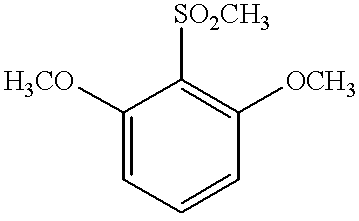 |
20% |
| Exam- ple 6 | (CH3)3SiCl (*) |
 |
75% |
| Exam- ple 7 | B(OCH3)2 (*) |
 |
20% |
| Exam- ple 8 | (CH3)S—S(CH3) (*) |
 |
50% (NMR) |
| (*): use of a commercial Na/toluene suspension | |||
Example 4 is reproduced, replacing the chlorooctane with chlorobenzene.
The isolated yield of 2,6-dimethoxytoluene is 5 34%, with formation of 36% of a side product, 2,6-dimethoxybiphenyl.
The ortho-metallation reaction is carried out as in Example 1, using different substrates and CO2 as electrophile.
| Isolated | |||
| Example | Substrate | Product formed | yield |
| Example 10 (*) |
 |
 |
35% |
| Example 11 (*) |
 |
 |
88% |
| Example 12 (*) |
 |
 |
80% |
| (*): use of a commercial Na/toluene suspension | |||
Claims (26)
1. A process for the ortho-metallation of a carbocyclic aromatic derivative bearing at least one electron-donating group, comprising reacting said carbocyclic aromatic derivative with an effective amount of at least one alkali metal in the presence of a compound of formula (I):
in which:
R represents a hydrocarbon-based radical comprising from 1 to 20 carbon atoms which may be a saturated or unsaturated, linear or branched acyclic aliphatic radical; a saturated, unsaturated, monocyclic or polycyclic cycloaliphatic radical; or a saturated or unsaturated, linear or branched aliphatic radical bearing a cyclic substituent; and
represents a bromine or chlorine atom.
2. The process according to claim 1 , wherein the carbocyclic aromatic derivative corresponds to the general formula (II): 
in which:
A symbolizes the residue of a ring forming all or part of a monocyclic or polycyclic aromatic carbocyclic system, this system comprising at least one group R′, said cyclic residue optionally bearing one or more substituents,
R′ represents one or more substituents, which may be identical or different, of electron-donating nature, which are optionally linked together, and
n is a non-zero integer less than or equal to 4.
3. The process according to claim 1 , wherein the carbocyclic aromatic derivative corresponds to the general formula (II): 
in which:
A symbolizes the residue of a ring forming all or part of a monocyclic or polycyclic aromatic carbocyclic system, this system comprising at least one group R′, said cyclic residue optionally bearing one or more substituents,
R′ is at least one radical selected from the group consisting of:
a linear or branched alkyl radical containing from 1 to 12 carbon atoms, the hydrocarbon-based chain optionally being interrupted with a hetero atom, with a functional group and/or bearing a substituent,
a carbocyclic radical which is saturated or which comprises 1 or 2 unsaturations in the ring, comprising from 3 to 8 carbon atoms in the ring, said ring optionally being substituted with substituents comprising R′, and
an aromatic carbocyclic radical comprising at least 4 carbon atoms in the ring, said ring optionally being substituted,
Z(R1) with Z representing an oxygen or sulphur atom and R1 corresponding to the definition proposed for R′ above and optionally featuring
a hydrogen atom,
a linear or branched C1 to C6 alkyl radical;
a C3 to C8, cycloalkyl radical;
a fused or non-fused C5 to C12 aryl radical;
a C1 to C12 arylalkyl radical; or
a trialkylsilyl radical,
—R2COOR1,
—R2CO—N(R3)2,
—R2—N(R3)2,
—R2—CF3;
with R2 representing a valency bond or a linear or branched, saturated or unsaturated divalent hydrocarbon-based radical containing from 1 to 6 carbon atoms, and the radicals R3, which may be identical or different, representing a hydrogen atom or a linear or branched alkyl radical containing from 1 to 6 carbon atoms, or alternatively
two groups R′ can be linked and form alkylenedioxy or alkylenedithio groups.
4. The process according to claim 1 , wherein carbocyclic aromatic derivative corresponds to the general formula (II): 
in which:
the residue A represents the residue of a monocyclic aromatic carbocyclic compound containing at least 4 carbon atoms, or the residue of a polycyclic carbocyclic compound which can comprise at least 2 aromatic carbocycles and together forming ortho- or ortho- and peri-fused systems, or comprise at least 2 carbocycles, at least one of which is aromatic, and together forming ortho- or ortho- and peri-fused systems,
R′ is at least one radical selected from the group consisting of:
a linear or branched alkyl radical comprising from 1 to 12 carbon atoms, the hydrocarbon-based chain optionally being interrupted with a hetero atom, with a functional group and/or bearing a substituent;
a carbocyclic radical which is saturated or which comprises 1 or 2 unsaturations in the ring, comprising from 3 to 8 carbon atoms in the ring, said ring optionally being substituted with substituents comprising R′, and
an aromatic carbocyclic radical, containing at least 4 carbon atoms in the ring, said ring optionally being substituted;
Z(R1) with Z representing an oxygen or sulphur atom and R1 corresponding to the definition proposed for R′ above and optionally featuring
a hydrogen atom,
a linear or branched C1 to C6 alkyl radical;
a C3 to C8 cycloalkyl radical;
a fused or non-fused C5 to C12 aryl radical;
a C1 to C12 arylalkyl radical; and
a trialkylsilyl radical,
R2COOR1,
—R2CO—N(R3)2,
—R2—N(R3)2,
—R2—CF3;
with R2 representing a valency bond or a linear or branched, saturated or unsaturated divalent hydrocarbon-based radical comprising from 1 to 6 carbon atoms, and the radicals R3, which may be identical or different, representing a hydrogen atom or a linear or branched alkyl radical comprising from 1 to 6 carbon atoms, or alternatively
two groups R′ can be linked and form alkylenedioxy or alkylenedithio groups,
n is a non-zero integer less than or equal to 4.
5. The process according to claim 1 , wherein the carbocyclic aromatic derivative corresponds to the general formula (II): 
in which:
the residue A represents the residue of a monocyclic aromatic carbocyclic compound containing at least 4 carbon atoms, or the residue of a polycyclic carbocyclic compound which can comprise at least 2 aromatic carbocycles and together forming ortho- or ortho- and peri-fused systems, or comprise at least 2 carbocycles, at least one of which is aromatic, and together forming ortho- or ortho- and peri-fused systems, and
the electron-donating substituent represented by R′ is at least one group OR1 with R1 featuring:
a hydrogen atom,
a linear or branched C1 to C6 alkyl radical;
a C3 to C8 cycloalkyl radical;
a fused or non-fused C5 to C12 aryl radical;
a C1 to C12 arylalkyl radical;
a trialkylsilyl radical.
6. The process according to claim 1 , wherein the carbocyclic aromatic derivative corresponds to the general formula (II): 
in which:
the residue A represents the residue of a monocyclic aromatic carbocyclic compound containing at least 4 carbon atoms, or the residue of a polycyclic carbocyclic compound which can comprise at least 2 aromatic carbocycles and together forming ortho- or ortho- and peri-fused systems, or comprise at least 2 carbocycles, at least one of which is aromatic, and together forming ortho- or ortho- and peri-fused systems, and
the electron-donating substituent represented by R′ is at least one group OR1 with R1 representing a linear or branched alkyl radical containing from 1 to 4 carbon atoms, an arylalkyl radical or a trialkylsilyl radical.
7. The process according to claim 1 , wherein the carbocyclic aromatic derivative corresponds to the general formula (IIa): 
in which:
R1 represents a linear or branched alkyl radical containing from 1 to 4 carbon atoms or an arylalkyl radical or a trialkylsilyl radical,
R′ is at least one radical selected from the group consisting of:
a linear or branched alkyl radical containing from 1 to 12 carbon atoms, the hydrocarbon-based chain optionally being interrupted with a hetero atom, with a functional group and/or bearing a substituent,
a carbocyclic radical which is saturated or which comprises 1 or 2 unsaturations in the ring, comprising from 3 to 8 carbon atoms in the ring, said ring possibly being substituted with substituents such as R′, and
an aromatic carbocyclic radical, comprising at least 4 carbon atoms in the ring, said ring optionally being substituted;
Z(R1) with Z representing an oxygen or sulphur atom and R1 corresponding to the definition proposed for R′ above and optionally featuring a hydrogen atom,
a linear or branched C1 to C6 alkyl radical;
a C3 to C8 cycloalkyl radical;
a fused or non-fused C5 to C12 aryl radical;
a C1 to C12 arylalkyl radical; or
a trialkylsilyl radical,
—R2COOR1,
—R2CO—N(R3)2,
—R2—N(R3)2,
—R2—CF3;
with R2 representing a valency bond or a linear or branched, saturated or unsaturated divalent hydrocarbon-based radical containing from 1 to 6 carbon atoms, and the radicals R3, which may be identical or different, representing a hydrogen atom or a linear or branched alkyl radical containing from 1 to 6 carbon atoms, or alternatively
two groups R′ can be linked and form alkylenedioxy or alkylenedithio groups, and
n is a non-zero integer less than or equal to 4.
8. The process according to claim 1 , wherein the carbocyclic aromatic derivative corresponds to the general formula (IIa): 
in which:
n ranges from 0 to 2,
R1 represents a linear or branched alkyl radical containing from 1 to 4 carbon atoms, an arylalkyl radical or a trialkylsilyl radical,
R′ represents a linear or branched alkoxy radical containing from 1 to 4 carbon atoms, or a radical OR1 with R1 as defined above.
9. The process according to claim 1 , wherein the carbocyclic aromatic derivative is selected from the group consisting of:
monoethers comprising anisole, ethoxybenzene (phenetole), propoxybenzene, isopropoxybenzene, butoxybenzene, isobutoxybenzene, 1-methoxynaphthalene, 2-methoxynaphthalene, 2-ethoxynaphthalene; and substituted monoethers such as 1-methoxy-2-allyloxybenzene, benzyloxybenzene, or phenoxytrimethylsilane; diethers comprising veratrole, 1,3-dimethoxybenzene, 1,4-dimethoxybenzene, 1,2-diethoxybenzene, 1,3-diethoxybenzene, 1,2-dimethoxybenzene, 1,3-dipropoxybenzene, 1,2-methylenedioxybenzene, 1,2-ethylenedioxybenzene; 1,3-dibenzyloxybenzene; or 1,3-diphenolbis-trimethylsilyl; and
triethers comprising 1,3,5-trimethoxybenzene and 1,3,5-triethoxybenzene.
10. The process according to claim 1 , wherein in the compound of general formula (I), R represents a group selected from the group consisting of linear or branched C1 to C10 alkyl, C3 to C10 cycloalkyl, C6 to C12 aryl or C7 to C15 alkylaryl.
11. The process according to claim 1 , wherein the compound of general formula (I) is a chloroalkane.
12. The process according to claim 1 , wherein the alkali metal is selected from the group consisting of lithium, sodium and potassium.
13. The process according to claim 1 , wherein the alkali metal is sodium in a dispersed form.
14. The process according to claim 1 , wherein the compound of general formula (I) is introduced in a proportion of at least one equivalent of the carbocyclic aromatic derivative.
15. The process according to claim 1 , wherein the alkali metal is present at between about 2 and 4 equivalents of the carbocyclic aromatic derivative.
16. The process according to claim 1 , wherein the reaction of the carbocyclic aromatic ether with the compound of formula (I) and the alkali metal is carried out in an aprotic organic liquid which is inert under the appropriate reaction conditions.
17. The process according to claim 1 , wherein the reaction of the carbocyclic aromatic ether with the compound of formula (I) and the alkali metal is carried out in a solvent selected from the group consisting of toluene, THF, xylenes and anhydrous analogues.
18. The process according to claim 1 , wherein the concentration of the aromatic derivative is between 5% and 40% by weight of the medium.
19. The process according to claim 1 , wherein the ortho-metallation reaction is carried out by first loading the alkali metal into the organic solvent.
20. The process according to claim 1 , wherein the ortho-metallation reaction is carried out by first loading the alkali metal into the organic solvent and the aromatic carbocyclic derivative is then introduced by mixing with the compound of general formula (I).
21. The process according to claim 1 , wherein the ortho-metallation reaction is carried out by first loading the alkali metal into the organic solvent and the carbocyclic aromatic derivative and the compound of general formula (I) are then successively added.
22. The process according to claim 1 , wherein the product of the metallation reaction is not isolated but rather is placed in contact in situ with an organic compound capable of reacting with it by electrophilic substitution.
23. A process for preparing 2,6-dimethoxybenzoic acid from 1,3-dimethoxybenzene via the ortho-metallation of the latter, wherein said metallation is carried out by reacting 1,3-dimethoxybenzene with an alkali metal in the presence of a compound of general formula (I):
RX (I)
in which
R represents a hydrocarbon-based radical containing from 1 to 20 carbon atoms which may be a saturated or unsaturated, linear or branched acyclic aliphatic radical; a saturated, unsaturated, monocyclic or polycyclic cycloaliphatic radical; or a saturated or unsaturated, linear or branched aliphatic radical bearing a cyclic substituent; and
X represents a bromine or chlorine atom.
24. The process according to claim 23 , wherein the compound of general formula (I) is chlorcoctane.
25. The process according to claim 23 , wherein the alkali metal is sodium.
26. The process according to claim 23 , wherein the compound of general formula (I) is chlorooctane and the alkali metal is sodium.
Applications Claiming Priority (3)
| Application Number | Priority Date | Filing Date | Title |
|---|---|---|---|
| FR9806191 | 1998-05-15 | ||
| FR9806191A FR2778656B1 (en) | 1998-05-15 | 1998-05-15 | PROCESS FOR ORTHOMETALLATION OF A CARBOCYCLIC AROMATIC DERIVATIVE CARRYING AT LEAST ONE ELECTRONIC DONOR |
| PCT/FR1999/001163 WO1999059941A1 (en) | 1998-05-15 | 1999-05-14 | Method for orthometalation of a carbocyclic aromatic derivative bearing at least an electron donor group |
Publications (1)
| Publication Number | Publication Date |
|---|---|
| US6384273B1 true US6384273B1 (en) | 2002-05-07 |
Family
ID=9526421
Family Applications (1)
| Application Number | Title | Priority Date | Filing Date |
|---|---|---|---|
| US09/700,467 Expired - Fee Related US6384273B1 (en) | 1998-05-15 | 1999-05-14 | Method for orthometalation of a carbocyclic aromatic derivative bearing at least an electron donor group |
Country Status (6)
| Country | Link |
|---|---|
| US (1) | US6384273B1 (en) |
| EP (1) | EP1077911A1 (en) |
| JP (1) | JP2002515465A (en) |
| AU (1) | AU3714599A (en) |
| FR (1) | FR2778656B1 (en) |
| WO (1) | WO1999059941A1 (en) |
Citations (1)
| Publication number | Priority date | Publication date | Assignee | Title |
|---|---|---|---|---|
| US4845277A (en) | 1988-08-22 | 1989-07-04 | Mine Safety Appliances Company | Method of preparing dialkoxybenzoic acid |
-
1998
- 1998-05-15 FR FR9806191A patent/FR2778656B1/en not_active Expired - Fee Related
-
1999
- 1999-05-14 US US09/700,467 patent/US6384273B1/en not_active Expired - Fee Related
- 1999-05-14 EP EP99919335A patent/EP1077911A1/en not_active Withdrawn
- 1999-05-14 AU AU37145/99A patent/AU3714599A/en not_active Abandoned
- 1999-05-14 WO PCT/FR1999/001163 patent/WO1999059941A1/en not_active Ceased
- 1999-05-14 JP JP2000549561A patent/JP2002515465A/en not_active Withdrawn
Patent Citations (1)
| Publication number | Priority date | Publication date | Assignee | Title |
|---|---|---|---|---|
| US4845277A (en) | 1988-08-22 | 1989-07-04 | Mine Safety Appliances Company | Method of preparing dialkoxybenzoic acid |
Non-Patent Citations (2)
| Title |
|---|
| G. Ehrhart; "Ueber Umsetzungen mit Phenylnatrium", Berichte Der Deutschen Chemischen Gesellschaft, vol. 96, No. 8, 1963, pp. 2042-2046, XP002091881. |
| J.H. Adams; "Rutaceous Constituents-13. A Biomimetic Synthesis of Acroncycine", Tetrahedron, vol. 37, 1981, pp. 209-217, XP002091880. |
Also Published As
| Publication number | Publication date |
|---|---|
| WO1999059941A1 (en) | 1999-11-25 |
| EP1077911A1 (en) | 2001-02-28 |
| FR2778656B1 (en) | 2000-12-01 |
| AU3714599A (en) | 1999-12-06 |
| JP2002515465A (en) | 2002-05-28 |
| FR2778656A1 (en) | 1999-11-19 |
Similar Documents
| Publication | Publication Date | Title |
|---|---|---|
| US6958415B2 (en) | Synthesis of pentafluorosulfuranyl arylenes | |
| Dötz et al. | Metal carbene chelates: stable reactive intermediates in cycloaddition reactions | |
| EP1275630B1 (en) | Process for producing substituted aromatic compound | |
| EP0480800B1 (en) | Process for hydroxylating of phenolic compounds | |
| MXPA01012852A (en) | Method for producing bisphenol alcoxylates. | |
| US5254776A (en) | Synthesis of bromobiphenyls | |
| US4375548A (en) | Preparation of trichloromethyl carbinols | |
| EP0200657B1 (en) | Process for the preparation of trifluoroethoxy- or trifluoroethylthiobenzenes | |
| FR2944012A1 (en) | PROCESS FOR HYDROXYLATION OF PHENOLS AND ETHERS OF PHENOLS | |
| US11987538B2 (en) | Method for producing cyclic olefin compound | |
| US7794632B2 (en) | Process for the preparation of pure aryllithium compounds and their use | |
| WO1999059941A1 (en) | Method for orthometalation of a carbocyclic aromatic derivative bearing at least an electron donor group | |
| US6586599B1 (en) | Catalyzed coupling reactions of aryl halides with silanes | |
| Itoh et al. | Regioselective Cleavage of Aryl Decyl Ethers with Alkali Metals | |
| US4560814A (en) | Process for alkylating halogenated and trifluoromethylated benzene compounds | |
| US3787513A (en) | Aryl substituted methane compounds | |
| US6881869B1 (en) | Method for preparing substituted mixed alkynyl ethers | |
| JP2002003427A (en) | Method for producing substituted aromatic compound | |
| FR2768729A1 (en) | A new process for the acylation of an aromatic compound | |
| KR102916291B1 (en) | Selective alkylation of cyclopentadiene | |
| USRE31771E (en) | Process for the preparation of ortho-(hydrocarbylthio)-phenols | |
| US3390173A (en) | Solvent-base system and its use in organic reactions | |
| FR2793792A1 (en) | PROCESS FOR ALPHA-METALLATION OF A HETEROCYCLIC, MONOCYCLIC OR POLYCYCLIC DERIVATIVE AND HAVING AT LEAST ONE HATEROCYCLE WITH 5 ATOMS, UNSATURATED OR AROMATIC | |
| US5451703A (en) | Process for the preparation of biaryls | |
| JPH09143150A (en) | Method for producing aromatic sulfone |
Legal Events
| Date | Code | Title | Description |
|---|---|---|---|
| AS | Assignment |
Owner name: RHODIA CHIMIE, FRANCE Free format text: ASSIGNMENT OF ASSIGNORS INTEREST;ASSIGNORS:PEVERE, VIRGINIE;DESMURS, JEAN-ROGER;MIOSKOWSKI, CHARLES;AND OTHERS;REEL/FRAME:011451/0781 Effective date: 20001128 |
|
| REMI | Maintenance fee reminder mailed | ||
| LAPS | Lapse for failure to pay maintenance fees | ||
| STCH | Information on status: patent discontinuation |
Free format text: PATENT EXPIRED DUE TO NONPAYMENT OF MAINTENANCE FEES UNDER 37 CFR 1.362 |
|
| FP | Lapsed due to failure to pay maintenance fee |
Effective date: 20060507 |