US6383728B2 - Color photographic silver halide material - Google Patents

Color photographic silver halide material Download PDF

Info

Publication number
US6383728B2
US6383728B2 US09/734,634 US73463400A US6383728B2 US 6383728 B2 US6383728 B2 US 6383728B2 US 73463400 A US73463400 A US 73463400A US 6383728 B2 US6383728 B2 US 6383728B2
Authority
US
United States
Prior art keywords
aryl
alkyl
color photographic
material according
hetaryl
Prior art date
Legal status (The legal status is an assumption and is not a legal conclusion. Google has not performed a legal analysis and makes no representation as to the accuracy of the status listed.)
Expired - Fee Related
Application number
US09/734,634
Other versions
US20010016304A1 (en
Inventor
Jörg Hagemann
Jan Haller
Günter Helling
Current Assignee (The listed assignees may be inaccurate. Google has not performed a legal analysis and makes no representation or warranty as to the accuracy of the list.)
AgfaPhoto GmbH
Original Assignee
Agfa Gevaert NV
Priority date (The priority date is an assumption and is not a legal conclusion. Google has not performed a legal analysis and makes no representation as to the accuracy of the date listed.)
Filing date
Publication date
Application filed by Agfa Gevaert NV filed Critical Agfa Gevaert NV
Assigned to AGFA-GEVAERT N.V. reassignment AGFA-GEVAERT N.V. ASSIGNMENT OF ASSIGNORS INTEREST (SEE DOCUMENT FOR DETAILS). Assignors: HAGEMANN, JORG, HALLER, JAN, HELLING, GUNTER
Publication of US20010016304A1 publication Critical patent/US20010016304A1/en
Priority to US10/016,311 priority Critical patent/US6436623B1/en
Application granted granted Critical
Publication of US6383728B2 publication Critical patent/US6383728B2/en
Assigned to AGFAPHOTO GMBH reassignment AGFAPHOTO GMBH ASSIGNMENT OF ASSIGNORS INTEREST (SEE DOCUMENT FOR DETAILS). Assignors: AGFA-GEVAERT
Anticipated expiration legal-status Critical
Expired - Fee Related legal-status Critical Current

Links

Classifications

    • GPHYSICS
    • G03PHOTOGRAPHY; CINEMATOGRAPHY; ANALOGOUS TECHNIQUES USING WAVES OTHER THAN OPTICAL WAVES; ELECTROGRAPHY; HOLOGRAPHY
    • G03CPHOTOSENSITIVE MATERIALS FOR PHOTOGRAPHIC PURPOSES; PHOTOGRAPHIC PROCESSES, e.g. CINE, X-RAY, COLOUR, STEREO-PHOTOGRAPHIC PROCESSES; AUXILIARY PROCESSES IN PHOTOGRAPHY
    • G03C7/00Multicolour photographic processes or agents therefor; Regeneration of such processing agents; Photosensitive materials for multicolour processes
    • G03C7/30Colour processes using colour-coupling substances; Materials therefor; Preparing or processing such materials
    • G03C7/32Colour coupling substances
    • G03C7/34Couplers containing phenols
    • G03C7/346Phenolic couplers
    • GPHYSICS
    • G03PHOTOGRAPHY; CINEMATOGRAPHY; ANALOGOUS TECHNIQUES USING WAVES OTHER THAN OPTICAL WAVES; ELECTROGRAPHY; HOLOGRAPHY
    • G03CPHOTOSENSITIVE MATERIALS FOR PHOTOGRAPHIC PURPOSES; PHOTOGRAPHIC PROCESSES, e.g. CINE, X-RAY, COLOUR, STEREO-PHOTOGRAPHIC PROCESSES; AUXILIARY PROCESSES IN PHOTOGRAPHY
    • G03C7/00Multicolour photographic processes or agents therefor; Regeneration of such processing agents; Photosensitive materials for multicolour processes
    • G03C7/30Colour processes using colour-coupling substances; Materials therefor; Preparing or processing such materials
    • G03C7/32Colour coupling substances
    • G03C7/36Couplers containing compounds with active methylene groups
    • G03C7/38Couplers containing compounds with active methylene groups in rings
    • G03C7/381Heterocyclic compounds
    • G03C7/382Heterocyclic compounds with two heterocyclic rings
    • G03C7/3825Heterocyclic compounds with two heterocyclic rings the nuclei containing only nitrogen as hetero atoms
    • G03C7/3835Heterocyclic compounds with two heterocyclic rings the nuclei containing only nitrogen as hetero atoms four nitrogen atoms
    • GPHYSICS
    • G03PHOTOGRAPHY; CINEMATOGRAPHY; ANALOGOUS TECHNIQUES USING WAVES OTHER THAN OPTICAL WAVES; ELECTROGRAPHY; HOLOGRAPHY
    • G03CPHOTOSENSITIVE MATERIALS FOR PHOTOGRAPHIC PURPOSES; PHOTOGRAPHIC PROCESSES, e.g. CINE, X-RAY, COLOUR, STEREO-PHOTOGRAPHIC PROCESSES; AUXILIARY PROCESSES IN PHOTOGRAPHY
    • G03C7/00Multicolour photographic processes or agents therefor; Regeneration of such processing agents; Photosensitive materials for multicolour processes
    • G03C7/30Colour processes using colour-coupling substances; Materials therefor; Preparing or processing such materials
    • G03C7/392Additives
    • G03C7/39208Organic compounds
    • G03C7/3924Heterocyclic
    • G03C7/39268Heterocyclic the nucleus containing only oxygen as hetero atoms

Definitions

  • This invention relates to a color photographic silver halide material having a novel cyan coupler.
  • the object of the invention was to provide cyan couplers which are improved with regard to these properties. This object is achieved with the couplers described below.
  • the present invention accordingly provides a color photographic silver halide material having a support and at least one photosensitive silver halide emulsion layer which is associated with a cyan coupler of the formula (I):
  • R 1 , R 2 mean H, alkyl, alkenyl, aryl or hetaryl,
  • R 3 means alkyl, alkenyl, aryl or hetaryl
  • Z 1 means H or a group eliminable under the conditions of chromogenic development
  • Y 1 means —COR 4 , —CO 2 R 4 , —CONR 4 R 5 , —SO 2 R 4 , —SO 2 NR 4 R 5 , —CO—CO 2 R 4 , —COCONR 4 R 5 or a group of the formula
  • R 4 means alkyl, alkenyl, aryl or hetaryl
  • R 5 means H or R 4 ,
  • R 6 means —N ⁇ or —C(R 9 ) ⁇
  • R 7 , R 8 , R 9 mean —OR 5 , —SR 5 , —NR 4 R 5 , —R 5 or Cl and
  • n 1 or 2.
  • n means 2
  • Y 1 means —SO 2 R 10 , —SO 2 N(R 10 ) 2
  • —CO 2 R 10 means —COCO 2 —R 10 or —COCO—N(R 10 ) 2 and R 10 means alkyl, aryl, alkenyl or hetaryl and
  • R 1 to R 3 and Z 1 have the stated meaning.
  • R 1 to R 3 , R 6 to R 8 and Z 1 have the stated meaning.
  • R 10 means H, Cl, CN, Br, F, alkylcarbonyl, arylcarbonyl, alkylaminocarbonyl, arylaminocarbonyl, alkoxycarbonyl or aryloxycarbonyl and R 1 to R 3 and Z 1 have the stated meaning.
  • R 1 , R 2 H alkyl, aryl,
  • R 3 alkyl, aryl,
  • R 7 , R 8 OR 5 , —NR 4 R 5 , —Cl.
  • R 2 means H
  • R 4 means alkyl or aryl.
  • Alkyl and alkenyl residues may be linear, branched or cyclic and in turn be substituted.
  • Aryl and hetaryl residues may in turn be substituted, wherein aryl is in particular phenyl.
  • alkyl, alkenyl, aryl or hetaryl residues are: alkyl, alkenyl, aryl, hetaryl, alkoxy, aryloxy, alkenyloxy, hydroxy, alkylthio, arylthio, halogen, cyano, acyl, acyloxy, acylamino, wherein an acyl residue may be derived from an aliphatic, olefinic or aromatic carbonic, carboxylic, carbamic, sulfonic, sulfonamido, sulfinic, phosphoric, phosphonic or phosphorous acid.
  • the compounds of the formula (I) are preferably used in a quantity of 5 to 2000 mg/m 2 , in particular of 10 to 1000 mg/m 2 and very particularly preferably in a quantity of 20 to 500 mg/m 2 of the material.
  • color photographic materials are color negative films, color reversal films, color positive films, color photographic paper, color reversal photographic paper, color-sensitive materials for the dye diffusion transfer process or the silver dye bleaching process.
  • a review may be found in Research Disclosure 37038 (1995) and Research Disclosure 38957 (1996).
  • the photographic materials consist of a support, onto which at least one photosensitive silver halide emulsion layer is applied.
  • Suitable supports are in particular thin films and sheets.
  • a review of support materials and auxiliary layers applied to the front and reverse sides thereof is given in Research Disclosure 37254, part 1 (1995), page 285 and in Research Disclosure 38957, part XV (1996), page 627.
  • the color photographic materials conventionally contain at least one red-sensitive, one green-sensitive and one blue-sensitive silver halide emulsion layer, optionally together with interlayers and protective layers.
  • these layers may be differently arranged. This is demonstrated for the most important products:
  • Colour photographic films such as color negative films and color reversal films have on the support, in the stated sequence, 2 or 3 red-sensitive, cyan-coupling silver halide emulsion layers, 2 or 3 green-sensitive, magenta-coupling silver halide emulsion layers and 2 or 3 blue-sensitive, yellow-coupling silver halide emulsion layers.
  • the layers of identical spectral sensitivity differ with regard to their photographic sensitivity, wherein the less sensitive sublayers are generally arranged closer to the support than the more highly sensitive sublayers.
  • a yellow filter layer is conventionally located between the green-sensitive and blue-sensitive layers which prevents blue light from penetrating into the underlying layers.
  • Colour photographic paper which is usually substantially less photosensitive than a color photographic film, conventionally has on the support, in the stated sequence, one blue-sensitive, yellow-coupling silver halide emulsion layer, one green-sensitive, magenta-coupling silver halide emulsion layer and one red-sensitive, cyan-coupling silver halide emulsion layer; the yellow filter layer may be omitted.
  • the number and arrangement of the photosensitive layers may be varied in order to achieve specific results. For example, all high sensitivity layers may be grouped together in one package of layers and all low sensitivity layers may be grouped together in another package of layers in order to increase sensitivity (DE 25 30 645).
  • the substantial constituents of the photographic emulsion layers are binder, silver halide grains and color couplers.
  • Photographic materials with camera sensitivity conventionally contain silver bromide-iodide emulsions, which may optionally contain small proportions of silver chloride.
  • Photographic print materials contain either silver chloride-bromide emulsions containing up to 80 wt. % of AgBr or silver chloride-bromide emulsions containing above 95 mol % of AgCl.
  • color couplers may be found in Research Disclosure 37254, part 4 (1995), page 288, in Research Disclosure 37038, part II (1995), page 80 and in Research Disclosure 38957, part X.B (1996), page 616.
  • the maximum absorption of the dyes formed from the couplers and the developer oxidation product is preferably within the following ranges: yellow coupler 430 to 460 nm, magenta coupler 540 to 560 nm, cyan coupler 630 to 700 nm.
  • Colour couplers which are usually hydrophobic, as well as other hydrophobic constituents of the layers, are conventionally dissolved or dispersed in high-boiling organic solvents. These solutions or dispersions are then emulsified into an aqueous binder solution (conventionally a gelatine solution) and, once the layers have dried, are present as fine droplets (0.05 to 0.8 ⁇ m in diameter) in the layers.
  • aqueous binder solution conventionally a gelatine solution
  • fine droplets 0.05 to 0.8 ⁇ m in diameter
  • the non-photosensitive interlayers generally arranged between layers of different spectral sensitivity may contain agents which prevent an undesirable diffusion of developer oxidation products from one photosensitive layer into another photosensitive layer with a different spectral sensitisation.
  • Suitable compounds may be found in Research Disclosure 37254, part 7 (1995), page 292, in Research Disclosure 37038, part III (1995), page 84 and in Research Disclosure 38957, part X.D (1996), pages 621 et seq.
  • the photographic material may also contain UV light absorbing compounds, optical brighteners, spacers, filter dyes, formalin scavengers, light stabilisers, antioxidants, D min dyes, plasticisers (latices), biocides and additives to improve coupler and dye stability, to reduce color fogging and to reduce yellowing, and others.
  • Suitable compounds may be found in Research Disclosure 37254, part 8 (1995), page 292, in Research Disclosure 37038, parts IV, V, VI, VII, X, XI and XIII (1995), pages 84 et seq. and in Research Disclosure 38957, parts VI, VIII, IX and X (1996), pages 607 and 610 et seq.
  • the layers of color photographic materials are conventionally hardened, i.e. the binder used, preferably gelatine, is crosslinked by appropriate chemical methods.
  • Suitable hardener substances may be found in Research Disclosure 37254, part 9 (1995), page 294, in Research Disclosure 37038, part XII (1995), page 86 and in Research Disclosure 38957, part II.B (1996), page 599.
  • magenta couplers preferably comprise those having pyrazolotriazole structures of the formulae (II) or (III)
  • X 21 means H or a group eliminable under the conditions of chromogenic development
  • R 21 means optionally substituted alkyl
  • R 22 means R 21 or aryl
  • cyan couplers of the formula (I) according to the invention may be used in the same or in another layer.
  • the DOP scavenger preferably comprises benzofuranones of the formula (IV)
  • R 41 means alkyl, cycloalkyl, aryl, halogen, SR 45 , NR 46 R 47 , nitro, cyano, SO 2 R 48 , COOR 49 , COR 50 , hetaryl or hydrogen,
  • R 42 has the same meaning as R 41 or means OR 52 ,
  • R 43 and R 44 mutually independently mean OR 51 or have the meaning of R 41 ,
  • R 45 , R 49 mutually independently mean alkyl, cycloalkyl, alkenyl, aryl or hetaryl,
  • R 46 , R 47 mutually independently mean H, R 44 , COR 50 , COOR 49 , SO 2 R 48 ,
  • R 48 , R 50 mutually independently mean alkyl, cycloalkyl, alkenyl, aryl, hetaryl or NR 40 R 47 ,
  • R 51 means hydrogen, alkyl or aryl
  • R 52 means hydrogen, alkyl, aryl, alkylcarbonyl, alkenylcarbonyl, arylcarbonyl, alkoxycarbonyl, alkenyloxycarbonyl, carbamoyl, alkylsulfonyl or arylsulfonyl,
  • o 0, 1, 2, 3 or 4 and
  • p 0, 1, 2, or 3
  • residues R 43 or R 44 may in each case mean a fused carbo- or heterocyclic ring or the compound of the formula (IV) is attached to a polymer chain via a residue R 43 or R 44 .
  • a color photographic recording material suitable for rapid processing was produced by applying the following layers in the stated sequence onto a layer support of paper coated on both sides with polyethylene. Quantities are stated in each case per 1 m 2 . The silver halide application rate is stated as the corresponding quantities of AgNO 3 .
  • Layer structure 101 Layer 1: (Substrate layer) 0.10 g of gelatine
  • Layer 2 (Blue-sensitive layer) Blue-sensitive silver halide emulsion (99.5 mol % chloride, 0.5 mol % bromide, average grain diameter 0.75 ⁇ m) prepared from 0.4 g of AgNO 3 , spectrally sensitised with 0.6 mg of compound BS-1 1.25 g of gelatine 0.30 g of yellow coupler GB-1 0.15 g of yellow coupler GB-2 0.30 g of tricresyl phosphate (TCP) 0.10 g of isooctadecanol 0.05 g of stabiliser ST-1 0.10 g of stabiliser ST-2
  • Layer 3 (Interlayer) 0.10 g of gelatine 0.08 g of DOP scavenger S-4 0.04 g of DOP scavenger SC-1 0.01 g of DOP scavenger SC-2 0.12 g of TCP
  • Layer 4 Green-sensitive layer) Green
  • oil formers are also used in the other samples:

Landscapes

  • Physics & Mathematics (AREA)
  • General Physics & Mathematics (AREA)
  • Silver Salt Photography Or Processing Solution Therefor (AREA)

Abstract

A color photographic silver halide material having a support and at least one photosensitive silver halide emulsion layer which is associated with a cyan coupler of the formula (I):in whichR1, R2, R3, Z1, Y1 and n have the meaning stated in the description,is distinguished by elevated dye stability of the dye produced from the coupler by chromogenic processing.

Description

This invention relates to a color photographic silver halide material having a novel cyan coupler.
It is known from JP-N 59 111 645, U.S. Pat. No. 5,008,180 and U.S. Pat. No. 5,686,235 to use 2,5-diacylaminophenols having a sulfonyl group as cyan couplers. However, the color reproduction and dye stability of the dyes produced from the couplers by chromogenic processing do not meet requirements.
The object of the invention was to provide cyan couplers which are improved with regard to these properties. This object is achieved with the couplers described below.
The present invention accordingly provides a color photographic silver halide material having a support and at least one photosensitive silver halide emulsion layer which is associated with a cyan coupler of the formula (I):
Figure US06383728-20020507-C00002
in which
R1, R2 mean H, alkyl, alkenyl, aryl or hetaryl,
R3 means alkyl, alkenyl, aryl or hetaryl,
Z1 means H or a group eliminable under the conditions of chromogenic development,
Y1 means —COR4, —CO2R4, —CONR4R5, —SO2R4, —SO2NR4R5, —CO—CO2R4, —COCONR4R5 or a group of the formula
Figure US06383728-20020507-C00003
R4 means alkyl, alkenyl, aryl or hetaryl,
R5 means H or R4,
R6 means —N═ or —C(R9)═
R7, R8, R9 mean —OR5, —SR5, —NR4R5, —R5 or Cl and
n means 1 or 2.
Within the formula, the following groups of couplers are preferred:
(1) couplers in which n means 1 and R1 to R9, Z1 and Y1 have the stated meaning.
(2) couplers in which n means 2, Y1 means —CO—Y11 and Y11 means alkenyl or hetaryl and R1 to R3 and Z1 have the stated meaning.
(3) couplers in which n means 2, Y1 means —SO2R10, —SO2N(R10)2, —CO2R10, —COCO2—R10 or —COCO—N(R10)2 and R10 means alkyl, aryl, alkenyl or hetaryl and
R1 to R3 and Z1 have the stated meaning.
(4) couplers in which n means 2, Y1 means a residue of the formula
Figure US06383728-20020507-C00004
 and R1 to R3, R6 to R8 and Z1 have the stated meaning.
(5) couplers in which n means 2, Y1 means a residue of the formula
Figure US06383728-20020507-C00005
 wherein
R10 means H, Cl, CN, Br, F, alkylcarbonyl, arylcarbonyl, alkylaminocarbonyl, arylaminocarbonyl, alkoxycarbonyl or aryloxycarbonyl and R1 to R3 and Z1 have the stated meaning.
In the formula (I) and the compounds (1) to (4), the substituents have the following preferred meaning:
R1, R2H, alkyl, aryl,
R3 alkyl, aryl,
Z1 H, Cl, alkoxy, aryloxy, alkylthio, arylthio,
R6 —N═,
R7, R8—OR5, —NR4R5, —Cl.
Very particularly preferably,
R2 means H and
R4 means alkyl or aryl.
Alkyl and alkenyl residues may be linear, branched or cyclic and in turn be substituted.
Aryl and hetaryl residues may in turn be substituted, wherein aryl is in particular phenyl.
Possible substituents for the alkyl, alkenyl, aryl or hetaryl residues are: alkyl, alkenyl, aryl, hetaryl, alkoxy, aryloxy, alkenyloxy, hydroxy, alkylthio, arylthio, halogen, cyano, acyl, acyloxy, acylamino, wherein an acyl residue may be derived from an aliphatic, olefinic or aromatic carbonic, carboxylic, carbamic, sulfonic, sulfonamido, sulfinic, phosphoric, phosphonic or phosphorous acid.
Examples of compounds according to the invention in which n=2 are:
Nr. R1 R2 R3 Y1 Z1
I-1  —C2H5 H
Figure US06383728-20020507-C00006
Figure US06383728-20020507-C00007
—Cl
I-2  —C2H5 H
Figure US06383728-20020507-C00008
Figure US06383728-20020507-C00009
—H
I-3  —C6H13 H
Figure US06383728-20020507-C00010
Figure US06383728-20020507-C00011
—OCH2CH2—SCH2COOH
I-4  -phenyl H
Figure US06383728-20020507-C00012
Figure US06383728-20020507-C00013
—Cl
I-5  —CH3 —CH3 —C16H33
Figure US06383728-20020507-C00014
—Cl
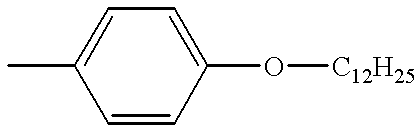
I-6  -phenyl H —C12H27
Figure US06383728-20020507-C00015
—SCH2CH2—COOH
I-7  —C2H5 H
Figure US06383728-20020507-C00016
Figure US06383728-20020507-C00017
—O—CH2—COOCH3
I-8  C12H25 H
Figure US06383728-20020507-C00018
Figure US06383728-20020507-C00019
—Cl
I-9  —C3H7-i H
Figure US06383728-20020507-C00020
Figure US06383728-20020507-C00021
—Cl
I-10 —CH3 —CH3
Figure US06383728-20020507-C00022
Figure US06383728-20020507-C00023
Figure US06383728-20020507-C00024
I-11 —C2H5 H
Figure US06383728-20020507-C00025
Figure US06383728-20020507-C00026
—Cl
I-12 -phenyl H —C16H33
Figure US06383728-20020507-C00027
H
I-13 —C12H25 H
Figure US06383728-20020507-C00028
Figure US06383728-20020507-C00029
—Cl
I-14 —C4H9 H
Figure US06383728-20020507-C00030
Figure US06383728-20020507-C00031
—OCH2COOCH3
I-15 —CH3 —CH3
Figure US06383728-20020507-C00032
Figure US06383728-20020507-C00033
—Cl
I-16 —C2H5 H
Figure US06383728-20020507-C00034
—SO2—C4H9 —Cl
I-17 —C2H5 H
Figure US06383728-20020507-C00035
—CO—O—C4H9-i —Cl
I-18 —C3H7-i H
Figure US06383728-20020507-C00036
Figure US06383728-20020507-C00037
—OCH2—COOCH3
I-19 -phenyl H
Figure US06383728-20020507-C00038
—SO2—NH—C4H9-t H
I-20 —C6H13 H
Figure US06383728-20020507-C00039
Figure US06383728-20020507-C00040
H
I-21 —CH3 —CH3
Figure US06383728-20020507-C00041
—CO—CO—OC2H5 —Cl
I-22 —C4H9 H
Figure US06383728-20020507-C00042
—SO2—CH3 —Cl
I-23 -phenyl -phenyl —C12H25 —SO2C4H9 —SCH2CH2—COOH
I-24 —C12H25 H
Figure US06383728-20020507-C00043
—CO—O—C2H5 —Cl
I-25 —C2H5 H
Figure US06383728-20020507-C00044
Figure US06383728-20020507-C00045
Cl
I-26 —CH3 H
Figure US06383728-20020507-C00046
Figure US06383728-20020507-C00047
Cl
I-27 —C2H5 H
Figure US06383728-20020507-C00048
Figure US06383728-20020507-C00049
Cl
Examples of compounds according to the invention in which n = 2 and
Figure US06383728-20020507-C00050
are:
No. R1 R2 R3 R7 R8 R6 Z1
I-28 —C2H5 H
Figure US06383728-20020507-C00051
—N(C4H9)2 —N(C4H9)2 —N═ —C—
I-29 —C2H5 H
Figure US06383728-20020507-C00052
Figure US06383728-20020507-C00053
Figure US06383728-20020507-C00054
—N═ —Cl
I-30 —C2H5 H
Figure US06383728-20020507-C00055
—OCH3 —OCH3 —N═ —Cl
I-31 —C6H13 H
Figure US06383728-20020507-C00056
—Cl —NH—C4H9 —C(NHC4H9)═ H
I-32 -phenyl H —C12H25 —OCH3 —N(C4H9)2 —N═ —OCH2COOCH3
I-33 —CH3 —CH3
Figure US06383728-20020507-C00057
—NH—C4H9 —NH—C4H9 —C(N(C2H5)2)═ —Cl
I-34 H H
Figure US06383728-20020507-C00058
—OCH3 —NH—C4H9 —N═ —S—CH2CH2—COOH
I-35 —CH3 H
Figure US06383728-20020507-C00059
—Cl
Figure US06383728-20020507-C00060
—N═ —Cl
Compounds according to the invention in which n = 1 are:
No. R1 R2 R3 Y1 Z1
I-36 —C2H5 H
Figure US06383728-20020507-C00061
Figure US06383728-20020507-C00062
—Cl
I-37 —C4H9 H
Figure US06383728-20020507-C00063
—CO—C3H7 —Cl
I-38 —C6H13 H
Figure US06383728-20020507-C00064
Figure US06383728-20020507-C00065
—OCH2CH2—S—CH2COOH
I-39 —CH3 —CH3
Figure US06383728-20020507-C00066
Figure US06383728-20020507-C00067
H
I-40 -phenyl H
Figure US06383728-20020507-C00068
Figure US06383728-20020507-C00069
—Cl
I-41 —C2H5 H
Figure US06383728-20020507-C00070
Figure US06383728-20020507-C00071
H
I-42 —C12H25 H
Figure US06383728-20020507-C00072
Figure US06383728-20020507-C00073
Figure US06383728-20020507-C00074
I-43 —C4H9 H —C12H25
Figure US06383728-20020507-C00075
—Cl
I-44 —C2H5 H
Figure US06383728-20020507-C00076
—SO2—C4H9 —Cl
I-45 —C3H7-i H —C16H33
Figure US06383728-20020507-C00077
—O—CH2—COO—CH3
I-46 —CH2CH2CH2CH2
Figure US06383728-20020507-C00078
Figure US06383728-20020507-C00079
—Cl
I-47 —C2H5 —C2H5
Figure US06383728-20020507-C00080
—CO—O—C4H9-i H
I-48 -phenyl H —C12H25 —CO—CO—N(C4H9)2
Figure US06383728-20020507-C00081
I-49 —C12H25 H
Figure US06383728-20020507-C00082
—CO—CH═CH—CO—N(C2H5)2 —Cl
I-50 —C2H5 H
Figure US06383728-20020507-C00083
Figure US06383728-20020507-C00084
—Cl
I-51 —C6H13 H
Figure US06383728-20020507-C00085
Figure US06383728-20020507-C00086
H
I-52 —C4H9 H
Figure US06383728-20020507-C00087
Figure US06383728-20020507-C00088
—Cl
I-53 —CH3 H
Figure US06383728-20020507-C00089
Figure US06383728-20020507-C00090
—Cl
I-54 -phenyl H
Figure US06383728-20020507-C00091
Figure US06383728-20020507-C00092
H
I-55 —C2H5 H
Figure US06383728-20020507-C00093
Figure US06383728-20020507-C00094
—Cl
I-56 —C2H5 H
Figure US06383728-20020507-C00095
Figure US06383728-20020507-C00096
Cl
I-57 —C3H7 H
Figure US06383728-20020507-C00097
Figure US06383728-20020507-C00098
Cl
I-58 —C2H5 H
Figure US06383728-20020507-C00099
Figure US06383728-20020507-C00100
H
I-59 —H H
Figure US06383728-20020507-C00101
Figure US06383728-20020507-C00102
Cl
I-60 —C2H5 H
Figure US06383728-20020507-C00103
Figure US06383728-20020507-C00104
Cl
The compounds according to the invention are produced in an analogous manner to the method stated in U.S. Pat. No. 5,686,235.
The compounds of the formula (I) are preferably used in a quantity of 5 to 2000 mg/m2, in particular of 10 to 1000 mg/m2 and very particularly preferably in a quantity of 20 to 500 mg/m2 of the material.
Examples of color photographic materials are color negative films, color reversal films, color positive films, color photographic paper, color reversal photographic paper, color-sensitive materials for the dye diffusion transfer process or the silver dye bleaching process. A review may be found in Research Disclosure 37038 (1995) and Research Disclosure 38957 (1996).
The photographic materials consist of a support, onto which at least one photosensitive silver halide emulsion layer is applied. Suitable supports are in particular thin films and sheets. A review of support materials and auxiliary layers applied to the front and reverse sides thereof is given in Research Disclosure 37254, part 1 (1995), page 285 and in Research Disclosure 38957, part XV (1996), page 627.
The color photographic materials conventionally contain at least one red-sensitive, one green-sensitive and one blue-sensitive silver halide emulsion layer, optionally together with interlayers and protective layers.
Depending upon the type of photographic material, these layers may be differently arranged. This is demonstrated for the most important products:
Colour photographic films such as color negative films and color reversal films have on the support, in the stated sequence, 2 or 3 red-sensitive, cyan-coupling silver halide emulsion layers, 2 or 3 green-sensitive, magenta-coupling silver halide emulsion layers and 2 or 3 blue-sensitive, yellow-coupling silver halide emulsion layers. The layers of identical spectral sensitivity differ with regard to their photographic sensitivity, wherein the less sensitive sublayers are generally arranged closer to the support than the more highly sensitive sublayers.
A yellow filter layer is conventionally located between the green-sensitive and blue-sensitive layers which prevents blue light from penetrating into the underlying layers.
Possible options for different layer arrangements and the effects thereof on photographic properties are described in J. Inf. Rec. Mats., 1994, volume 22, pages 183-193 and in Research Disclosure 38957, part XI (1996), page 624.
Colour photographic paper, which is usually substantially less photosensitive than a color photographic film, conventionally has on the support, in the stated sequence, one blue-sensitive, yellow-coupling silver halide emulsion layer, one green-sensitive, magenta-coupling silver halide emulsion layer and one red-sensitive, cyan-coupling silver halide emulsion layer; the yellow filter layer may be omitted.
The number and arrangement of the photosensitive layers may be varied in order to achieve specific results. For example, all high sensitivity layers may be grouped together in one package of layers and all low sensitivity layers may be grouped together in another package of layers in order to increase sensitivity (DE 25 30 645).
The substantial constituents of the photographic emulsion layers are binder, silver halide grains and color couplers.
Details of suitable binders may be found in Research Disclosure 37254, part 2 (1995), page 286 and in Research Disclosure 38957, part II.A (1996), page 598.
Details of suitable silver halide emulsions, the production, ripening, stabilisation and spectral sensitisation thereof, including suitable spectral sensitisers, may be found in Research Disclosure 37254, part 3 (1995), page 286, in Research Disclosure 37038, part XV (1995), page 89 and in Research Disclosure 38957, part V.A (1996), page 603.
Photographic materials with camera sensitivity conventionally contain silver bromide-iodide emulsions, which may optionally contain small proportions of silver chloride. Photographic print materials contain either silver chloride-bromide emulsions containing up to 80 wt. % of AgBr or silver chloride-bromide emulsions containing above 95 mol % of AgCl.
Details of color couplers maybe found in Research Disclosure 37254, part 4 (1995), page 288, in Research Disclosure 37038, part II (1995), page 80 and in Research Disclosure 38957, part X.B (1996), page 616. The maximum absorption of the dyes formed from the couplers and the developer oxidation product is preferably within the following ranges: yellow coupler 430 to 460 nm, magenta coupler 540 to 560 nm, cyan coupler 630 to 700 nm.
In order to improve sensitivity, grain, sharpness and color separation in color photographic films, compounds are frequently used which, on reaction with the developer oxidation product, release photographically active compounds, for example DIR couplers which eliminate a development inhibitor.
Details relating to such compounds, in particular couplers, may be found in Research Disclosure 37254, part 5 (1995), page 290, in Research Disclosure 37038, part XIV (1995), page 86 and in Research Disclosure 38957, part X.C (1996), page 618.
Colour couplers, which are usually hydrophobic, as well as other hydrophobic constituents of the layers, are conventionally dissolved or dispersed in high-boiling organic solvents. These solutions or dispersions are then emulsified into an aqueous binder solution (conventionally a gelatine solution) and, once the layers have dried, are present as fine droplets (0.05 to 0.8 μm in diameter) in the layers.
Suitable high-boiling organic solvents, methods for the introduction thereof into the layers of a photographic material and further methods for introducing chemical compounds into photographic layers may be found in Research Disclosure 37254, part 6 (1995), page 292.
The non-photosensitive interlayers generally arranged between layers of different spectral sensitivity may contain agents which prevent an undesirable diffusion of developer oxidation products from one photosensitive layer into another photosensitive layer with a different spectral sensitisation.
Suitable compounds (white couplers, scavengers or DOP scavengers) may be found in Research Disclosure 37254, part 7 (1995), page 292, in Research Disclosure 37038, part III (1995), page 84 and in Research Disclosure 38957, part X.D (1996), pages 621 et seq.
The photographic material may also contain UV light absorbing compounds, optical brighteners, spacers, filter dyes, formalin scavengers, light stabilisers, antioxidants, Dmin dyes, plasticisers (latices), biocides and additives to improve coupler and dye stability, to reduce color fogging and to reduce yellowing, and others. Suitable compounds may be found in Research Disclosure 37254, part 8 (1995), page 292, in Research Disclosure 37038, parts IV, V, VI, VII, X, XI and XIII (1995), pages 84 et seq. and in Research Disclosure 38957, parts VI, VIII, IX and X (1996), pages 607 and 610 et seq.
The layers of color photographic materials are conventionally hardened, i.e. the binder used, preferably gelatine, is crosslinked by appropriate chemical methods.
Suitable hardener substances may be found in Research Disclosure 37254, part 9 (1995), page 294, in Research Disclosure 37038, part XII (1995), page 86 and in Research Disclosure 38957, part II.B (1996), page 599.
Once exposed with an image, color photographic materials are processed using different processes depending upon their nature. Details relating to processing methods and the necessary chemicals are disclosed in Research Disclosure 37254, part 10 (1995), page 294, in Research Disclosure 37038, parts XVI to XXIII (1995), pages 95 et seq. and in Research Disclosure 38957, parts XVIII, XIX and XX (1996), pages 630 et seq. together with example materials.
The magenta couplers preferably comprise those having pyrazolotriazole structures of the formulae (II) or (III)
Figure US06383728-20020507-C00105
in which
X21 means H or a group eliminable under the conditions of chromogenic development,
R21 means optionally substituted alkyl,
R22 means R21 or aryl,
wherein the sum of all the C atoms of the residues R21 and R22 in one coupler molecule is at least 12.
Examples of suitable couplers are:
Figure US06383728-20020507-C00106
Figure US06383728-20020507-C00107
Apart from the cyan couplers of the formula (I) according to the invention, further cyan couplers may be used in the same or in another layer.
Examples of these are:
Figure US06383728-20020507-C00108
Figure US06383728-20020507-C00109
Figure US06383728-20020507-C00110
The DOP scavenger preferably comprises benzofuranones of the formula (IV)
Figure US06383728-20020507-C00111
in which
R41 means alkyl, cycloalkyl, aryl, halogen, SR45, NR46R47, nitro, cyano, SO2R48, COOR49, COR50, hetaryl or hydrogen,
R42 has the same meaning as R41 or means OR52,
R43 and R44 mutually independently mean OR51 or have the meaning of R41,
R45, R49 mutually independently mean alkyl, cycloalkyl, alkenyl, aryl or hetaryl,
R46, R47 mutually independently mean H, R44, COR50, COOR49, SO2R48,
R48, R50 mutually independently mean alkyl, cycloalkyl, alkenyl, aryl, hetaryl or NR40R47,
R51 means hydrogen, alkyl or aryl,
R52 means hydrogen, alkyl, aryl, alkylcarbonyl, alkenylcarbonyl, arylcarbonyl, alkoxycarbonyl, alkenyloxycarbonyl, carbamoyl, alkylsulfonyl or arylsulfonyl,
o means 0, 1, 2, 3 or 4 and
p means 0, 1, 2, or 3,
wherein two residues R43 or R44 may in each case mean a fused carbo- or heterocyclic ring or the compound of the formula (IV) is attached to a polymer chain via a residue R43 or R44.
Examples of suitable compounds are:
Figure US06383728-20020507-C00112
Figure US06383728-20020507-C00113
EXAMPLES Example 1
A color photographic recording material suitable for rapid processing was produced by applying the following layers in the stated sequence onto a layer support of paper coated on both sides with polyethylene. Quantities are stated in each case per 1 m2. The silver halide application rate is stated as the corresponding quantities of AgNO3.
Layer structure 101
Layer 1: (Substrate layer)
0.10 g of gelatine
Layer 2: (Blue-sensitive layer)
Blue-sensitive silver halide emulsion (99.5 mol % chloride, 0.5 mol %
bromide, average grain diameter 0.75 μm) prepared from 0.4 g of
AgNO3, spectrally sensitised with 0.6 mg of compound BS-1
1.25 g of gelatine
0.30 g of yellow coupler GB-1
0.15 g of yellow coupler GB-2
0.30 g of tricresyl phosphate (TCP)
0.10 g of isooctadecanol
0.05 g of stabiliser ST-1
0.10 g of stabiliser ST-2
Layer 3: (Interlayer)
0.10 g of gelatine
0.08 g of DOP scavenger S-4
0.04 g of DOP scavenger SC-1
0.01 g of DOP scavenger SC-2
0.12 g of TCP
Layer 4: (Green-sensitive layer)
Green-sensitive silver halide emulsion (99.5 mol % chloride, 0.5
mol % bromide, average grain diameter 0.45 μm) prepared from 0.2 g
of AgNO3, spectrally sensitised with 0.12 mg of compound GS-1
1.10 g of gelatine
0.10 g of magenta coupler M-7
0.10 g of magenta coupler M-4
0.15 g of stabiliser ST-3
0.20 g of stabiliser ST-4
0.20 g of TCP
0.20 g of isotetradecanol
0.20 g of tris(2-ethylhexyl) phosphate
Layer 5: (UV protective layer)
1.05 g of gelatine
0.20 g of UV absorber UV-1
0.10 g of UV absorber UV-2
0.05 g of UV absorber UV-3
0.08 g of DOP scavenger S-4
0.04 g of DOP scavenger SC-1
0.01 g of DOP scavenger SC-2
0.15 g of TCP
0.15 g of tris(2-ethylhexyl) phosphate
Layer 6: (Red-sensitive layer)
Red-sensitive silver halide emulsion (99.5 mol % chloride, 0.5 mol %
bromide, average grain diameter 0.48 μm) prepared from 0.28 g of
AgNO3, spectrally sensitised with 0.04 mg of compound RS-1 and
stabilised with 0.56 mg of stabiliser ST-5
1.00 g of gelatine
0.10 g of cyan coupler C-1
0.30 g of cyan coupler C-2
0.20 g of dibutyl phthalate (DBP)
0.20 g of TCP
0.10 g of stabiliser ST-6
Layer 7: (UV protective layer)
1.05 g of gelatine
0.10 g of UV absorber UV-1
0.30 g of UV absorber UV-2
0.05 g of UV absorber UV-3
0.20 g of tris(2-ethylhexyl) phosphate
Layer 8: (Protective layer)
0.90 g of gelatine
0.05 g of optical brightener W-1
0.07 g of polyvinylpyrrolidone
1.20 mg of silicone oil
2.50 mg of polymethyl methacrylate spacers, average particle size 0.8 μm
0.30 g of instant hardener H-1
The following compounds are used in Example 1:
Figure US06383728-20020507-C00114
Figure US06383728-20020507-C00115
Figure US06383728-20020507-C00116
Figure US06383728-20020507-C00117
Processing:
Samples of the material are exposed under a grey wedge through a red filter and processed as follows:
a) Colour developer - 45 s - 35° C.
Triethanolamine  9.0 g
N,N-Diethylhydroxylamine  2.0 g
Bis(2-sulfoethyl)hydroxylamine disodium salt  2.0 g
Diethylene glycol 0.05 g
3-Methyl-4-amino-N-ethyl-N-methane-  5.0 g
sulfonamidoethylaniline sulfate
Potassium sulfite  0.2 g
Triethylene glycol 0.05 g
Potassium carbonate   22 g
Potassium hydroxide  0.4 g
Ethylenediaminetetraacetic acid, disodium salt  2.2 g
Potassium chloride  2.5 g
1,2-Dihydroxybenzene-3,4,6-trisulfonic acid  0.3 g
trisodium salt
make up with water to 1000 ml; pH 10.0
b) Bleach/fixing bath - 45 s - 35° C.
Ammonium thiosulfate   75 g
Sodium hydrogen sulfite 13.5 g
Ammonium acetate  2.0 g
Ethylenediaminetetraacetic acid   57 g
(iron/ammonium salt)
Ammonia, 25%  9.5 g
make up with acetic acid to 1000 ml; pH 5.5
c) Rinsing - 2 min - 33° C.
d) Drying
The percentage yellow and magenta secondary densities were then determined at cyan density Dcyan=1.0 (SDyellow, SDmagenta). The results are shown in Table 1. The samples are also stored in darkness for 42 days at 85° C. and 60% relative humidity and the percentage reductions in density at maximum density (ΔDmax) were determined. Further samples are exposed to 15·106 lux·h of light from a daylight-standardised xenon lamp at 35° C. and 85% relative humidity. The reduction in density at D=0.6 is then determined [ΔD0.6].
The following oil formers are also used in the other samples:
Figure US06383728-20020507-C00118
TABLE 1
(C: comparison; I: according to the invention)
Light
Secondary density Dark stability
Layer 6 (%) stability (%)
Layer Cyan Oil SDyel- SDma- ΔDmax ΔD1.0
structure coupler former low genta (%) (%)
101(C) C-1/C-2 DBP/TCP 11.8 28.3 −37 −27
(1:3) (1:1)
102(C) CA DBP/OF-1 12.7 37.9 −4 −36
(1:3) (1:1)
103(C) C-13 TCP/OF-2 9.9 27.8 −13 −78
(1:3)
104(C) C-17 DBP/OF-1 9.6 31.4 −7 −31
(1:1)
105(I) 1-2 DBP/TCP 9.8 24.2 −9 −32
(1:1)
106(I) 1-26 TCP 9.5 25.3 −7 −29
107(I) 1-32 DBP/TCP 9.9 23.7 −10 −39
(1:1)
108(I) 1-33 TCP/DBP 9.4 26.2 −6 −31
(2:1)
109(I) 1-38 TCP 9.7 27.1 −10 −28
110(I) 1-53 TCP 9.3 25.8 −7 −27
111(I) 1-56 TCP/DBP 9.8 24.7 −8 −32
(2:1)
112(I) 1-57 TCP 9.9 26.4 −11 −28
In comparison with conventional phenolic cyan couplers (C-1 and C-2), conventional diacylaminophenol cyan couplers (C-4), heterocyclic cyan couplers (C-13) and the special diacylaminophenol cyan couplers according to U.S. Pat. No. 5,686,235 (C-17), only the couplers according to the invention yield dyes which are simultaneously distinguished by good light stability, outstanding dark stability and good color reproduction.

Claims (12)

What is claimed is:
1. A color photographic silver halide material which comprises a support and at least one photosensitive silver halide emulsion layer which is associated with a cyan coupler of the formula (I):
Figure US06383728-20020507-C00119
in which
R1and R2 independently mean H, alkyl, alkenyl, aryl or hetaryl,
R3 means alkyl, alkenyl, aryl or hetaryl,
Z1 means H or a group eliminable under the conditions of chromogenic development,
Y1 means COY11, —CO2R4, —CONR4R5, —SO2R4, —SO2NR4R5, —CO—CO2R4, —COCONR4R5 or a group of the formula
Figure US06383728-20020507-C00120
Y11 means alkenyl or hetaryl,
R4 means alkyl, alkenyl, aryl or hetaryl,
R5 means H or R4,
R6 means —N═ or —C(R9)═
R7, R8 and R9 independently mean —OR5, —SR5, —NR4R5, —R5 or Cl and
n means 1 or 2 with the proviso that n means 2 when Y1 means COY11.
2. The color photographic silver halide material according to claim 1, wherein n means 1.
3. The color photographic silver halide material according to claim 1 wherein,
n means 2,
Y1 means —SO2R10, —SO2N(R10)2, —CO2R10, —COCO2R10 or —COCON(R10)2 and
R10 means alkyl, aryl, alkenyl or hetaryl.
4. The color photographic material according to claim 1, wherein
n means 2 and
Figure US06383728-20020507-C00121
5. The color photographic material according to claim 1, wherein
n means 2 and
Y1 means a residue of the formula
Figure US06383728-20020507-C00122
wherein
R10 means H, Cl, CN, Br, F, alkylcarbonyl, arylcarbonyl, alkylaminocarbonyl, arylaminocarbonyl, alkoxycarbonyl or aryloxycarbonyl.
6. The color photographic material according to claim 1, wherein
R1 and R2 independently mean H, alkyl or aryl,
R3 means alkyl or aryl,
Z1 means H, Cl, alkoxy, aryloxy, alkylthio or arylthio,
R6 means —N═
R7 and R8 independently mean —OR5,—NR4R5 or Cl.
7. The color photographic material according to claim 1, wherein the compounds of the formula (I) are used in a quantity of 5 to 2000 mg/m2.
8. The color photographic material according to claim 1, wherein the material contains a magenta coupler of the formulae (II) or (III):
Figure US06383728-20020507-C00123
in which
X21 means H or a group eliminable under the conditions of chromogenic development,
R21 means optionally substituted alkyl,
R22 means R21 or aryl,
wherein the sum of all the C atoms of the residues R21 and R22 in one coupler molecule is at least 12.
9. The color photographic silver halide material according to claim 1, wherein the material contains a DOP scavenger of the formula (IV):
Figure US06383728-20020507-C00124
in which
R41 mutually independently means alkyl, cycloalkyl, aryl, halogen, SR45, NR46R47, nitro, cyano, SO2R48, COOR49, COR50, hetaryl or hydrogen,
R42 has the same meaning as R41 or means OR52,
R43 and R44 mutually independently mean OR51 or have the meaning of R41,
R45 and R49 mutually independently mean alkyl, cycloalkyl, alkenyl, aryl or hetaryl,
R46 and R47 mutually independently mean H, R44, COR50, COOR49 or SO2R48,
R48 and R50 mutually independently mean alkyl, cycloalkyl, alkenyl, aryl, hetaryl or NR40R47,
R51 means hydrogen, alkyl or aryl,
R52 means hydrogen, alkyl, aryl, alkylcarbonyl, alkenylcarbonyl, arylcarbonyl, alkoxycarbonyl, alkenyloxycarbonyl, carbamoyl, alkylsulfonyl or arylsulfonyl,
o means 0, 1, 2, 3 or 4 and
p means 0, 1, 2, or 3,
wherein two residues R43 or R44 may in each case mean a fused carbo- or heterocyclic ring or the compound of the formula (IV) is attached to a polymer chain via a residue R43 or R44.
10. The color photographic material according to claim 2, wherein R2 is H and R4 alkyl or aryl.
11. The color photographic material according to claim 1, wherein the compounds of the formula 1 are used in a quantity of 10 to 1000 mg/m2.
12. The color photographic material according to claim 1, wherein the compounds of the formula 1 are used in a quantity of 20 to 500 mg/m2.
US09/734,634 1999-12-17 2000-12-12 Color photographic silver halide material Expired - Fee Related US6383728B2 (en)

Priority Applications (1)

Application Number Priority Date Filing Date Title
US10/016,311 US6436623B1 (en) 1999-12-17 2001-10-31 Color photographic silver halide material

Applications Claiming Priority (3)

Application Number Priority Date Filing Date Title
DE19960899.7 1999-12-17
DE19960899 1999-12-17

Related Child Applications (1)

Application Number Title Priority Date Filing Date
US10/016,311 Division US6436623B1 (en) 1999-12-17 2001-10-31 Color photographic silver halide material

Publications (2)

Publication Number Publication Date
US20010016304A1 US20010016304A1 (en) 2001-08-23
US6383728B2 true US6383728B2 (en) 2002-05-07

Family

ID=7933028

Family Applications (2)

Application Number Title Priority Date Filing Date
US09/734,634 Expired - Fee Related US6383728B2 (en) 1999-12-17 2000-12-12 Color photographic silver halide material
US10/016,311 Expired - Fee Related US6436623B1 (en) 1999-12-17 2001-10-31 Color photographic silver halide material

Family Applications After (1)

Application Number Title Priority Date Filing Date
US10/016,311 Expired - Fee Related US6436623B1 (en) 1999-12-17 2001-10-31 Color photographic silver halide material

Country Status (3)

Country Link
US (2) US6383728B2 (en)
EP (1) EP1109062A1 (en)
JP (1) JP2001183784A (en)

Cited By (1)

* Cited by examiner, † Cited by third party
Publication number Priority date Publication date Assignee Title
US6521395B1 (en) * 2002-01-30 2003-02-18 Eastman Kodak Company Infrared couplers for incorporating and recovering metadata

Citations (18)

* Cited by examiner, † Cited by third party
Publication number Priority date Publication date Assignee Title
JPS59135465A (en) 1983-01-24 1984-08-03 Konishiroku Photo Ind Co Ltd Phenol type cyan coupler
US4775616A (en) 1986-12-12 1988-10-04 Eastman Kodak Company Cyan dye-forming couplers and photographic materials containing same
US4923791A (en) 1989-04-07 1990-05-08 Eastman Kodak Company Photographic recording material containing a cyan dye-forming coupler
US5008180A (en) 1989-04-07 1991-04-16 Eastman Kodak Company Photographic recording material containing a cyan dye-forming coupler
US5686235A (en) 1996-08-20 1997-11-11 Eastman Kodak Company Photographic elements containing cyan dye-forming coupler having a sulfone ballast group
EP0825488A1 (en) 1996-08-20 1998-02-25 Eastman Kodak Company Coupler set for silver halide color imaging
US5888716A (en) * 1996-08-20 1999-03-30 Eastman Kodak Company Photographic element containing improved coupler set
US5981160A (en) 1997-04-09 1999-11-09 Agfa-Gevaert Ag Color photographic silver halide material
US6180331B1 (en) * 1999-12-28 2001-01-30 Eastman Kodak Company Photographic element, compound, and process
US6190851B1 (en) * 1999-12-28 2001-02-20 Eastman Kodak Company Photographic element, dispersion, compound and process
US6190850B1 (en) * 1999-12-28 2001-02-20 Eastman Kodak Company Photographic element, compound, and process
US6190852B1 (en) * 1999-12-28 2001-02-20 Eastman Kodak Company Photographic element containing nitrogen heterocycle substituted cyan coupler and process
US6194132B1 (en) * 1999-12-28 2001-02-27 Eastman Kodak Company Photographic element, compound, and process
US6197492B1 (en) * 1999-12-28 2001-03-06 Eastman Kodak Company Photographic element, compound, and process
US6197490B1 (en) * 1999-12-28 2001-03-06 Eastman Kodak Company Photographic element, compound, and process
US6197491B1 (en) * 1999-12-28 2001-03-06 Eastman Kodak Company Photographic element, compound, and process
US6207363B1 (en) * 1999-12-28 2001-03-27 Eastman Kodak Company Photographic element, compound, and process
US6251575B1 (en) * 1999-12-28 2001-06-26 Eastman Kodak Company Photographic element, compound, and process

Patent Citations (19)

* Cited by examiner, † Cited by third party
Publication number Priority date Publication date Assignee Title
JPS59135465A (en) 1983-01-24 1984-08-03 Konishiroku Photo Ind Co Ltd Phenol type cyan coupler
US4775616A (en) 1986-12-12 1988-10-04 Eastman Kodak Company Cyan dye-forming couplers and photographic materials containing same
US4923791A (en) 1989-04-07 1990-05-08 Eastman Kodak Company Photographic recording material containing a cyan dye-forming coupler
US5008180A (en) 1989-04-07 1991-04-16 Eastman Kodak Company Photographic recording material containing a cyan dye-forming coupler
US5686235A (en) 1996-08-20 1997-11-11 Eastman Kodak Company Photographic elements containing cyan dye-forming coupler having a sulfone ballast group
EP0825488A1 (en) 1996-08-20 1998-02-25 Eastman Kodak Company Coupler set for silver halide color imaging
US5888716A (en) * 1996-08-20 1999-03-30 Eastman Kodak Company Photographic element containing improved coupler set
US5962198A (en) * 1996-08-20 1999-10-05 Eastman Kodak Company Photographic elements containing cyan dye-forming coupler having a particular formula
US5981160A (en) 1997-04-09 1999-11-09 Agfa-Gevaert Ag Color photographic silver halide material
US6180331B1 (en) * 1999-12-28 2001-01-30 Eastman Kodak Company Photographic element, compound, and process
US6190851B1 (en) * 1999-12-28 2001-02-20 Eastman Kodak Company Photographic element, dispersion, compound and process
US6190850B1 (en) * 1999-12-28 2001-02-20 Eastman Kodak Company Photographic element, compound, and process
US6190852B1 (en) * 1999-12-28 2001-02-20 Eastman Kodak Company Photographic element containing nitrogen heterocycle substituted cyan coupler and process
US6194132B1 (en) * 1999-12-28 2001-02-27 Eastman Kodak Company Photographic element, compound, and process
US6197492B1 (en) * 1999-12-28 2001-03-06 Eastman Kodak Company Photographic element, compound, and process
US6197490B1 (en) * 1999-12-28 2001-03-06 Eastman Kodak Company Photographic element, compound, and process
US6197491B1 (en) * 1999-12-28 2001-03-06 Eastman Kodak Company Photographic element, compound, and process
US6207363B1 (en) * 1999-12-28 2001-03-27 Eastman Kodak Company Photographic element, compound, and process
US6251575B1 (en) * 1999-12-28 2001-06-26 Eastman Kodak Company Photographic element, compound, and process

Cited By (1)

* Cited by examiner, † Cited by third party
Publication number Priority date Publication date Assignee Title
US6521395B1 (en) * 2002-01-30 2003-02-18 Eastman Kodak Company Infrared couplers for incorporating and recovering metadata

Also Published As

Publication number Publication date
US20010016304A1 (en) 2001-08-23
US6436623B1 (en) 2002-08-20
EP1109062A1 (en) 2001-06-20
JP2001183784A (en) 2001-07-06

Similar Documents

Publication Publication Date Title
US6218097B1 (en) Color photographic silver halide material
US6383728B2 (en) Color photographic silver halide material
US6534254B1 (en) Color photographic print material
US5981160A (en) Color photographic silver halide material
US6242169B1 (en) Color photographic material
US6558887B2 (en) Color photographic silver halide material
US5935773A (en) Colour photographic silver halide material
US6783924B2 (en) Colour photographic silver halide material
US6010838A (en) Color photographic silver halide material
US6221572B1 (en) Color photographic material
US6403296B1 (en) Color photographic silver halide material
US6171773B1 (en) Color photographic print material
US6468728B2 (en) Color photographic silver halide material
US20040033450A1 (en) Color photographic print material
US6890707B2 (en) Color photographic print material
US6020114A (en) Color photographic recording material
US6171776B1 (en) Color photographic silver halide material
EP1378792A2 (en) Colour photographic print material
US6063557A (en) Color photographic silver halide material
JP4203002B2 (en) Color-photocopy material
US6900005B2 (en) Color photographic print material
DE19947787A1 (en) Photographic silver halide material, useful as color negative, reversal or positive film, paper or dye diffusion transfer or silver dye bleach material, contains acylamino-sulfonylacylamino-phenol and phenylbenzofuranone
DE19755546A1 (en) Colour photographic material stabilised especially against fading of dye, especially magenta dye, in light
DE10006978A1 (en) Bis-arylacetic acid, ester and amide compounds, used as light protection agent, especially in color photographic silver halide material, are prepared by ring-opening substituted benzofuranone with water, alcohol, ammonia or amine
DE19749083A1 (en) Colour photographic material useful for photographic film or paper

Legal Events

Date Code Title Description
AS Assignment

Owner name: AGFA-GEVAERT N.V., BELGIUM

Free format text: ASSIGNMENT OF ASSIGNORS INTEREST;ASSIGNORS:HAGEMANN, JORG;HALLER, JAN;HELLING, GUNTER;REEL/FRAME:011362/0822

Effective date: 20001009

FEPP Fee payment procedure

Free format text: PAYER NUMBER DE-ASSIGNED (ORIGINAL EVENT CODE: RMPN); ENTITY STATUS OF PATENT OWNER: LARGE ENTITY

Free format text: PAYOR NUMBER ASSIGNED (ORIGINAL EVENT CODE: ASPN); ENTITY STATUS OF PATENT OWNER: LARGE ENTITY

AS Assignment

Owner name: AGFAPHOTO GMBH, GERMANY

Free format text: ASSIGNMENT OF ASSIGNORS INTEREST;ASSIGNOR:AGFA-GEVAERT;REEL/FRAME:016097/0410

Effective date: 20041122

REMI Maintenance fee reminder mailed
LAPS Lapse for failure to pay maintenance fees
STCH Information on status: patent discontinuation

Free format text: PATENT EXPIRED DUE TO NONPAYMENT OF MAINTENANCE FEES UNDER 37 CFR 1.362

FP Lapsed due to failure to pay maintenance fee

Effective date: 20060507