US6346546B1 - Biaromatic compounds and pharmaceutical and cosmetic compositions comprising them - Google Patents
Biaromatic compounds and pharmaceutical and cosmetic compositions comprising them Download PDFInfo
- Publication number
- US6346546B1 US6346546B1 US09/577,345 US57734500A US6346546B1 US 6346546 B1 US6346546 B1 US 6346546B1 US 57734500 A US57734500 A US 57734500A US 6346546 B1 US6346546 B1 US 6346546B1
- Authority
- US
- United States
- Prior art keywords
- ynyl
- butyl
- tert
- radical
- mmol
- Prior art date
- Legal status (The legal status is an assumption and is not a legal conclusion. Google has not performed a legal analysis and makes no representation as to the accuracy of the status listed.)
- Expired - Fee Related
Links
- 150000001875 compounds Chemical class 0.000 title claims abstract description 192
- 239000000203 mixture Substances 0.000 title claims description 56
- 239000002537 cosmetic Substances 0.000 title claims description 15
- -1 propynylene Chemical group 0.000 claims abstract description 57
- 150000003254 radicals Chemical group 0.000 claims description 42
- 125000000217 alkyl group Chemical group 0.000 claims description 28
- 125000002496 methyl group Chemical group [H]C([H])([H])* 0.000 claims description 14
- 150000003839 salts Chemical class 0.000 claims description 12
- 125000003837 (C1-C20) alkyl group Chemical group 0.000 claims description 11
- 239000004721 Polyphenylene oxide Substances 0.000 claims description 9
- 229920000570 polyether Polymers 0.000 claims description 9
- 125000001495 ethyl group Chemical group [H]C([H])([H])C([H])([H])* 0.000 claims description 8
- NINIDFKCEFEMDL-UHFFFAOYSA-N Sulfur Chemical group [S] NINIDFKCEFEMDL-UHFFFAOYSA-N 0.000 claims description 7
- 230000003287 optical effect Effects 0.000 claims description 7
- 125000003118 aryl group Chemical group 0.000 claims description 6
- QVGXLLKOCUKJST-UHFFFAOYSA-N atomic oxygen Chemical compound [O] QVGXLLKOCUKJST-UHFFFAOYSA-N 0.000 claims description 6
- 125000004432 carbon atom Chemical group C* 0.000 claims description 6
- 229910052736 halogen Inorganic materials 0.000 claims description 6
- 125000005843 halogen group Chemical group 0.000 claims description 6
- 150000002367 halogens Chemical class 0.000 claims description 6
- 125000002887 hydroxy group Chemical group [H]O* 0.000 claims description 6
- 239000001301 oxygen Substances 0.000 claims description 6
- 229910052760 oxygen Inorganic materials 0.000 claims description 6
- 125000003107 substituted aryl group Chemical group 0.000 claims description 6
- 235000001014 amino acid Nutrition 0.000 claims description 5
- 150000001413 amino acids Chemical class 0.000 claims description 5
- WCGIJANXCNQLSK-UHFFFAOYSA-N ethyl 4-[3-(3,5-ditert-butyl-2-methoxyphenyl)-3-methoxyprop-1-ynyl]benzoate Chemical compound C1=CC(C(=O)OCC)=CC=C1C#CC(OC)C1=CC(C(C)(C)C)=CC(C(C)(C)C)=C1OC WCGIJANXCNQLSK-UHFFFAOYSA-N 0.000 claims description 5
- XPAFXQWJZBYJCP-UHFFFAOYSA-N ethyl 4-[3-(3-tert-butyl-2-methoxy-5-phenylphenyl)-3-hydroxyprop-1-ynyl]benzoate Chemical compound C1=CC(C(=O)OCC)=CC=C1C#CC(O)C1=CC(C=2C=CC=CC=2)=CC(C(C)(C)C)=C1OC XPAFXQWJZBYJCP-UHFFFAOYSA-N 0.000 claims description 5
- XAVDDALYYMEELK-UHFFFAOYSA-N ethyl 4-[3-[3-tert-butyl-2-(methoxymethoxy)-5-phenylphenyl]-3-hydroxyprop-1-ynyl]benzoate Chemical compound C1=CC(C(=O)OCC)=CC=C1C#CC(O)C1=CC(C=2C=CC=CC=2)=CC(C(C)(C)C)=C1OCOC XAVDDALYYMEELK-UHFFFAOYSA-N 0.000 claims description 5
- 125000000449 nitro group Chemical group [O-][N+](*)=O 0.000 claims description 5
- 239000008194 pharmaceutical composition Substances 0.000 claims description 5
- SLTTWEZPOGYEOA-UHFFFAOYSA-N 4-[3-(3,5-ditert-butyl-2-methoxyphenyl)-3-hydroxyprop-1-ynyl]benzoic acid Chemical compound C1=C(C(C)(C)C)C=C(C(C)(C)C)C(OC)=C1C(O)C#CC1=CC=C(C(O)=O)C=C1 SLTTWEZPOGYEOA-UHFFFAOYSA-N 0.000 claims description 4
- RYNASIKBBJQASZ-UHFFFAOYSA-N 4-[3-(3,5-ditert-butyl-2-methoxyphenyl)-3-methoxyprop-1-ynyl]benzoic acid Chemical compound C=1C(C(C)(C)C)=CC(C(C)(C)C)=C(OC)C=1C(OC)C#CC1=CC=C(C(O)=O)C=C1 RYNASIKBBJQASZ-UHFFFAOYSA-N 0.000 claims description 4
- KLMYFDNSEWBJMN-UHFFFAOYSA-N 4-[3-(3,5-ditert-butyl-2-methoxyphenyl)prop-1-ynyl]benzoic acid Chemical compound C1=C(C(C)(C)C)C=C(C(C)(C)C)C(OC)=C1CC#CC1=CC=C(C(O)=O)C=C1 KLMYFDNSEWBJMN-UHFFFAOYSA-N 0.000 claims description 4
- CQZCGMPTPQHBSY-UHFFFAOYSA-N 4-[3-(3-tert-butyl-2-methoxy-5-phenylphenyl)-3-hydroxyprop-1-ynyl]benzoic acid Chemical compound C1=C(C(C)(C)C)C(OC)=C(C(O)C#CC=2C=CC(=CC=2)C(O)=O)C=C1C1=CC=CC=C1 CQZCGMPTPQHBSY-UHFFFAOYSA-N 0.000 claims description 4
- QVRSWJCBFSWDKU-UHFFFAOYSA-N 4-[3-(3-tert-butyl-2-methoxy-5-phenylphenyl)prop-1-ynyl]benzoic acid Chemical compound C1=C(C=2C=CC=CC=2)C=C(C(C)(C)C)C(OC)=C1CC#CC1=CC=C(C(O)=O)C=C1 QVRSWJCBFSWDKU-UHFFFAOYSA-N 0.000 claims description 4
- MVEHUPSVTCKGBZ-UHFFFAOYSA-N 4-[3-[3,5-ditert-butyl-2-(methoxymethoxy)phenyl]-3-hydroxyprop-1-ynyl]benzoic acid Chemical compound C1=C(C(C)(C)C)C=C(C(C)(C)C)C(OCOC)=C1C(O)C#CC1=CC=C(C(O)=O)C=C1 MVEHUPSVTCKGBZ-UHFFFAOYSA-N 0.000 claims description 4
- RSLYURYWKWGMJM-UHFFFAOYSA-N 4-[3-[3-tert-butyl-2-(methoxymethoxy)-5-phenylphenyl]-3-hydroxyprop-1-ynyl]benzoic acid Chemical compound C1=C(C(C)(C)C)C(OCOC)=C(C(O)C#CC=2C=CC(=CC=2)C(O)=O)C=C1C1=CC=CC=C1 RSLYURYWKWGMJM-UHFFFAOYSA-N 0.000 claims description 4
- DHMQDGOQFOQNFH-UHFFFAOYSA-N Glycine Chemical compound NCC(O)=O DHMQDGOQFOQNFH-UHFFFAOYSA-N 0.000 claims description 4
- 125000003342 alkenyl group Chemical group 0.000 claims description 4
- 125000003710 aryl alkyl group Chemical group 0.000 claims description 4
- WDPQVFAGNLHTQE-UHFFFAOYSA-N ethyl 4-[3-(3,5-ditert-butyl-2-hydroxyphenyl)prop-1-ynyl]benzoate Chemical compound C1=CC(C(=O)OCC)=CC=C1C#CCC1=CC(C(C)(C)C)=CC(C(C)(C)C)=C1O WDPQVFAGNLHTQE-UHFFFAOYSA-N 0.000 claims description 4
- FNOALCYQPPNDDM-UHFFFAOYSA-N ethyl 4-[3-(3,5-ditert-butyl-2-methoxyphenyl)-3-hydroxyprop-1-ynyl]benzoate Chemical compound C1=CC(C(=O)OCC)=CC=C1C#CC(O)C1=CC(C(C)(C)C)=CC(C(C)(C)C)=C1OC FNOALCYQPPNDDM-UHFFFAOYSA-N 0.000 claims description 4
- VXCOKMMVVXNHOC-UHFFFAOYSA-N ethyl 4-[3-(3-tert-butyl-2-hydroxy-5-phenylphenyl)-3-hydroxyprop-1-ynyl]benzoate Chemical compound C1=CC(C(=O)OCC)=CC=C1C#CC(O)C1=CC(C=2C=CC=CC=2)=CC(C(C)(C)C)=C1O VXCOKMMVVXNHOC-UHFFFAOYSA-N 0.000 claims description 4
- 125000001449 isopropyl group Chemical group [H]C([H])([H])C([H])(*)C([H])([H])[H] 0.000 claims description 4
- 125000000999 tert-butyl group Chemical group [H]C([H])([H])C(*)(C([H])([H])[H])C([H])([H])[H] 0.000 claims description 4
- WKBOTKDWSSQWDR-UHFFFAOYSA-N Bromine atom Chemical compound [Br] WKBOTKDWSSQWDR-UHFFFAOYSA-N 0.000 claims description 3
- CIUQDSCDWFSTQR-UHFFFAOYSA-N [C]1=CC=CC=C1 Chemical compound [C]1=CC=CC=C1 CIUQDSCDWFSTQR-UHFFFAOYSA-N 0.000 claims description 3
- 150000001412 amines Chemical class 0.000 claims description 3
- MDFFNEOEWAXZRQ-UHFFFAOYSA-N aminyl Chemical compound [NH2] MDFFNEOEWAXZRQ-UHFFFAOYSA-N 0.000 claims description 3
- 150000001732 carboxylic acid derivatives Chemical group 0.000 claims description 3
- GQHFDWXCSIYFGN-UHFFFAOYSA-N ethyl 4-[3-(3,5-ditert-butyl-2-hydroxyphenyl)-3-hydroxyprop-1-ynyl]benzoate Chemical compound C1=CC(C(=O)OCC)=CC=C1C#CC(O)C1=CC(C(C)(C)C)=CC(C(C)(C)C)=C1O GQHFDWXCSIYFGN-UHFFFAOYSA-N 0.000 claims description 3
- 230000001747 exhibiting effect Effects 0.000 claims description 3
- HCKNRHBSGZMOOF-UHFFFAOYSA-N 1-methoxy-2-methylperoxyethane Chemical compound COCCOOC HCKNRHBSGZMOOF-UHFFFAOYSA-N 0.000 claims description 2
- 125000000954 2-hydroxyethyl group Chemical group [H]C([*])([H])C([H])([H])O[H] 0.000 claims description 2
- KRTGJZMJJVEKRX-UHFFFAOYSA-N 2-phenylethan-1-yl Chemical compound [CH2]CC1=CC=CC=C1 KRTGJZMJJVEKRX-UHFFFAOYSA-N 0.000 claims description 2
- WQZGKKKJIJFFOK-QTVWNMPRSA-N D-mannopyranose Chemical compound OC[C@H]1OC(O)[C@@H](O)[C@@H](O)[C@@H]1O WQZGKKKJIJFFOK-QTVWNMPRSA-N 0.000 claims description 2
- SNRUBQQJIBEYMU-UHFFFAOYSA-N Dodecane Natural products CCCCCCCCCCCC SNRUBQQJIBEYMU-UHFFFAOYSA-N 0.000 claims description 2
- WQZGKKKJIJFFOK-GASJEMHNSA-N Glucose Natural products OC[C@H]1OC(O)[C@H](O)[C@@H](O)[C@@H]1O WQZGKKKJIJFFOK-GASJEMHNSA-N 0.000 claims description 2
- 239000004471 Glycine Substances 0.000 claims description 2
- CKLJMWTZIZZHCS-REOHCLBHSA-N L-aspartic acid Chemical compound OC(=O)[C@@H](N)CC(O)=O CKLJMWTZIZZHCS-REOHCLBHSA-N 0.000 claims description 2
- KDXKERNSBIXSRK-YFKPBYRVSA-N L-lysine Chemical compound NCCCC[C@H](N)C(O)=O KDXKERNSBIXSRK-YFKPBYRVSA-N 0.000 claims description 2
- KDXKERNSBIXSRK-UHFFFAOYSA-N Lysine Natural products NCCCCC(N)C(O)=O KDXKERNSBIXSRK-UHFFFAOYSA-N 0.000 claims description 2
- 239000004472 Lysine Substances 0.000 claims description 2
- HCHKCACWOHOZIP-UHFFFAOYSA-N Zinc Chemical compound [Zn] HCHKCACWOHOZIP-UHFFFAOYSA-N 0.000 claims description 2
- IAJILQKETJEXLJ-QTBDOELSSA-N aldehydo-D-glucuronic acid Chemical group O=C[C@H](O)[C@@H](O)[C@H](O)[C@H](O)C(O)=O IAJILQKETJEXLJ-QTBDOELSSA-N 0.000 claims description 2
- 229910052783 alkali metal Inorganic materials 0.000 claims description 2
- 150000001340 alkali metals Chemical class 0.000 claims description 2
- 229910052784 alkaline earth metal Inorganic materials 0.000 claims description 2
- 150000001342 alkaline earth metals Chemical class 0.000 claims description 2
- WQZGKKKJIJFFOK-PHYPRBDBSA-N alpha-D-galactose Chemical compound OC[C@H]1O[C@H](O)[C@H](O)[C@@H](O)[C@H]1O WQZGKKKJIJFFOK-PHYPRBDBSA-N 0.000 claims description 2
- 125000000539 amino acid group Chemical group 0.000 claims description 2
- 235000003704 aspartic acid Nutrition 0.000 claims description 2
- 125000001797 benzyl group Chemical group [H]C1=C([H])C([H])=C(C([H])=C1[H])C([H])([H])* 0.000 claims description 2
- WQZGKKKJIJFFOK-VFUOTHLCSA-N beta-D-glucose Chemical compound OC[C@H]1O[C@@H](O)[C@H](O)[C@@H](O)[C@@H]1O WQZGKKKJIJFFOK-VFUOTHLCSA-N 0.000 claims description 2
- OQFSQFPPLPISGP-UHFFFAOYSA-N beta-carboxyaspartic acid Natural products OC(=O)C(N)C(C(O)=O)C(O)=O OQFSQFPPLPISGP-UHFFFAOYSA-N 0.000 claims description 2
- GDTBXPJZTBHREO-UHFFFAOYSA-N bromine Substances BrBr GDTBXPJZTBHREO-UHFFFAOYSA-N 0.000 claims description 2
- 229910052794 bromium Inorganic materials 0.000 claims description 2
- 125000000484 butyl group Chemical group [H]C([*])([H])C([H])([H])C([H])([H])C([H])([H])[H] 0.000 claims description 2
- 239000000460 chlorine Substances 0.000 claims description 2
- 229910052801 chlorine Inorganic materials 0.000 claims description 2
- 125000003438 dodecyl group Chemical group [H]C([H])([H])C([H])([H])C([H])([H])C([H])([H])C([H])([H])C([H])([H])C([H])([H])C([H])([H])C([H])([H])C([H])([H])C([H])([H])C([H])([H])* 0.000 claims description 2
- 229910052731 fluorine Inorganic materials 0.000 claims description 2
- 239000011737 fluorine Substances 0.000 claims description 2
- 229930182830 galactose Natural products 0.000 claims description 2
- 239000008103 glucose Substances 0.000 claims description 2
- 125000003712 glycosamine group Chemical group 0.000 claims description 2
- 125000003187 heptyl group Chemical group [H]C([*])([H])C([H])([H])C([H])([H])C([H])([H])C([H])([H])C([H])([H])C([H])([H])[H] 0.000 claims description 2
- 125000004051 hexyl group Chemical group [H]C([H])([H])C([H])([H])C([H])([H])C([H])([H])C([H])([H])C([H])([H])* 0.000 claims description 2
- NSPJNIDYTSSIIY-UHFFFAOYSA-N methoxy(methoxymethoxy)methane Chemical compound COCOCOC NSPJNIDYTSSIIY-UHFFFAOYSA-N 0.000 claims description 2
- 125000001400 nonyl group Chemical group [H]C([*])([H])C([H])([H])C([H])([H])C([H])([H])C([H])([H])C([H])([H])C([H])([H])C([H])([H])C([H])([H])[H] 0.000 claims description 2
- 125000002347 octyl group Chemical group [H]C([*])([H])C([H])([H])C([H])([H])C([H])([H])C([H])([H])C([H])([H])C([H])([H])C([H])([H])[H] 0.000 claims description 2
- 125000000913 palmityl group Chemical group [H]C([*])([H])C([H])([H])C([H])([H])C([H])([H])C([H])([H])C([H])([H])C([H])([H])C([H])([H])C([H])([H])C([H])([H])C([H])([H])C([H])([H])C([H])([H])C([H])([H])C([H])([H])C([H])([H])[H] 0.000 claims description 2
- WXZMFSXDPGVJKK-UHFFFAOYSA-N pentaerythritol Chemical group OCC(CO)(CO)CO WXZMFSXDPGVJKK-UHFFFAOYSA-N 0.000 claims description 2
- 125000001436 propyl group Chemical group [H]C([*])([H])C([H])([H])C([H])([H])[H] 0.000 claims description 2
- 229910052725 zinc Inorganic materials 0.000 claims description 2
- 239000011701 zinc Substances 0.000 claims description 2
- ZAMOUSCENKQFHK-UHFFFAOYSA-N Chlorine atom Chemical compound [Cl] ZAMOUSCENKQFHK-UHFFFAOYSA-N 0.000 claims 1
- PXGOKWXKJXAPGV-UHFFFAOYSA-N Fluorine Chemical compound FF PXGOKWXKJXAPGV-UHFFFAOYSA-N 0.000 claims 1
- 125000000218 acetic acid group Chemical group C(C)(=O)* 0.000 claims 1
- 150000005840 aryl radicals Chemical class 0.000 claims 1
- 229940041290 mannose Drugs 0.000 claims 1
- HEDRZPFGACZZDS-MICDWDOJSA-N Trichloro(2H)methane Chemical compound [2H]C(Cl)(Cl)Cl HEDRZPFGACZZDS-MICDWDOJSA-N 0.000 description 140
- 238000005160 1H NMR spectroscopy Methods 0.000 description 77
- CSNNHWWHGAXBCP-UHFFFAOYSA-L Magnesium sulfate Chemical compound [Mg+2].[O-][S+2]([O-])([O-])[O-] CSNNHWWHGAXBCP-UHFFFAOYSA-L 0.000 description 64
- XEKOWRVHYACXOJ-UHFFFAOYSA-N Ethyl acetate Chemical compound CCOC(C)=O XEKOWRVHYACXOJ-UHFFFAOYSA-N 0.000 description 57
- RTZKZFJDLAIYFH-UHFFFAOYSA-N Diethyl ether Chemical compound CCOCC RTZKZFJDLAIYFH-UHFFFAOYSA-N 0.000 description 56
- YMWUJEATGCHHMB-UHFFFAOYSA-N Dichloromethane Chemical compound ClCCl YMWUJEATGCHHMB-UHFFFAOYSA-N 0.000 description 54
- 239000011541 reaction mixture Substances 0.000 description 50
- 238000002844 melting Methods 0.000 description 41
- 230000008018 melting Effects 0.000 description 41
- 239000000243 solution Substances 0.000 description 39
- IMNFDUFMRHMDMM-UHFFFAOYSA-N N-Heptane Chemical compound CCCCCCC IMNFDUFMRHMDMM-UHFFFAOYSA-N 0.000 description 38
- VYPSYNLAJGMNEJ-UHFFFAOYSA-N Silicium dioxide Chemical compound O=[Si]=O VYPSYNLAJGMNEJ-UHFFFAOYSA-N 0.000 description 37
- 238000006243 chemical reaction Methods 0.000 description 34
- 229910052943 magnesium sulfate Inorganic materials 0.000 description 32
- 235000019341 magnesium sulphate Nutrition 0.000 description 32
- 239000012074 organic phase Substances 0.000 description 32
- 239000003921 oil Substances 0.000 description 31
- 235000019198 oils Nutrition 0.000 description 31
- 239000002904 solvent Substances 0.000 description 29
- XLYOFNOQVPJJNP-UHFFFAOYSA-N water Substances O XLYOFNOQVPJJNP-UHFFFAOYSA-N 0.000 description 29
- IJGRMHOSHXDMSA-UHFFFAOYSA-N nitrogen Substances N#N IJGRMHOSHXDMSA-UHFFFAOYSA-N 0.000 description 25
- 239000000843 powder Substances 0.000 description 25
- ZMANZCXQSJIPKH-UHFFFAOYSA-N Triethylamine Chemical compound CCN(CC)CC ZMANZCXQSJIPKH-UHFFFAOYSA-N 0.000 description 23
- VLKZOEOYAKHREP-UHFFFAOYSA-N n-Hexane Chemical compound CCCCCC VLKZOEOYAKHREP-UHFFFAOYSA-N 0.000 description 21
- VEXZGXHMUGYJMC-UHFFFAOYSA-N Hydrochloric acid Chemical compound Cl VEXZGXHMUGYJMC-UHFFFAOYSA-N 0.000 description 19
- 239000000377 silicon dioxide Substances 0.000 description 17
- XKRFYHLGVUSROY-UHFFFAOYSA-N Argon Chemical compound [Ar] XKRFYHLGVUSROY-UHFFFAOYSA-N 0.000 description 16
- MZRVEZGGRBJDDB-UHFFFAOYSA-N N-Butyllithium Chemical compound [Li]CCCC MZRVEZGGRBJDDB-UHFFFAOYSA-N 0.000 description 14
- 238000004587 chromatography analysis Methods 0.000 description 14
- 229910052757 nitrogen Inorganic materials 0.000 description 14
- 239000007787 solid Substances 0.000 description 14
- 238000001704 evaporation Methods 0.000 description 13
- YXFVVABEGXRONW-UHFFFAOYSA-N Toluene Chemical compound CC1=CC=CC=C1 YXFVVABEGXRONW-UHFFFAOYSA-N 0.000 description 12
- 235000019502 Orange oil Nutrition 0.000 description 11
- 230000000694 effects Effects 0.000 description 11
- 239000010502 orange oil Substances 0.000 description 11
- VSCWAEJMTAWNJL-UHFFFAOYSA-K aluminium trichloride Chemical compound Cl[Al](Cl)Cl VSCWAEJMTAWNJL-UHFFFAOYSA-K 0.000 description 10
- 239000003795 chemical substances by application Substances 0.000 description 10
- 0 CC.CC1=C(C)C(*[Ar])=CC=C1 Chemical compound CC.CC1=C(C)C(*[Ar])=CC=C1 0.000 description 9
- PEDCQBHIVMGVHV-UHFFFAOYSA-N Glycerine Chemical compound OCC(O)CO PEDCQBHIVMGVHV-UHFFFAOYSA-N 0.000 description 9
- WMFOQBRAJBCJND-UHFFFAOYSA-M Lithium hydroxide Chemical compound [Li+].[OH-] WMFOQBRAJBCJND-UHFFFAOYSA-M 0.000 description 9
- OKKJLVBELUTLKV-UHFFFAOYSA-N Methanol Chemical compound OC OKKJLVBELUTLKV-UHFFFAOYSA-N 0.000 description 9
- HEMHJVSKTPXQMS-UHFFFAOYSA-M Sodium hydroxide Chemical compound [OH-].[Na+] HEMHJVSKTPXQMS-UHFFFAOYSA-M 0.000 description 9
- IAZDPXIOMUYVGZ-WFGJKAKNSA-N Dimethyl sulfoxide Chemical compound [2H]C([2H])([2H])S(=O)C([2H])([2H])[2H] IAZDPXIOMUYVGZ-WFGJKAKNSA-N 0.000 description 8
- 229910052786 argon Inorganic materials 0.000 description 8
- AMWRITDGCCNYAT-UHFFFAOYSA-L hydroxy(oxo)manganese;manganese Chemical compound [Mn].O[Mn]=O.O[Mn]=O AMWRITDGCCNYAT-UHFFFAOYSA-L 0.000 description 8
- 238000010992 reflux Methods 0.000 description 8
- FPGGTKZVZWFYPV-UHFFFAOYSA-M tetrabutylammonium fluoride Chemical compound [F-].CCCC[N+](CCCC)(CCCC)CCCC FPGGTKZVZWFYPV-UHFFFAOYSA-M 0.000 description 8
- 208000002874 Acne Vulgaris Diseases 0.000 description 7
- NLXLAEXVIDQMFP-UHFFFAOYSA-N Ammonia chloride Chemical class [NH4+].[Cl-] NLXLAEXVIDQMFP-UHFFFAOYSA-N 0.000 description 7
- LFQSCWFLJHTTHZ-UHFFFAOYSA-N Ethanol Chemical compound CCO LFQSCWFLJHTTHZ-UHFFFAOYSA-N 0.000 description 7
- KDLHZDBZIXYQEI-UHFFFAOYSA-N Palladium Chemical compound [Pd] KDLHZDBZIXYQEI-UHFFFAOYSA-N 0.000 description 7
- 206010000496 acne Diseases 0.000 description 7
- 208000037265 diseases, disorders, signs and symptoms Diseases 0.000 description 7
- 208000035475 disorder Diseases 0.000 description 7
- YCBJOQUNPLTBGG-UHFFFAOYSA-N ethyl 4-iodobenzoate Chemical compound CCOC(=O)C1=CC=C(I)C=C1 YCBJOQUNPLTBGG-UHFFFAOYSA-N 0.000 description 7
- 238000012360 testing method Methods 0.000 description 7
- CSCPPACGZOOCGX-UHFFFAOYSA-N Acetone Chemical compound CC(C)=O CSCPPACGZOOCGX-UHFFFAOYSA-N 0.000 description 6
- YNHIGQDRGKUECZ-UHFFFAOYSA-L bis(triphenylphosphine)palladium(ii) dichloride Chemical compound [Cl-].[Cl-].[Pd+2].C1=CC=CC=C1P(C=1C=CC=CC=1)C1=CC=CC=C1.C1=CC=CC=C1P(C=1C=CC=CC=1)C1=CC=CC=C1 YNHIGQDRGKUECZ-UHFFFAOYSA-L 0.000 description 6
- 150000002148 esters Chemical class 0.000 description 6
- 241000124008 Mammalia Species 0.000 description 5
- FAPWRFPIFSIZLT-UHFFFAOYSA-M Sodium chloride Chemical class [Na+].[Cl-] FAPWRFPIFSIZLT-UHFFFAOYSA-M 0.000 description 5
- 239000005557 antagonist Substances 0.000 description 5
- QLAZGQBNNHRGSP-UHFFFAOYSA-N methyl 4-[3-(4,4-dimethyl-2,3-dihydrochromen-8-yl)-3-hydroxyprop-1-ynyl]-2-hydroxybenzoate Chemical compound C1=C(O)C(C(=O)OC)=CC=C1C#CC(O)C1=CC=CC2=C1OCCC2(C)C QLAZGQBNNHRGSP-UHFFFAOYSA-N 0.000 description 5
- 239000002674 ointment Substances 0.000 description 5
- LVEYOSJUKRVCCF-UHFFFAOYSA-N 1,3-bis(diphenylphosphino)propane Chemical compound C=1C=CC=CC=1P(C=1C=CC=CC=1)CCCP(C=1C=CC=CC=1)C1=CC=CC=C1 LVEYOSJUKRVCCF-UHFFFAOYSA-N 0.000 description 4
- RQDYPZXBHNKDPY-UHFFFAOYSA-N 2,4-ditert-butyl-6-(1-hydroxyprop-2-ynyl)phenol Chemical compound CC(C)(C)C1=CC(C(O)C#C)=C(O)C(C(C)(C)C)=C1 RQDYPZXBHNKDPY-UHFFFAOYSA-N 0.000 description 4
- CTTLSYQPMCIIDU-UHFFFAOYSA-N 4-[3-(4,4-dimethyl-2,3-dihydrochromen-8-yl)-3-hydroxyprop-1-ynyl]-2-hydroxybenzoic acid Chemical compound C1=CC=C2C(C)(C)CCOC2=C1C(O)C#CC1=CC=C(C(O)=O)C(O)=C1 CTTLSYQPMCIIDU-UHFFFAOYSA-N 0.000 description 4
- KYWBAZVGDIJNIA-UHFFFAOYSA-N 4-[3-(4,4-dimethyl-2,3-dihydrothiochromen-8-yl)prop-1-ynyl]-2-hydroxybenzoic acid Chemical compound C1=CC=C2C(C)(C)CCSC2=C1CC#CC1=CC=C(C(O)=O)C(O)=C1 KYWBAZVGDIJNIA-UHFFFAOYSA-N 0.000 description 4
- 230000032683 aging Effects 0.000 description 4
- 230000015572 biosynthetic process Effects 0.000 description 4
- 239000003054 catalyst Substances 0.000 description 4
- 239000013078 crystal Substances 0.000 description 4
- UQINXLNKEKULJO-UHFFFAOYSA-N ethyl 4-[3-(4,4-dimethyl-2,3-dihydrothiochromen-5-yl)-3-hydroxyprop-1-ynyl]benzoate Chemical compound C1=CC(C(=O)OCC)=CC=C1C#CC(O)C1=CC=CC2=C1C(C)(C)CCS2 UQINXLNKEKULJO-UHFFFAOYSA-N 0.000 description 4
- VZBNJDRZECICHZ-UHFFFAOYSA-N ethyl 4-[3-[3,5-ditert-butyl-2-(methoxymethoxy)phenyl]-3-hydroxyprop-1-ynyl]benzoate Chemical compound C1=CC(C(=O)OCC)=CC=C1C#CC(O)C1=CC(C(C)(C)C)=CC(C(C)(C)C)=C1OCOC VZBNJDRZECICHZ-UHFFFAOYSA-N 0.000 description 4
- NZVXQVVOVBGCCL-UHFFFAOYSA-N ethyl 4-[3-hydroxy-3-(5,5,8,8-tetramethyl-3-phenyl-6,7-dihydronaphthalen-1-yl)prop-1-ynyl]benzoate Chemical compound C1=CC(C(=O)OCC)=CC=C1C#CC(O)C1=CC(C=2C=CC=CC=2)=CC2=C1C(C)(C)CCC2(C)C NZVXQVVOVBGCCL-UHFFFAOYSA-N 0.000 description 4
- 238000000605 extraction Methods 0.000 description 4
- HQKMJHAJHXVSDF-UHFFFAOYSA-L magnesium stearate Chemical compound [Mg+2].CCCCCCCCCCCCCCCCCC([O-])=O.CCCCCCCCCCCCCCCCCC([O-])=O HQKMJHAJHXVSDF-UHFFFAOYSA-L 0.000 description 4
- RRLHFTXGPDJUJC-UHFFFAOYSA-N methyl 4-[3-(4,4-dimethyl-2,3-dihydrochromen-8-yl)prop-1-ynyl]-2-hydroxybenzoate Chemical compound C1=C(O)C(C(=O)OC)=CC=C1C#CCC1=CC=CC2=C1OCCC2(C)C RRLHFTXGPDJUJC-UHFFFAOYSA-N 0.000 description 4
- RBNGGFBGLVKIDL-UHFFFAOYSA-N methyl 4-[3-(4,4-dimethyl-2,3-dihydrothiochromen-8-yl)prop-1-ynyl]-2-hydroxybenzoate Chemical compound C1=C(O)C(C(=O)OC)=CC=C1C#CCC1=CC=CC2=C1SCCC2(C)C RBNGGFBGLVKIDL-UHFFFAOYSA-N 0.000 description 4
- 235000010270 methyl p-hydroxybenzoate Nutrition 0.000 description 4
- 239000004292 methyl p-hydroxybenzoate Substances 0.000 description 4
- LXCFILQKKLGQFO-UHFFFAOYSA-N methylparaben Chemical compound COC(=O)C1=CC=C(O)C=C1 LXCFILQKKLGQFO-UHFFFAOYSA-N 0.000 description 4
- 230000007935 neutral effect Effects 0.000 description 4
- HXITXNWTGFUOAU-UHFFFAOYSA-N phenylboronic acid Chemical compound OB(O)C1=CC=CC=C1 HXITXNWTGFUOAU-UHFFFAOYSA-N 0.000 description 4
- BWHMMNNQKKPAPP-UHFFFAOYSA-L potassium carbonate Chemical compound [K+].[K+].[O-]C([O-])=O BWHMMNNQKKPAPP-UHFFFAOYSA-L 0.000 description 4
- 230000035755 proliferation Effects 0.000 description 4
- 125000006239 protecting group Chemical group 0.000 description 4
- AQRLNPVMDITEJU-UHFFFAOYSA-N triethylsilane Chemical compound CC[SiH](CC)CC AQRLNPVMDITEJU-UHFFFAOYSA-N 0.000 description 4
- WJKHJLXJJJATHN-UHFFFAOYSA-N triflic anhydride Chemical compound FC(F)(F)S(=O)(=O)OS(=O)(=O)C(F)(F)F WJKHJLXJJJATHN-UHFFFAOYSA-N 0.000 description 4
- CSRZQMIRAZTJOY-UHFFFAOYSA-N trimethylsilyl iodide Chemical compound C[Si](C)(C)I CSRZQMIRAZTJOY-UHFFFAOYSA-N 0.000 description 4
- LOYZVRIHVZEDMW-UHFFFAOYSA-N 1-bromo-3-methylbut-2-ene Chemical compound CC(C)=CCBr LOYZVRIHVZEDMW-UHFFFAOYSA-N 0.000 description 3
- RRWJXAJEGRDMQH-UHFFFAOYSA-N 1-methoxypropa-1,2-diene Chemical compound COC=C=C RRWJXAJEGRDMQH-UHFFFAOYSA-N 0.000 description 3
- GCBXNEMJZDMAFM-UHFFFAOYSA-N 4-[3-(4,4-dimethyl-2,3-dihydrochromen-8-yl)prop-1-ynyl]-2-hydroxybenzoic acid Chemical compound C1=CC=C2C(C)(C)CCOC2=C1CC#CC1=CC=C(C(O)=O)C(O)=C1 GCBXNEMJZDMAFM-UHFFFAOYSA-N 0.000 description 3
- IWRLXKFLRYLAJP-UHFFFAOYSA-N 4-[3-(4,4-dimethyl-2,3-dihydrothiochromen-5-yl)-3-hydroxyprop-1-ynyl]benzoic acid Chemical compound C=12C(C)(C)CCSC2=CC=CC=1C(O)C#CC1=CC=C(C(O)=O)C=C1 IWRLXKFLRYLAJP-UHFFFAOYSA-N 0.000 description 3
- QWWJUPJEXREGJS-UHFFFAOYSA-N 4-[3-(4,4-dimethyl-2,3-dihydrothiochromen-5-yl)prop-1-ynyl]benzoic acid Chemical compound C=12C(C)(C)CCSC2=CC=CC=1CC#CC1=CC=C(C(O)=O)C=C1 QWWJUPJEXREGJS-UHFFFAOYSA-N 0.000 description 3
- XGKLWDADTVLGAM-UHFFFAOYSA-N 4-[3-(4,4-dimethyl-2,3-dihydrothiochromen-8-yl)prop-1-ynyl]benzaldehyde Chemical compound C1=CC=C2C(C)(C)CCSC2=C1CC#CC1=CC=C(C=O)C=C1 XGKLWDADTVLGAM-UHFFFAOYSA-N 0.000 description 3
- SXLVGIGRDUNZCN-UHFFFAOYSA-N 4-[3-(4,4-dimethyl-2,3-dihydrothiochromen-8-yl)prop-1-ynyl]phenol Chemical compound C1=CC=C2C(C)(C)CCSC2=C1CC#CC1=CC=C(O)C=C1 SXLVGIGRDUNZCN-UHFFFAOYSA-N 0.000 description 3
- RCWIIABRHGAOIP-UHFFFAOYSA-N 4-[3-hydroxy-3-(5,5,8,8-tetramethyl-3-phenyl-6,7-dihydronaphthalen-1-yl)prop-1-ynyl]benzoic acid Chemical compound C1=C2C(C)(C)CCC(C)(C)C2=C(C(O)C#CC=2C=CC(=CC=2)C(O)=O)C=C1C1=CC=CC=C1 RCWIIABRHGAOIP-UHFFFAOYSA-N 0.000 description 3
- XNIXQJDWANGQKR-UHFFFAOYSA-N 8-iodo-4,4-dimethyl-2,3-dihydrochromene Chemical compound C1=CC=C2C(C)(C)CCOC2=C1I XNIXQJDWANGQKR-UHFFFAOYSA-N 0.000 description 3
- 102000004310 Ion Channels Human genes 0.000 description 3
- 108090000862 Ion Channels Proteins 0.000 description 3
- KWYHDKDOAIKMQN-UHFFFAOYSA-N N,N,N',N'-tetramethylethylenediamine Chemical compound CN(C)CCN(C)C KWYHDKDOAIKMQN-UHFFFAOYSA-N 0.000 description 3
- DNIAPMSPPWPWGF-UHFFFAOYSA-N Propylene glycol Chemical compound CC(O)CO DNIAPMSPPWPWGF-UHFFFAOYSA-N 0.000 description 3
- XSQUKJJJFZCRTK-UHFFFAOYSA-N Urea Chemical compound NC(N)=O XSQUKJJJFZCRTK-UHFFFAOYSA-N 0.000 description 3
- 239000002253 acid Substances 0.000 description 3
- 150000001280 alpha hydroxy acids Chemical group 0.000 description 3
- 150000004716 alpha keto acids Chemical class 0.000 description 3
- 235000019270 ammonium chloride Nutrition 0.000 description 3
- 210000004027 cell Anatomy 0.000 description 3
- KRKNYBCHXYNGOX-UHFFFAOYSA-N citric acid Chemical compound OC(=O)CC(O)(C(O)=O)CC(O)=O KRKNYBCHXYNGOX-UHFFFAOYSA-N 0.000 description 3
- GBRBMTNGQBKBQE-UHFFFAOYSA-L copper;diiodide Chemical compound I[Cu]I GBRBMTNGQBKBQE-UHFFFAOYSA-L 0.000 description 3
- 239000003246 corticosteroid Substances 0.000 description 3
- 229960001334 corticosteroids Drugs 0.000 description 3
- 230000008878 coupling Effects 0.000 description 3
- 238000010168 coupling process Methods 0.000 description 3
- 238000005859 coupling reaction Methods 0.000 description 3
- 230000004069 differentiation Effects 0.000 description 3
- 239000003814 drug Substances 0.000 description 3
- 230000002500 effect on skin Effects 0.000 description 3
- ZCMBIVLXRQCPMO-UHFFFAOYSA-N ethyl 6-[3-(4,4-dimethyl-2,3-dihydrothiochromen-8-yl)prop-1-ynyl]pyridine-3-carboxylate Chemical compound N1=CC(C(=O)OCC)=CC=C1C#CCC1=CC=CC2=C1SCCC2(C)C ZCMBIVLXRQCPMO-UHFFFAOYSA-N 0.000 description 3
- 125000000623 heterocyclic group Chemical group 0.000 description 3
- INQOMBQAUSQDDS-UHFFFAOYSA-N iodomethane Chemical compound IC INQOMBQAUSQDDS-UHFFFAOYSA-N 0.000 description 3
- 208000029443 keratinization disease Diseases 0.000 description 3
- 150000002576 ketones Chemical class 0.000 description 3
- 150000002632 lipids Chemical class 0.000 description 3
- 239000006210 lotion Substances 0.000 description 3
- WUFUURSWOJROKY-UHFFFAOYSA-N methyl 2-hydroxy-4-iodobenzoate Chemical compound COC(=O)C1=CC=C(I)C=C1O WUFUURSWOJROKY-UHFFFAOYSA-N 0.000 description 3
- DWCVFWGZSZXATH-UHFFFAOYSA-N methyl 4-[3-(4,4-dimethyl-2,3-dihydrothiochromen-8-yl)prop-1-ynyl]benzoate Chemical compound C1=CC(C(=O)OC)=CC=C1C#CCC1=CC=CC2=C1SCCC2(C)C DWCVFWGZSZXATH-UHFFFAOYSA-N 0.000 description 3
- 239000004005 microsphere Substances 0.000 description 3
- 239000002077 nanosphere Substances 0.000 description 3
- 229910052763 palladium Inorganic materials 0.000 description 3
- 108090000765 processed proteins & peptides Chemical group 0.000 description 3
- TVDSBUOJIPERQY-UHFFFAOYSA-N prop-2-yn-1-ol Chemical compound OCC#C TVDSBUOJIPERQY-UHFFFAOYSA-N 0.000 description 3
- 230000009467 reduction Effects 0.000 description 3
- 150000004492 retinoid derivatives Chemical class 0.000 description 3
- 125000001424 substituent group Chemical group 0.000 description 3
- 239000000725 suspension Substances 0.000 description 3
- 230000009885 systemic effect Effects 0.000 description 3
- JOXIMZWYDAKGHI-UHFFFAOYSA-N toluene-4-sulfonic acid Chemical compound CC1=CC=C(S(O)(=O)=O)C=C1 JOXIMZWYDAKGHI-UHFFFAOYSA-N 0.000 description 3
- 238000011200 topical administration Methods 0.000 description 3
- 230000000699 topical effect Effects 0.000 description 3
- CWMFRHBXRUITQE-UHFFFAOYSA-N trimethylsilylacetylene Chemical group C[Si](C)(C)C#C CWMFRHBXRUITQE-UHFFFAOYSA-N 0.000 description 3
- GVJHHUAWPYXKBD-IEOSBIPESA-N (R)-alpha-Tocopherol Natural products OC1=C(C)C(C)=C2O[C@@](CCC[C@H](C)CCC[C@H](C)CCCC(C)C)(C)CCC2=C1C GVJHHUAWPYXKBD-IEOSBIPESA-N 0.000 description 2
- XYOSUWKKDATYMR-UHFFFAOYSA-N 1-(4,4-dimethyl-2,3-dihydrochromen-8-yl)prop-2-yn-1-ol Chemical compound C1=CC=C2C(C)(C)CCOC2=C1C(O)C#C XYOSUWKKDATYMR-UHFFFAOYSA-N 0.000 description 2
- VWUYCKPTTZNLEX-UHFFFAOYSA-N 1-(4,4-dimethyl-2,3-dihydrothiochromen-5-yl)-3-trimethylsilylprop-2-yn-1-ol Chemical compound C1=CC(C(O)C#C[Si](C)(C)C)=C2C(C)(C)CCSC2=C1 VWUYCKPTTZNLEX-UHFFFAOYSA-N 0.000 description 2
- BJEJLBVLGBQNKU-UHFFFAOYSA-N 1-(4,4-dimethyl-2,3-dihydrothiochromen-5-yl)prop-2-yn-1-ol Chemical compound C1=CC(C(O)C#C)=C2C(C)(C)CCSC2=C1 BJEJLBVLGBQNKU-UHFFFAOYSA-N 0.000 description 2
- CXKRATPLFTXWTQ-UHFFFAOYSA-N 1-bromo-2-(3-methylbut-2-enylsulfanyl)benzene Chemical compound CC(C)=CCSC1=CC=CC=C1Br CXKRATPLFTXWTQ-UHFFFAOYSA-N 0.000 description 2
- TWDKREJUVZHQFJ-UHFFFAOYSA-N 1-bromo-3,5-ditert-butyl-2-methoxybenzene Chemical compound COC1=C(Br)C=C(C(C)(C)C)C=C1C(C)(C)C TWDKREJUVZHQFJ-UHFFFAOYSA-N 0.000 description 2
- VBICKXHEKHSIBG-UHFFFAOYSA-N 1-monostearoylglycerol Chemical compound CCCCCCCCCCCCCCCCCC(=O)OCC(O)CO VBICKXHEKHSIBG-UHFFFAOYSA-N 0.000 description 2
- GQHTUMJGOHRCHB-UHFFFAOYSA-N 2,3,4,6,7,8,9,10-octahydropyrimido[1,2-a]azepine Chemical compound C1CCCCN2CCCN=C21 GQHTUMJGOHRCHB-UHFFFAOYSA-N 0.000 description 2
- HSTAGCWQAIXJQM-UHFFFAOYSA-N 2,5-dichloro-2,5-dimethylhexane Chemical compound CC(C)(Cl)CCC(C)(C)Cl HSTAGCWQAIXJQM-UHFFFAOYSA-N 0.000 description 2
- MFYSUUPKMDJYPF-UHFFFAOYSA-N 2-[(4-methyl-2-nitrophenyl)diazenyl]-3-oxo-n-phenylbutanamide Chemical class C=1C=CC=CC=1NC(=O)C(C(=O)C)N=NC1=CC=C(C)C=C1[N+]([O-])=O MFYSUUPKMDJYPF-UHFFFAOYSA-N 0.000 description 2
- DIWZVAHZEOFSLS-UHFFFAOYSA-N 2-bromo-4,6-ditert-butylphenol Chemical compound CC(C)(C)C1=CC(Br)=C(O)C(C(C)(C)C)=C1 DIWZVAHZEOFSLS-UHFFFAOYSA-N 0.000 description 2
- YUQUNWNSQDULTI-UHFFFAOYSA-N 2-bromobenzenethiol Chemical compound SC1=CC=CC=C1Br YUQUNWNSQDULTI-UHFFFAOYSA-N 0.000 description 2
- 125000003903 2-propenyl group Chemical group [H]C([*])([H])C([H])=C([H])[H] 0.000 description 2
- MNOJRWOWILAHAV-UHFFFAOYSA-N 3-bromophenol Chemical compound OC1=CC=CC(Br)=C1 MNOJRWOWILAHAV-UHFFFAOYSA-N 0.000 description 2
- ZIMGGGWCDYVHOY-UHFFFAOYSA-N 3-hydroxy-2-imino-6-(1-piperidinyl)-4-pyrimidinamine Chemical compound N=C1N(O)C(N)=CC(N2CCCCC2)=N1 ZIMGGGWCDYVHOY-UHFFFAOYSA-N 0.000 description 2
- HJMJLFCQXGKZBZ-UHFFFAOYSA-N 4,4-dimethyl-2,3-dihydrochromene-8-carbaldehyde Chemical compound C1=CC=C2C(C)(C)CCOC2=C1C=O HJMJLFCQXGKZBZ-UHFFFAOYSA-N 0.000 description 2
- XHQBPMQCSFKDKX-UHFFFAOYSA-N 4,4-dimethyl-2,3-dihydrothiochromen-5-ol Chemical compound C1=CC(O)=C2C(C)(C)CCSC2=C1 XHQBPMQCSFKDKX-UHFFFAOYSA-N 0.000 description 2
- MNFYFPUKFOIOSB-UHFFFAOYSA-N 4,4-dimethyl-8-prop-2-ynyl-2,3-dihydrochromene Chemical compound C1=CC=C2C(C)(C)CCOC2=C1CC#C MNFYFPUKFOIOSB-UHFFFAOYSA-N 0.000 description 2
- JWUNTJDKZQFGSX-UHFFFAOYSA-N 4,4-dimethyl-8-prop-2-ynyl-2,3-dihydrothiochromene Chemical compound C1=CC=C2C(C)(C)CCSC2=C1CC#C JWUNTJDKZQFGSX-UHFFFAOYSA-N 0.000 description 2
- IOZXHSRWPMKUMI-UHFFFAOYSA-N 4-[3-(5,5,8,8-tetramethyl-3-phenyl-6,7-dihydronaphthalen-1-yl)prop-1-ynyl]benzoic acid Chemical compound C1=C(C=2C=CC=CC=2)C=C2C(C)(C)CCC(C)(C)C2=C1CC#CC1=CC=C(C(O)=O)C=C1 IOZXHSRWPMKUMI-UHFFFAOYSA-N 0.000 description 2
- ZHGFHTPHGWEGCQ-UHFFFAOYSA-N 4-[3-(5,5,8,8-tetramethyl-6,7-dihydronaphthalen-1-yl)prop-2-ynyl]benzoic acid Chemical compound C1=CC=C2C(C)(C)CCC(C)(C)C2=C1C#CCC1=CC=C(C(O)=O)C=C1 ZHGFHTPHGWEGCQ-UHFFFAOYSA-N 0.000 description 2
- GZFGOTFRPZRKDS-UHFFFAOYSA-N 4-bromophenol Chemical compound OC1=CC=C(Br)C=C1 GZFGOTFRPZRKDS-UHFFFAOYSA-N 0.000 description 2
- HIQIXEFWDLTDED-UHFFFAOYSA-N 4-hydroxy-1-piperidin-4-ylpyrrolidin-2-one Chemical compound O=C1CC(O)CN1C1CCNCC1 HIQIXEFWDLTDED-UHFFFAOYSA-N 0.000 description 2
- FJKROLUGYXJWQN-UHFFFAOYSA-N 4-hydroxybenzoic acid Chemical compound OC(=O)C1=CC=C(O)C=C1 FJKROLUGYXJWQN-UHFFFAOYSA-N 0.000 description 2
- FYSJKKCSNDQZOI-UHFFFAOYSA-N 8-bromo-4,4-dimethyl-2,3-dihydrothiochromene Chemical compound C1=CC=C2C(C)(C)CCSC2=C1Br FYSJKKCSNDQZOI-UHFFFAOYSA-N 0.000 description 2
- 201000004384 Alopecia Diseases 0.000 description 2
- QGZKDVFQNNGYKY-UHFFFAOYSA-N Ammonia Chemical compound N QGZKDVFQNNGYKY-UHFFFAOYSA-N 0.000 description 2
- CIWBSHSKHKDKBQ-JLAZNSOCSA-N Ascorbic acid Chemical compound OC[C@H](O)[C@H]1OC(=O)C(O)=C1O CIWBSHSKHKDKBQ-JLAZNSOCSA-N 0.000 description 2
- 206010003645 Atopy Diseases 0.000 description 2
- 206010003694 Atrophy Diseases 0.000 description 2
- FOALCTWKQSWRST-UHFFFAOYSA-N CC#CC(C)(C)C Chemical compound CC#CC(C)(C)C FOALCTWKQSWRST-UHFFFAOYSA-N 0.000 description 2
- GETQZCLCWQTVFV-UHFFFAOYSA-N CN(C)C Chemical compound CN(C)C GETQZCLCWQTVFV-UHFFFAOYSA-N 0.000 description 2
- XJUZRXYOEPSWMB-UHFFFAOYSA-N Chloromethyl methyl ether Chemical compound COCCl XJUZRXYOEPSWMB-UHFFFAOYSA-N 0.000 description 2
- FBPFZTCFMRRESA-FSIIMWSLSA-N D-Glucitol Natural products OC[C@H](O)[C@H](O)[C@@H](O)[C@H](O)CO FBPFZTCFMRRESA-FSIIMWSLSA-N 0.000 description 2
- ULGZDMOVFRHVEP-RWJQBGPGSA-N Erythromycin Chemical compound O([C@@H]1[C@@H](C)C(=O)O[C@@H]([C@@]([C@H](O)[C@@H](C)C(=O)[C@H](C)C[C@@](C)(O)[C@H](O[C@H]2[C@@H]([C@H](C[C@@H](C)O2)N(C)C)O)[C@H]1C)(C)O)CC)[C@H]1C[C@@](C)(OC)[C@@H](O)[C@H](C)O1 ULGZDMOVFRHVEP-RWJQBGPGSA-N 0.000 description 2
- AEMRFAOFKBGASW-UHFFFAOYSA-N Glycolic acid Chemical compound OCC(O)=O AEMRFAOFKBGASW-UHFFFAOYSA-N 0.000 description 2
- QIGBRXMKCJKVMJ-UHFFFAOYSA-N Hydroquinone Chemical compound OC1=CC=C(O)C=C1 QIGBRXMKCJKVMJ-UHFFFAOYSA-N 0.000 description 2
- GUBGYTABKSRVRQ-QKKXKWKRSA-N Lactose Natural products OC[C@H]1O[C@@H](O[C@H]2[C@H](O)[C@@H](O)C(O)O[C@@H]2CO)[C@H](O)[C@@H](O)[C@H]1O GUBGYTABKSRVRQ-QKKXKWKRSA-N 0.000 description 2
- 239000002841 Lewis acid Substances 0.000 description 2
- FYYHWMGAXLPEAU-UHFFFAOYSA-N Magnesium Chemical compound [Mg] FYYHWMGAXLPEAU-UHFFFAOYSA-N 0.000 description 2
- ZFMITUMMTDLWHR-UHFFFAOYSA-N Minoxidil Chemical compound NC1=[N+]([O-])C(N)=CC(N2CCCCC2)=N1 ZFMITUMMTDLWHR-UHFFFAOYSA-N 0.000 description 2
- YNAVUWVOSKDBBP-UHFFFAOYSA-N Morpholine Chemical compound C1COCCN1 YNAVUWVOSKDBBP-UHFFFAOYSA-N 0.000 description 2
- ISWSIDIOOBJBQZ-UHFFFAOYSA-N Phenol Chemical compound OC1=CC=CC=C1 ISWSIDIOOBJBQZ-UHFFFAOYSA-N 0.000 description 2
- CXOFVDLJLONNDW-UHFFFAOYSA-N Phenytoin Chemical compound N1C(=O)NC(=O)C1(C=1C=CC=CC=1)C1=CC=CC=C1 CXOFVDLJLONNDW-UHFFFAOYSA-N 0.000 description 2
- 229920002565 Polyethylene Glycol 400 Polymers 0.000 description 2
- 229940096885 Retinoic acid receptor agonist Drugs 0.000 description 2
- KEAYESYHFKHZAL-UHFFFAOYSA-N Sodium Chemical compound [Na] KEAYESYHFKHZAL-UHFFFAOYSA-N 0.000 description 2
- UIIMBOGNXHQVGW-UHFFFAOYSA-M Sodium bicarbonate Chemical compound [Na+].OC([O-])=O UIIMBOGNXHQVGW-UHFFFAOYSA-M 0.000 description 2
- DTQVDTLACAAQTR-UHFFFAOYSA-N Trifluoroacetic acid Chemical compound OC(=O)C(F)(F)F DTQVDTLACAAQTR-UHFFFAOYSA-N 0.000 description 2
- 125000002777 acetyl group Chemical group [H]C([H])([H])C(*)=O 0.000 description 2
- 239000000654 additive Substances 0.000 description 2
- 239000000556 agonist Substances 0.000 description 2
- 125000003158 alcohol group Chemical group 0.000 description 2
- 230000001476 alcoholic effect Effects 0.000 description 2
- 229940087168 alpha tocopherol Drugs 0.000 description 2
- 150000001408 amides Chemical class 0.000 description 2
- 230000037444 atrophy Effects 0.000 description 2
- WPYMKLBDIGXBTP-UHFFFAOYSA-M benzoate Chemical compound [O-]C(=O)C1=CC=CC=C1 WPYMKLBDIGXBTP-UHFFFAOYSA-M 0.000 description 2
- YXVFYQXJAXKLAK-UHFFFAOYSA-N biphenyl-4-ol Chemical compound C1=CC(O)=CC=C1C1=CC=CC=C1 YXVFYQXJAXKLAK-UHFFFAOYSA-N 0.000 description 2
- ILAHWRKJUDSMFH-UHFFFAOYSA-N boron tribromide Chemical compound BrB(Br)Br ILAHWRKJUDSMFH-UHFFFAOYSA-N 0.000 description 2
- 230000024245 cell differentiation Effects 0.000 description 2
- 230000004663 cell proliferation Effects 0.000 description 2
- 229940061627 chloromethyl methyl ether Drugs 0.000 description 2
- 238000013270 controlled release Methods 0.000 description 2
- 238000001816 cooling Methods 0.000 description 2
- 239000006071 cream Substances 0.000 description 2
- GDLBFKVLRPITMI-UHFFFAOYSA-N diazoxide Chemical compound ClC1=CC=C2NC(C)=NS(=O)(=O)C2=C1 GDLBFKVLRPITMI-UHFFFAOYSA-N 0.000 description 2
- NZZFYRREKKOMAT-UHFFFAOYSA-N diiodomethane Chemical compound ICI NZZFYRREKKOMAT-UHFFFAOYSA-N 0.000 description 2
- ZUOUZKKEUPVFJK-UHFFFAOYSA-N diphenyl Chemical compound C1=CC=CC=C1C1=CC=CC=C1 ZUOUZKKEUPVFJK-UHFFFAOYSA-N 0.000 description 2
- DQYBDCGIPTYXML-UHFFFAOYSA-N ethoxyethane;hydrate Chemical compound O.CCOCC DQYBDCGIPTYXML-UHFFFAOYSA-N 0.000 description 2
- 238000009472 formulation Methods 0.000 description 2
- 239000000499 gel Substances 0.000 description 2
- 230000003659 hair regrowth Effects 0.000 description 2
- BXWNKGSJHAJOGX-UHFFFAOYSA-N hexadecan-1-ol Chemical compound CCCCCCCCCCCCCCCCO BXWNKGSJHAJOGX-UHFFFAOYSA-N 0.000 description 2
- 238000007037 hydroformylation reaction Methods 0.000 description 2
- 238000005984 hydrogenation reaction Methods 0.000 description 2
- 230000004968 inflammatory condition Effects 0.000 description 2
- 230000002757 inflammatory effect Effects 0.000 description 2
- 230000003780 keratinization Effects 0.000 description 2
- JVTAAEKCZFNVCJ-UHFFFAOYSA-N lactic acid Chemical compound CC(O)C(O)=O JVTAAEKCZFNVCJ-UHFFFAOYSA-N 0.000 description 2
- 239000008101 lactose Substances 0.000 description 2
- 150000007517 lewis acids Chemical class 0.000 description 2
- 239000012280 lithium aluminium hydride Substances 0.000 description 2
- 229910052749 magnesium Inorganic materials 0.000 description 2
- 239000011777 magnesium Substances 0.000 description 2
- 235000019359 magnesium stearate Nutrition 0.000 description 2
- 230000003211 malignant effect Effects 0.000 description 2
- BDAGIHXWWSANSR-UHFFFAOYSA-N methanoic acid Natural products OC=O BDAGIHXWWSANSR-UHFFFAOYSA-N 0.000 description 2
- 238000000034 method Methods 0.000 description 2
- 235000013336 milk Nutrition 0.000 description 2
- 210000004080 milk Anatomy 0.000 description 2
- 229960003632 minoxidil Drugs 0.000 description 2
- 239000012299 nitrogen atmosphere Substances 0.000 description 2
- BDJRBEYXGGNYIS-UHFFFAOYSA-N nonanedioic acid Chemical compound OC(=O)CCCCCCCC(O)=O BDJRBEYXGGNYIS-UHFFFAOYSA-N 0.000 description 2
- 229940100692 oral suspension Drugs 0.000 description 2
- 229910000027 potassium carbonate Inorganic materials 0.000 description 2
- 238000002360 preparation method Methods 0.000 description 2
- 235000010232 propyl p-hydroxybenzoate Nutrition 0.000 description 2
- 239000004405 propyl p-hydroxybenzoate Substances 0.000 description 2
- QELSKZZBTMNZEB-UHFFFAOYSA-N propylparaben Chemical compound CCCOC(=O)C1=CC=C(O)C=C1 QELSKZZBTMNZEB-UHFFFAOYSA-N 0.000 description 2
- 239000008213 purified water Substances 0.000 description 2
- 238000011160 research Methods 0.000 description 2
- 230000004044 response Effects 0.000 description 2
- 238000007363 ring formation reaction Methods 0.000 description 2
- CVHZOJJKTDOEJC-UHFFFAOYSA-N saccharin Chemical compound C1=CC=C2C(=O)NS(=O)(=O)C2=C1 CVHZOJJKTDOEJC-UHFFFAOYSA-N 0.000 description 2
- 239000000901 saccharin and its Na,K and Ca salt Substances 0.000 description 2
- 229920002545 silicone oil Polymers 0.000 description 2
- 201000010153 skin papilloma Diseases 0.000 description 2
- 239000012312 sodium hydride Substances 0.000 description 2
- 229910000104 sodium hydride Inorganic materials 0.000 description 2
- 239000000600 sorbitol Substances 0.000 description 2
- 238000003786 synthesis reaction Methods 0.000 description 2
- FYSNRJHAOHDILO-UHFFFAOYSA-N thionyl chloride Chemical compound ClS(Cl)=O FYSNRJHAOHDILO-UHFFFAOYSA-N 0.000 description 2
- AOBORMOPSGHCAX-DGHZZKTQSA-N tocofersolan Chemical compound OCCOC(=O)CCC(=O)OC1=C(C)C(C)=C2O[C@](CCC[C@H](C)CCC[C@H](C)CCCC(C)C)(C)CCC2=C1C AOBORMOPSGHCAX-DGHZZKTQSA-N 0.000 description 2
- 229960000984 tocofersolan Drugs 0.000 description 2
- QAIPRVGONGVQAS-DUXPYHPUSA-N trans-caffeic acid Chemical compound OC(=O)\C=C\C1=CC=C(O)C(O)=C1 QAIPRVGONGVQAS-DUXPYHPUSA-N 0.000 description 2
- ITMCEJHCFYSIIV-UHFFFAOYSA-M triflate Chemical compound [O-]S(=O)(=O)C(F)(F)F ITMCEJHCFYSIIV-UHFFFAOYSA-M 0.000 description 2
- 239000003981 vehicle Substances 0.000 description 2
- 230000003612 virological effect Effects 0.000 description 2
- 239000011710 vitamin D Substances 0.000 description 2
- 235000019166 vitamin D Nutrition 0.000 description 2
- 239000002076 α-tocopherol Substances 0.000 description 2
- 235000004835 α-tocopherol Nutrition 0.000 description 2
- QBYIENPQHBMVBV-HFEGYEGKSA-N (2R)-2-hydroxy-2-phenylacetic acid Chemical compound O[C@@H](C(O)=O)c1ccccc1.O[C@@H](C(O)=O)c1ccccc1 QBYIENPQHBMVBV-HFEGYEGKSA-N 0.000 description 1
- XMAYWYJOQHXEEK-OZXSUGGESA-N (2R,4S)-ketoconazole Chemical compound C1CN(C(=O)C)CCN1C(C=C1)=CC=C1OC[C@@H]1O[C@@](CN2C=NC=C2)(C=2C(=CC(Cl)=CC=2)Cl)OC1 XMAYWYJOQHXEEK-OZXSUGGESA-N 0.000 description 1
- VTAWCIYEMNTZRR-UHFFFAOYSA-N (4,4-dimethyl-2,3-dihydrothiochromen-5-yl) trifluoromethanesulfonate Chemical compound C1=CC(OS(=O)(=O)C(F)(F)F)=C2C(C)(C)CCSC2=C1 VTAWCIYEMNTZRR-UHFFFAOYSA-N 0.000 description 1
- SYULVULHTCGTSI-UHFFFAOYSA-N (4,4-dimethyl-2,3-dihydrothiochromen-5-yl)methanol Chemical compound C1=CC(CO)=C2C(C)(C)CCSC2=C1 SYULVULHTCGTSI-UHFFFAOYSA-N 0.000 description 1
- SFIOQYHUMQNPQZ-UHFFFAOYSA-N (5,5,8,8-tetramethyl-3-phenyl-6,7-dihydronaphthalen-1-yl) trifluoromethanesulfonate Chemical compound C1=C2C(C)(C)CCC(C)(C)C2=C(OS(=O)(=O)C(F)(F)F)C=C1C1=CC=CC=C1 SFIOQYHUMQNPQZ-UHFFFAOYSA-N 0.000 description 1
- VXWGVUOPUAVVTN-UHFFFAOYSA-N (5,5,8,8-tetramethyl-3-phenyl-6,7-dihydronaphthalen-1-yl)methanol Chemical compound C1=C2C(C)(C)CCC(C)(C)C2=C(CO)C=C1C1=CC=CC=C1 VXWGVUOPUAVVTN-UHFFFAOYSA-N 0.000 description 1
- 125000004169 (C1-C6) alkyl group Chemical group 0.000 description 1
- ACEAELOMUCBPJP-UHFFFAOYSA-N (E)-3,4,5-trihydroxycinnamic acid Natural products OC(=O)C=CC1=CC(O)=C(O)C(O)=C1 ACEAELOMUCBPJP-UHFFFAOYSA-N 0.000 description 1
- BJEPYKJPYRNKOW-REOHCLBHSA-N (S)-malic acid Chemical compound OC(=O)[C@@H](O)CC(O)=O BJEPYKJPYRNKOW-REOHCLBHSA-N 0.000 description 1
- RBNPOMFGQQGHHO-UHFFFAOYSA-N -2,3-Dihydroxypropanoic acid Natural products OCC(O)C(O)=O RBNPOMFGQQGHHO-UHFFFAOYSA-N 0.000 description 1
- KZKRRZFCAYOXQE-UHFFFAOYSA-N 1$l^{2}-azinane Chemical compound C1CC[N]CC1 KZKRRZFCAYOXQE-UHFFFAOYSA-N 0.000 description 1
- KZPYGQFFRCFCPP-UHFFFAOYSA-N 1,1'-bis(diphenylphosphino)ferrocene Chemical compound [Fe+2].C1=CC=C[C-]1P(C=1C=CC=CC=1)C1=CC=CC=C1.C1=CC=C[C-]1P(C=1C=CC=CC=1)C1=CC=CC=C1 KZPYGQFFRCFCPP-UHFFFAOYSA-N 0.000 description 1
- APQIUTYORBAGEZ-UHFFFAOYSA-N 1,1-dibromoethane Chemical compound CC(Br)Br APQIUTYORBAGEZ-UHFFFAOYSA-N 0.000 description 1
- GMRQFYUYWCNGIN-ZVUFCXRFSA-N 1,25-dihydroxy vitamin D3 Chemical compound C1([C@@H]2CC[C@@H]([C@]2(CCC1)C)[C@@H](CCCC(C)(C)O)C)=CC=C1C[C@@H](O)C[C@H](O)C1=C GMRQFYUYWCNGIN-ZVUFCXRFSA-N 0.000 description 1
- CPEONABTMRSIKA-UHFFFAOYSA-N 1,4$l^{2}-oxazinane Chemical compound C1COCC[N]1 CPEONABTMRSIKA-UHFFFAOYSA-N 0.000 description 1
- IZZSMWDRTWXXLZ-UHFFFAOYSA-N 1,5-ditert-butyl-2-methoxy-3-(1-methoxyprop-2-ynyl)benzene Chemical compound COC(C#C)C1=CC(C(C)(C)C)=CC(C(C)(C)C)=C1OC IZZSMWDRTWXXLZ-UHFFFAOYSA-N 0.000 description 1
- UEMVXSYXFZGTGZ-UHFFFAOYSA-N 1-(3,5-ditert-butyl-2-methoxyphenyl)-3-trimethylsilylprop-2-yn-1-ol Chemical compound COC1=C(C(O)C#C[Si](C)(C)C)C=C(C(C)(C)C)C=C1C(C)(C)C UEMVXSYXFZGTGZ-UHFFFAOYSA-N 0.000 description 1
- OQYUEUIFPHKAPV-UHFFFAOYSA-N 1-(3,5-ditert-butyl-2-methoxyphenyl)prop-2-yn-1-ol Chemical compound COC1=C(C(O)C#C)C=C(C(C)(C)C)C=C1C(C)(C)C OQYUEUIFPHKAPV-UHFFFAOYSA-N 0.000 description 1
- LKYSNACDQYEBMQ-UHFFFAOYSA-N 1-(3-tert-butyl-2-methoxy-5-phenylphenyl)prop-2-yn-1-ol Chemical compound C1=C(C(C)(C)C)C(OC)=C(C(O)C#C)C=C1C1=CC=CC=C1 LKYSNACDQYEBMQ-UHFFFAOYSA-N 0.000 description 1
- YRAXHUMYAQMOAM-UHFFFAOYSA-N 1-(5,5,8,8-tetramethyl-3-phenyl-6,7-dihydronaphthalen-1-yl)prop-2-yn-1-ol Chemical compound C1=C2C(C)(C)CCC(C)(C)C2=C(C(O)C#C)C=C1C1=CC=CC=C1 YRAXHUMYAQMOAM-UHFFFAOYSA-N 0.000 description 1
- QFMZNYZFVHYJRQ-UHFFFAOYSA-N 1-[3,5-ditert-butyl-2-(methoxymethoxy)phenyl]-3-trimethylsilylprop-2-yn-1-ol Chemical compound COCOC1=C(C(O)C#C[Si](C)(C)C)C=C(C(C)(C)C)C=C1C(C)(C)C QFMZNYZFVHYJRQ-UHFFFAOYSA-N 0.000 description 1
- GZJZKWSFVFSPIJ-UHFFFAOYSA-N 1-[3,5-ditert-butyl-2-(methoxymethoxy)phenyl]prop-2-yn-1-ol Chemical compound COCOC1=C(C(O)C#C)C=C(C(C)(C)C)C=C1C(C)(C)C GZJZKWSFVFSPIJ-UHFFFAOYSA-N 0.000 description 1
- CFRSWSYJGOKRIU-UHFFFAOYSA-N 1-[3-tert-butyl-2-(methoxymethoxy)-5-phenylphenyl]-3-trimethylsilylprop-2-yn-1-ol Chemical compound C1=C(C(C)(C)C)C(OCOC)=C(C(O)C#C[Si](C)(C)C)C=C1C1=CC=CC=C1 CFRSWSYJGOKRIU-UHFFFAOYSA-N 0.000 description 1
- GOWVDDIIIHZMGN-UHFFFAOYSA-N 1-[3-tert-butyl-2-(methoxymethoxy)-5-phenylphenyl]prop-2-yn-1-ol Chemical compound C1=C(C(C)(C)C)C(OCOC)=C(C(O)C#C)C=C1C1=CC=CC=C1 GOWVDDIIIHZMGN-UHFFFAOYSA-N 0.000 description 1
- HTDQSWDEWGSAMN-UHFFFAOYSA-N 1-bromo-2-methoxybenzene Chemical compound COC1=CC=CC=C1Br HTDQSWDEWGSAMN-UHFFFAOYSA-N 0.000 description 1
- VQRKWJCOWABFNN-UHFFFAOYSA-N 1-bromo-3,5-ditert-butyl-2-(methoxymethoxy)benzene Chemical compound COCOC1=C(Br)C=C(C(C)(C)C)C=C1C(C)(C)C VQRKWJCOWABFNN-UHFFFAOYSA-N 0.000 description 1
- RXPDUOGOTANQAV-UHFFFAOYSA-N 1-bromo-3-tert-butyl-2-methoxy-5-phenylbenzene Chemical group C1=C(C(C)(C)C)C(OC)=C(Br)C=C1C1=CC=CC=C1 RXPDUOGOTANQAV-UHFFFAOYSA-N 0.000 description 1
- IQLSHXNPPAQYBP-UHFFFAOYSA-N 1-methoxy-3-(3-methylbut-2-enylsulfanyl)benzene Chemical compound COC1=CC=CC(SCC=C(C)C)=C1 IQLSHXNPPAQYBP-UHFFFAOYSA-N 0.000 description 1
- NGNBDVOYPDDBFK-UHFFFAOYSA-N 2-[2,4-di(pentan-2-yl)phenoxy]acetyl chloride Chemical compound CCCC(C)C1=CC=C(OCC(Cl)=O)C(C(C)CCC)=C1 NGNBDVOYPDDBFK-UHFFFAOYSA-N 0.000 description 1
- OIALAIQRYISUEV-UHFFFAOYSA-N 2-[2-[2-[2-[2-[2-[2-[2-[2-[2-[2-[2-[2-[2-[2-[2-[2-[2-[2-[2-[2-[2-[2-[2-[2-[2-[2-[2-[2-[2-[2-[2-[2-[2-[2-[2-[2-[2-[2-[2-[2-[2-[2-[2-[2-[2-[2-[2-[2-(2-hydroxyethoxy)ethoxy]ethoxy]ethoxy]ethoxy]ethoxy]ethoxy]ethoxy]ethoxy]ethoxy]ethoxy]ethoxy]ethoxy]ethoxy]e Chemical compound CCCCCCCCCCCCCCCCCC(=O)OCCOCCOCCOCCOCCOCCOCCOCCOCCOCCOCCOCCOCCOCCOCCOCCOCCOCCOCCOCCOCCOCCOCCOCCOCCOCCOCCOCCOCCOCCOCCOCCOCCOCCOCCOCCOCCOCCOCCOCCOCCOCCOCCOCCOCCOCCOCCOCCOCCOCCO OIALAIQRYISUEV-UHFFFAOYSA-N 0.000 description 1
- PNCWHIAZZSDHPU-UHFFFAOYSA-N 2-benzylsulfanylethanamine Chemical compound NCCSCC1=CC=CC=C1 PNCWHIAZZSDHPU-UHFFFAOYSA-N 0.000 description 1
- ZDQHNZUAOBNNIL-UHFFFAOYSA-N 2-bromo-6-tert-butyl-4-phenylphenol Chemical compound BrC1=C(O)C(C(C)(C)C)=CC(C=2C=CC=CC=2)=C1 ZDQHNZUAOBNNIL-UHFFFAOYSA-N 0.000 description 1
- DNDQJAPNRVVUHC-UHFFFAOYSA-N 2-hydroxy-4-[3-(5,5,8,8-tetramethyl-6,7-dihydronaphthalen-1-yl)prop-1-ynyl]benzoic acid Chemical compound C1=CC=C2C(C)(C)CCC(C)(C)C2=C1CC#CC1=CC=C(C(O)=O)C(O)=C1 DNDQJAPNRVVUHC-UHFFFAOYSA-N 0.000 description 1
- PGDDLHAZGHKBRX-UHFFFAOYSA-N 2-hydroxy-4-[3-[5,5,8,8-tetramethyl-3-(4-methylphenyl)-6,7-dihydronaphthalen-1-yl]prop-1-ynyl]benzoic acid Chemical compound C1=CC(C)=CC=C1C1=CC(CC#CC=2C=C(O)C(C(O)=O)=CC=2)=C2C(C)(C)CCC(C)(C)C2=C1 PGDDLHAZGHKBRX-UHFFFAOYSA-N 0.000 description 1
- 125000001494 2-propynyl group Chemical group [H]C#CC([H])([H])* 0.000 description 1
- SFYOMQZQPOTDMM-UHFFFAOYSA-N 3,5-ditert-butyl-2-(methoxymethoxy)benzaldehyde Chemical compound COCOC1=C(C=O)C=C(C(C)(C)C)C=C1C(C)(C)C SFYOMQZQPOTDMM-UHFFFAOYSA-N 0.000 description 1
- SWCHIZAAFNBZED-UHFFFAOYSA-N 3,5-ditert-butyl-2-methoxybenzaldehyde Chemical compound COC1=C(C=O)C=C(C(C)(C)C)C=C1C(C)(C)C SWCHIZAAFNBZED-UHFFFAOYSA-N 0.000 description 1
- IITCAGWHYYLXBO-UHFFFAOYSA-N 3-bromo-5,5,8,8-tetramethyl-6,7-dihydronaphthalen-1-ol Chemical compound C1=C(Br)C=C2C(C)(C)CCC(C)(C)C2=C1O IITCAGWHYYLXBO-UHFFFAOYSA-N 0.000 description 1
- CTOBSWKNGLOKQF-UHFFFAOYSA-N 3-hydroxy-4-[3-(5,5,8,8-tetramethyl-3-phenyl-6,7-dihydronaphthalen-1-yl)prop-1-ynyl]benzoic acid Chemical compound C1=C(C=2C=CC=CC=2)C=C2C(C)(C)CCC(C)(C)C2=C1CC#CC1=CC=C(C(O)=O)C=C1O CTOBSWKNGLOKQF-UHFFFAOYSA-N 0.000 description 1
- QOXOZONBQWIKDA-UHFFFAOYSA-N 3-hydroxypropyl Chemical compound [CH2]CCO QOXOZONBQWIKDA-UHFFFAOYSA-N 0.000 description 1
- QMVAZEHZOPDGHA-UHFFFAOYSA-N 3-methoxybenzenethiol Chemical compound COC1=CC=CC(S)=C1 QMVAZEHZOPDGHA-UHFFFAOYSA-N 0.000 description 1
- YACFFSVYSPMSGS-UHFFFAOYSA-N 3-methoxyprop-1-yne Chemical compound COCC#C YACFFSVYSPMSGS-UHFFFAOYSA-N 0.000 description 1
- SGBNKTJHSGZWDY-UHFFFAOYSA-N 3-methylbut-3-enyl diphenyl phosphate Chemical compound C=1C=CC=CC=1OP(=O)(OCCC(=C)C)OC1=CC=CC=C1 SGBNKTJHSGZWDY-UHFFFAOYSA-N 0.000 description 1
- MYEVZZQIWPLRQK-UHFFFAOYSA-N 3-tert-butyl-2-(methoxymethoxy)-5-phenylbenzaldehyde Chemical compound C1=C(C(C)(C)C)C(OCOC)=C(C=O)C=C1C1=CC=CC=C1 MYEVZZQIWPLRQK-UHFFFAOYSA-N 0.000 description 1
- WDFPAEVUOKRIIY-UHFFFAOYSA-N 3-tert-butyl-2-methoxy-5-phenylbenzaldehyde Chemical compound C1=C(C(C)(C)C)C(OC)=C(C=O)C=C1C1=CC=CC=C1 WDFPAEVUOKRIIY-UHFFFAOYSA-N 0.000 description 1
- IZOJLZIGCQKKKH-UHFFFAOYSA-N 4,4-dimethyl-2,3-dihydrochromene Chemical compound C1=CC=C2C(C)(C)CCOC2=C1 IZOJLZIGCQKKKH-UHFFFAOYSA-N 0.000 description 1
- IVIIJPCZNHCQKA-UHFFFAOYSA-N 4,4-dimethyl-2,3-dihydrothiochromene-5-carbaldehyde Chemical compound C1=CC(C=O)=C2C(C)(C)CCSC2=C1 IVIIJPCZNHCQKA-UHFFFAOYSA-N 0.000 description 1
- OSWFIVFLDKOXQC-UHFFFAOYSA-N 4-(3-methoxyphenyl)aniline Chemical compound COC1=CC=CC(C=2C=CC(N)=CC=2)=C1 OSWFIVFLDKOXQC-UHFFFAOYSA-N 0.000 description 1
- VHYFNPMBLIVWCW-UHFFFAOYSA-N 4-Dimethylaminopyridine Chemical compound CN(C)C1=CC=NC=C1 VHYFNPMBLIVWCW-UHFFFAOYSA-N 0.000 description 1
- OCJQVPNUBWIJQP-UHFFFAOYSA-N 4-[3-(4,4-dimethyl-2,3-dihydrothiochromen-8-yl)prop-1-ynyl]-n-(4-hydroxyphenyl)benzamide Chemical compound C1=CC=C2C(C)(C)CCSC2=C1CC#CC(C=C1)=CC=C1C(=O)NC1=CC=C(O)C=C1 OCJQVPNUBWIJQP-UHFFFAOYSA-N 0.000 description 1
- STMJAQBCVDHARH-UHFFFAOYSA-N 4-[3-(4,4-dimethyl-2,3-dihydrothiochromen-8-yl)prop-1-ynyl]-n-ethylbenzamide Chemical compound C1=CC(C(=O)NCC)=CC=C1C#CCC1=CC=CC2=C1SCCC2(C)C STMJAQBCVDHARH-UHFFFAOYSA-N 0.000 description 1
- PLODKKVDEZVXNF-UHFFFAOYSA-N 4-[3-(4,4-dimethyl-2,3-dihydrothiochromen-8-yl)prop-1-ynyl]benzamide Chemical compound C1=CC=C2C(C)(C)CCSC2=C1CC#CC1=CC=C(C(N)=O)C=C1 PLODKKVDEZVXNF-UHFFFAOYSA-N 0.000 description 1
- WEWLTMIFZBSZKF-UHFFFAOYSA-N 4-[3-(4,4-dimethyl-2,3-dihydrothiochromen-8-yl)prop-1-ynyl]benzoic acid Chemical compound C1=CC=C2C(C)(C)CCSC2=C1CC#CC1=CC=C(C(O)=O)C=C1 WEWLTMIFZBSZKF-UHFFFAOYSA-N 0.000 description 1
- BXHXRBPUMBUHAS-UHFFFAOYSA-N 4-[3-(4,4-dimethyl-2,3-dihydrothiochromen-8-yl)prop-2-ynyl]benzoic acid Chemical compound C1=CC=C2C(C)(C)CCSC2=C1C#CCC1=CC=C(C(O)=O)C=C1 BXHXRBPUMBUHAS-UHFFFAOYSA-N 0.000 description 1
- QKNUXQALNSNLAE-UHFFFAOYSA-N 4-[3-(4,4-dimethyl-6-phenyl-2,3-dihydrochromen-8-yl)prop-1-ynyl]benzoic acid Chemical compound C1=C(C=2C=CC=CC=2)C=C2C(C)(C)CCOC2=C1CC#CC1=CC=C(C(O)=O)C=C1 QKNUXQALNSNLAE-UHFFFAOYSA-N 0.000 description 1
- UNIDCJWSOUYAEA-UHFFFAOYSA-N 4-[3-(4,4-dimethyl-6-phenyl-2,3-dihydrothiochromen-8-yl)prop-1-ynyl]benzoic acid Chemical compound C1=C(C=2C=CC=CC=2)C=C2C(C)(C)CCSC2=C1CC#CC1=CC=C(C(O)=O)C=C1 UNIDCJWSOUYAEA-UHFFFAOYSA-N 0.000 description 1
- UHUMNKYVJSJOPP-UHFFFAOYSA-N 4-[3-(4,4-dimethyl-6-phenyl-2,3-dihydrothiochromen-8-yl)prop-2-ynyl]benzoic acid Chemical compound C1=C2C(C)(C)CCSC2=C(C#CCC=2C=CC(=CC=2)C(O)=O)C=C1C1=CC=CC=C1 UHUMNKYVJSJOPP-UHFFFAOYSA-N 0.000 description 1
- WRQVGSHQNZUZHP-UHFFFAOYSA-N 4-[3-(5,5,8,8-tetramethyl-6,7-dihydronaphthalen-1-yl)prop-1-ynyl]benzoic acid Chemical compound C1=CC=C2C(C)(C)CCC(C)(C)C2=C1CC#CC1=CC=C(C(O)=O)C=C1 WRQVGSHQNZUZHP-UHFFFAOYSA-N 0.000 description 1
- SWHGMNSZLIIFMK-UHFFFAOYSA-N 4-[3-[3-(4-methoxyphenyl)-5,5,8,8-tetramethyl-6,7-dihydronaphthalen-1-yl]prop-1-ynyl]benzoic acid Chemical compound C1=CC(OC)=CC=C1C1=CC(CC#CC=2C=CC(=CC=2)C(O)=O)=C2C(C)(C)CCC(C)(C)C2=C1 SWHGMNSZLIIFMK-UHFFFAOYSA-N 0.000 description 1
- ZGVNLVYNTGWEGS-UHFFFAOYSA-N 4-[3-[4,4-dimethyl-6-(4-methylphenyl)-2,3-dihydrothiochromen-8-yl]prop-1-ynyl]benzoic acid Chemical compound C1=CC(C)=CC=C1C1=CC(CC#CC=2C=CC(=CC=2)C(O)=O)=C(SCCC2(C)C)C2=C1 ZGVNLVYNTGWEGS-UHFFFAOYSA-N 0.000 description 1
- AHLAZVBPJALJMU-UHFFFAOYSA-N 4-[3-[5,5,8,8-tetramethyl-3-(4-methylphenyl)-6,7-dihydronaphthalen-1-yl]prop-1-ynyl]benzoic acid Chemical compound C1=CC(C)=CC=C1C1=CC(CC#CC=2C=CC(=CC=2)C(O)=O)=C2C(C)(C)CCC(C)(C)C2=C1 AHLAZVBPJALJMU-UHFFFAOYSA-N 0.000 description 1
- IKMJSWBFODAWTC-UHFFFAOYSA-N 4-bromo-2-tert-butylphenol Chemical compound CC(C)(C)C1=CC(Br)=CC=C1O IKMJSWBFODAWTC-UHFFFAOYSA-N 0.000 description 1
- ZRYZBQLXDKPBDU-UHFFFAOYSA-N 4-bromobenzaldehyde Chemical compound BrC1=CC=C(C=O)C=C1 ZRYZBQLXDKPBDU-UHFFFAOYSA-N 0.000 description 1
- 229940090248 4-hydroxybenzoic acid Drugs 0.000 description 1
- AGRRIFHKZLXFQO-UHFFFAOYSA-N 5,5,8,8-tetramethyl-3-phenyl-6,7-dihydronaphthalen-1-ol Chemical compound C1=C2C(C)(C)CCC(C)(C)C2=C(O)C=C1C1=CC=CC=C1 AGRRIFHKZLXFQO-UHFFFAOYSA-N 0.000 description 1
- JEODVYOXYBDMLL-UHFFFAOYSA-N 5,5,8,8-tetramethyl-3-phenyl-6,7-dihydronaphthalene-1-carbaldehyde Chemical compound C1=C2C(C)(C)CCC(C)(C)C2=C(C=O)C=C1C1=CC=CC=C1 JEODVYOXYBDMLL-UHFFFAOYSA-N 0.000 description 1
- LQVCSRAVZZMMRF-UHFFFAOYSA-N 5-methoxy-4,4-dimethyl-2,3-dihydrothiochromene Chemical compound S1CCC(C)(C)C2=C1C=CC=C2OC LQVCSRAVZZMMRF-UHFFFAOYSA-N 0.000 description 1
- 206010000501 Acne conglobata Diseases 0.000 description 1
- 208000020154 Acnes Diseases 0.000 description 1
- 229910002016 Aerosil® 200 Inorganic materials 0.000 description 1
- 206010003210 Arteriosclerosis Diseases 0.000 description 1
- 229910015845 BBr3 Inorganic materials 0.000 description 1
- 239000005711 Benzoic acid Substances 0.000 description 1
- WPYMKLBDIGXBTP-UHFFFAOYSA-N Benzoic acid Natural products OC(=O)C1=CC=CC=C1 WPYMKLBDIGXBTP-UHFFFAOYSA-N 0.000 description 1
- 239000004342 Benzoyl peroxide Substances 0.000 description 1
- OMPJBNCRMGITSC-UHFFFAOYSA-N Benzoylperoxide Chemical compound C=1C=CC=CC=1C(=O)OOC(=O)C1=CC=CC=C1 OMPJBNCRMGITSC-UHFFFAOYSA-N 0.000 description 1
- KZMGYPLQYOPHEL-UHFFFAOYSA-N Boron trifluoride etherate Chemical compound FB(F)F.CCOCC KZMGYPLQYOPHEL-UHFFFAOYSA-N 0.000 description 1
- 239000004255 Butylated hydroxyanisole Substances 0.000 description 1
- 239000004322 Butylated hydroxytoluene Substances 0.000 description 1
- NLZUEZXRPGMBCV-UHFFFAOYSA-N Butylhydroxytoluene Chemical compound CC1=CC(C(C)(C)C)=C(O)C(C(C)(C)C)=C1 NLZUEZXRPGMBCV-UHFFFAOYSA-N 0.000 description 1
- HWLXNWDPRHBXAZ-UHFFFAOYSA-N C#CC(O)C1=C(C)C(C)=CC=C1.C#CCC1=C(C)C(C)=CC=C1.C#C[Si](C)(C)C.CC.CC.CC.CC.CC.CC.CC.CC.CC.CC.CC.CC.CC1=CC=CC(C(=O)C#C[Ar])=C1C.CC1=CC=CC(C(=O)Cl)=C1C.CC1=CC=CC(C(=O)O)=C1C.CC1=CC=CC(C(O)C#C[Ar])=C1C.CC1=CC=CC(C(O)C#C[Si](C)(C)C)=C1C.CC1=CC=CC(C)=C1C.CC1=CC=CC(C=C=C[Ar])=C1C.CC1=CC=CC(C=O)=C1C.CC1=CC=CC(CC#C[Ar])=C1C.CCCOC.C[Ar].C[Ar].C[SiH2]C#C[Ar] Chemical compound C#CC(O)C1=C(C)C(C)=CC=C1.C#CCC1=C(C)C(C)=CC=C1.C#C[Si](C)(C)C.CC.CC.CC.CC.CC.CC.CC.CC.CC.CC.CC.CC.CC1=CC=CC(C(=O)C#C[Ar])=C1C.CC1=CC=CC(C(=O)Cl)=C1C.CC1=CC=CC(C(=O)O)=C1C.CC1=CC=CC(C(O)C#C[Ar])=C1C.CC1=CC=CC(C(O)C#C[Si](C)(C)C)=C1C.CC1=CC=CC(C)=C1C.CC1=CC=CC(C=C=C[Ar])=C1C.CC1=CC=CC(C=O)=C1C.CC1=CC=CC(CC#C[Ar])=C1C.CCCOC.C[Ar].C[Ar].C[SiH2]C#C[Ar] HWLXNWDPRHBXAZ-UHFFFAOYSA-N 0.000 description 1
- XFBJJBSQSFALNS-UHFFFAOYSA-N C1=CC=NC=C1.CC.CC.CC.CC1=CC=C(C)C=C1 Chemical compound C1=CC=NC=C1.CC.CC.CC.CC1=CC=C(C)C=C1 XFBJJBSQSFALNS-UHFFFAOYSA-N 0.000 description 1
- NWNPAJHZIROZEU-UHFFFAOYSA-N C=C(C)CCC.CC1(C)CCOC2=C(I)C=CC=C21.CC1(C)CCOC2=CC=CC=C21.OC1=CC=CC=C1 Chemical compound C=C(C)CCC.CC1(C)CCOC2=C(I)C=CC=C21.CC1(C)CCOC2=CC=CC=C21.OC1=CC=CC=C1 NWNPAJHZIROZEU-UHFFFAOYSA-N 0.000 description 1
- DHZZVZBVYHVBAE-UHFFFAOYSA-N C=CC.C=CC.CC#CC(C)(C)C Chemical compound C=CC.C=CC.CC#CC(C)(C)C DHZZVZBVYHVBAE-UHFFFAOYSA-N 0.000 description 1
- UOWFKHDLJFVUDI-UHFFFAOYSA-N CC#CC(C)(C)C.CC=C=CC Chemical compound CC#CC(C)(C)C.CC=C=CC UOWFKHDLJFVUDI-UHFFFAOYSA-N 0.000 description 1
- FXHOOIRPVKKKFG-UHFFFAOYSA-N CC(=O)N(C)C Chemical compound CC(=O)N(C)C FXHOOIRPVKKKFG-UHFFFAOYSA-N 0.000 description 1
- IRSYUBFKWXUSKY-UHFFFAOYSA-N CC(C)(Cl)CCC(C)(C)Cl.CC1(C)CCC(C)(C)C2=C(C=O)C=CC=C21.CC1(C)CCC(C)(C)C2=C(O)C=C(Br)C=C21.CC1(C)CCC(C)(C)C2=C(O)C=CC=C21.CC1=C2C(=CC=C1)C(C)(C)CCC2(C)C.OC1=CC=CC(Br)=C1 Chemical compound CC(C)(Cl)CCC(C)(C)Cl.CC1(C)CCC(C)(C)C2=C(C=O)C=CC=C21.CC1(C)CCC(C)(C)C2=C(O)C=C(Br)C=C21.CC1(C)CCC(C)(C)C2=C(O)C=CC=C21.CC1=C2C(=CC=C1)C(C)(C)CCC2(C)C.OC1=CC=CC(Br)=C1 IRSYUBFKWXUSKY-UHFFFAOYSA-N 0.000 description 1
- HBHYZLBKZGJTFS-UHFFFAOYSA-N CC(C)=CCBr.CC(C)=CCSC1=C(Br)C=CC=C1.CC1(C)CCSC2=C(Br)C=CC=C21.SC1=C(Br)C=CC=C1 Chemical compound CC(C)=CCBr.CC(C)=CCSC1=C(Br)C=CC=C1.CC1(C)CCSC2=C(Br)C=CC=C21.SC1=C(Br)C=CC=C1 HBHYZLBKZGJTFS-UHFFFAOYSA-N 0.000 description 1
- LUZDQUIPMTYLTE-UHFFFAOYSA-M CC(C)=CCC[Zn]Br.CC1(C)CCCC2=C(C=O)C=CC=C21.CC1(C)CCCC2=C(O)C=CC=C21.CC1=C2CCCC(C)(C)C2=CC=C1.COC1=C(Br)C=CC=C1.COC1=C(CCC=C(C)C)C=CC=C1.COC1=C2CCCC(C)(C)C2=CC=C1 Chemical compound CC(C)=CCC[Zn]Br.CC1(C)CCCC2=C(C=O)C=CC=C21.CC1(C)CCCC2=C(O)C=CC=C21.CC1=C2CCCC(C)(C)C2=CC=C1.COC1=C(Br)C=CC=C1.COC1=C(CCC=C(C)C)C=CC=C1.COC1=C2CCCC(C)(C)C2=CC=C1 LUZDQUIPMTYLTE-UHFFFAOYSA-M 0.000 description 1
- DHAYQKNYTOMPGY-UHFFFAOYSA-N CC.CC1=CC=C(C)C=C1 Chemical compound CC.CC1=CC=C(C)C=C1 DHAYQKNYTOMPGY-UHFFFAOYSA-N 0.000 description 1
- OKTJSMMVPCPJKN-UHFFFAOYSA-N Carbon Chemical compound [C] OKTJSMMVPCPJKN-UHFFFAOYSA-N 0.000 description 1
- UGFAIRIUMAVXCW-UHFFFAOYSA-N Carbon monoxide Chemical compound [O+]#[C-] UGFAIRIUMAVXCW-UHFFFAOYSA-N 0.000 description 1
- 201000009030 Carcinoma Diseases 0.000 description 1
- KZBUYRJDOAKODT-UHFFFAOYSA-N Chlorine Chemical compound ClCl KZBUYRJDOAKODT-UHFFFAOYSA-N 0.000 description 1
- 208000027932 Collagen disease Diseases 0.000 description 1
- 229910021589 Copper(I) bromide Inorganic materials 0.000 description 1
- RBNPOMFGQQGHHO-UWTATZPHSA-N D-glyceric acid Chemical compound OC[C@@H](O)C(O)=O RBNPOMFGQQGHHO-UWTATZPHSA-N 0.000 description 1
- 208000002506 Darier Disease Diseases 0.000 description 1
- 201000004624 Dermatitis Diseases 0.000 description 1
- 206010012441 Dermatitis bullous Diseases 0.000 description 1
- FEWJPZIEWOKRBE-JCYAYHJZSA-N Dextrotartaric acid Chemical compound OC(=O)[C@H](O)[C@@H](O)C(O)=O FEWJPZIEWOKRBE-JCYAYHJZSA-N 0.000 description 1
- 235000019739 Dicalciumphosphate Nutrition 0.000 description 1
- 108010016626 Dipeptides Proteins 0.000 description 1
- 206010013786 Dry skin Diseases 0.000 description 1
- IAJILQKETJEXLJ-UHFFFAOYSA-N Galacturonsaeure Natural products O=CC(O)C(O)C(O)C(O)C(O)=O IAJILQKETJEXLJ-UHFFFAOYSA-N 0.000 description 1
- UFHFLCQGNIYNRP-UHFFFAOYSA-N Hydrogen Chemical compound [H][H] UFHFLCQGNIYNRP-UHFFFAOYSA-N 0.000 description 1
- 206010021197 Ichthyoses Diseases 0.000 description 1
- VQTUBCCKSQIDNK-UHFFFAOYSA-N Isobutene Chemical group CC(C)=C VQTUBCCKSQIDNK-UHFFFAOYSA-N 0.000 description 1
- 206010023369 Keratosis follicular Diseases 0.000 description 1
- 241001484259 Lacuna Species 0.000 description 1
- 229920000168 Microcrystalline cellulose Polymers 0.000 description 1
- 229920000881 Modified starch Polymers 0.000 description 1
- 241000699666 Mus <mouse, genus> Species 0.000 description 1
- 241000699670 Mus sp. Species 0.000 description 1
- 229930193140 Neomycin Natural products 0.000 description 1
- 206010028980 Neoplasm Diseases 0.000 description 1
- 102000052812 Ornithine decarboxylases Human genes 0.000 description 1
- 108700005126 Ornithine decarboxylases Proteins 0.000 description 1
- 206010033554 Palmoplantar keratoderma Diseases 0.000 description 1
- 239000005662 Paraffin oil Substances 0.000 description 1
- 229910002666 PdCl2 Inorganic materials 0.000 description 1
- 208000012641 Pigmentation disease Diseases 0.000 description 1
- 102000001938 Plasminogen Activators Human genes 0.000 description 1
- 108010001014 Plasminogen Activators Proteins 0.000 description 1
- 239000002202 Polyethylene glycol Substances 0.000 description 1
- 208000006994 Precancerous Conditions Diseases 0.000 description 1
- 201000004681 Psoriasis Diseases 0.000 description 1
- IWYDHOAUDWTVEP-UHFFFAOYSA-N R-2-phenyl-2-hydroxyacetic acid Natural products OC(=O)C(O)C1=CC=CC=C1 IWYDHOAUDWTVEP-UHFFFAOYSA-N 0.000 description 1
- GBFLZEXEOZUWRN-VKHMYHEASA-N S-carboxymethyl-L-cysteine Chemical compound OC(=O)[C@@H](N)CSCC(O)=O GBFLZEXEOZUWRN-VKHMYHEASA-N 0.000 description 1
- 206010039792 Seborrhoea Diseases 0.000 description 1
- BLRPTPMANUNPDV-UHFFFAOYSA-N Silane Chemical compound [SiH4] BLRPTPMANUNPDV-UHFFFAOYSA-N 0.000 description 1
- 206010040925 Skin striae Diseases 0.000 description 1
- 229920002472 Starch Polymers 0.000 description 1
- 208000031439 Striae Distensae Diseases 0.000 description 1
- QAOWNCQODCNURD-UHFFFAOYSA-N Sulfuric acid Chemical compound OS(O)(=O)=O QAOWNCQODCNURD-UHFFFAOYSA-N 0.000 description 1
- 102000019197 Superoxide Dismutase Human genes 0.000 description 1
- 108010012715 Superoxide dismutase Proteins 0.000 description 1
- FEWJPZIEWOKRBE-UHFFFAOYSA-N Tartaric acid Natural products [H+].[H+].[O-]C(=O)C(O)C(O)C([O-])=O FEWJPZIEWOKRBE-UHFFFAOYSA-N 0.000 description 1
- 229910021627 Tin(IV) chloride Inorganic materials 0.000 description 1
- OYCMVBIQUGUNCV-UHFFFAOYSA-N [4-[3-(4,4-dimethyl-2,3-dihydrothiochromen-8-yl)prop-1-ynyl]phenyl]-morpholin-4-ylmethanone Chemical compound C1=CC=C2C(C)(C)CCSC2=C1CC#CC(C=C1)=CC=C1C(=O)N1CCOCC1 OYCMVBIQUGUNCV-UHFFFAOYSA-N 0.000 description 1
- 150000007513 acids Chemical class 0.000 description 1
- 208000009621 actinic keratosis Diseases 0.000 description 1
- 230000009471 action Effects 0.000 description 1
- 229910000102 alkali metal hydride Inorganic materials 0.000 description 1
- 150000008046 alkali metal hydrides Chemical class 0.000 description 1
- OENHQHLEOONYIE-UKMVMLAPSA-N all-trans beta-carotene Natural products CC=1CCCC(C)(C)C=1/C=C/C(/C)=C/C=C/C(/C)=C/C=C/C=C(C)C=CC=C(C)C=CC1=C(C)CCCC1(C)C OENHQHLEOONYIE-UKMVMLAPSA-N 0.000 description 1
- RMRFFCXPLWYOOY-UHFFFAOYSA-N allyl radical Chemical compound [CH2]C=C RMRFFCXPLWYOOY-UHFFFAOYSA-N 0.000 description 1
- 231100000360 alopecia Toxicity 0.000 description 1
- BJEPYKJPYRNKOW-UHFFFAOYSA-N alpha-hydroxysuccinic acid Natural products OC(=O)C(O)CC(O)=O BJEPYKJPYRNKOW-UHFFFAOYSA-N 0.000 description 1
- 229910021529 ammonia Inorganic materials 0.000 description 1
- NUZWLKWWNNJHPT-UHFFFAOYSA-N anthralin Chemical compound C1C2=CC=CC(O)=C2C(=O)C2=C1C=CC=C2O NUZWLKWWNNJHPT-UHFFFAOYSA-N 0.000 description 1
- 239000000058 anti acne agent Substances 0.000 description 1
- 239000003242 anti bacterial agent Substances 0.000 description 1
- 230000002682 anti-psoriatic effect Effects 0.000 description 1
- 229940124340 antiacne agent Drugs 0.000 description 1
- 229940088710 antibiotic agent Drugs 0.000 description 1
- 239000003429 antifungal agent Substances 0.000 description 1
- 229940121375 antifungal agent Drugs 0.000 description 1
- 239000003963 antioxidant agent Substances 0.000 description 1
- 235000006708 antioxidants Nutrition 0.000 description 1
- 239000012300 argon atmosphere Substances 0.000 description 1
- 208000011775 arteriosclerosis disease Diseases 0.000 description 1
- 206010003246 arthritis Diseases 0.000 description 1
- 235000010323 ascorbic acid Nutrition 0.000 description 1
- 239000011668 ascorbic acid Substances 0.000 description 1
- 229960005070 ascorbic acid Drugs 0.000 description 1
- 208000010668 atopic eczema Diseases 0.000 description 1
- 229960002255 azelaic acid Drugs 0.000 description 1
- 210000000270 basal cell Anatomy 0.000 description 1
- 239000002585 base Substances 0.000 description 1
- 235000013871 bee wax Nutrition 0.000 description 1
- 239000012166 beeswax Substances 0.000 description 1
- 235000010233 benzoic acid Nutrition 0.000 description 1
- WXBLLCUINBKULX-UHFFFAOYSA-N benzoic acid Chemical compound OC(=O)C1=CC=CC=C1.OC(=O)C1=CC=CC=C1 WXBLLCUINBKULX-UHFFFAOYSA-N 0.000 description 1
- PASDCCFISLVPSO-UHFFFAOYSA-N benzoyl chloride Chemical compound ClC(=O)C1=CC=CC=C1 PASDCCFISLVPSO-UHFFFAOYSA-N 0.000 description 1
- 235000019400 benzoyl peroxide Nutrition 0.000 description 1
- TUPZEYHYWIEDIH-WAIFQNFQSA-N beta-carotene Natural products CC(=C/C=C/C=C(C)/C=C/C=C(C)/C=C/C1=C(C)CCCC1(C)C)C=CC=C(/C)C=CC2=CCCCC2(C)C TUPZEYHYWIEDIH-WAIFQNFQSA-N 0.000 description 1
- 235000013734 beta-carotene Nutrition 0.000 description 1
- 239000011648 beta-carotene Substances 0.000 description 1
- 229960002747 betacarotene Drugs 0.000 description 1
- 235000010290 biphenyl Nutrition 0.000 description 1
- 239000004305 biphenyl Substances 0.000 description 1
- AZWXAPCAJCYGIA-UHFFFAOYSA-N bis(2-methylpropyl)alumane Chemical compound CC(C)C[AlH]CC(C)C AZWXAPCAJCYGIA-UHFFFAOYSA-N 0.000 description 1
- 230000037396 body weight Effects 0.000 description 1
- 235000014121 butter Nutrition 0.000 description 1
- UQMRAFJOBWOFNS-UHFFFAOYSA-N butyl 2-(2,4-dichlorophenoxy)acetate Chemical compound CCCCOC(=O)COC1=CC=C(Cl)C=C1Cl UQMRAFJOBWOFNS-UHFFFAOYSA-N 0.000 description 1
- 235000019282 butylated hydroxyanisole Nutrition 0.000 description 1
- 229940043253 butylated hydroxyanisole Drugs 0.000 description 1
- CZBZUDVBLSSABA-UHFFFAOYSA-N butylated hydroxyanisole Chemical compound COC1=CC=C(O)C(C(C)(C)C)=C1.COC1=CC=C(O)C=C1C(C)(C)C CZBZUDVBLSSABA-UHFFFAOYSA-N 0.000 description 1
- 235000010354 butylated hydroxytoluene Nutrition 0.000 description 1
- 229940095259 butylated hydroxytoluene Drugs 0.000 description 1
- 229940074360 caffeic acid Drugs 0.000 description 1
- 235000004883 caffeic acid Nutrition 0.000 description 1
- 239000001506 calcium phosphate Substances 0.000 description 1
- 239000004202 carbamide Substances 0.000 description 1
- 229910002091 carbon monoxide Inorganic materials 0.000 description 1
- 125000003178 carboxy group Chemical group [H]OC(*)=O 0.000 description 1
- 210000000748 cardiovascular system Anatomy 0.000 description 1
- 235000021466 carotenoid Nutrition 0.000 description 1
- 150000001747 carotenoids Chemical class 0.000 description 1
- 229960000541 cetyl alcohol Drugs 0.000 description 1
- 239000002738 chelating agent Substances 0.000 description 1
- QAIPRVGONGVQAS-UHFFFAOYSA-N cis-caffeic acid Natural products OC(=O)C=CC1=CC=C(O)C(O)=C1 QAIPRVGONGVQAS-UHFFFAOYSA-N 0.000 description 1
- 235000015165 citric acid Nutrition 0.000 description 1
- KDLRVYVGXIQJDK-AWPVFWJPSA-N clindamycin Chemical compound CN1C[C@H](CCC)C[C@H]1C(=O)N[C@H]([C@H](C)Cl)[C@@H]1[C@H](O)[C@H](O)[C@@H](O)[C@@H](SC)O1 KDLRVYVGXIQJDK-AWPVFWJPSA-N 0.000 description 1
- 229960002227 clindamycin Drugs 0.000 description 1
- 210000002808 connective tissue Anatomy 0.000 description 1
- 230000002939 deleterious effect Effects 0.000 description 1
- 230000017858 demethylation Effects 0.000 description 1
- 238000010520 demethylation reaction Methods 0.000 description 1
- 239000007854 depigmenting agent Substances 0.000 description 1
- 238000010511 deprotection reaction Methods 0.000 description 1
- 229960004042 diazoxide Drugs 0.000 description 1
- NEFBYIFKOOEVPA-UHFFFAOYSA-K dicalcium phosphate Chemical compound [Ca+2].[Ca+2].[O-]P([O-])([O-])=O NEFBYIFKOOEVPA-UHFFFAOYSA-K 0.000 description 1
- 229940038472 dicalcium phosphate Drugs 0.000 description 1
- 229910000390 dicalcium phosphate Inorganic materials 0.000 description 1
- SIPUZPBQZHNSDW-UHFFFAOYSA-N diisobutylaluminium hydride Substances CC(C)C[Al]CC(C)C SIPUZPBQZHNSDW-UHFFFAOYSA-N 0.000 description 1
- 229960002311 dithranol Drugs 0.000 description 1
- 239000008298 dragée Substances 0.000 description 1
- 229940079593 drug Drugs 0.000 description 1
- 230000037336 dry skin Effects 0.000 description 1
- 239000003974 emollient agent Substances 0.000 description 1
- 239000003995 emulsifying agent Substances 0.000 description 1
- 239000000839 emulsion Substances 0.000 description 1
- 201000004306 epidermodysplasia verruciformis Diseases 0.000 description 1
- 208000010932 epithelial neoplasm Diseases 0.000 description 1
- 229960003276 erythromycin Drugs 0.000 description 1
- KKKHZZOMDYNIKE-UHFFFAOYSA-N ethyl 6-iodopyridine-3-carboxylate Chemical compound CCOC(=O)C1=CC=C(I)N=C1 KKKHZZOMDYNIKE-UHFFFAOYSA-N 0.000 description 1
- 239000012530 fluid Substances 0.000 description 1
- 125000001153 fluoro group Chemical group F* 0.000 description 1
- 235000019264 food flavour enhancer Nutrition 0.000 description 1
- 235000019253 formic acid Nutrition 0.000 description 1
- 239000007903 gelatin capsule Substances 0.000 description 1
- 208000009197 gingival hypertrophy Diseases 0.000 description 1
- 229940097043 glucuronic acid Drugs 0.000 description 1
- YQEMORVAKMFKLG-UHFFFAOYSA-N glycerine monostearate Natural products CCCCCCCCCCCCCCCCCC(=O)OC(CO)CO YQEMORVAKMFKLG-UHFFFAOYSA-N 0.000 description 1
- SVUQHVRAGMNPLW-UHFFFAOYSA-N glycerol monostearate Natural products CCCCCCCCCCCCCCCCC(=O)OCC(O)CO SVUQHVRAGMNPLW-UHFFFAOYSA-N 0.000 description 1
- 239000008187 granular material Substances 0.000 description 1
- 208000024963 hair loss Diseases 0.000 description 1
- 230000003676 hair loss Effects 0.000 description 1
- 238000010438 heat treatment Methods 0.000 description 1
- 125000001072 heteroaryl group Chemical group 0.000 description 1
- 125000005842 heteroatom Chemical group 0.000 description 1
- 230000000887 hydrating effect Effects 0.000 description 1
- 238000007871 hydride transfer reaction Methods 0.000 description 1
- 239000000017 hydrogel Substances 0.000 description 1
- 239000001257 hydrogen Substances 0.000 description 1
- 229910052739 hydrogen Inorganic materials 0.000 description 1
- 238000007327 hydrogenolysis reaction Methods 0.000 description 1
- 239000008309 hydrophilic cream Substances 0.000 description 1
- 230000002209 hydrophobic effect Effects 0.000 description 1
- 229960004337 hydroquinone Drugs 0.000 description 1
- 206010021198 ichthyosis Diseases 0.000 description 1
- 230000001900 immune effect Effects 0.000 description 1
- 230000006698 induction Effects 0.000 description 1
- 238000001802 infusion Methods 0.000 description 1
- 230000005764 inhibitory process Effects 0.000 description 1
- 238000002347 injection Methods 0.000 description 1
- 239000007924 injection Substances 0.000 description 1
- 125000000654 isopropylidene group Chemical group C(C)(C)=* 0.000 description 1
- 201000004607 keratosis follicularis Diseases 0.000 description 1
- 229960004125 ketoconazole Drugs 0.000 description 1
- BEJNERDRQOWKJM-UHFFFAOYSA-N kojic acid Chemical compound OCC1=CC(=O)C(O)=CO1 BEJNERDRQOWKJM-UHFFFAOYSA-N 0.000 description 1
- 229960004705 kojic acid Drugs 0.000 description 1
- WZNJWVWKTVETCG-UHFFFAOYSA-N kojic acid Natural products OC(=O)C(N)CN1C=CC(=O)C(O)=C1 WZNJWVWKTVETCG-UHFFFAOYSA-N 0.000 description 1
- 239000004310 lactic acid Substances 0.000 description 1
- 235000014655 lactic acid Nutrition 0.000 description 1
- 229940099367 lanolin alcohols Drugs 0.000 description 1
- 239000008308 lipophilic cream Substances 0.000 description 1
- 238000006138 lithiation reaction Methods 0.000 description 1
- WDDOQHLJFOUQMW-UHFFFAOYSA-N lithium;ethynyl(trimethyl)silane Chemical compound [Li+].C[Si](C)(C)C#[C-] WDDOQHLJFOUQMW-UHFFFAOYSA-N 0.000 description 1
- 150000002680 magnesium Chemical class 0.000 description 1
- 235000011090 malic acid Nutrition 0.000 description 1
- 239000001630 malic acid Substances 0.000 description 1
- 229960002510 mandelic acid Drugs 0.000 description 1
- 238000004519 manufacturing process Methods 0.000 description 1
- HZVOZRGWRWCICA-UHFFFAOYSA-N methanediyl Chemical compound [CH2] HZVOZRGWRWCICA-UHFFFAOYSA-N 0.000 description 1
- JNDKLXRRAMHDRU-UHFFFAOYSA-N methyl 4,4-dimethyl-2,3-dihydrothiochromene-5-carboxylate Chemical compound S1CCC(C)(C)C2=C1C=CC=C2C(=O)OC JNDKLXRRAMHDRU-UHFFFAOYSA-N 0.000 description 1
- DYUWQWMXZHDZOR-UHFFFAOYSA-N methyl 4-iodobenzoate Chemical compound COC(=O)C1=CC=C(I)C=C1 DYUWQWMXZHDZOR-UHFFFAOYSA-N 0.000 description 1
- SNMNWMAMUXGMHG-UHFFFAOYSA-N methyl 5,5,8,8-tetramethyl-3-phenyl-6,7-dihydronaphthalene-1-carboxylate Chemical compound C=1C(C(CCC2(C)C)(C)C)=C2C(C(=O)OC)=CC=1C1=CC=CC=C1 SNMNWMAMUXGMHG-UHFFFAOYSA-N 0.000 description 1
- 150000004702 methyl esters Chemical class 0.000 description 1
- 235000019813 microcrystalline cellulose Nutrition 0.000 description 1
- 239000008108 microcrystalline cellulose Substances 0.000 description 1
- 229940016286 microcrystalline cellulose Drugs 0.000 description 1
- 239000008267 milk Substances 0.000 description 1
- 230000004048 modification Effects 0.000 description 1
- 238000012986 modification Methods 0.000 description 1
- 210000004400 mucous membrane Anatomy 0.000 description 1
- PSHKMPUSSFXUIA-UHFFFAOYSA-N n,n-dimethylpyridin-2-amine Chemical compound CN(C)C1=CC=CC=N1 PSHKMPUSSFXUIA-UHFFFAOYSA-N 0.000 description 1
- 229960004927 neomycin Drugs 0.000 description 1
- 208000015122 neurodegenerative disease Diseases 0.000 description 1
- 125000004433 nitrogen atom Chemical group N* 0.000 description 1
- QJGQUHMNIGDVPM-UHFFFAOYSA-N nitrogen group Chemical group [N] QJGQUHMNIGDVPM-UHFFFAOYSA-N 0.000 description 1
- 239000000041 non-steroidal anti-inflammatory agent Substances 0.000 description 1
- 229940021182 non-steroidal anti-inflammatory drug Drugs 0.000 description 1
- 125000004430 oxygen atom Chemical group O* 0.000 description 1
- PIBWKRNGBLPSSY-UHFFFAOYSA-L palladium(II) chloride Chemical compound Cl[Pd]Cl PIBWKRNGBLPSSY-UHFFFAOYSA-L 0.000 description 1
- YJVFFLUZDVXJQI-UHFFFAOYSA-L palladium(ii) acetate Chemical compound [Pd+2].CC([O-])=O.CC([O-])=O YJVFFLUZDVXJQI-UHFFFAOYSA-L 0.000 description 1
- NFHFRUOZVGFOOS-UHFFFAOYSA-N palladium;triphenylphosphane Chemical compound [Pd].C1=CC=CC=C1P(C=1C=CC=CC=1)C1=CC=CC=C1.C1=CC=CC=C1P(C=1C=CC=CC=1)C1=CC=CC=C1.C1=CC=CC=C1P(C=1C=CC=CC=1)C1=CC=CC=C1.C1=CC=CC=C1P(C=1C=CC=CC=1)C1=CC=CC=C1 NFHFRUOZVGFOOS-UHFFFAOYSA-N 0.000 description 1
- 201000008743 palmoplantar keratosis Diseases 0.000 description 1
- 208000003154 papilloma Diseases 0.000 description 1
- 238000007911 parenteral administration Methods 0.000 description 1
- 230000007170 pathology Effects 0.000 description 1
- 239000008188 pellet Substances 0.000 description 1
- 229960002036 phenytoin Drugs 0.000 description 1
- 230000019612 pigmentation Effects 0.000 description 1
- 229940127126 plasminogen activator Drugs 0.000 description 1
- 229920001467 poly(styrenesulfonates) Polymers 0.000 description 1
- 229920001223 polyethylene glycol Polymers 0.000 description 1
- 229920000137 polyphosphoric acid Polymers 0.000 description 1
- TYJJADVDDVDEDZ-UHFFFAOYSA-M potassium hydrogencarbonate Chemical compound [K+].OC([O-])=O TYJJADVDDVDEDZ-UHFFFAOYSA-M 0.000 description 1
- LPNYRYFBWFDTMA-UHFFFAOYSA-N potassium tert-butoxide Chemical compound [K+].CC(C)(C)[O-] LPNYRYFBWFDTMA-UHFFFAOYSA-N 0.000 description 1
- 239000003755 preservative agent Substances 0.000 description 1
- 230000008569 process Effects 0.000 description 1
- 230000001737 promoting effect Effects 0.000 description 1
- 230000001185 psoriatic effect Effects 0.000 description 1
- 230000005855 radiation Effects 0.000 description 1
- NPCOQXAVBJJZBQ-UHFFFAOYSA-N reduced coenzyme Q9 Natural products COC1=C(O)C(C)=C(CC=C(C)CCC=C(C)CCC=C(C)CCC=C(C)CCC=C(C)CCC=C(C)CCC=C(C)CCC=C(C)CCC=C(C)C)C(O)=C1OC NPCOQXAVBJJZBQ-UHFFFAOYSA-N 0.000 description 1
- 239000011347 resin Substances 0.000 description 1
- 229920005989 resin Polymers 0.000 description 1
- 230000000241 respiratory effect Effects 0.000 description 1
- 102000003702 retinoic acid receptors Human genes 0.000 description 1
- 108090000064 retinoic acid receptors Proteins 0.000 description 1
- 201000004700 rosacea Diseases 0.000 description 1
- 238000012216 screening Methods 0.000 description 1
- 150000003335 secondary amines Chemical class 0.000 description 1
- 230000028327 secretion Effects 0.000 description 1
- 239000002453 shampoo Substances 0.000 description 1
- 229910000077 silane Inorganic materials 0.000 description 1
- 239000000344 soap Substances 0.000 description 1
- 235000017557 sodium bicarbonate Nutrition 0.000 description 1
- 229910000030 sodium bicarbonate Inorganic materials 0.000 description 1
- 239000012279 sodium borohydride Substances 0.000 description 1
- 229910000033 sodium borohydride Inorganic materials 0.000 description 1
- AKHNMLFCWUSKQB-UHFFFAOYSA-L sodium thiosulfate Chemical class [Na+].[Na+].[O-]S([O-])(=O)=S AKHNMLFCWUSKQB-UHFFFAOYSA-L 0.000 description 1
- QJDUDPQVDAASMV-UHFFFAOYSA-M sodium;ethanethiolate Chemical compound [Na+].CC[S-] QJDUDPQVDAASMV-UHFFFAOYSA-M 0.000 description 1
- 239000007921 spray Substances 0.000 description 1
- 239000003381 stabilizer Substances 0.000 description 1
- 239000008107 starch Substances 0.000 description 1
- 235000019698 starch Nutrition 0.000 description 1
- 239000007858 starting material Substances 0.000 description 1
- 238000003756 stirring Methods 0.000 description 1
- 239000000126 substance Substances 0.000 description 1
- BDHFUVZGWQCTTF-UHFFFAOYSA-N sulfonic acid Chemical compound OS(=O)=O BDHFUVZGWQCTTF-UHFFFAOYSA-N 0.000 description 1
- 239000001117 sulphuric acid Substances 0.000 description 1
- 235000011149 sulphuric acid Nutrition 0.000 description 1
- 239000006188 syrup Substances 0.000 description 1
- 235000020357 syrup Nutrition 0.000 description 1
- 238000007910 systemic administration Methods 0.000 description 1
- 239000000454 talc Substances 0.000 description 1
- 229910052623 talc Inorganic materials 0.000 description 1
- 239000011975 tartaric acid Substances 0.000 description 1
- 235000002906 tartaric acid Nutrition 0.000 description 1
- 208000001608 teratocarcinoma Diseases 0.000 description 1
- 230000001225 therapeutic effect Effects 0.000 description 1
- 125000005505 thiomorpholino group Chemical group 0.000 description 1
- HPGGPRDJHPYFRM-UHFFFAOYSA-J tin(iv) chloride Chemical compound Cl[Sn](Cl)(Cl)Cl HPGGPRDJHPYFRM-UHFFFAOYSA-J 0.000 description 1
- 229910052723 transition metal Inorganic materials 0.000 description 1
- 150000003624 transition metals Chemical class 0.000 description 1
- 150000008648 triflates Chemical class 0.000 description 1
- 229940040064 ubiquinol Drugs 0.000 description 1
- QNTNKSLOFHEFPK-UPTCCGCDSA-N ubiquinol-10 Chemical compound COC1=C(O)C(C)=C(C\C=C(/C)CC\C=C(/C)CC\C=C(/C)CC\C=C(/C)CC\C=C(/C)CC\C=C(/C)CC\C=C(/C)CC\C=C(/C)CC\C=C(/C)CCC=C(C)C)C(O)=C1OC QNTNKSLOFHEFPK-UPTCCGCDSA-N 0.000 description 1
- 239000011782 vitamin Substances 0.000 description 1
- 235000013343 vitamin Nutrition 0.000 description 1
- 229940088594 vitamin Drugs 0.000 description 1
- 229930003231 vitamin Natural products 0.000 description 1
- 150000003703 vitamin D2 derivatives Chemical class 0.000 description 1
- 239000011647 vitamin D3 Substances 0.000 description 1
- QYSXJUFSXHHAJI-YRZJJWOYSA-N vitamin D3 Chemical compound C1(/[C@@H]2CC[C@@H]([C@]2(CCC1)C)[C@H](C)CCCC(C)C)=C\C=C1\C[C@@H](O)CCC1=C QYSXJUFSXHHAJI-YRZJJWOYSA-N 0.000 description 1
- 239000001993 wax Substances 0.000 description 1
- 239000000080 wetting agent Substances 0.000 description 1
- 239000003871 white petrolatum Substances 0.000 description 1
- 150000003751 zinc Chemical class 0.000 description 1
- OENHQHLEOONYIE-JLTXGRSLSA-N β-Carotene Chemical compound CC=1CCCC(C)(C)C=1\C=C\C(\C)=C\C=C\C(\C)=C\C=C\C=C(/C)\C=C\C=C(/C)\C=C\C1=C(C)CCCC1(C)C OENHQHLEOONYIE-JLTXGRSLSA-N 0.000 description 1
Classifications
-
- C—CHEMISTRY; METALLURGY
- C07—ORGANIC CHEMISTRY
- C07D—HETEROCYCLIC COMPOUNDS
- C07D213/00—Heterocyclic compounds containing six-membered rings, not condensed with other rings, with one nitrogen atom as the only ring hetero atom and three or more double bonds between ring members or between ring members and non-ring members
- C07D213/02—Heterocyclic compounds containing six-membered rings, not condensed with other rings, with one nitrogen atom as the only ring hetero atom and three or more double bonds between ring members or between ring members and non-ring members having three double bonds between ring members or between ring members and non-ring members
- C07D213/04—Heterocyclic compounds containing six-membered rings, not condensed with other rings, with one nitrogen atom as the only ring hetero atom and three or more double bonds between ring members or between ring members and non-ring members having three double bonds between ring members or between ring members and non-ring members having no bond between the ring nitrogen atom and a non-ring member or having only hydrogen or carbon atoms directly attached to the ring nitrogen atom
- C07D213/60—Heterocyclic compounds containing six-membered rings, not condensed with other rings, with one nitrogen atom as the only ring hetero atom and three or more double bonds between ring members or between ring members and non-ring members having three double bonds between ring members or between ring members and non-ring members having no bond between the ring nitrogen atom and a non-ring member or having only hydrogen or carbon atoms directly attached to the ring nitrogen atom with hetero atoms or with carbon atoms having three bonds to hetero atoms with at the most one bond to halogen, e.g. ester or nitrile radicals, directly attached to ring carbon atoms
- C07D213/78—Carbon atoms having three bonds to hetero atoms, with at the most one bond to halogen, e.g. ester or nitrile radicals
- C07D213/79—Acids; Esters
-
- A—HUMAN NECESSITIES
- A61—MEDICAL OR VETERINARY SCIENCE; HYGIENE
- A61K—PREPARATIONS FOR MEDICAL, DENTAL OR TOILETRY PURPOSES
- A61K8/00—Cosmetics or similar toiletry preparations
- A61K8/18—Cosmetics or similar toiletry preparations characterised by the composition
- A61K8/30—Cosmetics or similar toiletry preparations characterised by the composition containing organic compounds
- A61K8/31—Hydrocarbons
-
- A—HUMAN NECESSITIES
- A61—MEDICAL OR VETERINARY SCIENCE; HYGIENE
- A61K—PREPARATIONS FOR MEDICAL, DENTAL OR TOILETRY PURPOSES
- A61K8/00—Cosmetics or similar toiletry preparations
- A61K8/18—Cosmetics or similar toiletry preparations characterised by the composition
- A61K8/30—Cosmetics or similar toiletry preparations characterised by the composition containing organic compounds
- A61K8/33—Cosmetics or similar toiletry preparations characterised by the composition containing organic compounds containing oxygen
-
- A—HUMAN NECESSITIES
- A61—MEDICAL OR VETERINARY SCIENCE; HYGIENE
- A61K—PREPARATIONS FOR MEDICAL, DENTAL OR TOILETRY PURPOSES
- A61K8/00—Cosmetics or similar toiletry preparations
- A61K8/18—Cosmetics or similar toiletry preparations characterised by the composition
- A61K8/30—Cosmetics or similar toiletry preparations characterised by the composition containing organic compounds
- A61K8/33—Cosmetics or similar toiletry preparations characterised by the composition containing organic compounds containing oxygen
- A61K8/35—Ketones, e.g. benzophenone
-
- A—HUMAN NECESSITIES
- A61—MEDICAL OR VETERINARY SCIENCE; HYGIENE
- A61K—PREPARATIONS FOR MEDICAL, DENTAL OR TOILETRY PURPOSES
- A61K8/00—Cosmetics or similar toiletry preparations
- A61K8/18—Cosmetics or similar toiletry preparations characterised by the composition
- A61K8/30—Cosmetics or similar toiletry preparations characterised by the composition containing organic compounds
- A61K8/33—Cosmetics or similar toiletry preparations characterised by the composition containing organic compounds containing oxygen
- A61K8/36—Carboxylic acids; Salts or anhydrides thereof
-
- A—HUMAN NECESSITIES
- A61—MEDICAL OR VETERINARY SCIENCE; HYGIENE
- A61K—PREPARATIONS FOR MEDICAL, DENTAL OR TOILETRY PURPOSES
- A61K8/00—Cosmetics or similar toiletry preparations
- A61K8/18—Cosmetics or similar toiletry preparations characterised by the composition
- A61K8/30—Cosmetics or similar toiletry preparations characterised by the composition containing organic compounds
- A61K8/33—Cosmetics or similar toiletry preparations characterised by the composition containing organic compounds containing oxygen
- A61K8/39—Derivatives containing from 2 to 10 oxyalkylene groups
-
- A—HUMAN NECESSITIES
- A61—MEDICAL OR VETERINARY SCIENCE; HYGIENE
- A61K—PREPARATIONS FOR MEDICAL, DENTAL OR TOILETRY PURPOSES
- A61K8/00—Cosmetics or similar toiletry preparations
- A61K8/18—Cosmetics or similar toiletry preparations characterised by the composition
- A61K8/30—Cosmetics or similar toiletry preparations characterised by the composition containing organic compounds
- A61K8/40—Cosmetics or similar toiletry preparations characterised by the composition containing organic compounds containing nitrogen
- A61K8/44—Aminocarboxylic acids or derivatives thereof, e.g. aminocarboxylic acids containing sulfur; Salts; Esters or N-acylated derivatives thereof
-
- A—HUMAN NECESSITIES
- A61—MEDICAL OR VETERINARY SCIENCE; HYGIENE
- A61K—PREPARATIONS FOR MEDICAL, DENTAL OR TOILETRY PURPOSES
- A61K8/00—Cosmetics or similar toiletry preparations
- A61K8/18—Cosmetics or similar toiletry preparations characterised by the composition
- A61K8/30—Cosmetics or similar toiletry preparations characterised by the composition containing organic compounds
- A61K8/46—Cosmetics or similar toiletry preparations characterised by the composition containing organic compounds containing sulfur
-
- A—HUMAN NECESSITIES
- A61—MEDICAL OR VETERINARY SCIENCE; HYGIENE
- A61K—PREPARATIONS FOR MEDICAL, DENTAL OR TOILETRY PURPOSES
- A61K8/00—Cosmetics or similar toiletry preparations
- A61K8/18—Cosmetics or similar toiletry preparations characterised by the composition
- A61K8/30—Cosmetics or similar toiletry preparations characterised by the composition containing organic compounds
- A61K8/49—Cosmetics or similar toiletry preparations characterised by the composition containing organic compounds containing heterocyclic compounds
-
- A—HUMAN NECESSITIES
- A61—MEDICAL OR VETERINARY SCIENCE; HYGIENE
- A61K—PREPARATIONS FOR MEDICAL, DENTAL OR TOILETRY PURPOSES
- A61K8/00—Cosmetics or similar toiletry preparations
- A61K8/18—Cosmetics or similar toiletry preparations characterised by the composition
- A61K8/30—Cosmetics or similar toiletry preparations characterised by the composition containing organic compounds
- A61K8/49—Cosmetics or similar toiletry preparations characterised by the composition containing organic compounds containing heterocyclic compounds
- A61K8/4906—Cosmetics or similar toiletry preparations characterised by the composition containing organic compounds containing heterocyclic compounds with one nitrogen as the only hetero atom
- A61K8/4926—Cosmetics or similar toiletry preparations characterised by the composition containing organic compounds containing heterocyclic compounds with one nitrogen as the only hetero atom having six membered rings
-
- A—HUMAN NECESSITIES
- A61—MEDICAL OR VETERINARY SCIENCE; HYGIENE
- A61K—PREPARATIONS FOR MEDICAL, DENTAL OR TOILETRY PURPOSES
- A61K8/00—Cosmetics or similar toiletry preparations
- A61K8/18—Cosmetics or similar toiletry preparations characterised by the composition
- A61K8/30—Cosmetics or similar toiletry preparations characterised by the composition containing organic compounds
- A61K8/49—Cosmetics or similar toiletry preparations characterised by the composition containing organic compounds containing heterocyclic compounds
- A61K8/4973—Cosmetics or similar toiletry preparations characterised by the composition containing organic compounds containing heterocyclic compounds with oxygen as the only hetero atom
-
- A—HUMAN NECESSITIES
- A61—MEDICAL OR VETERINARY SCIENCE; HYGIENE
- A61K—PREPARATIONS FOR MEDICAL, DENTAL OR TOILETRY PURPOSES
- A61K8/00—Cosmetics or similar toiletry preparations
- A61K8/18—Cosmetics or similar toiletry preparations characterised by the composition
- A61K8/30—Cosmetics or similar toiletry preparations characterised by the composition containing organic compounds
- A61K8/49—Cosmetics or similar toiletry preparations characterised by the composition containing organic compounds containing heterocyclic compounds
- A61K8/4986—Cosmetics or similar toiletry preparations characterised by the composition containing organic compounds containing heterocyclic compounds with sulfur as the only hetero atom
-
- A—HUMAN NECESSITIES
- A61—MEDICAL OR VETERINARY SCIENCE; HYGIENE
- A61K—PREPARATIONS FOR MEDICAL, DENTAL OR TOILETRY PURPOSES
- A61K8/00—Cosmetics or similar toiletry preparations
- A61K8/18—Cosmetics or similar toiletry preparations characterised by the composition
- A61K8/30—Cosmetics or similar toiletry preparations characterised by the composition containing organic compounds
- A61K8/60—Sugars; Derivatives thereof
-
- A—HUMAN NECESSITIES
- A61—MEDICAL OR VETERINARY SCIENCE; HYGIENE
- A61K—PREPARATIONS FOR MEDICAL, DENTAL OR TOILETRY PURPOSES
- A61K8/00—Cosmetics or similar toiletry preparations
- A61K8/18—Cosmetics or similar toiletry preparations characterised by the composition
- A61K8/30—Cosmetics or similar toiletry preparations characterised by the composition containing organic compounds
- A61K8/64—Proteins; Peptides; Derivatives or degradation products thereof
-
- A—HUMAN NECESSITIES
- A61—MEDICAL OR VETERINARY SCIENCE; HYGIENE
- A61P—SPECIFIC THERAPEUTIC ACTIVITY OF CHEMICAL COMPOUNDS OR MEDICINAL PREPARATIONS
- A61P11/00—Drugs for disorders of the respiratory system
-
- A—HUMAN NECESSITIES
- A61—MEDICAL OR VETERINARY SCIENCE; HYGIENE
- A61P—SPECIFIC THERAPEUTIC ACTIVITY OF CHEMICAL COMPOUNDS OR MEDICINAL PREPARATIONS
- A61P17/00—Drugs for dermatological disorders
-
- A—HUMAN NECESSITIES
- A61—MEDICAL OR VETERINARY SCIENCE; HYGIENE
- A61P—SPECIFIC THERAPEUTIC ACTIVITY OF CHEMICAL COMPOUNDS OR MEDICINAL PREPARATIONS
- A61P17/00—Drugs for dermatological disorders
- A61P17/02—Drugs for dermatological disorders for treating wounds, ulcers, burns, scars, keloids, or the like
-
- A—HUMAN NECESSITIES
- A61—MEDICAL OR VETERINARY SCIENCE; HYGIENE
- A61P—SPECIFIC THERAPEUTIC ACTIVITY OF CHEMICAL COMPOUNDS OR MEDICINAL PREPARATIONS
- A61P17/00—Drugs for dermatological disorders
- A61P17/06—Antipsoriatics
-
- A—HUMAN NECESSITIES
- A61—MEDICAL OR VETERINARY SCIENCE; HYGIENE
- A61P—SPECIFIC THERAPEUTIC ACTIVITY OF CHEMICAL COMPOUNDS OR MEDICINAL PREPARATIONS
- A61P17/00—Drugs for dermatological disorders
- A61P17/10—Anti-acne agents
-
- A—HUMAN NECESSITIES
- A61—MEDICAL OR VETERINARY SCIENCE; HYGIENE
- A61P—SPECIFIC THERAPEUTIC ACTIVITY OF CHEMICAL COMPOUNDS OR MEDICINAL PREPARATIONS
- A61P17/00—Drugs for dermatological disorders
- A61P17/14—Drugs for dermatological disorders for baldness or alopecia
-
- A—HUMAN NECESSITIES
- A61—MEDICAL OR VETERINARY SCIENCE; HYGIENE
- A61P—SPECIFIC THERAPEUTIC ACTIVITY OF CHEMICAL COMPOUNDS OR MEDICINAL PREPARATIONS
- A61P17/00—Drugs for dermatological disorders
- A61P17/16—Emollients or protectives, e.g. against radiation
-
- A—HUMAN NECESSITIES
- A61—MEDICAL OR VETERINARY SCIENCE; HYGIENE
- A61P—SPECIFIC THERAPEUTIC ACTIVITY OF CHEMICAL COMPOUNDS OR MEDICINAL PREPARATIONS
- A61P19/00—Drugs for skeletal disorders
- A61P19/02—Drugs for skeletal disorders for joint disorders, e.g. arthritis, arthrosis
-
- A—HUMAN NECESSITIES
- A61—MEDICAL OR VETERINARY SCIENCE; HYGIENE
- A61P—SPECIFIC THERAPEUTIC ACTIVITY OF CHEMICAL COMPOUNDS OR MEDICINAL PREPARATIONS
- A61P27/00—Drugs for disorders of the senses
- A61P27/02—Ophthalmic agents
-
- A—HUMAN NECESSITIES
- A61—MEDICAL OR VETERINARY SCIENCE; HYGIENE
- A61P—SPECIFIC THERAPEUTIC ACTIVITY OF CHEMICAL COMPOUNDS OR MEDICINAL PREPARATIONS
- A61P29/00—Non-central analgesic, antipyretic or antiinflammatory agents, e.g. antirheumatic agents; Non-steroidal antiinflammatory drugs [NSAID]
-
- A—HUMAN NECESSITIES
- A61—MEDICAL OR VETERINARY SCIENCE; HYGIENE
- A61P—SPECIFIC THERAPEUTIC ACTIVITY OF CHEMICAL COMPOUNDS OR MEDICINAL PREPARATIONS
- A61P35/00—Antineoplastic agents
-
- A—HUMAN NECESSITIES
- A61—MEDICAL OR VETERINARY SCIENCE; HYGIENE
- A61P—SPECIFIC THERAPEUTIC ACTIVITY OF CHEMICAL COMPOUNDS OR MEDICINAL PREPARATIONS
- A61P37/00—Drugs for immunological or allergic disorders
- A61P37/08—Antiallergic agents
-
- A—HUMAN NECESSITIES
- A61—MEDICAL OR VETERINARY SCIENCE; HYGIENE
- A61P—SPECIFIC THERAPEUTIC ACTIVITY OF CHEMICAL COMPOUNDS OR MEDICINAL PREPARATIONS
- A61P9/00—Drugs for disorders of the cardiovascular system
-
- A—HUMAN NECESSITIES
- A61—MEDICAL OR VETERINARY SCIENCE; HYGIENE
- A61P—SPECIFIC THERAPEUTIC ACTIVITY OF CHEMICAL COMPOUNDS OR MEDICINAL PREPARATIONS
- A61P9/00—Drugs for disorders of the cardiovascular system
- A61P9/10—Drugs for disorders of the cardiovascular system for treating ischaemic or atherosclerotic diseases, e.g. antianginal drugs, coronary vasodilators, drugs for myocardial infarction, retinopathy, cerebrovascula insufficiency, renal arteriosclerosis
-
- A—HUMAN NECESSITIES
- A61—MEDICAL OR VETERINARY SCIENCE; HYGIENE
- A61Q—SPECIFIC USE OF COSMETICS OR SIMILAR TOILETRY PREPARATIONS
- A61Q19/00—Preparations for care of the skin
-
- A—HUMAN NECESSITIES
- A61—MEDICAL OR VETERINARY SCIENCE; HYGIENE
- A61Q—SPECIFIC USE OF COSMETICS OR SIMILAR TOILETRY PREPARATIONS
- A61Q19/00—Preparations for care of the skin
- A61Q19/02—Preparations for care of the skin for chemically bleaching or whitening the skin
-
- A—HUMAN NECESSITIES
- A61—MEDICAL OR VETERINARY SCIENCE; HYGIENE
- A61Q—SPECIFIC USE OF COSMETICS OR SIMILAR TOILETRY PREPARATIONS
- A61Q19/00—Preparations for care of the skin
- A61Q19/10—Washing or bathing preparations
-
- A—HUMAN NECESSITIES
- A61—MEDICAL OR VETERINARY SCIENCE; HYGIENE
- A61Q—SPECIFIC USE OF COSMETICS OR SIMILAR TOILETRY PREPARATIONS
- A61Q5/00—Preparations for care of the hair
-
- C—CHEMISTRY; METALLURGY
- C07—ORGANIC CHEMISTRY
- C07D—HETEROCYCLIC COMPOUNDS
- C07D311/00—Heterocyclic compounds containing six-membered rings having one oxygen atom as the only hetero atom, condensed with other rings
- C07D311/02—Heterocyclic compounds containing six-membered rings having one oxygen atom as the only hetero atom, condensed with other rings ortho- or peri-condensed with carbocyclic rings or ring systems
- C07D311/04—Benzo[b]pyrans, not hydrogenated in the carbocyclic ring
- C07D311/58—Benzo[b]pyrans, not hydrogenated in the carbocyclic ring other than with oxygen or sulphur atoms in position 2 or 4
-
- C—CHEMISTRY; METALLURGY
- C07—ORGANIC CHEMISTRY
- C07D—HETEROCYCLIC COMPOUNDS
- C07D335/00—Heterocyclic compounds containing six-membered rings having one sulfur atom as the only ring hetero atom
- C07D335/04—Heterocyclic compounds containing six-membered rings having one sulfur atom as the only ring hetero atom condensed with carbocyclic rings or ring systems
- C07D335/06—Benzothiopyrans; Hydrogenated benzothiopyrans
-
- C—CHEMISTRY; METALLURGY
- C07—ORGANIC CHEMISTRY
- C07D—HETEROCYCLIC COMPOUNDS
- C07D405/00—Heterocyclic compounds containing both one or more hetero rings having oxygen atoms as the only ring hetero atoms, and one or more rings having nitrogen as the only ring hetero atom
- C07D405/02—Heterocyclic compounds containing both one or more hetero rings having oxygen atoms as the only ring hetero atoms, and one or more rings having nitrogen as the only ring hetero atom containing two hetero rings
- C07D405/06—Heterocyclic compounds containing both one or more hetero rings having oxygen atoms as the only ring hetero atoms, and one or more rings having nitrogen as the only ring hetero atom containing two hetero rings linked by a carbon chain containing only aliphatic carbon atoms
-
- C—CHEMISTRY; METALLURGY
- C07—ORGANIC CHEMISTRY
- C07D—HETEROCYCLIC COMPOUNDS
- C07D409/00—Heterocyclic compounds containing two or more hetero rings, at least one ring having sulfur atoms as the only ring hetero atoms
- C07D409/02—Heterocyclic compounds containing two or more hetero rings, at least one ring having sulfur atoms as the only ring hetero atoms containing two hetero rings
- C07D409/06—Heterocyclic compounds containing two or more hetero rings, at least one ring having sulfur atoms as the only ring hetero atoms containing two hetero rings linked by a carbon chain containing only aliphatic carbon atoms
-
- A—HUMAN NECESSITIES
- A61—MEDICAL OR VETERINARY SCIENCE; HYGIENE
- A61K—PREPARATIONS FOR MEDICAL, DENTAL OR TOILETRY PURPOSES
- A61K2800/00—Properties of cosmetic compositions or active ingredients thereof or formulation aids used therein and process related aspects
- A61K2800/80—Process related aspects concerning the preparation of the cosmetic composition or the storage or application thereof
- A61K2800/92—Oral administration
Definitions
- the invention relates, as novel and useful industrial products, to biaromatic compounds in which the aromatic nuclei are connected by a propynylene or allenylene divalent radical. It also relates to the use of these novel compounds in pharmaceutical compositions intended for use in human or veterinary medicine or alternatively in cosmetic compositions.
- the compounds according to the invention have a marked activity in the fields of cell differentiation and proliferation, and they find applications more particularly in the topical and systemic treatment of dermatological conditions linked to a keratinization disorder, dermatological conditions (and the like) with an inflammatory and/or immunoallergic component, and dermal or epidermal proliferation, whether benign or malignant.
- These compounds can, in addition, be used in the treatment of degenerative diseases of the connective tissue, for combating skin ageing, whether photoinduced or chronologic, and treating cicatrization disorders.
- they find an application in the ophthalmological field, in particular in the treatment of corneopathies.
- EP-661,258 has already disclosed biaromatic compounds, the aromatic nuclei of which are connected by a propynylene divalent radical, as substances which are active in pharmaceutical or cosmetic compositions.
- Ar is an aromatic divalent radical optionally substituted by an R 5 radical or a heteroaromatic divalent radical optionally substituted by an R 6 radical when the heteroatom is nitrogen,
- R 1 represents H, —CH 3 , —CH 2 OR 6 , —OR 6 , —COR 7 or —S(O) t R 9 , t being 0, 1 or 2,
- R 2 and R 3 represent H, C 1 -C 20 alkyl, —OR 6 or —SR 6 ,
- R 2 and R 3 taken together, form a 5- or 6-membered ring optionally substituted by methyl groups and/or optionally interrupted by an oxygen or sulphur atom,
- R 4 and R 5 represent H, a halogen, a lower alkyl or —OR 6 ,
- R 6 represents H, lower alkyl or —COR 9 ,
- R 7 represents H, lower alkyl
- R 8 represents H, C 1 -C 20 alkyl, which can be linear or branched, alkenyl, mono- or polyhydroxyalkyl, optionally substituted aryl or aralkyl, or a sugar or amino acid or peptide residue,
- R 9 represent lower alkyl
- R and R′ represent H, lower alkyl, mono- or polyhydroxyalkyl, optionally substituted aryl or a sugar, amino acid or peptide residue or R and R′, taken together, form a heterocycle, and
- X represents a divalent radical which, from right to left or vice versa, has the formula:
- R 10 represents H, lower alkyl or —OR 6 ,
- R 1 represents a carboxylic acid functional group
- the compounds according to the present invention are essentially distinguished in that the —X—Ar—R 1 substituent is at the ortho position with respect to the R 2 radical or to the 5- or 6-membered ring when R 2 and R 3 are taken together, whereas, in EP-661,258, the —X—Ar—R 1 substituent is found at the meta position.
- the subject-mater of the present invention is therefore novel compounds which can be represented by the following general formula:
- Ar represents a radical chosen from the following formulae (a) to (c):
- R 1 represents —CH 3 , —CH 2 —O—R 6 , —OR 6 or —COR 7 ,
- R 2 represents —OR 8 , —SR 8 or a polyether radical, if, in the latter case, R 4 represents linear or branched C 1 -C 20 alkyl and is at the ortho or meta position with respect to the X—Ar bond,
- R 3 represents lower alkyl
- R 2 and R 3 taken together, form a 5- or 6-membered ring optionally substituted by at least one methyl and/or optionally interrupted by an oxygen or sulphur atom,
- R 4 represents H, a halogen, linear or branched C 1 -C 20 alkyl, —OR 8 , a polyether radical or aryl,
- R 5 represents H, a halogen, linear or branched C 1 -C 20 alkyl or an —OR 8 radical,
- R 6 represents H, lower alkyl or a —COR 9 radical
- R 7 represents H, lower alkyl
- R 8 represents H, lower alkyl or —COR 9 ,
- R 9 represents lower alkyl
- R 10 represents H, C 1 -C 20 alkyl, which can be linear or branched, alkenyl, mono- or polyhydroxyalkyl, optionally substituted aryl or aralkyl, or a sugar residue,
- r′ and r′′ represent H, lower alkyl, mono- or polyhydroxyalkyl, optionally substituted aryl, or an amino acid or sugar residue or, taken together with the nitrogen atom, form a heterocycle,
- X represents a divalent radical which, from right to left or vice versa, has the formula:
- R 11 representing H or —OR 6 , R 6 having the same meaning as above,
- R 12 representing H or lower alkyl
- the compounds according to the invention are provided in the form of a salt, it is preferably a salt of an alkali metal or alkaline earth metal or alternatively of zinc or of an organic amine.
- lower alkyl is understood to mean a C 1 -C 6 radical, preferably the methyl, ethyl, isopropyl, butyl, tert-butyl and hexyl radicals.
- C 1 -C 20 alkyl which can be linear or branched, is understood to mean in particular the methyl, ethyl, propyl, isopropyl, hexyl, heptyl, 2-ethylhexyl, octyl, nonyl, dodecyl, hexadecyl and octadecyl radicals.
- Monohydroxyalkyl is understood to mean a radical preferably having 2 or 3 carbon atoms, in particular a 2-hydroxyethyl, 2-hydroxypropyl or 3-hydroxypropyl radical.
- Polyhydroxyalkyl is understood to mean a radical preferably having 3 to 6 carbon atoms and from 2 to 5 hydroxyl groups, such as the 2,3-dihydroxypropyl, 2,3,4-trihydroxybutyl or 2,3,4,5-tetrahydroxypentyl radicals or the pentaerythritol residue.
- Polyether radical is understood to mean a radical having from 1 to 6 carbon atoms and from 1 to 3 oxygen or sulphur atoms, such as the methoxymethyl ether, methoxyethoxymethyl ether or methylthiomethyl ether radicals.
- Aryl is understood to mean a pyridyl radical, a thiophenyl radical or a phenyl radical optionally substituted by at least one halogen atom, one hydroxyl, one nitro functional group, one lower alkyl, one CF 3 radical, one amino radical optionally protected by an acetyl functional group or optionally substituted by one or two lower alkyl(s), one alkoxy radical or one polyether radical
- Aryl is preferably understood to mean a phenyl radical optionally substituted by at least one halogen atom, one hydroxyl, one nitro functional group, one lower alkyl, one CF 3 radical, one amino radical optionally protected by an acetyl functional group or optionally substituted by one or two lower alkyl(s), one alkoxy radical or one polyether radical, the latter being as defined above.
- the substituent is an alkoxy radical
- the latter is preferably a C 1 -C 12 alkoxy radical, such as in particular the methoxy, ethoxy, propyloxy, isopropyloxy, hexyloxy, heptyloxy, octyloxy and nonyloxy radicals.
- Aralkyl is preferably understood to mean the benzyl or phenethyl radical optionally substituted by at least one halogen atom, one hydroxyl or one nitro functional group.
- Alkenyl is understood to mean a radical preferably having 2 to 5 carbon atoms and exhibiting one or more ethylenic unsaturations, such as more particularly the allyl radical.
- Sugar residue is understood to mean a residue deriving in particular from glucose, galactose, mannose or glucuronic acid.
- Amino acid residue is understood to mean in particular a residue deriving from lysine, glycine or aspartic acid and peptide residue is understood to mean more particularly a dipeptide or tripeptide residue resulting from the combination of amino acids.
- Heterocycle is preferably understood to mean a piperidino radical, a morpholino radical, a pyrrolidino radical or a piperazino radical optionally substituted at the 4-position by a lower C 1 -C 6 alkyl or a mono- or polyhydroxyalkyl, as defined above.
- R 4 and R 5 represent a halogen
- the latter is preferably a fluorine, chlorine or bromine atom.
- the compounds according to the invention correspond to the following general formula:
- Ar represents a radical of following formula (a) or (b):
- R 1 represents —COR 7 ,
- X represents a divalent radical which, from right to left or vice versa, has the formula:
- R 11 and R 12 represent H
- R 13 and R 14 which are identical or different, represent H or —CH 3 ,
- Y represents an oxygen or sulphur atom or a methylene, ethylidene or isopropylidene divalent radical
- n 1 or 2.
- Another subject-matter of the present invention is the processes for the preparation of the compounds of formula (I) above according to the reaction scheme given in Table A.
- the compounds of formula (I) can be prepared from a halogenated derivative (1), preferably a brominated or iodinated derivative, by conversion into the magnesium derivative, then reaction with methoxyallene in the presence of CuBr and production of the propargyl derivative (2).
- the latter is subsequently coupled with a halogenated derivative (3), preferably an iodinated or brominated derivative, in the presence of a palladium catalyst, for example bis(triphenylphosphine)palladium(II) chloride, in a solvent, such as triethylamine.
- a palladium catalyst for example bis(triphenylphosphine)palladium(II) chloride
- the compounds of formula (I) can also be prepared by a sequence of reactions comprising the reaction of lithium trimethylsilylacetylide with an aldehyde compound (4) and deprotection with tetrabutylammonium fluoride in THF, producing the propargyl alcohol (6).
- a halogenated derivative (3) preferably an iodinated or brominated derivative
- a palladium catalyst for example bis(triphenylphosphine)palladium(II) chloride
- a solvent such as triethylamine
- the compounds of formula (I) can also be prepared by a sequence of reactions comprising the reaction of a benzoyl chloride of formula (8) with an acetylenic derivative of formula (9) in the presence of a Lewis acid (for example AlCl 3 ) in a chlorinated solvent, such as dichloromethane.
- a Lewis acid for example AlCl 3
- a chlorinated solvent such as dichloromethane.
- the acetylenic ketone (10) thus obtained is reduced to the hydroxylated compound according to the invention (I′) by the action of an alkali metal hydride, such as sodium borohydride, in an alcoholic solvent (for example methanol).
- an alkali metal hydride such as sodium borohydride
- an alcoholic solvent for example methanol
- the allene compounds of formula (I′′) can be prepared by heating the compounds of formula (I) in the presence of a base (NaOH, Et 3 N, DBU) in a solvent, such as heptane or THF.
- a base NaOH, Et 3 N, DBU
- a solvent such as heptane or THF.
- the starting materials for the synthesis of the preferred compounds of formula (II) can be obtained according to different reaction schemes depending on the meaning of the Y radical.
- the latter can be obtained from 2-bromothiophenol by coupling with 4-bromo-2-methyl-2-butene in the presence of potassium carbonate or sodium hydride in DMF and then cyclization, either in the presence of p-toluenesulphonic acid or in the presence of aluminium chloride or of polyphosphoric acid, according to the following reaction scheme:
- the latter can be obtained from phenol by reaction with 3-methyl-3-buten-1-yl diphenyl phosphate in the presence of stannic chloride, then lithiation in the presence of butyllithium and of tetramethylethylenediamine and reaction with diiodomethane (K. McWilliams, J. Org. Chem., 1966, 61, 7408-14), according to the following reaction scheme:
- the latter can be obtained from 3-bromophenol by reaction with 2,5-dichloro-2,5-dimethylhexane in the presence of aluminium chloride, then hydrogenolysis in the presence of palladium-on-charcoal and of formic acid or of hydrogen and formation of the triflate derivative, and then hydroformylation (H. Kotsuki, Synthesis, 1996, 470-2), according to the following reaction scheme:
- the latter can be obtained from 2-bromoanisole by coupling with the zinc derivative of 1-bromo-4-methylpent-3-ene in the presence of a palladium catalyst, for example PdCl 2 /(dppf) (R. L. Danheiser, J. Org. Chem., 1995, 60, 8341-8350), then cyclization in the presence of a Lewis acid, for example aluminium chloride, then demethylation ation with BBr 3 , formation of the triflate and hydroformylation as described above.
- a palladium catalyst for example PdCl 2 /(dppf)
- R 1 represents —COOH
- the compounds are prepared while protecting R 1 with a protective group of alkyl, allyl or tert-butyl type.
- R 1 is —OH
- the compounds can be obtained from the corresponding acid by reduction in the presence of lithium aluminium hydride.
- the compounds can be obtained by conversion of the corresponding acid to the acid chloride, for example with thionyl chloride, and then reaction with ammonia or an appropriate amine.
- Another subject-matter of the present invention is, as medicament, the compounds of formula (I) as defined above.
- This test comprises the following stages: (i) a sufficient amount of an RAR-agonist molecule is applied topically to part of the skin of a mammal, (ii) a molecule capable of exhibiting an RAR-antagonist activity is administered systemically or topically to the same mammal or to the same part of the skin of the mammal, before, during or after stage (i), and (iii) the response on the part of the skin thus treated of the mammal is evaluated.
- the response to a topical application to the ear of a mammal of an RAR-agonist molecule which corresponds to an increase in the thickness of this ear, can be inhibited by the systemic or topical administration of an RAR-antagonist molecule.
- the compounds according to the invention can advantageously be employed in combination with other compounds with an activity or retinoid type, with vitamins D or their derivatives, with corticosteroids, with agents for combating free radicals, with ⁇ -hydroxy or ⁇ -keto acids or their derivatives, or alternatively with ion-channel blockers.
- Vitamins D or their derivatives is understood to mean, for example, the derivatives of vitamin D 2 or D 3 and in particular 1,25-dihydroxyvitamin D 3 .
- Agents for combating free radicals is understood to mean, for example, ⁇ -tocopherol, superoxide dismutase or SOD, ubiquinol or certain metal-chelating agents.
- ⁇ -Hydroxy or ⁇ -keto acids or their derivatives is understood to mean, for example, lactic acid, malic acid, citric acid, glycolic acid, mandelic acid, tartaric acid, glyceric acid or ascorbic acid or their salts, amides or esters.
- ion-channel blockers is understood to mean, for example, minoxidil (2,4-diamino-6-piperidinopyrimidine 3-oxide) and its derivatives.
- compositions comprising at least one compound of formula (I) as defined hereinabove, one of its optical or geometrical isomers or one of its salts.
- compositions are intended especially for treating the abovementioned conditions and are characterized in that they comprise, in a pharmaceutically acceptable vehicle which is compatible with the method of administration selected, at least one compound of formula (I), one of its optical or geometrical isomers or one of its salts.
- the administration of the compounds according to the invention can be carried out enterally, parenterally, topically or ocularly.
- compositions can be provided in the form of tablets, hard gelatin capsules, dragees, syrups, suspensions, solutions, powders, granules, emulsions or polymeric or lipid vesicles or nanospheres or microspheres which make possible controlled release.
- compositions can be provided in the form of solutions or suspensions for infusion or for injection.
- the compounds according to the invention are generally administered at a daily dose of approximately 0.01 mg/kg to 100 mg/kg by body weight, and this at the rate of 1 to 3 intakes.
- the pharmaceutical compositions based on the compounds according to the invention are more particularly intended for treating the skin and the mucous membranes and can then be provided in the form of ointments, creams, milks, salves, powders, impregnated pads, solutions, gels, sprays, lotions or suspensions. They can also be provided in the form of polymeric or lipid vesicles or nanospheres or microspheres or of polymeric patches and of hydrogels which make possible controlled release of the active principle. These compositions for topical administration can furthermore be provided either in anhydrous form or in aqueous form, according to the clinical indication.
- compositions for topical or ocular use contain at least one compound of formula (I) as defined above or one of its optical or geometrical isomers or one of its salts, at a concentration preferably of between 0.001% and 5% by weight with respect to the total weight of the composition.
- the compounds of formula (I) according to the invention also find an application in the cosmetics field, in particular in body and hair hygiene, and especially for the treatment of skin with a tendency to develop acne, for hair regrowth and combating hair loss, for combating the greasy appearance of the skin or the hair, in protecting against the deleterious effects of sunlight or in the treatment of physiologically dry skin, and for preventing and/or for combating photoinduced or chronologic ageing.
- the compounds according to the invention can furthermore be advantageously employed in combination with other compounds with an activity of retinoid type, with D vitamins or their derivatives, with corticosteroids, with agents for combating free radicals, with ⁇ -hydroxy or ⁇ -keto acids or their derivatives, or alternatively with ion-channel blockers, all the latter compounds being as defined above.
- Another subject-matter of the present invention is thus a cosmetic composition which is characterized in that it comprises, in a cosmetically acceptable vehicle, at least one compound of formula (I) as defined above or one of its optical or geometrical isomers or one of its salts, it being possible for the said cosmetic composition to be provided in particular in the form of a cream, a milk, a lotion, a gel, polymeric or lipid vesicles or nanospheres or microspheres, a soap or a shampoo.
- a cosmetic composition which is characterized in that it comprises, in a cosmetically acceptable vehicle, at least one compound of formula (I) as defined above or one of its optical or geometrical isomers or one of its salts, it being possible for the said cosmetic composition to be provided in particular in the form of a cream, a milk, a lotion, a gel, polymeric or lipid vesicles or nanospheres or microspheres, a soap or a shampoo.
- the concentration of compound of formula (I) in the cosmetic compositions according to the invention is advantageously between 0.001% and 3% by weight with respect to the total weight of the composition.
- the pharmaceutical and cosmetic compositions according to the invention can additionally contain inert or even pharmacodynamically or cosmetically active additives or combinations of these additives and especially: wetting agents; depigmenting agents, such as hydroquinone, azelaic acid, caffeic acid or kojic acid; emollients; hydrating agents, such as glycerol, PEG 400, thiomorpholino and its derivatives or urea; anti-seborrhoeic or anti-acne agents, such as S-carboxymethylcysteine, S-benzylcysteamine, their salts or their derivatives, or benzoyl peroxide; antibiotics, such as erythromycin and its esters, neomycin, clindamycin and its esters, or tetracyclins; antifungal agents, such as ketoconazole or 4,5-polymethylene-3-isothiazolidones; agents promoting hair regrowth, such as minoxidil (2,
- compositions according to the invention can also contain flavour enhancers, preserving agents such as the esters of para-hydroxybenzoic acid, stabilizing agents, moisture-regulating agents, pH-regulating agents, osmotic-pressure-modifying agents, emulsifying agents, UV-A and UV-B screening agents and antioxidants such as ⁇ -tocopherol, butylated hydroxyanisole or butylated hydroxytoluene.
- flavour enhancers such as the esters of para-hydroxybenzoic acid
- stabilizing agents such as the esters of para-hydroxybenzoic acid
- stabilizing agents such as the esters of para-hydroxybenzoic acid
- moisture-regulating agents such as the esters of para-hydroxybenzoic acid
- stabilizing agents such as the esters of para-hydroxybenzoic acid
- stabilizing agents such as the esters of para-hydroxybenzoic acid
- moisture-regulating agents such as the esters of para-hydroxybenzoic acid
- pH-regulating agents such as the esters of para-hydroxybenzoic acid
- the mixture is stirred for one hour at ⁇ 5° C., allowed to return to room temperature and stirred for two hours.
- the reaction mixture is poured onto a saturated ammonium chloride solution and extracted with ethyl acetate and the organic phase is separated by settling, dried over magnesium sulphate and evaporated.
- the residue obtained is purified by chromatography on a silica column eluted with heptane. After evaporating the solvents, 1.30 g (65%) of the expected compound are collected in the form of a yellow oil.
- the reaction mixture is evaporated to dryness, the residue is taken up in ethyl acetate and hydrochloric acid (1N), and the organic phase is separated by settling, dried over magnesium sulphate and evaporated.
- the residue is purified by chromatography on a silica column eluted with heptane. After evaporating the solvents, an oil, which slowly crystallizes, is obtained and is recrystallized from heptane. 1.00 g (50%) of methyl 2-hydroxy-4-[3-(4,4-dimethylchroman-8-yl)prop-1-ynyl]benzoate is collected in the form of a white solid with a melting point of 92-93° C.
- the reaction mixture is allowed to return to room temperature, poured onto an aqueous ammonium chloride solution and extracted with ethyl ether and the organic phase is separated by settling, dried over magnesium sulphate and evaporated. 14.00 g (100%) of the expected compound are obtained in the form of a yellow oil. 3.00 g (10.0 mmol) of this oil are mixed with 50 ml of THF, and 11.5 ml (12.6 mmol) of a tetrabutylammonium fluoride solution (1.1M in THF) are added dropwise. The reaction mixture is stirred at room temperature for one hour, is poured into water and extracted with ethyl ether and the organic phase is separated by settling, dried over magnesium sulphate and evaporated. 2.30 g (100%) of the expected compound are collected in the form of a colourless oil.
- the reaction mixture is evaporated to dryness, the residue is taken up in ethyl acetate and hydrochloric acid (1N) and the organic phase is separated by settling, dried over magnesium sulphate and evaporated.
- the residue is purified by chromatography on a silica column eluted with a mixture composed of 99% heptane and 1% ethyl acetate. After evaporating the solvents, 1.50 g (75%) of methyl 2-hydroxy-4-[3-(4,4-dimethylthiochroman-8-yl)prop-1-yn-yl]benzoate are collected in the form of a yellow oil.
- the residue obtained is purified by chromatography on a silica column eluted with a mixture composed of 80% heptane and 20% dichloromethane. After evaporating the solvents, 30.00 g (53%) of the expected compound are collected in the form of white crystals with a melting point of 93° C.
- the mixture is cooled and evaporated as far as possible, the residue is taken up in a saturated sodium chloride solution and extracted with ethyl acetate, and the organic phase is washed using a dilute hydrochloric acid solution and then with water, dried over magnesium sulphate and evaporated.
- the residue obtained is purified by chromatography on a silica column eluted with heptane. After evaporating the solvents, 7.60 g (60%) of the expected compound are collected in the form of a white powder with a melting point of 118° C.
- reaction mixture is allowed to return to room temperature, poured onto an aqueous ammonium chloride solution and extracted with ethyl ether and the organic phase is separated by settling, dried over magnesium sulphate and evaporated. 5.60 g (100%) of the expected compound are obtained in the form of a white powder with a melting point of 145° C.
- Example 3(c) In a way analogous to Example 3(c), by reaction of 4.07 g (12.8 mmol) of the compound obtained in Example 7(h) with 3.53 g (12.8 mmol) of ethyl 4-iodobenzota, 4.57 g (77%) of ethyl 4-[3-hydroxy-3-(5,5,8,8-tetramethyl-3-phenyl-5,6,7,8-tetrahydronaphth-1-yl)prop-1-ynyl]benzoate are obtained in the form of an orange powder with a melting point of 121° C.
- Example 10(a) 62.00 g (298.0 mmol) of the compound obtained in Example 10(a), 85.00 g (446.0 mmol) of paratoluenesulphonic acid and 500 ml of toluene are introduced into a round-bottomed flask. The mixture is heated at reflux for two hours, cooled, water and ethyl acetate are then added and extraction is carried out with ethyl acetate. The organic phase is separated by settling, washed with water and then using a saturated sodium chloride solution and dried over magnesium sulphate, and the solvents are evaporated. 65.19 g of a yellow oil are obtained, which oil is distilled under reduced pressure (5 ⁇ 10 ⁇ 2 bar/120-122° C.) to produce 17.40 g (28%) of the expected compound in the form of a colourless oil.
- the residue obtained is purified by chromatography on a silica column eluted with a mixture composed of 90% heptane and 10% ethyl acetate. After evaporating the solvents, 16.32 g (71%) of the expected compound are collected in the form of a yellow oil.
- Example 7(d) From 14.23 g (43.6 mmol) of the compound obtained in Example 10(d), 8.81 g (85%) of the expected compound are obtained in the form of a yellow oil.
- the residue obtained is purified by chromatography on a silica column eluted with a mixture composed of 70% heptane and 30% ethyl acetate. After evaporating the solvents, 4.37 g (56%) of the expected compound are collected in the form of a light yellow powder with a melting point of 53° C.
- Example 7 In a way analogous to Example 7(g), from 3.25 g (15.7 mmol) of the compound obtained in Example 10(g), 4.79 g (100%) of 1-(4,4-dimethylthiochroman-5-yl)-3-(trimethylsilanyl)prop-2-yn-1-ol are obtained in the form of a yellow oil.
- Example 3(c) In a way analogous to Example 3(c), by reaction of 3.34 g (14.4 mmol) of the compound obtained in Example 10(i) with 3.97 g (14.4 mmol) of ethyl 4-iodobenzoate, 4.66 g (85%) of ethyl 4-[3-(4,4-dimethylthiochroman-5-yl)-3-hydroxyprop-1-ynyl]benzoate are obtained in the form of an orangey powder with a melting point of 108° C.
- reaction mixture The temperature of the reaction mixture is returned to room temperature over two hours, the reaction mixture is then acidified with hydrochloric acid (1N) and extracted with ethyl ether and the organic phase is separated by settling, dried over magnesium sulchate and evaporated. 59.00 g (100%) of the expected compound are collected in the form of an orange oil.
- Example 2 In a way analogous to Example 2, from 1.50 g (3.3 mmol) of the compound obtained in Example 13(e), 1.20 g (85%) of 4-[3-(3,5-di-tert-butyl-2-(methoxymethoxy)phenyl)-3-hydroxyprop-1-ynyl]benzoic acid are obtained in the form of a beige powder with a melting point of 197° C.
- Example 13(e) In a way analogous to Example 13(e), by reaction of 10.00 g (38.4 mmol) of 1-(3,5-di-tert-butyl-2-hydroxyphenyl)prop-2-yn-1-ol obtained in Example 13(d) with 10.60 g (38.4 mmol) of ethyl 4-iodo-benzoate, 5.00 g (32%) of ethyl 4-[3-(3,5-di-tert-butyl-2-hydroxyphenyl)-3-hydroxyprop-1-ynyl]benzoate are obtained in the form of an off-white solid with a melting point of 142-144° C.
- Example 13(b) In a way analogous to Example 13(b), from 25.00 g (83.5 mmol) of the compound obtained in Example 17(a), 21.00 g (100%) of the expected compound are obtained in the form of an orange oil.
- Example 13(c) From 21.00 g (85.0 mmol) of the compound obtained in Example 17(b), 30.00 g (100%) of the expected compound are obtained in the form of a beige powder with a melting point of 104-106° C.,
- Example 13(d) In a way analogous to Example 13(d), from 23.00 g (66.0 mmol) of the compound obtained in Example 17(c), 25.00 g (100%) of the expected compound are obtained in the form of an orange oil.
- Example 13(e) In a way analogous to Example 13(e), by reaction of 23.30 g (85.0 mmol) of the compound obtained in Example 17(d) with 23.50 g (85.0 mmol) of ethyl 4-iodobenzoate, 20.00 g (55%) of ethyl 4-[3-(3,5-di-tert-butyl-2-methoxyphenyl)-3-hydroxyprop-1-ynyl]-benzoate are obtained in the form of a grey powder with a melting point of 101-103° C.
- Example 7(b) In a way analogous to Example 7(b), by reaction of 40.00 g (175.0 mmol) of the compound obtained in Example 20(a) with 34.60 g (283.0 mmol) of phenylboronic acid, 27.00 g (68%) of the expected compound are obtained in the form of a brown oil.
- Example 13(a) In a way analogous to Example 13(a), by reaction of 7.30 g (24.0 mmol) of the compound obtained in Example 20(c) with 2.0 ml (26.4 mmol) of chloromethyl methyl ether, 8.00 g (100%) of the expected compound are obtained in the form of an orange oil.
- Example 3(a) In a way analogous to Example 3(a), from 7.80 g (23.0 mmol) of the compound obtained in Example 20(d), 4.31 g (63%) of the expected compound are obtained in the form of a yellow solid with a melting point of 92-94° C.
- Example 7(g) From 4.30 g (14.4 mmol) of the compound obtained in Example 20(e), 4.00 g (70%) of the expected compound are obtained in the form of a yellow solid with a melting point of 90-91° C.
- Example 7(h) From 4.00 g (10.1 mmol) of the compound obtained in Example 20(f), 3.27 g (100%) of the expected compound are obtained in the form of an orange oil.
- Example 3(c) In a way analogous to Example 3(c), by reaction of 3.20 g (9.9 mmol) of the compound obtained in Example 20(g) with 3.00 g (10.8 mmol) of ethyl 4-iodobenzoate, 3.00 g (65%) of ethyl 4-[3-(5-tert-butyl-4-(methoxymethoxy)biphenyl-3-yl)-3-hydroxyprop-1-ynyl]-benzoate are obtained in the form of a brown oil.
- Example 13(a) In a way analogous to Example 13(a), by reaction of 4.00 g (13.0 mmol) of the compound obtained in Example 20(c) with 890 ⁇ l (14.3 mmol) of methyl iodide, 4.09 g (98%) of the expected compound are obtained in the form of a yellow oil.
- Example 3(a) In a way analogous to Example 3(a), from 3.80 g (12.0 mmol) of the compound obtained in Example 22(a), 2.29 g (71%) of the expected compound are obtained in the form of a yellow solid with a melting point of 45° C.
- Example 7(g) From 2.29 g (8.5 mmol) of the compound obtained in Example 22(b), 2.00 g (64%) of the expected compound are obtained in the form of a yellow solid with a melting point of 94-96° C.
- Example 7(h) In a way analogous to Example 7(h), from 2.00 g (5.5 mmol) of the compound obtained in Example 22(c), 1.52 g (95%) of the expected compound are obtained in the form of a yellow oil.
- Example 3(c) In a way analogous to Example 3(c), by reaction of 1.50 g (5.1 mmol) of the compound obtained in Example 22(d) with 1.55 g (5.6 mmol) of ethyl 4-iodobenzoate, 1.88 g (83%) of ethyl 4-[3-(5-tert-butyl-4-methoxybiphenyl-3-yl) -3-hydroxyprop-1-ynyl]-benzoate are obtained in the form of a reddish oil.
- Example 13(a) In a way analogous to Example 13(a), by reaction of 1.30 g (5.0 mmol) of 1-(3,5-di-tert-butyl-2-hydroxyphenyl)prop-2-yn-1-ol obtained in Example 13(d) with 340 ⁇ l (5.5 mmol) of methyl iodide, 600 mg (41%) of the expected compound are obtained in the form of a yellow solid with a melting point of 68-70° C.
- Example 24(b) In a way analogous to Example 2, from 260 mg (0.6 mmol) of the compound obtained in Example 24(b), 180 mg (73%) of 4-[3-(3,5-di-tert-butyl-2-methoxyphenyl)-3-methoxyprop-1-ynyl]benzoic acid are obtained in the form of a beige powder with a melting point of 162-164° C.
- Example 3(c) In a way analogous to Example 3(c), by reaction of 4.00 g (18.5 mmol) of the compound obtained in Example 5(c) with 3.88 g (14.8 mmol) of methyl 4-iodobenzoate, 1.66 g (25%) of methyl 4-[3-(4,4-dimethylthiochroman-8-yl)prop-1-ynyl]benzoate are obtained in the form of a yellow powder with a melting point of 92° C.
- Example 3(c) In a way analogous to Example 3(c), by reaction of 1.00 g (4.6 mmol) of the compound obtained in Example 5(c) with 1.41 g (5.1 mmol) of ethyl 6-iodopyridine-3-carboxylate, 50 mg (3%) of ethyl 6-[3-(4,4-dimethylthiochroman-8-yl)prop-1-ynyl]nicotinate are obtained in the form of a yellow oil.
- Example 3(c) In a way analogous to Example 3(c), by reaction of 2.00 g (9.3 mmol) of the compound obtained in Example 5(c) with 1.88 g (10.2 mmol) of 4-bromobenzaldehyde, 90 mg (5%) of 4-[3-(4,4-dimethylthiochroman-8-yl)prop-1-ynyl]benzaldehyde are obtained in the form of a yellow powder with a melting point of 55-63° C.
- Example 3 In a way analogous to Example 3 (c), by reaction of 1.00 g (4.6 mmol) of the compound obtained in Example 5(c) with 880 mg (5.1 mmol) of 4-bromophenol, 286 mg (20%) of 4-[3-(4,4-dimethylthiochroman-8-yl)-prop-1-ynyl]phenol are obtained in the form of a yellow powder with a melting point of 95° C.
- the compound according to Example 2 can advantageously be replaced by the same amount of one of the compounds according to Examples 4, 6, 11, 12, 21, 25 or 31.
- the compound according to Example 4 can advantageously be replaced by the same amount of one of the compounds according to Examples 8, 12, 18 and 19.
- the compound according to Example 6 can advantageously be replaced by the same amount of one of the compounds according to Examples 11, 12, 14, 23 or 25.
- Example 1 can advantageously be replaced by the same amount of a compound according to Examples 28 and 29.
- the compound according to Example 4 can advantageously be replaced by the same amount of one of the compounds according to Examples 6, 9, 11, 14, 21, 23 and 31.
- the compound according to Example 5 can advantageously be replaced by the same amount of one of the compounds according to Examples 7, 0, 13, 15, 17, 20 or 22.
Landscapes
- Health & Medical Sciences (AREA)
- Life Sciences & Earth Sciences (AREA)
- Organic Chemistry (AREA)
- Chemical & Material Sciences (AREA)
- Veterinary Medicine (AREA)
- Animal Behavior & Ethology (AREA)
- Public Health (AREA)
- General Health & Medical Sciences (AREA)
- General Chemical & Material Sciences (AREA)
- Nuclear Medicine, Radiotherapy & Molecular Imaging (AREA)
- Pharmacology & Pharmacy (AREA)
- Medicinal Chemistry (AREA)
- Chemical Kinetics & Catalysis (AREA)
- Engineering & Computer Science (AREA)
- Bioinformatics & Cheminformatics (AREA)
- Epidemiology (AREA)
- Birds (AREA)
- Dermatology (AREA)
- Emergency Medicine (AREA)
- Heart & Thoracic Surgery (AREA)
- Cardiology (AREA)
- Pulmonology (AREA)
- Immunology (AREA)
- Rheumatology (AREA)
- Urology & Nephrology (AREA)
- Orthopedic Medicine & Surgery (AREA)
- Physical Education & Sports Medicine (AREA)
- Toxicology (AREA)
- Vascular Medicine (AREA)
- Pain & Pain Management (AREA)
- Ophthalmology & Optometry (AREA)
- Cosmetics (AREA)
- Pharmaceuticals Containing Other Organic And Inorganic Compounds (AREA)
- Organic Low-Molecular-Weight Compounds And Preparation Thereof (AREA)
- Acyclic And Carbocyclic Compounds In Medicinal Compositions (AREA)
- Heterocyclic Compounds Containing Sulfur Atoms (AREA)
- Pyrane Compounds (AREA)
Abstract
Biaromatic compounds connected by a propynylene or ailenylene bond, corresponding to the formula (I). 
Description
This is a divisional of application Ser. No. 09/242,130, filed Mar. 23, 1999, now U.S. Pat. No. 6,103,762, which is a 371 application of PCT/FR98/01238, filed Jun. 12, 1998, the entire contents of which is hereby incorporated by reference in this application.
The invention relates, as novel and useful industrial products, to biaromatic compounds in which the aromatic nuclei are connected by a propynylene or allenylene divalent radical. It also relates to the use of these novel compounds in pharmaceutical compositions intended for use in human or veterinary medicine or alternatively in cosmetic compositions.
The compounds according to the invention have a marked activity in the fields of cell differentiation and proliferation, and they find applications more particularly in the topical and systemic treatment of dermatological conditions linked to a keratinization disorder, dermatological conditions (and the like) with an inflammatory and/or immunoallergic component, and dermal or epidermal proliferation, whether benign or malignant. These compounds can, in addition, be used in the treatment of degenerative diseases of the connective tissue, for combating skin ageing, whether photoinduced or chronologic, and treating cicatrization disorders. Furthermore, they find an application in the ophthalmological field, in particular in the treatment of corneopathies.
It is also possible to use the compounds according to the invention in cosmetic compositions for body and hair hygiene.
EP-661,258 has already disclosed biaromatic compounds, the aromatic nuclei of which are connected by a propynylene divalent radical, as substances which are active in pharmaceutical or cosmetic compositions.
The compounds according to EP-661,258 correspond to the following general formula: 
in which:
Ar is an aromatic divalent radical optionally substituted by an R5 radical or a heteroaromatic divalent radical optionally substituted by an R6 radical when the heteroatom is nitrogen,
R1 represents H, —CH3, —CH2OR6, —OR6, —COR7 or —S(O)tR9, t being 0, 1 or 2,
R2 and R3 represent H, C1-C20 alkyl, —OR6 or —SR6,
or R2 and R3, taken together, form a 5- or 6-membered ring optionally substituted by methyl groups and/or optionally interrupted by an oxygen or sulphur atom,
R4 and R5 represent H, a halogen, a lower alkyl or —OR6,
R6 represents H, lower alkyl or —COR9,
R7 represents H, lower alkyl, 
or —OR8,
R8 represents H, C1-C20 alkyl, which can be linear or branched, alkenyl, mono- or polyhydroxyalkyl, optionally substituted aryl or aralkyl, or a sugar or amino acid or peptide residue,
R9 represent lower alkyl,
R and R′ represent H, lower alkyl, mono- or polyhydroxyalkyl, optionally substituted aryl or a sugar, amino acid or peptide residue or R and R′, taken together, form a heterocycle, and
X represents a divalent radical which, from right to left or vice versa, has the formula: 
in which:
R10 represents H, lower alkyl or —OR6,
R11 representing —OR6,
or R10 and R11, taken together, form an oxo (═O) radical,
and the salts of the said compounds of above formula, when R1 represents a carboxylic acid functional group, and the optical and geometrical isomers of these said compounds.
The compounds according to the present invention, with respect to those of EP-661,258, are essentially distinguished in that the —X—Ar—R1 substituent is at the ortho position with respect to the R2 radical or to the 5- or 6-membered ring when R2 and R3 are taken together, whereas, in EP-661,258, the —X—Ar—R1 substituent is found at the meta position.
This is because it has been found, unexpectedly and surprisingly, that this modification in structure makes it possible to significantly increase the pharmaceutical and cosmetic properties thereof and, in addition, to decrease certain side effects thereof.
The subject-mater of the present invention is therefore novel compounds which can be represented by the following general formula: 
in which:
Ar represents a radical chosen from the following formulae (a) to (c): 
Z being an oxygen or sulphur atom,
R1 represents —CH3, —CH2—O—R6, —OR6 or —COR7,
R2 represents —OR8, —SR8 or a polyether radical, if, in the latter case, R4 represents linear or branched C1-C20 alkyl and is at the ortho or meta position with respect to the X—Ar bond,
R3 represents lower alkyl, or
R2 and R3, taken together, form a 5- or 6-membered ring optionally substituted by at least one methyl and/or optionally interrupted by an oxygen or sulphur atom,
R4 represents H, a halogen, linear or branched C1-C20 alkyl, —OR8, a polyether radical or aryl,
R5 represents H, a halogen, linear or branched C1-C20 alkyl or an —OR8 radical,
R6 represents H, lower alkyl or a —COR9 radical,
R7 represents H, lower alkyl, 
or —OR10,
R8 represents H, lower alkyl or —COR9,
R9 represents lower alkyl,
R10 represents H, C1-C20 alkyl, which can be linear or branched, alkenyl, mono- or polyhydroxyalkyl, optionally substituted aryl or aralkyl, or a sugar residue,
r′ and r″ represent H, lower alkyl, mono- or polyhydroxyalkyl, optionally substituted aryl, or an amino acid or sugar residue or, taken together with the nitrogen atom, form a heterocycle,
X represents a divalent radical which, from right to left or vice versa, has the formula: 
R11 representing H or —OR6, R6 having the same meaning as above,
R12 representing H or lower alkyl, or
R11 and R12, taken together, form an oxo (═O) radical,
and the salts of the compounds of formula (I) when R1 represents a carboxylic acid functional group, and the optical and geometrical isomers of the said compounds of formula (I).
When the compounds according to the invention are provided in the form of a salt, it is preferably a salt of an alkali metal or alkaline earth metal or alternatively of zinc or of an organic amine.
According to the present invention, lower alkyl is understood to mean a C1-C6 radical, preferably the methyl, ethyl, isopropyl, butyl, tert-butyl and hexyl radicals.
C1-C20 alkyl, which can be linear or branched, is understood to mean in particular the methyl, ethyl, propyl, isopropyl, hexyl, heptyl, 2-ethylhexyl, octyl, nonyl, dodecyl, hexadecyl and octadecyl radicals.
Monohydroxyalkyl is understood to mean a radical preferably having 2 or 3 carbon atoms, in particular a 2-hydroxyethyl, 2-hydroxypropyl or 3-hydroxypropyl radical.
Polyhydroxyalkyl is understood to mean a radical preferably having 3 to 6 carbon atoms and from 2 to 5 hydroxyl groups, such as the 2,3-dihydroxypropyl, 2,3,4-trihydroxybutyl or 2,3,4,5-tetrahydroxypentyl radicals or the pentaerythritol residue.
Polyether radical is understood to mean a radical having from 1 to 6 carbon atoms and from 1 to 3 oxygen or sulphur atoms, such as the methoxymethyl ether, methoxyethoxymethyl ether or methylthiomethyl ether radicals.
Aryl is understood to mean a pyridyl radical, a thiophenyl radical or a phenyl radical optionally substituted by at least one halogen atom, one hydroxyl, one nitro functional group, one lower alkyl, one CF3 radical, one amino radical optionally protected by an acetyl functional group or optionally substituted by one or two lower alkyl(s), one alkoxy radical or one polyether radical Aryl is preferably understood to mean a phenyl radical optionally substituted by at least one halogen atom, one hydroxyl, one nitro functional group, one lower alkyl, one CF3 radical, one amino radical optionally protected by an acetyl functional group or optionally substituted by one or two lower alkyl(s), one alkoxy radical or one polyether radical, the latter being as defined above.
When the substituent is an alkoxy radical, the latter is preferably a C1-C12 alkoxy radical, such as in particular the methoxy, ethoxy, propyloxy, isopropyloxy, hexyloxy, heptyloxy, octyloxy and nonyloxy radicals.
Aralkyl is preferably understood to mean the benzyl or phenethyl radical optionally substituted by at least one halogen atom, one hydroxyl or one nitro functional group.
Alkenyl is understood to mean a radical preferably having 2 to 5 carbon atoms and exhibiting one or more ethylenic unsaturations, such as more particularly the allyl radical.
Sugar residue is understood to mean a residue deriving in particular from glucose, galactose, mannose or glucuronic acid.
Amino acid residue is understood to mean in particular a residue deriving from lysine, glycine or aspartic acid and peptide residue is understood to mean more particularly a dipeptide or tripeptide residue resulting from the combination of amino acids.
Heterocycle is preferably understood to mean a piperidino radical, a morpholino radical, a pyrrolidino radical or a piperazino radical optionally substituted at the 4-position by a lower C1-C6 alkyl or a mono- or polyhydroxyalkyl, as defined above.
When R4 and R5 represent a halogen, the latter is preferably a fluorine, chlorine or bromine atom.
According to a preferred embodiment, the compounds according to the invention correspond to the following general formula:

in which:
Ar represents a radical of following formula (a) or (b): 
R1 represents —COR7,
R5 and R7 being as defined above for the formula (I),
X represents a divalent radical which, from right to left or vice versa, has the formula: 
R11 and R12 represent H,
R13 and R14, which are identical or different, represent H or —CH3,
Y represents an oxygen or sulphur atom or a methylene, ethylidene or isopropylidene divalent radical, and
n is 1 or 2.
Mention may in particular be made, among the compounds corresponding to the above formulae (I) and (II) according to the present invention, of the following:
Methyl 2-hydroxy-4-[3-(4,4-dimethylchroman-8-yl)prop-1-ynyl]benzoate,
2-Hydroxy-4-[3-(4,4-dimethylchroman-8-yl)-prop-1-ynyl]benzoic acid,
Methyl 2-hydroxy-4-[3-hydroxy-3-(4,4-dimethylchroman-8-yl)prop-1-ynyl]benzoate,
2-Hydroxy-4-[3-hydroxy-3-(4,4-dimethylchroman-8-yl)prop-1-ynyl]benzoic acid,
Methyl 2-hydroxy-4-[3-(4,4-dimethylthiochroman-8-yl)prop-1-ynyl]benzoate,
2-Hydroxy-4-[3-(4,4-dimethylthiochroman-8-yl)prop-1-ynyl]benzoic acid,
Ethyl 4-[3-hydroxy-3-(5,5,8,8-tetramethyl-3-phenyl-5,6,7,8-tetrahydronaphth-1-yl)prop-1-ynyl]benzoate,
4-[3-Hydroxy-3-(5,5,8,8-tetramethyl-3-phenyl-5,6,7,8-tetrahydronaphth-1-yl)prop-1-ynyl]benzoic acid,
4-[3-(5,5,8,8-Tetramethyl-3-phenyl-5,6,7,8-tetrahydronaphth-1-yl)prop-1-ynyl]benzoic acid,
Ethyl 4-[3-(4,4-dimethylthiochroman-5-yl)-3-hydroxyprop-1-ynyl]benzoate,
4-[3-(4,4-Dimethylthiochroman-5-yl)-3-hydroxyprop-1-ynyl]benzoic acid,
4-[3-(4,4-Dimethylthiochroman-5-yl)prop-1-ynyl]benzoic acid,
Ethyl 4-[3-(3,5-di-tert-butyl-2-(methoxymethoxy)phenyl)-3-hydroxyprop-1-ynyl]benzoate,
4-[3-(3,5-Di-tert-butyl-2-(methoxymethoxy)phenyl)-3-hydroxyprop-1-ynyl]benzoic acid,
Ethyl 4-[3-(3,5-di-tert-butyl-2-hydroxyphenyl)-3-hydroxyprop-1-ynyl]benzoate,
Ethyl 4-[3-(3,5-di-tert-butyl-2-hydroxyphenyl)prop-1-ynyl]benzoate,
Ethyl 4-[3-(3,5-di-tert-butyl-2-methoxyphenyl)-3-hydroxyprop-1-ynyl]benzoate,
4-[3-(3,5-Di-tert-butyl-2-methoxyphenyl)-3-hydroxyprop-1-ynyl]benzoic acid,
4-[3-(3,5-Di-tert-butyl-2-methoxyphenyl)prop-1-ynyl]benzoic acid,
Ethyl 4-[3-(5-tert-butyl-4-(methoxymethoxy)biphenyl-3-yl)-3-hydroxyprop-1-ynyl]benzoate,
4-[3-(5-tert-Butyl-4-(methoxymethoxy)biphenyl-3-yl)-3-hydroxyprop-1-ynyl]benzoic acid,
Ethyl 4-[3-(5-tert-butyl-4-methoxybiphenyl-3-yl)-3-hydroxyprop-1-ynyl]benzoate,
4-[3-(5-tert-Butyl-4-methoxybiphenyl-3-yl)-3-hydroxyprop-1-ynyl]benzoic acid,
Ethyl 4-[3-(3,5-di-tert-butyl-2-methoxyphenyl)-3-methoxyprop-1-ynyl]benzoate,
4-[3-(3,5-Di-tert-butyl-2-methoxyphenyl)-3-methoxyprop-1-ynyl]benzoic acid,
Methyl 4-[3-(4,4-dimethylthiochroman-8-yl)prop-1-ynyl]benzoate,
Ethyl 6-[3-(4,4-dimethylthiochroman-8-yl)prop-1-ynyl]nicotinate,
4-[3-(4,4-Dimethylthiochroman-8-yl)prop-1-ynyl]benzaldehyde,
4-[3-(4,4-Dimethylthiochroman-8-yl)prop-1-ynyl]phenol,
Ethyl 4-[3-(5-tert-butyl-4-hydroxybiphenyl-3-yl)-3-hydroxyprop-1-ynyl]benzoate,
4-[3-(5-tert-Butyl-4-methoxybiphenyl-3-yl)prop-1-ynyl]benzoic acid,
4-[3-(4,4-Dimethylthiochroman-8-yl)prop-1-ynyl]benzoic acid,
4-[3-(5,6,7,8-Tetrahydro-5,5,8,8-tetramethyl-1-naphthyl)prop-1-ynyl]benzoic acid,
2-Hydroxy-4-[3-(5,6,7,8-tetrahydro-5,5,8,8-tetramethyl-1-naphthyl)prop-1-ynyl]benzoic acid,
Methyl 2-hydroxy-4-[3-hydroxy-3-(4,4-dimethylchroman-8-yl)prop-1-ynyl]benzoate,
2-Hydroxy-4-[3-hydroxy-3-(4,4-dimethylchroman-8-yl)prop-1-ynyl]benzoic acid,
2-Hydroxy-4-[3-(4,4-dimethylthiochroman-8-yl)prop-1-ynyl]benzoic acid,
4-[3-(4,4-Dimethylthiochroman-8-yl)prop-1-ynyl]benzamide,
N-Ethyl-4-[3-(4,4-dimethylthiochroman-8-yl)prop-1-ynyl]benzamide,
N-(4-Hydroxyphenyl)-4-[3-(4,4-dimethylthiochroman-8-yl)prop-1-ynyl]benzamide,
4-[3-(4,4-Dimethylthiochroman-8-yl)prop-1-ynyl]benzoic acid morpholide,
4-[3-(4,4-Dimethylthiochroman-8-yl)prop-2-ynyl]benzoic acid,
4-[3-(5,5,8,8-Tetramethyl-5,6,7,8-tetrahydronaphth-1-yl)prop-2-ynyl]benzoic acid,
4-[3-(4,4-Dimethyl-6-phenylthiochroman-8-yl)prop-1-ynyl]benzoic acid,
4-[3-(4,4-Dimethyl-6-phenylchroman-8-yl)prop-1-ynyl]benzoic acid,
4-[3-(4,4-Dimethyl-6-phenylthiochroman-8-yl)prop-2-ynyl]benzoic acid,
4-[3-(4,4-Dimethyl-6-(p-tolyl)thiochroman-8-yl)prop-1-ynyl]benzoic acid,
4-[3-(5,5,8,8-Tetramethyl-5,6,7,8-tetrahydronaphth-1-yl)prop-2-ynyl]benzoic acid,
4-[3-(5,5,8,8-Tetramethyl-3-(p-tolyl)-5,6,7,8-tetrahydronaphth-1-yl)prop-1-ynyl]benzoic acid,
4-(3-[3-(4-Methoxyphenyl)-5,5,8,8-tetramethyl-5,6,7,8-tetrahydronaphth-1-yl]prop-1-ynyl)benzoic acid,
2-Hydroxy-4-[3-(5,5,8,8-tetramethyl-3-(p-tolyl)-5,6,7,8-tetrahydronaphth-1-yl)prop-1-ynyl]benzoic acid, and
3-Hydroxy-4-[3-(5,5,8,8-tetramethyl-3-phenyl-5,6,7,8-tetrahydronaphth-1-yl)prop-1-ynyl]benzoic acid.
Another subject-matter of the present invention is the processes for the preparation of the compounds of formula (I) above according to the reaction scheme given in Table A. 
The compounds of formula (I) can be prepared from a halogenated derivative (1), preferably a brominated or iodinated derivative, by conversion into the magnesium derivative, then reaction with methoxyallene in the presence of CuBr and production of the propargyl derivative (2). The latter is subsequently coupled with a halogenated derivative (3), preferably an iodinated or brominated derivative, in the presence of a palladium catalyst, for example bis(triphenylphosphine)palladium(II) chloride, in a solvent, such as triethylamine.
The compounds of formula (I) can also be prepared by a sequence of reactions comprising the reaction of lithium trimethylsilylacetylide with an aldehyde compound (4) and deprotection with tetrabutylammonium fluoride in THF, producing the propargyl alcohol (6). By coupling of the latter with a halogenated derivative (3), preferably an iodinated or brominated derivative, in the presence of a palladium catalyst, for example bis(triphenylphosphine)palladium(II) chloride, in a solvent, such as triethylamine, the hydroxylated compound according to the invention of formula (I′) is obtained. The latter, by reduction of the alcohol functional group to carbide in the presence of trimethylsilyl iodide in a solvent, such as hexane, or by hydride transfer from a silane, such as triethylsilane, in the presence of BF3.Et2O in a chlorinated solvent, such as methylene chloride, results in the compound of formula (I).
The compounds of formula (I) can also be prepared by a sequence of reactions comprising the reaction of a benzoyl chloride of formula (8) with an acetylenic derivative of formula (9) in the presence of a Lewis acid (for example AlCl3) in a chlorinated solvent, such as dichloromethane. The acetylenic ketone (10) thus obtained is reduced to the hydroxylated compound according to the invention (I′) by the action of an alkali metal hydride, such as sodium borohydride, in an alcoholic solvent (for example methanol). The reduction of the alcohol functional group of (I′) to carbide is carried out as above and results in the compound of formula (I).
The allene compounds of formula (I″) can be prepared by heating the compounds of formula (I) in the presence of a base (NaOH, Et3N, DBU) in a solvent, such as heptane or THF.
The starting materials for the synthesis of the preferred compounds of formula (II) can be obtained according to different reaction schemes depending on the meaning of the Y radical.
When Y represents a sulphur atom, R13 and R14 representing —CH3 and n=2, that is to say 4,4-dimethylthiochromanyl derivatives, the latter can be obtained from 2-bromothiophenol by coupling with 4-bromo-2-methyl-2-butene in the presence of potassium carbonate or sodium hydride in DMF and then cyclization, either in the presence of p-toluenesulphonic acid or in the presence of aluminium chloride or of polyphosphoric acid, according to the following reaction scheme: 
When Y represents an oxygen atom, R13 and R14 representing —CH3 and n=2, that is to say 4,4-dimethylchromanyl derivatives, the latter can be obtained from phenol by reaction with 3-methyl-3-buten-1-yl diphenyl phosphate in the presence of stannic chloride, then lithiation in the presence of butyllithium and of tetramethylethylenediamine and reaction with diiodomethane (K. McWilliams, J. Org. Chem., 1966, 61, 7408-14), according to the following reaction scheme: 
When Y represents an isopropylidene radical, R13 and R14 representing —CH3 and n=2, that is to say tetrahydrotetramethylnaphthyl derivatives, the latter can be obtained from 3-bromophenol by reaction with 2,5-dichloro-2,5-dimethylhexane in the presence of aluminium chloride, then hydrogenolysis in the presence of palladium-on-charcoal and of formic acid or of hydrogen and formation of the triflate derivative, and then hydroformylation (H. Kotsuki, Synthesis, 1996, 470-2), according to the following reaction scheme: 
When Y represents a methylene radical, R13 and R14 representing —CH3 and n=2, that is to say tetrahydrodimethylnaphthyl derivatives, the latter can be obtained from 2-bromoanisole by coupling with the zinc derivative of 1-bromo-4-methylpent-3-ene in the presence of a palladium catalyst, for example PdCl2/(dppf) (R. L. Danheiser, J. Org. Chem., 1995, 60, 8341-8350), then cyclization in the presence of a Lewis acid, for example aluminium chloride, then demethylation ation with BBr3, formation of the triflate and hydroformylation as described above.
This sequence of reactions can be represented by the following reaction scheme: 
When R1 represents —COOH, the compounds are prepared while protecting R1 with a protective group of alkyl, allyl or tert-butyl type.
Conversion to the free form can be carried out:
in the case of an alkyl protective group, by means of sodium hydroxide or lithium hydroxide in an alcoholic solvent, such as methanol, or in THF;
in the case of an allyl protective group, by means of a catalyst, such as certain transition metal complexes, in the presence of a secondary amine, such as morpholine;
in the case of a protective group of tert-butyl type, by means of trimethylsilyl iodide.
When R1 is —OH, the compounds can be obtained from the corresponding acid by reduction in the presence of lithium aluminium hydride.
When R1 is 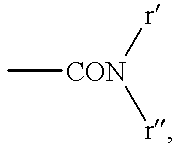
the compounds can be obtained by conversion of the corresponding acid to the acid chloride, for example with thionyl chloride, and then reaction with ammonia or an appropriate amine.
Another subject-matter of the present invention is, as medicament, the compounds of formula (I) as defined above.
These compounds exhibit activity in the test for differentiation of mouse embryonic teratocarcinoma cells (F9) (Cancer Research, 43, p. 5268, 1983) and/or in the test for inhibition of ornithine decarboxylase after induction with TPA in mice (Cancer Research, 38, p. 793-801, 1978). These tests show the activities of the compounds in the fields of cell differentiation and proliferation respectively.
In the test for differentiation of the cells (F9), it is possible to evaluate an agonist activity, like an antagonist activity, at the retinoic acid receptors. This is because an antagonist is inactive when it is alone in this test but partially or completely inhibits the effect produced by an agonist retinoid on the morphology and on the secretion of the plasminogen activator. These compounds therefore also exhibit activity in a test which consists in identifying RAR-antagonist molecules, as described in French Patent Application No. 95-07302, filed on Jun. 19, 1995 by the Applicant Company. This test comprises the following stages: (i) a sufficient amount of an RAR-agonist molecule is applied topically to part of the skin of a mammal, (ii) a molecule capable of exhibiting an RAR-antagonist activity is administered systemically or topically to the same mammal or to the same part of the skin of the mammal, before, during or after stage (i), and (iii) the response on the part of the skin thus treated of the mammal is evaluated. Thus, the response to a topical application to the ear of a mammal of an RAR-agonist molecule, which corresponds to an increase in the thickness of this ear, can be inhibited by the systemic or topical administration of an RAR-antagonist molecule.
The compounds according to the invention are particularly well suited to the following fields of treatment:
1) for treating dermatological conditions linked to a disorder of keratinization involving differentiation and proliferation, in particular for treating acne vulgaris, comedonic or polymorphic acne, acne rosacea, nodulocystic acne, acne conglobata, senile acne and secondary acnes such as solar, drug or occupational acne,
2) for treating other types of disorders of keratinization, in particular ichthyoses, ichthyosiform conditions, Darier's disease, palmoplantar keratoderma, leucoplakia and leucoplakiform conditions or cutaneous or mucosal (oral) lichen,
3) for treating other dermatological conditions linked to a disorder of keratinization with an inflammatory and/or immunoallergic component and, in particular, all forms of psoriasis, whether cutaneous, mucosal or ungual, and even psoriatic rheumatism, or alternatively cutaneous atopy, such as eczema, or respiratory atopy or alternatively gingival hypertrophy; the compounds can also be used in certain inflammatory conditions which do not show disorder of keratinization,
4) for treating all dermal or epidermal proliferations, whether they are benign or malignant and whether they are or are not of viral origin, such as common warts, flat warts and epidermodysplasia verruciformis, florid or oral papillomatoses and the proliferations which can be induced by ultraviolet radiation, in particular in the case of basal cell and prickle cell epithelioma,
5) for treating other dermatological disorders, such as bullous dermatoses and collagen diseases,
6) for treating certain ophthalmological disorders, in particular corneopathies,
7) for repairing or combating skin ageing, whether photoinduced or chronologic, or for reducing actinic keratoses and pigmentations or any pathology associated with chronologic or actinic ageing,
8) for preventing or treating the stigmata of epidermal and/or dermal atrophy induced by local or systemic corticosteroids, or any other form of cutaneous atrophy,
9) for preventing or treating disorders of cicatrization or for preventing or for repairing stretch marks,
10) for combating disorders of the sebaceous function, such as hyperseborrhoea of acne or simple seborrhoea,
11) for treating or preventing cancerous or precancerous conditions,
12) for treating inflammatory conditions, such as arthritis,
13) for treating any condition of viral origin at the cutaneous level or the general level,
14) for preventing or treating alopecia,
15) for treating dermatological or general conditions with an immunological component, and
16) For treating conditions of the cardiovascular system, such as arteriosclerosis.
In the therapeutic fields mentioned above, the compounds according to the invention can advantageously be employed in combination with other compounds with an activity or retinoid type, with vitamins D or their derivatives, with corticosteroids, with agents for combating free radicals, with α-hydroxy or α-keto acids or their derivatives, or alternatively with ion-channel blockers. Vitamins D or their derivatives is understood to mean, for example, the derivatives of vitamin D2 or D3 and in particular 1,25-dihydroxyvitamin D3. Agents for combating free radicals is understood to mean, for example, α-tocopherol, superoxide dismutase or SOD, ubiquinol or certain metal-chelating agents. α-Hydroxy or α-keto acids or their derivatives is understood to mean, for example, lactic acid, malic acid, citric acid, glycolic acid, mandelic acid, tartaric acid, glyceric acid or ascorbic acid or their salts, amides or esters. Finally, ion-channel blockers is understood to mean, for example, minoxidil (2,4-diamino-6-piperidinopyrimidine 3-oxide) and its derivatives.
Another subject-matter of the present invention is pharmaceutical compositions comprising at least one compound of formula (I) as defined hereinabove, one of its optical or geometrical isomers or one of its salts.
The pharmaceutical compositions are intended especially for treating the abovementioned conditions and are characterized in that they comprise, in a pharmaceutically acceptable vehicle which is compatible with the method of administration selected, at least one compound of formula (I), one of its optical or geometrical isomers or one of its salts.
The administration of the compounds according to the invention can be carried out enterally, parenterally, topically or ocularly.
For enteral administration, the compositions can be provided in the form of tablets, hard gelatin capsules, dragees, syrups, suspensions, solutions, powders, granules, emulsions or polymeric or lipid vesicles or nanospheres or microspheres which make possible controlled release. For parenteral administration, the compositions can be provided in the form of solutions or suspensions for infusion or for injection.
The compounds according to the invention are generally administered at a daily dose of approximately 0.01 mg/kg to 100 mg/kg by body weight, and this at the rate of 1 to 3 intakes.
For topical administration, the pharmaceutical compositions based on the compounds according to the invention are more particularly intended for treating the skin and the mucous membranes and can then be provided in the form of ointments, creams, milks, salves, powders, impregnated pads, solutions, gels, sprays, lotions or suspensions. They can also be provided in the form of polymeric or lipid vesicles or nanospheres or microspheres or of polymeric patches and of hydrogels which make possible controlled release of the active principle. These compositions for topical administration can furthermore be provided either in anhydrous form or in aqueous form, according to the clinical indication.
For ocular administration, they are mainly eye washes.
These compositions for topical or ocular use contain at least one compound of formula (I) as defined above or one of its optical or geometrical isomers or one of its salts, at a concentration preferably of between 0.001% and 5% by weight with respect to the total weight of the composition.
The compounds of formula (I) according to the invention also find an application in the cosmetics field, in particular in body and hair hygiene, and especially for the treatment of skin with a tendency to develop acne, for hair regrowth and combating hair loss, for combating the greasy appearance of the skin or the hair, in protecting against the deleterious effects of sunlight or in the treatment of physiologically dry skin, and for preventing and/or for combating photoinduced or chronologic ageing.
In the cosmetics field, the compounds according to the invention can furthermore be advantageously employed in combination with other compounds with an activity of retinoid type, with D vitamins or their derivatives, with corticosteroids, with agents for combating free radicals, with α-hydroxy or α-keto acids or their derivatives, or alternatively with ion-channel blockers, all the latter compounds being as defined above.
Another subject-matter of the present invention is thus a cosmetic composition which is characterized in that it comprises, in a cosmetically acceptable vehicle, at least one compound of formula (I) as defined above or one of its optical or geometrical isomers or one of its salts, it being possible for the said cosmetic composition to be provided in particular in the form of a cream, a milk, a lotion, a gel, polymeric or lipid vesicles or nanospheres or microspheres, a soap or a shampoo.
The concentration of compound of formula (I) in the cosmetic compositions according to the invention is advantageously between 0.001% and 3% by weight with respect to the total weight of the composition.
The pharmaceutical and cosmetic compositions according to the invention can additionally contain inert or even pharmacodynamically or cosmetically active additives or combinations of these additives and especially: wetting agents; depigmenting agents, such as hydroquinone, azelaic acid, caffeic acid or kojic acid; emollients; hydrating agents, such as glycerol, PEG 400, thiomorpholino and its derivatives or urea; anti-seborrhoeic or anti-acne agents, such as S-carboxymethylcysteine, S-benzylcysteamine, their salts or their derivatives, or benzoyl peroxide; antibiotics, such as erythromycin and its esters, neomycin, clindamycin and its esters, or tetracyclins; antifungal agents, such as ketoconazole or 4,5-polymethylene-3-isothiazolidones; agents promoting hair regrowth, such as minoxidil (2,4-diamino-6-piperidinopyrimidine 3-oxide) and its derivatives, diazoxide (7-chloro-3-methyl-1,2,4-benzothiadiazine 1,1-dioxide) and phenytoin (5,5-diphenylimidazolidine-2,4-dione); non-steroidal anti-inflammatory agents; carotenoids and especially β-carotene; anti-psoriatic agents, such as anthralin and its derivatives; and finally eicosa-5,8,11,14-tetraynoic and eicosa-5,8,11-triynoic acids, their esters and amides.
The compositions according to the invention can also contain flavour enhancers, preserving agents such as the esters of para-hydroxybenzoic acid, stabilizing agents, moisture-regulating agents, pH-regulating agents, osmotic-pressure-modifying agents, emulsifying agents, UV-A and UV-B screening agents and antioxidants such as α-tocopherol, butylated hydroxyanisole or butylated hydroxytoluene.
A number of examples of the preparation of active compounds of formula (I) according to the invention, as well as various pharmaceutical and cosmetic formulations based on these compounds, will now be given by way of illustration and without any implied limitation.
2.00 g (12.3 mmol) of 4,4-dimethylchroman and 30 ml of ethyl ether are introduced into a three-necked flask under argon. 2.4 ml (15.9 mmol) of tetramethylethylenediamine (TMEDA) are added dropwise, the mixture is cooled to −78° C. and 5.9 ml (14.8 mmol) of n-butyllithium (2.5M in hexane) are added dropwise. The temperature is allowed to return to −20° C. over two hours and then to room temperature and the mixture is stirred for 12 hours. 1.3 ml (16.0 mmol) of diiodomethane and 15 ml of ethyl ether are introduced into another three-necked flask under argon. Cooling is carried out to 0° C. and the preceding solution, cooled beforehand to −78° C., is introduced, then the reaction mixture is allowed to return to room temperature and stirred for 12 hours. The reaction mixture is poured into water and extracted with ethyl ether and the organic phase is separated by settling, dried over magnesium sulphate and evaporated. The residue obtained is purified by chromatography on a silica column eluted with heptane. After evaporating the solvents, 1.30 g (37%) of the expected compound are collected in the form of a pale-yellow oil.
1H NMR (CDCl3) δ1.32 (s, 6H), 1.84 (t, 2H, J=5.4 Hz), 4.28 (t, 2H, J=5.4 Hz), 6.62 (t, 1H, J=7.7 Hz), 7.24 (dd, 1H, J=7.8/1.5 Hz), 7.56 (dd, 1H, J=7.7/1.5 Hz).
210 ml (2.5 mol) of propargyl methyl ether and 12.00 g (110.0 mmol) of potassium tert-butoxide are introduced into a three-necked flask under argon. The reaction mixture is heated at reflux for three hours and is distilled at atmospheric pressure. The fraction distilling at 51° C. is collected in order to obtain 153.50 g (88%) of the expected compound in the form of a colourless oil.
1H NMR (CDCl3) δ3.41 (s, 3H), 5.48 (d, 2H, J=5.9 Hz), 6.77 (t, 1H, J=5.9 Hz).
280 mg (11.5 mmol) of magnesium, activated with 1 drop of dibromoethane, are introduced into a three-necked flask under argon. A solution of 3.00 g (10.4 mmol) of 4,4-dimethyl-8-iodochroman in 15 ml of ethyl ether is added dropwise, so as to maintain the reflux of the solvent, and the reaction mixture is stirred at 35° C. for 15 minutes. It is subsequently cooled to −5° C., 40 mg (0.2 mmol) of CuI are added and a solution composed of 1.24 g (17.7 mol) of methoxyallene in 5 ml of ethyl ether is introduced dropwise. The mixture is stirred for one hour at −5° C., allowed to return to room temperature and stirred for two hours. The reaction mixture is poured onto a saturated ammonium chloride solution and extracted with ethyl acetate and the organic phase is separated by settling, dried over magnesium sulphate and evaporated. The residue obtained is purified by chromatography on a silica column eluted with heptane. After evaporating the solvents, 1.30 g (65%) of the expected compound are collected in the form of a yellow oil.
1H NMR (CDCl3) δ1.33 (s, 6H), 1.83 (t, 2H, J=5.4 Hz), 2.15 (t, 1H, J=2.7 Hz), 3.52 (d, 2H, J=2.7 Hz), 4.21 (t, 2H, J=5.4 Hz), 6.87 (t, 1H, J=7.6 Hz), 7.18 (dd, 1H, J=7.9/1.5 Hz), 7.33 (dd, 1H, J=7.4/1.5 Hz).
1.18 g (5.9 mmol) of 3-(4,4-dimethylchroman-8-yl)-1-propyne, 1.60 g (5.9 mmol) of methyl 2-hydroxy-4-iodobenzoate and 60 ml of triethylamine are introduced into a three-necked flask under argon. The reaction mixture is degassed by sparging with nitrogen, 332 mg (0.46 mmol) of bis(triphenylphosphine)palladium(II) chloride and 134 mg of copper iodide are introduced and the mixture is stirred at room temperature for eight hours. The reaction mixture is evaporated to dryness, the residue is taken up in ethyl acetate and hydrochloric acid (1N), and the organic phase is separated by settling, dried over magnesium sulphate and evaporated. The residue is purified by chromatography on a silica column eluted with heptane. After evaporating the solvents, an oil, which slowly crystallizes, is obtained and is recrystallized from heptane. 1.00 g (50%) of methyl 2-hydroxy-4-[3-(4,4-dimethylchroman-8-yl)prop-1-ynyl]benzoate is collected in the form of a white solid with a melting point of 92-93° C.
1H NMR (CDCl3) δ1.34 (s, 6H), 1.84 (t, 2H, J=5.4 Hz), 3.75 (s, 2H), 3.94 (s, 3H), 4.23 (t, 2H, J=5.4 Hz), 6.89 (t, 1H, J=7.6 Hz), 6.95 (dd, 1H, J=8.2/1.5 Hz), 7.06 (d, 1H, J=1.4 Hz), 7.20 (d, 1H, J=6.3 Hz), 7.35 (d, 1H, J=7.4 Hz), 7.75 (d, 1H, J=8.2 Hz), 10.73 (s, 1H).
860 mg (2.5 mmol) of the methyl ester obtained in Example 1(d), 1.00 g (25.0 mmol) of lithium hydroxide and 50 ml of THF are introduced into a round-bottom flask. The reaction mixture is heated at reflux for 18 hours and is evaporated to dryness. The residue is taken up in water, acidified to pH 1 and extracted with ethyl ether and the organic phase is separated by settling, dried over magnesium sulphate and evaporated. The residue is triturated in heptane and filtered off and 560 mg (70%) of 2-hydroxy-4-[3-(4,4-dimethylchroman-8-yl)prop-1-ynyl]benzoic acid are collected in the form of a white solid with a melting point of 182-183° C.
1H NMR (d6-DMSO) δ1.29 (s, 6H), 1.79 (t, 2H, J=5.2 Hz), 3.72 (s, 2H), 4.20 (t, 2H, J=5.3 Hz), 6.67 (t, 1H, J=7.6 Hz), 6.76 to 6.79 (m, 2H), 7.05 (d, 2H, J=7.6 Hz), 7.55 (d, 1H, J=8.6 Hz).
14.40 g (50.0 mmol) of 4,4-dimethyl-8-iodochroman and 50 ml of THF are introduced into a three-necked flask under a stream of nitrogen. 22 ml (55.0 mmol) of n-butyllithium (2.5M in hexane) are added dropwise at −78° C., the reaction mixture is stirred for 30 minutes, then 4.2 ml (55.0 mmol) of DMF are added and the mixture is allowed to return to room temperature. The reaction mixture is poured onto an aqueous ammonium chloride solution and extracted with ethyl ether and the organic phase is separated by settling, dried over magnesium sulphate and evaporated. 10.40 g (100%) of the expected compound are collected in the form of a yellow oil.
1H NMR (CDCl3) δ1.36 (s, 6H), 1.86 (t, 2H, J=5.2 Hz), 4.29 (t, 2H, J=5.6 Hz), 6.91 (t, 1H, J=8.4 Hz), 7.50 (dd, 1H, J=7.7/1.7 Hz), 7.64 (dd, 1H, J=7.9/1.7 Hz), 10.42 (s, 1H).
7.6 ml (54.0 mmol) of trimethylsilylacetylene and 50 ml of THF are introduced into a three-necked flask. A solution of 22 ml (54.0 mmol) of n-butyllithium (2.5M in hexane) is added dropwise at −78° C. under a stream of nitrogen and the mixture is allowed to return to room temperature. The reaction mixture is introduced dropwise into a cold (−78° C.) solution composed of 9.30 g (49.0 mmol) of 4,4-dimethylchroman-8-carbaldehyde and of 50 ml of THF. The reaction mixture is allowed to return to room temperature, poured onto an aqueous ammonium chloride solution and extracted with ethyl ether and the organic phase is separated by settling, dried over magnesium sulphate and evaporated. 14.00 g (100%) of the expected compound are obtained in the form of a yellow oil. 3.00 g (10.0 mmol) of this oil are mixed with 50 ml of THF, and 11.5 ml (12.6 mmol) of a tetrabutylammonium fluoride solution (1.1M in THF) are added dropwise. The reaction mixture is stirred at room temperature for one hour, is poured into water and extracted with ethyl ether and the organic phase is separated by settling, dried over magnesium sulphate and evaporated. 2.30 g (100%) of the expected compound are collected in the form of a colourless oil.
1H NMR (CDCl3) δ1.33 (s, 6H), 1.81 to 1.88 (m, 2H), 2.59 (d, 1H, J=2.2 Hz), 4.11 (d, 1H, J=6.1 Hz), 4.25 (t, 2H, J=4.7 Hz), 5.68 (dd, 1H, J=6.1/2.0 Hz), 6.90 (t, 1H, J=7.7 Hz), 7.25 (d, 1H, J=7.8 Hz), 7.41 (d, 1H, J=7.7 Hz).
3.00 g (13.9 mmol) of α-ethynyl-4,4-dimethylchroman-8-methanol, 3.90 g (13.9 mmol) of methyl 2-hydroxy-4-iodobenzoate and 100 ml of triethylamine are introduced into a three-necked flask. The reaction mixture is degassed with nitrogen for 30 minutes and then 780 mg (1.1 mmol) of bis(triphenylphosphine)palladium(II) chloride and 320 mg (1.7 mmol) of copper iodide are successively added. The reaction mixture is stirred at room temperature for 4 hours and is evaporated to dryness and the residue obtained is taken up in water and ethyl ether. The organic phase is separated by settling, dried over magnesium sulphate and evaporated. The residue obtained is purified by chromatography on a silica column eluted with a mixture composed of 50% ethyl acetate and 50% heptane. 2.85 g (56%) of methyl 2-hydroxy-4-[3-hydroxy-3-(4,4-dimethylchroman-8-yl)prop-1-ynyl]benzoate are collected in the form of a white solid with a melting point of 122-123° C.
1H NMR (CDCl3) δ1.36 (s, 6H), 1.87 to 1.90 (m, 2H), 3.18 (d, 1H, J=6.4 Hz), 3.95 (s, 3H), 4.31 (t, 2H, J=5.3 Hz), 5.86 (d, 1H, J=6.4 Hz), 6.89 to 7.00 (m, 2H), 7.09 (s, 1H), 7.29 (d, 1H, J=7.9 Hz), 7.40 (d, 1H, J=7.4 Hz), 7.77 (d, 1H, J=8.2 Hz).
2.80 g (7.6 mmol) of the compound obtained in Example 3(c), 3.20 g (76.5 mmol) of lithium hydroxide and 100 ml of THF are introduced into a round-bottomed flask. The reaction mixture is heated at reflux for 18 hours and evaporated to dryness. The residue is taken up in water, acidified to pH 1 and extracted with ethyl ether and the organic phase is separated by settling, dried over magnesium sulphate and evaporated. The residue is triturated in heptane and filtered off and 660 mg (25%) of 2-hydroxy-4-[3-hydroxy-3-(4,4-dimethylchroman-8-yl)prop-1-ynyl]benzoic acid are collected in the form of a white solid with a melting point of 225-227° C.
1H NMR (CDCl3+2 crops of d6-DMSO) δ1.34 (s, 6H), 1.87 (t, 2H, J=6.0 Hz), 3.50 (s, 1H), 4.28 (t, 2H, J=5.7 Hz), 5.90 (s, 1H), 6.88 to 6.96 (m, 2H), 7.02 (s, 1H), 7.27 (d, 1H, J=7.8 Hz), 7.46 (d, 1H, J=7.4 Hz), 7.79 (d, 1H, J=8.1 Hz), 11.23 (br s, 1H).
19.30 g (102.0 mmol) of 2-bromothiophenol, 160 ml of DMF and 15.50 g (112.0 mmol) of potassium carbonate are introduced into a three-necked flask. 13 ml (112.0 mmol) of 1-bromo-3-methyl-2-butene are added dropwise and the reaction mixture is stirred at room temperature for two hours. It is poured into water and extracted with ethyl acetate and the organic phase is separated by settling, washed with water, dried over magnesium sulphate and evaporated. 26.00 g (99%) of the expected compound are collected in the form of an orangey oil.
1H NMR (CDCl3) δ1.65 (s, 3H), 1.73 (s, 3H), 3.56 (d, 2H, J=7.7 Hz), 5.32 (td, 1H, J=7.7/1.4 Hz), 6.96 to 7.06 (m, 1H), 7.22 to 7.26 (m, 2H), 7.52 (d, 1H, J=7.7 Hz).
26.00 g (102.0 mmol) of 2-bromo-1-(3-methylbut-2-enylthio)benzene, 180 ml of toluene and 23.20 g (122.0 mmol) of para-toluenesulphonic acid are introduced into a three-necked flask. The reaction mixture is heated at reflux for four hours and is evaporated to dryness. The residue is taken up in an aqueous sodium hydrogencarbonate solution and extracted with ethyl acetate and the organic phase is separated by settling, dried over magnesium sulphate and evaporated. The residue obtained is purified by chromatography on a silica column eluted with heptane. 20.00 g (76%) of the expected compound are collected in the form of an orangey oil.
1H NMR (CDCl3) δ1.33 (s, 6H), 1.94 (t, 2H, J=6.0 Hz), 3.04 (t, 2H, J=6.1 Hz), 6.89 (t, 1H, J=7.9 Hz), 7.34 (d, 2H, J=7.9 Hz).
In a way analogous to Example 1(c), from 3.00 g (11.7 mmol) of 4,4-dimethyl-8-bromothiochroman, 710 mg (28%) of the expected compound are obtained in the form of a pale-yellow oil.
1H NMR (CDCl3) δ1.34 (s, 6H), 1.95 (t, 2H, J=6.1 Hz), 2.23 (t, 1H, J=2.7 Hz), 3.04 (t, 2H, J=6.2 Hz), 3.53 (d, 2H, J=2.6 Hz), 7.05 (t, 1H, J=7.7 Hz), 7.32 (d, 1H, J=7.8 Hz), 7.38 (d, 1H, J=7.7 Hz).
670 mg (3.1 mmol) of 3-(4,4-dimethylthiochroman-8-yl)prop-1-yne, 860 mg (3.1 mmol) of methyl 2-hydroxy-4-iodobenzoate and 33 ml of triethylamine are introduced into a three-necked flask under argon. The reaction mixture is degassed by sparging with nitrogen, 174 mg (0.25 mmol) of bis(triphenylphosphine)palladium(II) chloride and 71 mg of copper iodide are introduced and the reaction mixture is stirred at room temperature for eight. hours. The reaction mixture is evaporated to dryness, the residue is taken up in ethyl acetate and hydrochloric acid (1N) and the organic phase is separated by settling, dried over magnesium sulphate and evaporated. The residue is purified by chromatography on a silica column eluted with a mixture composed of 99% heptane and 1% ethyl acetate. After evaporating the solvents, 1.50 g (75%) of methyl 2-hydroxy-4-[3-(4,4-dimethylthiochroman-8-yl)prop-1-yn-yl]benzoate are collected in the form of a yellow oil.
1H NMR (CDCl3) δ1.35 (s, 6H), 1.97 (t, 2H, J=6.0 Hz), 3.06 (t, 2H, J=6.1 Hz), 3.76 (s, 2H), 3.94 (s, 3H), 6.96 (dd, 1H, J=8.2/1.5 Hz), 7.04 to 7.10 (m, 2H), 7.33 (d, 1H, J=6.9 Hz), 7.41 (d, 1H, J=7.4 Hz), 7.75 (d, 1H, J=8.2 Hz).
In a way analogous to Example 2, from 1.40 g (3.8 mmol) of the compound obtained in Example 5(d), 960 mg (70%) of 2-hydroxy-4-[3-(4,4-dimethylthiochroman-8-yl)prop-1-ynyl]benzoic acid are obtained in the form of a white solid with a melting point of 190-191° C.
1H NMR (d6-DMSO) δ1.29 (s, 6H), 1.69 (t, 2H, J=5.9 Hz), 3.04 (t, 2H, J=6.0 Hz), 3.75 (s, 2H), 6.96 to 6.99 (m, 2H), 7.06 (t, 1H, J=7.7 Hz), 7.32 (d, 1H, J=7.3 Hz), 7.38 (d, 1H, J=7.8 Hz), 7.76 (d, 1H, J=8.4 Hz).
13.40 g (100.0 mmol) of aluminium chloride and 100 ml of dichloromethane are introduced into a three-necked flask under an argon atmosphere. A solution composed of 34.60 g (199.0 mmol) of 3-bromophenol, 89.00 g (486.0 mmol) of 2,5-dichloro-2,5-dimethylhexane and 300 ml of dichloromethane is added dropwise. The reaction mixture is stirred for sixteen hours at room temperature. The reaction mixture is poured into water and extracted with dichloromethane, the extract is washed with water and the organic phase is separated by settling, dried over magnesium sulphate and evaporated. The residue obtained is purified by chromatography on a silica column eluted with a mixture composed of 80% heptane and 20% dichloromethane. After evaporating the solvents, 30.00 g (53%) of the expected compound are collected in the form of white crystals with a melting point of 93° C.
1H NMR (CDCl3) δ1.25 (s, 6H), 1.38 (s, 6H), 1.57 to 1.69 (m, 4H), 4.78 (s, 1H), 6.64 (d, 1H, J=2.0 Hz), 7.04 (d, 1H, J=2.0 Hz).
12.93 g (106.0 mol) of phenylboronic acid, 20.00 g (70.7 mmol) of the compound obtained in Example 7(a), 400 ml of DME and 70 ml of an aqueous potassium carbonate solution (2M) are introduced into a three-necked flask. The reaction mixture is degassed by sparging with argon, 4.08 g (3.5 mmol) of tetrakistri-phenylphosphinepalladium(0) are added and the reaction mixture is heated to 90° C. for eight hours. The reaction mixture is poured into water and extracted with ethyl acetate and the organic phase is separated by settling, dried over magnesium sulphate and evaporated. The residue obtained is purified by chromatography on a silica column eluted with heptane. After evaporating the solvents, 13.44 g (68%) of the expected compound are collected in the form of a white powder with a melting point of 121° C.
1H NMR (CDCl3) δ1.33 (s, 6H), 1.46 (s, 6H), 1.65 to 1.73 (m, 4H), 4.77 (s, 1H), 6.69 (d, 1H, J=1.8 Hz), 7.16 (d, 1H, J=1.8 Hz), 7.24 to 7.52 (m, 3H), 7.53 (d, 2H, J=8.5 Hz).
13.44 g (47.9 mmol) of the compound obtained in Example 7(b), 100 ml of dichloromethane and 9.95 g (81.5 mmol) of N,N-dimethyl-4-aminopyridine are introduced into a three-necked flask under argon. The mixture is cooled to 0° C. and 12.1 ml (71.9 mmol) of triflic anhydride are added dropwise. The temperature is returned naturally to room temperature over sixteen hours and the reaction mixture is evaporated to dryness. Ethyl acetate is added and the mixture is acidified to pH 3 with 1N hydrochloric acid. The product is extracted with ethyl acetate, the organic phase is washed with water and then using a saturated sodium chloride solution, dried over magnesium sulphate and filtered, and the solvents are evaporated. 19.29 g (97%) of the expected compound are obtained in the form of a white powder with a melting point of 110° C.
1H NMR (CDCl3) δ1.35 (s, 6H), 1.45 (s, 6H), 1.71 (s, 4H), 7.35 to 7.55 (m, 7H).
16.12 g (39.1 mmol) of the triflate obtained in Example 7(c), 1.61 g (3.9 mmol) of 1,3-bis(diphenylphosphino)propane (DPPP), 440 mg (1.9 mmol) of palladium acetate, 130 ml of DMF, 10.9 ml (78.2 mmol) of triethylamine and 17.1 ml (390.8 mmol) of methanol are introduced into a hydrogenation device. The reaction mixture is enclosed under a pressure of 4 bar of carbon monoxide and heated with stirring at 70° C. for seven hours. The mixture is cooled and evaporated as far as possible, the residue is taken up in a saturated sodium chloride solution and extracted with ethyl acetate, and the organic phase is washed using a dilute hydrochloric acid solution and then with water, dried over magnesium sulphate and evaporated. The residue obtained is purified by chromatography on a silica column eluted with heptane. After evaporating the solvents, 7.60 g (60%) of the expected compound are collected in the form of a white powder with a melting point of 118° C.
1H NMR (CDCl3) δ1.35 (s, 6H), 1.40 (s, 6H), 1.65 to 1.69 (m, 2H), 1.76 to 1.80 (m, 2H), 3.91 (s, 3H), 7.30 (d, 1H, J=2.0 Hz), 7.34 to 7.46 (m, 3H), 7.59 (d, 2H, J=7.0 Hz), 7.61 (d, 1H, J=2.0 Hz).
80 ml of ethyl ether and 2.68 g (70.7 mmol) of lithium aluminium hydride are introduced into a 1 l three-necked flask. The reaction mixture is cooled to 0° C. and then 7.60 g (23.5 mmol) of the compound obtained in Example 7(d), in solution in 80 ml of ethyl ether, are introduced dropwise. The reaction mixture is stirred for sixteen hours at room temperature, then a saturated sodium chloride solution is added dropwise, the mixture is filtered through Celite, and water and ethyl ether are added. The product is extracted with ethyl ether, the organic phase is washed with water to neutral pH, dried over magnesium sulphate and filtered, and the solvents are evaporated. 6.82 g (98%) of the expected compound are collected in the form of white crystals with a melting point of 80-82° C.
1H NMR (CDCl3) δ1.36 (s, 6H), 1.45 (s, 6H), 1.61 (t, 1H, J=5.8 Hz), 1.71 (s, 4H), 4.95 (d, 2H, J=5.7 Hz), 7.30 to 7.36 (m, 1H), 7.43 (t, 2H, J=7.7 Hz), 7.53 (d, 1H, J=2.1 Hz), 7.58 to 7.61 (m, 3H).
6.56 g (22.2 mmol) of the compound obtained in Example 7(e), 38.73 g (445.6 mmol) of manganese oxide and 500 ml of dichloromethane are mixed in a one litre round-bottomed flask. The reaction mixture is stirred for twenty hours at room temperature and then the manganese oxide is filtered off and washed with dichloromethane. After evaporating the solvents, 4.44 g (68%) of the expected compound are collected in the form of a yellow powder with a melting point of 113° C.
1H NMR (CDCl3) δ1.37 (s, 6H), 1.57 (s, 6H), 1.75 (s, 4H), 7.33 to 7.48 (m, 3H), 7.58 to 7.62 (m, 2H), 7.77 (d, 1H, J=2.2 Hz), 7.95 (d, 1H, J=2.2 Hz).
2.43 ml (17.2 mmol) of trimethylsilylacetylene and 25 ml of THF are introduced into a three-necked flask. A solution composed of 6.89 ml (17.2 mmol) of n-butyllithium (2.5M in hexane) is added dropwise at −78° C. under a stream of nitrogen and the reaction mixture is allowed to return to room temperature. This solution is introduced dropwise into a cold (−78° C.) solution composed of 4.20 g (14.4 mmol) of the compound obtained in Example 7(f) and of 25 ml of THF. The reaction mixture is allowed to return to room temperature, poured onto an aqueous ammonium chloride solution and extracted with ethyl ether and the organic phase is separated by settling, dried over magnesium sulphate and evaporated. 5.60 g (100%) of the expected compound are obtained in the form of a white powder with a melting point of 145° C.
1H NMR (CDCl3) δ1.34 (s, 3H), 1.36 (s, 3H), 1.48 (s, 3H), 1.51 (s, 3H), 1.66 to 1.76 (m, 4H), 2.19 (br s, 1H), 6.13 (s, 1H), 7.30 to 7.36 (m, 1H), 7.41 to 7.47 (m, 2H), 7.55 (d, 1H, J=2.0 Hz), 7.60 (d, 2H, J=7.1 Hz), 7.90 (d, 1H, J=2.1 Hz).
5.60 g (14.3 mmol) of the compound obtained in Example 7(g) are mixed with 30 ml of THF in a 500 ml three-necked flask and 15.8 ml (17.4 mmol) of a tetrabutylammonium fluoride solution (1.1M in THF) are added dropwise. The reaction mixture is stirred at room temperature for one hour, poured into water and extracted with ethyl ether and the organic phase is separated by settling, dried over magnesium sulphate and evaporated. 4.07 g (89%) of the expected compound are collected in the form of a yellow oil.
1H NMR (CDCl3) δ1.34 (s, 3H), 1.35 (s, 3H), 1.48 (s, 3H), 1.52 (s, 3H), 1.66 to 1.75 (m, 4H), 2.30 (br s, 1H), 2.59 (d, 1H, J=2.1 Hz), 6.16 (d, 1H, J=2.0 Hz), 7.31 to 7.37 (m, 1H), 7.41 to 7.47 (m, 2H), 7.55 (d, 1H, J=2.1 Hz), 7.60 (d, 2H, J=7.1 Hz), 7.88 (d, 1H, J=2.1 Hz).
In a way analogous to Example 3(c), by reaction of 4.07 g (12.8 mmol) of the compound obtained in Example 7(h) with 3.53 g (12.8 mmol) of ethyl 4-iodobenzota, 4.57 g (77%) of ethyl 4-[3-hydroxy-3-(5,5,8,8-tetramethyl-3-phenyl-5,6,7,8-tetrahydronaphth-1-yl)prop-1-ynyl]benzoate are obtained in the form of an orange powder with a melting point of 121° C.
1H NMR (CDCl3) δ1.35 (s, 3H), 1.35 (t, 3H, J=7.1 Hz), 1.37 (s, 3H), 1.53 (s, 3H), 1.56 (s, 3H), 1.67 to 1.80 (m, 4H), 2.45 (d, 1H, J=4.9 Hz), 4.35 (q, 2H, J=7.1 Hz), 6.40 (d, 1H, J=4.9 Hz), 7.30 to 7.36 (m, 1H), 7.41 to 7.49 (m, 4H), 7.57 (d, 1H, J=2.0 Hz), 7.61 (d, 2H, J=7.1 Hz), 7.95 (d, 1H, J=2.0 Hz), 7.96 (d, 2H, J=6.0 Hz).
In a way analogous to Example 2, from 3.60 g (7.7 mmol) of the compound obtained in Example 7(i), 3.32 g (98%) of 4-[3-hydroxy-3-(5,5,8,8-tetramethyl-3-phenyl-5,6,7,8-tetrahydronaphth-1-yl)prop-1-ynyl]benzoic acid are obtained in the form of an orangey-beige powder with a melting point of 250° C.
1H NMR (d6-DMSO) δ1.12 (s, 3H), 1.13 (s, 3H), 1.26 (s, 3H), 1.27 (s, 3H), 1.43 to 1.55 (m, 4H), 5.97 (br s, 1H), 7.13 to 7.19 (m, 1H), 7.25 to 7.33 (m, 4H), 7.36 (d, 1H, J=1.9 Hz), 7.45 (d, 2H, J=7.3 Hz), 7.68 (d, 1H, J=2.0 Hz), 7.70 (d, 2H, J=8.4 Hz), 12.92 (br s, 1H).
2.00 g (4.6 mmol) of the compound obtained in Example 8, 1.45 ml (9.1 mmol) of triethylsilane, 30 ml of dichloromethane and 3.5 ml of trifluoroacetic acid are introduced into a one litre round-bottomed flask under a nitrogen atmosphere. The reaction mixture is stirred for two hours at room temperature and hydrolysed using a 1N HCl solution, and the product is extracted with ethyl ether. The organic phase is washed with water and dried over magnesium sulphate and the solvent is evaporated to dryness. The residue obtained is purified by chromatography on a silica column eluted with a mixture composed of 50% ethyl acetate and 50% heptane. After evaporating the solvents, 370 mg (19%) of 4-[3-(5,5,8,8-teramethyl-3-phenyl-5,6,7,8-tetrahydronaphth-1-yl)prop-1-ynyl]benzoic acid are collected in the form of a white powder with a melting point of 280° C.
1H NMR (d6-DMSO) δ1.22 (s, 6H) , 1.35 (s, 6H) 4.00 (s, 2H), 7.24 to 7.27 (m, 2H), 7.33 to 7.41 (m, 4H), 7.46 (s, 1H), 7.53 (d, 2H, J=7.3 Hz), 7.78 (d, 2H, J=8.2 Hz).
50.45 g (360.0 mmol) of 3-methoxythiophenol, 360 ml of acetone and 14.40 g (360.0 mmol) of sodium hydroxide pellets are introduced into a one liter round-bottomed flask under a nitrogen atmosphere and the mixture is heated at reflux for three hours. A solution composed of 53.65 g (360.0 mmol) of 2-methyl-4-bromo-2-butene and of 60 ml of acetone is added dropwise. Reflux is maintained for sixteen hours and the reaction mixture is evaporated to dryness. Water is added, extraction is carried out with ethyl acetate, the organic phase is washed with water and then using a saturated sodium chloride solution, dried over magnesium sulphate and filtered, and the solvents are evaporated. The residue obtained is distilled under reduced pressure (5×10⁻² bar/113° C.) to produce 67.81 g (90%) of the expected compound in the form of a pale-yellow oil.
1H NMR (CDCl3) δ1.62 (s, 3H), 1.72 (s, 3H), 3.55 (d, 2H, J=7.7 Hz), 3.79 (s, 3H), 5.31 (tt, 1H, J=7.7/1.3 Hz), 6.71 (dt, 1H, J=8.3/1.8 Hz), 6.87 to 6.92 (m, 2H), 7.18 (t, 1H, J=7.9 Hz).
62.00 g (298.0 mmol) of the compound obtained in Example 10(a), 85.00 g (446.0 mmol) of paratoluenesulphonic acid and 500 ml of toluene are introduced into a round-bottomed flask. The mixture is heated at reflux for two hours, cooled, water and ethyl acetate are then added and extraction is carried out with ethyl acetate. The organic phase is separated by settling, washed with water and then using a saturated sodium chloride solution and dried over magnesium sulphate, and the solvents are evaporated. 65.19 g of a yellow oil are obtained, which oil is distilled under reduced pressure (5×10⁻² bar/120-122° C.) to produce 17.40 g (28%) of the expected compound in the form of a colourless oil.
1H NMR (CDCl3) δ1.41 (s, 3H), 2.00 to 2.05 (m, 2H), 2.86 to 2.90 (m, 2H), 3.80 (s, 3H), 6.58 (d, 1H, J=8.1 Hz), 6.72 (dd, 1H, J=7.9/1.2 Hz), 6.98 (t, 1H, J=8.0 Hz).
17.40 g (83.5 mmol) of the compound obtained in Example 10(b), 28.10 g (333.0 mmol) of sodium ethane-thiolate and 100 ml of DMF are introduced into a round-bottomed flask. The mixture is heated at 150° C. for two hours and then stirred for sixteen hours at room temperature, poured onto a 1N HCl/ethyl ether mixture and extracted with ethyl ether. The organic phase is separated by settling, dried over magnesium sulphate and evaporated. The residue obtained is purified by chromatography on a silica column eluted with a mixture composed of 20% ethyl acetate and of 80% heptane. 14.07 g (87%) of the expected compound are collected in the form of a light-yellow solid with a melting point of 48° C.
1H NMR (CDCl3) δ1.45 (s, 3H), 2.01 to 2.07 (m, 2H), 2.86 to 2.91 (m, 2H), 5.00 (s, 1H), 6.34 (dd, 1H, J=7.8/1.3 Hz), 6.69 (dd, 1H, J=7.9/1.2 Hz), 6.84 (d, 1H, J=7.8 Hz).
13.63 g (70.1 mmol) of 4,4-dimethylthiochroman-5-ol obtained in Example 10(c), 11.14 g (91.2 mmol) of N,N-dimethylaminopyridine and 100 ml of dichloromethane are introduced into a 500 ml round-bottomed flask under a stream of nitrogen. The mixture is cooled to 0° C. and 14.16 ml (84.2 mmol) of triflic anhydride are added dropwise. The reaction mixture is stirred for 30 minutes at room temperature and then a 1N HCl solution and dichloromethane are added. The product is extracted with dichloromethane and the organic phase is washed with water to neutral pH, dried over magnesium sulphate and filtered. The residue obtained is purified by chromatography on a silica column eluted with a mixture composed of 90% heptane and 10% ethyl acetate. After evaporating the solvents, 16.32 g (71%) of the expected compound are collected in the form of a yellow oil.
1H NMR (CDCl3) δ1.46 (s, 3H), 2.01 to 2.06 (m, 2H), 2.93 to 2.98 (m, 2H), 7.00 to 7.12 (m, 3H).
In a way analogous to Example 7(d), from 14.23 g (43.6 mmol) of the compound obtained in Example 10(d), 8.81 g (85%) of the expected compound are obtained in the form of a yellow oil.
1H NMR (CDCl3) δ1.39 (s, 3H), 1.91 (t, 2H, J=6.1 Hz), 3.05 (t, 2H, J=6.1 Hz), 3.89 (s, 3H), 6.96 (dd, 1H, J=7.4/1.8 Hz), 7.03 (t, 1H, J=7.4 Hz), 7.16 (dd, 1H, J=7.5/1.8 Hz).
8.81 g (37.3 mmol) of the ester obtained in Example 10(e) and 300 ml of toluene are mixed in a 500 ml round-bottomed flask. After cooling to −78° C., a diisobutylaluminium hydride solution (1M in toluene) is run in dropwise while maintaining this temperature of −78° C. The reaction mixture is stirred for one hour at this temperature, an acueous magnesium sulphate paste is then added, the mixture is stirred and is extracted with ethyl ether. The organic phase is dried over magnesium sulphate and filtered, and the solvents are evaporated. The residue obtained is purified by chromatography on a silica column eluted with a mixture composed of 70% heptane and 30% ethyl acetate. After evaporating the solvents, 4.37 g (56%) of the expected compound are collected in the form of a light yellow powder with a melting point of 53° C.
1H NMR (CDCl3) δ1.45 (s, 6H), 2.04 (t, 2H, J=6.4 Hz), 2.95 (t, 2H, J=6.4 Hz), 4.87 (d, 2H, J=5.8 Hz), 7.01 to 7.08 (m, 2H), 7.17 to 7.22 (m, 1H).
4.37 g (21.0 mmol) of the alcohol obtained in Example 10(f), 36.47 g (419.5 mmol) of manganese oxide and 300 ml of dichloromethane are mixed in a 500 ml round-bottomed flask. The reaction mixture is stirred for twenty hours at room temperature, the manganese oxide is then filtered off through Celite and the dichloromethane is evaporated. After evaporating the solvents, 3.25 g (75%) of the expected compound are collected in the form of a yellow oil.
1H NMR (CDCl3) δ1.54 (s, 6H), 2.03 (t, 2H, J=5.9 Hz), 3.01 (t, 2H, J=6.0 Hz), 7.15 (d, 1H, J=7.6 Hz), 7.25 to 7.29 (m, 1H), 7.49 (dd, 1H), J=7.4/1.4 Hz), 10.73 (s, 1H).
In a way analogous to Example 7(g), from 3.25 g (15.7 mmol) of the compound obtained in Example 10(g), 4.79 g (100%) of 1-(4,4-dimethylthiochroman-5-yl)-3-(trimethylsilanyl)prop-2-yn-1-ol are obtained in the form of a yellow oil.
1H NMR (CDCl3) δ0.16 (s, 9H) , 1.48 (s, 3H), 1.50 (s, 3H), 2.04 to 2.09 (m, 2H) , 2.14 (d, 1H, J=5.2 Hz), 2.87 to 2.93 (m, 2H), 6.04 (d, 1H, J=5.1 Hz), 7.05 to 7.13 (m, 2H), 7.50 to 7.54 (q, 1H, J=3.1 Hz).
In a way analogous to Example 7(h), from 4.79 g (15.7 mmol) of the compound obtained in Example 10(h), 3.34 g (89%) of 1-(4,4-dimethylthiochroman-5-yl)prop-2-yn-1-ol are obtained in the form of beige crystals with a melting point of 88° C.
1H NMR (CDCl3) δ1.49 (s, 3H), 1.51 (s, 3H), 2.04 to 2.10 (m, 2H), 2.26 (d, 1H, J=5.1 Hz), 2.59 (d, 1H, J=2.2 Hz), 2.88 to 2.94 (m, 2H), 6.07 (br s, 1H) 7.07 to 7.14 (m, 2H), 7.52 to 7.55 (q, 1H, J=3.0 Hz).
In a way analogous to Example 3(c), by reaction of 3.34 g (14.4 mmol) of the compound obtained in Example 10(i) with 3.97 g (14.4 mmol) of ethyl 4-iodobenzoate, 4.66 g (85%) of ethyl 4-[3-(4,4-dimethylthiochroman-5-yl)-3-hydroxyprop-1-ynyl]benzoate are obtained in the form of an orangey powder with a melting point of 108° C.
1H NMR (CDCl3) δ1.39 (t, 3H, J=7.1 Hz), 1.54 (s, 3H), 1.56 (s, 3H), 2.08 to 2.13 (m, 2H), 2.28 (d, 1H, J=5.3 Hz), 2.90 to 2.96 (m, 2H), 4.37 (q, 2H, J=7.1 Hz), 6.31 (d, 1H, J=5.3 Hz), 7.09 to 7.17 (m, 2H), 7.48 (d, 2H, J=8.3 Hz), 7.60 (dd, 1H, J=6.4/2.8 Hz), 7.98 (d, 2H, J=8.4 Hz).
In a way analogous to Example 2, from 4.06 g (12.3 mmol) of the compound obtained in Example 10(j), 3.41 g (78%) of 4-[3-(4,4-dimethylthiochroman-5-yl)-3-hydroxyprop-1-ynyl]benzoic acid are obtained in the form of a brown solid with a melting point of 198° C.
1H NMR (CDCl3) δ1.54 (s, 3H), 1.56 (s, 3H), 2 .08 to 2.12 (m, 2H), 2.90 to 2.94 (m, 2H), 6.29 (s, 1H), 7.10 to 7.16 (m, 2H), 7.48 (d, 2H, J=8.2 Hz), 7.61 (dd, 1H, J=6.7/2.3 Hz), 7.99 (d, 2H, J=8.3 Hz).
In a way analogous to Example 9, from 2.06 g (5.82 mmol) of the compound obtained in Example 11, 1.00 g (51%) of 4-[3-(4,4-dimethylthiochroman-5-yl)-prop-1-ynyl]benzoic acid is obtained in the form of beige crystals with a melting point of 207° C.
1H NMR (d6-DMSO) δ1.51 (s, 6H), 2.05 to 2. 10 (m, 2H), 2.92 to 2.97 (m, 2H), 4.01 (s, 2H), 7.01 to 7.03 (m, 2H), 7.25 to 7.31 (m, 1H), 7.45 (d, 2H, J=8.3 Hz), 7.97 (d, 2H, J=8.3 Hz).
40.00 g (140.2 mmol) of 2,4-di-tert-butyl-6-bromophenol and 400 ml of DMF are introduced into a one liter three-necked flask. The solution obtained is cooled to 5-10° C., 4.70 g of sodium hydride are added and the mixture is stirred at 10° C. for 30 minutes. 11.7 ml (154.0 mmol) of chloromethyl methyl ether are then added dropwise and the reaction mixture is stirred for one hour at room temperature. The reaction mixture is poured into a 1N HCl/ethyl ether mixture and extracted with ethyl ether and the organic phase is separated by settling, dried over magnesium sulphate and evaporated. 46.00 g (100%) of the expected compound are collected in the form of an orange oil.
1H NMR (CDCl3) δ1.28 (s, 9H), 1.43 (s, 9H), 3.69 (s, 3H), 5.21 (s, 2H), 7.30 (d, 1H, J=2.4 Hz), 7.39 (d, 1H, J=2.4 Hz).
46.00 g (140.0 mmol) of the compound obtained in Example 13(a) and 500 ml of THF are introduced into a three-necked flask under a stream of nitrogen. 61.5 ml (154.00 mmol) of an n-butyllithium solution (2.5M in hexane) are added dropwise at −78° C. and the mixture is stirred for 30 minutes at this same temperature. 13.0 ml (168.0 mmol) of DEF are then added dropwise and the mixture is allowed to return to room temperature. The reaction mixture is acidified with hydrochloric acid (1N) and extracted with ethyl ether and the organic phase is separated by settling, dried over magnesium sulphate and evaporated. 46.00 g (100%) of the expected compound are collected in the form of an orange oil.
1H NMR (CDCl3) δ1.32 (s, 9H), 1.44 (s, 9H), 3.64 (s, 3H), 5.02 (s, 2H), 7.64 (d, 1H, J=2.6 Hz), 7.72 (d, 1H, J=2.6 Hz), 10.22 (s, 1H).
18.60 g (190.0 mmol) of trimethylsilylacetylene and 130 ml of THF are introduced into a three-necked flask under a stream of nitrogen and the solution thus obtained is cooled to −78° C. 76.0 ml (190.0 mmol) of an n-butyllithium solution (2.5M in hexane) are added dropwise at −70° C., the reaction mixture is stirred for 30 minutes at this same temperature and is returned to −20° C. This solution is run dropwise onto a cold (−70° C.) solution composed of 44.00 g (158.0 mmol) of the compound obtained in Example 13(b) in solution in 550 ml of anhydrous THF. The temperature of the reaction mixture is returned to room temperature over two hours, the reaction mixture is then acidified with hydrochloric acid (1N) and extracted with ethyl ether and the organic phase is separated by settling, dried over magnesium sulchate and evaporated. 59.00 g (100%) of the expected compound are collected in the form of an orange oil.
1H NMR (CDCl3) δ1.12 (s, 9H), 1.18 (s, 9H), 3.49 (s, 3H), 3.81 (d, 1H, J=5.4 Hz), 4.68 (d, 1H, J=6.3 Hz), 4.88 (d, 1H, J=6.3 Hz), 5.55 (d, 1H, J=5.3 Hz), 7.16 (d, 1H, J=2.5 Hz), 7.56 (d, 1H, J=2.5 Hz).
58.00 g (154.0 mmol) of the compound obtained in Example 13(c) and 300 ml of THF are introduced into a three-necked flask under a stream of nitrogen and a tetrabutylammonium fluoride solution (1M in THF) is run in dropwise. The reaction mixture is stirred for two hours at room temperature, is then acidified with hydrochloric acid (1N) and extracted with ethyl ether and the organic phase is separated by settling, dried over magnesium sulphate and evaporated. 6.[lacuna] g (13%) of the expected compound are collected in the form of an orange oil and 12.00 g (30%) of 1-(3,5-di-tert-butyl-2-hydroxyphenyl)prop-2-yn-1-ol are collected in the form of an orange oil.
1H NMR of the expected compound (CDCl3) δ1.32 (s, 9H), 1.39 (s, 9H), 2.61 (d, 1H, J=2.2 Hz), 3.70 (s, 3H), 3.90 (d, 1H, J=5.5 Hz), 4.90 (d, 1H, J=6.3 Hz), 5.08 (d, 1H, J=6.2 Hz), 5.79 (dd, 1H, J=5.4/2.3 Hz), 7.37 (d, 1H, J=2.5 Hz), 7.70 (d, 1H, J=2.5 Hz).
1H NMR of 1-(3,5-di-tert-butyl-2-hydroxyphenyl)prop-2-yn-1-ol (CDCl3) δ1.30 (s, 9H), 1.43 (s, 9H), 2.72 (br s, 1H), 2.80 (d, 1H, J=2.3 Hz), 4.94 to 5.05 (m, 1H), 5.66 (br s, 1H), 7.27 (d, 1H, J=2.3 Hz), 7.32 (d, 1H, J=2.4 Hz).
6.00 g (19.7 mmol) of the compound obtained in Example 13(d), 5.40 g (19.7 mmol) of ethyl 4-iodo-benzoate and 40 ml of triethylamine are introduced successively into a round-bottomed flask. The reaction mixture is degassed with nitrogen for 20 minutes and then 375 mg of CuI and 700 mg of bis(triphenyl-phosphine)palladium(II) chloride are added. The reaction mixture is stirred at room temperature for five hours, poured into water, acidified with 1N hydrochloric acid and extracted with ethyl ether and the organic phase is separated by settling, dried over magnesium sulphate and evaporated. The residue obtained is purified by chromatography on a silica column eluted with a mixture composed of 10% ethyl acetate and of 90% heptane. After evaporating the solvents, 6.00 g (69%) of ethyl 4-[3-(3,5-di-tert-butyl-2-(methoxymethoxy)-phenyl)-3-hydroxyprop-1-ynyl]benzoate are collected in the form of an orangey powder with a melting point of 89-91° C.
1H NMR (CDCl3) δ1.34 (s, 9H), 1.39 (t, 3H, J=7.1 Hz), 1.41 (s, 9H), 3.73 (s, 3H), 4.09 (d, 1H, J=5.5 Hz), 4.37 (q, 2H, J=7.1 Hz), 4.93 (d, 1H, J=6.3 Hz), 5.12 (d, 1H, J=6.3 Hz), 6.00 (d, 1H, J=5.5 Hz), 7.40 (d, 1H, J=2.5 Hz), 7.53 (d, 2H, J=8.4 Hz), 7.79 (d, 1H, J=2.5 Hz), 7.99 (d, 2H, J=8.4 Hz).
In a way analogous to Example 2, from 1.50 g (3.3 mmol) of the compound obtained in Example 13(e), 1.20 g (85%) of 4-[3-(3,5-di-tert-butyl-2-(methoxymethoxy)phenyl)-3-hydroxyprop-1-ynyl]benzoic acid are obtained in the form of a beige powder with a melting point of 197° C.
1H NMR (CDCl3) δ1.33 (s, 9H), 1.41(s, 9H), 3.73 (s, 3H), 4.35 (br s, 1H), 4.97 (d, 1H, J=6.1 Hz), 5.12 (d, 1H, J=6.1 Hz), 6.00 (s, 1H), 7.38 (d, 1H, J=2.5 Hz), 7.51 (d, 2H, J=8.4 Hz), 7.78 (d, 1H, J=2.5 Hz), 8.00 (d, 2H, J=8.4 Hz).
In a way analogous to Example 13(e), by reaction of 10.00 g (38.4 mmol) of 1-(3,5-di-tert-butyl-2-hydroxyphenyl)prop-2-yn-1-ol obtained in Example 13(d) with 10.60 g (38.4 mmol) of ethyl 4-iodo-benzoate, 5.00 g (32%) of ethyl 4-[3-(3,5-di-tert-butyl-2-hydroxyphenyl)-3-hydroxyprop-1-ynyl]benzoate are obtained in the form of an off-white solid with a melting point of 142-144° C.
1H NMR (CDCl3) δ1.31 (s, 9H), 1.39 (t, 3H, J=7.1 Hz), 1.44 (s, 9H), 2.80 (d, 1H, J=6.2 Hz), 4.37 (q, 2H, J=7.1 Hz), 5.90 (d, 1H, J=6.2 Hz), 7.34 (s, 2H), 7.37 (s, 1H), 7.53 (d, 2H, J=8.4 Hz), 8.02 (d, 2H, J=8.4 Hz).
In a way analogous to Example 9, from 3.00 g (7.3 mmol) of the compound obtained in Example 15, 1.30 g (45%) of ethyl 4-[3-(3,5-di-tert-butyl-2-hydroxyphenyl)prop-1-ynyl]benzoate are obtained in the form of a white powder with a melting point of 113-1150° C.
1H NMR (CDCl3) δ1.31 (s, 9H), 1.39 (t, 3H, J=7.1 Hz), 1.44 (s, 9H), 3.80 (s, 2H), 4.37 (q, 2H, J=7.1 Hz), 6.77 (br s, 1H), 7.13 (d, 1H, J=2.3 Hz), 7.27 (d, 1H, J=2.3 Hz), 7.48 (d, 2H, J=8.3 Hz), 7.98 (d, 2H, J=8,4 Hz).
In a way analogous to Example 13(a), from 25.00 g (87.6 mmol) of 2,4-di-tert-butyl-6-bromophenol and from 13.70 g (96.4 mmol) of methyl iodide, 27.00 g (100%) of 1-bromo-3,5-di-tert-butyl-2-methoxybenzene are obtained in the form of an orange oil.
1H NMR (CDCl3) δ1.29 (s, 9H), 1.39 (s, 9H), 3.91 (s, 3H), 7.27 (d, 1H, J=2.4 Hz), 7.40 (d, 1H, J=2.4 Hz).
In a way analogous to Example 13(b), from 25.00 g (83.5 mmol) of the compound obtained in Example 17(a), 21.00 g (100%) of the expected compound are obtained in the form of an orange oil.
1H NMR (CDCl3) δ1.32 (s, 9H), 1.43 (s, 9H), 3.93 (s, 3H), 7.61 (d, 1H, J=2.6 Hz), 7.71 (d, 1H, J=2.5 Hz), 10.34 (s, 1H).
In a way analogous to Example 13(c), from 21.00 g (85.0 mmol) of the compound obtained in Example 17(b), 30.00 g (100%) of the expected compound are obtained in the form of a beige powder with a melting point of 104-106° C.,
1H NMR (CDCl3) δ1.13 (s, 9H), 1.20 (s, 9H), 2.39 (d, 1H, J=4.7 Hz), 3.69 (s, 3H), 5.59 (d, 1H, J=4.0 Hz), 7.15 (d, 1H, J=2.5 Hz), 7.43 (d, 1H, J=2.5 Hz).
In a way analogous to Example 13(d), from 23.00 g (66.0 mmol) of the compound obtained in Example 17(c), 25.00 g (100%) of the expected compound are obtained in the form of an orange oil.
1H NMR (CDCl3) δ1.32 (s, 9H), 1.40 (s, 9H), 2.63 (d, 1H, J=2.2 Hz), 3.88 (s, 3H), 5.81 (d, 1H, J=2.2 Hz), 7.35 (d, 1H, J=2.5 Hz), 7.58 (d, 1H, J=2.5 Hz).
In a way analogous to Example 13(e), by reaction of 23.30 g (85.0 mmol) of the compound obtained in Example 17(d) with 23.50 g (85.0 mmol) of ethyl 4-iodobenzoate, 20.00 g (55%) of ethyl 4-[3-(3,5-di-tert-butyl-2-methoxyphenyl)-3-hydroxyprop-1-ynyl]-benzoate are obtained in the form of a grey powder with a melting point of 101-103° C.
1H NMR (CDCl3) δ1.34 (s, 9H), 1.39 (t, 3H, J=5.2 Hz), 1.42 (s, 9H), 2.74 (d, 1H, J=5.4 Hz), 3.93 (s, 3H), 4.37 (q, 2H, J=7.1 Hz), 6.04 (d, 1H, J=5.4 Hz), 7.37 (d, 1H, J=2.5 Hz), 7.50 (d, 2H, J=8.4 Hz), 7.65 (d, 1H, J=2.5 Hz), 7.99 (d, 2H, J=8.4 Hz).
In a way analogous to Example 2, from 5.00 g (11.8 mmol) of the compound obtained in Example 17(e), 4.50 g (96%) of 4-[3-(3,5-di-tert-butyl-2-methoxyphenyl)-3-hydroxyprop-1-ynyl]benzoic acid are obtained in the form of a light-yellow solid with a melting point of 208-209° C.
1H NMR (CDCl3) δ1.29 (s, 9H), 1.37 (s, 9H), 3.83 (s, 3H), 5.80 (d, 1H, J=5.0 Hz), 6.19 (d, 1H, J=5.6 Hz), 7.27 (d, 1H, J=2.5 Hz), 7.53 (d, 2H, J=8.3 Hz), 7.62 (d, 1H, J=2.4 Hz), 7.93 (d, 2H, J=8.3 Hz), 13.14 (br s, 1H).
In a way analogous to Example 9, from 1.50 g (3.8 mmol) of the compound obtained in Example 18, 1.40 g (97%) of 4-[3-(3,5-di-tert-butyl-2-methoxyphenyl)prop-1-ynyl]benzoic acid are obtained in the form of a white powder with a melting point of 237-239° C.
1H NMR (CDCl3) δ1.33 (s, 9H), 1.41 (s, 9H), 3.83 (s, 3H), 3.87 (s, 2H), 7.27 (d, 1H, J=2.2 Hz), 7.46 (d, 1H, J=2.2 Hz), 7.47 (d, 2H, J=8.2 Hz), 7.99 (d, 2H, J=8.2 Hz).
80.00 g (426.0 mmol) of 4-bromophenol and 8.00 g of Dowex 50WX8 sulphonic acid resin are mixed in a 250 ml three-necked flask. The mixture is heated to 80° C. and a stream of isobutylene is passed through for 30 hours. The reaction mixture is cooled and the residue is purified by passing through a silica column eluted with a mixture composed of 95% dichloromethane and of 5% heptane. 88.00 g (90%) of the expected compound are collected in the form of a yellow oil.
1H NMR (CDCl3) δ1.38 (s, 9H), 4.79 (s, 1H), 6.55 (d, 1H, J=8.4 Hz), 7.16 (dd, 1H, J=8.4/2.4 Hz), 7.35 (d, 1H, J=2.4 Hz).
In a way analogous to Example 7(b), by reaction of 40.00 g (175.0 mmol) of the compound obtained in Example 20(a) with 34.60 g (283.0 mmol) of phenylboronic acid, 27.00 g (68%) of the expected compound are obtained in the form of a brown oil.
1H NMR (CDCl3) δ1.46 (s, 9H), 4.99 (s, 1H), 6.74 (d, 1H, J=8.1 Hz), 7.28 (d, 1H, J=2.3 Hz), 7.31 (d, 1H, J=2.4 Hz), 7.41 (t, 2H, J=7.2 Hz), 7.50 (d, 1H, J=2.2 Hz), 7.53 (s, 1H), 7.56 (d, 1H, J=1.4 Hz).
27.00 g (120.0 mmol) of the compound obtained in Example 20(b) and 120 ml of dichloromethane are introduced into a round-bottomed flask. The mixture is cooled to 0° C., 6.4 ml (131.0 mmol) of bromine are added dropwise and the mixture is stirred for ten minutes at 0° C. A saturated sodium thiosulphate solution is added, extraction is carried out with dichloromethane and the organic phase is separated by settling, washed with water to neutral pH, dried over magnesium sulphate and evaporated. 32.00 g (88%) of the expected product are collected in the form of a yellow oil.
1H NMR (CDCl3) δ1.45 (s, 9H), 5.83 (s, 1H), 7.28 to 7.34 (m, 1H), 7.40 (d, 2H, J=7.6 Hz), 7.44 (d, 1H, J=1.9 Hz), 7.49 to 7.53 (d, 2H, J=8.6 Hz), 7.57 (d, 1H, J=2.2 Hz).
In a way analogous to Example 13(a), by reaction of 7.30 g (24.0 mmol) of the compound obtained in Example 20(c) with 2.0 ml (26.4 mmol) of chloromethyl methyl ether, 8.00 g (100%) of the expected compound are obtained in the form of an orange oil.
1H NMR (CDCl3) δ1.48 (s, 9H), 3.71 (s, 3H), 5.16 (s, 2H), 7.34 to 7.46 (m, 3H), 7.51 to 7.54 (m, 3H), 7.64 (d, 1H, J=2.0 Hz).
In a way analogous to Example 3(a), from 7.80 g (23.0 mmol) of the compound obtained in Example 20(d), 4.31 g (63%) of the expected compound are obtained in the form of a yellow solid with a melting point of 92-94° C.
1H NMR (CDCl3) δ1.49 (s, 9H), 3.66 (s, 3H), 5.09 (s, 2H), 7.38 (d, 1H, J=8.5 Hz), 7.44 (t, 2H, J=7.0 Hz), 7.58 (d, 2H, J=8.5 Hz), 7.82 (d, 1H, J=2.5 Hz), 7.94 (d, 1H, J=2.4 Hz), 10.27 (s, 1H).
In a way analogous to Example 7(g), from 4.30 g (14.4 mmol) of the compound obtained in Example 20(e), 4.00 g (70%) of the expected compound are obtained in the form of a yellow solid with a melting point of 90-91° C.
1H NMR (CDCl3) δ0.21 (s, 9H), 1.45 (s, 9H), 3.74 (s, 3H), 3.87 (d, 1H, J=5.5 Hz), 4.96 (d, 1H, J=6.2 Hz), 5.15 (d, 1H, J=6.2 Hz), 5.84 (d, 1H, J=5.5 Hz), 7.36 (d, 1H, J=7.1 Hz), 7.46 (t, 2H, J=7.0 Hz), 7.59 to 7.62 (m, 3H), 7.96 (d, 1H, J=2.4 Hz).
In a way analogous to Example 7(h), from 4.00 g (10.1 mmol) of the compound obtained in Example 20(f), 3.27 g (100%) of the expected compound are obtained in the form of an orange oil.
1H NMR (CDCl3) δ1.37 (s, 9H), 2.55 (d, 1H, J=2.3 Hz), 3.66 (s, 3H), 4.89 (d, 1H, J=6.3 Hz), 5.07 (d, 1H, J=6.2 Hz), 5.79 (d, 1H, J=2.1 Hz), 7.24 to 7.46 (m, 3H), 7.50 to 7.54 (m, 3H), 7.85 (d, 1H, J=2.3 Hz).
In a way analogous to Example 3(c), by reaction of 3.20 g (9.9 mmol) of the compound obtained in Example 20(g) with 3.00 g (10.8 mmol) of ethyl 4-iodobenzoate, 3.00 g (65%) of ethyl 4-[3-(5-tert-butyl-4-(methoxymethoxy)biphenyl-3-yl)-3-hydroxyprop-1-ynyl]-benzoate are obtained in the form of a brown oil.
1H NMR (CDCl3) δ1.39 (t, 3H, J=7.1 Hz), 1.46 (s, 9H), 3.76 (s, 3H), 3.99 (d, 1H, J=5.5 Hz), 4.37 (q, 2H, J=7.2 Hz), 4.99 (d, 1H, J=6.3 Hz), 5.17 (d, 1H, J=6.3 Hz), 7.35 (d, 1H, J=7.1 Hz), 7.44 (t, 1H, J=7.5 Hz), 7.53 (d, 2H, J=8.3 Hz), 7.57 to 7.61 (m, 4H), 7.96 (s, 1H), 7.98 (d, 2H, J=8.1 Hz).
In a way analogous to Example 2, from 1.50 g (3.2 mmol) of the compound obtained in Example 20(h), 970 mg (70%) of 4-[3-(5-tert-butyl-4-(methoxymethoxy)biphenyl-3-yl) -3-hydroxyprop-1-ynyl]benzoic acid are obtained in the form of a beige powder with a melting point of 162-164° C.
1H NMR (d6-DMSO) δ1.44 (s, 9H), 3.63 (5, 3H), 5.11 (d, 1H, J=5.2 Hz), 5.18 (d, 1H, J=5.2 Hz), 5.94 (d, 1H, J=6.2 Hz), 6.30 (d, 1H, J=6.3 Hz), 7.37 (d, 1H, J=7.3 Hz), 7.46 (d, 2H, J=7.6 Hz), 7.52 to 7.55 (m, 3H), 7.62 (d, 2H, J=7.5 Hz), 7.85 (d, 1H, J=2.0 Hz), 7.91 (d, 2H, J=8.1 Hz), 13.14 (s, 1H).
In a way analogous to Example 13(a), by reaction of 4.00 g (13.0 mmol) of the compound obtained in Example 20(c) with 890 μl (14.3 mmol) of methyl iodide, 4.09 g (98%) of the expected compound are obtained in the form of a yellow oil.
1H NMR (CDCl3) δ1.44 (s, 9H), 3.97 (s, 3H), 7.34 to 7.54 (m, 5H), 7.47 (d, 1H, J=2.1 Hz), 7.65 (d, 1H, J=2.0 Hz).
In a way analogous to Example 3(a), from 3.80 g (12.0 mmol) of the compound obtained in Example 22(a), 2.29 g (71%) of the expected compound are obtained in the form of a yellow solid with a melting point of 45° C.
1H NMR (CDCl3) δ1.47 (s, 9H), 3.99 (s, 3H), 7.32 to 7.59 (m, 5H), 7.79 (d, 1H, J=2.1 Hz), 7.93 (d, 1H, J=2.2 Hz), 10.40 (s, 1H).
In a way analogous to Example 7(g), from 2.29 g (8.5 mmol) of the compound obtained in Example 22(b), 2.00 g (64%) of the expected compound are obtained in the form of a yellow solid with a melting point of 94-96° C.
1H NMR (CDCl3) δ0.21 (s, 9H), 1.46 (s, 3H), 2.56 (d, 1H, J=5.3 Hz), 3.96 (s, 3H), 5.86 (d, 1H, J=5.2 Hz), 7.37 (d, 1H, J=7.1 Hz), 7.46 (t, 2H, J=7.0 Hz), 7.56 (d, 1H, J=2.4 Hz), 7.60 (d, 2H, J=7.6 Hz), 7.83 (d, 1H, J=2.3 Hz).
In a way analogous to Example 7(h), from 2.00 g (5.5 mmol) of the compound obtained in Example 22(c), 1.52 g (95%) of the expected compound are obtained in the form of a yellow oil.
1H NMR (CDCl3) δ1.38 (t, 9H), 2.57 (d, 1H, J=2.3 Hz), 3.87 (s, 3H), 5.79 (br s, 1H) δ7.24 to 7.40 (m, 1H), 7.74 (d, 1H, J=2.3 Hz).
In a way analogous to Example 3(c), by reaction of 1.50 g (5.1 mmol) of the compound obtained in Example 22(d) with 1.55 g (5.6 mmol) of ethyl 4-iodobenzoate, 1.88 g (83%) of ethyl 4-[3-(5-tert-butyl-4-methoxybiphenyl-3-yl) -3-hydroxyprop-1-ynyl]-benzoate are obtained in the form of a reddish oil.
1H NMR (CDCl3) δ1.39 (t, 3H, J=7.2 Hz), 1.46 (s, 9H), 2.67 (d, 1H, J=5.3 Hz), 3.99 (s, 3H), 4.37 (q, 2H, J=7.1 Hz), 6.10 (d, 1H, J=5.2 Hz), 7.34 to 7.60 (m, 8H), 7.85 (d, 1H, J=2.3 Hz), 7.98 (d, 2H, J=8.4 Hz).
In a way analogous to Example 2, from 1.88 g (4.2 mmol) of the compound obtained in Example 22(e), 1.25 g (72%) of 4-[3-(5-tert-butyl-4-methoxybiphenyl-3-yl)-3-hydroxy-prop-1-ynyl]benzoic acid are obtained in the form of a beige powder with a melting point of 165-167° C.
1H NMR (d6-DMSO) δ1.42 (s, 9H), 3.90 (s, 3H), 5.88 (br s, 1H), 6.32 (br s, 1H), 7.37 (d, 1H, J=7.2 Hz), 7.45 to 7.51 (m, 3H), 7.54 (d, 2H, J=8.3 Hz), 7.62 (d, 2H, J=7.2 Hz), 7.83 (d, 1H, J=2.3 Hz), 7.91 (d, 2H, J=8.3 Hz).
In a way analogous to Example 13(a), by reaction of 1.30 g (5.0 mmol) of 1-(3,5-di-tert-butyl-2-hydroxyphenyl)prop-2-yn-1-ol obtained in Example 13(d) with 340 μl (5.5 mmol) of methyl iodide, 600 mg (41%) of the expected compound are obtained in the form of a yellow solid with a melting point of 68-70° C.
1H NMR (CDCl3) δ1.32 (s, 9H), 1.39 (s, 9H), 2.58 (d, 1H, J=2.2 Hz), 3.47 (s, 3H), 3.82 (s, 3H), 5.34 (d, 1H, J=2.2 Hz), 7.34 (d, 1H, J=2.5 Hz), 7.54 (d, 1H, J=2.5 Hz).
In a way analogous to Examnple 3(c), by reaction of 220 mg (0.8 mmol) of the compound obtained in Example 24(a) with 220 mg (0.8 mmol) of ethyl 4-iodobenzoate, 260 mg (74%) of ethyl 4-[3-(3,5-di-tert-butyl-2-methoxyphenyl)-3-methoxyprop-1-ynyl]-benzoate are obtained in the form of an orange oil.
1H NMR (CDCl3) δ1.33 (s, 9H), 1.38 (t, 3H, J=7.1 Hz), 1.41 (s, 9H), 3.53 (s, 3H), 3.88 (s, 3H), 4.37 (q, 2H, J=7.1 Hz), 5.57 (s, 1H), 7.36 (d, 1H, J=2.5 Hz), 7.51 (d, 1H, J=8.4 Hz), 7.62 (d, 1H, J=2.5 Hz), 7.99 (d, 1H, J=8.4 Hz).
In a way analogous to Example 2, from 260 mg (0.6 mmol) of the compound obtained in Example 24(b), 180 mg (73%) of 4-[3-(3,5-di-tert-butyl-2-methoxyphenyl)-3-methoxyprop-1-ynyl]benzoic acid are obtained in the form of a beige powder with a melting point of 162-164° C.
1H NMR (CDCl3) δ1.33 (s, 9H), 1.41 (s, 9H), 3.54 (s, 3H), 3.88 (s, 3H), 5.58 (s, 1H), 7.36 (d, 1H, J=2.5 Hz), 7.55 (d, 1H, J=8.3 Hz), 7.62 (d, 1H, J=2.5 Hz), 8.06 (d, 1H, J=8.4 Hz).
In a way analogous to Example 3(c), by reaction of 4.00 g (18.5 mmol) of the compound obtained in Example 5(c) with 3.88 g (14.8 mmol) of methyl 4-iodobenzoate, 1.66 g (25%) of methyl 4-[3-(4,4-dimethylthiochroman-8-yl)prop-1-ynyl]benzoate are obtained in the form of a yellow powder with a melting point of 92° C.
1H NMR (CDCl3) δ1.35 (s, 6H), 1.96 (t, 2H, J=6.0 Hz), 3.05 (t, 2H, J=6.2 Hz), 3.77 (s, 2H), 3.91 (s, 3H), 7.07 (t, 1H, J=7.7 Hz), 7.33 (d, 1H, J=7.0 Hz), 7.42 (d, 1H, J=7.3 Hz), 7.51 (d, 2H, J=8.4 Hz), 7.97 (d, 2H, J=8.4 Hz).
In a way analogous to Example 3(c), by reaction of 1.00 g (4.6 mmol) of the compound obtained in Example 5(c) with 1.41 g (5.1 mmol) of ethyl 6-iodopyridine-3-carboxylate, 50 mg (3%) of ethyl 6-[3-(4,4-dimethylthiochroman-8-yl)prop-1-ynyl]nicotinate are obtained in the form of a yellow oil.
1H NMR (CDCl3) δ1.35 (s, 6H), 1.41 (t, 3H, J=7.2 Hz), 1.97 (t, 2H, J=6.0 Hz), 3.06 (t, 2H, J=6.1 Hz), 3.82 (s, 2H), 4.41 (q, 2H, J=7.1 Hz), 7.06 (t, 1H, J=7.7 Hz), 7.34 (d, 1H, J=7.9 Hz), 7.42 (d, 1H, J=7.4 Hz), 7.51 (d, 1H, J=8.2 Hz), 8.23 (dd, 1H, J=8.1/2.1 Hz), 9.16 (d, 1H, J=1.8 Hz).
In a way analogous to Example 3(c), by reaction of 2.00 g (9.3 mmol) of the compound obtained in Example 5(c) with 1.88 g (10.2 mmol) of 4-bromobenzaldehyde, 90 mg (5%) of 4-[3-(4,4-dimethylthiochroman-8-yl)prop-1-ynyl]benzaldehyde are obtained in the form of a yellow powder with a melting point of 55-63° C.
1H NMR (CDCl3) δ1.34 (s, 6H), 1.95 (t, 2H, J=6.1 Hz), 3.05 (t, 2H, J=6.2 Hz), 7.00 (t, 1H, J=8.6 Hz), 7.17 (dd, 1H, J=7.5/1.2 Hz), 7.29 (dd, 1H, J=7.1/1.3 Hz), 7.58 (d, 2H, J=8.2 Hz), 7.80 (d, 2H, J=8.2 Hz), 9.94 (s, 1H).
In a way analogous to Example 3 (c), by reaction of 1.00 g (4.6 mmol) of the compound obtained in Example 5(c) with 880 mg (5.1 mmol) of 4-bromophenol, 286 mg (20%) of 4-[3-(4,4-dimethylthiochroman-8-yl)-prop-1-ynyl]phenol are obtained in the form of a yellow powder with a melting point of 95° C.
1H NMR (CDCl3) δ1.33 (s, 6H), 1.94 (t, 2H, J=6.0 Hz), 3.03 (t, 2H, J=6.1 Hz), 3.72 (s, 2H), 6.75 (d, 2H, J=8.7 Hz), 7.07 (t, 1H, J=7.7 Hz), 7.27 to 7.34 (m, 3H), 7.46 (d, 1H, J=7.4 Hz).
1.44 g (3.0 mmol) of the compound obtained in Example 20(h) and 15 ml of ethanol are introduced into a 100 ml three-necked flask under a stream of nitrogen. 830 μl (15.0 minol) of concentrated sulphuric acid are added dropwise. The reaction mixture is stirred for three hours at room temperature, water is then added, extraction is carried out with ethyl ether, the organic phase is washed with water to neutral pH, dried over magnesium sulphate and filtered, and the solvents are evaporated. 1.25 g (100%) of ethyl 4-[3-(5-tert-butyl-4-hydroxybiphenyl-3-yl)-3-hydroxyprop-1-ynyl]benzoate are collected in the form of a reddish oil.
1H NMR (CDCl3) δ1.40 (t, 3H, J=7.2 Hz), 1.48 (s, 9H), 4.38 (q, 2H, J=7.2 Hz), 5.69 (s, 1H), 7.31 (d, 1H, J=7.1 Hz), 7.38 to 7.44 (m, 3H), 7.52 to 7.56 (m, 5H), 7.97 (s, 1H), 8.00 (d, 2H, J=8.4 Hz).
In a way analogous to Example 9, from 700 mg (1.7 mmol) of the compound obtained in Example 23, 508 mg (75%) of 4-[3-(5-tert-butyl-4-methoxybiphenyl-3-yl)prop-1-ynyl]benzoic acid are obtained in the form of a white powder with a melting point of 229-231° C.
1H NMR (CDCl3) δ1.45 (s, 9H), 3.89 (s, 3H), 3.94 (s, 2H), 7.34 (d, 1H, J=7.1 Hz), 7.40 to 7.49 (m, 5H), 7.56 to 7.60 (m, 2H), 7.66 (d, 1H, J=2.2 Hz), 7.98 (d, 2H, J=8.3 Hz).
Various pharmaceutical and cosmetic formulations based on the active compounds according to the invention have been illustrated in the following examples.
A—Oral Route
(a) 0.2 g tablet
| Compound prepared in Example 2 | 0.001 g | |||
| Starch | 0.114 g | |||
| Dicalcium phosphate | 0.020 g | |||
| Silica | 0.020 g | |||
| Lactose | 0.030 g | |||
| Talc | 0.010 g | |||
| Magnesium stearate | 0.005 g | |||
The compound according to Example 2 can advantageously be replaced by the same amount of one of the compounds according to Examples 4, 6, 11, 12, 21, 25 or 31.
(b) Oral suspension in 5 ml phials
| Compound prepared in Example 4 | 0.001 g | |||
| Glycerol | 0.500 g | |||
| 70% Sorbitol | 0.500 g | |||
| Sodium saccharinate | 0.010 g | |||
| Methyl p-hydroxybenzoate | 0.040 g | |||
| Flavouring q.s. | ||||
| Purified water q.s. for | 5 ml | |||
The compound according to Example 4 can advantageously be replaced by the same amount of one of the compounds according to Examples 8, 12, 18 and 19.
(c) 0.8 g tablet
| Compound of Example 6 | 0.500 g | |||
| Pregelatinized starch | 0.100 g | |||
| Microcrystalline cellulose | 0.115 g | |||
| Lactose | 0.075 g | |||
| Magnesium stearate | 0.010 g | |||
(d) Oral suspension in 10 ml phials
| Compound of Example 6 | 0.200 g | |||
| Glycerol | 1.000 g | |||
| 70% Sorbitol | 1.000 g | |||
| Sodium saccharinate | 0.010 g | |||
| Methyl p-hydroxybenzoate | 0.080 g | |||
| Flavouring q.s. | ||||
| Purified water q.s. for | 10 ml | |||
The compound according to Example 6 can advantageously be replaced by the same amount of one of the compounds according to Examples 11, 12, 14, 23 or 25.
B—Topical Route
(a) Ointment
| Compound of Example 4 | 0.020 g | |||
| Isopropyl myristate | 81.700 g | |||
| Fluid paraffin oil | 9.100 g | |||
| Silica (“Aerosil 200”, sold by Degussa) | 9.180 g | |||
(b) Ointment
| Compound of Example 1 | 0.300 g | |||
| White petroleum jelly, pharmaceutical | 100 g | |||
| grade | ||||
In this example, the compound of Example 1 can advantageously be replaced by the same amount of a compound according to Examples 28 and 29.
(c) Non-ionic water-in-oil cream
| Compound of Example 2 | 0.100 g | |||
| Mixture of emulsive lanolin alcohols, | 39.900 g | |||
| of waxes and of oils (“Anhydrous eucerin”, | ||||
| sold by BDF) | ||||
| Methyl p-hydroxybenzoate | 0.075 g | |||
| Propyl p-hydroxybenzoate | 0.075 g | |||
| Sterile demineralized water q.s. for | 100 g | |||
(d) Lotion
| Compound of Example 4 | 0.100 g | |||
| Polyethylene glycol (PEG 400) | 69.900 g | |||
| 95% Ethanol | 30.000 g | |||
In the above examples (c) and (d), the compound according to Example 4 can advantageously be replaced by the same amount of one of the compounds according to Examples 6, 9, 11, 14, 21, 23 and 31.
(e) Hydrophobic ointment
| Compound of Example 2 | 0.300 g | |||
| Isopropyl myristate | 36.400 g | |||
| Silicone oil (“Rhodorsil 47V300”, | 36.400 g | |||
| sold by Rhône-Poulenc) | ||||
| Beeswax | 13.600 g | |||
| Silicone oil (“Abil 300.000 cst”, | 100 g | |||
| sold by Goldschmidt) | ||||
(f) Non-ionic oil-in-water cream
| Compound of Example 5 | 1.000 g | |||
| Cetyl alcohol | 4.000 g | |||
| Glycerol monostearate | 2.500 g | |||
| PEG 50 stearate | 2.500 g | |||
| Karite butter | 9.200 g | |||
| Propylene glycol | 2.000 g | |||
| Methyl p-hydroxybenzoate | 0.075 g | |||
| Propyl p-hydroxybenzoate | 0.075 g | |||
| Sterile demineralized water q.s. for | 100 g | |||
In this example, the compound according to Example 5 can advantageously be replaced by the same amount of one of the compounds according to Examples 7, 0, 13, 15, 17, 20 or 22.
Claims (18)
1. Biaromatic compounds connected by a propynylene or ailenylene bond, corresponding to the following formula (I): 
in which:
Ar represents a radical of the following formula (a): 
R1 represents —CH3, —CH2—O—R6, —OR6 or —COR7,
R2 represents —OR8, —SR8 or a polyether radical, if, in the latter case, R4 represents linear or branched C1-C20 alkyl and is at the ortho or meta position with respect to the X—Ar bond,
R3 represents lower alkyl, or
R4 represents H, a halogen, linear or branched C1-C20 alkyl, —OR8, a polyether radical or aryl,
R5 represents H, a halogen, linear or branched C1-C20 alkyl or an —OR8 radical,
R6 represents H, lower alkyl or a —COR9 radical,
R7 represents H, lower alkyl, 
or —OR10,
R8 represents H, lower alkyl or —COR9,
R9 represents lower alkyl,
R10 represents H, C1-C20 alkyl, which can be linear or branched, alkenyl, mono- or polyhydroxyalkyl, optionally substituted aryl or aralkyl, or a sugar residue,
r′ and r″ represent H, lower alkyl, mono- or polyhydroxyalkyl, optionally substituted aryl, or an amino acid or sugar residue,
X represents a divalent radical, which, from right to left or vice versa, has the formula: 
R11 representing H or —OR6, R6 having the same meaning as above,
R12 representing H or lower alkyl, or
R11 and R12, taken together, form an oxo (═O) radical,
and the salts of the compounds of formula (I), when R1 represents a carboxylic acid functional group, and the optical and geometrical isomers of the compounds of formula (I).
2. Compounds according to claim 1 , wherein they are provided in the form of a salt of an alkali metal or alkaline earth metal or alternatively of zinc or of an organic amine.
3. Compounds according to claim 1 , wherein the lower alkyl radical is selected from the group consisting of the methyl, ethyl, isopropyl, butyl, tertbutyl and hexyl radicals.
4. Compounds according to claim 1 , wherein the C1-C20 alkyl radical, which can be linear or branched, is selected from the group consisting of the methyl, ethyl, propyl, isopropyl, hexyl, heptyl, 2-ethylhexyl, octyl, nonyl, dodecyl, hexadecyl and octadecyl radicals.
5. Compounds according to claim 1 , wherein the monohydroxyalkyl radical is selected from the group consisting of the 2-hydroxyethyl, 2-hydroxypropyl and 3-hydroxypropyl radicals.
6. Compounds according to claim 1 , wherein the polyhydroxyalkyl radical is selected from the group consisting of the 2,3-dihydroxypropyl, 2,3,4- trihydroxybutyl or 2,3,4,5-tetrahydroxypentyl radicals and the pentaerythritol residue.
7. Compounds according to claim 1 , wherein the polyether radical comprises from 1 to 6 carbon atoms and from 1 to 3 oxygen or sulphur atoms and is selected from the methoxymethyl ether, methoxyethoxymethyl ether and methylthiomethyl ether radicals.
8. Compounds according to claim 1 , wherein the aryl radical is a phenyl radical optionally substituted by at least one halogen atom, one hydroxyl, one nitro functional group, one lower alky, one CF3 radical, one amino radical optionally protected by an acetyl functional group or optionally substituted by one or two lower alkyl(s), one alkoxy radical or one polyether radical.
9. Compounds according to claim 1 , wherein the aralkyl radical is selected from the group consisting of benzyl and phenethyl radical optionally substituted by at least one halogen atom, one hydroxyl or one nitro functional group.
10. Compounds according to claim 1 , wherein the alkenyl radical is selected from the group consisting of the radicals comprising from 2 to 5 carbon atoms and exhibiting one or two ethylenic unsaturation(s).
11. Compounds according to claim 1 , wherein the sugar residue, is selected from the group consisting of the glucose, galactose man nose and glucuronic acid residues.
12. Compounds according to claim 1 , wherein the amino acid residue is selected from the group consisting of the residues deriving from lysine, glycine and aspartic acid.
13. Compounds according to claim 1 , wherein the halogen atom is selected from the group consisting of fluorine, chlorine and bromine.
14. Compounds according to claim 1 , which are selected from the group consisting of:
Ethyl 4-[3-(3,5-di-tert-butyl-2-(methoxymethoxy)phenyl-3-hydroxyprop-1-ynyl}benzoate,
4-[3-(3,5-Di-tert-butyl-2-(methoxymethoxy)phenyl)-3-hydroxyprop-1-ynyl]benzoic acid,
Ethyl 4-[3-(3,5-di-tert-butyl-2-hydroxyphenyl)-3-hydroxyprop-1-ynyl]benzoate,
Ethyl 4-[3-(3,5-di-tert-butyl-2-hydroxyphenyl)prop-1-ynyl]benzoate,
Ethyl 4-[3-(3,5-di-tert-butyl-2-methoxyphenyl)-3-hydroxyprop-1-ynyl]benzoate,
4-[3-(3,5-Di-tert-butyl-2-methoxyphenyl)-3-hydroxyprop-1-ynyl]benzoic acid,
4-[3-(3,5-Di-tert-butyl-2-methoxyphenyl)prop-1-ynyl]benzoic acid,
Ethyl 4-[3-(5-tert-butyl-4-(methoxymethoxy)biphenyl-3-yl)-3-hydroxyprop-1-ynyl]benzoate,
4-[3-(5-tert-Butyl-4-(methoxymethoxy)biphenyl-3-yl)-3-hydroxyprop-1-ynyl]benzoic acid,
Ethyl 4-[3-(5-tert-butyl-4-methoxybiphenyl-3-yl)-3-hydroxyprop-1-ynyl]benzoate,
4-[3-(5-tert-Butyl-4-methoxybiphenyl-3-yl)-3-hydroxyprop-1-ynyl]benzoic acid,
Ethyl 4-[3-(3,5-di-tert-butyl-2-methoxyphenyl)-3-methoxyprop-1-ynyl]benzoate,
4-[3-(3,5-Di-tert-butyl-2-methoxyphenyl)-3-methoxyprop-1-ynyl]benzoic acid,
Ethyl 4-[3-(5-tert-butyl-4-hydroxybiphenyl-3-yl)-3-hydroxyprop-1-ynyl]benzoate, and
4-[3-(5-tert-Butyl-4-methoxybiphenyl-3-yl)prop-1-ynyl]benzoic acid.
15. A pharmaceutical composition, comprising in a pharmaceutically acceptable vehicle, at least one compound as defined according to claim 1 .
16. The composition according to claim 15 , wherein the concentration of at least one compound is present in an amount of 0.001% and 5% by weight with respect to the total weight of the composition.
17. A cosmetic composition, comprising in a cosmetically acceptable vehicle, at least one compound according to claim 1 .
18. The composition according to claim 17 , wherein the concentration of said compound is present in an amount of between 0.001 and 3% by weight with respect to the total weight of the composition.
Priority Applications (1)
| Application Number | Priority Date | Filing Date | Title |
|---|---|---|---|
| US09/984,830 US6849658B2 (en) | 1997-06-13 | 2001-10-31 | Biaromatic compounds and pharmaceutical and cosmetic compositions comprising them |
Applications Claiming Priority (2)
| Application Number | Priority Date | Filing Date | Title |
|---|---|---|---|
| FR9707358A FR2764604B1 (en) | 1997-06-13 | 1997-06-13 | BI-AROMATIC COMPOUNDS LINKED BY A PROPYNYLENE OR ALLENYLENE RADICAL AND PHARMACEUTICAL AND COSMETIC COMPOSITIONS CONTAINING THEM |
| FR9707358 | 1997-06-13 |
Related Parent Applications (3)
| Application Number | Title | Priority Date | Filing Date |
|---|---|---|---|
| US09/242,130 Division US6103762A (en) | 1997-06-13 | 1998-06-12 | Bi-aromatic compounds and pharmaceutical and cosmetic compositions containing same |
| US09242130 Division | 1998-06-12 | ||
| PCT/FR1998/001238 Division WO1998056783A1 (en) | 1997-06-13 | 1998-06-12 | Bi-aromatic compounds and pharmaceutical and cosmetic compositions containing same |
Related Child Applications (1)
| Application Number | Title | Priority Date | Filing Date |
|---|---|---|---|
| US09/984,830 Division US6849658B2 (en) | 1997-06-13 | 2001-10-31 | Biaromatic compounds and pharmaceutical and cosmetic compositions comprising them |
Publications (1)
| Publication Number | Publication Date |
|---|---|
| US6346546B1 true US6346546B1 (en) | 2002-02-12 |
Family
ID=9507951
Family Applications (3)
| Application Number | Title | Priority Date | Filing Date |
|---|---|---|---|
| US09/242,130 Expired - Fee Related US6103762A (en) | 1997-06-13 | 1998-06-12 | Bi-aromatic compounds and pharmaceutical and cosmetic compositions containing same |
| US09/577,345 Expired - Fee Related US6346546B1 (en) | 1997-06-13 | 2000-05-25 | Biaromatic compounds and pharmaceutical and cosmetic compositions comprising them |
| US09/984,830 Expired - Fee Related US6849658B2 (en) | 1997-06-13 | 2001-10-31 | Biaromatic compounds and pharmaceutical and cosmetic compositions comprising them |
Family Applications Before (1)
| Application Number | Title | Priority Date | Filing Date |
|---|---|---|---|
| US09/242,130 Expired - Fee Related US6103762A (en) | 1997-06-13 | 1998-06-12 | Bi-aromatic compounds and pharmaceutical and cosmetic compositions containing same |
Family Applications After (1)
| Application Number | Title | Priority Date | Filing Date |
|---|---|---|---|
| US09/984,830 Expired - Fee Related US6849658B2 (en) | 1997-06-13 | 2001-10-31 | Biaromatic compounds and pharmaceutical and cosmetic compositions comprising them |
Country Status (26)
| Country | Link |
|---|---|
| US (3) | US6103762A (en) |
| EP (1) | EP0977749B1 (en) |
| JP (1) | JP3665079B2 (en) |
| KR (1) | KR100443179B1 (en) |
| CN (1) | CN1310900C (en) |
| AT (1) | ATE214385T1 (en) |
| AU (1) | AU738779B2 (en) |
| BG (1) | BG63501B1 (en) |
| BR (1) | BR9805997A (en) |
| CA (1) | CA2263362C (en) |
| CZ (1) | CZ45599A3 (en) |
| DE (1) | DE69804205T2 (en) |
| DK (1) | DK0977749T3 (en) |
| ES (1) | ES2173594T3 (en) |
| FR (1) | FR2764604B1 (en) |
| HU (1) | HUP0001858A3 (en) |
| IL (1) | IL128336A0 (en) |
| MX (1) | MXPA99001455A (en) |
| NO (1) | NO990485L (en) |
| NZ (1) | NZ334033A (en) |
| PL (1) | PL332041A1 (en) |
| PT (1) | PT977749E (en) |
| RU (1) | RU2178787C2 (en) |
| TR (1) | TR199900302T1 (en) |
| WO (1) | WO1998056783A1 (en) |
| YU (1) | YU6699A (en) |
Cited By (2)
| Publication number | Priority date | Publication date | Assignee | Title |
|---|---|---|---|---|
| US20030190348A1 (en) * | 2002-03-27 | 2003-10-09 | Kumar Majeti Bharat | Cationic amphiphiles for intracellular delivery of therapeutic molecules and its composition, process and method of treatment |
| US20050131033A1 (en) * | 2002-06-04 | 2005-06-16 | Galderma Research & Development, S.N.C. | Novel ligand inhibitors of the RAR receptors, process for preparing same and therapeutic/cosmetic applications thereof |
Families Citing this family (13)
| Publication number | Priority date | Publication date | Assignee | Title |
|---|---|---|---|---|
| FR2764604B1 (en) | 1997-06-13 | 1999-09-10 | Cird Galderma | BI-AROMATIC COMPOUNDS LINKED BY A PROPYNYLENE OR ALLENYLENE RADICAL AND PHARMACEUTICAL AND COSMETIC COMPOSITIONS CONTAINING THEM |
| US20030124174A1 (en) * | 2001-10-25 | 2003-07-03 | Endo Pharmaceuticals, Inc | Method for treating non-neuropathic pain |
| ATE360010T1 (en) * | 2001-10-31 | 2007-05-15 | Hoffmann La Roche | HETEROCYCLIC RETIOID COMPOUNDS |
| FR2840300B1 (en) * | 2002-06-04 | 2004-07-16 | Galderma Res & Dev | NOVEL RIG RECEPTOR INHIBITOR LIGANDS, PROCESS FOR THEIR PREPARATION AND THEIR USE IN HUMAN MEDICINE AND IN COSMETICS |
| BR0309786A (en) * | 2002-06-04 | 2005-03-22 | Galderma Res & Dev | Compounds, their use, pharmaceutical composition, cosmetic composition and cosmetic use of a composition |
| FR2840299B1 (en) * | 2002-06-04 | 2006-05-05 | Galderma Res & Dev | NEW RAR RECEPTOR INHIBITOR LIGANDS, PROCESS FOR THEIR PREPARATION AND THEIR USE IN HUMAN MEDICINE AND COSMETICS |
| GB0302094D0 (en) | 2003-01-29 | 2003-02-26 | Pharmagene Lab Ltd | EP4 receptor antagonists |
| GB0324269D0 (en) | 2003-10-16 | 2003-11-19 | Pharmagene Lab Ltd | EP4 receptor antagonists |
| FR2910320B1 (en) | 2006-12-21 | 2009-02-13 | Galderma Res & Dev S N C Snc | EMULSION COMPRISING AT LEAST ONE RETINOID AND BENZOLE PEROXIDE |
| FR2910321B1 (en) | 2006-12-21 | 2009-07-10 | Galderma Res & Dev S N C Snc | CREAM GEL COMPRISING AT LEAST ONE RETINOID AND BENZOLE PEROXIDE |
| FR2931661B1 (en) | 2008-05-30 | 2010-07-30 | Galderma Res & Dev | NOVEL DEPIGMENTING COMPOSITIONS IN THE FORM OF AN ANHYDROUS VASELIN - FREE AND ELASTOMER - FREE COMPOSITION COMPRISING A SOLUBILIZED PHENOLIC DERIVATIVE AND A RETINOID. |
| US9044408B2 (en) * | 2011-10-31 | 2015-06-02 | Avon Products, Inc. | Cosmetic use of N-heteroarylbisamide analogs and related compounds |
| JP7670695B2 (en) | 2019-10-02 | 2025-04-30 | アンスティチュ ナショナル ドゥ ラ サンテ エ ドゥ ラ ルシェルシュ メディカル | Use of retinoic acid receptor (RAR) agonists to reverse, prevent, or delay aortic valve calcification - Patents.com |
Citations (5)
| Publication number | Priority date | Publication date | Assignee | Title |
|---|---|---|---|---|
| WO1993016068A1 (en) | 1992-02-14 | 1993-08-19 | Allergan, Inc. | Disubstituted acetylenes bearing heterobicyclic groups and heteroaromatic or phenyl groups having retinoid like activity |
| WO1993016083A1 (en) | 1992-02-15 | 1993-08-19 | Fisons Plc | Macrocyclic compounds and their use as pharmaceuticals |
| EP0661258A1 (en) | 1993-12-15 | 1995-07-05 | Centre International De Recherches Dermatologiques Galderma, ( Cird Galderma) | Biaromatic propynyl compounds, pharmaceutical compositions and cosmetics containing them and their uses |
| WO1996011902A1 (en) | 1994-10-12 | 1996-04-25 | Zeneca Limited | Pharmaceutically active substituted aromatic compounds |
| US6103762A (en) | 1997-06-13 | 2000-08-15 | Galderma Research & Development | Bi-aromatic compounds and pharmaceutical and cosmetic compositions containing same |
Family Cites Families (4)
| Publication number | Priority date | Publication date | Assignee | Title |
|---|---|---|---|---|
| IT1230859B (en) * | 1989-06-05 | 1991-11-08 | Corvi Camillo Spa | 2 ALCHYLYLPHENOLS SUBSTITUTED FOR ANTI-INFLAMMATORY ACTION, PROCEDURE FOR THEIR PREPARATION AND PHARMACEUTICAL COMPOSITIONS CONTAINING THEM. |
| US5073564A (en) * | 1990-07-06 | 1991-12-17 | Fmc Corporation | Ethynylbenzothiophene pesticides |
| CA2051501C (en) * | 1990-09-20 | 2004-02-17 | Robert J. Dinerstein | 1-phenyl-3-phenyl-2-propyne-1-ones as calcium uptake inhibitors |
| FR2746098B1 (en) * | 1996-03-14 | 1998-04-30 | BIAROMATIC PROPYNYL COMPOUNDS |
-
1997
- 1997-06-13 FR FR9707358A patent/FR2764604B1/en not_active Expired - Fee Related
-
1998
- 1998-06-12 JP JP50180399A patent/JP3665079B2/en not_active Expired - Fee Related
- 1998-06-12 CA CA002263362A patent/CA2263362C/en not_active Expired - Fee Related
- 1998-06-12 AT AT98930852T patent/ATE214385T1/en active
- 1998-06-12 DK DK98930852T patent/DK0977749T3/en active
- 1998-06-12 EP EP98930852A patent/EP0977749B1/en not_active Expired - Lifetime
- 1998-06-12 CN CNB988008157A patent/CN1310900C/en not_active Expired - Fee Related
- 1998-06-12 BR BR9805997-1A patent/BR9805997A/en not_active Application Discontinuation
- 1998-06-12 PL PL98332041A patent/PL332041A1/en unknown
- 1998-06-12 YU YU6699A patent/YU6699A/en unknown
- 1998-06-12 RU RU99104819/04A patent/RU2178787C2/en not_active IP Right Cessation
- 1998-06-12 CZ CZ99455A patent/CZ45599A3/en unknown
- 1998-06-12 TR TR1999/00302T patent/TR199900302T1/en unknown
- 1998-06-12 WO PCT/FR1998/001238 patent/WO1998056783A1/en not_active Ceased
- 1998-06-12 NZ NZ334033A patent/NZ334033A/en unknown
- 1998-06-12 AU AU81143/98A patent/AU738779B2/en not_active Ceased
- 1998-06-12 PT PT98930852T patent/PT977749E/en unknown
- 1998-06-12 MX MXPA99001455A patent/MXPA99001455A/en not_active IP Right Cessation
- 1998-06-12 HU HU0001858A patent/HUP0001858A3/en unknown
- 1998-06-12 IL IL12833698A patent/IL128336A0/en unknown
- 1998-06-12 KR KR10-1999-7001246A patent/KR100443179B1/en not_active Expired - Fee Related
- 1998-06-12 ES ES98930852T patent/ES2173594T3/en not_active Expired - Lifetime
- 1998-06-12 US US09/242,130 patent/US6103762A/en not_active Expired - Fee Related
- 1998-06-12 DE DE69804205T patent/DE69804205T2/en not_active Expired - Lifetime
-
1999
- 1999-02-02 NO NO990485A patent/NO990485L/en not_active Application Discontinuation
- 1999-02-05 BG BG103150A patent/BG63501B1/en unknown
-
2000
- 2000-05-25 US US09/577,345 patent/US6346546B1/en not_active Expired - Fee Related
-
2001
- 2001-10-31 US US09/984,830 patent/US6849658B2/en not_active Expired - Fee Related
Patent Citations (8)
| Publication number | Priority date | Publication date | Assignee | Title |
|---|---|---|---|---|
| US5468879A (en) | 1987-03-20 | 1995-11-21 | Allergan, Inc. | Disubstituted acetylenes bearing heterobicyclic groups and heteroaromatic or phenyl groups having retinoid like activity |
| US5677451A (en) | 1987-03-20 | 1997-10-14 | Allergan | Disubstituted acetylenes bearing heterobicyclic groups and heteroaromatic or phenyl groups having retinoid like activity |
| WO1993016068A1 (en) | 1992-02-14 | 1993-08-19 | Allergan, Inc. | Disubstituted acetylenes bearing heterobicyclic groups and heteroaromatic or phenyl groups having retinoid like activity |
| WO1993016083A1 (en) | 1992-02-15 | 1993-08-19 | Fisons Plc | Macrocyclic compounds and their use as pharmaceuticals |
| EP0661258A1 (en) | 1993-12-15 | 1995-07-05 | Centre International De Recherches Dermatologiques Galderma, ( Cird Galderma) | Biaromatic propynyl compounds, pharmaceutical compositions and cosmetics containing them and their uses |
| US5716624A (en) | 1993-12-15 | 1998-02-10 | C.I.R.D. Galderma | Polyaromatic propynyl compounds and pharmaceutical/cosmetic compositions comprised thereof |
| WO1996011902A1 (en) | 1994-10-12 | 1996-04-25 | Zeneca Limited | Pharmaceutically active substituted aromatic compounds |
| US6103762A (en) | 1997-06-13 | 2000-08-15 | Galderma Research & Development | Bi-aromatic compounds and pharmaceutical and cosmetic compositions containing same |
Non-Patent Citations (3)
| Title |
|---|
| Abhijit Bhat et al, Tetrahedron Letters, Jan. 1999. vol. 40, Novel Synthetic Routes . . . .* |
| Hiroyuki Kagechika et al., "Retinobenzoic Acids 2", Journal of Medicinal Chemistry, vol. 32, 1989, pp. 834-840, XP000569639 Washington US see p. 834; figure 1, table II. |
| Siegrist Adolf et al., Caplus 83:147317, Abstract DE 2453357, May 22, 1975. |
Cited By (4)
| Publication number | Priority date | Publication date | Assignee | Title |
|---|---|---|---|---|
| US20030190348A1 (en) * | 2002-03-27 | 2003-10-09 | Kumar Majeti Bharat | Cationic amphiphiles for intracellular delivery of therapeutic molecules and its composition, process and method of treatment |
| US7297712B2 (en) * | 2002-03-27 | 2007-11-20 | Council Of Scientific And Industrial Research | Cationic amphiphiles for intracellular delivery of therapeutic molecules and its composition, process and method of treatment |
| US20050131033A1 (en) * | 2002-06-04 | 2005-06-16 | Galderma Research & Development, S.N.C. | Novel ligand inhibitors of the RAR receptors, process for preparing same and therapeutic/cosmetic applications thereof |
| US7468457B2 (en) * | 2002-06-04 | 2008-12-23 | Galderma Research & Development | Ligand inhibitors of the RAR receptors, process for preparing same and therapeutic/cosmetic applications thereof |
Also Published As
Similar Documents
| Publication | Publication Date | Title |
|---|---|---|
| US6368608B1 (en) | Polyaromatic propynyl compounds and pharmaceutical/cosmetic compositions comprised thereof | |
| US6150413A (en) | Triaromatic compounds and pharmaceutical/cosmetic compositions comprised thereof | |
| US7148245B2 (en) | Biphenyl derivatives substituted with an aromatic or heteroaromatic radical, and pharmaceutical and cosmetic compositions containing them | |
| US6225328B1 (en) | Adamantyl-substituted retinoids and pharmaceutical/cosmetic compositions comprised thereof | |
| US6825360B1 (en) | Bicyclic aromatic compounds | |
| US6849658B2 (en) | Biaromatic compounds and pharmaceutical and cosmetic compositions comprising them | |
| US5574036A (en) | Adamantyl-substituted polycyclic acetylene compounds and pharmaceutical/cosmetic compositions comprised thereof | |
| US6015569A (en) | Polycyclic aromatic compounds and pharmaceutical/cosmetic compositions comprised thereof | |
| KR19990078359A (en) | Bicyclic aromatic compounds and their use in human or veterinary medicine, as well as in cosmetology | |
| US6313162B1 (en) | Propynyl or dienyl biaromatic compounds | |
| US6171603B1 (en) | Bioaromatic amido compounds and pharmaceutical/cosmetic compositions comprised thereof | |
| US6441010B2 (en) | Bi-aromatic compounds linked via a heteroethynylene radical, and pharmaceutical and cosmetic compositions containing them | |
| US20060014803A1 (en) | Diarylselenide compounds and their use in human or veterinary medicine and in cosmetics | |
| US6162815A (en) | RXR-agonist polycyclic aromatic compounds, pharmaceutical/cosmetic compositions comprising said compound and uses thereof | |
| US6057341A (en) | Bi-aromatic dibenzofuran derivatives and their use in human and veterinary medicine and in cosmetics | |
| US8765805B2 (en) | Ligand activators of the RAR receptors and pharmaceutical/cosmetic applications thereof | |
| EP1513803B1 (en) | Ligands that are inhibitors of the rar receptors | |
| US6818666B2 (en) | Bi-aromatic compounds linked via a heteroethylene radical, and pharmaceutical and cosmetic compositions using them |
Legal Events
| Date | Code | Title | Description |
|---|---|---|---|
| FPAY | Fee payment |
Year of fee payment: 4 |
|
| AS | Assignment |
Owner name: GALDERMA RESEARCH & DEVELOPMENT, FRANCE Free format text: CHANGE OF ADDRESS;ASSIGNOR:GALDERMA RESEARCH & DEVELOPMENT SOCIETE EN NOM COLLECTIF (S.N.C.);REEL/FRAME:019744/0547 Effective date: 20060428 |
|
| FPAY | Fee payment |
Year of fee payment: 8 |
|
| REMI | Maintenance fee reminder mailed | ||
| LAPS | Lapse for failure to pay maintenance fees | ||
| STCH | Information on status: patent discontinuation |
Free format text: PATENT EXPIRED DUE TO NONPAYMENT OF MAINTENANCE FEES UNDER 37 CFR 1.362 |
|
| FP | Lapsed due to failure to pay maintenance fee |
Effective date: 20140212 |