US6303173B1 - Fragrance and flavor material - Google Patents
Fragrance and flavor material Download PDFInfo
- Publication number
- US6303173B1 US6303173B1 US09/378,401 US37840199A US6303173B1 US 6303173 B1 US6303173 B1 US 6303173B1 US 37840199 A US37840199 A US 37840199A US 6303173 B1 US6303173 B1 US 6303173B1
- Authority
- US
- United States
- Prior art keywords
- iso
- tert
- mercapto
- fragrance
- alkyl
- Prior art date
- Legal status (The legal status is an assumption and is not a legal conclusion. Google has not performed a legal analysis and makes no representation as to the accuracy of the status listed.)
- Expired - Fee Related
Links
- 239000000463 material Substances 0.000 title claims abstract description 15
- 239000000796 flavoring agent Substances 0.000 title claims abstract description 14
- 235000019634 flavors Nutrition 0.000 title claims abstract description 14
- 239000003205 fragrance Substances 0.000 title claims abstract description 8
- 150000001875 compounds Chemical class 0.000 claims abstract description 18
- RWSOTUBLDIXVET-UHFFFAOYSA-N Dihydrogen sulfide Chemical compound S RWSOTUBLDIXVET-UHFFFAOYSA-N 0.000 claims abstract description 6
- 229910000037 hydrogen sulfide Inorganic materials 0.000 claims abstract description 6
- 238000000034 method Methods 0.000 claims description 7
- 239000000203 mixture Substances 0.000 claims description 3
- 238000009472 formulation Methods 0.000 claims 1
- 238000004519 manufacturing process Methods 0.000 claims 1
- 230000004048 modification Effects 0.000 claims 1
- 238000012986 modification Methods 0.000 claims 1
- 238000006243 chemical reaction Methods 0.000 abstract description 8
- 150000001299 aldehydes Chemical class 0.000 description 13
- RTZKZFJDLAIYFH-UHFFFAOYSA-N Diethyl ether Chemical compound CCOCC RTZKZFJDLAIYFH-UHFFFAOYSA-N 0.000 description 9
- 239000000243 solution Substances 0.000 description 9
- 0 *C(C)C(C)S Chemical compound *C(C)C(C)S 0.000 description 8
- 235000013305 food Nutrition 0.000 description 8
- FSAGSGCELJTQFN-UHFFFAOYSA-N 3-Mercapto-2-methylpentanal Chemical compound CCC(S)C(C)C=O FSAGSGCELJTQFN-UHFFFAOYSA-N 0.000 description 7
- 235000013372 meat Nutrition 0.000 description 7
- VGJDQNZWQZKACX-UHFFFAOYSA-N C.CC1OCO1.CCOC(C)OCC.COC(C)OC Chemical compound C.CC1OCO1.CCOC(C)OCC.COC(C)OC VGJDQNZWQZKACX-UHFFFAOYSA-N 0.000 description 6
- LYCAIKOWRPUZTN-UHFFFAOYSA-N Ethylene glycol Chemical compound OCCO LYCAIKOWRPUZTN-UHFFFAOYSA-N 0.000 description 6
- OKKJLVBELUTLKV-UHFFFAOYSA-N Methanol Chemical compound OC OKKJLVBELUTLKV-UHFFFAOYSA-N 0.000 description 6
- HEMHJVSKTPXQMS-UHFFFAOYSA-M Sodium hydroxide Chemical compound [OH-].[Na+] HEMHJVSKTPXQMS-UHFFFAOYSA-M 0.000 description 6
- 238000002360 preparation method Methods 0.000 description 6
- IDEYZABHVQLHAF-GQCTYLIASA-N (e)-2-methylpent-2-enal Chemical compound CC\C=C(/C)C=O IDEYZABHVQLHAF-GQCTYLIASA-N 0.000 description 4
- IDEYZABHVQLHAF-UHFFFAOYSA-N 2-Methyl-2-pentenal Natural products CCC=C(C)C=O IDEYZABHVQLHAF-UHFFFAOYSA-N 0.000 description 4
- VEXZGXHMUGYJMC-UHFFFAOYSA-N Hydrochloric acid Chemical compound Cl VEXZGXHMUGYJMC-UHFFFAOYSA-N 0.000 description 4
- PMZURENOXWZQFD-UHFFFAOYSA-L Sodium Sulfate Chemical compound [Na+].[Na+].[O-]S([O-])(=O)=O PMZURENOXWZQFD-UHFFFAOYSA-L 0.000 description 4
- UIIMBOGNXHQVGW-UHFFFAOYSA-M Sodium bicarbonate Chemical compound [Na+].OC([O-])=O UIIMBOGNXHQVGW-UHFFFAOYSA-M 0.000 description 4
- ACWQBUSCFPJUPN-UHFFFAOYSA-N Tiglaldehyde Natural products CC=C(C)C=O ACWQBUSCFPJUPN-UHFFFAOYSA-N 0.000 description 4
- 125000002777 acetyl group Chemical class [H]C([H])([H])C(*)=O 0.000 description 4
- 239000011541 reaction mixture Substances 0.000 description 4
- 229910052938 sodium sulfate Inorganic materials 0.000 description 4
- 235000011152 sodium sulphate Nutrition 0.000 description 4
- 239000002904 solvent Substances 0.000 description 4
- OHPMABYQDBWUBC-UHFFFAOYSA-N 2-(1,3-dioxolan-2-yl)pentane-3-thiol Chemical compound CCC(S)C(C)C1OCCO1 OHPMABYQDBWUBC-UHFFFAOYSA-N 0.000 description 3
- YXFVVABEGXRONW-UHFFFAOYSA-N Toluene Chemical compound CC1=CC=CC=C1 YXFVVABEGXRONW-UHFFFAOYSA-N 0.000 description 3
- ZMANZCXQSJIPKH-UHFFFAOYSA-N Triethylamine Chemical compound CCN(CC)CC ZMANZCXQSJIPKH-UHFFFAOYSA-N 0.000 description 3
- -1 alkyl radical Chemical class 0.000 description 3
- 230000001339 gustatory effect Effects 0.000 description 3
- PNXIMFKIKHAXHJ-UHFFFAOYSA-N o-(2-methyl-1-oxopentan-3-yl) ethanethioate Chemical compound CC(=S)OC(CC)C(C)C=O PNXIMFKIKHAXHJ-UHFFFAOYSA-N 0.000 description 3
- JQFSRHPQDBPMBO-UHFFFAOYSA-N o-[2-(1,3-dioxolan-2-yl)pentan-3-yl] ethanethioate Chemical compound CC(=S)OC(CC)C(C)C1OCCO1 JQFSRHPQDBPMBO-UHFFFAOYSA-N 0.000 description 3
- 230000001953 sensory effect Effects 0.000 description 3
- 238000001228 spectrum Methods 0.000 description 3
- 239000000126 substance Substances 0.000 description 3
- NXFFJDQHYLNEJK-UHFFFAOYSA-N 2-[4-[(4-chlorophenyl)methyl]-7-fluoro-5-methylsulfonyl-2,3-dihydro-1h-cyclopenta[b]indol-3-yl]acetic acid Chemical compound C1=2C(S(=O)(=O)C)=CC(F)=CC=2C=2CCC(CC(O)=O)C=2N1CC1=CC=C(Cl)C=C1 NXFFJDQHYLNEJK-UHFFFAOYSA-N 0.000 description 2
- IJGRMHOSHXDMSA-UHFFFAOYSA-N Atomic nitrogen Chemical compound N#N IJGRMHOSHXDMSA-UHFFFAOYSA-N 0.000 description 2
- QIGBRXMKCJKVMJ-UHFFFAOYSA-N Hydroquinone Chemical compound OC1=CC=C(O)C=C1 QIGBRXMKCJKVMJ-UHFFFAOYSA-N 0.000 description 2
- NQRYJNQNLNOLGT-UHFFFAOYSA-N Piperidine Chemical compound C1CCNCC1 NQRYJNQNLNOLGT-UHFFFAOYSA-N 0.000 description 2
- WYURNTSHIVDZCO-UHFFFAOYSA-N Tetrahydrofuran Chemical compound C1CCOC1 WYURNTSHIVDZCO-UHFFFAOYSA-N 0.000 description 2
- 235000010633 broth Nutrition 0.000 description 2
- 239000007789 gas Substances 0.000 description 2
- 239000012074 organic phase Substances 0.000 description 2
- 239000002304 perfume Substances 0.000 description 2
- 238000000746 purification Methods 0.000 description 2
- KOUKXHPPRFNWPP-UHFFFAOYSA-N pyrazine-2,5-dicarboxylic acid;hydrate Chemical compound O.OC(=O)C1=CN=C(C(O)=O)C=N1 KOUKXHPPRFNWPP-UHFFFAOYSA-N 0.000 description 2
- 235000019640 taste Nutrition 0.000 description 2
- JOXIMZWYDAKGHI-UHFFFAOYSA-N toluene-4-sulfonic acid Chemical compound CC1=CC=C(S(O)(=O)=O)C=C1 JOXIMZWYDAKGHI-UHFFFAOYSA-N 0.000 description 2
- XLYOFNOQVPJJNP-UHFFFAOYSA-N water Substances O XLYOFNOQVPJJNP-UHFFFAOYSA-N 0.000 description 2
- KMWFJTAZFAREIH-UHFFFAOYSA-N 2-Mercapto-2-methyl-1-pentanol Chemical compound CCCC(C)(S)CO KMWFJTAZFAREIH-UHFFFAOYSA-N 0.000 description 1
- 238000005033 Fourier transform infrared spectroscopy Methods 0.000 description 1
- FAPWRFPIFSIZLT-UHFFFAOYSA-M Sodium chloride Chemical class [Na+].[Cl-] FAPWRFPIFSIZLT-UHFFFAOYSA-M 0.000 description 1
- 229920002472 Starch Polymers 0.000 description 1
- 230000002378 acidificating effect Effects 0.000 description 1
- 238000005882 aldol condensation reaction Methods 0.000 description 1
- 239000007864 aqueous solution Substances 0.000 description 1
- 230000015572 biosynthetic process Effects 0.000 description 1
- 238000009835 boiling Methods 0.000 description 1
- 239000006227 byproduct Substances 0.000 description 1
- 235000019621 digestibility Nutrition 0.000 description 1
- 238000010790 dilution Methods 0.000 description 1
- 239000012895 dilution Substances 0.000 description 1
- 238000001035 drying Methods 0.000 description 1
- 230000000694 effects Effects 0.000 description 1
- 238000000605 extraction Methods 0.000 description 1
- 125000002485 formyl group Chemical group [H]C(*)=O 0.000 description 1
- 238000002290 gas chromatography-mass spectrometry Methods 0.000 description 1
- 230000007062 hydrolysis Effects 0.000 description 1
- 238000006460 hydrolysis reaction Methods 0.000 description 1
- 238000002329 infrared spectrum Methods 0.000 description 1
- 230000005923 long-lasting effect Effects 0.000 description 1
- 235000019639 meaty taste Nutrition 0.000 description 1
- 229910052757 nitrogen Inorganic materials 0.000 description 1
- 239000012299 nitrogen atmosphere Substances 0.000 description 1
- 238000000655 nuclear magnetic resonance spectrum Methods 0.000 description 1
- 125000002524 organometallic group Chemical group 0.000 description 1
- 229920001277 pectin Polymers 0.000 description 1
- 239000001814 pectin Substances 0.000 description 1
- 235000010987 pectin Nutrition 0.000 description 1
- 239000012071 phase Substances 0.000 description 1
- 239000002243 precursor Substances 0.000 description 1
- 239000000047 product Substances 0.000 description 1
- 238000010992 reflux Methods 0.000 description 1
- 229910000030 sodium bicarbonate Inorganic materials 0.000 description 1
- 235000017557 sodium bicarbonate Nutrition 0.000 description 1
- 238000004611 spectroscopical analysis Methods 0.000 description 1
- 235000019698 starch Nutrition 0.000 description 1
- 239000008107 starch Substances 0.000 description 1
- 238000003786 synthesis reaction Methods 0.000 description 1
- YLQBMQCUIZJEEH-UHFFFAOYSA-N tetrahydrofuran Natural products C=1C=COC=1 YLQBMQCUIZJEEH-UHFFFAOYSA-N 0.000 description 1
- 125000003396 thiol group Chemical group [H]S* 0.000 description 1
- ACWQBUSCFPJUPN-HWKANZROSA-N trans-2-methyl-2-butenal Chemical compound C\C=C(/C)C=O ACWQBUSCFPJUPN-HWKANZROSA-N 0.000 description 1
- 238000005406 washing Methods 0.000 description 1
Images


Classifications
-
- C—CHEMISTRY; METALLURGY
- C11—ANIMAL OR VEGETABLE OILS, FATS, FATTY SUBSTANCES OR WAXES; FATTY ACIDS THEREFROM; DETERGENTS; CANDLES
- C11B—PRODUCING, e.g. BY PRESSING RAW MATERIALS OR BY EXTRACTION FROM WASTE MATERIALS, REFINING OR PRESERVING FATS, FATTY SUBSTANCES, e.g. LANOLIN, FATTY OILS OR WAXES; ESSENTIAL OILS; PERFUMES
- C11B9/00—Essential oils; Perfumes
- C11B9/0007—Aliphatic compounds
- C11B9/0011—Aliphatic compounds containing S
-
- A—HUMAN NECESSITIES
- A23—FOODS OR FOODSTUFFS; TREATMENT THEREOF, NOT COVERED BY OTHER CLASSES
- A23L—FOODS, FOODSTUFFS OR NON-ALCOHOLIC BEVERAGES, NOT OTHERWISE PROVIDED FOR; PREPARATION OR TREATMENT THEREOF
- A23L27/00—Spices; Flavouring agents or condiments; Artificial sweetening agents; Table salts; Dietetic salt substitutes; Preparation or treatment thereof
- A23L27/20—Synthetic spices, flavouring agents or condiments
- A23L27/202—Aliphatic compounds
- A23L27/2022—Aliphatic compounds containing sulfur
-
- C—CHEMISTRY; METALLURGY
- C07—ORGANIC CHEMISTRY
- C07C—ACYCLIC OR CARBOCYCLIC COMPOUNDS
- C07C323/00—Thiols, sulfides, hydropolysulfides or polysulfides substituted by halogen, oxygen or nitrogen atoms, or by sulfur atoms not being part of thio groups
- C07C323/22—Thiols, sulfides, hydropolysulfides or polysulfides substituted by halogen, oxygen or nitrogen atoms, or by sulfur atoms not being part of thio groups containing thio groups and doubly-bound oxygen atoms bound to the same carbon skeleton
-
- C—CHEMISTRY; METALLURGY
- C07—ORGANIC CHEMISTRY
- C07D—HETEROCYCLIC COMPOUNDS
- C07D317/00—Heterocyclic compounds containing five-membered rings having two oxygen atoms as the only ring hetero atoms
- C07D317/08—Heterocyclic compounds containing five-membered rings having two oxygen atoms as the only ring hetero atoms having the hetero atoms in positions 1 and 3
- C07D317/10—Heterocyclic compounds containing five-membered rings having two oxygen atoms as the only ring hetero atoms having the hetero atoms in positions 1 and 3 not condensed with other rings
- C07D317/14—Heterocyclic compounds containing five-membered rings having two oxygen atoms as the only ring hetero atoms having the hetero atoms in positions 1 and 3 not condensed with other rings with substituted hydrocarbon radicals attached to ring carbon atoms
- C07D317/18—Radicals substituted by singly bound oxygen or sulfur atoms
- C07D317/20—Free hydroxyl or mercaptan
Definitions
- the invention relates to a novel fragrance and flavor material and to a process for the preparation of this novel material.
- Flavor materials are used in order (a) to impart a taste note to food products which do not have their own taste, or (b) to compensate for losses in flavor which occur, for example, during the preparation process of a foodstuff.
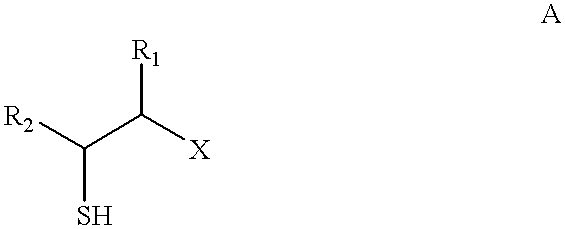
- the object of the present invention was to give a novel material for the flavoring of food (below also called “flavor material” for short), in particular a material with a meat flavor.
- R 1 CH 3 , C 2 H 5 , C 3 H 7 (n, iso) or C 4 H 9 (n, iso, tert) and
- R 2 CH 3 , C 2 H 5 , C 3 H 7 (n, iso) or C 4 H 9 (n, iso, tert) are given as flavor material.
- aldehydes e.g. 3-mercapto-2-methylpentanal, and acetals
- these newly synthesized compounds are, even in low concentrations, highly suitable for giving foods (in particular meat broths or other meat dishes) an interesting odoriferous and gustatory note.
- the compounds according to the invention have a very high odoriferous and gustatory intensity, they can be used in large dilution; the person skilled in the art will adapt the exact concentrations or amounts for the flavoring of a foodstuff in the usual manner to the respective wishes and requirements of the individual case.
- the compounds according to the invention are also suitable for use as fragrance material, in particular as fragrance material in the perfume industry; they generally have a particularly low odor threshold value, which is proving advantageous since even small amounts of a compound according to the invention suffice to achieve a desired odor.
- the invention also relates to processes for their preparation.
- the invention also relates to flavored food with a content of one or more compounds according to the invention, and to the use of the compounds according to the invention as a fragrance or flavor material.
- FIGS. 1-4 are IR and NMR spectrum for 2-mercapto-2-methyl-pentan-1-ol produced in Example 1.
- aldehydes according to the invention are extremely interesting from a sensory point of view. They do, however, also have other properties which go beyond their purely odoriferous and gustatory properties.
- the aldehydes according to the invention which are afterall substances which are relatively small in size, adhere to various surfaces—also in the mouth—for a surprisingly long time.
- This good adhesion is demonstrated, for example, on a customary smell strip.
- This property is important particularly for the perfume industry since here there is a continuous need for novel and interesting compounds which adhere for a long time.
- aldehydes according to the invention instead of using the aldehydes according to the invention directly as fragrance or flavor material or as “mouthfeel” promoters, it is sometimes desirable to use chemical derivatives which, under the conditions of customary further processing—e.g. in an acidic medium, during boiling or roasting, in the air or similar—convert or can be converted into the respective aldehyde.
- the derivatives can themselves be interesting from a sensory point of view, (for example like the acetals according to the invention), but do not have to be.
- Example 1 The 2-methyl-2-pentenal mentioned in Example 1 is commercially available.
- Other unsaturated precursor aldehydes which have likewise been reacted to give aldehydes according to the invention but have not been mentioned individually here, are either likewise available commercially (e.g. 2,3-dimethylacrolein) or are readily accessible by known synthesis processes ( ⁇ , ⁇ -unsaturated aldehydes by targeted aldol condensation: L. Brandsma, Preparative Polar Organometallic Chemistry 2, p. 145, Springer Verlag, Heidelberg 1990).
- reaction mixture is then washed with 2 ⁇ 40 ml of saturated sodium hydrogencarbonate solution, dried over sodium sulfate and filtered, and the solvent is carefully stripped off under partial vacuum. Further purification for the next reaction step is unnecessary.
- the methanol is removed under partial vacuum and byproducts are removed by extraction of the aqueous solution with 100 ml of diethyl ether.
- 2N Hydrochloric acid is then used to acidify the mixture to pH 1, and the mercaptoacetal is extracted with diethyl ether (4 ⁇ 50 ml) .
- the combined organic phases are washed with 30 ml of saturated sodium hydrogencarbonate solution, dried over sodium sulfate and filtered, and the solvent is carefully stripped off under partial vacuum.
- the 2-(1,3-dioxolan-2-yl)pentane-3-thiol has a purity of >95% (GC).
Landscapes
- Chemical & Material Sciences (AREA)
- Organic Chemistry (AREA)
- Life Sciences & Earth Sciences (AREA)
- Engineering & Computer Science (AREA)
- Food Science & Technology (AREA)
- Nutrition Science (AREA)
- Health & Medical Sciences (AREA)
- Polymers & Plastics (AREA)
- Chemical Kinetics & Catalysis (AREA)
- Oil, Petroleum & Natural Gas (AREA)
- Wood Science & Technology (AREA)
- Fats And Perfumes (AREA)
- Seasonings (AREA)
- Organic Low-Molecular-Weight Compounds And Preparation Thereof (AREA)
- Beans For Foods Or Fodder (AREA)
Abstract


Description


Claims (5)




Applications Claiming Priority (2)
| Application Number | Priority Date | Filing Date | Title |
|---|---|---|---|
| DE19837702 | 1998-08-20 | ||
| DE19837702A DE19837702A1 (en) | 1998-08-20 | 1998-08-20 | Fragrance and aroma |
Publications (1)
| Publication Number | Publication Date |
|---|---|
| US6303173B1 true US6303173B1 (en) | 2001-10-16 |
Family
ID=7878081
Family Applications (1)
| Application Number | Title | Priority Date | Filing Date |
|---|---|---|---|
| US09/378,401 Expired - Fee Related US6303173B1 (en) | 1998-08-20 | 1999-08-20 | Fragrance and flavor material |
Country Status (7)
| Country | Link |
|---|---|
| US (1) | US6303173B1 (en) |
| EP (1) | EP0982296B1 (en) |
| AT (1) | ATE229936T1 (en) |
| DE (2) | DE19837702A1 (en) |
| DK (1) | DK0982296T3 (en) |
| ES (1) | ES2188070T3 (en) |
| PT (1) | PT982296E (en) |
Citations (1)
| Publication number | Priority date | Publication date | Assignee | Title |
|---|---|---|---|---|
| US5493060A (en) * | 1994-09-16 | 1996-02-20 | Aristech Chemical Corporation | Method of making 1,1-bis-(4-hydroxyphenyl)-3,3,5-trimethylcyclohexane |
Family Cites Families (3)
| Publication number | Priority date | Publication date | Assignee | Title |
|---|---|---|---|---|
| CH556145A (en) * | 1972-08-02 | 1974-11-29 | Firmenich & Cie | USE OF CERTAIN SULFUR DERIVATIVES AS PERFUMING AND / OR FLAVORING INGREDIENTS. |
| US4496600A (en) * | 1983-10-03 | 1985-01-29 | General Foods Corporation | Flavoring with 2-mercaptoalkyl oxathiolanes and oxathianes |
| DE19756789A1 (en) * | 1997-12-19 | 1999-07-15 | Dragoco Gerberding Co Ag | Flavoring agent for food |
-
1998
- 1998-08-20 DE DE19837702A patent/DE19837702A1/en not_active Withdrawn
-
1999
- 1999-08-02 PT PT99115239T patent/PT982296E/en unknown
- 1999-08-02 AT AT99115239T patent/ATE229936T1/en not_active IP Right Cessation
- 1999-08-02 DE DE59903815T patent/DE59903815D1/en not_active Expired - Lifetime
- 1999-08-02 DK DK99115239T patent/DK0982296T3/en active
- 1999-08-02 EP EP99115239A patent/EP0982296B1/en not_active Expired - Lifetime
- 1999-08-02 ES ES99115239T patent/ES2188070T3/en not_active Expired - Lifetime
- 1999-08-20 US US09/378,401 patent/US6303173B1/en not_active Expired - Fee Related
Patent Citations (1)
| Publication number | Priority date | Publication date | Assignee | Title |
|---|---|---|---|---|
| US5493060A (en) * | 1994-09-16 | 1996-02-20 | Aristech Chemical Corporation | Method of making 1,1-bis-(4-hydroxyphenyl)-3,3,5-trimethylcyclohexane |
Also Published As
| Publication number | Publication date |
|---|---|
| DK0982296T3 (en) | 2003-04-07 |
| DE59903815D1 (en) | 2003-01-30 |
| EP0982296A1 (en) | 2000-03-01 |
| PT982296E (en) | 2003-04-30 |
| DE19837702A1 (en) | 2000-04-27 |
| ES2188070T3 (en) | 2003-06-16 |
| ATE229936T1 (en) | 2003-01-15 |
| EP0982296B1 (en) | 2002-12-18 |
Similar Documents
| Publication | Publication Date | Title |
|---|---|---|
| US3970689A (en) | Mercapto alcohols and mercaptoalkyl esters | |
| JP4532672B2 (en) | Flavor compounds | |
| US3870800A (en) | Foodstuff flavored with 4-(methylthio)butane derivatives | |
| US3769040A (en) | Substituted thiazoles in flavoring processes and products produced thereby | |
| CA1156255A (en) | Methylthiomethyl esters as flavour additives | |
| KR19990083159A (en) | Cis-configurational unsaturated ester, process for producing the same, and fragrance composition containing the same | |
| US3966988A (en) | Flavoring compositions and processes utilizing dithiazine compounds | |
| US3891710A (en) | Novel 3-thia alkane-1,4-diones | |
| US3904556A (en) | 4-(methylthio)butanal fragrance modifier | |
| US4031140A (en) | 4- AND 5-Phenyl pentenal acetals | |
| US6231912B1 (en) | Organoleptic substances | |
| KR101516837B1 (en) | 6,8,10-undecatriene-3 or 4-ol and fragrance composition | |
| CA1128054A (en) | Use of acetals and vinyl ethers as aldehyde generators | |
| JP3391006B2 (en) | Furfurylthioalkanes, their production process and their use | |
| CN111170969B (en) | Compound with caramelized creamy taste and preparation method thereof and edible essence | |
| JP2701074B2 (en) | Hemimercaptal, its production method and its use | |
| JP5300010B2 (en) | Novel compounds and perfume compositions | |
| US4073957A (en) | Spiro-1,2,4-trithiolan containing flavoring agents and method of use | |
| US4036886A (en) | Processes for producing 4- and 5-phenyl pentenals | |
| US3873732A (en) | Altering the flavor of foodstuffs with 3-thia alkane-1,4-diones | |
| EP0217581B1 (en) | Carboxylate salt compound and method for flavouring foodstuffs and tobacco | |
| EP0982296B1 (en) | Perfuming and flavouring agents | |
| US4053656A (en) | Mercapto alcohols and mercaptoalkyl esters | |
| US3470241A (en) | Cyclopropane intermediates for irones | |
| US3922288A (en) | Processes for producing 3-thia furans and 3-furan thiols |
Legal Events
| Date | Code | Title | Description |
|---|---|---|---|
| AS | Assignment |
Owner name: DRAGOCO GERBERDING & CO. AG, GERMANY Free format text: ASSIGNMENT OF ASSIGNORS INTEREST;ASSIGNORS:SABATER-LUNTZEL, CHRISTOPHER;WIDDER, SABINE;PICKENHAGEN, WILHELM;REEL/FRAME:010230/0698;SIGNING DATES FROM 19990628 TO 19990701 |
|
| AS | Assignment |
Owner name: SYMRISE GMBH & CO. KG, GERMANY Free format text: MERGER/CHANGE OF NAME;ASSIGNOR:DRAGOCO GERBERDING & CO. AG;REEL/FRAME:014892/0604 Effective date: 20030505 |
|
| FEPP | Fee payment procedure |
Free format text: PAYOR NUMBER ASSIGNED (ORIGINAL EVENT CODE: ASPN); ENTITY STATUS OF PATENT OWNER: LARGE ENTITY |
|
| FPAY | Fee payment |
Year of fee payment: 4 |
|
| FPAY | Fee payment |
Year of fee payment: 8 |
|
| AS | Assignment |
Owner name: SYMRISE AG, GERMANY Free format text: MERGER;ASSIGNOR:SYMRISE GMBH & CO. KG;REEL/FRAME:026171/0575 Effective date: 20101109 |
|
| REMI | Maintenance fee reminder mailed | ||
| LAPS | Lapse for failure to pay maintenance fees | ||
| STCH | Information on status: patent discontinuation |
Free format text: PATENT EXPIRED DUE TO NONPAYMENT OF MAINTENANCE FEES UNDER 37 CFR 1.362 |
|
| FP | Lapsed due to failure to pay maintenance fee |
Effective date: 20131016 |